Shared posts

07 Jul 15:38

Remains of the Day: Skype Gets Improved Offline File-Sharing

by Andy Orin

If you use Skype as your primary means of communication for work or otherwise, it can be frustrating to when you need to send someone a file but they aren’t online. With a new update, though, you’ll be able to exchange files even when the recipient is offline, like email.

Read more...

07 Jul 15:25

There's a lot we don't know about prime numbers

by Andy Kiersz

euclid

Prime numbers are one of the most basic topics of study in the branch of mathematics called number theory.

Primes are numbers that can only be evenly divided by themselves and 1. For example, 7 is a prime number since I'm left with a remainder or a fractional component if I divide 7 by anything other than itself or 1. 6 is not a prime because I can divide 6 by 2 and get 3.

One of the reasons primes are important in number theory is that they are, in a certain sense, the building blocks of the natural numbers. The fundamental theorem of arithmetic (the name of which indicates its basic importance) states that any number can be factored into a unique list of primes. 12 = 2 x 2 x 3, 50 = 5 x 5 x 2, 69 = 3 x 23.

Studying numbers, then, basically amounts to studying the properties of prime numbers. Mathematicians have, over the millennia, figured out quite a bit about the prime numbers. One of Euclid's most famous proofs shows that there are infinitely many primes.

The basic idea of the proof is that if there were only finitely many primes, and we had a list of all of those prime numbers, we could multiply them all together and add 1, creating a new number that isn't divisible by any of the prime numbers on our list. That number would either itself be a prime number not on our list, or would have a prime divisor not on our list. Either way, we contradict the idea that there could be a finite list of primes, and so there have to be infinitely many.

In the nineteenth century, mathematicians proved the Prime Number Theorem. Given some large natural number, the theorem gives a rough estimate for how many numbers smaller than the given number are prime. Primes get rarer among larger numbers according to a particular approximate formula.

Despite all the things we know about prime numbers, there are plenty of deceptively simple conjectures about primes that have not yet been either proven or disproven. Here are some of those conjectures.

Twin Primes

Twin primes are pairs of prime numbers that have just one number between them: 5 and 7, 11 and 13, and 29 and 31. The twin primes conjecture is that there are infinitely many pairs of twin primes among the infinitely many prime numbers.

Most mathematicians think that the conjecture should be true: while prime numbers get rarer as numbers get larger, number theorists' experience and intuition with primes suggests that twin prime pairs should still pop up from time to time. Despite this, the conjecture has not yet been proven or disproven.

yitang zhangAfter remaining a completely open question for centuries, in spring 2013, University of New Hampshire mathematician Yitang Zhang made a breakthrough in the problem, for which he was awarded a MacArthur "Genius" fellowship in September 2014. While still not proving the twin primes conjecture itself, Zhang invented a novel technique that showed that there are infinitely many pairs of prime numbers with no more than 70,000,000 numbers between them. That's a huge number, but it was the first such finite limit on distances between primes that had ever been discovered.

In fall 2013, a large group of mathematicians built on Zhang's work and similar results and collaboratively found smaller and smaller bounds, eventually proving that there are infinitely many pairs of primes with at most 246 numbers between them.

Goldbach's Conjecture

This is another simply stated problem. Goldbach's Conjecture says that every even number larger than two can be written as the sum of two prime numbers. This certainly holds true for smaller numbers: 4 = 2 + 2, 8 = 5 + 3, 20 = 13 + 7, but it hasn't been proven for all even numbers.

Researchers armed with 21st century computers and well-designed programs have verified the conjecture for even numbers up to 4,000,000,000,000,000,000. This is pretty good evidence for the conjecture, but in mathematics, saying that a conjecture holds for all numbers smaller than some ludicrously high finite bound is not enough to say that it holds for all numbers.

Palindromic Primes

Palindromes in English are words or sentences that read the same forwards and backwards. The word "radar" and the phrase "A man, a plan, a canal: Panama" are both palindromes.

Similarly, palindromic prime numbers are primes whose decimal expansions read the same forwards or backwards. 11, 101, and 16561 are some examples of palindromic primes.

My personal favorite prime number is Belphegor's Prime: 1000000000000066600000000000001. That's a 1, followed by 13 0's, followed by a 666, followed by 13 more 0's, followed by a closing 1. Given that 666 is the "number of the beast" according to Revelation 13:18, and 13 has a slew of superstitions attached to it, this is probably the unluckiest prime number possible in the decimal number system.

mark of the beast evil devilAs with the twin primes, it's currently unknown if there are infinitely many palindromic primes. The palindromic primes are a less active area of mathematical research than the twin primes, however.

Problems like Goldbach's Conjecture and the twin primes conjecture rely solely on the structure and distribution of the primes themselves. But palindromic primes depend on the particular number system being used: binary palindromes are completely different than decimal palindromes. The prime number written in decimal as 31 is written in binary as 11111. In binary, this prime is a palindrome; in decimal, it is not. 

While mathematicians do study the palindromic primes, and have come up with results like that primes are rare among palindromes regardless of the number system being used, more effort in number theory is dedicated to problems that focus mostly on the properties of primes independent of their representations.

The Riemann Hypothesis

The Riemann Hypothesis is one of the Millennium Prize Problems, a set of the most important open problems in mathematics. Solving one of these problems brings with it a prize of $1,000,000.

The Riemann Hypothesis involves an extension to the Prime Number Theorem mentioned above. That theorem gives a formula for the approximate number of primes smaller than some given large number. The Riemann Hypothesis gives a more specific result, providing a formula showing how accurate that estimate will be.

Bernhard RiemannThe great nineteenth century mathematician Bernhard Riemann connected that accuracy bound to a special function on the complex number plane. The actual Riemann Hypothesis states that all of the points on the complex plane where that function equals zero fall along a particular line in the plane. Should that be the case, the accuracy bound would also be true.

As with the other problems on this list, there is a good amount of numerical evidence for the Riemann Hypothesis, and most mathematicians believe it to be true. Mathematicians have tested billions of the zero points of the function and found all of them to fall on that line.

Also like the other problems we've looked at, there is not yet a full blown proof of the hypothesis. In each of these cases, while most mathematicians believe these conjectures to be true, and there is a good bit of empirical evidence for the conjectures, the search for a full blown proof continues.

This seemingly obsessive behavior on the part of mathematicians is partially because rigorous proof is one of the main goals of mathematics, but also because any proof of the twin primes conjecture, or of the Riemann Hypothesis, would likely involve radically new mathematical techniques and insights, potentially leading to entirely new avenues of research and ideas to explore. In mathematics, it's often the case that the journey to finding a proof is at least as interesting as the result itself.

SEE ALSO: 7 Math Tricks That'll Make Your Life Easier

Join the conversation about this story »

07 Jul 15:25

25 eCommerce Conversion Hacks [Infographic]

by Khawar Zaman

How often do you think of beginning your own eCommerce venture after getting inspired by dozens and dozens of success stories around you?

But have you ever wondered about how many of these growing eCommerce setups really make it to the top? Not many, to be honest; in fact, only 3% or 650,000 out of a total of 12-24 million online stores, according to a report on Internet Retailer. The rest of them fail to cross the $1,000 benchmark in annual sales.

This may intrigue you as to why only such a meager percentage of eCommerce setups ever really succeed. There can be endless reasons, but the most significant one is the business’s inability to leverage on the process of conversion optimization. This Adobe 2013 Digital Marketing Optimization Survey Results might help you better understand the circumstances, according to which:

  • 53% of businesses do not ever allocate more than 5% of their total marketing budget to enhance the conversion optimization process.
  • The conversion rate for 35% of eCommerce setups never exceeds 1%.

It’s absolutely right that most eCommerce ventures don’t enjoy bountiful resources when they are starting up, not having much to spend on conversion optimization, but does that mean there’s no other way out to enhance conversions?

With the following is a list of 25 eCommerce conversion hacks that will help you fuel your eCommerce conversion optimization without having to spend thousands of dollars. Some of the most important takeaways include:

1. Improve your site speed to improve your conversions

Because nobody likes to waste their time on slowly loading pages, especially when they have countless lightning-fast alternatives ready and willing to host them.

2. Enhance On-page SEO

Gone are the days when On-page SEO could be confined only to “conversion-oriented” keywords. Nowadays, you cannot think of laying a solid foundation for a significant On-page SEO campaign without structured data and rich snippets.

3. Go responsive

Because 90% of people now resort to multiple screens sequentially and 48% of users deem a site uncaring if it’s not working well on mobile.

With some idea of the kind of hacks that can help you augment your conversions, now explore this 25 eCommerce conversion hacks infographic to make the most out of your eCommerce venture.

25 eCommerce Conversion Hacks

revcontent-98%25-of-sites-get-denied-are-you-in-the-2%25

07 Jul 15:24

Amazon is gradually eliminating list prices (AMZN)

by Andrew Meola

Amazon PrimeThis story was delivered to BI Intelligence "E-Commerce Briefing" subscribers. To learn more and subscribe, please click here.

You may have noticed list prices are disappearing from Amazon, and that's very much intentional.

The world's largest online retailer is gradually eliminating these list prices from thousands of products on its site, reports the New York Times.

List prices, also known as Manufacturer Suggested Retail Prices (MSRP), are typically much higher than the prices of the goods listed on Amazon. The user sees the difference in the form of savings before they make the purchase. But Amazon is now removing these prices, which means the shopper only sees one amount.

This process started approximately two months ago. Comparison pricing firm Rout estimates that approximately 29% of products on Amazon did not display a list price in early May, and that number has now increased to approximately 70%.

The move is odd considering that many view Amazon as a discount retailer, but the company might be doing this in response to an increase in fake discounting lawsuits. Many major retailers are dealing with lawsuits in which plaintiffs claim that some discounts misrepresent the actual value because of largely fabricated MSRPs.

For example, the New York Times notes that Amazon listed the Breville Infuser Espresso Machine at a $500 retail price and an $800 list price for a 38% discount. But the net price on the manufacturer's website was $500, which made shoppers question the validity of that $800 list price.

The elimination of these list prices could affect Amazon's independent sellers, as well as consumers. Merchants use the list price as a marketing tool to tell the shopper he or she is getting a competitive price, but that will no longer be an option on Amazon. And consumers, as a result, will not know if they are getting a discount.

Amazon has fostered incredible relationships with its loyal customers, but non-Prime members often make infrequent, one-time purchases (often of just single items). Without the list prices, these shoppers might test other online retailers because they'd have no incentive to shop on Amazon.

If Amazon won't display its products as bargains, then consumers who are focused on price and are not beholden to Amazon's ecosystem might move to a different retailer that still focuses on discounts.

To receive stories like this one directly to your inbox every morning, sign up for the E-Commerce Briefing newsletter.Click here to learn more about how you can gain risk-free access today.

Join the conversation about this story »

07 Jul 15:23

Let your benefits tell your story

by Drew McLellan

benefitsLet your benefits tell your story.  What does that mean?  Most prospects and customers have no idea what your company’s mission statement or tagline is but they definitely know how they felt when they did business with you.  Those experiences spark more word of mouth marketing than anything else.

The interactions your employees have with your customers – be it in-person, on the phone or online, are often the foundation for how your business is perceived. Which makes those exceptional employees one of your most effective and valuable marketing assets.  Assets you do not want to lose.

Couple that truth with what sources like Bloomberg, The Economist and US News and World Report are saying about the oncoming high skilled labor shortage.  As businesses struggle to find new employees, it’s only natural they’re going to start trying to poach yours.

A strong benefits package actually packs a double wallop. There’s no doubt it will help you retain your best employees and keep them on the front lines, delighting your customers, but what many business owners don’t really understand is how much your benefits package can also build your brand internally.  By carefully creating benefits that speak to your core beliefs and values, you can weave those elements deep into your organization’s culture.

Many companies struggle with how to infuse their brand into their employee base in a way that rings true and will reinforce those beliefs so they get translated accurately in all customer interactions.  When an organization walks its talk, the employees don’t just hear the brand values, they see them in action.

Does your current benefits package actually reflect your company’s values and brand promise?

One way to think about your benefits from a more holistic point of view is to look at them by category.

Benefits that make life easier and communicate family, trust and life/work balance: This would include perks like time off, child/elder care, flexible work hours, and space, concierge services, discounts on legal services, counseling, personal space at work (lactation room, exercise room, etc), summer hours and gift cards/certificates.

Benefits that focus on the employee’s health and the importance of living a balanced and long life: There’s lots of room to get creative here beyond health insurance.  Don’t forget about benefits like gym discounts, long-term care insurance, wellness programs, a health risk appraisal, disability insurance, and access to health care options like eye, dental and mental health care coverage.

Benefits that help them grow professionally and speak to thought leadership, expertise and the value of helping others: Many employees know that the best way for them to earn more money is to be more valuable to the organization. Look for opportunities to give them career visibility, frequent feedback from managers, relationship networks, learning opportunities, trade or professional memberships, coaching or mentoring, education reimbursements and perhaps the best professional perk of all – an engaging culture.

Benefits that make your place the bomb and communicates fun, passion, serving the community and play: Not all benefits need to be traditional or ongoing.  A day at the ballpark, an internal paper airplane competition, a potluck just because, bringing in a chair massage service or working together for a charitable cause all create a workplace that’s hard to duplicate.

Benefits that help an employee build their wealth and demonstrate your belief in being prepared, rewarding performance and legacies: Beyond paying a fair salary, there are plenty of things you can offer to help an employee stay in the green.  Think about offering tax preparation discounts, access to financial planning services, bonuses, or retirement savings accounts with employer matches.

Use your benefits package to not only keep your employees happy but to remind them every day what you and your company are all about.

The post Let your benefits tell your story appeared first on Drew's Marketing Minute.

07 Jul 15:23

Canada’s pension funds eye greenfield federal infrastructure investments

by Reuters

Canada’s biggest pension funds are prepared to finance the construction of major new federal government infrastructure projects, according to senior fund sources, marking a shift from their traditional strategy of avoiding development risk.

Officials with the top funds, which manage $1.1 trillion in assets, are seeking to reduce that risk, telling the Canadian government they would like it to provide guarantees on future returns and assurances on costs.

“We think we can create incremental value by taking on the ‘greenfield’ risk of building the assets,” a senior executive at one of Canada’s three biggest public pension funds told Reuters, speaking on condition of anonymity due to the sensitivity of the talks.

Canadian funds have traditionally preferred buying ‘brownfield’ assets that have already been built and have predictable revenue streams, rather than take on potentially higher risk from ‘greenfield’ assets that have yet to be built.

But like their global peers, the Canadian funds face an increasing challenge in finding assets that generate adequate returns.

“‘Greenfield’ does come with a different kind of risk than ‘brownfield’ but it’s a source of value and, by doing it, you’re less susceptible to this rollercoaster ride of what’s going on in the equity markets,” the executive said.

Canada’s Liberal government was elected last year pledging to spend billions on infrastructure such as public transport, affordable housing or renewable energy to help stimulate the economy.

Reuters reported in February that the government had opened talks with the funds about investing in the projects, the details of which have yet to be revealed.

Bankers say private funding for the projects could amount to several times that from the public purse, meaning Canadian pension funds could invest tens of billions of dollars.

Canada’s biggest pension plans, which include the Canada Pension Plan Investment Board (CPPIB) and Ontario Teachers’ Pension Plan, pioneered a strategy of directly investing in infrastructure, funding roads, bridges, rail, airports, utilities and pipelines as an alternative to bonds and equities.

Their move into ‘greenfield’ investments also places them ahead of international rivals.

Four Canadian funds are now among the top 10 global infrastructure investors. By contrast, U.S. pension funds such as the California Public Employees’ Retirement System (CalPERS), began investing directly in infrastructure much later and have invested less.

Britain’s decision to leave the European Union has pushed some government bond yields to record lows and fueled equity market volatility. Competition for global infrastructure assets is also intensifying.

Executives stressed that while the government might be keen for them to participate, they will only do so if the terms are right. The funds, including the CPPIB which invests on behalf of the national pension plan, have traditionally been fiercely protective of their independence.

But they also noted they are under-invested in domestic infrastructure, and local deals would reduce currency risk given they pay out benefits in Canadian dollars.

“Canada is the home country for our beneficiaries and of course we would have to look at suitable projects if and when they are ready,” said Cressida Hogg, CPPIB’s Global Head of Infrastructure.

For its part, the Canadian government, which declined to comment on the talks, faces a tricky balancing act. It needs to ensure taxpayers are not left with a hefty bill if projects go wrong, but also avoid a public backlash if pension funds are seen to have been treated too generously.

Ontario Teachers’ CEO Ron Mock said in June that talks were progressing, with the government keen to move ahead, but warned it was too early to say when the projects will come to fruition.

“I wouldn’t put a time frame on it at this point but what I would say is we are seeing a lot of movement. We’re seeing at a federal level that they’re taking this seriously,” he told Reuters.

Some Canadian funds have already begun to take some ‘greenfield’ risks. Caisse de depot du Quebec, Canada’s second biggest public pension fund, agreed in April to invest C$3 billion building a new public transport system in its home province. And Ontario Teachers’ has begun making ‘greenfield’ investments in wind, hydro and renewable energy.

© Thomson Reuters

07 Jul 15:22

Essential page engagement tools

by Robert Allen

Use these tools to assess and improve on-site user interaction

Time-on-site, bounce rate, page views. You've probably grappled trying to boost these metrics for a while, and it can be difficult to make big improvements. Getting the right tools can make a massive difference and really help to generate that all important engagement which lets you boost these key metrics and thus helps you rise in the SERPs and sell more products. So we took at look at 5 of the best page engagement tools so you can see which ones are right for you and give them a try.

Act Quarter

What do these tools do?

These tools help assess and improve the effectiveness of website design including different page template types such as home page, landing and campaign pages.

Why are they important to digital marketers?

These tools can help digital marketers improve conversion and goal completion rates, while reducing the need for IT support and ensuring brand stakeholders are kept happy with the consistent design (look and feel) of the pages built. They may also help reduce the amount of design input required once a template is agreed.

Key things to consider before purchasing and using these tools:

Scale. Understand how much time your team are spending on managing and creating landing and campaign pages. Are you operating at a scale to benefit from these tools?

Are there other benefits you can leverage? For example, developing custom PPC landing pages testing different copy, images and call to actions.

Be clear on the levels of reporting and customisation you require to deliver your objectives. These are two areas which differ significantly between the tools in this category.

Finally, when testing and optimising bear in mind that you’ll need enough traffic to ensure the tools can run the experiments. The greater the volume of traffic, the quicker you’ll have results.

#1 Google Page AnalyticsGoogle analytics

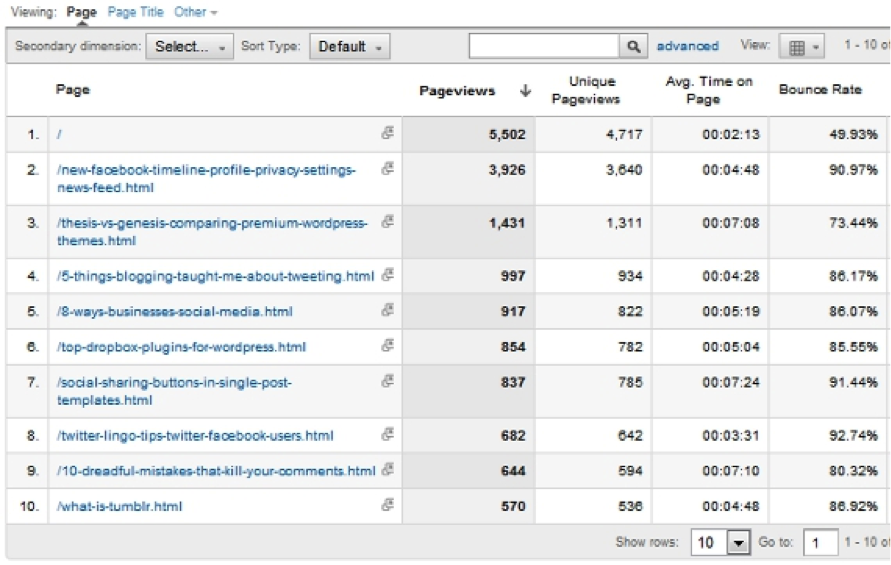
A free Chrome extension that integrates with Google Analytics .  Also available as a report within Google Analytics (Behaviour menu).

Why do I need it?

The Page Analytics Chrome Extension allows you to see how customers interact with your web pages, including what they click and don’t click. Use these insights to optimize your website layout, improve user experience, and increase conversions.

What makes it stand out?

It’s useful to have a visual assessment of how users interact with key web pages so you can understand whether call-to-actions are effective.

Key features:

  • Overlays clickthrough and goal outcomes achieved for each link web page.
  • Pageviews, Unique Pageviews, Avg time on page, Bounce Rate, and %Exit plus number of active visitors displayed for reference as you browse pages
  • Can segment by different standard audience types, e.g. mobile users, returning users
  • As with other extensions can be switched off when not needed.

The Smart Insights view

We highly recommend this tool. It offers many of the features of paid services, but is totally free. Fantastic value!

#2 HotjarHotjar

Hotjar is an all-in-one analytics and feedback tool helping you to truly understand your web and mobile site visitors. 

You can get a free trail and a free 'basic' version which has limits of sample size and number of page views.

What makes it stand out?

Other tools in the category don’t all provide insights from prompting visitors with polls. Heat maps can only show you so much, asking people provides a whole nother level of insight. 

Key features:

  • Heatmaps: Visualise your visitors clicks, taps and scrolling behavior.
  • Recordings: Eliminate guesswork with recordings of real visitor behaviour on your site.
  • Polls: Understand what your visitors want and what’s preventing them from achieving it.
  • Funnels & Forms: Find the biggest opportunities for improvement and testing by identifying on which page and at which step most visitors are leaving your site.

The Smart Insights view

This is a relatively new tool, but we prefer it to some of the existing services since it also enables questions to be asked on some pages for qualitative feedback. We subscribe to this service for this reason.

#3 Clicktaleclicktale

Clicktale shows customer behavior and intent across key touchpoints: web, mobile and apps. Clicktale’s deep drill-downs get to the heart of the “how” and “why” behind customer behavior. You have to pay to use the service, but there is a free trail available. 

What makes it stand out?

A good ‘all-in-one’ contender with heatmaps, session replays and form analytics. 

Key features:

  • Data-rich heatmaps: see what visitrors are clicking on
  • Session replays: Visualize exactly what your visitors are experiencing
  • Conversion analytics: discover what’s working (and what’s not) in your funnel and forms.
  • Advanced insights: Surface key data, error reports, and trends to get clear direction on improving customer experience and increase conversions.

The Smart Insights view

Described by its vendors as ‘The world’s #1 enterprise-class experience management platform’, it is aimed at larger organisations, so is more expensive to subscribe to than some platforms. It is a well-established service with the benefit over some other surface in that it combines session replays with heatmaps.

#4 Crazyegg

Crazy eggCrazyegg is a  tool for generating and reviewing heatmaps, scrollmaps and overlays of when people click on your site. You have to pay to use it, but it does offer a 30 day free trail.

What makes it stand out?

It's a simple service with good usability and visualisation for different forms of heatmaps.

 Key features:

  • Heatmap: Where peole click and where they don’t
  • Confetti: Clicks are segmented by referral types
  • Scroll map: Shows how far down the page visitors are scrolling

Smart Insights view

We’re not convinced of the value of paying for a service when Google’s InPage Analytics provides similar functionality. However, you may want to subscribe during redesign projects.

#5 TealeafTealeaf_IBM

Tealeaf is a tool to highlight points in the customer journey on a desktop or mobile site where visitors are abandoning a process - typically in a checkout or cart. It's an IBM product and has a heftier price tag than other products listed here. You can get demos on request, but there is no free trail. 

What makes it stand out?

Highlights potential problems which lead to revenue loss, so can be used to increase conversion and average order value.

Key features:

  • cxImpact captures a page-by-page, browser level recording of each customer session which is replayable and searchable
  • cxOverstat provides overlays to show visitor intent and action
  • cxView aggregates captured data to highlight most common issues and how they change through time.

The Smart Insights view

A different type of service to the others in this category which is described as highlighting ‘Customer Struggle’. The insights it generates can yield significant savings on abandoned transactions and application errors so it is a widely deployed tool in large, transactional businesses.

If you're interested in learning more about marketing tools, you can download our full guide to essential marketing tools, featuring 150 different tools and advice on what to use them for.

Download resource – Essential Digital Marketing Tools

This free 100+ page guide explains why we have chosen the 5 tools in each category and gives links to all the tools.

Access the Essential Digital Marketing Tools 2016

07 Jul 15:22

6 Ideas to Catapult the Growth of Your Top Talent

by Paul Keijzer

Over the last couple of weeks I have shared with you a number of innovative ideas on attracting and developing talent and given you a glimpse of the future of performance management. All of these elements combined make up the Talent Management Model that has helped my clients significantly enhance their ability to attract, get the best out of, engage and retain talent.

Talent Management

Today I’ll talk about ‘leveraging talent’ which gives organizations the ability to not only fast track the development of their best talent but also to do this in a way that significantly creates immediate value for the organization itself. Of course this is based on the assumption that you have already done all the right things to identify your top talent. Just to make sure you have gone through the right steps, you must have:

  • assessed your talent against a relevant leadership competency framework and transparent targets,
  • incorporated multi rater feedback in this assessment,
  • calibrated your talent against other top talent from other parts of the organization,
  • informed your top talent of their status in the organization and awarded them accordingly, and
  • created a high impact fast-track development plan for your top talent.

I’ve always been a big fan in designing solutions that ‘kill two birds with one stone’. Sending your top talent to well recognized universities, for example, could be a great experience (and boost your top talent’s resume), however, it doesn’t create immediate value for companies. For me the most exciting fast-track development options are the ones where your top talent extensively learns and at the same time creates huge value for the organisation.

So here are six ideas that will fast track the development of your top talent and gives your organisation immediate value:

1. Trendspotting

One of the initiatives the fast moving consumer goods giant Unilever conducts every couple of years is to take 15 of their global top talent into a ‘Trendspotting’ Task Force. The top talent are selected from their worldwide operating locations, across all functions, businesses, ages and genders. This task force, facilitated by some of the best foresighted guru’s in the world, is tasked with the identification of ‘mega trends’ that would impact Unilever’s business 10 – 15 years down the line.

2. Consumer Deep Dive

The consumer deep dive approach gives top talent the opportunity to live and breathe with your consumers and clients. As a B2B company you could send your top talent on a few weeks secondment with your biggest clients. Or if you are a pharmaceutical company assign them to a not-for-profit hospital. As a beverages company, have them live with an urban household. And if you’re a micro finance bank you could have them live with the unbanked for a few weeks. I promise you the insights gained will give them an unparalleled outside-in perspective that they’ll be impacted by it for the rest of their professional lives.

3. Turnaround Teams

Gather your top talent and create a turnaround team. This team’s responsibility is to implement a major change effort project or assignment. You could have them lead the organization’s restructuring efforts, transform the culture, implement an ERP, or even redesign the performance management system. Basically the idea is to not only provide them huge learning opportunities, but to also test whether these top talent is made of the right ‘leadership metal’.

4. Government Negotiations

Running or being part of an important government negotiations team gives top talent an opportunity to understand different stakeholders. This way they’ll get to find and craft solutions that would work for both parties. And it is not so much the negotiations that are important, it’s more the exposure to stakeholders that normally would have a very different perspective, objective and even responsibilities.

5. Run New Business

I still remember in the late 90’s during the internet boom when everything that had ‘real’ assets were significantly less than ’e-assets’. Even my previous organization was pressured by shareholders to test the waters. And so they set up a couple of ‘venture funds’ that would fuel new business ideas from top talent. These intrapreneurs were then relieved from their current roles and asked to prove the feasibility of their ideas. Raymond Cloosterman was one of these exceptional people who took the opportunity and founded the home and body cosmetic brand Rituals.

6. Innovation Hack

What do you think would happen if you put your brightest and smartest talent together for a couple of days and ask them to do an ‘innovation hack’? A ‘pressure-cooking’ process where people in an interactive way are asked to come up with ideas and solutions for specific problems. The impact of such a process could be enormous particularly if the outcome yields innovation that catches the attention of global design thinking companies like IDEO. More importantly, the process would award your top talent the ‘innovation champion’ medal.

Have you implemented a strategy that develops your top talent while leveraging their impact across the organization? I’d like to hear about them. Next week I’ll be sharing with you some innovative engagement ideas

07 Jul 15:21

Inside the Mysterious World of Dark Social

by Pam Neely

Inside the Mysterious World of Dark Social_FI

Content sharing via social media is really important, right? It’s the ultimate voice of confidence from your audience. But have you heard of “dark social?”

A share is a good thing first because an audience member read and liked your content enough to interact with it. But it’s a good thing again because the recipient of that share will consider your content far more seriously than if you advertised it or shared it with them. They trust their friend, after all … usually more than they’ll trust a company.

This is the sort of trust advertising cannot buy. It’s one of the reasons content marketing can be so effective.

So yeah, sharing is great. That’s why we track it, and study it, and try to push the psychological levers that make people more likely to share. We read detailed reports about sharing, and we assign a quantitative value to it.

But we’re missing the bulk of what’s going on.

“Wha?”

Yep. We can, and do, track how and when people access our content from links we send them in email or make available in social media, and so forth. But once those people share our content with their friends, and if their friends visit our website, then those visitors – and the paths they took to get to us – are unknown.

And for most of us, these unknowns are the majority of our traffic. It’s about 69% depending on which country you’re in, or which industry you’re in, but generally all our fancy analytics reporting is missing about two-thirds of what people share. It’s called dark social.

What, exactly, is “dark social”?

Fortunately, dark social (unlike the “dark web”) is more benign than it sounds. It’s basically whenever someone privately shares a link – usually by cutting and pasting. For example, they decide to share this blog post (thanks!). So they copy the URL of this page, then paste it into an email and send it to their friend. That’s one incarnation of dark social. Compare it to if that person publicly shared this post on Facebook or Twitter. If they share that way, we can track the share.

The reason all this matters is probably already clear to you: We’re getting a seriously skewed view of which content assets people are sharing. This affects how we evaluate our content (at least in part) and, in turn, how we plan and budget for it.

Yikes. Or as Shakespeare’s Hamlet said, “There are far more things in heaven and earth, Horatio, than are dreamt of in your analytics.” Or something like that.

That 69% stat comes from multiple sources, including a report from RadiumOne published back in 2014. It’s pretty much regarded as the official measure of how much of this invisible sharing is going on.

Percentage of Shares, Globally

If you just looked at that chart and thought, “They’re wrong – I don’t believe this data,” consider this other chart from Rumble.me’s Mobile Content Engagement Study. It shows what portion of the article shares they tracked occur across different platforms. Notice how email shares (a dark social channel) take up 76% of the pie.

This graph by Rumble shows the percentage of article shares by medium: email, facebook, and twitter

There’s more dark social sharing going on than most of us realize.

How does dark social sharing happen?

How are all these clicks and shares evading our tracking system? There are a bunch of ways, actually:

  • Emails
  • Instant messages (like Facebook messenger or WhatsApp)
  • Text messages
  • Links in any chat application
  • Links in PDF documents
  • Viewing a page via a bookmark
  • Clicking from a non-secure site (http:) to a secure site (https:)
  • Clicking a link in a Word doc or other document format
  • Clicking links pasted into forum posts

This list goes on, but I think you get the idea. Many of these begin as trackable links; you send an email with a link, your prospect clicks, you can track that. But your prospect shares the link with 20 people and they all click. You cannot track that.

With all those dark social channels available, it becomes less surprising how much dark social sharing is happening. But I’m still blown away that there’s three times as much sharing going on via dark social than is going on via all of Facebook. That’s a major perspective shift.

Facebook is typically known as dwarfing all other social platforms when it comes to sharing. And yet dark social – lurking in the background, kind of like dark matter – is actually far larger.

69%25 of sharing happens via dark social. Why even bother with analytics?

It’s no wonder we don’t talk about this dark social stuff very much. It’s kind of embarrassing. But it doesn’t have to be so humbling. Once we understand the scope of dark social, and where the shares are likely coming from, we’ll actually have a far more realistic view of what’s going on.

So what to do? Are we just going to give up? Miss out on tracking most of the sharing going on? Heck no. There are ways around this.

How to track dark social – at least better than you have before

1. Set up your site so if someone does a cut and paste of your content, they’ll automatically add a link to your site.

You’ve probably seen this before. You go to copy and paste something from a website to save for later, and there’s a link automatically tacked on at the end. Like this:

added url

There are a couple of ways to do this.

  • Add some coding to your WordPress site.
  • Add a plugin to a WordPress site. (Alas, all the plugins I found that have this feature are not well reviewed.)
  • Add some Javascript to any site.
  • Use one of the services that offer this feature as part of their tracking tools. 33Across (previously known as Tynt) is one option.

Take note: Some people find these added-on links annoying. They’ve created workarounds to disable them.

2. Use link shorteners like Bit.ly to track specific links.

These are ideal for tracking traffic to a page that’s not on your site – something Google Analytics doesn’t do well. They’re also great for links in PDFs, Kindle books, and email signature files. If you upgrade to a paid version, sometimes you can get vanity URLs. Those can be extremely helpful with offline campaigns like business cards or conference giveaways.

The screenshot below is an example of a simple report from a free version of the link shortener Bit.ly. The link being analyzed shows quite a bit of “dark” traffic. It also shows some activity from Twitter. All of that makes sense – I’m using this particular link in my email signature file and in the bio area of my Twitter account.

While Bit.ly can’t tell me exactly where the dark traffic is coming from online, it can show me when the clicks occurred and which country the clicker was in.

This screenshot is an example of a simple report from a free version of the link shortener Bit.ly.

3. Get suspicious of your analytics reports.

Hey – I love analytics reports. Really. It’s essential to have some kind of grasp of what’s going on. And it’s fun to find out which tactics and projects actually worked.

But analytics reports are often flawed. Badly flawed.

Here’s an example: This is the Google Analytics report from a page on my site. It shows the most active source to this page is “direct.”

Here’s an example: This is the Google Analytics report from a page on my site. It shows the most active source to this page is “direct.”

Don’t believe it. There’s no way people are manually typing in that full URL. They’re coming to that page from somewhere, but Analytics can’t tell me what the source is.

So if you look through your analytics data and see some suspiciously high “direct” traffic sources, scrutinize them. Where do you think the traffic might be coming from? Can you set up a shortened tracking link to measure even some of this traffic? Could you trick your Analytics account into revealing more about these visitors?

4. Get smart with Google Analytics filters and UTM parameters.

Setting up a few filters in Google Analytics can help a lot. So can adding URL parameters (aka “UTM codes” or “UTM parameters”) to links wherever you can. Many CRM and marketing automation systems do this for you, but if you’re not there yet, use Google free URL builder. It’ll require you gain an understanding of how Google Analytics tracks campaigns, but there are lots of tutorials here, and here on the subject.

Conclusion

It’s humbling to realize we’ve been ignoring up to 69% of the sharing that’s been going on via dark social. It raises issues about how we evaluate our content, and our content marketing.

Blame it on the rise of mobile if you want, but this is just the nature of tracking. It’s never going to be perfect – even if we have great tools – because the Internet continues to evolve at a breakneck pace. Case in point: There’s more activity going on now in messaging apps than there is on social media apps.

This graph shows how messaging apps have surpassed social networks

So all this discussion about dark social is actually a great reminder: Blindly following analytics reports and tracking tools can get you in trouble.

We marketers still need to think. A lot.

Portrait of Grumpy Cat by Mickey Destro, used under a Creative Commons 2.0 license.

Social media has become a vital business communication tactic in the B2B marketer’s toolset. But because trends in social media marketing are always changing, the tactics that worked six months ago may no longer yield positive results. Enter Act-On’s eBook, The Social Media Audit, the perfect tool to help your company see what’s working and what’s not with your social media strategy.

07 Jul 15:20

How Italy’s oldest bank lost 99% of its value, and why the rest of the Italian banks are also a basket case

by Tom Beardsworth, Bloomberg News

Italy’s banks are a basket case. Helping them has divided policymakers and called into question Europe’s attempts to end taxpayer bailouts. The stakes are high: After Britain’s shock vote to leave the European Union last month, the shares and riskiest securities of European banks have plunged. If Italy’s banking crisis isn’t solved soon, there are worries it could spread to the rest of Europe.

1. What’s wrong with Italy’s banks?
They’re saddled with about US$400 billion of bad loans and lack the financial reserves to sell them off. The combined stockmarket value of UniCredit SpA and Banca Monte dei Paschi di Siena SpA, Italy’s biggest and third-biggest banks respectively, has tumbled by more than half this year to just US$13 billion. By comparison, Snapchat Inc., the photo-sharing app, was recently valued at US$18 billion by venture capitalists.

2. How did we get here?
During the 2008 global financial crisis, banks in the U.S., U.K., Spain, Ireland and elsewhere were bailed out with taxpayer funds. Italy, not facing an immediate need to recapitalize its lenders, waited for an economic recovery that never came.

The government this year sponsored attempts to recapitalize troubled banks and buy bad loans. Investors were underwhelmed. Skittishness about banks intensified and stocks slid after Europe woke up to the reality of Brexit. Prime Minister Matteo Renzi is now seeking to inject public funds.

3. What’s the issue?
It all comes down to who pays for the mess. State-aid and banking rules normally require shareholders and junior creditors to share losses before public money can flow. That was meant to end the “too big to fail” problem by making private investors foot the bill for bank failure before taxpayers.

The problem is there are a lot of private investors — often middle-class individuals who have put their savings in bank bonds. Bondholder losses at four small banks in November sparked protests by savers, a nationwide selloff of bank debt and one suicide.

Renzi’s government is considering injecting as much as 40 billion euros (US$44 billion) into banks, a person with knowledge of the plans said last week.

4. What’s next?
Renzi needs a solution that avoids a bail-in, which would force bondholders and other creditors to take losses. A bail-in could spark an economic crisis before a crucial October referendum on constitutional reform that Renzi needs to win to stay in power. He has some support outside Italy, but German Chancellor Angela Merkel has so far slapped down attempts to bend EU rules. Renzi said Italy doesn’t need “a lesson by the schoolteacher.

The issue of creditor losses has become the sticking point in negotiations over Monte Paschi between Italy and the European Commission, people familiar with the discussions said Wednesday.

5. What are financial markets saying?
Monte Paschi, the world’s oldest bank, has survived more than five centuries. But it’s lost 99 per cent of its value since the collapse of Lehman Brothers Holdings Inc. in 2008, and credit markets signal an approximate 60 percent probability of default on its junior bonds within five years. Investors in under-capitalized banks like Banca Carige SpA and UniCredit are also getting nervous.

6. What’s the potential for a surprise?
Most investors expect some sort of fudge, in which the EU approves further aid that’s well short of what Italy is seeking. But European officials have sweated away for thousands of hours devising complex rules for how to deal with failing lenders, and they may not be prepared to throw out the rule book just yet.

Bloomberg News

07 Jul 15:19

What Is Your Personal Brand Telling Your Buyers?

by PFPS

Seller differentiation also includes the seller’s own personal brand. Intentional or not, every seller develops and telegraphs a brand. For some, the brand is highly polished and professional. For others, the brand may be free-spirited, flexible, approachable, customer-focused, creative, energetic, thoughtful or persistent. Some sellers communicate a brand that is flighty, disorganized, aloof, intense, distracted, desperate, rigid or pushy.cover for site 2015

Personal brands are earned by the way a seller presents himself or herself to others. Without deliberate thought, conscious choices are not made about the brand. Instead, an accidental brand may be positive or negative. Either way, the seller’s personal brand is another point of differentiation. In order to stay competitive, sellers are well-advised to manage their own brand and to act in a manner which conveys what they would like buyers to believe about them.

Align Your Personal Brand with Your Company’s Brand

There may be times when a seller’s brand is not aligned in some way with a company’s brand. Companies may try to screen for abilities that will help maintain image alignment in their recruiting processes. Or they may have onboarding training for new hires to communicate what image is expected of sellers. For example, a seller selected to be an “Apple Genius” attends a 14-day training program. During this training, the people who will work at the “Genius Bar” in an Apple retail store are taught how to be empathetic and how to understand what customers need and want.

The desired brand, then, for this team is “understanding and empathetic.” A seller who displays behaviors contrary to this image would be differentiating himself, but this would be in an unfavorable way because buyers have expectations related to their usual experience.

For sellers who want to extend or supplement the company or product differentiation, it is important to stay aligned with the established image and to also get aligned with what will be of value to each individual buyer. Both practices will ensure your differentiation is a competitive advantage rather than being ineffective or counter-productive.

Getting alignment, tailoring the way you position your competitive differentiation and creating value through your differentiation can be done best when you utilize questions. Building a brand and attempting to connect based on assumptions will do more harm than good. Instead, ask your buyers questions so you can understand them and position yourself to meet their needs in ways other sellers do not.

Next Steps:

  • To learn more about DISCOVER Questions® and how to get connected in meaningful ways with your buyers, order your copy of this bestseller from Amazon.com
  • When you need sales or management coaching, customized sales training, or a dynamic speaker call us at 408-779-PFPS or book an appointment with Deb.
  • Check out these resources for sales managers and front line sellers. New webinars, infographics, research, podcasts and more added every month!

BlogAward

The award-winning CONNECT2Sell Blog is for professional sellers who believe, as we do, that Every Sale Starts with a Connection.

Deb Calvert, “DISCOVER Questions® Get You Connected” author and Top 50 Sales Influencer, is President of People First Productivity Solutions, a UC Berkeley instructor, and a former Sales/Training Director of a Fortune 500 media company. She speaks and writes about the Stop Selling & Start Leading movement and offers sales training, coaching and consulting as well as leadership development programs. She is certified as an executive and sales coach by the ICF and is a Certified Master of The Leadership Challenge®. Deb has worked in every sector and in 14 countries to build leadership capacity, team effectiveness and sales productivity with a “people first” approach.

The post What Is Your Personal Brand Telling Your Buyers? appeared first on People First.

07 Jul 15:19

When Outbound Sales Falters, Focus on Inbound Sales

by Ed Heil

InboundSales.jpeg

One of the most difficult hires a small business owner makes is an outside salesperson. According to Dr. Bradford Smart in his book, Topgrading, just 25% of all salespeople are high achievers, which means 75% range from pretty good to bad. This challenge of identifying outstanding outside salespeople has existed forever and today it’s becoming increasingly difficult to even find people interested in an outside sales position. So, not only is this role tough to fill, it’s exponentially more challenging to fill spots with outstanding producers. All this to say, your inbound sales efforts better be awfully strong and when the consumer comes to research your company, you need a strategy for converting and nurturing.

We’ve spent a lot of space in this blog writing about how marketing has changed. Well, so has sales. In fact, you could argue that an inbound sales strategy has become more vital than an outbound sales team.

Think of yourself as a consumer. Do you research products online before reaching out to a salesperson? According to HubSpot, 85% of consumers will thoroughly research online before they even make contact with a salesperson. And more than half surveyed want to speak to a salesperson after they’ve narrowed their search to a shortlist of options.

And still, a majority of businesses have not created an online experience that attracts prospective customers and provides information that will help them make a buying decision. Imagine if your company operated like a retail store and your prospects came into your business and there were no salespeople “on the floor” to help answer questions and move people closer to a purchase. Chances are you’re missing out on some opportunities.

“Inbound sales is a comprehensive strategy that blends psychology with technology and empathic human interaction.”

So, in a climate where it’s difficult to hire outside salespeople, more challenging to find excellent salespeople, and an inside sales strategy is non-existent, where do you start to flip this? Here are some thoughts:

Answer questions with quality information

When people come to your website to vet your business, make sure you have authentic and relevant information to answer their questions. If you don’t have a blog, create one! It’s the easiest way to add this information without re-designing your website.

“Sell” your valuable information in exchange for social currency

We all have information that we don’t want to “give away” online and would rather have prospects “talk to someone” first” or “come in and visit” before sharing things like pricing and product or service differentiators. The only problem is, these buyers may still be in the “research” phase. So, offer the information as a download on your website in exchange for an email address. Your best prospects will pay in social currency for information they covet.

Follow-up tactfully

This is where your inside sales team jumps into action, tactfully. Once you have a new email address, one of your inside sales representatives needs to reach out to the prospect. How quickly this occurs in relation to the download event depends on the product or service you offer. Just remember, how quickly and the method (phone, email, social media) can either draw in the prospect or chase them away, so proceed thoughtfully.

Stay in touch

Once you have the prospect’s email address, don’t be afraid to use it. In fact, be sure to check back with the prospect through calls from your sales team and with scheduled emails. Again, be tactful and deploy a marketing automation solution that will ensure that the right emails are going out at the right time.

Hire customer service professionals

We may think of our sales team as a mix of inside and outside salespeople, however, more and more today, your sales team should behave more like customer service than sales. Empathy may be the most important quality for this person; someone who understands where the buyer is on their journey and is able to help move them deeper into the sales process.

Remember, this isn’t the inside sales team of the 1970’s and 80’s. Inbound sales is a comprehensive strategy that blends psychology with technology and empathic human interaction. For as complicated as it may seem, it’s really no different than the way business has been conducted for decades. It’s just a matter of understanding how to leverage digital capabilities to accomplish the same objectives.

Online Brand Presence

07 Jul 15:19

Navigating the Byzantine World of the Complex Sale

by Richard Ruff

Complex Sales

When comparing small transactional sales to large complex sales, the differences in the buying process are difficult to overstate. In a complex sale, the buying cycle is longer with more twists and turns; more buyers are involved both as individuals and as committees, and the competition is keener.

Everyone knows it – some because of a leap of faith and others because of experience. A centerpiece for success in complex sales is getting the right message, to the right person, at the right time. Easy to say, but not so easy to do when the buying process is difficult even to identify, let alone manage.

However, several characteristics of the buying process tend to be true more often than not:

  • Each player involved has a differing view of what constitutes value and
  • A lot of the decision-making is going on when you are not there.

With that said, what are some of the best practices for achieving success when selling in a complex sales market? Here’s a short list:

  • Network – Know who is playing which role, the relationship between the players, and what they think about you and your competition.
  • Leverage institutional resources – The lone wolf sales strategy simply does not work – you need the power of the team.
  • Develop and rehearse internal champions – You need someone to tell your story when you are not there.
  • Document good news – Bad news documents itself; unfortunately good news does not.
  • Deal with passive competition When the buying process stalls, craft strategies to overcome the no-decision momentum.
  • Broaden the definition of competition – Competitors include everyone competing for the same budget dollars – not just direct competitors.
  • Differentiate by adding value – The product or service being sold may not vary much from one company to the next, so profile the added-value services and assistance extended to the customer.
  • Sell to the c-suite – The probability of capturing the business is significantly reduced if you cannot successfully sell at the senior level.
  • Make the business case It’s unlikely a sale will be closed without making a strong business case to prove the business’s need to invest in the solution is worth the cost and risk.

Relying on relationship selling alone for success will not carry the day when you are engaged in a complex sale. You must be business-savvy, possess superior sales skills, know the customer’s business and have the institutional awareness and political acumen to leverage and orchestrate internal company resources. You must be a trusted advisor who can provide insights that make a difference versus a product facilitator who simply has a solution to sell.

07 Jul 15:19

A Few Easy Steps For Entrepreneurs To Take To Enact A Higher Purpose

by Dan Pontefract

Female_entrepreneur_6_getty_0 Since the time of the ancient Greeks, the concept of a “higher purpose” has been discussed. As the German professor Ernst Curtius once wrote, “The whole tectonic art of the Greeks is consecrated by a higher purpose.”

When you think about it, we might coin those ancient Greeks as the first real examples of startups. During what some call the “classical era,” the Greeks were an entrepreneurial cohort, spanning the early 5th century BC to the death of Alexander the Great in 323 BC. They invented things we take for granted today, including the Olympic Games, mythology, philosophy, and cartography. They even invented the odometer. As they invented—as they ran their Greek startups—they did so thinking about others. They acted to better society, not solely the owners of the ideas.

But their inventions, their entrepreneurial spirit, their philosophy of sharing … it all came down to a universal truth:

An organization’s purpose is not to serve those who rule; it exists to serve all stakeholders.

Take for instance Mana Ionescu. She took a deep breath one day, and asked herself, “What am I really doing?” Life, her career and the company she was working for had become too transactional. The creativity was minimal. Ionescu knew who she was, but the organization that employed her was lacking a higher purpose. “There must be more to my working life than just sitting here making money, fixating on profit and not actually making an impact,” she mused to herself.

Ionescu set out to fix things. She quit her role and started Lightspan Digital, a digital marketing company based in Chicago. In her eyes, too many businesses only see themselves through the lens of profit, whereas in reality she believes there should always be a higher purpose to being in business. Ionescu had observed that too many firms are solely “win” organizations, preoccupied with profits and revenues. She believes organizations should strive to become “win-win-win.”

The three “wins” include:

  • The necessity to make a profit and deliver value to customers.
  • The individuals that make the business successful (team members, suppliers, buyers).
  • Society, including the environment and members of the external community.

When she created Lightspan Digital, the value proposition of the firm was not solely on profit. It was balanced between her “win-win-win” stakeholders theory. The purpose statement for Lightspan Digital developed in partnership with her team portrays these beliefs:

To deliver clear, simple and direct digital marketing solutions. We believe in social media marketing done with purpose, not just for the heck of it.

LSTN, a company based in Los Angeles that produces and sells high-quality wooden headphones, is another example to consider. During its startup days, the co-founders’ mission was to build a company that would “create global change by providing high quality products that help fund hearing restoration and spread awareness for the global problem of hearing loss and hearing impairment.” In fact, its co-founders wanted to “create something that could change the world.”

This is a powerful way to incorporate purpose into your mission, your culture, and how you operate. So, for every pair of headphones LSTN sells, the company commits to helping restore hearing loss for someone in need. Indeed, this is a higher purpose. It was developed with stakeholders in mind, not solely the owners or entrepreneurs.

When purpose is defined and enacted, the benefits begin to pile up as well. Prospective employees see you as an attractive place to work, while internal employee engagement can reach lofty heights. When employee engagement goes up, customer satisfaction and loyalty correspondingly increase. In fact, Queen’s University found customer satisfaction levels are 30 percent greater and team productivity rises 15 percent when employee engagement is high.

So, when your startup acts with a higher purpose, it’s easier to gain traction, and it definitely pays off: Your employees are more engaged and productive, and your customers remain loyal to you

Here are some steps you can take to enact higher purpose in your firm today:

  1. Work together to declare your organizational purpose. By establishing a purpose-first culture that serves the interests of all stakeholders, your startup likely will have far greater buy-in from your employees to achieve its mission and objectives. When your employees are bought in and able to demonstrate purpose in their role, research shows that organizational benefits begin to quickly accrue.
  2. Serve all stakeholders. It is one thing to declare your organization’s higher purpose, and it is another to carry it out each and every day. Lightspan Digital and LSTN decided to act with a higher purpose in all their actions. It cannot be a part-time mission to serve all stakeholders. As you build out the organization’s new purpose, you must then ensure you carry it out in all of your actions, serving all stakeholders.
  3. Develop a purpose scorecard. By restating how your startup is going to operate—with a higher purpose—you can set targets and publish the results by using a scorecard (see our scorecard below). By committing to serve all stakeholders, the scorecard is a way to track how you are operating with purpose against five key areas: customers, employees, community, society and profitability. Set targets for each and weight each one accordingly. Publicly publish the scorecard on your website. Your customers will appreciate and become loyal to your commitment to serve all stakeholders.

Maybe we should all become a little more Greek, too.

07 Jul 15:18

The Millennial Marketing Myth

by Jennifer Winter

It’s hard to go a day without hearing the term ‘Millennial.’ By now, it may feel like you’ve heard everything there is to be said about this generation. So why are we still hearing about it?

One reason is their size and spending power. It’s estimated that Millennials will eclipse the Baby Boomers’ spending power by 2018.

That’s a huge market—and a lot of opportunity to engage with customers. So it’s only natural that companies are hyper-focused on learning more about this segment so they can design their products, campaigns, and experiences to build lifelong relationships with them and attract all that spending power.

In fact, many companies have completely revamped their marketing strategy to cater to Millennials. However, a one-size-fits-all approach is likely to not only overgeneralize your target audience, but alienate everyone else who doesn’t fit into that category.

In today’s article, we’ll discuss some of the characteristics (or myths) about Millennials and how you should—and shouldn’t—use these insights to better market to your customers.

What makes a Millennial a Millennial?

Part of the challenge with marketing to a specific demographic is accurately identifying that demographic.

Millennials are typically identified by age group, yet there seems to be little agreement on the parameters. Some sources consider Millennials to be born between the early eighties and early 2000s, while others start the Millennial clock in the last seventies. That means the generation spans about 20 years, even though two Millennials born 20 years apart may seem to have very little in common.

I got my first smartphone when I was in my twenties when they first came out, but some of my colleagues have had smartphones in their lives since they were in high school or earlier. So which one of us is the true Millennial? I’m still just as attached to my favorite devices as my younger friends and colleagues even though technically I don’t fit into that category (according to some definitions) as a child of the seventies.

Is it really the age group or is it the behaviors of a tech-savvy society that defines a Millennial? And what does this mean for marketers? Does the Millennial generation really have reliable commonalities, or are we looking at a wider demographic that can’t be summed up in a list of traits and buzzwords?

Micah Solomon suggests that there are five traits that define Millennials:

  1. Millennials expect technology to simply work
  2. Millennials are a social generation
  3. They collaborate and cooperate
  4. They’re looking for adventure
  5. They’re passionate about values
  6. Do any of those traits seem like they’d fit with other generations, too?

Chances are many of your customers will identify with most, if not all, of these traits. In other words, Millennials don’t “own” these attributes.

The Danger of Overgeneralizing Your Customers

The biggest mistake a company can make is assuming too much about their customers. Millennials tend to get overgeneralized a lot, sometimes to the detriment of the brand.

Take Marriott Hotels, for example. The company recently decided the “mobile generation” spent most of their digital time on couches or beds and didn’t really need the desks they provided in rooms. So Marriott decided to remove them, which wasn’t well-received by their customers—Millennials or otherwise.

Or consider Entenmann’s use of a trending hashtag to get the attention of Millenial Twitter users. On the day the company launched a campaign to encourage customers not to feel guilty about indulging in one of their snacks, they neglected to notice that their chosen hashtag, #notguilty, was actually being used in relation to the verdict in a high-profile murder case.

Mistakes like this can damage a brand’s credibility, especially with the audience they were attempting to reach in the first place.

Avoid Assumptions by Doing Research

Millennials may be vocal, and many in number, but they’re not really expecting anything different from the rest of your customers. And that’s good news! By using Millennials as a starting point for your user research strategy, chances are you’ll touch on topics and pain points your other customers experienced but never complained about, or simply didn’t realize could be improved upon.

This is your chance to delight your customers by staying ahead of their expectations. So, how to do it?

Conduct Regular User Research

The only way you’ll know if your message is resonating with your customers is if you test it on them early and often. Millennials are said to have high expectations and little patience. If that’s true, then they’ll be your most brutal critics—which is extremely helpful for optimizing your campaigns.

Honest feedback is the marketer’s best friend, and your Millenial customers can be a great source of feedback.

The next time you’re ready to roll out a new landing page, redesigned site, or major campaign, run a quick study to get user feedback on it before it goes live—and make sure to include Millenial participants. If your messaging misses the mark, you’ll be able to make changes before it’s too late.

Have Conversations with Customers

There’s nothing like taking the time to actually listen to your customers describe their thoughts, feelings, and problems. While it may be widely accepted that most Millenials use technology or social media in a certain way, you shouldn’t assume that the same applies to your customers without talking to them first.

Schedule one-on-one interviews with individuals in your target market—including Millenials. Get to know what messages and campaigns resonate with them, and which ones sound hollow or trite. You’ll pick up on the words they use to describe their situations, and you’ll also develop a healthy dose of customer empathy.

Observe What Customers Actually Do

Don’t rely on focus groups or surveys alone to get to know your customers. While they can be a helpful addition to your suite of customer insights, they’re no substitute for observing real user behavior. This is important because what people say they’ll do often differs from what they actually do.

Compare the conventional wisdom about your target market with the actual behavior of your buyers, which you’ll find in your analytics, through user research studies, and through plain old-fashioned observation. Getting away from the office to observe your target demographic in their natural environment will help bridge any gaps in your understanding of customer behavior.

Base Your Marketing Decisions on Empathy, Not Stereotypes

No matter who you’re trying to reach with any given campaign, it’s important to have empathy for all of your customers.

Perhaps the only sure thing about Millennials is that they’re just as unique and varied as any other generation. While there are insights and trends that tend to surface more often with this group, they are by no means written in stone. By continuing to understand your audience and develop a relationship with them, you’ll help establish a brand connection that can endure any generation.

The post The Millennial Marketing Myth appeared first on OpenView Labs.

07 Jul 15:17

Mobile First: How to Make Your Referral Program Truly Cross-Platform

by Chase Lee

A 2015 study by the Pew Research Center found that 64% of American adults own a smartphone — an increase of nearly 30% in merely four years. And, though not terribly surprising, the study also found that smartphone ownership is especially high among young Americans and those with high income and education levels (the traditional sweet spots for marketers).

Mobile Marketing Trends: What Percentage of Traffic is Mobile Anyway?

A 2015 report by eMarketer revealed that the time spent per day by American adults on mobile now exceeds desktop by nearly 30 minutes (2:51 to 2:22).

When you pair mobile marketing trends with the fact that eCommerce sales — and, more specifically, mobile commerce sales — are rising rapidly, it generates well-deserved momentum for the “mobile first” movement. According to Internet Retailer’s 2016 Mobile 500 Guide, mobile commerce sales topped $104 billion in 2015 and grew 2.58 times faster than total eCommerce sales.

Mobile_Cross_Channel_Image_.jpg

Is Mobile Getting the Attention It Deserves?

All of that data points to a very simple truth: Mobile has fundamentally changed (and will continue to change) how, when, where, and why customers engage with and buy from your brand. To quote an epic 2015 mobile trends report from Forrester and Google:

We don’t “go online” anymore — we live online. Instant connectivity to people, objects, and ideas fosters the expectation that everything can and should be immediately available on a mobile screen.

Due to this new expectation (…) we now gravitate toward the online sources that provide the easiest-to-find answer, the payment app that sends money to friends within seconds, and the brand that is able to offer its wares in context and at our precise moment of need. Firms that fail to respond to this expectation will rapidly fall behind firms that do respond.

With a statement like that from brands like Google and Forrester, you’d think most marketers — and marketing technology vendors — would be treating mobile like a first-class citizen. Unfortunately, that’s not what’s happening.

Why Some Cross-Platform Strategies Fail

Too often, we see marketing technology vendors treat mobile like a second-rate platform — a development afterthought with web-based interfaces slapped into a mobile app so those vendors can say they’re “cross-platform.”

The problem? That approach creates a terrible customer experience.

Mobile is a philosophically different platform. It deals with installed, native apps, not a web of links. Because of that, you can’t treat mobile and web-based products the same way. They’re fundamentally different and require fundamentally different development.

This haphazard approach to mobile is particularly common in the referral marketing industry, which isn’t all that shocking when you know this industry’s history. When referral marketing first formed as a category, it was a variant of affiliate marketing — a web-based tactic that heavily relied on networks of links to drive traffic. When affiliate marketing vendors morphed into referral marketing companies (or new vendors copied the affiliate playbook), they repackaged the same bag of tricks.

That was fine in 2011 when Americans spent just 48 minutes a day on their mobile device and mobile commerce was virtually non-existent. In 2016, with mobile being a critical part of both the B2B and B2C buyer’s journey, embedding web widgets into a mobile product and calling the technology “cross-platform” isn’t cutting it.

4 Reasons a True Cross-Platform Approach is Critical

Ultimately, for a mobile experience to meet the needs of both end users and the companies they’re interacting with, it needs to be unique and dynamic. The mobile experience should be tailored to that specific platform and possess true cross-platform flexibility — allowing users to move smoothly and seamlessly between desktop and mobile devices.

Here are four reasons why that’s so important:

  1. Tracking is completely different on mobile platforms. The traditional gold standard of affiliate tracking — cookies — aren’t a viable option on mobile. Even if you manage to cookie someone in a mobile browser, those cookies are almost always sandboxed outside of native apps. You can’t get at them inside apps, so you can’t use them to track. You also can’t simply throw query parameters on your app store links and expect to access them in your app once it’s downloaded like you might do on the web. You’re going to need some special sauce to get you there.
  1. Native mobile apps feel much different than mobile websites or an “app” that lives in a mobile browser. Mobile devices aren’t as powerful as desktop computers and only a fraction of mobile computing power can be tapped into inside a browser or web-based view. As a result, web-based mobile experiences often feel significantly less polished. By contrast, native apps take full advantage of the mobile device’s capabilities, which provides a smooth and rich experience.
  1. First-class support for mobile means taking full advantage of the platform’s sharing abilities. Email and SMS are the two highest-performing referral channels and the address book is the key to getting people to use them. Without that, you’re left with a clunky experience that, in turn, leads to low participation. A true native mobile experience allows you to take full advantage of integrations to provide the best sharing experience possible. This empowers users to pull up their address book with a single tap and easily choose who to share their referral link with, which leads to higher participation, more shares, more clicks, and ultimately more referrals.
  1. Universal links are a must. No one is going to share or click on separate links based on the platform they’re using or whether or not they have an app installed. Users shouldn’t have to copy and paste codes to make sure they get a discount or their friend gets credit for referring them. This isn’t a realistic expectation of consumers. They deserve a single link to share and click that intelligently adapts to their situation and platform without the added hassle.

Customer Experience Matters

In order for brands to deliver innovative and custom experiences across touchpoints and channels, they need to make mobile UX a priority. It is very easy to claim mobile capabilities without actually having a true mobile experience, and in today’s cross-channel world that’s not going to cut it. If you want to build the best relationships with your customers and prospects, make sure your referral marketing vendor is able to provide a seamless experience across all channels.

07 Jul 15:17

Lead Scoring Mistakes

by Erika Goldwater

Modern Marketers know it’s important to score leads and that lead scoring is a well-known best practice. However, not all lead scoring programs will do the job and in fact, some can actually harm your demand generation efforts if not developed correctly. Many scoring programs have set scores for each type of content with little variation. Oftentimes, marketers score certain types of content (white papers and case studies) with higher value than other types (eBooks or product sheets). But should they be? Scoring certain pieces of content with a higher value than others simply because you think they are more valuable can be a big mistake.

lead scoring

All content isn’t the same and they shouldn’t be scored as such. White papers aren’t more valuable than eBooks or infographics because of their format. It depends on where the content is consumed in the buyer’s journey that makes the difference. It depends on data too. Is there a pattern? Did everyone who converted/purchase attend a certain webinar in the Nurture stage of their journey? Did they visit the “about us” section or leadership area of your site and then fill out a contact us form? Your data will guide you in how to build lead scoring. You just can’t go by your gut when making lead scoring rules and you also can’t build the program and then move on to the next item. Lead scoring is never finished and it is an iterative process, for better or worse.

According to the 2015 ANNUITAS B2B Enterprise Study, 52% of marketers score leads based on behavioral activity and 48% score on call to action. There are so many ways to score leads (demographics, account-based activity or engagement channel) that some (22%) don’t even score their leads at all and that won’t help even the best organizations drive revenue.

As we head into 2016, think about how you could revise your lead scoring model or if you just launched yours, when do you plan to evaluate effectiveness? Not sure your program is doing what it should be? For a quick check, evaluate your lead flow and then talk to sales. Are there too many poor quality leads being passed to sales (indication that lead scoring threshold is too low) or perhaps the lead flow has virtually stopped (possibly lead scoring is too stringent).

The good news is that a scoring model can always be revised. Plan on making adjustments and know that there isn’t only one right answer for developing the right lead scoring model for your organization. If you don’t get lead scoring right, it is not something that will just go away. However, your buyers might, so focus on lead scoring.

07 Jul 15:17

The Prospecting Content You Should Send to 4 Different Lead Sources

by lhintz@hubspot.com (Lauren Hintz)

prospecting-content-lead-sources.jpg

Editor's note: The following blog post is excerpted from HubSpot’s free sales training.

The most common lead sources include: Inbound leads, inbound companies, trigger events, and common connections. All of these lead sources include active buyers. Active buyers are easier to connect with than the passive buyers. After identifying active buyers, it’s time to move onto the second stage in the Inbound Sales Methodology.

inbound-sales-methodology-small.png

Want to learn more? Register for free sales training, taught by a Harvard Business School professor.

Outreach Content for Inbound Leads

Inbound leads typically have the most context around the specific interests of the buyer.

For example, you may know the buyer read specific blog articles or viewed your pricing page. You may know that the buyer received five emails from your organization and opened two of them on a related topic. You may know the buyer re-tweeted certain types of content on Twitter.

All of these actions are indications of the buyer’s specific interests. Accounting for the buyers’ interests in the connect outreach is the most important and most effective form of personalization.

In order to add buyer interests to your outreach, start by defining the categories of interests that your company can help with. For example, a recruiting firm’s buyers may have the following categories of interests:

  • Increase quality of new hires
  • Increase the pace of hiring
  • Decrease cost per hire
  • Reallocate time spent by hiring managers on sourcing to higher value activities

With the interest categories defined, you can now define outreach content related to each interest category. Initially, it may be challenging to connect certain buyer actions to your interest categories. However, with time, this connection will become second nature as you gain experience with your buyers.

Outreach Content for Inbound Companies

Inbound companies are similar to inbound leads. The difference is you do not know who actually visited your website. You only know that someone from that company took that action. Identify the right person to reach out to and address your message accordingly.

Outreach Content for Trigger Event Leads

Trigger events like social media mentions or news articles can also be leveraged to connect with a buyer. In a prospecting email, you should lead with the trigger event, relate the event to an area of potential interest of the buyer, and then personalize the outreach content to that interest.

Outreach Content for Common Connections

Common connections can be detected organically through general networking or asking for referrals. LinkedIn and HubSpot Sales Prospects App are two of the many tools you can use to find common connections. Regardless of how a common connection is identified, these connections can be leveraged effectively during the Connect strategy. In order to leverage common connections, start by defining the various categories of common connections. Like interest-specific content, you should lead with common connections in your outreach sequence.

For example:

  • One of your customers may refer a potential buyer
  • One of your fellow employees knows the potential buyer
  • An acquaintance outside of your organization knows the potential buyer

Here are some examples of non-traditional mediums you can leverage to connect with buyers:

  1. If the buyer’s company has a blog, subscribe, post new articles on your social media accounts, and comment on blog articles. You can mention articles written on the blog as part of your outreach to the potential buyer.
  2. If the buyer is active in social media, send an invitation to connect in LinkedIn. Don’t send the generic auto-populated message; personalize it to the buyer and explain why you want to connect with them. Follow the buyer on Twitter and retweet relevant posts to your business and interests. If the buyer follows you back, you can choose to message the buyer on Twitter as part of an outreach sequence.
  3. If the buyer conducts a webinar, attend the webinar and send a follow-up email to the buyer regarding the lessons you learned on the webinar.
  4. If the buyer hosts or speaks at an event, attend the event and introduce yourself after the speech with a contextual comment around points you found interesting.

As you incorporate these non-traditional mediums into your connect sequences, be mindful of the appropriate timing for each type of outreach. For example, do not send an invitation to connect on social media until you have shared valuable content with the buyer. Make sure you have built up some trust and credibility with the buyer before attempting to strengthen the relationship.

New Call-to-action

07 Jul 15:17

Q&A: The Big Email Marketing Questions Answered

by Dave Chaffey
Q&A- The Big Email Marketing Questions Answered

Author: Dave Chaffey

I recently participated in a Marketo webinar on Key Email Trends European Marketers Need to Know (that really all marketers need to know). We left some time for questions, and we received plenty of interesting questions on email marketing—from basic to advanced. It was interesting to see how similar these questions were and the common themes that arose, despite the different topics we covered.

Because we couldn’t address all the questions in the session, I’ll answer some of the most frequently asked questions in this blog. I’ve grouped them into the categories of evaluation, growing and profiling your list, segmentation and targeting, and email frequency:

Email Marketing Evaluation

Q: What responses should I be receiving for my emails?

A: Although most marketers measure their email success with open and click-through rates, a practical tip is to combine these measures to look at the click-to-open rate (CTOR%). This shows you how effective your creatives and offers are for different types of campaigns.

To evaluate your email marketing campaigns in a more realistic way and identify ways to improve them, I recommend breaking out your overall responses by:

  • Type of email: Categorize your responses by the types of emails you send. For example, personalized, event triggered emails tend to perform better than untargeted newsletters or 3rd party email advertising (sometimes known as a solus emails), which can make the average meaningless if you group them together.
  • Lifecycle stage: Emails sent to recipients who are in an earlier stage of the customer lifecycle, like welcome emails, usually work better than emails to long-term subscribers, so you need to break these out accordingly.
  • Segment: Your response will naturally vary by how it resonates with different audiences, so break out your response by the different audience types.
  • Subscriber type: Determine how your responses vary by the subscriber type, such as between Gmail, Live Mail, and iCloud addresses and company addresses. This can help you identify delivery or rendering issues between each type.

Evaluating your emails with these factors in mind will give you a much better idea of the engagement your email campaigns are getting and how you can optimize them (if your email provider supports it).

Q: Given the increasing number of email clients that download images automatically, how important are open rates as a metric now

A: Email open rates have always been potentially misleading since some email clients may block or download images by default or some users will change their preferences to automatically download them. Today, Gmail and Apple Mail on iOS tend to download images by default, so this doesn’t necessarily suggest interest in your emails, but more so that a reader has clicked on the subject line.

However, I believe that open rates are still relevant for comparing email effectiveness between recent email sends. Comparing open and click rates helps you measure the different types of email sends (outlined in the previous answer) to reveal which perform the best. Ultimately, what really matters is whether the emails you send are helping you reach your goals. For some marketers, one of the best measures of effectiveness is sales value generated per 1000 emails sent.

How to Grow and Profile Your List

Q: What are the best ways to encourage opt-in?

A: I recommend brainstorming alternative techniques for capturing e-mail addresses. Map out all the opportunities available for capturing a buyer’s information between your different channels and audience segments (shown in the matrix below) and use this to generate new ideas. Take a look at what you and competitors are currently doing and then do a ‘gap analysis’ to select options you aren’t currently using.

Here are a few examples you could start with:Lead Capture MatrixQ: Should I be using pop-ups?

A: Pop-ups are increasingly being used in many industry sectors, particularly retail, publishing, and travel. This is because, when well-defined and tested, they will almost always give you significantly more new contacts in your database. We discussed this in depth in the webinar, when I described how well they have worked for Smart Insights, increasing the conversion of visitors to leads by 35% on a site where we already use a range of prompts to encourage subscription.

Q: What about the quality of the people from pop-ups?

A: If you use pop-ups to boost your subscriber numbers, it’s inevitable that there may be some decline in quality—but from my experience, they are still very worthwhile. To maintain the quality, it’s important to be able to profile visitors efficiently. Also, follow best practices to be sensitive to the user experience and don’t display a pop-up too quickly. You can address this by adding a time delay or detecting exit intent (e.g. when movement of the mouse to the navigation bar suggests users are about to leave the page).

Q: How much do I need to profile subscribers?

A: There’s a balance between asking for too much profile information and thus reducing the number of new contacts added to your database and not asking for enough. Identify two or three ‘killer question’ profile fields to ask subscribers that are most important for enabling your business to send more relevant emails. For example, at Smart Insights, we ask about the subscriber’s role, sector, and the number of people in the marketing team and then tailor our welcome emails based on the responses.

Q: How can I target better without asking too many questions?

A: A good rule of thumb for this is to ‘watch, don’t ask’ or ‘sense and respond.’ Instead of asking interruptive questions, monitor your recipients’ clicks to better profile them and understand their needs. Then, trigger follow-up communications accordingly. Some examples include:

  • Monitoring click-throughs to different types of content or offers within your emails.
  • Recording which content or offers are browsed on your website and then adding them to the individual’s profile.
  • Recording products or categories searched for and then following up with relevant information.

Over time, you should continue to add details about your buyers to gain a better picture of them by asking additional questions or tracking their behavior. For a B2B organization, I recommend defining a common customer profile (CCP), which includes all the data you could potentially collect in addition to the data you already have on a subscriber. I worked with one B2B organization that had three levels of profile and separate goals for each: level 1–basic contact information, level 2–position, market sector, and application and level 3–detailed information about standards and preferences.

Segmentation and Targeting

In the webinar, we looked at results from different research studies which revealed that detailed segmentation and targeting for email is still surprisingly rare. We also did a poll which showed that around 40% of the hundreds of marketers that attended the webinar didn’t target their audience. So, we received some interesting questions about how to get started.

Q: Where can I begin to improve email targeting?

A: Ideally, you want to start your targeting with a quick-win technique that is simple, but achieves the best results. Some options you could consider include:

  • Creating two (or more) alternative versions of your standard newsletter. For example, you could create different versions for larger or smaller businesses, staff in different sectors, or male or female subscribers.
  • Changing your welcome email content to be relevant for different audience segments.
  • Sending post-purchase emails to promote similar products or related products in different categories (cross-sell and upsell).

You can send these variations by creating distinct rules in your marketing automation or email system. This is a relatively quick win, and while it is efficient, it may not scale to multiple content types. This is where I recommend ‘dynamic content’ insertion (which I’ll cover next).

Q: How can I get started with dynamic content insertion?

A: With dynamic content insertion, you can add different content to a single section or block within your emails. For example, many emails have a ‘hero’ section at the top email, which often have the biggest impact because they are seen first. Dynamic content insertion will enable you to tailor images and text in this block to appeal to different audiences.

Once you roll this out, you can develop a dynamic content marketing model that gives better results. In the webinar, we looked at this personalized B2B email example in which a series of dynamic content blocks were displayed:

  • Hero block content varied based on lifecycle stage (new subscriber vs. engaged subscriber vs. lapsed subscriber)
  • Secondary block content tailored by product category interest
  • Tertiary block content varied by discounts and offers relevant for the audience

Frequency for Email Marketing

Take a look at this data gathered from UK email marketers that shows a huge variation in the number of emails they send every month.UK Marketers Email FrequencyAccordingly, if you send just one email a month to your subscribers, you might be under-mailing and missing out on opportunities. But, if you’re emailing your subscribers more than eight times a month, you’re probably sending too many emails and are in danger of being seen as a spammer. The next question will explore how to get the balance right.

Q: What is the best frequency to send emails?

A: This is one of those ‘it depends’ questions since email frequency depends on the industry, audience, and what you’re looking to achieve. In retail, it’s common to email more frequently to prompt sales—at least weekly; whereas, in many business sectors, this may be considered too much.

Here are three techniques you can use to determine the ideal frequency for your business:

  • Test varying frequencies for different groups. This method will only be practical for larger businesses since it’s far more involved than A/B testing a subject line. You can classify a control or ‘hold-out’ group which has the original frequency and then create different segments for varying frequencies. For one financial services company we worked with, we originally set the frequency to be monthly and then increased it to weekly and fortnightly. In this case, we found that the increased frequency resulted in more product sales without causing a big issue with engagement or unsubscribes.
  • Vary frequency by individuals depending on activity. One of the biggest challenges of email marketing is inactive subscribers. For many businesses, a large proportion of their subscribers haven’t engaged with their emails in the last six months or even a year. While some would argue that you should still regularly email these subscribers to stay top-of-mind and increase the potential of sale, I would argue against this since you could be identified as a spammer, negatively impacting your email deliverability. Instead, if an email subscriber becomes inactive, you can try to win them back to start regularly engaging with you again, and then add them to a different email group that you mail less frequently, but hopefully, with more impact!
  • Vary frequencies throughout time using automation. This is a more sophisticated approach where individual frequency is controlled by the rules in your prospect or nurturing campaign. The emails you send to your subscribers depends on where they are in the lifecycle (new or older subscriber) and their behavior as they interact with different products and offers across your channels. Using this approach, you can increase email frequency (and offer a personalized message) when a subscriber shows more intent or engagement with your product.

As you can see, we received a lot of great email marketing questions during the webinar. I hope these insights help you assess your current methods, try new approaches, and improve your email marketing. If you have any other questions, please feel free to ask them in the comments below!


Q&A: The Big Email Marketing Questions Answered was posted at Marketo Marketing Blog - Best Practices and Thought Leadership. | http://blog.marketo.com

The post Q&A: The Big Email Marketing Questions Answered appeared first on Marketo Marketing Blog - Best Practices and Thought Leadership.

07 Jul 15:16

5 Tips for Mastering Cold Sales Calls

by Joel Goldstein

telephone-1223310_1280As a salesperson or wholesale distributor, you might be given the unenviable task of making cold calls to potential leads. Making cold sales calls doesn’t have to be as unpleasant as it seems. Follow these tips to master the art of cold sales calling:

Keep them talking.

As you begin cold calling, you’ll find that a lot of leads try to rush you off the phone in a polite manner by asking you to send them more information. They promise that they will take the time to review the information and then get back to you about whether or not they’re interested. What do leads really mean when they said they want you to send information? “I’m not interested, but I’m too polite and busy to tell you the truth.” Instead of letting them off this way, try to keep them talking by asking for their email address so you can send them the information. Then, ask to hear a bit more about their company so you can send them relevant information. As long as you pretend everything you’re asking is to help you send them information, they’ll keep talking.

Don’t get distracted.

Making dozens of sales calls a day can get kind of boring, but it’s important to keep your focus and avoid distractions. Even if the client can’t see what you’re doing, it’s not hard to tell when someone is checking their Facebook or looking at their phone, so the lead can probably sense it in your voice. If you’re not giving your full attention to the call, you won’t be able to pitch to the lead properly or speak to them persuasively. The second that someone picks up the phone, put yours down and focus only on the call.

Be nice to assistants.

Some leads may have assistants answer and transfer your call. Think of these assistants as the gatekeeper to your lead. You should treat the assistants the same exact way you would treat the lead. Be polite and speak to the assistant warmly. If you make multiple phone calls, try to remember the assistant’s name so you can make him or her feel appreciated. Befriend this gatekeeper, and you’ll be one step closer to the lead.

Role play.

Many companies may advise you to get together with a co-worker and do a quick role play, however, this is a face-to-face interaction and won’t help you get better with communicating on the phone. Try enlisting a friend or family member to act as a potential client. Once someone agrees, don’t tell that person when you’ll be calling, instead catch your loved one off-guard so you can get a feel for how someone will respond when they don’t expect your call. No matter how hard it is to take this role play seriously, do your best. The more you practice, the more you will be comfortable with the flow of cold calling.

What tips do you have for mastering cold sales calls? Share your advice in the comments below!

07 Jul 15:16

The 10 Marketing Metrics and KPIs Every Startup Should Be Paying Attention

by Aaron Agius

When starting out with an online marketing strategy, it can sometimes be difficult to find the right approach and direction for your content.

One of the biggest challenges that marketers run into is knowing how to go about drawing in an audience.

To make progress online, it’s important to keep the right goals, numbers, and metrics in mind.

Here are ten key performance indicators that all startups should be watching to measure the effectiveness of their efforts.

  • Sales

The ultimate goal for your marketing efforts should involve leading audiences to become customers.

  • As such, while numerics that help measure the reach of your content are helpful, nothing’s more important than keeping track of sales figures.

If your content is generating a lot of traffic but you’re not seeing a translation into sales, it’s a good indicator that you might be reaching out to the wrong audience.

Personally, I don’t just focus on sales, but on producing marketing materials that help draw in repeat customers who will buy from my company regularly.

  • This means creating content that appeals to existing customers as well as potential customers.
  • It also means monitoring your sales figures to see when the same person comes back to buy additional products, and pursuing these audiences.

img2

It’s not always easy to track exactly how much of your content marketing efforts are effectively translating into sales.

  • Some elements of your campaign might be attracting more customers than others.
  • Your sales figure will rarely lead back directly to a single piece of content or marketing that you’ve produced.

For this reason, while I use sales figures as my ultimate KPI, I don’t use them alone – there are lot of other metrics that I generally use to help me identify which content is drawing me closer to my main sales goals.

  • Lead Generation

In moving your content’s audience towards making sales, I find it’s important to keep track of what progress is being made along the journey.

  • Tracking how often potential customers give you their details is useful to identify what content is leading people to convert.
  • This can help you spot content that’s doing a good job of reaching an audience, and help you to weed out marketing efforts that are falling short.

Lead generation stats will depend on what action you’re wanting potential customers to make, whether it’s signing up for mailing lists of contacting your sales team directly.

  • You might have various different types of lead generation depending on what customers you’re trying to attract.
  • It’s useful to monitor which calls to action are the most effective.

img3

Take Hubspot’s free trial for example – the company pushes people towards taking the trial because it leads customers towards making sales.

  • Hubspot are able to track their progress with lead generation using signups to see how well they’re doing at meeting their KPI goals.
  • This in turn helps them to know how many interested leads it takes to generate a sale.
  • The site is full of links to the trial to help take advantage of every possible chance to connect with a site visitor.

img4

This can help you to spot moments in your conversion process that need more support to help overcome roadblocks to gaining sales.

  • Page Views

One of the bread-and-butter metrics of the online marketing world, page views give a lot of vital information about how your content is being received and the size of the audience you’re pulling in.

Page views are typically the most common metric that analytics tools will display prominently.

  • I use tools like Google Analytics will provide a regular breakdown of the most popular pages on my site based on their views.
  • I use this to discover what kinds of content are most popular, and what I should make more of.

img5

It’s important to note that page views aren’t everything – attracting a large audience that then don’t stay on your site or fail to follow through with calls to action won’t actually help your marketing campaign.

  • In fact, having additional visitors to your site who inflate your numbers but who aren’t interested in making a purchase can end up confusing your metrics.
  • It’ll be more difficult to get a handle on how well your content is meeting the needs of your core audience.

For this reason, in addition to page views, you should look at the way site visitors use your site, which means taking into account additional metrics.

  • Bounce Rate

Your bounce rate refers to the number of visitors to your website who leave instantly after visiting a single page.

  • A high bounce rate indicates that your content is failing to engage your audience, or that visitors aren’t successfully being drawn in by additional content on your site.
  • As with golf, a low number is best – it shows that you’re connecting with your site visitors and that they want to see more content from your site.

img6

If you look at the stats for each individual page of your content, you can spot which content is performing well.

img7

  • Identify which content keeps visitors clicking through your site, and make more that matches it.
  • If your bounce rate for the whole site looks high, you might want to consider the layout of your website to draw better attention to your content, or consider altering the audience that you’re trying to market your content to.

It’s also worth noting that a high bounce rate isn’t as big of a problem if your audience are coming back to your site regularly – if someone is checking your website for new content multiple times a day, it’s not as damaging if they don’t stick around every time.

  • Time Spent on Page

Connected to your bounce rate is the amount of time that each visitor spends on your site.

  • These two metrics can be used together to get a better picture of the average behaviour of a site visitor, how much content they look at, and how interested they are by your website.
  • A high bounce rate but a long time spent on the site indicates that visitors are happy to enjoy a single piece of content but don’t go on to look at more pages.
  • A low bounce rate but a short time on your site suggests that visitors click around briefly without finding anything that they’re interested in.

img8

As with a piece of content’s bounce rate, I find It’s important to get an idea of how long site visitors stick around:

  • The more time a person spends on your site, the more likely they’ll be to follow through with a call to action and engage with your content or generate a lead.
  • I like to identify which piece of content is keeping visitors on the site for the longest.
  • I then make plans to create more content of a similar nature.

If you feel that the average time on your site needs to be greater, there are multiple techniques that can be utilized to help improve visitor interest.

Most notably, there’s a strong link between multimedia content such as visuals and videos, and length of time spent on site – adding in multimedia content to your marketing strategy can help keep visitors on your site longer.

  • Return Visitors

I’ve mentioned already that regular visitors to your site can change the way you should interpret your data.

In many ways, regularly returning visitors is an excellent benefit for your site to enjoy.

  • Just as spending more time on your site increases the likelihood that your visitors will convert, multiple visits can help push your regular audience to make a purchase.

There are multiple things which you can learn from your return visitor ratio.

  • A relatively low number of return visitors suggests that when people visit your site once, they’re unlikely to come back – this means you might need to rethink your marketing approach.
  • A high number of return visitors might mean that your content has a strong regular audience, but that you’re not doing a great job of reaching out to brand new audiences.

img9

Keep an eye on the ratio of return visitors to know whether you need more content to help draw people in, or whether you need to better support your regular crowd of visitors.

  • If my site is attracting more new customers, I’ll create middle-of-the-funnel content that helps them progress towards generating leads.
  • If I have more returning customers, I’ll produce content that appeals to first time visitors to attract more users to my site.
  • Social Shares

It’s possible to use social media as an indicator of your site’s popularity with various audiences.

  • Through observing the way your followers engage with your social media presence, you can spot what content is doing well and what might need a different approach.

Of all the social media stats you should be considering, the most important is the number of shares your content receives.

img10

This is important for several reasons:

  • It indicates not only that people are reading your content, but that they’ve enjoyed it and found it relevant enough to let other people see it
  • Shares are also useful for the distribution of your content – your work appears in front of more people as your shares travel, thus aiding your content’s reach.

To increase the number of shares you’re getting online, you should be posting new content to social media with regular frequency.

You should also use a variety of action words, alongside visuals, to catch users’ attention and drive them towards your content.

In addition to shares, you can track the number of followers your brand receives, and you can use social ‘likes’ as a vague indicator of how well content goes down – although this isn’t an exact measurement of content popularity, so it shouldn’t be relied on too heavily.

  • Click Through Rate

When it comes to both social media posts and online ads to your content, it’s important to keep track of what people are most likely to click on.

Your click through rate represents the success of your content’s first impression – it shows how well your content titles, summaries, and images are performing.

  • These are the elements that internet users see before anything else, so they’re what potential site visitors use to decide whether or not to click on links to your content.
  • If your click through rates aren’t as high as you’d like, it’s worth considering the way your content is advertised.

I find it’s crucially important to pay attention to the headlines you give your content: watch which pieces of content enjoy the best click through rates, and see if there’s any pattern in the topics, themes or words that are mentioned in the titles of these pieces.

You can then use that as a guide to help formulate better ways of drawing visitors to your website.

Again, though, be careful: a high click through rate isn’t as desirable if you’re bringing a large yet disinterested crowd to your site, this may not be as useful as a low click through rate that only brings actual customers to your online store.

  • Keyword Ranking

A lot’s been said online over the years about the importance of keyword rankings.

  • How high your brand appears in Google searches is a strong indicator of how valuable your content is considered to be.

Google’s algorithms are fairly sophisticated – content will rank higher depending on how useful its users find results.

  • Monitoring how well your content performs in searches will give you an idea of how often visitors to your site are satisfied with what they find.
  • It’ll also help you to know how big your reach is, especially compared with other competitors in your field.
  • You can create custom searches in Google Analytics that will help you to spot how well your content performs for various keywords.

I recommend against black-hat attempts to raise your search rankings, as these don’t actually help your content’s appeal in the long run.

Instead, use Google rankings as a way of measuring the success of your content, and invest in producing excellent content which will naturally raise your profile in search engines.

  • Return on Investment

This is probably the hardest metric to measure on this list, but it’s also one that, in order to get the most out of your marketing attempts, you’ll want to pay attention to.

  • Basically, you want to know what marketing tools are cost effective, and whether your efforts are drawing in a worthwhile profit.

Every ROI calculation will be different depending on the type of content you’re engaging in, but you should regularly measure:

  • The cost per piece of content
  • The website traffic it produces
  • The leads generated by a piece of content
  • How much each visitor to your site is worth in terms of potential sales.

If you’d like to know more about working out your content’s ROI, have a look at the post I wrote on calculating your cost/revenue ratio.

Measuring Performance Improves Performance

Through keeping an eye on the right metrics, it’s possible to dramatically improve the direction of your marketing efforts.

Keeping your campaign focused and identifying what marketing materials are making the most impact ensure that your business will grow as quickly as possible.

What have you found from measuring these metrics? Which other statistics are important to keep in mind for marketing success? Share your thoughts in the comments below.

Images: Pixabay, Content Marketing Institute, Amazon, Pixabay, Hubspot, Hubspot, Flickr, Google Analytics, KissMetrics, Google Analytics, Google Analytics, Facebook, Google Analytics, Pexels, Pixabay, Gryffin, SiteApps, Pixabay.

07 Jul 15:16

Awesome Ways To Find Content Ideas For B2B Marketing

by David Reimherr

Gini Dietrich is the founder and CEO of Arment Dietrich, a Chicago-based integrated marketing communications firm. She is the lead blogger at the PR and marketing blog, Spin Sucks, is co-author of Marketing In the Round, and is co-host of Inside PR, a weekly podcast about communications and social media.

I’m always excited to talk with Gini, because it’s always fun, and always informative. This time around, I reached out to Gini to learn about blog topic ideas for B2B marketing.

B2B VS. B2C

I began our podcast by asking Gini about the difference between business to business marketing and business to consumer marketing when developing your content plan. In general, Gini doesn’t think there is a difference.

She says that she hears from people all the time who claim to have unique businesses. Gini doesn’t think there is such a thing (unless you’re selling to aliens) and stated that if you sell to people, your business is not unique.

I hear this often as well. But whether you’re B2B or B2C- you’re still selling to people. There is a person behind every title.

Gini went on to give more advice, and suggested that businesses figure out their own unique perspective, because that, she says, is what will make the difference.

Gini shared her top four methods for getting great blog topics ideas.

4 METHODS TO GET GREAT CONTENT

  1. Talk with the people in your company who deal with prospects directly. Ask what questions they are getting on a regular basis from prospects. Of course, you’ll hear things like price point, delivery, etc., but dig deeper and you could easily get a list of 20 or 30 questions coming up in sales meetings. And if they’re asking these questions in meetings, they’re also googling them.
  2. Write down anything that comes through your customer service department, or whoever it is in your company who serves in a customer service role.
  3. Go to your company’s website and download your F.A.Q.’s. Of course, you’ll need to revise them, but it’s a great place to start. Also, search your internal server for different questions than those currently listed on your F.A.Q. page.
  4. Scroll through your sent emails and find questions that you are writing long responses to. Look for trends where you can send links instead of a long typed-out response. You’ll be saving time, driving traffic to your site and gaining credibility.

We talked about a suggestion made to me by Marcus Sheridan, that’s similar to Gini’s 4th method. That suggestion was having your sales team BCC your marketing department when they respond to questions from customers. This way, there can be quick and seamless ways for sales to speak to marketing on what they are talking and hearing about in the marketplace in a real-time basis.

Besides these great methods that look internally at your company, I asked how else businesses could get great content ideas.

CONTENT IN THE WILD

Go to your marketplace- and use what matters and applies to you. Check out trade associations, competitors, and read current newsletters and blogs. Gini herself subscribes to 91 newsletters. They go into a separate folder, as not to clog up her inbox, and she reads them at her leisure. She also uses StoryBase.com, a great tool for writers. “When I need inspiration, I find it in these resources.” she says. She adds that the more you create content, the more it’s on your mind- then the whole world becomes your inspiration.

Gini also stresses the use of personas, or the reliable and realistic representations of your key audience segments for reference. She reminds us to find out who our customer is, and speak to them– and not to try to be all things to all people.

I then asked Gini who the content should “speak” to. Should you target multiple people in an organization, or focus it on the one or two decision makers?

Gini had actually just covered this very topic in a workshop. She said the answer comes from knowing who your customer is. Within companies there are often influencers- they may not be the decision makers, but they will still influence the decision.

Gini mentioned Hubspot as a great example of how to target different audiences. They discovered they have three different buyers- agencies, enterprise organizations, and small business. So, they divide their content that way.

CONTENT PRIORITY

But if you’re not Hubspot, and you don’t have massive resources, what should you do? Let’s say your company can put out one blog a week, that should be enough to move the needle, but that’s about the minimum you can do. How would you prioritize then? Gini suggests prioritizing, based on your resources.

That could mean one topic a week, centering on the decision maker, and broadening your focus and frequency of posts as you grow. She also suggested prioritizing based on the number of times you’re asked a question, and gave an example from her own work:“What’s the difference between marketing and PR?”

When I asked about pricing, and whether or not it should be included on your website, Gini recalled a conversation she once had with Marcus Sheridan. At the time, she didn’t make pricing available online- because each client’s needs were so different. After some encouragement from Marcus, Gini added the minimum pricing for her services to her website.

Gini said adding pricing accomplished two things-

  1. It got rid of the tire kickers, and
  2. eliminated those people who just wanted to pick your brain for free.

She talked further about the dilemma service based industries are faced with often. We’re selling our brains for a living, we can’t give it away for free. For Gini, including minimum pricing solved this problem.

“We’re selling our brains for a living, we can’t give it away for free


Q & A WITH GINI DIETRICH

Q: How much should be written about your company and your product?

A: Gini says that kind of information probably belongs on your website, but not in your content. The exception would be for very technical businesses. And in those cases, you can likely link to white papers, PDF’s, and Youtube videos on your site.

Q: How much of a role should keyword research play in content creation?

A: Gini refers to the way she works as “backwards.” That is, she writes first knowing the content is for humans. Then, she applies the technical piece. Once that’s on paper, the next step is going to Google Adwords Keyword Planner, and writing the title from that. Usually, she starts with content, then headline, subhead, and finally the SEO title (She mentioned to listeners that everything can be done with a Moz premium account, or use free tools from different sources).

Q: Should you rely on an agency you’re working with or rely on internal employees? What role should an outside agency play?

A: Gini says it’s collaboration. As a client, include your agency in conversations- like BCCing your agency on those emails we talked about earlier in the podcast.

As an agency, look at what conversations are happening in various social channels. That way you can go back to your client and suggest content based on what questions aren’t being answered within those channels.

Q: To close out our conversation, I asked Gini a tough question, but one that everyone is always looking for an answer to: How long will this B2B content strategy take to work?

A: She reminds us that this takes an investment, and in her experience, it usually takes a year to break even. But if you stick with your strategy, you’ll make money in year two and then will be strongly set up for great things.

Gini recommends using a three-prong approach:

  • The first prong is creating awareness and trust,
  • the second is building credibility
  • the third is lead generation.

Most people, she adds, are only doing great at the awareness piece. People are liking your blog, commenting on it, but you’re not seeing leads or SEO optimization, which leads to credibility. But if you set up your program effectively, you will hit all three prongs.

The best way to learn more about Gini Dietrich is to visit SpinSucks.com

Gini Dietrich

GINI DIETRICH

Gini Dietrich is the founder and CEO of Arment Dietrich, a Chicago-based integrated marketing communication firm. She also is the founder of theprofessional development site for PR and marketing pros, Spin Sucks Pro, and co-author of Marketing In the Round.

Gini is the author of the PR and marketing blog, Spin Sucks, which is a 2012 Cision Top 100 Blog, the 2010 and 2011 Readers Choice Blog of the Year, a Top 42 Content Marketing Blog from Junta42, a top 10 social media blog from Social Media Examiner, and an AdAge Power 150 blog. And she is co-host of Inside PR, a weekly podcast about communications, social media, and where they all meet and intersect.

Click Here To View The Original Blog Post

06 Jul 15:47

Why Amazon's music service has quietly become a huge hit (AMZN)

by Nathan McAlone

Jeff Bezos

While Spotify, Apple Music, and even Tidal get the buzz, Amazon’s Prime Music has quietly become a hit, especially among older Americans, according to research by Cowen.

In a recent analyst note, Cowen’s John Blackledge and Tim Arcuri wrote that 16% of US respondents to a proprietary survey said they had listened to music on Prime in May, 2016. That put Amazon Music as the second most used “paid” service, behind satellite radio at 22%, and above Spotify’s paid tier at 7% and Apple Music at 6%.

Here is the full chart:

Screen Shot 2016 06 29 at 4.30.24 PM

One driver is that Prime Music is a particular hit with older age groups, according to the analysts. "Prime Music was the only on-demand streaming service to crack the top five of the main sources of music for the 4 age cohorts 35+,” they wrote.

“Given the increasing competitiveness within the on-demand streaming industry, focusing or ‘owning’ a specific niche, like a particular age group, may not be a bad strategy," they continued. "It is unclear if this has been Amazon’s strategy or the byproduct of its Prime member base.”

Cowen’s findings continue a narrative of sleeper success for Prime Music. Earlier this year, Amazon said that in Q4 of 2015, Prime Music streaming hours “more than tripled” in the US compared to Q4 2014. And though it doesn’t have the pop culture recognition of Spotify, Prime Music has snagged some devoted fans, including my colleague Jillian D'Onfro.

This success could be one reason Amazon is reportedly building a full-scale competitor to Spotify and Apple Music. Currently, Prime Music’s “over a million” songs  is tiny compared to Spotify's 30 million. But the company is rumored to be readying a service that includes all the major labels, and will cost $9.99 when released in “late summer or early fall,” according to Reuters.

SEE ALSO: Amazon just revealed one reason why it might be building a 'Spotify killer'

Join the conversation about this story »

NOW WATCH: You may have Amazon credits waiting for you — here's how to check

06 Jul 15:45

Microsoft Releases Free Skype Meetings Tool for Small Businesses

by Angela Moscaritolo
Looking to elevate your small business's videoconferencing game? Microsoft might have just the thing.
06 Jul 15:45

The Early-Stage Customer Engagements Your Sales Reps Are Missing

by Andrew Sheridan

We know how difficult it is to engage customers early in the customer journey, with many waiting until the last possible second to engage with your sales team. Research from CEB shows that B2B buyers first engage with suppliers when they’re already 57% through the purchase process. The Internet has served to push back the point where buyers first engage with a vendor. When these customers decide to engage, they’ve likely already conducted ample research to aid in their purchasing decision.

Marketing and sales teams are usually well equipped to handle inbound web leads, but when customers choose to call, many aren’t capable of optimizing and handling those early-stage engagements the same way they can web leads. Here are 3 ways you can help your sales reps find success with buyers that call earlier in the purchase process.

Optimize for Call Conversions

Marketers should optimize their campaigns to drive quality phone leads to their sales reps earlier in the buying process. Following up with web leads can be a slow and tedious process, but when the buyer calls your business, your sales reps are being given an opportunity to immediately join the purchase conversation. Getting involved earlier in the purchase process allows your reps to educate the customer and prove that your solution is best suited to solve their problems.

To drive more call conversions marketers must first understand which of their marketing efforts are driving quality calls. Call attribution software makes it possible for marketers to pinpoint the exact source for every inbound phone call and accurately prove the revenue driven by your campaigns. Once you have the ability to track where these calls come from, you can start optimizing your campaigns to drive more. This means displaying your phone number prominently on your website, using a call to action in your marketing that urges customers to call, and implementing Google click-to-call ads, which are used by over 70% of mobile searchers.

Capture Inbound Callers as Leads

When a customer fills out a web form, marketers have the ability to automatically generate a lead record and populate it with valuable customer data. However, inbound phone leads are largely unrecorded and that valuable data is lost. Marketers can eliminate this dangerous hole in their data with call attribution technology. By integrating it with a CRM solution like Salesforce, you can automatically create lead records for inbound callers and immediately put those phone leads in the hands of your sales team. Call attribution technology also provides an abundance of data on every caller, such as who they are, their marketing source, the web pages they viewed, and their geographic location. When your sales team is set up with this kind of information on inbound callers, they can have a much higher impact at an earlier stage of the purchase process.

Effectively Manage Inbound Calls

With calls converting to revenue 10x more than web leads, it’s crucial for businesses to optimize the caller experience by intelligently routing inbound calls. Quickly connecting a caller with the right person, department, or location will keep them on the phone and willing to talk to your sales reps. With advanced call routing technology, marketers can route inbound calls based on the caller’s location, the web page they placed the call from, or the marketing source that drove the call.

This level of custom routing will also get callers in touch with the sales reps best equipped to handle that specific phone call. Call management technology provides your sales reps with the same caller data mentioned above at the exact moment they receive the call. When the rep takes a call and has the right data at their fingertips, they will be able to have a more powerful conversation with the customer.

When sales reps are involved earlier in the purchase process they can more effectively serve the customer and guide them towards a successful purchase. When your business is equipped to handle inbound calls from your customers, your sales reps will be able to effectively manage these early-stage engagements. To learn more ways to optimize engagements with callers, download our new eBook, Calls and the New Customer Journey: How Marketers Drive Revenue by Mastering the Call Channel.

06 Jul 15:45

The Big List: 40 Prospecting Tools for the Modern Salesperson

by Dan Sincavage

Are you looking for ways to take your prospecting efforts to the next level?

Do you feel like you’re not reaching as many decision-makers as you could with the effort you’re giving?

Sure, there are thousands of tips and tactics available to you, but you only have so much time in a day–and prospecting isn’t the only thing you do day in and out.

Since companies lose between 10% and 30% of their clients each year, it’s important for the sales force to be top notch prospectors too. Constantly filling up the pipeline is the key to continued success.

If you want to make the most out of your time prospecting, you need to know the best tools to use for each task in your prospecting process.

In this post, we’ll take on 40 tools that you could use to research, qualify, reach out to possible leads, and expand your pipeline.

Building a targeted prospect list

Arguably the most crucial part of prospecting, building a targeted list increases your chances of finding clients whom you can offer the right product, at the right time.

Finding prospects who are a good fit and are potential buyers of your product increases your team’s productivity while blindly shooting for appointments and meetings with random businesses with no means to filter at all will be quick to waste a whole sales floor’s time.

If you’ve been getting a lot of no-clicks and no-replies, it’s most probably bad prospecting.

Here are some tools that should help you seek good prospects and put together a highly-targeted list.

LinkedIn

LinkedIn is Facebook for business people, executives, and professionals. Many sales teams who are doing it right can attest to the power of LinkedIn to help you put together a list of decision makers in your target niche.

If your prospecting team is not using LinkedIn Premium yet, you’re missing a lot. You have unlimited searches and can drill down to the location, job description, and other filters that will be handy when putting together a prospect list.

NinjaOutreach

One of the newest players in the outreach game, NinjaOutreach is as much as a tool for the sales department as it is for marketing. NinjaOutreach makes it easier for you to seek influencers in your target niche. You can search either across social media or through websites. Influencers and companies are ranked based on several signals including their website’s Domain Authority and the number of followers they have on social networks.

While looking for prominent influencers probably isn’t your main goal in building a targeted list, the search feature on NinjaOutreach allows you to search through Twitter bios, meaning you can search for job titles and niche keywords. You can search for “CEO” or “IT executive” easily, and find prospect names you could put on your list.

eGrabber

eGrabber has an array of different products you can use for prospecting purposes. For building lists, I suggest taking a peek at ListGrabber. It captures the name, company, email address, and other information of prospects from publicly published company databases on the Internet.

Capturing many lines of info at a time is a good first step before filtering through the list.

Use this in partnership with corporate directories, associations, and listings. LeadGrabber automatically inputs the data into a CSV or excel files.

CrunchBase

CrunchBase is one of the leading online databases of growing companies and innovative startups. For salespeople, it provides excellent search function with filters like funding rounds, date of establishment, category, and date of establishment. It also enlists some contact information and the organizational structures of most companies in their database.

When you’ve filtered out your searches, CrunchBase allows you to export your search results into CSV files. Just exercise your filtering skills and your prospect list shouldn’t need that much cleaning before qualification. Then you’d have more prospects than you’d know what to do with.

Mattermark

Mattermark, like CrunchBase, is also a business database that makes it very simple for salespeople to start researching prospects to build highly-targeted lists. Their filters allow you to drill down on their data through lots of criteria. You can filter by geography, company size, industry, business model, b2b/b2c, certain search keywords, funding rounds and amounts, and even growth metrics!

Mattermark CEO Danielle Morrill attests they use Mattermark to find customers for Mattermark. How’s that for proof?

Data.com

Another option in the database space is Data.com. Arguably the biggest player and the most popular, Data.com is a staple in many prospectors’ toolkits. What with its seamless integration with the top cloud sales solution Salesforce, Data.com provides insights into prospects and helps salespeople find targets to put on their list.

Data.com uses business data and industry intelligence to supply sales forces with enough information to create highly-targeted lists. This information is also crucial and handy when it comes to outreach as Data.com allows reps to prepare for engagements and calls through the relevant info they provide.

LimeLeads

What sets LimeLeads apart from other database companies is the accuracy and quality of their data. They give sales and marketing people a chance to take a look at their database before they purchase the service. LimeLeads provides CRM integrations, data quality guarantees, and claims to enable salespeople to put together a list in 30 seconds or less.

The LimeLeads team are veterans in the B2B data industry, a bit of a boost knowing that they can relate to the frustrations dealt with by sales and marketing people when it comes to available data.

Datanyze Insider Chrome Extension

Datanyze is a sales acceleration software that provides full-suite services for prospecting. For building lists, Datanyze provides salespeople with a free Chrome extension that pulls up information from social networks, Datanyze’s own data platform, Alexa, and other sites on what tools the website is using.

If you’re selling anything tech or software, this is a good way to find out if the company you’re looking at is a good prospect to qualify. The Chrome extension can also find email addresses and export them to LinkedIn and Salesforce.

BuiltWith

BuiltWith helps salespeople find companies that use specific types of software and technology.

If for example, you’re selling an up and coming software in the space or even a big market player, you can search for companies who use your direct competitors or tools that provide the same but incomplete service as your company. BuiltWith provides you a list depending on the tools you search.

Begin digging by choosing the technology, and the platform will return with all the companies and sites that use that particular tech. Like most databases and prospecting tools, BuiltWith also provides you with lots of filter options including traffic, geography, phone numbers, and even searching by particular contact details.

Searching for emails

Now, you’ve got your list. What’s next? These names would mean nothing if you don’t have their best contact info. Of course, reaching out to people through contact forms on their site could work but it’s improbable for decision-makers to take anything through contact forms seriously.

You need the best email for each of your prospects.

Here are some tools that will help you find just that.

VoilaNorbert

VoilaNorbert is a simple and sleek email search service that asks you for a first name, last name, and a company website. From those details, it will dig up the email address you’re looking for. Button saying “Work for me, Norbert” adds a quirky touch. They also provide an enterprise-level service, the VoilaNorbert Massive Search tool.

SellHack

SellHack is a platform built for salespeople and businesspeople who are interested in automating prospect list building so they can use their time to close deals. A big problem of most sales forces is the time wasted in non-selling activities. Automating time-consuming tasks like list building allows teams to drive revenue more efficiently.

SellHack’s best feature, however, is its capability to pick and verify emails right from LinkedIn.

BuzzStream Buzzmarker

Although primarily used in marketing, BuzzStream’s Buzzmarker service is useful in pulling up contact information, social profiles, and even metrics. Salespeople can download the BuzzMarker browser extension that allows you to just go ahead and bookmark as many links to people you’re interested in prospecting. From there, the tool digs up info for you.

EmailHunter

You know a certain company definitely needs your solution but you can’t find a single contact detail, much less the direct email address of the decision maker?

Looking for a contact point to a decision maker in a big company is tough. Actually, even in smaller companies, there are times that it might feel like they’ve hired a professional treasure keeper to hide their contact details

EmailHunter helps you out simply by asking you to input the domain name of the company’s website. From there, it digs up all publicly available email addresses associated with the company. Neat? Neat.

LeadFuze

Another tool that is particularly good in conjunction with LinkedIn is LeadFuze. It gathers information on your prospect list, particularly those on LinkedIn, and enables you to turn them from contacts into prospects.

When you’re at the end of your rope looking for emails in every rational place to look, LeadFuze offers their email finder tool that uses dozens of third party resources to find the email you’re looking for. Not only do they find an email but they say they find the most accurate email possible.

Emails4Corporations

Emails4Corporations is another resource you should use. Lots of salespeople swear by it. Best of all, it’s free.

According to their site, “Emails4Corporations is a free resource that provides the business email address patterns for over 1000 companies of all shapes and sizes. What is an email address pattern? It is how the corporation structures the email addresses for its employees, also known as the email address format. Almost every company employs an email address pattern for their corporate email addresses, so once you discover the pattern, you will be able to correctly guess the email address for every person you meet or come across at a particular organization.

AeroLeads

AeroLeads allows salespeople to do quick web searches and find emails for their prospects and even add to their current prospect list. This software returns information like business name, contact person’s name, email address, phone number, location, whois information, and even social media profiles. It uses a special algorithm that returns the best results.

It scrapes the whole internet for all relevant contact information for you. You can do it by prospect or bulk. What makes it easier is that you can download the results by bulk in csv format as well. AeroLeads integrates with CRMs like Salesforce and HubSpot, making it easier to transfer emails from your searches to your CRM.

Researching prospects before first contact

Charlie

Be on top of all information about your prospect. Use Charlie. According to their site, “Charlie is a tool that compiles one-pagers on the people you’re about to meet with before you see them. Minutes before every meeting in your calendar, Charlie makes sure you walk in with the intel you need to make a killer impression: breaking news on their company, the passions, and hobbies you both had no clue you shared, their professional history, and much more.”

Mention

Every bit of information is important, especially for big-ticket sales. Mention is media-monitoring made simple. If a prospect’s company just celebrated a milestone, or a prospect received an industry award, being one of the first people to congratulate them will surely put you on their good side.

Mention also allows you to monitor your company throughout all social media and media platforms. If people are talking about you, you would know. And that opens opportunities to gather more leads and prospects who already have initial interest.

Google Alerts

Google Search has done a great job providing us with information we want right when we want it. However, spending hours just googling isn’t very productive when you’re prospecting. If you’re trying to look for news and updates in a certain niche, you can automate that by setting up Google Alerts for certain words and phrases. Use your company’s name, your executives’ names, industry, niches, and more. Google will send you an alert when a keyword you input comes up in the news.

Conspire

Finding the best way to make the first touch with a prospect can be tough. Cold emails are not always the first tactic to use. Conspire helps you with that. It takes your Gmail and Google Apps email contacts and uses big data analytics to find the best route through the most reliable chain of mutual connections between you and the prospect. It uses LinkedIn to show you this chain.

Their pitch tells it best: Conspire tells you exactly how to get the best introduction to whoever you want to meet — a customer, employer, or investor.

Meeting Scheduling

One of the biggest roadblocks in appointment setting is finding a mutual time for you and the prospect. Decision maker get hundreds of emails a day, if not thousands! When you get a bit of airtime with them when they open your email, you have to make it count. Of course, following basic techniques like always having an ask–be it soft or hard–in your emails is something you need to be consistent with.However, say, you want a meeting. How do you make the ask? The best approach is to make it extremely easy for your prospect to agree and set a time to meet with you. Here are some tools that will help you do just that.

Doodle MeetMe

Doodle MeetMe is a straightforward way to set one-on-one meetings.

Here’s how it works: Connect MeetMe with your Google Calendar or Outlook and it provides you with a MeetMe URL. The MeetMe URL shows your available times. Send the link to a prospect and they can just click the most convenient time for them. When you see it and approve, the meeting is set and the details will be sent to them as well. Simple and quick.

Assistant.to

Here’s the app’s pitch: Book meetings with one email. No back & forth. No double bookings. And it’s free!

Okay, we all want that.

When you’re trying to schedule calls with prospects, you want it to be quick and easy! The back and forths could potentially be detrimental to your prospecting efforts.

Assistant.to integrates with Gmail. When setting up meetings, all you have to do is click on the Assistant.to icon inside your Gmail account and it pops up with your calendar. Select several timeslots that you are available. Once you’re done, assistant.to will populate your email with the options. Send the email and your prospect just needs to choose. Assistant.to will send the calendar invite to both parties.

Calendly

Another meeting scheduling tool, Calendly allows your prospects to book a time with you on the time that is convenient for them. Simply set your availability on Calendly and they can book time slots.

This ensures that you and your prospect have blocked the time off, preventing any schedule overlap. When a time slot is scheduled with Calendly, it automatically blocks the time off of your calendar.

TimeBridge

TimeBridge is a meeting scheduler similar to Doodle. It’s simple but comes with a few added features. With TimeBridge, there are more options for choosing the best time to meet. You can choose up to five timeslots that you are available or the people you invite can check their available times then the system will pick a schedule that will not clash.

TimeBridge can connect with Google Calendar, iCal, and Microsoft Outlook’s calendar. You can also post links to availability right on social media so other team members and prospects can arrange a meeting with you quickly.

Email tools

You already write good emails. With the right tools, you can get more prospects and better results. These tools do not only save time, they allow you to track your progress so you’ll do better each and every time.

Boomerang

Boomerang is a Gmail plugin that boasts of a number of key features that could help you better organize your days and connect with your prospects through email in a better manner.

Boomerang allows you to send emails at a later time. In sales, timing is a big influencer of success. A prospect checks emails in the morning but you won’t be able to get up that early? Boomerang it. You’ve had a good back and forth with a prospect and you don’t want to seem over excited? Boomerang it. There are many uses for this feature for all salespeople. Boomerang also has a feature where it can send an email back to you if there was no response or if it hadn’t been opened.

Want to achieve Inbox Zero? Here’s a cheat. Boomerang allows you to schedule to read emails at a later time! This can work around your schedule and how you block your hours.

Sidekick

From the marketing giant HubSpot comes Sidekick, it is a browser and email extension for emails that makes prospecting that much easier for salespeople. What it provides you is context.

Context is extremely important in sales. Sidekick gives you a quick backgrounder on the contact you got an email from or you’re emailing. For each contact, you can see professional history, information, location, mutual contacts, and your conversation history. You can also click further and see their company’s information. All that, right in your inbox.

It works with Salesforce, Gmail, Outlook, and Apple Mail.

Yesware

Yesware is an amazing email tracking tool that uses real-time analytics to help you make the right emailing decisions. Yesware gives you detailed and precise insight on how well your emails are performing, how many clicks your links are getting and who’s clicking them, and which templates are getting the responses and engagement you are gunning for.

Yesware touts itself as “email for salespeople” and it’s easy to see why. With these tracking functionalities, you will be able to measure your efforts effectively and, at the same time, get some insight as to what changes and adjustments can be made to further improve your email efforts.

DocSend

To perform better, you need to know how well you’re doing right now. DocSend is another tool that helps you send the right files along with your emails.

DocSend CEO Russ Heddleston told TechCrunch, ““When you send a document to someone, you always wonder: did they look at it, did they forward it to someone else? We know all that, and we also know if they switched tab. We give you really nice controls if you want to set a password, allow downloads, update your documents and more.”

DocSend is perfect for prospectors. You’ll know who to put more effort in and which documents are giving you better results. It’s a robust analytics tool for documents.Now, every time you send a document to someone, you will know if he or she didn’t look at it for weeks. In other words, DocSend is an extensive analytics tool, but for documents.

Grammarly

Salespeople need to put their best foot forward all of the time. In emails, every bit of it is representative of you and your company.

You may have the right idea and message, but a big chunk of your performance lies on how you say it.

Grammarly ensures that you don’t make embarrassing (and even deal-breaking) grammar and spelling mistakes. It’s a Chrome extension that scans all your typed text around the web. It doesn’t matter where you’re writing your email from–as long as you’re doing it on Chrome, Grammarly will review and suggest corrections for you.

Gmail and Google Apps – Undo Send

Ever sent an email that you weren’t supposed to? Get pissed that there’s no way to reverse it?

Well, now there’s a way. Undo Send on Gmail and Google Apps is your lifesaver. If you’re using Gmail or Google Apps Mail, just go into settings, scroll down, and enable the Undo Send function. Now when you send an email, a small temporary dialog box will appear on the top of your screen. It will tell you that your message has been sent–but will also have two buttons: view message and undo send. Undo send takes back the message back into your drafts.

Social media tools

Every salesperson has to be on social media. Be it for staying on top of industry news or using it as a tool to sell, it’s a non-negotiable part of your professional life. However, using social media for sales is a whole ‘nother ballgame. Use these tools to help you be a pro at it.

Buffer | Hootsuite

Sharing is caring, and on social media, this is all the more important and impactful.Aside from sharing content from your marketing and sales enablement teams, prospectors need to curate content from all over the web to share on their own social profiles. Why? First, it’s always a good idea to continuously consume good and helpful information. Second, self-promotion can bite you hard on social media. When prospects notice that you’re just mechanically sharing content that promotes your own product, they might not think any of whatever you share.

Buffer and Hootsuite both make it easier for you to schedule posts, see what’s working, and reach out to your prospects and audience across profiles on one platform.

Pocket

So much content going around, so many interesting articles to read! If you’re struggling to stay on top of your reading list–news, industry updates, updates on your bigger prospects–Pocket is your friend! Pocket is a virtual bookmark plugin that takes all your “pocketed” content right with you.

Canva

Canva is a photo editor and graphic design app for non-graphic designers. Its drag and drop interface makes graphics creation a breeze for sales reps. And, it won’t eat up hours of their time!

When engaging with prospects on social media, the more visual you are, the better. However, with the speed needed when acting on social platforms, it’s tough to have to forward material to a graphic designer before having something to share. On LinkedIn, Twitter, and Facebook, having visuals still get the most engagements.

Phone Tools

Skype | Google Hangouts

Simplicity can never be beat. While some salespeople will need the features and intricacies of web video conferencing apps, there will always be space for simple video call software like Skype and Google Hangouts. Many prospects will be familiar with both these platforms, making it very easy to invite them to a call. Skype and Google Hangouts are also both free and with screen sharing capabilities.

GlobalMeet

It’s very important for salespeople to get as close as possible with prospects. Phone calls and email correspondence work, but there’s nothing to lose and all to gain when you push your efforts even further. GlobalMeet allows sales reps to meet with prospects online over HD video with file sharing and screen sharing capabilities. This is as close as you can get to face-to-face meeting with all the conveniences of not traveling and match schedules with your prospect. This puts you ahead most reps–your client will remember you and the level of effort you put in to reach out.

GoToMeeting

GoToMeeting is another video conferencing tool that sales reps can take advantage of. GoToMeeting allows sales reps to maximize their time by scheduling video calls with their prospects instead of having to go on-site for high-ticket prospects each time. It also supports a mobile app that lets you join existing conferences, schedule or host your own sessions right from your phone. GoToMeeting is extensively used in sales and marketing to hold multi-participant webinars and conferences. Through this function, you can set up a demo or even a benefits-driven with multiple prospects in your virtual audience.

06 Jul 15:44

Do You Know How to Train a Multigenerational Sales Team?

by Adele Carter

Move over, baby boomers. You too, Gen Xers. In 2015, millennials became the largest segment of the American workforce, with more than one in three workers being from this generation. Figuring out how to train a multigenerational sales team presents unique challenges for sales leaders, but understanding the difference between generational learning styles will help you be more effective.

There have always been differences in age and experience levels across sales organizations, from recent graduates to those nearing retirement. This presents a business imperative and an opportunity to identify the differences and similarities in learning and communication styles and the implications for coaching and training a multigenerational sales team.

Understanding the Learning Styles of Generations in the Workforce

These days, there can be up to four generations in the workforce. Connecting and communicating successfully across this generational spectrum can strain the ability of sales leaders and those in Learning and Development. The starting point is knowing your audience:

1. Traditionalists (those born before 1945): Generally speaking, most workers in this generation are strongly committed to their organizations. They value teamwork, collaboration, and the development of interpersonal skills. Their learning style is commensurate with these characteristics: they like teamwork and collaboration in the classroom.

2. Baby boomers (born between 1946 and 1964): Boomers tend to be very competitive and are success-driven. They look for professional growth, are receptive to change, and consider training to be one path to being successful. They are most comfortable with traditional instructor-led training that takes place in classrooms.

3. Gen Xers (born between 1965 and 1980): Typically, they are more willing and able than previous generations to use technology-based learning because they grew up with it. They appreciate the flexibility that digital platforms offer, and they almost expect to be connected with technology. They prefer short, focused training-on-demand sessions over long in-classroom training. They also pay more attention to work-life balance issues than previous generations.

4. Millennials (born between 1981 and 1997): This youngest generation clearly embraces technology and is tech savvy. Generally speaking, millennials deal well with change and are resilient. For them, learning needs to be hands-on and interactive. They like to have fun and enjoy games and simulations.

While traditionalists and baby boomers are retiring in increasing numbers, there remain those who either can’t afford to retire or who choose to keep working. Over time, the numbers for these groups will decline, but then Generation Z, those born after 1997 and beginning to graduate high school, will start entering the workforce in earnest.

How to Train a Multigenerational Sales Team

What does all this portend for those of us who manage, coach, or train a multigenerational sales team in one organization? There are three key elements to note:

  1. We have to incorporate a blended approach to learning.
  2. We need to develop a customized approach to coaching.
  3. We must learn to communicate differently, using a variety of vehicles and technologies.

To be effective as leaders, coaches, and trainers, we need to know our audiences. This means understanding where our organization currently is, looking at our multigenerational talent management strategy, and responding accordingly. There is no one right way to engage and develop every person across generations. Determining the best approach requires consideration of multiple options and platforms for training, styles of coaching, and ways of communicating. In essence, it requires a blended approach to managing, coaching, and training that appeals across generations, giving people a chance to work together, collaborate around skill sets, and experience the value of multigenerational teams.

Those in Learning and Development, who are themselves baby boomers or Gen Xers, need to hone their skills in using technology and provide true facilitation. This doesn’t always mean training sessions per se. Instead, the solution could be to create venues, forums, and opportunities for a multigenerational workforce to interact with one another, inside and outside the classroom, with simulations and collaboration in which all participants can learn to shine in every aspect of their jobs.

Breaking Through the Generational Gap in Sales Teams

If we don’t adapt to different learning styles within our organizations, and if we don’t break down barriers between generations, our performance will suffer – as individuals, as teams, and as organizations. But if we nurture an environment that recognizes and bridges the gaps between generations, there is a greater chance of engaging all people at all levels and effectively train a multigenerational sales team.

——-

Click on the link below to learn more about how Richardson’s Customized Sales Training Solutions can help you train your multigenerational team.

Customized Sales Training to help train a multigenerational sales team

The post Do You Know How to Train a Multigenerational Sales Team? appeared first on Richardson Sales Training and Enablement Blog.

06 Jul 15:39

Canadian pilots dodged an iceberg on take-off, flew in ‘total darkness’ during South Pole rescue mission

by Nick Faris

The hardest part of piloting a bush plane to the South Pole, says a Canadian flight crew, was not landing in complete darkness. Nor was it flying 2,400 km over Antarctica, in a bid to rescue two sick workers from one of the most isolated human outposts on the planet.

No, the hardest part was taking off.

To reach the Pole’s Amundsen-Scott research station on June 21, the Calgary-based crew left from Rothera, a British station on the Antarctic coast — and immediately had to navigate a slim, snowy runway, mountainous scenery and icebergs jutting into the air.

“It wasn’t a ‘holy cow, we have to get out of the road’ kind of thing,” said Wallace Dobchuk, the flight captain. “(But) it could have been a problem if we had any mechanical issues on take-off. Once we got past that, we were into total darkness.”

Through it all, they emerged safely, and won praise from Antarctic research veterans for their tenacity and courage. The National Post spoke with Dobchuk, first officer Sebastian Trudel and engineer Michael McCrae days after the crew returned to Calgary — two weeks after their dramatic mission came to an end.

Leah Hennel / Postmedia News
Leah Hennel / Postmedia NewsPilots Wallace Dobchuk, right, and Sebastien Trudel, centre, with maintenance engineer Mike McCrae, left, in Calgary on Tuesday.

What conditions did you encounter on the South Pole flight?

Dobchuk: It was a calm morning at Rothera, with overcast skies. During our two-hour preparation period, the weather started to deteriorate. I couldn’t really tell what the sky was doing, with it being dark. But the wind picked up to about 50 km/h.

By the time we departed, we were almost thinking we would miss our weather window to leave there, because we knew there was another frontal system moving in that day into Rothera. We were trying to get out in front of it.

We got up into cruise and basically just cruised along in smooth conditions for the entire flight. The farther along the trip we went, the colder it got. The whole flight took 9.6 hours.

How did you decide when to leave for the South Pole?

Dobchuk: I think the weather we wanted was more based on Rothera. The South Pole, we knew was going to be good for a couple days — cold and clear. It was forecast to be quite cold in the South Pole, around -70 C, so we were hoping to get there before that.

But Rothera was our big one. It’s a coastal base, and the weather there is more of a factor. There are high winds. It’s in mountainous terrain. The runway is only 2,800 feet long. On the end of it is an area where icebergs typically gather. We actually had one of the icebergs lit up with Ski-Doos, these all-terrain vehicles. We pulled a couple of those down that belonged to the British guys, and they lit up the one iceberg that was right off the end of the runway.

The direction we took is actually northbound, straight towards a glacier and mountainous area. We know that’s coming, but we can’t see it. We had to make a turn back the other direction out over the water, where there’s a lot of wind flow coming off the glacier.

Turning downwind out over the bay at a low altitude is probably the most uncomfortable thing of the whole trip — the first five, 10 minutes.

Robert Schwarz / National Science Foundation via Associated Press
Robert Schwarz / National Science Foundation via Associated PressThe Canadian crew landing at the U.S. South Pole research station during the evacuation.

What was landing at the South Pole like?

Trudel: The folks there, they groomed a real nice ski way. They used their tractors, whatever equipment they had there that they could use in the cold. The only difference landing there rather than another airport at night was the darkness around the site.

How dark was it?

Trudel: Just walk in a closet and turn the light off, I guess.

McCrae: There were some pictures taken with high light exposure that really deceived what the actual light looked like to us. The moon was out, but the only real way you could see was with the reflection of the station lights.

Dobchuk: Sebastian and I just briefed for it as if we were in clouds — as if we couldn’t see anything. The whole flight to the South Pole, we were in dark conditions. The window of twilight at Rothera is between 11 a.m. and 4 p.m. local time. We departed prior to that and did the whole thing at night.

British Antarctic Survey via Associated Press
British Antarctic Survey via Associated PressTwo planes from Kenn Borek Air used in the rescue mission, shown here at Rothera, a British research station on the edge of Antarctica.

How did you feel at the end of the flight?

Trudel: We knew two big flights were behind us — going from Punta Arenas, Chile to Rothera, and then onto the South Pole. We were tired, of course. It’s a long day. But we still had that adrenaline, excitement to get the two flights done and to get the job done.

McCrae: I think everyone was quite happy we arrived at the South Pole. It’s a very rare occurrence this time of year, to get a flight in. To see a few new faces and get the patients out, they were pretty happy to see us show up. Everyone there gave us a good hand. The cooks made us a good meal when we arrived, some good steaks.

Was it tougher than other flights you’ve made?

Trudel: We fly in lots of extreme conditions — summer, winter, fog, ice, snowstorms, we fly around in mountains a lot. All of that together, it worked out really good. If there were a doubt, we’d just consult each other and do the right thing at the right moment.

It’s a big accomplishment that we all pulled off — not only the crew that flew down, but people back in the office, the maintenance, all the logistical work. People were real happy to see us back. It was a little bit of a celebration day, for sure.

This interview has been condensed and edited for clarity.

Email: nfaris@postmedia.com | Twitter: @nickmfaris

06 Jul 15:27

Learning to Think Past the Podium: Ways to Wow Your Audience

by Ashish Arora

Wow Your Audience

Creating a presentation involves an incredible number of calculations. How many words fill the allotted number of minutes? How many ideas should be presented and how many facts to support them? How many PowerPoint slides? How much of the time should be dedicated to the opening, the closing and allowing for laughter when you engage your wit?

But the biggest calculation of all involves how to put all the components together so they will add up to the “Wow” factor.

That desired state is an elusive one. You don’t know exactly how to calculate it, but you know when you’ve reached it. People can’t stop talking about you in a positive way; your personal brand skyrockets. More and more speaking invitations pour in.

Start with the basics

As with all equations, there are some basic components that comprise the Wow factor. If you don’t start with these, whether you are giving a commencement address, addressing a workshop on your area of expertise, or making remarks at a wedding, you will miss the mark.

There are four basic laws of Wow:

1. Know your audience and gear your remarks to them. For example, if you are a scientist addressing a group of colleagues, support your point of view with facts and logical arguments. If you are speaking to an audience at an informal gathering, get them involved by interacting with them. If you are seeking to make an emotional connection with your audience to move them to support your cause, tell stories that touch their heartstrings.

2. Pack your speech like you pack a backpack you must carry up a hill. Assemble everything in it that you think you need. The mandatorily remove half of it. Heft it and realize you still have too much extraneous junk in it that won’t really help you on your journey. Remove half again as much. Then take each remaining item and consider carefully whether it is really essential to help you get to where you are going.

3. Create a situation where you can move freely. If you really want to get personal and wow your audience, remove as many hindrances between you and them as possible. If the arrangement has you sitting behind a table, get up and remove that barrier. You may depend on a podium for comfort, but if you can clear it, you will get closer to your audience. Insist on ridding yourself of a stationary microphone if at all possible.

4. Tell great stories to illustrate your points. It’s a rule of Wow that the person with the best stories wins. Don’t waste your time telling a story unless it is compelling. If you listen to yourself make a point with a story and it doesn’t bring the issue right home, find another story. It will be worth your time and effort to get the perfect one.

These four points will help you build the foundation of Wow. But to get all the way to the finish line and leave your audience leaping to a standing ovation, you will need more. You need to think of which technique will be comfortable for you and credible to your audience and then develop it to the utmost of your imagination.

Here are four examples of the Wow factor in action that illustrate the other tools and techniques you can calculate into your winning equation.

Tell people what they need to hear

The conference halls of the nation are full of speakers eager to tell the audience what they want to hear, but few have the courage to tell them what they need to hear.

The late American President Franklin D. Roosevelt understood that.

His inaugural address after being elected President in 1932 scored in the highest decibels of the Wow factor. Speaking to a burdened and bleak nation at the height of the Great Depression, he told the American people not they wanted to hear (that times were tough and he would fix them) but that they needed to stop being afraid and work together to fix the times.

His amazing “We have nothing to fear but fear itself” speech resonated across a nation and empowered them when they most needed it. Listen to the power of his remarks in his address:

When you shock people by refusing to give them the message they are expecting and think they want, and instead give authentic value by delivering a better message that empowers them and invigorates their spirit, you will always arrive at the Wow factor.

Make a spectacular entrance

The average speaker reaches the stage with the minimum fanfare of a pleasant introduction, a murmur of polite applause, and a short walk to the podium.

But if you really want to start out with the Wow factor, make a completely different entrance.

Consider how comedian Whoopi Goldberg rode through the sky in a feather-accented costume to land on the stage of the 2002 Academy Awards

With her spectacular entrance and outlandish costume, she shocked and delighted her audience, giving her the Wow factor even before she started her opening monologue.

You may not want to go as far as Whoopi did to get a Wow, but altering your course from the expected with certainly wake up your audience that something different is going on and they should pay attention.

Give them two for the price of one

Before Dr. Mehmet Oz was a superstar in his own right, he was still a major player in the public speaking arena.

He and Ophra Winfrey often teamed up to deliver Wow factor segments together. He would take fairly complicated nutrition or health topics and instead of lecturing about them, he would engage in discussion with Ophra to build incredible segments.

Watch this video of Oz and Ophra together talking about Five Ingredients You Should Stop Eating Right Now

It’s classic Wow factor on how to take a relatively complicated subject and turn it into a memorable, enlightening presentation.

Oz talks about what is bad about sugar, high fructose corn syrup, enriched white flour, saturated fat and finally, hydrogenated vegetable oil.

He gets into the real science of hydrogenated oils, for example, but every time the subject gets complicated, Ophra either repeats the key words, or she puts it in context for her viewers (I could use this on my feet to make them smoother) or she says simply “tell me that again,” just at the point where the average viewer is starting to feel lost.

Chances are you can’t secure Ophra as your sidekick, but if you have a complicated subject and you can use props of it and bring another person on stage to foster a conversational approach, you can still elicit a Wow factor.

Remove the barriers and get your body right into your words

A final way to achieve Wow is to take away anything and everything that stands between you and your target audience. Be as intimate with them as you would be to a guest conversing with you in your living room.

A master at the art of removing the barriers and immersing his entire body into his message delivery system is motivational speaker Anthony (Tony) Robbins.

Watch him communicate in this video of a Tony Robbins Seminar – Greatest Secret Ever – Tony Robbins on the Power of Choice

With more than 1.2 million views, this video is Robbins at his ultimate Wow. Note how he focuses on describing situations that everyone can relate to and how he uses expansive gestures to ensure everyone feels included in what he has to stay.

When you remove the podium, remove the microphone and remove all the distractions, you can see how easily the speaker is able to connect directly with you. When you add an ability to emphasize every word with hand gestures, including even the snap of fingers at key points, you have a natural Wow factor.

06 Jul 15:20

11 Highly Effective LinkedIn Summary Templates for Sales Reps

by aja.t.frost@gmail.com (Aja Frost)

The summary is one of the most important parts of your LinkedIn profile. It’s the optimal place to showcase your passion, enthusiasm, and most importantly, your track record of results. However, many reps leave their summaries blank for a very simple reason: They don’t know what to write.→ Download Now: 80 Professional Bio Examples [Free Templates]

If you’ve got writer’s block, don’t worry. These LinkedIn summary templates will help you flesh out your profile in no time. Next thing you know, the number of opportunities in your pipeline will be soaring. For more tips and tricks on writing a strong summary for your LinkedIn profile, watch the video below.

LinkedIn Summary Examples for Reps

1. The “I Feel Your Pain” Summary

linkedin summary templates for sales: i feel your pain

The most successful representatives know that sales isn’t about them — it’s about the prospect. When it comes to your summary, this principle is especially relevant. Remember, people aren’t reading your profile to learn about what a great person you are. They’re reading it to learn whether you can help them.

With that in mind, lay out the high-level problem your buyers face. Then, establish your credibility by describing who you’ve helped in the past. Finally, give a hypothetical description of what life would be like with your product. (Hint: Better.)

Here's the template:

[One- to two-sentence description of common prospect problem.]

But what if [key result of using your product]? In the past X years, I’ve helped Y [vertical/sector] businesses [accomplish X results] by [short description of product features]. [One- to two-sentence description of results.]

[Call to action.]

Here’s an example:

Looking at your site’s cart abandonment rate is probably pretty discouraging — after all, most retailers lose 70% of their customers right before the purchase.

But what if your percentage of abandoned carts was halved? In the past four years, I’ve helped dozens of online retailers capture these “lost” customers with targeted emails, personalized content, and more. Abandonment rates drop by 35% on average.

To learn how your business can stop losing sales at the final mile, please send me a message at johndoe@gmail.com or give me a call at 904-867-5309.

Why We Like It:

  • It focuses on the prospect and how the rep can help them.
  • It targets the prospect’s specific need.
  • The rep ends with a specific call-to-action.

2. Your Friendly Neighbor Summary

linkedin summary templates for sales: friendly neighbor

Another way to build rapport is by using language that is familiar and friendly. This can create the sense that your audience belongs on your LinkedIn profile and reduces any intimidation they may feel about contacting you.

Hey there!

I'm [Name], and I [short summary of what you do].

[One- to two-sentence witty description on who you help and why.] So feel free to reach out to me if that sounds like you.

I also [personal detail], so if you want to chat about that, too, I'm all ears!

[Call to action.]

Here's an example:

linkedin summary templates for sales: friendly neighbor example

Why We Like It:

  • It’s short and straightforward.
  • It explains her skills in her current job.
  • She adds personal details and ends it with a call to action.

3. The Topical Expert Summary

linkedin summary templates for sales: topical expert

One way to gain your audience's trust so that they want to do business with you is to get them to see you as an authority. In other words, you should instill in them the sense that you know what you're talking about. Here's a template that can help with that:

Did you know [Fact or statistic relating to the audience's pain]? [One- to two-sentence summary on why that's significant.]

[One- to four-sentence elevator pitch.]

[Call to action.]

Here's an example:

Did you know 69% of consumers will first try to resolve an issue on their own, yet less than one-third of companies offer self-service options? You have to wonder, then, about the other two-thirds: What amount of customer service resources are spent on issues the customer could've resolved without help?

I work with companies to identify these gaps in customer experience that are costing them money.

If you're working on improving the efficiency of your customer service department, click here to book a free 30-minute discovery call with me.

Why We Like It:

  • The summary uses data and has an authoritative tone.
  • It explains the rep’s skills in their current job.

4. The Story Summary

linkedin summary templates for sales: storytelling

To grab your prospect’s attention (and more importantly, keep it), tell a story. Stories are not only engaging and memorable, but research also proves they are even capable of planting ideas, thoughts, and emotions in your audience’s mind.

Of course, not just any random tale will do. To demonstrate the value of your product and give you some credibility, weave a customer success story into your summary. If the featured customer matches your ideal buyer persona, even better.

Company X had a problem. [One- to two-sentence description of business challenge.] I worked with Company X to develop the answer: [One-sentence description of the package/product you sold them]. After that, Company X saw [one-sentence description of results].

Helping companies like X accomplish [company mission statement] is extremely rewarding and I’m always looking for more opportunities to do so.

[Call to action.]

Here’s an example:

Graylin had a problem. Although the agency received hundreds of applications for every position they posted, less than 4% of those applicants were actually qualified. Without good talent, Graylin knew they’d have trouble winning new clients and keeping current ones. By revamping the firm’s employer image and recruiting strategy, I helped them boost the quality of their recruiting pool by 30% in eight weeks.

Helping businesses like Graylin engage and win top talent is extremely rewarding — and I’m always looking for more opportunities to do so.

If you’re interested in learning how a new recruiting strategy can benefit your business, please send me a message at janedoe@gmail.com or give me a call at 904-867-5309.

Why We Like It:

  • It tells a compelling story that’s relatable to the target customer.
  • It explains how the rep helped a previous customer grow.
  • There’s a call-to-action at the end.

5. The Personal Motivations Summary

linkedin summary templates for sales: personal motivations

To create immediate rapport with your prospects, show them what makes you tick. Your openness will make you more trustworthy — not to mention, more likeable. However, you don’t want your summary to scream “me, me, me,” so tie it back into the product by describing why you love your job.

This summary style works best for fairly creative or informal industries, like tech, design, fashion, hospitality, and so on.

Here's a template:

[Three- to four-sentence illustrative anecdote.] As you can tell, I’m a pretty [adjective] person. This quality is constantly coming into play when I’m working with companies in [industry/sector] to [main purpose].

For example, [One- to two-sentence description of customer success story].

[Call to action.]

Here’s an example:

linkedin summary templates for sales: motivational example

Why We Like It:

  • It expresses personal motivation.
  • It summarizes the previous position and how it helped him get into his current job.
  • The summary includes a touch of personality and a quote for extra flair.
  • There’s a call-to-action at the end.

6. The Personal Mission Summary

linkedin summary templates for sales: personal missionSimilar to the personal motivations summary, this one relies on what drives you, with the goal of showing them who you are and what makes you tick. However, instead of personal attributes, you would start with the bigger picture: your mission, your vision, why you do what you do. This is particularly helpful to provide context to your motivations, especially if you have a varied background where your role didn't matter as much as the initiatives you supported.
My mission is to [One- to four-sentence explanation of your mission and why it brings you fulfillment.]

[Explain how your most recent role or roles connects to your mission.]

[Call to action.]

Here's an example:

linkedin summary templates for sales: personal mission example

Why We Like It:

  • It explains her current position and how long she has been working in her current field.
  • It alludes to the skills that make her valuable in her current role.
  • She ends the summary with a personal touch.

7. The 360-Degree View

linkedin summary templates for sales: 360-degreeA common format for essay-writing, project management, and LinkedIn summaries is the 5Ws and an H: Who, What, When, Where, Why, How.
It's popular because it gives a 360-degree view of any topic you choose to write about. While the When and Where may not be pertinent to your LinkedIn summary, the others can help you create an easy-to-understand structure for your audience to understand:

WHO I AM:

[One to two sentence introduction.]

WHAT I DO:

[Briefly explain your role.]

WHY I DO IT:

[Explain your mission or personal motivation. You could also talk about outcomes/metrics here.]

HOW:

[Outline your methods or skills for performing the work.]

The neat thing about this format is that you can experiment with the order of the headings or even add new sections such as "WHO WE HELP:" or "RESULTS:" to provide even more context, like this example does:

linkedin summary templates for sales: 360-degree example

Why We Like It:

  • It explains the who, what, why, and how of their current role.
  • Their personal motivation is evident.
  • It remains simple and concise while still answering the four questions; who, what, why, and how.

8. The Factual Summary

linkedin summary templates for sales: factualAre your prospective buyers in a traditional sector, such as medicine, banking, academia, government, or law? If so, a clear, concise, factual summary is your best bet. Prospects will be used to formal, conservative language — so a creative or offbeat summary might suggest you’re not familiar with their industry and its norms.
It should not be only straightforward, your summary should also be concise and precise. Prospects in these industries will lose interest if your call to action is buried at the bottom.

As a [job title] specializing in [A, B, and C], I help [vertical/sector] companies [achieve main goal].

Over the past X years, I’ve worked with Y organizations, including [D, F, G].

If you’re looking to [business driver] in order to [accomplish desirable results], please call me at [phone number] or email me at [email address].

Here’s an example:

As a pharmaceutical sales professional specializing in Cardiology, Nephrology, and Endocrinology, I help hospitals, clinics, and independent medical facilities find the most effective medical and pharmaceutical treatment options.

Over the past 20 years, I’ve had the opportunity to work with many of the best hospitals in the country, including Massachusetts General Hospital, Cleveland Clinic, and Mayo Clinic.

If you’d like to discover new treatment options so you can deliver even better patient care, please call me at 904-867-5309 or email me at janedoe@gmail.com.

Why We Like It:

  • The summary shows awareness of its target audience’s preferences by remaining factual and formal.
  • The rep explains how they solve problems for people in the field.
  • It includes a clear and concise call to action.

9. The Informational Summary

linkedin summary templates for sales: informationalWant to start educating your prospect on the benefits of your product/service from the moment they click your profile? Try this approach.
To keep this summary from appearing too sales-forward, weave in your story, motivations, and wins as you tout your product/service. This highlights your accomplishments and humanizes your summary while positioning your company as a strong ally.

Here’s the template:

[One to two-sentence description of why you got into sales and why your current company is a great fit].

Through my work with [company], I’ve seen clients and companies:

  1. [Benefit of your product/service]
  2. [Benefit of your product/service]
  3. [Benefit of your product/service]

One of my favorite testimonials to what [company] has done for a client comes from our friends at [insert client name]. They say, “[insert one- to two-sentence client testimonial].”

[Call to action.]

Here’s an example:

I got into sales because I love building strong partnerships and helping people succeed. From starting my own tutoring service in college to explaining the benefits of CMD Reporting to marketers today, helping people achieve better results is a passion of mine.

Through my work with CMD, I’ve seen clients and companies:

  1. Decrease monthly marketing spend by 15%
  2. Increase leads by 25%
  3. Increase annual revenue by up to 35%

One of my favorite testimonials to what CMD Reporting has done for a client comes from our friends at Global Solutions Marketing. They say, “CMD helped us double our quarterly quality lead count and exceed our revenue goals every month since implementation of the reporting software.”

Want to learn more about how you can bring these results to your company? Please send me a message at johndoe@gmail.com or give me a call at 904-867-5309.

Why We Like It:

  • The summary includes a personal element while still summarizing what the rep does.
  • It lists accomplishments without coming off as sales-y.
  • It explains how the services they provide benefit the client in the long run.

10. The Accomplishment Summary

linkedin summary templates for sales: accomplishmentsDo you have a proven track record of success? Your LinkedIn summary can be a great place to share what you’ve accomplished. Recount a time you blew quota out of the water or negotiated a sale that helped your customer save time and money in the long run. Specify your successes and share your quantifiable wins along with how they helped your customer.
Sharing your accomplishments in an honest, straightforward way signals to the reader that you’re skilled at what you do, and that by working with you, they’re in good hands.

Here’s the template:

[One or two-sentence anecdote about your role].

Over the past X years, I’ve helped clients from Y [vertical/sector] businesses develop and implement processes that [accomplished X results] and saved [X amount of money] from their bottom line.

[Call to action.]

Example:

linkedin summary templates for sales: accomplishment example

Why We Like It:

  • It’s short and to the point.
  • It explains why they like to do what they do and their experience in the role.
  • They were specific about how they achieved their goals and the outcomes behind them.

11. The Keyword Summary

linkedin summary templates for sales: keywordsLeverage the benefits of search engine optimization (SEO) by including keywords your prospects are likely to be searching for in your summary. When you optimize your LinkedIn profile, use industry words your prospects are using in your search. That way, your profile is more likely to come up in search queries, potentially putting you in front of a wider audience of viable prospects.

For sales professionals, you may want to consider adding some terms your prospects use to your summary such as:

  • Better performance
  • Customer service
  • Productivity
  • Drive sales
  • Growth
  • Process improvement

While writing your summary, describe the key skills you possess that potential customers might be looking for. Just be sure not to let keywords overpower your voice. You still want your summary to sound natural and conversational.

Here’s the template:

[One or two sentences introducing who you are and what you do to the reader]. My ability to [demonstrated skill] and build genuine relationships lead to greater customer satisfaction and increased revenue for my clients.

In addition to this experience, my key skills include:

  • [Search term]
  • [Search term]
  • [Search term]

[Call to action.]

Example:

linkedin summary templates for sales: keywords example

Why We Like It:

  • She uses keywords her prospects might be looking for.
  • She introduces her employer and uses a slogan to pull people in.
  • She explains her history while remaining concise and straightforward.

You may have noticed that these LinkedIn summaries have similar endings. In the next section, we'll talk about why.

Use clear, simple, and imperative language such as:

  • Email me at...
  • Message me for...
  • Call [Phone Number] to...

This imperative language should also be paired with a benefit-driven statement that provides more context on what will happen if they take that action:

  • ... to see how you can [benefit] by [metric]
  • ... to book a 30-minute chat about
  • ... for more information on our free program

A good sales profile summary will go a long way.

As we discussed in the post, there are many ways to go about creating your LinkedIn summary that can be tailored to you and your qualifications. After you’ve chosen your template and filled in the details, remember to always end your summary with a call to action that uses clear and simple language. Once you have completed all the steps, you’ll be well on your way to a more effective profile.

Editor's note: This post was originally published in January 2020 and has been updated for comprehensiveness.

New Call-to-action