 Doppler Labs, the makers of the Here Active Listening system and the Here One headphones, has today announced the close of a $24 million follow-on Series B funding round led by Peter Chernin and The Chernin Group. New investors also contributed, including Kevin Efrusy, David Geffen, Dan Gilbert, Henry Kravis and Anton Levy, among others.
Doppler Labs has been on the scene since 2014, slowly… Read More
Doppler Labs, the makers of the Here Active Listening system and the Here One headphones, has today announced the close of a $24 million follow-on Series B funding round led by Peter Chernin and The Chernin Group. New investors also contributed, including Kevin Efrusy, David Geffen, Dan Gilbert, Henry Kravis and Anton Levy, among others.
Doppler Labs has been on the scene since 2014, slowly… Read MoreShared posts
19 Jul 15:46
Doppler Labs, the makers of the Here Active Listening system and the Here One headphones, has today announced the close of a $24 million follow-on Series B funding round led by Peter Chernin and The Chernin Group. New investors also contributed, including Kevin Efrusy, David Geffen, Dan Gilbert, Henry Kravis and Anton Levy, among others.
Doppler Labs has been on the scene since 2014, slowly… Read More


Doppler Labs raises another $24m to put a computer in your ear
by Jordan Crook
Doppler Labs, the makers of the Here Active Listening system and the Here One headphones, has today announced the close of a $24 million follow-on Series B funding round led by Peter Chernin and The Chernin Group. New investors also contributed, including Kevin Efrusy, David Geffen, Dan Gilbert, Henry Kravis and Anton Levy, among others.
Doppler Labs has been on the scene since 2014, slowly… Read More
19 Jul 15:45


How Companies Are Benefiting from “Lite” Artificial Intelligence
by Seth Earley
Artificial intelligence is hot, but also daunting. The latest advances — known variously as cognitive computing, machine learning, and deep learning — sound complicated and expensive. And they are, despite the enormous potential they bring to the marketplace. For many companies, the price tag and the commitment of resources are too high a hurdle. And for other reasons, even a giant like Apple is facing challenges.
But the good news is that the early dividends from AI are already within reach of most midsize companies as they look for ways to expand their digital boundaries. In fact, the building blocks of AI can produce great results with fewer technical requirements and less time and money than many companies realize. What’s more, those that take this initial step are getting a leg up on AI’s future, since that step is going to be a prerequisite for everything that follows.
First, let’s get our bearings.
At the high end of artificial intelligence are systems like cognitive computing that are allowing driverless cars and other machines to develop the capacity to learn from their experiences in the world — by incorporating nuances, remembering outcomes, and adapting to mistakes. (A recent accident involving a Tesla “autonomous car” has raised questions about AI’s current limits.)
Insight Center
-
How Digital Business Models Are Changing
Sponsored by AccentureNo strategy is static.
At the less-expensive end is a knowledge-based approach that organizes data and language into highly malleable and helpful blocks of information. These “AI Lite” systems don’t learn new tricks — unless their human minders use new code instructions to “teach” them. But they can become very smart indeed about sorting and distributing their information in extremely fast ways.
What follows are some guideposts to help you put AI Lite to work.
Find the right places to use it. Even in this new information age, not everything requires the razzle-dazzle of AI. But companies and government agencies are starting to find plenty of places where knowledge-based tools can make a huge difference. These include improving data-mining operations, helping with training, and making structured, repeatable tasks and processes far more efficient and less costly. And they are finding the tools increasingly useful, of course, in dealing with online customers.
For example, Allstate Business Insurance, a division of Allstate Insurance, used the tools to develop a virtual assistant known as ABIe (pronounced “Abby”) to answer questions from its 12,000 agents. It was a bit like hiring Apple’s Siri at a sliver of the cost. Mike Barton, the division’s president, put it this way: “We think of ABIe as our precursor to cognitive computing on a shoestring.”
When the company upgraded its commercial insurance line for small businesses a few years ago, the agents jammed internal call centers with questions about how the policies worked and how to set sales quotes. The cost of simply expanding the call centers was prohibitive.
Enter ABIe (shorthand for the Allstate Business Insurance Expert), which my firm helped develop. Employing a rigorous approach to the words and phrases at the heart of the company’s products, ABIe’s avatar-driven interface offers accurate answers to policy questions while streamlining the quote process. From just a few thousand queries a month in 2013, ABIe now handles 100,000 — from all of the company’s employees, and not just from agents. A new version of ABIe will soon be taking queries directly from the customers. Best of all, ABIe paid for itself the first year, so almost all of the ongoing savings now drop to the bottom line.
Roll up your sleeves. AI Lite is far less complicated and less expensive than the high end of the spectrum, but that doesn’t mean it is off the shelf. One size does not fit all — and there are no plug-and-play magic bullets.
For example, it took nearly a year to design, build, and implement ABIe. Allstate Business assigned a team of managers and subject-matter experts to the project to figure out the “taxonomy” of the words, phrases, and data that ABIe would require to answer all of those questions. ABIe pulls its answers from a data warehouse, where all the knowledge relating to the company’s products and processes has been organized. In AI speak, that meant all of the company’s numbers, charts, words, and phrases had to be chopped, chunked, tagged, and HR-optimized to give ABIe the ingredients for those answers.
In short, companies that want to get into this game will have to roll up their sleeves and do some old-fashioned blocking and tackling. But the prize is worth pursuing: If the right data is married to the right vocabulary and terminology, a company’s information capabilities will soar.
Don’t expect everything to be perfect. Given all the moving parts, however, mistakes, and the need for midcourse corrections, are inevitable, so prepare for them. In ABIe’s case, the team started out by offering some answers that were far too thorough, essentially telling the questioner how to build a clock when all that was sought was the correct time. It took trial and error — including detailed debriefs of those using ABIe — to arrive at very specific and actionable answers and to put in place the governance, metrics, and change-management processes to make controlled, methodical updates.
Don’t make your AI too lite. When using AI to interact with online customers, keep in mind that piecemeal approaches won’t work. Most organizations are deploying department-level solutions and standalone tools without sufficient funding. The results are typically inconsistent and haphazard, forcing time-consuming and costly fixes.
One department at a company, for example, may see the customer through a transactional lens, while another puts the emphasis on promotions. The differences in their data models will slow, and perhaps hobble, the entire program.
Getting your money’s worth from AI — whether at the knowledge-based end of the spectrum or later on, with more extensive, and expensive, applications — requires three things. The effort must involve careful analysis and preparation, which takes into account each department but keeps the focus on the full enterprise. It must have a formal (and nuanced) governance structure. And someone at the most senior level of the company must sponsor it.
Without those foundational elements in place, you will fall short in deploying the incremental power of AI Lite and be ill prepared for the revolutionary changes that AI promises to bring.
19 Jul 15:41

This Infographic Crams In Over 30 Essential Google Search Tips
by Thorin Klosowski
Google’s search engine is an always-expanding , extremely useful tool that’s packed with tons of different tools. Over on Zapier, they outline tons of different advanced tricks for searching Google as quickly as possible.
Arnojahn likes this
19 Jul 15:40

MasterCard gears up to take on Apple Pay—with one big caveat
by Peter Nowak
After several uneasy years collaborating with Apple Pay, MasterCard is rolling out a competitor—on Android only for now. (Rob Carr/Getty)
MasterCard and more than a dozen U.S. banks fired a big salvo at Apple last week with the announcement that they were launching their own mobile tap-and-pay apps.
Backed by MasterCard’s MasterPass system, the banks’ apps will allow customers to load their debit and credit cards onto their smartphones, then use them to make transactions at merchants who have tap-and-pay terminals. It’s very similar to how Apple Pay works.

MasterCard expects to expand the program beyond the United States quickly, with a planned Canadian launch some time within the next six to 12 months.
For the banks, the credit card company’s involvement is something of a god-send. Many – especially in Canada – had been resisting Apple’s encroachment into payments because they didn’t want the technology company getting between them and their customers. They also didn’t want to give Apple a cut of the action, which is why many held off getting on board with Apple Pay for as long as possible.
MasterCard is offering banks a holy grail: The company isn’t charging them anything to use its system beyond the small cut of each credit card transaction that it’s always been getting and it’s letting the banks splash their own branding on the apps. The banks are thus able to keep the customer relationship and don’t have to pony up any more money. It’s a pretty sweet deal.
As far as customers go, MasterCard and the banks are pushing trust as their differentiator. Consumers are already comfortable and secure with these institutions handling their money, so why not trust them to handle mobile payments as well? Sounds good.
The only problem with the whole plan is that none of it will work on the iPhone.
Apple Pay, MasterPass apps and various other mobile payment systems all need to use the near-field communications (NFC) chips in smartphones to make transfers with merchant terminals. Many Android phone makers have opened up that NFC capability to outside developers, but not Apple—the company is jealously reserving it solely for Apple Pay.

This is a problem in both the United States and Canada, where about 40% of smartphone owners use iPhones. How MasterCard and the banks plan to reach critical mass without access to nearly half of their customers is a head-scratcher.
Here in Canada, wireless carriers have already tried to field an Apple Pay competitor—and failed. SureTap, a joint venture between Bell, Rogers and Telus, is folding on Aug. 26, after an unsuccessful run on just BlackBerry and Android devices. The head of the company is putting the blame squarely on Apple. As he told IT Business:
“If we’d been able to deploy a wallet on Apple and non-Apple handsets, we would have more access for issuers and it would still be in existence today. We went to Apple and talked about getting access to the secure element. The answers was clear—no.”
On the one hand, it seems foolish for third-parties—whether it’s MasterCard, banks or wireless carriers—to launch mobile-payment apps knowing full well they don’t have access to a huge part of the market.
On the other hand, there’s also a case to be made that Apple’s obstinance with its NFC capability is an unfair advantage that it’s giving itself, not unlike Google favouring its own services in search results.
NFC is still relatively new on iPhones and it’s possible that Apple may in fact open up the capability to outsiders at some point, but so far, the company has made no overtures to that effect.
Google is getting raked over the coals in Europe for its allegedly anti-competitive search results. It might be time for competition watchdogs in North America to have a similar look at Apple and the NFC issue.

MORE ABOUT APPLE PAY & MOBILE PAYMENTS:
- Canada’s mobile giants team up to fight a bigger threat: Apple Pay
- Apple Pay’s expansion to Canada faces cost and security questions
- Canadians are skeptical of mobile payments because what we have works
- Inside the new Canadian offices of digital payments company Square
- How Canadian startups are changing the way we bank
- Credit cards are replacing debit for millennial shoppers
- Canadians use cash for only 10% of consumer payments and that figure is falling
The post MasterCard gears up to take on Apple Pay—with one big caveat appeared first on Canadian Business - Your Source For Business News.
19 Jul 15:37


Chinese delivery worker who solved complex math problem is being called ‘China’s Good Will Hunting’
by Ben Guarino, Washington Post
In the 1997 drama “Good Will Hunting,” Matt Damon’s character, Will Hunting, is a janitor who solves a complex math problem, finds a British love interest and conquers his existential demons during the course of 126 Oscar-winning minutes. Roger Ebert called it “fairly predictable.”
Perhaps Ebert would have found reality a little more surprising. A similar narrative, seems to be playing out in China, as CNN reported late Sunday. Yu Jianchun, a 33-year-old package delivery man from China’s Henan province, appears to have untangled a mathematics problem with an efficiency that stunned Chinese experts.
While the claim has yet to be independently verified, Yu has been heralded as the real-life Will Hunting. Just don’t ask him about the film – he says he’s never seen it. Nor is the comparison between Damon and Yu perfectly apples-to-apples: where Hunting was a south Boston roughneck, Yu is reportedly shy and self-effacing, calling himself “slow-witted” to CNN.
YuJianchun, a " slow-witted " Chinese worker with no college degree solves a complex math problem,Carmichael numbers pic.twitter.com/VmOUCRb3Cl
— WIRED NIGERIA (@WiredNG) July 18, 2016
Training at a vocational school before joining the delivery company, Yu has not spent much time in ivory towers. “He has never received any systematic training in number theory nor taken advanced math classes,” Zhejiang University mathematics professor Cai Tianxin told CNN. “All he has is an instinct and an extreme sensitivity to numbers.”
Yu’s work involves Carmichael numbers, a set of odd numbers also known as “pseudoprimes.” There are certain mathematical tests, like Fermat’s little theorem, that show if a number is prime. Pseudoprimes, like Carmichael numbers, may at first blush appear to pass some of these tests. But repeated examinations show that Carmichael numbers are not actually prime (the numbers are divisible by other factors than 1 or themselves).
Zhejiang UniversityCai Tianxin, a mathematics professor at Zhejiang University
There are technically an infinite amount of Carmichael numbers, though they occur very infrequently. In 1910, R. D. Carmichael found just 15 of these pseudoprimes, the first five of which are 561, 1105, 1729, 2465 and 2821. Figuring out which numbers are prime and which are Carmichael numbers can be tricky work. In the search for increasingly large prime numbers, it is important to identify which ones are the so-called liar numbers. If this seems like a lot of computational effort to find something you might have learned about in fourth grade, consider that prime numbers are more than a mathematical curiosity – they power encryption systems like the RSA algorithm used in online shopping.
“I made my discoveries through intuition,” Yu said to China Daily, a state-backed Chinese newspaper. “I would write down what I thought when inspiration struck about the Carmichael.”
Pending independent verification of his technique, Yu may have found a way to more easily weed out the Carmichael numbers from the true primes. According to China Daily, Yu worked on his proof for 8 years. He reached out to several professors, but Cai was the first to respond to a letter from Yu.
In June, Cai invited Yu to give a demonstration of his proof at Zhejiang University. As he spoke, Yu reportedly did not use a guide or reference sheet, relying solely on memory during the lecture. Experts in attendance were split, the Daily reported, regarding Yu’s work either as “novelty” or his results having “a certain depth.”
I made my discoveries through intuition. I would write down what I thought when inspiration struck
William Banks, an expert on Carmichael numbers at the University of Missouri, told CNN there had not been a such development in this field for two decades.
“There have been additional theoretical results in this area – including several by myself and my co-authors – but these are all variations on a theme,” he said. Should Yu’s work prove to be true, it would be a significant alternative to what already exists.
Cai plans to publish Yu’s theory in a book on Carmichael numbers. Yu has become something of a local hero, receiving a job offer to work in mathematics rather than package delivery.
For Yu, there is one part of “Good Will Hunting” left to emulate – the love interest. Yu, who is single, told CNN his current aspiration is to start a family.
“I want to have my own family first,” he said, “and then comes math.”
19 Jul 15:35
3 Mental Golf Lessons That Will Improve Your Business’ Productivity
by Sarah Salvo

The one concept the game of golf has taught me over the 20 years I’ve played is that your mentality significantly impacts your actions. Mentality is what distinguishes the amateur golfer from the elite professional: the way they prepare, perceive, and take on the challenges before them begins with their mindset.
Similarly, the success of highly productive people comes from their mindset: they think about their productivity as well as how to continue to be as effective as possible. Like golf, productivity requires a significant investment in time and mindful effort before you begin to see improvement. Though it’s easy to get the newest productivity app or follow the latest list of hacks, app aficionados who realize success are self-aware of what helps and hinders their productivity and constantly check in with their own personal processes to see if tools are necessary and a proper fit for them.
But how do you begin to hone that mentality? From a young age, I began to use reflective practice to help me develop a mindful self-awareness with the intent of homing in on shortcomings to effectively improve them. It wasn’t easy to maintain the focus required, so my dad created maxims to help me – and they’ve stuck with me to this day.
Here are 3 of his mental golf maxims that will move you to change your mentality and get more productive today.
“A Pre-Shot Routine is Important”
Despite advice to develop and maintain a consistent pre-shot routine, many people doubt how important this simple process really is.
The Lesson: Having a standard routine or process can actively trigger the cadence in which you are most effective and productive. In golf, a routine is used to plan, visualize, calm, and focus the individual for optimal execution for the challenge – or shot – at hand. Similarly, having standard operating processes can create a sense of stability and calm in an often unpredictable business world. The processes you create can offer structure that is both robust enough to complete often with great results, but also flexible enough to tailor whatever the current situation requires.
“It’s the Archer, Not the Arrow”
Many people purchase new tools or software based on the belief that “It will make me better.”
The Lesson: It’s you; it’s not the equipment. While technology can help you improve, first and foremost, invest in yourself. While there is a slew of productivity applications available in the marketplace, they provide a short term solution to your inefficiencies. A better solution begins with determining a root cause: find inspiration in Toyota’s Taiichi Ohno exercise and spend time in mindful self-observation. Over time, your observations will create a self-awareness that offers insight into what can be improved before you implement any tools. This, in turn, empowers you to effectively act on the feedback.
“Practice Makes Perfect”
The Lesson: Success is the sum of small efforts repeated day in and day out. Instead of completely scrapping your current productivity processes, work smarter by putting in high-quality, concentrated improvement efforts over shorter periods of time. The effectiveness of these efforts is highlighted by consistent improvements through a rapid iteration feedback loop, the key to which is mindfully taking the feedback at the end of every process iteration and enacting changes based on that feedback. That said, fine-tuning to perfection doesn’t happen overnight. Keeping Malcolm Gladwell’s 10,000 Hour Rule in mind, you must have the patience to persevere and keep a long-term view despite the seemingly minute improvements. Remember, it’s often the small changes that yield the greatest results.
In summary, “Change the way you look at things, and the things you look at change.” Your improvement doesn’t come from the tools you’ve purchased, it’s from the quality time and effort spent in making your own processes better.

19 Jul 15:34
Confluence vs. Sharepoint — The Best Intranet Software?
by Vinay Patankar

Collaboration is the name of the game today. As more and more of our workflows move to the cloud, businesses need tools that let teams share information, communicate, and manage projects together quickly and intuitively.
New startups are popping up to fill this need all the time, which is why the market for cloud collaboration software is expected to grow from $10.5 billion in 2014 to over $21 billion in 2019. But, at the medium business to enterprise level, the companies making two of the most popular products are old mainstays of tech: Atlassian and Microsoft.
Atlassian’s Confluence and Microsoft Sharepoint both empower companies to set up an intranet. Think of an intranet as a private version of the internet your company uses to collaborate. But beyond that, the two products are very different in size, scope, and capabilities.
Let’s dive into these two products—Confluence vs Sharepoint—and figure out which one is right for your team.
Confluence Overview

Confluence’s core functionality is the ability to create corporate wikis. Ever used Wikipedia before? If so, then you’re well on your way to getting how it works.
With Confluence, you can give each of your teams their own “space” inside the app. Think of it as their section of the wider wiki database. Within those spaces, users can create pages they and their teammates can edit, upload files to, and manage projects from. There are several possible use cases:
- Teams can create pages for technical documentation they often refer back to. They could write that information out inside a page or upload the relevant documents, which would then display in Confluence. Users could then comment on and discuss specific documents as well.
- Lots of companies use Confluence to set up internal company blogs. That’s a great way to share meeting notes and other strategic documents, which allows teams to work more transparently.
- Teams also use Confluence for project management. You can create a page for any project, list out all the required tasks, and assign them to team members. From there, people can use the page to collaborate and share their progress.
Confluence can also integrate with other Atlassian products. You can pair it with Atlassian’s team chat app, HipChat, to enable your teams to message in real-time within confluence. Or, you could pair it with Atlassian’s software project tool JIRA, giving engineers the ability to track bugs in their projects from Confluence.
Pricing

Confluence’s monthly pricing with cloud hosting by Atlassian
The first important thing to note is that while pricing is based on team size, it doesn’t rise incrementally with each user. Rather, it remains stable until you hit the next threshold of users. That means pricing can suddenly increase overnight if you’re not careful.
The pricing tiers are also different if you choose to host Confluence on your own servers rather than in the cloud. Under that plan, most teams pay a one-time fee, ranging from $10 for teams of ten or fewer to $24,000 for teams of 10,000 or more. Enterprise teams who want to host themselves can also buy an expanded plan that charges $12,000 annually.
Also, keep in mind that add-ons aren’t priced consistently. For instance, Atlassian will throw in its team chat app, HipChat, for free when you buy Confluence. But its Team Calendars feature, which on the face of it sounds like it could be even more essential than HipChat, costs more per month depending on the number of users. Some customers are sure to be put off by having to pay more for what’s arguably a core functionality.
Pros and Cons
Confluence does its primary job—collaborative Wikis for documentation and project management—very well. And perhaps most importantly, it makes the job easy for team members of any technical capacity. Users have several templates to choose from to set up pages and uploading documents is simple. Great usability is a must-have if you want big teams to embrace enterprise software.
The main con is the pricing. It’s not that it’s too expensive, but the possibility of an unexpected price increase is sure to put off a lot of companies. Early startup teams especially need to be aware. They’re typically small but growing quickly, which means they’re in prime position to quickly surpass the user thresholds at the low-end of the plan, right at the time they need to keep costs down.
Sharepoint Overview

If Confluence is one product, then Sharepoint is a whole platform.
Similar to Confluence’s wikis, Sharepoint lets users set up “sites” for teams to work together. But the customization is much more powerful on Sharepoint, to the point that several organizations use it to create robust public-facing sites.
Another area Sharepoint bests Confluence is in document collaboration, but only if you have the rest of the Microsoft Office Suite. If you do, team members can edit documents in the cloud on Word, Powerpoint, and Excel at the same time.
If you have enough data—announcements, project tasks, documents, whatever—in Sharepoint, it also becomes a powerful data warehouse. Sharepoint’s list feature makes everything that goes in Sharepoint searchable, though user feedback is mixed on how well the search function actually works.
Finally, there are more than a thousand third-party add-ons available that can give Sharepoint even more functionalities.
Pricing

Sharepoint has three pricing tiers. But let’s assume you go with the Office 365 enterprise plan. Having the other Microsoft Office Suite apps is crucial to unlocking Sharepoint’s full document collaboration power.
At $20 per user per month, Sharepoint costs a lot more than Confluence. But you’re also getting a spreadsheet app, word processor, email client, and more in the Office package.
It’s also worth noting that many customers turn to Sharepoint because they’ve already bought the Office package for better-known programs like Word and Excel. If your company uses those apps, check your next bill from Microsoft. You might already be paying for Sharepoint.
Pros and Cons
Sharepoint does more than Confluence. All those features mean it can be practically whatever you want it to be. When combined with the rest of Microsoft Office’s apps, you theoretically have almost every tool your business could need.
The key word there is theoretically. In reality, lots of users have found that Sharepoint doesn’t quite live up to its reputation as a “do-it-all” software. In fact, only 11% of surveyed Sharepoint users said they had ever successfully completed a project in the app.
Why is it so hard for users to get value from Sharepoint? It all comes back to usability. It can be difficult for Sharepoint users to properly tag documents and get them in the right folders, making them hard to find later. That problem only compounds the more people you have on the platform, which makes it a questionable solution for large or growing teams.
Other seemingly simple tasks are tough with Sharepoint too. David Lavenda, who runs marketing for a Sharepoint integration software, says that even “to send a document link to somebody else is a nine-step process.” Difficulties like that make it hard for teams—especially ones with a range in technical skills—to adopt a product.
The Winner of Confluence vs Sharepoint — Confluence
Confluence wins in the battle of Confluence vs Sharepoint because of its usability, intuitive design, and focus on making its core feature as accessible as possible. If you want a simple workflow tool for collaborating, sharing files, and setting up a basic intranet, it has everything you need.
Sharepoint can do a whole lot more, but the phrase, “jack of all trades, master of none” jumps to mind. Too many organizations never get the full potential of Sharepoint because of how difficult it is to use. Plus, Confluence alone is a lot cheaper than the Office 365 package, no matter how many people are on your team.
Given that, it makes a lot more sense to pick Confluence for your intranet and use cheaper, simpler options for things like in-document collaboration, file storage, and communication around projects.
19 Jul 15:34
The 14 Best Marketing Automation Tools
by Tom Pick
Marketing automation software tools can be very helpful in making lead nurturing and sales acceleration efforts more effective—even if the category is badly misnamed. (Marketing can’t be automated.) But “segmented prospect email followup sequence design and automation,” while a more accurate label for the category, certainly isn’t as catchy.
 Recent research shows that 63% of B2B companies that are growing faster than their competitors use marketing automation. These firms are also much more likely to be “best in class,” and most see sales pipeline opportunities increase by 10-15%.
Smaller firms often start off using email service providers, then implement marketing automation platforms as their prospect database grows, their segmentation becomes more complex, and they develop more granular marketing and sales content.
Options range from fairly simple, moderately priced systems targeted at midmarket companies to sophisticated suites for enterprise users. Here are 14 of the best marketing automation tools based on their popularity with reviewers.
1) Marketo
Google Review Count: 93,900
An enterprise-grade marketing automation and analytics platform with solutions for lead management, email marketing, consumer marketing, customer base marketing, and mobile marketing.
Pricing: contact vendor
Showcase reviews: SnapApp
2) HubSpot
Google Review Count: 85,400
HubSpot’s “all in one” marketing software includes a complete content management system (CMS) for building a website and blog, SEO and social tools, analytics, a landing page builder, and email segmentation and sequence automation.
Sample review: “The software, analytics, and support are amazing. HubSpot handles inbound holistically. Which means that it takes inbound from many angles – it’s not just your social that brings in people, there are landing pages with helpful information, blog posts, newsletters, etc. All of these are covered inside of HubSpot and you can create campaigns and CTAs (calls to action) that inside every point and hub that brings people to where you want them to go.” — Hunter & Bard
Pricing: $200 to $2,400 per month, plus option add-ons; the $800 per month “Pro” option is most popular with midmarket companies
Showcase reviews: MarketingLand, SmartBug Media, Comms Axis, SnapApp, Hunter & Bard
3) OpenEMM
Google Review Count: 62,200
OpenEMM is an Open Source web-based enterprise application for e-mail and marketing automation. This tool enables you to create and send e-mail newsletter and service e-mails (such as transaction e-mails and event or date triggered e-mails).
Sample review: “OpenEMM is first and foremost an email marketing package, with contacts database, subscriber list management, email targeting, and event-triggering. There’s a reporting function, and facilities to create email templates.” — 201 Digital
Pricing: free
Showcase reviews: 201 Digital
4) Pardot
Google Review Count: 44,200
Marketing automation tool combining email marketing, lead management, and reporting with sales alignment. Now owned by and tightly integrated with Salesforce.com, Pardot should at least be on the consideration list of marketing automation tools for any SMB already using Salesforce.
Pricing: $1,000 to $3,000 per month
Showcase reviews: SnapApp
5) Act-On
Google Review Count: 42,900
Provides support for inbound (SEO and social media management, forms and landing pages) and outbound (email marketing and webinar management) marketing, plus reporting and features for account-based marketing automation.
Pricing: $600 to $2,000 per month
Showcase reviews: SnapApp
6) InTouch
Google Review Count: 35,800
CRM functionality combined with email marketing, lead nurturing, team collaboration/project management, sales pipeline management, and survey tools, particularly well suited for professional services firms.
Sample review: “InTouch is a sales CRM and automated marketing tool, targeted at smaller businesses. The free version gives an unlimited number of client contacts and organisations, but is limited to two users, and 100 emails per month.” — 201 Digital
Pricing: $89 per month plus $22 per user
Showcase reviews: 201 Digital
7) Oracle Eloqua
Google Review Count: 34,500
Enables marketers to create campaigns across channels including email, display search, video, and mobile, combined with lead management/nurturing and sales acceleration features. Best suited (like Marketo) for large enterprises.
Pricing: $2.000 to $4,000 per month, plus enterprise pricing by quote
Showcase reviews: SnapApp
8) dotmailer
Google Review Count: 31,200
Email marketing, campaign management, landing page design, lead nurturing and reporting. Integrates with popular platforms like Microsoft Dynamics and Salesforce.com.
Sample review: “With a simple drag and drop interface and great segmentation and automation features, this tool is another easy one for beginners to pick up but also capable of performing some of the more advanced email marketing techniques.” — Econsultancy
Pricing: $500 to $1,750 per month
Showcase reviews: Econsultancy
9) Drip
Google Review Count: 24,400
In the company’s own words, Drip is “lightweight marketing automation that doesn’t suck.” While it lacks some of the broad functionality of midrange and enterprise systems, it offers SMB companies ease of use and integrates with popular landing page builders like Gravity Forms, LeadPages (which recently acquired Drip) and Unbounce.
Sample review: “These top sales tools will help you grow your startup. Drip (is ideal) for sending trigger-based and educational-based email campaigns.” — Marketing Insider Group
Pricing: $49 to $149 per month
Showcase reviews: Marketing Insider Group
10) SalesAutopilot
Google Review Count: 18,300
Includes modules for email marketing automation, CRM, e-commerce, multichannel communication (direct mail and text messaging), and help desk services.
Sample review: “Automation facilities take in email and sales, with associated modules for event-triggering, CRM, and e-commerce. There’s support for text messaging, telemarketing, and the creation of personalised PDF documents. Troubleshooting is assisted by an onboard Help module.” — 201 Digital
Pricing: free to $259 per month, plus charges for additional users and larger email database levels
Showcase reviews: 201 Digital
11) JumpLead
Google Review Count: 15,600
System includes email marketing (broadcasters and autoresponders), lead scoring, CRM, landing page builder, and analytics with live web chat capabilities.
Pricing: free to $299 per month
Showcase reviews: 201 Digital
12) Customer.io
Google Review Count: 14,400
Contact management, email segmentation/personalization/automation, message scheduling, A/B testing, and activity tracking for SMB companies.
Pricing: free to $1,250 per month
Showcase reviews: 201 Digital
13) Leadsius
Google Review Count: 7,580
SMB marketing automation platform that includes email automation, landing page/forms designer, lead analysis, and website tracking. Also features a marketing dashboard and WordPress plugin.
Pricing: free to $1,195 per month
Showcase reviews: 201 Digital
14) SimplyCast
Google Review Count: 2,930
Simple marketing automation with anonymous web tracking and signup forms, CRM, sales pipeline management, automated email/fax/text messaging, landing page designer, and campaign analytics.
Pricing: $99 to $499 per month for marketing automation, plus per-module fees for functions like email and messaging, landing pages and forms, social media integration, and surveys
Showcase reviews: 201 Digital
19 Jul 15:32
The Founder’s Dilemma with Sales
by John Barrows
I’m not saying this happens all the time but I’ve seen it enough to think it’s worth writing about it. It’s when a founder (usually an engineer) starts a company with a solid product, gets a few sales/customers themselves early on, sees some traction and then hires a bunch of sales reps to go out and sell it.
These sales reps inevitably struggle so the founder ends up cycling through VP’s and sales reps and then decides to invest in marketing automation to solve the problem. This may get them to a certain level but eventually they have to reinvest in sales to take things to the next level and they begrudgingly try to figure it out again. This is frustrating to everyone involved: the founders, investors, sales teams, and clients.
So why does this happen so frequently?
In my opinion, there’s one main reason – passion. When a founder comes up with an idea or creates something new, they’re obviously very passionate about it and rightfully so. The first people they usually approach with the idea are their friends, family and people who know them. When they passionately explain what they’ve developed to a friendly audience they usually get very positive feedback. Some of these people may actually even purchase the solution which provides validation.
Based on this, “sales” seems relatively simple to the founder so instead of mapping out a real strategy and investing in sales they decided to hire a bunch of sales reps to go sell it. The problem is that sales reps inherently aren’t as passionate or knowledgeable about a product or a solution as the founder is. They may try their best but the sales don’t come as easy without that passion and innate knowledge.
Someone once told me that “sales” is the transfer of enthusiasm. I truly believe this and think that the number one thing you need to be successful in sales is a belief in what you do. Since founders obviously believe in what they do, that transfer of enthusiasm comes easily to them. Not so much for everyone else.

This exact scenario happened to me with my first start up company. A good friend of mine started an IT services company and I came on board to run sales. I knew nothing about IT so I would go on sales calls with him. He was very passionate about what we were doing and it came across in the meetings. I vividly remember coming out of a meeting with a prospect that went really well and as we were walking to the car he said “I don’t know why everyone thinks sales is so hard. Everyone needs what we have. All you have to do is find the right people to talk to.”
I remember thinking to myself – thanks for shitting all over my profession and minimizing everything it took to get that meeting, and everything it’s going to take to close it from here. The meeting is by far the easiest part of the sale. Unfortunately, this is usually the only part of the sales process that sales support (engineers, exec staff, etc.) are exposed to, which may be why it doesn’t seem that hard. Real sales is done in the trenches before and after the meeting.
Founders need to understand that the gap in passion between them and the people they hire, is a real issue, and sales is a group that needs it more than most. Sales also can’t be an afterthought or a necessary evil. If you don’t create a sales culture from the start with everything aligned to help support sales it will be a struggle and you’ll only get so far. You can have the best product in the world but if you can’t sell it, it doesn’t matter. Ask any venture capitalist out there – one of the main reasons most companies fail is because they can’t sell.
With this in mind, here are a few tips for founders:
1. Have a clear vision and live it every day.
2. Make sure the reps know exactly how they fit into that vision and what they can do to have an impact outside of hitting their numbers.
3. Review your onboarding process and have a heavy focus on getting people bought into the vision of the company and the difference you make for clients.
Example: I used to give new reps a blank org chart with only titles and they had to go find the people with the titles and interview them. They had to treat it like a sales call with prep and specific questions focused on understanding why that person worked at the company. Then they had to put together a one-page summary of what they learned.
4. Make reps read all your case studies as part of the onboarding process and get familiar with telling those stories.
5. Allow new reps to go out and meet with clients to understand the value they bring to the right customer.
Sales reps – sell what you believe in.
As a rep, if your leadership hasn’t transferred that enthusiasm to you, go seek it out and ask for it. I promise you that no leader will ever turn you down if you’re seeking to learn how to be more passionate about the business they started. If they do turn you down, then go find another company to work for.
When I was fired after my IT service company was acquired I went through somewhat of an identity crisis. I had been an IT sales guy for seven years and hadn’t thought of doing anything else. I wondered if I was destined to be an IT sales guy for the rest of my career. The problem was I didn’t even really like IT or computers that much. My wife is the one who got me to think about my career and why I had been so successful at each of my previous roles.
Why was I one of the top reps at DeWalt? Because DeWalt power tools are badass. Why was I one of the top reps in my region at Xerox? Because, at the time, I believed Xerox was the best in the industry. Why was I so successful at the IT services company we started? Because I believed in the people I was representing and knew they would do an incredible job for our clients. It got me to realize that it didn’t necessarily matter what I was selling, it mattered whether or not I believed in what I was selling.
Go find your passion for what you do and then transfer that enthusiasm to make it happen.
The post The Founder’s Dilemma with Sales appeared first on Sales Hacker.
19 Jul 15:32
Take Your Sales Team To The Head Of The Class
by Kevin Cundiff
So, before we get into the meat and potatoes of the ‘Three A’s’ sales process, let’s take a moment for an important PSA.
How critical is it to create a simple sales process for your team? Though I’m about to try, I can’t emphasize it enough. In addition to installing a consistent sales process, you should allow that process to evolve over time based on things like adoption rates, team feedback, and sales performance. What’s more, the perfect add-on sales process isn’t just a quick pitch at the end of your encounter or a sloppy one-liner. (‘Um, would you like fries with that?’) It’s so much more. But more doesn’t have to mean difficult or cumbersome. In fact, it’s quite the opposite.
Alright, on to the ‘Three A’s’…
Ask
Okay, this one is pretty self-explanatory; just ask customers about their current protection. A simple, ‘How are you protecting the product you currently own?’ will do. Ask that question and you shall receive any one of three answers, all of which will give you the upper hand. They’ll either say something to the effect of, ‘Oh, I’m not protecting my current product, but I’m really careful.’ Or, ‘I’m protected under another provider.’ Or, ‘Actually, I already have the protection plan your offer.’
Align
Once you have your answer, all you need to do is align your sales pitch accordingly. Here’s how:
Answer: ‘Oh, I’m not protecting my current product, but I’m really careful.’
Response: ‘I’m sure you are. But because accidents can happen, let me tell you about the value our protection plans provide and just how much a full replacement could cost compared to filing a claim.’
Don’t forget to share real examples of customers you’ve helped who didn’t have a protection plan. Tell them the financial hit they took. Remind them it’s a financial strain that could be easily avoided.
Answer: ‘I’m protected under another provider.’
Response: ‘Good for you! That’s a smart move. I’m sure you appreciate the value and peace of mind a protection plan delivers.’
Once you’ve established common ground, focus on additional features that come with Fortegra products. Of course, make sure to feature our ‘No Hassle’ customer experience to make them feel confident about switching to Fortegra.
Answer: ‘Actually, I already have the protection plan you offer.’
Response: ‘That’s fantastic! I’m sure you know you have one of the best protection plans around.’
Now comes the easy part. All you need to do is remind them of the value they’re receiving and update them on anything that may have changed since they last purchased a protection plan. Wait! Don’t bring up the price just yet, even if they do. It’s a little too early for that.
Assume
How’s your poker face? Use it, because you need to assume you’ve won. You need to assume that close. After all, you know that purchasing a protection plan is better for your customer. Your confidence will help them see you as a trusted advisor and that can help seal the deal. That said, be ready to overcome any possible objections, ya know, just in case.
Need a refresher? Here’s a quick study guide:
Ask about their current protection.
Align your pitch with their answer.
Assume the close.
Think your stores are too busy? Think again. When done correctly, the ‘Three A’s’ should add less than three minutes to your team’s overall sales process. Not bad considering we know that protection plans are not only a great value for you, but also for your reps and, most importantly, your customers.
Whether it’s the ‘Three A’s’ or another simple tool, make sure your sales team uses the same process for each and every customer, and watch the results roll in.
19 Jul 15:32
4 Times You’ll Surely Experience Sales Rejection
by Kevin Cundiff
Nobody likes getting rejected. We’ve all experienced it and we’ve all figured out ways to avoid it. But, just like with your high school crush, there are a few ways you can bring about rejection even quicker than you expected with a potential customer. The only difference is that, this time, it has nothing to do with whether or not you’re captain of the football team and much more to do with how you handle a single interaction.
There are several ways you can push a customer to the point of no return. By being aware of all of these little ways you can put off your customers, you can learn to avoid them and work on becoming a better, more approachable salesperson. Stay away from these four damaging sales interactions that can end up sealing your sales fate with a customer’s 180-degree turn straight for the door.
- Focusing on price instead of value
One mistake many salespeople make is ignoring the difference between price and value. While they might seem similar at first, price and value are actually two very different things. Sticking to a customer’s price point is important, but it’s not all that matters. If you offer a customer a product that solves a distinct problem, and it’s something they’ve been trying to find for quite awhile, that item will probably be pretty valuable. And when needs are met, price tends to matter less.
On the flipside, if you push a product that has little to no benefit, your customer is bound to walk out of the store empty-handed regardless of the price, and that’s bad news for both of you. You’re more likely to annoy them out of buying something they might actually want than to make a sale when you push worthless items. And doing this will leave your customers frustrated and destroy their loyalty to your brand.
- Avoiding the budget conversation
Speaking of price, you should never start pushing a sale until you’ve addressed a customer’s budget. Sure, it can feel a little awkward; but until you know what a customer is willing to spend, your tried-and-true sales tactics won’t do any good.
Think of your customer’s budget as a map. It can point you in the right direction as you promote various products, and it can help them find what they’re looking for at a price point that makes sense. Of course, there will always be opportunities for upsells, add-ons, and showcasing higher-priced products; but unless you know where your customer stands on budget, you’ll have a hard time leading them to the sale.
If you push the customer too hard on an item that’s above their price point, it could lead them to skip a sale altogether. Or worse, take the sale to another retailer. And the last thing you want is your customers’ loyalty shifting to someone else!
- Being impatient about getting to the checkout
A salesperson who runs to the cash register before the customer has actually committed to a purchase is always a red flag. Doing this signals to the customer that you don’t actually care about what they need, just about ringing the till.
Read your customer’s body language and verbal cues to get a sense of where they are in the sales process. Sure, most customers require a bit of coaxing and warming up before they’ll let you into their circle. But the sooner you can start building trust, proving that you’re there to help and not to force a sale, the better off you’ll both be. As soon as that trust is built and you can show them what value a specific item will bring them, you won’t have to drag them to the cash register kicking and screaming.
- Letting ‘no’ be the final answer
It’s easy to let ‘no’ be the final answer. However, checking in with the customer a second time might magically turn that ‘no’ into a ‘yes.’ You don’t want the customer to live happily ever after with someone else’s product, right? Of course not. So, put on your big kid pants and ask for the sale again.
In sales, a ‘no’ is rarely a cold, hard, set-in-stone ‘no’. Again, demonstrate your patience here and find out the real story. Establish rapport and you’ll usually find a way to solve their problem, encouraging them to change their answer to that one word you like much better — ‘yes’.
By sidestepping these missteps, you can ensure you don’t find yourself in a sales dilemma that ends with losing a sale, or even a customer. Avoid the above interactions and instead of a lonely rejection, you’ll be enjoying the sweet success of a sale.
19 Jul 15:31

What You Signal When You Move Price in the Wrong Direction
by Anthony Iannarino
Lowering your price to compete with your competitor’s pricing sends a strong signal to your prospective clients. Unfortunately, that signal isn’t what you might believe it to be.
A Question of Value
You believe lowering your price will signal that you are a greater value, and that your dream client will believe they can have what they really want while paying less. You believe that a lower price will position you as an alternative to your competitor’s price, which some people will surely feel is too high. You know that some people will in fact buy based on your lower price.
But the lower price is a different signal to other people. Even though you may not like this, your lower price may be perceived as an admission that your offering isn’t as good or complete as your competitor’s offering. Some of your dream clients will see this as your capitulation, your surrendering the higher value play to your competitor. Those prospects who want the very best will often believe that something with a lower price is inferior.
Price is a Shortcut
Pricing is a heuristic; it’s something that lets us learn something for ourselves. When you buy something that you believe is a bargain and it fails to deliver value, you have learned that lower price often means you are making concessions when it comes to value. When you pay more, you learn that things of higher quality tend to cost more, and they also tend to outperform similar items that cost less.
Like much else we do in sales, we project our beliefs about what we sell, sometimes unknowingly. A lower price can make it easier for you to acquire clients who care deeply about price. Many of these same clients believe price and cost are the same thing. A higher price can make it easier for you to acquire clients who care deeply about value, and who recognize that paying more delivers that greater value.
Pricing isn’t easy. But moving prices down may not accomplish what you hope it does, and it may cause longer term damage to your overall strategy. Moving prices up is a show of confidence, that you are flexing your value creation muscles, proving that you are in the same category as what might have been a higher priced competitor.
Make sure you move pricing in the direction that helps you accomplish your strategic goals.
The post What You Signal When You Move Price in the Wrong Direction appeared first on The Sales Blog.
19 Jul 15:31
Mastering The Art Of Personal Branding As A Sales Pro
by Kathleen Smith
As the role of today’s sales professional continues to evolve so does the responsibility to deliver more value to prospects and customers.
It’s been widely cited that customers complete “nearly 60% of a typical purchasing decision—researching solutions, ranking options, setting requirements, benchmarking pricing, and so on—before even having a conversation with a supplier”. What this means for sales professionals is that those who want to thrive must make a shift from acting as gatekeepers during the sales process to establishing themselves as gurus within their given market. Building a personal brand is one way to stand out from the crowd as that trusted advisor.
Start by uncovering your unique selling proposition (USP)
Your unique selling proposition (USP) as a sales professional is your differentiator. What makes you a better guide than your peers for helping prospects to navigate through the purchasing process?
Is it your experience in a specific market? Is it your ability to distil industry trends into actionable insights for your customers? Is it a particular skill such as social selling or pitching?
Asking yourself, “How do I add value to the sales process?” is the perfect starting place for defining your unique selling proposition. Then, find a way to clearly, concisely and memorably articulate that USP to your audience.
Financial services professional Saul M. Simon trademarked the phrase ‘Simon Says’ and used it in his email address, book, and television appearances as a catchy tagline. He says, “When educating and helping people to manage their money, I also get to use the expression ‘Simon Says’ so that they follow my advice to help them accomplish their goals…it’s a differentiator.”
Personal brands are often built around experience, skills or subject matter expertise, all of which make excellent brand themes. Providing education through content is a strong play for salespeople who want to establish themselves within a specific niche.
Or perhaps your brand could be designed around a specific method of sharing content such as a podcast, blog, or, social media channel. Luxury menswear designer Joshua Kercher did just that with his Snapchat channel.
Says Joshua, “The combination of social influence marketing and in-person relationship building with our clients resulted in over $300,000 in sales our first year with no paid marketing.”
Establish Your Brand’s Homebase
A critical aspect of building your personal brand as a sales professional is to build a digital “home base” that belongs to you entirely where you can publish your content and interact with your audience. That means that you’ll need a website, blog, or social media presence on a channel that you (not your current employer) has ownership of.
Although a website or blog is ideal, you can also start building your home base on a social channel such as Twitter, Facebook, or Snapchat, like Joshua’s. Choose a channel where your audience ‘hangs out’ so that you can maximize your exposure and engagement to them. For example, if your audience is comprised of commercial realty professionals, you’ll likely be better off choosing Linkedin over Snapchat.
Leverage Your Brand With Social Selling
Once you’ve established your brand, take it out for a spin. One great way that to leverage the power of your new personal brand is through social selling. Social selling is a highly underutilized way for salespeople to add value to the purchasing process while growing their brand and it’s very simple. Find people in your target audience online who need help…and help them.
- Answer questions about your industry, product, or service on Quora or in niche communities for your market and audience’s industry.
- Join Linkedin and Facebook groups where your audience congregates and offer helpful, thoughtful responses when relevant questions or discussions arise. Be careful not to be overly promotional.
- Share useful (read: not promotional) content on Linkedin, Twitter, or on whatever channel where your audience consumes content. Offer your two cents on the content along with any additional insights you can share.
- Start blogging as a way to publish valuable content based on your experience and expertise. Link to it on social media and during sales dialogues.
- Offer to guest blog for companies that are in your market but not competitive to your own company.
The most important thing to know about building your personal brand is that you should start today. By working on your brand a little bit at a time, you’ll start to grow your brand’s visibility and credibility. It’s a worthy investment to make not just for your own sales performance but for your career overall.
What tips do you have for building a personal brand? Let us know in the comments!
19 Jul 15:31


4 Reasons Top Salespeople Aren’t in Your Recruitment Process
by Keith Johnstone

To mitigate the risk of losing your best sales candidates, stop treating passive candidates as active job seekers, start valuing the candidate, maintain a strong corporate reputation, and offer market leading compensation packages.
Every organization that is committed to achieving aggressive growth targets requires talent that consistently achieves their sales targets and drive profitable revenue. Unfortunately for employers these salespeople only constitute between 15-20% of the total sales population, which has steeply driven competition up for their services. As a result, the requirement for employers to ensure their hiring and recruitment practices and processes meet or exceed the expectations of these stand-out candidates has been heightened. It has also increased the likelihood that these candidates either do not enter or back out the process when an employer fails to meet the their expectations.
In this article we dive into the latter by listing and analyzing the top reasons why employers fail to meet candidate’s expectations during the recruitment process and what’s causing these elite sellers to drop out of it.
By understanding these factors, sales, HR, and business leaders alike can fine tune their recruitment process and strengthen their ability to recruit the most elite salespeople.
1. You Treat Passive Candidates as Active Job Seekers
Active candidates make up less than 20% of the workforce and are taking tangible steps toward getting another job. They post their resumes online, look at job advertisements, reach out to recruiters, and will do whatever it takes to meet a potential employer’s hiring demands.
Alternatively, passive candidates are not focused on spending their time perusing the job market. They’re performing well in their current roles and are too busy focusing on how they can exceed their sales targets than to be browsing online job listings or reaching out to recruiters. Hiring managers set their recruitment efforts up for failure when they neglect to differentiate between the recruitment expectations of passive and active candidates, and do not tailor their hiring process accordingly.
Expecting passive candidates to articulate why they would be a great fit for the company during introductory phone calls, for example, and requiring them to enter a difficult and time-consuming application processes is one of the most common ways employers fail to tailor their recruitment process to meet the expectations of passive sales candidates.
Top talent won’t take the time to copy and paste their credentials into a cumbersome application and craft a new cover letter that articulates why they should be considered for a position, nor will they devote time to taking calls from front-line recruiters who don’t clearly articulate how their company will advance their career.
There are two changes organizations can make to increase the likelihood that passive candidates enter into and continue through the recruitment process:
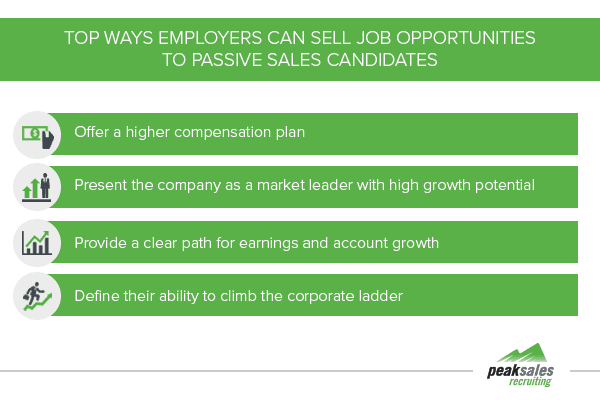
First, employers need to sell the opportunity to passive candidates. Changing jobs is a gamble for anyone, especially for salespeople who consistently meet their stretch targets. Employers can ramp up a candidate’s interest in the opportunity by emphasizing how the candidate will advance their career in both the short and long term.
Short-term benefits:
- Increased base and on-target compensation (in the range of 25-30%);
- Working for a market leader or a high-growth success story
Long-term benefits:
- Clear path to for them grow earnings by acquiring larger accounts and territories;
- Ability to climb the corporate ladder
Second, hiring managers need to recognize how valuable each rep’s time and energy is in each stage of the process. One of the most effective ways employers can demonstrate this is by only requiring a resume from the candidate. Employers can take it one step further by making initial conversations with candidates short and hone in on how the candidate will advance their career by joining your company.
When it comes to passive job candidates, the onus is on the employer to make the process easy while appealing to the needs of salespeople who are happily and gainfully employed.
2. You’re Not Valuing the Candidate
When salespeople think that hiring managers don’t value them as candidates, they won’t move forward with the company. There are several ways employers send this message without meaning too.
First, outstanding salespeople, or ‘A’ players know that they are highly coveted because they go above and beyond for their employer. Therefore they expect the same from prospective employers, and it begins with employers being transparent and setting clear expectations about the opportunity and hiring process from the first conversation. There needs to be a cadence to communication that keeps candidates engaged with the organization, and that is open and honest about next steps.
There needs to be a cadence to communication that keeps candidates engaged with the organization, and that is open and honest about next steps.
A common mistake made by employers happens when they do not outline to candidates the number of steps involved in their hiring process, and clear expectations for the timelines around each step isn’t proactively communicated. A lack of clarity on the specifics — the number of interviews and the expected hiring date — can leave sales candidates frustrated. This mistake is worsened when employers miss agreed upon dates and don’t invest the time to inform candidates that there will be changes to hiring timelines.
Although missed dates are understandable, a lack of communications between the employer and candidates greatly increases the likelihood that the candidate may explore other opportunities.
To give your best candidates the impression that you value their time, always detail the timeline for each stage of interview process, including the anticipated response times, expected offer and start dates. Even if hiring managers don’t have an answer, they should reach out and let candidates know they’re working on it. In other words, when in doubt, reach out. Keeping talent engaged and aware of each step in the recruiting process sets a strong foundation for an effective hiring process.
3. Candidates Find Out Your Company Has a Poor Reputation
Top salespeople want to work for high-performing companies that exhibit a record of excellence, have aggressive growth goals, are creating disruptive solutions, and have a members of their sales team who are hitting their quota and earning well above industry average.
When a company has a poor reputation within their industry, they’re not only going to lose out on the ‘A’ player candidates, but research from Harvard Business Review, for example, suggests that these companies will need to pay candidates 10% more than than their counterparts to entice them to join their organization.
To mitigate the risk of losing your best candidates, here are four red flags salespeople watch for when assessing the reputation of prospective employers:
- Bad Interview Practices: When hiring managers don’t hold themselves to high standards and embody the best business practices, it reflects on the reputation of the company. Common mistakes such as appearing to be complacent during the interview process, interrupting candidates during conversations, or forgetting interview dates and times can reflect a lack of professionalism in the company.
- A Lack of Prestige: When employers fail to gain the respect of competitors’ and partners in the industry, top salesperson know. Not only do most prospective employees read online reviews for a company, they benefit from large and deeply connected networks. Before accepting an offer, the best salespeople talk to contacts in the industry about the reputation of an organization, their management, corporate and sales culture, and the quality of the product and service offering. In particular, salespeople want to believe in what they’re selling. A product or service that is well-received in the marketplace gains the respect of top talent. Throughout the recruiting process, employers need to emphasize the viability of their offering and the extent to which corporate leaders support the sales team to meet their targets today, and well into the future.
- No Record of Success: Experienced salespeople want to work on a sales team that has a reputation for surpassing sales quotas and earning large commission checks. Top sellers ask prospective employers questions that gauge the record of the sales organization to determine if the role will provide them the ability to realize a significant upside in earnings. If a sales department has not succeeded at meeting quotas thus far or is brand new, hiring stakeholders need to strategize a new approach. When do not meet the designation of being ‘high-performance’, they need to make a different sell to candidates. Hiring managers should describe the organization as taking a new direction and revamping the infrastructure, sales culture, and processes to support top talent. They need to provide specific examples of how a company is implementing changes, and emphasize the extent to which a new hire can take a leadership role and have a material impact on the organization.
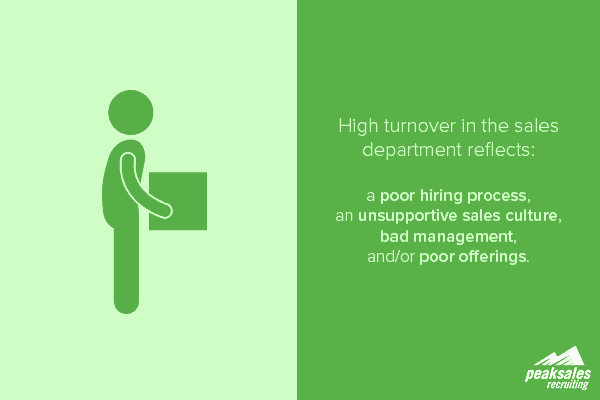
- High Turnover: Salespeople who continually meet or exceed their sales goals won’t give up the stability of their role for an organization that won’t serve their long-term interests. A reputation for high turnover in the sales department reflects either a poor hiring and selection process, an unsupportive sales culture, bad management and corporate leadership, poor offerings, or all of the above. In this case, HR, sales, and other corporate leaders need to dig deep, diagnose the cause, and apply a prescription.
An organization’s inability to retain talent means that they don’t have the same leverage as industry leaders in acquiring top talent. Employers who suffer from a history of high turnover benefit from emphasizing new onboarding and professional development efforts when speaking with candidates. Moreover, by addressing long-term problems that diminish a company’s employer brand reputation and offering compensation packages that are above-market, corporate leaders will establish a new precedent that future candidates will find enticing.
4. You Offer Low Compensation Packages
Hiring managers benefit from recognizing compensation as the number one tool to attract the best salespeople in their space. In fact, a survey from PayScale found that higher compensation is one of the top two reasons why employees choose to leave their jobs. Again, offering above-market compensation that aligns with the prestige and the record of the candidate, and sets them up to earn 25-30% more than they currently earn, can make or break recruiting efforts.
When recruiters and hiring managers offer compensation packages that are low or below-market, top candidates will back out of the recruitment process. Top talent won’t settle for pay that doesn’t allow them to meet their financial objectives, regardless of the opportunity.And when successful salespeople change employers, they’re assuming a significant amount of financial risk. So when employers don’t incentivize a transition and demonstrate how they mitigate that risk, they should expect the best of the best to exit the recruitment process.
Employers with lengthy, complex sales cycles with a long new-hire ramp-up time also need to consider implementing a draw to mitigate the perceived income risk for new salespeople while they develop their pipeline. A draw can tip the scales for sales candidates by bridging their income. We recommend that hiring managers negotiate recoverable draws are less than 50% of the variable component of their commission plan.
Don’t Miss out on the Best Candidates…
To successfully mitigate the risk of losing top salespeople during the recruitment process, employers need to ensure they demonstrate respect to candidates, offer transparency, highlight the company’s successes, and provide compensation packages that appeal to these candidate’s thirst to earn more than their peers.
The post 4 Reasons Top Salespeople Aren’t in Your Recruitment Process appeared first on Peak Sales Recruiting.
19 Jul 15:31

9 Terrible Sales Email Subject Lines You’ve Probably Used This Week
by aja.t.frost@gmail.com (Aja Frost)
Touching Base Email Subject Line
- “Are you struggling with [challenge]?”
- “Any luck with [goal]?”
- “[Mutual connection] said we should talk”
- “Some ideas on driving recurring revenue”
- “Hi [name], [question]?”
- “[Prospect's name] -- do you have 10 minutes for a conversation?"
- "Hoping to help with X"
- "Will persistence pay off?"
- "[Pain point] ... does this sound familiar?"
Imagine you’ve spent 10 years writing the next great novel. Your editor loves it and the earlyreviews are great, but once it’s published, no one buys it. Turns out, your cover sucked.
Unless you’re a writer, this situation might sound pretty unfamiliar. But something similar happens to salespeople on a daily basis. They invest time and energy into crafting the right message or personalizing a template, but their prospect never reads a single word. Why? The email’s subject line was awful.
If you want prospects to actually open your messages, it’s crucial to write an effective email subject line. Below are seven subject lines you should avoid and how to make them better.
9 Terrible Sales Email Subject Lines to Stop Using Today
1. “How can [company name] help you?”
Put yourself in your prospect’s shoes. You’re scrolling through your inbox, trying to separate the important messages from the ones you can ignore. When you see this email, are you going to pause so you can ponder all the ways some random company could help you? Probably not.
Try instead: “Are you struggling with [challenge]?”
Naming one of your prospect’s current challenges immediately grabs their attention. Let’s say your subject line is, “Are you struggling with demand forecasting?” Since that issue is actually top-of-mind for the warehouse manager you emailed, she won’t hesitate to click “open.”
2. “Just checking in”
When your prospect doesn’t respond for a while, you might be tempted to send them a message with this subject line. But “checking in,” “touching base,” and “following up” emails are, frankly, the worst. Not only are they completely devoid of value, but they’re the digital equivalent of a fly buzzing in someone’s ear. Don’t be surprised when your prospect swats you away.
Try instead: “Any luck with [goal]?”
This subject line lets you build on your first email without implying the prospect has neglected you. For instance, if you’d previously sent them a PDF on tech recruiting tips, your next email could be titled, “Any luck recruiting engineers?” You’ll put yourself back on their radar while simultaneously adding value.
3. Referral from [mutual connection]
Referrals give you trust, credibility, and influence with prospects before you’ve ever met -- they’re a major advantage. But this subject line (or any other that includes the word “referral”) instantly lessens the impact of an introduction.
That’s because “referral” is a term almost exclusively used by salespeople and marketers. You’ll immediately remind the prospect this is a business interaction, not a normal introduction. Your prospects will see you as the traditional salesperson thinking of their quota, rather than a trusted consultant trying to help them.
Try instead: “[Mutual connection] said we should talk”
This subject line feels more natural. In fact, you’d probably say something similar if you were introducing yourself to a friend of a friend in person. As a result, your prospect is likely to see you in a friendly light.
4. “14 Ways to Drive Recurring Revenue”
It might seem quick and easy to simply copy and paste the title of the PDF, link, or presentation you’re sending into the email’s subject line.
And sure, this approach will save you a couple seconds. On the downside, it’ll also destroy the chance your prospect will open your email.
After all, the average person receives 14 marketing emails per day (and that doesn’t include the newsletters and promotions they actually signed up for). If your email looks like yet another marketing message, they’re almost guaranteed to give it the same treatment -- ignoring it.
Try Instead: “Some ideas on driving recurring revenue”
You want your email to sound like it’s coming from a human, not a robot. With that in mind, write the subject line as though you were discussing the topic with a friend.
5. “Five-second question for you”
If you want your prospects to open your email, use this subject line. Mentioning a question will intrigue them, and promising it’ll be quick will seal the deal.
However, if you want your prospects to respond to your email, opt for a different line. Let’s be real: When’s the last time you ever asked a prospect a question they could answer in five seconds? Probably never. Once people realize responding will take far longer than you’ve promised, they’ll immediately leave. Plus, since you’ve lost credibility, getting them to open the next email will be insanely difficult.
Try instead: “Hi [name], [question]?”
Including your question in the subject line lets the prospect decide upfront how long it’ll take to answer. And they’ll still have a reason to open the message. After all, they’ll be curious to know why you’re asking.
6. “Meeting Request”
To be fair, this subject line doesn’t pull any punches about what the sender wants. But that’s far outweighed by how rude it sounds. Imagine a stranger walked up to you and said, “Give me an hour of your time,” without first explaining why that’ll benefit you. You’d assume they were joking -- or worse, that they have no idea how normal people interact.
You can now see why this subject line fails harder than a belly flop.
Try Instead: “[Prospect's name] -- do you have 10 minutes for a conversation?"
A little respect goes a long way. As HubSpot managing editor Emma Brudner points out, “Putting your ask right in the subject line can set your sales email apart from all the rest.” However, unlike the first subject line, this one asks nicely.
7. “Re: [title of previous email]”
Adding "Re:" to the subject line of the last email you sent the prospect so it looks like you're continuing a conversation, rather than attempting to spark one, isn't just bad karma. It's also an ill-advised way to start the relationship. When the buyer realizes they've been tricked, they'll feel silly -- and to make that feeling go away, they will ignore your email.
Try instead: "Hoping to help with X"
Positioning yourself as a potential advisor has the opposite effect. Instead of sowing suspicion, you're cultivating trust. Your chances of getting a response will increase dramatically.
8. "Last attempt at contacting you"
You're not a credit card company, and unless you want to increase the likelihood your prospect will send this email straight to trash, think of a different subject line.
While this is a common shock tactic for reps making a last-ditch effort to grab prospect attention -- it's not generally a successful one. Even if you do get a reply, it will be because you guilted or pushed your prospect into it, and that's not the foundation for a healthy working relationship.
Try instead: "Will persistence pay off?"
When you're sending one last email to a prospect, things tend to be tense. Your prospect is likely dreading another email from you. You're stressed, because you know this is your last chance. So, why not lighten things up with a subject line that pokes fun at your persistence?
9. "[Benefit] with [Product name]"
"This generic thing? I've been using it for years!" That should be the subtext of this subject line. This is generic, doesn't speak to your prospect's unique needs, and is easy to pass over in an inbox.
Try instead: "[Pain point] ... does this sound familiar?"
Grab their attention with real-life pain points they feel on a daily basis. A subject line like, "Price hikes and poor service ... sound familiar?" jumps out at your prospect and grabs their attention. If you've done your homework, you know they're experiencing this, and need a solution now.
Choosing a good subject line can feel like a disproportional amount of work for just 40 to 70 characters. But put in the time to avoid a tired and overused subject line -- you’ll be rewarded by a higher open rate and thus, more responses.
19 Jul 15:30
How to Become a Better Content Team Leader
by Gary Parkinson
We’re all fully aware of how content marketing is shifting the way brands prioritize their creative resources. From scaling production of high quality content to creating socially engaging tactics that align with your demand-gen objectives; content marketing is how brands scale growth. Marketing teams build reputations around thought leadership and influential best practices while also reducing overhead for their companies. And it’s all built around great content.
However, as more companies shift into the content marketing sphere, teams must continuously review, optimize, and differentiate their strategies from other thought leaders in their space. Often there is an underlying rush to reinvent the wheel, which can result in content that is misaligned with the overall marketing strategy.
Great content marketing teams are supported by great leaders. A content marketing manager or director of content reviews the goals of the organization and aligns the content team with those objectives. Content leaders help their teams with the creative process and establish unique yet valuable voices to stand out in an oversaturated industry. Leaders identify new paths to scale growth while ensuring all content remains on point with the brand tone and business objectives.
In this post, we’ll identify how great content marketing leaders empower their teams to become more dynamic and effective in their roles within an organization.
What Is Great Leadership?

Excellent leadership is an indispensable quality. Leadership, as defined by Merriam-Webster, is “the power or ability to lead other people.” This aligns with the similar perception of leadership as the power or ability to inspire others. A content marketing leader empowers their team to achieve common goals.
As much as content marketing has infused our lives, it is an industry still in its infant stages. This means leaders can inspire their teams to embrace their creativity and execute tactics that may be considered “unconventional” in more established industries.
However, visions considered unconventional by the masses are often looked back upon with greatness over time. Odysseus inspired the Greeks to use the Trojan Horse, a very unusual tactic that led to a massive victory during the Trojan War. Abraham Lincoln’s vision for an America where all citizens are equal helped end slavery and changed the country following the American Civil War.
Effective leaders have the ability to inspire their teams with visionary strategies and tactics. Effective content marketing leaders must do the same by helping their teams understand the impact of content for an organization. To provide this assessment, leaders must build their vision by defining the content strategy.
Define Goals and Strategize
Your goals as a content marketer should align with the broader goals of the marketing team. Those goals should reflect the overarching business objectives of the company as a whole. While building your strategy, always ask the question – how will the content created by the content team help achieve the company’s business objectives?
The ultimate goal of any marketing team is to move users through the funnel. Always think about the consumer journey and how your marketing campaigns best help people navigate that journey. Keep in mind a few marketing tactics that can help you provide value to the end user:
- Build a reputation as a thought leader
- Grow your total traffic to attract new potential customers
- Encourage customers to share your content and advocate for your brand
Make sure you have a documented content marketing strategy. According to CMI, 53% of B2B marketers have documented content marketing strategies and are subsequently more effective in their roles. On the flip side, 40% of the least effective marketers have no strategy.
Define Your Market
 Marketers with little experience often make the mistake of casting a wide net attempting to reach anyone and everyone. The idea is that the more people you go after, the more likely you have people who will convert into paying customers.
However, leaders recognize that this tactic is flawed. Companies are simply unable to appeal to every potential prospect with their content, their product messaging or brand positioning. This is why data and research helps teams carve out a small section of the broader market to improve results. A high conversion rate from a small group of targeted prospects is more effective than a low conversion rate from a broad pool of people.
As you build your team’s strategy, ask yourself questions such as:
- What specific function does my product serve in the market?
- How does my product set itself apart from similar products?
- Why are people interested in my market?
- What types of terms or phrases trigger interest from prospective clients?
Answers to these questions help you define the market and the types of people within that market that are most valuable to your brand’s goals. This will help you find your niche and exploit it.
Research Your Competitors
Great leaders have inspirational visions but those ideas don’t come out of thin air. As a leader, you must understand the lay of the land.
Conduct a competitive analysis and determine how your content will stand out from the rest of the competition. Document your findings and work with other members of your team (product, support, sales, and senior leaders) to construct a content marketing plan that works.

You should know who your competitors are, their strengths and weaknesses, their similarities and differences to your brand. You need to set yourself apart from the opposition in order to be successful. Your documented competitive analysis will not only help you identify the gaps where you can create valuable content around, but also help other teams in your organization better understand what really makes you stand out.
Identify Your Personas
Teams need to know who they are creating content for to make the material effective. Use the documentation from your market and competitive analyses to build profiles of your targeted personas and share those profiles with the rest of your team. This will help everyone involved in the creative process stay focused and on track.
Think of your audience personas as your content marketing map. Each piece of content and the messaging within the material should be aligned to at least one of these personas. Consistency in your messaging helps those targeted prospects recognize what your brand stands for and the value you can provide.
As people see more of this type of messaging, they will begin to interact with the content and learn more about your brand. Find out who is most interested in your brand by reviewing your analytics such as click-through rates, pages per session, and any comments that are provided by the user. Share this data with your team. This way everyone is inspired to create more of the types of content that work.
Stay Organized
Effective leaders establish workflows that others can follow. These workflows and processes help teams stay organized as new projects are added to the pipeline.
Create a content hub to manage all the actions of the content team. Insert all relevant data from your competitive research to your persona mapping. This way everyone on the team can access the information in one convenient location.
Label every task and assign each responsibility to the appropriate member of the team. This will help everyone on the team remain up to date with a documented workflow.
Interact With Your Team

The most effective leaders are the ones that work closely with their teammates to produce the best content possible. The creative process is about brainstorming new ideas with others, which allows ideas with the most potential to be put on the table. Leaders are often the most experienced members of a team but new content marketers often provide fresh ideas that can yield value.
Be open to your team’s ideas. Every member of the content team should feel inspired to participate in the creative brainstorming process. The actions and tone of the leader allow teams to share their ideas but team members may be sheltered or reserved if they feel uncomfortable with the leader’s style.
Brent Gleeson, writing for Forbes, described 4 tactics that leaders can follow to improve the culture of a team.
“Anyone leading a team who believes they are above getting their hands dirty won’t last long. Professional development for any leader is critical, so why not leverage the amazing talent you’ve hired and learn from them?”
Internal communication – Feedback and Direction
Remain approachable and friendly to your team. The best leaders are able to provide feedback in a beneficial way, which is often called constructive criticism. Provide direction to team members to help them grow and become more effective content marketers.
A leader inspires their teammates to learn from mistakes yet remain undeterred from their goals. Establish weekly 1:1s with each member of your team to provide personal feedback and direction. Additionally, these sessions help teammates share their questions or concerns in a safe, secluded environment. When team members feel safe, they are more comfortable and more likely to produce quality content that makes an impact.
19 Jul 15:30


This is Why 75% of New Products Fail
by Madhavan Ramanujam
Editor’s note: The following is an adapted excerpt from the book Monetizing Innovation: How Smart Companies Design the Product around the Price (Wiley, May 2016) by Madhavan Ramanujam, Partner & Board Member at Simon-Kucher & Partners, and Georg Tacke, co-CEO at Simon-Kucher & Partners.
The odds are stacked mightily against any company that launches a new product or service. Between 65% and 75% of new offerings fail outright or miss their revenue or profit goals, depending on whose research you look at. And the tab of those failures is hefty — $260 billion in the U.S. alone in 2010, according to University of Texas at Austin professor Rob Adams.
But our own experience over the last 30 years shows that managers do not have to accept those odds. When they understand the four primary types of new product failures and the factors behind them, they are more likely to avoid such failures. We refer to the four failure types as feature shocks, minivations, hidden gems and undeads. We explore them in our new book, Monetizing Innovation: How Smart Companies Design the Product around the Price.
Here’s an overview, and how to steer clear of them.
Feature Shocks: New Products that are Over-Engineered
Too many new product duds were crammed with too many features and none that stood out. The problem is that when too many features are unnecessary – customers don’t want them, or won’t pay extra for them – they increase the cost and the complexity of the product, and thus raise its price to an unacceptable level. These products suffer from feature shocks.
Take the example of Fire Phone, the smartphone Amazon introduced in 2014. The Fire Phone is, to be sure, an anomaly for an immensely successful company, one that has risen to more than $100 billion in annual revenue over 20-plus years and a market valuation in late April that was 30% greater than Walmart’s, the world’s largest retailer. Amazon has had numerous roaring new product successes over the years, among them the Kindle book reader and Amazon Web Services (the firm’s $7.8 billion cloud computing service).
Only the Fire Phone wasn’t one of them. Believing it had to offer more to compete in the high-end smartphone market, Amazon stuffed its entry with too many marginal features. One was “dynamic perspective” – a screen that provided a 3-dimensional effect without the need to wear those geeky 3D glasses. It apparently didn’t impress consumers. A side effect of the feature – draining the battery life – was a negative. Another feature that did little to spark enthusiasm let customers point the phone’s camera to a product (presumably at a competitor’s store shelf) and then order it from Amazon with a click of the shutter button. With these and several other features, Amazon priced the phone high (at $649, or $199 with a phone service contract from AT&T).
But a number of highly influential technology pundits whose opinions can make or break new gadgets panned those features. And many potential customers weren’t impressed either. Sales of the Fire Phone stalled just four months after launch. Amazon wound up reducing the price to $449 without a service contract – and 99 cents with a two-year contract. The company later that year took a $170 million write-down, largely because of unsold Fire Phone inventory.
Feature shock products like the Fire Phone are legion. They tend to happen when product development teams fall in love with their concoction and forget about the customer. To avoid feature shocks, product development must do a number of things. One is segmenting the customer base carefully, and not by demographics (the traditional segment criterion). Rather, they must segment by what different groups of customers need from different versions of the product, and what they’d be willing to pay for a version that met their expectations.
Minivations: Products That Sell Themselves Short
These products are created by product developers who didn’t realize just how much value their offerings provided to customers. They then grossly underestimated how much customers would be willing to pay for them and charged prices that were far below what they could have charged, leaving big profits on the table.
Like the feature shock products, minivations have abounded over the last three decades. One was toymaker Playmobil’s 2003 launch of its Noah’s Ark play set. When it came to market, it sold out in two months; you could buy them on eBay at the time – but for 33% more than the original price tag. Another noteworthy minivation was Audi’s Q7 luxury SUV, launched in 2006 for EUROS 55,000. Audi predicted selling 70,000 units, however first-year demand turned out to be 80,000. A supply-demand curve suggests that given Audi had fixed production at 70,000 units, it should have priced it at EUROS 58,000, which would have yielded an additional EUROS 210 million.
Beyond the obvious signs of a product shortage, how can you tell that you have a minivation? One is a sales force that is easily meeting its targets with a new product. Another is watching channel partners reap big margins from selling your product. Another (especially in B2B circles) is having too-few customers asking your salespeople to escalate discussions about their purchase to higher levels in your company because they are dissatisfied with your price.
Hidden Gems: Would-Be Winners That Don’t Leave the Starting Gate
These products are brilliant ideas that are viewed as anything but brilliant at the top of the companies in which they are born. Senior management don’t recognize the value of the product for its intended audience, and thus the company puts the product in limbo for too long – not killed but not launched.
One of the most famous hidden gems was Eastman Kodak’s early response to an initiative within its four walls in the 1970s: the digital camera. In a company that had made a fortune manufacturing film for cameras, a young Kodak engineer named Steven Sasson had invented the initial technology behind the digital camera, and the company even went so far as to patent it. However, Kodak sat on that technology for 21 years, failing to introduce its first digital camera until 1995, and it didn’t get serious about the product until 2001. Since then, the digital camera has become a staple in smartphones, a time in which Kodak declared bankruptcy.
Hidden gems don’t happen in companies nearly as often as feature shock and minivation product failures do. But when they do, they often are blocked by midlevel executives who can’t understand their market potential, or do but are afraid the products will sabotage their division or cost them political capital.
There are several signs that hidden gems may lurk beneath the surface of your organization: a drastic change in business models, a disruption in your industry, a commodity business trying to differentiate itself, a shift from an offline to online business, a move from analog to digital products, or from hardware to software.
If such conditions exist, it’s far better to look under the covers for a hidden gem than it is to see a competitor bring its version to market before you do.
Undeads: Destined to Become Zombies
In the world of science fiction, undeads are people who die but return to life as vampires, zombies or other creatures. The business world has its own version of undead: products that came to market dead on arrival or a product that still exists in the marketplace but for all practical purposes is non-existent. These are products a company should have never launched – either they are an answer to a question no one is asking or they are the wrong answer to the right question.
The Segway personal transporter is one of the more famous undead products. In its first year (2001), it sold far less than the 50,000 units its inventor predicted would sell. While it appeared to be an appealing way for people to travel on a sidewalk, it was priced far too high, at $3,000 to $7,000 per scooter. What’s more, the Segway solved a need that not many people had – at least, not as many as its inventor (Dean Kamen) thought.
Google Glass, a pair of glasses with a small camera that could take pictures and record videos, was another notorious undead. It came to market in 2012 for $1,500 and answered a question no one was asking. In 2015, Google announced the end of Glass for everyday consumers.
These companies and their innovators are so focused on (and passionate about) what they’re building that they don’t zero in on who they’re really building it for, which markets to prioritize, if those markets value it and are willing to pay for it. Strategizing about sustaining the product as a business is an afterthought to product development.
Undeads happen when their internal proponents wildly overestimate the customer appeal of their concoction and don’t segment the customer base effectively. Had they had a better idea at the outset of their design process which customers would more likely value their concept and what they would pay for it, the products could have been reformulated at an acceptable price. Or, if the product developers saw the market size was too small or no price was acceptable to customers, they could scrap the initiative before spending a lot of money on it.
How to Avoid All Four Traps
We have found a number of ways to avoid falling into these four traps altogether. The most important one is having in-depth pricing discussions with target customers long before the product development team begins to draw up the engineering plans, and certainly long before any manufacturing resources are committed and configured to building something. Those discussions need to center on determining precisely what features customers truly care about, are willing to pay for, and the price they are willing to pay.
Shockingly, 80% of companies don’t have this type of discussion with customers early in product development. That’s what we found in a survey we conducted in 2014 with 1,600 companies in more than 40 countries. Essentially, they just develop a product, prepare it to go to market, and slap a price on it at the end of the process – without understanding whether customers value and are willing to pay for the product. These companies hope to monetize, but they have no real evidence that they will.
That is a recipe for failure, and it’s the reason why two-thirds to three-quarters of new products fail. Having that-important conversation with a number of target customers early in the product development will go a long way to reducing that failure rate. It will help companies design the product around what customer’s value and are willing to pay for – or, in other words, design the product around the price.
The post This is Why 75% of New Products Fail appeared first on OpenView Labs.
19 Jul 15:30
From Scratch: Four (Free) List Building Strategies
by Janet Johnson

There’s nothing that can burst the bubble of getting a new client (or getting a new job) faster than the realization that your client has no real prospect list to work with. Even if you know going in, and have pitched the notion of building a prospect list … the pressure to perform is intense from the minute you start.
Most marketers and agencies have more ideas than budgets, so we’re going to explore seven strategies to build a great prospect list that take a varied approach: four strategies require time, and three strategies require money. In this post, we’ll cover the first four. (Stay tuned for the final three, coming soon.)
First things first: Nail the basics
All seven list-building strategies require the same foundational elements:
- A clear understanding of your client’s buyer personas
- An in-depth review of the brand’s content strategy and tactics
- Any possible information contained in the company’s existing contact data
- Your own mastery of the basic principles of digital marketing
Go no further until you’ve developed mastery of those four foundational elements. Pop back here when you’re ready, and we’ll look at the seven strategies over the course of two posts.
Four Time-centric List Building Strategies
Welcome back! Let’s explore the four time-centric strategies based on your current budget and staff resources.
Few clients or organizations will be able to jump in and test every one of these strategies, but I recommend you understand them all so you can place your client or organization along a marketing sophistication curve (you’ll know how sophisticated they are from the state of their foundations) and engage quickly from your place of maturity, strength, and opportunity.
More time-centric strategies include the following:
- Email capture on your web properties
- Social media engagement
- In-store capture (for retailers /brick and mortar businesses)
- Influencer and partner engagement
Strategy 1: Capture Email to Build a Prospect List
People guard their email addresses, so if you can get an email address in exchange for educational or entertaining content, treat it respectfully.
I’m finding that capturing email is becoming almost ridiculously misused. If you spend much time online at all, especially reading blogs, you’re likely to be bombarded with requests for your email. In a post over on Buffer enticingly called How to Grow a Massive Email List, author Kevin Lee succinctly equates email list development to this formula:
Amazing blog content + crystal clear calls-to-action = massive email list
And in interviews with highly successful bloggers, every one recommended popups, menus, popovers, sliders and “Multiple CTAs: Give readers infinity+1 opportunities to subscribe.”
According to Experian, the top-tested area for email capture is in the menu bar. But we’re seeing a lot of testing in action for email capture, including:
- Site header
- Blog bylines
- Any sidebar
- Inside blog content
- Footer of the content
- Popup/popover – on entrance and on exit
- In your blog author’s bio
Popular tools for capturing email addresses are from SumoMe and HelloBar.
In its 2013 Email Marketing Benchmark Report, MarketingSherpa notes that 77% of marketers called website registration effective in building quality lists. So make sure to get email into all account registration, online and offline event registrations, and ecommerce forms on your site.
In order to keep from being irritating, please follow best practices:
- Make sure the incentive for registering is clear and truly relevant to your target audience
- Clearly list the benefits of registering for your email program
- Describe how often they’ll get email from you if they give you their information
- Try to collect geographic and demographic information so you can deliver relevant content
- Your call to action is prominently displayed
Finally, it’s best to offer some social proof to encourage email sign-ups. We see many marketers leverage the size of their subscriber list to indicate satisfaction, with offers like: “Join more than 70,000 professionals…”
Keep in mind that helping is the new selling. So help your prospects with great content before you ask or expect anything from them, and you’ll be more successful in capturing email addresses and growing your list.
Strategy 2: Harness Social Media Engagement
The role of social media engagement in list building is three-fold:
- Search engines are constantly looking at social signals for engagement and authority, which can build your credibility and help you land on the top of search results, help drive traffic to your site or stores.
- Social channels are gateways to your products and services – through evangelism (by others), awareness (from your excellent posts) and in showing thought leadership (sharing great information)
- Social channels showcase your approach to customer service and support (whether you like it or not).
What works in social one month can change quickly, whether at the whim of engineers changing their social platform’s algorithms or because of the natural swarming of (and abandonment by) people in social channels.
When possible, meet regularly with representatives from your social channels directly. Find out what’s new. Get their recommendations. And test them. If you can’t have direct conversations, check out some great social media bloggers, and try out their advice.
In order to build social engagement, the first rule you must follow / teach your client is the 6:3:1 Social Rule.
For every 10 social posts:
- Six should be educational or entertaining – adding value about your market – but not written by you
- Three should be educational or entertaining and written by you
- One can be promotional – an offer of some sort
The second most important rule is this: You must be authentic to your brand values in social, but playing it safe rarely drives engagement.
So (and this takes work) convince your client (or your leadership team) to go out on a limb occasionally and do something in social that’s a little radical.
- Be funny
- Be disruptive
- Be contrarian
- Be generous
Test the limits of your voice. See what works for your brand. But be noticeable in some significant way.
And importantly, be responsive.
According to Search Engine Watch, 70% of Twitter users expect some sort of response from brands they reach out to, and 53% want a response in less than an hour. That speedy response expectation jumps to 72% when they’re complaining.
Your prospects can see your customer service and support in action when you respond to complaints in the channel in which it’s made. So make a big splash with your service. Respond respectfully, quickly, and in the social channel.
Being responsive can also build your list if you ask for more engagement as you’re having conversations. Try replying to every mention you get, and try to start a conversation with folks interacting with your content. As you’re conversing, drop in an offer to sign up for your email list, sending over a direct link to get them started. Mention a benefit or two; something exclusive would be nice. You might be amazed at the results.

Strategy 3: Build Influence with Influencers
Influencers, whether they’re journalists, analysts or bloggers, can drive sales. Demand Gen Report’s 2014 Content Preferences Survey revealed that 72% of survey respondents were influenced by industry peers while making B2B purchase decisions. And influencers come in many shapes and sizes.
Adidas regularly leverages local, social influencers to boost event awareness, participation and engagement in very unique ways. And their influencer network isn’t filled solely with athletes. They look for local artists, musicians, and stylish influencers who embody the Adidas brand, have unique personalities and strong styles, who are creative on social media, and who have a substantial following on Twitter, Facebook, Instagram and other platforms.
Influencers can take your message to the market in ways your own team can’t imagine, because of the scale and engagement of their followers and trust in their personal brands.
But finding who is truly influential in your space can be challenging. Three tools to finding your influencer market take very different approaches, and each tool requires an enlightened strategist to review results and recommend highly targeted influencers.
- BuzzSumo can look at influencers through the lens of “what content performs best” for any topic
- Little Bird finds influencers based on their internal connections with other influencers on any subject (the more niche, the better)
- And for measuring and driving social influence for interactions with television shows or music groups, Tellagence is a strong platform
Once you’ve found your influencers, follow them. Engage with them on their blogs, and in their social channels. Impress them with your knowledge, charisma, and fabulous content. Make it smart for them to share your stuff. Watch your list of followers and advocates grow. And – most importantly – watch your lead pool grow.
Strategy 4: Boost In-Store Engagement
For the past four years, there’s been an Annual Major Purchase Study conducted. The Fourth Annual report, sponsored by Synchronicity, illuminated “how important the in-store experience can be in influencing shopper behavior.”
Most large purchase research starts online, and generally ends with an in-store purchase for things like sports equipment, jewelry, musical instruments and equipment, furniture, and appliances.
60% of shoppers surveyed checked social media, and 40% checked online reviews before making their decision to purchase. Importantly, though, 64% of shoppers who conducted both online and in-store research at some point in their journey said in-store research had a greater influence on their purchase decision.
If your clients (or you) have physical stores, offer their visitors a chance to sign up for digital offers – in the client’s newsletter, coupons, special events – in order to build the list. Make sure store associates not only offer cards at the appropriate moment, but ask whether prospects would like to receive information about products or services (or events) electronically.
Most importantly, store associates should be well informed about product and service offers, the local competitive environment, and opportunities for upsells. If you’re an agency, you might recommend your client employ secret shoppers to truly identify opportunities for improved engagement.
Ensuring your visitors have a seamless and positive “omni-channel” experience consistently across all touch points – web, mobile, social and in-person – will build confidence, credibility, trust and ultimately, sales for your clients and their clients.
In our next post on list building strategies, we’ll look at pay-to-play models of list building strategies:
- Paid Media (Google AdWords, LinkedIn Sponsored Content, banner ads, etc.)
- Events and Trade Shows
- Look-Alike Platforms and Tools
- Lead List Purchases
Stay tuned!
Ready to get started on step 1 – developing a clear understanding of your client’s buyer personas? Download Act-On’s Free Toolkit: Creating Buyer Personas to gain a clear methodology for creating and using buyer personas.
19 Jul 15:29


5 Mistakes Bloggers are Making with Online Courses
by Guest Blogger

By ProBlogger expert Sam Nordberg.
Online courses are the hottest thing right now. Everyone seems to be launching their own course, and looking for ways to make what they believe is “passive income” – but here are five of the biggest makes people are making with their online courses right now:
1. Not thinking about who they are writing for
When you are creating a course, you need to think really carefully about the end user. Who are they? How much do they know already? What do they want the outcome to be? How do they want to consume the information?
If you really want people to learn from your course, and get results from it, then you need to make sure the information is carefully targeted to meet their needs.
Imagine you were writing a course on nutrition. There is a big difference between writing a course for a professional athlete who really wants to fine tune their diet, and writing a course for someone who has been clinically obese for many years, and needs a lot of support to start from scratch.
Think carefully about who you are creating the course for, before you start creating. Really focus on a single, specific need.
2. Trying to fit everything in
It took you years to learn everything you know.
One of the biggest mistakes people make when creating their own course, is to try and share all of their knowledge. I get it, you want to add value, and make sure that you give them as much as you can.
The problem is, there is no way they can absorb all of that information, and actually start to implement it, all in one go.
It took you years to develop your skills and get to where you are, it will take them a while too.
Focus on delivering smaller chunks of information, with a bigger focus on implementation (that is getting your students to actually try doing things) rather than just giving them lots of information.
3. Just recording videos and making PDFs
A course is more than just great content.
Sure, videos and PDFs are useful way to provide information to a student, but there is more to a course than simply content.
Before you start throwing together your content, consider the following:
– What support will they need?
– How will you get them actively involved?
– How will you get them to implement what they have learnt?
– How will they know if they are getting it right/wrong?
– What might they need before the course or after the course?
A course is a process, you take your students on a journey from beginning to end. Before you start to put content together, it’s worth thinking about that journey as a whole.

4. Not providing support
I’m sure you’ve seen it… you land on their sales page, and you have the two options: buy it for less money and just get the content, or pay more money and get their assistance/support/coaching to help you.
Here’s the problem… If they know that you’ll need support to help you get better results, then why don’t they make it part of the course? Why can you buy a course with no support?
One of the biggest problems with online learning is the lack of support. Students need someone to turn to. They might need help understanding the content, maybe they have technical problems, or maybe they just need to talk it over to really understand what they have learnt.
If you know that your students will need support of some kind (or simply, you know that they will get better results with support) then make sure it’s available to them.
You can look into providing a forum, or support group, having live calls, or even providing phone and email support for them.
Note: There are occasions where a course really doesn’t need support. Maybe the content is fairly basic and self-paced. If this is the case, feel free to sell the course without support.
5. Thinking courses are great passive income
Don’t get me wrong here, courses are a great way to LEVERAGE your income, and they allow you to spend your time one-to-many, rather than one-on-one, but they are certainly not passive. At least, not to start with.
As you’ve seen so far, there is more to a course than just putting your content online and charging people to access it.
You’ll need to promote your courses, help students sign up, answer any questions before, during and after, provide live support, help students to implement… and much more.
Courses are a great way to help your audience.
Courses are a great way to leverage your income.
Courses are a great way to help you monetise your knowledge.
But they are not completely passive. As with anything they require some hard work to set up, and lots of support on the way through.
You can definitely outsource some of that work, but be aware that to begin with, you’re going to be putting in some hard yards.
Courses really are a great way to grow your business, and to help you spread your message…. Just keep these simple things in mind as you start.
- Really think about who you are creating the content for and what they need to know
- Don’t try and squeeze it all in. Little bits of information that they actually use, is much more valuable than lots of information they never get around to
- Think about the whole process, not just the content
- Make sure your students get the support they need
And remember, it might be hard work to start with, but it’s definitely worth it in the end.
Sam Nordberg shows people how to take their passion and knowledge and create an online course that sells. You can learn more about her here and connect with her on Facebook and Twitter.
The post 5 Mistakes Bloggers are Making with Online Courses appeared first on ProBlogger.

19 Jul 15:29
A Sales Conversation Formula that Equals Success
by Leah Bell
If you think you can execute a successful sales development program on email cadence alone, you’re wrong. In today’s SaaS-level of cold calling, Sales Development Reps need to become creative sales conversation machines in order to hit their monthly quota.
High performing teams use a combination of phone and email to have conversations with their prospects, and the SalesLoft team is no different. With the SalesLoft dialer, custom built around the sales development process for maximum effectiveness and efficiency, finding that sales conversation formula for success becomes a whole lot easier.
Now, taking a sales conversation — originally built on the old-school idea of quick banter and agile salesmanship — and turning it into a formula may sound like it’s ruining the magic. But take this sales conversation map for example:
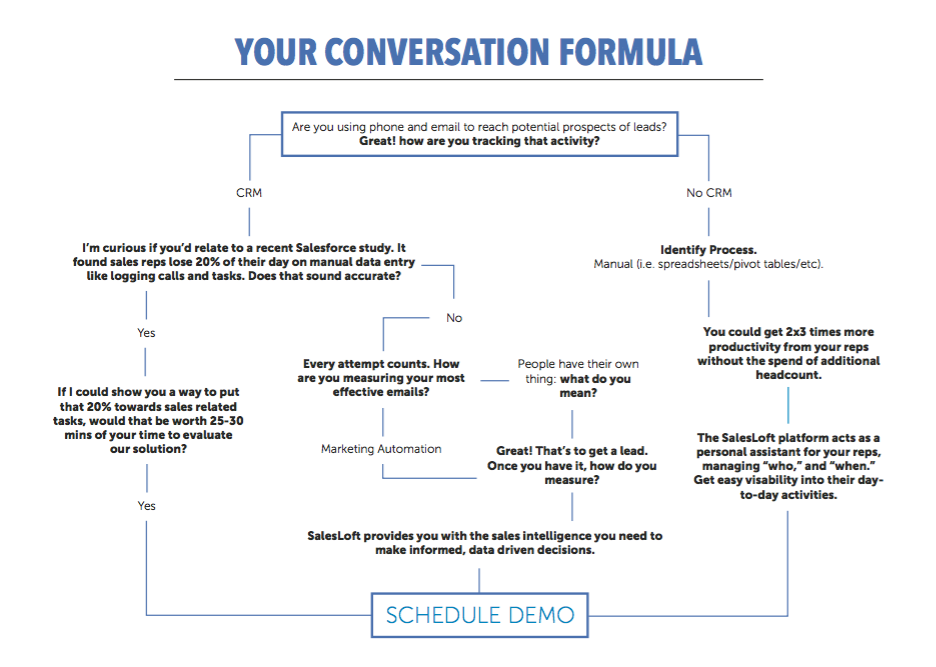
With just a few simple discovery questions, a rep can take an otherwise cold call and turn it into a warm sales conversation with a purpose. And having a purpose-driven relationship with your prospects is going to be key in furthering that relationship.
Here are a few more sales conversation tips to live by:
1. If you get the prospect on the phone, state your name and the reason for your call.
“Hi {{first_name}}, Sean here with SalesLoft. The reason for my call today is to talk about your phone and email outreach process.”
Straight and to-the-point, this introduction leaves little room for the prospect on the receiving end to doubt your purpose for calling.
2. Ask for permission to have some of the prospect’s time to ask a few questions.
“Do you mind if I ask you a few quick questions allowing you to determine whether we can be helpful?”
A simple concept, but asking for permission is a simple courtesy that every person can respect. Time is valuable to each and every one of us, so don’t assume that your prospect is going to give it freely.
3. If you get permission, ask targeted questions that relate to the industry, your prospect’s company, and their role within the sales team.
“I’m betting you have someone on your team that is consistently exceeding expectations. Do they have a process they follow to convert prospects to appointments?”
Back to the purpose-driven sales conversation: don’t waste that time you were just granted by asking the wrong questions. Get into the nitty gritty and discover those pain points as quickly as you can.
4. Now, repeat their answers and summarize their pain points, making sure to ask if you’ve accurately understood their needs.
“Correct me if I’m wrong, but you told me you use marketing automation to send your emails, and that if you could change anything, it would be to have better tracking and analytics on your emails and phone calls. Am I correct in this statement?”
This practice is otherwise known as active listening. Clarification and confirmation. After you’ve heard the prospect’s issues, clarify them and confirm them to prove that you are invested in their issues and are here to help.
5. Pitch the benefits of your product succinctly, aimed at solving their problems.
“SalesLoft is the simplest way on the internet to convert prospects to qualified appointments, using analytics to improve your phone and email outreach. Based on what you told me, I believe this would be of value to you. Do you agree?”
By connecting with the prospect and letting them that you understand their frustration, you will remind them that you’re a human being on the other end of the line. Empathize with their situation, but do so in a positive way that helps provide ideas for a solution.
6. Close with an offer to schedule the prospect with an expert in the field who could walk them through the details.
“I would love to set you up with an outreach expert who can more deeply understand your needs and give you a high level overview of a solution catered to you. Do you agree this would make sense?”
Once you’ve sold the prospect on the next step, make an appointment and set it right then and there. Making vague statements about future conversations and leaving the follow up to chance will only cause all of your hard work from the last few minutes to go down the drain.
SDRs have enough on their plate trying to hit quota through all of the different channels available. Our goal is to give them the best environment to focus on what they’re here to do: build positive sales relationships. And with the modern sales development technology available, increasing your number of positive sales conversations — without sacrificing quality — is now possible.
—
Want to get a more comprehensive look at how we tackle the execution phase of sales development? Download the second section of our Sales Development Playbook: Executing and get ramped up today!
The post A Sales Conversation Formula that Equals Success appeared first on SalesLoft.
19 Jul 15:28
25 Ways to Improve Your Online Sales Process [Infographic]
by Bob Hutchins

There are millions upon millions of ecommerce websites out there… but only 650,000 of them get over that $1,000-mark in annual sales, according to a new infographic from Technorian. Whether you’re revving up for that first online sale or whether you’re looking to open up the fire hose with an already successful ecommerce business, this is the infographic for you.
BuzzPlant Blog readers might remember earlier this spring when we shared 65 facts about online shopping… a quick recap of that post’s key takeaways will remind us:
- 75% of smartphone users abandon sites that aren’t mobile optimized.
- Customer satisfaction drops 7% for each second a website takes to load.
- Adding testimonials to a website increases conversions by 34%.
- 76% of U.S. shoppers view customer service as a true test of how much a brand values them.
- 56% of consumers dropped out of a checkout process when they were presented with unexpected costs.
- 96% of consumers find videos helpful when making purchase decisions online.
Even shorter: Optimize for mobile, make it fast, add testimonials, prioritize customer service, don’t pull any surprises, and invest in video. It’s my hope you’ve started implementing a few of those key strategies already.
I can’t emphasize enough how important these tactics are for boosting the speedometer on your sales cycle. So, today, I’d like to share 25 more tips with you. See the full infographic below for all the goods; I’ve highlighted a few of the best tips right here…
4 Tips for Increasing Online Sales
- Clear, big calls to action – 10 to 25% improved conversion rates. You know your site and product like the back of your hand. So it’s sometimes hard to see things from a brand new customer’s point-of-view. Assume that your customer has no idea what you want them to do/buy, and make it crystal clear for them. Clear calls to action are key.
- Security seals. Amazon, PayPal, and Shopify have helped homogenize the online shopping experience. While this is great in that it brings regulation, security, and piece of mind to buyers, it can put you in an awkward spot if you’re selling on your own. Create a sense of trust through security seals and memberships.
- Publish product reviews. I’ve written extensively about the value of reviews when it comes to ecommerce, whether they’re good or bad. People will talk about your product; you can’t control what they will say. But you do have a choice when it comes to whether or not you use those reviews to increase your sales! Good ones have obvious benefits; bad ones give you a chance to be transparent and turn a negative experience around.
- Use email. Yeah, email. It’s still incredibly valuable and probably has quite a few more healthy years left to live despite a global shift toward social and texting. A well-optimized welcome email can increase average revenue by $5.83 per mail sent, according to research in the infographic.
Check out the full infographic below for more ecommerce tips.

19 Jul 15:28
 Thanks to Steve Peters for sharing their advice and opinions in this post. Steve has over 16 years’ experience in digital, ecommerce and mcommerce; taking a leading role in client relationship and development at Code Computerlove. Now over 80-strong, Code develops award-winning digital products for major brands and is nationally recognised for its digital excellence. To see more from Steve, read his latest whitepaper on how to De-Risk your Digital System Migration now.

Five good reasons for you to reconsider your digital procurement processes
by Expert commentator
An honest and frank look at the often flawed digital procurement process from the [supplier] dark side
The software procurement process is fundamentally flawed. It's a waste of time and I'd go as far to say that neither the buyer nor the supplier ever really get the result they are looking for.
I hold this view as a digital director who has dealt with a fair number of tender processes over the years and, while I appreciate where this process comes from and why it is used, I just feel it's time to urge businesses to start shaking off this hugely out of date way of buying when it comes to digital. After all, it's a legacy of the advertising industry that operates in a totally different way than it does now.
 So what's the problem?
Overall I think it's that businesses enter the process because there is a 'thing' that they think they need. Sometimes a website, or an app or a new CMS. Characteristically,that 'thing' also comes complete with a 150-strong list of business requirements in the form of features and user stories. So, all too often, tenders are laden with preconceptions about the solution a business is looking to buy, when they haven't really even looked in depth at the problems they're trying to solve.
These requirements are issued and suppliers then provide a response, which is scored and weighted by the client team across a number of areas. You will be familiar with a scorecard that often looks like this:
- Experience in delivering 'systems like this' (20%)
- Technical capability (20%)
- Methodology (10%)
- Environmental policy (10%)
- Turnover and financial stability (10%)
- Price (30%)
Of course, there are reasons why these processes exist. From a supplier perspective there needs to be a level playing field for everyone to feel they can compete; from a buyer perspective the directors will insist on seeing at least three the best price value for money.
But I have five good reasons why this is nonsense and businesses should reconsider the process.
1. So firstly, buyers are tending to look to buy the wrong 'thing' in the first place.
Research shows that "60% of all software is a waste"1 e.g six out of every 10 tools and features bought or created are not used, useful or customer-relevant. This is in large because the more predefined expectation that exists around scope, the greater risk there is that you are going to build the wrong things.
And looking at digital per se - the concept of 'project' is dead. Thinking in terms of projects limits your ability to think about the long-term value of the systems you build.
Projects have fixed scope, fixed timeframes and fixed budgets. They are absolute in many ways. But the reality of the modern digital business is that nothing is absolute. Technology, device adoption and changes in human behaviour mean that nothing is best of breed for long. Thinking in projects means you are thinking that there is an endpoint to your investment. The reality is different.
2. Then let's consider cost in this process. Quite frankly, making software decisions based on lowest cost is going to end in failure.
The simple iron pyramid model2 aptly explains the dynamics between cost, scope and time. In a nutshell, you can have fixed cost in a fixed time frame, but prepare to compromise on scope (so not to compromise on quality), or a fixed scope in a fixed time frame, but be prepared for us to double the team size and cost to get through the work (so not to compromise on quality).
While price is frequently around 30% of the commissioning decision, quality doesn't enter into the scoring at all! Yet building it right is the most important aspect of software delivery; second only to building the right thing.
3. The third key factor in looking at a better procurement process is that when change is inevitable, there is no room for the concept of change and let's not ignore that on average large IT projects run 45 percent over budget and seven percent over time.
So again fixed cost, scope arrangements are flawed -- because when change happens (as it always does) the framework agreements are often too inflexible to allow a pivot or change in direction, resulting in a lack of confidence in the supplier and a dissatisfied buyer.
4. The role of procurement is to manage the costs of an organisation. Yet the word 'value' is often missing with tender processes making it near-impossible to demonstrate.
If I could demonstrate that for every £1 you gave me I could give you £10 back, you'd probably snap my hand off. In fact, you'd likely go away and come back with as much money as you could lay your hands on, right? So instantly the concept of 'lowest cost wins' inhibits everyone's ability to do the right thing.
If we agree that our shared focus should be about building 'value' over building 'things', then we start to show a typical procurement process as unfit for purpose.
5. Finally, I have a strong dislike to the term 'supplier'.
To achieve digital excellence it requires a strategic partnership (not buying a 'thing') where everything is shared, and there is transparency and honesty at all times.
Because the elephant in the room is this...no one knows what to do for the best until its researched, tested and iterative changes are made based on facts, not hunches.
As much as an agency might have lots of experience, every business it starts working with is different; all at different points on their journey and in need different advice depending on 1,000 moving parts.
So have I got a solution for the problem?
The solution lies in a step change in how organisations look at digital per se within their business and taking a new approach to build.
When you look at these issues, you can begin to see how viewing digital as product rather than a project begins to make much more sense.
There is an opportunity for the procurement process to evolve to allow the pairing of great businesses and specialists in new and innovative ways that doesn't create such a criminal amount of human waste.
The 'supplier appointment' is merely the start of the conversation, the reality is the RFP can (and probably should be) binned on appointment to let the real work start.
An approach that sees both buyer and specialist working out which problems to solve first, and where the greatest value can be achieved soonest, with iteration, means the process is about building better, more sustainable, more reactive business. The application of lean methodologies is one area worthy of discovery, where massive commitments are broken down into smaller chunks with a value score attached.
This in principal would mean the buyer would quickly see value from a small investment -- negating the need to hand over a massive cheque to a relative stranger and hoping for the best.
We only live once people! Let's stop wasting each other's time.
Thanks to Steve Peters for sharing their advice and opinions in this post. Steve has over 16 years’ experience in digital, ecommerce and mcommerce; taking a leading role in client relationship and development at Code Computerlove. Now over 80-strong, Code develops award-winning digital products for major brands and is nationally recognised for its digital excellence. To see more from Steve, read his latest whitepaper on how to De-Risk your Digital System Migration now.- Source:http://www.leanstartupcircle.com/links/128)"
- Source:http://scrumandkanban.co.uk/the-iron-pyramid/
19 Jul 15:27
4 Scrappy Content Hacks for Your Marketing Toolbox
by Nick Westergaard

Content is king! Content rules!
No one is going to tell you in this day and age that you need to create less content. In fact, according to the Content Marketing Institute and Marketing Profs, 80% of marketers across all sectors (B2B, consumer, nonprofit) are using content in some form. Of those same marketers, 74% have plans to produce even more content in the year ahead.
And yet, 57% of marketers report that creating content consistently is a top challenge. As very few organizations claim content creation as a core competency, many are wondering how they should go about developing all of these new ebooks, newsletters, blog posts, videos, and images required to engage today’s buyer.
Content creation can get real complex, real fast. In my new book Get Scrappy: Smarter Digital Marketing for Businesses Big and Small, I outline several frameworks, strategies, tactics, and hacks for helping today’s frustrated marketers do more with less. Let’s take a look at four content creation hacks that should be in every marketer’s toolbox, including yours:
Hack #1: Relentlessly Repurpose Content
In Content Rules, Ann Handley and C.C. Chapman encourage brands to be a “content chop-shop” by always looking for ways to get multiple uses out of a particular piece of content. You should strive to relentlessly repurpose all of the content you create. You can start small by combining smaller pieces like photos, cheatsheets, and blog posts into something larger like an ebook or whitepaper. You can also take a larger piece of content apart and create blog posts, videos, infographics, and social media updates. The possibilities are endless, so get creative!
Pew Research Center does this by sharing individual data points on Instagram, which point to a longer article about the research, which then invites you to download the entire report. As expensive as formal research is, it makes sense to repurpose it as much as possible. This also provides an opportunity for you to reach your audience across multiple channels and get your team involved. For example, you can make re-imagining your content an internal challenge by encouraging others to offer ideas on additional forms of content you can create.

Hack #2: Utilize Historical Content
If your business has been around for a while, chances are there are old photos laying around in some closet or storage facility, or stored digitally. One of the scrappiest things you can do is to digitize this old-school content so that you can give it new life online.
Whether it’s #ThrowbackThursday on Instagram or populating Facebook’s timeline feature, these content classics can be a tremendous asset. For examples, check out what Herman Miller is doing on Pinterest with their history board “107 Years and Counting.” Even your old marketing collateral and advertisements offer some nice history. Southwest Airlines has a Pinterest board dedicated entirely to their old photos and ads.

Hack #3: Curate Content
Beyond finding ways to repurpose as much of your brand’s internal content as possible, there are other sources you can leverage outside of your organization through content curation. With budgets spread thin, curation is a viable part of the mix for many. Some examples include a blog post or email newsletter that rounds up the best articles on a particular subject important to your buyers or industry.
There are several tools that can help you streamline the task of finding good content. Some are free or low-cost—like Feedly, Scoop.it, Newsle—and some are geared more toward the mid-market or enterprise level with more functionality and features, such as Curata and TrapIt.
One word of caution: Avoid thinking of curation as simply a low-cost alternative to content creation. Both should be viewed as complementary approaches to the same overall strategy—providing your community with useful content.
Hack #4: Encourage User-Generated Content
The final external source for content is from your own community. User-generated content is valuable in more ways than one. First, it’s content you don’t have to create that you can turnaround and share again, which brings me to my second point. User-generated content is powerful as it demonstrates in a very public and authentic way that your audience is engaged.
A common misconception is that user-generated content just “appears.” Like all things involving others, it starts with a request from you. Remember, no one (your buyers and community included) will know what to do unless you ask them. More often than not your community will participate if you ask them.
For instance, after seeing their fans share photos showing their love and happiness around their product, Ben & Jerry’s put out a call for fans to share their best euphoric photos by using the hashtag #CaptureEuphoria, with favorites featured in print and digital ads for the brand.

As you work to do more with less when it comes to your content marketing, these four scrappy content marketing hacks—relentlessly repurposing content, utilizing historical content, content curation, and user-generated-content—deliver big results.
Looking to get scrappy with your other marketing initiatives? Register for my upcoming webinar Get Scrappy: Smarter Digital Marketing for Businesses Big and Small to learn how to create a scrappy marketing strategy to win in today’s complex digital world.
19 Jul 15:27

Here’s how to write a professional LinkedIn headline to 10x your presence [+ examples]
by aja.t.frost@gmail.com (Aja Frost)
I have been actively growing my LinkedIn presence for the past ten years and now have over 23,000 followers. It took time, consistency, and real commitment.
I used to go to countless networking events and conferences — I’ve always loved meeting new people. It was wild to me, as a young Rutgers University graduate, that there was a platform where you could reach out directly to professionals and potentially find mentorship.
Since then, I’ve leveraged LinkedIn to the fullest, aiming to be a super-connector and add value to my community. I truly believe karma is real: If you put good out into the world, it will come back to you tenfold.
![Download Now: The Complete LinkedIn Playbook [Free Guide]](https://no-cache.hubspot.com/cta/default/53/7a0d9044-8940-4714-8dec-1ba4f838ecde.png)
The power of leveraging LinkedIn cannot be underestimated.
From job opportunities to guesting on podcasts, meeting people from all over the world, and having headhunters reach out with roles that take you to Chicago, Vegas, Berlin — it opens the door to a lifetime of adventures.
Valenta, Fortune, LinkedIn, CoachHub, and Experian were all jobs I landed through recruiter messages on LinkedIn.
Ready to learn how I did it? Let's dive in.
Table of Contents
- What is a LinkedIn headline?
- What should my LinkedIn headline say?
- 4 Tips on How to Write a LinkedIn Headline That Actually Stands Out
- LinkedIn Keywords List
- LinkedIn Keywords for a Headline
- How to Change Your LinkedIn Headline
- 20 LinkedIn Headline Examples
Your headline is important for several reasons:
- It’s the first line LinkedIn users see on your profile.
- It gives an opportunity to show the world what you’re capable of and what you do.
- It influences someone’s first impression of you as they scroll through LinkedIn.
Letting LinkedIn choose your headline for you is a mistake. With a customized headline, you'll instantly distinguish yourself, give prospects and recruiters a reason to view your profile, and start building the case for your product.
Remember: A LinkedIn headline explains the value you’ll deliver as a future employee. You'd say that pay-off is worth the effort, right?
What should my LinkedIn headline say?
Having worked at LinkedIn and personally seen how powerful it can be for your career, I find it pretty incredible when you really sit with it and think about it. A simple website can make the difference between earning minimum wage — as I once did — and then, five years later, making the kind of money I never thought possible for someone who grew up poor, living on government assistance.
Here’s what I learned: At the end of the day, it's all about who people know, like, and trust. And your LinkedIn presence and profile can impact that.
A LinkedIn headline should:
- Describe what you do.
- Show why someone should connect with you.
- Imply how you can help them.
For example, when I started coaching SDRs and AEs, I changed my headline to “Sales Coach | Helping SDRs get promoted to Account Executive.” That shift alone sparked dozens of inbound leads.
The more specific you are, the more you will attract your ideal avatar. People think they might be turning away business with specificity, but the reality is that you want it to be clear so people know the audience you serve.
That being said:
A good headline captures someone’s attention, but what’s more important is your reputation. And that takes a lot of energy, effort, and cultivation.
The truth is that building a personal brand takes a lot of time and good will after decades of adding value to your community.
4 Tips on How to Write a LinkedIn Headline That Actually Stands Out
If you think about how much time professionals spend on LinkedIn, especially as a sales rep, it’s pretty mind-boggling. I spend more time on LinkedIn than I do sending emails or using any other apps. That is just the reality of the job.
After ten years of growing my own LinkedIn presence — and working at LinkedIn itself — I’ve learned that your headline is more than just a job title. It’s your first impression and your mini elevator pitch, all in one line.
Here’s what I’ve found works best.
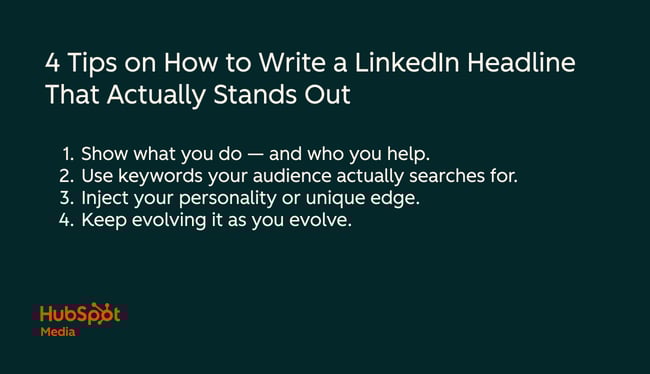
1. Show what you do — and who you help.
Your headline should be clear, not clever. Don’t just write “Account Executive at Databricks” — add who you help and how. For example: “Trusted Advisor to CDO & CIOs to leverage their data to create business breakthroughs.”
Use the format in the template below, where X represents your ideal prospect, and Y is their ideal outcome or state of mind after connecting with you.
2. Use keywords your audience actually searches for.
Think like your ideal client, recruiter, or partner. What words would they type in? Sprinkle those keywords in naturally. This helps you show up in searches and makes the value you bring obvious.
There is always language that shows you are part of a tribe. For instance, you can’t go anywhere nowadays in tech sales without hearing pclub, SMB/MM/Ent, SaaS, AI, ML, Analytics, ARR, GTM. These help others show that you get it and you’re in that special tribe together.
3. Inject your personality or unique edge.
I also recommend you include interesting things in your headline that help connect with others — things like MBTI, CliftonStrengths Top 5, or anything that just humanizes you and gives others a reason to connect with you as an ice breaker.
4. Keep evolving it as you evolve.
Your headline isn’t set in stone. Update it as you grow, shift roles, or refine your niche. The version you wrote three years ago probably doesn’t reflect who you are today — and that’s okay. Changing it often will keep things interesting, as people will come and go from your life. It might give them a reason to catch up with you.
LinkedIn Keywords List
Using the right keywords in your LinkedIn profile is the key to getting more visitors who want to hire you or work with you. Similar to a resume, you want to draw eyes to the important aspects of your experience. While a resume uses keywords tailored to a specific job posting, a LinkedIn profile uses keywords tailored to your career expertise.
Recruiters, prospects, and the like will search for keywords related to the position they want to fill. Depending on what a searcher is looking for, one profile can appear on page one while another can appear on page eight. As someone who wants to be found, the keywords you use will directly impact whether you get in front of the right prospects. Here are some specific keyword areas to focus on:
- Job position and experience.
- Location.
- Skills and certificates.
- Services or products you offer.
- Name of your degree and field of study.
- General keywords related to your industry, field, or expertise.
It’s important to strike a balance between being concise but also broad enough to be found. For instance, instead of writing “Tech Leader” you might say, “Mobile Application Developer.” It’s specific enough to a job title yet broad enough for multiple recruiters in varying companies to find your profile.
LinkedIn Keywords for a Headline
Your headline for LinkedIn is no different than your profile in terms of using the right keywords to be discovered. However, the headline is arguably the most important part of your profile — it stops prospects from scrolling past your name to clicking on it.
A LinkedIn headline needs to use specific keywords to explain in a few words what you do and what you provide. This is why I think a customized headline is always better than the default LinkedIn headline.
Here are a few formulas you can use to write a great LinkedIn headline :
- (Title) at (Company) – Helping USP (Unique Selling Proposition)
- (Title) | (Company) | (USP)
- Title + Company + benefits of working with you | keywords related to your niche | personal touch |
Using one of the formulas above will elevate your LinkedIn headline and show prospects how you can add value to them. Now that you know how to choose keywords for your LinkedIn headline, let’s discuss how to change your LinkedIn headline to get your interview and job ready.
How to Change Your LinkedIn Headline
Updating your LinkedIn headline is incredibly simple. To better show how it’s done, I’ll update my own.
Step 1: Navigate to your profile.
If you’re new to LinkedIn, your profile is a blank canvas to be filled with everything that makes you great. Ensure your profile picture, experience, educational background, and skills are filled in before you optimize your headline.
Step 2: Click the edit icon.
At the top of your profile, beneath your banner, you’ll find a gray pencil symbol — the edit icon. Click on it, and it’ll open a window titled “Edit intro.”
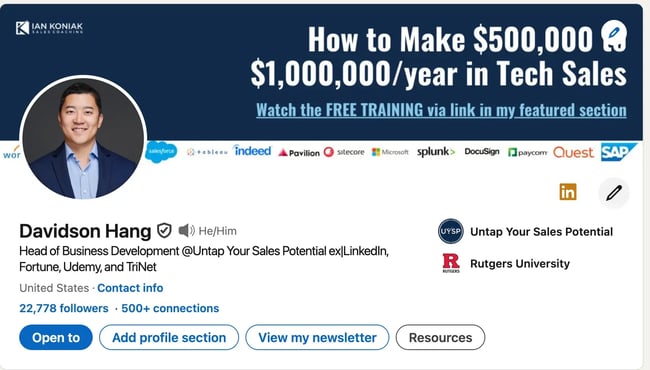
Step 3: Select Heading and type in a new headline.
In the “Edit intro” window, after you have your name and pronouns added, you’ll find the “Headline” text box. Here, you’ll type in the attention-grabbing headline that accurately describes your title and goals.
Step 4: Click “Save,” and you’re done.
You’ll now be able to refresh your profile and see your new LinkedIn headline. When recruiters look at profiles in your industry and occupation, they’ll see a headline that catches their eye immediately.
Before you begin to work on your own headline, look at these examples for some extra inspiration.
20 LinkedIn Headline Examples
1. Highlight your job title and professional value.
I like how Taylor Rodriguez begins his headline by stating his position, “Marketing Strategist,” but indicates what his values are by including the descriptor “Community-Driven.” But he doesn't stop there. He goes on to explain exactly what he does as a marketing strategist.
He says he helps creators, coaches, and purpose-driven brands grow engaged audiences and beautiful websites. His mission and his value to viewers are clearly communicated.
Simply by reading his headline, I immediately understand the type of clients Rodriguez works with and the results he delivers. There’s no questioning his expertise or value in my mind.
Takeaway: Lead with your job title or role. Follow that up by naming your target market or client type. Then, drive it home by calling out the specific benefits and outcomes you help your clients achieve.
2. Highlight your niche and client experience.
Stephen Telford begins his headline with his value prop and an impressive stat. But where I think his headline really stands out is listing the specific services he offers to help people land jobs.
By naming particular services, Telford carves out his niche as a job coach and shows the concrete ways he helps his clients. It builds trust and clarifies how he can help potential clients.
Takeaway: Detail your services and who they’re tailored for to attract more qualified leads.
3. Make your headline digestible with separators.

Rana Bano’s headline is easy to digest. She’s packed a lot of information in there, but the vertical line separators make it simple for me to parse out the key elements.
Moreover, the words she has chosen are the keywords she wants to be found for. So her headline serves the dual purpose of easy readability plus findability for her keywords.
I also like how she includes her value proposition in her last point: “I make words work harder for your brand.”
Takeaway: When using separators, start with your current role and include keywords. Then you can add in notable past experiences, causes you advocate for, your value prop, or personal passions that relate to your work.
4. Be specific about who you help and how.
In his headline, Ian Tenenbaum speaks directly to entrepreneurs who struggle with ADHD who want to get organized, make a plan, and follow through.
I appreciate that Ian doesn’t try to be everything to everyone. By narrowing his focus to a specific group and a particular pain point, his headline packs a punch.
Takeaway: In just a few words, summarize who you help and the tangible results you deliver. Use specificity to inspire trust in your abilities.
5. Showcase your credibility with past experiences.
What catches my eye on Marcella Schlitt’s profile is the companies she has worked for. By mentioning her past experiences, Schlitt is letting me know that she’s honed her skills at some top businesses.
I’ve seen a lot of sales reps put things like “ex-Google,” “ex-Microsoft,” or “ex-Amazon” on their profiles, positions they eventually leave to work at a lesser-known brand. It might feel like a flex, but the reality is when you work at a top-tier company, you are more likely to be taken seriously. It’s the same as if you wear YSL, Christian Dior, people will automatically judge you, whether you like it or not. That’s just the reality of the world we live in.
The companies you work for give you street cred, so to speak. So don’t be afraid to share them up front like Schlitt does here. The brand names speak for themselves; no additions needed to her headline.
Takeaway: Weave in your past roles with top companies and use your background to showcase your credibility.
6. Convey your passion and purpose.
Terry Swack doesn’t just say she works on building projects. She specifies that she’s all about making it “super easy” to choose “greener and healthier products” for “high-performance, low-carbon” buildings. I can feel her commitment to sustainability and her drive to make a positive impact.
But what I love most is how she takes it a step further. Terry’s not just focused on the end result but also on rewarding the manufacturers who make these eco-friendly products possible. She recognizes that creating change takes a village, and she’s dedicated to supporting those who share her vision.
Takeaway: Like Terry, paint a vivid picture of your values and the change you’re working towards.
7. Clearly state your value proposition.
I like how Mattia Peretti’s headline tells prospects exactly how he can help them: understanding themselves, their audience, and their purpose. He puts his value prop front and center.
Instead of focusing on his achievements, past experience, or the details of his offerings, he puts the spotlight on his clients and the benefits he can provide for prospects.
Takeaway: Identify your niche, and then articulate the tangible value you offer in a way that’s clear, concise, and compelling.
8. Share a glimpse of your personal life.
I love how Heather Eason has created a well-rounded headline. She combines her professional roles with a touch of the personal, adding “Mom of 4 kids and 4 dogs.” These few words humanize her and also instantly create a relationship with other parents (and fur parents) on LinkedIn.
She surrounds her parental identity with her impressive professional experience, making each accomplishment stand out even more. This mix of professional and personal details makes her profile memorable and relatable.
Takeaway: Add a personal element to your headline to build a stronger connection with your network.
9. Keep it simple and straightforward.

Alnoor Pirani’s headline has a no-nonsense approach. In just a handful of words, Alnoor conveys his role and his company. I don’t need a lengthy description to understand what he does. “Scale through automation” tells me he’s in charge of working with agencies to automate their workflows.
Takeaway: Sometimes, less is more. Keep your headline concise and focused.
10. Include a CTA.
In his LinkedIn headline, Tom Orbach ends with a call-to-action, inviting viewers to try his newsletter along with his web address.
By placing his newsletter front and center, Orbach must be very confident that it will provide value to his prospects. He’s offering something to them before asking anything from them.
Takeaway: Use your LinkedIn real estate to point customers to your owned content (i.e., your website).
11. Make your words visual.

In just a few words, Aayushi Choudhary paints a picture of herself as a connector. The imagery of bridging a gap is compelling because it suggests a challenge that needs to be overcome. It positions Choudhary as someone who not only recognizes this challenge but is actively working to solve it.
But Aayushi doesn’t stop there. She goes on to list her current role, “Product @ Intelas,” and impressive past experiences, “Ex-Salesforce” and “CS Alum @ UTD.” By using the “@” symbol, she creates visual breaks that make her headline easy to scan and parse.
Takeaway: Combine a strong, evocative image with concrete details about your professional background.
12. Use emojis as meaningful separators.

Ellie Middleton uses emojis tastefully in her headline. She uses a relevant emoji before each phrase which I think grabs attention and enhances her headline while keeping it professional.
I appreciate that Middleton doesn’t rely solely on emojis to tell her story. Each section of her headline adds to a meaningful introduction that paints a picture of who she is.
Takeaway: Use emojis as separators and enhancers, but let the words do the heavy lifting.
13. Be friendly.
Trish Seidel’s headline really sets a friendly tone. The fact that she calls herself “Your marketing big sister” makes her seem friendly and helpful. This kind of headline invites people to connect and learn from her in a casual, supportive way.
I think the tone in her LinkedIn profile fits her brand voice, which is warm and friendly. If you go this route, make sure your voice fits you.
Takeaway: Add a personal touch like this to make yourself more accessible and welcoming.
14. Quantify your results.
When I see Amber Deibert’s headline, I immediately understand the unique value she brings to overwhelmed sellers. It’s a straightforward and quantifiable statement of how she can help her target audience.
What I appreciate most is the clarity and confidence of this headline. It doesn’t try to be everything to everyone but instead hones in on a specific value proposition for a defined audience.
Takeaway: Numbers build trust. Incorporate quantifiable achievements to build trust and credibility with potential clients.
15. Emphasize a unique leadership identity.
Tony Jamous identifies himself as a CEO who’s “Leading with Empathy & Mental Wellbeing,” which immediately sets him apart in business leadership.
His title highlights not only his successes but his leadership approach. This focus is especially appealing to stakeholders who prioritize ethical practices — and for anyone looking at Oyster as a company. Jamous’ work aligns with broader global impacts, so this positions him as a forward-thinking leader.
Takeaway: Create your headline to reflect the unique values and missions that define your leadership style.
16. Focus on the customer experience.
Mehakpreet Kaur highlights her services’ tangible benefits to a specific audience. Her target clients are founders, CEOs, VCs, and coaches — and she will help them monetize through her content and design skills.
I like how she defines her roles clearly and demonstrates broad yet specific skills, like lead generation and personal branding. Kaur’s headline makes it clear what she does and how it helps her clients.
Takeaway: Articulate the direct benefits your skills provide to your audience.
17. Use humor.
Erica Schneider’s headline is a great example of using humor to engage and connect with her audience.
“Running on seltzer 🤩” adds a personal and playful touch that makes her profile stand out. It humanizes her and makes her more relatable to potential clients.
Erica’s use of humor in her headline, alongside credentials like “Edited 3M+ words” and “Former Head of Content,” balances professionalism with personality.
Takeaway: Incorporate a bit of your personality or humor in your headline to engage your audience.
18. Mention your personal achievements.
John Bonini's LinkedIn headline does a great job of mixing professional details with a fun personal fact: “Shoots 85% from the free throw line.”
This bit of basketball trivia isn‘t just cool — it shows he’s got focus and precision, qualities you'd want in a consultant. Also, it makes him stand out and gives people an easy way to talk to him.
Takeaway: Throw in a personal achievement or hobby. It makes your profile more human and can be a great icebreaker.
19. Don’t be afraid to be silly.
Jacalyn Beales’s LinkedIn headline is a fun mix of her professional role and personal interests. She leads with “⚡️Leading lifecycle marketing @ Copy.ai,” which shows her expertise.
I love how she adds a twist with “On a mission to find the best Moscow Mule,” sharing her passion for a good drink. I also smiled at “Em dash enthusiast,” which shows Beales’s love for punctuation quirks. It‘s a headline that’s professional yet personal, making her profile stand out.
Takeaway: Think about any quirky goals you can add to make your profile more memorable.
20. Integrate brand messaging for impact.
Dharmesh Shah’s headline, “Helping millions grow better,” incorporates HubSpot’s own branding into his personal profile. He aligns herself with HubSpot’s values and emphasizes the direct benefits he has brought through co-founding HubSpot.
By using the phrase “Grow Better,” which is part of HubSpot’s customer code, he communicates a promise of value and commitment to potential clients and partners.
Takeaway: Consider how you can weave your organization’s brand messages into your headline to reinforce your role and value.
A powerful LinkedIn headline is a game-changer.
At the end of the day, your LinkedIn headline is one of the most powerful lines you’ll ever write about yourself — and I say that as someone who’s spent over a decade growing my presence there.
Whether you’re looking for a new job, new clients, or just building meaningful connections, your LinkedIn headline is the first signal to the world about who you are, who you help, and why they should care.
Experiment and try different things. It might feel like a small tweak, but those small tweaks lead to opportunities you could have never imagined ten years ago. I’ve landed life-changing career opportunities, received podcast guest invites, and cultivated friendships and mentorships just because people knew exactly what I stood for and who I served.
So take the time to make your headline clear, keyword-rich, specific, and true to you.
And remember — LinkedIn is a living, breathing network. Keep showing up, keep adding value, and keep evolving.
The right people will find you. I promise.
19 Jul 15:27
Is Your Database Inaccurate or Duplicated? It’s Time to Clean it Up!
by Ringlead Admin
Did you know that over 30% of the current records in your database are either duplicates or just bad data altogether? Imagine how much time your sales team is wasting managing those useless leads. Data Cleansing is the process of removing faulty or inaccurate data from any type of database.
The importance of data cleaning tools
Various kinds of data are described as faulty or “coarse” if they contain duplicate entries or inaccurate information. Due to the prevalence and importance of digital marketing, businesses that handle large volumes of data will need to scrub it on a regular basis. Using data cleaning software tools, errors and inconsistencies can be corrected or deleted quickly and efficiently.

Some of the most frequently-used data in business management and marketing include customer contact information and related information on sales leads. Inaccurate data can cause plenty of problems when it comes to customer relationship management and the creation of promotional campaigns. With data that isn’t reliable, CMO’s would find it difficult to make the best choices that determine continuing profitability.
Data cleansing – a quality control measure
Data cleansing is viewed as a separate activity from qualifying sales leads, and it’s a needed quality control measure that can be automated with the right CRM database tools. With this process, leads can be qualified and data errors can be corrected much faster and more efficiently.
One of the most problematic types of data is B2B data, which can be more prone to errors in some cases. Some of the most frequent issues include outdated information, missing contact information, and inaccurate entries.
Be sure you target the right audience
Coarse data can lead to marketing programs that target the wrong audience, along with customer outreach efforts that reach duplicate entries in the databases. This alone is the main reason for the importance of implementing tools that are able to sort, parse, organize, and clean up all types of data.
19 Jul 15:27
5 Ways To Align With Sales As A Field Marketer
by Jasmine Cortez
Field Marketing is a role that bridges the gap between sales and marketing. As a field marketer, my goals are often tied to the success of the sales team. One of the many factors that leads to field marketing success is developing a relationship with sales that enables two-way feedback. This is particularly important around events, which requires collaboration between marketing and sales.

Some of the benefits of better alignment with your sales team include:
- A more effective event strategy.
Is your team struggling more with lead generation or with pipeline acceleration? Each of these goals calls for a very different action plan. The need for lead generation will require more event sponsorships and trade show exhibits while pipeline acceleration will require field events such as roadshows, dinners and hosted conferences.
- More accountability from your sales team.
We all know how difficult it is to get a sales team to properly tag and identify leads and event activity. Event software (like Attend) certainly helps with this aspect, but you’ll still need your sales team to do their part. A better relationship with sales will ensure that they heed your advice on properly entering information into your CRM.
Below are five tips to help you get started on building a better relationship with your sales team:
1. Hear them out.
Arrange 1:1s with sales leadership (or if you have the bandwidth, sales reps as well). You can take this opportunity to discuss pipeline, review past event performance and make decisions for upcoming events.
I’ve used 1:1s to discuss which sales reps should attend an event, review activity and next steps from previous events, and get buy-in for events that we’re considering. While this is a great opportunity to listen to your sales team, it’s also your opportunity to provide feedback and ensure you’re getting the support you need from sales.
2. Ingrain yourself in the sales culture.
Participate in as many sales meetings as you can and attend sales team outings. After all, you are an “extension” of their team!
During team meetings, you’ll gain valuable insights that can help you better plan your field marketing programs. You should also request time to chat about upcoming events and programs to ensure that the team is aware of what’s going on.
3. Communicate often.
Figure out what the best form of communication is for your sales team. Perhaps it’s emails needed, a weekly email, posting on an internal social network, or creating a separate channel on Slack or HipChat. We use Salesforce Chatter at my current organization and I created a chatter group specifically for field marketing that lists upcoming events with links to registration links and event briefs.
This information is sent out to the entire sales team vs. solely event attendees. After all, even if a team member isn’t attending an event, it doesn’t mean that one of their prospects won’t be in attendance. In addition, I send out surveys after every event requesting feedback such as areas for improvement, what went well/what didn’t go well, etc.
4. Hold a pre and post-event meeting for your events.
These meetings ensure team alignment and set the right expectations for both the event and follow-up. I typically hold the pre-event meeting two weeks out so that I have time to collect feedback and iron out last minute details that were brought up during the meeting. This also provides the team with ample time to start generating meetings and planning for on-site engagement.
My post-event meetings are generally held 2-3 business days after the event so I can collect feedback while it’s fresh in everyone’s mind. This is also a good time to remind event attendees to fill out event surveys and review all meetings that were held onsite.
5. Understand how sales measures success.
You should try to live in the CRM system that your sales team is using and gain a better understanding of how they’re measuring success. This will guide your event reporting metrics and enable you to create guidelines for the sales team on how to properly tag event activity in your system of record.
Doing this will allow you to hold your sales team truly accountable for following event processes around keeping track of conversations and following up. My motto is “if it’s not in Salesforce (our CRM), it didn’t happen!”
Sales feedback is another tool in your toolbox to help you become a better field marketer. The better you connect with your sales team, the more familiar you will be with their pipeline and the better you can help them flow those deals down the pipe.
19 Jul 15:27
How to Use CRM for Marketing
by Alessandra Ceresa

Yes, if you haven’t been living under a rock for the past couple of years, you know that CRM (Customer Relationship Management) is a ‘must have’ tool. However, when most people think of CRM, their mind immediately correlates it with sales. Although CRM is fundamentally a sales tool, it is no longer just for sales teams. As sales and marketing become more connected, so does a marketer’s use for CRM. Let’s explore.
Personalized messages
What does a CRM hold that every marketer needs? Yes, contact data, valuable customer insights. Marketers use this data to personalize and target all of their communication. Without a CRM to organize this data, it would be very difficult to segment any contact database.
Any functional CRM has the ability to create custom user-defined fields such as Title, Interests, Industry, Favorite Color, Favorite Sport, and so on. Salespeople often use this information to build deeper relationships with their clients and tailor their pitches. Marketers can use this information to send these contacts relevant content to help re-engage and push them through the funnel.
Automation
Automation is a beautiful thing and CRM can help. If a lead becomes a paid client or has a low lead score, this change in the CRM can trigger automated actions like a re-engagement campaign or a new onboarding drip series. Having a CRM, full of rich customer data can help you improve your conversions and overall ROI. It’s nearly impossible to keep up with every lead turning into a prospect into a paying customer. As your contact moves down your funnel, you need to provide them with different marketing messages. Automation helps you manage your lead nurturing process so you can close more deals and make more money.
Timely Follow Up
Great marketing is all about giving the customer a great experience from start to finish. This includes your follow up. I am not talking sales follow ups, but marketing messages sent out when a customer performs a specific activity. For example, a Facebook comment made by a client should trigger a workflow for the social media manager to respond to that post immediately. Marketers can also setup workflows to assist sales by delivering timely and relevant messages based on the information the sales person puts into the contact record. These sorts of messages can significantly help drive that lead down the sales funnel.
The second use for timely follow-up includes the transition of a lead from marketing qualified to sales qualified. When a lead hits a certain/pre-defined lead score, they can automatically be passed to the sales force for a live demo, meeting, etc. Instead of this being a manual and tedious process where qualified leads slip through the cracks, you become more efficient and on target as they move through the funnel.
Success Tracking
Having a CRM integrated with your marketing allows you to see which of your contacts are opening emails, what websites they are visiting, webinars attended and so forth. You can’t improve your marketing without these metrics. As marketers, we must understand the sales cycle and how our work fits into it. Sales cannot live without marketing and marketing cannot live without sales. A CRM gives us valuable insight into how clients and leads respond to our efforts, so we can determine the best strategy for optimal conversion rates.
Personal touches make all the difference for a successful marketing strategy. I recommend using a CRM so you have the data you need to effectively personalize your marketing messages. Whoever thought CRM was just for sales, well, think again. CRM is a power marketing tool and one that we should all be putting into play.
19 Jul 15:26
Breaking Down the Fundamentals of Account-Based Marketing
by Heidi Bullock

Okay, so maybe account-based marketing (ABM) isn’t quite as viral as Pokémon Go, but I would say that ABM is a close second in the B2B marketing world! But what does this mean for you as a marketer? What do you need to know about ABM? Why does it matter? How do you know if it’s right for your business? So many questions, and now’s the time for answers.
Here’s a simple way of looking at how to make sense of ABM. In demand generation, it ultimately boils down to two key strategies:
Traditional B2B marketing is often done through broad-reaching campaigns. Most marketers try to get their word out—as far and as wide as possible—by leveraging different marketing channels: owned, earned, and paid. The objective is to cast a wide net and put out as much content as possible, in order to act as a marketing magnet and draw a large number of leads into your funnel.
On the other hand, account-based marketing (ABM) is in many ways the exact opposite. It’s about getting all your resources— your program dollars AND your people (including your sales and marketing teams)—working together in a coordinated way to pursue and convert very specific accounts.

But is ABM right for you? Both strategies have their benefits, so it depends on your objectives, the market you sell to, and your product/price point. Generally, ABM is the way to go when you have a large target market with hundreds and thousands of prospects, and need to narrow down your focus to high-value accounts. With ABM, you can focus your time and efforts on running campaigns that are personalized to target accounts.
Deciding on whether to do account-based marketing is just the start. Once you’ve decided whether it aligns with your objectives, there are a few considerations to take into account. Here are five simple steps to walk you through the essentials of account-based marketing:
1. Identify Your Target Accounts
While this is fairly obvious, you can’t do full blown account-based marketing if you don’t even know what accounts you’re targeting. To get this right, you need to work in close conjunction with sales. ABM will not work if sales isn’t onboard, since it requires both marketing and sales to focus their resources on the defined set of target accounts. Once you work with sales to build an initial list, you can use lead scoring to help stack rank the accounts to make sure everyone is focused on the ones with the highest propensity to close.
Tip: There are many options for predictive scoring, so take the time to research them. With the right solution, it can add another helpful lens to prioritizing your account list.
2. Develop Personas
Next, you’ll want to map those accounts to marketing personas better understand which divisions are the right ones to target. You need to understand what challenges the account faces as a business, how decisions are made in the organization, and who makes those decisions. This sort of information is critical to an effective ABM initiative. There are different approaches to building out white space, so this should be an ongoing effort.
Tip: Agree on a timeframe to lock in the target account selection. Target account programs, in many cases, take time to work–so you don’t want to switch out the accounts too frequently.
3. Find the Right Content
Targeted customers are more likely to engage with content that is tailored specifically to them. According to MarketingSherpa, 82% of prospects value content made for their specific industries, and 67% say the same of content created for their specific job functions. And because ABM is inherently more personalized, you’ll have a great opportunity to provide prospects from target accounts with content and messaging that resonates with them and is relevant to their business and stage in the buyer journey.

Tip: Try to leverage the content you already have and make small adjustments as needed so that the content or offer really speaks to your audience. For example, if you’re targeting accounts in a specific industry, you can repurpose a more general ebook and add in more examples and case studies from other companies in the same space.
4. Integrate ABM into Your Multi-Channel Strategy
At the end of the day, your target accounts are similar to your other buyers in that they’re on a multitude of different channels every day. To effectively reach and engage them, you will need to execute cross-channel campaigns, targeting the right people in your target accounts on different channels and leveraging the personalized content you pulled together in the previous step. And remember, you’ll need to do this in tight coordination with sales so that they can understand how each target account prospect has engaged with your company.

Tip: Set up an entitlement framework so it’s clear what certain accounts (top tier) receive from a program perspective and others (e.g. tier 1 or tier 2) do not. For example, at Marketo, some of our top tier accounts receive direct mail from us while our tier 2 accounts do not.

5. Measure and Optimize
I’ve said it before and I’ll say it again– as with any good marketing initiative, you’ll want to measure and analyze your results over time so that you can continually optimize your campaigns. It’s not about ONE metric either, but which set of metrics matter to your business objectives.

Tip: It is ideal to look at success throughout different time points so you can make adjustments as needed. Some metrics, like pipeline and revenue, take more time to mature, so measuring your campaigns throughout time allows you to get a holistic view of its impact. Measure as you first launch a campaign, while it’s running, when it ends, and three to six months down the line.
Interested in learning more? Check out our webinar tomorrow on The Essentials of Account-Based Marketing as we go through how to get started with ABM and focus on what really matters.
18 Jul 16:34

How Pokemon Go Is Paving the Way for Business
by Vincenzo Landino

By now, you’ve probably heard of Pokémon Go, the augmented reality game that has taken the entire world by storm. For those of you that are not familiar with it, Pokémon is from the Japanese “pocket monsters,” an incredibly popular video game, trading card, and TV series. Pokémon roam about the land, and, as a trainer, your job is to locate them, capture them in PokéBalls, and then train them to grow stronger and eventually evolve. I played this game on my Nintendo Game Boy growing up, followed that up with the card game during lunchtime at school, and got home to watch the TV show.
Even though Pokemon brings up nostalgic memories, it continues to be a popular franchise to this day. In fact, during Super Bowl 50, Pokemon was one of the top four mentioned brands on social media, according to research by BrandWatch. And you may even remember seeing Google post a job opportunity in 2014 on April Fools Day for a Pokémon Master.
I should start by saying that the game is not visually impressive. I’m pretty sure Nintendo’s Tecmo Super Bowl circa 1991 had better graphics than this game. However, in a world where our gaming systems and PCs get more and more powerful, providing near lifelike experiences through our televisions and computer screens, Pokémon Go does the polar opposite. Pokémon Go is encouraging users to get up off the couch and out into their world. In doing, so users are walking, talking to each other, and being… social?!
Just How Popular Is Pokémon Go?
The craze has gone so mainstream that I’ve seen people posting their Pokémon adventures while on vacation in Europe, at the gym, while out at the bar, and even on the subway. The app has become so popular that it’s about to surpass the DAUs (daily active users) of Twitter for the Android platform! Users are spending so much time walking around that they are opting for Pokémon Go over Facebook.

Let’s take a look at the generational phenomenon happening here. Looking at the graph below, you’ll notice 55 percent of people talking about Pokémon Go are millennials—no shocker there. But let’s look at the breakdown of the remaining 45 percent.
Image via Zoomph
24 percent are between ages 35 and 50, 11 percent are somewhere between 7 and 20 years old. Then you have this whopping 9 percent of 52 to 75+ year-old users. I have never used this in a statistic when talking about apps before, but with Pokémon Go, we’re looking at a 7–77 year old age range. (highlight to tweet) Grandparents are playing with their great-grandchildren!
In a further look at online conversations, my friends Michelle Dziuban and James Rubec (Social Media Managers at Cision) helped me analyze more than 500,000 social messages, which represent five percent of all Twitter messages and 80 percent of news mentions, including those from Reddit and other online forums from the United States. What the analysis shows is that there’s been a 300 percent increase in conversations about Pokémon Go over the week.

In addition, consider these Pokémon Go statistics:
- Cision monitored more than 1.6 million social and online news mentions written by nearly 1 million authors between July 4 and July 14. This includes a representative sample of Twitter and Instagram mentions and more than 183,000 online news stories.

- Daily Pokémon Go online mentions have increased from 292 on July 4, to 282,833 on July 12, representing a 968-fold increase in mentions between the two days. At the same time, the number of authors has grown from 198 on July 4 to 142,900 on July 12.
- The average Pokémon Go commenter shares 1.67 messages about the game.
- Cision identified more than 10,000 authors who have self-identified as either College Students, Millennials or those from Gen X. Current college students represent 52 percent of the Pokémon Go commentators in this self-identified group.

Of course, the big brands are noticing and jumping in on the fun.
Because #PokemonGO https://t.co/OyZwxQGdmt pic.twitter.com/3BOvz9DGR2
— Amazon (@amazon) July 11, 2016
When you just gotta catch ’em all. #PokemonGO is on at the Mall! pic.twitter.com/R2LZ9WtWOh
— Mall of America (@mallofamerica) July 11, 2016
How Your Business Can Join in the Fun
Now, you’re probably asking, “Why is this relevant to me? I’m a small business owner.” Here are just a few ideas for specific types of businesses. Feel free to use them as they are or expand upon them for the ultimate customer experience.
- Restaurants, Bars, Diners, Pizza Places, Coffee Shops: If you’re a food or beverage establishment, take advantage of a nearby PokéStop and use the in-game “Lure Module” to attract users to catch Pokémon while patronizing your establishment. Be sure to offer a nice incentive, too!
- Realtors: If you’ve got upcoming open houses, can you offer a Pokemon incentive for that home that just won’t sell?
- Mechanics: Slow this time of year? Offer a Pokémon check-up and service! Allow customers to catch ’em while they wait. Drop a lure to give people something extra to get excited about.
- Doctors and Dentists: Get those slackers in for their yearly checkups and cleanings with a Lure Module and a well-timed social media post or email blast.
- Museums and Public Libraries: Create walking tours where patrons can catch Pokémon and learn.
- Tourism Boards: Offer incentives for people coming to your landmark, town, or city!
Consider these ideas any type of business can try:
- Hosting a PokéParty is a cheap and easy way to bring traffic to your establishment. Use a lure to attract Pokémon for patrons, who will stick around socializing with other Pokémon trainers and spend money in your store.
- Host a battle tournament! If you’re closer to a PokéGym, where trainers train their Pokémon, you can give incentives to winners. Because of the team play, you’ll have more than enough people spending time and money with you.
- Screenshot the Pokémon you find in your establishment and post about it online. Offer social media specials to those that come in to try catching those Pokémon.
How are some businesses currently handling the craze? Check out these photos below.



One thing businesses currently cannot do is apply to become a PokéStop or PokéGym … yet. PokéStops and PokéGyms are predetermined by the developer, Niantic Labs, using an algorithm. However, as announced on Wednesday, Pokémon Go will soon get ads in the form of sponsored locations. Businesses may be able to request to be a PokéStop, allowing them to reap the benefits that were once pre-determined by the game engine.
Businesses Reap the Rewards of Being Pokéfriendly
What kind of results have businesses seen? Scouring Twitter reveals some owners talking about the boost in their business.
@vincenzolandino I’ve been working on a look at foot traffic. Haven’t had a lure attract less than 20 people all weekend.
— Karl Taylor (@karljtaylor) July 11, 2016
@vincenzolandino haha someone was gonna do it. Why not you? Actually got my client to throw up lure modules. They made 45% moe yesterday
— Michael Hernsin (@michaelhernsin) July 11, 2016
@vincenzolandino yea lol they were lucky enough to be a bar with a stop. We did a “catch a Pokemon here and get 2for2 drinks”
— Michael Hernsin (@michaelhernsin) July 11, 2016
In New York City, L’inizio’s pizza had business go up 75 percent after paying $10 to continue to put up Lures connected to the store. “We had people come down, sit down, and get a couple beers and play the Pokémon game,” said manager Sean Benedetti, according to The New York Post.
 With the use of the in-game item called a “Lure,” which attracts Pokémon to a specific PokéStop for 30 minutes, savvy business owners can increase the foot traffic near their store during that period of time. Anyone in the area can see the Pokémon that are coming out of the woodwork.
No one knows how long the Pokémon Go mania will last, but it may last longer than most trends because it’s doing something that few other games have been able to do: get authentically social by connecting our digital and physical lives. Pokémon Go is combining nostalgia with a powerful franchise and tapping into a wide demographic.
Whether you have a brick-and-mortar shop or not, and no matter your beliefs around Pokémon Go, you cannot deny the power of this phenomenon. Augmented reality is the next frontier. Tech giants like Apple, Facebook, Google, and Microsoft are dumping tons of money into researching this technology, and the mighty Pokémon is paving the way.
Get more content like this, plus the very BEST marketing education, totally free. Get our Definitive email newsletter.
18 Jul 16:27
38 FinTech Blogs and Services You Should Follow
by Sandra Wrobel-Konior

FinTech is a relatively young line of business, but for now, there are many resources which focus on financial technology or payments topics (and it’s still growing). To make it easy for you, we’ve put on a list the financial services and blogs that are worth mentioning.
Personal Blogs
Personal thoughts always have an interesting point of view, so it’s good to follow the people who are passionate about financial issues. These individuals offer mainly great analysis and insightful articles, unlike services with the little news. Here’s the list of people who are the leaders in the financial services industry.
1. Faisal Khan

Here you can find the essential information about banking, payments, FinTech and e-commerce. Faisal Khan specializes in cross-border money transfer and payment systems. He calls himself a payments consultant and an evangelist for digital money (aka Bitcoins). He’s working with entrepreneurs, FinTech startups, mid-sized and huge companies, but also with banks and financial institutions.
2. Tom Groenfeldt

The author has a wealth of experience in finance, banking, and technology, and now he writes for Forbes on these topics. In 2015, he was named one of the top 25 global finserv influencers. So, if you’re looking for insightful articles, you should add this blog to your list.
3. The Finance Buff

The blog created by Harry Sit is a great resource for those who want to know the basics about finance, credit card payments, and also about saving. The author isn’t a professional financial specialist or financial advisor, but he creates simple posts for people who want to know how to invest their money or e.g. how to protect their account.
4. Jessica Elerm

Here’s another blog with personal thoughts on the revolution of technology in the banking and payment industry. Jessica Elerm works in the Australian FinTech startup Tyro, but she is also a blogger, commentator and she writes for Brett King’s Breaking Banks, Daily FinTech, and Bank NXT. On Jessica’s blog, you’ll read mostly about FinTech, growth hacking, payments, and banking.
5. The Finanser

Chris Skinner’s blog is all about the financial world. The author is one of the FinTech leaders that have been voted one of the most influential people in banking by The Financial Brand. He provides well-written articles and analysis with the insightful approach to finance and new technologies.
6. Payments Blogger

Payments Blogger run by John Doyle is a place where you can find the news and research about the global payments industry. The blog provides short and long-form content types with basic information, definition, as well as with high value-analysis and guest bloggers’ thoughts.
7. FiniCulture

It’s a blog created by Pascal Bouvier, a former French banker. He writes a few blog posts per month, and all of them are insightful, with the fresh look at the financial market. Here you can read about the integration of finance and technology, you’ll find pieces of advice for FinTech startups, and also some funny posts, such as The Alternative FinTech Lexicon.
Other Resources
Financial services deliver essential information from the industry (there are also many influencer’s thoughts), so you should add them to your list if you want to stay up-to-date with the FinTech news.
8. Finextra

Finextra is a place where you can find all essential news about banking, payments or startups. It also offers a newswire or global events calendar, and the site is a platform for guest bloggers (there’s a special Community section).
9. Finovate

The Finovate team has attended and spoken at banking and technology events for 20 years, and they have also been organizing conferences around the globe since 2007. The blog focuses on FinTech, banking, and financial services innovations, and you can find here the FinTech news and updates, interviews, roundups and more.
10. Visible Banking

Visible Banking is a blog owned by Christophe Langlois, who worked in business development, in both telecommunications and banking. The author focuses mainly on social media in banking and financial services.
11. Credit Union Times

If you’re looking for information about credit union managements and the topics related to that, the Credit Union Times is a great source. Here you can find not only updated news about credit unions, but also expert technology coverage as well as statistical analysis.
12. The Financial Brand

The digital publication started in 2007 by Jeffry Pilcher, who is also one of the authors on the website. The Financial Brand focuses on marketing and strategy issues affecting retail banks and credit unions. It provides the financial and banking news with strategic analysis and real-world examples.
13. Accenture Banking Blog

Accenture’s blog is a resource with data interpreting and analyzing of articles. The blogging experts have a rich experience as regards to the banking industry, so you may be sure that they will provide insightful and high-quality articles.
14. PYMNTS

A newswire focusing on the payments industry provides well-written news about online and mobile payments, but you can also find here webinars, research and articles written by experts, innovators and thought leaders. All posts are created mainly for e-commerce market.
15. Let’s Talk Payments

LTP, launched in 2013, delivers the news and research for the FinTech industry. The content is updated every day, and here you can find original insights, analysis, and resources for the FinTech community.
16. Mobile Payments Today

As you could guess, the platform provides the latest news around mobile payments. The topics are about card brands, contactless payments, EMV, security issues, mobile banking or trends and statistics.
17. Payments Source

PaymentsSource is a website where you can find payment news, trends and analysis as well as expert opinions. Lots of news are published in the sections, such as Regulation & Compliance, Risk & Analytics, Debit & Prepaid, Retail & Acquiring, Technology and Global.
18. bobsguide

Bobsguide provides the latest financial technology news and insights. There are articles, blog posts and insights from contributing editors. Also, you can find here a list of industry events.
19. ATM Marketplace

ATM Marketplace is a hub for news, articles, insights and more about ATMs world. It’s a great source to watch as the technology in the financial industry is evolving.
20. Daily Fintech

Daily Fintech is a place created by FinTech entrepreneurs, where they can present financial companies, and publish interviews or insights and experts’ opinions. The website is updated on a regular basis.
21. IBM Insights on Business: Banking Industry

IBM, as one of the technology leaders, delivers the insights and news for the banking industry. The content focuses mainly on new technologies, but you can find here some author’s thoughts, such as payments predictions for 2016.
22. Banking Exchange Blogs

Banking news and articles presented in sections with updates about community banking, technology, payments, risk and more. There’s also a blog section, where you can find Dan Fisher’s personal view and opinion on the banking industry.
23. Markets Media

Markets Media provides financial news with a focus on institutional trading and investing, but you can find here the latest information on banks, technology or regulators.
24. Bank Innovation

Bank Innovation was launched in 2009 and delivers information, news and blog posts for the banking industry. Beyond the latest news, you can find here also The FinTech Answerable section and contributor blogs.
25. Bank NXT

A blog maintained by Backbase, and created for innovative financial professionals. The website provides the knowledge (exclusive content and reproduced blogs from experts) and creates a space for industry leaders’ community.
26. FinTech Hackers

Looking for the FinTech growth hacks? On this blog, you’ll find the case studies from well-known FinTech companies. Also, you can get access to a free email course to learn how to build a growth strategy.
27. Tomorrow’s Transactions

The Consult Hyperion’s Blog is all about the development of technology in our everyday life. Here you’ll find banking and finance news, as well as technological and security issues.
28. PaymentEye

The service keeps an eye on a payment market, and publishes the insights or analysis for professionals involved in the payments sector. On the website, you can also find information about upcoming events and the section with white papers.
29. Payments Card and Mobile

If you’re looking for a hub for global payments news and research with up-to-date experts’ analysis and opinion, this website is for you. The digital publication covers every aspect of the payment business, so you can find here information about international cards or mobile solutions. There’s also a Conferences section with upcoming financial events.
30. Payments Views

Payment Views is a blog with insightful articles and analyses, but also with news and the wires. You can read the updates that the authors find the most interesting and useful, and on the home page you’ll find the best stories from the last seven days. You can also send your own story or press releases to share with payment professionals.
31. Talking Payments

Here’s another website where you can find news about payments, insights, blog articles and upcoming events. Talking Payments brings together banks, acquirers, merchants, vendors and industry experts to share the news.
32. The Banker

The history of The Banker starts in 1926, and for all these years the editorial team has built its great reputation. Here you’ll find a wide range of financial news, features, analysis, or interviews. As you would read on the website: The Banker is the key source data and analysis for the industry.
33. Fintech news on TechCrunch

If you read TechCrunch news regularly, you probably know that the service is a place where you can find mainly tech, social media or startup news. But there is also a section with insightful articles about FinTech world.
34. Fintech Weekly

Fintech Weekly, created in cooperation with Bankverlag, is a typical website with roundups; so therefore, it’s a great source for those who are looking for the most interesting news from the previous week. Also, you’ll find here some information about top conferences you should attend if you are running a financial business would be found here.
35. Financial News

Online daily news service is owned by Dow Jones & Company and provides the information about the investment banking, fund management, and securities industries. You’ll find here, the major news affecting the securities industry, as well as trends and top news about capital markets, fund management, information technology and recruitment.
36. Fintech Business

The service was launched in 2015, and it’s focusing mostly on Australian FinTech community. But if you want to stay on top in FinTech industry, it’s worth knowing something about the market from other countries. FinTech Business delivers blogs and reports focusing on the key FinTech sectors, and legislation, regulation, or security issues.
37. Fintech Finance

Fintech Finance is a great resource for the FinTech companies. You’ll find here the latest news, infographics, insights and more. The content is updated on a daily basis.
38. FinTech Profile

The idea of the FinTech Profile is to track the startups and companies from the financial services industry. So, prepare not only for the FinTech news and insight articles, but also for financial companies presentation.
Do you want to add some other resources? Or maybe you also run a financial blog that is worth mentioning here? Let us know!