Shared posts

01 Sep 16:13

Money Is No Object: The Best Tools for Low Startup Costs

by Yahya Mokhtarzada

When we launched our first company in 2001, we needed a server that cost several thousand dollars, expensive software, phone systems, workstations, and fax machines. And that was just to get started — scaling was even pricier.

But thanks to technological advancements and the emergence of the software-as-a-service economy, starting a company is less costly than ever. As we develop and scale our latest venture, we can spin up our servers in the cloud in a matter of minutes and with no upfront cost. Almost everything we use is pay-as-you-go — from phone numbers and email to software and even payroll systems.

Being an entrepreneur is not a low-cost venture by any means, but with an abundance of products and services being offered as subscription services instead of an upfront fee, it’s more affordable than ever to get the tools needed to manage your company. Here are some areas in which this technological evolution can benefit your brand-new business:

· Software: Software costs add up quickly, but in the past few years, software has migrated to SaaS. Because so many software companies now operate in the cloud, you no longer need to run to the nearest computer store to purchase a pricey software installation disc when you know your team will only use it once.

At Truebill, we use several SaaS products. Our customer support team uses Fieldbook and Gmail to stay on top of customer requests. Our product team uses Moqups to generate wireframes for new features. And the design team lives in Sketch and Adobe Illustrator to bring those wireframes to life.

For whatever software you need to grow a business, you can probably find a SaaS option that will get you working right away.

· Web hosting: Did you know that there was a time when you needed an actual physical server if you wanted a web presence?

Now, servers can be spun up in minutes with cloud-computing services like Amazon Web Services and Heroku. Not only is the setup time almost instant, but these options are also significantly cheaper (and more secure) than buying dedicated servers for your business.

If you don’t need a robust digital presence, sites like Squarespace and Webs.com let you build and launch a professional-looking website for an affordable price. And they can save you a load of headaches that traditionally come with hosting your own site.

· Business planning and administration: There’s no need to reinvent the wheel when it comes to creating your business plan or handling accounts payable, accounts receivable, and payroll. There are plenty of options out there that are easy to use and can fit into your workflow.

Bizplan, for example, creates tools and services to help you form your business plan to get you closer to your initial funding stages. And for the day-to-day business operations, we use Gusto for payroll and insurance and inDinero for bookkeeping.

· Documentation: Online signature tools like HelloSign or Adobe Sign speed up turnaround time for getting contracts signed.

We just raised funding, and it was hard enough to track down investors for a meeting, let alone a signature. Using these services made getting the final contracts signed an incredibly straightforward process. They automatically send reminders and save you the annoyance of needing to print, scan, download, and track people down.

· Split-testing software: Losing potential customers because you’re using the wrong messaging is extremely costly. Split-testing software like Optimizely, Unbounce, and Google Analytics’ Content Experiments allows even novices to test different designs and messaging to see what appeals to the largest portion of their audiences.

It’s not uncommon to see small changes affect conversion rates by 10 to 20 percent. While you might think your site was perfect from the get-go, there’s no replacement for the actual data these tools provide.

Starting a business is never easy — in fact, it’s very difficult! But thanks to the development of the SaaS economy, at least it doesn’t need to be costly. With a little searching, you can find free — or near free — trials for most of the services you’ll need to get your business off the ground. And from there, most services offer pricing that scales as you grow, meaning your costs should never outpace your growth.

01 Sep 16:10

Once Upon a Profit: What Sellers Need to Know About the Power of Storytelling

by Mark Godley

HG Data's Once Upon a Profit Blog

I’m sure you’re familiar with the concept of brand storytelling, and how it appeals to consumers on an emotional level. But have you ever considered the powerful role storytelling plays in selling? It’s a technique I’ve relied on for years and may be the single most important reason for my business success.

Just as personal storytelling builds greater intimacy, allowing us to pass along memorable life lessons and maintain open lines of communication within our personal lives, selling through storytelling can do the same in our professional lives.

And if you’re a startup or early-stage company with a relatively unknown brand, storytelling helps prospects mitigate their sense of risk in decision making when buying from an unknown entity. With the right story, you can prove the credibility of you, your company and your services and gives prospects the justification they need to trust you with a PO.

Dad, Tell Us a Story

When I’m not on the road, we make a point to have dinner together as a family. My girls invariably want to hear a funny story or two about their zany dad’s childhood, and their threshold for drama has me wracking my brain for tales of my youth. Like the time my brother and I went fishing and I hooked the top of his head on my back cast.

We laugh every time I describe the scene with our small-town police force off-roading into the woods in their two-wheel drive car where we were fishing and looking every bit the Keystone Kops coming to the rescue.

And my poor brother. While the police confirmed he was not in a life-and-death circumstance, they couldn’t remove the treble barbs embedded in his scalp. Only after we got home, and my father and I rummaged in the basement and came up with a pair of rusty wire snips were we able to cut off the barbs and pull the rest of the hula popper, my favorite small mouth bass lurer, through the hole in his scalp.

My kids love these stories. For them, it’s an opportunity to laugh with (and at) mom and dad, and, for my wife and I, it’s the satisfaction we feel in knowing our children now have a nest egg of small tales that, when spliced together, tell a much more powerful story of our lives and the lessons we’ve collected along the way.

The Power of Story

Think about Garrison Keillor’s ability to capture the imaginations of generations of “Prairie Home Companion” fans, and you’ll understand the power of story. It’s his ability to weave the smallest vignette into an engaging tale and bring the characters of Lake Wobegon to life that so completely engages us. And thanks to the convenience of time-shifting, I can indulge my favorite storytellers via podcasts like This American Life, The Moth, Snap Judgment, Radiolab, Serial, Invisibilia, The Dirtbag Diaries, Revisionist History and More Perfect. Each time I listen, I marvel at how fantastic delivery of content can engage and enthrall us, all the while educating at the same time.

At home, we’re entering a new phase as our kids are becoming part of the family lore rather than just hearing about it. For instance, they delight in telling the epic tale of their hike into the cinder cone of Cerro Chato, an extinct volcano near the outdoor mecca of LaFortuna in Costa Rica. The dormant cinder cone is filled with a beautiful lake providing just the strange juxtaposition of geology to create a lasting impression – little did I know. We bushwhacked through a 3-mile, 3000-foot vertical climb in a mist that gave way to driving rain and lightning. Upon reaching the lip of the caldera and seeing we had a steep, 800-foot down climb to the lake that required descending via sketchy rope ladders, I suggested we’d gone far enough. Through my soaking-wet kids’ tears and protestations, I launched into a story about how it’s not getting to the summit but getting back down safely that matters. And even the mundane hike down had morphed into a risky venture, as the trail switched into a rivulet of cascading waterfall for over 2 of the 3 mile walk out. We never saw the lake, the climb was bone soaking miserable, but you wouldn’t believe the joy that weaving the yarn of this story brings the girls as they tell our friends about one of Dad’s most infamous fails they saw firsthand.

Selling Through Storytelling

So what does this mean to us as sales people? And how do we begin selling through storytelling? In my own case, I believe that my interest in including storytelling into effective selling is part of who I am as a business person. But for corporate purposes it isn’t my childhood or outdoor exploits that I recount, but an arsenal of material about 5 aspects of our business – stories about our company, our products, our customers, our competitors and our industry.

When I’m trying to connect with a prospect and create a memorable message, I draw upon these various frames to help make a point. For me, this isn’t a technique or mechanism, but rather who I am. It’s how I see the world – a collection of interesting experiences of others that I soak up with enthusiasm and draw upon for wisdom and reason and inspiration when needed.

And with a little thought and practice—and the 6 rules below—you too can become a business storyteller:

Rule #1: Your Stories Require a Degree of Intimacy
When you’re willing to share something about yourself to someone else, it’s the intimacy that people respect and appreciate. By exposing your vulnerabilities, you build rapport and transcend the role of unfamiliar salesman, you become human to your prospect. And here’s the interesting thing, the more you risk exposing yourself, the more you reduce the risk of buying for your prospects.

Rule #2: Your Stories Must Be Honest
If you embark on storytelling do yourself a favor and don’t embellish and never lie. Just be honest and put your story out there—the whole unvarnished truth—and expose yourself as human. There’s a saying in sales: People buy you first, then your company and then your product. Your honesty will earn credibility and trust for all three.

Rule #3: Your Stories Must Fit the Situation
Once you prove that you can tell the right story for the right audience in the right situation, you’ve demonstrated your domain expertise. You’ve proven you know what you are talking about. But you still need a cache of information to have a relevant story to fit every circumstance. That’s why sales and marketing teams are building content databases filled with success stories, case studies, research and predictions that anyone can draw upon via a CRM or a similar system of record. And when reps close a deal and have a customer-facing story that’s potentially useful for future sales, figure out a means to institutionally capture the who, what, when, where and how to ensure that each client win is memorialized succinctly and made readily available for all to use.

But having the information is just the starting point. You have to know what will inspire prospects, and this means being able to recognize their motivations, personality and values. You must know the difference between stories that will resonate with listeners, and those that will not. Relevance has an expiration date and using it lets prospects know you understand their circumstances. It inspires confidence that you and your products can solve their problems and improve their business.

Rule #4: Your Stories Are a Proof Source
The old adage from the 1980s of ‘no one ever got fired for buying IBM’ applies today within every sector comprised of entrenched, well-known, leading brands. When you’re a small company that has little brand recognition in the marketplace…or you’re an early-stage company doing evangelical sales…stories become a necessary proof source.

If someone is going to buy from the scrappy upstart, it’s that upstart’s obligation to de-risk the relationship by sharing the stories of others that have gone before them. No buyer wants to be the first one to trial a product or implement a solution barely beyond mvp (minimally viable product). By sharing examples of other companies who have travelled the courageous path of bucking the status quo, the startup is able to build confidence of the buyer in his/her decision making.

Rule #5: Your Stories Should Be Memorable (and Hopefully Entertaining)
Chip and Dan Heath, authors of Made to Stick: Why Some Ideas Survive and Others Die, make the point that when giving a presentation, 63 percent will remember your stories, but only 5 percent remember statistics. And the more memorable your stories, the more people will want to remember you.

In the early ’90s, while guest lecturing in the undergraduate business school at University of Southern California, I used a classroom style that can best be described as edu-tainment—educating while entertaining. I divided my classroom lectures into thirds: one part technical, one part interactive case study, and one part question and answer. The fuse of technical and real-world examples got people’s attention and I still hear from a few of those students today.

Remember, you’re not talking to make people smile. You’re there to inform and to relate; to reinforce your message and to seed a foundation built on trust. That’s exactly what buyers want to see, and precisely what existing clients and employees want to hear. People need to be reminded that you’re just as human as they are, and that your willing to expose your underbelly.

Rule #6: Despite Charlie Sheen’s Enthusiasm, It’s Not Only About Winning.
Let me close with another aspect of vulnerability, and that’s failure. If you listen to my stories or read my blog posts, I often recount my failures, mistakes and the lessons I’ve learned in the process. These aren’t just cheeky, self-deprecating tales, but rather some of the most influential lessons of my life. There’s a quote often attributed to the South African, anti-apartheid leader Nelson Mandela that I think says it all: “I never lose. I either win or I learn.”

When you talk with prospects about your mistakes and losses—whether your own, your company’s or your product’s—and explain what was learned in that losing experience, you go a long way toward cementing trust, honesty and genuineness. No one wants to know how perfect or successful you might be, but rather, that you are just as human as are they and your willingness to expose your underbelly goes a long way to this end.

Whether you are partial to the classic American storytellers like Paul Harvey, Bill Bryson and Garrison Keller or some of the new school yarn weavers of Malcolm Gladwell, Jab Abumrad, Ira Glass, Lulu Miller and Sarah Koenig, those of us in business trying to distinguish ourselves in crowded and noisy markets have something to learn and adopt from these masters.

Which reminds me, one time I….Eh, I think I’ll save it for another day.

This post was first published on the HG Data Blog.

01 Sep 16:08

B2B Lead Gen: Can you do it cheaper and better inside?

by marketing@pointclear.com (Guest Blogger)

B2B Lead Generation

As a business-to-business marketing or sales leader you have numerous options for lead generation tactics and tools. Top choices include teleprospecting, direct marketing, search engine marketing, website, and trade shows.

Even with the growing number of digital routes, outbound phone calling, or teleprospecting, remains a powerful method to engage personally with your prospects. Because a phone conversation efficiently replicates face-to-face sales activities, these one-on-one flowing and probing interactions are the most effective method to validate the quality of a lead. Skilled telemarketing professionals can reveal needs, discover market intelligence, form early relationships, and ultimately qualify the prospect as a lead, primed to pass on to sales.

Your decision on whether teleprospecting can be absorbed by your current staff or handled by a dedicated outsourced team is critical. Your revenue results will be directly affected.

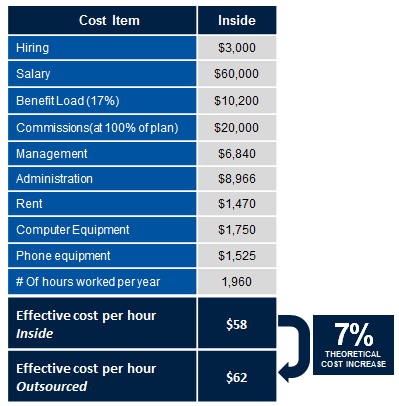
You may have considered the following challenges when evaluating the choice to improve results by outsourcing your teleprospecting lead generation:Insourcing Lead Generation costs only 7% more than outsourcing.

Our business is different.

Sales is sales. Every business is a bit different; however, people buy things to solve business issues based on the solution fit, the reputation of the company selling the solution AND the effectiveness of the sales person.

No one outside gets us. 

Most of the good sales people do not dream of becoming technical experts. If they hear a buying signal in the form of a technical question when talking to a buyer, they are likely to bring in a sales engineer. The sales skills required to effectively solve business issues for any solution can be documented and communicated for any company. No solution is that difficult.

We can do it cheaper inside.

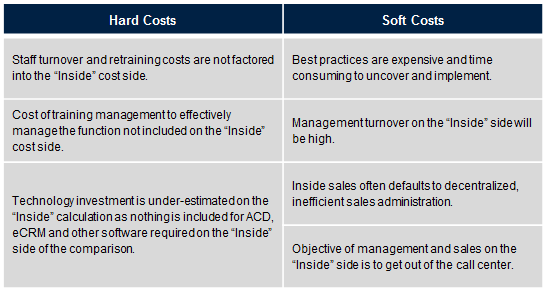
A fallacy. As you see on the table above, it appears less expensive to “do it inside," until you take the following hard and soft costs into account...

The hard and soft costs of inside lead generation.

Additionally, in-sourced inside sales centers are notorious for their lack of productivity. Please see the table below for an example of typical Inside vs. Outsourced results:

Outsourced teleprospecting can more than double revenue.

I do not want telemarketers calling my prospects.

In fairness, our industry has created the image. It is hard not to think about “telemarketing” without remembering a time when you have been interrupted at home by someone who sounds like they can barely read, much less carry on a two-way conversation. However, as with any business, there are specialists. Teleprospectors are specifically hired and trained for engaging high level executives and initiating the complex sale. They are skilled in relationship building and are intelligent, articulate, adaptable and thorough.

You would not dream of building an electric plant outside your office building to generate your own power, you probably should not invest in an inside sales function to support your revenue objectives. Maintaining productivity, keeping turnover down as well as training and managing this function is a job that few people can, or want to do. 

Compared with inside sales teams, an outsourced teleprospecting team can double the quality contacts and dramatically increase the revenue. Review your options. Delegating the critical initial function of generating quality leads provides access to world-class capabilities, increases your control over quality and productivity, improves company focus, reduces operating costs and decreases risk.

Can you really do it cheaper inside? Probably not, and probably not as well.


1Outsourced includes more contacts and more dials per company. Conservative: Ignores value of long-term leads produced. Assumes 1920 hours of one person-year of effort in both cases.

 
01 Sep 16:08

The Disqualification Fallacy

by Anthony Iannarino

What qualifies, or disqualifies, a client? Some will tell you that there is a formula, or a simple method, to qualify prospects. But that thinking is what constitutes the disqualification fallacy.

This lead is no good.

“This lead is too small.”

“This lead would not be a good fit for our business.”

There are certain things that you can see when looking at a lead. You can see the name of the company. That is something that is visible to you. The contact’s name is also something visible to you. Their phone number, their email address, their physical address, all of these are either known or easily discovered.

None of these things that are visible or easily discovered can tell you whether a prospective client is qualified.

Making the Invisible Visible

What makes a prospective client qualified is invisible. To determine whether it makes sense to pursue a lead, you have to elicit a number of things that don’t exist in an easily discoverable format.

  • Does this lead have a compelling reason to change what they are doing right now? Or, provided with more information and a deeper understanding, would they have a compelling reason to change?

There is no single list of leads you can buy that provides you with the information that answers the above questions. If there were a list that only contained leads who were presently compelled by some circumstances to buy what you sell, you would have already been provided with that list.

Disqualifying before you discover whether or not the client has a compelling reason to change is a mistake. And it is a fallacy to believe that you can discern this information from looking at a name.

The second question you need to discover in order to qualify or disqualify a lead is:

  • Will our solution create value for them around their compelling reason to change?

This information is also invisible to you. To know whether what you do and how you do it might benefit a lead, you would need to have a conversation.

Fallacious Logic is No Logic At All

It is a fallacy to believe that you can discern information as to whether a lead is good by looking at the name on the screen or a piece of paper.

Without making the call and engaging in a conversation to discover the answer to these questions, you are subject to the disqualification fallacy. That fallacy is believing that you have the ability to know things that are unknown to you simply by looking at a small piece of information that is unrelated to what you would really need to know.

You can presume nothing. Stop over-qualifying.

The post The Disqualification Fallacy appeared first on The Sales Blog.

01 Sep 16:08

Using Sales Interns to do SDR Research

by James Nielsen

3 Reasons You Should Hire Sales Interns To Do SDR Research

The Sales Development Representative role has exploded in popularity over the past 10 years as software companies have bifurcated inside sales into closing roles and prospecting roles. The goal is to keep your Account Executives focused on qualified opportunities and let more junior reps filter the inbound leads and prospect into target accounts. The SDR role is also a great training ground for future AEs.

In the constantly-evolving world of technology sales, it may be time to bifurcate outbound Sales Development by adding a research role to support outbound SDRs.

nielsen1

Here are 3 reasons you should consider hiring a sales intern to help support your SDRs:

1)  Better resource allocation: Your SDRs are not spending enough time having valuable conversations

Here we are in 2016 and our SDRs are armed with databases full of email addresses and phone numbers, as well as all kinds of great prospecting tools to maximize the amount of touches they can make in a day.  With one click, you can send a 5-email campaign to hundreds of individuals in your target account list. (I’m not saying you should do this… just that you can.)

SDR prospecting emails fill executive inboxes more than ever, and good SDRs know they need to earn their meetings with personalized outreach. The challenge is that some reps are now spending at least half their day doing research. As someone that receives these emails, I’m happy to see SDRs taking the time to personalize their outreach. But as an SDR manager, I’m also concerned SDRs are not spending enough time actually having conversations.

Are we now ready to bifurcate the outbound prospecting role? Trish Bertuzzi, CEO of The Bridge Group, thinks we’re ready. In fact, she dedicated an entire chapter of her book, “The Sales Development Playbook” to this exact topic.

Researching individual prospects and identifying customized research points takes time. Sadly, there’s no automatic “Perfect Message Generator.” If your reps have compelling events and key research points at their fingertips, they will have better conversations. Access and context are the primary reasons to consider the lead researcher role.

If you want inexpensive labor doing Google searches, reading 10-Q reports, finding compelling events, and trying to see if any executives or board members have relevant connections, then interns could be your missing piece to scalable success.

2) Superior screening process for new hires: You can evaluate interns for future SDR positions

The Sales Development Representative is one of the very few positions in tech where hiring managers don’t look for someone already in that role. In fact, most SDR managers don’t want someone with 12-18 months of SDR experience because they assume that rep should have already been promoted or close to it.

Instead, we sales managers hire from other industries and hope we make good decisions. Hiring sales reps has become a much more scientific process in recent years, but no interview process is as good as having someone actually be part of your team for 3 months. Hiring an intern gives you an opportunity to evaluate future SDRs based on work ethic, culture fit, and performance. If you’re impressed, you can extend an offer.

3) Faster hiring and ramping for new SDRs: You constantly have a pipeline of SDR candidates that can be promoted at any time.

From the day an SDR headcount opens up until the day that SDR is consistently hitting full quota, you are losing hundreds of thousands of dollars in pipeline and potentially even millions. In the time it takes to post the job, interview candidates, do reference checks, make an offer, let the candidate put in their 2-week notice, spend a couple weeks in new hire training, and then take a month or two to ramp up to full quota, you’ve already lost 3-6 months worth of pipeline.

Imagine if an SDR quits on Friday and you promote an intern over the weekend to take over that same territory Monday morning. This new SDR just spent the last several months learning your product, your market, your customer anecdotes, and listening to your sales team have conversations every day. Additionally, the intern has hopefully made a couple hundred calls and run through an email and social campaign of their own.

In fact, why wait for someone to leave? You can evaluate your interns against your lowest performing SDRs. Some managers keep bottom performers on the team because they can’t afford the gap in productivity. How much more pipeline would you generate if you could replace your bottom 2 SDRs with individuals performing near the top?


In summary, you should consider a Sales Dev Intern because your SDRs will be significantly more productive, you’ll have a superior vetting process for future SDR hiring, and you will exponentially accelerate your training and ramping time. Specialized skills are crucial in all areas of your business and it’s time Sales Development adds one more position to the team.

I’m looking forward to seeing which sales leaders become early adopters and create this new role on their team.

The post Using Sales Interns to do SDR Research appeared first on Sales Hacker.

01 Sep 16:07

Your Inbound Leads Are Stuck in the Funnel: Now What?

by Andrew Macey

GettyImages-538664984.jpg

If you’ve ever launched an inbound marketing campaign, you know how much time and effort go into making sure everything is planned out, set up, optimized, and revised before that big launch day. If you’re in a role such that organization that relies on the marketer to get you leads, then you are probably all too aware of that feeling that the process should be able to speed up.
Everyone who is part of this process wants the same thing: inbound leads, marketing qualified leads, sales qualified leads, and the all-too-important customer. These leads are very important to the marketer involved, because they allow the marketer to continue gathering valuable information based on the actions taken by these leads as well as proving ROI for their services. These prospects who have found your landing page have got enough value in the offer to give you the information you asked for. In turn, they are starting to increase their qualification, have proven to you (through their initial actions) that your content is worthwhile, and are willing to leave the door open for more communication from you.

However engaged these inbound leads initially were, often they become stuck in the sales funnel. The effects of this are felt across the organization. Marketers are generating many awareness-stage leads, however these leads are not converting towards sales. Additionally, the sales pipeline is drying up as new leads are not becoming sales-qualified. In order to hit both marketing and sales targets, this process needs to be optimized.

What IS “stuck in the funnel”?

When a lead is stuck in the funnel, it means that they are not progressing towards sales. No matter which lead nurturing workflow they are enrolled in or progressive forms they interact with, they are not budging. The issue with this is as a marketer, you are left without much information. These leads have expressed interest in your company and your content at one point, however they have not requested a sales conversation. There leaves a lot to be hypothesized; for example: what their timeline is, what their pain points are, if they are the right contact, etc.

Due to the influence that these leads have across your organization, it is important to clear this blockage within your sales funnel. Until this is improved, any new leads generated will not efficiently move towards sales and many will continue to get hung up. When planning to tackle this issue, you should ask yourself a few questions to confirm where the problems lie. For each stage of the funnel ask yourself:

  • What should be happening?
  • What is happening?
  • What is not happening?

The first step in optimizing and fixing your funnel is determining if there are indeed areas where growth and/or interest seem to stop.
Assess your individual funnel by thinking through the buyer’s journey for your targeted persona. In the awareness stage, does your offer speak the language of the persona? Does the offer help them identify a problem they may not have known they had before, but will seem pressing enough for them to act on?

Is the awareness offer landing page converting visitors? If the conversion percentage is not up to par, you will want to review the landing page for best practices. One fix if you aren’t receiving adequate conversions on this page is to create an A/B test and make one version have much less copy and more keywords and phrases that the persona would recognize and use, as well as more visuals. When a visitor converts on a form, are they receiving a follow-up email, and what does their engagement look like?

Are the click rates at a reasonable percentage within the lead-nurturing emails?
(Reasonable is, of course, subjective.)
Screen_Shot_2016-08-30_at_2.03.12_PM.png

Before moving onto the next stage of the funnel and assessing for areas of improvement, ask yourself if there is anything that you expected to happen in this stage that is not happening. Did you expect a lot of activity from an initial email blast, but your conversions and visits come mostly from social channels? Did you expect tons of prospects to instantly want the offer, but no one seemed to?

If everything seems to be all right in the awareness stage, and it does not seem that the gap/blockage in the funnel is happening at that stage, follow the above steps for assessing the landing page and follow-up/lead-nurturing emails in the consideration and decision stage of the buyer’s journey in order to determine if they are doing what they are supposed to.

Examine how email and email automation are being used at each stage.
What do email stats look like? Does email seem like a valuable channel for this campaign? Is “Lost Contacts” a column that continues to climb? (If so, worry.)
HubSpot has a fantastic guide to gauging your workflow’s performance.

Fix: Extend or shorten the steps in the workflow based on when people are dropping off.

Are your leads engaging in any way with your emails, whether they are opening the email, reading enough of the email to click on a link, or even possibly deleting the email without opening it? These are all actions that can tell us whether or not our tactic (email/workflow/lead nurturing) is working, and, if not, it can help us make the choices needed to fix or remedy.

Screen_Shot_2016-08-30_at_2.04.22_PM.png

Where is engagement declining?

Screen_Shot_2016-08-30_at_2.05.33_PM.png

What small changes could you try in order to achieve greater results moving forward?
Ask yourself: Are you helping your potential buyer recognize and identify their pain points? It should be clear in the copy on both the landing page and email that the offer will help the visitor somehow identify an issue that affects them. Are you using a CTA in order to visually motivate the reader to click? Do CTAs match the look and feel of the content offers? Does form messaging align with CTA and offer copy?

If your inbound leads are falling short and not moving, perhaps it’s time to collect feedback from your community of users or customers.

Imagine sending your leads the answers they need to the hard questions their peers will ask them about your solutions. If you nurture these inbound leads by sending them answers to common objections, you are helping them, which in turn helps you appear to be the authority, which could lead to further engagement in the future.

Do you have content that truly fits the “middle of the funnel” or consideration stage of the buyer’s journey? Having a solid outline of the approved and agreed-upon content offers going into the production phase of a campaign will help keep the content aligned with the targeted persona.

Fix: Map the content currently being used in the campaign in order to identify if there are gaps or pieces missing.

If the content and copy are on point, next evaluate if you are up to date on your targeted persona pain points. Customer interviews are great for this, but a lesser utilized medium for research is Twitter. Create a list of both your existing customers and your targeted personas and monitor the feed in order to see if there are common pain points that you can address and help solve with content.

Identify where the problem COULD be occurring:

  • Spam filters – Cause: If you don’t keep your contact database up to date, you could get marked for spam email, and you will never reach some of your intended readers.
  • Bad email subject lines – Cause: If the receiver is not expecting your email, a subject line that comes across as spammy will convince them to send your email right to the trash.
  • Too much copy/not enough action – Cause: When you provide too much copy, making sure everything that you believe is important is mentioned, you may find that your click rate is very low, yet your open rate is high. If this is the case, you should try to reduce and clean up the copy to be more concise and point to a very clear CTA.
  • Workflow and automation happening too quickly in a timeline – Cause: Perhaps your workflows are set to kick off an action as soon as a lead fills out another form. Timing is everything, and sometimes for a sales cycle that takes many months a longer, more targeted workflow can perform better.
  • Does the content align with the “ask”? – Cause: In lead-nurturing emails, are you utilizing your blog articles as ways to pull a lead through the funnel by getting them interested in additional educational and informative content? Perhaps your buyer’s journey has two content pieces before the decision-stage offer, but you come to learn the sales cycle is more than a year long. Thinking outside the box is always a good thing, and sometimes you have to create a longer lead-nurturing automation with more content pieces and additional resources or content to keep a lead or prospect invested in you.

Giving inbound leads the gentle nudge they need to get back into the funnel.

You may find that this venture into exploring why a lead is stuck in the funnel leads you to your sales team and begins or continues dialogue around what the sales cycle looks like. Are the expectations of the sales team unrealistic? Are you pushing a lead through a funnel too quickly? If so, they may need more lead nurturing emails that steer them in more organic ways eventually toward a consideration or decision-stage offer?

Fix: Try adding a phone call from sales during areas of a lull in the funnel, but after the phone number is acquired. Perhaps sales can help gain information for you while they have a meaningful conversation.

Fix: Apply scoring to parts of the funnel and potential actions that could be measured in relation to it. Could this help disqualify and help you focus on the actions of the people you are truly targeting?

Review the forms used at each stage of the buyer’s journey. Do they ask TOO much from a prospect? Are the questions complicated, and does the form take too long to fill out?

Fix: Are the questions that are being asked benefiting your knowledge of the lead and helping you make smart decisions for the future of inbound leads? Additional quick ways to improve lead conversions can be found here.

While inbound marketing doesn’t always get you immediate results, keep in mind that the purpose is to help you gain authority on the web, increase your overall SEO traffic, and, of course, generate quality inbound leads. In order to get this process down to a science, you have to treat it like a science experiment; learning from data and improving from past mistakes.

As leads progress through your newly optimized and potentially re-strategized funnel, it is important to continue to analyze and evaluate data in order to make sure that the process is well optimized. During this next phase of evaluating your inbound marketing plan, it will be important to start to think about your key performance indicators (KPIs) and how you will measure the success of your plan.

31 Aug 16:00

23 fascinating diagrams reveal how to negotiate with people around the world

by Gus Lubin

Communication Patterns 3x4

You can't expect negotiations with the French to be like negotiations with Americans, and the same holds true for every culture around the world.

British linguist Richard D. Lewis charted communication patterns as well as leadership styles and cultural identities in his book, "When Cultures Collide," which is now in a third edition. His organization offers classes in cross-cultural communication for clients like Unilever and BMW.

Although cultural generalizations can be overly reductive, Lewis, who speaks 10 languages, insists it can be done fairly. "Determining national characteristics is treading a minefield of inaccurate assessment and surprising exception. There is, however, such a thing as a national norm," he writes.

Scroll down to see Lewis' insights on negotiating with people around the world.

Jenna Goudreau contributed reporting.

SEE ALSO: A former FBI hostage negotiator explains the psychology of negotiating using the example of a $3.50 mug

Americans lay their cards on the table and resolve disagreements quickly with one or both sides making concessions.


Canadians are inclined to seek harmony but are similar to Americans in their directness.


People in the UK tend to avoid confrontation in an understated, mannered, and humorous style that can be either powerful or inefficient.


See the rest of the story at Business Insider
31 Aug 15:59

4 Business Lessons We Learned from Willy Wonka

by Matt Goldman

This week brought the unfortunate news that film legend Gene Wilder had passed away at age 82. He was famous across the globe for roles in Blazing Saddles, Young Frankenstein, The Producers, and many more; but perhaps his most iconic role was that of Willy Wonka. No matter what year you were born in, the story of Charlie and his march through the Chocolate Factory has likely been a part of your life in some way.

At its core, Willy Wonka & The Chocolate Factory is a story about love, honesty, and in the case of the titular character, taking the road less traveled. However, it also served another purpose, perhaps unintentionally. Throughout the film (and of course the book) Willy Wonka provides us with valuable business lessons. Some are better than others, with a couple serving as “what not to do” examples, but nonetheless, there is real advice within the film that can be utilized today.

1. Be creative with your marketing promotions

The initial catalyst for the story was the creation of a promotion. By initiating the “golden ticket” program, Wonka immediately created a frenzy for his products. With the promise of free chocolate for life, who wouldn’t run over to their closest corner store in order to secure as many Wonka products as possible? He created his own lottery, and his company undoubtedly saw a spike in revenue as a result.

McDonald’s has experienced similar success with their Monopoly promotion. Every October, their products come with tear off Monopoly pieces that carry prizes of different values. Some properties offer free food, while the more valuable pieces offer vacation packages, cars, and cold hard cash. While they’ve been running this promotion for nearly 30 years, they still experience a significant sales spike every October.

In 2011, sales increased by “6.1% in the Asia and Pacific region, 5.2% in the U.S. and 4.8% in Europe,” during the month of the promotion. More recently, in 2013, “the Monopoly Promotion increased its third quarter profit of that year by 5%” across the board.

Domino’s is another great example of a company using a creative marketing campaign. After years of complaints about their main product, pizza, Domino’s finally listened, and committed themselves to change. Not only did they start the process of rebuilding their product, but they fully admitted, loudly and clearly that the previous iterations of their pizza wasn’t good.

As a result of the campaign, “the chain’s sales grew 14.5 percent to $362 million in Q2 2010, and up 16.5 percent for the first six months of the year — the period in which the campaign was launched. It’s a testament to a notion that’s not often honored in brand management: honesty is the best policy.”

Of course, now that their product is in fact better, they’ve had to figure out a new campaign to run, but that’s what we call a good problem.

2. Don’t rehash the same products, innovate!

The key to Willy Wonka’s success (other than his fantastic name) was that he differentiated himself from the competition. Instead of just producing the same types of sweets as everyone else, which would have further saturated the market with similar goods, he created Everlasting Gobstoppers, Fizzy Lifting Drinks, and Golden Chocolate Eggs laid by geese. Wonka curated a “sweet experience” with his goods, rather than simply copying what already existed.

Most products strive for differentiation, but due to a myriad of reasons that could fill a book, they fail. That being said, there are companies that have accomplished this goal. When Apple was releasing the first iPod’s and iPhones, they were seen as one of the most exciting companies in the world. They were making products that nobody else had, which caused other companies to react to their innovations.

Just recently, we’ve seen Elon Musk disturb the automotive industry with Tesla, and the space industry with SpaceX. Rather than creating another unfathomably fast car, Musk and his team built the world’s fastest production car, that just so happens to be powered by a battery. Instead of simply building private rockets that could compete with Nasa, Boeing, and Lockheed Martin, Musk and his team have developed re-usable rockets that can land themselves on autonomous drone ships. In each of Musk’s companies, he isn’t recycling ideas that have come before him, but rather, he’s re-defining them.

Business Lessons we learned from willy wonka

3. Have an exit strategy

Wonka did technically have an exit strategy, but for all intents and purposes, it was terrible. The story of Charlie making his way from a poor and underprivileged youth, all the way to owner of the Chocolate Factory is a fantastic story, but in the real world, this would be one of the most misguided business decisions in recorded history.

Imagine if Steve Jobs had organized a tour of Apple’s headquarters for five kids, and at the end of the tour, chosen one of them to run the company. It would have been absolute chaos. Stock prices would have plummeted, the board of directors would have rioted, and the end result would have been disastrous. While that would never happen in a million years, that’s exactly what took place in Willy Wonka & The Chocolate Factory.

Rather than installing someone with ample knowledge of the factory, its processes, and its employees, Wonka chose a replacement with absolutely no experience in any of the above. It’s great that Charlie is an honest kid, and perhaps with the right training and guidance he could step into the role that Wonka left him, but there’s absolutely no chance he could effectively run the company.

The entire plot is strikingly similar to an oft-forgotten scene in The Office, where Michael Scott wonders what the United States would be like with a baby in charge.

“If a baby were president, there would be no taxes, there would be no war. There would be no… government, and… things could get terrible. It actually, probably it would be a better…screenplay idea than a serious suggestion.”

4. Create a lasting image

This tip isn’t as much about Willy Wonka as it is about Gene Wilder. As a 25-year old writing this article, I can confidently say that without a doubt, Wilder is and always will be Willy Wonka. He might not have made chocolate or the incredible candies that were featured in the movie, but by immersing himself in the role, he became the character who will be forever showcased on our screens.

Even though the movie came out more than 45 years ago, kids would still “smile or call out…’there’s Willy Wonka’” when they saw Wilder in public. That role, and the movie have both had incredible staying power. No matter how long its been since you’ve seen the it, you can probably still remember more than a few scenes, or even some direct quotes. To create an image that connects to the core of consumers, and more broadly, human beings, is something that we should all strive to do; and Wilder’s portrayal of Willy Wonka was a shining example of how to do it best. He’ll be sorely missed, but thanks to modern technology, when we feel down, or lost, we can always turn to Willy Wonka and find ourselves “in a world of pure imagination.”

31 Aug 15:55

BaseTrip Gives You Travel Information About Any Country You’re Visiting

by Kristin Wong

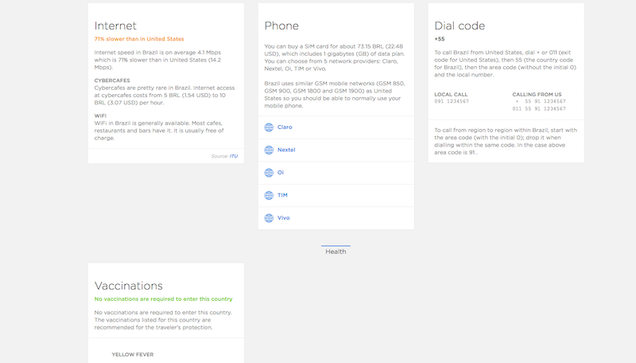
Especially when you’re visiting a new, unfamiliar country, you want to be prepared for your trip. BaseTrip tells you everything you should know about traveling to your destination, from tipping etiquette to vaccinations to average internet speeds.

Read more...

31 Aug 15:53

TSX loses ground as energy stocks fall over bigger-than-expected U.S. crude stockpiles

by Reuters

TORONTO — Canada’s main stock index fell on Wednesday as lower oil and gold prices weighed on energy and mining stocks.

Still, the index was on course to rise 0.4 per cent for the month of August.

The most influential movers on the index included Suncor Energy Inc., which fell 1.9 per cent to $35.73, and TransCanada Corp., which declined 1.2 per cent to 59.14.

U.S. crude prices were down 2.2 per cent to US$45.34 a barrel, extending losses as data showed a bigger-than-expected increase in U.S. stockpiles.

U.S. stocks also declined on energy as producers dropped with the price of crude oil, hindering the S&P 500 Index’s quest for the longest monthly winning streak in three years.

The S&P 500 fell 0.4 per cent to 2,168.46 at 10:50 a.m. in New York, declining for the fifth time in six sessions to leave it lower for the month. The Dow Jones Industrial Average lost 58.91 points, or 0.3 per cent, to 18,395.39. The Nasdaq Composite Index also retreated 0.3 per cent. Trading in S&P 500 shares was 9 per cent below the 30-day average for this time of day.

In Toronto, the S&P/TSX’s energy group retreated 1 per cent, while the materials group, which includes precious and base metals miners and fertilizer companies, lost 0.7 per cent.

Barrick Gold Corp. fell 2.1 per cent to $22.33, pressured by lower gold prices.

Gold slid to a two-month low after forecast-beating U.S. jobs data stoked speculation that the Federal Reserve would move ahead with plans to raise interest rates.

At 10:40 a.m. EDT, the Toronto Stock Exchange’s S&P/TSX composite index fell 50.83 points, or 0.35 pe rcent, to 14,634.02.

Seven of the index’s 10 main groups were lower.

National Bank of Canada reported a 6-per-cent increase in quarterly profit, benefiting from a recent acquisition that enabled it to beat market expectations.

Still, its shares were down 2.4 per cent to $46.45, while the overall financials group dipped 0.1 per cent.

Canada’s economy shrank in the second quarter in its worst showing in seven years, hurt by a drop in exports and a disruption to oil production caused by wildfires in northern Alberta, data from Statistics Canada showed.

Thomson Reuters

31 Aug 15:49

How to Get Links and Traffic from Flickr [#TrafficHack]

by Ana Hoffman

Hello, hello, my favorite Traffic Hacker:

Wanted to share with you something neat I’ve just discovered – might be a great addition to your future marketing promos!

So I am working on redoing my Promote Your Blog: 10 Steps to Ultimate Blog Promotion post – you know things change, strategies improve, etc.

Flickr, the photo sharing site, has always been on my blog post promotion list as a way to back up my blog post images, get links, and maybe an occasional visitor or two.

It’s easy, so why not, right?

Well, today I was actually paying attention to what I was doing on Flickr (go figure… ?)

And I discovered something… that made me all giddy.

Flickr for Links and Traffic

Ahem… Is it possible that by the end of this email you’ll lose all respect for me, as in ‘Can’t believe she didn’t know that; doesn’t everyone?…’

I’ll take my chances.

Up until now, I’ve been:

  • uploading images from a newly published blog post to Flickr
  • adding naked URLs (as in http://www.trafficgenerationcafe.com/emoji-marketing-guide/) to image descriptions
  • had my setting on ‘All rights reserved’ – because they are… MINE!!!!!

Today I tried to actually use anchor text in the description and… it does work!

Mind blown😉🤓

Not only that, but you can create albums based on your blog posts and add anchor-text description to your albums!

Not only that… but you can actually change your settings to ‘Attribution‘ – meaning anyone can use the image as long as they place a link back to you.

That way, people who are looking for free images to use for whatever – their blog posts, for instance – can actually find your images, might follow you back to your site, might share it with others…

You see all the possibilities?! I certainly do.

Yay! It was worth getting up at 4 am this morning… ☕️ ☕️ ☕️ ☕️  (yes, that’s four!) espressos might’ve had something to do with the giddiness as well…

Just in case you are not sure what anchor text is or how to write a link with it, read:

Your Ultimate Anchor Text Tutorial – from Basic to Advanced

3 Ways to Add Links on Flickr

1. in the photo description:

How to add a link to photo description on Flickr

2. in the photo album description:

How to add a link to Flickr photo album

3. in your Flickr profile:

How to add a link to your Flickr profile

HOWEVER, your profile link will most likely get you no traffic, since your profile itself is very well hidden in the dropdown menu (why, Flickr, why?…):

Where is your Flickr profile?

How to Get More Value out of Flickr

GROUPS.

I had no idea Flickr groups exist until a friend of mine, Vincent Brown of Vintuitive.com, told me so – great tip; thanks, Vin!

You can navigate to groups by clicking on… yes, ‘Groups‘ while in your profile or even create your own Flickr group. And become a true Flickr groupie!… 🙂

Where to find Flickr groups

You can also find the complete list of all Flickr groups here – in a much more effective text format.

Toggle the ‘Relevant‘ button at the top right to make it a bit easier to find what you are looking for.

Join flickr groups for more exposure, traffic, and links

Will You REALLY Get Much Traffic from Flickr?

Hmmm… my guess is probably no. Just being honest here…

However, this strategy is easy to implement, it gives you a way to back up and organize your blog post images, and it builds your presence across various platforms.

Links are an additional bonus.

True, those links are nofollow. But you know what?… even nofollow links have value. Read The Blogger’s Guide To Nofollow Links at SearchEngineLand.com to learn more.

Flickr Marketing Takeaway

So now, when using Flickr, I will:

  • upload images from a newly published blog post
  • add varied anchor-text links to image descriptions
  • create albums based on topics or blog posts
  • have my setting on ‘Attribution‘ so that my images can be used by others.

Here are some examples of how I did it based on my newly published Emoji Marketing: 😂, ❤️, and 💩? [Beginner’s Guide]t:

Easy peasy!

So… what do you think?

From Ana with love ❤️

The post How to Get Links and Traffic from Flickr [#TrafficHack] appeared first on TrafficGenerationCafe.com. Don't miss Ana's free Bite-Size Traffic Hacks email series - short actionable traffic tips to double your traffic in no time.

31 Aug 15:49

Big company advertising

by Seth Godin

American Airlines doesn't know what to say.

And they're having a lot of trouble saying it.

They're making a fortune this year due to low oil prices, and one way to manage shareholder expectations for the future is to put some of that profit into brand advertising. And so, they hired a fancy ad agency and started to run full-page, two-sided, glossy inserts in newspapers. The single ad I'm looking at cost at least $100,000. And I might be one of a hundred people who are actually reading it.

The copy-dense ad includes references to babies, red-eyes, noise, middle seats, lessons learned, 'relinquish', making the best of the situation and the ability to sleep anywhere. All told in an odd third-person, referring to the hero as "they" not "you." 

With a layout that's so confusing that there's a big arrow that says "start here".

Some things worth remembering:

  • Ads can still work, especially ads with consistent budgets, excellent copywriting, smart frequency and a thoughtful strategy. Easier said than done.
  • Great products work far better than great ads do. And the key part of a great service-based product is service, which is totally up to you, the marketer.
  • Direct marketing is measured, brand marketing is long-term and aspirational.
  • Simple test for brand marketing: If I can substitute one company for another and have the ad still make sense, it's not a good ad.

For thirty years, the airlines have relentlessly trained travelers to spend as little as possible on a seat, offering generic alternatives and contemptuous, confusing pricing policies. To blame the state of travel on the passenger ("Let's move that conversation from us and turn it onto them..." said Fernand Fernandez, VP of global marketing at AA) doesn't feel like the foundation for a great marketing campaign, does it?

The lesson for anyone spending money on ads: it pays to be consistent, generous and thoughtful when you build an ad campaign.

[Posted from LGA. /rant]

[For those that wanted to see the ad, here it is]

       
31 Aug 15:48

Canadian firms launch platform to secure IoT with blockchain

by Donal Power
Victoria BC,Canada.June 10th 2014.Uniformed Canadian RCMP Police march in unison in honor of fallen officers who have given the ultimate sacrifice while doing their duty.

Two Canadian tech firms are developing secure Internet of Things (IoT) communications using blockchain technology.

The Waterloo Record reports on the partnership between Waterloo-based Terepac Corp. and Toronto’s Nuco Inc.

The two firms recently launched a platform to secure internet-connected IoT devices using blockchain.

Blockchain technology, upon which Bitcoin was built, provides secure, tamper-proof communications and transactions.

“Blockchain is expected to transform almost every institution and every company,” said Terepac CEO Ric Asselstine. “It is only now being imagined, but the expectation is that this is more powerful than the first wave of the Internet.”

This follows news earlier this year that other big IoT players such as Samsung and IBM are pushing the integration of blockchain to secure connected devices.

Terepac originated as a specialist in electronic miniaturization in 2005. Since then it has developed the software and hardware to enable the remote monitoring of equipment, yachts and municipal water system leaks.

Don’t call it a pivot

Additionally Terepac sees blockchain harmonizing well with its patented Terecircuits technology that integrates electronics into devices to allow IoT capability.

“I do not call this a pivot, I call it an extension of our capabilities,” said Asselstine. “So the logical extension now is the blockchain capabilities.”

The first new service to emerge from the blockchain focus is Terepac “Blockchain Data Reliance as a Service.” This service incorporates blockchain to enable reliable and trustworthy data transfer without third party verification.

This service allows Terepac clients to better secure the ever-increasing rivers of data created by IoT devices. As well, it allows Terepac to perform the role of trusted authority for clients interested in expanding their IoT and blockchain capabilities.

“One of the main opportunities for Terepac is to help develop understanding on behalf of enterprise clients, so we become the resource,” said Asselstine. “We are basically the tour guide into the future, the Internet of Things and blockchain technology.”

The post Canadian firms launch platform to secure IoT with blockchain appeared first on ReadWrite.

31 Aug 15:48

10 Ways to Beat Your Competitors This Fall

by Brian Morris

Business success relies, in large part, on your ability to beat your competitors. This is especially important for fall marketing, when you’re turning your attention away from summer promotions and toward end-of-year holiday marketing. Here are ten ways to beat your competitors this fall.

1. Start early
Getting an early start on your fall marketing yields multiple benefits: you can make sure your campaigns are well-thought-out and comprehensive and you can rest-assured knowing your marketing plan is in place and ready to go. But the best benefit is the ability to get a head start on your competitors and reach your customers with fall and holiday promotions before the competition gets to.

2. Test your campaigns
Test your marketing campaigns to make sure they’ll yield a healthy ROI before you commit time and monetary investments. A/B test your control materials to see if you can make them better. Always look for opportunities to tweak what works and generate better results from your marketing materials.

3. Go big
Stand out from the competition with oversized marketing tools: extra-large postcards, for example, or prominently-placed wall graphics and banners. The bigger your marketing materials, the more customers will take notice.

4. Consider the customer experience
Walk a mile in your customer’s’ shoes to identify ways to improve their experience. Find ways to engage directly with customers, seek to genuinely solve their problems and make their lives better, and train your staff members to offer the ultimate in friendly customer service. Become the place customers want to shop!

5. Target, target, target
Define your audience to a minute degree. Create different customer profiles and run different promotions to each. Invest in targeted mailing lists and ad campaigns. The bottom line: the better you know your customers, the greater your targeting and the more success you’ll have with your fall marketing campaigns.

6. Add value
Add value for your customers to establish your brand as the authority in your field, foster long-term relationships, and motivate purchases. Distribute helpful how-to booklets that help customers achieve their goals. Print holiday calendars customers can use year-round. Empower your staff to offer spontaneous free upgrades. Create customer loyalty cards to reward multiple purchases this fall.

7. Highlight your advantages
You might not be able to compete with big box stores on price, but that doesn’t take you out of the running for fall and holiday sales. Highlight the advantages of doing business with you: a more helpful, knowledgeable, and friendly staff; excellent customer service; local service; and other benefits are valuable ways to position yourself for increased fall sales.

8. Maximize exposure, minimize investment
Keep an eye out for marketing discounts that will help you reach more targeted customers for lower investment. Discount printing, for example, or negotiating print and digital ad rates are good places to start. Inject your brand into relevant events to expose customers to your values for cheap.

9. Look for untapped opportunities
What marketing tools haven’t you tried? What opportunities are your competitors missing out on? Take advantage of them, try something new, and find new and unique ways to reach customers. Don’t be afraid to break the mold and be bold – it could be what sets you apart and generates more exposure and sales this season.

10. Do more
Whatever you do, identify ways to do it better. Sweeten the deal for your customers. Personalize your communications. Study your competition, find out where they’re lacking, and fill the void for your customers. Keep in mind: your goal is to present your company as the better – and best – option for fall shopping.

31 Aug 15:47

7 Must-Have Tools for Smart Project Managers

by Dani Zehra

In today’s hyper-competitive market, organizations make use of disciplined project management to ensure that required results get delivered with consistency. Project managers are now, more than ever before, required and expected to remain on top of their game. So, what takes a Project Manager from good to great ? Conventionally, the mark of a smart Project Manager was the ability to lead the project from beginning until the end with optimum allocation of resources.

However, nowadays, owing to the globalization of operations, increasingly complex procedural requirements and rigorous performance checks; state-of-the-art project management tools are a Project Manager’s true strength. A smart Project Manager of 2016 uses these tools to maximize efficiency and drive the project home in a way that adds value to the organization.

So, what are these amazing instruments and gizmos? Let’s have a look below; where we’ve compiled a list of the most effective must-have tools for smart project managers:

1. Project Plan:

One should always begin with the end mind; smart PMs develop a thorough Project Plan outlining everything from project scope, allocation of responsibilities, Work Breakdown Structure (WBS), project budget and financial projections, etc. Here, the most crucial components for Project Managers are resource allocation and scheduling. Research indicates that the more the amount of effort that goes into planning a project; the fewer are the chances of running into errors. Moreover, the age of using Excel to plan a project is long gone. Projects are increasingly complex and several different factors and departments have to be used cohesively to deliver specific outcomes.

It is for due to this reason, that efficient PMs make use of project management software that help to determine which events depend on each other and how, what to expect in case factors change and more importantly they highlight the probabilities of error. 2016 has proven to be savior for Project Managers; with a plethora of project management software that allow for secure, streamlined and detailed planning, organizing, monitoring as well as control of projects. Some of the leading software in the industry include AceProject, Easy Projects and Bridge24.

2. Gantt Charts:

One of the simplest yet most widely used status tracking instrument is the good old Gantt Chart. Seemingly a simple software; Gantt Charts are absolutely essential for effective project management as is evident from it’s use by Project Managers worldwide. The reason for their vast usage lies in the fact that they list down all the activities of a project and indicate their interdependencies and, hence, serve to manage a project cohesively.

3. Milestone Tracking:

The attainment of project milestones is imperative in the overall success of a project. Milestone tracking allows project managers to identify responsibilities and timelines. Smart project managers invest in much more detailed milestone tracking applications that allow them to get an edge over the rest while bringing about the highest levels of outcome and efficiency for projects. Some of the most popular milestone tracking applications include Upvise Projects, Trello, Zoho Projects and Collabtive.

4. Cloud Based Storage:

A breath of fresh air and by far the most beneficial new innovation is cloud based storage. The advent of cloud-based storage applications has literally brought the worries of project managers to an end. These applications store critical company information in completely secure online platforms, in other words you can access this information from any location that has internet connectivity. Increasingly useful for increasingly complex projects; cloud-based storage enables project managers to share information, reports, progress updates and virtually anything with their team members regardless of their physical location. Okay, so if global access to information wasn’t enough; these applications back your data up so that you never have to fear losing it. One of the most widely used functionalities is our cherished file sync. The most trusted providers of cloud-based storage applications include Google Drive, Dropbox and Outlook.

5. Time Tracking and Invoicing:

Yet another project management application that is a must-have for smart project managers is a time tracking and invoicing application. Also cloud based; these applications offer a gigantic range of advantages to project managers. They enable remote tracking and management of time of a workforce situated in different physical locations. Once tracked, these applications allow for the generation of invoices as per the predefined rates. Moreover, they provide estimates that may be shared with prospective clients. These applications optimize the allocation of resources and drastically reduce chances of error. Several of these applications are available in the market; the most widely used include Minterapp, Zoho and Harvest.

6. Weekly Progress Reports:

The road to success for project managers comes from timely and accurate reporting to all stakeholders allowing them to be thoroughly synced with the progress of the project at hand. Moreover, it is a Project Manager’s key responsibility to keep the stakeholder’s informed about the progress of the project. And smart project managers make it a point to keep the stakeholders updated on a weekly basis. The weekly review meetings should include progress of the project, financial status as well as any changes that might have become necessary as the project moved on. In order to ensure that regular weekly meetings occur smart managers use resources like video or telephonic conferencing. These resources allow participants present at various locations to be present for these very crucial meetings.

7. Budget Tracking:

Today, the primary indicator of good performance for business owners as well as shareholders is optimum allocation of budget. This is imperative for Project Managers because by being custodians of the entire project; they are answerable for the efficient allocation of money. Hence, smart project managers ensure strick budget tracking to ensure it’s appropriate allocation. Moreover, efficient project managers conduct frequent budget checks enabling them to always stay on top of the outflow of money. This is also necessary as it is useful in identifying and consequently rectifying any leakages or abnormalities. Budget tracking can be done by formulating project matrices. These matrices can be derived using spreadsheets, project tracking software and Prince2.

So, there you have them; the seven tools that make smart project managers stand out from the also-okay and average crowd. If you have not been using these tools, and feel overwhelmed by work responsibilities, be smart by streamlining business processes.

31 Aug 15:47

Research: Millennials Can’t Afford to Job Hop

by Sylvia Ann Hewlett
aug16-29-154452462

Millennials are probably the most maligned generation yet to enter the workforce. The demographic cohort born between 1982 and 1994 is often portrayed as disloyal job hoppers —  self-involved idealists demanding a steady diet of recognition and raises. In short, a human resources nightmare, right?

Wrong. A new study on Misunderstood Millennial Talent: The Other 91 Percent by the Center for Talent Innovation shatters the stereotype that all Millennials are entitled whiners just waiting to jump ship. Far fewer Millennials are a flight risk than you think, and the reason is stunningly simple: money.

Forty percent of Millennials with a financial safety net — those who have families that could support them indefinitely if they were to quit or lose their job or who receive financial gifts from family members totaling at least $5,000 a year — say they plan to leave their jobs within a year. But these financially privileged folks represent fewer than one in ten Millennials CTI surveyed born between 1982 and 1994 who are working full-time in white-collar professions in the U.S.

Further Reading

Only 10% of the financially unprivileged majority — the other 91% of Millennials — are planning on leaving their jobs within a year.  Many of them are staggering under heavy college debt, and they can’t rely on their family for financial help. Fifty-one percent took out loans to fund their undergraduate education, compared to 40% of their financially privileged counterparts; of those less-privileged Millennials burdened by student debt, 43% had loans totaling $40,000 or more. This means that the vast majority of Millennials are ready to commit to their current employer and invest prodigious amounts of time and energy in their work in the hope that their employers will invest in them in return.

And yet most companies act as if their Millennials have one foot out the door. “Can you get these kids to stay?” challenged the global talent head of a multinational consultancy. “We cross-train our Millennials to keep it interesting for them. But we hesitate to send them off to far-flung places for two years, because they won’t stay with us. We’re not going to see the payback. Their next employer will.”

In short, even as HR professionals recognize Millennials as their next workforce, they see no reason to groom them for leadership until they start acting, sounding, and looking like previous generations. That’s a mistake with profound implications. Since exposure to other countries, cultures, and consumers helps give young professionals the knowledge they need to grow those markets and crack open new ones, denying them exposure or field experience jeopardizes both corporate revenues and future expansion prospects. And if leadership development (typically reserved for high-potential talent) and cross-generational interaction are withheld from Millennials, then the imminent exodus of Boomers threatens to pull decades of institutional knowledge and market expertise out the door with them.

A more nuanced understanding of what Millennials really need and want would suggest that companies are better off doing the following to attract, retain and develop their Millennials:

Create a forum for cross-generational communication. CTI research finds that Millennials seek to contribute value for their employer and achieve their team’s goals. Novo Nordisk, Inc. encourages Millennials to share their ideas and development needs by sponsoring a Millennial Employee Resource Group (ERG). The grassroots ERG formed less than a year ago and already boasts a membership of nearly 500 employees. Open to all employees, including older members who are “Millennials at Heart,” the ERG is working to bridge Novo Nordisk, Inc.’s diverse, multigenerational workforce. “We are deliberately creating an environment where Millennials and all generations have the opportunity to work side-by-side with senior executives,” says Jackie Scanlan, CVP of human resources. “We know it is working because leaders are now coming to us and asking how they might engage this ERG in innovative discussions and brainstorming sessions.”

Show them how to create value. If there’s one stereotype that talent specialists are loath to abandon, it is that Millennials cannot get through a day without someone affirming their worth. CTI research finds that 45% of the financially unprivileged Millennials say that recognition is very important in their career. “But it’s more because they want to understand how they contribute to the business strategy,” explains Diana Cruz Solash, EY Americas Ethnicity Leader. “Millennials want ‘just-in-time’ feedback, so we give it to them right away” — by expecting EY partners and executives to help all associates see their impact. EY has also stepped up efforts to reward employees with recognition: “Applause Awards,” for example, can be sent by anyone to anyone, with copies sent to the recipient’s manager. Likewise, EY has a central online feedback system to enable employees to recognize managers for on-the-job coaching.

Help them craft their ideal work environment. Millennials have a bad reputation of jumping jobs at the hint of a higher paycheck. CTI data shows that while compensation needs to be high enough for Millennials to provide for themselves and their loved ones — 82% of financially unprivileged Millennials say that an important aspect of high compensation is the financial security it affords them — money alone isn’t enough of a magnet to draw Millennials away from a company that offers opportunity to learn new skills, build rewarding relationships, and progress in their careers.

Companies that dismiss Millennials until they “grow up” are ignoring demographic reality. They already have grown up. According to a recent Pew Research Center study, Millennials now represent 34% of the U.S. workforce, outnumbering both Gen Xers and Baby Boomers. And the numbers will only increase.

The smartest thing forward-thinking companies can do is to stop treating Millennials as if they are an alien species and at least listen to, if not embrace, their ideas and professional desires. “The perception that we need to turn the workplace on its head to satisfy Millennials just isn’t accurate,” observes Nancy Testa, chief diversity officer at American Express, a sponsor of this study. “Millennials are looking for career growth, competitive pay, and purposeful careers – things every generation wants. It’s the delivery that’s changing, and frankly, it’s changing in a way that improves the workplace for everyone.”

31 Aug 15:47

The Five Best Pinterest and Instagram Marketing Tools

by Tom Pick

Increasing use of mobile devices combined with the popularity of “snackable” information have made visual content an increasingly important component of content marketing. Greater use of visual communication has in turn made Instagram and Pinterest two of the fastest-growing social networks.

Best Pinterest and Instragram Marketing ToolsOn Instagram, marketers can post high-quality photos along with captions and hashtags, and use Facebook-type features such as tagging people in photos as well as “liking” and commenting on others’ images.

Dominated by fashion and food posts, Pinterest is most commonly viewed as more of a B2C platform by marketers. But savvy B2B marketers increasingly see its value for promoting infographics, blog posts, videos, presentations, and case studies.

As with other social networks, the right tools can help marketers use these platforms more effectively. Here are a handful of the best tools for growing your brand’s following and monitoring your results on Instagram and Pinterest.

1) ScheduGram
Google Review Count: 269

Upload images, then crop, rotate, apply filters and add text before posting; schedule posts for maximum exposure; and coordinate activity across multiple Instagram accounts and team members.

Sample review: “Are you posting multiple times a day on Instagram? If so, why not make you(r) life a little more efficient by scheduling your posts?” — StoreYa Blog

Pricing: $20 to $100 per month; contact vendor for enterprise pricing

Showcase reviews: StoreYa Blog

2) ViralWoot
Google Review Count: 193

Schedule your pins to optimize exposure, promote your pins, engage top influencers on this platform in your industry or subject area, analyze your competition, and measure results.

Sample review: “Over 39,000 individuals and businesses use ViralWoot for their Pinterest management and analytics…The platform allows you to gain followers by being displayed in the ViralWoot database, promote pins, create pin alerts, manage multiple accounts and get analytics on each of these items.” — MarketingLand

Pricing: free to $499 per month

Showcase reviews: BuzzBlogger, Catherine Pham/SlideShare, MarketingLand

3) TailWind
Google Review Count: 187

Discover content of interest, schedule posts, monitor conversations, run promotions, and analyze results on Pinterest and Instagram.

Sample review: “My go-to tool for content scheduling and detailed Pinterest data is Tailwind. Want to make content curation, scheduling and analysis super easy? This is the tool for you!” — Rebekah Radice

Pricing: $10 to $800 per month; contact vendor for enterprise pricing

Showcase reviews: Catherine Pham/SlideShare, MarketingLand, RazorSocial, Rebekah Radice, Visually

4) Viraltag
Google Review Count: 162

Create original content with your own images or through ViralTag’s integration with Canva, make changes using the built-in image editor, collaborate with your team, and measure the results. Schedule unique content across Pinterest, Instagram, Facebook, Tumblr, Twitter, and LinkedIn.

Sample review: “Publish your visual content to multiple platforms at once with ViralTag. The…platform already has over 40,000 users, both individuals and business, and is geared largely towards Pinterest.” — MarketingLand

Pricing: $24 to $249 per month

Showcase reviews: MarketingLand, RazorSocial

5) Layout from Instagram
Google Review Count: 117

An app that lets you combine multiple photos into a single post image. Drag and drop photos to rearrange them, pinch to zoom or pull the sides of each photo to adjust size and layout, then flip and rotate your photos to create arrangements and mirror effects.

Sample review: “Trying to create a stronger, and more engaged Instagram community? Layout from Instagram is a simple app that lets you create collage-type images so your images can do more work (if one picture is worth a thousand words, what is a layout worth? :))”— StoreYa Blog

Pricing: free

Showcase reviews: StoreYa Blog

31 Aug 15:47

4 Email Marketing Triggers to Drive Immediate Action

by John W Hayes

Stop thinking; start buying. That’s the kind of mind-set you want to create with every email marketing campaign you send. The moment a subscriber is given the opportunity to think about a purchase is the moment you give them the opportunity to hesitate on your offer. It’s not really the subscriber’s fault. People are busy and bombarded with compelling sales messages every day. Making your campaign stand out and demanding immediate action is vital if you don’t want your email marketing sends to leave cash on the table.

4 Email Marketing Strategies That Demand Action – NOW!

  1. The Perception of Scarcity: Nobody likes missing out on a great deal. But unless you let your subscribers know that THEY WILL MISS OUT unless they hurry, your offer will just sit in their inboxes while they take their time to make their minds up whether or not to buy. Let your subscribers know you have limited stock, and they will have to act quickly if they want a piece of the action. You might want to let them know how many units you have and how quickly these items sold out last time you ran a similar offer.
  2. The Early Bird Offer: This is a favorite technique adopted by event organizers. Getting your subscribers to book early for your events by offering a great deal on tickets sold before a certain date will not only generate much needed revenues (the lifeblood of any event), but will also take some of the pressure out of organizing your event by guaranteeing numbers of attendees weeks or even months prior to your event. Alternatively, you might want to combine an early bird offer with the perception of scarcity model by offering cheaper prices until a certain number of tickets have been sold. As your subscriber will have no idea how many tickets have been sold, he or she will be forced to react quickly instead of delaying his or her purchase until the early bird offer comes to an end.
  3. The Presale: Offering “favored” subscribers the opportunity to buy early and gain some kind of “early mover advantage” can really drive immediate demand. The opportunity of a pre-sale almost suggests that an item will immediately sell out when it is made available to your wider community – so they better act fast. The offer of access to your presales can be an amazing list growth opportunity.
  4. The Added-Value Offer: For a bit of a twist on the perception of scarcity, you can offer your subscribers the opportunity to buy before a certain date to get something for free. This could be a tangible product (for example, a complementary product or accessory for the initial purchase) or an offer like free insurance, free training or perhaps a discount off a future purchase.

How do you ensure your subscribers act on your email marketing campaigns in a timely manner? Share your ideas or comments below:

This post first appeared on the iContact Email Marketing Blog.

31 Aug 15:46

Infographics Only Help Some of the People Some of the Time

by Graham Jones

Infographics are everywhere these days. Indeed, you’ll find an entire section of infographics on my website. But are infographics all they are cracked up to be? Are they of any value to your site’s content?

After all, they can cost a lot of money to produce – more costly than the text that they are based upon. So you want to make sure that you get value out of them.

New research shows that the value of infographics depends on two factors

  1. The prior knowledge of the audience
  2. The presence of accompanying text

The researchers provided people with three different presentations of a news story about the economy. The story was real and was written by professional journalists. One group of people were given just the text, another group of people had the text and an accompanying infographic, whereas the third set of participants saw the infographic alone.

Before looking at the article or infographic, the researchers had conducted a survey which showed the degree to which each had prior knowledge and interest in the subject of the article.

What was found was that people who had prior experience and an interest in the subject were LESS engaged with the material if it had an accompanying infographic. The reverse was true if people had little prior interest or knowledge. In other words, it would seem that infographics presented with an article only help your audience if they do not already know about the subject or have little interest in it.

Importantly, the researchers found that when the infographic was presented on its own, the engagement was the same for both groups of people. That suggests that if you do not know your audience’s prior interest, you are better off only publishing the infographic with no accompanying text. (Guess how the infographics are presented in my infographics section…!)

This is yet another study which shows that engaging with people online is not a simple matter. You need to understand your audience in much greater detail than you might think. In this instance, just because your audience is interested in your topic area does not mean they are interested in every aspect or minor part of that subject. In turn, that means you cannot have a blanket rule for the use of infographics. You need to know the prior interest in each topic. Otherwise, you could present the wrong kind of material for maximum engagement. For some subjects, you will be better of using text only, for others you will need text and infographic together. The only sure thing that you can work with is providing infographics on their own.

Even so, on average, the infographic alone performed worse than text alone. So, this is more evidence that writing text is still the most valuable thing you can do for your website – assuming you fully understand your audience.

31 Aug 15:46

How to Sell to the C-Suite Like a Pro

by Brandon Redlinger

Landing a meeting with a top exec is no easy feat. With their busy schedules and armies of gatekeepers, gaining access to these decision makers only comes with a well-developed network, intelligent networking, a successful cold email, or by sheer luck.

But getting the meeting is just the beginning. After successfully navigating through a series of assistants and lower-level decision makers, you have one shot to impress the top leader in this organization.

Play your cards right and you’ll end up with a big opportunity and a shortened sales cycle. Fumble, and your odds of ever selling to this prospect or account disappear faster than ice cream on a warm summer day.

There are a lot of great posts out there that will help you prospect senior level people and strategies for landing the appointment. We’ve even written posts about how to get past the gatekeeper. But in this post, I want to cover how you can maximize the odds of that meeting going well and successfully closing a big deal.

1) Preparing For The Meeting Ahead of Time

Before even entering the executive’s office, it’s essential that you’ve done your homework. A few things to do ahead of time include:

Research the company’s goals and objectives

Whether this executive makes the final decision or needs to run a proposal by the CEO/CFO, they’ll only be interested in your business if you can clearly define how partnering with you will benefit their bottom-line through one or several KPIs.

Although you can ask the executive during the meeting for more details around their product, prices, and the LTV (lifetime value) of their customers through the discovery process, if you can discover these details before the meeting you’ll have more time during the conversation to go into more detail regarding their needs and your service.

Deduce the executive’s professional goals and interests

While the executive you’re meeting with is certainly invested in the success of the organization, your research shouldn’t start and end with their business. Dive a little deeper to discover what the executive’s own goals might be.

From moving up within the organization, to establishing themselves as an industry thought leader, to building a healthy professional network, executives are ambitious – and finding a way to help them achieve their next win can result in substantially more involvement on their part.

Yes, this win may come from delivering mind-blowing results after implementing your product – but it could also be through a new connection, speaking engagement, or any other opportunity that you’re able to assist them with. The more you know about the executive directly, the more value you will be able to contribute during the conversation.

Understand the industry’s trends, challenges, and market leaders

In order to gain the respect and potential business of an executive, you need to be an expert. This doesn’t mean you need to know more about the industry than the exec, but you should have a grasp on what’s going on and be able to share a view novel insights.

Thanks to Google it doesn’t need to take long to establish yourself as an expert. Simply:

  • Spend a few minutes doing a quick overview of the industry.
  • Read one or two niche pieces about the industry that’s relevant to the executive and your business.
  • Develop your own perspective on the issue.
  • Run your perspective by someone else in the industry to ensure that it’s logical, relevant, and thoughtful.

By entering the meeting with the ability to speak on issues that are important to the executive, you’ll reveal both an interest in their success and present yourself in a way that shows you are capable of helping them achieve their goals.

Plan out the conversation’s major milestones

You should view the conversation with an executive more as a journey than a bullet-pointed list of to-dos. While you should have a clear starting and ending point, along with a few must-visit destinations along the way, be sure to include plenty of room during the conversation to allow for pit stops or detours that come up as the meeting progresses.

Ago Cluytens shares that it’s essential to know how to start the conversation. What questions, topics, and interesting facts will you launch the conversation with? While much of the conversation can flow, it can be helpful to have a scripted intro and conclusion to ensure that you are clear and succinct where it matters most.

2) Managing The Meeting Effectively

Once in the meeting starts, there are a few things you can do to keep the conversation efficient and beneficial for both you and the executive…

Remind the executive who you are

Most executives have a full schedule and often forget why a specific meeting’s on their calendar. Take a moment to quickly remind the executive who you are, how you were introduced, and why you’re meeting.

This will bring the executive up to speed so they can spend the rest of the meeting engaged with your message rather than trying to play catch-up.

Start the conversation on a personal note when appropriate

Although executives are busy, they’re still people – and when time permits they enjoy connecting on a personal level. Read the situation (and perhaps ask their assistant ahead of time) to decide how likely they are to engage in small talk, but don’t hesitate to make one or two comments that provide them with the opportunity to engage further.

Do they have an interesting photograph on the wall or book on their desk? Ask a quick question about it. If they open up, feel free to sidetrack the conversation momentarily. If, on the other hand, they seem to shut down any further discussion, respect their busy schedule and cut straight to the point.

Begin the business conversation in a way that establishes your credibility

Ago Cluyten believes that there are four key points to hit when beginning your conversation with someone in the c-suite:

  1. Come across as an expert.
  2. Build the relationship.
  3. Stroke their ego a little.
  4. Discover their agenda.

Ago recommends that you do this by making the most of the research you’ve done ahead of time to develop a succinct paragraph that hits all four of these points, such as:

“Hey John, I was struck by one of your comments in the Q3 analyst update. When you talked about your firm’s expansion into emerging markets, it seems you were very successful at capturing market share in Asia-Pacific. Our own research has shown that the real challenge is often not just capturing market share, but maintaining it over time. I wonder: what are your thoughts on that?”

A response like this hits all four points and makes it easy to move the conversation forward effectively.

Ask intelligent questions

Each executive has KPIs and metrics that they are of specific interest to them – and you should target your pitch appropriately. How do you know which questions to ask?

To start, simply look at their job title. A CFO is going to be interested in discussing the company’s ROI and bottom-line, a CMO may prefer to discuss their innovations in marketing, and the CTO will love sharing the challenges around keeping up with the latest technological advances.

According to Kevin Dorsey, one of the best questions you can ask is: “What’s the LTV (lifetime value) of a client?”. Dorsey states that he almost never hears this question and it’s one of the most beneficial when determining how much your service is actually worth.

Mold your questions to the specific individual to develop rapport, motivate them to share, and ultimately, discover how to connect your product with their perceived needs.

Asking the right questions can direct the conversation where you need it to go while still allowing the executive to spend the majority of the time talking.

Expect to be tested and critiqued

It’s not uncommon for an executive to ask you hard questions in an attempt to get you to trip over your words or feel intimidated. This is especially likely to happen when meeting with an analytical executive in finance or technology.

If this happens it is absolutely crucial for you to maintain poise and control. Take a few slow, deep breaths and remind yourself that you’re grounded and are perfectly capable of offering an intelligent response.

Most of the time, when these hard questions are asked, the executive is more interested in how you respond then your actual response. Provide a witty response (without being offensive), offer a well-grounded answer, or simply affirm the quality of the executive’s answer and admit you don’t have a good response.

As long as you can stay collected during the conversation, you’ll be able to provide legitimate responses to anything the executive throws your way.

Add value to the conversation

Don’t jump straight to how your product will solve all of their problems. Once you start delivering anything remotely similar to a sales pitch the executive will prepare to end the meeting and move on with their day. You don’t want this to happen until you’re ready.

Offer new perspectives or mention solutions unrelated to your brand that can assist the executive with solving specific problems. Did you have a previous client with a similar challenge? Share how they went about overcoming it – and only mention your product in passing during this story, if at all.

Although you want to end the conversation appropriately, until the end of the meeting you want to maximize the value-add that you’re able to provide to the prospect.

Leave the meeting with a clear next step

You don’t need to end the meeting with a sale, but you do need to close it with a very clear next step. Geoffrey James recommends allowing the executive to decide on where to go next. Meanwhile, Cluytens suggest giving the executive 2-3 potential next steps and allowing them to mold an answer from those (likely merging these ideas into an additional conclusion).

Regardless of which method you choose, make every effort to get the executive making a decision about the next step. This gives you more credibility and clout the next time you call the organization as you can reference the executive’s request.

3) Following Up Appropriately

Just because you successfully made it through the meeting doesn’t mean you’re done. While appropriate follow up is important for any sales pitch, it’s particularly important after meeting with an executive. Maximize the value of your follow up with these three tips:

Quickly deliver on your post-meeting promises

Did you tell the exec that you would provide detailed numbers for her to share with her CFO? Did you agree to make a connection with someone else in your industry or send over a white paper the executive may benefit from?

If so, deliver on your promises right away. As soon as you have time – preferably within a 24-hour window – send over all of the information and details you agreed to. Along with this email offer a thank-you for the conversation and share your enthusiasm regarding your future partnership.

By responding quickly, you show that you are able to deliver results quickly and ensure that you make contact before the prospect completely forgets about your meeting together.

Remain the single point of contact during the sales process

Many sales teams like to toss clients around from one person to another. A sales rep pulls someone in and then connects with with an AE, who may eventually direct them to a more senior AE.

While this may be acceptable when working with lower-level decision makers, the moment your organization lands a senior-level client, allow them to maintain a single point of contact with your company. If you were the one in the meeting, allow them to reach out to you any time they have questions or answers, and strive to be the sole individual reaching out to them.

An executive can quickly lose track of who to call for what issue. By delivering all communication through a single individual, you can save the executive time filtering through emails and searching for contacts. This will show an additional level of respect for the client on your part, and they will certainly be grateful for the communication ease this brings.

Adjust to fit their schedule

Sales reps and account executives frequently cancel and reschedule meetings. And this drives executives crazy!

Not only does this suggest that you view your calendar as more important than theirs, it also reveals a lack of organization on your part. If you can’t keep your promises when making a sale, why should they believe you’ll deliver once you have their money?

Make every effort to fit your schedule around the needs of the executive and they will see you as a valuable partner who invested in the success of their organization – which will ultimately result in you landing their businesses.

Conclusion

If you’ve landed a meeting with an executive, then you’re well on your way to another large client. By investing the appropriate amount of time in preparing for this meeting, you can ensure that meeting flows smoothly and results in a mutually beneficial partnership.

After the meeting takes place (or if you’ve already mastered the art of closing executive prospects) share your experience in the comments below to inspire the rest of us.

31 Aug 15:43

Leveraging LinkedIn to Find New Prospects

by Kurt Shaver

“It was the best of times. It was the worst of times.” No, I am not talking about Charles Dickens’ pre-revolutionary France as depicted in A Tale of Two Cities. I’m talking about B2B sales in the early 1990s.

The Best of Times – As a field salesperson for AT&T in the ‘90s, I used to be able to drive up to a prospect’s office, walk into their lobby, and simply ask to see the person I needed to speak to. More often than not, that person would drop everything and come out to meet with me – even without an appointment. Can you imagine that happening today? We live in a world where prospects hide behind caller ID and voicemail. And inboxes are overflowing with sales emails and messages that are far easier to delete than send a response.

The Worst of Times – When I needed to do pre-call research on a C-level prospect before an important meeting, I would drive to the library, pull out a 5-lb. book called Who’s Who in America, and read what someone else wrote about the executive a few years ago. Today, we can use our mobile phone to instantly read what our prospects’ say about themselves in their profiles and posts on LinkedIn.

If you’re still using traditional methods, prospecting is harder than ever. However, by adapting to today’s modern buyers and leveraging social networks, sellers are succeeding by researching prospects on social media and getting their attention. If you’re a B2B seller, LinkedIn is the most effective social network.

Here are some stats showing WHY:

LI Stats

So, how do you find and connect with decision makers using LinkedIn? There are two basic ways:

http://www.dreamstime.com/stock-images-man-searching-something-binoculars-image15725124SEARCH – Searching is the most efficient way to zero in on your prospects. If you can describe your ideal customer in terms of the basic demographics available on LinkedIn, then you can create you ideal prospecting list in seconds.

Let’s take a second and think about how you might do this. Imagine if you sold Information Security software to financial services companies in New York City. Historical data indicates that your company was most successful with newer executives (no “we’ve always done it this way”). Using LinkedIn, you could identify Chief Information Security Officers of Financial Services companies in the Greater NYC metro area who assumed their role in the last 90 days. Talk about a hot lead list!

http://www.dreamstime.com/-image21367394BROWSE: While not as efficient as Searching, a number of Browsing features and techniques can yield new prospects. One of the best is the “People Also Viewed” section on the right hand side of each person’s profile*. It shows ten other people with different title at the same organization or people with similar titles at different organization. If the seller in the example above is looking at one CISO’s profile, it’s likely she’ll see a few more of them in “People Also Viewed”. Another good method is Browsing the people who Like and Comment on high traffic content that is relevant to your industry. It’s akin to listening in on a group discussion at a conference where everyone’s badge displays their name, title, and company!

In summary, it doesn’t make much difference if you started selling last century or last week. Today’s buyers rely on social networks like LinkedIn to stay informed and get reviews from peers. If you want to thrive, learn how to find and connect with decision makers using LinkedIn.

Want to learn more about finding new prospects using LinkedIn? Check out the final public Social Selling Boot Camp of the year. It’s a virtual program that starts September 14.

* Unless they turn it off in the Privacy settings.

31 Aug 15:43

4 Common Sales Mistakes and How To Avoid Them

by Will Humphries

common-sales-mistakes

Making mistakes and learning from them is part of the path of growth in the sales profession.

Fortunately, you can often expedite your journey by identifying common missteps made by other sellers, learning from them, and avoiding similar mistakes as you construct your strategies and processes.

Following are four common sales mistakes and tips on how to avoid them yourself.

1. Not Valuing the Talent Around You

As a leader, you face a lot of pressure and accountability for your team’s performance. For managers with a directive personality, this stress can produce an autocratic leadership style.

However, trying to micromanage the activities of self-motivated and talented sellers is likely to backfire. Instead, recognise the talent of your team and realise you don’t have to accomplish everything yourself.

One important strategy to maximise your team’s talent is to clearly define roles in selling processes and activities. This point is especially true when training or developing a member of your sales team.

Ultimately, to operate with optimised production efficiency, you want each person on your team to succeed with delegated responsibilities, freeing you for more leadership opportunities.

2. Failing to Take Notes and Keep Records

Sales managers need to take notes on the successes and failures of the team. You can use these notes to mentor and coach, and to help refine selling processes so that your team achieves the greatest sales conversion success.

Your team also needs to build good record-keeping habits. Inputting critical profile data is essential to lead generation and nurturing.

Over the course of the sales cycle, your reps also need to keep notes on meetings and record customer decisions. These CRM records drive your ability to analyse accomplishments and missed conversions so that you can continue to develop optimised processes.

3. Poor Listening and Defensive Posturing

If you’ve ever been to a sales conference, you will probably have noticed that many salespeople are much better talkers than listeners. Sometimes trying to get a word in edgeways can be an onerous task!

I spoke about this last December in the post “Are You Listening To Your Customers?“. The mistake in not adopting a listening attitude during prospecting is that you fail to ask the right questions and to gather critical details of need discovery.

Sales people should listen the majority of the time during prospecting. Too many of them presume they know what the prospect wants, or that they actually have a budget for their particular solution.

A full understanding of the buying conditions is necessary to configure the best solution – for your client, you, and your company.

Additionally, sellers must listen with genuine empathy to buyer concerns. For example, when a prospect criticises a product feature or your price, human nature can cause you to jump straight into defensive mode.

However, defensive posturing and frustration do little to put a buyer’s mind at ease. With a sincere desire to understand the concern, you and your sales team can listen intently, show empathy, and respond with necessary benefits and value statements.

And if your prospect does say “Your price is too high”, please, please, please don’t start gushing about experience, or quality, or added value that you can offer. And whatever you do, do not offer a discount immediately. You haven’t even been asked a question!

Your prospect is simply making a statement. They are gauging your response and also, you must remember, wants the best price possible for their company – and rightly so.

Respond with a question: “Why do you think some companies have a lower price than others?” Because at this moment, they are not on the same wavelength as you and don’t see the value in what you are offering – yet.

not-listening-to-your-customers

Just as listening to your sales reps is important to leadership, your reps listening to buyers is important to building sales relationships.

4. Wasting Time on Fruitless Calls

This is the most common sales mistake that sales people make (along with wasting time on fruitless proposals). And we’ve probably all done it at some stage in our careers. Time is a valuable resource in selling, and coaching your team to avoid wasted calls is as important as helping them make effective ones.

Before meeting and interacting extensively with a prospect, ask important qualifying questions.

Critical qualification factors include a prospect’s real need for your solution, ability and willingness to make a purchase decision and financial viability. Teach effective lead qualification steps and help your team guard against wasted meetings and unproductive presentations. It also shows a prospective client that you are interested in finding out as much as you can about them to ensure you present the best possible solution for their particular requirements.

Another pointless endeavour is continuing to call on a prospect when it is clear that “No” means “No”. Bow out for the time being when, after addressing concerns, attempting to work through objections, and retrying the close a few times, a prospect is still showing no willingness to commit.

Keep good notes in your database and schedule a reminder to call back after a few weeks or months. If a need does exist, and you have a great offering, the prospect may become riper for the purchase at a later date.

Conclusion

Recognising the common mistakes that burn good salespeople helps you guard against making them yourself. Many of the most common missteps centre on lack of recognition of internal resources, no attention to detail, poor listening and wasted activities.

Effective strategies and processes, as well as constant coaching, helps build successful habits in these areas. Don’t be like your competition – outshine them in every area you can.

31 Aug 15:43

4 Ways to Shorten the Buyer’s Journey… And Boost Retention

by Jessica Weiss

Shorten the buyer journey

The sooner a prospect becomes a customer, the better. And the longer that customer stays with your company, the better. What can you do to shorten the buyer journey, increase customer satisfaction, and ultimately boost revenue?

The buyer journey typically consists of the Awareness, Consideration, and Decision stages. Marketing, sales, and customer service each have a role in these three stages, and they share the same goal: increase conversion and retention.

To boost sales and satisfaction for the long term, here are our top 4 tips for closing the deal and maintaining that customer, better and faster than your competitors:

  • Email isn’t always enough

Even if we know this fact to be true, it’s hard to break out of our reliance on email for instant communication.

The benefit of non-email communication, however, is that when you go out of your way to use a phone call or schedule an in-person meeting, your prospect will notice you and your effort. Offering to come by their office or buy them a coffee can go a long way.

And keep this good advice in mind when crafting your communication strategy: “when you are communicating via e-mail, your words are not supported by gestures, voice inflections, or other cues, so it may be easier for someone to misread your tone.” It’s much quicker to get on the same page via phone or personal meeting.

Scheduling regular conference calls, video chats, screen sharing demos and trainings, and in-person meetings show your prospects that you’re willing to put in the time to get to know them and help solve their problems.

  • Education is your friend

If you’re doing content marketing, you know that the more information a prospect has, the more likely they will be willing to try your product.

Create and share success stories, case studies, video tutorials, written materials and more if it can help you make your case. Send relevant materials and point out which sections will be useful to them specifically. That way, they have the answers in their inbox, ready to be perused at their leisure.

Keep them posted on new content too – not in a pushy manner, but in a helpful, education-focused way. Tell them you think they might be interested in this piece and ask for any feedback too, so it becomes a two-way conversation.

  • Respect your prospect

A key element in a positive sales relationship is respect. To foster a mutually-beneficial relationship remember to:

  • Follow their lead
  • Listen to what they say
  • Believe them

Every conversation should feel real, authentic, and two-sided. When they say they need a month to decide – listen and believe them. Send genuine follow ups. Remind them of their timeline. Don’t overdo it at the risk of losing the sale completely. Practice empathy – put yourself in their shoes and do what you can assuage their concerns in a reasonable way.

“A customer’s behaviors and comments can reveal a great deal about his or her needs. However, it takes strong customer empathy and engagement in order to capture and act on that intelligence.” -Ambalika Sudan, Salesforce IQ

  • Give them what they need when they need it

It’s all about timing. Every communication should be thoughtful and timed correctly based on where the prospect is in the buyer journey.

It’s simple when you think about it, but not every person needs the same message at the same time. Maybe one person needs a comprehensive product guide when they’re two weeks into their buying decision but another could really use a 20% discount to close the deal. Again, listen to their needs and build a custom program around them. Anticipate their journey based on what past customers have done or told you as well.

Don’t forget analytics and measurement to perfect this cycle. As Jennifer Polk explains on LinkedIn, “Customer journey analytics can reveal patterns in audience behavior that show which channels and tactics are most likely to drive the desired outcome. Marketers can combine this insight with testing to determine which sequence is most effective for a given customer segment, buyer persona or scenario.”

Are you ready to fine-tune your buyer journey? When you provide extra care, attention, and a personal touch, your customers will respond, refer, and return to you again. Educate and support your prospects in thoughtful ways and you’ll be building more business in no time!

31 Aug 15:43

Creating Buyer Personas – A Beginner’s Perspective

by Rhonda Bavaro

creating_buyer_personas.jpg

I love a challenge. This week, I was asked to do something completely new to me – creating buyer personas. I have a psychology degree so it would seem that writing buyer personas would be easy, right? After all, I kind of know what makes people tick. Well, it’s more difficult than it would seem at first glance. I’d like to share what I learned in the hopes that it will help others who have to create personas (which is really anyone who is doing business online).

Let’s start with what a buyer persona is and is not. A buyer persona is a “semi-fictional representation of our ideal customer based on market research and real data about your existing customers.” (Hubspot) A buyer persona is not a fictional representation of your ideal customer based on guesses and assumptions that have no factual basis. Here’s the hard part… How do you create a semi-fictional representation of someone that you only have small bits of information about? How do you fill in the blanks when you don’t know anything about their personal lives and decision-making processes? Well, some guessing is required after all, but it’s educated guessing based on knowing a bit about people and their needs.

Here’s what I realized in the process of creating personas – we’re all human beings and regardless of status, title, and demographics we all want basically the same things. We want to feel important, we want to feel safe, we want to be understood, and we want to understand.

When you realize that your buyer is a real person that leads a real life and has real needs, it makes it easier to understand them and to open the lines of communication with them through your website. It makes it easier to build a relationship with them and to start to earn their trust.

People Want To Feel Important

We all want to feel that we matter. Our desire to feel valued and significant is deeply rooted. It can be observed in people in different ways. It could be wanting to feel like we are acknowledged at work for being important to the mission of the company. It could be the desire for material possessions that are a sign of status. Those are two very different things, but both express the designer to “feel important”. Knowing what makes your buyer persona feel important and valued is key to knowing their intrinsic motivation for purchasing your goods or services.

People Want To Feel Safe

Wanting to feel safe and comfortable in our environment is at the root of our human existence. We will go to great lengths to feel safe and free from fear and doubt. This greatly affects our decision-making. People choose the path that will lead them to a safe and comfortable outcome. For one person, choosing a business solution that will keep them from losing their job is just as valid as another person choosing home furnishings that will provide a place of comfort and serenity. They both come from the same need.

People Want To Be Understood

People want to know that they are dealing with someone who understands their wants and needs and has their best interests at heart. Here’s where empathy comes in. When we put ourselves in the shoes of our persona and really try to experience their life and the circumstances that shape their decision-making process, we can truly begin to understand them. We have to dig deep and ask, “what external pressures does this person face and what internal pressures do they put on themselves?” Again, these pressures can come from opposite sides of the spectrum. Someone could be facing a deadline and need fast solutions to a problem or they may be putting pressure on themselves to find products that will elevate their status within their social circle. A business that takes the time to understand its customers and provides solutions or products based on that understanding is going to earn the trust and loyalty of their customers.

People Want To Understand

A confused mind says “no.” If something is too complex we tend to move on to something that’s easier to comprehend. People want to understand quickly what is being presented to them. They want to be able to make decisions with the information that is given to them and not have to search too long for answers. They want to be able to grasp what a product or solution can do for them within seconds of landing on a website.

When you step into someone else’s shoes and see things through their worldview, you gain a deeper perspective on their motivation, their needs, and their desires. We have data on our site visitors and our customers. We know some facts about them based on their interaction with our site and information we collect when they purchase. But to really know our buyer it has to go beyond data. We have to understand them as human beings trying to live lives of purpose and importance. We also have to factor in the context of the situation that brings the buyer to our business. Their role in making a decision plays a huge factor. A project manager may be seeking a solution to a business need on one website, but go home at night and search for lighting fixtures on another site. It’s the same person, but their needs and desires in each situation will be different so context is key.

Buyer personas play a role in creating content that will connect with our audience, but that’s not all. Taking into account your buyer persona will also impact the design and user experience of your site. Knowing your buyers’ needs and decision-making process will guide you in creating a site that is user-friendly and leads to conversions.

I learned a lot this week about personas, about human behavior, and about web design and marketing. I hope that my observations help make it a little easier for anyone else approaching buyer personas for the first time.

For more information about creating buyer personas, check out this article. Be sure to download our Buyer Persona Templateto get started on creating personas that will help you connect with your ideal audience.
Buyer Persona Template

31 Aug 15:32

4 Things Mentally Strong Salespeople Do That Average Reps Don't

by e@carolemahoney.com (Carole Mahoney)

mentally-strong-salespeople.jpg

If you were to name the number-one thing that separates great from average salespeople, what would it be? Their ability to build rapport? The guts and smarts to ask tough and thoughtful questions? The way that they recover from rejection like a duck shaking water off its back? The endless energy and discipline to hustle? Or their mastery of the latest tools and social selling techniques?

Hint: It’s probably not what you might think and the answer doesn’t lie within your CRM system (though metrics found in your CRM could provide a hint to where to start digging for the source of the problem).

The one quality that separates great performers from average ones is mental toughness.

Read on to learn how mentally strong salespeople think, how it impacts how they sell, and how they actually close deals.

4 Habits of Mentally Strong Salespeople

1) They set real goals regularly.

“I am not willing to settle for what comes along.”

Real goals are not fluffy, nice-to-have-but-it’s-okay-if-it-doesn’t-happen goals. Real goals are measurable.

Instead of thinking, “I need to get better because I know I can be great,” great salespeople set goals that sound like this: “I need to increase my closed deal value by 55% by the end of 2017 so that my spouse and I can have an extra $50,000 to have a baby through IVF in 2018.”

Elite salespeople write their goals down, including why the goal is personally meaningful, when they want to achieve it, how it can be quantified, an action plan for achieving it, and shares the goal with others.

A mentally tough salesperson also sets new goals for themselves as soon as they are about to reach previous ones. Complacency is not an option. They are comfortable with ambitious targets and seek new challenges because they know that no matter what happens, it will make them stronger.

Do you feel a little scared? Like maybe it’s not possible to achieve your goals?

That's because setting real goals isn’t easy. That’s why more people don’t do it -- their fear of failure holds them back. Mentally tough salespeople don’t focus on the possibility of failure. They think, “How will I?” instead of “What if I can’t?”

Weaker salespeople don’t think having their own personal goals will help them do their jobs better. They are perfectly willing to let their companies set their goals for them in the form of quotas.

And if you think that setting quantifiable financial goals is “beneath” your higher aspirations, the truth is that you might not be self-motivated enough to excel.

2) They practice self-awareness.

“Uh-oh. My heart is racing, my palms are sweaty, and my breathing is … am I breathing? Okay, breathe in, breathe out...”

Mentally strong salespeople monitor their own thoughts and can separate the negative from the positive. They can tell when they are starting to get overexcited about an opportunity and make themselves relax and take it slow. They are able to recover from rejection quickly because they know it is not about them. They know their value because they are always seeking ways to increase their value to others.

The better we understand ourselves, the better we can understand why it happens. This makes it easier to relate to others. Increased understanding leads to self-control, which is why it’s a lot harder to upset a great salesperson than an average one.

The result of this mental toughness is the ability to control emotions. Mentally strong people aren’t robots, but having emotions and showing them are two completely different things. Top reps are aware of their own emotions and can stay in control as a result. They’re also better able to clearly see what makes other people emotional, which is the basis of most decisions.

Becoming more self aware on your own is incredibly difficult. Even with a lot of meditation and self-reflection, outside feedback is necessary. Taking psychometric tests can help, but tests like Myers-Briggs and DiSC aren’t sales specific, so you might consider taking a sales-specific assessment.

An easy way to increase your self-awareness is daily journaling. Write down how your current circumstances make you feel and what’s frustrating. What patterns start to emerge? Writing things down puts some distance between what you feel and what is real.

3) They nurture a positive attitude.

“Sh*^ happens. So now what?”

Things don’t always work out as we had hoped or planned. When obstacles are put in our way, we all face a choice. We can give in to anger and self-pity, or we can accept that this is just something to be dealt with and learned from, so we can move on. This is another reason why it’s so important to commit to your goal -- obstacles will arise, and how you deal with them determines how successful you’ll be.

Optimism and pessimism are learned styles of thinking. For the most part, things that happen to us when we are young, or things that happen to us recently can impact our outlook. As author Charles Swindoll said, “Life is 10% what happens to me and 90% how I react to it.”

A mentally strong salesperson makes the conscious choice to look above their circumstances and think of things to be grateful for, rather than let their frustration and anger spin into self-pity. Instead, they instead use that energy to tackle their problems step-by-step.

Nurturing that positive attitude is the fuel that gets a strong salesperson back into the driver’s seat when setbacks, rejection, and obstacles happen.

4) They commit to always be learning.

“I wonder why that is, or how that works…”

The toughest minds are the most curious ones. Curiosity is like an insatiable fire that’s only fed when you learn something new. Because tough-minded salespeople are not afraid to be wrong, they ask a lot of questions, seek out feedback, and find ways to apply it. They aren’t worried that someone will think less of them if they don’t have all the answers. They don’t make dangerous assumptions that they know something. In short, they are coachable.

Learning disciplines and strengthens the mind, so the strong salesperson reads blogs, listens to podcasts, attends workshops, and gets coaching from credible experts -- both related to the sales profession and their industry. They know their mind is like a muscle that requires consistent exercise. This curious mind is what enables the strong salesperson to ask questions (because they seek to understand and learn) as well as offer insights and recommendations that add value to the conversation and process with the buyer.

Is mental toughness something that these salespeople are born with? Or is mental toughness something that can be learned and developed? Is it something that you can do yourself, or do you need help? How do you become so mentally strong that no matter what stands in your way, you are able to reach your goals?

If you haven’t noticed, I subtitled this as “habits.” Like exercise, mental toughness needs to be practiced continuously. It is hard to master and if you don’t use it, you lose it -- like any other muscle.

Can you do it alone? Can you run a mile without someone or something holding you to it? Sure. But will you? This is a tough answer to explain because you are the one who has to do the changes internally. No one can reach into your mind and start implanting new thoughts. Having resources like a coach, a mentor, a support group that forces you to be transparent and accountable can help you make the necessary mindset changes. But you have to want something more than the current status quo -- you have to be “mad as hell and not willing to take it anymore.”

To see Carole Mahoney and other sales experts speak on what makes them successful, reserve your spot on the sales track at INBOUND, HubSpot's sales and marketing event.

New Call-to-action

31 Aug 15:32

10 Qualities Only the Best Sales Reps Possess

by afrost@hubspot.com (Aja Frost)

What are the qualities of a good sales rep?

  1. They keep a level head
  2. They don’t get self-conscious
  3. They’re deliberate with their time
  4. They're well-versed in their industry
  5. They're always learning
  6. They're a little pessimistic
  7. They're persistent yet respectful
  8. They're goal oriented
  9. They're good with tech
  10. They're good at building relationships

At some point, you've probably wondered what the top-performing reps on your team have in common. Their individual selling styles may vary, but it’s no coincidence that their names are always at the top of the leaderboard.

To achieve similar results, you’ll need to know what sets them apart. Check out the traits of salespeople who consistently outperform their peers.

What Makes a Successful Sales Rep?

1. They keep a level head

You’ll rarely see a top-performing rep speak too quickly or lose their cool. Staying composed is an automatic credibility booster. Plus, it helps salespeople avoid saying things they’ll later regret.

Maybe your prospect asks for a customer reference or trial extension. Immediately answering -- rather than pausing for a beat -- makes you more likely to say, “Sure, we can do that!” instead of, “Can you walk me through how that’ll help your decision-making process?”

Being even-keeled is crucial during negotiations as well, since getting flustered makes it hard to think strategically. Also, buyers may get more aggressive when they notice your composure slipping away.

2. They don’t get self-conscious

Do you have a hard time remembering the last time you got embarrassed? That’s a good sign. A study of more than 1,000 successful salespeople found that fewer than 5% were self-conscious. 

“The byproduct of a high level of self-consciousness is bashfulness and inhibition,” explains Steve W. Martin, author of the study and sales strategy professor at the University of Southern California Marshall School of Business.

Not being self-conscious means you’re not afraid to take risks and persistently pursue deals. It also means you’re more likely to bounce back from rejection or failure, since you’ll see these experiences as opportunities to learn and improve rather than signs you’re not cut out for selling. This resiliency will help you overcome the inevitable hard times.

Finally, self-assurance comes into play when you’re using the Challenger Sales methodology. Pushing back on the prospect and focusing on the end goal rather than being liked takes a lot of confidence.

3. They’re deliberate with their time

For reps, time and energy are precious resources. That’s why the most effective salespeople treat every task like an investment: "If I put X in, will I get at least Y in return?"

This test helps them distinguish between high-reward activities and low-reward ones. For example, a rep isn’t going to spend time working with a prospect who’s a bad fit -- it’s a waste of time for both of them.

However, she’ll definitely spend some time researching a prospect who fits her buyer persona to a tee, since this activity is much likelier to pay off in the long run.

Top reps also save time by automating repetitive tasks. After all, every hour they spend logging calls, copying and pasting emails, and scheduling follow-ups is an hour they could’ve spent selling.

The average salesperson spends just two hours per day on revenue-generating activities. Meanwhile, the highest performers spend six hours per day on these tasks.

4. They understand the entire industry

Good reps are well-versed in their product, including its features, functions, and applications. Great reps take their knowledge one step further: They understand every aspect of their prospects’ businesses, from the industry down to their daily responsibilities.

Having industry expertise makes salespeople much more valuable. They don’t just teach their buyers about the product -- they can provide help and guidance with many aspects of the business.

Right now, being an expert in your space is a competitive advantage. But Harvard Business School professor and former HubSpot CRO Mark Roberge points out that in the future it’ll be necessary for survival.

Thanks to the internet, most people aren’t reliant on salespeople for basic information. Your prospects must want to work with you -- which means providing unique value as a consultant is crucial.

5. They're always learning

If you’re meeting quota, it’s tempting to think your training days are over. But in fact, the best salespeople are the most focused on learning new things.

After all, you can’t achieve meaningful career growth without honing your skills or acquiring new knowledge and techniques. And learning literally pays off: Employees produce 50% higher net sales when they work at companies with continuous sales training.

Plus, sales itself is evolving. Strategies that worked 10 years ago probably won’t be effective today -- and strategies that worked 20 years ago will totally flop. You can’t call people out of thin air and nurture prospects by taking them golfing: cold calling has a 1-3% success rate for earning an initial meeting, and prospects are now looking for unique insights into their business strategy rather than a couple free rounds.

If you don’t change your pace to match the beat of the modern buyer's drum, you won’t be able to work with them.

6. They look on the dark side

Ask almost any salesperson if they’re an optimist or a pessimist, and they’ll say the former.

However, seeing the glass as half empty is actually a good thing: According to Martin’s research, two-thirds of top-performing reps actually have pessimistic personalities.

“Inward pessimism drives a salesperson to question the viability of the deal and credibility of the buyer,” Martin writes.

Since they’re more skeptical, pessimistic reps will ask buyers tougher qualifying questions and seek out the true decision makers within an organization.

Not naturally pessimistic? Gabriele Oettingen, a professor of psychology at New York University who’s spent 20 years studying how people think about the future, has developed a technique called W.O.O.P.:

  • W: Think about your wish.
  • O: Think about your ideal outcome.
  • O: Think about the obstacles in your way.
  • P: Plan for those obstacles.

By preparing for potential impediments, you can harness the benefits of negative thinking while maintaining your natural optimism.

7. They’re persistent yet respectful

Nearly half of reps will abandon a prospect after one follow-up. Yet most sales require multiple touches.

That’s why successful reps are usually persistent. Because they give up less easily than their peers, they win far more deals.

Unfortunately, some people take persistence to mean extreme aggressiveness. If you’re calling and emailing prospects so frequently that even seeing your name gives them angry hives, you’re definitely going overboard. Remember that following up only works if it leads to a relationship -- and no one wants to work with a stalker. Top reps know the difference between following up with prospects and chasing them down.

For instance, calling or emailing “just to check in” is pushy. Asking if they’re still interested in achieving a specific goal and then providing a relevant suggestion, on the other hand, is persistent.

Offering a product demo while they’re still in the education stage? Too much, too soon. Delving into their problems and helping them identify a possible solution will earn you their trust, so that down the line when you bring up the demo they’ll actually say yes.

8. They're motivated by goals

If you don't have goals, you can't move forward. Having monthly sales goals for yourself, activity goals, and stretch goals are important to excelling in sales. 

If you're just aiming for your quota -- without a plan for how you'll get there -- you'll struggle. In fact, a Harvard University study found setting specific goals actually increases motivation. 

Monitor your goal progression throughout the month and celebrate small milestones and wins. A study published on Harvard Business Review found even small wins can boost inner work life tremendously. 

Finally, set mentor goals to encourage professional growth and development as well as better sales habits. Find more tips on setting smarter sales goals here. 

9. They're fluent in technology

Any number of things can and will go wrong in your demos. Whether you're presenting a PowerPoint in person or hosting a video meeting, today's successful salespeople must also speak technology fluently. 

Book an hour with your resident IT expert and ask them to teach you how to troubleshoot how to fix common tech issues, from navigating a bad internet connection to unfreezing frozen screens and beyond.

10. They're relationship people

It goes without saying that salespeople must be able to build rapport with just about anyone. The best salespeople know how to strike up conversations with complete strangers, get people to open up, and, above all, are great listeners. 

Find a sales mentor you trust and ask them to teach you their secrets for relationship building. Whether it's conducting research before a meeting, a great ice-breaker joke, or expertly asking follow-up questions -- learning from those who've been doing it successfully for years is the best way to proceed.

Now that you know what it takes to be the best, figure out which traits you already possess and where you could improve. With hard work and focus, you can become one of -- if not the -- best rep on your team.

HubSpot CRM

31 Aug 15:32

3 Ways to Gauge Your Team’s Marketing Maturity

by Jessica Minasian
3 Ways to Gauge Your Team's Marketing Maturity

Author: Jessica Minasian

Are you on top of your marketing game?

Knowing what a seasoned marketing professional looks like helps you analyze you and your team’s expertise and, for managers, hire the right individuals. By understanding your team’s marketing maturity, you can assess where you are now and where you want to go.

As an Enterprise Business Consultant, I work directly with many of our customers—some who are just getting the ball rolling and others who are marketing veterans. By understanding their techniques and practices, I’m able to get a good feel for their level of expertise and where there may be room for improvement.

In this blog, I’ll share three signs I’ve seen that indicate whether marketers are on the path to success or may need to take a detour:

1. The Blacklist Whiteboard is Front and Center

If you find yourself in an office that has a “blacklist whiteboard,” listing the number of the days you’ve stayed off a blacklist, then you most likely have a battle-tested marketing team. Some teams might not have a physical whiteboard, but are nonetheless tracking this data in some way or form. At Marketo, we use a partner solution to check the health of IP addresses and blacklist status. If your team would rather do this in-house, you can consider sending weekly internal marketing emails that highlights the specific strategies you’ve used to stay off of a blacklist with the total number of days your team has been successful to keep the momentum going.

Marketers who keep track of this data are fluent in email deliverability, which is key to your email marketing success, especially when you consider that one in every five emails is blocked from ever reaching your subscribers’ inboxes, according to Return Path. The two leading spam houses are SpamHaus and SpamCop, and if either of these flags you, it could put your sender reputation in jeopardy. Inherent features of most marketing automation platforms block communications from going to invalid emails, although sometimes massive email blasts can skirt the edges of built-in logic to stop a send, causing the ‘spam police’ to raise a red flag: a blacklist.

Now, if you’ve ever been blacklisted, you know the heart-pounding sensation it can cause. Too many blacklist warnings and your email service provider (ESP) or marketing automation platform may be restricted or even terminated. Accordingly, email marketers who are using an ESP or marketing automation platform should devise a plan to keep everyone in the team up-to-date on best practices to stay off a blacklist.

A targeted marketing strategy not only keeps you off the dread blacklist, but also helps create lasting relationships with your buyers. By taking steps towards keeping your database clean and email sends targeted, you can ensure that every send is something that your subscribers want to hear about and not just waiting to hit the unsubscribe or spam button for. Placing higher importance on a targeted audience changes the way marketers can look at marketable verse unmarketable records in their database. Suddenly, verifying a prospect’s email and other qualifying criteria becomes more important than blasting to an enormous, unidentified audience.

2. Have a Handle on the Right Metrics

As a marketer, you have to know how to wear an analyst hat to review and analyze data that will help you enrich the buyer’s journey. At first, tracking the right data might be difficult because not everyone defines key metrics in the same way. B2B marketers might focus more on moving leads through the funnel, while consumer marketers might be more concerned with increasing customer lifetime value. Or an email marketer might be tracking click-to-open rates and bounce rates, while a digital marketer might care more about cost-per-click, and both might be interested in click-through rates.

The key is to understand your team’s business objectives and what results will drive those outcomes. Then, pinpoint the right set of metrics to track and agree on the definitions of them. Seasoned marketing teams set definitions early and review them often to ensure consistency across teams, both within marketing and with other key stakeholders. Marketers should speak the same language, per say, and understand what is being asked of them through shared definitions.

These kinds of conversations around the right metrics might not happen overnight, but you should keep adding to the overall business discussion by communicating beyond soft metrics and digging deeper to prove how you’re bringing money to the tables. It’s up to you and your team to lead the pack towards real and influential discussions within marketing, and you can start by getting a handle on the right metrics.

3. Data Never Looked So Good

Often, reports on key performance indicators (KPIs) are the driving force behind many seasoned marketing teams. It’s how they can share measurable results from all of their hard work. By tracking and sharing metrics with the right stakeholders, marketing teams and executives can get a visual pulse check of how each campaign is doing and stay aligned with other cross-functional teams (e.g. customer support, sales, service).

At Marketo, we have a dedicated monitor in the middle of the marketing floor that shows a dashboard of our marketing campaign performance. But even if you don’t have access to television monitors, you can still share reports in effective ways. For example, you can email reports to key stakeholders on a consistent cadence (though if you do this, we recommend that you’re able to answer questions and verify numbers). Whether you send reports, create metric summaries, or display them for all to see, all options keep everyone on task, and that’s a good thing.

We encourage marketers to understand which reports matter the most to specific teams. Each team will want to see different reports so they can make decisions that are unique to their needs, so it comes down to asking “What are the most important metrics you base your decisions on?” Then, you can build a ‘menu’ of reports that teams can choose from and review.

Knowing the telltale signs of an experienced marketing team is more than a way to impress your colleagues, it can be used as a benchmarking tool to measure how far you’ve come as a marketing team and how far you want to go. It can help you understand the steps you should take, or have taken, to run your marketing initiatives successfully and hire stellar marketing professionals that understand these signs of excellence.

What other factors indicate a successful marketing team? Share your thoughts below!

Marketo Virtual Event


3 Ways to Gauge Your Team’s Marketing Maturity was posted at Marketo Marketing Blog - Best Practices and Thought Leadership. | http://blog.marketo.com

The post 3 Ways to Gauge Your Team’s Marketing Maturity appeared first on Marketo Marketing Blog - Best Practices and Thought Leadership.

31 Aug 15:31

Why Cost per Acquisition Is the Only Metric That Can Destroy Your Company

by Drew Neisser

Before I became publisher of Social Media Explorer, Jason Spooner wrote a well-crafted post singling out Cost per Acquisition (CPA) as the only metric that really matters. Having witnessed two companies nearly drive themselves into the ground via their single-minded pursuit of lower CPAs, I couldn’t disagree more with Jason. Recognizing that I’m in a critical minority on this point, please read on as I rake CPA over the coals and offer an alternative metric for your consideration.

CPA is the Melisandre* of Metrics

CPA is a beautiful, irresistible monster*. In slavish devotion, 41% of businesses consider CPA their top metric (according to recent DMA study) thus making ill-advised marketing decisions that further nourish the CPA beast. Fiendish is an understatement when you consider the hypnotic power of CPA. After all, who wouldn’t, on first blush, want to determine how much it costs to acquire customers and then figure out how to minimize these costs?

[Watch out Snapchat, a Monster Is Lurking…]

Before providing proof to this thesis and suggesting an alternative metric, let me stop and pay homage to the monster’s creator. Thanks a lot Google. Before your arrival, businesses had a somewhat vague notion of what it cost to acquire a customer and even if they could make these calculations, it often took weeks or months. Now the smallest of businesses can spend a dollar via Google and just about instantaneously know if that dollar resulted in a sale.

But herein lies the true villainy. Because CPA is so easy to calculate, especially in the case of digital media spending, business leaders have become obsessed with this number and critical decisions are made in an effort to achieve the lowest possible CPA. This seeming no-brainer for marketing then wreaks havoc across the organization as complaints, returns and churn rates rise while lifetime customer value averages drop.

CPA is Destroying Businesses

Lest you think I’m being melodramatic, let me provide two representative real world examples with the names changed to protect the innocent. Company A is a tech company that when it first launched a decade ago had a game changing value proposition that helped them acquire several million customers who heaped praise on their service and served as willing brand evangelists. But in the last 2-3 years, their competitive advantage slipped and the market stopped growing.

At weekly staff meetings, “new customers acquired” was the predominant metric determining not just the mood in the room but the actions for the subsequent week. If one media type or promotional program was achieving a lower CPA than another, then dollars were shifted accordingly. Meanwhile, the weekly “lost customer” count was completely ignored even if it exceeded the newly acquired figure that particular period.

So now we get closer to the real problem with a CPA obsession. Company A drove down its CPA by running price promotions that attracted “switchers,” those savvy seekers of special deals who abandon ship once a better deal comes along. These folks were also the first to complain, sucking up expensive customer service time, driving down sentiment on social channels and depressing employee morale. This particular case does not have a happy ending so let’s move on to Company B.

Company B: Focused on the Wrong Metric

Company B is a young digital services company that is growing leaps and bounds thanks to a ferocious sales culture. Dialing for dollars, the sales team calls upon prospects, offering their services with one solitary goal—close the sale. Management and marketing are all aligned behind this singular obsession, rewarding top sellers for their efforts and spending marketing dollars on lead generation that results in the highest close rate. And though this goes well beyond CPA as a metric, the menace is parallel.

For Company B, the trouble emerged online as their reputation began to suffer. Complaints about the ineffectiveness of their services bubbled up on organic Google searches as hundreds of newly acquired customers ranted on Yelp and other social channels. Undaunted, Company B hired a reputation consultant hoping to drown out the negativity online rather than address the fundamental problem—as an organization, they were focused on the wrong metric (sales closed) leading to the acquisition of a consistent percentage of customers they couldn’t satisfy.

It’s Time for a New Metric: Cost Per Satisfied Customer

Here’s a fundamental truth: what you measure defines your organization. Company A’s fanatical focus on short-term CPA meant ignoring churn, creating a customer service nightmare and diverting resources from new product development to fill the pipeline. Company B’s dedication to acquiring any and all new customers as quickly as possible spawned a reputation problem that still dogs them to this day.

Having established the villainy of CPA, we can now turn our attention to a radically new yet simple metric solution: Cost per Satisfied Customer or CSPC (because an acronym is essential here!). In this calculation, we seek to differentiate between all customers acquired and those that are actually satisfied with your product or service. By isolating the characteristics of your happy customers and how you came to acquire them, you can then replicate this in future acquisition efforts.

[Social Media ROI Is Illogical…]

Practically speaking, this is a bit more complicated than I make it sound but fortunately in the world of big data, not beyond the reach of most companies. The key is the willingness to recognize the problem (not all customers are of equal value and some are even of negative value). The solution requires more than changes in media buying and data monitoring, including an entire organizational shift from gaining customers to satisfying them on an epic scale.

For Company A, calculating Cost Per Satisfied Customer is not a stretch since their CRM system already tracks means of acquisition and length of service. These two data points alone can root out the “switchers” who can then be further profiled against the rest of the customer base acquired in a similar time frame, allowing for the isolation of problematic promotions and preferred prospect characteristics. This data could deliver a rudimentary CPSC by dividing the marketing spend by the total of non-switchers acquired.

For Company B, getting to Cost Per Satisfied Customer is also doable. First they would need to look at their customer satisfaction data and isolate both promoters and detractors. Then they would need to model both groups looking for trends in terms of how they were acquired (lead source, sales person, pitch process) and business characteristics (size, ownership structure, vertical, location, years in business, etc.). With this info in hand, it would then be possible to concentrate sales efforts on those types of prospects most likely to be satisfied and divide the costs of these efforts by the number of promoters acquired.

The Proof Is in the Data

A slightly more sophisticated CPSC calculation requires the ability to bring together marketing spend (M), customer satisfaction data in the form of total satisfied customers (SC) and lifetime customer value (LTV). The formula looks like this: [b]M ÷ (SC x LTV) = CPSC[/b]. And I have no doubt that data geeks out there could refine this more by factoring in the additional costs of servicing unhappy customers as well as a reputational quotient that blends in recruitment and retention savings when complaints decline.

Here’s the bottom line: Cost Per Acquisition is the wrong bottom line and leads to organizational problems that can indeed be disastrous. All customers are not equal; some can help you grow and others might just put you out of business. By focusing on Cost Per Satisfied Customer, you can shift marketing/promotional/sales efforts towards those programs that deliver customers you actually want today and for the long haul, thus extinguishing the CPA monster once and for all.

Wanna talk to data to me? @DrewNeisser

The post Why Cost per Acquisition Is the Only Metric That Can Destroy Your Company appeared first on Social Media Explorer.


Related Stories

31 Aug 15:31

19 Proven Email Marketing Templates We Use to Sell, Nurture, Onboard, and Reach Out

by James Scherer

19 Proven Email Marketing Templates We Use to Sell, Nurture, Onboard, and Reach Out

Many businesses rely on automated email campaigns for every stage of the sales funnel.

After all, it’s impossible to manually email each and every one of your prospective or trialling users.

Plus, triggered and segmented emails have consistently proven to outperform standard emails.

But reliable email templates are hard to come by. Until now.

This resource gives you proven email templates Wishpond has used thousands of times.

You’ll get (click on each to navigate down to the relevant section):

The email templates in this article are centered around 9 primary elements which we’ve seen improve reply and conversion rates:

  1. Lower case subject line (test this, of course, but it’s definitely proven true for us)
  2. Personalized subject & body
  3. Short and succinct
  4. Simplified signature which reads “Cheers, {first name}” (rather than “Cheers, {first name}, Content Marketer at Wishpond)
  5. Solution/Benefit oriented rather than product/technology oriented
  6. Social proof/case study
  7. Clarity and specificity in that social proof (X company got 1,348 leads over 24 hours by incentivizing and making it simple to share)
  8. Industry-based language (some industries, for instance, don’t refer to prospective users as “leads.” Doing so will immediately result in lost trust).
  9. Clear CTA of “Reply.”

Many of these lessons (learned and implemented firstly and primarily in the Sales emails) were applied to the other templates in this article.

Since implementing these email templates (or ones like them) as well as a [complete segmentation strategy] Wishpond has seen about a 300% reply rate increase for sales emails to between 10 and 15% (depending on industry targeted).

These email templates require you to have the following lead information:

  • Lead’s first name
  • Lead’s company name
  • Lead’s industry (can be data-mined from company name)

Those are the only merge tags we’ll use. Everything else will be customized by your business based on your email-gated content, target industries, the service you provide, etc. But ultimately, proven templates like these can save you so much time and energy hopefully you won’t mind spending a day adding the specifics.

Click here to get the HTML for these templates so you can simply drag and drop them into your email tool.

Sales Email Templates:

Sales Email #1

19 Proven Email Marketing Templates We Use to Sell, Nurture, Onboard, and Reach Out

Hey {{first_name | capitalize}},

I’m doing some research about how businesses in {lead’s industry}} are acquiring customers, and their primary concern is the difficulty (and expense) of ranking in Google and {more specific industry pain point}.

Is this something that you’re also challenged with at {{company_name}}?

Some {lead’s industry} businesses have told me they focus on inbound marketing – things like blogging, ebooks, and webinars – and others have told me they rely strictly on PPC and paid traffic.

If you have a couple of minutes, would you be open to hopping on quick call? I’d be interested to see where {{company_name}} fits within this spectrum. It shouldn’t take more than 10 or so minutes and I can share with you some of the tactics that other businesses like yours have been using to great success

Let me know what works for you!

Cheers, {Name}

The Strength of this Email Marketing Template:

This is a super soft sale. The message is “I’m doing some research and wondering where your business fits into my findings.” As a result, it works really well for your first sales touchpoint.

Sales Email #2

19 Proven Email Marketing Templates We Use to Sell, Nurture, Onboard, and Reach Out

Hi {first_name},

I’ve heard from many other companies that they struggle to determine if they’re getting the most out of the traffic they drive to their website.

Is this an issue at {lead’s company name}?

Recently, {your business} used our own set of tools to {positive outcome brought about}}. It resulted in {specific result}.

I have a few similar ideas on how you can use our software on your own website to achieve {positive outcome}.

Do you have time this week for a quick call so I can share them with you?

Thanks, {Name}

The Strength of this Email Marketing Template:

“I have a few ideas […] Do you have time this week for a quick call so I can share them with you?” has proven to be a really effective sales call pitch. It’s specific about when you’d like to speak and hints at a valuable reveal.

Sales Email #3

19 Proven Email Marketing Templates We Use to Sell, Nurture, Onboard, and Reach Out

Hi {{first_name | capitalize}},

We’ve just received an awesome case study which applies to {lead’s industry} specifically:

{Case Study Brand Name] had {negative pre-existing experience}. By introducing {Your company tool}, however, they were able to {positive case study outcome}.

I have a few tips on how you find the same results.

Are you available tomorrow afternoon for a call to go over the specifics of how {case study brand name}’s strategy can work for you?

Thanks, {Name}

The Strength of this Email Marketing Template:

This call prompt is even more specific than the template above: “Are you available tomorrow afternoon,” has proven in online dating to trigger a positive response (as opposed to a vague “seeya soon!” And if you’re surprised that sales lead nurturing is like flirting you shouldn’t be.

Sales Email #4

19 Proven Email Marketing Templates We Use to Sell, Nurture, Onboard, and Reach Out

Hi {{first_name | capitalize}},

Do you use educational pieces of content as a way of finding new clients?

{Case study business} worked with us to give away {educational content example}. Those interested in downloading the {educational content type} would share their name and email address. {Case study business} was able to get {positive result} in the first month of launching this campaign.

Do you have 15 minutes this week to discuss a few ideas on how to get more email leads for {lead’s company name}?

Thanks, {Name}

The Strength of this Email Marketing Template:

You might think that the hyper-specificity of these email case studies would alienate people who don’t relate 100%. However tests have shown that with case studies, all specificity does is improve a prospective user’s trust – even if they’re not directly related.

You’ll notice that the final three of these templates follow the same pattern: Pain point-related question, Case study example, Call prompt relating to case study. This works because each case study relates to the lead’s industry and at least one will resonate with a pain point they need addressed.

Lead Nurturing Email Templates:

Lead Nurturing Email #1 (Auto-Response):

19 Proven Email Marketing Templates We Use to Sell, Nurture, Onboard, and Reach Out

Hey there,

Thanks for downloading {resource they converted on}!

You can access your ebook {resource they converted on link}.

And don’t hesitate to let us know if you need any guidance on getting your {resource subject} up and running. Just email {marketing email address} (or drop by our office in {city} if you’re in the area), and we’d be happy to help.

Cheers, {Name}

The Strength of this Email Marketing Template:

The first email in your drip campaign should introduce yourself as well as give something simple. In the example above it’s a glossary for landing page terms, delivered with personality and individuality.

Lead Nurturing Email #2 (Educational):

19 Proven Email Marketing Templates We Use to Sell, Nurture, Onboard, and Reach Out

Hey {Lead Name},

Just thought I’d reach out and introduce myself formally. I’m {your name}, the author of the {resource they converted on}. How’d you enjoy the {type of resource}?

{Resource subject} are an essential, and complicated, part of {lead’s industry}. Did you have any specific questions or concerns with getting started?

If it helps, here’s a {introductory piece of content link} which I didn’t include in the {resource they converted on}. {Unique value of introductory content}.

Anyway, just wanted to say hi! Let me know if you do have any questions!

Best wishes,

{Name}

The Strength of this Email Marketing Template:

The first email in your drip campaign (after the auto-response) should introduce yourself as well as give something simple. In the example above it might be a glossary of terms, or introductory guide.

Lead Nurturing Email #3 (Educational):

19 Proven Email Marketing Templates We Use to Sell, Nurture, Onboard, and Reach Out

Hi there {Lead Name},

We just did something awesome and I have to share it with you.

So we’ve been {brief history of case study}, right? Well, yesterday the results became statistically significant and I can share them with you…

We {result of case study}. Such a cool result!

I broke it down in this article, so you can try it for yourself: (second piece of content link}.

Once you’re done reading, feel free to email me with any questions you have!

Cheers, {Name}

The Strength of this Email Marketing Template:

Sharing your personal experience (either through strategies you’ve implemented or mistakes you’ve made) develops your relationship and a feeling of honesty/transparency.

This second email does just that, starting a conversation of “we found success doing this thing and, because you’re my friend, I need to share it with you.”

Click here to get the HTML for these templates so you can simply drag and drop them into your email tool.


Lead Nurturing Email #4 (Educational):

19 Proven Email Marketing Templates We Use to Sell, Nurture, Onboard, and Reach Out

Hey {Lead Name},

If your business is anything like ours, one of the most expensive and frustrating parts of marketing can be {generic business pain point).

It’s super frustrating.

We were tired of having to {pay too much/spend so much time/research a difficult subject}, so for the past few months we’ve been compiling {third piece of content link}.

We’d be happy for you to take advantage of our work. It’s been such a weight off our marketer’s chests!

Hope it helps,

{Name}

The Strength of this Email Marketing Template:

Your third piece of content should be a resource – a list of free tools, a downloadable library of free images, etc. No matter your lead or their interests, this kind of content is inarguably useful.

Lead Nurturing Email #5 (Educational):

19 Proven Email Marketing Templates We Use to Sell, Nurture, Onboard, and Reach Out

Hi there {Lead Name},

Hope this email finds you well. I’ve just wrapped up something I can’t help but share (took me a while to put together, but it’s finally done!).

This article is a comprehensive guide to {advanced element of subject lead’s interested in}: {fourth piece of content link}.

It breaks down:

  • {3-5 Steps of Comprehensive Walkthrough}
  • {3-5 Steps of Comprehensive Walkthrough}
  • {3-5 Steps of Comprehensive Walkthrough}

Basically, it’s a step-by-step guide to everything you can do with {subject lead’s interested in addressed by your business} (and it’s all done within the {brand name} platform!). Check it out!

{Fourth piece of content link}

Let me know your thoughts or if there’s anything you need cleared up!

Cheers,

{Name}

The Strength of this Email Marketing Template:

This is an in-depth, long-form piece of content which gives a comprehensive guide to a strategy related to your lead’s pain point and your platform. Like the article in Email #4, it features your platform clearly, but it also might mention a few unique selling points in the process.

Lead Nurturing Email #6 (Transition to Sales):

19 Proven Email Marketing Templates We Use to Sell, Nurture, Onboard, and Reach Out

Hey {Lead Name},

I wanted to reach out and see if there was anything I could to help you with your {subject lead’s interested in}?

I’m sure you’ve seen that {your brand name} has a {tool related to the subject they’re interested in}. Did you have any questions about what we do or how it works?

We’re currently offering {value proposition}, so you can get started quickly and easily.

If you want to have a conversation before jumping in, I’d be happy to set it up. Just reply to this email and we can get started.

Or, feel free to head to our {VIP Demo/Contact Us Page Link}.

I look forward to talking to you!

Cheers,

{Your Name}

The Strengths of this Email Marketing Template:

It’s from the same sender. Changing it now ruins all the trust built up with the previous five emails.

It’s low pressure. Conversion here is a conversation or a free trial, not an annual commitment.

It’s super personal. This person knows and trusts you more than they know or trust your business. Get them to convert with you

Outreach Email Templates:

Outreach Email #1: Share and Comment

19 Proven Email Marketing Templates We Use to Sell, Nurture, Onboard, and Reach Out

Hey {influencer name},

I’m a big fan of {popular piece of work or business name} and {insert compliment and unique observation}.

My name is {insert name} and I’m a {position} at {company name}.

I noticed that you recently shared an article about {topic} and I wanted to reach out and let you know that I’ve created something similar (dare I say better?) that I think your audience would find very helpful.

I’ve linked my article {here} for you and I’d love your feedback.

If you find it helpful at all I’d really appreciate a share and a comment on the piece.

Thank you so much for your time.

Take care, {Name}

The Strength of this Email Marketing Template:

The quickest and most efficient way to get traction on your new piece of content is by having it shared by a popular influencer in your industry. Use this email template to get their attention but make sure to add your own unique spin on it. Offer up value to the influencer first before you ask for a share or comment.

Outreach Email #2: Link Building

19 Proven Email Marketing Templates We Use to Sell, Nurture, Onboard, and Reach Out

Hey {influencer name},

I loved your recent article on {article name} and I noticed that you mentioned {similar article}. {Insert unique observation about the article}.

My name is {insert name} and I’m a {position} at {company name}.

I recently produced a similar piece of content and was hoping that, if you find it useful, you could link to it as a resource for your audience.

I’ve linked to it {here} for you. If you find it helpful at all I’d really appreciate a share and a comment on the piece.

Thank you for your time.

Take care, {Name}

The Strength of this Email Marketing Template:

Looking to improve your SEO? Having high quality links pointing to your website will improve your search rankings. Reach out and offer up your content to an influencer to link to if it will help their audience with this email template.

Outreach Email #3: Influencer Mention

19 Proven Email Marketing Templates We Use to Sell, Nurture, Onboard, and Reach Out

Hey {influencer name},

I’m a big fan of your work, especially {specific reference}, it has changed the way I produce my own content.

My name is {insert name} and I’m a {position} at {company name}.

I’ve recently produced a piece entitled {content title} and have used your {specific citation} as an example.

I have the article linked {here} for you and would love your opinion on it. If you find it useful for your audience I’d appreciate a share and a quick comment from you.

Thank you for your time!

Take care, {Name}

The Strength of this Email Marketing Template:

Featuring influencers is a simple and powerful way to get more readers to see your fresh piece of content. If you’ve mentioned an influencer in your content let them know that you’ve given them a spotlight with this email template.

Outreach Email #4: Guest Contribution

19 Proven Email Marketing Templates We Use to Sell, Nurture, Onboard, and Reach Out

Hey {influencer name},

I’m a huge fan of {business name} and love the content you put out, {insert specific compliment}.

My name is {insert name} and I’m a {position} at {company name}.

I wanted to reach out and inquire about a guest posting opportunity on your blog. I’m well versed on topics such as, {list of expertise} and I think I could provide a lot of helpful tips for your audience.

Here are some writing samples for your review:

  • {List of 3-5 writing sample links}
  • {List of 3-5 writing sample links}
  • {List of 3-5 writing sample links}

I look forward to your response and hope to work with you soon.

Thank you for your time!

Take care, {Name}

The Strength of this Email Marketing Template:

Guest blogging is a high impact way of increasing your brand recognition and securing links back to your website. Pitch to an influential website and let them know what you bring to the table with this email template.

Onboarding Email Templates: Optimized onboarding emails are built around the behavior of your new users. For instance…

Onboarding Email #1: Haven’t Done Anything in
First 3 Days (#1)

19 Proven Email Marketing Templates We Use to Sell, Nurture, Onboard, and Reach Out

Launch your {Result of your Platform}!

I’ve just seen that you haven’t yet launched a {Result of Platform}

Believe me. I know how intimidating {Result of Platform} can be.

We’ve actually put together a step-by-step PDF specifically to address any confusion. If you’d like me to send that over (or a video of the same steps from my colleagues in support) just reply to this email and I’ll send it over!

Let me know!

Cheers, {Name}

The Strength of this Email Marketing Template:

A lot of people have trouble getting off the starting line. They want to, but the big decision (signing up) has taken some of the energy out of them. Onboarding is all about making it as easy as possible for them to get though the initial stages. A video or written walkthrough (made simple) goes a long way to doing this.

Onboarding Email #2: Haven’t Done Anything in
First 3 Days (#2)

19 Proven Email Marketing Templates We Use to Sell, Nurture, Onboard, and Reach Out

Get a T-Shirt!

I’ve just seen that you haven’t yet launched a {Result of Platform}

I thought I’d let you know about a little promotion we’re running over here for new users.

We’re offering free T-shirts to every new user who creates a {Result of Platform} and also {secondary platform use goal}.

All you have to do is head to {platform link} and click {Create/Start/Import} at the top of the dashboard. Then just follow the steps!

These T-shirts are pretty cool!

Cheers, {Name}

The Strength of this Email Marketing Template:

Incentivized onboarding is a big thing, particularly merchandise like this email uses. Many startups in particular find a positive ROI in creating a couple thousand cool T-shirts and encouraging new users to actually start using the platform and see how easy it is. After that, a good portion of those “casual users” are more likely to actually stick with you.

Onboarding Email #3: If 4 of 5 Steps Complete

19 Proven Email Marketing Templates We Use to Sell, Nurture, Onboard, and Reach Out

You’re so close to launching your {Result of Your Platform}! Complete the step below to {positive result}!


[Link to “COMPLETE THE FINAL STEP”]

  • {Step One}
  • {Step Two}
  • {Step Three}
  • {Step Four}
  • {Step Five}

The Strength of this Email Marketing Template:

Guest blogging is a high impact way of increasing your brand recognition and securing links back to your website. Pitch to an influential website and let them know what you bring to the table with this email template.

Onboarding Email #4: 3 Days After Starting

19 Proven Email Marketing Templates We Use to Sell, Nurture, Onboard, and Reach Out

Hi there!

I’m hoping this will help. Some of our most successful customers have told us that they got ideas for their {Result of your Platform} after they checked out these {Result of your Platform} Examples.

They should hopefully give you a few ideas and insight for your own {Result of your Platform}:

{Example Link}

And if you’d like some help, just reply to this email to reach me.

Best wishes, {Name}

The Strength of this Email Marketing Template:

This email doesn’t explicitly say “you haven’t done much yet,” but it implies it with “I’m hoping this will help.” This is the perfect example of an onboarding strategy which anticipates the needs of your new users before they even get around to asking.

Onboarding Email #5: 7 Days After Starting

19 Proven Email Marketing Templates We Use to Sell, Nurture, Onboard, and Reach Out

Hi!

I noticed you haven’t finished creating your {Result of Platform}.

Are you stuck on something?

Please send me a reply and I’ll be happy to help :)

Cheers,

{Name}

The Strength of this Email Marketing Template:

Straightforward and immediately to the point, this template prompts nothing more than a conversation. If you like, you can even trigger this email to be sent only when the sender is actually on chat, and they can be notified when an email comes in. Alternatively, set the email’s CTA as “I’m on chat right now if you’d like a hand!”

Wrapping it Up

Hopefully these email marketing templates will find their way into your business’ sales funnel and improve your conversion rate, lead nurturing, influencer outreach and onboarding rates. They have for us.

Have you used email templates like these before? Do you have any recommendations for other readers or are you looking for any other marketing emails?

Click here to get the HTML for these templates so you can simply drag and drop them into your email tool.


30 Aug 16:08

How to Turn Social Media Participation into Sales

by Patrick McFadden

I’m stilling meeting business owners, business development executives and sales professionals who complain that social media is a giant waste of time, but feel they must dive into it because everyone says they must. Truth is, when this type of thinking is prevalent any business or marketing activity is a giant waste of time.

Social media participation and integration is an important aspect of marketing and while the social technologies may change (ex: MySpace to Facebook), the fundamentals involved in making them generate a return on investment are the same.

Marketing is about educating and building trust these days through multiple engagements. This is also true for selling, advertising, lead generation, and customer service — and it’s certainly true when it comes to using social media platforms.

The key to success with social media is to create enough value that someone would want to want to learn more and signal so through a define action or event.

Below are seven steps to turn social media particpation into sales.

Step #1. Create and Deliver Content Strategically

The first step is to create and optimize content that can survive in social media outposts such as Facebook, YouTube, Slideshare, Flickr, or other social media platforms. You can also use paid media such as advertising on social media platforms to generate and drive attention to your content, offer, or call to action.

Step #2. Incorporate the Use of Landing Pages

The next step in your participation to sales approach is to build a series of unique landing pages for each social channel. In other words, create a landing page that is native in context to the channel you’re using, have a Youtube call to action, Twitter call to action, Facebook call to action, LinkedIn call to action and so on for each channel.

The difference in these pages may be subtle, but this is an important part of the personalized engagement. You can build these pages yourself, but using a landing page service, such as unbounce, is a great way to keep track of and measure results from lots of pages.

Step #3. Match the Landing Page and Message

It’s important that the message on each page matches whatever your content and call to action in social media is. You can start by communicating with a simple message to the visitor who followed a specific link on LinkedIn and that they are indeed in the right place.

My point here is to personalize the page by matching some element of how the visitor got there.

Step #4. Create a ‘learn more’ Call to Action

The real point of your engagement on your landing pages is to capture permission to share even more. The simplest form of doing this is to offer valuable information in exchange for an email address. (For an alternative you can offer following you to those that don’t want to give up an email address.)

Your Pay Per Click ads and ads on platforms like Linkedin or Facebook can point directly to their own landing page promoting your free information or offer. In some cases this may be a direct product link, but this will be far less effective.

Step #5. Test Every Element

Landing page design and conversion is a bit of a science so you need to test every element — headline, imagery, call to action button, social media connection, message, offer, and even video and audio.

You can create A/B tests using a tool like Optimizely or Google Website Optimizer.

Step #6. Enable Social Sharing

Since you’re playing in the ultimate word-of-mouth space here make sure that people can spread the message that they just got your awesome information or that they “Like” your landing page. Use social media plugins to make this easier on WordPress or static pages.

Step #7. Personalize Follow-up

Once you’re captured permission you can really amplify the personalization by using CRM services that integrate with email and landing page services to create customized follow-up based on the email address and social media graph of each person that signs up for your free information.

While set-up of this program may take a bit of work in the beginning, once you have all the moving parts automated, you can focus on using social media as a lead generation and conversion platform.

Thanks for reading! :) If you enjoyed it, hit that like button below. Would mean a lot to me and it helps other people see the information.