Shared posts

30 Aug 16:15

A man who's been traveling for 10 years shares his best trick to find cheap plane tickets

by Emmie Martin

Nomadic Matt Kepnes Iceland

After quitting his job during a trip to Thailand in 2005 and continuing on to travel the world for over 10 years, Matt Kepnes — better known as Nomadic Matt — has picked up a few tricks to get the best deals on the road. 

When it comes to finding cheap plane tickets, his advice is simple: inconvenience yourself.

"If you fly midweek or early or really late at night, or add a few connections, then you will find cheaper flights because most people don’t want to do that," Kepnes explained to Farnoosh Torabi on an episode of her "So Money" podcast. 

Kepnes, who chronicles his travels on his blog "Nomadic Matt" and in his best-selling book, "How to Travel the World on $50 a Day," explains that because people are willing to pay for the convenience of a direct flight or one in in the middle of the day, those rates are typically higher than less popular routes. "If you're trying to get from Vegas to New York mid-day on a Sunday, that plane is full and you might not get a good seat," he says.

But by purposely booking a flight during off-peak hours or with multiple connections, you bypass premium rates and are able to score cheaper fares. "Nobody wants to wake up early for a flight or fly that red eye or connect three times, right?" he says.  

Though it might not seem enjoyable when you're waiting to to board a red-eye at midnight, just remember the money you saved can now be spent on vacation fun — or go toward your next trip.

SEE ALSO: A man who's been traveling for 10 years says this is the biggest budgeting mistake people make when planning a vacation

DON'T MISS: The 'Garage Sale Millionaire' who made his fortune selling people's cast-offs says you can't skip this step before listing anything for sale

Join the conversation about this story »

NOW WATCH: Couples improved their sex lives in a week with this one simple tip

30 Aug 16:14

18 surprising negotiating tricks to help boost your salary

by Áine Cain

talk man woman coworkers boss negotiate argue talking

Some people are born negotiators, but for everyone else, it can be a difficult skill to master.

When it comes to negotiating a higher salary, the stakes are pretty higher. It's important to come into any pay negotiation fully prepared. You want to make the most of every trick to help you ensure the best possible outcome for you.

With that in mind, here are 18 unexpected hacks that'll hopefully give you a boost in your next raise negotiaton.

Rachel Sugar and Max Nisen contributed to earlier versions of this article.

SEE ALSO: 15 people who prove you don't have to wake up early to be successful

Always use precise numbers in offers and counter-offers

Throwing out your target salary as $103,500 seems a little bit silly — doesn't $100,000 tell pretty much the same story? — but research from Columbia Business School suggests that using precise numbers makes a more powerful anchor in negotiations.

According to Malia Mason, the author of the study, kicking off a negotiation with exact-sounding numbers leads the other party to think that you've done research to arrive at those particular digits — and that, in turn, makes them think you're likely correct.

But...


...It's better to suggest a salary range rather than a single number

Using precise numbers doesn't mean using single precise numbers. In a separate study, Mason and her Columbia Business School colleague Daniel Ames found that presenting a salary range — including and above your desired target — is the best way to get results.

In the past, organizational psychologists thought a range would work against you — wouldn't people just fixate on the lower number? — but Ames and Mason found that's not the case.

Presenting a range works for two reasons, they say: It gives your boss information about what you're actually asking for, and it makes you seem polite and reasonable — which means you're less likely to get hit with a hard-line counteroffer.


Open with something personal, and your negotiating partner will respond in kind

In an experiment where Kellogg and Stanford students negotiated by email, those who shared unrelated personal details over the course of the negotiation — hobbies, hometowns, etc. — ended up getting significantly better results than those who kept things to name, email, and the dry monetary details.

Opening up a bit sends a signal that you're trustworthy, according to Wharton professor Adam Grant in a LinkedIn post, and makes it more likely that they'll reciprocate.


See the rest of the story at Business Insider
30 Aug 16:13

Travel Searchers Hit the Jackpot With Google’s New Updates

by Gina Botti

Hospitality and travel marketers will be excited to hear that Google has taken strides to improve the mobile search experience within the travel industry. These improvements are exclusive to mobile, which comes at a critical time considering 42% of all travel-related website traffic was mobile in Q1 2016. That figure is up 30% year over year.

As travel customers become more mobile, they will demand a more seamless user experience and path to purchase from the brands they choose to engage with online. Especially when they’re researching a vacation on their smartphone.

Our Mobile Researching Habits

The majority of us have all been there. We reach for our smartphone to find the best deal when we’re thinking about taking a trip. We conduct a little research during our lunch break, on our commute, or even while we’re lounging at home. Our smartphones are always within reach and, while their accessibility makes them extremely convenient, the small screens can be a hinderance to our research. If the user experience isn’t mobile optimized then it’s most likely a poor one, and we’re likely to abandon the search or website for something better.

Google’s new search updates move the hospitality and travel industry in the right direction; they’ve given mobile consumers a quick and easy user experience.

What Improvements Were Made?

Hotels, resorts, and cruise lines can now be searched for more easily directly within the mobile SERP. Google added these advanced features for consumers:

  1. Smart Filters: Narrow down your hotel results based on multiple booking preferences, such as price and rating, all with a single finger tap.
  2. Complex Search: Drill down to specific needs. For instance, if you own a dog and you’re on a budget, then you can search for pet-friendly hotels in your desired city under a very specific price point.
  3. Deal Labels: Easily spot deals and low prices. Gain tips to help you acquire a lower price, such as making small date adjustments, and receive price alerts for when flights you’re tracking substantially drop.

Google Travel Search

Seamless Smartphone Travel Research

We’ve already surpassed the mobile tipping point. More and more consumers are shopping on their smartphones, which makes Google’s updates extremely critical.

Being able to quickly search for a hotel or a flight based on your booking preferences with one single tap makes the mobile experience that much more seamless. And the real-time search and pricing alerts helps alleviate a major pain point facing leisure travelers: 69% worry about finding the best price because they don’t want to make the wrong purchase decision.

These Google updates are driving even more mobile traffic to your website. But what happens once a smartphone user gets there? They convert differently than on a desktop. Not only can they convert online, but they can also convert offline by making a phone call. As a digital marketer, it’s important you understand the role call conversions play as more and more users search for travel on their mobile devices.

How Do These Enhancements Impact the Voice Channel?

It’s simple. Consumers want to call at every single stage of the customer journey, especially when it comes to making a travel purchase. Nearly 70% want to call when booking a hotel while 55% want to call when making a flight reservation.

Google Travel Data

Here’s Why Travelers Call

For starters, a large percentage of leisure travelers are concerned about the decisions they have to make when booking travel. Consumers have questions they need answered. And there’s no easier way to get those answers than by making a phone call from your smartphone.

Not to mention the fact that smartphones have smaller screens, which adds limitations to the user experience. Especially when someone is having trouble finding specific information on a mobile website. It’s just easier to call. As Google’s travel search updates drive more mobile traffic to your website, you can expect to receive even more customer calls.

Can You Track Call Conversions?

You can track your call conversions with call attribution technology. It helps hotel, resorts, and cruise marketers gain a true understanding of the impact of customer calls on their bottom line. If you can attribute phone call conversions to the appropriate digital channels and landing pages driving these calls then you can make better optimization decisions.

Let’s say 50% of your online traffic is driven by Google search, yet only 20% make an immediate booking. Without proper attribution, you might think the other 30% abandoned the shopping process. In reality, 15% actually called and completed their reservation over the phone. Without proper attribution you might invest too much of your budget on digital retargeting programs because you have a large blind spot in your conversion data. Without call attribution you risk misrepresenting your CPL and CPA.

Interested in learning mobile advertising strategies to help you drive more calls and bookings? Watch our on-demand webinar: Travel Marketing in a Click-To Call World today.

30 Aug 16:12

Book Review: The Start-up J Curve

by Byron Reese

There are all kinds of books about startups. How to come up with an idea, how to structure a company, how to attract investors, and how to know whom to hire. There are books about rapid development, offshoring, pricing strategy, how to get good press, how to create a roll-out plans, how to manage social media, how to build a board… and on and on and on.

bookCoverThe Start-up J Curve, by Howard Love, doesn’t cover any of that ground. Rather Love has taken on an entirely different mission. But before I get into that, a little background will go a long way to understanding what he is doing with this book.

Love is a prolific angel investor in Silicon Valley. Over the course of three decades, he has heard thousands of pitches, invested in nearly sixty companies, and has had a couple of dozen good exits. Additionally, he has been through the wringer himself a few times with his own startups. Again, with success.

And a few years back he was talking with his business partner David Hehman about how virtually all startups go through the same basic steps in their lifecycles. Over and over again, throughout the many years he has been doing what he does, Love saw history repeated again and again in almost every one.

And the interesting thing to Love was that how startups actually unfolded and grew was nothing like how people expected them to do so.

So Love has spent the better part of the last year documenting what he calls the J Curve. The curve has that name because of its general shape. The J Curve is comprised of the six distinct stages that, Love maintains, virtually all startups go through. The ones that are able to make it to the end of the J Curve, well, those are the ones that have succeeded. It is like that kids’ game Candyland, only if you make it all the way through, you don’t get just get bragging rights, you get a nine-figure check.

The book is a roadmap designed to, I suspect, help the entrepreneur get through each of the steps and to reassure him or her that the craziness happening around them is all perfectly normal.

Startups are hard. I can personally attest to that. There is a part of the J Curve Love calls the “Long dark winter” where nothing really went as you planned, demand for your product didn’t crash the servers, and you feel like all may well be lost. You start rehearsing that phone call with your aunt explaining how you managed to lose the $10,000 she carefully but confidently entrusted in you. I have spent many such winters, and had I had Love’s guidance, I would not have been able to avoid the winters, but I would have taken some reassurance that there was a path out of them.

What the book purports to offer, it does so masterfully. Love’s knowledge of the lifecycle of startups is encyclopedic and he seems to be able to effortlessly recall example after example to show the various steps along the curve. He writes breezily in an easy-to-read fashion. Although the book clocks in at 260 pages, it is fast read the first time through, but my copy already has a dozen Post-its sticking out of it to mark places I need to return to and contemplate.

In summary, this is not a book for everyone. It is certainly not the kind of book you would ever read for fun. It is a very specific guide to doing a very specific thing: Launching a startup and seeing it though to success. If that is not a journey you are contemplating in life, look elsewhere for reading material, as this would probably be far too dry for you. But if that start-up spark stirs somewhere in your soul, then Love’s book should be on your must-read list.

The Start-up J Curve is available at howardlove.com.

(Full disclosure: Howard Love is an investor in fifty or so technology companies, including Gigaom. This review, however, was prepared with no input from him.)


HLove-Headshot-1Howard Love is a life-long entrepreneur who has founded, co-founded, funded and managed startups for over 30 years. He has founded or co-founded over 15 businesses and invested in over 50 startups. including:

Love was born in Detroit in 1960, and attended Phillips Exeter Academy (1974-1978) and Colgate University (1978-1983). He completed his first Ironman competition at the age of 51 in Lake Placid, NY. His first book The Start-Up J Curve is published by Greenleaf Book Group. Love resides in Silicon Valley, CA.

30 Aug 16:11

One Leadership Improvement You May Not Have Considered Yet

by PFPS

The Golden Rule seems like an obvious leadership improvement – do unto others as you would have others do unto you. leadership improvement

It says, in essence, that the way you want to be treated is the standard you should use in determining how you will treat others. But the Golden Rule has an inherent flaw – it presumes that others are just like us, that they would be satisfied with exactly the same treatment we would enjoy.

People just aren’t that simple.

Treating Others How You Want to be Treated Only SEEMS like a Leadership Improvement

When you’ve done a great job on a work project, you might really appreciate a gift card from Starbucks as a token of appreciation for your efforts. Since that is something you’d enjoy, you might consider giving me a Starbucks card if I, too, had worked hard on a project for you. But since I don’t drink coffee and I don’t care much for pastries, maybe a Starbucks gift card isn’t right for me. In this example, doing unto others what you would have others do unto you falls short of expressing your genuine appreciation in a way that uplifts me and makes me feel special.

A Leadership Improvement to Consider: The Platinum Rule

A different standard may be in order. I’ve heard it called The Platinum Rule (since it is worth more than gold). The Platinum Rule says we should do unto others the way they want us to do unto them. In other words, you have to treat people the way they want to be treated, not the way you want to be treated. That requires a little more effort.

When it comes to rewarding me, for example, you’d have to find out that a handwritten note of appreciation is something I will treasure for years to come. An expression of your sincere gratitude and the thoughtfulness of a card would be worth so much more to me than any gift card. That personalization is my definition of platinum.

But every individual is different. So rewarding, recognizing or simply treating others the way they would choose does require more thought. It involves being observant, actively listening, caring enough to ask about preferences. When we over-rely on our preferences, we often miss giving others what they want, need or deserve.

Why The Platinum Rule is a Leadership Improvement Over the Golden Rule

Think about relationships and you’ll probably be able to see this more clearly. When you have two people in a relationship, they can both feel minimized even when they are both trying to apply The Golden Rule. He loves to hear compliments and so he showers praise on her. But she feels it is insincere because she just wants to be listened to and isn’t getting that need met. And the reverse is happening simultaneously – she is trying with all her might to give her full attention and listen to him, but he’s just saying the same things over and over again in an attempt to get a much-needed compliment. If this couple knew and used The Platinum Rule, they could both be less stressed, both could get their needs met, and both would feel more satisfied in the relationship.

Try This Leadership Improvement Today – It’s Easier Than You Think

It all starts with setting a new standard. Try it with just one person. Make it a point to find out how they would like to be treated. Adjust and treat them differently, even if you do not understand or would not find what they’ve described to be personally appealing.

Watch what happens when you apply The Platinum Rule. You may see a rise in your own value as you apply this higher value standard.

Next Steps to Start Making This Leadership Improvement

1. Subscribe to the CONNECT2Lead Blog for weekly articles and ideas about leadership at every level.
2. Sign up for FREE training for Emerging Leaders. This will be delivered directly to your inbox. No cost, no obligation!
3. Attend our leadership development webinars to continually grow as a leader.

CONNECT 2 Lead graphic smalDeb Calvert is a certified Executive Coach, Keynote Speaker, Certified Master with The Leadership Challenge®and Trainer. She is the founder of People First Productivity Solutions, building organizational strength by putting people first since 2006.     

The post One Leadership Improvement You May Not Have Considered Yet appeared first on People First.

30 Aug 16:11

How to Leverage Newsjacking Without Being a Jerk

by Michael Georgiou

How to Leverage Newsjacking Without Being a Jerk

Tapping into trending news is part of what keeps web content relevant and real for readers. Newsjacking is simply taking newsworthy events and piggybacking your content to capture (hopefully) some of the search traffic. Ultimately, this can help increase your site views, as well as sales or profits.

However, when done poorly, newsjacking can make you a jerk. (highlight to tweet) News isn’t just fiction that’s out there on the internet—this is real life for real people. Not respecting the integrity of the news you’re co-opting for your own purposes is a recipe for offending your readers.

There are steps you can take to ensure your newsjacking is done properly in a non-offensive way that actually adds value to the digital conversation. Don’t hesitant to dive into the latest stories! Just follow these tips to make sure you’re newsjacking the right way.

Never Capitalize on Tragedy

If people have lost their lives or been hurt, be careful, and be respectful. Offer condolences, insight, and connections, but write as though the families of those hurt or lost might be reading it. Product tie-ins with recently deceased celebrities are a terrible no-no.

Always Choose Stories That Actually Relate to Your Product

You can and should get creative here, but keep the relationships as logical and linear as possible. If you run a website that sells shoes, then it’s a fairly thin connection to write about the latest peace treaty signed out of the UN. Rescue workers wearing your brand’s shoes during a harrowing natural disaster could, however, be completely be related. Contrived connections are not relatable to audiences and feel exploitative.

Never Steal Someone Else’s Ideas

Everyone loses when you co-opt someone else’s ideas. If it’s not original to you, then you’re being a jerk by taking it from someone else who was actually creative. However, you can be inspired by it. Go grab a cup of coffee, and come up with your own cool spin on the news.

Always Stay Neutral

If an issue is controversial, even if you have deep personal feelings about it, it’s best to steer clear. You will offend potential customers no matter which side you take, no matter how crystal clear and popular it might seem to be.

Never Just Regurgitate the News

Offer something new to readers, not just the same facts and details they can read in the major news outlets. Newsjacking is about capitalizing on the trending news, not re-reporting it. For example, you can explore leadership and marketing skills utilized during the 2016 election. Give readers some insight that only you can provide.

Always Bring It Back to Your Brand

Newsjacking only works if it actually pulls things back to your brand and your message. You might be able to attract readers to your page by jumping onto hot news topics, but you won’t be able to keep them on your site unless your perspective relates to your product offerings.

Always Be Transparent

It’s acceptable to embed your message into a news piece—just be open about it! Readers respect transparency; they don’t want to feel as though you’re trying to get one over on them. Link to your products, talk about your industry, connect with previous content. Don’t use gimmicks to sell your product, as it only serves to turn people off.

Always Keep It On-Trend

What’s news today will not be news in three weeks. If a story is trending, jump on it. Revisiting older stories that no longer are top news feels stale and doesn’t serve your purpose well at all.

Newsjacking can offer some wonderfully fresh and innovative content for websites that are interested in taking their work to the next level. These topics are already trending, interesting, and fresh. When newsjacking is done right, it can boost traffic and, eventually, sales. When it’s done wrong, you end up looking like a spoiled corporate jerk. So go ahead and newsjack—but do it carefully.

Get more content like this, plus the very BEST marketing education, totally free. Get our Definitive email newsletter.

30 Aug 16:11

Are Sales People Inherently Lazy?

by Dave Brock

Often, I read and hear, “Sales people are inherently lazy…..” Perhaps, I’m looking at the world through rose-colored glasses, but I believe most sales people want to do the right things. The problem is, too often, they just don’t know what the right things are.

It’s hard to be lazy and be successful in selling, after all, selling is one of the toughest professions in business. Sales people face more “no’s” than “yes’s” everyday. They have to constantly focus on finding new deals, developing new relationships, working on current deals, coordinating resources both within their own companies and with their partners and customers.

I don’t think the majority of sales people are lazy. But I think there are things management let’s happen that create the perception of laziness. A few of these things are:

  1. Having the wrong people in the job in the first place. People who shouldn’t be sales people, who shouldn’t be sales people with a particular company tend struggle. They often don’t have the abilities to do the things that drive success. As a result they may be perceived as lazy and/or incompetent. This isn’t a sales person problem, it’s a sales management problem for hiring the wrong people in the first place.
  2. Not teaching/coaching people on what the right things are. If the sales people don’t know the best ways to prospect, if they don’t know the sweet spot, if they don’t know how to qualify, if they don’t know how to put together and execute strong deal strategies, if they don’t know how to understand what customers value and create differentiated value, if they don’t know how to help the customer move through their buying process to making a decision, they can be perceived as lazy. They are doing the things they know, not necessarily what drives the highest success. It’s management’s responsibility to provide the training, systems, processes, and tools to help sales people not only understand the right things to do, but to execute. It’s management’s responsibility to continue to coach people, making sure they understand the right things to do.
  3. Letting them take shortcuts or do things that are ineffective. Smart people will tend to look for short cuts. They have a natural tendency to look for the easy way to do things. In some sense, this is a great characteristic. If the shortcuts or the “easy” methods produce the outcomes we want, they can become best practice. But it’s when these things don’t produce the desired outcomes that cause them to be problems. We see it every day, people not following the sales process, not preparing adequately for the call, not taking the time to understand the customer problem. It’s management’s responsibility to watch for these things, to make sure they don’t become bad or unproductive habits, to correct them through coaching.
  4. Not clearly defining performance expectations and holding people accountable for meeting performance expectations. This is related to the previous point. Too many sales people don’t have clearly defined performance expectations and the appropriate metrics/goals. As a result, they don’t have a framework in which to evaluate what whether they are doing the right things. Again, it’s incumbent for management to define these expectations, coach people in how they can more effectively meet those expectations.
  5. Having unrealistic or too many expectations, or having a program du jour approach to selling. Too many organizations operate in a real or “psuedo” crisis mode. There are constant shifts in priorities. The things that were important yesterday are not longer important today, those that are important today will not be important tomorrow. People get confused, they don’t know what they should be doing because it’s constantly changing. Faced with this, people tend to hunker down, usually continuing to do what they have done, consequently appearing lazy because they aren’t responding to management’s whim.
  6. Having no understanding of why they are doing what they are being asked to do. We hire sales people who are supposedly smart, action oriented, and want to achieve. As self directed people, they need to understand the context and the why of what they are doing. They need to know how to connect the dots between what they are being asked to do and how it helps them achieve their goals. For example, “Why are you asking me to make 50 prospecting calls a day?” “Why are you asking me to spend my time on these tools?” They have to know how what they do contributes to the team’s goals, and the overall organizational goals. Sales people are no different than anyone else, they want to “belong” and if they don’t know how what they do helps the organization, they don’t understand why they should do it. As a result, they may not do the things they should be doing and appear lazy.

I’ll stop here, but there are many other examples of where sales people can be perceived as lazy.

Don’t get me wrong, there are some lazy sales people. But it’s less their issue than it is a management issue.

“Laziness” occurs in an organization because management lets it happen, or unwittingly cause it to happen. Engaged, motivated sales people who understand the right things to do, why they are the right things; who have the systems, tools, processes, programs, training, and ongoing coaching will never be lazy.

Laziness is not a sales person issue, it’s a management issue. Lazy sales organization exist because of bad management. The way you fix lazy sales organization is by fixing management.

30 Aug 16:10

One major company found the secret to making a profit from $25 oil

by Lianna Brinded

oil

Statoil, the Norwegian oil and gas company, has managed to make one of its flagship oil projects profitable at less than $25 per barrel.

The group said it has cut costs and ramped up the amount of oil it plans to siphon, lifting production targets.

Even if the price of oil drops again, it will still be able to make money:

  • Statoil cut Norwegian Krone 99 billion (£9.18 billion, $12 billion) worth of costs. 
  • It raised its estimated production output to 440,000. This is an increase from its first phase of production output estimate at 315,000-380,000 barrels per day.
  • It hopes to eventually expand its full production capacity on the project to 660.000 barrels of oil per day.
  • The cut in costs and increase in production "have been achieved by higher drilling and well efficiency and high quality in project planning and execution," said the company. 

"We are now seeing the results of good cooperation between Statoil, its partners and suppliers. We are strongly reducing investment costs, and we are increasing the process capacity, resource estimate and value of the field. Johan Sverdrup is a world-class project, and we want to create high value for the owners and society for generations,” says Eldar Sætre, CEO of Statoil.

The Johan Sverdrup project is Statoil's flagship oil project in Norway's North Sea oil region because it is the country's largest discovery in three decades. The Norwegian government owns 67% of the group's stock, while the rest are publicly traded, making profits at the company, a boon for the country's balance sheet.

Oil has been a tricky market to predict. Oil, which cost over $110 a barrel in June 2014, is now trading at about $47 a barrel. At one point this year it was touching $20 a barrel. Many companies have struggled to remain profitable with such a massive drop in prices from two years ago. 

Statoil will do well to make money with oil around $25 per barrel. It does not look like oil prices are going to recover to triple digit highs any time soon. This is because the market is still massively oversupplied.

Join the conversation about this story »

NOW WATCH: Kobe Bryant is starting a $100-million venture capital fund

30 Aug 16:10

The Millennial Generation in the Workplace – Adapting to the Millennial Learner

by Jacqui Higgins

In case you missed it, last year marked a significant turn in the workforce. That was when millennials—those born between the early 1980s and late 1990s—became the largest segment of employees in the nation. This boom in the millennial generation in the workplace has a significant impact on organizations, both from a management perspective and a training perspective. That’s because millennials, as a whole, have quite different ideas about the meaning and purpose of work, work-life balance, and the integration of technology than previous generations.

Training the Millennial Generation in the Workplace

Millennials approach learning and training in different ways, and that has implications not only for continuing development, but on-boarding as well. Many millennials entering the workforce tend to be well educated, but not always in business-relevant ways. When they first came out of school, the job market was slow, and so many went back to school. Now they may have one or more degrees, but they don’t necessarily know how to apply their knowledge in a business environment. Or, what they learned is school is not applicable to the field where they’re now pursuing a career.

How to Engage ‘New Learners’

The question facing sales organizations today is: “How do you train and engage these ‘new learners,’” as we call them. Millennials grew up hardwired to technology, conducting most of their social life online, and multitasking along the way. They prefer collaboration and team-oriented projects.

They learn best in a setting that’s very different from the traditional classroom, where instructor-led training was the default and primary methodology for previous generations of Gen Xers, baby boomers, and traditionalists. With millennials, delivery of instructor-led training should be in smaller increments, complemented with more social collaboration.

Millennials don’t want endless lectures, and “death by PowerPoint” should be completely off the table. What works best with millennials is using formats they’re accustomed to: gaming, social networks, mobile technology. These modalities are becoming increasingly important learning platforms. As for content, it needs to be “chunked” into manageable and relevant data so millennials not only learn, but experience learning in a way they can assimilate and gain value from.

New Training Platforms for a Multi-Generational Sales Team

With what we at Richardson have discovered about these new learners, we are introducing new platforms that capitalize on the desired modular approach. We are adapting content so it is relevant and meaningful not just for the millennial generation in the workforce, but for training a multi-generational sales team. We are developing different ways to keep all learners engaged, with a curriculum of targeted content delivered in various formats across several platforms. Underlying everything, we have an updated approach that draws on cognitive science and learning methodologies behind how we teach. This allows our facilitators to adapt how they engage learners in the classroom and reinforce what is being taught using different modalities, such as mobile devices and coaching.

Importance of Teaching Millennials to use a Consultative Dialogue

Many L&D Departments have developed their own in-house universities to cultivate their sales talent. They’re teaching the millennial generation in the workplace what they need to learn from a business perspective. Just as important, they are also addressing the social skills millennials may be lacking because a lot of their interpersonal interactions have been online, which is very different than sitting across from a client in a consultative dialogue.

Approaching Training in a Different Light

Beyond teaching the skills and behaviors required to be successful sellers, organizations also need to infuse an element of excitement and purpose, because the millennial generation in the workforce needs to feel affirmed and convinced of their purpose and the value of their contribution.

The psychology behind any good learning program needs to address the dynamics of millennials and also the greater multi-generational organization. To be successful takes looking at training in a different light, tailoring learning to the needs of the audience and meeting learners where they are in their journey.

consultative selling training for millennials in the workplace

The post The Millennial Generation in the Workplace – Adapting to the Millennial Learner appeared first on Richardson Sales Training and Enablement Blog.

30 Aug 16:09

8 Big Changes To LinkedIn Groups That Will Enhance Your Social

by Jenni Wrights

6 Big Changes To LinkedIn Groups That Will Enhance Your Social

It’s no secret that LinkedIn is the number one social networking site for B2B Marketers.

Given the network’s user base of over 380 million and the fact that it’s a source of 80% of B2B social media leads, LinkedIn’s prominence in the B2B industry will not change any time soon.

So if and when LinkedIn makes a necessary change it is important that organizations make a note.

LinkedIn has made more than 2 million discussion groups private, a major step in the social network’s efforts towards improving the quality and professional nature of membership groups.

The move here was based on feedback of LinkedIn groups who craved real connections with peers and industry leaders helping them learn and grow.

Along with making the groups private, LinkedIn has also introduced several other changes that warrant a closer look for any brand making strides and gaining social presence on the network.

Here are the eight changes to LinkedIn groups that B2B marketers need to be aware of.

1. Groups have been designed with new features and fresh looks

new feature and look for groups for changes to Linkedin groups

LinkedIn members now can add images to their posts and mention other users they have in the group. Organizations believe that these changes can easily cut down on clutter, spam and promotional content within groups.

The navigation panel is simple and LinkedIn has significantly increased the amount of open space on the pages. The changes shown are among the most notable tweaks of LinkedIn groups.

2. Privacy of groups mean they won’t be indexed by search engines
privacy of groups for changes to Linkedin groups

The information that is generally shared on LinkedIn groups won’t be sharable via Google or any other search engine.

This exclusivity will increase the value of conversations held in different groups, followed by the fact that new ideas and strategies shared among members will be known to the ones who are a part of the group.

This major change will help B2B marketers establish thought leadership, showcasing knowledge that can lead prospective clients and customers to come back and check their company page, employee profiles and marketing collateral.

3. Group members will now be vetted

group members are now vetted for changes to Linkedin groups

In order to join any LinkedIn group you need to make sure that your credentials are updated.

Having a professional image is a must, as well as having a fully fleshed out profile so that group administrators can assess how well they fit into their community. This generally works out positive for marketers who have spent deliberate time in optimizing their company profiles.

4. Changes for open groups

As an admin of a formerly open group, remember that your discussions can be seen on the web and shared among other social networking sites.

You need to have a bit of control on whoever has joined the group and what posts have been published.

Here are the changes for open groups:

  • If your group has a sub group, then they are no longer considered to be the subgroups but regular groups. You will likely have to rename your subgroups along with the links to the old subgroups in the about us section of your LinkedIn group.
  • Conversations won’t be public and are now no longer searchable, which will again mean that more people will want to post and comment since they feel safer. On the other hand you will get far less eyes on the discussions compared to before since the comments and discussions were the only thing that were first visible to the group.

5. New app available for LinkedIn groups

new app available for LinkedIn group for changes to Linkedin groups

LinkedIn has released a stand alone group app, just for iOS with the android version in the pipeline.

Searching for various groups will not be possible through the app, but you can participate in discussions through the app followed by a new algorithm suggesting new groups just for you based on your profile and past interactions.

The new app will appeal to users who constantly engage in discussions whether on the go or in office. Leveraging the convenience of this mobile app and staying ahead of your engagement opportunities as a part of your social monitoring approach.

6. You can now recruit talent without distracting a group

groups help to recruit talent without distracting groups for changes to Linkedin groups

There is a new tab made available within LinkedIn groups for various discussions related to job opportunities. The job seekers can approach hiring managers and other relevant individuals about job opportunities they are having separately, without distracting the quality and focus of the other individuals in the groups.

Having the job conversations being moved away from pure discussions, your insightful and influential messages will continue to compete less with the personal interests of some other group members.

7. Spammers will be put into the naughty corner spammers in naughty box for for changes to Linkedin groups

From now onwards anyone who is perceived to be spamming the group will be relegated to a penalty box, or indeed booted out of the group altogether.

This privilege of acting against spammers not only extends to the group manager but to all the other group members as well.

Yes that’s right, any group member will now have the power to report or remove conversations that they believe don’t meet the guidelines of LinkedIn, and can even block the person who makes these comments.

8. Discussions are now called conversations

conversations for changes to Linkedin groups

Every conversation that you have on LinkedIn will now be published automatically without any approval from the manager of the group. However the manager of a LinkedIn group can still remove the post, marking specific people as required in moderation.

Wrap

There have been issues with LinkedIn groups for quite a long time now. And these changes will be exciting only for those marketers who are already leveraging LinkedIn’s power in the social landscape.

Now is the time for you to revisit your LinkedIn strategy using these new features and enhance your brand’s social presence.

What are your experiences with these changes made to LinkedIn groups? Better, worse or the same?

30 Aug 16:09

Crafting the Perfect Social Posts – Part 2

by Louis Foong

If you know what you’re doing, social media can be a great thing for your business. The trick is to really understand the spirit of each site and tailor your posts accordingly. Last week I looked at best practices for LinkedIn, YouTube, Vine, Instagram, and blogging – you can find that post here if you missed it the first time around. This week, I’ll be finishing up by talking about Facebook, Twitter, Pinterest, tumblr, and Snapchat, and the techniques covered in this handy infographic from myclever Agency. Let’s see what they recommend.

Facebook

This is the platform most people have the most experience with, but many may not have mastered best practices just yet. Here’s how to get the most out of Facebook.

  • Frontload your status update with enough information to get your audience to click – many are using mobile, so text will be cut off after three lines or so. But don’t reveal everything – you want your audience to click for more.
  • Upload videos, but make sure that they play well even without sound – videos are muted by default unless users click them.
  • Keep your post mobile-friendly, using simple imagery.
  • Take advantage of the Facebook Live feature, and make the most of it by pre-promoting your Live stream.
  • Engage with users in the comments and try to be online when they are – you can use your Insights page to check that data.
  • Posts with links get more engagement – load up your linked posts with large images for the best mobile engagement.
  • 3pm-9pm on weekdays and 10am-1pm on weekends.

Twitter

Twitter makes you keep your updates short and sweet, but you can still pack a punch.

  • Livestream events directly to your feed using apps like Periscope or Meerkat.
  • Using images drives your engagement – make sure to optimize by resizing pics to 1280×720 when possible.
  • Instead of sharing a YouTube link, uploaded your videos directly – this will allow them to play directly in the feed, making them easier to view and engage with.
  • Post polls to get to know your users and get them to interact with your brand.
  • If you want a @mention to be visible in your follower’s feeds, use a period before their handle – otherwise, only mutual followers will be able to see it.
  • Share content from other users that has value for your own followers.
  • Best time to tweet: 1pm-6pm on weekdays.

Pinterest

Boost your re-pins and engagement with these simple fixes.

  • Keep your pictures portrait-style for the best results, and make sure that your images are colorful and compelling.
  • Include keywords and a lot of description in your text, but don’t use hashtags – some research has shown that they may lessen your search reach.
  • Avoid featuring human faces in your pins – they get 23% fewer re-pins.
  • If your boards are locations-specific, include your location in your uploads – this allows you to be featured in location-based searches and browsing.
  • Best time to pin: 12pm-2pm or 8pm to 1am.

tumblr

tumblr is a rapidly-growing micro-blogging platform that is heavy on sharing (or “re-blogging”). While it caters more to B2C, some B2B companies have managed to build a presence. Here’s how to join them:

  • Follow people in order to get immersed in the community and keep up with trends and lingo.
  • Know your post types, and use them skillfully.
  • Use relevant, accurate, and trending hashtags to get your content found more easily.
  • Choose a good theme that fits your brand and content.
  • Reblog other people’s content if it offers value to your followers, but always credit the source.
  • Best time to post: 8pm-12am.

Snapchat

This is a platform that has been getting a lot of buzz (and users!) of late. Here are some quick tips to help you get snapping in style.

  • Keep your videos mobile-friendly by recording them vertically.
  • Make sure that your photos feature good lighting and your videos have minimal background noise
  • Filters are a huge part of Snapchat – you can add location-targeted filters or use a face-recognition filter to add a playful flair to your snaps. Keep track of which filters are popular.
  • Be smart with your captions – you don’t have a lot of space, so use it to engage with viewers via a question or call to action
  • Best time to snap: 4pm-11pm.

Now that we’ve covered all 10 platforms, let me know in the comments which platform your company is interested in experimenting with next.

Crafting the Perfect Social Posts Infographic

30 Aug 16:08

How and Why the Anti To-Do List Will Boost Your Productivity Sky-High

by afrost@hubspot.com (Aja Frost)

increase-productivity-anti-to-do-list.jpg

I have a love-hate relationship with my to-do list. If I didn’t keep track of every task I needed to tackle, important things would inevitably fall through the cracks.

But it can also be stressful and discouraging to look at my list at the end of a long day at work and realize I barely made a dent.

These conflicting experiences probably sound familiar to you. Sometimes you'll vastly underestimate the complexity or length of a task. Other times, you run around putting out fires rather than starting any of the projects you’d planned.

Marc Andreessen, co-founder of venture capital firm Andreessen Horowitz, has a potential solution. In addition to his traditional to-do list, he keeps an “anti to-do list.” 

Every time you do something useful or productive, you write it down in your anti to-do list.

According to Andreessen, keeping track of your achievements (however minor) gives you small but periodic bursts of motivation. And when you’re ready to call it quits, looking at your accomplishments will make you feel productive -- but looking at your uncompleted tasks will only drain you.

I decided to put Andreessen’s technique to the test. After keeping an anti to-do list for a week, here’s what I learned.

3 Benefits of the Anti To-Do List

1) It Makes You Feel More Accomplished

While traditional to-do lists make it easier to see what you need to work on next, they also hide your progress.

The anti to-do list, on the other hand, lets you visually “add up” what you’ve accomplished. It was so satisfying to see my list grow longer as the day went on. When 6 p.m. rolled around, I looked it over one last time. The rush of satisfaction was surprisingly powerful.

2) It Improves Your Focus

When I had something to look forward to at the end of every task, staying focused became less challenging. I knew scrolling through my Twitter feed for five minutes would be temporarily entertaining -- but it would also delay that sense of accomplishment I’d get once I’d answered this email and written down, “Followed up with John” in my anti to-do list.

Adding to the list became almost addicting. On Wednesday, I competed with myself to make a longer list than on Tuesday. And on Thursday, I was motivated by the idea of beating Wednesday’s list.

3) It Gives You Insight Into Your Work Patterns

Andreessen tears up his anti to-do lists every night, but I held onto mine. I wanted to compare my to-do lists with what I actually spent time on.

The results were enlightening. Many of the items on my to-do lists had little short-term value but huge long-term value: Think building relationships, learning new skills, and identifying potential opportunities. Day after day, these “pay-off” tasks ended up falling by the wayside in favor of more timely but less important ones.

So, I decided to set aside 90 minutes every day for important but not urgent tasks. This ensures that no matter what else is going on at work, I have time for things that’ll drive my future success.

My anti to-do list also revealed where I could be more efficient. For example, I realized I was spending time emailing my team members about questions that could have been resolved more quickly if I’d simply walked over to their desks.

Making these small changes might only save me a couple minutes per day, but those minutes will add up to hours and days over time.

Now It's Your Turn

Ready to try the anti do-do list yourself? You can borrow Andreessen’s method and write down everything on a physical list, but that can be inconvenient if your regular to-do list is digital.

For ultimate ease, I suggest storing your anti to-do listand your to-do list in the same place -- whether that’s a productivity app, an Evernote note, a Google doc, or somewhere else. Just make sure you give both lists separate titles to avoid any confusion.

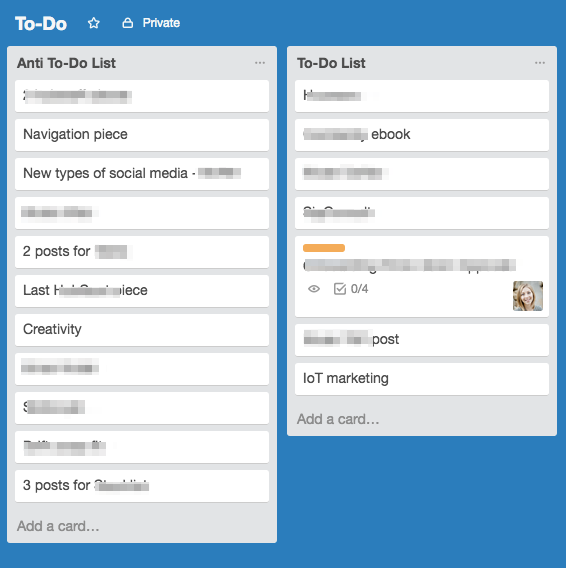
Using a Kanban board app (like Trello or LeanKit) is another option. Unlike traditional task management apps, which put all of your items in a single column list, Kanban apps let you make multiple lists on a single page. I’ve set up my “anti to-do list” and “to-do list” next to each other, so I can easily compare them.

anti_todo_list.png

Keeping an anti to-do list has made a huge impact on my productivity, efficiency, and sense of fulfillment -- and it’s only been seven days. I’m excited to see how this habit helps even more going forward.

Will you start an anti to-do list? Let us know in the comments!

HubSpot CRM

30 Aug 16:08

The End Of Brand Maintenance

by Mark Di Somma

 The End Of Brand Maintenance

It’s tempting when your brand is trending to believe that the hard work is done. When in fact, it may just be beginning.

I haven’t seen any stats on this, but there seems to be broad agreement among marketers that consumer attention spans have shrunk and will continue to do so. Global interest and outrage can be generated very quickly, but the fall-off can also be dramatic. I was interested to note that the huge rise of the Pokémon Go game since July has been followed by a noticeable decline. According to Fortune, daily active users and levels of engagement have dropped 30% since the game’s peak.

None of that should take away from what the game has achieved. It has changed how we think about augmented reality and it has certainly introduced new opportunities and new concerns about the reaping of data in exchange for fun. Some have even suggested it will change the monetization of small business.

But is this a genuine game-changer or a fad? It may have been downloaded more than 100 million times, but one of the problems Pokémon Go faces, the Fortune article suggests, is that while it has succeeded by hitting nostalgia buttons and giving the brand a new twist, it has failed, in playing, to make the transition from a hunting phenomenon to a true and durable game.

Here’s why that’s an issue. While many in the tech world subscribe to the mantra of ‘ship and fix’, the fact remains that when you ship too early, you put the premise out into the world, but without enough substance. Initial interest is critical of course – but so is intrinsic interest. If brands are to continue to build, there must be something that keeps people coming back and being rewarded, financially, socially or experientially, for doing so.

Building repeatability into your brand is vital. But even then, that repeatability must be able to morph so that there is enough familiarity for people to relax, but enough new aspects for them to stay interested. The Fortune article argues that Pokémon Go is the victim of rushing to market at the direct expense of ongoing engagement.

All of us require careful balance. On the one hand, a brand prospers from being in market and generating interest and feedback. On the other hand, if the mechanisms are not in place to give buyers new things to try once they are familiar with the product, consumers will quickly move on and copiers will just as quickly move in. To me, this is a critical part of brand strategy that gets overlooked. So much focus these days is put on getting a brand to market or repositioning a brand in market. Not enough emphasis is placed on infusing dimension into a brand so it can change and expand in direct response to market reactions to build on the success that it has worked so hard to achieve.

Some time back, of course, maintaining momentum would simply have required filling up the media schedule. Now, it requires brands not just to continue their marketing but also to find ways to make their products more interesting, their experiences more immersive, their communities more involved and their data more insightful, individualized and actionable. Brands must be iterative because consumers are iterative. Everyone keeps moving on. Today, there’s no such thing as brand maintenance.

I wonder – aloud – whether the next role of storytelling is connected with that: with writing “arcs” for brands that plot where the brand could go in response to what the market does. Think of it as storytelling as gameplay, where the brand has a range of options available which can be played out in response to consumer reaction. Skeptics will argue that such a way of working through the future has too many variations, will be different across markets and takes the ownership for the brand’s direction away from the brand itself. Isn’t that the lesson though from what is happening to Pokémon Go? What goes up will come down – and arguably the faster it rises, the quicker it falls as excitement gives way to frustration, disappointment or the next attraction.

Increasingly, the brands we create and manage behave like stories and are subject to the constraints (and the opportunities) of fashion. They have timeframes within which they are potent. And they live or die on their ability to stay interesting and keep selling. Unless “next” is ready to run as soon as “now” expires, there’s a real threat that a brand, particularly a brand that has accelerated quickly, will stall.

The Blake Project Can Help: The Strategic Brand Storytelling Workshop

Branding Strategy Insider is a service of The Blake Project: A strategic brand consultancy specializing in Brand Research, Brand Strategy, Brand Licensing and Brand Education

FREE Publications And Resources For Marketers

30 Aug 16:08

Why struggling Alberta shouldn’t hold its breath for an oil rebound

by Martin Pelletier

Like many Albertans, I recently vacationed in B.C.’s beautiful Okanagan, which provided a great reprieve from not only the terrible summer weather we’ve had but also all of the negativity overhanging our province. In particular, I noticed quite the dichotomy between the two provinces, as one can really feel the tremendous boom and positive energy in B.C. — driven primarily from their housing market — compared to the current situation here.

There is an important lesson in this as one really shouldn’t underestimate the power of a strong real estate market and its impact on consumer confidence and overall economic activity. Simply look at what happened in the U.S. in the years leading up to the 2008 financial crisis. Now it’s Canada’s turn, with a housing boom primarily in Toronto and Vancouver accounting for nearly one third of our country’s GDP growth.

As Albertans return from vacation and their kids head back to school, the reality of our situation is finally starting to sink in. On the surface our housing market seems to be hanging in despite all of the layoffs with only moderate drops in median home sale prices. That said, being a current home seller and buyer myself, this median price change appears meaningless: According to my observations, a large part of the market, especially those houses priced above the average, appears to have gone no-bid with very few buyers and a lot of sellers.

Unfortunately, we don’t see a light at the end of the tunnel quite yet. While ultra-low interest rates are preventing an outright collapse in Alberta’s housing market and overall economic activity, other important factors such as low oil prices will prevent the type of boom other provinces are experiencing.

The problem is that the developed world, not including the United States, is fighting deflationary pressures and rather stagnant economic growth levels despite low to even negative long-term interest rates. Of more concern is that the high-growth, commodity-consuming emerging markets of the past are also experiencing their own economic challenges which is not good news for those resource-heavy nations such as Canada, and Alberta in particular.

Making matters worse is that we expect the U.S. dollar to continue to rally against most currencies, including the loonie, as the Federal Reserve finally begins to raise its benchmark rate. In turn, a higher U.S. dollar means lower oil prices.

FP0830_Oil_Pelletier

On the supply side, any time oil rises above $50 a barrel U.S. shale producers ramp things up and persistently maintain production levels as evident by recent Baker Hughes and Energy Information Administration (EIA) data. As we’ve said in the past, these producers caused the oversupply situation and so the solution will have to come from them as well with reduced output. It certainly won’t be from those large producers such as Saudi Arabia or Russia who are currently setting new output records in order to protect market share and generate revenue to offset high spending levels.

Overall, we expect a range-bound oil market between $40 to $50 a barrel unless broader markets correct like they did this past January sending oil prices down to $26 a barrel. We also don’t expect materially higher prices unless the global economic situation improves and interest rates begin to normalize like they did between 2001 and 2008.

This is not a good scenario for Albertans as the lower-for-longer oil outlook appears more likely, meaning continued large provincial deficits and little to no improvement in unemployment, consumer spending and housing. However, a weaker loonie and low interest rates will help soften the blow, essentially preventing a large contraction. Additionally, we would expect fewer layoffs from the oil and gas sector as efficiencies have been dramatically improved with a return to profitability even at current pricing levels.

While it has been a tough two years with more challenges on the horizon, the rain clouds will eventually dissipate with time and make way for sunshine — just don’t expect any of those Okanagan temperatures.

Martin Pelletier, CFA is a Portfolio Manager and OCIO at TriVest Wealth Counsel Ltd, a Calgary-based private client and institutional investment firm specializing in discretionary risk-managed portfolios as well as investment audit and oversight services.

30 Aug 16:07

How to Create a Marketing Team That Cares About Revenue

by Dawn Papandrea

content-marketing-team-cares-revenue

When Toby Lee joined the tax & accounting division of Thomson Reuters in 2012, he was asked to bring excitement to the conservative (and sometimes stale) industry marketplace. His Silicon Valley marketing background was a perfect fit for an organization hungry for inspiration and change.

“They didn’t care that I was new to the industry because they wanted someone who understood marketing,” Toby says. “When I arrived, expectations were running high, which helped generate momentum and support for a new world order.”

As such, Toby and his team were able to help create something that all marketing leaders strive for — an action-oriented marketing culture that works hand in hand with the sales team.

His success recently led him to a new role as chief marketing officer for the legal division of Thomson Reuters, a 3.5 billion-dollar business with marketing employees all over the globe. He also is a finalist for CMI’s Content Marketer of the Year.

Here are some of the lessons he’s taking with him as he embarks on the next phase of his career.

Creating and valuing personas

One of Toby’s passion projects was delving into persona work; he and his team developed 45 distinct personas and 25 customer-journey maps to help guide content creation and demand generation.

The research showed that one key persona — people who work in the tax department — tend to be introverted and reticent to push for change in the business. His team created the concept of the “taxologist” — a tax professional who uses leading-edge technology to get results. Toby’s team developed an arsenal of educational and inspirational content for taxologists.

“The taxologist (content) celebrates our customers and gave them an aspirational brand. It’s taken off like wildfire,” says Toby. The term has become so widespread that taxologist is now an official skill set on LinkedIn and customers are asking to use this title to describe their profession.

The taxologist concept is brought to life at an annual user conference, Synergy, hosted by Thomson Reuters and recently attended by more than 1,500 tax professionals. The culmination of the event is a Taxologist awards ceremony. Explains Toby, “The emotion and reaction from people who win is amazing. We pick them up in limos, give them a suite in the hotel. One winner lady broke down and cried at the award ceremony saying she’d never been treated this nicely.”

taxologist winners

Based on customer feedback and industry accolades, extending the taxologist concept was a no-brainer. The Taxologist of Tomorrow program, a partnership with Junior Achievement (a nonprofit youth organization), offers workshops to high school students interested in learning more about how technology but also business acumen will be a key driver in their future success. Workshops have been held in New York and Dallas, touching hundreds of students with more on the way.

“There’s a really robust platform around the taxologist,” says Toby. “It embraces good content, it understands who it is talking to, and what is contextually relevant to them.”

The personas also help the sales and marketing teams speak more directly about relevant conversations and influencers in the buying cycle.

For instance, an individual signs up to attend an income-tax webinar. The Thomson Reuters content team enables the conversation to go further than a one-time interaction and extend beyond that individual. In this case, Toby’s team offers content to spark a dialogue between that individual (typically a user) and their manager since we know decision-making in B2B companies doesn’t fall to a single individual.

Connecting content marketing to sales and revenue

“We’ve tried to switch the marketing mentality from a checklist to more of a revenue contributor,” Toby says.

Instead of just churning out content, Toby champions continual engagement and collaboration between sales and marketing, and lets data point the way to achieve greater efficiency and returns.

For example, staying focused on the science side of marketing helped the team realize that the longer it takes a customer to transition from purchase to adoption, the less likely they are to renew and realize the true value of their purchase. Shortening that cycle allowed the team to improve customer lifetime value and create a positive customer experience — both of which impact profits.

Another cultural change that places a greater importance on effective content is the emphasis on lead quality. The company is piloting compensation programs with field marketers to drive a strong correlation between performance and pay. In addition, the phone-based lead-qualification team is rewarded based on how many leads are accepted by sales.

In that environment, the front-line sales and marketing team has a vested interest in using and benefiting from the most on-target, best-timed relevant content. And the content marketing team has a vested interest in creating the most effective content.

“If numbers are down, we are going to ask: Should I switch the message, the content, alter the distribution channel? What do I do as an active, engaged marketer,” Toby explains.

Toby’s marketing team also partnered with sales in a social-selling program that is further enabled through gamification. The pilot project helped close over $500,000 in business in 2015. It’s now being rolled out in other divisions of the company.

“We provide sales people with social-ready content and links via platforms like LinkedIn, and then fuel it with an app called GaggleAMP, a gamification platform,” says Toby. The app keeps tabs on which salespeople are posting content — with high performers getting prizes, as shown in the screenshots below. “It really connects with the sales mentality and is a good representation of the ways in which we’re trying to be better sales partners,” says Toby.


Provide sales people with social-ready #content and links via platforms says @CMOTobias #cmworld
Click To Tweet


sales-gamification-screenshot

sales-points-gamification-screenshot

sales-incentives-gamification-screenshot

Changing mindsets requires accountability

When Toby joined Thomson Reuters, he knew he would have to earn his colleagues’ acceptance and respect to truly create an action-oriented marketing culture. He offers these tips to help foster a similar environment in your company.

Stand your ground

“In our company, there was a lot of adversity to change,” says Toby, especially among people who had been employed 25 to 30 years. What worked was being very clear about objectives, then laying out a plan and adhering to it, he says. “We spent a lot of time talking about what attributes we wanted the team and our brand to be known for. Once you cultivate that and define it with your team, it’s all about staying the course. Hard conversations and choices are part of that, but if you waver, you open yourself up to inconsistency,” says Toby.


Be clear on objectives, lay out a plan, & adhere to it says @CMOTobias. #cmworld
Click To Tweet


Prove your worth

At the executive level, Toby knew he needed to uphold transparency, particularly given Thompson Reuters’ position in a highly regulated industry. To do this, Toby shares reports consistently. “In marketing we are all speaking in that same language and work in cadence with the rest of the organization,” he says.

One of the more unique metrics Toby’s team uses is a scoring model related to awareness and engagement. Rather than simply tallying up how much traction a piece of content gets via public relations, every article’s engagement is scored manually by an agency Toby’s team works with. The score is based on three components:

  • Message – 30 points – Did the article capture the intended message?
  • Prominence – 30 points – Is the company spoken about with positive sentiment? Is there more reference to us than our competitors?
  • Relevance – 40 points – How strategically relevant is a mention to the division based on authority, the publication, and the author? For example, a Wall Street Journal placement would have more value than the Dallas Morning News.

This scoring (along with other analytics related to cost per lead, conversions, and a customer relationship score) sends a message to the executive team that the team cares about the bottom line, says Toby.

“When we’re diligent and transparent in terms of getting people to understand how we are more business-minded about revenue contribution by quarter, it shifts the conversation,” he says.

Keep everyone informed

Under Toby’s direction, his division began publishing a monthly newsletter to the 7,000 tax employees at Thomson Reuters, including news about what Toby’s marketing team is focused on and why. “Things get kind of messy, so a simple newsletter was grounding to some degree,” he says. Along with that was having quarterly business reviews, checking in on a regular basis with other teams, and ensuring that his team was staying connected to the business priorities.

Looking forward

As he jumps into his next endeavor at Thomson Reuters, Toby is confident that he can apply what he has learned and continue proving the true business value that marketing can bring to the organization. At the end of the day, success is all about people coming out of their silos to work together toward a common goal. “When it comes down to people, process, and technology, I’ll take people every time,” says Toby. “You can have the best platform in the world, but if you don’t have the adoption of the sales team and the partnerships with marketing, that old-school stuff, then it’s not going to be that effective.”


Success is people coming out of their silos to work together toward a common goal says @CMOTobias. #cmworld
Click To Tweet


Editor’s note: A special thanks to Ardath Albee who scoured the planet looking for the best of the best content marketers. She was instrumental in helping us find our 2016 Content Marketer of the Year finalists.

You can be there in person to learn who the Content Marketer of the Year is — and learn from dozens of experts in the industry. Register today for Content Marketing World with code BLOG100 to save $100.

Cover image by Joseph Kalinowski/Content Marketing Institute

The post How to Create a Marketing Team That Cares About Revenue appeared first on Content Marketing Institute.

30 Aug 16:07

The 7 Networking Mistakes Sales Reps Should Avoid at All Costs

by afrost@hubspot.com (Aja Frost)

ThinkstockPhotos-488325027-167117-edited.jpg

Have you ever left a networking event and thought, “I’m never doing that again”?

Networking is often stressful and time-consuming, so if you’re not seeing the results you want, you might be tempted to write it off completely.

But when someone isn't seeing value from networking, it's usually because they're doing something wrong. Before you give up, check out the seven reasons your efforts may be falling short.

1) You Don’t Have a Plan

If you expect great opportunities to come your way simply because you’re showing up to events, you’re bound to be disappointed.

Successful networking doesn’t happen without a clear strategy. You can't achieve anything unless you know what objectives you're working toward. Are you looking for referrals? Trying to meet potential prospects? Hunting for a new job? All of the above?

Once you know your goals, identify the people who can help. If you want referrals, for example, you’ll need to meet well-connected professionals in your industry. However, if you’re looking for job opportunities, you should hone in on recruiters and potential employers.

Identify which organizations, activities, conferences, and events your target contacts participate in and prioritize those opportunities. Put yourself in the right place at the right time, and it'll be easier to form the right connections.

2) You’re Not Volunteering

Helping out behind the scenes is a fantastic way to accelerate your networking efforts. Volunteers often get face time with the organization's leaders, which can lead to opportunities you would’ve never scored otherwise.

In addition, getting involved with networking events increases your visibility and brings you into contact with other like-minded people. You might even get access to useful information like attendee lists or upcoming speakers.

3) You’re Only Talking to Qualified Buyers

When you’re at an event and someone who doesn’t fit your “target contact” profile introduces herself, you should:

A) Say hi, then politely excuse yourself shortly afterwards. You don’t want to waste your time.

B) Continue chatting, but keep your eyes peeled for someone more important. You need to stay focused.

C) Focus on building rapport. You never know what a connection will lead to.

If you chose A) or B), it might be time to reevaluate your approach. Knowing who you want to meet is definitely necessary -- but if you ignore everyone who doesn’t immediately seem valuable to you, you’ll shoot yourself in the foot.

After all, you never know who will end up referring you to a colleague or landing a job with a major account. By avoiding anyone who’s not a good fit for your product or a potential employer, you’ll miss out on tons of great opportunities.

4) You’re Trying to Sell

Nothing turns people off faster than a sales pitch at a networking event. Most attendees are hoping to meet new contacts, build their personal brand, and learn more about the industry, not buy something. (Trade shows are the major exception.)

Unless you want to annoy everyone that crosses your path, don’t try to sell -- or even schedule meetings.

Instead, focus on having good conversations and providing value. Once you’ve won someone’s trust and respect, you can approach them about your product.

5) You’re Talking Too Much

Active listening is crucial when you’re talking to prospects: It helps you show genuine interest, learn more about them, and deepen your relationship.

The same principle applies when you’re networking. Listening and asking questions -- rather than talking someone’s ear off -- dramatically boosts your conversational partner's engagement with you. Not only will you build a better connection, you’ll also get the opportunity to gather key information.

Pay attention to any priorities, business challenges, and insights into their company they mention. Of course, you don’t want to run an interrogatation  -- but if any details emerge naturally, make a mental note of them. Those details will be invaluable if you end up working with them down the road.

6) You’re Not Connecting With People On LinkedIn

Going to an event should be the first step in your networking strategy, not the last. Send LinkedIn connection requests to the people you meet as soon as possible -- you want your name and face to be fresh in their minds.

And don’t forget to personalize your requests. Chances are your request isn’t the only one sitting in their inbox, so make yours stand out by writing a short message. As a bonus, include the name of the event where you met and a tidbit or two from your conversation to jog their memory.

(Need help? Check out this LinkedIn request template.)

7) You’re Not Adding Value

If you identified any opportunities to help people -- even if they don't seem like potential buyers -- definitely follow through. Adding value without asking anything in return builds goodwill and can turn short interactions into long-lasting relationships.

Plus, thanks to the principle of reciprocity, doing a favor for someone else makes them more likely to do something for you.

Did you talk to someone who’d benefit from meeting another person in your network? Offer to make the intro. Did you discuss a challenge they’re facing? Send them a relevant resource. Do you have a suggestion for improving their business? Send along some advice.

(Learn more about the “always be helping” sales approach here.)

Now that you’ve learned what not to do when you're networking, check out these tips from 26 classic networking books

HubSpot CRM

30 Aug 16:07

How to Get Promoted to Sales Manager: 20 Tips from the Experts

by Taylor Dumouchel

Optimized-iStock_71438907_MEDIUM

As a sales rep, you may aspire to move into a management position. And, this career goal comes as no surprise – data from Payscale.com indicates that the promotion to sales manager averages an OTE increase by nearly two times that of what a sales rep earns.

However, working your way up through the ranks is no a simple task. “Getting promoted to sales manager is particularly challenging, especially for top performers,” says Samantha Carr, Account Executive at Handshake Corp. Why? Firstly, companies don’t want to give up their top performer and secondly, the majority of the time sales reps make bad managers. In fact, more than 75% of reps promoted to sales manager will not last 2 years in the role. 

That is why we have combined the tips from the industry’s leading sales experts, authors, trainers, and executives on what you can do to get that promotion to a leadership position.

Here are 20 tips from Sales Experts on how to get promoted to Sales Manager:


1. Develop your leaderships abilities and resume

Mike-WeinbergMike Weinberg

Principal of The New Sales Coach and Author of Sales Management. Simplified. and New Sales. Simplified.

“Leadership skills are significantly more important than sales ability to succeed in a sales management role. If you’re looking to make yourself more attractive as a potential candidate for a sales leadership role, spend more time developing your leadership abilities and resume than your sales acumen. Take on a tough project at work. Join a board of a nonprofit or ministry. Come up with solution to a vexing problem at your company. The harsh truth is that there is very little similar about an individual producer sales role and a sales management role. It seems counterintuitive, but getting better at your existing job isn’t preparing you to get promoted.”


2. Understand the skills, traits, and behaviors required for success

Dave-SteinDave Stein

Principal of Dave Stein Inc. and Author of Beyond the Sales Process: 12 Proven Strategies for a Customer-Driven World

“In order to get promoted to a management position, a sales rep must first understand the skills, traits, and behaviors required for success. Sales managers must have skills in hiring, territory assignment, conflict resolution, forecasting, career development, and, among others, working with managers from other functions. A sales rep who wants to get promoted should come up to speed in these areas through reading, attending webinars, participating in programs, and availing themselves of coaching and mentoring opportunities inside and outside their companies.”


3. Establish yourself as a lifelong learner

Mark-CoxMark Cox

Managing Partner at In the Funnel – Sales Consulting

“If a sales rep wants a promotion to the management team, they will need to establish themselves as a lifelong learner. Leaders are intellectually curious. Read a book (or 5) on sales. Apply new approaches to what you do. Leverage your knowledge of your industry AND the industries that you sell to increase your effectiveness. Share what you have learned with the team. Only those that have the ability to learn and adapt will make the leap successfully.”


4. Start thinking and acting like a sales manager

Jill-KonrathJill Konrath

Speaker and Author of SNAP Selling, Selling to Big Companies and Agile Selling

“To get promoted to a sales manager, start thinking and acting like a sales manager. If a colleague is struggling, how can you help? If you have plateaued reps, how will you re-ignite them? Read about sales leadership and take action — before you get the job.”


5. Go above and beyond what is expected

Mark-BirchMark Birch

Founder of Enterprise Sales Meetup

“Sales reps need to go above and beyond what is expected to get into management. That means being willing to actively share sales tactics, set up lunch and learn sessions or a sales book club, volunteer to coach and mentor newer reps, etc.  When you demonstrate a willingness to coach and an investment in the success of your peers, you demonstrate your ability to manage and lead a team.”


6. Demonstrate your ability to coach and scale effectively

Gary-SmythGary Smyth

Founder and CEO of Sales Elite, LLC

“Getting promoted to Sales Manager means more than just hitting and exceeding your number. Shadow your current manager or management team and identify tasks that you can assume as an informal Team Leader/Manager, these tasks should help demonstrate your ability to coach and scale effectively. Take the opportunity to lead a team meeting or help reinforce a key sales area by leading a team huddle or call shadowing session. Start assuming the key attributes of a successful Sales Manager now to separate yourself from peers and make that next step in your career as seamless as possible.”


7. Be a leader within your organization

Brent-ThomsonBrent Thomson

CSO of Peak Sales Recruiting and Author of Sales Recruiting 2.0 – How to Find Top Performing Salespeople, Fast

“Getting a promotion is not easy. If you want to put yourself in the best position for becoming a sales manager, you need to be a leader within your organization. It’s all about the little things – knowing your metrics, having a structured approach to your day, leveraging your CRM, teaching others, hitting your numbers, forecasting accurately, and being a great corporate citizen.”


8. Develop a unique level of knowledge

Kelly-RiggsKelly Riggs

Founder of Business LockerRoom

“One of the ways that salespeople get noticed and considered for sales management positions is to develop a level of knowledge that is uncommon in their peers. Typically, this becomes apparent because they provide more value to their clients than their counterparts — new or varied applications for a product or service, more insight into the industry they serve, or a more significant understanding of the customer’s business. This will often lead other salespeople to seek them out and ask for help. If they demonstrate an inclination to help out and to coach other salespeople, that’s often a leading indicator of a potentially successful sales manager.”


9. Demonstrate the ability to execute the sales process

Tibor-ShantoTibor Shanto

Principal at Renbor Sales Solutions Inc.

“To be promoted to Sales Manager, a rep needs to demonstrate the ability to execute the sales process; as managers they will need to leverage the process in a number of ways to ensure execution and success. If they demonstrate an understanding of the process, and are examples of how to make it work for the rep and their buyers, they will be seen as someone who can lead others to do the same.”


10. Exhibit leadership behavior

Steven-RosenSteven Rosen

Founder of Star Results

“The key to getting promoted to a sales manager is not sales results. What I have seen is two types of salespeople, one who exhibits leadership behavior and the other who exhibits rep behavior. Leadership behavior is about finding solutions, it’s about showing your colleagues the way when they are stuck, and it’s about keeping an open mind and being open to change. On the other hand, rep behavior is about whining, only seeing problems and saying things like “we can’t do that” or “we have tried it and it doesn’t work”. Yes, good sales is a positive but we all know the best sales reps don’t always make the best managers. If you want to get promoted to a leadership role than you need to behave like a leader!”


11. Improve your ability to motivate

Oscar-MaciaOscar Macia

CEO and Co-Founder of ForceManager

“Salespeople who want to take that next step in their career need to focus on improving their leadership skills and ability to motivate. This can be done through self-education, reading books, sales management courses, etc. However, there is nothing better than learning on the sales floor – weighing up the challenges within the real-life setting of the business and seeing how they can be solved, effectively preparing them for their new role.”


12. Never stop learning

Dan-PerryDan Perry

Principal at SBI Sales Benchmark Index

“They key is continuous education. Salespeople who get promoted never stop learning. We call it new capability acquisition. We are fanatics about it at SBI and judge ourselves on what we are learning. Promotable people never stop ‘gaining new capabilities’.”


13. Get out of your comfort zone

Nick-van-der-KolkNick van der Kolk

Head of Enterprise Benelux & Nordics at Hubspot

“If you want to get promoted to Sales Manager, go above and beyond in your current role. Get out of your comfort zone and proactively ask to help your boss with more important projects, help your colleagues who currently hold the role you want, and introduce new technology to your boss that improves the sales force’s effectiveness and efficiency.”


14. Take on new responsibilities

Sam-CapraSam Capra

Founder of SalesTechStack

“Demonstrate you are cut out to be a manager by taking on new responsibilities. Volunteer to organize sales training, lead team meetings, take on an open sales territory, etc. In addition to the business of actual selling, demonstrate you can also handle the admin side of the business.”


15. Prove yourself as a leader on your team

Christopher-CronerDr. Christopher Croner

Principal of SalesDrive

“Sales reps should not get promoted on numbers alone. In order to get promoted into a leadership position, a sales rep must prove themselves as a leader within their sales team. Reps can do so by continuously resolving conflict, demonstrating confidence, and regularly suggesting new, creative promotions or incentives.”


16. Prepare for both asking for a promotion and interviewing for the position

Thomas-PhelpsThomas Phelps

Sales Career Expert at About.com

“Make sure you have your ducks in a row. If you are ready and your desired position is available, make sure you spend plenty of time preparing for both asking for a promotion and interviewing for the position. You’ve done way too much work getting yourself in a position to confidently ask for a promotion to waste your opportunity by going into a meeting with your supervisor ill prepared.”


17. Demonstrate your communication skills with co-workers and customers

Vivek-Thomas
Vivek Thomas

President of Maximizer Software Inc.

“Managers with the power to promote look for people who communicate well with co-workers and, more importantly, with customers. Patient, polite, determined, and confident are adjectives that describe a solid communicator who understands the keys to getting promoted to management – someone who demonstrates these qualities on a daily basis during customer interactions and business transactions.”


18. Bring new solutions to the team
Steven-BensonSteven Benson

Founder and CEO of Badger Maps Inc. and former Regional Sales Manager at Google

“Be the person who brings new solutions to the team. A key thing that sales leaders do is take responsibility for the results of others. Even at Google, the best way I’ve seen this done is by introducing new technology that will improve team performance. A sales rep that champions new technology is proving they care about, and can be responsible for, the results of the team. That’s the most important criteria for a manager – driving performance and owning results.”


19. Be a top producer

university-of-san-fran
University of San Francisco

“Regardless of your readiness to assume sales management responsibilities, the reality is that sought-after sales manager positions generally go to top producers. To be considered for a sales management role, you have to exhibit a consistent ability to meet and exceed sales quotas. You’ll also need to demonstrate a solid work ethic, as sales managers are expected to serve as an example and inspiration to their teams.”


20. Become a tour guide for new salespeople

Jeff-WestJeff West

President and Founder of The Sales Tour Guide

“If you’re a salesperson wishing to earn that promotion into management, I recommend you become a tour guide for new salespeople. Jump in and help with the on-boarding of new salespeople. Make sales calls with them and encourage their success. The best entries on your resume for any promotion into sales leadership are the names of those whom your mentorship has played a part in their success.”


Put these 20 tips to use and visit the Peak Sales Career Blog for the latest actionable insights on how to advance your sales career.

The post How to Get Promoted to Sales Manager: 20 Tips from the Experts appeared first on Peak Sales Recruiting.

30 Aug 16:07

5 Content Marketing Pain Points (and How to Fix Them)

by John Miller

5ContentMarketingPainPoints.jpg

Do you know when the best content marketing campaigns end?

Never.

In fact, they’re not even campaigns. They’re continuing efforts that inform and engage an audience. Great, audience-focused content will attract an audience that you can then market your product or services to – so why would you ever stop? In a perfect world, you wouldn’t. But the world is not perfect, and creating high quality content at a healthy cadence isn’t necessarily easy.

If you’re managing a content marketing initiative, or just launching one, here are the most likely pain points where things can get bogged down.

Pain Point No. 1: Not understanding your audience. When you start content marketing, it’s imperative that you create profiles of your customers. These tell you your customers’ likes and dislikes, habits and patterns, and should guide your team as they create content.

But what if you got it wrong? Or what if the audience has changed? If you believe you’re creating high quality content, but it isn’t resonating with the audience, it could be that you’ve miscalculated. Maybe you don’t know your audience as well as you think you do. If this is the case, you need to get a better handle on your customers. The best way to do this is to talk to them, and ask pointed questions about what type of information they’re looking for, as well as their content consumption habits.

Pain Point No. 2: Not having the right talent. This can be a significant issue for legacy marketing teams that have tried to retrofit people into content marketing jobs. Or, perhaps you have a team of writers when you really need a community manager and a videographer. It isn’t always easy to get the right people in the right seats on the bus, particularly when the bus is already in motion.

You can address this by supplementing your team with an agency or a freelancer (or two), as long as it fits into your budget. (When you’re setting your budget, it’s wise to leave some wiggle room, knowing that you likely haven’t solved for every scenario.) If there isn’t room, you may face some hard decisions about switching out the talent on your team.

Pain Point No. 3: Not getting the content in front of the right audience. This is a question of distribution. You’re surely spending a lot of effort creating content, but are you spending much time and money pushing the content to the right audience? This might mean working social media or creating an influencer network. Or it could mean paid promotion. Or all of the above.

Whatever it takes, promotion and distribution needs to be a large part of your content marketing process. So assess what you’re doing (if anything), make adjustments, and dial up these efforts as much as possible.

Pain Point No. 4: Having gaps in your content. You should understand the buyer’s journey for your product or service, and map the content to this journey. However, it’s common for companies to not have all the content they need to move prospects along the sales funnel. You may have killer top of the funnel content, and a big gap in the middle of the funnel; if so, it should be obvious what happens – prospective customers stop moving towards a purchase.

Take a step back and assess whether prospects are stopping somewhere along the journey, and how you can create content to fill this gap in the journey.

Pain Point No. 5: Measuring and adjusting. This doesn’t just apply to content marketing; it applies to all marketing. Over the last few years, we’ve become obsessed with collecting data. However, that data is rarely put to use.

At the outset of your content marketing initiative, you should have determined which metrics you are tracking. What do these metrics tell you? If everything is perfect and no adjustments are needed, congratulations, you’re the first company in the history of companies to get it right the first time.

If you’re everybody else, look at the data. Discuss the data, and what it means. Figure out which tweaks you need to make, and make them. And don’t be afraid to experiment with A/B tests that can help you find the right answers more quickly.

If you’ve hit these pain points and your content marketing initiative is bogged down, here’s the good news – you’re not alone. These are common points for organizations to get bogged down. The key is to not stay bogged down – you must do something to reset the situation and move forward.

If you’re stuck and want to discuss getting unstuck, shoot me a quick email at john@scribewise.com. I promise no pressure, no hype – just an honest discussion of what can move you forward.

30 Aug 16:04

Spot bad fits early: 20 red flags for sales hiring

by steli@close.io (Steli Efti)

sales-hiring-bad-fit.gif

Hiring is a tough nut to crack. The amount of dilly-dalliers that hide behind good looks and quick wit is impressive.

So how do you weed out bad candidates?

It’s not easy to uncover who’ll be the right sales hire for your company, and the criteria that makes someone good or bad will differ for everyone. But I want to share what’s worked well—consistently and historically—for us here at Close.io.

Here are 20 red flags to look out for in your sales hiring process.

1. They can’t get the basics right

Spelling errors. Inappropriate photos on their LinkedIn. Tardiness. If your candidate can’t get the basics right, how well will they do when it comes to their actual job responsibilities?

2. They haven’t done their homework

If a potential sales hire doesn’t spend any time doing their research to figure out if they’re the right fit for you, and if you’re the right fit for them, they’ll most likely do the same thing on the job. That means they won’t do a great job prospecting or qualifying leads, and that means no closed deals.

3. They can’t pitch

If a person can’t sell themselves, do you think they can pitch your product or business? Probably not.

A good elevator pitch goes a long way. It’s not more difficult than answering these questions:

  • Where are you coming from?
  • Where are you right now?
  • Where are you going?

If a candidate can provide you with a broader context of who they are, you’ll be able to assess if they’re a good fit for your company and your culture.

4. They’ve been switching jobs

If someone hasn’t stayed with a company for more than 12 months, it raises questions. Are they bad at choosing a company that’s a good fit for them? Are they difficult to work with? Could they not get the job done?

It might not be a bad thing necessarily, but pay attention to how they answer the questions about why they left their previous positions after a short amount of time.

5. They’ve held the same position for years

On the opposite end of the spectrum, if someone’s held the same position at the same company for several years, it could mean they have no ambition. Is someone that’s just happy to sit there and watch the days go by a person you want to be a part of your team? Unlikely.

6. They’re bad mouthing ex-employers

This leads to instant disqualification. This person most likely feels insecure about their experience or performance at their last job, but it might also be a sign of poor integrity.

If you’ve had an issue with someone in the company, there’s a respectful way of saying that. “It wasn’t a good cultural fit so I decided to move on” would be the appropriate way to say “My boss was an asshole.”

Let’s leave it at that.

7. They share sensitive information from past employers

If a potential sales hire starts sharing data and company secrets—they’re out. This means they’ll be doing it at your company, too.

8. They don’t have any questions

Someone that’s too talkative during an interview is likely to treat your prospects and customers the same way. Talking is not how selling works.

If a potential sales hire doesn’t have any questions during the interview process, chances are they won’t be good at sales. Selling is about asking questions and figuring out if your product is the right solution for a someone. Similar to that, the interviewee should be figuring out if you, as an employer, are a good fit for them.

9. They don’t have a reason for applying for the job

Dear Sir/Madam, a sales candidate that shows up to an interview without a customized pitch, isn’t looking for a job at your company, they’re looking for any job—anywhere.  

Some people just send off applications left and right. If a sales candidate has no real purpose behind their application, they likely won't feel like they have any purpose in their role either.

That’s why boilerplate candidates are often a waste of your time.

10. They have weak references

This red flag comes in three parts:

  • Their references are from the same company. If a potential sale hire has worked at five different companies over the years, but only provides references from one of them, it’s likely that they didn’t do that good of a job at the other ones.
  • They didn’t think about what makes for a good reference. If the office manager says someone can make a mean pasta carbonara, it’s not going to mean much. Doesn’t matter if the person makes for a great lunch partner if they can’t close a deal.
  • They didn’t prepare their references. When you call up a reference, they should expect your call and be prepared for it. If someone picks up the phone and has no idea who you are or why you’re calling, that’s just sloppy work.

11. They don’t seem trustworthy

We all have a built in BS meter. Especially people that work in sales. This meter helps us decide whether someone is a) credible, and b) trustworthy. There might be conflicting information, statements that don’t add up and so on, but more than anything—it’s a feeling.

If you don’t trust someone, you can’t work with them. Period.

12. They are too aggressive

Being confident is good, being overly aggressive is bad. Some people are more aggressive by nature, but there’s a way to navigate that quality and use it to your benefit. We all appreciate when someone walks into a room with a presence and a bit of bravado, but there’s a difference between that and being in someone’s face, constantly.

Think about how these people would come across when they talk to a prospect. No one enjoys getting ploughed down by an ignorant alpha, especially when they’re looking for help.

At worst, this type of person could create a toxic culture in your sales team.

13. They are too nice

People that are too nice can potentially be a pushover. These people are often very likable, but they lack confidence. There’s a strong likelihood that this will not translate well in their ability to influence prospects and turn them into customers.

14. They lack enthusiasm

Enthusiasm is contagious. While this isn’t a deal breaker, if someone lacks enthusiasm or energy, if they don’t get excited—then why should you get excited about them?

One of the things sales managers love about our inside sales CRM is the ability to automatically record all the calls their reps are making.

image00-min-9.png

This allows them to listen in to the sales conversations their reps have when they’re not in the room. As a sales manager, if you randomly listen in to archived call recordings, you can very quickly get a sense for how consistent your reps are.

15. They lack self-awareness

I often test people’s level of self-awareness. If a person is very far removed from the reality of a situation, that’s likely to be an issue. People need to be able to assess themselves in order to make progress and improve.

Often, I weigh the importance of this based on level of seniority. If a sales candidate is really junior, it’s not as big of an issue. But if someone is really senior and doesn’t have the level of self-awareness that one would expect at that stage, I’d be concerned.

16. They don’t seem coachable

This relates back to the previous point. If a person isn’t self-aware, they’re not very likely to be coachable.

A good test is to give someone negative yet constructive feedback and see how quickly they apply that feedback. If someone can’t take feedback on board, they won’t be able to learn and improve in their role either.

17. They’re defensive

Excuses, excuses, excuses. If a person responds to critique or negative feedback in the form of excuses, they don’t know how to take responsibility for their actions.

18. They don’t have any drive

What motivates you as a salesperson? Is it the money? The thrill of the close? The idea of bringing value to someone else’s life? Changing the world?

Whatever it may be, there’s a reason why we all get out of bed in the morning. Having drive and motivation is key to doing anything well, let alone selling.

19. They’ve always been successful

If a potential sales hire shows up at an interview with a spotless track record and has never experienced failure, it’s likely that they’ve been very cautious in the way they make decisions.

Perhaps they’ve only done things they know they’d be successful at.

The vast majority of us have experienced failure and misfortune in one way or another. If a person hasn’t, it’s likely they haven’t taken any risks or truly challenged themselves.

20. They’ve only seen failure

On the other hand, if a person can only point to failure in their previous companies, that reveals that they’re not learning fast enough. Because if you’re learning, you wouldn’t keep failing.

These red flags don’t apply to every company and sales team. Choose the red flags that fit your culture and utilize them in your sales hiring process.

My rule? If I collect more than three red flags during an interview—you’re out.

Are you guaranteed to make the right hiring decisions based on this? Of course not. But I hope they’ll help you in the process of weeding out bad sales candidates.

Got your team assembled? Set them up with the best inside sales CRM on the market. Try Close.io for free for 14 days. No credit card required.

Recommended reading:

Top 10 interview questions in sales hiring
Struggling to figure out what you should you ask during a sales interview to find the perfect hire? These are the top 10 questions you should be asking.

My startup hiring interview hack: Why? Why? Why?
A simple strategy to x-ray through the bullshit answers applicants give you and get real insights into what makes them tick.

Hiring for startups: How to recruit the un-recruitable!
How do you find high-performers? And how to make them want to join your team? Here's some unconventional startup recruiting and hiring advice ...

30 Aug 16:04

How To Create Facebook Lead Ads That Convert

by Allen Finn

Our clients are using them to corral leads in droves. They’re cheap. They’re effective. The targeting options are so vast and precise that finding new customers is easier than bullseyeing womp rats in your T-16 back home.

I’m talking about Facebook lead ads.

Facebook Lead Ads example gif

If you’re not familiar with them, lead ads are Facebook’s answer to the jaw-dropping amount of time the average person spends on his or her mobile device. It’s no secret that conversions from paid channels tend to take a hit on mobile, so the Zuck and crew decided to eliminate one of the most prohibitive steps for would-be converters: visiting your website.

Instead, with lead ads, you just choose from the Cheesecake Factory-esque menu of targeting options, create a lead form, and watch the (significantly cheaper) scorching hot leads roll in. They can be used to acquire all sorts of information, from potential consumers anywhere in the funnel.

Facebook Lead Ads ways to use

And the best part? Contact info collected through lead ads can be used to create new audiences – both custom and lookalike – allowing you to adjust your paid efforts based on where a prospect falls in your funnel or find new, similar prospects.

Sold yet? Of course you are.

But before I delve into how you’re going to make your Facebook lead ads irresistible, here are the six simple steps you’ll need to take in order to create your first one (assuming you’ve already got a Facebook Business Manager account).

Facebook Lead Ads For Dummies

Facebook Lead Ads South Park meme

Once you’ve signed into your Business Manager account, navigate over to Power Editor.

Facebook Lead Ads Power Editor

Click the “+Campaign” button on the top left hand side of your screen to open a laundry-list of prospective campaign goals. While many will be familiar (and some more useful than others), the one you want is titled “Collect leads for your business.”

Facebook Lead Ads collect leads

Now, let’s get granular. Choose your desired audience, targeting parameters, placements, budget, and scheduling. Discussion of this warrants a post of its own, so I won’t try to condense a thousand words into twenty. Suffice to say you know your business, your goals, and your target demo better than I do. Get everything calibrated and proceed.

The Power Editor UI will prompt you to create a new lead form or duplicate an existing form. Since we’re operating under the assumption that you haven’t done this before, you’ll only be able to select the former. For future reference, though, be sure to recycle forms when appropriate, but don’t use a single form across every lead campaign you run (especially when you’re serving lead ads to those already in your funnel).

Facebook Lead Ads create new form

Next, add a context card. They’re “optional,” but trust me: you want to make one. Essentially, a context card is the step between somebody seeing your lead ad and the formfill itself. Take your time crafting the copy that goes on your context card (or hire a professional). Make sure you distill your message down to the most concise version: explain what you’re offering, who you are, and why whomever is seconds from giving you their precious contact information should do so. Nothing more.

Facebook Lead Ads context card example

Once you’ve finished the context card, it’s time to put together your lead form itself. You’ll be given more possible fields than you’ll know what to do with…

Facebook Lead Ads lead form

… and that’s okay. Because for your first lead ad, we’re going to focus on just two of them: email address & full name. Why full instead of “first” and “last” as separate fields? The more boxes a prospect has to complete, the less likely they are to convert. You can use a little bit of Excel wizardry after you’ve got the data to parse names into separate columns.

Finally, complete the privacy policy and disclaimer and you’re ready to rock.

Optimizing Your Facebook Lead Ads

The good news: you know how to make a Facebook lead ad!

The bad: your competition does, too.

Because your competitors are plastering your prospects’ timelines with ads, it’s important that yours stand out. Now that you know how to make a run-of-the-mill Facebook lead ad, it’s time to learn how to make an incredible (read: high converting) one.

Optimizing Targeting for Facebook Lead Ads: Lookalike A Paying Customer

Create lookalike audiences using customers, not prospects.

If you make a lookalike audience of everyone who submits, your reach will be wider, sure, but it’ll also be less qualified. By creating lookalikes of your converters instead of everyone who has submitted a lead, you’re building a more accurate profile of the sort of person who makes a purchase or becomes a client.

This model is inherently more valuable to your business than a rough estimate of the type of person who might possibly could maybe one time almost sort of be interested in what you have to offer. Niche-ing down is a good thing. Remember that.

Facebook Has More Targeting Options Than Members…

Use them to your advantage!

Get as granular as possible with your campaigns and ad sets, and don’t be afraid to experiment. Personally, I like to take any customer data I can get my hands on and look for patterns. From there, you can begin overlapping the traits you uncover using the virtually limitless targeting options available to you. Things to look for include:

  • Job titles
  • Education
  • Relationships
  • Age
  • Hobbies
  • Average income
  • Language proficiencies
  • Entertainment

Through all of these and more, you can create highly targeted campaigns outfitted with lead ads that speak directly to the traits you’ve identified.

Are you a drivers’ ed teacher looking for new students? Consider targeting parents in higher-income areas (driving lessons don’t come cheap). Flower shop or purveyor of fine chocolates? Seek out people in new relationships, show them a lead ad, and get ‘em on your email list.

Duplicate Audiences Are A Waste Of Money

Having a fat stack of ideas out the gate is great. Know what isn’t? Trying to test them all on the same audience at once. Patience is key.

According to Facebook, attempting to target the same audience with multiple lead ad campaigns can result in “under-delivery issues.”

If you’re following the advice above (ratcheting down on those lookalike audiences) and leveraging the rest of Facebook’s robust targeting options to your advantage, the initial reservoir of some-odd billion people with Facebook accounts has been dammed up and reduced to a faucet’s trickle. Your ads are only serving to small, qualified audiences. Under-delivery isn’t an option, folks!

Facebook Lead Ads Lord of the Rings one does not simply meme

Your Customers Sleep. Your Ads Should, Too

If you’re selling a SaaS product to large businesses, I doubt your potential customers are up at three in the morning on a Tuesday. But things change if your offering is meant for the garage-based startup, or you’ve cornered the market on glowy, pulsing rave gloves.

Ad scheduling is a great way to avoid wasting time and money serving your finely-tuned lead ads to people catching Z’s.

And once your campaigns are up and running, you can add more scheduling. If your data suggests that there are times at which prospects are highly motivated, increase bids (better yet, create a new campaign and find a way to make use of your insight in the ad copy). On the other side of that coin, if data suggests prospects simply aren’t interested in forking over their information at dinner time or 51 minutes before their mid-morning snack, scale back.

Optimizing Creative for Facebook Lead Ads

Context Matters…

With lead ads you’re asking people to take immediate action. Unlike more traditional ad types, there’s nothing standing between the first click and the form fill (unless you count the context card, but that’s more complementary than intermediary). As such, in addition to lookin’ pretty your creative needs to do a lot of legwork.

Facebook Lead Ads contextual calls-to-action

Ensure that you pair your captivating image with clear copy. Take this Land Rover ad for example. It features concise but captivating language (the percussive consonance makes it clear this tagline wasn’t conceived on the first try). The image is striking. And check out that button. It tells the prospect exactly what he or she stands to gain by clicking.

Coupons Rule Everything Around Me

Facebook Lead Ads Wu Tang safety diagram killa bee swarm in the lands of Shaolin

Some people won’t click on your ad no matter how well it reads or pretty it looks. When it comes to the folded armed curmudgeons in your vertical, incentivize the click.

Look at where in your sales funnel the audience you’re targeting with your lead ad falls. If it’s the very top or somewhere in the middle? Send free information or offer a subscription. Closer to the bottom? Create buy-in by offering a coupon, a free consultation, or quote.

Whatever your value proposition ends up being, if you want it to grab potential prospects, it must be clear. Emblazoned in neon. The completely irresistible version of the guy at a traffic light spinning a sign for $5 cheese pizzas.

The Context Card: Never Say No To Screen-Time

As I touched on above, the context card isn’t optional. That “optional” is just a silly April Fool’s joke Facebook forgot to remove from the Business Manager UI. In reality, context cards are necessary.

They allow you to share more information about your offering with a potential prospect in the seconds before he or she is presented with the opportunity to give you valuable information. Use the context card to:

  • Highlight benefits your business provides
  • Promote a special offer
  • Create a double opt-in (qualify your prospects with another “are you sure” button)

Keep Prospects Informed

Let people know how and when you’ll contact them. And be sure to follow up. This isn’t really a big one if you’re just asking for an email address to get someone into your automated funnel, but if you’re advertising a free quote or audit, you must reach out. Failure to do so isn’t just a waste of your money: it makes you look unprofessional.

Labor Over Your Copy

Don’t just cut and paste the same copy every time you make a new lead campaign, and don’t jack text from your landing page. The context card is its own, standalone piece of text with a distinct job.

Sure, you can draw inspiration from content you’ve got stashed away, but rehashing it completely is a bad idea. Consider the specific audience you’re targeting with each lead ad. What information would they appreciate? Now, take that even further. What sort of language and tone would they find most appealing? Take a few stabs at writing something that will resonate and have somebody else look at it.

‘Every Prospect Under The Sun Is Completing My Forms, But I Can’t Find Their Information!’ – Every Person to try Facebook Lead Ads

You’ve made irresistible ads. People are sending you contact info faster than even your autoresponder can respond. Just one question remains…

Facebook Lead Ads how do I collect leads?

There are currently three ways to fetch lead information from Facebook:

  1. Good ‘ol CSV. It ain’t pretty, but it works. Simply navigate to your Ad Set tab, find the “Results” column (illustrated below) and click the link that says “Leads(form).” You’ll want to check this frequently, as there isn’t currently any sort of notification system available to marketers.
  2. If you use a CRM that syncs with Facebook (so far: Marketo, Salesforce, Driftrock, Oracle, Maropost, Sailthru), your leads will magically appear there!
  3. The third option is above my pay grade, but it’s possible to develop a custom connection between your back end and the Facebook API. Ask your developer to explain what that means.

Now you know how to make a Facebook Lead Ad. You know how to make it awesome. You know how to track down prospect info. If you’ve got questions please feel free to get at me on Twitter or share them in the comments below.

Now get out there and woo future customers already!

30 Aug 16:04

How to Avoid Burnout: Lessons from Sales Leaders

by Brandon Redlinger

This post uses soundbites from our new podcast, Stories from the Sales Floor.

We’ve all been there.

The day-to-day grind is getting to you. Quota-crushing feels soul-crushing. The thought of starting over next month/quarter/fiscal year is almost too much to bear.

Wouldn’t it be nice to just have an easy, low-pressure job? It sure seems like it would.

If you’re feeling this way, take comfort, you’re normal. Even top sales influencers have experienced moments of doubt. Career-questioning struggles happen to the best of us, but fortunately there are things to get you over the hump and happily back in the sales saddle.

But don’t take my word for it. Here’s what some of the guests on a recent episode of Stories from the Sales Floor – including Peter Kazanjy, Donald Kelly, Sally Duby and Matt Heinz – had to say about the time they almost quit sales.

Pete Kazanjy quote

Peter is talking about determination and perseverance – the air and water of sales. You won’t survive without them.

Rejection, day in day out, has the ability to drain you of determination, but, like Peter suggests, you just have to keep going.

Well-known sales influencer, Anthony Iannarino, agrees, writing: “Success in sales requires determination, plain and simple. Determination allows the salesperson to hear the word ‘no’ and to continue to pursue their objective undeterred. Determination is what allows the salesperson to pick themselves [up], dust themselves off, and to try again.”

According to Sirius Decisions, “…it takes 8 to 12 attempts to reach a decision maker by phone, even when they’re interested in your products or solutions.” So why does the average sales rep only make 1.3 call attempts before giving up? If the leads are qualified, persistence will pay off.

Sally Duby Quote

Sally is talking about different two approaches – both with the same goal in mind.

First, diving into work and seeing the successes that can come from added effort may inspire you to continue with sales. But let’s devote more attention to Sally’s second suggestion: taking time off.

Allison Gabriel, Assistant Professor of Management at Virginia Commonwealth University, reminds us, “…we have a limited pool of cognitive resources.

“When you are constantly draining resources, you are not being as productive as you can be…you’re able to persist less and have trouble solving tasks.”

That inability to complete basic tasks, whether that’s effectively following up with prospects or remembering to update your CRM, can be discouraging and contribute to the feeling of wanting to call it quits.

If you’re working on commission, you might be worried that taking time off will wreck your bank account. But when we don’t take enough time off, “We get sick and cranky. We’re nowhere near as productive. Our creativity and decision-making suffers. In other words, we become bad sales[people],” writes Joanne Black. And that’s definitely going to affect your bottom line.

Can’t Stop, Won’t Stop

Some of our guests say that while times have been tough, they could never walk away from selling. If you are one of the lucky ones who feels that way, congratulations! You have a tolerance for pressure and uncertainty few possess. Let us know how you do it in the comments. Are there any tricks you use to get through the rough patches?

30 Aug 16:03

How Bots Are Changing Search And Social Media

by Asaf Hartuv

How-Bots-are-Changing-Search-and-Social-Media

Artificial intelligence is becoming a bigger part of how we access information online and how marketers can reach audiences.

For some, this is great news. It means easier access to audiences and information while spending less time and investing less money.

For others, this is the start of a dystopian future in which Skynet rules us all. Maybe a stretch….

Bots are a big part of the growth of artificial intelligence, and they are being used for everything from answering user questions while they are browsing a site to showing special promotions for individual users.

If you aren’t already using these highly intelligent tools, you are likely missing out on a lot of leads and sales.

Here are a few ways that these digital assistants are already changing the way that users and businesses interact through search and social media:

Search

One popular bot used for search is known as Fetch.

Fetch runs on Slack, and it helps users to find information they need and to recommend information that is related to their query. It has smart programming so that it can do more than just respond to keywords used in a query.

For example, when performing a legal search, Fetch is able to look at a variety of sources, such as court documents, arrest records and journal articles. The bot is able to evaluate the quality of a source, as well, understanding if it has a bias and what kind of bias it has.

The bot uses sophisticated language processing to understand the intent of the user and the quality of the results, with the goal to return only one result that comprehensively answers the searcher’s needs.

Using the bot feels like having a conversation with an assistant about what you need and then getting back exactly what you want. If the bot isn’t sure about what it is looking for, it asks questions to make sure it has all the necessary information. The bot also provides reasoning for why it chose the result it did.

The bot is capable of analyzing, judging, learning and focusing — just like a person. Those capabilities allow it to sort through the data, such as by placing it in context and evaluating its freshness, authorship, and thoroughness. The bot is also able to make suggestions to the user to modify the search terms in order to get better results.

Fetch is just one example of how artificial intelligence is being used for search, and it shows what is possible for the future. As bots get smarter, there is no telling what they might be able to do.

What this means for marketers is that they have to stop focusing on gaming search engines and focus more on the quality of the content they are creating.

Social Media

Facebook is still the reigning king of social media, so it makes sense that it is at the forefront with using bots.

Messenger bots are used now to not only allow users to chat with one another, but also to allow brands to advertise to users. The advertising feature is great for brands, but it has the potential to alienate users if it is abused.

Facebook is sensitive to that possibility, and it has announced that it will be limiting how bots are used on the site. In particular, it will give Messenger bots only 24 hours to respond to users. After that, they will not be allowed to make contact.

Facebook bot Facebook bot 2

However, the bots will be allowed to send just one follow-up message after that 24-hour window. If the user responds, that will reset the clock and open up another 24-hour window. If the follow-up message is effective enough, marketers could nurture an ongoing conversation.

Only bots that are actively trying to sell to users will be limited by this time frame. Those that are sharing news, tracking fitness information and letting users manage productivity will be allowed to continue making contact on an as-needed basis. Users must subscribe to these services in order for them to continue making contact.

When people subscribe, these bots must tell users how often they will send messages and what kind of content it will send.

Bots will have until November to make the necessary changes and to ensure that they are complying with the rules for contact.

No other social networks have announced similar changes. However, where Facebook goes, others usually follow.

Bots are poised to become more sophisticated over time, so it is important that rules are being established now for how they can be used. These changes also show how important it is for you to start incorporating bots into your marketing strategy. This is the start of the next big thing, and if you want to come out on top, you need to start early with these tools.

30 Aug 16:03

Building Customer Trust Alongside Your Entire Organization

by Lindsay Smith

When many professionals think about building client relationships and creating trust, they usually default to thinking about their organization’s Customer Success department(s). But what about other teams at your company, such as sales, marketing, and product management? What role do each play in cultivating trust and facilitating client relationships?

Establishing Trust through Marketing

From the moment prospects visit your website, they begin noting items such as what you say about your product (which they will later compare to your product’s actual functionality in demos and/or trials), the testimonials and case studies you share, the logos of clients who currently or have previously used your product, awards or press you have received and the like. Beyond these items, prospective customers pay attention to things such as the accessibility of your contact information — was it easy to find or did they have to drill in 12 pages just to locate an email address? Does your commerce site load quickly and prove time and time again to be stable? Good websites can create a sense of company trustworthiness before a person ever speaks to anyone at your organization. Think about how many times you have made a decision solely based on the content you saw on a company’s website.

Cultivating Trust through Sales

Many buyers think that sales folks will say anything in order to close a deal and more times than we’d like to admit, this is the case. Sales team members need to be held accountable for ensuring that the expectations they set during the sales process are able to be delivered on by the service team, especially in terms of timelines and product roadmap initiatives.

As your sales team works a deal through, each touch point with a potential client should be well organized (don’t waste the prospect’s time) and always accompanied by meticulous follow through. If you promise to send a list of references by tomorrow, try to send it today — but at latest, by the customer’s close of business tomorrow, of course. Trust is reinforced when people consistently do what they say they are going to do and as cliché as it sounds, there really is something to under-promising and over-delivering.

If you are lucky enough to get to the contractual phase, is your contract language as clear and straightforward as possible? Do you call out important terms appropriately or do lawyers have to sift through 300 pages to decode what your SLAs are, how much training is truly included, and so on? It is crucial that the contract merely formalizes what the prospect has previously learned. No one wants to find a “gotcha” at this stage or worse yet, hidden fees or terms post-contract that weren’t made clear during the sales process. Honesty and transparency are critical to building trust.

Reinforcing Trust through Customer Success

All of this hopefully leads to the point where your Success team is introduced to the customer or soon-to-be-customer. At this point, trust can be merely reinforced as opposed to needing to be built from the ground up or worse yet, needing to be rebuilt. Your Customer Success team can then come alongside the client as a trusted advisor, client advocate, and all of the other tried and true tactics that help to strengthen client-company relationships and ultimately build brand loyalty.

Delivering Trust through Product Management

Does your product do what you promised it would do? Is it stable and reliable? Do you have very high levels of uptime? Do you have a strong QA process to ensure it is as bug-free as possible? When bugs are identified, are they quickly fixed? How smoothly do releases go? Do you communicate any needed downtime well in advance? Customers need to be able to rely on your product. Trust is further facilitated when clients are sure that each time they go to access your product, they can count on it.

Relationships and trust are critical to any company’s success, but it isn’t just the Customer Success team’s responsibility. Each staff member that interacts with your external audience should be vested and working tirelessly to ensure that trust is cultivated at every step of your customer’s journey.

What action can you take today to build greater trust or facilitate stronger relationships with your prospects and customers? Maybe schedule a meeting with one of the above teams to take a deeper dive into their area of responsibility?


29 Aug 15:37

Here are IoT trends that will change the way businesses, governments, and consumers interact with the world

by John Greenough and Jonathan Camhi

BII IoT Ecosystem

Many industry experts and excited consumers have pegged The Internet of Things (IoT) as the next Industrial Revolution or the Next Internet.

Why? Because it will be the future of the way businesses, governments, and consumers interact with the physical world.

Over the course of more than two years, BI Intelligence, Business Insider's premium research service has closely monitored the growth of the global trends in the IoT. In particular, we've analyzed how the IoT ecosystem lets entities (such as consumers, businesses, and governments) to connect to, and control, their IoT devices in 16 environments, such as manufacturing, the connected home, transportation, and agriculture. 

Our analysts at BI Intelligence sorted through all of this data to create a report that discusses all of the components of the IoT ecosystem, including its devices, analytics, networks, and security. It also forecasts the emerging IoT market, including megatrends, device growth, amount invested, and potential return on investment. 

Here are some key points from the report: 

  • In total, we project there will be 34 billion devices connected to the internet by 2020, up from 10 billion in 2015. IoT devices will account for 24 billion, while traditional computing devices (e.g. smartphones, tablets, smartwatches, etc.) will comprise 10 billion.
  • Nearly $6 trillion will be spent on IoT solutions over the next five years.
  • Businesses will be the top adopter of IoT solutions. They see three ways the IoT can improve their bottom line by 1) lowering operating costs; 2) increasing productivity; and 3) expanding to new markets or developing new product offerings.
  • Governments are focused on increasing productivity, decreasing costs, and improving their citizens’ quality of life. We believe they will be the second-largest adopters of IoT ecosystems.
  • Consumers will lag behind businesses and governments in IoT adoption. Still, they will purchase a massive number of devices and invest a significant amount of money in IoT ecosystems.

In full, the report:

  • Distills the technological complexities of the Internet of Things into a single ecosystem
  • Explains the benefits and shortcomings of many networks, including mesh (e.g. ZigBee, Z-Wave, etc.), cellular (e.g. 3G/4G, Sigfox, etc.), and internet networks (e.g. Wi-Fi, Ethernet, etc.)
  • Discusses analytics systems, including edge analytics, cloud analytics, and more
  • Examines IoT security best practices
  • Details the four IoT market drivers and four IoT market barriers
  • Forecasts IoT investment by six layers: connectivity, security, data storage, system integration, device hardware, and application development
  • Analyzes how the IoT ecosystem is being using in a number of industries
  • Defines Internet of Things terminology within a glossary
  • And much more

Interested in getting the full report? Here are two ways to access it:

  1. Subscribe to an All-Access pass to BI Intelligence and gain immediate access to this report and over 100 other expertly researched reports. As an added bonus, you'll also gain access to all future reports and daily newsletters to ensure you stay ahead of the curve and benefit personally and professionally.» Learn More Now
  2. Purchase & download the full report from our research store.» Purchase & Download Now

Join the conversation about this story »

29 Aug 15:35

A Device to Control "Color" of Electrons in Graphene Provides Path to Future Electronics

by Penn State Materials Research Institute
Newswise imageA device made of bilayer graphene is one step forward in a new field of physics called valleytronics.
29 Aug 15:28

Liz Weston: 5 money myths you probably believe

by CB Staff

Managing money can be complicated, and myths are often born from people’s struggles to make it simpler. But simplistic solutions can cost you instead of saving you money.

If you believe any of these five money myths, it’s time to take a closer look at the financial realities.

MYTH: EVERYONE NEEDS A FAT EMERGENCY FUND

Certified financial planners typically recommend clients have enough savings to cover expenses for three to six months. If you’re living paycheque to paycheque, though, it can take you years to amass that much.

Say you spend $5,000 each month and somehow manage to trim your expenses by 10 per cent. To accumulate three months’ expenses ($4,500 times three, or $13,500), you would have to put aside every dime of that $500 savings for 27 months. Accumulating a six-month stash could take nearly five years. Either way, it’s too long to put off other important goals, such as saving for retirement and paying off high-interest-rate debt.

A better course: Shoot for a starter emergency fund of $500, which would cover small car repairs or an insurance deductible. Once you’re on track with retirement and debt repayment, you can focus on building up your savings.

Meanwhile, identify other sources of emergency money: items you can sell, nonretirement investments you can tap or low-cost ways to borrow, such as a home equity line of credit.

MYTH: GETTING MARRIED MEANS HIGHER TAXES

Many couples don’t pay a marriage penalty — and some get a marriage bonus, meaning their tax burden is lower because they married. That’s particularly true for couples with disparate incomes; together they pay less in tax than they would as singles.

Congress tried to eliminate marriage penalties for most taxpayers by expanding the 10 per cent and 15 per cent federal income tax brackets, which are twice as wide for married couples as for singles. In addition, the standard deduction for married couples is twice that for singles.

The couples most likely to pay a marriage penalty are those at the top and bottom of the income scale. The higher tax brackets aren’t twice as wide for married couples as for singles. At the lower-income end, couples that combine their incomes through marriage could lose some or all of the valuable Earned Income Tax Credit.

Even if you do pay a tax penalty, the cost is likely outweighed by the many other financial and legal benefits marriage provides.

MYTH: ROTH IRAS ARE A GREAT WAY TO SAVE FOR RETIREMENT

Withdrawals from a Roth IRA are tax-free in retirement, and there are no required minimum distributions, which means you can pass unused money to your heirs, free of income tax. That makes Roths a pretty good deal for wealthier taxpayers and those who expect to be in a higher tax bracket when they withdraw the money than when they contributed it.

Many people, though, will be in a lower tax bracket when they retire. They’d be better off taking a tax break now by making deductible contributions to 401(k)s and regular IRAs.

Of course, no one knows what future tax rates may be. If you want to hedge your bets, you can stash some money in a Roth IRA or Roth 401(k) in addition to making contributions to tax-deductible plans.

MYTH: YOU SHOULD ROLL YOUR 401(K) INTO AN IRA

You definitely shouldn’t cash out a 401(k) when you leave a job, but rolling your account into an IRA may not be the best option, either. You may be better off leaving your money in the old plan if it’s a good one, or transferring it to a new employer’s plan if that’s an option.

Financial services firms encourage rollovers because that means you’ll be investing in their retail investment options, which cost more than the institutional funds found in many 401(k)s.

Your 401(k) account has other advantages:

—You can withdraw money penalty-free if you leave the company at or after age 55, while IRAs typically make you wait until 59 1/2.

—If you continue to work, you can put off withdrawals from your current employer’s 401(k), while IRA withdrawals must start after age 70 1/2.

—You can’t borrow money from an IRA for more than 60 days without the withdrawal being taxed and penalized, but most 401(k)s offer loans that can last five years — and sometimes longer for a home purchase.

—Workplace plans also are better protected against creditor claims than IRAs if you’re sued or go bankrupt.

If any of these issues might affect you, consider leaving your money in a 401(k).

MYTH: SCHOLARSHIPS WILL HELP REDUCE COLLEGE COSTS

Scholarships can reduce the amount of financial aid students get, leaving families no better off.

That’s because federal financial aid rules require colleges to ratchet back need-based aid when students win money from “outside” sources such as corporations, nonprofits and fraternal organizations.

Colleges have some leeway in how they implement these rules. The most generous may reduce the amount students are expected to contribute from their own earnings or lower the amount they’ll have to borrow. Other schools that don’t fully meet a student’s financial need will allow scholarship money to fill the gap. Most, however, reduce grant aid dollar for dollar.

Affluent families who don’t qualify for financial aid tend to be the ones who benefit most from scholarships. If you have financial need, though, you’d be smart to ask about a college’s “scholarship displacement” policy before you spend too much time applying for supposedly free money.

_____

This column was provided to The Associated Press by the personal finance website NerdWallet.

Liz Weston is a columnist at NerdWallet. Email: lweston@nerdwallet.com. Twitter: @lizweston.

RELATED LINKS

NerdWallet: How to build an emergency fund

https://www.nerdwallet.com/blog/finance/life-build-emergency-fund/?trk=nw-synd_442_0_0

Understanding the marriage penalty

http://taxfoundation.org/article/understanding-marriage-penalty-and-marriage-bonus

How outside scholarships can reduce financial aid

http://www.reuters.com/article/us-column-weston-scholarships-idUSKCN0T525P20151116

The post Liz Weston: 5 money myths you probably believe appeared first on Canadian Business - Your Source For Business News.

29 Aug 15:21

Why You Should Never Dress Like a Teenager: How Authenticity Helps You Win at Marketing

by Kyle Lacy

Daniel Incandela’s career in digital marketing covers a lot of territory. He has applied his marketing skills and expertise to leadership positions at art museums, in IndyCar racing, and with household B2B brands including ExactTarget and Salesforce. Today, he serves as the Senior Vice President of Global Marketing at Return Path, a leading email data solutions provider that helps its clients build closer, safer, and smarter relationships with their customers.

Throughout his varied career, Incandela has always maintained the importance of being direct and authentic. From his approach to brand messaging to his management style to his strategic planning process, he comes to each challenge with a simple and pragmatic outlook that serves him – and, ultimately, his customers – well.

1. Honest Branding

Incandela joined Return Path in early 2015 when CMO, Scott Roth, was in the midst of a rebrand that involved refreshing the company messaging and positioning so it would be more relevant and innovative, and also help to highlight the company’s vibrant culture. One of Incandela’s first initiatives then as VP of Brand and Digital was to bring the new branding to life in the digital channel.

“When I was preparing to interview at Return Path, I visited their website, and it was not a good experience,” Incandela says, recalling his first impression of the company’s pre-rebrand online presence. “The messaging was so convoluted that it was difficult really understanding what the company did, so a big part of my focus was taking the new brand experience and creating a wholly new digital experience that would be accessible to all our of audiences — prospects, existing customers, analysts, press, and job seekers.”

Looking back on this project and other brand development work he’s done over the years, Incandela offers four tips that together provide a kind of framework for success in this area:

  • Tackle Messaging First: “Messaging is the first step in developing a content strategy,” he says. “In fact, it is one of the most important things you can do in software and in marketing.” It’s especially important for early stage companies to step back and spend some time on their brand development while they are establishing their initial presence in the market. How you define your messaging will create a foundation for everything else you do in marketing and sales.
  • Don’t be a Copycat: “Do not copy what other companies are doing,” Incandela warns. “This drives me nuts in this field because companies tend to use incredibly specific jargon that only makes sense to people in the software space. When companies mimic each other, it becomes this linguistically specialized language that only product marketers understand. Your prospects have no idea what you’re talking about.
  • Be Authentic: “Be authentic, be truthful, and communicate in a really simple way,” says Incandela. “It’s that easy.” Of course, it’s not always actually easy; but vetting your branding ideas against the authentic-truthful-simple approach will give you an very real advantage against companies who have fallen into the industry lingo trap.
  • Get Feedback: “Messaging should reflect the company culture, the strength of your product, and the way you want to go into the marketplace,” Incandela says. “To accomplish this well, you have to talk with internal people across all departments.” He adds, however, that it’s not enough to tap internal resources for input and perspective, noting the importance of getting feedback from outside people who will be the audience for your brand messaging. “Ultimately, your messaging is going to appear in a press release, on your website, and in your event booth graphics,” he says. “You need to be sure to balance internal input with external relevance.”

In addition to soliciting feedback during the brand development process, Incandela also recommends ongoing measurement of how your messaging is being received in the market. While it’s difficult to isolate or quantify the performance of branding, there are steps you can take to monitor overall perceptions. In addition to measuring web traffic and advertising impressions, Incandela and his team run quarterly surveys that are specifically geared to measure brand awareness and sentiment. “Since the rebrand, the trend is up, and the comments we hear from existing customers have been very, very positive,” says Incandela. “And, our prospect audience has definitely had an injection of new energy about our brand.”

2. Direct Connections

While working on the rebrand, Incandela was also settling into the day-to-day marketing operations. Prior to Incandela’s hire, Roth had moved the previously outsourced business development team in house. While the initial decision to make this transition was driven primarily by a need to improve the group’s ROI, Incandela saw it as one element in a larger marketing initiative. “The decision coincided with Return Path’s leadership team recognizing that they needed to invest in marketing in order to improve the entire customer journey,” he explains. “The sales team needed better individual support — better opportunities to chase — and that’s only possible with a well-trained in-house business development team that knows the product inside and out, understands the marketing strategy, and can therefore talk to prospects in a way that is focused on helping them solve their problems.”

By bringing the business development team in house, Return Path made it possible for that team to build and nurture more direct and authentic relationships with the sales and marketing teams as well as with prospects. In addition, Return Path takes a direct approach to professional development within the sales staff, which contributes to a consistently positive trend in department-to-department turnover. “We have a very clear-cut path for sales professionals to move through the company,” Incandela says. “You start in sales development handling inbound, move to outbound, and then move into sales. We have an incredible pipeline of talent that’s progressing through the company and is focused on adding to our already impressive client list.”

Incandela attributes the alignment between Return Path’s sales and marketing teams to the same kind of direct communication. “Our sales and marketing relationship isn’t perfect, but it is really strong,” he says. “Part of what keeps the relationship healthy is that we can have very direct conversations, and because I view marketing as the main supporter of sales.”

Support is a big theme in the way Incandela approaches his marketing role, both in the larger picture of how marketing supports the organization, and also in how he supports his own team. “As a manager, I try to be direct and honest,” he says. “I learned early on that postponing or avoiding difficult conversations isn’t healthy for anyone, so I’m always direct and honest, but also very encouraging and supportive.”

Incandela acknowledges that his direct reports and extended team are the ones doing the work — not him —and considers it his primary responsibility to simply provide them with the resources they need to do their jobs. “My team members are the ones who make this company look good. I have to let them do their jobs,” he says. “This means that I need to be there to support them when they need support, and otherwise I just need to get out of their way.” Incandela focuses his efforts on helping his team remove obstacles, acquire budget, and move initiatives through the approval process with the executive team.

Ongoing team communication is another area in which Incandela employs a direct and consistent approach. “We have an open office format, so there’s a lot of conversation throughout the day,” he says, “we have a lot of fun.” In addition to the in-the-moment, in-person conversations, Incandela’s team stays in sync on daily work via agile methodology and platforms like Trello and Chatter. Incandela also runs weekly meetings with the larger group as well as individual one-on-ones with direct reports. In each of these meetings, Incandela focuses on how he can provide support to the team. “We’re only going to be successful if the team is allowed to do their job in an environment where they feel listened to, supported, and free to make decisions,” Incandela says. “When you create that kind of framework, you can create really special things. And, in marketing, that’s what it’s all about.”

3. Authentic Strategies

“We have one person who handles advertising, and I always tell her that I want her to try one piece of advertising that is completely off the wall, something we’ve never tried before,” Incandela says. “It’s like a free pass. Even if it completely bombs, no one’s going to lose their job.” This kind of support and encouragement is indicative of the way Incandela moves his team forward, inspiring them to experiment with new ideas and untried tactics. He’s careful, however, to integrate new technologies and creative concepts without overlooking the value of the tried-and-true tools. “It still surprises me that direct mail still works,” he says as an example. “99.9% of everything we do in marketing is digital, but then you do a direct mail piece, and it works. It’s amazing.”

While he pushes his team to the cutting edge of many marketing technologies, he never loses sight of what’s most important: being relevant to the customer. “Things like Snapchat, LINE, and Pokemon Go are probably not relevant for our audience or our brand,” he says. “Using those platforms would be the equivalent of me dressing like a teenager – it would come off a little weird.” He adds, however, that almost anything can work if you have the right content. “It all comes down to messaging,” he says. “We just need to be honest with ourselves and do what’s best for our customers and prospects. The focus is on creating a great experience, whether you’re talking about your website, your advertising, or an event.” Once again – be authentic, be truthful, and keep it simple. Pretty solid advice in any situation.

The post Why You Should Never Dress Like a Teenager: How Authenticity Helps You Win at Marketing appeared first on OpenView Labs.

29 Aug 15:20

An Emotional Connection Matters More than Customer Satisfaction

by Alan Zorfas
aug16-29-145063526

In the search for profitable organic growth, more and more companies are making major investments in optimizing the end-to-end customer experience – every aspect of how customers interact with the company’s brand, products, promotions, and service offerings, on and offline. But most companies lack a strategic objective that spans the customer journey, can be understood and operationalized across the enterprise, and, most importantly, actually increases customer value. Without a clear, measurable, value-creating goal, companies risk expending huge amounts of human and capital resources without delivering any real financial return.

Insight Center

Many companies are busy mapping their customer experience and tracking customer activity across physical stores, call centers, e-commerce sites, and social media, gathering mountains of data from their own surveys, customer tracking systems, loyalty programs, and third-party providers. Their stated goal is typically to improve customer satisfaction at each step of the customer journey. But overall customer satisfaction is often already high, and seldom a competitive differentiator.

Our research across hundreds of brands in dozens of categories shows that the most effective way to maximize customer value is to move beyond mere customer satisfaction and connect with customers at an emotional level – tapping into their fundamental motivations and fulfilling their deep, often unspoken emotional needs  (for details, see our HBR article “The New Science of Customer Emotions”). That means appealing to any of dozens of “emotional motivators” such as a desire to feel a sense of belonging, to succeed in life, or to feel secure.

High-Impact Motivators

Hundreds of “emotional motivators” drive consumer behavior. Below are 10 that significantly affect customer value across all categories studied.

On a lifetime value basis, emotionally connected customers are more than twice as valuable as highly satisfied customers. These emotionally connected customers buy more of your products and services, visit you more often, exhibit less price sensitivity, pay more attention to your communications, follow your advice, and recommend you more – everything you hope their experience with you will cause them to do. Companies deploying emotional-connection-based strategies and metrics to design, prioritize, and measure the customer experience find that increasing customers’ emotional connection drives significant improvements in financial outcomes.

The customer experience is a critically important driver of emotional connection. Our analysis shows that customers who engage in an omnichannel experience, for example, are much more emotionally connected and therefore consistently more profitable. Unfortunately, customers often cannot tell you what aspects of the customer experience resonate most powerfully with their emotional motivations.  In fact, they often misreport the underlying importance of particular customer experience elements, leading companies to invest in the wrong things. By applying sophisticated big data analytical techniques, we have developed a method for optimizing the customer experience investments that directly drive increased emotional connection and, thereby, greater customer value and financial returns.

Working with one brokerage and investments firm, we helped to quantify the value of emotional connection, identifying its customers’ key emotional motivators and relating those motivators to the customer experience. We found that key drivers of emotional connection included satisfying customers’ desires to stand out from the crowd, and to bring order and structure to their lives. These were the emotions that most strongly motivated them to choose and invest more with their brokerage firm.

With these insights in hand, we mapped nearly 100 facets of the customer experience – all the way from opening an account through on-going customer service – against both what customers stated was important to them, and, via predictive analytics, what actually affected their emotional connections. While customers said that, for example, assistance with transferring funds was highly important to them when they opened a new account, our analytics showed that this had little impact on emotional connection, while a personal welcome note and online investing education videos had a big impact– even though customers did not identify these features as particularly important when asked.

Of course, it’s necessary to provide customers with what they say is important.  However, our research shows that it’s much more valuable to align customer experience investments to those elements shown to drive emotional connection, thus maximizing ROI while minimizing risk. For this firm, customer-experience strategies that maximized emotional connection resulted in customers who are six times more likely to consolidate assets with the firm than customers who are highly satisfied but not emotionally connected.

In our work with a major apparel retailer we found that among customers’ key emotional motivators were their desire to feel a sense of belonging, be thrilled by the shopping experience, and have a sense of freedom and independence. The retailer executed marketing programs designed specifically to address these motivators at the “choose store” and “make a purchase” stages of the customer journey – for example, by using relatable models within their advertising imagery and providing personalized alerts on new items, aspects of the experience that drove emotional connection even though customers said these weren’t important.

By implementing an emotional-connection-based strategy across the entire customer experience — including how it communicates with customers and attracts prospects – this retailer has increased its percentage of emotionally connected customers from 21% to 26%, reduced its customer attrition rate from 37% to 33%, and increased customer advocacy from 24% to 30%, resulting in a 15% increase in the number of active customers and more than a 50% increase in the rate of same-store-sales growth.

Shaping a customer experience by being precise about the emotional connections you’re trying to build and investing in the touch points that drive these connections is an powerful way to increase customer value, and maximize the return on investment decisions and minimize the risk. Emotionally connected customers not only generate greater value, but in every interaction become more and more convinced that “this company gets me.”

Customer experience improvement is critical, but it’s very hard and expensive to execute. It requires prioritizing and managing large investments that span multiple functions across the organization, all in the hope that customer value will increase. By setting emotional connection as the overarching goal, the “true north” of the customer experience, companies can point their investments in the right direction, execute more effectively, and reap significant financial rewards.

29 Aug 15:14

6 Proven Ways to Leverage Surveys In Your B2B Marketing Case Studies

by Wendy Marx

leverage surveys in your b2b marketing case studies

Are your B2B marketing case studies inciting prospects to action — or lulling them to sleep? Surveys may help to liven up your case studies, and create an influential tool. Exact numbers and percentages can add that WOW factor that your company needs.

The best B2B case studies know how to leverage surveys as a valuable piece of the marketing puzzle. Read more to discover how you can use this powerful tool to make a noticeable impact on your audience.

(For more information on how to use case studies in your B2B PR, click here.)

1. Build Trust In Your Brand

Forget the idea of boastfully selling yourself. Companies are barraged with countless sales pitches. You don’t want to become just another voice in the crowd saying that you’re the best. Take a different approach.

Research and statistics are an engaging format that captures the attention of overwhelmed readers – Katie Martell CLICK_TO_TWEET.png

Data and statistics create that trust factor that fuels solid B2B relationships. It’s no longer about your opinion — it’s about the facts!

“We’re the best at what we do” is an opinion that by itself isn’t compelling. Now try this one on for size: “Our company’s solution saved businesses like yours an average of 60% last year.” That has a whole lot more power and weight behind it because it has real, tangible data to support it. You won’t have to say that you’re the best because companies will automatically know it.

2. Repackage the Data

Once the survey is complete, you can craft it to fit multiple audiences. The following formats can be adapted from your case study and are useful across a variety of audiences:

  • Social media posts with a key statistic front and center
  • Blog posts that apply the information to the current B2B landscape
  • Guest posts about the survey data
  • Checklists that feature your company’s statistics
  • Eye-catching infographic of the essential statistics
  • Slideshare of findings displayed in an engaging, visual format
  • An eBook of best practices highlighting your findings
  • A live webinar that takes viewers through your findings
  • A video Q and A with your executive about the survey
  • A podcast of that Q and A video

Use these surveys to garner respect in your industry and gaining B2B thought leadership.

Statistics are useful for social network shares and as added credibility to blog posts, ebooks, and articles. – Lee Odden CLICK_TO_TWEET.png

(For more helpful tips on creating killer content, click here.)

3. Shine the Lights On a Client’s Problem Areas

If it ain’t broke, don’t fix it — or so many business today believe. This creates a daunting hurdle when it comes to offering your product or service. You first need to show them the holes in their own armor. Shock them with statistical data in your B2B marketing case studies that reveals a weak area where they need to change.

Once they see how their status quo is hurting their bottom line, you’ve won a place in their minds as an authority. They will no doubt think of you when it comes time to buy.

4. Empower Your Sales Team With Authority

A shocking 82% of B2B decision makers feel that sales reps are unprepared. Your sales team is probably adept at talking persuasively about the many key features of your products. Yet, if they don’t have the winning statistics to convince businesses to use it, then — SLAM — your client’s mind is going to remain shut.

Equip your sales team with tools such as B2B marketing case studies with solutions that leverage data from your survey. This way they’ll be armed with the necessary tools to create a connection with clients and open their mind to consider what you have to offer.

5. Exchange This Data For Valuable Email Leads

Are you among the 85% for whom lead generation is their most important content marketing goal? Then you can use these surveys to reach that goal.

Your survey is unique and powerful information within your industry. Consider its worth. You want something of value in return. Email leads will give you this value. Set up a gated system where people need to enter their email address in order to access your insightful and industry-leading survey.

Once you set up this “gated” system, start attracting people who want the information. Release pieces of the survey in dribbles and drabs, such as in blog posts, infographics, and podcasts, to whet people’s appetite. Once they see the value, and know that they want it, they will happily hand over their email addresses — cha-ching!

6. Procure SEO and Traffic

Encourage bloggers from authority sites to use your data and link back to your site. It creates a wider audience that may visit your site, and search engines love to see backlinks.

(Click here to see more useful SEO tips to help your B2B company climb up the search engine ladder.)

A powerful collection of statistics is a great way to attract the right kind of attention. Other B2B websites in your field will be eager to quote you on groundbreaking industry statistics, This will move you up that ever-powerful ladder to B2B thought leadership.

Surveys can at first seem boring and passé, but it’s what you do with them that make them marketing gold. Used shrewdly, they’re a great addition to any B2B marketing strategy and an effective way to jazz up your B2B marketing case studies.

New Call-to-action

29 Aug 15:14

Increase Your Brand’s Leads and Sales With LinkedIn

by Personal Branding Blog

icons-842861_640You’re personal brand’s website is an important tool where meaningful connections can be created. In order to establish yourself as an expert in your field you need great content and a strong social network like LinkedIn to share that with.

How can your personal brand attract more leads and sales? It all starts with daily activity and meaningful engagement. LinkedIn is one of the top online networking tools that allows you to connect with influencers and potential customers.

In today’s mobile economy it’s all about standing out with your target market, and nurturing relationships with an authentic approach. Here are some ways your personal brand can begin attracting great connections on LinkedIn for more leads, sales, and opportunities.

Building a Profitable Network On LinkedIn

The first place to start building your brand is through an updated, and professional profile that attracts new connections. As you join and interact with professional groups and share content your company will start to experience real growth with these strategies:

  • Begin with an advertising plan – Even if this is not in your budget yet create a future strategy where you can take advantage of paid advertising on LinkedIn. Their features help you go well beyond just InMail communication and helps you build leads a lot faster than organic growth.
  • Keep in touch with your network – Once your brand has made some solid connections it’s time to nurture them with updates, new information, a special event, ect. Use InMail to reach out to individuals with a non-sales approach in order to provide helpful information that offers a solution to their problem(s).
  • Stay active in groups – Your personal brand can make new connections from joining and contributing to professional groups. Members and commenters have issues that you can help solve. This is also a place where you can share helpful industry articles and news. Just remember that self promotion is generally not tolerated in many groups as it is all about building relationships where people can help each other.
  • Post something each day – This could include a re-purposed article from your blog on LinkedIn Publisher, or sharing a post from your website. With a catchy headline and description your brand can attract comments and feedback that can help you lead them directly to your products or services on your website.

As social sales become more prominent online your personal brand has the great opportunity to build genuine and trusted relationships who will become customers on LinkedIn. Check in daily throughout each week and stay in touch with your network in order to attract the most interested prospects.