Web: Public speaking is a huge fear for many people. Speaking.io teaches you the basics for free, with simple do’s and don’ts to ease your mind and craft an engaging speech.
Web: Public speaking is a huge fear for many people. Speaking.io teaches you the basics for free, with simple do’s and don’ts to ease your mind and craft an engaging speech.
 This story was delivered to BI Intelligence "Payments Briefing" subscribers. To learn more and subscribe, please click here.
The Society for Worldwide Interbank Financial Transfer (SWIFT), which is used by global banks and large companies to send transaction related messages, is once again urging banks to protect themselves from ongoing hacks, according to CNN Money.
Earlier this year, fraudsters used malware to circumvent bank-based security systems and gain access to SWIFT and send fraudulent messages to initiate cash transfers, often worth millions of dollars, at multiple banks worldwide. SWIFT has reportedly detected new security issues targeting its members, and noted that these attacks, which target local banks and not the SWIFT messaging system itself, are “persistent, adaptive, and sophisticated.”
SWIFT’s recent customer security-awareness campaign could help banks better protect themselves. SWIFT has been weighing internal measures to push its members more forcefully to better protecting SWIFT credentials from these types of hacks. And major banks, including JPMorgan Chase, have stepped up security.
But last month, the platform launched a campaign emphasizing its relationship management application (RMA), which allows users to restrict who they receive messages from, and two-factor authentication (2FA), which makes anyone looking to initiate a transaction to provide a second piece of identifying information, like a text code or biometric, on top of a username and password.
These steps, which tighten security and access surrounding SWIFT credentials, could help banks better protect themselves against future attacks. And that protection is critical, because if these attacks continue or grow in size, banks could face major losses and costs associated with resolving them.
Consider that fraud cost U.S. retailers approximately $32 billion in 2014, up from $23 billion just one year earlier. To solve the card fraud problem across in-store, online, and mobile payments, payment companies and merchants are implementing new payment protocols that could finally help mitigate fraud.
John Heggestuen, senior research analyst for BI Intelligence, Business Insider's premium research service, has compiled a detailed report on payment security that looks at how the dynamics of fraud are shifting across in-store and online channels and explains the top new types of security that are gaining traction across each of these channels, including on Apple Pay.
Here are some of the key takeaways from the report:
In full, the report:
To get your copy of this invaluable guide, choose one of these options:
The choice is yours. But however you decide to acquire this report, you’ve given yourself a powerful advantage in your understanding of payments security.

After quitting his job during a trip to Thailand in 2005 and continuing on to travel the world for over 10 years, Matt Kepnes — better known as Nomadic Matt — has learned how to travel on a budget while still taking advantage of the unique places he visits.
For Kepnes, making the most of a small budget comes down to a simple mantra: be frugal, not cheap.
"Pick and choose your battles," Kepnes told Farnoosh Torabi on an episode of her "So Money" podcast. "You’re probably not coming back to Australia anytime soon, so if you really have always wanted to dive the Great Barrier Reef, dive the Great Barrier Reef."
The key is prioritization. You're not going to be able to afford every fancy dinner or extravagant activity, but you can afford a few, so splurge on those and cut back elsewhere. Stay in a hostel, dial back on drinks, cook a few extra meals at home.
Kepnes, who chronicles his travels on his blog "Nomadic Matt" and in his best-selling book, "How to Travel the World on $50 a Day," also starts making room in his budget well before he's set foot in the airport.
"When I coach people on this, I always say, 'Cut everything. Live like a monk or a nun or a hermit because when you’re over in Brazil and you’re sailing down the Amazon, you will not care that you spent two weeks inside your house cooking pasta and watching Netflix,'" he explains.
Bottom line: Pick a few luxuries and splurge on what's most important to you — the tradeoff is worth it.
SEE ALSO: A man who's been traveling for 10 years shares his best trick to find cheap plane tickets
Join the conversation about this story »
NOW WATCH: This dog travels the Mediterranean Sea by kayak
LOS ANGELES — The bankruptcy of the Hanjin shipping line has thrown ports and retailers around the world into confusion, with giant container ships marooned and merchants worrying whether tons of goods will reach their shelves.
The South Korean giant filed for bankruptcy protection on Wednesday and stopped accepting new cargo. With its assets being frozen, ships from China to Canada found themselves refused permission to offload or take aboard containers because there were no guarantees that tugboat pilots or stevedores would be paid.
“Hanjin called us and said: ’We’re going bankrupt and we can’t pay any bills — so don’t bother asking,’ ” said J. Kip Louttit, executive director of the Marine Exchange of Southern California, which provides traffic control for the ports of Los Angeles and Long Beach, the nation’s busiest port complex.

Three Hanjin container ships, ranging from about 213 metres to 304 metres long, were either drifting offshore or anchored away from terminals on Thursday. A fourth vessel that was supposed to leave Long Beach on Thursday morning remained anchored inside the breakwater.
The Seoul-based company said Friday that one ship in Singapore had been seized by the ship’s owner. Hanjin Shipping spokesman Park Min did not confirm any other seizures.
As of Friday, 27 ships had been refused entry to ports or terminals, she said.
That left cargo headed to and from Asia in limbo, much to the distress of merchants looking to stock shelves with fall fashions or Christmas toys. “Someone from the garment industry called earlier today asking: ‘How long is this going to go on, because I’ve got clothing out there,'” Louttit said.
The Korea International Trade Association said about 10 Hanjin vessels in China were seized or likely to be seized by charterers, port authorities or other parties.
Kim Byung-hoon, a director at the KITA, said the association had confirmed that about 10 Hanjin vessels also had been turned away from Chinese ports or were waiting offshore.
South Korea’s maritime ministry said in a statement that Hanjin’s troubles would affect cargo exports for two to three months, given that August-October is a high-demand season for deep-sea routes. It said 540,000 TEU of cargo already loaded on Hanjin vessels would face delays.
Hanjin, the world’s seventh-largest container shipper, represents nearly 8 per cent of the trans-Pacific trade volume for the U.S. market.
The National Retail Federation, the world’s largest retail trade association, wrote to U.S. Secretary of Commerce Penny Pritzker and Federal Maritime Commission Chairman Mario Cordero on Thursday, urging them to work with the South Korean government, ports and others to prevent disruptions.
The bankruptcy is having “a ripple effect throughout the global supply chain” that could cause significant harm to both consumers and the U.S. economy, the association wrote.
They’ve got bills to pay — they could literally close their doors over this
“Retailers’ main concern is that there (are) millions of dollars’ worth of merchandise that needs to be on store shelves that could be impacted by this,” said Jonathan Gold, the group’s vice-president for supply chain and customs policy. “Some of it is sitting in Asia waiting to be loaded on ships, some is already aboard ships out on the ocean and some is sitting on U.S. docks waiting to be picked up. It is understandable that port terminal operators, railroads, trucking companies and others don’t want to do work for Hanjin if they are concerned they won’t get paid.”
The confusion might sink some trucking firms that contract with Hanjin to deliver cargo containers carrying everything from electronics to car parts from ports to company loading bays.

“They’ve got bills to pay — they could literally close their doors over this,” said Peter Schneider, Fresno-based vice-president of T.G.S. Transportation Inc.
Hanjin has been losing money for years. It filed for bankruptcy protection a day after its creditors, led by a state-run bank, refused to prop it up.
Other shipping lines may take on some of Hanjin’s traffic but at a price. Since vessels already are operating at high capacity, shippers may wind up paying a premium to squeeze their cargo containers on board, said Jock O’Connell, international trade adviser to Los Angeles-based Beacon Economics.
The price of shipping a 40-foot container from China to the U.S. jumped up to 50 per cent in a single day, said Nerijus Poskus, director of pricing and procurement for Flexport, a licensed freight forwarder and customs broker based in San Francisco.
The price from China to West Coast ports rose from US$1,100 per container to as much as $1,700 on Thursday, while the cost from China to the East Coast jumped from $1,700 to $2,400, he said.

Hanjin’s bankruptcy was a major factor, he said, although rates also were affected by the upcoming Chinese National day holiday, which will close factories, and by shipping lines sidelining vessels to reduce overcapacity.
Global demand and trade have suffered since the 2008 recession, while steamship lines continued to build more and larger vessels — immense ships that were conceived as cost-effective when freight costs were higher several years ago.
But weaker trade and overcapacity have sent ocean shipping rates plunging in recent years. A few months ago, Poskus said, prices hit historic lows globally — down to as much as $600 per container from Shanghai to Los Angeles.
That wouldn’t even cover fuel costs for the huge ships, he said.
Poskus expects the current spike in prices to last only a month or two. With about 5 per cent of ships in the global trading fleet sitting idle, there is plenty of room to take over Hanjin’s capacity and carriers already are discussing the possibility of adding ships, he said.
However, prices will have to rise somewhat in order to be sustainable, he said — perhaps to about $1,000 per container.
With files from Youkyung Lee
The blogosphere is a crowded place. Countless new blogs pop up every day in thousands of new niches and each one of them battles for more eyeballs on their content. So if you’re a newbie, it’s pretty hard to grab the attention of your target audience and get your content noticed. Unless, of course, you choose the smart route of building a solid brand image. Bloggers with a strong perceived value don’t have to fight for readers. People willingly read their content and closely follow their advice. And no, you don’t need to spend 3-5 years to build a strong
The post 3 Branding Hacks To Quickly Establish Yourself as a Niche Expert appeared first on Blogging Tips.
After a lazy few months of summer, when there's never a whole lot of titles being put out into the marketplace, September always greets us with a torrent of books flooding in. These are just some of the many books coming out in September that we have out collective eye on here at 800-CEO-READ (in order of their release date).
 All about Them: Grow Your Business by Focusing on Others by Bruce Turkel, De Capo Lifelong Books
A branding expert shows how anyone who is successful lives by three words—"all about them"—and shows how focusing on others leads to success in business and life.
The best companies and most successful salespeople live by a three-word mantra—"all about them"—because when they relentlessly focus their brand on their customers instead of themselves, their businesses flourish. All about Them shows readers how to use this simple but extremely powerful influencing technique. Bruce Turkel, who has advised some of the world's greatest companies, including American Express and Bacardi, lays the groundwork by relating his personal journey of discovery to the "All about Them" principle. He goes on to explore our technology-driven, hyper-connected culture; the power of storytelling (and story-selling); brand authenticity and transparency; and more.
 Managing in the Gray: Five Timeless Questions for Resolving Your Toughest Problems at Work by Joseph L. Badaracco Jr., Harvard Business Review Press
How to Resolve the Really Hard Problems.
Every manager makes tough calls—it comes with the job. And the hardest decisions are the “gray areas”—situations where you and your team have worked hard to find an answer, you’ve done the best analysis you can, and you still don’t know what to do. But you have to make a decision. You have to choose, commit, act, and live with the consequences and persuade others to follow your lead. Gray areas test your skills as a manager, your judgment, and even your humanity. How do you get these decisions right?
In Managing in the Gray, Joseph Badaracco offers a powerful, practical, and even radical way to resolve these problems. Picking up where conventional tools of analysis leave off, this book provides tools for judgment in the form of five revealing questions. Asking yourself these five questions provides a simple yet profound way to broaden your thinking, sharpen your judgment, and develop a fresh perspective. What makes these questions so valuable is that they have truly stood the test of time—they’ve guided countless men and women, across many centuries and cultures, to resolve the hardest questions of work, responsibility, and life.
You can use the five-question framework on your own or with others on your team to help you cut through complexities, understand critical trade-offs, and develop workable solutions for even the grayest issues.
 Pivot: The Only Move That Matters Is Your Next One by Jenny Blake, Portfolio
Jenny Blake, bestselling author of Life After College and former career development program manager at Google, shows how to move into your next career phase by leveraging what you already do well.
Now, more than ever, we need to navigate career changes deftly and frequently. The average employee tenure in America is just four or five years, and even those job roles often change dramatically within that time frame.
Our economy demands that we create dynamic careers based on creativity, innovation, and serving others. Careers aren’t linear, predictable ladders; they’re trajectories that are fluid and entrepreneurial. No matter your age, bank account balance, or seniority, you need to be able to pivot into your next opportunity so you don’t get left behind. Drawing from her own experience and those of other successful pivoters, Jenny Blake has created a four-step process that can teach anyone how to:
This book is for anyone without an answer to the question, “what’s next?”. Whether you’ve hit a plateau in your perfect-on-paper job, you’re considering taking on a new role in your current job, or you want to move to a new company or industry, one thing remains clear: career success depends on pivoting to Plan B (or C or D).
 Pre-Suasion: A Revolutionary Way to Influence and Persuadeby Robert Cialdini, Simon & Schuster
The author of the legendary bestseller Influence, social psychologist Robert Cialdini shines a light on effective persuasion and reveals that the secret doesn’t lie in the message itself, but in the key moment before that message is delivered.
What separates effective communicators from truly successful persuaders? Using the same combination of rigorous scientific research and accessibility that made his Influence an iconic bestseller, Robert Cialdini explains how to capitalize on the essential window of time before you deliver an important message. This “privileged moment for change” prepares people to be receptive to a message before they experience it. Optimal persuasion is achieved only through optimal pre-suasion. In other words, to change “minds” a pre-suader must also change “states of mind.”
His first solo work in over thirty years, Cialdini’s Pre-Suasion draws on his extensive experience as the most cited social psychologist of our time and explains the techniques a person should implement to become a master persuader. Altering a listener’s attitudes, beliefs, or experiences isn’t necessary, says Cialdini—all that’s required is for a communicator to redirect the audience’s focus of attention before a relevant action.
From studies on advertising imagery to treating opiate addiction, from the annual letters of Berkshire Hathaway to the annals of history, Cialdini draws on an array of studies and narratives to outline the specific techniques you can use on online marketing campaigns and even effective wartime propaganda. He illustrates how the artful diversion of attention leads to successful pre-suasion and gets your targeted audience primed and ready to say, “Yes.”
 Shadow Courts: The Tribunals that Rule Global Trade by Haley Sweetland Edwards, Columbia Global Reports
A behind-the-scenes look at the powerful courts that decide when international trade is legal or not. Does their rise mark a huge boon for corporations to challenge the power of sovereign nation-states?
International trade deals have become vastly complex documents, seeking to govern everything from labor rights to environmental protections. This evolution has drawn alarm from American voters, but their suspicions are often vague.
In this book, investigative journalist Haley Sweetland Edwards offers a detailed look at one little-known but powerful provision in most modern trade agreements that is designed to protect the financial interests of global corporations against the governments of sovereign states. She makes a devastating case that Investor-State Dispute Settlement—a "shadow court" that allows corporations to sue a nation outside its own court system—has tilted the balance of power on the global stage. A corporation can use ISDS to challenge a nation's policies and regulations, if it believes those laws are unfair or diminish its future profits. From the 1960s to 2000, corporations brought fewer than 40 disputes, but in the last fifteen years, they have brought nearly 650—54 against Argentina alone.
Edwards conducted extensive research and interviewed dozens of policymakers, activists, and government officials in Argentina, Canada, Bolivia, Ecuador, the European Union, and in the Obama administration. The result is a major story about a significant shift in the global balance of power.
 The Conversational Firm: Rethinking Bureaucracy in the Age of Social Mediaby Catherine J. Turco, Columbia University Press
A fast-growing social media marketing company, TechCo encourages all of its employees to speak up.
By promoting open dialogue across the corporate hierarchy, the firm has fostered a uniquely engaged workforce and an enviable capacity for change. Yet the path hasn't always been easy. TechCo has confronted a number of challenges, and its experience reveals the essential elements of bureaucracy that remain even when a firm sets out to discard them. Through it all, TechCo serves as a powerful new model for how firms can navigate today's rapidly changing technological and cultural climate.
Catherine J. Turco was embedded within TechCo for ten months. The Conversational Firm is her ethnographic analysis of what worked at the company and what didn't. She offers multiple lessons for anyone curious about the effect of social media on the corporate environment and adds depth to debates over the new generation of employees reared on social media: Millennials who are carrying their technological habits and expectations into the workplace.
Marshaling insights from cultural and economic sociology, organizational theory, economics, technology studies, and anthropology, The Conversational Firm offers a nuanced analysis of corporate communication, control, and culture in the social media age.
 Utopia Is Creepy: And Other Provocations by Nicholas Carr, W. W. Norton & Company
A freewheeling, sharp-shooting indictment of a tech-besotted culture.
With a razor wit, Nicholas Carr cuts through Silicon Valley’s unsettlingly cheery vision of the technological future to ask a hard question: Have we been seduced by a lie? Gathering a decade’s worth of posts from his blog, Rough Type, as well as his seminal essays, Utopia Is Creepy offers an alternative history of the digital age, chronicling its roller-coaster crazes and crashes, its blind triumphs, and its unintended consequences.
Carr’s favorite targets are those zealots who believe so fervently in computers and data that they abandon common sense. Cheap digital tools do not make us all the next Fellini or Dylan. Social networks, diverting as they may be, are not vehicles for self-enlightenment. And “likes” and retweets are not going to elevate political discourse. When we expect technologies—designed for profit—to deliver a paradise of prosperity and convenience, we have forgotten ourselves. In response, Carr offers searching assessments of the future of work, the fate of reading, and the rise of artificial intelligence, challenging us to see our world anew.
In famous essays including “Is Google Making Us Stupid?” and “Life, Liberty, and the Pursuit of Privacy,” Carr dissects the logic behind Silicon Valley’s “liberation mythology,” showing how technology has both enriched and imprisoned us—often at the same time. Drawing on artists ranging from Walt Whitman to the Clash, while weaving in the latest findings from science and sociology, Utopia Is Creepy compels us to question the technological momentum that has trapped us in its flow. “Resistance is never futile,” argues Carr, and this book delivers the proof.
 Weapons of Math Destruction: How Big Data Increases Inequality and Threatens Democracyby Cathy O'Neil, Crown
A former Wall Street quant sounds an alarm on mathematical modeling—a pervasive new force in society that threatens to undermine democracy and widen inequality.
We live in the age of the algorithm. Increasingly, the decisions that affect our lives—where we go to school, whether we get a car loan, how much we pay for health insurance—are being made not by humans, but by mathematical models. In theory, this should lead to greater fairness: everyone is judged according to the same rules, and bias is eliminated. But as Cathy O’Neil reveals in this shocking book, the opposite is true. The models being used today are opaque, unregulated, and uncontestable, even when they’re wrong. Most troubling, they reinforce discrimination: If a poor student can’t get a loan because a lending model deems him too risky (by virtue of his race or neighborhood), he’s then cut off from the kind of education that could pull him out of poverty, and a vicious spiral ensues. Models are propping up the lucky and punishing the downtrodden, creating a “toxic cocktail for democracy.” Welcome to the dark side of Big Data.
 What Made Me Who I Am by Bernie Swain, Savio Republic
Powerful and moving stories of inspiration, adversity, and triumph from the Washington Speakers Bureau.
Starting a business is a wonderfully naïve venture. Only a fortunate few will survive—and very few of those who thrive will have something special to say about failure, success, and leadership.
Bernie Swain is one of those few very fortunate people. He quit his job in 1980 to start a lecture agency with his wife and a friend. By the end of their first rocky year—just as his savings were running out—Swain’s first revenues trickled in. He began signing every speaker on a handshake; this proved to be the hallmark of trust that helped accelerate the company’s growth. Years later, his roster of speakers would be the greatest in history since America’s first agency represented a host of notables such as Mark Twain, Susan B. Anthony, and Frederick Douglass. The firm continues its practice of signing speakers on the strength on a handshake.
The best of Swain’s fortunes turned out to be the speakers themselves because these remarkable leaders had become his friends. What Made Me Who I Am captures the leadership transformations of 34 of those friends—from Doris Kearns Goodwin to Colin Powell, Terry Bradshaw to Tom Brokaw, and Tony Blair to Dave Barry. This assembly of people defines a generation. What were their most powerful influences? Defining moments? Decisions that contributed the most to their character and accomplishments?
Swain captures answers to these questions and more in an inspiring, practical collection of true-life stories for leaders today.
 Pushing the Boundaries: Recollections of a McKinsey Consultant by Herbert Henzler, LID Publishing
An autobiography of one of the most influential management consultants of recent times.
Herbert Henzler grew up in the German village of Neckarhausen during the Second World War. Starting his career as a sales apprentice with Shell, he went on to study at the universities of Saarland, Ludwig-Maximillian and California, Berkeley, where he received his PhD in economics. In 1970, Henzler accepted an offer to join McKinsey & Company, a rapidly growing firm that would eventually become the world's leading consultancy group. Working in its German office, Henzler quickly rose to Partner in 1975 and then Director in 1978. His spectacular rise continued when, in 1985, Henzler became head of McKinsey's German office and one of the most powerful management consultants in the world. Honest and at times direct, this book provides a rare insight into the world of management consultancy and how one man made it to the top by constantly pushing the boundaries.
 Sell with a Story: How to Capture Attention, Build Trust, and Close the Sale by By Paul Smith, Amacom
Despite all the high-tech tools available to salespeople, the most personal method still works best.
Storytelling packs the emotional punch to turn routine presentations into productive relationships. It explains products or services in ways that resonate; it connects people and creates momentum. Stories speak to the part of the brain where decisions are made.
Paul Smith, author of the acclaimed Lead with a Story, shifts his best-selling formula to the sales arena. In Sell with a Story, he identifies the ingredients of the most effective sales stories and reveals how to:
Complete with model stories, skill-building exercises, and enlightening examples from Microsoft, Costco, Xerox, Abercrombie & Fitch, Hewlett Packard, and other top companies, this powerful and practical guide gives you the tools you need to turn your experiences into stories that sell.
 Draw to Win: A Crash Course on How to Lead, Sell, and Innovate With Your Visual Mind by Dan Roam, Portfolio
The most concise, easiest to read book of Dan Roam’s distinguished career. Perfect for fans who have read every book since 2008’s The Back of the Napkin, as well as new readers who just need a crash course in the power of visual thinking.
Since his first book, The Back of the Napkin, Roam has argued that imagery is the most powerful tool for leadership, innovation, and sales. Even though we live in an era of big data, one great picture is worth a million numbers (not to mention a thousand words). A clever idea, visually expressed, can resonate with everyone from the CEO down to the newest intern.
The best news is that you don’t need to be an artist to create attention-grabbing images. Roam can teach anyone with a pen and paper to translate business ideas into engaging and clear images. He identifies the types of pictures that work best in various settings and shares the basic shapes that all business pictures can be built from.
This is an indispensable handbook for business leaders struggling to communicate more effectively in a world that everyday becomes less verbal and more visual.
 The Golden Apple: Redefining Work-Life Balance for a Diverse Workforce by Mason Donovan, Bibliomotion
Organizations are coming to the reality that work-life balance is no longer solely an issue for working women.
As we progress further into the 21st century, workers and ways of working are changing. We have four generations operating together in the workplace, and a tremendous variety of professional expectations, values, goals, and needs. People want to work, but more and more need work to work better in their lives. For some, it might be a question of flexibility to care for family, for others, a question of personal fulfillment and being present both at work and at home. Regardless, people are expressing the need for an improved sense of work-life balance. It has become central to maintaining a diverse and inclusive workplace.
As companies grapple with increased talent and marketplace competition, work-life balance has become a pivotal issue for higher engagement, increased productivity, greater innovation, and employee retention. Backed by 20 years of talent engagement expertise, The Golden Apple bridges the gap between awareness and action, giving leaders practical solutions they can take for immediate impact: the 50-minute meeting, mindful minutes, and establishing clear boundaries that can instantly provide a valuable return with minimal effort. In short, the book shows how full engagement of a diverse, inclusive workforce is the competitive advantage of our time.
 Feminist Fight Club: An Office Survival Manual for a Sexist Workplace by Jessica Bennet, HarperWave
Part manual, part manifesto, a humorous yet incisive guide to navigating subtle sexism at work—a pocketbook Lean In for the Buzzfeed generation that provides real-life career advice and humorous reinforcement for a new generation of professional women.
It was a fight club—but without the fighting and without the men. Every month, the women would huddle in a friend’s apartment to share sexist job frustrations and trade tips for how best to tackle them. Once upon a time, you might have called them a consciousness raising group. But the problems of today’s working world are more subtle, less pronounced, harder to identify—and harder to prove—than those of their foremothers. These women weren’t just there to vent. They needed battle tactics. And so the fight club was born.
Hard-hitting and entertaining, Feminist Fight Club blends personal stories with research, statistics, and no-bullsh*t expert advice. Bennett offers a new vocabulary for the sexist workplace archetypes women encounter everyday—such as the Manterrupter who talks over female colleagues in meetings or the Himitator who appropriates their ideas—and provides practical hacks for navigating other gender landmines in today’s working world. With original illustrations, Feminist Mad Libs, a Negotiation Cheat Sheet, and fascinating historical research, Feminist Fight Club tackles both the external (sexist) and internal (self-sabotaging) behaviors that plague women in the workplace—as well as the system that perpetuates them.
 Together Is Better: A Little Book of Inspiration by Simon Sinek, Portfolio
The bestselling author of Start With Why and Leaders Eat Last is an unshakable optimist. With this beautifully illustrated gift book of axioms, he inspires readers to seek out a brighter future—and build it together.
Simon Sinek has inspired hundreds of thousands with his classic bestsellers Start With Why and Leaders Eat Last. The mission of all his work, from the biggest speech to the simplest tweet, is to build a world in which people wake up every day inspired to go to work, feel safe while there, then return home feeling fulfilled at the end of the day.
Now, in this delightfully illustrated book of axioms and anecdotes, Sinek amplifies his vision to inspire readers to overcome obstacles and become the leaders they wish they had. The book is organized around the challenges we all face at work, from confronting doubts, to building a team, to recovering from failure. His insights apply whether you’re just out of college or trying to lead a large organization. Consider a few examples…
“A team is not a group of people that work together. A team is a group of people that trust each other.”
“Fight against something and we focus on the thing we hate. Fight for something and we focus on the thing we love.”
“We’d achieve more if we chased the dream instead of the competition.”
Readers will turn time and again to Together Is Better and will share it with friends, family, and colleagues. It can help anyone get out of the rut that many us pretend is the fast track.
 Writing Without Bullshit: Boost Your Career by Saying What You Mean by Josh Bernoff, HarperBusiness
Building on the wisdom of The Elements of Style and On Writing Well, bestselling author of Groundswell and writing expert, Josh Bernoff, gives you the essential tools to improve your professional communications to rise above the tide of bad writing and stand out as a bold thinker at work.
Bullshit is on the rise. From disorganized emails to jargon-filled reports, we’re surrounded by bloated, ineffective communication at work. Word pollution slows productivity, curbs energy, and erodes trust.
This is not just a problem— it’s an opportunity. Writers who learn to say what they mean stand out from this background of drivel. It’s not just a question of purging time-wasters like passive voice, jargon, and mealy-mouthed qualifiers from what you write. Better business writing requires a change in attitude—writers must learn to transcend their fear and be brief and direct. They need a new style of writing suited to a world where people read nearly everything on a screen. They must learn the discipline of writing without bullshit.
At the heart of this method is the Iron Imperative: You must treat reader’s time as more valuable than your own. Start boldly, edit everything (no first draft is perfect!), and establish a word count—and stick to it.
Writing Without Bullshit features twenty-five short, entertaining, and useful chapters covering everything from blogging to reports, from editing to statistics, from planning to unleashing creativity—all in the service of business writing that makes a powerful impression.
 A Truck Full of Money by Tracy Kidder, Random House
Fortune, mania, generosity, genius—the bestselling author of Mountains Beyond Mountains gives us the inspiring story of Kayak.com founder Paul English, an American maverick and a man who had a mind for the age that was coming.
Tracy Kidder, the “master of the nonfiction narrative” (The Baltimore Sun) and author of the bestselling classic The Soul of the New Machine, gives us the inspiring story of Paul English, a kinetic and unconventional inventor and entrepreneur. Growing up in working-class Boston, English discovers a medium for his talents the first time he sees a computer. As a young man, despite suffering from what will later be diagnosed as bipolar disorder, he begins his pilgrim’s journey through the ups and downs in the brave new world of computers. Relating to the Internet as if it’s an extension of his own mind, he discovers that he has a gift for building creative teams of people, becoming a pied piper of geeks. His innovative management style, success, and innate sense of fair play inspire intense loyalty. Early on, one colleague observes: “Someday this boy’s going to get hit by a truck full of money, and I’m going to be standing beside him.” Yet when English makes a fortune as co-founder of the travel website Kayak.com, the first thing he thinks about is how to give it away. “What else would you do with it?” he asks. “Hoarding it is a disaster, because it goes against what money was created for.” The second thing he thinks is, what’s next?
 Capital and the Common Good: How Innovative Finance Is Tackling the World's Most Urgent Problems by Georgia Levenson Keohane, Columbia Universtiy Press
Despite social and economic advances around the world, poverty and disease persist, exacerbated by the mounting challenges of climate change, natural disasters, political conflict, mass migration, and economic inequality.
While governments have committed to addressing these challenges—with such efforts as the Paris Agreement on Climate Change or the Millennium Development Goals—our aspirations run deeper than our pockets. Traditional public and philanthropic dollars are not enough. Innovative finance brings governmental, commercial, and philanthropic resources to bear on the common good: meeting the needs of the poor and underserved, solving global problems, and building a more sustainable and inclusive prosperity. Innovative finance has provided polio vaccines to children in the DRC, crop insurance to farmers in India, pay-as-you-go solar electricity to Kenyans, and affordable housing and transportation to New Yorkers.
Capital and the Common Good shows how market failure in one context can be solved with market solutions from another: an expert in securitization bundles future development aid into bonds to pay for vaccines today; an entrepreneur turns a mobile phone into an array of financial services for the unbanked; and policy makers adapt pay-for-success models from the world of infrastructure to human services like early childhood education, maternal health, and job training. Surveying the successes and missteps of these efforts, Keohane argues that innovative finance is as much about incentives and sound decision making as it is about money. When it works, innovative finance gives us the tools, motivation, and security to invest in our shared future.
 Simply Brilliant: How Great Organizations Do Ordinary Things in Extraordinary Ways by William C. Taylor, Portfolio
The cofounder of Fast Company shows that you don’t need to be in a glamorous industry to unleash extraordinary creativity.
A new era of business and leadership cries out for new stories of success, and new strategies for bringing them to life. Today, the way to win big, argues bestselling author and Fast Company cofounder William C. Taylor, is to rethink the rules of your industry, no matter how tried-and-true they are. Taylor goes inside 19 unique organizations that have become extraordinary change agents in otherwise ordinary fields. For example:
Taylor reveals that these organizations share a set of core principles that help them pioneer unlikely breakthroughs: They strive to be the only ones doing what they’re doing instead of competing in crowded fields; they don’t let past experience limit what they can imagine; they seek ways to be kind as well as clever; and they share the value they create with those who helped create it. By embracing these strategies, Taylor argues, leaders everywhere can achieve extraordinary results in their fields.
 Among the Bankers: A Journey into the Heart of Finance by Joris Luyendijk, Melville House
Joris Luyendijk, an investigative journalist, knew as much about banking as the average person: almost nothing. Bankers, he thought, were ruthless, competitive, bonus-obsessed sharks, irrelevant to his life. And then he was assigned to investigate the financial sector.
Joris immersed himself in the City—London’s equivalent of Wall Street—for several years, speaking to over 200 people—from the competitive investment bankers and elite hedge-fund managers to downtrodden back-office staff, reviled HR managers, and those made redundant in the regular ’culls.' Breaking the strictly imposed code of secrecy and silence, these insiders spoke on record about what they actually do all day, how they see the toxic environment in which they work, and how they think the uninitiated see them. They confessed to feeling overwhelmed by the intransparency of our financial systems. They admitted that when Lehman Brothers went down in 2008 they hoarded food, put their money in gold, and prepared to evacuate their children to the countryside. They agreed that nothing has changed since the crash.
A strange thing happens when you spend time among the bankers… you start to sympathize with them. What if the bankers themselves aren’t the real enemy? What if the truth about global finance is more sinister than that?

If you’re pitching in a baseball or softball game, you want to get the batter out, whether swinging or just watching as those perfect pitches drop right into the strike zone. With sales pitches, it’s a little different—you want to deliver the perfect pitch, but you want the batter to swing and connect, because ultimately, you want to be on the same team. What makes up a perfect sales pitch? How can you be confident it will drop right into your prospect’s strike zone, enticing him or her to swing? Here are some things to consider.
The perfect sales pitch isn’t pitched “at” someone, but is delivered “to” that someone, with due consideration to facilitating a dialog using the context in which you’re working. In other words, it’s more of a collaborative consultation rather than a scripted sales pitch that you’ve memorized—and the numbers show that sales consultation will do better than scripts in the next several years. A great pitch is a process of engagement, during which you discover whether there is a good fit between the other person’s problem and your solution.
A good sales pitch inspires confidence that what you sell best meets the other person’s needs, given their situation and parameters within which they’re working. In contrast, a bad sales pitch is a canned, one-size-fits-all spiel in which the potential customer barely figures into the conversation. Good pitches are about the person with whom you’re talking, while bad sales pitches are mostly about you, your products, and how fortunate people are to have them.
Winning sales pitches share some common factors, in that they focus on the needs and concerns of the potential customer. Though they may contain “I” statements, they’re actually about the customer. For example:
Notice that although each of these statements begins with “I …”, they’re designed to stimulate further conversation, encouraging the potential customer to ask questions like, “How do you do that?”

“And this chart shows what percentage of my vocabulary is made up of arcane jargon.”
Terrible sales pitches give the impression you think your potential customer should feel lucky to share that elevator with you, considering how impressive you are. Many of these have a goal (often completely unacknowledged by the seller) of beating the prospect over the head with industry jargon and name-dropping. For example:
“Our core competency is helping struggling outfits like yours get buy-in from bigger clients. We really moved the needle for XYZ corporation, which landed a big contract with Microsoft. Bill Gates called them personally.”
To the potential customer, it mostly feels as if the salesperson is doing everything he or she can to impress. The problem is, there is a vanishingly fine line between impressing someone and completely putting them off. If you pepper the “elevator speech” with jargon and boasting, a prospect may be reluctant to participate.
B2B businesses have to find ways to set themselves apart from competitors at every step the customer interacts with them. Strive to provide the kind of service a potential customer gets from B2C brands that have heavy focus on customer service. You want customers to see you as the Nordstrom of VoIP systems (or document management, or invoicing) by customers and potential customers.
How you mentally approach your pitches (i.e., pitching “to” instead of “at”) is part of it, but it’s also how you put it in practice. Meeting buyers’ needs requires not only the right attitude, but the right way to back the attitude up with value.
If you’re interested in perfecting your pitch, a great place to start is by evaluating your sales content. The right sales content helps connects the needs of your buyers to the capabilities that you offer, and the wrong sales content leaves them to connect the dots themselves (or more likely, go to someone else). Want more insights into how your organization’s sales content is being used? Download our sales content audit worksheet and learn which content is earning its keep.

Can PR drive sales? Like many PR people, I’ve resisted a claim that PR can drive sales and marketing, and for good reason. Although I’ve seen new product articles create sold-out shelves and glowing reviews that drive web traffic and even purchase, it’s always tricky when clients need demand generation from a pure PR campaign.
Many of us on the agency side would rather under promise and over deliver. And then there’s the measurement dilemma. It’s easier to evaluate the impact of a brand PR program on reputation or sheer visibility than it is to tie it to sales.
The truth is that, overall, earned media and social visibility aren’t reliable demand generators. They do make sales happen but not consistently. Most often, it’s strategic public relations combined with other elements of the marketing mix that makes the magic happen. Tim Dyson of Next Fifteen explains it well; it’s mostly “PR + other things” that do the trick.
The “traditional” relationship between marketers and consumers has been upended due to digital media and the huge amount of information it affords shoppers. Enter public relations. In an ideal world, earned, owned, and paid media work together with other forms of marketing outreach to engage prospects and convert them to customers. But there are key ways that a well-designed PR campaign can bridge the sales-marketing divide and earn its weight in the overall marketing equation.
Trust and credibility are more important in part because they’ve grown so scarce. Over the past decade, Americans have lost confidence in everything from faith-based institutions to government. And in today’s cynical environment, trust is earned through third-party media placements and brand evangelists.
According to Nielsen’s 2015 Trust in Advertising report, consumers name earned and owned media as the most trusted formats. Next to “recommendations from people I know,” named by 83% of respondents, most shoppers say they trust editorial content (named by 66%) or consumer opinions posted online (also 66%) over other forms of media. Data like this naturally makes earned media and social sharing that result from a strategic PR campaign a valuable sales and marketing tool, a way that PR can drive sales.
It’s not enough to be visible; marketers today must differentiate. One way a good PR program does that is by communicating expertise on the part of a brand or company. Thought leadership events do this directly to customers and through media and content. For our B2B clients we arrange expert panels that join a client executive with other influencers in their industry to explore a key topic or examine trends. It’s not a sales event per se, but inviting customers and prospects as well as journalists who cover the category is a powerful formula and another way PR can drive sales. The panels tend to attract earned media coverage, but more importantly, they create “free” original content based on the discussion that differentiates the client brand and positions them with (non-competitive) experts and innovators in their space.
High-value services like business software are complicated, and the buying cycle moves slowly. About 81% of buyers do online research before shopping, and paid media accounts for only a portion of typical research results.
Traditional paid advertising can’t offer the depth required to educate a business prospect or explain key differentiators in a compelling and credible way. This is where PR can drive sales with earned media features and reviews that condition the market and point prospective buyers toward the right content. Then, with help from content marketing, that earned or owned content can eventually move prospects down the funnel and close the sale.
Tired of hearing about the purchasing clout and influence of millennials? Well, the Gen Y surge has only just begun. And one thing that engages this emerging generation is strong brand values. PR-driven campaigns for brands like Tom’s, with its long-running philanthropic product donation program, is a good example. Another brand that has embraced a social purpose successfully is Unilever’s Dove, whose Campaign for Real Beauty is created around the promotion of diversity and self-esteem. These programs are all the more powerful because Millennials are wary of “traditional” advertising claims. A strong social marketing program can promote the kind of fierce brand loyalty―driven by earned media―that attracts and keeps younger customers.
Brand influence starts with community. Consumers use review sites, community forums, and the views of friends and colleagues as part of their product research. A PR campaign targeting social media helps to build dialogue with your customers and create ambassadors for your brand. And, as most PR and media professionals know, stories lead to more stories. One social campaign that proves this is Honest Tea’s work across several social platforms under the #refreshinglyhonest theme designed to engage Millennial moms through low-key stories told by social influencers.
Is it a coincidence that Honest Tea sales are up 20%? I don’t think so.
Modern B2B buyers have more options at their disposal than ever before thanks to the internet.
Rather than relying on a solutions-provider for information, they are empowered to research options and narrow the possibilities before they ever engage with a company. Once they do, their expectations for service are high. In this new climate, customer experience has emerged as a key differentiator for forward-looking companies. According to an Accenture study of B2B executives, 74% of respondents see customer experience (CX) playing a larger part in corporate strategy over the next two years.
What exactly is customer experience? According to Gartner, it is “the customer’s perceptions and related feelings cause by the one-off and cumulative effect of interactions with a supplier’s employees, channels, systems or products.” The financial impact of a CX program can be significant. According to McKinsey, it has the power to build customer loyalty, increase employee satisfaction, achieve revenue gains of 5-10%, and reduce costs by 15-25% within 2-3 years. In fact, by 2017, 89% of marketers expect customer experience to be their primary differentiator.
For companies seeking to start or expand a customer experience initiative, following are some key considerations:
Developing an effective CX program starts with seeing everything through the customer’s eyes. Increasingly, this means providing an experience similar to that found in the B2C world from companies like Google and Amazon. In fact, research shows that 75% of buyers expect service within five minutes of initiating contact online. Seeing the organization through the customer’s eyes—whether through surveys, qualitative research like interviews and observation, or secret shopping programs—will uncover areas where the experience breaks down.
Traditionally, marketing and service professionals have focused on creating memorable touchpoints to engage potential customers. However, companies that are creating stand-out CX programs focus on the entire customer journey from initial need identification to post-purchase activity. These leaders understand that the customer’s experience is the cumulative impact of every touchpoint. While individual interactions may be performed well, the overall impression can still be less than positive. In fact, research shows that 25% of customers will leave after a single bad experience.
While customer service is often seen as the realm of an individual department, customer experience is the responsibility of every part of the organization. As a potential buyer navigates an organization on their way to becoming a customer, they encounter every aspect of a business’ operations. Even though they may never interact directly with an area of the company, policies and procedures set behind the scenes still impact their experience.
Understanding the customer journey and designing an effective customer experience program taps into several disciplines. Data analytics reveals the sources of customer satisfaction as well as the behaviors that produce the most economic benefit. The results of this analysis can sometimes upend preconceived ideas about what matters most to customers. For example, a study conducted by an airport found that security personnel’s behavior had a greater impact on customer satisfaction than the time customers spent waiting in line.
Additionally, behavioral psychology can help firms to design experiences that positively impact satisfaction. Different stages of an interaction can be merged to diminish their perceived duration. Ways to give the customer a sense of choice and control can also be infused into the journey.
Creating and implementing an effective customer experience program doesn’t happen overnight. Companies that are leveraging their CX programs as a sustainable competitive advantage have invested the time and resources to transform their operations from top to bottom. Executive sponsorship is critical to demonstrate that CX is not just a new initiative that will fade away in time, but rather it represents a new way of operating at every level of the organization. Sufficient time mapping and designing optimal customer journeys must also be invested. Training for all employees, but particularly frontline staff, is critical so that they embody a customer-first mindset and understand their role in the customer’s journey. Metrics and data analysis are baked into the process to continually capture customer feedback, measure economic impact and iterate new solutions.
Customer experience is a powerful differentiating tool. B2B companies that are embracing this new discipline are realizing significant gains in revenue and reductions in cost. It won’t happen overnight, but with leadership and commitment, a well-designed and implemented CX program can transform a company from top to bottom and inside out.
Image via Unsplash
When people think content, they often think creative. But in reality, great content marketing is a blend of both creativity and data.
On the data side of the equation, our industry is still learning. That’s not particularly surprising. After all, the name of the game is, quite literally, content. Many content marketers, some of whom came up in complementary professions like journalism, are so deeply immersed in the content creation process that it can be hard to turn their attention to the data side of things.
However, the value of data in the context of content marketing cannot be overstated. So how can marketers best incorporate data into their content strategies? It can help to frame up your thinking on the matter by lumping your data analysis needs into two buckets: post-distribution content effectiveness metrics and data that informs content creation itself. In other words, you must not only consider how data will help you determine whether, and to what degree, your content is connecting with its audience, but also how data can help guide your content creation process up front.
Most content marketers, even those who are seemingly laser-focused on the content creation process itself, have some understanding of the need for post-campaign metrics. While creative content executions focus on telling a compelling story, data can inform marketers as to whether the content is actually resonating with people. However, according to the latest data from the Content Marketing Institute (CMI), only 43 percent of B2C content marketers say they have clarity on their content marketing success.
The overall goal of your content should be to provide value to your audience and build a relationship. As such, you need to choose key performance indicators for your campaigns that help measure this value and engagement, and ultimately tie these metrics into business results. While many B2C marketers are rightfully focused on tracking sales, the most effective among them place more importance on brand awareness (91 percent), followed by customer retention and loyalty (86 percent), and engagement (86 percent), reports CMI. Your most valuable post-campaign metrics will include measurements around the following:
Beyond tracking the success of content efforts, data can help guide marketers through the creative process itself. B2C marketers have made great strides over the past year in terms of basic documentation around their content marketing strategies. In 2016, 37 percent of content marketers report having a documented content marketing strategy versus 27 percent last year, according to CMI.
Yet, this planning and documentation stage is where most marketers fail to leverage valuable analytics. Instead, they “go with their gut” and generate content that they think will resonate. Sometimes they do so with a target audience in mind, but many times, they do so with the intent of reaching the largest audience possible. This approach is folly, and ultimately a waste of resources.
A proper data-driven approach to a content strategy can help brands avoid wasting resources by trying to connect with the wrong audiences in the wrong places. Data can help identify target audiences and their trending topics, channel-specific preferences of potential customers, and the influencers most relevant to those groups. Be sure to incorporate data-driven analysis into the following areas of your content strategy.
A content strategy is wasted if not developed with the appropriate audience in mind. You need to understand your audience and what type of content and channels are most appropriate for them. Who are you selling to? What topics resonate with them, and how do your competitors communicate with them?
The channels you use to communicate will have a big impact on the format of your content. As such, tap into data to uncover the channels that your target customers are using. What time of day are they most active and where? Your content strategy must be led by a strong narrative, but the form and tone of the content will change depending on the channel. It’s no secret that different demographics prefer different content types. Consider this breakdown of favorite content by age, uncovered by a recent ScribbleLive survey, when considering how best to reach your target: 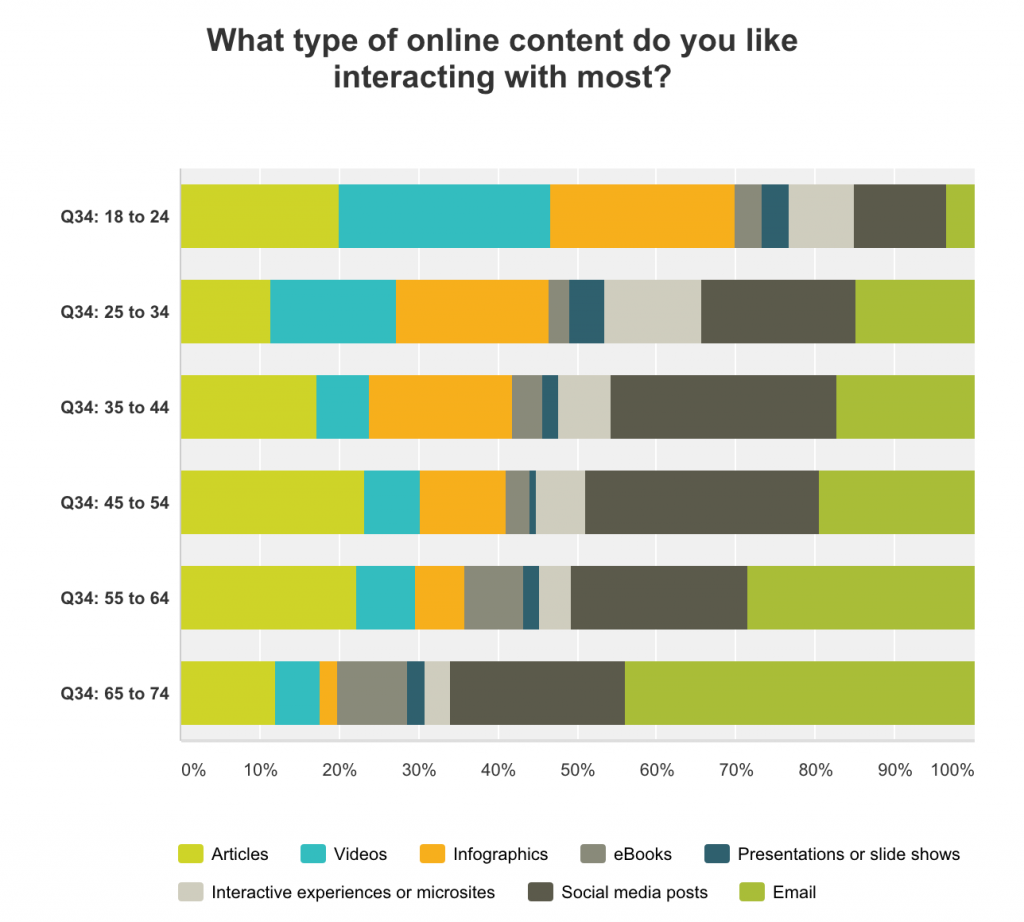
It’s important to know what your target audience is talking about, but it’s also important to understand who they’re listening to. To achieve the greatest success with your content marketing, you should seek to partner with other people, and companies in your space, that have a broader reach to produce joint content. Co-producing content and sharing it across each other’s channels will help you leverage new networks, and data will point you to the right partners.
Brands that do this right credit their influencer strategies with huge overall gains in social media followers. GNC, for instance, credited more than 380,000 new Facebook fans to its social influencer targeting over the course of just a single year.
Companies need to be using real data around the above three points to guide their content creation efforts. Too often, the cart goes before the horse, with marketers focusing their discussions around the hottest topics, channels, and celebrities. For example, a blue-skies content discussion today might naturally lead marketers to consider how Pokemon Go, SnapChat and the latest YouTube star can be leveraged in their creation efforts. Why? Because the audience around that topic, on that channel, and following that person right now is massive and engaged—and frankly, it’s fun to think about being a part of that.
But pump the brakes for a second, and think about your brand. If you’re McDonald’s or Coca-Cola, focusing your efforts on “hottest” might make sense. But for most brands, your content efforts need to be guided much more by “relevant,” not hottest. (highlight to tweet) For example, maybe you represent an insurance brand looking to make in-roads with mid-sized business owners. You could create the most hilariously compelling series of Pokemon Go Snaps ever, promoted by Smosh itself, and receive views and social shares unlike anything you’ve ever seen—and be absolutely no closer to your achieving your KPIs than when you started out.
Ultimately, having fewer of the right people viewing content is much more effective than thousands of the wrong people. A data-driven approach would more than likely point your content efforts down a much more practical path. When you discover that your target audience of mid-sized business owners are far more engaged on desktop than mobile, via email and whitepaper content from other successful entrepreneurs, and around topics like the most-coveted employee perks, you’re working with content insights that can actually help you deliver on-brand value to your desired audience.
I know what you’re thinking: This is all well and good, but how can marketing organizations structure their teams for the optimal blend of content and data expertise? Here, too, you must strive for a blend of art and science.
When it comes to tracking the success of content marketing, those teams tasked with content creation should also bear the brunt of the responsibility as it relates to understanding its effectiveness. Content teams must have direct access to basic metrics related to traffic, engagement, and conversions. However, when it comes to leveraging data for content strategy development, you might find a need for some deeper analytical expertise.
Your team must be equipped with either content marketing tools or data scientists—or both—in order to uncover the audience, topic, and influencer insights that will ultimately inform a successful content strategy.
Get more content like this, plus the very BEST marketing education, totally free. Get our Definitive email newsletter.
Blogging always sounds like an exciting “adventure” for many creative people. It gives you the opportunity to speak your mind, showcase a certain skill and help a potential audience of millions.
Sadly, the average blogger struggles to build momentum and reach a sizable audience. This often leads them to produce more content, faster and more regularly, all while keeping their fingers crossed.
But still, no substantial results are ever witnessed.
This then leads them to try and build a social media following, perhaps by starting a quick Twitter account and following dozens of people in hopes of someone returning the favor. Desperation then makes them open up two or three additional social accounts to maximize their chances of success.
Before they know it, many are spreading themselves thin and they’re no better than they were several weeks or months ago.
I have personally gone through all of this, and chances are many of you have as well. We all have to start somewhere, after all, especially when knowledge is limited.
Do you describe yourself as a struggling blogger? The following reasons will shed some light into your difficulties and help you come up with successful blogging strategies.
With over 3 million blog posts published daily, it’s safe to say that the arena is rather overcrowded. This means that your content will likely remain undiscovered no matter how damn good it is.
…..unless you make new (highly-relevant) friends in the blogosphere, that is.
You have probably heard about the importance of blogger outreach, which essentially goes like this:
Introduce yourself to an influencer by commenting on niche articles, sending a friendly email, and helping him out.
Keep repeating this with multiple people more than once, and (obviously) show a genuine interest in them. Finally, ask for a friendly favor later down the road – this could be a quick mention of your blog, a backlink to your article, a social share, an acknowledgement to his mailing list, and so on.
The question now is, why haven’t you done this yet? This is one of the most successful blogging strategies as proven by countless influencers, which means that others have already done part of the homework for you.
This brings me to my next potential reason…
What if influencers blatantly ignore me? What if they laugh at my request?
Likewise, your fear may be related to the way readers could approach your content. What if the first comment I get is a big, fat insult? I certainly don’t want to be put on the spot!
Listen, we all have to deal with negative comments at one point or another, as I did in this other article after a reader called me “Egotistical.”
The great thing about negativity is the ability to learn from that experience. Whether someone downright dislikes you or is merely providing constructive criticism, address the situation politely and genuinely thank them for their time.
Getting back to the subject of blogger outreach, I’d also like to mention another common reason why you might be struggling…

Many of us wish to write up a quick article, hit Publish, and watch a healthy traffic flow from search engines. Sadly, it’s not the early-mid 2000s anymore, so creating the content is only the start of your blogging journey.
Many suggest that you spend 20% of your time creating content, and 80% promoting it as one of several successful blogging strategies. In my opinion, these people are 100% correct.
Thankfully, there are tons of ways to get traffic that don’t necessarily involve the great Google. Think about joining several LinkedIn groups related to your niche, broadcasting through Periscope, and/or using older (but effective) tactics like SlidesShare – just to name a few.
If you’re starting to feel overwhelmed, I personally suggest you use a to-do list app to help keep a more organized blogging schedule. I use Todoist for my daily work, and my creativity has skyrocketed as a result.
Inconsistency was once my biggest weakness. I would create plenty of content one month, only to break for the next three.
Something that scares bloggers is the notion of having to post regularly. While constantly pleasing your audience with new material is great, remember what we had discussed earlier in this article: Spend 20% of the time creating, and 80% promoting.
Dedicate your time and energy into publishing better articles in exchange for quick, forgettable content. If your stuff is truly useful, you can honestly “get away” with publishing once every two weeks, in my opinion.
This gives you a whopping 14 days to befriend influencers, connect with general blog owners, keep working on LinkedIn groups and much more.
Not to mention, this approach will gradually give you more authority as you sacrifice quantity for quality. What’s not to like? After all, successful blogging strategies must start with a set/predictable pattern.
List building won’t necessarily make or break you as a blogger, but it can drastically increase your chances of success in the long-run.
A newsletter allows you to keep in touch with a loyal following of highly-targeted readers, readily available to interact whenever you knock on their door. Not to mention that a good relationship gradually leads to sales…
Did you know that GetResponse allows you to store up to 1,000 emails for only $10 per month as of this writing? If you can afford pizza or McDonald’s on occasion, do yourself a favor and invest in this as well.

Speaking of inconsistency, implementing a good strategy may consist of several things: What’s your ultimate goal? Are you looking to sell products to your audience? Get them to sign up to a monthly service? Spread brand awareness for your new startup? Where do you want to be in three, six, nine, and twelve months?
If “year one” is quickly approaching and you’re still in the same position as the first day, you might need to reassess your approach to blogging.
The best way is to check off each and every little milestone in the form of a strict to-do list, of sorts. Thankfully, most of the steps already covered in this article can help you reach your blogging goals, so everything is essentially interconnected.
While you don’t necessarily need to break the bank to build a successful blog, it is in your best interest to make some basic purchases.
Consider a self-hosted plan, which typically comes down to roughly $120 for an entire year for a decent-sized website. Spend $40 to $50 on a premium WordPress theme if necessary, along with any plugin you might need to help you be more successful later down the road.
I understand money may be a bit tight, but there are many of us who willingly ignore these expenses in favor of more “optional” ones (such as junk food). Why? Because there’s always a free alternative – which sometimes comes at the price of decreased quality.
While many free items are insanely useful (there’s no doubt about that) try look into some premium choices if you truly feel they are necessary and never settle for less.
Did you find yourself struggling at one point or another? Is there anything from the above list you wish to implement or improve upon? What other successful blogging strategies and tips can you offer struggling bloggers?

LinkedIn is the best B2B social network and there is no doubt about that. Whilst LinkedIn has been around for over 13 years, small businesses are still finding it hard to generate sales through the strategic use of LinkedIn.
Because of this, I have decided to share with you my 7-day LinkedIn action plan. This plan has been 8 years in the making, and one which I always refer to, and share with my clients. Regardless of whether you are new to LinkedIn, or you have been using it for a long time, it doesn’t hurt to have an easy-to-follow action plan.
It is really important that you follow a few simple, basic steps before you actually keep reading for the LinkedIn action plan.
Have you filled in your profile headline, picture, summary, work experience, skills & endorsements and honors & awards? These are all basic setting-up steps when creating your LinkedIn profile. You should have also customised your LinkedIn URL.
If you are nodding your head reading the above paragraph, you’re ready to take action, and follow my LinkedIn action plan for small businesses!
Day 1 is where you take the most basic actions around LinkedIn, and begin your week in the best way possible. Most of Day 1’s actions are not time consuming, and are beginner-level based.
It is important that when you first log-in to your LinkedIn account, you actually look at who is trying to connect with you. Leaving a connection request sitting too long, may leave the requester feeling impatient, and may forget the reason why they wanted to connect with you in the first place.
LinkedIn give you amazing insight into who has viewed your profile, and looking at this on day 1 of your LinkedIn action plan will give you the time to research those who have viewed your profile, and get ready to take the next day 1 action.
This is a daily action, and will be repeated throughout your LinkedIn action plan. After looking at who has viewed your profile, you can then send a connection request. Also look at your “people you may know” when sending out a request.
LinkedIn have a great private messaging feature called InMail. If you don’t have email notifications set up, or alerts for when someone is reaching out to you, this must be a part of your daily actions.
One of the best ways to expand your LinkedIn network, is to share great content that is relevant to your audience. I do this on a daily basis and it has helped me build my network inside of LinkedIn.
Day 2 will consist of repeating actions 3, 4, and 5 from Day 1 as well as two new actions.
You will notice, once inside of LinkedIn that you may have a lot of mutual connections with one connection of yours in particular. Visit their LinkedIn profile, have a read of their summary, work and endorsements and reach out to them if you think you could potentially do business together.
LinkedIn groups are a great way to find new clients, and get engaged with like-minded individuals. Join a new group for action 2, in day 2 and get involved in the conversation.
Day 3 will repeat actions 1, 2, and 5 from Day 1, as well as three new actions.
How often do you comment on your connections posts? This should be a regular action if you want to increase your network.
I write two pieces of content a week, and both of those will be shared on LinkedIn Pulse. This is a key step for a small business because of how powerful LinkedIn Pulse can be. So much of my website traffic, and engagement on social media comes directly from LinkedIn Pulse.
LinkedIn is a great source of information and as a small business, you should have a good idea of the type of company you would like to work with. Whether you are selling a product or service, you will have more than one company in mind. Research those companies inside of LinkedIn, and find the best person at that company to have a discussion with.
Day 4 will repeat;
Day 1 – Actions 3, 4 and 5
Day 2 – Action 2
There are also two new actions below.
Contact the business development team at LinkedIn, and share your content with them. As long as you have a LinkedIn share button on your site, and have consistently shared content with your audience then you might just be in luck.
You can import a list of your contacts from the Add Contacts page on LinkedIn. This will run a one-time upload of your address book contacts, as well as their detailed contact information. LinkedIn use this information to suggest relevant contacts for you to connect with, to help you browse, search, and organise your contacts on LinkedIn.
This might be something you have already done when creating your LinkedIn account. If not, this action will only need to be taken once a month.
Day 5 will repeat;
Day 1 – Actions 1, 2 and 5
Day 3 – Action 3
There are also two new actions below.
A recommendation inside of LinkedIn holds a lot of weight so make sure you ask every single person you do business with, if they would recommend your product/service inside of LinkedIn. In return, you can do the same for them.
You can endorse a connection for a particular skill by going to the “skills & endorsements” section of their profile, and clicking on the name of the skill, or the + sign next to the skill. Do this for three different connections of yours, and they will be notified via email that you have done this and they will do the same for you.
Day 6’s actions will consist of repeating actions 3, 4 and 5 from Day 1, and action 1 from Day 3, as well as two new actions.
A Boolean Search uses advanced search operators and Boolean logic to conduct a search. This will help you find 10 potential customers. If you don’t know how Boolean works, read more here.
Reach out to a connection of yours that you have history with and suggest a mutually beneficial time to either have a call or meeting. This could lead to more business.
Day 7 will repeat;
Day 1 – Actions 1 & 2
Day 2 – Action 2
Day 3 – Action 2 (if you write more than one piece of new content a week)
Day 5 – Actions 1 & 2
There are also two more actions for you to take below.
Inside of LinkedIn you can be asked to be introduced to a contact who is a 2nd-degree connection of yours (you both have a mutual connection). You can do this by going to the 2nd-degree profile, chose the connection from the mutual connections on the right hand side and “request an introduction”.
Have you changed roles within your business, or changed what your business offers? Whilst this isn’t a weekly task, it is important that your LinkedIn content stays as up-to-date as possible.
I hope the above will give you a better understanding around LinkedIn, and the actions you need to take as a small business. What do you currently do, on a weekly basis to improve your LinkedIn success?
Every day the battle rages on in the marketing trenches between quality and quantity. There are many marketing practitioners who will swear up one side and down the other that better quality leads are what they are looking for. There is no question about this. Better quality leads mean people at companies who are more likely to buy what you are selling.
In fact, 77 percent of marketers surveyed by Ascend2 listed improving the quality of leads as the top goal of their lead generation program. This is up 7 percent from the same survey last year.
This is more than three-quarters of marketers, so you might assume that the battle is over, and the quality warriors won. But there is a second data point in the survey that is worth looking at: Forty-one percent report that they want to increase the quantity of leads generated. They want more leads—not better leads.

Respondents could select more than one answer, so this is not a clear either-or decision. But an awful lot of marketers are saying they just need more leads. And of that group, there are likely many who are only looking for more leads. That means that more leads is their leading goal.
Developing a lead generation process should be a joint effort between marketing and sales. This is the easiest way to develop alignment between the two departments. And based on their typical response to the leads generated by marketing—that is, rejection—it is not likely that sales is clamoring for more leads. They want better leads.
The situation is this: Marketing practitioners, or more likely marketing leaders, are demanding more leads. Every business looks to grow from year to year, and yours is likely no exception. Depending on the size of your company, you might be projecting 20 percent, 50 percent, or 100 percent growth in revenue. You can do the math backwards, based on your average conversion rates at each stage, to determine how many leads you need.
There are two ways to look at this, but just like the survey results, they are not mutually exclusive. You can try to get more leads overall, regardless of quality, which could ultimately yield more sales. That assumes that your past conversion rate holds true—and you know what they say about past performance. This is especially true if you change your tactics to get more leads, just so you can say you got more leads.
The other way is to improve the quality of your leads. This will actually improve your conversion rate and get you to those higher sales numbers. If you bring in more people who are more likely to become customers, guess what? More of them become customers, thus increasing your conversion rate.
The math is relatively easy, but you can always let your Excel spreadsheet handle the heavy lifting. The only thing that changes is the percentage of responses that become marketing qualified leads. If you can’t reasonably increase this conversion rate enough to account for the suggested overall increase, you may also need to increase the number of leads, too.
And remember, you cannot just change the numbers in your spreadsheet without actually changing your marketing activities. To improve your overall lead pool to make sure you are getting better qualified leads, you probably need to add some sort of data analysis or technology to your marketing process. For example, examining your existing customers to develop lookalike models will help you more easily target the right prospects.
So the next time your management team give you a new, ridiculously high number of leads as your goal, before you accept that number, ask a question: What if we bring in better quality leads instead of just more leads? (highlight to tweet) Follow that up with a plan for how you are going to do it.
We might just be able to keep increasing the number of marketers who want better quality leads.


A full path attribution model is the most extensive method for attribution modeling. Reason being — it’s detailed, comprehensive, and requires a significant amount of data tracking. However, the more complex a system, the more useful and impactful it tends to be. So not only is full path attribution highly technical, it’s also highly effective.

The key to understanding full path attribution is to first understand weighted touchpoints. Every time a user, prospect, or contact interacts with your marketing (via an ad, webpage, event, SERP, CTA, etc) they create a touchpoint. Using several tracking methods that funnel data into the CRM, these touchpoints are collected and stored. Once the prospect or account in question becomes a customer, the chosen attribution model determines the method by which the revenue credit is divided between these touchpoints.
Weighted touchpoints (or weighted modeling) is the process of assigning how much credit touchpoints in certain positions along the buying journey will receive. For example, a touchpoint that began a session that resulted in a form fill, which in turn converted the prospect to a lead, would receive more credit than a touchpoint that did not result in a stage change.
For more information about the myriad of different weighting systems, take a look at this article about the 11 attribution models, explained in full.
The difference between full path attribution and other weighted models is due to its inclusivity — it measure the entire funnel. From view through attribution (discussed below) through to touchpoints after the opportunity stage, full path attribution records all touchpoints along the way.
The U-shaped model only tracks from the first touch through to lead conversion. The W-shaped model only tracks from the first touch through to opportunity creation. Full path attribution tracks users from their initial exposure to your brand through to their signature on the dotted line. The entire journey is represented in accurate, granular data.

W-shaped marketing attribution divides the revenue credit for a customer between the first touch, lead conversion, and opportunity creation stages. Of the 100% total credit for the sale, 30% of the credit being assigned to the FT the LC and the Opp.
The remaining 10% (30 * 3 = 90) is distributed across all of the touchpoints in between the first touch and the opportunity.

With full path attribution, 22.5% of the credit is divided between those three key touchpoints (FT, LC, and Opp), as well as the customer close stage. This also means that down-funnel sales activities are incorporated into this modeling method.
As with W-shaped attribution, the remaining 10% of the revenue credit is distributed across the middle touchpoints between those key stage conversions.

View-through marketing attribution tracks user impressions on ads. It gives marketers an idea of which ads the user has viewed, regardless of whether the user clicks on the ad. Having access to user activity prior to the first touch can help marketers assess the effectiveness of their ads, and it can inform on brand awareness campaigns.
While view through isn’t included in the Full Path Model as a key touchpoint, the data gleaned from tracking these pre-buying-cycle impressions can help inform on strategy and spend. With these view-through insights offered by full-path marketing attribution, B2B marketers can see what goes on behind the curtain, even before any of the action has begun.
Full path marketing attribution and custom modeling are often lumped into the same category — which makes a certain amount of sense. Full path attribution (not to be confused with the Full Path Model) is the general term for tracking and reporting on touchpoints at every funnel stage.
Once marketers have this versatile attribution tracking capability at their fingertips, they can customize the weights of their modeling system. They can decide which touchpoints at which funnel stages receive what percentage of the overall revenue credit. This is why full path attribution and custom modeling are often discussed side by side. One leads to the other.
More data is never a bad thing, but there are some unique situations in which a full path attribution model can be particularly useful — or might we go as far to say, indispensable.
While U-shaped and W-shaped attribution models are multi-touch models, they don’t measure touchpoints prior to the first touch, or after the opportunity conversion. If you’re focused on down-funnel initiatives post-opportunity, then full path attribution is extremely helpful in measuring the effectiveness of opp-to-customer conversion journeys.
Also, referring to our earlier discussion of view-through conversion tracking, full path tracks impressions prior to the first touchpoint, showing you the ads your contacts viewed as well as the ads they clicked.
We’ve written a more extensive article explaining the reasons why full path attribution models are extremely helpful for ABM reporting. The gist of the discussion is that ABM primarily measures account engagement — because the target is the account, not one particular lead / contact. Cross-company contact engagement is the most influential metric used to gauge progress.
This means that every touchpoint in every stage of the buying journey is key to understanding the current status of that account’s engagement. If the touchpoint report stops reporting after the opportunity-stage, it cuts off all of your intel, making it more difficult to close the account.
To conclude, full path attribution prepares a team to develop their own custom attribution modeling system based on their industry, size, marketing strategy, and desired reporting methods. And, it also enables view-through tracking that provides granular impression data prior to the first touch on an account.
B2B marketers seeking down-funnel insights will find exactly what they’re looking for when they arm their dashboards with a full path modeling system. Overall, it’s an exhaustive approach to revenue-based analytics that provides insights at every funnel stage.


According to CompTIA, estimates show upwards of two-thirds of IT products and services sold to U.S. businesses either flow through or are influenced by indirect channels, including a network of retailers, e-tailers, resellers and distributors. There is no question that these channel-driven companies must ensure that their partner management processes are optimized.
Today, data is being used to drive almost all key decisions, from refining such business processes to optimizing marketing campaigns. Channel sales are no exception. To do so, companies must have a system in place to capture and analyze relevant data about their business. Furthermore, companies need to make this data easily accessible by field sales and marketing via the cloud, and in their CRM tools or mobile devices.
Without accurate and timely data from channel partners, companies are forced to make business decisions blindly. Conservative estimates show that lack of channel visibility leads to technology and industrial sector losses of about $50 billion annually due to the misallocation of channel incentive payments and inventory markdowns.
Successful companies are able to analyze point-of-sale (POS) data in order to optimize their channel programs and get the maximum ROI out of their channel investment. Here are six best practices for analyzing partner data that will provide a deeper understanding of your channel partners:
Track Partner Loyalty: Most companies likely know who their most loyal partners are and have divided them into tiers, such as gold, silver or bronze, with special rewards for each category. However, not all do this with accuracy and consistency. Timely, accurate POS data enables companies to measure partners by objective benchmarks, such as meeting a minimum total volume over the last ten weeks and exceeding volume targets in at least eight of those ten weeks.
Identify New Resellers: Once top partners are identified, companies can start to focus on new, up-and-coming resale partners. Depending on the industry, hundreds of new resellers might pop up every month. It is therefore important to set parameters for judging when they become significant enough to be enrolled into a company’s partner program, such as a monthly volume criteria or when a partner first makes multiple purchases in a month.
Identify Partners at Risk: Analyzing POS data can provide early warning signs for which partners are becoming ineffective and why. For example, a reseller may have met minimum volume criteria, but their quarter-over-quarter sales growth has slipped significantly. Early identification of this problem helps companies take action to reverse the downward spiral.
Broaden the Product Mix: Some partners sell the same product, but never expand to sell the full product line. Once these partners are identified, companies can implement programs to incentivize partners to cross-sell their other products. Benchmarking and comparing a partner’s sales data with their competitors’ data might reveal additional markets where they can sell the expanded product line. Alternatively, companies can also create incentive programs to encourage specific product bundles.
Expand Partner Relationships: Careful analysis of partner sales data can reveal opportunities to convert resellers that only buy periodically into more regular buyers. Identifying why and when sales spikes occur can help companies turn resellers that primarily purchase from competitors into regular customers.
Identify and Build Out Key Market Segments: Many companies have special programs to sell into government, education or other industry verticals. Therefore, it is important to identify the segments partners are selling into and effectively leverage that information. The way to do this is to gather the data to assign Standard Industrial Classification Codes to resellers so companies can identify and raise awareness in the strategic end-user customer market segments into which they are selling.
Most companies already have visibility into their resellers’ sales volumes and have identified their largest and most strategic partners. They primarily track overall sales, and perhaps, whether the largest resellers are growing or declining over time. However, by consistently collecting and analyzing indirect sales data, and by presenting these insights to channel sales and marketing at the point of decision-making, it is possible to gain a deeper understanding of underlying partner buying behaviors and patterns, which is key to successful channel development.

Flying can be stressful, expensive, and exhausting — but it doesn't have to be.
We've rounded up the best tricks to make your next trip through the airport a breeze.
Sign up for TSA PreCheck or Global Entry. The US Customs and Border protection pre-approval is basically a pre-flight upgrade, and will get you through security and onto the plane faster.
Long lines, crowded commutes, and traffic can be avoided by picking off-peak flights, especially overnight ones.
Airport parking can be a harrowing experience — it's expensive and you may have to spend hours driving around to find a spot. The Airport Parking Reservations app, which is focused on airport parking in the US, Canada and UK, takes the stress out of the experience by allowing you to book a spot through your phone, choose the most convenient one, and book it at up to a 70% discount.
Get ahead of the game by checking current wait times and delays on My TSA. It'll also help you find the shortest security line.

Research has found that because most people are right handed, they gravitate towards the right, leaving security lines on the left with fewer people.
If all the lines are equally long, choose the one with only one lone TSA agent staring at the computer. If there are two, chances are that one of them is being trained, and that pretty much every item will be stopped as it goes through the x-ray.
Instead of awkwardly pulling shampoos and lotions out of your dopp kit, keep liquids in a separate Ziploc to easily pull out of your carry on. Bring an extra one to throw in your keys, jewelry and change at security as well, rather than grappling with loose change on the other side, barefoot, while the guy behind you tries to push by.
This might be risky, but the denser you pack your bag (lots of shoes, cables and electronics), the harder it is to see details on the x-ray, meaning that you might be able to sneak a bottle of wine onboard. However, you also risk losing it.
Ice is a solid, of course, so as long as liquids are frozen (make sure they don't melt by the time you get to the airport), they should be fine with the TSA.

Another way of bypassing the exorbitant cost of water at the airport is to simply bring an empty bottle. All airports have water fountains, and most even have water bottle filling stations.
Mobile boarding passes can be fickle. Sometimes the app signs you out, sometimes it crashes, sometimes you just don't have service. Take a screenshot of your boarding pass for easy access and to bypass any app related issues.
Most airports no longer charge for luggage carts, but should you find yourself in one of the few airports that does, head to the pickup area to find a few strays that people have abandoned when getting picked up. Bonus: Smarte Carte will give you a quarter for returning carts.
Loyalty to an airline, as well as frequent flyer and reward programs, will get you perks like upgrades, lounge access, and priority boarding.
Basically an airport bible, this app tracks departure and arrival times, estimates TSA checkpoint wait times, features terminal maps with ATMs, bathrooms, lounges, shops and restaurants, as well as reviews, and even helps with discounted Avis car rental bookings. You can also choose to get push notifications for real-time updates to your itinerary (like gate changes, security wait time changes, delays or layover time adjustments). Another fun feature is that the app stores your travel stats, keeping track of the airports you've visited, miles you've flown and how you compare to other users.
Airplane food is notoriously bad, but recently airports have been stepping up their game with award-winning chefs and famous restaurant chains. AirGrub allows you to order food from your phone, pay for it through the app, and pick it up to eat on the plane. All you need to do is enter your flight number to see what meals are available near your gate.

This might not always work, but often at lounges the wi-fi signal is strong enough to extend beyond its doors, so sitting right outside of it may get you free wi-fi.
Foursquare users not only post tips on the best meals, but often share wi-fi passwords.
Most lounges allow members to bring in a non-member. If you're friendly enough, you might be able to convince someone entering the lounge to sign you in as well.
A handful of credit cards, like the Visa Black Card, Chase Ink Plus, Citi Prestige, and American Express Platinum, to name a few, either include free lounge access or a certain number of day passes a year. The LoungeBuddy app will not only help you figure out what lounges you can access by analyzing your itinerary, credit cards and loyalty status, but also maps out what lounges are nearby, as well as traveler's reviews of lounges around the world.
 Most airport lounges sell day passes, and others aren't affiliated with airlines at all. While these passes can be pricey (though buying them online in advance is usually a lot cheaper), if you have a lot of time to kill you might end up saving money, since access to the lounge includes wi-fi and food, both of which are notoriously expensive at airports.
There are never ever enough outlets at airports, so bring your own outlet splitter and make some new friends.
Airport chapels are a good place to find some peace and quiet, but if you're looking to catch some zzzs, check Sleepinginairports.net for the best places to sleep at airports around the world.
If your flight gets cancelled or there's a really long delay, you'll find yourself in a stampede heading towards the help desk. Instead of following the herd, get on the phone with your airline ASAP. Get even more of an edge by pre-programming their numbers into your phone, because when a flight with hundreds of people gets cancelled, every second counts. The person on the phone can do everything the gate agent can, and may even have more options for rebooking. Plus, you get to skip the line. That said, the line is often worth it for food and hotel vouchers, should they be giving those out.
Arguing with some poor, stressed out gate agent will never do you any good, but we've found that airlines are super responsive to social media, especially tweets. As long as you're polite, tweeting at airlines might get you some extra perks.
Always ask for upgrades — the worst that can happen is a polite rebuffal.
We're not talking three-piece suit here, but ditching the sweats can help score upgrades. When AirFareWatchdog.com founder George Hobica asked a gate agent directly whether they'd be more likely to upgrade someone who was dressed well, the answer was, "Yes, the better dressed you are, the more likely you are to nab that seat. I am not going to put someone wearing flip-flops up front with our best customers."
Join the conversation about this story »
NOW WATCH: A unique face pillow promises comfortable sleep while traveling
Toshiba has launched two new midrange SSDs under the A100 Series umbrella. Pricing is unknown at this point, but they should be similar in price as Toshiba's similarly-sized Q300 drives.
The post Toshiba’s new A100 Series of solid state drives aims for affordable performance appeared first on Digital Trends.

By this time you probably understand the value of creating a free ebook offer to build your email list. If you don’t, you should read this article and get on it!
You know that you need to design an ebook… but there isn’t a lick of design skills in your body! Okay, I hear ya. It’s hard to design when you don’t know what the f*#% to do. I’ve been doing graphic design and branding for well over 8 years. With a little guidance, I think you’ll find that you don’t need to know how to design to make a beautiful ebook for your online biz!
With a little help of course from this article!
Okay, the part that you can do without any design skills: outlining your ebook. Create an outline for the content that you’re going to cover. Then, write the damn book! Just sit down and get it all out on paper. To be honest, the design part is probably easier after you’ve written the actual material.
I recommend using Pages (if you’re a Mac user) or Canva.com.
Canva has loads of presentation templates that are incredibly helpful to use if you have zero design skills. Plainly, select a template from the menu (first select “Presentation”). You’ll be given a series of well-designed templates to choose from. Yes, they are meant more for presentation designs, but you can totally use the templates for your ebook designs too. It’s easy to add more pages right in the document, paste in your text and more. Canva even has an entire library of images (many are free and some just cost $1 each) as well as icons, and more.

Pages (the program for Mac users) is really easy to use too—though doesn’t give as many templates and easy-peasy options as Canva. However, if you can add a few different elements onto the page, designing an ebook can be easy in Pages too.

Let’s cover the basics…
Designing covers for ebooks are easy. I like to place a big photo over the cover, and some simple white text on top with the title. If you’re wondering where to get amazing photos to use, I’ll cover that too.
Here are a couple photo resources that I like to use:
Death to the Stock Photo has free monthly packs emailed to your inbox. I choose the premium plan because they offer more photos, more often. At $15/month I feel like it’s a no brainer.
Unsplash has free photos from the public domain. They’re easy to search and easy to download.
If you’re looking for even more photo resources, check out this article on 12 killer stock photo resources. Most of them are even free!
I like to use a single-page template. I’ll use the same page for the entire ebook. It’s simple, easy and fast.
I’m going to give you an example of a really easy design so you can get started. There are lots of ways to effectively and beautifully design ebooks. I’m just going to cover a simple template so you can get something out there and started in a beautiful way. Feel free to experiment, and search more design trends to play with design.
I like to take the same photo that we used on the cover and place it as the background on the page.
From there, I will add a white box on top of the image, leaving the image as the border.
This is the basis of your page design.
Then, place your logo in the corner, and contact information in the footer. This way people can find you and get in touch!

Choose a header font for your titles. This can be something simple or decorative depending on your brand. Then choose the type that you’ll use for the rest of your ebook for the generic text. This should be something simple, and easy to read. Some great fonts I can recommend are Gotham, Helvetica Neue, Bookman Style, Avenir Next, Bodoni 72.
Take a big beautiful photo and plant it right on your cover. Afterward, create a black box and lay it on top. Then take the black box and drop the opacity of the box to 10-20%.
This is the base for your cover. Then you’re just going to place some larger text on top, centered with the title of your ebook. It’s pretty simple! Remember to place your logo on the cover too!
Things to keep in mind while designing your cover:
You won’t want the text to compete too much with the top image. There are a couple ways you can handle this.

Once you’ve got the entire layout ready to you, simply add your content! Add the text from your ebook, and wrap it up! Remember to add a call to action at the close of your ebook with further contact information or what people can do or take for next steps.
Export your ebook to a PDF file. And if it’s a workbook, take it into adobe acrobat and convert the pdf into a workable interactive document. It’s pretty easy.

I hope this helps you create your first ebook from scratch without design knowledge!
Twitter has changed my life, personally and professionally, in ways I can’t even begin to explain. I also understand that Twitter isn’t like any other social network. The quirks and limitations cause many to give up and many others to not see how someone like me finds so much value on the network.
I’ve written numerous posts on the power of Twitter chats, personal branding, and influencer engagement on Twitter. Over the last couple years, Twitter has made a massive effort to add features to not only simplify the user interface but also give creators additional options for telling their stories.
Listed below are my top 6 Twitter power user features that any user, no matter the number of followers, can take advantage of to find massive value on Twitter and standout from the noise.
 Twitter Lists: Contact and conversation management
 Tweetdeck: Real-time engagement
  Twitter Analytics: Easily monitor what matters to you
 Pinned Tweet: Attract and direct traffic where you want it to go
 Twitter Embed Options: Make it easy for people to find, follow and engage with you
 Twitter Video: Go beyond 140 characters
What is the difference between a Twitter power user and the average user? Time, strategy, and an understanding of all Twitter options.
Time, like in everything we do, is required to find value and opportunity on Twitter. I don’t have a magic trick or tweet shortcut to get more than 24 hours in your day or to pause the clock while you’re engaging in your favorite Twitter chat. Strategies for leveraging Twitter are included in my consulting offerings and will be included in my upcoming #ThinkLikeAFan workshops. There is no easy button but I will say that when you start by defining what success looks like for you and your time spent on Twitter – you’re ahead of most. Hopefully this post gives you insights into key Twitter features that you might not have known were available as well as how I use each to find incredible value on Twitter.
New Twitter Apps!
There are two new Twitter iOS apps that you might want to checkout – Dashboard and Engage. Both add to and simplify the Twitter experience by linking analytics, user view and ad spend from a mobile device that is much cleaner than the normal iOS app.
My Twitter Feature Wishlist
 This wouldn’t be my post about Twitter features if I didn’t include a personal wish list for future features just in case Twitter is reading this. So here you go:
Did I miss any of your favorites?
 Do you ever feel like you are on a social media roller coaster? There are so many new platforms and the ones you already use are changing every day. People get overwhelmed with the choices and the changes. Many just give up, because they feel like they are wasting their time when not seeing the desired results.
I was hired to give a presentation to a Chamber of Commerce in Peru, Illinois. The title of the presentation was Social Media for Business, but it was kind of a misnomer, at least in what I presented. This was a three-hour presentation, and of course, everybody wanted to know how I use social media to make money. The answer to that is very simple, use social media correctly.
 The first two hours were actually spent on what I call the principles of social media, which is having to know the basic principles of know, like and trust. More importantly, you have to understand why people are on social media, what they expect, and what you can provide to them. The principles are really about creating your own original content that gives people what they want, that entertains them, and that gives them information that is new and of value.
What people really want to know is how to post my ads and make money. That’s really super simple. All you have to do is go to Facebook, Google or Linkedin and pay for it. If you want to do it in a more organic way where you’re not paying for all these ads, then you have to do your original content and be consistent about it. One of the things that I like to teach up front is, first and foremost, understand the why behind the how. The next thing is to create a system that’s repeatable, so that you can do it over and over.
During the last hour of the presentation, I spent some time talking about Facebook, Linkedin, Twitter, Pinterest, and Google Plus. These are all of the different things that people are using and what I consider to be the top five. Then of course there were a lot of questions about some of the newer social media like Snapchat, Instagram, Facebook Live, etc. I want to kind of explore that. I want to look at ways to utilize these and tell you why you should explore them. First and foremost, you’ve got to understand who your audience is, where they’re at, and what kind of information they’re looking for.
 In Snapchat, for example, you go on and you can either post a picture to direct at someone specifically or you can do these little, short 10-second videos. There is something called a Snapchat Story, where you can go in and actually sequence a handful of these little videos together. I’ve seen people do some incredibly creative things with them. Joel Comm, who is a master at video marketing, has done some really, really great Snapchat stories, where he’s taken complete songs and turned them into online marketing.
Many brands are jumping on Snapchat and they’re using Story to build these mini-videos. The thing you don’t want to do is barrage people with information. You don’t want to make the story so long that it doesn’t make sense. What that means is you’ve got to plan out what it is that you’re trying to achieve and what you expect from your audience. What do you want them to do?
I watched a Snapchat from Joel today and he had a coupon for something called Dot Live. The coupon allowed you to get your domain Dot Live for twenty percent off. I haven’t gone into that, I haven’t looked at the pricing or anything, but he was actually selling something with a story. There are other people like John Lee Dumas, who I’ve interviewed and I’ve watched some of his Story. He’s also using it as a marketing tool to try to sell to his audience. The key is that you have to build the audience first, before they’re going to buy anything.
The question becomes why do I want to use Snapchat when whatever I put up only lasts twenty-four hours? Because that’s the way the platform works and that’s the way that people expect it. The people who are using Snapchat really love it. They don’t mind that things only last twenty-four hours. They figure if I don’t get to it now, I’m never going to get to it. That’s the way you have to think about it.
 I don’t know how old you are, but back in the ’60s, Mission Impossible was a weekly TV show. At the beginning of every episode, they would play a tape (a little reel-to-reel) and they would say, “This message is going to self-destruct in ten seconds,” and all of a sudden the tape would burn up. That’s essentially what happens in Snapchat, but it takes twenty-four hours. You have to learn how to communicate within that bandwidth of what people are used to inside of each one of those new social media tools. Each one of these video tools has its own audience on its own platform.
You’ve got Facebook Live. You’ve got Periscope. You now have Story inside of Instagram, and then you have Snapchat. The question becomes is your audience on there and are they using it in a way that you could get your messages out to help you promote your business? Those are the key things. First and foremost, what messages are you trying to get out there? What is the original content that you’re trying to provide that’s going to educate, inform, or entertain?

The second thing is which one of these platforms is your audience actually using? In a couple of different interviews on podcasts, I have heard that kids love Snapchat, but they think Instagram is trying to copy Snapchat with its stories. Instagram is for pictures and Snapchat is for stories. Facebook Live is getting inundated with people taking live videos, which is very interruptive. It all of a sudden comes up and says, “Hey, this person is live on Facebook right now.” The more people use it, the more people are going to start to ignore it. The bottom line is is you have to have a solid audience that you want to communicate to. One of the best ways to do that if you’re going to use Facebook Live is put it on your business page or in your group, but don’t put it in your general newsfeed. Talk to the audience that you’ve already built.
Let’s go back to that concept one more time. You have to have your tribe, you have to have your audience, and you have to know what information they want. If they’re on Snapchat, treat them like Snapchat, act like people act on Snapchat. If they’re on Instagram, use the tools that are there in the way that people want you to use them. If it’s Facebook and you’re doing live video there, then you have to wonder if you are over-communicating or doing the right things.

business man hand shows 3d word internet concept
This is the thing that overwhelms people, especially in the group of mostly women that I was speaking to in Peru. They have a hard enough time understanding what to do in Facebook, but then adding Live video, doing Instagram, Twitter, Linkedin, Pinterest, Google Plus and all of these other things overwhelms them. Step back for a second. Number one, who is your audience? Number two, where are they? Number three, what information can you possibly provide them that would be of value to them? Number four, are you getting feedback? Are you getting engagement? Are you talking with your audience and saying where are you, what kind of information do you want, and how can I serve you better?
We all try to guess. We all try to figure out that the latest and greatest thing is going to make the biggest difference, but the bottom line is talk to your audience, ask them what they want, what they need, and where they want it. Then provide it, but also measure the results. Understand the response that you’re getting. It’s not just the hearts, the likes, or the shares, it’s all of those things.

The bottom line with all of this new technology is first and foremost talk to your people. Know what they want, where they want it, and how they want to get it from you. Secondly, just go in and play. Even if your audience is not on there, just go explore a little bit and see how it works. See what you can do within it. Spend five minutes on a Saturday or a Sunday to explore and see what other people are doing and just learn. I’ve learned that the only constant in this new digital world is change. The bottom line is embrace it, have fun with it, go learn something. Just play around with the new technologies and see if it works for you.
I would love to hear your thoughts and comments and maybe some other topics you would like me to cover!
To learn more about this and other topics on Internet Marketing, visit our podcast website at http://www.baconpodcast.com/podcasts/
Ben Horowitz provided a lecture at Stanford University in 2014 on a business model for an ethical & learning organization. Discussing the leadership style of Toussaint Louverture during the Haitian slave revolt in the 1700’s several key principles were highlighted to help organizations understand the importance of taking a systems view of leadership decisions:
When any of these systemic components is neglected the quality of the business systems will suffer. Highlighting Toussaint Louverture’s leadership style during and subsequent to the Haitian revolt, Horowitz discussed the importance of being able to take into consideration the perspective of each stakeholder group (and system) when deciding what values and behaviours to reinforce.

In the historical example of the Haitian revolt the French armies (and land owners) were defeated but not vanquished. Toussaint considered the systemic consequences of decisions to be made on Haiti’s future; its economy, quality of life, and the resources needed to support Haiti’s goal to be a vibrant and successful country after the revolt. Realizing the resources, knowledge, skills, and abilities needed to support this vision would necessarily mitigate making certain decisions that could interfere with that vision. The result included maintaining many fundamental elements of the earlier system (land ownership, etc.) while supporting new freedoms, wages for work performed, and inclusion of the competition in mutually beneficial goals.
The “New Systems” were built upon the existing assets offered by earlier foundations. This included economic, social, human, and intellectual resources that were necessary to create thriving communities who produced export values in excess of that produced by the United States in the same period. The ethical and moral leadership required exceeded anything that had taken place before and after realized levels of engagement, commitment, and performance from competitors (the defeated land owners and members of the French army) now incorporated into Touissant’s new economic model of leadership.
This process transitioning from the earlier culture to the new culture represented an integrative transformation that blended functional elements of the past with new a new vision. Touissant’s new economic model of leadership incorporated everything from the earlier system that could continue to add functional values including human and physical resources.
Upon this foundation was introduced the values, beliefs, morals, and expectations that ensured that the corrupt values and traditions of the past were replaced. This resulted in a true learning organization that was both innovative and integrative in its ethical vision. Businesses can further support their economic models of leadership by integrating these values with the two levels of Porter’s Value Chain (2016) which is used to identify the core administrative and technical/service competencies of the modern business structure.

Ben Horowitz illuminated the consequences of making decisions that fail to consider the perspective of all stakeholders. Not only can such decisions create resistance, confusion, and misinformation they can also increase systems misalignment and the under leveraging of available resources.
The moral of the story is that convenient decisions rarely have the results intended. Instead, they can help reinforce the status quo, increase resistance, decrease performance, or at least fail to produce sustainable meaningful results. Unfortunately, this happens all too often.
Effective leadership requires being able to engage competitors and create meaningful partnerships throughout the business’ ecosystem. Bridging the differences in the pursuit of shared meaning. This means having those difficult conversations to ensure alignment, training, and an effective allocation of resources is possible. When management does not seek (or have the skills) to bridge these differences opportunities, resources, values, and the systems stakeholders are affected. When this is reinforced the resulting business culture’s ability to both envision and pursue higher values is diminished. What is then needed is a leadership culture that is resilient, integrative, and forever learning.
How is your business reinforcing leadership to have those difficult conversations and create a learning organization? Leave your comments below.
To scale efficiently and effectively, expansion-stage companies need to focus their efforts on a specific subset of customers who are most similar to their best current customers, not a broad universe of potential customers. Customer segmentation is the way.
Also known as market segmentation, customer segmentation is the division of potential customers in a given market into discrete groups. That division is based on customers having similar:
There are three main approaches to market segmentation:
This guide will focus on the value-based approach, which allows expansion-stage companies to clearly define and target their best prospects (based on its current knowledge of the market) and satisfy most of their needs for segmentation in the expansion stage—without consuming the time and resources of a traditional, descriptive segmentation research process.
Don’t have time to read it now? Check out our quick 10-step approach to customer segmentation.
While most companies possess enough market knowledge to predict or anticipate which customer segments are their most profitable, the leaders of those businesses also know that scaling a business is not best left to guesswork or instinct. That’s why, in a customer segmentation process like the one described in this guide, it’s critical to develop customer segment hypotheses and variables, and then validate them with a well-developed, scientific research process.
That’s particularly true in needs-based and value-based segmentation schemes, where it’s impossible to utilize a customer segmentation process without first establishing clear hypotheses that will serve as the foundation of your research. Ultimately, hypotheses should be formed around customer characteristics or factors that allow you to clearly separate your current customers into distinct needs-based or value-based segments. While your hypotheses do not need to be complicated mathematical or statistical statements, they should be clear and logical enough to be testable and useful.
For example, a typical hypothesis might look like this:
Using that example, the segmentation variables can be defined as the objective measures, factors, or characteristics that help you differentiate segments, whether they are needs- or value-based. In the above scenario, those variables focus on financial information, but they could just as well pertain to the customer’s reputation, online presence, or business model, depending on what is most relevant to the segment.
Developing variables and hypotheses is important for a variety of reasons, but its primary purpose is to provide a framework for the customer segmentation research process. Once you have established a clear hypothesis and the variables that you need to test, you can begin executing the intricate process that will help you identify your best current customer segments.
As with most business initiatives, the goals and outputs of customer segmentation research will likely depend on your company’s stage, market conditions, and myriad other variables. However, there are some relatively standard schemes that coincide—or at the very least overlap—with most needs-based or value-based segmentation initiatives.
For example, here are six standard segmentation schemes that could be applied to your customer segmentation research:
It is important to note that even if a market is divided into one of the schemes above, it is still not a valid segmentation of the market unless it results in meaningful differences in customers’ values and needs, the company’s value proposition, or the go-to-market strategy associated with each scheme. In such cases, it is merely a convenient organization of the market that has no strategic or operational value.
At the expansion stage, executing a marketing strategy without any knowledge of how your target market is segmented is akin to firing shots at a target 100 feet away—while blindfolded. The likelihood of hitting the target is a matter of luck more than anything else.
Without a deep understanding of how a company’s best current customers are segmented, a business often lacks the market focus needed to allocate and spend its precious human and capital resources efficiently. Furthermore, a lack of best current customer segment focus can lead to diffused go-to-market and product development strategies that hamper a company’s ability to fully engage with its target segments. Together, all of those factors can ultimately impede a company’s growth.
If best current customer segmentation is done right, however, the business benefits are numerous. For example, a best current customer segmentation exercise can tangibly impact your operating results by:
Conducting best current customer segmentation research can have numerous other ancillary benefits, of course, but this guide will focus primarily on how it can impact the four cited above. The bottom line is that if you are able to sell more of your product to your most profitable customers, then you will be able to scale the business more efficiently and ensure that everything you do — from lead generation to new product development — revolves around the right things.
This first step toward creating meaningful change in an organization is acknowledging that change is needed. For a technology company moving from the startup stage to the expansion stage, that often means abandoning a non-discriminatory, “take every customer we can get” approach, and replacing it with a far more targeted, best current customer segment strategy.
Executing a customer segmentation research process is the first step toward helping a growing company make that transition. Ultimately, best current customer segmentation can help your business better define its ideal customers, identify the segments that those customers belong to, and improve overall organizational focus.
In order to help you identify your best current customer segments, we’ve broken the process down into five clear steps, from setting up your project to performing customer data analysis, executing data collection, conducting customer segment analysis and prioritization, and incorporating the results into your organizational strategy.
While recognizing that being able to identify your best current customer segment can help your business is important, it is meaningless unless you act on it, or if you engage in segmentation activities that are more distracting than helpful.
To be effective, you need to execute a best current customer segmentation process that is driven by a clearly defined set of objectives and outputs, and is backed by all of the company’s relevant stakeholders. This guide will help you accomplish those tasks.
The systematic and scientific data collection and analysis processes laid out in this guide might seem complicated, but they are not impossible to manage. Like almost any initiative, you simply need to ensure that key players and shareholders remain focused on their specific roles and responsibilities, and work collectively to achieve a clearly defined set of goals and objectives.
As with any project, preparation is essential. Without it, your initiative will lack focus and direction, which can ultimately take you off course. So let’s make sure your ducks are in a row.
To determine your best current customer segment, begin by defining the project and planning for it appropriately. To do that, you first need to have a crisp understanding of its:
Creating a work plan
Before executing the project, it is also important to have two sets of plans: a high-level outline and a work plan. The outline should detail the basic steps, methodology, and timeline of the project. It is a document that the project’s stakeholders should review and approve.
By contrast, the work plan is a much more detailed document that elaborates significantly upon the outline, typically breaking steps down into specific tasks that clearly indicate what needs to be done and what the related inputs and outputs are. The work plan also has to incorporate various internal touchpoints that happen internally between everyone involved in the project.
The work plan should reflect inputs on key tasks as well as suggestions and specifications for outputs at key internal review steps. It should also ensure that the methodology behind the main analytical tasks is consistent with the project’s overall methodology. The detailed work plan should then be used to estimate the time required for each task (in hours or days), project step (in days or weeks) and the whole project (in weeks). Given that the time estimate may not be 100 percent correct at the task level, expect some discrepancies between the estimated length of the project and the actual time it takes to complete.
During the course of the project, there will invariably be unplanned diversions and other changes that need to be reflected in the work plan. Major changes to steps in the project or the project’s methodology should always be vetted by the stakeholders and fully documented in the updated work plan.
Getting buy-in from the executive team
To have true impact, a customer segmentation exercise — and specifically its outputs — need to be incorporated into your company’s go-to-market strategy. This is because, in many cases, selecting a top segment can actually kickstart the execution of a companywide go-to-market strategy. However, you will only achieve that level of impact if your company’s executive team is a true stakeholder in the project.
The way to secure their buy-in is by getting them to understand that:
To ensure the executive team’s buy-in across these areas, it is important to actively articulate the benefits of best current customer segmentation. Be extremely transparent about the methodology and process steps involved in the project so that your stakeholders are always aware of any changes in the process that might make them reconsider their commitment to the overall project.
Additional best current customer segmentation prerequisites
Developing a customer list
The project scoping and definition exercise continues by developing an account list to use as your data set. Built from a customer relationship management or billing database, the list needs to be comprehensive and include all of your customers with the exception of test and proof of concept (POC) accounts.
Note that any company’s customer base will contain outliers — customers with very special characteristics, deal structure, or conditions — which must be carefully considered before deciding whether or not to keep them in your analysis. Keeping the outliers in the analysis can be a disadvantage, skewing average values and expanding the variance of the data under analysis, thus reducing the precision of the results, and highlighting one-offs while disguising underlying trends.
Consider the following points as you seek to reduce your full customer list into one that is more conducive to statistical analysis:
| Action | Examples |
|
|
|
|
|
|
|
|
Defining customer quality or value
The purpose of your analysis is to identify common characteristics that define good customers. To do that well, you need to clearly and objectively define what good means by developing a quality score that you can use to objectively rank your customer base.
In the purest sense, customer value is the total net present value of the cumulative profits generated by a customer over their lifetime. Naturally, you won’t have data on the future behavior of your current accounts, so you will have to make certain assumptions about the future, and fill in missing data with averages based on the data you do have. Practically speaking, it is very hard to calculate or even approximate this, especially with the demographics of young, rapidly growing companies.
Another complication is that it is almost impossible to precisely identify all of the non-negligible costs associated with a customer over its lifetime, especially for software as a service (SaaS) companies whose service costs stem from a blend of hosting, bandwidth, customer support, and account management costs. You should not expect the score to include all of these factors completely or to be a precise measure of the value/cost/profits. Nevertheless, the quality score will serve your purposes as long as it captures enough of the differences between what your organization considers poor, average, and great customers, and allows you to rank customers based on those measurements.
The following example illustrates how to establish a quality score for a software as a service (SaaS) or license-based software vendor:
Such bonuses and penalties are necessary to compensate for less concrete costs and income associated with the account. For example, as noted above, we are not sure how long a current account will stay a customer or at what rate it will renew. However, we can assume that growing accounts are happy and are more likely to renew at a higher rate. As a result, we can reward their score accordingly for that expected future behavior. Likewise, marquee accounts will have an impact beyond their own MRR, so their score should reflect that.
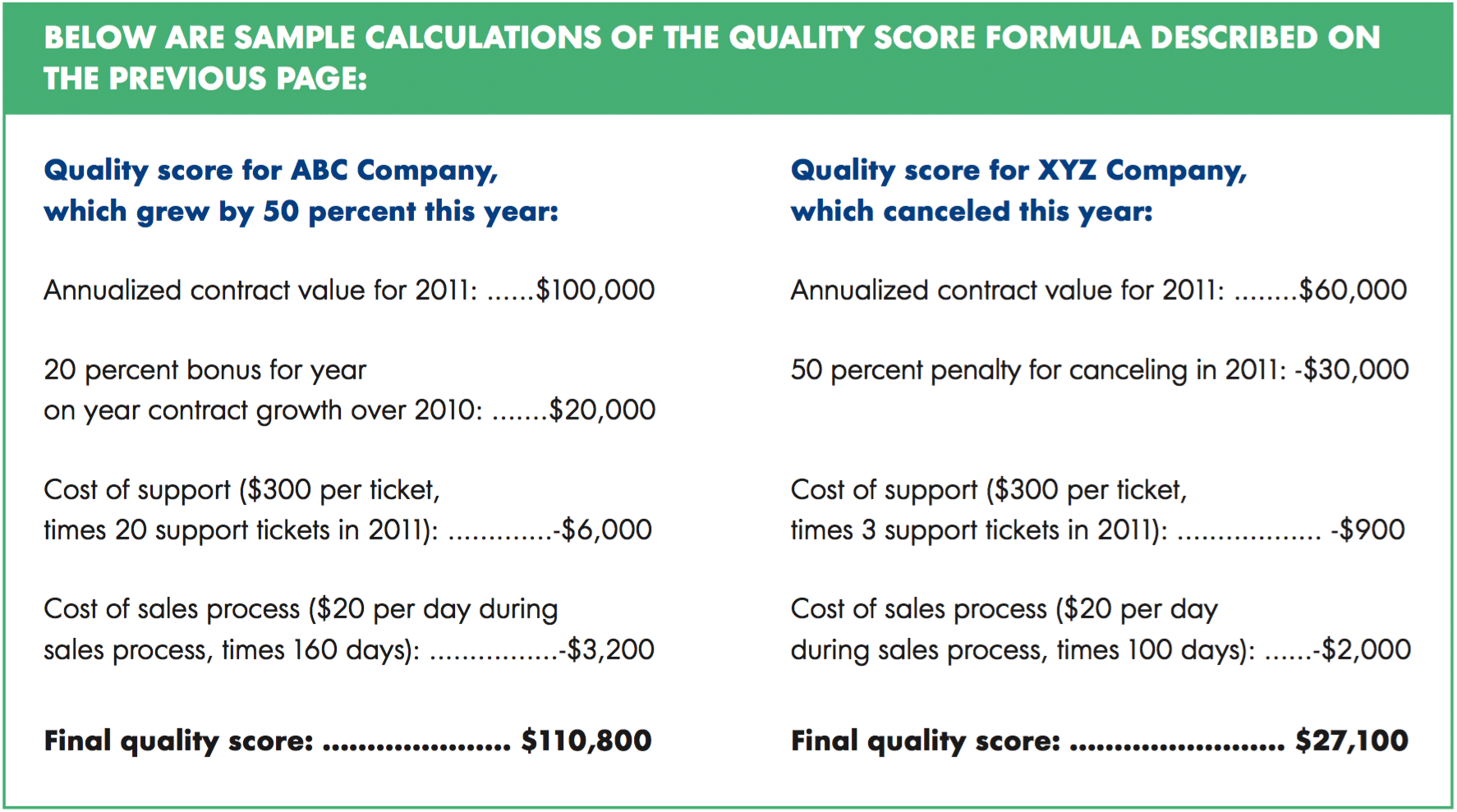
Once you’ve developed a quality score that sufficiently captures these nuances, the next step is to present it to the project stakeholders for their feedback. This is essential because the quality score is the foundation for the rest of the project and everyone needs to generally accept it as an accurate and reliable representation of customer “goodness.”
In the feedback process, you might uncover additional factors that need to be incorporated into the scoring formula (for example, additional usage costs for customers in a particular use case, or additional costs of acquisition for customers in a particular channel). Moreover, reviewing the quality score may also raise concerns about systematic errors in the formula that are obvious to certain stakeholders but not to others. This could mean anything from eliminating costs they don’t think are relevant, to increasing the weighting of a particular bonus or penalty.
Always remember, no matter how thoroughly defined and logical your methodology, the ultimate results of the analysis will not be credible unless all of your stakeholders agree with your proposed ranking of the accounts. Reaching that agreement may be difficult, and will likely require flexibility in your formula and some consensus building so that all of your stakeholders can agree and commit to the methodology.
In this section of our guide to customer segmentation we’ll cover everything you need to develop effective research criteria and successfully manage the data collection process.
The next step in the best current customer segmentation process is to develop a formula or set of criteria to measure the attractiveness or value of each customer in your customer base. This formula is determined by the actual economic benefits or net profits/loss that customer has generated over its lifetime. It creates an objective measure that can consistently and objectively be used to compare customers in different segments.
Identifying segmentation hypotheses: What are the characteristics that make a company a good customer?
Once your list of accounts is objectively ranked, start identifying hypotheses for the observable characteristics that could predict their quality.
The hypotheses should represent proposed relationships between customer characteristics and the goodness of the customer, as measured by the quality score. If the company you are analyzing has more of a particular characteristic, it will likely have a higher quality score.
To generate an initial list of such segmentation hypotheses, you’ll need to analyze:
If their answers can be framed as observable characteristics of a company, they can be used as a segmentation hypothesis.
The ultimate goal of your research and data collection is to determine what makes a good customer for your company or product. At this stage, no segmentation idea is too far-fetched, as long as there is some economic or logical rationale for why it could be true and it is a meaningful prediction that can be validated. You want to capture every angle that might help you segment your customer base.
When conducting interviews within your company, you will want to speak with a cross-section of team members from marketing, product development, and sales. Each function within the organization should have some ideas about who they are designing their marketing message, sales tactics, or product features for, and why those targets would make an attractive customer.
In many early stage companies, these ideas may differ substantially from person to person and function to function. Collect each of their viewpoints and ask a lot of follow-up questions to uncover any hypotheses they might have about customer segmentation.
Your list of ideas will typically include segmentation hypotheses like the following:
Identifying the data fields and internal or external sources required to test and prioritize the hypotheses
Once you have built a comprehensive list of segmentation hypotheses and have standardized them in the format illustrated above (“companies with more of characteristic X make better/worse clients”), the next step is to devise the appropriate data-driven processes to validate them. This requires you to identify the right data points to support the hypothesis.
You can do so for each hypothesis you have identified by:
The example below illustrates this approach:
Either task can be completed by an intern for approximately $75 to $130 assuming they earn between $15 to $20 per hour.
Using Hoover’s as a data source for either revenue or number of employees has no time cost associated with it, but rather a data purchase cost: $6 per record x 100 records = $600.
Based on this comparison, it would be better to use an intern to collect the publicly available data. However, in cases where multiple data points can be collected using Hoovers data source with no additional cost, doing so might be worthwhile.
For less quantifiable data collection tasks, you can use a scale system, for example from 0 to 5, where 0 denotes no effort required, and 5 denotes massive effort required for each data point.
Once you have identified the hypotheses that are testable with viable sources, your constraint becomes research capacity. You will need to prioritize the set of hypotheses you have documented to identify whatever subset will provide the most practical and impactful segmentation insights.
As noted above, you will find that for some of your more detailed hypotheses, there will not be a suitable proxy, or that proxy will be too difficult, expensive, or unreliable to collect. In such cases, deprioritize them, at least in the first round of analysis, for two reasons:
The output of this step should be a final list of hypotheses to be tested, data fields to be collected for each test, and the sources of that data.
The next step is to build a comprehensive list of ways of using the customer characteristics you have identified to distinctly classify your current customer base by attractiveness. This is done using inputs and recommendations informed by the company’s staff, experts, and customers, as well as research on competitors. It is important to be as comprehensive as possible because effective differentiating factors can go beyond typical schemes such as company industry, company size, or geographic region.
Best practices for managing a research team
To collect the data, you need to develop a plan detailing where each variable will be found, and which resource and method will be used to find it. Doing so assumes that you have access to a team of data collectors who will carry out the research, or access to an external data provider that will provide the data you need in the required format.
As the research manager, you will need to work closely with your data collection team throughout this potentially complex research process. Therefore, sharing the research plan with them to get their feedback and support is very important. Their input will make the plan more accurate and realistic, while their support will make the project more efficient.
The data collection work plan and the best practices described in the callout [above] are still relevant even if you do not have access to any additional resources for data collection. When setting up your plan, identify potential weaknesses in the data set and pay special attention to them as the data is collected. These weaknesses might include:
To ensure the quality of the data, conduct quality assurance before, during, and after the data collection process. Problematic data will not only create issues during your segmentation analysis, but also when it is time to generate outbound prospecting lists.
If, based on your review of the preliminary data outputs, you have any doubt about the quality of the data source, consider another proxy or data source. In cases where there is no suitable alternative, go back to the previous step and consider the hypothesis among the full list of prioritized hypotheses.
This section in our guide to customer segmentation will help you conduct the data analysis necessary to evaluate and prioritize your best customer segments.
In order to help you identify your best current customer segments, we’ve broken the process down into five clear steps. Check in weekly as we walk you through each step, from setting up your project to performing customer data analysis, executing data collection, conducting customer segment analysis and prioritization, and implementing the results into your organizational strategy.
The next step in the customer segmentation process is to analyze and validate the segmentation hypotheses you have identified. This analysis will require significant data about your current customer base, so you will need to develop a data collection plan and a research process.
Once the necessary data have been collected, you can analyze and validate each of the hypotheses, helping to identify whether a segmentation idea is right or wrong. Having done so, it is also important to analyze the relationships between validated hypotheses. The synthesis of these segmentation schemes is an overall segmentation of the best customers that incorporates each of the validated segmentation hypotheses. That results in segments that are not only analytically proven to be attractive, but also intuitive and targetable for the purpose of developing and executing a segment-focused strategy against them.
Now it’s time to analyze the data to validate or reject each segmentation hypothesis, and uncover the relationship between them. There are several different ways to do so.
Lightweight clustering analysis
If you have a small customer base, and/or a small list of segmentation hypotheses, one approach you can take is to conduct a lightweight clustering analysis by systematically reviewing the customer ranking relative to the hypothesized factors as follows:
All customers with more than $5M in annual revenues are in the top 10 percent of the customer base, while all customers with less than $5M in revenues are in the bottom 20 percent of the customer base.
That observation is often enough to put some confidence behind the fact that characteristic X might be a good predictor of a customer’s quality.
Once a segmentation hypothesis appears to be validated using the steps above, sort the whole table according to the variable associated with that hypothesis. Doing so turns the analysis around to see if the segmentation variable in question is truly effective in separating great customers from the rest. This sorting process should lead to a clear segmentation of the customer base, where one segment is disproportionately represented by “good” customers.
By following the steps described above, you will have validated your segmentation hypotheses and provisionally reviewed the distinct segments formed by one or more of your hypotheses.
The second approach, listed below, can be used when you have more resources and time to spend on your analysis, or when there are many customer accounts to analyze.
Tree-based clustering analysis
Begin by slicing your data into quartiles by account quality score, such that your best quartile of customers is labeled “A” customers, and your bottom quartile is labeled “D.” If you are dealing with a large number of customers (i.e., hundreds) you can divide them into deciles instead.
Now look at the characteristics of each quartile (or decile), using averages for each proxy variable that you collected. In which variables do the A’s appear significantly different from the D’s? Are there any patterns that immediately jump out at you?
Taking the most obvious pattern in the data, the next step will be to create a branch in the data to illustrate this. For example:
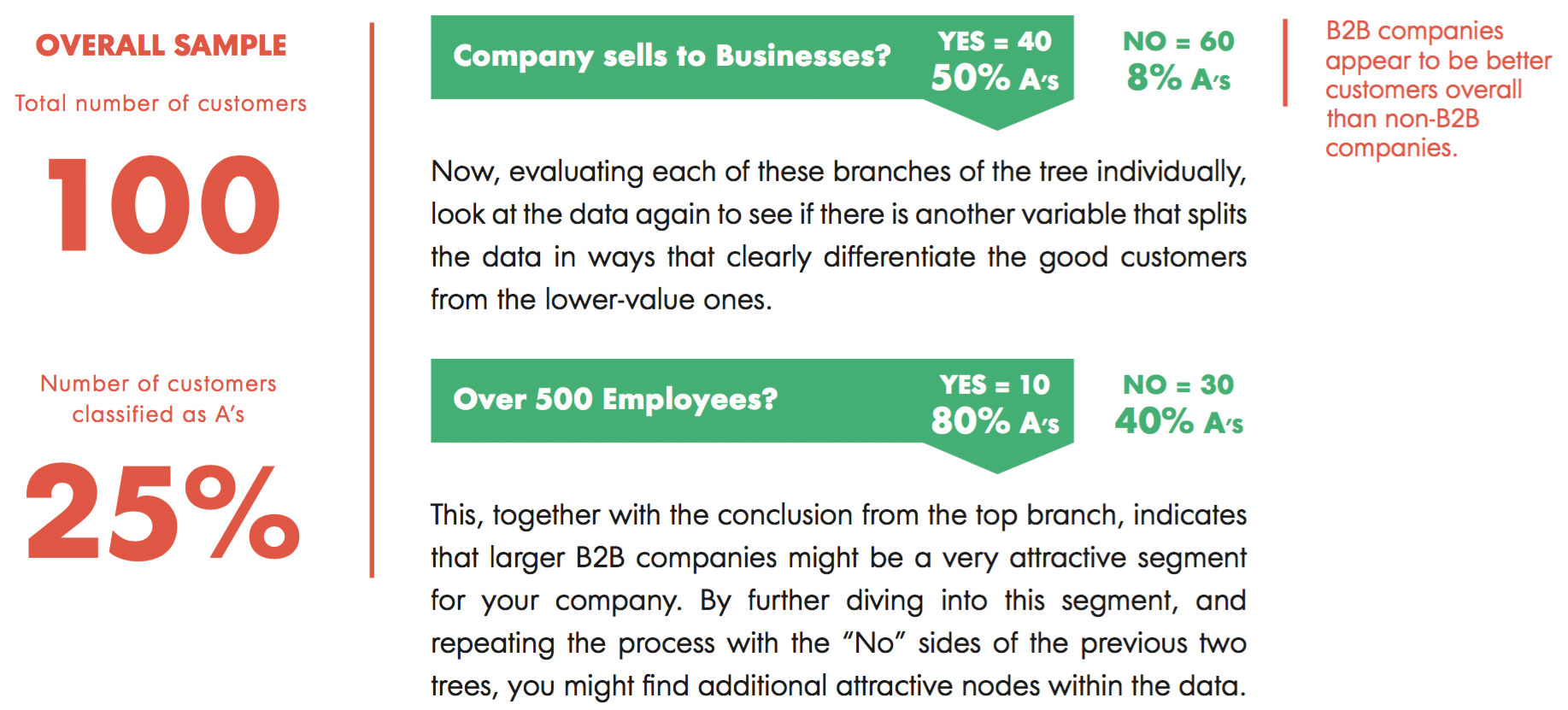
The end result will be a list of attractive segments for further analysis, which provides several advantages:
There are some additional points to keep in mind during this stage of the analysis:
Below is an example of the full segmentation tree, after multiple iterations of the process described above.
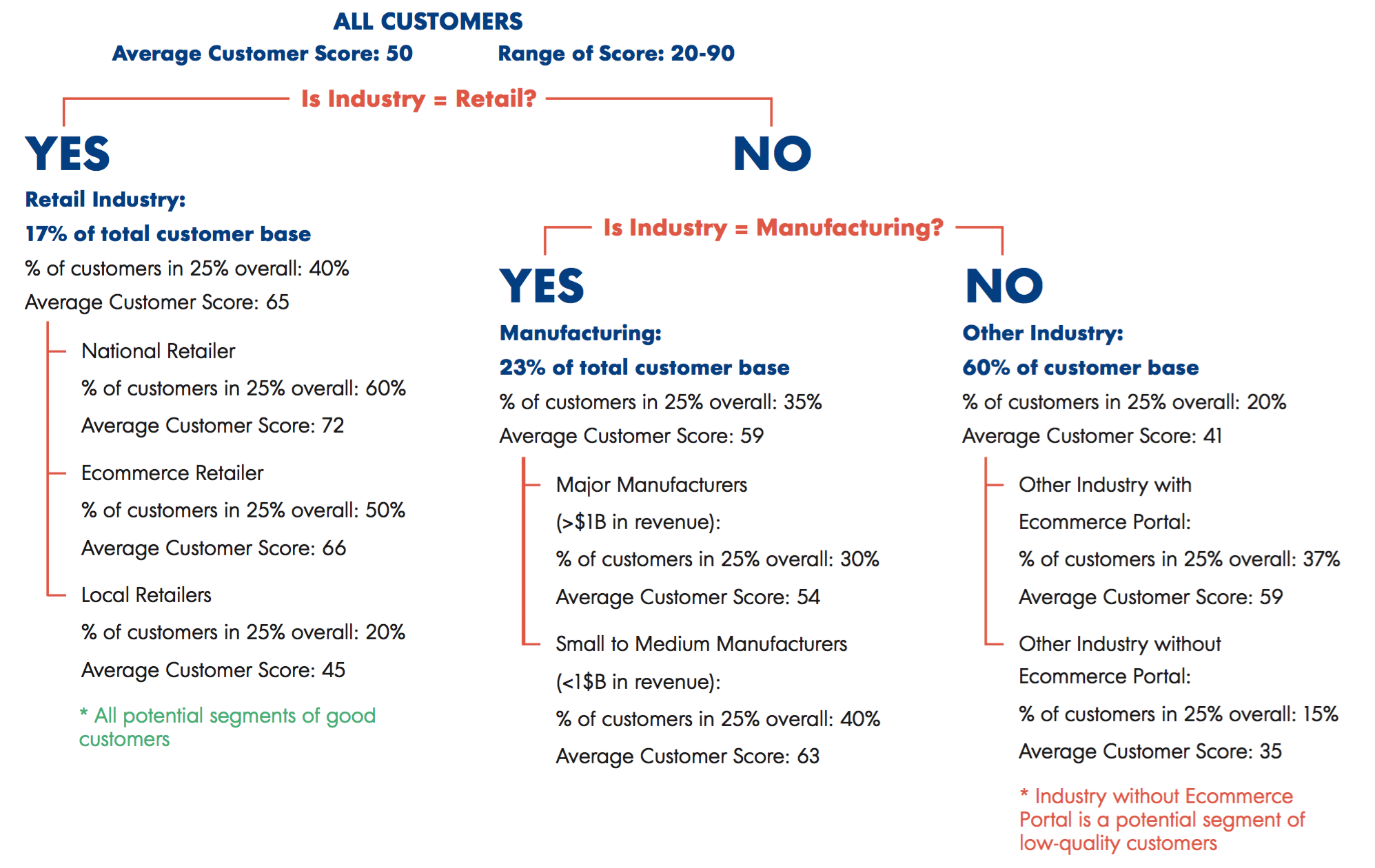
Strengthening hypothesis validation with regression analysis
Once you find your segmentation variables using either of the methods described above, you can take the process one step further by numerically validating those hypotheses using regression analysis.
Start with a large set of variables—perhaps all of the ones that appeared relevant in the initial quartering of the data set. Run a multivariate regression against those variables with the account quality score as the dependent variable. The result of the regressions will allow you to identify variables that are insignificant (variables that do not correlate with the quality score in anyway), as well as variables that might be too closely correlated to each other to both be included in the analysis. Eliminate those variables and rerun the analysis until you have reached a set of variables that are all significant, and yet substantially independent of each other. These are the ultimate segmentation variables for the purposes of this project.
It may also be advantageous to run separate regressions for different segments that you identified in the previous data. For example, the previous tree illustrated that B2B companies segment nicely based on employees. However, it’s possible that B2C companies segment better based on another variable. Therefore, running separate regressions for B2B and B2C companies may produce better results than including them all in a single model.
Evaluating composite segmentation
Because value-based segmentation is a predictive process, any resulting segmentation schemes can be evaluated as if it is a predictive model of the customer’s quality. In order to come to the most appropriate segmentation scheme, we can compare the different composite segmentation schemes discovered using a technique called “lift charting.”
A lift chart shows the predictive power of a scoring model by comparing the likelihood that a customer with a high score on that model is also a good customer. Lift refers to the increase in probability that a customer that is scored highly by that model is actually a good customer, per historical data. If the model had no predictive power at all, the likelihood would essentially be that of a randomly chosen prospect, and its lift would be zero.
For example, using our segmentation scheme, we are effectively predicting whether a prospect will fall within the top 25 percent of our customer’s base, based on our recently established quality score. The way to measure this predictive power is to apply the predictive model to the existing customer base and see what percentage of the actual top 25 percent of customers fall within the top 25 percent of customers in that model.
Because the actual quality score incorporates information that is only available after a prospect becomes a customer, it is unlikely that we will be able to predict this perfectly, but the closer we get to correctly predicting the top 25 percent of customers, the better.
Extending this analysis further, we calculate the Y percent of the actual top 25 percent of customers captured by any given top X percent of the customer base as ranked by the predictive model in question. Calculate Y for each X from 0% to 100%, and then plot Y against X will give a line graph that is the “lift chart” of the model, as shown in the figure below.
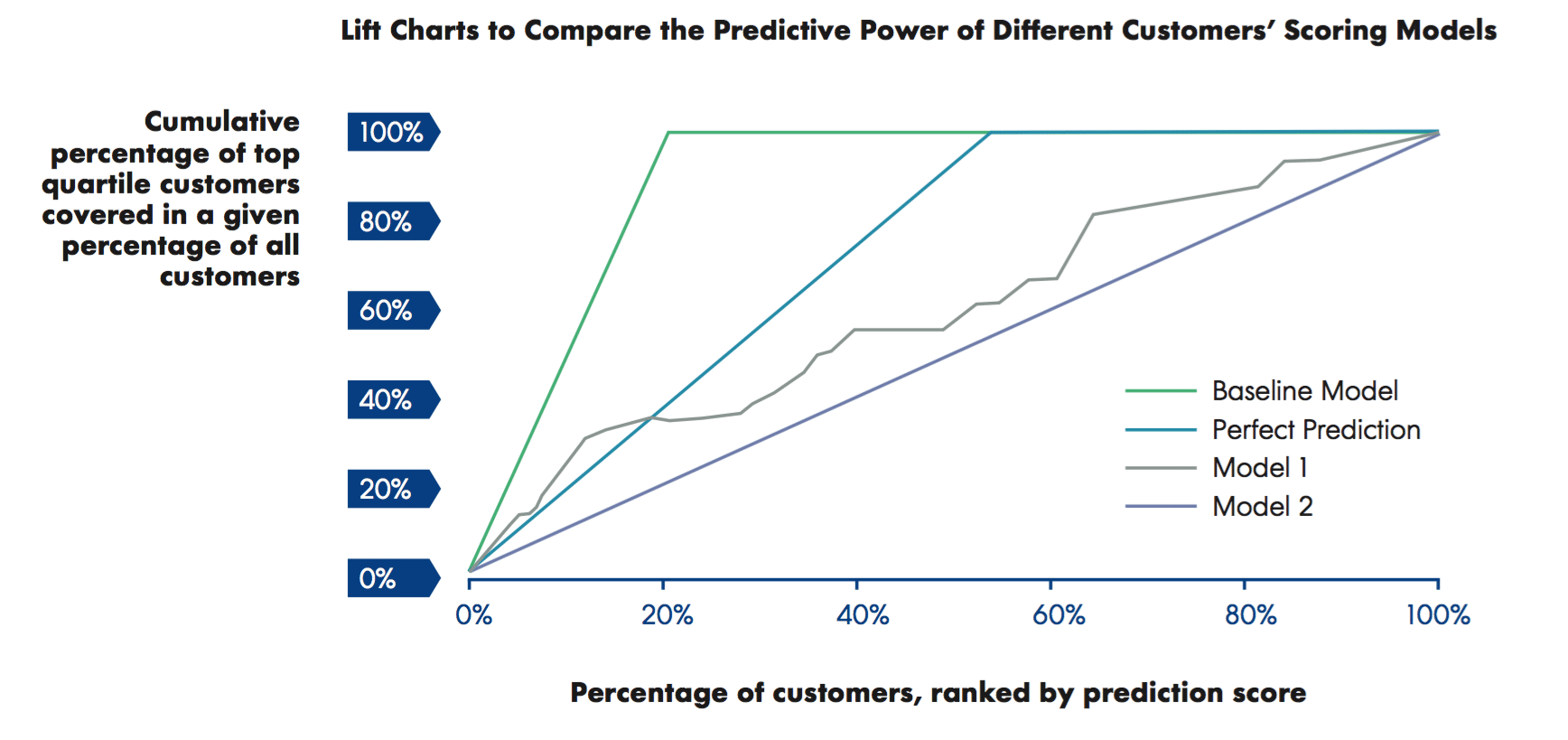
To understand how these charts help to visually compare the predictive models and the segmentation schemes that they are based on, first look at the worst and best cases.
First we have a baseline model, which is a straight line where the slope equals one. This is the model with no prediction at all—we need to review the entire customer base to identify the top 25 percent of the customer base. The perfect prediction model, on the other hand, assumes perfect prediction—the top 25 percent of the customer base according to that model coincides with the actual top 25 percent.
Model 1 and model 2 are imperfect models with slightly different lifts. Model one has better lift because it is higher above the baseline model, and is closer to the perfect prediction model. The top 50 percent of the customer base according to model one captures the actual top 25 percent. In contrast, the top 90 percent of the customer base according to model two captures the same actual top 25 percent. Model one clearly has more predictive power than model two.
Ultimately the results of your regression and lift chart analysis will likely be too technical and detailed to be included in your final presentation to your stakeholders. However, it is still important to perform this analysis to verify that the results of your decision tree are rigorously supported by quantifiable measures, to choose between alternative segmentation schemes, and to retain it as an appendix for anyone looking for additional insight into your methods.
Synthesizing validated segmentation hypotheses to form distinct, homogeneous segments of high-value customers
With your main segmentation variables identified, validated, and even stress-tested using both regression and lift chart analysis, you now need to develop a meaningful synthesis of these segmentation schemes and identify the most attractive targets.
The segmentation that you arrive at will most likely be a combination of the main segmentation variables, while the resulting segments will be defined by a combination of specific values of the segmentation variables. However, some of the segments you identify can also be merged together, and not all of the defined segments will satisfy the following list of desirable segment characteristics:
The reason for listing the characteristics above is that they are what ultimately define actionable segments, as opposed to the analytically defined and validated segments that you might have developed through the previous analysis.
The main tradeoff in your selection and/or definition of segments based on the validated segmentation hypotheses is thoroughness versus practicality. For example, during the analysis stage, you may have identified half a dozen important characteristics that predict a customer’s success, all of which may interact in a complex way (for instance, B2B companies generally need to have more than 500 employees to be successful, whereas B2C companies can be successful with just over 100 employees). Incorporating that complexity fully into your segmentation plan can result in overly complicated, fragmented segments that are impossible to target and not scaled enough to be worth investing in the segmentation focus strategy.
To reduce some of this complexity, you should concentrate on a fewer number of segments that more fully satisfy the list of criteria above. While you will lose some accuracy by ignoring less important variables, your best insights will be much more powerful and useful to the organization. Thus, even though you might have validated many different hypotheses, you should work to synthesize them so that your final segmentation scheme depends on just a few segmentation variables. Having more variables will unnecessarily complicate the delivery of your results, and the subsequent efforts to target the identified segments.
Evaluating segment value, targetability, and size to prioritize your best segment(s)
Once you have reached a satisfactory overarching segmentation scheme, the last analysis to be done is to evaluate the resulting segments and prioritize the few that are most promising in terms of:
Typically, given the limited number of segments analyzed, and the distinction you have identified and sharpened in your analysis and synthesis of the segmentation scheme, the choice of the best segment is quite obvious. However, the feedback process might result in slight prioritization changes, as new factors are uncovered or incorporated into the prioritization process.
Furthermore, given that you should be primarily concerned with the most important segments, you should also focus your synthesis on defining the few segments that form a big part of your best customer groups. The number of segments depends entirely on the scope of the project and the way the results pan out. However, the segments you target probably should not represent more than 25 to 50 percent of the total customer base, so as to help you meaningfully narrow your sights on the more attractive targets.
Typically, this means really focusing on just two or three top segments in your final recommendations.
Our guide to customer segmentation concludes with tips for successfully presenting your findings to stakeholders and translating your data into action.
In order to help you identify your best current customer segments, we’ve broken the process down into five clear steps. Check in weekly as we walk you through each step, from setting up your project to performing customer data analysis, executing data collection, conducting customer segment analysis and prioritization, and implementing the results into your organizational strategy.
The last step in the best current customer segmentation process is to apply the customer quality measurement discussed in the first step to the aggregate customer set in each of the identified segments. Doing so will allow you to ensure that the customer segment(s) with the best overall customer quality is/are identified.
You are then ready to present your findings to your stakeholders.
Building your final presentation
Creating a final presentation is a significant undertaking, but it’s important for a couple of reasons:
An effective presentation typically has the following sections:
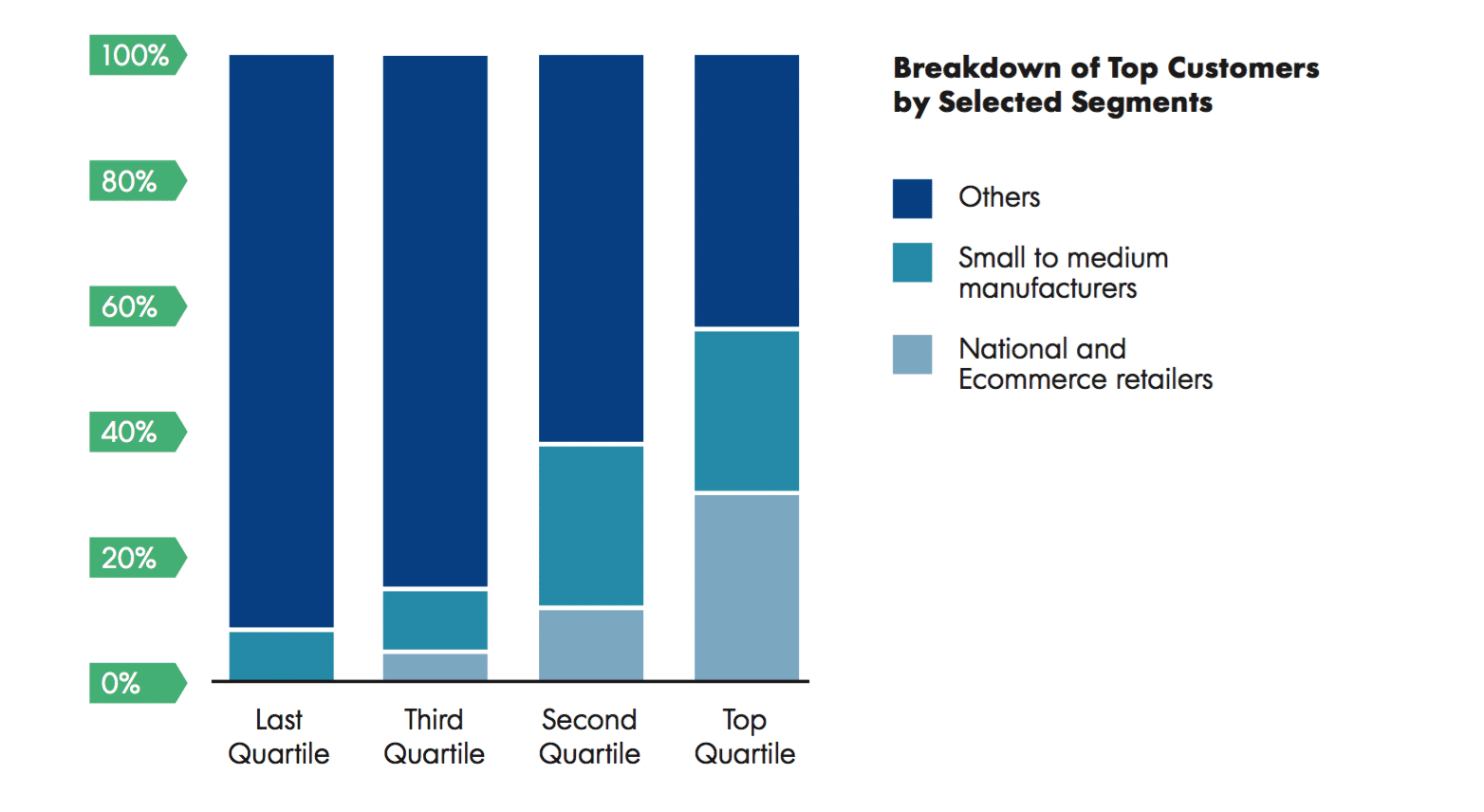
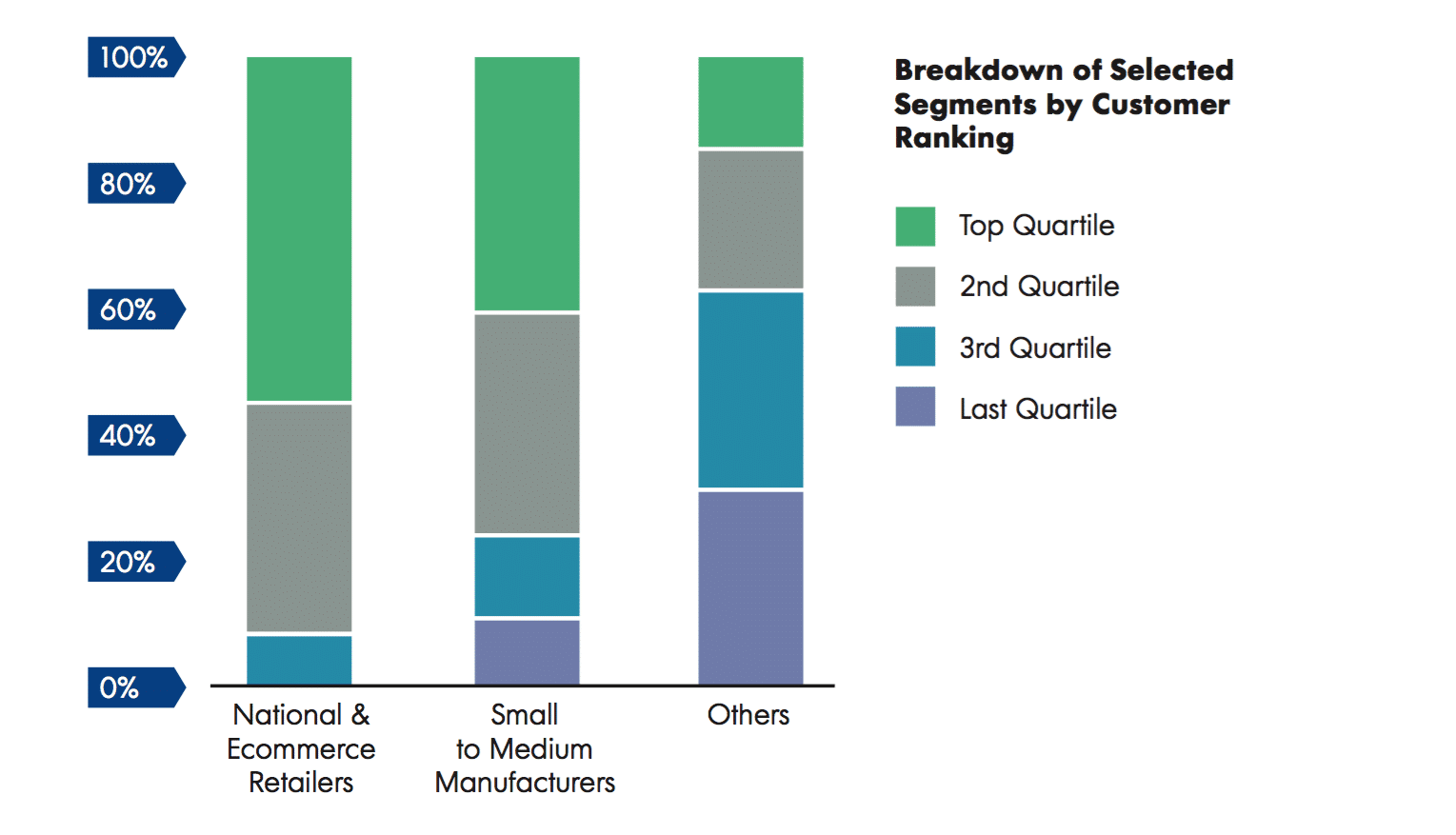
You first need to highlight the immediate next step, which is for stakeholders to give feedback to segmentation recommendations and approve/adopt the recommendations after the feedback has been satisfactorily addressed.
The steps that follow should be actions your organization can take to implement the segmentation recommendations delivered here. You may want to explain how each of the stakeholders can use the conclusions of your analysis. This may include aspects of whole product strategy, go-to-market strategy, sales, marketing, and even customer service. The object is to get all facets of your organization aligned to the target segments, and to make absolutely sure that existing customers in the segments are well served. You also want to ensure there is good coverage of prospective companies in the space on the part of your marketing and sales teams.
Gathering feedback
After giving your presentation, the stakeholders will likely have questions and feedback concerning the segments that you examined. Some of them will have had certain preconceptions about the business that may conflict with your conclusions, so anticipate the weaknesses in your argument and be ready to address them honestly and thoroughly. Too many un-resolved concerns about your methods can undermine the entire project.
If these concerns require adjustments to your data set in order to win the support of your stakeholders, it may be worth adjusting your methodology slightly to ease these reservations. Keeping track of your data files and strictly following the best practices in data versioning and management will allow you to go back to your files and make adjustment to respond to the feedback and questions without redoing a lot of work.
Ultimately, the project will only succeed if it gets broad-based support from the stakeholders, so the project may require several iterations before receiving such support.
Translating information into action
After completing the five steps laid out in this chapter, your business should have the critical best current customer segmentation data it needs to begin focusing on more productive—and profitable—segments. That data is only helpful if you put it into action immediately, however.
Like almost anything in business, the information you cull from this process has a shelf life, largely because any number of factors both within your company and your target market segment—can impact which companies constitute your “best” customers. As a result, it is important to implement the results of your best current customer segmentation research as quickly as possible, and measure their impact over time. As things change, it is a good idea to reconsider your best current customer segments and, if necessary, re-execute the process outlined above to adapt to those changes.
While this guide provides a step-by-step process for identifying, prioritizing, and targeting your best current customer segments, simply following it does not guarantee success. To be effective, you must prepare and plan for the various challenges and hurdles that each step may present, and always make sure to adapt your process to any new information or feedback that might change its output.
Plus, you can’t force-feed this process on your business. If the key stakeholders that will be impacted by the best current customers segmentation process do not fully buy-in, then the outputs produced from it will be relatively meaningless.
If you properly manage the best current customer segmentation process, however, the impact it can have on every part of your organization—sales, marketing, product development, customer service, etc.—is immense. Your business will possess stronger customer focus and market clarity, allowing it to scale in a far more predictable and efficient manner.
Ultimately, that means no longer needing to take on every customer that is willing to pay for your product or service, which will allow you to instead hone in on a specific subset of customers that present the most profitable opportunities and efficient use of resources. That is critical for every business, of course. But at the expansion stage, it can often be the difference between incredible success and certain failure.
Editor’s Note: This post was originally published on September 1, 2016.
The post Customer Segmentation: A Step-by-Step Guide for Growth appeared first on OpenView.
Change is hard. If you want to make a change, such as purchasing a new marketing technology, you essentially have two options.
Go rogue, or achieve consensus.
Going rogue – doing whatever you want and begging forgiveness later – might be easier in the short run, but in the long run it’s better for you, your company, and your career to move through consensus.
That means you’ll need to manage both up and laterally to push through the initiatives you’re excited about.
Making a business case is an essential part of growing as a marketing leader. What does it take to get your boss and your team to buy into that new tech you’re so excited about?
Read on to find out the five essential ingredients of a powerful business case and how you can start putting them together for your proposal.
There’s an old stereotype about marketing being a cost-center. Back in the early days, marketing spent their budget and there was no real way to determine what worked and what didn’t. So if the company did well, the marketing team got more money to spend.

These days, marketers are held much more accountable to every dollar we spend. We’re expected to project the return we’ll see on that spend and then deliver at or above that expectation – or face the consequences.
This shift in accountability is one reason building a business case is such an important skill for marketers. If you want to go to your manager or your executive team and ask for more money to buy a new technology, you are now expected to demonstrate how spending that money will either:
With a business case, you’re presenting the reasoning behind making a business change. There should be value to the business in making the change or buying the new technology – if not, it’s time to reassess whether this is the right change to make.
Buying marketing technology can feel overwhelming.
There are so many options out there, each claiming to be the next miracle cure for all our marketing pains.
Preparing a business case for your martech purchase will solve two important goals:
Thinking through the steps involved in making a strong business case will help you think through your own decision process.
More importantly, a business case is a powerful communication tool. Done well, it distills your thinking about a tool or platform into terms your team can understand, weigh, and get behind.
A strong business case is built on five pillars: presenting the problem, painting a picture of the future, describing the implementation, offering alternatives, and laying out ROI.
If you’re presenting a business case, you should be solving a business problem.
Ask yourself:
Possible ways to present the problem in your business case:
Frame the problem in terms your managers (and their managers) care about. While upping email open rates might be your sugarplum vision, your manager is likely more interested in what those email opens mean – more prospects clicking through to a landing page, converting, and eventually turning into sales pipeline.
If you can expand out your granular change into a large-scale shift for the company, your superiors will be that much more likely to buy in.
That’s where the next step comes in:
Prepare a vision for what your marketing could be with this new technology.
No need to paint a beautiful landscape here – state the facts and explain how your team, company, or industry will be affected by this change.
Examples:
Details to consider:
Integrations and augmentations to existing technologies
In your business case, this shouldn’t be more than a few sentences – but include all pertinent details.
Frame your proposed change in terms your company already understands.
This is your opportunity to show you’ve done your research and are prepared for exactly what implementing this new technology will require from you, your team, and your company.
Key questions to consider:
Look at your existing technology stack and identify where this technology will fit. If there’s not an obvious place – or if there’s a redundancy with technology you’re already using – it might be time to reconsider this investment.
Then, frame your spend in terms of existing budgets. You might say, “I’m going to take $20,000 from our spend in X to do Y, because we will get Z positive outcome.”
It can be helpful, here, to provide an implementation timeline. You can use a handy tool like Teamweek or plain old Excel to plan out your implementation.
Best practice in technology purchasing is to present multiple alternatives, including a “do nothing” or benchmark option. More than three; probably not more than five.
Explain the alternatives in simple, straightforward fashion. Then provide your recommendation and justification.
Any problem has multiple solutions; failing to present alternatives makes it look like you didn’t consider them and results in a weaker case.
When you start talking about finances in your business case, be sure to include a discussion of the return you can expect to see from that outlay.
When it comes to buying marketing technology, return on investment is one of the most powerful deciding factors – DemandGen Report recently reported that among B2B buyers, “ROI remains a top consideration when selecting a new product or solution — especially as many respondents reported increased oversight from company leadership.”
Calculating ROI requires two numbers: the initial investment you’re making and the gain you plan to see. The graphic below, from Dennis James, shows the calculation:

The tricky part is identifying the gain you’ll see. Most vendors offer documentation around the ROI their customers have demonstrated with their solution; apply those numbers to your own situation to your best ability and explain your reasoning in your business case.
Marketing technology is booming – and as a marketer, I can say it’s hard not to get distracted by the idea of shiny new tools.
Once you’ve zeroed in on a tool you think will have a major positive impact on your marketing results, presenting a solid business case will be critical. Identify the priorities your management team and peers bring to the table, then build a solid case supporting your ideas.
Change isn’t easy, but backing up a proposal with the five points outlined in this article will take you a long way toward a successful implementation.
Making bold recommendations and arguing on behalf of innovation is what it takes to move forward (and up) in marketing today. Build a solid business case and you’ll see results not just for your marketing, but also your career.

This type of salesmen doesn’t care whether you need the product or service. Their only goal is to get your money and for you to buy to them.

A salesperson who failed to acknowledge their customers means they don’t value who you are. Also, when you hear a salesperson complain or say something bad about their competitors, it’s considered a sign. This way of pursuing a customer is not healthy.

They don’t practice asking questions to gauge if their prospect has a need on what they’re offering. They wouldn’t even let you ask questions or worst, they disregard your question. Instead, they just keep on pitching their product and how you can benefit on it.
A good salesman use CHAMP lead qualification methodology to qualify their prospects and to know their needs and challenges. Listen more than you talk and be able deliver the best solution.

We all know that every salesperson has a quota or a deadline to meet. Their goals when speaking with you is to get a sale, not to find out if this is something you might be interested because your company needs it.
A good salesman knows when the lead is ripe or when it is still unqualified and needs further nurturing.
Part of this lead nurturing process is sending digital downloadables that could convince them even more. Here are the digital freebies in sales that could be use.

They pitch in their product by being defensive. They claim that their product don’t have any failed experiments prior to launching it. And that everyone can benefit on their product in all possible ways.
Take note of these signs when dealing with any salesperson. In sales, all sales reps must gain the trust of their customers in order for them to patronize and consider using the product over and over again. Providing customers with good quality product or service is important because that’s one way of building trust and relationships with your current and future customers.
This post originally appeared at The Savvy Marketer’s Blog
If you caught my recent article What Is an ROI Calculator, you know that online calculators are powerful marketing tools.
If you haven’t read that, go check it out. I’ll wait.
So you know that an ROI (return on investment) calculator improves the customer experience with 100% user-driven content.
What you might not know is that an ROI calculator can actually boost your sales in three ways.
Your customers do a lot of research before they reach out to you.
Current statistics make that pretty clear:
What do those numbers mean to you?
It means that if you can provide information to your customers that proves the value of your solution, you are doing a large part of the sales job before the customer even needs to interact with your company.
Customers are selling themselves on your solution.
There’s no better way to prove the value of your solution than an ROI calculator.
With it, your customer can calculate their return should they invest in purchasing your solution. They input their information, and your ROI calculator presents them with their potential results, right there on your website.
ROI is increasingly important to marketing departments and B2B buyers. In fact, Leapfrog’s 2015 study found that the need for marketing budgets to deliver measurable KPIs continues to grow, and businesses are more often requiring external partners to be aligned with their financial goals. HubSpot’s State of Inbound 2015 report found that demonstrating ROI is the #1 challenge marketers face.
An ROI calculator instantly puts a dollar value on the worth of your product or service. This improves trust and transparency right from the beginning.
Here’s a simple one from HubSpot:

What pops into your mind when you hear the term “salesperson?”
Plaid jacket?
Used cars?
Pushy and manipulative conversation tactics?
That’s how your customers feel about the traditional sales process, too.
Who said that being traditional was the best way to make sales, though?
The market has changed. The economy has become digitized. People’s buying habits have transformed because of this.
If you haven’t already, it’s time to transform your sales tactics, too.
According to HubSpot’s report, today inbound marketing delivers 54% more leads than traditional outbound marketing. Inbound content continues to be more important than outbound marketing efforts to companies of all sizes, though it remains dramatically more important to companies with fewer than 200 employees.
Your customers have access to a lot of information about your company and your solution. They also have access to information about your competitors’ solutions. In fact, they likely have access to just as much information as you do. Which means that they’ve already begun comparing and contrasting your solution with your competitor’s when you first talk to them.
Information is no longer your ace in the hole.
Discounts and deals turn the sales conversation into a race to the bottom (and your solution into a commodity).
What’s the biggest benefit you could give a customer for talking to you? What’s the best way to build a positive relationship with your customer right out of the gate?
Share your knowledge and expertise. Be a helpful expert. Help the customer make the right decision for them, even if that means they buy from someone else.
That may sound counter-intuitive, but hear me out.
Sales today is a long game. According to a study by sales expert Steve W. Martin, 24% of inside sales cycles and 23% of outside sales cycles are between 61 and 90 days in length.
Long-term success means building long-term relationships. Customer loyalty is the currency of the kingdom, because loyal customers become advocates.
They share your company with their friends, family and colleagues. That social proof is more valuable than a Super Bowl ad spot.
What does this have to do with ROI calculators? Everything!
An ROI calculator paints your company as a helpful expert. You’re giving the customer valuable information without asking for anything in return. When that calculator helps the customer make an educated decision, they share it with others.
Voila. You are no longer a pushy salesperson. You are a helpful resource.
An ROI calculator gives your customers valuable information without asking for anything in return … but that doesn’t actually mean you don’t get anything in return.
The data your customers are inputting into the calculator can be collected and analyzed to provide deep insights into your customers’ wants and needs.
You can use that insight to create more detailed buyer personas, so your sales team can build better relationships with your customers.
Here’s an example from American Express.

Note the details such as major purchases and benefits leveraged. This information helps sales and customer service representatives understand how to address his main concern: Are these travel benefits really that valuable to me?
Insight gathered from ROI calculators can also help you build more intelligent marketing campaigns – campaigns driven by actual customer data. No more throwing spaghetti at the wall to see what sticks. You can make educated decisions.
If you’ve ever used an online calculator to find out what your monthly payments will be for the car of your dreams, or figure out how much house you can afford, you already know how easy and valuable this type of content is.
ROI calculators take the value of an online calculator up a notch. They not only help your customer figure out what your solution will cost them, but also what your solution will give them in terms of actual dollar values.
Now you’re not just another company out for a buck. There’s a concrete financial reason to do business with you.

By Tibor Shanto – tibor.shanto@sellbetter.ca
While there are many types of buyers, not just across, but within companies, most sellers and sales organizations deploy one way or method of selling. I still regularly meet sales leaders who say we use “this method” or “that type selling”. This works if you sell one specific product to a single defined buyer, but given the fact that most of us have a varied audience, with multiple interests and drivers, there is great risk to committing to a sales method rather than a sales framework.
Now you may ask what is the difference between a “sales method” and a “sales framework”, if you’re asking you should. Keeping it simple, a framework is a construct, allowing for a logical means of classifying, segmenting, or categorizing things. Whereas a method is rooted in action, a defined way of executing or doing something. It is usually characterised by or as a process, a set of steps, measures, activities, leading to a set of outcomes along the way, and the ultimate outcome of the sale when successfully completed. Breaking it down even further, think of it as the framework as being a noun, while the methodology as being more of a verb. Despite the fact that English is my third language, I have confused the two when I write (as you can often see on this blog), but not when it comes to selling.
A framework, such as Objective Based Selling, gives enterprising sellers, the ability to sell in a specific way to specific buyers, unlike many methodologies that focus on activities, without much thought as to the “Why”. A framework allows you develop and deploy a philosophy to engaging with a buyer in a much more meaningful way than if you just lever a methodology. It allows you to align your point of view with that of the buyer, giving you the flexibility and agility to work with the buyer to achieve their objectives, thus delivering specific business and personal impacts. Where as a methodology, enables you to do things that speak to and resonate with the most common, the most “80%” of the lot, in other words to everyone you think is like me, but necessarily me. Based on the tribe, not me.
While execution is king, and everything else is indeed talk, execution without an outlook or something grounded in a framework aimed at winning customers by helping them achieve objectives, will always leave you short, causing sellers to search for the latest and next (best) methodology. Adopting a methodology without a framework prevents you from fully engaging with buyers, as methodologies lead the conversation to “what” and “how” less often than “why”. Buyers know when they are being engaged in a real dialogue, that helps them to a decision, as opposed to being corralled by a methodology. Best way to avoid that, and expand your ability to engage diverse buyers, is to lead with your framework, and use your methodology to support it. Skipping framework, as many do, leads to lost discussions, lost opportunities and extended cycle times. It is the sales equivalent of “think before you act”.
The post Why You Want A Sales Framework Not A Methodology appeared first on Renbor Sales Solutions Inc..

Building out a B2B sales funnel is hard enough—filling it with leads, though? Even harder. For far too many B2B companies, not only is this tough work, but it’s painstaking work, too.
You know what I’m getting at; you’ve been there before …
Nothing is as unenjoyable as sending out a a series of cold email blasts and promoted social posts, only to hear those annoying crickets off in the distance.
No, I’m not here to suggest that you kick email and social media marketing to the curb—they’re wildly effective, and when done correctly, are bound to produce leads.
It’s just that when tried-and-true methods fail to work for you and your B2B brand, it’s dreadfully easy to falter in the ways of workplace efficiency and enthusiasm—don’t allow things to get to this point.
Instead, revert back to your more creative, right-brained self, taking advantage of lesser-known, yet incredibly effective B2B lead generation ideas.
There are plenty of them out there, but if interested in cutting through much of the Internet’s digital marketing “fluff” to get straight to what works best, look no further than the following:
1) Create an Enticing Quiz
People love quizzes—thanks to Buzzfeed’s booming growth in recent years, there’s no denying it. The mystery of what honest answers might produce is enough to engage even the most stubborn of site visitors.
But there’s yet another, more simple reason quizzes are excellent for B2B lead generation …
Remember those “cold email blasts” we’d talked about earlier? Yes, they work, but they’re somewhat intrusive.
Quizzes, on the other hand, take the form of one of marketing’s most docile strategies—they’re removed, giving potential customers the “decompression zone” they need to make educated decisions.
With quizzes, the power to choose is completely in the hands (and mouse) of a site visitor.
But what kind of quiz should you make, exactly?
Easy—create quizzes that build intrigue, the responses of which satisfy it. However, in exchange for the results, you’ll ask for a new lead.
Though not necessarily a B2B entity, Eastern International College (EIC) in Belleville, New Jersey knocked this tactic out of the park—your business would be wise to follow their lead.

To drive leads, the college created a quiz for potential students to help them discover what they should study while in school. For incoming students, this is a pressing concern.
The quiz helped them discover the answer, while also generating over 1,000 new leads for EIC in the process. Attracting businesses will require a different kind of quiz, but the results can very much be the same.
2) Build Out a Helpful Spreadsheet
There’s something about spreadsheets that absolutely terrifies people.
Not only do they take forever to create, but they’re usually number-driven—once again, a mortifying prospect for those of us who weren’t exactly A+ math students back in high school and college.
So, if you’re in need of B2B leads, why not do something for a potential customer that they would rather not have to do for themselves?
That’s right—do the heavy lifting on a useful spreadsheet. You know your industry—position yourself properly with this tactic, and you’re bound to see traction.
Even better, this isn’t one of those random B2B lead generation ideas that’s yet to have proven itself. Based in Redmond, Washington, Heinz Marketing shows us how things are to be done.
To generate B2B leads, the marketing agency decided to create a spreadsheet that outlines the landscape of digital marketing technology.

For newer, less experienced businesses looking to make a splash in the digital realm, the value provided by such a spreadsheet is easily identifiable. As such, the spreadsheet continues to provide the agency with anywhere between 20 and 30 leads per day.
3) Develop Templates to Simply Everyday Problems
Of the three B2B lead generation ideas presented in this post, this one is by far my favorite.
From juggling employee schedules and making market research happen to creating a content calendar and sending emails to customers, for up-and-coming businesses, everyday tasks can quickly become little more than a time suck of sorts.
As a B2B marketer, however, where others see routine discomfort and frustration, you see an opportunity to provide a clear-cut answer. To do just that, create a template for new leads to improve their everyday working lives.
Take what PandaDoc is doing, for example—on one Web page, the sales and HR solutions company has a list of 83 business proposal templates from just about every B2B industry imaginable.

No, you and your company aren’t required to do something quite as extensive as this, but with a bit of editing, these templates will greatly help future customers save time, money and energy.
They’re happy, and you’ve managed to land another lead for your team.
Conclusion
Yes, additional lead generation ideas for B2B companies can be found, but the above are by far some of the best if you’re looking to create leads, while also doing something businesses aren’t used to seeing all that frequently.
Be memorable, and create leads while doing it. Truth be told, B2B lead generation doesn’t get much better than this.
How To Turn An Email Subscriber Into A Loyal, Paying Customer written by Guest Post read more at Duct Tape Marketing
 “The money is in the email list”
This has become the mantra of marketers everywhere. In fact, most experts agree that an email subscription list is the most powerful tool in your arsenal.
But, building a subscription list is just the start. Enticing those subscribers to buy something is the tricky part.
You’ve probably heard of the ‘sales funnel’. You pour leads into the top of the funnel, some become email subscribers, and then a small amount fall through the bottom as a paying customer. It looks like this:
Well, one colleague made me see this in a whole new way. He said “It’s more like a mountain. Your leads start at the bottom, and you’ve got to give them a leg up all the way to the top”.
In other words, you have to actively push them up to the sale – every step of the way – rather than simply letting them fall. Subscribers don’t turn into customers without a little ‘nurturing’. Here’s how you do it:
The first step to securing a sale is building a trustworthy relationship. That means constantly reminding them who you are and why you deserve a place in their email inbox!
Most of us sign up to newsletters, slowly forget why, and ultimately unsubscribe.
With your first few emails, make it very clear who you are and what value you add. The first step to making a sale is not getting unsubscribed!
The best marketing is reciprocal. This is not a one-way street.
Your very first ‘welcome’ email should offer something highly valuable for free. If you used a lead magnet to encourage sign ups (eg. a free eBook, report, or web series), they should get this immediately. There are two good reasons for this:
One, subscribers get a warm fuzzy feeling when they get something for free. It’s a great way to build a positive relationship and experience. And two, it proves your worth instantly. If you can provide value quickly, they’re much more likely to come back and actively look out for your future emails.
P.s. this free content or product should be your best work. This is about rewarding subscribers and proving your value.
This process should all happen very quickly. The longer you leave it to offer value, the quicker they’ll forget about you. If your subscriber gets their first email a month after they subscribed, they’re unlikely to open it, let alone buy anything.
Email is all about small, successive conversions. Make that first quick, free conversion instantly. Then they’re hooked, and you can move on to making a sale.
Most websites send their subscribers a ‘welcome’ email and then move onto regular, general newsletters.
Instead, try a ‘welcome journey’. It’s a series of emails all connected and focused on making a sale.
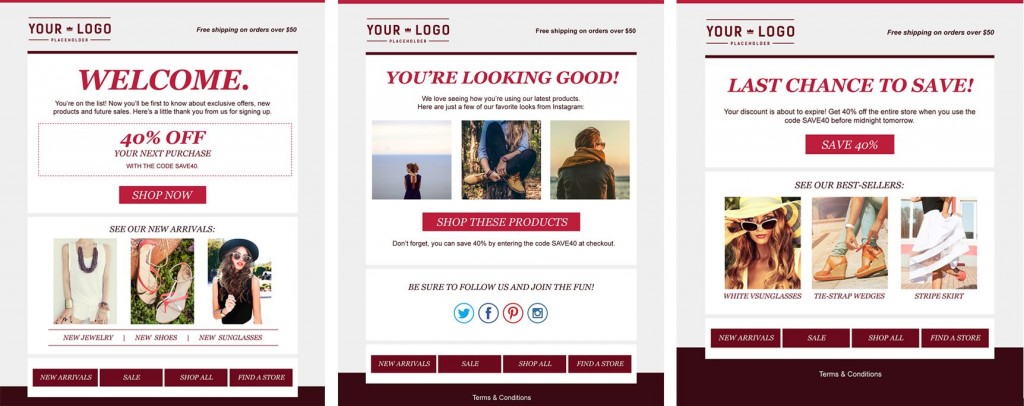
photo credit My Emma
One of my clients uses a series of eight emails to tell a connected story from start to finish. During each email, there’s a call-to-action to encourage new subscribers to take the next engagement step.
The first welcome email offers access to a free report and begins the story. The second email reminds them about the report and uses a case study to show its importance. The third introduces subscribers to a low-priced product and continues the story.
It keeps your open rate high, establishes your brand, and gives subscribers multiple entry points to engage and buy.
You can use your email client to automate this welcome series. The first email, for example, is dispatched immediately upon subscription. The second follows two days later, the third after a week etc.
Subscribers on your list should feel like they’re getting exclusive treatment. There has to be some form of reward or bonus to signing up.
One way to create this feeling is through exclusive offers and discounts. This is also one of the easiest ways to convince subscribers to buy something. Again, that first conversion is the most important, so offer it early.
You can use additional tricks here, such as setting a time limit on the offer to compel subscribers to take action. You could call it a ‘one-time introductory offer’. Again, use your welcome series to remind subscribers about the discount along the way.
By now, we’ve established the importance of the quick first sale. It’s the entry gate to future sales and long-term custom.
But, naturally, new subscribers aren’t going to jump in at the deep-end and purchase your $1,000 tuition series. However, they might buy a $10 report or webinar. They’re not going to buy a $1500 camera, but they might test the waters with a $20 accessory.
If you analyse your biggest competitors, you’ll probably notice they have a tiered system. See if they’re using low-priced entry products to lure customers in.
Prove your worth, then offer an affordable entry product to secure that first real sale. From there, you can build up to the premium products.
New subscribers are still figuring out if they can trust you. Their natural instinct is still a little wary, and they’ll find any little reason not to buy from you.
It’s your job to break down those natural barriers and remove any sense of anxiety. Include testimonials and social proof in your newsletters to show that others trust your service and products.
Offer free delivery to quell any worries about prices. Create a link to a ‘live chat’ or a direct phone number to show that you’re open to customer service.
8. Use a call to action button in every email
Campaign Monitor – one of the leading email marketing platforms – claims that a call-to-action button converts 28% better than a simple link in the text.
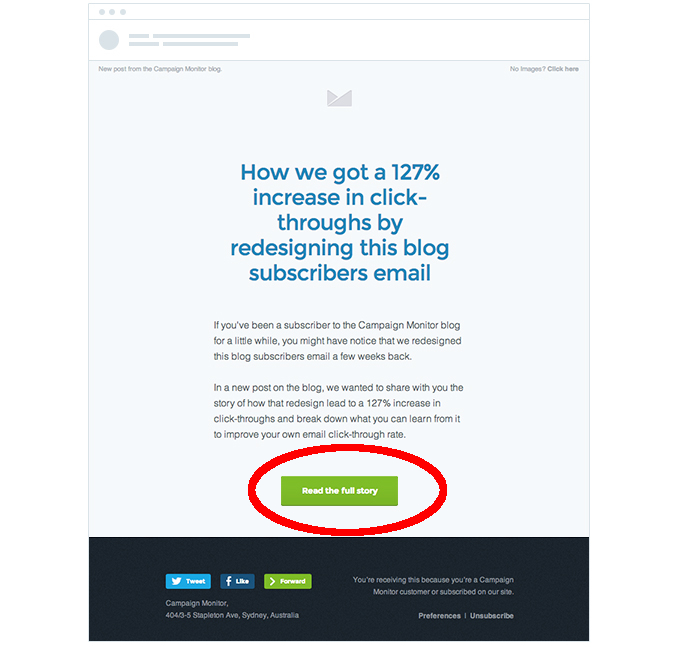
photo credit Campaign Monitor
Most people scan an email, so they’ll probably glance over a text link. However, they can’t miss a big green button. In fact, they’ll feel drawn to it. Don’t be afraid to be bold. Direct your subscribers where to go next.
9. Remind customers about their empty shopping carts
It’s often difficult to differentiate between casual subscribers and those with an intent to buy.
However, if you subscriber has gone to the trouble of adding items to their cart, they’re a buyer. All you have to do is give them a nudge.
Remind them about the items in their cart and direct them to the checkout.
Building an email list is a core part of any good marketing strategy. However, signing up is just the start! Turning them into a paying customer is the real challenge.
What tricks do you use to convert your email subscribers? Let me know in the comment section!
 Daren Low is the founder of Bitcatcha and co-developer of the free Server Speed Checker. With a decade of experience in website development and internet marketing to his name, Daren is considered a premier authority on all things related to building and managing an online presence. Feel free to pick his brain by connecting via Twitter.
CRMs, from one perspective, are simply supposed to be data entry systems. Sales operations folks designed the systems to match up to their reps’ sales processes, and from the new leads coming in, to the latest touchpoint of that big account ready to close, CRMs are built to know all.
Unfortunately, the system that was once designed to give salespeople the most benefit is actually leaching hours from their selling time, and this is happening for one reason and one reason alone:
CRMs are hard to update.
For a tool that was built to organize, maintain, and track mission critical information for all key sales functions, many sales teams are struggling to use it effectively. As the modern sales professional has evolved, the way they execute and track activity into their CRM has lagged.
This is because the original CRM model wasn’t built for the modern sales professional. But just as we wouldn’t send our modern astronauts off in a rocket with the same design as the Challenger, we shouldn’t send our reps out into the sales space in an out of date CRM.
Fixing these productivity problems is actually easier than you may think. That’s why we created our newest eBook “Houston, We Have a Sales Problem.”

Too many managers deal with this sales problem on a regular basis. While technology (in theory) improves speed and accuracy of certain daily tasks, the more tools reps have to monitor, manage, maintain, and update, can actually slow their productivity significantly.
But CRM isn’t going anywhere. (Remember: CRM or It Didn’t Happen…) So stop letting sales problems ruin the mission, and empower your reps with a sales engagement platform built for the modern sales professional.
—
Download your copy of the eBook today to launch into greater detail on each of these issues, how deeply they impact a sales organization, and what using the right sales tools can do to solve them.

The post CRMs Weren’t Built for the Modern Sales Professional appeared first on SalesLoft.
We often talk about relationships in sales, saying relationships matter. There are all sorts of phrases like, “people buy from people,” which ascribe the importance of building relationships with our customers.
Yet, it seems that too much of how we actually manage the customer engagement life cycle seems to ignore the importance of developing relationships with our customers. Instead, we focus on our efficiency in handling the customer.
It almost seems that we have an assembly line that we pass our customers along—we try to attract attention, building a relationship through our digital presence–web sites, blogs, other materials. We complement that with the right content, theoretically nurturing the prospect to a certain “score.” That’s followed up with a conversation with a SDR/BDR. We have one or two conversations with them–certainly not enough to build a relationship–though they are well trained in asking “bonding questions.” We are then passed to an AE who “knows us” based on the records in the CRM system. This AE manages us for the next few steps–discovery, presenting the solution, closing. The AE may bring in other resources to do demos.
Ultimately, we become a customer and customer success takes over. Depending on what we have purchased, it may be a website with FAQ’s, it may be a team to help us implement–then another team after we have it installed and are using it. Through their use of the product, the “relationship” gets passed from one person or department, to another. The customer seldom deals with the same person very long, which leads one to ask, “what kind of relationship is being built?”
At some point the customer has to renew, or we want to sell the customer more, so other individuals, each specialists in their function work with the customer.
It all makes sense, it’s perfectly predictable, it’s very efficient–at least from our point of view.
In many cases, this may align perfectly with what the customer wants. After all, they may want to minimize their engagement or relationship with us. Hmmmm…….
This seems to work as long as things are working, but what happens when something goes wrong?
Yes, we’ve mapped out (hopefully) where the customer should go and what they should do if they have problems—“Call this number, go to this website, enter your customer id…… everything will be OK…..”
But what if it’s not? What if it’s a problem not with just one person at the enterprise, but challenges the enterprise is having?
We may have that covered, we may have a team that works with them. A specific number or micro-site to support them. We create a customer experience—but somehow the “relationship” seems to be lost in many of these customer experiences.
And when these customers aren’t getting what they need, who do they go to? Who, ultimately owns the customer relationship?
Or it works, the customer is happy with this process, they don’t need a relationship with us, they just want to get their work done. We’re ecstatic, it matches the efficient transactional flow we have optimized our organization’s work efforts.
But still, the question remains, who has responsibility for the customer relationship?
Who’s ultimately responsible for making sure things go right? Who’s responsible when they aren’t happy or need something different? Who’s responsible for maximizing our opportunity to grow with the customer? Who’s responsible for developing and managing the relationship–not just with the enterprise, but with people? How do we build trust across our organizations?
It seems we and our customers–particularly, our most important customers are on divergent “relationship” paths.
We design processes that are efficient for us. We worry about the customer experience in building these processes, but we don’t seem to think about the customer relationship.
We train our customers to think this is right, they learn not to value the relationships with us, consequently, they are open to any other relationships that may catch their fancy.
If relationships matter, if people do buy from people, how to we account for this in our design or our total customer experience (pre-post sale)? Can these relationships be transferred on the assembly line, or do we have to look at individuals dealing with individual–preserving those links over time?
As you look at your customers, particularly those who you value the most, who ultimately owns the customer relationship?
