Shared posts

06 Sep 16:39

The 3 Crucial Features of a Great CTA

by Brad Smith

When testing their call to action, most people focuses on the color, the button’s curve, or kerning of the text – when in reality, none of that matters. At least not in the grand scheme of things.

As we’ve driven home before, tiny changes usually lead to tiny results. And the success (or failure) of a call to action, or CTA, really comes down to a few underlying features that typically play a bigger role in the success or failure of your landing page.

Get these right, and your odds of success increase dramatically. Get them wrong, however, and you’ll be facing an uphill climb for mediocre results.

features of a great CTA

Let’s talk about what you need to focus on to optimize your CTA’s.

1. The Value Proposition

Most businesses can rattle off their customer demographics – they know family income, urban vs. suburban, job titles and educational background.

Fewer can successfully delve into the psychographics (you know, the stuff from 1960’s-style marketing) that explain why people buy.

These should be the motivations or fears that ultimately move people, breaking through the crushing weight of inertia that holds them back to eventually give your brand a try.

And until you uncover these reasons, you’ll never be able to put together a proper value proposition for your product or services’ ad.

Instead of the value you’re offering, your CTA’s too often emphasize the action or event (like a phone call, a weekly email, yet-another whitepaper, and more).

Replacing a run-of-the-mill offer or CTA with a well-researched value prop can result in a 201% conversion increase. Below, the form on the left fails to communicate the value someone’s about to receive upon signing up, while the right explicitly details several unique benefits (not features) that are going to help them overcome the daily challenges they face.

call to action value prop

AND best of all, once you get the value prop right, the actual CTA – in this case, a button – falls into place. You’re able to use specific phrasing tailored to the offer. There’s cohesion from the offer’s headline through to the link, button, or phone number you ultimately want people to take action on.

That’s important. Because the best CTA’s provide three key benefits according to MarketingExperiments:

  • Guidance: Instructing users what to do.
  • Information: Explaining what they’re gonna get.
  • Anxiety Relief: Removing doubt or perceived risk of taking action.

Value props (and their closely related unique selling propositions) might sound like these arcane, theoretical business school exercises that quickly devolve into a few paragraphs of jargon-laced copy.

The trick with CTA’s though, is be concise. You’ll need to use fewer words to say more.

Start by recognizing and avoiding “friction words” that immediately bring up mixed feelings, causing people to hesitate and decline your offer. Here’s are a few examples from the excellent CopyHackers:

  • Sign Up
  • Submit
  • Invest
  • Donate
  • Support

Substituting these words with more influential and persuasive ones is an easy way to increase how your value prop resonates with its intended targets.

For example, most people don’t want to “read more” or “learn more.” But they will “check out” or “discover.”

While seemingly trite, it’s important to recognize that 71% of B2B buyers will purchase based on personal (as opposed to financial) value. That means even in the most stodgy, boring environments, we still need to influence emotion.

Power words” have been used in copywriting for ages to cut through the noise and instantly hit our lizard brains, which are responsible for ultimately making decisions. It’s no surprise that many of them also pop up in studies of the best converting words and phrases as found by Buffer, which commonly include:

  • New
  • You
  • Free
  • Because
  • Instantly

When assembled successfully, you get a great CTA like this, for WordStream’s AdWords Grader:

great cta examples

The offer is good to start with, no doubt. It successfully highlights a primary pain point for most marketers four different ways:

  1. Projected 12-month budget or spend waste
  2. The spend wasted in the last 90 days
  3. A graph clearly showing how you stack up (unfavorably) to the industry benchmark
  4. And an overall score that’s nowhere near 100%

The CTA phrasing simply mirrors the work established by those ratings and the classic “fix your mistakes” headline:

  • Get = Action Verb
  • Graded = Primary Value Prop
  • Today = Urgency

(Another trick to try is switching perspectives. In one study, switching from second person to first (i.e. “you” to “my”) resulted in a 90% increase in clicks.)

Unfortunately, you may not always know which value prop is going to resonate best ahead of time. For example, how do you know “Fix Your Mistakes” is better than “Salvage Your Spend” in the last example?

No problem, as you can build a list of different variations and test with your ad creative. MarketingExperiments presents an excellent framework for testing value props with ads that you should whiteboard (now) to start running through ideas for improvement.

how to test your cta

Key takeaway: Make sure your CTA communicates the unique value your prospect is going to get by acting on it.

2. Tone (And “Scent”)

Message match attempts to align the search query a prospect uses with the advertisement they see (and click) and with the messaging on the landing page where they eventually arrive.

The tone of your CTA can have the same effect, creating an alignment between a visitor’s expectations, the value prop you’re offering, and the way they take you up on that offer (also similar to “conversion scent”).

As discussed, the words used can heavily influence the effectiveness of your CTA and your ultimate number of conversions. Because many times, they imply or allude to additional qualities in a prospect’s mind, packing multiple meanings (which may be unintended).

For example, the CTA “Download Guide,” while seemingly innocuous, might sound like an extra demand on a busy executive’s time (how long will it take to download?). That’s what one study concluded, when simplifying the language to “View Full Article” (among other changes) resulted in a 84.6% lift.

Tone alters the message – saying the same thing (more or less) but putting a different spin on it to make it more palatable to the reader.

Many times, that means pushing the boundaries to the extremes in order to cut through the noise to the specific types of people you’re trying to reach (even at risk of offending the few).

Kinda like this sophomoric one from my company:

how to write great cta's

…which sounded great during the brainstorming session, occurring before seeing this other excellent use of poop emojis. (Best anchor text ever?)

Then there’s this less immature but still playful one on Copy Weekly:

playful CTA

The absence of tone quickly becomes jargon. Tonal extremes, on the other hand, can help.

The problem with “synergy” and other vague uses of industry-specific jargon (besides the fact that every single one of your competitors is saying the same exact thing) is that they quickly lose meaning due to lack of clarity. And clarity, above all, is one of the best ways to increase conversions.

To help you pinpoint these problems on your pages, Unbounce recently released the Dejargonator Chrome Extension, which will highlight all uses of jargon on a page (while also offering a few witty critiques in the dialog box).

jargon in marketing

However before moving on to the last bit, it’s important to recognize that sometimes, once in a rare while, jargon pays off.

But there are ground rules. First, you’re speaking specifically to the small group of people who actually understand what that technical mumbo jumbo means. And second, when you want to be inclusive by excluding people. Similar to the liberal use of poop emojis above, you’re purposefully turning some people away but gaining extra points with a select few.

Key takeaway: Be careful to use a tone of voice thatwill resonate with your target audience.

3. Page Design and Positioning

Long, scrolling pages are nothing new. Consumers today are used to scrolling endlessly for all of your information packed on a single page. And yet…

The “fold” thing really does still hold some weight. Specifically, relocating a CTA from under to above the fold resulted in a 20% conversion increase in one example.

Here’s why.

CTA positioning

That scroll map above kinda resembles an ocean. The crystal clear water at the top is where all the people are, with some beautiful, colorful coral reefs just below. Then the continental shelf drops precipitously; plunging into the deep dark abyss where no people (or website visitors) venture further.

Basic analysis of user behavior like this can instantly tell you why a CTA might not be performing. The value prop is good. The tone matches the audience you’re attempting to reach. But they’re just not seeing it down there.

Page positioning of your primary CTA can dictate clicks (and conversions). For example, using one that’s left-justified or centered will align with how we naturally scan web pages in an F-shape. So simply relocating CTA’s to these “hot spots” is one simple way to increase your chances of success (as Neil Patel’s ghostwriters astutely point out).

But simply locating a CTA above the fold won’t guarantee success. Because when there’s no discernable CTA (or equally problematic – too many), this happens:

CTA heat maps

Nobody clicks anywhere specific, because they’re not quite sure where to click in the first place.

This commonly happens when you create a website based on art instead of interaction. There’s no singular goal or objective behind the page, and it sabotages the effectiveness of your CTA (getting lost in sea of competition for visitor attention).

When a page is reorganized to emphasize the primary objective on a page, it should resemble this one from the Disability Insurance Agency:

CTA button tips

The majority of page interactions (or clicks) successfully happen exactly where you want them – on the CTA button.

Purposefully offsetting the CTA from other elements on the page is another good technique to draw attention and focus.

strong cta

Another way to verify how you’re doing is to look at click ratios of the page. For example, using a simple tool like Crazy Egg you can see how the percentage of clicks on a page are distributed. If the bulk are on your primary action, you’re doing a good job.

CTA click ratios

(If they’re evenly distributed among several different options that aren’t your primary ones, you’re not.)

Another common mistake when using multiple CTA’s is not to arrange them according to priority for the page visitor. In other words, there should be a clear hierarchy or differentiation between primary, secondary and tertiary page options.

For example, just last week I was reviewing a prospect’s site and came across this:

CTA button optimization

These two offers now compete for attention because visually they’re the exact same.

Simply changing the CTAs’ shape, sizing, colors, etc. (so they don’t have even weight) could result in a 64% conversion increase, as one MarketingExperiments study found.

how to optimize CTA's

Conversion-focused design incorporates all of this usability and behavior analysis to make sure the entire page’s focus will be squarely on your CTAs. For example:

focus on CTA

Where:

  1. Add a prominent CTA where people expect to see one (remember the F-pattern)
  2. Repeat CTA with specific language appropriate for the page’s offer.
  3. Increase whitespace around CTAs so there’s nothing competing with this action.

Even when zoomed WAY out to 25%, like this new landing page design for the Johnson Attorneys Group, your eyes should immediately jump to the primary CTA’s:

CTA's on landing pages

Key takeaway: Putting it all together, your CTA positioning can’t fail if it’s:

  1. Placed where people expect to see them, based on how we browse in an F-shape
  2. Weighted differently than secondary options
  3. Surrounded by ample whitespace

the perfect call to action cta

06 Sep 16:37

How to Manage and Resolve Discount Requests

by Steli Efti

Ever gotten an email like this?

“Hey! I love your product. It’s the perfect solution for our company! But we’re a small business, just me and a developer, and there’s no way we can afford your pricing. Any chance you could give us a discount?”

Discount requests like this happen all the time. You could be selling your product for $5 and you’d still have people asking for a discount. So what do you do?

Most sales reps listen to their story, weigh the pros and cons, and decide whether to make an exception.
Don’t be like the rest.

Often times giving discounts causes more harm than good. Let’s take a look at how discounting hurts your business, and how you should respond.

Why discounts create unhappy and unreliable customers

Giving discounts can be tempting. After all, you get to provide a service to someone in need and get a new customer, right?

Sure, that’s part of it. But keep in mind that not all customers are equal. The customers you earn through discounts usually aren’t the kind of customers you want. Here’s why:

They’re buying for the wrong reason

There are two types of customers, those who negotiate price and those who negotiate value.

Unless your entire product focuses on being the cheapest on the market, you don’t want price-focused customers. Their only loyalty is to the lowest price. As soon as someone comes along and offers a cheaper solution, they’ll be gone.

You’re starting the relationship off on the wrong foot

Demanding prospects make for demanding customers. If you show them that you’re willing to bend to their every desire, they’ll take advantage of it.

Customers who pay less want 24/7 phone support, weekly updates, and a direct line to your CEO. The moment you stop meeting every request, they start searching for someone who will.

You risk offending current customers

What’s this one prospect worth to you? Are they worth losing a long-time customer? Because that may be the price you pay when you give a discount.

The more specific your target market, the more likely your customers will talk to one another. One of your customers may find out a competitor is getting your product at a discount and they won’t be happy.

How to respond to discount requests

So if you’re not going to give them a discount, what can you do?

First, you need to make sure they’re qualified for your product. Second, you need to help them measure that value. And third, you need to stand by your price. Here’s how to do it:

Transition from price-focus to product-focus

A lot of discount requests come from prospects who haven’t even tried your product yet. They say, “It’s not worth trying until I know if I’ll get a discount.” When you run into these prospects, your first priority should be to get them on your trial. Here’s how to deal with those prospects:

“Hey [Prospect Name],
Thanks for inquiring about our product. Before we talk price, let’s make sure our product is a good fit for you. Why don’t you sign up for our free trial and give it a go? If you like what you see, I bet we can find a price that makes both of us happy. Sound fair?”

More often than not, your prospects will come back with one of three responses:

“Sure, I’ll sign up for the trial right away,”

“I’ve already tried your product and it seems like a good fit,” or

“I don’t want to sign up until we’ve settled on a price.”

If they agree to a trial, that’s great news. As they use your product, they’ll transition from a price-mindset into a product mindset. If their trial expires, offer to extend it by a couple days so they experience the full scope of value you provide.

And if they’re unwilling to sign up for a trial until you’ve promised a discount, let them go. That’s a huge red flag, and a clear indicator they aren’t the type of customer you want to do business with anyway.

Transition from product-focus to value-focus

As your prospect gets comfortable with the product they will ask themselves if your solution is valuable enough. As they ask this question, they’ll transition from a product mindset to a value mindset. The great thing about that question is that it’s binary: The answer is either “yes” or “no.”

If the answer’s “no,” that’s great. It means you’ve saved yourself and your prospect both time and money and you can go your separate ways. If their answer is “yes,” you’ve found a customer who is likely to be happy and successful with your product. They might still have some pricing objections, but that’s alright.

Overcoming post-trial discount requests

If your prospect still asks for a discount after the trial, you’ve got a different problem on your hands. In most cases, your prospect can afford to buy your product. They just don’t want to. You need to figure out why. Here’s how to ask questions to uncover your prospect’s real concerns:

Prospect: “You’ve got a great product, but we need that discount if we’re going to make this work.”

Salesperson: “I understand your position, and I want to be sensitive to it. But I feel like there’s something else going on. Tell me this: Do you love the product? Do you feel it’s worth the price? Or are we overcharging?”
Prospect: “No, it’s not that. We love the product, and it is worth the price. We just can’t afford it.”
Salesperson: “Okay, then at what price would you be willing to buy?”
Prospect: “We could do $500, but that’s it.”
Salesperson: Alright, so just to confirm: If I offer our product for $500, you’d buy right here and now?”

At this point, your prospect can only answer in one of two ways. If they say “yes,” you’ll know their objection is about price. In that case, let them go.

More often than not, they’ll say something like, “Well, then we’d have to look at…” And once you know their real concerns, you can follow up.

How to say “no” (and still be valuable)

Your goal isn’t to sell to every prospect; it’s to sell to the right ones. The next time you get an unreasonable discount request, try responding like this:

“I appreciate your interest in our product, but I can’t give you that discount. I understand your position, but our priority is being valuable. It wouldn’t be fair to offer you a discount while the rest of our users pay full price. If you ever change your mind, I’d love to have you as a customer. But until then, I did some research and found a few affordable alternatives for you.”

They key to rejecting a prospect is to still provide them as much value as possible. One of the easiest ways to do that is to direct them to a more affordable alternative to your product. You’ll lose a customer in the short term, but that’s okay. They weren’t right for you and you weren’t right for them. Chances are they come back to you sometime in the future, once they’re ready to pay what your product is worth.

Pitch value, not price

At Close.io, we have an (almost) “zero discount” policy. Unless a prospect is buying an annual contract, we don’t make exceptions to our pricing. Period. I challenge you to adopt a similar policy at your business.

Sure, you’ll lose some deals. But that’s okay: If you never lose a customer over price, your product is too cheap, anyway.

So next time you get a discount request, resist the urge to give in. Use the scripts above, then come back here and share your experience.

I’ll look forward to hearing your story but, until then, get back out there and crush it.

06 Sep 16:36

What Are KPIs and How Do You Use Them?

by John Boudreau

There seems to be a great deal of confusion for business owners around KPIs (key performance indicators). We know we need them, but measuring them seems so elusive and tedious that small business owners just don’t measure them with any sort of consistency.

What are KPIs? – A General Definition

KPIs or key performance indicators are measurements which are made at some interval (daily, weekly, monthly, quarterly, annually) that are meant to give the business owner an indication about the relative health of the business.

Relating it to your health; your pulse, blood pressure, blood sugar level and weight are all key indicators which give you some picture of your health. Measuring KPIs over time is what really provides insight into your health. You may go to the doctors and get your blood pressure taken and it’s high (this happens to many people due to nervousness), the doctor wisely doesn’t take action based on that single measurement, but may run further tests or measure it again. If he notices a trend, he’ll take some corrective action.

So, relating it back to your business, key performance indicators are measurements that indicate something about the performance of the business in a specific area which is deemed important or “key”.

Types of KPIs – Leading & Lagging

KPIs fall into two main categories, leading and lagging.

Leading indicators give you a sense of where the business will be at some future point. For example, the number of demos that your sales team gives each week is considered a “leading” KPI. Since demos turn into closed deals (or should) the number of demos per week is a KEY indicator of the health of the sales pipeline and the business. You could put cholesterol in the leading indicator for health. If you have high cholesterol too long, it could result in heart disease or stroke at some point in the future.

Lagging indicators tell you something about what has already happened within the business. I would put financial KPIs in this category. For example, revenue. It’s important to measure these types of KPIs because measuring tells you when your business is unhealthy. Using the demos example, you could have a low number of demos, but that may not show up in lower revenue for some time. It’s only a matter of time before “revenue” KPI is unhealthy.

A smart business person uses this information to make adjustments in the business to bring the business back into a healthy state. It’s all about reacting in. See the timeline below to illustrate.

timelines.png

If may take 90 days until the low number of demos shows up in low cash flow for the business.

If you’ve determined $200,000 per month is healthy for your business, and you did $150,000 last month you can make an adjustment to bring that KPI back into the healthy range, but it’s going to take time to make that happen.

The best of both worlds occurs when you combine the two measures, leading and lagging. Doing so gives you have a better chance of affecting the result.

For example, you could determine the number of demos which are necessary to hit your revenue goal by looking a historical information. Say, on average, you close 20% of the demos given. Each closed deal is worth $10K on average, so to hit your $200K monthly goal you would need to perform 100 demos each month.

close_ratio.png

You can access the Google Doc calculation here if you’d like to put your own numbers in.

Now, measure the “number of demos” (a leading indicator) each week.

Setting a red, yellow and green criterion for that leading indicator will give you a warning system when something is out of control and you’re in danger of not hitting your revenue goal. The main point being, you don’t have to wait until the revenue numbers come in below a healthy level to take action. The leading indicator is something that affects the lagging indicator.

The Envisionable app allows you to measure the number of demos and to warn you when you’re in the red.

product_demos.png

Since businesses are complex systems, just tracking one KPI is not enough (imagine just taking someone’s pulse as the only indicator of their health). Tracking too many KPIs can cause you to lose focus on what’s important and get caught in the noise.

What Areas Are Important or “Key”

You should track several KPIs to give you an overall picture of the health of your business. But which ones should you track? The truth is, there is no “one size fits all”, and there are some KPIs which are important in one business and not important in another.

Dr. Robert Kaplan & Dr. David Norton came up with the widely used strategic planning and performance management framework called the “Balance Scorecard”. This framework lays out four areas the doctors felt needed to be in “balance” in order to maintain a healthy company. This framework is meant to align the goals of a business with the strategy and long-term vision.

So what are the four areas?

  • Financial
  • Customer
  • Internal Business Processes
  • Innovation and Learning

balanced_scorecard.gif

In each of these areas, there are associated KPIs that can be tracked to give you a sense of the health of the business of that specific area. Again, think of the various systems in your body like the cardiovascular, nervous and digestive etc. Your business has various systems as well that are interrelated and affect each other.

The balanced scorecard goes quite a bit deeper by using a strategy map which shows a logical, step-by-step connection between strategic objectives (or goals) in each of the perspective in the form of a cause-and-effect chain.

I won’t get into too much detail about this here but just think about each perspective and what would need to be measured to give you an overall sense of the health of your business.

Here are some example KPIs that you could be tracking (feel free to reach out if you need help).

Financial KPIs

  • Revenue: The amount revenue recognized in a given period
  • Gross Profit: Revenue – COGS (cost of goods sold). The higher the gross profit the more efficient the business model.
  • Net Income: revenue – COGS – Operational Expenses
  • Cash Flow: This is a great definition of cash flow. Probably one of the most important KPI for any business.
  • Revenue per employee or productivity: Revenue divided by the number of employees. This gives you a sense of how efficient your business is at generating revenue. The higher the number the better. Here’s a great article on revenue per employee and benchmarks for several companies. Facebook and Google are at about $1MM in revenue per employee. Both have incredibly efficient business models.

Customer KPIs

Another critical component to the health of your business is the health your relationships with your customers. How happy are they with your products and services? How long does a typical customer stay with you? Are you losing customers?

  • Customer Churn or lost customers – This is the % of your total customers that you lose over a given period. Depending on your business model, customer churn may just be something that naturally happens. For example, if you’re a real estate agent, you may only have one transaction with that customer. Other business models depend on recurring revenue, like insurance agencies or SaaS companies. Take a hard look at your customer churn.
  • Customer Satisfaction – I would consider this a leading indicator and customer churn a lagging one. If your customers are unhappy, pretty soon they will churn. NPS (net promoter score) is a good thing to measure to ascertain how happy your customer are with your company.
  • Average annual sales volume per customer / revenue concentration – Is your revenue concentrated with only a few customers? What’s the average sales volume per customer? If 80% of your revenue is concentrated with 2-3 customers, your business is not as healthy as it should be.

Internal Business Process KPIs

What internal business processes must be in place for you to deliver value to your customer? How do you know if those processes are working correctly? One simple example is “time to deliver an order”. Obviously, the longer takes to deliver your product and service the longer it takes to for your customer to receive the value.

Some internal business process KPIs include:

  • For service business – utilization & realization
  • Average development time of a new product
  • Average time from placing the order to its completion
  • Inventory turnover
  • Administrative expenses per employee

Innovation and Learning KPIs

In my opinion, this perspective is really the driver of all the other perspectives. Your biggest asset is how you empower your people (although many accountants can see people as an expense or liability). So what are you doing to drive greater capacity, innovation, and learning? All companies must continue to invest in their people if they are to stay competitive.

  • Specific weight of expenses on research and innovation in the total amount of expenses (% of R&D)
  • Investment in training of personnel
  • Investments in exploration of new markets
  • Number of rational and creative ideas per employee
  • Average training cost per employee
  • Employee satisfaction index
  • Marketing expenses per customer

Creating a Simple KPI Dashboard

Once you’ve determined your KPIs, it’s time to begin measuring them on some regular schedule to monitor the health of your business and make adjustments.

Below is a simple dashboard that can be generated from the Envisionable app. You can see that each KPI has a few things presented:

  • A monthly target
  • An actual result
  • A % of target (how well did we do vs. the target?)
  • A red, yellow and green indicator based on some thresholds that you’ve set
  • A trend line

Sample_dashboard.png

These KPIs are telling us that “90 day Sales Pipeline” started to drop in April and revenue started to drop a few months later as deals in the pipeline were sold and the pipeline dried up. However, corrective actions should have begun months earlier when we saw that the number of weekly demos were dropping.

Still confused? We’re here to help!

KPIs shouldn’t be painful to discover, use and track. We’ve built Envisionable to make the process easier and link those KPIs to your goals (more on that in a later blog). If this is something that you could use help with, we’re happy to guide you through the selection, tracking, and dashboard process. Just reach out. Better yet, sign up for a free demo!

06 Sep 16:36

37+ Tips and Tools for Picture-Perfect Visual Content

by Jodi Harris

tips-tools-visual-content

I’m sure I won’t blow your mind by saying that visuals are essential to creating content that will help your business stand out and draw in an audience. Not only do images help make text-centric content more readable, digestible, and memorable, but they can also be used to craft compelling messages that speak volumes without using a single word — just ask anyone who has posted a photo on Instagram or created a “Snap” to share a memorable moment with friends.

Nearly a year ago, I compiled a collection of best-practice tips from some of the industry’s most creative and design-minded content experts, along with helpful imaging tools and examples. But, considering how rapidly visual trends come and go, we at CMI felt it was time to take another look at how to let your brand’s photos, videos, and graphics do the talking.

Of course, we wouldn’t want a retrospective on such an image-conscious topic to show visible signs of aging; we’ve freshened up the discussion with a few new tips, tricks, and takeaways.

8 best practices to follow

1. Align your visual story with your content marketing strategy

Posting a photo or video online and waiting for the business offers to start rolling in is not an effective strategy. Neither is hinging your visual content success on creating the next viral phenomenon.

As Joe Pulizzi often points out, content marketers need to focus on building a process and organization around the ongoing delivery of valuable information. This applies to visuals just as much as it does to any other content effort.


Content marketers need to build a process around the delivery of valuable info says @joepulizzi.
Click To Tweet


Experts suggest asking questions to make sure you are positioning your visual content to deliver business results, rather than chasing a fleeting few minutes of fame:

  • What are we trying to accomplish with our visual content?
  • Who is our audience, and what content do they crave?
  • What problems does our organization solve?
  • How can we create a consistent look and feel that promotes our brand value?
  • What is our clearly defined vision of who we are and what makes us unique? How can we communicate those messages in a compelling way?
  • What metrics will we use to measure success? For which terms should this image appear in search engine results?

Tourism australia 360-degree video

Tourism Australia created a series of stunningly realistic 360-degree scrolling videos to demonstrate just how memorable and emotional a visit to its homeland can be.

Bonus tip: Got questions on how to build your content marketing strategy? Our Book of Answers post on strategy and planning can point you in the right direction.

2. Know the rules of good design

While the wealth of DIY design tools available to content marketers (including the ones listed below) can give almost anyone the ability to create visual content, they don’t necessarily provide the know-how to do it well.

CMI’s Creative Director Joseph Kalinowski reminds marketers that visual content efforts should be grounded in the fundamental rules of design — including the strategic selection of color and fonts, and the construction of a strong visual hierarchy.


Visual #content efforts should be grounded in the fundamental rules of design says @jkkalinowski. #design
Click To Tweet


In his post on bringing creative ideas to life, Joseph shares some details on the systematic process he follows when tackling some of CMI’s highest-profile visual projects:

  • Step 1: Develop your theme. Consider its fun, visual applications, as well as how well your design will translate to both the topic and the purpose of the piece.
  • Step 2: Gather your initial ideas. Your ideation process should include researching some visual references, as well as consulting with key stakeholders and trusted advisers to get their ideas and input.
  • Step 3: Develop and execute on the best of the batch. This is where your attention to detail, your design skills, and your passion for the topic at hand should all come together. Prioritizing those ideas that hit the mark both creatively and strategically will give your visuals a distinctive edge and help your brand stand out.

CMW-Walk-of-fame-600x392

CMI’s creative director translates his rough ideas and sketches into a cohesive branded experience.

Bonus tip: If you want to encourage influencers to share your visuals, give them as many accessible options as possible — such as tagging them on social media or providing them with access to raw files they can download from Dropbox.


Tag influencers on #socialmedia if you want them to share your visuals says @joderama.
Click To Tweet


3. Don’t be afraid to get emotional

Some of the most memorable visual experiences are those that find a way to tap into the power of emotion. Need proof? Just look at any successful Pixar film — including Inside Out, which artfully translated human feelings into relatable visual representations.

In her post on how to nail visual storytelling, Dawn Papandrea outlined three characteristics to emphasize if you want your visual content to shoot for the heart:

  • Authenticity: Connect with your audience around real, candid experiences that they can relate to and build trust on.
  • Appealing to the senses: Images can go beyond communicating a place or thing — they can delight the senses by conveying warmth, evoking nostalgia, or creating a sumptuous feast for the eyes.
  • Relevance: Consider whether an image will speak to your end users and fit in with their values and mindset.

Connect w/ your audience around real experiences they can relate to & build trust on says @dawnpapandrea.
Click To Tweet


original-jaws-poster-image-1A

This iconic movie poster for Jaws crafted a simple visual story that played on the audience’s fears.

4. Avoid generic stock images

While stock photographs and illustrations may save time, they can’t tell as compelling a story of your brand — and your customers — as custom images can. But if you are low on designer resources and feel that you need to turn to a stock service now and again, try to find a way to put your own branded spin on the images you select.

For example, to promote the film Unfinished Business, 20th Century Fox teamed up with Getty Images to edit stars Vince Vaughn, Tom Wilkinson, and Dave Franco into a series of business-themed stock photos. The images were made freely available for download on the iStock site, creating an attention-grabbing visual campaign that aligned well with the film’s theme.

unfinished business stock images

Image via iStock by Getty images

5. Repurpose written content as visuals

Content marketers can adapt their most popular written content into compelling visuals, like infographics, charts, or checklists. Not only is it an excellent way to draw fresh attention to your evergreen content, it helps make your brand’s insights more digestible, memorable, and shareable.

SEO-Clue-header-image-600x238

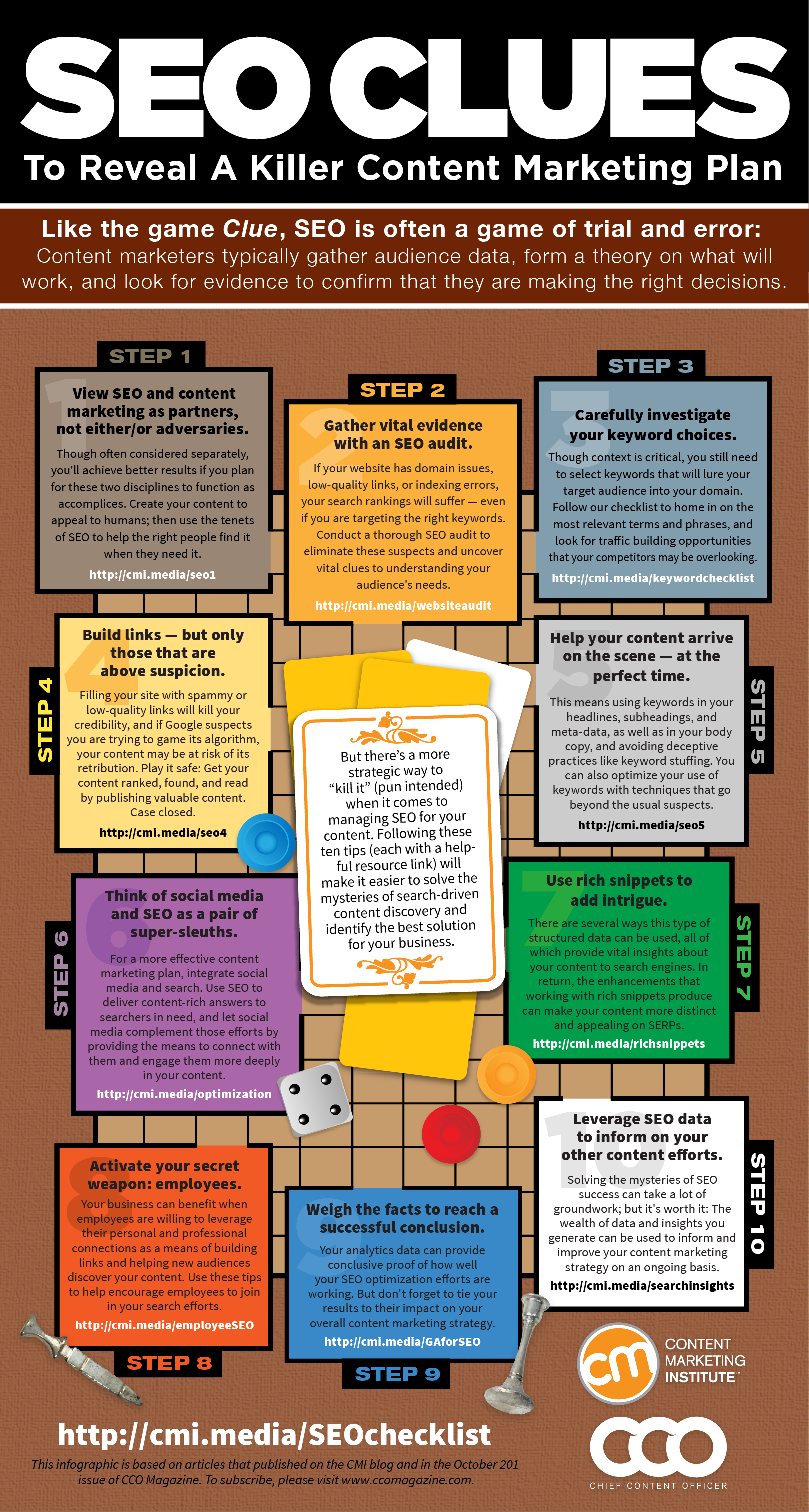
The CMI team repurposed tips from our most popular SEO article into a handy infographic that our readers could clip, save, and share on social media (click to see the full graphic).

6. Use your fans’ content

It’s clear that consumers love to snap their own pictures and share them with their friends (heck, you can barely shake a selfie stick around these days without coming across someone Snapchatting their surroundings). Instead of interrupting their experience with product shots and promotional pitches, why not put their photography skills to good use by including their work in your content marketing?

For example, take a look at men’s shorts retailer Chubbies. As Aaron Orendorff describes, the brand’s Facebook page and Pinterest boards are dominated by user-generated videos, pictures, and stories. By recognizing fans’ interest in co-creating content, Chubbies does more than feed their passion for fashion — it provides them with an outlet for creative self-expression.

chubbies on facebook

7. Stay on-brand

Keep your visuals as brand-consistent as possible, including your use of corporate colors and logos. The best visual content has a consistent design motif — you can identify the brand it belongs to in an instant, no matter where the content appears.

As Neil Patel mentions in this post on visual content strategy, a brand-defining signature style is a hallmark of some of the world’s most powerful brands. For example, Red Bull bases its visual strategy around images that convey speed, action, and breaking through boundaries — qualities that strongly align with the adrenaline-fueled lifestyle the brand promotes to its core fan base.

define-a-style-redbullstratos


A brand-defining signature style is a hallmark of the world's most powerful brands says @neilpatel.
Click To Tweet


Bonus tip: Don’t forget to add your logo to your original images, and tag them with relevant keywords, categories, and metadata. This will help your fans find your content — even when it gets shared in unfamiliar contexts.

8. Tailor visuals to the specifics of the delivery platform

You wouldn’t hop on Snapchat to research a company’s job openings any more than you would draw cutesy cartoons on a colleague’s profile picture and share it across your LinkedIn network. Just as purpose dictates your audience’s preferred platform, your visual content should always be customized to fit the specific conversations and standards of communication that users expect on a given channel.


Your visual #content should be customized to fit specific conversations on a given channel says @joderama.
Click To Tweet


Putting the practices in play

The above practices should make it easier to understand what quality visual content creation entails; however, producing that content on an ongoing basis still presents a challenge for many businesses. Though there’s no substitute for the expertise and skill of a dedicated professional designer, the visual content tools below may be useful when those resources aren’t available — or they may even help you branch out in new visual directions you thought you’d never be able to explore.

Content image creation and editing

Whether you are designing custom images from scratch for your blog, posting photos from your corporate retreat to your Instagram page, or looking to give your brand’s content a fresher, more cohesive look across all your channels, these image-creation and editing tools can help you get the job done.

Awesome Screenshot

This online tool enables users to take a snapshot of their screens and mark up the image with text, arrows, circles, boxes, and more.

Canva

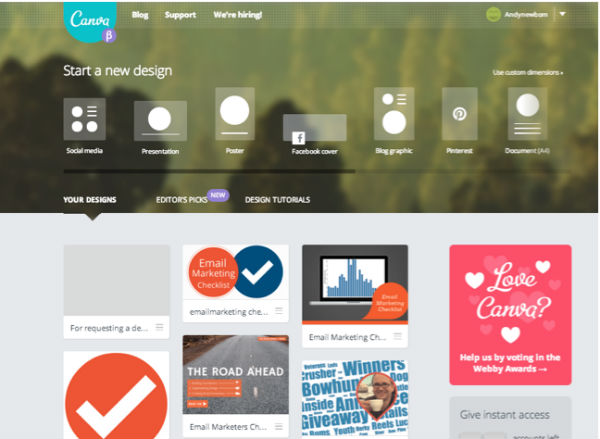
Not ready to take on the expense and steep learning curve of working with software like Adobe’s Photoshop or InDesign? Try Canva. It strips away the complexity and narrows the features of those professional tools to bring quality design capabilities while lowering the barriers to creating standout visual content and imagery.

canva-premade-template

GIMP

Content shop entrepreneur Julia McCoy suggests that small-business owners whose options are limited by a tight budget turn to GIMP to create and edit stunning visuals: “This Adobe Photoshop-like tool is free and fairly easy to use,” she says.

Photovisi

Create free photo collages for your content or social media efforts with this easy-to-use tool.

Skitch

From the creators of productivity mainstay Evernote comes Skitch. Similar to Awesome Screenshot, Skitch enables Mac and IOS users to grab screenshots or access photos, and edit, annotate, or add to them using a simple palette of drawing, design, and annotation tools. It’s particularly handy for highlighting sections of images for use in demonstrations and tutorials.

Data visualization

The very purpose of images like charts, graphs, icons, word clouds, infographics, and other data visualization techniques is to accurately distill large amounts of data into a format that’s easy to consume and remember. But if the thought of building a pie chart makes you queasy, try soothing your anxiety with these visualization aids:

Infogr.am

Simply select a template and plug in your data, images, links, and branding, and Infogr.am builds an embeddable graphic in a wide range of formats that are easy to publish and share. Premium options and API integrations also are available to help you take your visualizations to a more sophisticated level.

Mapme

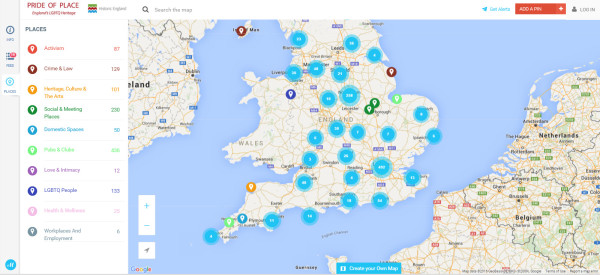
Users join the conversation with Mapme, a socially influenced mapping tool. Brands can create maps based on their own designated interest or one from Mapme’s list and share it with their audience. Users then can add new locations and sites of interest to that map — it’s crowdsourcing for locations of interest.

Mapme example

Piktochart

Piktochart lets you make simple, yet professional-looking infographics with drag-and-drop ease. The service also offers unlimited use of its customization assets, and is free.

Venngage

Regular #CMWorld Twitter chat contributor Jade Phillips suggests using Venngage to create beautiful infographics, reports, and data visualizations. Hundreds of pictograms, maps, and icon tools are available in the Venngage library, and you can upload your own photos to customize your designs.

Video

With marketers’ easy, affordable access to equipment like webcams, smartphones, GoPro cameras, and the ubiquitous selfie stick, the barriers to entering the video content game have pretty much been obliterated. But it still takes work to weave those amateur assets into a compelling story that will benefit your brand. Fortunately, these tools can help take some of the pain out of the process.

Camtasia

Content marketing strategist David Erickson revealed to Chief Content Officer magazine that he is a fan of working with Camtasia for creating ad hoc and product-demonstration videos, as well as for turning marketing presentations into videos: “It is ideal for demonstrating software because it will record on-screen activity while simultaneously recording voice-over commentary. It is also a great tool for turning a static PowerPoint presentation into video by adding voice-over commentary.”

Facebook Live, Instagram Stories, Periscope, Snapchat Live Stories

Livestreaming — real-time online video broadcasts — has made a jaw-dropping splash on the social media circuit. Available through mobile apps, as well as on the desktop, these platforms provide the functionality that gives brands a whole platform for capturing moments as they happen, and combining them to create uniquely engaging stories to share with their audience.

Facebook live video jane goodall

Facebook Live with Jane Goodall

GoAnimate

Everything on GoAnimate is controlled by simple drag-and-drop tools, and the platform automatically syncs your narration to the animated figures on screen. GoAnimate has huge libraries of assets representing hundreds of industries and occupations, and enables you to publish directly to YouTube or other sites like Wistia, Vidyard, and Viewbix.

Rapt Media

Lorna Probert of Aardman Animation (home of the wildly popular Wallace and Gromit films) told CCO magazine that she’s a fan of using Rapt Media, as she finds the system to be flexible, straightforward, and easily embeddable into client websites. “The interactive videos through Rapt allow the audience to actively make decisions, helping us create a more engaging experience and gain more insight about the interests and preferences of our customers in the process,” she says.

VideoScribe

“VideoScribe makes creating white-board-drawing videos so easy. It looks like we paid someone thousands of dollars to create a hand-drawn video, but it took us just 30 minutes. You can even upload your own images for it to draw, and add voice-overs and music directly in the software,” Louise Hendon says in the October 2015 issue of CCO.

Zaption

The Zaption platform enables brands to add images, text, questions, and quizzes to any video, effectively transforming passive videos into interactive learning experiences. Although used primarily by educators and instructors, this platform offers brands value for solidifying their message and ensuring that viewers fully retain and understand video content.

Interactivity and multimedia


3flowers cards by Slidely Photo Gallery

While blog posts, charts, and videos are powerful content marketing mainstays, with a little ingenuity, you can take your visual content in some exciting and unexpected directions. Our Benchmarks, Budgets, and Trends research shows that the use of interactive content is on the rise. If you are looking to experiment with your content formats as a means of grabbing a greater share of attention, the following are some tools that can help you add a bit of innovation to your arsenal.

Apester, Interact, SurveyGizmo, Qzzr

Each of these tools gives marketers the power to easily create and design their own surveys, quizzes, and other interactive activities for their websites or social media pages.

Embedly

If you’re hesitant to dabble with your own HTML code or simply want an easier way to start embedding content, embed.ly can be a huge help. It is an easy-to-use, quick bookmark tool that converts the content you want to embed into an iFrame.

GameSalad

Create games for iOS, Android, and HTML5 using a drag-and-drop interface — no coding required.

HSTRY

HSTRY is a visual timeline tool. You can choose the visual content to piece together, select prompts to help your viewers navigate to different information points, and shift content back and forth to meet the sequence that makes most sense for your topic.

ThingLink

ThingLink enables users to annotate their image and video content with notes and rich media links — great for marking up graphics with links to your additional content resources on the topic at hand.

Slidely

Slidely syncs with your Facebook, Instagram, and Flickr accounts. It uploads your images, videos, and music to produce an interactive multimedia slideshow.

Bonus tip: Get more tools for adding jaw-dropping interactive visuals to your content.

Conclusion

Of course, these tools are just the tip of the iceberg — content marketers can explore plenty of other solutions to help take their visual content creation efforts from a time-consuming necessity to a fun and engaging process. If I missed one of your favorite helpers, let us know in the comments.

Editor’s note: No one post can provide all relevant tools in the space. Feel free to include additional tools in the comments (from your company or ones that you have used).

To expand your visual content knowledge and skills, you can learn more in CMI’s content hub on the subject.

The post 37+ Tips and Tools for Picture-Perfect Visual Content appeared first on Content Marketing Institute.

06 Sep 16:35

5 Questions to Determine the Right Time to Scale a B2B Sales Team

by ksgsakyi@gmail.com (Kwesi Sakyi-Gyinae)

scale-b2b-sales-team.jpg

Maverick billionaire Mark Cuban recently said that the two best forms of equity for entrepreneurs are sweat equity and customer equity. Sweat equity is “the grind” -- the hours and work you put into creating the service or product. Customer equity is the validation of revenue you get from customers.

Newsflash: You can’t get customer equity without sales. 

Here’s the challenge. This type of equity often requires founders to go beyond their initial validation of the product by friends, family, and referrals. Validation (read: sales) must also come from the wider market. And for most startups, that involves bringing in more people to sell. 

But when do you know the right time to scale a sales team? What are the indicators that the time is right to bring on your first professional seller? Or that you should hire your fifth or 10th or 20th sales rep?

“I think one of the biggest lessons I’ve had was scaling too quickly, scaling the sales team too early,” Imo Udom, CEO and co-founder of mobile recruiting app WePow, told me without hesitation in our recent chat.

This mistake of scaling too quickly not only cost Udom financial cash burn, it also saddled him with the unfortunate responsibility of having to lay off over 80% of his sales team.

“While you’re growing your business, you’re trying to get hyper growth,” Udom said. “You know you have pressure from investors and the market. It is very easy to fall into the trap of, ‘Ooh, if I had more sales reps I would be closing more deals.’”

Learning from his own mistake and onboarding advice from his mentors, Udom believes that understanding the basics of your sales metrics and process is fundamental to scaling. He shared five key questions founders ought to ask themselves to determine whether they are ready to scale their sales teams. 

1) Which part of my sales motion is repeatable?

Scaling doesn’t thrive on beginner’s luck. It thrives on consistency. That’s why before attempting to scale, it is vital to identify the activities that produce results on an ongoing basis. They’re repeatable. And you know why and how often.

Udom suggests starting your sales team with three reps.

“If you only have one person in the role, you don’t know if they are telling the truth or not about your process,” Udom says. “Do you have a crack or do you not? If you have two people, that is better. You create competition but sometimes two people could just be friends and they can kind of collude. When you have three, you have the odd person typically. You have real competition and you typically get all the answers you need.”

Once you have those two to three people, you can tell which sales processes are successful and repeatable.  You will have a better understanding of what success looks like -- then you can start stepping on the gas.

Part of repeatability means that you’ll need to understand the number of calls, emails, follow ups, and conversation you need to have with clients. How much effort does it take to achieve Y results? 

2) What kind of message should you communicate?

Finding the right message for your target market is important. For the most part, the message needs to resonate with how the market creates value.

But finding those compelling value propositions are just the starting point. You’ll also need to ensure that there’s great consistency when articulating it across your different customer groups.

Consistency is vital because, as Udom says, “the early sales team has do everything. They have to grind, be on the phone, be on emails, and do a lot of prospecting.” 

And you don’t want your sales reps to be blurting out different messages that are not consistent internally.

3) Which lead profile do you need to spend the most time with?

Time is the least available resource for sales teams. Which is why it’s important to know who’s worth spending time with before you hire your fifth or even 15th salesperson. Part of determining this is knowing which lead profiles -- or buyer personas -- within your target market’s business moves the needle forward the most. 

Is she the IT manager or the CFO? Is she the recruiting executive or the onboarding specialist? Is this person a gatekeeper or decision maker, or an internal lobbyist or champion? 

You need to have a clear persona of your most important customers. Knowing this before scaling helps you to structure the time of your sales teams in the best possible way.

4) What does the closing process look like and how long does it take?

Your salespeople’s success rises and falls on their expectations. So it’s important to establish the right expectations for closing sales deals before you hire more salespeople. This cannot be emphasized enough. The best way to establish the right expectation is track and measure the performance of your current sales team of two to three sales reps.

Among other things, you’ll also need to understand the elements of your closing sequence. Does it take on the average three meetings? Eight weeks? Seven emails and one demo? Does the close typically happen over email or is it a upgrade from free trial to paying customer?

Use the best metrics that make sense for your own business. 

You need to understand the trends so that not only can you hold new sales reps accountable, but you can set the right rhythm for them and set realistic expectations.

5) How do you position your product versus others in the market?

This final question allows you to think about where your service sits in the broad scheme of the market. Are you a complementary or substitutionary solution? What pain points do champions say you can solve best? 

By the time you’re bringing 10 or 20 salespeople on board, you shouldn’t be discovering your positioning -- you should be reinforcing it. So through customer feedback and product iterations, it is vital that you develop a holistic understanding of how your solution stacks up against your closest competitors.

The real test for founders who have a lot of passion and understanding for their business “is bringing in someone who isn’t an original founder and telling them to sell your product,” Udom emphasized. These questions, combined with your own passion, will help you to determine the right time to scale your sales team.

HubSpot CRM

06 Sep 16:35

What to Know Before You Sign a Payment-by-Results Contract

by David Lancefield
sept16-05-samuel-castro
Samuel Castro

Paying for results is in vogue. The concept is fairly straightforward: The parties define the result up front, agree on a baseline, work out how confident the organization is in delivering the result, and then specify the expectation and payment in the contract. The idea isn’t new — it’s well established in online advertising, for example — but its application is becoming more widespread in the private and public sectors.

Consider these examples:

  • Education. The UK’s Department for International Development uses “results-based” aid to improve the educational outcomes of young girls in Africa and Asia. Pearson, the educational publisher, measures the efficacy of its products to improve educational outcomes. Its CEO, John Fallon, says of this approach, “It is by having a bigger impact on education — measured by expanding access and improving outcomes — that we will make Pearson a faster-growing and more sustainably profitable company.”
  • Health care. Cigna is the first insurance company to get pharmaceutical companies to agree to value pricing based on results for certain cholesterol-lowering drugs. And the Health Care Transformation Task Force, a newly formed coalition of private insurers and provider organizations in the U.S., recently announced that its members are committing to transform 75% of their contracts into pay-for-performance models by 2020.
  • Water. Severn Trent Water, among other UK water companies, has agreed to “outcomes-delivery incentives” with the regulator Ofwat that results in rewards and penalties if it meets or fails to meet, respectively, performance commitments.

It’s no wonder that payment by results (PbR) is gaining traction. Customers and taxpayers want to see more value and accountability for the money they spend, so they’re starting to demand that the companies serving them focus on results. And providers want the flexibility to deliver outcomes in the best, most innovative, and most efficient way possible without being micromanaged by the customer. This often involves collaborating with other organizations to deliver the whole outcome – healthier living, better education, or lower crime rates. But as appealing as PbR is, it often goes off the rails.

When PbR Doesn’t Work

PbR can turn into a costly, risky exercise that delivers unpredictable results. Customers don’t always get the outcomes they expect, and providers can feel underrewarded for their efforts, especially when the result is hard to achieve. Another problem we’ve seen is that some providers, seeking to fit in to a payment cycle, focus on short-term results, losing sight of the end goals.

Sometimes, measuring the results can involve a substantial amount of data collection and analysis, and the measurements are often in dispute. Disagreements focus on whether the result has been achieved and how much of the result was due to the organization under contract or to external factors. Did the patient really become healthier because of the drug in question, or because he’s eating better? Did the student get an A because of the textbook, or because the teacher was inspiring?

Another problem is that badly designed contracts can leave open the possibility of companies gaming the system. There are plenty of ways to do this: going soft on the result in order to gain payment (for example, private probations officers being told to turn a blind eye to offenders who violate the terms of their probation); redefining the outputs to make it easier to achieve the result (for example, considering patients “admitted” when they’re placed on gurneys rather than assigned beds); adding cost into the contract to mitigate risk; or cherry-picking the best customers in order to achieve the result.

Finally, some companies have struggled to finance their activities without payment while they work on delivering the results, limiting their ability to innovate too. As a result, some governments and private foundations have introduced social impact bonds to provide the necessary working capital.

Making PbR Work 

We’ve found that PbR contracts function best when:

  • The parties define the result — and the baseline — without ambiguity and agree to practical approaches to measurement
  • The role of the provider in delivering the result can be verified independently without manipulation — for example, through randomized control trials, statistical analysis, and qualitative analysis
  • The provider has sufficient capital and risk appetite to take on the challenge while it waits for the payment
  • There is enough time to develop innovative solutions to achieve the results
  • There’s trust between the parties and the outcome is not “political.” Too much subjectivity and sensitivity can scupper the scheme.
  • There are management tools and incentives in place to encourage a focus on results and the end goals

Typically, the results are defined after conducting market research and engaging with customers. Performance is then assessed against a baseline on a regular basis — say, quarterly or annually. However, with the growth of sensors and wearable technology, we’re seeing more ongoing real-time assessment of product- or service-use and results. The great benefits of this are improved accuracy and transparency, and therefore accountability.

Required Capabilities

Promising a result creates a greater expectation in the eyes of the customer than simply providing a product or service. It sets a clearer purpose, often in improving the lives of customers and citizens. In our experience, this demands a more agile, higher-performing organization that masters three differentiating capabilities:

  • Effective partnering with other organizations involved in the delivery of the outcomes. This includes the closer alignment of incentives, active performance management, and use of risk-sharing mechanisms for the complex, lower-trust contexts. For example, health and social care providers may work more closely within “integrated care” models.
  • Flexible internal organizational structures. PbR arrangements require more internal collaboration, transcending vertical siloes based on products to organization-wide outcomes in what Sir Martin Sorrell of WPP calls “horizontality.”
  • Use of digital technology. Wearables, sensors, and IoT applications produce real-time insight into the needs, expectations, and behaviors of customers — and, crucially, into their achievement of value outcomes. Companies need to use this digital technology to capture, analyze, and then act on the new insight to deliver the agreed-upon outcomes with the highest efficiency, tweaking products and services along the way as required.

At first sight, results-based payments can be appealing for customers and providers. And digital technology is making it easier to measure the results. But PbR arrangements only work in specific circumstances by organizations with the capabilities to deliver them. Otherwise, they’ll find they will pay for more than they bargained for.

06 Sep 16:35

Conjoined Twins: The Emerging Sales-Marketing Relationship

by David Crane

conjoined_twins.png

Sales-marketing alignment has seemingly been written about more than any other B2B marketing topic. (Well, maybe not as much as account-based marketing.)

We’ve certainly written our fair share on the subject. However, as much as previous sales-marketing-kumbaya content has served its purpose in the past, times are changing…and so must the ways in which this much-honored relationship works.

The lead gen era’s slow death: How it affects the marketing-sales relationship

Not too long ago demand marketing teams would generate leads, maybe nurture them a bit and then throw them over the wall to sales once they hit a status defined by agreed lead qualifications scores.

Forrester analyst Steven Wright summed up this concept very well in a recent brief:

“Until now, marketing’s role ended with ‘attract,’ which meant that the funnel metaphor and its companion waterfall determined the B2B marketer’s days and the handover to sales was clearly definable. But B2B buyers’ predilection for self-service is pulling marketing deeper into the sales process itself: Marketing and sales are now working almost in parallel along the buyer journey, which can cause tension and disconnects between the organizations. Instead of a discrete handover of leads and content between marketing and sales, the organizations must now exchange information on an ongoing basis.”

The buyer’s predilection for self-service (a result of the proliferation of digital touchpoints) has greatly affected the ways in which companies generate demand – for both good and bad. There’s obviously now many more ways to engage with prospects, which is great.

Yet, coordinating these engagements, organizing the resulting prospect data, measuring performance results, analyzing the info, providing follow-up content, adjusting campaigns, etc., has become an intricate maze that must be precisely coordinated and timed. This is why the topic of demand orchestration has become so important.

Moreover, such complexity doesn’t lend itself to a clear-cut set of rules stating when marketing should hand a lead over to sales. Instead, marketing and sales must work hand-in-hand through an expanding demand labyrinth, ensuring prospects get the attention and info they need at precisely the right cadence – from the top of the funnel to the bottom.

sales_marketing_labyrinth.png

Today’s global demand centers: No longer “marketers only”

B2B marketing’s growing focus on account-based marketing (ABM) presents a great example of why marketing and sales must work closer than ever to achieve customer acquisition and revenue goals.

If sales isn’t involved in an ABM strategy from the start, that strategy will very likely fail. Think of the initial, fundamental steps required to launch an ABM program:

  • Developing program goals (revenue and net-new accounts)
  • Setting success metrics based on average contract value by company size, industry, etc.
  • Identifying target accounts based on closed-won historical data
  • Determining and aligning all the content used by both marketing and sales along the buyer’s path to purchase

None of these could happen without sales’ extensive input.

sales_in_abm.png

On the other hand, marketing must push its way into discussions regarding bottom-funnel efforts. It’s now critical that marketing understands all the nuances of how sales engages with account contacts, tracks its progress and where typical roadblocks may exist so that it can better assist sales with effective content.

Unfortunately, this isn’t a common practice. According to a recent B2B marketing survey, a mere 40% of marketers participate in sale’s pipeline reviews (Forrester’s Q2 2016 International B2B Marketing Strategies And Tactics Online Survey). How is marketing supposed to enable sales’ ABM efforts if it doesn’t understand what’s working and what’s not?

Steps to become annoyingly close to your sales colleagues

Only 30% of marketers claim to be aligned with sales metrics. And only half of marketers say they often collaborate with sales (Forrester’s Q2 2016 International B2B Marketing Strategies And Tactics Online Survey). Businesses that wish to scale efficiency in this evolving B2B marketing landscape must rethink their approach to this relationship.

Here’s some advice we’ve acquired from successful demand marketing departments over the last year:

1. Create an effective communication strategy with sales

Two tactics do a remarkable job in providing the required bi-directional communication:

  1. Regularly scheduled sales-marketing calls, and
  2. Periodically listening in to sales calls with prospects

Of course, larger organizations have more difficulty in executing these efforts. Yet, it’s not impossible, it just requires more discipline and a set agenda for each call. For example, requesting a selected number of sales reps and marketers to speak about predetermined topics during each call.

A sample weekly/monthly sales-marketing call agenda may include several or all of the following depending on time and size of organization:

A few items sales may want to cover:

  • pipeline review and quarterly goals
  • what’s working and what’s not
  • customer/prospect feedback (maybe select a single rep per week to discuss recent experience)
  • sales’ needs from marketing to hit goals (e.g., follow-up content, help with decks, RFPs, etc.)
  • sales-tech initiatives

A few marketing discussion topics:

  • events and other bulk lead-gen efforts that should affect pipeline
  • messaging tweaks
  • sales-enablement projects
  • media coverage and ways sales may leverage it
  • marketing-tech initiatives that’ll affect sales’ efforts (e.g., changes to lead nurturing and scoring)

2. Agree to joint sales-marketing KPIs throughout entire funnel

Marketing’s goals must be joined to sales’. And they must be measurable. Washing your hands clean of accountability after generating MQLs is no longer the way to thrive as a marketing organization.

Demand marketers should feel/be just as responsible for opportunities, closed-won accounts and revenue as the sales team. And sales must feel responsible for top-funnel performance metrics too, providing marketing with feedback to hone engagement initiatives. It’s amazing the extra effort both sides provide once they have skin in the larger game.

3. Don’t blame – focus on lessons learned

As Travis Goodrich, Enterprise Field Marketing at Amazon Web Services, once put it: “The relationship has to be one based on trust and complete transparency. Some stuff will work, other efforts won’t. You can’t have finger pointing or somebody on either team fear they’ll be fired when something doesn’t work. Rather, the culture has to focus on ‘What did we learn? and ‘How do we optimize it?’

This steps aren’t exhaustive by any means, but they should get your sales and marketing teams off to good start in redefining the nature of your relationship.

155-demand-marketing-tactics

06 Sep 16:34

What Is a Revenue Strategy?

by Lauren Simkins

Any successful company would agree that its top priority is to drive revenue. Unfortunately, as simple as this sounds, many business owners and marketers can find this difficult, overcomplicate the process and thus fail to reach their bottom line goals.

Putting measureable objectives and a solid strategy in place is not only critical for business decision-making and overall success, it also sets the initial tone for alignment between your sales and marketing goals. Enter stage left, the revenue strategy…

The Anatomy of a Successful Revenue Strategy

A revenue strategy is a plan that focuses on increasing company income by maximizing both short and long-term revenue potential. Having a dedicated strategy of this kind is critical, as it is near impossible to grow revenue without a documented plan of action.

So how does it come together? A good revenue strategy uses context in its generation process to provide value and encompasses alignment of the following: strategy, structure, people and process.

But in order to build an effective revenue strategy, you need to stop and ask yourself:

  • What opportunities are presenting themselves at the moment?
  • What type of structure is specifically needed to support your strategy?
  • Do you have the right people in the right roles with the right knowledge needed?
  • What does your sales process look like and what is needed to implement it?

Wait, What About Inbound Strategies?

You might be wondering if a revenue strategy is different from an inbound strategy. The short answer is yes, it is.

An inbound strategy is a plan of action designed to meet an expected marketing goal, specifically using the beauty of inbound marketing to convert strangers into customers and promoters of your business. By aligning the content you publish with your target audience’s interests, you naturally attract organic website traffic that you can then convert, close, and delight. This, in turn, generates more revenue.

Again, let’s stop and think. In order to create a successful inbound strategy, ask yourself the following questions:

  • What is my goal?
  • Who am I targeting?
  • Where does this audience live online?
  • How can I best develop a content calendar?
  • How can I best promote my content?

While there are concrete differences between a revenue strategy and an inbound marketing strategy – namely, how the latter is centered around building brand awareness to drive demand, while the former is focused on matching that demand with a price to maximize revenue and profit – the two are still very much directly related.

A revenue strategy promotes direct alignment between marketing and sales – quite possibly the largest opportunity for improving your business performance. When marketing and sales teams are unified around a single revenue cycle, they can greatly increase marketing ROI, sales productivity and growth.

What is a Revenue Strategy?

When both teams have different goals and varying expectations of each other, it is extremely pertinent that marketing and sales come together with the same revenue-generating goals in mind – and hold each other accountable. Both teams need to be clear on what the revenue strategy is and agree that tracking, reporting and analyzing should provide direct visibility into the entire strategy itself.

Studies have shown that organizations with tightly-aligned sales and marketing had 36 percent higher customer retention rates and achieved 38 percent higher sales win rates.

When sales and marketing are on the same team, everyone wins.

Revenue Strategies Are the Future

Revenue strategies are the way forward. In today’s world, you need to capture a buyer’s attention by clearly communicating your value at all times. This means consistently demonstrating what’s in it for them through both your sales and marketing messaging in order to grow revenue.

Growing revenue means setting an efficient revenue strategy in place, encompassing an aligned set of objectives with your target audience in mind to increase sales. The strategy, structure, people and process must be in tact in order to drive and increase revenue. In addition, both sales and marketing leaders can use a revenue strategy, in conjunction with an inbound strategy, to collectively evaluate the current status of a company’s revenue, discover the true bottlenecks throughout the process, and thus make beneficial business decisions about what areas need improvement in order to grow revenue.

sales met

06 Sep 16:23

Could a book be worth $400?

by Seth Godin

Some people collect old cars or trade baseball cards. I'm more interested in holding something I have a real connection with, something with ideas that have changed me.

I've written in the past about luxury goods and the value of physical artifacts in a digital world.

A book is a special object, a time-tested conveyor of not just information, but emotion and connection. Some of my best friends are books.

This summer, I put together a worldwide team to create a book that might be worth owning, saving and sharing. The goal was to create a substantial (okay, huge) and beautiful book that would be scarce, valuable and worth it.

We sent the files to the printer last week, and I couldn't be more excited about what we've created. You can see some sample pages and read about the history of the project here. It's absolutely the most beautiful thing I've ever been privileged to put my name on. It weighs more than 15 hardcover books and is 800 pages long.

All the words are already online for free (it's a collection of my online writing over the last four years). What you can't get online, though, is the feeling of owning it and the joy of gifting it.

A few thousand people pre-ordered their reserved copy last week, and now we're opening a window for pre-ship orders. As I write this there are fewer than 2,400 copies available for sale between now and September 9th. There will be one more window at a higher price for any remaining copies in November when the books begin to ship.

There's only one printing, and when the book is gone, that's all there is.

The book doesn't actually cost $400 or even half that, but the shipping fees to some countries are ridiculous. We worked hard to create something inspiring and timeless, and we're doing our best to get it to the few people who would like to be part of this journey. 

I hope you'll take a moment to check it out here. Thanks for making it possible.

Titan cover

       
06 Sep 16:22

John Oliver proposes a new list of post-Labor Day rules

by John Lynch

john oliver

John Oliver proposed a series of maxims similar to the "never wear white after Labor Day" rule on his latest "Last Week Tonight" web exclusive. 

"We should be using more holidays as arbitrary points to stop doing things," Oliver joked, before fleshing out a humorous list of new holiday rules. 

"We should have a rule that, after Thanksgiving, you have to stop decorating your home with gourds," the host said. "It's cute in October, it's acceptable but obnoxiously folksy in November, but after that, you're just keeping loose produce lying around."

Oliver then suggested that people stop consuming eggnog on New Year's Eve, "because if you start your calendar year by consuming a beverage with the density and nutritional value of molten steel, scrap the rest of your resolutions and take care of your f------ nog problem."

Toward the end of the segment, the host switched from holiday-centric decrees and began prohibiting mundane things like the phrase "That's interesting," recommending that people opt to say "Bless you" in its place.

"From now on, when someone tells you a boring story, simply say, 'Bless you,' like you were just sneezed on, because that is what hearing about someone's travel delay feels like," Oliver said. 

HBO's "Last Week Tonight" returns from summer hiatus on September 25. 

Watch the video below:

SEE ALSO: John Oliver rants about superhero movies and pitches his own mock-superhero

Join the conversation about this story »

NOW WATCH: How Dwayne 'The Rock' Johnson makes and spends his millions

06 Sep 16:21

The Noble Purpose of Selling. Have You Found It Yet?

by PFPS

Salespeople who driven by a sense of noble purpose of selling will outperform those driven purely by a quota.

Top performers consistently approach sales with an attitude of purpose and a drive to help their buyers. Have you discovered that there’s a noble purpose of selling?  Or are you just peddling wares without a purpose?

Join sales coach Deb Calvert and special guest Lisa Earle McLeod in this rebroadcast from the CONNECT! Radio® archives. You’ll learn how to cultivate the noble purpose of selling as they discuss McLeod’s book “Selling With Noble Purpose.” You can become one of the top performers on your team by looking beyond the numbers game.

Deb Calvert on Connect Radio

Excerpts from Deb’s talk with Lisa Earle McLeod about finding the noble purpose of selling

Deb: “Is this something that people either have or don’t have? Or can anyone develop a sense of noble purpose of selling? How do they do it if they really are driven by the commission or the President’s Club and some of those other… maybe we’ll call them less than noble purposes?”

Lisa: “They are not less noble. Wanting to make money for your family as also a noble endeavor. The first thing we have to get in our mind is that making money and making a difference are not incompatible. To be truly successful, you have to do both. The first thing is to eliminate the disconnection between ‘I can really care about my customers’ and ‘I can really care about money.’ That is the sell divide that we created in our mind.”

Tune in to CONNECT! Online Radio for Sales Professionals® when you’re ready to cut out continuances, put an end to pending and stop stalling out in sales. Download the rest of this interview with Lisa Earle McLeod — there’s no better way to spend that windshield time in your sales territory.


The post The Noble Purpose of Selling. Have You Found It Yet? appeared first on People First.

06 Sep 16:20

Is Sales A Winter Sport?

by Tibor Shanto

By Tibor Shanto – tibor.shanto@sellbetter.ca 

This post makes most sense read on Labour Day, on a deck with a cold one in hand, which is where you should be today!

Being that it is Labour Day, and the de facto end of summer, I thought we can take a look at a lighter side of sales while still giving us something to think about without having to think too hard, something many of us in sales are already good at most days.

I’m not a big Shakespeare fan, but one of the things I did like was his use of the environment (skies, landscape, etc.) as tool to accentuate or contrast elements of the plot, or the inner conflicts of characters. Next time between calls, check Macbeth or The Tempest. You can see similar things unfold in sales, or at least those of us observing the drama, often the characters, you the sellers, are too close to see what the audience sees.

More often though, it is more the case that sales people tend to reflect their environment, which is good in the context of a sales meeting, but not when the environment influences their view and execution.

The Tuesday after Labour Day signals the unofficial start of the home stretch for most sellers. This conveniently comes only a few weeks from the Autumn Equinox, (well only here in North America, for our Aussie and southern hemisphere followers it would be the Spring Equinox).

I have always found that the time between the two Equinoxes to be the most productive for sales people. Not just because of the “Year End” or “Start of year” dynamic, but other factors and trends. (Speaking of drama, and Shakespearean predictability, are you braced to see an avalanche of “How to end the year right” posts, quickly followed by “How to start the year right”). An obvious one being the productivity cycle of their market and buyers. There is a natural cycle where businesses are more focused on doing business, less distracted by things like opening the cottage, getting the kids ready for collage, and more.

The Autumn Equinox brings with it shorter and shorter days, less light more darkness; it is dark when you start your day, and dark before it ends, making it easier to focus on the task at hand during day light house. An almost Shakespearean effect of the days narrowing with your opportunity to retire quota. Everything coming to a crescendo with the arrival of the Winter Solstice. While many will run the race right December 31, most will build their efforts to peak days before Christmas. And just as we return to work January 2, new beginnings, fresh opportunities, and longer days, more light, more energy.

Just a crock of sh#t you say, you’re probably right, but how deep do you want to be on the “last” day of summer, with a frosty on a deck?

Become one of the thousands of sales professionals receiving my latest updates on sales execution, tools, tips and more.   

Join Now!

The post Is Sales A Winter Sport? appeared first on Renbor Sales Solutions Inc..

06 Sep 16:20

Launching an IoT Product in 3…2…1

by ReadWrite Sponsors
Space Shuttle Launch

The promise of the IoT is making it extremely attractive for product companies looking to innovate, differentiate and create new revenue streams for their business. Building a connected product is certainly hard, but launching an IoT product and getting it to market can be even harder.

The loT landscape today is complex and very noisy. Everyone is rushing to get a connected product (and in some cases any connected product) to market. I have seen some really ground-breaking IoT-enabled products hit the shelves this last year and others that I imagine will end up nothing more than a fad. Yet, even those products still create noise that can drown out the launch and sustainability of a truly great product.

Woman choosing speakers in electronics store

In addition to the mad rush of competition from other connected product companies, there is also broad competition from their unconnected counterparts. The IoT is still in the early-adopter stages and there are many consumers out there that don’t trust or see the value in an IoT connected product quite yet. We know, like similar technology revolutions, mass adoption isn’t far away, but we aren’t quite there yet.
So how do you break through the noise and differentiate yourself?

The best advice I give to product companies is to first ask yourself a couple of questions before even setting off to build your product:

1.) Does my connected product add value to my customer (i.e. what does it offer that it’s unconnected and likely cheaper counterpart does not?)
2.)Will my connected product add value to my business? Will it create new revenue streams?
3.)How can I get the most out of the IoT for my business and my customers?

If you can adequately answer these, you can help ensure you aren’t creating a connected product for a connected product’s sake, but actually introducing something to the market that your customers will want to buy.

The next step is to make sure you have the resources to actually build a secure, reliable and scalable connected product. If not, find the right partner that can help you ensure the long-term success of the product.

Of course, you can build the greatest product in the world and if no one knows about it, it won’t do you much good. The marketing and sales plan should be on the minds of the stakeholders before the project even gets funded. How are we going to get this out to the people? Having funding (whether crowd-sourced, VC-backed, or otherwise) doesn’t guarantee success. Money is always a key factor, but it cannot replace smart, creative sales and marketing campaigns. Invest in these aspects because while word-of-mouth may work for some, its success rate is uncertain at best.

Other tips include:

Leverage retail sales channels. Even the best advertising can’t beat consumers seeing your product on the shelves.
Don’t underestimate the power of the media. They say “any press is good press.” I’m not so sure that is true, but being positively spotlighted by the right people can change your business overnight.
Identify the best places to do promotions. Industry events are great for guerrilla marketing and other types of promotional activities. Identify the best and most impactful events and have a presence – even if it’s just a small one – at those shows. Industry shows are where the products of tomorrow are launched. Everyone from media and industry analysts to retail buyers, to consumers attend to scope out the new “must-have” products.

Halo CESs

The key for launching any product, but especially connected products, is exposure. Even with tight budgets marketing and sales can’t be ignored. For consumer products, there is no bigger opportunity for exposure than the Consumer Electronics Show (CES) in Las Vegas every January. It’s crazy, large, and extremely noisy. CES has been the launching pad for everything from the VCR to the plasma TV. Because of its popularity, it can be hard for smaller companies to make a big splash – but not impossible. If you’re planning to attend CES this year or are interested in learning more on how to launch a connected product in general, I am hosting a webinar this week on September 8th along with ReadWrite’s Publisher Christopher Caen and Melissa Andresko from connected lighting manufacturer (and frequent CES exhibitor) Lutron to provide tips and tricks for connected product companies looking to get noticed. Register here.

This article was produced in partnership with Xively by LogMeIn.

The post Launching an IoT Product in 3…2…1 appeared first on ReadWrite.

06 Sep 16:20

7 Proven Ways to Become a Sales Prospecting Superstar

by iannarino@gmail.com (Anthony Iannarino)

sales-prospecting-plan.jpg

You probably always thought that prospecting came before closing, but to create an opportunity, you must be able to ask for and gain the first two commitments you need to move a lead into true prospect status: the commitment of your prospect’s time and the commitment to explore working together. Unfortunately, both are becoming more and more difficult to get.

The business environment has changed radically over the past two decades, thanks to globalization, the Internet, and some major recessions. As a result, we have had to make drastic alterations in the way we sell.

Globalization has forced us to become competitors in the world marketplace. You can no longer be “the only game in town” when the “town” is the whole world.

The Internet has shifted the balance of power. Whereas sellers used to control information, the Internet has given buyers access to more in­ formation and more choices than ever. And it is easier for buyers to find someone who looks a lot like you to sell them what they need if they don't believe you are treating them fairly.

Making matters worse, the United States has just suffered through a decade that began and ended with major recessions. During these downturns, companies focused on cost cutting as a means to survive -- a practice that continues unabated. Purchasing departments and chief financial officers have gained power, and salespeople now face buyers who are more concerned about price than they previously were. I call this new buyer psychology "post recessionary stress disorder." It causes everyone to focus on price rather than cost.

It's harder to create opportunities -- yet without opportunities, you can't produce results. That’s why you need a prospecting plan. But even the best plan is useless if you don’t put it to work. Here’s how to make prospecting a priority:

1) Put prospecting first.

You can't cram prospecting. It must be a daily discipline. Block out time every day for this activity.

2) Be consistent in your efforts.

You don't control when your dream client might become dissatisfied enough with his current situation to make a change. You might call every week for years, only to have your meeting requests refused every time.

But as soon as the prospect becomes even slightly unhappy, your request will suddenly be granted. You can't predict when that might happen, so you can never go away. Keep calling your dream clients, no matter what.

3) Vary your approach.

Most salespeople prospect using the one method that feels most comfortable to them. But that's not necessarily the method of communication your prospective clients prefer.

They pick the channel that they respond to, so you need to use all of them. This includes the telephone, even if you are young and hate cold calling. This also includes Linkedln and other social media, even if you have a few gray hairs and aren't all that interested in these new tools for communication. Use all of the tools at your disposal until you find what's best for each prospect.

4) Separate research from prospecting.

Research is one type of work and prospecting is another; blending the two slows your prospecting. Speed your progress by doing research separately from prospecting. Take the time to build your list of dream clients and all of the potential contacts you need within those companies. Then, and only then, should you do your prospecting. If you need to do more research, invest the time required, and then get back to the work of connecting.

5) Eliminate distractions.

When it's time for you to do your prospecting, turn off your e-mail, the Internet, and your smartphone. Focus. Tell your peers that you have a newfound discipline and you need their support; you'll catch up with them later.

Hang a sign on your door that says, "DO NOT DISTURB! PROSPECTING!" If you do not have a door, use string to hang this sign over your desk. The more focused you are on prospecting, the greater your results will be, and the faster they will occur.

6) Make the plan your own.

Don’t gauge the amount of effort you need to put into prospecting by looking at what other salespeople do. I know a salesperson who easily books 40 percent of the contacts she connects with. Yet if someone else made as few calls as she did, he would probably fail because her combination of approach/product/price and other factors is not the same as his.

You have to invest the time necessary for you. Do what you need to do and stick to your plan. Never mind what somebody else is doing.

7) Focus on the outcome.

Through all the ups and downs of prospecting, always keep your eye on the prize: a meeting. Know that you’ll get those meetings if you persevere.

There’s always something you can do that seems more important than prospecting. The work that shows up on your desk or streams in via your telephone and e‑mail in‑box always feels more urgent. That’s because prospecting never really appears urgent -- until it is. Unfortunately, once you urgently need to prospect, it’s already too late to do anything about it. Prospecting requires a lot of discipline, no doubt about it. But self‑discipline is the cornerstone of success -- in sales and in life.

You must do enough prospecting to create the opportunities you need to make your quota. You also need to prospect enough to build a pipeline that allows you to lose opportunities and still make your number based on your close rate. Prospecting is the discipline of sales champions.

Editor’s note: This post has been excerpted from The Only Sales Guide You’ll Ever Need by Anthony Iannarino with permission of Portfolio, an imprint of Penguin Publishing Group, a division of Penguin Random House LLC. Copyright © Anthony Iannarino, 2016. You can preorder the book here.

HubSpot CRM

06 Sep 16:20

3 Ways To Gain Executive Buy In

by Erika Goldwater

It has happened to all of us. We learn something new at an industry event, or read something amazing that could change the way you do business, but how do you pitch it to your boss, team leader, executives or even the CEO?  Many organizations foster the idea of innovation and welcome change within; however, most sadly do not. So, how can you share ideas and influence change within your organization and gain the often elusive executive buy in?

shutterstock_224973049Understanding the value and keys to of obtaining executive buy in is timely as event season is just about to kick-off. This week’s Content Marketing World in Cleveland and a host of other inspiring and educational events are sure to share best practices that you will want to implement. How do you share ideas and leverage the experiences you have at these events? According to a recent article in Harvard Business Review (HBR), Getting the Boss to Buy In there are a few key areas to focus on when engaging in “issue selling” and presenting new ideas to your boss and teams when suggesting change.

3 Ways To Get Buy In:

Make it relevant:
When you return from an event with a new concept that will drive more revenue for your organization, or are looking to try a new process to save resources, you need to learn to tailor your pitch when presenting ideas based on the audience. Just as markers know we need develop buyer-centric content to reach and engage our audience, you must know your audience and tailor your pitch accordingly, especially when presenting a new idea or suggesting change. Know what drives the CMO (revenue, increase in customer lifetime value, new logos, and customer advocacy) and share how your ideas will help support these goals. Understand what drives your other audiences and pitch the ideas accordingly. Don’t assume everyone has the same goals when sharing your ideas.

Illustrate the benefits:
There are benefits to an organization as well as personal benefits that need to be clearly illustrated to gain executive buy in. Illustrating benefits is similar to making it relevant, but clearly show how this change or idea will positively impact the organization. Speak the language of your boss, use numbers, statistics, revenues or savings percentage to help quantify the value of the proposed change. Focus on the positive benefits of this idea and why it is important to the organization and also, to you as an individual and a member of the organization. Be personally invested in the idea.

Lead the change:
Why is it your job to lead the charge on the new idea? According to the HBR article, you (managers in the middle) are in a unique position. Why? You see and experience when the market, customer or partnership are ready for change through direct contact and intelligence gathering. The article also states that often organizations won’t prosper unless individuals speak up and identify and promote the need for change.

Make the most of this golden age of marketing and learn new ideas and concepts for yourself, but ultimately, work to enhance the effectiveness of your organization. Whether it is a new way to utilize marketing automation to support your Demand Generation Strategy or how to create content that helps engage buyers better, identify and promote the need for change to your executives. Your ideas and opinions are valid – present the ideas strategically by tailoring your message to your executives, ensure the benefits are clear and then lead the charge. Getting executive buy in is essential for bringing new ideas to your organization, but always remember, you need to be ready to drive the change once you get the buy in. That’s what makes this whole process work.

Author: Erika Goldwater CIPP/US @erikawg VP, Marketing for ANNUITAS


The post 3 Ways To Gain Executive Buy In appeared first on Annuitas.

06 Sep 16:17

Get Your Emails Read: Cold Email Tips

by Vanessa Rombaut

Want to make your cold email campaign HOT? Take a look at these tips on how you can turn the heat up.

Cold Email Tips: Make Cold Emails HOT!

What’s your first thought about cold emails? You might be thinking about relentless emails about a product you’re totally not into at all landing in your inbox on a bi-daily basis. Or subject lines that read “HELLO SIR/MADAM BUY MY PRODUCT FOR FREE!”

You don’t want to be one of those guys. But cold emailing people can be a great way to find new clients, forge partnerships or even look for a new job.

Forget your 1,000 person email blasts. This technique I’m about to impart to you, will be more personalized, more targeted and will gain you more qualified leads for your goal.

Cold Email Tips For Sales and Marketing

Research

You need to cast your net out to find potential prospects. If you’re a location-based business, like real estate or have a physical shop, you can network at local events and conferences.

Not sure where to start? Check out your local Chamber of Commerce – you’ll be able to meet and network with the biggest and brightest local business people. You can also try social events for professionals through organizations such asInternations.

If you’re like us, and your business is in the cloud, you’ll have to go to the next best thing – LinkedIn. Use LinkedIn’s Advanced search or sales navigator to search for decision makers, hiring managers and companies that fit into the market you want to target.

The key to this search is to get granular. For example, type in you want a marketing manager who works at a real estate agency, where there are at least 50 employees. You may not yield as many results than if you simply search for marketing managers, but you will get more qualified leads this way. It also saves you time down the road when it comes to customizing your template for your target. If they are similar then the less changes will be needed.

Figuring out emails

Your next step in the research phase is to figure out your target’s email address. Sometimes you’re lucky and a quick Google search will reveal this to you. But mostly you’ll have to play the guessing game. Here are the steps I take to find someone’s email

  • Google search under their name. Sometimes it’s that easy.
  • Search for their company domain with the @ symbol in front of it, liek this: @companyname.com – you may come up with a colleague’s email address. If the colleague’s email address is something like firstname.lastname@theircompany.com, so mary.smith@coolapp.com, you have the email structure. Apply this structure to your prospect. If your prospect’s name is John Jones you’d try john.jones@coolapp.com
  • Startups usually have the structure firstname@domain.com
  • Run a check on these emails, there are online email checkers, such as Email Hippo, which will send a “ping” to these addresses to see if they’re live.
  • Use HubSpot Sales Gmail add-on. This will let you guess if an email is correct, and when it is correct it will show the profile of the person attached to that email.

You can also use a CRM to keep track of your progress. I use Streak CRM – a Gmail add-on which tells you if/when your email has been read, and moves your prospects through a pipeline that you define.

Craft Your Subject Line

Now that your research is complete, you’ve got to craft a subject line.

Your prospect should be able to tell just from reading the subject line if they want to read it or not.

Your best bet is a generic subject line, keeping in mind what your end goals are.

If you’re looking for a strategic partnership you can write “Hi FIRSTNAME about YOUR COMPANY NAME”

so if I were emailing John Jones, I’d write “Hi John, about PieSync”

If you’re looking for a job you can use the concise “Hi from YOUR NAME”

“Hi from Vanessa”

Another great one I use is “Quick Question”

Or if you want to get super-qualified leads you can have a very specific subject line such as

“Hi John, I just built a tool that helps real estate agents sync their client data between business cloud apps. Would you be interested in it?”

These types of generic subject lines are the best bet. If you get this wrong and try spammier “click bait” subject lines, it could end up hurting you in the long run.

First Impression Count

Now that you’ve got the perfect subject line, you now need the perfect first line.

The first line of your cold email has to be custom crafted for the person you are emailing. Go check out their website, find something you like that they or their company did, and compliment them on it:

“Hi John,

Just found your website, I’m really impressed with your work with Coca-Cola!”

When properly done, this first line is going to make you stand apart from 99% of the other cold emails in their inbox.

In Gmail, and a lot of other email servers, the subject line and first line is visible as part of the preview. So your first line is crucial.f you come at them with a first line like this:

If you come at them with a first line like this:

“Hi,

I am Vanessa and I am sales person XYZ”

You’re going to be deleted or marked as spam.

Crafting a personalized first line helps you earn your prospects attention. It shows you’re a human, who has taken the trouble to take a look at their work and you see a match with what they’re doing and what you’re doing.

You’re already pre-qualifying yourself to your prospect and signaling this by the research you have done.

Take the extra time, find out about your prospect, and approach them in a personalized way from one human to another.

Pitching

So you’ve got a killer subject line, awesome first line, what about the rest? My advice is to keep your pitch to 5 sentences to convey who you are and what you want from them.

Going into your pitch – keep them to 5 sentences convey who you are and what you want from them.

“Hi John,

Just found your website, I’m really impressed with your work with Coca-Cola!

I’m looking for new business partnerships.”

Here’s where you can slide your template in. The template part of your email is usually about your product, your company and what you do. At the end of the pitch ask them a yes/no question.

“Does that sound like something you’d be interested in?”

If you’re staying local, invite them for a coffee. This conveys to them that you’re willing to invest time into the relationship, and shows them your sincerity. No spammer is going to waste their time with coffee!

Keeping Track

I mentioned previously you should keep track of your emails in a CRM or Gmail extensions, and send at least 50 at a time. You’re going to send a lot more than you think you do to get results and if you send only 5, you run a much higher risk of getting rejected, and getting disheartened.

Because you’re going to be sending out relatively high volumes of emails you’ll have to take precautions to not end up in the SPAM folder.

Anti-Spam Tips

Here’s some quick tips so your carefully crafted and pitched emails don’t land in the spam folder:

If you send too many emails Google will flag you – use a mail merge program like Streak CRM to send your emails. Quickmail.io sends your emails with a 30-second delay, so if you’re doing a mail merge Google won’t flag you.

Don’t use HTML, don’t use any red text. Keep your formatting simple.

Tie your LinkedIn profile to your email address, you can do this in LinkedIn. Your emails are less likely to be flagged as spam if there’s a person behind it. If your prospects are using apps like Sidekick or Rapportive your LinkedIn profile will pop up and they will immediately see who you are.

That’s it! Good luck on your journey to make your cold emails hot!

If you have any tips that I’ve missed please let me know.

Originally published at blog.piesync.com

06 Sep 16:17

Technology Sales Channel Conflict

by Phil Morettini

In my consulting practice I do a lot of work with software and hardware companies in area of channel development. One of the hardest things to manage while growing a channel business is the inevitable conflict between all the players throughout your various distribution methods, including your direct sales force.

Channel Conflict is a Difficult Issue in Tech Market Distribution

Channel Conflict is a Difficult Issue in Tech Market Distribution

Of course, my colleagues in the channel might say you can limit this conflict by using the channel exclusively. That is the nature of channel conflict—all parties want the business for THEMSELVES. Much smoke is always blown by the various interested parties about what is right and fair, and commitments that were made and so on, but let’s face it—it’s basically self interest. They just want the business for themselves.

Channel Conflict is Fundamentally all about the Money

Channel Conflict is Fundamentally all about the Money

So what’s a company to do? Just sell direct, or just sell through a single, dedicated channel such as VARs or retail? Unless you have strict exclusive territories throughout your distributions system, even if taking this approach, problems will still arise. You’ll always have some kind of conflict (two direct reps or two resellers fighting over who should have an account), but at least you would eliminate cross-channel conflict, which can be particularly complex and nasty.

Limiting yourself to a single channel focus certainly may make your life less complicated and less rife with conflict. But unfortunately, in most cases, you’ll be leaving a lot of money on the table. If you rule out any natural channels that can sell your product you won’t be maximizing your return on your heavy investments in product IP — which should be one of the fundamental concerns of any business.

HAVE YOUR CAKE AND EAT IT TOO

So I say: sell through every channel that makes sense. If done poorly, it can and almost certainly will be very messy. You’ll be sorry you did it and probably become a convert to a single channel or at least less complex distribution model. But it doesn’t have to be so. Yes, you CAN have your cake and eat it, too.

There are many potential channels for your products: direct, OEM, one-step through VARs, 2-step through distributors/VARs, retailers, independent sales reps, strategic partner referrals, online affiliates and many more. In extreme cases, ALL of these potential channels may be appropriate ways to deliver your product to the market. The question I am often asked by clients is “How do you make it all work without it blowing up in your face?” The way you can do this is to live by two very simple rules:

1) DON’T EVER SCREW A REAL BUSINESS PARTNER

It actually sounds pretty simple and easy. Yet humans can be greedy creatures and just a little greed in partnering can quickly ruin reputations for a long time. There’s the greedy VAR who thinks he deserves a piece of every deal with any customer within a 500 mile radius of his office—a customer he might have only sent a piece of mail, or cold-called a year prior with no further contact.

Just as seriously, it only takes one weak-willed sales manager at a manufacturer or software developer trying to make quota or maximize his income, to cause real havoc. If he attempts to cut a channel partner out of a deal that they drove, or had legitimate influence on—this is a mortal channel management sin. Your channel partners will be outraged, and they will spread the word and not soon forget. Your reputation has been tainted, and that crucial trust that is necessary to make any business relationship work is now gone. Everything becomes harder. Partners become unwilling to share information about what’s going on in accounts—maybe even withholding names on potential new deals. A struggle for account control, rather than teamwork, becomes the rule of the day.

So if it is a REAL partner, one who is trying to drive business to your mutual benefit: do whatever it takes to make it right. Give up short-term profitability to maintain a long-term profitable relationship. Don’t ever, ever screw a partner in the name of short-term gain. It can damage or even ruin your channel business for the long term.

2) DO ALLOW BUYERS TO PURCHASE THE PRODUCT FROM WHOM THEY WANT TO BUY IT

If you are honest and fair with partners and sales employees, potential channel conflict shouldn’t unnecessarily stop you from maximizing revenue by using multiple methods of delivering your product to the market. There are a range of customer profiles in almost any market.

Some prospects want to buy everything through their trusted VAR/Integrator, who helps give them a somewhat independent third party evaluation of the product’s virtues. Others want to only deal directly with the manufacturer or developer of the specific product they are purchasing. A third category of buyers likes to buy as much as possible through their favorite large manufacturer—this is a great reason to OEM your product to the IBMs, etc. of the world. In each of these situations, the channel that is best positioned, via relationship or type of support, should and usually will get the deal. If your product isn’t available in that particular channel that the customer prefers to buy through, you may NOT get the deal.

The last category of buyer, however, is different. This is the bargain basement buyer, the one who couldn’t care less who he buys from, as long as he gets the lowest price. These are the people that can wreak havoc on a multichannel distribution system, if you aren’t careful in how you structure your channel business.

BEWARE THE BARGAIN BASEMENT BUYER

It’s this price-conscious buyer that will often bring cross-channel conflict to the forefront. Since they are seeking the lowest price, they end up shopping the purchase across many potential sources for the product, creating brutal price competition among your channel partners. This is where conflict is often born. There are many tactical mechanisms to limit these situations (such as deal registration), which I won’t delve deeply into. The main thing to have thought out is where these customers should end up buying. There are two basic approaches:

1) Tell your value-added channels that this price conscious buyer, who isn’t looking for any added value, isn’t going to buy from them. You might decide that this buyer is going to find the lowest price at retail (if that’s one of your channels), or maybe direct if they buy in volume. In this case, it’s important to set those expectations up front when you recruit channel partners. Let potential partners know where they fit and where they don’t. They can walk away if they don’t like it; otherwise they’ve been warned. This is being fair and honest. Before potential partners invest in selling your products, they should have the real picture of what they’re getting into.

2) Conversely, you should also strive for street price equity between channels. This gets tougher to do the more channel types you have and also the larger your channel is in general. But it can be done if you work at it. The main point here is to avoid giving incremental channels discounts based upon volume. If you do, incentives are created for a channel player to discount heavily to achieve volume—thereby lowering their costs, enabling them to win more business via even more aggressive discounting. This leads to a continuous downward spiral in your street price, and to unhappiness and channel conflict to such a degree that will drive you to drink — or at least a career change. It can get very ugly. But if you limit your channels to those that truly are value-added in some way for your product this situation can be managed. The key is to set partner discount schedules based upon value-adds and their associated costs, rather than revenue or unit volume.

So there you have it. Sell through all the channels your product belongs in. Be honest and fair with you partners. Strive as much as possible for equity in street pricing between partner types. Sounds pretty easy to me–of course it isn’t!

Add your own thoughts and stories on selling through multiple channels and managing potential conflict. Post a comment below to add to the discussion.

The post Technology Sales Channel Conflict appeared first on PJM Consulting.

06 Sep 16:17

Is Cold Calling Dead?

by Dave Brock

In reality, this title is just clickbait. It’s certain to draw all sorts of attention with pundits on either side of the issue. Inevitably each shaping their “pro” or “con” arguments based on what they are trying to sell.

And every time we get into this discussion, we immediately dive in taking and defending positions without even defining terms to make sure we are talking about the same thing.

Before we can even answer the question and have a reasonable debate, we have to define, “What is cold calling?”

If we think of cold calling as: Unprepared, random calls to pitch products to anyone who is foolish enough to pick up a phone—it certainly is not dead, at least judged by the volume of telephone, email, LinkedIn, Twitter and other solicitations I get. But if this is what cold calling is, it should have been KILLED decades and centuries ago. It is simply a waste of time and resource on everyone’s part. It’s the functional equivalent of emails promising fortunes from deposed Nigerian government officials.

If we think of cold calling as: Calls to someone we have never met before and whose day we are interrupting unexpectedly, BUT, it is well researched (both from an enterprise and individual point of view), it is to a customer well within our sweet spot, it is focused on the customer issues–and probably never even mentions a solution. Further, it’s goal is to educate, provide insight, get the customer to think differently and to learn how they could improve. In this case cold calls are what top performers do constantly, separating themselves from everyone else, creating true value and leadership for customers. Cold calling, executed this way, can be one of the best ways we can serve our customers, as well as grow our businesses.

Some choose to define cold calling in terms of technology used. “The cool kids don’t use old school technologies like the phone, snail or email. All the cool kids are using social media and social tools.” This is just a technology or implementation issue. We can be equally obnoxious, ill prepared, and clueless using social channels as we are in using old school channels. Or we can exercise great leadership and insight in any of these channels. Use of a tool doesn’t inherently make the engagement better or worse, it just broadens our reach and enables us to create crap at the speed of light.

There are those who want cold calling to be dead–because it’s hard work! You have to know your stuff! More importantly, you have to know the customers’ stuff! You have to know who they are, what drives them, what they are missing, what they can do better, how do engage them, how to be impactful and create value–and each customer is different, so you have to do this work for each and every cold call.

People in this category will cite endless statistics about negative customer reactions, falling response rates, and other data to argue against cold calling. Oddly, they never look at the data from Value based, insight driven, well researched cold calls. Their agenda is to prove cold calling is dead, so they can avoid doing the hardwork.

Some choose hedge words, “We shouldn’t cold call, we should warm call……” Those of you who have followed me for some time, know my mind immediately goes to, “Does that mean we should only be calling on people in the tropics or desert climate–or perhaps we should be sitting in the tropics when we make those calls…..” Sorry I couldn’t help myself.

No, the warm call advocates say, “You need referrals, you need introductions, you should never call someone that hasn’t been introduced in some way.” Others say, “You shouldn’t surprise them, you shouldn’t interrupt them, you should stimulate them to reach out and ask.”

Well sure! I’m not going to turn any of those down. If I can get a referral or introduction, I’ll always leverage that. If I can have someone reach out, it’s always and easier starting conversation. We’d be fools not to take advantage of that.

But what happens if you aren’t getting them? What happens if you don’t have enough to deliver on your goals?

You have to close the gap, as a result you have to cold call! It is unacceptable to wait for the leads, the requests to talk, the introductions. Spending hours a day on LinkedIn, trying to navigate the path to a “3rd order link,” getting an introduction and moving forward is a waste of so many people’s time and takes too much time.

We need to leverage everything we can in our prospecting. Our networks, referrals, burning hot leads, warm leads—anything that enables us to engage the customer.

Inevitably we will always need more (I have not met any sales person in the last 5 years who is complaining of too much opportunity and too many qualified leads.)

We should be using cold calling as aggressively as we can—by that I mean the prepared, well researched, value driven cold calls. We should not be uncomfortable calling someone we don’t know and who doesn’t know us. We should not be concerned with disrupting their day. It is our obligation and responsibility to reach out to these people to teach them, to let them know, “We’ve spent a lot of time analyzing your business, we think there are some tremendous opportunities you are missing… We think you can grow by this amount, we think you might improve your operations by that amount, there is a way to improve your ability to serve your customers……”

Will everyone be interested, absolutely not. But the yields on this type of cold calling are orders of magnitude better than the blind, thoughtless calls. Customers appreciate them because they are about them–specifically. They learn from them and while they may not be ready now, they might be ready in the future, welcoming engagement at the right time–and then you’d be having one of those “warm” calls.

Unless you are the sales professional I have never met (I’ve met 100’s of thousands) who has too many qualified leads, cold calling is what will save you and enable you to make your numbers.

With top sales professionals, cold calling is thriving, alive, and kicking! And the people doing it effectively are kicking a**!

06 Sep 16:17

4 Rules to Good Sales Engagement Data

by Leah Bell

The modern sales world looks very different that it did before we had email automation and sales engagement platforms. In this new era of hyper-volume, hyper-speed, hyper-personalized communication, lead lists have emerged as a solution to the problem of limited data availability in the SMB market.

But now that data availability is a decreasing problem, we, the modern sellers, have to adjust our sales strategies. Old school outreach tricks simply won’t work in this new school sales engagement arena.

For too long, sellers have struggled to plan their sales engagement process in a way that’s simple to follow. The issue here is that organizations (and their customers) are tired of impersonal, spammy marketing email blasts. And even more exhausted are their efforts in trying to track accountability tasks in CRM.

Thankfully, most modern sales reps today at least have their cadences built out, and sales engagement platform in place to execute on those cadences. What comes next is determining a way to fill your funnel in a sincere and intentional manner. And since data is becoming more and more of a commodity, here are the 4 rules to good data that all sincere sellers need to look out for:

1. Always Start With Company Data

The best teams start by aiming at targeted companies, rather than just buyer personas. By honing in on specific accounts, you find more qualified leads.

When you’re focused on targeted selling, it’s your messaging that converts. Personalized and intentional messaging is the key to success when it comes to connecting and converting these well-defined companies in your ICP.

2. Look For Highly Maintained Data Lists

To get the most-up-to-date data lists, you need vendors who are highly invested in maintaining their lists. Businesses like DiscoverOrg, Ringlead, Datanyze, and Proleads are good options for this data.

Executive Director of Revenue Optimization at MECLABs and B2B Lead Roundtable blogger Brian Carroll admitted he learned (the hard way) that a bad lead list can actually cost 60% more than a good lead list.

The difference between the best- and worst-performing lists is almost $600 per lead.” – Brian Carroll

3. Remember: Social Data Beats Legacy Data

Services propped up by social data typically have the most accurate information. Legacy “crowd-sourced” data becomes stale quickly, not to mention, they put your CRM at risk of being flooded with duplicate data.

De-duplicating and scrubbing data lists is never easy, and in addition to being a sales ops manager’s nightmare; duplicate data can impact conversion rates, sales forecasting, and revenue projection. Eventually, this inaccurate reporting can be the kiss of death to your sales organization’s overall health.

4. Make Sure Information Is Up-To-Date

In order for data to be good, you need information that isn’t outdated and stale. Make sure you gather the best data from sources like LinkedIn, Twitter, and Crunchbase, rather than third-party, legacy data providers.

40% of legacy data is out-of-date after three months.

We know that making the first outbound call is the hardest; but, once you get going, it can be both productive and rewarding. As sincere sellers, we know that data is the most overlooked element of the sales process, but if we instead leverage insights and analytics, we can build a better sales machine.

Back when we sold the OG SalesLoft product, Prospector, we thought it was what the industry really needed. But the data-sales game wasn’t our end game — just simply a means to reach the ultimate goal for top of the funnel sellers. That goal is the conversion of data into qualified opportunities and a healthy contribution to sales pipelines.

“The concept of getting a good prospect list and pounding it to death is old, trite and has become a terrible strategy and drag on our customer’s brands,” admits SalesLoft CEO Kyle Porter. “We have never intended to participate in that process. SalesLoft is a different process, which creates a different relationship, much different results, and is executed by professionals with professional solutions.”

Keep an eye out for these sneaky data sleepers, and remember the four rules of thumb for getting good data that will ultimately lead to successfully driven revenue and healthy organizational growth.

Learn how to manage your sales engagement data and more in the first section of our Sales Development Playbook: Planning. Download your free copy today!

sales development onboarding

The post 4 Rules to Good Sales Engagement Data appeared first on SalesLoft.

06 Sep 16:17

How to Use Surveys for B2B Lead Generation

by Audra Sorman

How to Use Surveys for B2B Lead Generation

Peanut butter and jelly. Salt and pepper. Demand generation and…surveys?

While lead forms are a great way to capture contact information about your prospects, they may not collect other critical information because too many fields can overwhelm potential customers.

For example, let’s say you do demand gen for a tech company. You’ve got a database full of leads who filled out their basic contact information, but what about the details beyond their job title and function? What are your prospects’ biggest pain points, and what kind of content do they prefer to consume? Are they ready to make a purchase and when? This month? Quarter? Year? Are they even the key decision maker—or is there someone else your sales team should be talking with to close the deal?

Short and sweet forms result in more completions, but how do you get to know your prospects better? A marketing automation platform will allow you to track their activity to understand their buyer’s journey, but asking them directly doesn’t hurt either if you do it the right way. That’s where surveys come in.

Innovative B2B marketers are using surveys as the perfect complement to lead forms. Best of all, select survey solutions can integrate with your marketing automation platform, syncing results with your leads to improve your lead scoring, personalize nurture, and increase renewals and referrals. Here are four ways to use surveys at every stage of the funnel—from awareness to advocacy—to glean valuable insights about your leads:

1. Use Surveys to Identify Hot MQLs

What’s in a first name, last name, company name, business email, and/or phone number? At first glance, not much besides their contact information. But once you’ve got these essentials, you can send your prospects a survey to find out who’s ready to buy—and who may need a little more TLC before they’re willing to commit.

This is where you need to put yourself in your prospects’ shoes. Think about what would make you more likely to take the time to complete a survey. Let’s say your prospect has already shown intent because they filled out a “Contact Me” form on your website. Set the stage, building trust with your potential customers. It’s all in the message you send with that automated confirmation email. Remind them of why they’re receiving that email (they filled out a form) and how you can better serve them, for example: “Please take our 2-minute survey so we can help you faster, only getting in touch about stuff that matters to you.”

Ask questions like:

  • Are you in charge of your team’s technology budget?
  • In the next three months, how likely are you to purchase a new technology solution?

It’s a win-win: You show your prospects that you care about their experience, and by getting a handle on their intent and budget, you can prioritize leads and route them to sales—or send them into a nurture program that engages them and keeps your company top-of-mind.

2. Hone Your Content Strategy and Create Better Nurture Programs

The good news: You’ve identified your hottest leads and sent them to sales. The bad news: You’ve funneled everyone else into your generic not-ready-to-buy-but-let’s-keep-them-warm nurture program.

Sound familiar? Maybe not. It’s possible, and highly recommended, that you maintain automated nurture streams segmented by each lead’s preferred content type, topic, and buying stage. But if your nurture programs aren’t personalized, or if you feel like they could use a little boost, surveys are a great way to stay on top of the content and industry trends that are affecting your prospects.

Ask questions like:

  • How do you stay up-to-date on industry trends?
  • What technology-related topics would you be interested in learning more about?

For prospects who aren’t as far down the marketing funnel, turn this survey from something service-oriented (let us help you) into a curiosity-inspired incentive (see what your peers are up to). Let prospects know that if they take your survey, you’ll follow-up with the results. You could even include questions like, “What is your salary?” or “How happy are you with your job?” to incentivize prospects who are curious about their peers to participate. Aside from receiving valuable information about your leads for marketing and sales, you’ll also get intriguing, shareable data points and results that you can repurpose into a report, infographic, or just about anything else.

Use the insights you gain to inform your content strategy, from format to topics, and set up smarter nurture programs. Then, you can automatically funnel your survey respondents into appropriate streams based on their responses, sending them engaging, educational, and convincing content.

3. Discover Their Pain, Then Make It Better

Let’s say you’ve set up your prospects with relevant content. So far, so good, but what’s keeping them from buying? Drive your prospects down the funnel faster by refining your sales collateral and messaging. One way to do this is by using insights collected from surveys.

Okay, by now you know the drill: it can be a challenge to get prospects to take your surveys. If the promise of better service or interesting results aren’t convincing enough, it may be time to put some budget behind your biggest questions. Try using small rewards with a friendly message to increase prospect participation. “Got 5 minutes? Take our survey and enjoy a cup of coffee on us!” Or, if you don’t have a lot to spend, offer prospects a chance to win a prize or gift card.

Ask questions like:

  • What are the top 3 challenges you face in your job? (Select all that apply.)
  • What are you trying to accomplish?

Once you know what your prospects’ biggest pain points are—from their day-to-day tasks to long-term goals—you can develop the right marketing content and arm your sales team with talking points so they don’t have to go in cold.

4. Increase Satisfaction and Referrals

You profiled, you nurtured, you convinced them, and sales sealed the deal. Congrats! But your job’s not done yet. Unless you’re selling one-way trips to Mars, you’ll want to continue to delight your customers and maintain an ongoing relationship with them so they become your biggest brand advocates.

A quick, easy way to benchmark your performance is asking the Net Promoter Score (NPS) question. If you’re not familiar with NPS, it’s pretty much the global standard for measuring and tracking customer loyalty. (Here’s how NPS works.)

Ask the NPS question: How likely is it that you would recommend our company to a friend or colleague? Then, set up your survey to automatically trigger follow-up questions or emails based on a customer’s response. If they’re happy, include them in a referral campaign. If they’re not so happy, alert your customer success team to reach out and improve their experience.

Not to mention, if you’re tired of chasing down customers for testimonials, you could ask open-ended questions like “What does our company do really well?” In that same survey, ask the customer if you can contact them for more information—or if they will allow you to use their words in your marketing materials.

See? Demand generation and surveys. Once you know how to use them together, lead generation is as easy as pie (and ice cream). Now, a question for you: what’s worse than not knowing enough about your prospects to market to them effectively? Answer: having a bunch of information that would help you market to prospects effectively, without a good method for tying that feedback to your lead info. So before you start creating surveys and sending them off, make sure your survey platform is integrated with your marketing automation platform. That way, you get to see your lead data and feedback all in one place. Data here, data there: closing the loop.

Have you started using surveys in your demand generation programs? Share your favorite use case below!

Marketo Virtual Event


06 Sep 16:17

Better customer service starts and ends with a smarter supply chain

by Sponsor Post

new ups supply chain custom supplied

Experts and pundits have been heralding big data's promise to give companies a strategic edge in their ability to cut costs and anticipate and meet evolving customer-service requirements. But there's a large piece often missing in this puzzle: Data holds little value for companies without smart analytics.

Successfully innovating a supply chain requires a carefully designed plan, visualization software, and an understanding of how to leverage analytics and establish a collaborative business model to improve customer service, product quality, or inventory management.

Patagonia, the California-based outdoor-apparel maker, has a supply chain that enables it to manufacture clothing and gear in 15 countries. Analytics and reporting play a "critical" role in its supply-chain operations, says Doug Freeman, chief operating officer at the company.

"We want to understand where raw and finished goods are at any moment, from when we issue a purchase order to when it arrives at a factory," he says.

Patagonia uses its analytics and reporting capabilities to enable different groups of people touching its supply chain and manufacturing process to access and create reports. These teams include specialists, such as buyers or auditors, who can monitor shipments and flag problems, says Freeman.

"We tend to see problems much earlier than in other companies I've worked for," he adds.

Patagonia has established, in effect, a "glass pipeline," says Freeman. It's a collaborative business model built upon a consistent set of metrics that are transparent throughout the organization.

"Anyone can open a report and see where things stand — it's an open book," he says.

Supply-chain collaboration is entering a new phase. It's more than the rise of the Internet of Things, in which devices autonomously provide data from input sensors at every touch point in the supply chain. GPS chips are driving geospatial technology, and vastly improved reporting and analytics capabilities produce real-time data that can be shared with supply-chain partners, and ultimately to improve customer service. For example, some pallets feature GPS chips, which can help save them from being delivered to the wrong location.

For years, companies have relied on their own ad hoc data and homegrown systems to inform their supply-chain management decisions. Now, better-shared databases, built with reliable, real-time data from a variety of sources, mean that businesses can make better decisions, often through partnering with others. Tools have also become far more sophisticated and can inform and guide users anywhere, anytime, and on a variety of devices.

Another form of collaboration

One of the biggest issues that companies face in managing their supply chain is accurately forecasting demand. Analytics — and ultimately knowledge sharing — can help build a "consistent level of sales," says Udayan Bose, founder and CEO of NetElixir, a search-marketing company with offices in India, Great Britain, and the US.

NetElixir, a UPS technology partner, offers UPS retail customers a solution called Elixir Retail that enables companies to use analytics to model search-engine-marketing campaigns.

"The value we bring to the table is a huge insights database," says Bose. "We analyze terabytes of data to understand in what positions, and at what time the [search engine] ads should be visible."

For instance, knowing when their customers are most likely to be shopping online provides retailers with a competitive advantage.

The insights generated by Elixir Retail can be surfaced to different players in the supply chain.

In essence, the company is using "analytics to help drive higher customer engagement," says Bose, and that leads to more supply-chain demand.

Key analytics will vary by industry, and some industries use highly customized software, but there are certain things that all supply chains have in common. Whatever your line of business, understanding how analytics can create a collaborative business model and improve customer service starts with the foundation of a strong plan and great analytics systems.

To learn more, go back to the Unlocking Logistics Hub.

This post is sponsored by UPS. To read more from UPS, click here.

Join the conversation about this story »

06 Sep 16:16

Sales in the Age of Social Media is Still All About Relationships

by Bernie Borges

Ordinarily, I interview a guest from a brand, or a technology company, or an entrepreneur. On the first episode of season two, I’m soloing. And, the reason I’m soloing is to put an exclamation point on a topic that is important to me and to who we are at Social Business Engine.

If you HAVE been listening to the Social Business Engine podcast for a while, you’ve never heard me talk about my digital marketing agency Find and Convert. The reason I want to take some time to mention it now is to give you context for the topic I want to cover in this episode.

Find and Convert is my digital marketing agency that I started 14 years ago, back in 2002. We serve primarily B2B clients across the U.S. and Canada. In recent years, we’ve had the privilege of providing training services to B2B companies with an emphasis on “social selling” training.

In fact, the primary motivator for launching Social Business Engine two and a half years ago is to walk the walk in creating thought leadership content on a strategic topic – social media. This is what we’ve advised our clients to do for years. So, we launched SBE as our proof statement.

But, there’s been a HUGE benefit to this podcast that we never anticipated…

By interviewing thought leaders on a weekly basis, we’ve been able to learn so much and apply those learnings not only to our clients in supporting their business and marketing goals, but we’ve also learned about common challenges among companies in how they use social in their sales strategy. And, we’ve applied these learnings to our own service offerings. I’ll elaborate on that a little later.

season1_socialselling

First, I want to summarize key insights and inspirations from 10 guests from season 1 of the SBE podcast, specifically on the topic of social selling. I’ll start with my most recent guest, Tim Hughes on episode 123.

Tim Hughes has 27 years of sales experience, which includes closing a $50M sale. He was recently inspired to co-author the best-selling book Social Selling: Techniques to Influence Buyers and ChangeMakers. One of Tim’s key points in his book is how B2B buyers only need to talk with a salesperson in the final 20% of their evaluation. Therefore, it’s up to the salesperson to find their way into the first 80% through content and value-added networking, or risk not being invited into the final 20% of their evaluation. Tim challenges a salesperson to “own their territory online.”

Episode 121: Tony Zayas is director of sales and marketing at Proforma, a B2B franchise organization whose franchisees sell advertising specialty products to marketers. Tony developed a training program for their franchisees. He taught them that social media is just a communication platform. When he framed it up that way and taught them how to develop relationships through social media, they not only embraced the approach, but they started to quickly produce sales results. Tony proved what we already know: sales success is very dependent on relationship building and through common sense practices, relationship building is enabled in social channels, including on Facebook, not just LinkedIn and Twitter.

Episode 119: Kirsten Boileau is director of digital innovations at SAP, a global provider of enterprise software solutions. SAP employs approximately 30,000 sales people. Kirsten specifically leads sales enablement where she is focused on delivering social selling training at scale. Kirsten inspired me by pointing out the obvious, yet profound fact that social selling is not a tool. It’s a process that requires behavior change and must be supported by both process and technology. And, she is living the dream – what many other brands dream about – the collaboration between marketing and sales for sales enablement.

Episode 113: Glenn Gaudet is founder and president of GaggleAMP, a leading provider of employee advocacy software. Glenn opened my eyes to the fact that social selling is a form of employee advocacy, of course with a focus on sales activities. His key insight is the importance of employee engagement. If employees aren’t engaged internally, then it’s unlikely to expect employees to effectively engage externally. When you consider how in many businesses the sales process is a team effort that extends beyond the salesperson, employee engagement is a key factor in long-term social selling success.

Episode 107 and 10: Jill Rowley, perhaps the most famous of all social selling experts who, after 52 quarters in software sales, has trained thousands of sales professionals around the world on social selling process, preaches her core values, which she embodies: Jill says “Stop selling, start serving…” She said, “Give to give, versus give to get” and the ABCs of social selling: Always Be Connecting. Jill uses a lot of hashtags to emphasize her social selling wisdom, and to that I say #GoJillRowley!

Episode 107: Jack Kosakowski, global head of B2B social sales execution at the Creation Agency. His social selling expertise is evident in his LinkedIn profile, where his summary says, among other inviting things: “Marketing and sales are finally starting to become one and disruption is no longer a dirty word.” I agree, Jack!

Episode 107: David JP Fisher, aka D-Fish, has authored so many books on professional networking for sales professionals that I lost count. He’s a speaker and business coach. He motivated me on social selling through his no-nonsense, pragmatic approach to networking. His most recent book Networking in the 21st Century is a must-read for anyone serious about relationship building through modern networking in the digitally connected age.

Episode 103 and 59: Amy Heiss is Director of Social Media Activation and Community University – SmaC U at Dell, a company employing 110,000 people. Amy’s team at SMaC U has trained about 16,000 employees. What impresses me about what Amy is accomplishing at Dell is how they tie social media engagement into the business and seek to measure activity and engagement to business outcomes. She admits that the measurement piece is a journey. It’s not always so black and white. But, it’s an ongoing focus for Amy and her team at SMaC U.

Episode 93: Julio Viskovich is recognized by Forbes as a top 30 social selling influencer in the world. Julio is also a frequent speaker at conferences on social selling and employee advocacy, and he is an executive at RFactr, an employee advocacy software firm. Julio’s inspiration to me is his experience developing, implementing and supporting social selling programs at Fortune 500 brands by integrating sales process with technology.

Episode 83: Bryan Kramer is internationally acclaimed as an author, keynote speaker, and consultant. He made the phrase “human to human” famous when he said, in the context of our business world, that it isn’t B2B or B2C, it’s H2H – human to human. One of his inspirations to me is his suggestion that social selling shouldn’t be called social selling, he thinks it should be called social helping.

The Common Thread

The common thread among these ten amazing guests is that sales in the modern connected age is comprised of personal branding, consistent communication, and relationship building. When I look at our day to day experience with our own clients and companies we talk with, we see a void or a gap in a sales person’s social profile and their behavior to achieve these three foundational pillars so they can set themselves up for successful sales activities.

Looking at the key attributes of a sales person’s social profile, let’s start with the why. A social profile is available 24/7. Most of us don’t engage in social channels 24/7, but our social profile is online 24/7. So, borrowing from Michael Port, author of the best-selling book Steal the Show, our social profiles should “perform” for us.

“Most of us don’t engage in social channels 24/7, but our social profile is online 24/7.” @bernieborges #sbeshow
Tweet: Tweet This

This “performance” concept is a powerful concept. But, how can our social profile perform for us? Let’s look at that, with a focus on LinkedIn. You can apply these principles to Twitter or Facebook or wherever else you choose to network in digital channels.

  1. Think of the people you want to reach as your audience.

First… LinkedIn is NOT your resume! I’ve discovered that many sales professionals think of LinkedIn as their online resume. Don’t think of the people you want to reach as prospects, customers or peers or friends. They are your audience! Think about what feelings and emotions you want your audience to experience when they meet you and when they experience you.

Do you want your audience to just read your LinkedIn profile, or do you want them to experience it? When you go to a movie or a sporting event or a concert, do you just watch it or do you have an experience? If you think it’s not apples to apples, think again. We live in a multi-sensory, multimedia world. Someone visiting your LinkedIn profile can experience all but two aspects of you. You can’t be touched or smelled on LinkedIn, at least not literally. But, you can provide a multi-sensory experience through your profile that causes an emotional reaction about YOUR brand and what it represents to the potential buyer.

  1. Write a killer headline that performs.

A headline is supposed to be attention grabbing. It’s supposed to begin the experience between you and the visitor to your profile. Most people list their job title in their LinkedIn headline, generally because they’re not thinking like a performer, and so they’re not writing a headline.

Here is an example: your job title might be Enterprise Sales Executive at XYZ company. Does that really set you apart from other enterprise sales executives? No!

Consider a headline like this: Creating Measurable Efficiencies Through Supply Chain Logistics Software. Look at what I’ve done. I’m opening with a verb. It’s an action. You are “creating” something. You’re creating measurable efficiencies through supply chain logistics software. So, create a compelling headline that emotionally describes what you do and how you do it.

  1. Write a summary that performs!

The Summary section of your LinkedIn profile is possibly the most important element. Many people don’t even write a summary. Many people skip the summary and jump right to their job experience. That’s because they look at their LinkedIn profile as an online resume rather than a sales asset.

If you’re in sales, a summary is a MUST. Remember that the purpose of your LinkedIn profile is to deliver a performance that will enable you to get into conversations with your target audience. So, write a summary that performs! And, the way you do that is two-fold. First, tell a story that describes your professional journey and what you’ve accomplished. Secondly, show your personality. Don’t be afraid to be human. There is no rule anywhere that says your LinkedIn summary needs to be boring. Spice it up, but be mindful of your audience.

Give people a reason to connect with you or contact you. Your summary should be an invitation that is written for your buyer. It should be so compelling that your buyer will at a minimum research you and your content further, and in the best case, will contact you to seek your input. Visit the LinkedIn profiles of any of the ten guests I showcased earlier. Each of them has written a compelling headline and summary. Their profile works for them 24/7.

In fact, we are so passionate about this topic, we’ve launched our own online course to address it. It’s called Optimize Your Social Profile for Sales Success course. Whether you’re an entrepreneur or a member of a sales team, or a marketer who interacts with the sales team, I invite you to take the free trial for this online course.

Featured On This Episode:

There are TWO WAYS you can listen to this podcast with me, Bernie Borges.

You can click the Listen Now button at the top of this page… Or, you can listen from your mobile device’s podcast player through iTunes or Stitcher.

Find out more about social selling.

03 Sep 17:18

5 Ways to Get More Hours in the Day

by Susan Solovic

5 ways to get more hours in the day ft image

There’s one commodity that always seems to be in short supply, with no way to get more of it.

I’m talking about time.

I don’t think I’ve met a small business owner yet who didn’t say something like, “There just aren’t enough hours in the day!”

As far as I can tell, there are only two ways to give you more productive hours each day.

  • Slow the rotation of the earth, or
  • Learn how to delegate better.

Scientists tell me that slowing the rotation of the earth would have grave consequences, so that really only leaves us with delegating better.

Start by delegating tasks that fall into these five categories:

1. Tasks that have been systemized or are routine.

When you develop systems to accomplish tasks in your small business, it gives you the ability to more easily plug people into those roles.

By the way, you should systemize even routine tasks. In fact, it’s often more important to hone the systems you use for tasks you do all the time.

Making them more efficient will have a great impact on your business. Also, developing systems is the first step toward automation.

2. Tasks that aren’t your strength.

Wise small business owners know their weaknesses and also recognize the strengths of others.

When people on your team are better at a task than you are, give them the job and then get out of their way.

You get back some of your hours during the day and overall your business will run more smoothly and profitably.

3. Tasks that will boost sales now.

You should be providing the long-term vision and direction for your business.

If there are a few tasks that can be accomplished quickly and will yield an immediate boost to your sales, get someone on those tasks STAT!

4. Tasks that will help employees grow.

This is really a “twofer.” Take something away from yourself and give it to someone who you believe has good growth potential.

This frees up more of your time and eventually sets up your small business to almost “run itself.” If you put the pieces in place that will make your business self-sustaining, you can soon start thinking about your next venture.

5. Tasks you tend to put off.

These can be tasks you don’t like, or don’t view as important enough to take you away from other duties.

When you’re trying to enjoy a barbecue on the patio and there are gnats buzzing around, it becomes less enjoyable, doesn’t it? It’s the same thing with those little tasks that you know you should do, but keep putting off until the proverbial “tomorrow.”

Getting rid of them gets you out from under that cloud. You’ll be re-energized. Also, there may be others in your small business who need you to complete those pesky tasks before they can continue with their work, so delegating them to someone who will “clear the boards” may yield bigger results than expected.

Start doing more, doing less.

We know that small business owners typically put in 55 hour work weeks and honestly that’s not good for your health and in the long term not good for the health of your business.

Renew your commitment to delegate better this year and build a business that can run without you.

What tasks can you delegate? Choose one thing to give up today and develop a plan for how to pass it off.

03 Sep 17:12

How to Measure Your B2B eCommerce ROI

by Samantha Selsky

Forrester Research recently reported that B2B eCommerce was set to grow to more than $1.13 trillion by 2020, and that means growth potential for B2B companies moving into eCommerce. Understanding how to measure the returns on investment (ROI) you’re getting – or plan to get – from your B2B eCommerce investments, however, is a crucial part of determining whether your site will be a success or not. Unfortunately, eCommerce ROI – while a simple metric on its surface – is actually one of the most difficult metrics to accurately determine for an eCommerce site. For B2B companies, it can be especially challenging.

Why is it so challenging? One reason is that while the math that goes into an ROI calculation is fairly straightforward, determining what measures should go into the calculation is less so. It can also be more challenging than determining ROI for a B2C site, due to inherent differences between B2B and B2C.

The Basics: How to Measure B2B eCommerce ROI

Calculating ROI at first glance seems to be fairly simple: ROI = (Gains – Cost)/Cost

However, this simple measurement assumes that the metrics you’re putting in have themselves been measured accurately, and that you’re measuring the right things.

Measuring Costs: To determine the ROI of your B2B eCommerce efforts, you could look simply at the total cost of your eCommerce platform and the total revenue generated on the platform. However, this measurement is lacking in some important areas.

One area that is lacking is that the software cost itself is not a complete measure of the total cost of the software or platform, or of the actual cost of operating your eCommerce site. A better measure of the cost to own your eCommerce platform is Total Cost of Ownership (TCO). TCO includes the lifetime costs of owning the software:

  • Purchase price of the eCommerce platform
  • Cost of implementing the platform
  • Any ongoing operating costs

You also need to look at the operational cost of your eCommerce efforts – the marketing and customer acquisition costs in addition to the software costs. Consider all of these in your cost calculations.

Measuring Benefits: Once you’ve got a good handle on the costs you want to look at, you need to get clear on the benefits the B2B eCommerce is delivering. You could just look at the revenue generated from your eCommerce site, but that leaves some important things out. It’s also the case that depending on your company’s reason for implementing eCommerce, revenue alone may not be the best way of measuring benefits for your B2B eCommerce site.

A better measure would be to look at the complete business benefits the eCommerce site delivers – improved customer satisfaction, faster order processing times, lower cost to serve customers, and increased revenue to name a few.

Obviously, there’s a lot here that you could be measuring as part of your ROI calculations. To determine which specific metrics you’re going to look at, you should consider your business goals. Primary among those for a B2B company is customer relationship building – this needs to be carefully considered when measuring B2B eCommerce ROI.

How Differences between B2C and B2B Impact ROI Measurement

The secret to B2B eCommerce is really no secret at all: the most important difference between B2C customers and your B2B customers is that B2B customers visit your site because it is their job to do so. This means they have different expectations of a B2B site, and this impacts your ROI measurements.

What’s different? While B2C customers are more emotionally driven, and more apt to make purchase decisions on the fly based on marketing and other “shiny objects,” B2B customers have a job to do. They likely know what they need before they arrive to place an order, and are mostly looking for a way to get that order placed quickly. They want their eCommerce experience to be simple, yet still able to handle the additional complexity of a B2B sale.

This doesn’t mean that your system is simple, however. In fact, creating a simple experience for the customer often takes considerable personalization on the backend to ensure that customers receive any relationship-based pricing or discounts and more.

In B2B, purchase decisions are more complex, driven by relationships and business needs. It’s also important to note that B2B customers are repeat customers, unlike a B2C site where return customers may make up a minority of that site’s buyers. The impact of relationships on ROI is a bit more difficult to calculate.

That’s why we need to know the goals for our B2B eCommerce site if we want to accurately measure ROI. Is the goal to improve customer satisfaction, increase revenue, reduce costs, or process orders faster? Are we looking for better ways to service existing customers, or are we seeking to grow our business online and find new customers? All of these should be considered in our B2B eCommerce ROI calculations.

What’s most challenging for you in calculating ROI for your B2B eCommerce site? We’d love to hear about it in the comments.

03 Sep 17:11

The Barriers Remaining Are Internal

by Anthony Iannarino

For most of history, there were enormous external barriers to a person’s ability to do what they were most passionate about, and to follow where their heart and dreams would take them.

In the old days if you wanted to publish your thoughts and ideas, you needed a publisher who would hire you and help you with access to an audience. Now you can write and distribute without a book publisher, or without a job writing for a newspaper, magazine, or journal.

There are no more external barriers for writers when it comes to publishing.

If you wanted to make music, you used to need a record company to pay for your recording and to distribute your work.

Barriers? Gone.

If you wanted to make a television show, to comment on the day’s events on video, or to entertain others, you needed all sorts of things, like agents, casting people, producers, directors, writers. Television and movies were a real insider’s game. There used to be enormous barriers to entry.

Now? Very little. Talent is worth more than cameras.

Regardless of what kind of endeavor you want to pursue, including starting a business, at no time in history has it ever been easier to chase your dream. The external barriers are all gone.

But there are still a few remaining barriers left to conquer.

The Inner Critic That Is Fear and Doubt

Inside each of us lives an inner critic. This little voice that only you can hear is often a holy terror. It stirs up fear and doubt, creating the internal barriers that are the only real obstacles to you pursuing your dream.

The little voice drives your fears with an unrelenting barrage of negativity: “You will suffer an embarrassing failure,” and “You’re not good enough,” or “People will think this is a joke!” It causes you to doubt yourself.

You have to shut down your inner critic by taking action in spite of your fear. Taking action builds momentum and builds the small victories and the progress that eventually silences the inner critic.

Taking massive action is like kryptonite to your inner critic; it’ll put him down for the count. But then there is this . . .

Apathy: Hitting the Snooze Button on Your Life

There is always tomorrow. Until one day, there isn’t.

Your apathy—and its progeny, procrastination—are internal barriers that do even more to prevent your success than any of the external barriers of days gone by.

You were going to write today, but you had writer’s block. You were going to record today, but you decided to watch some television instead. You have this great business idea, and as soon as you find time you are going to change the world.

This is hitting the snooze button on your life.

The same as with your fears and doubts, you have to overcome the internal barrier that is your apathy by relentlessly taking action. Your dreams and your vision are too important to wait, and the clock relentlessly ticks away, sparing nothing and no one (not even the best of ideas or the best of intentions).

Stop hitting the snooze button. You don’t want to sleep through this. Wake up early, stay up late, and make it count.

There has never been an easier time with fewer external obstacles to your dream. What are you doing to overcome the internal barriers?

The post The Barriers Remaining Are Internal appeared first on The Sales Blog.

03 Sep 17:11

How 10 Simple Business Changes Can Make Your Life More Fulfilled

by Luke Peters

Success. It evades some like the plague. Others, they just can’t seem to grasp it. Time and time again, success has driven countless people to madness. Poverty. And disappointment.

It’s driven other people to riches beyond their imagination – sailing the external and internal world at their leisure.

What separates the two groups? Why do other people get to kiss Fate’s good hand… And others receive Fate’s backhand? Is it the same storyline of Robert Kiyosaki from Rich Dad Poor Dad. Or is it just a mere coincidence and luck?

Recently at Tony Robins webinar, Dave Kerpen – Chairman of Likeable Media explains amassing mind-blowing strategies to build a $10m dollar business…. Do you want to be on this group? Hell yeah!

But the other “group” (maybe, probably) circle around social media and reading OMG posts not knowing what they are doing at all – that’s wasting time & energy for nothing, a common procrastination habit.

Right Doing, Wrong Doing

Photo by johnhain, CC0 1.0

It is the right thinking that all matters, rather than what degree/knowledge/skills you hold or where you come from…. this is what I learn from JOY! What you think is what you do. If you cannot think right, you cannot act right!

So here’s my way to thinking right…

1. Embrace The Struggle

I have a bulletin board loaded with quote-fueled index cards tacked up. Quotes that get my head stomped in by life (and business). I don’t remember where a lot of quotes came from, sadly.

One that slaps me in the face each and every day is this: “Struggle is not a bad word. Accomplishment is impossible without it.”

It’s a value I hold on to this day. When things get hard. When the struggle is real. No matter what happens, or where I am. This little nugget keeps me strong. What does it do for you?

2. Sculpt Your Mindset

Henry Ford who said, “Whether you think you can or can’t, you’re right”? Believe it. How you think determines the results you see.

If you’re surrounded by people who constantly doubt you, question what you’re standing up for… or show ANY reservations about the direction you’re headed…

The people who care the most about you… And who you turn to for guidance in this crazy-fury world…

The popular thing to do is either A) Retreat into darkness, betrayed and hurt or, B) Sever ties with them forever.

As always, the point is this: you can’t expect positive, soul-fulfilling results if all you’re doing is hanging around people who only hamper you.

It’s like Rob Kiyosaki said in his book, Rich Dad Poor Dad: “Winners are not afraid of losing. But losers are. Failure is part of the process of success. People who avoid failure also avoid success.”

3. Challenge Yourself

Take bodybuilders. One month they’re lifting clean pressing 75 lbs., and a month later they’re pressing a full hundred and fifty. They don’t make monster growth like that by staying where it’s comfortable.

Felix Dennis said it best in his book, How To Get Rich: “The odds may still appear daunting, but only to those lacking sufficient guts and determination to try. If the odds of getting rich put you off, then you deserve to stay poor. Or, to put it more kindly, whether you deserve it or not, you will stay poor.”

4. Give Back

There’s this weird thing about the universe, and I can’t explain it. But there’s this odd thing that happens, where… even without thinking about it, I tip cashier $10. Even if I need that ten bucks for myself.

I’m not the only one who feels this way.

Because the universe seems to keep a “karmic scoreboard”. Try tipping 20% more than you should the next time you’re out. Pay for someone else’s coffee, or meal. Or pay for someone’s groceries.

What’s the harm in that? Interestingly, you will feel much better, happier as you have done something wholesome!

5. Study Street-Smart “Cons”

Say what you will about street hustlers, one fact remains: they know what they’re doing. From sideshow shenanigans to elaborate plans – they know how to get money. Not by being a liar or a thief, oh no. What makes the best of them is their ability to understand the human condition.

They’re experts on human psychology, understanding what makes people tick. How to press their hot buttons, really get inside their worries, their fears, and figure out (in a split second) what people’s vices are.

6. Bookkeep Up The Yin-Yang

Chris, at Investopedia, suggests keeping records for everything. And that makes sense. By keeping records of expenses, investments, what comes in and what goes out… You can see where money is leaking through and plug the holes.

This is more than keeping records: this is about being anal-attentive about making sure you know, hands down, where your money is going.

7. Stay Productive

Listen: You’ve got things to do. Things to create. You’ve got a business to run! This is no time to sit around all day idly watching the clock go by. You’ve got to work.

Sometimes, it’s hard to keep the engine rolling and get things done. Mark Cuban (you do know who Mark Cuban is, right? Good.) keeps his productivity charged and ready to handle the world (and his HUGE bank account) by limiting his meetings.

Mark Cuban reveals startling insights into the way he handles business. And I’m not going to argue about the methods of a man whose worth is over $3B.

8. Don’t Fight Fires

Take, for example, the time Gary Halbert and his protege John Carlton (author of Kickass Secrets Of A Marketing Rebel) were in Halbert’s office. It was a day of mayhem: Phones were ringing off the hook. Secretaries came in and out of the office in a furious panic about emergency after emergency.

Halbert simply closed the door and told Carlton, “We aren’t paid to put out fires.” He then went back to his desk, picked up his trusty blue pen and yellow legal pad, and began writing his next hot sales letter (which, by the way, he charged clients $15,000 for).

Let someone else handle fires: Do your job.

9. Treat Customers Right

Also from Investopedia is this tip, which rings true: make sure your customer service is top notch. It makes sense. Really! Customer service is the ONE part of your business that directly deals with your customers.

Your customers aren’t numbers or statistics. They are as real as you are, reading this. They’re as real as I am, writing this. We’re people – something that’s forgotten by a lot of corporate lugheads who do everything by committee… and bean counters.

Because word gets out. About everything. If your business snags good reviews, you’re going to get more and more loyal customers. Easy to understand, right?

Then why do so many businesses treat their customer list like a bunch of robots?

10. Use Your Time Like Oprah

Yep! Oprah. Here’s a quote from a motivational video I saw on YouTube: “I don’t care how much money you make, you only get 24 hours a day. The only difference between Oprah and a person that’s broke… Is Oprah uses her time wisely.”

Check out the video for yourself, and be sure to study the dozens of other motivational videos about heart, about passion. Staying motivated in life. They’re all compilations of some of the world’s most influential public speakers.

Stuff that challenges you and makes you think. Really. Sometimes I feel bad after the video finishes, because some of them make me realise that I’m not really living the life I want.

That’s what growth is all about. And, really, what’s life if it isn’t a series of opportunities to consciously evolve?

Why else do you think, the reason why so many successful people talk about being fulfilled, emotionally and spiritually, at the end of the day…. than having buckets of money?

03 Sep 17:10

5 Reasons Why Your Salespeople Are Quitting

by Joel Goldstein

quit

Have you noticed a number of your salespeople or wholesale distributors have recently quit? A little bit of turnover is always expected, especially among new hires who are dipping their feet into sales to see if it’s a good fit, but if the numbers are higher than usual, there may be a problem. Here are some of the reasons why your team could be calling it quits:

Compensation changes.

Perhaps one of the most obvious reasons why salespeople would begin to quit is a change in compensation. If you recently implemented a commission cap, reduced base pay, or decreased the commission percentage, this could definitely lead to a high turnover.

Unrealistic expectations.

If a salesperson believes he is being set up to fail, he could be tempted to leave to find a new job where his efforts will be appreciated. For example, if your company just introduced a new product that is clearly not ready for the market, but you expect your sales team to sell it anyways, this can be very frustrating. Salespeople do not want to lie to their clients by touting the benefits of a product they don’t believe in, so this is an unrealistic expectation. Another example of an unrealistic expectation is setting new goals for the members on your team that are double or triple what they usually are. This is not motivating, it’s showing your team how out of touch with reality you are.

No access to sales tools.

Sales managers need to give salespeople the tools they need to succeed, and when these are not provided, you can expect to see a few people pack up and leave. If your team needs a CRM system to manage information, provide it to them. If clients are asking for marketing materials to learn more about your brand, make sure you have someone on staff who can create these and distribute them to the team. Selling is a team effort, so you need to be able to provide your team with this basic support.

Lack of training.

Salespeople, especially those who are new to the industry, need to be trained to stay competitive. When a new product comes out, the entire department should be trained on its features, benefits and value proposition. But, that’s not the only time training should take place. As a sales manager, it’s your job to set up mentoring programs and group trainings so everyone can learn new tricks and techniques. No matter how many years an employee has been on your sales team, there are always ways to improve. Keep trainings consistent to retain your team.

New sales culture.

If your company has recently changed its sales culture, this could be the reason why so many employees are hitting the road. Have you asked traveling sales employees to come into the office for morning meetings so you can touch base with everyone in person? This may seem like a great teambuilding exercise to you, but to busy salespeople, this is nothing more than a nuisance. If you do implement changes in your sales culture, make sure you actively seek feedback from members on your team to ensure you’re not ruffling the feathers of valued employees.

How do you retain the members of your sales team? Leave your suggestions in the comments below!

03 Sep 17:10

Why Hasn’t the US Adopted Opt-In? It’s Time for a Rethink.

by David Fowler

David Fowler_Digital Insights

Fair warning: rant ahead.

I have been in the email marketing channel since 2003. In fact, one of my first outings was to the FTC Spam Summit in April of 2003. It was a very lively affair and standing room only for the most part. All constituents of the email channel were represented, and for two days the issues pertaining to our channel were debated and I left feeling that I had just lived an episode of The Twilight Zone.

Being new to the field, I was constantly gobsmacked that something as simple (simple, right) as email could engender so many passions and positions on its own future. You could argue that email to this day is still the one killer app that we all use and will continue to embrace. One piece of proof: your email address is the center of your digital persona.

In 2003 the CAN-SPAM act was passed, and with that law the building blocks were laid for “permission-based email marketing.” Following the law does not and will not ever grant you preferential delivery treatment. It’s just the minimum level of compliance that any legitimate company can (and must) adopt to ensure a legitimate basis for their marketing programs.

In some respects, the continued development of the email and digital channels over the past thirteen years has become ever-more “personal” as we battle the ever-increasing incursion of companies seeking data insights into our lives, surfing habits, clicks, purchasing, relationships, cat videos, etc.

So what has this got to do with opt-In?

I know every marketer reading this sends only interesting, wanted content, to only the people who want to receive it. You and I do it right.

But we know there are a lot of companies and marketers out there whose standards are lower. They’re complying with CAN-SPAM, all right, but at the lowest possible level. They batch and blast, sending vast volumes to multitudes, catching us all up in an email ecosystem where every inbox is half-full of unwanted things.

Under CAN-SPAM you are legally allowed to send unsolicited emails to folks until they say stop, by unsubscribing or marking an email as junk. It’s even more irritating than those phone salespeople telling you you’ve won a trip to Bali. It’s ANNOYING. I say this as someone who gets plenty of email he didn’t ask for.

More importantly, I say this as a marketer who understands the principle of the Commons.

In medieval times, in England and elsewhere, people grazed their flocks on sheep on land that belonged to no one, or belonged to the manor but was held for common use. Today, the Commons is understood to be a “general term for shared resources in which each stakeholder has an equal interest.”

The “Tragedy of the Commons” is the exploitation of the commons, which harms everyone. It’s actually an economic theory of a shared-resource system (the grazing land) where individual users acting independently according to their own self-interest (too many sheep for too long) behave contrary to the common good of all users by depleting that resource through their collective action.

The Internet is a shared resource. In regard to email, the spammers and the email markets who batch-and-blast (never mind that it’s legal) are burning up a scarce resource (our recipient’s genuine, unsullied interest in what comes into their inbox).

Actions to Protect our Email Commons

When you consider “retention-based” email versus “acquisition-based” email a lot can be shown (performance wise) for the mail streams that have the relationship with the subscriber versus the one that doesn’t. (Transactional emails generate about double the unique open rates as acquisition emails.)

Acquisition mail is not illegal to send here in the US

When you consider the email marketing channel in 2016 where do we stand? The debate and law over opt-in versus opt-out – in my opinion – is long overdue for an overhaul.

Can you imagine a world where WE manage our content experiences and NOT the smart marketer who can connect the data signals and send you communications that you didn’t expect to receive? (Let alone want…)

And can you imagine a world in which your email recipients all expected to get something from you? And overall, had a high degree of trust in the contents of their inboxes?

What’s Working?

Technical filtering is better:

The amount of spam is decreasing and that’s due to the diligent work that the receivers and filtering platform have implemented.

Industry communication is better:

There is a lot more distributed information available today than ever before. The stewards of the channel are established and prominent. SpamHaus, MAAWG3, ESPC, EEC, and the OTA, for example, all have published positions of appropriate sending behavior. In fact, you can’t join some of these organizations if you DON’T adopt these practices.

Testing tools are better:

Anyone sending commercial marketing email has an array of tools available to them so they can assess an email’s ability to be successfully delivered prior to them hitting the send button.

Results-based analysis is better:

Anything in the digital channel can and will be tracked for performance and ultimately ROI. If something doesn’t work you can change your strategy and begin again. And oh, by the way, you can test your new game plan before it goes live.

Industry best practices have improved:

Digital marketers know more than ever what’s expected of them and the legitimate companies will always adopt strategies and methods that possibly will allow them to win the battle of the inbox real estate.

What’s Not Working?

The law:

We are working with an antiquated framework of permission and compliance (opt-out) that allows a very liberal gray area when it comes to email permission. Especially in the data-sharing market. Our existing environment almost encourages bending of the rules when it comes to co-marketing efforts and allows less than stellar behavior for those operators who choose to sully the commons.

This picture of a pull quote from David Fowler, who suggests the CAN-SPAM law should be updated to require email opt-in.

So where does all this leave us?

The reality is that the email marketing channel has evolved WITHOUT the consent mechanism to follow so that consumers can manage their user experience. The new laws coming in Europe will mandate that companies that market to EU citizens have to comply with new rules that protect the rights of the subject to manage their own data. It puts the email recipient in control – and not the other way around.

It’s time now for the US to establish an “opt-in” methodology for marketing consent. Let’s revisit the CAN-SPAM act and update the legislation that considers the challenges for all digital channels, not simply email.

Opt-in should be the minimum benchmark and opt-out should be a thing of the past. Granted, CAN-SPAM was passed just 13 years ago, but that’s a lifetime ago digitally. Time for a change.

But you don’t have to wait for the law to catch up with what’s right. You can start by making your own communications opt-in, and make more effective use of transactional emails.

Check it out: Are You Compliant with Global Email Marketing Regulations?

The basics of opt-in: The Value of Opt-In Campaigns

Best practices in double opt-in: Build Bigger, Healthier Email Lists with Double Opt-ins and Preference Centers

eBook: Best Practices in Email Deliverability

03 Sep 17:10

Apple is facing a crisis of salesmanship (AAPL, MSFT, GOOG, GOOGL)

by Matt Weinberger

Steve Jobs iPhone 4

Apple haters have always made the case that the company's massive success is as much the product of marketing and salesmanship as it is any kind of technical innovation.

Maybe they're right. Whatever else Apple cofounder Steve Jobs was, he was the consummate salesman. Maybe the original iPhone could have sold itself back in 2007, but Jobs' legendary introductory event definitely helped.

But the world has changed. As smartphone innovation seems to have plateaued, the tech giants of the world, notably Google, Microsoft, and Facebook, have doubled down on machine learning and artificial intelligence — the trendy technology that's making for smarter, more personalized apps and devices.

It's a big, necessary step for the industry. Thanks to smartphones, tablets, smart TVs, home voice assistants like the Amazon Echo, and all our other kinds of gadgetry, we're generating more data than ever before. The promise of artificial intelligence is a way to sift through the noise and always find exactly what we need, when we need it, on whichever device we're using.

This means that Tim Cook's Apple is facing a unique and unprecedented marketing challenge as it heads into Wednesday's much-anticipated iPhone 7 launch event, where the company is expected to announce a new phone that's only a minor improvement to the existing iPhone 6S

iphone 7

With the hardware unexciting at best, that means that the onus will be on Apple to prove that the iPhone is differentiated from Google's ever-improving Android elsewhere. Namely, it must prove the upcoming iOS 10 operating system has game with the new machine learning trend and it will bring intelligence to the whole iPhone.

How do you sell customers on something they don't even know they're using? Perhaps more importantly, how do you do it when the world is convinced that Apple is far behind the rest of the market? With Google nipping at Apple's heels with each new Android release, these questions are only growing in urgency.

Media blitz

For Apple, the peril is twofold.

First, Wall Street is afraid that we've reached peak iPhone sales, and it's all downhill from here. Second, customers and analysts alike are concerned that after years of same-same iPhone releases and the failure of new products like the Apple Watch and iPad Pro to light the market ablaze, Apple's ability to innovate has peaked, too.

That's why Apple's PR machine spent much of August in overdrive, with top company execs including Tim Cook, Eddy Cue, and Phil Schiller giving interviews to Fast Company, the Washington Post, and Medium's Backchannel.

In each interview, the content may have varied, but the message was always the same: If you think Apple's glory days are behind it, think again.

The coded message is: Apple is not behind in new technologies like machine learning.

Tim Cook

Instead, Apple execs explained to Steven Levy at Backchannel that there is indeed an "Apple brain" on every iPhone and iPad that learns from user behavior. Apple sees it as part of that overall, signature Apple-just-works experience, rather than a total revolution.

"It’s a technique that will ultimately be a very Apple way of doing things as it evolves inside Apple and in the ways we make products.” Apple Senior VP Phil Schiller told Steven Levy at Backchannel.

Again, to decode that message for Apple's investors and customers from these interviews: We're ahead of the curve on machine learning, but even if we weren't, it would be okay, because we're still Apple, and we still build the best stuff.

The Siri solution

In a way, Apple is right on track.

Investors and your average consumers don't care so much about the technology that goes on behind the scenes, so much as they like new, shiny experiences. It's as true for Apple as it is for Microsoft, Google, Facebook, Amazon, or anybody else, really.

But that just underscores the struggle of selling the stuff that machine learning makes possible.

Many of the coolest things it enables, from a technical standpoint  — better app recommendations; facial recognition in photos; speech recognition; fraud prevention and security — are nifty and useful, but also the kind of things you tend to only ever notice when it doesn't work.

siri in ios 10 wwdc 2016

Which is why you've heard so much from Apple about the Siri voice assistant and the new smarts that she's getting in iOS 10. It's something Apple can't hammer on hard enough: This is the proof that we're not behind in machine learning. This is the thing you can use every day to make your life better.

It remains to be seen if the souped-up Siri will be enough to reverse user behavior, given that surveys have found that 70% of iPhone users use her only sometimes or rarely

Ultimately, though, it doesn't matter if she wins the world over or not. Siri, with her new smarts, becomes what's essentially a mascot for the so-called Apple Brain, more so than she already is.

She's the most tangible example of what machine learning can do, even if she's not necessarily the best or most useful.

amazon echo

The exact same factors are going into Microsoft's Cortana, Amazon's Alexa, and the forthcoming Google Assistant, too.

So don't be surprised if Apple starts talking up Siri as better than all other smart assistants. And don't be surprised if Microsoft, Google, and Amazon all fire back. Because really, what they're trying to prove is who's the most intelligent, artificial or otherwise.

SEE ALSO: The end of Nest as we know it is a sign of a new beginning for Android

Join the conversation about this story »

NOW WATCH: The iPhone 7 is hitting stores on September 23 — here's what you're getting

03 Sep 17:08

The New ABCs of Sales: Why Coffee Isn’t Just for Closers

by Rachel Serpa

Colorful plastic alphabet letters on a white background

Who can forget the iconic scene in Glengarry Glen Ross where sales consultant from hell Blake (Alec Baldwin) schools the underperforming reps of Chicago real estate company Premier Properties about the ABCs of sales? “Always. Be. Closing,” he chants between expletives.

Always-be-closing.gif

Fast-forward twenty years and best-selling author Daniel Pink reimagined these ABCs in his book To Sell is Human. According to Daniel, the ABCs of selling are as follows:

Attunement: Stay attuned to your customers’ needs and try to see things from their perspectives.

Buoyancy: Don’t let rejection get you down – keep your chin up and move on.

Clarity: Be clear about the problems your business can solve and how this will benefit your customers.

No doubt these are important characteristics for any sales rep to have, but we believe that there’s something major missing in both Blake and Daniel’s ABCs: they can’t measured, scaled or refined. What constitutes a “closer?” Can attunement be taught? How do you analyze the impact of buoyancy on sales performance?

With so much data now available, sales teams have a unique opportunity to quantify, understand and optimize sales growth like never before. Leaders and reps alike can now know the exact prospect qualities they should be searching for, the precise processes they should be following and much, much more.

Given the possibility of this scientific approach, the new ABCs of sales are (drumroll please): Always Be Calculating. Now go pour yourself a cup of coffee (no longer just for closers!) and listen up.

Stick to the Sales Process

Chances are if you remember Blake’s ABCs, you also remember AIDA: Attention, Interest, Decision, Action. While we disagree with his ABCs, we do think he’s onto something here.

With AIDA, Blake is essentially laying out the stages and steps that reps need to take to move a prospect to close – AKA a sales process, albeit a very basic one. Following a formalized sales process is extremely important when it comes to the ability to calculate sales performance, as it shows exactly where prospects sit within the sales funnel and can be used to help measure their likeliness to close.

For instance, imagine a sales pipeline with the following stages:

Screen Shot 2016-07-21 at 3.50.43 PM

A defined sales process might say that reps have to have an on-site meeting, get a verbal yes and receive a list of competitors before moving a deal from the qualified to the closure stage. As reps collect the necessary information to take these steps, key insights will emerge over time. Maybe prospects that sit in the qualified stage for longer than 3 weeks are only half as likely to close as those that stay there for one week. Or perhaps going up against a certain competitor means a sure win.

When scoring strategies are developed around insights like these, it’s easy for sales teams to know when to “be closing” or when they’re going to need that “buoyancy.” What’s more, instead of every rep following his or her own process, formalized processes can be optimized for success and scaled across the entire team.

Keep an Eye on Reports

Traditionally, sales reporting was a meticulous, time-consuming exercise requiring sales leaders to spend days crunching numbers and rolling up reports in Excel. By the time they were finished they were already inaccurate and outdated, and whether they ever found their way to the front lines of the business was anyone’s guess.

Today, data science has the power to seamlessly capture and process big data from across multiple sources in real-time. This leads to visual dashboards and out-of-the-box reports that can be made available to each and every person on the sales team. So which sales reports should you be paying attention to? Here are a few of our favorites:

Activity Reports: These reports provide a breakdown of how teams are spending their days: making calls, sending emails, holding meetings, etc. As your business discovers what actions are more closely correlated to wins, managers can see how their teams are pacing at a glance, while reps can easily track and stay on top of their targets.

Activity Report

Deal Loss Reasons: See why each of your lost deals fell through in a single view. This type of report makes it easy for reps and managers alike to spot areas for improvement and coaching opportunities.

Deal Loss Reasons Report

Stage Duration Analysis: Not only does this report show where each of your open deals sits within the sales pipeline, but it also compares the amount of time it has spent in a given stage with the optimal time calculated from your won deals. Identify where deals are getting stuck and know when you need to speed things up or slow them down.

Stage Duration Report

Learn the New Metrics of Sales

Best-selling author Jason Jordan said it best during an interview with Xactly when he revealed, “The no. 1 metric tracked by every company is revenue. But the reality is that you can’t manage revenue.” Sound familiar? You can’t manage “closing” either!

Fortunately, businesses now have access to heaps of sales data that help sales leaders identify the specific steps that they can take to increase revenue. For a full list of these new sales metrics, check out this white paper. For now, let’s talk about two types of metrics in particular: Yield Measures and Process Measures.

Process and Yield Measures

Yield Measures are used to understand how much value you are getting in return for your investments, enabling you to quantify and optimize the true ROI of your time, money and effort.

Screen Shot 2016-08-05 at 9.46.51 AM

Process Measures are used to understand how leads and opportunities flow through your sales process and pipeline, allowing you to pinpoint bottlenecks, inefficiencies and missed opportunities.

Screen Shot 2016-08-05 at 9.47.04 AM

Together, these two sets of measures help you to precisely quantify the impact of particular actions, processes and people on key conversion points within your sales pipeline. Unlike revenue, these things can be managed, and pulling these levers is what will ultimately impact wins.

Now You Know Your ABCs

Sales is constantly evolving, and the best sales leaders are the ones that are able to keep a finger on the pulse of the latest tips, trends and technologies. Following the new ABCs of sales – Always Be Calculating – is sure to put your team on the path to success.