Shared posts

07 Sep 17:08

11 Tips to Make Content Syndication Work for Demand Generation

by Triniti Burton

Blog_ContentSydnicationTips.pngB2B marketers are starting to get glimpses of their 2017 pipeline goals and wrapping their heads around what percentage their teams will need to contribute next year. Quick analysis of conversion rates, database size, etc. are indicating for some that the only way to reach next year’s goals is to get way more prospects in their databases.

But what if you’re milking your organic social and search channels for everything they’re worth? And what if you’re at the tipping point on your paid search efforts where the only way to increase volume is to start settling for lower quality? How on earth can you keep scaling demand across your top-of-funnel marketing efforts so you can continue to fill your pipeline with qualified opportunities?

In our experience, one of the best ways to keep a steady stream of new prospects flowing in at the top of the funnel is to work with third-party media partners that can syndicate your high performing content to their engaged audiences. This approach to lead generation, when done right, can be a powerful key to ensuring a growing and engaged pipeline. When done wrong, it can leave you with not only a dirty database, but a massive headache as well.

Here are a few tips about what you need to know to effectively leverage lead data providers in your content marketing efforts.

It all starts with choosing the right media partners

Identify qualified lead providers – Working with new lead sources can sometimes be risky business. So it’s not uncommon when marketers have established relationships with a few providers to just stick with their services quarter-over-quarter. It’s important to achieve the scale you need that you constantly test new lead sources. Remember though, not all media companies are created equal. Make sure you invest due diligence in identifying qualified partners.

Know their audience – Ask questions about their audience. You want to understand as much as each partner’s database as possible. Basic demographics like age, income, education level and professional titles are certainly important. Ideally, you also want to know what types of content they engage with and which companies they represent. The more closely aligned a partner’s audience is with your target customer profile, the better the opportunity for strong ROI on your lead generation programs.

Ask about their ABM capabilities – Sometimes you can find media partners that can help you execute your account-based marketing initiatives. So if you have a list of companies you’re targeting, be sure to ask providers what strategies they have to engage specific decision-makers within your target accounts. If you need help developing an ABM strategy, see if they offer those services as well.

Clearly defining program parameters is essential to success

Review available targeting options – A key step to starting any new paid marketing program is obviously determining your audience. This is often a bit of a balancing act. Specific campaign targeting gives you a greater opportunity to reach only your highest converting customer profiles – but it also comes with higher costs per lead and means lower lead volume. However, a lack of campaign criteria hampers conversion rates on the back end, increasing overall cost per opportunity. Lead providers can often help you strike the right balance between targeting and pricing.

(Many marketers decide to only capture minimal fields from media partners and append additional fields after they receive the leads. This can be a powerful tactic to get more data for your money.)

Select the right content – Once you define your target audience, work with your partners to choose the content they’ll use to generate leads. Some things to consider when you’re evaluating which content to use for your lead generation programs are:

  • What assets have performed well for your inbound marketing efforts
  • Which pieces are the most evergreen or timely
  • Whether specific content will engage prospects who aren’t yet aware that they need your products or services
  • What types of content resonate with the media partner’s audience

Discuss allowed marketing channels – You also want to understand exactly how each partner will use your content to engage their audiences. It’s pretty common for publishers to share content with their database via email, but often they have other tactics they use as well. Perhaps they promote it via ad placements on their digital properties. Some partners run search campaigns to capture leads through their own landing pages. (This is really important to know, particularly if you’re using those assets for your own paid search marketing. You wouldn’t want to be competing with yourself for the same search traffic, would you?)

Lead quality and data processes will make or break your campaigns

Accept only valid data – The more process you can apply to cultivating data quality as it enters your marketing funnel, the easier it will be to nurture those prospects into sales ready leads and convert them into opportunities. In order for leads to be valuable, the data must be valid. Leads need to:

  • Contain accurate contact information, particularly email addresses, if you intend to follow up with prospects in any capacity.
  • Include complete names if you want to be able to personalize follow-up communications.
  • Be unique to your database, unless, of course, you don’t mind paying for leads that you’ve already engaged.
  • Meet the parameters you defined at the beginning of your program.

Data quality is very difficult to enforce without some sort of data validation software. It can be done with human intervention to an extent, but it’s an extremely time-consuming process and nowhere near as effective at keeping invalid data out of your database.

Involve your marketing ops team – Speaking of your database, take the time to think through how you’re going to get newly generated lead data into your marketing automation system. It’s worth involving marketing ops in program planning discussions. If you’re going to run content syndication programs at scale, demand marketing and marketing ops will want to collectively determine whether it’s best to:

  • Manually process new leads and upload them in batches to marketing automation
  • Allow media partners to establish individual APIs to inject lead data directly into your database
  • Invest in software that will process leads as they’re generated; validate and standardize the data; then route new prospects to the appropriate nurture tracks in real-time

Acquiring new leads is only the beginning of successful demand generation

Don’t pass those leads to salesNew prospects acquired via content syndication programs are very rarely ready for a conversation with sales. Think of them the same as you would think of a brand new person who visited your blog for the first time and downloaded a piece of top-funnel content. They’re engaged, yes and maybe loosely familiar with your brand, but cultivating relationships with them will take time. Be sure you have relevant nurture tracks in place so you can keep the engagement going. Only when they meet all the readiness factors that apply to your inbound leads should you consider passing them to your sales team.

Monitor their journey – Remember to track lead performance all the way through the customer lifecycle so you can attribute value back to the source of origination. Set up reports to monitor short- and long-term KPIs like click rates on first nurture emails, conversion rates to MQLs, average opportunity-to-customer close rates and lifetime customer value. Share data with media partners early and often, allowing them to fine-tune strategies and deliver more of what’s working.

Optimize for improved ROI – Don’t pass the buck and expect lead providers to be solely responsible for program success. Marketing performance data gives insight to numerous adjustments you can make on your end as well. Often marketers simply drop lower performing sources. While that may make sense on the surface, sometimes lowering cost per lead or allocation can bring underperforming providers up to par with the rest of your content syndication efforts. Alternatively, sometimes your highest performing sources can do wonders with a little more budget. And performance isn’t always about the source. It can often be attributed to content and targeting. Don’t forget to look at making changes in these areas as well.

With an agile approach and a willingness to always be testing, content syndication can be instrumental in amplifying demand marketing’s potential. If you need some tips on additional content distribution tactics, check out this eBook we recently developed in collaboration with the great demand marketers at Uberflip: The Ultimate Guide to Content Distribution.

ultimate-guide-content-distribution

07 Sep 17:03

Discovering the Roadmap in Teaching Social Media

by Deirdre Breakenridge
A Roadmap for Teaching Social Media

A Guest Post By Karen Freberg

Karen Freberg, Author of a Roadmap For Teaching Social MediaI have always been very passionate about social media, but when it comes to teaching social media, there is nothing more rewarding. I have been teaching my social media class for the last three years and it’s been one of the most rewarding experiences I’ve had as a professor.

How did I get started teaching social media? In 2011, I was hired at the University of Louisville as an assistant professor in strategic communications and one of the main tasks I was asked to do was to create a new social media class to offer not only to our students in our department but for the university as well. This was a blank slate for me and I was beyond thrilled for the opportunity to be able to create one of these on my own. However, before coming to UofL, I had a chance to be a TA for the University of Tennessee’s first social media class (with Courtney Childers) and I knew what worked, what were some things to revise, and had a list of ideas I really wanted to try out for my class at UofL.

Along with creating a new structure for the class, I realized there was the question every professor teaching social media has: What book do you want to use? I went through several books and provided my reviews to each of the authors. All of the books I have used over the years in my class have been very informative, but after every review, I would ask myself the same question: How would I integrate these insights into an assignment for my students?

That was a challenge for me as a professor. I remember thinking how wonderful it would be if  there was a book that provided not only additional resources on how we can create assignments, exercises, or exercises, but really showed you what you need to know to teach social media. This class is unlike others in PR, Marketing, and even Advertising classes. It’s a constant prep, and the level of engagement, currency in topics and trends, and expectations students and the community have of you is huge.

This has been the primary reason why I decided to self-publish my own book on the roadmap to teach social media. This is not a textbook – it’s a guidebook for professors and students (who do not have the opportunity to take a social media class at their university) to learn about how to teach social media and have specific assignments to test and apply their knowledge in social media.

What should you expect to see in this book? Here are some of the things I have specifically outlined in my book:

  • Sample exercises and assignments. I wanted to make sure I was practicing what I have been preaching. I have included in my book my assignments and exercises I have used in my class for the last three years. These can be applied and integrated not just in social media classes, but introduction courses, writing, management, and even campaign courses.
  • Rubrics and feedback forms.I am a big believer in providing thorough feedback and guidance for students, so I wanted to make sure I shared some of these new rubrics I have created for these various assignments. I have feedback forms I give back for my students with their social media strategic campaign assignment.
  • Truly embracing what it means to be a “social media professor.” I think my experience as a student-athlete at Florida and USC made me really value this as a professor. I have found certain routines, strategies, and daily activities you can do to not only teach social media, but truly live and breathe it as a professor. I share some of the things that have worked for me over the years.

Also, I think this is a resource for everyone who is involved in social media, not just in academia. I can see this being used not only in the classroom, but for internships as well to help frame certain projects that may be relevant to help a brand, organization, or even a sports team. I can see internship supervisors looking at these exercises as a way to help screen applicants or even possibly incorporate them into the internship experience.

I would love to hear what you think about the book and if you have any suggestions or feedback!

Karen Freberg is an assistant professor in strategic communications at the University of Louisville as well as an adjunct instructor for the Integrated Marketing Communications (IMC) Graduate Online Program at West Virginia University. She is actively involved in research in public relations, reputation management, social media and crisis communications. Karen is also the author of A Roadmap For Teaching Social Media published in August 2016.


07 Sep 17:02

6 Most Important Principles Of Social Media Management

by Sahail Ashraf

If you’re a social media manager, you will probably recognise that you are currently working one of the hardest, most challenging jobs in marketing. The sheer depth to the tasks is immense, with so many different things to manage every day, and a ton of strategy based thinking alongside it.

Getting it right is now more difficult than ever. So we’ve put together a list of principles that should help you along the way. Each of them is powerful, and should be part of what you do pretty much every day. Combine the principles into a way of working, and you should find that your job, while still challenging, becomes one of the best jobs ever.

6 Most Important Principles Of Social Media Management

Principle one: Be a platform ninja

This is a big aspect of your education, and one of the most important principles. Know your audience and know which platforms they are on. Then, and this is the most important part, know what content works best on each of the platforms you are using.

Twitter and Facebook are still very different (even though some would say they are merging closer together). Instagram is a whole different ball game. And if you use LinkedIn, it’s a unique platform that definitely plays by its own rules. Be aware of each platform and how best to use it, and then develop content accordingly. Only the best social media managers do this.

Principle two: Your voice needs to be clear

It may take a while to develop, but your brand has a clear voice. The voice is one that your audience identifies with. If it is predominantly young and hip, so be it. If it is corporate and professional, then this is the way you go.

As a social media manager, you always need to be ‘on voice’. Present your brand as your audience expects it to sound, always. The moment you try and be different, and ‘on trend’’ rather than ‘on voice’ is the moment that your audience starts to smell something fishy. Just perfect your voice and maintain that across your platforms.

Principle three: Quality Control counts

With such a massive playing field on social media, it’s easy to drop the ball. So many brands suffer as they start to spread themselves too thin and then lower the quality of what they produce when it comes to content.

A good rule of thumb is to always focus on quality content above all else. This is a key principle because it guides all of your work as a social media manager. Before you focus on anything, essentially, you need to make quality control a guiding principle.

Of course, it all ties into the voice that your brand has. But the moment a brand gets sloppy and inconsistent with quality, it becomes very difficult to recover. As social media manager, it’s your job to ensure quality content, always.

Quality Content

Principle four: Data is everything

This principle is still, amazingly, not a driver for many social media managers. Data should underpin all of the work that you do. Data about how your social media campaigns are performing and the historical context of each campaign is more than just important, it’s essential.

You should also make it your business to know how to use data to inform future work. Social media managers need quick, efficient data to help make the right decisions. Social media management needs to have momentum. It has to be consistently moving, staying on top of trends and working, for example, with the latest algorithm update. You can’t see how you’re doing and what you need to do unless you have data. It’s a key principle.

Principle five: Know how to be efficient

Social media is in a very different place to where it was even just a few years ago. Now, there are so many different tools and platforms to help you automate your work as a social media manager that we are almost at a disadvantage. With so much ‘help’ available it can seem overwhelming or even counterproductive to sign up to a million platforms and then watch as you get busy doing nothing.

Okay, that was a little dramatic. But we do seriously think that if you focus on a few key apps and platforms, you should find that most of the routine stuff in social media management can be handled by scripts. Take data and analytics for example. Easy and efficient if you know how.

Seriously, as a social media manager, one of the great guiding principles should revolve around the ability you now have to automate much of what you do.

Key Tools

Being on top of your game means being on top of your game. Get a piece of software to do it for you, and concentrate on the great content and that all-important quality control.

Principle six: Get talking

It’s obvious that you are going to have your hands full as a social media manager, but it is also important to ensure that you get out there and manage. Gone are the days when the average social media manager could work from an office and rarely leave it. These days you have to be a bit of a social person in the real world too.

The most successful social media managers are showing expertise, and if this doesn’t mean speaking in front of thousands at a keynote, it should at least mean that you are hosting webinars and creating high quality blog posts of your own.

Why do this? Well, it means that all of your efforts will be noticed first of all. And that means that you will add more value to whatever campaign you are working on. It also means that you will be continuously learning your craft, honing it so that your own skills are developed, and feed into a continuous cycle of high quality work.

Basically, it means getting out there, getting known, and knowing more. It’s the only way to grow.

These six principles will allow you to be a more successful social media manager, and develop your skills in the right way. In the end, it needs to be about creating consistent content that has real quality at its core. These six principles should help you cut through the noise and get this part right.

If you’re a social media manager, you may have read this post and wondered how you could possibly improve your data and stats. For metrics, there really is no other answer, and Locowise is offering a free 14-day trial. Master those metrics, and get principle four nailed.

07 Sep 17:01

You can’t understand the Fintech Revolution without this report

by BI Intelligence

Fintech Image No Color

This is a preview of a research report from BI Intelligence, Business Insider's premium research service. To learn more about BI Intelligence, click here.

We’ve entered the most profound era of change for financial services companies since the 1970s brought us index mutual funds, discount brokers and ATMs.

No firm is immune from the coming disruption and every company must have a strategy to harness the powerful advantages of the new fintech revolution.

The battle already underway will create surprising winners and stunned losers among some of the most powerful names in the financial world: The most contentious conflicts (and partnerships) will be between startups that are completely reengineering decades-old practices, traditional power players who are furiously trying to adapt with their own innovations, and total disruption of established technology & processes:

  • Traditional Retail Banks vs. Online-Only Banks: Traditional retail banks provide a valuable service, but online-only banks can offer many of the same services with higher rates and lower fees

  • Traditional Lenders vs. Peer-to-Peer Marketplaces: P2P lending marketplaces are growing much faster than traditional lenders—only time will tell if the banks strategy of creating their own small loan networks will be successful

  • Traditional Asset Managers vs. Robo-Advisors: Robo-advisors like Betterment offer lower fees, lower minimums and solid returns to investors, but the much larger traditional asset managers are creating their own robo-products while providing the kind of handholding that high net worth clients are willing to pay handsomely for.

As you can see, this very fluid environment is creating winners and losers before your eyes…and it’s also creating the potential for new cost savings or growth opportunities for both you and your company.

After months of researching and reporting this important trend, Sarah Kocianski, senior research analyst for BI Intelligence, Business Insider's premium research service, has put together an essential report on the fintech ecosystem that explains the new landscape, identifies the ripest areas for disruption, and highlights the some of the most exciting new companies. These new players have the potential to become the next Visa, Paypal or Charles Schwab because they have the potential to transform important areas of the financial services industry like:

  • Retail banking

  • Lending and Financing

  • Payments and Transfers
  • 
Wealth and Asset Management

  • Markets and Exchanges

  • Insurance

  • Blockchain Transactions


If you work in any of these sectors, it’s important for you to understand how the fintech revolution will change your business and possibly even your career. And if you’re employed in any part of the digital economy, you’ll want to know how you can exploit these new technologies to make your employer more efficient, flexible and profitable.

Among the big picture insights you'll get from The Fintech Ecosystem Report: Measuring the effects of technology on the entire financial services industry:

  • Fintech investment continues to grow. After landing at $19 billion in total in 2015, global fintech funding had already reached $15 billion by mid-August 2016.
  • The areas of fintech attracting media and investor attention are changing. Insurtech, robo-advisors, and digital-only banks are only a few of the segments making waves. B2B fintechs are also playing an increasingly prominent role in the ecosystem. 
  • It's not all good news for fintechs. Major hurdles, including customer acquisition and profitability, remain. As a result, many are becoming more willing to enter partnerships and adjust their business models. 
  • Incumbents are enacting strategies to ensure they remain relevant. Many financial firms have woken up to the threat posed by fintechs and are implementing innovation strategies to stave off disruption. The majority of these strategies involve some interaction with fintech firms. 
  • The relationship between incumbents and fintechs continues to evolve. Fintechs are no longer viewed exclusively as a threat, nor can they be ignored. They are increasingly viewed as partners, but that narrative alone is too simple — in reality, a more nuanced connection is taking hold. 

This exclusive report also:

  • Assesses the state of the fintech industry. 
  • Gives details on the drivers of its growth. 
  • Explains which areas of fintech are gaining traction. 
  • Outlines the range of current and potential models for fintech and incumbent interaction. 

The Fintech Ecosystem Report: Measuring the effects of technology on the entire financial services industry is how you get the full story on the fintech revolution.

To get your copy of this invaluable guide to the fintech revolution, choose one of these options:

  1. Subscribe to an ALL-ACCESS Membership with BI Intelligence and gain immediate access to this report AND over 100 other expertly researched deep-dive reports, subscriptions to all of our daily newsletters, and much more. >> START A MEMBERSHIP
  2. Purchase the report and download it immediately from our research store. >> BUY THE REPORT

The choice is yours. But however you decide to acquire this report, you’ve given yourself a powerful advantage in your understanding of the fast-moving world of financial technology.

Join the conversation about this story »

07 Sep 17:01

How to License Your Ideas For New Products Using a Simple Sell Sheet

The way I see it, you're not really in the game until you've begun contacting potential licensees to pitch them on your concept for a new product. Up until now, the work you've done has been more or less in a vacuum. Before you get in too deep, you need feedback. You need proof of demand. Are you on the right track? Is anyone interested? In other words, is the concept worth developing further? When you reach out to companies you think are a good fit for your idea, your goal is to get a dialogue going. If your marketing materials are good, they'll do the selling for you.

To be clear, I believe in testing early and often. That's part of my strategy. For those who want to do this for a living, it's essential. You can't afford to spend too much of your time on an idea that ultimately goes nowhere, as I've detailed at length. On the other hand, there are good reasons why some product developers prefer to continue developing a concept on their own first, like their eventual ability to negotiate for a higher royalty rate. (You've put in the work, after all.) But as far as most consumer products today are concerned, I think the risk is simply too great. There are many more worthless patents than there are examples of designers who toiled independently for years and years, then hit it big.

What's the best way of reaching out to potential licensees, then? 

With a sell sheet and video. In this article, I'm going to focus on sell sheets. 

Sell Sheet as Billboard

Think of your sell sheet like a billboard in that you have but a very, very limited amount of time to convey a compelling message. Good sell sheets make people think right away, "Oh, I get it." Really, your sell sheet is just an advertisement — a way of relating the big benefit of your concept in a way that is immediately understood. This format works because it's familiar to the companies you'll be contacting for licensing consideration: They use the same tool to introduce new products to the retail market.

The Big Tease

Your intent at this point is to get companies to ask you for more information. Just that. Use your sell sheet to entice them to call or email you back. Don't give them everything! If you leave something out, they'll have to get in touch with you. That's why focusing on the big benefit of your concept, not how it works, looks or why it does what it does, is so important. Basically, you're teasing them. Several months ago, I began reviewing sell sheets on inventRight TV, the YouTube channel I run with my business partner. Most people — about 90 percent — are missing the mark. You can't afford to let that happen: Your sell sheet is the most important tool you have.

Marketplace Research

Before you dive in, revisit similar products for inspiration. Remember when I asked you study the market using Google Images? Take out your notes and refresh your memory. How are similar products packaged? What colors, copy, and font are used? These products don't have the luxury of relying on an 8.5 x 11 PDF to grab someone's attention — they have even less space, especially at point of purchase. If the packaging is any good, you should be able to identify the benefit of the product easily. Design your sell sheet to mimic the feel of those products. You want potential licensees to think, "Wow, we could slip that into our existing line seamlessly."

Take baby products. When I do a Google Images Search for baby wipes, warm blues, pinks, purples, and greens flood my screen. Grinning, happy babies stare back at me. Benefits listed on Johnson's baby wipes include "gentle care from top to toe," "no more tears," "as mild as pure water to skin and eyes," "moisturizes and protects," "ideal for diaper change," and "gentle cleansing for little hands and faces." Fonts are approachable and informal; the copy is almost universally written in lowercase. The Johnson logo is relatively large; this is a brand that has established goodwill, and is capitalizing on that.

Snoofybee changing pad

Now check out the sell sheet my student Mike Perry created for his baby product, the Snoofybee 3-n-1 Clean Hands Changing Pad (below). It feels likeminded, doesn't it? Perry submitted this sell sheet to nearly 60 companies before he decided to run a Kickstarter campaign, which surpassed its goal of raising $15,000 by more than $100,000 last summer. The companies he approached for licensing consideration were leery in part, he said, because other products that had attempted to solve the same problem hadn't done well. His winning campaign established clear proof of demand. And sure enough, shortly thereafter, one of the manufacturers he had reached out to initially called him to express their interest in licensing the pad. But at that point, Perry said he'd set up a team and was more interested in launching the pad on his own. If your concept is too novel, a successful crowdfunding campaign can be used to entice a licensee.

Snoofybee sell sheet

Design for the End User

This is a good time to mention that you should always design your sell sheet with the end user in mind — not the potential licensee. Unless the big benefit of your idea is to the potential licensee itself, like reduced manufacturing costs.

6 Steps for Crafting a Sell Sheet

1. A fantastic looking product shot. This is your beauty shot. Typically, it's the focus of your sell sheet, meaning it consumes the most real estate. Capturing every angle of your product isn't important. Remember, benefits are what matter. Which angles highlight the benefit of your product best? Use those. Consider using a storyboard to emphasize the benefit of your concept.

2. A one-line benefit statement. Your one-line benefit statement captures the big benefit of your concept in just a few words — a short sentence at most. Focus on answering the question, why will customers want to purchase this product? You can list additional benefits using bullet points, but don't go overboard.

3. A link to your marketing video. Make sure the link stands out so people know to click on it. (I will tackle video sell sheets in a future article.)

4. The product's name. In all likelihood, it will change. But you need one. Use the opportunity to further establish what the benefit of your idea is. Generic names are fine, like "EZ Cut Scissors." The name you decide on won't make or break your idea, so don't obsess over it.

5. The words "patent pending" in tiny font, if you've filed a provisional or a non-provisional patent application. Establishing perceived ownership is important. Don't list your application number. The advice I got from my attorney was that it's akin to your Social Security number. Keep yours close.

6. Your contact information. Your email address and phone number suffice. Make sure to set up an appropriate voicemail greeting in advance.

Unless you are a professional graphic designer, I recommend hiring someone to help you. Make sure that person signs a work-for-hire agreement, or a non-disclosure agreement with work-for-hire language. Basically, you need to establish when, if ever, the freelancer has the right to make your sell sheet public.

Could you create a website instead? Yes, but I prefer sell sheets, because in my experience, the temptation to clutter a webpage with unnecessary details is just too great. Having a sole page forces you to be brief. If you were to literally put your sell sheet online — sure.

Pitch Your Friends

Test your sell sheet out on people you trust and monitor their reaction. Do they get it? You need them to! If your marketing materials aren't working, redesign them until they do. They truly make all the difference.

07 Sep 17:01

5 Brand Positioning Models

by Guest Author

5 Brand Positioning Models

“In communication, as in brand architecture, less is more. You have to sharpen your message to cut into the mind. You have to jettison the ambiguities, simplify the message, and then simplify it some more if you want to make a long-lasting impression.” – Al Ries and Jack Trout

The P-A-S-P model (Purpose, Ambition, Strategy, Proposition) will be new to some as the expression ‘proposition’ rather than ‘positioning’ is used. This is because an organization has choices to make in considering its positioning in the context of the P-A-S-P model. The proposition (for talent and customers) can be identical to the positioning, but it needs to be modulated for each audience.

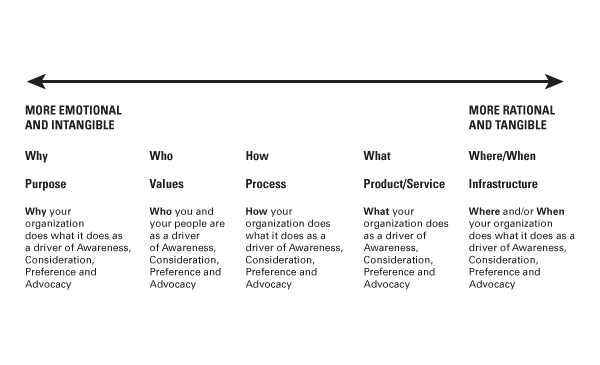
It is useful to consider a spectrum of options when considering an organization’s positioning. Since brand consideration and preference is generally seen to be as much a product of emotional decision making as rational decision making, brand positioning is typically approached using a considered blend of both rational and emotional elements and attributes.

According to recent research reported in Psychology Today, built on decades of study:

  • MRI neuro-imagery shows that when evaluating brands, people primarily use emotions (personal feelings and experiences) rather than information (brand attributes, features and facts).
  • Advertising research reveals that emotional response has far greater influence on reported intent to buy a product than does the ad’s content – by a factor of 3 to 1 for television commercials and 2 to 1 for print ads.
  • The Advertising Research Foundation concluded that the emotion of ‘likeability’ is the measure most predictive of whether an advertisement will increase a brand’s sales.
  • Studies show that positive emotions towards a brand have far greater influence on loyalty than trust and other judgements which are based on a brand’s attributes.

One way of viewing this is to use a continuum and to agree the most favorable positioning opportunity for the organization. This positioning decision must account for the authenticity of the positioning to the organization – it needs to be true; the relevance to the marketplace (talent, customers and stakeholders); and its differentiator from alternative providers of products, service and employment. There are many models, including the five below, but one of the most effective is also one of the simplest. It’s a simple continuum with rational positioning and emotional positioning at either extreme, with variations in between.

Brand Positioning Spectrum

1. Infrastructure-led Positioning

Location and time can drive powerful positions: mobile emergency car services, credit cards accepted at more locations, global reach are some examples. Such positions are generally built and protected through innovation or sheer mass and scale.

2. Product Or Service-led Positioning

The organization can choose to position itself specifically around its customer value proposition. This is the most direct and relevant positioning from a commercial business perspective: the most authentic, relevant and differentiating elements of the product or service in relationship to its end user, customer or consumer. This relatively traditional positioning approach was developed in the late 1960s based on the concept of a ‘unique selling proposition’ (USP). Provided the product or service is difficult to duplicate, this positioning offers many benefits. The product can be homogeneous or premium, so long as the positioning allows a price premium. Having consistently innovative and market-leading phones and tablets is one example; having the most low-cost alternative could be another. Both have their place.

3. Process-led Positioning

Having a unique, bespoke process that allows for differentiation – the product or service might be similar to the competition, but the unique way the organization goes about delivering it allows for a competitive advantage which allows the organization to generate enhanced margin. Trademarked solutions or a difficult-to-duplicate approach works here – for example, in the international overnight delivery category.

4. Values-led Positioning

A positioning based on the values of an organization and its people can provide a good platform for positioning, particularly in the services or professional services sector. Locations, services and processes might be similar, 
but the kind of person the organization attracts and how it approaches service delivery are key.

5. Purpose-led Positioning

The sense of ‘why’ the organization does what it does, as opposed to what, how, who, when and where it does what it does, can drive significant benefits. Using this as the driver of positioning can have long-term benefits. It can also raise challenges, on the other hand, insofar as it can be challenging to activate such a positioning in the day-to- day delivery of the product and service.

In brand positioning, there is no place on the spectrum that is inherently more favorable or less favorable than others. It is more important that the organization identifies the positioning that it can occupy with the greatest confidence as it balances authenticity, relevance and differentiation. In the P-A-S-P model, positioning might express itself with the greatest relevance in day-to-day operations at the Proposition level – while it can also be driven by the overarching sense of Purpose. Some organizations consciously decide to balance both, using a higher sense of Purpose at the corporate level, and more tangible propositions at the market-facing customer and talent levels – without creating confusion or conflict. The key, of course, is to have it all align.

Excerpted from: Brand and Talent by Kevin Keohane, in partnership with Kogan Page publishing.

The Blake Project Can Help: The Brand Positioning Workshop

Branding Strategy Insider is a service of The Blake Project: A strategic brand consultancy specializing in Brand Research, Brand Strategy, Brand Licensing and Brand Education

FREE Publications And Resources For Marketers

07 Sep 17:01

16 things Europeans find strange about America

by Sophie-Claire Hoeller

american flag

No matter how many times you've visited the States, no matter how many years you have lived there as an expat, if you're European there are some Americanisms you simply cannot get used to.

Here are 16 things that Europeans find strange about America.

1. How are you as a greeting, not a question

When a sales clerk in the States says "how are you" it's not a question, but a way of saying "hello." No matter how often this happens to a European, they will launch into a monologue about their health and well being and ask it right back — and expect an answer.

2. Ice Cubes

Just like Americans are flummoxed by the lukewarm water presented to them in Europe, Europeans can't wrap their heads around how drinks in the US are mostly ice. How does a soda-to-ice ratio of approximately 30:70 make any sense?

3. Free refills

Is this because of all the ice? Europeans will never understand why they are presented with a second cup of soda while the first one is still half full in front of them. What's even stranger though, is the fact that one can (and does) order a large soda — despite the refills.

4. Portion sizes

heart attack grill burgerThey're huge! Doggy bags are great — who doesn't love a two-for-one meal — but the concept virtually doesn't exist outside of the US, as people can generally easily finish their meal.


5. Certain food combinations

Marshmallows and sweet potatoes? Ice cream and soda? Bacon and syrup? These combinations seem odd to Europeans.

6. The Question Game

White, whole wheat, sourdough or rye bread? Swiss, American, provolone or cheddar? Most Europeans feel accosted when bombarded with 12,857 questions when they just want to order a simple sandwich. 

7. Tipping

The fact that the onus is on the customer to pay for someone else's employees to make a fair wage is mind boggling to Europeans. The fact that they're paying extra for someone to do their job, not even for doing it well, is astounding. Europeans also find it confusing that there's no set amount or percentage one should tip, and who gets tipped seems equally ambiguous.

8. Taxes

Checkout guy CVS

Yes, annual taxes are hard for everyone, but that's different. What's just nonsense is the fact that the price you see on an item is not the same one you pay at checkout.

9. Coins

What are these strange nicknames that say nothing about the coin's  value? Why is a dime smaller than a nickel, but worth more? Euro coins, on the other hand, are actually called by their numeric denomination.

10. Air Conditioning

Why is the average shop or office in the US set to Arctic? Indoors anywhere in America during the summer is painfully, unbearably cold to a typical European. 

11. The Measurement System

It just makes no sense. How is 7/8ths an appropriate measurement? How are feet still a thing? The rest of the world has embraced the metric system, and it's high time for the US to follow suit.

12. Being cashless

Few Europeans wander about with wallets utterly devoid of cash, but America is basically a cashless society. Being able to pay for as little as a pack of gum with a card is still amazing to most Europeans.

13. The insane range of options

Grocery store aisles aerial viewThe average European will walk out of the average American supermarket or deli utterly bewildered by the array of choices they just witnessed. There's an entire aisle for soda? A dozen brands of milk? How many flavors of chips?

14. 24-hour stores

Convenience seems to be the cornerstone of this great country. Stores are open 24 hours a day, 7 days a week. There's a drive thru everything. Most European shops, on the other hand, close at 6pm and all day on Sundays.

15. The drinking age

In most of Europe, the legal drinking age is 18 (and in many places, it's legal for teens as young as 16 to drink alcohol) — much younger than the 21-age limit it is in the US. Europe also has a much more liberal stance on public drinking, as you are allowed to bring alcohol out on the streets — something that you generally can't do in the US, except for these American bastions of civilization.

16. Not taking vacation days

Squandering 169 million vacation days like Americans did in 2013, or not taking a single day off like almost half the country last year is completely and utterly unfathomable to a European.

Join the conversation about this story »

NOW WATCH: 4 major issues for any American who wants to visit Cuba

07 Sep 17:00

How to Start Saving 10% for Retirement Without Psyching Yourself Out

by Rich Ellinger

How to Save 10%25 of Your Income

Saving 10% of Your Income

The most-fundamental question in personal financial management is not “where should I invest?” But rather, “how much do I need to save to reach my financial goals?” The amount of money you save provides the foundation for nearly every financial decision, from what type of house you can afford to whether you will outlive your money in retirement.

While the actual amount you need in savings to cover emergencies, retirement income spending, and other purchases in between is a highly personal calculation, many professional advisors agree that saving 10% of your income (gross) is a great place to start.

Many people say “but I can’t save anything,” and it certainly seems true, given that the majority of Americans would struggle to pay for an unexpected $1,000 expense. With some awareness and a well-conceived plan, however, even families in the most difficult situations can begin to get their savings and investing on track. Here are some tips to help you to get started.

Commit, But Don’t Over Do it (at First)

You or someone you know has surely resolved to lose weight at some point in the past. The typical approach to this resolution is to promise to cut out sugary foods immediately, to begin to exercise five days a week, and to be the pinnacle of health by next year’s high school reunion.

What typically happens in these cases? The dieter cannot maintain the eating or the exercise plan, feels frustrated that he or she is not seeing results quickly enough, and gives up, only to return to his or her previous routine, or sometimes even worse.

Financial behavior changes work the same way. Committing to stop eating out, to clip coupons religiously, and not to take a vacation until you have paid off your car and house all at the same time can be very difficult to maintain, and can actually make you worse off in the long run. Setting an overall goal (e.g., “I will be saving 10% of my income by one year from now”) and then committing to take smaller steps along the way can make your goal easier to achieve and ultimately more sustainable over time. Examples of smaller steps can include:

1) Bringing your lunch 1-2 days a week and putting the money you’ve saved into a savings or investment account (estimated savings of up to $1,040 per year, based on two $10 lunches each week of the year).

2) When going out to a restaurant, not ordering a drink before dinner (estimated savings of up to $600 per year, based on one $11 drink each week of the year).

3) Planning your meals for 3-4 days before going to the grocery store to reduce food waste (estimated savings of up to $2275 per year for a family of four).

If You Don’t See it, You Won’t Spend It

It’s natural to feel “rich” in the days after you receive your paycheck. Seeing a larger bank balance generally makes people feel less constrained and able to spend more, which can end up costing us all in the long run. The best solution to this habit is to move some of your income out of your checking account before you even see it.

If your employer offers direct deposit for your paychecks, set it up so you are diverting a portion of your net pay directly into a savings account, instead of depositing everything into your checking account. By depositing even a small amount into savings automatically, you can reduce the effects of this behavior and retrain yourself to spend more wisely throughout the month.

Let Your Employer Do Some of the Work

Many employers offer 401k plans or other retirement vehicles where they match a portion of your contributions. Participating in these plans as an employee is the easiest way to increase your savings rate. If your employer has a 3% match on contributions to your retirement plan, for example, then you only need to save 7% more to reach the goal! When you factor in the tax benefit of contributing to your 401k plan, you are effectively saving even more. Nice work!

Save More Tomorrow

Starting to save money today can feel like a challenge, because often it means giving up things that you enjoy buying or doing, which feels like a sacrifice. Committing to save a portion of future income (e.g., raises, bonuses, or overtime) instead of spending them, however, is much easier to stomach. By committing to save a greater portion of your future earnings, you can actually increase your savings rate dramatically over time, without even realizing it.

Conduct a Subscription and Contract Audit

Are you getting full value out of that magazine subscription? What about your gym membership? Nearly everyone has services they signed up for in the past but no longer use, which can sabotage your savings efforts. Review your subscriptions to see if you’re getting the most you can out of them. If you’re not, cancel and put the money into your bank account instead.

Similarly, review your phone, utility, internet, and other contracts. Companies in these areas change their prices often and sometimes offer enticing deals to get you to switch providers. Take a look to see if you can pay less by taking your business elsewhere.

Pick Your Priorities

Saving money doesn’t mean sacrificing everything that you like to do. No one who wants to save can stick to a budget that leaves no room for an occasional night out or splurge purchase. It’s important, however, to keep an eye on how many of those splurge items and experiences you tackle at once.

Settling on some favorite things or activities is a great way to bring your spending under control. If you enjoy scuba diving, golf, and travel photography—all very expensive hobbies—spend some time thinking about which one gives you the most enjoyment and focus on that one. You’ll save some money in the process and probably enjoy yourself more too.

Stay Accountable to Meet Your Goals

While these ideas can help you to get started on the road to better saving and financial management, consulting with a professional financial advisor can help you stay accountable to your long-term goals and find additional ways to save as well. If you’re ready to get on track with your savings and investment goals, use our proposal request tool to find and connect with the right financial advisor for you.

07 Sep 16:59

Blockchain's promise to content creators

by BI Intelligence

BlockchainThis story was delivered to BI Intelligence "Digital Media Briefing" subscribers. To learn more and subscribe, please click here.

Blockchain technology may hold the answer to an issue that has long troubled the creative industry: digital rights management. Through its function as a public database, blockchain can store information about a piece of content, like who has created it, while sharing it with everyone else on the network in an immutable way. SingularDTV is a company that is looking to do just this by building a decentralized platform on Ethereum – a blockchain-based developer ecosystem — to help content creators produce, protect, monetize, and manage their creations, Nasdaq reports.

Blockchain technology could transform the creative industry, and particularly rights management for artistic works, in several ways:

  • Rights protection. Blockchain functions as a public database, or distributed ledger, to account for all goods and transactions on the network. This has direct applications to content, which can be timestamped and stored with a unique ID. Once this information saved, it's virtually unchangeable, unlike most pieces of digital content nowadays that, once downloaded, can be modified at our leisure. Transparency is thus one of the biggest benefits of this system. The rights to a particular piece of content can be seen by everyone participating on the blockchain network, rather than stored on a stand-alone server owned by a record label or copyrights collection society. 
  • Monetization. Blockchain transactions are based on smart contracts – code-based contracts that are activated by a given procedure (behavior), and validated by all other computers on the network. Content owners are able to program a set of smart contracts around different usage policies for their creations. When another user wants to consume or repurpose this content, they select the appropriate usage policy for them, and then instantly reward the creator through the smart contract they've selected.  Because cryptocurrency is a principal application of blockchain (on Ethereum especially), these payments are dispensed automatically and instantaneously at a near-zero cost.
  • Empowering creators. Blockchain would create a direct consumer-to-creator network, where consumers interact directly with creators, and have direct access to their content. This removes intermediaries like Netflix and YouTube from the content distribution and rights management process, shifting all of the financial upside to creators. On the music streaming and purchasing platform Bandcamp, for example, artists share 10-15% of revenue on each album they sell. Whereas on blockchain, all purchases would be a direct, nonbrokered transactions. The use of cryptocurrency also circumvents third-party payment processors, who usually collect a 4-6% transaction fee.
  • Content creation. Creators are able to tag content with specific metadata (data about data), which, on top of acting as additional copyright information, can improve the discoverability and shareability of that piece of content, and open the door for other creators to build on top of that work. For music, a creator can tag å song with all kinds of metadata that is not commonly found in other databases, like the instruments used for the song, a particular style or culture that the song was influenced by, information about collaborators, sound engineers, and other lyricists... The possibilities are endless. Other participants on the blockchain can then search for songs based on this metadata. This precise level of content discoverability can breed new creator communities and artistic genres.

Blockchain technology, which is best known for powering Bitcoin and other cryptocurrencies, is gaining steam among finance firms because of its potential to streamline processes and increase efficiency. The technology could cut costs by up to $20 billion annually by 2022, according to Santander.

That's because blockchain, which operates as a distributed ledger, has the ability to allow multiple parties to transfer and store sensitive information in a space that’s secure, permanent, anonymous, and easily accessible. That could simplify paper-heavy, expensive, or logistically complicated financial systems, like remittances and cross-border transfer, shareholder management and ownership exchange, and securities trading, to name a few. And outside of finance, governments and the music industry are investigating the technology’s potential to simplify record-keeping.

As a result, venture capital firms and financial institutions alike are pouring investment into finding, developing, and testing blockchain use cases. Over 50 major financial institutions are involved with collaborative blockchain startups, have begun researching the technology in-house, or have helped fund startups with products rooted in blockchain. 

Jaime Toplin, research associate for BI Intelligence, Business Insider's premium research service, has compiled a detailed report on blockchain technology that explains how blockchain works, why it has the potential to provide a watershed moment for the financial industry, and the different ways it could be put into practice in the coming years.

Here are some key takeaways from the report:

  • Spending on capital markets applications of blockchain is expected to grow at a 52% compound annual growth rate (CAGR) through 2019, according to Aite Group, to reach $400 million that year.
  • Banks and major financial institutions are working both collaboratively and independently to develop blockchain tech. Over 50 major financial institutions are involved with collaborative blockchain startups, like R3 CEV or Chain. And many are investing in the technology on their own as well.
  • Putting blockchain to use for real-world transactions is likely not that far off. If working groups' tests are successful, firms could be using it to transact real value as early as the end of this year and we could see widespread industry application within the next few years. 

In full, the report:

  • Examines the funding increases that are pouring into blockchain
  • Assesses why blockchain is becoming so popular and what factors are driving up increased research and development
  • Explains in full how blockchain technology work and what assets make it valuable and vulnerable
  • Identifies pain points in the financial industry and profiles how various firms are using blockchain to solve them
  • Demonstrates the challenges to mainstream adoption and their potential solutions

To get your copy of this invaluable guide, choose one of these options:

  1. Subscribe to an ALL-ACCESS Membership with BI Intelligence and gain immediate access to this report AND over 100 other expertly researched deep-dive reports, subscriptions to all of our daily newsletters, and much more. >> START A MEMBERSHIP
  2. Purchase the report and download it immediately from our research store. >> BUY THE REPORT

The choice is yours. But however you decide to acquire this report, you’ve given yourself a powerful advantage in your understanding of blockchain technology.

Join the conversation about this story »

07 Sep 16:59

5 Easy Ways to Make Your Sales Emails More Effective

by eshita@salesitv.com (Dean Mannix)

write-more-effective-sales-emails-.jpg

Do you struggle to write effective sales and marketing emails?

That’s not good. Your writing can make or break a deal, so it’s important to make your sales emails as persuasive as possible.

And you don’t have to be a professional copywriter to do it. Here are five easy tips you should implement to make your email campaigns more successful right now.

1) Humanize the language.

It's 2016 and you're dealing with real people. A salutation like "Dear <Name>" in an email creates a sense of formality and a personal distance in the communication.

You want to create the perception that there’s a human being behind your email that the reader can engage and build relationships with. Of course, how casual or formal you can be depends on your industry and to whom you’re addressing the email. Personally, I prefer to go with "Hi <Name>". The same is applicable to "Thank you."; a more conversational and personal tone would be "I really appreciate you…"

2) Be deliberate.

State the purpose of your email right in the beginning. For example, if you work at an events organizing company, your value proposition could be something like: "We offer holistic packages that make your event easy to manage and enjoyable for your guests."

You might be thinking, "So what? My reader already knows that."

But what if they don’t? Never assume a level of knowledge for your prospect. If you’re restating your value proposition in your fifth email, then the above may not really add value to the reader, your relationship, or their commitment to take action. But determine what your purpose for each email is, then make it clear from the start.

3) Prioritize based on your prospect’s objectives.

Know your audience. What is it that your reader wants to know? What do they care about? What do they expect from you? Prospects are more emotionally impacted by the benefits they receive from your product or service rather than its features. For example, if you are selling mobile phone plans, saying "We make connecting with your loved ones easier" will be more convincing than "Our network provides the best 4G facilities."

This may not be true of your audience -- maybe you’re selling a highly complex product to a very technical buyer, who does care about these more granular details. The key is to understand your reader’s priorities and present your information in the order they’re likely to care the most about.

4) Repeat the “sell.”

Readers tend to remember and respond to only what's at the end of an email if they’ve read through to the end. While this might mean doubling up on your call-to-action at the beginning (remember, you want to be deliberate) and end of the email, this is still a good practice. Emails with the extra "sell" at the end will get a better conversion, as your prospects won’t have to waste time rereading your email to figure out exactly what you wanted. You can always check what works best for you with sales or marketing automation -- test a few variations and see which ones garners the most responses.

5) Direct further inquiry.

Pretty much every email ends with a polite offer to make further contact. Given the importance of further contact to your overall objective of closing deals, you can and should be more directive around this opportunity.

Include a section at the end of the email saying something like…

Call or Email Us Now

Most people have further questions once they have read through the information that I've provided above. So, please connect with me by replying to this email or call me at 1-XXX-XXX-XXXX.

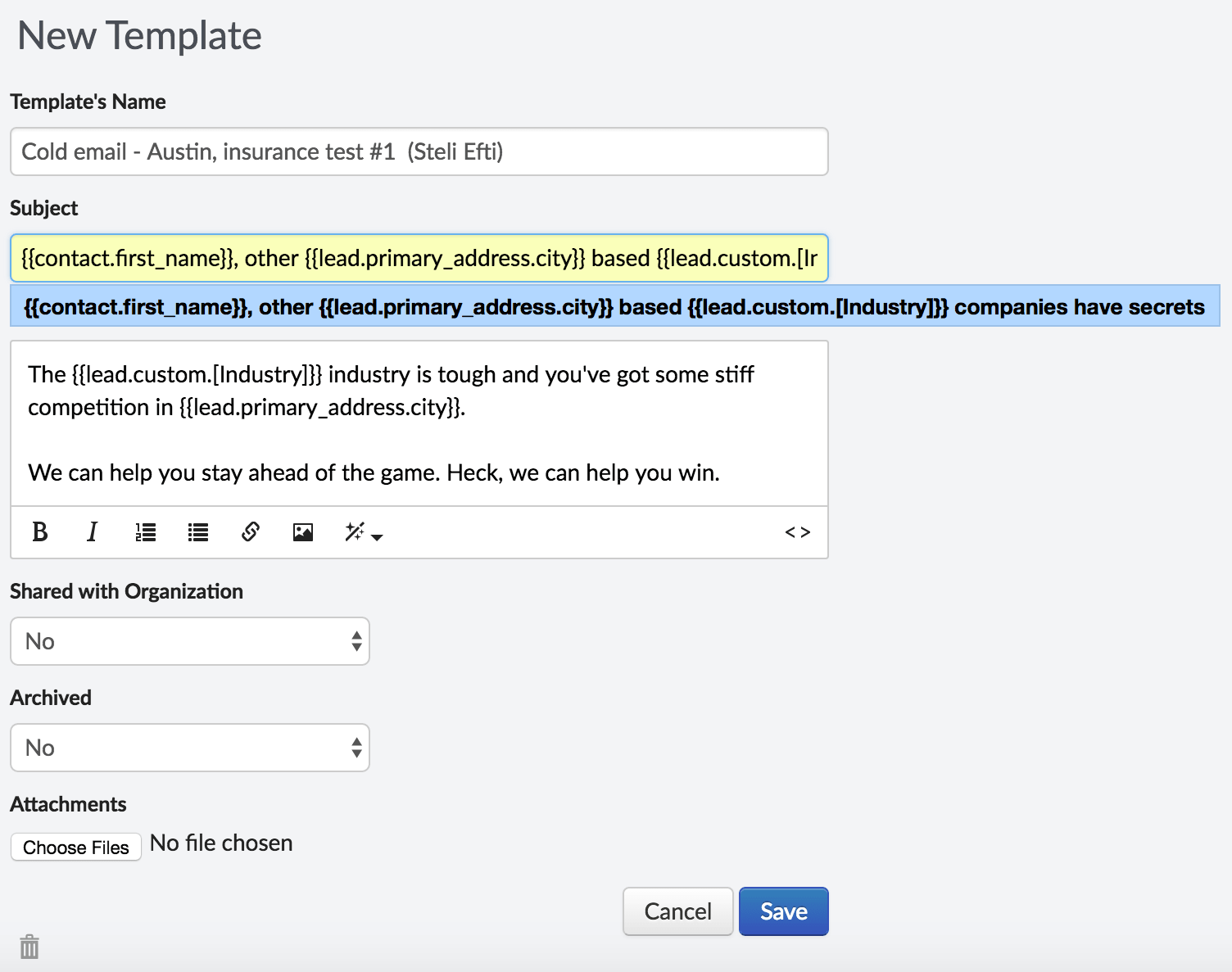
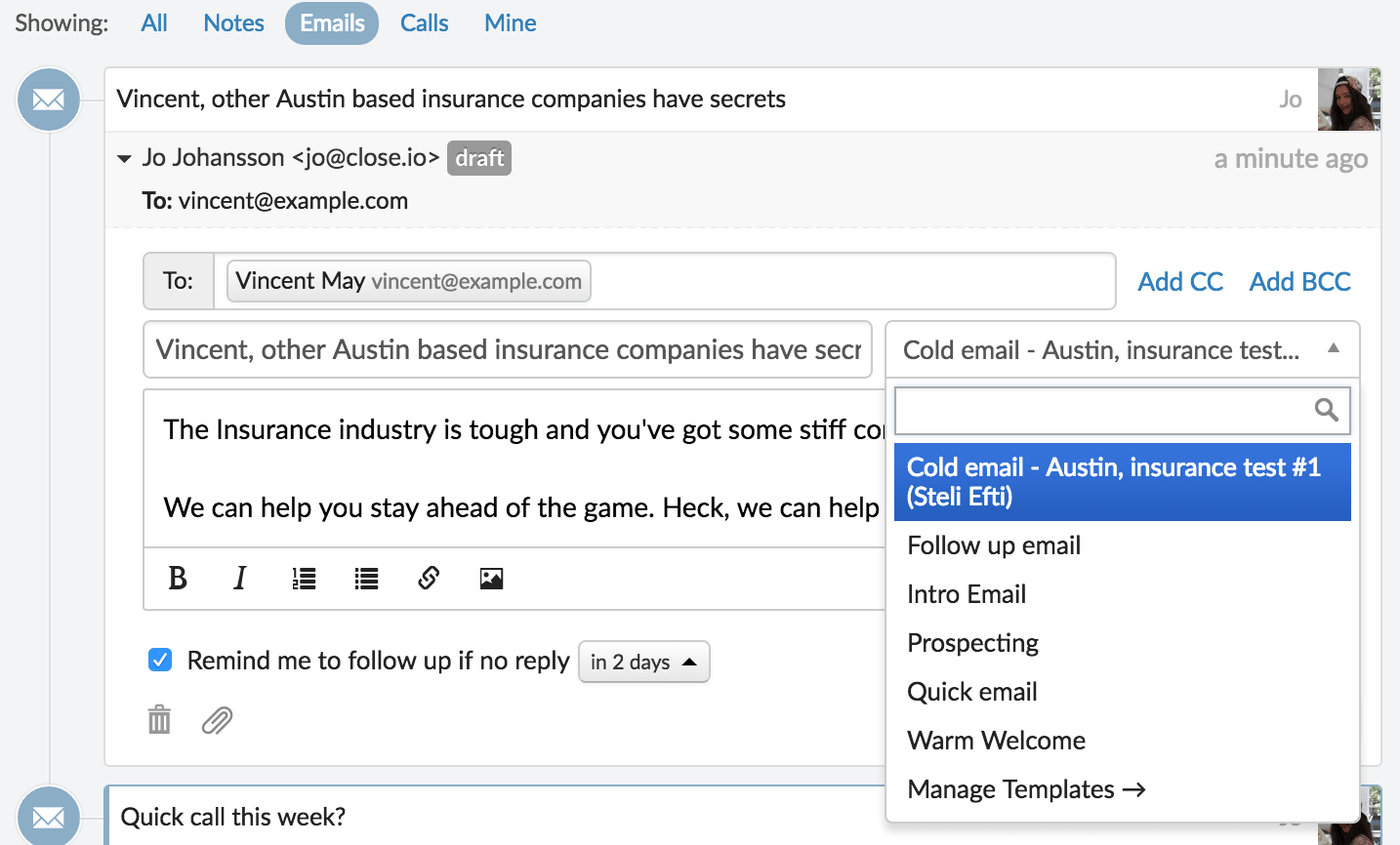
Hopefully these tips will be useful in furthering your thinking around developing email templates for your campaigns as you iterate to test what works best for your team. For more tips on persuasion strategies that increase engagement and conversion on sales emails, check out the on-demand webinar Leveraging Persuasion: Online Communication That Sells.

Email tool in HubSpot CRM

07 Sep 16:59

The Good, the Bad, and the Difference

by Michael Myler

Brand loyalty means sticking with a company regardless of whether there exists a more logical solution to your need. You remain loyal because the company has strengthened their relationship enough with you to justify charging a higher price, building their brick and mortar farther away, or even taking off from the tarmac 20 minutes late due to “mechanical problems.” Plenty of other options with lower prices, closer locations, and functional aircraft might be available to you, but you stay. Why? Because you know your company will treat you right when it really counts.

You also sometimes stay, however, with the company that has delayed flights, high prices, and bad customer service. Maybe the company has monopolized the category. Maybe they offer the most competitive price for what you need, but usually at the cost of a good customer experience (CX).

Fortunately, most industries are not monopolized, and other options are at your disposal. In your initial search for the product or service, it’s likely your priorities were something like this: price, quality, accessibility, service— and maybe even in that order. If you’ve ever left the poor CX company to look for other options, how did these priorities change? Were you more willing to sacrifice a little on price for a better experience? Having found an experience and product/service that makes your money worth spending, did you still find yourself searching for greener pastures? Probably not.

That’s because your experience with Green Pastures Inc. was one that built your loyalty with them. It’s because your new priority to be treated well aligns with their priority to provide you with good service.

Let’s take a look at a great customer experience:

A certain national outdoor retailer has a deep-seated commitment to customer experience. One of many aspects to their great customer service is the return policy—a purposefully ambiguous one that encourages liberality in giving refunds, and benefits the customer as a result. Here’s a story from a now loyal customer:

“Last week, my dad was headed off to the dump with his old (4-5 years) cross-country skis. They had become delaminated as a result of plain wear and tear (and storing them in the hot attic probably didn’t help). My brother had to pick up a jacket for summer camp, so my dad figured he’d see if [the store] would take them back to dispose of them (saving him 20 bucks that the dump would have cost). Not only did [the store] take them back, but they gave him a full refund. Kudos to [this retailer] for honoring an abnormally long warranty that we didn’t even know existed.”

How about a bad one:

Erica made a large deposit to her bank account one day—also a national institution—knowing she had bills to pay. The teller informed her because of the large amount, the funds would be available for use after two days. When her checks bounced two days later, Ramus called in, asking for an explanation. The justification was that large deposits may be held longer before issuance for use. She asked why she was not informed of this policy after being told it was only a two-day hold, to which the customer service rep replied, “We’re too big a bank to call our customers when there is a problem.

CX: the Key Differentiator

It’s safe to assume the bank’s intention was not to administer a bad experience for its customers. So what’s the difference?

The positive experience in the case of the retailer resulted from a standardized practice being carried out by an employee familiar with the company’s culture and policies. An employee should honor the liberal return policy even when the customer does not expect them to.

In the second case, there is evidence of siloed procedures and miscommunication, suggesting that systematic practices have not been standardized to meet customer expectation.

The retailer’s fundamental customer experience practices were likely crafted differently from the bank’s in the areas of purpose, goals and values, and strategy.

Purpose. The retailer’s primary purpose was to please the customer. The employee who issued the refund was clearly not overly concerned about violating company procedures, because he knew had the CEO been working the register he/she would have done the same thing. In other words, company procedure actually encouraged the refund.

On the other hand, the bank teller’s information on the financial hold was completely different from the information Erica received two days later. This means either the teller was not properly trained, or departmental procedures disagreed with one another. Either way, Erica left dissatisfied due to misalignment of company policy and purpose.

Values and Goals. The bank’s ‘on-paper’ values may center on delivering an excellent, personalized customer experience. Their goals, however, evidently vary from department to department, and therefore may not ultimately support the established values of the business as a whole. At some point—maybe when some large clients dropped their accounts with the bank—the values became more of a backburner mantra for executives than a way of doing business like the frontline employees agreed. When those values were ignored, executives likely began pushing secondary goals on lower departments in order to heal the wound of the lost accounts. Perhaps the executives set priority goals to understand why other banks were taking their business. Meanwhile, the shift in focus caused some departments to ignore other large-deposit customers, and forget the value those customers place on a personalized experience. The bank’s values changed from long-term customer relationship to short-term problem-solution—a problem that might have been avoided altogether had the core company values steered the ship from the beginning.

Strategy. Strategy is maybe the practice that most differentiates the two companies. Both are likely to have value statements such as, “the customer is always right.” But true customer-centricity is found in the consistent and foundational execution of that statement. While the bank might have a loose procedure for acknowledging the concern and then getting back to the customer “in a timely manner,” the retailer likely has a superior communication system set up to enable instantaneous and personalized, human response to any customer concern. Practical, actionable and systematic CX strategy gives your customer the consideration and customization they deserve

Align and Thrive

An organization’s customer experience should be determined, of course, based on the wants and needs of its customers. Without the right purpose, values and strategy as well as the correct tools and channels of communication, these customer needs can be disparate from organizational focuses.

07 Sep 16:58

Presentation Tips That Will Help You Amaze Your Audience

by Ashish Arora

Amaze your Audience

If you ask public speakers what the goal of their presentation is, many – if not most – would say it’s to make sure their message lands with the audience. While this is undoubtedly true, they might forget to mention their other goals: to entertain, inform and inspire their audience to take action.

Amazing your audience isn’t easy, but it’s possible if you use the following presentation tips.

1) Emotionally Connect with Your Audience

Here’s something executives on Madison Avenue have known for years: people think emotionally, and justify logically. This is why those big, flashy TV commercials always hook the audience with emotion, then trot out the features at the end.

You see an ad for a minivan where a dad is driving his daughter to her recital and it touches you. You want to buy the minivan – you’ve made an emotional choice and you will back it up logically by saying that the vehicle is rated top safety, has good gas mileage and excellent horse power.

Connect with your audience emotionally at the very beginning of your presentation. This could be by telling a joke or sharing a personal story they can relate to. Once you’ve hooked them, you’ve already sold them on YOU, and now they will happily listen to your message and buy into it as well.

2) Appeal to Your Listener’s Self-Interests

Here’s a fact you may or may not know: Many of your audience members are not at your seminar or lecture because they want to be there – they are there because they had no choice. These people can still be amazed by you, however.

The truth is, once someone knows that they can learn something that will help them personally, not just help the company they work for, they are much more apt to sit up and pay full attention.

This is why you’ve got to understand who your audience is. What are their pain points? What keeps them up at night? How can you add real value to their lives? If you can figure that out, you can get even the most bored, cynical audience member eating out of your hand.

3) Tell Them Exactly What They’ll Gain by Listening to You

Now that you’ve figured out how to appeal to your audience’s self-interests, don’t be shy about it, announce it loud and clear. Convey at the beginning of your presentation what your listeners will gain from your talk: greater success or prestige, more money or time with their family. If you do, they will tune in and listen.

4) Be a Storyteller

The best speakers, by far, are the ones that tell stories. Human beings are hardwired to listen to stories. It’s like it’s in our DNA.

What kind of stories should you tell?

Personal stories are always good, but you can also tell someone else’s story. You can simply say, “I heard a story the other day,” Or “Let me tell you a story I recently heard that really moved me.” The minute you even mention the word “story,” the audience comes alive and listens to your every word. No matter how old we are or how important our job titles are, in a way we’re still 5-years-old sitting Indian-style at story time enthralled by what the adult holding the big picture book is saying.

If you want to know how to tell a good story, listen to some of the most popular Ted Talk presenters, who are masters at storytelling.

5) Pause

It has been said there is a lot of power in the pause, and those who have said it have been absolutely right!

Do you know what happens when you purposefully pause? People lean forward in their seats, wondering what you’re going to say. They have GOT to know what you’re going to say.

If you haven’t practiced using pauses in your speech, start now and see if you don’t get amazing results.

6) Move Around

Whether you’re on a stage or standing in the front of the room, be sure to make the most use of the space you have. Standing still behind a podium and never moving will bore your audience to tears. But, when you stimulate their eyes as well as their ears, they are more engaged and will pay better attention to your message.

7) Make Eye Contact

Your audience knows whether you’re looking AT them, or just above their heads. One of the quickest ways to lose your audience is to never look them in the eyes. Always scan the faces of your listeners when you speak. Hold on one person’s gaze before moving on to the next one. Never stare at your notes or PPT slides, always look out at the people whose lives you could touch.

If you follow these 7 tips, you will absolutely be able to amaze your audience at your next presentation.

07 Sep 16:58

How One Startup Developed a Sales Model That Works in Emerging Markets

by Jonathan Cedar
sept16-02-biolite-00

As the heat continues to blister during this summer in New York, I think back to the first time I ever bought an air conditioner: fresh out of college. It was a daunting investment, but well worth the quality-of-life improvement. I stumbled through a few consumer report roundups online, asked the advice of friends and coworkers, and eventually found myself at a local hardware store, where the owner enlightened me to the complex world of BTUs, replaceable filters, and square footage calculations. Within 30 minutes I had a giant box on a dolly and 300 more points on my recently opened credit card.

This seemingly banal transaction speaks volumes to the power of how established retail has pervaded our everyday experience in the United States. A lot had to take place for this all to happen: I had a problem but knew a solution existed; I had access to information on my options; I had a physical destination to see my options in person; a trained employee was available to provide advice and recommendations; and I had a means of financing to bring this appliance into my life almost immediately.

The thing is, for millions of people, this model doesn’t exist — and those people are my customers.

I am the cofounder and CEO of BioLite. We design and manufacture personal-scale energy appliances that enable our users to cook, charge, and light their lives off the grid. We serve two markets that are very different but united by the common need for reliable, safe access to energy: outdoor recreationalists and low-income households in emerging markets. Our flagship products are wood-burning stoves that generate electricity from fire while reducing toxic smoke emissions by 90%. The stove designed for campers is called the CampStove, and the stove for families living in energy poverty is called the HomeStove.

sept16-02-biolite-00a
At left, a CampStove. At right, a HomeStove. Photograph courtesy of BioLite.

For our outdoor recreationalists, the model has been created for us, and we enjoy the benefits of a well-established retail structure: We sell both online and in established, well-known retail stores, where knowledgeable staff can explain our products to new customers. Customers have myriad channels to discover new products and shop at outdoor gear retailers to explore, evaluate, and choose what they need. Store displays, user reviews, and expert employees with firsthand experience all play a role in building the confidence that is critical to a purchase.

The majority of our customers across India and sub-Saharan Africa live outside city centers, in areas that large-scale retail stores just don’t reach. Moreover, these customers don’t even know our cookstove exists, so before we even get to delivery, we have to figure out how to help people discover our product.

These challenges forced BioLite to reevaluate our approach and customize our sales methods to a market that demands an entirely different way of doing business. Much like our team of engineers who are constantly testing for the best functionality of our products, our team for emerging markets set up a series of experiments to explore which distribution model functioned best in these remote environments. In short, how do you sell something where large-scale retail channels don’t exist?

Experiment #1: The Handi Shop

Our target customers in India don’t have access to large retail shops, but they go to handi shops, small storefronts that sell cooking supplies. These storefronts have long-established customer bases that visit with the intent of purchasing products like pots and pans. Given that we’re in the business of clean cooking, we hypothesized that we’d be successful by selling our stoves through these shops.

It was a good idea in theory, but ultimately it was too passive as a sales approach: Simply placing our HomeStove on a shelf did not lead to uptake. Handi shop customers had never seen a product like ours. They didn’t know what it was, how it worked, or why it could have a profound effect on their daily cooking. The revolutionary benefit of co-electricity was on the package, sure, but who was taking the time to read through the box, unprompted? Most important, seeing is believing: Even if they were heading out to buy a high-tech appliance, they need to see it in action before they make a decision to purchase. With no one in the store to demonstrate the HomeStove in real time, it’s pretty hard to understand and trust that a fire can be smokeless, cook your chapatti quickly, and power your cellphone.

From this failed experiment, we learned that a clean cookstove like our HomeStove is a push product; we can’t just place it on a shelf and expect customers to buy in on their own. We would need to proactively get in front of them and bring the stove to life. The question for us then became, how could we build a sales experience where fire was inherently part of it?

Experiment #2: The Chaiwala

After the lessons of the handi shop experiment, we identified our next experiment over a cup of tea. Chaiwalas, or tea sellers, sit on almost every corner in India, brewing up chai for constant crowds of passersby. Chaiwalas already cook over fires to make their tea, so using the HomeStove as an alternative could immediately demonstrate the benefits of our product to a captive audience — a bit of a drink and a show, if you will.

sept16-02-biolite-01
A chaiwala in Orissa, India, brews tea on a BioLite HomeStove. Photograph courtesy of BioLite.

We equipped a dozen chaiwalas with HomeStoves, trained them to use the stove, printed BioLite banners to hang on their stands, and set them up with cords, so customers could charge their phones off our stove. As a crowd-pleaser, the promotion was a success, drumming up customer excitement; as a sales conversion, it fell short.

Here’s the thing. These men are chaiwalas, not stovewalas. They’re in the business of selling as much chai as they can, not presenting in-depth demonstrations of an aspirational, modern cookstove. They were interested in getting through as many cups of chai as fast as possible, not demonstrating the stove’s feature set. Moreover, while hundreds of people buy chai every day from these stands, the customers are there to make a two-rupee purchase; they’re not in the right mindset to be considering a high-ticket item like our stove. They want to get their chai and move on, not hang around and charge their phones.

From this, we learned that our products require a highly trained representative who can speak to the benefits of our stove in front of customers who are willing to purchase it. Now we knew that selling the stove required a sales environment where it could be used — but also trained salespeople who could teach people about it.

Experiment #3: BioLite Flagship Store

Imagine an Apple Store…in the middle of Bhubaneswar, India. That’s what we set out to create.

We wanted to create an immersive experience wherein we could introduce potential customers to our vision of energy everywhere, a place where highly trained and enthusiastic staff could entertain, educate, and entice visitors to the unique benefits of the HomeStove. We would have complete control of the customer experience, and our HomeStove would always be the star of the show.

We found an ideal storefront near a busy market in central Bhubaneswar. Our local team worked around the clock, doing custom build-outs while juggling Skype calls with the design team back in New York. Chai stands were built, graphics were printed, and the team was ready for launch.

sept16-02-biolite-02
Members of BioLite’s East India Team sit outside the flagship store in Bhubaneswar, India. Photograph courtesy of BioLite.

Launch day was a wild success. The store filled with customers, local papers heralded our arrival, and sales spiked. We created buzz with those same cups of chai, but this time the cooking demonstration was conducted by a member of our staff, who then invited prospective customers into our shop. Unfortunately, as the weeks passed we found that maintaining a steady stream of customers proved to be a major challenge. Many of our target wood-burning customers lived on the outskirts of town and had no reason to travel to the central market, where our store was located.

This taught us that as an unfamiliar brand with a fixed retail shop, it’s really hard to acquire customers, especially if people have to go out of their way to find you. While we made some sales through this channel, we realized we needed to bring our retail store experience directly to a network of customers who were ready to purchase. We needed locally embedded partners. What if we teamed up with a distributor that already had the trust of, and relationships with, potential customers?

Experiment #4: Avon Calling

At this point we’d experimented enough to know there were a few critical factors to activate a meaningful flow of sales: a highly specialized local sales team who could demo the stove, and a targeted network of potential customers that our sales team could engage at peak interest. This led us to experiment with a sales method inspired by an unlikely giant back in the United States: Avon.

Greenlight Planet in India has a proven track record of distributing energy products in remote districts by utilizing local sales representatives. These “reps” host demonstrations and attract community members through their local connections and trusted recommendations. Instead of selling makeup or Tupperware, they sell solar lights — millions of them. Through an Avon-like model, they empower a network of salespeople to engage their neighbors, family, and friends. In 2014 we partnered with Greenlight Planet to take a spin at door-to-door stove selling.

Greenlight Planet’s model had real promise but required deep knowledge and enthusiasm; asking a solar expert to suddenly expand their repertoire to ultra-clean, electricity-generating wood stoves was a tall order. Where a solar light can simply be turned on to show its value, a stove demo requires 30 minutes of time and extensive training about the technology. In addition, stoves are difficult to transport from demo to demo. We needed to customize this model for cookstoves, and ensure that the salespeople were set up for success, most notably by letting them be dedicated full-time to only selling stoves.

With valuable learnings from the solar salesmen, we began the search to build our own dedicated team of salespeople to help us “open up shop” across each region of operation. One by one we found our teammates, a group of high-energy, reliable agents who had the potential to grab an audience’s attention through captivating demonstrations and impressive reserves of facts and anecdotes. We call them the BioLite Burners.

Each Burner undergoes a five-day intensive training and receives their own HomeStove Delivery Box. Inspired by Domino’s motorbike deliverymen in Mumbai, with boxes that can maintain the heat of the pizza, our boxes attach to Burners’ motorbikes, making it easy to transport stoves to demonstrations or home deliveries.

sept16-02-biolite-03
Kamlesh, a BioLite burner in Nimbahera, India, sits on his motorbike, complete with a new HomeStove delivery box. Photograph courtesy of BioLite.

Local experts, attentive networks, and an easy way to transport stoves — what more do you need? You need a crowd that is prepared to spend money on a product in real time, and has access to the most fundamental thing involved in purchase: cash. If our customers are liquidity constrained and risk averse to purchasing a pricey item, was there a model to solve for that?

Experiment #5: Microfinance Institutions

In emerging markets, microfinance has been a key economic engine in helping low-income households fund businesses and other important purchases in daily life. Customers show up regularly to take out loans, arrange payments, and track their finances. What better place to discuss a valuable investment for your home, than at the epicenter of where investments are made possible?

sept16-02-biolite-04
Prem, a BioLite Burner on our West India team, gives a HomeStove demonstration to a group of customers at a microfinance branch in Rajasthan. Photograph courtesy of BioLite.

Through partnerships with microfinance institutions (MFIs), not only are our Burners able to easily travel to MFI branches or villages to demonstrate the stove with real-time burn demos, but also we can set up interested customers with finance programs on the spot, to make purchasing these stoves immediately achievable (all the more so because the majority of our customers recoup the cost of the HomeStove in six to eight months, via fuel and electricity savings). Equipped with their motorbikes, our Burners deliver stoves or provide after-sale service to our customers when necessary. Through these partnerships we have been able to recreate the product discovery experience that’s traditionally found in retail environments in Western markets.

We found our missing link. Where each of the models before taught us the importance of various components of our sales model — customer acquisition, demonstrations accompanied by a strong pitch, and co-location of our product and network — financing made it easy for people to become customers.

I think back to when we initially placed our stoves on shelves in the handi shop, and I see that as an inflection point for BioLite. Our sales model had a gaping hole, but rather than scratching our heads and trying the same thing again, we rebuilt the model to make it more resilient and aware of the unique local challenges our markets face. Those years of experimentation with different sales models were a springboard to the tens of thousands of households we have reached this year thanks to our Burners. We have built a framework that achieves the unique duality of being highly localized while promising rapid scalability across all of the emerging markets in which we work.

07 Sep 16:56

Dr. Robert Cialdini's Technique That'll Get Buyers Interested Before They Ever Meet You [Interview]

by mroberge@hubspot.com (Mark Roberge)

robert-cialdini-pre-suasion-interview.jpg

Editor's note: Dr. Robert Cialdini is a world-renowned expert on influence and persuasion. The below is an interview with Cialdini conducted by Harvard Business School senior lecturer Mark Roberge about Cialdini's upcoming book, Pre-Suasion. You can preview the book here.

Mark Roberge (MR): I'd love to hear the key learning from your new book, Pre-Suasion.

Robert Cialdini (RC): I once infiltrated the training programs of a broad range of professionals dedicated to getting us to say yes -- salespeople, marketers, advertisers, managers, charity fundraisers, corporate recruiters and so on -- to learn what worked most powerfully. We’ve learned a lot over the years about which elements to build into a message and which psychological strings to strum with that message to elevate success.

But recently we’ve begun to realize that by focusing so intently on the message itself, we’ve missed a crucial component of the process. Communicators don’t achieve their greatest success by changing a recipient’s mind with a clearly crafted appeal, but rather by changing the recipient’s state of mind, in the moment before the appeal -- specifically, so that the recipient becomes more sympathetic to, more readied for, the cleverly crafted message that we have waiting for them. They do that through "pre-suasion": The practice of arranging for an audience to favor a message before actually experiencing it.

MR: Did you intentionally set out to pursue this problem or was it something that you stumbled across and then it sort of formed in your mind through the research process?

RC: You know, people have often asked me why it’s taken so long to write another solo-authored book since Influence. And I always had to say I didn’t have an idea big enough to warrant such a book until this one came along.

That’s when I started seeing research findings that didn’t fit with the dominant model social influence that states that if you want to sell someone a product you have to change the person’s beliefs or attitudes or experiences in order to make the person want to buy it. But this new research I was seeing indicated that, although there’s plenty of evidence to indicate that this traditional approach works, there’s another model of change that also works exceedingly well.

According to this new non-traditional approach, which we can call the channelled attention approach, to get desired change it’s not necessary to alter a person’s beliefs or desires or experiences at all. In fact, it’s not necessary to alter anything except what’s prominent in the person’s mind at the moment of decision.

Here’s an example: There was a study done on visitors to an online furniture store. In that study, people were sent to a website that put the idea of comfort in their minds before they ever started to search the site for information about the furniture there. That was done by putting fluffy clouds on the background wallpaper of the site. Those people who came to the site and experienced this pre-suasive maneuver of seeing fluffy clouds in the background placed greater importance on comfort when asked what they were looking for in furniture. Secondly, they spent more time searching for and looking at the comfort ratings of the furniture in stock. And most tellingly, they preferred more comfortable furniture for purchase.

Now, to be sure the results came from upfront exposure to the idea of comfort, other visitors were directed to a page that initially exposed them to the idea of price by depicting coins on its background wallpaper. These individuals placed greater importance on price, spent more time searching for and looking at information about cost, and preferred inexpensive furniture for purchase. The especially interesting thing was that when questioned afterwards, most refused to believe that what they saw pre-suasively, clouds or coins, had influenced them at all.

MR: Can you home in on the applications of pre-suasion to selling? Is it limited to the closing sequence or is there more to it than that?

RC: I think you’re right that pre-suasion is very applicable to the closing sequence, but I don’t think that it’s limited to the close. In fact, if we look back at that study I told you about (the online furniture store example), we can see that the first thing people encountered -- fluffy clouds or coins -- made all the difference in their purchase decisions. It was initial attention to the idea of comfort or price that then sent visitors through the rest of the material in a specifically focused way. So the key to pre-suasion is bringing attention to the concept that is the central feature of your offer as early as possible because it makes people ready for, receptive to, other information related to that concept once they encounter it in your message.

Here’s another example: sometimes we have to sell ourselves, not a product or service. Let’s say in a job interview. So suppose you are applying for a new job, you’re invited to come in for an interview, and there’s somebody evaluating you across the desk—it can be an individual or a small committee. What we typcially say is, “I’m very glad to be here, and I hope to be able to answer all the questions you have for me.”

Now, here’s what I’m going to recommend as a pre-suasive addition. Then say, “…but before we do that, I wonder if you could answer a quesiton for me, why did you invite me here today? What was it about my resume that led you to want to bring me in?”

They will begin reviewing your resume for its strengths, for its positive features; and, very often, they will make public commitments to those strengths. They will reply, “well this is why, because of “x,” and because of “y.” and, now you have them in a mindset that fits with a favorable attitude toward your candidacy. I have an acquaintance who claims that he has gotten three straight jobs by using this strategy.

MR: Are there ethical lines that we should be cautious of as we apply the principals of pre-suasion?

RC: This is such an important question, Mark. And for pre-suasion it’s especially important in part because people are unaware of the influence of pre-suasive practices.

There’s an old saying, “tell me what you’re paying attention to and I’ll tell you who you are.” well, here’s what the latest persuasion science says: what people are paying attention to doesn’t just reveal who they are, it makes them who they are in that moment. You can make me comfort conscious, or price conscious, or helpful, or achievement oriented, or analytical, or almost anything by what you present to me in the moment before you ask me to act. That’s very powerful and potentially worrisome.

That’s why ethics becomes extremely important. To be as ethical as possible in using pre-suasion, here’s what I think salespeople or marketers have to ask themselves, “what is the feature of my offer that would make it a wise choice for my customer?” in other words, is it its quality, or its reliability, or its safety, or its price, or its comfort? After answering that question for yourself, you can bring customers’ attention to something associated with that particular feature of your offer before you describe it to them. Coins if it’s price, clouds if it’s comfort, and so on. That way, people become moved toward your offer because of a reason that most benefits them, not just you.

Email tool in HubSpot CRM

07 Sep 16:56

Earning Your Buyer’s Trust – A Few Simple Steps

by James Arnold

As an online store, you need to focus on making your consumers feel comfortable and secure before they can purchase a product from your store. You have to earn the trust of your buyers if you want to maintain a long term relationship with them.

You may have a killer product and you may have used a beautiful website to showcase it online. However, if you haven’t earned your buyer’s trust, there is no way these things can make a difference to your sales.

Let us now look at a few steps you can follow that to convert your visitors into loyal customers:

Posting customer reviews

If you have customers who love to write positive reviews about your business, it makes sense to post these reviews on your website. These reviews not only create a positive impression about your Brand in the minds of your potential clients, they also help them feel absolutely secure while shopping on your site. This can also help you build an excellent reputation for your business in the market.

Going the Social Media way

If you wish to connect with your customers constantly, it is very important to step into social media platforms. Not only do you need to have a strong social media presence, you should also be consistent. Use Pinterest to show off your new products. Chat up with buyers whenever you get an opportunity. Let them know what is going on behind the scenes using Instagram. Show them your fun side while focusing on building a good rapport.

Be there when your customers need you

More often than not, your customers get stuck when they are checking out on your website. At such times, it is very important to clarify their queries instantly as they would be in a desperate mode to make that purchase. Contacting via phone or email requires them to wait for a while. This may even cause your customers to abandon their purchases and leave your site. The ideal solution to this would be to include an online chat option. This will help you establish a real-time connection with your customers. You will be viewed as accessible all the time, which will increase your reliability by leaps and bounds.

Including an FAQ Page

When offering an online store it is important to think like a buyer and imagine the possible scenarios he/she might go through. If you are ready to go that extra mile in earning the trust of your buyers, you should include an FAQ page on your website. Try to answer as many possible questions through this page. Not only will this be increasing your reliability it will also empower your visitors to help themselves in case they have a query.

Show them who you are in real

Including the faces of your team members on your website is very important to earn the trust of your buyers. Come up with a creative plan to show what happens and who is responsible behind the scenes. This will instill trust in the minds of your buyers, while enhancing their shopping experience.

Honest and Clear Policies

There is probably no business that doesn’t want its customers to come back to it again and again. This would mean you will need to include a policy page that helps your buyers understand what they are getting into whenever they purchase your products. Be honest and as transparent as possible if you want to earn the trust of your buyers. Be clear regarding the procedures related to order, shipping and delivery, while mentioning the exact cost and the time frame. If you have a return / exchange policy make sure you make it very clear. Returns are not bad for your business; in fact, making the return experiences satisfying will get your customers to shop with you again and again. Your buyers will understand nothing can go wrong in their purchases and if something does, you will always set it right for them.

Launch a Blog

Launching a blog and posting informative and unique posts on it on regular basis is another way to win the trust of the targeted audience. Please don’t use a standard wordpress template as the design of your blog rather you need to invest some money to create a custom design for your blog. However, if you don’t know how to set up a blog, don’t worry because there are hundreds of web design companies available to help you out.

Make it easier for your customers to contact you

Having a Contact Us page that includes a contact form, your phone number, email address, store address and social media page links will show that you are open to communication with your customers. Make sure you also take part in online forums and social media conversations to reach out to your buyers wherever they are. Include a Feedback form and encourage your buyers to fill them up whenever they make their purchases. This will help you maintain a long term relationship with them.

These steps for sure should help you in earning the trust of your buyers. There is definitely more to this if you do some research. Don’t forget to include a Blog on your website. While earning the trust of your buyers as an expert in business, this will also help in driving traffic to your website.

07 Sep 16:51

How to experiment your way to more effective cold email templates

by steli@close.io (Steli Efti)

experiment-with-cold-emails.jpg

When was the last time you took a deep dive into the performance of your cold email templates? A month ago? Three months ago? Six?

Running experiments isn’t something that comes naturally in sales. But experimenting and testing your way to better results is an essential part of improving any process.

Today, we’re gonna talk about how to approach testing in sales and create more effective cold email templates. Because who says your best performing cold email templates can’t perform even better?

Let’s get started.

How to approach testing

What works great today will lose its effectiveness over time. That’s why it’s important to keep experimenting and discovering what your audience responds to.

Act with urgency

Getting lazy while you’re successful is easy. But continued success is never guaranteed. If you don’t challenge your existing templates and wait too long to try new ones, it might have a negative impact on your sales team.

The time between realizing you’re in a tough spot and finding a template that’s going to work again could be weeks or months. During that time, you’ll see a decreased performance in your sales team and your numbers will suffer.

Challenge your winners

Among your email templates, there should be 3–4 templates that you know perform very well. These are your winners. But while they’re generating great results, don’t get too comfortable.

Keep making changes to them, draft up entirely new templates, and run an A/B test against your best performing emails.

Customize your templates

So you’ve got your hands on some new cold email templates? Perhaps you found them in a book or a blog and you’re ready to put them to the test.

Copy. Paste. Send. Job done? Not so fast.

Regardless of the conversion rate these email templates have seen, you have to tailor the message to your audience.

We all copy and borrow from others. There’s nothing wrong with that. But when you do, ask yourself how you can improve on that? How can you make this cold email template better suited for your audience? How can you make it more appealing? How can you make it a better fit for your brand and voice?

Decide what to test

The first step is to decide what you want to learn and what you need to improve. Here, you’re primarily looking at two things:

  • Open rate
  • Response rate or action, e.g. book a time for a call

While the list of things you can test is long, always test one thing at a time to generate the most accurate results.

Here are a few things to consider.

Subject line

The subject line is the most crucial part of your email. It decides whether your lead will open your email or not. If your open rates are low, this is where you start.

A lot of subject lines have become overused as a result of sales influencers sharing their best practices and subject lines that generate high open rates. And when something is overused, it’s not effective anymore.

From name

There’s a number of variations to try here. You can use your full name, first name or even your nickname, e.g. Steli, Steli Efti.

Personalization

The easiest and quickest way to personalize an email is to include the recipient’s name in the subject line and greeting. But why not take it further? Here’s an example of what you can do in Close.io.

Use custom fields to add the industry to your lead page. Next, say you want to target insurance companies based in Austin, Texas.

Set up a new email template using email template tags.

effective-cold-email-template.png

Your new email template is ready to use:

effective-cold-email.png

Now you have a subject line that’s more relevant to your lead and it’ll be more likely that they open the email.

Greeting

The greeting sets the tone for the email. Think about who you’re selling to. Should they be approached in a more formal way or will a good old “Hi” do the job? Maybe you don’t need a greeting at all and can cut straight to the chase.

Hi Steli,

I came across your blog and I think it’s great. I’d love to talk to you about x.

Vs.

I came across your blog and I think it’s great. I’d love to talk to you about x.

Body text

David Ogilvy once said, “If you’re trying to persuade people to do something, or buy something, it seems to me you should use their language.”

The legendary copywriter could not be more on point. Make an educated guess about how they’d want to be talked to, then test that assumption in your copy.

Timing

The internet is full of “Best time to send an email” blog posts. While those serve well as guidelines, you need to uncover what works best for your own audience, not someone else’s. Experiment with day of the week and time of day to see what their routines are like.

Define success

You’ve decided what to test and your new email templates are ready. But before you hit send, it’s important to decide what success means. How will you know your new templates are working?

Look at previous results and decide how much you’ll want to improve that. For example, if you start with email open rate and you had an open rate of 15 percent, you might want to increase that to 20 percent or even 25.

Test in small batches

After you’ve customized your new templates, it’s time to hit send. Test your templates in small batches first to see how they perform and then tweak them as the results come in. Once you know what’s working and what’s not working, increase the list size to target more leads.

4 rules to follow with Close.io’s email templates

In a previous post, we outlined a few guidelines for getting the most out of email templates in Close.io.

  1. Always be testing, but stay in control.
  • Let anyone on your team put together a template and try it out. Give them the freedom to test any template idea, but let them know that they always need to report the results.

  • Follow a common email template naming structure.
    • Always use the same title for the type of email you’re sending.
    • Associate template names with a specific campaign.
    • Put the person’s name in the template name to identify who came up with it.
    • For example, if you are sending cold emails: “Cold Email - Test #1 (Nick Persico)”

  • For cold emails, send a minimum of 100 emails before looking at the results. If you are sending it to a smaller sample size, try to send at least 30.
  • Export the Sent Email Report data every quarter and start all over again.
    • The list of Email Templates can get long and confusing. Clean everything out and put the best performing email templates back in for everyone to use.

    Make experimentation part of your sales culture

    Make testing your cold email templates a part of your routine to make sure you stay ahead. What’s working today, might not work tomorrow—and it will definitely not work forever. That being said, always follow the results—not the advice.

    Creating and using email templates in Close.io is easy. Try it for free for 14 days and use our bulk email features and email templates to increase your response rate.

    Recommended reading:

    5 cold email templates that will generate warm leads for your sales team!
    5 cold email templates for sales professionals. There are templates for the cold calling 2.0 approach as well as templates for the direct sales approach.

    How to improve your cold email response rates
    Say you’re sending cold emails to drum up business. Your open rates are great (20% or higher), but your response rates suck (5% or lower). Here's how to fix your response rates ...

    Data-driven sales: The 3 cold calling and emailing metrics that matter
    Improve your cold calls and emails—and make more sales—by tracking these 3 simple cold calling and emailing metrics. Tracking the right data isn't hard.

    07 Sep 16:51

    How to Self Publish Your Book #3: 5 Ways to Sell Your Self-Published Book

    by KeriLynn Engel

    How to Self Publish Your Book #3: 5 Ways to Sell Your Self-Published Book

    Your book is written, edited, and ready to go… but how exactly will you put it in the hands of your eager audience?

    Before self-publishing a book, you’ll have to decide how and where you want to distribute it.

    Your decision will depend on your goals: Do you want to promote your blog and build your email newsletter? Or maybe you’re trying to grow your reputation as an industry expert, get speaking gigs, or simply earn a more passive income.

    Think carefully as you make your decision, and your book will help you to accomplish all your goals.

    First: Free vs. Paid

    Before deciding where to publish your book, it’s worth considering whether you want to give it away, or charge for your words.

    Giving Away Your Book For Free

    Giving away your book for free is a good option to help you promote your website or build your email list.

    But be careful about giving away your book: you want to make sure that it’s actually achieving those goals.

    If your goal is to build your email list, you must make sure the topic is highly relevant and useful for your ideal subscribers. Offer your book only to new email subscribers – don’t make it available anywhere else.

    Or, you can decide to offer your book for free on a publishing platform such as Amazon KDP in order to reach a new audience and promote your blog. In order for the content to be more closely linked to you and your blog, be sure to keep your branding intact by using cohesive graphics that match your blog, writing in your own unique style, placing a header/footer with your name and blog URL on every page, linking back to your blog within the book, etc.

    If you do decide to make your book free on a publishing platform, you can promote it using the following tools:

    • Indie Book of the Day: Authors submit their book two days before it is available or promote your book before it actually goes free on their “Soon to be Free” page.
    • Digital Book Today: Authors can list their book for up to four days.
    • Ignite Your Book: Only free books are promoted and can only be featured for a total of 14 days.
    • One Hundred Free eBooks (OHFB): Featured in the Wall Street Journal, Lifehacker, TIME and Edudemic; this website has a large following a reputable history.
    • Ereader News Today: Books must be at least 125 pages, except children’s books, cookbooks and nonfiction.
    • Free Book Dude: Authors are only allowed to submit a book once every thirty days.
    • The Reader Cafe: Books that are submitted must have a minimum of three reviews of four or more stars.

    Selling Your Book

    But while giving away your book is an option, we’re focusing on selling books in this blog post.

    After all, self-publishing is kind of “level up” from your blogging career. It allows you to create a more passive income than your blog, and is more prestigious. As a book author, you’ll get more opportunities to stand out in front of the crowd with opportunities such as book promotion events and speaking gigs, and market yourself and your blog.

    If you’re selling your book, there are plenty of ways to go about it! Here are just a few:

    1. On Your Own Website

    Selling your book on your own website is the easiest way, since you don’t have to worry about strict formatting requirements, low royalties, or learning how to use a whole new platform.

    Usually, you can set a price for an e-book much higher on your own website. On Amazon, people tend to expect certain prices. Many readers will balk at having to fork out more than $5 for a Kindle book. But popular bloggers often charge anywhere from $20 to $100 for e-books on their own websites.

    The downside to selling your book on your own site is the marketing and promotion. If no one reads your blog or visits your website, you’ll never sell a single book. So, you’ll have to make sure you already have an engaged audience who’s willing to pay for your book.

    Tools for Selling Your Book on Your Website

    • E-Junkie: A popular tool to sell digital goods for many years. There’s a monthly subscription fee, but no setup fee, no transaction fee, no bandwidth fee, no transaction limit and no bandwidth limit.
    • Gumroad: Packages start at $10 a month and include unlimited bandwidth, and payments are just 3.5% + $0.30 per charge.
    • WooCommerce: For WordPress websites. Comes bundled with PayPal for accepting payments.
    • Shopify: Authors have the choice of multiple online monthly packages.
    • Selz: Easily create a digital product store to add to your existing website (or just host it with Selz).

    2. Amazon

    With Amazon publishing, you have two choices: Amazon KDP to publish an e-book for Kindle, or Amazon CreateSpace for publishing physical books.

    CreateSpace

    CreateSpace by Amazon allows authors to independently publish their books. Here’s what you can expect when choosing to work with CreateSpace:

    • Royalties: Authors earn royalties every time a book is printed to fulfill a new customer order.
    • Publishing tools: The interior reviewer tool lets you see formatting issues with your content, while the cover creator allows authors to design an original cover online.
    • Wide distribution options: Make your book available through Amazon.com, Amazon Europe, Kindle, and Expanded Distribution options (including Barnes & Noble and other sellers).
    • Add-on services: They also offer in-house design, editing, and marketing services.

    CreateSpace by Amazon is a good choice because it will help you to reach a broad audience. With over 300 million active users, Amazon has a massive following compared to its competitors.

    Amazon KDP

    Kindle Direct Publishing (KDP) allows authors to publish their books in less than five minutes and have it available for purchase in as little as 24-48 hours.

    You will have full control of your book, setting a price that you decide on and the ability to make changes to your book whenever you feel fit.

    Lastly, authors earn up to 70% royalty on sales to customers in the US, Canada, UK, Germany, India, France, Italy, Spain, Japan, Brazil, Mexico, Australia and more.

    Kindle Select

    With KDP, there’s another option you can choose called Kindle Select.

    If you choose to enroll your book in KDP Select, you commit to make the digital format of that book available exclusively through KDP. During the period of exclusivity, you cannot distribute your book digitally anywhere else, including on your website, blogs, etc. Authors that enroll in KDP Select will earn higher royalties, reaching a new audience, and are able to run their own promotions.

    3. Smashwords

    Smashwords is the world’s largest distributor of indie ebooks. The Smashwords online bookstore has a built-in audience, and they’ll also distribute your book for you to Apple, Barnes & Noble US and UK, Scribd, Oyster, Kobo, and more.

    Here’s what you can expect when working with Smashwords:

    • Quick and easy e-book distribution to most of the world’s largest e-book retailers
    • Free tools for marketing, distribution, metadata management and sales reporting
    • Complete control over the sampling, pricing and marketing of their written works (including the ability to create coupons)
    • All author contracts with Smashwords are non-exclusive. The author retains all ownership rights to their work and are still free to publish their work elsewhere
    • Smashwords provides a free ISBN number (these can normally cost hundreds of dollars, believe it or not!). An ISBN number is required for distribution to major retailers and library partners such as iBooks, Kobo, Gardners, Tolino and Odilo.

    But one downside to Smashwords is that they have very strict formatting requirements that many authors have trouble with, due to the vague error-reporting system. For Smashwords, it may be worth looking into hiring an expert to edit it for you. This usually costs less than $100.

    It’s free to publish on Smashwords. However, their commission is 10% of the retail price for sales through their retail distribution network (Apple, Barnes & Noble, Kobo, etc.) and library distribution network (Baker & Taylor Axis360, OverDrive, and others coming). At the Smashwords Store, their commission is 15% of the net for regular sales and 18.5% for sales that are originated by affiliate marketers.

    4. Lulu

    Lulu allows authors, educators, artists, and nonprofits a platform to create, publish, and sell their books to major retailers for free.

    What to expect when publishing with Lulu:

    • Lulu makes your books available on Amazon, Barnes & Noble, Kindle, Nook, iBooks, the Lulu.com bookstore and many other retailers.
    • Marketing tools such as author spotlight, how-to guides and other tutorials as well as a range of paid services.
    • Revenue tracking: authors will receive payments every month and are able to keep track of all creator revenue by sales channel.
    • Discounts available on mass distribution orders.
    • Lulu only offers 3 cover options and does not have any built-in photo editing tools.

    Royalties and pricing vary from book to book based on the size, whether it is hardcover or paperback, color or black and white, and whether it is print or ebook. The retailers you choose to distribute to will also factor into royalties and pricing. For example, if you sell a 6×9, 200 page, black and white paperback on Lulu’s website, the list price will be $14.95, Lulu’s share will be $1.94, and your total profit will be $7.76 (just over 50% of the list price).

    5. Kobo

    Kobo focuses primarily on eBook publications, versus its competitors who offer both print and eBook options.

    What to expect when working with Kobo:

    • Kobo Writing Life will automatically reformat Word, OpenOffice, or Mobi files into ePubs (industry standards for eBooks) for free.
    • Authors do not need an ISBN to publish on Kobo’s catalog, but you can purchase one if you want to.
    • You can track book sales by region or eBook with Kobo’s Dashboard Dynamics.
    • You can select particular regions for book sales.

    Royalties/pricing: Kobo will pay authors in their particular currency and by direct deposit monthly once they have earned more than $50. If this payment threshold isn’t met, they issue payments biannually.

    How Will You Sell Your Book?

    Distribution is something to put careful thought into, especially if you have big goals for your book! It’s important to research various self-publishing companies in order to find the perfect fit for your particular needs.

    Next up in the self-publishing series, “How to Self Publish Your Book #4: Designing and Formatting Your Book”!

    07 Sep 16:51

    3 Common Sources Of Frustration In Sales And How To Deal With Them

    by Aki Merced

    A job in sales is not for the carefree. Hitting steep quotas and handling the push to always be on are things reps deal with every day.

    However, we all have limits. And, sometimes, frustration sets in.

    In a high-performance environment, getting frustrated is a recipe for disaster. I’m sure you’ve experienced some degree of this on the sales floor.

    Here’s what it does to you: It interferes with your ability to do things right – things you normally have no issue with.

    Performance suffers. Goals are not hit–resulting in even more frustration.

    That said, it’s best to understand the common situations where salespeople get frustrated. This way, you know how to handle them when they arise.

    1. “All I get are low-quality leads.”

    Do you feel like you’re just not getting sales-ready leads you need in order to hit your quota?

    You’re sure you’d get the numbers right– if only you’d get leads who are really interested in the product.

    Sales reps from all industries work with leads of varying nature: warm, qualified, unqualified, and even cold.

    At the end of the day, we want all of them to be sales-ready, but that’s wishful thinking.

    Salespeople usually get two types of leads: Marketing qualified leads (MQL) and top-of-the-funnel (ToFu) leads.

    MQLs are people who have demonstrated a desire to connect with the company–either through signing up for a trial, providing full information on a contact form, or directly reaching out to the sales team. Most of these leads are already in the consideration and decision stages.

    ToFu leads are a different story. As your demand generation team works doubly hard to dish out content that attracts prospects, you will get leads from ebook downloads, webinar signups, and other content opt-ins. These are ToFu leads who could be interested in your product but could also just be in it for the ebook. Some can even fill out the opt-in with incorrect contact info just to get the content. These leads are still at the research stage and could be unsure as to what their current unmet needs are.

    Connecting with ToFu leads only to get brushed off or even hung up on can quickly become frustrating.

    What to do: Know the value of ToFu leads and how to handle them.

    While MQLs have a much higher close rate since they’re already interested in the product, what you need to grasp is that the number of ToFu leads coming in exceed MQLs by a wide margin.

    So, even if the close rate is much lower, the amount of business you can generate with ToFu leads is often more than what you get from MQLs if you do things right.

    How should you handle ToFu leads?

    See, you already have a rough idea of what ToFus need before engaging with them.

    The content they opted-in for will give you an idea of what issues they’re facing.

    Did they download the “Top Time-Saving Tips for Salespeople in 2016” ebook? Did they sign up for the webinar on getting more high ticket sales? The content should give you a heads up on what the ToFu lead is interested in and a rough idea of what the nature of their business is.

    Your first conversation with a ToFu lead probably won’t be a selling one.

    Take a consultative approach. Use the call to help them uncover inefficiencies and issues in their business. A helpful, non-pushy call will position you as a valuable resource for this lead. And in B2B sales, these types of relationships are what you want to develop with leads, especially with decision-makers.

    Another upside of handling ToFu leads is that it gives salespeople the chance to do qualifying work on their own.

    While the sales qualification and marketing departments do their part nurturing and qualifying ToFu leads, sales reps develop great relationships with ToFus when they nurture these leads themselves. They get to uncover sales needs with these qualifying conversations, putting them in a better position to go for the close eventually. If it doesn’t end in a sale, the rep will have learned more about the buyer’s journey.

    The key here is identifying which ToFu leads should be handled by marketing/qualification, and which ones should be forwarded to sales. Not all ToFus should be phoned, and it takes communication among departments to make the correct distinction.

    Your gated content could act as a screen to help this process. For example, a sales VP who downloads a whitepaper should be sent to sales to get this person on the phone as soon as possible. On the other hand, someone who only gave their email could be sent to marketing for further qualification.

    So don’t let “low quality” leads frustrate you. Making the most out of them just takes awareness of the different stages a buyer goes through and what role you can play as a rep who nurtures leads that are not sales-ready yet.

    2. “The sales process slows down the sales cycle.”

    While there is no reason to ignore critical stances on existing practices, it’s still widely recognized that the top salespeople are those who follow the sales process in qualifying and closing deals.

    Where does your frustration come from? Is it because you’re unable to close deals when you follow the outlined sales process?

    Here’s the harsh truth: In sales, we need to be humble and trust the wisdom of management. We may think that we’re in better control of our sales calls when we don’t follow the process, but the reality is that when don’t follow the steps, we are really letting the deal slip out of our hands.

    As Bob Urichuck of the National Association of Sales Professionals wrote in Are You Following A Sales Process?,

    “Who is really qualifying? Who is really in control? The buyer!

    Do you want to know why and how the buyer is in control? The answer is simple; buyers follow a buyers’ sales process, just like you do when meeting with a sales person. Sales people assume they are in control by answering all the questions, but in reality, it is the buyer who is in control. They actually carry out the rejection, not you.”

    What to do: Trust the sales process. Identify when the buyer is taking control of the call instead of you.

    While we’re in the business of helping buyers solve their problems, they don’t always know what they need. A lot of people today are sales-averse, and if salespeople don’t create the opportunity to position themselves as consultants, deals will be lost.

    This is where the sales process comes into play. Sales processes are designed to lead the salesperson through the journey of uncovering buyers’ interest and match their need with a solution.

    Using the sales process, reps qualify leads against buying motivation, financial status, and decision-making power.

    Following the sales process gives you a complete view of your buyer’s situation. At each step, you get needed information important decide whether the deal is worth pursuing or not. Knowing exactly if a lead is worth your time will rid you of frustration. Letting the buyer lead conversations, however, will put you in a weak position and could get you exasperated.

    3. “Do we really need to use the CRM all the time?”

    Sales orgs these days are largely tech-driven, but problems in CRM compliance can still be found in almost any sales organization.

    Why do some salespeople dislike using the CRM? Why does a piece of technology that’s supposed to help salespeople end up getting them frustrated instead?

    You feel like the only thing you need to concern yourself with is closing deals. Having to type information into the CRM is just taking away minutes you could be using on the phone

    While some sales reps look at the CRM an “un-productivity” tool, the reality is they couldn’t miss the mark any wider.

    Salespeople can’t be faulted for focusing on closing deals, no matter how they do it–but there’s a reason why CRMs are a mainstay in almost all successful sales organizations.

    What to do: Know what the CRM does for you and the company.

    Customer relationship management (CRM) software paved the way for today’s sales acceleration solutions.

    These tools help shorten the sales cycle, a goal all sales organizations have. And these days, reps who thrive are those who learn to embrace sales acceleration. Sales reps should understand that these tools were created to take out the frustration, not add to it. For some, there might be a moderate learning curve at first– but the results are worth it.

    The benefits of using a CRM are quite straightforward:

    • It is a more reliable place to store information versus your head or a notebook
    • Automates repetitive admin tasks
    • Speeds up the sales cycle
    • Saves you the deals you won’t forget to follow up on
    • Keeps the team on the same page about everyone else’s progress
    • Gives the sales manager a more streamlined way to communicate with reps
    • Gives everyone access to data for data-driven decisions

    The overarching benefit of using a CRM is in getting the full view of your customers, prospects, and leads. Having this information gives you and your sales organization what’s needed to carry out a sales strategy that’s in line with where you stand and where you want to go.

    Understanding the value of the CRM is crucial to the productivity of every sales rep. If you’re experiencing issues in this area, it’s best to communicate with your manager right away.


    Communicate with management, engage in continuous training and education, and focus your energy on what can be done in the midst of tough situations.

    Frustration in the workplace is normal–but being equipped with the right information helps you avoid it.

    What are the sources of your frustration in sales? How do you deal with them?

    07 Sep 16:51

    8 Phrases You Should Stop Saying in Sales Voicemails Immediately

    by afrost@hubspot.com (Aja Frost)

    phrases-stop-saying-voicemails-immediately-709692-edited.jpg

    The definition of insanity is doing the same thing over and over again and expecting different results.

    This principle applies to sales voicemails. If you’re leaving message after message on prospects’ voicemails and none of them seem to be prompting a call back, the answer isn’t doubling down on what’s clearly not working. Instead, you should try to figure out where you’re going wrong.

    Start by learning the eight treacherous lines that will give prospects an automatic reason to delete your message halfway through. Once you’ve erased these from your script, your message will likely make a better impression on buyers -- and so your chances of an eventual connection or even a call back may improve.

    1) “Hello Mrs./Mr. [prospect’s last name].”

    Greeting your prospects by last name sounds awkward and overly formal in an era where most people don’t even call their bosses by their last name.

    As a rule of thumb, talk to prospects like you’d talk to your friends. Striking a natural tone will put them at ease and encourage them to drop their guard.

    For example, HubSpot reps usually address prospects by their first name, like “Hi Miriam,” or “Hey Andrei.”

    2) “I know you’re busy, but … ”

    You might think using this phrase is empathetic -- it shows the prospect you understand they’ve got a full plate. However, they might interpret it as “I know I’m bothering you, but … ” Not only will you sound defensive right out the gate, but presenting yourself as an intrusion will make them doubt whether or not you’re worth their time.

    Want to show respect for their schedule without casting your ability to add value in doubt? Cut this line. You’ll get to your point roughly five seconds faster -- meaning you’ll have a better chance of grabbing their attention and motivating them to call you back.

    3) “My name is Jane Smith, and I work for Vacuums ‘R Us.”

    If you want people to listen to your voicemails, don’t use this line. Most prospects will recognize that you’re trying to sell them something and immediately hang up.

    While it’s true that you are eventually trying to sell your product or service to this buyer, a deal should never be the goal of the initial call or voicemail. Instead, simply start a conversation, with the goal of getting them to engage with you.

    To earn their attention, you need to begin with information that actually matters to them. That might be a specific challenge they’re likely facing, or an offer related to a piece of content they downloaded. The key? Make your intro about your prospect, not you.

    For example, you could say, “After doing some research on [company], it seems like you’re dealing with [business pain].”

    4) “We’ve got this great feature … ”

    Reps should never pitch product features during a voicemail. Again, the goal is to begin the sales conversation or restart a stalled one -- not convince your prospect to buy. Save the features talk until after you’ve sparked their interest in what you have to say and earned their trust by providing value in some way

    Plus, good voicemails are 30 seconds or shorter, according to sales trainer Jeff Hoffman. You simply don’t have the time to explain features within the time constraints.

    5) “I checked out your website -- really interesting.”

    This boilerplate line could apply to almost any company in the world -- which tells the prospect you didn’t bother to do any research. If you don’t care about who they are and what they do, well, they’re probably not going to be interested in you either. Your voicemail will be far more compelling if you include details about their company you could only know from doing your homework. 

    For instance, you could say, “I checked out your website and noticed you have a 50% promotion deal going -- are you finding that it's hard to keep up with additional orders?”

    Or mention a trigger event, such as, "I saw that your organization [recently launched a new product, hired a new CEO, closed an office, closed another round of funding, etc.]”

    Your third option is asking a question that’s so specific it could never be intended for someone else. According to Hoffman, “The more personal and specific the question, the more likely it’ll get a response.” 

    Hoffman says if he was selling financial management technology, he might ask the voicemail recipient which financial software they use today, or if all of the company’s financial analysts work out of the central office.

    6) “This is the second voicemail I’ve left you.”

    Mentioning how tough it’s been to reach your prospect is an ineffective tactic at best and an annoying one at worst. As HubSpot’s VP of Sales Pete Caputa explains, making buyers feel guilty doesn’t usually make them rush to respond. 

    “Guilt won’t sway people who feel no obligation to you,” Caputa writes.

    Rather than shaming prospects for their inaccessibility, Caputa recommends building relationships with them instead. Doing your research, making your outreach efforts timely and relevant, and offering value before you ask for anything in return leads to genuine, mutually beneficial connections. You’re far more likely to get a call back when your prospect likes and trusts you.

    7) “We’ve never spoken before.”

    Why waste your prospect’s time stating the obvious? Some might even delete your message immediately upon hearing this line.

    Instead of emphasizing the fact that you’re a stranger, focus on adding immediate value. When buyers realize you can make them more successful, they’re typically eager to get to know you.

    8) “I’d like to take 15 minutes of your time … ”

    This line is horrible on multiple levels. First, you should never use “I want” with prospects -- after all, they’re focused on their own needs, desires, and agenda, not yours. Hearing this will make them think, “So what?” 

    The word “take” is also cringe-worthy. Even if it’s just a figure of speech, you should always position yourself as a contributor. Salespeople have reputations for being self-serving and aggressive -- make it clear you don’t fit the stereotype.

    Finally, if this voicemail is one of your first attempts at reaching your prospect, it’s too soon to demand time on their calendar. Instead, offer to run a consultative call with them on a challenge they’re likely experiencing, or say you’re going to send them a relevant piece of content.

    Wondering what that would look like in practice? Here’s a sample soundbite from Mark Roberge, senior lecturer at Harvard Business School:

    I’m going to send you that case study now to give you an idea of the specific tactics [the company] used and the results you should expect. Give me a call if you would like to review it together."

    Now that you know what not to say, check out six tips for leaving the perfect sales voicemail.

    What lines do you avoid in your voicemails? Let us know in the comments.

    HubSpot CRM

    06 Sep 16:54

    Why Trump's naked corruption is less interesting than conspiracy theories about Clinton

    by Rob Beschizza

    trump-mouths

    Yesterday, Paul Krugman wrote that he expects Hillary Clinton will get "Gored" by press innuendo over the next few weeks. Today, The Washington Post's Paul Weldman wonders why "plain facts about Trump's corruption aren't covered much: "you’d think that a story about one party’s nominee giving a large contribution to a state attorney general who promptly shut down an inquiry into that nominee’s scam “university” would be enormous news. But we continue to hear almost nothing about what happened between Donald Trump and Florida attorney general Pam Bondi." (more…)

    06 Sep 16:51

    Verizon plans to roll out a low-power IoT network by the end of the year (VZ)

    by BI Intelligence

    LPWANThis story was delivered to BI Intelligence IoT Briefing subscribers. To learn more and subscribe, please click here.

    Verizon will be introducing LTE CAT-M, a network application for IoT solutions, across its network by the end of 2016, according to SDX Central.

    The network is primarily designed for connected healthcare devices and other low-power wearables, though it can also provide service to dashboards that require a browser, voice, or even video connectivity.

    LTE CAT-M, which competes directly with ZigBee, Z-wave, Bluetooth, and Wi-Fi, has three primary benefits:

    • Less expensive modules compared with the standard 4G LTE modules.
    • Stronger coverage underground and within buildings, a major issue with hospital devices.
    • Longer battery life for the IoT devices that it connects.

    The network application is likely to benefit companies such as Nokia, Gemalto, or Sierra Wireless, which are developing compatible chipsets but are waiting for network operators to signal that the infrastructure is built out first. LTE CAT-M has already been tested in San Francisco by AT&T, which plans to roll out the network application for commercial uses next year.

    IoT networks continue to be held back by fragmentation and limited availability. There is a wide variety of low-powered networks connecting IoT devices, but there is a lack of standardization, with competing standards offering various strengths and weaknesses.

    BI Intelligence, Business Insider's premium research service, projects that more than 700 million devices will be connected to low-power area networks (LPWANs) by 2021, with users paying $5.9 billion in subscription costs. The unveiling of LTE CAT-M, based on existing cellular networks by the two largest LTE network operators, represents a key step in moving toward widespread LPWAN availability.

    Although Wi-Fi and cellular networks can connect IoT devices to the internet, they have inherent characteristics that make them ill-suited to do so for small, low-power components like sensors, smart locks, and smart lights.

    BI Intelligence expects that more than 24 billion IoT devices will be installed globally in 2020, and the vast majority of these will fall into the small, low-power category.

    So networks that are better suited to connect these low-power IoT devices — notably,Low Power Wide Area Networks (LPWANs) — are being developed. These networks can connect devices over large geographic areas because of their long range, but use less battery power on the devices they connect and offer cheaper data subscriptions than traditional cellular networks. Interest in LPWANs among IoT providers and end users is growing in response to the opportunities these benefits present. For example, a municipality deploying parking sensors for a smart transportation project could lower its costs by using a LPWAN instead of a cellular network. It would also then be able to replace the batteries on the sensors far less frequently.

    BI Intelligence has compiled a detailed report on LPWANs that explains the impact they will have on the growth of the IoT and the benefits of using LPWANs for IoT connections. It also forecasts the internet connections and subscription revenues associated with these networks and explains in detail the many standards for LPWANs that exist today. Finally, it lays out the current market landscape going forward as different network providers launch LPWANs.

    Here are some of the key takeaways from the report:

    • Low Power Wide Area Networks are specifically designed for connecting low-power devices like sensors over a very long range. This makes them well suited to a wide range of IoT use cases like smart agriculture and smart cities.
    • Low Power Wide Area Networks can connect these low-power devices at a cheaper cost than existing cellular networks. LPWANs have cheaper hardware costs and data subscription costs because they don’t need to provide the high data rates that cellular networks do.
    • BI Intelligence estimates that the total number of IoT devices connected over LPWANs will reach 700 million by 2021. This represents remarkable growth for such a new technology that has little present adoption.
    • A number of startups and new networking providers are launching LPWANs using standards that leverage unlicensed spectrum. These providers are trying to secure networking revenues from the billions of low-power IoT devices that will go online over the next few years.
    • Cellular network carriers are responding to this trend by developing their own standards for LPWANs that leverage their existing infrastructure that supports their 4G networks. This means they will be competing directly with some of the new providers mentioned above.
    • Different LPWAN standards are best suited for specific use cases, and business and government organizations will need to understand the benefits of the various standards to find the solution that fits their needs.

    In full, the report:

    • Details the broad need for low-cost, low-power internet connectivity for IoT devices that LPWANs will help meet.
    • Forecasts the growth of the LPWAN market including new networking providers and traditional mobile carriers that are launching their own LPWANs.
    • Examines how LPWANs will be adopted by different industries that are launching IoT projects.
    • Compares the distinct characteristics and advantages of different standards for LPWANs.
    • Explains how the LPWAN market will develop over the coming years in regards to different standards and competitors.
    • Examines what the future of internet network connectivity for IoT devices will look like, including LPWANs and the coming of 5G mobile networks.

    To get your copy of this invaluable guide, choose one of these options:

    1. Subscribe to an ALL-ACCESS Membership with BI Intelligence and gain immediate access to this report AND over 100 other expertly researched deep-dive reports, subscriptions to all of our daily newsletters, and much more. >> START A MEMBERSHIP
    2. Purchase the report and download it immediately from our research store. >> BUY THE REPORT

    The choice is yours. But however you decide to acquire this report, you’ve given yourself a powerful advantage in your understanding of LPWANs.

    Join the conversation about this story »

    06 Sep 16:46

    Not Hearing about Any Good Innovations? Ask These 7 Questions

    by Lisa Fernow

    Today I happened to be in a meeting with a very innovative high-tech startup that I will not mention by name for reasons that will soon become clear. Let’s call them Startup X. I know a fair amount about Startup X’s technology and am convinced their company is going to do great things delivering innovations. I had come to request an RFP for one of my clients.

    We started the meeting with Startup X updating me on the new features they had built― and almost immediately I found myself utterly…lost. In five seconds that felt like five minutes, my inner monologue raced along something like this:

    What the ??? What’s that acronym? What does this new feature actually do? I have no idea what they are talking about. Should I ask? Will they think I am an idiot?

    I put my ego aside, held up my hand and said, simply, “I gotta tell you guys, I have no idea what you just said. Could you try that again and put it in words a ten-year-old can understand?”

    They were thrilled!

    At the end of the meeting, the Startup X CEO pulled me aside and thanked me for being open with his team. He went on to confess he’d noticed puzzled reactions from one of his most important customers when he’d tried to present the new features. But because they’d said nothing, he didn’t know exactly how to bring the conversation to the right place without possibly embarrassing them. So both parties left the room without knowing whether Startup X’s new features and innovations could have been valuable.

    The problem for innovators is often they are so deep into their innovations and so well versed in their invention that they can’t imagine what it’s like to hear about it for the first time. So they tell you ever-y-thing.

    The problem for enterprises wanting to find the next best great innovation for their organization is that some of the most potentially useful innovations are just disruptive enough to be…strangely hard to understand. And the people in the room don’t ask enough questions because they are afraid they’ll sound stupid.

    The Importance of Open Communication to Innovations

    In their recent article for Harvard Business Review, Leadership May Not Be the Problem with Your Innovation Team, authors Daniel Dworkin and Markus Spiegel reported on the extent to which organizations create conditions that favor successful innovations. Based on their survey of approximately 1500 HBS readers representing organizations across industries at different stages of maturity, they teased out four important innovation conditions: constant energy, creative friction, flexible structure, and purposeful discovery.

    Looking into some of the underlying factors, I found a couple that really resonated:

    “People working together share opinions and ideas openly with one another.”
    “People make an effort to understand different perspectives.”

    Turns out, according to the survey respondents, neither happens very often.

    And if people aren’t communicating well when they’re doing the innovating, I bet it’s not happening when they’re evaluating someone else’s innovations.

    Seven Questions that Might Sound Dumb but Are Actually Very Helpful

    Asking Questions for Better Innvoations

    Graphic source: CNN

    As someone who evaluates a lot of new technologies, I have learned that active listening is vital. And that means asking questions.

    Here are seven “dumb” questions that I have found useful when looking to understand new innovations:

    1. Help me out―what’s that mean, in English (my favorite)?
    2. What problem(s) does this solve, or what unmet need does this fill―and who really cares? Give me an example of a real person having this problem.
    3. What’s really at stake for them beyond the obvious problem/need? Will they die? Lose face? Fail to get the girl (or guy)?
    4. What solutions do you think they are trying today? What’s wrong with them?
    5. Why is the solution you’re proposing superior? How do you know?
    6. Can you show me a concrete example of how this works? Lead me through it step by step―pretend I’m the person using it and I’ve no idea what it is.
    7. What’s the simplest way we can try this out?

    This is a short list, and I am sure you have many other questions that work for you. The main point I want to make is this:

    You have to help the people who are bringing you innovations. And that means having the courage to ask questions.

    Especially if you think they might sound dumb.

    06 Sep 16:46

    How to Triple Your Subscribers with One Simple Tool

    by Alex D'Amore

    I’m a fan of simplicity. And if you’ve followed this blog for more than a few days you’d know that I’m also a fanboy for versatile tools. So when I came across SumoMe, a tool that is as versatile as it is simple, I practically had a seizure. After an effortless install, I spent the next few months watching our newsletter subscribers skyrocket like never before. I knew this was the gem I’d been waiting for. The one.

    So, So Simple

    Of late, the ‘marketing tools’ space has become bloated with half-assed freeware and cheap clones. As an editor for SME, I’ve had to sort through hundreds of “tools” each month. If the routine has taught me anything, it’s to appreciate function over frills. I’d rather have a simple installation with immediate results than ‘all the bells and whistles’ when it comes to a new tool. SumoMe is the poster child of how an app should be in 2016. I loved it so much that I personally reached out to the founder to form a partnership. As a result, we’ll be running a joint Webinar this Friday and I’d love you to be a part of it. Sign Up Here!

    After one very simple installation, your blog will be hooked up with 13 essential tools for growth. These tools span everything from lightboxes, heatmaps, contact forms and much more. Each tool has a free version to use and each is defined enough to deserve a spot in your daily workflow. For this post, we’ll dive into how we used a selection of the available tools to grow our subscriber following well beyond our expectations.

    Meet Your Audience

    The first step on the path to subscriber growth will involve audience monitoring tools. These are designed to give you intel on user habits to laser guide your future marketing efforts.  After you instal SumoMe you’ll be greeted with the below dashboard.

    Click on the circled tool called “Content Analytics”.

    1

    This tool will end up being an invaluable resource for your blog. It measures the average read length of all viewers coming to individual pages. This will give you a clear measure of how users are responding to content by showing exactly how much they actually read!

    Now if you have SumoMe Pro you’ll be able to auto-record literally every page on your site. Simply go to ‘Auto Record’ and add the rule ‘On All Pages’. 

    3

    If you don’t have Pro don’t worry you can still use this awesome tool for free! Simply check out your right rail bar and click on the circled ‘eye’ logo. This will cause the app to start recording the page that you’re currently on. You’ll be able to view these recordings later in the ‘Campaigns’ tab after it’s been running for a while and collected some viewers. 2

    After you’ve been recording readers for at least a week you’ll have plenty of data to work with. Go to the ‘Campaigns’ tab and check out the ‘average read’ column. 

    4

    Notice how our article ‘A Beginners Guide to Content Marketing‘ only got a 53% average read rate while our “What it Takes to Go Viral in 2016” has an average 100% read! This shows that viewers are much more engaged on this piece of content and thus more likely to respond to targeted marketing!

    You can even click the ‘view’ button to see an overlay graph showing exactly where users drop off.

    Screen Shot 2016-09-02 at 8.29.42 PM
    Watch that read number drop!

    You can also run Heat Maps in a much similar fashion. Simply click the Heat Maps button in the dashboard and you’ll now be able to record all clicks on any given page

    5

    To start recording you can either click the ‘flame’ icon on the sidebar or run an ‘auto record’ with Pro access.

    Screen Shot 2016-09-02 at 8.40.02 PM

    Once recording for a while, go to ‘Campaigns’ tab yet again and you’ll be able to view all clicks on page. This is crucial info as it’ll tell you where to place lightboxes for optimum clicks.

    Testing To Success

    Now that we have a clear idea of what our audience responds to and which pages they’re most active on we’ll be able to organize a comprehensive email collection campaign. This is the core strategy that led to our unprecedented newsletter growth.

    These are the three apps you’ll be testing to collect email subscribers. I recommend you test each and compare results to find the optimal method. Here’s how we tested our way to success at SME. 

    6

    List Builder is a traditional lightbox pop-up email collection tool. It was the first medium we tested and we were happy with it initially. Our first strategy was to A/B test the design of the pop-up itself. To do this go to ‘add new campaign’ 

    Screen Shot 2016-09-02 at 8.52.20 PM

    Now to go the ‘Popups & A/B Tests’ tab and click Add New Pop.

    Screen Shot 2016-09-02 at 8.54.59 PM

    Here you’ll be able to design your popup variations. We recommend only testing 2 at a time and when A/B testing only test one element at a time. For example if you want to find out which theme works best like we did do not change any copy or CTA’s, make sure they’re totally identical other than the theme itself.

    Here’s what our two tests looked like while testing theme. 

    Screen Shot 2016-09-02 at 8.57.37 PM
    ‘Gloss’ Theme
    Screen Shot 2016-09-02 at 8.49.55 PM
    ‘Focus’ Theme


    So after running the two themes for a week we discovered a clear winner. 

    Screen Shot 2016-09-02 at 8.51.55 PM

    Notice how ‘Focus’ theme got 2.19% clicks while ‘Glass’ only got 1.28%. This was a clear indication that Focus was the way to go! So from here we began testing copy variations until we found the perfect text to drive the highest click through rate!

    After A/B testing copy and theme we then target our popups to show on specific pages with the best read time (as shown by our ‘Content Analytics’ tool collection). We could also set popups to show at the optimal time so that most people will be able to see it! 

    First find the best-performing page (as we previously learned it was our “Going Viral” post with 100% read rate). Now go to ‘Display Rules’ and add the rule to ‘Show on URL Paths Exactly Matching’ the URL that performed best. Keep in mind you can add multiple URLs. Now your Popup will only show on the page you entered.

    This is a great time to add post-specific messaging in your popups. Our post was about preparing for marketing in 2017 so we included specific copy saying “Don’t’ Fall Behind, Subscribe to Our List for the Latest Trends!”.

    Screen Shot 2016-09-02 at 9.08.54 PM

    After you set which page you want the popup to show on you can now set how the popup will be triggered to show. You can get very advanced with this even going as far as having it show when the user clicks a specific part of your blog. For our purposes, we set it to show after a certain amount of time has elapsed. If you remember from before we’re able to see how long an average user spends on the page.

    Go to the post variation and click on the ‘Behavior’ tab. Set the ‘display after’ time to correlate with what your Content Analytics tool showed was the average read time. Screen Shot 2016-09-02 at 9.15.50 PM

    For this page in particular, most users read the whole way through! So we’re able to have the popup show a bit later than usual. This will help ensure that the user has already seen the quality of our content and trusts that our newsletter will be worth their time. 60 seconds seemed to be the sweet spot for us.

    Get a Strong Call to Action

    When you get comfortable with List Builder it’s time to test other methods! We also tested Scroll Boxes and Light Bars but found the most success with Welcome Mats.

    Welcome Mats are a new format that populate the entire screen with a popup. It sounds obnoxious but the proof is in the numbers guys. They truly revolutionized our collection process showing 2-3x better results than our optimized List Builder!

    When we started we were seeing an average of 1.3% signups. This is an alright number but we wanted to find a way to get even better results.

    Screen Shot 2016-09-02 at 9.27.26 PM

    We started a new campaign with a more clear call to action. We wanted to offer an immediate reward to our readers. So we created a community on Slack and made the new CTA about joining our community. After this change in CTA we saw our conversions increase by over 200%! Now our average signup is 2.38% and users seem much more responsive in general.

    Screen Shot 2016-09-02 at 9.30.32 PM

    This didn’t happen overnight. We were still optimizing the themes, text and timing as outlined above. Never stop testing and eventually you’ll find the perfect combination that launches your newsletter to the next level! I can tell you that after using the above tactics with SumoMe we were able to grow our list to over 600% it’s previous numbers.

    Go ahead and give it a shot, you can do plenty with their free version however I totally recommend upgrading if you want to see similar results to what we were.

    And don’t forget to come watch one of the senior members of SumoMe next Friday, September 9th in our live Webinar. He promises to teach us 4 ways to see explosive email list growth using SumoMe so don’t miss it!

    While we are a proud partner with SumoMe, all opinions are 100% our own

    The post How to Triple Your Subscribers with One Simple Tool appeared first on Social Media Explorer.


    Related Stories

    06 Sep 16:45

    9 natural ways to cure jet lag

    by Sarah Schmalbruch

    Napping with Cat on Couch

    Traveling to far away places is exciting, but the jet lag that often comes with it is not.

    Fortunately, there are some simple steps you can take to get rid of your jet lag so that it doesn't interfere with your vacation itinerary.

    The infographic below, created by Expedia, outlines some easy natural fixes.

    Getting fresh air, drinking tea, and napping are all things that can help cure your grogginess.

    Keep scrolling for more ideas.Natural Ways to Cure Jet Lag

    Join the conversation about this story »

    NOW WATCH: We got a ride in a self-driving Uber — here's what it was like

    06 Sep 16:34

    How to Be Memorable and Drive Results During a Twitter Chat

    by Ross Simmonds

    How to Be Memorable and Drive Results During a Twitter Chat

    I’ve been involved in nearly 100 Twitter chats over the years. In the early days of Twitter, I created a Twitter Chat called #AdChat which ran for about a year. It was lots of fun and was one of the first Twitter chats about marketing. In addition to #AdChat, I ran a Twitter chat that was all about life as a 90s kid. Today, you’ll find me involved in Twitter chats like #Bufferchat and #TwitterSmarter and many more.

    I’m a big fan of Twitter chats. They give you the opportunity to connect with a wide range of people about a topic you’re passionate about. You have the chance to meet new people. You have the chance to share ideas. You have a chance to make relationships that could forever change your business or life.

    The key to seeing these benefits come to fruition is being a quality member of the Twitter chat. In this blog post, I’m going to share with you some of the strategies I’ve used when hosting or joining a Twitter Chat. These are just a few of the different tactics that I’ve seen used by some of the best.

    1. Enhance Your Tweets With GIFs and Visuals

    I talked about the value of using compelling images on Twitter when I launched the Ultimate Guide to Content Curation. Studies consistently show that Twitter users love it when a tweet is filled with visuals, videos, or something a bit more unique than standard text. (highlight to tweet)

    When getting involved in Twitter chats, the moderators typically identify a topic for discussion. In some cases, you will be met with a topic like “Productivity and Meetings.” Rather than sending a simple tweet with your perspective on why you hate meetings, share a visual like this:

    Or send a visual like this one::

    Twitter’s official blog suggests that tweets with images are 35 percent more effective at generating retweets than those without, so embrace it!

    But don’t limit yourself to static images. Twitter also allows the usage of GIFs! Whether you pronounce it “GIF” or “JIF” doesn’t matter—GIFs have made it easier to convey emotion, instant humor, and behavior. Take advantage of the native GIF integration on Twitter, or use a site like GIPHY to find some of the most relevant or hilarious visuals to support the points you try to make in the Twitter chat.

    Take this one for example:

    2. Engage in Meaningful, One-on-One Interactions

    They call it a Twitter chat for a reason: You’re supposed to chat! A lot of people join Twitter chats and try to steal the show by constantly pushing their own thoughts without actually interacting with those being passed along by the other attendees. Instead, you want to share thought starters that drive conversation and actually interact with people.

    You want to engage frequently. The more interactions you have with people, the more likely they are to follow you and keep the conversation going once the chat is over.

    I’ve met some great people through a variety of different Twitter chats over the years. Some of these people have grown to become great friends, clients, and connections.

    3. Remember to Use the Hashtag in Every Single Tweet

    It’s easy to forget to include the hashtag when the conversation really heats up. I’ve made the mistake many times, and it’s something that you just have to remember

    If you develop tweets well in advance, make sure you include the hashtag in the pre-developed tweet. For the various conversations you have throughout the #TwitterChat, it’s really on you to remember to include it.

    Here’s an example of a Twitter exchange during #TwitterSmarter where the hashtag is used consistently:

    4. Prepare Some of Your Answers in Advance So You’re Ready

    Going into a Twitter Chat unprepared is like playing Risk without reading the rules. You can probably do okay, but you would have done better had you prepared.

    Some Twitter chats like #BufferChat share the agenda for the Twitter chat prior to the event:

    With information like this, it’s easy to create a word document with pre-developed tweets that you can cut and paste during the chat as answers to the questions. This will allow you to spend more time focused on engagement rather than thinking about answers for every single question.

    5. Let Your Followers Know About the Twitter Chat, Too

    Some of the best Twitter chats have been the ones in which I’ve seen users of Crate or some of my followers chime in. It’s always great to have conversations with new people, but having a few familiar faces in the mix can make a Twitter chat extra special. You might not be best friends with them, but maybe you’ve interacted before and have a bit of rapport. You want to have these relationships because you can give each other support, interact more intentionally with one another, and have a more organic conversation.

    Tweeting about a Twitter chat beforehand is a great way to bring a few of your connections for the ride. In addition to increasing the likelihood that you’ll know people in the Twitter Chat, you’re letting people know that a consistent flood of tweets is coming soon.

    6. Use the Twitter Dashboard to Follow Along

    Twitter’s Dashboard is a dream for every attendee of a Twitter Chat. Similar to services like Hootsuite or Tweetdeck, Dashboard is Twitter’s native web app for managing your account. It’s a relatively new product that they’ve rolled out and one that I recommend everyone check out:

    Twitter Dashboard

    When taking part in a Twitter chat, you simply upload a hashtag (like I’ve done in the visual above) to a feed, and a stream will fill with content using those variables. As the tweets come in, you have the ability to interact directly on Twitter’s Dashboard without leaving your browser.

    You can also include your own Twitter handle to ensure that you’re seeing both mentions and tweets from the chat. The dashboard comes in handy—the alternative is using Twitter search and bouncing back and forth between pages.

    Now it’s time for you to take these tips and tricks and put them in action. If you’re ready to take your Twitter Chat skills to the next level, here are a few chats to get you started:

    • #BufferChat: One of my favorites, it’s held every Wednesday at at 9 AM PST. The guests tend to range from social media marketers like Christin Kardos to organic conversations between the Buffer team and the chatters. #BufferChat has a schedule that showcases both the recaps and upcoming chats online.
    • #SEMRushChat: Each week the team at SEMRush host #SEMRushChat, a discussion around all things content, SEO, and inbound marketing. SEM Rush creates great recaps, like this one all about developing high quality content, so if you happen to miss one, you can check it out later. These chats are held every Wednesday at 11 a.m. ET.
    • #TwitterSmarter: Twitter Smarter is a Twitter chat from Madalyn Sklar that talks about boosting and enhancing your presence on Twitter. Each week on Thursday at 1 p.m. ET, a special guest joins Madalyn and a passionate group of marketers, professionals, and executives to discuss Twitter and social media. You can check out the recap from my #TwitterSmarter chat all about content curation on their website.

    Are there any other Twitter chats that you think are worth checking out? Do you have an idea for a Twitter chat? Comment below!

    Get more content like this, plus the very BEST marketing education, totally free. Get our Definitive email newsletter.

           
    06 Sep 16:33

    Why Writing a Blog Will Help You Sell More

    by Matt Brennan

    The way your customers seek out information is changing, and writing a blog can help keep you on their radar.

    It’s natural for a business to want to sell more, and it’s a natural reaction to want to get your product in front of people in the process. This entire process now needs to be done with your customers’ perspective in mind. They have choices and options, and they are not held captive by your marketing – so it needs to be enticing.

    No More Blogging Excuses

    You’re busy, and running your business is time consuming. I get it, and you are not alone. You don’t need to be running around chasing marketing fads. Here’s the thing – this one is here to stay.

    People have access to more information than ever before. They want answers before committing to a purchase. A blog can help answer those questions. It establishes trust. It conveys you as a leading expert in your industry.

    When your potential customers have options, these factors put them at ease. They make readers feel comfortable, a necessary step before they’ll be convinced to buy from you.

    I won’t lie, writing a blog can be time consuming. It might require carving time out of your busy schedule, or starting an hour earlier, here and there. But similar to exercise, you’ll notice significant results over time, and discover new business where none previously existed.

    The Real Reason for Writing a Blog

    Yes, you become that trusted industry resource by blogging. That’s a significant benefit to your customers. But there’s real benefits to you, too.

    B2b marketers who blog receive 67 percent more leads than those who don’t. That’s a statistic that should grab your attention. How would your business benefit by significantly growing your leads?

    Meeting Your Audience’s Needs

    When you operate a business, you have a built in audience. Writing a blog is about cultivating that audience and providing them with valuable information.

    So think about the questions you are met with the most frequently, and how you can answer them. Think about the things your customers will want to know. There are a few ways you can go about determining what information will be valuable to your audience:

    • List out the questions you are most frequently asked by individual clients and customers, and then answering them.
    • Ask your customers in person what kinds of questions they may have about your industry, or ask in the form of a survey.
    • Look for popular industry news stories, and comment on those within your blog.
    • Look at how to perform basic actions or tasks related to your industry.

    These are just a few ways of creating an impact, and meeting your audience’s needs with the blog you write. There are significantly more, and the options are only limited by your imagination.

    The Time is Now

    Your customers have an endless number of options. Blogging helps you create a value that significantly strengthens the consumer experience you provide, as well as opening new doors.

    As people discover your website, they may only give you a few seconds before determining whether your content fits their needs. If you have a quality blog in place that meets your audience’s needs, they are more likely to stick with you.

    Taking Action

    The production of content can bring new audiences to your website, but it has to be meaningful. You have a few options when it comes to writing a blog.

    You can hire a marketing writer to produce the content for you, or you can write the content yourself. Both options are feasible, depending on your budget, skill set, and other factors.

    If you are looking for help in content production, I have a book on blogging and content production called Write Right – Sell Now coming out in October that can help.

    06 Sep 16:29

    Free Chapters and Personal Perspective for the Most Comprehensive Sales Guide of the Decade

    by Mike
    Preorder Only Sales Guide

    In my opinion, Anthony Iannarino is the finest sales mind in our business today. He’s my personal #1 Go-To Sales Guru. He’s the first person I turn to for sales help, and he is the only one I turned to when my most sophisticated client needed perspective and assistance beyond what I was providing.

    Iannarino PortraitAnthony is dear friend and a generous man. And, I could not be more excited to share that finally, this man who has blessed the sales community with six straight years of daily (free) blog posts is releasing his first book, The Only Sales Guide You’ll Ever Need. Like many of you, I’ve been awaiting this book for a very long time! And now you can get your copy.

    This book launch, like everything Anthony does, is being done well. Very well. And because he wants you to get maximum value from the book, he’s made free chapters available, provided the inside scoop and backstory for the book, and also making very compelling offers to those who place a preorder.

    Head over to preorder.theonlysalesguide.com right now. Grab the free chapters. Watch the video to see why Anthony walked away from other book publishing deals and why this was the book he was compelled to write. And put in your preorder for what I consider to be the most comprehensive sales book and guide written this decade.

    As mentioned in my latest post, I was beyond honored to provide the foreword to The Only Sales Guide You’ll Ever Need. Here are just a few excerpts from the foreword which I am certain will whet your appetite to consume the full book:

    “…Anthony pulls back the covers to expose deeper truths about who wins big in sales, why they win, and how they do it.”

    “In The Only Sales Guide You’ll Ever Need, Anthony tackles a crucial, central question. And honestly, this really is the only relevant question: Why do a few highly successful salespeople consistently outperform their peers?

    “This book is built on a critical premise: Contrary to what most underperformers claim, sales success is not situational. No, it’s not about the market, the product, the company, or the competition. It is all about the seller – the individual.

    Go preorder the book. You’ll thank me later, and I think you’ll also agree that this is the most comprehensive book for salespeople and sales leaders written this decade.

    06 Sep 16:22

    Why the ‘All About Them’ Brand Strategy Works Every Time

    by Bruce Turkel

    Why the 'All About Them' Brand Strategy Works Every Time

    Can you take off your partisan hat long enough to discover something so vital it will substantially improve your performance and your business? If you’re nodding “yes,” please read on.

    Every four years Americans (and those who pay attention to American politics) are treated to one of the best living laboratories of marketing and branding anywhere: the race for president of The United States.

    In the POTUS contest, we find a zero sum game that is won or lost based on the allocation of three non-renewable resources: dollars, attention, and votes. If I had more time, I could effectively argue why the function of the candidates themselves (i.e., where they stand on the issues) is not the main reason why most get elected. Instead, it’s the power of their brand value and their ability to distribute that brand message through technology.

    Winning Political Brand Strategies

    Between 1933 and 1944 Franklin Delano Roosevelt enthralled American citizens with his “Fireside Chats.” Of course, what we know today is that by harnessing the newest outreach technology of his time—radio— FDR cemented his position as a media master.

    In 1960, candidate John F. Kennedy also mastered a nascent technology when he beat Richard Nixon for the presidency. Historians attribute JFK’s win to his superior performance in the first televised presidential debate. Ironically, those who listened to the event on radio said Nixon won the contest, but television viewers gave the victory—and the presidency—to JFK.

    In 2008 and again in 2012, an almost unknown candidate with an unlikely name, Barack Hussein Obama, rode his media mastery all the way to the Oval Office. In this case, it was Obama’s understanding of the Internet and how to use the emerging technology to attract both dollars and devotees that assured his successes first over John McCain and then Mitt Romney.

    And in 2016, Donald Trump is again using new tech—in Trump’s case, reality television and social media—to win his party’s nomination (the presidency has not yet been decided).

    In all four of these instances, it was the early adoption of the most popular and available communication technologies of the time that helped their masters to victory. But a deeper look reveals that the key to their success was something else.

    The ‘All About Them’ Strategy

    It was these candidates’ profound understanding of their audiences that gave them their advantage. In each case, the candidates displayed a clear “All About Them” strategy that made their supporters feel good about themselves. In FDR’s case, it was his famous quote, “We have nothing to fear but fear itself.” These simple words empowered Americans battered by the Great Depression and frightened by the rise of both Nazi power in Europe and Japanese aggression in Asia to move forward into the global reality with confidence.

    Likewise, JFK’s vision of Camelot, expressed in both his words and his movie star visage, also empowered Americans to embrace hope and opportunity.

    Obama did the same with his now famous three-word mantra, “Yes we can!” Obama’s line was positive (“Yes”), inclusive (“We”), and aspirational (“Can”). “Yes we can” may go down in history as the second or third best advertising line ever written.

    Even Donald Trump—who has taken a decidedly more negative approach to his communications than the previous three—makes his followers feel better about themselves. After all, if a successful billionaire such as Trump can speak as despairingly as he does about women, Mexicans, Muslims, disabled reporters, Jews, and other minorities, then perhaps less successful people who have said (or thought) the same things can feel better about themselves for what was heretofore unacceptable behavior.

    The idea of creating an “All About Them” brand can be summed up this way: A good brand makes people feel good. A great brand makes people feel good about themselves. (highlight to tweet) Powerful brands from Apple to Zynga have used this simple yet profound formula to create the transformational brand value that generates enormous shareholder value. Powerful politicians use the same effective know-how to win their seats. And you can do it to build your personal and professional success, too.

    Get more content like this, plus the very BEST marketing education, totally free. Get our Definitive email newsletter.

    06 Sep 16:22

    The Best Sales Podcasts You Should be Listening to

    by Matt Goldman

    No matter where you are in terms of your career, extra advice and guidance is always appreciated. Whether you’re a C-Level employee, or just starting out in the mail room, there’s going to be room for improvement. Sometimes we learn how to make those adjustments from co-workers, and other times they come from outside sources, like conferences, training sessions, and blogs.

    Unfortunately, those forums can be time consuming, and as a result, inherently prohibitive. If you don’t have more than two hours of time to set aside, then say goodbye to conferences and training sessions; unless of course your work has signed off on it. For blogs, they’re not going to eat up hours of time, but unless you’re taking public transportation to work, or riding along somewhere, there might not be a great time for you to work them into your routine.

    That’s where podcasts come in.

    Despite the fact that they still take time to listen to, that’s an activity that can be accomplished almost anywhere. On your morning commute, during lunch, or on the treadmill at the gym. Most of us listen to music all day long, so why not replace that activity with something that could help you improve in the workplace?

    To kick off this series, we’ve curated a list of the five best sales podcasts to listen to, at your convenience

    best sales podcasts

    Title: The Salesman Podcast

    Host: Will Barron

    Average length: 35 minutes

    Publishing schedule: Daily

    “Will Barron interviews the world’s leading influence, body language, psychology and sales experts to give you the information YOU need to close more deals and make more money. If you’re a salesperson, sales professional, rep, account manager, account associate, director of sales, sales consultant, territory manager then this podcast is for you. The Salesman Podcast is the only daily sales and selling podcast that gives you actionable tips to close more business using social selling, linkedin, influence techniques, cold calling, spin selling, challenger sale, solution selling, advanced selling skills, strategic, selling, saas, sales leadership, sales management, social media, b2b marketing, maverick selling method, sales prospecting, goal setting, achieving my goals and a whole lot more.”

    Highlight episode: “Chris Voss is an ex FBI hostage negotiator that knows how to get people to do what he says. In this episode, Chris shares some seemingly counter intuitive techniques to talk anyone into doing anything. Come into this one with your moral compass in hand as you’ll be needing it.”

    GitomerGluckow

    Title: Sell or Die with Jeffrey Gitomer and Jennifer Gluckow

    Host: Jeffrey Gitomer and Jennifer Gluckow

    Average length: 50+ minutes

    Publishing schedule: Weekly

    “Best selling author Jeffrey Gitomer and world renowned LinkedIn and networking expert Jennifer Gluckow discuss the art and science of selling with some of the leaders in sales, marketing and personal development.”

    Highlight episode: New to sales? Thrown into a sales role without any prior experience? Our guest Alice Heiman helps coach people just like that and she shares her best tips for keeping your head above water and ultimately thrive in sales. We also have part 2 of our interview with Jon Stewart, CEO of MapAnything, a revolutionary sales tool. He tells us the top timewasters he sees among his sales staff and how to solve them.”

    Accelerate!Shadow

    Title: Accelerate! Sales, Profits, Growth with Andy Paul

    Host: Andy Paul

    Average length: 32+ minutes

    Publishing schedule: 3 per week

    Accelerate! Sales, Profits, Growth is [a] podcast created for the entrepreneur, small & mid-sized business owner and sales manager, solopreneur, sidepreneur and entrepreneur in process. 3 days a week, Andy Paul will deliver the motivation, education, and inspiration you need to take your sales & business to the next level. Fast. Each episode delivers the latest insights, wisdom and actionable strategies from the top experts in sales, marketing, leadership management, sales & marketing automation, training, market research and personal development to accelerate the growth of your sales, your business, and most importantly, you.

    Highlight episode: Daniel Barber, Vice President of Revenue at Node, joins me on this episode to talk about account-baed intelligence, a term coined by Node to describe their platform, to help make account-based marketing and account-based selling much more effective and efficient. Join us now, as Daniel and I dive into what Node is doing to boost sales productivity by helping sale reps talk to the right people, at the right time, and with the right message!

    best sales podcasts

    Title: B2B Growth: Executive Leadership | B2B Marketing | B2B Sales

    Host: James Carbary & Jonathan Green

    Average Length: 16+ minutes

    Publishing schedule: Daily

    B2B Growth is a podcast dedicated to helping B2B sales executives achieve explosive growth. Each episode features an interview with a B2B sales executive or thought leader, discussing topics like: sales team management, creative business development strategies, time-saving sales tools, B2B strategic partnerships, aligning sales with marketing, effective prospecting, negotiation techniques, and more.

    Highlight episode: If the general rule of sales managers is to have 10+ years experience, then Kevin Chiu is the exception. Kevin joined his company as a 20-something sales manager with little experience and an insatiable hunger to learn. In this episode, Kevin Chiu, Manager of Inside Sales and Operations at DigitalOcean, breaks down 10 lessons he’s learned early as his company grows by 1,000 organic customers per day.

    best sales podcasts

    Title: Bowery Capital Startup Sales Podcast

    Host: Nic Poulos

    Average length: 34+ minutes

    Publishing schedule: Weekly

    Bowery Capital is an early stage venture capital fund that focuses solely on helping portfolio companies with sales related challenges. This podcast is a discussion between the Bowery Capital team and experienced industry friends in an effort to help a younger generation of startups better understand the issues and pain points they will face when thinking about early revenue generation.

    Highlight episode: Heather Morgan, CEO of SalesFolk, joined us in the Bowery Capital studio this week to share her “5 Steps To Sales Emails that Convert.” SalesFolk helps B2B companies refine their sales messaging, enabling clients to increase response rates to cold emails by as much as 10x, netting them faster sales cycles and more customers. In this episode, Heather lays out a five-step framework for crafting better performing sales messaging for your startup and institutionalizing its use in a fast-growing sales team.

    best sales podcasts

    Title: The Sales Evangelist

    Host: Donald Kelly

    Average length:

    Publishing schedule: Multiple per week

    Just like most of you, I am a real life B2B sales professional hustling in the world of software sales. If you were like me, you had no clue how to really sell when you started in sales. Over the years I’ve received training/coaching from some of the industry’s leading experts. I applied what I was learning and started seeing a significant difference in my performance and income. I started doing “BIG THINGS”! I personally feel that when you find something of value you should share it! That’s why I love sales so much. I became very passionate and started “evangelizing” about sales. A good buddy of mine, Jared Easley, then dubbed me “The Sales Evangelist”. He recommended that I further my reach by sharing sales tips to others through the medium of a podcast. Today I interview some of the best sales, business and marketing experts. They provide invaluable training of how you can take your career, business and income to a top producer’s status. I know you will enjoy it. Welcome to The Sales Evangelist!

    Highlight episode: Each week I get the opportunity of meeting with a group of talented sellers. It’s for our group called “TSE Hustler’s League”. It’s a great community dedicated to helping sellers improve their sales. In the group we have seasoned sellers, new seller and entrepreneurs.

    06 Sep 16:21

    What to Do If Your Competitors Reduce their Price

    by Nicole Blanckenberg

    Your biggest competitor has lowered their prices, you are concerned about sales and you’re tempted to reduce your prices to match theirs… But responding to price wars could do more harm to your long-term sales strategies than good.
    Before reducing your prices to match theirs, there are a lot of considerations to take into account when deciding if you are going to respond or to ignore. When it comes to price wars, a business is only likely to ‘win’ a price war for one of two reasons:

    • It has been able to considerably lower its overall costs. Meaning that as they lower their prices, the cost per unit is lowered and therefore their profits remain the same.
    • If the business is breaking into a new market, starting off with a very low market share, and have the financial backing and resources to offer a lower price than competitors. Simply put, allowing them to drive the market price down and break into the new market quickly without hurting their bottom line.

    But it most small business cases, assuming your products have been priced correctly, it is much better to survive a price war than try to win it. And to do that, you need to differentiate your product and possibly segment your customers.

    As a rule of thumb, it is more effective for sales to concentrate on customer experience, your overall service, the quality of your products and ensuring that you are exceeding the expectations of your customers. Ultimately avoiding getting into price war with competitors which more often than not results in losses for everyone involved, including the instigator.

    But before we can get into the ‘how’, we need to know the ‘why’.

    Why Has Your Competitor Dropped Their Prices?

    There are a few reasons why your competitor has dropped their prices. It could be temporary due to them trying to get rid of excess stock. Or more commonly, they could be starting a price war to increase their market share. A competitor with half of the market share is less likely to start a price war than a business with a 20% market share.

    Let me explain: From small business to large companies, competitors use price drops as a fast way to grow their market shares in a competitive market. But is this ‘easy way out’ the best practice? No! Why? Because more often than not this could damage the whole market as everyone lowers prices in response. This could result in all parties involved in the price war comes out with the same market share, but with lower prices.

    So the first thing to do is to find out exactly why your competitor is dropping their prices. Read their press releases, blogs and marketing to find out what drives their price reduction before engaging.

    In this blog we will outline the steps you need to take if your competitor has reduced their price as well as offer workable alternatives to entering into a costly price war. We will also provide you, in the event where you are forced to engage in a price war, with better short-term price dropping practices.

    Step 1: Find Out If Your Competitor’s Reduced Prices Will Impact Your Business

    The first step is to determine if price cuts will even impact your business at all. You can do this by talking to your customers, doing market research, calculating your customer loyalty and auditing your marketing strategies.

    Talk to Your Customers

    Pick up the phone or send out an email and talk to your customers. Touching base with your customers, seeing what they feel about your prices and why they chose you over possibly less expensive competitors, can yield great insights.

    Valuable Marketing Surveys

    There are a host of free survey tools such as Google Forms and Survey Monkey, that allow you to get valuable data into not only what your customers are thinking, but the market in general.

    Survey Monkey

    Survey Monkey offers a survey template that incorporates Net Promoter Score (NPS), a survey system specially designed to calculate how loyal your customers are. The higher your NPS score, the higher your customer satisfaction and loyalty is. NPS is centered around one basic question:

    “How likely are you to recommend our organization to a friend or colleague?”

    The rating your customer chooses classifies them into three main categories: detractors, passives or promoters. Detractors are those customers who are likely to not recommend your business and quite possibly could do the opposite. Passives are those customers who are neutral or indifferent about your business. Promoters are your loyal customers who trust and recommend your brand.

    Review and Audit Your Marketing

    Is your marketing set around affordability and price or quality. If your marketing is focused solely on price, but your competitors are out-pricing you for the same product, then you’re doing your business harm. Have a look at your messaging across all your marketing channels, your website and landing pages: Are you positioning yourself, for example, as the cheapest or the best? If it’s the latter, you are less likely to be affected by your competitor’s price reduction.

    Step 2: Start Marketing Your Products Beyond Price

    After completing the audit above, the next step is to adjust your product marketing and content away from the concept of affordability. In the long run, this will help position your products in the eyes of your customers based on their benefits, not their price – helping to protect you from price wars in the future.

    Business giant Amazon is doing just that with their new Kindle Oasis E-reader, which is selling for about $200 more than its own entry-level Kindle and other price-competitive e-readers. Instead of focusing on the affordability of such a type of e-reader, they focus on the value of the product: its weight, its battery life and overall comfort. The three things they know their customers want out of an e-reader and those things that they wouldn’t mind paying more for.

    Amazon

    Change How Your Products Are Displayed Online

    Are you highlighting these benefits and features in the way you describe and display your products on your online store? If not, you may want to consider revamping your descriptions like the above example and refreshing your product images. The quality of your images makes a big impression to your customers on the quality of your product and you don’t have to be a Photoshop guru to do it. Looking for more product photo tips? Check out our Product Photography Tips and Tricks post.

    Add Customer Reviews and Testimonials

    Testimonials from happy customers on your site and social media pages is a great way to show potential customers that you are offering a quality product they can rely on. Why? Because a customer is more likely to believe other customers. A good example of this is Angelus Direct who display thousands of their success stories on their home page.

    Site Reviews

    An easy way to get these testimonials is to ensure that your Facebook page has been set to allow for visitor comments. People are much more inclined to post a quick comment on your Facebook page and it also gives you the opportunity to engage more with your customers.

    Facebook Reviews

    Step 3: Improve Customer Service and Experience

    In today’s market, regardless of which niche your business falls into, there is no denying that customer service and customer experience can make or break your business. Customers are said to be as much as five times more likely to buy a more expensive product, if the customer experience is good. Here are some tips to help you improve your customer service and customer experience.

    Research Your Competitors

    The first thing to do is to look at what your competitors are doing with regard to customer service and experience. Log onto their sites, send them emails and look at their FAQs. How quickly are they responding? Do they offer 24 hour support when you don’t? Does your own customer service and user experience compete?

    Test Your Checkout

    Checkout is one of the most important functions on your websites. If the user experience is lacking here, you may also find that nearly 70% of your possible customers abandon the online shopping process with items in their carts. If you want to see the reasons given by this big percentage, Statista survey: Reasons for Online Shopping Cart Abandonment offers invaluable insights.

    Shopping Cart Abandonment Statistics
    As you can see, according to their stats, a whopping 56% of these checkout dropouts give ‘unexpected costs’ as their reason. This could be that the online stores in question never disclosed hidden costs in an attempt to keep their displayed marketing prices lower to compete with their competitor’s prices. This tactic doesn’t just make for a bad customer experience, but causes mistrust in your brand and/or product.

    Adjust Customer Service Policy

    These include things like quicker refunds, offering money-back guarantees or free shipping on returns. Enhancing your customer service and altering policy is an effective way to one-up your competitors despite any price drops they may introduce. Not to mention that trust badges are proven to boost sales as they effectively increase conversion rates.

    Step 4: Deciding Whether to Compete

    There are three main reasons why businesses ultimately decide to enter the ring in a price war. These are:

    • If they’re a big company with multiple products where they can drastically reduce prices in one area, while still reaping profits in another.
    • If they can win a price war and their profits can sustain it long-term due to cost cutting.
    • If their product will go to waste if not sold or used, such as perishable food products or Airbnb rooms. In such cases, if your sales drop considerably, it’s better to drop your prices to compete at least short-term to avoid stock loss.

    With competitors who match you equally in all areas discussed, there may be no choice but to drop your prices. However, before you indefinitely decide to drop your prices first ask yourself if your customers even know about your competitors prices?

    Once you’ve done the research and you decide a price reduction is needed, try these short-term price reduction tactics. These will allow you to not only test your market to see if prices will indeed drive your sales up, but allow you to do it without making long-term price cuts which could harm your bottom line.

    Special Offers and Discounts

    Offering discounts and/or special offers is a good place to start to test lower prices on your market. One of the most efficient ways to do this is by using tools like StoreYa’s Coupon Pop, which enable you to offer discounts as a short-term way to boost sales, without changing your pricing strategy.

    Coupon Pop

    Is Customer Segmentation an Option?

    Price segmentation is a way of charging customers differently for products and services, depending on which segment they are in. This can include student prices, senior discounts or coupons aimed at specific customers based on VIP status or their location. If this is possible in your niche market, this is a good way of lowering prices for competing market segments, while keeping overall prices the same.

    Whatever you decide, as long as you keep your eye on the prize – a long-term increase in sales – you can’t go wrong. If you are looking for some more ideas to grow overall loyalty in order for you to survive your next price war comfortably, see our tops Ways to Boost Customer loyalty post.

    Have more questions or some suggestions of your own? Comment below.