Shared posts

27 Sep 21:16

How to Use Instagram and Pinterest to Find Awesome Hidden Travel Spots

by James Antinozzi

Sometimes part of the fun in going on vacation is planning what you’re going to see, and subsequently drooling as you dream about getting away from work for just. A little. Bit.

I recently went on quite the roadtrip — Toronto to Vancouver Island and back via the USA. A lot of the cool places we saw were thanks to diligent planning, knowing where those spots would be.

How did I find them? You might be surprised, but I used Instagram and Pinterest to find cool spots and hidden gems along the way, and around our final destination as well. Today I’m gonna show you how you can do the same for your own trip.

Using Instagram to find secret travel hot spots

When we were mapping our route to the Oregon Coast, I saw we’d be passing through a town in Oregon called Bend. So I’m gonna use that as an example.

First, go to the Explore page by tapping the magnifying glass at the bottom. Once there, tap the search bar at the top.

travel hacks instagram

Next, we tap places to narrow down our search and find what we’re looking for:

travel hacks instagram

I type in Bend and there it is, second from the top. We select that and it brings us to this:

travel hacks instagram

Here we have a map, and the most popular pictures taken in Bend, OR. Let’s scroll down a little until we find something that catches our eye.

travel hacks instagram

Hey, that waterfall in the middle looks really cool. Let’s tap on that picture.

travel hacks instagram

Upon further inspection we can confirm this waterfall is, in fact, really cool.

We wanna check it out a little more. Look up in the top left corner. Looks like @chrisurizar tagged the location. Thanks Chris, you’re a real champ! Tumalo Falls. Just tap on that.

travel hacks instagram

Now again we have a map, the top posts, and most recent pictures as well. We decide we wanna see this! Now what. Just tap the map at the top, and it’ll ask you if you want to open it in Google Maps. Tap yes and you should see this:

travel hacks instagram

It’s as easy as that! Now you know where it is, you can get directions to it from Bend or wherever your nearby accommodations are, and you can add it to your itinerary.

Using Pinterest to find hidden travel gems

If you’re a guy you’re probably saying “Pinterest?? Dude, Pinterest is for CHICKS. Are you a chick?? Man-card revoked.”

man card revoked

Give Pinterest a chance. Yes, it’s mostly used for decorating and recipes, but even for guys there are a lot of practical uses.

One, which is good for Jack or Jill, is finding hidden travel gems. Looking for spots on Pinterest is just as easy as Instagram, and has a couple of nice features that may give it an edge over IG.

Once you have Pinterest open, tap the magnifying glass icon on the bottom toolbar. Then tap the search bar at the top and search for your location. Let’s use Bend again as an example.

travel planning pinterest

There it is right at the top. We tap it, and it brings us to this:

travel planning pinterest

Here we have the first cool feature of Pinterest on display.

Notice the area I highlighted in red, underneath the search bar? You can slide that to the left or right and select those options to narrow down your search further. Everything from Things to Do, what to do in Winter in Bend, where to go Mountain Biking, and there’s a lot more. It makes it very easy to find what you’re looking for.

Now looking at the search results, we see Tumalo Falls in the middle again, but this time it’s a list of things to do there. There’s a Bend travel guide in the top left, that’s cool too. But something is drawing my eye to the bottom right… Can’t put my finger on it. Oh yeah, BEER.

So I tap on that and it opens this page:

travel planning pinterest

By clicking on the enlarged picture again, it takes me to the source of this Pin, an article on Everyday Runaway that lays out the best breweries in Bend and which beers I should try.

This is an awesome list, and I don’t wanna forget about it. No problem, we have a few options from here.

In the top left corner there are 3 buttons.

  • ❤ The heart will “like” the Pin, and it will appear on the list of Pins I’ve liked. It’s ok, but I wanna narrow it down a bit more.
  • ➢ The paper airplane will allow me to send it to friends of mine on Pinterest, email it, or send it to others through my devices messaging app.
  • ●●● This button opens up 3 more options:
    – Download the image
    – Copy the link to the source
    – Report it as spam or whatever

But in the top right is THE button. The Pin button. By tapping that, you’ll be able to save this Pin to one of your boards:

travel planning pinterest

You can pick any one of your created boards or make a new one. I’ve already started a Bend board so I’m gonna just tap on that one to save it there.

This is one feature that in my opinion sets it above Instagram. Not only does it connect you with more information about the travel spot you found, but you have the ability to save it for future use.

Instagram and Pinterest helped us to plan our trip and make it even more memorable. I’m planning a trip to the Outer Banks in North Carolina for the springtime, and I guarantee you I’ll be using these apps again. Give it a try for your next trip!

27 Sep 21:12

Giving Up Before Your Competitor Does

by Anthony Iannarino

There is this prospect in your territory. They’ve been with one of your competitors for years and for as long as you’ve known of them, they have never even entertained changing suppliers.

Different Beliefs

You believe that because this prospect hasn’t considered changing, they never will. You’ve never tried to nurture relationships within this account. You don’t know anyone inside the company, and no one inside knows you.

One of your competitors doesn’t believe  the fact that this prospect hasn’t changed suppliers in years is no indication of what they might do in the future. In fact, she thinks that they are overdue for a change. She believes that, given a long enough time line, everyone changes. This competitor has been nurturing relationships since she started in this territory, feeding ideas to the contacts within this company.

Because you have to, you have been emailing one contact that you presume to be the decision maker inside this company every ninety days like clockwork, always requesting that they call you to discuss what you and your company might do for them. No one ever calls you back. You think you might need to change the language in your email.

Persisting Persistence

Your competitor only sends emails as a follow up to her phone calls. If the contacts within this company are being honest, she’s been a bit of a nuisance, and she is seriously persistent, and a number of them have recently taken meetings with her. They came away impressed with her tenacity and her smarts.

Now, your dream client has decided that they have given their existing supplier enough time to resolve their long-unresolved problems, and they’re going to move the business—if they can find the right partner.

How do you feel about your position? The truth is, you wouldn’t know any of this is occurring. You gave up a long time ago, remember?

  • How many prospects in your territory have no idea who you are, that you are responsible for acquiring their business, and that you can create massive value for them, should they entertain changing partners?
  • How many of them could quickly and easily identify you as the person with the ideas and experience to help them move their business to a better result and a better future?

Never give up. Never, ever, ever give up.

The post Giving Up Before Your Competitor Does appeared first on The Sales Blog.

27 Sep 21:12

"Fewer Routine Jobs But More Routine Work" by Martina Bisello and Enrique Fernández-Macías

by Martina Bisello and Enrique Fernández-Macías
Martina Bisello

Martina Bisello

In the digital age, there are fewer routine jobs because of a higher risk of automation. But a great paradox of this age is this: workers in most types of jobs, including high-skilled ones, are reporting higher levels of routine at work. This emerges from a new study of the task content of occupations in Europe.

The concept of routine tasks has become prominent in research and policy debates on the future of employment. An influential 2003 MIT paper argued that computerization facilitates the automation of tasks and jobs involving a high degree of routine. Many researchers have argued that this contributes to a widespread process of job polarization, whereas we say that job polarization is not universal and depends on institutional factors. Either way, there is a wide agreement that labour in routine-intensive tasks and occupations is declining over time in most developed economies.

Enrique-Fernández-Macías

Enrique-Fernández-Macías

However, so far the debate has mainly focused on how computerization affects the distribution of employment across different types of occupations. But because of lack of data, there is less evidence on whether the general levels of routine at work have also decreased in the last few decades.

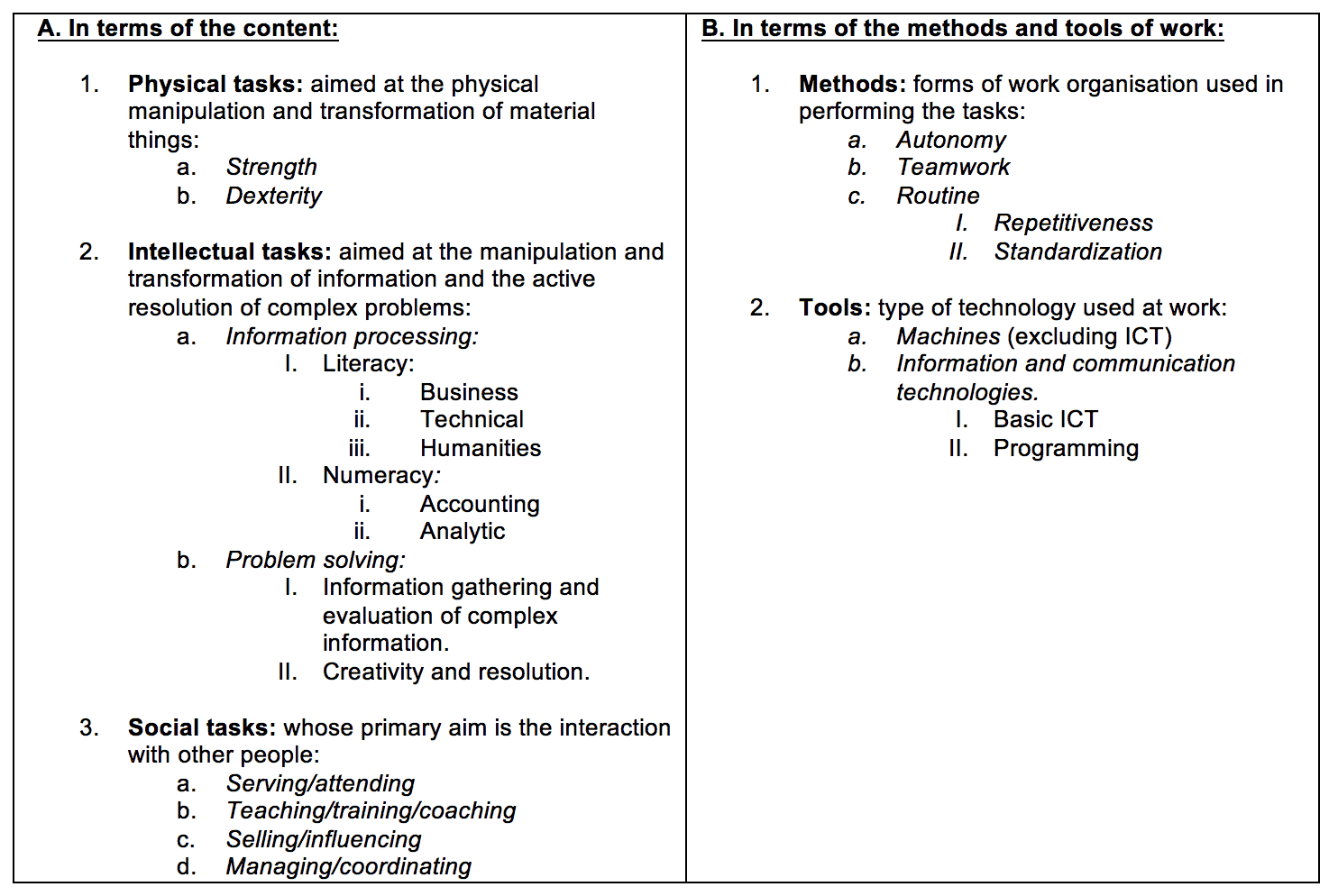
In the most recent European Jobs Monitor report, we have constructed a new set of indicators for measuring task content and methods across occupations in Europe. Combining data from different international surveys (mainly, Eurofound´s European Working Conditions Survey, OECD’s Survey of Adult Skills PIAAC and the US Occupational Information Network ONET database), we have created more than 30 indicators that measure task content in three broad dimensions (physical, intellectual and social); and task methods in two dimensions (work organization and technology). The full framework is shown in table 1 below, and the database containing standardized measures for each of those indicators in each specific occupation and sector of European labour markets can be freely downloaded here.

Table 1: A classification of tasks according to their contents and methods

macias_graph00

We built two indices for the extent of routine involved in occupations: first, the degree of repetitiveness required by the job (repetitive hand or arm movements, short repetitive tasks, monotonous tasks), and second, the degree of standardization of the work activity (subjection to numerical production or performance targets and to precise quality standards). These indicators can be used to test the hypothesis that computerization has led to a decline of employment in occupations which involve more routine.

Indeed, our results support such a hypothesis. In table 2 below, the columns tagged “Compositional change” show the effect of the changing composition of employment on the average level of routine (repetitiveness and standardization) in the EU-15 between 1995 and 2015. The relative decline of employment in highly routine jobs has reduced the average level of repetitiveness by 1.5 points in a scale of 0-100, and the average level of standardization by 1, which correspond to a decline of 3.6% and 1.6% from their initial levels. This effect may seem small, but it is significant and consistent in all EU15 countries, as table 2 also shows.

Table 2: Change in the levels of routine between 1995 and 2015, reported levels and compositional effects

macias_graph

(Sources: European Jobs Monitor Task Indicator Dataset, EWCS, EU-LFS)

But if we look at the overall level of routine task content actually reported by workers across Europe (“reported change”), the results look rather different. In terms of the repetitiveness of tasks, the reported levels increased on average by 2.2 points in our scale between 1995 and 2015 (a 5.4% increase from the initial level), a statistically significant result that is found in most though not all EU-15 countries. In terms of the degree of standardization of tasks, the average values increased even more significantly by 5.8 points (from 54 to nearly 60 in a scale of 0 to 100, a 10.7% increase), a result which is also found in most countries.

So, there are both routinization and de-routinization tendencies in European labour markets. While routine jobs are shrinking in relative terms, work is generally becoming more routine over time. In fact, the increase in the reported levels of routine at work seem to be concentrated in occupations that have not traditionally been associated with such a kind of work. In our recent report (p. 68-70), we found that managers, professionals and clerical occupations are among the occupational groups that report the largest increases in the levels of routine.

One reasons for this paradox may be that computerization, which has been linked to the decline of routine occupations, can also be related to an increasing repetitiveness and standardization of work. This seems particularly plausible in the case of standardization, which is the aspect of routine that is more clearly on the rise according to our approach: the very nature of computing relies on the processing of standardized information, and an increasing use of computers can both facilitate and require a further standardization of labour input. More institutional developments such as an increasing recourse to subcontracting and the globalization of value chains may also require higher levels of standardization in order to facilitate the management of increasingly complex production processes. In general, it seems certainly plausible that an increasing use of performance benchmarking and quality management systems across most economic activities (including the public sector) would be related to the reported routinization of work.

We can also speculate about the implications of these results for the debate on the automation of work, although with two important qualifications. First, our task framework itself cautions against any attempt to predict the employment trends across occupations on the basis of an analysis of any specific type of task (such as routine). Since jobs are coherent bundles of many types of tasks, the overall effect of computerization on the demand for different occupations will be highly indeterminate. A second qualification follows directly from the results presented earlier: if the task composition of jobs can also change over time, it may not be a very solid basis for predicting what jobs may be more at risk of automation.

But a process of routinization of previously non-routine jobs does have interesting implications for the debate on the automation of jobs. Many of the occupations that reported higher increases in routine (particularly in terms of standardization) are those that have been considered less at risk of automation in previous research. Earlier historical rounds of automation were preceded by an organizationally-driven routinization of tasks: taylorism and bureaucratic management had that effect on manufacturing and administrative activities, respectively. If new technologies and management principles are expanding the range of routine work processes, they may be just laying the foundations for further waves of automation.

For further details please see here.

27 Sep 21:10

Your social media marketing toolkit

by James Gurd

Social media strategy and planning essentials

This is part 9 of my Smart Insights 12 part social media series. In the last part we looked at reporting for social media; in this blog, I discuss what tools you can use to help plan and manage your social campaigns.

Please note that this list isn’t exhaustive. There’s a wide range of tools available, and each person I know uses a different mix depending on business needs. This blog aims to show you the types of tool you need to evaluate; you should then do your own research to find out what gives you're the functionality you need.

Measurement tools

Let’s start by getting the fundamentals put in place. To do social media intelligently, you need to underpin your planning and decision making with accurate data.

Google Analytics campaign tracking

My first port of call is always web analytics + URL campaign tracking. I’m going to base this on GA simply because most clients I work with use GA for campaign measurement. I recommend ensuring that each URL you share has UTM campaign parameters appended; you’ll get your own set of campaign reports specifically for social campaign links.

Top tip: create a UTM tracking taxonomy so that you use consistent campaign parameters. I typically set the following (all lower case):

  • Medium social social
  • Source [social network] facebook
  • Campaign [campaign name] mothersday_2016
  • Content [creative asset] video_1
  • Term [test version] a

So an example URL for a landing page shared via social media would be:
https://mydomain.com/?utm_source=facebook&utm_medium=social&utm_term=a&utm_content=video_1&utm_campaign=mothersday_2016

GA campaign tracking report

There are premium tools available that are focused on social media analysis and reporting. A good example is Crowdbooster, which provides analytics, automated insights and customised reporting dashboards. There is a 30-day free trial and plans start from $9 per month.

Social network analytics

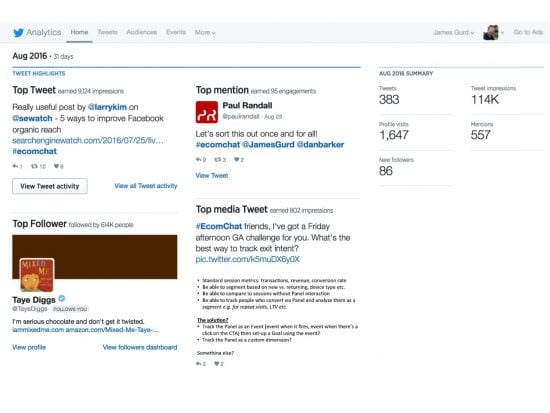
Each network provides its own free (and paid) analytics tools – use them as much as possible. Let’s use Twitter as the example, you can get the following info for free:

  • Monthly summary showing top tweets and overall activity rate
  • Tweet level data including impressions per day and top tweets based on impressions and engagement
  • Audience demographic breakdown e.g. male/female split
  • Twitter card usage data

Twitter analytics data

Planning tools

You need to understand your audience, and learn what content resonates best with them and who is out their already sharing popular content for the topics that are most relevant to your business and products/services. There are several handy research tools you can use.

Buzzsumo/Audiense

Free option? Yes
Pricing From $99 per month
Free trial option (for paid version) 14 days

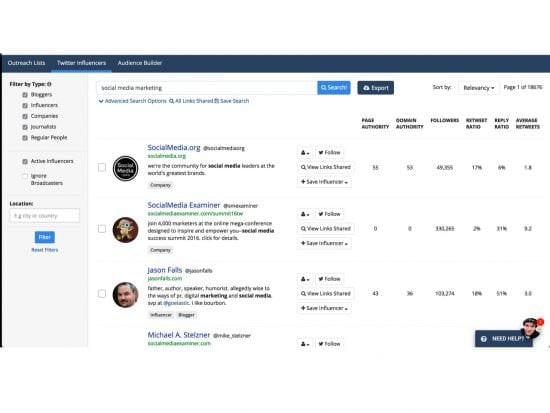
These are great for audience analysis. You can research by topic and learn what content and which publishers are the most active and popular based on social engagement metrics.

Let’s use Buzzsumo as the example, a tool I’ve used personally myself and found it to be incredibly useful with a simple interface. I’ve used it to:

  • Research content topics for a client and drill down into key themes and sub-themes to find out what has the most activity
  • Learn which publishers are active and how much engagement they get with their content
  • Discover key influencers (brands, bloggers, journalists etc.) who align with key topics and see how much reach each one has

Buzzsumo content search

I’ve used this for complex B2B projects like legal services, as well as high street retail. To do any meaningful level of analysis, you really need to switch to the paid version, which gives unrestricted searches and exportable data.

URL shortener e.g. Goo.gl

Enables URL shortening to ensure your content is focused on the message, not the URL.

Bit.ly used to be the #1 choice for URL shortening but the news that it partnered with Vigilink to effectively add affiliate tracking to all shortened links, dampened enthusiasm amongst marketers.

With freemium tools like Bit.ly, branded domains can be purchased with an enterprise subscription, which also gives you access to enhanced features such as mobile deep links and dedicated support.

All links reporting is much deeper, so you can see link share data to help with content optimisation plans. Free tools like Goo.gl do provide data but it’s not as rich:

Goo.gl URL data

There are lots of free shorteners out there. For example, Hootsuite provides Ow.ly, which provides deeper link data when you pair it with Hootsuite.

Content tools

Social media is all about the content. Therefore you need tools that help you create and manage your content assets effectively.

When you start out, it’s fine to take a manual approach and create content to upload direct via social networks. However, as you grow and your publishing queue expands, it’s likely your demands will increase and you’ll need a smarter way to schedule and publish content. Below are examples of tools that help you curate visual content.

Everypost

Free option? Yes – pay with a tweet
Pricing From $9.99 per month
Free trial option (for paid version) 14 days

  • Available on iOS and Android to support mobile workflow
  • Pull in content from multiple sources and publish across social networks
  • Customise content to tailor to specific social networks
  • Collaboration via permission-based workflow to support team structures

There are network specific tools available, the value of which depends on how active you are on each network. Let’s look at one example.

Tailwind

Free option? No
Pricing From $9.99 per month
Free trial option (for paid version) Yes (based on activity threshold)

This is the leading solution for visual content scheduling and publishing on Instagram and Pinterest. Positioned as ‘smarter visual marketing, it allows teams to manage content calendars, collaborate across multiple team members and has a small business packages, as well as upgrade options for enterprise customers.

Management tools

Ok, so you’ve created your content, sorted your links and got your tracking in place. Now you need a way of managing your updates and ongoing communication with followers. Step up the social media management dashboards…

Tweetdeck/Hootsuite

Free option? Yes
Pricing From $7.99 per month (Hootsuite)
Free trial option (for paid version) 30 days (Hootsuite)

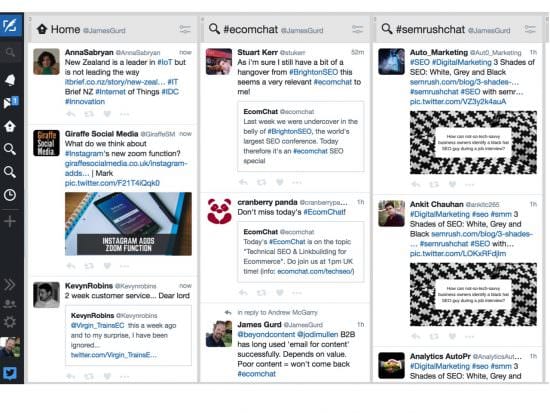
They provide activity dashboards to show what’s happening across your social networks, with the primary focus on Twitter (Tweetdeck only covers Twitter). Key features include:

  • Set-up single access or multi-access team accounts e.g. more than 1 person can tweet from your handle
  • Add multiple Twitter accounts (great if you’re a freelancer working with multiple clients)
  • Create multiple streams so you can follow different conversations e.g. I have a column for my #EcomChat network
  • Schedule posts and automatically shorten URLs
  • Quickly RT, like or reply to tweets
  • Direct message one or more followers

Tweetdeck custom dashboard

Buffer

Free option? Yes
Pricing From $10 per month
Free trial option (for paid version) 30 days

This helps you schedule all your social updates and create publishing queues. It has some neat features:

  • Set different publish schedules and velocity for each social network e.g. post to Twitter 3x daily, only post to Facebook 1x daily
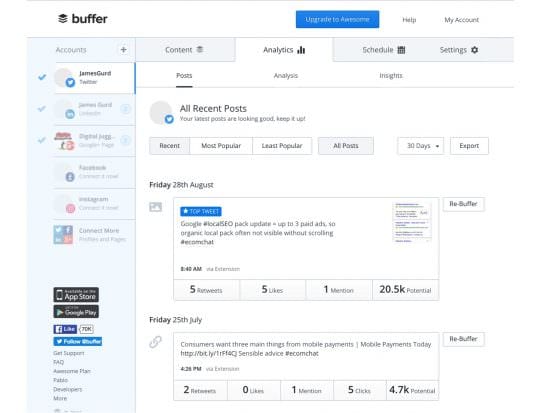
  • See key social metrics fro each post e.g. # RT, likes and mentions for each tweet
  • Sort by popularity

Buffer dashboard

To access the detailed analytics and features like data export, you need to upgrade to the business package ($99 per month)

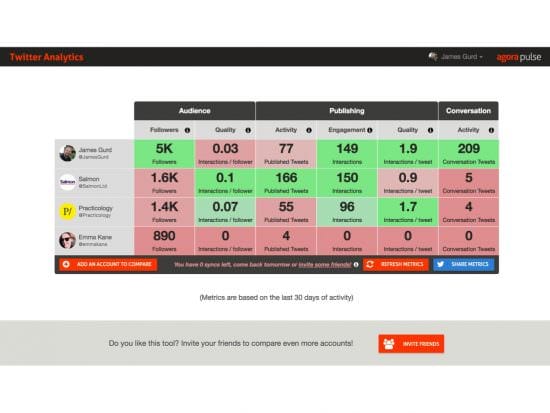
You can of course invest in other scheduling and publishing tools. Agora Pulse is a good example, offering free tools (I like the Twitter analytics report card) and a monthly subscription service from €49 per month, with a free trial option. Some of the cool features:

  • User profiling to identify ambassadors and influencers
  • Competitor analysis for Facebook and Twitter
  • Integration with Facebook apps e.g. run contests
  • Team workflow to assign and manage tasks across multiple users

Screenshot: Agora Pulse Twitter report card

Agora Pulse report card

For heavier users such as agencies with multiple clients, tools like Sprout Social have been highly recommended to me, though I’ve not used personally. Pricing starts at $59 per user per month with a free 30 day trial.

IFTTT

Possibly the coolest and most flexible tool on the block, IFTTT is a free community that lets you create recipes for event-based triggers to automate social marketing.
For example, there’s a recipe to automatically share new Instagram photos as native Twitter photos.

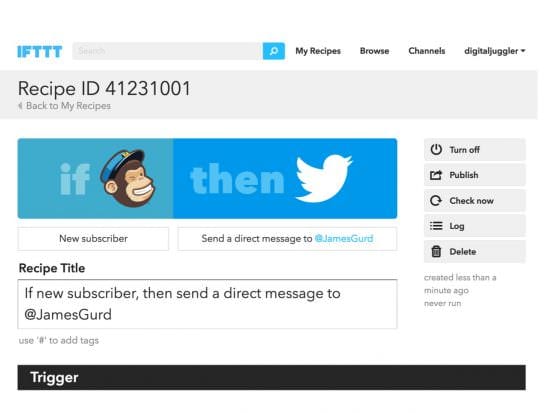
You can create a new recipe using a simple process and choose triggers and actions from the wide range of integrations that IFTTT supports. I’ve got a simple recipe that sends a DM to my Twitter when a new person subscribes to our EcomChat email group.

IFTTT recipe example

Your thoughts, comments and personal experience

So this is step 9 in the Smart Insights 12 step series on social media strategy and planning.

Did you find it useful?
What tools do you use to help deliver social media marketing? What mix of free and paid tools works for you?

Please join in the discussion and share your experience in the comments field at the bottom of this page.

Keep an eye out for next month’s article, “Handling complaints and negative PR via social media”.

Missed the previous articles? Catch-up here:

  1. 6 reasons why you need a social media strategy
  2. How to create a social media strategy and plan
  3. Competitor analysis for social media strategies
  4. Understanding the role of organic and paid social media
  5. Creating a social media content strategy and plan
  6. Aligning social media with other marketing channels
  7. Resource planning for social media
  8. Reporting for social media

Thanks
James

Thanks to James Gurd for sharing his advice and opinions in this post. James is an experienced ecommerce and digital marketing consultant with more than 14 years’ B2C and B2B digital strategy and transformation experience. He is the Owner and lead consultant at Digital Juggler. You can follow him on Twitter or connect on LinkedIn.


27 Sep 21:10

Answering Your Buyers Questions with Content Marketing

by Will Humphries

The number of strategies and topics included under the content marketing umbrella is relatively vast. In fact, the breadth of this approach to demand generation can overwhelm even savvy marketers.

When you focus on your content as a response to common questions faced by targeted buyers, it helps you concentrate on impactful messages. The following is a look at key strategies and tips to build content that answers questions for your target market.

Why People Search

Understand this first – when performing an online search, buyers aren’t looking for you. They are looking for a product or solution.

The vast majority of buying processes begin within an online investigation. More specifically, people with a problem or question go to Google and ask the search engine to offer up some relevant information.

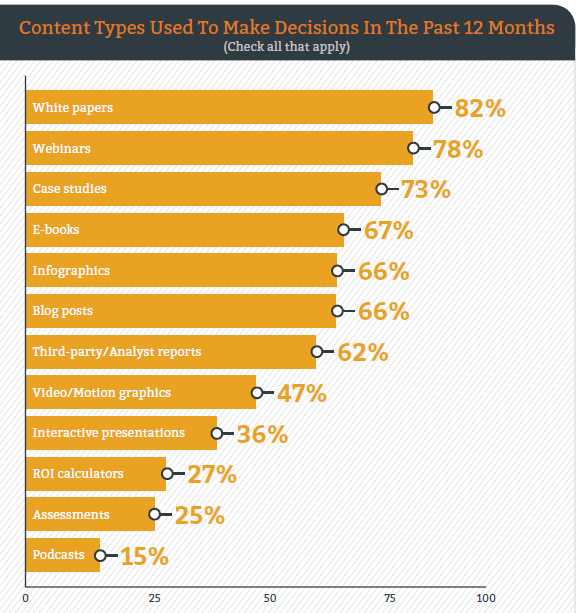
DemandGen’s 2015 Content Preferences Survey found that 67% of buyers rely more on content to research and make purchasing decisions than they did a year ago.

The results that Google shares are the ones that it believes provide the most useful and relevant answers to these buyer questions.

Therefore, to achieve strong search engine performance and to generally attract targeted buyers, you need to create content that integrates powerful responses to the buyer.

To add to this, according to the B2B Path to Purchase Study (2014), by Google/Millward Brown Digital:

on average, B2B influencers do 12 searches prior to visiting a specific brand’s site, and

90% of B2B researchers who are online use search specifically to research business purchases.

buyer-research-average-searches-prior-to-engagement

The Power of Personas

We’ve recently talked about the benefits of generating detailed buyer personas that match the capabilities of each of your solutions. After you understand the profile characteristics and behaviours of a targeted buyer, the next step is to develop a list of primary business issues he faces.

Finally, convert the issues into specific questions. Maybe your prospect is a sales leader struggling with his team’s inaccurate forecasting. To resolve the problem, he goes to Google and searches, “How do I improve sales forecasting accuracy?”

By recognising this question as common for a particular persona, you can craft content to match. For instance, you might create a blog post titled, “5 Best Strategies to Improve Sales Forecasting Accuracy.”

Demand generation

Incorporate Additional Distribution Strategies

Search engine marketing is just one strategy to get your content into the right hands. With content syndication, your message is delivered to a larger number of prospects that match your target profile.

As a brand partner, Internal Results supports your efforts to understand and answer the primary business questions being considered by your marketplace.

We help you create more in-depth answers in content formats such as whitepapers, case studies, reports and videos as well. These more in-depth content pieces help you elaborate on your article responses, and lay out the benefits of your solutions as a remedy to the business issue.

Wrap Up

By looking at content marketing as a process of answering buyer questions with content, it is easier to create strategies that work.

Develop a list of primary questions for each buyer persona you identify. Then, create messages that are relevant and useful and add them into your content marketing plan.

To achieve the best success, partner with a successful company in this area to enhance the quality and distribution of your message, and to reach more people that are looking for your message and solution!

27 Sep 21:10

[Infographic] The Value of Influencer Marketing

by Alex DiRenzo

Influencer marketing is quickly becoming a major part of the social marketing strategies for many marketers and agencies a like. With digital marketing spend increasing every year, more and more dollars are being devoted to influencer marketing programs due to their potential for significant ROI yields with often less resources.

However, for those with early maturity social strategies, and often little spending room for experimentation, it can be easy to brush off influencer marketing as a nice-to-have. They’ve heard it works but the assumption is without significant resources at their disposal it can be too much of a risk for the average organization to execute well. This assumption could not be more wrong.

The value of influencer marketing is undeniable and no matter the size, resources, or sophistication, of a marketer or agency, all should be considering integrating an influencer marketing strategy into their social plans, even if their just beginning. The prospect of being able to reach consumers, inside and outside your traditional audience, in engaging ways, and through trusted voices is value that can’t be found through many if any other forms of social media marketing.

Do we have you sold yet on the value of influencer marketing? Don’t just take our word for it. We’ve compiled an infographic some hard hitting stats about how paying attention to influencer marketing can lead to excellent business value.


Influencer Infographic - Final (Small without Intro)


To learn more about how you can master the art of influencer marketing and start to see some of the value show above, check out our handy A-Z Guide on Influencer Marketing. In it you’ll discover how to navigate the search for influencers on social media, as well as get tips on how to grow, maintain, and maximize ROI from your influencer relationships.

The post [Infographic] The Value of Influencer Marketing appeared first on Sysomos Blog.

27 Sep 21:10

How the Best CEOs Get the Important Work Done

by James Allen
sept16-28-hero-2
HBR STAFF

If you’re a chief executive officer, your job is to execute. It’s written right into your title. But what does it mean, in terms of daily tasks, to be the company’s top “executer?” After all, CEOs don’t actually build factories or sell products.

It’s tempting, therefore, to view the CEO as primarily a thinker; someone who mulls and shapes strategy. That is a part of the CEO’s job, of course. But the best CEOs know that strategy is just theory unless it’s actually translated into frontline routines―unless the rest of the company actually is executing the strategy.

The CEO’s job is to make sure that happens. The best CEOs focus primarily on four things: communication, communication, communication, and overseeing resource allocation to ensure that the priorities they’re communicating are actually the ones getting funded.

The problem with the first three of those tasks: It can be incredibly boring. The same messages must be repeated again and again ad nauseam. But the best CEOs resist the desire to chase the next shiny object. They stick maniacally to their communication role to guarantee that the strategy is baked into frontline routines and behaviors.

And just because it’s repetitive doesn’t mean it’s easy. First-time CEOs often feel like their own company is conspiring to drown out those messages. Based on our research and decades of experience working with CEOs, here are six tips for CEOs who want to get the boring—and most important—stuff done:

Liberate yourself from your own staff. Your time and your energy are your most valuable resources. Focus them on what’s most important and start saying “no” to people—starting with your immediate staff. The average CEO inherits a staff committed to serving the institutional requirements of the office of CEO, not the CEO’s strategic agenda. If you don’t ruthlessly protect your time, you will watch your calendar rapidly fill up with retirement parties, ribbon cuttings and other corporate tasks that have nothing to do with advancing the strategy.

Many CEOs apply a 60/40 rule: They devote 60 per cent of their time to “must-do” tasks like governance and investor relations and the other 40 per cent to personal focus on strategic execution. And they constantly review the 60 percent to decide if really need to do them or can delegate them to others. One pharmacy retail chain CEO who wasn’t particularly good at investor relations simply hired people who were better and entrusted them with that duty.

Disentangle yourself from the Byzantine bickering of the professional managerial class. Most companies have a professional managerial class that absorbs way too much time and energy and distracts CEOs—and others—from focusing on customers and the front line. CEOs can waste a massive amount of time simply tending to the egos and petty squabbles of professional managers―time better spent connecting directly with the front line and solving their needs. I recognize this sounds harsh; it is. Of course, every organization needs professional managers, and many of the great value-creation stories of business can be traced to their efforts. But we have to be honest: If we can point to companies that are under-managed, we must also point the finger at companies that are over-managed, where the professional managerial class appears to spend as much time perpetuating its own agenda as it does supporting the front line.

As part of the ongoing research effort for our book, The Founder’s Mentality, we’ve studied why companies retain or lose the characteristics that help them avoid growth-killing complexity and stay focused on their insurgent mission to serve customers. Our surveys, research and extensive interviews suggest that this sense of mission fades first and fastest at the upper and middle layers of the company as they become diluted with professional managers.

Professional managers tend to worry most about stakeholders somewhere in their own office. They are more likely to tell their family about face time with the CEO than about solving some faceless customer’s problem. Avoid becoming a dinner table boast and instead spend your time maintaining the energy and sense of mission of the frontline employees who devote their day to serving customers or supporting those who do.

Laminate your “strategy on a page” and find joy in talking about it for the thousandth time. The best CEOs create some sort of strategy on a page. I’ve known some who laminate it to survive the 1,000 conversations they initiate. They constantly remind everyone what matters in the simplest terms possible. How a CEO spends his or her own time sends a powerful message about what matters to the business, but that doesn’t let them off the hook on the boring part of the job: They still must repeat that message over and over and over again.

We even argue that CEOs should focus on a “strategy on a hand” (which liberates them from their laminates). The thumb represents a simple, jargon-free description of “why we exist,” and the fingers are the three to four ways the company must excel to make that happen. At Indian consumer products company CavinKare, the thumb is “Whatever a rich man enjoys, the common man should be able to afford, and our job is to find a way to solve this.” At one Brazilian retailer, it’s “To give aspiring lower-class consumers the opportunity to own furniture, ‘white goods’ and consumer electronics by helping them solve their financing needs.” At Google, it would be “To organize the world’s information and make it universally accessible and useful.”

The best CEOs instinctively distill an often complex strategy into a few clear elements that can easily cascade through the organization, and they revel in making that happen. “The role of a CEO is to simplify the complexity and stick to a few themes that are easy to understand,” the CEO of one luxury goods company told us. Or, as an airline CEO reflected in a recent conversation with us, “In any company I’ve been in, there haven’t been very many people who are capable of standing back and making the complicated things very simple. Yet that’s where the real value is.”

Celebrate the doers. Every company needs thinkers, but CEOs need to fight the natural tendency of corporate hierarchies to glorify them. Instead, they must remind everyone that it is the doers—the key employees who directly support customers—whose actions advance the mission of the company.

“My sales force are the heroes of my business,” the CEO of one consumer goods company told us. “I want them to sell all day, outhustle the competition, get our products onto the right shelves at the right width and height. I’ve told them over and over that they are not the brains of the company, but the arms, legs, ears and eyes.”

He continued: “For example, if the sales reps see new competitive activity or something interesting in-store that worries them or presents an opportunity, they take a photo with their smartphone, write a few lines about the issue and send them off to the heads of sales and trade marketing. Then they go back to selling. The thinkers back at headquarters get about 150 pictures a week, some of which get translated by the marketing staff into new sales initiatives. And every month, the company gives an award for the best new sales initiative―not to the marketing department, but to the sales rep whose photo triggered the new initiative.”

Be the question guy, not the answer guy. Thousands of issues can distract a CEO from what really matters. You don’t need to solve every problem. As the CEO of one food company told us: “I need to know about those issues and I would be cross if I didn’t. But I don’t have to fix them.” If a problem is getting in the way of the doers, you should make sure it gets solved. Otherwise, it can probably be delegated to someone on your team to figure out. Most CEOs start the job believing they need to have all the answers, but over time they realize they need to have good questions, such as “How does this activity help translate our strategy into frontline behaviors and results?” There it is, the boring part again.

Ignore the conventional wisdom of coaches. CEOs hear a lot of bad advice urging them to stay in their box and work through the management structure. Watch out for these phrases:

  • “The CEO should look up and out.” This is the notion that the CEO’s job is to manage the board and outside stakeholders, leaving day-to-day operations of the companies to others. This is poppycock. One would hope the CEO attained his or her position by being one of the best operators in the business. Why abandon that strength once they are in the ultimate position to exercise it throughout the company?
  • “The CEO should work through the layers and not connect directly with the front line.” Nonsense. Messages must be delivered directly. We’ve all played the game of telephone as kids and know the twaddle that emerges at the end of the chain. A CEO who communicates through layers is a CEO who dooms the organization to drivel. This doesn’t mean you ignore the management layers in between – bring them along, share the stage and debrief and coach them afterwards. But deliver messages directly.
  • “The CEO must rise above the details of the business.” Total nonsense. Revenue comes from customers, and customers care massively about the details of the business. Deep customer loyalty is born of the infinite decisions required to get these details right. The CEO must live here.
  • “The CEO’s job is to set the strategic direction and then leave the execution to others.” Utter nonsense. Strategy is meaningless without execution. Execution is where strategy turns into results. Do both.

And yes, execution by communication can be boring. Yet you will often find that the messages need repeating—and that each time you do, you learn a lot about what’s working and what isn’t in different parts of your company. In the long run, these simple messages make your job much easier. Performance management gets linked to these simple themes. That, in turn, encourages leaders throughout the organization to absorb and live the same priorities. It shows employees that their own path to success is tightly linked to strategy. And clear, simple themes win over investors and analysts, too.

Here’s the rub. Ultimately, you need to find joy in this. And there is joy. Each conversation is an opportunity for mutual discovery, for mutual insight. You can be successful as a CEO only if you can mobilize the hearts and minds of thousands, so you must love this mobilization and take joy in helping each group and each individual discover what the strategy means for them. CEOs don’t lead companies, they lead a collection of people who all need to move in the same direction. And that demands a thousand conversations.

27 Sep 21:09

The Earth just permanently passed a symbolic carbon dioxide threshold

by Climate Central
Https%3a%2f%2fblueprint-api-production.s3.amazonaws.com%2fuploads%2fcard%2fimage%2f225973%2fgettyimages-145073602
Feed-twFeed-fb

In the centuries to come, history books will likely look back on September 2016 as a major milestone for the world’s climate. At a time when atmospheric carbon dioxide is usually at its minimum, the monthly value failed to drop below 400 parts per million.

That all but ensures that 2016 will be the year that carbon dioxide officially passed the symbolic 400 ppm mark, never to return below it in our lifetimes, according to scientists.

Because carbon pollution has been increasing since the start of the Industrial Revolution and has shown no signs of abating, it was more a question of “when” rather than “if” we would cross this threshold. The inevitability doesn’t make it any less significant, though. Read more...

More about Science, Climate, Global Warming, Climate Change, and World
27 Sep 19:59

Inbound Etiquette 101: Engaging vs Interrupting

by Ryan Shelley

Inbound_Etiquette.png

Traditional forms of marketing like TV commercials, direct mail, and print advertising have been losing their effectiveness for years. Our culture has become so accustomed to being marketed to, that we have learned to just ignore it. What makes matters worse is these forms of outreach are extremely expensive, making the risk even greater for smaller businesses trying to get their name out. After decades of doing the same thing with diminishing results, something had to change. Inbound Marketing was born out of this need for something different. Instead of interrupting people’s lives with unwanted messages, the goal of inbound is to engage and attract people by offering answers to their questions. But what happens when we lose focus on our primary goal as inbound marketers? In order to make sure we maintain our focus, let’s take a crash course in inbound marketing etiquette.

A Brief History of Inbound

The term “Inbound Marketing” was made popular with the release of ” Inbound Marketing: Get Found Using Google, Social Media, and Blogs” by Brian Halligan & Dharmesh Shah in 2010. But the practice of inbound dates much earlier. Seth Godin is widely known for his blog, books and speaking appearances, but before that he ran an internet-based direct marketing agency called Yoyodyne. It was during his time at Yoyodyne that Seth Godin developed the idea of “permission marketing.” P ermission marketing aims to sell goods and services only when the prospect gives consent in advance to receive the marketing information. In 1999 Godin released a book titled “Permission Marketing” that made the case for a new way of reaching consumers. While he doesn’t go into tactics as much as Halligan and Shah do in their book, Godin’s new concept of marketing was the foundation for the rise of inbound as we know it today.

Inbound Basics

The goal of inbound is to attract people to your brand. It’s about fostering a connection and building trust. It’s about educating your prospects instead of pushing more product at them. “Before a marketer can build trust, it must breed familiarity. But there’s no familiarity without awareness. And awareness—the science of letting people know you exist and getting them to understand your message—can’t happen effectively in today’s environment without advertising.” ― Seth Godin, Permission Marketing : Turning Strangers Into Friends And Friends Into Customers. Inbound marketing is not about forcing yourself in front of potential buyers. Instead, the goal is to build awareness via content cross-marketed through email, blogging, social media and search.

Inbound Etiquette

While inbound marketing has gained a ton of momentum over the past few years, some in the industry seem to have lost the focus. Inbound works well because it is focused on serving before selling. But, if we fall back into traditional marketing behavior we can ruin the effectiveness. Just because you blog, use email and post to social doesn’t mean you are “doing inbound.” All of these tactics can be manipulated and abused to only benefit the marketer and not those they come in contact with. The world we live in is already noisy enough, so adding more junk to the web doesn’t help anyone. So, let’s review 8 Inbound Etiquette rules we all need to apply to our process.

1. The user should be in charge of their journey.

People hate being told what to do, but they do like help with making decisions. When we continue to force our products and services on them, the result is most will back away. However, if we allow the user to feel in charge of their journey and position our brand as a helpful advocate, working to help them make the right decision, we will build trust. It’s about educating them and assisting them in making an educated decision.

2. Never send unsolicited emails.

Inbound Marketing starts with permission. We have no right to blast unsolicited messaging at people. When we do this, we are no longer using inbound. While this rule seems like a no-brainer, sadly many businesses and agencies still buy lists of email addresses and interrupt their way into people’s lives. It doesn’t matter how great your product or service is, if you burst your way into someone’s world without permission, they feel violated.

3. Keep the content options balanced for your users.

Balance is the key. If all you ever deliver to your users is offer after offer, you could end up pushing them away. By giving them a balance of free content through your blog and site pages, as well as offers, you show your users that you are not just interested in marketing to them but also are looking to solve their problems.

4. Know the tools and how to use them.

There are a number of tools available to inbound marketers today. Having these tools is great, but unless you know how to use them effectively they are useless. Knowing how to blog, how to use social media to attract and prospect, and how frequently to send emails can be the difference between being successful and falling short.

5. Always “check one more time” before your post.

Rushing and multi-tasking aren’t scalable. Focusing on the task at hand is the best way to ensure that you produce your best work. Before sending a tweet, posting a blog or sending an email, always check one more time. Look for spelling and grammatical errors as well as sentence structure. Posting something that has a ton of mistakes can lessen your credibility.

6. Know the balance between engaging & interrupting.

Overloading your audience is never a good thing. We live in a 24-hour content and news-filled world. People are constantly being flooded with information, so adding too much more will result in it getting lost in the noise. The goal is to give them the right content at the right time. Now, there is no “one size fits all” solution to this. Every audience is different so finding balance will take time and patience. A good rule of thumb is to start with less and work your way up. It’s much easier to ramp up than scale back.

7. The user should never pay.

While the end goal of marketing is to deliver a positive ROI, inbound is about educating and engaging at its core. We must treat those we engage with as our guests. You would never ask a guest in your office to pay for a cup of coffee or for the opportunity to meet with you. The same goes for our marketing efforts. By giving away knowledge, for free, we position ourselves not just as experts but as trusted advisors. In the end, this will lead to better ROI and long-term success.

8. Always say “please” and “thank you.”

Whether someone engages or chooses to opt-out, being polite is a must. When asking for information, do so in a non-intrusive manner. Whether someone gives you their information or refuses, make sure that you thank them. “Please” and “Thank You” when used with authenticity are still some of the most powerful words we can say.

Inbound Marketing has shifted the way many businesses reach new prospects and delight their current customers. While it can be tempting to use the tools available to mass-market, resisting this temptation and focusing on serving our audience is what will lead to our ultimate success. Whether you are new to inbound or have been using it for quite a while, remembering these 8 simple Inbound Etiquette rules will help ensure that you add value to the lives of those you come in contact with.

51 SEO & Inbound Marketing Tools

27 Sep 19:58

Twitter needs to sell now or risk becoming another Yahoo (TWTR, YHOO)

by Steve Kovach

Jerry Yang

Twitter, which was once a darling of the tech industry and went public almost three years ago in an eye-popping IPO, appears to be up for sale.

We've seen this story with an internet company before.

In fact, the parallels between Twitter and Yahoo are rather striking:

A rotating cast of CEOs and executives with little direction; a powerful platform once seen as the future of the internet struggling with an identity crisis; questionable strategies for growth.

If it doesn't sell soon, Twitter risks setting itself up for Yahoo's fate: a decade-long stagnation in which no progress is made and company focus and morale are slowly drained by never ending takeover talks. The story ends with a desperate sale for a tiny fraction of its peak valuation.

Right now, Twitter seems to think it can fetch as much as $30 billion in a sale, about double its market cap as of Friday, Kara Swisher of Recode reports. Yahoo, which once had a market cap of about $125 billion, agreed to sell to Verizon for $4.8 billion this year. That was eight years after Microsoft offered to buy Yahoo for $42 billion — an offer that Yahoo's leadership stubbornly rebuffed. 

If CEO Jack Dorsey and the Twitter board pull a Yahoo from 2008, they're setting themselves up for a drama vortex like the one Yahoo went through.

Looking for a miracle

Twitter would also be taking a gamble if it doesn't sell and tries to make it on its own. As The New York Times reported, one option the company is considering other than a sale is a restructuring that could include layoffs, including possibly spinning off mobile ad platform MoPub and short-video service Vine.

But we've seen Twitter go through that before, and it hasn't helped solve its user-growth problems. As the saying goes — and as Yahoo proved through many rounds of layoffs and endless restructurings — you can't cut your way to growth.

Jack Dorsey

Despite its many problems, Twitter is still an attractive asset.

It's an invaluable tool for news gatherers, celebrities, world leaders, activists, and marketers.

It has a treasure trove of untapped data, which probably looks pretty tasty to companies like Google and Salesforce. Twitter was the platform that a reality-TV star and real-estate tycoon used to promote himself all the way to the GOP nomination for the presidency.

No one can deny the power and influence Twitter wields, even with its relatively small base of active users. 

But Twitter's company culture has always prided itself on being fiercely independent. The company turned down an offer from Facebook in its early days.

And while Dorsey, who is also a cofounder, doesn't control a majority of Twitter's voting shares (as Facebook's Mark Zuckerberg and Google's Larry Page and Sergey Brin do), it's not clear how amenable he might be to selling out — or how vigorously he might try to oppose a deal.

Depending on who the buyer is, an acquisition might not be at odds with Twitter's mission. Unlike Yahoo, which seems destined to be stripped-mined for valuable resources and left unrecognizable once Verizon gains jurisdiction over it, Twitter's service could actually flourish under a parent company that provides additional resources and leeway. 

Unless Twitter has some miracle up its sleeve that the company is confident will supercharge growth to Facebook-scale, it won't be able to get a sweeter deal down the road than the one it can get now. Yahoo's "lost decade" could be Twitter's future. 

SEE ALSO: Jawbone hasn't paid one of its key business partners and has almost no inventory left, sources say

Join the conversation about this story »

NOW WATCH: Twitter’s huge deal to live-stream NFL games could be a game changer

27 Sep 19:58

19 Phrases That Make Buyers Hate Your Sales Emails

by afrost@hubspot.com (Aja Frost)

phrases-make-buyers-hate-your-sales-emails.jpg

Whoever came up with the saying, “Sticks and stones will break my bones, but words can never hurt me,” clearly never emailed prospects. In a sales email, one poorly chosen word or phrase can kill your chances of getting a reply.

To avoid this fate, steer clear of these 19 words and phrases that buyers hate reading.

1) “Get a dialogue going,” “Open the lines of communication”

Reps use these clichéd phrases to feel out whether prospects want to have a conversation. But if they don’t provide an additional reason for reaching out that’s clear, concrete, and useful to the buyer, their email will fall flat: Prospects are too busy to talk to a salesperson “just because.”

Start with a thought-provoking question or offer to help rather than a vague statement like, “I wanted to get a dialogue going.”

Here are a few examples:

  • “Here’s a helpful blog post about the new health regulations. Has Cornerbrick started to transition?"
  • “I know the Orange Foundation’s director -- would you like an intro?”

2) “Wanted to say hey,” “Wanted to introduce myself”

You’re a stranger, so buyers are unconcerned with what you want. These lines make you sound self-interested and arrogant.

In addition, you’re essentially admitting you don’t have a defined purpose. Outreach emails should revolve around the value you can offer your prospects, not an invitation to talk.

3) “Long time no talk”

Use this phrase when you bump into an old friend, not in your sales emails. Your prospects will typically be turned off by the chummy tone, especially if you didn’t receive the warmest reception from them in previous communications. And since so many salespeople have used this line to pretend they’re restarting a former conversation, prospects may read this and lump you in with reps who rely on sleazy tricks.

4) “Truthfully,” “honestly”

Everything you tell prospects should be truthful -- so why preface a specific sentence with this word?

“When I hear somebody say [honestly], I can’t help but think if what they’ve been telling me up to now has been a lie,” says sales trainer Mark Hunter.

5) “Hey,” “Hello there”

Some prospects will appreciate the casual, friendly vibe of these openers. In fact, we usually suggest making your email conversational. But as Sales Aerobics for Engineers founder and president Babette Ten Haken explains, “‘Hey’ and ‘Hello there’ are easily perceived as disrespectful greetings in many professional contexts.”

Ten Haken never answers emails that begins with these salutations.

“The salesperson’s poor business etiquette negatively impacts my perception of their brand and business acumen,” she says.

The takeaway? Always remember your audience. What works for one prospect will piss off another. Before you email someone, research them on social media to get a feel for their personality and which tone they’ll respond to.

6) “[Competing product]”

The competition might be top-of-mind for you, but that doesn’t mean they’re even on your prospect’s radar. If there’s no elephant in the room, don’t invite one in.

Bringing up your competitors also harms your integrity and makes you seem desperate.

7) “Touching base,” “checking in”

Want to lose your prospect’s attention in two words? Use either of these phrases. “Checking in” emails don’t add any value to your recipients’ lives: Their sole purpose is getting your prospects back on your timeline.

Buyers are concerned with their agenda, not yours -- and rightfully so. Give them a reason to reply with these alternatives to the “just checking in” email.

8) “Discount”

Steer clear of this word in your first several emails. There’s a time and place in the sales process for offering discounts: After your prospect has realized your product’s value. Mention a discount earlier, and your email will sound overly pushy.

9) “Amazing,” “fantastic,” “unbelievable,” “brand-new,” “best-in-class,” “cutting-edge,” “disruptive,” “seamless”

Hyperbolic words have no place in your emails. Not only will your prospects cast a skeptical eye on your claims, but you risk sounding like a cheesy infomercial. Let your product speak for itself. Buyers will be far more convinced of its “amazing” value once they’re convinced they need an offering and that your product’s features, benefits, and uses could be a good fit for them.

10) “!”

Technically, an exclamation mark isn’t a word -- but it’s so egregious we’re including it anyway. Using this type of punctuation makes you sound salesy and overly enthusiastic, not to mention distracts your prospect from your actual message. A period is almost always the better choice.

Before: “Your presentation on ALS research was wonderful!”

After: “Your presentation on ALS research was wonderful.”

11) “Urgent”

Don’t tell your prospect it’s an “urgent” matter -- lead them to that conclusion by showing how their business will be affected without your product. They’ll be far more convinced if they make up their mind on their own.

12) “How are you?”

This bland opener won’t just bore your prospects -- it’ll irritate them. If you open an email with this generic phrase, you’re not really asking -- you’re simply checking a box. Buyers will immediately be on-guard for whatever you’re going to ask.

13) “I,” “me”

Your messages shouldn’t be about you: They should be about the product. With that in mind, refer to yourself as infrequently as possible. You can usually restructure “I/me” sentences as “you/your” ones.

Before: “I’ve got a few tips on streamlining your purchasing process.”

After: “Would you be interested in a few tips on streamlining your purchasing process?”

14) “Really,” “extremely,” “very,” “highly”

These qualifiers clog up your sentences. To make your emails more crisp and concise, remove them completely.

15) “Just”

Do you ask prospects for “just” a short call or tell them you’re “just” following up? You’re sabotaging yourself. Saying “just” can make you sound deferential and insecure, as though you’re apologizing for taking up your recipient’s time. If you’re asking for your prospects’ time or for them to complete a task, using “just” also minimizes the time and effort they’ll have to spend.

16) “Things”

The more precise you are, the more persuasive you’ll be. You might know exactly which “things” you’re talking about -- but your prospect will be clueless. Provide clarity by replacing these words with specific nouns or cutting them altogether.

Before: “What kind of things are you struggling with?”

After: “Which challenges are you struggling with?”

Before: “Our clients are using us to do things like optimize client acquisition spend, understand retention rates, and standardize KPI reporting.”

After: “Our clients use our tools to optimize client acquisition spend, understand retention rate, standardize KPI reporting, and more.”

17) “But”

You never want to sound defensive. When your prospects read “but,” they tend to remember the first part of your statement and forget the second. For instance, if you wrote, “Your hotel may not be overbooked now, but it’ll be wedding season soon,” they’d hone in on the part about not being overbooked.

To avoid this issue, get rid of the “but” and everything leading up to it, then add any necessary context. The above sentence would now read:

“It’ll be wedding season soon, which means you may become overbooked.”

18) “Sorry I missed you,” “Sorry we weren’t able to connect”

Unless you want to sound passive-aggressive, don’t use these lines to follow up with a buyer who flaked. Your prospect knows you didn’t actually “miss” them: They simply didn’t show up.

You’ll sound more sincere by matter-of-factly saying what happened and asking to reschedule, like so:

“I called you at 1:30 but didn’t reach you. Are you free tomorrow at the same time?”

19) “Ping,” “circle back,” “loop you in,” “ideate,” “marinate on that,” “optimize,” “utilize,” “leverage”

Buzzwords and jargon are annoying. They have the added effect of making you sound like everyone else -- which doesn’t help your cause when you’re striving to be memorable.

Whenever you find yourself using “office speak,” replace the offending word or phrase with plain English.

Here are translations for some of the most overused words:

  • Ping: email, message
  • Circle back: update
  • Loop you in: involve you
  • Ideate: come up with ideas
  • Marinate on that: think about that
  • Optimize: improve
  • Utilize: use
  • Leverage: use

Once you’ve deleted these words and phrases, your messages will have more impact. Sticks and stones may break your bones, but words can make or break your response rates.

HubSpot CRM

27 Sep 19:57

3 Core Functionalities for Multi-Channel Marketing

by Patrick Groover

3 Core Functionalities of a Multi-Channel Marketing Platform

Marketing communications continue to evolve as audiences interact with brands through an ever-increasing number of channels. Since campaign success is largely tied to consistently getting the right messages in front of target audiences, a single or even dual-channel approach to marketing is quickly becoming a thing of the past.

Buyers now encounter both B2B and consumer brands across multiple touchpoints within the same sales cycle or purchase evaluation. For example, a search for products and solutions may originate with a web search, leading to initial research on company or partner websites. This initial search may complete, then reinitiate later with a mobile application search that continues on social networks.

This research may need further prompting and nurturing through multiple channels of communication to help encourage a decision (e.g. through SMS text, email, and even direct mail). Finally, to cement large purchases, it may be necessary to follow up through your sales or customer care teams. And these are just a few examples of existing communications channels–new channels continue to emerge each year.

Traditional Marketing vs. the Future

Traditional marketers have largely considered campaign execution to be a series of micro-campaigns rather than a cohesively connected and self-directed buyer journey. This is often evidenced in the way we divide up the workload on the marketing team with specializations in email, website, mobile marketing, and more. While these specializations may continue to provide value, the future of successful marketing organizations will largely depend on creating a connected, personalized, and cohesive customer experience across multiple channels.

As the number of channels for communicating with our target audiences continue to increase, so do our opportunities to capture their attention. At the same time, it’s important to be able to automate these interactions at scale, without drowning in all of the potential channels for communication.

So what does it take to execute multi-channel campaigns without adding additional stress or workload to your already highly-leveraged marketing team? Is it even possible to communicate through so many channels or will you have to make compromises between staffing and content distribution?

A sophisticated marketing platform makes centralized multi-channel marketing automation a reality. The same changes in technology that have enabled us to experience self-selected, digital journeys are also delivering opportunities that simplify and scale multi-channel communication.

Here are three practical functions supported by a forward-thinking marketing automation platform that will set the stage for current and future marketing success across channels:

1. Audience Management

Rather than defining audiences each time a campaign is launched, a leading platform allows users to set up automatically updating lists that refresh membership based on real-time interactions and field-level criteria. By listening for changes in status, you can properly identify a buyer’s preferred channels of communication and the most relevant topics, rather than using a traditional ‘batch-and-blast’ approach.

By decoupling audience definition from program execution, you can more effectively influence when, where, and how buyers experience your brand. For example, instead of building individual lists that only support a specific campaign, it’s possible to think more holistically and reuse these audiences over time to drive increased results based on user-defined communication patterns.

In the past, many marketing automation platforms were unable to consistently pass these audiences to all of the channels that supported multi-channel communication. But now with strong APIs, pre-connected campaign-to-audience functionality, and intuitive interfaces, a sophisticated platform allows the marketing team to execute their audience strategy from a centrally managed and completely connected hub.

2. Connected, Multi-Channel Marketing Automation

Defining reusable audiences is the first step in a connected customer experience. The second step is being able to orchestrate a desired experience based on buyer interactions. To accomplish this across channels, a marketing automation platform must support trigger-based responses across channels within the same automation flow.

While on the surface this concept sounds simple enough, the technological alignment needed to support this sophistication requires careful and deliberate design. Pre-programmed back-end frameworks must do the heavy lifting for the standard non-technical marketer and simplify the logic for deciding when to direct users from one type of communication to another. The complexity of simplifying the user interface while maintaining technological sophistication is one of the core reasons many automation platforms still have a long way to go before truly integrating multi-channel marketing within a central automation engine.

The benefits of connected, multi-channel automation are profound. Systems that truly support omni-channel communication free up marketers to plan their campaigns without having to change their approach to match their systems. Logic and workflows within these platforms enable program managers to easily add and remove different types of communication from the same flow and on the same screen, and greatly reduce the number of times they have to leave the platform to set up components in other systems.

An example multi-channel flow would include the ability to initiate an immediate response via email, then send out a direct mail piece within a certain timeframe if the customer has not moved forward within their buying criteria. Today, there are companies that can print and personalize direct mail messages within the first 15 minutes of real-time activity, placing them in the daily mail for immediate delivery the same day.

Another option would be to integrate SMS text messaging within the flow (direct mail may be bit slow for e-commerce decisions) or add/remove individuals from remarketing audiences within your ad networks. And for those managing mobile app strategies, a solid marketing automation platform must be able to align ongoing in-app messages with the most important and current interests of your target audience.

3. Personalization at Scale

Finally, beyond general audience and channel management, a truly centralized marketing automation platform will allow marketers to scale these attempts across all channels. It is now possible to customize the individual user’s experience on your website based on their attributes and activities that are happening in real-time using web personalization. This same personalization should be echoed within the other marketing channels without overwhelming your team.

To make this level of personalization a reality, your marketing efforts need to be scalable across across the entire platform and repetitive activities must be dramatically reduced or eliminated. For instance, if you’re setting up multiple versions of the same email just to personalize the message for each of your target audiences, it may be time to look toward newer technologies that can automate across multiple channels, at scale.

A sophisticated marketing automation platform leads the way in personalizing and connecting the customer experience across channels, without burning out the marketing team. It’s time to get onboard or get left in the dust with siloed, irrelevant communications.

Have you started executing multi-channel campaigns? Please feel free to share some of experiences below.

27 Sep 19:57

The Anatomy of a Perfect Sales Email Subject Line

by afrost@hubspot.com (Aja Frost)

Your best and worst-performing email subject lines may seem like a random collection. But we’ve got good news for reps looking to increase their open and response rates: Successful subject lines actually share several common characteristics.

Once you know the science of a compelling line, you can focus on the art.

Perfect the seven essential components below and you'll have a high-performing sales email subject line on your hands. 

Let email expert, Heather Morgan, teach you How To Craft Alluring Subject Lines (new video course with workbook!)

1) Creative

The human brain craves novelty, so creative subject lines tend to perform better than vanilla ones.

A fresh or unexpected subject line also suggests that this message is different than the other sales emails prospects receive -- and delete without reading.

With that in mind, reps should use creative sales email subject lines they find online as inspiration rather than copy-and-paste solutions.

Powerful subject lines usually spread quickly throughout the sales community -- by tweaking them, reps can guarantee they won’t be emailing prospects with ubiquitous lines.

Some of outreach expert Heather Morgan's most successful subject lines have been as offbeat as “11 chicken eggs” and “kimchi and octopus.”

They worked because they were out of the ordinary and attention-grabbing. But they were also a teaser to the story the reader would discover inside the email.

Being a little quirky is effective, but keep in mind this strategy isn’t about coming up with weird or random phrases to “scam” people into opening your emails. Instead, figure out what’s unique and interesting about your message and use that to pique the reader’s curiosity.

Fear can also be a powerful trigger to get people to open your email.

You can use the subject line to evoke the fear of losing business to a competitor or missing out on important information. The more you know your reader, the easier it will be to use this strategy.

Heather found subject lines like “problem with [Company Name] website” are highly successful because they evoke strong emotions.

But be careful: You don’t want to literally scare your reader away.

2) Clear

It can be tempting to sacrifice clarity for cleverness. However, research from AWeber Communications found that straightforward subject lines get 541% more clicks than witty or amusing ones.

The takeaway? Don’t try to be funny in your subject line.

Here’s an example of a funny subject line versus a clear one:

Clever: “Now you’re just somebody that I used to know”

Clear: “Closing your file”

3) Personalized

Reusing subject lines can be efficient -- but only if the subject line is right for that specific prospect at that specific time. For instance, if a salesperson discovers via LinkedIn that her prospect works at a conservative organization, she shouldn’t use a subject line with an emoji in it. However, one with a smiley face might go over well with a prospect at a more informal company.

Reps can also personalize subject lines to their prospects by inserting their names and/or company names and referencing relevant challenges or goals.

To give you an idea, here’s one subject line written two different ways:

Prospect #1: “Does Boone need to hire support reps?”

Prospect #2: “How’s BlueInc’s talent pipeline?”

HubSpot sales rep Ali Powell takes this strategy one step further by creating personalized subject lines for every email she sends. Powell browses her prospects’ social media accounts, blog posts, websites, and more to find interesting facts she can reference in her subject line. Here are a couple she’s previously used:

  • “love that you were in a band""
  • “Someone from your Myrtle Beach location”

4) Concise

Effective subject lines are usually short. Most email platforms cut off subject lines after 50 characters (or roughly eight words). That’s the number to watch if salespeople want their entire subject lines to appear in their prospects’ inboxes.

However, they might consider using even fewer words. According to an analysis of more than 40 million emails, subject lines with three of four words generate the most responses.

Since most prospects scroll through their inboxes quickly, a short subject line usually has a better chance of grabbing their attention.

To shrink a subject line, salespeople should use short words and remove unnecessary ones.

Before: “When you’re scaling rapidly, incurring technical debt is inevitable”

After: “Technical debt at Darkne”

5) Human

The average person gets nearly 100 marketing emails per day.

As a result, prospects don’t typically prioritize emails that appear promotional -- even if they’re actually from a person.

Reps can do a few things to distinguish their emails from marketing ones. First, they should only capitalize the first word in the subject line and any proper nouns, like so:

  • “Fellow Bentley grad"
  • “Jacob Sand suggested I reach out”
  • “Brilliant post on VoIP, Rachel”

Salespeople should also steer clear of using caps lock, exclamation marks, or “salesy” words like “discount”, “promotion,” “coupon,” “sale,” “special,” and so forth.

6) Accurate

Reps who use misleading subject lines are shooting themselves in the foot. An intriguing line will probably improve their open rate -- but if the email itself doesn’t match up, prospects will feel tricked. It’s like ordering a dish based on the mouthwatering picture in the menu and receiving something completely different.

A salesperson can test how well his subject lines align with his messages by asking a few team members, “What do you think this email is about based on this subject line?” If their answers dramatically differ from reality, it’s a good indicator the line is deceptive.

7) Contextual

The subject line isn’t the only thing buyers look at when deciding whether to read a message. They also look at the preview text, or the first few lines of an email that appear next to the subject line before the recipient opens it.

Because these show up side-by-side, reps should try not to repeat their subject line in the first line of their message.

Subject line: “Fixing Yadiya’s low Yelp rating”

Preview text: “Dear Cam, Fixing Yadiya’s low Yelp rating is probably … ”

Subject line: “Fixing Yadiya’s low Yelp rating”

Preview text: “Dear Cam, Customers are 60% less likely … ”

Not only is the second example more enticing, it also communicates more information in the same number of words.

Crafting great subject lines on a consistent basis is a challenge for every rep. If you’re out of ideas, look through your old messages to see which lines got the most responses -- then draft similar ones.

HubSpot CRM

27 Sep 19:56

How Sales and Negotiation Skills Training Can Fail the Front Line

by Mladen Kresic

sales and negotiation skills training I recently noticed and greatly enjoyed Dave Stein’s LinkedIn Pulse post, “If I Have to Sit Through One More B.S. Sales Training Class…” Dave discusses the major pet peeves of a sales “heavy hitter” who bristles at the thought of sitting through sales training meetings conducted by people who have never sold, don’t know sales’ specific challenges or how to have sales people leave the session with clear steps that will help them sell more.

Stein identifies a number of root causes for why sales leaders bring in the wrong training at the wrong time. If you have ever had a hand in sales training procurement at your organization, I highly recommend reading the post to see if you are walking into any of the pitfalls that Stein illuminates.

As an organization that delivers sales and negotiation training, teaching people methodical ways to define and deliver value while closing bigger deals is a pillar of our practice. Our workshops must adhere to the same standard. If you are thinking of sourcing training for negotiation skills for your team, here are a few important pre-requisites for success. If your training organization isn’t delivering on these, then something important is missing!

Do your negotiation trainers understand the roles and objectives of your negotiators?

Negotiation is not a monolithic practice; your procurement team is going to need slightly different training than your business development team. In turn, the needs of each all these major roles can vary greatly by what business unit they’re in, their target market and where they’re doing business.

You can easily find universal negotiation wisdom in any blog. But if you’re investing in particular outcomes, you want trainers who understand the landscape in which your team operates.

How many deals have your trainers negotiated in your chosen niche?

Again, if you’re investing in specific outcomes, this is no time for general theory. A “been there, done that” instructor who has actually had to find a win in a grueling nine-month service-level negotiation is going to help your software sales team much more than a “textbook lecturer.”

This person can more readily tailor training to deal with the situations he or she knows your team will face and craft general negotiation training curriculum to be more effective. Which leads to…

Did the trainer send your team out the door with practical, applicable ways to be a better negotiator than when they walked in?

We follow up with our trainees and survey them to ensure that our sessions are relevant, and more important, provided measurable progress toward their desired outcomes. Additionally, we conduct detailed role play in situations specific to the group and impart follow-up tactics that can be immediately applied and measured. We consider this a must-have part of the training.

Negotiation spans all business activities, but general principles are more effective when delivered in the context of business unit roles and goals.

Have you ever been in charge of upgrading your team’s sales and negotiation skills? Did the experience deliver the outcomes you targeted?

27 Sep 19:55

The Art of B2B Sales: How Sun Tzu’s Ancient Wisdom Can Help You Close More Deals Faster

by Chris Gillespie

Sun Tzu and the Art of B2B Sales- How Ancient Wisdom Can Help You Close More Deals Faster

Sure, you look pretty great with a copy of Sun Tzu’s The Art of War on your office bookshelf, but have you actually read it?

You wouldn’t be the first to admit that it’s a tough slog, and the terminology is no doubt dated. Plenty has changed in the past two centuries, right?

To quite the contrary, nothing has changed. Sure, we don’t spend much time thinking about how horsemen fare against spearmen anymore (outside of Game of Thrones, that is), but the fundamental principles that Sun Tzu teaches are really about human nature, and when you strip away all of the “things” and look at the “who,” you’ll realize that people haven’t changed a tick.

Sun Tzu talks about outmaneuvering competitors and strategizing for success, and his wisdom is just as useful to salespeople today as it was to generals then. In fact, with minor substitutions, we unearth phrases like “The art of sales is of vital importance to the company, a road to either safety or ruin!”

And so it is that sales is the lifeblood of your organization for when it ceases, so does business! So let’s wage war (so to speak), and help you fight and scratch your way to sales victory! Here are some instructions laid out by Sun Tzu and translated for the modern B2B salesmen and saleswomen:

1. “If words of command are not clear and distinct…the general is to blame.”

Sales translation: If there’s a miscommunication, it’s the salesperson’s fault.

Ever meet a salesperson full of excuses? If the deal blows up, the customer was crazy. If the demo goes south, the client “didn’t get it.” If the leads aren’t coming in, it’s marketing’s fault. What Sun Tzu prescribes here is to take some responsibility. All you can control in the world is your message and how you’re saying things. If there’s a trend that situations keep going wrong and you’re at the center of it, it’s time to do a little introspection!

It could be your delivery, your tone, or your subject matter, but whichever it is, an openness to receiving this often-ignored feedback from prospects and customers and then changing your message is the only way to truly improve. At the end of the day, you’re responsible for your sales number, not your buyers, and if you want the right outcomes, that’s on you!

Tip: Have colleagues listen in on your calls to provide you with feedback and then try your hand at Improv comedy to improve your delivery.

2. “Supreme excellence consists in breaking the enemy’s resistance without fighting.”

Sales translation: Sell value, not discounts.

What Sun Tzu is talking about here is winning by strategy rather than by force. In sales, this means winning by selling the value of your product and explaining how it helps your prospects solve their problems better than anyone else’s. Do that, and you don’t even have to talk about price.

However, more often than not, salespeople fall short of this. They get lazy and try to conquer battles through brute force, throwing out discounts and hoping for a quick close. This inevitably leads to price wars with inferior competitors where they cleave their own commission and devalue their products all because they failed to educate their prospects on how they aren’t a commodity.

Teach yourself to be patient and sell value, and you’ll win practically without fighting. There’ll be less back-and-forth “battle of the dueling demos,” which means a shorter sales cycle. And of course, less discounts means bigger deals, which gets you to your quota faster.

Tip: Use the PCSB format for presenting your product as your prospect’s solution:

Problem: Here’s the challenge you’re facing

Cause: Here’s why it’s happening

Solution: Here’s how our product fixes that

Benefit: Here are the result of having that fixed

3. “The highest form of generalship is to foil the enemy’s plans.”

Sales translation: Lay landmines for your competition.

What’s a sales landmine? It’s something that you offer to your prospect to trap your competitors into saying predictable things and dissolve their credibility. Here’s how it works: Study your top competitor’s materials (always be on their email chains, watch their demos, and become a prospect of theirs) and learn what they each commonly say against you.

Perhaps it’s something like, “They’re too expensive.” Warn your prospects what they’re about to be told word-for-word; you can even arm them with tough questions to ask that vendor. When your predictions prove true, your competition’s advice to the prospect will blow up in their face.

This has the beautiful effect of making the buyer immediately skeptical of the other salesperson, and while their stock plummets, yours will rise. You’ll ascend to the level of trusted advisor.

Tip: Try using the phrase, “Oh, that competitor is great at (something unrelated to the client’s needs), but you’re probably going to hear X, Y, and Z from them, and they tell everyone this, but it’s just not true. Just be prepared to hear that.”

Now, on to waging sales!

Are you feeling electrified by the possibility of what these ancient wisdoms can do for your deals? They’re powerful and they’ve been practiced not only by me, but by Chinese generals for millennia, for Sun Tzu’s cunning observations of human nature transcend the ages and ring true even to this day.

You’ll become a more strategic salesperson if you take responsibility for your communications, educate and sell based on value, and foil the competition’s plans. Do this, and you’ll have mastered the art of sales!

What other ancient (or modern) wisdom do you apply to your sales strategy? Share in the comments below!

27 Sep 19:55

How to Turn Cold Leads into Warm Leads

How to Turn Cold Leads into Warm Leads

By Mike Brooks, www.MrInsideSales.com

Staring at a list of cold names you have to call can be discouraging.  Calling those names and leaving voice mails that never get returned is also discouraging.  And finally reaching someone only to be quickly blown off can be downright heart breaking!  Don’t you wish there was a way to turn cold names into warm leads? 

There is!

It’s called a “touch point plan,” and it’s very effective if done right.  A touch point plan is simply a combination of carefully scripted voice messages and emails used in combination over a period of time.  How many messages and over what period of time is variable, and I’ve seen some studies recommend as many as six phone calls and five emails over a month’s time. 

I’ve been successfully using a bit less – five to seven total messages – but I supplement this strategy by making calls in between trying to “catch” the prospect picking up their phone.  If they don’t answer, I don’t leave a voice mail.

What type of a touch point plan you decide to develop (how many calls and emails) can depend on many factors such as whether it’s a business to business call – and what your target prospect’s title is – or whether it’s a business to consumer call and what hours you’re calling.  You’ll find what your sweet spot is if you just experiment a bit.  

The bottom line, though, is that the more times you reach out to a prospect, the more likely it is they will become familiar with you and your company.  Many prospects will respect your professional and persistent attempts to reach them.  Because of this, when you finally do reach a prospect you’ll have built some recognition and credibility, and your prospect will be more motivated to give you a bit of their time. 

This is how you turn a cold lead into a warm lead.

Below I’ve listed a sample touch point plan that involves two voice messages and three emails.  I first make about a week of calls without leaving a voice mail (assuming I don’t reach the prospect), and then I spread the following touch point plan out over two weeks.

If I haven’t gotten a response or reached anyone after the touch point plan, I then spend the fourth week calling again without leaving a message.  I’ve had A LOT of success with this plan and at the end of the four week process, I’ve generally reached those prospects who are reachable. 

Here is a sample touch point plan, with generic wording, that you can customize to fit your company and product or service:

Voice Mail #1:

Hi _________, this is (Your Full Name) with (Your Company).  

_________, I’m calling about (Your brief value prop – example: “the effectiveness of your online marketing”). 

I wanted to briefly introduce you to a way to save as much as 25% over what you may be spending now, and still maintain or even increase the effectiveness of your results.

If you would give me a quick call back at: (Your Number) we can set a time to speak. 

Once again the name is (Your Full Name), with (Your Company Name) and the number is (Your Number Slowly).

I’ll follow this up with an email and another call to you if I don’t hear back.  Have a good day.

Email #1 (To be sent right after you leave your first voice mail):

Subject Line:  (First Name), I just left you a vm

Body of email:

{first name},

This is (Your Full Name) with (Your Company), sorry I missed you.

I understand that you’re in charge of your online marketing and I wanted to set up a time to briefly speak with you later this week.  (If you are not in charge of the advertising, please forward this to the person who is).

We have a new way of maximizing your online advertising spend that reduces what your current budget, yet it also reaches more of the customers that fit your ideal demographic.  (Obviously, insert your value prop here).  Our model is so effective that you can literally save up to 25% over what you’re spending now!

I’d like to schedule a brief conversation to explain how this would work with your company, and I guarantee you’ll at least come away with a whole new way of looking at your online marketing. 

If you would reach back out to me with a couple of days/times that might work that would be great.

If I don’t hear back, I’ll reach out to you again next week.

Looking forward to connecting with you.

(Your Name and Company Signature)

Voice Mail #2: (Three to four days later)

Hi _________, this is (Your Full Name) once again with (Your Company).  My number is (Leave your number slowly).

_________ you probably received a voice mail from me already, and I also sent you an email along with a brief description of how we save companies up to 25% on their online advertising, while in many cases increasing their results.  (Your value prop goes here)

I’d like to spend a few minutes on the phone with you next week, and I guarantee that it will be worth your time. 

If you would give me a quick call back to let me know a day and time that would work for you that would be appreciated.  My direct phone number again is: (Your Phone Number).

I’ll follow up again with you if I don’t hear back.  Have a great day.

Email #2: (Send this email one to two days after your second voice mail) 

Attachment: (Include an online brochure of your company and services)

Subject Line:  (First Name), second attempt to reach you

{first name},

This is (Your Full Name) with (Your Company Name) once again. 

I hope you’ve received my messages, and today I wanted to include some information on our company and a brief description of what we do.

As I mentioned earlier, we help companies reduce their spend on their online advertising by as much as 25% while maintaining or even increasing their results.  (Your value prop here). 

I’m sure that when you compare what we do to what you’re doing now, you’ll want to know more.

I’d simply like a few minutes to see if what we do would be a good fit for you.  Once we speak, I guarantee you’ll come away with some good ideas, regardless of what you’re doing now…

I’ll give you a call in a few days after you’ve digested the attached information. 

Or, you can reach back out to me to let me know your interest level.

(Your Name and Company Signature)


Voice Mail #3: (Final V/M – send three to four days after 2nd email)

Hi _________, this is (Your Full Name) with (Your Company) again.

I’m sorry we haven’t been able to connect yet.  As you may know, we offer a unique way of increasing the effectiveness of your online marketing, while reducing what you’re currently spending by as much as 25%.  (Your value prop here)

You may be involved in another initiative right now, so I don’t want to bother you if you’re busy or if you’re not interested.

When you get this message, could you either call back and leave me a voice mail or just respond to one of the emails I’ve sent you?

Just let me know what the next appropriate step would be for us to connect.

You can reach me by calling (Your Number Slowly), or you can email me at: (Your Email Address)

I really appreciate you taking the time to get back with me.

Thanks and have a great day…

Once you’ve customized and tested the voice mails and emails in this touch point plan, you’ll know whether you need to add another one or two messages.  Just test a variation of plans and see what the best results are for you.  And don’t forget to add in calls the week before and after the plan as well!

The most important part of a successful touch point plan is to consistently use one.  Most sales reps fail to reach back out to prospects (both inbound and outbound leads), and many just make one attempt and then move on.  The way to double or even triple your sales and income is to be detail oriented and to persevere until you reach your prospects. 

Adopting the approach above will separate you from 90% of the other sales reps in your industry and catapult your effectiveness.

27 Sep 19:55

5 Key Differences Between Email Marketing and Marketing Automation

by Aleksandr Peterson

5 Key Differences Between Email Marketing and Marketing Automation

Your business is getting traction. You’ve started to gather a critical mass of leads. Even better, you have a direct way to talk to them, via their inboxes, and they’ve opted in to your email list, so they do expect to hear from you. Once you have enough potential customers and their very real email addresses, it’s time to gather the right tools to make sure your digital conversations with them run smoothly and effectively.

You begin to look at the options for marketing software, and . . . this is the point where you may have arrived at this article. There are hundreds of different marketing software tools out there, most offering some variety of automation, email, and analytical functionality. Before you compare vendors, you need to start with the most basic question: what is the difference between email marketing and marketing automation?

The answer is simpler than you might think. While both tools use email as the primary channel to engage with your audience, email marketing tracks only the actions taken by recipients of your email blasts. Marketing automation software, on the other hand, monitors every digital interaction a lead has with your business. It also compiles all that data into an activity history that gives a 360-degree view of your leads and their digital footprints.

If you’re thinking in terms of inbound and outbound marketing, an email marketing system is pretty much outbound only. A marketing automation platform, on the other hand, will help you create and manage inbound social marketing, and integrate it into your outbound programs. It will also make it easy to build landing pages and forms, so those inbound prospects can easily sign up for your list or engage with your content marketing assets.

To break it down further, here are five key differences between email marketing and marketing automation for your consideration:

This graphic outlines the five key differences between email marketing and marketing automation

1. Email Behavior Tracking vs. Web Behavior Tracking

Many of the differences between email marketing and marketing automation stem from their analytical approach – what data the platform collects. Email marketing tools track a recipient’s behavior within your email campaign. Did the prospect/lead/customer open your email? Did they click a link? Which link and how many times? And you get aggregate data, so you can see what percentage of people did what with your email, and what percentage did nothing.

With marketing automation, you get that email data plus much more. A lead’s behavior can be tracked everywhere they interact with your company on the web. After they clicked that link, did they go to a landing page on your site? What did they do next? Did they open an infographic? Download an eBook? Make a purchase? If so, how long did it take? Having the full picture of a lead’s journey through your funnel lets you plan more targeted campaigns based on observed behavior.

2. Single Path vs. Adaptive, Customer-Centered Messaging

Email marketing requires a significant investment of time on the front end –from the creation of emails, to list segmentation, and post-delivery analytics. When you’ve built a campaign, a basic email marketing program typically sends emails out to everyone on your list, and then it’s done (This is sometimes called “batch and blast”). Depending on the sophistication of the email marketing tool, you might be able to send the same email to different segments of your list, with dynamic content applying itself so that people in different segments get slightly different messages or offers.

Marketing automation also requires lots of hands-on work up front, but you can get more for your effort. You still have to create your emails, plan your campaigns and segment your list, but you can build automated programs with more choices and options. Drip campaigns send a series of messages out over time; you can set them up to go out to people automatically as people join your list.

Nurture campaigns are a type of drip campaign that sends different follow-up communications based how a prospect interacts with your messages. The platform will manage your leads automatically, based on their data profiles and digital body language. Meanwhile, real-time analytics keep track of engagement metrics and qualification level (assuming you’ve set up lead scoring). Here’s the irony: because of these automation tools, it’s much easier to create dynamic campaigns that follow the actions of individual leads, instead of a single, homogenous list. These feel more personal to the recipient. Such adaptive campaigns help the marketer make the customer the center of the campaign experience

3. Static Information vs. Dynamic Lead Scoring

Another difference is that marketing automation allows you to do has over email marketing is lead scoring. Email marketing tools know only the information about your leads that you provide, which is often just contact information. This means you aren’t going to gather a lot of ground-breaking insights unless you use a separate analytics tool. And that will mean managing another tool, and consolidating data from multiple tools to gain a single picture.

Marketing automation, with all the data it collects, can score your leads’ intent based on their firmographics data and behavioral cues. For example, if your best customers are companies of a certain size, you can create a form that asks “what size is your company” and give the good answer a high score. If you know that people who watch one of your webinars are likelier to convert, you can score the action of watching that webinar. The net result is, the better leads generate higher scores, letting you more easily identify the leads and prospects who are actively engaging with you. This allows you to tailor campaigns based on that intelligent scoring information, and to quickly, automatically, pass those leads to sales when they’re ready for a conversation.

In 2014, CMS Wire surveyed companies using lead scoring to ask what kind of results they got:

  • 42 percent named measurable ROI on their lead generation program as a main benefit
  • 38 percent named increased conversion rates of qualified leads to opportunities
  • 31 percent named increased sales productivity and effectiveness
  • 27 percent named shortened sales cycles

Your takeaway: If you have a long or complicated sales cycle, lead scoring is probably worth the trouble, and you’ll need marketing automation to do it. If your sales cycles are short and you sell goods or services that don’t require a lot of consideration, lead scoring may not be worth the trouble.

4. Revenue Assumption vs. Revenue Attribution

When you send a lead an email through an email marketing system, you can tell if the lead clicked on a link with a call to action to purchase. Separately, you can use your CRM to see whether that lead became a customer. But just because a customer opens an email and later makes a purchase doesn’t mean they made a purchase because of the email alone. They may have engaged with a dozen additional touch points and assets on your site. It’s no small wonder that 78 percent of marketers struggle to measure content ROI.

With marketing automation, you can track the full journey a lead takes and (usually) see the exact path to purchase, including any subsequent actions taken outside of email. Instead of making assumptions about purchase behavior, you can map it. That lets you see which actions and assets actually drive conversions and sales, and which are a waste of time.

5. Simple Automation vs. Intelligent Follow-Up

Most modern email marketing tools offer some kind of automation component, but the capabilities depend on the platform. In simple systems, this could mean scheduling email blasts in advance for specific dates. In more advanced marketing automation systems, you also get transactional triggers, the ability to apply segmentation rules, sending by time zone, and the capability to create nurturing programs with if/then logic built in. Some marketing automation systems facilitate account-based marketing, in which marketers can coordinate and manage their communications with multiple stakeholders inside the same company.

Marketing automation systems take automation to the next level with intelligent action based on behavioral analysis. Depending on lead behavior, the system can optimize the timing of contact, the message shared, and even create suggestions for offline contact such as phone calls or direct mail.

Which System Will Meet Your Needs?

Both email marketing and marketing automation systems can be useful tools for any marketer to start conversations and make connections with the people in their lead base. The choice between which type of tool is right for your business depends on how much you want (or need) to accomplish with your leads before they make it to the sales team.

If your sales cycle is simple and your leads don’t need a lot of attention – maybe one or two touches, such as a newsletter or a few promotional blasts – an email marketing solution might be exactly right for your needs, and a marketing automation platform may prove too advanced (and expensive).

If, on the other hand, you’re ready to start nurturing, scoring, and qualifying leads based on their engagement with your brand, marketing automation is worth the investment. In most cases, the decision will depend on the scope of your product offering, the speed of your customer journey, the extent of your content marketing, and the quantity and diversity of your leads.

Act-On Demo_Take a Video Tour

27 Sep 19:54

How to Get Sales From Digital Marketing During This Festive Season

by Warren Knight

How-to-Get-Sales-From-Digital-Marketing

With holiday shoppers accounting for as much as 20% of a small business’s annual sales income, you need to get your business ready for success by planning in advance.

Getting sales during the festive season from Digital Marketing is crucial for a small business however, do you truly understand what Digital Marketing is, and how you can utilise it?

With only 35% of businesses saying that they have integrated a Digital Marketing plan into their marketing mix, Iit is crucial for you to understand the importance of Digital Marketing.

Digital Marketing allows you to stay laser-focused on your target audience, share your brand’s story, give you the chance to compete with your competitors that have a bigger marketing spend than you do. Here are 5 key parts of your Digital Marketing Strategy.

CONTENT MARKETING

Content marketing through social media is vital to online success and I thought I would share some unique ways you can use content marketing to share your business with your target audience.

Successful content marketing can be achieved through;

  • Incentives: Give your customers an incentive for purchasing by a certain time/date.
  • Contests/Giveaways: Great for lead generation – offer something free in return for a name and email address.
  • Email Marketing: Share your content with your email marketing audience.
  • Infographics: Share data in an effective way that will connect with your audience.

SOCIAL MEDIA

Did you know that 67% of your customers think you should be using Social Media as a customer service tool. With this in mind, Social Media will play a huge role in getting more sales during the festive season.

To make social media and content marketing a success for your business around the festive season, you need to humanise your brand, tap into emotions and use the above content marketing ideas to connect with your audience. Give your online community an insight into your brand, and the people behind it. Share images and video’s of the day-to-day workings of your business. This will only help your community understand your business better, and connect with it on a more deeper level.

EMAIL MARKETING

Email marketing has been extremely important to my overall marketing strategy, and I have personally reaped the benefits of great email marketing. According to Econsultancy, 78% of their study believe that all email communication will be personalised in the next 5 years.

Email should not be discounted. It is 40x more effective at acquiring a new customer than Facebook or Twitter. Looking at personalisation; emails are 26% more likely to be opened if they have a customised email subject line.

Here is how I use email marketing to get sales;

Step 1: Set up a landing page such as my Simple and Effective Social Media Guide

Step 2: As soon as someone signs up to my guide, they then go into a list inside of my email marketing provider where they receive a series of emails.

Step 3: The end goal of these emails, is to upsell a product/service of mine. I will always make sure to keep adding value to my leads by giving them access to free content such as my blogs, webinars or other downloads.

SEARCH ENGINE OPTIMISATION

I have seen a lot of small businesses look at SEO and go “I’ll just leave it” or “It’s ok, I don’t know what I’m doing but I’m sure it will work anyway”. Thinking like this will have a massive affect how successful you are online.

SEO will not make a business, but having a good, solid SEO strategy in place will definitely work with the other Digital Marketing components and give you a great overall chance of succeeding online. This SEO strategy should include the following;

  • Target Market Research: Finding your niche market (you cannot market to every single online shopper)
  • Mobile Friendliness: Make sure your website can do everything on mobile that it does on desktop.
  • Keyword Marketing: Use Google’s Keyword Planner to find a variation of keywords to use in your meta data, and for on-page copy.
  • Link Building: Helps you build trust online.

PAY PER CLICK

If you decide that you want to spend money on native advertising, you can do so through PPC which means you will pay for every designated click you receive to your website. This can be done by using Google Adwords, or through the paid advertisement options for search social network. Good Adverts will allow you to measure how effective your campaigns are, whilst also staying engaged with your audience. According to Moz, 80% of search results now contain AdWord ad placements.

Facebook believe in building momentum in the months leading up to the holiday shopping season and I have to agree. Raising awareness before you start marketing is a great way to get your business in front of your target customer. If it takes a potential customer on average 7 “touches” of your business before they buy, you need to use this first step to get as many “touches” as possible.

WHERE TO GO FROM HERE

Have you read the above content and still not sure how Digital Marketing can work for your business? Keep reading to find out how I can HELP YOU develop a Digital Marketing Strategy that JUST WORKS.

On the 5th October at 4pm I will be running a webinar on achieving more clients through the strategic use of Digital Marketing. I will share with you my digital marketing plan taking targeted followers from offline to online.

This webinar will cover;

  • How-to measure, and evaluate your Social Media activity
  • The most important social networks for your business
  • The platforms, tools and techniques to use for your business.
  • How to tell a story through article writing
  • Content marketing 101: What it is, and why it’s important
  • The different types of content relevant to your target audience
  • How to generate targeted leads and build a list
  • How-to find the right SEO keywords for your business using a FREE tool
  • How PPC works inside of Google, and on Facebook, Instagram & Twitter
  • How one action can increase lead generation by 200%

If you really want to succeed online, this is a MUST not miss webinar. If you would like to secure your place, you can do so here.

27 Sep 19:54

How to Qualify Leads and Not Get Led Astray – by Jaclyn Goldman

by Robert Terson
Qualifying leads is probably the most difficult skill a salesperson must learn in their career. It is particularly difficult to do if you are new in sales or new in your industry. In order to properly qualify your leads, you must: ASK the right questions LISTEN to your customer BE CREATIVE When I first started in sales, I […]
27 Sep 19:54

You Can’t Hit Two Birds with One Stone: Content for Demand & Lead Gen

by Judy Caroll

You Can’t Hit Two Birds with One Stone: Creating Content for Demand Gen & Lead Gen

In the marketing world, there are twins who a lot of people often wrongly refer to (and prepare for), especially when it involves content marketing. It’s easy to say you can’t blame them because, well, it’s often the case about twins, but when you’re in marketing, you’re supposed to know them beyond what they appear to look like in the surface. You know, like family knows which twin is which.

We’re talking about Lead Generation and Demand Generation.

Some would just wave it off as something insignificant, and that’s where their folly begins. In fact, the difference between the two is important enough that applying to one what you prepared for the other could turn out to be a major stumbling block if not a huge blunder. Here’s why.


Demand Generation vs. Lead Generation


Demand Generation is when you create awareness of, interest in or demand for your company’s products or services through marketing, particularly content marketing. You do this by giving away free relevant content in the hope that the reader or audience understands or is inspired by it and eventually demands your product or service. Usually, there’s a call to action at the end part of the content. To put it simply, the objective and the expected results of demand generation are the same: to make people demand or buy your product/service.

Lead Generation, on the other hand, takes place when you collect relevant information about potential clients or prospects, usually in exchange of content, and then follow them up with other marketing channels in order to turn them into qualified sales leads. There’s often also a call to action at the end of the content.

With lead generation, the objective and direct result are different. Your purpose for lead generation is to make the reader want your product or service, and the outcome is the information you gather.

Another difference between the two is how content is presented. While demand generation-directed content is given for free, content for lead generation is usually “gated”.

In other words, people who need it can only have it if they give away specific information first, such as their name, email address, or phone number. These are then stored in a database so the sales team may follow up by reaching out to them and vetting who among the prospects are most qualified leads.


Which Kind of Content Works for Which?


This article is an example of content designed for demand generation. Anybody can read this. No forms, no submissions, no divulging of personal information. We want to educate you through this and hope that one day, when the need arises, you remember our blog, The Savvy Marketer, as a reliable sales and marketing partner and seek our help.

Actually, The Savvy Marketer’s Blog just recently received a recognition as one of the Top 100 B2B Marketing Blogs and we will be giving more efforts to the days to come.

Other sample articles for demand generation that we want to share with you:


Should you find this article helpful, we’d appreciate it if you post this on Twitter.


Share it with as many of your friends. I mean, sharing is loving, right? The more people this article reaches, the more people we educate, the more people will improve their marketing plans and strategies. It’s a pretty noble objective, too, I have to say.

For lead generation, we’re also running a campaign which goal is to generate sign-ups. We’ve just released an ebook, The New and Improved Lead Generation Kit to Jumpstart your Business.

It’s based on one of our most popular articles and we’re sharing it to as many people as possible. It’s very, very useful and it’s really worth more than the name, email address, and contact number we’re asking from you in exchange for it.

Conclusion

At first glance, demand generation and lead generation may look and sound similar, but once you understand their purpose and the desired outcome of each, you can tailor your content to fit whichever you want to prioritize. Remember, you cannot hit two birds with one stone here. You have to focus on only one at a time.

Tell us what kind of content worked best for your Demand Gen campaign. How about your Lead Gen? Share your comments below.

This post originally appeared at The Savvy Marketer’s Blog

27 Sep 19:54

How to Create a Watertight White Paper in 9 Steps

by Harsh Agrawal

how-to-create-a-watertight-white-paper-in-9-steps

Let’s get a few things straight: White papers aren’t documents full of text rambling on aimlessly. Rather, they’re akin to detailed reports on specific topics to be published for specific online readership. White papers are longer than blog posts; they can be up to ten pages long. They’re not meant for casual reading. They’re typically written by experts and are supported by intensively researched data, statistics, illustrations, charts, and references. Writing a good white paper is no walk in the park and can take several months to shape up properly.

Did you know that white papers were the most preferred content type used to make buying decisions in the last 12 months? (highlight to tweet) Further, white papers, ebooks and webinars were the top three in 2015 when it came to most valued content types. Buyers are most likely to share white paper content with their colleagues.

demandgenreport-content-preferences

Image via Demand Gen Report

Why Write White Papers?

When you write white papers, you can look forward to the following benefits:

  • It helps the business generate higher sales and earn more credibility and trust, as its main purpose is to provide solutions to readers’ problems. Readers tend to respond better to genuinely helpful information rather than to advertisements.
  • It inspires curiosity about your offerings among customers without having to make direct mentions of your products and services.
  • If your white paper goes viral, it will be read by executives at large corporations, who may go on to vouch for you. This brings your business more credibility.
  • People are always in search of quality content on the web. If your content is, indeed, professional in quality, it will help you engage your readers without overwhelming them. If they remain focused, your business can get the most out of it.
  • White papers engage readers by addressing customers’ problems first and then providing them with solutions. By offering solutions right at the beginning, your readers will lose interest. It is, therefore, important to prioritize readers’ interest over your own. By doing so, your paper will motivate them to take action and buy your problem-solving product.

If you’re wondering how you can create an outstanding white paper, you’ve come to the right place. Here are a few steps to help you with it.

1. Consider Your Overall Content Marketing Strategy

When creating a white paper, make sure that the final result fits in with your content marketing strategy. White papers are written with certain objectives in mind and are meant to help you build thought leadership in your field. At the same time, they should also provide resolutions to the pain points of your target audience.

It will be easier to convert prospects through a white paper if the content addresses readers’ needs at a particular point in the buying cycle. Further, regularly publishing white papers that focus on a particular area can help you achieve ownership of related search terms on search engines.

2. Do Not Compromise on Its Promotion

Creating white papers can take a while, which is why many businesses may be tempted to push them out as soon as they are ready without promoting it adequately. This can be a huge mistake. It is important to put in equal (if not more) time and effort in promoting it as well.

When promoting your white paper, you can break up the content into small, digestible pieces so that your readers find it easy to read. This will attract more traffic. Put into action your in-house digital marketing team, or collaborate with external agencies to use available promotional platforms like social media, email, newsletters, search engine marketing, and so on to get people talking about your paper.

3. Maintain Quality and Professionalism

A white paper is supposed to be written by experts, so framing one with a casual tone is a strict no-no if you want to make it influential. It is better to stick to professional writing practices and be descriptive about the topic you’re addressing. The fact that a white paper is descriptive in nature is what makes it a long document. Use this opportunity to make your point.

Adobe came out with a 15-page whitepaper for business professionals looking for expert and detailed information on document security. Their white paper named “Global Insights on Document Security” is all about everything an IT professional will need to know about when deciding on their business’s document and file security practices.

4. Choose an Interesting Topic and Title

One of the biggest factors that will attract (or repel) your readers towards your white paper is the topic or the title.

White papers by Pardot are exemplary in this matter. Their topics and titles are concise yet self-explanatory enough to tell readers what they can expect from the read. For example, their title “The Marketing Automation Success Kit” conveys clearly that the white paper contains everything they need to know about marketing automation, and they need not refer any other resource.

Further, think about what people want to read rather than what you want them to read. Finding a topic that resonates with the majority of readers can be a challenge. It is crucial that you figure out who your target audience is and then choose an issue that may be of interest to them. This could be anything from a common problem they may be facing to a detailed analysis of successful businesses in your industry.

5. Offer Value

A good white paper is more about using a collection of facts to provide solutions to audiences’ problems than an advertising platform. You can use a white paper to position yourself as an industry expert with insights to help your readers. It is, therefore, important that your paper offers great value. You can do this by inundating it with useful information and tips. Call attention to the value that you’ve created, and the readers may actually buy from you in the future.

Hootsuite does a great job of providing valuable solutions to entrepreneurs struggling with running a social business through its whitepaper titled “8 Tips for Social Businesses.” Their white paper is seven pages long and also includes a concluding page that describes the company and talks about some of their best clients.

6. Organize Well

Because a white paper can be up to ten pages long, it is easy to lose your train of thought in the midst of writing it. This is why organizing your draft is critical. It is better to have a clear outline in place from the outset so that it becomes easy to write the paper thereafter. Consistency matters, and it will also help you maintain the flow. The idea is to get readers’ attention, deliver value in line with your goals, and push them to act.

Three Types of Thought Leadership” by LinkedIn is a great example of a white paper that shows its efficacy by paying attention to consistency in its art theme. The cover pages have light bulbs on them, a theme that is extrapolated to the entire document (light bulbs in the background on almost every page). This exhibits the value LinkedIn places on consistency and their emphasis on presenting their material in a well-organized manner.

linkedin-thought-leadership-white-paper

Another of the best ways to get readers’ attention from the very beginning is by framing a great introduction. Tell them what they can expect to accomplish by reading your white paper with the help of a summary and the list of topics it covers.

7. Write, Edit, Proofread

Simply having an outline in place doesn’t guarantee that you will eventually have a great white paper. You need to put your thoughts in black and white while they’re still fresh in your mind. Focus on finishing the writing first and editing later.

You’ll also need to proofread the draft until it’s perfect. During this process, ask other people to go through it, give you feedback, and catch the errors you may have overlooked. If possible, read it aloud to yourself to ensure that there is no redundancy, repetition, or awkward sentences and phrases.

8. Tell Them How It Can Help, Again

Of course, it is important to mention to your readers as to how your white paper will help them in the beginning of the paper. However, it will help if you reiterate this at the end as well. This does not mean that you try to sell you product or services in the body of the content. Just ensure that you include a catch as naturally as possible into the paper when you conclude it.

9. Keep Measuring Results

Is your white paper bringing in the desired results? Is it getting enough shares on the desired platforms? How will you know what your ROI is until you actually measure it?

The good news is that several content marketing platforms such as ClearVoice, Content Launch, Contently, CrowdSource, and so on that allow you to measure factors such as social shares, leads generated and touched, pipeline generated and touched, and revenue created.

Use them to your advantage. Find out what is lacking where, and make the necessary tweaks to increase the reach of your white paper to the maximum extent.

If you’re a business that’s looking to generate credibility and establish its authority in the market as an expert, then writing a great fact-based white paper may be the way to go. Customers are always on the lookout for information that adds value to their life, and a well-written white paper can do exactly that. All you need to ensure is that it’s well-planned and the flow is systematic so that it piques readers’ interest and, hopefully, turns them into loyal customers. The above tips can go a long way in helping you create white papers that bring you credibility and clout.

Get more content like this, plus the very BEST marketing education, totally free. Get our Definitive email newsletter.

27 Sep 19:54

An Alternative Approach to Growth: One Part of the Funnel at a Time

by Kyle Lacy

Editor’s Note: This is the second part of a two-part interview featuring Dave Gerhardt. In the first installment, Gerhardt shared tactical details about the strategy he and his team used to nail their product launch on Product Hunt.

Singular focus is the basic premise behind Dave Gerhardt’s unique approach to growth at Drift. Tackling the huge task of building your user base can feel like trying to launch a rocket into deep space, but when you break the process down and focus on each part of the funnel separately, it suddenly becomes a lot easier.

Gerhardt spent five years in marketing roles with Constant Contact, Privy, and HubSpot, before taking on the role of Marketing Lead at Drift, a messaging app that makes it easier for businesses to talk to their website visitors and customers, which in turn helps these businesses generate more leads, learn about their customers, and deliver an enhanced customer experience. In this role, Gerhardt is helping the company transition from an enterprise sales model to a product-led growth model.

Gerhardt’s work began by launching Drift 2.0 using a very successful strategy that leveraged Product Hunt to reach his audience via an influencer-driven campaign. Part of the reason the campaign was such a success was because, for the duration of the campaign, Gerhardt’s team was 100% focused on one thing: getting people signed up for the product.

“What we were getting wrong in the beginning, and what I think a lot of startups get wrong, is that we were trying to focus on the entire funnel from day one,” Gerhardt explains.

This approach of trying to cover all the bases at once can leave a team stretched thin and unable to do an effective job at any of the critical tasks: driving traffic, getting signups, facilitating activation, or supporting retention. Instead, Gerhardt focused his team around sprint-type goals that focused exclusively on one part of the funnel – and one performance metric – each quarter.

First Quarter Focus: Signups

For the first few months, Gerhardt and his team were trying to sell Drift using a traditional enterprise sales approach – sell a big platform and give it to everyone at once – but they were only landing a few customers a week. So, they switched tactics to a freemium model that would allow customers to use the entire product without ever having to engage with a salesperson.

Having made this pivot, Drift’s CEO, David Cancel, made the decision to focus on just one thing: proving that they could get people to sign up for the product. “We intentionally said that we weren’t focusing on activation or retention at all,” he says. “In the quarter that we launched, all we cared about was signups, so everything the product team did was prioritized around getting people signed up and into the product.”

To support the singular focus of getting people into the product, Gerhardt’s team stripped their onboarding flow down to the bare minimum, reducing a 10-step lead form down to a single field. “We actually launched without even having a create-password flow,” Gerhardt says, “because that was just an additional point of friction.”

The processes and KPIs on the back end of the marketing efforts were also adjusted to reflect what was happening on the front end. “We didn’t have MQLs and SQLs and automation and all these work flows and everything,” Gerhardt says.

“We just had a single goal: drive people to our homepage and get them into Drift. It’s more of a product-led growth model – where all of our leads are people who have already signed up for Drift.”

And while Gerhardt acknowledges that this approach might not be all that sexy since it doesn’t include any retention efforts, it did make things really easy for their sales team.

Second Quarter Focus: Activation

“We separated the funnel so we could focus on each piece one at a time,” Gerhardt says. “And after a quarter focused exclusively on proving we could get signups, we shifted focus to activation.” But Gerhardt is quick to clarify that they didn’t abandon their growth efforts entirely, they just supplemented them with activation efforts. “It was basically like we were juggling one ball – signups – but once we’d proved we could juggle the one, we threw another ball into the mix – activations – and now you’re juggling two balls.”

To execute, Drift hired a customer success manager whose main goal for her first 60 to 90 days was to serve as every customer’s concierge – to personally connect with each new signup, learn more about their goals, why they signed up, and where they might be getting stuck. “We took all the signups and bucketed them based on why they signed up, the industry they work in, and their role within the company,” Gerhardt adds. “And then we were able to focus on how to get them activated.”

Similarly to how Drift handled signups, the team set weekly sprint goals to try and move the needle, and then worked to make incremental changes to improve activation rates. Instead of using an automated onboarding email or in-product message, Gerhardt chose to have the customer success manager focus exclusively on 1:1 outreach.

“The tactic that worked best was when we connected Drift to Slack so that we could see each new signup in real-time and then reach out instantly. Our customer success manager would then go to a customer’s site right after they installed Drift and write in through Drift’s chat and say, ‘Hey, I’m Cara, the customer success manager at Drift. I saw you got everything set up. How can I help?’” And for people who hadn’t yet set up the product, Cara would pick up the phone and call, or send a personal email to try and onboard them and help get them setup.

Looking Ahead: Retention and Revenue

With substantial growth and activation success in the books, Drift is now looking ahead to tackling the next part of the funnel –  – and how to scale their approach. “Most people say this won’t scale – but I push back on that and say it’s a good problem to have when too many people are signing up that you can’t reach out 1:1 anymore.”

“Our team sees the ridiculous amount of time that our customer success manager spends reaching out to people,” he says, “and they are working hard to figure out how to build the internal dashboards that will make her job easier.” And, in the process, Drift’s entire customer base will benefit and grow.

The post An Alternative Approach to Growth: One Part of the Funnel at a Time appeared first on OpenView Labs.

27 Sep 19:54

How Do You Measure Wealth -- People Or Profit?

How Do You Measure Wealth -- People Or Profit? 

By Richard F. Libin, President, APB

How do you measure wealth -- people or profit?  If you’re like most businesses, you answered profit.  However, the fastest way to your profits is by increasing the people wealth of your business.

This essential distinction has a tremendous influence on the success and growth of companies.  Owners can spend hundreds of thousands of dollars yearly to find prospects often without the properly trained salespeople or sales managers in place.  In essence, these businesses are not money broke, they are “people broke,” and being “people broke” is a critical limiting factor for growth. 

So, how do businesses increase the wealth of their people?  The answer can be broken down into three simple steps: 

  1. Develop people from within
  2. Offer a career path to every employee
  3. Equip employees with the tools they need to succeed

Develop People From Within

When organizations look externally to fill Sales or Manager positions, they typically recruit from a pool of professionals employed at other companies.  When hired, the new recruits bring their old methods and habits to their new position, even if they don’t align with the processes and culture of their new employer. 

It’s a double-edged sword:  the new Manager is hired to run the organization based on past successes and practices yet expected to adapt to an unfamiliar but established structure.  In reality, the new Manager changes the structure to what they know.  While this may result in a temporary increase in performance, the long-term impact is a drop in performance and an increase in turn-over, as the rest of the team is trying to navigate unfamiliar territory. 

Conversely, when businesses hire – or promote – someone from within the process becomes much simpler with better results.  For example, when someone is promoted from a Sales position into a Manager position, the individual already knows the structure; they know the way the company does business and the processes used; they know the values of the organization, what the business stands for and everything else about the way it does business.  When promoted from within, the new Manager is ready to take the next step in established structure, using familiar processes, to continue to drive growth and performance. 

Offer A Career Path To Every Employee

Delineating a career path is the first step in building longevity.  A career path not only clearly demonstrates the opportunities they have with the organization, but also creates a team environment where everyone shares a common culture and goals.  To complement a career path, companies must offer an attractive employment package – a longevity plan that serves as an incentive for employees to stay.  This can include health insurance, life insurance, spousal benefits and the opportunity for substantial financial gain regardless of the position an employee holds. 

For example, if a business sets aside a certain amount of money for every sale by each salesperson to be used as an end-of-the-year bonus or as a contribution to a 401K, it creates an enormous feeling of empowerment and motivates all the salespeople to perform at their peek levels. 

Equip Employees With The Tools To Succeed

Having a career path is only part of the route to longevity and retention.  It is essential that organizations help their people develop.  To do so, business leaders must provide mandatory training in the skills needed for every job function for every employee.  Training programs cannot be selective for several reasons:

  1. Training builds an understanding that part of each person’s job is to nurture and develop people below them.
  2. Training gives every employee the same opportunity to embrace new skills and apply them on an even playing field.
  3. A star performer may emerge only after training and tools for success are provided.
  4. A “superstar” in his/her current role may not have the mindset or ability to embrace the skills needed to advance, a fact that becomes clear through training.

Training programs don’t have to be complex, but they must be comprehensive and include motivational, organizational, managerial, sales, service, and leadership skills.  A host of programs are readily available from auto manufacturers as well as specialized training organizations like Ken Blanchard or Franklin Covey. 

The ROI of Being “People Rich”

Most businesses embrace what we call the Totem Pole perspective – owner or CEO at the top, managers in the middle, and salespeople at the bottom, especially in organizations where there is little training, no clear-cut path for advancement, and high turn-over.  The Totem Pole philosophy adds up to an incredible expense: hiring a salesperson who leaves within the first 90 days can cost an average of $25,000 to $30,000 depending on the business; hiring a sales manager with the same result costs an average of $80,000 to $100,000, again, depending on the business.  It’s no secret that retention is crucial. 

Building longevity – not simply retaining employees – requires a different mindset beginning at the highest level, one we call the Funnel.  In this model, salespeople are at the top – they are the ones who put everything into the funnel; managers are in the middle, controlling what passes through to the bottom, and CEOs or owners are at the bottom reaping the rewards of a well-structured environment that follows effective business processes.  In this model, employees are viewed as an asset, not an expense.  Training, career paths and longevity programs are seen as investments with the potential for high returns – profits and growth.   Using this model, businesses can create an environment that makes them “people rich” and that leads to high financial returns.

Richard F. Libin is the author of the book, “Who Stopped the Sale?” (www.whostoppedthesale.com) and president of APB-Automotive Profit Builders, Inc., a firm with more than 48 years experience working with both sales and service on customer satisfaction and maximizing gross profits through personnel development and technology. He can be reached at rlibin@apb.cc or 508-626-9200 or www.apb.cc.

27 Sep 19:53

Local SEO in Layman’s Term (Infographic)

by Jomer Gregorio

Way back then, competing with much larger businesses is almost impossible to accomplish. But today, even the local flower shop or café joints has the power to compete for side by side with established brands, all thanks to Search Engine Optimization. With its capability to get your site at the top of the first page of search results, there is no doubt that SEO is the fastest and most cost-effective way to bring your brand closer to your target market.

And as we continue to live in the fast-paced mobile age, getting that sweet spot in SERPs is getting much tighter as businesses are starting to realize the power of mobile. Many of the consumers today prefer to search online for local establishments that can satisfy their needs immediately. In fact, the latest Google’s study showed that 50% of the of consumers who conducted local mobile searches leads to sales within one day – presenting an immense opportunity for local businesses.

A heap of traffic from doing regular SEO is useless if they cannot be moved into the sales funnel. That is why making your site optimized for local search is the best way to take advantage of this increasing mobile search market. Because it is more focused on providing results that are relevant on their current location, the chances of taking direct action or purchase are also high.

Given its power to dominate local search rankings in no time, local SEO is definitely the face of SEO that is getting a lot of attention in many industries today. In this infographic from CJG Digital Marketing, let us discover the basic realities about local SEO. From its definition to latest statistics and actionable tips, this guide will convince you why local SEO matters and why you should make it a priority in your SEO strategy today.

Local-SEO-In-a-Nutshell

24 Sep 17:17

Do Agencies Care About Conversion?

by Mitch Joel

Are you obsessed with making marketing better?

What do you consider a conversion? Is it all about getting a consumer to buy from you? I'm not so sure. I prescribe to the methodology and thinking of Avinash Kaushik. Yes, he's been a close friend for over a decade, but it's how he approaches business and metrics and digital which always inspires. Avinash is the Digital Marketing Evangelist at Google and the author of two bestselling business books, Web Analytics - An Hour A Day and Web Analytics 2.0 (also, if you don't subscribe to his free e-newsletter, The Marketing < > Analytics Intersect, you do not know what you're missing).

Thinking about conversion.

When someone buys from you, Avinash considers this the macro-conversion. To get that to happen, many other types of micro-conversions usually take place. These are things as minor as visiting your Facebook page or watching a video on YouTube about your brand, to more serious conversions like signing up to your newsletter or stepping into your store. Analytics play a key role in conversions, because the best marketers know which flow of micro-conversions can more quickly/easily lead to that macro-conversion. In knowing that, they can optimize and drive to those channels in more efficient ways.

Welcome to the future: Those that optimize will capitalize.

So, the good people at Unbounce (a very cool marketing technology company that is focused on landing pages and optimization) asked me to come on to their podcast, Call To Action, for a discussion about agency life. What it was like to go from a large independent agency, to being acquired by the world's largest marketing and communications company (WPP), what it has been like to change our name from Twist Image to Mirum (which happened over a year ago), what it's like to be building a global agency (we're now at close to 2500 people in close to 30 countries), and how we (and other agencies) should be thinking about digital, analytics, marketing automation and marketing technology. Also, you will hear a lot about my personal journey in the agency space, and how much things have evolved over 15 years... and what's next. Take a listen.

Here it is: Unbounce - Call To Action Podcast - Do Agencies Care About Conversions?

(special thanks to Dan Levy for the invitation and conversation).

Tags: agency agency life analytics avinash kaushik brand business business blog business book call to action conversion conversion rate digital marketing digital marketing agency digital marketing blog digital marketing evangelist facebook facebook page google j walter thompson jwt landing pages macro conversion marketer marketing marketing automation marketing blog marketing technology martech metrics micro conversion mirum mirum agency mirum agency blog mirum blog mitch joel mitchjoel newsletter online video optimization podcast the marketing analytics intersect unbounce web analytics web analytics 20 web analytics an hour a day wpp youtube  wpp

24 Sep 17:12

Connecticut becoming a hub for new bioscience companies

by CB Staff

FARMINGTON, Conn. – Connecticut hasn’t become the Silicon Valley of bioscience quite yet, but five years after lawmakers made a massive investment to support the development of that industry, there is a thriving hub in Farmington.

Eighteen technology or bio-medical startups recently set up shop inside new laboratories at the Cell and Genome Science Building on the University of Connecticut Health campus.

The labs are being leased to the companies as part of the university’s Technology Incubation Program, which is designed to help bioscience and tech companies start and grow in Connecticut.

They were built using $19 million in funding from Bioscience Connecticut, the almost $900 million bonding initiative championed by Democratic Gov. Dannel P. Malloy in 2011.

“We’re making the kind of investments that quite frankly should have been made decades ago,” Malloy said Thursday, during the ribbon-cutting ceremony at the laboratories. “We know that a lot of companies can be started here. Now, we’re going to be concentrating on starting them here, having them grow here and keeping them here.”

That initiative has included major renovations to the school’s hospital and the relocation of the Jackson Laboratory for Genomic Medicine to the UConn Health campus.

The work being done at UConn and Jackson has helped breed the startup companies such Shoreline Biome, LLC, which is developing a product to help doctors and researchers map microbes in the bodies of their patients and test subjects.

UConn’s incubation program has helped Shorline Biome with everything from equipment, to accountants, to business planning experts, to student interns and venture capital contacts.

But company co-founder Mark Driscoll said that most importantly, it’s given his company access to a community of a bioscience researchers all located within several miles of each other, with whom he can collaborate.

One of the scientists working with his company is George Weinstock, the director for microbial genomics at Jackson Lab, who led a groundbreaking study of the microbiome and its contribution to disease.

“It’s really created an ecosystem that has allowed us to exist,” said Driscoll.

The bioscience sector currently employs about 24,000 people in Connecticut, according to the governor’s office.

There are 30 companies in the incubation program, many of them started by UConn students or faculty based on research done at the school. Those companies have generated $45 million in revenues, school officials said.

The labs in the Cell and Genome building, with 28,000 square feet of space, began leasing to companies in January. They are currently at 60 per cent occupancy, according to UConn.

Other companies there are working on products such as a device that tracks the progress of chronic illnesses by analyzing patients’ breath and personalized diabetes medicine for patients with genetic cholesterol disorders.

The post Connecticut becoming a hub for new bioscience companies appeared first on Canadian Business - Your Source For Business News.

24 Sep 17:10

3 Branding Hacks To Quickly Establish Yourself as an Expert in Your Niche

by Jawad Khan

The blogosphere is a crowded place.

Countless new blogs pop up every day in thousands of new niches and each one of them battles for more eyeballs on their content.

So if you’re a newbie, it’s pretty hard to grab the attention of your target audience and get your content noticed.

Unless, of course, you choose the smart route of building a solid brand image.

Bloggers with a strong perceived value don’t have to fight for readers. People willingly read their content and closely follow their advice.

And no, you don’t need to spend 3-5 years to build a strong brand image.

Here are 3 ways to do it even if you’re just starting out.

1. Build Your Own Facebook Group and Host Live Facebook AMA Sessions

Do you have a dedicated Facebook group for your blog readers? If no, you’re missing out on a huge branding opportunity.

According to the recent community stats released by Facebook, more than a billion people use Facebook groups every month.

facebook groups

Ever since Facebook changed its algorithms and limited the organic reach of Facebook Pages, smart entrepreneurs gradually started focusing more on growing their Facebook Groups.

When you own a Facebook Group, you can use it to build your image as a niche expert. Your messages are visible to all group members, so you have a much better chance (as compared to a Facebook Page) to generate traffic to your content.

But above all, you can use Groups to build a community of loyal readers and followers. If you continuously provide them value and help them solve their problems, they will become your biggest brand advocates and word of mouth marketers.

However, managing and growing a Facebook Group does require time and effort. To ensure that only quality content and conversations are posted in your group, you’ll need to moderate it closely. You also need to use social media management tools to schedule your posts and curate the best content for the group.

2. Create Content that Solves the Problems of Your Audience

The best way to convert your blog readers into life-long fans is by helping them solve their problems. Instead of focusing on traffic and search rankings all the time, think about your readers and their problems. Don’t just add another blog that uses rehashed content. Instead, start a blog that takes your readers from “no idea” to “oh yea”.

If your blog content solves problems and offers solutions, people will start considering you an expert and willingly buy from you.

This is particularly important if you’re running a business blog or promoting affiliate products. Don’t create content that is just focused on your product. Instead, create content about the solutions that your product offers.

If you don’t have enough traffic on your blog right now, you can apply the same strategy on forums and discussion websites like Quora, LinkedIn Groups, Facebook Groups, Twitter etc.

All you need to do is search for relevant discussions or questions related to your industry that people are asking on the web. Reach out and answer their question on public forums.

You’ll be surprised to see how quickly this establishes you as an expert.

3. Feature on Authority Blogs and Interview Influential Bloggers

Want people to immediately start trusting you? Want strangers to think you’re an influencer?

Start writing for other authority blogs in your niche.

When you do that you effectively borrow their credibility and become trustworthy yourself.

If someone sees your name on blogs like The Huffington Post, Search Engine Journal, Search Engine Watch, Copy Blogger etc. they’d assume that you’re an expert in your industry because these are high-quality blogs that do not feature cheap writers.

Once you do feature on some of the top blogs in your niche, display their names on your blog and actively market yourself.

Most influential bloggers have followed this route.

michael-hyatt

However, landing guest blogging opportunities on the top blogs isn’t easy.

Which is why you can follow a slightly different approach if your guest post pitches not getting responses from blog editors.

Start commenting on authority blogs. But make sure your comment adds value to the discussion. In fact, make it so valuable that it appears like a mini blog post.

Jon Morrow followed this approach to land guest blogging opportunities for Copy Blogger and several other authority blogs.

It requires some effort, but it certainly works.

You can also use an alternate approach to guest blogging.

Instead of trying to feature on influential blogs, identify 40-50 influencers and high authority bloggers in your niche, ask them one very specific question (for example, your 3 favorite email marketing tools or your favorite blogging quotes etc.) and then compile their answers in one gigantic roundup post.

This serves two purposes.

  • It helps you connect with influencers in your niche because of which people start trusting you (the same effect as guest blogging)
  • Most influencers featured in your round up post are likely to share it with their followers on social networks, which means extra traffic to your blog.

However, don’t expect every expert to respond to your question. In fact, if you’re a newbie, you might get 15-20 responses if you reach out to 60-70 experts.

The best approach is to target the bloggers who’re slightly ahead of you and have recently established themselves.

Wrapping Up

If you want people to take your content seriously and buy the products that you offer, you need to build a solid brand image first. The tips I’ve shared in this post will help you strengthen your brand image and take you ahead of your competitors very quickly.

Do you take branding seriously? If yes, what method have you applied to your blog?

I’d love to hear your thoughts in the comments.

24 Sep 17:05

A master sommelier told us how much you really need to spend to get a good bottle of wine — and it's less than you'd think

by Kate Taylor

woman wearing red drinking wineThere's no reason to pay $100 — or even $35 — for a bottle of wine.

In fact, unless you're looking out for one specific, pricey bottle of wine, you probably shouldn't be shelling out more than $25.

"There is a value curve that is at its peak between $15 and $25 a bottle," said Devon Broglie, a master sommelier who serves as the wine buyer at Whole Foods. "In that price point is where you get an honest, genuine expression of what a great variety is supposed to taste like, from the region of the world that it comes from, made by an actual person."

Broglie says you can find excellent wines at even lower prices — one of his personal favorites is the $8 Autoritas Pinot Noir.

However, finding the gems under $15 can be hit-or-miss. So, take $15 as a good starting point if you want to figure out what wine made from a certain type of grape or from a certain region of the world is supposed to taste like.

On the other end of the spectrum is wines above $25, Broglie's point of diminishing returns.

wine winery tasting taste test

Broglie's first reason that customers should be wary about wines over $25 is that above that point, you aren't paying for quality, you're paying for location. Just because a wine is from a certain region (often one that is better known, like a 1990s Cabernet Sauvignon from California), doesn't mean it is better than wines from another area.

The other reason to be wary of wines above $25 due to how much prices can be inflated by supply and demand.

If a wine starts to become popular, for whatever reason, it is rare that producers can immediately skyrocket production. As a result, prices begin to rise and demand grows.

However, there is a catch.

woman wine winery glass drinking taste test alcohol

"For the customer who appreciates the difference between a $10 bottle and a price above that and who is willing to pay for it — it's worth it," says Broglie.

In Broglie's personal life, he says he doesn't seek out $100 bottles of wine. However, if he's looking at a wine list and spots something he is craving at a good value, he is willing to pay whatever it takes.

In other words, wine is worth what you're willing to pay for it, and not a penny more. A high price tag doesn't guarantee quality — it can mean popularity or signify a certain location instead. But, there's no shame in investing in a wine you're craving or intrigued by, no matter what the price tag in.

"A $100 bottle of wine is not inherently better than a $10 bottle of wine," says Broglie.

But, wines in the $15 to $25 zone are probably your best bet in getting the biggest bang for your buck.

SEE ALSO: This $6.4-million industry represents a massive shift in how Americans drink wine

Join the conversation about this story »

NOW WATCH: We spent an afternoon at the Trump Winery in Virginia and it wasn't what we expected at all

24 Sep 17:05

Increase Your Market Research ROI With These 7 Tips

by Ray Beharry

The faster that you can collect your survey responses, the more ROI that you can pack into your time. Here are a few techniques that will help to improve your efficiency in generating survey responses.

Write meaningful questions that are ruthless and straightforward.

The faster that your survey can be done, the more responses you will get. The more straightforward that you are, the less paper you have to waste to get the answers that you need out of your survey respondents.

Consider every question that you ask an imposition on the goodwill of your customers. You are taking their time without giving them any value in return. Consequently, you need to be as interesting and as brief as possible. Always look for ways to be more blunt, more forward and more brief.

Forget the “best practices” of sending emails or doing surveys.

By the time that the latest inside tip makes it way to you, that inside tip has likely become the norm. The second that something becomes the norm, it will cease to work as a strategy. Make sure that you are looking at the habits and the needs of your customer base as an individual base. It is different from any other customer base of any other company, so respect it as such!

Target your surveys; forget the wide net strategy.

This is an especially important tip to consider if you are partnered with a professional email service that makes you pay for each email that it sends out for you. In the same way that you target the rest of your marketing strategy, you must target your surveys as well. You only need the responses of people who are most likely to purchase your products anyway, so why waste time on people who are not looking to buy from you anyway? Make sure that you consider Pareto’s Rule: 80% of your money is made from 20% of your audience. Find this 20% and focus on them.

Limit the choice of answers that you give your customers.

Do not try to emotionally manipulate your customers by putting only positive answers on your multiple choice responses. However, you should limit your choices so that your audience does not get confused. Make sure that none of your answers basically say the same thing.

Use your survey program as part of a larger marketing program.

If you are haphazardly sending out surveys, you will not get any answers that help your overall marketing. Create a campaign that sends out surveys at a specific time in a directed manner.

Follow up with the people who give you their time.

The most successful surveys occur over time. What this means is that you will get answers from your respondents over many successive surveys, so be nice to them. They should receive a thank you for taking their time with you. Do not let this thank you look or feel fake, because your customers will feel ignored.

Make sure that you listen to the results that you get.

If you ask the relevant, poignant questions that you should ask from the first tip, then you are likely to get some data that you can really use, but only if you take the time to mark and monitor the trends. This will not only help your marketing in the present, but it will also help you create better questions for future surveys.

Incorporating all of the above techniques may be more than you can take on in house. Getting faster responses is usually a task that is best left to professionals so that you can focus on the day to day business of running your company. If you are looking for improved efficiency in your survey process, you can call on the dedicated experts at Pollfish to get the job done. Give us a call or visit our website today. We are waiting to help you improve your marketing; all that we really need is your permission!

24 Sep 16:52

SaaS Marketing: 6 Quick Wins to Drive More Website Traffic

by Mike Wolfe

SaaS Marketing: 6 Quick Wins to Drive More Website Traffic

As I’m sure you know by now, the software-as-a-service (SaaS) industry is experiencing unprecedented growth. According to Gartner, Inc., the SaaS market is projected to grow 16.5 percent in 2016 to a total of $204 billion, up from $175 billion in 2015.

While that much industry growth also means more competition and potentially a crowded market, the good news is that, because you’re reading this, you’ll be privy to the insight that will help your brand stand out from other SaaS companies and will help you generate more leads.

For a more comprehensive view of SaaS marketing strategies, check out our latest ebook, SaaS Marketing Strategies: Getting Quick Wins and Building for Long-Term Victory.

But for now, let’s focus on one of the most important aspects of SaaS marketing: driving qualified traffic to your website. When your website is well-designed and optimized for performance, it engages your visitors at whichever stage of the buyer’s journey they are in and moves them closer to your trial offers or product demos—converting those website visitors into leads for your sales team or even sales for your company. Without website traffic, well…what is there to convert? Your website can’t help convert site visitors into leads if there aren’t any site visitors in the first place, right?

Here are six strategies that can help drive qualified traffic to your website—giving it the fuel it needs to become the lead-generation machine that it’s meant to be:

1. Identify Keyword Opportunities

HubSpot defines a keyword as “a word or phrase that is a topic of significance.” Keywords are significant to you because they identify what your audience is searching for and what pain points or topics you should be writing content around.

Use HubSpot’s Keyword Tool, Moz Keyword Explorer, Google AdWords Keyword Planner, or free tools (such as Uber Suggest and WordStream) to identify keywords that align with both your audience and your product and services. Then narrow the list of keywords down into the ones that will have the biggest impact and drive the most traffic—whether it’s immediate traffic from your promotion (more on that in a moment) or from organic search results that build over time.

2. Create Awesome Content

According to the DemandGen Report and 2016 Content Preferences Survey, 51 percent of B2B buyers rely more on content to research and make B2B purchasing decisions than they did a year ago. The report also notes that 47 percent of B2B buyers consume three to five pieces of content prior to engaging with a salesperson. If you know your marketing personas, you have a pretty solid idea of what it is that your audience is searching for. So use that understanding to write content that engages your audience, pulls them back to your website, and helps them bridge the gap between their problems and your product or service.

That’s the key to creating awesome content—it’s intended to help a specific audience first and sell a product or service second. Results from more than 600 survey responses from marketing professionals, as reported in the B2B Content Marketing Report, suggest that audience relevance and engaging and compelling storytelling are also aspects that make content effective.

Consider your personas (and the problems they have in relation to your solution) and then use the keywords you’ve identified to brainstorm some topics that will get their attention. Use a content calendar to plan out your content and mix it up between ebooks, white papers, infographics, slideshares, and video.

3. Leverage Social Media

Once you have content prepared, you need to get it in front of your audience. There are several ways to promote your content, but one effective and inexpensive method is through social media.

Two of the best social media platforms for SaaS companies to consider are LinkedIn and Twitter. Of course, there are others, but these two are especially powerful for driving instant traffic to your site.

LinkedIn – With 128 million users in the U.S., and the majority of them being business professionals, LinkedIn is great for reaching individuals who are looking for educational information for their job roles and career. Post your awesome content on your company and sales reps profiles for followers to interact and engage with.

One of the biggest opportunities in LinkedIn is the thousands of professional groups that were created to bring like-minded professionals together to discuss their news, insights, tips, and advice in specific niches or industries. Find and join the groups that your personas belong to and use your insightful content to start conversations with potential prospects.

Twitter – This microblogging site has 66 million active monthly users in the U.S., and it’s relatively easy to target your audience through the use of hashtags. Simply take snippets of your content and turn them into a tweet that entices users back to your site to tread the full thing. Then pair them with hashtags that are relevant to your audience and add a link.

Track the results over time and look for a combination of content snippets and hashtags that drive the most traffic. Once you have that identified, repeat!

4. Send Targeted Email Campaigns

Not to be outdone, email marketing is incredibly effective in communicating with your audience, engaging them with content, and driving them back to your website. According to BtoB Magazine, 59 percent of B2B marketers say email is the most effective channel for generating revenue. Referring back to the DemandGen Report and 2016 Content Preferences Survey, when looking at the top channels used by B2B buyers to share business-related content, 97 percent of respondents chose email, while only 85 percent chose LinkedIn, 62 percent chose Twitter, and 38 percent chose Facebook.

The key to success here is to segment your audiences based on persona and stage in the buyer’s journey in order to send targeted content and personalized messages. Research shows that segmented email outperforms messages that are general and untargeted. And the reason is simple if you think about it. Would you rather read an email that is written to you, with information that addresses your interests, pain points, and needs specifically, or would you rather read email with vague headlines that could apply to just about anyone? Unless you enjoy reading email just for fun, you likely prefer to only read email that speaks directly to you—and that’s exactly how your audience feels.

Use tools like HubSpot, Marketo, or Pardot to segment your audience and send targeted, personalized content that resonates better and drives more traffic. Identify the awesome content that you think one of your personas would enjoy and send a targeted email to contacts who fit the persona and haven’t downloaded it yet. If they find it helpful, you’ve just moved them one step closer to becoming a lead.

5. Put Out News Releases

Many B2B companies often turn to news sources for industry news and product updates, which is why distributing news releases can help generate traffic to your website. Use press release distribution software such as Marketwired, Business Wire, PR Newswire, or PRWeb to get your content out there and even target certain demographics that are aligned with your personas. Of course, you’ll want to link back to your website. Not only can news releases help you get recognized by industry news sources, but the inbound links pointing back to your pages give them a boost in SEO authority.

6. Supplement Inbound with Paid Search and Paid Social

With paid search and social tactics, you can do a lot to drive qualified visitors to your website. You can expand the visibility of already successful content offers, fill in gaps where you don’t have a high SEO ranking or social reach, and test new offers and their landing pages.

Paid Search: Start with a successful content offer or blog post and use corresponding keywords from your content to increase its reach with sponsored search engine results. In many cases, paid search is cost-effective, because you only pay for the clicks you receive and, in many cases, when the right targeted keywords are taken into account, paid search can result in an incremental increase in leads.

Paid Social: Many paid social advertising platforms such as Facebook and LinkedIn allow you to target users based on several demographics. They also allow you to target people based on their interests and behavior—helping you home in on the audience and drive more qualified traffic.

Takeaway

When it comes to SaaS marketing and driving traffic to your website, there are several short and long-term strategies you can try. The key to success is trying things out, tracking the results, and finding the strategies to bring in traffic that actually converts into trial offers or demo requests in the most cost-effective way. Download our SaaS Marketing Strategies: Getting Quick Wins and Building for Long-Term Victory ebook for an in-depth look at SaaS marketing strategies and how SaaS companies can stand out from the competition in a crowded market.

What other quick wins have you tried in your SaaS marketing plans?