×You need to sign in to continue.

Shared posts

29 Sep 15:29

Andrew Coyne: If we must have an unelected Senate, then it must also be unpowerful

by Andrew Coyne

The Senate is the appendix of Confederation: a largely inert organ, like the appendix, whose original purpose is lost to time, but which on occasion can grow inflamed — with pus, or its own self-importance, as the case may be — at which point it becomes dangerous.

Just how dangerous we saw most recently in the case of Bill C-14, the assisted suicide bill, a matter many senators plainly felt was too important to be decided by the people we elect for the purpose. But this was hardly the first such episode: free trade, the GST, abortion, climate change, on all of these and more the Senate has declared itself entitled to substitute its own judgment for that of mere MPs, or threatened to.

That such incidents seem to have been arriving with greater frequency may be only my impression. That they are likely to in the future is the fear of a good many observers. For if the absence of a democratic mandate has not always been enough to deter senators from overreaching, the odium in which they were generally held by the public may have helped to stay their palsied hands. Even hacks and bagmen have their limits. Whereas the “independent, merit-based” appointees under Justin Trudeau’s new dispensation, untouched by partisanship or patronage, may be persuaded they have earned the right.

Certainly the Liberal leader gave little indication of thinking any of this through on the day, early in 2014, when he threw the entire Senate Liberal delegation out of his caucus. Neither have the government’s intentions grown clearer: as “independent” senators have begun to enter the chamber, and formerly partisan senators have chosen to sit as independents, the leadership in the upper house has been forced to improvise. Government bills no longer have a government leader to introduce them; there is a government “representative,” but no government caucus; and so on.

The current Senate is probably the only Senate we are likely to see in our lifetimes. So we might as well make the best of it

Nevertheless, we’re probably stuck with this situation: the Supreme Court’s discovery of hidden lines in the constitutional “architecture” forbidding virtually any reform of the upper house without the consent of the provinces has seen to that. The current Senate is probably the only Senate we are likely to see in our lifetimes. So we might as well make the best of it.

That is the task two eminent recent occupants of the red chamber, former senators Michael Kirby and Hugh Segal, have taken on in a paper just released by the Public Policy Forum. If the Senate is no longer to be a house formally run on partisan lines, they ask themselves, how should it govern itself?

The authors recognize the changes to the appointment process have changed much else about the Senate; further changes to its rules will be required in response. If independent senators are to be free of party strictures, they must nevertheless work within some sort of structure, or the Senate cannot function: there are, after all, committees to be filled, and chairs to be selected, and whatnot.

Their answer — that senators should caucus, not by party, but by region — is inspired by the Senate’s origins, as a house that would represent regional interests, as a check against the undifferentiated majority. That purpose was undermined, they argue, by the excessive partisanship into which the Senate fell over the years.

I have my doubts about this solution, as do many. Parties may have their defects, but at their best they serve as vehicles through which politics, in a far-flung country may be conducted on less divisive terms than they might otherwise: where we divide over questions of political philosophy, rather than the more corrosive lines of region (or religion, or ethnicity, or the other tribes of identity politics).

But leave that to one side. Much the more important of Kirby and Segal’s recommendations, in my view, has to do, not with the Senate’s composition, but its powers. If the Senate’s powers to overrule the Commons are no longer to be tempered by partisan mediation or, as I fear, even a sense of shame, and if they cannot be restricted, thanks to the Supreme Court, from without, then the Senate must do the job itself.

Thus they propose the Senate’s own rules should be changed to limit its right of veto, on paper near absolute, to a six-month suspensive veto, rather as it now has over constitutional amendments. That is, the Senate could reject a bill, but the Commons would have only to pass it again six months later for it to become law.

It’s hard to overstate the significance of this. All of the other disputes over the Senate, whether it should be elected or appointed or how many senators there should be from each province etc., are ultimately rooted in the Senate’s power to defeat legislation. Take that away and these become issues we can debate at our leisure.

I would add only one thing. Much of the damage the Senate does lies not in killing bills outright, but merely ignoring them: the Senate’s “pocket veto,” by which a piece of legislation, having failed to come to a vote, dies on the order paper at the end of each session. So an additional rule: if a bill, having passed the Commons, has not come to a vote of the Senate after six months, it shall be deemed to have passed.

I had rather we had an elected Senate, or failing that no Senate. But if we must have an unelected Senate, then it must also be unpowerful. Let the senators heed their colleagues’ advice, and make haste to neuter themselves.

29 Sep 15:29

Outbrain vs. Taboola: A Side-by-Side Comparison

by Anthony Carranza

One of the most effective ways for brands, businesses, enterprises and others to advertise is through content. As it turns out content marketing platforms are increasingly becoming one of the largest markets and an instrumental place to target native ads.

Content marketing is an attractive and viable avenue for business is the cost. According to the Content Marketing Institute it costs 62 percent less than outbound marketing. In addition, it generates three times as many leads.

Another astounding statistic is the majority of business-to-business (B2B marketers, 88 percent, use content marketing for their marketing strategies.

Here are the following reasons why content marketing matters:

  • 200 million people now use ad blockers
  • Content marketing leaders experience 7.8 times more website traffic.
  • The median time people spend on articles is 37 seconds
  • Content marketing drives higher conversion rates

In this analysis will break down the differences of Taboola and Outbrain. The two content discovery platforms are premiere providers and which one you should adopt will explained thoroughly.

Overview

Taboola

Taboola was founded in 2007. It is also a content discovery platform that connects people with content. The company serves over 200 billion recommendations to over 550 million unique visitors on a monthly basis to notorious publisher websites like USA TODAY, Business Insider, Chicago Tribune and the Weather Channel.

About Taboola

Outbrain

Founded in 2006, Outbrain specializes as a content discovery platform that provides a service for recommended links to increase revenue, and website traffic. It is able to reach a highly engaged audience to top publisher websites like CNN, Fox News, Mashable, MSNBC, etc. The cooperation with premium publishers assures the quality of traffic to content and this is a distinct advantage.

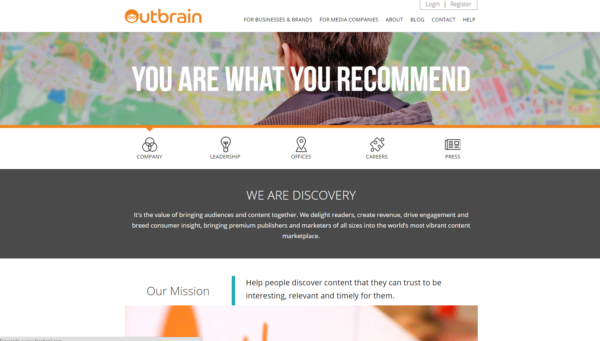
outbrain overview

Point Goes to: Outbrain

Taboola and Outbrain are very similar with regards to reach, but working with quality and premium providers will guarantee content displayed on Outbrain a positive ROI for a business. And Outbrain is the leading content suggestion technology, according to SimilarTech.

Support Options

Technical support is paramount for a content marketing platform provider. In the event of going offline or experiencing technical difficulties you want a proactive service ready to resolve the issue. The provider must have instructional video tutorials, a knowledge base (KB) and other resources to ensure your content is performing superbly.

Taboola

In the case of support for Taboola they generally respond within a reasonable time frame. The company does not offer a knowledge base, but does have a personal account manager. Furthermore, they are accessible and easy to contact for general support questions.

Taboola Support

Outbrain

In regards to Outbrain it offers frequently asked questions (FAQs), phone and online support, and video tutorials. In addition, in the first 30 days you are contacted by a support team specialist and they will provide successful tips to monetize your content. It is comprehensive support solution and good for companies to have this at their fingertips.

Outbrain Engage

Point for Support Goes to: Outbrain

As a general rule it is nice to have a dedicated support team available from multiple channels. In this case Outbrain has the advantage because they offer a personalized experience and can be reached by the preferred method of contact by their clients.

Pricing

When it comes to shopping around you want affordability and flexibility for your budget. You want to be able to target your content marketing campaigns on desktops, mobile and table audiences. You want to tailor and target your message on these major platforms and that the provider gives you the best return on investment (ROI).

Taboola

As a content marketing platform Taboola provides a cost-per-click (CPC) pricing model. When utilizing the company’s platform you have CPC for desktops set at $0.06. Mobile on the other hand is set at $0.03 including a separate tablet CPC at $0.04. A distinct advantage by providing a service on all of the major platforms.

Taboola Pricing

Outbrain

The company offers a free trial and a cost-per-click (CPC) plan like Taboola. CPC for desktop starts out at $0.05 and mobile CPC at a $0.03. Unfortunately, it does not offer a CPC service on the tablet realm.

Outbrain Pricing

Point for Pricing Goes To: Taboola

Prices are identical with the exception of the CPC desktop, which Taboola charges a penny less. But the advantage goes to Taboola by offering services for content marketers on the important platforms and gives businesses a great opportunity to pitch content to viable customers.

Best Practices with Content

When attempting to get a successful content marketing campaign underway there is a need to understand the platform and the guidelines that come with it. Taboola and Outbrain require a specific set of rule and expectations on how to go about pushing content to audiences.

Taboola

Taboola advises to tailor content to be educational and fun at the same time. Including numbers, digits and lists is a great way to engage the masses. What has been noticeable on this platform is using numbers for headlines really generates phenomenal traffic. You want to be specific yet mysterious.

Taboola Content Guidelines

Outbrain

Outbrain´s platform functions differently since negative words in headlines perform better than positive ones. Number lists are the bread and butter, so use them. And the content guidelines are strict and rigorous that you may end up getting content submitted rejected.

Outbrain Content Guidelines

Point for Content Goes To: Tie

Even though both platforms perform well with marketing content it has to be declared a tie. In the case of Outbrain they are selective and because of the requirements there is high quality of content marketing distributed. And for Taboola they work with an entirely different set of brands and it really depends on the needs of the entity.

And Winner of this side-by-side is Outbrain

Takeaways and Conclusions

With the availability and adoption of content marketing practices is definitely here to stay. It seems a farfetched concept, but most customers shopping around respond to products or services in through actionable meaningful, and engaging content.

Most brands who are looking to harness the power of content marketing have to understand the ROI on content development and marketing.

It will not just grow traffic to your site, but ultimately generate the leads or transactions needed to continually survive in today´s very competitive business environment.

29 Sep 15:28

The 5 Project Management Steps To Run Every Project Perfectly

by Ben Mulholland

project management steps - header

Project management is the key to sticking to your budget and deadline, whilst keeping the most important tasks at the forefront of your company. Without it, you leave the future of your business at the mercy of your teams and employees (which, in case you weren’t aware, is not a good business model).

For such an important process, the project management steps are a little muddy, with sources citing differing numbers of steps, timelines, etc. Then again, it’s a massive topic with a huge margin for error; how the hell do you convey these steps when the project could be anything from “get winter clothes in stock” to “grow to $220,000 monthly recurring revenue”?

project management steps - dilbert

Well, we here at Process Street hate making things complicated, so we’ve simplified the project management steps of any and every undertaking to five easy stages.

  • Conception and Initiation
  • Definition and Planning
  • Launch and Execution
  • Performance and Control
  • Project Close

Project Management Steps Diagram-Red copy

If you’re looking to structure your next big push, or you just want to set and track realistic deadlines, then this is the process for you. Then again, feel free to skip ahead to any particular step you’re after.

Project Conception and Initiation

The first of our project management steps is to settle on the idea of a project; to scratch out the concept and agree that it will be taken further than the drawing board. You’ll have an idea, do a little research to see how it would be completed, then pitch it to the relevant powers for examination and approval.

This stage will change a lot depending on the idea which is being developed. For example, if you want to implement a new feature then you’ll need to consult the head of your development team. On top of the relevant team heads, you’ll also be consulting with your shareholders in order to keep them informed of where their money is being spent.

Is it feasible, and is it valuable?

project management steps - trello The key with the conception stage is to examine your project for both its feasibility and value to the organization; an easy project will be useless if it does not benefit the company, and a useful project will just waste resources if you aren’t certain that it’s plausible in the first place.

Example

Let’s take an example project to run us through each step, in the form of creating a new ebook. You don’t want to have to run a 50 step management checklist along with the rest of your marketing processes, so we’ll keep it simple.

In the conception and initiation phase, we need to get a rough idea of how long it will take to make, how much it will cost, and the effect it will have. After that, the idea will be taken to a decision-making team (in this case the head of marketing and the CEO) to see if it’s worth pursuing. If the value is worth the perceived difficulty, it’s time to move onto definition and planning.

Project Definition and Planning

The second project management step is definition and planning. Once your project’s been given the go-ahead, it’s time to stamp out the scope, schedule, and cost of a project. This is usually done by drawing up a project plan, scope or charter, then calculating a budget, the resources needed, and a schedule.

It’s worth noting that all of these items are subject to change during the project. Orders could be delayed or problems could arise, so when drawing up these plans you need to give some leeway and predict the most likely area for delays. You should also note the flexibility of the teams working on the project, as if a delay occurs you may need to divert resources in order to hit the deadline.

Have SMART and CLEAR goals

project management steps - SMART

Two popular methods of creating goals for a project are SMART and CLEAR. SMART stands for:

  • Specific – Setting goals to cover who, what, where, when, which and why
  • Measurable – Making sure that you know how to measure the progress to and success of a goal
  • Attainable – Lay out how to achieve your most important goals
  • Realistic – Ensure that everyone is willing and able to achieve your goals
  • Timely – Making sure that you can a timeline in which you can hit your goals

Meanwhile CLEAR ensures goals are:

  • Collaborative – Check that your team is encouraged to work together
  • Limited – The scope of your goals should be limited enough to make them manageable
  • Emotional – Your employees should be able to form an emotional connection to your goals by tapping into their passions.
  • Appreciable – Large tasks need to be broken down to make them more achievable
  • Refinable – Goals need to be flexible to adapt and be refined as new situations arise

Whichever method you choose, the basic principles which need to be set out are the cost of the project, the quality of the end result, the resources which are available (or which will be diverted), and a reasonable timeline for each task to be completed.

Example

Going back to our ebook, the planning and initiation stage would involve meeting with the marketing team and stamping out a timeframe for each chapter of the book to be completed. Once the topic has been set and assessed (for the difficulty of writing), these dates will become more solid.

The person responsible for writing each chapter will be assigned, along with the task of designing and creating the ebook itself. If there is no in-house designer, we would discuss our options for outsourcing the task and price it up accordingly.

Another aspect which would need to be planned would be the launch of the ebook. For example, if the book is being used as a content upgrade, a landing page would need to be created with a reasonable flow for a user to subscribe to the email list.

Risks such as hidden topic depth or difficulty in securing a designer for the ebook would be assessed, and action plans for the more likely scenarios drawn up, such as diverting another member of the marketing team to work on a chapter.

Project Launch and Execution

The project launch and execution phase is next, and this is where things kick into overdrive. As the title would suggest, this is where work begins on the project, although one or two tasks must be completed before your team gets stuck into the meat of the topic.

First, you need to ensure that you have the deliverables of the project set in stone – you should know what needs to be completed, how it should be done, who needs to work on it, and when it has to be complete by (with some flexibility, depending on the risks you’ve identified). Once you’re sure that you have this collected and approved, the kickoff meeting will take place.

The project kickoff meeting is vital. Here is where you will meet with the teams involved and distribute the necessary resources, tasks, timeline, responsibilities, and any other important information related to the project.

Not only do you have to convey all that, but (going back to your CLEAR goals) you need to make sure that your team understands exactly what the project is and why they should both care and be enthusiastic about it. Yes, I’m aware of how corny that sounds.

Assign tasks to the employees that fit them

Put it this way; if you know that John from marketing is a whizz with data and enjoys that kind of work, consider assigning him a data-crunching task, as your goal will not only be achieved quicker (from his experience) but to a higher quality (from his passion for the work). If you were to assign him the task of researching and writing on a topic which he both knows nothing about and contains no data backing whatsoever, the end result will both take longer and be of an inferior quality.

project management steps - data

During this midpoint in our project management steps it’s also vital to set up some sort of tracking and communication system or standard. You need to be able to quantify the progress of your individual teams at any point in the project, and also regularly touch base with (at least) the team managers in order to make sure that everything is running smoothly.

Example

With our ebook, the launch and execution stage would involve figuring out what each chapter will consist of, assigning various team members (most likely marketers) to complete said chapters, giving a deadline for each chapter, and carving out a regular meeting time during which your team’s progress and problems will be relayed. Everyone should know what they are working on, why they are working on it, when it should be complete by, and what everyone else is responsible for.

Project Performance and Control

The performance and control step of project management occurs over the time from the project’s launch to its completion, and serves as a method to measure and compare the status of the project compared to the original plan. This phase can require relatively little effort on the project manager’s part, or be the most stressful section of the entire undertaking, depending on how smoothly everything runs.

Using the previously set out meeting times, you need to be regularly talking to everyone involved with the project (or at least the team managers) and ensuring that all is running smoothly. This is usually done through the use of KPIs (Key Performance Indicators); the quantifiable measure of progress I talked about above.

Use KPIs to track your project’s progress

Although the KPIs you measure will vary drastically depending on the project you’re undertaking, they will usually consist of two or more of the following four aspects.Project objectives, which are the measure of if a project is staying on schedule and on

  • Project objectives, which are the measure of if a project is staying on schedule and on budget, according to stakeholder objectives.
  • Quality deliverables, which means looking to see if tasks are being completed to the right level of quality.
  • Effort and cost tracking, meaning that you’re checking to see if you’re staying on the expected deadline and budget, and perhaps predicting the completion date based on this.
  • Project performance, which is tracking how many problems have occurred and how quickly they were dealt with.

If all goes well, and the KPIs are lining up without a hitch, the project manager will pretty much just have to keep checking in with each team periodically. If, however, a deadline is missed, or a problem arises, you may have to shift or reassign resources and schedules in order to make the most out of your new situation.

Example

For our ebook, let’s say that you’ve set out a two-month deadline for the final product, and you meet twice a week with your marketing team to check on their progress. If the chapters are getting completed in line with your expectations, there’s no need to shift around resources (unless your aims develop or change).

If problems arise, such as a chapter being more complex than originally thought or team members having to take time off for one reason or another, you may have to bring in someone who wasn’t already working on the project, or shift the responsibilities of the current workforce on the project to better suit the new situation.

Project Close

project management steps - close

The final of our project management steps is that of the project’s close. This is where, for all intents and purposes, the project has been completed and the outcome has been approved. If all is completed to a satisfactory standard, then business can either return to usual or move onto the next project.

The first major task of this section is the evaluation of the project. The ultimate goals / plan of the project need to be compared with the actual outcome and assessed as to the quality, accuracy, and speed at which it was achieved. For example, the best outcome would be a project which was completed ahead of schedule, within or below budget, to a high quality and accuracy, with few problems. Unfortunately, that truly is a dream scenario.

More likely is the situation whereby you need to assess which problems came up during the course of the project and how well they were dealt with – this includes an analysis of how and why everything that took place did so. Was your team performing so well that they beat your schedule? Were the problems which arose outside of your control or foresight? Did your team still manage to complete their work to a satisfactory standard and timeline considering the difficulties which they faced?

Evaluate and finalize the project

This all needs to coincide with terminating any contractors which were hired to help on the project, producing a final budget and project report, and collecting all of the documents associated with the product in a single place for storage / filing. Think of it as a final status report, along with cleanup after the project is complete.

Another aspect of this phase (which not all teams take advantage of) is the congratulations to those involved with the project. Depending on the size and difficulty of the project, rewarding your team for working hard with (for example) a small work event or bonus is a great way to encourage them to do their best on the next project, and to also make them feel appreciated and form a stronger connection to the company.

Example

Returning to our ebook one final time, the project closing step would be after the ebook’s public launch. One complete, the immediate benefits would be tracked (eg, increased conversion rates), any expenses on items such as the design of the ebook would be totaled, and contracts with freelancers terminated.

Not sure how to get your integrations up and running? Check out our free business process automation guide.

With the vast array of things that can go wrong with any given project, it’s about time that something was simplified. Still, what do you think about our project management steps? How does the management of your projects usually flow? I’d love to hear from you in the comments below.

29 Sep 15:25

Are You Asking Questions in the Right Order?

by PFPS

Needs assessments are shorter and more productive when sellers are asking questions in the right order.

To visualize the right sequence for questions, sellers can think of a conversation with a buyer as moving through an inverted funnel. asking questions in the right orderAt the top, questions are open-ended and very broad. They are about the business needs and the buyer’s needs (not only about the narrower needs for your product). Each follow-up question narrows the broad response and steers the conversation. As warranted, a broad question may come back into the conversation in response to an answer given by the buyer.cover for site 2015

Benefits of Asking Questions in the Right Order

By strategically crafting questions that yield responses with varied content and by using appropriate forms of questions, the seller can learn all the angles of a situation as it becomes better defined. As the seller gets to a point of fully understanding the buyer’s priority, the conversation has narrowed to the end of the funnel. At this point, it is appropriate for the seller to hone in on the buyer’s need for the seller’s products.

Follow-up questions help the buyer, too. In a hurry-up world, taking time to fully consider one’s own problems and what to do about them is something of a luxury. A buyer who is guided through this process gets value from the process alone. Quality questions make the buyer think, promote self-discovery and surface latent needs which may also need to be addressed.

Buyers appreciate sellers who can conduct a conversation leading to this type of helpful outcome. They also enjoy the conversations when sellers stay in the moment, show genuine interest, allow for a natural dialogue, sequence questions sensibly, and invite an interchange of ideas and information.

Conversely, if a seller is not asking questions in the right order, buyers shut down. They may be offended, confused or guarded if questions are poorly sequenced. As a result, the responses will be limited and may fail to provide the information a seller needs to advance the sale.

Asking questions in the right order is easy to do once you understand the value and rationale for starting broad and narrowing in later. DISCOVER Questions® Get You Connected will show you how to do this. It’s based on research with buyers and packed with practical examples you can apply right away.

Next Steps:

  • To learn more about DISCOVER Questions® and how to get connected in meaningful ways with your buyers, order your copy of this bestseller from Amazon.com
  • When you need sales or management coaching, customized sales training, or a dynamic speaker call us at 408-779-PFPS or book an appointment with Deb.
  • Check out these resources for sales managers and front line sellers. New webinars, infographics, research, podcasts and more added every month!

BlogAward

The award-winning CONNECT2Sell Blog is for professional sellers who believe, as we do, that Every Sale Starts with a Connection.

Deb Calvert, “DISCOVER Questions® Get You Connected” author and Top 50 Sales Influencer, is President of People First Productivity Solutions, a UC Berkeley instructor, and a former Sales/Training Director of a Fortune 500 media company. She speaks and writes about the Stop Selling & Start Leading movement and offers sales training, coaching and consulting as well as leadership development programs. She is certified as an executive and sales coach by the ICF and is a Certified Master of The Leadership Challenge®. Deb has worked in every sector and in 14 countries to build leadership capacity, team effectiveness and sales productivity with a “people first” approach.

The post Are You Asking Questions in the Right Order? appeared first on People First.

29 Sep 15:25

What the Arrival Of ABM Means for B2B Messaging and Content Strategies

by Andrew Gaffney

If you are one of the B2B marketers who hasn’t started down a path towards account-based marketing (ABM), you are quickly becoming part of the minority. According to new research from our sister brand Demand Gen Report, 80% of the B2B marketers surveyed either already have an ABM strategy in place, or are planning to launch one within the next 18 months.

For marketing teams within the 20% that have no ABM strategy or no plans to develop one, it may be time to start doing your homework on the sea change that is taking place from mass marketing messaging to targeted, personalized engagement.

I have talked with quite a few B2B practitioners who admit they have been caught flat-footed by the question “Are we doing ABM?” from someone in the C-suite who has read about the trend or heard about it from a peer.

The reality is implementing ABM is not a wholesale change from the demand generation programs most B2B companies have been running for several years. However, two critical nuances are the precision and intelligence required with ABM, as well as the increased coordination between marketing and sales teams.

Jon Miller, one of the co-founders of Marketo and more recently founder and CEO of account-based solution provider Engagio, describes ABM as “fishing with spears,” versus traditional demand generation, which casts wide nets.

Applying Messaging At the Account Level

If you are among the 80% of companies either implementing ABM or formulating your plan, you are facing the daunting task of customizing or personalizing messaging for individual accounts.

Most marketing teams are already stretched too thin to create the content they need to support demand generation campaigns, so the concept of customizing content for 500 or even 50 individual accounts seems impossible.

But it’s definitely possible: In terms of the messaging and content ABM practitioners are delivering to their target accounts, the Demand Gen Report survey found:

  • 75% are using targeted content tailored to specific industries
  • 51% are tailoring specific content by role
  • 49% are delivering personalized/custom content for each account
  • 30% are using templated versions of generic content with some customization
  • 8% are sending generic content for all outreach.

In a recent webinar hosted by Demand Gen Report, predictive analytics vendor Everstring shared “account-based hacks,” which have helped the company send tailored offers — without forcing them to create 1,500 E-books.

Everstring’s ABM approach is focused on 3 tiers of accounts, and with that approach Tier 1 accounts get customized versions of content, Tier 2 accounts get limited personalization, and Tier 3 accounts receive content that is tailored by industry/vertical.

The survey also showed that adoption of ABM is causing B2B marketers to rethink the offers they are using. Targeted executive events were the top resource (66%), followed by interactive content (62%) and direct mail (60%).

What do these offer types have in common? They are all high touch, trackable, easy to customize and translate well into sales conversations.

The New Playbook for B2B Marketing

Coordination with sales is another game-changing influence being ushered in with ABM. I wrote a blog recently about the concept of “Plays” emerging among early adopters of ABM.

Rather than referencing campaigns or nurtures, companies like Everstring are building “coordinated plays,” which stretch beyond inbound and outbound offers to orchestrate and coordinate holistic messaging that is communicated consistently by sales development reps and account executives.

All of these shifts encouraging marketing to be more targeted and integrated with sales will require a re-engineering for many B2B organizations. Ideally, these trends should lead to more relevant, contextual messaging that adds value to the engagement process.

The good news for those who are just starting down this path is that the rulebook hasn’t been fully written, so at this point, no one is really behind. Organizations still struggling to shift from brand-focused messaging to buyer-focused messaging can now do so with an account-based lens.

However, expectations among buyers are changing rapidly, so the status quo in messaging will no longer fly. Companies who simply feel they can batch and blast the same offers to a broad database, will not only see conversion rates on campaigns crashing, they will only be hurting their long-term brand perception.

28 Sep 22:26

Here’s why the '10,000 hour rule' might be bogus

by Kevin Loria

Novak Djokovic Australian Open Tennis

It's such an appealing concept, the idea that with about 10,000 hours of practice, you can become an expert in anything.

That idea was made famous after the 2008 publication of the book "Outliers" by Malcolm Gladwell, who based his "10,000 hour rule" on the work of psychologist Anders Ericsson.

In a new book, "Peak: Secrets from the New Science of Expertise," Ericsson and science writer Robert Pool further that concept, making the argument that what we call "gift" or "talent" is something that anyone can tap into — our brains are all plastic enough that with enough practice, anything can be mastered. Everything but our height and body size can be modified by deliberate training, they argue, especially if some of that training is done when people are young and have especially modifiable brains.

That sounds great. But there are reasons to think it's not true, write David Z. Hambrick, Fredrik Ullén, and Miriam Mosing in Scientific American. Hambrick, from the department of psychology at Michigan State University, and Ullén and Mosing, from the department of neuroscience at the Karolinska Institute, have written about Ericsson's "deliberate practice" theory several times previously, for good reason.

"No psychologist has had a greater impact on the public’s view of expertise than Ericsson," they and several others wrote in the journal Psychology of Learning and Motivation earlier in 2016.

They don't discount the importance of practice or training in the least. But for some levels of expertise, practice isn't enough.

playing piano practice music

What the evidence says

Ericsson and Pool's argument is that the key to expertise is enough "deliberate practice," which psychologist Scott Barry Kaufman defines in a post on his website as "a series of techniques designed to learn efficiently and purposefully. This involves goal setting, breaking down complex tasks into chunks, developing highly complex and sophisticated representations of possible scenarios, getting out of your comfort zone, and receiving constant feedback."

But many of the studies that "Peak" uses to support the deliberate practice theory don't necessarily hold up, according to the Scientific American critique.

For example, the introduction to the book cites a study where 24 Japanese schoolchildren are trained to acquire "perfect pitch," the ability to recognize and name a musical tone upon hearing it, as evidence that this insanely rare "talent" can be learned — that it has nothing to do with innate ability.

But the critique points out that students in this study had already been enrolled in a private music academy from a young age, meaning that their natural aptitude or interest in music was probably not the same as you'd find if you pulled a truly random sampling of schoolchildren.

And as Hambrick and others have previously argued, there's plenty of evidence that goes against the idea that deliberate practice is the only key for mastery, no talent or even genetic predisposition needed.

Chess grandmaster

A number of other reviews and studies of fields ranging from chess to tennis to swimming find that while the amount of practice clearly helps set competitors apart at certain levels, it's not the only thing that differentiates one person from another.

Studies of deliberate chess practice (chess and music frequently come up in studies of how people become experts) have found that at least one person has become a chess master with as little as 728 hours of practice, while others have taken over 16,000 hours to reach that same level. That strongly implies there's something more than hours of practice at play.

In Scientific American, the authors note that surveys have shown that something like 77% of pro baseball players have vision that allows them to see objects at 20 feet as if they were only 15 feet away, if not better. Baseball players tend to have vision far better than that of the general population, a gift that's not explained by practice alone.

Heritable traits like vision or working memory certainly play some role in "talent." Still, the Scientific American writers note that practice is important too, and say that in general, most of us may underestimate how much we could improve certain skills with enough training.

"Notwithstanding a report by North Korea’s state-run news agency that Kim Jong-il made five holes-in-one his first time playing golf and rolled a perfect 300 his first time bowling, no one is literally born an expert," Hambrick, Ullén, and Mosing write in Scientific American. But there do seem to be factors other than deliberate practice involved.

katie ledecky

The problem with the "born versus made" debate

If mastery were all about practice, it'd be easy to argue that we can "make" experts. If genetics were the only factor involved, practice would barely matter at all. Clearly, expertise comes from some combination of these factors.

But these aren't the only things that matter either. Motivation plays a strong role. Someone who is going to become an elite athlete needs more than just some physical predisposition and enough practice — they also need to eat well and get enough sleep. Recently, researchers have been fascinated by the role that psychological resilience plays for "champions" in certain sports. People need to develop the mental toughness and drive to continue to push past obstacles in their way.

Genetics and practice both play a role here, but so do things like upbringing, opportunities, and life circumstances. Some people, however raw their talent, have the odds stacked against them.

The interesting question, according Hambrick, Ullén, and Mosing, isn't whether experts are "born or made." It's how the factors beyond training and clear genetic predisposition come together in people who master a sport or skill.

SEE ALSO: Neuroscientists may have figured out exactly how working out reduces stress

Join the conversation about this story »

NOW WATCH: NASA just took these incredible images of mysterious rock formations on Mars

28 Sep 22:25

Mining truck dumps the cab and the driver who used to sit in it

by Bruce Brown

Komatsu's heavy dump truck doesn't need a driver so it can lose the cab and gain more capacity as well as improved handling and productivity. The monster robot truck doesn't need to turn around and has both four-wheel drive and four-wheel steering.

The post Mining truck dumps the cab and the driver who used to sit in it appeared first on Digital Trends.

28 Sep 22:23

These eye-tracking heat maps show what people really care about

by Business Insider

eye-tracking heatmap women looking

We never tire of looking at eye-tracking heat maps. In one glance, you can see what does or doesn't influence people and how your reactions compare to the rest of the world.

Sticky is a startup that does that kind of analysis for brands, along with the recent addition of emotional tracking. It provided the following new set of images for Business Insider readers.

Among four "Game of Thrones" actors, people like looking at Nikolaj Coster-Waldau (Jamie) most, Kit Harington (Jon) second, Richard Madden (Rob) third, Pedro Pascal (Oberyn) fourth.


Among four "Game of Thrones" actresses, people like looking at Emilia Clarke (Daenerys) most, Natalie Dormer (Margaery) second, Lena Headey (Cersei) third, and Sophie Turner (Sansa) fourth.


Baby Boomers look at ads on the side of websites. Millennials do not.


See the rest of the story at Business Insider
28 Sep 22:22

Why Innovation is Always the Answer to Faster Scaling

by Elena Prokopets

TVXS48JZ7I

You have launched. It’s exciting. Your idea for a product or service has come to fruition. The goal now is to grow. You have to market, market, market. And technology will help you do this. And you are gaining a customer base.

Now, how will you expand your customer base? What new ideas will you generate that will bring greater value propositions to customers and attract new ones? As you scale, you will need to innovate beyond your initial product/service – either with additional products/services or with lateral enhancements to the products/services you have.

No company that becomes a success does so without innovating. Accept it, and plan for it.

Here are some strategies and tips that other businesses have used in becoming innovative that will give you ideas for your own innovation efforts as you move forward.

The Beginning

When you launched, you had a clear mission. Along with that mission, you had a value proposition – the benefit and value you were going to bring to the marketplace that would attract customers. Using that value proposition, you have garnered a customer base. Now you want to expand that base and keep current customers engaged. This call for innovations.

Two Types of Innovation

There are two things that companies can do to innovate.

  • They can design new products and services that will bring new value propositions to current and potential customers.
  • They can enhance the services that they bring to the table, so that customers’ experiences are improved.

Innovation does not have to come from some R&D department. Most small businesses, in fact, will not have such a department. Innovation comes from a collaborative team that thinks “outside of the box,” that continues to generate new ideas, and that is willing to “test” those ideas in the marketplace.

Designing New Products or Services

Consider Amazon over the years. It began as a site that sold books. It opened its doors in July, 1995, and consisted of some people boxing up and shipping books out of a garage. Twenty-one years later, it is one of the largest retailers in the world, selling everything from those original books to virtually any product a consumer could want – diapers to refrigerators. And it continues to innovate with new products and services – same day delivery of fresh grocery items, experimentation with drone delivery, and so on. This is a company that will never stop innovating.

You may not be an Amazon. You may be a small business looking to scale through product innovation. The process is the same as that of Amazon. You need to tap into your team and test new ideas as they are generated. Here is an example on a smaller scale:

Case Study: Dollar Shave Club

In July, 2011, Michael Dubin and Mark Levine launched an idea – a subscription-based razor club. Customer could sign up for the subscription, pay a monthly fee, and have razors delivered right to their door like clockwork. No more running out of razors and having to use an old, dirty razor; no more having to remember to get to the store on the way home from work to pick up more razors. The value proposition? Convenience for the customer, of course! The company, through some innovative marketing (check out the video on the company’s landing page), experienced a rapid growth.

The company could have remained a subscription razor service, primarily for males, or it could decide to expand through innovation. It took the latter course. Today, Dollar Shave Club markets to female customers and has also developed a line of personal grooming products that have become hugely popular along with the razors. These are also sold on a subscription or single-purchase basis.

The point is this: you may begin with a specific value proposition – delivering razors to busy men. But, as Thomas Lawton, professor at The Open University Business School recently stated, in an interview with SME for Growth:

“The value proposition is something which comes in between in some senses in that it is only really when you go out into the market, test your product or service against the intended customers with competitor contestation happening at the same time, that you can get a real sense about what is our value propositions? Which customers are taking this up, which customers are really attracted in to us by this value proposition and how do we reconfigure that because you will need to reconfigure it. Whatever you’re thinking from day one, by day one hundred, or day three hundred, is going to be very different once you have tested it in your intended market place.”

So, Dollar Shave Club knew it had a winner with its initial value proposition. But it then began to re-think how it could expand that value proposition and gain an even larger market share. Amazon did the same thing.

Businesses that remain stagnant do not survive in the long haul. They either expand their product/service line or they enhance their customer experiences.

Innovations Based Upon Customer Experience

Many companies like to stick with the products or services they currently offer and are not interested in coming up with new products. Their innovations will occur in lateral endeavors. These are innovations that relate to customer experiences, such as the following:

  • free shipping
  • painless one-click shopping such as Amazon has set up
  • customer service innovations that allow for self-service rather than sitting on hold
  • personalized messaging/push notifications
  • free shipping on returns
  • video presentations of products so that consumers have a complete 360-degree view and see the product in use
  • Augmented and virtual realities that allow consumers to “experience” a product prior to purchase. Companies such as Looksar now make it possible for companies to showcase their products with augmented reality video imbedded into their labels.
  • Innovations that demonstrate social responsibility. Millennials and the generation that follows them are highly attuned to doing business with companies that are environmentally friendly and that commit to causes. Companies that can innovate in this realm will find new and loyal customers. Check out Toms Shoes and Headbands of Hope for examples of companies who innovate in social responsibility.

These types of innovations will continue to evolve as technology does. Companies that want to remain competitive will embrace them and provide enhanced customer experiences.

Innovations Are Social Above All

Companies must see innovation as an ongoing process that involves people – not special, genius people – but ordinary team members who see value in proposing ideas and who can “kick” those ideas around and move them into value propositions that will attract and retain customers. The universe never runs out of new ideas.

28 Sep 22:18

Five things to know about the proposed Pacific NorthWest LNG project in B.C.

by CB Staff

OTTAWA – The federal cabinet has conditionally approved the Pacific NorthWest liquefied natural gas project. Here are five things to know about the proposed development:

The Players:

Petronas, the Malaysian state-owned oil and gas giant, is leading the development. It has a 62 per cent stake in both the LNG processing facility on Lelu Island and the natural gas reserves in northeastern B.C. that would feed into it. Other partners include Sinopec with a 15 per cent stake, JAPEX and the Indian Oil Corp. with 10 per cent each, and PetroleumBRUNEI with three per cent.

The Product:

LNG is produced by cooling natural gas (consisting mostly of methane) to minus 162 degrees Celsius in order to make it a liquid. LNG takes up 1/600th of the space that it takes up in its gaseous state. The export facility would take in up to 3.2 billion cubic feet of natural gas per day and produce up to 19.2 million tonnes of LNG a year.

The Environmental Impact:

The final federal environmental report estimates that at full capacity, the LNG facility would emit the equivalent of 4.5 million tonnes of carbon dioxide annually. That’s down from an earlier estimate of 5.2 million tonnes. But the federal government has capped those emissions at 4.3 million tonnes. Upstream emissions, including the production, processing, and transmission of the natural gas, are not subject to the cap and are estimated to add the equivalent of 6.5 million to 8.7 million more tonnes of CO2 emissions.

State of the Industry:

A glut of global LNG projects have led to a drop in prices and prospects for LNG. The Shell-led LNG Canada project, which would have been built near Kitimat, B.C., was indefinitely delayed in July. AltaGas Ltd. also shelved its smaller Douglas Channel LNG project in February.

The Costs:

The entire Pacific NorthWest LNG project is estimated to cost $36 billion. That includes about $11 billion for the export terminal, $6.5 billion in pipelines, the $5.5 billion Petronas spent buying Progress Energy, and the roughly $2 billion a year the consortium would spend on drilling and production of natural gas to get the project fully operational.

The post Five things to know about the proposed Pacific NorthWest LNG project in B.C. appeared first on Canadian Business - Your Source For Business News.

28 Sep 22:17

Last call: A nostalgic list of BlackBerry devices through the ages

by Josh McConnell

BlackBerry Ltd. announced Wednesday that it will no longer be making its own hardware internally, instead opting to outsource any future devices.

We thought we would take a walk down memory lane and reminisce about BlackBerry devices from the company’s multi-decade history. Though this list is by no means exhaustive, it highlights some of the major transitions and gambles that the Waterloo-based company made.

Handout / RIM
Handout / RIMBack in the day...

Before it made phones, BlackBerry (then called RIM) made what it then called “pagers” starting in 1996. The devices were limited in nature, providing essentials such as a contact book, calendar and e-mail. Two major selling points were the two-way messaging and an early version of the famous scroll wheel.

The New York Times
The New York Times

Finally, the BlackBerry starts to take shape. Though not yet called the BlackBerry, the RIM 957 (pictured above) was released in 2000, offered a bigger screen and basic web browsing. There was still no phone capabilities and it couldn’t even handle e-mail attachments out of the box, but it had great battery life and competed directly with Palm.

Handout / Telus Mobility

The Crackberry addiction truly starts in 2003 with the Blackberry 7200 series. This followed the first official BlackBerry phone in 2002, which was essentially the RIM 957 but required a headset to make phone calls. But now with the 7200 series (pictured above), there was a colour screen, built-in microphone and speaker, plus a whopping 16MB of storage. It could also handle Java for more advanced web browsing and you could open attachments such as Microsoft Office files and PDFs. The future is now.

Handout
Handout

With the growing popularity of flip phones, RIM opted to try a “SureType” keyboard with the 7130 series line of BlackBerry in 2004 which used two keys per button instead of T9’s three. The company called it a “candy bar” format, due to its size.

CESAR RANGEL/AFP/Getty Images

In 2006, RIM decided to focus on a consumer-friendly version of its popular BlackBerry handset. The BlackBerry 8700 series offered features that the consumer market was beginning to look for in a phone that competitors such as Motorola and Palm began offering, such as a cameraphone, expandable memory and chatting software. The 8700 series had all of the other features people had come to expect in a BlackBerry, too.

MARKETWIRE PHOTO/ Research In Motion

Not the scroll wheel! Anything but the scroll wheel! In 2006, RIM introduced the BlackBerry Pearl. Inspired in part by its previous 7130 line of phones, the Pearl once again used a SureType keyboard but also brought over consumer-friendly features such as a camera or the ability to play music. It even had an HTML-capable web browser. But the big thing here was the removal of the scroll wheel, now replaced with a trackball (get it? It looks like a pearl!).

Handout
Handout

The trackball came to RIM’s QWERTY keyboard phones first in February 2007 with the BlackBerry 8800 for business users, but it was the BlackBerry Curve 8300 line (pictured above) that went on to be one of RIM’s most popular phones. Announced in May of the same year, the Curve was the consumer friendly version of their phones at the time (again, with things like a camera and multimedia capabilities), but many business people used it as well. GPS eventually came the the Curve 8300 line, as did video recording. There was even 64MB of internal memory. Nice!

Steve Makris Photo/Edmonton Journal

The next big leap didn’t happen until the BlackBerry Bold 9000 series in 2008. With a new operating system and high resolution screen, the Bold put an extra emphasis of design and began an era of premium-looking devices for the company. The back was leather, plus the keyboard looked and felt great with redesigned buttons. The device had more power than other BlackBerry devices, too. It had a 2 megapixel camera, 1 GB of internal memory (again, expandable though) and was capable of running off of faster HSDPA data networks. The web browser was an improvement, but still didn’t offer as rich of an experience as it competitors like Apple’s recently introduced iPhone.

CNW Group/Rogers Wireless Inc.

The flip phone is dead. Long live the flip phone! RIM decided there was still a flip phone market to tap into with the release of its BlackBerry Flip phone in October 2008. It once again had the trackball, but the Flip received the flashier operating system from that year’s Bold (and Curve) models plus an impressive high resolution screen. Like other “candy bar” BlackBerry phones, it offered a SureType keyboard instead of T9.

Glenn Lowson for National Post

In November 2008, RIM released the BlackBerry Storm in response to the touchscreen craze that was driven by Apple’s iPhone. Up until this point, the company’s signature was still its physical keyboard, so RIM decided to make the entire screen clickable like a giant button to provide a sense of physical feedback. However, the Storm was obviously rushed. The software was a disaster when it came to bugs and it wasn’t very intuitive. This perhaps could be a defining early stage in the company’s downward fall.

Mario Tama/Getty Image

In 2010, RIM decided to take another stab at the consumer trend toward touchscreens with the BlackBerry Torch. But this time it also included a slide out keyboard, so people could have the option to choose which one they preferred at any give time. The quality of the screen and keyboard were there, plus it had some decent hardware with a 5 megapixel camera, GPS, 480p video recording, long battery life and the company’s new trackpad that replaced the trackball. But with Apple’s App Store becoming very popular, BlackBerry’s App World was underwhelming and continued to plague the company for years to come.

Handout / RIM
Handout / RIM

But first, another flip phone! Maybe the Pearl Flip was just too ahead of its time? Also in 2010, RIM released the BlackBerry Style, but it came noticeably after the popular flip-phone trend. While RIM did manage to cram a full QWERTY keyboard into the BlackBerry Style and had a solid screen, the device also struggled with apps in what was clearly becoming an app-driven market.

Wayne Cuddington / Ottawa Citizen

After the introduction of Apple’s iPad, RIM decided it needed to get into the tablet space. Released in 2011, the Playbook looked great on paper with a brand new QNX-based operating system (something that was said to be coming in future BlackBerry phones), 1080p video, multitasking, front-facing camera, Adobe Flash, security features and more. It could even play games, if you could find them. Once again, the problem here was a lack of third-party support for apps. It wasn’t until a year later that the company added the ability to install Android applications in a second version of the operating system.

AP Photo/The Canadian Press, Frank Gunn

The BlackBerry Z10 (pictured above) was supposed to be the iPhone killer when it released in 2013. The first phone to use the QNX-based operating system called BlackBerry 10, the Z10 was a touch-screen only device with media in mind. The BlackBerry Hub in the operating system was a hit, however the App World’s emptiness was obvious compared to Apple’s iPhone and Google’s Android offerings. BlackBerry also introduced the Q10 shortly afterward, which offered a full physical keyboard and a smaller touch screen, but still struggled with app selection.

CARL COURT/AFP/Getty Images

The BlackBerry Passport turned a lot of heads when the company released the device in 2014 due to its unconventional shape. The company said the square-shaped screen was better for productivity purposes since you could see more text at once. Apps were improving in the App World, slightly, and the keyboard doubled as a trackpad. But despite a heavy marketing campaign that included some people from the business support swearing their allegiance, the Passport failed to take off — perhaps because of its odd shape and, again, the lack of third party app support.

THE CANDIAN PRESS/Graeme Roy

And so enters the BlackBerry Priv in 2015, the company’s first Android-based smartphone. It looked sleek and professional, plus felt great in the hands. Now users had nearly full access to Android’s wide catalogue of apps since the phone no longer used the BlackBerry 10 operating system. The only problem is the Priv ran the previous year’s Android operating system release, since the company took a year to fully secure the software, so the odd time you found an app that wasn’t supported. Nonetheless, it was a solid phone from a hardware perspective, but competitors had already been cutting into corporate territory for some time and the damage was done.

THE CANADIAN PRESS/Chris Young

Finally, we get the DTEK50, which was announced earlier this year as the “most secure Android smartphone.” Building off some modest success with the Priv — compared to other recent models — BlackBerry was hoping the DTEK50’s security functions would be enough to woo over the corporate and government crowds. Unlike the Priv, there was no keyboard and relied just on a touch screen. Meanwhile, it’s still unclear when (or if) BlackBerry will release its DTEK60 which, according to leaks, is supposed to have more heavy duty internal pieces and higher resolution display.

Financial Post

jomcconnell@postmedia.com
Twitter.com/JoshMcConnell

28 Sep 21:54

20 Gary Vaynerchuk Quotes That’ll Motivate You to Hustle Harder

by lye@hubspot.com (Leslie Ye)

gary-vaynerchuk-quotes.jpg

It’s the end of the month and quarter, and you know what that means: It’s quota-busting time.

The days before close of business are always stressful if you’re not at your number. And if you’re trying to qualify for above-and-beyond rewards like President’s Club, just being at your number isn’t enough -- you’ve got to exceed it.

That’s where Gary Vaynerchuk comes in. An entrepreneur and best-selling author who got his start transforming his father’s liquor store into a wine empire, Vaynerchuk is no stranger to the grind.

Gary Vaynerchuk is keynoting INBOUND 2016 and is holding a live Ask Me Anything today, September 28, at 11 a.m. EST on Twitter. Join us with the hashtag #INBOUND16!

Luckily for you, Vaynerchuk’s leveraged his considerable experience into a career teaching other salespeople and marketers how to be successful. The 20 quotes below will light a fire under you and motivate you to attack the last few days of the quarter with gusto.

1) “No matter what you do, your job is to tell your story.”

2) “Stop doing shit you hate.”

3) “Trust is on the rise because transparency is on the rise”

4) “We are in control of the one asset that we all give the most f**ks about, and that is time.”

5) “Family first. Nothing else really matters.”

6) “99% of what we deal every day in business doesn’t matter. If you religiously follow the few core business philosophies that mean the most to you, everything else will naturally fall into place.”

7) “Ideas are worthless without execution, and execution is pointless without ideas.”

8) “Cash is oxygen. You can make the greatest cup of coffee, the greatest sneaker, the greatest TV show, or the greatest work of art ever, but if you can’t sell your product you are out of business.”

9) “Success in general is a well-balanced blend of luck, DNA, confidence, and hustle.”

10) “If you fail and people laugh at you, they’re not worth your time. Ignore them.”

11) “Care immensely or die!” (Editor's note: Gary said this at his INBOUND 2012 keynote. Watch it below!)

12) “What’s the ROI of a piano? To me it’s zero. For Billy Joel and Elton John, it has been substantial.”

13) “How do you make people buy in? You don’t. I speak only to the converted, and you should do the same.”

14) “If your work is great, that becomes your reputation, and that becomes the gateway drug to bring business into your sales funnel.”

15) “Retention is the game. The game in business is not how many customers you can get, it’s how many you can keep.”

16) “The game for me is not acquisition, it’s lifetime value and the percentage of wallet I get from that person.”

17) “Provide 51% of the value in a relationship, whether it’s with an employee, a client, or a stranger.”

18) “Smart work will never replace hard work, it only supplements it.”

19) “People are your most important commodity.”

20) “Never be romantic about how you make your money.”

HubSpot CRM

28 Sep 21:53

4 Small Sales Questions That Make a Huge Impact

by marc@MarcWayshak.com (Marc Wayshak)

sales-questions-huge-impact.jpg

Talking too much about yourself: It’s a rookie mistake, but one that many salespeople fail to correct for years. Most salespeople enter a sales meeting, sit down, and immediately launch into a monologue about all the wonderful features of their company, product, or service. 

This is one of the biggest mistakes in sales. The most successful salespeople understand that prospects don’t care about them -- or even their product or service. Prospects only care about solving their greatest challenges.

So stop rambling about yourself. Instead, use these four powerful sales questions to uncover your prospect’s deepest frustrations. Get ready to truly understand what’s going on in your prospects’ world, and ultimately dominate your competition in sales:

1) “Why do you ask that?”

It’s a tiny word consisting of only three letters, but “why” packs a huge punch. During the course of every sales meeting, prospects ask questions. And when they do, you must be ready to respond with a question of your own: “Why do you ask that?”

By simply asking “why,” you’ll uncover the intent behind your prospects’ questions. Anytime a prospect asks a question about your product or service, you need to know why they care. This will help you understand what’s really going on in the prospect’s world. And then you can present a solution that truly meets the prospect’s needs.

Check out this video about the power of asking “why” in sales:

2) “What’s the biggest problem facing your organization today?”

From now on, you should commit to asking this question during every single conversation you have with a prospect. Simply put, the best way to learn about your prospect’s deepest frustration is to ask about it directly. The goal here is to uncover the customer’s “migraine” -- the one huge pain point that’s driving them crazy. Don’t waste your time on the countless little headaches that aren’t a huge priority for your prospect. Focus solely on that migraine. After all, it’s the one problem your customer wants to solve at all costs.

3) “How much is this problem costing your company?”

The goal of this question is to find out exactly how much -- in actual dollars -- your prospect’s biggest problem is costing the company in lost revenue, savings, and profit. Once your prospect puts a number on the real dollar amount their pain point is costing the company, they’ll also be ascribing value to your proposed solution. This is a powerful way to understand your prospect’s mindset, and get a sense of how much money is on the line. 

4) “How does this problem affect you personally?”

Most salespeople feel uncomfortable asking questions like this, but there’s no better way to tap into your prospect’s personal pain. If your prospect is personally affected by the problem you’re trying to solve, you need to find out.

Prospects who are personally affected by problems are more likely to commit to solving the problem -- and hiring you to help them do it. If you can get your prospects to articulate how a problem is affecting them personally, they’ll be more motivated to buy your solution, plain and simple.

Ask these four questions in your next sales meeting and you’ll not only uncover your prospect’s deepest frustrations, but you’ll also increase your value in the eyes of your prospect. These powerful questions prove that you’re totally focused on your prospects and their needs. When you ask questions that earn your prospect’s trust, uncover their biggest frustrations, and craft a solution to meet their needs, you’ll close more sales -- and bigger sales -- than ever before. 

Which of these four questions did you find most useful? Share your thoughts in the comments below. For more powerful sales questions, check out this special report on three closing questions you must ask to close the deal.

HubSpot CRM

28 Sep 21:53

Deliver Value with No Strings Attached

by Blake Bartlett

“Create value for the customer and a lot of other things will take care of themselves,” says Nick Francis, co-founder and CEO of Help Scout. The company’s aim is to make every customer support interaction more human and helpful. It’s not just what their product does, it’s how they operate as a business. It’s refreshing because it’s authentic and true.

We all want to be true. And truth is all about consistency. You can’t claim a standard and then behave in a way that is inconsistent with that standard. That is false. No one wants to be false.

This applies to everything, including building a software company. Inconsistency breeds doubt about your claims and turns users away. What if HubSpot was terrible at marketing? Would you buy their marketing software? What if New Relic’s product had lots of latency and performance issues? What if Salesforce couldn’t sell? What if Intuit failed an IRS audit? You get the point.

Help Scout is supposed to be helpful. It says so in their name. So what would you think if they had spammy advertising, pushy salespeople or a product that was frustratingly hard to use? That would be inconsistent and false.

Help Scout practices what it preaches. “Everything we do comes back to creating value before asking for anything in return,” Francis says. And he takes it one step further. “We’ve always seen revenue as a byproduct of building something awesome.” Customers first. Money later.

Help Scout is literally putting its money where its mouth is. Here’s how:

Solve a Problem that Bothers You

The consensus view is that customer support is a cost center. And costs should be minimized through automation. And when your cost cutting shows up on the P&L, your investors are happy. But what about the customers on the receiving end of this mechanized support engine?

“This is why I didn’t like the way that helpdesks worked. I felt like even the term ‘helpdesk’ was born in the enterprise with a focus on reducing costs,” Francis says. “I’m a small business entrepreneur myself, and I believe that customer support is your most important marketing investment. Great experiences are worth sharing, and that’s the core of word-of-mouth.”

This foundational point of view has huge implications for Help Scout’s product strategy. As Francis says, “If you see customer support as a business’s competitive advantage, rather than a cost to be controlled, it leads you to build a completely different product.”

Users are humans, not tickets.

Talk to People

In Help Scout’s early years, Francis personally called every single person who created an account. These weren’t sales calls, hoping that the founder’s touch would close the deal. It was user research.

“I was trying to identify and understand their pain on a very intimate level. Even saying that makes people uncomfortable,” Francis explains. “But if you can understand their challenges deeply, you can build a product that will actually help them.”

And people love helpful products. “I’m a product person, so what juices me is building something that people really love to use,” Francis says. “We still talk to a couple hundred customers every day because only they can determine whether or not the product is great.”

Many founders have studied Steve Jobs and taken his design philosophy as a personal license to fortify their myopic product ambitions. As Jobs famously said, “A lot of times, people don’t know what they want until you show it to them.” It may work when you’re a bonafide genius inventing a new category, but it’s pretty arrogant when you’re setting out to solve a known problem.

Talking to users can cure arrogance and clear up a lot of design misconceptions.

Don’t Be Greedy

Network effects are magical and all good businesses have them, right? That’s what we’re all told. And it’s true that network effects are powerful. But you can alienate users by trying to manufacture a network effect. “Many products have a front-loaded onboarding process that makes users feel exploited,” Francis says. “It seems like they just want to get at my address book.”

Other companies have an exploitative sales process. In the onboarding process, a “Customer Success” title is quickly cheapened by overeager information gathering. As Francis says, “The questions are all targeted at sizing up my business so they can try to figure out how much money the deal will be worth after the upsell.” No one wants to be on the receiving end of a “land-and-expand” crusade.

Instead of making the onboarding process all about Help Scout’s priorities, Francis says they focus on creating value for the individual user. “In the end, time to value means not being self-serving in the first fifteen minutes of engagement with the customer. It’s about their success, not your own.”

“We’re not worried about adding users. We try to show customers what’s awesome about the product first. If we focus on helping and getting users to fall in love with Help Scout, network effects will happen naturally. Make a good product first, deliver value, and the rest is kind of gravy.”

No Strings Attached

A lot of content marketing is self-serving fuel for a demand gen engine. We’ve all seen our share of CTA-laden listicles. But the heart of content marketing is long-term influence, not direct response.

“We want to help the person who is struggling with support challenges even before we have any kind of transactional interaction with them. That’s why we’re all in on content marketing,” Francis says.

A high-quality content operation is expensive and may seem frivolous to someone in love with CAC ratios. But managing solely by SaaS metrics is like trying to drive a car while staring at Google Maps. It’s not the intended use.

“We’re playing long ball. As long as our content is helpful, it’s totally fine if the person doesn’t sign up for Help Scout immediately. We’re willing to wait.”

Human and Helpful

There is a movement toward humanizing the business of software. Help Scout is doing a hell of a good job at making customer support interactions more helpful and human. Their product and behavior both embody this mission in a consistent way.

Now, you shouldn’t try to sprinkle some humanity on your company because it’s working for Help Scout. That would be missing the point. Figure out who you are as a company, and go be that kind of company in an extremely true fashion.

The post Deliver Value with No Strings Attached appeared first on OpenView Labs.

28 Sep 21:52

The Only Sales Guide You’ll Ever Need

by Dave Brock

What would happen if you locked a leading self help expert and a sales expert in a room, challenging them to write a book? No, I’m not setting you up for a line like, “How many self help gurus does it take to screw in a light bulb,” or “What do you call 100 sales thought leaders sitting at the bottom of the ocean?”

I’m actually quite serious. Think of your favorite self help expert. Perhaps Stephen Covey, Tony Robbins, Napoleon Hill, Tim Ferris, James Altucher, or anyone else. Think of some of your favorite sales thought leaders, Dale Carnegie, Jill Konrath, Linda Richardson, Miller/Heiman, Mike Weinberg, Jeb Blount or dozens of others.

Then consider the book that results from the collaboration.

It would probably be different from most other sales books you read. Most of them talk about skills in being a sales person. They may focus on certain aspects of selling, like questioning, prospecting, objection handling, closing, negotiating, selling against competition, creating/articulating value.

It would be different from most of the self help books focus. They focus on things like, what makes you tick, how to establish goals for yourself, your life. How to commit to those,the importance of mindset, what it takes to live a rich life. How to be a better person.

But a book written by a collaboration of these two different types of authors would be different. It would certainly contain a lot of self help perspectives—but from a sales person’s point of view. So it would cover things like self discipline, optimism, caring, competitiveness, resourcefulness, initiative, persistence, communication, accountability, and mindset. It would approach these important personal development areas in terms that are meaningful to being a sales professional.

But the book wouldn’t stop there, because the attributes of being a sales professional are useless unless you execute in the best way possible. So the book would continue on with how top sales professionals execute. It might cover things like, closing, prospecting, storytelling, diagnosing, negotiating, creating value, building consensus/managing change, creating competitive differentiation.

A book that results from this collaboration would integrate the aspects of being a sales professional and executing as one.

That’s just the book that Anthony Iannarino has written with The Only Sales Guide You’ll Ever Need. Anthony’s book bridges that gap, self help—all of us look to those to improve who we are, and sales skills—to produce a unique book for sales professionals.

Will it be The Only Sales Guide You’ll Ever Need? Absolutely, not! Otherwise, Anthony wouldn’t be writing a follow on, and many other sales authors wouldn’t be praising his work. Duuggghhh!

But it’s a great starting point for any new sales professional. It’s a great book for experienced sales people seeking to re-ground and refocus themselves, continuing to improve their practice as sales professionals.

28 Sep 21:52

Did You Know These Firefox Hidden Features?

by Andy Holland

animal-967657_1920

There’s far more to Mozilla Firefox than you first thought. It’s one of the most used browsers, rivalled only by Google Chrome. Despite the huge number of users, many are still in the dark as to some of the useful features. It’s a well-kept secret amongst those in the know, but we’re here to demystify these hidden options.

Stop sites auto-refreshing

It’s frustrating when certain web pages feature a refresh HTTP header which constantly refreshes. Thankfully, you can block this by going to your preferences followed by advanced settings. After clicking on the subtitle ‘Accessibility’ you’ll be given the option to check the box labelled ‘Warn me when websites try to redirect or reload the page’.

Do an in-house DNS lookup

Did you know that you can search for an IP address of a domain in Firefox? Simply type ‘about:networking’ into the URL and hit ‘Enter’. The next page will show a tab for ‘DNS Lookup’. Type the domain name into the search bar, click ‘Resolve’ and voila, you’ll be shown the IP address.

Reconfigure the backspace key

Want to avoid someone hitting the backspace key and ending up in your browser history? The backspace action can be reconfigured by entering ‘about:config’ in the URL followed by ‘browser.backspace_action’. After clicking on it, you’ll have the option to change the default browser setting value. Change to ‘1’ and the backspace will scroll up to the top of the page instead of going to browser history, while ‘2’ should stop it from giving any action at all.

Type and search

We’re all familiar with the Ctrl + F command which enables us to search for a word or phrase on a web page. For those who like to streamline, why bother with the command and enable the search as soon as you start typing? It’s possible via the ‘Accessibility’ settings on the advanced section of your preferences. Simply check the box which says ‘Search for text when I start typing’.

Navigate with cursor keys

This is especially helpful for those that have to read and digest large chunks of content online. To give greater control, the cursor can be used for in-text navigation. Once again, this feature is under ‘Accessibility’ which can be found in advanced settings. Simply check the option ‘Always use the cursor keys to navigate within pages’.

Use middle click for paste

You can use the middle button of your mouse to paste text into web pages or text fields. Type in ‘about:config’ in the URL bar followed by ‘middlemouse.past’. The default value should show ‘false’. By changing to ‘true’ you’ll now be able to make use of that often neglected middle button.

Get creative

For those who like to impart some creativity, Firefox offers the chance to change colours including text, links and backgrounds. On the preferences menu, click ‘Content’ followed by the subheading ‘Colours’ found in the ‘Fonts & Colours’ section. Now choose from a kaleidoscope of shades and tailor the browser to your liking.

28 Sep 21:13

Bridging the sales performance gap

by bob@inflexion-point.com (Bob Apollo)

Crossing_the_Chasm_Pic_Trimmed.jpgIn the majority of sales organisations, a high percentage of sales revenue is generated by the same minority of top sales performers, quarter after quarter. According to research published by the CEB in “The Challenger Sale”, this performance gap between top sales people and the rest is amplified in complex, high value sales environments.

They found that in a transactional selling environment, the performance gap between average and star performers was 59 percent - but in complex sales environments the gap was almost 200 percent - more than three times as wide. It’s clear that even a modest narrowing of this gap could drive a dramatic improvement in revenue.

The natural response from many sales leaders who are faced with this situation is to resolve to hire smarter next time, or to invest in sales training - but neither strategy seems to have a particularly good track record. When it comes to recruitment, it seems that there simply aren’t enough natural high performers to go around...

And when it comes to sales training, there’s abundant evidence - much of it from the training providers themselves - that simply putting sales people through an occasional series of training courses does little to drive sustained performance improvement.

In the post-startup, pre-corporate, growth-phase companies with whom I largely work, my observations suggest that the only lastingly effective way of bridging this sales performance gap is through a programmatic approach that engages every member of the sales team in the quest for continuous improvement.

There are two particularly important contributor groups: the first group are our current top performers; through a combination of interview and observation we need to understand what they know and do at each stage in the sales cycle, and encapsulate this learning in defined yet adaptable sales processes that serve to guide the actions of every member of the organisation.

The other critical constituency are our first-line sales managers: if they haven’t bought-in to the concepts, and if we haven’t prepared them to coach and mentor their teams, all the evidence suggests that our chances of executing a successful change programme are slim-to-none.

I’ve come to believe that the key to success lies in getting the whole sales organisation to feel a sense of collective ownership of the performance improvement programme. They need to be actively engaged in helping us establish what good currently looks like - and what great could look like if we could only get everyone pulling together.

Some find this hard to reconcile with the traditional view of the independently minded top sales performer whose overarching goal is to achieve their number and maximise their commissions, without much concern or regard for how their colleagues are doing.

But I think many sales leaders have already recognised that this is an ineffective and unsustainable model. The rate at which sales people and teams need to learn and adapt to an every more demanding customer base means that collective learning and sharing of best practices has become an essential foundation for top performance - and something that even the “lone wolves”, no matter how successful they might have been in the past, can afford to ignore.

If it is to have maximum impact, this team effort needs to embrace more than just the sales organisation: In many of today’s fastest growing companies, marketing’s role has evolved far beyond branding, demand generation and brochures to a genuine partnership with sales in which an increasing amount of their effort is directed to not just finding opportunities, but providing the sales organisations with the tools to progressively qualify and close them.

If you’re serious (and why wouldn’t you be?) about bridging the sales performance gap, I suggest you start by understanding the common characteristics of your top performers, analysing what they know and do at each stage in a successful sales campaign, and working out how to guide the remainder of your sales team to replicate these winning habits. You can then encapsulate this information in your defined sales process.

This article was originally published in the September 2016 edition of the International Journal of Sales Transformation. You can download a pdf of the article here.

ABOUT THE AUTHOR

A fellow of Association of Professional Sales, Bob Apollo is the founder of UK-based Inflexion-Point Strategy Partners. He works with the leadership teams of high-potential B2B sales organisations to systematically transform their sales performance. Follow him on Twitter at @bobapollo.

WE THINK YOU MIGHT ALSO ENJOY

A Simple Guide to Sales Process Design for the Complex Sale

28 Sep 21:13

Elite Minds: How Winners Think Differently to Create a Competitive Edge and Maximize Success

by News

Excerpt from Chapter 9 
Elite Minds: How Winners
Think Differently to Create
a Competitive Edge
and Maximize Success
 
by Dr. Stan Beecham
McGraw-Hill


The Curse of Perfection

Do what you can with what you have, where you are. —Teddy Roosevelt

Most elite athletes—from golfers to gymnasts, placekickers, and baseball pitchers—tend to be very focused, disciplined, and perfectionistic. Their belief is that the desire to be “perfect” will end up making them better. Unfortunately, this is not always true. More often than not, the desire to be perfect actually hinders performance. When we try to be perfect, we assume that success equals not making any mistakes, when in fact, success is your response to the mistake. People who tend to be perfectionists do not respond well to adversity or defeat. Their belief is “If I’m doing it correctly, there will be no struggle or failure.” As we mentioned in the previous chapter, loss and pain are the great motivators to change. Well, defeat, struggle, and embarrassment can also be added to that list because they can all lead to change as well. And remember, change always leads to improvement.

Not understanding that failure is part of the journey of success will lead to more failure—not perfection. Perhaps the best and easiest way to define success is this: Fall down 100 times, get up 101.

Accepting the Good and the Bad

We must accept that every now and then, we will have a bad day.

When I talk with elite athletes, I ask them the following question: “If you were the best athlete in the world in your event, how frequently would you have a bad day?” Surprisingly, many great athletes believe they should get to a point where they no longer have any bad days (or failures). But in reality, the best and most self-aware of those athletes report that during the course of a 30-day month, they have somewhere between 3 and 6 bad days. They understand that having a bad day is simply part of the process. The ability to accept these fluctuations in performance allows athletes to remain fully engaged in their training and keep their goals high. Likewise, the inability to make sense of your failures will ultimately cause you to become discouraged and less motivated, and your performance will decline as a result.

How you function during a good day does not define your character. It’s how you function during a bad day that is the true test. It is always beneficial for me to see an athlete I am working with have a bad day because it is the truest measure of that person’s competitive ability. Do they exacerbate the bad day by becoming even more critical of themselves or someone else? Do they feel sorry for themselves and pout? Do they make excuses and quit? In order for you to reach your potential, you must know how you respond to poor performance. This is critical information you simply cannot move forward without.

If perfect is not the goal, what is? It’s simple: Do your best. That’s it. Each and every day, make it your intention to do the very best you can with what you have that day. As I said earlier, in your daily journal, give yourself a W or an L for each day. If you did the best you could that day, you get a W. If you did not do your best, you get an L. The goal is to have six or fewer Ls in a month. And you never want to have two consecutive Ls. It’s okay to have a bad day, but you must make yourself recover quickly and get back on track. Remember: The goal is not to be perfect. It’s to do your best and recover quickly from failure.

What Is Perfection?

Perfection is a mathematical concept, not a human one. Those who actually achieve perfection, or the human equivalent of perfection, probably aren’t trying to be perfect when they actually bump into the “perfect” moment.

Gymnasts and distance runners have much in common psychologically because they both tend to be obsessive and have desires to be perfect. During one practice with a top college gymnastics team in the 1990s, I shared with the young women the story of Nadia Comaneci’s “perfect” 10.0 during the 1976 Olympics. Nadia, a member of the Romanian team, won three gold medals during the 1976 Olympics in Montreal, and she scored the first perfect 10.0. At age 14, she scored a 10.0 on her uneven bars routine. Because it was believed to be impossible to score a perfect 10.0 at that time, the scoreboard could display no score higher than a 9.9. In order to present her score, the officials had to present it as a 1.0. At first the crowd was confused, but they soon figured out that she had in fact scored a perfect 10.0. Nadia went on to score six more perfect 10.0s during her Olympic career.

Most of the gymnasts I was working with were familiar with the story, but they were either not born yet or were infants during the 1976 Olympics. In their time, perfect 10.0s were quite common in college gymnastics, and most of the women on the team had been recipients of a 10.0 at some point in their career. One of the women on the University of Georgia (UGA) team, Karen Lichey, was regarded as one of the best gymnasts in college at the time and still remains one of the best ever.

The purpose of presenting the Nadia Comaneci story was to address two concepts at once: perfection and impossible. I shared my thoughts that in the past, “perfection” had been paired with “impossible,” but now perfection (scoring a 10.0) is commonly viewed as possible in college gymnastics. “What’s the next impossible thing that will become possible?” I asked the team. We discussed how 200 was the highest possible team score and that no team had ever scored a 200. Additionally, no individual had ever scored a 40 (a perfect 10 on all four events) during a collegiate gymnastics meet. Most of the women believed that someone would eventually score a 40, and several of them had gotten close already. Later that year, Karen Lichey did the impossible and scored a perfect 40 during a meet. When she and I discussed it during our next session, she shared with me that she had come to realize that a 40 was possible and that she had the ability to pull it off. Karen also shared with me a quote by Walt Disney that our mutual friend, Kirk Smith, had given her before the meet. The Disney quote read: “It’s kind of fun to do the impossible.”

Sixteen years have passed since Karen Lichey scored the first perfect 40 in women’s college gymnastics, and at the time of this book’s publication, no one else has matched her accomplishment. Many have certainly tried, but with no luck. The best advice you could give a gymnast trying to score the next 40 would be, “Don’t try to be perfect. Just perform the routine to the best of your ability. Let the judges worry about the score.”

Many years ago, I had a client who was an artist. She was a very talented young woman who was quite a poet and a painter, but she was frustrated because she was having a block and unable to produce anything that she felt was of value.

In discussing her problem, we realized that the main thing holding her back was her belief that everything had to be perfect in order for her to do her best work. Her stars were not lining up the way she had hoped.

I asked about her belief that everything had to be perfect in order for her to sit down and write. She had assumed that a perfect outcome first required a perfect situation. I suggested that she give up on perfect and just work with what she had.

She agreed to write at a certain time each day, no matter what, to see what would happen. Here is what she brought back to our next session:

Don’t wait for an invitation, an ideal time, a perfect situation.

It’s happening all around you, about you, with or without you.

So, do the do that makes you, you.

Don’t wait for another time when you have one available . . . now.

ABOUT THE AUTHOR

Dr. Stan Beecham is a sport psychologist and leadership consultant based in Roswell, Georgia. Legendary coach Vince Dooley gave him his start as an undergraduate student at UGA, allowing him to work with Kevin Butler, the great college athlete and professional kicker for the Chicago Bears. Dooley later hired Dr. Beecham to start the Sports Psychology Program for the UGA Athletic Department. He was instrumental in helping UGA win numerous individual and team championships during his tenure.

In addition to his work with professional, Olympic, and collegiate athletes from many sports, Beecham conducts leadership development programs for corporate clients. 

28 Sep 21:11

Why Ads Don’t Matter Anymore

by Geoffrey Colon

Why Ads Don’t Matter Anymore

We have become accustomed to tuning out advertising and marketing messages because we don’t like interruptions in our habit-formed lives. And we’re skeptical of the messages ads bring us. In fact, most of us feel ads don’t bring much value to our lives, just more distraction.

There’s another reason we tune out ads. Frank Rose, author of The Art of Immersion: How the Digital Generation Is Remaking Hollywood, Madison Avenue, and the Way We Tell Stories, explained this to me in a Skype chat. Frank spent many years as a writer at Wired magazine. Many of his pieces were on the intersections of media, technology, and human behavior. There is no better person to talk to about this than Frank.

On why ads don’t matter as much anymore, Frank said, “The main reason is people are so much more media savvy than they used to be and it’s not hard to figure out that advertisers are simply trying to advertise.” Frank Rose noted how the power that technology gives to users reshapes their behavior. We can see it in our day-to-day lives. How many of you reading this book watch live television anymore? Do you own a DVR that gives you the capability to fast-forward through the ads? Do you even pay cable companies to access their content from a cable converter box, or are you a cord cutter? How many of you click on the banner ads, search ads, Facebook ads, or any other ad on your mobile device?

Rose is right: the world we live in is focused on how we personalize our experiences, which inevitably leads to rapid withdrawal from the interruptive advertising format. As he put it, If you look back at the history of marketing, which came about in the mid-century in the 1950s with the rise of mass media, people were not very sophisticated. The whole 1960s approach to marketing is obsolete. . . . People are so much more sophisticated largely because of the Internet. The Internet has called into question the whole thirty-second spot. People had to watch those because they had no choice back in the day. You only had three channels and limited options. People don’t want clutter. The whole point of marketing now is moving toward creating messages that people want to share with others.

Nevertheless, Rose said, organizations aren’t systemically ready for disruptive marketing. No matter how many articles you read about digital, social, or mobile marketing in Advertising Age, Adweek, Digiday, or some marketing blog, conventional marketing is the norm. And the data backs it up.

In a study, the market research firm eMarketer reports that most big brands still put heavy emphasis on creating thirty-and sixty- second television spots, even though there are many other options that would get more traction. According to that same study, TV ad spending is forecast to be in the $75 billion range by 2017.

According to Rose, Interruption is something people will try to avoid at all costs and it’s not effective for the advertiser. It’s a completely different scenario but for some reason many people in business haven’t acknowledged this. These are the same people who said the Internet was a fad during the dotcom era of the early 2000s and they still hold power in business. There’s that mindset that is prevalent in the residue of the marketing community. To me that is a recipe for failure, but what do you do instead?

What you do instead is exactly what Rose was trying to answer in a program he runs at Columbia University’s School of the Arts digital storytelling lab. Rose was quick to point out a trend he identified years ago:

“One thing that is interesting to me is that “storytelling” was not even on many people’s lips when I wrote my book. If you think about it, journalists are storytellers. . . . When I worked at Wired magazine I wrote about anything and everything at . . . the intersection of media and technology. I did a few pieces which led me to realize there are all sorts of people who worked in TV who went to video game companies and then went to work in web video. This cross-pollination . . . among all three of these industries is what created a whole new way we interact with others through stories.”

Rose’s program is at the cutting edge of the new norm, which isn’t storytelling, but what he has dubbed the “enchanted state.”

The New Norm: The Enchanted State

Frank Rose pointed to Brian Boyd, author of On the Origin of Stories: Evolution, Cognition, and Fiction. Boyd notes something that many in physics would admire. When the world is noisy, the way to cancel out the noise is actually through additional noise. Not noise at a higher decibel level, but noise at the same level as the original noise, only on a different wavelength. Boyd dubs this technique “the conspiratorial whisper,” and he notes, “When everyone is shouting, the way to get people’s attention is to whisper.”

Frank Rose added, “The current taste for immersion is largely a by-product of the digital age. Video games and the Internet have taught people to be active participants rather than passive observers; just looking is no longer enough. People expect to dive in, and companies as disparate as Disney, Facebook, and Burberry have been scrambling to oblige them. But although digital technology seems to encourage it, immersion can be triggered by almost any form of media, starting with books and theater. People have been immersing themselves in stories for centuries.”

This new normal has not been kind to conventional marketers. Many still trust customer journeys, rational decision-making purchase models, inbound marketing tactics (email, search, social), and noisy ads as the biggest drivers for their campaigns. David Zweig notes in his book Invisibles that this “noisy world” may originate from the current work ethic, which is rooted in using our brashness to draw attention to ourselves. “We’ve been taught that the squeaky wheel gets the grease, that to not just get ahead, but to matter, to exist even, we must make ourselves seen and heard.”

Rose, too, felt this is the wrong way to approach marketing. He mentioned the radical swing of companies that aren’t employing attention-grabbing techniques or tactics. There is a bubbling trend just beginning to make headway in marketing circles. “Some companies let their customers create or string their own stories together,” he said. “It makes people feel like they have ownership.”

To take it a step further, disruptive marketers are heading up some companies on the radical fringe that go beyond their own creative assets and intellectual property, and allow customers to piece together the stories. In this “enchanted state,” the stories may begin to even include competitors’ assets so customers can begin to create mashups or bootleg stories.

Yet much of this new paradigm seems beyond the reach of a compartmentalized marketing department conditioned to create a story that allows it to push and control brand narratives and value propositions. This new form of storytelling makes sense. It’s classically disruptive in its nature because it derives from the world of tech more than from the world of advertising.

Learn more about how to keep your brand relevant in the 21st Century in my new book Disruptive Marketing.

The Blake Project Can Help: The Strategic Brand Storytelling Workshop

Branding Strategy Insider is a service of The Blake Project: A strategic brand consultancy specializing in Brand Research, Brand Strategy, Brand Licensing and Brand Education

FREE Publications And Resources For Marketers

28 Sep 21:10

Future of Pacific NorthWest LNG uncertain amid high costs and depressed market

by CB Staff

CALGARY – The Pacific NorthWest LNG project may have secured the federal government’s blessing, but it could not have come at a more inopportune time.

The world market is awash in liquefied natural gas, a glut that has some wondering whether Malaysian energy giant Petronas and other backers are able to move ahead with the development.

“We’re just at the start of one of the largest buildups of LNG capacity in history, and we won’t see the peak of that until some point in the early 2020s,” said Alex Munton, an analyst with global energy consultancy firm Wood Mackenzie.

The project, which would include the construction of an $11-billion export terminal in northern B.C., is expected to produce about 19.2 million tonnes of LNG per year at full capacity — production the world won’t need for some time, Munton said.

“Petronas has to be confident it can find a home for that LNG and a good price for that LNG,” he said. “Right now it’s difficult to be able to say conclusively that it can do that.”

Shortly after the federal government announced its approval late Tuesday, the president of Pacific NorthWest LNG issued a statement saying it will announce its next steps after a project review over the coming months.

Since the project was proposed in 2012, LNG prices have deteriorated in the years as a wave of production came online. LNG spot prices in Japan, a key market for the commodity, were under US$6 per million British thermal units this August compared with over US$18 per mmBtu in March 2014.

Both the Canadian Energy Research Institute and CEDIGAZ Insights, an international natural gas research group, estimated last year that Canadian LNG projects need a price of over US$11 mmBtu in Japan to be profitable.

Munton said Pacific Northwest LNG is already towards the top end of development costs compared with other projects globally. He said Petronas and its partners will have to figure out if they can reduce those costs, while also adhering to the 190 conditions that come with the federal sanctioning.

Andrew Bradford, an analyst with investment firm Raymond James, said in a research note that most of the conditions have to do with standard safety, monitoring and best construction practices.

But he said some conditions requiring additional data collection and modelling on the sensitive salmon habitat around Flora Bank could provide proponents reason to abandon the project.

“While the probability of the project proceeding is definitely higher than it was prior to fed approval, if Petronas wanted an ‘out’ … this would be it,” said Bradford.

One of the conditions sets a cap on emissions to the equivalent of 0.22 tonnes of carbon dioxide (CO2e) per tonne of LNG for the first phase of the project, but that’s in line with what Pacific NorthWest LNG expects to achieve after finding additional performance improvements and efficiencies.

The second phase — adding the final third of production — would require the company to reduce emissions to 0.21 tonnes of CO2e per tonne of LNG produced, with a hard cap of 4.3 million tonnes of CO2e per year compared with the company’s latest estimate of 4.5 million tonnes of CO2e per year.

The federal environmental assessment says that reduction could come about by adding grid power to the project, something Petronas concluded was too unreliable to base the entire operation on.

Despite the LNG market challenges, Bradford said he still expects Pacific NorthWest LNG to proceed because of agreements in place to sell some of the gas.

Munton said he also doesn’t see the project disappearing, given the amount of money Petronas and others have already invested in it, though he could see it further delayed.

He said if Petronas wants to expand in world markets, they will likely need Pacific Northwest LNG.

“This is their flagship international project,” he said. “Globally, this is the biggest opportunity they have.”

Follow @ibickis on Twitter.

The post Future of Pacific NorthWest LNG uncertain amid high costs and depressed market appeared first on Canadian Business - Your Source For Business News.

28 Sep 21:09

Facebook, Amazon, Google, IBM and Microsoft come together to create historic Partnership on AI

by John Mannes
ai-competitors The world’s largest technology companies hold the keys to some of the largest databases on our planet. Much like goods and coins before it, data is becoming an important currency for the modern world. The data’s value is rooted in its applications to artificial intelligence. Whichever company owns the data, effectively owns AI. Right now that means companies like Facebook,… Read More
28 Sep 21:07

6 Eye-Catching Stats from Hubspot’s State of Inbound 2016

by Dave Sutton

With 127 pages of fascinating inbound marketing statistics, it’s easy to get lost exploring this year’s State of Inbound report. Here are a few highlights and interesting stats that caught my attention. You can download Hubspot’s State of Inbound 2016 report here.

The majority of our over 4,500 respondents are non-HubSpot customers hailing from marketing backgrounds in B2B, B2C, small, and mid-sized businesses. Half of the companies represented here generate under $1 million each year. With data collected from all corners of the map, this document represents over 132 countries. —Hubspot State of Inbound 2016

1. The Big Challenges: Proving Marketing ROI takes a backseat to Generating traffic and leads

Proving the ROI of marketing activities has been the top challenge for marketers year-after-year. In this year’s survey, Hubspot introduced a new response — Generating traffic and leads — which overtook Marketing ROI as the top challenge.

screen-shot-2016-09-27-at-1-46-36-pm

2. 2016’s Top Marketing Challenges

For all marketers surveyed, the top three challenges are generating traffic and leads, proving the ROI of marketing activities, and securing enough budget. It’s worth noting that in 2015, 22 percent of marketers identified proving marketing ROI as their top challenge.

Metrics driven challenges (amount of traffic and leads generated and proving ROI) are the big challenges facing marketers, who still lack access to tools and processes that can help them track concrete results for their campaigns.

Let’s look at the responses to the same questions about marketing challenges categorized via inbound or outbound marketing teams.* There’s an interesting shift in the data.
Companies that described themselves as outbound shops seem to have slightly more trouble with proving ROI (17% versus 16%), securing budget (23% versus 18%), and training their team (33% versus 26%) compared to their inbound marketing peers.

screen-shot-2016-09-27-at-1-25-37-pm

*It’s worth noting that 73 percent of firms surveyed were focused on inbound marketing, 23 percent focused on outbound and 3 percent were unsure.

3. Calculating ROI brings confidence to the Marketing teams

When we’re talking about proving ROI as one of the top challenges for marketing teams, it’s important to highlight the relevance of getting measurable results for a successful marketing strategy. When asked if their organization’s marketing strategy is effective, the teams that calculate ROI show more confidence in their marketing strategy. Those who don’t calculate ROI are much more mixed in their assessment.

Do you feel that your organization’s marketing strategy is effective?

screen-shot-2016-09-27-at-12-04-18-pm

4. Companies are investing in Social Selling

Social selling saw the largest jump over 2015 (28% versus 22%) when companies were asked about their top sales priorities for the next year. In fact, investing in social selling is considered a critical change for the future of sales. A full 42% of buyers said they communicate via social networks such as LinkedIn and Twitter for business purposes, and sales teams growing more than 50% were more likely than any other group to identify LinkedIn as a valuable sales connection channel.

state-of-inbound_social_trp

5. Communicate in the channels that your customers prefer

In order to create strong relationships with your customers, it’s crucial to connect with your audience in formats that they consume, through messages they seek and at each stage of their journey.

For the 2016 State of Inbound report, there was more of an emphasis on how and where customers preferred to communicate than in years past. For business communications, respondents prefer email, face-to-face, and phone. A good portion of respondents (42%) like using social media to communicate and 29% like using messaging apps like WhatsApp or WeChat.

state-of-inbound_prefer-communicate

When looking for information for business purchases, respondents confirm that their trusted sources are word-of-mouth and customer references, followed by media- and vendor-authored articles. Interestingly, Yelp, aka crowdsourced review sites, is the only source listed considered less-trustworthy than a salesperson.

purchase-decisions_state-of-inbound

6. Employer Branding creeps into 2016’s report

Since we just wrote about the importance of Employer Brand last week, I thought it was fitting to mention that this year’s survey also included ‘What people consider when looking for in a new job.’ While opportunities for growth, work/life balance and compensation – the top three options – are consistent across sales and marketing roles, we see some differences further down the list: 11% more marketers factor in culture, while sales teams consider the quality of the sales team and overall company performance.

state-of-inbound_job

Want to learn more? Check out the full State of Inbound 2016 here.

28 Sep 21:07

31 Closing Phrases to Seal a Sales Deal in 2021

by ebrudner@hubspot.com (Emma Brudner)

Heading into a closing conversation with a prospect is always a nerve-wracking experience. No matter how impressed they seemed during your demo or how enthusiastic your point of contact is, there's always a chance your deal won't pan out.

A prospect might ditch you for a competitor, postpone their decision until the following quarter, ask for a price you can't deliver, or take any other action to stop a sale in its tracks.

While closing a deal rests heavily on the quality of your offering and how well you've executed your sales process up to that point, the closing phrase you use is also a key factor. And that extends beyond the specific closing sentence or question you go with. Your tone, voice, and language throughout the process all have an impact on the prospect as well. Read on to learn the closing phrases you should (and shouldn't) use.

Free Download: 24 Sales Templates for Closing & Negotiating

1. Do your research.

You need to understand both your company's offerings and the nature of your prospect's business to find the solutions that will work best for them. So always conduct thorough research on every angle of the sale throughout the sales process.

Speak with the point of contact and other people at the company in different departments to learn more. This will give you a clearer picture of how the company works and what its objectives are.

2. Set expectations.

Set expectations early in the sales process. And ask your prospect difficult questions about factors like their budget and timeline before providing them with something they want — like a demo or trial. In doing so, you'll qualify the prospect, build a genuine rapport with them, and earn their trust.

3. Tell a story.

Believe it or not, storytelling is one of the most effective ways to make an impression on a prospect. As humans, we remember stories more than other information, but we don’t use logic to process those stories. Guess what else we rarely use logic to do? Make decisions.

As a sales rep, you have limited time to make a final impression on your prospect in the closing phase of the sales process. You’ll want to use this opportunity wisely.

Now, I’m not recommending that you tell an irrelevant story that takes the conversation on a tangent. What I do recommend is that you keep a few types of stories in your back pocket that you can tell when making your final pitch.

90% of the decisions we make are based on emotion rather than logic — so a story is a smart and ethical way to tap into those emotions.

Below are a few types of stories that you can commit to memory and tell relatively quickly.

  • Success Story

Share a story about a client who was similar to the prospect in size, industry, or pain points. Then share the benefits that the company experienced as a result of using your solution.

  • Personal Testimony

If the customer is worried about the reputation of the company, competence of the team, or availability of support if things go wrong, share a personal testimony that you or someone within the company experienced to assure the prospect that they’ll be in good hands.

  • A Quick Aside

I know I mentioned earlier that you shouldn’t go on an unrelated tangent, but occasionally when things are going well between yourself and the prospect, you can use that moment to incorporate humor, emotion, or hope into the conversation. This can be especially effective if you know the prospect is evaluating competitors and you want to stand out.

There are certain words that people remember more than others like “tank”, “door”, and “hand”. These words are hard to include in a natural conversation about sales, but it’s not a difficult task to include some of them in a story to stay at the forefront of your prospect’s mind.

4. Pitch the benefit, not the product.

Have you ever heard the phrase: “People don’t want to buy a quarter-inch drill, they want a quarter-inch hole?" When working with a prospect, the same logic is true. You want to focus on the benefits they’ll receive as a result of doing business with you. Remember, the prospect is not looking to buy what you sell, they’re trying to solve a problem that they have.

5. Handle objections.

If the buyer has any concerns about price or product fit, proactively address their concerns. Listen to them and validate their objections. Then, ask additional clarifying questions and respond thoughtfully.

6. Ask for the sale.

Once you're confident in the solution you're providing to the buyer and their company, it's time to ask for the sale. Make the buyer feel comfortable, but don't be afraid to communicate any urgency you might be feeling to move the deal forward.

7. Arrange next steps.

Gather the contact information for the person responsible for signing the contract and any additional paperwork. Then, set your new customer up for success with resources and information about how to implement their new solution.

It’s always a good idea to make a personal hand-off to the customer success representative who will take over their experience. That way, you know that they won’t fall through the cracks.

Many people consider assumptive selling to be manipulative or aggressive— and they're not totally off-base. If you're not accurate in your conviction that they'll buy, you may actually cause an on-the-fence prospect to walk away.

The key to avoiding those negative feelings is to gauge the prospect’s comfort level throughout the sales conversation. If someone isn't going to buy, the assumptive close won't get them to do a 180 — in other words, this tactic won’t suddenly work if they’re not already interested in what you’re selling.

Assumptive Selling Question Examples

Making an assumptive close can be tricky. You have to word your questions just right so they don’t come across as aggressive. You also don’t want to induce unnecessary stress on your prospect.

Here are some examples of assumptive selling questions and phrases to help you uncover hidden objections.

"When should we get started on implementation?"

Like many assumptive selling questions, this one is aggressive because the prospect will not have actually committed to implementation when the ask happens.

If their mind is already made up, they may respond with a timeframe, in which case, the sale is won. However, if they're pushed too early, they may call out the assumption, which will erode the trust you’ve built up over time.

"When should I have this delivered?"

This is aggressive in the same way as above. If it’s well-timed, you’ll get confirmation of the sale. If the prospect has additional questions, though, asking them about delivery is premature and abrasive.

"Are you going with [X tier] or [Y tier]?"

This might be one of the better assumptive selling questions you can ask— it helps gauge the commitment that they will be making. In a perfect scenario, they'll close the moment you ask. If they're not ready, you still have a concrete number for your pipeline. However, at worst, the prospect may not receive the question well if they're still vetting your product or service.

"Send me [X financial information] and I'll get the paperwork ready now."

This one is probably the worst on the list. On the off chance that they are ready to buy, they may give up their information. However, if they aren't ready to make a purchasing decision at that moment, they are now put in the uncomfortable (and irritating) position of explaining to the sales rep why they don't want to hand over sensitive information.

"Whose name should I make the invoice out to?"

It might be softer than the above, but the same situation applies.

"Do you want [upgrade] with this, too?"

In this scenario, the prospect hasn't yet committed to buying at all — let alone being upgraded.

The assumptive selling technique makes you come across as pushy and self-serving, which isn't the best impression to give when kicking off a business partnership. Instead of this strategy, try these closing phrases. We promise they're more effective (and they won't make you feel like a slimeball).

Use these non-aggressive transition questions to bring the buyer closer to the decision stage. These questions are worded to make the prospect feel comfortable transitioning to a closing conversation without eliminating the sense of urgency.

1. "Is there any reason, if we gave you the product at this price, that you wouldn't do business with our company?"

This one turns salespeople into Jedi mind trick masters. In an Inc. article, Geoffrey James pointed out that if the prospect answers "no" to this question, the rep has indirectly gotten them to agree to the contract. If the answer is "yes," however, the rep has the opportunity to address objections without bringing the deal to a halt.

2. "If we could find a way to deal with [objection], would you sign the contract on [set period in time]?"

Objections often kill deals. But in this case, handling the objection is actually a way of closing the sale. Of course, this depends on the company's ability to resolve the problem by a given date. But if a fix is possible, getting the customer to commit ahead of time is a clever way of turning a con into a pro.

3. "It seems like [product] is a good fit for [company]. What do you think?"

This question automatically makes your prospect think of all the reasons they're interested in buying. Because you end by asking for their opinion, it sounds genuine rather than self-serving. And once they say something like, "Yeah, I think it could really help us with X," you've got the perfect segue into "Great, I'll send over the proposal right now."

4. "Would you like my help?"

This is the closing line espoused by Dave Kurlan in his book Baseline Selling. It's sort of perfect: gentle and friendly without being obscure or weak. Plus, it enforces the rep's image as an advisor rather than a hard-closing salesperson.

5. "If we throw in [freebie], would that convince you to sign the contract today?"

Clearly, this closing technique isn't appropriate for every situation (it's called "selling," after all, not "giving away"). But for important or very large deals, offering an exclusive or time-sensitive add-on to sweeten the pot might be a smart move.

Price discounts could also make sense in competitive markets. However, it's up to management whether they empower reps to make discount or freebie offers on their own. Just be sure to avoid toeing the line of bribery which is illegal in most places and unethical everywhere.

6. "Taking all of your requirements and desires into consideration, I think these two products would work best for you. Would you like to go with [X] or [Y]?"

The rationale behind giving two alternatives is that the prospect will be more inclined to choose one than turn both away (a third option that's been discreetly taken off the table). The rep thus increases their chances of hearing a "yes" to something rather than a "no" to everything.

7. "I'd hate to see [negative consequence] befall your company because you didn't have the right product in place. Do you want to take the crucial step to protect your organization today?"

Fear is a powerful motivator. This closing tactic is most effective in situations where the consequences of not buying will actually harm the business, instead of simply allowing the status quo to continue. It's best to pair this line with external factors, such as new legislation or economic conditions, which prospects can't control.

8. "Why don't you give it/us a try?"

It sounds so simple, doesn't it? The disarming and unassuming quality of this question is precisely why sales expert Brian Tracy recommends it. Phrasing the decision as "giving the product a chance" instead of "making a commitment" downplays the risk and ramps up the rapport.

9. "If you sign the contract today, I can guarantee we can do [special request the buyer asked for]. How does that sound?"

Similar to the second phrase on this list, but with one important caveat. That closing question assumes that the salesperson will resolve a prospect objection before they sign the contract.

This closing technique— called a "rebound close" — promises that the rep will grant a special request after the prospect provides their John Hancock. This critical change in the closing time frame reflects the difference between a deal-killing objection (that other vendors might be able to address) and a special favor (that other vendors will likely be similarly hesitant to grant).

10. "I know you said you need to have a solution in place by [date]. Working backward from that day and factoring in implementation and training time, it looks like we'd need to have a signed contract by [date] in order to meet that deadline. Can you commit to that signing date?"

If you know the prospect has a firm deadline they need to stick to, use it to crank up the urgency. And since you're using the prospect's deadline instead of pulling one out of thin air, this type of reminder-slash-closing line actually helps the buyer instead of unduly pressuring them.

11. "Will you commit to doing business with us today?"

Ah, the old direct ask. Sometimes the simplest closing technique can be best, but other times it can come off as presumptive or pushy. A salesperson has to have a firm command of the situation and a high level of familiarity with their buyer to use this closing line successfully.

12. "Ready to move forward? I can send over the contract right now."

Everyone likes the idea of progress. If prospects associate the purchase with forward momentum, they'll be more likely to commit. This closing line also reduces the friction of buying — the contract is already ready, so all they need to do is sign.

13. "You're interested in X and Y features, right? If we get started today, you'll be up and running by [date]."

Salespeople can encourage their prospects to make a decision by reminding them the sooner they act, the sooner they'll have their new system. Mentioning specific parts of the product doesn't hurt, either — buyers will immediately start picturing how much easier their life will be with the new solution.

14. "What happens next?"

According to sales expert Mike Brooks, "Whenever your prospect begins stalling or providing any other excuse for not acting today, you simply reply with (these) three words."

It might seem crazy to put your prospect in the driver's seat like this — but something's preventing them from buying, and you need to figure it out if you want any shot of getting their business.

15. "If we implement by X date, I estimate you can start seeing ROI by March. That means we'd need to close by X date. Is that enough time for you to make a decision?"

Especially if your prospect needs to prove the value of their purchase to executives, ROI can be a great bargaining chip. If you have the ability to estimate that they'll start to see a return on investment in as little as six months, it might be enough to push them over the edge.

Just make sure you never promise ROI in a given timeframe. You want to set expectations so that they know your estimate is never a guarantee.

16. "Would this be a better fit for your team/budget next quarter? If so, I'm happy to follow up then."

You've probably been there. Your prospect really wants to push the deal through, but it's just not the right time — and it's starting to eat into your time spent on deals further along in the pipeline.

This doesn't mean you should close the book on these prospects. But it might be time to ask them honestly and kindly whether it might be better to revisit this at the beginning of their next budget cycle.

17. "I know X is a really big priority for your team next quarter. If we're able to close by X date, this solution will really be able to help you meet your goals."

When in doubt, remind them of their goals. If you're selling software that automates part of your prospect's widget manufacturing process, and you know they're approaching the holiday season — their busiest and most productive time of year — remind them that if they implement by a certain date, they'll have the help they need to close more business themselves.

Sales Closing Questions

Sales closing questions are used to seal the deal. These questions require direct answers which help sales reps better understand how a prospect is feeling about the deal. An example of a good sales closing question would be, 'It seems like [product] is a good fit for [company]. What do you think?'

Below are a few examples of sales closing questions.

1. "Unless you have any more questions or concerns, I think we're ready to get started."

You're leaving the door open for them to get more information while making it clear where you stand. If you've done your job surfacing and resolving objections throughout the sales process, the buyer will answer with something like, "No, I'm good. I think we're ready, too."

2. "Let's discuss pricing."

With this statement, you transition the conversation from general, abstract topics like ROI and product features into the actual agreement. It's not a very subtle shift, but it works.

3. "Tell me what you’re thinking."

To gauge how ready your prospect is, say this. If they're looking for the metaphorical pen to sign on the dotted line, they'll usually say so. If they're still unsure, you'll hear some hemming and hawing. This gives you the chance to figure out what's holding them back without trying to close too soon.

4. "We can take as long as you'd like, but I know [you've got another meeting at X time, this call is scheduled to wrap up in Y minutes]. With that in mind, maybe we should move to the actual agreement."

While you don't want to rush your prospect too much, reminding them of the ticking clock gives you a good reason to bring up pricing. Notice this response is framed around their schedule. If they want to continue the conversation you're currently having, you can offer to arrange another meeting.

5. "When can we begin [implementation, training, etc.]?"

This question will get the prospect thinking about the end result, even if they haven't committed to purchasing. And their answer will let you know if their timeline for a new solution has changed. If the prospect is stalling, this is one way to continue moving the deal forward by getting the prospect to think ahead.

6. "If I were to send over a contract today, would you feel confident signing?"

Really listen to their answers. If they say, "Yes, but ... " you've encountered an objection, but it's one you can now question further to understand and solve for. This question might also push them to realize they don't have any further concerns and are ready to buy.

Regardless, you'll know where you stand with your prospect once they've answered this closing question.

7. "Have I done enough to earn your business today?"

It's a simple and humbling question. Your prospect will likely try to answer with a paragraph's response, but try holding them to a "yes" or a "no" first. The answer might be, "No," but it will still allow you to dig deeper to understand what objections still exist.

8. "We've been playing phone tag for a while now. Am I right in assuming this isn't a priority for your business at the moment?"

Sometimes, they're just not that into your offer, and that's alright. Know when it's time to stop reaching out, but make sure they haven't just had a lot of their plate.

If your prospect is truly not interested, this question gives them the opportunity to get out. If they've just been a little busy but do see value in your offer, this may give them the push they need to make your conversations a priority.

Seal the Deal Confidently With These Closing Phrases and Tips

Your prospects probably won’t remember exactly what you say, but they will remember how you made them feel. That’s all the reason you need to carefully choose the words and phrases you’ll use throughout the sales process — especially when you’re reaching the final conversations to seal the deal.

The best sales reps strike a delicate balance between eliminating pressure from the sale while maintaining an air of importance and urgency. The phrases and tips outlined in this post will help you find that balance without too much trial and error. For more tips on closing and negotiating deals, download the free templates below and customize them before you close your next deal.

Editor's note: This post was originally published on August 14, 2014 and has been updated for comprehensiveness.
sales plan


28 Sep 21:07

Account Based Selling Best Practices: A Framework For SDRs

by Morgan Ingram

The role of the SDR has changed and evolved significantly. The method of dialing 100-200 calls a day is simply outdated. We avoid “spray and pray” tactics, in favor of a personalized outreach approach to our Ideal Customer Profiles (ICP). You all may have heard of Account Based Marketing, Account Based Intelligence and Account Based Everything. However, today I will be talking about Account Based Selling.

What is Account Based Selling?

Account-based selling is identifying the key accounts that you want to get in front of and communicating with key stakeholders in those accounts with the right messaging.

That means you are focused on specializing messages that resonate with key personas. This is important because a lot of people are sending marketing automation style emails.

Blasting out emails as an SDR without any research or identification about your prospect will set you up for complete failure.  

Account based selling allows you to have a more tailored message for those key personas. Now, they’re willing to agree to the meeting in which creates a smoother hand off to the Account Executive. 

Here are 3 key components of Account Based Selling and how you can start using this in your SDR role.

Identifying your Customer Profile

ideal customer profile sales hacker

First, the most crucial aspect in your account based sales process is identifying your ICP:

  • Which key stakeholders are you looking to get in front of?
  • Which accounts are you trying to get your message to?
  • What industry is the best fit for your solution?

Figuring out the answers to those questions helps with the identification process. When I first got into my SDR role, I looked at our customer list to figure out who we were targeting and what companies we were looking to get in front of.

Furthermore, I had meetings with the CEO, the CMO, and also the sales leadership team to ask them questions about the ICPs. I tried to figure out what we are targeting and how are we getting in front of them. 

That’s the first step in account based selling: understanding the buyers and what industries they are in.

Targeting the Right Stakeholders

account based selling identify key stakeholders

Once you have identified the best-fit accounts, the next step is to target the key stakeholders you want to reach.

Let’s say you’re selling enterprise marketing software. Ideally, you’d want to target B2B marketers – but more specifically demand generation managers, account based marketers, CMOs, VPs of Marketing and Directors of Digital Marketing.

You need to get in front of those people on a daily basis. How do I apply this? Its simple – when I go in front of a company, I know exactly who I’m targeting.

I’m not looking at the VP of finance; I’m not looking at the engineering team; I’m not looking at customer success. I’m looking at specific marketers. When you’re going into account-based selling, you’re looking at the overall account, not just this one person and treating them as a lead.

According to Gartner research:

In a typical firm with 100-500 employees, an average of 7 people are involved in most buying decisions.

Therefore, it’s super important to make sure you’re touching those key people that would make the decision. Don’t get caught up with just focusing on one person.

Tailoring the Right Message

target messaging sales hacker

A critical factor within the account based selling process is making sure your message is tailored to that specific account and key stakeholder.

For example, if you’re reaching out to a demand generation manager within the tech software industry, you need to understand what their pain points are. A generic message is going to get ignored because they are already receiving tons of those.

I went to Sirius Decisions this year and asked a lot of marketers how many solicitation emails they receive a day. They told me they receive between 100 to 200 emails a day.

Here’s exactly why you will fail:

  • Your message isn’t tailored to what they need. 
  • If you didn’t properly align your value prop to their exact pain points.
  • You have no clue what their KPIs are.

If you can’t get in front of the key stakeholders, then you’re not going to get the meeting. So really think about the message you’re creating.

How to Personalize Your Messaging

Go stalk their LinkedIn and their Twitter. What are they talking about? Maybe they have a favorite show that they watch, and you can relate to that in your call or email.

Perhaps you see something on Owler and you say, “Hey, congratulations on this award or accomplishment.”

Maybe someone just got nominated for something. There are a lot of things you can do that take just 5 minutes of research. You’ve got to tailor that message so that you can get that demo.

If you don’t, you’re going to see a lot less success because you’re going to be blasting out emails. When I first started as an SDR, I was not doing as much research as I should have.

Now I’ve actually taken a very specific approach to personalize my message so that people see that I took time to care about their business and see them as an individual.

Because as the great Theodore Roosevelt said:

“Nobody cares how much you know, until they know how much you care.”

So, those are three elements that are crucial for an effective account based sales process.

Account based selling is critical for SDR’s because there’s more automation, blasting and lack of personalization than ever before.


Don’t be lazy. Get to know your prospects’ business. Show them you give a shit.
Click To Tweet


KEEP DIALING!

The post Account Based Selling Best Practices: A Framework For SDRs appeared first on Sales Hacker.

28 Sep 21:06

How To Reach New Customers and Generate Profits Using Po.St

by Nashaat Quadri

As a digital marketing professional, your biggest challenge can be getting the desired results in terms of ROI and conversion. Sometimes, your returns can be completely disproportionate to your ad spend.

So, what would you do in such a situation?

Let’s consider all the factors that make a marketing campaign successful.

More Social Media Activity

Social sharing is an integral element of digital marketing. As a matter of fact, everybody uses one or the other social channel based on their interests and needs. Social channels are constantly making it easier for you to reach your target audiences according to demographic, geographic and psychographic details. Google has started prioritizing social sharing as a ranking signal, so if you are still missing out on it, it can be a huge disadvantage.

Now the big question is — how to use social sharing effectively to boost traffic and conversion?

Doing social media analytics and promotion manually is a redundant activity as it involves the risk of missing out on important information and trends.

That’s the reason digital marketers use different social sharing tools. These tools make life easy for you in terms of scheduling posts, performing analytics and monitoring conversations.

Sometimes, you can’t remember important conversations such as a prospect’s interest in buying your products or maybe some other useful metric. You can easily convert such leads if you maintain a proper record of conversations taking place on your social channel.

Social media tools used by the businesses

People use different social media tools such as Buffer, HootSuite, SocialMention, Klout, Tweetdeck, FollowerWonk, Radian6, Mention, Topsy, Viralheat, and CoSchedule etc. Today, we will discuss the features of a popular and useful but lesser known tool “Po.st”.

Increase traffic with Po.st

Po.st is one of the most advanced social sharing platforms, that provides proprietary sharing tools both to the publisher and the brand. A well-known chocolate brand Ghirardelli Chocolate received 12 times more traffic from social media using Po.st. This success story can inspire all of us. But, how can we get similar results using Po.st?

Important features of Po.st

Let’s discuss some features of Po.st.

Po.st’s plugin is compatible with all social media platforms such as Facebook, Twitter, Google+, LinkedIn, WordPress, StumbleUpon, Yahoo, and Digg, etc. It has inbuilt tools that help you to get insights of visitor activities on social channels. Be it ‘likes’ on Facebook & Pinterest or ‘shares’ on LinkedIn & Google+, Po.st can easily provide proprietary real-time social sharing data; except the details of resharing.

It has two major tools:

  • URL shortener tool
  • Sharing tool

URL shortener tool

You must have used various URL shorteners to include your link; but how will you differentiate Po.st from others?

URL shorteners became a necessity when the popularity of Twitter suddenly skyrocketed. Twitter has a limit of 140 characters for its each tweet. You cannot restrict yourself while conveying your message, but you can limit your link characters to 20, with the help of a URL shortener. This will help you to “free” more space to express your textual and visual content. The prime objective of using this tool is to make your links more manageable and easy to share. This facility is provided by all link shortener tools like bit.ly, goo.gl and TinyURL, etc.

What else does Po.st offer you apart from a URL shortener?

Besides the URL shortener, there is an additional feature embedded in the Po.st URL shortener tool and that is known as the ‘engagement analytics’ of the visitors.

Precision targeting

‘Engagement analytics’ simplifies the process of identifying the exact URL and the right channel that are actively directing traffic to your website. This report helps you to understand real-time engagement of visitors by tracking their paths.

The audience insights are necessary to differentiate between productive and unproductive social channels. You can identify and focus on the right channels and invest more on those few channels that are most productive for your brand. This way you will be able to reset your targets in social media paid advertising. You can now run a focused campaign targeted at a specific segment of visitors that come from these channels.

As per the data collected from various Po.st campaigns using URL shortener tool, it has been found that Po.st:

  • is good for engagement on social media and generating higher ROI from Facebook and other social media channels.
  • is effective in decreasing cost per order (CPO)
  • helps to lower down the ratio of conversion to ad-spend
  • can minimize the cost per acquisition (CPA) within a short period of time

    Note: You can use selective targeting on Facebook to improve your campaign results.

How to utilize Po.st sharing tool to maximize your profits?
You can use Po.st in the following ways:

  • First, select the right social media channel, which is suitable for your brand, using Po.st. Do not forget to include dark social tracking.
  • While sharing, the tool will copy JavaScript from the original place and will paste the code along with an affiliate link mentioning “read more”. This will entice the visitors to access complete information related to the topic and they will be directed to the source website.“Copy and Paste” tool is the popular name of Po.st’s sharing tool. While copying, the tool enables the share text feature to highlight a portion of the article and then copy its coding.
  • You will be provided with a single dashboard, where you can get a bird’s eye view of the entire social activity on your website. This will help you to analyze the activity of each and every visitor, who is coming to your site through social media. It monitors social activities on Facebook, Twitter, LinkedIn, Pinterest and others, so that we can track user engagement on these platforms.

Conclusion

If both Po.st sharing tool and Po.st URL shortener tool are used properly, it can increase your sales figure, profit & ROI, decrease the CPO and lower the ratio of conversion to ad spend. Such tools can actually change your campaigns for better results.

28 Sep 21:06

2 Classic Ways Your Analytics Are Lying to You

by Brad Smith

lies your analytics tell you

You have potential

Analytics are supposed to be insightful. They’re supposed to provide helpful hints and clues to what’s working well (and how to continue doing it).

They’re not supposed to induce an aneurysm every time you’re asked for monthly numbers.

For example, take a quick look at the sources sending you traffic. Chances are, the biggest slice is from search engines (both paid and organic traffic). Cool – you can dive deep into the pages receiving the most visits and start reverse-engineering ways to improve.

Another slice includes your referring websites. Great – now you can figure out why they’re referring you and come up with ideas to have them refer you more or identify new sites to do the same.

So far so good. Two (relatively) transparent, easy-to-understand channels that are inspiring new tactics.

Then there’s direct – the other 20-40% of your traffic. And that’s where all of your problems begin.

Analytics Lie #1. Channel Problems

Direct traffic is simply all the people typing your website URL into the browser…right?

direct traffic problems

Unfortunately, it’s not that simple.

Direct traffic is more like your junk drawer at home. Sure, there’s probably some important stuff that belongs in there. But more often than not, most of that stuff should be organized somewhere else.

analytics junk

Big junk drawer

For example, let’s say you send out a tweet or new email campaign with a link. That content is going to be viewed in a variety of ways, in a variety of applications.

Desktop clients can be especially problematic, often removing most of the important info your analytics packages need to track where that visit came from. So visits from Tweetdeck (is that a thing still?) and Outlook will be thrown under Direct (instead of the more appropriate Social or Email).

The second problem is the vast migration to HTTPS. Secure search is a good thing, adding an additional security layer like encryption and attempting to enforce more privacy in what goes on. However, it commonly causes many of the same issues, where referring data gets lost (or stripped) and your Direct traffic gets overstated, while Social and Email get understated (making you think those channels didn’t perform as well as they should have).

Don’t just take my word for it here.

Groupon did an experiment to discover how much of their traffic was being incorrectly labeled as Direct.

So they started where most rational people would – by completely de-indexing their website from Google for a day. (JK – never do this unless working with a professional.)

To be fair, they didn’t include pages that are commonly reached through direct traffic like their homepage or top-level pages like Groupon Getaways (because those do actually get a fair amount of people typing them in).

Instead, they focused specifically on the long-tail stuff that nobody (in their right mind) would ever remember and type in (think: Restaurants in San Francisco on Groupon).

Here’s a snapshot of the hours 13:00-16:00 (which I literally have to count on my fingers what time is it because I’m an ignorant American), showing that “SEO” traffic drops to almost zero while “Direct” traffic actually falls 60%.

direct traffic is really organic

The TL;DR findings?

“Our testing shows that, for a site getting in the ballpark of 50% mobile web traffic, 60% of the traffic to long URLs reported as Direct is probably Organic traffic from Google.”

How to Fix It

Soooooo…now what?

You’re probably already familiar with UTM codes. Google URL builder, blah blah blah. I’ll save you another lecture. But just knowing about them isn’t enough, you need to consistently execute on them.

There’s this concept I like to steal borrow from Oli at Unbounce loosely called inbound traffic segmentation. The idea is to create unique paths for all major traffic channels to get a better handle of which channels are driving or generating what.

Here’s a pretty picture they created that probably makes more sense.

segmenting traffic sources

So you might take one landing page, create multiple versions of it for each channel (making sure to of course deindex or nofollow those duplicate ones), and help you pinpoint the good from the bad.

To get everyone on the same page, I like using a simple collaborative Google Doc, outlining all the landing pages, their traffic source or channel, the UTM tracking and who’s gonna own it.

traffic segmentation for analytics

This is incredibly time consuming. It’s borderline overkill. But it gives you a foundation or starting point to tracking true campaign or channel performance for not just leads, but also buyers, subscribers and clients (as we’ll dive into later).

The next step is to set-up your various content pieces, ads or CTA’s that are going to drive traffic to these new landing pages.

If you sit down and create a lot of this stuff at one time, you can save yourselves a lot of time and hassle later, because everything will be strategically aligned and tracked properly.

More spreadsheet time.

segmenting traffic channels in analytics

You can identify the specific action or objective for each individual piece of content posted to a social network, as well as pre-identify the tracking token you want connected to each.

You’re not reading a frilly, silly social blog though. This is a paid one, damnit. So here’s an example of a similar approach.

analytics adwords

Again – you’ve got the ad, the destination URL, and the tracking token. All pre-planned and ready for whomever is going to edit and push to each platform.

These (lengthy, time-consuming) steps help a lot.

Unfortunately, they just scratch the surface of solving your analytics problems though.

Because while you can now gain better insight into what marketing activities are doing for each channel, being able to properly attribute goals and conversions is another nightmare.

Analytics Lie #2. Attribution Problems

Google Analytics (and most basic analytics platforms) will tell you which channel people converted from.

Last.

That means, you’ll commonly see things like Organic or Paid as your top driver of conversions. Makes sense. People use intent in these channels, typing in exactly what they want to see. So they get the lion’s share of conversions.

But here’s the problem with that picture:

multi-path attribution

People need multiple touch points, and commonly interact with multiple channels, prior to eventually converting.

So while their branded search campaigns might have eventually resulted in a successful goal completion, it wouldn’t have happened with that Display ad, the Retargeting one, the Generic Paid Search and the Email campaign.

Unfortunately, getting a PhD might be easier than successfully, accurately setting up full funnel attribution.

Exhibit A: this excellent blog post on multi-channel attribution by Avanish. If you can decipher that without popping a few Nuvigil (Limitless) pills, have at it!

For the rest of us mere mortals, what to do about it?

How to Fix It

First, understand that just because you’re not quantifiably tracking something doesn’t mean it’s not there.

McKinsey has shown how one (undoubtedly large) telecommunications company resigned to making a few assumptions when approaching a new social endeavor:

  1. The new social campaign should lead to increased positive mentions and interactions online.
  2. Search performance should increase as a result from this additional brand awareness and social shares.
  3. If these two happen, we should be able to indirectly see sales increase as a result.
  4. And then we should be able to compare those correlated numbers with our spend on other ad or promotional channels.

The result?

“The company concluded that social-media activity not only boosted sales but also had higher ROI than traditional marketing did. Thus, while the company took a risk by shifting emphasis toward social-media efforts before it had data confirming that this was the correct course, the bet paid off.”

Hey – it’s not ideal. But it works.

If you’d like a (slightly more accurate) alternative, try lead scoring.

Assuming you have a fully-featured CRM, marketing or sales automation platform in place, you can set up a (slightly arbitrary) point system based on what visitors and potential leads are doing on your site.

For example:

  • If the contact has 1-5 pageviews, give them 5 points
  • If the contact has 6-10 pageviews, give them 10.

Here’s what that looks like:

lead scoring for analytics attribution

You obviously can (and should) get this more sophisticated, tracking specific pageviews (like a case study or pricing page) as well as interactions in 2+ channels (like social and email).

Add it all up, and you’ll eventually get something that looks like:

attribution insights

That’s probably hard to read. But that’s also kinda the point. It’s a single contact’s journey, including all interactions with your website and communication channels.

This one contact has visited our site over the course of several months, using different channels to get there each time.

Having full visibility into your marketing performance like this ain’t cheap, but it does get you a little closer to closing any remaining analytics gaps that remain.

Conclusion

Reporting, in and of itself, is useless. What matters, are the insights, findings and recommendations drawn from those reports.

Literally, the only reason to ever open Google Analytics is so you can learn how to make better decisions when it comes to tweaking your ads, or adjusting your spend.

(Or, if you’re having trouble sleeping one night.)

The problem is that almost all analytics programs (unintentionally) lie. They’re unable to parse the correct channel or fail to give you the complete picture of where a lead came from.

It’s not perfect. It can be time-consuming and frustrating.

But it’s a start.

28 Sep 21:05

How to Create Your First Lead Magnet Campaign (Part 2)

by Brad Smith

The first step to generating new leads is to create a lead magnet.

It’s the bait or lure that’s so interesting, so awesome, and so unique that people can’t help but want it.

Once you’ve hit Publish, it’s easy to assume the hard work is done.

It’s not. You still need to drive consistent traffic.

Getting people to your site in a confident and repeatable way, on a daily basis, can be excruciatingly difficult at first.

Fortunately, there’s one tried-and-true method to create a scalable formula that grows your business (without you personally having to do every last thing).

How to Find Leads for Your Magnet

If you were advertising to generate customers immediately, AdWords is a safe bet.

It’s intent-based, meaning people type in exactly what they’re looking for when comparing alternatives (like, “best car rental companies”).

However, it can also get expensive, as many competitors are going after the same small pool of potential customers.

Advertising to generate immediate sales is a tall order if your product or services are complex and pricey.

That’s where a lead magnet comes into play, helping you nurture a lead until they’re ready to buy. The good news is that you can use less expensive forms of advertising, that are just as effective, like Facebook ad campaigns to promote your new content piece (without killing your budget).

So here’s where to get started.

First, start by using interest-targeting based on whatever topic or problem your lead magnet solves.

Use criteria like location, genders, ages, and devices to whittle down interest groups to a 1-2 million audience size. Also, try targeting groups of people who like similar brands or media publications; which are typically like-minded people who’d find your offer valuable.

codelesstargeting

As you can tell, audience targeting is fairly broad at this stage in the game. But the goal is to keep an eye on your Cost per Conversions, while continually testing small changes to see which trends are working and should be improved (and which aren’t that need their budgets slashed).

The second group to target are those who might be already visiting your website (or have recently in the past 30-60 days). These people should already be brand-aware, remembering who you are when they see an ad come across their news feed. (The Facebook Pixel Chrome Extension can help you troubleshoot setting this up.)

fbpixel

The additional benefit with this second group is that there’s no sophisticated audience testing required! If they’ve already been interacting with your brand in the past, they should be a higher quality.

You should use this second group to continually test and alter variations of your ad.

The 3 Step Facebook Ad Formula

Throwing a few words together for a simple text-based AdWords ad is easy.

Whereas coming up with the perfect image, a clever headline and an enticing description for a Facebook ad can seem daunting. The best approach is to simply study the best, like this one from Digital Marketer.

Digital_Marketer

Here’s the formula to follow:

1. Headline: Keep your headline punchy and short. One study found the ideal length to be only five words or less!

Struggling to come up with the perfect headline? Don’t sweat it. Instead, steal borrow directly from your customers.

For example, social maven Laura Roeder used a testimonial-headline from an email subscriber that resulted in a 24.31% conversion rate increase (“Yours is the only newsletter I actually read”).

2. Description: The description is the supporting copy that helps set the context and motivates people to click. Verbs and action words are critical here. Also try to be as specific and relevant as possible (which can give you a 213% increase over more generic, vague copy).

codelessfbad

3. Image: The ‘hero image’ got its name by making the viewer the start of the show, helping them imagine what it would be like to experience that.

If possible, try to always use real photos instead of stock ones because people can immediately sense the different (resulting in a 35% conversion increase in another study).

The next best approach is to use visuals that show people exactly what they’re going to get (in a tangible, concrete form — like the Digital Marketer illustration).

Images are probably the most important factor to get right (and test) in a Facebook ad because it only takes us 13 milliseconds to process them.

The good news is that the beautifully designed ads don’t always perform the best. For example, guess which of these two ads converted better:

Exhibit A?

image03

Or Exhibit B?

image08

Surprisingly, the second one which was put together by a marketer (not a designer) ended up outperforming the ‘professional’ one (even though it’s obviously less artistic).

Simple tools like Canva can help you create ad images like this within minutes for a few bucks, as opposed to the lengthy (and expensive) process it takes to work with a designer in some cases.

Conclusion

The best lead magnet in the world is useless without a steady stream of qualified traffic seeing it on a daily basis.

Facebook advertising provides one of the most effective and consistent ways to target people who’ve shown interest in what your offer solves, and those who’ve already visited your website in the recent past.

While it can be daunting at first, the best Facebook ads tend to follow a set pattern or formula. So don’t reinvent the wheel! Simply pick up on how some of the best advertisers are using each component and adapt it for your use.

The best news is that you also don’t have to rely on professional designers to craft a pixel-perfect image. Instead, spend your time iterating a bunch of different designs so that you can quickly identify the winners from the losers.

It’s not always a linear or straightforward process. But with enough work and attention to detail, it’s not an impossible one either.

Author’s Note: This is part two to a two part series on How to Create Your First Lead Magnet. You can read part one of the series here.

28 Sep 21:05

How To Find High-Quality Sales Leads On LinkedIn

by Viveka von Rosen

Advice From Friends

You may have noticed that I added some new features to my blog. I am having more guest posts and more roundups where I ask my sales expert friends to help me bring you the best advice. I recently asked my friend Viveka Von Rosen for some advice on how to use LinkedIn to exceed your goals. So many are arguing about whether cold calling is dead or not – who cares! Let’s go out and get as many quality leads as we can and let’s do it the easiest way. I hate it when people think sales is hard because they are not having success with the method they are using. Viveka shares some great advice on how to use LinkedIn to properly get great results.

Convert

To exceed your sales goals, you need to convert the necessary number of potential leads into sales. And to increase your conversion rate, you need to connect with and sell to quality prospects.

If you need 10 sales, and your conversion rate is 10 percent, you have two options. Either you need to get in front of 100 people or increase your conversion rate. That’s just math. You could try to get more conversations by making more cold calls. But, let’s be honest, cold calls are the worst (I know, some of you love them but you are the 1%).

A better (and more enjoyable) tactic, is to increase your conversations and conversions at the same time using LinkedIn. If you know you need to speak with 100 people to reach your sales goal, begin by connecting to the right, high-quality leads on LinkedIn.

vivHere’s a six-step strategy for success:

  1. Find the right prospects through the Advanced Search
  2. Record new opportunities using Nimble or Dux-Soup
  3. Invite leads to connect
  4. Organize your new connections with tagging
  5. Create a Top of Mind campaign with updates, views, and messages
  6. Go for the call or meeting

Increase Your KTL Factor


To reach your goals, you need to increase your KLT factor: know, like and trust.” @LinkedInExpert
Click To Tweet


You can build your KLT factor by strategically searching for, connecting and engaging with your prospects on LinkedIn. Be sure to take action to stay on their radar by being a resource — not “a sales guy.” As Bob Burg says, all things being equal, people do business with people they know, like and trust.

Warm up Connections

Consistent and considerate engagement will warm up a connection – making it much easier for you to land a meeting with them. In fact, your prospects might reach out to you, and your call might simply entail closing the deal.

Great advice, Viveka! Thank you for sharing that.

Frightened that you won’t hit your 4th quarter goals, here are 5 more ideas and give me a call, so I can give you a few more.

Custom ideas to hit your 4th quarter goals – just hit schedule with Alice.

The post How To Find High-Quality Sales Leads On LinkedIn appeared first on Alice Heiman, LLC.

28 Sep 21:05

Marketing Tips That You Should Know From 9 Growth Hacking Experts

by Shana Haynie

Have you heard about Growth Hacking Secrets for 2017 yet?

If you haven’t, you should probably listen up.

What is Growth Hacking Secrets for 2017?

Growth Hacking Secrets for 2017 is the virtual brainchild of growth guru Neil Patel and has a pretty sweet line-up of big name marketers whose core competencies span from the very beginnings of user acquisition, all the way down to the very depths of customer retention.

If growth is your thing, you won’t want to miss any of these action-packed presentations.

And the best part? It’s free to register so long as you share the awesomeness with your network.

Neil is basically promising that you will walk away from this virtual summit with a brand new bag of tricks that you’ve never even thought of before. These are actual marketing secrets that haven’t had time to circulate and be beaten death (much like everything else out there at this point), and this is your opportunity to hear them all first and start using them before they infiltrate into the system and become the norm.

Now that you’re getting excited… (as well you should be), I’m going to kick it up a notch!

Each of these presenters has had the chance to drop some serious knowledge bombs on the marketing world, thus shifting and changing the way that we all approach growth as business owners and marketers. Even though I don’t know what secrets they’re going to spill, I have had the opportunity to learn a lot from each and every marketer speaking at this event.

And while secrets are great – especially when you’re in on them – the tried and true tactics and innovations are what have made these individuals into the powerhouse industry leaders that they are today.

Here is a collection of some of the greatest tips and tricks from a couple of the Growth Hacking Secrets for 2017 Virtual Summit speakers… in case you needed any more convincing for why you should mark your calendar, clear your schedule and save your spot at the biggest virtual growth event that has ever taken place…

Let’s dive in.

Marketing Tips from 9 of the “Growth Hacking Secrets” Speakers

hannah-abaza

Hana Abaza:
Speaking about “Top 5 Growth Tactics for Content Marketing in 2017”

Despite all of the press, content marketing is still an extremely hot topic in the world of marketing. And Hana Abaza, VP of Marketing at Uberflip, is no stranger to the subject.

“Content is the now the foundation of almost everything we do from lead gen to sales to customer marketing.”

Like for many companies, content has become a staple of Uberflip’s business success. It is built into the very threads that make up how the company interacts with their customers.

Understanding exactly who you are talking to and having a framework in place to track and measure the success of your content is extremely important for cracking the content marketing code.

Hana’s experience with empowering a team to focus on the customer’s experience from a content standpoint gives her an unmatched industry edge.

There’s definitely still a lot to learn, and she’s the best to teach it.

Peep Laja

Peep Laja:
Speaking on “How to Triple Your Conversion Rates With A/B Testing in 180 Days”

If you’ve ever google searched anything having to do with conversion rate optimization, it’s likely that you’ve come across Peep Laja’s advanced optimization website and blog ConversionXL.

Can I just tell you that ConversionXL Live had some of the best copy for a conference…not even just for a conference…

The best copy for anything that I’ve ever read. Seriously!

I was eating it up like a hungry black mamba eats an unlucky Pokemon Go obsessed 5th grader attempting to catch ’em all…

pokemon-go-meme

Gotta catch ’em all?

Anyway, Peep’s ingenuity in understanding the user’s journey has given him the ability to spot leaks in a funnel from a mile away. He is a brute force when it comes to CRO and has given me many insights into understanding the basics of on-site website optimization and when, where, and how to begin A/B testing.

“Every ‘mistake’ a user makes is not because they’re stupid, but because your website sucks.”

A wake-up call to all businesses, whether startup or enterprise: it’s not them, it’s you.

Taking the time to really experience your website or landing page from the perspective of the end user is a tried and true tactic for understanding where optimizations can occur. Knowing how to plug the holes in your funnel through identification and testing is paramount to accelerating growth.

That’s why you won’t want to miss Peep Laja share his secrets for how to 3x conversions in half a year or less.

Nir Eyal

Nir Eyal:
Speaking on “Growth Hacks For Getting Viewers Hooked: How to Build Habit-Forming Products”

Nir Eyal’s Hooked was probably the most influential book that I’ve had the pleasure of reading recently. I find myself referring to it over… and over… and over again.

One of the biggest problems that I run into with startup founders and business owners is that they haven’t even considered how they are going to “hook” their users.

You can come up with a fancy platform and do all of the market research, but if your product doesn’t compel people to use it, why would they?

Why should they?

“Companies who form strong user habits enjoy several benefits to their bottom line.”

It’s the process of developing products that people love to use. Who wouldn’t want to understand the mysteries behind highly addictive products?

If you are developing a product, you NEED to hear Nir speak.

Aaron Agius

Aaron Agius:
Speaking on “How to Create Content that is Virtually Guaranteed to Drive Huge Traffic to Your Site”

Aaron Agius is the quintessential entrepreneur who made his dream a reality. After quitting his day job and jumping head first into digital marketing, he’s now worked with some the world’s largest and most recognized brands.

One of the first things I remember reading from Aaron was an outstanding article about how to measure your Content Marketing ROI.

Like any smart marketer, Aaron stresses the importance of knowing your numbers, specifically when it comes to content. And, he’s a master at teaching others how to come up with great content ideas.

“Create content that answers questions and solves problems”

That’s the best content marketing advice out there today.

Period.

I’ve heard a number of great marketers share this tip and that’s because it’s true. Getting started with a content strategy can be a daunting task, but if you listen to Aaron and start by answering questions and solving problems, you’re golden.

What is your customer’s “bleeding from the neck” problem? What are their burning questions? Start with a strategy that addresses these issues and you’re on the right track.

But that’s not all Aaron has up his sleeve, you gotta stick around for the summit to hear it first-hand.

Justin Mares

Justin Mares:
Speaking on “How to Achieve 10x Growth By Acquiring Smaller Companies”

As a co-author of the startup bible “Traction,” Justin Mares has made a huge name for himself.

His concept of testing multiple traction channels and doubling down on what works while eliminating what doesn’t has had an enormous impact on the startup and growth world:

“Get one channel working that your competitors dismiss, and you can grow rapidly while they languish.”

While he may have already gone into detail in his book about the key components for getting traction, at Growth Hacking Secrets for 2017, he will uncover the 1 secret channel that he didn’t discuss in the book…

Patrick Vlaskovits

Patrick Vlaskovits:
“Start Making Unforgettable Content Now: How Naming the Unnamed Makes Your Content Unforgettable”

Patrick Vlaskovits is a best-selling author and entrepreneur who truly understands the process and value of creating great content.

“How your customers learn about your product is part of your product. The medium is the message.”

If that doesn’t get you thinking about your offering in a whole new way, you’ve got a problem.

This remarkable statement takes something almost imperceptible and ephemeral and brings an entirely new perspective to the feelings and emotions that a customer may experience the first time they ever come in contact with the idea of your brand, product or service.

Patrick has a way with words. There’s no doubt about that.

And he’s going to show you how to use them.

Susan Su

Susan Su:
Speaking on “Next Level Email Marketing: Create 7-Figure Monthly Revenue from Drip Campaigns”

Susan Su is a dynamo when it comes to email marketing.

Taken from her golden rules of email marketing, one of the most valuable things that a company can do is build an email list…

“1. ABC – always be collecting.

2. Subject lines matter.

3. Target and Segment.

4. Measure what matters.”

These simple yet effective tips alone are enough to change the process of any startup or company that hasn’t invested a lot of time into an email marketing strategy. When it comes to email, Susan knows her stuff.

If your email game is weak, listen to Susan. She’ll blow your mind.

Vincent Dignan

Vincent Dignan:
Speaking on “How to Raise 100k+ in Crowdfunding Without PR”

If you haven’t heard the name Vincent Dignan and you call yourself a growth marketer, you’ve been living under a rock for the last year.

Vincent has become a household name for many since his ground-breaking presentation at SXSW earlier this year.

The first time I ever encountered him on the internet, I was seriously struck with awe.

To me, witnessing his use of Queue as a viral growth and gamification platform to promote his IndieGoGo campaign for “The Secret Sauce” was one of the hands-down coolest marketing campaigns I’d ever experienced first-hand.

The marketing nerd inside of me was exploding with glee when I saw how amazing the campaign was progressing. (And if you didn’t have the chance to see how Queue works, I’ve got good news for you, but I’ll get to that in just a second…)

When I became a part of his Facebook community Traffic and Copy, I realized that Vincent was single-handedly changing my idea of what it means to truly provide value to an audience.

“Always give away more than you’re comfortable with.”

That group is filled to the brim with value, and the most awesome part was that I didn’t even have to go out of my way to find it.

He personally added me to the group, even though we’ve never had a real conversation other than social media pleasantries, which leads me to believe he knows who his passionate fans are and is excited to share his growth hacking secrets with them.

The man really knows how to connect, communicate and win people over, which are great qualities of any stellar marketer.

Pretty much everything he says about content marketing, growth hacking and copy is gold, so make sure you get a chance to watch him live at Growth Hacking Secrets.

Neil Patel

Neil Patel:
Speaking on “7 NEW Growth Hacks to Skyrocket Your Business in 2017”

Ah, the man, the plan, the guy who does it all.

If you haven’t heard Neil Patel speak, you’re missing out.

There are so many tips, tricks, hacks, and tactics that I can credit directly back to Neil…

It’s ridiculous.

From a growth marketing standpoint, Neil Patel has made his presence known. He wrote the definitive guide to growth hacking, after all…

He understands the ins and outs of growth from his experience with several companies and has had no qualms about sharing those experiences for others to learn from.

And since the concept of being completely “growth-focused” is still a relatively new idea, he has been on the forefront of the industry, making the small ripples that have turned into the monster waves we see flooding the space today.

“The power of a growth hacker is in their obsessive focus on a singular goal. By ignoring almost everything, they can achieve the one task that matters most early on.”

And like many entrepreneurs, he’s had his ups:

“I started out in business to make money and I have. But I found that money doesn’t bring you happiness, doing something worthwhile for others is much more rewarding.”

and downs…

“I lost over a million dollars into a hosting company. It was my worst investment to date. The idea we had was great, but the people who ran it weren’t rockstars. The big lesson I learned… ideas are a dime a dozen, it is all about the people.”

But in the end, he’s done a lot of amazing things for the marketing industry and I for one am really excited to be the first to hear what sort of new, uncharted, virgin hacks he has to share at Growth Hacking Secrets for 2017.

But Wait! There’s More…

There

There’s always more…

I know I’ve just given you a bunch of stellar reasons to check out the event, but there’s one more thing I want to tell you about…

I know I alluded to the fact that I would give you some good news if you haven’t had the chance to check out Queue.

Fortunately, Neil has decided to give away some exclusive rewards for the people who register for Growth Hacking Secrets using the awesome Queue platform! Now you can see exactly what I’m talking about.

When you join Neil’s Insider Club contest, you can get points each time you share and invite friends to Neil’s Inner Circle. The more points you earn, the more likely you are to win prizes such as a 1 ON 1 with Neil or VIP Passes to the Growth Marketing Conference!

Every 100 points you earn gets you one entry (i.e. 500 pts = 5 entries) for the chance to win a special Mastermind session with Neil Patel, among other prizes, which is pretty cool!

Final Thoughts and Predictions

I’ve been thinking for a while now that the state of marketing, especially content, is going to shift harder towards using viral growth hacks like Queue, and my prediction for 2017 is that more brands will be focused on finding and developing strategies around the concept of virality in order to have a greater chance of winning the extended reach that accompanies viral content.

That’s why being the first to hear about these upcoming, untouched growth hacking strategies is super exciting!

Do you have any predictions for the biggest growth hacking trends for 2017? What secrets do you think the speakers are going to spill? I’d love to hear all about it on Twitter.

28 Sep 21:05

How to Use Contests to Inspire Your Millennial Workforce

by Jeremy Boudinet

The sales leaders I work with are constantly in search of new motivation for their teams. With short attention spans and tech distractions, focus is a scarce commodity for millennials, making it even more challenging than ever to keep your newest salespeople engaged.

Whether you’re running a company or managing a sales team with millennials, you can learn how to leverage the human psychology behind the power of competition to make your workforce more productive.

In recent months, things like the Olympics, Pokemon Go, and Fantasy Football have captured the public’s imagination. The Olympics were the site of incredible competition between the world’s greatest athletes. Pokemon Go is a mobile game where players catch Pokemon Go in real world locations. Fantasy Football is a billion dollar industry that lets groups of friends create leagues, draft teams and compete each week based on how many fantasy points their players accumulate.

Let’s look at exactly what makes games like the Olympics, Pokemon Go, and Fantasy Football so addictive – and ready for optimization in your sales team.

How to Run Sales Competitions For Millennials

Every great sales leader knows that rivalries can actually drive their salespeople’s motivation and increase morale through some healthy competition.

And chances are, your company has a healthy rival or two. Likewise, you may already run the occasional sales contest to get your team fired up.

But if that’s the only thing spurring on your team, you’re just scratching the surface of motivation. By approaching workplace competitions with a broader strategic aim, managers will be able to tap into the triggers that drive the millennial workforce, like career progression, mentorship and an open, collaborative work environment.

This brand-new study from Deloitte illustrates the importance of using competition strategically — with millennials, you have to know the right buttons and how to push them.

Here are four competition formats every sales team should be using:

1. Salesperson versus Goal (like Pokemon Go)

2. Salesperson versus Other Salespeople

3. Salesperson versus Their Own Past Performance

4. Sales Team versus Sales Team (like Fantasy Football)

The most common sales competition formats are Salesperson versus Goal (quota) and Salesperson versus Other Salespeople (leaderboards). The other competition formats, Salesperson versus Their Own Past Performance and Sales Team versus Sales Team, are now emerging as powerful alternatives.

If you’re managing a millennial sales force, it’s high time to rethink your approach to sales contests. The advent of new technology and pop culture phenomena like Pokemon Go and Fantasy Football give you an array of options. Let’s take a look at each one.

How Pokemon Go Can Make Your Salespeople More Effective

Want to get people off their feet? Issue them a challenge then track their real-time progress towards achieving it. That’s the simple premise behind Pokemon Go and it’s easy to apply in your sales force.

The importance of setting and tracking progress towards goals is well-established in sales

Goals have the best chance of being realized when you:

  1. Write them down
  2. Make them public
  3. Share them with peers
  4. Regularly review and revise them each month

Another major finding is that salespeople need several different types of goals. A quota goal is a good start, but managers should also be setting daily and weekly benchmarks around key activities like phone calls and emails, meetings, other touches with prospective customers, and the conversion of leads.

This second set of goals is really about driving daily activity, tracking incremental progress and celebrating small wins. Every salesperson loves a quick, easy endorphin boost—so if you’re looking for ways to reinforce positive behavior, look no further. This competition format is the reason you can’t go to your local park without seeing 50 people playing Pokemon Go.

How You Can Rethink and Revitalize Traditional Sales Competitions

Most sales organizations already have a sales leaderboard. Many are running Sales Performance Incentive Funds (SPIFs), call blitzes, and monthly or quarterly recognition programs for top performers.

But as just about every sales leader will attest, running the same sales contest over and over again loses value. The concept becomes stale and reps start responding with less and less enthusiasm. When this happens, it’s time to start tweaking your sales competition formats.

There are two ways that sales leaders can get even more from this classic type of sales competition. First, make the competition data and rankings as real-time and public as possible. Why? Because people hate delayed gratification – just look at the outcry over NBC’s 1-hour delay in broadcasting certain Olympic events.

A TV leaderboard that broadcasts live cold call or email rankings to the sales bullpen is much more effective than just scrawling it on a whiteboard or uploading a spreadsheet with hours or even days of lag time.

Second, look into new incentives tailored to the millennial demographic. According to USA Today, millennials prefer and are more motivated by personalized rewards that focus more on unique experiences than just money or gift cards.

Why Battling Yourself is the Best Way to Win

According to Deloitte, “personal goals and ambitions” and “career progression” influence millennial decision-making more than almost anything else. In sales, career progression has a very clear starting point—improving across key sales performance metrics associated with your position.

To keep the idea of self-improvement top of mind, try having sales team members compete against their own past performance. I advocate picking 2-3 key sales activity metrics—like calls, emails or prospect touches—and tracking team member performance across each metric at daily, weekly or monthly intervals.

This has two benefits. First, it targets the behaviors that drive quota. Second, it’s much more consistent and sustainable than other forms of competition, since you’re competing against your past self to become an even better salesperson.

Besides hitting quota and cashing a commission check, the best feeling a salesperson can have is seeing their own tangible improvement. Whether you choose to measure ‘hustle’ metrics or actual production metrics (like meetings set or deals closed), you’re giving salespeople positive reinforcement for achievements like beating their previous week’s outbound call number.

How Fantasy Football Could Change the Way You Think About Sales

Even if you’ve never played fantasy football, I highly recommend looking into a team-based fantasy sales competition – where teams of reps receive a real-time, overall performance score based on 2-3 KPIs. This competition format made a huge leap in legitimacy last year when the Harvard Business Review independently endorsed it as a way to create motivation, accountability and recognition opportunities for sales teams.

The article’s author, Ethan Bernstein, conducted a study of a Fortune 1000 sales team who created a 60-person Fantasy Sales League using Salesforce and Ambition. In his review, Bernstein found that the quarter-long competition led to “stunning improvements for sustained periods of time” across four key sales performance metrics.

What makes this fantasy sales contest structure work? According to Bernstein, it represents the reinvention of gamification as ‘teamfication’. Salespeople are accustomed to solo competitions with quota and each other. However, what makes team-based competitions powerful is the collaborative paradigm it creates, which facilitates peer-to-peer coaching, accountability and motivation.

The enthusiastic adoption and endorsement of fantasy sales as a viable competition format is one of the more eye-opening recent developments in sales leadership. Like both Pokemon Go and Fantasy Football, fantasy sales creates a sense of community around competition.

I spoke with the team behind Ambition – a popular sales performance platform covered by both the Harvard Business Review and the Sporting News – to learn more about how this works. According to COO Brian Trautschold, the addictive qualities of Pokemon Go and Fantasy Football come from “positive feedback loops, real-time score updates and the sense of community tied to the competition.” They create the initial personal investment, then keep people involved via powerful triggers from their peers and live updates. In other words, the very same forces that make Ambition sales contests so powerful.

We’ve just scratched the surface of new methods for motivating a sales force via competition. For further reading, I encourage you to check out this excellent article by James Madigan and this Harvard Business Review article that discusses competition formatting in-depth.

Do you have other forms of competition you’re using inside your sales team? I’d love to hear about them.