Shared posts

12 Oct 21:33

When Second Place Means Winning

by Anthony Iannarino

You may lose the opportunity to serve a company who has never before used what you sell. Second place may make you the real winner.

The first time a company uses a product, service, or solution that you provide, they are inevitably disappointed. Not usually at first. During the beginning phases, they are still excited and dreamy-eyed about the potential outcomes that the new product, or service, or solution will do for them.

But then things get tough. The realities of the problems and challenges of using whatever it is you might sell start to set in. Some things aren’t as easy as your dream client hoped they’d be. Things that they didn’t expect to go wrong eventually do go wrong. Sometimes things fail.

Nobody is perfect. There is no product, service, or solution that doesn’t come with routine, run-of-the-mill, everyday problems.

First Up

The first sales organization to serve the companies and individuals trying a solution for the very first time have to deal with the brunt of the company’s disappointment. The first to convert has to deal with managing expectations and managing disappointment.

No matter how many hands you hold as the first to covert a company to something new, your dream client generally feels betrayed and let down. Their expectations were too high, their excitement too great, despite your best efforts to manage both.

Second In Line

It is easier to go second when a company tries something for the first time. The company has already been disappointed. The bubble has been burst, and their expectations have been brought back in line with the reality of using any product, service, or solution. More still, they’re dissatisfied.

Continuing to call on these clients positions you as the person who can clean things up. You can describe how some improvements can be made, but that what you sell will still come with challenges. Their unrealistic expectations were already managed by reality. The improvements you can make sound good compared to what the company already experienced.

Second place is often better than going first. Especially if you have a plan to professionally persist while waiting in the wings for what is often inevitable.

The post When Second Place Means Winning appeared first on The Sales Blog.

04 Oct 23:12

10 Productivity Hacks To Transform Every Business Meeting [Infographic]

by James Brockbank

Regardless of the industry you work in, the environment you spend the majority of your work day in or the number of people you work alongside, there are certain things which are universally experienced by managers and employees.

Whether it’s making a round of coffee and tea, getting stuck in the rush hour traffic or catching up on your emails, there are certain weekly work rituals we all experience.

Another part of everyday work life is, of course, meetings. Meetings, whether you like them or not, are a vital part of any business in any industry because more often than not, they are where the majority of important decisions and deals are agreed upon.

In fact, there are now more than 11 million formal meetings every day in the US alone. However, despite the amount of meetings we have each day, figures also show that up to 50% of these meetings are a waste of time, costing the US over $37 billion every calendar year.

And it’s not just the official statistics which suggest meetings are sometimes a waste of precious work hours. According to salary.com’s most recent annual ‘Wasting Time At Work survey, 47% of those taking part said their biggest time wasting activity was attending too many meetings.

This potentially wasted time climbs further up the business hierarchy because the higher you are in management the more meetings you have to attend. The Muse says that an average business’s upper management spends more than 50% of their time in meetings alone.

So, if we spend so much time in meetings every year, half of which are ultimately unproductive, what can we do to change that?

Thankfully, serviced apartment experts SilverDoor have put together this excellent infographic to do just that!

This infographic covers everything from posing the question “is this meeting necessary?” to allocating certain time restraints to ensure the meeting runs as intended.

There are a few quirkier tips in this infographic as well. For example, point four suggests holding meetings while everyone in attendance stands up for its entirety. The suggestion here is that people focus more on the task at hand when standing rather than if they are sat down.

Another quirkier point suggests starting meetings at random times. Instead of starting on the hour, why not at 6 minutes past?

Take a look at these points in more detail and plenty more helpful tips by reading through the infographic below.

04 Oct 23:07

September 2016 Business Book Bestsellers

by News

Each month we compile a list of our top selling books. These books are featured on our site, within our Keen Thinker Newsletter, and syndicated through various publications. We hope the popularity of these titles offers guidance for those seeking an interesting and helpful new book. We report our business book bestsellers to The New York Times and Nielsen BookScan. Congratulations to these bestselling authors for September!

9781594206726  

1. How to Make a Spaceship: A Band of Renegades, an Epic Race, and the Birth of Private Spaceflight

By Julian Guthrie
Published by Penguin Press

 
9781401946548  

2. The Universe Has Your Back: Transform Fear to Faith

By Gabrielle Bernstein
Published by Hay House

 
9781591847755  

3. Simply Brilliant: How Great Organizations Do Ordinary Things in Extraordinary Ways

By William C Taylor
Published by Portfolio

 
9781591847854  

4. Together Is Better: A Little Book of Inspiration

By Simon Sinek
Published by Portfolio

 
9781682610008  

5. What Made Me Who I Am

By Bernie Swain
Published by Savio Republic

 
Sangaf  

6. The Subtle Art of Not Giving a F*ck: A Counterintuitive Approach to Living a Good Life

By Mark Manson
Published by

 
9780399562068  

7. O Great One!: A Little Story about the Awesome Power of Recognition

By David Novak, Christa Bourg
Published by Portfolio

 
9781682302934  

8. The Long View: Career Strategies to Start Strong, Reach High, and Go Far

By Brian Fetherstonhaugh
Published by Diversion Publishing

 
9780525428084  

9. The Inevitable: Understanding the 12 Technological Forces That Will Shape Our Future

By Kevin Kelly
Published by Viking

 
9781101904138  

10. Good Profit: How Creating Value for Others Built One of the World's Most Successful Companies

By Charles G Koch
Published by Crown Business

 
Connectography_cover_w__blurb  

11. Connectography: Mapping the Future of Global Civilization

By Parag Khanna
Published by Random House

 
9781939457233  

12. The Pie Life: A Guilt-Free Recipe for Success and Satisfaction

By Samantha Ettus
Published by Ghost Mountain Books

 
Grit  

13. Grit: The Power of Passion and Perseverance

By Angela Duckworth
Published by Scribner Book Company

 
9781101903599  

14. The Power of Broke: How Empty Pockets, a Tight Budget, and a Hunger for Success Can Become Your Greatest Competitive Advantage

By Daymond John, Daniel Paisner
Published by Crown Business

 
9780062234728  

15. The Well-Tempered City: What Modern Science, Ancient Civilizations, and Human Nature Teach Us about the Future of Urban Life

By Jonathan F Rose
Published by Harperwave

 
9780062363596  

16. Hidden Figures: The American Dream and the Untold Story of the Black Women Mathematicians Who Helped Win the Space Race

By Margot Lee Shetterly
Published by William Morrow & Company

 
9781119272113  

17. Design a Better Business: New Tools, Skills, and Mindset for Strategy and Innovation

By Patrick Van Der Pijl, Justin Lokitz, Lisa Kay Solomon
Published by Wiley

 
9780300212464  

18. Thirst for Power: Energy, Water, and Human Survival

By Michael E Webber
Published by Yale University Press

 
9781682302118  

19. Zone to Win: Organizing to Compete in an Age of Disruption

By Geoffrey A Moore
Published by Diversion Books

 
9781101985069  

20. Power Your Happy: Work Hard, Play Nice & Build Your Dream Life

By Lisa Sugar
Published by Dutton Books

 
9781626343238  

21. Why Are There Snowblowers in Miami?: Transform Your Business Using the Five Principles of Engagement

By Steven D Goldstein
Published by Greenleaf Book Group Press

 
9780525429845  

22. Streetfight: Handbook for an Urban Revolution

By Janette Sadik Khan, Seth Solomonow
Published by Viking

 
9781118999424  

23. Becoming the Best: Build a World-Class Organization Through Values-Based Leadership

By Harry M Kraemer
Published by Jossey-Bass

 
9781118438251  

24. The Agile Pocket Guide: A Quick Start to Making Your Business Agile Using Scrum and Beyond

By Peter Saddington
Published by John Wiley & Sons

 
9781101904961  

25. The Cheat Code: Going Off Script to Get More, Go Faster, and Shortcut Your Way to Success

By Brian Wong
Published by Crown Business

 
04 Oct 23:05

How to Create Best-in-Class Customer Journey Maps

by Karen Gliwa

“Customer journey mapping” is a hot phrase right now in the CX industry and there is a massive appetite to fully understand how customers move through the buying cycle using this method. However, there seems to be significant confusion about how to approach this task effectively. In fact, 63% of CX professionals map their customer experience according to recent Forrester research. But a separate study from the CMO Council says only 5% of marketers believe they’ve mastered the ability to predict the customer journey and truly understand which of their CX initiatives are driving value.

How can you overcome the key challenges? Clearly, getting a handle on customer behaviors, motivations and goals across all touch points — both digital and physical — is key. Although you will need to build a unique customer journey map specific to your business, these six best practices are a good starting point for action:

  1. Create customer personas
    Evaluate how different customers interact with your brand and establish specific groupings representing this variety. Then ‘project’ these personas across all potential customer touchpoints and map them to specific tasks to provide a consistent and engaging customer experience.
  1. Develop a customer research protocol
    The first draft of your map, a customer research protocol provides a solid base to work from. This essentially involves outlining your target customers and their desired journey to purchase, helping you understand the type of customer journey maps you should build.
  1. Incorporate qualitative research
    Before you build your customer journey maps, conduct qualitative research – be this focus groups, interviews or diary studies with your customers. Involve an independent trained moderator where possible to incite more candid feedback.
  1. Co-create with customers
    Although potentially a big challenge to pull off, more extensive and direct collaborations with your customers can deliver highly valuable information to inform your customer journey maps. Whether this is as simple as a one-day workshop or as complex as an ongoing, multi-city project, you can uncover pain points or moments of truth that would otherwise have been difficult to locate.
  1. Internal stakeholder workshops
    Bring all your customer-facing functions together for one day to understand all aspects of the customer experience you deliver. To get off on the right foot, you should clearly communicate that the goal of these sessions is to build empathy with your customers and identify any commonly-held internal CX assumptions.
  1. Triage your CX pain points
    This method – commonly referred to as the ‘quick-fire approach’ – seeks to identify the biggest issues impacting your customer experience. Key stakeholders start by outlining an “assumed” journey map, before ranking each moment of truth or problem area in order of importance. Rapid brainstorming sessions then generate solutions. Once all involved agree on an action plan, you can generate a basic journey map that can then be assessed and updated on the go.

The missing ingredient: Real-time Voice of Customer
While the six best practices highlighted here can help you to build an effective customer journey map, incorporating your Voice of Customer into your analysis and taking action on this can elevate it to the next level.

As Liz Miller, Senior VP of Marketing at The CMO Council, points out: “We have to stop thinking
 about customer experience as a loosely connected tapestry made up of random acts of marketing… and think of the customer experience across every touch point.”

To provide an enriching and consistent CX with limited resources as the number of channels available to your customers continues to rise, you need to turn each touchpoint throughout the journey into a listening post that captures critical customer-specific information. An effective Voice of Customer (VoC) program provides the insight to not only improve the accuracy of the research and design aspect of your mapping process, but also makes maintaining and updating your customer journey maps over time easier. The result is a far more dynamic and agile approach across multiple channels in real-time.

If you want to find out more about how you can harness your Voice of Customer in your customer journey mapping processes, download our ebook.

04 Oct 23:04

Why Tiered Programs Are Great For Customer Loyalty

by Timi Garai

What makes good relationships last?

Of course, I won’t surprise you with the word “love” but I think a true emotional bond is always behind any long-term successful marriage, deal or purchase. And who else can appreciate a customer’s emotional bond with the brand, if not a marketer?

This bond sustains loyalty, which is the main key to repeated and frequent purchases of the same person and his referrals. Just like in human relationships, it takes so many efforts to achieve and maintain an emotional bond between a brand and a customer.

This is how the term Relationship Marketing came to be, which values not intrusive sales strategies, but customer satisfaction and retention techniques. One of them is a long-term and efficient tiered rewards program.

The psychology behind tiered rewards programs

If you want to retain your customer, make him climb your loyalty program ladder. With the help of tiers, a consumer receives rewards following your rules of the game. But instead of just collecting loyalty points until the end of time, the customer gets a status which makes him stand out and feel more acknowledged and connected to the brand. And more importantly: it also provides a goal for the customer to shoot for, and therefore an incentive to keep his interest up longer in your loyalty program. Just think about the video games where you beat monsters and collect treasures to unlock a higher level. Once you reach that higher level, more awesome rewards are unlocked for you. You kind of got addicted to this game mechanism, because it lets you experience a series of achievements.

maslow-hierarchy

If we try to portray reward programs’ benefit according to Maslow’s Hierarchy of needs, then we see that customer tiers satisfy the ‘Esteem Needs’.

Okay. We see now what importance loyalty tiers hold for customers. But what about you, the eCommerce business owner?

How tiers can influence customer loyalty in a rewards program

1. Exclusivity that differentiates you from competitors

Let’s start with some concrete examples. MLife Rewards – Las Vegas’s most famous Casino rewards program – and tiered rewards program – includes five tiers. Notice the name of their loyalty program – “MLife Rewards”. It adds exclusivity to the card owner and gives him a feeling of superiority when he receives the Gold benefits. A customer who obtains the sapphire benefits will push his way up through the tiers to achieve more and get the higher status. That is how a tiered rewards system unobtrusively prevents your customer from choosing your competitor’s loyalty program.

mlife-rewards

MLife rewards clearly shows the benefits of all of their tiers in positioning their loyalty program. The program’s name also lets them stand out from competitors.

2. Fun level names that increase the feeling of belonging to a community

But don’t stop the flow of creativity at your program’s name. Find fun level names that reflect your business’s personality AND really speaks the language of your target audience, to increase brand engagement. For example, in the case of a nutrition supplement store, the level names can be: Rookie, Hardcore Builder, Shredded Superstar, etc. Be as fun and engaging as possible. Just see below how Marvel follows this great advice with their recently launched loyalty program, Marvel Insider.

marvel-insider

In Marvel’s loyalty program, participants can achieve four levels: Insider, Agent, Elite and True Believer. These statuses reflect on how comic book fans may define themselves in the comic book community. And it also allows fans to showcase their level of commitment to the community.

3. The effect of value and exclusive status

Every customer is a child at heart and expects to be rewarded for what he/she has done. And that means customers compare their gained value with other customers’ achievements. Hence, you as a smart parent of a brand should underline and visualize the difference in benefits your customers can reach. The gold status must have at least 2-3 more privileges than lower membership tiers. It’s also worth noting that customers can (and will) be looking at your competitors’ loyalty program. So when you’re planning out perks and rewards, don’t disappoint, or more shoppers may end up knocking at the competition’s door.

Once you have your benefits laid out, you can put them in a table like AHAVA has, below. This way rewards are clear, concise and easy to compare.

ahava-tiers

To feel valued and special, your customer needs to clearly see the difference between his privileges and others.

4. The power of subscription fee based status

Unlike your own child, who won’t go to other parents when you forget to reward another one of his squiggly drawings, a customer with even a long history of frequent purchases can simply change from your brand to a competitor. That’s why your system of rewards should have enough gifts, benefits, points or services to surprise, satisfy and as a result retain a loyal customer.

Moreover, according to a recent study, 65% of millennials think it’s worth joining a fee-based loyalty program if the owner offers more relevant rewards for them. The further value of fee-based loyalty programs, according to Pamela Sullins:

  • Faster ROI delivery, because money comes into the program right after a member signs up, instead of driving revenue over a longer period of time.
  • Pay-to-play incentives motivate customers to stay active, because they don’t want to throw money out the window.
  • Qualified membership allows you to avoid having loyalty members who sign up once, but don’t actually have a real interest in your loyalty program.

It’s all good so far. But be cautious! AMC Theaters – the movie theater chain – was rumored to have the best performing fee-based loyalty program in the market for many years. But! From summer 2016, they started offering loyalty member registration for free (it’s currently in test phase). One thing is for sure: for a fee-based loyalty program you need to be aware of your competitors and target market. What works for Amazon Prime, may not be the right strategy for your business.

amazon-prime

The best working example of fee-based loyalty programs is that of Amazon Prime. In different tiers, you can gain different rewards based on your subscription fee, which can be $8.99 per month, $10.99 per month or $99 per year.

5. Gamification that increases customer engagement

Another great example comes from our all-time favorite coffee chain: Starbucks. They have a gold status, and also involve a little gamification in their loyalty program, by allowing gold card owners to earn more points on Monthly Double-Star Days. Why is it a good step from their part? According to the 2016 Maritz Study, more than 45% of consumers buy a product to gain rewards in a loyalty program. However, this report suggests that some loyalty programs actually don’t help to strengthen emotional bond with the brands, because they only focus of discounts. This is precisely when gamification swoops in to save the day, because it allows you to involve fun elements into your loyalty program. And where there is fun, there are emotions.

starbucks-gold-member

In Starbucks’ loyalty program, Gold members can earn more points on monthly Double-Star Days, and can even get a pretty, personalized gold card that they can treasure.

6. Take advantages of loyal referrals

The Bond Brand Loyalty marketing agency conducted a comprehensive study and in a 2016 report revealed that 73% of their reward program customers would recommend brands to others if they consider a loyalty program good and satisfying. Thus, if you strive to get new customers with the help of your old ones, try to match your current consumers’ expectations.

However, you can get new customers through a tiered program offering your regular ones benefits for referrals, those are friends or relatives who also wish to enter your exclusive club. Most likely, these newcomers will become regular and loyal to your brand. Of course, if the quality of your service or product is below the buyer’s expectations, you won’t be able to retain one-item buyers long after your amazing freebies run out.

It’s quite common that customers from tiered programs bring potentially loyal referrals, since word-of-mouth marketing still works for the brand’s reputation. New purchasers can contribute to high retention rates, due to the positive experience of their friends and relatives.

athens-family-dental

This example from Athens Family Dental clearly demonstrates how the word “VIP” stands out in a loyalty program. This tiered rewards system offers a special rewards status to customers who bring in 3 referrals.

7. Email personalization based on customer tiers

By involving levels in your rewards program, you automatically have a way to send more personalized offers based on the tier your customers are currently in. For example, let’s say big spenders are crowned with gold membership, in other words, they’ve achieved the highest level in your loyalty program. You already know they are big spenders, so to encourage their next purchase you can offer them a higher discount (e.g.: 20%) for a limited time, compared to the standard discounts you use. Or, you can set up automated email campaigns to nurture silver members. The goal here is to incentivize customers by offering helpful advice and showing the benefits of higher levels, encouraging customers to engage and reach the next level. Literally encourage them to move from their current customer life cycle stage toward the ultimate goal, real loyalty. Want some more tips on getting there? You can read more about customer life cycle-based loyalty offers from this blog post.

welcome-emails-century21

The next step to engage your loyal customers is to send them personalized emails based on their membership level. Century 21 has three customer tiers in their loyalty program. Each tier has a different color scheme which they can also include in their emails.

How to get started

Before you start planning your loyalty program tiers, it’s best to get back down to the basics and examine how you should create a loyalty program, step-by-step. This infographic – in case you missed it – describes you how to build a successful and flawless loyalty program in 7 steps.

If you want to see how a loyalty program with customer tiers can work for your business, sign up for a VIP demo. We’d love to show you how it works in our loyalty solution.

04 Oct 22:50

Why Do I Need an Empowered Inbound Sales Team?

by Kristen Patel

GettyImages-471783200_1.jpg

Inbound Marketing came about due to a change in how people were buying. Rather than rely on companies’ sales teams’ words as law, consumers began taking the initiative to do their own research, to determine exactly which solutions they best felt would alleviate their problems before speaking to a salesperson.

So now that consumers buy differently, wouldn’t it make sense for sales teams to sell differently? It would. And as your company’s sales team focuses on its long-term goal of writing and implementing its sales plan, it should be sure that the sales practices it contains relate to how the customers of today buy.

The Rise of Inbound Selling

Inbound selling has emerged. And unfortunately for many traditional salespeople, it’s quite different from the traditional sales model. HubSpot’s inbound sales model, as seen below, works hand in hand with the inbound buyer’s journey, transitioning prospects through the stages of awareness, consideration, and decision, all the while working to support the buyer rather than the seller.

final_sales_methodology_crop-02.png

In building a sales process around the buyer’s journey, actions, and decisions, the selling company ensures that the buyer feels supported, but not trapped, at every step from awareness to decision. And in developing a sales team that is able to carry out these supportive actions at the appropriate times, the sales team actually helps the buyer and can assume the position as a trusted resource and advisor.

Traditional Salespeople vs. Inbound Salespeople

The greatest difference between traditional salespeople and inbound salespeople comes from their approaches to making the sale. Traditional sales teams tend to be sales-centric, focusing less on the specific needs of the buyer. In decades past, companies’ sales teams tended to focus on the products and services they sold, insisting that their products or services were best, end of story. Inbound salespeople, on the other hand, want to be sure they are selling the right product or service to the right prospect at the right time.

Think of inbound selling in terms of the four actions of the inbound sales methodology:

Identify:

Rather than focusing on any prospect at all, your inbound salespeople should focus on those who will be helped by your SaaS, and those who are actively looking. Inbound sales is all about making contact with the right person at the right time, so be sure that your team is paying attention to where prospects are in their buyer’s journey.

Connect:

Develop a relationship with the prospect. As opposed to the traditional salespeople who entered situations with the explicit goal of making a sale, your sales team should work to build a relationship. Engage with the prospects. Provide advice to the prospects. Pay attention to their interests. For as relationships are developed, so will be loyalty to your brand.

Explore:

Don’t assume that an interested prospect is ready for a hard sale. In fact, don’t ever bring out a standard presentation deck. Leverage a prospect’s interest as an opportunity to start a discussion. You want your software to benefit them, after all, but how can it benefit them if you don’t yet understand their challenges? Take this opportunity to get to know them and their business and aim to truly understand if this sale would benefit all parties involved.

Advise:

By this point, not only should your prospects consider your salespeople experts in their field, but they should also be viewed as respected and trusted advisors. Keep this relationship strong. When a prospect is ready to buy, don’t let this relationship go to waste. Rather, use the information that you have gained from what is most likely months of relationship-building, make your presentation resonate, and adapt your sales process to their buying timeline.

The Shift to an Inbound Sales Mentality

Let’s set the expectation straight right now: Shifting the mentality of an entire team of your company will not be either a simple or overnight change; in fact, this change could take far longer than you’d like it to. If it didn’t, do you think the traditional used-car sales sharks would still be in business? Probably not, but there they are.

But is it a worthwhile investment of time and resources?

Most definitely. Buyers have taken back the awareness and consideration stages of their buyers’ journeys by force, and, if anything, they are continuing to become more skeptical about the “free” resources that many companies provide. That being said, a legacy salesperson is not held with the same regard as they once were.

People no longer want to be sold to. They want a knowledgeable educator and a trusted advisor who is capable of adding value to their search. Using the inbound methodology may require your sales team to familiarize itself with new skills, technologies, and processes, but as the cultures of both buying and selling continue to shift, the ability to adapt is necessary for success, and this adaptiveness should be reflected in all of your sales team’s practices, from its long-term goal of establishing a sales process to its more short-term quick wins.

04 Oct 22:50

Isn’t It Easier and More Effective When We SELL WITH A STORY?

by Mike
paulsmith2

I asked renowned storytelling expert Paul Smith to sit down with me for a brief video interview because I wanted my audience to benefit from his research and tips on storytelling. You know how strongly I advocate working on your “sales story,” and no one has more data and ideas for how to effectively deploy stories than Paul. Grab a cup, mug, or bottle of your favorite beverage and click below to watch our short conversation about the power of using stories, and his valuable new book, Sell with a Story: How to Capture Attention, Build Trust, and Close the Sale

Paul asked me to provide the foreword for SELL WITH A STORY, and the publisher has granted permission to post it here. Friends, my thoughts below aren’t hyperbole; I’m convinced that this book can truly help everyone who sells for a living or needs to influence others…

FOREWORD:

“Sell with a Story has the power to transform your sales results. This instant sales classic is required reading for anyone who sells for a living, leads salespeople or simply finds themselves occasionally having to persuade someone to do something.

Paul Smith’s first book, Lead with a Story – A Guide to Crafting Business Narratives That Captivate, Convince, and Inspire, dramatically increased my effectiveness as a speaker and consultant. So you can imagine my excitement upon learning that Smith was applying his storytelling expertise to a new book on my favorite topic – selling.

I spend my days helping sales leaders and salespeople develop new business and acquire new customers. More than any other topic or sales skill, the area where sellers require the most help is with telling their story. Almost every day I am proclaiming to anyone who will listen that “your story is your most critical sales weapon.” Yet, executives and salespeople tend to be awful at storytelling. Just awful. Their stories are boring, confusing, often pointless, and almost always self-focused. In fact, as you’ll read in Chapter 1, according to Smith, many lack the essential components to even qualify as a “story.”

A great sales story changes everything. It causes buyers to put down their defense shields. It helps them relax (Chapter 2). It engages their minds and their hearts by appealing to both their intellect and emotions. A great story builds credibility and properly positions you in the eye of the buyer. Instead of being viewed as a pitchman (see the pearls of wisdom Smith pulled from procurement people in Chapter 25), a compelling story helps you come across as the value-creator, professional problem-solver and consultant you so badly want to be.

Possibly even more important, your powerful story opens up buyers to share theirs (Chapter 5.) Nothing softens prospective clients to answer your probing questions and reveal their problems, needs, desired results, frustrations, and opportunities better than your ability to tell a relevant story in the appropriate way at just the right time! Too often, we blow quickly through the discovery phase because buyers are not forthcoming when it comes to sharing information. Typically, our probing isn’t effective because we haven’t warmed up the prospect, built credibility, or earned the right to ask provocative questions – all things a great story can accomplish for us.

Sell with a Story delivers on the promise of its subtitle, How to Capture Attention, Build Trust, and Close the Sale, by relaying how real salespeople tell stories throughout every stage of the sales process. These authentic stories (of how sellers deploy their own stories when building rapport, presenting, handling objections, closing, and servicing customers after the sale) are worth the price of admission alone.

One of the most interesting facets of this book is that while it’s highly entertaining and easy to read (because it’s filled with intriguing stories!), it also helps you get to work putting these valuable principles to use. Smith implores readers to treat this as a workbook: keep a pen and pad handy; download the templates; identify the narratives you need and then craft them into compelling stories you can use. The author did his homework (interviewing hundreds of people for this book), and he has earned the right to ask you do yours.

If you’re serious about increasing your effectiveness as a communicator and looking to transform your sales results, Sell with a Story is for you. This book empowered and energized me, and I know it will do the same for you.”

Head over to Amazon to grab a copy for yourself.

Paul Smith is one of the world’s leading experts on organizational storytelling. He’s a keynote speaker, storytelling coach, and author of the books Sell with a Story, Parenting with a Story, and the bestseller Lead with a Story already in its 8th printing and available in 6 languages around the world. Paul is also a former consultant at Accenture and former executive and 20-year veteran of The Procter & Gamble Company.

04 Oct 22:49

22 Sales Email Mistakes New Reps Make In Their First 100 Days

by afrost@hubspot.com (Aja Frost)

Writing good sales emails is an art and a science, and good salespeople know how to write professional and personalized messages to prospects. No matter the tone or writing style you choose, your communication should be free of common sales email mistakes.

New sales reps have the opportunity to show their credibility in their sales emails. So as you begin your role, you should learn the best ways to communicate — and how you shouldn't. In this post, we'll share the biggest email mistakes that salespeople make so you can avoid them.

Download Now: 25 Sales Email Templates  [Free Access]

Email Mistakes at Work

1. Sending too many emails.

Brand-new reps often assume sales is a numbers game. To meet their quota, some will make the mistake of emailing as many prospects per day as possible.

But as seasoned salespeople know, the spray-and-pray approach doesn’t work. It prioritizes quantity over quality, so reps aren’t dedicating time to research buyers and personalize outreach. As a result, many won’t be a good fit.

Those who are probably won’t respond, as people are rarely compelled to answer non-personalized, generic messages. As a result, you might create a bad name for yourself and your company.

Pro Tip: Rather than sending out mass emails, focus on learning your organization’s buyer personas, conducting effective research, improving your prospecting skills, and writing personalized messages.

2. Waiting too long to email prospects back.

Some reps struggle with the opposite problem: Spending too long on every message. One new SDR recently told me she spends roughly 30 minutes researching each prospect before she emails them.

This level of preparation might be necessary for industries with limited numbers of buyers. However, most reps who spend this long on each email won’t hit the required activity level to meet their quota.

Strike a balance between too much research and needing more. At a minimum, you should look up the company’s recent announcements, browse its website, and check out the prospect’s social media profiles. However, you shouldn’t dive deep into your prospect’s blog or Twitter archives. If the relationship moves forward, you can do more homework — otherwise, it's not an efficient use of time.

3. Giving up after one or two emails.

Salespeople who have been around the block recognize the importance of following up. After all, 80% of sales require five touches to close — so if you don’t succeed at first, you should try, try again. However, 44% of salespeople give up after a single follow-up. New reps are likely to be in this camp. Silence from a prospect can feel like rejection if you don’t have much experience.

Once salespeople understand the difference between pushy and pleasantly persistent, they’re less likely to let a few unanswered emails stop them.

4. Emailing the wrong person.

You'd be surprised how many salespeople struggle with this mistake. Tessian research found that 40% of employees have emailed the wrong person. In that same study, almost 29% said their business lost a client or customer because of the error.

Double-check your tagged recipients before emailing your customers — especially if you're about to share confidential information.

5. Misspelling your prospect’s name or company.

Maybe you were tired when you sent the email. Maybe your eyes were blurry from staring at the screen for too long. Guess what? Your prospect won’t appreciate it. They’ll think you haven’t researched or aren't prioritizing their account. None of the above bode well for your ability to make the sale.

6. Misspelling your own company’s name.

Does this one even need an explanation? You're supposed to be the expert on your company and its product or service. Don't misspell the company's name.

7. Mistyping your phone number.

This is a mistake many salespeople learn about the hard way. If your email signature contains your mistyped phone number, that can be a big roadblock. A customer would have every right to be frustrated and wonder why you aren't picking up — or worse, disconnected.

If you’re going to provide a way for your prospects to get in touch, make sure it’s correct. If they take the initiative to call you, ensure it’s not wasting their time.

8. Miscommunicating the date.

Scheduling a meeting over email is supposed to be a reliable way to organize meetings with your prospect. If you ask them to meet on “Thursday, November 16th” when November 16th is actually a Wednesday, it creates confusion and necessitates an additional email to correct the mistake.

Pro Tip: Ensure you reference a calendar when including dates in your emails, or just share the invite via Google Calendar.

9. Having a cluttered email signature.

Simple, well-designed email signatures are few and far between, and they’re even rarer among new salespeople. One of the biggest mistakes new reps commit with their email signatures is choosing an obnoxious font, color scheme, image, or quote.

Pro Tip: Focus on the content of your email signature. And I get it — it's tempting to want to lean into a creative design. Still, you need a clean, professional email signature with critical information, such as:

  • Cell phone number
  • Links to social media profiles
  • Region (if relevant)

Email Mistakes to Avoid

10. Writing out your entire sales pitch.

Crafting engaging, concise emails is an art even experienced reps struggle to master, so it’s not surprising new salespeople often struggle with it. Many fall into the trap of describing their product’s bells and whistles rather than focusing on their prospect’s challenges and objectives.

Buyers don’t typically respond well to sales pitches from strangers. You need to learn to write messages that speak to your prospect’s point of view to get responses.

11. Writing like a robot.

Novice reps often assume using five-dollar words and a formal tone will make them seem more intelligent and credible. But usually, this strategy makes salespeople sound stiff and unnatural, which doesn’t help them demonstrate their personality or put their prospects at ease. In addition, a study from Princeton University found that people who use overly complex words appear less intelligent.

Pro Tip: Be mindful of the industry your prospect works within. Unless they're in a conservative or traditional industry, you should try to sound more business casual. You want to show buyers that there’s an actual person on the other end.

12. Misspelling words.

According to Grammarly Business, 93% of business leaders acknowledge that effective communication is the backbone of business, yet ineffective communication costs businesses up to $1.2 trillion annually. Misspelled words are among people's most common email mistakes, and they can lead to misunderstandings.

Pro Tip: Use a tool that checks your spelling as you type to catch your errors without slowing down. Salespeople don't have all the time in the world to proofread, so you might as well use a free tool to help.

13. Misusing “your” and “you’re” in sentences.

Successful salespeople are intelligent, and an error like misusing homophones could leave a different message. It’s easy to slip up, but asking your prospect, “Do you have any time on you’re calendar to chat tomorrow?” can make you seem unprofessional.

Similarly, you should know the difference between “there,” “their,” and “they’re.” Writing "There excited about the new product," or "Their is no update yet" is another common grammar mistake that makes it harder for you to be taken seriously.

Misusing “its” and “it’s” is another commonly confused homophone. One's a possessive adjective, and the other is a contraction. Make sure to get it right before pressing send.

14. Repeating words.

Repeating words is another mistake that many salespeople overlook in their emails. That means accidentally typing the same words twice, for example:

"When will the report be be ready?"

While it's not the end of the world, your message will undoubtedly look cleaner without the doubles. And especially with grammar-checking tools, it would take only a moment to delete unnecessary words.

15. Using inline lists instead of bullet points.

Break out lists into easily scannable bulleted lists to make your prospect’s job even easier. Would you prefer to be asked if a meeting on "Monday at 3:00 PM, Tuesday at 12:00 PM, Tuesday at 1:45 PM, Wednesday at 9:00 a.m., Wednesday at 4 PM, or Thursday at 12:20 PM" or receive this email:

Let me know if any of the below times work for you:

  • Monday at 3:00 PM
  • Tuesday at 12:00 PM
  • Tuesday at 1:45 PM
  • Wednesday at 9:00 AM
  • Wednesday at 4:00 PM
  • Thursday at 12:30 PM

Do you prefer the second option? Yep, me too.

16. Failing to format for better readability.

You can accentuate important points during an in-person conversation using body language, voice tone, and gestures. It’s much harder to convey that type of tone in emails. If your email is longer than a paragraph and contains information your prospect must read, bold or italicize it to ensure it catches their eye.

Pro Tip: Don’t go too wild. An email where every other word is bolded or underlined is jarring to read and looks unprofessional.

17. Including too much information.

You want your emails to get to the point. If you’ve written 800 words but only felt the need to bold one statement, take a moment to check whether you need to include everything you’ve written. Save your prospect as much time as possible by cutting right to the point — they’ll appreciate it.

18. Being way too vague.

Vagueness isn't just irritating, it's inefficient. Your recipient has to work harder to understand what you're saying — and sometimes even ask for more information. Do your best to be specific. Rather than saying, "Are you interested in getting my thoughts on your strategy?" ask, "Do you want to spend 15 minutes reviewing your 2023 lead gen plans?"

19. Burying your call to action.

When addressing your prospect, you want to give them valuable information and a clear ask, next step, or variation of a call-to-action for them to complete afterward. And sometimes, you'll need to write a longer email. Pull your call to action into its own line or paragraph, so it’s not lost in the rest of the text.

20. Not including a clear call-to-action.

Whether it’s asking for 10 minutes to discuss resources you’ve just sent over or offering a product demonstration, every action you take should advance a prospect through the sales process if it’s a good fit.

Before you end your email with a signature, leave a clear message indicating what you'd like your customer to do in response to the information you've given them.

21. Including broken links.

Including a link or two in your sales emails is great when it's applicable. You're providing more content and an opportunity to click around your site and learn more about your product.

Ensure those links are updated and work, especially if you use a template. If your prospect is interested enough to click through, they deserve a good experience. After all, your prospect won't feel as supported if you include links that offer no help.

22. Copying and pasting without removing the previous formatting.

Have you ever gotten an email where a single section is much smaller than the others or appears in a different font? If so, you know how distracting it is. This weird issue is caused by copying and pasting without removing the formatting. To ensure this doesn't happen with your emails, highlight any sections you've pasted and click the "Remove Formatting" button in your email browser.

Pro Tip: If you're using Inbox or Gmail, you can remove formatting by highlighting a section and pressing Command + \ (the backward slash key). Outlook users, press Control + Space.

Why Do Email Mistakes Happen?

Tessian's 2022 Human Error Report shares that 52% of respondents are more likely to make work mistakes if stressed, while 43% say they are more error-prone when tired. Over a quarter of people will make mistakes when they feel burned out, and nearly half of the employees experience burnout to a certain degree.

Working in sales is tough, and it's important to recognize when you need to take a break, step away from your computer, and get well-needed rest. If you prioritize your well-being, email communication between you and your customers will become more concise.

Watch Out for These Sales Email Mistakes

While nothing beats personal experience, new reps can cut down on their learning curve by browsing sales email templates, checking out best practices, and asking veteran reps for feedback on their messages. The sooner salespeople begin crafting effective emails, the sooner they’ll start meeting quota.

Editor's Note: This article was originally published in October 2016 and has been updated for comprehensiveness.

sales email templates

04 Oct 22:45

7 Warning Signs Your Company Needs CRM Software

by lauren.eubanks@technologyadvice.com (Jessica Barrett Halcom)

ThinkstockPhotos-507181414-771588-edited.jpg

Changing your tools or processes can be a major decision, especially when that change requires a financial investment.

If you’re reading this post, you’re probably wondering whether CRM software makes sense for your business. How will it affect your sales, marketing, or services workflows? How long will it take to see a return? As you weigh the evidence, look for these seven warning signs that may indicate you need one. Get HubSpot's free CRM to streamline your sales process.

1) Low Efficiency/Productivity

Manual processes like spreadsheets and paper approvals waste a considerable amount of time. There are better ways to get things done. A CRM replaces manual processes by automating data entry and repetitive tasks, and by bringing account-related team communication into a single, shared interface (no more siloed email chains).

Not only does that lead to improved efficiency, but it also can improve sales success, to the tune of 41% higher revenue per salesperson.

2) Breakdown of Collaboration Between Departments

Sometimes departments become so engrossed in their day-to-day work that they start to lose track of what other departments are doing and how they impact one another. While clients or potential customers are interacting with your company, they may find themselves being bounced around and misinformed because no one's entirely sure how to handle their needs.

A CRM allows anyone in the organization to see the lifecycle of each customer or lead and know exactly how to address their needs. This visibility is often accomplished through CRM features such as team dashboards and file sharing.

3) Limited Accountability Among Associates

Sometimes, salespeople will shy away from taking responsibility for a client who “fell through the cracks” because it “wasn’t their job.” Or worse, you miss a customer opportunity because no one took charge and contacted them.

A CRM acts as a centralized database and provides precise data on every interaction you have with customers and leads. This tells you who, where, and when someone fell short on taking care of a client. The intention here isn’t to point fingers at anyone, but rather provide a clear picture on where there is room to improve.

4) Poor Data Analysis

You want to believe you know your clients and that you’re doing everything possible to serve them. But there may be a few things you don’t know about them. The less data you have access to, the less you know.

A CRM can help you understand your customers better through built-in reporting and data analysis. Using these tools, you can gain insight into shopping and seasonal habits, demographics, digital behaviors, and specific preferences, such as their preferred method of communication.

5) Low Customer Satisfaction

A customer experience that does less than delight someone is a wide-open door for your competition. If you’ve noticed low satisfaction rates, a higher volume of complaints, or poor responses to customer surveys, it may be time for a solution.

With a CRM, you can take a targeted approach to customer experience management. For example, some CRMs let you engage those clients who prefer mobile and social channels over email or phone. In fact, you might save some resources in the process; one study found that mobile capabilities lead to an average productivity gain of 14.6%, and social capabilities to an 11.8% gain.

6) Missed Sales Opportunities

If you’re tracking your sales leads manually, you may be lacking a clear process for nurturing them and ultimately missing out on sales opportunities. A CRM (especially when connected to marketing automation software) can use automation rules to notify reps when it’s time for a follow-up. Not only that, but because of the stored information and communication records, you can seamlessly pick up where your nurture programs left off, adding value to the relationship you’ve already built.

7) Rapid Business Growth

Even small businesses can benefit from the advantages of a CRM, especially when they’re ready to grow. As is the case with many software tools, the question often becomes, “How do I know I’m selecting the right size platform?”

This is a legitimate concern, since it relates to the number of employees you have and the volume of clients you are managing. But thanks to software-as-a-service (SaaS) pricing models, most CRMs can grow as you grow. If you start with two employees and grow to 200, your CRM can scale along with you.

As you weigh the pros and cons of adopting CRM software, it’s important to consider the potential dangers of manual sales and marketing workflows. Working with a CRM puts you in a position to streamline interactions between departments, improve and customize your clients’ experience, and realize an increase in productivity and revenue.

HubSpot CRM

04 Oct 22:45

The Modern Marketer’s Guide to Lead Generation Success: Pt. 1

by John Rugh

Let’s face it: Marketing is a hard way to make a living. Every day, you are confronted with one obstacle after another. And here’s the biggest challenge you face: You are under constant pressure to justify yourself and your staff’s performance to your company’s CFO and CEO. So you need to remain flexible and agile. You can’t afford inefficiency. You need visibility into marketing campaign performance. The numbers have to work. And you have to deliver measurable value.

You also understand it’s your job to help Sales enjoy more success. You want to avoid the costly, frustrating conflicts the Marketing/Sales divide causes in so many companies. It’s in your best interest to do so. And it just might help you not only keep your job, but to thrive at it.

So, you want to help your company acquire and keep new customers. But how? Enter lead generation. Succeed at this vital marketing function, and your work will be much more enjoyable and rewarding. You will help ensure that you continue to have a job.

Effective lead generation won’t be easy. But you can succeed at it. Over the next three weeks, I’ll provide you – senior and mid-level marketing executives – a comprehensive review of proven marketing tactics that generate and convert more quality leads.

In this first installment, we’ll discuss the evolution of lead generation and using the right type of content as a strategy to bring in leads. Part two will focus on content marketing and gathering lead information, and part three will go over necessities like SEO, website design and multichannel marketing to find leads in all of the right places. Let’s get started!

What is Lead Generation and Why Should You Care?

First things first: What is lead generation? Simply put, it’s everything you do to get noticed by potential qualified customers, get them to raise their hand and say, “Yes, I’m interested,” and build and nurture a relationship with them until they are ready to buy. It’s how you get prospects into the sales pipeline. When you generate quality leads, you make Sales’ job easier and your job more secure — and more of your leads will be turned into revenue faster.

“Things which matter most must never be at the mercy of things which matter least.”

– Johann Wolfgang von Goethe

Think about this quote and how it relates to your work. Generating a large quantity of high-quality leads is your number one objective. Please understand this. With the million other things that try to distract you every day, you need to focus on what matters most.

In the introduction, I mentioned the Marketing/Sales divide. It wreaks havoc in a lot of companies. You want to avoid it. Not only this, but you and your team want and need to go out of your way to help your colleagues in the Sales department succeed.

If nothing gets sold, your company will go out of business. If you don’t provide a steady supply of qualified leads, Sales is going to have a much tougher time closing deals. So, please make it your top objective to help Sales sell more. Effective lead generation is the number one thing you can do here.

As marketers, you and I always want to test and improve our results. Are you already succeeding at lead generation? Congratulations! Keep reading to learn how to get even better at it.

Are you struggling with your lead gen results? This article series is loaded with valuable, actionable knowledge that will help you bust out of your rut.

We’ve discussed that effective lead generation is crucial to your success and that you can win at it. You need to understand how it has changed in the last several years and how you should respond.

How Has Lead Generation Changed? What Should You Do About It?

Good news, bad news…

Thanks to the technological advances and breakthroughs of the digital marketing revolution, you and I now have more tools than ever to help us succeed in every part of our jobs, including lead generation.

But the flip side of this happy situation is that generating leads is, in many ways, harder than ever. The amount of digital information, including content aimed at your potential customers, has exploded over the last several years. The audience you are trying to win over will probably be tough to reach – they may be drowning in content and advertising. So how will you reach them?
Here’s another challenge: Buyers are now more in control of the buying process than previously. They have more information at their fingertips than ever (This, in and of itself, makes lead generation challenging). They can learn a lot about your company, its reputation, your products and what you can and can’t do for them, before contacting you.

To succeed at lead generation today, you have to boldly stand out. You have to get noticed. You have to differentiate your company from your competitors. You have to make them want to become a lead. Since they have so much control, you need to give them the content they want, how they want it.

Do they like marketing content delivered to them via email? Social media? Offline and in print? Give it to them. Don’t give it to them through the medium they “should want.” Give it to them through the medium they do want. Do they want short, “bite-sized” content chunks? Do they want longer, multi-page content formats? What about video? Then give it to them.

By the way, be wary of assumptions and marketing “conventional wisdom.” It’s easy to assume a lot of things we are told are true, because they sound true. But are they? For example, is email marketing dead? Some marketing “experts” think so, but it’s not. Far from it! Is long-form content a thing of the past, because “nobody has time to read it?” No. Case in point – you are reading this guide!

Focus on Your Readers’ Needs

When we are trying to generate and nurture leads, it’s easy to think we should impress readers by focusing our message on us. It may be counterintuitive, but if you want to impress your audience and keep them impressed during the lead nurturing process, focus on them, not you. Think about the pressing problem they have, the one that keeps them awake at night. The very problem your company can help them solve.

In very empathetic, reader-focused terms, talk about that problem. Then give them hope for a solution and, when you do talk about your company, talk about how you’ve solved the same problem for others.

A big problem modern marketers like you face is potential customers blocking out your messages, even blocking them out mentally on a subconscious level. The solution – make your message relevant to your audience. Put yourself in your readers’ shoes for a moment. If you see a message, whether on social media, email, a paid ad, even in a magazine or on a billboard as you are driving to the office, that talks to you about a problem you are tired of dealing with and gives you hope for a solution, do you really think you are going to file it away as irrelevant and ignore it? Highly doubtful.

This style of reader-focused writing will make your content much more engaging and compelling. It will boost your lead gen success.

We’re Just Getting Started

Creating an engaged audience who can translate to leads is just the beginning in successful lead generation. Break through the noise of content by focusing on answering readers’ specific needs and meeting them on their preferred platforms. Then, gather reader information to build leads. Meet me here next week to discuss better writing for content, landing pages and calls-to-action and gathering the right information from readers.

04 Oct 22:45

5 Important Changes to the B2B PR Rule Book, and Why It Matters

by Wendy Marx

5 important changes to the B2B PR rule book

It’s an exciting time to be involved in PR. Yet, the methods for B2B PR have recently changed. Have you been changing with them? Find out how the new rules of PR affect your B2B company.

The ins and outs of a B2B public relations strategy have evolved, and whether we like it or not, we’re in a new age, where the rules have changed and we need to follow suit. Welcome to the new era of PR and B2B content marketing strategy.

Social media and new technology tools have changed the playing field — for the better! Now you’re more in control of your message. Good quality PR doesn’t just get attention — it positions your company to:

  • Change perceptions
  • Shape opinions
  • Drive brand preferences
  • Generate new business opportunities

Are you in? Here’s what you need to do.

1. You’re in the Driver’s Seat of Your Content

B2B PR is far more than creating press releases and throwing them into the reporter pool, waiting for a bite. Not that releases should be avoided. They just need to be effective. To learn what to include in a press release to make it catch fire, click here.

With the decimation of the ranks of many media outlets, an opportunity has emerged. More media outlets may want a hand-crafted article from you — which demands a dedicated B2B content marketing strategy.

This change puts you in the driver’s seat. Gone are the days of hoping and praying that a staff-written article puts your B2B company in a positive light. This is an opportunity for you to position your brand as an industry authority. Present new angles for your industry’s challenges, and subtly showcase your company’s solutions without being overtly self-promotional.Remember to include a stimulating visual component to your message, which increases engagement.

Content marketing allows B2Bs to connect with their target audience while establishing their expertise. –Jonathan Gebauer

This is still a far cry from the “build it and they will come” philosophy that many companies desire — it requires work even after your content is created. Don’t just expect that people will rush in droves to view your content. Use social media to distribute and build anticipation for your content.

2. Don’t Water It Down

Many B2B companies mistakenly shy away from targeted PR methods because they believe their industry “doesn’t fit,” or “is too complex” to be showcased effectively. Contrary to this belief, your industry’s complexity can be a boon when featured correctly.

In the pre-Internet days, it was tougher to target a specific audience. Thus, companies often diluted their message to appeal to a wider group. That’s no longer necessary. The reality is that you have your own specific audience — feed them with industry-relevant content.

You and your business offer needed value — it’s time to stand out! Sprinkle — not overload — your message with sector-specific jargon and insights that will build credibility and broaden visibility.

This doesn’t mean you should use over-the-top, technical jargon — but it does mean you can show off your industry expertise a little more. We’re not talking fluff terms such as as “cutting edge technology” or “industry-leading design,” but solid facts to pique potential buyers’ interest. The overuse of those “fluff’ terms created a bland message that was indistinguishable from other companies.

3. Go Social

Like many today, you may wonder if social media really fits into the B2B field. It absolutely does, and it can play a major role in your PR and B2B content marketing strategy. A whopping 55% of B2B buyers search for information on social media — if you’re not utilizing these tools, you’re neglecting a major component of your PR strategy.

Much of social media’s value is in engagement and exchanges of ideas with your community. –Lee Odden

Discover where your customers are on social media — most B2B companies have succeeded on LinkedIn, Twitter and Facebook — and get into the mix. Humanize your brand by engaging with your potential buyers on these social networks. Promote your content (blog posts, case studies, white papers) with strong calls to action that motivate your audience to go further.

Then, use metrics to see how your content performs. Monitor your CTRs, retweets, mentions and more to see what works and what doesn’t.

4. Target Your Audience

Remember the old adage, “any press is good press”? Forget about it. It’s not true in B2B PR. Stop chasing people outside of your audience — it boils down to wasted effort. Focus on growing and targeting a relevant audience. If you’re a B2B tech company, for example, selling to IT managers, you won’t get much mileage on a site geared to sales and marketing professionals.

Discover what trade publications — online and print — people in your industry are reading. A good place to start is to simply ask a few customers what publications they read. An impressive 67% of a buyer’s journey is done digitally, so make online publications a part of your B2B PR. These publications can play a key role in positioning you as an authority, building credibility, and generating brand awareness.

5. Share Your Audience’s Concerns

Your customers like the rest of us have pain points. They worry about what the future will bring. Your PR campaign should reflect this. Companies are concerned about what will grow their bottom line — how will you impact their sales pipeline, footprint, and margin?

Determine which pain points are most pressing for your customers and create messaging and content to reflect that. If you’re not sure, do a quick informal survey asking them what keeps them up at night. What questions and concerns do prospects mention on sales calls?

Once you “feel” your customers and prospects’ pain, design your PR to reflect that. Speak your customers and prospects’ language. Demonstrate your understanding and offer solutions.

Your company’s PR efforts need to have a specific purpose. Whether this purpose is to increase brand awareness, generate new leads, or shorten sales cycles, it gives your PR a focused goal.

Incorpoate these five steps into your B2B PR and you’ll start seeing results. Consider it your rite of passage into B2B PR.

New Call-to-action

03 Oct 16:21

The CEO of a $3.7 billion tech company shares the important business lessons he learned from his grandfather

by Jacquelyn Smith

brocade

Research shows that the bond between grandparents and their grandchildren can be "magical."

Not only do grandparents often love you unconditionally and spoil you rotten — but the best ones provide guidance and support, and share with you their most treasured and useful pearls of wisdom.

When Adam Bryant of The New York Times asked Lloyd Carney, CEO of Brocade, a networking-solutions company with a market capitalization of $3.7 billion, about the business lessons he learned growing up in a recent interview, Carney talked a lot about his grandfather.

Carney told Bryant that he always had aunts and uncles who were trying to start their own businesses — and his grandfather "would always be focused on profitability."

"He had a saying: 'Any fool can lose money.' He wouldn't care whether you were selling shirts or tomatoes or you were in the trucking business," Carney said. "It's in the back of my head every time I see a business plan. I'm always focused on 'When will we make money doing this?'"

Carney said his grandfather also built great teams. "I watched him put some of his children, aunts, uncles in positions of authority and then fire them if they didn't perform. He didn't care. Either you can do the work or you can't do it."

Another important lesson Carney learned from his grandfather: Almost nobody is irreplaceable.

"He used to do this thing called a bucket test. He would be arguing with one of his employees, and he'd call me in and say, 'Get a bucket of water.' So I'd bring the bucket of water to the room, and he'd say, 'Lloydie, put your hand in the water.' Then I'd take it out, and he'd say to his employee, 'See that hole that Lloyd left in the water? That's the hole you're going to leave when you leave here.'

"The guy was usually trying to get some big salary, trying to explain how invaluable and important he was. Once every eight months or so, my grandfather would call for the bucket of water. So I have a pretty high bar for calling someone irreplaceable."

Read the full New York Times interview here.

SEE ALSO: Brocade CEO shares his best advice for 20-somethings

Join the conversation about this story »

NOW WATCH: Skinnygirl founder Bethenny Frankel says Ellen DeGeneres gave her the best life advice

03 Oct 16:19

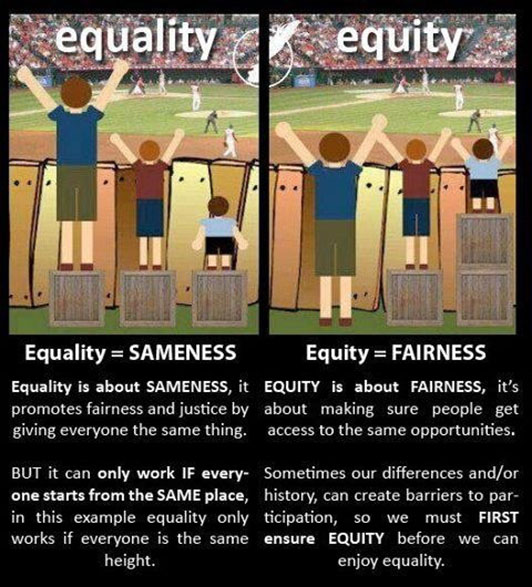
The evolution of the "baseball game equality" meme

by Rob Beschizza

edit_meme2

Craig Froehle tracks the odd convolutions of his famous illustration of how conservatives and liberals view the notion of equality. It's been simplified, expanded, twisted, tucked in and turned inside-out—and even redrawn by professional artists.

Are the worst versions the ones that bury the simple point in condescending explanation?

edit_meme8

Or the ones that seek to subvert it entirely, in as much as stamping "THIS IS FUCKING STUPID" over it counts as subversion?

edit_meme25

The cannier mutations contextualize it for local audiences:

cbgskljwaaa6dea

I am giddy that my little graphic has helped so many people think about the issue of equity and has spawned so many conversations in just the past few years. I’m not upset by the many way it’s been reimagined. In fact, I’m delighted, because the modifications just make it that much more useful to people.

03 Oct 16:11

How To Get More Customers Through Decision Stage Content

by Ashley Irving

directory-298811_1280In previous articles, we talked about the Awareness and Consideration stages. Now it’s time for the final one, the Decision stage.

To recap, Awareness stage is where the prospect points out an underlying problem. They go on to research the symptoms and finally their specific pain point. In the Consideration stage, a prospect sets off to specify their problem and trim down the choices. They evaluate their choices and the solutions offered.

And now we’re here:

The Decision Stage

In this stage, our prospect, Bob the Blogger, has identified his problem (zero blog traffic) and come up with a solution or method to solve it: content promotion via social management tools.

What you’re about to learn are the types of content and key terms customers like Bob are looking for in this particular stage of their journey.

This is the moment where you break out the fireworks. It’s all meat and sizzle for the buyer’s journey. And by now, your customers can’t wait to try your product and experience its benefits.

So how do you do that?

I’ve listed 6 types of content prospects are most likely to look for in this stage.

Types of Content

Bob is at a crossroads.

Each arrow is pointing to a different direction. Some offer crazy promises while others have enticing price points.

Bob knows that choosing a particular path could mean utter failure or inevitable success. That’s why Bob’s looking at each product and seeing how they work in a real-world situation.

And, thanks to your content, he’s considering your offer as one of his options.

At this stage, customers want an opportunity to try the product. They’re more open to your solution and curious to see how it fares against the competition.

Your leads have probably checked your competitors, and they are likely comparing your offering with theirs.

This is your chance to offer certain types of content:

  • Vendor comparisons
  • Product comparisons
  • Case studies
  • Testimonials
  • Product literature
  • Live Demos

I’d like to add video testimonials and product overviews to this list. These types of content give customers get the chance to watch your product in action.

Like this example from Sprout Social, a social media management tool:

decision stage

Types of questions and key terms leads are using under this stage

Customers use several search terms to streamline the research process. During this stage, customers will start to compare one product to another. That’s why, you’ll notice below, all phrases lean towards comparison and review-type terms.

However, I’d like to remind you that customers won’t necessarily use these exact terms. But the theme is the same: they will compare and contrast products with one another.

  • Compare
  • Vs.
  • Versus
  • Comparison
  • Pros and Cons
  • Benchmarks
  • Review
  • Test
  • Overview

[bctt tweet=”Your leads have checked your competitors, and they are likely comparing your offer w/theirs.” username=”ashleyidesign”]

Conclusion

In an article for Forbes, John Hall of Influence and Co. said:

“Creating content that doesn’t directly speak to your audience is like accidentally gifting your mother-in-law a men’s razor and some aftershave.”

I can’t say it any better than that.

If you want customers to consider your offer, then it’s time to take a hard look at your content.

Is it addressing the right type of customers?

Does it meet the need of your prospect at a particular point in time?

Can it provide the necessary information so that buyers can come up with a sound investment decision?

In this last stage, customers will look you in the eye and ask:

“Why should we choose you over other providers?”

If you did an excellent job with your content, the answers are pretty obvious.

I hope you learned a lot from this series. If you want more content like this, please let me know in the comments section.

abc

03 Oct 16:10

10 Entrepreneurs Who Failed Before They Found Success [Infographic]

by Shane Dobbing

It is often said that before you can really achieve any of your goals, you must experience failure first.

In fact, in Robert Kennedy’s famous Day of Affirmation Speech in Cape Town on 6th June 1966, he said, “Only those who dare to fail greatly can ever achieve greatly.”

This concept of only being able to succeed after experiencing failure is a very popular one in many industries.

From finance to sport, politics to the arts, you can find a quote about learning from our failures from every corner of the working world. Just take a look at this great piece from Forbes which has plenty of examples.

Despite our general acceptance that failure is merely a part of success, when discussing incredibly successful people, we often assume it happened for them overnight.

When it comes to genuine investors or industry trailblazers like Edison, Dyson, Zuckerberg or Jobs, we immediately assume that it was their relative genius that brought them success rather than hard work and many previous failures.

Of course, this is far from the truth. There are many incredible stories of success and failure involving some of the most celebrated minds of the last century, it’s just not enough of us are aware of them.

Infographic

Thankfully Silverdoor has put together this great infographic which charts a number of massively successful men and women whilst giving us a flavour of some of their biggest failures.

Titled ’10 Entrepreneurs Who Failed Before They Found Success’, this infographic offers up a number of tales which you will hardly believe are true.

For example, it is hard to believe that the world’s most successful fried chicken chain KFC founder Colonel Sanders had his special recipe chicken turned down by over 1,000 different potential investors before finding his way to success.

For more interesting tales about the failures of some extremely successful people, take a look at the infographic below for yourself.

03 Oct 16:10

Best Practices for Balancing Your Run-Change Equation

by Roop Singh

The run-change relationship is critical to any smart, cost-effective business. Unfortunately, many organizations become caught in outdated patterns. They become their own worst enemies instead of empowering themselves to evolve with new industry standards.

Run activities refer to all the processes that keep your business’s lights on. These include payroll software, cybersecurity systems, disaster recovery mechanisms — essentially your entire IT infrastructure. The run list is made up of your must-haves, the items that always get funded because your business can’t survive without them. For instance, if you trade foreign exchange currencies, your system must be online at all times. International markets operate 24/7, so you do, too.

Although run processes are vital, business leaders don’t spend much time monitoring them. Concerning yourself with run is seen as old-school and a waste of time. These aspects are fundamental to the company, so why deliberate over them? Just spend whatever’s needed and move on to the next thing.

But there’s good reason to deliberate. As I said at the outset, the run-change relationship is crucial. If you’re not evolving your run strategies, you risk losing money and market share.

Balancing the Run-Change Equation

The change side of the run-change equation refers to three areas: efficiency, regulatory compliance, and relevance.

Efficiency often calls for streamlining via newly available project management and data systems. Industry regulations are often revised and updated, so your organization must shift with them. This can mean using more secure technology or revising your reporting workflows. Staying relevant means having the budget to pivot as needed. Too often, businesses don’t build room into their budgets for unexpected occurrences, and they get left behind because of it.

But companies that do monitor their run-change relationships are finding that change is happening quickly. Many are beginning to look at large-scale consolidation of their operations, seeking ways to digitize and simplify everyday tasks.

Digitization means different things depending on the context, but it’s impacting all aspects of capital markets. On the institutional side, it means automating manual work and eliminating workflow redundancies. Then there’s the client element, which involves new protocols for delivering information. These include communication platforms that facilitate business-client interactions in a smoother, more user-friendly way.

These shifts are necessary and exciting, but they also pose significant challenges. In fact, the problems that arise from the run-change relationship often deter leaders from acting in the first place. Here are the key sources of tension:

1. Funding: Even when leaders are keenly aware of the need for change, they don’t have the resources to implement it. Ninety to 98 percent of a typical organization’s budget goes toward the run space. They simply lack the discretionary funds to invest in new programs.

2. Prioritization: Businesses run on predictability. Change introduces unknowns, and these can disrupt day-to-day operations. Whenever you bring in new software programs or management systems, there’s a risk that you’ll lose business in the transition. The question comes down to what’s more important: revising your run strategies for long-term sustainability or maintaining operations in the immediate future?

3. Delegation: The third challenge to run changes is the question of who will be responsible for them. CEOs often find themselves in situations in which their entire staffs are so busy keeping the lights on that no one has the bandwidth to learn and execute new programs. They can hire external vendors, but there’s no guarantee that outsiders really understand the company’s culture, methodologies, and overall goals.

Risks and Returns

Given these challenges, how do you balance the run-change relationship? You use the risk-return theory. We make risk-return decisions as individuals every day. If I enroll in a Master of Business Administration program, I’m risking a significant amount of money and temporarily reducing my income by taking time out of the workforce. However, the return is the promise of a better-paying job once I’ve earned the degree.

Businesses make this calculation each time they risk money on a new venture. The potential gain outweighs the potential loss. So it is with run-change management. But you can disperse risk throughout the organization to minimize negative impacts. Instead of overhauling all your software systems at once, tackle one department or system at a time.

Partner with vendors who have skin in the game as well. If you hire a company to assist with your transitions and its reputation is on the line, you can almost guarantee that the implementation will be done correctly. You’ve spread the risk to include more than just your organization, making success more likely.

The run-change relationship is difficult to wrangle when you’re starting with a limited budget and resources. But with consistent monitoring and incremental tweaking, you can bring your organization to a place of balance. Being able to adapt to your changing industry is the most efficient way to run.

03 Oct 16:06

Avoid Weasel Words In Your Pitches to Sound More Credible

by Eric Ravenscraft

Weasels, as an animal, are surprisingly cute. As filler words for your pitches (or your resume), however, weasel words can undermine you more than help you.

Read more...

03 Oct 15:58

Trade Show Trick or Treat: The Different Attendees you Will Meet on The Show Floor

by Eric Dyson

07-FunTradeShowIdeas

While working a trade show exhibit, you are sure to meet hundreds — possibly thousands — of attendees from all over the world, each with their own agenda and interests. With the multitudes of attendees you are sure to meet, it can be difficult to decipher the pretenders from the prospects. As Halloween fast approaches, we unmask the different types of trade show attendees to help you get an edge at your next event.

The Bored Attendee

Who they are:

Like the family out car shopping on a spring day, The Bored attendee stops by your exhibit out of pure curiosity or boredom. They are typically attracted to exhibits with fun graphics or flashy interactive features such as multimedia kiosks or product demonstration areas. However, their interest centers around alleviating their boredom; they have little to no interest in your product or service.

How to spot them:

You will be able to spot The Bored Attendee right away because they will walk leisurely around your exhibit, hands in pockets, lost in thought and may wander out just as quickly. They will try to avoid your booth staffers because they are just looking to pass the time, not for conversation.

The Grabber

Who they are:

The Grabber is on a ceaseless quest for trade show bounty. No swag item is too big or small for them to take and they have a keen eye for the best giveaway and promotional items from each exhibit on the show floor. Grabbers visit your exhibit for one purpose and one purpose only: to snatch up all of your goodies.

How to spot them:

Spotting The Grabber is easy. They are usually lugging around a branded tote bag bulging with swag from each one of your competitors and have an unreasonable amount of company logo key chains, branded notepads and pens. Beat them to the punch and keep your best swag out of reach or require that they be pre-qualified to receive.

The Investigator

Who they are:

The Investigator is on a mission to find the best product at the most competitive price. The Investigator’s main objective is to gather your information and move on to the next exhibit to compare and contrast capabilities and pricing. The Investigator is in your exhibit to ask questions while avoiding answering any of yours.

How to spot them:

You can spot an Investigator by the endless product brochures with circled pricing information, and their skittish demeanor that causes them to run when you ask for their contact information.

The Competitor

Who they are:

The “other guy” at the trade show, The Competitor may saunter casually in to your exhibit and ask very specific questions about your product or service that typical attendees would not ask, including wholesale pricing or production costs.

How to spot them:

You will know The Competitor by arms crossed over their branded name badge or polo shirt and because you walked by exhibit earlier in the day.

The Buyer

Who they are:

The Buyer approaches your exhibit eagerly, is upfront with their questions and concerns and forthcoming with their contact information for a post-show follow up. The Buyer will engage in conversation with your staff and will ask buyer’s questions.

How to spot them:

You will quickly discover the Buyer because they know their objectives, have a budget in mind, have the authority to select the vendor, they express a need for your product or service and they have a timeframe for a potential purchase.

Although it is great to meet potential customers of all kinds, the Buyer attendees will make your trade show experience worth the time and money you put into it, so make sure you can identify them.

Nimlok’s Guide to Island Exhibits

Island exhibits guide

Choosing how your island exhibit will be organized and laid out is essential for trade show success. Nimlok’s Design Guide to Island Exhibits will help guide you through the basic elements of island exhibits and highlight more common layouts. Download your free copy today!

03 Oct 15:57

4 Unique Reasons You Are Not Successful

by Jeff Shuford

Grant Cardone - Author, Entrepreneur, Producer, Business and Online Sales Training Expert

The Merriam-Webster dictionary defines being successful as “having gotten or achieved wealth, respect, or fame.” Although this definition is accurate there are many other ways to be successful, the alternative definition by the Merriam-Webster dictionary is “having the correct or desired result: ending in success.” There seems to be a connection between our greatest modern business leaders in regard to what it takes to be successful and the key deficiencies that exist in people that are not successful.

1. You lack passion and purpose

“Your persistence on any given endeavor is determined by the clarity of your purpose.”–Grant Cardone

In a recent article, I wrote for the Huffington Post titled “Follow Your Passion And Find Your Purpose,” I highlight the key reasons professionals suffer the infamous “burn out.” When business owners lack passion and purpose they tend to only be driven by money and material possessions. Employees can tell when business executives and management lack passion and purpose, how would you like working at a company that didn’t care for their employees or products? When management feels passionate about the company and has a clear purpose for the future, employees understand expectations better and share in the accomplishment of objectives.

2. You never engage with the public

“My definition of success? The more you’re actively and practically engaged, the more successful you will feel.” –Richard Branson

You can’t engage with a business professional who has gatekeepers in place that don’t care to engage with the public. Your objective should be to meet with people that can help your business grow. Engagement is more than picking up the phone when a lead calls to inquire about your services or products, engagement is constantly utilizing innovative platforms to connect to the world to extend your reach.

3. You underestimate the power of persistence

“Persistence is the single most common trait of the most successful.” –Grant Cardone

Ryan Holiday of Entrepreneur.com wrote, “persistent concentration and looking at an obstacle from every angle can lead someone to have an “aha!” moment as the solution is dug up from the brain.” This is true for many entrepreneurs who struggle with constantly being told no. When we face recurring rejection, the easiest action to take is to give up. The most affluent entrepreneurs believed in their ideas and had the will to survive the rejection. My veteran-owned business Tech From Vets has faced many obstacles and rejection, the objective is to keep finding ways to be creatively persistent, even the Bible states that faith without works is dead.

“I’m convinced that about half of what separates the successful entrepreneurs from the non-successful entrepreneurs is perseverance.” — Steve Jobs

4. You don’t innovate

“My definition of failure became not trying, not the outcome.” –Sara Blakely

The issue with many business professionals is that they give up on making use of innovative technology that can help grow their business. Instead of learning and adapting to the rapid change in consumerism business owners would rather stick to the principles and strategies that made their brand successful. With over eighty million millennials in America with an annual buying power of $200 billion dollars the entrepreneurs who don’t continuously innovate will be replaced by the businesses that continuously find ways to engage and innovate their business communications to the public. Mobile applications are a perfect example of an innovative technology that’s being underutilized by businesses and entrepreneurs.

“innovation is the real driver of progress” Bill Gates

Bonus: You are motivated solely by revenue

“The biggest things that have gotten done in the world tend to be done by people who primarily believe in a mission and are not trying to build a company; by teams, not by individuals; and by people who just don’t give up.” –Mark Zuckerberg

Your business is not a bank, and you are not an ATM. Viewing your business as a profit and loss statement will cause you to lose your purpose and passion. You are in business to solve a problem; you exist to provide value to the marketplace. Writing articles for prestigious websites gave me a platform to share my business knowledge. Money can’t validate me as a market expert, only my track record can speak for my business expertise. The best and brightest business leaders are not driven by money; they are motivated by the people they can help on a global level.

03 Oct 15:56

3 Ways to Improve B2B Prospecting by Finding “Me”

by Scott Hornstein

Hey, I’ve got a great new business idea! Let’s take our least experienced, lowest paid, least trained, and barely empowered employees and make them our customer-facing B2B prospecting personnel!

Or…since about 75% of the B2B consideration process takes place without our direct involvement, let’s call prospects to “just check in” and see if they’re ready to engage!”

I would like my competitors to employ both strategies, please.

What’s in It for Me?

Of course, both strategies are pretty mainstream and sound pretty lame stream when you shine a light. It’s just that some businesses have lost their way. Somewhere along the line, they lost the core meaning of the terms value and benefit because they were looking in the wrong place. The answer is not in their heads, on the hard drive, or in a Google search. These terms can only be defined by our prospect.

Every prospect wants an answer to the question, what’s in it for me? We’re advocating a deep dive into “me” so we can learn how to answer the question. We’re advocating an in-depth conversation with complex individuals who have both personal and business goals, and specific responsibilities to the buying center. How does this person define value? What benefits would help them to address an issue? Prospects aren’t going to tweet this. We’re going to have to dig it out of them.

Three Ways to Find “Me” in B2B Prospecting

Here are three strategies that can improve every aspect of your prospecting by finding out more about “me:”

1. Prospect Persona Research

Really, there is no better way to find out what a person wants then by asking them directly, by engaging them in purposeful conversation.

B2B prospecting persona research is a specialized and proven qualitative process that helps us understand how an organization makes a decision and who is involved. It concentrates on gaining a human understanding of these individuals―the “me’s”―what they need and how they learn. It’s as an exploration into the life of a person who must solve a problem that your product is designed to address.

There are two things that we always look for in this research:

  • What is the prospect-to-product connection? We must learn how we can express and demonstrate our compelling competitive differentiation so that our prospect can hear us. We need to create preference.
  • Who is our potential champion? The decision making process is long and complex and most often results in no decision. Among the players, is there someone who has the potential to champion our cause, helping others to embrace the prospect-to-product connection?

2. Win/Loss Reporting

We live and die by the close ratio, so let’s infuse some in-depth understanding of the outcome. The only way to do that is to talk to wins, losses, and no decisions through the same qualitative research process. We want to know, overall and by persona (as possible):

  • Why did we win?
  • Why did we lose?
  • Why was there no decision?

Throughout our B2B prospecting, we are looking to sharpen the articulation of the nuance, to polish the key insight and to refine our process, especially among high-value prospects, which will come back to us in the close ratio.

3. Customer Satisfaction as Measured by Net Promoter Score (NPS)

Although significantly more money is spent of prospecting, customer retention is where the long-term money comes from. By better understanding where we are successfully satisfying customers and where we are falling short, we can influence both prospecting and customer satisfaction. Customer satisfaction, in turn, leverages customer lifetime value.

A usual Net Promoter Score (NPS) survey bluntly asks customers if they would refer us to a friend or colleague. Customers are asked to respond numerically, where 0 is awful and 10 is divine. Boom.

The NPS survey we would recommend would build on this to gain the overall score and then within specific areas such as sales, products, and support. We would then employ qualitative research and dig deeply to understand “what do you mean by that?”

But It’s Expensive

Many companies we’ve spoken to feel that their B2B prospecting is underperforming and lament the long sales cycle bereft of direct engagement. The tendency is to invest in end products, like content, without the rigor of the underlying research. Well, prospecting is underperforming so marketing isn’t doing its job and we’re not getting the results we need, and research is expensive. Besides, we already know.

I think, unless things have changed, that convincing a prospect to become a customer is where the money trail starts. The better we understand the prospect…

03 Oct 15:56

The 3 Biggest Reasons Your Sales Team Can’t Stand You

by Eliot Burdett

According to this Gallup Poll, bad leadership is the number one reason why people leave their jobs. More than 7,000 adults surveyed left a job to “get away from their manager.”

In sales, turnover can be as high as 40% per year – more than double the average turnover rate across all industries in the US – and can cost businesses more than $750,000 per year. With figures like these it is critical for sales leaders to develop good relationships with reps to not only motivate them to hit their quotas, but to retain them for the long term.

The problem is that many executives frustrate rather than motivate their best salespeople. This not only hurts your company’s bottom line but creates apathy that destroys team morale. In fact, a meta-analysis of 225 academic studies found that happier employees have 37% higher sales numbers. However, in companies where team members experience low engagement – or the lack of emotional connection to their employer – operating income decreases by 32.7%. If sales reps can’t stand their bosses, they’re unhappy, unengaged, and fail to add value to their company. And ultimately they’ll look for better opportunities at rival organizations.

As the CEO of Peak Sales Recruiting, we have helped companies recruit and build high-performance B2B sales teams for more than a decade. In that period, we have identified the top three reasons why your sales team can’t stand you as a boss.

1. You Constantly Change the Compensation Plan

When business leaders assume compensation is their only tool to motivate salespeople, they change the compensation plan too often. Despite the positive intention to spur revenue growth, the last thing reps want to do is try to understand another compensation plan, especially as it relates to their reward quotient.

Changing the compensation plan actually hurts performance. The lack of stability created by too many incentive shifts forces reps to hit a moving target. Constant tweaking also sparks resentments among reps with a long sales cycle because their investment in maturing sales may not payout the way they expected originally. It not only diminishes their ability to meet clear goals, it can irreparably strain the relationship between sales leaders and reps.

The best sales leaders build a complete performance management strategy that includes – but is not limited to – a well-structured compensation plan. They rely on targeted goals, coaching, and professional development to motivate salespeople to hit their numbers rather than relying on constant compensation adjustments.

2. You Have a Big Ego

A lot of senior sales executives have big egos. They micromanage reps, contributing to rising stress and resentment. According to Mike Weinberg, this attitude is the biggest detriment to a positive sales culture.

Founders and long-term leaders often exhibit this toxic behavior because they built the sales team from scratch. They’re unable to step out of the daily functioning of the team and continue to try to exert excessive control over reps.

Ironically, when toxic executives bypass sales managers and insist on their over-involvement in managing sales employees, they paralyze rather than motivate the sales team. This kind of micromanaging takes up a large portion of the sales team’s energy, which minimizes the bandwidth of reps to build relationships with prospects.

Top leaders create accountability and give sales teams the bandwidth to do their jobs. They work with managers to develop a framework for one-on-one meetings. Through real-time reporting systems, they also create a process for keeping all executives informed without taking valuable time and energy away from sales activities.

3. You Embarrass Reps Rather than Motivate Them

Publicly criticizing reps causes irreparable damage to the relationship between sales reps and their employers. The public loss of face triggers a deep sense of shame for the individual and sabotages the team. Employees who witness public shaming are likely to think, “Who is next? Will it be me?” This atmosphere of fear creates a hostile work environment that debilitates even the most successful reps.

Brene Brown, a research professor at University of Houston, summarized the impact of this kind of shame culture for Fast Company: “It crushes our tolerance for vulnerability, thereby killing engagement, innovation, creativity, productivity, and trust.”

If leaders humiliate reps at work, they shatter their potential. To support rather than limit growth, leaders need to offer corrective suggestions to their employees behind closed doors with a specific objective in mind. This constructive feedback develops trust and fosters high performance.

Achieving Sales Success Requires a Cohesive Team

Understanding three of the top reasons why sales teams hate their leaders gives executives the information they need to transform their relationships with reps. By contributing to a positive relationship built on mutual respect, sales leaders motivate employees to go above and beyond at work.

The post The 3 Biggest Reasons Your Sales Team Can’t Stand You appeared first on OpenView Labs.

03 Oct 15:56

What can you learn from small business digital marketing trends?

by Expert commentator

Agencies can use data to plan for the coming year, and to improve digital marketing services

You don’t have to search far to find information about the marketing budgets of the mammoth corporations, like Proctor and Gamble and Verizon. However, the typical US marketing agency has small business clients with small budgets—details about the marketing budgets of these smaller businesses is hard to come by.

For the past two years, HubShout has surveyed small to mid-size marketing agencies and the data from the surveys shows where their small business clients are investing their dollars, and how much they’re investing in each service. The survey of 200 professionals who deliver online marketing services to small businesses provides plenty of data that is useful for small to mid-size digital marketing agencies. In addition, this article provides helpful tips on selling and improving digital marketing services.

First, Get a Piece of the 28 Million

The HubShout survey found that small to midsize agencies struggle with finding new leads, which is interesting when you consider how many potential clients are out there. The Small Business Association reports that 28 million small businesses currently operate in the US. There’s plenty of work to go around, but finding the small business owners who are likely to be ready to buy into digital marketing is hard work.

Digital Marketing Spend Continues its Upward Trend

HubShout’s survey respondents reported that their clients spent more on digital marketing in 2015 as compared to 2014. We do our surveys after the year has based to establish annual budgets, so the data on 2015 spending comes from early 2016 to give a proper picture of spending across the year rather than just estimates. marketing budgets growth

This is not a new trend. According to Advertising Age, digital marketing spending went from $6.2 billion in 1999 to $25.6 billion in 2009. There is every reason to believe that digital marketing industry will continue to grow as more and more people spend more and more of their time online, although that’s not to say there won’t be some push back as traditional methods respond to the competition.

The #1 Digital Marketing Service Is….

The largest chunk of the small business marketing budget for the past two years went to website development.

allocatoin of online marketing spending

Even so, many small businesses still don’t understand that an SEO, PPC or any digital marketing campaign can only be successful with a website that is designed to convert. Digital marketing professionals don’t want to turn down business but they know that sending traffic to a lousy website is going to end with an unhappy client who may be inclined to trash the agency all over the web. Instead of setting yourself up for bad reviews (that never go away), or turning down work, educate the client on the importance of a website that converts. And if you don’t offer website design, outsource the work, or partner with a website design agency that you trust. If a business owner is not willing to invest in a website that you feel comfortable promoting, it’s best to walk away.

Mobile is Mandatory

A mobile-friendly website is perhaps more important for a small local business than it is for a large business. According to this consumer survey:

  • 94% use a mobile phone to search for local businesses.
  • While conducting a search for local goods and services, 78% of mobile users discovered a new business - one they didn’t know existed.

The most important takeaway from the survey: businesses that are lacking a well-designed, mobile responsive website can lose nearly 50% of their potential customers.

SEO - Still Not Dead

We keep reading about the demise of SEO but SEO is still very much with us. Small businesses continue to see SEO as a basic need. As indicated in the graphs above, in 2014 and 2015, SEO accounted for about 26% of the marketing budget.

Links were and still are a big factor for SEO (search rankings). For proof on that, read Moz.com’s study entitled Can You Rank in Google Without Links? New Data Says Slim Chance.

The Missing Ingredient

A few years ago, Google essentially said, “Create great content, share it and the links will come.” But the links didn’t come, as confirmed by this Buzzsumo study. Turns out, Google’s recipe was missing a key ingredient: Link Outreach. If you create great content, post it onsite and share it on social media, you have not completed the job. To do it right, SEO requires great content PLUS link outreach.

Look to link outreach experts like Brian Dean for some of the best advice on link outreach. It’s important to understand that link outreach is not easy; it requires more upfront planning to locate the sites on which you want to get a link and to find contact information for the people who Brian Dean refers to as your “linkreators.”

It’s also important to manage expectations. You won’t get a response from everyone. Be prepared for a variety of scenarios:

  • Some who respond will link to the content.
  • Some will request a unique article on the topic that they can post on their blog and link to the original source article.
  • Some will tweet or share your content on social media

PPC Comes On Strong

HubShout’s survey shows that PPC made a big leap from 2014-2015. In 2014 businesses allocated about 12% of their budgets to PPC. In 2015 that number nearly doubled, to 23%. It could be that agencies are doing a better job of educating clients on the value and affordability of PPC advertising and more are buying into it. Or, perhaps businesses are catching on to Facebook PPC which tends to be less expensive and can be a great lead generator, if done right.

Facebook is No AdWords

No doubt, many agencies jump into Facebook advertising with just a cursory understanding of how it works. AdWords experience does not translate to Facebook. An agency that wants to add Facebook to its service offerings must learn the platform and understand the big differences between AdWords and Facebook PPC.

AdWords PPC is about the headline and text, and keywords of course. Facebook PPC is about the image. A mix of an interesting image combined with a clear description of what the business does is the approach that gets results. HubShout has run A/B testing on Facebook for a number of years and in our first experiment, quickly learned that this kind of thing doesn’t work. At all.

Facebook campaign example

Campaigns with eye-catching graphics and a clear offer got great results.

Effective PPC Facebook campaign example

HubShout developed several campaigns, tested them, and learned that the unusual and offbeat works on Facebook. It’s matter of changing up the image about every two to three weeks and watching the campaign very closely. It’s also important to make sure the text describes the business, especially when the eye-catching image doesn’t.

Conclusion

Digital marketing is a growing industry and there’s plenty of business out there for the small to mid-size agencies. Understanding the budgets and needs of the smaller businesses will help these agencies plan effectively and deliver high quality services at a price that their clients can afford.

Thanks to Ellen for sharing their advice and opinions in this post. Ellen Gipko is a digital marketing specialist for HubShout, and a writer specializing in the topics of social media and digital marketing. She has contributed content to Social Media Today, Search Engine Watch, Search Engine Journal and other industry websites.
03 Oct 15:55

$1.9 trillion dollars of economic value could be created by the use of IoT devices and asset tracking solutions

by BI Intelligence

Total Global Economic Value Of The IoT

Using sensors, tags, and other IoT devices to track goods through the global supply chain is one of the fundamental use cases for the Internet of Things, and also one of the most impactful.

Cisco and DHL, the world’s largest logistics provider, estimated last year that $1.9 trillion dollars of economic value could be created by the use of IoT devices and asset tracking solutions in the global supply chain and logistics sector.  

The enormous potential value created by these asset tracking technologies is due to the incredibly broad array of benefits that companies can obtain from them. Asset tracking solutions can create fiscal savings for supply chain and logistics operators at almost every step in the supply chain journey including extraction, transportation, production, storage, and final delivery to the customer. They can also help with compliance reporting and result in new revenue opportunities for supply chain and logistics operators. 

All of these benefits are derived from the insights that companies can gain from the data that asset tracking solutions provide. Tracking tags and sensors can deliver real-time data about the location of goods in transit or in a warehouse, as well as data on the condition of those goods such as temperature, pressure, or potential damage to their packaging. However, gaining operational insights from these solutions can be a challenging task if companies don't implement organizational changes and other technologies that enable them to take instant action on real-time tracking data.

A report from BI Intelligence examines the various technologies that can be used for asset tracking today, and breaks down trends impacting adoption of these different technologies. We also explain the multitude of different benefits that can potentially be derived from these technologies, and detail how different industries are taking advantage of some of these benefits. Lastly, we detail the major challenges involved in implementing asset tracking solutions, and offer some best practices for overcoming these challenges.

Here are some of the key takeaways from the report: 

  • Asset tracking solutions allow companies to completely overhaul their supply chain and logistics operations so they can deliver more goods faster and more cheaply.
  • The productivity gains that asset tracking solutions enable could lead to enormous savings for companies: Cisco and DHL estimated that IoT technologies like asset tracking solutions could create $1.9 trillion in economic value for the global supply chain and logistics sector.
  • Legacy asset tracking technologies like barcode scanners are gradually being replaced with newer internet-connected tracking solutions that provide real-time tracking data, as well as other information on the condition of goods in transit.
  • Analyzing real-time tracking data for operational insights can deliver a wide range of benefits including decreased fuel and storage costs, the automation of inventory-related tasks to free up employees for more valuable assignments, improved compliance reporting, and new revenue opportunities.
  • Retail, manufacturing, oil and gas, agriculture, and pharmaceuticals are some of the leading industries adopting asset tracking solutions to help them deliver goods more quickly and efficiently.
  • Deriving the full value of asset tracking solutions will require enterprises to implement a digital strategy that also includes analytics and data processing tools to help them glean insights from asset tracking data. 

In full, the report: 

  • Compares the different categories of asset tracking technologies that are available for supply chain and logistics operators. 
  • Details the broad array of benefits that enterprises can reap from asset tracking solutions and the data they provide, including increased revenue, reduced operational expenses, and improved customer satisfaction.
  • Examines adoption trends regarding asset tracking solutions across various industry sectors including retail, agriculture, and manufacturing.
  • Explains the biggest challenges involved in implementing asset tracking solutions and how enterprises can overcome these obstacles to overhaul their supply chain and logistics operations.

Interested in getting the full report? Here are several ways to access it:

  1. Subscribe to an All-Access pass to BI Intelligence and gain immediate access to this report and over 100 other expertly researched reports. As an added bonus, you'll also gain access to all future reports and daily newsletters to ensure you stay ahead of the curve and benefit personally and professionally. >> Learn More Now
  2. Purchase & download the full report from our research store. >> Purchase & Download Now

Join the conversation about this story »

03 Oct 15:55

6 Powerful Tools for Superior Social Media Measurement and Attribution

by Jawad Khan

All too often, social media marketing involves flying blind. You might see in your Google Analytics reports that the social networks are steadily referring traffic to your site, and those visitors might even be converting reasonably well, but that’s just part of the picture, isn’t it? Clickthroughs from many social media mobile apps will appear as unknown sources in your Analytics account, and regardless, Analytics isn’t capable of tracking individual user journeys towards conversion over time, journeys which often involve dozens of touchpoints.

Closing your social media marketing attribution gaps can improve your conversions and cut your costs significantly. According to recent data from Forrester, optimizing your attribution models over time can reduce costs per action by 30% to 50% and increase ROI by 50% to 100%.

smt1

Image source

Essentially, attribution is what allows you to optimize and hone your strategies by matching conversions to their causes. When you’re able to attribute accurately, you know what tactics, posts and creative iterations are performing the best for you. You know whom to target, how, where and when. Under-thinking your attribution solutions, on the other hand, leaves you dangerously oblivious to what’s working and what isn’t. Doing it incorrectly or oversimplifying attribution can lead you to make costly and fruitless investments in the wrong places.

Audience members rarely convert into customers on their first visits to your site, so if you think someone was convinced to place an order simply because they clicked on one of your Facebook posts a few minutes before they forked over their credit card details, you could probably benefit from a more sophisticated attribution model.

Let’s take a look at some of the attribution models that social media marketers use most, followed by some tools that can help you improve the way you handle attribution.

Social Media Attribution Models to Avoid

  • Last Click/Last Interaction Attribution – Using this model, the last interaction or click is given credit for conversions. You get none of the info on what interactions took place before your prospect converted, and you’re not sure how each channel is performing as a result.
  • Last Non-Direct Click Attribution – This model is based on the idea that it’s better to give credit to the campaigns that took your prospect to your site their last visit if they convert on this one. It doesn’t capture the chain of interactions that brought the prospect to you and can misattribute as a result.
  • First Interaction/First Click Attribution – This model attributes the first interaction a customer ever had with your site or content. Unfortunately, that doesn’t tell you anything about how they interacted with your brand between their first visit and their conversion, or the value of any of those interactions.

Social Media Attribution Models to Use

  • Linear Attribution – This is a way of giving credit to every touchpoint before the sale – but it doesn’t tell you who deserves more of it. A little flawed, but at least you have a rough idea what interactions the customer had with your brand before converting.
  • Time Decay Attribution – Here you can avoid the pitfalls of under-attributing or over-attributing any given interaction. Using this model, you can give each step of the process a little credit, but the first visit gets a little less credit than the next visit, and so on, all of which get less credit than the actual conversion.
  • Customized Attribution – Write your own formula to adjust the weight of each interaction your lead has with your brand before converting. This is a modified version of the time decay attribution model, and if you don’t really know what you’re doing, using it won’t help you. Use this once you’ve gotten some more experience with attribution.

6 Tools for Better Marketing Attribution

Ready to find out how well your content is really performing? That’s a complex task. Basic tools like Twitter Analytics and Google Analytics may provide some useful attribution information, but if you’re interested in useful insights that take more factors into account, you may want to look deeper.

Consider the amount of data you’ll be dealing with and the number of data sources you’ll want to reference. If you don’t use a tool or two to help you manage it all, you may find yourself unable to efficiently learn what you’ve set out to learn. Here are some apps and platforms that can help.

Consolidate Attribution Signals with Segment

Gathering data from every customer touch point and sending it wherever you need it, Segment is a powerful tool and a great asset for any marketing team that’s starting to think seriously about attribution. Trusted by Crate & Barrel, Reuters, intuit, and many other major companies, it also works well for small businesses. If you’re nervous about trying a new tool, you can try Segment for free.

smt2

Image Source

Marketers will likely be especially interested in the tool’s ability to integrate directly with Attribution, a web app for multi-touch tracking and customer acquisition cost analysis, as well as Convertro and TUNE. Segment’s developer-friendly nature allows it to work beautifully with most attribution dashboards and models. Don’t worry if you don’t code, though – you can tinker with the code if you want to, but you don’t need to in order to use it. Although Segment was initially designed to help businesses send data wherever they need it, this is a smart pick for getting started with sophisticated social media marketing attribution.

Segment is especially useful to marketers working with multiple types of paid social posts. Compared to display advertising, sponsored social posting is a relatively new media type, and as a result, not overly saturated. Less competition, greater exposure, and excellent ROI are great reasons why today’s marketers are turning to paid social, which only highlights the greater demand for viable attribution solutions.

Track Influencer Shares with Start A Fire

Used by brands including HubSpot, CB Insights and Sequoia Capital, Start A Fire was invite-only until recently. Now you can get an account in under 30 seconds. This tool serves the dual purposes of growing your reach and helping you keep track of how your content spreads across channels.

Start A Fire lets you share content assets that your readers will be most likely to love – and keep your brand associated with the content, even if it’s published by someone else. It works by adding a “branded badge” to the pages people see when they click through from your Start A Fire-enabled shares.

smt3


This URL shortener also offers plenty of rich metrics, so you can track views on your shares, even when they’re reshared by others. If you were to tweet a link to a New York Times article, for example, and someone retweets it, then your brand does get a certain amount of extra exposure, but that benefit doesn’t last very long, because audience members won’t necessarily associate you with the content. But if you share Start A Fire URLs instead, your badge goes wherever your URL does, and you can track all associated page views, badge views and badge clicks.

Track Your Mobile App’s Interactions with AppsFlyer

Designed to work with paid social posts and other ad media for the purposes of driving mobile app installs, AppsFlyer gives you real-time data on a host of important metrics – clicks, organic vs. nonorganic installs, revenue, average revenue per user, even custom in-app metrics to help you track interactions after app installs (booking a hotel room or building a shopping list, for example).

smt4

Image source

There’s a 30-day free trial available if you’d like to play with the software a bit before committing. Current users include HBO, Macy’s, The Wall Street Journal and Samsung. Thanks to the tool’s extensive mobile analytics and attribution-centered focus, you can easily track a full suite of attribution metrics from an attractively designed dashboard.

AppsFlyer works well with all attribution models. Get a more complete understanding of your mobile marketing ROI and present clear results that highlight areas you can improve your social media performance – and ensure you’re investing the most where you’re most likely to profit over time.

Track Content Performance with Lead Ferry

Ideal for brands that invest heavily in distributing content via their social channels, Lead Ferry helps you track the conversion funnel performance of your content by channel. Find out the number of unique visitors, leads generated, customers generated, and get your content’s engagement score.

You can track individual goals or overall performance, and invest your paid content spend on platforms that actually build your customer base. A free plan is available for sites with less than 100,000 monthly visitors.

smt5

Image source

Marketers will enjoy the tool’s UTM tagging features to help with attribution, as well as Lead Ferry’s overall versatility. It pairs particularly well with last-touch attribution models, but it can adapt to other models as well. Because it’s designed for tracking the revenue performance of your content funnel, this tool can give you the data you need to make sure you know what pages to promote on which social channels.

Follow Your Visitor’s Mouse with ClickMeter

ClickMeter offers more than 100 features to assist marketers with marketing attribution and analytics. This software is fully integrated with social media and is developer friendly, playing nicely with everything from AdWords to SandBox.

The maps and reports it creates provide detailed insights on your audience (including click streams – i.e. what people are clicking on while on your site). You can turn any URL into a short tracking link for easy sharing on Twitter and other social channels and to keep an eye on where and how your content spreads on social media and beyond.

smt6

Image source

The tool is fully scalable and boasts 99.99% uptime, making it a reliable choice to help you keep the attribution data flowing at all hours. ClickMeter works well with the attribution model of your choice, including custom models.

Know Who’s Clicking Through with Clk.im

Clk.im-shortened URLs can provide a whole host of metrics on who’s clicking on your social posts, revealing their geographic locations, devices, platforms, browsers, OS, language settings, and more so you can hone in on your audience and build rich personas based on real data.

The tool also uses pixels to track conversions, run targeted campaigns with QR codes, and try A/B testing your URLs. Clk.im helps take the headache out of these complex yet powerful social media marketing tasks, so you can track the effectiveness of your strategy and tweak it accordingly.

smt7

Image source

Find out how your links are performing in real time and get a report daily in your email. The result is social content promotion that is easy to keep track of and attribute – no matter how far it spreads or what attribution model you’re using.

Conclusion

Finding out how your social media activity performs is crucial. You need to know how your posts are received, where your ad spend is going, which channels are performing the best, and who’s engaging.

Thanks to the wealth of marketing attribution tools available, you can finally understand your social ROI, improve it by refocusing your emphasis on the most lucrative communities, tweak your targeting efforts, improve conversions, and show stakeholders enough data to prove your point. From Start A Fire to Clk.im, the tools listed above make it that much easier to extend your reach and track your audience interactions and conversions.

03 Oct 15:53

What You Get When You Buy Technology

by Sherry Lamoreaux

What You Get when You Buy Technology

“Nobody ever got fired for buying IBM.”

This phrase is a classic stroke of marketing genius, leveraging anxiety – fear, uncertainty and doubt (FUD) – to create a powerful emotion in the buyer. As Corporate Visions notes, “In the 1980s, if you had to decide what computer hardware to buy for your company, these words rang through your head. It made your buying decision pretty easy. And, if you were a competitor to IBM, that same sentence made your job nearly impossible.”

As marketers, we’re focused on marketing and selling our products and services. Maybe that’s one reason why it’s hard for us to switch gears and become buyers, especially buyers of technology.

We see a lot of anxiety in the marketplace among the marketers who are considering adding new technology to their marketing stack, and we see a lot of anxiety among marketers who are chafing with tech that makes everyday marketing tasks unnecessarily difficult or complicated.

The first thing that comes to mind is that – despite the fact that the job title ”marketing technologist” is becoming more popular – most of us have come to marketing through some avenue other than technology. We may be highly competent with tech in general, or competent with our own in-place systems, but at the same time we may not have confidence in our ability to spot the best technology for tomorrow’s needs. Or the ability to sort out the most useful of three similar solutions.

The second thing that comes to mind is how very quickly the category of marketing tools is growing. You’ve all seen Scott Brinker’s chart; in March 2016 he counted 3,874 discrete marketing technology solutions – almost twice as many as 2015.

This is a picture of Scott Brinker’s infographic of the martech landscape. It can cause a bit of marketing anxiety to have to choose the right option for your company.To actually see the companies on this slide, visit the Chief Martec website.

The point is, tools and solutions are proliferating at a breakneck pace, and for any problem you’d like to solve there are probably a dozen companies with a dozen different approaches. It’s very time-consuming to try to come to grips with what’s available, and it’s way too easy to get overwhelmed by all the choices you have. Just thinking about this makes me anxious.

Another factor has to do with who makes the buying decision. In DataXu’s July 2016 study,Modernizing The Mix: Transforming Marketing Through Technology And Analytics,” there’s a discussion of who makes the final decision. In the US, 31% of decisions are made by a CMO and 8% by the Chief Marketing Technologist (It’s safe to assume that if a company has a CMT, they are probably making that decision, but it’s currently a rare title). However, 21% of the final decisions are made by the head of IT, CIO or IT director. The rest of the pack is spread thinly across a broad range of titles, from the Chief Digital Officer (6%) and the CTO (3%) to IT, brand, digital, and marketing managers.

If the person making the ultimate buying decision doesn’t carry responsibility for marketing, they may make that decision based on factors that have everything to do with IT (or existing business relationships) and nothing to do with marketing. This can be exacerbated when the vendors bypass you and go straight to your CIO. Part of your anxiety might be the legitimate concern that you won’t get the solution you really need.

In the paper, “When Marketers Buy Technology: Issues, Obstacles, and Solutions,” David Raab gets into some painful specifics:

  • Unfamiliar language and arcane technical issues SaaS vs. on-premise? Hadoop vs. SQL? REST vs. SOAP? The technical terms themselves are unfamiliar, let alone their meanings and the implications of choosing one or the other. The potential for confusion exists on all levels, from choice of operating system to database to network topology to workstation to Web browser.
  • Marketers, like any non-technical buyer, have a natural tendency to focus on the things the system user sees, such as the user interface (UI) and reports. But technical choices determine how hard it is to import or export data, to interact with other systems, to make changes to system functions and data models, to process data in large enough volumes and at adequate speeds, and even to use existing corporate networks, servers, and personal devices. These are issues where help from the corporate IT department is most needed.
  • But the IT group itself may not understand the technical nuances of marketing requirements and may bring its own priorities, such as using systems already in place elsewhere in the organization.

How to take the anxiety out of using marketing technology

This one’s simple: buy the right stuff to begin with.

Choose a vendor who will never let you walk alone, but will be there with training, practical suggestions, and help when you need it. A great vendor should be so in tune with you as a customer, that they act proactively when they see you’re not fully using the capabilities of their product (or even outgrowing their product) versus a vendor that is only reactive when you’re unhappy or have passed the point of no return. You want strength and quality in usability, setup, maintenance, and support. They call it “customer success” for a reason. Choose the company that is invested in your company’s success as you use their technology.

How to buy marketing technology

We’re going to lean on David Raab’s suggestions for this part. (To get the full story, – including the common mistakes to avoid – get the When Marketers Buy Technology white paper.)

1. Understand your business needs and define your business goals.

Look first to the programs that drive revenue, such as advertising or email nurturing campaigns. Make your definitions clear (such as an improved customer database) and make your goals SMART: specific, measurable, achievable, realistic, and time-bound (such as a 10% increase in opportunities in a given quarter).

2. Spell out your existing processes and create a system requirements list.

This will help you understand (and communicate to vendors) what the new system needs to do to make the goals achievable. If you’re buying technology so you can change a process, be as clear as possible about your expectations.

Understanding the process allows you to create system requirements.

Use case: Let’s say you want to move from an email marketing program to a marketing automation system, in order to be able to do a new process: lead nurturing.

Steps in the process might include:

  • List maintenance and management, including segmentation by multiple factors
  • Workflow design, including early exit
  • Email and landing page creation
  • Lead scoring
  • Automated transfer of qualified leads to CRM
  • Reporting capabilities

Define your steps in detail. For example, know precisely which characteristics and fields your lists must be able to accommodate. This lets you specify what the system will need.

3. Consider a wide range of vendors.

Do the research, and build your list. Look for the vendors and systems you can eliminate, based on information on their website and reviews (on G2Crowd and Trust Radius, for example). Read case studies of companies similar to yours. As David Raab notes, the point here is to consider a large number of options and narrow it down quickly. Keep in mind that along with industry leaders, your research may yield a less well-known solution that is actually the best fit for your needs.

Usually, the marketer finds that some features are available in every product, and many systems will be able to meet your basic needs (e.g., email for those looking at marketing automation). But look to your requirements, and see which require capabilities not standard in all systems. If you need something and the system doesn’t have it, it’s the wrong fit.

Be wary of those products that have more than you need, offering ALL the bells and whistles. This might please a purchasing agent who wants to be sure the company is getting everything it might need, but if you are not prepared for the technical challenge of learning and using all those additional features, it might add undue stress and hinder your effective implementation of the tool itself.

Again, David Raab has useful advice: “You may choose to create a formal scoring matrix to compare vendors; this is an excellent tool for building consensus within a team. Just be sure that you set meaningful weights for each factor, so the most important items are weighed the most heavily.

“One effective approach is to require that weights sum to 100%, since this forces trade-offs that reflect relative priorities. Weights can also include negative values for features that will add complexity or otherwise get in the way of using the system. For factors like data volume and response time, you may need to set up a test system of some sort to ensure the system will scale as required.”

4. Select against requirements.

You could present a list of requirements or write a detailed RFP, and the vendors will all respond with written proposals.

That’s not enough. The devil is in the details, and you should require a prospective vendor “show, don’t tell.” Go back to your process, and create a use case or scenario. Have the vendor do a customized demo to show you exactly how their system will handle your data, in your programs, step by step. You want to have them walk through the steps while you watch. Bring your team members who will be using the system day-to-day to watch and ask questions. If the vendor says their system is easy to use, that should be obvious to your stakeholders when you see the demo.

Don’t forget to ask for references. It’s best if they come from organizations that are similar to yours in some way, and who are using the system in the same types of programs that you would.

5. Look beyond features.

Picking the right platform is much more than filling out a checklist of functionalities. Your own business processes, resources, goals, and budget should inform your selection. A few key considerations:

  • Your resources. Some products require a full-time dedicated person to keep the gears turning.
  • Your access to IT. Some platforms require ongoing attention from your IT department.
  • Ease of use. Is the platform genuinely intuitive and easy to use? Will your team members use it willingly or reluctantly?
  • Hidden costs. What will it cost for strategic planning and implementation?
  • Will this system simplify your life or reduce your costs by replacing other tools you already pay for?
  • How difficult will integration be? Is it native or an API? Will it take more than one day?
  • Does the data sync automatically, or must you do it manually?
  • Does the vendor’s onboarding program look sufficient?
  • How much free support will you get, and how long will it last?
  • Does the platform integrate with the program(s) you need it to? How is the integration done?
  • If you need account-based marketing, will the system support it?
  • Does it integrate with your other marketing initiatives, such as social media marketing?
  • Does the database support account profiles that roll up all contact-level engagement data? Will that happen automatically or will you need to do it manually?

6. Plan for deployment.

Here’s an opportunity to reduce anxiety. You’ve defined your processes and programs, so you’ve got a head start in knowing who needs to be involved in deployment, and the resources you’ll need. At this point you’ve also determined how the vendor will support you through deployment, including data transfers, integrating with other systems, and so on.

A smooth start here will reduce friction down the road. Spend the time to get it right.

7. Define a long-range plan.

Marketing programs increasingly depend on connections across channels to deliver optimal, coordinated customer experiences. According to the 2016 DataXu study, the number-one challenge for marketers in the US and globally is making this practice work effectively and efficiently. Plan how your system will help you address this.

According to the 2016 DataXU Study, the number one challenge marketers face is creating an efficient marketing mix across global channels.

8. Consider organizational context.

How does your company experience change? How many departments will be affected by your new marketing technology? This is another opportunity to ease anxiety, with full, open and timely communication – and no surprises. Make sure your finance department knows what the potential financial impact might be, and the effect on ROI. You could discover a strong ally.

A final thought

IBM is still a great company, but in 2016 we’ve got a lot more options, and it’s highly possible that the right technology for you may not be the biggest; the tech landscape isn’t monolithic anymore. And buying technology isn’t really about making a purchase that no one will object to. It’s about how your team’s performance will change as you use this new purchase. Does it make your marketing life better? Is it relatively painless? Or does it create anxiety? You don’t have to settle.

Act-On is best-known for two things: ease of use and killer support. We’d love to show you how we can make your life easier. With less anxiety.

Act-On Demo_Take a Video Tour

03 Oct 15:53

In Search Of An Effective Model To Measure Customer Experience

by Darya Yafimava

Alarming news keeps coming from the US retail front. The recent wave of store closure announcements from Gap, American Apparel, Kohl’s, Sears and Macy’s, which alone set to shut down about 15% of its current run in 2017, sent the industry reeling. Sure, we can point our fingers to digital commerce and today’s sweeping trend for bargain hunting. But the total US retail sales feel just fine at a steady 3% growth annually.

Upon a closer look, it’s evident that American buyers don’t spend less. They just choose to buy from somebrands instead of others. The competition over a bigger share of wallet is heated, and companies increasingly rely on the secret sauce of customer experience as their new competitive advantage in the age of customer.

To manage customer experience is to know how to measure it. But how to reliably measure customer experience to check if everything is fine, and if not, to identify issues correctly? Naturally, brands go to customers themselves for this information as the starting point of their customer experience management (CXM) routine.

Surprisingly, it may be not the only place to look for this information.

Why customer satisfaction scores are not enough

Why customer satisfaction scores are not enough

Brands doing CX measurements rely largely on customer satisfaction surveys (CSS) of sorts, be it Net Promoter Score, CSAT, Customer Effort Score or custom. But based on our experience of consulting on customer experience management in B2C, voice of the customer programs provide just a fracture of the information required for effective CX measurement.

Looking at CX Index 2016 for US federal agencies, Forrester had to admit that over 80% of the time, customers’ surveyed opinions on what would make their experience better just didn’t apply to reality. As brilliantly put by Colin Shaw of Beyond Philosophy,

“What people do is much different than what people say they will do. People say they want the option of salad at Disneyland because “I’d like to eat healthier when I am at the park.” But then, when that same person smells a delicious and unhealthy churro, they ignore the salads Disneyland presents and buy the churro because “I’m on vacation, and I deserve a treat”… Asking questions doesn’t work. Why? Because the customers don’t know the answers.”

In essence, CSS stand for what customers think they want, which may present a rather selective, let alone subjective picture.

What customer satisfaction surveys are not:

  • ongoing
  • taking into account the seasonality of business (e.g., in travel & hospitality)
  • precise enough to reveal the root cause of poor satisfaction in each particular case
  • considering the irrationality of customers’ buying decisions driven by emotions rather than by careful deliberation
  • driving innovation because of their reliance on customers’ past experiences
  • easily correlated to bottom line revenues

Do CSS still have the right to exist, you ask? Definitely, as they are still among the most affordable and resource-conscious ways to understand customers’ needs and wants first-hand, whatever the drawbacks. It can be a good starting point when there is a vision and a strategy to back it up. But how to round up such a strategy without relying on customers’ testimonies alone?

Down to discussing the case of US federal agencies, Forrester suggests prioritizing the drivers of customer experience and looking at what can really make a company’s mission successful. One of the answers to this call can be to couple CSS findings with the analysis of measurable factors that affect customer experience. This approach can give way to the alternative model of measuring customer experience that we discuss in detail below.

The alternative CX measurement model

cx_measurement_model-03

The logic behind our proposed CX measurement model implies that for every brand, there is a list of customer experience factors that are important for target audiences to keep buying and enjoying this brand’s products or services. Going through these factors and evaluating their actual impact on customer satisfaction would result in an effective CX measurement model that can be applied to specific customer segments and touchpoints over any timeframe without depending on CSS routine.

Now, on to more details.

Scoring CX factors and their impact

Beyond CSS findings, brands can go to other sources of information to come up with the CX-affecting factors that are relevant specifically to them. These sources include but are not limited to positioning statements that shape customers’ expectations, independent marketing research, focus groups, external consultants’ insights and the very brand’s CX team’s assumptions.

Drawing on more examples from retail, CX factors specific to traditional retailers, like department stores, may feature the following:

  • Out-of-stock (OOS)
  • Queue length
  • Tidiness
  • Customer service resolution time
  • Speed of delivery, etc.

Further relying on the insights from relevant findings from marketing studies, focus group interviews, hired consultants and / or an in-house CX team, brands can score each factor by the strength of its impact on a particular customer segment. For example, as queue length is identified as critical for lunch-break shoppers, queues that require 4 or more minutes of waiting can be scored 5 out of 5 for their highly negative impact specifically for this customer segment.

Once all the relevant factors are scored, the brand can apply this ready-made model to measure customer experience when and where their CXM strategy suggests it.

Measuring CX along the factor / impact model

With the brand-specific CX model in place, measurement itself relies on observation and auditing. This process can flow in 3 channels:

  • Field audit by in-house or invited customer experience professionals visiting locations and registering data by criteria;
  • Self-audit done by immediate employees in the position to collect CX data;
  • E-audit by looking at the relevant data stored across enterprise systems such as CRM, ERP, product lifecycle management, accounting, etc.

For example, a grocery retailer can run a bi-monthly routine of measuring customer experience at its supermarkets in Massachusetts according to the own model of 20 relevant factors and their impact values. As a result, the retailer can quantify the customer experience delivered at different supermarkets, identify good-, neutral- and poor-performing CX factors and spearhead a targeted corrective action as the next step.

Say, if 13% of the supermarkets scored a 70+ point impact (higher scores means more negative impact) on weekend shoppers, the retailer would be able to correlate this measurement to financial returns from the same locations over the observed period. If the poor impact indeed brings losses, they can drill down to the factors with alarming scores (out-of-stock items, dense traffic between stalls, etc.) and step up to make a positive change.

But what if the same grocery retailer started surveying shoppers instead of conducting an independent audit? At the end of the day, getting a “somewhat satisfied” response to the question of “How satisfied were you with the speed of service / queuing time?” can’t clarify if queues were alright or just bearably long, and if it’s an alarming enough sign to take an action.

Supporting CXM decisions with reliable metrics

Customer experience managers have a hard time getting accurate and actionable CX measurements. Relying solely on subjective and sometimes contradictory responses to customer satisfaction surveys can lead to making the wrong assumptions, or be even confusing up to the point where brands just let these data lie idle.

As suggested by Kevin Leifer of ICC/Decision Services, useless customer metrics – including those misinterpreted – never lead to real results. It’s the right questions asked, the reliable answers sourced, and appropriate actions taken that do. In this light, the news on Macy’s massive store closures may sound a bit less dramatic knowing that the retailer sets out to focus on best-performing locations instead, with more vendors, seasoned talents and new technology onboard.

This article originally appeared on ScienceSoft Blog and has been republished with permission.

03 Oct 15:49

How to Generate Leads from Industry Events Without Actually Attending Them

by Tukan Das

When you think about industry events, what comes to mind? Maybe they conjure up the feeling of sweaty palms as you try to frantically get as many business cards and pamphlets into participants’ hands as you can. Maybe they make you feel frustrated, as your often overlooked booth gets passed by time and time again.

For many, industry events are a mixed experience that result in far fewer leads and opportunities than they’d hoped. But did you know you don’t have to actually attend these events in order to benefit from them?

Thanks to the public nature of social media, you can identify and engage with people who will be attending upcoming, relevant industry events – without actually schlepping your awkwardly large booth all the way there, printing boxes of glossy pamphlets, or spending often significant amounts of money just to have a presence.

One of the signals that LeadSift picks up on is who will be attending industry events. We use natural language processing to determine who is not only talking about the event, but who will be there – and this is information that you can match with your buyer profiles in order to reach out to qualified new leads.

Consider leading-edge events like Dreamforce, CES and SXSW. Before, during and after the actual events, attendees send signals on social media and other online forums. They tweet about sessions and speakers they’re excited to see, use the event hashtag to organize their thoughts and multimedia, take photos on the day-of, and discuss new ideas in the weeks following.

By combining these signals with the buyer profiles you’ve created, you can equip your sales team with a ream of new leads, perfectly positioned within your industry. These are leads that have expressed a very recent interest in your industry, and you’ll have just as much information about them as if you had attended the event yourself.

By tapping into social signals about industry events, you can see some significant cost savings – no expensive event tickets and booth fees, travel costs, lower productivity from the employees who attend, or costly resource creation. Instead, you can set up meetings with those talking about, and attending, events relevant to your business from the comfort of your office chair.

Of course, it is essential that you continue to target leads with precision, regardless of whether they have been identified as event attendees or not. This means incorporating social signals about events into your profiles, and checking to see if they are a match – after all, not everyone who attends Dreamforce, or CES, or any other event will be interested in your product or service. However, many will be, and you can capture more potential leads through social signals than you can by relying on foot traffic past your booth.

03 Oct 15:49

How Productive Is Your Sales Stack?

by Tibor Shanto

By Tibor Shanto – tibor.shanto@sellbetter.ca 

It’s Monday, a great day for great sellers, the week is ripe with possibilities and opportunities, and how it turns out Friday, is almost entirely up to you and the decisions you make, and the actions you’re willing to execute, or choose to avoid; it’s what makes sales great. But this Monday is that much more so, in fact if you’re inclined (you don’t have to be), you can look at this Monday as sales version of what stock market players call ‘Triple Witching‘.

This Monday is not only the start of the next chapter of your success story, for most the start of Q4, the last chance to bring it all home, and this week also marks the start of the sales version of the Hajj. The annual event that brings tens of thousands of sales types descending on San Francisco, in a quest to learn something new, reinforce their current path, and generally mingle with other faithful seeking sales enlightenment.

Having made the journey before, I know it is easy to get distracted from the “why” or Zen of the journey, how do we improve sales, and help our people sell better? In the frenzy presentations and displays, being flattered as you’re being scanned and primed, it is easy to forget that sales is as much about your people as it is about technology. And while people may say the size of Stack matters, as with other things, I believe it is more of what you do with it, not the size.

cloud-stackI have seen sales leaders compare stacks the same way we compared hockey cards in the school yard. And while I would not argue the positive impact of technology on many elements of selling, more is not always better, and in fact without an overarching strategy to execution and development path for your human assets, it is more likely holding you back, just review the many studies around quota attainment.

But quota attainment is just a symptom, not the cause. The nature of your Stack brings with it a number of unintended negative ripples, not the least of which is added complexity, complexity that has a direct impact on your team’s ability to sell and succeed. This can surface in a number of ways, from challenges around integration, roll out, alignment with message, adoption and execution; all leading to complexity that directly impacts outcomes.

Some complexities are necessary based on what you are selling, who you are selling it to, and other factors. The goal is to find and develop a Stack that at the minimum balances things your way, or better yet, reduces complexity, and improves sales, selling and results. There is a difference between the sale being complex, and making the job of selling complex. The Former is the nature of the game, a factor the nature of the product, the number of people involved, (on both sides), the existing systems being touched or impacted, and a number of other moving parts. The latter is self-inflicted and can be avoided.

One of the hidden challenges of the Stack is the ripple effect it brings. Things impacted include process and impact on work-flows; time requirements to learn adopt and assimilate by the front line. Each new resource brings with it additional stakeholders, each with their own view on “things”; then come the approvals at various points, not to mention support. This leads to what CEB has termed the ‘Seller Burden’. As shared at the recent CEB’s Sales & Marketing Thought Leader Roundtable, this Seller Burden is having a direct impact on sales success, and can be attributed to the new, and many argue unnecessary, complexity presented by the above.

supporting-seller-burden

Despite all the right reasons, measures taken by some sales organizations to help and support the sales effort, and sales people, have led to unplanned consequences. If you want to get a real sense for the type impact this has on your reps, their time, ability to sell, and basically your sales results, visit CEB’s Sales Complexity Calculator, input your specifics, and see the impact in your world. If you do not know the inputs for your organization, we should definitely talk.

As you can see below, even as almost all sales leaders are taking steps to help reps by increasing resources, a vast majority of reps believe that these resources are adding to their work complexity.

unintended-ii
The only one winning here is the sales rep from the resource company, but in reality, there is no doubt that they are caught in the same trap.

So what, it is part of their job to deal with and assimilate these resources, with the expectation that once they “work it out”, it will help deliver quota. Short term pain for long term gain. But the evidence suggests otherwise. There are real and ongoing costs to ‘Seller Burden’.

cost-of-burden

To be clear, internal factors are not the only issues contributing to ‘Seller Burden’, as you can see below.

burden-model

But it is also true that that internal factors, or complexities as it is termed below, are the biggest contributor, by a huge degree.

the-enemy-within

So as you ready yourself for the pilgrimage, and you circle in and around the Moscone Center, I would challenge you to look for things that will simplify selling for your team, and simplify buying for your prospects. Just because it looks good does not mean it will be good. An incremental gain in a small element of your sales success, should not lead to hidden and ongoing costs in productivity. Instead, make it your mission to look for resources that eliminate and minimize complexity, and make it easier for your team to execute and win deals. In fact, look for resources and by extension the related support, that you can eliminate and simplify selling for your sellers, and buying for your customers.

simplify

Simplifying and uncluttering is the goal. Start by focusing on the three items to the left of the dotted line above. Clearly you can’t hit all three at once, start by prioritizing, then focus on one at a time. My bias would be towards starting with simplifying and streamlining workflows, but the choice is yours.

The important thing is to challenge yourself to make it a mission to come back from the pilgrimage with more than just memories and cool S.W.A.G. Wanna be really cool, adopt the mantra of winners: LESS. Less, and the ability to produce more.

Become one of the thousands of sales professionals receiving my latest updates on sales execution, tools, tips and more.   

Join Now!

The post How Productive Is Your Sales Stack? appeared first on Renbor Sales Solutions Inc..

03 Oct 15:49

Develop the Sales Action Habit for Success as an SDR

by Leah Bell

This post was written by Manny Alamwala, a Sales Development Rep at Vision Critical in Toronto and creator of The Sales Journal. His personal experience in the role of business development has taught him the importance of developing the sales action habit for success as an SDR. Read more below from Manny and his advice for Sales Motivation Monday.

My experience as an SDR has been unlike any other experience I’ve had in my professional life. In this role, you find out who you are and what you’re capable of — all in a short amount of time. There’ll be plenty of times on the journey where you feel pushed outside of your comfort zone — and for an introvert, like myself, the idea of a cold conversations was mentally and physically draining.

My quiet and curious nature sparked an internal question: what separates the extraordinary reps from the average? I read, I watched, I asked, I listened, and the answer was simple: focused action. Doing the right things at the right time.

But if it’s so simple, then why isn’t everyone doing it that way, and exceeding quotas like it is raining prospects? As my favorite personal development speaker Jim Rohn says, becoming extraordinary is “simple, but not easy.”

Why We Avoid Focused Action

To become successful as an SDR, the right action steps required are uncomfortable. In this role, we’re faced with more rejection before 10am than most of our friends face in their lifetime. It can be easy to avoid the hardships and continue to drift along.

“It is easier to adjust ourselves to the hardships of a poor living than it is to adjust ourselves to the hardships of making a better one.”

The major contributing factors of this avoidance is fear, lack of self-belief, and procrastination. We can get locked into a chicken-or-the-egg scenario, where fear breeds inaction, and inaction breeds fear. We, as humans, are pleasure seekers — especially in the digital era we live in now. We’re accustomed to getting things easy (and right away) and we seek that dopamine release faster and faster.

Have you ever found yourself switching quickly from task to task, or app to app, or checking a message right when it hits your inbox? Studies show that when we switch to a new task, our brains get a shot of that sweet ol’ pleasure chemical. Which tasks will we switch to when it comes time pick up the phone and try to book a meeting? Most likely, the one that provides the least resistance.

How I Developed the Action Habit

We know the extraordinary reps take massive focused action, and do the hard things in the present that will provide the results in the future.

“A week of neglect can cause you a year in repair.” – Jim Rohn

With the desire to do well, here’s how I developed the sales action habit to help me hit my goals:

“People form habits and habits form futures. If you do not deliberately form good habits, then unconsciously you will form bad ones. You are the kind of person you are because you have formed the habit of being that kind of person, and the only way you can change is through habit.”

Purpose

The basis for all your actions is your purpose. A strong purpose is the fuel to your action engine — it’s why you do what you do. Your purpose needs to be so strong, that when you see it and think about it, you’re moved emotionally to take action.

The first mistake I made here was having a purpose that was too vague. I had a purpose to be successful and to make lots of money. I’m sure most of us want this, but it becomes infinitely more powerful when we dig deeper and figure out why want to be successful. Is it to help your parents retire? Is it to pay for your children’s education? Is it to fund a new hospital?

“If it’s a big purpose, you will be big in its accomplishment. If it’s an unselfish purpose, you will be unselfish in accomplishing it.”

Questions to ask yourself:

What do I want to accomplish? (Take the first answer and think bigger!)
Why do I want what I want?

Prioritize

The most valuable resource we have is also the most limited: time. Have you ever wondered where the days of the week went? Have you ever felt that summer just started and now it is winter? Time can seem to slip away from us.

There will be a lot of activities that compete to take up your time. It’s your responsibility to be the gatekeeper. This is the part where you need to start becoming comfortable with the concept of politely declining tasks that don’t align with your purpose.

I understand that there may be tasks that you can’t refuse regarding family, work and friends. However, we can always find time when we look at what we do closely. Spend 2 hours watching TV per day? Cut it down to 1 and you get 7 hours per week to work on your future.

Questions to ask yourself:

Does this task align with my purpose?
What non-value added activities can I cut from daily tasks?

Place

Willpower takes up a lot of our mental energy. If we are trying to lose weight and our fridge is stocked with cakes, we will run out of willpower, eventually, and cave in. Trying to focus on work and the big game is on the TV in the same room, eventually we’ll start watching the game.

Our environment plays a big part on who we are and what we do. One thing I’ve done to set up up my environment is write down my purpose on a paper and stick it to the side of my computer screen. I put my cell phone in my bag when at my desk if I don’t need it (and most of the time, I don’t really need it).

Questions to ask yourself?

Am I constantly distracted in my current environment?
In what environments am I the most focused?

Productivity

I have strong purpose to kick me into action, I prioritized the tasks I need to do and my environment is a place where I can focus. Now, all there is left to do is use that time I set for myself efficiently.

I noticed at the bookstore, several types of journals to help us become more productive in our personal lives. As an SDR, there are many common activities that we do daily that leads to success. So, I created a journal for SDRs, such as myself, to become more productive and focused in our actions. One example is when I gamify making calls. I made it a challenge for myself to hit X amount of call when I blocked out time for that activity.

Questions to ask yourself?

What’s the one thing I need to get accomplished today?
What’s the hardest task?

Sales is hard. Being an SDR is even harder. There are a few who see massive success and seem to be “lucky.”

However, there are no secrets to the success of high achievers. Luck favors those who take action. Simple. Practicing focused action everyday will put you in the same boat as the select elite over time. It’s not easy, but everyone can do it. Develop a strong purpose, prioritize what you need to do, create an environment that helps you focus, and use the time you have to give it all you got.

Stay tuned for more Sales Motivation Monday posts to keep you, the Sales Development Rep, motivated and encouraged to make the most of your role as the crucial first step in the sales process. Download our Sales Development Playbook today to learn more!

PlaybookCombinedSections

03 Oct 15:49

3 Real-Life Scenarios to Design a Conversion Rate Optimization Plan

by Ehsan Jahandarpour

Conversion rate optimization, unlike what you might think, has nothing to do with your traffic. You can easily get a hundred thousand unique visitors per month but not convert them to loyal customers. That’s exactly one of the biggest mistakes that lots of marketers, entrepreneurs, and online businesses make; they focus on increasing traffic.

The main focus should be on building your brand or getting more exposure to it, positioning your business as an industry leader, and optimizing your website for higher conversion.
Let’s examine a few real-world scenarios to understand how to design an efficient conversion rate optimization strategy.

Source: https://qeryz.com/blog/building-conversion-plan/

First Scenario: CRO strategy to increase sales, and revenue

The most important part of conversion rate optimization planning is to set a clear goal. You have to set a clear baseline and understand your status quo. Once you know more about your current situation, you should set your goals.

Here are a few questions you need to be answering before setting revenue related CRO goals:

  • Do you want to increase your overall revenue, or revenue per product?
  • How much time are you going to spend on this CRO experiment?
  • What outcome do you expect? Do you intend to increase revenue by specific percentage, or you rather earn certain amount of money more than your current revenue?
  • Are you looking for long term plan, or a just a quick fix and focusing on low hanging fruits?

Second Scenario: CRO strategy to acquire more leads

When it comes to lead generation, having a sold CRO experiment can significantly improve our business. The first step towards optimizing your business for higher conversion is to understand your customers, and have a clear picture about their persona.

Knowing your customer’s persona, help you to define an intriguing lead magnet for each customer segment. This way you can track your conversion rate base on the number of people who have visited your page and have opted in for your lead magnet, versus the total number of visitors.

You should address these questions before optimizing your offer or landing pages:

  • How much do you know about your visitors, and customers? Do you know their pains, gains, incomplete jobs, desires, and needs?
  • Is your lead magnet able to address their pain?
  • Is your content engaging enough, and adds value to your reader’s business?
  • What lead magnet do your leading competitors offer to their visitors? Does it increase your opt-in rate if you focus on reverse engineering, or you should take an innovative approach?
  • What do your visitors love to see on your website?

Third Scenario: CRO strategy for better brand exposure

Unlike the other two scenarios that produce very tangible results, optimizing your website for brand awareness is a tricky growth hacking strategy , because you won’t be able to measure results in a short period of time.

Instead of testing your website to find what background color works better, or what call-to-action button get more clicks, you need to invest time on customer journey optimization, and user experience.

You may address these questions:

  • Is my website user friendly? (Don’t guess, Ask your visitors)
  • Is my value proposition clearly defined?
  • What do people say about my brand?
  • What do my brand represent? Is it low price, or high quality, is it cheap or premium?
  • Have I designed a clear path for different customer segments to navigate through my website?

Don’t forget to test your CRO?

Since Conversion optimization strategy is an ongoing experiment, you should collect data for at least a month, and then validate them.

You should also try to understand the data, and learn how to interpret them correctly. The data you have collected during your CRO helps you to either prove your hypothesis, or make the necessary adjustment to your strategy.

You may use different techniques such as split testing, heat map, user tracking, etc. to test different version of landing pages. Once you have defined the winner, you may drive your traffic to the one that performs better.

Here are a few CRO tools that you can use for your CRO experiments.

  • Qualaroo
  • Google Analytics (free)
  • KISSMetrics
  • Mixpanel
  • Segment.io

All in all, the point of CRO is to keep optimizing your online business based on genuine interaction with your visitors. Remember, running an online business is not about having a stunning website, it’s about how many happy customers do you get and how successful are you in increasing that number on a daily basis.