
Many companies are going through their annual planning process. As the business unit head, you and your team have put in hundreds of hours building your marketing plans, analyzing trends, developing key tactics and building and revising slide decks.

Many companies are going through their annual planning process. As the business unit head, you and your team have put in hundreds of hours building your marketing plans, analyzing trends, developing key tactics and building and revising slide decks.

This time of year, there are a lot of holidays coming up. And, companies tend to use those holidays as a means of driving their marketing campaign. While anyone can do it, there’s a certain way to go about it without getting too off track of what your company’s main purpose is.
With Columbus Day, Halloween, Rosh Hashanah, Thanksgiving, or whatever holiday it is you celebrate just around the corner, there’s a lot you can do to add those into your campaign. Though, before you get started, read on to see how you can use the holidays effectively.
Though, before you get started, read on to see how you can use these holidays effectively.

Even if you yourself don’t celebrate Halloween, this a holiday that most people tend to recognize more than others. It goes without saying that you shouldn’t choose a holiday that people have ever heard of. And, while holidays can certainly be used to drive a marketing campaign for any kind of company, you still need to make sure that holiday can be relevant in some way.
For example, writing a blog article titled “5 Reasons to be Thankful for Your Cybersecurity Software” might make more sense than “5 Reasons Trick-or-Treating Protects Your Data.” You need to get creative, but careful you don’t stretch anything too far.
Any marketing campaign, holiday or not, needs to have a goal. Simply just wanting to use the holidays just for the sake of using them isn’t really beneficial. However, if you believe that using a special holiday promotion as a means of attracting more leads, or a sale to bring in more customers, then you’re on the right track. Be conscientious of how you can tie the two things together. As always, make sure these goals are realistic.
There is absolutely no sense in making a Halloween promotion in the middle of August. While it does seem that some companies are promoting things very early (like Back to School clothing in July), you want to be mindful. October 1st is a great time to start talking about Halloween, and November 1st would be a good time to start talking about Thanksgiving.

Having trouble thinking of how exactly you want to use the holidays in your campaign? Talk about it with your team or do some research on the internet. Though you can be pretty creative this time of year, it doesn’t hurt to get a few ideas from others.
Some Examples:
The more creative and the more people are involved, the better!
Once you decide how your team is going to use holidays in your marketing campaign, it’s time to put the plan forward. The first thing you’ll need to do is edit, or create more landing pages relevant to your campaign. Remember, one of the goals of your particular campaign may be to attract a larger audience. This can be done by using the holiday as a segue. Therefore, you have to make sure those who may be led to your site via a search engine will get to where they need to be.
You will also need to add some content to your campaign. Perhaps you’ll write a few blog articles, share a few Facebook posts, or make an attractive video to promote your campaign. Make sure to share this content far and wide, as this is what is going to get people to participate.
Lastly, make sure to utilize your email marketing. A marketing campaign inspired by the holidays is a great way to reach out to your current subscribers. Of course, it’s also a good way to get your leads to subscribe.

The holidays are typically a fun time for most people. People associate holidays like Halloween, Thanksgiving and Christmas with things like family, friends, food, gathering, and all that other good stuff. Think about this when creating your holiday marketing campaign, and you’ll be sure to reach out to more people.
Now you have the tools to implement an effective holiday marketing campaign. But, if you need a little more direction, then request a demo at Mission Suite today!

We all have 24 hours in the day. It’s how we spend each of those hours that determines the pulse, depth, happiness and quality of our life.
Have you ever wondered why it seems that some people just simply have more free time? Yes, they may be busy. However, they seem to float through life a bit (or a lot) happier, while you feel as though you are stuck in a hamster wheel. You may feel that you are going round and round in the hamster wheel of life but getting nowhere.
Does this sound familiar?
Take a listen to the 221st episode of the Social Zoom Factor podcast for 10 Time Hacks to help you build the life and business of your dreams.
In this 20 minute podcast you will learn:

With apologies to Mark Twain, Rob Morrison asks what the innovation agenda means for the traditional power-base of marketing.
A couple of years ago one of my clever clients identified a change in the pecking order on the management boards of Australian business. They were looking to expand their remit across the C-Suite and in the process to tap bigger budgets.
Their insight played out like this:
The head of the table was still the CEO – no change there. The second loudest voice in the room was still the CFO – well, without cash no one can do anything. But after that, the playground got a bit blurry. The CIO, traditionally the slightly geeky one, and the CMO, the bolshie one in the power suit, were now pushed together.
Digital disruption meant they had shared projects, budgets and timelines. Threats from upstart brands, without the legacy of bricks and mortar, meant they had to move, and move fast.
So an uncomfortable marriage was born. Shotguns at 20 paces.
In response, my clever client ran a highly effective event where the CMO and the CIO were invited to attend together. To learn each other’s language. Understand each other’s agenda.
Of course, one of the predictable outcomes of this cross-pollination has been instability. That uncomfortable feeling that ‘my role’ is being eroded. That somehow all parties feel less important. Some opinion leaders even started to ring the death-knell of marketing itself.
And it’s true, traditional marketing titles are disappearing. When I started, the marketing landscape was populated by product managers, market researchers and promotions directors. Now those same functions are covered by the ‘insights team’ or ‘demand programs’ or ‘on boarding.’
So is it true? Is marketing dead as we know it?
It’s tempting to be drawn down that path when you see people clinging to the job role they have rather than looking at where their true skill base lies.
Call me biased but I believe, at its core, marketing thinking is still the fundamentals of good business. Any business.
Product development? Find what your audience wants and make that. Pricing strategy? Start with what your audience are prepared to pay rather than what it costs you to build. Media selections? Talk to them where they’re already engaged. Conversion strategy? Treat every lead as a precious commodity. Retention? Always remember an existing customer is far easier (and cheaper) to keep than it is to find a new one.
So, no matter whether it’s a sophisticated, hi-tech product targeting Gen Y, or a market stall in medieval Britain, marketing will survive.
We might just need to be flexible about what’s on our business card.
This article originally appeared on Marketing.com.au
 Rob Morrison is a Creative Director at OgilvyOne in Sydney, Australia
WELLINGTON/WINNIPEG — New Zealand is closely watching changes in how Canada prices dairy products, New Zealand’s trade ministry said on Friday, as industry groups in several countries complain of unfair Canadian competition.
Canada’s dairy farmers and processors, which include Saputo Inc and Parmalat Canada, struck a pricing agreement in July that industry groups in New Zealand, Australia, the European Union, Mexico and the United States say would price domestic milk ingredients for cheese-making below cost, under-cutting their exports.
New Zealand is the second-largest cheese exporter after the European Union.
Industry groups from numerous countries sent a joint letter on Sept. 12 to their trade officials, urging them to complain to the World Trade Organization.
New Zealand’s Ministry of Foreign Affairs and Trade said it has raised concerns with Canada, and Wellington will pursue all options to address policies that harm its exporters.
“We are paying this issue close attention and taking the concerns seriously,” New Zealand Trade Minister Todd McClay said last week.
The United States and Australia also raised concerns at meetings of the WTO Committee on Agriculture in Geneva this summer.
Canadian officials told the committee in August that the new pricing system would not significantly affect overall milk protein imports, according to WTO records.
The pricing change comes as Canadian imports of U.S. milk protein isolates for cheese-making have increased dramatically. U.S. dairy exports to Canada were worth $550 million in 2015.
We are paying this issue close attention and taking the concerns seriously
Washington has been engaging Canada on the new pricing plan and monitoring it closely, a spokesman for the U.S. Trade Representative said.
“We prefer that this action never be executed because it would be inconsistent with Canada’s WTO obligations,” said Jaime Castaneda, senior vice-president of trade policy for the U.S. Dairy Export Council.
Canada’s supply management system tightly controls dairy prices and production, and Ottawa levies steep tariffs to limit imports. It frequently faces international criticism, but major Canadian political parties support the system.
Canadian International Trade Minister Chrystia Freeland will continue to support dairy farmers and processors, her spokesman, Alex Lawrence, said.
Industry group Dairy Farmers of Canada (DFC) refused to confirm details of the plan, which requires ratification by provincial farmer groups this autumn.
Farm and processor organizations in other countries are “trying to bully Canada” before the plan is in place, said DFC spokeswoman Isabelle Bouchard. “They’re jumping the gun.”
© Thomson Reuters 2016

Are you keeping your business a secret?
You may think you are doing a great job on social media, networking, and marketing online to grow your business. But you may not be utilizing your very biggest asset… and that is your own personal network.
Most of us have established a network of at least 250 people. It’s important to keep in touch regularly with your network to stay top of mind.
And the best way to do this is with a warm letter.
Below are tips on what to write in a warm letter to send out to your personal network of friends and colleagues.
If you haven’t heard of a warm letter you may be scratching your head wondering what this is.
A warm letter is a letter that you send in the mail to your friends, colleagues and even family members. It’s a letter you send to reconnect with people you know, updating them on what you are doing professionally.
This is especially effective when you are first starting your business too. It’s one of the first things I tell my new entrepreneur mentoring clients to do!
Reaching out to the people in your network gives you an opportunity to rekindle that relationship, ask for referrals, and help people better understand what you do.
Plus, it provides you with an opportunity to help them by sharing a tip, resource, referral and be a super hero in their world.
When you write this letter, you’ll want to include:
Before you go printing a thousand letters to mail out to your entire local database, consider how many letters you can realistically follow up with.
You will want to contact each of the individuals to see if they received the letter and set a time to connect via phone, Skype, or in person. So sending 5-10 letters a week is ideal.
Sometimes we forget all the wonderful connections we have in our network. One tool to use is FRANK list – Friends, Relatives, Acquaintances, Neighbours, and Kids. Grab a pen and paper and make a list of people you know from all of these categories.
Think of all the people you know from your church, former jobs, networking events and colleagues. This can include who cuts your hair, your pastor, your real estate agent and so on.
When you list all the vendors you use for your business and personal life you’d be surprised how long the list is.
You can also go through your list of contacts in LinkedIn, Twitter, and Facebook and reach out with a message to get to know your social connections on a deeper level.
Using a CRM software can help you keep track of the marketing touches you do with people. Hubspot offers a free CRM. Another popular tool is Salesforce.
You may be wondering when the best time is to send a warm letter out. Ideal times are when you have something new an exciting to share.
Occasions to send out a warm letter include:
Sending the warm letters is only half the work. The real power is in the follow-up.
Connect a week later with each of the people you sent letters to. Set up a time to do coffee, tea, or a virtual connect.
It’s important to make people feel special and show you are there to help them too!
Start sending warm letters today and you’ll be surprised at how fast your business grows.
You have a wonderful network of people who know you, think you are amazing, and would love to help you out.
Just reach out, share a little love in a letter, and watch the magic happen.
Have you ever written a warm letter for your business? Share in the comments section how it turned out!
In a recent interview, Microsoft's Phil Spencer talks about the pricing window for the next-generation "Project Scorpio" Xbox console slated for the 2017 holidays. He doesn't provide any hard figures, but compares Scorpio to the Xbox One S.
The post Microsoft’s Phil Spencer teases the pricing window of 2017’s Project Scorpio appeared first on Digital Trends.

The subscription business model requires automatic recurring payments to make it easy for customers to use your products and services. It requires charging customers during certain periods so finding the right payment provider is essential. You have to be sure that you will get the money from customers every week or month to predict the cash flow. But, how do you pick the best recurring payment provider for your website?
The first thing you need to do is define your needs. Consider what is more viable for you – building an in-house solution or finding a payment gateway with the recurring payment feature? The in-house system gives you complete control but may be time-consuming and cost too much. If you need recurring payments just for your website, it’s better to choose a partner which specialises in payments.
To accept payments for subscriptions you need both a merchant account and a payment gateway. If you want to get the merchant account on your own, it could be a long and costly process. Instead, consider finding a service with a merchant account. It will save you time and money.
There are lots of payment gateways that offer online payments with a subscription option. For many reasons, choosing a payment gateway (with some additional features) could be the best option for your business. Just consider what do you need to accept recurring payments on your website.
Here are 10 questions you should ask to make the choice easier.
It’s good to first determine which type of payments your company needs. Do you want to only process recurring payments or also charge the customers for one-time payments (e.g. for a specific or extra items).
A payment gateway would be the best option for processing recurring payments and charging a one-time fee from customers.
The location of your business matters. Not every payment gateway will provide their solution for businesses in your country. This is usually due to banking regulations (our solution, for example, is focused on the EU market). So, if your company is registered in one of the European countries, it’s better for you to connect with a European payment provider with the European acquiring bank behind it.
Of course, this doesn’t mean that when you’re incorporated in the EU, you can’t sell globally. Find the payment gateway that offers a variety of currencies.
There are also providers that have their operations in many countries (e.g. both in Europe and the USA), but check with them first before you choose.
This can’t be ignored either. The truth is that regardless if you have developers on your board or you’re a non-technical person, the integration process has to be fast and easy. There are still many solutions that require weeks of setting up before you can start charging your customers (and you probably want to avoid that).
You need to find the payment gateway with a clean and robust API. Then it will only take you hours to put the payments on your website and you won’t lose money.
Check if the recurring payments you consider are flexible. What does it mean? Most business owners think of subscriptions as making the same charges to the same customers for a period. But you should also think about a variety of plans or a hybrid plan which will be more convenient for your customers. You can make an unlimited number of plans to improve customer retention, so you have the possibility of offering a variety of billing cycles with flexible time periods and multiple pricing levels.
There are few types of well-known payment schedules based on a required number of payments for a certain period. You can offer
Does a provider offer the possibility of modifying the billing frequency? Does the system allow you to update the subscription amount? Can you change the card details in running subscriptions, e.g., because of expiration date? Compare your needs with the features the payment provider offers to be sure that you will have everything you may need in the future.
Find a solution with an API that gives you the flexibility and the ability to build your own payment scenario. Also ask for additional features, such as payment tracking, payment reporting or fraud management tools.
Being PCI compliant is a must when you store, process or transmit credit cards. It’s also better to choose the solution with PCI compliance, so you don’t have to become PCI compliant (which could be costly for you). Ensure that the solution you want to choose meets these requirements.
This one links to the previous point. Note that security issues are as important as the entire payment experience for your customers. Give them the most secure solution possible to ensure that they don’t have to worry about the safety of their data. For this reason, it’s crucial to choose the solution with data encryption and that stores the credit card information securely.
When you choose a payment gateway you need to keep in mind that payment providers offer various fee structures. The good news is that most payment gateways won’t charge extra fees for the recurring payment option. Usually, you are charged per transaction, but check closely to make sure there aren’t any additional fees (such as set up or monthly fees).
Moreover, when you process a high volume of transactions, you can try to reduce expenses by negotiating fees with the recurring payment provider.
A free trial makes it easier for your customers to make a well-thought out decision. They can use your product or service for a certain period and then decide if they want to buy a subscription. Usually, customers are charged automatically after the free trial period ends unless they resign before.
The number of mobile consumers is growing year by year. When you choose a recurring payment provider, make sure it supports mobile payments. It should also be well-optimized to provide a smooth experience for your customers.
Before you choose the right recurring payment provider, ensure that they have very responsive and helpful customer support. It’s a no-brainer when it comes to online payments. You need to make sure that you, as well as your customers, won’t be on your own if problems occur.
The right payment gateway with recurring payments can support your business in many ways. It will give you the flexibility of choosing a payment scenario and offer a high level of security.
Most important is giving the customers a user-friendly experience and the most convenient payment solution. Now it’s up to you to choose the best solution that will meet your needs. Look at payments on your website from your customers’ perspective and choose one that provides the best experience for them.
If you look at the 20 top grossing iPhone apps you will notice that all of them are free to download, and all of them (that are not games) use auto-renewable subscriptions. This is a model that has worked very well over the past few years, but some aspects of it needed fixing, and iOS 10 has thankfully come along to address these issues. Let’s have a look at what has changed:
1. Auto-renewable subscriptions are now open to all categories of apps
It’s no coincidence that the top 20 media apps all use auto-renewable subscriptions as their core business model – it is key to profitability! The big change here is that this potential minting press is no longer limited to media: all apps can now take advantage of this. For example a fitness app that could only offer a once off ‘upgrade to pro’ payment can now offer a month-on-month subscription for the full service.

2. The publisher gets more proceeds after the first year
Like before, Apple will take 30% and the publisher will get 70% in the first year. Unlike before, Apple will only take 15% in subsequent years, giving the publisher 85% thereafter. This is obviously great news, and will certainly help apps make more money. However, it was not previously the main blocker to profitability, which is, and will remain to be, conversion, i.e. turning a free user into paying customer. Most apps only really convert about 2%-3% of users, but this is a figure that apps live and die by – improving this has to be a priority.
The great thing about the App Store is how little friction there is when making a purchase; it is only one simple and familiar touch away, which always beats 6 pages of account and credit card entries. This vastly improves conversion rates, and far outperforms other methods. Sure, if you do this internally you’ll get all the money, but you also get carpet burn levels of friction. Typically, when using Apple, conversions are between 100%-400% better. Some say the downside of this is that you don’t get to know who the user is, and you don’t have a direct relationship with them… well, there is a simple fix to that, and we strongly argue that you publish through the App Store.
3. Subscriptions groups are no longer limited
Previously, subscription offers were pretty limited. Now there is a lot more flexibility in the pricing model, allowing for multiple options. A great way of monetizing is starting users off on a low cost plan and iteratively upgrading them once they pass certain thresholds or usage conditions. In iOS 10, an upgrade takes place immediately, while a downgrade waits for the current subscription to end, which is all positive for the publisher. And of course all these price plans can be A/B tested to find out which ones make the most revenue for the app.
4. Publishers Can Control Local Currency Prices
Apple would only let you price once – in dollars – which was then converted automatically into different currencies. In iOS 10 you can set prices for individual territories. This is great for basing prices on local market conditions, and you can command a better price in a region that is particularly strong for your app. Or you can experiment in a region with isolated A/B tests – New Zealand is a particularly popular country to do this in – which you can apply worldwide once the results are in and you are confident which variant works best.
5. You Can Preserve Pricing for Existing Customers
Previously, if you wanted to change the price of a subscription, you had to it for all users – including existing. This broke the subscription contract, and current subscribers had to re-subscribe manually – they had to go into iTunes, find the app, find the plan and resubscribe. What this did was effectively create the most effective churn machine there ever was. This has now changed, and any price increases can be applied to only new customers, which will not affect current ones, taking out that unnecessary churn risk

6. Better handling of price changes
This is partly covered in the point above, but Apple have gone one step further and have improved how they communicate price changes. Their opt-in messaging, consisting of a push notification which takes the user to a 1-touch opt-in screen into the App Store, creating a much more frictionless experience for the user.
Cumulatively, these add up to a big change that affects billions of dollars in the economy. For growth and revenue teams the opportunity to grow a sustainable business and increase revenue is huge. In the next blog post, I will concentrate on ways that apps can profit from these changes.

How much are you willing to pay for a qualified lead?
Whether it’s $5 or $500, the real answer is “too much” if you’re overlooking one crucial step in the lead generation and nurturing process.
That step is email validation and hygiene. Here’s how ignoring it can cripple your lead generation efforts:
It’s quite simple.
If you can’t reach your new prospects via email, you’re wasting time and money. Sure, you might capture a valid phone number for your leads but that’s just not enough these days.
Just because someone filled out a form on your website doesn’t mean they’re ready to pull the trigger. Did you know that?
Your prospects require a little hand-holding. It’s up to you to:
You need to keep the dialogue going. Doing this without a valid email addresses for your prospect is a losing proposition. Plus, it’s a proven fact: nurtured leads produce more sales than non-nurtured leads. What more reason do you need?
Most people, myself included, avoid salespeople like the plague. Also, most people are super busy and prefer to buy rather than being sold.
Email improves your chances of making contact with your prospects when they’re unwilling to pick up the phone. This in turn helps you move leads down the funnel faster. Without a good email address for your prospect, you’re dead in the water.
Did you know that?
This is unacceptable! But what do you do? You need a proven marketing channel (email!) to help you push the relationship forward. This is impossible without a valid, deliverable email address for your prospect.
Are you investing heavily in obtaining email addresses for your leads? If so, why not spend a penny or less to clean, correct, and validate their deliverability? Not doing so is like, buying a house or car without insurance. You’d be foolish not to have it, right? Smart marketers are adopting email hygiene and validation solutions as insurance against:
Selling is hard enough these days. Why handicap your sales efforts before they begin? You have a much higher likelihood of making the sale if you can reach your prospect via email. If you can’t, you’re wasting all, if not a large portion of what you invested to attract them.
The goal here is to delight your prospects and nurture them from the “awareness” to “purchase’ stage. There’s no faster way to do the exact opposite and blow up a deal than to not fulfill your promises. If you can’t send me the product information I request, why would I have any faith in your ability to deliver on much bigger promises?
It’s embarrassing when you capture an incorrect address for your prospect and wind up emailing the wrong person. It gets worse when the unintended recipient reports you as spam.
Capture a problematic address like a spamtrap or honeypot, however, and things get straight up apocalyptic. These addresses are like ticking time bombs that bring your email campaigns to a screeching halt. Send to one and watch your problem balloon from one rep not being able to email a prospect to your entire company not being able to reach anyone via email. For a long time. This is a mess than can take weeks and cost thousands of dollars to clean up.
Microsoft’s planned acquisition of LinkedIn certainly brought to light the prominence of social selling in today’s sales industry. Social has its place at the proverbial ‘sales’ table, as it’s a simple way to uncover basic information about prospects and customers. But let’s not forget about Old Faithful –the telephone.
Successful sales processes must involve phone conversations, even if they can be uncomfortable. When you limit communications to email and social channels, you don’t get the crisp, targeted, and personal communications you do from the phone, not to mention valuable insights that drive accurate forecasts and uncover what’s working and what’s not.
Here are five reasons why the phone call shouldn’t be reserved just for Throwback Thursdays.
1. Context
Most sales reps are required to reach a certain number of contacts each week, but in today’s competitive landscape, a number is not enough. You need context.
Can you decipher tone via email? Maybe, though often inaccurately. Can you gauge someone’s emotion on a phone call? Absolutely. When it’s not the specific words that are causing agents to miss opportunities but rather their emotional state or their reactions to the emotional state of a prospect, understanding the context of the conversation quantifies otherwise unattainable data.
2. It’s a Business Intelligence Goldmine
Speech analytics gives sales managers an opportunity to target keywords, enforce script compliance, troubleshoot issues, benchmark successful behaviors and capitalize on new opportunities like cross- and up-selling.
Additionally, if leads are confused or frustrated on the phone, perhaps there’s a problem with an outbound-marketing campaign. Managers can then adjust the campaign accordingly and improve the quality of the leads.
3. It Enhances Training Opportunities
New research from CSO Insights found that the dispersed nature of today’s sales teams and the resulting lack of visibility marks a significant barrier to effective coaching. The phone bridges this gap.
When managers listen to reps’ sales calls and see correlations between keywords and outcomes, it’s easier to identify what’s working for top reps and what’s not for underperformers. Then, managers can guide them on which tactics to use and which words to avoid.
4. It Improves Forecast Accuracy
Pipeline shows how long an opportunity has been open and estimated close date. It tells you nothing about how the deal is being worked or the activity that is driving the pipeline — data managers need to ensure accurate forecasting. The context provided via phone conversations paints a more accurate picture of how your forecast is shaping up, which makes you look good to the C-Suite.
5. High-Value Products Need a Personal Touch
The telephone is still the best way to do business if you’re selling high-value products, like insurance or financial services, that require more personalization and customer-centric conversation. That won’t change.
The biggest change in sales is that we can now use the phone in conjunction with analytics to drive more desired results. The focus is now on identifying those activities that get results, and understanding how to measure and subsequently multiply them.
You need to build your email list. It’s as simple as that. There are loads of other metrics that businesses can get fixated on, but your email list is one of your best marketing assets. Adding fresh contacts to your list, so that you can start putting together slick email marketing campaigns will benefit your brand in the long-term and you can begin to build up a loyal customer base. You might think email’s un-sexy, but it can be just as valuable as social media, if not more and can give you a better ROI than other strategies. So, how to build a mighty email list? Here are a few simple ways.

One of the best ways to increase your email sign-ups is to be creating amazing content for your newsletters and email campaigns. People will be more likely to share your content and tell colleagues about it if it’s good. Include sharing buttons so it’s easier for people to do so. You can also encourage people with online contests.
If you’re an avid video creator or your brand regularly hosts its own webinars then this can be a great chance to build your email list. You’ll have a ready-made audience who are (hopefully) watching already, so include calls-to-action and URLs in your descriptions and during your broadcasts. Or you could collect email addresses when people sign-up and register for your webinars.
Using social media to enhance your personal brand is a must anyway and if you position yourself as a thought leader or reputable source then people will want to learn more from you i.e more email sign-ups! You can also use it to promote your lead magnets. Use Facebook, Twitter, LinkedIn etc to publicize what you’re offering and invite people to submit their email address for access. Healthy social media profiles should be used in conjunction with your other marketing strategies, as it can put your ideas across several different platforms, so hopefully you can collect email addresses from all of them.
Giving people a tasty incentive to sign up for your emails is important. People want to know what’s in it for them. Creating lead generation offers through downloadable content is a good idea. Whether it’s an e-book, a white paper or exclusive access to a free online tool, you can ask for someone’s email address and in return you’ll give them valuable content.
You can even try and capture email addresses at events. Talking to people in person? Crazy idea, I know! Joking aside, combining offline and online methods is always useful. If you’re at a roadshow, networking event or something in-between then using your powers of persuasion and glittering charm to convince people to part with their email is beneficial. You can use an old, trusty pen and paper, but if you want to get more technical then there are lots of CSM systems out there that allow you to easily collect email addresses in one place, organize your addresses and send out touchpoint messages. That personal touch and face-to-face interaction can’t be captured online, so events are the perfect opportunity to get your personality across and make new friends.
Your website anchors all of your content and is your brand’s hub. Make sure your website is optimized for email sign-ups. Link through to your offers and downloadable content and include exit intent mechanisms, so that you can incentivize your audience to sign-up or at least give them lots of options to do so. Make sure you don’t bombard them though, too many pop-ups can seem really intrusive and people will start to question your motives…or just find you super annoying.
When you’re a brand that sells products through a checkout process, you can instill an ethos of ‘you scratch my back and I’ll scratch yours’ (don’t actually ask your customers that though). When you’re close to finalizing a sale, make an email sign-up opportunity really integral to the completion process. That doesn’t mean holding your customer hostage and not letting them buy something unless they sign-up, but a pop-up page or something close to completion can do the trick.
Building your email list is essential if you want to generate more leads, drive traffic to your website and increase sales. As you can see, there are lots of different ways you can go about it and combining methods should see an improvement.
The information below is a transcription of the material shared in the video above – it was originally delivered verbally as opposed to in writing, so if you have the ability we recommend that you watch the video.
Why Small Businesses Don’t Buy Mobile Apps?
Solve Marketing Problems, Don’t Sell Mobile Apps
Example Questions To Start With
Problem
1.You’re selling a “mobile app” to have an app
2.You’re selling a vitamin, not a pain pill
3.You’re not solving any problems
Solution:
You’re selling a marketing tool that solves problems for small businesses in many marketing channels.
Example Questions to Start With

Really start making the small business owner understand where they are with their marketing strategy. How much time are they spending on their marketing? Do they do it alone or do they have a team? You might be surprised at the answers that you get.
You might have someone who says, “I have an intern that’s handling my social media marketing and it’s probably really not that effective.” How much money are they currently investing in their marketing? Do they even know their return on investment? I can’t tell you how many times I have run into small business owners that spend $5000 on a newspaper ad and they have no idea what their return on investment is.
Return on investment is key to having a strong marketing strategy in any business and that is especially true with small businesses.
Another question is, “How strong do you think your social media strategy is?” Do they even have one? Do they consistently post on their social media pages? Do they have a plan to get more Facebook followers and Twitter fans? Where are they with that?
Another question is are they losing out to competitors due to a low Yelp score rating? Are they growing their business with a customer loyalty program? Do they have one in place? Have they thought about adding one? These are questions that resonate with small business owners because they understand how important a social media strategy is, an online review strategy is, a loyalty program strategy is.
Other questions include, “Do you use email marketing?” Do you have a way to grow your email marketing list if you do have one? Are your customers finding your business online with Google? How are you currently having customers find you by searching your business on Google? Do you have any strategy with that?
These sorts of questions are great questions to start with and it really starts to get the small business owner thinking “I’m probably behind on my marketing strategy. I’d love to learn more about how you could potentially help with all this.”
The Problem

To summarize, the problem with what I see a lot of people selling to small businesses doing – this is crucial and the main piece of this whole presentation – is you’re selling an app to have an app.
There’s nothing worse than that.
Small business owners do not want to buy a mobile app. If you’re going out and you’re saying, “Everyone has a mobile phone, everyone’s on their mobile devices all the time, there was a million phones sold last year, mobile apps are the bomb,” that’s just not going to resonate. They simply just do not care. They have so many other things going on that, if they don’t understand how it’s going to grow their business, they’re not going to buy. It’s that straightforward, so do not sell a mobile app just to have a mobile app.
That makes no sense.
You’re selling a vitamin and not a pain pill.
If you’re selling just one piece of this giant pie that we have and one benefit of what a mobile app can do for a small business – for example, if you are just selling a loyalty program – that’s what I would consider a vitamin. It will help, it will definitely grow their business, but it’s not going to be that knock-out punch where they’re really going to see their business explode.
So, you want to be selling a pain pill where you uncover these marketing problems and you present solutions to these marketing problems where small businesses understand, “Yes, I don’t have a social strategy, I don’t have an online review strategy, I don’t have a strategy for getting more customers in my business.” Tying all that together, that’s a pain pill.
That lets them know that they are losing customers every single day by not having a strategy in place and that you are able to provide that strategy to these small businesses very easily with a mobile application.
It all comes down to you want to be solving problems. You want to be uncovering problems and I’ll show you how to uncover these problems even more, but you want to be solving problems. Don’t sell mobile apps; solve problems.
The Solution

You’re selling a marketing tool for small businesses that helps them with many marketing channels.
With a mobile application, you can help with all those marketing channels and small businesses understand how important all those marketing channels are.
A mobile app can be a complete marketing tool that helps a small business owner really increase their online reviews, increase the amount of traffic they are receiving from local searches, increase the amount of social media activity, help grow their mailing list, and then, most importantly, help them to have happy customers, which is customer loyalty and customer retention and getting those customers to come back and re-purchase and that is crucial. Small businesses legitimately live and die by how many customers they have coming back to their business and all of this ties together into one singular strategy that can be accomplished through a mobile application rather than having a separate solution for each one of these items.
Online reviews are critical for small businesses. What’s the big deal here? As I’m sure you guys know, Yelp and general online reviews – I’m talking not just Yelp but Google reviews, Trip Advisor reviews, there are many online review sites – online reputation for businesses is huge. Customers basically will not go to a business if they have a low score on Yelp or Google reviews.
It’s crucial for a business to be proactive when they are trying to increase their online review rating and, if they have a great rating already, they need to have a strategy to retain that rating. If they have a low rating, they definitely need to get a strategy immediately to increase that rating. One really powerful statistic I want to point out here is a 1 star reduction in a Yelp score rating can reduce a company’s revenue by 5-9%.
So, if we help a small business get, say, ten more positive reviews on their business and it increases their revenue by 10%, that is a huge return on investment for that small business owner and they are going to be a customer for life for you. Just understanding how important online reviews and how crucial they are for small businesses’ success is very, very important to the overall strategy on how a mobile app can help a business grow.
Solve Marketing Problems, Don’t Sell Mobile Apps

These are the things you want to be targeting and selling, as you want to be selling more Facebook fans, more Twitter followers, more Yelp reviews, more Google Places reviews, more email subscribers, more loyal customers, more repeat business, which in the end helps them beat their competition and helps them grow their business, which is, again, all they care about. Small businesses, if you walk up to them and ask them, “Do you understand how important a social media strategy is to your business?” they’re going to probably say, “Yes.” If you ask them, “Do you think that online reviews are important to your business?” they’re going to say, “Yes.” The same with email marketing, repeat business.
But a mobile application is still in that infancy stage where it’s going to be hard pressed for a small business owner to really understand “Why do I need a mobile application? I have a mobile website.” That’s a very common thing that we hear from small business owners, but by tying what a mobile app can do and showing the small business owner that they can solve all these problems with the app, it becomes a very powerful marketing tool and it’s no longer viewed as just a mobile app to the small business owner.
That really sets up buying triggers and makes them take a meeting and eventually purchase a mobile app from you because they see how much of a difference it can make within their business.
How Can a Mobile App Increase Social?
I’m sure some of you guys are wondering this and it’s pretty simple. Within our product, you can integrate your Facebook and Twitter accounts. If you’re using, say, our white-labelled mobile app management tool called Skipper – if you don’t know what Skipper is, go to skipperapp.io – it’s an app where you can essentially send out push notifications and integrate your Facebook page and your Twitter page and you can update all of that all at once.
So you can send out a push notification like “Like our Facebook page today and get 10% off your next meal” and instantly they’re going to have more activity on all of those pages and they’re going to be able to update those pages at the same time, driving more activity and more engagement to their customers. Because there’s nothing worse than going to a Facebook page and seeing that there has been no posts. It looks like the business is dead. With our platform, we are able to easily allow the small business owner, who’s probably really pressed for time, to update their Facebook and Twitter accounts and send out push notifications all at once right from their phone. You can even do this from the dashboard.
So, it’s all about being active, it’s all about sharing on Facebook and just understanding that these are very important marketing channels. They need to have a strategy to increase their social media presence because 53% of people recommend companies and products on Twitter. If they’re posting things on Facebook and they’re being shared amongst their customers, then they’re going to see an increase in their search engine optimization strategy which leads to more local searches and more people finding their business through Google.
64% of Twitter users and 51% of Facebook users are more likely to buy the products of brands they follow online.
So, if they are following them on Facebook or Twitter, then they are much more likely to purchase products online from them, as you can see here. So, again, very, very, powerful stuff which you can easily do by just updating it all at once either from your phone or from within the Bizness Apps push notifications dashboard. You can connect your Facebook page and your Twitter page extremely easily.
How Can a Mobile App Help Get More Online Reviews?

This one is pretty straightforward. If you send out a push notification that says, “Hey, review us on Yelp today,” or “Review us on Google Places” or “Check out our Yelp page, we’d love to reward you for that,” you’re going to see an increase in Yelp reviews, guaranteed. Some strong statistics that I want to share with you, 90% of Yelp users say that positive reviews affect their purchases and people who search on Yelp are ready to buy, so this is a huge opportunity.
By just sending a simple push notification and having that strategy and letting businesses know, that is only one of the ways to connect with a customer.
What’s great about a mobile application is, the people who download a mobile application are typically going to be happy customers.
When you send out a notification asking for reviews or just hinting, “Check out our Yelp page and potentially give us a review,” they are already happy customers because they’re downloading your app, they’re engaging with your business. So, you have a high chance of getting mostly 4 and 5 star reviews because they’re downloading your app, they’re a repeat customer, you’re incentivizing them to come into your business more, you’re doing a great job with your marketing.
This is a very powerful and easy strategy to get more online reviews, whether Yelp is important to you, Google Places, Trip Advisor, Zomato. I know there’s a ton of review sites out there, but it really applies to all of those sites and the strategy is just the same.
How Can an App Increase Customer Loyalty?

Rewarding customers for their patronage. That’s huge.
Letting customers know that you really care about them and that you want them to come in more than once and that you are willing to actually reward them for it. It’s been proven that people will come into a business more when they have some sort of loyalty program and they’ll choose a business that has a loyalty program over another business simply because they feel rewarded and everyone likes free stuff. If you’re going to get ten coffees and the eleventh one is free, you’re probably going to go to that same coffee place and that has been proven over and over. There’s no doubt that a customer loyalty scheme is a great way to drive customer retention and really get customers coming back in.
The loyalty solutions that we provide are really endless; we have digital stamp cards, we have loyalty reward programs, we have a QR coupon system. I want you guys to read this. It says, “People buy again and again from people they trust.” By offering a loyalty program to your customers, you’re really saying that you are appreciative of their business and you’re willing to reward them for being a repeat customer.
You can even set up a geo-fence, so that every time they pass by your business, you can send them a little reminder, “Hey, come on in today, write us a review and we’ll give you 20% off. We’d love to get your feedback.” Whatever it might be. We have geo-fencing technology that allows you to essentially, if you look down here at the bottom, fence off a certain area that, and whenever they pass through it, they’ll get that reminder. Maybe today they don’t feel like a burrito, but maybe tomorrow they do and when they pass through it, they’ll see that reminder. They’ll write that review, and again you reward them and that really strengthens that relationship. You’re rewarding them for marketing your business and that’s what’s so powerful about a mobile app. The solution that we provide is essentially a tool that can help businesses have their customers market for them.

So, customers are marketing a small business for them by ‘liking’ their Facebook page, following their Twitter account, by writing more online reviews, by subscribing to their email marketing list, by sharing posts on Facebook and Twitter. There is so much you can do within a mobile application that small businesses really understand and the return on investment in these activities is absolutely massive.
Just another simple example of this – very simple, but very effective – “Write a Yelp review today and get 20% off your next order!” And, again, you really want to increase those Yelp stars or whatever review site that relates to your business. I know it’s different for real estate, I know it’s different for different countries. Whatever it may be, the same strategy applies. Just ask for reviews and, what you do is, when they receive the push notification, take them directly to your page that you want them to post the review on. Don’t make them search for it. You can do that inside of our app builder.
You can set up a push notification, and then you can send them directly to where you want them to go on their phone, so you don’t have to send out a push notification, they open the app and they have to search for it. The conversion rate on that is going to be very, very low. But with our technology, what you can do is, let’s say in this example, say “Please give us a Yelp review, we’ll give you a discount,” and then what you can do is have it slide open and it will take them immediately to the page on which you want them to review.
These are very, very simple but powerful tactics that you can use and these are the things that will resonate with small businesses, that are really connecting the dots on how a mobile app is so much more than just a mobile app; it’s a marketing tool that can solve so many marketing problems that they have in their business. By revealing all of this to them, it really makes a very, very strong sales pitch because the return on investment is so hard to object to, because, if you are successful in any of these channels, you are going to see a very high return on investment.
These are our two most popular customer loyalty systems. On the left hand side you see our digital stamp card and then on the right hand side you see our advanced loyalty system. So, we offer legitimately four different types of loyalty systems for you to choose from, whichever one fits best with the business that you are working with. At Bizness Apps, we have the strongest footprint in terms of technology for customer loyalty in the industry.
Customer loyalty is huge for mobile applications. You want to entice them in and from there be able to market to them. You entice them in with a loyalty program, a mobile food ordering system or a reservation system, something that’s going to make their lives easier, and from there be able to market to their customers. The number one thing with mobile apps is you need to give customers a reason to download the mobile application.
Powerful Push Notes Ideas.

Just to give you guys some ideas of how you can leverage push notes even more. Promote a deal or special within your business. You can run an app only sweepstake with a strong call to action. Promote a feature in your app that users may not be using as much; this could be your mobile commerce feature, this could be your mobile food ordering feature, this could be your reservations feature, this could be your loyalty feature, or this could be just updating them on events that are coming up. The options are literally endless.
Research With Health Score Cards
When you’re implementing a strategy like this, you’re definitely going to want to do some research and this is where the sales strategy gets really interesting.
A lot of people go up to small businesses and they don’t really have a strategy beyond, “Hey, this is a mobile application. Here are the benefits. Would you like to purchase one?” That’s just not going to work, so please don’t do that!
What we recommend is really look at the business, and do your research. Because, when you do your research, first of all you gain their trust. You’ve done some research and you want to let them know, how their business stacks up against the competition. Because no small business owner likes to hear that they are behind on marketing to, let’s say, the hair salon down the street, because that hair salon is stealing customers from them.
If you are able to surface those problems in their marketing, their online reviews or their social media activity, or they don’t offer an easy way for their customers to schedule reservations or they don’t have a loyalty program, you’re showing them that they are behind and that creates pain within the business. When they see that, they start to realize that every single day they are losing out on customers. The best part about this is, you are able to let them know ASAP and you have a solution to their problems.

How would you research your prospects? I would ask – you can do this online, obviously – how many Facebook fans do they have compared to their competition? How many Twitter followers do they have? Do they have a strategy to grow any of the above? How are they getting positive Yelp reviews? Do they encourage customer loyalty?
That’s where a mobile app becomes very, very powerful. When speaking to a small business, you’re not just talking about a mobile app anymore, you’re talking about a social strategy, a loyalty strategy, a local strategy, even other items like an email marketing strategy. The options are literally endless. The whole point I’m trying to get across is that, when you tie a mobile app to other channels that a small business is familiar with, it really makes the sales pitch so much easier because they understand the importance of these channels and you don’t have to explain why a mobile app is so important to them.
Compare Businesses Marketing To Their Competitors

How would you go about comparing businesses to others? What’s a good approach? How would you even start this conversation? The way I would do it is, I would go into a business and I would say, “How’s it going? I’ve been doing some market research on businesses in your area and I have some information about your business compared to your competition. Do you have 15 minutes to chat?” This is going to do a few things.
It’s going to get them curious.
It’s going to let them know how they compare to their competition.
Then you’re going to be able to provide real solutions to their problems to help grow their social, their local, and their mobile presence, such as, increasing customer loyalty, email marketing, their online reviews or social strategy. There’s a lot that you can do here.
I’m sure you’re wondering, how do you present this? What sort of research? How does this look? This is where it gets interesting. You want to show a business how they compare to their competition. Go through some ideas here and show them how important all of these aspects are. Customer loyalty to email marketing. And then, how do we present it in a way that will resonate with the business and what do we do with it?
This is what we recommend when selling to small businesses because this is what really creates pain and this is what really helps a business know that they are behind on marketing. This is where you can really leverage your research in to a format they can understand. We call this the business health scorecard. This is one example and you can edit this in Photoshop. We give you the raw source files for these.

So, if you look at this, we are looking at Joe’s Bar and they have a low Yelp score. They have very few Twitter followers. They’re doing OK on Facebook. They have no mobile strategy. So, we are giving them a D-. Then we compare them to their competition who is maybe at a B, a C, or an A – that’s really going to make a small business’s eyes open up and be, like, “Woah! I’m pretty behind here. I had no idea!” The thing is, you’re not just saying stuff, you’re proving it to them. You’re saying, “Listen. You post less than your competition. They have way more likes than you. What’s your strategy behind this? You have way fewer Twitter followers, definitely fewer than your competition. Your health score is pretty low, and you don’t have a mobile strategy. What are you doing to combat your competition who has all of these things in order?”
That is where you create pain for small businesses and that is what makes a small business buy. They don’t buy vitamins to help grow their business.
They buy things that they know will have an immediate impact on their business and when you present something like this, it shows them that they’re behind and they need to act quickly, because every single day Sally’s Hair Salon is stealing their customers and you have a solution to fix all of these problems you’re pointing out to them.
You’re giving them a digital marketing assessment.
You’re letting them know, how they stand in the market and uncovering these marketing issues that you have found. So you’ve built trust with the business, they’re really curious on how you plan to solve these problems and it gives you a great opportunity to present a mobile app as a solution to all these problems. To drive the score even further, you do research and give them a grade. There’s no rhyme or science to this, it’s basically comparing them to their competition, because no small business owner likes to hear that they are being out-marketed by their local competition. No business does.
Objections

What if they say, “I don’t have enough money for this”? What if they say, “It’s too expensive”? This one is really easy to get around. If they say they don’t have enough money, figure out what they are spending money on. If they are spending money on, let’s say, a $5000 newspaper ad, ask them whether they know the return on investment for that product. Maybe they are spending money on some software that they don’t even use anymore. That’s a great way to understand what are they spending money on and where can they reallocate resources to a better product where you can prove the return on investment. The idea here is to understand where they are spending their money and see if there is a way to replace whatever they’re using with your solution which is a mobile application.
Another common objection is, “My customers wouldn’t want to download a mobile application.” First off they need to view this as a marketing tool, not just a mobile app. This would only be true if they had zero repeat business. But, if they incentivize customers to download an app with a valuable offer, they will download the app. The key here is really let the small business know you will help craft a marketing strategy that will make this mobile app successful and will help increase all the marketing channels that I went over in this webinar.
Summary

Mobile apps can help grow revenue in so many different ways that I think a lot of you are just not uncovering.
You can get more Facebook fans, you can get more Twitter followers, you can increase your online reviews, you can get more newsletter subscribers, you can increase loyal customers, you can increase customer engagement. Mobile apps are such a powerful marketing tool that can help a small business manage other aspects of their marketing.
In summary, I want you all the say this together; “Mobile apps are a powerful marketing tool that can help a small business manage other aspects of their marketing.” When you tie it all together, it really paints a picture for a small business of how important a mobile app can be and how much it can benefit their business.
There is no end to the books and blog posts you can find hawking selling techniques. And that’s a good thing. But many of the authors who post that content haven’t done the work needed to become an expert at the new landscape that sales professionals are presented with in the digital age. Social sales and the RIGHT way to approach it is one of the most important things any salesperson can learn, and on this episode of the podcast Phil Gerbyshak and Anthony Iannarino take on that topic and much more. You’ll come away from this recording with tons of actionable content, so be sure you listen.
Phil Gerbyshak on Selling Techniques for Social Media and Beyond - Episode #76Click To TweetToo frequently, salespeople think in categorical terms about their role. “I’m not a marketer, I’m a salesperson.” The distinction can be important in certain contexts but in the rapidly changing internet world we are doing sales in, it’s becoming less and less important. If you’re going to be successful at sales some of your techniques have to be from the marketing toolbox. Phil Gerbyshak makes the case for why salespeople are marketers in the digital age we live in, and why it’s important for them to become skilled at that part of the equation, on this episode.
Your sales conversations are not what they used to be. Have you noticed? You used to vomit out a powerpoint presentation or slide deck, tell everything you did, and your prospects only had that to go on. But it’s not that way anymore. Now prospects can research your company, research you, and know just about everything you have to offer in a relatively short period of time. So the techniques you use to approach them, make the connection, start the sales conversation, and get to the sale have all changed as a result. Do you know how to navigate those new waters effectively? Phil and Anthony can tell you how so be sure you listen to this episode.
The social tech out there has changed how effective sales is done these daysClick To TweetThe “social” part of social selling has more to do with building authentic relationships than it does selling anything. The “know, like, and trust” aspects of the sales cycle are more important than ever. That means you’ve got to make a real connection with prospects instead of just shooting for a transactional approach. It takes more time, sure – but the benefits far outweigh the time spent by producing long lasting, loyal clients who trust you. If you don’t know how to make those kinds of connections with prospects and clients, you’ve got to hear this episode of In The Arena.
When Anthony Iannarino and Phil Gerbyshak were talking about how to make connections in the social media age we live in, Anthony immediately took the conversation to the importance of making connections offline. He believes that the first touch with a person is much more powerful if it’s done in a personal way – face to face if possible. Those types of connections stick in the mind more powerfully and enable a more authentic and trusting interaction on social media than anything else. That’s a sales technique few salespeople are applying these days because they believe that social media is all they need. Find out how to tweak your process to be more personal and more effective, on this episode.
Why you still need to make in-person connections and how to take them onlineClick To TweetHeroic Public Speaking – Michael Port’s incredible public speaking program
Price: $2.98

(18 customer reviews)
42 used & new available from $0.01

Price: $30.77

(41 customer reviews)
101 used & new available from $8.49

Price: $13.93

(20 customer reviews)
41 used & new available from $11.18

Price: $4.96
(49 customer reviews)
93 used & new available from $0.01

Price: $16.00
(73 customer reviews)
58 used & new available from $6.39
The theme song “Into the Arena” is written and produced by Chris Sernel. You can find it on Soundcloud
Website: www.TheSalesBlog.com
Youtube: www.Youtube.com/Iannarino
Facebook: https://www.facebook.com/iannarino
Twitter: https://twitter.com/iannarino
Google Plus: https://plus.google.com/+SAnthonyIannarino
LinkedIn: https://www.linkedin.com/in/iannarino

The post Phil Gerbyshak on Selling Techniques for Social Media and Beyond – Episode #76 appeared first on The Sales Blog.

All salespeople want to crush their sales goals and boost their profits, but few know where to start. It can be daunting to transform your entire sales approach. Fortunately, there are two proven ways to grow sales: You can either increase the total number of sales you make each year, or you can increase the average value of each sale you close.
Each approach yields good results individually, but the best way to boost your profits is to combine both. The most successful salespeople in any industry work to close more deals every year, and simultaneously try to increase the average value of each individual sale.
There are eight simple strategies you can use to achieve this well-rounded sales approach. Follow these powerful tips for insanely profitable sales, and you’ll put together a game plan to increase your total sales and your average sale value -- ultimately crushing your sales goals:
Your prospects hear salespeople talk about the benefits of their product all the time. Quite simply, they’re sick of it. Instead, focus on the results you can achieve for your prospects -- only after you’ve discovered all you can about your prospects’ challenges. After all, your prospects only care about their problems and how you can help solve them.
Check out this video to learn more:
Instead of asking for referrals, try asking for an introduction to a potential prospect -- and do it once a day. While this might sound like a lot of work, asking for one introduction takes no more than 10 minutes of your time and is a smaller ask than requesting a referral who’s ready to buy right now.
This is a surefire way to boost the number of sales you close. Introductions are the best way to eventually fill your pipeline with qualified prospects. Just one introduction a day becomes five per week -- which translates into 250 introduction requests per year!
Everyone loves feeling like they’re special, and there’s no better way to make your prospects feel special than to invite them to an exclusive event. When you invite both your top clients and top prospects to an event, you’ll enjoy the added benefit of watching as your top clients do your selling for you.
When you can provide strong examples of what you’ve actually achieved with past clients, prospects will be far more likely to trust you to solve their problems as well. When creating a case study, don’t focus on the deliverables or what you did for the client. Instead, highlight tangible results you accomplished that your prospect will find relevant to their own challenges.
Your prospects want options. If they don’t get them from you, they’ll shop around until they find someone else. By providing three options that range from a least expensive opportunity to a premium choice with massive value, you’ll give your customers more perspective on what’s out there. You’ll also give them the opportunity to choose the high-end option -- helping you close more sales with a higher average value in one fell swoop.
Most salespeople make the mistake of focusing their time and energy on low-level prospects -- but those individuals have small budgets and less decision making authority. Instead, go after prospects at the top of the food chain who can more easily say “yes” to big investments.
Once you decide to go after the top dogs, it’s time to start saying “no” to tiny deals that waste your time and don’t move you forward. Big opportunities take the same amount of time and effort as small sales, but they lead to outcomes that are five to 10 times better for your year. Start focusing solely on prospects that can make a big dent in your year-end goals.
You might already focus on uncovering your prospects’ challenges, but have you asked what those challenges are costing their organization? When you can get prospects to articulate the cost of their challenges, you’ll help them create value, in their own mind, for your solution. If a challenge is costing a company $5 million, your solution is easily worth its $500,000 cost. They’ll get a tenfold return on their investment -- and you’ll close a sale for half a million dollars.
When you follow these eight hacks to more profitable sales, you’ll be able to crush your goals by closing more sales and increasing your average sale value. Which tip did you find most helpful? Share your thoughts in the comments below. And while you’re at it, check out this free report on three closing questions you must ask to close more sales.


Back in the day, aspiring digital marketers in the SEO game could get away with formulaic set moves that would all but guarantee a top spot. Nowadays it’s different – search engine optimization has evolved to such a degree that it very nearly emulates real world marketing; that is, marketing for the people.
And you know what? People are fickle.
But that’s the beauty of it. Modern SEO is so dynamic that almost anything could work, but that’s not to say that everything will.
Yes, it most certainly is. Of course, you could play it safe and stick with the tried and tested methods. Blogging, social media, link building, site optimization, etc. But in a field where standing out is how you will shoot to the top of the charts, doing the same thing that everyone else is doing will get you nowhere. The bare basics can get you off the ground, sure, but they’re just that – basics.
Investing a little more into your efforts can go a long way.
Check out these ten often overlooked SEO hacks you can apply:
Google and Twitter’s recent mobile project’s premise is deceptively simple: by whittling web code down to only display the bare essentials, site loading speed will decrease by a dramatic amount. It does this by streamlining HTML and CSS while also disabling JavaScript completely.

Now, a few seconds of waiting may not seem like a lot, but the effects are drastic. Listen to what others have to say about it:
Add to the fact that according to a report from SimilarWeb’s State of Mobile Web, mobile devices account for 56% of traffic to top sites, and you have a winning combination. By speeding up the mobile user’s experience, you in turn, buff your site’s efficiency.
Should you want to learn more, an in depth-coverage and introductory tutorial can be found on its website: AMPProject.
Good content is great, but the timeless content is better. If you want some pointers on how to create some, then check out Stephanie’s detailed post here on Positionly about it.

It can be summarized using her infographic:
Other additional notes to remember when trying to create this type of content is to:
TF-IDF stands for term frequency-inverse document frequency. Basically, it’s a statistical way to check on which keywords hold weight in a document or a corpus. The more times a certain word appears in a document, the more important it is deemed to be. On the other hand, the word is also balanced out by how many times it appears in the corpus.
This is a great – albeit work intensive – way to check on your content.
TF: Term Frequency
Sometimes also called keyword research. Calculating it isn’t too hard – if, for example, our keyword is “potatoes” and it shows up five times in a 500-word document, them the term frequency for it can be calculated as such:
5/500 = 1%
Inverse Document Frequency
This measures how important the TF term is. The formula for it is:
IDF = log(all documents/no. of documents with keywords)
Assuming that “potatoes” shows up 300 times in 1000 documents, then the IDF is:
Log(1000/300) = 0.5
One thing to remember about TF*IDF is that the more frequently a term shows up, the more it is deemed to be irrelevant. So, if you’re thinking about keyword stuffing… don’t.
It doesn’t matter how many times you show up on the first page if no one clicks on your site. That’s why maximizing your CTR is important! Not only does in indicate how relevant you are to the search query that brought you up, but it also tells the search engine if your CTR is properly at par with your rank.
It doesn’t end with the clicks, though. If your visitors end up backing out of your site too quickly too often, then that also signals that there’s something wrong.
There are many ways to check on why you could have a high bounce rate, but the nothing trumps the simplicity and efficiency of just asking. For this, you can use customizable online survey tools such as Qeryz, Insitez, or WebEngage.

Don’t underestimate the power of Youtube. Having your own channel to supplement your site’s content not only adds to what you can offer your visitors, but it also contributes to how people will perceive you overall.
Optimizing for Youtube is a cinch. Take the following factors into consideration and you’re good to go:
While Facebook and Twitter remain amazing social platforms on their own, Google+ has an ace up its sleeve. Content that’s shared on Google+ can be seen by your network when they search on Google!
The best way to use this connection is to build a following on your Google+ page through sharing good content and engaging with other users. Just be careful not to overshare – much like any other social media platform, subscribers will leave if they notice that you’re just spamming them. Take care to curate your content and engage them just as you would on your regular site or elsewhere.
Coined by Melanie Nathan, the former SEO Executive of Seer Interactive, broken link building can be done by contacting a webmaster who has a broken resource on their site and offering to replace it with a working one.
Chances are, they’ll want it. 404s on a site are never a good sign – not for the people who stumble upon it and definitely not for the site when the search engine sees it. It’s a sign of neglect, which has the unfortunate effect of making a site lose credibility both in the digital and real space.
There are many ways to find broken links, but so far the best way is to simply use one of the many tools readily available to do so.
Once you find a broken link, the next step is to contact the site owner. Use tools like Emailhunter.co to find a webmaster’s contact info should it be unavailable.
Here’s a sample outreach e-mail for your reference:
Hello [Name],
As I was browsing your site for research, I found that [link] is not working.
I’ve previously written an article similar to that one; would you like to see if it can replace the broken one instead?
[Link to your resource]
Either way, thank you for your content.
Cheers!
After that, it’s all a matter of waiting.
This form of optimization is often neglected. That’s unfortunate because it can do a lot to boost rankings.
In basic terms, schema markup is code that translates your words into something that the search engine can understand. Loosely defined, it translates your content into code.
For example, take the phrase “D’ Fried Potatoes” and pretend that it’s a local business – with a website – that sells fried potatoes. It may make sense to us as a (fake) brand name, but the search engine doesn’t know that. So, in order for us to communicate its true nature to the search engine, we can categorize it using Schema:
Google has shown a preference for https sites over HTTP ones, just like any other person would.
“But why?” you may ask.
In order to see why https sites gets to have a minor boost, an understanding of their main difference is required.
HTTP (Hypertext Transfer Protocol) is a system of moving information around the internet in a “free” form; that is, as long as the information gets from point A to point B, it does not matter how it’s done. By default, it uses the Transmission Control Protocol (TCP) port 80.
HTTPS on the other hand – the secure version of HTTP – has to use SSL (Secure Sockets Layer) in order to communicate. It follows the same protocols as HTTP, but it encrypts the data, locking others out from cracking it open. It’s also worth noting that HTTPS uses TCP Port 443 by default, making it a wholly separate operation from HTTP.
This is one of the most basic, yet most forgotten ways to boost rankings. Sometimes it’s simply best to run your site as you would without having to worry about technicalities such as onsite optimizations, keywords, landing pages, backlinks, and the like.
Write on your blog as you would. Reach out to other influencers because you want to contribute to their site and not because you want their link juice. Design your site the way you think it best. As long as you do all the basics responsibly (titles, meta descriptions, headers, etc.) you’re still bound to attract others to your site. After all, SEO isn’t all about impressing the search engine.
Always remember that it’s about the people, too.
New to SEO? Learn more about Search Engine Optimization!
DOWNLOAD THIS FREE BEGINNER’S GUIDE TO SEO

It’s that sort of simple genius that makes you ask yourself “why didn’t I think of that first?”.
With the rise of new media formats such as VR and live streaming and updated formats for paid social strategy like Carousel Ads and 360 video ads, companies have an unprecedented number of fresh, new ways to get consumer attention.
From startup to enterprise level companies, the brands that stand out aren’t always those with the most budget, but those who can tell a compelling story.
We’ve gone ahead and collected some emerging trends and clever marketing hacks that we’ve seen in the industry this past year.
Here are our favorites:
NYC-based digital recruiting platform Reflik wanted to target attendees at the TechCrunch Disrupt conference in San Francisco earlier this month. There was only one problem – Reflik wasn’t actually at the conference.
So, the company ran a nine hour Geofilter Ad over Pier 4, where the conference took place. The ad cost just $58.20, 2% of the $2,995 general admission ticket price to the conference, and generated a total of 749 views.

Snapchat Geofilter Ads are a great alternative to Google Ads because they are hyper-local (you can set them to display in a specific building), timely, interactive, and shareable.
With Snapchat’s newest On-Demand Geofilters running for as little as $5 a day, it opens up the floor to a lot of companies and emerging brands who want to test on the platform without shelling out a big investment.
St. Giles Hotels, partnering with creative shop Piranha, recently launched a contest to find the best amateur VR filmmakers. The two companies decided to use this opportunity to turn the camera over to their guests and ask them to create a 360-degree film of their travels.
This contest is a winning combination, because St. Giles Hotel and Piranha are leveraging the expertise of influencers and incentivizing them with a free trip and exposure, all while driving up hype for a video that’s yet to be created.
The two brands get to experiment with new media formats without the heavy investment of technology and resourcest. Influencer marketing is also a sure fire way to drive brand integrity, since 8 in 10 people say that user-generated content influences what they buy.

“With VR, there’s such a focus on the high end with Oculus, but how do we make this technology accessible to the masses?” Sabatini said. “We really tried to find the tone that would help amplify St. Giles’ message as well as show how this tech can be used in a commercial landscape—it’s not just for the people that have headsets; it’s for people on Facebook or YouTube,” says says Rob Sabatini, creative director and co-founder of Piranha.
Last week, mattress startup Casper launched Insomnobot3000, an SMS chatbot that is designed to keep you company when you just can’t fall asleep.
The bot is programmed to identify keywords by category and emotion, and is able to generate over 2,000 responses in total.

“[Imsomnobot3000] really helps us tell our brand story,” said Lindsay Kaplan, Casper’s VP of communications. “As a company, we not only produce great products but also create great experiences and conversations around sleep.”
Casper’s chatbot, built to be more conversational than informative, is meant to deepen customer relationships and create a more personalized experience.
With apps like Facebook Messenger and Whatsapp making it easier for companies to build bots for shopping, customer service, and more, we’ll only see conversational commerce continue to grow in popularity and sophistication.
From geofilters to VR and chatbots, the technology these companies used was undoubtedly impressive. Tech aside, the key to success is simple. It starts with building an interactive experience that allows consumers to be a part of the story.
Keep consumers engaged throughout the customer experience journey by producing content that’s consistently branded and personalized across all channels and devices.
Today’s consumer is looking for real, highly relevant, interactive experiences that bridge together the online and offline. They engage with the here and now.

As brands seek new ways to tell their stories, some are finding value in creating brand museums to showcase their company history and heritage. Whether it’s a dedicated space in a flagship store or global headquarters, or a standalone venue such as the Harley-Davidson Museum in Milwaukee or the Mercedes-Benz Museum in Germany, nostalgic on-site visitor experiences can be an effective form of content marketing.
Nostalgic on-site visitor experiences can be an effective form of #contentmarketing says @dawnpapandrea.
Click To Tweet
“Heritage plays really well with audiences,” says Jason Dressel, managing director of client strategy and development for The History Factory, a heritage-management agency that recently helped launch the New Balance Global Headquarters Visitor Engagement Center and museum display, among many other projects. “There’s a reason why there’s ‘throwback Thursday’ and ‘flashback Friday’ on social media. People respond favorably to this kind of content,” he says.
Heritage plays well w/ audiences. There’s a reason why there’s #TBT on #socialmedia says @HistoryFactory.
Click To Tweet
The idea is to preserve and promote heritage as a competitive advantage by creating meaningful connections with visitors. As Dressel says, “If you have the opportunity to reinforce and tell your story, why wouldn’t you leverage that?”
AT&T’s Jonathan Lander, director of visual merchandising and retail brand marketing, says, “Brands that have a rich history and have authenticity really have license for this kind of undertaking.” Under his watch, the brand recently launched the Journey of Innovation environment in its flagship store in Chicago. “When you do something like this you don’t want to just pat yourself on the back. You have to be very careful to show how it benefits the consumer and the world, and not just yourself,” he says.
Take an in-depth look at how AT&T and New Balance are effectively telling their brand stories by looking into their past, and what went into these content-rich projects.
Opened Sept. 16, 2015
When New Balance began building its new global headquarters in Boston, the plans included a visitor engagement center in the atrium that would appeal to a variety of people. “We knew visitors would include athletes, global collaborators, and even customers. But first and foremost we thought of our associates (employees),” says Christine Madigan, vice president of responsible leadership at New Balance. The goal was to focus on the company’s culture, and how its history helped shape its products, its people and its philanthropy.

Madigan says the first big challenge was finding relevant content. “The History Factory had great ideas. We were moving out of our old building so we held contests and asked people to look at what was underneath their desks or hidden in closets at home. We knew generally what we wanted to say, but we spent a good amount of time figuring out what we had so we could showcase and tell those stories,” she says.
In fact, they engaged associates from around the world. “The outreach for artifacts and story ideas wasn’t just with the 600 people here, but with the 5,000-plus associates around the world,” says Madigan.
By targeting some long-term staffers, they gathered scores of interesting items, such as an associate’s passport showing all the places he traveled to for business — demonstrating the company’s global growth. Focus groups and interviews with senior leadership drove story arcs and helped the team decide what to prioritize, says Madigan.
Of course, the museum also houses items that appeal to athletes and running enthusiasts, such as Jenny Simpson’s 2011 Track & Field World Championships gold medal for her 1,500-meter win.
“We made sure that we paid attention to big-picture goals, but also every little detail,” says Madigan.
New Balance began as a company that engineered insert soles for footwear, which were inspired by the three-clawed chicken foot, that allows for a perfectly balanced step. That piece of brand iconography influenced the 3D tripod design of the atrium.
“We were working with a unique space — narrow, but long and tall. It was great to be able to use the tripod design, which also represents New Balance’s three core values: integrity, teamwork, and total customer satisfaction,” says Madigan. Within each “leg” are smaller triangles that tell individual stories.
In addition to the visually appealing structure, there are digital kiosks for visitors who want to learn more and showcases featuring company artifacts. “We offer a variety of experiences. Some visitors might be waiting for a while and have time to peruse, but others might only have a few minutes,” says Madigan.
Overall, whether they are prospective employees, current brand associates, or brand loyalists fascinated by the company’s history, visitors have shared positive feedback. “When press comes through, the atrium seems to make it into every article. That’s a nice testament to how engaging it is,” says Madigan. “And, it’s also my favorite part of the whole building.”
Opened March 10, 2015, the 139th anniversary of the first telephone call
When AT&T launched its 10,000-square-foot flagship store in September 2012, the intent was to connect with the consumer. Selling smartphones was not the first goal, says Jonathan Lander, director of visual merchandising and retail brand marketing at AT&T. The space in the rear of the store was being used as an art gallery showcasing local artists, but it wasn’t luring in visitors and engaging them.
After struggling with how to make that area productive, Lander and his team realized that the space would be the perfect platform to display AT&T’s latest technology (something that already interested leadership). The challenge: How to showcase ideas? “So much of what we do is intangible,” Lander says. “How do you wrap your head around telling a story of innovation?”

Lander brought in a retail-design agency to think through the ideas AT&T wanted to communicate. “Innovation isn’t a singular moment in time or a unique item, but takes place over 100 years at AT&T, starting with Alexander Graham Bell. Without giving that foundation of history, we really couldn’t tell the story of today and the future,” he says.
Lander refrains from calling the space a gallery or museum. “It’s primarily an environment with new innovations, but with a very healthy dose of reverence for what AT&T was born from,” he says.
The planning involved a year of research, poring through archival material and hours of digital content that dated to the 1930s. Among the popular artifacts chosen for display are the first transistor and Bell’s notebook. “People are fascinated by that,” says Lander. And the huge letters on the 12-foot wall that say, “Come here I want you” (Bell’s first spoken words on the telephone), draw visitors to the once-ignored space.
Alongside the artifacts are five touch-screen columns where visitors can learn about the present and future of communications. Perhaps the most popular spot is the wiki wall, which features 80-plus photo disks. Guests can interact with the wall using virtual reality; aim an iPad toward a photo on the wall to learn the story behind it. “Each (photo) tells a story of how AT&T participates in the global community,” says Lander.
“Not a week goes by without tour groups and school groups coming through,” says Lander. And by encouraging the #attmichavenue hashtag on signage throughout the store and outside, AT&T brings the in-person experience to digital platforms. The space has earned AT&T a lot of media coverage, and won industry awards for Lander’s team. “It’s been a real feather in our caps,” he says.
Emily O’Hara, senior exhibit content developer at the Museum of Science in Boston, shares her museum-storytelling best practices:
Do ample audience research before and during development. “We do a lot of prototyping and research at every stage. Before we flesh anything out, we talk to visitors about what they already know about the content to find out where they’re coming from so we can build on their previous knowledge,” says O’Hara.
Consider the different types of visitors you will have. When developing the museum’s most recent exhibit, the Yawkey Gallery on the Charles River, O’Hara says it was important to mix hands-on interactions with sections that would allow for some reflection. “There are different personalities. One person may want to engage physically, while another wants to read more of the descriptions,” she says. Offering a range of things in proximity to each other allows groups to be together, but individuals can do the things that appeal to them.
Experiment. It’s important to test your exhibit. “If you’re going to add interaction or physical manipulation, make it durable. People will use items in ways you never expected,” she says.
Evaluate and tweak after your launch. When exhibits open, O’Hara’s team is on the lookout for any immediate changes that may be needed, such as flow issues that aren’t discovered until a crowd enters the space. “Once it’s open, look back at original goals and measure yourself against that,” she says. “Look and see how visitors are using the space — is it as you intended?”
Be thoughtful about technology. All clients are looking to have a technology component integrated into these experiences to reinforce that they’re forward-looking, says Dressel. But the hardware and software need to make sense in relation to what you’re communicating. “A common pitfall is investing in expensive big screens or software systems before thinking through the intended visitor experience, the content strategy, and the best way to deploy it.”
Don’t let the coolest artifacts distract from your message. Many times there’s a disconnect between the content brands begin with, and the content needed to communicate the intended message, says Dressel. For instance, one of his railroad company clients that wanted to spotlight its safety innovations ultimately scrapped an exhibit that focused on its early passenger rail services. “The company had beautiful artifacts we could have included from their bygone era of passenger rail, but we mutually concluded it was irrelevant to their communications goals for the museum,” he says.
Have a strong plan to execute against. As obvious as it sounds, be clear about your objectives at the outset. Everything — your staffing model, budget, facility space, and content and design strategies — should be driven by what you’re looking to accomplish. Clients are often inspired by ideas they see in history museums or other cultural institutions, but those organizations generally have a very different mission than the objectives of a company or brand.
This article originally appeared in the August issue of Chief Content Officer. Sign up to receive your free subscription to our bimonthly print magazine.
Cover image by Joseph Kalinowski/Content Marketing Institute
The post Brand Museums: How Companies Tell Their Stories appeared first on Content Marketing Institute.
The sales copy and blog posts on your website are integral to the rest of your content. This text is what draws people to your site via search engines, and it’s what keeps them there once they arrive. If everything on your website amounts to bells and whistles with no substance to back that up, you can expect visitors to lose interest rather quickly. Details like compelling images and video are important – but without equally irresistible copy to match, your readers will not be left with much that encourages them to take action. As American Express Open Forum Columnist Erika Napoletano discusses in an article about three major copy writing mistakes, you must give people “a reason to stay.”
The first step is to lay a foundation of web copy that compels site users to stick around and explore what you have to offer.
Another point worth considering is that your web copy is not always going to be displayed primarily on your website. Your name may be attached to content across the web in articles and blog posts published on other sites. When you do get the name of your brand out there via guest posts, you will want to avoid – at all costs – looking like the “spammy” posters that Google’s Matt Cutts wrote about in his 2014 article that rattled the blogging world at its very core. As best-selling author and web influencer Neil Patel was quick to point out a few days after the infamous Cutts article, “Guest posting is a great way to drive traffic, increase sales, and grow your brand.” He then mentioned that Matt Cutts had expressed the same sentiment. Getting your brand out there is crucial when you own a small business; it’s one of the marketing strategies that can propel your business to a truly competitive position in the marketplace.
The secret when optimizing your posts and articles to meet increasingly discerning search engine standards is to produce web copy that is relevant; it must provide real value to web users. That isn’t an unreasonable standard, and it can be achieved when you create high quality web copy. It is certainly possible to do so while also making your sales copy and blog posts the stuff that draws traffic to your website on a consistent basis.
The tips offered here can help you to devise the kind of copy that will incite web users to learn more about your brand.
David Ogilvy (largely known as “The Father of Advertising” – whose mid-1900s Rolls Royce ad was a study of perfection in advertising, many industry experts might say) was a highly successful advertising executive who had some invaluable things to say about creating inviting sales copy. The brilliant ad man maintained that 80% of each advertising dollar goes to the headline (because five times as many readers view the headline than do those who go on to read the body of the copy).
When you’re a small business owner competing in an age in which brand recognition is everything, you’ll need to be creative in terms of drawing readers to your website and blog posts. Fortunately, you don’t need to be a marketing genius to do this. Keep these points in mind when you write the titles to your web copy:
By its very nature, active voice spurs the reader to envision an action. This imagery, once implanted in the mind, can soon result in the same reader taking action (such as making a buying choice or further exploring the merits your business has to offer). Consider the examples cited by Steve Masters; he uses a couple of the top game changers in their respective industries to depict how passive voice could have otherwise sunk their winning ad campaigns. In his first example, Masters displays a passive voice version of a long-famous Nike slogan in the form of “Make Sure it Gets Done”. The passive voice wording doesn’t have nearly the same impact as the actual slogan (“Just Do It”).
The second example portrays a slogan below the famous golden arches associated with the McDonald’s restaurants. The passive voice wording provided by Masters – “It’s Being Loved” – falls flat in comparison to the slogan heard in countless TV commercials for the fast food chain (“I’m Lovin’ It”).
Use active voice whenever possible in your sales copy, and you won’t leave your site visitors yawning as they exit your site.
In a blog post for Entrepreneur’s Marketing Bootcamp, author and CEO Susan Gunelius drives home the point that you need to remember who you’re marketing to if you expect your copywriting to be effective. That may seem obvious, but you might be surprised at how easy it can be to lose sight of your intended demographic along the trajectory of a blog post or landing page. If your business is targeting consumers in a lower middle income bracket, make sure that the tone of your copy reflects that fact.
Don’t hesitate to consult a professional if you feel that you’re not qualified to pitch your brand to your intended audience via web copy.
In order to remember who you’re marketing to, you’ll need to first explore who they are and what they really want from your business. You likely have some general ideas about your intended customers – but if you aren’t conducting ongoing analysis to understand them better, you’re doing both them and your business a disservice. You might utilize the tools and techniques listed below to keep a close eye on your blog’s demographic (as well as the topics that are truly timely and that are genuinely apt to interest your readers):
One method that’s always a viable means of audience analysis is keyword research. Use Google’s keyword tool (Keyword Planner) to examine the types of keywords that will draw traffic to your site and blog posts. Google’s algorithms can analyze historical search data to forecast which keywords your general audience enters the most when searching online for products, services, and other relevant information.
You can also use a variety of Google analytics tools to get a better grasp of what is and is not working with your blog content. Once you install this convenient tool on your blog, you’ll be able to perform a wealth of analysis (based on metrics) to see what your users are doing. Knowing this type of data will help you to create blog posts that site visitors will want to read. You might get started by taking a look at all of the reporting tools made available to you by Google.
Another way to predict the interests of your audience is to take advantage of the information on Quora. Quora is an online forum that provides key insights regarding the topics that are trending the most. You can make use of Quora by entering keywords in the site’s search bar (or by browsing the featured topics and clicking on them) that are relevant to your industry. Once you do that, you’ll have access to all kinds of questions that people in your target demographic are asking; you may use those questions to decide which topics to discuss in your blog articles and sales copy. You can also follow the questions that you feel are the most reflective of your users. Additionally, you should click on the Trending Topics link on your home page when you log on to the site – this is another way to stay apprised of which topics matter to your potential customers.
Don’t forget to pay attention to the content your peers are producing. Go to their websites and see what they’re writing about and including in their podcasts – you might use this information to be sure you aren’t just parroting their thoughts, and you can offer your own views about some of the same issues in your own posts and landing pages. Visit YouTube and watch the video content being provided by the influencers in your field. Click on their YouTube channels to see the users they’re following and which videos they’re uploading. This type of exploration may produce an abundance of ideas for creating web copy that will be appealing to your readers. Always start by entering keywords in the search bar – this will reveal which topics and influencers are currently trending among YouTube viewers; and like Quora, YouTube also has a Trending link to show you which videos are currently the hottest.
How you present your content is just as important as what you write.
As an article on the Usability website made available by the U.S. government asserts, people read web content in a different way than they do materials in print. The majority of online users expect to be able to skim through online content to find the information they seek.
You may increase readability for those viewing your web content by using:
Writing effective blog articles and sales copy is a skill that takes much practice. If you enjoy writing, you can apply the tips found here to appeal to your intended customers. After all, no one knows your business better than you do. You might also collaborate with a professional equipped to create the kind of powerful copy you need to be written, so your brand may become recognizable across the internet.

If humans were purely rational, sales would be a snap. Salespeople would simply need to demonstrate the ROI of their product. Once their buyers saw the logic of buying, it would be a done deal.
But our decision-making processes aren’t straightforward or rational.
Not only do our emotions often get in the way, we tend to make the same reasoning mistakes again and again.
There’s a silver lining. Salespeople who understand how their prospects make decisions can help them overcome irrational thinking. With tricks to manage these seven cognitive biases up your sleeve, you can get buyers on the right track.
What it is: It’s easier to remember unusual or unexpected information than common information.
How to use it: Salespeople should make their message more memorable by starting with a surprising fact or story.
For instance, a rep selling virtual meetings software might say, “If you’re looking for a way to boost your team’s efficiency and increase their job satisfaction, try offering work-from-home privileges. People are 69% more productive when they work remotely.”
What it is: People subconsciously believe what they’re feeling at the moment is how they’ll always feel. If they’re calm, it’s hard to imagine feeling anxious, and vice versa.
How to use it: This phenomenon helps explain why the status quo is your biggest enemy, not the competition. Prospects don’t typically make “nice-to-have” purchases: They buy because they’re nervous about what will happen if they don’t.
Reps should never manufacture false fear -- but if there’s true need, it’s their job to uncover it and then lead the buyer to acknowledge the negative impacts of inaction.
(Want step-by-step guidance? Here are four powerful ways to get buyers to admit they need help.)
What it is: If the buyer has a positive impression of the rep, he’s much likelier to have a positive impression of the rep’s product and company. The opposite is true as well: A poor opinion of the rep makes him think poorly of the product and company.
How to use it: A salesperson might have an amazing product at an competitive price point -- but unless she’s likeable, her prospects probably won’t think much of what she’s offering.
Reps should strive to create genuine connections with every buyer, which usually requires doing research, understanding their persona, and taking an “Always Be Helping” approach.
What it is: We’re wired to believe the future will be better than the past or present.
How to use it: The optimism bias can both help and hurt salespeople. On one hand, helping prospects envision a better future can be highly effective. On the other, prospects are often irrationally optimistic -- even if they’re in pain right now, they might expect the situation to resolve itself (or at least stay the same).
To make sure buyers are optimistic about the right things, salespeople should describe two scenarios. The first should describe life with their product, while the second should describe life without it. This thought exercise will help prospects overcome any unrealistic beliefs.
It’s also important for reps to manage their prospects’ expectations around when they’ll see results. Some products don’t begin paying for themselves for months or even years down the line -- which can make buyers disappointed and frustrated if they’re expecting immediate gains. Prospects may also expect the hard work to be done once they’ve finished the buying process. But for products with complex or lengthy implementations, there’s far more to be done. Salespeople can make sure buyers aren’t wearing blinders by clearly and accurately explaining what will happen after they sign the agreement.
What it is: People would rather receive a smaller reward now than a bigger one down the line. In other words, they’re more likely to choose a $5 gift card now than a $10 one in a month.
How to use it: Salespeople should highlight the immediate benefits of their product as much as possible. How will their prospects’ lives immediately be changed for the better? Once buyers are picturing those near-future changes, they’ll be more compelled to buy.
Hyperbolic discounting also comes in handy during the negotiation process. Reps can decrease sticker shock by offering delayed payment terms. To prospects, putting down $3,000 in three months feels less risky than spending the same amount now.
The same rationale applies to monthly versus yearly contracts. It’s cheaper for prospects to pay $3,000 upfront than $300 every month, but feeling like they’re spending less in the moment can sway them to commit.
What it is: Once someone has invested time, energy, or money into an activity or decision, they’re irrationally committed to finishing it.
How to use it: To increase their buyer’s commitment, salespeople should ask for a series of small commitments.
To give you an idea, here’s a sample sequence:
By gradually upping their prospect’s commitment, reps will make buying seem like a foregone conclusion.
What it is: People are more likely to choose options with known probabilities of success than those with unknown or unclear outcomes.
How to use it: Prospects are often hesitant to take a chance on a new product, even if they’re unsatisfied with their current tool or seller. Reps can put their minds at ease with case studies, testimonials, third-party reviews, and relevant stats. The more data prospects have, the less guesswork they need to do.
Introducing buyers to current customer references can effectively quell their fears as well -- but because this process is time-consuming for both prospects and clients, it should only be used at the end of the sales process as a last resort.
The ambiguity bias also comes into play when a rep’s prospect is new to their position. People who have recently transitioned roles are even more hesitant to make big, potentially risky decisions. To motivate these prospects, salespeople should emphasize the danger of sticking with the status quo.
Salespeople who ignore emotion’s role in the sales process harm their chances of success. To effectively show prospects the value of the product, it’s crucial to move their minds and their hearts.


When I interviewed people for a university research project 23 years ago about networking, many people weren’t familiar with the term. I explained it as “multiperson mentoring.” Evoking the millennia-old concept of mentors and protégés, that description made it clear to everyone that networks included people who could provide you with advice and support.
In its ideal form, a network, like a mentor, offers two very different types of support. The first is instrumental support, the ideas, advice, and assistance offered by people trying to help you achieve your goals. The second is psychosocial support, the support your network gives you to help you survive and thrive as a person. Great networks provide both, but the people I studied back in 1993 tended to focus on one type of support and missed the value of the other.
Fast forward to 2016, and now nearly everyone has a network — and they’re bigger than ever before. Almost everyone I meet boasts a LinkedIn network in the hundreds (if not thousands). But how do today’s networks compare to the original concept of networking? Are people still emphasizing one purpose of the network at the expense of the other?
When you look at instrumental support, today’s networks fare well. While it’s easy to think that vast technology-enabled networks aren’t as real or valuable as the old-fashioned, face-to-face variety, research doesn’t support that view. Diverse networks provide what are referred to as “weak ties,” which give you entrée to people in different departments, organizations, industries, and even countries. They are particularly valuable because they provide access to new and novel information, whereas your close ties (often coworkers, neighbours, etc.) tend to have experiences, insights, and opportunities that are similar to yours.

Rather than dismissing the vast network of people you hardly know, you should recognize it for what it is: an amazing source of ideas, connections, and assistance. In other words, today’s shallow but wide networks are likely better at providing instrumental support. Do you need to find out about another industry while preparing a sales pitch? Just reach out to your network. Are you looking for someone who can give you a warm introduction so that your résumé actually gets seen? No problem — your network can help. Do you need some examples of where a new technology is being used to bolster your business case? Simply send out an email. Your bigger-than-ever network of people you barely know will probably come through for you.
But modern networking doesn’t always compare favorably: Your big, distant, loose network that can help you solve myriad business challenges probably provides little or no value in the realm of psychosocial support. It’s unlikely that you would reach out to a recent LinkedIn connection to get help with surviving your micromanaging boss, to allay your concerns about returning to work after the birth of your first child, or to disclose your private worry that you chose the wrong career. Those conversations require a deeper connection. They also require a certain amount of time, something you might believe you can’t afford to invest in networking anymore.
I encourage you to assess your own network and determine how well it’s providing you with both instrumental and psychosocial support. If you aren’t receiving the instrumental support, you’re doing without the connections that will help you prosper in your role and your career. If you’re not tapping into relationships for psychosocial support, you’re forgoing the stress-buffering benefits that a network can provide. How does your current network stack up on these dimensions?
To determine whether your network can provide instrumental support, ask yourself whether you have:
If you need to increase the amount of instrumental support you’re receiving from your network, first assess whether you’re connected to the right people. If not, seek out people within your organization, your industry, and your community who can broaden your understanding and influence. You can make those connections by joining a relevant community. Whether it’s online or in person, seek out a group of people (a supply chain professionals group, a chamber of commerce, women in capital markets, etc.) and join in.
Don’t overlook the most accessible network of all: your personal networks. You might have spent years watching Little League games next to someone who could make some valuable business connections if you knew each other’s occupations. And don’t stop there. There’s a big difference between having a network and networking. Too many people build a vast network of connections without exchanging value across that network. Make sure people know what you’re interested in, and when you need something, ask. Adding value for your network members and allowing them to reciprocate will strengthen your network.
Now see how your network measures up on the psychosocial side. It should include:
If your assessment showed that your network comes up short on the psychosocial side, don’t shrug it off as something that would be nice to have. Stress is a very real problem, contributing to both mental and physical health challenges. Psychosocial support can alleviate some of that stress. To access these benefits from your network, invest the time to strengthen your ties with a few people you trust. Have coffee with someone at work and tell them you “just need 15 minutes of not thinking about your project.” Spend more time with people in your neighborhood, friends from previous workplaces, or old college friends. All of these people can provide precious human connection and encouragement.
In a connected world, networks are as relevant as ever before; unfortunately, you’re probably not getting the most from yours. Optimizing your network means getting both work-focused instrumental support and individual-focused psychosocial support. You’ll need to invest time and energy to build your network so that you have a large number of weak ties for instrumental support and a select few strong ties for emotional support. Keep feeding and nurturing your network by giving assistance and by allowing others to provide help in return. Only then can you say that you’re effectively networking.

Do you think it’s time to upgrade your branding strategy? If you do, then keep reading as I am going to enlighten you about some new branding techniques that work.
Branding is everything
Replace the question “What is a brand” with “What’s not a brand.” Branding is ubiquitous. A brand can be anything and everything. Brand identity cannot be reduced to any particular aspect.
A half eaten apple reminds you of Apple.Inc because the Cupertino-based company has a similar logo. It’s not that we consciously think of Apple, our subconscious mind just signals us. Successful brands have crept into our subconscious and made a permanent place there. As a result, we see them everywhere.
Do not pigeonhole branding into any rigid aspect; doing that amounts to restricting branding. The lesson to learn from the examples above is whatever reminds someone of your brand is a part of branding. Try putting brand’s essence in everything to increase your reach among the customers.
Communication matters
The quality of communication is critical to branding. Communication can kill your brand. At the same time, it can grow your brand and increase your sale.
A cold approach to communication is a strict No. A lukewarm approach won’t do any good either. Today’s coveted customers are mostly Millennials as boomers are transitioning into saving for retirement. And millennials value the experience alongside the product. Poor communication can turn them off.
Mistakes brands make at the time of communicating with audiences include:
Using wrong channels: Select a channel that suits your audience best. Millennials are on social media 24/7. Communicate with them through social channels. Among the social channels, some like Pinterest are skewed to women. Use those channels to connect to female audiences. Older generation still prefers communication over phone. So dial their numbers and be very polite.
Remove clutters: Communication clutters include connection downtime, obscure information, turnaround time delay, etc. Make sure you have a steady Internet connection at office. Lack of proper communication between customers and customer service reps qualify as clutters. Proper communication removes them.
Sell the brand
But don’t sell the product. A brand is bigger than a product. Brands that follow archaic strategies only pitch their products. While one product may be stellar in quality, another product may very well be terrible.
Selling the brand is always a safer bet. It encourages brand loyalty. The top brands have a dedicated consumer-base. Unless they embark on a poor-quality-product-release spree, their consumers will remain loyal to them. Microsoft killed the “start” menu in Windows 8 and went for a Smartphone-esque slate style.
They have gotten a lot of flak for this, mostly from loyal consumers. But despite criticizing, the customers didn’t dump Windows in favor of Linux or OS X. This proves brand loyalty can offset negative product experience, provided it’s an aberration, not the norm.
You cannot command loyalty from customers unless you leverage content marketing. Red Bull has built and sold a culture by doing so. Top brands develop content strategies based on customer survey findings; the survey findings allow them to identify those aspects of branding that customers will love to buy.
C stands for
Call-to-action. It also stands for customer service. By adding them up, you can grow your brand. Let me explain how you can link them together:
The onsite elements that typically lead to call-to-action include
You can personalize these elements, but they can never be as effective as customer service. Customer service is an untapped resource when it comes to sending traffic to CTA. The reps can monitor the quality of engagement and take visitors to pages with call-to-action buttons.
Customer service can have a presence beyond a website, make a foothold on the platforms which are the major sources of traffic, such as social media. The best thing about customer service is it is interactive, unlike the said onsite elements.
Southwest Airlines used Twitter to engage with customers. See the screenshot below:

On social media or over phone, a customer service rep can initiate a conversation with a customer or a prospect and encourage them to visit the Call to Action page. That said, the lead must be a warm one. If it’s a customer, he must be a satisfied customer. Leading an unhappy customer to a Call to Action page is awkward and off-putting.
Emotional connection
Connecting with people on an emotional level has its perks. Far-sighted brands push consumer emotion to the extent that customers fail to separate brands from living and breathing individuals.
There are several driving factors behind brand personification. But none can be as strong as an emotion-driven connection. Nielsen’s Global Loyalty Sentiment Report points out the attributes that cause a shift in customer loyalty. See the infographic below:

Brands that succeed in establishing emotional ties with audiences are perceived differently. Customers and noncustomers alike perceive them in terms of humane attributes. Below is the visual depiction of human emotions associated with brands across the world:

Brands that embody the qualities depicted in the infographic don’t have to overdo anything. Customers feel a subconscious inclination to buy from them. Content marketing, especially visual content is instrumental in helping brands incorporating the qualities and creating and nurturing a warm connection with their audiences.
Summing up
The five strategies discussed here can help you mark a new era in branding. Don’t follow these strategies blindly, rather have an experimental approach while following them so that something new comes from them – something that’s hard for us to anticipate and will be a surprise..
Image Courtesy: pixabay.com
We are recent converts to the value of Snapchat for brands. Far from being a fad for teenagers and celebrities, the platform has a lot to offer businesses that are prepared to be creative and a little bit brave, particularly when combined with other social media channels.
One of the simplest ways for a company to take advantage of Snapchat’s unique capabilities is through the use of geofilters, which are only available in certain locations. Log on to Snapchat in London, or any other major global city, for example and you will be able to select from a number of locally themed filters that can be added to photos and videos to show that the user is in that area.
The great news for businesses is that it is easy and fairly cost-effective to create bespoke geofilters that can be linked to locations such as offices or events. This allows your stakeholders to engage with your brand in a fun, light-hearted way that spreads brand awareness and displays your company culture. Here’s a quick guide to setting up your own Snapchat geofilters.
Create bespoke geofilters that can be linked to locations such as offices or events
Once you have created your Snapchat account you will be able to create a geofilter via the desktop app. The first step in the process is to design your filter, which you can either do beforehand in the likes of Photoshop and Illustrator, or via the website.
There are a few simple guidelines to bear in mind when designing your geofilter. For instance, don’t use hashtags, usernames, email addresses, or phone numbers in your filters. Avoid contact information entirely. You also can’t include photographs of people in your filter’s design, or “add more than two lines of stylised text.” Filters should be fun and enjoyable rather than overly promotional.
Finally, cover as little of the screen as possible with your design. Users will attach your filters to their own photographs, so you don’t want to obscure their faces or other subjects. If you cover too much of the screen, Snapchat will likely reject the filter.
Filters should be fun and enjoyable rather than overly promotional
Once you’ve created your filter you will need to select the time frame over which it should be available. For instance, if you’re holding a corporate event, you might set the filter to go live half an hour before the start time, and to disappear half an hour after the event is scheduled to end. Snapchat charges based on the time you keep the filter live but the daily costs are relatively low.
Finally, you will be asked to select the location the filter should apply to, which you do by creating a virtual ‘fence’ around the specific area. You will then be shown the price for the filter you have requested.
Think carefully about whether it will add value to have a permanent geofilter for your office or other business locations. Unless you are a well-known destination brand there is an argument for reserving geofilters for special events when you have a specific goal, whether it’s to engage new prospects, attract new talent, or engage your existing audience. Additionally, think about maximum exposure. If you’re hosting an event that might draw only a few dozen people, wait until you have a larger audience.
You can use geofilters for myriad events and purposes. For instance, if you’re attending a trade show, put up a geofence around the venue so guests can use the filter to share their experiences at your booth. Follow that same strategy for a product launch, convention, seminar, business dinner, or award ceremony.
If you’re attending a trade show, put up a geofence around the venue
Some businesses have found success using Snapchat geofilters for charity events. These are opportunities to promote your brand and a charity at the same time, which means that every pound you spend pulls double duty. Put the cause front-and-centre, so participants feel good about sharing their snaps with the filter overlay.
While these filters might make the most sense for improving brand awareness and engaging more customers, they also have useful internal purposes. More and more businesses have begun engaging with their employees and prospective talent on social media, making connections and sharing stories.
For instance, you might use a custom geofilter for your next hiring event. Let potential candidates get a feel for your corporate culture and brand identity while spreading the word about your hiring needs. You could also use them for incentive travel; maybe you’re planning a team-building activity in the mountains or a corporate retreat in a tropical destination. Snapchat geofilters make these events feel more inclusive, which helps employees and superiors bond.
Snapchat geofilters help spread brand awareness. Not only do event attendees see and use the filters, but their friends also see them and associate your brand with the snap. This can be critical to any campaign’s success, so include your logo or other significant brand imagery in the filter. You don’t want it to take up the whole screen, but make it big enough to be identifiable.
Another way to elevate your filters is to incorporate your Snapchat campaign with platform influencers. An influencer enjoys a broad audience, which means more people will see snaps with your filter. If you can invite an influencer to your event and include him or her in a meaningful way, it might yield increased return-on-investment from the campaign.
If possible, ask influencers to promote the event in advance — assuming it’s open to the public. You can boost attendance numbers while increasing brand visibility at the same time.
Blog and social media posts can relate to your filters both aesthetically and contextually
A Snapchat geofilter only works when people use it. If your filter features unattractive or offensive imagery, for instance, it probably won’t pass the platform’s sniff test. Even if it does, attendees may not use the filter because they’ll feel turned off.
Make sure the filter relates to the event. For instance, if you’re holding your event at a restaurant or bar, use food- or beverage-related imagery to entice attendees and make your filter more relevant. However, include your own branding to complement the event-specific design, so users automatically recognise the filter as yours.
In terms of design, you can take several approaches. If you want a refined and professional Snapchat filter, don’t settle for a design that an intern whipped up over his or her lunch break. Instead, hire a professional who knows your market, understands your goals, and has worked with Snapchat geofilters in the past. Otherwise, you risk damaging your brand.
Snapchat geofilters offer an intriguing opportunity to take your content marketing efforts to the next level. Blog and social media posts, for instance, can relate to your filters both aesthetically and contextually. Use these platforms in tandem to enhance your brand and reach more potential customers.
While incentives are commonplace in e-commerce strategy, they are limitless in their implementation and ROI. Before choosing a random % or $ amount to supplement your sales tactics, look at your data and known variables to cater to your audience the best you can.

Hilarious comedy queen Chelsea Peretti calls for a discount of 50% off minimum, yet the sentiment to takeaway is that she wants to feel that she is being offered a fantastic deal – not a skimpy markdown. In today’s post, we are going to dissect the art of a proper incentive.
Why would you want to use incentives?
You use incentives to prompt sales; they are used to increase conversions and they work best when you want to keep customers on your site. Incentives can help get your customers to not only buy, but buy MORE.
When do you use incentives?
Place incentives strategically to thwart site abandonment throughout the funnel.
We all know that shopping carts are a major abandonment point, but placing proper promotions, customized to each shopper’ session behavior, is not only better because you are serving relevant engagements to your shoppers, but you are compiling valuable data in the process.
Incentives are like an art for this reason – one promotion offered at one point in the sales funnel can resonate in a deeper more profitable way when placed at another point in the funnel. A/B testing & optimizing accordingly gives your e-commerce shop a better grasp on what your audience responds to.
What kind of incentives should you offer?
There are a number of incentives that keep customers happy, engaged and purchasing. A few of these are:
• Free shipping
Raise the amount of your customers orders by having a free shipping minimum. It’s a win-win situation in the eyes of the customers and for your bottom line.
• Contests
What better way to get customers buzzing through your site on a regular basis? The anticipation of winning a great prize or a super discount is more than enough reason to have your target audience engaged on all your platforms.
• % Off or $ Off
Increase AOV by offering your customers discounts by setting minimum cart value and discount amount accordingly.
• Sneak Peek Perks
Giving your loyal customers a sneak peek at what’s coming, and then an opportunity to get it first at a reasonable discount will keep them a part of your brand.
These are just a few reasons why you should use incentives as part of your e-commerce strategy. With a good understanding of your target audience, and offering incentives that will keep them interested, you will craft a winning formula for your brand.
Editor’s Note: This post originally appeared on Medium. You can read it here.
A few months ago, my friend Tim took a new sales job at a Series C tech company that had raised over $60 million from A-list investors. He’s one of the best salespeople I know, but soon after starting, he emailed me to say he was struggling.
“I’ve landed a few small accounts,” Tim said. “But my pitch falls flat at big enterprises.”
As I’ve written before, I love helping teams craft the high-level strategic story that powers sales, marketing, fundraising — everything. So Tim and I met for lunch at the Amber India restaurant off San Francisco’s Market Street to review his deck.
After loading up on the all-you-can-eat buffet, I asked Tim, “At what point do prospects tune out?”
“Usually a few slides in,” he said.
Intent on maximizing dining ROI, Tim went back to the buffet for seconds. When he returned, I pulled out my laptop and launched into a Powerpoint presentation.
“What’s this?” Tim asked.
“This,” I said, “is the greatest sales deck I have ever seen.”
The sales deck I showed Tim came from Zuora, the IPO-bound Silicon Valley company that sells a SaaS platform for subscription billing. If you pay for anything on a recurring basis (e.g. enterprise software), there’s a good chance that Zuora facilitates those transactions.
I had received the deck from an ex-Zuora salesperson, who said it helped him close the biggest deals of his career. (I have no connection to Zuora, and no relationship with anyone who currently works there. UPDATE: Some current Zuora employees have connected with me after reading this.)
Abandoning his naan in a puddle of curried goat, Tim grabbed pen and paper and took notes as we ran through what made the Zuora deck so effective.
Specifically, we noted how brilliantly the deck led prospects through the following five elements, in precisely this order:
(The ex-Zuora salesperson asked that I not share the Zuora deck publicly, and I will honor that request. However, I found slides on Zuora’s website and SlideShare channel that exhibit nearly the same narrative flow; all of the images below come from those public sources.)
Don’t kick off a sales presentation by talking about your product, your headquarters locations, your investors, your clients, or anything about yourself.
Instead, name the undeniable shift in the world that creates both (a) big stakes and (b) huge urgency for your prospect.
The first slide of virtually every Zuora deck — sales or otherwise — is some version of this:
Zuora came up with the phrase “subscription economy” to name the trend in which buyers increasingly choose recurring service payments over outright purchases. Zuora usually follows that with a slide laying out the history of the change:
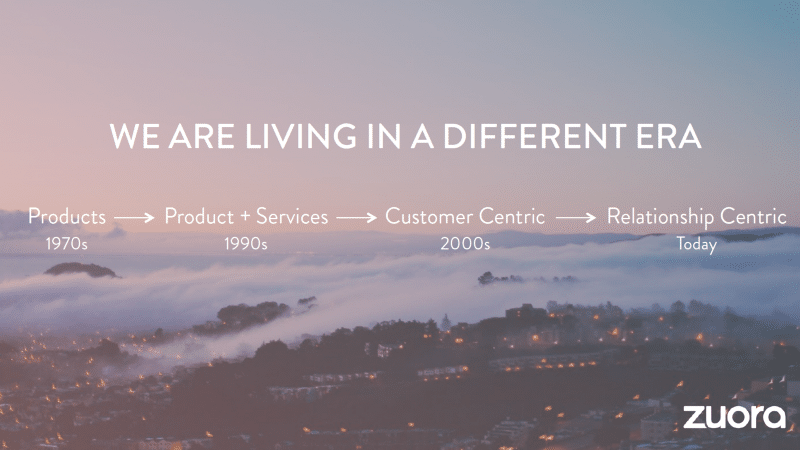
Note the subtle but important difference from what most pitch advice tells you, which is to start with “the problem.” When you assert that your prospects have a problem, you put them on the defensive. They may be unaware of the problem, or uncomfortable admitting they suffer from it.
But when you highlight a shift in the world, you get prospects to open up about how that shift affects them, how it scares them, and where they see opportunities. Most importantly, you grab their attention. As Hollywood screenwriting guru Robert McKee says:
…what attracts human attention is change. …if the temperature around you changes, if the phone rings — that gets your attention. The way in which a story begins is a starting event that creates a moment of change.
All prospects suffer from what economists call “loss aversion.” That is, they tend to avoid a possible loss by sticking to the status quo, rather than risk a possible gain by opting for change.
To combat loss aversion, you must demonstrate how the change you cited above will create big winners and big losers. In other words, you have to show both of the following:
Zuora neatly accomplishes this by documenting a “mass extinction” among Fortune 500 companies…
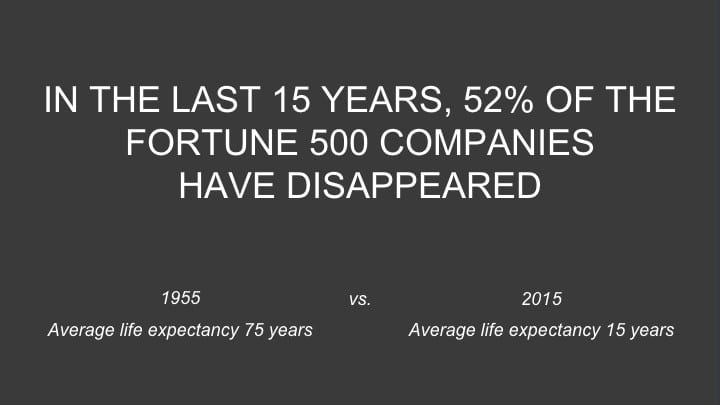
…and then showing how the “winners” have shifted from product ownership to subscription services. Those include upstarts…
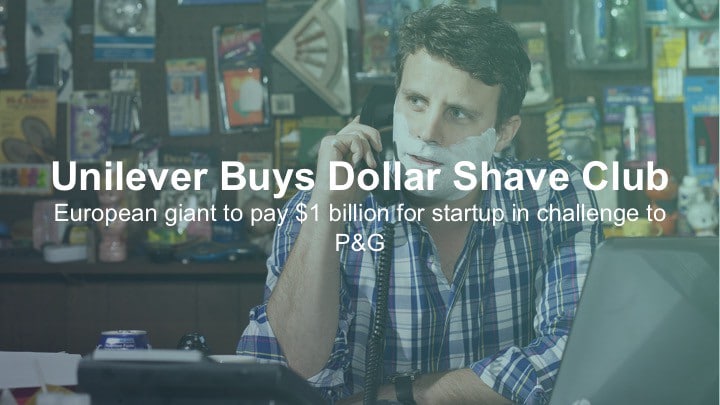
…as well as rejuvenated incumbents:

To bring the point home, Zuora asks the following:

Of course, by this point the common thread is already well established in prospects’ minds: Winners adopt the subscription service models that Zuora supports.
It’s tempting at this point to jump into the details of your product or service. Resist that urge.
If you introduce product/service details too soon, prospects won’t yet have enough context for why those details are important, and they’ll tune out.
Instead, first present a “teaser” vision of the happily-ever-after that your product/service will help the prospect achieve—what I call the Promised Land.
Your Promised Land should be both desirable (obviously) and difficult for the prospect to achieve without outside help. Otherwise, why does your company exist?
After demonstrating that the subscription economy will result in winners and losers, Zuora presents this Promised Land slide, which offers concrete criteria for what it means to win in the subscription economy:
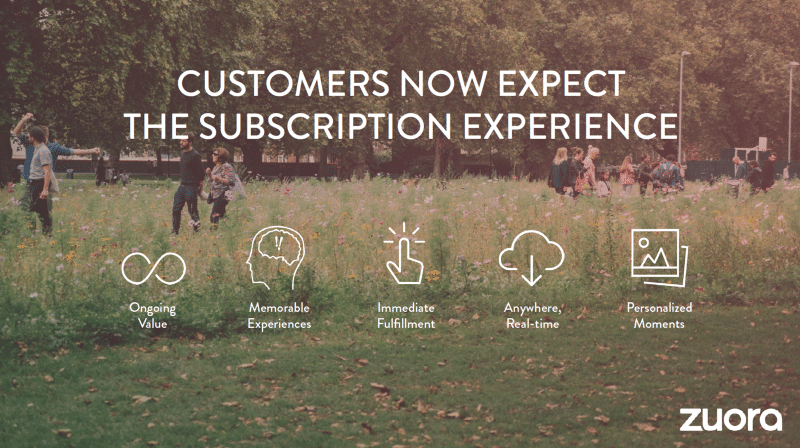
Note that the Promised Land is a new future state, not your product or service.
(Over lunch, I asked my friend Tim to articulate his Promised Land, and he said, “You’ll have the most innovative platform for ____.” Nope: the Promised Land is not having your technology, but what life is like thanks to having your technology.)
Your Promised Land is also crucial for helping prospects pitch your solution to colleagues after your sales meeting ends. In your absence, those colleagues will ask, “What do those guys do again?” Armed with a compelling Promised Land, your prospects are more likely to supply an answer that gets others on board.
If it’s not clear by now, successful sales decks follow the same narrative structure as epic films and fairy tales. Your prospect is Luke, and you’re Obi Wan, furnishing a lightsaber to help him defeat the Empire. Your prospect is Frodo, and you’re Gandalf, wielding wizardry to help him destroy the ring. Your prospect is Cinderella, and you’re the fairy godmother, casting spells to get her to the ball.
When you introduce your product or service, do so by positioning its capabilities like the lightsaber, wizardry and spells—as “magic gifts” for helping your main character (prospect) reach that much-desired Promised Land.

For example, above is the slide where Zuora talks about the structure of its customer record. Out of context, this detail would likely bore even the most technical prospect.
Positioned in the context of transitioning from an “old world” to a “new world,” however, it’s the foundation for an engaging conversation with prospects—technical and otherwise—about why it’s so hard to reach the Promised Land with traditional solutions.
In telling the sales narrative this way, you’re making a commitment to prospects: If they go with you, you’ll get them to the Promised Land.
But the road to the Promised Land is, by definition, littered with obstacles, so prospects are rightly skeptical of your ability to deliver. The last piece of the pitch, then, is the best evidence you can offer that you can make the story you’re telling come true.
By far, the most effective type of evidence is a success story about how you’ve already helped someone else (who is similar to the prospect) reach the Promised Land. Zuora has a set of customer success stories that sales reps draw on, and while they’re more elaborate in the actual deck, this testimonial captures the essence:
I also like this one, from an exec at NCR (a Zuora customer), which speaks more explicitly to Zuora’s stated Promised Land:

What if you don’t yet have a huge number of successful customers? Product demos are the next most effective evidence, but again, features should always be presented in the context of how they help a prospect reach the Promised Land.
Of course, successful sales rarely happen solely as the result of a great deck. In order for salespeople to be successful, the entire organization must align around the narrative about change, Promised Land, and Magic Gifts.
There’s no better example of that than Zuora. If you ever see a Zuora executive speak—including CEO Tien Tzuo—you’ll almost certainly hear about the subscription economy and the winners and losers it’s creating. In fact, that’s the theme of virtually all the company’s marketing communications and campaigns, as well as its public vision statement:
According to the ex-Zuora salesperson, this company-wide alignment around the story made him wildly successful:
The Zuora marketing folks ran campaigns and branding around this shift to the subscription economy, and [CEO] Tien [Tzuo] talked it up all the time. All of that was like air cover for my in-person sales ground attack. By the time I arrived, prospects were already convinced they had to act. It was the closest thing I’ve ever experienced to sales nirvana.
Just three weeks after our lunch, Tim called to say he was seeing promising changes in how prospects at large enterprises were reacting to his new deck, which we drafted together based on Zuora’s template. For one thing, prospects opened up much faster about the challenges they were facing. Also, he said the new pitch was more effective at engaging CFOs and other senior gatekeepers.
Then, a week after that, Tim emailed with even better news: He had just signed the largest deal in his company’s history.
Next week, we’re headed back to Amber India to celebrate.
About Andy Raskin
Andy helps leaders align around a strategic story — to power sales, marketing, fundraising, product, and recruiting. His clients include teams backed by Andreessen Horowitz, First Round Capital, GV, and other top venture firms. He’s also led strategic story training at Uber, Yelp, General Assembly, HourlyNerd, Neustar, and Stanford. To learn more or get in touch, visit andyraskin.com.
The post The Greatest Sales Deck I’ve Ever Seen: It’s Zuora’s, and it’s brilliant. Here’s why. appeared first on OpenView Labs.

You want a strong start to 2017. Awesome! But if you want to see greater marketing results next year, you’ll need to use the remaining time in 2016 to set the stage for January 1st.
The best way to start the year off right is to gather your sales and marketing team together for a series of planning sessions to get everyone aligned and headed in the same direction. Follow these steps to learn from the past, dream big, and put together a sensible plan for achieving your goals in 2017!
Make sure you’ve allocated enough resources (people and money) to accomplish your company’s goals for the year. The size of your marketing budget will also depend on how much you have available to invest, and how quickly you want to see results. If you have caviar dreams and a tuna fish budget, you’ll be disappointed by your lack of results, and your team will be frustrated by their inability to meet your expectations.
We’ve just completed a detailed series on developing a successful marketing budget. Use those articles as a starting point for establishing your budget for 2017.
Look back at your best customers and identify the characteristics that make them profitable and enjoyable to work with. Make sure your ideal customer profile and buyer personas are accurate and update them as necessary to reflect the kinds of customers who will help you reach your growth goals.
Once your personas are updated, document the journey each persona will take toward becoming a customer. Your contacts take lots of tiny steps along the way to becoming a buyer. Plot out every interaction point your personas will have with your content or your company. This is your buyer’s journey—and each persona has their own.
Start at the end—what will they do immediately before signing a contract with you? What’s the step before that? The one before that? At each point along the way, identify the persona’s main questions, motivations, and potential objections. Then identify the kinds of content you’ll need to create to meet them at each point along the buyer’s journey.
Don’t forget about the influencers in the process. Feed your main contact the content they need to help educate and sell you internally.
You should also determine what CTAs to include in order to lead them to the next step.
Make sure you’re clear on what makes you different from your competitors. Talk to some of your customers and find out why they chose to buy from you—and what could make them switch teams and buy from your competitors instead.
Make sure that your printed and digital marketing materials are written and designed to attract your ideal customers and communicate your company’s unique qualities to prospects and customers. Verify that copyright dates are updated, that your style guidelines are being followed, and that everyone on your sales team is using the right version!
Take a look at your website and social media channels to make sure they’re designed to attract and educate your personas. Is your branding and messaging consistent? Are you engaging with the right target audience? Is your content compelling and educational? TIP: HubSpot’s Marketing Grader can give you a quick snapshot of what you’re doing right, and where you could improve.
Is your sales process set up to close the quality and quantity of customers you need to reach your company’s growth goals? Does everyone on your sales team follow the same process for qualifying and nurturing prospects? Is your process documented? Is your CRM (customer relationship management) system set up to support your process efficiently and effectively? Could you be using any automated tools to make your process more efficient?
Document any issues you uncover while you’re reviewing your collateral, processes, and templates. Look for “dark pools”—areas of your process where prospects or customers get lost or ignored due to lack of time/energy/resources.
Prioritize the issues you’ve identified and develop a phased approach to tackling them over the next four quarters. Depending on the issues you’ve identified, you may need to develop tactical plans for content/inbound marketing, social media, lead generation, lead nurturing, or account development.
Make sure you have defined metrics for measuring success, and have assigned individual team members to be accountable for solving each issue. Set up regular meetings to review progress, identify and solve issues, and align activities across teams. Learn from your mistakes and victories, and evolve your tactics as needed to maintain your traction!
If you’d like to try it yourself, download our eBook, Get Sales & Marketing Traction with Inbound to learn more about how to complete these steps.

Salespeople are the frontliners of your business. Their competence determines what light will be cast on your company. When they fail to be at their best, it doesn’t only reflect poorly on your company and brand, it also hurts your bottom line.
While there are superstars, there are also sales reps who grit their teeth and end each day frustrated. But, why?
I put together this list of reasons why sales reps fail. I’m sure there are more out there, but this should help you start troubleshooting.
Salespeople are often measured by how well they pitch–but active listening is probably one of the most underrated sales skills. Unfortunately, it’s one that many reps fail to develop.
Keith Rosen, The Executive Sales Coach, laments this fact. He notes that many salespeople don’t get skills training on effective listening. “Listening well improves the quality of the relationships you have with clients, friends, co-workers, or family members. Ineffective listening can damage relationships and deteriorate the trust that you have with your clients. The price of poor listening is many lost selling opportunities.”
Giving value is the key to getting the trust of our customers and prospects. However, the concept of creating and giving value is lost on many sales reps. What does this lead to? Cringe-worthy sales calls where your rep pressures the customer to agree to a transaction instead of demonstrating the value of your product.
Prospects need to feel like you understand their business challenges and that your product helps overcome those problems. This is the heart of value-based selling. Unfortunately, according to a Forrester Research’s Buyer Insight study, “only 13% of customers believe salespeople can demonstrate an understanding of their business challenges and how to solve them”.
If someone likes to complain, they’ll never run out of material. In sales, complainers spew all kinds of excuses: the leads are bad, the industry is not in a good place right now, now is a bad buying season. Absolutely unproductive.
Now one of the worst excuses I’ve encountered is one that is seldom verbalized–but as they say, actions speak louder than words. Some salespeople do not give a hoot to “small” prospects and spend their time daydreaming about that one huge prospect that they always think will be closed on this call. Sometimes it happens, often it doesn’t. The devil is in the in-betweens. When they fail to close deals, they always say that next week will be the one!
Be on the lookout for salespeople who are beginning to adopt this attitude. Keep them grounded and focused on the team’s goal; a goal that is achieved by a series of wins and not a single–often elusive–jackpot.
Following through is vital in sales. If you tell a prospect you’ll call them before the week ends, do that. Promising and not delivering is one of the quickest ways to sour your relationship with a prospect. The practice of consistently doing what was promised is in every successful salesperson’s arsenal.
For Alice Myerhoff, VP of sales at Edsurge, following through is a crucial aspect of being a consistent salesperson who gets results. “Showing up when there isn’t a deal at stake is a great way to foster a strong long-term relationship. And clearly, following up after the sale is no-brainer if you are selling to someone that may upgrade, renew or purchase more products or services from you in the future.”
It would be nice if most prospects said yes during the first touch, but that’s just very far from the truth. Only 2% of closed deals happen at the first call or meeting. The majority of successful transactions are a result of the gradual build up of trust across several touches.
Unfortunately, there are many reasons behind the failure to follow-up. Salespeople may be afraid to appear pushy; sometimes they just don’t think it’s that important. Others haven’t been trained to do so, or just think a prospect will reach out if ever they want to finally purchase.
No matter the reason, not following up is leaving money on the table.
Salespeople need support to be successful. Tools, training, coaching–all these are part of a support system that enables reps to reach and smash quotas. Without support, salespeople spend less time selling and more time dealing with tweaking processes and adjusting execution.
Sales operations teams are usually in charge of ensuring that sales reps are focused on what matters most. Without a properly functioning sales operations team to reduce the friction in the sales process, reps are always in between tasks and never in the position to deliver their best.
Of course, the sales team still holds ownership of their goals. However, without proactive help from sales operations, their managers, and trainers, reps’ growth will be stunted and they won’t develop skills required to solve unique sales problems.
While the stereotypical fast-talking sales rep may not be the most likable, the timid and withdrawn salesperson doesn’t get anywhere. If you’re scared of making calls or creating opportunities for extended communication, sales is probably not for you.
According to Sandler Training, a salesperson’s underperformance is rarely due to external factors. “The majority of them don’t lose because of product inferiority, pricing excesses or poor sales technique. They lose because of low self-esteem!”
Apart from this, some reps also suffer from poor “self-image”. They tell themselves they’re bad at their job. Worse, some reps think that sales is the bottom of the proverbial barrel. “I’m just a lowly salesperson” is a thought that lives in their heads–that a job in sales is just a “stepping stone” to getting a real job.
The most successful salespeople are those who are confident–they believe in themselves and in their chosen profession. They take pride in helping clients ease and overcome their challenges.
Closed deals don’t come easily; that’s for sure. Everyone in the team must be willing to put in the work. Be on the lookout for these problems in your sales organization and nip them right in the bud. It’s best to arrest bad habits, traits, and practices before they balloon and blow up.
When it comes to inbound marketing, you will almost always hear about the “buyer’s journey” when referencing personas and when to reach out to your prospects. But when you scratch beneath the surface of that phrase, you may find that it’s not always easy to figure out where people are in that journey.
Why does that matter?
Well, remember when I talked about marketing and sales alignment? Having a comprehensive understanding of the buyer’s journey (and knowing where the buyer is in their journey) is key to determining that oh so critical marketing and sales relationship.
When you talk about inbound marketing, every action a lead takes on your website is a signal of some sort. For example, how many (and which) pages they visit, as well as what content they access, is a great way to determine which stage of the buyer’s journey they fall under.
Most of us may have some basic knowledge on the three different stages of the buyer’s journey and the type of thought process the buyer has within each one. Knowing this information helps marketers understand what their buyers are doing and how they can help them move from one stage of the sales cycle to the next. Let’s take a look at each stage and how it varies with the different types of website visits.
During the awareness stage, sales will want to reach out and connect with their prospect. Most website visitors are in the awareness stage because those visiting your blog, interacting on social media (comments, shares, etc.) or doing a simple Google phrase search, are almost always still in the research phase. These visitors are looking for answers, subject matter expert (SME) opinions and any way to educate themselves.
Now that your prospects are past the stage of simply researching, they are more likely to be visiting specific website pages, such as your product pages, features pages and “About Our Company” section on your website. This is called the consideration stage, when your website visitors can vary from leads to customers to unknown strangers, some of whom are engaged and qualified, while others may be engaged but not at all suited to your business.
Going hand in hand with the buyer’s stages, is a buying trigger.
A buying trigger is an event that causes a buyer to have a definitive need. Perhaps you are sick and go online to research your symptoms and select a way to treat yourself. It’s helpful to set some qualifying guidelines for your company on what would trigger a personalized response. For instance, if someone visits a product (or equally important) page or has, let’s say, at least three interactions, this could qualify as a trigger.
Understanding buying triggers is equally important as working with triggers to improve marketing. You can do so by:
Enter pricing guides, direct demos, bottom of the funnel offers and “Contact Us” pages. Buyers in the decision stage have narrowed down what they are looking for and are now visiting your website with the thought process of what it takes to become a customer.
As the most attainable opportunity for sales, a member from your sales team should be reaching out immediately to the prospects in the decision stage.
By segmenting and analyzing your website traffic based on actions, you can ultimately determine what stage of the buyer’s journey a prospect is in. Once you discover where your top-of-funnel website visitors and leads are in their buying cycle based on their online interactions, be sure you have appropriate paths for them to follow that answer their questions and move them forward through to the next stage.
By creating educational and relevant content, capturing their information as soon as possible and understanding what triggers them to close as a customer, you will find the most valuable information for marketing and sales to work together. Don’t forget to build your credibility by tailoring your outreach from the initial email and targeting the buyers furthest down the funnel.
Do you use specific metrics to determine what stage of the buyer’s journey your prospects are in? In turn, how do your sales and marketing teams use this knowledge to help them in their alignment?

For several years now, Inbound Marketing has taken the helm as our most “talked about” strategy for driving interest and leads. Why? Because it works!
This is how we built up our own demand and lead gen efforts. Content driven Inbound is a proven way to accomplish these things, and my agency has witnessed firsthand just how true that statement is.
But it’s not all roses and candy. Inbound Marketing in and of itself is great. Assuming you already have some other marketing decisions and processes in place.
So you are all jazzed up to start blogging, tweeting, building links, and more. That’s great.
But have you considered these inbound marketing prerequisites first? If not, take a step back and ensure they are all in place from the beginning. You’ll be glad you did it later.
We are often surprised at how many prospects tell us they want to start doing “content marketing and SEO,” yet have no official branding in place. Most of them have pulled together a logo and maybe a tagline. But precious few of them have taken the time to really think about the brand.
Some things to consider when building your own brand:
These are the basics, but there are many more pieces to consider. If you want to read more about branding, check out my Internet Marketing 101 presentation that I have presented many times to various workshops and meetup groups. It includes some great tips for how to build an elevator pitch and boiler plate. These will be instrumental in helping grow a sustained and consistent brand as you step out into the world of Inbound to promote yourself.
Once your brand is locked down and ready to roll, the next prerequisite is messaging. This digs deeper into the way you will craft descriptions of your business, team, products, and more.
Messaging goes much deeper than branding does. Whereas a brand is the overarching position of the company, your messaging should then filter down that brand into several deeper, more focused areas. We often see these areas referred to as “messaging pillars,” which help support your brand much like pillars help hold up the roof on the Parthenon.
Although you really can’t decouple understanding of your target audience from branding and messaging themselves, I felt it was important to call it out on an equal level for prioritization purposes. We often see this step moved to before branding, and that can certainly be the right way to do it for some industries.
However, defining your target markets and audiences is never complete. You will want to have a starting point, but then revisit that on a regular basis, perhaps annually.
Even more importantly, knowing your target audience intimately will help you create better messages and content, build out your customer profiles for data collection more accurately, and find them online when you are out there trying to garner their attention.
So don’t just focus on what you’ll say about you. Know who you’re planning to woo, and factor that into branding and messaging as well as your overall Inbound Marketing strategy.
Before you can set realistic SMART goals, you need to know where you are starting. Of course, you’ll want to think through what types of metrics are most important for measuring progress and success.
Once you know what you’ll set as your KPIs (Key Performance Indicators), then you can analyze historical data. Pull out the historical stats, trends, and current volumes. You want to come out of this exercise having an abundantly clear view of exactly what you are trying to expand upon. Afterward, you’ll be ready to set…
Goals and objectives are often discussed, but often overlooked come execution time. Let me just state this – if you fail to set goals up front, you won’t be able to determine success down the road.
This could be as simple as saying “Grow overall organic traffic by 10 percent per quarter.” Or you could get more granular, analyzing where that traffic goes and measuring growth on a specific blog post or product page.
When you get really good at this part, you’ll be setting revenue targets. But Inbound Marketing doesn’t generate interest, convert leads, AND close sales for most business types. What will you do with all of those inquiries once you get them?
This is where your Inbound Marketing efforts will truly show impact on the business. It’s not enough to simply drive traffic or conversions and hope they buy.
No, you need to think through how you value or score your leads. What are you offering them to convert? What data do you collect? Where is that stored? How are you reaching out to them to move them along to a sale (email marketing, sales calls, etc.)?
This is almost always underestimated in complexity for smaller and mid-sized businesses, particularly those companies in industries that operate offline the most. Maybe you have a simple manual process. Good, at least you have something in mind. When you start growing out a bigger team or budgets to hire outside help, you can step up your Marketing Automation and Lead Gen efforts accordingly.
Is Inbound Marketing for every business? No. Many businesses either can’t access their target audience online, or can’t follow through on execution of Inbound due to lack of staff, funds, or prioritization internally.
When you start your Inbound Marketing program, you need to be realistic. Have a plan in place for how you will pull back from it if you find that it is not working, or that it is placing an undue stress on your employees and internal processes.
Yes, it would be a disappointment to backtrack. But it will sting much less than if you already have ideas about how to gracefully exit Inbound, just in case you need to do so.
A little pre-planning will help position you better to succeed at Inbound, and will help you derive the most possible value from the work you do to drive SEO, Social Media, and Content Marketing improvements for your website. Be sure to check off that you’ve completed these inbound marketing prerequisites before you roll up your sleeves and start writing and promoting content.


