Shared posts

01 May 16:48

Facebook is taking aim at email and direct mail marketing with new tools and features it's bringing to Messenger

by Lauren Johnson

Stan Chudnovsky, VP of Product, Facebook Messenger,

  • Facebook is making a big push for Messenger at its F8 conference this week, pledging to drop the size of the app to 28 megabytes and appealing to developers to build quick chatbots for it.
  • A handful of new features helps marketers run more sophisticated marketing and plug into CRM software, which could threaten email and direct mail marketing that advertisers have used for decades to run targeted advertising.
  • Facebook reported that businesses send 20 billion messages per month through Messenger, up from 2 billion in 2017.
  • The Messenger push aligns with Facebook's new emphasis on privacy and suggests that the company will increasingly pitch marketers on branded chatbots and ads in the app.
  • Visit Business Insider's homepage for more stories.

Facebook is betting big on Messenger and wants marketers to get on board.

At its annual F8 developer conference in San Jose, California, today, Facebook unveiled new features for Messenger aimed getting developers to make more chatbots for the app.

Marketers have had mixed results with chatbots, and the idea behind the new tools to track metrics like lead generation and in-store traffic is to get service-focused brands to ramp up their efforts.

"There was a lot of testing in this space, and we're finding that it's most appropriate for things like service organizations where if you have a product that you were complaining about, it's a channel that is easier to work with than email," Oscar Garza, EVP of global media activation at Essence, told Business Insider ahead of F8.

Read more: Marketers want more details about how Facebook's move to encryption will impact ads

Three new features will let marketers get granular targeting and upload chat data, tactics that are core to the way marketers have long used email and direct marketing to send targeted messages and mail.

A new lead-generation template lets advertisers use Messenger to get consumers to interact with the app before being directed to a human representative.

Lead Generation

Developers can also create reminders that follow up with consumers after they've left a Messenger app and download the list of sales leads manually, through CRM software.

Facebook is also adding more features to the shortened URL service it runs in Messenger called m.me. The links redirect users to a Messenger app if someone clicks on it from an email or website. Now, developers can add them to mobile apps and websites. A logged-in customer with refund or billing questions in a retailer's app can click a link to chat with a representative on Messenger, for example.

Another feature lets businesses such as hair or nail salons do appointment booking through Messenger.

Facebook is speeding up Messenger

Facebook also announced some new growth stats for Messenger: 40 million businesses and 3,000 developers push out 20 billion messages per month on the app, up from 2 billion in 2017.

To encourage developers to quickly build chatbots that are fast and light, Messenger said that in an effort dubbed "Lightspeed," it plans to cut the app by 70 megabytes to under 30 megabytes so it will load content in two seconds and likely help with Facebook's move towards encryption and ephemeral posts.

Video is a growing area for Messenger and the app reported that 410 million people connect over video chats every month. Messenger is testing a video feature that allows people to watch videos together in real-time, similar to Facebook's Watch Party feature, and is also rolling out a desktop app for Messenger. The company did not give an exact date for the launches but said they will roll out later this year.

"It's clear that 2019 will be a transition year for Messenger and for messaging as we proceed to build an app that realizes a privacy-focused vision for social networking," Messenger wrote in the post. "The idea being that if we were to start to build a social network today, we'd start with messaging first."

Join the conversation about this story »

NOW WATCH: What happens to your body when you drink too much coffee

30 Apr 16:31

Investors love companies with huge cash piles — but Goldman Sachs has uncovered an 'unusual' strategy to profit from those racking up debt

by Akin Oyedele

trader confused

  • Over the past year, investors have shown a preference for companies with quality balance sheets.
  • However, equity strategists at Goldman Sachs have found a more specific and "unusual" performance trend that runs counter to the marketwide leaning: firms spending cash to reduce their debt are lagging those issuing more debt. 
  • They introduced two new baskets of stocks to keep an eye on this trend.
  • Visit Business Insider's homepage for more stories.

Strategists at Goldman Sachs and elsewhere have recently recommended companies with strong balance sheets as sound investments to weather a global economic slowdown.

Beyond the intuitive reason that their cash reserves are higher, these so-called quality stocks are in vogue because they've outperformed others splurging cash over the past year.

Investors haven't always rewarded prudent uses of cash. For much of the 10-year bull market, when interest rates were close to zero, companies with the weakest balance sheets were able to tap the debt markets to raise capital. But that source of easy money was gradually closed off as interest rates rose, raising the allure of companies with more cash discipline.  

"Recent market performance indicates a clear investor preference for safe, high quality balance sheets rather than firms investing for growth, returning cash to shareholders, or paying down debt," said David Kostin, the chief US equity strategist at Goldman, in a recent note to clients.

And yet, Kostin's team found a more specific performance trend that runs counter to the marketwide preference for quality: companies racking up more debt are outperforming those reducing their debt. "Debt reducers" have underperformed "debt issuers" by 10 percentage points over the past year — 3% versus 13%, Kostin said. 

"This underperformance is unusual because most 'quality' strategies have outperformed during 2018 and into 2019," Kostin said.

Read more: The world's largest wealth manager just made a significant change to its $2 trillion portfolio — and it's a wake-up call to anyone invested in US stocks

One reason for this counter-trend has to do with Goldman's methodology, Kostin said. The strategists screened companies with the highest trailing 12-month net payments (or issuance) of debt as a share of their enterprise value. Unlike market capitalization, enterprise value takes account of how much debt a company has.

This meant that Goldman's baskets of stocks skewed towards companies with lower valuations, Kostin said. "Our long/short value factor has lagged by 12% during the past year as investors have continued to reward growth stocks (+6%)," he added.

It's also unusual because companies raised their cash spending by 25% to $2.8 trillion last year, according to Kostin, but investors have not rewarded most kinds of cash spending like debt repayments.

As Kostin stressed, investors largely prefer companies with strong balance sheets. But this specific screening — of how companies are tackling their debt relative to their enterprise value — is one he says investors should keep an eye on. 

The basket of companies issuing more debt (which has outperformed the cohort of debt reducers) includes Twitter, Netflix, General Motors, Cigna, and Con Edison.     

SEE ALSO: Billionaire investor Howard Marks explains why he's investing with 'more caution than usual' — and lays out a 3-part approach for surviving for the next meltdown

Join the conversation about this story »

NOW WATCH: Here's what 'Game of Thrones' stars look like in real life

30 Apr 16:31

Building an Amazon Customer List with Facebook Messenger

by Thomas Pruchinski

Chatbots are emerging as a powerful way for businesses to engage with customers. Most Amazon brands, however, have little interactions with customers. By now, it’s no secret that an email list can be a powerful asset for a brand to succeed on and off Amazon. A Messenger list can be an equally valuable asset – in fact, Messenger is more engaging and interactive than email.

Below we will discuss some strategies for Amazon sellers to build up a Messenger list, and how to use chatbots to boost Amazon rankings, generate reviews and engage with customers.

Why Messenger and Chatbots

Selling on Amazon has some tremendous advantages, but it does not come without downsides. Amazon gives its sellers access to millions of buyer-ready consumers, but when a sale is made, it’s Amazon’s customer not yours. They encourage dog-eat-dog competition between sellers. And it’s quite difficult to build customer loyalty. For instance, Amazon does not give you access to customer emails and explicitly prohibits sellers from sending marketing communications to customers.

This is why Messenger and chatbots are such a great opportunity for Amazon sellers. When a customer subscribes to your Messenger bot, they are starting a conversation that could turn into a very valuable, long term relationship.

Instant messaging is how people today (especially young people) communicate with their friends and family. And Messenger is the #1 messaging app in the United States. So by interacting with customers in this platform, you are establishing your business in a very personal, engaging way.

The statistics on Messenger show just how engaging the platform is for business-consumer relationships. On average, Messenger gets open rates almost 4X that of email. And click-through rates of 5-6X that of email.

Perhaps the best part about Messenger is the level of interaction that can be automated. As you collect more data, you can iterate your bot to anticipate the concerns of your customers.

How to Build Your Messenger List for Amazon

Here are 3 ways to start building your Messenger list for Amazon right now.

Run Messenger JSON Ads to Distribute Amazon Coupons

You can use Facebook Messenger to deliver single-use promotion codes for Amazon. This is a great incentive to get a cold audience subscribed to your bot. And in the process you will be boosting your sales velocity and, thus, increasing your keyword rankings on Amazon, which will result in more organic traffic to your listings.

With a JSON ad tool built specifically for Amazon sellers, it is super easy to create chatbots to deliver promo codes and follow up for reviews. When someone clicks on your Messenger Facebook Ad, it will open up a conversation directly within Messenger for them to claim a coupon. Keeping the conversation within Facebook helps keep conversion costs low.

Amazon Coupon Delivery via Facebook Messenger

Alternatively, you can use a general purpose chatbot tool, like ManyChat or MobileMonkey, and integrate with Google Sheets to deliver promo codes.

Once someone interacts with your bot in Facebook Messenger (by clicking the button to Claim a Coupon), they are subscribed to your list. (They can unsubscribe at anytime). Now you can follow up with them, via an automated bot, to ask for reviews!

Request Amazon Reviews Via Facebook Messenger Chatbots

You can also hit them up with useful content, future promotions and easily launch new products to a warm list going forward.

Get People on Your Email List to Subscribe to Messenger

Another way to grow your Messenger list for Amazon is to send an offer to your email list. ManyChat & other Messenger bot tools allow you to create growth tools that send content through Messenger. For an Amazon-specific tool, you can use a landing page that offers a discount code for Amazon and delivers the code through Messenger.

Send Amazon coupon codes via Facebook Messenger chatbots

This is similar to the Messenger ad chatbots shown above, but instead of opening up the chatbot directly from a Facebook Ad click, the chat is opened from a click on the landing page call-to-action button.

Having customers on both an email list & Messenger list allows you to contact them in multiple ways. Some people will prefer one medium over the other, so this will help ensure your messages reach them and increase your bottom line.

Use Product Insert Cards with QR Codes to Grow Your Messenger List

A third option for growing your Messenger list is with product insert cards. By including a QR code on the card, you can encourage people to sign up to receive a warranty (or some other valuable offer) by scanning the QR code. Put the card in the product package and every customer will receive it with purchase.

Using Your Messenger List

With a chatbot tool like Many Chat, you can use your Messenger list in much the same way as an email list. Except Messenger has the added benefit of chatbots, which are more interactive than email campaigns.

The highest value use for Amazon sellers would be a launch list. Having built up a sizable list (ie 2,000 subscribers +), every time you launch a new product, or want to boost rankings for an existing product, you can send a broadcast to your Messenger list with an Amazon promotion.

You can also use Messenger to send a newsletter, similar to email marketing. Every so often, send your useful content to your audience, curate other content from around the web and alert your list of exciting news.

It’s a good idea to integrate your Messenger & email strategy so they work together. For instance, if you might send your newsletter via email, and use Messenger for limited-time promotions and follow-ups on things like shipping confirmations and customer support.

Final Thoughts: Messenger Marketing for Amazon Sellers

Facebook Messenger & chatbots are here to stay. And they provide Amazon sellers an excellent opportunity to boost performance on Amazon, while building an audience of raving fans for long-term brand growth. Get your Messenger chops going before your competitors do!

[Learn More About Messenger Marketing For Amazon Sellers here]

30 Apr 16:29

WeWork's co-president says it's 'really just getting started' on working with Fortune 500 companies, as it files to go public

by Meghan Morris

WeWork office

  • WeWork, best known as a co-working company for individuals and start-ups, has seen explosive growth in managing workspaces for larger corporate clients. 
  • A recent report highlights what those companies get out of WeWork: help entering new markets and attracting and retaining employees, among other benefits. 
  • One enterprise member at Liberty Mutual told Business Insider that his team quadrupled its footprint with the company in the last four years and they're expanding to South America in a WeWork. 
  • Visit Business Insider's homepage for more stories.

One of WeWork's fastest-growing businesses has nothing to do with its start as a coworking space for people looking to get fledgling companies off the ground. 

About a third of WeWork's members now work for big companies like Microsoft, BlackRock, Salesforce, and Adidas. WeWork only started targeting these companies just over two years ago, in a push led by vice chairman Michael Gross. 

"From an employer standpoint, WeWork is a better experience for their employees and meaningfully cheaper on a per-employee basis," than traditional office space, co-president and chief financial officer Artie Minson told Business Insider. "The CEOs like us and the CFOs like us."

A survey released Monday – WeWork's first "global impact report" – showed some of the purported benefits for these major companies, among other statistics. About half of the enterprise members said WeWork has helped them enter new markets, and more than three quarters said it's helped them attract and retain talent. 

See more: WeWork acquires $249 million office-services startup Managed by Q as it goes after larger business customers

The report came the same day as WeWork filed its draft registration to go public. WeWork rebranded as The We Company in January in an effort to expand beyond commercial office rentals. Softbank, the Japanese conglomerate, has invested some $10 billion in The We Company, most recently, in January, at a valuation said to be about $47 billion.

Enterprise is one of the biggest growth areas for the company. Corporate memberships jumped from 43,000 in the fourth quarter of 2017 to 119,000 in the last quarter of 2018, according to a financial presentation seen by Business Insider. WeWork currently leases to about a third of Fortune 500 companies, and Minson said he "certainly" expects both the number of overall memberships and company's client roster of Fortune 500 groups to grow.

"We're really just getting started on enterprise," he said. "We're now opening buildings at a much higher percentage filled than we used to, and that's because you're not building on spec[ulation]; you're building on you know what people want and when they want it." 

He said companies like that they can sign shorter-term leases than the 10- to 15-year contracts landlords typically require, which helps both with corporate flexibility and with new accounting standards that change how tenants allocate leases on their balance sheets. 

Sign up here for our weekly newsletter Wall Street Insider, a behind-the-scenes look at the stories dominating banking, business, and big deals.

One enterprise member is Liberty Mutual, which put its innovation lab arm in a Boston WeWork in 2015, said Adam L'Italien, the vice president of global consumer markets innovation. In 2017, the growing group moved to a bigger WeWork space across the street from Liberty Mutual's headquarters, expanding its capacity from 40 people to 150. 

Now, the lab can host colleagues from headquarters for short- and long-term work, as well as global rotators. L'Italien said WeWork's programming differentiates the landlord from others, because Liberty Mutual employees can network, attend relevant trainings, and even take a Pilates class in the same building. 

"I do feel strongly about the value of being immersed in this environment where you have all these folks and companies working alongside each other," L'Italien said. "That collaboration and borderless business is very much of huge value."

Liberty Mutual is in the process of launching a similar innovation lab in South America, which will also be housed in a WeWork. 

Join the conversation about this story »

NOW WATCH: Millennials are willing to spend $5000 or more on vacation, making them the age group that spends the most on travel — but Gen Z isn't far behind

30 Apr 16:28

10 More Questions to Start Your Week

by Anthony Iannarino

Here is a list of 10 questions you can use to setup an effective sales week.

  1. Which of your dream clients are you going to pursue for a meeting this week, and what value are you going to trade for their time that increases the likelihood of a getting a “yes” to your request?
  2. With which of your prospective clients do you need to follow up on a past meeting or conversation where there was no real next step established?
  3. Of your existing clients, who do you need to meet with to begin a conversation about your new ideas about how to create even greater value for them in the future? What is the next initiative you have on their roadmap?
  4. Who have you been neglecting? Who do you need to call to let them know you care about them and their business and that you are thinking about them?
  5. What are you going to read this week that will improve your ability to create value for your clients, provide you some new insight, or provide you with something you can share with them?
  6. What proactive planning and preparation work do you need to do to narrow your focus and complete the highest value activities, the tasks and projects that will move the needle for you?
  7. Who do you owe a note of gratitude? Who do you need to thank for giving you their business, helping you with a challenge, or providing you with the advice you needed to get unstuck?
  8. If you look back over your calendar, looking at all your meetings, who (or what) fell off your radar that you should reengage with now? What does it make sense to revisit now?
  9. How are you tracking towards your goals? Where are you at this point of the year? What needs to change for you to reach your goal, if anything? If you are ahead of schedule, what are you capable of where you are now?
  10. What’s broken? What isn’t working and needs a major adjustment or overhaul? Who can help you change your strategy, your tactics, or help you level up your skills?

Use this list over the course of this week to improve your game and drive your results.

The post 10 More Questions to Start Your Week appeared first on The Sales Blog.

30 Apr 16:28

Benchmarking Slack's S-1: How 7 Key Metrics Stack Up

Slack has transformed the way we work. By replacing email with beautiful and simple internal chat, Slack has productized productivity. Founded as a gaming company called Tiny Speck in 2009, the company’s initial product, Glitch, didn’t catch on as expected. So the business pivoted to commercialize an internal tool - a Searchable Log of All Conversation and Knowledge, Slack. Since those early days, the company has grown to employ 1500 employees according to their S-1. The company filed to trade under the ticker SK.

Let’s examine this remarkable company and compare it to Zoom, another recent IPO in enterprise collaboration. Also, we’ll compare metrics to a peer group with similar ACVs.

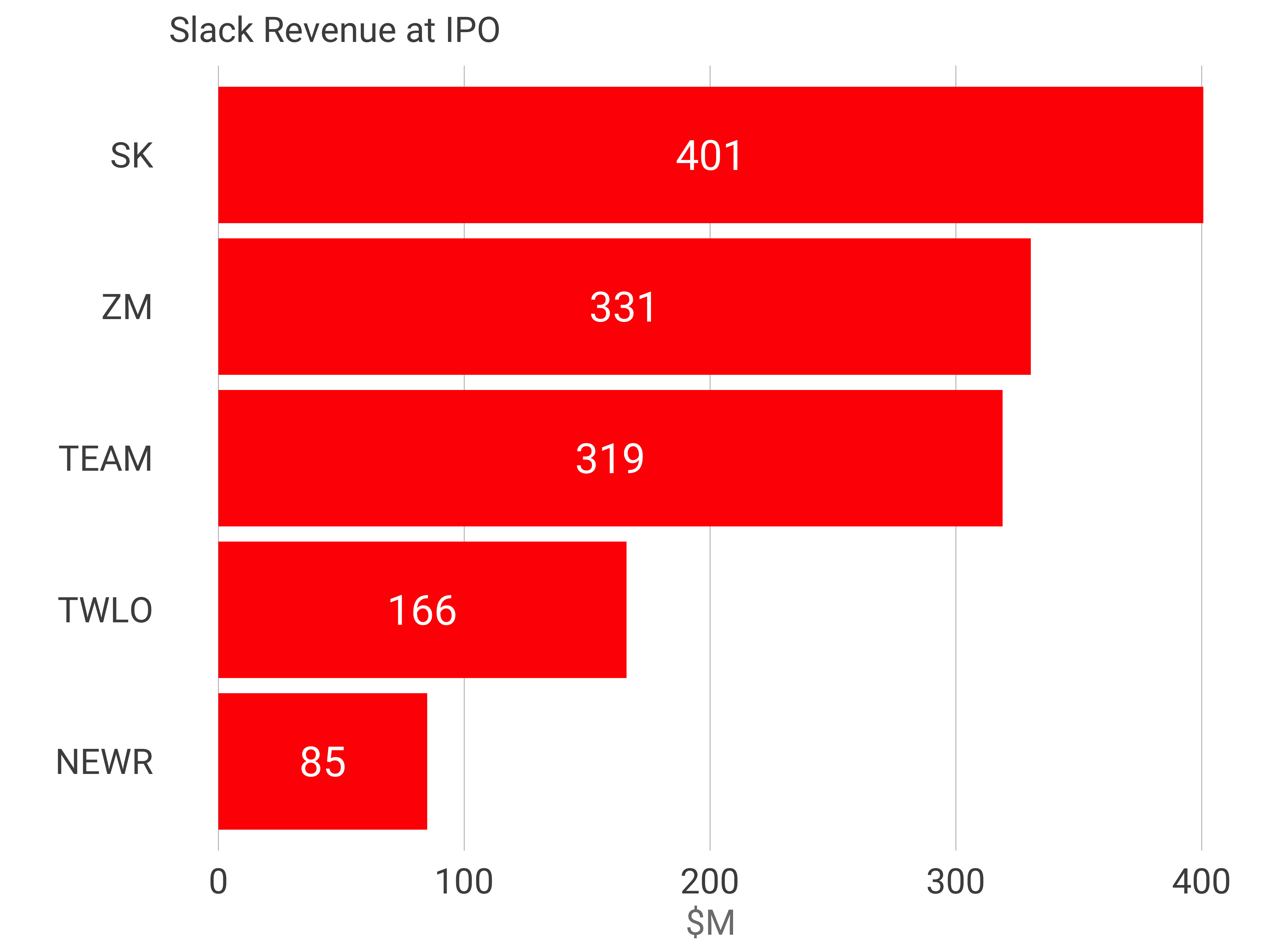
Slack generated $105m in revenue in 2017, $221m in 2018 and $401m in 2019. Note these years are fiscal years, not calendar years. Slack, like many others, uses a fiscal year that ends of January 31st. Zoom, in blue has been smaller in each year, but is growing faster.This compares to $61m, $151m and $331m in revenue for Zoom.

Both of these businesses are growing incredibly quickly. Slack grew 110% and 82% in 2018 and 2019, compared to Zoom’s 149% and 118%.

Examining growth rate across a peer set of companies with similar ACVs, Slack has attained a growth rate similar to Atlassian at IPO, which is amazing thing considering the size of the business at the time of the IPO.

Across the peer set, Slack’s revenue at IPO is substantially larger than others: 20% larger than Zoom and Atlassian, and 371% larger than New Relic.

Slack’s average annual contract value is the smallest of the group at $4.6k and closest to Zoom’s. This is an interesting parallel: the two fastest growing and largest collaboration tools of the past decade both pursued bottoms-up strategies.

Slack has approximately 17 users per organization on average (though the distribution likely follows a power law with a few organizations in the tens and potentially hundreds of thousands of seats). The number of $100k+ accounts has about doubled year over year to 575 out of total customer base of 88,000, and these large customers constitute 40% of revenue.

Slack’s combination of greater revenue and a smaller ACV translates into a much larger customer base: 88k customers in 2019 vs 51k for Zoom.

Slack records 143% net dollar retention, which is top decile according to Redpoint’s freemium study, and dead center of the peer group and equal to Zoom.

Let’s compare gross margin. Slack’s gross margin is consistently five to six points above Zoom. This makes sense since Zoom bears greater infrastructure costs for hosting video compared to Slack which hosts mostly text and images.

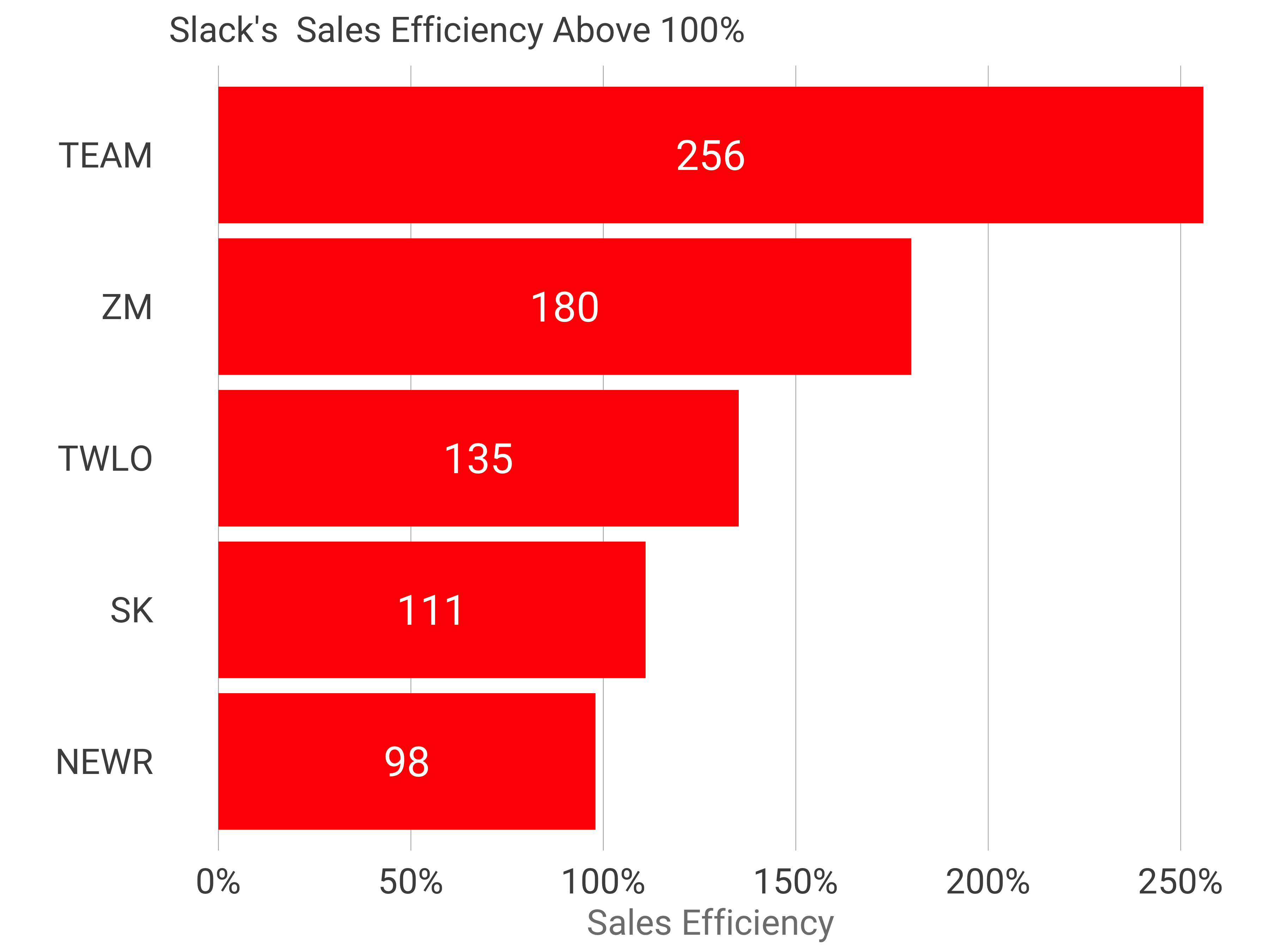
Slack’s sales efficiency exceeds 111%, which is sensational. One dollar of sales and marketing spend today generates $1.11 in gross profit next year. Zoom’s sales efficiency is at 180%. One hypothesis to explain the difference: Zoom is externally viral while Slack is internally viral; we send Zoom invitations outside of our companies, but Slack messages to our colleagues.

In terms of net income margin/profitability, Slack is closest to Twilio at -34% net income margin. The company has been operating the business consistently at -$40m in net income for the past three years, as revenue has grown from $105m to $401m, and the net income has become decreasingly negative with time, a positive trend.

As I wrote about in the Zoom S-1, Zoom has generated profits throughout its growth. There are two major drivers of this profitability. The first is the sales efficiency, mentioned above. The second is Zoom very efficient R&D expense because the majority of its engineering resides in China.

And this comes out in the data. Slack spends 39% of revenues on R&D compared to 10% for Zoom. In dollar terms, that’s $156m vs $33m. In addition, Zoom employs 1000 people to Slack at 1500 people, 33% less.

Slack’s business is a marvel of scale, expansion and growth. It’s going to be an exceptionally valuable business. Congratulations to the Slack team on building an incredible business.

30 Apr 16:25

5 ways to use Augmented Reality in your marketing strategy

by Expert commentator

AR gives you another tool in your belt when it comes to driving sales and enhancing brand value through mobile devices Today's markets are driven more and more by the needs and desires of consumers. As technology advances, those desires …..

The post 5 ways to use Augmented Reality in your marketing strategy appeared first on Smart Insights.

30 Apr 16:17

4 Ways the Right Content Can Fuel Business Growth

by Amanda Clark

To achieve consistent growth at your company, everything needs to be firing on all cylinders—your sales team, your marketing department, your business development crew, you name it. Everyone needs to be doing their part, leveraging resources and expertise to move the ball forward.

Content marketing is very much a part of that equation. When wielded strategically, content can actually be fuel for your business growth—helping turn leads into conversions and one-time customers into repeat clients.

A few types of content can be especially helpful in this regard. Here are our recommendations.

4 Types of Content That Can Help Your Business Grow

  1. Product and service descriptions.

Whether you have an e-commerce clothing boutique or an all-purpose plumbing company, it’s important to devote some website real estate to describing what it is you do—and how your customers stand to benefit. Remember, online shoppers can’t pick up, examine, or try on your products and services, so you need Web copy that makes them feel like they have. Be descriptive enough to help customers feel confident that they know what they’re getting into, and focus on the benefit to the end user—what’s in it for them when they buy.

  1. Landing pages.

Imagine this scenario. A potential customer sees a PPC ad for your law firm’s estate planning services. They click it, and it takes them to your firm’s home page—where there’s no explicit mention of estate planning. That may be frustrating, and your lead may decide it’s not worth their trouble to poke around your site to find what they’re looking for. The long and short of it is, it’s valuable to have dedicated landing pages for each service/product you have, ensuring that you can always send leads to somewhere that specifically addresses what they’re looking for.

  1. Emails.

Don’t ignore the power of email marketingstill the most effective way to directly connect with your customers past and present. Whether you put together a monthly newsletter or a weekly e-blast, take the time to think through your content (including subject lines) to make sure you’re offering value. When leveraged correctly, email marketing can build brand awareness and loyalty, and turn some of those one-time customers into follow-up buyers.

  1. Google My Business listing.

Has your company signed up for a free Google My Business listing? It’s worth doing, as it can help you achieve greater visibility among local search engine users. And that positive SEO impact is compounded when you take the time to write compelling, keyword-optimized descriptions of your business. All of this is just to say that GMB is an invaluable but oft-overlooked content deployment opportunity, and it can play a big role in helping you connect with local customers.

30 Apr 16:17

Email Marketing and Targeted Anchor Strategy Best Practices

by Joseph Harisson

Nowadays, the majority of customers find information online. This is where they also make a purchase decision. It is said that more than 293 billion emails are sent and received every single day! You cannot ignore this number. Similarly, you mustn’t walk away from SEO and its crucial element – anchors, which are really shaping websites’ ranks.

How to efficiently use both practices in order to reach more customers, build loyalty and improve user experience?

What is email marketing?

Email marketing is one of the best marketing practices outweighing the importance of social media. Its effectiveness can help increase sales and an overall number of potential customers. After all, they already opted to receive a newsletter from your company, therefore, you can count on them, can’t you?

Online email services implicate that email marketing will never be effective if you send unconvincing messages to the wrong group of people. Just because you have a long list of subscribers does not mean they translate into a steady sales increase. Quite the opposite. Customers tend to pay less and less attention to your emails with time.

There are various types of emails you can send to your subscribers. Understanding their needs and patterns allows you to choose and tailor the right way in which you want to reach your customers. Therefore, depending on their profile, you can send transactional emails with details of their last purchase and some follow-up information, promotional emails such as newsletters, special offers, or so-called lifecycle emails based on their patterns.

When you incorporate both email marketing and a proper anchor strategy you can expect much more profitable results such as greater subscriber engagement and better CTR. Now, let’s have a look at what anchors are.

Anchors explained

To put it in a nutshell, an anchor is a text in the form of a hyperlink that you can click and it directs you to another website. Its nature is much more complex though. Anchors are essential elements of SEO and therefore, they make for better page rank. They are read by search engines’ algorithms, which further determine their relevance with the page they appear on. In other words, if your company sells lawn mowers and the anchor directs readers to an online casino, you can be more than sure that it will have a negative effect on the website’s rank, not to mention you can get a penalty.

There are various kinds of anchors you can use: branded, targeted, generic, plain URL, LSI, and images. Experts advise that the best strategy for both B2B and B2C companies is to build a good mix of all the anchors into your text in order to reach more potential customers.

In this article, we will focus on the targeted anchors, as they are meant to be one of the most efficient ones among all the other types. Although you should remember that SEO is all about balance and “quality above quantity” is the idea behind it.

Why should you implement email marketing and targeted anchor strategies?

An effective strategy is a complicated process and it should include both email marketing and targeted anchors. Why? They are crucial elements of every company’s business plan in building a targeted anchor text strategy.

Effective emails help you market the products or services you sell, while properly-used anchors may significantly determine your website’s search rank. Sounds highly beneficial, doesn’t it? But there is so much more to it.

Consider user experience. Aren’t you annoyed when you get an email you signed up for a long time ago, but it starts with “Dear Customer”, cannot be replied to and is extremely mobile unfriendly? This is just the tip of an iceberg, and we will look into those strategies in a little while.

Same story with anchors. Irrelevant links, nagging you to buy something or being extremely long that you forgot where they even started, will definitely increase the bounce rate, and drastically affect the user experience. You really don’t want to open this door, do you? No-brainer.

What are the most beneficial aspects of targeted emails and anchors?

  • bigger potential reach
  • not a lot of work required after the implementation
  • little risks and costs involved
  • analyzing and adjusting in order to find the best strategy for your company

The best practices in 2019

There is a strong bond between the right marketing strategy and the potential outcome. You can incorporate various methods into a successful email and anchor practices in order to achieve your goals, as long as you know what they are. Start with setting them before you move on with a particular marketing approach.

Email marketing

You may have several ideas on how to improve your email strategy. It is time to transfer them into actions.

Personalized emails

Nobody wants to be addressed by a shallow “Dear Customer” or “Hello there”. Make use of your customers database and start with their names. Personalizing emails will not only deliver better user experience but will also increase the number of transactions.

Can you believe that the majority of newsletters are not personalized? Surprising, isn’t it? Especially knowing it is really easy to execute. Apart from addressing your customers by their names try to add real contact info in the email signature to improve credibility. You should also avoid sending “donotreply” emails for the same reason.

Weekends vs weekdays

When is it best to send emails to your customers? Should you do it in the morning or in the evening? How about weekends? No, wait. Weekdays have to be better, don’t they? The truth is it all depends on the kind of business you have and more importantly your customers behaviour.

Once you get a better understanding of their patterns, you will know when to send your emails. Weekends or weekdays do not really matter that much. What is of the greatest importance here is the time of the day. What do you do first when you wake up in the morning? Check your emails, perhaps? We thought so. Therefore, maybe the best strategy is to send emails at night?

Segmentation

Subscriber segmentation is the second best practice with email marketing. Implementing it is very simple and you can do it with some CRM software. Why should you segment your database? It will allow you to target specific customers better to start with. It will also increase open rates, revenue, sales leads, deliverability, and transactions. Pretty incredible, huh?

Mobile-friendly emails

The majority of consumers open their emails on portable devices such as mobile phones and tablets. Therefore, you should really adjust the message format so that it fits smaller screens. What happens when they cannot read your email? They will most likely unsubscribe or delete it.

Improve the user experience and send your customers messages that, when clicked on, will direct them to your website. Call-to-action button that’s easy to tap. This is what we all need, don’t we?

Targeted anchor

Before you start implementing specific anchor strategies, make sure you have analyzed the existing ones and you understand what needs to be improved. Next, follow these steps.

Relevancy is priority

We have already mentioned that anchors should be relevant, meaning they should direct to websites that are somehow connected with the topic of your text (and the page for that matter). It is not only what Google wants to see, but also your readers aka customers.

If you care for them and want to establish trust and loyalty, you have to direct them to pages that are relevant and may be in the scope of their interest.

Variety

The best strategy is to use a variety of different anchors. You should not focus on one or two types as it will have a negative effect on your website’s rank. There are two schools though. One suggests that you should use branded anchors frequently, and targeted anchors are of least importance. Another school argues that it is targeted anchors that matter the most. So who is right?

It all depends on what you want to accomplish, but the best strategy is to include all types of anchors distributed in a natural way.

Test your anchor strategy

If you want to know if the strategy you implemented worked, you need to spend some time analyzing it. Being able to track your anchor performance will help you adjust them in the future to create an even better user experience. Finding the right approach for your business may take time, but it will pay off.

Conclusion

Whether it is email marketing or use of targeted anchors, you should acknowledge their benefits. Trends are changing quickly and being up to date with emerging strategies and practices is essential if you want to keep floating in the ocean of endless marketing possibilities.

30 Apr 16:16

We Asked 13 Sales Influencers about How the Relationship between Sales and Marketing is Changing

by Sean Callahan
Sales Reps

LinkedIn’s most recent State of Sales Report, a global survey of thousands of salespeople and decision makers, shows that marketing and sales orchestration is a reality. It also demonstrates that an increasing number of sales professionals are working more closely with their marketing counterparts.

The U.S. version of the State of Sales Report found that 44 percent of sales professionals are working more closely with marketing than in the past. Additionally, the number of sales professionals who say they work “closely” or “very closely” or “closely” with marketing has increased 35 percent in the past two years.

The State of Sales Report found that top sales performers (those who exceed their sales target by at least 25 percent) work more closely with marketing. On a scale from one to 10, 57 percent of top sellers rank the importance of working with marketing at an eight or higher. That compares with just 41 percent of their average counterparts.

However, sales and marketing alignment could be improved. The report found that data silos still constrain successful orchestration. Just 20 percent of salespeople say there’s a significant overlap in the data used by marketing and sales to target leads. This misalignment could explain why only 22 percent of sales professionals say leads from marketing are excellent.

To gain further insight into how sales and marketing are working together — now and in the future — we asked a cross-section of sales industry experts this question: “How do you see the relationship between the sales and marketing departments evolving in the next five years?”

As the CEO of a growing business, I have made a conscious decision to break down functional silos between sales ops, marketing, and our front line sales people. We explicitly work as one team to strategize and execute on our priorities. We view sales and marketing as two critical functions in one end-to-end customer-centric process and work with our clients to do the same. —  Courtney Mohr, CEO, GrowthPlay
"The relationship between marketing and sales has changed more in the past five years than in the past twenty years. And this pace of change will continue to accelerate in the next five years. There are three reasons for that: Technology, customer data, and education. Technology will continue to bring marketing and sales closer, and allow better marketing and sales alignment. In line with this, sales enablement will grow as a strategy and a function to facilitate more effective and timely content sharing between marketing and sales. Customer data will require more cooperation between marketing and sales. Indeed, although more customer data will be available, for example through social media platforms, GDPR related concerns will make them less readily accessible for marketers, and thus necessitate more creative collaboration between the two roles. Education will also drive important changes and make sales professionals better marketers. Indeed, at the account or customer journey level, sales professionals with enhanced marketing skills will be sought after, especially regarding their segmentation, targeting, and positioning strategy abilities. I call this MarkSelling to help envision modern marketing and sales differently." -  Joël Le Bon, Ph.D., Marketing & Sales Professor, The Johns Hopkins University


“Sales and marketing leaders will continue to see the increasing importance of building a revenue engine that aligns everyone’s efforts as the only way to connect with the modern buyer. The way buyers interact with B2B companies is in the midst of a seismic shift. Those that commit to the alignment transformation will be winners in the new b2b economy. Those that don’t will be at a stark disadvantage.” — Jeff Davis, Founder and Revenue Strategist, JD2 Consulting Group
“Historically we split the sales funnel in half horizontally, with marketing owning the top and sales owning the bottom. Increasingly with the highest-performing organizations in B2B, the funnel is split vertically with a slightly diagonal bent. In other words, marketing and sales now work together in nearly every stage of the buying and selling process. Marketing may own the majority of roles at the top and sales may own the majority or roles at the bottom, but it’s far more of an integrated partnership. I foresee this model taking hold far more broadly in the coming years.  The cultural change implications are significant, but the impact and efficiency gains are worth it.” — Matt Heinz, President, Heinz Marketing
“The distance between the two functions is become narrower every day. If this continues, there will be no distance. Rather, they will be one function united by automation.” — Tracey Wik, President, GrowthPlay
“Sales and marketing departments will need to be closer than ever before, because they won’t be able to survive unless each learns from the other. Marketing needs to learn it is not about blasting, it’s about personalization and relationships. Sales has known that for years, but that’s hard to do at scale. That needs to be figured out (that’s where the tech comes in). Sales will become more reliant on marketing as face-to-face dwindles with people leaving the house less and spending more time in-front of screens. Getting great, value-added content into sales’ hands to keep the sales team top-of-mind and adding value will still be keys to success more and more.” — Robert Knop, CEO, Assist You Today
“It’s a matter of necessity for marketers to become much more tightly aligned with sales over the next five years. The number one challenge facing marketers today is proving their worth. How do their activities contribute to the bottom line? How do their campaigns impact revenue? It has been notoriously tough to prove those metrics for CMOs, but today it’s no longer impossible. Marketing leaders need to work proactively with sales to measure how the content they create helps sellers move deals along quicker or improves win rates. Those that seek that level of cooperation with sales and find the technologies that can capture the resulting data are the ones poised to succeed today and into the future.” — Ed Calnan, Founder-President, Seismic
“Sales and marketing will become one department as marketing gets more results-driven and sales recognizes how to leverage content to move sales forward.” — Kurt Shaver, Chief Sales Officer, Vengreso
“Sales and marketing will merge more now that individual sellers can mimic the ongoing communications that marketing used to provide solely. Additionally, the human process of interaction won’t change but will become more vital. The cliché is sales and marketing don’t talk, and they need to talk more. The reality is if they don’t talk more and coordinate efforts, buyers will notice more than ever, and it’ll create increasingly challenging problems.”  — Mike Schultz, President, Rain Group
“The increasing complexity of both the marketing and sales technology stack will expand marketing's responsibility to identify, source, select, implement and support the tech stack. This leads to an even more intimate understanding of the customer lifecycle, bringing marketing and sales closer to being one under a Chief Revenue Officer.” — Bernie Borges, CMO, Vengreso
“Sales and marketing will continue to get closer and closer together. It was an artificial split to begin with, and as the buyer’s journey becomes more seamless, sales and marketing have to create alignment in their efforts. If it’s disjointed, the customer will sense that, and it will degrade trust and credibility. The leadership teams that get on the same page strategically, and therefore tactically, will see huge benefits.” — David J.P. Fisher, President, RockStar Consulting
“Sales and marketing departments are steadily coming together around customer experience (CX) and the need to deliver omni-channel engagement for clients. Segmentation is essential for every business, so they can direct expensive field sales resources where the necessary level of value can be created. Lower value, commodity transactions need to be marketing-driven via web, mobile, phone and channels. Yet regardless of the sales channel, buyers today expect us to 'truly know them' even before we’ve had an initial conversation. This means we must understand their industry, their organization, and them in their role. On that basis, they then expect us to tailor content and anticipate what is most important to them. Sellers need marketing to help create effective ‘buyer persona’ profiles, messaging and personalized content marketing that nurtures prospects to trigger engagement with sales at the right time.” — Tony Hughes, Managing Director, RSVPselling
“The gap between sales and marketing will have to decrease. Marketing will have to become more versed in ‘sales speak’ in order to ensure that they're viewed as a valued partner. All marketing content will have to be tied to the buyer's journey and revenue generating metrics and KPIs to be seen as usable and useful by sales.” — Roderick Jefferson, CEO, Roderick Jefferson & Associates

For more insight into the future of sales and marketing alignment, download the State of Sales Report today.


29 Apr 16:04

Marketing and sales teams still reporting disconnect

by Joanna Carter

Chart of the week: 56% of salespeople and marketers say that their teams are siloed. Siloed teams can cause a number of issues within an organization, including lack of communication and unaligned goals, which can have a broader impact. This …..

The post Marketing and sales teams still reporting disconnect appeared first on Smart Insights.

29 Apr 16:02

Hiring a Sales Rep: How to Efficiently Screen Resumes and Cover Letters

by Josh Bean

After writing and posting your sales job description, it’s time to find a match between your job requirements and your applicants’ experience, skills, and talents. But piles of resumes and cover letters can be overwhelming. In fact, 52% of Talent Acquisition Leaders cite screening candidates from a large applicant pool as the hardest part of recruitment.

Your job is to find a balance between the volume of resumes/cover letters and the quality of applicants. But what is the best way to approach screening candidates? After all, recruiting for sales positions is a bit different than recruiting for other jobs, as you are heavily focused on sales numbers.

Start by putting in place a resume and cover letter review process by answering the following questions:

  • What criteria are we using for resume screening?
  • Which team member will receive resumes, organize the documents, and contact applicants?
  • Will resumes/cover letters be alphabetized by date?
  • What timeframe do we have to work with?
  • Will we set up a time for all team members to review the resumes/cover letters together or separately?

Agree with your team members on how you’ll go about the review process. The point is to have an organized system so you can sort through candidates as quickly as possible. With your system in place, learn how to efficiently screen applicants and find the best sales candidates with these tips.

Perform an initial resume inspection

Sample sales resume

Consider this step as your initial vetting strategy. Don’t worry about reading cover letters at this point. You’re giving each resume a quick scan to look for blatant mistakes. Take 30 seconds or less to skim resumes. Focus more on inconsistencies and mistakes rather than major qualifications.

  • Skim for basic information. Main resume items to review include Name, Contact Info, Current Job Title and Company, Previous Job Titles, Current Position Start Date, Previous Job Start and End Dates, and Education. Dates are especially important to review. If an applicant leaves out dates from their previous positions, that should cause concern. They might not be honest about their background.
  • Look for spelling and grammar errors. You’ll quickly notice whether or not the candidate actually took time to create their resume. Common grammar errors in resumes include inappropriate apostrophes, misusing they’re/their/there, and using you’re instead of your. Spelling errors include ‘affect’ vs. ‘effect,’ ‘accept’ vs. expect,’ and ‘identify’ vs. ‘identity.’
  • Review the resume’s presentation and format. The resume should be easy to read. Is it cluttered with unnecessary info or is it succinct? Did the applicant include strange fonts or headers? Is there a large picture of the applicant with a busy background? Creativity can either make an applicant stand out or make them look very unprofessional.
  • Check minimum & preferred qualifications. Applicants first need to meet minimum criteria such as a certain degree or years on the job. For example, if an applicant only has one to two years of sales experience, they’re immediately unqualified for your AE position. Then, see if the applicant meets the “nice to have” skills and if they stand out from the crowd.
  • Account for your overall impression. Avoid common hiring bias with this step, but do account for your “feel” of the resume. Is the resume filled with “fluff” such as generic sales skills? What’s the tone of the resume? Does the applicant include impressive awards or certifications? Did they demonstrate a time when they solved a specific sales problem in their cover letter?

Now that you have a stack of resumes (or email attachments — whatever is easier for you to review) that passed the initial qualification process, it’s time to go back over them in more detail.

Dig deeper into sales qualifications

You’re now looking harder at the candidate’s sales accomplishments and experience. Properly screen sales applicants by following these steps as you look more closely at resumes:

  • Focus on accomplishments and skills. What has this sales person accomplished? In what time frame? If you’re hiring for an entry-level position such as a Sales Development Representatives, what has the applicant done that proves they have negotiation skills outside of sales? Are their skills directly related to the job? Are there any major gaps in between sales accomplishments?
  • Look at the numbers. Sales is a numbers career. Did this applicant hit their targets and quotas at their last company? Search for evidence that the candidate has what it takes to close sales. For example, a phrase such as “I hit 100% of my $75,000 quota” presents a candidate who is driven to reach their targets. Pay close attention to the data presented such as sales revenue, customer retention rates, and closing ratio — whatever numbers mean the most for the position you’re hiring for.
  • Search for keywords. Did the applicant take the time to include keywords used in the job description? For example, if you emphasized “Strong written communication skills,” a resume that only says “Excellent verbal skills” might not be the best match. Granted, you don’t want to see keyword stuffing, but you do want evidence that the applicant read the job description thoroughly.

If the resume passes muster, use the information in the applicant’s cover letter to answer several questions. Does it complement the resume, giving supporting evidence of quotas met, awards won, and other successes? Does it highlight unique qualities about the applicant? Also look for personality and interesting anecdotes.

Systemize the qualification process even further by creating an assessment grid using the requirements of the position. Rank candidates on a scale of 1-5 (5 being the highest). Compare the totals of each candidate. Balance this rating with your qualitative assessment to determine which candidates make it to the interview stage.

Chart adapted from Bridgespan’s Sample Assessment Grid Skills and Competencies

Sort applications into “Yes,” “Maybe,” and “No” stacks. Then try to narrow the “Maybe” category into “Yes” or “No.” Extensively discuss the decision with your team members. Line up interviews with people whose resumes are in the “Yes” stack. Let the other applicants know that they didn’t make the cut, but sincerely wish them the best.

Use recruitment software

resume screening

Google ATS

Even with an organized system, screening resumes can still be a lengthy process. Screening resumes for just one hire can take up to 23 hours! To make your review process even easier and more efficient, use resume screening software such as an Applicant Tracking System or AI.

An applicant tracking system (ATS) converts and stores resumes in a central location so it’s easy to search for resumes that match job keywords and compare applications. An ATS also can send automatic emails to candidates so you don’t have to manually contact each one.

The main risk is overlooking an applicant who, though very qualified, did not use keywords that the ATS is looking for based on the job description. Avoid missing amazing candidates by using an ATS to supplement your manual process, not replace it.

Artificial Intelligence (AI) can be integrated with an ATS and used to automatically screen candidates based on your historical hiring data. It reviews your existing resume database to learn existing employee qualifications and screen new candidates. Since AI requires large amounts of data to be accurate, it works best for larger companies with a massive volume of applicants.

And don’t just take our word for it. According to Ideal, companies that have adopted AI software for recruitment have experienced a turnover decrease of 35% and a performance increase of 20%.

Be efficient with resume screening

Sorting through mounds of sales resumes and cover letters is more common than you think. The turnover rate for sales positions is high, especially for B2B sales where the “average sales organization salesperson turnover rate is now 34%.” You’re then left with the frustrating task of finding a replacement.

Combat the stress of resume and cover letter review with an organized resume screening process. Do your initial review of each resume and then dig into the qualifications. If you’re a larger company, resume screening software might be the best and most efficient way to handle a sea of applications. If everything checks out, invite them to an interview.

The more standardized you make your resume screening process, the better your chances will be of finding amazing candidates for your sales position in less time.

29 Apr 15:46

How Voice Search is Changing B2B Marketing (And What You Can Do About It)

by Hannah Ouzer

Voice search is changing the way we interact with computers. This article looks at the impact of voice search on B2B marketing and what you can do to keep up.

“Alexa, what’s the weather today?”

Every day, tens of thousands of people around the world will ask their smart device – phone, speaker, and even mirror – this question.

In fact, “tens of thousands” might be an understatement. After all, there are over 119 million smart speakers in circulation in the US with sales growing by 78 percent in 2018.

Add in smartphone users and you’re looking at billions of devices capable of following voice commands, be it Alexa, Siri, Google Assistant, or even Cortana.

How is this smart assistant explosion changing search and discovery? How will it affect B2B businesses – if at all? And what can your agency do about it?

Let’s find out the answers below.

The State of Voice Search

A computer that obeys your voice has been a fixture of science fiction since the days of Star Trek. And for decades, it remained just that – science fiction. Voice recognition algorithms were too inaccurate and computers too slow to bring this version of fiction to life.

Then something changed around a decade ago. Smartphones suddenly became ubiquitous. Then came smart assistants. Thanks to massive volumes of voice data and machine learning, speech recognition algorithms started improving.

For instance, the accuracy of Google’s algorithm increased from barely 75% to 95% – as accurate as a human – in under five years.

Thanks to this improved accuracy and easy availability, more and more people are turning to voice search. In Google’s app, 20% of all searches are now by voice. The impact is even stronger among younger people who are more likely to adopt voice technology.

All of this has a real impact on the way people shop and consume. eMarketer estimates that by the end of 2019, 32.5% of smart speaker users in the US will use their devices to buy something online – that’s 22.7M potential shoppers.

I can roll off a ton of additional statistics. I can tell you that there are more than a billion voice searches every month, that 41% of adults use voice search at least once a day, or that a third of smartphone users use their voice-activated assistants regularly.

The point is clear: as long as there is a smartphone in your pocket and a smart speaker in your living room, voice search will continue to grow.

Voice Search and B2B Marketing

This brings us to the real question: How exactly is voice search affecting B2B marketing?

B2B marketing, for the most part, is more resilient to changes in technology than its consumer counterpart. So much of B2B selling still happens over traditional mediums that technologies that sweep the consumer landscape barely make a blip on business commerce.

TikTok might have 500M users globally, but you aren’t going to find a lot of industrial suppliers making deals on it.

But voice search is different for several reasons:

1. People are already using voice search at work

When asked where they use voice search, a surprising percentage of people in a survey – over 40% – said that they use it in the office when alone.

Even more surprising: more than 20% of respondents used voice search in the presence of colleagues.

It’s easy to see how this plays out. You’re in a meeting when a contentious issue comes up. Maybe you can’t agree on the difference between program and project management. Or maybe you can’t decide whether you should hire an account manager or a project manager.

So you do what you’ve always done: you turn to Google. But instead of searching on the phone and showing the screen to everyone, you simply ask Google.

Google speaks the answer out loud, saving you the trouble of sharing it with everyone one-by-one.

In other words, your business customers are already using voice search in their offices and meetings. You just have to make sure that they find you on it – and not a competitor.

2. Voice search is platform independent

Well, almost platform independent.

All voice assistants, be it Siri, Cortana, Alexa, or ‘OK Google’, use either Bing or Google as their default search engines. While specific results will vary, a website that has strong rankings on Google will invariably also perform well on Bing.

If you want to do well on social media in 2019, you have to maintain an active presence on Instagram, Facebook, LinkedIn, and Twitter, among others.

But if you want to do well on voice search, you can use the same website that you’ve always been using (albeit with some modifications). There is no voice-specific platform; it’s just your regular search engine wrapped in a voice-friendly interface.

This makes it much easier for businesses – and the people who buy from them – to create an active presence on voice search.

3. Voice search queries are conversational in nature

Did you ever have a conversation that started off about one thing and ended up as something completely different?

Voice searches aren’t very different.

Voice searches, by their very nature, are conversational. People don’t ask Siri for keywords; they ask questions – “What’s the height of the Empire State building?”, not “Empire State building height”.

These conversations often turn voice searches into “discovery” searches. A user might start by asking about a seemingly non-B2B topic. But the answer to that question can lead her to a path where she ends up searching for a B2B keyword.

In traditional search, the path to discovering your content is fairly straightforward. But in voice search, this process is often long and circuitous. This opens up a whole new world of content (and discovery) opportunities for businesses.

Beyond Voice Search: Voice-Enabled Apps

While voice search is certainly important, focusing on it too much ignores another massive opportunity: voice-enabled apps.

AI assistants powered by voice can be a game changer for businesses, opening up entirely new avenues of interaction. Think of a chatbot you can talk to to share your email (instead of typing it into a lead box). Or an app that tells you your most important business information via voice.

Salesforce’s Einstein Voice is a great example. This app makes a number of Salesforce features accessible by voice. For instance, instead of typing out notes, a sales rep can simply speak them into the app and it will automatically transcribe and add them to the right contact.

Voice also opens up new opportunities for content marketing. Republishing your content as an Alexa skill, for instance, can bring you a whole new set of listeners. In fact, if you look at the best reviewed ‘Business & Finance’ skills on Alexa store right now, you’ll see content-focused skills dominate the list.

The point is that voice goes beyond search. While your goal should definitely be to show up in the top results for voice queries, be prepared to look beyond search as well.

This is particularly true for agencies. By adding voice-enabled apps and experiences to your list of services, you can offer substantial value to your clients.

How to Leverage Voice Search in B2B Marketing

It’s clear that voice is changing not just the way we interact with search engines, but with computers in general. The impact might not be as pronounced in B2B as it is in B2C, but it is substantial enough that you need to pay attention.

Simply put, no future-focused business can choose to ignore the voice phenomenon.

The question now is: how can you take advantage of it? What can you do to tap into the opportunities presented by the rise of voice search in B2B marketing?

I’ll share some answers below.

4 Ways to Gear-up for Voice Search

If you want to take advantage of voice search, there are a few changes you need to adopt:

1. Align Your Voice and Mobile Strategies

Voice search and mobile are intrinsically linked. Outside of smart speaker queries, nearly all spoken searches happen on mobile phones.

If you – or your clients – don’t have a mobile presence, or if your site isn’t mobile-ready, there is no way you will show up for voice queries.

So the first step in gearing up for a voice search future is to have a clear mobile strategy. A mobile-friendly website is the bare minimum requirement. It won’t just make you eligible for voice search, but will also help your rankings after Google’s switch to mobile-first indexing.

Beyond that, you should also think about your customers’ mobile experience. Are you showing them content that is suitable for consumption on mobiles? Do your pages load quickly? Do you have specific pages that answer mobile-focused queries?

The stronger your presence on mobile, the easier you will find to compete on voice search queries.

2. Create Voice Search Friendly Content

Voice search marks a big shift in the way people interact with search engines. While conventional search gives users an option to choose from one of ten (or more) results, voice search gives over control to the search assistant.

The search assistant uses the featured snippet at the top of the page to answer the query. Everything else gets completely ignored.

In this winner-take-all world, the only way to show up is to show up in the featured snippet. This requires completely changing the way you create content.

Try adopting these tactics to create more voice search friendly content:

  • Focus on long form, conversational content. Write the way people talk, not the way they type. Use plenty of questions and adopt a conversational style in your writing.
  • Offer quick answers to specific questions. Any time a specific question or definition shows up in the content (such as the definition of “scope creep”), be prepared to give a clear, easy to find answer.
  • Use question-based headings. Ditch keyword-focused headings and use question-focused headings instead. This will make it much easier to show up when someone asks similar questions via voice search.
  • Make your content simpler. Write at a 5-7 grade level (use Hemingway to calculate it). Complex writing is less accessible, and thus, harder to rank in the featured snippet.

3. Target Voice Search Queries

People don’t ask their voice assistants just about anything. There is a narrow band of queries that are routinely directed at Alexa and Siri.

These queries are usually:

  • Asking for specific information (“What is Amazon’s stock price?”)
  • Related to specific locations (“What are the best Thai restaurants in Atlanta, Georgia?”)
  • Related to specific time frames (“What is the weather tomorrow?”)

In other words, people aren’t going to ask Siri how to create a great project plan. But they are going to ask it about the definition of a “work breakdown structure”.

Try to reorient your content to focus on more such queries. Add a location element to keywords or target keywords that answer specific questions.

A good approach is to take a broad keyword and divide it into multiple narrow keywords that answer specific queries. For instance, our guide to program management tackles a broad keyword – “program management” – but also answers questions related to several specific queries such as:

  • What is program management?
  • Program manager vs project manager
  • Benefits of program management
  • Program manager roles and responsibilities

This allows us to hit several voice search-focused queries with the same content, while also providing substantial value to regular search users.

4. Focus on Bing Rankings

Most SEOs tend to focus almost exclusively on Google. And rightly so – Google dominates the search engine market.

But voice search is a little different. Different voice assistants get their data from different search engines. Amazon’s Alexa uses Bing, as does Microsoft’s Cortana. If you want to show in voice search results on these platforms, you will have to make sure that you have a strong presence on Bing.

So if you’ve ignored Bing for years in your SEO, right now is the perfect time to dust-off your Bing search playbook.

How Agencies Can Benefit from Voice Search

This all brings us to the last and perhaps most important question: How can your agency take advantage of this shift to voice search?

Right now, B2B businesses are mostly unsure of the impact of voice search on their operations. You can help them by bringing them clarity on this phenomenon and how it stands to affect their business.

Show them the data. More importantly, show them how people interact with voice-enabled assistants. Speaking into a phone and having it answer even complicated business queries is an experience that can’t be explained by data alone.

Frame voice search as an investment in the future, not a panacea to immediate traffic or lead woes. Even the data shows that younger people are more likely to patronize voice search.

Voice search also brings up several opportunities to sell additional services. You can:

  • Sell clients revamped content packages that focus on voice search
  • Offer expanded content marketing services that also factor in voice queries
  • Offer content that is easier to consume on voice-enabled assistants, such as podcasts
  • Offer development services for voice-enabled apps, Alexa skills, etc.

Another way to tap into this phenomenon is to position yourself as a voice-search agency. These are early days in this market. Do it right and you (or rather, your agency’s sub-brand) can dominate the voice search industry.

Regardless of how you approach voice search, it wouldn’t be wrong to say that it’s going to change the way we interact with computers. Just as we’ve gone from keyboard to touch, we might one day go from touch to the spoken word.

And while this change will come with many challenges, it will also offer plenty of opportunities to enterprising businesses.

29 Apr 15:41

How to Calculate Your Customer Renewal Rate

by Mia Jacobs

Renewal is about a consistent revenue basis. The rate at which your customers extend their relationship with you determines how fast and how far your enterprise can grow. As such, being able to accurately calculate your renewal rate gives you insight into your customer success team’s performance. Customer expectations are higher than ever, and if you can’t deliver lifetime customer value, then a relationship you’ve worked hard to build may just end in churn.

Your customer renewal rate is a measurement of your enterprise’s ability to maintain a customer’s interest and generate long-term revenue. It is vital that you know how to calculate renewal rates and employ strategies that encourage your customers to renew time and time again.

A Guide to Calculating Customer Renewal Rate

Customer renewal rates only make sense within defined periods of time. You can take measurements over weeks, months, quarters, or years. When taken regularly, these measurements help identify trends. You can tell, for instance, how renewals have performed year-over-year or how they track across the breadth of a single year.

To determine your customer renewal rate, use this equation:

Customer Renewal Rate = Number of Accounts that Renewed ÷ Number of Accounts Due for Renewal X 100

So, if you had 44 accounts renew out of an expected 52 accounts, then the result would be 0.84. Multiply that by 100 to get the percentage of customers renewals—in this case, a healthy 84%.

Not all accounts are equal, however, so there will be discrepancies in the dollar value of each. To account for that, you can insert potential and actual dollar values in place of the headcount:

Customer Renewal Rate = Actual Renewal Value ÷ Potential Renewal Value X 100

So, if you got $11,000 from a customer with a potential of $14,000, you would be left with a 79% renewal rate.

An inverse reading of these renewal stats will give you a glimpse of your churn rate. Obviously, if you retained 84% of expected value over a specific time period, you also lost 16%. It’s not a totally accurate reflection of churn since it doesn’t consider accounts that canceled before they were expected to renew, but it does show the close relationship between these metrics.

Understanding Renewal and Churn

There are two possible outcomes once a subscription draws to a close: renewal or churn. In either case, a customer often decides to maintain or end their relationship with you long before the subscription deadline.

Generally speaking, customers will renew if:

  • The product has provided ongoing value during the subscription period.
  • The customer depends on the product for one or more business use cases.
  • The effort or cost of switching services is higher than the value of replacement.

On the other hand, customers will churn if:

  • The product has not returned value.
  • They need to cut costs.
  • The product is no longer needed.
  • The product was not fully adopted.
  • Better or cheaper alternatives became available.

Whether you phrase the task as reducing churn or increasing renewals, the answer to creating better customer success outcomes is to adopt a customer-centered approach across your enterprise.

How to Improve Your Customer Renewal Rate

Improving your renewal rates depends on improving the customer experience, from onboarding through product adoption. Don’t wait until 30 days before the subscription end to start thinking about renewal; rather, keep renewal in mind from the very beginning.

To keep a finger on the pulse of each of your accounts, use a comprehensive customer success platform. Such a platform will help you better capture, organize, and analyze customer data, helping you to optimize every customer engagement.

Then, follow these best practices to encourage customers to renew:

Share Customer Knowledge

Every time your customer engages with your enterprise, they offer insight into the product experience. A customer success platform will allow you to record all these interactions in a central hub, providing a detailed view of the customer journey. This information should be accessible to every member of your team and used to inform every customer engagement.

Prioritize At-Risk Renewals

As your customer success platform gathers data from customer engagements, it can provide an up-to-the-minute snapshot of your customer’s status, called a customer health score. Use this information to proactively target accounts with the lowest customer health scores. The most productive way to boost your renewal rate is to proactively address issues before they lead to churn.

Personalize the Renewal Process

Providing a personalized service inspires customer loyalty. Your messaging during the renewal phase should reflect the unique insight you’ve gained through your customer success platform. Instead of pushing a standard renewal message, mention the number of individuals a customer has managed to onboard, the features they have yet to use, and whether they need any assistance with that new element of the workflow.

Set Goals

Don’t talk to your customer about renewal as the end of a contract. Rather, demonstrate how much there’s still to achieve in the future. Set goals for the coming year and demonstrate how much growth both of you have to look forward to down the road.

The Importance of Customer Renewal Rate

Accurately calculating your customer renewal rate is a forecast for future growth. If your renewal rate is increasing across your accounts, then your customer success engagement is working and the future looks bright. If it is decreasing, then there is likely trouble ahead. In such cases, it’s time to deploy some of the proactive practices listed above. Start using your customer success platform to better share information about your customer so every contact point becomes a rewarding, personalized customer experience.

In the digital age, renewal is your new bottom line. That’s why it is critical to understand how to properly assess your renewal rate and leverage it to improve your customer success efforts.

29 Apr 15:40

The demise and rebirth of the ethical engineer

by Danny Crichton

Whatever happened to the ethics of engineering?

We’ve seen just one disastrous news story after another these past few years, almost all knowable and preventable. Planes falling out of the sky. Nuclear power plants melting down. Foreign powers engorging on user data. Environmental testing thrashed. Electrical grids burning states to the ground.

The patterns are not centered around discipline or nationality, nor do these events share an obvious social structure. Facebook machine learning programmers mostly don’t hang with German VW automotive engineers or Japanese nuclear plant designers. They weren’t taught at the same schools, nor share the same textbooks, nor read the same journals.

Instead, there is a more fundamental thread that binds these disparate and heinous stories together: the increasingly noxious alchemy of complexity and capitalism. Only through a rejuvenation of safety culture can we hope to mend the pair.

Unexpected disasters are really “normal accidents”

Before we start to assign blame though, we need to take a step back to look at these technical systems. Automotive emissions, nuclear power plants, airplanes, application platforms, and electrical grids all share one thing in common: they are very complex, highly coupled systems.

They are complex in the sense that they have many individual parts that are connected together in sometimes non-linear ways. They are highly coupled in the sense that perturbations to one component can lead to rapid change in that system’s entire operation.

And so you get a reasonably small safety system on the 737 MAX that downs planes. And you have a reasonably limited API in a social platform that leaks its entire users’ data stream. And you have an electrical grid interacting arboreally that sparks and catches fire killing dozens of people.

All of these outcomes are theoretically preventable, but then, the scale of the interactions in these systems is uncountable. Again, small changes can have enormous effects.

Years ago, Charles Perrow wrote a splendid book connecting the rising complexity and coupledness of technical systems with the increase in catastrophic, but “normal accidents,” which he used as the book’s title. His thesis wasn’t that such disasters are rare and should be shocking, but rather that the very design of these systems guarantees that accidents must occur. No level of testing or systems design can prevent a mistake across billions and billions of interactions. Thus, we get normal accidents.

He writes a dour account of the future of engineering, which may well be too cynical. Engineers have matched some of this growing complexity with more sophisticated tools, mostly derived from greater computing power and better modeling. But there are limits to how far the technical tools can help here given our limits of organizational behavior about complexity in these systems.

Management‘s safety delusion

Markus Pfueller, head attorney of Volkswagen, speaks to the press at the Stadthalle congress center for a test court case involving investors suing automaker Volkswagen AG over financial losses from the diesel emissions scandal on September 10, 2018 in Braunschweig, Germany. (Photo by Alexander Koerner/Getty Images)

Even if engineers are (potentially) acquiring more sophisticated tools, management itself most definitely is not.

Safety is a very slippery concept. No business leader is anti-safety. None. Every single business leader and manager in the world at least pays lip service to the value of safety. Construction sites may be warrens of danger, but they always have a “hard hat is required” sign out front.

Safety may indeed be the first value of almost all of these organizations, but then, you can spend hours inside of a company’s 10-K or 10-Q before finding one iota of a statement about it (except, of course, after disaster strikes).

It’s this intersection of capitalism and complexity where things have gone awry.

One pattern that binds all of these engineering disasters together is that they all had whistleblowers who were aware of the looming danger before it happened. Someone, somewhere knew what was about to transpire, and couldn’t hit the red button to stop the line.

And of course they couldn’t. That’s what happens when the pressure for quarterly earnings, for growth, can be so intense, that no one in an organization has the capability — not even the CEO — to stop the system.

What’s strange is that these knowable disasters are hardly profitable for their creators. PG&E entered bankruptcy. Facebook is facing a multi-billion dollar fine. VW settled its scandal for $14.7 billion. The 737 MAX situation is leading to questions about whether Boeing can remain a going concern.

No shareholder wants to shred worthless stock certificates. So where is the disconnect?

Rebuilding an ethical base within engineering culture

Ethics starts with leadership at the top, and specifically with better communication around safety and regulatory concerns to all stakeholders, but most definitely shareholders. Owners of stock in companies with complex technical products need to be told — again and again — that the companies they own will prioritize safety over immediate profits. The tone must always be to value long-term growth and sustainability.

To those who don’t frequent Wall Street watering holes, it may come as a jolt to learn that such a sales process may well be difficult. Investors don’t like to hear that their return on equity will lose some basis points, and would prefer to just buy a credit-default swap and jump ship when the ship literally and metaphorically sinks.

Yet, short-term traders aren’t the only investors available. The capital markets are diverse, and there are trillions of dollars of wealth handled by managers seeking to invest in long-term growth, without the downsides of inevitable disasters. One key part of investor relations is to acquire the investors that match the culture of the firm. If your investors don’t care about safety, no one else will either.

The upshot of most of these scandals is that there is now an extended graveyard of companies to point to, and that will help with these conversations.

Beyond boardrooms and shareholders though, engineering cultures need to build resiliency to ship and approve products when they are ready. Engineering leaders need to talk to their business executives and explain safety concerns just as much as they need to constantly reenforce that safety and security is a priority for every individual contributor.

Engineering managers probably have the most challenging role, since they both need to sell upwards and downwards within an organization in order to maintain safety standards. The pattern that I have gleaned from reading many reports on disasters over the years indicates that most safety breakdowns start right here. The eng manager starts to prioritize business concerns from their leadership over the safety of their own product. Resistance of these pecuniary impulses is not enough — safety has to be the watchword for everyone.

Finally, for individual contributors and employees, the key is to always be observant, to be thinking about safety and security while conducting engineering work, and to bring up any concerns early and often. Safety requires tenacity. And if the organization you are working for is sufficiently corrupt, then frankly, it might be incumbent on you to pull that proverbial red button and whistleblow to stop the madness.

Here at Extra Crunch, we are trying to do our part to increase awareness of these issues. Our resident humanist, Greg Epstein, interviews and discusses the challenging ethics of our modern technical world with all kinds of thinkers.

Take some of his work as inspiration, since the demise of the ethical engineer doesn’t have to be a fait accompli. Nor do normal accidents — as normal as they are — have to be so common. We can repair capitalism by adding better tools and accountability for all levels of technical organizations. And in the long run — peering into that burgeoning corporate cemetery — that’s an incredible investment for future returns.

29 Apr 15:40

The insider view of book marketing in a world where the customer is in control

by Mark Schaefer

book marketing mark schaefer

By Mark Schaefer

I wanted to tear open the curtains and share my own marketing efforts with you, dissecting the human-centered marketing process I used to promote my new book Marketing Rebellion: The Most Human Company Wins.

The main idea behind the human-centered marketing view I present in Marketing Rebellion is a recognition that most of our marketing is being done for us by our customers … and certainly it is the most effective. So, instead of interrupting people with spam, robo-calls, and other things people hate, we need to look for ways to join this conversation organically by providing ideas and services that people love.

The principle idea behind the marketing of the new book was to put conversational stories in people’s hands they would naturally want to share and discuss. Most of this was centered around a few key days to create a “sonic boom” that would lead to vast awareness of the book and ultimately sales, followed by sustaining conversations to keep the book selling.

These were the primary story-telling elements I used in my human-centered marketing campaign:

  1. A heart-pounding “movie trailer” with highlights from the book.
  2. A pre-sale mailer to friends and influencers
  3. Free bonus material (like a workbook and coloring book) that people could interact with and share
  4. “Sustaining content” like podcasts and quotes from the stars of the book
  5. Amazon promotions

I’ll dissect each of these elements for you and let you know how the tactics worked.

1. The “movie trailer”

Here is the “movie trailer” I produced for the book:

Click here if you can’t see the video above: Marketing Rebellion video

To create this trailer, I partnered with Jon Briggs at Food Fight Studios. The video looks amazing and complex, but in reality, it was one of the easiest creative ventures ever!

I wrote the script, picked out the music, and handed it to Jon. His gifted artists and animators did all the rest. The finished video is 98 percent of what they originally provided to me, so they absolutely nailed it right out of the box. The whole process was so simple — Highly recommend this team!

The purpose of this video was to provide content that was so interesting and valuable that a teacher could use it in a classroom. I wanted to create a “movie trailer” for the book like nobody had ever seen before, and I think we achieved that.

For weeks leading up to the launch I had been teasing my audience with posts containing clues about the book so when the video hit, people watched with anticipation.

As of this writing, I estimate the video has been seen at least 30,000 times including posts on Facebook, LinkedIn, Twitter, YouTube, my blog, and views through my speeches. Not exactly “viral” by Kardashian standards, but pretty good for a business book! I know of a few cases where in fact, people used the video in their own classes and presentations.

I would rate this part of my plan as a “B+.” I would have liked to have seen the video be distributed even more broadly but perhaps that will happen over time.

2. Pre-sale influencer mailer

A theme of my book is to enable marketing that is so personal that it seems hand-crafted. So I created boxes for a few friends and influencers that contained elements representing stories from my book, including a toy elephant, a coin from WestWorld, a hand-made bar of soap. I included personalized notes and an advance copy of my book.

So, I put a lot of work into this. The monetary value of each box was about $60.

My goal was to grab the attention from these busy people in a big way and provide something truly compelling and conversational they could take to their sizable audiences to fuel this “sonic boom.” Facebook marketing star Mari Smith (who did Facebook and Instagram stories about the book) said it was the best book promotion she had ever received.

Most of my friends responded and helped out. Here’s a breakdown of the success of the promotion:

book marketing

  • No support — I was a little hurt by this honestly. I don’t ask for help often (never, actually). So when my request to some friends was ignored, I was surprised.
  • Met expectations — This would include mentions on main social media platforms and email lists.
  • Exceeded expectations — Would include an “unboxing” video, multiple mentions, or exceptional content. For example, Ian Cleary, an entrepreneur in Ireland, made an entire mini-movie about the book:

When I saw a tweet that said “I’ve seen Mark’s book mentioned four times today, I better go buy it,” I knew the sonic boom was working. I would grade this part of the effort as an “A” and probably the most effective part of my promotion.

I did not offer custom URLs or affiliate links for this book. It just didn’t feel comfortable pushing that on my friends but I might try this in the future as a more precise way to measure the impact.

3. Free bonus material

I put countless hours of effort into creating valuable free materials to accompany the book. This Marketing Rebellion website was mentioned several times in the book and includes:

  • A free 40-page workbook with study questions and bonus material
  • A colorful hand-drawn “marketing manifesto” 
  • A hand-made coloring book of stories from the book
  • A word of mouth marketing workbook
  • A free chapter of the book
  • An opportunity to get a free Marketing Rebel sticker and button

The idea was to provide unique materials that people could interact with and perhaps post online. Not counting my time (which was considerable!), I invested about $2,000 in these materials.

This experiment did not meet my expectations. I had a lot of downloads of the material and positive feedback, but I’m not sure it ignited enough posts and conversations to justify the time and expense. I was hoping to see some social media posts from the coloring book, for example, and there were none that I know of. Only 30 people contacted me so far about the free button + sticker offer.

My theory is that a low percentage of readers interrupted their reading to actually visit the site to see what was there, or perhaps the “swag” just wasn’t good enough to warrant their attention.

I’d rate this investment as a “D” … but it’s also the part that is hardest to truly judge the impact. My sense is, I would not invest in these bonus materials again if I write another book, or at least I would try a different angle.

4. “Sustaining promotions”

The big problem with book sales is keeping them going after the boom. After the predictable spike in sales when the book is announced, it’s a struggle to keep the momentum. There were five key activities I was counting on:

Bonus episodes of The Marketing Companion — This was an experiment. Over 10 weeks I produced special 15-minute episodes of my podcast featuring interviews with some of the stars of the book. This was a surprising success with strong downloads and excellent listener feedback.

Photo quotes — I created more than a dozen graphics with some favorite quotes from the book.

book marketing

These were very popular on LinkedIn and Instagram, not so much on Facebook.

Interviews — With high buzz surrounding the book, I’ve done nearly 40 podcast interviews in 12 weeks, with many more scheduled in the future. This has definitely helped support sales after the initial boom and introduced me to new audiences. Each show host crafts the story of the book and promotes it their own way, which is fun to experience.

For example, there is no advertisement I could ever take out that can compete with an interview and endorsement from the incomparable author and speaker Bob Burg:

book marketing bob burg

Amazon promotions — I did some sponsored promotions on Amazon with about a 200 percent return on investment. This is not an interruptive ad, but a suggestion based on a customer’s search for other marketing books.

Speeches — Because I self-published the book, I can offer an attractive bulk discount to organizations who hire me to speak. I have probably sold an equivalent number of books through this profitable channel versus online sales and will continue to do so for years to come.

I would grade these sustaining efforts as an “A” because so far, the post-spike sales have been steady and strong.

Did it work?

One of the things I write about in my book is the difficulty presented by measurement when you’re counting on others to carry the story forward. For example, my movie trailer video was shared to “the audience of my audience” dozens of times. How many books did that activity sell? Impossible to know.

One of my favorite quotes in the book is from Marc Simons of Giant Spoon: “You can either keep up with the pulse of the culture, or you can measure. You probably can’t do both.”

Winning marketing today requires experimentation that may elude easy measurement. I was willing to experiment and trust my audience to tell the story. Check out this amazing Twitter video by Trevor Young, as a great example of the audience carrying the marketing forward: book marketing trevor young


(You can view the video here:  pic.twitter.com/IaOCKK1IBP )

Thirty “likes’ on this tweet may indicate an intent to buy … or not. Hard to measure!

Despite the difficulties connecting communications to sales, the book achieved important tangible milestones.

  • Marketing Rebellion briefly hit number one in both the marketing and advertising categories on Amazon. This is my seventh book and the first to go to the top since my book Return On Influence (2012 McGraw Hill). I think it’s significant that a self-published book hit number one (I don’t know of another book that has done that) and undoubtedly this would not have happened without the comprehensive marketing efforts.
  • Across all platforms, the book has received more than 120 positive reviews (averaging about 4.8 / 5.0), which is a lot in a relatively short period of time.
  • The break-even for out-of-pocket expenses (including art, editing, production, and promotion) was about 30 days of sales.
  • At the three-month mark the book is still selling well. For example, in week 11, I had the second-best week of book sales ever. So the “sustaining efforts” are working.

Qualitative measures

Selling business books is excruciatingly difficult work. I always counsel new authors to forget about the sales numbers — look at the other benefits of the book to build your authority and create new business opportunities. So these “qualitative” measures may be more important than the monetary benefits. Some qualitative measures would include:

  • My book is opening up new speaking and consulting opportunities.
  • The book generated massive amounts of free PR.
  • Marketing Rebellion is already being used as a required text at prestigious universities such as Northwestern University.
  • Working two years on the book was the equivalent of earning a new masters degree. I can use this new competency in my classes, workshops, consulting, and content.

Overall, I would give the book marketing a high grade. I wrote a meaningful book that is helping people, expanding my authority, winning high praise from readers, and even earning a little money along the way. I’ve accomplished my goals. It is out-selling my last book KNOWN: The handbook for building and unleashing your personal brand in the digital age over a similar timeframe, which was an important personal goal.

I hope you’ve benefited from this inside view of my book marketing. If you haven’t bought the book yet, I hope you will give it a chance. And maybe you’ll even be inspired to carry the story forward for me!

Keynote speaker Mark SchaeferMark Schaefer is the chief blogger for this site, executive director of Schaefer Marketing Solutions, and the author of several best-selling digital marketing books. He is an acclaimed keynote speaker, college educator, and business consultant.  The Marketing Companion podcast is among the top business podcasts in the world. Contact Mark to have him speak to your company event or conference soon.

The post The insider view of book marketing in a world where the customer is in control appeared first on Schaefer Marketing Solutions: We Help Businesses {grow}.

29 Apr 15:38

Autonomous vehicles make congestion pricing even more critical

by Jonathan Shieber

Autonomous vehicles will soon be ubiquitous on city streets. Before this happens, we should ask ourselves: Will they whisk us quickly through cities or make traffic worse?

A car is a car, whether self-driving or people driven—taking up a great deal more space than busses, streetcars, or trains—so let’s make sure the cost is right. Traffic has already increased in many cities due to widespread ride-hailing. Once Uber further rolls out autonomous vehicle fleets, calling a car will be cheaper, more competitive—and a potential burden on our streets.

A new study by UC Santa Cruz Professor Adam Millard-Ball in the Journal of Transportation Policy makes a convincing case that self-driving cars will dramatically increase traffic further. Millard-Ball forecasts that the number of cars on the street could grow exponentially as more people are able to take their hands off the steering wheel and just sit back and ride.

Furthermore, when not in use, autonomous vehicles need to go somewhere. There are three options: go back home, park somewhere, or circle around. Most likely, these cars will endlessly circle the streets rather than parking and paying fees.

The rise in ride-hailing speaks to the need to think about congestion pricing — even more so in light of autonomous vehicles potentially circling the city aimlessly in the years to come — in more dynamic terms.

Image courtesy of Getty Images

Existing congestion pricing schemes work a few different ways. Most programs either identify a core part of the city or specific zones within the city to institute a flat or variable rate fee on vehicles that drive into the specified areas. The systems monitor compliance through gantry and camera systems that record license plates, or some version of transponders in vehicles. All congestion pricing systems attach a price to road usage.

Particularly, variable pricing that captures usage throughout the city could lead to different decision-making by autonomous vehicles. Rather than ghosting through the streets waiting to pick up passengers, these cars could instead choose to park in either the core of the city or on the periphery, helping to unclog streets rather than adding to traffic.

Variable pricing increases as traffic increases, thereby pushing some drivers—or in the future self-driving vehicles—off the road and making cars glide more smoothly. In the US, we are most familiar with variable tolling schemes implemented on highways, but congestion pricing systems like those in Singapore and Stockholm include a variable nature to them throughout the congestion zone.

Image courtesy of Getty Images

Congestion pricing could directly counteract an increase in vehicle usage, and ensure self-driving cars pay full freight for the impact they create. New York City will be implementing a congestion zone starting in 2021 that will affect all drivers south of 60th Street entering Manhattan. While the final structure is still to be determined, experts say it could bring in more than $1 billion a year to support public transit upgrades.

Across the pond, London’s policy — first implemented in 2003 — covers a core eight mile square zone and currently costs around $15. From 2002 to 2014, private cars entering the central zone dropped 39%. However, with the rapid increase in ride-hailing brought about by Uber and other companies, congestion has again increased.

In the Washington, D.C., and LA regions, variable pricing — just not in a downtown congestion zone — already provides highway drivers with the option to pay to drive in a free-flowing lane. The cost to consumers is anything but free, because the cost must line up with demand to keep traffic moving. In the Washington, D.C., region, the charges to drive from the city from far-out suburbs peaked near $40. But that was what it cost to keep traffic moving.

Singapore, on the other hand, extends this logic to the core of its city with its congestion pricing model. The city has over 50 points within the designated area in and around the central business district, and each of these points charges between $0 – $3, depending on the time of day and traffic conditions. Stockholm follows a similar logic to Singapore’s system with a total cap of around $11.30 per vehicle per day.

Good, responsive public policy can help us make the right choices. Congestion pricing can serve as a market-based regulator that gets the right number of cars on the street at a given time. At the same time, depending on the fuel mix of cars with gas versus electric, these systems can improve air quality and public health. And the funds from these plans can help support and improve transit systems.

When you ask city leaders what kind of cities they and their residents are trying to build, the resounding answer is cities for people, not cars. Let’s make sure self-driving vehicles help make cities better for everyone.

29 Apr 15:36

Are you pricing the experience or the outcome?

by Steven Forth
190428.png

As services come to dominate the creation of solutions to some of our most difficult business challenges, there is more and more attention being paid to service design. Value, emotional and economic, need to be put at the centre of service design. This is something that most service design efforts have struggled with.

One reason for this is that much of service design is embedded in the design thinking and customer experience communities, where pricing has been sidelined as a technical issue that can be dealt with later, by somebody else. As we argued in ‘Customer Experience (CX) Includes Price (and Value),’ this is too narrow a view and can lead to the failure of a service. Value needs to be central to service design, and it is value that drives price and willingness to pay (WTP).

Pricing experts are equally at fault though. Most pricing experts are trained in price optimization and management, rather than pricing design, and are not conversant with the emerging best practices in service design (some of the best work in this area is by Majid Iqbal and is documented in his excellent book Thinking in Services. Those pricing experts trained in value-based pricing have sophisticated tools for understanding the value of outcomes (Economic Value Estimation being one of the most powerful) but are less adept at designing and understanding the value of experiences.

Experiences and outcomes are both critical to the perception and delivery of value. A pricing design process that is aligned with service design thinking will consider both. Before we go farther, let’s clarify what we mean by experience and outcome.

Think of your daily commute. Some of us commute by car, some by bike, by foot, and some by transit. The outcome is the same in all three cases, one gets to the office on time. In my case, the time required is from doorstep to elevator is about the same for each mode. The outcome is the same. The experience though is very different, as is the value I put on the experience.

Another example is depositing a check. I can do this three ways: using an app, by going to the ATM, or by standing in line for a teller to help me. In all cases the outcome is the same, but the experience is different.

Less common are cases where the experience is the same and the outcomes are different. One example is in healthcare, where treatments can seem to be very similar (I take a pill, blood is collected and goes somewhere for analysis) but the outcomes can be very different. The same can be true of some professional experiences. All of my lawyers tend to blur together (sorry) but the outcomes of poor legal advice are very different from those of competent advice.

There is an interesting set of tensions operating here that have a big impact on service design and pricing design. Both experiences and outcomes can be differentiated or commoditized. Putting these together gives a classic 2x2 grid, and where your offer falls in the grid gives you some guidance on how to approach pricing.

Experience Outcomes Differentiation Commodization

If the experience and outcomes are both commoditized then you have a true commodity. Competing as a commodity is a hard place to be as prices will naturally move towards the variable cost. It is hard for most companies to make money in such circumstances so it is a good idea to try to move out of this quadrant. A famous pricing story tells of a land fill company in New Jersey (where else) that was able to get a significant premium over the alternatives. How you may ask? What could be less differentiated than landfill? Well, it is the service that matters, and this company guaranteed delivery within a half hour window or it would provide a discount. When you are running a job site having people standing around waiting for the landfill is a cost. The landfill company had to organize its service around predictable delivery.

Many services innovations are around the experience and not the outcome. In its early days, service design was often driven by the need to improve experience for commoditized services like insurance. This early emphasis has persisted though there are signs of a sea change, especially in healthcare, where it is becoming clear that the overall design of the service has a big impact on patient outcomes and delivery costs, a kind of outcome for providers and payers.

One of the more challenging things to price is the situation where experiences are similar but outcomes are very different. This is especially true when there is a long time lag between experience and outcomes (as is the case with many medical tests or professional services) or where outcomes are not well published and there are few benchmarks (hence the move to evidence-based medicine in recent years). Here the key to successful pricing is being able to demonstrate superior outcomes.

The best place to be is to offer a differentiated experience and to deliver superior outcomes. Wherever possible, this should be the design goal. It gives the most opportunity to design compelling pricing, that communicates the differentiated value and that aligns value delivered with price.

It is difficult to bring together pricing of offers that combine a differentiated experience and differentiated outcome. We lack the tools to do this well (it is part of our work at Ibbaka to develop these tools). One framework that can help us with this is concept blending. This methodology comes out of work in metaphors and cognitive psychology. A good site to explore this is Mark Turner’s site (take a look at this and see if you can solve ‘The Riddle of the Buddhist Monk’).

Concept Blending for Experience and Outcomes

Here is a simple process for integrating experience and outcomes into value-based pricing.

  1. Begin by figuring out which quadrant your offer falls in. Is your differentiation from the experience you offer, better outcomes, or both?

  2. Then ask how the experience determines outcomes and vice versa. The most powerful solutions are those in which the experience and the outcomes reinforce each other.

  3. See how to quantify both experience and outcomes. What are the economic and emotional value drivers on each side? Are there connections between these value drivers?

  4. Find pricing metrics that track the value metrics. Ask if there are connections between the value metrics for the experience and the value metrics for the outcomes. If not, see if you can find a way to price the experience and outcomes separately. This is often done in travel, where there is a ticket to get you from A to B and then an extra fare to get into the first class carriage.

  5. Feed the work on value design and pricing design back into the design of the service. Make sure that your service design process takes into account experiences and outcomes.

You can contribute to our work on value innovation and pricing by taking our survey on the value of innovation. Reach out to us for a conversation on service design, value and pricing.

For a more academic perspective on this, see “Introducing Procedural Utility: Not Only What, But Also How Matters” by Matthias Benz, Bruno S. Frey and Alois Stutzer in Zurich IEER Working Paper No. 129 from 2002.

Permalink

29 Apr 15:35

5 Quick Ways to Get More Conversions from Your Landing Pages

by kniemisto

Landing pages. They’re the unsung heroes of B2B marketing.

You won’t see them up for many awards, but their role in the buyer’s journey is critical. Without them, your database would be decidedly threadbare, and you’d have little idea what kind of content or offers your customers value most.

Most marketers know the fundamentals of landing page best practices: compelling copy, top-right form placement, social proof. But beyond the basics, there are many small yet effective ways you can maximize the number of sign-ups your landing pages generate.

Here are five simple things you can do today to boost landing page conversions:

Up your image game

The human brain is said to process visual information exponentially faster than text. So, it pays to spend a little time choosing an image that will make the right impact.

Instead of using a tired stock photo or a picture of your product, choose something that will spark the emotional response you’re looking to inspire.

Get personal

In the age of ABM and highly targeted marketing, one-size-fits-all content is delivering diminishing returns. To see real engagement with your landing pages, use dynamic content to personalize the message to visitors based on what you already know about them—like their role or industry.

You can start small by simply inserting their name into the copy. Or you can experiment with more ambitious approaches, like making personalized recommendations based on their recent purchases.

Test, test, and test again

We all know the value of testing landing page elements. But how many of us, with hand on heart, can say we A/B test landing pages every time?

If you’ve been skimping on testing, it’s time to roll up your sleeves. After all, it’s well proven that even tiny variations can make a huge difference—like changing your button copy from “Register today” to “Sign up now.”

Rethink your use of forms

Yes, they’ve been a staple of landing pages since digital marketing began. But with more buyers using mobile devices and social media platforms trying to keep people on-site, marketers would be wise to reexamine the role of forms and data collection.

The good news is there are a host of promising, nonintrusive ways to gather information about prospects. Many social media channels allow you to capture registration and lead information directly on their sites. By integrating your paid ad campaigns with your marketing automation tool and CRM system, you can get the data you need without hassling your prospects or redirecting them to another page.

On traditional landing pages, you can leverage progressive profiling to gather information over time. Because prospects are required to fill out fewer form fields up front, this will help increase conversions. And collecting data over a prolonged period will give you a chance to nurture relationships and better serve audiences in the long run.

Netflix-ify your thank you pages

If someone downloads your content, it means they’re interested in what you’ve got to say. That makes the often-overlooked thank you page a perfect opportunity to offer them related content they may be interested in.

There’s ample evidence that B2B buyers will binge content from a brand they like and trust—just like the latest Netflix series. So, why stop with just one piece of content? The more they consume, the more they’ll understand their problem or solution. Plus, you’ll gain a better picture of what they’re interested in and where they are in the buying journey.

Look after your landing pages, and they’ll look after you

These five tips are all changes you can make today. Even your best-converting pages may improve with a couple of these tweaks.

So, before you send out your next marketing email, think critically about your landing page. Ask yourself:

  • Have I chosen an impactful image?
  • Have I included an element of personalization?
  • Have I minimized the number of form fields?
  • Have I offered related content on the thank you page?

If you answer yes to all, you’re set for a high-converting campaign. And by testing and optimizing each element as you go, you can push your conversions even higher. Happy landings!

The post 5 Quick Ways to Get More Conversions from Your Landing Pages appeared first on Marketo Marketing Blog - Best Practices and Thought Leadership.

29 Apr 15:34

Want to Know How to Build a Quality Sales Pipeline?

by Gerhard Gschwandtner
If sales leaders want to build a quality sales pipeline, stop asking marketing for leads. Instead, start asking for opportunities.
27 Apr 16:52

This company uses AI to turn truck drivers and fast food workers into software engineers, and now it wants to IPO

by Charlie Wood

Jacob Hsu, CEO of Catalyte

  • Catalyte is a Baltimore tech company which identifies unlikely potential software developers using AI, regardless of their social or educational backgrounds.
  • Catalyte has trained up fast-food workers, truck drivers and construction workers and, on a case-by-case basis, even ex-felons. Some go on to work at big tech firms.
  • The company says its revenues have increased seven-fold over a two-year period, from $10m to over $70m.
  • Speaking to Business Insider, CEO Jacob Hsu says the company is "seriously considering" going public, adding that it will be "well-positioned" for an IPO in the next twelve months.
  • Visit Business Insider's homepage for more stories.

What do you think when you hear the words 'software developer'?

The cliché is someone who's a lifelong nerd or brogrammer type, almost inevitably male, and who has done a stint at Facebook, Google, or another major tech firm. They probably have a computer science or engineering qualification under their belt, and maybe went to an elite university.

Jacob Hsu is familiar with the pattern. Hsu is CEO of Catalyte, an IT services company, having joined in 2017. Headquartered in Baltimore, Catalyte manages software and digital transformation projects for clients such as Nike, making it much like any other IT services and consulting firm.

But Catalyte has an unusual approach to hiring teams of software engineers, which the company says results in a much more diverse workforce. To recruit trainee engineers, it uses an algorithm which does not factor in anything to do with applicants' social or educational backgrounds.

When Hsu first joined, he was sceptical that an algorithm could really result in diverse hiring.

"When I was just about to join, I thought the hiring process just can't work – I thought it must be impossible," he tells Business Insider.

Software engineering is a notoriously male-dominated field. In 2017, just 26% of professional computing occupations in the U.S. workforce were held by women, according to the National Center for Women & Information Technology.  In 2018, the hiring programme HackerRank surveyed 14,000 software developers around the world, of whom only 2,000 were women.

But Hsu's experience at Catalyte was different.

"The moment I walked through the door, it hit me. Nearly a third of the programmers [at Catalyte] were African American. A third of the programmers were women. It was like nothing I'd ever seen."

Catalyte offers a two-year intensive training course in software development. When trainees have finished the course, the idea is that they will be competent enough to work as full-time software developers — whether for Catalyte and its clients or anywhere else.

The company's recruitment algorithm selects people for the training course, but applicants don't know they're being assessed by an algorithm. Instead, the application process is disguised as a traditional test.

As offbeat as Catalyte might sound, the company says it has grown seven-fold in two years, with its revenue growing from $10m to over $70 million.

Graduates of the programme work for companies including Microsoft, Amazon, and Paypal, and go from an average salary of $25,000 before to an average of $85,000 within 24 months of finishing.

"One-third of our software developers have no more than a high-school education"

In Catalyte's Baltimore office (which is also its headquarters), 28% of the office's software developers are African American. The African American population of Baltimore is 29%. The thinking is that Catalyte's local software teams should reflect the cities they work in.

"One of our programme graduates is an African-American lady who spent 16 years as a public school science teacher," Hsu said. "At one of the schools she taught at, she was asked to teach basic coding, which she had no prior experience of. She realised she had an aptitude for it, and that's what got her interested in our programme. But she said she would have dropped out of our programme were it not for the focus on teamwork."

software engineers

Indeed, Hsu thinks the teamwork required by modern software development is also the reason why Catalyte takes on more female developers. "People often ask me about diversity in tech. I think the reason you see fewer women in software development is because it's viewed as a solitary activity.

"But modern software development is a team sport. The teams pull each other through. It's like going through the army. Nine out of ten people who undergo our training programme stay on permanently. But if they didn't have a peer group around them, they wouldn't survive our training. If I enrolled on our training programme now, I don't think I'd make it through."

Hsu claims the training is so thorough that clients assume teams of relative novices are old pros.

"When Michael [Rosenbaum, Catalyte's founder] was first establishing Catalyte, a company asked a Catalyte team to build some software for them, almost as a Hail Mary, " Hsu explains. "The team built it so efficiently that the company assumed they were ex-Navy Seals with college degrees. But our staff had worked at Taco Bell, or as Park Rangers, or as high-school teachers."

There are unlikely techies peppered throughout the company, he added.

"Our current director of training operations joined us eight years ago as a trainee software developer. Before joining us, he spent 20 years as a roofing contractor, but lost everything in the recession, including his house. The leadership skills he learned as a roofing contractor make his work at Catalyte easier.

"One-third of the developers we train have no more than a high-school education. We re-employ truck drivers, fast-food workers, architects – you name it."

On its site, Catalyte says it won't recruit people with felonies but Hsu said the company makes some exceptions.

"We have even hired people with criminal backgrounds. Usually, it's difficult to hire people with felonies, but we have done so on a case-by-case basis," he said.

How does an algorithm spot an unlikely but promising techie?

At a time when tech firms seem to be having trouble hiring diversely, how does Catalyte pull it off?

Hsu explained: "We put out ads stating that we're looking for trainee software developers who will ultimately go on to work for major companies, but we make it clear that no prior experience of software development is necessary."

According to one Fast Company profile, Catalyte posts job ads to Craigslist, a classifieds site more commonly used to find stuff like furniture on the cheap than to find a high-paying software job. Most engineers look in more conventional places for new gigs, like Stack Overflow.

Hsu continued: "In the test, there's a math section, an essay section, and a values section. But it's not about assessing your answers to those sections. You can score 100% on them and still fail to be selected for our programme.

artificial-intelligence-hub-banner

"What we're really assessing is things like your keystroke data, how fast you move your eyes, how you interact with the interface, how many tabs you've got open in your browser ... there are around 500 different factors like this that the algorithm detects and takes into account when assessing candidates.

Essentially, he said, the algorithm assesses how people's minds work. "Software development is about finding the right information quickly, and changing your thinking on the basis of new information." On that basis, Catalyte tweaks its techie-finding algorithm constantly.

"What we do isn't charity"

This might all sound very noble, but it probably means very little to most software development businesses unless it actually gets results. Are Catalyte's software development teams really as good as teams assembled using traditional hiring methods? For Hsu, the answer is that they're better – significantly better, in fact.

"What we do isn't charity," he said. "Our unconventional software teams are outperforming traditional software, development teams. Our teams are ramping up in one to two sprints, not three to four. On average, our teams are three times as productive as traditional, tier one software development teams.

"We're picking extraordinary people like needles from a haystack."

Read more: Catalyte Bolsters Growth Trajectory with Two Executive Hires

These extraordinary people are not all from Silicon Valley, either. In fact, within the US, they're not collectively from anywhere in particular, which reinforces Hsu's fundamental belief: that talent is not concentrated in the major cities.

"We're proving that you can build software developments teams anywhere because talent is evenly distributed across society. We're starting up software teams side-by-side with our clients in places like Cincinnati, South Carolina, Ohio… we can generate proximity [to clients] on-demand."

"People often ask me 'why is your HQ in Baltimore?'," Hsu added. "It's to prove a point. We're proving that software development careers need not be confined to degree-holders in San Francisco.

baltimore maryland

He continued: "People imagine all software developers are math nerds with four-year degrees. That's not true. They're more like self-taught musicians who have practiced. Whereas other companies have a preconception of what a successful person looks like, and find people to fit that preconception.

"We've been fast and quiet in terms of growth. Our rivals didn't see it coming, But they're catching on to what we're doing, now."

Hsu thinks Catalyte could go public within 12 months

Where does Hsu see Catalyte in ten years' time, given its seven-fold growth in the last two?

Hsu suggests an IPO within the next year.

"We're seriously considering going public," he says. "In the next twelve months, I think we'll be well-positioned to do so. That's very real.

"Our ultimate strategy is to blow up pedigree. We want to be like the 'Harry Potter' sorting hat of careers, where we take people regardless of background and assess their suitability for other jobs.

"Software development is just the first profession we're applying our algorithms to. We want to branch out to other professions, too."

Of course, whether Catatlyte achieves its goals remains to be seen, but it's already attracted at least one big-name backer.

In 2018, Catalyte was one of the first companies that billionaire AOL co-founder Steve Case invested in as part of his $150 million 'Rise of Rest' fund, which invests in promising seed-stage companies located outside Silicon Valley, New York City, and Boston.

Catalyte's approach to recruitment is a breath of fresh air in an industry dominated by white men. If and when it does go public, it'll be hoping new shareholders share its appetite for diversity.  

SEE ALSO: Catalyte Supercharges Growth with Acquisition and Funding Round; Accelerates U.S. Onshoring Opportunities

Join the conversation about this story »

NOW WATCH: Here's what 'Game of Thrones' stars look like in real life

27 Apr 16:51

The holy grail of robotics: Inside the quest to build a mechanical human hand

by Luke Dormehl

Building an ultra-accurate robot hand has long been the Holy Grail for robotics experts. With its Dexterous Hand project, the U.K.-based Shadow Robot Company may have pulled it off.

The post The holy grail of robotics: Inside the quest to build a mechanical human hand appeared first on Digital Trends.

27 Apr 16:43

The universe is younger and expanding faster than we thought, a new study found — and we may need new physics as a result

by Sinéad Baker

Universe

  • A new study led by a Nobel Prize winner found that the universe is younger and expanding faster than scientists thought.
  • Astronomer Adam Riess used measurements from NASA's Hubble Space Telescope to conclude that the universe is expanding 9% faster than previous calculations said.
  • Reiss and other scientists think that both calculations could be right, which means that the rate of the universe's expansion has increased
  • They think that "new physics" may be necessary to explain the difference.
  • Riess also calculated that the universe is between 12.5 billion and 13 billion years old — younger than the previous estimates of between 13.6 billion and 13.8 billion years old.
  • Visit Business Insider's homepage for more stories/

The universe is younger and expanding faster than we thought, a new study found, scientists think we may have to work on new physics as a result.

A new study lead by Nobel Prize-winning scientist, Adam Riess, found that the universe is expanding 9% faster than previous calcultions that were based on studying the aftermath of the Big Bang.

The study by Riess, an astronomer at Johns Hopkins University, was published in Astrophysical Journal this week, and used new measurements from NASA's Hubble Space Telescope to calculate the new expansion rate, which scientist have theorized for years.

But Reiss, and other scientists, think that the expansion rates concluded by both studies could be correct, which means that the rate of the universe's expansion has increased — and they say that "new physics" may be necessary to explain the discrepancy.

Reiss said that the universe "is outpacing all our expectations in its expansion, and that is very puzzling."

Read more: NASA has discovered that meteoroids are causing water to leak off the moon

NASA astrophysicist John Mather, who has also won a Nobel Prize, said that the two different expansion rates could be down to two things, The Associated Press reported: "1. We're making mistakes we can't find yet. 2. Nature has something we can't find yet."

But Reiss downplayed the idea that the results could be the result of human error. He said that the "mismatch" between the two rates "has been growing and has now reached a point that is really impossible to dismiss as a fluke," he said. "This is not what we expected."

Riess said: "This is not just two experiments disagreeing."
Hubble Space Telescope NASA

"We are measuring something fundamentally different. One is a measurement of how fast the universe is expanding today, as we see it. The other is a prediction based on the physics of the early universe and on measurements of how fast it ought to be expanding. If these values don't agree, there becomes a very strong likelihood that we're missing something in the cosmological model that connects the two eras."

Read more: A photographer recorded Saturn 'touching' the moon with his smartphone, and the pictures are stunning

"It's looking more and more like we're going to need something new to explain this," he said. 
One theory suggested by Reiss is that the mysterious "dark energy" substance could have sped up the expansion of the universe.

University of Chicago astrophysicist Wendy Freedman also said that both calculations seem valid, and that "nobody can find anything wrong at this point" with either of the studies or their results.

Using measurements captured though the Hubble telescope, Riess also calculated that the universe is between 12.5 billion and 13 billion years old — younger than the previous estimates of between 13.6 billion and 13.8 billion years old.

Join the conversation about this story »

NOW WATCH: Babies can't eat honey because it can cause 'infant botulism' — here's what that means

27 Apr 16:40

How to Stay One Step Ahead When Algorithms and Machine Learning Are Changing Your Business

by Kyle Crocco

Algorithms surround us. Google uses them to deliver search results faster and more reliably. Netflix employs them to suggest your next favorite movie. And Spotify lets them create music playlists where you can discover new artists based on your musical taste.

Done well, algorithms help us find the answers we need and the products we want; done poorly, they deny loans to the poor and profile people as criminals based on race. No matter how you feel about algorithms or their results, they are changing your business—whether you’re ready or not.

So what can you do to get ready for the algorithmic age? In his new book The Algorithmic Leader, futurist Mike Walsh examines some of the challenges algorithms, machine learning, and neural networks will present us. Here are three insights to help you prepare.

Focus on data.

In the past, a business produced a product or service. Now your company’s product will be data. To the average person, it might look like your company sells coffee, shows movies, or provides medical services.

But your real business will be using data to guide how, when, where, and for whom you do it. This knowledge will be more important and valuable than your actual product. Consumer data is so powerful it can fund companies. Mitch Lowe’s MoviePass only made it as far as it did because of his plan to sell movie-goers’ data. Facebook sells advertising but user data is their real cash cow. And it could be yours too.

Educate yourself.

Whatever jobs can be automated will be automated. Repetitive tasks will be eliminated for most of us. People will no longer work like machines on assembly lines, but will instead control assembly lines of machines.

The best way to keep people employed is to find the new job within the old job. Humans will be employed to do non-routine, non-repetitive work computers can’t do. For example, security guards who simply walked around to observe and report will now control machines that do the same thing. Truck drivers might oversee fleets of self-driving trucks. Radiologists will give more guidance to patients now that algorithms can consistently and reliably analyze x-rays.

Connect with people.

Algorithms, machine learning, and artificial intelligence will liberate most of us from drudgery. Instead of connecting with machines, you will connect with people.

The classic example is when ATMs were introduced. Initially, bank teller jobs disappeared as the new machines could dispense cash quicker, more reliably, and conveniently than bank tellers. But in the long run, teller jobs and bank locations actually increased. Why? Because tellers could now focus on customer service, helping people to purchase more bank services.

The future is now. Algorithms are here to stay. They can both help and hurt your business. But the result entirely depends on how you prepare yourself.

27 Apr 16:28

Sales Results: Principles Versus Techniques/Tactics

by Dave Brock

How do we create sustained results as sales professionals? After all, our jobs are:

  • Create differentiated value with our customers.
  • Execute our company business strategies with our customers.
  • Achieve/exceed our goals and objectives.

There are thousands of “experts” providing advice to sales people on how to best do our jobs. Thousands of posts and books, give the latest insights, techniques, principles to “help” sales people.

The web is loaded with titles like:

  • “20 [choose the number you want] tips/techniques to get the customer to……”
  • “Just do this one thing for guaranteed sales success…..”
  • “Here’s the quota busting playbook for success in…..”
  • “Get prospects to return [insert your calls, emails, outreach] for success….”
  • “Just say these words ……. for guaranteed success.”
  • “Using this tool/technique will increase your results by [insert whatever preposterous multiplier you want]….”
  • ….and the claims go on and on.

It seems with just the right techniques or tactics, plus some wishful thinking we can always find a certain path to achieving our goals. And if the one’s we have chosen don’t work, there are thousands more to try out.

There’s no end to advice on tactics and techniques, and I suppose they have all worked—perhaps at least one time in one situations. But those presenting them seem to have discovered the secret to sustained sales success.

The problem with techniques and tactics is they are situational and only address a single issue–perhaps the issue we are confronted with right now. Stated differently, they only help us in a very specific situation or under certain circumstances. But as the situations or circumstances change, the tactics and techniques fail us.

Additionally, techniques and tactics don’t help us with the whole customer engagement process. We end up having to search for techniques and tasks for prospecting, different ones for qualification, discovery, objection handling, managing deals, making sales calls, presenting solutions, creating value, closing, and on and on…….

Those who rely on techniques and tactics, must continually search for just the right one, for this situation, thie customer, these types of products, and this part of the buying cycle.

Alternatively, we keep applying the same tactics and techniques with decreasing success to every situation, with declining results until we are forced to look for new tactics and techniques.

Overlaying all of this are constant changes in our customers, markets, products, and the things critical to success in engaging customers.

How do we break out of this conundrum? How do we start to understand how to be more successful, time after time, customer after customer, situation after situation, month after month?

It’s to focus on the basic principles underlying customer buying processes and how we successfully engage them in moving through their buying process. The problem is principles are boring—there’s nothing new, exciting, or sexy about principles. There is no “latest, greatest, technology enabled” secret to basic principles.

They are the same things that have served as the foundation to sales success for decades.

Perhaps the problem with principles is they don’t give us the answers, rather they provide us a framework from which we can develop the answers that are most relevant to the specific situation we face.

For example, we know the principles that we have to be customer focused, put the customer at the center of our engagement strategies, and create value in every interchange. Those principles have been around for at least decades, if not centuries.

But we are confronted with, “What does that mean for this situation or what I need to do now?”

In applying principles we have to think about the situation, we have to assess what might be best, based on our past experience in applying the principles in similar situations. We have to adapt those approaches, based on what we’ve learned and what we believe works best now.

In complex B2B buying and selling, there is no one right way, there is no single answer. There are, inevitably, choices we make that may or may not work for a situation, and changes/adaptations we must leverage as we engage customers.

Buying and selling in complex B2B situations requires critical thinking, problem solving, and the ability to figure things out–which is why, inevitably, tactic and techniques consistently fail.

Stop the wishful thinking! Stop looking for someone else to give you the answers! Make sure you understand the underlying principles to buying/selling success, take the time to figure out (with your customer) what’s the best path forward to achieving your shared goals.

27 Apr 16:28

Value or Vacuum?

by Alan Weiss

As someone who’s made a lot of money for a long time, and has helped other people make a lot of money for a long time, I’m telling you that the key ingredients are talent, hard work, discipline, and accountability in providing value to others.

Anyone who tells you on the internet that they can provide you with a shortcut if you pay them is simply trying to make a lot of money by conning you.

If you want to make money, provide important value to those who can afford to pay you for it, not empty promises and “secret” plans to scam others. And simply making money by selling “memberships” to others in multi-level marketing scams is unethical and provides zero value to anyone.

No one makes a career in a Ponzi scheme. They either get out of it after bilking others or they go to prison. Just ask Bernie Madoff.

27 Apr 16:28

How to Use Surveys to Research Your Target Audience

by VerticalResponse

A well-designed survey can reveal what your customers want, what motivates them to buy and how to carve out a competitive advantage in the marketplace — a critical step for startups and small businesses planning to launch new products and services. The following details who you should send surveys to, which survey questions to ask and how many surveys you should send to effectively research your target audience — and position your business for success.

Who to send surveys to

Start with a basic understanding of your audience demographics, then send surveys accordingly. For example, a B2B software company might know it wants to target real estate agencies with at least ten agents and $5 million in revenue. Or, a lawn care service might know it wants to target parents with household incomes greater than $250,000.

If you’re targeting the general population, it’s OK to send surveys to friends, family and colleagues; but the better you target your surveys, the more usable insights you will glean. If you need help, try these tools for researching your target audience.

Survey questions to ask

The best survey questions are designed to yield responses you can use to fine-tune your marketing.

Demographic questions

The answers to these questions will help you create targeted marketing campaigns that reach your customer base.

If you target consumers, examples include:

  • Age
  • Gender
  • Income
  • Marital status
  • Parental status
  • Education level
  • Own/rent a home
  • Ethnicity

If you target businesses, examples include:

  • Industry
  • Annual revenue
  • Annual marketing budget
  • Number of employees
  • Number of customers

Behavioral questions

The answers to these questions will help you understand your audience’s values, motivations and behaviors. That information will in turn help you develop your unique selling proposition, so you can compete in the marketplace. Examples include:

  • Who makes purchasing decisions?
  • Which competitor products do they use?
  • Where do they buy? Online, offline, from catalogs, etc.?
  • How often do they use a given product?
  • How often do they buy a given product?
  • Which competing brands do they buy from or recognize?
  • How do they research products and services before buying? (reviews, social media, online articles, search engines, etc.)
  • What are their biggest challenges?
  • What are their goals?
  • What features and benefits do they value in a product? (price, quality, convenience, etc.)
  • What is their level of happiness with their current source? What would they change about them?

survey questions

Survey question design

It’s important to design your survey questions to elicit accurate and measurable responses. Multiple choice, drop-downs, matrix ratings and star ratings make it easy to understand the results of your survey at-a-glance without the need to tediously sift through responses.

Text fields can be used for questions that require custom responses, though you should limit your survey to just a few of these to simplify analysis. Images can help customers understand your questions or provide visual comparisons; for example, if you want to know which logo they prefer.

Survey questions can be required or optional; however, the most important questions should be required so you can glean the insight you need.

More advanced surveys can employ skip logic, which alters questions based on previous answers. This can be used to funnel different customer segments to the most pertinent questions.

An online survey creator makes it easy to create different question types and deploy your survey in a mobile-friendly format that works on all devices. Some survey tools, like VerticalResponse, instantly analyze your results so you can act on insights right away.

survey results

How many surveys to send

You need to send enough surveys to generate a sample size that accurately represents your target audience, or population, with minimal margin of error.

In the survey world, two terms are used to describe the validity of surveys: confidence interval, which is margin of error, and confidence level, which is how certain you are that the results are accurate. In general, you should strive for a five percent or less margin of error and a 95 percent confidence level.

There are complicated equations that can project the confidence interval and confidence level of a given survey based on population size and the number of surveys sent, but you don’t need to reference those to send a successful survey.

Instead, use the following steps to determine how many surveys to send.

1. Estimate population size

Determine how many people are in your target audience.

2. Determine how many responses you need

The number of responses you receive is your sample size. For small audiences, you want to survey as many people as you can; for larger audiences, ten percent is a good representation, but only up to a few hundred responses. You don’t want to waste time and resources collecting survey responses you don’t need.

To simplify things, use the following guidelines to determine how many responses you need according to the size of your audience, adjusted to yield a five percent margin of error.

  • 200 audience members: 132 responses
  • 500 audience members: 217 responses
  • 1,000 audience members: 278 responses
  • 2,500 audience members: 333 responses
  • 5,000 audience members: 357 responses
  • More than 5,000 audience members: 384 responses

3. Determine how many surveys to send

Average survey response rates are 10 to 15 percent, though some surveys can yield 20 to 30 percent response rates. To be safe, estimate a 10 percent response rate.

Since you know how many responses you need, you can divide that number by .10 to get the number of surveys you should send. For example, if you need 357 responses, you should send 3,570 surveys.

That works for larger audiences, but what about smaller audiences? If your audience size is 1,000, you need 278 responses to yield a five percent margin of error, but the math doesn’t work out, because you’d need to send 2,780 surveys to achieve that. That’s more than the number in your audience! In this case, you can opt for a ten percent sample size. Your margin of error will be closer to ten percent, but if most of the responses are similar, that won’t matter. You can factor the margin of error into your results.

For example, if 70 percent of respondents say they like blue and 30 percent say they like pink, a ten percent margin of error would mean that 60 to 80 percent like blue and 20 to 40 percent like pink. In either case, you’ll still know blue is the preferred color, and your survey will still be valid.

Armed with these tips, you can develop winning surveys that yield actionable results that grant your business a competitive advantage.

27 Apr 16:26

B2B Reads: Lead Generation, Video Marketing, and Hiring Salespeople

by Kailee McKinney

In addition to our Sunday App of the Week feature, we also summarize some of our favorite B2B sales & marketing posts from around the Web each week. We’ll miss a ton of great stuff, so if you found something you think is worth sharing please add it to the comments below.

In the meantime, here are some B2B Reads we love:

We Asked 11 Sales Influencers about How to Build Trust in the Sales Process. Their Responses May Surprise You

Many people feel trust is the most important thing to look for in a salesperson. Thanks for sharing some tips on how to increase trust, Sean Callahan.

Six Overlooked Factors When Hiring Salespeople

Hiring the right salesperson can hugely reduce turnover. Great article, Dave Kurlan.

22 Things You Wish Marketers Would Stop Doing on Social Media

Some great tips on what not to do. Helping brands effectively use their “digital megaphone.” Thanks, Ann Gynn.

The Psychology Of Pricing

Lars Lofgren dives into the dynamics of pricing and what many companies tend to overlook. Check it out!

Three Ways to Improve Your Time Management When Leading a Large Team

How leaders can be more of an asset to their team by using their time right. Using the time you have in the right places is key. Thanks for your thoughts, Dave Mattson.

4-step Lead Generation Analysis to Optimize Sales Conversion

An interesting summary on how to optimize any marketing process. Thanks for the words of wisdom, Brian Carroll.

5 Most Common Fails in B2B Search Campaigns

“Thriving in today’s SEM landscape requires getting a lot of things right.” To avoid standard mistakes, take a look at these tips posted by Tim DiSabatino.

Modern Marketing Influencer Blog Series: 3 Costly Mistakes to Avoid when Measuring Performance

This article covers everything you need to know about misaligning with your CMO’s needs, trying to impress with selective reporting, and failing to credit the right channels. Thanks, Sam Hurley.

The Career Journey of the Modern CMO

Here we get a deeper look at how the role of CMO evolved and what to look for out of someone in the position. Thanks for your insight, Bernie Borges.

6 Fundamental Video Marketing Tips for Every Skill Level

How to use your visuals to hook your audience and resonate with them. Find out what makes your team’s visual and content most effective with Clifford Chi. Thanks, Clifford!

The post B2B Reads: Lead Generation, Video Marketing, and Hiring Salespeople appeared first on Heinz Marketing.

27 Apr 16:24

PayPal makes a big marketplace play with its $500M investment in Uber

by Ingrid Lunden

Uber’s announcement of its IPO pricing earlier today came with a $500 million belated Easter egg. The payments giant PayPal is making a half-billion-dollar investment in the company, paying $47 per share, which gives the company a valuation of $78.8 billion (in the middle of the range of Uber’s IPO pricing of $44-$50 per share).

Neither Uber nor PayPal gave much detail about the $500 investment. Uber’s S-1 and a short statement on LinkedIn from PayPal’s CEO Dan Schulman both used the same wording, noting the deal would help the two work on “future commercial payment collaborations, including the development of Uber’s digital wallet.” So what’s actually going on here?

The deal clearly gives Uber another significant piece of financial padding going into its public listing — and it needs it, with a loss of $1 billion in the last quarter alone — as well as a closer commitment from one of its existing payments partners. But it’s also a significant move for PayPal as the company works on building the next stage of its financial services empire.

The company — untethered from eBay after first spinning out from the marketplace company in 2014 and eventually losing its status as its primary payments provider last year — has been building out a profitable business on its own steam, reporting 227 million accounts earlier this week with revenues up more than 30 percent to $4.13 billion for the quarter.

At the same time, it’s also been slowly laying the groundwork for how it can leverage deals with other companies to boost that growth even more.

There have been a number of smaller strategic investments in a range of startups, including European startups like savings company Raisin and cross-border payment startup PPRO, as well as Asian startups Pine Labs and Viva Republica. However, PayPal took a much bigger bet this year that, like the Uber investment announced today, underscores how it is also evaluating and buying into larger marketplaces, too.

In March, it made its biggest investment to date as an independent company, putting $750 million into Argentina’s MercadoLibre, an e-commerce powerhouse that acts as a kind of eBay of Latin America, with auctions and a marketplace for buyers and sellers to connect, and a payments system called MercadoPago.

Uber-size me

The eBay similarity probably made MercadoLibre a natural partner for PayPal.

But more likely, I think the investment is part of a super-sized next step modeled on that eBay relationship — a way for PayPal to build its network beyond what it can build on its own steam, by catching a ride on other high-growth companies to pick up some of their network effects.

This is, in fact, something that Schulman talked about just days ago in PayPal’s earnings call:

We see international as a tremendous opportunity space for us. And if I take a step back, we’re willing to invest in companies or acquire companies that we believe advance our strategic agenda. We do want to be the leading global digital payments platform, and that means looking across the world at who are the leading players there and how might we partner together in some way to take our respective platforms, the respective number of customers we each have. MercadoLibre, between their marketplace and MercadoPago, their payments infrastructure, they have 200 million-plus customers themselves. And so you put that together with ours, you have almost 500 million customers… there are companies like MercadoLibre where a strategic partnership may make sense for us, and they allow us to expand our presence into a geography or a set a capabilities. And by the way, there may be other companies around the world that offer similar strategic options for us and we’d be willing to explore partnerships, very akin to what we did with MercadoLibre.

The fact is, though, there aren’t really any more big e-commerce marketplaces left to partner with. Amazon is PayPal’s arch nemesis, Alibaba has Alipay and the eBay ship has sailed. (Walmart, incidentally, is also a PayPal partner, and I’ll be interested to see what develops there, including with Walmart’s own big e-commerce marketplace purchase, Flipkart.)

In the meantime, we’re seeing a new opportunity emerge with high-growth companies that are building strong commercial relationships with their customers, in the form of these large transportation-on-demand providers, like Uber.

There are three areas where PayPal is hoping that its Uber investment will play out (and hopefully pay out).

The first of these will be increasing transactions. Today, PayPal is Uber’s leading payment provider in the U.S. and Australia, and with this investment, from what I understand, it will be looking to ramp up and take on that role in more countries in the months ahead. That will pose an interesting competitive threat to the other payment companies that work with Uber, such as Adyen, which itself had a very successful public markets debut earlier this year and lists Uber as one of its biggest customers.

The second will be helping to build and run Uber’s own efforts in providing payments and managing transactions. Right now, the main manifestation of that is Uber Cash, the digital wallet that Uber launched in September that lets users top up Uber accounts with money that they can use on Uber services, sweetening the deal to lure more users to this by offering discounts.

A big reason Uber is building Uber Cash is because once it can control the flow of the money itself, it doesn’t have to pay transaction costs on those purchases, and along with another product it introduced in 2017, the Uber Visa Card, it becomes a gatekeeper of its customers’ spending.

This might sound familiar: It is similar to the model PayPal built with in its own service. It’s not clear how the two will work together on this, whether it will be simply an integration so that PayPal will become one more way to top up your Uber Cash, or whether PayPal will help power the whole service.

The latter leads to the third way that PayPal and Uber might be working together down the line.

PayPal today has 22 million merchants on its platform, and an integration with Uber — through Cash and its Card — could become another opportunity to give those merchants an opportunity to sell: just as people can pay today for something on a site with PayPal, one idea that’s being considered is how to expand the Uber Cash network to allow people to pay for more than just Uber rides and Uber Eats.

“Uber has a large, engaged user base and that presents an opportunity to cross-sell other services using Uber Cash and Uber Card,” one source told me. “The bigger vision is to be a network of networks, connecting these leading marketplaces and payment networks to see more growth in commerce.”

Grabbing its chance

Uber is just one of the transportation/new marketplace companies that PayPal has been looking at. From what we understand, PayPal plans to make more investments of this kind in other large e-commerce and marketplace businesses, to the tune of between $1 billion and $3 billion annually.

As part of that, PayPal is considering an investment in another big transportation-on-demand provider, Grab in South East Asia.

In March, we reported that Grab was talking to PayPal to take an investment in its business — a deal we understand from sources is still in play.

The interest in Grab is similar to what PayPal sees as its opportunity with Uber. The investment would be specifically in connection with the company’s financial services unit. This includes GrabPay, a service the company has built as a payments hub for more than just rides and other services provided by Grab directly, but also linked to online and offline merchants in the markets where it operates.

Uber has yet to build out any kind of a network like GrabPay, but it’s interesting that it has dabbled in lots of areas where it leverages its existing user base to expand its commercial network. They include building an ad network, plans for a “content marketplace” and local offers with Visa for goods and services at your destination or close to it.

PayPal, being the holder of a vast amount of transactional data and understanding about how people spend their money, has become a clever reader of signals and subsequently how a financial empire might develop.

“There aren’t that many other established payment ecosystems, but these ridesharing companies are particularly well-positioned because of their user numbers and engagement,” our source said. Investments like the one in Uber gives PayPal a chance at a deeper relationship with Uber, and a seat in its vehicle.

26 Apr 19:40

Applying The Five Forces Model To Brand Strategy

by Adam Pierno

Applying The Five Forces Model To Brand Strategy

Michael Porter mapped out a simple, but powerful model for deeper understanding of the marketplace in 1979. The five forces model provides a way to examine the competitive environment and identifies ways to win. I’ve rarely heard it talked about by agency personnel but consultants and other professionals in business intelligence use it as a core concept.

Porter found the process not only useful for developing the strategic plan, but also critical to understanding the structure of the industry. Nothing happens in a vacuum, but for some reason advertising agencies expect strategy for their clients to work that way. For those who employ it, the five forces allows them to have a look around the world their client’s business inhabits and map out the wider context. It’s impossible to make decisions without that context. Or at least, intelligent decisions.

The First Force Is Competitive Rivalry. This force looks at the intensity of the competition in the industry, but goes beyond the traditional. We start with the known category players and examine their offerings, pricing and customer base. When we describe rivalry, it’s considered high if there are few players, product or category parity and low or no barriers to prevent customers from switching brands. The cola wars are a great example of high competitive rivalry in an industry. Two big players, nearly identical products and ease of switching. In this environment, advertising and price wars often occur.

The Bargaining Power Of Suppliers Is Force Two. As in any industry, and in the first force, competition drives cost. This goes levels and levels deep. Apple has a potential problem with screen manufacturers because suppliers are rare. The fewer suppliers, the more control they have over pricing.

This is why the DeBeers Corporation goes to such lengths to control the supply of diamonds. They’re the only supplier so they get to keep costs high. If you’re a manufacturer that uses diamond for your product, profitability is threatened by the control DeBeers has. If they raise prices, you are forced to choose between raising prices of your own product or cutting margins.

Force Number Three Is The Bargaining Power Of Customers. When there are many brands in a category, and high ease of switching as identified in competitive rivalry. Customers can impact pricing, especially when they are an in-demand or smaller audience. This all relates back to the laws of supply and demand. Many options for consumers usually drives down cost and makes business harder and less attractive.

Mattresses are an example of an industry that has suffered from increased bargaining power of customers. Going back 10 years, there were only a few players locked into tight distribution deals and (overly high) prices. But advances in materials, production, shipping and distribution via the internet has loosened the choke hold of Sealy and Serta. Customers rarely need to buy in this category, and they finally have some control, which they are happily exercising. A handful of foam mattress brands have broken through, thanks to renewed bargaining power of consumers. Leesa, Tuft & Needle, Loom & Leaf, Lull; too many to count. Now, prices are coming down as competition has increased bargaining power of customers.

As with industry attractiveness, strategists must look at the ability for other companies to enter the market. Force Number Four Is The Ability Of New Entrants. Especially today, this is a huge concern, which is often (always?) overlooked. See: Amazon buys Whole Foods. What other companies or brands could enter the market we’re examining?

Using our cola example, Virgin entering the market was a splashy move based on their understanding of the marketing and distribution needed to compete. Ultimately failing in US markets, they did well in the early stages. The critical piece for strategists is to look at the marketplace and investigate what other brands could make a move to enter the market. Not easy to do, but necessary to protect brand and business interests over the long term. Most companies don’t look for indirect models. Look at your client’s business and make some educated guesses about who may enter their category based on similar audiences, distribution, products or supply chain.

In the same vein is The Fifth And Final Force – The Threat Of Substitutes. Once, Blackberry was a powerful company because of the uniqueness of its flagship product. It’s barely mentioned anymore. Why? Touchscreen smartphones from Apple and Google’s partners et al replaced it. So, why did consumers switch? The product was superior and offered at a competitive price point through intelligent distribution with mobile carriers. In Apple’s case, they also built a unique supplier network that kept Blackberry from making any defensive moves. If you remember, the co-CEOs of Blackberry dismissed the iPhone because of battery life and security deficiencies – core strengths of their device. They didn’t understand that people would be willing to make that substitution for a touchscreen experience. “We’ll be fine,” Jim Balsillie was quoted as saying.

The five forces model helps fill in the context, but it leaves out partnerships and strategic alliances. It’s also just the model, and importantly does not include guidance for action. As a strategist, that’s where you come in. None of these tools mean anything on their own. They have strength when you tie tools together with marketing prowess to draw conclusions. When competitive rivalry is high, advertising needs to stand out. Niche markets create more power for the brand, so you need to figure out ways to put your brand or your client’s brand in a niche or to emulate one.

Contributed to Branding Strategy Insider by: Adam Pierno. Excerpted and adapted from his book Under Think It.

The Blake Project Can Help You Grow: The Brand Growth Strategy Workshop

Branding Strategy Insider is a service of The Blake Project: A strategic brand consultancy specializing in Brand Research, Brand Strategy, Brand Growth and Brand Education

FREE Publications And Resources For Marketers