Shared posts

26 Jan 17:34

How Often You Should Clean the Most Commonly Neglected Parts of Your Home

by Patrick Allan

You probably do the basic stuff when you clean your home, like wiping down counters and washing sheets, but some things undoubtedly get forgotten. This visual guide can help you establish a regular cleaning schedule for the stuff that tends to fall by the wayside.

Read more...

26 Jan 17:34

Verizon Now Offers Unlimited International Calling For $15 Per Month

by Eric Ravenscraft

Using your phone in another country can get complicated and expensive, depending on your carrier. After AT&T announced a $10 day pass for international calling, Verizon has upped the ante with a $15/month unlimited calling plan.

Read more...

26 Jan 17:28

15 Growth Automation Statistics You Need to Know

by Brandon Gains

There once was an Indiana country boy who called himself “The Hick from French Lick.” Starting at age 13, the rural youth began a love affair with basketball. He didn’t think himself much of a player, despite what people told him, and he resolved to be his best.

Before going to school every morning, “The Hick” shot 500 free throws.

His efforts paid off. Before long, the boy grew into the man known worldwide as Larry Bird. Following the 1992 Olympics, this famed ballplayer retired from the NBA, leaving a legacy of impressive stats behind. During his career, Bird shot 50% from the field, scored an average of 24 points a game, and sunk 89% of his free throws.

Through daily practices in and out of his school gym, Bird’s growth became an everyday automatic function, a second nature process that returned huge benefits in his lifetime. And you, my dear marketer, can do the same.

Yes, growth automation can help whether you’re driving revenue or driving for a layup.
Why?
Because when you invest in improving the entire customer journey, the campaigns start to perform day-in and day-out with your customer lifecycle and revenue stats beginning to rise.

Today, we’re going to look at 15 growth automation statistics that prove this point. Growth automation, like growth hacking and growth marketing, prioritizes immediate and consistent investments in customer experience to realize sustainable long-term revenue.

Let’s play ball!

The Fundamentals: What is Growth Automation?

Growth automation are customer lifecycle campaigns that improve customer lifetime value through multi-channel orchestration, triggered feedback loops and segmented loyalty offers.

Similar to growth marketing and growth hacking, growth automation takes a holistic view of the customer journey by looking beyond the consumer awareness stage and into campaigns that influence customer advocacy, loyalty and revenue.

As influencing growth at any phase in the customer lifecycle produces measurable results, the challenge for marketers today is how to affect company growth in a scalable way.

Even in 2017, where marketing technology is readily available to SMBs + SMEs…

68% of B2B organizations are working without an identifiable funnel.

Hubspot

Without any funnel, how can these brands foresee success? Prior planning prevents poor performance and without funnel-vision, brands are restricted to TOFU prospects and thus limited in growth possibilities.

Extending the basketball metaphor, these top-down and typical marketing tactics are just “dribble, pass, shoot.” Basic. And only sometimes effective. Growth hacking – those creative tactics, technical skills and rapid testing processes – meets growth automation campaigns in every phase, enhancing growth potential wherever applied.

Think of behind the back passes, dunks, and fancy cross up dribbling. These maneuvers are unexpected but nonetheless help you get past defenders and make a winning shot – those are growth hacks.

Why growth hack?

95% of visitors to a website do not share their email address.

Forrester Research

And so it becomes necessary for marketers to experiment with new ways to reach and nurture this largely untapped, yet valuable, audience. Your website is the hub of your marketing efforts, your point guard, but you must still pass to your social media, alley oop to email marketing, and post up with SEO tactics.

Growth automation becomes part of your marketing technology investment because it gives you a scalable solution to create an optimized customer journey that allows for an increase in quality and quantity of deals by centering the game around superior customer experience.

Why is customer experience so essential these days?

90% of the buying process is completed before the prospect reaches the sales team.

Forrester Research

This means that 90% of the buying process communications are handled by the marketing team. It also signals that full funnel marketing is truly an end-to-end strategy, a full court press so to speak.

Tactics and strategies must be aligned and working seamlessly across every customer touchpoint to guide the ball towards the net. Growth automation campaigns let your marketing efforts move together in unison, each focusing on customer experience and revenue-nurturing movement down the funnel.

Shooting Practice: Why Use Growth Automation?

“Good growth teams care about driving acquisition. Great growth teams care about acquiring users who will stick around” — Annie Katrina Lee, Content Lead at Pinterest

That’s a lot of necessary growth, but can most keep up? Currently, marketers are spending most of their money in acquiring or activating new customers rather than lavishing the right kind of attention on those they already have.

Many companies look to vanity metrics such as social shares and traffic instead of repeat purchases, recurring revenue and NPS scores to measure their growth.

Growth automation campaigns emphasize customer experience in order to reduce churn and increase revenue per customer. In working to maintain a high CLV, marketers must align with strategies that engage prospects, qualified leads, and customers throughout the entire customer experience.

For every $92 spent acquiring customers, only $1 is spent converting them.

Econsultancy

This constant desire to expand the top of funnel activity not only comes at the cost of bottom funnel needs such as engagement and retention, but it actively costs brands money.

Attracting a new customer costs your company 5x more than keeping an existing customer.

Harvard Business Review

One advantage of knowing you’re out to retain customers is the savings that come at the end of the lifecycle. Earning the rewards of having customers who’ve enjoyed your product and brand experience enough to stick around.

Existing customers are 50% more likely to try new products and spend 31% more when compared to new customers.

Invescpro

Growth automation requires a deep understanding your target audience so you’re able to provide targeted offers to encourage more purchasing behavior.

Loyal customers are worth up to 10x as much as their first purchase, on average.

MarketingTechBlog

Ball Handling: How Does Growth Automation Retain Customers?

So we’ve seen why the full funnel strategy works. It costs less money to engage your current customers than new ones, reduces churn, and boosts retention to drive revenue. You can do this by using marketing clouds that help you run product recommendation engines, product listing re-targeting, and other event-based triggers.

But changing ways is a hard sell for many. Top of funnel metrics like customer awareness and acquisition get much more attention than the rest of the funnel because they precede a sale. The best marketers look beyond the here and now – they plan for the future.

44 percent of companies prioritize customer acquisition, whereas only 18 percent focus on retention.

Invespcro

Why must we think beyond these initial funnel stages? Because churn rates are real – real scary. For example, a 5% monthly churn rate leaves you with less than half your customers after one year. For a reprieve from this instant gratification focus on TOFU, we turn to Dave McClure’s system called Pirate Metrics.

Named for the “AARRR” acronym that encompasses the complete customer lifecycle – “Acquisition, Activation, Revenue, Retention, Referral” – Pirate Metrics equally distributes relevance between all phases of the buyer journey. After all, the funnel is a closed circuit that loops from referrals back up to awareness. Therefore, injecting growth into any phase returns new and predictable revenue growth.

Reducing churn rate by 5% can increase profitability between 25-125%.

–Emmet C. Murphy and Mark A. Murphy, Leading on the Edge of Chaos

Reducing churn predicts growth. By retaining more users, you retain their future purchasing powers as well as their social proof and input as brand advocates. It’s best to focus your energy on bottom funnel areas of retention and referrals.

If your first instinct is to double down on user experience in the form of personalized offers, automated push notifications and email triggers, you’re already in the growth mindset.

“Knowing how to treat customers is the biggest, most organic method of marketing and you can use them to build advocacy.” — Danny Brown, author of Influence Marketing

68% leave because they are upset with the treatment they’ve received (customer service). 14% are dissatisfied with the product or service.

U.S. Small Business Administration and the U.S. Chamber of Commerce

Once you’re sure to retain these customers – preferably with ongoing quality content, newsletters, loyalty programs, lifecycle emails – you’ll be well positioned to get results from referral marketing campaigns.

The Lifetime Value for new referral customer is 16% higher than non-referrals.

The Wharton School of Business

And customers refer. As social creatures, consumer psychology dictates that we want to help those within our immediate sphere, both in an altruistic sense, for status, and for network building.

It’s rewarding for users to share information and easier than ever in the digital age. Social media and mobile-friendly lifestyles have prepared customers to take the step towards making referrals.

83% of consumers are willing to refer after a positive experience—yet only 29% actually do.

Texas Tech University

Provided their experience has been quality throughout, all you need to do is lend them a helping hand. Because humans are hardwired to extend our friends a good deal when we find one, utilize referral campaigns to tap the powers of social proof and consumer altruism.

This is effective in inviting the next level of consumer awareness to your brand, and reinvigorating your growth automation engine.

14% of customers who visit a referral page make an invite.

Referral SaaSquatch

As we see here, a solid percentage of users are making referral invites when rewards are given out. By focusing on customers that engage with referral marketing you can build a profitable customer acquisition channel with a dedicated campaign strategy.

Overtime

As these growth automation statistics have shown, every user interaction counts. Since there’s no halftime or timeouts in how customers interact with your brand, having well-coordinated campaigns is the only way to win. To do this, consider the full funnel experience.

Ultimately, your customers respond to contextual messaging, personalized content, triggered email, segmented offers and other multi-channel approaches that make them feel appreciated as customers.

When you step back and target these users, do so with the perspective of their whole life cycle – not the first phases only. In designing campaigns that sustain a lasting relationship, your brand will be able stay in the game and keep up with your users. And that’s a slam dunk.

26 Jan 17:28

How To Craft A Successful Proposal That Sells

by Alice Heiman

Even though most salespeople hate writing proposals, they spend a lot of time doing just that. That means managers spend even more time reviewing and revising proposals. Those same managers also spend a lot of time shaking their heads in dismay because the quality of the proposals just isn’t good enough.

Training salespeople to write proposals can feel like banging your head against a wall—and by the time you finish, everyone has a headache. So, let’s make this simple.

My colleague Mark Nichol on Daily Writing Tips shared his best tips on writing proposals, and we turned it into an easy to use guide for you and your salespeople. Use it to improve the quality of the proposals going out, and the results that come from them.

According to Mark, writing a good proposal is more of an exercise in persuading than reporting. A winning proposal requires the following elements:

  • Summary: A short overview that highlights what will be most important to the buyer
  • Statement of Need: Explanation of the problems this proposal solves for the organization
  • Description: Detailed explanation of the proposed product and service
  • Budget: A detailed breakdown of the pricing model
  • Conclusion: Restatement of the important points, including how the proposed purchase will help the buying organization

It’s also important that every sales person create a proposal that:

  • Defines a problem and describes a solution so that the buyer understands the benefits
  • Employs facts to bolster the argument for approval. Refer to similar successful projects or explain how the project solves problems or achieves goals
  • Demonstrates possible outcomes using models, project plans, and expected results.
  • Provides a realistic picture of the entire expense

The final, finishing touch on any effective proposal is clean design and meticulous writing. What the client receives should be easy to understand a free from errors.

The better your sales people get at writing proposals, the easier your job will be. Click here to download the guide I made with simple steps your sales reps can refer to when writing proposals. Try using this checklist with them when you review their proposals to reinforce the results you expect and help them become better proposal writers.

How can you lead your sales team to better performance? I can help you get your make your team stronger and win more deals. Call me for a few ideas, 775-852-5020 or schedule an appointment.

The post How To Craft A Successful Proposal That Sells appeared first on Alice Heiman, LLC.

26 Jan 17:27

5 Key B2B Customer Experience Trends for 2017

by Sue Duris

At the beginning of each new year, I look to key customer experience data for any evidence that the practice area will finally go mainstream. We’re getting closer.

Take for instance Accenture’s 2015 B2B Customer Experience Report, which found that around 8 in 10 executives believe delivering a differentiated experience links directly to business results and provides a competitive advantage. This aligns with Walker Info’s report on the future of B2B customer experience, which says that by 2020, customer experience will surpass price and product as key differentiators.

Thus, the message, implied by these reports, is that companies better start differentiating by customer experience or they will die.

The Accenture report also stated that 41% of the respondents viewed customer experience as critically important to their business strategies. While the majority of companies agree on the priority and value of customer experience, they are having trouble delivering optimal experiences. Preparedness seems to be dropping.

According to the Accenture report, about 32% of respondents felt they could perform on their customer experience objectives. Down from 40% in 2014. Skills, tools, and resources are waning for these organizations to deliver on their customer experience objectives.

Recent Forrester data shows that while 72% of businesses say improving customer experience is their top priority, only 63% of marketers prioritize implementing technology investments that will help them reach this goal. Forrester suggests that CIOs and CMO’s must work together to connect technology and marketing to deliver optimal customer experiences. Businesses must go beyond customer centricity and become customer-obsessed.

Forrester also talks about creating a customer-obsessed system that travels at the customer’s pace. And, that B2B organizations must build flexible systems that deliver customer value simply and purposefully. These two items align perfectly to a recent Harvard Business Review article about the most common reasons customer experience programs fail. Your customer experience program must be about change and purpose if you want it to succeed.

So, while customer experience is still inching toward mainstream acceptance, we have a long way to go. But these emerging trends might just get us there in 2017:

1. Omnichannel is everywhere.

It’s time for B2B to enter the omnichannel universe in order to provide customers with one continuous, consistent experience. But, to do omnichannel right, we must be good at gathering insights and data – two areas a recent McKinsey report shows challenging for brands:

  1. While 44% of companies surveyed focus resources primarily on customer experience rather than on product, only 13% feel they effectively identified their customers’ decision journeys and know where to focus marketing, and thus have difficulty delivering growth.
  1. 46% of respondents said that they base marketing decisions on data rather than qualitative metrics, but only 10% believed they were effective in using insights in customer behaviors and feeding them back into the organization to improve performance.

New capabilities and technologies will lead to better data-driven decisions and insights, which will lead to a better omnichannel – not to mention overall – experience.

2. Rise of the Chatbots.

Chatbots could change communication as we know it. But how effective are chatbots for the back-and-forth nature of customer service? Or for customer experience where the voice of the customer and customer journey moments-of-truth engagement are paramount?

With the push towards machine learning, AI is becoming stronger and stronger. While at the same time there is a push for more of a human-to-human connection. Until chatbots go mainstream and AI becomes more sophisticated and human-like, organizations need to be strategic in how to deploy these technologies.

3. Customer Service Becomes Proactive.

Historically, customer service has been reactive rather than proactive, answering customer inquiries as they come in. Customer service works with the customer to resolve their issue. And a survey typically follows to measure a customer’s “satisfaction” with the “effort” it took to get their issue resolved.

But smart customer service groups are reaching out to customers proactively to help drive engagement.

Data-driven companies focus on metrics, customer journeys, and the customers’ voice to help drive rewarding experiences. Customer service helps this effort by ensuring that customers’ journeys are delightful and issues are resolved before they even begin.

The goal of proactive outreach is to turn customers into lifetime brand advocates. The golden ticket is lifetime customer relationships. Because of this, companies are beefing up their customer service departments to offer better service. They want to go beyond only satisfying customers to delighting them. And the return on investment more than justifies the expense.

4. Personalization is Stronger.

Better technology and capabilities are necessary to collect better data and insights to drive better experiences. And personalization is where the rubber meets the road.

Companies need to put more of their customer experience budgets into the voice of the customer, journey mapping, predictive analytics, and other areas to be able to gather the data and leverage insights to create more personalized experiences.

5. Customer Success is becoming a Key Growth Driver.

In TSIA’s State of Customer Success: 2016 report, customer success’ growth is due to three factors:

  1. Recurring Revenue is SaaS and subscription-based companies’ bread and butter.

For these types of companies, customer retention is the only way to growth. Retention is critical to a business’ economics. If a company doesn’t convince customers of its value and they don’t adopt the company’s products and services, these customers will churn. And churn is a killer.

  1. It costs less to keep a customer happy.

It can cost 5-25% less to retain a customer than acquire a new one. And, a company can increase profits by 25-95% by raising retention rates by as little as 5%.

  1. Businesses Need to Show Immediate Profit.

The pressure is on for companies to show quick profit and favorable Customer Lifetime Value (CLV). And, return on investment must be clear at each stage of the customer’s journey.

High-growth companies realize that providing an amazing customer experience is key to whether a customer stays or churns. Companies that include customer success as a major growth strategy and deliver experiences to retain customers will win big in the year ahead.

Get tips to grow your business

Delivered once a week right to your inbox.
  • Email
    Email

The post 5 Key B2B Customer Experience Trends for 2017 appeared first on OpenView Labs.

26 Jan 17:26

The New, Massive Opportunity Awaiting You on LinkedIn

by John Nemo

With its sleek new desktop overhaul, LinkedIn is betting big that users will spend more time on the site. Here’s how to take advantage.

LinkedIn recently announced its updated desktop design will hit profiles worldwide within the next several weeks.

The biggest takeaway is an improved ability for you to leverage any original content you publish on the platform as a gateway to new business.

Here’s why: The new LinkedIn desktop features aim at surfacing and showing users more relevant posts and content in both the home news feed and search results.

LinkedIn doesn’t want users leaving the site to find tips, blog posts or training that will help them solve a problem or achieve a goal. Instead, they want users to find what they need right on LinkedIn itself, whether that comes in the form of a LinkedIn blog post, a LinkedIn Learning course or other content.

“With a combination of algorithms and human editors working together, we’ve fine tuned your Feed to surface the most relevant content from people and publishers you care most about,” LinkedIn noted in a press release. “We’ll also be adding new ways for you to dive deep into specific topics relevant to you and follow trending stories. You can refine your search by using filter options on the right hand side, with the ability to search posts coming soon.”

Now more than ever, your content is what earns you the time and attention of potential prospects on LinkedIn and elsewhere online.

Bring Value, Demonstrate Expertise

Remember, your potential customers are using LinkedIn to find and engage with helpful, relevant and actionable content that helps them solve their biggest problems.

There is no better way to get “front of mind” with those prospects than by demonstrating your unique ability to solve their problems through the content you create.

As you consider a topic to share, be sure you identify your target audience — the more specific and niche you can be, the better traction your post will get.

Also, it should go without saying that any content you create and share on LinkedIn must bring actual value to the intended audience. It cannot simply be a sales pitch. The key is to demonstrate your authority and expertise versus just claiming it.

When done right, your content can be an incredibly effective tool to build the “Know,” “Like” and “Trust” factors critical to any client relationship or potential sale.

Optimize, Always

To ensure the content you’re sharing on LinkedIn has the best chance of getting properly “found” on the network, you’ll want it optimize it.

Make sure your post uses keywords in its headline, body, subheads and then hashtags at the bottom of your post. You will also use these hashtags in status updates promoting the posts on social media to try to get your content spread as far and wide as you can.

The reason keywords are so important is that you want to make sure LinkedIn will index, save and sort your content (meaning your blog posts, status updates, etc.) correctly, so that when someone uses LinkedIn’s gigantic, internal search engine to look for something like “SEO tips”, “Choosing a Business Coach” or “Minneapolis architect”, your content (be it your profile page, your posts, your status updates, etc.) will show up prominently as a result.

Remember that LinkedIn wants to be a “one stop shop” for professionals worldwide. With two new members joining the platform every second, and with nearly 500 million members in 200 countries, LinkedIn has a very distinctive (and captive) audience ready to engage with your expertise.

And, with a new desktop overhaul designed to surface more relevant, useful and value-driven posts, it’s a golden opportunity to let your content buy the time, attention and interest of prospects on the platform!

26 Jan 17:26

What Mary Shelley’s Frankenstein Can Teach Engineers

Designing technology with the best intentions can still lead to disaster
Photo: ScreenProd/Alamy
photo of Frankenstein
Photo: ScreenProd/Alamy

When a designer of smartphone cases made a Frankenstein Monster model for the Samsung Galaxy Note 7, the company eerily presaged the fate of what has become the most notorious digital device of the decade. Banned from airplanes and the source of sundry injuries because of a penchant for bursting into flames, the Galaxy 7 deserves to be studied by engineers for lessons about responsible practice.

Samsung discontinued the phone in October 2016 and—at least publicly—has never given a comprehensive explanation as to why the doomed phone produces so many infernos. The mystery serves as a reminder that failure has much to teach engineers—and so does Frankenstein; or, the Modern Prometheus, the prescient 1818 novel by English author Mary Wollstonecraft Shelley.

image of Mary Shelley's novel annotated for scientists, engineers, and creators of all kinds
Image: MIT

This year is the 200th anniversary of Shelley’s completion of her novel, in May 1817. Her scenario is simple: A man creates a living being, which, grown monstrous, turns on its creator. The experience of the fictional Victor Frankenstein, who used electricity to give life to an inanimate body, shows how the best intentions can lead to unintended consequences that mock and imperil creators.

To highlight the value of engineers confronting “the fundamental questions of creativity and responsibility,” MIT Press will issue in May 2017 a new edition of Frankenstein, specially annotated to illuminate the challenges facing technologists. “Mary was not a Luddite opposed to new technologies,” writes the late Charles E. Robinson, a Shelley scholar, in his lucid introduction. Not only was she tutored in contemporary understandings of electricity and biomedicine, she grasped the risks of acting on “forbidden knowledge and playing God,” Robinson writes.

While engineers and computer scientists don’t design and build live, walking, talking monsters, they do create devices that have the qualities of living things. Who has not mistaken the synthesized speech of a networked computer for an actual person? Who hasn’t received emails from a bot and thought, Isn’t that person nice?

Digital networks don’t literally have eyes and ears, but they now hold over us the power of life and death. Many medical procedures depend on the accuracy of digital instruments. So do our electricity systems, commercial airplanes, subways, and of course, the Web. Every minute of every day, in short, the specter of a digital Frankenstein monster looms.

In Shelley’s novel, the chemist, Waldman, issues a similar warning, insisting that technologists “have acquired new and almost unlimited powers; they can command the thunders of heaven, mimic the earthquake, and even mock the invisible world with its own shadows.”

Today, few would dismiss this assessment. What then can engineers do to reduce, if not eliminate, the chances of unwittingly creating a Frankenstein monster? Here are a few ideas:

  1. Resist the temptation to pursue projects simply because they are beautiful or too cool to resist. As the philosopher Heather E. Douglas explains in a companion essay in the new MIT edition of the novel, creative engineering often inspires feelings of awe and wonder that can obscure or erase an awareness of design challenges. When euphoria reigns, stop and take a breath!
  2. Technologists do best when they solve problems of value to people and the planet. Pursuing possibilities without regard to utility invites unforeseen blowback.
  3. Engineers should act as if creation is a shared responsibility, because their knowledge at least partly comes from others and the effects of their work inevitably extend further than themselves.

These dictums are easier theorized than put into practice, so let’s give the last words to Mary Shelley, whose sense of complexity still impresses us. “Invention,” she wrote in an introduction to the 1831 revised edition of Frankenstein, “does not consist in creating out of void, but out of chaos.” For their own benefit, inventors must “give form to dark, shapeless substances.”

About the Author

G. Pascal Zachary is a professor of practice at Arizona State University’s School for the Future of Innovation in Society.

This article appears in the February 2017 print issue as “What Frankenstein Can Teach Engineers.”

26 Jan 17:26

5 Things People Get Wrong About A/B Testing and How to Fix Them

by Vaibhav Kakkar

Data and statistics don’t lie.

But when it comes to between gut feeling and numbers, most people will go with their gut and forego numbers.

That being said, it must also be remembered that facts are stubborn things, but statistics are pliable.

So what do you do?

The key is to interpret the data and numbers holistically.

The power of numbers and data is best illustrated by Split testing. Split testing is one of the most useful ways in which you can direct traffic to your website and increase conversion rates.

It has been shown that A/B testing generates up to 30-40% more leads for B2B sites, and 20-25% more leads for ecommerce sites.

However, it is easy to trip and commit mistakes which could prove costly to your brand. Avoiding them will maximize the effectiveness of A/B testing and yield significant results. Let us examine the 5 common mistakes and how to avoid them.

Ready?

Let’s start.

Not collecting enough data and being impatient

Obviously, we cannot test our hypothesis on the entire population, so we choose a sample size and run our testing accordingly.

So you take a sample size, run the tests, get the results and make a decision.

Sounds great right?

NO.

This is one of the most common mistakes made in split testing.

It has been proven statistically that the more data we have, the more confidence we can have in our estimations, the lesser is the margin of error and greater is the precision.

After all, you cannot generalize the behaviour of the entire population based on your sample size and results.

Another mistake most people make is not to wait for the test to yield statistically confident results.

Let us take an example. Suppose you are testing a contact form with fewer fields in order to generate more leads.

Take-into-account-sample-size-while-testing

Which version is more successful?

While it is tempting to go with version 2 because it had twice as many form submissions as version1, it is not the answer.

Look at the sample size. Just 66. Not even 100.

So what is the verdict?

The data is not enough.

So how do you fix this problem?

    1. Decide on a sufficiently large sample size for testing
    2. Decide how long the test should be run. Resist the urge to stop testing at the first statistical

significance.

Takeaways:

  1. The test should be run until variable being tested achieves at least 95% confidence levels. Then and only then can you terminate the test.
  2. While the test may take many days, always ensure that the test is terminated on the same day as it was begun.

Testing more than one wrong thing at a time

It is easy to get excited about split testing and rush to test everything. You change the headline, testimonials, buttons, dropdown menus and then get results that leave you more confused than before.

Maybe the headline is dragging conversions down while the buttons may be increasing the conversions. The bottomline is you don’t know which variable is affecting the test result in what way.

Often you are not even sure if what you are testing will have a positive impact on conversions.

Check this example for instance in which two different popups are tested.

Never -Test-2-different-Popups-at-the-same-time

Test-one-popup-at-a-time

Both the popups are completely different. The format, the color, the headlines all are completely different.

Even if you get a clear winner, you can’t be sure of the factors which contributed to its winning.

So hold your horses.

Test one thing at a time
.

So how do you start? Here are some actionable tips:

Remember what can be measured can be understood.

  1. Remember what can be measured can be understood.
  2. Start by measuring your website’s current performance using analytics.
  3. Define your website goals in terms of actions. Eg. Increase clickthrough rates, decrease cart abandonment rates, etc.
  4. Define your KPI’s and segment in terms of behaviour and outcome.
  5. Prioritise important pages in terms of traffic and conversions.
  6. Frame a hypothesis on one element and test it.

There are several elements you can test. You can test headline, content , buttons or CTA’s.

So the question arises what do you test?

It is here that defining website goals and KPIs becomes important. This is also the reason why we recommended that you measure your website’s current performance.

This will enable you to focus on the area of weakness and thus narrow down on the data you want to test. And narrowing down on the data you want to test helps you choose the variable and the hypothesis accurately.

Another alternative is to do multivariate testing (testing and comparing one element at a time). It involves comparing a higher number of variables and getting more information on how these variables interact with each other,

Ignoring external factors

Here, in this context, we are talking specifically of one thing: seasonality

Take a look at this graph

Don't-ignore-the-external-factors-while-A/B-testing
Would you test during the spike period as pointed?

If you said Yes, you might reason that traffic is flowing and the test results would probably be obtained faster.

But the fact is it would be a terrible idea to test during the spike.

For instance, if you are testing while running an ad campaign or during a special offer season during holidays, the test results will be majorly skewed.

Because data always changes, more so during such periods and you do not want such external factors to drive major changes in your implementation that would not work for the rest of the year.

So it is recommended not to test during such times so as to have maximum control on your testing and thus results.

How do you identify at what time to test?

  1. Examine your past. See for the spikes in traffic and stay away from testing during those phases.
  2. Look to your future. Do not test when you expect a major spike in the coming time.

Ignoring small gains

This is more of an instant gratification problem.

We want results that show gigantic increases every time we test.

Hold on.

Let’s not romanticise A/B testing. Unless your website is terribly designed and wrong, chances are you will see improvements which are less than 20% ( at the maximum).

Don’t ignore them.

A/B testing is rather like weight loss. You focus on gaining something little by little until it all compounds to the result that you want over a period of time. (Mostly long periods of time)

Let us assume we test a hypothesis and we see an improvement of say 2%. Let us also assume that you receive 100,000 visitors.

How much does it translate to?

That’s around 2000 visitors you would not be reaching to should you choose to ignore the test results.

Do you want to ignore 2000 visitors? I guess not.

Misreading results

This happens when you are not doing enough maths.

Sometimes we focus so much on conversions and clicks that we lose sight of the bigger picture.

What is the goal of A/B testing? To improve conversions.

What is the goal of conversions? To generate revenue.

You may be testing properly and you may even get conversions. But what if increased conversions is hurting your revenue?

Let’s illustrate this with the help of an example.

Let us say you have 3 pricing plans for your product

  1. A free plan
  2. A basic plan for $25
  3. An advanced plan for $50

Let us say you want to split test by reducing the price of the basic plan to $10.

You rush to test and the conversion is 4%. Hooray !!!

And you are in a even bigger rush to implement the changes.

Hold on.

Let us assume the pricing page sees 500 visitors per day. It converts at 23% with a A/B of

  1. Free at 17%,
  2. Basic at 4%
  3. Advanced at 2%.

That’s $750 in revenue per day.

Then there’s the test where the Basic price is lowered to $10. We’ve got a 4% increase in conversions. Let’s say Free picked up a percent and Basic plan picked up 3%.

Unfortunately, 1% of Advanced plan users thought the value at Basic plan was too good, so they switched over to Basic.

Now you’ve got an A/B of Free/18%, Basic/8% and Advanced/1%. That’s a total of $649.95.

So conversions went up, but you would lose $100 per day.

So the key is to look at all the parameters while judging the results. Which means you have to do you math properly.

Conclusion

Now that we have examined the 5 common mistakes of A/B testing, you should keep them in mind when running your future tests.

A/B testing is an effort to be objective in making decisions. Using your knowledge and biases will only spoil it.

And remember, reading and interpreting the numbers is a skill that can be developed. So can discipline, holding off instant gratification and an ability to contain irrational exuberance.

Master these skills and you will find that with time, your abilities will reflect in the increasing accuracy and objectivity of the tests.

What have been the other common mistakes you have encountered in split testing? Let us know and we can start a discussion.

26 Jan 17:26

The Writer’s Perspective: Mapping Content to the Buyer’s Journey

by Gus Delaporte

As potential customers consider a purchase or service, whether it’s a new jacket for an upcoming ski trip or a property management service for a real estate portfolio, they likely research the various options in the market and make an informed decision based on quality, price and other factors. In most circumstances, they don’t make a spur-of-the-moment decision without evaluation.

Instead, a potential buyer – regardless of product – goes through something called the buyer’s journey, which consists of different steps prior to making a purchase. These steps could include visiting your website, reading your blog, subscribing to your email list and speaking to a salesperson.

Using content marketing to deliver specific content to potential buyers based on where they are in the inbound marketing sales funnel can be a valuable tool for businesses. But not understanding your potential customers and delivering content that doesn’t relate to them could result in losing a sale.

Whether you do the writing yourself or outsource the job, you need to put yourself in the shoes of your target audience. Think about their potential pain points and deliver some potential solutions.

Avoid complex or sales language and try to connect with the audience. Whether you’re B2B or B2C, content marketing is largely about P2P: person-to-person.

Before you start writing, let’s break down the buyer’s journey and how to approach the content development process.

Stages of the B2B Buyer’s Journey

The B2B Buyer’s Journey can be broken down into three stages: Awareness, Evaluation and Purchase. Each stage requires a specific type of content to help move the customer to the next stage.

During the Awareness stage, potential customers are seeking answers to a problem and are looking for resources, education and data to help with the solution. Next, in the Evaluation stage, potential customers examine whether or not a particular product or service is right for them. And finally, during the Purchase stage, they take steps toward becoming a customer.

Based on your particular business or industry, your potential targets may require more engagement. This is particularly true for B2B companies whose products require significant investment and which tend to have a longer sales cycles.

But what content should you produce for each stage and what should it look like? Let’s take a closer look.

Mapping Content for the Awareness Stage

Developing content for potential customers in the awareness stage should focus on education. This content could include blog posts, social media posts and ebooks. The content you develop shouldn’t necessarily speak to brand-specific benefits, but instead introduce why a product or service like yours could offer a solution. The payoff is readers who find your content useful could move down the buyer’s journey to the next stage.

As a writer, strive to ensure the Awareness stage content is accessible. In fact, the blog posts you write for buyers in the Awareness stage could introduce them to a problem they don’t even know they have. It’s easy to get caught up in technical language, especially in the B2B space, but try as much as you can to generate content that connects with readers on a personal level.

Mapping Content for the Evaluation Stage

If you’ve successfully moved a potential customer to the evaluation stage, it means your awareness content was suitably informative and captured the reader’s attention. Now, you need to make the most of their interest.

During the evaluation stage, you can discuss what potential solutions exist for the customer’s problem, and carefully start to introduce why your particular product or service offers the right solution for a potential customer. Now is a great opportunity to emphasize your expertise in your industry with content like expert guides, webinars and whitepapers.

It can be beneficial for writers to bring in subject-matter experts at every stage of the content development process but especially during the evaluation stage. The content delivered here can gain value from direct involvement from those closest to the subject. It can make your job as a writer much easier.

Mapping Content for the Purchase Stage

The purchase stage is the time to clearly outline and offer the benefits of your product or service. You’ve likely seen multiple offers online for demos and trials but without the previous two stages, these offers don’t provide much value. However, if you’ve successfully educated the potential customers in the other stages, these offers are more likely to result in a sale.

In addition to trials and demos, other potential forms of content include case studies and product descriptions. Case studies can provide particular value, proving your solution in a real-life scenario.

When writing case studies, it can be easy to get caught up in the numbers. While showing how revenue increased by X% after implementing a certain solution is important, try to tell the story of how efficiencies were created or how an organization can give more time to their customers or their employees by implementing it.

While content can offer tremendous value to your business, it needs to be delivered as part of a comprehensive inbound and content marketing strategy. If you’d like to learn more about how the right content for the right person, at the right time can help your business, we’re here to help.

26 Jan 17:26

38 Ways To Drive Massive Traffic To Your Next Expert Roundup Post [Infographic]

by Zac Johnson

There are so many traffic strategies out there that you can employ to boost your blog’s growth. Every so often a new method will be blasted over the internet and we will all jump it to test its worth.

The truth is you don’t need a new fancy traffic generation method, when you have a blog you have the three most important components.

  1. Epic content that is designed to drive traffic.
  2. An email address that you can reach out to influencers.
  3. A opt in form that you can collect your own army of fans. ( you should start building your email list from day one!)

How many times have you heard the saying, “content is king?”

Billions of searches are made on Google every day for various types of content. There are also over a billion active websites and blogs on the internet today. With all of this content overload, it’s not a matter of simply creating content — it’s a matter of doing it better.

So let’s dive in and have a look at how you can design your content for maximum impact…

Explode Your Blog Content

What Does Your Content Need To Skyrocket Your Traffic?

Any blog post has the ability to becoming a traffic generating monster. As long as the actual content is valuable and solves your audience’s problem you can add these to get it circulated.

So what are these little pieces of gold?

  1. The post has to be easy to share (SumoMe and Click To Tweet are a great way to get this covered)
  2. Feature experts in your field (this is a great way to borrow authority from more established people.)
  3. Over deliver in every single way possible (great content isn’t enough you need EPIC content, you need to beat your competition in every way possible)

These things are so simple to implement you would be silly not to utilize them. Now let’s look at featuring experts, this is where people normally fall off the wagon.

New bloggers are scared to employ the help of others because they don’t feel they are good enough yet. You could not be farther from the truth!

When you are new feedback is great and it builds social proof.

If you are an Amazon affiliate site I can promise you the majority of your competitors will not be using help from industry experts. When you feature these people though you are borrowing authority due to the power of association.

This is essential if you want to make sales! If your audience doesn’t trust what you say you are on to plums.

The Number One Post Type For A New Blog To Get Traction

There is one certain type of content that can transform you from nobody to blogging superstar in one swoosh of the magic wand.

The Expert Roundup Post.

These blog posts feature a list of expert opinions, this is so valuable to your readers. Most of these posts focus on one question, so this gives your readers lots of different options to solve their problem.

If you have never seen an expert roundup here are a few examples…

To really make this work you need to do a bit of research and find the burning question your readers want to be answered. When you find this your readers will be forever grateful for your roundup.

Take a look on Quora, forums and your competitor’s blogs and look for questions that come up time and time again.

Your question has to be easy for your experts to answer so keep it brief!

Next, you have to grab at least 15 experts to answer your burning question. Again look at other roundups on the same topic. Reach out to each of the experts and ask them the question.

Simply create your blog post with an awesome headline, intro and let your experts shine!

Expert Roundups

38 Ways To Promote Your New Fancy Expert Roundup Post

Now the most obvious way to promote your new blog post is to email the featured experts with the link to your new traffic magnet. However, there are a lot of other ways to get maximum traction from your post.

Never forget that your experts have done you a favor by giving you free content. Don’t expect them to do all the promotion. You have to help, it is your post after all…

A perfect example of this, is to create an infographic based off the content and responses from other experts you may have interviewed. When asked about this in a recent round up post I was featured in, I highlighted the importance of mentioning your content and roundups in other articles, reaching out to experts for continued social promotion and also emailing them to let them know how the promotion is going.

These are simple to implement and it lets the featured influencers know you care about them.

Another expert featured within this same article, Mike Allton, recommends that you can create a beautiful graphic for each of the experts, simply give them the graphic and invite them to share it.

You want these people to know that you are doing things to help. Creating these graphics adds value and can help build your brand.

Take a look at the infographic below, and you can also see the full roundup here.

Conclusion

Getting traffic isn’t hard but at the start, you have to go over and above to get your blog out there. Utilizing the help of others is great because they already have an established audience that your blog needs.

Just remember that the goal is always to go over and above in any way that you can. Create click to tweet buttons to make sharing the post a breeze. Create cool graphics that can be shared on social media and give your post that finishing touch.

The more work you put in the more your finished post will deliver! Go out and get your first round up post out there!

rounduppromotion

26 Jan 17:25

3 Times Broadcast Emails Should be Used to Boost Conversions

by Anton Kraly

Broadcast emails are great for sharing a single message with your email lists in exchange for more clicks and more conversions. Now that you have an idea of how to segment your subscribers for email broadcasts, let’s look at when we can use these broadcast emails in our segments.

These type of one-off emails are a powerful tool for you and your email marketing campaigns. The message you send should be highly specific and convey exciting content to one segment (or many segments) of your subscribers. Recognize the type of subscriber in your segment (haven’t bought, low-ticket purchasers, or high-ticket purchasers) and differentiate your broadcast message for the biggest impact.

The content possibilities for broadcasts emails are virtually endless but we’re starting with the three most common times to use broadcast emails to for a boost in conversions:

When You Have Company or Business News to Share

broadcast emails examples

A weekly newsletter update of ‘recommended reads’ from The Muse

Easily the most common time to send a broadcast email, many businesses send newsletters out on a weekly, bi-weekly, or monthly schedule. Their newsletters keep subscribers up-to-date on company happenings, upcoming events, or exciting industry news.

Newsletters are extremely popular form of broadcast emails due to their versatility, but there is one downside to them. Newsletters constantly require new content on a regular basis, which can be tough for some businesses.

At first, if you’re not sure of how much content you would have to share on a weekly basis, start out with a monthly newsletter and see how that converts. Remember, one of the most important features of a successful broadcast email is that your audience sees it as valuable to them.

When You Want to Inform Your Subscribers of New Product Releases or Updates

broadcast emails examples

Birchbox on a monthly basis, sends out broadcast emails to excite their subscribers about their new box.

A new product or an update is a perfect email message to broadcast to your subscribers. Make sure you create and convey the excitement you’re feeling about this new release so your subscribers feel the same.

What problems does this new product solve? When is it available? What problem is it solving? If it’s an update, what’s new? And finally, where and what is the call to action for your customers to purchase?

In general, show off your new product or release and be clear when communicating the value of your broadcast email to each segment. You don’t want to be sending emails just for the sake of staying in contact.

When You Have a Limited-Time Offer or Promotion for Your Subscribers

broadcast emails examples

The B Hive has nailed down the promotional broadcast email. With a defined sense of urgency, demonstrated value, and a clear CTA, they have all the basic parts of an effective promotional email.

Broadcast emails are perfect for sharing a promotion or limited-time offer with your audience. By customizing the message that each audience segment receives, you can ensure to address their issues and why they should ‘act now.’

Here are the Basic Parts of Promotional Emails:

  • Clear expiration date or timeframe in both your subject line and email body
  • What they receive for ‘acting now’
  • Call to action that makes it easy to purchase or opt-in to your offer

Now you can’t go sending off broadcast emails to your segments every time you have some promotion or piece of content to share, that’s a good way to get people to lose trust or unsubscribe (or worse, be reported as SPAM!). If you can create a sense of urgency in your email message, and you could very well see a surge in your open and click-through rates!

Once you have your subscribers segmented you can begin to better construct broadcast emails with messages that resonate with their stage in your funnel. With effective broadcast emails you can expect your customized messages to get open and convert your subscribers to the next stage of their journey!

Have you used broadcast emails for your subscribers? What’s been your experience using customized messages for each of your segments of subscribers? Let us know in the comments!

Also, feel free to share this post on social media or with someone who could make use of broadcast emails in their email marketing campaign.

26 Jan 17:25

5 Phrases You Should Never Use in a Sales Email

by Heather R. Morgan
GETTY

GETTY

Good email copywriting speaks to individuals, not consumer groups. The reader wants the writing to appeal to her unique wants, needs, and pain points.

Cliches do just the opposite.

Using a canned email template, or overly familiar phrases that add no value, only expose the sender’s laziness. By failing to craft a thoughtful and relevant email from scratch, you greatly reduce your chances of making a strong connection with your prospective customers.

From the reader’s perspective, cliches feel hollow. They send red flags that the sender is lazy, thoughtless, or even fake. And even if the rest of the email is otherwise solid, one cliche can kill all appeal.

As you sit down to write your next sales email, be sure to avoid these 5 copywriting cliches:

“Re: [Subject]”

This common subject line in cold emails is meant to trick the reader into thinking they’re opening an existing email chain. But the ruse becomes clear from the first or second sentence. Rather than encouraging the reader to continue, this bait and switch tactic usually leads directly to the trash folder.

Because this cheap tactic is commonly abused by spammers, mail servers have learned how to spot “fake RE’s,” and will automatically send almost all of them to the spam folder. (Check your spam right now to see how many “RE’s” are in there!) Instead of trying to fool readers into opening an email, come up with a subject line that inspires genuine curiosity.

“I Hope this Finds You Well”

This phrase, or some variation of it, opens a lot of mediocre cold emails. But in its effort to build rapport with the reader, it simply highlights the fact that it’s a generic message sent by a stranger. Rather than trying to cloak your intentions in hollow pleasantries, it’s much better to simply assume familiarity. Use your copy to grab people’s attention and demonstrate the appeal of your product/service, rather than using it to make new friends.

“I Don’t Want to Waste Your Time”

Anyone who sends cold emails is always challenged to assure readers that the message in front of them is worth their attention. But by using this phrase, you are simply contradicting yourself. This is extraneous language that tells the reader nothing about your product/service or its value. Basically, reading it is a waste of time. Instead of stating your intent, get right to the point.

“Are You the Decision Maker?”

Cold emails are always something of a gamble. But phrases like this simply underscore the uncertain and scattershot approach you’re taking to selling. If the reader was, in fact, the decision maker, they would not need to be reminded of it. And if they were not, they certainly don’t need you to point out how irrelevant and poorly targeted your message is. Always assume that your message has reached the right recipient, and if you’re unsure of this you need to do a better job with your outbound efforts.

“Can I Send You More Information?”

Great sales emails always end with a strong call to action. This phrase is more like a whispered request. The timid nature of the language does little to motivate the reader to jump into the sales funnel. Pick a CTA that shows confidence and identifies value for your reader. They should feel like there is a real incentive for responding.

The best way to spot cliches in your own writing is to be honest during the editing process. If you know that you’ve simply inserted words, rather than actually writing copy, you’ve likely drifted into cliche territory. Remove the familiar, and you’re left with copy that has real potential to surprise and excite.

Are there other phrases you hate to see in your cold emails? Please share them with me, and I’ll try to include them in a future post.

26 Jan 17:25

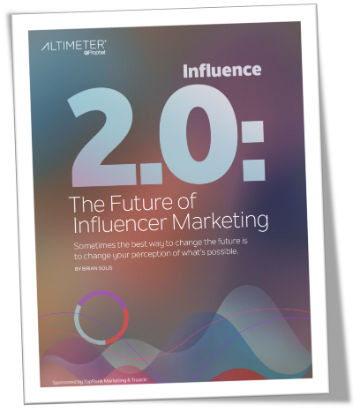
Influence 2.0 – The Future of Influencer Marketing Research Report 2017

by Lee Odden

Future of Influencer Marketing

influencer marketing 2.0 What does “influencer marketing” mean to you? Are you thinking of celebrities posting product photos to Instagram? Or having a famous YouTuber run a contest for a meet and greet at an event? Why not send products to bloggers in the hopes that they’ll do a review and say nice things? Surely that’s not all enterprise marketers think of when it comes to the possible outcomes with influencer relationships. The promise of brands collaborating or outright paying influential individuals to create content that lifts the brand’s credibility and reach to sell more products is something that companies of all sizes have been hot on - especially in the past 12 months. With a groundswell of interest, there are many divergent interpretations of what influencer marketing really means. With so many different opinions, best practices and even definitions, my agency TopRank Marketing, set out with influencer marketing platform Traackr to bring clarity and future direction by conducting research into the practice for large, enterprise organizations. We also engaged my pal and respected futurist, author and analyst, Brian Solis of Altimeter Group to conduct an analysis of that research and write a report outlining what is working, what isn’t and future trends. Download the Influencer Marketing Report The result is something I am very proud to be a part of.  Influence 2.0: The Future of Influencer Marketing. In this elegantly designed report, Brian outlines an argument for evolving influencer marketing to influencer relations, or Influence 2.0.  Brands need to evolve their view of influencer marketing from short term transactional engagements to a more strategic and holistic view that emphasizes long term influencer relationships. He also discusses the digital transformation of marketing, the importance for brands to humanize their marketing and the role of influence with customer experience. Of course he covers the role of content within influencer marketing and makes predictions for the future too. While this report is geared towards senior enterprise level marketers, it also includes 10 steps for setting the foundation of an Influence 2.0 approach that I think practitioners at companies of all sizes will find valuable. The icing on the cake to this report are the quotes and case studies from marketing influencers, many of which are clients of our agency, that I respect greatly including: Ted Rubin, Amanda Duncan (Microsoft), Dr. Konstanze Brown (Dell), Amisha Gandhi (SAP), Ann Handley (MarketingProfs), Jon Miller (Engagio), Jason Miller (LinkedIn) and more. Working on this project with the teams at Traackr and Altimeter has been an incredibly satisfying journey as we surveyed over 100 enterprise level marketers and brand strategists from companies including Microsoft, American Express and 3M. What we found is compelling and cause for even more optimism around influencer marketing - especially for those brands that approach the practice strategically, holistically and with the right resources. Here are 7 of the key trends in the report that will help point marketers in the right direction for realizing true ROI and business impact in 2017

1. 71% of marketers say their influencer marketing programs are strategic or highly strategic. 

At the same time, on average, enterprise companies are allocating only a 10% share of marketing budget to influencer marketing. In fact, 50% of the CMOs we surveyed allocate less than $100,000 annually. Clearly, enterprise companies need to put their money where their strategy is. The good news is that 55% of marketers surveyed plan to spend more on influencer marketing in the coming year and for those that spend more than $250,000 annually, that number jumps to 67% and even higher to 77% for those brands using influencer marketing technology.

2. 67% of marketers want to drive lead generation through the use of influencer marketing. 

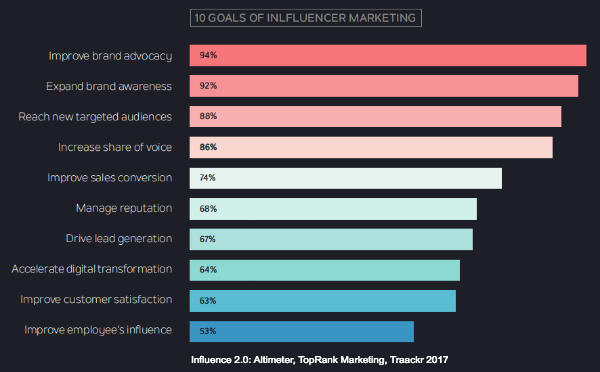
Beyond improving brand advocacy, awareness and reaching new audiences, the majority of marketers are also focused on improving leads and sales conversion (74%) as a result of working with industry influencers. Thinking holistically, influence plays a role throughout the customer lifecycle and in all relationship-drive brand communications. The movement towards brands incorporating influencers in content beyond marketing to sales, customer service, recruiting and PR is gaining momentum. Influencer Marketing Goals

3. 80% of marketers rate content marketing as most impacted by influencer marketing. 

In discussions about the ROI of brand relationships with influencers, there's simply no better match than content collaboration for creating measurable, impactful business outcomes. The research supports this with content being rated highest in impact from influencer marketing along with social media marketing and media relations.

4. 43% of marketers are experimenting with influencer marketing. 

It is still early days for influencer marketing within companies with such a large number still experimenting. 28% of marketers rate the maturity of their influencer marketing program as campaign driven and 24% are implementing ongoing programs. As brands mature their ability and relationships with influencer marketing, I think the trend will change significantly towards the majority of companies implementing always on, ongoing programs.

5. 48% of B2C influencer marketing programs are ongoing. 

This is in contrast to only 11% of B2B companies running ongoing influencer marketing programs. With 80% of marketers rating content so important in terms of influencer marketing impact and the importance of content for longer B2B sales journeys, I think we'll see explosive growth of ongoing programs in the B2B space.

6. Marketing owns influencer marketing (70%) but PR engages with influencers most often (70%). 

There is, what seems, an eternal battle between who owns influencer marketing and rather than a turf war, I think what we'll see more of is convergence between marketing and PR. The same influencers could be engaged by multiple departments within an organization beyond marketing and PR, so a more holistic and strategic view along with the right technology for management of those influencer relationships will be essential.

7. 57% of marketers say influencer marketing will be integrated in all marketing activities in the next 3 years. 

Currently, only 5% of marketers rate the maturity of their influencer marketing program as integrated, so the forward looking optimism for the next 3 years towards integration should be a strong signal for the direction influencer marketing is going. In the Influence 2.0 model, influencers can play a role in each moment of truth during the customer journey through content, engagement and community. A strategic and always on approach to influence enables true customer centricity by placing customer experience at the center of an enterprise business strategy. It is by engaging influencers in authentic, long-term relationships and creating value within the relationships between influencers and their communities, that CMOs can impact sales, satisfaction, retention and overall customer experience. This report dives deep into each of these areas and represents a real evolution of the influencer marketing practice.  A big thanks to Delphine Reynaud and the team at Traackr for all their hard work on this research project and report from the planning to the initial analysis to the beautiful design. Also, a big thanks goes to Brian Solis for his insight and intelligence around the future of influencer relations - Influence 2.0. You can download the full Influence 2.0: The Future of Influencer Marketing report here. If you need help developing your influencer marketing strategy, finding the right influencers and integrating influencers with your digital marketing mix, check out TopRank Marketing influencer and content marketing services here.

The post Influence 2.0 – The Future of Influencer Marketing Research Report 2017 appeared first on Online Marketing Blog - TopRank®.

26 Jan 17:25

7 Best Recruiting Tools Of 2017 [Infographic]

by Ji-A Min

Hiring volume is predicted to increase in 2017, which means recruiters will need better and faster recruiting tools.

Here’s a list of the 7 best recruiting tools poised to take off in 2017 summarized in an infographic.

recruiting tools 2017

Recruiting tool #1: Automated resume screening

Automated resume screening promises to be one of the best recruiting tools of 2017 because it helps solve a major challenge with resume screening: volume.

Jobvite’s recruiting survey reports the typical high-volume job posting receives more than 250 resumes. On average, 65% of these resumes are ignored.

Automated resume screening is part of a growing recruitment tech category designed to reduce — or even remove — low-value, administrative activities like manually screening resumes.

Designed to integrate with your existing ATS, resume screening software uses AI to learn what good candidates looks like based on your historical hiring decisions.

The software then applies the knowledge it learned about your employees’ experience, skills, and other qualifications to automatically screen, rank, and grade new candidates (e.g., A to D).

The benefits of automated resume screening includes the potential to reduce your cost per hire by 70%.

Recruiting tool #2: The gig economy

Gig workers, freelancers, and part-timers are becoming more common in all sectors these days. By 2020, it’s estimated that more than 40% of the US workforce will be part of the gig economy.

For high-volume or seasonal roles such as retail, expanding your talent sourcing with an on-demand talent pool can be an invaluable recruiting tool to save you time and effort.

Recruiting tool #3: Recruiter chatbots

One of the more intriguing recruiting tools of 2017 are recruiter chatbots.

These chatbots are designed to provide real-time interaction to candidates by answering questions about the job and providing feedback, updates, and suggestions.

Recruiter chatbots hold the potential to to improve the candidate experience, arming time-constrained recruiters with another tool to compete for talent in today’s candidate-driven market.

Recruiting tool #4: Boomerang hires

A boomerang employee is someone who leaves an organization, works somewhere else, and then comes back.

Boomerang hires are becoming more popular: 85% of HR professionals say they have received job applications from former employees and 40% report a former employee was hired.

Boomerang hires are one of the easier recruiting tools to have at your disposal because they tend to have a proven track record at your company, are more likely to fit the work culture, and are less likely to quit this time around.

Recruiting tool #5: Recruiting software marketplaces

Instead of all-in-one HR software systems, recruitment best-of-breed marketplaces have become the dominate go-to option to fulfil specific recruiting needs.

Companies like SmartRecruiters, Greenhouse, and iCIMS have quickly learned the value of creating a marketplace of complementary software recruiting tools that integrate easily with their systems.

This alleviate the previous pain point and cost associated with integrating recruiting software tools in the past.

According to Lever’s Leela Srinivasan:

The number of vendors you work with is far less critical than having technology that integrates, and integrates seamlessly.

In fact, relying on one vendor to do it all can be much less effective because no one player is best-of-breed at everything.

These recruiting software marketplaces allow talent acquisition and recruiting leaders to easily search for and compare recruiting tools.

This enables you to be more nimble and innovative in finding the right recruiting solution when you need it.

Recruiting tool #6: Video interviewing

Video interviewing is a popular recruiting tool because of the convenience and time savings.

A video interview can take place in real time or candidates can pre-record their interview and you can watch it at your convenience.

The latest innovations in video interviewing software include analyzing factors such as candidates’ word choices, speech patterns, and facial expressions to assess his or her emotions and personality traits.

These developments are intriguing because they may help recruiters predict quality of hire from a video interview by using data.

Recruiting tool #7: Candidate rediscovery

Candidate rediscovery is the practice of mining your existing resume database to find candidates for open reqs.

Even though a typical enterprise company has hundreds of thousands to million of resumes, most ATSs are not set up to be able to easily search and rank these previous candidates for current job openings.

That’s why software that allows you to conduct candidate rediscovery is poised to become one of the most useful recruiting tools of 2017.

According to LinkedIn, only 36% of candidates actively search for a new job. That means a typical job posting will only attract about a third of the potential talent pool who might be interested.

Candidate rediscovery allows you to tap into the talent pool that you’ve already spent resources attracting, sourcing, and engaging.


26 Jan 17:24

4 Go-To Types of Educational Content for B2B Brands

by Robert McGuire

4 Go-To Types of Educational Content for B2B Brands

To create qualified sales opportunities, content plans need to make sure that customer education is part of the mix. Your target market can’t buy if they don’t know the solution exists, and they are unlikely to buy if they don’t understand how the solution works.

I’m not talking about content that educates website visitors about your particular product or service—feature set explainers or demos, for example—although these may be an important part of your overall demand generation work. I’m talking about content that leading brands use to help prospective customers get more conversant in, more thoughtful about, and more skilled in the issues facing their industry.

It’s Getting Complicated Out There

Customer education content is particularly important for B2B SaaS products built on emerging technologies. Innovation carries with it the risk that a company gets “ahead of the market,” so some of your overall content mix should work to bring the market along with you.

For example, artificial intelligence, machine learning, predictive analytics, chatbots, and blockchain are just a few of the technologies that companies are baking into exciting new products. The AI market alone is projected to have a compounded annual growth rate of 53 percent through 2020, according to the research firm Markets and Markets.

But these technologies also introduce new knowledge deficits for buyers. Suppose I’m responsible for human resources for a mid-size company. If I’m being offered a new applicant management tool, promising it’s built on the power of predictive analytics, how am I supposed to make sense of what that means, let alone advocate for it with my boss?

It takes a lot of work for buyers to keep up with and understand product development in the functional areas they manage. For example, I develop content for edtech companies, a niche in which incumbents are competing to introduce new software for:

  • adaptive learning
  • student information management
  • classroom management
  • enrollment management
  • online program management

These tools all promise to improve learning outcomes using technology under the hood that may baffle the faculty, instructional designers, administrators, and workforce development professionals who influence the buying process.

Models and Opportunities Are Changing

Even without unfamiliar new technology, products within a category may differentiate on other highly technical factors. For example, a product may use a range of open and closed technologies that impact the internal resources the buyer will need to think about. Or the competitors in the product category may have variations of fee-based, subscription-based, and revenue-share business models that may influence the end user experience.

Similarly, the transition from installed to cloud in B2B software doesn’t just mean the software resides in a different server. The transition to cloud matters because it creates new business models, cost structures, features, and strategic opportunities that users may not fully grasp.

Educational content that helps prospective buyers understand those opportunities should be a regular part of the content mix for editorial calendars, alongside thought leadership pieces and top-of-funnel pieces that try to generate awareness and enthusiasm. Below are four go-to types of customer education that you can build content around.

And many SaaS companies are pursuing buyers embedded far below the C-suite who don’t want to watch industry trends—they just want to solve a business problem for their department or team. For example, IBM recently launched Content Hub, a “cognitively infused” content management software built on Watson. But instead of targeting the large enterprise market, it is priced to and designed for individual users within those companies who want to move quickly.

1. Make the Familiar Strange

Making the familiar strange means taking the old processes and products customers already use and showing them something amazing they can do if they introduce a new element. The audience is prospective users excited by opportunities for change and ready to shake things up.

Meeting customers where they are is essential to this mode, but you shouldn’t be too cautious, either. You may feel that efficiency is nice, so a button that will generate the hated TPS reports instantly would be cool. But even better is a button that makes the TPS reports meaningful after all these years. That’s making the familiar strange.

A case study about an existing customer is one example of customer education in this mode, especially if it outlines a new use case that grows out of integrating the new product into incumbent tools or processes.

2. Make the Strange Familiar

While you want your content to establish you as a thought leader, part of leadership is looking over your shoulder sometimes to make sure you have willing followers. When new products have an early awareness level, but there is an absence of complete understanding, people will fill the silence with questions and grumbling. “Where is this guy taking us?” Some will respond with fear, and those narratives can catch on if brands have to work to fill the void.

This can be an issue for users of legacy services no one loves, like taxi riders afraid to try ride-sharing apps. It’s even more of an issue for beloved institutions with a lot of tradition. The college classroom, for example, is a treasured space. No one wants a strange new element to jeopardize it.

So edtech companies have to confront a narrative that has emerged of a “robot teacher in the sky” that will replace teachers and diminish the student experience. Customer education in this space is often about showing that, on the contrary, a given product category can empower teachers to do what they do best. For example, content here might show how a strange new advising technology may free up faculty up from figuring out student schedules, so they can spend their office hours on tutoring and mentoring.

3. Grow the Market

This kind of customer education content is more ambitious but may be more necessary. You can’t market to a customer base that doesn’t exist yet, so it may be up to you to cultivate it. Some companies don’t need just to build brand awareness; they need to build awareness of whole product categories.

For example, what’s the market today for self driving cars? Or for 3-D printers? Those are cool, but how many people are in the sales funnel right now? Not that many, but investors and companies are betting on the market being larger in the future.

Those companies could wait for the market to grow organically, but they can also take control of their own fate by educating prospective buyers about the category itself—about what a self driving car or 3-D printer is and what its benefits are.

My colleague Karen Singer rounded up some great examples of thought leadership content, and one of my favorite examples of this is Redshift, a branded microsite published by Autodesk, the maker of CAD and other design software. Redshift covers “the future of making things” through subjects like generative design and robotics. In other words, they are using content to inspire more people to get excited about 3-D printing technology, thereby growing the market for Autodesk.

4. Grow the Ecosystem

The previous mode of growing the market is like increasing the number of fish in your pond. Growing the ecosystem, however, is like nurturing the range of species that the overall health of the pond depends on. Good content can contribute to that also, although customer education here is probably a misnomer. It’s really educating your strategic partners, using content to attract them to the environment and to help them thrive in it.

Many products depend on the success of other companies in the ecosystem. (highlight to tweet) For example, Ford Motor Company would have evolved very differently without Firestone alongside it. Not only did Ford need customers to understand the horseless carriage, but it also needed manufacturers of tires, steel, and other materials and parts to understand the emerging product.

This is familiar to anyone who is on the seller side of a two-sided marketplace. Udemy, eBay, Amazon, and AirBnB all have educational content to attract and support the strategic partners who actually put products and services on those platforms.

The best example of this kind of content that grows the ecosystem are the developer communities cultivated by many platform companies. Take IBM Watson again, which benefits from a blog especially for developers that helps nurture the skills required to incorporate Watson into their applications. Given the platform approach of the Watson business model, if there were no app developers, there would be no applications and no market. Growing the ecosystem is a strategic necessity.

Create a Foundation for Understanding

I’ll close by briefly mentioning two other kinds of customer education that help establish a foundation for mutual understanding.

You can help your target customers get better at their jobs. Content here is less about what you are offering and more about what they are doing. The cloud-based graphic design software Canva publishes an excellent Design School microsite that helps designers get better at what they do. It’s not introducing a new product category or shaking things up—it’s just helping people improve the skills they would need to use any design software.

And you can educate customers about your process. This is really a form of pre-boarding or pre-qualification content for prospects who are further down the sales funnel. At a certain point, questions will come up about how you will work together. The questions aren’t, “How does this feature set work,” but, “How does this relationship work?” A lot of this will be handled in sales calls, but content that reassures prospective customers can help ensure you get to the call.

As you already know, buyers have shifted to educating themselves via Google search and getting most of the way through the buyer journey before sellers ever know they exist. That’s why it’s so important to have your brand associated with trustworthy and authoritative content during those learning stages. Most tech companies already use content to grow their user base.

But if your product or service is working with cutting edge and unfamiliar tech under the hood—or makes new use cases possible—then the next time you look at your editorial calendar and marketing funnel, make sure that you are using these customer education modes to help your customers get smarter.

Get more content like this, plus the very BEST marketing education, totally free. Get our Definitive email newsletter.

       
26 Jan 17:24

What Buyer Research Indicates You Can Do to Open and Close More Sales

You've got selling skills. You've got the right stack of selling tools. You've got a great product, brand and go-to-market strategy. So what's missing? Why aren't buyers buying? We asked 530 B2B buyers what they wanted from sellers. Our buyer research pinpointed the behaviors your buyers want to see from you. This research, a Qualtrics panel study done in partnership with Santa Clara University, started with a simple hypothesis.

26 Jan 17:24

A Winning Formula for a Healthy Pipeline

by Will Larkin

bad cold sales email

We’re trending away from outreach that can only be described as “robo-spam.” Sales reps are getting real with their prospects again and bringing some respect back to the craft of building pipeline.

Quality over quantity is here to stay, but sales reps still face a persistent and formidable challenge: maintaining balance in their approach to Account Based Sales.

You could be the best cold caller in the world, but if you don’t have a process for finding the next great account, you are making the job much harder on yourself. Conversely, you might have selected the right target accounts that best match your company’s Ideal Customer Profile (ICP), but if you’re blasting prospects with robo-spam emails, you‘ll still have a hard time being successful.

There are many factors that contribute to a healthy pipeline, but the best prospectors I’ve witnessed have mastered their mindset, strategy, and execution.

Mindset

Similar to swing-thoughts golfers fall back on during a bad round, it’s important to have a few mental guidelines that allow the attributes we associate with top performers (confidence, positivity, energy etc.) to manifest themselves naturally.

Below are three keys that have proven most successful in my experience:

  1. “Always have a reason for every piece of your outreach” (John Barrows).
  2. Operate off the assumption that you are supposed to receive a fair amount of initial rejection. Everyone is protective of their own time, especially when dealing with unfamiliar contacts.
  3. I’m not trying to close anyone — I’m doing my prospects a favor by presenting them with the unique opportunity to learn more about a solution that has helped other teams improve in areas relevant to their role.

Strategy

1.) Become a SFDC Expert

  • If it’s in Salesforce, you need to be able to find it on your own. A top performing Account Development Representative builds their own reports and views according to what they need at any given moment.

2.) Grab the low hanging fruit as fast as possible

  • First, spend time on the accounts that pay attention to your brand. Sort your account reports and views by those accounts that have your IBP (Ideal Buyer Profile) who download your content, visit your website, and engage with your outbound sales emails.
  • Run closed lost opportunity Plays to target accounts that are customized on specific reasons – timing, competition, product feature etc. Providing a compelling reason for a previous evaluator to take another look at your solution has a much higher conversion rate than net new prospects.
  • Reach out to people with the most developed LinkedIn profiles. You’ll have more triggers to work with and in my experience those people are the most willing to have conversations.
  • Leverage your colleague’s relationships and commonalities to your prospects. If you notice your Marketing Director is connected to an influencer at a target account, draft an email for them that fits into your regular prospecting efforts.

3.) Don’t neglect the phone

  • “But people don’t pick up anymore!” — Call an executive mid-day on a Tuesday and you’d be right. But call them at least twice a day during off peak hours, and I bet you’ll see different results.
  • A number of free mobile apps (Sideline / Burner) allow you to switch up your phone number. So call down that list with one number in the morning and then move back up with another in the evening.
  • Be natural and get straight to the reason for your call

4.) Know your conversion rates

  • Quality touch points at scale is the name of the game. When you’re able to make personalized, relevant connections at a high volume, you’re going to win.
  • Know your conversion rates through the touch process, and monitor them over time. Once you understand KPIs, like your Call to Connect, Connect to Meeting Scheduled, and emails per Meeting Scheduled, you can then work backwards from your pipeline goal to establish the necessary activity output.

5.) Schedule emails and calls during executive down hours

  • There are countless studies on the best times to call and email. But how much data do we really need on this topic? The cycles of business are mostly obvious — the majority of executives are powering through meeting after meeting from roughly 8am to 6pm. Plan your outreach accordingly. Catch them on their downtime early in the morning, during lunch, and at the end of their day.
  • Schedule a good number of your emails to go out on Sunday evening when decision-makers are planning for the week ahead.
  • Remember that there are cycles to every unique business and IBP. For Example, at the end of a month or quarter you have the increased likelihood to reach sales executives throughout the day, since they are expecting deal calls.

Execution

1.) Don’t use inbound content as a crutch/shortcut from doing the real work of prospecting

  • Open a cold call or email asking what your prospect thought of your company’s eBook or 1-pager, and you can tee up that senseless hippo chasing you email as your next touch, saving yourself the time required to follow up.
  • Use inbound as a means to gauge interest and the current business priorities across your target accounts, and then finish an email or call with tailored suggestions from your content that the prospect might find relevant to their role.

2.) First impression is everything – Connect the dots

  • When someone is contacted by a person they don’t know, they make an instinctive, split-second decision on whether they want to engage in conversation or not. Once you’ve been mentally bucketed into spam or someone who has nothing to offer, you’ll have a tough time reversing that decision.
  • Non-decision makers and time wasters respond to templated content follow up, whereas business leaders engage only with someone who has demonstrated a level of effort, and presented something they could potentially benefit from.
    • If you or someone else at your company has a personal connection with a prospect (relationship, school, unique hobby etc.) lead with that, followed by a message that connects your product to their role.
    • If no personal connection exists, lead with the organizational commonalities. For example, “I noticed you are following one of our best customers X on LinkedIn…”

3.) Be quick to respond

  • If you take an hour to respond to someone over email who replied they have no budget, you’ve lost them. Constantly monitor your inbox on a separate screen and be quick to respond — you are trying to engage in an email based conversation to lock down the intro call.

4.) Using Direct Mail / Social

  • Use tools like CoffeeSender to send prospects a Starbucks coffee with a personalized note on a cold day in places like New York and Boston.
  • I’m not a fan of InMails – too much job recruiting spam goes down in that medium. I prefer to reference tweets or send meaningful comments on a prospect’s LinkedIn posts.

5.) Work with the information you are given to land the meeting

  • This is possibly the most critical aspect of execution, and I believe it is the main driver of performing above average. When done correctly, someone telling you “no” in various ways simply contains the information you need to book a meeting. Never directly combat an objection especially when prospecting, we simply haven’t had the chance to build enough trust.

Small examples of this common mistake are:
I don’t have budget — > “Actually our software isn’t that expensive”
This isn’t a good time —> “I’m just asking for 15 minutes”

  • Dr. Cialdini’s book Influence: How and why People Agree to Things dictates “Commitment and Consistency” as one of the six principles of human persuasion. This is extremely important to keep in mind during our initial interactions with prospective buyers.
  • People tend to immediately stick by statements they make or the values they have. No surprise, right? We should respect that, and swiftly acknowledge the objections we encounter. When it comes time to make the second or third ask, do so in a way that incorporates the initial pushback or information you received the first time around.

7.) Know that every interaction in some way is, or will become, a negotiation

  • In my experience, many prospects don’t want to give you 100% of what you asked for, even if it doesn’t really matter to them. When building pipeline, this is most relevant to scheduling the timing of our meetings.
  • Want someone to take the meeting tomorrow? Ask them if they have some time this afternoon. Setup your concession to be something you don’t care about, and at the same time assumes that there should be urgency to learning more about your solution.
26 Jan 17:23

The CEO of this Swedish payment business says Trump and Brexit could actually be good for business

by Oscar Williams-Grut

Sebastian Klarna

LONDON — When Swedish entrepreneur Sebastian Siemiatkowski heard the news that Britain had voted to leave the European Union he came close to crying.

"Almost," he told Business Insider at the "Economist: Finance Disrupted" conference in London this week.

"Isn't it so sad that you've got the younger generation that has been brought up with the amazing promise of Europe. All of us have lived and travelled and worked where we want. Then the older generation decides, end of party — you're going back to the old ways."

Siemiatkowski is the CEO and founder of Klarna, the Swedish payments business valued at $2.25 billion (£1.9 billion) in its last funding round a year and a half ago. That makes the company one of Europe's few "unicorns" — a private tech company valued at over $1 billion.

Despite his personal disappointment at Britain's plans to leave the European Union, Siemiatkowski believes Brexit, along with President Trump's protectionist rhetoric in the US, could actually be good for his business.

"When I was doing my economics masters, you read that tariffs and customs create barriers to trade for two reasons," he says. "One, because it provides a price difference, but two, it's just the complexity. Technology, software, can solve that complexity.

"We see a lot of our merchants struggling to sell to other countries. A lot of the things that we provide to our merchant base offer simplicity around cross-border commerce. If the UK decides to Brexit or Trump decides to introduce more complexity, it benefits Klarna. It means there are more problems to solve on behalf of our merchants who want to sell globally. It's actually to our benefit."

If the UK decides to Brexit or Trump decides to introduce more complexity, it benefits Klarna. It means there are more problems to solve.

Klarna effectively offers credit to buyers by separating buying from paying. A customer using Klarna simply gives their email or phone number at the checkout, Klarna pays the merchant and then asks the customer to pay it within a certain amount of time. That means Klarna ends up handling most local regulation around payments and credit.

Siemiatkowski says: "Merchants really work with Klarna today to a large degree because we are the only company that works with our type of payment methods — promotional financing, instalment payments, and so forth — across US, UK, Nordics, Germany, same integration, we solve all the complexity of all the different regulation in all the different countries. This is a key advantage for Klarna.

"This is why you see someone like Arcadia Group launch with us — they launched with us in Germany too. They see the benefit. The retailers have already become global."

Topshop and Miss Selfridges owner Arcadia began working with Klarna last September, the company's first major partnership in the UK. Siemiatkowski says the Arcadia relationship is going well and Klarna is winning over new merchants in the UK, such as women's fashion brand finery.klarnaKlarna is planning to invest more in both the UK and US. Siemiatkowski says: "We want to be wise about our investments but we're going to have needs in both the US and UK — continuing investment both money-wise and people-wise."

Klarna currently employs 35 people in the UK, up from 20 six months ago. Siemiatkowski says: "Initially to us, the UK was to us purely a sales team but we do recognise the importance of understanding the local market. So we have credit risk people locally, operations people, customer service people locally. That's why the headcount is growing."

Brexit influenced the investment decision "not at all," Siemiatkowski says. "Will it effectively, in the end, have such an effect on the relationship between those countries, the integration between those nations? I'm not sure."

But he adds: "Do I think it's good for the human race, and the economy as a whole and the planet? No, obviously not, I would prefer to see things in a different direction. But I actually think in the end technology will solve for a lot of these things."

Join the conversation about this story »

NOW WATCH: The wealth of these 8 men equals the bottom 50% of the entire world

26 Jan 17:23

Closing Is Easy

by Tibor Shanto

By Tibor Shanto – tibor.shanto@sellbetter.ca 

One of the most common things I hear from sellers is “Get me in front of the right guy, and I can close them”. Big deal, so could any monkey dressed in the right suit, that’s why the big money in B2B sales is made by those who can actually get in front of the right guy long before the closing monkeys show up, those who can OPEN.

Closing opportunities that were initiated by the buyer themselves is cute, but is it enough? When asked if they can meet or exceed quota relying strictly on deals that were initiated by the buyer, most admit the answer is no. In addition to those who come to them, they have to identify, qualify, prospect and engage with potential buyers who left on their own, would not have stayed out of the market in the current timeframe.

When A Tree Falls In The Forest

When you ask sales people or organizations, whether they could make or exceed quota by closing only opportunities initiated by the buyers themselves, and most admit, no. Meaning they have to go out and prospect buyers, who left to their own, would stay on the sidelines, and remain oblivious to any social activity, messaging, or any other on line activity. It is very much like the tree falling in the forest. If the buyer is not online, but instead in their businesses, their shops, trucks, or offices, doing their thing, then they can’t see or interact with anything you may dangle out there. This, by the way, represents about 70% of any defined market, if not more.

Sure, one alternative is to double down, increase your efforts to entice and succeed with those buyers who are interacting with what you’re dangling. But we also have to remember that these buyers are rarely monogamous. They are visiting all your competitors’ sites, and playing footsie with all they’re dangling. In a “good enough” world, you all begin to look the same at about the 67% – 70% marker in the journey, leaving price as the big differentiator.

Back To The Start

Openers, know how to identify and speak with those 70% who are entrenched on the sideline. They can shape the thinking of the buyer much more so than one could at the 67% marker. While any intelligent buyer will compare you to others, Openers know how to frame the opportunity in ways that will directly influence how those buyers will filter your competitors.

The risk these days is that everyone is so fixated on closing, they overlook the need for Openers, placing all their early cycle success in means that are not delivering. While many bought into the SDR wave, stats about SaaS sales success can be scary by any standard. One reason again is that the emphasis is not opening the opportunity, creating a base for success, and without that foundation, it is hard to build.

Unfortunately, the discussion has eroded into a question of style, social vs. traditional. But impact has been deeper, as many who shun traditional prospecting, say telephone prospecting or cold calling, also abandon the skill of opening, as that step is left entirely to the buyer. Time to focus on why we do something, not just the how. For real sellers, the why is about the Open.

Become one of the thousands of sales professionals receiving my latest updates on sales execution, tools, tips and more.

Join Now!

The post Closing Is Easy appeared first on Renbor Sales Solutions Inc..

26 Jan 17:23

Does It Matter Whether Prospects Like You? Salespeople Speak Out

by afrost@hubspot.com (Aja Frost)

matter-whether-prospects-like-you-655042-edited.jpg

Ask random people to describe the typical salesperson, and you’ll often hear answers like, “outgoing,” “personable,” “friendly,” “funny,” “engaging,” and “charismatic.”

In other words, most people assume being likable is an essential component of sales.

But can you successfully sell to prospects who don’t like you? To find out, we posed this question to 30 sales professionals.

Opinion #1: Prospects Don’t Need to Like You -- Just Not Dislike You

“‘One of the biggest myths of selling is ‘People buy from people they like,’” says Jeff Hoffman, sales expert and creator of the Your SalesMBA™ program. “People don’t buy from people they don’t like.”

Avoid leaving a bad impression or making your prospect angry, Hoffman says. But don’t try to make them like you -- that actually harms your ability to close.

“Thinking, ‘I need the customer to like me to complete the sale’ has two dangerous effects,’ he explains.

First, it shifts the focus from the buyer to the salesperson. You’re no longer thinking about your prospect’s needs, desires, and challenges: You’re thinking about being likable.

Second, Hoffman argues trying to win the buyer’s favor makes you seem manipulative and inauthentic.

“Your prospect will quickly see through your attempts and get turned off,” he says.

Instead of worrying about the buyer liking you, worry about liking them.

“Sales is a lot easier when you like your prospect and want to interact with them,” Hoffman says.

Opinion #2: Being Respected Is More Important Than Being Liked

Think about your friends. You enjoy their company, share good memories, and appreciate their personalities. But would you buy from every single one of them?

Liking someone doesn’t necessarily translate into a willingness to purchase. Respect is far more important, says HubSpot principal inbound growth specialist Matt Hambor.

“Sometimes a prospect likes the sales rep, sometimes they don't,” he adds. “But the rep is successful when there’s mutual respect: Salesperson and prospect are on the same page.”

The buyer might feel warmly toward you if you share a mutual interest or have similar senses of humor. However, if the buyer doesn’t view you as trustworthy, competent, and knowledgeable, she won’t listen to your recommendations.

Don’t concentrate your energy on building rapport or befriending your prospect. Position yourself as an advisor who can pinpoint her challenges and opportunities, help her identify the best solutions, and guide her through the purchasing decision.

“Adding value over the course of the relationship and enabling trust has a greater impact on your ability to close than being ‘liked,’” concludes HubSpot enterprise account executive Seamus McGrath.

And as HubSpot senior account executive Mary Burbridge points out, “I think prospects like you if you are honest, take a genuine interest in their business and helping them, and act like their consultant rather than their ‘vendor.’”

Ultimately, earning their respect often means earning their fondness as well.

Opinion #3: Being Liked Can Make the Sale

“When dealing with people, let us remember we are not dealing with creatures of logic,” wrote Dale Carnegie in “How to Win Friends and Influence People.” “We are dealing with creatures of emotion, creatures bristling with prejudices and motivated by pride and vanity.”

In other words, prospects aren’t necessarily making their buying decisions based on the product itself and whether it’s objectively better than the other options. Chadd Steinhauser, principal account executive at HubSpot, says, “Whether a prospect likes you can have a huge impact on their decision-making process. Their decision is heavily influenced by emotion.”

Furthermore, a good rapport can differentiate you from the competition.

“Unless you have a monopoly, there will always be competing products,” says HubSpot channel account executive Diarmuid Walsh. “People buy from people first, and company/product second.”

The Takeaways

Many salespeople pointed out the specific buyer persona can make a difference. While some prospects are eager to get down to business, others will feel taken aback if you immediately jump into the purpose of the call. Along similar lines, some prospects are more receptive to probing or challenging questions than others.

Before you connect with a prospect, browse their social media profiles for clues on which category they likely fall into. If their LinkedIn recommendations mention their upbeat attitude and friendliness, they’ll probably appreciate a more light-hearted approach. You don’t need to mention the latest sports game to put them at ease. Instead, ask about their professional interests, content they’ve written, or details about their role. You’ll simultaneously build rapport while learning valuable information.

If your prospect’s LinkedIn recommendations describe their extreme focus, ability to get results, and impressive ambition, skip the pleasantries. These buyers also typically respond well to a direct style, so don’t worry about offending them with tough questions. Just make sure you’re consistently adding value, or they’ll think you’re wasting their time.

You should also mirror their behavior. When you ask how they’re doing, do they reply, “I’m good” and quickly move on -- or do they give you an extended answer about their weekend? If it’s the former, you’re probably working with an all-business personality. If it’s the latter, they’re probably seeking a more companionable relationship.

Factor in your product type and sales process as well. Extended sales processes require far more seller-buyer interactions, so it's typically important to like the person across the table.

What’s your take: Does it matter whether your prospect likes you? Share your opinion in the comments.

HubSpot CRM

26 Jan 17:23

15 Communication Skills That Are Crucial to Sales Success

by lye@hubspot.com (Leslie Ye)

Good communication is crucial to sales success.

Sounds obvious, right? You can’t make a sale unless you’ve demonstrated value to a prospect. You can’t do that unless you’ve understood their problems and devised a strategy to solve them.

In turn, you can’t do that until you get your prospect to tell you what’s wrong. And so on, and so forth …

So, communication is key. We wrote this guide to unpack why communication in sales is so important and explain 15 helpful skills to cultivate across your sales team.

What's the importance of communication in sales?

The root of sales success is the ability to gather and provide information in a way that makes your prospect want to do business with you. Your value proposition, your pricing, even your product’s features — none of that matters unless you’re able to get your prospects to talk to you and also listen to what you have to say.

That means you have to be incredibly attuned to your buyer and understand what they mean when they tell you — or don't tell you — something. It also means that you can't just reel off a list of benefits or reasons to work together.

You've got to understand how your prospects learn, what they care about, what communication style they prefer, and adapt your strategy accordingly.

So, before you immerse yourself in buyer personas, case studies, and marketing collateral, work on these skills to ensure that when you’re talking to a prospect, you’re sending the right message.

1. Pay full attention.

We’re all busier than ever before, and selling can be an especially pressure-filled career. So it’s understandable that during a client meeting, your mind could wander over to the demo you have to prepare for this afternoon, the prospecting you forgot to do, or the contract you’re waiting on to come in.

Just because it’s understandable doesn’t make it acceptable. Showing up to a call isn’t just about physically being on the other end of the line. You have to dedicate 100% of your attention to each call, otherwise you’ll miss details and make your prospect repeat things they’ve already told you. It’ll be obvious when you’re not paying attention, and that’s no way to treat buyers.

2. Practice active listening.

Not only do you have to listen, you have to listen actively, otherwise your conversation won’t really go anywhere.

“Too often, salespeople are waiting for their turn to talk or thinking about what to say next, instead of truly listening to the prospect,” Databox CEO Peter Caputa says.

Caputa uses the following four-step process:

  • Truly listen to the prospect.
  • Feed back the content and feeling of the prospect’s words.
  • Confirm you heard the prospect correctly.
  • Ask a relevant follow up question to further clarify your understanding of their situation.

3. Read body language and control your own.

The same sentence said by someone who’s smiling, looking directly into your eyes, and sitting up straight is received very differently when the speaker is looking away and slouching — even if they meant the same thing both times.

That’s because while we can say pretty much anything we want, our body language often reveals our true intentions or meaning. Great communicators know how to read others’ body language so they can anticipate the direction a conversation’s heading, and also make sure their own body language isn’t sending out signals they don’t mean to broadcast.

4. Master the nuances of voice tone.

Like body language, voice tone — your voice pitch, volume, speed, and even your word choice — affects how the words you’re actually saying are interpreted. And if you’re in inside sales, the only thing you have to make an impression is your voice.

Listen to how your prospect speaks, then mirror their speaking patterns when it makes sense. While you probably shouldn’t imitate every slang word or lingo they use, slow down if they speak slowly — or speed things up if they talk rapidly. Match your level of formality and familiarity to your prospect as well. The key is to meet buyers on their turf — and that means speaking in a way they’re comfortable with.

5. Be empathetic.

You don’t necessarily have to agree with everything your prospect is saying, but you should always at least try to see things from their point of view. And that means more than just saying, “Hmm, I see where you’re coming from.”

The best sales reps are able to connect with their prospects because they actually understand the things their buyers do at work every day and the challenges they face. Not only does being empathetic make you more likable, it also increases your chances of closing a deal. When you can draw on your knowledge of your prospects’ actual day-to-day, you’re better equipped to understand what they care about, which makes it more likely you’ll be able to help them.

6. Understand what’s not being said.

Prospects sometimes don’t tell the whole truth. And that’s okay, as long as you know how to spot when it’s happening. Is your prospect just evaluating your company because his boss told him to present three options? Is your prospect sold, but her manager, the economic buyer, isn’t? These are crucial things to know, and you can’t suss them out until you learn to read between the lines.

7. Speak in specifics.

Great communicators are not persuasive because they speak in dramatic, sweeping rhetoric. They’re able to convince people because they can point to specific examples or anecdotes that support the point they’re trying to make — and in the case of salespeople, because they can demonstrate exactly how a product or feature will help their buyer.

Be as specific as you can. And if you can throw in a catchy sound bite or two, by all means do it. Just don’t rely on quippy phrases to get a deal to the finish line.

8. Be a subject matter expert.

Of course, you can’t be specific if you don’t have any idea what you’re talking about. If you sell to a specific industry, you should know that industries’ concerns, behaviors, and buying patterns down pat. If you sell to multiple industries, know your value prop as it relates to each cold and use customer references as backup.

Prospects will never trust you if it doesn’t seem like you really understand your (or their) business, so become an expert in your relevant field.

9. Know what you don’t know.

But being an expert doesn’t mean you know everything. Unless you’ve shadowed your buyer, you don’t know exactly what they do or every nuance of their business. So don’t act like you do. You should know enough to sketch out the outlines of their situation on your own, but you’ll always have to rely on your prospects to fill in the little details.

Be aware of the gaps in your knowledge, then ask your prospect to help fill them in. They’ll appreciate your honesty about what you don’t know, and you’ll avoid losing deals because of false assumptions.

10. Be genuinely curious.

The key to sales is asking good questions. And if you’re not actually curious about your prospect’s situation, it’ll be all too easy to slip into your elevator pitch before you’ve established whether any part of it is relevant to your buyer. Great communicators are naturally curious about their conversational counterparts, and that’s especially crucial in sales — ask questions first, then answer them later.

11. Assume good intent.

Sometimes, prospects leave out important deals that can change the trajectory of a deal. Sometimes, they make a commitment before they've gotten approval from the necessary stakeholders. Sometimes, they lie on purpose.

All of the above situations are frustrating — and some are certainly cause for annoyance. But it's often difficult to distinguish between situations where a buyer misled you on purpose and one where they made a genuine error. Jumping to conclusions about your prospect's intent will color the rest of your interactions in a negative light. Always assume good intent so you're not subconsciously treating your prospects with hostility.

12. Always be honest.

Just because you're assuming good intent doesn't mean your prospect will, so always be upfront about the questions you can answer, the questions you can't, and the questions with answers your prospect might not necessarily like.

Your prospects won't be forthright about their goals and areas for improvement unless they trust you. That means always being upfront when you don't know something so they believe what you're saying when youdo know the answer.

13. Don't make assumptions.

if you've been in the same sales job for a while, you can easily fall into a routine. But just because the first 100 prospects that fit a certain profile had the same problems and processes doesn't mean the 101st will.

Unless you have independently verified a piece of information or your prospect has said the words to you, never make an assumption about their situation. While it only takes a few seconds to ask a follow-up question, making a prospect feel ignored and forcing them to interrupt you to correct an assumption is a negative ripple effect that can last forever.

14. Be persistent, not pestering.

There's a fine line between persistence and pestering, and it's crucial for salespeople to understand it. Continuing to call and email your prospect without knowing why they're not responding is counterproductive and can only serve to annoy and alienate them.

If you haven't received a response to a follow-up message, try a different approach. Instead of forwarding the same email to your prospect, start fresh with a new headline and an easier call to action. Once you re-engage them, steer the conversation back to business.

15. Be comfortable with silence.

Sales veteran Jeff Hoffman says most salespeople are too uncomfortable with silence. When they ask a question and the prospect gets quiet, most reps immediately try to fill that silence by asking a follow-up question or clarifying their ask.

Hoffman recommends pausing for around three three-to-five seconds before speaking. That way, you're not interrupting an important thought your prospect might be having, and you're setting the precedent that silence is welcome in your conversations.

Communication = Sales Success

Sales communication skills are by far the most important weapon in a salesperson's arsenal. Make sure to keep yours sharp and ready to use.

Editor's note: This post was originally published in June 2018 and has been updated for comprehensiveness.

26 Jan 17:22

Rethinking Buyer Personas In An Era Of Digital Transformation

by Tony Zambito

Illustration by Louis Prado

In the past five years, we have seen exponential disruption each year in multiple markets. Digital technologies and resulting transformation turning markets literally inside out. Fundamentally reshaping markets in five years’ time compared to the fifty to seventy years it may have taken to build up a market.

Take for instance the iconic yellow cab, a fixture in New York City for decades. In the past few years, the yellow cab companies have been unable to stem a rapid decline from the onslaught of Uber, Lyft, Juno, Via, and other ride platforms. Revenues falling by as much as 40% and many drivers switching to Uber.

To think digital transformation is primarily a consumer phenomenon is a fallacy. The introduction of the cloud has uprooted many B2B businesses whose foundations were built on hosted premise software. Cloud-based applications are creating new business models enabling not only entry into existing markets but the creation of new markets.

Understanding Customers Has Changed

In this era of disruptive digital transformation, customer behaviors in B2B and B2C markets are radically changing. Making the need for organizations to understand customers a centerpiece of their growth strategies. One means for the last sixteen years to understand customers and buyers have been the use of buyer persona development. It is time to rethink buyer persona development in this new era of digital disruption.

When the concept of buyer personas was first launched in 2001, the world was a very different place. Since that time, there has been a significant upheaval in what was once an indication of a stable corporate order. During sixteen years, we have seen more than half (52%) of the Fortune 500 at the start of the new millennium merge, be acquired, or go bankrupt. And, more than half of those still existing are losing money.

Developing a deeper understanding of customers has been and is becoming a stronger strategic aspect of growth. New business models and customer behaviors mean companies must adapt or be another statistic in the next ten years. It also calls for new thinking when it comes to buyer persona development and gathering insights.

In this article, let us walk through 4 specific trends affecting a need for rethinking buyer personas:

1 – The Buyer Is Also The User and The User Is Also The Buyer

When the concept of personas was first introduced, they were introduced on the foundation of informing design strategy. How to design products and services that were user-friendly and enabled users to fulfill their goals. Buyer personas were an outgrowth of this founding principle of understanding goals and goal-directed behaviors. In this case, the focus is on understanding the goals of buyers to inform overall marketing and sales strategies. Sixteen years ago, particularly in B2B, the line between user and buyer was more like a gap. Today, many buyers are also users and power users. And, conversely, many users are buyers. The era of digital transformation has fused notions of a buyer and a user into one. Approaches rooted in old principles of product marketing and purchasing for buyer personas are outdated.

2 – Market-based vs. Account-based

In the 1980’s, the idea of major and national accounts gained traction in sales. Account-based sales were the rage in the ‘80s ‘90s. and early 2000’s. In the last two years, we have seen the concept of account-based marketing take hold. Which, is not very different in thinking from when the idea of “account-based” was first introduced. And, buyer personas are sought to identify the roles to target for account-based marketing. The era of digital transformation is making this a flawed concept.

Why?

Sixteen years ago, organizations were staunchly hierarchal. Largely driven by a workforce of layered middle management, manual processes, and arcane approval policies. What we are seeing today, enabled by digital transformation, is companies and divisions within large enterprises, operate like markets. Entrepreneurial and not within the conventional large organizational reporting structures of the past. Where the proverbial org chart was a mile long. Acting inter-dependently and intra-dependently with other divisions as both suppliers and purchasers to succeed in their own markets.

This flaw can have a dramatic impact. Here is one voice of a VP, Sales for an $8b entity:

“This is going to sound harsh but I honestly am convinced we lost one of our largest customers due to going overboard on account-based marketing. We overly focused on how we thought decisions were made up the chain and missed out on how the customer was really operating. Basically, we wound up focusing on the wrong people and didn’t get it right.”

If persona development is approached in this same way, the result may very well be a flawed picture and understanding of customers.

3 – The Rise of the Digital Platform Economy

In the past five years, we have seen the emergence of a rapidly growing platform economy. Creating new platform-based markets, business models, infrastructures, and ecosystems. Altering and reorganizing how people and businesses work, compete, create value, socialize, interact, and ultimately earn profits. Proving to be a major force behind an accelerated pace towards globalization on many fronts. History may look back at the rise of the platform economy much in the same way history has treated the Industrial Revolution.

Platform-based models have had a dramatic impact on consumer-oriented markets. Some of the well-known examples include Uber, Amazon, and Airbnb. Since the arrival of the Internet, B2C digital development has served as a forerunner for B2B. We are already seeing and can predict that growth in B2B digital platforms will accelerate. Some of our oldest institutions are seeking ways to develop platforms specifically for ensuring the success of their customers. A case in point is John Deere’s My John Deere Operations Center. Enabling connected farm operations amongst equipment, fields, and personnel.

The notion of buyers as different from users, once again, is being drastically altered. The way people and business engage in work activities and decisions will need to be viewed through the lenses of an emerging digital platform economy. Pre-Internet conventions related to understanding buyers and customers through the lenses of buying criteria and separation between buyers and users can no longer apply in a digital platform economy.

4 – Digital Interaction Will Matter More Than Content

When personas first began, specifically user personas, they did so within the context of what was then called interaction design. Which looked at the design of products or services in terms of human interaction with computers. In the era of digital transformation and the emergence of the platform economy, more than ever, organizations will need to pay heed to how it designs its interaction with its customers in the future.

Much attention has been paid to content marketing and more recently customer experience in the past five years. However, many organizations are attempting to grow through these means without attending to what matters first and foremost – the design of digital interactions, environments, and systems. The results have been a decline in content marketing effectiveness. Problematic is the putting on of new clothes for older concepts, such as content marketing and then trying to shoehorn them into less than optimal digital interactive environments.

As the era of digital transformation evolves and the platform economy expands, the desire for truly interactive environments will grow. Organizations stuck in neutral on thinking that producing more content to absorb is the path to growth will be left with the one thing they dread – no people or business interacting with them.

Rethinking Buyer Personas

These four trends are reshaping the concept of how organizations will need to understand customers to survive in the era of digital transformation. What executive leaders will need to adopt is a market development mindset going forward. Focusing on addressing existing markets undergoing radical change. And, embarking on new market development initiatives to stay competitive in a digital-centric environment.

As we rethink persona development for understanding the customer of today, the need arises to understand networked market ecosystems. More specifically, digitally networked market ecosystems. Where account-based and role-based thinking is replaced by market-based and ecosystem-based thinking. Whereby the emphasis is not on a separate buyer or user personas but on networked market personas and their interaction in a digital market ecosystem.

An important outcome and concept for businesses to now consider are:

As digital transformation increases exponentially, the need for human insights will increase exponentially.

The following is a video where Amy Bernstein, Editor of Harvard Business Reviews, explains how leaders will need to be more flexible and understand the importance of context in a world of digital transformation.

(On a personal note, I have taken a reflective two month period recently. It has been sixteen years since the concept of buyer personas was founded and first introduced. Heavy engagement in the past two years in new digital platform markets has led me to believe that reinvention and rethinking is important for the future use of personas in strategy and marketing. I look forward to sharing more on new thinking and approaches in subsequent articles.)

26 Jan 17:21

4 Sales Lessons from The Wolf of Wall Street

by Judy Tian
  • wolf-of-wall-street

Movies often serve as powerful sources of inspiration. Look no further than Rocky, Good Will Hunting, The Pursuit of Happiness, or any of your favorite spine-tingling classics out there. Usually inspirational movies follow protagonists who achieve greatness despite being stacked up against great odds.

Then there are movies like “The Wolf of Wall Street,” the 2014 Oscar-nominated film starring Leonardo DiCaprio. It may be an unlikely candidate for inspiration considering the subject of the film is Jordan Belfort, a slick stockbroker who was ultimately convicted of securities fraud. But if you sift through the criminality and outright absurdity of the film, there are several sales lessons that reps and leaders alike can emulate in their approach.

Believe You Can Sell Anything

Behind Belfort’s wild success and incredible wealth is a burning passion for sales. Whether it was selling penny stocks over the phone or handling enormous accounts, the driving force for Belfort’s success is his passion for closing sales. To Belfort and his team, selling was more than a job. It was a lifestyle that bordered on an obsession.

His belief that anyone could sell anything was a pillar of his company’s success. This is on full display during the “sell me this pen” scene, where Belfort demonstrates to his employees the benefit of creating urgency in a sales transaction. To Belfort, anyone with the passion and will to succeed could become an accomplished sales rep.

  • sell-me-this-pen

He also believed that a great leader could impart passion and will into their employees. Which leads us to how he led his uber-successful team.

Incentivize Your Team

Belfort pays great attention to building a competitive workplace. Each team member’s success is celebrated in a way that aims to draw out the competitive juices of the other sales reps. By recognizing the success of your sales reps publicly, you’ll encourage other reps to want to obtain similar recognition for their successes.

He also incentivizes his team by setting high expectations that are accompanied by large rewards, which leads us to the next point.

Don’t Underestimate the Power of Motivation

Belfort was a tremendous motivator. There are numerous scenes in the movie where he launches into spirited, and often extreme, motivational speeches. Sales managers don’t need to be world-class orators to motivate their teams to success. Rather, they can take a cue from Belfort, using speeches as opportunities to garner trust and build camaraderie. In turn, his team members do not want to let their boss or teammates down. He builds trust by showing team members that he wants them to succeed as much as he wants his own success.

  • wolf-of-wall-street-1

As Theodore Roosevelt said, “People don’t care how much you know until they know how much you care.” You can reflect this mentality by maintaining a strong line of communication with your reps. Figure out what hurdles they are encountering and how you can help them accomplish their goals. Become the strongest ally on their road to hitting those lofty numbers.

Enjoy Your Successes

Sales can be an emotional roller coaster. Ensure that you’re taking the time to celebrate your successes, both individually and as a company. Set goals for yourself with particular rewards at the end. “If I complete X by the end of the second quarter I will treat myself to Y.”

Belfort and his gang take this to an extreme in the movie, with lavish parties, yacht trips, and joyrides in high-end sports cars. We don’t recommend taking it that level of excess, but rewarding your successes will help you get through the down times and appreciate the good.

  • wolf-of-wall-street-2

By following these lessons set forth by “The Wolf of Wall Street,” you can accelerate the success you and your sales reps encounter. Just make sure you don’t take it too far and eat one of your employee’s goldfish as a lesson on staying focused, such as Jonah Hill’s character does in the movie. That is not a lesson we suggest taking to heart.

For prescriptive sales advice from award-worthy B2B stars, be sure to check out LinkedIn’s Definitive Guide to Selling to Multiple Decision Makers

      
26 Jan 17:21

What You Need to Know About the New Bing Network

by Asaf Hartuv

What-You-Need-to-Know-about-the-New-Bing-Network

Bing ads have long offered a way for marketers to get more reach more quickly for their brands.

Bing ads are typically less expensive and face less competitive, which means that you get better placement on a lower budget. That makes Bing an especially good choice for startup brands, but it has plenty to offer brands at any stage of their development.

Now, the Bing network is making it even easier for you to get more out of the search engine’s ads. Here’s what you need to know:

More Partners

Bing has been growing its market share steadily, and that includes adding more partners.

Bing is no longer powering search for Yahoo, but it has acquired all of Yahoo’s accounts, including top names like AOL and The Wall Street Journal.

Microsoft also owns Bing, which means that the search engine is the default for Windows 10 users. Just think about how many people use Windows products on their computers and you have an idea of how large the Bing Network has the potential to be.

By putting your ads on this network, you can reach far more of your customers and get more clicks for your ads. You’ll spend less and get better results, helping you to reach your goals more quickly and maintain a healthy ROI.

More Placement

The Bing Network is focused on placing ads in the places where customers are most likely to see them, yet where they are also the least likely to expect them.

Bing says that the network includes 60 million searchers that are exclusive to the search engine. Additionally, it says that a quarter of the clicks for its ads are sourced from searched exclusive to its network.

Thanks to the large reach of the network and the smart placement of the ads, you can get more clicks for your own campaign, which can help you get more exposure, more leads and more sales.

Intuitive Placement

The Bing Network doesn’t just place ads in unusual spots to ensure that they are seen. The network also uses intelligent indicators to place ads intuitively.

Bing uses intent based signals to better understand what users really need when they search. For example, a search for “bed bugs” could be about identifying bed bugs, treating the bits or getting rid of the pests. Intent based search looks at other user behavior to get a better idea of what is behind the search.

With intent based search, you can better understand what your customers actually need and want. That increases the likelihood that your ads will be successful, which will increase your ROI.

Best Practices for Ads

To get the most out of the new Bing network, you need to follow some best practices for PPC ads.

To start, you need to do the right keyword research to make sure that you are targeting the right terms for your audience. Not only will the right keywords ensure more clicks for your ads, but they will also ensure you are paying the right prices. Nothing would be worse than paying a lot of money for competitive keywords that aren’t even the right keywords you need to be targeting.

Practice writing your headlines and your ad copy until you have come up with concise yet compelling copy. You may need to write an ad dozens of times before you get just the right wording. However, the hard work will be worth it when you start getting the results you need from your ads.

Be sure to include images! Bing now allows up to six images to be placed with ads thanks to its image extender. The images will rotate through the ad, with only one image being shown at a time.

Images and graphics will get much more attention than plain text, so think carefully about the images you include and be sure you get high-quality and evocative images. The better the images, the more effective your ad will be.

Include a clear call to action. Don’t just talk about how great your product is — actually ask people to click on your link or to take advantage of your sale offer. If you can add urgency to your call to action, all the better. Urgency like “sale ends today” will encourage people to click now instead of thinking about doing it later (and likely forgetting).

Finally, make sure that you test your ads to see what strategies are working best. Run ads with different headlines, different images, different text and different calls to action. You may find that changing even one word in your ad can make a big difference to how many clicks or conversions you get.

If you aren’t already advertising with Bing, it’s time to look at the new network and start a trial campaign. You may be surprised at the results you get!

26 Jan 17:21

How to Turn Digital Inquiries into New Clients

by Chelsey Fox

If you’re running a small business and actively participating in Inbound Marketing, which you must be by reading this blog, you’re already getting ahead of the competition. Congratulations! With the help of industry professionals, you know you’re supposed to be creating new digital content, collecting information in exchange for offers, and gaining new customers. However, as a small business owner or manager, it is typical that your time is filled with the day-to-day running of the company and there isn’t much left over for responding back to potential client inquiries. The drawback to new inquiries though is just that, they are JUST inquires. The entire point of inbound marketing is in the next step: closing the loop on these Leads to turning them into customers. Often, that can be more difficult than it seems.
People who inquire about your company and give you their information, such as name and email address, are known as Leads in Inbound Marketing. They are telling you they’re interested in you and what you have to offer. So, how do you turn these Leads into new clients? It’s all about showing value in what you are offering and how you can specifically help them. The biggest things that stop people from making a new purchase is their time and money. It’s your job to show them why what you have to offer is well worth both! After all, they’re already telling you they’re in the market for your service or product, you need to prove to them that your company is the best place for them to get it.

secretary-544180_1920.jpg

Feel the Need for Speed

When a prospective customer fills out an online form, they anticipate a quick response to their request. Once a Lead is validated (which should be within 24 hours), immediately reach out to them. You will find you are more successful in catching these Leads still being in the mood to talk about your brand and services the sooner you reach out. This also demonstrates your responsiveness to them and their needs. Treat every Lead like someone has walked into your physical office. You wouldn’t make them sit and wait a day or two, you’d greet them right away. This mentality goes a long way toward building a relationship and closing the sale.

Show Your Value
When responding to a Lead, your main goal is to show them exactly what you can do for them and what they will get out of choosing you over the other guys. Know what you’re going to say ahead of time. If it’s a phone call, don’t just call to chat. Remember, most people are hesitant with giving up their time, so let them know exactly what will be accomplished during a free quote or conversation. If you sense money is holding them back, make sure they know how a purchase will be of value to them and how putting off the purchase will end up costing them more in the future. This is sometimes easier to do in an email, but make sure you’re using the communication methods best suited for your Buyer Personas and potential customers. Millennials don’t want a lengthy phone conversation in the middle of a work day and Baby Boomers won’t trust an email from an unknown address.

office-336368_1920.jpg

Ask About and Respond to Their Specific Needs
Not all Leads were created equal! Some Leads may be hesitant to continue in the path towards being a customer because they are not sure if it will be a good fit for their unique situation. To overcome this, ask specific questions about their pains and what may be holding them back from getting through it. For example, if someone tells you they are having a hard time dieting but are hesitant about purchasing a meal plan program from you because they aren’t sure they’ll stick with it, you don’t need to focus your consultation on the benefits of a healthy diet or even that your company offers a lower price than the rest. You can instead discuss how your company helps keep your clients on track with weekly weigh-ins, free support and advice, and the ability to connect with others in the same journey through social media. The more you know about them as a unique individual, the better you will be able to explain which services you offer that best suit them.

A Lead is not someone you need to convince of their problem. They already know they need a plumber to fix their sink; they just don’t know who it should be. The most difficult part of the Buyer’s Journey is over, so don’t let your Leads go unnoticed and unanswered. They want to hear from you!

Remember, you won’t close every Lead every time, so the more Leads you are able to get, the better. If you’re having a hard time getting these inquiries, or if you aren’t getting the right people for your services, Mariposa can help you use your blog and other digital content to start drawing customers in. Download our free eBook The 30 Greatest Lead Gen Tips, Tricks & Ideas right now. This eBook will help you get started with Lead generation, as well as optimizing your efforts going forward.

26 Jan 17:20

Eliminating Valueless Sales Activity

by Bob Apollo

Money down the drain.png

Selling has the potential to be an incredibly wasteful exercise. The vast majority of cold calls fail to establish any connection with a potential buyer. The vast majority of “leads” fail to convert into opportunities. And – except in truly exceptional sales organisations – the majority of qualified opportunities fail to convert into sales.

This level of waste in what ought to be a well-defined process would not be tolerated in any other environment. No manufacturing organisation could afford to build anything like this level of faulty products. No distribution company could afford to lose this level of packages. And no airline could survive so many faulty landings.

Now, it’s fair for you to observe that the nature of selling (and the often unpredictable nature of the B2B buying process) means that perfect outcomes cannot be guaranteed. But by any rational analysis most of us have probably come to accept far more imperfection in the sales process than I believe we ought or need to…

THE CUSTOMER VALUE CHALLENGE

We’re not the only ones suffering from the problem. We’ve only got put ourselves in the shoes of the typical buyer to see the issue from their perspective. According to research by Forrester, business executives regard fewer than 1 in 5 sales conversations as delivering any meaningful value: the remaining 4 out of 5 prove to be a waste of their time.

No wonder they are so reluctant to respond to unsolicited cold calls or emails. It seems to me that if we want to progressively reduce the huge amount of wasted effort that is currently inherent in our sales process that we have to start by better understanding our prospect’s buying decision process, and working out how we can create meaningful value for them.

If we set ourselves the goal of creating, capturing and confirming some level of relevant value in every customer interaction, surely we ought to start by anticipating what our customer might value before the interaction, confirming this at the start of the interaction, and testing whether we have accomplished it at the end of the interaction.

PLANNING TO ESTABLISH VALUE

And that’s where the problem often starts. In my experience – and maybe yours as well – one of the most significant differentiators between top-performing sales people and the rest is that they plan, prepare and anticipate what the prospect is likely to see value in and test their assumptions before they get stuck in to the conversation.

Simply posing the question “how might I be able to establish relevant value for this particular customer?” beforehand can make a huge difference. It ought to go without saying that generic value propositions are inherently weaker than carefully researched tailored value propositions.

There’s simply no substitute for doing the necessary research upfront and having a plan for how you hope to establish uniquely relevant customer value. In sales, as in so many other environments, if we don’t know where we’re going, we’re likely to end up somewhere else.

LISTENING, TESTING AND ADAPTING

But there’s also no substitute for listening and adapting. If we have a hypothesis for how we hope to establish value, we need to test and if necessary refine it as the conversation evolves. And there’s no substitute for asking our customers the simple question “what would we have to achieve to make this meeting valuable for you?” upfront.

When we create value for the customer, we create value for ourselves. We learn meaningful things that allow us to judge whether a continued investment in our time would be worthwhile for both parties. And – if the opportunity proves to be poorly qualified – it enables us to qualify out early and avoid perpetuating a stream of wasteful and ultimately unproductive sales activity.

THINKING ABOUT VALUE

You see, focusing on establishing whether we have the potential to offer uniquely relevant value in every specific sales situation isn’t just good for the customer – it’s great for our sales effectiveness.

If you’re a sales person, I urge you to reflect on how you might establish meaningful value before every customer interaction, and to test whether you managed to achieve it. It’s invaluable opportunity for reflection.

And if you’re a sales leader, I urge you to quiz your sales people on how they intend to establish meaningful customer value in their most significant upcoming customer interactions. It’s an invaluable opportunity for coaching.

I’d also suggest that you look for the inevitable correlations between value-establishing activities and the conversion rates and speeds of opportunities in your pipeline. I’d be astonished if (assuming you’re collecting the data in the first place) if careful analysis didn’t identify clear patterns of success and failure.

Alternatively, you could carry on without thinking through how you plan to systematically create, capture and confirm your uniquely relevant value. But that will inevitably perpetuate the sales wastage problem. Is that really what you want?

26 Jan 17:20

High-Performance Marketing Teams: Insights on Strategy & Leadership from HubSpot, Grado Labs, and Bitly

by Cameron Conaway

high performance marketing teams

I’ve long been fascinated by high-performance teams. In my days as an MMA fighter I was typically drawn not so much to the elite individuals but to the teams from which they grew. Similarly, as an independent journalist I’ve long admired how the team dynamics in efficient newsrooms lead an individual’s pitch through the various editorial and production layers to create a finished product. It truly takes a village.

Today, as the content marketing manager at Klipfolio, my fascination is with high-performance marketing teams. There’s so much to learn in the digital marketing space, and each day new products and services are pitched to marketing departments. How to stay focused on the goals? How to even carve out those specific goals in the first place?

To find answers to these questions and many others, I sought out three smart marketing leaders—Meghan Keaney Anderson, VP of Marketing at HubSpot; Andrew Dumont, the former CMO at Bitly; and Jonathan Grado, VP of Marketing at Grado Labs—who I thought could offer slightly different perspectives to the same questions.

What follows is a roundtable interview where I pose a question and then hear each of their responses. Enjoy.

➤ Question 1: You’re driving the marketing efforts at successful, respected companies. Each company is different, of course, but do you see threads of commonality that run throughout marketing efforts? What would you say separates a high-performing marketing team from one that can’t find its stride?

Anderson of HubSpot: The best marketing teams I’ve seen are those that manage to balance long-term, disciplined strategies with experimentation.

Megan Keaney Anderson, VP of Marketing at HubSpot

Megan Keaney Anderson, VP of Marketing at HubSpot

It’s pretty easy to get mired down in the same marketing playbook as everyone else or the same strategies you’ve used for years because they’ve worked in the past, but that’s a recipe for mediocrity. On the flip side there’s risk in too distractedly hopping from one short-term experiment to the next without a real investment in a long-term asset or strategy like a blog or search engine optimization. The best teams balance both and use data as a prioritization mechanism for everything.

Dumont of Bitly: The common thread has been a constant need for growth. In startups there’s no inherent momentum, you have to create it every day. That’s the key difference between established and new companies, and it falls on marketing to create it. Not an easy thing to do, which is why I think startup experience is so undervalued.

Andrew Dumont, former CMO at Bitly

Andrew Dumont, former CMO at Bitly

The high-performing marketing teams I’ve been a part of have all been highly-specialized and fairly autonomous. We hired the best people in their respective areas of expertise and gave them the freedom to fail. Marketing is so dependent on testing and iterating. Another key trend was dedicated design and engineering resources, such a critical part of the modern marketing organization.

Grado of Grado Labs: Thank you for those kind words! I can’t really speak for any other company than our own; Grado hasn’t advertised since 1964, so all we have is our family’s product and our story. There should be passion and substance in all marketing efforts. People can tell when there’s no passion behind what you do, while having little substance just leaves a pretty picture to stare at.

Jonathan Grado, VP of Marketing at Grado Labs

Jonathan Grado, VP of Marketing at Grado Labs

➤ Question 2: What misconceptions do companies often have about their own internal marketing efforts? How do these form? What can marketing leaders do to avoid them / make sure they aren’t embraced in the first place?

Anderson of HubSpot: In the tech-space, I often see companies think of marketing as something that happens after the launch of a product. It’s looked upon as polish or window dressing to a finished product. I think that’s a mistake.

The product and its marketing strategy should grow up together. You should build marketing into the product from the very beginning. This doesn’t mean throw a bunch of ads inside your product. Bad idea. Instead, what it means is you should think about how this product will spread from person to person as you build it and create pathways within the product that make it easier to do so.

You should also make sure that the product is giving you enough data about its usage to make relevant targeting possible. By growing up side-by-side, your product and your marketing strategy can complement each other and create better communications for your customers.

Dumont of Bitly: It really depends on the organization, but marketing has historically been seen as a ‘soft’ organization, in terms of business impact. Less so as the world has moved digital and every activity and action taken by a marketing organization can be measured.

Still, this is the general feeling when you enter an organization across departments. It’s important for marketing leaders to measure business impact from the get-go. It sets the stage. When you align marketing to impact, and not just brand awareness, you’re putting the right foot forward and letting the organization know that you’re on board with the greater goal. From my experience, this prevents the silos from forming that can cripple the effectiveness of marketing.

Grado of Grado Labs: Throwing money at a problem doesn’t (always) work. Grado has had a $0 ad budget and we’ve been able to accomplish some pretty amazing things, amazing to us at least. The company or product needs to provide something that will resonate with their audience first and foremost. Marketing efforts just build upon an already great product.

➤ Question 3: Results are what matter, but what are some foundational elements marketing teams need to have in place before they race to achieve that agreed-upon goal?

Anderson of HubSpot: Years ago we created a sales and marketing service level agreement (SLA) to help our sales team and marketing team get aligned around goals and what they could commit to each other. Working back from the revenue goals of the sales team, the marketing team committed to a certain value of leads we could deliver each month. The sales team committed to working the leads we generated. It was a quantitative agreement which included a bunch of inherent shared values. Putting an SLA together brought our teams closer together and gave us a shared starting point from which to assess priorities.

Dumont of Bitly: In the world of SaaS, and B2B in general, which is where I’ve generally played—revenue from inbound (marketing activity) is what matters. It’s tough to generalize here though, so let me walk you through my progression at Bitly.

When I came on, the marketing machine was pretty immature, so I couldn’t start at inbound revenue as the result that we tracked. First, we started with a lead goal—the number of leads that marketing drove. Next, we moved to a lead quality goal—the number of leads that hit a certain quality threshold. After that, we moved to a SQO (Sales Qualified Opportunity) goal—leads that became an opportunity from marketing activity. And finally, we’re now at an inbound revenue goal—what I believe to be the most impactful metric a SaaS marketing organization can strive toward.

Grado of Grado Labs: I would say organization is key. Not the perception of some corporate organization with harsh deadlines and such either. Give yourself some flexibility and know what you have to get done. I tend to get better work done when I think, Ok, I can get all this done by tomorrow rather than, I’m not sure of everything I have to do, but I have to get it done in the next hour. Sometimes that happens and you can’t help it, but giving yourself some time can help.

➤ Question 4: The term “innovation” is thrown around so much these days. What does it mean to you in the context of marketing? Can you share an example of what innovation (or innovative thinking) looked like for one of your marketing team’s initiatives?

Anderson of HubSpot: Innovation is about discovering points of leverage that previously went unexplored in your marketing. In any marketing strategy there are activities that will lead to incremental gains (in traffic, in leads, in any stated goal), and there are innovative tactics that will help you amplify those gains. Most innovation becomes the standard playbook after awhile and new experiments designed to find new points of leverage will replace them.

Dumont of Bitly: Not a big fan of the term, to be honest. It just feels meaningless today. But I look at innovation in marketing as skating to where things are going, not playing where things were. Marketing is very cyclical—new tech comes out, it becomes adopted and broadly used, then marketing ruins it. My goal is always to get there before marketing ruins it.

I’d look at my time at Moz and that organization as the best example of innovative marketing. Moz was ahead of its time on inbound marketing and content marketing as a whole. Something like The Beginner’s Guide to SEO was one of those brilliant pieces that everyone is trying to emulate today. Was fortunate to be a part of that team.

Grado of Grado Labs: Creating a story and following my family’s long history of tradition is my main goal most days. Last summer we built the first headphone out of a Brooklyn tree. Not only that, but it was from a tree (that had fallen) a few blocks away from Grado’s building. We’ve been in that same apartment building since 1953, and have owned it since 1918. We wouldn’t have gone through with it if it didn’t sound up to our standards, but luckily it did and we loved the story behind it. We sold out of them in a day without advertising. It combined our story with a great product, exactly what we aim for.

➤ Question 5: What makes a marketing team different than, say, one from even a decade ago?

Anderson of HubSpot: Modern marketers have significantly more data than our predecessors by which to make decisions. It’s incredible how much can be measured today and how much more agile and effective those metrics make your strategies. A decade ago there was more waste and more irrelevant marketing than there is today. That’s not to say that irrelevant marketing has gone away, but data has made it easier for companies to do the right thing.

Dumont of Bitly: End-to-end measurement—the guesswork has been completely removed. There’s no excuse for a marketing team to invest in channels that aren’t performing or not knowing which channels are performing. Too much great tech out there.

Grado of Grado Labs: A decade ago you might’ve focused on TV, radio, and print. Now it’s that plus every social network out there. Do you personalize the content for each social channel? Do your Twitter followers care for what you might put on Facebook? You might have a photo-shoot to capture that one perfect image. Great. You posted it to Instagram, so now what do you post tomorrow? You need to constantly be creating something to push out there. With so much needed, one hurdle is keeping it all genuine. There’s a lot more ways to reach people today, but with that comes a lot more work.

➤ Question 6: When you moved into your current leadership role, what were the first steps you took? Do you have any advice on what newly-minted marketing leaders should focus on during their first few weeks with a new company?

Anderson of HubSpot: Not long after I had been promoted into a new role, Brad Coffey, HubSpot’s Chief Strategy Officer, caught me at the right moment and advised:

“There’s a natural tendency when you’re in a new role and don’t quite know what you’re doing yet to try to stay the course, keep things steady and status quo. Fight that urge. In your first 90 days you have a window to set the tone for the type of team you want to build and the type of leader you want to be. Use every moment of it. Talk with your team and set a unique vision. Discontinue things that aren’t working. Start things that could. It’s not a rocky sea that upsets teams, it’s a lack of direction.”

I’m paraphrasing, but it was an important jumpstart at a critical time for me. And it meant a lot.

Dumont of Bitly: I did a presentation a few months back at The Small Business Web in NYC that covered my first 6-months at Bitly and the steps I took.

That was probably the best distillation of the what and why of first steps for me.

Grado of Grado Labs: Lay everything out and give roles and tasks accordingly. You might find someone is better suited for another job too which is a blessing to realize early on.

➤ Question 7: Details: How many employees at your company? Any goals you’d like to share? What compelled you to take the position?

Anderson of HubSpot: HubSpot is the world’s leading inbound marketing and sales platform. Since 2006, HubSpot has been on a mission to make the world more inbound. Today, over 19,000 customers in more than 90 countries use HubSpot’s software, services, and support to transform the way they attract, engage, and delight customers. HubSpot’s inbound marketing software includes social media publishing and monitoring, blogging, SEO, website content management, email marketing, marketing automation, and reporting and analytics, all in one integrated platform. Award-winning HubSpot Sales enables sales and service teams to have more effective conversations with leads, prospects, and customers. HubSpot is headquartered in Cambridge, MA with offices in Singapore; Dublin, Ireland; Sydney, Australia; Tokyo, Japan and Portsmouth, NH. HubSpot has more than 1,300 employees globally.

Dumont of Bitly: We’re just under 100 employees at Bitly across New York, Denver and San Francisco offices. I took the opportunity because I love the brand—I grew up on the internet with Bitly. It’s a staple of web 2.0. I ended up having the discussion with Bitly after a stint as an Entrepreneur in Residence at betaworks, the studio that built Bitly back in 2008.

Along with that, I think there’s a ton of potential in the business if we can figure out some key items, and I love a good challenge. Our progress from free link shortener to a real business has been trending in the right direction. Still a lot of work ahead, but I love building.

Grado of Grado Labs: There are around 20 people at Grado, we’ve purposely kept it at that size since the mid-90s. Not much else to add, I’m just continuing the six-decade family tradition of sound coming first.


26 Jan 17:20

3 Steps to Reduce Churn and Increase Revenue

by Rick Siegfried
reducing churn with customer marketing

Author: Rick Siegfried

Customer churn, or churn rate, refers to the pace at which customers leave your company in a given period. The ideal churn rate would obviously be 0% (i.e. 100% customer retention), as a high churn rate indicates not only a loss of customers but an underutilization of your existing customer base. Any company that is losing customers is also losing out on valuable cross-sell and upsell opportunities—it is essentially hemorrhaging revenue.

As frustrating as a high churn rate can be, there are ways that you can you improve customer retention, all the while identifying post-sale opportunities. More than salvaging customers who might be on the brink of leaving, customer marketing maximizes the opportunities you already have. Here are three steps to getting your customer marketing campaigns up and running:

Step 1: Align Marketing and Sales Objectives

Finding misalignment throughout an organization is easier than picking up fish from a barrel (trying to be politically correct). It doesn’t take much for different functional groups to become opposed due to distinct departmental goals and measurements of success. However, they are all working toward the same objective: make the organization successful. A key to this is improving the customer experience to reduce churn.

A prerequisite for better marketing and sales alignment includes three necessary tasks:

  • Define goals: Whether you’re in marketing, sales, customer success, support, or product management, you’ve got a common goal–increase revenue. You may know that growing revenue is the common goal, but everyone else doesn’t always know that since revenue growth comes in many shapes and sizes. Goals that lead to revenue growth for marketing do not look the same as those goals for sales, for example.
  • Map out the customer revenue model: New business and install base focus on different areas of the customer lifecycle. The first phase in the customer cycle is enablement. The next phase is adoption, during which a customer starts using your product and its many features and capabilities. During this stage, marketing should start educating the customer on how to successfully adopt and use the product. As the customer’s usage of the product broadens and matures (this can vary depending on your product), you can start introducing complementary products to them for cross-sell or an upgrade to their current product or service.
  • Outline processes: It’s important to determine not just where your customer lifecycle begins and ends, but highlight the stages that connect marketing and sales efforts. Leverage lead scoring across demographics, firmographics, and behavioral data to prioritize your best customers who are in the market for additional products or an upgrade. Then, determine the scoring threshold for which customers should be handed off to the sales team for qualification as marketing qualified leads (MQLs) and eventually as sales qualified leads (SQLs) once their interests are validated. Just as important is determining how customers should be recycled back to marketing if they’re not sales-ready.

Creating harmony between marketing and sales does more than make everyone feel all warm and fuzzy inside—it affects your bottom line in clear and demonstrable ways. In fact, our research has shown that alignment extracts as much as 208% more from marketing, all while causing 108% less friction.

Step 2: Run Automated Campaigns Throughout the Customer Lifecycle

Providing the right content at the right time is the key to drawing customers to a level deeper than just an initial transaction. By creating automated campaigns to deliver content to customers based on their behaviors, actions, and stage in the customer lifecycle, you can not only retain them but grow their lifetime value.

Here are a few different types of customer marketing campaigns you may want to implement:

  • Cross-sell and upsell campaigns: Create post-sale opportunities by offering logical additions or improvements based on your customers’ previous purchases. At Marketo, we map specific product offerings based on particular demographics and/or stage in the customer lifecycle. For instance account-based marketing for B2B customers or advanced analytics for someone who has been using Marketo for at least six months.
  • Customer satisfaction campaigns: Gauge just how satisfied your customers really are. Tracking information from customer satisfaction campaigns will provide insights about why you might be losing customers. You can set up a recurring survey campaign to start collecting this data, and it’s easy with a survey tool integration.
  • Product and service improvement reminders: Make sure that all of your existing customers are aware of new features and optimizations. Current customers too often don’t return because they don’t know you have anything new to offer. Our product releases are on a quarterly cadence, so we keep a fairly consistent cycle of product communications. We’ll send out an email outlining the new features about a week prior to release, then have a live webinar a month later with our product management team who demos the new features.
  • Post-sale engagement: The simple act of following a sale with an email requesting feedback or offering support creates a hugely favorable customer experience and helps to generate future opportunities. Don’t try to sell more, but offer your support. Use the opportunity to create that relationship with your customer so they know that you’re a problem solver and can continue to assist throughout the relationship.

There are plenty of other potential campaigns you can run, but the important thing is to communicate with current customers in ways that speak directly to their situations. This humanizes your company and turns customers into loyal brand ambassadors and advocates.

Step 3: Measure and Optimize

Bringing your churn rate as close to 0% as possible requires constant measuring, analyzing, and restructuring. It requires being as fluid and adaptable as the people that use your product.

It’s important to have a framework and a timeline for measuring the results of your campaigns, and there are two sets of metrics you may want to consider:

  • Engagement metrics are tied to your campaigns and help you understand their early impact so you can optimize as needed. Some of these metrics include:
    • Campaign successes: The number of people who take the desired action of your campaign (e.g. downloads or attendance)
    • Click-through rate (CTR), click-to-open rate (CTO), unsubscribe rates
    • Act Nows: An action demonstrating high buying intent and requiring immediate sales follow-up
    • Call Nows: An action demonstrating engagement in a mid- to late-stage campaign, which may indicate buying intent so follow-up is recommended)
  • Revenue metrics, otherwise known as late-stage metrics, are critical for understanding how your campaigns contribute to revenue, which demonstrates marketing’s contribution, gives you credibility, and drives budget decisions. These can’t be measured immediately since it takes time to mature and include:
    • Pipeline
    • Opportunities
    • Revenue won

It’s not difficult to convince anyone that customer retention and post-sale engagement are high priorities, but how you retain customers and grow their lifetime value yields a long list of potential solutions.

Don’t take my word for it. Discover how to win in the world of digital marketing at the 2017 Marketing Nation Summit in San Francisco this April. Register here to throw your name in the hat to win a VIP experience at Summit!

marketo-summit-december-promotion


3 Steps to Reduce Churn and Increase Revenue was posted at Marketo Marketing Blog - Best Practices and Thought Leadership. | http://blog.marketo.com

The post 3 Steps to Reduce Churn and Increase Revenue appeared first on Marketo Marketing Blog - Best Practices and Thought Leadership.

25 Jan 17:18

How to get your Sales Email Opened

by Michael Pici

It’s no secret that salespeople spend a lot of time in their Inbox: writing email, sending email, but most of all, awaiting for a reply from their potential clients.

Notice I didn’t mention reading email. In fact, getting a response to an email is one of the biggest challenges.

Think of it this way, salespeople use email for a ton of things:

  • Reaching out
  • Booking a demo or a meeting
  • Following up
  • Sending additional information
  • Sending a proposal

If the prospect isn’t even opening the first email, that means none of the sequential steps will ever take place, costing the business new customers over and over again. The scary reality is that email drives revenue, so it’s crucial we get it right.

That’s why this article focuses on solving the first step of the equation: how to get those prospects to open your email in the first place. And, of course, how to persuade them to respond.

The Art and Science Of Engaging Subject Lines

Getting your email opened inevitably comes down to nailing your subject line. I have three core elements that I believe make a subject line irresistible:

  • Relevance
  • Resonance
  • Resistance

1. Relevance

A one-size-fits-all approach will not work for your sales emails. Before you ever hit send on an email you need to know who you’re sending it to. But above all, your recipient needs to feel like you knew it was going to them specifically.

How? Lead intelligence is key to making your subject lines irresistible. Think about where you can collect lead data from on your website.

  • Does your marketing team create gated content that collects contact information in exchange for the content?
  • Can they add an additional field to that form to ask what your prospect’s biggest challenge is?
  • Is it collecting data on what role the person plays in their company?
  • What department they’re in?
  • What size the company is?

Using personalization tokens for the lead data you collect like first name, company name, industry, or department will make your subject line more relevant to the recipient.  

Example:

  • Lead context: Lisa Smith, Digital Marketing Manager in the software industry
  • Previous interaction: Read a blog on trends in the marketing industry
  • Goal of the email: Book a meeting to discuss her priorities for the year

Subject line: “Lisa, these tech marketers have big plans, do you?”

Using her first name will work to get her attention but what’s really interesting here is the emotion we’re playing on. Lisa will likely want to know what her peers are up to whether it’s because she’s afraid she’s forgetting something important or she’s just competitive and wants to prove she’s doing better than her peers.

From within the email we can show her some of the stats we have on her industry and then offer Lisa a 30-minute consultation to help benchmark her current efforts against her competition and discuss her priorities for the year ahead.

2. Resonance

The content you send someone in an email needs to resonate with him or her personally. If you can make your recipient feel like you really understand their goals and challenges in your subject line, you’ve won. Take a bow.

Again, you’re going to need to tap into your lead intelligence to make this work. Look at the previous interactions your lead has had with your company. What blog posts have they read? What social media posts have they interacted with? What do they talk about online? Essentially, you need to find out what they care about.  

Once you know that, you can offer them the most valuable thing you have that aligns with what they care about.   

Example:

  • Lead profile: Sara, Social Media Manager, Small business of 24 employees.
  • Previous interaction: Contact downloaded an ebook on ‘How to Generate Leads on Facebook.
  • Goal of email: Book a demo of our social media monitoring tool.

Subject line: “Sara, when Facebook makes it hard, we’ve got your back”

In this subject line, we made it relevant by using her first name, we gave resonance by mentioning that we know she’s been looking for help with Facebook marketing, and we positioned ourselves as the empathetic friend who’s there for support.

In the body of the email we can continue offering help when it comes to generating leads on Facebook and include a CTA to book a meeting with us to chat in more detail about her plans for social media marketing in the year ahead.

3. Resistance

When I talk about resistance what I mean is that you need to resist the temptation to give it all away in the subject line. An effective subject line will leave a sense of intrigue to know more. It won’t reveal exactly what the email is offering but will leave enough suspense that the recipient can’t but open the email to find out more.

You’ll notice in the first two examples I’ve given, I haven’t mentioned exactly what I was offering in the subject line. You should aim to eliminate the offer from every subject line you write and watch as your open rates soar.

Example:

  • Lead context: Gary, Director of Sales, Enterprise Company
  • Previous Interaction: On our pricing comparison page
  • Goal of call: Book a sales meeting

Email subject line: “Gary, Marketo might not have told you this..”

Once more I used personalization to address that the email is in fact intended for Gary and Gary alone.

I used the lead intelligence available to me to address that Gary has been researching marketing automation vendors that serve Enterprise companies like his. Marketo is one of these vendors.  

But the key here is that I left him with an insane amount of suspense and intrigue –there is no way Gary doesn’t want to know what Marketo might not have told him. He has to open the email to find out what it is.  

Now we don’t recommend bashing competitors in your sales emails. At HubSpot we always take the high road and let our products and customer success speak for themselves so it’s up to you if you want to go down that road. However, we could have written anything in the email itself, the point is that Gary opened it to find out what it was.

Relevance + Resonance + Resistance = Response.

Now that you have the formula to get your sales emails opened why not go test out a few subject lines for yourself. Always monitor what’s working and what’s not. Document your successful attempts and continue iterating until you have a winning formula.

If you want, now you can even check the average sales email open rates for your industry and compare your performance against your peers. Knowing where you’re starting from is always helpful when trying to improve something.

Let me know if you have found any other formula, tricks or tactics that have worked in the comments section below.  

The post How to get your Sales Email Opened appeared first on Sales Hacker.

25 Jan 17:14

4 Important Components of Successful Animated Crowdfunding Videos

by Jefri Yonata

In 2016, crowdfunding was one of the most preferred ways to get projects funded.

According to a recent report by Massolution, crowdfunding is on track to amass more money than projects backed by venture funds. But because of its popularity, it’s now more difficult to earn investors’ trust to put their hard-earned money to your project.

So, what can you do to get investors to fund your project?

An interesting, well-told story related to your project is inherently compelling for your prospective investors.

Most of the time, though, you fail to make your story intriguing enough.

The main problem is there’s always a gap within a story that words can’t tell, no matter how carefully chosen they are.

A crowdfunding video comes with visual elements that fill this gap.

The answer to the question above is: You write the story well, and then visualize it to be even better.

Why videos are good for crowdfunding

In 2014, the world witnessed a staggering $16 billion crowdfunded for startups from around the globe.

Forbes predicts that the crowdfunding industry is doubling, or more, every year. That tells us that the industry model is gaining popularity at an extreme rate.

But the more projects seeking crowdfunding, the harder it is to actually get funds. In fact, less than a third of crowdfunding campaigns actually reach their goals.

This shows us that not all good ideas are communicated properly. That’s where videos help facilitate your crowdfunding campaign.

When you use video to back up your crowdfunding campaign, there’s a significant improvement of success rate (50% with video vs. 30% without video), Kickstarter said.

One problem remains though: Some people don’t have an innate ability to sell, not to mention that many are also too camera-shy to be in a video.

On top of that, as a startup looking for funds, there’s probably a slim chance they can afford actors to be in their videos.

That’s where animated videos do the trick.

To make an animated crowdfunding video, you’ll need basically anything you would need when you make a normal video.

The difference is that everything will be presented with colorful fluid animations.

Let’s take a look a bit deeper on what you’ll need to make an animated crowdfunding video:

#1 The Hero’s Story

Marketing is no longer about the products we sell, but the stories we tell. – Seth Godin

If you’re a movie junkie, you may have noticed that some of the most successful follow a similar format.

This format is called “the hero’s journey”. It’s present in many top-grossing movies such as:

  • The Lord of The Rings
  • Star Wars
  • Harry Potter
  • Transformers
  • … just to name a few

In a nutshell, these movies tell the story of a certain character (the hero) who faces ups and downs, and then finds their way to change that situation to a better one.

You can use this type of story format to help you sell your ideas. Basically, these are what you’ll need to tell your prospective investors using your video:

  • Identity
    Who you were before you started this project? (more on this below)
  • The bad situation
    What do you want to change about your prior world / identity?
  • The fight
    What have you challenged to achieve that change?
  • Finding the tricks
    What did you find that can help overcome those challenges?
  • Resolution
    Who are you today and what purpose do you serve with this project?

#2 Introductions to Your Project

If your project is straightforward and clear, then your videos can be too. Even if your project has more complexity to it, you should probably tell it simply in your video to cut its duration.

The basic introductions that you must have in your crowdfunding video:

Who you are
Introduce yourself and your team. Show some previous projects (if you’ve done any).

What you are planning to make
The more detail you can include, the better. However, consider the time your video will take to watch. This should make the most of your video for your pitch to intrigue as many investors as possible.

Why you care
Show that you are passionate about and completely into this project: This way you’ll reach potential investors on an emotional level.

These are the key things that you should include in your pitch video. Additionally, you might also include these for consideration:

Your timeframe & budget

Present the detail of your plans in terms of schedule so that investors can expect when they’ll start getting ROI. This doesn’t have to be in the video, but if you think it will add value of transparency and improve investors’ experience in working with you, these these two are nice additions.

#3 Preferred Visualization Style

In order to make your project’s crowdfunding video stand out and make the strong first impression it needs, you’ll have to do a bit of grind work: searching for the design company and choosing the right animation style.

There are a fair amount of styles to choose from: whiteboard, kinetic typography, motion graphics, stop-motion and many other custom animation styles, like our shadowmate.

Choosing a visualization style depends on what kind of project you are trying to crowdfund and how you want your company’s personality to be.

Here’s a set of handy tips that we compiled some time ago to help you choose the right animation style.

#4 The Right Length for a Video

As cliche as it may sound, a video’s length significantly affects the decision-making process of most people.

You might have heard or read it somewhere, but research proves that a video’s audience retention rate decreases exponentially.

However, a pitch video is quite different from product videos in terms of length. A pitch video should be as long as it needs to be and not even one second longer.

Given what I’ve written above regarding your self-introduction, story that you need to tell, and other details of your project, it’s only natural that pitch videos are generally longer than a simple product introduction video.

But there is still distinctive data that addresses this matter.

According to Crowdfunding.io, campaigns with videos of 5 minutes or less have a 25% greater chance of succeeding compared to those with videos longer than 5 minutes.

Takeaway

Using video as a piece of investor pitch content has been a common practice of any crowdfunding project. In fact, crowdfunding videos show a significant degree of improvement in a campaign’s overall performance and final result.

However, not every project starter knows how to sell their ideas on-camera. On top of that, it’s tougher to get funds as the crowdfunding industry grows in number.

Animated pitch video is a handy solution to tackle those problems at once. To make an awesome pitch video, you’ll need to prepare a couple of things:

  • Introduction of yourself and your project.
    You rely on investors’ trust to get their funds, so you must earn it by letting them know who you are.
  • A well-written story.
    Marketing isn’t about what you sell anymore, it’s about the stories you tell.
  • Visualization style.
    This is essential for building your brand’s personality. Sometimes, a misplaced visual element can ruin an entire campaign.