Shared posts

16 Mar 21:25

Cookies To Humans: Implications Of Identity Systems On Incentives!

by Avinash Kaushik

GreenA story where data is the hero, followed by two mind-challenging business-shifting ideas.

At a previous employer customer service on the phone was a huge part of the operation. Qualitative surveys were giving the company a read that customers were unhappy with the service being provided. As bad customer service is a massive long-term cost – and short-term pain –, it was decided that the company would undertake a serious re-training effort for all the customer service reps and with that problems would get solved faster. To ensure customer delight was delivered in a timely manner, it was also decided that Average Call Time (ACT) would now be The success metric. It would even be tied to a customer service rep’s compensation creating an overlap between their personal success and the company’s success.

What do you think happened?

There is such a thing as employees that don’t really give a frek about their job or company, they just come to work. You’ll be surprised how small that number is. (Likewise, the number of employees that go well above the call of duty, look to constantly push personal and company boundaries is also quite small.) Most employees work diligently to deliver against set expectations.

Reflecting that, in our story, most customer service reps, re-trained, took the phone calls with the goal of driving down Average Call Time. They worked as quick as they could to resolve issues. But, pretty quickly customers with painful problems became a personally painful problem for an individual customer service rep. They hurt ACT, and comp. Solution? If the rep felt the call was going too long, self-preservation kicked in and they would hang up on the customer. Another issue. If towards the end of the week/month your ACT was going to look terrible on your Manager’s dashboard, calls were picked up and hung up right away.

Result?

The success metric, ACT, did go down. The qualitative surveys measuring unhappiness went down even more than before. Likelihood to repurchase, took a painful hit.

What you deem as success creates an incentive for an individual employee, the group/division, your company’s partners, to behave in a certain way. When you choose unwisely, the long-term consequences can be dramatic.

Epilogue: There were lots of reasons for the fiasco above. ACT goals were set imprecisely. Too much emphasis was on Averages (remember averages suck, distributions are better). Reporting/dashboards were terribly created (CDPs anyone?).  That ACT was an activity metric, if you have just one Gold success metric it should always be an outcome metric. The closed loop with customer was too slow and loopy resulting in a slower understanding of impact. And, you can’t discount a contribution the quality of leaders. Company did recover, their stock is doing fine. Now.

Humans are pavlovian. Incentives matter. Metrics matter. A Key Performance Indicator (KPI), our industry’s lingo for what becomes The metric, has massive influence.

Let me share a real-world story with you about this phenomenon, how I end up simply framing the problem above, and the solution for my clients.

An amazing blessing of my professional life is the opportunity to work with influential companies around the world. At one such recent opportunity, I wanted to communicate two simple but powerful elements.

1. You are what you measure.

Set better incentives for the org, see above life-lesson. Additionally, I passionately believe that optimal metrics help solve for more than an individual’s behavior. They help incentivize the elimination of siloed thinking amongst teams/divisions, politics, and self-serving execution that naturally creeps into every organization of every size.

If you pick the right metric, you can get people to care about the goals of their neighboring team/division. You can even get them to care about the long-term interests of the company.

2. Obsess about individual humans.

Zeroing in on digital specifically I wanted to create an north-star for brilliance to emanate through solving of tough problems over time.

My solution was two fold: Bring two lovely things into the equation: Profit & Humans!

I encouraged a ladder of awesomeness type shift from third-party cookies to first-party cookies to browser based persistent-id systems (in place today) to cross-device digital ids to a unified online and offline id (I call it nonline id) to finally a named human id pan-all-existences. Truly omg coolness.

Identity is key because currently targeting capabilities far out-strip any organization's ability to take advantage of it. Throw in Machine Learning and I weep at how many glorious sales, marketing, deep relationships initiatives are impossible because companies have not solved identity. (You, I’m talking about you!)

It is not easy. But, it is solvable. See where you are, go up one step. Then one more, then one more. Obsess about identity.

Great ideas are nice. Being able to communicate them simply is hard. As you’ve read in the Forbes article, I love storytelling.

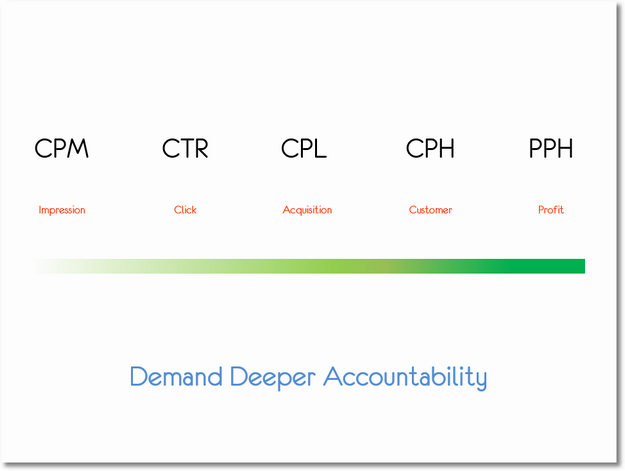
I attempted to communicate the complexity above in a single picture.

Here's what came out of my doodling with crayons…

metrics-incentives

Like perhaps most large organizations, this one was a bit more focused on Cost. While not optimal, it was understandable given the evolutionary stage they were at.

I tried to incorporate their reality, and my picture starts with the metric they used to measure success and quickly moves to the right to metrics I believe are more impactful to the one on the very right that is an impossible dream at the moment (the north star).

Here are the definitions…

Cost Per Impression. An almost, if not entirely, useless metric no matter where it is applied. No one should use this for anything ever. World peace will be hastened by a millennia.

Click-Thru Rate. A little more interesting. Helps shine a light on the ability to do clever targeting, the content in the messages/ads, and smartness in bidding strategies. Good tactical wholesomeness.

Cost Per Lead. An outcome! Yes. In this case this was technically a micro-outcome in this case (conversion is offline). Still, very nice.

Cost Per Human. See the pivot? Per Human. In my definition, this is also online to offline, offline to online or whatever the heck to whatever the heck. It is very hard to do, you have to solve so many tough problems. It also has massively delicious implications in your data, acquisition and retention strategies (ignoring the sweet, heavenly, implications on your customers).

I realize that between CPL and CPH you go from crawling to flying. But, that is what north stars are all about.

Profit Per Human. What every company and non-profit really, really, really need. Why care about something as lame as cost? The only thing that matters is profit. Per. Human.

[Bonus: Remember, you can measure profit everyday in Google Analytics!]

An incredibly complex story, with implications up and down the organization, with smarter tactical and strategic choices, and a long-term hard problem to solve, all wrapped into one simple slide. When you communicate, that is all you need, after all you are the story and not the thing on the screen.

I of course built the story out piece-by-piece, when I was done, this is how it looked…

metrics-incentives-accountability

Imagine for a moment the behavior of your Acquisition team (call it Sales, call it Marketing, call it Tony), if you measure them based on CPM or CPL. Each incentivizes such a different behavior, right?

Applying it to digital advertising…

Shove ads up people’s faces like crazy, who cares if there are 300 words of content surrounded by 18 ads? CPM baby! These Marketers write articles and give conference keynotes that obsess about “viewable above-the-fold ads.” A heartbreaking obsession, but remember it is what they are being incentivized to care about.

Or, worry a ton about the three ad levers you can pull, Content, Targeting, Bids, to ensure you are optimizing for the max leads you can get. Will this marketer give two hoots about “viewable above-the-fold ads”? Only to the extent that their three levers might be influencing less clicks. Instead, they shift that problem to the ad-network (yes!). Let them ensure the ads are showing up in non-crappy-more-relevant sites/apps where the Content and Targeting results in a click to a lead. Good behavior shift.

Extend the above incentive purification and imagine the day-to-day behavior of your Acquisition team if you measure them based on CPH. Or… PPH. See, how dramatically different their execution strategy, their obsessions will be?

Can you imagine why I say team and organization and online-offline silos will be broken as you go further to the right? No one person can succeed without active collaboration, and empathy, with rest of the teams!

That's what you want for yourself or teams that you lead. PPH.

One more thing.

Taking this out of the confines that define the reality of the client, you know that I don’t obsess about Cost this much. It tends to have other unintended consequences (especially lower down in organizations).

Hence.. Here’s an important switch to one of the five metrics to better reflect my worldview…

metrics-incentives-better-accountability

Revenue Per Human.

Subtle change. But, you want people to obsess about Revenue and not Cost. Else people do frustratingly short-sighted things. This is real, from last week: "Our 2017 goal is to reduce the cost of your display campaigns by 20%."

I wanted to die.

Who gives a small kiwi if costs are down by 20% or up by 40%? Are you making more money every day? Are you taking advantage of the complete opportunity to win in the market? Is your competition stealing share by the bucket load while you obsess about cost?

If 10xing your revenue requires that you quadruple your costs, what's the problem?

Remember, we still have PPH to ensure that the revenue we are driving is driving a positive influence on the bottom-line of the company.

Yet, most senior executives in the world incentivize their organizations to solve for cost. Then, they are surprised that they are losing market share or a new competitor crushes them. Hey, costs are lower this year! #winning #not 

But wait, there’s more!

Since I’m now solving for all of you, one more critical evolution to bring this baby home.

If you have read anything I've ever written, you know that I obsess about ensuring every view I have, every portfolio of segments I have, every dashboard I create, every incentive-structure conversation I lead, every business strategy I help craft has to have the three elements that form an end-to-end view: Acquisition, Behavior, Outcomes.

In the picture above, you'll notice I have Acquisition metrics, Outcome metrics, but no behavior metrics.

Not nice. Let's fix that.

There are many candidates, I wanted to have something that _flows_ with the story I was trying to tell… Something that would still incentivize optimal behavior… Something a little unorthodox to push your thinking… Here's my recommendation…

metrics-incentives-best-accountability

Cost Per (unique) Page View.

I said unorthodox, did I not. :)

Measure what it cost you to drive every page view (unique). It gives you a sense for content consumption. It will include all the bounced sessions (pain). It will get you to dive deeper into what site/app sections people visit, what they are not reading, what they do read, how many unique page views does it take to get a Lead, what about freshness of content, anything about layout and experimentation, so on and so forth.

Not quite perfect, but an unorthodox start to demonstrate the creativity you can bring to this.

Regardless of the version of the story you use, it is important to create an end-to-end picture for your own company, your own work.

You will matter more to your company as you personally shoot for the right side of the picture. It will be simply because you are solving for a KPI that actually matters when it comes to the fundamental existence of your company.

Got PPH?

Inspiration: The Identity Spectrum, Ideal Solution.

So much of my solution for your huge success (imagine that being said as: yuge success ;) is dependent on identity. That last bit I added above, Human, has meant many different things over the evolution of the web. There are so many different identity mechanisms out there.

To help you traverse through them, and to get you to Human as in an individual warm body, here’s the identity spectrum we have access to today…

Cookies 3rd.

Most advertising networks use third-party cookies (cookies they set inside mobile and desktop browsers on your behalf – but not as you). These cookies tend to be fragile as they are not accepted in many browsers and are more often deleted – by choice or default. In the past they were roughly equivalent to a person as we all had one computer with one browser. They are not the most primitive form of any measurement (though if you only rely on your ad-network for success metrics of any type then you don’t have a choice, you are stuck with this fragile thing, and I offer a heartfelt sorry that your world is sad).

Here’s one metric you might have heard of that relies on 3rd party cookies: View-Thru Conversions. (Cue sad music.)

What can yo do with third-party cookies? Hold yourself, your ad networks, accountable in a narrow silo.

Cookies 1st.

These are set by existences you own. You’ll recognize these most commonly as being set by Adobe or Google Analytics on your site to better track metrics like Sessions and Users. They tend to be a lot less fragile because most personalization and authorizations except this capability. There is still a decay, if you want to get a sense for it checkout the Recency reports in your analytics tool. They are terrible at identity now as we all use multiple browsers on the same machine, and of course we use laptops, desktops, tablets, and phones (sometimes all at the same time with the same digital company!). It is imperative that you get off it as soon as you can.

Pretty much every metric in your Google Analytics reports uses first-party cookies as the identity mechanism. Conversion Rate. Bounce Rate. Visits to Purchase. Pageviews Per User.

What can you do with first-party cookies? Create better experiences in individual browser (as in Chrome) silos. Leverage advertising solutions like RLSA.

Login-ID 1st.

I’m a paying subscriber to my beloved New Yorker magazine. I’m logged into it’s site on my desktop, laptop, tablet, and phone. I’m logged into the browsers and the mobile application. This empowers the people at Condé Nast to dump cookies and use any digital analytics platform to rely on my login-id as identity to stitch my experiences and truly understand my Acquisition, Behavior and Outcome touch-points.

Login-ID is not fragile (for me the site/apps won’t even work without it). For The New Yorker they can easily tie to my name, address, credit card and a more. I know Condé Nast does not  leverage any of this because none of their platforms show any level of personalization, none of their offers for upping the subscription, none of their ads I see anywhere around the web, etc. show any intelligence related to me as a person. Sad. But. At least the possibility exists, and hope that Condé Nast will wakeup one day to the deeper loyalty and delight they could create using this identity.

For most of you, Login-ID might just be an account someone created on the web or a email address that someone used to sign up for your mailing list. In these cases of Login-ID you don’t have the tie to a human like above, but it is still better than cookies! Switch to 1. using an identity system that relies on Login-ID and 2. create meaningful incentives for people to login to their account.

Cookies as an identity are now only for those who don’t care about their digital business. Login-ID (the New Yorker variety or the signed up for an account) should be default.

For the most glamorous amongst you (I of course mean all of you!), you can stitch the third-party and first-party cookies littered around for your individual Login-IDs and paint an even more robust picture. I recommend this not as the default (because it is a lot of work), but rather as something you can do when *all* other business problems have been solved.

[Bonus: Here’s how to use Universal Analytics to implement Login-ID identity on your digital existences.]

What can you do with Login-ID identity? See above New Yorker example. Summary:  Personalized experiences via intent inferred from expressed behavior. Smarter Search, Display. More interesting understanding of Profitability (it will blow what you do with default first-party cookies with Adobe/Analytics out of the water on day one!).

Login-ID 3rd.

For people who can’t do above sometimes tend to rent an identity system from a third-party. This would be you implementing the Facebook identity system on your site, or one from Google or someone else who currently has most of the internet as it’s User.

So, people can log into your website using the Facebook identity system. With it comes the reduction of the pain of getting people to signup, and also additional behavioral data that the identity platform (say Facebook) would like to share. With it also come limitations related to how much of the customer data and relationship with the customer you own, as well as how much of this can you tie to your online, offline systems.

If you simply can’t do Login-ID on your own for any reason, this is a compromise is less worse than simply relying on cookies.

identity_landscape_occams_razor

Nonline Customer-ID.

An improved variation of Login-ID 1st strategy. Most companies (think any retailer for example) still operate their identities in a silo. There is one for online (the one above), there will be another when you call on the phone (it might be your registered phone number), there will be a different one for when you walk into the store, and depending on if they own the store or if it is a channel for them, there might be one more.

Nonline Customer-ID is an identity platform that allows you to tie all of the above experiences down to one.

It could very well be my phone number. If I’m on your website, mobile app, call your phone center, walk into your store, or anything else, you use my phone number to know it is an individual. In this case, you come very, very close to Human.

Soon it could also be a BLE device implanted in my body that, in close quarters only, allows you to identify me when I am on your site (using a reader on my laptop), in your app (reader on the phone), in your store (readers in your ceilings) and so on and so forth.

It could be other things. I’m not opining on the pros and cons of doing this, I’m leaving out how you feel about this. That is for governments, companies and you to decide.

What can you do with Nonline Customer-ID identity? The ultimate deep level of understanding of customer behavior (as in customer), effectiveness of your marketing and service strategies, profitability, and everything else. If you want to imagine how insightful this can be, close your eyes, think of your business, imagine you have a Nonline Customer-ID platform, think of your current marketing data-driven attribution report. You realize how much this current holy grail sucks, right? That’s what I mean. Times 1000.

Nonline Customer-Id is an identity system will finally allow you to behave as one company and understand one person. B2B. B2C. A2P. DJT.

Nonline Customer-Name-ID.

This won’t apply to all companies, but as I’m deeply passionate about delighting every single individual human I wanted to share this purer version of Nonline Customer-ID.

Let’s take the most famous example: Amazon.

Today, Amazon is as close to Nonline Customer-ID as an identity system as you can get. Every touch point from site experience to mobile app to chat to phone (yes, they have that!) etc. play off the same identity.

But, in my family, like perhaps yours, my spouse and I both use the same identity (and both buy and ship things under my name to our home).

Amazon does not understand us individually though. From the recommendations it gives us to greeting her with my name everywhere, it is stuck with just Nonline Customer-ID identity.

But. Amazon has cookies. It has access to device-ids for mobile. It has access to pages viewed. It has access to products shopped from various browser IDs. And more.

They can easily use two or more of those to assign a Nonline Customer-Name-ID to my wife and to me. In one amazing instant, it would understand us individually and be able uniquely deliver deeper personalization, offers, support, and more.

It won’t be perfect. Perhaps it is off by 5%. But, it would be exponentially better than what exists today (which honestly is already better than 90% of the companies on the planet). And, Amazon needs it’s customers to do nothing new.

Additionally, Amazon could understand Home and understand Avinash and Jennie. Imagine all the possibilities that that unlocks.

What can Nonline Customer-Name-ID do for you? Cross-device intent customized smarter experiences that power relationships and not just shopping. Nirvana.

Now you know what it takes to truly get to Human. To real PPH. The only metric that matters (even for a non-profit). And, we’re not just talking about digital.

Got Human?

As always, it is your turn now.

Considering our metrics incentive spectrum pictures above, where is your company in terms of incentives for it’s employees? Are your little team, or your giant division, solving for the global maxima? If you are a leader, what incentives have you created for people who work for you? What element represents your company’s current identity system? What roadblocks do you see in front of you to get to Nonline Customer-Name-ID?

Please share your ideas, struggles, criticism of my ideas, worries and joy via comments below. I’ll be most grateful for the conversation.

Thank you.

Cookies To Humans: Implications Of Identity Systems On Incentives! is a post from: Occam's Razor by Avinash Kaushik

01 Mar 22:42

4 Great Customer Service Strategies Backed by Data

by Anton Kraly

If you caught my recent Marketer Monday video, you know just how important it is to listen and respect your customers. Respecting customers and treating them well should be Great Customer Service 101. It doesn’t even take much to ensure that you’re treating your customers like they deserve.

Still, many businesses are overlooking the huge payoff that comes with a base of satisfied customers! Great customer service pays off big time; happy customers buy more and bring in valuable referrals.

Treating your customers with respect and listening to their feedback is the cornerstone of some of the most successful, loyalty-inducing companies. If you follow these practices for great customer service, you too can expect your business to succeed and grow.

Respect Your Customers

best customer service examples

As many as 89% of consumers began doing business with a competitor following a poor customer experience. Source

Happy customers love sharing their experiences with friends (especially all over social media), but customers also share the bad experiences. So it’s easy to see how word-of-mouth can work against your company’s brand and reputation for years.

  • Never place blame, instead show immediate action and solutions when things get messed up.
  • Never refer to your customers as customers, use ‘guests’ or ‘students’ instead.
  • Deliver on what you promised.
  • Give them a choice to opt-out or control how
  • “The Customer is Always Right,” create a customer service policy that proves that to your customers.

Keep Your Ears Open

According to a CEI Survey, 86% of buyers will pay more for a better customer experience, but only 1% of customers feel that vendors consistently meet their expectations. Source

Your customers are the backbone of your company or business. Not dealing with their reasonable requests or feedback will put you in a world of hurt (one that’s very hard to come back from). When listening to their feedback, take into account what changes your business can make and then follow through!

Here are some easy quick methods to listening to feedback from customers:

  • Surveys
  • Focus groups
  • Social media
  • Email/web forms
  • Communities, groups, and forums

Finally, take a moment to speak with unhappy customers and do everything possible to fix the situation. Not only will you be avoiding any negative word-of-mouth coverage, but you might be able to keep their business.

Be Honest and Transparent

In 2016, 56% of those surveyed said they would be loyal to a company for life if it provided complete transparency. Source

transparency customer service experience

Trust is so important between a business and its customers that it will take 12 positive service experiences to make up for just one negative experience.

Be transparent by keeping your customers in the know and you’ll quickly build their trust. No matter how small your company is, when there are positive or negatives changes that will impact them let them know beforehand.

Looking for an example of a great, transparent company? Check out the letter Zappos’ CEO wrote for his employees after their Amazon buyout. The letter was additionally publicly posted to their website.

Be Kind and Gracious

70% of buying experiences are based on how the customer feels they are being treated. Source

Just like your mother taught you, saying your ‘pleases’ and ‘thank yous’ will take you very far. You should never hold back from showing your gratitude and graciousness for your customers’ business or engagement. Humbly expressing to them how thankful and appreciative you are is a surefire way to build a long-term relationship with your customers.

Long gone are the days when competitive pricing was the most effective way to build a business that lasts. As buyer empowerment and competition merge, the experience and service that the customer receives is quickly becoming one of the top competitive advantages for marketers.

With effective customer service practices in place, you and your business are ready to hit the path towards better customer loyalty, more word-of-mouth referrals, and increased profits!

What are you and your company doing to give great customer service? Had a recent experience with stellar, above-and-beyond customer service? Share with us in the comments!
01 Mar 22:38

How Blockchain Is Changing Finance

by Alex Tapscott
mar17-01-476314412

Our global financial system moves trillions of dollars a day and serves billions of people. But the system is rife with problems, adding cost through fees and delays, creating friction through redundant and onerous paperwork, and opening up opportunities for fraud and crime. To wit, 45% of financial intermediaries, such as payment networks, stock exchanges, and money transfer services, suffer from economic crime every year; the number is 37% for the entire economy, and only 20% and 27% for the professional services and technology sectors, respectively. It’s no small wonder that regulatory costs continue to climb and remain a top concern for bankers. This all adds cost, with consumers ultimately bearing the burden.

It begs the question: Why is our financial system so inefficient? First, because it’s antiquated, a kludge of industrial technologies and paper-based processes dressed up in a digital wrapper. Second, because it’s centralized, which makes it resistant to change and vulnerable to systems failures and attacks. Third, it’s exclusionary, denying billions of people access to basic financial tools. Bankers have largely dodged the sort of creative destruction that, while messy, is critical to economic vitality and progress. But the solution to this innovation logjam has emerged: blockchain.

How Blockchain Works

Here are five basic principles underlying the technology.

1. Distributed Database

Each party on a blockchain has access to the entire database and its complete history. No single party controls the data or the information. Every party can verify the records of its transaction partners directly, without an intermediary.

2. Peer-to-Peer Transmission

Communication occurs directly between peers instead of through a central node. Each node stores and forwards information to all other nodes.

3. Transparency with Pseudonymity

Every transaction and its associated value are visible to anyone with access to the system. Each node, or user, on a blockchain has a unique 30-plus-character alphanumeric address that identifies it. Users can choose to remain anonymous or provide proof of their identity to others. Transactions occur between blockchain addresses.

4. Irreversibility of Records

Once a transaction is entered in the database and the accounts are updated, the records cannot be altered, because they’re linked to every transaction record that came before them (hence the term “chain”). Various computational algorithms and approaches are deployed to ensure that the recording on the database is permanent, chronologically ordered, and available to all others on the network.

5. Computational Logic

The digital nature of the ledger means that blockchain transactions can be tied to computational logic and in essence programmed. So users can set up algorithms and rules that automatically trigger transactions between nodes.

Blockchain was originally developed as the technology behind cryptocurrencies like Bitcoin. A vast, globally distributed ledger running on millions of devices, it is capable of recording anything of value. Money, equities, bonds, titles, deeds, contracts, and virtually all other kinds of assets can be moved and stored securely, privately, and from peer to peer, because trust is established not by powerful intermediaries like banks and governments, but by network consensus, cryptography, collaboration, and clever code. For the first time in human history, two or more parties, be they businesses or individuals who may not even know each other, can forge agreements, make transactions, and build value without relying on intermediaries (such as banks, rating agencies, and government bodies such as the U.S. Department of State) to verify their identities, establish trust, or perform the critical business logic — contracting, clearing, settling, and record-keeping tasks that are foundational to all forms of commerce.

Given the promise and peril of such a disruptive technology, many firms in the financial industry, from banks and insurers to audit and professional service firms, are investing in blockchain solutions. What is driving this deluge of money and interest? Most firms cite opportunities to reduce friction and costs. After all, most financial intermediaries themselves rely on a dizzying, complex, and costly array of intermediaries to run their own operations. Santander, a European bank, put the potential savings at $20 billion a year. Capgemini, a consultancy, estimates that consumers could save up to $16 billion in banking and insurance fees each year through blockchain-based applications.

Insight Center

To be sure, blockchain may enable incumbents such as JPMorgan Chase, Citigroup, and Credit Suisse, all of which are currently investing in the technology, to do more with less, streamline their businesses, and reduce risk in the process. But while an opportunistic viewpoint is advantageous and often necessary, it is rarely sufficient. After all, how do you cut cost from a business or market whose structure has fundamentally changed? Here, blockchain is a real game changer. By reducing transaction costs among all participants in the economy, blockchain supports models of peer-to-peer mass collaboration that could make many of our existing organizational forms redundant.

For example, consider how new business ventures access growth capital. Traditionally, companies target angel investors in the early stages of a new business, and later look to venture capitalists, eventually culminating in an initial public offering (IPO) on a stock exchange. This industry supports a number of intermediaries, such as investment bankers, exchange operators, auditors, lawyers, and crowd-funding platforms (such as Kickstarter and Indiegogo). Blockchain changes the equation by enabling companies of any size to raise money in a peer-to-peer way, through global distributed share offerings. This new funding mechanism is already transforming the blockchain industry. In 2016 blockchain companies raised $400 million from traditional venture investors and nearly $200 million through what we call initial coin offerings (ICO rather than IPO). These ICOs aren’t just new cryptocurrencies masquerading as companies. They represent content and digital rights management platforms (such as SingularDTV), distributed venture funds (such as the the DAO, for decentralized autonomous organization), and even new platforms to make investing in ICOs and managing digital assets easy (such as ICONOMI). There is already a deep pipeline of ICOs this year, such as Cosmos, a unifying technology that will connect every blockchain in the world, which is why it’s been dubbed the “internet of blockchains.” Others are sure to follow suit. In 2017 we expect that blockchain startups will raise more funds through ICO than any other means — a historic inflection point.

Incumbents are taking notice. The New York–based venture capital firm Union Square Ventures (USV) broadened its investment strategy so that it could buy ICOs directly. Menlo Park venture capital firm Andreessen Horowitz joined USV in investing in Polychain Capital, a hedge fund that only buys tokens. Blockchain Capital, one of the industry’s largest investors, recently announced that it would be raising money for its new fund by issuing tokens by ICO, a first for the industry. And, of course, companies such as Goldman Sachs, NASDAQ, Inc., and Intercontinental Exchange, the American holding company that owns the New York Stock Exchange, which dominate the IPO and listing business, have been among the largest investors in blockchain ventures.

As with any radically new business model, ICOs have risks. There is little to no regulatory oversight. Due diligence and disclosures can be scant, and some companies that have issued ICOs have gone bust. Caveat emptor is the watchword, and many of the early backers are more punters than funders. But the genie has been unleashed from the bottle. Done right, ICOs can not only improve the efficiency of raising money, lowering the cost of capital for entrepreneurs and investors, but also democratize participation in global capital markets.

If the world of venture capital can change radically in one year, what else can we transform? Blockchain could upend a number of complex intermediate functions in the industry: identity and reputation, moving value (payments and remittances), storing value (savings), lending and borrowing (credit), trading value (marketplaces like stock exchanges), insurance and risk management, and audit and tax functions.

Is this the end of banking as we know it? That depends on how incumbents react. Blockchain is not an existential threat to those who embrace the new technology paradigm and disrupt from within. The question is, who in the financial services industry will lead the revolution? Throughout history, leaders of old paradigms have struggled to embrace the new. Why didn’t AT&T launch Skype, or Visa create Paypal? CNN could have built Twitter, since it is all about the sound bite. GM or Hertz could have launched Uber; Marriott could have invented Airbnb. The unstoppable force of blockchain technology is barreling down on the infrastructure of modern finance. As with prior paradigm shifts, blockchain will create winners and losers. Personally, we would like the inevitable collision to transform the old money machine into a prosperity platform for all.

01 Mar 22:38

7 Growth Hacking Examples to Inspire Your Own Marketing

by Jonathan Chan

It’s almost a given that every new online business should consist of (at least) a developer and a marketer. You need someone to build the product and you need someone to get that product into the hands of users.

Because many early stage startups are running on a shoestring budget, paid marketing campaigns are often out of the question. Instead, marketers need to invest time and sweat equity into growth!

Growth hacking means trying a variety of different marketing ideas to grow an engaged user base as fast as possible. Serial entrepreneur, Neil Patel writes, “Growth hackers understand the latent potential of software products to spread themselves, and it’s their responsibility to transform this potential into reality.”

Whether you’re trying to pull off a successful product launch or looking to grow your business. Companies from Dropbox to Airbnb have successfully used growth hacking techniques to grow their startups into the big companies they are today.

There’s a lot that marketers at early stage companies can learn from these companies, so I thought today we could dive into the ways they used growth hacking to … grow!

7 ways to use growth hacking for quick user acquisition

1. Find a distribution system to hack

In the very early days of your startup, you need to find an existing distribution channel to hack.

What’s a distribution channel? It’s a place where your target customer is already going to find what they need.

For example, when Airbnb first launched they came up with two ways to leverage Craigslist, which at the time was the number one site people used for finding temporary housing.
First Airbnb drove traffic to their listings by encouraging new users to cross post their listing on Craigslist with a link back to their Airbnb page.

airbnb craigslist email

This enabled two important things. First, as a new startup they didn’t have a lot of people coming directly to the Airbnb site to find temporary housing. They could have paid thousands of dollars to advertise their site to find people searching for housing, but instead they created their own free traffic by having their users cross post to Facebook with just a couple of clicks through the Airbnb app.

Of course they had to invest time into creating this technology, but it instantly allowed them to drive lots of traffic to their site. Once there, someone interested in the property would sign up for Airbnb to contact the poster.

This allowed them to grow their customer base AND website traffic without spending any money on paid advertising!

Next, that tackled the problem of creating and expanding inventory offered on their site by contacting people posting directly to Craigslist asking them to sign up on Airbnb!

airbnb craigslist outreach 800x433

They hired people to reach out to new Craigslist posters to tell them about Airbnb as well. This allowed the startup to poach traffic and listings right from a competitor!

This is definitely a form of spam, but it’s helpful spam because by cross-posting the home owner does get more views on their property.

Nice work by the growth hackers at Airbnb to drive traffic and users quickly and at no additional cost!

2. Leverage the distribution channel(s) you already have in place

Once your startup has gained some traction, you can begin leveraging the distribution channels you own yourself.

First, during the signup process you can ask your new user to refer a friend to receive some incentive.

For example, Dropbox increased their new user signups by 60% when they started offering users 500MB of additional storage for free whenever someone they referred signed up for the service!

dropbox referral

The person being referred also receives the additional space, giving them an incentive to use the referral link rather than just going to the site and signing up on their own. This allows Dropbox to better track the source of their signups.

Then they take their user incentives strategy a step further by also offering some additional storage if a user explores social sharing features and/or shares information about Dropbox with friends via social media.

dropbox growth social media

They also incentivized sharing of photos and videos via Dropbox, which helps them reach new users via word-of-mouth from longer time customers.

Dropbox Sharing Screenshot 1024x711

Using these incentive-based growth hacks, Dropbox saw an immediately 60% lift in new sign ups and this increased rate of adoption has remained steady since!

3. Help your existing users create new distribution channels for you

If you’re in the B2B space and it doesn’t make sense for you to run a referral program like Dropbox does, consider running a referral program like Heap Analytics does.

With Heap, users can increase the number of visitor sessions they can track for free from 5,000 to 50,000 just by adding the Heap badge to their website footer.

Screen Shot 2017 01 18 at 10.36.18 AM

This instantly gives Heap visibility to all website visitors that go to their users websites!

At Foundr, we leveraged a cool tool called Upviral for the launch of our Kickstarter campaign for our book Foundr Version 1.0. We created an online competition where the top 3 winners would win a free copy of the book, along with a number of other prizes.

All they had to do was to spread awareness of our book in order to earn points. People could earn points by simply sharing it over on social media, or even emailing their friends and family. To make the process even easier, we even created a resources page which contained all the images that people could use along with a sample copy for each social media platform!

pasted image 0

By leveraging our community and getting them to generate more awareness and exposure for us we managed to blow past our $50,000 goal on Kickstarter and raise four times the goal amount!

4. Make your brand EXCLUSIVE

In the early days of your startup, you may not be ready to handle thousands upon thousands of new sign ups, and you may not want to either. Your product may not be tested and ready for more than a small group of people using it at once.

Of course you don’t want to turn interested people away.

What’s your alternative?

Well you could collect their email addresses and notify them when you’re ready to open your platform to more people, but by then they may have forgotten who you are and why they wanted to sign up in the first place.

The best way to handle an influx of traffic that you can’t yet serve is to build up a feeling of exclusivity. Instead of saying “Sign Up to Be Notified When Registration Opens” you can instead say something like:

  • Membership now closed
  • Ask for an invitation
  • Apply to join the community

Using these words that evoke an air of exclusivity helps people remember you.

You can also use a waiting list / limited availability as a method for driving brand awareness.

Sean Ellis says, “Xobni was the first company I worked with that used a waiting list. The reason was that the product launched at TechCrunch 40 and it was quickly clear that there were significant performance issues. So rather than risking a bad reputation, the company threw up a waiting list wall. The wall became a pretty good marketing gimmick. It created scarcity and desire to try the product. People would fill out surveys, share, etc. to try and gain early access.”

Robinhood, a zero commission stock trading app, used this growth hack to create an air of excitement around their app.

Their landing page had a sign up that included a mention of gaining priority access to the app with a few simple social shares.

robinhood early access thank you

They also followed up with an email to drive this message home.

robinhood confirmation email

Within just one year Robinhood had a waiting list of 1 million people!

5. Create a sign up frenzy using scarcity

Similar to exclusivity, scarcity also drives sign ups and sales because people experience a fear of missing out. You know, FOMO.

On your startup’s home page or product pages try using words like:

  • Limited offer
  • Supplies running out
  • Sale ends soon
  • Today only
  • Get them while they last

Using scarcity to increase conversions is a tried and true marketing tactic that is used with success by businesses of all sizes.

Here is an example of Williams Sonoma using “quantities are limited” to drive sales.

Screen Shot 2017 01 20 at 8.34.14 AM

Even if your own quantities are not limited, you can still say they are to increase sales over a period of time.

If you’re not an e-commerce store you can drive scarcity messaging by using messaging such as:

  • Open to X number of people ONLY!
  • Only X registrations left
  • Sign up before all the spots are taken!
  • Registration closes on X [date]

Activewear brand Oiselle uses this strategy for signing up people into their Volee club.

Screen Shot 2017 01 20 at 8.40.27 AM

Each quarter they open registration up for 48 hours and then it closes again and a waiting list goes up.

Screen Shot 2017 01 20 at 8.58.23 AM

This method of constantly opening and then closing a scarce number of membership spots creates a frenzy in which would-be members anxiously await their invite and eagerly pay the $100 fee.

6. Turn Twitter into an acquisition channel

There are many different ways a startup can use Twitter to its advantage. Companies like Comcast and BlueHost use Twitter to provide customer service. Dropbox uses Twitter to share company news and Buffer uses Twitter to share helpful content it’s published.

Screen Shot 2017 01 20 at 2.42.35 PM

These are all good reasons to use Twitter, but today we’re specifically looking for great growth hacking ideas.

Austen Allred, senior growth manager at LendUp, has found a simple but effective way to drive user acquisition without spending a time on Twitter ads.

“Let’s say you sell beard oils. To smoke out potential beard oil customers, you might navigate to a competing brand’s Twitter account and follow all their followers. This, however, would bog you down with spam accounts. Another strategy would be to search for “beard oil,” but the results would be populated with idle talk of beard oils and tweets from beard oil companies, and take ages to sift through.

Allerd’s hack helps target people who are looking to buy beard oils, and it’s ridiculously simple. Just search for something like “need beard oil.”

Screen Shot 2015 07 29 at 12.20.53 PM

You are then shown people who are in need of beard oil and can reach out to them one-on-one with a clever, witty or just super helpful response with a link to your beard oil e-commerce site, or a note to check out your products in their local store.

You might offer them a limited time promo code or coupon they can use as a first time purchaser. By making the offer limited time, you create a sense of urgency so that they buy right away.

7. Implement a customer loyalty program to obtain repeat business

When we speak about growth hacking, we’re primarily talking about new business acquisition, but increasing the lifetime value (LTV) of existing customers is equally important to growth.

Once you acquire a customer, it should require much less time (and money) to get them to make a repeat purchase as long as quality and customer service lived up to promise. This is how you grow your company without spending all of your time finding new customers.

One great way to increase repeat business is by offering a customer loyalty program.

It’s easy to view customer loyalty cards as something of the past, but they are still in circulation by many companies today because they work.

In a study conducted by the University of Southern California, when implemented properly loyalty cards resulted in 178% more repeat business!

How is that possible?

Well, at a car wash company researchers handed out loyalty cards with stamp boxes. Customers earned a free car wash for every 10 stamps they received.

In the study, half of the cards had 8 of the 10 spots pre-stamped, while the other half only had 2 of the 10 spots pre-stamped. In the end, customers who received the 8 stamps up front come back for additional car washes in droves! To the tune of 178% more than the customers who received only two stamps.

CX4nLRVW8AAkfCs.pnglarge

These customers appreciated the many stamps they were given up front and felt like they were being singled out for a good deal which in turn made them loyal to the car wash company. Plus, the incentive of a free car wash seemed much easily achievable when they only had to come back for two more washes before redeeming their card for the prize.

Even if you don’t have a brick and mortar store, you can still implement this same type of customer loyalty strategy.

Ecommerce shops can easily build a customer loyalty program so that when X amount of dollars are spent, or when X number of products are purchased customers earn a prize.

For example, Birchbox offers Birchbox Points to account holders. “Birchbox Points are what you earn when you shop, review samples and refer friends. They translate into currency that can be used to purchase any full size products in the Birchbox Shop or in our NYC store. 100 Birchbox Points equals $10, and points can be redeemed in increments of 1.”

BirchboxPointsLanding 700x400

If your company isn’t an ecommerce shop, you’ll need to get creative with your loyalty program. You might offer an incentive after X number of months a person is a customer or an incentive for X number of times a customer uses a specific feature.

Of course you’ll want to pick a feature that is highly useful. This gets the user reliant on using the feature to make his or her life easier. This makes it harder for the user to cancel since he or she uses the feature so frequently!

Getting Started

Hopefully by now you are visualizing ways to grow your own startup using these hacks or variations of these hacks you come up with on your own!

If you’re feeling unsure of where to start, leave me a comment below and I’ll do my best to help!

01 Mar 22:38

Business Books to Watch in March

by News

In order of their release date, here are some of the book we'll be looking at more closely in March.

The Transformational Consumer: Fuel a Lifelong Love Affair with Your Customers by Helping Them Get Healthier, Wealthier, and Wiser by Tara-Nicholle Nelson, Berret-Koehler Publishers

They are the most valuable, least understood customers of our time. They buy over $4 trillion in life-improving products and services every year. If you serve their deeply human need to continually improve their lives, they will eagerly engage with your brand at a time when most people are tuning out corporate messages.

They are Transformational Consumers, and no one knows them like Tara-Nicholle Nelson. Her Transformational Consumer insights powered her work at MyFitnessPal, which grew from 40 million to 100 million users in her time there.

Nelson takes readers on a hero's journey to connecting with customers in ways both profitable and transformational. After going inside the brains, emotions, and behaviors of Transformational Consumers, Tara issues a call to adventure: a rallying cry to leaders to shift their focus from simply making products to solving their customers' problems.

Nelson uses stories and cases studies from every industry to guide readers through this journey in five stages, shedding light on how to rethink their customers, their products and services, their marketing, their competition, and even their culture.

The key to growing a business today is not building an app or getting new social media followers. The key is engaging people over and over again by triggering their deep, human desire for growth and transformation.

When a company reorients every initiative to serve Transformational Consumers, it kick-starts a lifelong love affair with its customers—a love affair that results in unprecedented revenue growth, product innovation, and employee engagement.

The Crowdsourceress: Get Smart, Get Funded, and Kickstart Your Next Big Idea by Alex Daly, PublicAffairs

The crowdfunding expert known as "The Crowdsourceress"—who has some of the biggest and most famous Kickstarter campaigns in her portfolio—writes the definitive guide for anyone looking to raise money for a creative endeavor, product, or cause. 

In recent years, the crowdfunding industry has generated several billions in funding. But the harsh reality is that around 60 percent of Kickstarter campaigns fail. Enter Alex Daly, a crowdfunding expert who has raised over $20 million for her clients' campaigns. She has run some of Kickstarter's biggest projects—TLC's newest album, Neil Young's audio player, and Joan Didion's documentary. In this book, Daly takes readers deep inside her most successful campaigns, showing you how to:

  • Get fans and influencers excited about your launch
  • Build an appealing and powerfully designed campaign
  • Access proven video tips, pitching tactics, press releases, and rewards ideas
  • Avoid the most common headaches and pitfalls

Here you'll get tangible tools to run your own crowdfunding campaigns and fully connect with the crowd, get people to pay attention, and inspire them to act.

Irresistible: The Rise of Addictive Technology and the Business of Keeping Us Hooked by Adam Alter, Penguin Press

An urgent and expert investigation into behavioral addiction, the insidious flipside to today’s unavoidable digital technologies, and how we can turn the tide to regain control.

In our lifetimes, behavioral addiction may prove to be one of the most important fields of social, medical, and psychological research. The very idea of behaviors being addictive is new, but the threat is near universal. We are only just beginning to understand that we are all potential addicts. Adam Alter, Associate Professor of Marketing at New York University’s Stern School of Business, is at the cutting edge of research into what makes these products so compulsive, and he shows that the price for continuing blindly down the path we are on will be huge.

People have always formed addictions to harmful substances, but these days we are hooked on technologies such as Twitter, Netflix, and Facebook—inventions and devices we use in the hope of making our lives better and more enjoyable. Of course, these devices have amazing upside, but their extraordinary appeal isn’t an accident. Technology companies and marketers have teams of engineers and researchers devoted to keeping us glued to the screen. They know how to push our buttons, how to get us using without our knowledge.

Tracing the very notion of addiction through history right up until the present day, Alter shows that we’re only just beginning to discover the tip of the iceberg of the epidemic of behavioral addiction gripping society. This goes to the core of who we are. He takes us inside the human brain at the very moment we switch on a game on our smartphones, or share a photo on Instagram in the hope of people “liking” it. But more than that, he heads the problem off at the pass, letting us know what we can do to step away from the screen. He lays out the options we have address this problem before it truly consumes us. After all, who among us hasn’t felt the terrible compulsive power of social media, video games, or simply checking your phone?

Time, Talent, Energy: Overcome Organizational Drag and Unleash Your Team's Productive Power by Michael C. Mankins & Eric Garton, Harvard Business Review Press

Managing Your Scarcest Resources.

Business leaders know that the key to competitive success is smart management of scarce resources. That’s why companies allocate their financial capital so carefully. But capital today is cheap and abundant, no longer a source of advantage. The truly scarce resources now are the time, the talent, and the energy of the people in your organization—resources that are too often squandered. There’s plenty of advice about how to manage them, but most of it focuses on individual actions. What’s really needed are organizational solutions that can unleash a company’s full productive power and enable it to outpace competitors.

Building off of the popular Harvard Business Review article “Your Scarcest Resource,” Michael Mankins and Eric Garton, Bain & Company experts in organizational design and effectiveness, present new research into how you can liberate people’s time, talent, and energy and unleash your organization’s productive power. They identify the specific causes of organizational drag—the collection of institutional factors that slow things down, decrease output, and drain people’s energy—and then offer a pragmatic framework for how managers can overcome it. With practical advice for using the framework and in-depth examples of how the best companies manage their people’s time, talent, and energy with as much discipline as they do their financial capital, this book shows managers how to create a virtuous circle of high performance.

A Little History of Economics by Niall Kishtainy, Yale University Press

A lively, inviting account of the history of economics, told through events from ancient to modern times and the ideas of great thinkers in the field.

What causes poverty? Are economic crises inevitable under capitalism? Is government intervention in an economy a helpful approach or a disastrous idea? The answers to such basic economic questions matter to everyone, yet the unfamiliar jargon and math of economics can seem daunting. This clear, accessible, and even humorous book is ideal for young readers new to economics and for all readers who seek a better understanding of the full sweep of economic history and ideas.

Economic historian Niall Kishtainy organizes short, chronological chapters that center on big ideas and events. He recounts the contributions of key thinkers including Adam Smith, David Ricardo, Karl Marx, John Maynard Keynes, and others, while examining topics ranging from the invention of money and the rise of agrarianism to the Great Depression, entrepreneurship, environmental destruction, inequality, and behavioral economics. The result is a uniquely enjoyable volume that succeeds in illuminating the economic ideas and forces that shape our world.

The Spark and the Grind: Ignite the Power of Disciplined Creativity by Erik Wahl, Portfolio

From the world-famous graffiti artist, beloved corporate speaker, and bestselling author of Unthink, a provocative new book on how you can train yourself to become creative in your business and everyday life.

We’re conditioned to think in terms of dichotomies, especially when we talk about creative genius. Right brain versus left brain. Inspiration versus perspiration. Creativity versus discipline. And consequently, we believe that no one person can have both or be both: you’re either a suit or a creative.

But Erik Wahl, a professional artist who has learned to generate constant creative work, argues that success now depends on being able to harness creativity and discipline.

According to Wahl, creativity has two faces: the spark of inspiration and the grind of following through to make that idea a reality. Sparks of insight originate from passion—these are the moments that make your heart race in excitement, the moments in which you’re enthralled by possibility. The grind is the necessary work to take your spark from pie-in-the sky idea to execution.

Too often, we consider these elements separately, without thinking about how they interact. But the two are symbiotic; ongoing, original creativity requires both, as Wahl writes, “the initial flicker of hope, and the work to stoke it into something that changes the game.” Wahl offers practical advice about how to fan the sparks and make the grind more productive, including:

  • Immerse yourself in the unfamiliar: Consciously put yourself into uncomfortable situations to produce new and better ideas.
  • Converse with yourself and others: Subjecting your ideas to the crucible of criticism will clarify what’s really brilliant about them.
  • Rehearse creativity constantly: You need to commit to a steady practice of creativity, in what Wahl calls “a lifestyle of iteration.”

Wahl deftly synthesizes the wisdom of other artists, philosophers, scientists and business visionaries throughout history, along with his own striking personal story. The result is a guide to ensuring constant creativity in your everyday life, in and out of the office, that will push you to produce your most innovative work yet.

The Bully-Proof Workplace: Essential Strategies, Tips, and Scripts for Dealing with the Office Sociopath by Peter J. Dean & Molly D. Shepard, McGraw-Hill

Crucial tools and advice for dealing with bullies in the workplace and creating a productive, bully-free environment.

An alarming number of employees suffer from bullying at work. The cost of bullying is enormous—from the lost productivity, trust, and well-being among workers to the expense of replacing people who leave, increased healthcare, and litigation.

The Bully-Proof Workplace: Essential Strategies, Tips, and Scripts for Dealing with the Office Sociopath is designed to help alleviate this damaging workplace trend. This invaluable survival guide provides strategies, actionable advice, and sample dialogues to engage the different types of bullies, manage aggressive employees, and create a bully-proof environment.

Because of Sex: One Law, Ten Cases, and Fifty Years That Changed American Women's Lives at Work by Gillian Thomas, St. Martin's Press

A compelling look at ten of the most important Supreme Court cases defining women’s rights on the job, as told by the brave women who brought the cases to court.

Best known as a monumental achievement of the civil rights movement, the 1964 Civil Rights Act also revolutionized the lives of America’s working women. Title VII of the law made it illegal to discriminate “because of sex.” But that simple phrase didn’t mean much until ordinary women began using the law to get justice on the job—and some took their fights all the way to the Supreme Court. Among them were Ida Phillips, denied an assembly line job because she had a preschool-age child; Kim Rawlinson, who fought to become a prison guard—a “man’s job”; Mechelle Vinson, who brought a lawsuit for sexual abuse before “sexual harassment” even had a name; Ann Hopkins, denied partnership at a Big Eight accounting firm because the men in charge thought she needed "a course at charm school”; and most recently, Peggy Young, UPS truck driver, forced to take an unpaid leave while pregnant because she asked for a temporary reprieve from heavy lifting.

These unsung heroines’ victories, and those of the other women profiled in Because of Sex, dismantled a “Mad Men” world where women could only hope to play supporting roles; where sexual harassment was “just the way things are”; and where pregnancy meant getting a pink slip.

Through first-person accounts and vivid narrative, Because of Sex tells the story of how one law, our highest court, and a few tenacious women changed the American workplace forever.

The High-Potential Leader: How to Grow Fast, Take on New Responsibilities, and Make an Impact by Ram Charan with Geri Willigan, Wiley

Companies need High Potential leaders (Hi-Po’s) more than ever before to help them adapt to todays tumultuous, digitally-driven business environment. If you meet the Hi-Po criteria, you're in high demand—and this book explains how to fast-track yourself.

Criteria for Hi-Pos are changing markedly. In the past, fast-track leaders were tapped mainly because of their cognitive abilities, analytical skills, imagination, thoroughness in finding solutions and even perfectionist tendencies. In the new climate, other attributes will count more heavily: relationship skills, experience, judgment, abilities to engage, motivate, and draw out the best performance in others, strategic skills and even personal habits and behavior style. Above all, companies see Hi-Pos as people who have the capacity to grow quickly and step into new leadership roles competently. This book is a step by step guide to becoming a high potential leader.

Eyes Wide Open: Overcoming Obstacles and Recognizing Opportunities in a World That Can't See Clearly by Isaac Lidsky, TarcherPerigee

In Eyes Wide Open, Isaac Lidsky draws on his experience of achieving immense success, joy, and fulfillment while losing his sight to a blinding disease to show us that it isn’t external circumstances, but how we perceive and respond to them, that governs our reality.

Fear has a tendency to give us tunnel vision—we fill the unknown with our worst imaginings and cling to what’s familiar. But when confronted with new challenges, we need to think more broadly and adapt. When Isaac Lidsky learned that he was beginning to go blind at age thirteen, eventually losing his sight entirely by the time he was twenty-five, he initially thought that blindness would mean an end to his early success and his hopes for the future. Paradoxically, losing his sight gave him the vision to take responsibility for his reality and thrive. Lidsky graduated from Harvard College at age nineteen, served as a Supreme Court law clerk, fathered four children, and turned a failing construction subcontractor into a highly profitable business.

Whether we’re blind or not, our vision is limited by our past experiences, biases, and emotions. Lidsky shows us how we can overcome paralyzing fears, avoid falling prey to our own assumptions and faulty leaps of logic, silence our inner critic, harness our strength, and live with open hearts and minds. In sharing his hard-won insights, Lidsky shows us how we too can confront life’s trials with initiative, humor, and grace.

There Are No Overachievers: Seizing Your Windows of Opportunity to Do More Than You Thought Possible by Brian D. Biro, Crown Business

A new book from management consultant and speaking guru Brian Biro about seizing and acting upon the WOO, or Windows of Opportunity, that present themselves in both our personal and professional lives.

In this inspirational book, Brian Biro, business speaker and former US swimming coach, reveals the secret to being energized and passionate about work and life—seizing the WOO. WOO stands for Windows of Opportunity—those precious, unrepeatable moments that can impact, redirect, and even reshape our lives if we recognize and choose to seize them. He encourages readers to ask “How can I recognize a WOO when I see one?” and “Why have I missed WOOs in my past?” and shows them how, by using our ability to network, create more energy, foster teamwork, and partner with others, we can create windows of opportunity that transform our careers and our lives.

There Are No Overachievers is designed to give readers the “aha!” moments and breakthroughs already experienced by over 400,000 attendees of Brian’s live presentations for top corporations and clients. Many chapters in the book are devoted to recounting personal stories as well as anecdotes from others that dynamically illustrate and underscore the importance of his key message. Through a conversational and relatable writing style, Brian Biro promises to reveal the ultimate secret to a rich and dynamic life, a successful and fulfilling career, and relationships that bring inexpressible joy.

Radical Candor: Be a Kick-Ass Boss Without Losing Your Humanity by Kim Scott, St. Martin's Press

A simple but revolutionary approach to management.

From the time we learn to speak, we’re told that if you don’t have anything nice to say, don’t say anything at all. While this advice may work for everyday life, it is, as Kim Scott has seen, a disaster when adopted by managers.

Scott earned her stripes as a highly successful manager at Google and then decamped to Apple, where she developed a class on optimal management. She has earned growing fame in recent years with her vital new approach to effective management, the “radical candor” method.

Radical candor is the sweet spot between managers who are obnoxiously aggressive on one side and ruinously empathetic on the other. It’s about providing guidance, which involves a mix of praise as well as criticism—delivered to produce better results and help employees achieve.

Great bosses have strong relationships with their employees, and Scott has identified three simple principles for building better relationships with your employees: make it personal, get (sh)it done, and understand why it matters.

Radical Candor offers a guide to those bewildered or exhausted by management, written for bosses and those who manage bosses. Taken from years of the author’s experience, and distilled clearly giving actionable lessons to the reader; it shows managers how to be successful while retaining their humanity, finding meaning in their job, and creating an environment where people both love their work and their colleagues.

Doughnut Economics: Seven Ways to Think Like a 21st-Century Economist by Kate Raworth, Chelsea Green Publishing

From renegade economist Kate Raworth, a radically new compass for guiding global development, government policy, and corporate strategy for a new generation of economic thinkers.

Economics is the mother tongue of public policy. It dominates our decision-making for the future, guides multi-billion-dollar investments, and shapes our responses to climate change, inequality, and other environmental and social challenges that define our times. Pity then, or more like disaster, that its fundamental ideas are centuries out of date, yet are still taught in college courses worldwide and still used to address critical issues in government and business alike.

That’s why it is time, says renegade economist Kate Raworth, to revise our economic thinking for the 21st century. In Doughnut Economics, she sets out seven key ways to fundamentally reframe our understanding of what economics is and does. Along the way, she points out how we can break our addiction to growth; redesign money, finance, and business to be in service to people; and create economies that are regenerative and distributive by design.

Named after the now-iconic “doughnut” image that Raworth first drew to depict a sweet spot of human prosperity (an image that appealed to the Occupy Movement, the United Nations, eco-activists, and business leaders alike), Doughnut Economics offers a radically new compass for guiding global development, government policy, and corporate strategy, and sets new standards for what economic success looks like.

Raworth handpicks the best emergent ideas—from ecological, behavioral, feminist, and institutional economics to complexity thinking and Earth-systems science—to address this question: How can we turn economies that need to grow, whether or not they make us thrive, into economies that make us thrive, whether or not they grow?

Simple, playful, and eloquent, Doughnut Economics offers game-changing analysis and inspiration for a new generation of economic thinkers.

The Spider Network: The Wild Story of a Math Genius, a Gang of Backstabbing Bankers, and One of the Greatest Scams in Financial History by David Enrich, Custom House

The Wall Street Journal’s award-winning business reporter unveils the bizarre and sinister story of how a math genius named Tom Hayes, a handful of outrageous confederates, and a deeply corrupt banking system ignited one of the greatest financial scandals in history.

In 2006, an oddball group of bankers and traders from some of the world’s largest institutions made a startling realization: Libor—the London interbank offered rate, which determines the interest rates on trillions in loans worldwide—was set daily by a small group of easily manipulated functionaries, and that they could reap huge profits by illegally nudging it to suit their trading portfolios. Tom Hayes, a brilliant but troubled math genius, became the lynchpin of a wild alliance that included a French trader nicknamed “Gollum”; the broker “Abbo,” who liked to publicly strip naked when drinking; a Kazakh chicken farmer turned something short of financial whiz kid; a broker known as “Village” (short for “Village Idiot”) obsessed with human-animal sex; an executive called “Clumpy” because of his patchwork hair loss; and a broker uncreatively named “Big Nose.” Hayes’s circle would produce the era’s greatest financial scandal—until it all unraveled in spectacularly vicious fashion.

The Spider Network is not only a rollicking account of the scam, but a provocative examination of a financial system that was crooked throughout, full of wheeler-dealers able to concoct elaborate connections between dollars and donuts but not their rapacious actions and the law.

Superfandom: How Our Obsessions are Changing What We Buy and Who We Are by Zoe Fraade-Blanar & Aaron M. Glazer, W.W. Norton & Company

An in-depth look at the influence of fans—society’s alpha consumers—on our lives and culture.

As fandom sheds its longtime stigmas of geekiness and hysteria, fans are demanding more from the celebrities and brands they love. Digital tools have given organizations—from traditional businesses to tech startups—direct, real-time access to their most devoted consumers, and it’s easy to forget that this access flows both ways. This is the new “fandom-based economy”: a convergence of brand owner and brand consumer. Fan pressures hold more clout than ever before as audiences demand a say in shaping the future of the things they love.

In Superfandom, Zoe Fraade-Blanar and Aaron M. Glazer explain this new era of symbiosis. For producers, it can mean a golden opportunity: brands such as Polaroid and Surge, preserved by the passion of a handful of nostalgic fans, can now count on an articulate, creative, and, above all, loyal audience. Yet, the new economy has its own risks—it’s also easier than ever for companies to lose their audience’s trust.

Examining key cases that span a wide range of consumer markets, Fraade-Blanar and Glazer explain why some kinds of engagement with fans succeed and some backfire. Throughout, the authors probe fandom’s history, sociology, and psychology. From the nineteenth-century American Alice Drake, who bribed her way into the houses of her favorite European composers, to Hatsune Miku, the Japanese virtual celebrity whose songs are composed entirely by fans, the dynamics of fandom—the activities we perform to show we belong to a group of people with common interests—may be as old as culture itself.

For groupies of financier Warren Buffet and enthusiasts of Cards Against Humanity alike, the consumer relationship has been transformed. Superfandom is an essential guide for those who care about, contribute to, and live in our rapidly expanding fan-driven economy.

Boss Bitch: A Simple 12-Step Plan to Take Charge of Your Career by Nicole Lapin, Crown Business

A practical and inspiring guide for any woman who wants to enjoy the freedom and empowerment that come with being the boss of her own career.

The Urban Dictionary defines the term “boss bitch” as: A female that is extremely successful, stunting, and has plenty of power. So when Nicole Lapin talks about being a “boss bitch,” she isn’t talking about being like the Meryl Streep character in The Devil Wears Prada. She’s talking about being comfortable in our own skin and taking true ownership of our actions and our futures. She’s talking about rising to the occasion and owning our power. Because by this definition, being a boss bitch isn’t something to apologize for—it’s something to be proud of. That’s what this book is about.

Drawing on experiences from her own career, as well stories of some of the country’s most powerful females, Lapin breaks down what it means to be a “boss” in three easy steps. First, she shows how to embrace the “boss of you” mentality—and seize the power that comes from believing in yourself and your abilities. Next, she offers candid advice for how to succeed as a leader at work. And finally, for those who want to take the plunge as an entrepreneur—she lays out the nuts and bolts of how to go from idea to action: how to raise money, lay down a budget, hire a staff, scale responsibly, and deal with everyday leadership challenges, from sexism to work-life balance.

Ego Free Leadership: Ending the Unconscious Habits that Hijack Your Business by Brandon Black & Shayne Hughes, Greenleaf Book Group Press

Take your ego out of the equation, and watch your company thrive!

“I’ve got a solution,” Encore’s CFO tells Brandon, “but it’s unorthodox.” It’s 2005 and Brandon Black has just been promoted to CEO of Encore Capital, a company struggling to navigate an increasingly difficult business environment. Faced with a rapidly declining stock price and low workplace morale, Brandon knows he needs change—and fast. Following his CFO’s advice, he and his executive team start working with Learning as Leadership (LaL) and its president, Shayne Hughes. Through their partnership, Encore’s executive team learns to root out the unproductive ego habits that undermine collaboration and performance.

As they instill these more effective behaviors throughout the organization, Encore begins to solve problems collectively, prioritize resources without infighting, and focus on the initiatives with the greatest strategic value. When the financial crisis of 2008–09 forces 90 percent of its competitors out of business, Encore thrives, with its profits increasing by 300 percent and its stock price by 1200 percent. Told from two lively first-person perspectives, Ego Free Leadership brings readers along for Encore’s incredible success story. They’ll see a CEO overcome his unconscious resistance to modeling the change he wants in his team and discover a time-tested roadmap for eliminating the destructive effects of the ego in teams and organizations.

Gen Z @ Work: How the Next Generation Is Transforming the Workplace by David Stillman & Jonah Stillman, Harper Business

A generations expert and author of When Generations Collide and The M-Factor teams up with his seventeen-year-old son to introduce the next influential demographic group to join the work force—Generation Z—in this essential study, the first on the subject.

They were born between between 1995 and 2012. At 72.8 million strong, Gen Z is about to make its presence known in the workplace in a major way—and employers need to understand the differences that set them apart. They’re radically different than the Millennials and yet no one seems to be talking about them—until now. This generation has an entirely different perspective on careers and how to succeed in the work force.

Based on the first national studies of Gen Z’s workplace attitudes, interviews with hundreds of CEOs, celebrities, and thought leaders on generational issues, cutting edge case studies, and insights from Gen Zers themselves, Gen Z @ Work offers the knowledge today’s leaders need to get ahead of the next gaps at work and how best to recruit, retain, motivate, and manage them. Ahead of the curve, Gen Z @ Work is the first comprehensive, serious look at what the next generation of workers looks like, and what that means for the rest of us.

The Creative Spark: How Imagination Made Humans Exceptional by Agustín Fuentes, Dutton

In the tradition of Jared Diamond’s million-copy-selling anthropology classic Guns, Germs, and Steel, a book that overturns widely held misconceptions about race, war and peace, and human nature itself, providing a profoundly new answer to an age old question: what made humans so exceptional among all the species on earth?

Creativity. It is the secret of what makes humans special hiding in plain sight. Agustín Fuentes argues that your child’s finger painting comes essentially from the same place as creativity in hunting and gathering millions of years ago and throughout history in making war and peace, in intimate relationships, in shaping the planet, in our communities, and in all of art, religion, and even science. It requires imagination and collaboration. Every poet has her muse, every engineer, an architect, every politician, a constituency. The manner of the collaborations varies widely, but successful collaboration is inseparable from imagination, and it brought us everything from knives and hot meals to iPhones and interstellar spacecraft.

Weaving fascinating stories of our ancient ancestors creativity, Fuentes finds the patterns that match modern behavior in humans and animals and those that don’t. This key quality has propelled the evolutionary development of our bodies, minds, and cultures, both for good and for bad. It’s not the drive to reproduce, nor competition for mates, or resources, or power, nor our propensity for caring for one another that have separated us out from all other creatures.

As Fuentes concludes, to make something lasting and useful today you need to understand the nature of your collaboration with others, what imagination can and can’t accomplish, and finally just how completely our creativity is responsible for the world we live in. In a final short section of the book, he sets out a guide for how to use this view of human nature. In a nutshell his two-step signature of a creative human life? Embrace diversity; welcome failure. Agustín Fuentes resounding multi-million-year perspective will inspire readers—and spark all kinds of creativity.

Sensemaking: The Power of the Humanities in the Age of the Algorithm by Christian Madsbjerg, Hachette Books

Based on his work at some of the world's largest companies, including Ford, Adidas, and Chanel, Christian Madsbjerg's Sensemaking is a provocative stand against the tyranny of big data and scientism, and an urgent, overdue defense of human intelligence.

Humans have become subservient to algorithms. Every day brings a new Moneyball fix—a math whiz who will crack open an industry with clean fact-based analysis rather than human intuition and experience. As a result, we have stopped thinking. Machines do it for us.

Christian Madsbjerg argues that our fixation with data often masks stunning deficiencies, and the risks for humankind are enormous. Blind devotion to number crunching imperils our businesses, our educations, our governments, and our life savings. Too many companies have lost touch with the humanity of their customers, while marginalizing workers with liberal arts-based skills. Contrary to popular thinking, Madsbjerg shows how many of today's biggest success stories stem not from "quant" thinking but from deep, nuanced engagement with culture, language, and history. He calls his method sensemaking.

In this landmark book, Madsbjerg lays out five principles for how business leaders, entrepreneurs, and individuals can use it to solve their thorniest problems. He profiles companies using sensemaking to connect with new customers, and takes readers inside the work process of sensemaking "connoisseurs" like investor George Soros, architect Bjarke Ingels, and others.

Both practical and philosophical, Sensemaking is a powerful rejoinder to corporate groupthink and an indispensable resource for leaders and innovators who want to stand out from the pack.

Fast/Forward: Make Your Company Fit for the Future by Julian Birkinshaw, Jonas Ridderstråle, Stanford University Press

The leading companies of the past twenty years have all harnessed the power of information to gain competitive advantage. But as access to big data becomes ubiquitous, it can no longer guarantee a leg up. Fast/Forward makes the case that we are entering a new era in which firms that understand the limits of 1s and 0s will take the lead.

Whereas the industrial age saw the rise of bureaucracy, and the information age has been described as a meritocracy, we are witnessing the rise of adhocracy. In uncertain, rapidly-changing times, adhocracic organizations scan the horizon for winning opportunities. Then, instead of questing after more analysis, they respond with agility by making smart, intuitive decisions. Combining decisive action with emotional conviction, future-facing firms seize the day.

Fast/Forward paints the big picture of a new approach to strategy and provides the necessary playbook to make your company fit for the future.


01 Mar 22:37

The value of search across the modern consumer decision journey

by Christi Olson
Columnist Christi Olson of Bing shares research on how search fits into the overall buyer's journey, reaching consumers at all stages in the funnel. The post The value of search across the modern consumer decision journey appeared first on Search Engine Land.

Please visit Search Engine Land for the full article.
01 Mar 22:33

Time to Blow Up the Funnel?

by Brenda Caine

Time for a paradigm shift among marketers. That’s Kathleen Schaub’s hypothesis, a hypothesis that’s already playing out in the marketing and sales world. Schaub, VP of IDC’s CMO Advisory Service, presented a compelling argument that it may be time to blow up the traditional funnel. But what do we replace it with? Here are some highlights from her B2BMX presentation.

First, digital disruption changes the business process — including the sales funnel. The funnel, basically a creation of 20th century sales and marketing processes doesn’t address the way buyers buy today. With the introduction of the Internet in the 1990s and 2000s, we all know that the buyer took more control of the buying process. Able to be more self-sufficient, sales took a smaller part in the selling conversation, and marketing took more control of the funnel farther down. Yet the funnel has become a paradigm that constrains our thinking about the buying cycle.

One of the most interesting findings of IDC’s research is that customers hate the funnel. In fact, nearly 70% of Millennials are willing to switch to a different solution if they don’t like the marketing and sales process.

She went on to talk about where the most advanced B2B companies are moving. What they all have in common is that they are customer-centric. They are not so much rules-based but, rather, adaptive to the buyer’s journey.

Adaptive models have certain traits:

  • A shared mission between marketing and sales
  • Orchestrated collaboration with integrated processes rather than silos
  • User-centric focus
  • High-information model with a strong feedback mechanism from buyers
  • Guided, incremental, process—Do. Confirm. Adapt.

Schaub identified four emerging strategies:

Strategy 1: ABM. Account-based marketing, focusing on key accounts with marketing working collaboratively with sales, is big for a reason. It’s best when there is a long buying cycle, the solution cost is high, the solution complexity is high, and the sales model is account-based.

Strategy 2: Concierge Selling. One analogy Schaub used was sales as the race car driver and marketing as the pit crew. This model works best for a medium-length buying cycle, medium solution cost, medium to high solution complexity and a sales model that uses inside, territory-based sales or channel partners.

Strategy 3: Advanced Analytic Engagement. Schaub described this as the current analytics/metrics model on steroids. This model uses cognitive, predictive, and behavioral analytics to engage the buyer. This is best for a medium to short buying cycle, medium to low solution cost, medium to low solution complexity and an inside, territory-based or e-commerce model.

Strategy 4: Loyalty-First Marketing. In this model, you start by building a community and then monetizing the fan base. The example she gave from the B2C world is Red Bull that drives attendance at revenue-generating events and other non-product sales through its community. This strategy works with any length buying cycle, any solution cost, any solution complexity, and any sales model and taps into the emerging service and experience economy.

Schaub’s advice is to go slowly into these new strategies. Don’t abandon the funnel completely. You still need to measure.

Next, you must have all these modern marketing competencies:

  • Content marketing
  • Sales and channel enablement
  • Customer intelligence and analytics
  • Integrated digital and social engagement
  • Loyalty and advocacy

Finally, get rid of the silos—including the silos that exist within marketing. Create connective infrastructures. Share common data. Share content. And, yes, blow up the funnel.

01 Mar 22:33

Do You Know That Ignoring Buyer Persona Means a Failed Marketing Strategy?

by Shachi Kaul

Hey-B2B-Tech-Companies!-Do-You-Know-That-Ignoring-Buyer-Persona-Means-a-Failed-Marketing-Strategy?.jpg

Are you using a buyer persona to create your marketing plan? Not creating and utilizing a buyer persona could cause your tech startup’s marketing plan to fail.

Most leaders of successful B2B tech companies wake up in the morning thinking about buyer personas. The reality is that you can’t sell your brand if you don’t know who you’re selling it to. This is why creating a buyer persona is one of the first steps startup marketers in the tech world need to take. How serious is the need for using a buyer persona? It could make the different between breaking into the market successfully or fading into oblivion.

What Is A Buyer Persona?

You should think of a buyer persona as a simulated version of the person you’re selling your product or service to. You essentially need to think of the thousands or millions of potential clients you’re speaking to as one person. This will help you to have a consistent, streamlined marketing approach that gets seen and experienced by your target audience.

How A Buyer Persona Can Help Your Startup Thrive

A buyer persona is useful because it allows you to determine where your startup needs to focus its time in regards to product development and user experience. You can also use the persona you create to make a plan for aligning your startup’s core values and practices across your organization. You can then use your very targeted and organized plan to attract valuable leads and customers instead of throwing marketing dollars at useless leads.

Who Is Your Customer?

Do you have a picture in your mind when you think of the person you’re carefully crafting all of your marketing content for? It really takes glimpsing into the soul of the fictionalized buyer persona your company creates to understand how to please the customers you want to serve. This will help you to relate to customers as real humans. The reality is that customers react positively to being treated with a personal touch. Here are the details that should be combined to form the core identify of your buyer persona:

  • Customer demographics
  • Behavior patterns
  • Motivations
  • Problems
  • Goals
  • Ideals

Finding Your Customers

Identifying who you want to target is essential for knowing where to reach out to. Different buyer personas will be found spending their time in different places. For instance, you may want to go heavy on creating share-worthy social media content if your goal is to attract younger, media-savvy buyers. Here are some questions to ask:

  • Do our target leads rely heavily on email?
  • Do our target leads look for troubleshooting advice and solutions on forums?
  • Do our target leads prefer to communicate online or via telephone?
  • Do our target leads subscribe to industry publications?
  • Do our target leads find industry peers influential when making business decisions?

There’s A Good Chance You’re Using Your Buyer Persona Incorrectly

Research from ITSMA reveals that a whopping 85 percent of B2B organizations aren’t using buyer personas effectively. Some of the reasons why include:

  • Not creating content that’s effective for a specific persona
  • Not delivering content in ways that targets can get it
  • Not following up after content is delivered
  • Lack of communication between departments when crafting persona-focused marketing initiatives

Not using a buyer persona effectively can really backfire because it will be as though nobody is listening to your brand at all. All of the energy your startup puts into identifying and marketing to a specific lead can be lost if the message either isn’t delivered correctly or doesn’t get seen.

Creating Content To Attract Your Buyer Persona

It’s important never to put your buyer persona in a position to play a guessing game with you. All of the content you deliver via marketing campaigns needs to be straightforward and clear. Some key tips to keep in mind when crafting content are:

  • Speak your target’s language
  • Share specific information instead of broad topics
  • Present solutions to problems
  • Speak directly and personally

What’s On The Line When You Don’t Use A Buyer Persona?

Smart, creative marketing campaigns fail all too frequently because the right people don’t see them. In fact, going too big can be one of the biggest mistakes a tech startup can make. The reality is that you probably aren’t ready at this stage in the game to create stunning and expensive commercials like major tech giants are. There’s absolutely nothing wrong with starting small and keeping your efforts very targeted. In fact, targeted a few hundred people can be way more effective than reaching thousands of eyes if those few hundred people are the right people. Failing to use a buyer persona can leave your startup dead in the water for the following reasons:

  • You’ll spend too much money on too many ad platforms
  • Customers won’t know what you do or what you offer
  • Your marketing staff will become fatigued by managing too many disjointed ad campaigns
  • You’ll spend money sending your message to people who aren’t interested
  • Subscribers and followers will grow bored of content that doesn’t speak to them or address their needs

Can A Buyer Persona Rescue Your Marketing Plan?

Are you about to invest a lot of money and time into launching a marketing plan to get your startup noticed and start attracting leads? You might be feeling uneasy about the thought of making such a huge financial commitment before your startup has a share of the market. The good news is that you can do less with more by formulating a buyer persona because you’ll be able to do the following:

  • Eliminate arbitrary marketing missions
  • Create focused content
  • Choose the format that elevates engagement
  • Observe where results are gained
  • Get to know your customers better than the competition

Let Your Buyer Persona Help You Speak To Your Targets

The reality is that you can’t create content for each individual person you’re trying to attract to your brand. The good news is that you can come pretty close by creating a buyer persona that reflects the needs, desires, values and wants of the leads you’re trying to attract. Your startup stands to make some genuine connections and earn the trust of your audience if you can successfully craft your online presence and your future marketing campaigns to speak directly to a buyer persona that accurately represents your target audience.

01 Mar 22:33

Customer Obsession: The Foundation for Growth

by Craig Malloy

In 2014, I faced a crossroads. While my company — video conferencing pioneer Lifesize – was building servers and dedicated appliances for the data center, our competitors were pocketing victories with the flexibility of a cloud service delivery model. I weighed our options, and it became clear that our only chance for surviving this industry shift was to transform Lifesize into a leading SaaS-based conferencing company.

Our road to reinvention was going to involve a lot of discomfort as we faced hard truths. It was critical that we overhaul our product, uproot our organization and completely transform our approach to customer service — the last of which was a tremendous undertaking. The truth was, at a dismal Net Promoter Score of -4, our customer service strategy was sinking our business. Yet today, nearly two and a half years later, we’ve reached a remarkable score of more than 70 and a retention rate surpassing industry medians.

How did we do this?

We got obsessed… with our customers, that is. While customer service is an ordinary business function, customer obsession is an entirely new way of approaching customer relationships. As a customer-obsessed organization, we strive to deliver an unmatched customer experience by exceeding expectations and helping our customers succeed. This approach involves effort from every department in the company, and it has made a significant impact on our business’s growth.

Get Obsessed from the Core

There’s truth to the saying, “Happiness starts from within.” Nothing impacts the customer experience more positively than service from an employee who is unabashedly excited about his company’s product. In fact, research from Gallup shows that employee engagement can have a significant impact not just on customer ratings, but also on productivity and profitability.

Since a company’s potential is inherently tied to the motivation of individuals that run it, planting the seeds for growth in the corporate culture can yield tremendous results.

Back in 2014, we at Lifesize recognized the need to re-engage and reinvigorate our employees as we started a new chapter of our company’s story. We saw the connection between happy employees and happy customers, and as we collaborated with our employees to define our core values, we unanimously agreed to “Lead with Customer Obsession.”

For this strategy to succeed, it was vital to get everyone on board from top to bottom, side to side. Every employee had a role to play.

Get Everyone Involved

Our award-winning customer success program — led by our Chief Customer Success and Happiness Officer — is an integral part of our customer obsession approach and success, but it’s not just our customer success department that’s responsible for the customer experience.

To get your entire company involved in creating an unparalleled customer experience, it’s important to understand the different elements of the customer journey and mobilize every department for support.

At the core of the customer experience is the product itself, which means the product development and management teams are integral to customer obsession. Is the product architected to solve specific customer problems? Are product roadmaps designed to address evolving customer needs? Without a product that delivers what’s most important to the customer, your business will not be able to deliver a positive customer experience.

Once you have a product that uniquely addresses customers’ needs, how do you make prospective buyers aware of it? A customer’s first impression of your company and the product is critical, which is why your company’s marketing team also plays a very key role. Marketing efforts need to be carefully crafted with the customer in mind, demonstrating that you understand exactly what content resonates with prospective buyers and that you can meet their needs better than any other vendor.

Marketing efforts also help pave the way for successful sales conversations, providing in advance the necessary context on what is driving the buyer in any particular case. Your sales team is then responsible for engaging in conversations on a deeper level, allowing for a frictionless experience that shows the customer you understand the challenges they face and are ready to be their partner in a solution.

You’ll then need a best-of-breed customer support and success team to ensure that customers are succeeding in their deployment and onboarding efforts. This team is also essential to helping customers scale their solution as they themselves grow, establishing a long-term partnership that goes much further than point of sale.

Coming full circle, customer support can also help create a feedback loop back to product development and facilitate development that’s in line with customer needs. At Lifesize, we developed Lifesize Community, an online forum designed for customers to ask questions and provide feedback. This platform is monitored daily by our product management and customer success team, which responds to questions and provides tips about product features and future updates. This forum has become the cornerstone of our customer communications; more than 30 of our product enhancements were rooted in customer requests on Community over the last year alone.

This collaborative approach has given us visibility into customers’ needs and plans like never before, and it helps us daily to adjust messaging and product development accordingly. Our collective commitment to customer obsession over the past two years has ultimately been aimed at showing customers that we’re not interested in being a vendor who sells them a product. We want to be a trusted partner who helps them succeed in their business. In our view, this is what customer obsession is truly about. And without it, our unlikely reinvention would have been an impossible one.

01 Mar 22:33

Are You Properly Using Social Geo-Targeting?

by Ray Bennett

In the world of social media marketing, geo-targeting is a big thing and for good reason. The best marketers have realized this and are actively pursuing their target more directly. For example unless you have a good reason, if you send ads to everyone on every social media platform, all you will have to show for it is an empty budget and minimal conversions. Sure your ads will have been seen by tons of people and you may have acquired lots of engagement but it may be the wrong type of engagement. Luckily social platforms offer you the ability to geo-target. Implementing things like twitter geo-targeting can be very useful in ensuring that you get the best results possible.

What is geo-targeting?

Geo-targeting is a way to specifically target an audience or demographic based on their location. The correct implementation of geo-targeting practices will enhance the success rate of your ads by displaying advertisements for your products or services only to potential buyers in the areas you select.

For example let’s say you are planning a social media event for small businesses in Chicago but you only want to target River North small businesses. Social Media geo-targeting allows you to do that. You can also dig deeper and improve targeting based on interests, gender and more to really fine tune your social targeting.

If you’re considering using geo-targeting for an account, consider this checklist to decide if it’s right for you:

Introductory Beast Geo-Targeting Checklist

Evaluate your business:

Geo-targeting is not always the best option for businesses. As great as it seems to get hyper-specific it may not always be the best idea. For example it’s best for ecommerce businesses to target the entire USA, unless they see better engagement in a specific area (more on that soon). On the other hand local brick and mortar businesses may have a limited service area and it’s more appropriate to target by state, city or zip code.

In the example both businesses have different service areas. You should always target where your customers are and adjust based on performance. You can evaluate performance in many ways such as using Google Analytics.

Using tools such as Google Analytics:

The reality is some areas will do better than others or have opportunities for improvement. Let’s say you are a national company like Chipotle and you check your sales on Google Analytics. Upon checking the information you come to find out that Chicago is killing it but Green Bay could use some help. You may want geo-target both areas with specific campaigns and promotions to maintain success or increase sales.

Regularly checking on analytics is essential for maintaining success and capitalizing on opportunity. This information helps you to know what actions to take nationally or locally from messaging to campaign creation.

Bid optimization according to geography:

Once you have evaluated Google Analytics you can identify the more desirable and less desirable geographic areas. Once you do this you can adjust bids accordingly. By raising your bid for more desirable target locations, you increase your exposure in that area, while lowering your bid in other areas keeps your reach broad at a justifiable cost.

Use your budget effectively to make sure you are spending on the most beneficial areas.

Don’t Stop at Geo-Targeting

While geo-targeting is a big aspect of social media marketing success especially for small businesses, it shouldn’t be used alone. Finding the proper keywords, age, interests and more should be just as important to ensure a fruitful campaign.

Mix it up as there is no one surefire way to guarantee ultimate success.

Remember social geo-targeting like Facebook and Twitter geo-targeting is a big deal but should only be used in the right context. This topic goes much deeper, be on the lookout for future blogs with more advanced techniques.

01 Mar 22:32

12 best sales methodologies & customer-centric selling systems

by ebrudner@hubspot.com (Emma Brudner)

Last week, I had three discovery calls — each completely different.

The first prospect wanted to jump straight to pricing before I’d even explained the solution.The second spent 20 minutes walking me through their process without letting me ask a single qualifying question.

The third? They came prepared, knew what they needed, and wanted to understand exactly how we’d solve their problem.

Free Download: Sales Plan Template

These conversations reminded me why having a structured sales methodology is so important. Without a clear framework, you’re relying on instinct and hoping for the best.

You can’t build consistent results on charm or luck alone. In this post, I’ll walk through proven sales methodologies that help you understand each buyer’s situation and guide them toward confident decisions.

Table of Contents

What is a sales methodology?

A sales methodology is a structured framework that guides how your team approaches each stage of the sales process from initial prospecting to closing deals. It provides repeatable steps, proven techniques, and specific behaviors that align with how your buyers make purchasing decisions.

What it isn't is a rigid script or one-size-fits-all approach. Unlike sales processes (which focus on what needs to happen when), methodologies focus on how to engage with prospects at each stage.

They‘re not about manipulation or high-pressure tactics either. Instead, sales methodologies center around understanding your buyer’s needs, challenges, and decision-making process, then positioning your solution as the logical choice to help them achieve their goals.

What is a sales model?

A sales model is your business's specific approach to selling that outlines how to make a sales methodology work in practice. Think of it as the tactical implementation of broader sales principles.

Unlike a sales process that ecompasses your entire sales cycle, a sales model usually focuses on one specific part, whether that's qualification, discovery, demos, or follow-up stages.

For enterprise prospects, for example, I employ a consultative approach with extensive discovery calls. For smaller startups, I use a more streamlined model focused on quick wins and immediate value demonstration.

The major difference between sales models and processes comes down to specificity and adaptability. Every business has its unique sales process based on customer needs, industry position, and product complexity. But sales models can be universal. Different organizations can implement the same model and see similar success, regardless of what they sell.

1. SPIN Selling System

Neil Rackham popularized the term “SPIN” in his book SPIN Selling. SPIN is an acronym for the four elements a sales rep's questions should focus on: situation, problem, implication, and need-payoff.

These subjects often reveal buyer pain points and challenges and help sellers build rapport with their buyers. Rackham reported that having a solid questioning strategy can increase your closure rate by 20%.

Based on findings from 35,000 sales calls, he divided sales conversations into four types:

spin selling system

In my content strategy practice, I tailor questions based on SPIN to identify content marketing challenges:

stage questions

   Situation

  • “What's your current approach to content creation?"
  • "How do you measure content success?" 
  • "Which content formats perform best for you?"

Problem

  • “How long does it take your team to produce one blog post?”
  • “Does your current content strategy fit your budget?”
  • “Is your team confident in their content skills?”

Implication

  • “How is inconsistent content affecting your lead generation?”
  • “What's the cost of missed opportunities when prospects can't find relevant content?”
  • “How does content bottlenecking impact your product launches?”

Need-payoff

  • “How would streamlined content processes change your team's productivity?”
  • “What would consistent, high-converting content mean for your revenue goals?”

Rather than pitching my services immediately, SPIN helps prospects connect their content struggles to business impact, making the solution obvious.

Who should use SPIN selling?

SPIN selling works best in complex sales environments where prospects haven‘t identified their issues or understood the ramifications. It’s great for consultative services where the buying process involves multiple stakeholders and longer decision cycles.

Pro tip: I integrate social selling into my SPIN strategy by reviewing prospects‘ LinkedIn content and company blogs before calls. This research helps me ask more targeted situation questions and reference specific challenges I’ve noticed in their current content approach.

2. N.E.A.T Selling System

The N.E.A.T qualification framework replaces standbys like BANT (budget, authority, need, and timeline) and ANUM (authority, need, urgency, and money).

I use N.E.A.T selling to discover my most qualified leads by understanding their deeper pain points. This methodology uses more empathetic and thought-provoking questions to understand the customer's true needs.

Here's how the acronym breaks down:

  • "N" stands for core needs. Rather than focusing on surface-level pain, this methodology urges you to probe into prospects' challenges. How will this solution matter to them both as individuals and within their organization?
  • "E" represents economic impact. Don‘t simply present your solution’s ROI — help the buyer understand the financial impact they‘re currently on track to realize versus the impact they’ll see if they make a change.
  • "A" is access to authority. You probably won't get to speak with the CEO, but can your champion talk to the CEO on your behalf? And more importantly, will they?
  • "T," or Timeline, refers to the compelling event forcing your prospect to make a decision. If there aren‘t negative consequences to missing this date, it’s not a real deadline.

Here's how I apply N.E.A.T during sales calls:

stage application

   Core Needs

 “Beyond increasing traffic, what would better content mean for your team's day-to-day work?”

 I often discover that marketing managers feel overwhelmed trying to create content while managing other responsibilities.

Economic Impact

I help prospects calculate the cost of their current approach:

“If your team spends 15 hours per week on content that generates few leads, what's that costing you in salary alone? And what opportunities are you missing because your content isn't converting?”

Authority

“Who ultimately decides on marketing investments like this? When you present recommendations to them, do they typically follow your advice?”

This helps me understand if my contact can champion the decision.

Timeline

“What's driving the urgency to solve this now? What happens if you wait another quarter?”

Real timelines are tied to product launches, funding rounds, or competitive threats — not arbitrary deadlines.

Who should use the NEAT method?

The N.E.A.T. method works best for lead qualification, especially in consultative sales with longer cycles and higher-value deals. It helps you understand prospects‘ needs while eliminating those who don’t truly qualify.

Pro tip: Focus on being genuinely empathetic during discovery. When prospects feel heard and understood, they're more likely to share the real challenges driving their timeline and decision-making process.

3. Conceptual Selling System

Conceptual selling is based on the idea that customers don‘t buy a product or service — they buy the concept of a solution the offering represents. With that in mind, founders Robert Miller and Stephen Heiman urge salespeople not to lead with a pitch. Instead, they encourage sales reps to uncover the prospect’s concept of their product and understand their decision process.

The authors encourage salespeople to ask questions that fall into five stages:

question type purpose example

Confirmation

Reaffirm information

“So you currently publish two blog posts per month?”

New Information

Clarify their concept

“When you say 'content strategy,' what does that look like to you?”

Attitude

Personal connection

“How important is content consistency to your role this year?”

Commitment

Investment level

“What resources could you dedicate to improving content?”

Basic Issue

Identify problems

“What happens if content stays inconsistent for 6 more months?”

This sales methodology emphasizes listening and divides the sales process into three stages: getting information, giving information, and getting commitment.

I've found this useful in my work because many prospects have different ideas about what “content strategy” actually means, and it helps me understand their concept of the solution before proposing anything.

As a result, I focus on establishing long-term relationships with prospects who buy from their point of view, not yours.

Who should use the Conceptual Selling System?

Conceptual selling works well for B2B SaaS sales teams and consultative services because these sales processes usually take longer and require more deliberative decision-making.

Pro tip: Map out the different “concepts” your prospects might have about your solution, then develop questions to uncover which concept they hold before you start explaining your approach.

4. SNAP Selling System

SNAP Selling is a sales methodology designed for busy prospects who are easily distracted and demanding. These are often my favorite types of prospects because they tend to be decision-makers with real budgets and urgency.

SNAP is an acronym that encompasses four directives for sellers:

SNAP Element Approach My Content Strategy Application

Simple

Use simple questions and make clear, concise statements rather than industry jargon.

30-minute discovery calls max

iNvaluable

Clarify their concept

“Your blog gets traffic but lacks conversion CTAs”

Align

Personal connection

Tie recommendations to revenue targets

Priorities

Investment level

“Waiting another quarter costs you X qualified leads”

With these principles in mind, you reach busy prospects with valuable insights, connect what they‘re selling with what’s most important to the potential client, and make it easy for them to buy.

Who should use SNAP selling?

SNAP selling works best for busy buyers who are easily distracted and have high expectations for their needs. It's handy for C-level executives and senior managers who value efficiency.

Pro tip: Use specific social proof that aligns with their goals. Instead of saying “clients love working with us,” try “helped a similar SaaS company increase qualified leads by 40% in three months through strategic content optimization.”

5. Challenger Sale

Co-authors Matthew Dixon and Brent Adamson started "The Challenger Sale" by asserting that practically every B2B salesperson fits into one of five personas: relationship builders, hard workers, lone wolves, reactive problem solvers, and challengers.

According to Dixon and Adamson's research, salespeople are almost evenly distributed among these profiles, but challengers consistently outperform the others.

Rather than simply responding to stated needs, challengers teach prospects something new about their business.

What makes challengers so effective? They follow a teach-tailor-take-control process:

Stage What You Do Content Strategy Example

Teach

Teach your prospects—not about the product or service, but about bigger business problems, new ideas, and insights the prospect hasn't considered.

“70% of B2B buyers consume 3-5 pieces before sales contact.”

Tailor

Tailor your communications and insights specifically to the prospect's situation.

“Your random content approach creates gaps in buyer education.”

Take Control

Control the sales conversation by not being afraid to push back, focusing more on the end goal than being liked.

“Strategy foundation comes first, even if you want to jump to tactics.”

This approach requires well-thought-through lead nurturing that slowly warms prospects up to new ways of thinking about their challenges.

Who should use the Challenger Sale system?

Challenger sales work best in complex B2B environments where prospects think they understand their problem but may be approaching it wrong. I use this methodology when prospects come to me asking for tactical content help (like “we need more blog posts”) but their real issue is strategic (like lacking a clear content framework that supports their sales process).

Pro tip: The key to this system is leading with genuine insight, not just contrarian opinions. Research your prospect‘s industry trends, competitive landscape, and business model so you can teach them something they genuinely didn’t know about their own situation.

6. The Sandler Selling System

The Sandler Selling System reverses the traditional sales process by establishing that both buyer and seller should be equally invested in determining if there's a fit.

the sandler submarine

Source

Here, sales reps act as consultants rather than pushy salespeople. It prioritizes building mutual trust between both sides. Instead of acting like a typical salesperson, the rep serves as an advisor and asks questions to identify challenges during qualification.

Objections like time or budget constraints often derail deals after both parties have invested considerable work. However, Sandler-trained reps strive to uncover and address the majority of obstacles during the qualification process.

I use reverse psychology during discovery to implement Sandler. When a startup founder tells me they need content strategy but mentions they're bootstrapping everything, I might respond:

“Content strategy requires consistent execution over months. If you're doing everything yourself right now, you might want to wait until you can dedicate proper resources to this.”

Often, this prompts them to either clarify their real capacity or admit they haven't thought through implementation.

Who should use the Sandler selling system?

Sandler works best for high-ticket sales and complex solutions where mutual qualification prevents wasted time on both sides. I use this approach when I sense prospects might have unrealistic expectations about timelines, budgets, or their own involvement in the process. Better to discover this early than six weeks into a project.

Pro tip: Instead of asking “What's your budget?” try “Help me understand how you've been thinking about investment in this area. What would need to happen for this to be worth the cost?” This gets budget information while understanding their value framework.

7. MEDDIC

MEDDIC is a sales qualification process designed for complex and enterprise sales.

meddic selling system

I use this methodology during qualification to decide whether to invest time in moving a prospect through my sales process.

To find the answers, ask yourself and your prospect:

topic ask yourself ask your prospect

   Metrics

 What's the economic impact of the situation?

 "How many leads does your blog generate monthly, and what's each lead worth?"

Economic buyer

Who controls the appropriate budget?

I need to know if my contact can approve the investment or if they need to present it to someone else.

Decision criteria

What are the formal evaluation criteria the organization is using to pick a vendor?

“What would make this content strategy project successful in your eyes?”

Decision process

How will the organization pick a vendor? What are the specific stages?

“Once you decide to move forward, what approvals do you need?”

Identify pain

What are the trigger events and financial consequences of the problem?

“What happens if your content stays the same for another six months?”

Champion

Who is selling on your behalf?

“If this goes well, would you be comfortable sharing results with your network?”

Even for my smaller deals, having clear answers to these six elements helps me prioritize where to spend my sales energy.

Who should use MEDDIC?

MEDDIC works best for enterprise organizations with complex sales processes and multiple stakeholders. However, I've found it useful even for smaller B2B deals where decision-making involves multiple people or departments.

Pro tip: Use MEDICC to customize your approach. If you discover your buyer persona’s decision criteria emphasize ROI over speed, lead with financial impact rather than quick wins in your proposal.

8. Solution Selling

Solution selling is a sales methodology from Mike Bosworth that involves extensive questioning, so it's important to balance discovery with keeping prospects engaged.

Rather than selling specific products, solution selling leads with the benefits a custom solution can provide for the prospect's unique situation. This approach acknowledges that buyers today are more informed and allows you to meet prospects where they are.

Solution selling means I never pitch the same package twice. For a SaaS startup, I might combine blog strategy, email nurture sequences, and sales enablement content. For an established B2B company, the solution could be content auditing and editorial calendar development.

During discovery, I ask: “What's working in your current content approach?” and “If we could only fix one content challenge this year, which would have the biggest business impact?”

Based on their answers, I create custom proposals addressing their specific situation. For example, one client needed content help, but their real problem was sales and marketing misalignment.

My solution included content strategy plus cross-team workshops and shared documentation — something I wouldn't have offered without understanding their unique dynamics.

solution selling steps

Who should use solution selling?

Solution selling works best for companies offering customizable products or services where one-size-fits-all approaches don‘t work. It’s particularly effective when prospects have complex, interconnected challenges that require tailored solutions.

Pro tip: Develop a diagnostic framework that helps you identify the right combination of services for each prospect. Start with broad questions about their current state and desired outcomes, then narrow down to specific pain points that guide your custom solution design.

9. Inbound Selling

Inbound selling is the modern-day selling methodology that has replaced traditional cold outreach methods. Simply put, potential buyers interact with your content and often research solutions on their own before contacting sales.

The inbound sales methodology allows sales professionals to meet prospects where they are, whether that's through your blog content, social media presence, or company website.

As prospects make their way through the awareness, consideration, and decision stages of the buyer's journey, inbound sales reps take four actions:

  • Identify. I track who engages with my LinkedIn content about content strategy, saves my posts about B2B content challenges, or comments thoughtfully on articles about content ROI.
  • Connect. When someone likes multiple posts about content measurement or shares my article about content strategy frameworks, I send a personalized connection request referencing their specific interest.
  • Explore. In conversations, I ask about their current content challenges and goals, then naturally reference topics I know resonate with them: “You mentioned content ROI — that's something I write about a lot. What metrics are you currently tracking?”
  • Advise. Based on their expressed interests and challenges, I tailor my approach. Someone concerned about content measurement gets a different conversation than someone focused on content team scaling.

inbound selling methodology

My content pre-qualifies prospects perfectly. By the time someone books a call, they already understand my philosophy and approach, so we skip basic education and dive straight into their specific challenges.

Who should use inbound selling?

Inbound selling works particularly well for service-based businesses and SaaS companies where content marketing can effectively educate prospects and demonstrate expertise. It's ideal for companies that want to attract qualified leads who are already interested in their solution category.

Pro tip: Track which content pieces your prospects consume before they contact you, then reference this in your conversations. If someone read your article about content strategy ROI, you know they're thinking about measurement and can tailor your discussion accordingly.

10. Target Account Selling

Target account selling prioritizes picking the right prospects over the quantity of outreach. It involves extensive research during lead qualification, mapping organizations, and creating detailed buyer personas using sales automation tools.

This methodology requires extra upfront work but leads to higher close rates and more efficient sales efforts.

I use target account selling by identifying B2B SaaS companies with $5-50M in revenue and dedicated marketing teams, but with inconsistent content results. Using tools like Dripify for LinkedIn sales automation, I create targeted campaigns based on job titles, company size, and industry.

target account selling using sales automation tool

Before reaching out, I research their current content approach, recent company updates, and sector challenges. For example, I might target Series A SaaS companies that recently raised funding, knowing they‘re scaling marketing efforts and need content strategy support. I’ll research their blog, LinkedIn activity, and content gaps before preparing personalized outreach.

This approach means fewer conversations, but with much more qualified prospects who are genuinely good fits for strategic content work.

Who should use target account selling?

Since it focuses on sustainable relationships, target account selling is best for high-value providers with complex deals and multiple decision-makers. It's great for services involving ongoing relationships with potential for future upgrades, expansions, or additional projects.

Pro tip: Use sales automation tools to identify and track target accounts, but always personalize your research and outreach. The technology should help you find the right prospects, but genuine human insight and customization will win the deals.

11. Command of the Sale

The Command of the Sale methodology centers on confidence, urgency, deep product expertise, and sharp situational awareness — all traits that earn a salesperson the right to lead the conversation.

But there’s a fine line between commanding and pushy. The difference lies in training, emotional intelligence, and your ability to stay aligned with the buyer's needs, not just your own sales goals.

This methodology hinges on tight qualification and mapping your process to the buyer's decision journey. Here’s what I focus on to make it work:

  • What the prospect ultimately wants to achieve
  • How they define value for their business
  • How my solution directly supports those goals
  • How they measure success
  • Why my approach delivers unique value worth a premium

For example, when a prospect asks for blog content upfront, I explain why starting with strategy is critical:

“Without a strategic foundation, you‘ll waste time and budget on content that doesn’t convert.”

It also means setting boundaries with clarity and confidence:

“Content strategy takes a minimum of three months to show meaningful results. If you need faster turnaround, I’m probably not the right fit.”

This approach positions me as a trusted advisor — not just another vendor — and helps prospects see the long-term value of working with me over cheaper, less strategic alternatives.

Who should use Command of the Sale?

Command of the Sale works best for premium service providers and SaaS teams that require a structured, predictable sales process. It‘s particularly effective when you’re competing against lower-cost alternatives and need to justify premium pricing through superior expertise and results.

Pro tip: Command comes from deep expertise, not aggressive tactics. Master your craft so thoroughly that you can confidently guide prospects toward the best solution, even when they initially resist your recommendations.

12. Gap Selling

Gap Selling highlights the gap between a prospect's current state and their desired future state, focusing on addressing problems rather than touting products.

You take time to deeply understand a customer’s challenges and goals through in-depth discovery — then position your solution as the clearest path to closing those gaps and moving the business forward.

This means digging beyond surface-level requests to uncover root causes. It’s a time-intensive process, but ideal for businesses that take a holistic view of their prospects’ situations.

In my content strategy business, gap selling isn’t just about what prospects say they need — it’s about what success actually looks like. A prospect might ask for “better blog content,” but deeper questioning reveals the real issue: unqualified prospects are showing up to demos unprepared, dragging out sales calls and lowering close rates.

The gap is the absence of a strategic content journey that educates and qualifies leads before the call. My solution isn’t just “better blog posts.” It’s targeted content designed to shorten sales cycles and improve conversion rates.

gap selling diagram

Source

This approach requires extensive discovery but leads to proposals that solve real business problems — not just deliverables on a wishlist.

Who should use gap selling?

Gap selling works best for consultative sales teams that have the time and flexibility to conduct thorough discovery. It‘s particularly effective for complex solutions where the prospect’s stated need might differ from their actual underlying problem.

Pro tip: Create a gap analysis framework that helps you consistently identify the difference between current and desired states. Document not just what prospects tell you they want, but what success would actually mean for their business — these are often different things.

Customer-Centric Sales Methodology

The Customer-Centric Selling (CCS) methodology is built on one core principle: meaningful conversations lead to better solutions. Instead of pushing products, salespeople focus on understanding each prospect’s unique situation, asking smart questions, identifying key decision-makers, and aligning their offering with the buyer’s real business challenges.

This methodology gives sales reps the flexibility to tailor their approach based on each buyer’s priorities, timelines, and goals, making it ideal for complex or consultative sales.

Here are the eight core components of the Customer-Centric Selling methodology:

1. Have a conversation rather than deliver a presentation.

Instead of launching into a standard presentation, ask questions that get prospects talking about their goals, challenges, and current setup to expose real needs and builds trust.

I never start with “Let me show you what I do.” I open with:

“Tell me about your current content approach — what’s working and what’s frustrating you?”

That simple shift turns the conversation from a sales pitch into a collaborative problem-solving session. I learn whether the issue is inconsistent publishing, low engagement, or something deeper.

Because the proposal isn’t based on assumptions, “content strategy” looks different for every client and is shaped by what they need.

2. Ask relevant questions instead of offering opinions.

Thoughtful, relevant questions show respect for the buyer’s context and reveal insights that surface-level opinions often miss.

Instead of saying “You need better content strategy,” I ask: “How do you currently decide what content to create?” This uncovers whether they're reactive to competitor content, following outdated buyer personas, or lack a systematic approach.

Questions like “What happens after someone reads your blog?” reveal gaps in their content funnel that opinions would miss entirely.

3. Focus on the solution instead of the relationship.

While relationships matter, prospects ultimately buy solutions to their problems, not friendships. Prioritize understanding their challenges and proving value over building personal rapport.

I once had a sales call where the prospect and I hit it off immediately. We talked about mutual contacts, shared interests, and industry stories. It felt like a great conversation until they never followed up.

Why? I hadn’t uncovered their real content challenges. I’d built rapport, but failed to connect my solution to their business needs.

Now I anchor every conversation with questions like:

4. Target decision-makers instead of users.

Identify and engage the people who actually approve budgets and make purchasing decisions, not just the end-users of your solution. Users can provide valuable input, but they rarely have the authority to close deals.

Early on, I made the mistake of selling content services to marketing coordinators. They loved the ideas, but couldn’t get them approved. Now, I prioritize connecting with Heads of Marketing or CMOs because they have both the authority and urgency to act when the value is clear.

5. Promote product usage to garner interest.

Show value through hands-on experience rather than theoretical explanations. Let prospects interact with your solution to understand its impact firsthand.

I offer a free 30-minute content audit during discovery calls. Instead of just discussing content gaps, I review their recent blog posts in real-time and provide specific examples: "This article could generate more leads if we added a clear call-to-action here and optimized this headline for search intent."

Prospects immediately see the difference between their current approach and strategic content thinking. This mini-demonstration generates more interest than any case study or testimonial because they experience the value personally.

6. Strive to be the best seller rather than the busiest.

I used to cram my calendar with discovery calls, thinking more meetings meant more opportunities. But in chasing volume, I rushed through conversations and missed the nuances of what prospects actually needed.

Now, I cap myself at three discovery calls per week. I spend that extra time researching each prospect and crafting questions that reveal what's slowing down their pipeline or hurting campaign performance.

The payoff: more prepared calls, better alignment, and higher close rates.

7. Close on the buyer’s timeline rather than the seller’s timeline.

Align your sales process with when prospects are actually ready to make decisions, not your quota deadlines or artificial urgency.

I stopped using pressure tactics like “decide by Friday for Q4 pricing” when I realized it created unnecessary resistance.

Now I ask, “What needs to happen on your end to move this forward?” One prospect was waiting on Q1 budget approval, another needed board sign-off. Respecting their process built trust and led to smoother, more confident closes.

8. Empower buyers to buy instead of convincing them.

Help prospects make confident decisions by giving them the tools to evaluate your solution.

When someone questions the ROI of content strategy, I don’t oversell. I walk them through a simple framework: “Here’s how to estimate the value of converting 20% more website visitors into leads.”

I back it up with case studies and references that they can explore on their own. This gives them the confidence (and data) to advocate internally without feeling pushed.

How to Implement a New Sales Methodology

To help you get a better idea of how to put one of these methodologies into your sales plan , I reached out to some HubSpot sales experts.

Here’s what they say about implementing a new sales methodology:

Rachael Plummer — Former HubSpot Global Manager, Solutions Provider Program

"Salespeople today are inundated with content. So while I think it‘s the best time to be a sales rep, it’s also the hardest! There are a million different ways to have a connect call, send an email, or find new leads — and sales reps have to constantly parse through that content to pin down what they deem to be significant enough to implement in their day-to-day.

So as a sales leader, it‘s critical that if you are going to present a team with a new sales methodology and disrupt their current flow, you need to keep the capacity of new information the team is going to choose to retain in mind. Once I’ve determined that a new sales methodology is worth adopting, there are a few things I like to focus on to make it easier.

First, it‘s imperative that as a leader, you believe in the methodology yourself. For the team to prioritize this particular methodology, they have to know you believe in it too and that you’re capable of implementing it. A reverse role play works really well here, where you, as the sales leader, play the rep and your team plays the customer.

Next, I like to emphasize how this new approach will help both the team and our customers. As a team, we have to believe in the mission — we have to see a North Star. Why would someone who continually achieves their goals stop doing what they‘re doing if they don’t see the greater value?

This can be achieved by demonstrating an anticipated increase in leads, meetings, sales, or customer retention. If there isn't meaning behind the approach or a clear path to success, it will not receive the calories it deserves.

Finally, I like to ensure that the steps in a new sales methodology are outlined as simply as possible. Can it be digested and adopted within a matter of minutes? If we're going to ask a salesperson to take a step back in their day away from immediate revenue-generating activities, then that has to be the goal."

David Torres — HubSpot LatAm Sales Director

"Whenever a methodology is introduced, and change is needed, the first thing I try to do — before presenting it to my team — is to understand what will stay the same. There are bound to be changes, but there‘s probably going to be a starting place of transition that looks similar to what we’re already doing.

Often, we index on the changes, but change can be incredibly uncomfortable. I want to champion change as evolution and as a continuity of the things we're already doing well.

The change itself essentially becomes evolution as a natural consequence of improvement. Why would I choose not to do things better when we've evolved to the point that we can actually do things better?

In a team meeting, I present the change and the ‘why’s,‘ but I start to draw the parallels of what’s going to continue or the iterations that need to be made. Here's where you give your team a minute to reflect — a place where you can highlight how what you were doing today is going to evolve.

For instance, let‘s say we used to prospect via email, and now we need to pick up the phone. There’s a parallel between what you wrote in your email and the script you‘ll use when you call. It’s not ‘new,’ it's an evolution.

Another example could be telling your team, ‘Now, we’re going to use GPCT to qualify rather than just BANT alone. BANT worked because of XYZ — you should look at GPCT as a continuation of BANT through context.

Change, in my experience, is best absorbed through small chunks. I don't need to migrate all of it by myself 100% on day one. But, if I set a target of where I want to be a month out, I can strive for progress rather than perfection. The same goes for the team."

Dan Tyre — Former HubSpot Executive

"Methodology changes can be easy or complicated based on the degree of change required. Slight changes — like adding or refining individual steps or updating the questions used during a stage of a process — are largely tactical and easy to implement.

The sales team should recognize the change, understand the update, and implement it over a matter of weeks to get the desired outcome. But if you are completely rewiring a sales process — like upgrading to an inbound sales or consultative sales approach — you need to leverage a more comprehensive and flexible strategy.

Start with the goal and work backward. For instance, say, ‘We want to close more deals’ — something most sales teams will be on board with.

Next, you need to move to the data.

You might be implementing a methodology change because what you‘re seeing as individuals or a team is that you’re not moving from stage one to stage two, in keeping with the expectations of your industry or organization. That means you have to try something different — in this context, that's adopting a new sales methodology.

That‘s going to require some change management. Some reps get it quickly, while others will take some more time. After all, your methodology has probably been ingrained in your sales process for years, and that’s okay!

As long as you and your team are making progress, and your reps understand that they‘re going to have to work through these changes within a set window of time, you’ll be in a good place.

It also helps to institute a film night — a designated time where you listen to calls with the team to show new methodology's steps and best practices, allowing your team to more effectively model the process.

After a reasonable amount of time, your most nimble reps should be up and running, but some ‘slow percolators’ might need some extra help. In those cases, you review the overall goals and benefits of the methodology, zero in on the difficult segments, and take baby steps to address and improve the delivery."

Start using the best sales methodologies.

Sales methodologies are only useful when they shape what you do — how you ask questions, qualify leads, and run each conversation. Choose one or two that match your sales cycle and build them into your actual workflow.

In my case, I use SPIN to structure discovery, Challenger to introduce new perspectives, and Sandler to qualify without dragging deals out. I don’t follow them by the book — I take what works and apply it where it fits.

If you’re unsure where to begin, start by mapping out your last five won and lost deals. Look at what moved things forward and what stalled. Then choose the approach that would’ve helped in those moments and bake it into your next five calls.

Editor's note: This article was originally published in September 2014 and has been updated for comprehensiveness.

01 Mar 22:32

The Essential Business Toolkit for a Salesperson

by Judy Tian
  • Many Tools on White Background

High-performing sales professionals approach every opportunity fully prepared. And to position themselves for success, they call upon a range of tools that help ensure they’ve left nothing to chance.

To help you make the most of every opportunity, we’ve compiled a list of tools for every stage of the sales process.

Prospecting

Salespeople spend most of their time researching accounts and targets. These tools help make prospecting more efficient so they can focus more of their time on closing deals.

MailTester.com. Simply enter an email address, and this website will check to determine if it’s valid.

Sales Navigator. Quickly discover more people at your target accounts based on intelligent suggestions, easily create lead lists, and uncover the best ways to connect with prospects through your company's network.

Outreach and Engagement

When it comes to interacting with prospective buyers, sales pros need to juggle many time-consuming tasks. The following tools help streamline efforts.

Sendbloom. This app – which connects with Salesforce and Gmail – makes it easier to customize emails, allowing you to segment them by location, industry, job role, etc. for more targeted outreach.

Calendly. This free web-based tool promises to eliminate email and phone tag when scheduling meetings and appointments. You simply sync it with the calendar you use and share a web link with your prospects so they can schedule time with you.  

Sales Navigator. Call upon context, information, relevance, and timing to engage with insights. Through Sales Navigator, you can also contact decision makers in a credible way via InMail, even if you’re not connected on LinkedIn.

Tenfold. This app synchronizes your CRM and phone system so you can easily log inbound and outbound calls, see details about an incoming caller before you answer, and even create notes and other details for every lead.

join.me. With this free online tool, you can easily host online meetings and even share your screen.

Closing

Though closing the deal is every sales professional’s main focus and ultimate goal, handling the logistics is not necessarily the favorite part of the process. These tools help make closings more manageable.

Handshake. Capture orders on your iPad or iPhone and transfer them to the back office for shipping and billing with this app.

DocuSign. Send official documents securely and get them signed electronically.

No modern sales toolkit would be complete without a way to measure and improve your sales performance on LinkedIn. Download the Social Selling Index Kit for everything you need to understand, measure, and improve the effectiveness of your individual sales activities on LinkedIn.

01 Mar 22:32

The Best Days to Close Deals, Based on 9.8 Million Sales Opportunities [Data]

by afrost@hubspot.com (Aja Frost)

best-days-to-close-sales-deals-data-compressor.jpg

Timing can be a salesperson’s greatest friend -- or her biggest enemy. Reach out to a prospect just after they’ve experienced a major trigger event, and they’ll usually be receptive to your message.

Contact them right after they’ve signed a contract with your competitor, on the other hand, and it might be several months or even years before they want to begin a conversation.

When it comes to specific meetings, timing is also key. A February 2017 report from InsideSales.com, Time-Based Closing Strategies: The High Cost of Procrastination, shows how closely your success is tied to specific days.

The following three guidelines will help you perfect your timing so you can win more (and bigger) deals.

1) Don’t Close on Fridays

If it’s the end of the week and you sense a prospect is ready to buy, you’re better off waiting until Monday or Tuesday than going in for the close immediately.

According to the report, sales reps lost more than 760,000 deals on Fridays over nine quarters -- a significantly higher number than any other weekday. Nearly 40% more deals were lost on Friday than on Tuesday, the weekday with the highest win rate.

When you consider the general mood in the office on a Friday, this statistic makes sense. Prospects are usually scrambling to finish their work and wrap up loose ends. They’re prioritizing the tasks right in front of them, not a potential purchase. In addition, feeling overwhelmed or stressed might make buyers less eager to start a time-consuming transition from their current solution to yours.

Of course, sometimes you can’t postpone the conversation until the next week. Devote extra energy to engaging your prospect: Ask periodic questions, use relevant examples, and don’t ramble or talk too much.

Make sure you’re fully focused as well. You might be eager to get to your weekend plans, but buyers can easily tell when you’re distracted. It’s the final mile: Don’t let the deal slip out of your fingers now just because it’s Friday.

2) Use the Weekend for Non-Closing Activities

It’s not uncommon for the final day of the month or quarter to fall on a Saturday or Sunday. However, you probably shouldn’t try to hustle it out: Weekends have an average win rate of 36.22%, while the weekday win rate is 62.59%. That means you’re approximately 73% likelier to close during the week.

Average deal size is also nearly 83% higher during the week.

Buyers typically don’t want to take sales calls while they’re off the clock, so even if you do manage to book one, they might be resentful or disengaged.

Does that mean you should never burn the weekend oil? Quota-carrying reps know that’s not realistic. If you are going to work over the weekend, queue up email sequences to send to new prospects, read any industry and product news you missed during the week, browse your LinkedIn feed and Google alerts for trigger events, and/or review your last few calls.

3) Avoid Rushing Prospects at the End of the Month

As the end of the month grows closer, many reps feel increasing pressure to close to meet quota. The last day of the month has almost three times as many deals closed compared to the rest of the month.

But that doesn’t mean this trend is positive: The number of deals lost on the last day is 11.43 times higher than the rest of the month. Put another way, average win rate plunges 51.11% on the last day.

Buyers resist being forced onto a timeline that’s not their own. When salespeople try to incite urgency with artificial deadlines, they balk.

Since trying to pressure the prospect into buying so you can hit your number doesn’t work, commit to only working accounts that are ready -- no matter which day of the month it is.

InsideSales.com’s analysis also showed median deal size of closed deals dropped 34.5% between the previous day and the last day of the month, as many salespeople discount aggressively to get prospects over the finish line.

If you’re a manager, consider limiting the size of the discounts your reps can give and/or using compensation multipliers to promote full-price purchases.

If you’re a rep, emphasize the opportunity cost of not buying your product throughout the sales process so buyers feel compelled to buy of their own accord. You should also push deals to the next month when you can -- not only will you be likelier to close, but it’ll be easier to avoid the discounting trap.

Once you’ve implemented these three data-backed rules, you’ll be more successful. Your prospects will have a better buying experience as well -- making this a win-win.

HubSpot Free Sales Training

01 Mar 22:32

Agile Selling for the Real World [Infographic]

A buyer's journey is rarely a straight line, but agile selling can help your sales and marketing teams get buyers to the finish line faster. It's how you can make sense of a turbulent sales cycle. Read the full article at MarketingProfs
01 Mar 22:31

Truth Is Better Than Fiction: Why Marketers Need to Lean into Authenticity

by Amy Duchene

Truth Is Better Than Fiction: Why Marketers Need to Lean into Authenticity

Authenticity. It’s a big word with bigger implications. To be authentic means to be true. With your story. To your audience. To yourself.

Authenticity in marketing means honesty. Transparency. Disclosing. Telling the truth.

Here’s a truth about me. I can’t lie. Not at work, not in my writing, and not personally. Even stretching the truth makes me squirm.

Maybe it even makes me a poor marketer.

Or does it? Maybe it pushes me to strive more for the truth. To be accurate and authentic requires me to be more creative.

A true story

Let me share some vocabulary words that may stir emotion in you:

  • Hyperbole
  • Exaggeration
  • Persuasion

These all came up in a conversation I had with a client about marketing copy. I was advised to do more of the above. To be persuasive. To sell.

Now, as a writer, I wear many hats. I work on marketing copy for pay, but I was trained in journalism, and my hobby is children’s book writing. There are very different rules for each of these media.

Of course, I instinctually understand that a marketer’s main gig is, indeed, to market something. To elicit action. To convince an audience to buy.

But I’d also argue that we can do our jobs while simultaneously being authentic. As marketers, we have to constantly gut-check ourselves against our internal compass to ensure that our persuasive, hyperbolic, salesy copy isn’t an outright lie. Because, in all realms of life, lying is a no-no. It’s outlined in the courtroom oath. It’s in the Ten Commandments. There are laws against lying in advertising, too (more on that momentarily).

So let’s talk about how to tackle this challenge.

Mining for data and getting the facts

In 2017, we are in an age where data is at the ready. As marketers, we can glean internal data, gather facts from third-party sources, and pull evidence (testimonials and quotes) from our customers. All of this can be used to build the case for our product.

But here’s the other side of that coin: If we can find all this data, so can our audience. Which means they can catch us if we’re fudging it.

The spin

A former colleague once told me a story about a time he needed data for a proposal. He sought intel from the analytics team. “What result would you like me to prove?” asked the analyst.

My former colleague puzzled at the question. “What do you mean?”

“I can spin this data any way you need to prove your case. Tell me what you want the numbers to say.”

Ah, there it is. Data – and facts, and the order in which it is presented – can be both truth and fiction. While it’s possible to spin (or omit, or lessen) certain facts, the question is if that is the truth.

Blurry lines and manipulation

The fact is, any truth can be finagled – or at least made to flow better. The problem is when it’s intentionally manipulative. And this is a fine line that’s all too easy to cross.

You must check the authenticity of your copy at every stage. Things can get blurry in word choice. Or design. Consider how data is (or is not) presented. What do your image captions imply?

To test for these issues, run your copy by an outsider. Have them read and flag anything that they are unsure of. Quiz them (informally) about what they think certain data points imply. Test yourself before you wreck yourself.

Marketing tactics

You or your product group may use subtle, and common, persuasive tactics to woo customers and nudge them in the direction of buying. There are a host of manipulative marketing tricks in the books, like pricing, sales, and sense of urgency. At this point, I think most buyers know this. They may still go for the items priced ending in a 9, telling themselves that they’re getting a deal. But I think they usually enter this agreement willingly. We all play those games to talk ourselves into purchasing things.

My problem is with intentionally coercive data, bait and switches, or false assertions.

Customer trust and loyalty

Why does this matter? Why can’t we trick our customers, get the sale, and tally it a success? A buy is a buy, after all. Who cares if the buyers feel tricked?

Well, because just like any relationship, the one between company and customer is built on trust. But it’s more fickle and one-sided than a friendship or love relationship. The customer holds the power.

Meaning, if your brand falsifies information and a customer finds out, they lose trust in you – which could result in lost business.

How to be authentic in your writing: the power of choice

So how do we navigate these challenges? How can you tell good stories and write witty copy that is still authentic and true – so that your brand won’t be seen as a Pinocchio?

This is where you have to make some choices.

Depending on the writing medium, you have a little or a lot of flexibility. For example, in those novels I write, I can fib all I want. The worlds are mine to create ‒ the lies mine (and my characters’) to tell.

But I can’t fudge it in journalistic pieces. In reporting, there’s no place for lies of either the commission or omission variety. Publications get in a lot of trouble when they do lie (see The Rolling Stone controversy) or don’t report all sides of a story.

And I have to be truthful in ad copy, too. There are laws prohibiting false advertising – intentionally falsifying, misleading, or claiming things that are simply not true. Basically, as long as advertisements have existed, businesses have tried to coerce people into the buying process. In the late 1930s, the Wheeler-Lea Act restricted deceptive ads to protect consumers; about a decade later came the Lanham Act to fight false advertising. More recently, in 2014 and 2016, the Truth in Advertising Act was proposed to Congress – specifically targeting excessive and deceptive image alteration (i.e., Photoshopping). Bottom line: Don’t deceive, or the Federal Trade Commission will find (and maybe fine) you.

Truth is stranger than fiction

By this point, you may be frustrated with me. You may be envisioning your marketing copy as stiff and dry. Too many rules. Too little creativity.

But consider the flip side of this. Just because I’m encouraging you to tell the truth doesn’t mean you don’t have an interesting marketing story to tell.

We marketing writers aren’t the only ones who have to push ourselves out of our first instinct. Think of comedians. They can choose the quick laugh – the gut-punch that comes from “going blue” and inserting lewd or crass concepts into their jokes. Or they can dig deeper and take time to observe, study, and craft jokes that tell a bit of truth about the human condition. I’d argue that the latter pack more punch. They’re more satisfying, and they linger.

I’d bet you have some good stories to uncover in your business data. Dig deep and seek the numbers that make you pause. Uncover the oddities. Ask yourself: Why is this happening? Research the heck out of things to find out what’s going on, and tell those stories.

As an example, in the 1960s, car rental company Avis ranked number two. Not number one. Instead of shirking behind this fact or waiting until they topped the list, Avis embraced it. They created an entire campaign based on being second – and showing customers how that makes them work even harder. Brilliant, right? So successful was the We Try Harder campaign that Avis used it for half a century.

More recently, McDonald’s launched an honest marketing campaign called “Our food. Your questions.” Customers could ask the fast food chain anything, and the company agreed to publicly answer. This has potential to stir up controversy – what might people ask about the rumored ingredients in the food? But it’s a brave step toward transparency and another exceptional piece of marketing that gets people talking about the brand.

Truth, as they say, is stranger than fiction – and it sure can be a lot more interesting.

Truth-telling tools: Check your facts

Let’s jump ahead and say you have the facts. Are you sure? It’s time to check them before you go live.

In journalism school, we learned about sourcing, including primary vs. secondary sources. The rule of thumb? Always use primary sources first (they’re called “primary” for a reason). Primary sources are the raw things, the original accounts, like diaries, direct quotes, and census data. Secondary sources, like quotes you find in other publications, aren’t awful, but they’re hearsay. You need to verify that your secondary source got it right before you claim it as a fact.

This is where fact-checking comes in. Fact checkers seek to verify every fact in a story – quotes, figures, statistics. They often don’t rely on one source for their fact-checking, either, but corroborate it across multiple places to ensure its validity.

These tools and tactics don’t need to be contained to a newsroom. You can implement this in your marketing team by trading copy with a colleague and verifying her research and work.

Is authenticity just a trend?

So why, really, does this matter? Sure, we have societal, ethical, and legal rules that tell us not to lie.

But it’s more than that. Today’s buyers – our millennial audience – are highly sensitive to the notion of authenticity. This generation gravitates toward genuine, real conversations.

Authenticity is “the way to the millennial’s heart,” says an article about leadership in Forbes.

The Washington Times agrees: “To millennials, you don’t have to be amazing. But you do have to be authentic.”

This is a generation that eschews fakeness, uses the #nofilter tag on social media, and prefers stories to spiffy ads.

Author and researcher Brene Brown, PhD, studies the concept of authenticity (and its relative, vulnerability) for a living. She’s made a career out of books and Ted Talks that explore the topic. In The Gifts of Imperfection, she says, “Authenticity is a collection of choices that we have to make every day.”

Choice. There’s that word again. We have to make choices every moment, every day.

Back to my true story: what I learned

I had a choice when speaking with the aforementioned client. I could nod my head and twist words and create clever copy that blurred lines and drew business.

When the client gave me feedback, I did nod. And I pondered. Then I went back to re-read some of my copy. Yes, it was full of facts and truth. But you know what else? It was stuffy. Not action-inciting.

Huh.

So I had another choice. I could run with it as-is, checking my boxes for “truth” and “authenticity.”

Or, I could take someone else’s truth – the truth that my initial copy wasn’t so hot – and learn. Challenge myself. Do better.

I loosened my neck and shoulders, and went for it. I loosened up the copy, too. I found that there were ways to present those same facts, just not as rigidly. I made that copy more creative and more appealing ‒ but I kept the truth in it.

But between you and me? I also kept my original notes – the ones with citation sources and reference links. Because you never know when someone’s going to want to find evidence to prove a claim.

Are you up to the challenge?

My parting words: Being authentic is definitely not the easy path. Sometimes you have the luxury of presenting a laundry list of stellar facts that tell your story and sell your product. You hardly have to lift a finger.

But most of the time, you’ll be challenged. You’ll have to consult your inner compass, check your facts, check your truths, and push yourself to find a marriage of precision and persuasion.

Take the time to craft your story. Lean in. Be authentic and true.

As the cultural proverb says, honesty is the best policy.

01 Mar 22:25

Improve Customer Lifetime Value with Valuable Email Content

by Will Humphries

Optimizing customer lifetime value from your core client base is a huge point of emphasis for companies in the CRM era.

This desire has contributed to the rejuvenation of email marketing to drive customer retention, repeat business and referrals, and demand generation.

The following is a look at how to offer quality email content that contributes to lifetime customer value.

Offer Useful, Relevant Resources

As you transition to the post-purchase, retention stage of your marketing funnel, focus on delivering valuable, relevant content to subscribers. The goal is to keep your brand in front of customers to continue the relationship.

A Demand Metric study found that 80 percent of clients are willing to read useful company content and 57 percent are accepting of once-per-month communication.

If you sell equipment or technology that requires infrequent renewals or updates, a semi-monthly or monthly email newsletter with useful resources shows buyers that you care about more than a sale.

Monthly email newsletters are another great tool to keep your brand fresh in the minds of customers. With a newsletter, you can offer industry news and trends, and provide relevant updates such as white papers and research studies that could affect the buyer’s situation moving forward.

Let the Customer Pave the Way for Repeat Business

Consider the costs of including satisfied clients on a monthly email newsletter versus those of marketing and selling to a prospect. There is no comparison; generating repeat business from a happy customer is always more efficient than attracting and converting a new one.

In some cases, the timing of renewals and upgrades is predictable.

For instance, you might have a client with an annual service plan. Thus, you send periodic emails to stay in touch and then time your renewal offer. Perhaps even outlining new features that are imminent or due over the next quarter.

This tactic could be useful if you have potential clients evaluating your products, as that small new feature due next month could be the difference between a lifetime customer and a lost sale.

In less predictable situations, the client’s behaviours related to email responses and on-site activity are valuable. Through marketing automation, you can provide well-designed and targeted emails with new solutions based on the responses of a particular customer. This focused approach helps you connect with the buyer on his terms.

Hint At or Request Referrals

Just as repeat business is more efficient than new business, referrals are more effective than other conventional demand generation strategies.

When you get a satisfied client to tell other buyers about his experience, you have an excellent opportunity to land new business. This is especially relevant for your post-purchase marketing funnel stage.

In your regular email message, include requests for referrals. For instance, you can close the emails by inviting the customer to select a button to fill in contact details. Timing is crucial, though, as you may want to wait until your email communication programs kick into high gear before you start to request referrals.

lifetime customer value

Include email communication strategies when planning your step-by-step selling and retention programs.

Wrap Up

Consistent and quality email communication with clients drives repeat business and referrals, which are the lifeblood of customer retention.

With CRM programs, you can automate much of the activity while still targeting users based on behaviours.

And, as pointed out in the post Your Sales Database Is Killing Your Bottom Line, the primary means of driving both early stage (77%) and later stage (85%) leads is email marketing. So email can help drive customer value for you from start to finish, and beyond your marketing funnel.

01 Mar 22:25

4 Simple Steps To Identify Your Ideal Customer Profile

by Will Humphries

The old adage, “The best predictor of future success is past performance,” definitely holds true when building buyer personas. Your most profitable customers set the stage for targeting the right sales leads.

The following is a look at the importance of relying on top customers to build your ideal customer profile, and tips for finding great prospects that match it.

Leverage Analytics

The good news is you don’t have to guess who your top customers are anymore.

A database full of rich customer profiles and transactional data sets the stage for in-depth reporting. Analytics reporting software or tools allow you to identify the characteristics of people who buy your solutions you offer.

Your role is to capture the data, and then let the software program do the work in helping you identify your top clients.

Start Small

Trying to find one ideal customer profile that helps you target a large group of sales leads is tough. As you look to expand your target audience, the similarities among the people you attempt to reach, get fewer and farther between.

Start with a relatively small, niche market that seeks benefits of a particular solution. Identify the core profile traits and behaviours that your existing customers within that niche market have in common.

Then, build a precise profile targeting a select persona that matches. After you achieve success with some sales leads, look for opportunities to expand your profile and extend to other distinct market segments.

Know What Matters

Don’t feel like you have to include every possible demographic, firmographic, or behavioural trait to identify your ideal customer profile for a solution.

Instead, note the factors that matter most to a particular buyer, such as age, gender, education level, job title, and industry.

Think about the financial situation of the business and the sense of urgency for a solution. Also, include the primary business problems your targeted profile needs to resolve.

You might find in some cases that buyers in certain industries and job roles face a common obstacle in growing their organisations. If so, make these factors essential in your ideal profile.

Business workers meeting

Geographic factors can also play a role in the strategies buyers use to make decisions.

Go Beyond the Basics

Look for clues in less typical behaviours that affect your customer buying decisions.

For instance, are there certain times of year that your targeted sales leads look for solutions, or invest in new strategies?

Track enhanced data to figure out the processes your top customers go through, the timing of their activities, and the catalysts for their purchase decisions.

Wrap Up

It is common for business leaders to identify best practices and models for success in other parts of a company.

However, it is less common that they look to models of customer success to target the right sales leads.

This method is the best approach to optimise your time in connecting with the best possible prospects for each solution.

01 Mar 22:25

The Digital Marketing Guide to Lead Generation

by Justin Wilson

leadgen-1

In the word of digital marketing, there are not very many activities that are done by all marketers regardless of the industry or market you operate in (i.e. Business to Consumer or Business to Business; product or service), how mature your business is, or what your organisation’s level of sophistication is.

But one of those activities is lead generation. If your conversations with your boss include the phrases ‘conversion rate, revenue, traffic’ then it is likely that you are spending a lot of time working on lead generation, even if you don’t realise you are doing so!

Just because lead generation is common doesn’t mean that it is easy. Consider the below questions:

  • Where do your prospects hang out online?
  • How can you attract more traffic to the website?
  • Are you selling to existing customers or finding new ones?
  • What tool should you use to talk to this particular person, at this specific time and about this specific subject?

Not easy to answer, right? That is why you need a lead generation strategy. It helps to organise your marketing activity so that you are focusing on the right message at the right time.

There are lots of lead generation strategy models, but the one that we will explore is a 4 point model based around RACE, as used by the excellent digital marketing website Smart Insights: Reach; Attract; Convert; Engage.

But before we get into the model, there is something you need to do – develop a plan. This is going to be specific to your business, and should set out clear and measurable goals, budgets, resource, etc. It can be fairly top-line as there will be some unknowns, but time spent here is time well invested as it sets the direction for the rest of the lead generation strategy.

Reach:

This is the first stage of actual marketing activity. You will be looking to raise awareness of your product or service and trying to make links between your potential customers and your business. At this stage, the content is likely to be informative and there to help your audience rather than selling to them (remember, they don’t know who you are yet!).
There are a number of tools to enable you to drive your awareness:

Search Engine Optimisation: If you look at your analytics package, you will be able to see how much traffic organic search engine traffic delivers to your site: it is likely to be a lot! So, you should have identified the most important keywords for your site and be in the process of writing some great content to reflect your objectives. If you have got your SEO right, it can help to build trust and credibility in your potential customers, as they can (rightly) assume that you are a player in the market.

Pay per Click Advertising: SEO does take time to get right, and even though the rewards are enormous, you may want to consider PPC advertising. If you are looking for a relatively quick way to get onto page one of your search engine, PPC may be for you: but remember, if your chosen search terms are highly competitive, what you save in time, you pay for in budget.

Social Media: A great way of generating awareness of your business is through social media. You should first spend some time working out where your audience hang out line, when they are doing so and what is their mind-set – for example, you may be a sales director, but your mind-set on Facebook will be very different from your mind-set on LinkedIn.

Website: When people are starting to explore, is your website answering their questions; for example is terminology explained; is your returns policy very clear? But in order to get people to your website first of all, you will need to attract them with some content (which will help SEO and can be shared on social media) – a blog is a great way of doing this.

The measurement of the Reach phase of your strategy is particularly important. Raising awareness is difficult to measure if you are not measuring the awareness of a huge brand: research into brand recall, brand recognition and brand association are pointless with 99.9% of brands, so you need to think more laterally. If you are promoting your website (and you should be!), what are the visitor numbers looking like? Where is the referral traffic coming from for these new visitors? Is our social media audience growing?

Attract:

This is the stage where you are really starting to focus on driving traffic to your website. Your audience are aware of you, and it’s time to start helping them take action! As this stage is all about your website or blog, there are a lot of metrics to be measured, most of which will be covered by your analytics package.

Visitors – this is obvious, but you should have an overall view of whether your web traffic is increasing or not

Traffic source – You should be able to link the traffic from your activities in the ‘Reach’ stage to your traffic sources. Here you can see how effective each activity has been. You may also start to employ some affiliate marketing: if you are talking to a specialist audience who are difficult to reach, try advertising with a more specialist website and drive traffic from there. You might also want to keep an eye on the geography of your audience if relevant from your ‘Reach’ stage activities.

On-site engagement: To judge how engaged people are when they are on your website, keep an eye on the ‘time on site’ and ‘pages per visit’ metrics, although their importance can vary – for example, you may only want the user to see the page they land on.

Convert:

This is the point at which the purchase is made (ideally!). If your product is being sold online through an ecommerce platform, then the emphasis here is all about your website performance.

Conversion rate optimisation is all about making the journey that you want the user to complete as simple as possible. So it is all about making processes simple: if we look at the world’s most popular ecommerce site, Amazon, we can see their navigation is very clear, as well as their check-out process which can be as simple as just one click to purchase. You may not be able to match that, but think of all of the information that you would like to see before purchasing – e.g. return policy, delivery options, product dimensions, product reviews, etc.

Also consider multi-variant testing – with facts to back up which parts of the website work best, you will never have to get into the conversation about whether red, green or blue ‘buy now’ buttons work better again!

The ultimate measure of whether the ‘Convert’ stage is working is cold hard profit. But you should also spend time thinking about the factors which lead to profit – what is your product / service mix, could your basket spend increase, referrals from which source have the highest conversion rate, what was the redemption on the Facebook promotion code?
In theory a simple stage, but in reality it is here where a lead generation strategy is successful or not.

Engage:

While the ‘Engage’ stage may seem like the end of the journey, it is actually the start of the next journey! Engage is all about customer retention: it is well publicised that the cost of recruiting a new customer is 7 times more expensive than retaining an existing customer (https://blog.kissmetrics.com/retaining-customers/).

The challenge at this stage is to give the customer enough reasons to come back. Now that you have the customer’s details, you are able to engage with them on a regular basis, for example through email, offline direct mail or loyalty schemes. Social media is also a great way of keeping in touch with existing customers to encourage them to come back.

In terms of metrics, you should be looking at customer satisfaction (you should have an automated process to track how happy a customer was with their experience), lifetime value of the customer, and whether they are an advocate of your business on social media.
And once you have done all of this, it is time to start the process again. And just think how good you will be second time around!

What are your tips for a successful lead generation strategy? What is your tried and tested method of attracting the best quality leads?

01 Mar 22:25

6 Ways Marketing Automation Tools Rock Client Onboarding

by John Hodge

6 Ways Marketing Automation Tools Rock Client Onboarding

At an agency level, onboarding new clients can be challenging, especially for young agencies. Luckily, there are some cool ways we can use various marketing automation programs to make this daunting process more smooth.

The thing is, different departments will need access to the same tools at varying intervals throughout onboarding. Unfortunately, this can lead to roadblocks, and sometimes those roadblocks are super hard to overcome. Even the simple ones, like when someone can’t move forward on a project simply because they don’t have access to a needed asset.

Throughout the onboarding phase there is a ton of information that’s shared and having assets all over the place can become a nightmare. For me this has been an especially bad headache when marketing managers have their own research saved on their local computers, results from client meetings are in someone’s notes on their desk, etc. etc.

Thank god there’s a way to use marketing automation tools to help keep some of these processes from turning into a huge ball of Christmas lights. In this post, I’m going to explore six ways marketing automation can improve the client onboarding process in terms of efficiency and client experience.

Communicate Across Departments Quickly to Initiate Onboarding Immediately with HubSpot CRM and Zapier

Instead of waiting for a weekly leadership meeting, get going with this new client as soon as the deal has been won by connecting the HubSpot CRM to a project management tool like Teamwork through Zapier.

With this connection, you can create a new project from a deal in HubSpot and send an alert to the account manager that a new deal has been won and the project has been created in Teamwork. You might also make a task in that new project that’s assigned to the account manager to review the deal and select the right template of onboarding task lists for this project.

Congruently, it would be a great idea to build basic task lists for common projects for them to choose from. These might be retainer projects, website projects, event promotion, SEO analysis, competitive research, or temporary social media support.

Use a Landing Page, Google Spreadsheets, and Zapier to Perform Buyer Persona Research

There are numerous resources available for creating buyer personas, a simple Google search is more than enough evidence of this. These templates are a great start, they help you identify important data points to ask, but they mostly don’t address the issue of data management.

Here’s a strong alternative for scaling information acquisition and data storage. If you’ve ever run a buyer persona research meeting you’re probably aware that the meeting can be pretty long. Consequently, it can be hard to get vital leadership team and sales team members together at the same time for the duration of it.

This can be remedied with a landing page!

You can build contact properties for all the data points you plan on gathering. In tools like HubSpot, you can group these buyer persona questions together as their own group of contact properties. I recommend asking for the submitters their first name, last name, email, and company name as required smart fields so submissions from this person are easily grouped together.

Next, clone this landing page three or four times (depending on how many buyer personas you’d like each submitter to supply) and link to the next buyer persona from the subsequent thank you page.

For example, domain.com/buyer-persona-one would have a form submission that redirects to domain.com/buyer-persona-one/thank-you. On that thank you page there would be a CTA to submit another persona with a link to domain.com/buyer-persona-two.

Now, to keep this data intact. As you have probably identified this solution isn’t usable as is, you need a data storage repository.

To achieve this create a Google Spreadsheet and make headers that correspond to all the data points your asking on the landing page. Then log into Zapier (or create a new account if needed, there are free options available), and create a Zap that connects the form you’re using to the spreadsheet you created.

Now you can gather useful data from several important team members at your new client’s organization. No need to worry about schedule conflicts!

To focus this spreadsheet on just the data given from this client, simply filter by company name or email address.

Follow Up On a Request for Discovery Call (Or Equivalent) to Gain Important Information Up Front

If there’s a form for visitors to request a consultation or discovery call, then there are probably some pieces of information that would make that call a home run.

What happens after that person fills out a form? Is it an inline thank you message? Considering redirecting them to a thank you page with a CTA to “Complete Your Pre-Call Survey!”. With this survey, you can ask common questions about team size, company revenue, sales process, marketing history, biggest marketing challenges, etc.

They might not go to the landing page right away, and that’s fine. You can enroll them in a workflow that initiates via form submission, then wait three days and set up an if/then branch to personalize what they get next.

  • If they haven’t filled out the survey, then send a follow-up email inviting them to fill it out again.
    • If they have, then make another if/the branch centered around the field “Discovery Call Date” (you might have to make this property).
  • If they don’t have a discovery call scheduled then create a task for the account owner to follow up with them to schedule one.
    • If they do, then create a task for the account owner to review their form submission in preparation for the call.

These steps will help get the most out of the discovery call. Additionally, they will help the sales person with some additional qualifying before the call.

Use a Landing Page and a Generic Email to Create a Checklist for Various Marketing Programs

Using an email like admin@domain.com makes it possible to centralize your client access permissions. Consequently, this opens the door for scalable permission distribution.

I recommend using dependent form fields to gather important information without asking tons of unnecessary questions.

For example, I might set up some of my form fields like this:

  • Do you have Google Analytics?
  • If yes, present an unchecked checkbox with the text “Added admin@domain.com to Google Analytics account with “Manage” Permissions
  • If no, present a checked checkbox with the text “No problem, we can set one up for you

I would also give someone the responsibility of gaining access to any marketing tools needed from the client. Then, they can distribute access to the rest of the team members with appropriate permission levels.

Break Up Long Forms and Create Numerous Landing Pages that are Linked to From Multiple Automated Emails

So the process outlined above works great with one landing page if the project is simple. But what about more complex projects? Or larger retainer clients who are eliminating four or five vendors and replacing them with your agency? Having all the information or access to their tools in one form can become overwhelming.

This is one the most significant benefits of using marketing automation in your onboarding process.

Maybe you break up all the different tools you’ll need access to by the type of tool. Then, you could have an email that leads to a landing page with a checklist for sharing access to analytic tools, one for social media platforms, another for email marketing and list segmentation information, another for website and FTP access, and so on.

Next thing you know, you could have four or five automated emails and landing pages with robust forms for easily gathering important information and access.

Now it’s just a matter of organizing those emails in a flow that makes sense. And being as the flow of emails will be constant you could even send a follow-up email from the form submitted prepping the person for the next email they’ll be receiving in the workflow.

Talk about a smooth process.

Enable Your Sales Team to Concentrate on Sales Without Sacrificing a Smooth Transitions from Sales to Onboarding

Up until now I’ve pretty much only outlined how automation can benefit your onboarding process from a tactical point of view. Improve this part of your onboarding process by using this tactic. While these tactics are great, there’s a higher level of benefit that comes from using automation in your onboarding process.

We’re boosting the efficiency of our team through task list templates and standardized landing pages. But what about the client experience?

Well, with a methodical onboarding process it’s safe to say you aren’t reinventing the wheel with each new project. And that puts your sales team in an interesting place once a deal is won.

They can avoid guessing about what happens next and are able to smoothly transition the new client into onboarding mode by simply enrolling them in the onboarding workflow. In fact, they might decide to have a card of about four or five things that occur during that workflow to point out to the client when they ask “Okay, so what now?”.

This way they can reply with “Well, Mr. Rogers, I’m going to assign your project to an inbound marketing strategist and they’re going to email you in the next day or so to let you know more about what will happen over the next week and a half. For example, they’re going to send you a few emails with checklists outlining things we’ll need access to. It’ll be all pretty straightforward marketing tools like Google Analytics, email marketing tools, and social profiles. Then in about two weeks we’ll have a kickoff meeting between your team, myself, and the marketing team on your project…”

The onboarding process is one that will be evolving at your agency and standardizing it can give you a launch pad to spring from. You could even automate the delivery of a net promoter survey right after the onboarding process to see where you stand with a client at that moment. Hopefully you’re in great standing after a smooth process! If not, you’re positioned to locate issues and solve them.

Happy onboarding!

01 Mar 22:23

ABM Stats Roundup: Making the Case for Account-Based Marketing at Your Company

by Emma Siemasko

account-based marketing stats

We only have to look around the internet to see that it is becoming more and more personalized. For example, Facebook Ads are more targeted than ever, and LinkedIn can deliver jobseekers with the most relevant opportunities instantly. According to a recent report from Accenture, 75% of consumers are more likely to buy from a retailer that recognizes them by name, recommends options based on past purchases, or knows their purchase history.

As a B2B marketer, the ability to personalize, at scale, represents a huge opportunity. If you can deliver the most relevant content assets to each individual at exactly the right time, you’re bound to increase customer acquisition as well as customer loyalty.

That’s where account-based marketing, or ABM, enters the picture. The idea is simple. Instead of casting a wide net and reaching audiences en masse, tailor your marketing tactics to a distinct group of target accounts that your marketing and sales teams agree upon. Here are some compelling stats to inspire you to pursue – or at least take a closer look at – an ABM strategy for your organization.

71% of B2B organizations are using ABM, or are interested in using it

ABM delivers a significant ROI, so B2B organizations are increasingly leveraging it. According to a report from Demandbase and Demand Metric, 71% of B2B organizations were using ABM, interested in adopting an ABM strategy, or testing it.

It is expected that in coming years, the adoption of ABM will increase. According to a study by Terminus, more than 60% of B2B marketers plan to implement ABM within the next year.

97% of marketers believe ABM has higher ROI than other marketing activities

When B2B marketers decide where to focus their efforts, one of the most important things they consider is ROI. How much will the business get back from time, effort, and resources spent on certain activities?

According to a survey by Alterra Group, 97% of marketers say that ABM had higher ROI than other marketing activities. Additionally, nearly 85% of marketers who measure ROI describe ABM as delivering higher returns than any other marketing approach, according to ITSMA.

85% of marketers believe ABM can help improve client relationships

ABM can help build relationships between companies and their clients, as personalized content makes clients feel as though the companies they work with know them. Nearly 85% of marketers said ABM provided significant benefits to retain and expand existing client relationships, according to Marketo.

More than 90% of marketers consider ABM a “must-have”

While 92% of companies recognize the value in ABM, going as far as calling it a B2B marketing must-have, only 20% have had full programs in place for more than one year, according to SiriusDecisions. If you haven’t implemented ABM, you’re not late to the party and you can catch up to competitors and peers very quickly.

60% of marketers say ABM increased overall revenue by at least 10%

Industry trends are nice, but revenue increases are most important to any B2B organization.

It’s been found that when ABM has been in use for at least a year, 60% of users saw a revenue increase of at least 10%, while 19% reported a revenue impact of 30% or greater, according to Demand Metric.

Personalization is a key component of an ABM strategy

In today’s digital ecosystem, personalization matters more than ever. Customers want the companies they work with to get to know them, and offer them the most relevant information and experiences.

  • By 2020, smart personalization engines used to recognize customer intent will enable digital businesses to increase their profits by up to 15%, according to Gartner.
  • 74% of consumers are frustrated when a website is not personalized, according to Infosys.
  • 77% of consumers have chosen, recommended or paid more for a brand that provides a personalized service or experience, according to Forrester.

As a B2B company, your prospects are consumers too. They are increasingly experiencing personalization in their brand interactions as consumers, and they expect the same type of experiences as business buyers. After applying significant effort to capture the attention of buyers at your target accounts with targeted outreach and ads, the last thing you want to do is provide them with the same experience as everyone else on your site. Website personalization can help you create the unique experiences that will engage your target prospects and convert them into leads and customers.

To learn more about how to get started with ABM and the role personalization can play in your ABM strategy, download our eBook Why Website Personalization is the Most Important Part of Your Account-Based Marketing Strategy.

01 Mar 22:23

15 Smart Techniques that Will Skyrocket Your B2B Press Coverage

by Wendy Marx

15 Smart Techniques that Will Skyrocket Your B2B Press Coverage

You’ve done it. Take a big breath. You’ve pitched your story, and they chose you. You earned that B2B press coverage, and now your article is published for the world to see. It’s the end of the road…or is it?

Many pack up their PR bags and simply pat themselves on the back when they receive B2B press coverage. But publication isn’t the zenith of your B2B media relations glory. You can take it further, and gain triple the results of your original press coverage.

How?

There are easy ways you can amplify your press coverage, and use it fuel even greater success going forward. Let’s look at 15 simple but effective techniques that can take you from one-hit-wonder to a smashing PR success story.

Maximize Your B2B Press Coverage and Kick Some Major PR Butt

1. Share It on Social Media — Multiple Times

This may be the fastest and simplest way to amplify your coverage. Yet, once is not going to cut it (you don’t want this success to be buried in your followers’ feeds). Share it several times throughout the first weeks of your coverage. Package it differently sometimes so you’re not spamming. Use different copy, hashtags, and even images to keep it fresh for your audience.

Give credit where credit is due. Tag and mention the publication and the author as well as any other companies who were mentioned in the piece. This may prompt them to reshare your post to their audiences, and create even greater brand awareness for your company.


2. Send It to Your Clients

Who are your top clients? Send the article to them with a note about how you consider them to be part of your success. This will remind them that they chose to do business with an expert in the industry — and strengthen their bond with your company.

3. Use It with Your Prospects

This coverage is considered to be a virtual nod of approval from a noteworthy third party. Make it a part of your sales team’s toolkit to use with B2B leads. The message is loud and clear: You are an expert, and your company is worth watching. The best part? You don’t have to say a word. Your coverage says it all.

4. Leverage a Paid Campaign

While you may hesitate to pay for added attention, digital ads have the power to reach a much larger audience than you can on your own. Plus, the options available on paid ad platforms gives you the precision to reach the right people with your message. This may even help your article to become a top trending piece on social media.

Social networks like Facebook or LinkedIn can be the prime place to give the article that extra boost it needs. Give it a attention-worthy title that will inspire curiosity and get people clicking. For example, if the article is about your innovative internet security software, you could use a title like…

How Safe Is Your Company’s Sensitive Info? Learn About Today’s Leading Security Software Solutions

Once you’ve chosen a title that hits customer pain points, your paid campaign can successfully get your authoritative B2B press coverage into the right hands. In addition to reaching a wider audience, paid campaigns can boost your Google search results.


5. Work with Your Email List

According to one study, a message is five times more likely to be seen via email than on Facebook. Have you tapped into this valuable resource? If not, here is a prime time to do so. Ensure that your email list receives the news about your press coverage. It will boost your credibility and and may prompt leads to become customers.

You not only want a lot of email addresses, you want a lot of email addresses that are relevant to your business and your goals. –David Fowler


6. Write a Press Release

You may be thinking, “Didn’t I already do this to get the press coverage in the first place?” That may be so, but let’s think more local for a moment. A press mention in a prestigious publication is a big deal — especially if you are a local business. Local press outlets may jump at the opportunity to highlight the advancement of one of their own. It could be leveraged as, “Local Company Highlighted in [national publication] As a Leading Brand.

7. Feature the Coverage in Your Blog

This is a perfect — and free — way of broadcasting your success. It’s also a prime opportunity to add key information that might have been left out of publication. You might wish to delve a little deeper into a certain angle of the piece, or mention more background information. Provide a link to the original article, and invite readers to check it out.

We don’t need more content marketing. We need more relevant content. –Juntae Dulane

8. Mention It in Your Signature Line

Make it part of each email as a small line after your name. It could be as simple as, “Check out this article.” This may seem like a simple step, but imagine how many emails you send out in the course of a business day. Each is an opportunity to spread the word (without being pushy) about your recent success.

9. Add It to Your Company’s Bio Page

Does your company have an “About Us” page? This can be the perfect home for your coverage — it lets prospects who check you out know that you are an authority in the field. It not only pushes your company in the limelight, but assures B2B leads that you are an expert.

10. Distribute It within Your Company

Your employees can be your greatest advocates. Generate excitement around the publication, and encourage all employees to share it on their social networks. According to one study, brand messages shared by employees receive 8 times more engagement than content shared by regular brand channels. You’re ignoring a vital resource by not letting your employees publicize your success.

11. Use in Future Media Outreach

Whenever you pitch to a media outlet in the future, you can use this positive experience to reinforce your credibility. You may word it as, “[spokesperson’s name] has been quoted for an article in [publication name],” and then add the link to the article. One caveat: Don’t highlight a media competitor.

12. Feature It in Your Social Media Profiles

What profiles do you maintain on social media and other sites? Add your press coverage to these. Don’t forget LinkedIn, which is used widely in the B2B community. Mention and link to the article within your LinkedIn Summary — “I’ve been featured in [publication name].” You may also wish to include that you are available for future interviews, with a list of your areas of expertise.


13. Include It in Your Testimonials

B2B leads will do their research. Including a positive press mention in your testimonials can give them the confidence that your company is the creme de la creme of the industry. You can leverage this in a special newsroom section of your site, or as an attention-grabbing visual graphic on your homepage — just make sure it’s easy-to-find and prominent.

14. Syndicate It

While some may read it on the original publication’s site, many more will see it if it appears on multiple sites. Check first with the original publication to make sure it’s OK, but many will have no problem as long as you include a mention like, “This article original appeared on [name of publication]” with a link to the original article.

You can syndicate it to such sites as Medium, Outbrain, and StumbleUpon. These sites, and others, make it easy for a larger audience to read your article, and be introduced to your brand.

[Editor’s Note: Business 2 Community also offers syndication options]

15. Include It in Your Marketing Materials

You want to put your best foot forward for potential clients — and this is it! Let your prospects know that you are a credible and trusted authority within your industry. You can include a screen shot of the article, or (if you really hit it out of the park) you can include the whole article in your marketing materials. Be sure to check copyright requirements — many publications will sell reprint rights.

You may also decide to do a colorful graphic with key quotes from the article. Your objective is to make it easy for clients to take it all in at a glance. If it’s not a positively mind-blowing, brilliant, my-god-this-company-is-amazing kind of article, you might want to keep it to a few snippets.

Some Key Points to Keep in Mind…

  • Share the good news as much as possible across your social media networks.
  • Write a blog post that delves deeper into the areas the article didn’t — but link to the article.
  • Syndicate the article to other websites, as long as you have consent from the publication.
  • Feature the article on your social media profiles, as well as in your company’s bio page.

Remember, the hard part of the process is over — you’ve been published! The rest of it is an exciting, downhill ride. It requires a little bit of work on your part, but it comes with a whole lot of glory — it’s B2B media relations done right!

01 Mar 22:21

How Are You Helping Your Customers Self-Confirm the Sale?

by Shep Hyken

Just imagine if you were the Director of Sales for a private jet company. Would that be a dream job?

Jordan Zabel deals with high-end customers who expect high-end customer service because he is the Director of Sales for Jet Linx, a private jet company that offers their services to corporate and private members. As you might imagine, anyone that can afford to fly in a private jet has very discerning taste . . . and often along with it, sky-high expectations.

Jordan knows exactly what it takes to acquire these demanding customers. He needs to sell an excellent product while at the same time delivering the highest level of customer service. And, once the sale is made, he knows what it will take to keep those customers, which is to maintain that same level of service he demonstrated through the sales process, while maybe even increasing the altitude a bit.

So, all of this seems like common sense, right? A high-priced service usually is accompanied by an excellent customer experience. Just think of the level of customer care that hotels like the Ritz-Carlton demonstrate. So what is the challenge for people who deal with these high-end clients like Jordan Zabel does?

Zabel says, “Too many times a company’s marketing propaganda just doesn’t match the customers’ experiences after the sale. It’s all just hype. Hot air. At Jet Linx, I always want my customers to know their decision to do business with us was a good one, anytime they think of us.”

In other words, Zabel wants to live up to the promises and expectations that his marketing initially created for his prospects-turned-customers. After the sale, he wants his customers to continuously self-confirm that they made the right decision in choosing him and Jet Linx in the first place.

The key word here is self-confirm. What are you doing before, during and after the sale that continuously reinforces the customer’s choice to do business with you? If you have good sales skills, sure, that can get you some business to start. But what about getting those customers to return, time after time? That’s the key to ongoing success and a steady revenue stream. It’s all in what happens after the customer’s buying decision that counts. It’s about delivering amazing customer service after the sale.

I’ve written and talked about Joey Coleman’s concept about The First 100 Days. What happens during the first 100 days after the sale can confirm that the customer made a good decision to work with you at the beginning. We want our customers, at any time, to always be self-confirming their decision. When they do, it will lead to the next sale, and the next. It builds a stronger relationship. It potentially leads to customer loyalty and maybe even evangelism, where your customers share their positive experiences about you with their family, friends and colleagues. That’s the power of delivering a level of customer service that self-confirms a customer’s choice to do business with you!

01 Mar 21:59

How to create a sales process that drives results, directly from a sales pro

by cdavies@hubspot.com (Cambria Davies)

Sales used to feel like a blank canvas every time I picked up the phone. No map, no rhythm, just intuition and hustle. That might work in the short term, but if you’re trying to scale, guessing isn’t a strategy. I learned that the hard way.

The turning point came when I built my first real sales process. Not a script, not a checklist, but a repeatable, flexible system that helped me turn strangers into customers, without burning out or winging every call. I’ve since helped sales teams, from startups to enterprise orgs, craft, test, and refine processes that actually drive results.

Free Download: Sales Plan Template

A good sales process won’t turn you into a robot. What it will do is give you structure when things get messy. It lets you track what works, troubleshoot what doesn’t, and guide buyers through the journey instead of pushing them down a funnel.

In this post, I’ll break down exactly what a sales process is, why it matters, and how to build one that aligns with the way modern buyers actually buy. Let’s get into it.

Table of Contents

What is a sales process?

In my experience, a sales process is more than just a checklist. It’s the blueprint that keeps your team aligned, your deals moving, and your pipeline healthy. It’s the system behind the strategy: the repeatable steps that turn cold leads into closed revenue.

A good sales process brings structure to chaos. It helps new reps ramp faster, gives veterans a framework to improve, and gives sales leaders clear data to coach with. Whether you’re prospecting, running discovery, or closing, the process serves as your compass. You’re not guessing what comes next. You’re leading the buyer through a journey with purpose.

At its core, a sales process outlines every stage of your customer conversation, from that first cold touch all the way through to post-sale expansion. And while no two deals are ever the same, having a process means you don’t have to start from scratch every time. It gives your team clarity, consistency, and control over outcomes.

If you’re trying to scale, optimize, or just stop losing deals in the middle of the funnel, your sales process is where you start.

Why build a sales process?

Because sales without structure isn’t just inefficient, it’s unsustainable.

When I first started selling, I was hustling hard but flying blind. Every lead felt like a gamble. Some days, I was closing fast. Other weeks, I couldn’t get a single reply. I had no idea what was actually working because there was no system to track or improve. It wasn’t a strategy. It was survival.

That changed the moment I committed to building a sales process. Suddenly, I had clarity. My team had language. My manager had visibility. And my pipeline had consistency.

A structured sales process turns chaos into a system you can teach, tweak, and scale. It creates checkpoints at every stage, so you know where deals stand, what actions move them forward, and how to course-correct when things stall. It’s how you turn instinct into intelligence.

And the numbers back it up. According to Forecastio’s 2024 analysis, organizations that follow a formal sales process report 28% higher revenue than those without one. That lines up with what I’ve seen in the field. After helping a client standardize their process, we watched their win rate climb from 18% to over 25% in just six months.

We didn’t change the product or double the outreach volume. We just aligned around a consistent, testable process.

Beyond the metrics, here’s what a strong sales process gives you:

  • It shortens ramp time. New hires don’t need to guess; they follow a proven path.
  • It improves cross-functional alignment. Sales, marketing, and success all speak the same language.
  • It enables better coaching. You can measure skill gaps and fix them with precision.

If you want predictable revenue, scalable training, and real accountability, build a sales process. Then evolve it. That’s how you get repeatable wins, quarter after quarter.

Next, let’s break down what a modern sales process actually looks like.

Sales Process Steps
sales process steps: prospect, connect and qualify, research, pitch, handle objections, close, nurture

1. Prospect.

Prospecting isn’t about blasting cold emails into the void or dialing until your voice gives out. It’s about precision: knowing exactly who you’re reaching out to, why they should care, and how you’ll earn their attention in a world full of noise.

Early in my career, I believed that volume would deliver results. I was wrong. Quality over quantity became my mantra. Once I focused on intent-driven prospecting instead of desperate outreach, everything changed: My reply rates improved, calls warmed up before I even spoke, and I stopped wasting time on the wrong targets.

Here’s how I approach it now:

  • Define my ideal customer profile (ICP). Who fits our solution, and which in-market signals matter most?
  • Use smart tools. Apollo is best for verified contacts, Sales Navigator for signs like job changes, and Bombora/6sense for intent insights.
  • Double-check timing. Even tech doesn’t replace real judgment: company fit, contact relevance, and context still matter.
  • Personalize. Not just “Hi ,” but referencing their product, blog, or a recent hire.
  • Multi-channel cadence. Short, value-first messages across email, call, and LinkedIn. I treat the first touch like a handshake, not a pitch.

I agree with Leadsforge’s recent audit: “Modern buyers expect personalization, precision, and relevance,” which translates to a 22% higher open rate and significantly improved reply rates.

The best reps I know don’t start with selling. They start with curiosity. That’s prospecting: The art of learning enough about someone to open a meaningful conversation.

2. Connect and qualify leads.

Once you’ve identified promising prospects, the next step is to start the conversation and figure out if they’re truly worth pursuing. Lead qualification isn’t about pushing forward just because someone responded. It’s about focusing your energy where it matters most: on opportunities with real potential.

I usually begin with a value-driven message, whether it’s through email, LinkedIn, or a brief phone call. The goal is to explore their challenges, priorities, and buying process. To guide those conversations, I lean on frameworks like BANT (Budget, Authority, Need, Timeline) or CHAMP (Challenges, Authority, Money, Prioritization). These help me quickly evaluate whether the lead fits our ICP and deserves the next step.

And there’s data to back this up. According to UserGems’ April 2025 guide, the most effective qualification processes involve gathering multiple signals early on. Things like company size, seniority of the contact, recent funding, past engagement history, and media visibility. Meanwhile, Nimble’s 2025 CRM report highlights that scoring leads using both firmographic data and behavioral triggers can significantly boost conversion rates.

Here’s how I typically handle this step:

  • I run a short discovery call (usually 15 to 20 minutes) where I ask about current initiatives, pain points, and any platforms or tools they’re evaluating.
  • I check the qualifiers one by one:
    Budget: Do they have funds allocated or forecasted?
    Authority: Am I speaking with someone who influences or makes decisions?
    Need: Is there a clear problem that our solution addresses?
    Timeline: Are they planning to act soon, or is this for next quarter?

I also apply a simple scoring model in my CRM. This helps me rank leads based on what they say and what they do, like if they opened my email twice, clicked the demo link, or downloaded a case study.

Taking the time to qualify properly might feel slower at first, but it pays off. I’ve seen teams double their email-to-meeting conversion rate just by getting disciplined at this stage. It’s how you stop guessing and start building a real pipeline.

3. Research the company.

Before any meeting, I treat research like reconnaissance. It’s not just checking a LinkedIn page and calling it a day. It’s about understanding the company’s context: what they care about, where they’re going, and how we fit into that picture. Without this step, you're not selling solutions, you’re guessing.

When I was new to B2B sales, I’d jump into discovery calls with minimal prep. I’d ask generic questions and get surface-level answers. It wasn’t until I started doing deep, pre-call research that I noticed the shift. Prospects leaned in. They said things like “Wow, you actually did your homework.” That’s when deals started moving faster and closing bigger.

My company’s research process focuses on three layers:

  1. Strategic triggers. What’s changing in their world? Are they expanding, hiring, launching a new product, or announcing a shift in focus? I track this through Google News, Crunchbase updates, and recent press releases.
  2. Tech stack and tooling. What tools are they using today, and how do those tools signal gaps we can solve? I use platforms like BuiltWith, Slintel, and Wappalyzer to audit their stack. If I see tools like Salesforce, HubSpot, or Gong, I know what conversations to prepare for and where integrations can play a role.
  3. Buyer behavior. How are their stakeholders showing up online? I scan the LinkedIn activity of decision-makers, read their blog posts, or pull quotes from interviews and podcasts. If the VP of Sales says, “Our outbound funnel is leaking,” I use that language in the first call. It shows I’m tuned in to their reality.

According to LinkedIn’s 2024 State of Sales Report, 76% of buyers expect sales reps to know their company before reaching out. Sellers who lead with research are 2.3 times more likely to connect with decision-makers. That lines up with what I’ve seen firsthand. Reps who come prepared build credibility fast. Reps who don’t lose the room before the pitch even starts.

Bottom line: Research isn’t a task to check off. It’s your competitive advantage. Know their world better than they do, and you’ll stand out before you even say your name.

4. Give an effective pitch.

A good pitch doesn’t sound like a pitch. It feels like a mirror, where the buyer sees their pain, their goals, and a believable path forward. I learned this the hard way. Early on, I thought pitching was about reciting benefits and features like a checklist. But the more I did that, the more glazed-over looks I got. That changed when I started tailoring my message to what the buyer actually cared about.

Today, my pitch strategy is built around context, not slides. I walk in with three things crystal clear: their business priorities, the problem we solve, and the cost of inaction. I frame the conversation around their language, not mine. Instead of “Here’s what we do,” I lead with “Here’s what you told me you’re dealing with, and how others in your space solved it.”

I’ve found that simplicity and structure win. My pitch framework goes like this:

  1. Recap the problem.. “From what you’ve shared, you’re seeing a drop in outbound conversion and struggling with rep productivity.”
  2. Paint the impact. “In similar teams, that’s led to long sales cycles, burnt-out SDRs, and missed revenue goals.”
  3. Position the solution. “Here’s how we helped a team like yours cut ramp time in half and increase meetings booked by 35% in 60 days.”
  4. Invite the conversation. “Would it make sense to explore what that could look like for your team?”

The best pitches don’t pressure. They create clarity. According to Gong’s analysis of over 500,000 sales calls, top-performing reps speak less than 43% of the time during a pitch and ask 2.4x more engaging questions than their lower-performing peers. That statistic tracks with my own experience: Real conversations beat polished monologues every time.

What really matters is this: Your pitch isn’t a presentation. It’s a pivot point. Done right, it moves the prospect from uncertain to curious, and curiosity is where sales momentum begins.

5. Handle objections.

Objections aren’t rejections. They’re a sign of interest, but masked by doubt, risk, or confusion. Once I understood that, I stopped fearing objections and started welcoming them. Because when a buyer pushes back, they’re actually letting you in. You just have to know how to respond without getting defensive or going into pitch mode.

Most objections fall into four buckets: price, priority, fit, and trust. And each one needs a different approach. When someone says, “It’s too expensive,” they usually mean “I’m not convinced of the ROI.” When they say, “We’re already working with someone,” it often means “Switching feels risky.” If you don’t pause to understand the real reason behind the words, you’ll either over-talk or underdeliver.

Here’s how I handle it:

  1. Listen fully before jumping in. Most reps interrupt too early.
  2. Acknowledge the concern. “That makes total sense. Others I’ve worked with felt the same way.”
  3. Ask a follow-up question to uncover the root. “Can I ask what specifically feels like a blocker right now?”
  4. Reframe with proof. Share a relevant success story or stat tied to their problem.

For example, if a prospect says, “We’re not sure the timing is right,” I’ll respond with something like, “I hear you. One of our clients said the same thing, but after implementing, they actually accelerated their pipeline by 22% in Q1. Would it help to walk through how they approached it?”

According to Salesforce’s 2023 “State of Sales” report, 78% of high-performing sales reps say objection handling is a key differentiator, and reps who frame objections as collaborative problem-solving close deals 36% more often than those who get combative or rigid.

In my own consulting work, I’ve seen this too. One startup I coached reduced stalled deals by 41% just by shifting how their reps responded to the “not now” objection, turning it into an opportunity to requalify and reschedule with clarity.

Objections aren’t walls. They’re doors. The best sellers don’t bulldoze through them — they knock, listen, and walk through together.

6. Close the deal.

Closing isn’t a magic line or a pressure play. It’s the natural outcome of doing everything else right. If you’ve qualified well, uncovered real pain, delivered value, and handled objections with empathy, then closing is just clarity. Not coercion.

Early in my career, I’d get anxious near the end of the sales cycle. I’d either push too hard or hesitate too long. Neither worked. What I learned is that closing is about helping the buyer make a confident decision, not backing them into one.

I don’t ask for the sale: I confirm alignment. I’ll say, “Based on everything we’ve discussed, does it make sense to move forward?” or “Is there anything holding us back from getting started this month?” These questions shift the dynamic from pitching to partnering. They give the buyer space to be honest while keeping momentum intact.

Timing matters too. I always recap the pain, the impact, and the agreed outcomes before talking next steps. That way, the value is fresh in their mind. If legal or procurement delays pop up, I stay close and communicate frequently, not forcefully. Patience with urgency. That balance matters.

And when a deal goes quiet, I don’t just “circle back.” I re-spark with context. Something like, “I know timing was tricky last quarter, but I saw your team is hiring in RevOps, usually a sign of process changes. Would it make sense to revisit this?”

According to Gong’s 2024 “Closing the Deal” analysis, top-performing reps use collaborative language 48% more often in closing conversations and are 3.1 times more likely to confirm next steps with clear ownership on both sides.

I’ve seen this firsthand. At one SaaS company I advised, we rewrote all closing email templates to center around buyer goals, not product features. Within six weeks, close rates jumped by 19%.

Closing isn’t about being clever. It’s about being clear, aligned, and intentional. If you’ve done the work, the close should feel like the most natural part of the process.

7. Nurture and continue to sell.

The sales process doesn’t end at “Closed Won.” That’s just where the next opportunity begins.

In my experience, the best reps aren’t obsessed with the finish line. They’re obsessed with the relationship. After the deal is signed, they don’t vanish. They check in. They bring insights. They add value when no one is asking. Because they know the real metric isn’t just revenue: It’s retention, referrals, and expansion.

I always map out a post-sale touchpoint sequence. It starts with a short message the week after onboarding, just to make sure they feel supported. Then I set monthly reminders to send helpful articles, invite them to webinars, or simply ask, “How are things going?” No pitch. Just presence.

When there’s value alignment, I introduce case studies that relate to their vertical. If I notice usage drop-offs or gaps in product adoption, I bring in success teams early. And if I uncover a new initiative or hire, that’s my cue to explore cross-sell opportunities with curiosity, not assumption.

Maintaining engagement after the initial sale is crucial; without it, expansion stalls and customers drift. According to Outreach’s “Sales 2024: A Revenue Data Analysis,” organizations that embed structured post-sale outreach, like renewal reminders and tailored check-ins, report a significant uptick in both expansion and renewal conversions.

In line with that, I reorganized our account strategy to include proactive QBRs and executive check-ins starting 90 days post-launch. In just six months, this approach boosted our average deal expansion by over 20% and reduced churn by 15%.

Here’s the truth: Retention is the new acquisition. And the best time to earn your next sale is right after the last one.

How to Improve Your Sales Process

I still remember the first time I tried to “fix” our broken sales process at a SaaS startup I was working with. We had reps closing deals, sure, but it felt chaotic. One rep would book a demo after two touchpoints. Another would need 12. Some prospects went from cold to close in two weeks. Others took four months for the exact same solution.

Sound familiar?

I thought I could solve it by throwing more tools at the problem. Better CRM tracking. Fancier email sequences. More detailed call scripts. But after three months of “improvements,” our conversion rates actually dropped. Our average deal cycle got longer, not shorter. And the team was more confused than ever.

That’s when I realized something that changed how I approach sales process optimization: You can’t improve what you don’t understand. And you can’t understand what you don’t measure.

Since then, I’ve helped optimize sales processes across industries, from early-stage startups in Brazil to enterprise teams at IBM and 3M. I’ve tracked over 11,519 cold calls, analyzed 335 booked meetings, and studied why 69.1% of my SQLs converted while others stalled in the pipeline.

The patterns became clear. Great sales processes aren’t built on guesswork — they’re built on data, buyer behavior, and relentless iteration. And the research backs this up: According to a recent Harvard Business Review Analytic Services report, misaligned sales processes are significant barriers to revenue growth, with fragmented go-to-market processes leading to missed opportunities and revenue loss.

Here’s exactly how I approach sales process improvement, step by step.

1. Analyze your current sales process.

This might sound obvious, but most teams skip this step. They know something’s broken, so they jump straight to solutions. But if you don’t know why your process isn’t working, you’ll just create new problems.

I start every sales process audit the same way: I pull the last 20 closed deals and map out exactly what happened, step by step. Not what we think happened. What actually happened.

For example, when I worked with a fintech startup that was struggling with long sales cycles, we discovered something surprising. Their fastest-closing deals all had one thing in common: The prospect asked for pricing in the first call. The slower deals? Those prospects wanted to “think about it” after the demo.

That insight changed everything. We shifted our discovery process to identify pricing-ready prospects early and built a separate track for them. The average deal cycle dropped from six weeks to three.

This approach aligns with research from Salesforce, which found that companies using data to drive decision-making are 58% more likely to beat revenue targets than those that don’t. The data doesn’t lie, but you have to collect it first.

Here’s what I track in every process audit:

  • Touchpoints per deal (emails, calls, demos, follow-ups).
  • Time between each stage (first contact to demo, demo to proposal, proposal to close).
  • Content shared at each stage (case studies, pricing, technical specs).
  • Drop-off points (where prospects ghost or say no).
  • Rep variation (are some reps consistently faster/better?).

I don’t just look at wins, either. I analyze losses and stalled deals. Often, that’s where you find the biggest process gaps. According to recent research, 86% of B2B purchases stall during the buying process, which means our process needs to account for what happens when deals get stuck.

Pro tip: Don’t rely on CRM data alone. I’ve found that CRM data is only about 60% accurate. In addition, shadow your reps, listen to recorded calls, and ask prospects directly what moved them forward or held them back.

2. Outline the buyer’s journey for your target persona.

Most sales processes are built around what we want to do, not how buyers actually buy. That’s backwards.

I’ve sold across five continents, and here’s what I’ve learned: Buyer behavior varies by geography, industry, and company size, but the psychology underneath is remarkably consistent. People want to feel understood before they feel sold to.

This insight is supported by recent research showing that 77% of B2B buyers rate their latest purchase as extremely complex or difficult. The complexity isn’t in our products — it’s in navigating the decision-making process itself.

When I map buyer journeys now, I don’t start with our sales stages. I start with buyer triggers. What happened in their world that made them start looking for a solution? Was it a new hire? A budget approval? A competitive threat? A regulatory change?

For example, when I was selling HR tech to scaling startups, the trigger was almost always the same: They’d just hit 50+ employees and realized their manual onboarding process was breaking. That insight shaped everything: our messaging, our timing, our content strategy.

Here’s how I map the real buyer journey:

Trigger → Awareness → Research → Evaluation → Decision → Implementation

For each stage, I ask:

  • What’s the buyer thinking and feeling?
  • What questions are they asking internally?
  • What content are they consuming?
  • Who else gets involved in the decision?
  • What could derail the process?

I’ve found that most B2B buyers follow a 3-2-1 pattern: They’ll look at 3-5 options initially, narrow it down to 2-3 for serious evaluation, then make a final decision between 1-2 vendors. This aligns with Forrester’s finding that buyers rely heavily on self-service and autonomous interactions to make buying decisions.

Understanding where you fit in that progression changes how you sell.

The biggest mistake I see: Assuming the first person you talk to is the decision-maker. In my experience, 73% of initial contacts are influencers, not decision-makers. Research shows that the typical buying group for a complex B2B solution involves 6-10 decision makers. Your process needs to account for consensus-building, not just individual persuasion.

3. Define the prospect action that moves them to the next stage.

Here’s where most sales processes get fuzzy. Reps move deals forward based on gut feel rather than clear progression criteria. I’ve seen deals marked as “75% likely to close” that were really “the prospect was polite on the last call.”

I learned this lesson the hard way when I was tracking a “sure thing” deal for three months. The CEO loved our solution. The demos went great. The ROI was clear. Then they hired someone internally to build what we were selling. I missed all the signals because I was focused on enthusiasm instead of commitment.

This problem is more common than most sales leaders realize. According to recent sales research, only 1.5% of cold calls result in an appointment, and buyers often prefer to make decisions without engaging sales teams early in the process.

Now, I only advance deals based on prospect actions, not prospect words. Here’s what I mean.

  • Instead of: “They seemed interested in the demo” → I look for: “They scheduled a follow-up with their technical team.”
  • Instead of: “They asked good questions” → I look for: “They shared our proposal with their CFO.”
  • Instead of: “They’re evaluating options” → I look for: “They requested customer references.”

For each stage of my sales process, I define a specific prospect action that signals genuine progression:

  • Prospecting → Connecting. They agree to a discovery call (not just “send me info”).
  • Connecting → Researching. They share specific details about their current process/pain.
  • Researching → Presenting. They invite additional stakeholders to the demo.
  • Presenting → Negotiating. They request a formal proposal with specific terms.
  • Negotiating → Closing. They introduce us to procurement/legal.

This approach has dramatically improved my forecast accuracy. When I track 335 booked meetings and convert 69.1% to SQLs, it’s because I’m only counting meetings where prospects took meaningful action to move forward.

4. Define exit criteria for each step of the sales process.

Exit criteria are your insurance policy against wishful thinking. They force you to be honest about deal progression and help new reps avoid the trap of chasing unqualified opportunities.

I learned this from a painful experience early in my career. I spent six weeks nurturing a “hot” lead who kept asking for more information, more case studies, more technical details. They seemed engaged, but they never moved forward. Finally, I asked directly: “What needs to happen for you to make a decision?” Their answer: “We’re not making any software purchases this year.”

Six weeks. Wasted. Because I didn’t have clear exit criteria.

This experience taught me something that research confirms: According to recent studies, 91% of B2B companies failed to hit their sales quota expectations in 2023, often because sales teams spend time on deals that will never close.

Now, for every stage of my sales process, I define what must happen before a prospect moves to the next stage:

  • Information gathered (budget, timeline, decision process).
  • Stakeholders identified (who else needs to approve this?).
  • Next step confirmed (specific date, agenda, attendees).
  • Mutual value established (they see the ROI, we see the fit).

What disqualifies a prospect:

  • No budget or authority (and no path to get either).
  • No urgency (timeline is “sometime next year”).
  • No fit (our solution doesn’t solve their core problem).
  • No process (they can’t explain how decisions get made).

The hardest part? Actually using these criteria. I’ve coached reps who knew their prospect didn’t meet the exit criteria but kept pushing because they “had a good feeling.” Don’t let hope override the process.

When I stick to clear exit criteria, my close rate improves and my sales cycle shortens. Why? Because I stop wasting time on deals that were never going to close.

5. Measure your sales process results.

This is where most sales processes die. Teams build the process, launch it with fanfare, then never measure whether it’s actually working. Six months later, they’re back to chaos.

I treat my sales process like a machine that needs constant tuning. Every month, I analyze:

Velocity Metrics

  • Average days in each stage.
  • Conversion rate between stages.
  • Total sales cycle length.
  • Time to first meeting.

Quality Metrics

  • Meeting show rate.
  • Demo-to-proposal conversion.
  • Proposal-to-close rate.
  • Average deal size.

Team Metrics

  • Quota attainment by rep.
  • Ramp time for new hires.
  • Activity levels vs. results.
  • Process adherence.

But here’s what most people miss: I also track leading indicators. Metrics that predict future performance, which McKinsey research shows are crucial for optimizing sales operations and driving productivity improvements of 20-30%.

  • Email reply rates (are we reaching the right people?).
  • Discovery call quality (measured by questions asked/answered).
  • Stakeholder engagement (how many people join follow-up meetings?).
  • Content consumption (do prospects actually read what we send?).

Level 1: Humming

When your sales process is humming, everything feels predictable: 80% of your reps hit quota consistently, new hires ramp quickly, and forecasts are accurate.

I’ve seen this at scale-ups that nail their process early. Everyone knows their role. Handoffs are smooth. Prospects move through the pipeline at a consistent pace.

Key indicators:

  • 80%+ quota attainment across the team.
  • New hire ramp time under 3 months.
  • Forecast accuracy within 10%.
  • Minimal process complaints from reps.

Level 2: Experimenting

This is where most teams live. The process works, but not consistently. Some reps crush it, others struggle. You’re constantly testing new approaches.

I spent two years in this phase with a startup client. We’d have a great quarter, then hit a rough patch. We’d change the script, and results would improve temporarily, then plateau again.

According to recent research, 76% of leaders attribute improvements in sales performance to their investments in sales enablement, but many organizations still struggle with consistency.

Key indicators:

  • 60-80% quota attainment.
  • Inconsistent results across reps.
  • Frequent process adjustments.
  • Mixed feedback from the team.

What to do: Pick one variable to test at a time. Maybe it’s email subject lines, or maybe it’s a demo structure. But don’t change everything at once, or you’ll never know what’s working.

Level 3: Thrashing

This is sales process hell. You’re constantly switching tactics. Reps are confused. Results are unpredictable. Everyone’s frustrated.

I’ve seen teams stuck here for years, chasing the latest sales methodology or tool, thinking that’ll solve their problems. It won’t. You need to go back to basics: Understand your buyer, simplify your process, and measure ruthlessly.

Key indicators:

  • Under 60% quota attainment.
  • High rep turnover.
  • Constant process changes.
  • Finger-pointing between sales and marketing.

What to do: Stop thrashing. Pick a simple process and stick with it for at least one full quarter. Measure everything. Then iterate gradually.

The goal isn’t perfection — it’s predictability. When you can accurately forecast your pipeline and consistently hit your numbers, you’ve built something scalable.

And remember: Your sales process is never “done.” Markets change, buyers evolve, new competitors emerge. As McKinsey research shows, companies that invest in world-class sales-operations functions can realize improvements of 20-30% in sales productivity, which means our processes must continuously adapt.

The best sales organizations treat process improvement as an ongoing discipline, not a one-time project.

That’s how you go from chaos to consistency. From hoping for deals to building a predictable revenue machine.

Sales Process Mapping

Sales process mapping — the practice of creating a detailed, typically visual representation or guide of your sales process — can help make your sales process less abstract and easier to follow.

Sales process map formats and structures tend to vary from organization to organization. For instance, some might elect to map their sales process via a bare-bones flow chart. Others might go with a more engaging infographic, and some might go with an in-depth written guide. Going for a more systematic approach by establishing a Standard Operating Procedure (SOP) is also a solid option.

The degree of detail can also differ by sales org. Some elect to give a more focused, stage-by-stage representation of their processes — like the example below, covering the lead qualification process — whereas others might go with a higher-level, more holistic overview of their processes.
sales process map, qualification

Regardless of how you structure it, mapping your sales process is always best practice. I have discovered that sales — at its core — is a technical practice, supplemented by finesse and creativity. That means you need to provide your reps with a solid concept of your org’s fundamentals that’s straightforward, thorough, and easy to follow.

In my experience, sales process mapping gives them the kind of baseline framework they can work with, refine their skills within, build upon, and reference throughout a sale.

How to Create a Sales Process

I’ll never forget the first time I tried to reverse-engineer a successful sales process. I was working with a SaaS startup that had one rep crushing quota month after month while everyone else struggled. Instead of asking him what he was doing differently, leadership kept throwing more leads at the other reps, hoping volume would solve the problem.

It didn’t.

Finally, I convinced the team to let me shadow their top performer for a week. What I discovered changed how I think about sales process creation forever. He wasn’t smarter or more charismatic than the others. He just had a system. A repeatable, measurable sequence of actions that moved prospects from curiosity to commitment with surgical precision.

But here’s what really struck me: When I asked him to explain his process, he couldn’t. He’d developed it through trial and error over two years, but he’d never documented it. It lived entirely in his head. When he eventually left the company six months later, that million-dollar process walked out the door with him.

That’s when I realized something fundamental about sales process creation: You can’t scale what you can’t see. And you can’t improve what you haven’t systematized.

Since then, I’ve built sales processes from scratch for startups in Brazil, enterprise teams at IBM and 3M, and consulting firms across five continents. I’ve documented what works across 11,519 cold calls, 335 booked meetings, and over $406K in closed revenue. And through all of that experience, I’ve learned that creating a sales process isn’t about copying what others do. It’s about understanding what drives results in your specific context and building a repeatable system around it.

The research backs this up: According to McKinsey, companies that build world-class sales-operations functions can realize one-time improvements of 20-30% in sales productivity, with sustained annual increases as high as 5-10% in some cases.

Here’s my step-by-step approach to creating a sales process that actually drives results.

1. Start at the end.

Most teams build sales processes forward, from prospecting to closing. I build them backward. I start with the end goal and work my way back to the beginning.

Why? Because if you don’t know where you’re going, any road will take you there. And in sales, “any road” usually leads to missed quotas and frustrated reps.

When I worked with a fintech startup struggling with long sales cycles, I didn’t start by fixing their prospecting. I started by analyzing their closed deals. What did every winning deal have in common? What actions happened right before prospects said yes? What was the average time from final presentation to signature?

That reverse analysis revealed something powerful: Their fastest-closing deals all had the CFO involved by the demo stage. Their slowest deals? Those where the CFO entered late in the process or not at all.

So we redesigned the entire process around that insight. Instead of targeting IT directors first, we built sequences that reached both IT and finance simultaneously. Average deal cycle dropped from 4.2 months to 2.8 months.

This approach aligns with research showing that companies using data to drive decision-making are 58% more likely to beat revenue targets than those that don’t. Starting with your best outcomes gives you the data foundation to build a winning process.

Here’s how I approach “starting at the end.”

Step 1: Define your outcome metrics.

  • What’s your target win rate?
  • What’s your ideal sales cycle length?
  • What’s your average deal size goal?
  • What’s your desired conversion rate between stages?

Step 2: Analyze your best deals. Pull your top 10-20 closed deals from the last six months and ask:

  • What was the first touchpoint that got their attention?
  • How many stakeholders were involved?
  • What content did we share at each stage?
  • What objections came up, and how were they handled?
  • What was the final trigger that moved them to “yes”?

Step 3: Map the winning pattern. Look for commonalities across your best deals. These patterns become the blueprint for your new process.

Starting at the end isn’t just about understanding what works — it’s about building a process that consistently recreates your best outcomes.

2. Bring all stakeholders aboard.

Here's a mistake I see constantly: Sales leaders build sales processes in isolation, then wonder why they fall apart in execution.

Your sales process doesn’t exist in a vacuum. It touches marketing (lead generation and qualification), customer success (onboarding and expansion), product (demos and technical questions), finance (pricing and approvals), and even legal (contract review and compliance).

When I was helping a SaaS company scale from $2M to $10M ARR, their biggest bottleneck wasn’t prospecting or closing — it was handoffs. Prospects would get excited during the sales process, then frustrated during implementation because customer success wasn’t aligned with the promises sales had made.

We fixed it by involving customer success in the process design from day one. They helped us understand what types of implementations succeeded and what set customers up for churn. That insight changed how we qualified prospects and what we promised during sales conversations.

This cross-functional approach is supported by recent research showing that 54% of sales leaders say that aligning sales and marketing directly contributes to increased revenue growth. When all stakeholders are aligned on the sales process, handoffs become seamless, and customer experience improves dramatically.

Here’s my framework for stakeholder alignment.

Internal stakeholders to include:

  • Sales leadership (process owners).
  • Marketing (lead quality and messaging alignment).
  • Customer success (onboarding and expansion insights).
  • Product (demo strategy and technical positioning).
  • Finance (pricing strategy and approval workflows).
  • Legal (contract terms and compliance requirements).

Questions to ask each stakeholder:

  • What’s currently working well in our sales process?
  • Where do you see prospects getting stuck or confused?
  • What information do you need from sales to do your job better?
  • What feedback are you hearing from customers about their buying experience?
  • What would need to change for you to support this new process?

The goal isn’t consensus — it’s alignment. Everyone needs to understand their role in the buyer’s journey and how their actions impact the sales outcome.

Pro tip: I always assign one person from each department as a “process champion.” These champions help implement changes within their teams and provide ongoing feedback as we optimize the process.

3. Outline the sales process steps.

Now comes the tactical work: Mapping out each stage of your sales process with crystal-clear definitions and actions.

I’ve found that most sales processes fail because the stages are too vague. “Discovery” doesn’t mean anything actionable. But “qualify budget, authority, need, and timeline through specific questions” does.

This clarity is crucial because, according to recent research, 76% of leaders attribute improvements in sales performance to their investments in sales enablement. Clear process steps are fundamental to effective sales enablement.

Here’s how I structure sales process stages based on what I’ve built across industries.

Stage 1: Prospecting

  • Goal: Identify and research qualified prospects.
  • Key actions: Build target account lists, gather intel on triggers/pain points, personalize outreach.
  • Exit criteria: Prospect agrees to a discovery call or responds positively to outreach.
  • Average duration: 1-3 days for active outreach.

Stage 2: Connect and Qualify

  • Goal: Confirm fit and establish interest level.
  • Key actions: Run discovery call, confirm BANT (Budget, Authority, Need, Timeline), identify stakeholders.
  • Exit criteria: Mutual agreement that there’s potential value and defined next steps.
  • Average duration: 1-2 calls over one week.

Stage 3: Research and Present

  • Goal: Understand specific needs and present a tailored solution.
  • Key actions: Conduct needs analysis, prepare customized demo/proposal, and involve additional stakeholders.
  • Exit criteria: Prospect requests a formal proposal or moves to the evaluation stage.
  • Average duration: 2-3 weeks.

Stage 4: Negotiate and Close

  • Goal: Address objections and finalize terms.
  • Key actions: Handle pricing discussions, involve legal/finance as needed, create urgency.
  • Exit criteria: Signed contract or clear timeline for decision.
  • Average duration: 1-2 weeks.

Stage 5: Onboard and Expand

  • Goal: Ensure successful implementation and identify growth opportunities.
  • Key actions: Smooth handoff to customer success, schedule check-ins, explore upsell/cross-sell.
  • Exit criteria: Customer is live and successful, and the expansion pipeline is identified.
  • Ongoing process.

sales process, goal to increase win rate by 5% by the end of the quarter

The key is being specific about what happens at each stage and what needs to occur before moving to the next one. This level of detail is especially important when you consider that sales reps spend only 28% of their week actually selling, according to Salesforce research. Clear process steps help maximize that limited selling time.

4. Map the buyer’s journey.

This is where most sales teams miss the mark: They design the process around their needs, not the buyer’s experience.

I learned this lesson early in my career when I was selling HR software to growing companies. Our sales process was perfectly logical from our perspective: demo first, then pricing, then references, then contract. But from the buyer’s perspective, it felt backward. They wanted to understand pricing before investing time in a detailed demo, and they wanted to speak to references before even seeing pricing.

Once we flipped the process to match their journey, conversion rates jumped 40%.

This buyer-centric approach is more important than ever. Recent Forrester research shows that 86% of B2B purchases stall during the buying process, and 81% of buyers express dissatisfaction with their chosen providers. Much of this friction comes from misaligned sales processes that don’t match how buyers actually want to buy.

Here’s how I map the buyer's journey alongside our sales process.

Buyer Stage 1: Problem Recognition

  • What they’re thinking: “We have a problem that’s costing us time/money.”
  • What they need: Education about the scope and impact of their problem.
  • Our response: Share industry insights, benchmarks, and diagnostic content.
  • Common questions: “How big is this problem?” “Are others dealing with this?”

Buyer Stage 2: Solution Research

  • What they’re thinking: “What options exist to solve this?”
  • What they need: Overview of different approaches and trade-offs.
  • Our response: Position our category, share comparison content, offer consultation.
  • Common questions: “What are our options?” “What’s the best approach?”

Buyer Stage 3: Vendor Evaluation

  • What they’re thinking: “Which vendor can deliver the best outcome?”
  • What they need: Proof that we can solve their specific problem.
  • Our response: Customized demos, references, pilot projects, and ROI analysis.
  • Common questions: “Can you handle our use case?” “What will this cost?”

Buyer Stage 4: Purchase Decision

  • What they’re thinking: “Is this the right investment and timing?”
  • What they need: Confidence in the decision and a smooth buying process.
  • Our response: Risk mitigation, implementation planning, contract flexibility.
  • Common questions: “What if this doesn’t work?” “How do we get started?”
sales process, goal to increase win rate by 5% by the end of the quarter

The magic happens when you align your sales actions with their mental state at each stage. When buyers feel understood rather than sold to, resistance drops dramatically. This is particularly important given that research shows 77% of B2B buyers rate their latest purchase as extremely complex or difficult.

5. Implement changes, test, and measure.

Here’s the truth: Your first version of any sales process will be wrong. Not completely wrong, but wrong enough that you’ll need to iterate.

I’ve never built a sales process that worked perfectly from day one. The goal isn’t perfection. It's improvement through systematic testing.

When I was helping a consulting firm build their outbound process, our first version had a 2.3% email reply rate and booked four meetings in the first month. Not terrible, but not great. Instead of scrapping it, we treated it like a science experiment.

We tested one variable at a time.

  • Week 1: A/B tested subject lines (reply rate jumped to 3.7%).
  • Week 2: Tested different call-to-actions (booking rate improved 25%).
  • Week 3: Tested sending times (18% improvement in open rates).
  • Week 4: Tested personalization depth (reply rate hit 6.1%).

By month three, we were booking 22 meetings per month with the same effort.

This systematic approach to optimization is backed by research from McKinsey, which found that companies with strong sales-operations functions drive significantly higher sales productivity than companies that invest less in process optimization.

Here’s my framework for implementation and optimization.

Week 1-2: Baseline Measurement

  • Document current performance metrics.
  • Train the team on the new process.
  • Run a new process alongside the old one for comparison.

Week 3-4: Initial Optimization

  • Identify the biggest friction points.
  • Test quick wins (email templates, scripts, objection responses).
  • Gather feedback from reps and prospects.

Month 2: Systematic Testing

  • A/B test one element at a time.
  • Measure impact on key metrics.
  • Scale what works, eliminate what doesn’t.

Month 3+: Continuous Improvement

  • Regular team reviews and feedback sessions.
  • Quarterly process audits.
  • Stay updated on market changes and buyer behavior shifts.

Key metrics to track:

  • Conversion rates between each stage.
  • Average time in each stage.
  • Rep activity levels and adoption rates.
  • Overall pipeline velocity and win rates.

The most important thing? Give the process time to work before making major changes. I’ve seen too many teams abandon good processes too quickly because they expected instant results.

Consider that recent studies show 91% of B2B companies failed to hit their sales quota expectations in 2023. Many of these failures stem from constantly changing processes rather than optimizing existing ones. Consistency, combined with systematic improvement, is what drives long-term success.

Remember, building a sales process isn’t a one-time project. It’s an ongoing discipline. Markets change, buyers evolve, and your process needs to adapt with them. The teams that treat process development as a core competency are the ones that build predictable, scalable revenue machines.

When you start at the end, align all stakeholders, define clear stages, map the buyer’s journey, and optimize through testing, you’re not just creating a sales process. You’re building a competitive advantage that compounds over time.

Sales Process Flowchart

A sales process flowchart is a document that shows the steps each salesperson should take as they nurture a lead from prospect to customer. What distinguishes a sales process flowchart from other documents is that it features yes/no scenarios, providing action items depending on the customer’s response.

The chart guides your team so customers have a uniform experience regardless of the rep they talk to. While you can create complex yes/no scenarios, you can also create a simple flowchart that shows the process from beginning to end. Below is an example:
sales process flowchart

Now that we’ve covered the details of creating and mapping your sales process, let’s review the answer to a common question: What’s the difference between a sales process and a sales methodology?

Sales Process vs. Sales Methodology

I think understanding the distinction between a sales process and sales methodology is essential. Although closely related, a sales process and sales methodology are two very different things.

As we reviewed above, a sales process is a concrete set of actions your sales team follows to close a new customer.

A sales methodology is the framework backing your sales processes, practices, and tactics. It’s more of a philosophy than a set of steps.

Here’s a diagram to help you visualize this:
sales process: mapping the buyers journey

I like to think of your sales process as the high-level map of the steps your team takes, while your sales methodologies are the different ways your team can approach the sales process.

Sales Methodologies

Choosing a sales methodology sets the foundation for your team as they approach your sales process. You might choose to incorporate one, as they are another way to streamline your customers’ buyer journey and ensure professional, impactful, and helpful interactions between those customers and your sales team.

Here are five popular sales methodologies.

1. Challenger Sales Methodology

The Challenger Sales method is an approach to sales that says the seller, or Challenger, must teach the prospect. Sellers learn about a customer’s business, tailor their selling techniques to their needs and pain points, and challenge any of their preconceptions throughout the process.

2. Solution Selling

Solution selling requires reps to focus solely on the customer’s pain points instead of only selling products or services. Products are framed as solutions, and emphasis is placed on the customer’s pain point.

3. The Sandler Selling System

The Sandler Selling System says the buyer and seller are equally invested in the sales process. Good sales managers train their reps to address customer objections early to save valuable time for both parties. And the buyer is almost convincing the seller to make the sale.

4. Consultative Selling

Consultative selling emphasizes that the salesperson becomes a trusted advisor to the customer, gaining authority and trust over time. Consultative selling happens when the sale aligns with the customer’s buying experience. In other words, the customer–rep relationship defines the sale.

5. Inbound Selling

The inbound sales approach is characterized by attracting buyers with tailored and relevant content rather than advertising irrelevant messages and hoping they’ll buy.
inbound selling sales methodology: identify, connect, explore, advise

With so many choices in today’s marketplace, I think it’s imperative that sales teams put the needs of their buyers ahead of their own.

The inbound approach came from the belief that:

  • Buyers can now find most of the information (online or elsewhere) they need about a company’s products or services before engaging with a salesperson.
  • Buyers have become better at blocking out cold and interruptive sales techniques (cold calls and irrelevant sales emails, for example).
  • Buyers have heightened expectations around the experience of buying. They can control the experience and move through the process primarily on their own timeline.

These shifts in buying trends are examples of how buyers have seized control of the sales process from the sales reps who once held all the power.

With these changes in mind, I believe it’s important for sales teams to adopt a more helpful, human approach to selling — or inbound selling.

Sales Process Examples
1. Beyond Business Groups’ 7-Step Selling Process

sales process example: seven steps - prospect, preparation, approach, present, overcome objections, close, follow up

The seven-step sales process is one of the most popular because it includes both overcoming objections and following up after the close. With this approach, sales reps have more opportunities in front of the prospect, which can work in their favor when it’s time to finalize the deal.

Beyond Business Group takes a unique approach to this traditional process by combining prospecting and lead qualification, but it’s nearly identical to the seven-step process we featured above.

A seven-step sales process is best for:

I find this process is great for B2B products and services that are used by large, diverse teams and departments. The longer process gives the prospect’s colleagues more time to interact with the sales rep and weigh in on the purchasing decision.
2. Ring Central’s 6-Step Sales Process

ring central’s 6-step selling process: aligns buyer and seller actions across the three stages of awareness, consideration, and decision

This unique sales process is six steps and the visual not only explains what sales reps are responsible for, but it also explains what the consumer does during each of the steps. The primary difference between the six- and seven-step sales processes is the separation of inbound and outbound prospecting, and it doesn’t include a follow-up after the close.

The 6-step sales process is best for:

B2B and B2C companies will have success with a six-step sales process because it doesn’t require a lot of interaction with the customer. If your business sells products or services that have a short life span, I think this shorter sales process could work for you.
3. Zendesk’s 5-Step Sales Process

zendesk’s 5-step sales process: prospect, qualify, quote, close, win

As the shortest of the sales processes with just five steps, it takes the prospect from start to finish with only the most critical touchpoints. With fewer touchpoints, emphasis is not placed on research or objection handling. Instead, the sales rep spends time qualifying and pitching to close the deal.

The 5-step process is best for:

For B2B products and services that are centralized to a specific team at a prospect’s company, the five-step process would be suitable. Rather than spending time getting buy-in from other stakeholders, sales reps can focus on one point of contact over a shorter period of time. This process can also work for B2B products and services that are purchased infrequently like vehicles, appliances, and life insurance.

Common Sales Process Mistakes

Over the past 17 years, I’ve made every sales process mistake in the book. Some mistakes cost me individual deals. Others cost entire quarters. But the biggest mistake I ever made nearly killed a promising startup I was helping scale.

We were a B2B SaaS company growing fast — too fast, it turned out. We had three reps hitting quota consistently, so leadership decided to hire five more and “just teach them what the top performers do.” Simple, right?

Wrong.

What we discovered was painful: Our top reps weren’t following any documented process. Each had developed their own system through trial and error, and those systems were completely different. When we tried to scale by hiring more people, we had no consistent process to teach them. New reps floundered. Pipeline quality dropped. Deal cycles stretched. Our growth stalled, and two reps quit in frustration.

That’s when I learned the hard truth: You can’t scale what you haven’t systematized. And you can’t systematize what you haven’t defined.

Since then, I’ve helped dozens of companies avoid the process pitfalls that kill growth. I’ve seen teams lose millions in revenue because of vague stage definitions, misaligned methodologies, and a dozen other “small” mistakes that compound over time.

The good news? Most sales process mistakes are fixable once you know what to look for. Based on my experience across 11,519 cold calls, 335 booked meetings, and over $406K in closed deals, here are the seven most dangerous sales process mistakes and how to avoid them.

1. Leaving Sales Process Steps Open to Interpretation

This is the mistake that nearly sank that startup I mentioned. We thought we had a clear sales process because we’d labeled our CRM stages: “Prospecting,” “Discovery,” “Demo,” “Proposal,” “Negotiation,” “Closed.”

But when I interviewed our reps individually, I discovered something shocking: No two people defined these stages the same way.

One rep moved prospects to “Demo” after they agreed to a call. Another waited until they’d actually delivered the demo. One rep considered someone in “Proposal” if they’d sent pricing. Another only moved them there after receiving a formal RFP.

The result? Our pipeline was meaningless. Forecasts were wildly inaccurate. And new reps had no idea what they were supposed to do at each stage.

This problem is more common than most leaders realize. As I mentioned earlier, 91% of B2B companies failed to hit their sales quota expectations in 2023, often due to process ambiguity that leads to inconsistent execution.

Here’s how I fix this mistake.

I define each stage with three elements:

  • Entry criteria: What must happen for a prospect to enter this stage?
  • Key activities: What specific actions should the rep take?
  • Exit criteria: What must occur before moving to the next stage?

For example, instead of a vague “Discovery” stage, I might define:

  • Entry: Prospect has agreed to a scheduled discovery call.
  • Activities: Qualify BANT, identify decision-makers, and understand the current process.
  • Exit: Mutual agreement on problem definition and next steps confirmed.

When every rep knows exactly what each stage means, your pipeline becomes predictable and your coaching becomes targeted.

2. Expecting One Sales Methodology to Be the “Silver Bullet”

I’ve seen too many sales leaders fall in love with a methodology (Challenger, SPIN, Sandler) and try to force it onto every situation.

Early in my career, I was obsessed with Challenger methodology. It worked brilliantly for complex B2B sales where we needed to disrupt the status quo thinking. But when I tried to apply the same approach to inbound leads who were already ready to buy, it backfired. I was challenging prospects who just wanted to understand pricing and timelines.

The truth is, different situations require different approaches. The methodology that works for enterprise deals might fail for SMB transactions. What works for a new business might not work for expansion sales.

My approach to methodology selection is to match methodology to context.

  • Challenger: Complex sales where prospects are comfortable with the status quo.
  • Consultative Selling: When prospects know they have a problem but need help defining the solution.
  • Solution Selling: For competitive situations where differentiation is key.
  • Inbound/BANT: For warm leads who are actively evaluating solutions.

The key is training your team to recognize which approach fits each situation, not forcing one methodology onto every interaction.

3. Forgetting Your Sales Process Will Always Be a Work in Progress

One of the biggest mistakes I see is treating sales process creation as a one-time project. Leadership spends months building the “perfect” process, rolls it out with great fanfare, then never touches it again.

Markets evolve. Buyers change. Competitors adapt. Your process needs to evolve too.

I learned this lesson when I was working with a consulting firm that had built an excellent process for selling to traditional enterprises. But as their market shifted toward more agile, tech-forward companies, their formal, lengthy process started feeling bureaucratic and slow.

Instead of adapting, they doubled down on their “proven” process. Deal velocity dropped. Win rates declined. It took a 40% revenue miss to convince leadership that their process needed updating.

This flexibility is increasingly important. Research from McKinsey shows that companies must modify and adapt their sales plans more frequently than ever before due to variable market conditions.

I build adaptable processes by scheduling quarterly process reviews where we analyze:

  • Which stages are taking longer than expected?
  • Where are deals getting stuck?
  • What new objections are emerging?
  • How are buyer behaviors changing?
  • What’s working better/worse than before?

Based on these reviews, we make targeted adjustments. Not wholesale changes, but small, measurable improvements that compound over time.

4. Not Aligning Your Sales Plays With Your Sales Process

Having a sales process without defined sales plays is like having a roadmap without directions. You know where you’re supposed to go, but you don’t know how to get there.

I’ve seen this mistake cost companies millions. They’ll spend months defining their process stages, but never document what reps should actually do at each stage. The result? Inconsistent execution and missed opportunities.

When I was helping scale an HR tech company, we discovered that our best rep was sending follow-up sequences that were converting 23% better than everyone else’s. But because we hadn’t documented sales plays, that knowledge was trapped in one person’s head.

We immediately built a sales playbook that captured:

  • Email templates for each stage.
  • Discovery questions by persona.
  • Demo scripts for different use cases.
  • Objection-handling frameworks.
  • Follow-up sequences and timing.

Within six weeks, the entire team’s performance had improved, and our overall conversion rate jumped 31%.

This alignment between process and plays is critical. Recent research shows that 76% of leaders attribute improvements in sales performance to their investments in sales enablement, and documented sales plays are a core component of effective enablement.

My sales playbook structure:

  • Stage-specific templates. Email sequences, call scripts, presentation outlines.
  • Persona-based content. Messaging variations for different buyer types.
  • Objection responses. Proven ways to handle common pushback.
  • Battle cards. Competitive positioning and differentiation points.

5. Leaving Marketing Out of the Loop

Sales and marketing misalignment is one of the most expensive mistakes a company can make. I’ve seen it destroy otherwise solid sales processes by creating friction at every handoff point.

The worst case I encountered was at a SaaS company where marketing was generating leads based on one set of criteria, but sales had been qualifying prospects using completely different standards. The result? Marketing claimed they were delivering “qualified” leads, while sales complained that 70% of marketing leads were garbage.

Both teams were right and wrong. They were just operating with different definitions of “qualified.”

We fixed it by involving marketing in our sales process design. Marketing learned what sales actually needed to close deals, and sales understood the constraints marketing faced in lead generation. Together, we redefined lead scoring, improved handoff processes, and aligned on shared metrics.

The impact was immediate: Lead-to-opportunity conversion jumped from 12% to 28% in two months.

This alignment is backed by data showing that 54% of sales leaders say that aligning sales and marketing directly contributes to increased revenue growth.

How I align sales and marketing:

  • Shared definitions. What constitutes a Marketing Qualified Lead (MQL) versus a Sales Qualified Lead (SQL)?
  • Regular feedback loops. Weekly meetings to discuss lead quality and market insights.
  • Joint metrics. Both teams measured on shared outcomes, not just departmental KPIs.
  • Content collaboration. Marketing creates sales enablement content based on real objections and questions.

6. Centering the Process on Closing Deals

This might sound counterintuitive, but one of the biggest mistakes sales teams make is building their entire process around closing deals rather than creating value.

I learned this the hard way early in my career when I was working for a company with an “always be closing” culture. Our process was designed to push prospects toward a purchase decision as quickly as possible. We had elaborate closing techniques, pressure tactics, and urgency-building strategies.

The short-term results looked good. But our customer churn was horrible. Implementation success was low. And word-of-mouth referrals were nonexistent. We were optimizing for the wrong outcome.

When I shifted to a value-first approach, focusing on truly understanding and solving customer problems, everything changed. Deal cycles got slightly longer, but deal sizes increased. More importantly, customer success improved dramatically, leading to expanded sales and referrals that more than compensated for the longer initial sales cycles.

This buyer-centric approach is increasingly important. Recent research shows that 86% of B2B purchases stall during the buying process, and 81% of buyers express dissatisfaction with their chosen providers, often because they felt pressured rather than helped.

How I build value-centered processes:

  • Discovery before pitching. Understand problems before proposing solutions.
  • Educational content. Share insights and best practices, not just product information.
  • Consultative approach. Act as an advisor, not just a vendor.
  • Long-term thinking. Optimize for customer success, not just initial sales.

7. Forgetting to Measure KPIs

The final mistake that kills sales processes is failing to measure what matters. I’ve seen teams build beautiful, logical processes that look great on paper but fail in practice, and they never know because they’re not tracking the right metrics.

When I was consulting for a fintech startup, they were obsessed with activity metrics: calls made, emails sent, meetings booked. But they weren’t measuring conversion rates between process stages. When their growth stalled, they couldn’t figure out why.

Once we started tracking stage-to-stage conversions, the problem became obvious: They were great at booking meetings but terrible at converting demos to proposals. That insight led to targeted coaching and process improvements that fixed the bottleneck.

Key metrics I track for every sales process:

  • Stage conversion rates. What percentage moves from each stage to the next?
  • Stage duration. How long do prospects spend in each stage?
  • Overall velocity. Time from first contact to close.
  • Rep performance variance. Are results consistent across the team?
  • Deal quality. Average deal size, customer lifetime value, churn rates.

But here’s the crucial part: I don’t just collect metrics; I act on them. Data without action is just expensive reporting.

Pro tip: Focus on leading indicators (activity and conversion metrics) rather than just lagging indicators (revenue and quota attainment). Leading indicators help you predict and prevent problems before they impact results.

The most successful sales organizations I’ve worked with treat process optimization as an ongoing discipline, not a one-time project. They measure continuously, test systematically, and adapt quickly.

Remember, your sales process is only as strong as its weakest link. Any one of these mistakes can undermine an otherwise solid system. But when you address them systematically with clear definitions, adaptive methodologies, aligned teams, and continuous measurement, your process becomes a competitive advantage that compounds over time.

Dive into your sales process to grow better.

Creating and mapping a sales process will help your sales team close more deals and convert more leads. This will also ensure your team provides every prospect with a consistent experience that’s representative of your brand. Follow these steps to create and map a sales process tailored to your business, sales team, and customers to boost conversions and build lasting relationships today.

Editor's note: This post was originally published in November 2020 and has been updated for comprehensiveness.

01 Mar 21:59

6 Highly Effective Ways to Collect Leads Via Your Blog

by Guest Blogger

6 Highly Effective Ways to Collect Leads Via Your Blog

This is a guest contribution from Larry Alton.

In the early days of blogging, there were lots of small niche blogs that resembled online journals or diaries. They were nothing more than virtual spaces for storing thoughts, beliefs, and memories. However, as the internet evolved, so did blogging. Hobby bloggers disappeared for the most part and a new wave of bloggers began to shape what has now become a billion-dollar industry.

Instead of blogging simply to have some fun or blow off steam, blogging is what people and businesses do to generate revenue – both directly and indirectly. To use a business term, blogging has become a key source for lead generation. That begs the question, are you maximizing your blog’s lead collection efforts?

Identifying Your Blog’s Purpose and Audience

Before you can maximize your blog’s lead collection efforts, you have to begin by clearly identifying and understanding the two cornerstones that are foundational to each and every blog.

  • The first thing you have to figure out is your blog’s purpose. Is your blog designed to collect email leads or are you trying to convert direct sales straight from the blog? Are you merely building a brand or are you hoping to drive traffic to specific landing pages? Are you hoping to generate ad revenue or are you focusing on affiliate marketing? Each purpose necessitates a unique approach and you must identify the goal you’re trying to reach.
  • The second foundational cornerstone of a successful blog is target audience identification. You need to know exactly who you’re targeting with your content and what makes them tick. Demographic information is a start but it goes well beyond this. You need to understand what their pain points are, what they’re looking for in a solution, how they shop, and what points of friction exist.

Once you successfully identify a purpose and an audience, you’ll find that you suddenly have much more clarity surrounding your blog. This clarity will ultimately enhance your ability to generate leads.

Give These Six Techniques a Try

Too many bloggers try to jump into lead generation without first tending to the aforementioned cornerstones. Be sure that you deal with your blog’s purpose and audience before focusing on leads. But once you get those elements squared away, you can turn your attention towards developing a lead generation strategy that ultimately yields a significant return.

1. Provide a Reason to Believe 

By now, most bloggers have some sort of opt-in form built into their blogs. You’ve been told over and over just how important it is to collect email leads for future marketing and sales pushes. And while it’s good that you’ve done the legwork and integrated opt-in forms into your web pages, are you doing enough to encourage subscriptions.

Reducing the number of fields is one thing you can do, but there’s always more. Another good strategy is to create some sort of incentive or reason to believe. People are much more likely to give you their email address and other personal information if they know they’re getting something tangible in return.

Spend some time brainstorming ideas with your team. What will it take to move blog visitors to action? Depending on your target audience and your blog’s goals, this could range from simple to complex. Here are the three popular ideas: 

  • Free trial. The simplest incentive is a free trial offer. This usually works best for service or subscription based businesses. Not only does the free trial offer increase your ability to collect leads, but it also naturally pushes those leads further along in the conversion process by giving them a taste of your product.
  • A discount is slightly easier but has the same effect. Discounts usually help you collect and drive leads in one fell swoop. Not only are you getting their information, but you’re also incentivizing them to make a purchase. 
  • Free physical gift. The most effective incentive you can present to visitors is a free physical gift in return for an opt-in. The key here is to give a gift that’s cheap, easy to ship, and points the recipient back towards the brand. Something like a custom calendar with your brand’s logo is a good choice. If you buy in bulk, many companies will sell you calendars for just a couple of dollars per unit.
  • Free eBook or eCourse. People love to feel like they’re getting exclusive information that will allow them to improve and grow. That’s why so many users are willing to opt in to an email list in return for a complimentary eBook or eCourse that teaches them something of value. It’s a highly effective – not to mention cheap – method of attracting leads. 

Feel free to think even further outside of the box, but if you can find an incentive that fits into one of these three categories, you should see a noticeable bump in your lead collection efforts.

2. Make Use of Sidebar Real Estate 

The sidebar is one of the most underutilized areas of the blog. Either the sidebar is overcrowded with superfluous elements or isn’t used much at all. Both extremes are egregious mistakes and you need to make sure you put this valuable real estate to use.

When it comes to generating leads, the sidebar is a gift. Whereas your header and footer are only visible on certain portions of the page, the sidebar is ever present. Not only should you include a concise opt-in form in the sidebar, but you should also incorporate some value-adds that keep the reader engaged. Depending on your objective, this may look like featuring similar posts, incorporating related affiliate links, or throwing in a unique sales offer. 

3. Host a Webinar 

Today’s internet users want to see more engagement. Consuming a post is great, but engaging with the voice behind that post is even better. One way to collect leads and drive value is by hosting occasional webinars.

“Simply collect visitor contact information in exchange for a reserved spot,” marketing strategist Andy Beohar says. “Webinars can be used to go over a particular topic your audience has a problem with, demonstrate a new product or service, or just to start a discussion.”

While hosting a webinar obviously allows you to garner leads in the days and weeks leading up to the event, it goes far beyond collecting an email address and plugging it into a spreadsheet.

“A huge benefit of a hosting a webinar is the feedback,” Beohar has discovered. “Beforehand, you should ask your audience what topics they’d like to see discussed. During and after the webinar you should also invite as many questions as possible. These questions give you a feel for what your audience really cares about, and should give you plenty of ideas for content to blog about in the future.”

4. Use Social Influencers

You’re certainly sharing blog posts on social media, but how big is your reach? Even if you have a few hundred or thousand followers on platforms like Facebook and Twitter, you face an uphill battle when it comes to gaining significant traction. What you really need to do is tap into larger networks by connecting with social influencers in your niche.

Groove, a leader in help desk software, has come up with a method that they believe offers the most promising results. You start by identifying influencers in your industry and making a list of people you want to build relationships with. Next, you start engaging them by liking content, commenting on posts, sharing posts, etc. The goal is to get noticed without being annoying. Finally, once you’ve built up some credibility, you need to send them an offer they can’t resist.

“We’ve gotten more than 5,000 subscribers and 535 trial signups through our blog efforts [using this method],” says Alex Turnbull, CEO and founder of Groove. “From a revenue standpoint (since that’s what this blog is all about), we’ve generated about $3,425 in transactional revenue, though the real test of how valuable these new users are over time remains to be seen.”

5. Get Involved in the Comments Section

The comments section of a blog doesn’t usually get the attention it deserves. Sure, you may get a few comments and even reply to some of them, but it’s time that you stop looking at it as an afterthought. By engaging readers in the comments section, you can really drive some impressive results. Just check out what leading blogs are doing to get an idea of what can and should be done.

While you want to avoid being too “salesy” in the comments section, you can generate leads by answering questions with specific calls-to-action. In other words, if someone is having a problem and you have an eBook, webinar, white paper, or case study that speaks to the issue, direct them to the appropriate landing page with an opt-in form.

6. Use Exit Intent Popups

You’ve certainly experienced them at least once or twice in the past. Exit intent popups are the screens that suddenly emerge when you’re getting ready to close out a page or go to another tab on your browser. While these popups can be a little annoying, they tend to work.

“Your visitors are already on their way out, they have signaled their intent to leave and their attention is quickly being focused elsewhere,” marketer Sid Bharath says. “Your options are to do nothing, and perhaps never be able to count them as a returning visitor, or take your best shot, display a popup, and try to convince them you are worthy of their time.”

It may be a last ditch effort, but it’s never too late to collect a lead. Use exit intent popups and track the results. If they seem to be working, then continue to leverage them as part of your lead generation strategy.

Maximize Your Blog’s Value

Well-designed blogs with regularly updated content and robust SEO and backlink strategies are a dime a dozen these days. If you want to be competitive and accomplish your goals, then you have to be proactive and really hone in on some of the different ways in which you can drive leads directly from your blog. It’ll take some time and effort, but you’ll be better off for the resources you pour into it.

Larry Alton is an independent business consultant specializing in social media trends, business, and entrepreneurship. Follow him on Twitter and LinkedIn

The post 6 Highly Effective Ways to Collect Leads Via Your Blog appeared first on ProBlogger.

      
01 Mar 21:59

6 Steps to Building an Effective Email Autoresponder Sequence

by Caitlin Johnson

An email autoresponder sequence or series helps you automate your email marketing campaign while at the same time, nurturing your leads and making more conversions. Building an effective email autoresponder sequence is a powerful tactic that makes our lives as marketers much, much easier.

Setting up the first sequence might mean making a few mistakes, but that’s totally OK! Creating these sequences gets easier as you become more familiar with your software.

Whether you’re a beginner or advanced marketer, use these six steps to guide you in creating your own powerful autoresponder sequence:

1. Choosing an End Goal

effective email autoresponder

What is the end goal of your email autoresponders? Making that decision is the first step. Do you want to sell a physical product? Maybe you’re launching a new service or looking to strengthen your relationship with subscribers as they move further through your sales funnel?

Either way, before you begin building your autoresponder series you must first define the end goal.

There’s a few different goals a marketer could have when using an email autoresponder sequence in their email marketing strategy. If you start with one of these below goals, you’ll be on the right track to building an effective autoresponder sequence:

  • Welcome sequence for new subscribers
  • Free mini courses and lead magnets
  • Put your sales funnel on autopilot
  • Promote up-sells and add-ons

2. Segment Your Email Lists

email autoresponder sequences

Demographics, buyer personas, sales funnel stage, or interests are just a few common ways to break down your list into small, specific groups. This is also known as segmenting your email list. We should know by now that segmenting your email gets you higher open rates (14%), lower unsubscriber rates (8.54%), as well as a better overall ROI on your email marketing campaigns.

Segmenting your email lists is a great way to make sure you only provide content to those who want it. If you skip this step, you can expect to see a huge spike in unsubscribes.

3. Choose Your Software

To schedule and send out your email autoresponders, you’ll need an email marketing program that will fit your business’s needs. If you already have a email marketing software, good news, you can skip to Step 4!

At Performance Marketer, we use InfusionSoft CRM because of all the advanced features for lead scoring, automation, and most importantly, segmenting our email lists. There are plenty of other options out there for you though! MailChimp and AWeber are quite user-friendly, perfect for beginners or small businesses.

email chimp autoresponder

On the other hand, HubSpot’s software goes beyond just email marketing to meet all the marketing needs of medium and large companies. HubSpot certainly has a shorter learning curve than InfusionSoft, but their monthly price is hard to stomach for many.

4. Map Out Your Autoresponder Sequence

Setting up the sequence of your email autoresponders is dependent on your goals and business. Someone selling an information product won’t have the same sequence as someone offering a physical product. Decide how many ‘content’ emails you are going to send before you send an ‘promotion’ (sales) email.

email autoresponder series

Across the board, autoresponder sequences do typically look like this:

Welcome email Content Content Content Promotion Content Content Content Promotion

If your business is more content-based, this sequence might be better suited to your marketing efforts:

Welcome email Content Content Content Content Content Content Promotion

On the other hand, if you’re purely an eCommerce business are building an autoresponder sequence for your ‘super users’ you could be a more aggressive with a sequence like this:

Welcome email Content Promotion Promotion Promotion

5. Create an Effective Autoresponder

Now this is an important step of setting up effective email autoresponder sequences, and it can be one of the most tricky. In fact, you may want to outsource this task to a copywriter! If you’re feeling confident, then the below list will set-up the foundations for sending out effective email autoresponses:

  • Focus on the reader
  • Consider who is sending the message
  • Make it personal
  • Highlight value
  • Craft an incredible subject line
  • Proofread, proofread, proofread!
  • Easy-to-read
  • Always add a CTA

6. Monitor, Test, and Optimize

Autoresponders are mostly ‘set and forget’ but like all things in our world of marketing, we must constantly monitor, test, and optimize. These are just a few of the questions to ask yourself after you’ve set up your email autoresponder series:

Is this autoresponder still relevant to your list? Could it be segmented further?

Are your subject lines being A/B tested?

Are the goals of your subscribers changing and evolving? How can you solve their current issues?

Finally, Open rates, click through rates, and unsubscribes are the metrics that should be measured against the effectiveness of an autoresponder series.

Conclusion

We send a lot of emails here at Performance Marketer. So it’s incredibly important that our autoresponder sequences are closely monitored. This is how we ensure we’re not sending people five or seven emails a day! Remember that instead, the aim of your email autoresponder sequences are to ensure you’re not sending too many emails. All that while you’re targeting the appropriate segments with the messages they way.

What kind of email autoresponder sequences do you think would be effective for your subscribers? Maybe you’re already using autoresponder sequences? Let us know in the comments!

Also, feel free to share this post on social media so others can learn the power of having a high-effective autoresponder in their email marketing campaign.

01 Mar 21:59

How NOT to Follow-up on Trade Show Leads

“What’s the best way to follow up on trade show leads?”
Most sales people mistakenly call trade show leads and start off with something like:
“How’d you like the event?” or “You stopped by our booth and expressed interest in our (ex: inventory control software).”
The first opener (“How’d you like the event?”) is an example of a salesperson trying to build rapport and often fails miserably at it. C-Level people don’t want to chitchat with someone they don’t know, especially after being away from the office all week (or weekend). Now add that they will get 50 to 100 calls just like that in a matter of days from all of the other vendors inside sales teams and you can really see why they aren’t happy – or willing to talk.
The second common trade show lead opener (“you stopped by our booth and expressed interest in our inventory control software”) doesn’t fare that much better for the simple fact that trade shows have lots of vendors.
This type of opener is usually responded with “Which booth were you again?” and contrary to popular belief, that is NOT a good thing. Some sales people will make the argument that at least the prospect is “talking” but the problem is you’ve got them talking about the wrong stuff! You are wasting precious time trying to get him or her to remember which booth you were, rather than getting them interested in discussing a problem that you could help them solve.
How to Successfully Follow-up on Trade Show Leads
The rule for successfully following up on trade show leads is the same for making cold calls as well as calling warm leads:
You have to verbally draw the WHAT’S IN IT FOR THEM picture within the first few seconds of the call.
Example:
“Hi (PROSPECTS NAME) this is (YOUR NAME) with (YOUR COMPANY NAME). Thanks again for dropping by our booth at the (name of trade show). We’re the ones that help (name the type of industry your prospect is in) cut monthly overhead expenses by an average of 18% by eliminating excess inventory.” (Or whatever your USP is – USP = UNIQUE SELLING PROPOSITION)
This type of opener works no matter what industry you are in. It’s the formula construction that is key.
Here’s another example to help get your creative wheels turning:
“Hi (PROSPECTS NAME) this is (MICHAEL PEDONE) with (SALESBUZZ.COM). Thanks again for visiting our booth at the (name of trade show). We’re the ones that show (INSIDE SALES TEAMS) how to avoid being rejected by gatekeepers and leave voicemail messages that get returned.”
Using smarter openers that hit the HOT BUTTONS of what you DO for your prospects will help your inside sales team get the most out of those trade show leads.
– Michael Pedone

“What’s the best way to follow up on trade show leads?”

Most sales people mistakenly call trade show leads and start off with something like:

“How’d you like the event?” or “You stopped by our booth and expressed interest in our (ex: inventory control software).”

The first opener (“How’d you like the event?”) is an example of a salesperson trying to build rapport and often fails miserably at it. C-Level people don’t want to chitchat with someone they don’t know, especially after being away from the office all week (or weekend). Now add that they will get 50 to 100 calls just like that in a matter of days from all of the other vendors inside sales teams and you can really see why they aren’t happy – or willing to talk.

The second common trade show lead opener (“you stopped by our booth and expressed interest in our inventory control software”) doesn’t fare that much better for the simple fact that trade shows have lots of vendors.

This type of opener is usually responded with “Which booth were you again?” and contrary to popular belief, that is NOT a good thing. Some sales people will make the argument that at least the prospect is “talking” but the problem is you’ve got them talking about the wrong stuff! You are wasting precious time trying to get him or her to remember which booth you were, rather than getting them interested in discussing a problem that you could help them solve.

How to Successfully Follow-up on Trade Show Leads

The rule for successfully following up on trade show leads is the same for making cold calls as well as calling warm leads:

You have to verbally draw the WHAT’S IN IT FOR THEM picture within the first few seconds of the call.

Example:

“Hi (PROSPECTS NAME) this is (YOUR NAME) with (YOUR COMPANY NAME). Thanks again for dropping by our booth at the (name of trade show). We’re the ones that help (name the type of industry your prospect is in) cut monthly overhead expenses by an average of 18% by eliminating excess inventory.” (Or whatever your USP is – USP = UNIQUE SELLING PROPOSITION)

This type of opener works no matter what industry you are in. It’s the formula construction that is key.

Here’s another example to help get your creative wheels turning:

“Hi (PROSPECTS NAME) this is (MICHAEL PEDONE) with (SALESBUZZ.COM). Thanks again for visiting our booth at the (name of trade show). We’re the ones that show (INSIDE SALES TEAMS) how to avoid being rejected by gatekeepers and leave voicemail messages that get returned.”

Using smarter openers that hit the HOT BUTTONS of what you DO for your prospects will help your inside sales team get the most out of those trade show leads.

– Michael Pedone

01 Mar 21:59

The Five Second Rule

Thoughts are things. As true as the law of gravity, this is one of the fundamental laws in the universe. Whatever you believe with feeling, you bring into your life. 

And like gravity, you don’t have to believe in it for it to always be working in your life. Take gravity for example. If you were to step off a ten-story building, the law of gravity would take over and you would fall ten stories to the ground. Again, whether you believed in gravity or not. 

And it is the same with the law of thought. Take your sales career, for example. Isn’t it true that what you think about your company, about the leads, about the market, and especially about your income is exactly how you find it to be in your life? Now you may say that you think about everything the way it is because, well, that’s the way it is at your job. 

But what if it was that way because that’s the way you think about it? 

My experience has been (and thousands of others I have worked with over the years), that when I decided to make more money, and was committed to putting in the time and effort required for me to achieve that goal, then I started thinking about things (and seeing them) entirely differently. 

And as soon as I started thinking and believing differently, my results automatically changed to reflect my new way of thinking. 

Suddenly the leads weren’t as bad as I thought they were; instead, I just worked them smarter and qualified better. Suddenly the market wasn’t the problem (there were still top producers outperforming all others in our company, after all), it actually was the way I had been closing. And once I visualized myself earning a higher income, I achieved it. 

The key to my success and to using my thoughts to bring something new into my life, was to stay focused on the feeling of having already achieved it. The more I could consistently do this, the faster I manifested it in my life. 

And that’s when I learned about the five second rule. I found that it was natural for me to fall back on my old thought patterns. But when I did, I gave myself five seconds to refocus on my new income goal. I kept returning, time and again, to my new goal and my new thoughts and feelings of having already achieved my goal. 

By doing this, I was (and still am) able to bring new results into my life. And it’s because thoughts are things. Whatever you believe with feeling, you bring into your life. 

If you want to change any result or circumstance in your life, then first decide how you want it to be different (get a specific goal), and then surround yourself with all the thoughts and feelings of what it will be like to achieve it. The moment you find yourself thinking of something negative or not in alignment with your goal, get back to that image within five seconds. 

It will take some practice, but the more consistently you can change your thoughts, the sooner you will turn those thoughts into the things in your life. 

If you found this article helpful, then you'll love Mike's Completely Updated and Revised eBook, “The Complete Book of Phone Scripts.” Now over 130 pages of powerful and effective scripts to help you easily get past the gatekeeper, set appointments, overcome objections and close more money!

Visit: http://mrinsidesales.com/completescripts.htm and find out why Jeffrey Gitomer, Brian Tracy, Tom Hopkins and many others recommend Mike’s ebook of Phone Scripts!

Do you have an underperforming inside sales team?  Talk to Mike to see how he can help you and your team reach your revenue goals.  To learn more about Mike, visit his website: http://www.MrInsideSales.com


01 Mar 21:59

Inside Sales: What it is, why it matters, and how to do it right

by ramin@close.io (Ramin Assemi)
Inside Sales - What is Inside Sales and How to Use Inside Sales for Your Startup

Let me start with the bad news: When it comes to inside sales, you’re going to spend less time with your prospects on the golf course and more time using technology.

What is inside sales?

Inside sales is the act of identifying, nurturing and turning leads into customers remotely. In recent years, inside sales has become one of the most popular sales models in high-value industries as buyers have become more comfortable purchasing and collaborating remotely. In many ways, the evolution of technology is what has made this possible and armed companies with the ability to embrace inside sales.

Simply put: Technology is everything for inside sales.

LinkedIn’s 2016 Sales Report found that almost 24 percent of sales professionals are spending more than 10 hours per week using customer relationship management (CRM) tools. The study also found that 33 percent of inside sales professionals using sales intelligence tools were spending 3–5 hours a week uncovering insights about leads and prospects. To further convince you of the role that technology is playing in the world of inside sales: 82 percent of the top sales professionals described sales tools as “critical” to their ability to close deals.

So before you attempt to use inside sales, you have to understand the tools you’ll need to be successful. Just like you wouldn’t attempt to build a house without a toolkit, you shouldn’t try to embrace inside sales without the right tools for success.

Here’s a list of must-have tools for inside sales:

1. Phone (or a CRM with integrated calling)

It might sound old-fashioned, but a voice conversation is still one of the most valuable interactions that a sales professional can have with a prospect. Two important calls for inside sales are the cold call to set an appointment and the follow-up call to conduct a pitch. Using Close.io, the process for calling prospects & leads is reimagined as calls are now able to be answered & made with the press of a button right from within the app. Further, the calls are automatically synced directly to a contact's profile arming organizations with a 360 view of the activity happening on the frontlines.   

The role of the telephone in sales is no longer limited to voice calls. Text messaging has become a real part of our culture and the preferred method of communication for many professionals. Over the years, more and more inside sales professionals have begun messaging their prospects, leads and customers via text. That’s why we recently integrated SMS directly into our CRM system—the best inside sales professionals know the importance of keeping everything in a central place. Which takes us to arguably the most important tool on this list...

2. Customer Relationship Management (CRM) software

Inside Sales - What is inside sales and CRM

The best CRM software will give you an overview of all your sales activities and help you stay on top of your pipeline. Most importantly, a great CRM system will arm you with the critical information and organizational tools you need to manage relationships more effectively—which is at the core of effective inside sales. According to the 2016 Sales Study from LinkedIn, 70 percent of sales professionals believe that relationship-building tools have a meaningful impact on their ability to grow revenues.

3. Social intelligence software

Zach Hofer-Shall of the research and advisory firm Forrester describes social intelligence as the process of harnessing social media data to inform business strategy. For an inside sales professional, social intelligence software is valuable for revealing insights from social media.

For example, social intelligence software can equip inside sales professionals with information from LinkedIn about new hires and other changes within an organization. The best inside sales professionals know how to use this data to their advantage to re-engage a prospect, nurture a lead or unlock an entirely new opportunity within an existing account.

4. Social selling tools

Social selling means using various tools that integrate with social media to establish, build and nurture relationships. Whether it’s a social media management tool or the messaging systems built directly into Facebook or LinkedIn—all of these tools help professionals embrace social selling.

Don’t think of social selling as a hard sell that happens in your DMs on Twitter. Instead, take this slide from Nick Frost of Mattermark as a great starting point for understanding the practice:

Inside Sales - What is inside sales and Social Selling

5. Email tracking software

Most inside sales outreach conducted today is done through email. Inside sales professionals identify a lead and reach out to them via email to schedule a call or product demo. Marketing teams across all kinds of industries are told to focus on acquiring emails that the sales team can then utilize for outreach and nurturing.

According to the McKinsey Global Institute, inside sales professionals spend 28 percent of their time each day reading and writing emails (and a major emphasis is placed on this in the best sales training programs). Still, that’s a lot of time spent crafting a great message, attaching files, pressing send and hoping that there wasn’t a typo in your introduction.

Due to the volume of emails being sent by salespeople, brands are embracing email tracking software. For inside sales purposes, email tracking software lets inside sales professionals see when an email is opened, whether files are downloaded and when it’s time to follow up.

Close.io does more than just track emails though: You can send and receive emails directly from within our CRM, without switching windows. Furthermore, you can still send emails from your favorite email client or your mobile phone and this activity will automatically be synced in Close.io. Most inside sales tools require you to BCC a special email address for this—which often leads to emails not being tracked properly when a sales rep occasionally forgets to do so. With Close.io, this happens automatically to ensure that all sales interactions are logged accurately.

6. Reporting tools & dashboards

In order to build a successful inside sales process, you need to keep a close eye on the metrics that matter and understand how to extract actionable insights from all the data your sales organization tracks.

Here are some of the questions you should be able to answer with the help of an inside sales reporting tool:

  • Which reps are performing best?
  • How does their activity corelate to the results they achieve?
  • What are the strenghts and weaknesses of different reps, and how can you best position them to succeed?
  • Which email templates elicit the highest response rates?
  • What’s the ideal follow up sequence?
  • Are you on track to hit your target this month?

Keep in mind that just tracking all the data points in a system isn’t enough. What matters even more is that you are able to generate these reports quickly and easily. Oftentimes the best way to extract meaningful insights is to slice and dice the data in different ways.

7. Productivity apps

The final component of an inside sales professional’s toolkit is a set of tools to help the salesperson be more productive. Some inside sales professionals use tools like Focus, which blocks websites such as Reddit and Facebook to limit opportunities for getting sidetracked:

Other inside sales professionals use tools like Slack and automatically feed sales-related notifications into their chat rooms to stay in the loop with their team on recent developments and day-to-day operations.

As you look over this list of inside sales tools, don’t feel overwhelmed.

The technology is important, but what’s even more important is that you understand why inside sales is one of the best ways to establish relationships and close deals. In fact, we released our own sales productivity tool in 2015 within our CRM: Inbox. It unifies all your sales communication, tasks and reminders in one place. It's a distraction-free zone for salespeople.

Before we dive into how to do inside sales, let’s start with an insight you might already be familiar with:

People buy from people they know and trust.

Inside sales is meant to achieve both. The intent of inside sales is to use technology to establish and strengthen relationships with prospects, leads and customers. It’s true that sales has changed a lot with the introduction of new technology, but the core principles are still the same.

Here are some of the habits embraced by top inside sales professionals:

Invest time in understanding your audience

Whom are you trying to sell to? What is their biggest pain point? What is your audience’s primary objective? And who is the typical roadblock in closing the sale?

These are the questions that the best inside sales professionals start with. They study the inner workings of each company to understand exactly whom they need to speak with and what the organization’s goals are.

Capitalize on the power of great CRM software

As we discussed earlier, the ability to capitalize on technology is what makes inside sales work. Out of all the tools we’ve talked about, great CRM software is without question the No. 1 tool in the inside sales toolkit. A robust CRM system can make an average sales professional good and a good sales professional great.

Educate & embrace the marketing team

In many organizations there is a huge disconnect between the leads being generated by marketing and the leads that sales actually want coming through the door. The best inside sales professionals recognize the importance of having everyone on the same page. It’s not enough to sit in the same room—the best inside sales professionals create processes to ensure open communication between sales and marketing.

Rather than complaining about the types of leads that are being generated, the best inside sales professionals take the time to educate their team on the leads they need to attract. As a result, marketing will be better equipped to target their efforts toward the right people.

Commit To following up & following through

Finally, to succeed as an inside sales professional you have to be persistent and consistent. You need to be persistent with your follow-ups and consistent in following through with your day-to-day tasks.

With our inside sales software, you can manually schedule follow up reminders or use workflows that will automatically put the right leads in front of you at the right time.

Inside Sales - What is inside sales and Follow Up Tools with Closeio CRM

It might feel repetitive over time, but embracing structure in your actions will give you the edge over the other inside sales professionals who are always trying to mix things up. Designing a sales process that reduces friction in your day-to-day can lead to huge productivity improvements over time.

Final thoughts on inside sales

Inside sales has been around long enough to establish a set of best practices, so to succeed, you don’t have to reinvent the wheel. But you do have to be willing to embrace technology and invest time up front in learning about your target customers.

As you go through this process of embracing inside sales, you will likely discover insights that we didn’t cover in this post. Inside sales has been around for quite some time, and there are eternal truths of sales, but strategies for closing a deal are always changing.

That’s why it’s important to stay on top of the trends and embrace the idea of constant learning. But you need to have a clear idea why you're learning and what you want to accomplish, otherwise you risk wasting plenty of time educating yourself about meaningless sales trends. Our B2B Customer Acquisition guide: From 0 to 1,000 Customers & Beyond is a good starting point.

If you haven’t checked it out yet, download the ebook today:

Claim your FREE B2B customer acquisition guide

This guide—along with a commitment to embracing inside sales—has the potential to turn the next three months into three of your most successful months yet.

In the meantime, I’d love to hear your thoughts on inside sales and what tools you’re leveraging to close deals. Comment below!

01 Mar 21:58

5 Expenses that are Killing Your Business Revenue

by John Rampton

It’s easy to focus on revenue-building strategies, but many business owners forget that some of the expenses they are incurring could easily be holding them back from making additional revenue.

This is because these costs are slowing down productivity, response times, and focus on the customer experience — things that, if improved, would be driving more revenue to your company.

Here are five expenses to kill before they kill your business revenue:

  1. Marketing: While marketing is intended to boost revenue, some of the costs associated with traditional marketing tactics can actually be chipping away at the revenue opportunities. If you have your marketing department only focused on things like press releases, print and television coverage, you are losing revenue because these approaches lack the proper targeting and are not reaching your audience. Instead, you could reduce your spending on traditional marketing and put more of an effort into online, social, search, and mobile marketing. Since the majority of these new marketing approaches can be automated, including posts on your social networking profiles, blog, and website, you also save time while more effectively reaching your intended audience. In return, you are likely to get more traffic and leads that are converted into revenue.
  2. HR: People have been proven to be one of your company’s most valuable assets and one of the main reasons your revenues grow. However, the last thing you want to do is spend hours on HR paperwork, including paperwork to meet certain compliance demands and onboarding tasks to get new hires up to speed. The faster you can get new employees working, the more quickly you can starting adding revenue, so it pays to invest in some cloud-based platforms, digital signature capability, and online collaboration tools that provide a way to manage your “human capital” in an efficient manner while integrating numerous areas of your business like payroll, CRM, sales and more, providing you with more ways to gauge employee performance related to revenue targets. This frees up your time and theirs to focus on the more important tasks at hand.
  3. Accounting: Managing the financial aspects of your business, particularly if you are still keeping paper records, can take away from revenue-building activities. Manual accounting processes take so much time and are repetitive in nature, meaning an even higher cost due to the amount of labor required. Instead, it is more cost-effective to automate accounting with a wide range of software solutions, including cloud-based platforms that allow you to update financial records from anywhere. The software performs the majority of work while you are only required to enter minimal information and click a few menu options. In return, you will get all types of reports and financial statements in minutes that would have taken you hours if you were still performing them manually.5 Expenses that are Killing Your Business Revenue Side Image
  4. Invoicing: Like accounting, invoicing has typically been a purely paper process, again using up valuable time that could be spent generating revenue. Instead, you are trying to remember how much to bill, printing out invoices and sealing them in envelopes, and then taking them to be mailed. Using online invoicing tools that provide templates and a database for fast, professional invoice generation can save you a significant amount of expense and free up time to make more money. The invoicing solutions also automate many aspects of the process, including calculations, payment reminders and receipts, and recurring invoices. These online invoicing tools also include estimate and quote tools, which help speed your response to new projects and clients, creating more opportunities for revenue.
  5. Payment processing: The type of payment methods and processing you do could also be costing you revenue because you are losing out on customers that would come to you if you accepted credit and debit card acceptance, digital wallets, ACH/e-checks and/or cryptocurrency. Instead, potential customers are going to your competition because they are set-up to accept these payment methods. While you may think credit card processing is too expensive for a small business, there are numerous payment processing companies that cater directly to smaller companies and even those in high-risk businesses. The amount of processing fees and costs associated with expanding your payment methods is significantly lower than the revenue you are losing by not changing your payment acceptance strategy.

The common thread among these lethal expenses is that they take your resources and focus away from those activities that create revenue.

Instead of opting to pursue non-revenue activities, you can choose technology that helps you streamline processes, automate tasks, and combine efforts, giving you the ability to take on more opportunities to earn revenue.

01 Mar 21:58

Capitalize on the Trends Redefining Selling

by Gretchen Gordon

I had the privilege recently of speaking at the 2017 Barnes Buchanan Security Conference on the topic: Capitalize on Trends Redefining Selling in the Security Industry. As with many industries, competition and customers’ buying habits continue to influence the security industry marketplace. But, no matter what industry you’re selling in, here are some lessons to learn from the situation and my presentation.

Sly competition from outside companies

The Security Industry is facing many new “wily” competitors in the form of cable companies and internet providers who are now offering security services in addition to entertainment and broadband access. These companies don’t necessarily have to deploy a separate dedicated sales staff to qualify security leads, they simply can use their vast customer service team to cross-sell services to their existing customer base. Even without a strong sales plan, these companies can probably pick off some security business just by having a vast existing customer base to cross-sell into.

Not what they do, but what you do

It’s a formable threat, but no matter what kind of competition a business faces, rather than focusing on what the competitor is doing or what they might do, time is better spent helping your sales team focus on what your company does well. Help your sales team understand specifically why customers choose you over your competitors or no one at all – then help them articulate it in their own words. And have them narrow their focus on those targeted customers that make the most sense for your company.

Guide your team

Unfortunately, if we assume that the salespeople understand these principles, and we don’t articulate it for them, they will tend to make it up on their own. This usually means they’ll lean on price. Unless you want to be the low-cost provider, it’s key to help the sales team internalize and vocalize what it is your business really does for your customers and why they choose you.

As an example, here are some answers we recently received while evaluating a new client on ways we could help. We asked all the salespeople to tell us what their value proposition was. Here’s a sampling of what we heard:

“I truly believe that XYZ Security offers the best value for my clients’ dollar.” – Robert

“Interactive home security, offered and sold by professionals that care.” – Tim

“We give people peace of mind without them having to feel as if they’re being cheated in any kind of way.” – Fritz

“Offering monitoring rates to businesses and homeowners at an affordable rate.” – Angela

“We are worth it.” – Greg

“We take pride in providing quality products and service as well as offering complete customer satisfaction.” – Cynthia

“Customer service is first.” – Nick

These answers demonstrate how the sales team was focused on the different elements of:

  • Price
  • Quality
  • Service

Unfocused would be a better way to put it. With a value proposition this muddy, it was no wonder the sales team needed our help. Of course, messaging is just a starting point, but you must get it right first. A clear value proposition also helps deal with marketplace changes in the ways buyers now buy in an internet influenced world.

The buyers’ journey

There has been much written about social selling and the associated changes in buying habits. Some consultants even predict that many salespeople will lose their jobs simply because they will no longer be necessary. While this may be true for some services that are bought and sold online, sales of most products and services in the future will continue to need human interaction.

What has certainly changed is that buyers tend to be further along their buying path when they finally engage with sellers today. Because so much information has been created for potential buyers to peruse, information that the internet makes easily accessible; buyers tend to think they know everything about a product or service. For these very reasons, salespeople are more important than ever.

A good kind of salesperson is needed:

  • The kind of salesperson that can actually conduct a non-threatening, comfortable conversation with a potential customer to determine what their motivations are.
  • The kind of salesperson that can earn trust and respect from potential buyers.
  • The kind of salesperson that will be viewed as an additive to the purchasing process and will be valued by the buyer.

Fortunately, these types of salespeople exist; however, they are not as common as we would like.

Salespeople at risk and those to keep

It is true that some salespeople will be unnecessary in the future, the ones who can be easily replaced with flashy presentations that spew facts.

The elite salespeople, those in the top 7% of all salespeople cannot be replaced, though. These are the salespeople that absolutely make a difference.

The next 16% of salespeople are strong and frequently can grow into being elite. They are also clearly better than most and can make a difference in your sales success.

That means 77% are not really that great, even weak. If these salespeople can’t be advanced quickly, through a great training and development program coupled with excellent accountability measures and coaching, they must be replaced with others that will sell in a consultative effective fashion.

Two rules to follow

If you want to adapt to the way buyers buy now and differentiate your products and services from the competition, then you must follow these two rules:

  1. Make absolutely certain that the entire sales team can articulate the appropriate value proposition. They must all be able to communicate effectively with prospects why it makes sense to work together…from the prospect’s perspective. This starts with the value proposition. It must be clear, true and tailored to the individual buyer.
  2. Upgrade your sales team either through training, development, accountability and coaching, or hire better to ensure you have strong and elite salespeople. The ones able to connect with customers and differentiate your products and services from the competition. To see a sample of a sales candidate and the elements that define an elite salesperson, click here.

When you employ these rules, whether you’re in the Security Industry or any competitive one, you’ll be less distracted by competitors and more focused on what you control and really do best.