Shared posts

01 Mar 22:46

Why Old-School Ads Still Totally Work (And How to Imitate Them)

by Brad Smith

Every day we scour the interwebs for new tricks.

New tips to implement or new hacks to exploit.

But here’s the thing. When you start analyzing what works across advertising networks today, you start noticing the same trends: The same patterns that result in higher Quality Scores, generate traffic or get you more paying customers are anything but new.

Here’s why your ads on AdWords and Facebook should incorporate the same principles and formulas and techniques (like AIDA and PAS) that ads have been using for the last century to increase results.

old school ad techniques

Oooooooold school

In today’s article we’ll cover why these totally old-school advertising techniques still work, and outline three steps you can follow to get the same results.

(Shout out to Swipe Worthy for helping me find many of the vintage ads featured below.)

Where Good Ideas Come From

Facebook only recently started allowing Branded Content on their platform.

That means you (the advertiser) could partner with an influencer to get your message across to the masses.

Better still, they organized everything for you in a helpful ad format. So advertisers can finally – at laaaaast – draw a direct line from influencer marketing campaign spend to revenue or sales.

vintage ad ideas

(image source)

Smart move, right?

After all, nobody’s looking at typical ads today. The overwhelming majority are banner blind. Ad blocking technology installation has ballooned 4x over the past few years.

If not ads, where are people getting their information? Their product recommendations?

Friends and family. Real, living, and breathing human beings are trusted a shocking 92% more than company-sponsored messages. Even if they don’t know them personally!

So turns out, there is something to this influencer marketing thing after all. People are listening. They are buying.

But here’s the deal.

This ain’t some new-aged, millennial thing.

In fact, your grandparents bought into it. And theirs before that.

Soap operas?

There’s none greater than As the World Turns, airing for 54 years. (!)

Don’t look to Hollywood though. It was originally funded and produced by Proctor & Gamble. Hell – P&G literally invented the “Soap Opera.”

Most of television’s early days were rooted in branded content. Check out my boy Frank, pimping Bulova Watches.

And how about the coup de grâce: “content marketing”? The ultimate buzzword. The hottest nerdy, inside baseball concept.

Well guess what? Its roots date back over a century!

You know that fancy, Michelin-starred restaurant you just drove your significant other to on air-filled tires for Valentine’s day?

That wasn’t an accident. It was a 100+ year overnight success in the making. Michelin Guidebooks were on the scene several decades before we marketers took over the idea.

michelin guide

Point is (yes, there is one): History repeats itself. Even in advertising.

What was good once, still works. It’s just needs a little updating.

Here’s how to do it.

Step #1. Capture the Reader’s Attention

“I don’t always drink beer, but when I do I prefer Dos Equis.”

It’s fair to say that The Most Interesting Man in the World campaign (RIP) was a success, correlating with a 22% sales increase (or 34.8% since 2007 when the campaign was first introduced).

Not bad, considering the market for domestic brands actually contracted 4% during that time.

most interesting man ads

It was a land grab; not just taking but outright stealing and plundering market share from the puny, weak competition.

The mass beer market, as a whole, is in a shocking state as craft beer continues to take over.

And yet, a single, solitary campaign allowed Dos Equis to dominate and thrive during this tumultuous time.

That hasn’t happened since well, ever in the past few decades.

Instead, you gotta go back to when media channels were in short supply. When consumer attention wasn’t so fragmented or so damn distracted.

And when you do… when you go back to those golden, olden days of advertising, you realize that we’ve seen this before.

Not just this abstract concept or idea, but this exact campaign.

From who else, but the master:

hathaway shirt vintage ad

(image source)

Ogilvy came up with The Man in the Hathaway Shirt in the the 40s!

Here’s how it came about, from Ogilvy on Advertising:

“In 1947, Harold Rudolph, who had been Research Director in Stirling Getchel’s agency, published a book on the subject. One of his observations was that photographs with an element of ‘story appeal’ were far above average in attracting attention. This led me to put an eye-patch on the model in my advertisements for Hathaway shirts. The eye patch conveyed an aristocratic aura and story appeal of the Hathaway man.”

That’s it. A mysterious aura and simple eye patch, did all it needed to do: grab attention.

One of Ogilvy’s inspirations was Claude Hopkins, who “insisted copywriters research their clients’ products and produce “reason-why” copy. He believed that a good product and the atmosphere around it was often its own best salesperson”… in 1907.(!)

This was the guy who always recommended giving away samples, sent out one of the first direct mail / catalog campaigns to get people to purchase from their home, who urged companies to increase product variations to increase sales, and who got us to brush our freaking teeth. (Read The Power of Habit for more.)

And Hopkins was the guy who wrote Scientific Advertising in the 20s, whose principles we still follow today.

Like, iteration and A/B testing:

“Hopkins outlines an advertising approach based on testing and measuring. In this way losses from unsuccessful ads are kept to a safe level while gains from profitable ads are multiplied. Or, as Hopkins wrote, the advertiser is ‘playing on the safe side of a hundred to one shot’.”

Today’s version of content marketing (which, by the looks of it, is the same as it ever was), uses content hooks to boost CTR to get traffic back to your site.

How?

According to the data, by targeting long-tail (niche) keywords (or topics) that speak to specific pains, desire, or interests and use expanded headlines (or copy) to include emotional triggers.

This is as true on AdWords as it is on Facebook.

vintage ad examples

Step #2. Develop Interest

The number one fear in America used to be public speaking.

afraid of public speaking

(image source)

(Before “Corrupt Government Officials” replaced it this last year. That’s no lie. It’s our sad reality.)

So the old joke, if you visit a Toastmasters International meeting, is that “People would rather die than speak in front of an audience”.

Ha. Ha. Ha. Chuckle. Chuckle.

Underneath that nerdy joke, however, is a kernel of truth in there somewhere. (And breaking character again for a second: I would highly recommend Toastmasters.)

Your palms start to sweat even before you get up in front of a room full of people. Your pulse quickens. A lightheadedness sets in. And for some odd reason, you have to tinkle.

(Ha! My editor can’t remove that last line because it’s a legitimate, Columbia University-approved condition.)

fear of public speaking

But there’s one segment in particular, a simple 1-2 minute question-and-response segment, that can strike the Fear of God into the most devout Atheist.

Alls you gotta do is stand up and answer a question. That’s it. For only 60-190 seconds.

And yet… it’s so F-ing hard. You feel foolish, stammering around for a few seconds as your face gets flushed and you pray for the timer to go off.

Mercifully, one savvy vet delivered salvation to me in a single word: storytelling.

In other words, don’t answer the question. At least not yet. Not at the beginning.

Talk about a familiar story. A related idea or concept. You gotta lay the foundation before delivering the punch line.

(Or exactly what’s been going on here with the extended opening for the past few lines you’ve been reading.)

Here’s the problem. Most people are unaware they have a need for what you do. Or sell. Or talk about on your blog.

Therefore: jumping into the answer or “solution” straight away – without developing that need – falls flat.

That’s where AIDA comes in, which has been around (in one form or another) for over a hundred years. Here’s some dude named Joseph Addison Richards in 1893:

How to attract attention to what is said in your advertisement; how to hold it until the news is told; how to inspire confidence in the truth of what you are saying; how to whet the appetite for further information; how to make that information reinforce the first impression and lead to a purchase; how to do all these, – Ah, that’s telling, business news telling, and that’s my business.

And in English:

  • We need to grab Attention
  • Before we can develop Interest
  • And slowly build Desire
  • So that people take Action

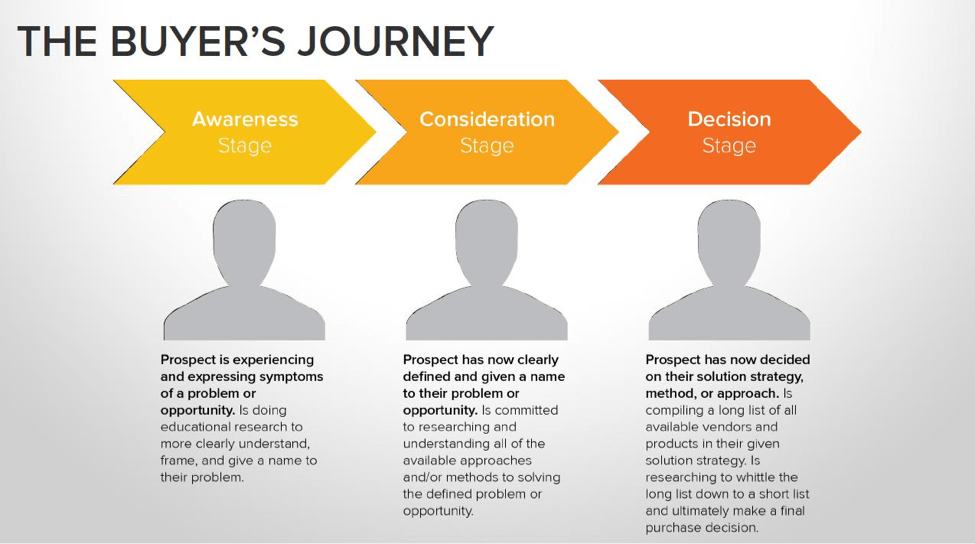
Sounds kinda like… the buyer’s journey. Or McClure’s (startup) Pirate Metrics.

A classic AIDA example comes from John Caples, who famously penned:

they laughed piano vintage ad

(image source)

It’s catchy as hell. Intriguing. That’s how it sucks you in.

This ad is actually for a free book. Seriously. A 19th century lead magnet. What’s old is new again.

Step #3. Get the Reader to Take Action

I’ll let you in on a secret.

It’s not quite ready yet. Still needs a few finishing touches.

But I’m developing a twelve-step program. (*Not really.)

The bedrock of this inappropriate metaphor yet-to-be-developed, Tony Robbins-esque infotainment empire is the same first step as those other successful programs that come before it:

Admitting you have a problem.

Most website visitors may not have a need for your product or service just yet.

As we discovered a minute ago, they don’t always recognize that problem in their life. That’s why average conversion rates depressingly hover around single digits.

conversion rate distribution graph

BUT.

There is one obvious exception: AdWords.

Nowhere else do people look, find, and buy. Just like that. In the blink of an eye. There’s a reason almost ALL of Google’s revenue stems from its ad business.

In this small yet profitable scenario, someone knows what their problem is. They’re Googling it. They kinda understand the lay-of-the-land. And they’re looking for a solution.

The PAS Formula

If you take nothing else from this post, PAS is it.

Seriously. It’s almost all you need. From ads to blog posts to email newsletters to your homepage copy.

The Problem Agitate Solution formula works so well because it stokes fear. And fear is the “primal” human motivator according to Aaron Orendorff.

PAS starts with naming the problem. Before talking about the symptoms and pain points of said problem. This agitation is literal; like pushing on a bruise to create inertia-busting urgency. Before finally providing the solution, like Neosporin on a burn.

Here’s an example from the 80’s:

vintage financial ad

(image source)

Here, the image says it all. It perfectly highlights the opportunity missed. Which the headline points out.

Kinda reminds me of a contemporary, corollary example from an article I wrote a couple weeks ago:

sumome ad

Same idea – this ad shows you what you stand to gain, tacitly comparing you to 100,000+ other websites already getting those gains that you’re missing.

Here’s another, wordier example:

problem agitate solution formula for ad writing

(image source)

Gee. I feel like I’ve seen this technique before. Somewhere. Recently.

But where was it…?

pas formula for ads

Wait. Stop. Go back.

That wasn’t a clever in-line CTA to trick you into clicking. That WAS the example.

  • Problem: Mistakes are killing your ad spend.
  • Agitate: Here’s exactly how much you have in wasted spend and where you’re wasting it.
  • Solution: Duh! Sign up for WordStream!

Hook, Line, and Sinker.

BUT. What about complex, expensive, hard-to-sell stuff?

How do you get people to take action from a simple online ad?

The short answer is a tripwire: an introductory offer that’s low-friction and simple and attainable, but helps you filter the buyers from the tryers.

Below is an excellent example, followed by a longer discussion of how to put it into practice:

vintage ad tripwires

(image source)

However…

Tripwires ain’t some new-aged thing, either.

Look! A tripwire! From the 60s!!!

vintage magazine ad

(image source)

Take a Page from Vintage Ads

There’s no shortage of “new” tips and hacks online today.

In fact, there’s too many. It’s overwhelming.

But if you pause for a second, take a deep breath, and look around at what’s driving results, you start to pick up on some clues.

The same underlying advertising principles that have worked over the last 100+ years can work for you now!

01 Mar 22:34

Sales Leaders: Avoid These 7 Marketing Collaboration Mistakes

by Alex Hisaka
  • fist-bump

The modern sales leader’s success hinges on marketing more than ever, as a majority of self-empowered B2B buyers conduct a significant portion of their research online. Prospects hold sales at bay until they are quite far along in their process, instead relying on content to guide them. Simply put, these buyers are often more influenced by marketing than sales for as much as 2/3rds of the purchase journey.

It’s no wonder we continue to see studies and statistics underscoring the importance of sales and marketing alignment. It’s in the best interests of sales leaders like you to ensure a solid relationship with your marketing counterpart. With so much at stake, it’s wise to do all you can to make sure your efforts will pay off. Before you extend the olive branch to your marketing colleagues, familiarize yourself these seven common sales and marketing alignment mistakes to avoid:

1. Treating Alignment as a One-time Event

If you treat collaboration like a campaign, it’s destined to fail. Sales strategies and goals continually change. Marketing strategies, messaging, and tactics need to change with them, and vice versa. Even the buyers you are targeting can change. That’s why it’s essential to hold regular meetings and check-ins to make sure sales and marketing are on the same page.

2. Not Agreeing on Terminology

When sales and marketing don’t speak the same language, important details get lost in translation and minor misunderstandings become major issues. From the get-go, these two departments need to agree upon and define the critical terms that will guide their interactions. This covers everything from a lead at various stages to what a handoff entails and the metrics used to measure progress and success.

3. Focusing on Different Goals

In many organizations, marketing tracks how many leads and opportunities they produce, while sales tracks closed deals. But at the end of the day, both marketing and sales are trying to drive new business, and the metrics they use to measure their effectiveness should reflect this singular objective. Otherwise, the two departments will struggle to engage in meaningful discussions about how well they are working together to achieve that common goal.

4. Working from Different Data

This mistake is closely tied to the previous one. If marketing and sales are tracking different sets of data and working with different views of that data, they aren’t in alignment. Sales and marketing should sit side-by-side to review data in a common dashboard. This not only ensures everyone is considering the same information, it also helps guide conversations about how the two departments are – or are not – working together.

5. Failing to Equip Sales to Engage

Just because buyers are conducting their own research online doesn’t mean sales needs to sit back and wait. In fact, that’s why social selling has seen so much uptake – organizations see it as an effective way for their sales professionals to get engaged earlier in the purchase process. Marketing and sales should work together to make sure each sales rep is trained and equipped to succeed with social selling. This covers everything from training and creating and optimizing an online profile to best practices for engaging via social media.

6. Keeping Sales Out of the Content Loop

Marketing and sales should be telling the same story when interacting with prospective buyers. Too often, marketing doesn’t involve sales in the content creation process, leaving them in the dark about the storyline that is leading prospects down the purchase path. Marketing should ideally share summaries of all content assets and the overall storyline with sales so reps can seamlessly pick up the conversation.

7. Having Unrealistic Expectations

It takes time for a major strategic initiative to become the status quo so be patient. While you are positioning yourself for success by taking steps to avoid these common blunders, you will still encounter challenges and setbacks. Keep the end goal in mind – a frictionless buying process that drives better results for the company – and stay the course. The results will come!

Want more ideas to get sales and marketing working as one? Download How Sales and Marketing Partner for Effective Social Selling for additional ways to achieve success through collaboration. 

      
01 Mar 22:34

How to Use Marketing Surveys to Improve the Customer Experience

by Fatih Mehtap

Using Marketing Surveys to Improve Customer Experience

Companies operating in every customer-facing industry should be using marketing surveys to better understand target audience needs, improve service levels, measure product-market fit and gain real insight into how to refine the customer experience. The value of the data collected is usually dependent on two factors: how seriously customer feedback is taken within the organization, and secondly, how committed the company is to addressing points of failure uncovered by these surveys.

While there are countless tools to administer and analyze marketing survey feedback, broadly speaking most surveys tend to fall into one of three categories; those that measure Customer Loyalty, evaluate Customer Satisfaction or those used to create Customer Engagement throughout the different stages of the sales cycle.

Customer Loyalty
Billed as ‘a system that increases loyalty and expands revenue’ by its founder Fred Reichheld of the Bain & Co management consultancy, the Net Promoter Score (NPS) aims to measure the likelihood of customers to recommend a company, product or service to a friend or colleague. It achieves this by asking survey respondents a simple question: ‘How likely are you to recommend us to your friends, family or business associates?’ Using a scale of 0 to 10, scores are evaluated by taking the percentage of Promoters (those scoring 9 or 10) and comparing those to the percentage of Detractors (those scoring between 0-6) to determine an overall NPS.

Why is NPS deemed important? Because logic dictates the more passionate and loyal a company’s customer base, the more inclined they’ll be to stay longer and spend more in repeat purchases. I’ll probably get chastised for saying this, but I do tend to class NPS as more of a vanity metric championed by Marketing departments and executive management teams. While I do think there’s a place for it when gauging consumer sentiment towards a brand, I think there are much more useful customer feedback tools, which do a better job at inspecting organizational performance at a deeper level.

Customer Satisfaction
One of these surveys is the Customer Satisfaction Index (CSI). When taken seriously, CSI can provide real intelligence and advisory customer feedback as to how well a company or business unit is performing against operational targets.

There are no hard or fast rules to determine the type or length of CSI surveys, while the average ‘corridor of satisfaction’ on the CSI spectrum tends to score between 7-8 on a 10-point measurement scale. However unlike NPS, a CSI survey does offer a more qualitative perspective on customer satisfaction, as it often delves deeper into specifics of the client-vendor relationship.

For example, lets say you were looking to uncover customer sentiment towards your current pricing policy ahead of a price increase. Including survey questions relating to perceived value for money is one way a CSI survey would help achieve this. Another example involving low scores given to a perceived absence of expertise or efficiency in an account management function could be an indication there are training gaps needing to be addressed. And poor feedback on the ease of doing business could be flagging operational shortcomings relating to service delivery or how the account is being handled.

Customer Engagement
Increasingly, smart brands are getting savvier about dividing the customer journey to target more efficiently. The aim is to use these distinctive stages to keep customers engaged and collect real-time feedback to help shape promotions, product features or purchase incentives. Examples of these include targeting:

The Information Gathering stage: profiling target audiences with product surveys, or running online spot polls to understand what customers covet, can not only help build the right product promotions, but can also be a useful way to direct buyers down a specific purchase path.

The Freemium to Premium stage: for subscription-based products that have some sort of free trial period prior to purchase, surveys offer up a multitude of engagement points. You may find prospects aren’t converting post trial, or paying customers are cancelling their subscriptions unexpectedly. Timely surveys designed to gather feedback as to why, can potentially uncover quick fixes aimed to curtail unwanted behaviors.

The Post Purchase stage: these are fairly straightforward and are probably the most widely encountered surveys today. Doing meaningful follow-up to ask how the purchasing interaction was for the customer provides an opportunity to acknowledge their custom. It can also serve you well to collect additional data on their preferences and add this information to a CRM profile, as these insights may indicate a potential future purchase pattern.

Which approach is right for me?
What becomes important is how to organize the feedback into actionable insights so they’re meaningful once distributed between departments. Customer surveys should be built into the overall fabric of your marketing communication strategies, rather than being just a one-off when you’re keen to gather specific information. Deciding which approach to take comes down to the commitment from within the organization, and whether you have access to the right kind of internal resources to act on the data.

The rewards however can be significant. Those brands equipped to ingest, collate, analyze and interpret the data collected, will be best positioned to enhance the customer experience, understand how operational deficiencies can be overcome, increase satisfaction and ultimately, build loyalty.

01 Mar 22:34

Introducing 3 New Social Selling Courses on LinkedIn Learning

by Derek Pando
  • woman-learning-on-linkedin-learning-lynda-course

Today we are pleased to announce three new social selling courses on the LinkedIn Learning platform. These courses create a robust social selling curriculum that will guide viewers through their social selling journey, starting at understanding the basic principles to putting them into action. Learning social selling has never been easier or more accessible.

Social Selling Foundations - Authored by one of LinkedIn’s most tenured Sales leaders, Hannah Goldberg. In this course, she explains the basic principles of social selling and shares how leveraging your social network can help you more effectively target, understand, and engage with prospects. If you're brand new to social selling, start here. This course is available free of charge.

To get a preview of the Social Selling Foundations course, check out this 5 minute video about making a customer-centric profile:

Social Selling with LinkedIn & Social Selling with Twitter - Both courses were authored by Gabe Villamizar, Head of B2B Marketing at Lucidchart and social selling expert. Gabe will teach you the “how to’s” of social selling - from optimizing your profiles to starting conversations, click by click. If you're ready to get tactical, these are the courses for you. These courses are available to LinkedIn Learning and Lynda subscribers. 

To get a preview of the Social Selling on LinkedIn course, check out this short video where Gabe will walk you through how to best engage buyers and decision makers on social networks:

01 Mar 22:34

Don’t let process distract you from finding the strategy

by steveblank

When you’re up to your neck in alligators, don’t forget the goal was to drain the swamp.

I love teaching because I learn something new every class.

This time it was, “Don’t let process distract you from finding the strategy.”


The latest “aha” moment for me when I was at Columbia University teaching an intensive 5-day version of the Lean LaunchPad/I-Corps class.  The goal of the class is to expose students to the basics of the Lean MethodologyBusiness Model Design, Customer Development and Agile Engineering.

In this short version of the class, students (in teams of four) spend half their day out of the classroom testing their hypotheses by talking to customers and building minimum viable products.  The teams come back into the class and present what they found, and then they get out and talk to more customers.  Repeat for 5 days.  All teams talk to at least 50 customers/ partners/ stakeholders, and some manage to reach more than 100.

One of the teams wanted to create a new woman’s clothing brand. The good news is that they were passionate, smart and committed.  The not so good news is that other than having been customers, none of them had ever been in the fashion business. But hey, no problem.  They had the Lean Startup model to follow. They could figure it out by simply talking to customers and stores that carry unique fashion brands.  How hard can this be?!

2_8_maraBy the second day the team appeared to be making lots of progress –  they had talked to many women about their clothing line, and had marched up and down NY stores talking to buyers in clothing boutiques.  They built detailed value proposition canvases for each customer segment (young urban professional woman, students, etc.) –  trying to match customer pains, gains and jobs to be done with their value proposition (their new clothing line.) They were busily testing their hypotheses about customer segments and value proposition, seeing if they could find product/market fit.
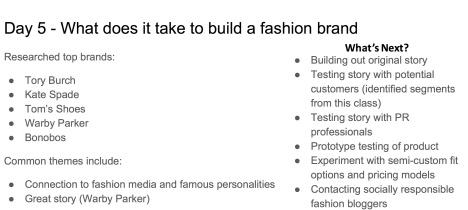
In listening to them it dawned on me that I had fallen victim to teaching process rather than helping the teams gain insight. I asked them to remind the class what business they were in.  “We’re creating a clothing fashion brand,” was the reply.  I asked, “And how much fashion brand expertise do you have as a team?” “None, we’re using customer discovery to quickly acquire it.”  On the surface, it sounded like a good answer.

But then I asked, “Has anyone on your team asked if any of your 120 classmates are in the apparel/fashion business?”  After a moment of reflection they did just that, and eight of their classmates raised their hands. I asked, “Do you think you might want to do customer discovery first on the domain experts in your own class?”  A small lightbulb appeared over their heads.

A day later, after interviewing their classmates, the team discovered that when creating a woman’s clothing brand, the clothing itself has less to do with success than the brand does. And the one critical element in creating a brand is getting written about by a small group (less than 10) of “brand influencers” (reviewers, editors, etc.) in fashion magazines and blogs.

fashion-brandWhoah… the big insight was that how you initially “get” these key influencers – not customers or stores – is the critical part of creating a clothing fashion brand. This meant understanding these influencers was more important than anything else on the business model canvas. The team immediately added brand influencers to their business model canvas, created a separate value proposition canvas for them and started setting up customer discovery interviews.
The lessons?

  • This team was entering an existing market. (The team had already drawn the Petal Diagram mapping the competitive landscape.)petal-and-canvas
  • In an existing market there is a track record for how new entrants create a brand, get traction and scale. Many of the key insights about the business model and value proposition canvases are already known.
  • In an existing market, going through customer discovery (talking to customers, buyers, distribution channel, etc.) without first asking, “Are there any insights that can be gained by understanding the incumbent strategies, can be a trap for the unwary.”

Ironically, when I was entrepreneur I knew and practiced this. When I started a new venture in existing markets I would spend part of my initial customer discovery attending conferences, reading analysts’ reports and talking to domain experts to understand current market entry strategies. (None of this obligated me to follow the path of other companies. At times I took this information and created a different strategy to disrupt the incumbents.) But as an educator I was getting trapped in teaching the process not the strategy.

The fashion brand team’s experience was a great wake-up call.

From now on my first question to startups in an existing market is: “Tell me the critical success factors of the existing incumbents.”

Lessons Learned

  • In an existing market, draw a Petal Diagram with adjacent companies
  • Focus part of your initial customer discovery on learning competitive insights.
  • Describe how those companies entered the market. What was critical?


Filed under: Customer Development, Lean LaunchPad, Teaching
01 Mar 22:34

6 Under-The-Radar Trends Shaping B2B Marketing & Sales Strategy in 2017

by William Wickey

What are the big-picture trends shaping the market? How are those trends affecting my team’s strategy?

Every marketing and sales leader should regularly ask themselves these two questions.

Over the past year, predictive analytics and account based marketing – for example – have dominated the focus, imagination, and budgets of B2B marketing and sales teams. These trends stick out like a sore thumb.

While Predictive and ABM are certainly major trends in the market, there also other forces at work – all instrumental in shaping business needs; some more subtle than others.

Below is an overview of the 6 B2B trends that are quietly shaping the sales and marketing landscape for 2017 and beyond.

The New CMO

As marketing budgets continue to rise – up to 12% of revenue, according to Gartner – the scope of the CMO and marketing organization’s role continues to expand. The CMO, more than ever before, is expected to move beyond traditional responsibilities and optimize marketing’s contribution to overall business revenue and goals.

With these new demands comes the need for an updated skill set from marketing leadership, as well as increased scrutiny from CEOs. Among their varied responsibilities, CMOs are being asked to optimize sales and marketing alignment, quantify the impact of high-level messaging and branding, report on pipeline performance, supply sales with educational content, and manage full-funnel marketing teams, which extend beyond acquisition to include product marketing – retention, upselling, customer happiness, even user experience.

To accomplish these goals, CMOs will need to spend time and money in 2017 to educate themselves and their teams. Those CMOs who are able to make the shift will see success, while those that aren’t will fall by the wayside: according to Forrester, CEOs will fire at least 30% of CMOs in 2017 for not mustering the blended skill set they need personally to pull off digital business transformation, design exceptional personalized experiences, and propel growth.

Customer Experience Becomes a Unifying Force Across Departments

2016 was no stranger to a focus on customer experience, but in 2017, customer experience will be the defining element in marketing and sales strategy. And to design a successful customer experience, B2B companies will need to accomplish three things:

  • Guide prospects through a coherent and deliberate buying process
  • Create feedback loops for communicating with customers and implementing insights
  • Turn one-time buyers into repeat buyers and advocates

This increased importance in creating seamless CX, driven by the underlying need to more effectively link customer data with business data, will push companies to align not just marketing and sales, but all revenue-generating and customer-facing departments – including customer success and product. According to Forrester, 72% of businesses say that improving the customer experience is their top priority in the next year.

Vendors Begin to Consolidate

Anyone who has taken a look at Scott Brinker’s State of Marketing Technology Landscape Supergraphic knows that B2B marketing technology stacks have been getting progressively heavier. In 2017, B2B marketing and sales teams have finally reached critical mass when it comes to new technology adoption (siloed new technology adoption, that is).

With this state of affairs, the integrations, mergers, and partnerships made by vendors this year will have a particular impact, with consequences that will shape the landscape for the next decade or more.

Ultimately, B2B marketing and sales organizations need platforms that can communicate with one another and boast cross-departmental functionality – in this scenario, the combination of different technologies can be a force multiplier. Marketing and sales leaders will be on the lookout for new technology additions that strengthen and streamline the stack, instead of bogging it down.

Account-Based Marketing Grows Up

It’s common knowledge that account-based marketing is an old concept that has experienced a recent resurgence – thanks in large part to the proliferation of new B2B technology and the rising need for more targeted paths to outbound customer engagement.

And if 2016 was the year that ABM was on the tip of every marketer’s tongue, then 2017 is the year it will truly be put into more widespread practice by B2B organizations – and there is plenty of room for growth:

“From a percentages point of view, despite massive buzz in the B2B space, multiple surveys indicated that adoption for ABM hasn’t reached its tipping point yet. Some 47% of US B2B marketers currently have an ABM strategy in place, according to August 2016 Demand Gen Report research.” [eMarketer]

The same survey found that 32% of B2B marketers were planning to put ABM programs in place within the next 18 months (as of August 2016), while a 2016 SiriusDecisions survey reported that more than 60% of B2B and B2C companies plan to invest in ABM technology.

The reasoning is sound: when implemented correctly, ABM promises major benefits – among them personalized messaging to multiple decision-makers in a scalable way, a shorter sales cycle, and the ability to maximize sales efforts across revenue-generating departments.

The Currency of Trust

Consumer trust in digital marketing methods and vendors has been dropping in recent years – as an example, a December 2016 survey conducted by MarketingSherpa found that 80% or more of respondents trusted print ads or TV ads, but only 39% trusted online banner ads or mobile ads [eMarketer].

In this landscape, consumer trust has become a currency – and a key differentiator for marketing technology vendors looking to rise above the noise and emerge as leaders amongst the competition.

For martech vendors in particular, there are three key areas to focus on: the first of these is customer service. In a study conducted by Zendesk, customer service was found to be the most important factor affecting consumers’ trust in a company. Those vendors that can improve their customer service processes to be timely, personable, and relevant will separate themselves from the pack.

Beyond that, building consumer trust is key because marketing and sales leaders rely heavily on peer recommendations when it comes to selling, particularly in the B2B arena – a recent G2 Crowd study sponsored by Blanc & Otus found that 86% of respondents stated word of mouth from peers was the most influential factor in their decision to speak to a particular B2B technology vendor, and another 83% stated that word of mouth was one of the top drivers of final selection of a vendor [AgilityPR].

And of course, technical products require reliable support and education in order for consumers to feel comfortable using them and bought into the benefits of that technology. Supplying customers with the touch points and support they need to build trust across security, data quality, usability and beyond ensures high customer retention rates, which is a huge win for businesses:

“…in industry after industry, the high cost of acquiring customers renders many customer relationships unprofitable during their early years. Only in later years, when the cost of serving loyal customers falls and the volume of their purchases rises, do relationships generate big returns. The bottom line: increasing customer retention rates by 5% increases profits by 25% to 95%.” [Harvard Business Review]

Machine Learning Software Starts to Learn

Over the past few years, many companies have been incorporating machine learning technology into their platforms, with marketing leaders hailing it as the next big thing. Take this quote from Bob Stutz, CEO of Salesforce Marketing Cloud:

“Relevance is the currency of the digital economy, so it’s no longer just enough to deliver personalized customer experiences — those experiences need to be smarter, faster and in the right context. Artificial intelligence (AI) powered by machine learning will be crucial in delivering these next-gen personalized experiences for customers, and as the conductor of the customer experience, marketers need to embrace this in order to succeed.” [Forbes]

Plenty of platforms currently in use by marketing and sales teams have or are developing predictive capabilities. The issue, however, is that many of these companies currently lack the data volume and/or quality needed to truly use those predictive capabilities to their maximum potential – in other words, opportunities are hiding in messy or incomplete data.

In 2017, we will turn the corner and companies will have gathered enough data to finally make machine learning a true value add. With machine learning, marketing can fulfill its promise of delivering dynamic, personalized customer experiences at scale. Plus, it allows marketers to prioritize properly and focus on high value tasks first and foremost (for example, with the help of predictive lead scoring to identify higher value prospects in the pipeline).

Taken together, these six trends paint a picture of a B2B marketing landscape that is evolving past traditional modes of operation and learning how to sell more effectively in a world filled with rapidly changing customer needs.

For more on this topic, check out the 2017 Trends & Tech Guide for B2B Sales & Marketing, a free guide by Prezi, Ambition, and LeadGenius.

The post 6 Under-The-Radar Trends Shaping B2B Marketing & Sales Strategy in 2017 appeared first on OpenView Labs.

01 Mar 22:31

How to Use Artificial Intelligence to Produce Content that Gets Results

by Bernie Borges

Harness AI in your Content Marketing Strategy

Have you noticed the accelerated pace of artificial intelligence in the world? AI is everywhere. It powers your Facebook feed. Seventy-five percent of the movies watched on Netflix and one-third of product sales on Amazon are powered by AI. Voice activated devices such as iPhone Siri, Amazon Echo and Google Home are powered by AI. The medical industry is using AI to make better diagnoses.

Recently, I co-presented a webcast with online community expert Joe Cothrel of Lithium Technologies. We revealed how companies can deliver a more personalized online experience using AI powered personalization, predictive analytics and autonomous delivery of content recommendations resulting in a better customer experience.

90% of Content Doesn’t Work

In 2014, author, speaker, consultant and educator Mark Schaefer suggested that content marketing was not a sustainable strategy. He estimated that the supply of content available online would increase 500% in the next five years, far outweighing the demand users have for it. The result is what Schaefer coined as Content Shock.

The end result is that as much as 90% of the content produced by marketers doesn’t produce results. This is a painful reality for content marketers.

The answer to this conundrum isn’t to produce more content. And, it isn’t necessarily to produce less content either. The answer is to produce the right content that will get results. But, how?

Enter AI Powered Content Marketing

In our first Up Close podcast series, I teamed up with Brandon Andersen, Co-founder and Chief Strategy Officer at Ceralytics, to deliver an educational audio series outlining a practical approach to producing content that gets results using AI.

This Up Close series is similar to a webcast. The difference is that we split it into 5 episodes (similar to chapters), each one under 15 minutes. Subscribers to our Social Business Engine podcast will get it delivered to their podcast player. We’re also making it available to everyone in one recording here. Here’s the breakdown of Series 1: How to Harness AI in Your Content Marketing Strategy.

Episode 1: The Role of AI in Content Marketing

We begin with a discussion of AI in content marketing. We define the purpose of AI in content marketing and describe the vision for the marketer to leverage AI to create content that delivers results by letting AI more effectively do the work that people have been doing manually.

Episode 2: Quality over Quantity Content

In episode two we dispel the myth that content marketers must produce content in quantity. The goal of marketers is to produce results. We reveal the importance of understanding what works (quality) over misguided goals of quantity.

Episode 3: The Content Audit

In episode three we review the role of the content audit and why it’s so important in a successful content marketing strategy. We discuss the desired outcome of the content audit and how AI can empower marketers to perform a content audit with great efficiency, even for brands with a high volume of content assets.

Episode 4: The Competitive Audit

In episode four we discuss the role of the competitive audit. This step is often overlooked in content marketing. We review the steps and the desired outcome of the competitive audit.

Episode 5: Harnessing AI to Create Content that Produces

In episode five we tie it altogether for the marketer with an action plan. To begin harnessing AI in your content strategy we provide four actionable steps using AI to create a content marketing strategy that will yield the results all marketers seek – more traffic and more leads. And, we explain how Ceralytics provides marketers AI powered content marketing technology to create intelligent content that yields results.

AI in Content Marketing is not Not Sci-Fi

As mentioned in the opening, AI is all around us including in marketing technology. U.S. retailer Target, famously predicted a teenage girl’s pregnancy in 2012, to the dismay of her father who didn’t know about her pregnancy.

I invite you to learn more about how you can use AI to produce content that creates more traffic and leads. When you access our 5 episode Up Close on demand podcast series, you’ll also receive the white paper What is Content Intelligence? from Ceralytics.

AI in content marketing is available today. Click here to access the audio and the white paper. You’ll be one step closer to understanding the reality of improving the results from your AI powered content marketing strategy.

01 Mar 22:30

5 Ways to Maximize ROI on LinkedIn Ads

by Anthony Bergs

LinkedIn marketing has emerged as the most viable marketing avenue for B2B marketing campaigns. It produces results that are significantly better than the other types of digital marketing methods. According to research conducted by NewsCred, the ROI of LinkedIn marketing is 17.6, whereas that of native ads is 14.9 and Google Adwords is 3.1. It gives a glimpse of what LinkedIn ads can achieve for businesses that run their marketing campaigns on a shoestring budget. LinkedIn is also the most favourite marketing channel of digital marketers among all the social media networks. An eMarketer survey has yielded the results that 64% marketers use LinkedIn for presale process and 51% use it post-sale. The second best is Twitter with 47% and 42% for pre-sale and post-sale engagement respectively. Your business can benefit immensely with LinkedIn Ads and by deploying the below five key methods, you can maximise their ROI.

linkedin-roi

#1. Create an Efficient Company Page

Consumers prefer buying products or services from businesses they deem authentic and credible. Since you’d be advertising on LinkedIn, having a company page on it is a rational choice since your potential clients are likely to visit it. It is, therefore, critical to make an efficient and insightful company page that offers useful information to your potential clients and help them choose the right product or service. An advertisement can help create a powerful first impression, and the business page will add credibility to your business. It will create a positive perception of your business among your target customers and increase the effectiveness of your LinkedIn ads thereby improving their ROI.

#2. Right Targeting

One of the main reasons for the success or failures of digital ad campaigns is the failure to target the right segments or number of segments. Focusing on too many segments can render the campaign ineffective as it would then look like a very generic ad campaign. Contrarily, companies often make mistakes of targeting a very narrow customer segments. It reduces their reachability. Targeting a low number of segments also means that the ads soon lose their attraction as the same customers will repeatedly view them. By expanding the targeted segments, your click through rate will increase. Hence, it is critical that the targeting process should encompass focusing on the right number of segments that are relevant to your business. Find a right balance to increase your LinkedIn ads’ ROI.

#3. Content Quality

Along with the right targeting, the content quality is equally critical. LinkedIn users browse for information that is important to them or helps them increase their knowledge. It is, therefore, crucial that the content served to them even through the ads must add value and help them find a solution for the challenges they are facing. Your LinkedIn ad is the first step in the process of engaging with the clients. So, focus on developing quality content so that your ads would arouse curiosity among the target audience. Use your creativity to make the ad content attractive as well as a succinct piece of information that clearly communicates what your business offers. Consequently, it will increase the click-through rate of your ads.

#4. Use LinkedIn ADs for Sale Conversion and Not Just Awareness

The ROI of ads can be maximised if you use the ad campaign as the tool for increasing sale conversion and not merely as an awareness campaign. The first point of engagement with the customers is to increase their awareness. However, it is necessary to further engage with the clients by identifying the warm and hot leads from the awareness part of the campaign and offering them more useful and relevant content that will drive these leads further towards the bottom of you sales funnel.

#5. Make Use of Multiple Combinations

Experiment with various combinations of your ad content and use multiple ads in a single campaign. Developing multiple ads also gives you the ability to target more customer segments as certain ads can be used to target specific sets of customers while the others can be used for the other sets. It will make your LinkedIn ads more relevant to them, which will lead to an increased click through rate and subsequently higher ROI.

Conclusion

Implementing these five methods will let you derive a superior ROI from your LinkedIn ad campaigns. These methods enable you to concentrate your efforts in the right direction which is necessary to succeed in a highly competitive business environment.

01 Mar 22:30

Facebook Giveaways: 50 Ideas, Tips and Examples

by Jordan Lore

Facebook Giveaways: 50 Ideas, Tips and Examples

Looking to gain traction on Facebook?

Want to grow your audience and generate leads?

A Facebook giveaway is the social media marketing strategy for you. All at once, a Facebook giveaway will generate immediate traffic, grow your following, and generate hundreds of leads. The right prize, fun entry rules, and the excitement of winning has the potential to give your business unparalleled growth.

In this article you’ll find 50 Facebook giveaway ideas, tips, and examples to help you run the Facebook giveaway you’ve been dying to promote.

10 of our favourite Facebook giveaways


1. Blizzard


To celebrate the new year Blizzard launched an Overwatch giveaway for their fans.

What we like about this giveaway:

  • All the copy on the page involves the Overwatch theme.
  • The prizes and the rules are clearly outlined on the landing page.
  • Everyone wins.

    Facebook Giveaways: 50 Ideas, Tips and Examples

2. M&M’s


M&M’s ran a vote giveaway for their fans to select their new M&M flavour.

What we like about this giveaway:

  • Voting allows everyone to participate and contribute with their opinion.
  • The fun and colourful graphics adds excitement to the mix. The familiar peanut M&M mascot is much more engaging for visitors.
  • The lack of text and ample white space focuses a reader’s attention on the giveaway.

    Facebook Giveaways: 50 Ideas, Tips and Examples

3. Massage Addict


To celebrate Mother’s Day Massage Addict ran a giveaway for a free massage package.

What we like about this giveaway:

  • The headline image humanizes the giveaway. Images with people in them tend to create more emotion in the viewer.
  • The headline is clear and benefit oriented to entice the reader.
  • A countdown timer create urgency to claim the giveaway.

    Facebook Giveaways: 50 Ideas, Tips and Examples

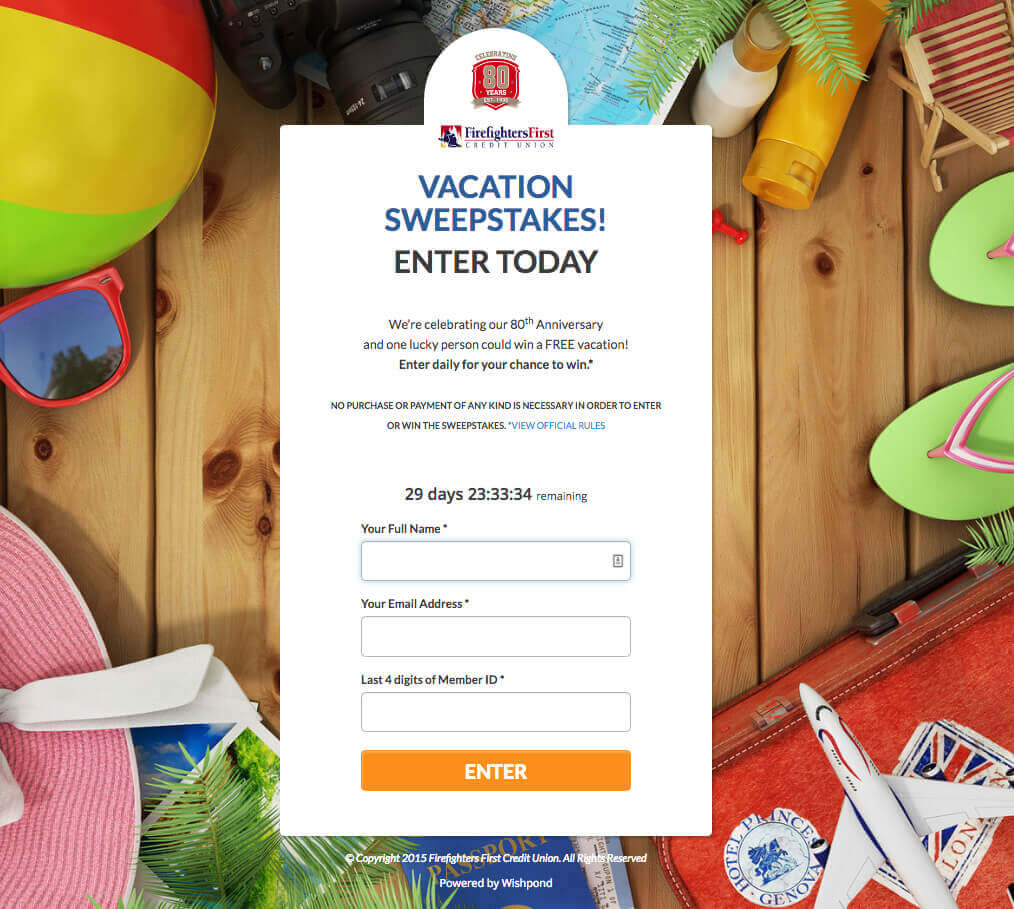
4. Firefighters First Credit Union


Firefighters First Credit Union ran this giveaway for a free vacation to celebrate their 80th anniversary.

What we like about this giveaway:

  • The form and all of the copy are framed by a bright and colourful background image.
  • The countdown clock is large and hard to miss — creating urgency.
  • Well implemented contrast makes the copy, CTA, and rules hard to ignore.

    Facebook Giveaways: 50 Ideas, Tips and Examples

5. SunScape


SunScape runs a giveaway each month to increase their lead count.

What we like about this giveaway:

  • The prize (a gift card) connects is highly relevant to the business and cyclically brings more business back to SunScape.
  • Contrasting sizes of the text makes the prize and headline stand out amongst the page elements.
  • The bright green CTA draws the attention immediately.

    Facebook Giveaways: 50 Ideas, Tips and Examples

6. London Drugs


London Drugs ran a Fall themed giveaway to engage their followers and collect email leads.

What we like about this giveaway:

  • The colours, textures, and graphics all lend itself well to the Fall theme.
  • The benefit of winning a gift card is clear.
  • Big bold imagery catches the viewer’s eyes and holds attention.

    Facebook Giveaways: 50 Ideas, Tips and Examples

7. Maine Cottage


Maine Cottage gave away a $1,000 gift card to their followers to boost engagement and generate leads.

What we like about this giveaway:

  • Beautiful imagery gives viewers an example of what they could buy with their winnings.
  • Very clear giveaway entry rules for visitors.
  • Big bold headline and benefit oriented text so that it’s clear what the giveaway is offering.

    Facebook Giveaways: 50 Ideas, Tips and Examples

8. Green Planet


Green Planet gave their audience a chance to win a $500 gardening package.

What we like about this giveaway:

  • The prize is a package of gifts to appeal to a wider audience.
  • The simple design doesn’t distract from the information and copy.
  • Bright CTA and encapsulated form attracts reader attention.

    Facebook Giveaways: 50 Ideas, Tips and Examples

9. Marks


To win a $400 Mark’s gift card, all visitors have to do is select the prize they’d like to have on their wishlist.

What we like about this giveaway:

  • Fantastic choice of imagery that adds to the whole holiday theme.
  • Easy and engaging entry method of choosing your favourite item.
  • Good use of contrast that incorporates the brand’s colours.

    Facebook Giveaways: 50 Ideas, Tips and Examples

10. SportChek


SportChek gave away a massive $10,000 winter themed grand prize and several other secondary prizes in their Facebook giveaway.

What we like about this giveaway:

  • Huge irresistible prize.
  • Engaging entry rules that requires a lot of user participation.
  • Simple design that incorporates the giveaway theme well.

    Facebook Giveaways: 50 Ideas, Tips and Examples

Why is a Facebook giveaway right for you?


11. Get more Facebook followers & fans


Grow your following with a fun and engaging Facebook giveaway. Incentivize your fans to share your giveaway with their network and reach new fans in the process.

12. Increase your brand awareness online


The combination of a giveaway and promotion will draw-in a number of people to your brand.

13. Collect emails and leads


Start collecting a long list of emails and leads with your giveaway. A strong and engaged list pays dividends down the road when you host another giveaway, run a promotion, or have a sale.

14. Collect UGC (User Generated Content)


Social media content creation can be time consuming and resource intensive. Employ the folks who love your brand the most: your fans. Collecting and using fan content like photos, reviews, or ideas is a great way to build a deeper connection with your fans.

15. Generate user feedback


A giveaway will put your product in the hands of people you’re trying to reach. Generating feedback from your target audience is the only way you can improve.

16. Engage your followers


Communication with your audience shouldn’t only be a one way street. Engage them to keep your brand alive in their lives.

17. Make sales


A business dies a slow death without sales (obviously). Put your business in the right position to make sales with a Facebook giveaway. Collect valuable leads and direct traffic to your website with a Facebook giveaway.

18. Promote a new product


Trying to build hype around your newest release? A Facebook giveaway can help. Choosing to give one away to one lucky winner will build demand.

19. Generate more traffic


A stellar prize and fun entry rules generate lots of excitement for a Facebook giveaway. Traffic and sales will ensue.

20. Learn more about your target market


If engagement with your brand was lacking a Facebook giveaway will add some life and energy. Take the opportunity to learn more about your target audience. Respond to comments, start a conversion, and send emails asking questions to learn more.

21. Use a giveaway building platform


The best way to run a Facebook giveaway is with a giveaway platform. Don’t complicate things by trying to build and code your own custom Facebook tab. A giveaway platform makes creating, designing, and publishing a Facebook giveaway a breeze.

22. Create a compelling headline


Like a beautiful storefront, your headline is what draws visitors in. A compelling headline should speak directly to the reader’s emotions. Explain the benefit to them so that it compels them to learn more about what you’re offering in your giveaway.

Facebook Giveaways: 50 Ideas, Tips and Examples

23. Create a unique giveaway hashtag


A unique hashtag for your contest makes searching up the entries on Facebook easy. A hashtag organized all entries under one tag. #FitChristmas2016 adds to the theme and gives everyone a chance to participate just by using it.

Facebook Giveaways: 50 Ideas, Tips and Examples

24. Benefit checklist


Visitors want to know what’s in it for them quickly. If nothing catches their interest they’re most likely going to split. Make the benefits easy to understand by using a checklist or bullet points. You want them to understand quickly that they’re going to get this, this, and this by entering your Facebook giveaway.

Facebook Giveaways: 50 Ideas, Tips and Examples

25. Employ compelling visuals


A picture says a thousands words as the old saying goes. Use visuals in place of large blocks of text to get your information understood quickly. A picture of your prize or giveaway makes the offer seem larger than life. Entry would be hard to resist.

Facebook Giveaways: 50 Ideas, Tips and Examples

26. Clear and concise giveaway rules


Don’t make entering your Facebook giveaway any harder than it should be. Make the rules easy to understand and see for all of your visitors. The less friction there is the more entries you’ll receive.

Facebook Giveaways: 50 Ideas, Tips and Examples

27. Detail how the winner will be chosen


The last thing you want is unsatisfied participants. Clearly state how the winner will be chosen and all the rules that go into the selection.

Make the choosing process simple. A social giveaway app will randomly choose and email the winner automatically to let them know.

Facebook Giveaways: 50 Ideas, Tips and Examples

28. Bonus entries


Experiment with bonus entries for everyone who enters. Sharing the giveaway with their network or entering once a day for example, are a couple of ways to give bonus entries for extra participation. People love bonuses that give them a leg up on the competition.

29. Create a custom cover image


Once your Facebook giveaway is up and running make sure to change your Facebook cover image so that all of your visitors know about it. Mention the prize and the rules so that people can head over to it and enter.

Facebook Giveaways: 50 Ideas, Tips and Examples

30. Customize your Facebook tab and landing page


To host your Facebook giveaway directly on your Facebook page you’ll need to create a customer tab and landing page. Customize the image in your brand’s look and feel.

31. Use checkboxes


Checkboxes instead of drop down menus are far more user friendly. Multiple choice tests in high school were far better than written. Why? Because they were less work. Make things easier for your visitors by using checkboxes where possible.

Facebook Giveaways: 50 Ideas, Tips and Examples

32. Use a countdown timer


Knowing that your Facebook giveaway has a confirmed end date creates urgency. Seeing a big red countdown clock count towards the end will urge visitors to enter now rather than later.

Facebook Giveaways: 50 Ideas, Tips and Examples

33. Make entry dates clear


The entry dates of the giveaway matter more than you would think. Pick the appropriate amount of time to maximize the amount of entries. Too long and the excitement can dim as time goes on. Too short and you might miss out on some entries.

Facebook Giveaways: 50 Ideas, Tips and Examples

34. Pre-giveaway email


Give all those who register a heads up a few days before the webinar date. Send one a week out, 3 days out, 1 day, and then the day of. An email that shows off the prize package will certainly put your Facebook giveaway on your audience’s radar.

35. Cross-promote on all channels


To maximize the exposure of your Facebook giveaway it’s important to cross-promote on your other web properties. This means posting on LinkedIn, tweeting, pinning on Pinterest etc.

36. Pin your post


Once your giveaway is published make sure to pin it to the top of your Facebook feed. A pinned post sticks to the top of the feed and accumulates more exposure from visitors. Anyone who looks down your feed will see your giveaway first.

Facebook Giveaways: 50 Ideas, Tips and Examples

37. Tie your prize back to your business


When choosing your prize package make sure it is tied back to your business. If your business sells appliances it’s not a good idea to give away an iPad. Tie the prize back to your business by including your product or a giftcard to spend at your store. It ensures that those who enter are at least mildly interested in what your business offers.

38. Regularly update fans on giveaway status


Don’t make your giveaway a one-and-done type operation. Keep your fans and participants updated on the status of your giveaway. This means making regular mentions of the number of entries or time left. It will encourage people to sign up or share the giveaway before it finishes.

Facebook Giveaways: 50 Ideas, Tips and Examples

39. Promote with Facebook ads


Facebook ads are by far one of the most effective avenues for capturing immediate traffic for your Facebook giveaway. Facebook ads target users based on interests so it’s critical to locate those who are interested in your specific niche. Those who are strapped for time or who don’t have much of a social media following can generate immediate traffic with Facebook ads.

40. Place banner on your website


Just because you giveaway is on Facebook there’s no reason to neglect your own website. A brightly coloured website banner sits right at the top of your homepage and alerts all of your visitors of your contest. Use it to direct visitors to your Facebook giveaway to enter.

41. Partner with other companies for prizes


When it comes to Facebook giveaways it can help to include additional prizes to appeal to more people. Partner with a company that is aligned with your business to offer an even larger prize. Both of your companies can promote the giveaway for twice the marketing power.

Facebook Giveaways: 50 Ideas, Tips and Examples

42. Choose a proper theme


A Facebook giveaway theme like a holiday or anniversary can help establish more of a purpose for your giveaway. Celebrating your business’ one year anniversary for example, acts as a more compelling reason for visitors to accept your offer. Not having an occasion or theme lowers the apparent value of the giveaway because it could be assumed that you run them all the time.

Facebook Giveaways: 50 Ideas, Tips and Examples

43. Have clear goals to measure success


Before building any part of your Facebook giveaway, establish the goal. Your goal will determine the measure of success for your giveaway. Leads, exposure, or follower growth are typical goals that can be measured against your cost per lead or cost per customer. Keep your goal in mind when deciding how much you’d like to spend on a prize and advertising.

44. Make your prize a package


Instead of a single massive grand prize, break it up into an entire prize package made of smaller prizes. This way your prize will have more variety and appeal to more people. A large number of items will also make your prize seem more valuable because of the variety.

45. Optimize for mobile


Half of all web traffic is now coming from mobile devices which means that your giveaways need to be mobile responsive. The best way to do this is to start with a Facebook giveaway building tool which comes with fully responsive templates. Although Facebook itself is always mobile responsive, your Facebook giveaway page may not be.

Facebook Giveaways: 50 Ideas, Tips and Examples

46. Optimize for speed


Aside from using a speedy Facebook giveaway building tool, there are a few ways you can optimize your giveaway page for speed.

  • Use a better giveaway building tool.
  • Reduce your image sizes.
  • Clean up unnecessary code.
  • Shorten the page.
  • Upgrade your hosting.

47. A/B test your call to action


For a giveaway that is running for a longer period of time it is a good idea to run A/B tests on your call to action. By split testing your CTA you can see what language compels your visitors to convert more. Facebook giveaway platforms are able to split the traffic and send them to two different giveaway pages and see what works best.

48. Include the giveaway in your regular newsletter


Don’t forget to mention your new Facebook giveaway in your weekly/monthly newsletter for the people who don’t follow one of your social channels. If recipients are already receiving your newsletter they’re in your system but they may be able to share it within their networks as well.

49. Pre-populated Tweets


For one of your bonus entries try using a pre-populated tweet for your visitors to share. Write up some exciting copy for your visitors to share with one click. You’ll receive more attention for your Facebook giveaway and they’ll receive a bonus entry.

50. Feature the winner


When it’s all said and done feature the winner of your Facebook giveaway. It’s important to highlight the honor of winning and be sure to make them feel as special as possible. The amount of praise you’re able to give will prep and excite people anticipating your next giveaway.

Facebook Giveaways: 50 Ideas, Tips and Examples

Final Thoughts


Hopefully this article has given you a better understanding of how to run a successful Facebook giveaway. IF you have any questions don’t hesitate to reach out in the comment section below.

01 Mar 22:30

Capture More Leads with a Virtual Receptionist

by Parker Davis

As a business owner, do you ever feel overwhelmed?

As the captain of the ship, you find yourself quite busy handling all the day-to-day operations, including setting up meetings, filling out paperwork, and doing the actual stuff that brings in the big bucks.

The struggle is often having to figure out how to do it all at once.

It’s often said that the first impression is the strongest, but if you’re away in a meeting, out to lunch, or working hard in the zone, you might not always get to the phone in time. Not only does it make you look bad and incompetent, but you’re also leaving more leads and sales on the table.

One way to counteract that and reach more people is to hire a virtual receptionist.

What is a Virtual Receptionist?

A lot of up-and-coming business owners do need help when it comes to taking care of all the tasks on their schedule, plus having to answer the phone. Most struggle to hire in-house receptionists, as their operations are still too small and having around-the-clock help can be too expensive.

A virtual receptionist does all the same jobs an in-house receptionist would, but they’re located remotely, ultimately saving you tons of money while providing immediate value.

Imagine being able to focus solely on your business while your virtual receptionist is fielding calls, scheduling appointments, dealing with customer service, and anything else that seems to keep you from getting actual work done.

Having someone there at all times provides your clients with a friendly voice and a positive first impression, which is essential in turning cold leads into steaming hot buys.

Virtual Receptionists Bring in the Leads

A virtual receptionist’s job will vary, depending on the nature of the work you want them to accomplish. It can be a simple service of answering phones and scheduling appointments, or more involved, like using a script to work potential clients through your sales funnel.

It’s all about having a system in place that takes care of your customers.

Let’s face it, having excellent customer service is the first step in converting a lead. $41 billion in potential sales is lost every year simply because there is no one around to answer the phone or a client is on hold for too long. If your original point of contact is sub par, it will impact you negatively, and you will lose business.

How Does It Work?

A virtual receptionist is essentially a premium answering service that will take all your calls, using the methods you prescribe. Do you have a personalized greeting? A script you want them to read?
Maybe you have a list of product descriptions you want to share over the phone. Whatever it is, a virtual receptionist will take care of all your customer service needs.
Virtual receptionists work for a lot of smaller companies, as they cost much less than hiring someone in-house. When you consider the average price of hiring a personal receptionist is around $30,000, and a virtual receptionist costs around $250 per month (depending on the service), it’s not too difficult to see why the demand for virtual assistants is rising dramatically.
Closed for the Day
One of the best ways a virtual receptionist can help your business capture more leads is by being around after you’ve already gone home. While you’ve shut down for the day, and you’re sitting in front of the TV, that one lead is going to call back and is ready to buy.
You can rest easy knowing it’s being taken care of. Your virtual receptionist was available and took care of the call, making you money while you’re relaxing. Just by having them around, you’ve cast your net into a much larger pond. No matter the time or the day, someone will be there to serve your customer’s needs.
The statistics show that over 75% of all phone calls made to a small business are left unanswered. That is because small business owners struggle to manage between making money and connecting with clients, both of which are essential to running a successful business.
If you lack in one area, it will come back to bite you, risking your reputation in the process.
By hiring a virtual receptionist, not only are you covering all your bases, but you’re ensuring that every lead is properly chased and no money is left on the table. Potential customers will appreciate you taking the time to address their concerns while you get to spend more time doing the actual work that caught their attention in the first place.
01 Mar 22:30

5 Mistaken Beliefs That Hinder Your Entrepreneurial Dreams

by Mike Thatcher

What’s your reason for wanting to become an entrepreneur? Have you even bothered to identify your key reasons for wanting to escape the J.O.B. grind?

Mine was to escape the laborious 9-5 I had been raised to strive for my entire life.

Or at least to enjoy the freedom of being in charge of my own destiny. Wouldn’t life be grand if such a dream were to come true?

However, like so many things in life, entrepreneurship has more to do with your mentality; the thoughts that run through your head most often, than any other factors.

To be a successful entrepreneur, you first need to get your head right and stop believing that the following 5 beliefs will always get you where you want to go:

1. Success is all about the hustle.

Hammering away 24/7 is the key to the American dream, according to Dwayne “The Rock” Johnson. He makes hustle-related posts about it on Instagram at least once a week.

So is hustling or “clanging and banging” as he puts it, all that’s needed to become your own version of a successful entrepreneur?

Nope!

You’ve got to maximize the time you’re using, so you can get important things done while your mind is fresh full of brilliant, actionable ideas.

Otherwise, everyone who hustles endlessly with no clear direction ends up burning out at some point.

2. Do what the greats have done and I’ll get there too.

How much money do you have?

President Donald Trump got immediate fame from doing mega real estate developments early in his career.

He also came from a rich family, who sent him to Wharton, and handed him their real estate and construction business, The Trump Organization (then “Elizabeth Trump & Son”).

It’s unlikely you can follow his exact path, though you can strive to emulate his traits to the best of your own abilities.

You have to ask yourself the hard questions when formulating your plan for taking the business world by storm.

There’s no question you can learn plenty of things along the journey. But what are you capable of now, or in the future?

You can’t follow the path of the greats, unless your personality and circumstances are exactly the same as theirs.

3. It’s all about who you know.

At this point, it probably seems like I’m bashing every entrepreneurial success mantra ever uttered. I’m really not, you have to hustle.

You need to try to emulate the greats in whatever ways you’re capable. And, who you know is very important in business and life in general.

It’s just not all about who you know like many people will tell you.

You have to produce something that people want, personalize the way you present it, and have a personality which influences other professionals to help you.

The “you” in “who you know” is just as important as the “who”!

4. If it doesn’t feel like a job, you’ll never work again a day in your life.

Oh sure. If you thoroughly love what you’re doing, you’ll never ever find yourself dying to jump in the car and go for a midday round of golf instead of scanning those endlessly boring sales reports!

The worse thing about believing that which truly satisfies will never feel like effort (ie., work) is that it leads us down the path to trying to create a business that runs effortlessly, without the need for our input or management.

Unless you’ve been in business, successfully, for 10 years or more, you’re not getting off that easily. Work is work. Whether you feel good or bad doing it is all up to you.

But don’t think you’re going to be pulling off a 4-Hour Workweek anytime soon.

5. Once I get some money, I can grow any business.

This mistaken belief is the bane of many entrepreneurs who’ve failed in what many of us have called the Golden Age of Entrepreneurship. The thinking here is that all your startup worries will be gone once you secure a low-interest loan from the bank, or find some wealthy angel to hand over their investor money.

The thinking here is that all your startup worries will be gone once you secure a low-interest loan from the bank, or find some wealthy angel to hand over their investor money.

The reality is that while money will always be one of your biggest business worries, no amount is going to save a poorly planned and executed business venture.

If you don’t understand your customers and if you don’t have great mentors to learn from, money (or lack thereof) is the least of your worries at this point.

If you don’t understand your customers and if you don’t have great mentors to learn from, money (or lack thereof) is the least of your worries at this point.

Takeaway

The thoughts that go through your head day in, day out, can either propel you to your version of entrepreneurial greatness, or sink you like an ocean liner lost in the middle of the iceberg-riddled Greenland Sea.

“Soon my ship of thought is sinking, slipping through the thinking knot.” Meat Puppets

01 Mar 22:29

Maple syrup water tapped from trees is the next coconut water

by Melia Robinson

san francisco fancy food show 2186

In 2016, coconut water generated $2.3 billion in sales worldwide.

The makers of a new designer brew — a subtly sweet water tapped from maple trees — want to ride the coattails of coconut water's success all the way to the bank.

Maple water has captured a modest following since it debuted in 2013. While coconut water still commands 98% of the global "alternative waters" market (which includes water harvested from bamboo, cactus, and artichokes), maple water has made gains. A recent report from food and drink market researcher Zenith predicts the maple water market will triple in size by 2020. It's unclear how much revenue the category currently drives.

"It's not coconut water, yet, from a category-size. We all like to hope that it gets to be that big at some point in time," Mike Roberts, vice president of sales at Sap on Tap, tells Business Insider. The company, founded in 2015, sources water tapped from maple trees on farms across the Northeast.

Arbeau, a luxury line of maple waters available in tap and sparkling, launched in 2016 in Canada. The brand's creator, Leanne Pawluk, likens the product to wine. Each batch will take on a slightly different flavor profile, just as wines change season to season.

san francisco fancy food show 2197

When I first tried maple water, I expected to taste a sugary syrup similar to what I pour over pancakes. Instead, sipping from a Dixie cup of Sap on Tap water was refreshing. The clear liquid tasted like normal water with a spot of honey — sweet, but not as sugary as a Coca Cola.

Each spring, maple tree farmers tap their trees to catch the maple water, which is also known as sap. That liquid — made up of about 98% water and 2% sugar — gets boiled down until it becomes the sticky-sweet staple of breakfast foods, according to Michael Farrell, a maple specialist at Cornell University. It takes 40 gallons of sap to yield one gallon of maple syrup.

Maple water may be a more sustainable commercial product than syrup. The trees only give about three gallons of sap per year, and farmers could stretch that supply further in its raw form. In order to be sold, the sap must be filtered to separate out bugs and bacteria. Most products have a shelf life of less than one year.

Maple tree sap syrup barn new hampshire

The future of maple water is ambiguous, however, as climate change threatens sap production. Some predict that fewer freeze-thaw cycles during the late winter and early spring could throw the brakes on sap production. Others worry maple trees will die out due to climate change.

Farrell, who directs a maple syrup research station in Lake Placid, New York, has a more optimistic view. In his book, "The Sugarmaker's Companion," he outlines several workarounds, including moving up the harvest as temperatures rise and relocating the industry to mid-Atlantic states.

And if a warm winter leads to a low sap yield, the product becomes more exclusive.

"It's sustainable, it's renewable," Pawluk says. "And it's super cool because it's water from a tree."

SEE ALSO: San Francisco has done it again with the 'sushi croissant' — here's what it's like

Join the conversation about this story »

NOW WATCH: Here's why maple syrup jugs have teeny tiny handles

01 Mar 22:29

9 Lesser-Known Tools for Entrepreneurs to Master Remote Working

by Lucas Miller

9 Lesser-Known Tools for Entrepreneurs to Master Remote Working

Working remotely can be liberating. It’s also something a lot more entrepreneurs are doing.

Pete Rojwongsuriya, founder of Travelistly and Bucketlistly, recently told Forbes:

“What [people] do not know is that the global workforce is moving toward this direction, and the types of skills required to work remotely have expanded in recent years. I have a few friends who are considering making their work remote. In fact, my friend’s mother is trying to automate her business selling chemical compounds so that she can ride around Germany with her bike. It is truly inspiring to see people adapting their work so that they can pursue their life goals in a way that couldn’t have been possible before.”

Not being tied down to an office and traveling the world while working for clients or building your startup is exciting, but it also comes with many obstacles, including pressure to close deals, creative frustration in areas that aren’t your specialty, and distractions that can threaten your productivity.

An entrepreneur’s efforts can be destroyed for the day if caught going down some random rabbit hole on Reddit or YouTube, instead of finishing an article by a strict deadline, learning a new skill for your next campaign, or scheduling an important meeting.

Don’t give up, though. You don’t have to let distractions, confusion and isolation stand in the way of an outstanding campaign – or your dream to live and work anywhere you want.

Become more focused, better brainstorm, nab leads and much more with these nine tools:

1. Stop distractions with Cold Turkey

The name will tip you off to its purpose: Cold Turkey is meant to wean you from constantly checking your social media feeds.

Here’s how the tool’s makers describe it:

“Cold Turkey breaks the cycle between the cue (a craving for a distraction) and the reward (a distraction). The break in the distraction cycle is important. This is why Cold Turkey is so difficult to get around.”

Users can set blocks of time for concentration, along with a list of sites that will be temporarily blocked (such as Facebook). If you try to access any of those sites before your time is up, you’ll receive an inspirational reminder to get back to work:

Pro users can also block everything except for a few sites they need for their current projects, along with blocking applications (including email and games) and scheduling times for concentration – and breaks, of course.

Cost: Free for the basic application (which includes website blocks and a timer); $25 for the pro version.

2. Brainstorm like a boss with Mur.al

A good brainstorming session can help you and your team come up with innovative ideas and share thoughts that inspire game-changing action. For entrepreneurs, brainstorming is an essential part of crafting compelling marketing campaigns.

Mur.al enables you to brainstorm from wherever you’re working in real time. Using virtual sticky notes, users can type or draw out their ideas and place them on the board. View the notes by zooming in or out and seeing what others have to say.

You can also insert images, links and videos. The tool is compatible with Vimeo, SlideShare, YouTube, Google Drive and Evernote.

Cost: $16 per user each month (or $12 per user each month, if you pay annually).

3. Gather more leads with SalesRipe

You’re used to the hustle, but even the most skilled entrepreneur can benefit from more marketing leads.

Using business and consumer data, SalesRipe offers users unlimited lead views and features such as filtering (by property type, state, city, marital status and more), customer lists (to avoid duplication), a lead manager and more.

One of the coolest features of SalesRipe is a map of your sales leads to enable you to plan the most effective driving routes to meet new and potential customers – assuming your remote marketing lifestyle calls for this kind of client interaction.

9 Lesser-Known Tools for Entrepreneurs to Master Remote Working - Image 3

Cost: SalesRipe is $79.99 per month for unlimited lead views and 1,000 downloads. The company also offers deals for an annual plan and plans for teams.

4. Stop crunching the numbers with Every Time Zone

If you’re trying to reach consumers and marketing partners across time zones, it can quickly become a headache to keep the hours straight while you’re also grabbing leads, crafting content and scheduling social media posts.

Every Time Zone is here to help. The web-based tool grabs your computer’s time zone, and then stacks it up against other time zones around the world.

9 Lesser-Known Tools for Entrepreneurs to Master Remote Working - Image 4

Bookmark it and stop doing the math in your head.

Cost: Free.

5. Get better sleep with F.lux

Late nights and fluctuating schedules are part of the entrepreneurial lifestyle, especially if you’re traveling or working remotely. With all of this in mind, however, what do you do when your computer disrupts your ability to function?

Blue light from your computer, tablet and smartphone can suppress melatonin and mess with your circadian clock, which means more sleeplessness (and less creative awesomeness) for you.

F.lux can help you by adjusting your computer screen to look like the room you’re working in.

9 Lesser-Known Tools for Entrepreneurs to Master Remote Working - Image 5

Just tell the tool what lights you have, and it’ll make your computer look more like the sunlight in the daytime – and your lights at night.

Cost: Free.

6. Communicate better with Brosix

Sure, you still use email, but if you’re tired of endless email threads with conversations that are better suited for instant messaging, Brosix can help.

Brosix is a secure and private instant messaging tool with features such as voice chat, screen sharing, whiteboard and more. As such, instead of searching through your inbox, you can send a text message to a co-worker, quickly send an attachment or set up a chat room to discuss the next marketing push.

9 Lesser-Known Tools for Entrepreneurs to Master Remote Working - Image 6

The tool also has a spellcheck feature, which is helpful for sending messages devoid of autocorrect errors and typos.

Cost: It’s only $.99 per user each month for the basic plan, and $2.10 for the pro version (which includes screen sharing, audio and visual calls, a whiteboard and co-browsing).

7. Dominate Twitter with Narrow.io

When focused, social media can open a whole new world of marketing opportunities to entrepreneurs. However, using online platforms properly can be a daunting task.

Narrow.io helps you build a targeted Twitter following, so you know your messages are getting in front of the right people. It’ll help you select your target users with hashtags, keywords and location, and can help you better understand who is following you (and who you want following you).

9 Lesser-Known Tools for Entrepreneurs to Master Remote Working - Image 7

You can also track your keyword performance to find out what’s working – and what’s not.

Do you manage more than one Twitter account? No worries – you can work with several different accounts under one login.

Cost: Narrow.io is $19 a month for one account, $49 per month for three accounts and $99 per month for 10 accounts.

8. Craft better marketing messages with MakeMyPersona

One of the cardinal rules of effective marketing campaigns is to know the audience to whom you are selling. MakeMyPersona can help you focus on your target customer.

The tool asks you a series of questions and asks you to name your buyer persona (such as “Marketing Bob” or “CEO Laura”). It’ll then spit out a Word document with your persona’s details, making it much easier to visualize your customer and create effective goals.

9 Lesser-Known Tools for Entrepreneurs to Master Remote Working - Image 8

Cost: Free.

9. Make your content sing with ClearVoice

Content marketing is hot, especially for entrepreneurs launching a new product, service or startup. Because of this, good stories are always needed to entice journalists and bloggers to bite on a marketing message or pitch.

Use ClearVoice to search for trending stories, analyze your content’s performance, create blog post outlines and manage your content – all in one place, mind you.

9 Lesser-Known Tools for Entrepreneurs to Master Remote Working - Image 9

You can publish directly to WordPress, HubSpot and other major CMS programs too.

ClearVoice can even pair you with freelance writers and content creators, who can then fulfill assignments you set up.

Cost: Both pro and enterprise solutions are available on a direct consult basis.

Wrapping things up

These tools can make you a more effective marketer, no matter if you’re working from a Starbucks alongside other entrepreneurs, your home office, or on a flight to your next destination.

Embrace the remote lifestyle, but leave the stress and confusion behind.

Last but not least, in your opinion, what tools did I miss that are helping you better avoid distractions, power your marketing and boost your bottom line?

27 Feb 17:30

The ROI of Influencer Marketing

by Steven Tulman
Calculating ROI for Influencer Marketing - www.socialpulsemarketing.com

Calculating ROI for Influencer Marketing – www.socialpulsemarketing.com

Digital marketers and PR professionals know that consumers these days pay less attention to a brand’s message unless it comes from a source they trust. Enter the social media influencer.

Influencer marketing, when planned out and executed properly, can generate a significant return on investment for a business. Based on a recent study by Tomoson, businesses are generating $6.50 in revenue for each $1 spent on influencer marketing initiatives. The article, and numerous studies, also highlight influencer marketing as the fastest growing form of online marketing.

Here are some highlights from a recent study performed by Tomson, a platform, that when combined with the right strategy and team to execute that strategy can be a powerful force in your marketing arsenal.

Influencer Marketing Helps Businesses Attract Better Customers

A majority of marketing professionals feel that their company is able to attract a higher-quality customer through strategically planned and properly executed influencer marketing campaigns.

This is a direct result of the shift in consumer trust, from brands to peers. A popular Nielsen study shows that 84% of consumers trust the opinions of their peers and those who they follow online.

Influencer Marketing Yields Higher Returns on Investment

Based on the same study, the average influencer marketing campaign generates a return of $6.50 for every $1 invested. 70% earn more than a $2 return on every dollar, and 13% earn more than $19 on ever dollar invested. Only 18% of influencer campaigns break even or fail to generate a positive return, but from what I have seen this can usually be avoided with the right planning and execution of an influencer marketing campaign.

Blogs and Facebook Generate the Highest ROI

With Facebook’s ever expanding focus on improving their content distribution algorithm, monetization strategies, and ad platform, it’s no wonder that 21% of marketers report the highest ROI when promoting their brands, products, and services through Facebook influencers. Even so, bloggers who have built up large audiences of loyal and trusting consumers are still at the top of the ROI ladder with 37% of marketers reporting that they see better ROI’s when working with bloggers than any other social media channel.

Influencer Marketing is Outpacing Organic Search and Email Marketing

As outlined in the graph below, marketing professionals are focusing more on their influencer marketing strategies then they are on organic search and email marketing. Marketers from around the world choose influencer marketing as their preferred channel for acquiring new customers online.

Budgets are Shifting to Influencer Marketing

Nearly 60% of marketers surveyed are increasing their budgets for influencer marketing over the next year with another 20% considering doing the same. This is the perfect time to reach out to influencers and negotiate rates before their demand grows along with their pricing.

Influencer Marketing Tied for Most Cost-Effective Online Marketing Method

Influencer marketing ties email marketing for first place as the most cost-effective form of online marketing. With 22% of marketers confirming that it is their most cost-effective tool. Email marketing received the same vote, while organic search came in third place with 19% of the vote, followed by paid search and display advertising with 10% each.

While influencer marketing is growing in popularity among large and small brands alike, the biggest challenges lie in the strategy and execution of an influencer marketing campaign.

Here are the 6 key factors that determine whether a campaign is successful or not:

  1. Establish clear goals and objectives for your influencer campaign
  2. Identify the appropriate social channels and blogs that will yield the highest returns for your organization
  3. Select the right influencers who speak to your target audience
  4. Create effective messaging that will resonate and engage your target consumers with the intention to influence their behavior
  5. Distribute the messages in an authentic manner by working closely with the influencers
  6. Track and measure the right data to refine your process and make changes in real-time while your campaign is running in order to maximize the benefit your brand receives.

With all the great new tools that social channels provide for business and promotion use, now is the perfect time for a company to get into the game if they haven’t already. With the right strategy and team in place to execute your next influencer marketing campaign, chances are you too will be placing more focus and allocating more budget to influencer marketing in the future.

There has never been a better time to get started with influencer marketing.

27 Feb 17:29

6 Ways to Use Sales Navigator for Outreach

by Sydney Slavin

If you are looking to increase, improve, or maximize your business development and prospecting efforts, you need Sales Navigator. I honestly can’t imagine doing all of the outreach I do on behalf of multiple clients through LinkedIn.com, especially now that certain features have been removed. Now, don’t get me wrong, there are bugs, features, and a few aspects that LinkedIn needs to fix, update and improve until Sales Navigator is 100% but until then it gets the job done, and done well.

If I had to pick the “best” feature in Sales Navigator, it would be that it centers on saved leads. Your home page only consists of updates and posts from your saved leads, not everyone in your network. Who’s viewed your profile is comprised of your saved leads, not only who has looked at your profile.

This Home Page allows you to stay in touch and in the loop on only the people you deem important. I don’t have to navigate through a client’s home page, connections, etc. to get to the leads. It’s more efficient and focused.

While it is extremely beneficial to focus on your leads, you do need to nurture and work your LinkedIn.com network as well. Don’t jump the LinkedIn.com ship and solely focus on Sales Navigator. They both need to be worked and nurtured to fully maximize your business development efforts.

Since Sales Navigator is a stand alone product, it doesn’t have many bells and whistles. Bells and whistles would take away from the purpose of Sales Navigator: identifying prospects or leads and outreach. Once you get the hang of it (and it’s not buggy that day), Sales Navigator is pretty user-friendly.

Thinking about Sales Navigator but not sure if there’s enough for you? Here are 6 ways to use Sales Navigator for outreach.

General Outreach. Send personalized messages to your saved leads which relate to your outreach goal (join my Group, let’s talk about business, etc.).

Follow Up After a Conference or Event. Have you recently attended a conference/event and exchanged business cards? Connect to those people! Be sure to include where/how you met.
Events. Have an event coming up? When you reach out to your leads, tag the person as “xxx Event” so you can quickly access everyone you’ve invited.

Who’s Viewed Your Profile. When you are viewing profiles, your name will show up in their Who’s Viewed Your Profile. If they then check out your profile before you reach out, it could mean they are interested, or at the very least, they know LinkedIn well. Reach out to them if you haven’t already.

Engaging with Top Updates. Your home page is comprised of updates from only your saved leads. These updates can be great conversation starters! Hi xxx, I really enjoyed the article you shared. Very valuable. Thanks, xxx. It really is that simple.

Similarities. LinkedIn has always provided shared or mutual connections, but within the Sales Navigator inbox, you can see all of your similarities as well as the person’s recent activity. Some similarities provided include companies, location, school, and groups. Use these similarities to personalize your messaging further!

Although it’s a pretty simple product, there are many ways to utilize what Sales Navigator has to offer. Do you use Sales Navigator for other types of outreach? I’d love to hear how. I am always looking to improve and maximize my process!

27 Feb 17:29

New LinkedIn Layout Cheat Sheet – Infographic

by Miles Austin

By now, most LinkedIn users have received the highly anticipated and debated “new user interface”. As with most major updates, many are complaining, some are praising and most are just lost and confused. I think you will find the LinkedIn cheat sheet below to be helpful. If you have not noticed already, the feeding frenzy […]

The post New LinkedIn Layout Cheat Sheet – Infographic appeared first on Fill the Funnel.

27 Feb 17:28

6 Tactics to Create a Conversion-Focused Sales Funnel

by Eric Siu

There is no metric more important than “conversion rate” when it comes to your sales funnels. How many people you can push from one stage of the funnel to the next will decide whether you land barren prospects or flourishing new accounts.

Optimizing a funnel for conversions, however, can be a challenge. To help you out, I’ll show you 6 tactics you can use today to fine-tune your sales funnel for higher conversions.

1. Track conversion rate at every stage of the funnel

“If you can measure it, you can also improve it.”

Embrace this idea when developing your sales funnels. You should know exactly how many people enter your funnel and how many drop off at each stage. Once you know where prospects are dropping off, you can take steps to plug the leak.

Start by mapping out your entire sales funnel.

  • Top of the funnel should include any channel where you’re turning raw traffic into leads.
  • Middle of the funnel should nurture channels where you qualify leads until they’re accepted by sales.
  • Bottom of the funnel is where you turn SALs (sales accepted leads) into actual customers.

After you’ve mapped out the funnel, track two metrics:

  • Conversion rate for each channel, each stage and the overall funnel. You should know exactly how many of your blog readers give you their email addresses, and how many of your Twitter followers turn into qualified leads.
  • Total number of prospects. While conversion rate is important, it is also critical to keep your funnel well-fed with prospects. Tracking this metric will ensure that a) your funnel is never dry, and b) you know your best traffic sources.

While tracking the total number of prospects is relatively straightforward, you might struggle to measure conversion rate for indirect traffic sources (especially if you do a lot of offline marketing). Think of creative ways to track such traffic such as custom URLs with UTM parameters.

2. Follow usability heuristics in your designs

Way back in 1995, Jakob Nielsen of the NNGroup shared 10 usability heuristics for UI design. These heuristics focused on keeping users clued into the status of the page, developing a consistent user-experience, and emphasizing flexibility. If you look at the list, you’ll realize that they are as applicable today as they were 20 years ago.

Keep these heuristics in mind when you’re designing the first version of your site. This is particularly true for B2B buyers who are often asked to perform more cognitively complex tasks (such as filling out multiple form fields).
For instance, Nielsen recommends that users should always know the “system status.” This essentially means that at no time should users be confused about where they are on the page and what they should do next.

You might accomplish this by using breadcrumb navigation or a progress bar on a multi-step checkout page.
As an example, consider LeadPages’ opt-in box. The progress bar at the top lets users know at all times how far along they are in completing the form.

You should, of course, modify your page once results from your A/B tests come in. The first version of your design, however, should always follow usability best practices.

3. Align your sales funnel with your buyer’s journey

Your buyer’s journey maps out the path your buyers take to go from “prospect” to “customer.” It is different from a sales funnel in that it describes a cognitive process, not an administrative one. You use the buyer’s journey to understand your customers better, not to organize your own sales process.

To maximize conversions, you need to align your sales funnel with your buyer’s journey. You should know exactly what your customers want at every stage of your funnel.

Consider the first stage in the buyer’s journey – Discovery. During this stage, your customers are unaware of your product or even their own problems. Their queries largely focus on finding answers to these initial questions.

This stage essentially describes the top of your sales funnel. As a seller, you should strive to find out what questions your buyers are asking and creating content to address them. If you can establish yourself as a go-to authority for clear, unbiased answers to buyers’ questions, you will find it much easier to drive leads into your funnel.

The buyer’s journey, thus, must move alongside the seller’s journey.

4. Develop more detailed customer personas

A common factor in poorly converting sales funnels is the lack of detailed customer personas. If you’re defining your customers solely by their demographics – age, location, income, etc. – you likely don’t know them well enough to create high-impact marketing pages.

Expand your customer personas to include psychographics as well as demographics. This means answering more detailed questions about your customers, such as their likes, spending habits, etc.

Jamie Beckland shared a side-by-side comparison of demographic versus psychographic data. The latter gives you a more precise understanding of your ideal customer(s).

It is easier than ever to develop a psychographic profile of your ideal customers thanks to tools like Facebook’s Audience Insights. Start by entering a few seed characteristics like age, location and 1-2 likes, and Facebook will tell you what else your customers like, their lifestyles, and their demographics.

For example, Facebook tells me that 48% of Californians over 25 who like TechCrunch and Gizmodo are married, and that a majority of them are involved in the IT industry. This data is far more insightful than simple demographics. Use it to fine-tune your sales funnel.

5. Develop a robust onboarding process

If you’re selling a product, getting a customer to sign up isn’t enough; you also have to retain them long enough for the relationship to be mutually profitable.

The data shows that only 2.7% of mobile app users stick around after 30 days. There is also a 60% chance that users who don’t come back within 7 days will never return again.

A robust onboarding process is one panacea to this retention problem. This is usually your first touch after conversion. How you reach out to customers here will often set the tone for the rest of your relationship.
Your onboarding should focus on giving users the results they desire. As Lincoln Murphy points out in SixteenVentures, you should strive to give users some “initial success”:

“Since it’s hard to nail it down and there’s no universal definition for it, I prefer to consider a customer ‘onboarded’ once they’ve achieved ‘initial success’ with your product (consider this First Value Delivered – FVD).”

This emphasis on initial success requires a rethinking of the entire onboarding process. Instead of optimizing for your own metrics, optimize for the customer’s success instead. Ask what single thing your customers really want from your product and re-tool the onboarding journey towards it.

For instance, if you’re selling a marketing automation tool, your customers likely want to use it to save time and send automated emails. They won’t see “initial success” until they send their first automated sequence to their list.
Once you know what gives your customers value, you can orient your onboarding process towards it.

6. Personalize the customer experience

Personalization is the difference between a “Dear User” and a “Dear John” greeting on a landing page. According to one report, this personalization can lead to a 19% lift in sales.

Personalization should be a core part of your sales funnel, so every interaction after a lead enters the funnel ought to have a personalized touch. This can be something as simple as mentioning the prospect’s name in email subject lines, or as complex as real-time landing page personalization.

For personalization to be effective, make data collection a priority in your funnel. Develop a plan to gradually collect more data as prospects progress further down the funnel. You can start off by asking for a name and an email, but as you nurture the leads, ask for additional data such as company name, position, revenue, etc.

If you do this right, you’ll be able to create highly personalized experiences that will improve conversions and make for happier users.

Crafting a conversion-focused sales funnel can be a challenge. Fortunately, there are a number of tactics you can use to optimize your funnel for conversions. This includes re-designing your funnel pages, optimizing your onboarding process and adding personalization to every stage of the funnel.

The post 6 Tactics to Create a Conversion-Focused Sales Funnel appeared first on OpenView Labs.

27 Feb 17:28

A Bizarre Bacteria Could Be the Key to Controlling Mosquitoes

by Megan Molteni
A Bizarre Bacteria Could Be the Key to Controlling Mosquitoes
For 50 years, scientists have known that Wolbachia can cause sterility in mosquitoes and other insects. But now they finally understand exactly how it works. The post A Bizarre Bacteria Could Be the Key to Controlling Mosquitoes appeared first on WIRED.
27 Feb 17:27

An Agenda for the Future of Global Business

by Martin Reeves
feb17-27-518204166

For all of the uncertainty and anxiety in headlines today, the world is a much better place than it has ever been. In emerging markets, billions of people have moved out of extreme poverty. In the developed world, we enjoy better medicines, connectivity, and mobility than most of us could have imagined even 20 years ago. The promise of global progress has become a reality for many — but not for all.

Our global narrative of progress, the implicit case for embracing change in exchange for its fruits, is being increasingly called into question by economically marginalized groups and populist politicians across the globe. This narrative has rested on three propositions: that globalization is a major driver of growth and prosperity; that technological progress enriches our lives; and that shareholder returns reflect businesses’ contributions to societal progress.

Those who question the continued applicability of this narrative have a case. While globalization has increased aggregate prosperity and reduced inequality across nations, it has also created winners and losers within nations.

W160429_MILANOVIC_WHOHAS


Rising income inequality has become a driver of the widening trust gap between the elites and everyone else, which has helped fuel the rise of populism.

W170120_REEVES_INCOMEINEQUALITY


And there is an increasing fear that technology could make matters worse by displacing jobs on a large scale. With policy makers distracted by political polarization and limited fiscal and monetary room to maneuver in, one thing seems certain: Global businesses must advance a new, credible narrative for globalization, technology, and the role of corporations — and support it with purposeful action.

Where Did the Existing Narrative Break Down?

Popular support for globalization has largely rested on the premise that most people would benefit, many could succeed through their own efforts, and a social safety net would temporarily protect the disadvantaged. Traditionally, it has been government’s role to provide equality of opportunity (particularly through education), an effective safety net, and social, political, and economic stability.

Meanwhile, business was free to focus on generating growth, productivity, innovation, and, ultimately, societal wealth. This approach was credible as long as economic inequality was kept within reasonable bounds. Persistent and growing income inequality in many Western societies and elsewhere around the world suggests these bounds have been passed. While we can disagree about how to fix the problem, we must acknowledge that globalization is a hard sell if it doesn’t address these distributive issues.

The same goes for technology. At the current moment, enthusiasm about the new possibilities opened up by artificial intelligence is increasingly tempered by fears of unequal gains and potential job losses. The focus on the functionality of new technology and the absence of an inclusive narrative that emphasizes equality of opportunity is already stoking a backlash. Here, again, the case for technological progress can be a hard sell if wider criticisms are answered mainly with historical analogies purporting to demonstrate that everything will work itself out in the end.

Lastly, the corporate focus on maximizing shareholder value has certainly advanced productivity and created growth, wealth, and employment, but now it needs to contend with slow productivity growth, stalling global trade, and a growing awareness of unintended social and environmental side effects. So far, corporations have mainly reacted by increasing share buybacks, accumulating corporate cash mountains, and driving dividends toward historic highs. Meanwhile, investment rates are in decline, despite prevailing low interest rates.

W170120_REEVES_CORPORATECASH


As a result, more companies are being valued based on their current earnings than on their growth potential.

W170120_REEVES_COMPANIESARE


Our research shows that many companies are increasingly geared toward the short term. Such companies tend to generate less growth and value in the long run.

What’s required for a new narrative to be credible? “Business as usual” will not be sufficient, even with an increased emphasis on corporate social responsibility. Cosmetic course corrections will not restore trust and credibility. We believe a compelling story will require reworking both the plot and the roles of the key actors. Business leaders, along with the companies they lead, will need to take an active stance, shaping the conditions for future success, rather than merely reacting to twists in the plot.

To preserve global progress, this new narrative will need to place increased emphasis on equal access to economic opportunity. But a better narrative alone will not be enough. Business leaders will need to visibly embrace and take action on a new agenda to shape the future, both for the direction of our societies and for the sharing of benefits and opportunity within them.

Toward a New Leadership Agenda

To do so, business leaders must balance two apparently conflicting objectives. First, they must secure the prosperity of their own companies. This remains a CEO’s prime responsibility, and it has become much harder in an era defined by lower growth, impatient investors, geopolitical uncertainty, and rapid technological change. Second, they must secure the conditions for sustained prosperity, which requires a more inclusive model for global economic integration and technological progress.

To achieve those ends, we propose that business leaders support a new agenda, comprising seven areas of opportunity. The agenda goes far beyond political activism; it attacks root causes by committing to sustaining an inclusive model of economic growth. This action will entail making unfamiliar and uncomfortable choices, including balancing short-term returns with supporting economic and societal progress to strengthen enterprises for the long term. These are the seven areas:

1. Shape the next wave of globalization. While the last wave of globalization centered on accessing foreign markets and creating low-cost global supply chains, the next wave could follow a very different pattern. In his 2016 commencement speech at New York University, Jeff Immelt, the CEO of GE, described what it could look like: globalization that is less centralized, more geographically differentiated, more digitally interconnected, more cognizant of social impact, and focused on building local capabilities rather than exploiting labor cost differentials.

Business leaders can take an active role in shaping the next phase of globalization by looking beyond cost-based offshoring and emphasizing the benefits of trade and technology across a wider geographic and demographic base. Advanced manufacturing technologies, for example, are starting to reshape the supply chain road map that’s been in place for the past few decades by reducing the importance of scale in production, increasing flexibility, and enabling production to move closer to end markets. Software, sensors, and analytics are shifting value creation from stand-alone products to combinations of products and services.

Businesses can use these trends to reconnect with their customers and their communities. We already see companies localizing time-sensitive and highly customizable forms of production to move closer to customer demand, particularly in the fast apparel (Adidas, Zara) and automotive (Tesla) industries, thus turning global supply chains into two-way streets.

2. Support entrepreneurial business growth. Several decades of economic progress have resulted in a concentration of economic activity in larger enterprises and a decline in startup activity. Depending on how we harness it, further technological progress could either exaggerate or ameliorate this divide.

The emergence of platform businesses, which facilitate the collaboration of thousands of individuals and enterprises in dynamic ecosystems, could help restore balance and sustainability. Such ecosystems even the playing field for individuals and small firms to participate in technological progress, catalyzing both employment and innovation. As corporations rethink their global supply chains and business models, creating ecosystems of suppliers and aspiring entrepreneurs could be part of the solution.

Take, for example, providers of cloud-based web services, which give young companies access to scale benefits and flexibility previously unavailable to them. These services are effective examples of long-term investments, which some companies, notably Amazon, undertook and upheld even in the face of criticism from impatient investors. Yet such ecosystems are not just the purview of web companies. Leading energy companies are investing in decentralized energy grids, demonstrating the broad feasibility of such approaches. Toyota’s integrated and highly collaborative supply network, celebrated for its leanness and resilience, illustrates that such ecosystems can be built by traditional manufacturing companies.

3. Leverage technology from front to back. The effects of technology on humans depends on how we choose to develop and use it. If businesses leverage it from the back office forward, focusing mainly on increasing efficiency and optimizing internal processes, then our use of technology will result in the displacement of labor. We will miss opportunities to enhance value for customers and to create new jobs and improve people’s lives. Businesses should start from the front, with a clear focus on solving unmet customer needs and delivering tangible new value.

Using technologies to spur innovation and help people make their lives more fulfilling is an opportunity in nearly all sectors of the economy. But this inclusive approach may require some uncomfortable choices. Take emerging blockchain technology applications, which could have vast potential in financial services (currency, payment solutions, digital assets), insurance (contract and identity management), entertainment (performance rights management), and many other sectors. The benefits could be extracted either through internal efficiency enhancements — by eliminating intermediaries, probably shedding many jobs in the process — or by creating valuable services and markets, which could lead to new opportunities for jobs and growth.

Could we imagine that those who originate and develop new technologies take some responsibility to apply them in an inclusive manner, creating new benefits and services while addressing transitional frictions? Business leaders are starting to confront these questions. Microsoft CEO Satya Nadella recently said: “How do we create AI to augment human capabilities and enhance the human experience? What are the things we need to do so that human welfare is front and center? And that means building in trust, transparency, the ability to take back control, and infusing technology with human values and empathy.” Definitive answers are scarce, but business leaders are advised to start addressing these questions.

4. Invest in human capital. An increase in the dynamism and diversity of business environments means that people must adapt their skills more quickly. This includes their ability to take part in the production as well as the consumption of new goods and services.

Finding effective and affordable ways to help people acquire transferable skills during their careers, not just before they start out, is a large social challenge. Education is critical in creating career mobility and equality of opportunity, which are at least as important as, and closely tied to, income gaps. But it takes too long for new work skills to become codified and for the education system to deliver them.

Firms can help close the loop. As an example, look at the digital skills gap. In 2014 AT&T was among the first companies to experiment on a large scale with targeted online education in data science and computer programming. In addition to offering the program to its own employees, AT&T offered fully funded scholarships to the public. As new tools become available to build or rebuild human capital more effectively and efficiently, corporations could seek to broaden their mandate in this area, both with their own staff and in the communities where they operate. We also see it as paramount that business leaders be consistent, passionate advocates for improving access to high-quality education for all ages and income levels.

5. Broaden access to basic goods. We produce in order to consume. Yet access to some fundamental goods or services in our economies is too restricted because prices are prohibitively high. Housing, education, and health care are just three well-known examples of basic goods that have substantially increased in price over the last few decades, leading to unequal access. What’s more, the poor in our societies often face higher prices for comparable goods and experience higher inflation. Access to basic goods could be improved to broaden access to economic opportunities.

Providing access to such goods is often a consequence of competitive business activity and disruptive innovation, which starts with someone creating a simpler, more affordable version of a product. Low-cost airlines, for example, brought access to their services into previously underserved regions and customer segments, and by providing such access helped sustain public transportation infrastructures. Such disruptive innovation is also needed in areas such as health care, where outcomes are standardized, measured, and resources allocated accordingly through the adoption of value-based approaches. Broadening access to basic goods and services can be a winning strategy for investors, companies, and society.

6. Rebalance and align rewards. People’s sense of self-worth and happiness is closely linked to the nature of their work and their relative earnings. This is especially true when we consider not only wages and benefits but also career mobility, merit-based recognition, and the intangible value of people’s purpose in work.

Mismatches between rewards and performance along the entire pay scale, from entry-level workers to leaders, undermine perceptions of fairness and faith in the system. Bringing rewards into a healthy relationship with performance presents an opportunity for corporate leaders to directly shape people’s perceptions of self-worth, fairness, and access to opportunity.

On executive compensation, leaders can move ahead by increasing transparency of compensation levels (absolute and relative) by being open about the criteria for performance-based pay, and by ensuring that executive remuneration is governed effectively. On rewards for employees, look at Walmart’s example. The global retailer has recently increased its base salary for a substantial share of its workers. Equally important, Walmart in parallel invested in opening training academies, rolling out training programs, including career mentorship opportunities, and linking participation in these programs to career progression. Rebalancing rewards and aligning them with access to opportunity can be the right thing to do in addition to being good for business.

7. Revitalize society though a social business mindset. Business needs to remain deeply embedded in society to positively affect it. In fact, business can create solutions to society’s most fundamental problems. Take long-term and youth unemployment as an example. In Europe, numerous business-led initiatives address this hard-to-crack issue, working closely with public agencies and thousands of volunteers and employers. These initiatives offer structured labor market reintegration and skill-building programs. Some programs do this very successfully, creating a three to four times higher chance to bring unemployed youth back into the labor market and helping small and medium firms tap into new pools of talent. Such social business initiatives, if kept close to the core, also help build strategically relevant capabilities such as the external orchestration of people and assets, a key skill in executing a shaping or ecosystem approach to strategy.

Essential background
“Creating Shared Value”

The case for renewing the narrative of progress and global businesses’ role within it needs to start with the end in mind. It does not require a degree in modern history to imagine the ends that await us if we accept deep political polarization in our societies as the new normal. In private discussions with us, many business leaders have shared this sentiment, irrespective of their political views. Many are willing to take pragmatic steps toward more actively shaping society, to not only sustaining economic progress but also helping to bring about broad-based prosperity. Now is the time to act.

27 Feb 17:27

A CEO and former Googler explains the 2 worst interview mistakes young people make

by Áine Cain

Liz Wessel WayUp

When it comes to job interviews, there's plenty that can go wrong. That goes double for college students, recent grads, or anyone who's just starting out.

WayUp CEO Liz Wessel, who spent two years at Google before founding a startup dedicated to matching college students and recent grads with entry-level jobs, broke down two common mistakes she sees young people make.

1. Neglecting to follow up

"I was with a Google HR person recently and she was telling me that one of the most common [mistakes] that college students make is actually that if you don't follow up," the 26-year-old CEO told Business Insider in a Facebook Live interview.

Don't worry about coming on too strong. You want the interviewer to see that enthusiasm.

"Most people don't realize that they should follow up as soon as possible," Wessel said. "This a tip that people don't talk about often. Very commonly, an interviewer is going to have a score card where they're writing their feedback about the interviewee when the interview's done. You should follow up as soon as soon after as possible. I would say as soon as you can. Don't wait 'til the next day because you're nervous about seeming too desperate."

So make certain to shoot your interviewer a thank you email that day (handwritten notes take far too long). Not sure what you should write?

Wessel broke down a solid sample thank you note:

  • Thank the interviewer for taking the time to speak with you.
  • Consider listing a few things that you learned, or highlight one of the topics you discussed.
  • If you want to get fancy, throw in a book recommendation.
  • All in all, keep it short, sweet, and grateful.

"It's thanking them in a personal way, as opposed to a copy and paste that you send to each person," Wessel said.

2. Failing to ask questions

"Commonly, college students will do either a lot of research or they do no research or maybe they're just nervous and don't think they need to ask any questions," Wessel said. "Companies will reject you if you don't ask questions. I know it sounds insane and brutal, but it's actually true. I have many friends whose companies will just flat out reject you."

Asking questions is also hugely beneficial for the interviewee. Sure, you've already done a ton of research, but it's great to get an insider perspective, as well.

"I'm saying ask questions at the end, but not questions that are similar to, 'So when do I start?' or 'What's the salary'? I'm talking about questions like, 'What makes a rock star at rock star at your company?' I like when people ask me things like, 'How do you spend your day to day'?"

So don't forget to come into every job interview with a list of potential questions.

Watch the full Facebook Live:

SEE ALSO: A 26-year-old explains why she told Google before accepting a job that she'd quit after 2 years

Join the conversation about this story »

NOW WATCH: Bethenny Frankel says Ellen DeGeneres gave her the best life advice

27 Feb 17:00

Tesla is already showing how the insurance industry will be disrupted by self-driving cars

by Danielle Muoio

self driving car and insurance

Tesla just became the first automaker to truly show how the insurance industry is bound to change as self-driving cars hit the road.

Tesla has quietly been selling car insurance with its vehicles in Asia as part of its vision to one day include insurance in the final price of its vehicles. The move is meant to account for the fact that Autopilot makes Tesla cars much safer than traditional ones on the road today.

Tesla isn’t wrong to argue that insurance premiums should be adjusted to account for its cars being safer — the National Highway Traffic Administration found that crash rates for Tesla vehicles have plummeted 40% since Autopilot was first installed in 2015.

Tesla's quiet experiment shows how the insurance industry will need to change as self-driving cars hit the road. The general consensus is if self-driving cars reduce the number of collisions, there should be a reduction in the risk premium.

That's going to hit the insurance industry hard. The personal auto insurance sector could shrink to 40% of its current size within 25 years as cars become safer thanks to self-driving tech, according to a report by the global accounting firm KPMG.

Who's at fault?

levels of autonomous cars
Questions regarding liability are somewhat easier to answer when considering Level 4 or 5 self-driving cars, which refers to vehicles that can drive without any human intervention whatsoever.

Google and Ford are two companies pursuing fully self-driving cars. Ford actually plans to roll out a fleet of driverless cars without a steering wheel or pedals in 2021, showing how people won't play any role in driving fully self-driving cars.

"Under the current structure that we have today, it is the manufacturers who will bear the liability in that situation because the driver isn’t going to be doing anything," Geoffrey Drake, a partner at King & Spalding’s Tort Litigation & Environmental Group directing the firm’s Autonomous and Connected Vehicles initiative, told Business Insider.

“Presumably it will be how the computer was programmed, how the vehicle was instructed to operate, that would be causing that accident," he said.

A precedent has already been set for automakers to take full responsibility — Volvo said in 2015 that it will accept full liability in the event its self-driving car gets in a crash.

That means manufacturers will be more liable than ever before as the burden is no longer on a driver to properly control the vehicle. Attaching liability to sellers and manufacturers will be expensive, as the standard to establish a defect is vague and unpredictable. 

tesla autopilot fatality

Bearing that in mind, the liability question gets a bit more complicated when considering Level 2 or 3 autonomy. This is when the car can handle certain tasks on its own, like driving on a highway, but a driver is still in charge. Tesla Autopilot is considered a Level 2 system.

This issue came into focus when a Tesla driver died in a fatal accident while his Model S was operating in Autopilot. 

At the time of the May 2016 accident, a Tesla Model S failed to brake when a truck was making a left turn in front of it. The car passed under the truck and, ultimately, drove off the road into a power pole, killing the driver.

Tesla wrote in a blog post following the May accident that the Autopilot system did not notice "the white side of the tractor trailer against a brightly lit sky, so the brake was not applied."

NHTSA conducted a six-month investigation into the accident and determined Tesla Autopilot was not at fault because the driver had enough time (7 seconds) to brake. NHTSA also said Autopilot shouldn’t have been expected to detect traffic crossing in front of the car.

The incident showed how a driver can still be liable for a crash in a Level 2 autonomous system, even if the car is actually driving at the time the accident occurs. But more importantly, it shows how insurance doesn't become obsolete simply because of autonomous tech, as accidents can, and will, still happen.

tesla autopilot crash reductionThat being said, it's important not to conflate the Tesla Autopilot accident as proof that autonomous tech is dangerous. NHTSA already proved otherwise by showing how Tesla vehicle crash rates of plummeted since Autopilot was installed.

Widespread adoption of self-driving cars could eliminate 90% of auto accidents in the US, according to a report by McKinsey & Co.

But Tesla shows we're already seeing the number of accidents being reduced as automakers install autonomous technology in their cars, even if the cars aren't fully self-driving yet.

That means the premium prices will have to fall to account for that fact that cars are inherently getting safer.

Motor insurance accounts for 42% of Property and Casualty insurance, which is a $200 billion market in the US alone, according to the KPMG report. A comprehensive motor insurance policy usually covers loss due to theft, fire, or collision to both the vehicle itself and a third-party property. However, collision claims account for around 80% of the total claim cost, meaning they come with the highest risk premium.

Insurers are already preparing for the ripple effects of that reality. Insurers like Cincinnati Financial and Mercury Genera have already noted in SEC filings that driverless cars have the potential to threaten their business models.

The government's hands-off approach 

elaine chaoEven though lingering questions about liability remain, Drake said it seems unnecessary for NHTSA to set regulations addressing the issue as the insurance industry seems well-equipped to adapt as self-driving cars hit the road.

Anders Eugensson, Volvo’s director of government affairs, also said it’s unnecessary for the government to set regulations determining liability.

“If you look at product liability today there is always a process determining who is liable and if there is shared liability,” Eugensson wrote in an email. “The self-driving cars will need to have data recorders which will give all the information needed to determine the circumstances around a crash. This will then be up to the courts to evaluate this and decide on the liabilities.”

Experts agree that there will be an inevitable series of lawsuits as self-driving cars hit the road that will allow legal responsibility to be determined over time.

NHTSA did not reply to Business Insider’s requests for comment for this article. But it seems likely NHTSA will take a hands-off approach as the government hasn't shown signs it will release regulations for self-driving cars, despite pleas from major automakers to do so.

NHTSA released guidelines for self-driving vehicles that ask states to develop uniform policies for self-driving cars to avoid disparate state-by-state regulations. 

With the government unlikely to intervene, at least in the near future, it will be up to the insurance industry to adjust for the arrival of self-driving cars.

Tesla CEO Elon Musk made a similar point during the company’s most recent earnings call as well.

"If we find that the insurance providers are not matching the insurance proportionate to the risk of the car then if we need to we will in-source it," Musk said. "But I think we’ll find that insurance providers do adjust the insurance cost proportionate to the risk of a Tesla."

SEE ALSO: Self-driving cars are prone to hacks — and automakers are barely talking about it

Join the conversation about this story »

NOW WATCH: We got a ride in a self-driving Uber — here's what it was like

27 Feb 16:37

How to get a free flight upgrade

by Sarah Schmalbruch

Young woman in international airport looking at the flight information board, holding passport in her hand, checking her flight

The INSIDER Summary:

• Flying business or first class is pricey, and unattainable for most travelers.
• The infographic below shows how you can get a flight upgrade for free.
• Methods include checking in early, flying solo, and being pleasant to gate agents.


Flying business or even first class is great, but it's not in every traveler's budget.

Fortunately, there are some things you can do that might score you a free upgrade on your next flight.

The infographic below, created by travel booking site Globehunters, suggests checking in early, flying solo, and being pleasant to gate agents.

Keep scrolling for other methods that will help you fly in style without the price tag.

How to get a free flight upgrade infographic

Join the conversation about this story »

NOW WATCH: Marriott's CEO travels 200 days a year — these are his favorite travel hacks

27 Feb 16:17

Sun Tzu and the art of digital marketing strategy [Part 2]

by Danyl Bosomworth

Thinking like Sun Tzu to improve your strategic position

This is the second part to last week's interpretation of how Sun Tzu's Art of War can be applied to digital marketing.

Here I'll cover three ways in which applying Sun Tzu's Art of War can help develop your marketing or digital marketing strategy, starting with the 5 elements...

The 5 Elements to defining your strategic position

Sun Tzu defines five key elements to help understand your position that make total sense when applied to marketing too. Your strategic position is never strong or weak... it is only strong or weak in relation to something or someone else.

  • Mission or the way: This is what unites all of the people in the Army (organisation) and the customer. It helps everybody to share the same goals and objectives, it allows everyone to 'get real', to feel that what has been set out is believable and not full of self-deceit. Is this clear and believed in your department or organisation, is everyone facing the same way, for the right reasons? More often than not, bigger organisations struggle here, they're fragmented and it's much harder to get clarity. Smaller organisations are more easily re-grouped, missions defined. Is this one reason why we often see large organisations losing out to small up-starts?
  • Climate or the seasons: These are the trends that change your situation from moment to moment, so what's changing for your organisation? Is the timing and the environment or marketplace providing the opportunities to advance your position? The online marketplace is particularly dynamic and not everyone has a  process to exploit this.
  • Ground or terrain: This is where the contest for such a position takes place and new grounds open up everyday, where your strengths beat that of the competition to serve your market. The ground (market) provides the prize you seek to win. It defines the game and the unique rules. Experts talk about disruptive innovation to create and open up new ground to compete on. Is this on your agenda?
  • Command or leadership: It's all about you (and your management team) and the unique quality of character and leadership that are brought to your situation. It inevitably involves brand clarity from a marketing stand-point, particularly in brand ethics and brand values. Leadership is also the space where decision-making takes place, and where there's creativity and personality.
  • Methods or management: This describes the tools, tactics, skills and techniques that are to be deployed, mastered and managed. Things that need to be done with other people in order you can win. Strategy is itself a system to understand, comprising of tools, techniques and tactics.

Tzu says that only when you out-score your competitors on each area do you have a genuine strategic position, it's then time to advance...

Spot and advance your opportunities

With a clear strategic position comes the ability and requirement to focus! Now you can now see the wood for the trees and you're not trying to do everything.

With this in mind, one of the fundamental rules of Sun Tzu's thinking on strategy is that you cannot create opportunities. Once understood, this realisation helps us stop trying to do what is impossible. You see that your opportunities can only be created by the competitive environment itself, and by learning to see them you also see that those opportunities are all around and constantly changing. We hear the "gap in the market" exclamation a lot, right? Doesn't mean it's relevant though.

Whilst having better information than others is always beneficial, better information is rarely required to make better decisions than the competition. All we need is better knowledge of what the key information is, tools to access it and a clearer focus on using it in relation to our goals, more than other people have.

  • Spot the openings - The "openings" in the environment that allow you to advance your position in the direction of your mission. These openings are usually small, but by taking advantage of the small openings, you eventually position yourself for the big advances you want. Sun Tzu's system of opportunity development provides a set of technical tools that allow you to identify openings that you would normally overlook.
  • Advancement - Listen - Aim - Move - Claim. Opportunities develop from the first two and progress through the last two. Listening identifies and Aiming prioritises these opportunities, identifying the smallest, easiest, and least costly moves that take you where you want to go. The Art of War is about the smaller unstoppable steps, these then compounding in larger leaps over time. Moving teaches you how to respond appropriately to the situations as they are. Claiming identifies the potential, control and the methods for making the best of a new position.
  • Speed matters - Making quick decisions is critical because fast, short moves are always more powerful than long, large moves. This is a big deal for Sun Tzu. Smaller, faster groups also make more progress than larger, slower groups. You create strategic leverage by putting a small amount of the right resources in the right position at the right time. Windows of opportunity often open for just a moment, you must see and react to them instantly.
  • Monitoring the environment - Situational strategy is about building the shape of a situation and the environment. As characteristics become clearer, you know the responses necessary. Without that awareness, you cannot see the plot much less know how to respond to it. In marketing this might be monitoring data from multiple sources, combining that with social listening and being plugged in to industry knowledge - all this enabling you to know that the terrain is changing or that a competitor has intentions that impact you.
  • Avoid competition where possible - An important aspect of situation response is the ability to avoid conflict. Since conflict is costly, you need to see the mistakes that lead up to conflict and avoid them. You develop the insight, looking for ways to make victory pay. Your success is much more certain when conflict is avoided. If you set up situations so that the elements are all in your favor, you discourage people from attacking you and make it much more likely that they will join you.

Success over the long-term doesn't come from making perfect decisions about opportunities, but simply improving your decision-making.

Sun Tzu's rules for decision making with limited information

By way of more background, I was also intrigued by the logic in taking the right decision. Given that we know information is relatively limited, you'd think it would be more of a problem. I know most marketers feel that way, but not for Sun Tzu, this is just the natural chaotic environment. For him, control is simply calm moments, in what is an otherwise stormy and chaotic existence. Interesting stuff that feels relevant I'd say. Here's what Tzu recommends that we ask ourselves:

  • Is a decision needed? If we have nothing much to gain or nothing much to lose, we should avoid acting on information at all no matter how interesting it is. Action is always costly and just because you can doesn't mean that you should. Does this decision really need to be made now?
  • Manage the cost risk in a decision. The value of a decision is only half the equation, does it have a cost if wrong? We make wrong decisions all the time because we don't have perfect information about the future and those outcomes are invaluable learning tools. Is any decision based on this information safe for the business if the information is wrong?
  • Ignore information that doesn't relate to the decision. Information not related to the 5 key elements (above) can be very interesting and quickly distracting - that doesn't make it relevant. Trend information can be the worst for the this in marketing ("compared to this time last year..."). When information arises ask if this information were different, would it change my decision?
  • Weigh up the relative importance of information. In competition, everything is a comparison, this is core to Tzun's teaching. All the remaining information affects our decision, but not all of it is equal in its impact. Which information is most influencing my decision?
  • Test information quality against our own knowledge. We are often interrupted and influenced by the worst and most inconsistent information simply because it seems to demand attention. This happens to a frightening extent today, check out all the info-graphics 🙂 So, Given all we know about the situation we're in and its history, is this information likely to be true?
  • Inconsistent information is most likely wrong. Information can be wrong because somebody somewhere has an agenda, or maybe there's technical or human error, poor team communication, misinterpreting of external events, or maybe things have changed since the information was originally gathered. How can this information be quickly verified?
  • Balance the cost of collecting more information against the value of quick action. Action might be the quickest and least costly way to get better information. Due to something then happening, a decision and then action is the only way to get more information. If reliable, relevant information can be gathered more quickly and easily without action then we should gather it, but decisions can always be avoided by using the excuse that more information must be gathered. Sounds familiar!? So is action the fastest and least expensive way to find out more?
  • Acting to learn more is usually best. Situations keep changing, and faster than ever. We can never gather enough information to always make the best decision because so much of what we need to know is unknowable. If action is the best decision, it is best to act now before the situation changes and we need to start again. Doh! So when thinking why wait? it should never be for more information!

We hope that our brief flirt with Sun Tzu's strategic teaching has been useful? We'd love to know if it helped and entertained or hear how you applied Sun Tzu.

27 Feb 16:17

7 Ways to Get Maximum Value from Your Company Blog Posts

by Amanda Clark

social-1958774_1280

Just because you hit publish on a new company blog post, share it on social media, and email it to the folks on your subscription list, doesn’t mean the blog post is through. On the contrary, there are plenty of ways to repurpose older content and wring more value from it.

There are many benefits to repurposing old content, regardless of whether that content performed well or it didn’t. If you’ve got a blog post that failed you, repurposing it might allow you to give it a new lease on life—to salvage it and derive some value from all your hard work. Conversely, if you have a really popular and high-performing post, repurposing it can allow you to harness that momentum and reach even more people with your message.

And there are a number of effective ways to breathe new life into an older blog post, too. Here are seven that the Grammar Chic team recommends.

Update Older Posts

In most industries, trends shift and best practices change over time. As such, it may be worthwhile to revisit your most popular posts every year or so and see if a new iteration is needed. You can revise an older post with new statistics or trends, then share it all over again.

Optimize Older Posts

It can also be worth revisiting older posts to tweak their SEO features—inserting new title tags, meta descriptions, and keywords for some of your most effective posts, drawing on new analytics and more recent data.

Turn a Blog Post into an Infographic

Pull out the main talking points and put them into image form. Then share that image widely on your social media platforms!

Break Down Larger Posts

Often, a comprehensive, big-picture post can be whittled down into three or four smaller posts, which delve into specific topics a little more deeply. Provide readers with one overview post, and then some smaller supporting posts that get down into the nitty gritty.

Turn Long Posts into Downloadable Offers

You can also expand your more in-depth posts and format them into e-books or white papers, making them available as downloads on your company website.

Use Your Blog as Fodder for a Webinar

We’re big believers in webinars, and we know that sometimes a popular blog post can provide the blueprint you need for a really compelling online presentation.

Split a Post into an Email Series

A final thought: You can dissect a blog post and draw a few 50-to-100-word blurbs from it, then use those in an email series—a great way of providing added value to your subscribers!

27 Feb 16:16

For IBM’s CTO for Watson, not a lot of value in replicating the human mind in a computer

by Frederic Lardinois
The servers that power IBM Watson. “Everybody and their mother is out to create their own specialized voice-activated devices,” IBM fellow and CTO for its Watson project Rob High told me during an interview at MWC. IBM, of course, doesn’t offer a direct competitor to Siri, Google Assistant or Alexa, but the company hopes that developers will choose Watson, in all its various guises, to power their AI apps,… Read More
27 Feb 16:11

Why Make The Call

by Tibor Shanto

By Tibor Shanto – tibor.shanto@sellbetter.ca 

One reason many give me for not wanting to prospect, is the fact that fewer people are answering their phones, and as a result it is not as effective as other forms of prospecting. Part of that is dictated by what state or mode the buyer is in, Actively Looking buyers may be more prone to a call, while, Status Quo buyers, are less likely to answer or engage. But I believe the conclusion many draw from this, i.e. “telephone prospecting is ineffective”, is flat out wrong.

First having a single form of approaching potential prospects, especially “not interested” buyers like Status Quo, is just stupid. Anyone that tells you that their chosen means of reaching prospects is just stupid. There are as many effective means as there are people; not only that, but individuals’ response/reaction to approaches will vary based on specific circumstances. So having one method, be that strictly phone work, strictly referral, or strictly social, is just asking for failure. The best prospectors, who are usually the best sellers, know that their prospecting toolkit has to have as many tools as possible rather than limited to one. For example, I worked with one executive who when traveling would be more likely to respond to texts, leaving e-mail and voice mail for the hotels in the evening, while back at the office he would be much more likely to answer the phone, and hit e-mail regularly.

Now it is true that less people are answering their calls as they come in, I have not seen anyone, even the most social of sellers, present any data that suggests that people check their voice mails less. Meaning a good voice mail can still have an impact, and lead to a return call. I regularly get 40% – 50% of messages I leave, returned in about 72 hours. So don’t blame the technology, blame the user.

But let’s dial things back a little, and let’s for a moment accept a complete falsehood many sellers have bought into: “voice mails do not get returned”, there is still merit to leaving a voice mail, and making the call. Why – touch-points.

Based on different inputs, it can take anywhere from 8 – 12 touch-points to get a response from a prospect. (BTW – no guarantee that the response will be positive, we still have to work to get the appointment even when they respond). In that case, the voice mail, even when not returned, still serves a purpose. Combined with other means of communication, each touch-point compounds the ones that came before it and improve your chances of speaking to the prospects.

The same executive referenced above also shared that he specifically ignores the first three attempts by sellers, because he knows most will fall away after the first three touch-points, and the ones who really want to speak to him will continue to demonstrate that and their creativeness as they deliver the 4th, 6th or 9th touch-point.

Work out your pursuit plan, and keep a couple of things in mind. Mix things up, you have access to office phone, mobile phone, text, snail mail, LinkedIn, and more, the only shortage to variety is your imagination. Do it frequently and consistently, meaning don’t wait a week after your initial touch-point, a couple days is good. Go for eight yes 8, touch-points in the course of two business weeks. If you find that harsh, start by adding one more touch-point to your current weekly routine; in a few weeks add one more, and so on till you hit your minimum 8. (See example).

Cadence 1

Yes phone work has changed, and so should you, make the call, just know why.

Become one of the thousands of sales professionals receiving my latest updates on sales execution, tools, tips and more.

Join Now!

The post Why Make The Call appeared first on Renbor Sales Solutions Inc..

27 Feb 16:11

How to Give Meaning to Your Content

by Michele Linn

meaning-to-content-michael-jr-interview

When Michael Jr., a Content Marketing World keynote presenter, took the stage, he admitted, “This is not my audience at all.” While this may sound like an inauspicious beginning, within a few minutes, there was a palpable shift in the room as the audience truly focused its attention – and turned off devices – to hear what he had to say next.

One of the key messages from Michael Jr.’s act is a simple statement: “When you understand your ‘why,’ your ‘what’ has more purpose.” By that he means, when you understand why you’re telling a particular story or – even more elemental – why your business exists, then your story or message can be on note.


When you understand why your business exists, your story can be on note, says @MicheleLinn.
Click To Tweet


We all need to hear – really hear – this message, but there was something even deeper about Michael Jr.’s connection with the audience – and something I couldn’t put my finger on until the follow-up conversation. I was expecting to spend an enjoyable 30 minutes chatting with Michael Jr., but I didn’t expect the degree to which he would change the way I think about marketing … and how I interact with people in general.

“My comedy is comedy, but it’s more than funny,” explains Michael Jr. “And even more, the comedy is based on what I feel the crowd really needs. So, there is really not any preparation I can do. I just never know. I don’t know if you’ve noticed, my comedy is not as fast-paced as other comedians because I’m trying to listen in between the gaps and try to figure out what the audience really needs so I can give, instead of trying to get.”

What’s behind this comedian who understands that comedy is more than funny? How did he make the transformation from traditional comedian to someone who inspires people – especially people he doesn’t consider to be his audience – to act?

A message in search of meaning

Over the course of an hour at Content Marketing World, Michael Jr. shared how a transformational moment fundamentally changed the way he communicates with his audience – and there is much for marketers to learn.

“I was going to get on stage, and right before I got on, I had a shift in my understanding. Every comedian in Los Angeles, every comedian I know … we’re all about getting laughs out of people. And I just had this shift, this epiphany, where instead of going to get laughs, I just decided, why don’t I just give them an opportunity to laugh?

“So I went up there and dropped my shoulders … because I was looking to give something instead of get. Everything changed. When you’re looking to take something from somebody, they can sense it. You can’t necessarily articulate it, but you need something from them. So the audience, they actually have more control that way. But when you have a gift, your job is simply to present the gift.”

Michael Jr. went on to explain how this works in his stand-up career. For example, he’s just as likely to offer stand-up comedy at a prison or a hospital these days as he is in front of a paying crowd. And no matter the audience, he makes a point of hearing stories from those attending – and finding a way to tease comedy from ordinary interactions. In fact, he has a gift for pulling laughs from beautifully awkward moments with the people in his audience – individuals willing to share private details in front of massive crowds based almost entirely on the spirit of giving Michael Jr. brings to his shows.

Beyond simply giving laughs, Michael Jr. also believes we all have important gifts to share. He says his own gift is the ability to make people laugh while asking them to examine the deeper meaning of their lives. His comedy, he explains, pushes people to open up to him in ways that are hard to imagine. Whether it’s the widow who sought him backstage to say she laughed for the first time in months or a man who tearfully approached him after a show to explain he was a fugitive of the law, hiding out at his aunt’s house, and had decided to turn himself in.

“If we sat there for two hours, and I didn’t deposit anything that could help you get any further, what is the point of that? If I make 7 million people laugh next year, and nobody was better as a result of it, then I need to go fill out an application somewhere,” he shares.

Helping others give

“The greatest gift you can give someone is the opportunity to give,” says Michael Jr.


The greatest gift you can give someone is the opportunity to give, says @Michaeljrcomedy. #CMWorld
Click To Tweet


During our conversation, Michael Jr. recalls a family with very limited income who adopted multiple children so the siblings would not be split up, and shortly afterward had its vehicle stolen. “I felt like I was supposed to help this family, but I didn’t know exactly how,” he explains. “I didn’t feel like I was just supposed to buy them a new vehicle. My thing is I want to do the right thing; I don’t just want to do something … I want to do what’s right.”

Instead of doing a comedy fundraiser – which would have easily raised enough money to purchase a new vehicle for this family – Michael Jr. chose a different path. He decided to have a comedy event … with no show. He sold $50 tickets, raising $40,000 for a show that never happened. “One guy walked up to the table to buy a ticket and he had a ring on his finger,” laughs Michael Jr. “I remember thinking it was awesome that he was going to buy a ticket and I asked him if he was going to take his wife. He laughed and bought another ticket. I can’t tell you how many emails and stories we received from those ticket buyers, and what happened as a result.”

Finding your opportunities to give

You may not think you have these opportunities, but they abound. Michael Jr. challenges each of us to answer this question: If you didn’t need to make any money, but you wanted to help your customer, what would you give them?


If you didn’t need to make money but wanted to help your customer, what would you give them? @michaeljrcomedy
Click To Tweet


I have found myself coming back to this question time and time again since my conversation with Michael Jr.

What is your gift that you can give?

If you’re taken with the idea of giving more and taking less, consider these examples of brands creating memorable, giving experiences.

The Nerdery’s Overnight Website Challenge

The Nerdery is a one-stop shop for nerd-needed mobile and web applications, websites, systems integrations, and digital-project consulting. Recruiting top nerds is an ongoing challenge in an economy lacking in digital talent … and the Nerdery is consistently named a top employer. One project that defines its workplace culture: The Overnight Website Challenge. Volunteers form teams of web designers, developers, and writers to crank out websites for needy nonprofits in 24 hours.

nerdery_website-challenge

Bombas

Bombas sells socks … what is so special about that? Before the company launched, it learned that socks are the No. 1 clothing item requested at homeless shelters. To help, Bombas donates one pair of socks for every pair purchased – and not just any type of sock, but socks designed specifically to withstand the rigors of living outdoors.

bombas-website-example

HANDPICKED RELATED CONTENT:
38+ Examples of Brands Doing Great Content

This article originally appeared in the February issue of CCO magazine. Subscribe for your free print copy today.

Cover image by Joseph Kalinowski/Content Marketing Institute

The post How to Give Meaning to Your Content appeared first on Content Marketing Institute.

27 Feb 16:11

25 Email Opening Lines and Greetings That Put "Hi, My Name Is" to Shame

by ebrudner@hubspot.com (Emma Brudner)

Email Opening Sentences

  1. "Is X a priority for you right now?"
  2. "Did you know [interesting statistic]?"
  3. "What do you think about [industry event]?"
  4. "What would it mean to you if your business was able to achieve [benefit]?"
  5. "Yesterday, you did X. Why?"
  6. "How can I make your life easier?"
  7. "I noticed your company recently ... "
  8. "Congratulations on [career move] ... "
  9. "I have a few suggestions for capitalizing on [opportunity]."
  10. "I saw your competitor, [Company name], in the news for [big announcement]."
  11. "I loved your post/tweet/blog on X."
  12. "Great insights at the Y Summit ... "
  13. "I've long been a fan of ... "
  14. "Hoping to get your advice on X."
  15. "I know you're an expert in [Topic]. I thought of you when I saw X and wanted to share it with you."
  16. "How do you know [shared connection]? We worked together on ... "
  17. "[Mutual connection] recommended we talk."
  18. "Like you, I [love X activity, am interested in Y cause, participate in Z organization]."
  19. "I saw your comment in [X organization, LinkedIn group, Facebook group, etc.] and thought it was interesting."
  20. "I have an idea to address [pain point]."
  21. "I recently came across this content piece and thought you'd find it valuable ... "
  22. "I've been following Y, and I'm curious to learn a bit more about X."
  23. "I don't know how you feel about X, but to me it's ... "
  24. "I help companies like yours solve [pain point] by ... "
  25. "I recently helped a company like yours [increase revenue by X percent, save Y hours every month, produce Z percent more product per quarter]."

You know what tips buyers off that the email they're reading is a sales pitch?

"Hi, my name is Jane Doe, and I'm a sales rep at Company."

Yup. That'll do it.

You should never actively hide the fact that you're a salesperson from buyers, but positioning yourself as a consultant, business expert, or interested party in the opening line will do you justice and keep the prospect reading.

If you're struggling to think of alternatives to the standard opening line, take one of these for a spin and see how they perform for you.

Email Greetings

Before you get started with effective email opening sentences, make sure your email greeting is compelling and memorable, too. Below are a couple of alternatives to "Dear Ms./Mr." that won't make recipients think they're receiving an automated email template:

1. "Hi [First Name]"

This is my go-to email greeting to convey friendliness and personability. It's acceptable to reach out for the first time with someone's first name -- but make sure you spell their first name correctly by double-checking their social profiles.

2. "Hi there"

If you're sending out a mass email, or if you've already corresponded with the contact before, this friendly greeting can be a nice way to open up the lines of communication.

3. "Good [Morning/Afternoon] [First Name]"

This greeting is a little more formal, but is still a pleasant, casual option to start an email. Double-check the time zone the contact is in -- it may not be the same time of day where they live.

4. "Happy [Day], [First Name]"

Sometimes it's fun to acknowledge the day of the week in an email greeting. Make sure you tie in specifics in the follow-up line to make it seem authentic. For example, if you start your email with "Happy Friday, Emma," follow up with, "I hope you've had a great week," or "Any fun weekend plans?"

Email Opening Sentences That Help Generate Sales

  1. Email Opening Lines that Use Questions
  2. Email Opening Lines that Reference Trigger Events
  3. Email Opening Lines that Boost Their Ego
  4. Email Opening Lines that Leverage Commonalities
  5. Email Opening Lines that Add Value

Email Opening Lines that Use Questions

1. "Is X a priority for you right now?"

There's nothing quite like a question to get the prospect talking. HubSpot sales director Michael Pici recommends using questions in sales emails to spark the prospect's interest and get them thinking about the current state of affairs.

This one in particular can help the salesperson get a sense of the prospect's priorities and pain points. If you've struck on a tricky area, you're in.

2. "Did you know [interesting statistic]?"

Maybe you've learned the prospect is tackling a business problem that your offering can solve. Leading with a thought-provoking statistic that relates to their issue and paves the way to your solution will work well with data-driven types.

3. "What do you think about [industry event]?"

Keeping in mind that the goal of an initial sales email is to start a conversation -- not to close a deal -- kicking off your message with a question can be extremely compelling.

4. "What would it mean to you if your business was able to achieve [benefit]?"

This one comes to you courtesy of InsideSales.com. A core sales skill is the ability to create a compelling future state, and painting a picture of how things could be from the very first interaction gets the prospect thinking about alternatives to the status quo. For maximum impact, use a concrete benefit from a customer case study, such as "increase revenue by 50%" or "reduce costs by 70%."

5. "Yesterday, you did X. Why?"

Did your prospect visit your LinkedIn profile, favorite one of your tweets, or interact with you in some other way on social media? Reach out and ask what prompted their action. If you're worried this opening line might come across a bit creepy, try, "I noticed you viewed my LinkedIn profile. What brought you by? Did I do something?" Sometimes the simplest emails are the most effective.

6. "How can I make your life easier?"

The fastest way to get someone's attention? Ask them how you can make their life better -- no strings attached. You'll get them thinking about what they need, and then you can share the benefits your company can offer. 

Email Opening Lines That Reference Trigger Events

7. "I noticed your company recently ... "

Trigger events are incredibly effective sales openings if used correctly. Using Google alerts, track the company and keep an eye out for any major moves. If you catch wind of a major announcement, pounce on the opportunity to send an email connecting the event to your product or service.

8. "Congratulations on [career move] ... "

Did the prospect recently get promoted or switch companies? This is a perfect time to reach out and offer your help. They'll be excited about their new adventure, so starting off with a hearty "congratulations" will start your relationship off on a positive note.

9. "I have a few suggestions for capitalizing on [opportunity]."

Help the buyer take advantage of their company's latest move. Not only will you earn instant credibility, you'll learn valuable details about their situation and objections in the process of guiding them.

10. "I saw your competitor, [Company name], in the news for [big announcement]."

Acknowledge their competitor briefly, and then ask how their company plans to respond. To show you've already been considering how to keep them on top, share a few top ideas of your own -- including how your solution can help.

Email Opening Lines that Boost Their Ego

11. "I loved your post/tweet/blog on X."

Everybody loves to receive a (genuine) compliment. This opening line not only starts a conversation about a topic the buyer is interested in, it shows you've done your research. As a result, the prospect will take your ask more seriously.

12. "Great insights at the Y Summit ... "

Did you see this person speak at a conference, panel, or webinar? Strike up a conversation about their presentation, and probe into any pain points they revealed.

13. "I've long been a fan of ... "

Maybe your prospect maintains an excellent blog, or manages a consistently over-performing division. Again, a genuine compliment never hurts. By making it about them instead of you, you engage them and invite their trust.

14. "Hoping to get your advice on X."

This might seem like bad form in a sales email; after all, asking for something before you've provided any value is generally a no-no. But in the case of advice, it's a bit different. As HubSpot VP of Sales Pete Caputa points out, "Most people like to give advice. Asking for advice appeals to their ego, [and] is a hard request for most of us to resist." Just make sure your request is genuine, or risk angering your prospect.

15. "I know you're an expert in [Topic]. I thought of you when I saw X and wanted to share it with you."

A little flattery will get you everywhere -- and hopefully get you another call. Recall their area of expertise and share a relevant piece of content, announcement, or industry event and ask for their thoughts on the matter.

Email Opening Lines that Leverage Commonalities

16. "How do you know [shared connection]? We worked together on ... "

Use this one if you and your prospect share a connection, but the person hasn't explicitly referred you. This line helps you benefit from their social proof without misconstruing your relationship to the buyer.

17. "[Mutual connection] recommended we talk."

What's the first thing you do before you try out a new restaurant? If you're like the rest of us, you probably check out the Yelp reviews. Social proof is a powerful force, and you should take advantage of if you can. The closer your prospect is with your mutual connection the better, since some of the trust they have in that person will inevitably transfer to you.

18. "Like you, I [love X activity, am interested in Y cause, participate in Z organization]."

Build rapport by mentioning something you and the buyer have in common. We're psychologically conditioned to trust people who seem like us, so this line makes them more likely to keep reading.

19. "I saw your comment in [X organization, LinkedIn group, Facebook group, etc.] and thought it was interesting."

Go beyond, "I see you went to [X college]. That's so interesting!" The creator of the Your SalesMBA™ training program, Jeff Hoffman, recommends salespeople ask prospects about something they've said instead of making an arbitrary statement about what they've done. It's a more genuine approach to getting to know your prospect and leads to a more interesting conversation.

Email Opening Lines that Add Value

20. "I have an idea to address [pain point]."

If the buyer has been grappling with a problem, they'll welcome any and all advice on how to solve it. This opening line captures their attention right off the bat.

21. "I recently came across this content piece and thought you'd find it valuable ... "

If you can add value from the very first touch, the buyer knows you won't waste their time. Find an interesting blog post, ebook, or report to share with your prospect and get their thoughts on a specific area that pertains to your offering.

22. "I've been following Y, and I'm curious to learn a bit more about X."

As Jeff Hoffman puts it, "Prospects respond more positively to curiosity than credibility. Every sales rep strives to portray themselves as an expert, but not many take on the role of a curious student."

Buyers love to talk about themselves and what they're doing. If you ask an insightful question about a project they're working on or the division they oversee, odds are, they'll be happy to answer. And this opens the door to more discovery questions, which could eventually lead to your product or service as the answer.

23. "I don't know how you feel about X, but to me it's ... "

Here's an example of what this opening line looks like in practice from Mike McCormick:

"I don’t know how you feel about walking on a chilly dawn beside a stream with scrappy trout you can see, but to me, that’s a pretty good definition of perfect."

According to copywriter Ryan McGrath, this approach has two main merits: It's empathetic yet doesn't presume what the prospect is feeling. This way, you won't come off as overly pushy or dismissive. The prospect can easily say, "Truthfully, I don't really care about that" without feeling guilty, and the salesperson can disqualify and move to the next opportunity.

24. "I help companies like yours solve [pain point] by ... "

Buyers don't have a lot of time, and some might appreciate a direct approach. However, instead of stating your name and company, pull out your value proposition instead. This makes your email relevant to your prospect from the start.

25. "I recently helped a company like yours [increase revenue by X percent, save Y hours every month, produce Z percent more product per quarter]."

By leading with an impressive statistic, you'll immediately grab the prospect's attention. Want to go the extra mile? Pull this stat from a recent case study and link to it in the email.

To learn more about sales email best practices, check out our list of "thank you in advance" alternatives next.

HubSpot CRM

New Call-to-action
27 Feb 16:09

Be Flexible In Your Approach to Selling

by Anthony Iannarino

In science, when you do an experiment A invariably leads to B. When you repeat this experiment, you can be certain that A will result in B. This is how science works.

Selling is a complex, dynamic human interaction. Complex, dynamic human interactions are not science. The variables are so great that there is no way to ensure that A results in B every time. There may be propensity for A to result in B, and much of your experience may point to this being true. But that is not science.

In sales A sometimes equals B. Other times in sales, A equals C. Other times A equals D. Where you get into trouble is believing that A always equals B.

When different results are possible, the person selecting the choice of action needs to be aware of and thoughtful about making the right choice. This means you must get beyond the belief that there is a single choice, because a single choice is no choice at all. It’s a decision.

Mixed martial arts started with the UFC. When it first began, it was based on the idea that one person in one form of fighting would compete against a person who studied a different form. This would have a boxer in competition with a wrestler. Or you would have a Brazilian jujitsu master fight a kickboxer. That lasted for about a decade until everyone learned to grapple.

Once everyone was dangerous on the ground, the combatants decided to stand back up. Now they know Brazilian jujitsu, Muay Thai boxing, traditional boxing, and probably judo. They no longer have undying commitments to a single art, because a single art no longer serves them. They want competency in as many disciplines as possible.

And this is exactly how you should think about sales. You should not be slavishly devoted to any single idea or discipline, knowing that real power and effectiveness comes from knowing what choices are available, and making the right choice in the moment of truth.

The post Be Flexible In Your Approach to Selling appeared first on The Sales Blog.

27 Feb 16:09

6 Tactics to Create a Conversion-Focused Sales Funnel

by Eric Siu

There is no metric more important than “conversion rate” when it comes to your sales funnels. How many people you can push from one stage of the funnel to the next will decide whether you land barren prospects or flourishing new accounts.

Optimizing a funnel for conversions, however, can be a challenge. To help you out, I’ll show you 6 tactics you can use today to fine-tune your sales funnel for higher conversions.

1. Track conversion rate at every stage of the funnel

“If you can measure it, you can also improve it.”

Embrace this idea when developing your sales funnels. You should know exactly how many people enter your funnel and how many drop off at each stage. Once you know where prospects are dropping off, you can take steps to plug the leak.

Start by mapping out your entire sales funnel.

  • Top of the funnel should include any channel where you’re turning raw traffic into leads.
  • Middle of the funnel should nurture channels where you qualify leads until they’re accepted by sales.
  • Bottom of the funnel is where you turn SALs (sales accepted leads) into actual customers.

After you’ve mapped out the funnel, track two metrics:

  • Conversion rate for each channel, each stage and the overall funnel. You should know exactly how many of your blog readers give you their email addresses, and how many of your Twitter followers turn into qualified leads.
  • Total number of prospects. While conversion rate is important, it is also critical to keep your funnel well-fed with prospects. Tracking this metric will ensure that a) your funnel is never dry, and b) you know your best traffic sources.

While tracking the total number of prospects is relatively straightforward, you might struggle to measure conversion rate for indirect traffic sources (especially if you do a lot of offline marketing). Think of creative ways to track such traffic such as custom URLs with UTM parameters.

2. Follow usability heuristics in your designs

Way back in 1995, Jakob Nielsen of the NNGroup shared 10 usability heuristics for UI design. These heuristics focused on keeping users clued into the status of the page, developing a consistent user-experience, and emphasizing flexibility. If you look at the list, you’ll realize that they are as applicable today as they were 20 years ago.

Keep these heuristics in mind when you’re designing the first version of your site. This is particularly true for B2B buyers who are often asked to perform more cognitively complex tasks (such as filling out multiple form fields).
For instance, Nielsen recommends that users should always know the “system status.” This essentially means that at no time should users be confused about where they are on the page and what they should do next.

You might accomplish this by using breadcrumb navigation or a progress bar on a multi-step checkout page.
As an example, consider LeadPages’ opt-in box. The progress bar at the top lets users know at all times how far along they are in completing the form.

You should, of course, modify your page once results from your A/B tests come in. The first version of your design, however, should always follow usability best practices.

3. Align your sales funnel with your buyer’s journey

Your buyer’s journey maps out the path your buyers take to go from “prospect” to “customer.” It is different from a sales funnel in that it describes a cognitive process, not an administrative one. You use the buyer’s journey to understand your customers better, not to organize your own sales process.

To maximize conversions, you need to align your sales funnel with your buyer’s journey. You should know exactly what your customers want at every stage of your funnel.

Consider the first stage in the buyer’s journey – Discovery. During this stage, your customers are unaware of your product or even their own problems. Their queries largely focus on finding answers to these initial questions.

This stage essentially describes the top of your sales funnel. As a seller, you should strive to find out what questions your buyers are asking and creating content to address them. If you can establish yourself as a go-to authority for clear, unbiased answers to buyers’ questions, you will find it much easier to drive leads into your funnel.

The buyer’s journey, thus, must move alongside the seller’s journey.

4. Develop more detailed customer personas

A common factor in poorly converting sales funnels is the lack of detailed customer personas. If you’re defining your customers solely by their demographics – age, location, income, etc. – you likely don’t know them well enough to create high-impact marketing pages.

Expand your customer personas to include psychographics as well as demographics. This means answering more detailed questions about your customers, such as their likes, spending habits, etc.

Jamie Beckland shared a side-by-side comparison of demographic versus psychographic data. The latter gives you a more precise understanding of your ideal customer(s).

It is easier than ever to develop a psychographic profile of your ideal customers thanks to tools like Facebook’s Audience Insights. Start by entering a few seed characteristics like age, location and 1-2 likes, and Facebook will tell you what else your customers like, their lifestyles, and their demographics.

For example, Facebook tells me that 48% of Californians over 25 who like TechCrunch and Gizmodo are married, and that a majority of them are involved in the IT industry. This data is far more insightful than simple demographics. Use it to fine-tune your sales funnel.

5. Develop a robust onboarding process

If you’re selling a product, getting a customer to sign up isn’t enough; you also have to retain them long enough for the relationship to be mutually profitable.

The data shows that only 2.7% of mobile app users stick around after 30 days. There is also a 60% chance that users who don’t come back within 7 days will never return again.

A robust onboarding process is one panacea to this retention problem. This is usually your first touch after conversion. How you reach out to customers here will often set the tone for the rest of your relationship.
Your onboarding should focus on giving users the results they desire. As Lincoln Murphy points out in SixteenVentures, you should strive to give users some “initial success”:

“Since it’s hard to nail it down and there’s no universal definition for it, I prefer to consider a customer ‘onboarded’ once they’ve achieved ‘initial success’ with your product (consider this First Value Delivered – FVD).”

This emphasis on initial success requires a rethinking of the entire onboarding process. Instead of optimizing for your own metrics, optimize for the customer’s success instead. Ask what single thing your customers really want from your product and re-tool the onboarding journey towards it.

For instance, if you’re selling a marketing automation tool, your customers likely want to use it to save time and send automated emails. They won’t see “initial success” until they send their first automated sequence to their list.
Once you know what gives your customers value, you can orient your onboarding process towards it.

6. Personalize the customer experience

Personalization is the difference between a “Dear User” and a “Dear John” greeting on a landing page. According to one report, this personalization can lead to a 19% lift in sales.

Personalization should be a core part of your sales funnel, so every interaction after a lead enters the funnel ought to have a personalized touch. This can be something as simple as mentioning the prospect’s name in email subject lines, or as complex as real-time landing page personalization.

For personalization to be effective, make data collection a priority in your funnel. Develop a plan to gradually collect more data as prospects progress further down the funnel. You can start off by asking for a name and an email, but as you nurture the leads, ask for additional data such as company name, position, revenue, etc.

If you do this right, you’ll be able to create highly personalized experiences that will improve conversions and make for happier users.

Crafting a conversion-focused sales funnel can be a challenge. Fortunately, there are a number of tactics you can use to optimize your funnel for conversions. This includes re-designing your funnel pages, optimizing your onboarding process and adding personalization to every stage of the funnel.

The post 6 Tactics to Create a Conversion-Focused Sales Funnel appeared first on OpenView Labs.