Shared posts

04 Mar 18:21

Trump focus on cyber security ‘awesome timing’ as BlackBerry completes shift to security software

by Emily Jackson

The Trump administration’s focus on cyber security is “awesome timing” for BlackBerry Ltd. as the hardware-turned-software company tries to make its brand synonymous with secure software instead of smartphones, chief operating officer Marty Beard said Thursday.

In the three years since the Waterloo, Ont. company started to shift from its flailing hardware manufacturing division to focus on security software – a transformation that Beard says is “basically 100 per cent” done – cyber security has transformed from a nice-to-have to a must-have feature as regulators and insurance companies worry more about hacks, Beard said in a wide-ranging interview in Toronto as part of a media blitz to clear up confusion over what BlackBerry is actually up to these days.

“As the government focuses more on cyber security and the president actually created a cyber security task force, we obviously would like to be involved in that,” he said.

“For us it’s awesome timing. There’s a real focus in the federal government on getting ahead of this given all the hacks and everything that happened to the government systems.”

Government organizations remain BlackBerry’s strongest vertical given its reputation for secure communications, Beard said. But BlackBerry is pushing to sell its software that helps companies securely manage the proliferation of devices in an organization – be it laptops, smartphones, trucks or wearables – to financial services, health care and transportation companies as well.

Its software lets organizations monitor in real time what people are doing with the hundreds or thousands of devices used in daily operations. One example is BlackBerry Radar, a fleet management service that reports everything from the temperature of a truck to where it is to whether its door is open.

“Is it big brother or big protector, it depends on how you look at it. If it’s your stuff in the truck, you probably like it. If you’re the truck driver, maybe not,” Beard said.

Beard said his biggest challenge isn’t losing deals to other enterprise management software companies including Microsoft, AirWatch, Citrix and MobileIron – Beard cited BlackBerry as the market leader with a 20 per cent share – but making sure BlackBerry is even invited to the table in the first place.

“One of our biggest challenges is the brand being so primarily associated with smartphones and us as a hardware manufacturer,” he said. “Now we’re a software manufacturer that is selling to enterprises… it’s a big shift.”

There’s even more confusion now that BlackBerry’s new licensing partners have started launching smartphones under its brand name. China’s TCL Communication launched the first of these phones earlier this week, the KEYone – the final device, complete with a keyboard, that BlackBerry had a hand in designing.

We of course make money every time one of those devices are sold, so we hope lots of those devices will be sold

Beard emphasized TCL, not BlackBerry, launched the product. BlackBerry has yet to release any financial guidance on how much revenue it expects to earn from these licensing deals.

“We of course make money every time one of those devices are sold, so we hope lots of those devices will be sold,” Beard said.

Still, the bulk of the new BlackBerry is focused on software that helps enterprises manage and secure devices and software embedded into cars through BlackBerry’s QNX division, which has made BlackBerry the leading in-car operating system. BlackBerry has also increased its focus on autonomous cars, Beard said.

Revenue from software services outstripped hardware for the first time this year, and BlackBerry no longer reports how many devices it sells quarterly.

Beard envisioned a future where BlackBerry is in a similar position to chip maker Intel, where stickers stating “BlackBerry Secure” indicate what’s on the inside of an item the same way Intel advertises on computing devices.

Still, Beard acknowledged it will take time for people to give up the hardware image.

“I don’t think there’s any magic bullet beyond we have to be really consistent and we just have to keep saying it,” he said. “It’s almost like a political campaign.”

04 Mar 18:09

How do You Choose the Right Target Accounts for Your ABM?

by Tukan Das

Whether your account-based marketing (ABM) program succeeds or fails largely depends on whether you are targeting the right accounts. If you are creating content, sales strategies and outreach for the wrong accounts, even your best efforts will fall flat.

Traditionally, choosing the right target accounts for ABM involves building a buyer persona and matching this to potential accounts. And this isn’t a bad strategy in and of itself – however, the elements that go into the buyer persona need to be carefully chosen in order for this to be effective.

For instance, too many businesses rely on relatively static metrics to build their personas. Things like company size, industry and revenue are all popular factors included in most personas. However, they don’t go far enough in truly defining whether that account is a good fit for your business or not.

Static metrics fail to take into consideration how the buyer journey has changed over the years. Of course, the size of the account still matters, and you want to be sure your target accounts are in the right industry. But what behaviors are most prevalent among key members of that account? Considering the fact that most B2B buyers (over 90 percent, according to Accenture) have already done the majority of their research before meeting with a salesperson, shouldn’t you know how they conducted that research? Or whether they have already expressed an interest in a product similar to yours?

Businesses need to start incorporating more dynamic metrics into their buyer personas. There are a number of cutting-edge metrics, such as technographics and buying signals, that can provide a three-dimensional picture of an account.

Technographics, for instance, tell you which technologies your target account relies on most. This is extremely valuable, as you can sell your product based on the technology choices they use. You can learn when they try a demo from a competitor, or when they drop a long-term vendor. This knowledge can help you prioritize which accounts to focus on, and develop messaging that will resonate with their technological needs.

And buyer signals are an extremely powerful addition to the modern buyer persona. If your accounts are interacting with competitor or industry content, you can be alerted and take action, knowing that they are publicly expressing an interest in a product or market similar to yours. A number of our clients have used buyer signals to increase their conversions of cold leads to prospects, double the number of meetings they booked, or create significantly large sales opportunities.

A buyer persona should reflect, as closely as possible, the actual day-to-day experiences of your target account. And while static metrics help build a general understanding, dynamic metrics like technographics and buyer signals should not be overlooked if you want to target the right accounts.

04 Mar 18:09

5 Simple But Useful Tips to Help With Repurposing Content

by Will Humphries

The idea of reusing or repurposing content for demand generation in a content marketing strategy may concern business leaders looking for originality.

However, top companies efficiently maximise their content by employing strategies that extend value without damaging credibility.

The following points outline keys to success when reusing or repurposing content.

Integrate Reuse and Repurposing Into Your Content Strategy

Avoid spontaneous and unplanned reuse of your content. This approach is what typically leads to trouble. Instead, outline how you intend to leverage the value of each piece across different communication platforms.

A recent study by Curata showed that marketers who perform the best at demand generation have a reuse and repurpose plan. Twenty-nine percent systematically integrate these methods into their content marketing.

For example, you could use the Q&A section from a webinar to cover additional blog topics. Additionally, you could also use the slides from your webinar to produce a presentation that you could then promote across LinkedIn via SlideShare.

Connect Formats to Audience Preferences

Attracting interest from different buyers is a primary benefit of repurposing content. For instance, some people won’t take the time to read in-depth articles, whitepapers or case studies, but they will listen to 15- or 30-minute podcasts.

Similarly, certain prospects prefer text-based descriptions of solutions or processes. Others prefer that you lay out key facts and data in a visual format like an infographic.

Update the Message

Even when you craft content that is evergreen, central elements of the message evolve over time. Therefore, you might repurpose content to give it a facelift.

For instance, a current “best strategies” article in marketing may need to be refreshed as technology, tools and methodology changes over time. You don’t need an entirely new article, but after a couple of years, you might need to update the piece with new subtopics and data.

Offer More Depth

In some cases, you want to repurpose content to align with a different stage of the buyer’s journey. A compilation of a series of blog articles that speak to concise topics may work in a longer ebook format as well.

By compiling these smaller pieces into a larger document, you can appeal to someone farther along the buyer journey looking for more depth, without having to create a new piece.

Achieve Message Repetition and Reinforcement

Repurposed content can also realize repetition and reinforcement benefits much like an ad campaign that includes broadcast, print, and digital messages.

For instance, converting stories in an email campaign into blog posts allows you to not only reach new readers but also connect with people who pay more attention in one format than another.

You could also use email newsletters to highlight content with excerpts, which then drives traffic from your emails to your website.

Man Repurposing Content


Sometimes, people don’t pay attention to a message until they encounter it a second or third time.

Wrap Up

To leverage reused and repurposed content, you need a plan from the beginning. Think about the purpose of the reuse and identify how the adaptation aligns with the targeted prospect’s interest.

When sufficient, you extend the reach and significance of content and optimize efficiency from your work.

By repurposing your old content, you can expand your work, enhance your content production, influence a larger audience, and maximize your content marketing efforts.

04 Mar 18:08

How to Organize Your Content and Immediately Improve Your Marketing Results

by Rachel Foster

Header image that includes visualization of content marketing

If you’re a B2B marketer who produces loads of content, you likely have important marketing files scattered across your company. Here’s why you should centralize your files so that you can create better, faster and more effective content.

A simplifying movement is taking the world by storm.

The Life-Changing Magic of Tidying Up is an international bestseller.

There’s a documentary about minimalism on Netflix.

My husband threw out a ratty T-shirt.

As content marketers, how can we simplify what we do and bring a sense of zen to our jobs?

The first step is to get organized.

Why Now Is the Time to Get Your Content House in Order

One of my clients does a fantastic job of keeping their content organized. They have a shared drive where they store everything related to their content – from strategy documents to buyer personas.

Here are a few reasons why organizing your content in a shared drive can change your marketing life:

1. You can create more content, faster.

Did you know that the average worker spends two hours per day searching for information? When you put all of your content in a centralized area, your team can spend more time creating and less time looking stuff up.

2. People won’t bother you.

If your team members can easily find things on their own, they won’t need to ask you to find it for them.

3. You’ll create better, more effective content.

Storing your buyer personas, competitive research and key data in the same area makes it easy for you to find the golden nuggets that will strengthen your content.

9 Important Items to Include in Your Content Library

Your content library can be any shared drive – from an internal drive to a secure, online file sharing system. Just remember to give every member of your content team access to the drive. Otherwise, they’ll need to bother you for information if they can’t find what they’re looking for.

Here are nine items to share with your team:

1. Existing content about your product or service, including:

  • Articles and blog posts
  • Case studies
  • White papers, ebooks and guides
  • Webinars
  • Data and sell sheets
  • Brochures
  • Infographics
  • Sales presentations
  • Use cases

If you have more than one product or service, you may need to create a separate folder for each one.

2. Industry research

  • Reports related to your industry, product or audience
  • A spreadsheet of stats that you like to use in your marketing

3. Competitive materials

  • Your competitors’ reports, white papers, etc.
  • Your competitors’ product brochures
  • Your competitors’ positioning

4. Your audience

  • Buyer personas
  • Sales funnel map showing how buyers interact with you at each stage of your sales cycle

5. Content strategy documents

  • Content inventory spreadsheet
  • Content map (list of content pieces and how they align with your sales funnel)
  • Editorial calendar
  • SEO research
  • Brand voice and style guidelines

6. Blog documents

  • Blog style guidelines
  • Blog editorial calendar
  • Author bios
  • Blog posts
  • Design templates for the ads you run on your blog

7. Product strategy documents

  • Product messaging and positioning
  • Information about your product launch

8. Project or creative briefs for each of your content projects

9. The contact information for members of your content team

This list is just a recommendation. You may not need all of these items, or you may have other files that you want to include.

The important thing is to get organized.

Next Steps

Are you ready to simplify your content?

I’ve created a cheat sheet for this article that you can save for your reference.

Download The Ultimate Content Library Checklist: 9 Items You Need to Share with Your Team to Create Better, Faster and More Effective Content.

02 Mar 18:16

How One Small Change Got Our Video 13,000,000 More Views On Facebook

by Scott Stratten

Content that resonates is key, there is no argument. I’ve always said just make great content, and you’ll get the views/likes/subscribers you were hoping for.

In the content world today, that’s not entirely true. Content is still key, but realizing the content context is also huge. Where people are consuming it, why they think they should and how they were referred to it plays a huge part. We have the UnScientific proof.

Last year, we shared a clip of my “Millennial Rant” on the UnMarketing Facebook page. One of the things about this new video landscape on Facebook is that 85% of videos are watched with the sound off so we also added closed-captioning, so people could see what I was yelling on stage.

Original Clip

We sent it out to just under 50,000 “fans” on Facebook and it did great. It got over 250,000 “views” (we will break down the vanity data in part two of this post next week).

That’s a great number for anything on Facebook, since the average reach of a brand post is pitiful but I’ve seen many humour clips on Facebook go into the tens of millions of views that were kind of funny, and I knew this clip was gold. (I’m not trying to be arrogant, most things I say that I think are hilarious, aren’t, but I’ve had the luxury of doing the content on stage to thousands of people as a keynote speaker, so I know when they laugh, and laugh hard, it’s gold.)

The video was tickling the funny bone of our immediate fans, and they were sharing it, but then it would drop off.

So I had the team at Atomic Spark Video add a text title bar to the video to entice people to watch it.

And KABOOM! It received over 13,000,000 views, and counting.

The amazing thing is I had already sent out the clip, so it was a repeat to our fans. You’ll notice that the title had to be something that would entice people to want to watch it. (We’re treading dangerously close to encouraging brands to put “Woman Puts Hand In Blender, YOU WON’T BELIEVE WHAT HAPPENS NEXT!!!” on every Facebook video, and for that we are truly sorry).

Why did this happen, and why didn’t it take off the first time?

It’s a classic case of second circle evaporation.

We used the concept of “Third Circle” in the Book Of Business Awesome/UnAwesome to explain how things truly go viral.

Your brand’s page is in the middle and you put out your content on Facebook. A small selection of your first circle (fans) get exposed to it and decide if it’s worthy for them to Like/Share/Comment, which in turn, triggers the content to be sent out to some of their own first circle, which is your second circle.

Getting people who already love your content to react to it isn’t the challenge. They know you, they’ve self-identified as fans of your brand already and are willing to consume and distribute your content based on the fact they’ve Liked your Facebook page. However, when the content hits the second circle, that’s when most content dies of context irrelevance. Sure, one of my Facebook friends shared the content I’ve seen on my Newsfeed so it automatically has some clout to it, but not usually enough to get someone to click on a video and listen to it. The content must entice on its own, free from the friend bias. If people have never seen me on stage, why would they think this clip of a speaker is anything but another irrelevant talk?

That’s where the video headline comes in. We made sure it was enticing enough to make people want to stop the newsfeed scroll and listen for a few seconds at least and give the content the full chance. Once the people in the second circle consume the content, and they share it, with no original brand relationship with you, that’s when it hits the third circle and has gone truly viral.

We don’t want everyone to assume that the only thing stopping your video from getting millions of views is some text in the header, but at least give your video content a chance of being consumed by making it interesting before the click.

This is part 1 of a 2-part series. Next week we will break down all the data of the 13,000,000 million views, why it doesn’t mean as much as you think, are all views on platforms the same, and why Scott is now getting booking requests for his “comedy act” and how that’s not a good thing. Also, the emotion one goes through when thousands of people make fun of someone’s man-bun in the comments. To be notified when it goes live, just sign-up for our handy-dandy newsletter.


02 Mar 17:36

The 11 Best Storytelling Podcasts With Addicting Stories You’ll Love

by Dann Albright
addictive-podcasts

Lots of podcasts are centered around interviews or the news, but sometimes you want a podcast that tells a story. These story podcasts are like a good book that pull you in and keep you hooked.

So, to help you sort the wheat from the chaff, here is a list of the best story podcasts that are focussed on telling exciting and interesting tales. Subscribe to these podcasts that tell stories and you’ll never need a radio drama again.

1. Homecoming

homecoming podcast

Homecoming tells the story of Walter Cruz (Oscar Isaac), a former soldier, and Heidi Cruz (Catherine Keener), his therapist in an experimental rehabilitation program. This story podcast is packed with twists and turns. Each episode reveals more about the characters, the program, and the unsettling truth behind it all.

In addition to Isaac and Keener, David Schwimmer (as Bergman’s impressively intense and infuriating supervisor), Amy Sedaris, and David Cross also provide voice acting. The talent of the actors and the very high production value make this a standout.

The podcast was so well-received that Amazon picked it up and turned it into a TV series. You should check it out, along with these other great Amazon Originals.

2. Welcome to Night Vale

night vale podcast

The premise of Welcome to the Night Vale is simple: each episode contains updates from the fictional city of Night Vale. You’ll get the weather, the local news, updates from the Sheriff’s office, and information on various goings-on. But things in Night Vale are a little stranger than you’re probably used to.

The deadpan humor, unsettling paranormal events, and exploration of the mysterious Night Vale put on the scripted-podcast throne, and it hasn’t left. A little science fiction, a little horror, and a little comedy make this a unique podcast, and one well worth listening to.

3. Myths and Legends

myths and legends

Myths and Legends tells stories of magic, dragons, knights, and wizards. It’s all about the folklore that shaped our world and cultures. Think something along the lines of Robin Hood or Thor—tales you might know from Hollywood. But this podcast looks at their true origins.

Some folklore you might think you know, others you won’t have heard of at all. Regardless, you it’s unlikely that you know the real stories. Myths and Legends is hosted by the personable Jason Weiser as he tackles exciting and gripping stories from the past.

4. Limetown

limetown podcast

“Ten years ago, over three hundred men, women and children disappeared from a small town in Tennessee, never to be heard from again.” How could you possibly not subscribe to this podcast after hearing that description? Limetown evokes Serial, though this is a fictional story told from the viewpoint of a fictional journalist.

Limetown packs a punch, despite each season being relatively short. If you’re looking for drama and you like the journalistic style of The Black Tapes, or the alien hunting fun of The X-Files, this one should definitely be on your list.

If you enjoy Limetown, you should check out our list of spine-tingling mystery podcasts.

5. We’re Alive

we're alive podcast

We’re Alive is a post-apocalyptic zombie survival horror. If you’re a fan of The Walking Dead, this is definitely the podcast for you. A band of survivors has to work together to find food, water, shelter, and safety while being pursued by the shambling undead hordes. It’s a classic zombie story.

With masses of episodes, you’ll get all of the zombie-evading action you can handle. The podcast has also branched off into a spin-off series called Goldrush, which is set 17 years after the events of We’re Alive with some of the same characters.

6. Passenger List

passenger list podcast

Passenger List is a gripping and thrilling story podcast. The premise is that a flight has disappeared between London and New York with 256 people on board. Kaitlin Le is a college student whose twin brother was on the fight, so she sets out to uncover the truth.

This is a really well produced podcast—it’s worth wearing headphones for so you can feel truly immersed in the story. It also features some cracking voice talent from the likes of Kelly Marie Tran (Star Wars) and Colin Morgan (The Fall, Merlin).

7. Alice Isn’t Dead

alice isn't dead podcast

The group behind Night Vale have concocted this strange tale of a trucker on a cross-country trip to find her wife, who was (erroneously) believed to be dead. The podcast centers on the rather abnormal things she finds on her trip, including “not-quite-human serial murderers, towns literally lost in time, and a conspiracy that goes way beyond one missing woman.”

Alice Isn’t Dead is a great example of serial fiction, and it will keep you guessing throughout the story as to what’s really going on. The podcast is also available as a book, if you want to devour it in multiple formats.

8. The Truth

the truth podcast

Like an audio short story collection, The Truth presents a new story in each episode. Styling itself as “movies for your ears,” each episode of the podcast gives you a 10- to 20-minute short story. Some of them are unsettling, while others are funny, but all of them are unique.

Episodes have centered on topics like a submarine crew that goes deeper than it thought possible, a man transporting himself into the body of a prison inmate, and an elf who gets a job in the Naughty or Nice division of Santa’s workshop. You never know what to expect, but you can be sure that it’ll be great.

9. PleasureTown

pleasure town podcast

Around the turn of the 20th century, two men founded a new town in Oklahoma. Calling it PleasureTown, they aimed to make it an oasis of free thought and hedonism. A place without judgment, where the only goal was happiness. As you might expect, things don’t always go as planned.

The story of PleasureTown is told by the ghosts of the townspeople, and the stories are written not only by the producers and writers of the show, but by the audience as well. Each season goes through the history of the town with stories of happiness, betrayal, ecstasy, and murder.

10. The Bright Sessions

the bright sessions podcast

Have you ever wanted to listen to other people’s therapy sessions? How about superheroes’ therapy sessions? The Bright Sessions follows Dr. Bright and her clients, all of whom have supernatural abilities. However, even with supernatural abilities, they have ordinary problems around emotions, relationships, identity, and just about everything else we non-supernaturals deal with.

These therapy sessions for the “strange and unusual” provide a look into the day-to-day lives of people who are anything but normal… or at least that’s how they seem. What is Dr. Bright’s story? How did she come to be offering therapy for people with special abilities? And why? The podcast is full of questions, but also of insight and empathy.

11. The Angel of Vine

the angel of vine podcast

The Angel of Vine is set in the present day, where a journalist finds audio tapes recorded by a private eye in the 1950s. In these tapes he details how he cracked the greatest unsolved murder mystery in Hollywood, but didn’t tell anyone.

If you like detective stories or the noir genre, you’re bound to enjoy The Angel of Vine. It’s an engrossing listen and you’ll feel like you’ve been transported back in time. It also boasts an impressive voice cast with the likes of Joe Manganiello, Alan Tudyk, Nolan North, and Camilla Luddington starring.

Discover More Great Podcasts to Listen To

These are some of the best podcasts that tell stories you need to hear. There’s nothing better than kicking back and listening to a podcast that tells a story. And since podcasts aren’t going away any time soon, hopefully many more great story podcasts will be produced in the future.

Do you want more recommendations for great podcasts? Then check out these apps to find awesome podcasts to listen to.

Image Credits: Jaromir Chalabala/Shutterstock

Read the full article: The 11 Best Storytelling Podcasts With Addicting Stories You’ll Love

02 Mar 17:27

4 Conversation “Hacks” to Help You Make Powerful Connections

by Parker Davis

In order to make powerful connections in business, you need to know how to master conversation.

But for many, this isn’t an easy feat…

Even the most successful of entrepreneurs make common conversation mistakes that cause them to lose opportunities.

The problem is, most people don’t take the time to perfect their conversation skills. So, they hit awkward lulls all too often, fumble important conversations, and fail to connect.

But we’d like to help you avoid all of that. So, here are 4 conversation hacks you can use to help you make powerful connections

  1. Ask Open-Ended Questions

Have you heard of an “interview mode conversation”?

It’s when the conversation gets caught up in a constant stream of interview-like questions, like “What’s your name?”; “Where are you from?”; “What do you do?”, etc.

One or two of these questions are okay, but when they’re stacked in a row, they can kill a conversation quickly.

Instead, you should balance these interview-type questions with open-ended questions. You see, when you ask the right open-ended questions, you can open up any conversation.

  1. Listen and Relate Back

After you ask an open-ended question, don’t just stare blankly at the other person and zone out (you’d be surprised how common this is!).

Instead, make a conscious effort to listen to their response. Then, relate back with something about your own life.

For example:

You: What made you want to get into law?

Them: I used to love Law & Order when I was a kid, so I always had an interest in it. Then when I took a law class in high school, I fell in love with it!”

You: Ah that’s awesome! I had a few accounting classes in high school and right then I knew I wanted to get into tax accounting too. Now that you’re a lawyer, how do you feel about the profession?

  1. Avoid Oversharing

Have you ever met somebody who is an “open book”? You feel like they’re telling you they’re life story within the first 10 minutes of a conversation. It’s annoying, right?

How about somebody who just throws in a few brags here and there, like how much money they spent on their car/apartment, how important their job is, how much they travel, etc.

These are all examples of oversharing. The main reasons people do this are to overcompensate for their insecurities and impress other people.

The effect? It usually ruins the connection and makes you seem annoying.

Instead of oversharing, aim to focus the conversation on the other person. You don’t have to say that much about yourself – in fact, it’s probably better that you don’t.

Studies have shown that talking about ourselves activates the same pleasure centers in the brain that are associated with food and money.

So, when you get the other person to talk more about themselves, they’ll associate these positive feelings with you and feel more connected.

  1. Slow It Down

Often times people talk far too quickly. This is especially prevalent in times of nervousness, like during an important conversation.

The problem with talking quickly is that it makes you seem insecure, untrustworthy, and unconfident. You’re also more difficult to understand.

Instead, practice slowing down your speech. Talk slower than you feel like you need to, then even slower from there. Usually that will be the best pace to talk from.

Note: it’s better to talk too slow than too fast. When you talk slower, people will hang on your words and you’ll appear more interesting.

Conclusion

Conversation skills enable you to make powerful connections that can propel your business forward. Use these conversation hacks to talk the talk and make those connections!

02 Mar 17:26

The Secrets to Lead Generation Success on Facebook [Podcast]

by Amanda Oliver

The first quarter of the year can either be a time of huge growth or a relatively slow period for lead generation, depending on your offerings.

No matter what, no one can argue the massive impact that Facebook has within for lead generation advertisers.

In the second episode of our podcast, Up Your ROAS, we sit down and talk with Yianni Kotsalidis about the path that lead generation has taken from relying on lead aggregators to advertising directly to consumers through Facebook ads. He also offers best practices on how to find the best leads for your needs.

Just in case you wanted a hard copy of those top tips, here they are:

(1) Know Your Audience (sound familiar?)

Knowing your audience is a theme that comes up whether we’re talking about e-commerce or lead generation. No matter what your purpose is for advertising on Facebook, you should always know exactly who your audience is.

By knowing what triggers your buyer or user emotionally, you can be sure that your offer is poised to fulfill that need.

Don’t lose that thread when you are creating and executing your lead generation campaigns and the ad creative you use to attract them.

When you fully understand and embrace your customers and their goals, you’ll be able to spend more effectively since you are more likely to accurately target the people that will convert.

(2) Continue to Nurture Your Leads Throughout the Funnel

Moving your consumers through the funnel though isn’t just a one-and-done type of event. While some customers might move down the funnel quickly on their own, you don’t want to ignore the ones that need a little more persuading to convert.

Lead nurturing allows you to retarget those recalcitrant leads in a relevant, personalized manner to help them progress through the funnel.

You can do this by looking at the following items:

  • What pages they are landing on when they come to your website?
  • What they are searching when they get to your website?
  • Which ad creative did they click on in order to visit your site in the first place?
  • What messaging seems to activate them most?

Facebook allows for granular retargeting based on behavior, interests and other options, so you should use this tool to your advantage. Carefully craft your message and nurture the quality leads that need a nudge in the right direction.

(3) Quality Leads Over Quantity Any Day

Without looking at their quality, bringing in 1000 early-funnel leads sounds great.

But what if you could bring in 250 people who converted more quickly or at a higher value?

Do your due diligence when it comes to the quality of the leads that you’ve gathered.

Early funnel leads may bring you value down the line, but they also require you to expend additional time, money, and resources to nurture them through the funnel. And if few convert after all of that work, what’s the true value of attracting them in the first place?

While you shouldn’t avoid nurturing leads through the funnel (see point 2), you should make sure that your primary focus remains on identifying quality, high-converting leads and continuing to target that type of audience for your strongest ROI.

BOTTOM LINE?

Utilizing Facebook’s tools is a requirement for any lead generation worth its salt. But before you dive into all of the bells and whistles that Facebook has to offer lead gen, give our podcast a listen and take these three tips to heart so you’re campaign will ultimately be successful.

02 Mar 17:25

Is Your Messaging Effective? A Simple Framework to Help You Evaluate Your Strategic Messaging.

by Myk Pono

Editor’s Note: The following is an excerpt from an article originally published to Medium on the essentials of strategic communication. This post has been edited and condensed for clarity. In this article, you’ll learn what makes certain messaging effective and discover a framework to help you evaluate your own messaging. You can read a primer on strategic messaging here.

The symptoms of ineffective messaging aren’t easy to spot. Organizations collect and analyze almost every imaginable metric, but how do you know your messaging is working? It is impossible to say that your sales process is prolonged by X% because prospects are too confused about your offerings. But there is a qualitative way to analyze your current messaging.

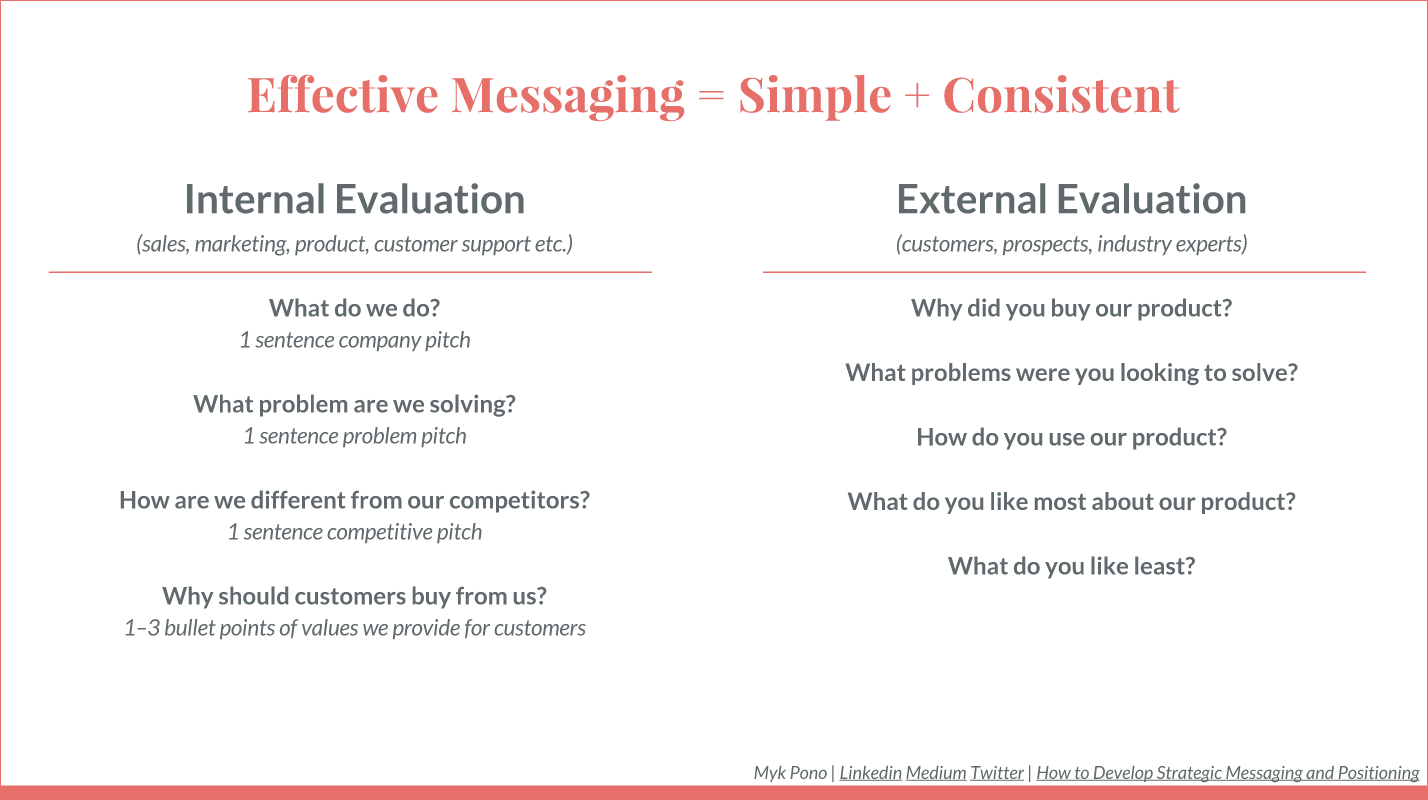
One of the main attributes of strategic messaging is consistency. Effective messaging is always simple and consistent. So, the best way to evaluate your current messaging is to look at how consistently your organization talks about your products and compare that with how your current customers talk about your product. Here’s a simple framework:

The Internal Evaluation

The answers you receive in the internal survey from different teams and even from members of the same team are often so different it will convince your organization to take messaging seriously.

When conducting one-on-one interviews with salespeople at one company, I was shocked at how different the product pitch and company description was from one interview to another. I interviewed one sales rep and then heard a polar opposite pitch from the next sales rep. In this extreme case, almost every sales rep had their own sales decks. I then shadowed their live sales calls with customers to compare what they said during interviews and how they presented to prospects. Some sales pitches were so far apart that if you didn’t know the company name, you would think the pitches were for different products. (Sound familiar?!).

But let’s imagine that your internal messaging is reasonably consistent, then the next step in the evaluation process is to interview a few customers and compare how they perceive your product and your company (the external evaluation). Remember, strategic messaging and positioning is all about the perception in your customer’s mind. So your messaging could be simple and consistent but still doesn’t match the perception in the mind of a customer.

The External Evaluation

External evaluation of your strategic messaging can be done in two ways: 1) customer interviews; 2) with a survey. Surveys are quicker and easier, but interviews are more valuable. If your internal evaluation was enough to convince your team to review your messaging, you probably don’t need to do an external evaluation.

You will talk to your customers and prospects when you start designing your new messaging. It would be very inefficient to interview your customers once for evaluation and again when you are designing the new messaging.

During interviews, the customer may respond that he/she likes or dislikes the product because of one feature it has. Always follow up with “Why?” questions. It is never about the feature of the product, it is about how this feature impacts their daily work and what value and utility it provides.

Now compare what message your organization communicates and how customers perceive your product. Most companies are very shocked to find out how far apart their internal messaging is from their customer perception.

Even though it’s difficult to calculate the ROI of effective strategic messaging, it’s important to realize that messaging has more of an impact than almost anything else in business. You can evaluate the consistency of your messaging using our messaging map template here. And in an upcoming post, we’ll tell you how to design and implement your new messaging.

The post Is Your Messaging Effective? A Simple Framework to Help You Evaluate Your Strategic Messaging. appeared first on OpenView Labs.

02 Mar 17:24

Marketing Activity Metrics Mean Little: Here's How to Really Prove Marketing's Value

The challenge? Measuring Marketing's performance and value to the business. The traditional approach to metrics simply perpetuates the myth that marketing activity equals value. Here's how to measure Marketing's true value instead. Read the full article at MarketingProfs
02 Mar 17:24

Feeling Foggy About Your Cloud Knowledge? You May Know Less Than You Think.

by Riley Panko

The Internet, and the devices connected to it, are woven tightly into our daily lives. We use social media, stream audio and video, and store important documents and images online without hesitation. Yet, are you aware of when that data is stored locally and when it’s stored in the cloud?

Clutch Consumer Cloud Survey Graph

A recent survey of 1,001 consumers – conducted by B2B research firm Clutch – found that nearly one-third of respondents who are active cloud users don’t know that they use the cloud. Though the respondents indicated that they use at least one popular cloud-based application, such as Google Drive or Dropbox, 32% subsequently marked that they do not use or access information in the cloud.

By design, the survey did not specify that these popular applications are cloud-based. This shows that many users of these widely prevalent apps do not understand the technology driving them.

Not understanding the mechanisms behind technology is often harmless. The cloud can be a different beast, though. If you are storing potentially sensitive information in the cloud and aren’t acting appropriately, you leave yourself vulnerable to rare, but possible breaches.

Get Educated

Once someone knows they are using the cloud, they need to be aware of the potential security risks involved with using it, and ways to mitigate that risk. There are a variety of simple steps you can take to protect your data in the cloud.

Some of these steps include the following:

  • Use strong passwords that can’t be guessed by those who curate information about you. Create passphrases with numbers, mixed upper/lower cases and special characters. Don’t include words that can be guessed, like your pets’ names, your children’s names or places you’ve lived.
  • Change your password regularly.
  • Subscribe to services which enforce multi-factor authentication, such as using passcodes received through an SMS text or challenge questions.
  • Use services that have strong SSL encryption, indicated by a URL starting with “https://”.
  • Research the reputation of the cloud storage provider from the perspective of 3rd party reviews.
  • Install anti-spyware software, anti-virus software or other security measures on your mobile device and laptop. If possible, use an app which allows you to render your device useless if it’s stolen or lost.
  • Employ VPN services in public places when using cloud applications. A VPN is like a secure tunnel for your information to protect you when using public WiFi.

By adopting some of these tools and behaviors, consumers will find the cloud can be a secure place to store their important documents, valued photos and other files – without needing to become a cloud expert.

Take Responsibility for Cloud Security

There have been high-profile cases of individuals having their personal files stolen by opportunistic hackers in public places. Compromising photos and sensitive documents stored in the public cloud can be copied without the victim’s knowledge. Identity theft, harassment and humiliation are often the result of lax behaviors related to safeguarding cloud data.

The survey found that just over 40% percent of those surveyed feel cloud security is a shared responsibility between the cloud service provider and user.

Just under a third of respondents believe that the burden of security falls exclusively on the cloud provider. This thinking is misguided. Would you leave your house without locking the door or securing your valuables? In a perfect world, this would be acceptable, but that unfortunately is not reality.

Companies like Apple, Dropbox, Google, Amazon and Microsoft work around the clock to ensure your files are safe from hackers that try to breach their network perimeter. They offer a great deal of security for little or no cost – but cloud hacks are often the fault of the user. Weak passwords and careless behavior in public places often leads to stolen information and personal files.

The survey summarizes that if consumers educate themselves about the cloud, including opportunities and threats, they will be better equipped to get more value from it, and to protect their sensitive files from those who prey on unsuspecting individuals.

Not Everything Belongs in the Public Cloud

There are some personal files, like tax returns, passport images or other financial and legal documents, that should be stored on your computer’s local hard drive instead of the public cloud. Cloud services are generally highly secure, but as Ben Franklin famously said, “An ounce of prevention is worth a pound of cure.”

There is a lot of information available to consumers to enhance their cloud knowledge on the best online storage solution for their needs. Selecting a cloud storage provider just because it is free is a decision fraught with risk. Instead, opt for a service which works well with your devices, has a proven track record for keeping information safe, and is backed by a reputable service provider. It is easy and affordable to buy additional storage when you need it, but recovering from a data breach is generally a complex and expensive process.

Read Clutch’s full report here.

02 Mar 17:24

A tiny California college whose graduates outearn Harvard and Stanford grads is changing how we train students to enter the job market

by Abby Jackson

Harvey Mudd

Harvey Mudd College, a tiny liberal-arts school in Claremont, California, is an engineering, science, and mathematics powerhouse.

In fact, its graduates outearn those from Harvard and Stanford about 10 years into their careers.

But in addition to its reputation for producing strong graduates in the STEM fields (science, technology, engineering, and math), HMC also produces students — sometimes known as Mudders — who embrace the arts.

The school, which enrolls about 800 students, not only encourages but demands that Mudders graduate with a strong liberal-arts background, taking just as many courses in the humanities as they must in core introductory courses in the sciences.

HMC describes its core curriculum as "an academic boot camp in the STEM disciplines — math, physics, chemistry, biology, computer science, and engineering — as well as classes in writing and critical inquiry" that it says "gives students a broad scientific foundation and the skills to think and to solve problems across disciplines."

The approach closely mirrors advice from some experts on how schools can develop students able to compete with automation, which has become an increasingly disruptive force in the labor market.

Self-driving cars, for example, threaten the job security of millions of American truck drivers, and automated financial advisers are replacing humans at wealth-management firms.

"Absolutely I think there's value in some level of understanding computer science," Shon Burton, the CEO of HiringSolved, previously told Business Insider.

Harvey Mudd CollegeBurton, whose company uses artificial intelligence to make job recruiting more efficient, said students must embrace the humanities to become critical thinkers who improvise in ways that robots cannot.

At HMC, the computer-science program is so strong that elite STEM-focused schools have taken note.

The California Institute of Technology, for example, invited educators from HMC to visit its campus and provide training on how to teach computer-science classes for better student retention, Caltech professor Yisong Yue told Business Insider. Caltech is a premiere science and engineering college and was labeled the top school in the world for delivering work-ready graduates in 2016.

Part of this success is due to the thoughtful way HMC has chosen to structure learning, Jim Boerkoel, a computer-science professor at HMC, told Business Insider.

"Everybody arrives and they have to take at least one computer-science course, which is fairly unique for many schools, particularly liberal-arts schools," Boerkoel said.

The introductory computer-science course is intentionally broader than most intro courses. While the traditional approach features a programming-focused class, HMC redesigned its intro sequence to touch on programming, logic, software development, artificial intelligence, and other topics within the field.

The school also provides both basic and advanced sections of the intro course so students who might otherwise dominate the discussion don't intimidate students who are less familiar with computer science.

"Those changes have led to some pretty big advances and equity across gender," Boerkoel said.

So much so that last year, HMC graduated its first majority-female computer-science class. Nationally, men make up more than 84% of undergraduates majoring in computer science, according to the Computing Research Association.

"They have an extraordinary undergraduate education program," Yue of Caltech said.

SEE ALSO: Robots threaten jobs from truck driver to wealth manager — and it changes how graduates should approach the working world

Join the conversation about this story »

NOW WATCH: 5 high-paying jobs for people who don't like stress

02 Mar 17:23

How Blockchain Applications Will Move Beyond Finance

by Christian Catalini
mar17-02-blockchain-finance

To understand the transformation that’s being brought about by blockchain technology, it’s useful to start with its largest implementation to date: bitcoin.

In the fall of 2014 my colleague Catherine Tucker and I conducted a large-scale experiment at MIT, in which 4,494 undergraduate students were offered access to bitcoin. The vast majority of students ended up hoarding the cryptocurrency, in the expectation that it would increase in value. Initially distributed to the students at $350 per bitcoin, the digital currency is now worth more than $1,100 per bitcoin, suggesting that many of the students realized that one of bitcoin’s first use cases would be speculation.

Insight Center

As the cryptocurrency has matured, it’s often been criticized for its inability to match the performance of existing payment networks and meet the requirements of financial systems and governments. But bitcoin has been extremely successful at solving the problem it was designed for: allowing a global network to securely transact and exchange value without the need for a costly intermediary. Through a clever mix of game theory and cryptography, bitcoin replicates financial systems’ ability to transfer value, but without any of the labor typically involved in running and securing transactions. Furthermore, it does so while minimizing the degree of trust parties have to place in each other when transacting; it essentially digitally mimics many of the features of cash — including privacy.

As cryptocurrencies like bitcoin and distributed ledgers continue to mature, where might they be applied next?

How Blockchain Works

Here are five basic principles underlying the technology.

1. Distributed Database

Each party on a blockchain has access to the entire database and its complete history. No single party controls the data or the information. Every party can verify the records of its transaction partners directly, without an intermediary.

2. Peer-to-Peer Transmission

Communication occurs directly between peers instead of through a central node. Each node stores and forwards information to all other nodes.

3. Transparency with Pseudonymity

Every transaction and its associated value are visible to anyone with access to the system. Each node, or user, on a blockchain has a unique 30-plus-character alphanumeric address that identifies it. Users can choose to remain anonymous or provide proof of their identity to others. Transactions occur between blockchain addresses.

4. Irreversibility of Records

Once a transaction is entered in the database and the accounts are updated, the records cannot be altered, because they’re linked to every transaction record that came before them (hence the term “chain”). Various computational algorithms and approaches are deployed to ensure that the recording on the database is permanent, chronologically ordered, and available to all others on the network.

5. Computational Logic

The digital nature of the ledger means that blockchain transactions can be tied to computational logic and in essence programmed. So users can set up algorithms and rules that automatically trigger transactions between nodes.

It’s not surprising that some of the closer-to-market applications of the technology are in the financial sector. While trading and speculation were early use cases of bitcoin, new technologies, such as Ethereum and Zcash, have emerged, with Zcash providing a higher degree of privacy than bitcoin, and Ethereum offering a powerful development platform for smart contracts and decentralized applications, with the power to transform everything from predictive applications to job and energy markets to hedge funds and decentralized cloud services. As the entire cryptocurrency ecosystem matures, digital wallet providers and exchanges are becoming more professional and secure.

On the consumer side, companies such as Circle and Abra are taking advantage of the lower costs offered by blockchain technology for cross-border payments, encroaching in the territory of players like Venmo (now part of PayPal), TransferWise, and traditional remittances providers. Visa and MasterCard are both exploring uses for similar technology to improve the way they process payments, while Ripple is lowering the cost of transactions between banks and other financial institutions through its global settlement network. In all of these cases, blockchain technology is adopted “under the hood,” and consumers and businesses can reap the benefits without ever knowing that a distributed ledger was ever involved.

Related Video
Where the Digital Economy Is Moving the Fastest
Based on the research of the Fletcher School at Tufts University's Institute for Business in the Global Context and Planet eBiz.

The same applies to trade finance and financial assets, where companies such as Digital Asset Holdings (run by JPMorgan veteran Blythe Masters), Blockstream, and Chain are trying to revolutionize how assets are issued and traded. Their solutions at this stage focus more on distributed ledger technology as a way to lower costs and improve efficiency than on bootstrapping entirely new ecosystems on top of cryptocurrency. This has the advantage of allowing them to design solutions that are compliant with existing financial regulations, which has attracted the attention of major stock exchanges and established players like NASDAQ.

Central banks are also actively exploring the opportunities and challenges a fiat-backed, digital currency would entail for monetary policy, taxation, and lending.

But the practical applications for blockchain technology go way beyond financial assets. Essentially, any type of digital asset can be tracked and traded through a blockchain. Information about the provenance of goods, identity, credentials, and digital rights can be securely stored with a distributed ledger. Experiments in this space tend to be in early stages, but they range from medical records (MedRec, Pokitdok) to digital rights and micropayments (the Brave browser, Ascribe, Open Music Initiative), identity (Uport), and supply chain (Everledger, Hyperledger).

A challenge for many of these applications is to securely and reliably record the properties of physical assets, individuals (credentials), resource use (energy and bandwidth through an internet-of-things device), and other relevant events taking place through a supply chain on a blockchain. The immutability offered by a blockchain is only useful if the original information entered on it is accurate.

Whereas a blockchain can allow for the costless verification of the attributes it carries, recording those attributes in the first place may require labor-intensive tasks and intermediaries (including the government) to prevent fraud. In this area, internet-of-things devices and sensors can drastically expand what can be built on top of a blockchain.

In the long run, cryptocurrencies have the potential to change how internet services are delivered (Blockstack, IPFS); how open-source communities fund their development; how we crowdsource microtasks and expertise (21.co); how we pay for content and media (Brave); and how we harness talent to improve predictions (Numerai).

In their seminal work on the theory of the firm, Michael Jensen and William Meckling defined the firm as a “nexus of contracts” — the idea that firms are nothing more than a collection of contracts between various parties, such as employees, customers, and shareholders. Cryptocurrencies may one day enable a completely new type of organization by allowing us to securely transfer value and allocate resources through smart contracts. Whereas this new type of organization may achieve the speed and efficiency of a spot market, it may be able to replicate the complex forms of governance required to execute the complex tasks that take place today within the boundaries of a firm. Combined with advances in machine learning, this breakthrough technology will shape the flow of capital, labor, and ideas for decades to come.

02 Mar 17:23

The Greatest Reward From Writing My Book (Not Taught)

by Keenan

not taught

I knew Not Taught could help people. That’s why I wrote it, but I’m blown away by how much.

That was my motivation for writing Not Taught. I wanted to help people to find success. I wanted people to know that times had changed. I wanted them to know that we had left the Industry Age and entered the Information Age and because of that the approaches and methodologies they were using no longer worked.

What I didn’t realize when writing the book, was how rewarding it would be to hear from people who’s careers and lives changed because they had read Not Taught.

This morning I woke up to a comment in LinkedIn from Lee Bartlett. Lee is an Author, Sales Consultant and provides Executive Search services. This is what Lee had to say,

Keenan, Actually you, and Not Taught, are partly responsible for this blogging/reading commitment. Thanks! I think?! Great book my friend it was a pleasure to read and review.

I had no idea that Not Taught had influenced Lee, none.  Lee has a fantastic blog and website for salespeople, you should check it out here. Be sure to check out his book store, it’s a list and review of the best sales books available today.  It’s a great resource.

I receive emails, comments etc. every so often. People take the time to let me know how much Not Taught changed their life and how they now have opportunities they didn’t have before. It’s the best reward EVER for taking the time to write Not Taught.

If Lee’s comment wasn’t enough, Larry Levine, the copier salesman extraordinaire, who has burst on to the social media scene over the last year also chimed in.

Lee, it was after a conversation with Keenan . that I started blogging weekly and that was December of 2015. Next stop a book!

It’s an amazing feeling to know that I am able to help people. That because of Not Taught, people are now in a better place, achieving more than they were before. It makes me feel all warm and fuzzy and shit, knowing because I took the time to write Not Taught people’s lives are better because of it. I don’t care it’s a lot or a little, just to know that I was able to give back like that, to have a positive influence in

I don’t care it’s a lot or a little, just to know that I was able to give back like that, to have a positive influence in someone’s life is enough.

We often get caught up in the WIIFM (what’s in it for me) game. We think about the money, the exposure, the new business, etc. But in the end, what really feels the best is knowing we helped people. That people are in a better place because we took the time to create something of value for others.

Writing Not Taught has been a killer experience and it has provided amazing opportunities, but every time I get emails from people or see comments like Lee’s is when the real reward is felt. What an amazing feeling!

I love starting days like this.

Thanks to everyone who has shared their story with me. It keeps me going knowing it’s making a difference.

You guys rock, thanks!!!

FYI: If you haven’t read Not Taught, you can download the first few chapters here free.  And if you like it and you apply and it changes your life too. Tell me, it’s better than Red Bull to start my day.


The post The Greatest Reward From Writing My Book (Not Taught) appeared first on A Sales Guy.

02 Mar 17:22

6 Sales Coaching Questions That'll Help Your Reps Hit Quota

by mpici@hubspot.com (Michael Pici)

sales-coaching-questions-compressor-848131-edited.jpg

When you become a sales manager, your “customers” become your salespeople. Your top priority should be helping them succeed. After all, if every individual reaches their potential, you’ll definitely hit -- if not exceed -- your team quota.

Just like asking your prospects the right questions is crucial, asking your reps the right questions is crucial, too.

These questions, which are ideal for one-on-ones, will help you identify your reps’ strengths, weaknesses, and motivations.

Sales Coaching Questions to Ask Your Reps

1) “What would you like to accomplish in the next six months? Year? Two years?”

The best sales managers know what their reps are striving toward. Some salespeople want to save up for a big purchase, while others are working hard to get a promotion.

This question should delve into both personal and professional goals. If their first answer is professional, follow up with, “Great. What are you hoping to achieve on a personal level?”, or vice versa.

Once you know what each rep wants, you can tie your coaching to those drivers. For instance, if you want to motivate a BDR looking to buy an apartment, you might offer them a cash incentive for increasing their call-to-meetings rate by 10%.

Meanwhile, someone who wants a promotion to account executive (AE) will be encouraged by career milestones, such as, “After your percentage of leads accepted is X percent or higher four months in a row, you’ll become an AE.”

2) “Which part of the sales process do you find most challenging, and why?”

Every rep has an Achilles’ heel, and it’s your responsibility to find those weaknesses and correct or mitigate them. You should be able to discover many through simple observation -- but it’s always a good idea to get your reps’ feedback as well.

Design a coaching program around these areas. For instance, if a salesperson says she has a hard time surfacing objections, you might work with her to develop questions or roleplay scenarios with hidden objections.

Most worrisome? When the rep says they don’t struggle with anything. They’re either overconfident or reluctant to be honest with you, neither of which bode well.

3) “What would your prospects say about working with you?”

This question forces salespeople to consider their prospects’ point of view. Even the best-intentioned reps can become consumed by meeting their quota, which causes them to prioritize their needs over the buyer’s.

You’ll discover bad behaviors while there’s still time to fix them. For example, your rep might answer, “The prospect would probably say I’m pushy -- I’ve been pressing them to connect me with the signing authority.”

Or perhaps they reply, “I think she appreciates the suggestions I’ve given her for evaluation criteria but would like more transparency around pricing.”

Once you’ve helped your rep see themselves through the buyer’s eyes, you can work together to improve their relationship with the buyer.

4) “What went well during your [initial connect, discovery call, demo, sales presentation, meeting with X stakeholders, negotiation]? Where do you see opportunities for improvement?”

This prompt is a classic for a reason. If your salespeople never reflect on their performance, they’ll never grow.

Sure, you could tell them exactly what they did successfully and where they fell short, but you won’t observe 90% of their conversations. It’s far more effective to put them in the habit of analyzing themselves -- so even when you’re not listening to the call or shadowing their meeting, they can improve.

5) “Which strategies you use and/or steps will you take to work on X?”

Honing in on a weakness isn’t productive unless the rep also comes up with a concrete fix. Again, while it’s easier for you to give them an action plan (like, “Develop a roadmap for the call in advance so you can keep the conversation on track”), they’ll be more bought-in if they’ve had a part in crafting it.

If their initial response isn’t specific enough, go deeper. Here’s some sample dialogue to illustrate:

Manager: “Which strategies will you use and/or steps will you take to reduce discounting?”

Rep: “I’ll establish the product’s value earlier in the sales conversation.”

Manager: “How will you do that?”

Rep: “I’ll create a custom one-page site with three or four testimonials from customers similar to my prospect and a third-party review from a well-known publication in their industry.”

Manager: “Sounds great. And what will you say if they request a discount anyway?”

Rep: “I’ll turn the question around by asking, ‘Why?’”

6) “How have your team members helped you this [week, month]? How have you helped them?”

The most successful sales teams work together. Not only can every rep learn from their peers’ product knowledge, sales experience, and insights, but they can also benefit from each other’s support and friendship.

To encourage a spirit of collaboration, ask this question during every one-on-one. You’re looking for answers like:

  • “Jamie gave me some tips on writing better outreach emails.”
  • “I roleplayed a few negotiation scenarios with Oleana to help her practice pausing.”
  • “Max, Ankit, and I made a case study library for the whole team to pull from.”
  • “Sarah ran my demo because I didn’t feel well.”

Consider sharing the best examples during team-wide meetings. Doing so gives your reps a model for great teamwork, rewards the people who went above and beyond, and lessens the air of over-competitiveness that plagues many sales teams.

These sales coaching questions will make your salespeople more productive, successful, and engaged. Your bottom line will reap the rewards.

Free Sales Training from HubSpot Academy

02 Mar 17:22

Lucid Software Dumps Intuition for Data in the Sales Process

by Alex Hisaka
  • reality-check-ahead-yellow-road-sign

With more B2B decision makers traversing the path to purchase on behalf of their companies, sales professionals are embracing new methods to engage and interact with prospects. One of the key elements of the new sales formula is finding smart ways to connect with these multiple decision makers. Many business leaders recognize social selling as an effective way to do just that.

One of those is Gabe Villamizar, Head of B2B Marketing at Lucid Software Inc. He shared with us his strategy for equipping Lucid Software’s sales team for social selling success. 

LI: What encouraged Lucid Software to transition from relying on single relationships to larger networks of targets?

GV: One of my sales mottos is that “Data Will Always Trump Intuition.” The buyer’s journey in the B2B space has changed and will continue to do so. We’ve taken this B2B buyer data and applied it to the way our sales reps identify and connect with multiple buyers across the B2B enterprise level.

As I train and coach our sales teams on social selling on LinkedIn and Twitter, I emphasize the advantage and power that comes from connecting in a personalized manner with four to seven decision-makers per company to increase contact and account penetration.

LI: What tools and processes are you using to establish multiple relationships between your company and your customer organization?

GV: One of my favorite sales cadences that our business development reps or account executives do when prospecting an account goes as follows:

1.     Find seven decision-makers or people that influence those decision-makers.

2.     Save the decision-makers as “Leads” in LinkedIn Sales Navigator.

3.     Find and follow those buyers/influencers on Twitter and their company handle.

4.     On Twitter and LinkedIn, listen and learn everything that there is to know about your buyer’s pains, problems and motivations.

5.     Begin engaging with your buyers via LinkedIn and Twitter.

6.     Identify two to three articles that will add value to your buyers and share [them].

7.     Build a relationship of trust and determine if you should work the account or move on.

LI: How do you measure whether your team has succeeded in establishing and maintaining multiple relationships within accounts?

GV: One of the best ways to measure this is by tracking certain data points from both LinkedIn Sales Navigator and our CRM, which is Salesforce. These data points include how many leads were saved per account in LinkedIn Sales Navigator, and then measuring in Salesforce how many online and offline touch points were done.

You’ll be able to measure on an account-by-account basis whether the deal was won or lost, how many touch points were involved and what was the outcome. Once you coach and train your sales reps on updating each activity they do within each of the leads they work with (manually or semi-automatically), you’ll be able to create a unique sales benchmark for your team/company and a predictive social selling model.

For more social selling advice from Gabe, check out his newly launched social selling courses. We've made two of the videos available for free! 

02 Mar 17:21

10 Make-or-Break Skills a Content Marketing Professional Needs to Succeed

by Annaliese Henwood

When you have a content marketing professional vacancy, it can be difficult to narrow down the hundreds upon hundreds of applicants. Job listings online and word-of-mouth can produce unmanageable numbers of applications. So many of the applicants have a great resume and fit with the job requirements.

How do you narrow down this list of qualified candidates to a manageable number?

Consider these 10 critical skills to make it easier to select the right candidate for your open position. This collection can help you take a list of 100s of applicants down to 5-10 truly qualified candidates, giving you that manageable number you seek for the interview stage.

Content Marketing Professional article quote

1) Writing expertise

Content marketing is, by definition, about creating a wide variety of valuable resources for your audience. This can include videos and infographics, but it also comes in standard writing form. Without writing expertise and experience, a content marketing professional would be missing an essential part of his or her career.

Take a moment to consider the words of Stephen King, one of the world’s most powerful writers. Smart Blogger’s Jon Morrow created a compilation of King’s inspirational quotes about writing from his book “On Writing.” If you want to take it a step further, grab a copy of King’s book on Amazon. Any legit writing professional will have read this book.

When you’re looking at job applications, pay attention to the candidates’ writing. This includes grammar and spelling, but it also includes the way they express themselves. A cover letter is great for this.

Ask for a cover letter, and check to see how the candidate formats their writing. Does it align well with what you want to see in your business’ content? Check the tone they use to see if it’s either too formal or too casual for your business’ content guidelines.

Another good way to evaluate a candidate’s writing skills is to see whether he or she can express a point clearly and quickly all while offering high value. Longer explanations can bore your audience, so a candidate needs to demonstrate a strong ability to inform at a to-the-point level. Remember, rumor has it that humans now have an attention span that’s shorter than the goldfish!


2) Trend savvy

When content creators are in action, they’re always keeping an eye out for new trends and techniques in their industry. This allows them to create fully optimized and popular content for your business.

Along the same lines, a content marketing professional should be on the lookout for mainstream trends that may benefit a business’ reach and popularity. For example, a blog headline that mentions a relevant, current trend can bring more traffic to your site. You’ll often see blog posts that incorporate celebrity news to increase traffic. People will be talking about that celebrity or searching for that topic on social media and Google Search, so it would be to your benefit to have a content writer who uses that to your advantage.

Also, a content marketer can use their trend-savvy skills to promote their content in the best ways for appeal and click-throughs. The next step is simply to keep the visitors sticking around on your website, but that’s where some of the other skills come into play, such as…


3) Creativity

Content marketing is all about being creative. Without this absolutely essential skill, your content marketer will not be able to take your business ahead. Creativity is what makes your business stand out in the crowd of competitive content you see every day. Without it, your content won’t likely attract and retain visitors to your social media, site, and blog. They’ll go to your competition.

What is considered creative in content marketing? Well, these are some of the ways:

  • Using a catchy or even provocative headline in your article is a great way to use your creative mind to get click-throughs.
  • Creating infographics and images with your own graphics instead of stock imagery demonstrates a creative touch.
  • Also, video is now a huge element to any content marketing strategy, and it, too, requires an extensive amount of creativity to stand out.

When you’re evaluating a candidate’s creative nature, see whether he or she has samples of their work to share with you. They don’t have to be work-related if the candidate has a side hobby. Use these samples to judge whether that candidate is worth pursuing further. In short, make sure that the candidate’s samples align well with what you want to see them make for your own business.


4) Commitment to continuous education

Marketing of any kind is never static. It changes every day. Content marketers need to know how to stay informed and why they should do so. A commitment to learning even past formal education is a must if they want to give your business an advantage. Learning means growing, and this growth will give marketers what they need to do their job effectively over time.

If a content marketing professional chooses to stick with the status quo, it will damage your business results. Just like with being trend-savvy, content marketers must know the best practices and recommended approaches that develop with time. This skill of continuous education will give a candidate the upper hand over those who stay in the past.

There is no better explanation of why education is important than this quote by Jiddu Krishnamurti:

“There is no end to education. It is not that you read a book, pass an examination and finish with education. The whole of life, from the moment you are born till the moment you die is a process of learning. Learning has no end and that is the timeless quality of learning.”

To evaluate a candidate for this skill, see what certifications he or she has earned recently. Two of the most important certifications they should have for this role are both from HubSpot Academy:

If they don’t have these certifications or are not currently pursuing them, they aren’t as prepared for the content marketing field as those who have them.


5) Positivity

I’m going to explain this skill’s importance by telling you a story of someone who used a social trend to transform their negativity into a positive outlook on life. This is actually my story. I will then explain how it can pertain to your job vacancy and business.

About 4-5 years ago, I was full of negativity. People started calling me Eeyore and Debbie Downer. To be fair, I deserved their reactions. One day, I chose to fight against my own negativity, and that’s when I started the 100 Days of Happiness challenge on Facebook.

As a quick explanation, this daily challenge involved sharing a photo with a positive message or sign of gratitude from each day for 100 days. It could also be a video series.

I went through that entire 100 days without missing a single day, and by accident, it ended on my 25th birthday. The biggest lesson I learned was that life is so much easier and impactful when you are able to see the good in each day. From that point on, I’ve never let my old negativity sneak back into my thoughts and actions.

Now, how does this relate to finding a content marketing professional for your business?

When you’re examining each application, and you see the slightest sign of pessimism, keep this in mind: that pessimism can end up in your content. Your audience wants to feel inspired by your brand, so you need to find someone who truly has the positive mindset to produce what they want to see. A positive person will have the skill necessary to inspire while a negative person would more likely push your audience away.


6) Speed

If your business wants to keep up with the recommended flow of content production, you need a content marketing professional who has the speed to get content out there quickly and frequently without sacrificing quality. This is similar to skill #1 where writing needs to always be of high-quality.

You’ll find that quality always beats quantity in content marketing. This is true, but it doesn’t mean the fast-paced feed of content production will slow down for you. You need someone who can keep up the pace without affecting your content’s quality.

Sometimes, publishing content once a week may suffice, but that content better be long-form and good. Ideally, a business blog should have a writer, or even two or more writers, who can publish 3-5 times a week. All of those posts should provide value and follow blogging best practices to give your readers a reason to turn to you.

You won’t see positive results from content that is rushed, but your content marketer should have the ability to maintain a speedy schedule to build your blog presence.


7) Organization

A big part of being a content marketing professional, or any marketing category for that matter, is having the skill to remain organized. This involves more than you might think. It’s not just about having a clean desk or a navigable computer folder system. It’s about every element of the job.

A content marketer should know how to stay organized in such a way that others will be able to understand and follow. Teamwork is often key in marketing and even along with the sales department. You need to have a content marketer who will allow this collaboration with ease. Productivity depends on this team organization and so does your business.

Content marketing means being organized in these ways (among many others):

  • Filing system both on and offline
  • 3rd-party tools – their settings especially
  • The content calendar
  • The content strategy
  • The blog and social media scheduling systems

8) Research

A content marketing professional is always researching to create high-quality content. While you certainly want to include links to other parts of your own blog and website, including outbound links will improve your blog’s authority and SEO. It’ll help your readers, and it can also help you build relationships with those you cite.

In order to find reputable links and references for blog content, your ideal candidate should know how to research them with speed and ease. Their best ways of doing this are:

  • Subscribe to the top industry blogs via email, including competitors (using a different email address)
  • Collect articles and organize them in Dropmark or another tool for future reference and use (Example)
  • Read daily (printed books, Pocket saved articles, or Feedly feeds) and save their favorite lessons (highlighting, taking notes, etc.)

Research skills are a must for content marketing to work for your business. As an example, your staff could use this skill to spy on your competitors to see what they’re doing right and how your business could do it better. Competitor analysis requires extensive research, so your staff should know how to do it or, at minimum, know how to use the tools that can help.


9) Communication

Content marketers represent your business in the content they produce. Their writing in particular expresses your business’ tone and personality. If your candidate can write in the way that represents your brand, they just might be right for your business. Written communication skills are probably one of the most important skills in this list. The content they create can lead to a sale or take away an opportunity for one.

Another type of communication is verbal. Not only do content marketers need this for content creation, but they also need it for internal communication. A content marketing professional needs to communicate how and why they’re doing something for your business, and they’ll need to demonstrate how their work is bringing in results (ROI). This means the same for written internal communications, such as through email.

Communication skills give content marketers what they need for both internal and external efforts. If a candidate shows that they can do this when you evaluate their application, they should be brought further up your list of possibles. You need someone with strong communication abilities if they’re going to represent your business through content.


10) Patience and Persistence

Even though it might seem like these are two different skills, they work together. Content marketing doesn’t produce immediate results, especially if building from the very beginning. It’s part of the Inbound process, which takes time. However, with patience, you’ll see that boost in business you’re seeking. If a content marketing professional is able to work hard for the long term (with patience), they’re a good candidate for that role.

Persistence means working hard every day despite the frustration and exhaustion. Content marketing is hard work and requires a lot of effort. Your ideal candidate should know how to hold strong over time. When they’re persistent, they’ll bring more high-quality leads than those who don’t put in the same amount of effort or give up.


Bonus:

All content marketing professionals should have their own portfolio online. It should help them demonstrate to employers that they are capable and qualified to do the job. This is why I created my own marketing portfolio website. I use it for dual purposes:

  • Demonstrate to employers that I’m committed and capable
  • Assist my fellow marketers with their own efforts

If you’re having trouble deciding between candidates, look at what they’re producing online. Do they have a portfolio you can read through? How are they communicating on social media? These methods can help you find the right candidate for your open content marketing role.

02 Mar 17:21

How to Improve the Caller Experience With These 3 Key Tips

by Gina Botti

Consumers expect a seamless experience when engaging with brands throughout the customer journey. This is especially true when consumers take their online experience offline by calling. From acquisition to retention, marketers must create a holistic and efficient experience for their prospects and customers. Otherwise, they risk losing them to someone else that will.

  • 81% of consumers get frustrated when a company makes doing business with them difficult.
  • 60% of consumers will abandon an intended purchase because of a poor customer service experience.

Create Good Experiences Across the Board

Just like you optimize your online experiences to drive online conversions, you need to do the same for your callers. Why? Mobile consumers are calling by the billions from digital marketing. That seamless online experience needs to continue offline. Otherwise you risk upsetting your existing and potential customers.

With consumers not being as brand loyal as they used to be, it’s important for marketers to take extra measures to create a holistic experience from online to offline. And all of this can be done with the help of call conversion technology.

Here are 3 ways you can leverage call data to enhance the phone call experience of your prospects and customers:

Experience #1: Make Your Interactive Voice Response (IVR) System Efficient

Have you ever opted to call a business rather than engage with them online? Have you ever found yourself going down a rabbit hole of cumbersome cues? You eventually yearn to speak with a real human-being, and so you start guessing how you can bypass the IVR system. It’s likely that you’ve found yourself frantically pressing “0” or shouting “Operator!” in frustration. We’ve all been there at some point and, let’s be honest, it’s a low point in our experience with a brand.

Failing to implement an efficient IVR can result in lost business. In fact, 37% of consumers have ended their relationship with a business because the IVR caused frustrations.

The Solution: You can significantly improve caller experiences by simplifying how you qualify callers before directing them to your agents. By cutting down on the amount of menus, you help your prospects and customers save time. For instance, you can create a good balance by directing callers that need basic information, such as business hours, store locations, and account balances, to automated information menus.

Implement IVR menus that are useful and you’ll make your prospects and customers happy.

Experience #2: Personalize Call Routing Based on Marketing Campaign

Many brands allow prospects and customers to call their main line or dedicated lines for different products or services. But what if you could automatically direct them to the appropriate agents based on the marketing campaigns they called from?

Picture this: You’re running a promotion targeting new prospects. If they call your business, you do not want to send them down an IVR rabbit hole. Instead, you want to immediately connect them with a sales agent aware of the promotion. This not only happens in real-time, but it helps establish a more personalized experience for the caller.

The Solution: Win more customers by qualifying sales leads based on your marketing campaigns. You want to connect your ideal callers to the right agents immediately. Especially when calls are known to convert to revenue 10x-15x faster than web form leads. It’s easier for a real person to sell a product or service when they speak with prospects at the precise moment they’re interested.

Experience #3: Improve the Conversation

Have you ever gotten off the phone with a sales agent and thought to yourself, “Wow, that was such a nice experience?” Maybe they knew your name right away. They knew where you were calling from. They knew that you had called earlier. They knew which products you were interested in. They even knew which keywords you used to search for their business online. It’s as though they read your mind. Call attribution data will help equip your sales agents with unique details about their callers. And this can be used to help them craft more personalized and meaningful experiences.

You might think your agents are smart enough or are already well-equipped. That they can figure it out or it’s all about personality. But is it worth the risk when 83% of consumers will leave a business if it cannot provide better live or in-person support?

The Solution: Businesses should always strive to improve the caller experience. And you can do this by improving the quality of the conversations your sales agents have with callers.

Try integrating call data seamlessly into your CRM tool. You can equip sales agents with the caller’s information before they’re even connected with the caller. Keep them on the offensive. By having all of this data at their fingertips in advance, you’re helping to set them up for success. Now, they can better personalize the caller experience.

You can also gain insights on sales conversations without having to listen to hours of conversations. By understanding what happens during the calls, such as what keywords were spoken and whether your agents followed specific scripts, you gain key insights into the types of leads you’re driving, how you could improve your marketing ROI, and ways to enhance the performance of your sales agents.

Marketers and businesses should constantly strive to improve the experiences of their prospects and customers. These three tips are only a glimpse into the opportunities call attribution technology makes possible.

Interested in learning more? Check out The Digital Marketer’s Guide to Call Attribution.

01 Mar 22:52

Flush with cash, global miners promise prudence, dividends

by Nicole Mordant
Giants are riding a wave of cost cuts and a recovery in raw material prices
01 Mar 22:36

Sales Coaching: Demystifying Five Common Myths

by Richard Smith

I was inspired to write this blog from two key experiences in recent weeks. The first one, was after I sat and watched a webinar presented by Factor8 President and Inside Sales expert Lauren Bailey titled ‘Good Sales Coaching Gone Bad’. The second was after I spent some solid time, coaching one of my new SDR’s on sales calls during his on-boarding into the company, and seeing the incredible value of good call coaching. Lauren’s webinar highlighted some of the big misconceptions about call coaching that exist in the industry today, and where sales leaders are simply often falling down at the first hurdle. From this, and my own experiences, I have de-mystified five commons misconceptions about call coaching:

1. Ordering more dials is the path to success

I often brand this one ‘coaching the metrics rather than the skills’. Whilst you may think that the days of managers cracking the whip and demanding more calls to be made were a thing of the past, sadly this remains as prevalent as ever. Whilst it’s undeniable that quantity of activity is an important factor in becoming successful in sales, nothing is more important than the quality of interaction.

Remember the famous Einstein quote about insanity being the definition of doing the same thing over and over and expecting a different result? I’ve seen this happen throughout my career. Sales reps talking too much on calls, not asking the right questions, not closing at the right time. Isn’t demanding more and more of those calls which have no positive outcome without addressing their deficiencies the definition of insanity? Sadly we still live in a world whereby leadership decisions are so completely fixated on high numbers, rather than looking beneath the skin as to actually why some reps perform so highly than others. Sales calls are possibly the best example I’ve seen of this.

Demystifying the misconception

It’s time to start focusing more on the actual conversations your reps are having and measuring their quality and skills. How do you do this? Spend less time looking at your KPI’s and spend more time listening to their calls. Sounds so simple, yet you’ll be amazed at the number of Sales Leaders I speak with who don’t listen to their reps calls. One manager I spoke with last week at one of the world’s biggest tech companies, openly admitted that they had no way of measuring the quality of their reps calls as they spend too much time coaching the metrics. They were looking to change this of course, but it was a classic example of them leading blind (their words not mine).

Listen to your top performing rep’s sales calls and start breaking down how what they do. What questions do they ask? When do they ask them? How much do they talk versus the prospect? How do they follow the sales process? What is their approach to building rapport and gaining more time on the phone? How do they personalize their outreach? There are so many factors as to what makes sales calls successful, and unless you invest the time in listening, measuring, and uncovering them, you will be forever leading blind. True story – I cold called four people on Friday afternoon. Two of them converted to demos. Was I lucky or did I simply know what makes an effective interaction? I’ll let you decide 😉

Screen Shot 2017-02-20 at 14.06.06.png

2. Live shadowing of calls is the only appropriate method

Side by side coaching of calls is perhaps the most widely utilised and traditional method of companies who are wanting to embrace call coaching. It’s certainly better than NOT listening to their rep’s calls, but I actually think this method has became outdated and broken. As a starting point, consider the unnecessary pressure placed on the shoulders of the sales rep. To have the imposing figure of their manager cowered over them, listening intently to each and every move they make will simply be too much for some reps. It provides unnecessary pressure, will increase likelihood of mistakes, and overall is just an unnatural experience which is unlikely to garner an accurate reflection of that person’s call performance.

Secondly, consider the amount of coaching time sapped up with this approach. When coaching time is at such a premium for many managers, sitting down and listening to your reps hit voicemails, have wasted discussions with ice cold gatekeepers, or click around their CRM is just a waste of time. One tech company we have started working with, estimated they would have at least an hour wasted a week due to these reasons. It almost becomes a coaching deterrent.

Finally, listening to a live call and giving feedback immediately afterwards produces one major pitfall. You need to expect your rep to remember and relate back to all of the missed opportunities you highlight to them (as long as you can remember them yourself). This coaching conversation lacks context and will most certainly be ambiguous for the sales rep to understand and agree with. In other words – it runs the risk of being a completely wasted exercise.

Demystifying the misconception

Record your calls. It’s as simple as that. If you aren’t recording calls where possible – you should start doing so now! Listening to call recordings is a discrete method of gaining intelligence into your sales rep’s interactions, without you having to sit side by side listening live. Call recordings capture the rep’s conversations, meaning you only spend time coaching actual conversations that occur rather than sitting waiting for them to happen.It is the ultimate coaching time efficiency winner. Playing back call recordings to reps is the most solid course of action in making your feedback unambiguous, encouraging self-reflection, and ultimately delivering behavioral change.

3. Call coaching is too time consuming

Ahhh the old time objection – popping its ghastly head above the parapet again. Look – I get it – we are all short of time. Time is THE single biggest barrier to coaching our reps. When it gets to the end of the month and quarter, it’s all hands on the revenue deck, and coaching can quite simply take a back seat. I don’t necessarily disagree here. After all – sales is all about closing business. The reality is – is that for coaching to be effective, it needs to be done regularly. Regular means more time. As sales managers, we simply don’t magically have ‘more time’ to be listening to our reps calls. So we need to think outside the box.

We need to first of all appreciate and embrace the positive impact even a relatively small amount of time coaching can have on helping to achieve revenue goals. Did you know that just three hours of coaching per month can boost revenue by 17%? We then need to understand how we can go about being smart, in creating pockets of time in our schedules where we didn’t think we had it previously.

Demystifying the misconception

I’ve often found through experience that it’s not so much the fact that people have a lack of time to do call coaching. More it’s simply the case that schedules don’t align. In other words, the manager is not available to live coach a call at the same time that call is being made. A very quick fix here as alluded to in point two is to get your reps to record the calls they make so you can listen to them when you have coaching time.

If you’re short of coaching time, think of ways and means in which you can create more time. We all have morning and evening commutes; we all spend time travelling to meet clients or attend conferences; and we all have boring Sunday evenings spent lounging about not doing a lot. Use this time to coach your rep’s call recordings. Finally, embrace technology to make your coaching time more efficient.

Pasted image at 2017_02_17 06_56 PM.png

4. ‘I need to spend time coaching my entire team’s calls’

Coaching is undoubtedly valuable for everyone. The world’s top sports stars don’t hire personal coaches for nothing – they have a hunger to improve. However, there is something to be said about the impact of coaching on specific sub sections of your sales teams. Coaching should not be a balanced activity with every rep receiving the same amount of managerial time and input.

Demystifying the misconception

Matthew Dixon of CEB identified that the real payoff from good coaching lies among the middle 60% – essentially your core B-Player performers. For this group, the best-quality of coaching can improve sales performance by nearly 20%. That becomes MASSIVE when thinking about quote attainment. Furthermore, your A-Players will actually show only slight performance improvement from sales coaching, and the bottom 20% are often found to be uncoachable and thus generally a bad fit for the role overall. Invest the majority of your time coaching your B-Players to receive the biggest bang for your buck. On top of this, use your A-Players call recordings to showcase best practice and make your coaching output more wide reaching and scalable. Showing is often easier than telling.

5. Call coaching is only for managers

Recent studies have shown that coaching and mentoring of reps is deemed to be the most important role a front line sales manager plays. Yet it is often not realised that some of the best ways to increase coaching output can be derived from your most experienced reps.

Demystifying the misconception

Many of our customers have started to embrace peer to peer collaboration and coaching on recorded sales calls. Leveraging their most experienced or highest performing reps, managers are able to get others on their team to shoulder the burden of call coaching time. I come back to this question – ‘how do you begin to replicate the skills of your highest performers across the sales team?’ The answer is to garner their own experiences, insight, and know-how and to share this with your B/C-Players. I’d even put my head on the block here and suggest that in many companies, the sales manager may not necessarily be the best phone prospector, but that this title lies with one of the reps on the sales floor.

In this scenario, isn’t leveraging his or her knowledge and experience a no brainer? Invite these reps to listen to calls and provide an alternative perspective. Create a buddying-up model in the team, with a KPI that each rep listens to one or two of their partner’s calls each week and provides feedback. We’ve seen great success in creating a ‘player-coach’ role in the team that provides a fantastic development opportunity for ambitious reps aspiring for more senior roles in the business. Everyone dialing numbers and having conversations in your sales team is in a worthy position to be able to share opinion, past experiences, and ‘another way of handling a specific scenario’. Sales managers don’t always have the answers.

The post Sales Coaching: Demystifying Five Common Myths appeared first on Sales Hacker.

01 Mar 22:36

Focusing on a Better Marketing Return

by Brent Pohlman

Return on Marketing

I have to confess. The last few years I have spent a lot of time reading marketing articles. I have also looked carefully at marketing packages that had some very cool tools and analytics. I saw the process of leads becoming customers. In the end, though, I don’t think this process really made as big of an impact as I thought it would. In 2016, I started the process of creating a brand new company website, and I think the outcome of that project really showed me two things.

  1. I was moving away from the things that had made me successful.
  2. When it comes to marketing, to get the most out my efforts I need to look at the things I can control and build on this stuff first.

It was time to regain my focus in 2017

As a result, I am reevaluating our marketing processes, and as I go through the process I see the world through the critical things that matter:

  • Examining our services, we offer to clients and looking at ways to make it better
  • Creating a better website experience
  • Listening more to our client service staff
  • Listening more to our client’s needs
  • Looking at the means to reinvent ourselves and highlight “the value” we can offer to our clients
  • Looking at our current data systems and finding ways to make our data more accessible.

This is where I am spending my time in 2017. For the past few years, I was too focused on making a marketing system work. I was completely missing the point, and frankly, it was taking me away from the real things that matter.

The Takeaway from this Article:

TAKE CONTROL OF THE SITUATION AND FIX YOUR SITE ON WHERE YOU WANT TO GO!

GET A PLAN TOGETHER BY COLLECTING DATA THAT CAN BE USED TO BUILD A PLAN ON

IMPLEMENT A PLAN THAT INCORPORATES THIS PROCESS.

MAKE SURE YOU GET THERE SOONER THAN LATER.

The opinions here are my own. I am sure some you have been able to implement marketing systems that capture these areas. For me, I will be honest and tell you I lost focus. I focused too much on trying to adapt our processes to someone else’s explanation or as a result of implementing a system. This year I am regaining my focus by spending more time in these areas. I believe a system will be the next step in the process, but I am not in any hurry. Right now, I am learning a lot, and I am developing an exciting plan for the future.

01 Mar 22:36

McDonald’s latest recipe for a U.S. turnaround includes mobile order and pay and curbside pickup

by The Associated Press

NEW YORK — McDonald’s Corp. says it will launch mobile order-and-pay and curbside pickup across its U.S. restaurants toward the end of the year.

The world’s biggest burger chain made the announcement during its investor day in Chicago, where it outlined how it is working to turn around its business and reverse years of declining guest counts in the United States. It had previously said the option would launch sometime this year but hadn’t been more specific.

Since 2012, McDonald’s said it has lost 500 million customer transactions, and partly blamed its lack of strong value offerings.

Trading of the company’s stock had been halted earlier Wednesday as the company prepared to share its growth plans and “nonpublic information.” For 2019 and beyond, McDonald’s said it expects to expand its operating margin from the high-20 per cent range to the mid-40 per cent range, as it sells more of its restaurants to franchisees and relies more heavily on royalty fees.

By the end of this year, the company expects 93 per cent of its restaurants to be franchised.

Share in McDonald’s gained US$1.33, or about 1 per cent, to US$128.98, after they resumed trading.

McDonald’s CEO Steve Easterbrook, who took over in March 2015, has said the company will move more quickly to adapt to changing customer habits and tastes. Easterbrook has overseen the rollout of the company’s all-day breakfast menu in the U.S that gained widespread attention, but was not popular enough to boost overall customer traffic.

In the U.S., the company has also said it is rolling out its “experience of the future” restaurants that feature ordering kiosks and table service. The company is also trying to improve the image of its food and boost sales of coffee and pastries that tap into the snacking trend.

The Associated Press

01 Mar 22:35

Why Indoor Robots for Commercial Spaces Are the Next Big Thing in Robotics

There's a massive untapped market for robots to be used in commercial spaces such as hotels, offices, and retail stores
Image: IEEE Spectrum; Robot photos: Cobalt, Aethon, Simbe, Savioke, Diligent Droids, and PAL Robotics
Companies developing indoor robots for commercial spaces include [from left] Cobalt, Aethon, Simbe, Savioke, Diligent Droids, and PAL Robotics.

This is a guest post. The views expressed here are solely those of the author and do not represent positions of IEEE Spectrum or the IEEE.

Robotics startups venture funding from 2011 to 2016
Sources: 201120122013201420152016
Venture funding for robotics reached $1.95 billion in 2016, a tenfold increase over the last six years.

Venture funding for robotics has exploded by more than 10x over the last six years and shows no signs of stopping. Most of this investment has been focused on the usual suspects: logistics, warehouse automation, robot arms for manufacturing, healthcare and surgical robots, drones, agriculture, and autonomous cars.

But after looking into the robotics industry as I set out to launch my own robot company, Cobalt, founded last year and which came out of stealth today, I became convinced that there is a new emerging segment about to become one of the fastest-growing in coming years: Autonomous indoor robots for commercial spaces.

For many years, “autonomous indoor robots” meant one of two domains: 1. Manufacturing or material handling robots in factories and warehouses; or 2. Simple home robots. These robots sit on opposite ends of the “structured spaces” spectrum:

Indoor robots for commercial and home spaces
Image: Travis Deyle
Between extremely structured environments like factories/warehouses and highly unstructured environments like the home, there’s a massive, untapped market for indoor robots that operate in commercial spaces.

In years past, robots in factories and warehouses required extremely structured environments—essentially, automation engineers modified the environment and kept people at arm’s length so that the robots could perform repetitive tasks in relative isolation. With advances in compliant manipulation (e.g. Rethink Robotics and Universal Robots) and mapping (e.g. Fetch Robotics), this equation is slowly changing…but that’s a story for another day.

On the opposite end of the “structured spaces” spectrum is the home. Homes are notoriously unstructured and dynamic. Homes can change moment to moment and they have extremely high variability, lots of people (adults and children alike), pets, clutter, stairs, and unreliable communications. Of course, we’d all love to have a general-purpose home robot (i.e. Rosie from “The Jetsons”) to clean, do the laundry, feed the pets, etc. But it’s pretty obvious that inexpensive appliances (like Roomba) and robot toys (look at CES this year) are the only viable home robots at this time: The home is hard!

“There’s a massive, untapped market for robots to be used in commercial spaces such as hotels, hospitals, offices, and retail stores. Commercial spaces could serve as a great stepping stone on the path toward general-purpose home robots by driving scale, volume, and capabilities.”

But there’s a massive, untapped market that sits between these two on the spectrum: Commercial spaces such as hotels, hospitals, offices, retail stores, banks, schools, nursing homes, schools, malls, and museums.

Commercial spaces could serve as a great stepping stone on the path toward general-purpose home robots by driving scale, volume, and capabilities. Commercial spaces have a number of key advantages compared to the home:

  1. Commercial spaces and the businesses therein account for a massive portion of the economy; they have real problems and real budgets to spend on solutions. In short: Robots in this space offer an appealing and quantifiable value proposition. If we compare this to home robots, which compete for limited consumer discretionary spending and often have cloudy value propositions (entertainment?), it’s easy to see why commercial robots are starting to take off.
  2. Commercial spaces are required by law to meet stringent building codes, such as Americans With Disabilities Act (ADA) compliance. These codes provide concrete specifications for things such as doorways, thresholds, ramps, elevators, passageways, signage, and so forth, which vastly simplifies the job for mechanical engineers. In essence: If commercial spaces are required to accommodate electric wheelchairs, then we already have a “proof of feasibility” and baseline for designing our robots.
  3. Most commercial spaces have reliable and predictable communications infrastructure (e.g. Wi-Fi and cellular connectivity), since it’s required for normal business operation. This means that robots can maintain a constant connection to the cloud for data transfer or to support human-in-the-loop controls. This latter point shouldn’t be underestimated: The last 1 percent of autonomy is really, really hard—just look at autonomous cars! By designing the applications to support occasional remote human interventions, we can “bootstrap” applications today while algorithms and sensors improve. 

Owing to these factors, we’ve started to see a number of autonomous indoor robots for commercial spaces popping up in the last few years. To name just a few:

Autonomous indoor robots for commercial spaces
Image: Travis Deyle
A number of companies are focusing on indoor robots for commercial spaces. These include: Cobalt (my company), which provides security, concierge, and facilities services for offices, museums, and other indoor spaces; Savioke for bellhop-style deliveries in hotels; Maidbot for hotel cleaning; PalSimbeBossa Nova, and Keonn, which do inventory in retail and grocery stores; Fellow for providing concierge services and analytics in retail stores; Diligent Droids, which is developing a nursing assistant in hospitals; and Aethon, which performs hospital deliveries.

In fact, each of these companies is building what amounts to an autonomous car, but with different form-factors, value propositions, and customer segments. So while billions of dollars are being spent on autonomous vehicles for R&D and production at scale, these new applications reap the benefits (tech advances and cost savings) on sensors, computing hardware, algorithms, AI, machine learning, and open-source software.

“So while billions are being spent on R&D for autonomous vehicles, indoor robots for commercial spaces reap the technology and cost benefits on sensors, computing, machine learning, and open-source software”

However, indoor robots present some of their own unique challenges. Unlike autonomous cars, indoor robots are required to interact closely with and around people and integrate seamlessly into brand-conscious enterprise organizations. Because of this, factors such as industrial design, human-robot interaction, and psychology become increasingly important. Therefore, it is increasingly important for companies in this new market segment to engage experts in these fields early on (that was certainly the case at Cobalt).

I’m excited about the prospect for this new market segment. These companies are eschewing the classic roboticist temptation to “building sexy robots for the sake of robots.” Instead, they are solving real, diverse problems with real, paying customers. Many, if not most, of the companies mentioned are already starting to deliver robots in the field, so keep an eye out for them. If my intuition is correct, there will be a lot of these robots very soon!

Dr. Travis Deyle is the cofounder and CEO of Cobalt, which builds indoor robots for security designed to work alongside human guards. He formerly worked at Google X Life Sciences and holds a Ph.D. in robotics from Georgia Tech’s Healthcare Robotics Lab.

01 Mar 22:35

9 Ways To Enhance Your Presentation Skills

by Belinda Huckle

In a recent article from INC.com, Jeff Haden offers ‘16 Ways to Dramatically Improve Your Presentation Skills From 16 Powerful TED Talks’. There’s some great ideas in here and I wanted to take the opportunity to elaborate on some of these points and offer my two cents on the ways in which you can significantly improve your presentation skills. I will however, limit this advice to that which is relevant to a business/boardroom context.

1. Using Emotion

I’ve previously discussed the use of Aristotle’s rhetoric techniques, and harnessing “genuine emotion”- also known as Pathos. Pathos is about creating an emotional connection between you and the audience. The obvious, recent example is the US election and ‘The Donald’. Donald Trump was able to create such a strong emotionally fuelled bond with the American people that he secured a win over what many considered to be the better, more prepared, logical choice.

Trump is just a recent example, but emotion – be it a shared empathy, your own passion, public anger, community pride, shared objectives, or a common goal, is one of the most significant arrows in your quiver when you’re wanting to create and maintain engagement with your audience. The human connection is critical as it separates being spoken to from having a conversation with.

2. The Audience needs something to take away

Green frog looking out of cast iron pot

In a business context, the takeaway is generally focused towards action. Your audience needs to come away from the meeting room/the boardroom/the conference room either:

  • Thinking about something in a new way
  • Feeling differently about something
  • Committing to doing something

One effective way to convey your thoughts and inspire action is to choose an example or an analogy/metaphor that is relevant to most of the people in the audience. This makes that idea easily relatable, which gives the participants a more concrete understanding of the points you’re trying to put across. It’s the difference between knowing that single example, and understanding how to apply the concept to their business.

The boiling frog anecdote is a common example. If you’ve not heard it before, it describes how a frog can unwittingly get boiled alive due to it jumping into cold water that then becomes slowly heated up. If it had jumped directly into boiling hot water, then it would have instantly realised and jumped out immediately.

In a business sense, this analogy illustrates the lack of perception towards small changes. For example, say you wanted to decrease public transport pollution. A small change could be fitting start/stop systems to all buses, while a ‘boiling water’ option would be more dramatic like making all buses electric.

3. Answer questions when they’re asked, not just at the end!

All too often, I witness presenters that insist questions be left to the end. That’s crazy! If people are getting involved and asking questions, they’re clearly engaged and interested in what you’re saying and you should converse with them in the moment.

While many can find it distracting, it’s important to realise that the most valuable presentations feel like a chat between friends. Including questions when they arrive adds value to that participant’s views and will no doubt endear them to you for the remainder of that presentation and future ones.

Waiting until the end of a business presentation can be fatiguing to some participants, and any in-the-moment fire they had has likely quelled. So while it’s important to stay on track with your message, don’t avoid the people trying to get the most out of it.

4. Managing nerves & anxiety

Nervous woman during interview presentation

Let’s be real – everyone gets nervous, and that’s not always a bad thing. Use your nerves to motivate you to present. Those nerves show you’re emotionally invested in what you’re doing and that investment pays off as your audience witnesses your passion.

There’s a near endless amount of resources with ideas on managing your nerves, but there’s some critical points to focus on that don’t rely on imaginary x-ray glasses.

  • Preparation – If you’re under prepared for your presentation, you don’t need Sherlock and the Doc to figure out why you’re nervous. Knowing that you’ve prepared and have thought deeply about the presentation you’re about to give reinforces confidence in your abilities and will actively reduce your nerves.
  • The persistent pursuit of the perfectionist – Talk about self imposed pressure! Perfectionism creeps into the consciousness of many presenters, and you need to keep a bigger picture focus with realistic thinking. You’re not infallible, you’re human and unless it’s mathematics, your topic isn’t black and white. Aiming high is fine, aiming for the unattainable is just setting yourself up to fall short of your own expectations.
  • The audience isn’t there to tear you down – Assuming your audience are judging you is like taking a bullet train into your own head. Don’t attempt to live up to the expectations of people that aren’t necessarily expecting something from you. You’re there to impart your knowledge, deliver results, recommend an action or pose an idea. Generally speaking, your audience want you to do well, so use that energy and they’ll pay it back tenfold, relieving your nerves quickly.

5. Answer the “so what?” question

Displaying charts, and making basic statements like “sales are down this quarter” isn’t going to empower your engagement skills. Before making broad or general statements, make sure you’ve prepared the answer to the inevitable “so what?” question.

See, the thing is that those statements don’t have any weight or value without reasons and solutions. Instead of just “sales are down this quarter”, follow it with the reasons why and what you’re suggesting in order to fix it. This adds value, because it demonstrates that you’ve thought beyond the obvious and are providing information your colleagues didn’t have before your presentation. In this example, you’re also setting a goal and working with them to achieve it.

6. No excuses

We’ve all been in a presentation where the first words that leave the speaker’s mouth are:

  • sorry, I don’t do this very often
  • This was all a bit last minute
  • I’m not great at public speaking…

This is a top notch way to derail your message and lose your audience all in one fell swoop. Implying you’re underprepared, or don’t do this often is like telling everyone that you’re not worth listening to.

Recent historical events have proven that confidence in a presentation Trumps value of content. That’s not to say prepare nothing and gabble on about anything, but it is to say that if you feel like you’re underprepared or lacking in some speaking talents, then try to promote a confident image as this will help your audience engage with you from the start and allow you to find your feet.

7. Stop reading the slides!

If all your presentation consists of is reading your slide presentation, ask yourself what the point of giving that presentation is, and what’s the point of YOU being there! Your audience could just read your slides and be just as well off without having to be in a meeting.

While it may be important to have detailed slides that you can reference (actually, why not consider handouts too), the audience is your primary focus. Your slideshow is your auxiliary tool to display the information you’re presenting on, be that graphs, spreadsheets or artwork. Use it to show what you can’t put into words easily.

That way, you can stay on track and your audience doesn’t have to stare at the same slide forever while you make your way through the 15 dot points you’ve jotted down!

8. The power of reinforcement

Ever heard the statistic that only 20% of the information you hear gets retained? While this statistic is debatable, it’s safe to assume that not everything you say goes in one ear and nests safely in the comfort of remembrance. So instead of assuming that everyone is absorbing your information in full, use the power of repetition to enforce the critical points you’re trying to get across.


Tying everything back to your main point is a brilliant and effective way to repeat information in a non-irritating manner. In other words, you’ll have frequent opportunities to hammer your points home and let it sink into the audience without boring them to tears!

9. Keep to the time limit

Man wearing a dark suit and brown shows checking the time on his wrist watch

There’s nothing worse than expecting something to end only to have it drag on for a seemingly indefinite amount of time. If you have an hour to complete your presentation, prepare for that time limit and keep to it, remembering to allow some contingency during the presentation for questions, if applicable.

It’s not an extra credit situation, more does not equal better. The most prepared professional presenters will have structured their talk to fit within the time allocated.

01 Mar 22:32

The Selling Skills Your Buyers Really Want to See

Selling skills training and books typically focus on accomplishing the sales goal: how to open the sale, close the sale, overcome the objection... It's sales focused. 

But what about the skills that buyers would like to see sellers exhibiting? Doesn't it make more sense to build skills that buyers appreciate, expect and reward?  

01 Mar 22:32

How Brands Can Use Feedback to Measure Customer Experience

by Brian Sparker

How Brands Can Use Feedback to Measure Customer Experience

In the past, brands have measured the success of marketing campaigns based on return on investment, which provided insight into whether a substantial return was made on the amount of money spent on advertising and marketing.

Today, brands in all industries are facing new challenges. There has never been more feedback online, and the expectations have never been higher. For a business, online customer support is no longer optional. 

Customers are demanding more, and they want answers at their fingertips. We are in digital age where the focus is on the people rather than the technology now. Customer experiences are laid out on the table for other customers to see, companies want to understand how engagement and experience are affecting customer relationships, and they are using feedback to measure it.


There has never been more feedback online, and customer expectations have never been higher.
Click To Tweet


Customer Loyalty and Customer Experience

Before you can begin to measure customer loyalty to improve experience, it’s important to first understand your customers. Customers are looking for an emotional experience, so it’s important to know what motivates them and what will get them engaged with your brand.

Emotional Drivers for Different Generations

If you consider a target audience, such as baby boomers, millennials, or Gen Z, each generation has their own expectations about how a business should operate. Brands which pay attention to their audiences’ values and priorities are more likely to succeed.

This conclusion is evident in recent findings from The Global Sustainability Study 2021. For example, 5 percent of people indicate that they have shifted their purchase behavior towards being more sustainable in the past five years. A third of surveyed Millennials answered they will choose a sustainable alternative when available, while older generations are less likely to actively choose sustainable alternatives.

On the other hand as of 2021, baby boomers tend to choose companies based on customer service, while millennials are more likely to use technology to help with their in-store experience.

How do you understand your customers? You listen to them. You listen to them on social media, in online reviews, through customer satisfaction surveys and in the store.

ROI versus ROE2

Return on investment (ROI) is a term that was first used by marketers in the 20th century to measure the impact of advertising on awareness and sales, writes Andy Frawley, CEO of Epsilon and author of Igniting Customer Connections. Today, however, he argues that marketers want to know how the effect of their marketing on building customer relationships. Frawley dubs this metric “return on experience x engagement,” or ROE2 .

Frawley writes about the success of Starbucks and how the company truly understands ROE2 and uses technology for effective customer engagement. “Enabling customers to accumulate rewards via a mobile app or loyalty card and cash them in for a free drink of their choice is a brilliant use of ROE2, as is the coffee retailer’s tie-in with iTunes in which any customer can download a song for free,” he writes.

Key Elements of the Customer Experience

To get a complete picture of what the customer experience looks like, it’s essential that brands first pay attention to critical elements within the customer experience. 

These elements include:

  • High-Quality Product or Service: If the product or service offering is not of high quality, the customer experience will never be positive. Brands should always provide a solution or something of value to customers to help make their lives better.
  • Convenience: Modern shoppers demand high-quality amenities. For example, the widespread integration of complimentary Wi-Fi in major stores like Starbucks, Target, and Walmart provides rewards for the customer and the company. Customers who are given these incentives tend to stay longer and buy more. On the other end of the spectrum, brands benefit from more sales. In fact, various studies find there are several benefits for retailers that provide in-store Wi-Fi, including the ability to convert browsers into buyers.
  • The In-Store Experience: Successful brands ask questions about their services and products. These questions include:
    • Can customers find products with ease?
    • Are floor agents available to answer questions? Are the employees friendly?
    • Are new technologies in place to help customers and employees save time?
    • What will motivate customers to become loyal?

These questions can be answered by listening to the unstructured feedback online. As I said earlier, feedback is everywhere. It’s in social media, online reviews, and in the store. It’s important to have a system in place to analyze and manage customer feedback.

One way to manage feedback is to utilize software that helps organize and analyze the customer feedback found online. Customer review and rating tools exist to save you time when it comes to aggregating, replying to, and analyzing online reviews. Research has proven software that manages reviews can save your brand hours each week. They also provide unique insights into the customer journey.

Using the Net Promoter Score to Measure Customer Experience

You need to know how loyal your customers are. It’s important to use a method to evaluate what elements of the customer experience are working or not. 

The net promoter score is one such tool brands can use to measure how likely it is customers will return to a store. The net promoter score is used to find out if past customers are likely to recommend the business to their friends or family.

It starts with the question, “How likely are you to recommend us to your friends and family?” When customers respond to the question, you can divide the customers into the following categories based on their response.

  • Promoters: Devoted customers who will support your causes and be your brand advocates.
  • Passives: These customers are satisfied customers, but they will not go so far as to promote your brand because of the temptations of your competitors.
  • Detractors: Customers who are dissatisfied with your service or product.

Customers answer on a scale of zero through 10, with zero through 6 being the detractors, 7 and 8 the passives, and 9 through 10 the promoters.

Tidio Net Promote Score


Focus on Your Customer Experience

As customers demand more, one way to stay ahead is to focus on the customer as a person. After brands understand their customers, they must measure the effectiveness of their customer experience in order to remain competitive. 

This is not a one-time process—companies must constantly listen to their customers and measure their feedback to stay ahead of their expectations.

This blog has been updated as of 2022 by Michelle Saunders, Director of Content at Convince & Convert.

The post How Brands Can Use Feedback to Measure Customer Experience appeared first on Content Marketing Consulting and Social Media Strategy.

01 Mar 22:31

How To Use The New LinkedIn To Maximize Sales, with Brynne Tillman [Podcast]

by Mario Martinez Jr.

Brynn Tillman - How to use the New LInkedIn

The New LinkedIn interface is daunting to many, but it doesn’t have to be. On this episode I’ve invited Brynne Tillman, Chief Learning Officer at PeopleLinx to guide us through the changes on LinkedIn and to teach us how to use the platform to its full potential. Brynne and the team at PeopleLinx guide sales teams to leverage LinkedIn, social selling, and other digital tools to gain access to targeted buyers, shorten the sales cycle, and close more business. Brynne’s background in sales and sales training translates into the social selling realm in a way that the teams she coaches don’t just learn the tactics of social. They learn the high-level strategies that enable them to master listening, learning, attracting, teaching, and converting online activity into meaningful phone calls. You’re going to love this conversation.


Brynne Tillman, - new LinkedIn expert

Brynne Tillman

Are you guilty of random acts of social selling?

Most salespeople are guilty of random acts of social selling – but it’s really not selling at all. Posting a few articles, sharing a few pieces of content, or liking somebody’s post doesn’t do anything to generate leads or sales. The point of social media is to BE SOCIAL, which means building real relationships with your target buyers. On this episode, Brynne shares intentional strategies for using the new LinkedIn UI to establish and build the relationships that lead to conversations, phone calls, and sales. She’s an expert in regards to LinkedIn for social selling, so make sure you listen, learn, and apply what she’s got to share.

The new changes to LinkedIn. Should you be afraid?

Anytime a familiar software platform changes its interface users are hesitant to embrace the changes. But Brynne says that the changes the LinkedIn team has made lately, especially as they relate to the functionality of Sales Navigator, make it easier for sales leaders to build the relationships that lead to sales. But you have to know what you’re doing in order to experience good results. On this episode, Brynne shares what TO do on the new LinkedIn UI and what NOT to do – all with a view toward making you more effective at nurturing prospects and building your client base. You have GOT to hear her practical tips.


How LinkedIn’s Sales Navigator is like a gym membership.

In this conversation with Brynne, I asked whether she believes that the cost of LinkedIn’s Sales Navigator is a good ROI for sales leaders. Her response was that it’s similar to a gym membership – if you buy it but don’t use it, Sales Navigator won’t do you a bit of good. If you buy it and use it wrongly, you could be worse off than when you started. But if you take the time to learn the platform and use it based on advice from the experts, you’ll see a huge result in a short amount of time. Find out how Brynne suggests you go about learning the new LinkedIn Sales Navigator tools, on this episode of #SellingWithSocial.

How do you measure the success of a social selling campaign?

Most sales leaders don’t know what they are shooting for when it comes to their use of social. They share things, like others’ posts, and hope for good responses. But an effective social selling strategy has to have clear KPIs (key performance indicators) in view and tangible ways to measure them. When you approach social selling with that kind of intentionality, you’re actually going to build relationships instead of wasting your time – and it’s those relationships that lead to sales. On this episode, Brynne outlines the things that need to be a part of your social selling strategy, so make sure you listen.


Outline of This Episode

  • [1:22] My introduction of Brynne Tillman.
  • [10:00] What are random acts of social selling?
  • [13:27] Why many acts of social selling don’t work.
  • [17:35] The new changes happening at LinkedIn – how should you approach it?
  • [23:33] How Sales Navigator is like a gym membership (is it worth the cost)?
  • [27:23] Using sales navigator for inside and outside sales – the differences.
  • [32:09] Using LinkedIn for account-based marketing.
  • [35:50] Advice to sales leaders who are looking to launch a new program.
  • [41:18] How do you measure the success of a social selling campaign?
  • [45:18] The best way for you to connect with Bryne.
01 Mar 22:31

A fashion expert just nailed why smartwatches have never really caught on (GOOG, GOOGL, AAPL)

by Avery Hartmans

Smartwatches

At this point, it's safe to say that smartwatches aren't catching on. 

Despite years of development, new software updates, new hardware, and partnerships with fashion brands, smartwatches haven't hit the mainstream after roughly three years of wide availability. In fact, they've barely even conquered the tech community. 

So, why is that?

The New York Times' Vanessa Friedman, fashion director and critic, summed it up succinctly in a recent Times' interview about personal tech. When asked whether smartwatches are ever going to replace normal watches, she replied (emphasis ours): 

I am sure they will be at some point, but who knows when that will be? The problem is they just look too much like gadgets — or like wannabe traditional watches. Someone has to come up with a third paradigm. Then whoever does that will be in clover.

What Friedman is saying is that smartwatches haven't caught on yet because we haven't actually invented the right product. 

No one knows what they're for

There are concrete issues with smartwatches that cause buyers to quickly tire of their watches, or hold people back from buying them in the first place. Prices for some of the top watches on the market — Apple Watch and Google's new LG watches — start at $249 and can reach up to $1,249 for Apple's ceramic Edition model. And once customers shell out for the watch, battery issues tend to plague those who wear it every day, since most smartwatches last for less than 24 hours before needing to be charged up again.

Plus, the interface remains a problem on watchOS and Android Wear alike. Trying to use the watch as a tiny touchscreen phone remains challenging, not-quite-intuitive, and error-prone.

Those issues are likely contributing to the smartwatch industry's flat growth. Last December, eMarketer, a research firm, slashed its estimates of people using wearable technology. Just 39.5 million American adults used a wearable at least monthly in 2015, it estimated — versus its previous forecast for the year of 63.7 million.

Apple Watch 2Overall, eMarketer estimated that the market grew 24.7%, versus its prediction of 60%, and a boom isn't right around the corner, either: In 2016, 15.8% of Americans use smartwatches — by 2020, eMarketer predicts that number will only have grown to 21.1%.

"Without a clear use case for smart watches—which have more features than fitness trackers, but significant overlap with smartphone functionality—the more sophisticated, expensive devices have not caught on as quickly as expected," eMarketer analyst Cathy Boyle told Business Insider last year.

The problem is that companies making smartwatches can't quite figure out what they should be: should they replace fitness trackers, cell phones, or simply behave like normal wristwatches with a few tech features built in? This confuses people, and it makes them not want to buy. 

A third paradigm

This confusion among the smartwatch market is clearly exemplified by the smartwatches on sale right now. On one hand, you have the Apple Watch, which is practically a bat signal that you're a nerd with money to burn. Those who have it apparently love it, but there are plenty of people who bought one and have stopped using it, not to mention an entire subset of people would wouldn't be caught dead with one on their wrist. 

A prime example: Last Christmas, when my dad was considering buying my older sister an Apple Watch, she begged me to steer him in another direction. While touched that he wanted to buy her such a nice gift, she told me (in effect) that she thought she'd never be asked out while wearing an Apple Watch. 

Android Wear 3

In contrast to the Apple Watch, LG last month released the LG Watch Style, a smartwatch disguised as a regular wristwatch. It's sleek, minimalist, and it doesn't scream "I have a 512 MB RAM on my wrist." It is the essence of the "wannabe traditional watch" Friedman describes.

While I was initially impressed with the LG Watch Style specifically for its fashion sense, I confess that I lost interest in it after a few days and it went back in its box.

The reality is, most tech companies don't know enough about fashion to create something people will actually want to wear, and most fashion brands don't know enough about technology to build a device worth owning. The result is smartwatches that are both confused and confusing, which only add to the surfeit of devices we already carry around.

So what's the solution? Maybe it's the "third paradigm" that Friedman suggests: a wearable that is neither watch nor gadget, and somehow combines both usefulness and style. It would have to be something that appeals to the tech-obsessed, the fashionable, and everyone in between, and contains only the features you need and none of the things you don't. Whoever figures that out will be, as Friedman says, "in clover."

SEE ALSO: This high-tech bracelet will let you touch your long-distance partner from afar

Join the conversation about this story »

NOW WATCH: This smartwatch runs on your body heat

01 Mar 21:58

THE HACKIES: Full-path ROI — aligning attribution models with the buyer’s journey

by Scott Brinker

The MarTech Hackies 2017

This article is a guest post by Eric Ramos of BusinessOnline. It was entered into The Hackies essay contest for the upcoming MarTech conference. Like it? You can register your vote in the contest by sharing it on social media, especially LinkedIn, Facebook, and Twitter.

As marketing technology becomes more and more complex, marketers are faced with an increasing amount of data generated by the campaigns they’re running. This is compounded by the sales cycle and buyer’s journey in B2B, which includes multiple touch points and decision makers over a longer period than B2C.

B2B Sales-and-Marketing Scenarios

An engineer may read your blog post via organic search, sign up for your newsletter and get nurtured via email, while a CFO from the same company may click your display ad on a trade related web site and call a sales rep. A campaign must reach all the right contacts at the right point in the buyer’s journey through the right channels. A marketing attribution model allows you to understand what efforts are not only converting but also influencing opportunities across the entire buyer’s journey.

First touch and last touch attribution models may work well for campaigns with short sales cycles, but few B2B companies have this luxury. Using simplified attribution models may cause you to pause or overfund certain programs.

Attribution Models

With a full path attribution model, you can assign values to both converting and assisting actions across channels and touchpoints. Integrating both web analytics and CRM account data will connect the dots and close the loop in longer sales cycles. There is no single attribution model that is right for everyone, but developing your own full path attribution model will allow you to more intelligently optimize efforts and budgets across channels for each stage in the buying journey.

Without the insights of data analysis and channel experts, it is easy to misinterpret or misplace proper attribution from data generated by marketing automation and CRM systems.
The best place to start is identifying key business questions in attribution analysis and then create a solution which will efficiently allow you to sift through the data so that you can create actionable recommendations based on the data insights.

Let’s look at seven potential key business questions in attribution analysis:

  1. What are my top converting channels by first and last interaction?
  2. Does Paid Search traffic convert immediately or come back through another channel?
  3. Are non-branded campaigns leading to branded conversions later?
  4. What campaigns, if any, are users interacting with before converting through remarketing?
  5. What is the average number of touchpoints prior to conversion?
  6. When blended with marketing costs, is a channel more effective at assisting or converting?
  7. Does leveraging your attribution model scenarios change how you assess certain channels (i.e., are certain channels being undervalued)?

Utilizing the Google Analytics Multi-Channel Funnel API, we sourced attribution data into our connected data warehouse, Data Weld, where we store various marketing technology data.

Here’s a diagram of our marketing technology stack:

BusinessOnline Marketing Stack

By leveraging our technology-enabled marketing service to solve for our key business questions, we found an interesting story in the Paid Search channel. We discovered Paid Search participated in nearly 2x as many conversions than it gets credit for since it largely assists organic search efforts.

As a marketer who is investing in paid search efforts, you would miss out on nearly 50% of your conversions if you only looked at last touch attribution. Below you will see a few sample channel paths where organic search gets the credit, though it has been influenced through paid search efforts.

Paid Search Channel

Use the Right Success Metrics

For campaigns targeted to prospects in the explore phase, your goal is to make prospects aware you have resources to help them and engage with them early in their journey — not to drive immediate leads or sales.

Paid search is well suited to the “explore phase” as the most reliable way to connect with prospects that are actively seeking help related to a problem that you solve. So… don’t judge the effectiveness of explore-phase paid search campaigns based solely on direct attribution to leads! If you do, you’ll end up under supporting paid search (and display, email, etc.) in the explore phase and miss out on connecting with prospects at this critical phase. Instead, apply appropriate metrics around total marketing influenced.

You could get more granular with understanding of campaign-influenced conversion through additional cuts of the data to understand if the campaigns are indeed assisting other strategic channels to convert.

Channel Conversion Paths

How to Master Marketing Influence Analysis

Proper marketing attribution and analysis provide a clear understanding of which marketing efforts influence which prospects to take certain actions. They also provide insights into user behavior and consumer interaction so that marketers can develop strategies to increase conversions.

The steps to ensure that marketing influence metrics are configured correctly are two-fold. First, associate all leads and contacts with an account. Second, apply qualifying logic, noting whether those individuals have been touched by a campaign.

Channel Influence

This two-step process is often best left for the experts – those with the time, talent, and experience to provide actionable data-driven analysis and proper correlations.

Our team here at BusinessOnline depends on having a diverse set of experts from seasoned developers, data analysts, and marketing technologists who take unstructured data, and deliver deeper analysis and insights that can help marketers address key business questions to measure the effectiveness of B2B marketers’ programs.

Here is the level of expertise we are finding successful in being able to truly measure attribution and marketing ROI:

Data-Driven Marketing Insights Team

As you can see, with marketers being increasingly tasked with proving impact on revenue, it is more and more important to have analytics tools that can enable a more manual and human-touch analysis.

Knowing the right metrics to measure — such as % of opportunities and revenue pipeline influenced by marketing, average number of qualified leads/contacts per opportunity and average touchpoints per opportunity — can help prove program effectiveness and the overall effectiveness of marketing within an organization.

Utilizing the right tools and the right labor can truly enable the true meaning of marketing’s impact — and therefore measure program effectiveness through the entire buying journey.

Opportunity Overview

Influenced Opportunity

What did you think of this article as an entry in The Hackies essay contest for the upcoming MarTech conference? If you liked it, you can register your vote in the contest by sharing it on LinkedIn, Facebook, and Twitter.

Have a marketing/technology/management “hack” that you want to share with the world? Consider entering The Hackies yourself — we’d love to learn from your experience and insight!

The post THE HACKIES: Full-path ROI — aligning attribution models with the buyer’s journey appeared first on Chief Marketing Technologist.

01 Mar 21:58

Traditional Marketing Playbooks for Account Based Marketing

by Matt Ellis

Mapping out every detailIn a survey of 120 marketers, Forrester found that “73% agreed that [Account Based Marketing] is a term that lacks specific meaning and is used inconsistently today.”

That finding is unsurprising because Account Based Marketing (ABM) as it currently stands has many different definitions. Marketo defines ABM as a “strategy that concentrates sales and marketing resources on a clearly defined set of target accounts and employs personalized campaigns.” Engagio says ABM “creates hyper-personalized interactions . . . that enable sales and marketing teams to land more accounts.”

While these definitions are certainly true of ABM, the discipline encompasses many more concepts, practices, and processes than meets the eye.

ABM is an approach that incorporates a wide variety of marketing and sales ideas to focus efforts on a carefully selected list of target accounts. Account Based Marketing isn’t a single component of Sales or Marketing, but rather a strategy that integrates with every effort in both areas.

What Account Based Marketing Means for Marketers

Traditionally, marketers are concerned with casting a wide net to try to catch as many leads as possible. However, ABM deliberately narrows the scope of Marketing’s efforts to hone in on a specific target. All of the tools and tricks in Marketing’s playbooks still apply when it comes to ABM, they just need to be calibrated for success when deployed on an account-based level.

Account-Level Demand Creation

Marketers are used to trying to engage as many people as possible. Their campaigns are measured on a wide scale, judging their effectiveness on how many web visits are generated or how many times a piece of content is downloaded, for example.

Using these measurements Marketing can effectively employ lead scoring to better qualify prospects. When a prospect has performed enough quality activities they are then ready to be handed off to Sales.

But, what happens when the leads are already identified and being routinely targeted?

In Account Based Marketing situations, Marketing is looking to engage specific stakeholders in an account that have been previously identified and are well-known. This is a coordinated effort with Sales, who are also regularly engaging with decision-makers.

Measuring engagement is just as critical – if not more – as it is for lead gen marketing. However, instead of measuring the success of campaigns, the analytics in ABM are more granular. Studying account-level engagement will reveal important insights into what efforts are resonating with key decision-makers. Taking a magnifying glass to Marketing engagements allows for more informed decision making, and better-crafted touches.

Digital Marketing & Account Based Marketing

Account Based Marketing at its core is an attempt to provide focused, individualized attention on buyers. When it comes to the efforts Marketing is making to engage with these accounts, the approach again needs to be specifically tailored.

Digital marketing outreaches are often, by necessity, generic to a certain degree. Some aspects may be personalized – such as including a first name in an email blast – but seasoned, high-level professionals (exactly the people Account Based Marketing is attempting to reach) will see right through those techniques.

Marketing then needs to provide unique and genuine engagements for decision-makers. Using common marketing techniques in new ways creates these coveted Account Based Marketing opportunities.

Digital advertising has evolved to accommodate capabilities that fit hand-in-hand with ABM. Retargeting campaigns allow Marketing to leverage insight about a buyer’s interests and serve them ads on other areas of the web. Creating ads that specifically speak to a target’s stage in the Buyer’s Journey is an effective way to increase awareness and engagement.

Personalized web experiences also offer a chance to serve up content that is contextually relevant and more engaging than generic content meant for users who are less informed, or in different stages of the Buyer’s Journey. Users are more receptive to content that is relevant to their needs. Janrain found that 74% of online users become frustrated when content does not relate to them. Providing content that deeply resonates with an intended target is key to Account Based Marketing.

Personalized Content to Bolster Sales

When pursuing an Account Based Marketing strategy, Marketing’s role when it comes to content undergoes an important shift. Instead of being an inbound function attempting to source new leads, Marketing creates content that serves as support for outbound Sales efforts.

When Sales is engaging their targets within an account it is imperative that they are able to provide those key contacts with content that is relevant to their situation. Marketing should be creating content that directly supplements those conversations and speaks specifically to the intended audience.

Examples of the kind of personalized content Marketing can deliver to Sales to aide in their outreach efforts include:

  • Case studies that focus on scenarios that are highly relevant and similar to the target account.
  • Presentations customized for the targeted account that highlight specific products and solutions that solve problems unique to the account.
  • eBooks composed of concepts, ideas, and thought leadership about topics that specifically resonate with targeted decision-makers.

Customized content begins to break down a barrier that many high-level decision-makers erect. They are more likely to be receptive to content that clearly speaks to issues they face day-to-day. ITSMA found that 75% of executive will “read unsolicited marketing materials that contain ideas that might be relevant to [their] business.”

Account Based Marketing incorporates hyper-personalization techniques that create more meaningful engagements from Marketing. This provides Sales with inroads and forms the basis for stronger relationships with an account. ABM is a powerful strategy for creating a true symbiotic relationship between Marketing and Sales.