Shared posts

08 Mar 16:36

Sourcing Basics: Creating a Media Kit

by Felicity Fromholz

Sourcing: Reading the media kit.

Recently, I’ve gotten a lot of questions about sourcing – more specifically, how to source products when you’re in the beginning phases of starting a subscription box and don’t have the proverbial, “leg to stand on” when reaching out to potential partner brands.

My solution to this sort of sourcing question, always, is to create a media kit with the pertinent information about your brand (demographics, psychographics, etc.) and a list of the marketing you’ll be offering these potential partner brands. This way, the brands you’re sourcing from can better understand how their brand aligns with yours AND what they’ll be getting in return for working with you on the cost of their products.

With that being said, I’d like to walk you thru the discovery process behind the contents of a media kit. For some of you, this might ring a bell as the steps you went thru when developing your actual branding – and honestly, it’s pretty much the same process – we’re just taking it a step further and in the direction of sourcing.

Getting Started with your Media Kit

(We’ll use Lilee, the luxury lifestyle box I created as our case study.)

When I started Lilee, all I had was a name and an MSRP ($49) for the monthly box. I knew I wanted the box to be a little bit higher end than what was available – I’d done my research and knew that there really weren’t any sub. boxes out there at that MSRP that did a monthly box. However, I had no idea what all should go in the box. I’d been sourcing for Beauty Box 5, but I knew this had to be something bigger, more robust – with a LOT more to offer.

Step 1: Brainstorming

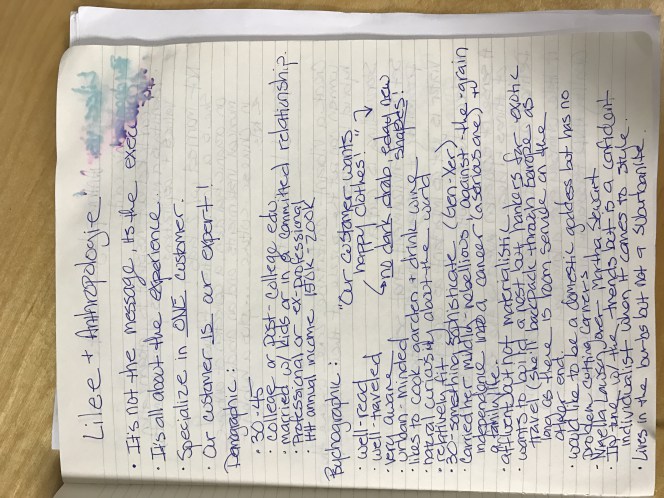
My first step was to sit down with my notebook and just starting writing down words and phrases about who Lilee “was.”

Sourcing: Some keywords about Lilee for the media kit.

This of course was all made up in my head – which is kind of the fun part, really. Sure, you have to do your research about what the market will bear – like my knowing that there weren’t many boxes out there at this price point/renewal schedule but, YOU get to decide who your target customer is. (This can of course, change over time, but that’s another blog post altogether!)

Once I had these ideas down on paper, I read them over a few times and honestly, I just sat there for a while letting it all digest. Then, it occurred to me that I should start thinking about where Lilee would shop – I mean, if I knew that, it might be easier to figure out which products should go in the box, right? This is when my “aha” moment happened. After writing down stores like Nordstrom and West Elm, I wrote down Anthropologie – and I seriously felt my heart rate skyrocket! Of course! Lilee should be like getting a little dose of Anthropologie delivered to your door every month – AND, I knew that the women that shop there have the expendable income to afford the $49 a month I wanted to charge! (In the end, I added Whole Foods & a high-end spa to this list to have true mix of lifestyle items.)

Then, the research began. I started looking online for everything I could find about Anthropologie; I needed to know who their target customer was – her demographics, her psychographics, what her daily activities were, if she was married…did she have kids? Luckily for me, I came across a stellar interview with the founder of Anthropologie that had literally ALL of this information included – HOORAY!

The demographics/psychographics from Anthropologie.

Step 2: Formalizing your thoughts.

While there’s a TON more to this part of the story (that I promise to share at a later date), my next step was to take all the chicken scratch from my notebook and make it into something presentable. …and thus, the first Lilee “one sheet” was born!

Here’s the first rendition of the Lilee one sheet:

Page 1 of the Lilee one sheet.

Page 2 of the Lilee one sheet.

Step 3: Figuring out what you have to offer.

Next, I knew that I would need something to offer these new partner brands. I was, of course, asking them to work with me on pricing when I, in essence, had very little to offer in return. Despite being new, we’d already started our pre-launch campaign and our socials – so there was at least something available for them to see that Lilee was a real, thought-out concept – and a place for me to share their story with our followers.

Here’s the little blurb that I included with the one sheet when I was emailing potential partner brands back after our initial phone call:

Lilee always features full-size items and the only requirements are that they fit with the monthly box theme and in a 6″ X 10″ x 4″ box. While you’re always welcome to donate product, we do have a budget with which to help cover some, if not all, of your production cost(s) – our standard spend is typically around 85% off MSRP. We ask for product to be in our Houston, Texas warehouse by the beginning of your feature month and boxes typically ship on the 15th of each month.

We are currently sourcing for our first box with the expectation of at least 50 subscribers the first month and growing.

Included Lilee Marketing

  • Product listing on the Lilee enclosure card with custom informational copy and brand-specific social media hashtag.
  • 1 tutorial or infographic on the Lilee blog – if applicable
  • Inclusion in 1 box-specific email blast – listed with other brands.
  • 1 Instagram post.
  • 1 Facebook post.
  • 1 Tweet
  • One Facebook giveaway (product donation required).
  • Brand acknowledgement and promotion via our blogger affiliate network.
  • Management of all social media postings and interaction with followers/subscribers.

Supplemental Lilee Marketing Offerings:

Pay for play or in exchange for competitive pricing.

  • Special brand-specific feature with 1 – 5 of our blogger affiliates (product donation required).
  • A second month of the following features:
    • 1 Tutorial or infographic
    • 1-2 Instagram Posts
    • 1-2 Facebook Posts
    • 1-2 Tweets
  • Additional Facebook giveaway(s) (full-size product donation required).
  • Boosted Facebook posts.

Step 4: Make it all into something eye-catching!

Eventually – as Lilee was gaining traction, and subscriptions, I worked with my graphic designer to create an actual media kit that I could share with the vendors I was sourcing from. This time around, we had some influencers on the books as well so, I added them into the mix.

Here are some of the highlights from our final media kit:

The "What is Lilee" page from the media kit.

Information about the actual Lilee box from the media kit.

Some of the social influencers for Lilee.

Lilee demographics.

Now, get out there and get your media kit started!

Comments or questions? Leave them below.

07 Mar 17:00

3 Awesome B2B PR Methods That Will Attract High Quality Leads

by Wendy Marx

3 Awesome B2B PR Methods That Will Attract High Quality Leads

What is the goal of your B2B PR? Many would say that the primary objective is to create buzz and awareness around your company. Yet, it plays many more vital roles that are easy to overlook. One is getting B2B leads.

Are you tired of chasing sales leads that aren’t all that interested? Do you want more qualified sales leads that need what you’re selling and who will create larger revenue for your company?

You’re in good company.

According to a recent survey, 32% of digital marketers said their greatest challenge was delivering quality sales leads — with second place at 16% going to delivering enough leads.

How can your PR efforts help you to consistently deliver high quality B2B leads? Let’s look at 3 tools that you can pull out of your PR toolkit to get the job done right.

The Perfect B2B PR Toolkit to Getting B2B Leads

1. Press Releases

What are press releases? There are enough opinions flying around about press releases to confuse the heck out of you. Some strongly believe press releases have passed their expiration date. While others go though shenanigans to reinvent them. Here’s the blunt truth. To ignore press releases is to lose out on the power that they provide to PR efforts.

First, let’s consider press releases as used today. Releases are a tool for an organization to announce a product launch or other news. To fit the demands of press release best practices, your release needs to include the following:

  • A headline that catches people’s interests, especially on social media
  • An exciting subject matter
  • Relevance to people’s busy lives
  • Simple, uncomplicated language that is easy to follow
  • A call-to-action
  • SEO optimization
  • Contact information

How do press releases increase quality leads? There are three main reasons press releases are ideal for lead generation. First is their authority. Press releases coming directly from an organization, give the cachet of crediblity to the information being shared. Second, their sharability — press releases are meant to be shared, cited from, and reproduced across social media and other sites. Third is their ability to drive traffic to your site with engaging call-to-actions.

With authoritative, sharable and enging information, the press release is an ideal way to reach more people.


2. White Papers

What are white papers? Each industry may have its own definition of white papers. For general PR purposes, we like to use Hubspot’s definition: “A persuasive, authoritative, in-depth report on a specific topic that presents a problem and provides a solution.” In the end, white papers are meant to educate an audience about issues they face and ways to resolve them.

White papers typically are at least six pages in length, with a title page, table of contents, and introduction. They provide more meat than eBooks or blog posts, and are meant for serious reading by people involved in the industry.

How do white papers increase quality leads? In a recent survey of digital marketers across several fields, 40% said that white papers produce the most revenue. Why is that? Consider for a moment the complicated and in-depth nature of white papers. Who reads them? People who are serious about and invested in the industry and want helpful answers. These aren’t casual buyers. They are usually further along in the buying cycle, making them a more qualified sales lead.

White papers can help create the perception of a company as a credible, trustworthy industry authority. When someone is ready to buy, it is more likely the prospect will go to the company whose educational matetrials he’s read and valued.

Once they have clicked, you need to engage them with a summary of the paper. –Mike Volpe

The following is a white paper produced by Adobe about Global Insights on Document Security. True, not a page turner for the average Joe, but for those in the business, it provides important information on document security.

Adobe White Paper Example of great B2B PR.

3. Industry Speaking Engagements

What are industry speaking engagements? Speaking engagements come in all shapes and sizes — from small local business gatherings to large, televised TED talk-type conferences. For the purpose of lead generation, aim to become a speaker at an industry-specific event. Public speaking at these industry events can be a large door to other opportunities beyond lead generation, so it’s a valuable investment of your time.

Remember, the purpose of a speaking engagement is to educate your audience, not to sell. People are tired of being the target of a sales pitch. So instead, focus on gaining credibility and authority with your audience.

There are several ways to get more speaking engagements. You could…

  • Network with other speakers in your industry
  • Add a speaking page to your website that outlines your expertise and availability
  • Reach out for smaller speaking engagements in your local area
  • Offer to speak for free
  • Create thought leadership quality content

How do industry speaking engagements increase quality leads? Speaking engagements are a great way to come out from behind that cold company exterior, and allow people to see you and your expertise. When people hear you speak, they feel more engaged, they see your expertise first hand, and your credibility grows in their estimation.

Of course these PR methods aren’t the only ones in your toolbox. However, they are three key ones that you will want to invest in.


Key Points to Keep in Mind…

  • Press releases need to be authoritative and sharable if they are to effectively reach a wide audience.
  • White papers show you off as a credible authority in your space, and are usually downloaded by high quality, ready-to-buy sales leads.
  • Speaking engagements are meant to educate the audience, not serve as a sales pitch.
  • Speaking engagements help to bolster you as an authority in your space and provide a captive audience

These B2B PR tactics require time and work on your part, but think of them as an investment. As time goes on, your Investment will pay off in high quality B2B leads ready to buy since you will be top of mind.


06 Mar 17:20

20 Creative Spring-Themed Sales Email Templates to Use

by afrost@hubspot.com (Aja Frost)

Last spring, I was hired to write emails for a client’s product launch promotion. Their last spring sale email campaign had bombed — open rates barely broke single digits, and their “fresh start” messaging got lost in a sea of similar sale emails. My job was clear: Write emails that people actually notice, open, and reply to.

So, I started digging into the client’s old emails. I looked for patterns that fell flat: vague subject lines, impersonal openings, zero context about the reader or their needs. Then I rewrote every piece, focusing on specifics — real reasons to act now, details about the offer, and lines only this client could send. Instead of guessing, I A/B tested subject lines and tracked what actually got opened and what disappeared.

I don’t have guarantees or magic formulas — just the strategies that got buy-in from my clients and got real prospects to reply.

This guide includes the templates and messaging upgrades I now use for spring sale email campaigns, plus clear pointers on what makes each one actually work.

Download Now: 50 Sales Email Templates  [Free Access]

Table of Contents

Spring Email Subject Lines

No matter how good your offer is, if your subject line falls flat, your spring campaign goes nowhere.

Here are some spring email subject lines I’ve tested and saved over the years, organized by occasion — all designed to stand out in crowded inboxes this season.

General Springtime Subject Lines

  • Fresh season, fresh deals inside
  • Spring’s here — ready to do something new?
  • Don’t just clean — refresh your workflow this spring
  • Shake off winter with a little inspiration
  • What’s blooming for you this April?
  • Let’s get growing: New ideas for your spring goals
  • Ready to try something different this season?
  • Spring into action (for real this time)

list of spring email subject lines, general springtime subject lines

Spring Sale Subject Lines

  • Our spring sale starts now — missing out would sting
  • Pop-up savings: open before the sun sets
  • 3 days only: spring fever discounts
  • Early bird specials for a new season
  • Flash deal: spring’s best offers inside
  • Get your cart ready for spring clearance

list of spring email subject lines, spring sale subject lines

Holiday & Occasion Subject Lines

Mother’s Day

  • Make her smile this Mother’s Day (without breaking the bank)
  • For all the moms who need a real break
  • Thoughtful gifts, just in time for Mother’s Day
  • Find the perfect Mother’s Day surprise

St. Patrick’s Day

  • Feeling lucky? Open for a green surprise
  • Don’t press your luck — grab this St. Patrick’s Day deal
  • Celebrate St. Pat’s: our handpicked favorites
  • Shamrocks, savings, and spring vibes

Easter

  • Hidden Easter deals just for you
  • Hop to it: limited-time offers inside
  • Easter eggs aren’t the only surprise today
  • Celebrate Easter — and new beginnings

Earth Day

  • Greener choices for a better spring
  • Give back this Earth Day — here’s how
  • Make an eco-friendly move this April

Spring Event & Last-Chance Subject Lines

  • Last call for spring savings!
  • RSVP: Spring’s best virtual events
  • You’re on the list for our spring preview
  • Spring’s almost over — did you catch this?

list of spring email subject lines, spring event & last-chance subject lines

Prospecting Email Templates

Now that you have some subject lines to pull from, below are a collection of email templates you can use to contact new prospects. HubSpot also offers sales email templates and a free email template builder to help you create your own.

1. Back to the Future

Subject Line: It’s [today’s date], 2026. Is your [X strategy] where you want it?

Hi [prospect name],

It’s one year from now. How did [prospect’s company] address [X pain point, Y opportunity, Z strategy] this spring?

If you’re not sure what changed — or what should’ve — I’ve got a few ideas you might want to consider. Interested?

[Your name]

Here’s why I use this template: I use this forward-looking approach to get prospects thinking past their daily routine. It’s concrete, not gimmicky. And it forces decision-makers to picture the cost of inaction. For the best results, I personalize “pain point” and “strategy” using details pulled from recent company news or LinkedIn.

My tip: Don’t end with a hard sell. Just open the door to a new conversation about what’s possible next spring.

2. A Good Read

Subject Line: One book that solved [challenge] for my clients

Dear [prospect name],

Did you know March 2 is Read Across America Day? For clients in your field, I often recommend books that offer sharp, actionable advice, such as [Title].

The section on [chapter Y or key topic] could directly impact how you tackle [relevant challenge or opportunity].

If you want a rundown of the best takeaways — or want to swap recommendations — let me know.

Best,

[Your name]

Here’s why I use this template: I reference a real occasion to stand out in a cluttered inbox, but the value comes from making the recommendation specific. I always tie the book to something recent or relevant in the prospect’s business (not just to a general problem). The more precise the advice, the more likely I am to get a genuine reply.

My tip: Only recommend a book you’ve actually read and can explain why it’s relevant. Real insight beats surface-level flattery (plus, some readers can tell when you’re just grabbing titles off a list).

3. Watching the Clock

Subject Line: Lost an hour? Here’s how [other companies] get time back

Hi [prospect name],

Did you remember to change your clocks this week? I know how losing even an hour can throw off your schedule.

If you’re looking for quick ways to regain some time, especially around [specific business process or task], I’ve put together a few practical ideas that have worked for clients like you.

Want the quick list?

Cheers,

[Your name]

Here’s why I use this template: I use this every year around daylight saving time — it’s timely and relatable, but I always make the value clear. I mention a real process or pain point so the reader knows I’ve done my research. If you want a reply, keep your “quick list” genuinely short and actionable.

My tip: Don’t just tease — have real tips ready to go when they respond.

4. New Season, New Strategy

Subject Line: Fresh quarter, smarter play—what’s your strategy for Q2?

Hi [prospect name],

I don’t know about you, but by the time Q2 rolls around, my clients are always looking for an edge—especially when launching new campaigns or tackling tough projects.

For teams in your industry, one move made all the difference last spring: [quick, specific action or approach].

If you’re open to it, I’m happy to share what worked (and what I’d skip next time).

Should I send details?

Thanks,

[Your name]

Here’s why I use this template: It’s grounded in real seasonal timing, but it’s also business-focused, not just another “spring is here” line. I always reference actions I’ve seen work in their vertical, which helps move the conversation forward.

My tip: Offer to share both wins and mistakes — the transparency builds trust and often leads to an honest reply.

5. Congratulations on Your Success

Subject Line: Noticed your recent win — what’s next for \[prospect’s company\]?

Hi [prospect name],

I saw the news about [recent win, big client, press feature, etc.] at [prospect’s company]. Congrats—those results take real work.

When my clients hit a milestone like this, they’re usually thinking about what the next quarter should look like. One common move: shifting focus to [related strategy or opportunity].

Ever considered that direction?

If you want to chat through what’s worked for others after a run like yours, I’m here.

Best,

[Your name]

Here’s why I use this template: I send this when I want to prove I’m paying attention versus spamming out generic praise. The key is referencing a real achievement, and then showing I know the next challenge that often comes up.

My tip: Look up the latest company announcements or press before hitting send — specific details make your outreach credible.

6. Theory vs. Practice

Subject Line: Turning “good in theory” into ROI this spring

Hi [prospect name],

A lot of teams talk about solving [X pain point] every spring—easier said than done, right?

Over the last year, I’ve seen a handful of companies move from “good in theory” to real, measurable results. If you’re interested, I’m happy to share the exact playbook.

Want me to send what’s working this quarter?

Best,

[Your name]

Here’s why I use this template: I use this when a prospect is stuck between knowing what they should do and actually getting it done. Focusing on results, rather than fluffy theory, shows you respect their time.

My tip: Link the “playbook” or advice to an outcome they care about (new customers, reduced churn, etc.) to make your email irresistible.

7. A Groovy Tune

Subject line: Here comes the sun — is your strategy ready for spring?

Hi [prospect name],

The clocks are changing and so are the market conditions — are you updating your strategy for spring, or letting last season’s plan carry you through?

I just finished reading [relevant resource] on [topic], and there’s one section that made me rethink my approach to [pain point or key goal].

If you want the quick takeaway or want to swap notes, just let me know.

Cheers,

[Your name]

Here’s why I use this template: This template works because it ties a timely reference to a resource — not just a song lyric for fun. I always point prospects to something actionable, and I’m specific about what I learned from it.

My tip: Call out which chapter or section matters for them — the more direct the connection, the more likely you’ll spark a real conversation.

8. The Right Place at the Right Time

Subject Line: Spring is the perfect time — are you rethinking your [business area]?

Hi [prospect name],

Spring is when I see the most leaders reevaluate their [business area] strategy, especially after a busy Q1.

One of my clients in your industry just revamped their approach and immediately saw results in [specific metric or outcome].

If you want to see what steps made the most difference, I’m happy to share the playbook.

Interested in seeing what worked?

Best,

[Your name]

Here’s why I use this template: I use this template to connect seasonal timing to real, measurable change — not just “spring cleaning” for the sake of it. The reference to a client’s results gives my message credibility and makes it personal.

My tip: Include a number or tangible result if you have it — specifics beat generic “improvements” claims.

9. Follow That Rabbit!

Subject Line: Down the rabbit hole — handpicked resources based on your interests

Hi [prospect name],

I noticed you’ve been diving into our posts on [topic of interest] — love when someone goes deep. If you want to really get to the good stuff, here are three articles that always spark better questions and more creative ideas:

  • [Blog Article 1]
  • [Blog Article 2]
  • [Blog Article 3]

Let me know if you'd like more resources or have any questions. I spend a lot of time curating this material for clients working on projects like yours.

Regards,

[Your name]

Here’s why I use this template: This approach stands out because it’s not just a content dump — every link I send is tailored to what I see the prospect reading. I never send stuff I wouldn’t bookmark myself.

My tip: Don’t be afraid to recommend outside resources if they’re genuinely useful — it shows you have your finger on the pulse (not just your own content calendar).

10. Temperature Whiplash

Subject Line: Still feels like winter? Let’s heat up your retention numbers

Hi [prospect name],

They keep telling me it’s spring, but somehow it still feels like winter outside — and if there’s one thing I’ve learned, it’s that “waiting for the season to change” is a tough strategy for retention.

That’s why now is the time to focus on boosting customer renewals. I’ve seen clients increase member renewals by 20% just by making one tweak to their outreach in the off-season. Want the details (and a couple more quick ideas for warming up retention, even when the market’s cold)?

Let me know and I’ll share what’s actually working.

Thanks,

[Your name]

Here’s why I use this template: This template is all about timing — I use it when clients are feeling stuck or when results have plateaued. If you reference a specific retention stat or tactic, make sure it’s something you’ve seen work.

My tip: Use a light touch and address the “seasonal slump” head-on — most prospects are thinking it, but few will say it.

Follow-Up Email Templates

Are you trying to keep a deal moving forward or strengthen a relationship? These follow-up emails help you check in without being annoying or pushy.

1. Getting a Good Season's Sleep

[Prospect name], I'm pretty sure I know …

… why you haven‘t been in touch — you’ve been hibernating for the winter.

Now that spring is here, are you interested in picking up our conversation about [solving X pain point, taking advantage of Y opportunity] again?

Thanks,

[Your name]

P.S. I came across this [article, newsletter, infographic] the other day I think you‘ll like because it [reason why it’s relevant to prospect].

Here’s why I use this template: I use this when the trail’s gone cold and I want to gently nudge a prospect out of “sleep mode.” The lighthearted opener lowers resistance, and the P.S. makes it easy to re-engage with something genuinely useful.

My tip: Tie the extra resource directly to their last interest or challenge — it shows you listened.

2. Some Mistakes Are Worse Than Others

Subject line: Quick fixes for [pain point] this spring

Hey [prospect name],

Forgetting to wear green on St. Patrick's Day is one thing, but letting [paint point] go unresolved is a little more serious. Here are two ideas you might consider trying:

  • [Actionable suggestion #1]
  • [Actionable suggestion #2]

If you'd like more details on how to execute those, just give me a shout.

Best,

[Your name]

Here’s why I use this template: This is how I reconnect with prospects when I know their pain point hasn’t gone away just because they went quiet. I get specific about what’s at stake, then offer real solutions I’ve seen work — not just theoretical advice or a sales pitch.

My tip: I always include at least one suggestion I know they can test within a day — quick wins spark more replies.

3. A Missed Connection

Subject Line: Sorry we missed each other — here’s what I had planned

Hi [prospect name],

Maybe I should have brought my shamrock to work today — I wasn't able to connect with you at [planned time]. I was planning on covering [topic #1] and [topic #2]. To catch you up, here are some helpful resources:

  • [Link #1]
  • [Link #2]

If you‘d like to try again, here’s a link to my calendar: [Link].

Cheers,

[Your name]

Here’s why I use this template: I use this when a meeting gets bumped or a prospect goes quiet right before a call. Summing up what they missed — and offering something valuable right away — keeps the door open and helps me avoid sounding pushy or frustrated.

My tip: I always include a low-pressure option to reschedule, so they can engage on their own terms.

4. Spring Renewal

Subject Line: Renewal season — ready to talk next steps?

Hello [prospect name],

‘Tis the season of fresh foliage, new blooms ... and account renewals! Based on our previous conversations, it sounds like you’re happy with the returns you're seeing with us.

Are you ready to talk about renewing your contract? If so, I‘ll send the paperwork right over. We’d be honored to earn your business for another year.

Thanks,

[Your name]

Here’s why I use this template: I send this once a client has seen clear value and our check-ins have been positive, not out of the blue. Keeping it light, direct, and easy to respond to always gets better results.

My tip: I personalize the “returns” reference with a specific win we discussed, so the renewal feels like a natural next step.

5. Testing the Water

Subject Line: Recycling old connections — ready to give this another go?

Hey [prospect name],

Spring has me thinking about recycling — not just paper and plastic, but conversations that deserve a second chance.

I’m reaching out because sometimes the timing just isn’t right on the first try, and I’m always up for revisiting good connections to see if things have changed.

If you’re open to a quick chat, you can grab a spot here: [Insert calendar link]. If not, no worries — we’ll always have last spring.

Thanks,

[Your name]

Here’s why I use this template: I like this for reconnecting after a long break — referencing “recycling” makes it relevant for spring and keeps the tone friendly and unforced.

My tip: Remind the reader that the door is open either way — lowering pressure is what gets replies.

Breakup Email Templates

Sometimes you need to close the loop. Here’s how I reach out one last time when a prospect’s gone quiet.

1. Rinse and Repeat

Subject Line: Are my emails starting to feel like Groundhog Day?

Hey [prospect name],

February 2 has come and gone, but I'm starting to worry my emails to you are making you feel like Phil Connors in Groundhog Day.

No one wants to relive the same experience over and over. If [solving X challenge, exploring Y opportunity] is no longer a priority, please let me know and I'll stop reaching out.

Thanks,

[Your name]

Here’s why I use this template: I pull this out when it’s time to break the pattern — referencing the movie keeps it light, while the close-the-loop request gives the prospect an easy out.

My tip: Keep the tone casual and honest. Remind the reader you’re not looking to annoy, just to get clarity.

2. Starting Fresh

Subject Line: Spring cleaning: is this still on your radar?

Hi [prospect name],

I‘m spring cleaning my files and saw you hadn’t responded to my calls or emails in a while. Are you still considering [doing X, solving Y]? If not, I won't reach out again.

Thanks,

[Your name]

Here’s why I use this template: This is my go-to for closing the loop without drama. The seasonal reference gives context, but the main point is respecting their time — and yours.

My tip: Make it easy for the prospect to reply honestly, even if the answer is “no thanks.”

3. Spring “Break”

Subject Line: Need a spring break from my emails?

Hi [Prospect name],

I haven‘t heard back from you in a while. I hate to part ways before you’ve heard how I can help you [increase X, decrease Y], but I understand that now might not be the right time.

If you‘d like to keep our conversation going, please respond to this email. If not, no problem. I’ll simply assume we're on a break :)

Thanks,

[Your name]

Here’s why I use this template: I use this when it’s time to bow out gracefully. The “spring break” phrasing keeps things light, while making clear they’re in control of next steps.

My tip: End on a positive note — you’re not burning a bridge, just stepping back until the timing’s right.

4. So you‘re saying there’s a chance?

Subject Line: Is the sun setting on us, or is there still a chance?

The days are getting longer and the sun is setting later, so I thought that might give us a little more time to discover whether [Your company] can help [Buyer's company].

I‘d love to tell you how I’ve helped similar companies increase their D&I recruiting by up to 55%. If this sounds like something you're interested in, you can book time on my calendar here: [Link to calendar]

Thanks,

[Your name]

Here’s why I use this template: This template works when you’re hoping to get a clear answer without adding pressure — the seasonal reference softens the ask and primes the prospect for a genuine response.

My tip: Reference a result or benefit you’ve delivered to similar clients to make your offer feel real.

5. One Last Time

Subject Line; I’m allergic to sales emails, too

Hi [prospect name],

Fresh blooms aren’t the only things giving me allergies this year — salesy emails have been out of control lately. It looks like our previous conversation got lost in the shuffle and I wanted to reach out one more time.

Do you still need support with [doing X, solving Y]? If so, I’m happy to help. You can book time on my calendar here: [Link to calendar]. If I don’t hear from you by next week, I’ll stay out of your inbox.

Thanks,

[Your name]

Here’s why I use this template: I reach for this when I want to make a clean break — it’s honest, low-pressure, and keeps the door open for future conversations.

My tip: Make it easy for the prospect to reply or re-engage later — don’t force a decision if they’re not ready.

Spring Email Signatures and Sign-offs

Sign-offs shouldn’t be an afterthought. The right signature ties your message together, sets your tone, and leaves a lasting impression — especially in the spring when everyone’s inbox is full of sales noise.

Here are signature lines I use or tweak for seasonal campaigns, organized by vibe and occasion.

spring email signatures and sign-offs

General Springtime Email Signatures

  • Wishing you a fresh, productive spring
  • Here’s to new starts and open windows
  • Sending a little spring energy your way
  • Enjoy the longer days ahead
  • Hope this season brings you something new

Spring Sale/Promo Email Signatures

  • Looking forward to helping you grow this season
  • Here’s to great results — and even better deals
  • Blooming with ideas if you need more
  • Ready to make spring your best quarter yet
  • Thanks for letting us be part of your spring

Holiday & Occasion Email Signatures

Mother’s Day

  • Wishing all the moms out there a wonderful day
  • Send my best to the moms in your world
  • Celebrating mothers with every message
  • Honoring all the moms making a difference
  • Hope Mother’s Day brings you something to smile about

St. Patrick’s Day

  • Sending a bit of luck your way this spring
  • May your inbox — and your day — be lucky
  • Here’s to a little extra green in your week
  • Hoping fortune finds you this season
  • Cheers to lucky breaks and brighter days

Easter

  • Wishing you a bright (and easy) Easter
  • Hope you find something special this season
  • Enjoy the holiday and everything it brings
  • Hopping into spring with best wishes
  • May your Easter basket (and inbox) be full of good things

Earth Day

  • For a greener spring,
  • Here’s to new growth — and better choices
  • Small changes, big impact — happy Earth Day
  • Wishing you a more sustainable spring
  • Thanks for caring for the planet with us

Playful & Lighthearted Email Signatures

  • Signing off with a little spring in my step
  • Hoping your week’s as bright as a field of tulips
  • Off to do a little spring cleaning — let me know if you need help
  • Sending sunshine from my (open) window
  • Time to smell the flowers — or at least hit “send”

Mix and match or modify these as needed — the right closer makes every message more memorable.

Make Your Emails the First to Spring Open

Every spring, my clients want something different, but the challenge is always the same: Get their message opened, read, and answered. That rarely happens with generic content. What works for me is clear: specific subject lines that create interest, templates grounded in real experiences, and authentic sign-offs that feel like an actual person wrote them.

I don’t hit send unless I can say why each line is there. My best results come from trying new approaches and being direct about what the reader gets if they reply.

My advice? You don’t have to overhaul everything at once. Try one subject line, swap in a new signature, or rework a single paragraph in your next campaign. Notice what gets a real response, and keep going from there.

Editor's Note: This post was originally published in 2017 and has been updated for cohesiveness.

06 Mar 17:20

Y Combinator is a waste of time—unless you do THIS

by steli@close.io (Steli Efti)
y-combinator-paul-graham-family.jpg

Is Y Combinator worth it? It’s funny: You can ask two totally different YC alumni that question and get two totally different answers, even if they both attended the same batch.

How’s that possible? Why is it that, for some startups, Y Combinator makes a difference; while for others it makes all the difference? Trust me: It’s not coincidence, luck, or privilege.

I’d know: At Close.io, we owe a huge part of our success to Y Combinator. The lessons learned, resources gained, and relationships built during YC W11 were instrumental in both our initial traction and our continued growth.

So yeah, if you ask me, Y Combinator’s worth it—if you take the right approach. Because at the end of the day, thriving in the YC environment isn’t about having the best idea, the most disruptive product, or the smartest team. It’s all about having the right attitude.

More than any other factor, your mindset determines how much value you take away from the YC experience. If you’re willing to invest the (substantial) time and energy required for Y Combinator, you owe it to yourself to take an extra 10 minutes to read this article and make sure you’re setting yourself up for success.

Grow your startup with a free copy of From 0 to 1000 Customers & Beyond.

YC mentality: Academics and hustlers

I’ve been a part of multiple Y Combinator batches. Once as an attendee, other times as a speaker or advisor. And every time, I was fascinated by the stark divide between attitudes.

In every batch, there are two clearly-defined startup “camps”: The Academics and The Hustlers. Both sides find value in the experience, but only one truly thrives.

Meet the Academics

The Academics view Y Combinator as “startup school.” They show up, sit down, and follow the program. Their motto is, “If I just do what I’m told, I’ll ‘graduate’ successfully.”

If there’s a dinner Tuesday at 6:00 p.m., they show up Tuesday at 6:00 p.m. If there’s a speaker Friday at 3:00 p.m., they show up Friday at 3:00 p.m. They take notes, do their homework, and follow the schedule.

And this approach works. Y Combinator’s designed to help startups, so you’ll learn a lot even if all you do is follow the program. But just “following the program” is like graduating with a “C.” Sure, you passed, but you left the majority of your education on the table.

Meet the Hustlers

The Hustlers, on the other hand, don’t leave any source of potential value untapped. They recognize YC as the resource-rich environment it is and take full responsibility for their experience. Their motto is, “We’re here to make our business successful, and we’re going to leverage every possible resource to make that happen.”

Hustlers take, learn, leverage, and ask for as much as they can. If the doors of the YC offices are open, they’re there. They know the best opportunities and most valuable introductions are rarely a part of the official “program.” After all, that program is meant to be the launching pad, not the finish line.

Channeling your inner hustler

The biggest mistake I see YC attendees make is playing it safe. If you leave the program wishing you’d spent more time with someone or gotten more help with something, that’s your fault, and no one else’s.

The YC leadership is there to help. They want you to succeed. They want you to ask questions. They want you to be proactive. But it isn’t their responsibility to make you do any of those things.

As a result, many YC attendees don’t ask questions. They aren’t proactive. And they don’t reach their full potential. But that’s good news for those that do.

Let me share three short stories to illustrate the importance of taking ownership of your YC experience; hopefully, they’ll help you make the best of yours.

“As it turns out, something opened up.”

As a relatively unknown founder, there’s practically nothing you can do to force a VC to care about your sense of urgency. I learned this lesson the hard way.

My team and I were trying to close a round of fundraising in the next two weeks, but the VC partners we needed to meet with weren’t available for at least another month.

That timeline didn’t work for us, so we sat down with Paul Graham and asked if he’d be willing to reach out to the firm on our behalf to tell them how amazing we are and urge them to prioritize our meeting.

When pg agreed, I was prepared. I pulled out my laptop, which already had a web browser open, and said, “Great! Can you do this right now?”

He did. Less than 12 hours later, we had a response from the firm, informing us they “suddenly” had an opening on their calendar in just two days.

“You’ve got better things to do, just sign it.”

Another time, I needed pg to sign a recommendation letter so I could get my visa. I’d already drafted the letter and all I needed from him was the signature. He agreed but, being the talented writer he is, wanted to re-write my draft to make it really good.

I needed that signature now, and I didn’t know how long it would take for pg (who is an incredibly busy guy) to get around to those revisions. So instead of waiting and hoping, I followed up. An hour later, I showed up at the Y Combinator office with letter and pen in hand. “Just sign it,” I said. “Just sign it. I know you’ve got better things to do.”

He did, revisions be damned, and I’m still here; so I must’ve done something right.

“These guys make shit happen.”

And yet another time, we were trying to recruit the unrecruitable by hiring Phil Freo. He wasn’t convinced, so we invited him to a YC dinner to have pg help us convince him.

He sat Phil down and said something like, “Look, these guys are weird, but they’re really effective. In fact, they’re one of the best startups in the batch, simply because they make shit happen. They’re aggressive. They’re shameless. They’re humble and open-minded, sure, but they’re intense. They don’t wait for things to happen. They make things happen.”

And to be honest? It didn’t work, at least, not at first. Although his initial answer was no, Phil ended up joining the team a few years later. I like to think pg's endorsement played a big part in that. (Thanks again, pg!)

You are your own biggest obstacle

I could share a thousand stories but, at the end of the day, it’s as simple as this: In Y Combinator (as in life), you’re going to get what you take. YC is a resource-rich environment filled with people who can and will help you; but no one there owes you anything, nor do they know what you need unless you tell them.

  • Need feedback on product design? Ask.
  • Want to get connected to investors or the press? Ask.
  • Need help recruiting? Ask.

In YC, everything you need to succeed is right in front of you (or only an introduction away). The founders who get the most value out of this program are those who know this and leverage that knowledge constantly, sometimes even shamelessly.

So ask for an unreasonable amount of office hours. Ask for off-the-wall favors. Ask for more than you expect to get.

Because remember, you’re in an environment where people want you to succeed. You aren’t doing them (or yourself) any favors by being timid. So step up, be bold, be loud, and be proactive. Know what you want, and do whatever it takes to make that happen.

Do this consistently and I promise: You’ll crush it inside and out of Y Combinator.

Hiten Shah and I love helping startups grow. That's why we want to give you a free copy of our book, From 0 to 1000 Customers & Beyond. Get your copy below.

Claim your FREE B2B customer acquisition guide

Don't enjoy reading? Watch this video where I give you advice on how to make the most of Y Combinator.

Recommended reading:

The real reason why Y Combinator is dominating the world of startups
Not sure if Y Combinator is for you? Check out this insider look at YC to determine if it’s a good fit for your team.

Hack your Y Combinator interview & get accepted
Not accepted yet? No problem. Check out these 7 hacks to ace your YC interview!

Y Combinator Sales School
YC is just the beginning. Is your startup prepared to thrive in the real world? Make sure you’ve got the sales skills to augment your education with this crash course video.

06 Mar 17:17

Why a Lifelong Salesperson Thinks Salespeople Are Unnecessary

by Bsignorelli@hubspot.com (Brian Signorelli)

bug-3.png

Salespeople are not necessary. That’s probably the last thing you expected to hear from a career salesman.

Sure, it’s easier to claim “relationships are the cornerstone of every sale” or “there is no replacement for human interaction.” Doing so would have made me more comfortable during my time as a frontline rep. It would also be a convenient, soul-warming way to think of the value my colleagues and I provide.  But it is not true.

Forrester reports that by the year 2020, 80% of the purchasing process will take place without human-to-human contact.

And no, these purchases are not all Amazon grocery orders. These days, everything from high-end automobiles to business consulting services can be purchased online without speaking to a salesperson.

Enterprise software company Atlassian has operated a touchless sales process since 2002. Without hiring a single salesperson, Atlassian grew from nothing to more than $450 million in revenue in under 15 years. More recently, we’ve seen businesses like Slack grow from nothing to a $4B valuation in just four years … without a sales team.  

When I first heard of Atlassian’s business model I was skeptical. I wondered, “How many potential customers get frustrated and lost in a touchless sales process?”

The answer is none, or at least very few. Confused buyers can reach an Atlassian team member via phone at any point during the buying process. But as Atlassian President Jay Simons noted at Startup Grind 2014, the team records where a person was in the sales process when they called for human assistance. Then a cross-functional team of marketers and engineers go to work, removing the necessity for human contact in that step of the buying process. It’s as if …

Required human interaction in the buying process is a "software bug."

Simons claims -- and I happen to agree -- that removing salespeople from the buying process decreases friction and allows the buyer to purchase when they are ready. When buyers are able buy on their own schedules, deals flow in at a steady rate instead of concentrating around the end of a month or quarter.

A great example of this is the 2013 chart of Atlassian’s average percentage of quarterly deals sold each week (below). I added the red line to show Atlassian’s linear sales cadence compared to a traditional sales model where 80% of quarterly deals are closed in the final three weeks.

Look familiar? It should come as no surprise to any sales professional that traditional sales teams close most of their deals in the final weeks of a quarter, or days in a month, because this is when sales reps feel the most urgency to hit their monthly quota. The salesperson is the gatekeeper to the purchase -- if they are unavailable, buyers cannot complete the purchase.

This model may have worked in the past -- but the internet economy has made buyers more and more impatient. A 2015 study from Fifth Third Bank found that more than half of Americans hang up the phone after being on hold for less than a minute. Imagine how many buyers are “hanging up” on drawn out, human-heavy sales processes.

But,” you might be saying, “setting up a touchless sales process requires technical tools and expertise that many companies simply do not have.”  You’re not wrong.

Recent data from InsideSales.com and the AA-ISP shows implementing sales and automation technology has been one of the five most pressing challenges for sales managers the past three years running.

This suggests automated sales is a massive opportunity for technically-minded sales consultants and sales technology implementers.

Not every business is an ‘Atlassian’

Simons is the first to admit that the highly technical persona interested in Atlassian products back in 2002 was likely more comfortable with a touchless sale than many other buyers would have been. Fifteen years later, an entirely touchless sales may still be inappropriate for certain businesses or industries.

Even today, I’m not advocating for the complete and utter annihilation of sales reps throughout the sales process. Instead, I’m advocating for opening up more self-selected paths for customers to engage with a business.  Specifically, for you to open up as many avenues for your potential customers to interact with as realistically possible, all while making the salesperson available at the right time.

In the hope of tempering my actions with wisdom, I vigorously debated this topic with Doug Davidoff at Imagine Business Development earlier this week. We ultimately agreed on a few specific use cases where human beings were of great or even extreme value in a sales process.

For example, if a business sells services (not products), it’s not quite as easy to remove human beings from a sale because there is no identical concept of "trialing" a service.  Or, if a business offers a highly complex solution -- or even just sells to a non-technical buyer who isn’t comfortable “playing” with a product -- a human-free sale likely isn’t appropriate.  

But, in the age of the internet economy 70% of adults purchase online every month. You’d be hard pressed to find a single business that could not benefit from automating certain human interaction “bugs” out of its sales process.

[NOTE - If you’re easily offended by an author talking about a concept in a post and then tying it back to the work they’re doing, STOP READING HERE.  Below, you’ll see how we’re experimenting with these concepts ourselves and building a new kind of Partner Program.]

At HubSpot, my team and I are on a mission to transform the way the world does sales. We believe that lighter, semi-automated sales processes improve both the lives of consumers and the bottom lines of businesses. But for less technical businesses, the questions of where to automate and which tools to use can be overwhelming and are best answered by a technically proficient, external sales consultant.

That’s why I’m so excited about the recently launched HubSpot Sales Partner Program. The program is specifically designed to train and support sales consultants, sales trainers, and CRM implementers as they guide businesses towards a lighter sales process backed by our sales technology.

“Human-Free” does not mean “Human-Less”

Our goal in launching this program is to support sales experts -- sales consultants, strategists, coaches, and CRM implementers -- as the business world transitions to more frictionless sales processes.  But, using ourselves as an experiment, we also want to prove a partner program can be frictionless.

That’s right, we’re taking an Atlassian-inspired approach to partnership. We want to empower businesses to partner with us on their own terms:

  • Eliminating financial barriers to entry. We don’t want financial restrictions to limit you from transforming sales with us.
  • Providing training resources on demand. Everyone learns at their own pace. Technology enables us to create trainings for partners to watch on-demand and revisit as they become relevant to their business.
  • Making humans available on demand. Rather than require partners to meet with us a specific number of times every month, we provide you with a HubSpot Meetings link that allows you to book time with a growth coach when -- and only when -- it makes sense for you.
  • Listening, really. This program is new and there are bound to be pain points. We’re collecting all the quantitative and qualitative feedback we can from partners so we can find the stumbling blocks -- and fix those bugs.  

Interested in learning more about partnership on your terms? There are a few ways to do so:

  • Speak with my Team -- You can book time with our sales partner growth coach, Sam Belt.

This post was originally published on LinkedIn

New Call-to-action

06 Mar 17:17

Writing Process: A 5-Step Formula for Creating Winning Content [Podcast]

by Jeff Korhan

Episode 54 of Landscape Digital Show reveals a 5-step formula for creating winning content that captivates your audience.


Writing Process: A 5-Step Formula for Creating Winning Content

In this episode, I’m going to share my writing process that has evolved over the years by borrowing secrets from great writers, including novelists, non-fiction authors, editors, screenwriters, copywriters, bloggers and more.

Like any other activity, writing must follow a process. It’s the only way to consistently achieve results.

Every day billions of people jump on Facebook, LinkedIn, and so many other channels to share a message, often to accomplish a business purpose. That’s usually a written message, but if it’s the spoken word like this podcast or a video, I hope at least a portion of it is first written. Why?

Some people can create amazing improv content, but they are rare.

If you doubt this, just rewind in your mind the rambling acceptance speeches of too many Academy Award winners. That’s what happens when there is no preparation, and that preparation you will discover is writing.

Whether you think you have writing talent or not, I can assure you anyone can do this better if they commit to studying and practicing to find and perfect his or her process for doing it well.

Here’s the writing process that works for me.

#1. Generate Ideas

The first, and in my opinion, most enjoyable step in any writing process is to start writing to discover new ideas worth writing about. You’re having a conversation with yourself that leads to accessing ideas that you may have long forgotten or not explored quite like they are in that moment.

This is one of the secrets of writing. By typing on those keys you are engaging your mind and body, and most likely your heart and soul too. Anyone that has not written a book may not understand this.

I know that I didn’t because I desperately wanted to write a book and it took me almost a decade to make it happen. Instead of writing to generate new ideas I was trying to create perfectly written content without doing the work of discovery.

You’ll never have everything perfectly organized, so just get started and put in the time to see what your mind, body, heart and soul come up with. And be prepared to thrash around, struggle and fail because that’s part of this too.

Trust the process and stay with it because what comes after that struggle will be the ideas for some of your best writing.

#2. Give It Structure

Once I have the thread of an idea I print it out and start looking for the structure. Typically, I’ll use a three-part beginning, middle and end structure, just like a screenwriter or playwright will use a three-act structure.

It’s a time-tested formula that always works. There are more advanced structures that I use, and that I’ve discussed in earlier episodes, but this one is foundational.

#3. Write to Completion

Now the true writing begins. And the cardinal rule is that I do not take my butt out of the seat until the article, podcast show, or chapter is complete. You’ve invested a fair amount of time to get to this point. That’s why it’s important to use that inspirational flow to go the distance.

It’s quite likely that before taking this step I’ve allowed my idea time to set, giving my conscious and subconscious mind time to work on it. This is something we all naturally do. It’s called the Zeigarnik Effect.

The mind tends to work on what’s not complete. So, you have to get started to have something, anything, that you can then take to the finish line.

It may work differently for you, but I’ve personally discovered that not writing to completion is like swimming halfway across a body of water. Turning around means starting over again.

#4. Take Time to Edit

Editing to most people means fixing misspellings and typos. Clearly, that has to be done but there is much more to it. Since most of the content you create will be published somewhere online, you have to ask yourself if you have been true to the theme that is represented by the headline or title.

Often I will find that I can come up with a better headline. After I do, I’ll usually have to eliminate, reorganize or rewrite some of the content. Then, I’ll create subheadings or improve those that I already have.

After that, I’ll scrutinize the paragraphs to make them as tight as possible. This includes breaking out key sentences that can stand on their own, thereby giving them more punch and making them retweetable.

Finally, everything has to pass a visual test for look and feel. People don’t read nowadays as much as the skim content for meaning. So keep your paragraphs short, usually no more than three sentences.

And be sure to highlight key phrases and sentences in some way. They can be bolded, italicized, numbered, or featured in a call-out box.

Congratulations. You are done, except that you aren’t.

#5. Rewrite, Reformat and Repurpose

If you haven’t heard the term writing is rewriting, get comfortable with it because that’s what should follow the initial publishing of your content.

A lot of people publish and stop. No, no, no, no, no.

You have to now publish your content in multiple formats to adapt to the desired learning or discovery preferences of your respective audience members.

The good news is each writing iteration makes your content that much better. Trust me, this phase of the process often will take on a life of its own that can go on for weeks, months, even years. And it should.

Think of this as a dialogue with your audience that never stops. If it does the relationship with that audience of customers, influencers, and potential buyers falls apart. This is why I go back to my archives to take earlier content and make it more relevant to my audience today.

Rewriting, reformatting and repurposing are more work, but it’s truly where the magic happens. Sadly, most people skip this step in favor of chasing new ideas.

Ideas become what they want to be at a particular moment in time, but they cannot get there on their own. You have to be the guide by rewriting them.

Call to Action

The call to action for this episode is to take my 5 step writing process and test it against yours. If you don’t have a reliable process make mine your own and borrow from those of other writers.

If you don’t have a reliable process make mine your own and borrow from those of other writers by exploring the links listed in the show notes.

06 Mar 17:14

Sales Prospecting: 43 skills, tips, techniques, templates, & tools to succeed

by cdavies@hubspot.com (Cambria Davies)

Let’s get one thing straight: Prospecting isn’t the glamorous part of sales. It’s not where you close deals, earn high-fives, or ring the gong. But if you skip it or do it half-heartedly, none of those other moments happen.

Download Now: Free Sales Prospecting Guide + Templates

I’ve done over 11,000 cold calls and booked hundreds of meetings. I’ve helped founders land their first five clients and enterprise reps break into global accounts. And across every industry, one truth holds up: Consistent prospecting is the lifeblood of the pipeline.

This guide isn’t theoretical. It’s a battle-tested playbook full of what actually works, from sharpening your targeting to choosing the right tools, crafting emails that get replies, and building daily prospecting habits that drive results. Whether you’re a solo founder or a tenured AE, if you want to prospect like a pro, this is for you.

Let’s dig in.

Table of Contents

What is prospecting?

Prospecting is the process of initiating and developing new business by searching for potential customers, clients, or buyers for your products or services.

Prospecting is the front line of every great sales engine. It’s the work we do before the deal, when there’s no pipeline, no momentum, and no reply yet. It’s the process of identifying the right people, starting the right conversations, and opening doors that lead to revenue.

But here’s what I’ve learned after years of outbound: Effective prospecting isn’t about spray-and-pray lists or robotic outreach. It’s about relevance. You’re not just looking for anyone with a title; you’re looking for real people with real problems you can solve. And that means combining strategy, tools, and a lot of discipline to consistently surface high-fit leads and spark meaningful engagement.

Done right, prospecting doesn’t feel like an interruption. It feels like insight delivered at the right moment.

Why is sales prospecting important?

Because no matter how great your product is, it won’t sell itself — not in this market. Prospecting is the proactive engine behind revenue. It’s how you stop waiting for leads and start creating opportunities.

When I’ve skipped prospecting, I felt it in the pipeline two weeks later: fewer calls, fewer closes. But when I stay consistent, I don’t just fill the funnel — I fill it with people actually likely to buy. According to RAIN Group, top performers who prospect consistently generate 2.7x more meetings than their peers. That’s not luck, that’s intent paired with execution.

Prospecting also gives you a strategic edge: You’re not just reacting to inbound interest. You’re setting the tone, identifying fit, and creating value before your competitors even get a chance.

Lead vs. Prospect

Let’s clear up one of the most common misunderstandings in sales prospecting: the difference between a lead and a prospect. I’ve seen even experienced reps confuse the two, and it matters more than most people think.

A lead is anyone who’s shown some kind of interest. Maybe they downloaded a whitepaper, visited your pricing page, or signed up for a webinar. But at this stage, they’re still a question mark. You don’t know if they’re the right fit, or even seriously considering a purchase.

A prospect, on the other hand, is a lead that’s been qualified. That means you’ve done your homework: checked the company size, role relevance, industry alignment, or maybe even identified a problem your product could solve. You’re not just guessing anymore. You’re reaching out with intent.

Here’s how I think about it: A lead is a name. A prospect is a possibility.

Let’s say you sell workflow automation software for mid-sized logistics companies. A high school student downloading your ebook on time management? That’s a lead. But the operations director at a 500-person logistics firm who opened three of your emails and visited your product tour page? That’s a prospect worth your time.

Understanding this difference is what separates spray-and-pray sellers from consistent closers. Your prospecting time should focus on the latter. That’s how you build a reliable, scalable pipeline without burning out.

How to Prospect Effectively

Prospecting isn’t about blasting messages or chasing anyone with a pulse. It’s about being intentional. Before I ever reach out, I ask myself: Is this person the right fit? Do I have a reason to contact them beyond just hitting a quota? I don’t rely on templates or mass-blast tactics — I personalize every message based on real signals, such as a hiring spree, funding news, product launches, or even something they posted online.

I’ve learned that the strongest responses come from outreach that feels like a conversation already in motion, not a pitch out of nowhere. That means showing I’ve done my homework, being brief, and making the value obvious in the first few lines. And once I send that first message, I don’t stop there. I revisit what worked, iterate, and optimize constantly.

Effective prospecting is less about hustle, more about precision. It’s the art of relevance: reaching the right people, at the right time, with the right message.

1. Research your prospect and their business to gauge whether you can provide value.

I’ve never believed in blind outreach. If you’re guessing, you’re losing. Real prospecting starts with context, not a pitch. Before I ever hit send or pick up the phone, I immerse myself in the prospect’s world. What do they sell? Who do they serve? What’s changed recently? What’s broken? These are the questions that drive everything I do.

I treat the research phase like reconnaissance before a mission. I’m scanning LinkedIn for role changes or hiring sprees that signal growth. I’m checking the company’s blog or newsroom to understand what’s top of mind for their leadership. I’ll even look at Glassdoor reviews if I’m trying to get a read on internal culture or operational friction. And if I see they’ve just raised funding or adopted new tech, that’s a signal, not just of opportunity, but of timing.

But here’s the trick most reps miss: I’m not just collecting data, I’m connecting dots. I’m looking for alignment between their strategic priorities and the problems I know how to solve. If I can’t find that overlap, I don’t reach out. Because when you reach out without relevance, you erode trust before you even get a reply.

Prospecting is not about volume. It’s about precision. And that precision starts here, with the discipline of researching like someone whose time actually matters. Because it does. And when you treat your prospect’s time with that level of respect, you earn the right to have a real conversation.

2. Prioritize your prospects based on their likelihood of becoming customers.

Not all prospects deserve the same amount of your energy. I learned that the hard way early in my career, spending hours chasing logos I thought were impressive but had no urgency, budget, or pain. Just because someone looks like your ideal customer on paper doesn’t mean they’re ready to buy — or even willing to talk. So I stopped treating every lead equally and started qualifying like my calendar depended on it.

Prioritization isn’t about guesswork; it’s about pattern recognition. I look for signals that indicate buying intent: recent funding, job postings in key departments, LinkedIn activity from decision-makers, or a tech stack change that aligns with our solution. I tag these prospects as “active,” and they go to the top of my list. If a company fits our ICP but shows no movement, I keep them warm in a nurture sequence but don’t spend time crafting custom messaging just yet.

Scoring Potential Prospects

Let’s face it, not every lead deserves the same amount of attention. When your pipeline fills up, your time becomes your most valuable asset. That’s why having a prospect scoring system isn’t just “nice to have” — it’s your filter for clarity, speed, and revenue.

I’ve built and rebuilt lead scoring models for years, across startups and enterprise teams, and the same truth always surfaces: Activity without prioritization leads to burnout. You end up chasing shadows while the real opportunities slip through the cracks.

So, here’s how I approach scoring potential prospects, not in theory, but in the trenches.

Assign weight based on your current GTM priorities.

Start by asking: What matters most to this campaign or cycle? Some teams prioritize company size or budget, while others focus on timing signals or buying behavior. For example, if I’m selling a complex SaaS platform, I’ll give more weight to “tech stack compatibility” and “team size.” But if it’s a limited-time launch, I’ll shift weight toward “intent” and “urgency.”

I typically use three buckets:

  • Fit (Firmographics). Industry, company size, role, location, and tools used.
  • Intent (Behavioral). Page visits, email opens, event attendance, engagement.
  • Timing (Trigger events). Funding rounds, job changes, hiring, product launches.

Each gets a percentage weight. One campaign might look like: 50% Fit, 30% Intent, 20% Timing. Another might flip that.

Score prospects on a 0–100 scale per signal.

Next, I rate each prospect manually or with automation. If a prospect perfectly fits our ICP, I’ll score them 90+ on Fit. If they’ve opened three emails and clicked a case study, they might score 70 on Intent. If they’re hiring for a role related to our product, that’s a hot timing signal, maybe an 80.

Then I multiply those scores by the weight of each category.

Example:

  • Fit: 90 × 0.5 = 45
  • Intent: 70 × 0.3 = 21
  • Timing: 80 × 0.2 = 16

Total Score: 82/100

Anyone scoring above 75 becomes a priority. That’s my “A-list.” I focus most of my outbound energy there, crafting personalized messages, using multichannel outreach, and looping in sales engineers or content assets if needed.

Don’t just rank — rethink your motion based on the score.

Here’s the part most people miss: Scoring isn’t just about who to call first, it’s about how you engage.

If a prospect has high intent but low fit, maybe they’re a partner, not a customer. If someone has a great fit but no urgency, I’ll drop them into a nurture track. If they’re red-hot across all three signals, I’ll move fast, even looping in leadership if necessary.

Scoring gives me a map. Not just a list of names but a game plan.

Automate without losing the human touch.

You don’t need to run this on spreadsheets forever. Tools like HubSpot, Apollo, or even basic CRM logic can handle scoring models with custom fields and workflows. But always layer it with human judgment.

Some of my best clients had “low” scores at first, but a quick LinkedIn post or referral turned them into six-figure deals. So treat the score as a compass, not a cage.

3. Prepare a personalized pitch for each prospect.

There’s a reason spray-and-pray messaging doesn’t work: It treats humans like inboxes, not people. When I build a pitch, I don’t start with my product. I start with the person. Who are they? What keeps them up at night? Where do they sit in the org, and what do they stand to gain or lose?

I’ve learned the hard way that if your message feels like a template, it becomes a template. Ignored. Deleted. Forgotten.

So before I craft a pitch, I spend time earning the right to reach out. Here’s how I do it in practice.

First, I research beyond the basics. Yes, I look at LinkedIn, but I also check recent press, funding announcements, product launches, or hiring trends. If their team just rolled out a new integration, I’ll frame my message around accelerating adoption. If they’re scaling rapidly, I’ll speak to operational leverage.

Second, I map their role to their likely KPIs. For a VP of sales, I might mention pipeline velocity. For a head of ops, I might talk about time-to-productivity. Every pitch connects my solution to their scoreboard.

Third, I look for personal signals: podcast interviews, shared connections, even past companies. One time, a CRO replied because I referenced a podcast he did four years ago. “Nobody’s ever mentioned that one,” he said. “Let’s talk.”

Finally, I anchor the pitch in a trigger. Maybe they downloaded a resource, or maybe a competitor just launched a new feature. These moments turn cold outreach into warm timing.

The structure I use is simple:

  • Open with relevance — why this message is for them.
  • Mirror their reality — show you understand their context.
  • Make it brief and valuable — one idea, one outcome, one ask.

Because when you respect someone’s time and speak directly to their world, the pitch doesn’t feel like a pitch. It feels like a partnership waiting to happen. That’s how modern prospecting wins.

4. Craft the perfect first touch — and ensure you’re helping, not selling.

The first touch is where most reps go wrong, not because they’re bad at sales, but because they jump the gun. I’ve seen great products ignored simply because the outreach felt like a pitch, not a conversation. In a world flooded with templates and automation, what cuts through isn’t persuasion. It’s presence.

When I reach out for the first time, my only goal is to start a conversation that makes sense for them. Not for my quota or my calendar. For them.

Here’s what I’ve learned after thousands of cold calls and cold emails:

  • Lead with context, not credentials. You’re a stranger. The only way to earn their attention is to quickly make it clear that you’ve done your homework and you’re here to help, not to sell. Start by referencing something recent: a product launch, a podcast quote, a press release.
  • Talk about them, not your tool. I like to mirror the buyer’s reality before I mention anything about my solution. Instead of “We help teams automate outreach,” I’ll say, “I noticed you’ve doubled headcount in sales, curious how that’s impacting your pipeline speed.” The shift is subtle, but powerful.
  • Offer insight, not a meeting. Your first message should give, not ask. Share a resource, highlight a blind spot, or offer a quick rundown of something relevant. One of my best-performing emails offered feedback on a broken CTA on their site. That earned the reply — and the meeting.
  • Keep it human. Be normal. Drop the corporate tone. If I wouldn’t say it out loud, I don’t write it in an email. Adding a “Saw this and thought of you” or a quick compliment about a recent announcement can go a long way.

Prospecting done right doesn’t feel like selling. It feels like solving. And the best first touches don’t sound like outreach. They sound like someone who actually gives a damn.

5. Iterate on your prospecting process to understand what you can improve.

Prospecting isn’t a script. It’s a system in motion, and if you’re not reviewing it, you’re just guessing. My 10,000+ cold calls and hundreds of outbound campaigns have taught me that the reps who win consistently aren’t the ones with the most charm. They’re the ones who debrief the playbook after every play.

That means I don’t just hit send and move on. I stop and ask: What worked here? What didn’t? Did the subject line get opens? Did the CTA create friction? Was the timing off? Did I ask a question that sparked curiosity or one that got ignored?

Every touchpoint gives you data, whether that’s in your CRM, your email tool, or your gut. Use it.

What I do weekly is review my activity like an analyst. I look at response rates, yes, but I also read replies like a buyer. Where did I sound robotic? Where was I too vague? Where did I actually resonate?

Improving prospecting isn’t about changing everything. It’s about testing one thing at a time: a tighter hook, a new follow-up angle, a different opening line. Then, let the results guide you.

Because the truth is, you won’t know what works until you’ve done enough of what doesn’t and paid close enough attention to notice the difference.

Sales Prospecting Skills

1. The Ability to Identify Target Accounts

Daryll Dorman, sales manager at AllMax Software, says, “To be effective prospectors, sales reps need to understand what their target account looks like. You can analyze your current customer base to figure out the best size using filters from HubSpot.

“From there, you should use tools like LinkedIn to gather the different stakeholders you’ll need to work with. Tailor your conversation to the role you are targeting and be consistent. You will achieve success before you know it!”

2. Effective Listening Skills

Kristy Galea, director of sales at Cadence SEO, says, “One skill sales reps need to develop is effective listening — I see so many reps prepare decks to pitch, but if they are not listening to the pain points of the prospect first, then the fully-prepared deck has zero value.

“Effective listening, understanding, and building value around what the buyer is communicating is essential in building the relationship and winning the business in a positive way.”

3. Product Knowledge

Mike Sadowski, founder and CEO of Brand24, says, “For me, the most important one is product knowledge. You’ve got to know your stuff inside and out. It’s not just rattling off features, but understanding how you solve real problems for customers. When you reach out, you need to quickly explain how you’ll add value to their business.”

4. Time Management

Sadowski also says, “Time management is also key. Prospecting is a numbers game, and you’ve got to juggle multiple leads at different stages. It’s about finding that balance between quantity and quality. You can’t spend all day on one lead, but you also can’t just blast generic messages to thousands.”

5. Integrity

Dennis Sanders, founder of Burning Daily, says, “I still believe that integrity, as a virtue, is your most potent weapon. It is a bedrock upon which lasting client relationships are built and the cornerstone of sustainable success for you in your sales career.

“Any amateur sales rep can chase quick wins through half-truths and exaggerations, but those who are honest about their product or services can create long-term partnerships of trust with their prospects.

“One should view honesty not as a constraint but as a liberating force. When you’re transparent, you’re not just selling a product; you’re selling trust. And trust in business is the most valuable currency. Your word is your bond. Break it, and you’re not just losing a deal — you’re poisoning the well of future opportunities.”

6. Empathy

Raviraj Hegde, SVP of Growth & Sales at Donorbox, says, “Empathy is critical. Understanding a prospect’s pain points and seeing the world through their eyes helps build trust. When I coach sales teams, I emphasize the importance of active listening. By truly hearing what the prospect is saying — and sometimes what they’re not saying — a rep can tailor their approach, making the conversation feel more like a collaboration than a pitch.”

7. Perseverance

Michael Nemeroff, CEO and co-founder of Rush Order Tees, says, “Unyielding perseverance is a must. If they haven’t asked you to stop calling yet, you haven’t called them enough. Prospecting is by far the hardest part of the job because you hear ‘no’ all day long. You can’t let those responses slow you or emotionally deplete you.

“The very best in the business have a solid routine to help them control the negative influences in their lives. They might read, listen to podcasts, or find other ways to manage their stress and recharge their batteries so they can come back fresh each time after rejection.”

8. Learning From Feedback

Cesar Cobo, director of operations at Webris, says, “Successful sales reps excel at learning from feedback. Actively seeking out feedback from different sources, such as prospects, peers, or managers, can be a game-changer.

“Imagine a scenario where a sales rep receives constructive criticism from a prospect about their pitch. Instead of taking it personally, they use that feedback to tweak their approach, making future pitches more compelling and tailored.

“This openness to external insights allows them to refine their methods continuously, leading to improved engagement and conversion rates. Feedback isn’t just about identifying mistakes — it’s also about recognizing strengths. When managers or colleagues provide positive feedback, it reinforces what’s working well, enabling reps to double down on those strategies.

“For example, if a manager praises a sales rep for their excellent follow-up technique, the rep can make that a standard part of their approach. The constant loop of learning and adjusting makes a well-rounded, effective prospector who can navigate diverse sales scenarios with agility and confidence.”

Sales Prospecting Tips

Prospecting isn’t about grinding through a list. It’s about learning how to see what others miss. Over the years, I’ve found that what separates average reps from consistent top performers isn’t just effort: it’s strategy. The tips below aren’t theoretical. They’re battle-tested habits I’ve used (and taught) to get more replies, book more meetings, and keep momentum in even the toughest markets.

Let’s break them down.

1. Look at your prospects’ career pages.

When I’m building a prospecting list, I treat a company’s careers page like a gold mine. Why? Because hiring tells you exactly where the business is investing. It’s one of the fastest ways to map their priorities, before they tell you in a call.

Let’s say I’m selling a sales enablement platform. If I see five open roles for RevOps, SDRs, and enablement managers, I already know they’re scaling. That’s a cue to tailor my message toward productivity gains and faster ramp times, not just features. On the flip side, if a startup is hiring for compliance or legal, I might shift the narrative toward risk mitigation and audit readiness, even if the product angle stays the same.

The job page gives you something most reps miss: context. It tells you what they care about now, not just what’s on their LinkedIn or funding round.

And if you’re selling into public companies, don’t skip their 10-K report. I’ve used it to spot risk factors, budget concerns, or expansion strategies that helped me close the gap between “nice-to-have” and “need-to-act-now.”

The takeaway? Prospecting isn’t just outreach. It’s research that leads to resonance.

2. Use the GPCTBA/C&I sales qualification framework.

When it comes to prospecting, I’ve seen too many reps fall into the same trap: chasing anyone who replies. But activity isn’t progress if it’s pointed at the wrong target. That’s where qualification frameworks like GPCTBA/C&I come in, not just to filter leads, but to uncover fit, urgency, and alignment before you burn cycles.

Here’s how I approach it in practice:

  • Goals. What are they trying to achieve this quarter? If I can’t tie my solution to a revenue-driving initiative, it’s a yellow flag.
  • Plans. Are they flying blind or following a roadmap? Plans give me a preview of how my solution might fit — or clash — with their strategy.
  • Challenges. This is where the real gold is. I’m not just looking for problems — I’m looking for prioritized pain. Bonus points if I hear phrases like “we’ve tried before” or “we’re losing time here.”
  • Timeline. Are they evaluating for now, next year, or never? Timeline helps me adjust my follow-up pace and pipeline forecast.
  • Budget & Authority. These come together. I ask who owns the budget, who owns the decision, and how they justify spending. If they can’t answer, I know I need to move up.
  • Consequences & Implications. This is where the story deepens. What happens if nothing changes? What if it works? Framing the emotional and operational stakes turns a nice-to-have into a need-to-move.

I’ve used this structure in thousands of discovery calls, not as a checklist, but as a compass. When you truly qualify with GPCTBA/C&I, you stop guessing who your buyer is. You know. And that makes every next step — demo, proposal, close — land sharper and faster.
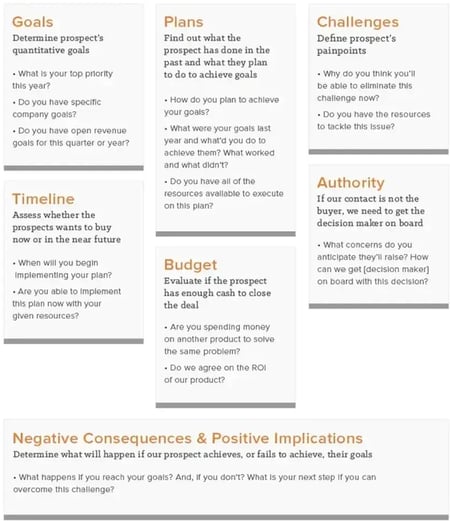
GPCTBA/C&I sales qualification framework

3. Classify prospects with ratings.

Not all prospects deserve the same energy. One of the most impactful shifts I made in my early sales career was learning to rank intent against fit. A prospect clicking your email twice doesn’t mean they’re close to buying, just curious. That’s why I build my prospecting system around three tiers: high, medium, and low fit. It helps me move fast without wasting firepower on leads that were never serious.

Here’s how I break it down:

  • High Fit prospects check most of the ICP boxes. They’ve got the right company size, tech stack, role, and pain. You’re speaking to a decision-maker or someone one introduction away. These are worth your best sequences, personalized research, and real-time outreach. They don’t just look good; they feel like buyers.
  • Medium Fit means there’s potential, but something’s off. Maybe the timing is vague, or you’re still one level below the economic buyer. These leads are worth nurturing, but not obsessing over. Keep the cadence steady, but don’t overinvest too early.
  • Low Fit prospects are usually tire-kickers, low engagement, or completely misaligned. If you’re still following up with these after five touches, you’re not prospecting, you’re procrastinating. I tag these for automated drips or circle back if market signals shift.

This kind of rating system isn’t about labeling people; it’s about preserving your focus. In prospecting, effort isn’t the metric. Effectiveness is. So spend more time where fit meets urgency, and let the rest follow your process, not your emotions.

4. Subscribe to your prospects’ blogs.

Too often I see reps sending templated emails to prospects who literally just wrote a blog post that could have been the perfect conversation starter. If your prospects are publishing content, and especially if they’re in marketing, product, or leadership, you have a golden window into how they think, what they care about, and where their pain is surfacing.

When I’m preparing for outreach, I subscribe to their blog or company newsroom, but I don’t just let unread articles pile up. I batch time every Friday to scan for updates from my top-tier accounts. If something jumps out, like a product launch, a big hiring push, or an insight-rich post from a VP, I take note.

But here’s the trick: I don’t quote the blog back at them like I’m doing homework. I use it as context to show I’ve done my due diligence and to ask a smarter question. Something like, “I saw your team’s rolling out new integrations, how are you planning to handle X?” It turns cold outreach into warm relevance.

You don’t need to read 50 posts. You just need one good sentence that proves you care enough to learn before you sell. That’s what separates reps who get ignored from the ones who start real conversations.

5. Keep track of your prospects on X (formerly Twitter).

I don’t follow my prospects on X just to see what they had for lunch. I follow them to read between the lines. Because the moment a VP starts sharing company news, team wins, product launches, or hiring plans, that’s not just content, it’s a signal.

Instead of relying on alerts or trying to dig through a busy timeline, I build private X Lists. One for high-priority targets, one for long-term nurtures, and one for partner influencers. That way, I’ve got curated micro-feeds that help me track real-time context without falling down the doomscroll rabbit hole. Alternatively, you could use a social media management tool.

Some of my best cold emails didn’t start with “I’d love to connect.” They started with: “I saw your team just hired five new reps. I’m curious if ramp time is top of mind right now.” Because when your outreach ties directly into what your prospects are already thinking about, you’re not interrupting, you’re aligning.

You don’t need to comment on every post or try to be cute in the replies. Just observe, listen, and let those signals inform your next move. In a noisy sales world, relevance is your edge, and X gives you a live feed of what matters most to your buyers. Use it.

6. Batch prospecting sessions.

Prospecting isn’t hard because it’s complicated; it’s hard because it requires focus. And in a world of Slack pings, open tabs, and endless scroll, context-switching is your real enemy. That’s why I batch all my prospecting into deep-focus sprints.

Here’s how I do it. I block out 90-minute windows — just me, my lead list, and zero distractions. No inbox. No calls. Just outbound. I warm up with research, knock out first-touch emails, log the CRM, and send quick LinkedIn DMs all in one burst. Then I stand up, stretch, and walk away. That reset matters more than people think.

By batching prospecting sessions, I eliminate friction, build momentum, and get into a flow state. And honestly? It makes the process less intimidating. Instead of chasing “inbox zero,” I chase quality touches in focused blocks. That rhythm (repetition, pause, repeat) is how I’ve consistently filled the pipeline, quarter after quarter. It’s not just about the reps. It’s about how you structure them.

7. Use a healthy mix of email and phone communication.

In my experience, the best prospecting strategies don’t favor email or phone; they integrate both like tools in a well-balanced kit. Some reps get overly comfortable behind their keyboard. Others over-rely on cold calls and burn out fast. But if you want consistent results, you need to blend both based on timing, context, and buyer behavior.

I use email for scale and structure: initial touches, value-driven resources, and follow-ups. It helps me document everything, build a paper trail, and reach buyers who live in their inboxes. But the moment I sense hesitation, or if I’ve sent two emails without traction, I pick up the phone. Not to pitch, but to connect. Voice adds tone, urgency, and human nuance that email can’t match.

Here’s what’s worked for me: I lead with a short, personalized email. Then I follow up with a call referencing that message, something as simple as, “Just wanted to make sure you saw my note.” That one-two punch boosts reply rates and opens doors that a single channel wouldn’t.

To decide which channel to use (and when), I keep this mental cheat sheet in mind.

Email Communication: What Works and What Gets Ignored

What Works

What Backfires

You get to show value on the prospect’s timeline. It’s non-intrusive and scalable.

Email inboxes are digital war zones. If you don’t stand out fast, you’re toast.

Prospects can click, forward, research, and reply when they’re ready, on their terms.

Emails vanish. Literally. Either into spam, into oblivion, or into “I’ll get to it later” (which means never).

Great for looping in multiple decision-makers and building an internal case.

You’ll often need to follow up more times than you’re comfortable with before you even get a “maybe.”

Phone Communication: The Underrated Power Move

Why It Works

Where It Falls Flat

Real-time convo = real connection. You get clarity, tone, and momentum — all in seconds.

Cold calls can trigger resistance. Wrong timing or no context? You’ll get shut down fast.

It cuts through the noise. Your voice competes with no one in the inbox.

If unscheduled, it can feel like you’re barging in. You need tact and timing.

You get answers faster. Less “back and forth,” more “let’s set a time.”

Many won’t pick up. Voicemails? Most get skipped unless they’re sharp and relevant.

In today’s noisy sales world, the best way to stand out is to meet prospects where they are, sometimes in their inbox, sometimes in their ears. The key is knowing when to switch gears.

8. Use the BASHO sequence for emails and calls.

Sales leader Jeff Hoffman pioneered an approach known as the BASHO sequence, which advocates for the following combination of voicemails or emails to build connections with prospects.

  • Voicemail / Email: Wait for 24 hours.
  • Voicemail / Email: Wait for 48 hours.
  • Voicemail / Email: Wait for 72 hours.
  • Voicemail / Email: Wait for five days.
  • Breakup Voicemail / Email.

Alternate between voicemail and email, with unique messaging each time. This technique allows prospects to consider your offer, conduct their own research, and respond at a time that is convenient for them.

But, how do you leave a voicemail or send an email that prospects will actually want to respond to? Let’s dive into the do’s and don’ts of each communication method below.

Tips for Writing a Warm Email

If you’re looking to send a first-touch email that gets opened, here are some essentials to include:

  • Engaging subject line. The subject line has to pique the prospect’s interest while avoiding cliché hooks.
  • Personalized opening line. You should begin your cold email by saying something about the prospect, not about your business. After all, this process is about finding the prospect’s pain points and determining a way to add value to their business.
  • Clear connection. Now, you have to make a connection. In your opening, the prospect learned why you’re reaching out to them, but now they need to know why they should care about what you do.
  • Concrete call-to-action. Suggest a concrete time to connect or ask a specific question to make it clear that the ball is in their court. Some of my favorite lines are: “Do you have ten minutes to catch up tomorrow?” or “Are you available for a 30-minute call on Tuesday between 9 and 11 AM?”

You can also try sending a calendar invite instead of an email to get straight to the point. In the description section, you can type up a personalized message.

Author of the award-winning sales book Snap Selling Jill Konrath suggests another helpful approach: You can schedule a short, five-minute meeting to get your foot in the door with prospects whose calendars are particularly swamped.

Tips for a Prospecting Call

If you decide to call a prospect, I’d suggest following this basic structure for the call:

  • Establish rapport. Don’t shy away from personal conversations, like asking how a prospect’s weekend was or what team they’re rooting for in the game tonight. These intimate touches can help you develop more meaningful relationships with prospects and enhance your likability, in turn (hopefully) making them more likely to buy from you.
  • Leverage pain points. Dive into their pain points during the call. By the end of the conversation, you should know all of their primary business challenges and the underlying causes associated with them. Once you have an understanding of these key issues, you can better position your product or services to address those pain points.
  • Create curiosity. Ask more than you tell. This conversation is about them, about understanding their needs and problems. The less you talk about your business and product, and the more you ask questions about them and their business, the more your prospect will be interested in hearing the final pitch.
  • Wrap it up. Find a time 24–48 hours after the discovery call to book a follow-up meeting. Try this line: “Would you have 30 minutes to follow up this week? My colleague, John, will join us — he’s an expert in X, Y, Z. My calendar’s open; what time works best for you?”

9. Follow-up after a closed-lost deal.

Rejection is never fun, but it can be useful. Bryan Kreuzberger, founder of the lead generation company Breakthrough Email, sends a follow-up email if prospects respond with a rejection. The purpose of this email is simple: Learning. You can use a rejection as an opportunity to better understand how you can improve your sales techniques by following this template:

Hi [prospect name],

Thanks for your email. I just closed your file. I have a quick question as a final follow-up. Why aren’t you interested? Was it something I did?

If there is any way I can improve, let me know. I’m always looking for input.

Thanks for your help,

[Name]

I’ve found that sending a simple email like this can make a big difference, helping sales teams identify flaws in their processes while also maintaining a positive relationship with the prospect.

10. Thoroughly understand your vertical.

If there’s one shortcut to being taken seriously during prospecting, it’s speaking the language of your buyer better than they do. I’ve learned that real credibility doesn’t come from slick scripts or clever hooks but from understanding the world your prospect lives in. The pain points they obsess over. The KPIs they chase. The internal politics they navigate.

Whenever I step into a new vertical, whether it’s fintech, SaaS, manufacturing, or medtech, I treat it like I’m joining their team. I read their industry journals, analyze their competitors, and even follow their influencers on LinkedIn to get a sense of what they’re celebrating, worried about, or trying to fix. I’m not prospecting into a “market.” I’m stepping into their day-to-day reality.

Here’s what I focus on.

I dive deep into how their business model works, how decisions are made, and what typical budget cycles look like. I look for regulatory pressure points, common operational bottlenecks, and the specific outcomes that matter most to their team. Once I know that, I can show up with solutions that actually map to their world, not generic fluff.

It also helps to mirror their language. I make a point to use their acronyms, frameworks, and metrics. When you say “ARPU” to a SaaS CFO or “yield loss” to a plant director, you’re not just signaling competence, you’re building instant trust. It shows you’ve done your homework. You’re not just trying to sell to them, you’re trying to solve with them.

Bottom line? Prospecting without understanding your vertical is like showing up to a job interview without knowing what the company does. The more fluent you are in their space, the more relevant and referable you become.

11. Ask for referrals.

According to HubSpot’s recent survey of over 1,000 sales professionals, 66% of salespeople say referrals from existing customers offer the best leads — and high-quality leads often become productive prospects.

By asking for referrals, you can generate a wider base of warmer, more easily convertible contacts, giving yourself a crucial leg up when prospecting. When an existing customer connects you with a referral, they’re essentially saying, “I think this person could stand to gain from your solution.”

In turn, you can go into engagements with these leads knowing they’re more likely than most cold contacts to consider your offering. You can also reference the customer who put you in touch with that lead when conducting your outreach — a solid conversation starter that helps you develop instant rapport.

So, how do you ask for referrals? Well, as obvious as this might sound, you just ask for them. After you convert a prospect into a customer, follow up with them and ask if they know anyone else who might benefit from your solution.

If they don’t know anyone straight off the bat, or if they are reluctant to hand out names right away, wait until they’ve enjoyed your product or service for a while. Then, when you know they’re happy with your offering, check in again.

Now that they’ve been a customer for some time, they might be more likely to put you in touch with some contacts who will be willing to hear you out. To sweeten the deal even more, you can also offer them some sort of incentive, like a discount or other promotions, in exchange for a referral.

With all of the steps and strategies involved in the prospecting process, you might find yourself spending a lot of time on menial tasks. Luckily, there are a number of sales prospecting templates and tools you can use to boost productivity and automate tasks.

Sales Prospecting Tools

You can select specific tools from this list to use independently, or you can use multiple in tandem. To determine your needs and gaps, consider which tools you currently use for prospecting. Then, experiment with the options below to discover which ones work best for your business.

1. HubSpot CRM

Pricing: Free plans are available

sales prospecting tools, hubspot crm

Best for: Accruing and applying data for detailed company insights.

The HubSpot CRM has a robust suite of features that can cover a range of your business’s needs — but when it comes to prospecting, HubSpot sets itself apart with its support of detailed company insights.

Your prospecting efforts won’t take you too far if they’re poorly informed, but sorting and applying relevant prospect information can be as frustrating as it is essential.

The HubSpot CRM automatically populates new contact, company, and deal records with details from its database of over 20 million businesses. All you need is a prospect’s corporate email address.

So, if you’re in the market for a solution that can streamline, simplify, and enhance your prospecting efforts by giving you a fleshed-out picture of who you’re selling to, the HubSpot CRM might be the way to go.
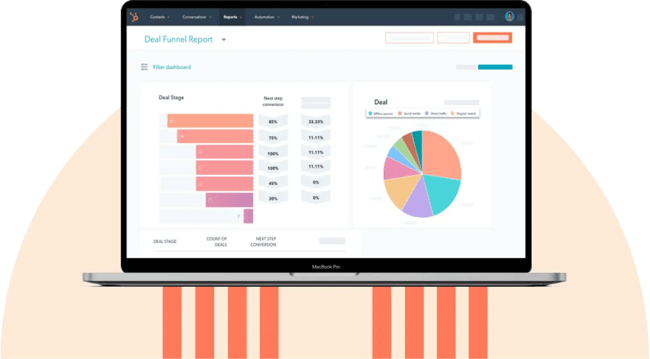
check organic keywords growth for a url

Key Features and Benefits

  • Automatically populates business insights based on a database of over 20 million businesses.
  • Offers a centralized location for easily sorting and tracking prospect details, including intel from sales calls, emails, notes, deal activity, lifecycle changes, and social media.
  • Includes an accessible dashboard that lets you choose which information to display on your contact, company, and deal records (without any help from IT).

2. Hunter

Pricing: Free plans are available

sales prospecting tools, Hunter

Best for: Aggregating email data for prospecting.

Hunter offers a unique resource to set email prospecting efforts in motion. Its solution allows users to quickly and easily translate web data into a list of email contacts, giving salespeople easy access to a solid base of targeted prospects.

Hunter boasts an impressive roster of customers — including Google, IBM, and Microsoft — and for good reason: It’s a solution that combines accessibility with powerful functionality. Virtually any salesperson can easily leverage it to verifiably identify and connect with almost any prospect.

Key Features and Benefits

  • Enables you to search for prospects and find their email addresses by role.
  • Helps you identify emails via common email formats used in the organization from dozens of possible combinations.
  • Can produce email addresses either in bulk or individually.

3. Kixie

Pricing: Plans start at $35 per month

sales prospecting tools, Kixie

Best for: Reliable, easy-to-integrate calling and texting automation.

Kixie is one of the preeminent prospect outreach resources on the market. It’s a customizable business calling and texting platform that allows you to thoughtfully and effectively time and target your sales calls, letting you connect with the right prospects at the right time.

The software folds easily and seamlessly into your tech stack, and it can integrate with several high-profile platforms, including HubSpot, Slack, and Pipedrive.

It’s also one of the most accessible options in its space. In fact, I’ve found that virtually any user can quickly pick up and leverage the program without extensive training. So, if you’re looking for a streamlined, low-maintenance solution that lets you connect with your prospects exactly when they’re most likely to be receptive to your outreach, look into Kixie.

Key Features and Benefits

  • Supports an extensive suite of integrations.
  • Enables you to contact thousands of prospects in a single day.
  • Easy implementation with minimal training required.

4. HubSpot Sales Lead Management & Prospecting Software

Pricing: Free plans are available

sales prospecting tools, HubSpot Sales Lead Management & Prospecting Software

Best for: Establishing a baseline for a sound prospecting infrastructure.

HubSpot’s Sales Lead Management and Prospecting Software is a collection of resources that helps you refine and more effectively conduct your engagements with leads and prospects — and it covers a lot of bases.

This solution includes a conversation intelligence system that can give you perspective on how to best tailor your messaging, as well as automated email sequencing, customizable email templates, predictive lead scoring, and several other first-rate resources for better understanding and catering to your prospects.

HubSpot’s Sales Lead Management and Prospecting Software is essentially a one-stop shop that offers a foundation for effective prospecting.

If you’re looking for a suite of free resources that provide virtually everything you need to set your sales org up with a solid prospecting infrastructure, I definitely recommend checking out these resources.

Key Features and Benefits

  • A range of resources, including conversation intelligence, email templates, email sequences, predictive lead scoring, and reporting.
  • Ability to track and filter leads to identify viable prospects.
  • Seamlessly blends with your tech stack.

5. SalesHandy

Pricing: Plans start at $7/month per slot
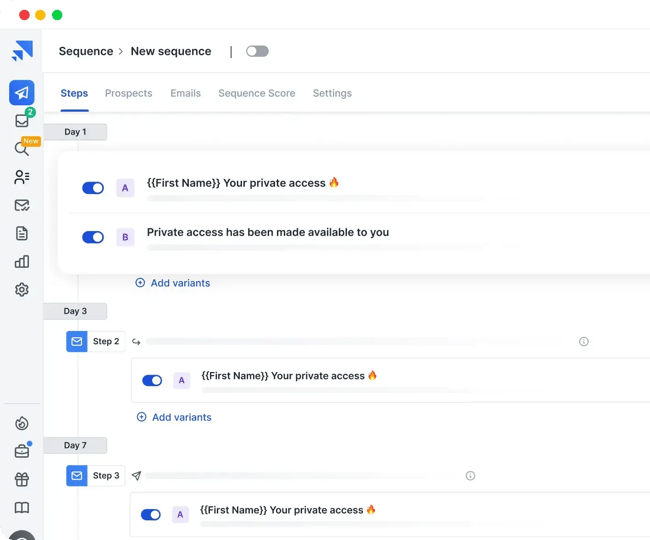
sales prospecting tools, SalesHandy

Best for: Sound, approachable cold email outreach.

SalesHandy is an outreach resource that allows you to reliably send thoughtful, effective, high-converting cold emails. The solution offers features like automated, multi-stage sequences for consistent follow-up — ensuring interested prospects don’t fall through the cracks.

The software lets you standardize your outreach strategy without sacrificing personalization, helping you tailor your subject lines and email copy to suit individual prospects (without too much legwork).

It also ensures that the content of your emails isn’t too robotic, letting you circumvent spam filters and deliver emails your prospects will actually read.

Ultimately, SalesHandy is a cold email solution with a robust suite of features that can help you reach out to prospects more effectively. If you’re looking to integrate a platform that can enhance how you connect with prospects into your tech stack, consider looking into SalesHandy.

Key Features and Benefits

  • Automated follow-up for scheduling multi-stage email sequences.
  • Merge tags that allow for personalization.
  • Easy integration with your current email provider.

6. UserGems

Pricing: Plans start at $10k, pricing is usage-based
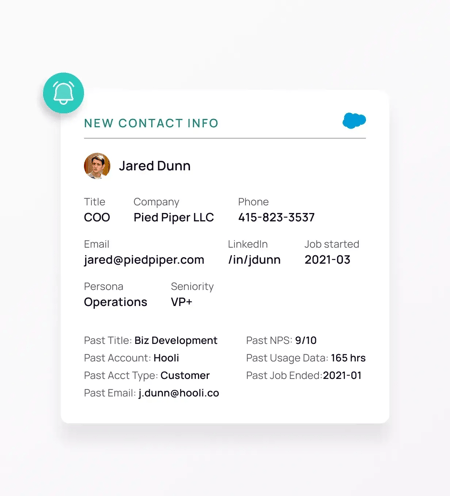
sales prospecting tool usergems

Best for: Capturing buying signals and automating the next steps with AI assistance.

Buying intent data helps reps understand and prioritize high-intent leads, cutting through the noise and focusing sales and marketing efforts on prospects who are actually ready to make a purchase.

UserGems helps revenue teams monitor their ICP accounts for buying signals to identify buyers most likely to convert. Then, it tells your reps who to contact, when, and why. Using those signals, it drafts emails, cold call scripts, and LinkedIn messages for your reps to review (or it sends them automatically for them).

By streamlining prospecting and workflows, reps can spend 90% of their time prospecting and selling instead of manual research and data entry. With UserGems, you’ll 10x your team’s performance and efficiency.

Key Features and Benefits

7. Crunchbase

Pricing: Plans start at $29 per user/month
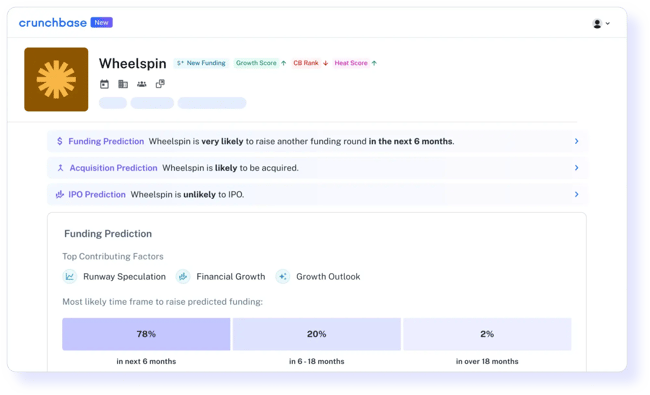
sales prospecting tools: crunchbase

Best for: Screening and discovering businesses that fit your ideal customer profile.

Crunchbase is essentially a business intelligence gathering platform that lets you pull live company data to inform more targeted, effective prospecting. It lets you search for and pull information from a massive database of organizations, providing insight into individual companies’ characteristics and operations.

The platform gives users a picture of key elements of how a business functions and performs, including investment information, founding members, leadership profiles, mergers, acquisitions, news, and industry trends.

In this way, Crunchbase effectively centralizes and streamlines your prospect research efforts, providing you with valuable intel that can help you structure more thoughtful pitches and execute better-targeted outreach.

So if you’re looking for a solution that can both simplify and enhance how you understand your prospects, Crunchbase is definitely a strong option to consider.

Key Features and Benefits

  • An extensive pool of live data on thousands of potential prospects.
  • A filtering function that lets you pare down your searches based on ideal characteristics.
  • Live tracking to keep tabs on key company events and developments.

8. Wiza

Pricing: Free plan is available with paid plans starting at $25 per month
sales prospecting tools wiza

Best for: Finding real-time verified email addresses.

Wiza is a popular sales prospecting platform for sales, marketing, and recruiters. It is one of the only prospecting platforms that provides real-time email verification within the app, to ensure high levels of email accuracy and deliverability in your prospecting outreach. With Wiza, you can build and save email lists, then export them as CSV or sync them to CRMs, including HubSpot.

In addition to their prospecting platform, Wiza offers a free Chrome extension that allows you to view email and contact information while browsing LinkedIn profiles. This extension can also be used to export large lists with email addresses and phone numbers from filtered and saved searches in LinkedIn Sales Navigator and LinkedIn Recruiter.

Key Features and Benefits

  • Search and discover real-time verified email addresses and contact info.
  • Bulk export or integrate directly with popular tools like HubSpot, Outreach, and more.
  • Free Chrome extension that provides emails while using LinkedIn, LinkedIn Sales Navigator, and LinkedIn Recruiter.

9. SalesIntel

Pricing: Contact for custom pricing

sales prospecting tools salesintel

Best for: Accessing human-verified B2B contact data and intent-driven insights.

Finding leads is one thing, but getting accurate, up-to-date contact details is another challenge entirely. Outdated emails, disconnected phone numbers, and missing decision-maker info can stall even the best sales strategies. That’s where SalesIntel stands out.

SalesIntel ensures your prospecting efforts are fueled by 95% accurate, human-verified B2B data. Whether you need direct dials, mobile numbers, or intent signals, SalesIntel gives you a complete picture of your ideal prospects. So you’re always reaching out at the right time, with the right message. From technographic and firmographic insights to VisitorIntel, which identifies anonymous website visitors, SalesIntel provides the tools to turn raw data into real opportunities.

Key Features and Benefits

  • Human-Verified Contact Data: Every email and phone number is manually verified to ensure accuracy.
  • Intent Data & Intent Automation: Identify prospects actively searching for solutions like yours.
  • Mobile & Direct Dials: Reach decision-makers directly without navigating gatekeepers.
  • RevDriver Chrome Extension: Pull verified contact details from LinkedIn and company websites instantly.
  • VisitorIntel & AdsIntel: Uncover site visitors and run targeted ad campaigns to stay top-of-mind.

10. Gong

Pricing: Contact for pricing

sales prospecting tools gong

Best for: Improving outreach efforts via coaching reps.

Gong might be the most prominent conversation intelligence platform on the market. It’s a powerful solution that boasts an impressive list of customers, including LinkedIn, Zillow, and Okta — and for good reason. The platform is dynamic, intuitive, and can enhance virtually every aspect of your sales process.

This solution offers a range of sales-call-related features, but its support for more targeted call coaching is especially powerful for improving sales organizations’ prospecting efforts.

Gong gives sales managers access to recordings, transcripts, and other data to help them zero in on where reps are struggling when conducting outreach. All of that information can also expose other flaws and inefficiencies in elements of a sales org’s prospecting efforts, such as its call cadence or sales messaging.

All told, Gong is one of the most effective, accessible resources a sales org can leverage to ensure its phone outreach is first-rate and help reps prospect more thoughtfully.

Key Features and Benefits

  • Guided workflows to help you establish repeatable processes for better-targeted call coaching.
  • Visible transcripts for focused call analysis.
  • An impressive suite of integrations — including HubSpot, Salesforce, and Slack.

11. Sopro

Pricing:  Paid Plans start at £3,000/month
sales prospecting tools, sopro

Best for:  Businesses that need a fully managed prospecting service for B2B sales teams.

Sopro’s fully managed prospecting service is for B2B sales teams that don’t have the time or resources to run outreach themselves. They combine expert strategy, live data sourcing, and multi-channel engagement.Rather than tying up sales reps with prospecting admin, Sopro takes care of the entire process. A dedicated team tailors, delivers, and refines campaigns so sales reps can stay focused on selling. Sopro has a client portal for live reporting and is fully integrated with HubSpot. Verifies and cleans email lists with 99% accuracy.

Key Features and Benefits

  • Dedicated outreach experts managing your entire campaign
  • Access to the tech, tools, and data of a leading B2B agency
  • Multi-channel campaigns and transparent performance tracking

12. VerifiedEmail

Pricing: Free trial, paid plans available
sales prospecting tools verifiedemail

Best for: Real-time email list verification and cleaning.

VerifiedEmail helps sales teams avoid wasting time and money on invalid leads by checking email addresses in real-time with 99% accuracy — so your campaigns hit real, active inboxes. Its proprietary technology quickly identifies invalid or disposable emails, spots role-based addresses (like info@, sales@) for targeted outreach, and removes duplicates — improving deliverability and reducing bounce rates.

You can use its user-friendly widget directly on your website to validate emails as users sign up, or integrate it into your existing sales workflow through its API — connecting with HubSpot, Zapier, Klaviyo, and more.

Key Features and Benefits

  • Verifies and cleans email lists with 99% accuracy.
  • Identifies role-based emails for improved prospect targeting.
  • Provides real-time verification at lead capture (widget).
  • Simple API integration with HubSpot, Zapier, Klaviyo, and others.

13. Lusha

Pricing: Free plans available

sales prospecting tools lusha

Best for: Easily sourcing and accessing prospects’ contact information.

Lusha is a first-rate data enrichment resource for finding prospects’ contact information, including both email addresses and phone numbers. This solution allows you to easily and reliably connect with decision-makers and other key contacts at a range of businesses.

The program’s “contact search” feature provides as many as 1,000 contacts — supported by enriched data — in a single search. It also lets you pull up millions of potential prospects’ direct dials.

From there, the software lets you convert those searches into focused, clean, exportable contact lists. Plus, all of these features come in a straightforward yet powerful interface that’s easy for anyone to use.

Key Features and Benefits

  • Robust “contact search” function.
  • Similarly thorough “company search” function.
  • Extensive suite of integrations, including HubSpot, Salesforce, and Gmail.

14. Datanyze

Pricing: Free plans are available

sales prospecting tools datanye

Best for: Conversationally connecting with prospects.

Datanyze is an intuitive Google Chrome extension that allows salespeople to easily access B2B contact information and other valuable prospect data, including email addresses, direct dial numbers, and company details.

In addition, Datanyze really sets itself apart with its personalization. The program leverages automated machine learning to support one of the most detailed B2B databases on the Internet — and that degree of detail doesn’t go to waste.

Datanyze then uses that insight to structure relevant icebreakers for individual prospects: unique conversation starters informed by data from sources like prospects’ social media feeds and local news publications.

Key Features and Benefits

  • A robust, detailed B2B contact library.
  • Easily integratable (so long as you have Google Chrome).
  • Generates specific, effective icebreakers for prospect outreach.

15. Ring.io

Pricing: Ring.io costs $89 per user/month for HubSpot integration
sales prospecting tools ring.io

Best for: Improving sales call productivity.

Ring.io is a sales dialing solution that streamlines your team’s sales call process and improves your org’s sales call volume (without sacrificing productivity). It allows your reps to dial directly out of your CRM, easily and reliably connecting them with the right prospects.

The program also includes features like automated local caller ID and automatic pre-recorded voicemails — making your prospect outreach more efficient, personalized, and approachable.

Leveraging Ring.io also lets you shape and refine an effective call cadence, and the software accommodates even the longest of leads lists. Taken together, Ring.io’s many features can help you achieve wider-reaching, more productive sales calls.

Key Features and Benefits

  • Direct dialing out of your CRM.
  • Automated local caller ID to improve connect rates.
  • Automated pre-recorded voicemails for prospects you miss.

Featured Resource: Prospecting and Objection Handling

Now, let’s take a step back and look at the sales prospecting process as a whole.

Sales Prospecting Process

If prospecting is the spark, the process is the engine. You can’t rely on random acts of outreach and expect predictable revenue. Over the years, I’ve learned that the difference between inconsistent results and a reliable sales pipeline comes down to having a clear, repeatable structure — one that adapts to the buyer, not just the playbook. Here’s how I approach it.

1. Research

This is where the real work begins, not with a pitch, but with curiosity. I don’t treat research as a box to check; I treat it as my competitive edge. Because the moment I understand why a company exists, how they operate, and what their current pain points are, I stop sounding like a seller and start speaking their language.

For me, research isn’t just about LinkedIn titles or company size. It’s about finding buying signals. Are they hiring for roles I solve? Have they raised a round of funding? Did their leadership just change? I dig through recent press releases, browse their product pages, scan Glassdoor for culture clues, and always check if they’re mentioned on industry podcasts or review sites.

I want to know:

  • Are they actively solving the problem I address?
  • Do they have a strategic reason to care now?
  • And can I confidently say, “This is someone I can help”?

If I can’t answer those three questions after five minutes of research, they’re not ready, or I’m not ready to reach out. Either way, it’s a no-go until I’ve got enough context to bring value from the very first line.

2. Outreach

Here’s where most reps start getting nervous, but I see outreach as the part where all the prep finally pays off. If research is about clarity, outreach is about momentum. I don’t just hit send and hope. I treat every message — whether it’s a cold email, LinkedIn DM, or a well-timed call — as a chance to start a conversation, not push a product.

When I reach out, my first goal is simple: earn a response. That means I need to sound human, relevant, and respectful of their time. So I ditch the robotic intros and canned openers. Instead, I start with something real, an insight from their company blog, a shift in their org chart, or even a recent quote from their CEO. Something that says, I did my homework.

I also try to predict the path of resistance. In most B2B orgs, your first point of contact won’t be the decision-maker, it’ll be someone managing the calendar or filtering messages. And honestly? That’s okay. I treat gatekeepers with the same respect I give execs, because I’ve seen how often a good first impression turns into a warm intro.

Once I get to the right person, I don’t pitch. I probe. My best-performing emails and calls start with a problem I believe they’re already thinking about, and then offer to explore whether I can help. No pressure. Just alignment.

And I always track it all. Every touchpoint gets logged in the CRM, not just to stay organized but to see what patterns emerge. Which subject lines convert? Which CTAs get clicks? Which buyers prefer voice over email?

Great outreach isn’t just about what you say. It’s about when, how, and why you say it.

3. Discovery Call

For me, the discovery call isn’t just another checkbox in the prospecting process; it’s the turning point. It’s where the theory meets reality. At this stage, I’m not pitching. I’m listening. My goal? To understand the prospect’s world better than they expect me to.

When I hop on a discovery call, I already know the basics: their company, role, and recent initiatives. But I use the first five minutes to test my assumptions, and more importantly, to create space for them to talk. I ask open-ended questions that don’t just probe pain points, but uncover priorities, hidden blockers, and what’s truly at stake for their team.

A good discovery call is never a script. It’s a dance. One where curiosity drives the tempo and empathy sets the tone.

I’ve learned that the most powerful thing I can do on that first call is make them feel understood. Not sold to, not cornered — just heard. When I reflect back what I’ve learned, “It sounds like your team’s stuck between scaling demand and maintaining data quality,” I’m showing I’m not just here to close, I’m here to contribute.

This is also where I begin to qualify not just the opportunity, but the partnership. Are they a fit for what we offer? Are we aligned on goals and mindset? That clarity only comes when I stop treating discovery as an interrogation and start treating it as a mutual evaluation.

Here’s something I live by: The more tailored my questions, the more valuable the answers. That’s how I move the conversation from generic interest to meaningful urgency. Because once the prospect feels like I “get it,” I’m not just another seller. They see me as someone worth calling back.

4. Educate and Evaluate

At this stage in the prospecting journey, I’m not just qualifying the deal: I’m helping the buyer qualify me. What I do after the discovery call is where deals begin to take real shape. This is where I shift from active listening to active alignment.

By now, I’ve gathered context. I understand their structure, roadblocks, and desired outcomes. Now it’s time to connect the dots between their pain and my solution, without turning it into a one-sided pitch. That means educating them on what’s possible, not just what’s for sale.

When I walk into this part of the process, I use the insights from the call to frame two key conversations: the real pain points they’re trying to solve, and the objections that might stop them from solving them with us.

Pain Points

I don’t settle for surface-level pain. I look for the cost of inaction. If a team is losing 40 hours a month to manual data cleanup, I don’t just note it. I translate that into dollars, burnout, and missed targets. It’s not about showing what my product does; it’s about showing what not using it will cost them.

When I’m educating a prospect, I’m not dumping feature lists. I’m telling a story where they’re the hero, and our solution is the tool that helps them win. It has to be specific. If I’m talking to a RevOps lead at a B2B SaaS company, I’ll reference lagging pipeline velocity, broken attribution, and why their sales-marketing alignment is suffering. That’s when they lean in.

I’ve found that the most impactful sales conversations happen when the prospect starts saying, “That’s exactly what we’ve been struggling with.” That’s when you know you’re speaking their language.

Objections

But even with clear pain and strong interest, there’s always friction. Budget pushback, timing hesitations, competing priorities. That’s why I treat objections as buying signals, not roadblocks. If someone is objecting, they’re engaging. My job is to show them I’ve heard this before, and I’ve solved it before.

Instead of rushing to defend my product, I step back and ask, “What’s giving you pause?” That unlocks truth. Sometimes it’s internal buy-in, sometimes it’s fear of implementation chaos. But unless I know what’s underneath the surface, I can’t address it with confidence.

This is also when I evaluate whether we’re truly the right partner. I’ll walk away from a deal if I see a mismatch in timing, values, or expectations. Long-term trust matters more than short-term quota.

In the end, educate and evaluate isn’t about “convincing.” It’s about helping the buyer make a smart decision, and making sure that decision includes you for the right reasons.

5. Close

By the time you reach this step, the cards are on the table. You’ve surfaced the real pain, handled objections, and confirmed there’s a mutual fit. Now, it’s about guiding the prospect toward a clear decision: Are we moving forward or parting ways for now?

In my experience, closing isn’t about pressure or slick talk. It’s about clarity, timing, and trust. You’ve done the hard work upfront: personalized outreach, value-driven discovery, relevant follow-ups. So when it’s time to close, your ask should feel like a natural next step, not a leap.

Here’s how I approach it. I recap the agreed value, confirm their internal buying process, and set a short deadline for the next action. For example: “Based on what you shared about [pain point], and how [our solution] addresses that, are you ready to move forward this week?” This kind of framing makes it easier for the buyer to say yes or to flag any final blockers early.

And no matter the outcome (closed-won or closed-lost), I track every result. Your close rate tells the truth about how well your prospecting is working. If I notice a pattern in lost deals, I revisit my discovery. If deals are stuck in limbo, I check for gaps in urgency or stakeholder alignment.

The close is not the end of the prospecting journey. It’s the validation of everything that came before. Done right, it sets the tone not just for revenue, but for long-term relationships.

Outbound vs. Inbound Prospecting

The field of sales is constantly evolving. Sales reps no longer have to choose between inbound or outbound prospecting. Now, they have the flexibility to incorporate elements of both into their efforts.

Outbound prospecting is when you reach out to leads who haven’t yet expressed an interest in your product or business. You typically identify prospects through independent research, whether by finding them on LinkedIn, Googling them, or using another platform.

Inbound prospecting is when you reach out to a lead who has already shown an active interest in your business or product. Perhaps they’ve visited your website, subscribed to your blog, or maybe even submitted a form asking to speak to a sales rep. You then engage with them to understand whether they’d be a good fit for your product.

Here are the key differences between the two methodologies:


Outbound Prospecting

Inbound Prospecting

Outreach

Cold calling or emailing — unsolicited calls to sell your product or service

Warm emails to explore a relationship with a lead who has already expressed familiarity with your product or service

Social “spamming”

Unsolicited social media messages to sell your product or service

Use social media to explore a relationship with a lead who has already expressed familiarity with your product or service; you can provide value to prospects on social media by answering their questions and introducing them to useful content

Process

Research takes longer without any prior history with a contact, meaning you have less context when you’re ready to reach out to establish a connection

Research process is shorter as you already have their contact information and interaction history, providing you with context about the prospect’s interests or prior behavior and allowing you to develop more personalized outreach

Example

“Hi John, I wanted to reach out to you because I’ve worked with companies similar to yours in the past.”

“Hi John, I’m reaching out because I noticed you were looking at our e-book on improving sales productivity.”

My recommendation? Lean mostly on the inbound methodology when you prospect, but still include a responsible approach to outbound tactics like cold calling and cold emailing. Especially for businesses that don’t have enough qualified inbound leads, outbound can be an important component of the process.

But regardless of whether you’re focused on outbound or inbound, it’s critical to make sure you’re helping the buyer (rather than selling to them), leveraging their context and understanding who they are and what they need.

Of course, that’s easier said than done. How do you find prospective buyers and learn the context surrounding their business needs? Even more importantly, how do you determine whether or not you should begin the process of selling to them?

There’s no one-and-done answer, but asking the sales prospecting questions below can help you qualify prospects and focus on your highest-potential leads.

Sales Prospecting Questions

One of the biggest mistakes I see reps make is chasing every lead like it’s gold. But not every lead is a fit, and not every conversation is worth the time. In fact, I’ve learned the hard way that qualifying early and often is what separates consistent pipeline builders from calendar chasers.

In my process, I treat every prospecting conversation like a filter. I’m not just looking for interest, I’m looking for alignment. That means digging into the right questions before I go any further. Here’s how I qualify leads based on organizational fit, timing, and buying potential.

Is the prospect’s business an organizational fit?

I’ve learned that no matter how great your pitch is, if you’re talking to the wrong type of company, it doesn’t matter. That’s why my first filter in any prospecting motion is fit. Not interest. Not budget. Fit.

For me, organizational fit comes down to three core signals: structure, size, and stage. I’m asking: Does this company operate in the industries we’ve helped before? Are they using a similar tech stack to our top customers? Are they at a maturity level where our solution actually solves a pressing pain?

Let’s say I’m targeting Series A–C SaaS companies with 50 to 500 employees and a sales-led motion. If I stumble onto a bootstrapped agency with eight team members, I don’t try to force a conversation. That’s not a lead, it’s a distraction. And when you waste time on mismatched leads, you lose deals you could’ve won elsewhere.

I use this fit-first filter to prioritize accounts before I ever hit send on a cold email. Because high-fit prospects don’t just convert better, they stay longer. They’re easier to onboard. They advocate for you inside their company. And they unlock expansion faster.

Bottom line: Fit isn’t just a checkbox. It’s the multiplier that makes the rest of your prospecting work worth it. If you get this wrong, everything downstream suffers.

Have you identified key stakeholders?

One of the biggest mistakes I made early in my sales career was stopping at the first “yes.” I’d get a promising reply, hop on a call, and assume I was talking to the decision-maker. Weeks later, I’d hear, “We just need leadership approval,” and realize I was never talking to the real buyer in the first place. That’s when I learned that identifying stakeholders isn’t optional. It’s foundational.

In my current workflow, I separate stakeholders into two camps: influencers and decision-makers. Influencers are usually the end users, the ones who feel the pain most directly. They’re often the first to engage, and if you build trust early, they’ll champion your solution internally. But they usually don’t control the budget.

Decision-makers care less about features and more about outcomes. They look at ROI, business alignment, and potential risks. If I don’t get them involved early, deals tend to stall. So when I’m prospecting, I map out the entire buying committee before I even write my first email. I review LinkedIn roles, check company org charts, and dig into mutual connections who can help unlock access.

Here’s one simple question I ask on nearly every call: “Besides yourself, who else would need to be part of this conversation to move forward?” That one line has saved me from wasted cycles and helped me build buy-in from the start.

Takeaway: Prospecting isn’t just about opening a door. It’s about knowing exactly who’s behind it and how to earn their trust.

Are the prospect’s constraints a deal-breaker?

Before I schedule a deep-dive call, I run a quick “sanity check” on two variables: budget and bandwidth. If the numbers are not there, or if the team is knee-deep in a product launch, the smartest move is to park the deal for another quarter. I start with public signals: funding rounds, hiring freezes, marketing pushes. A fresh Series A usually means money is available, while a hiring pause often hints at tightening belts.

Next I probe time. Busy teams leave plenty of clues: packed event calendars, major releases, leadership transitions. If everything points to chaos, I send a brief note that offers value now, then ask for a better window to reconnect. I record these “not-now, maybe-later” leads in my CRM with a future task so they never slip through the cracks.

Bottom line: A fast reality check on money and timing protects your calendar from deals that cannot close today but positions you perfectly when the smoke clears tomorrow.

Are you familiar with the prospect’s market?

When I first started prospecting, I chased everything. Tech startup? Sure. Logistics provider? Why not. But what I learned the hard way is that if you don’t speak your buyer’s language, you’ll burn cycles and lose trust before the first call is over. That’s why now, before I reach out, I pause and ask: Do I actually understand their market?

This doesn’t mean becoming a subject matter expert in every niche. It means doing the legwork. I skim industry reports, check their competitor landscape, read a few customer reviews, and follow their CMO on LinkedIn. I want to know how they make money, what keeps them up at night, and how their world is shifting. That context lets me ditch generic pitches and speak with relevance from the very first message.

Takeaway: When you work in verticals you know well, your outreach becomes faster, sharper, and more natural. But even when a new market is unfamiliar, curiosity can bridge the gap. A well-timed insight or question rooted in their ecosystem hits way harder than a scripted one-size-fits-all pitch.

Would your company add substantial value?

This is where I slow down and get brutally honest. Just because I can pitch someone doesn’t mean I should. When I’m prospecting, one of the first things I ask myself is: Would working with us actually move the needle for them?

I’m not talking about surface-level benefits or fluffy features. I’m looking for real alignment, where our solution solves a core problem they’re actively trying to fix, or helps them hit a priority goal faster, cheaper, or with less friction. If I can’t see that clear value delta, I don’t waste their time or mine. And when I do see it, I make sure it’s baked into the pitch from the very first line.

Here’s how I qualify that value. I look at their current maturity, team size, tools, and timing. If they’re already crushing it in the area we serve, we’re probably not a high-leverage investment. But if there’s a visible gap we can fill, or a friction point we’re built to remove, that’s a green light.

Bottom line: Always put the customer first and evaluate if the value you offer is substantial enough to warrant their investment.

Do they have an awareness of your offering?

Before I reach out to any prospect, I like to pause and ask: Have they already heard of us? Because awareness isn’t just a nice-to-have, it’s often the difference between being ignored and getting a reply.

When a lead has visited your site, liked a post, clicked a webinar, or even just viewed your profile on LinkedIn, they’re already leaning in. That small signal tells me they’re at least curious, and curiosity is a door opener. On the flip side, if they’ve never interacted with our brand or content, I know I’m starting from scratch, which means I’ll have to educate before I sell.

That’s why I track and score awareness levels across all active prospects. Even something simple like “engaged vs cold” helps me prioritize where to spend my time. If someone’s downloaded a whitepaper or opened three emails, they’re more likely to respond to a direct value pitch. If not, I start with a softer touch, like offering a quick resource or asking a thoughtful question.

Takeaway: Before reaching out, be sure to know whether your lead is cold or warm.

Prospecting Email Examples

Once you’ve identified your prospects, it’s time to start connecting with them. Ready to reach out to some prospects? Use the following email templates to get started:

1. Reaching Out After a Referral

Subject: [Name of referrer] recommended we connect

Hey [prospect name],

It’s great to meet you. Our mutual connection, [name of referrer], recommended I get in contact with you because [X].

I would love to hear more about what you do in your role — according to [name of referrer], it seems like you may be facing [X] challenges.

[Product name] can help you achieve [X] and increase efficiency by [X]%.

Is that a priority for your team right now?

Best,

[Your name]

2. Providing Links After They Downloaded a Resource

Subject: More [specialty] resources for [business name]

Hi [prospect name],

It’s great to meet you. How are you enjoying [name of resource] so far?

I can see that you’re interested in [X], and so I compiled three more resources that will help your team do [X] better.

  • [Link 1]
  • [Link 2]
  • [Link 3]

In the meantime, I’d love to hop on a phone call and learn about how your quarter is ...

06 Mar 17:13

How to Sell More with Account Based Selling: Part 1

by Elisa Ciarametaro

5 steps to best account based selling strategy

Much has been written about account based selling. It promises to drive excellent revenue growth, but many executives struggle needlessly to use it. What’s missing is an effective plan. I’ll share my top 10 tips learned from experience to help you be more successful.

These first 5 tips help you prepare, and the next 5 will focus on implementation.

Account based selling is a strategic approach to penetrate targeted accounts, uncover and solve buyer challenges, help the buyer buy and overcome those challenges, and generate revenue for the seller.

account based selling

1. Start With a Strategic Plan

Planning is such an obvious step, it is often overlooked. Having a strategic plan is vital. In my Focused Outreach Guide, I make the analogy that if you would not build a house without a blueprint, why would you initiate an account based program without a strategic plan? Yet many firms implement account based selling without that strategic plan in place. More often than not, the effort does not produce the desired results, and the exercise is deemed a failure.

What a shame! Thoughtful planning could have driven revenues up. Instead, the activity probably wasted value able time and resources, and left a bad taste in everyone’s mouth. Then there’s that big hole in the company budget and resource pool.

2. Set Realistic Expectations

Being realistic takes a mindset change. The goal of account based selling is to generate higher revenue from strategic or marquee accounts that satisfy a company’s sweet spot. With this in mind, it is not realistic to expect a large quantity of leads from sales, inside sales or the sales development representative (SDR) team. Instead, anticipate fewer leads, but more highly qualified opportunities generated from these accounts.

A case comparison shows the need to adjust expectations. In the first example, we worked with a client that had very strong inbound marketing offers, at a time when inbound marketing was in its infancy. For anyone who downloaded an asset, the SDR asked two simple questions:

  1. Why were they interested in a solution?
  2. Were they interested in talking to a sales representative?

If they answered satisfactorily to both, they were passed to sales. This approach delivered a large quantity of leads for the salesforce.

In contrast, consider an account based sales example. We were asked to call on named, targeted, strategic accounts that the sales team did not have time to penetrate while they were managing and closing deals. We called on key accounts that had high revenue potential or were marquee accounts, and our task was to pass to sales only those where we uncovered a challenge and an urgency to solve the problem. In this case, the opportunities were highly qualified, however we generated only about a quarter of the leads than in the inbound example.

3. Use Time Management

Account based selling requires more time to research the prospect. You need to find not only the company, the contact and their challenges, but also a trigger event that would fuel a sense of urgency to overcome the challenge. This takes time.

Research will require more time (within reason) than researching an inbound lead who may have already contacted you and identified their pain. For example: You receive a website contact form message, where the buyer says, “We are looking for a solution to provide accurate email addresses because it takes too much time to research each email address individually..” They have identified part of their pain, so research will take less time than starting from scratch.

In account based selling, manage your time wisely. If you are responsible for researching the accounts as well as executing the initiative, make sure you are doing the majority of your research outside the time you spend calling and emailing.

4. Define the Accounts

This is key. Field representatives have a finite number of accounts they can realistically manage and service. There may be additional contacts or departments within these very large multinational accounts where more opportunities may lie. However, time constraints prevent the field representative from making the additional connections to nurture and foster additional opportunities. Also, there may be strategic accounts the field representative would like to penetrate but doesn’t have the time.

The field representative should determine and approve these accounts and the appropriate level contacts within them. The result of the representative’s account selection and account based selling activity should have an impact on the field representatives quota attainment.

Field sales representatives are also best equipped to understand similar companies who have challenges like the ones they have solved for current customers. They are also best equipped to recognize the higher revenue or prestigious accounts, prospects or customers.

5. Determine Your Ideal Customer Profile: Your Ideal Buyer-Sweet Spot

The first thing sales and marketing should determine is their sweet spot, or their ideal customer profile, their universal lead definition or ideal fit — what the company defines as a lead. These assets are oldies but goodies, but still, they are not adopted fully by many organizations.

Sales and marketing should jointly create and agree on the universal lead definition, which should then be approved by executives. It should define what a lead means to the organization, and be shared and understood by the entire company, not just sales and marketing.

For instance, the customer service department should know and use the company’s universal lead definition. If a customer service representative is helping a client, and is aware of the universal lead definition, the representative would be in a better position to spot or cultivate a lead when talking to the customer.

Next Phase: Implementation

These 5 steps are key to planning a successful account-based selling approach. Now you’re ready to implement. We’ll look at 5 steps to implement a powerful account based selling strategy next.

06 Mar 17:13

Low Budget Marketing Done Right Can Attract Serious Investors

by Rushal Patel

40317245_m.jpg

The ability to produce results on a low budget is what attracts investors to startup companies. Startup companies often waste the most dollars on ineffective marketing strategies. Here’s how to impress investors by keeping a tight rein on your marketing dollars without losing market visibility.

Startup companies can never have enough money for developing ideas and bringing products to the marketplace. Of course, the reality is that money is the one thing that most startups are short on. The good news is that clever startup leaders can make up for what they lack in money with what they have in enthusiasm and innovation. How does a startup with limited resources go from being a pipe dream in a suburban garage to becoming the darling of international tech investors? It all comes down to marketing. Low-budget marketing can attract serious investors if it’s done correctly. The truth is that startup leaders have to look at every move they make as an advertisement to potential investors. They can never sleep when it comes to being on the lookout for investments. Here are the three things every startup owner must do to investors:

  • Make them curious
  • Make them confident
  • Make them believe

It’s All About The Leads

One of the first priorities that a startup leader must address is how to get views on a company’s website or social media pages. The bottom line is that people can’t act on information that they can’t see. It’s important to focus on building leads by building Internet traffic. Visibility is truly the name of the game when it comes to getting investors curious about your startup. The easiest and surest way to do this is to utilize inbound marketing channels that help you target relevant page visitors and viewers.

Why Inbound Marketing Matters?

Inbound marketing is a spectacularly effective way to drive traffic to your website. Inbound marketing operates using the following four steps:

  • Capture attention
  • Generate leads
  • Convert customers
  • Retain customers

The beauty of a streamlined inbound marketing plan is that it allows companies to spend less money by targeting smaller groups. Being able to tap into a relevant demographic allows you to waste less money on marketing measures that will go largely ignored. A startup’s ability to generate buzz on a shoestring budget is something that is attractive to investors because it shows that the leaders behind the startup are ready to move to the next level. The way you handle your money reflects how you will handle the money of investors. Does your current marketing plan show that you can invest cash wisely?

Focus On Marketing Over Sales

It can be easy for startup leaders to become focused on sales numbers. However, focusing too much on sales over marketing can be like putting the cart before the horse. Marketing is the factor that will drive your sales if it’s done correctly. Focus on your marketing reach and interaction levels instead of sales numbers during the early stages of a product launch. It’s so important to create a sales team that is closely aligned with the marketers you hire. Your sales team should focus on strong leads that show high conversion rates. This will help you to ensure that every marketing dollar you spend will have a higher chance of leading to a sale. Your marketing plan should be so strong and specific that your sales team consistently has warm leads to work with.

Content Is Marketing’s Currency

You don’t have a solid marketing plan if content isn’t a big part of your strategy. The reality is that content is what people live and breathe these days. Effective content should show, tell and persuade. Of course, you can’t settle on just one method of producing and delivering content. Blogs, guest blogs, online videos, live video, infographics, polls and social media posts all need to have a place in your strategy. Quick tips for you to follow:

  • Don’t be shy about trying to become a powerhouse user on platforms like LinkedIn. This is a prime place to attract the eyes of investors looking for startups that offer the promise and professionalism necessary for success. Elevating your visibility on LinkedIn can be as simple as participating in discussions or starting your own group.
  • It’s also important to give your online presence a distinctive personality. The tone you use and the posture you plan to take when interacting with leads and potential leads should be established far in advance of actually launching your startup’s online presence.
  • Estabish yourself as a Thought leader in the market. It’s important to take an authoritative stance that positions you in a spot to answer questions and solve problems. This will ensure that the customers you’re targeting begin to view your brand as a beacon of knowledge and solutions. You will start to become a go-to source for knowledge and help if you play the content game correctly.
  • It goes without saying that a proper online presence cannot be established without the use of proper SEO. A strong SEO strategy will ensure that your content is seen by the right people at the right times. This will lead to increased interaction and higher visibility in your niche.

Many startups actually get bogged down in costs because they try to participate in industry events and trade shows. The cost to travel to trade shows and rent booth spaces is often not worth the effort in terms of what you’ll get back. Most startup leaders return home with nothing more than a few business cards after putting time, energy and money into attending a trade show. It can be far more productive to simply use your startup’s website as a virtual display that demonstrates what you have to offer on a platform that can be viewed by investors around the world.

Delivering What Investors Want

Courting investors can be one of the most difficult aspects of running a startup company. The bottom line is that investors are looking for companies that have proven business models and working prototypes. It also helps if you have a few customers already. Investors are often more interested in where you are right now than in where you’re planning to go. What this essentially means is that investors can’t picture your startup becoming bigger if you can’t manage costs at the level you’re at right now. They can only estimate your future success based on your current ability to operate a successful startup on a reasonable and sustainable budget.

Building a solid budget that commensurates your marketing ambitions is very important. Investors would sure be impressed with your ability to implementing great marketing in low budget. If you are wondering what is that first step to creating an effective budget that works, download our FREE ebook and learn more.

04 Mar 18:26

Why we’re ditching Demo Days

by Ross Baird
OLYMPUS DIGITAL CAMERA Demo Days are not the best way to help most entrepreneurs get the funding they need. And in the long run, they are not helpful for investors, or the broader ecosystem — in fact, they aggravate blind spots that investors already face. We need to rethink how we innovate, not just what type of innovation we’re looking for. Read More
04 Mar 18:21

Microsoft doubles down on mixed reality (MSFT)

by BI Intelligence

bii vr headset cost 1

This story was delivered to BI Intelligence Apps and Platforms Briefing subscribers. To learn more and subscribe, please click here.

Four months after Microsoft first unveiled its new mixed reality (MR) platform, the company has announced that the first developer kits for it will start shipping this month.

The announcement, made at the annual Game Developers Conference in San Francisco Wednesday, also states that the developer kit will come with an Acer prototype head-mounted display (HMD). While pricing for the developer kit wasn't specified, the consumer version of HMDs running on Microsoft’s MR platform are expected to start at $299 and will begin shipping later in 2017. Some of Microsoft’s other initial hardware partners for MR include Dell, HP, Lenovo, and Asus. 

One of the most telling takeaways from the announcement is that Microsoft is doubling down on its dedication to MR and attempting to move away from its “holographic” classification, an image it created with the release of its first altered reality endeavor, the augmented reality (AR) HoloLens. When Microsoft first unveiled this new MR platform in October it stressed that the VR technology would be given an added layer of depth with the company’s HoloLens technology. However, the company is now trying to separate the two; Microsoft stated Wednesday that it would cease to refer to its platform as Windows Holographic, as it was previously known, opting instead to call it “Windows Mixed Reality.” 

MR is a lesser-known segment of the altered reality space today, with AR and VR commanding significantly more mindshare. However, Microsoft’s dedication to developing AR and VR’s lesser-known cousin could help raise the classification to prominence. While AR features stagnant digital images in a real-world environment, and VR features a completely virtual environment, MR, sometimes referred to as hybrid reality, entails digital images that can interact with a consumer’s true environment, or a virtual world that takes a consumer’s true environment into account. MR is, to some degree, a more capable umbrella category that contains AR as a subsegment. As a caveat, there are those in the altered reality industry who believe that MR should not exist as a standalone category.

In the long run, MR for Microsoft represents the opportunity to be dominant in one of the next major computing platforms after missing the boat on mobile. MR, in Microsoft’s long-term plan, will have myriad applications because of its ability to blend digital properties and a consumer’s true location. 

The virtual reality (VR) market has made significant strides throughout 2016.

New VR headsets like the Oculus Rift and the HTC Vive debuted amid great consumer anticipation, while VR content launches kept pace, with Batman: Arkham VR and Chair In A Room garnering encouraging download totals.

At the same time, industry groups and conferences brought developers, investors, and content producers together, helping to further ramp up buzz in this nascent space.   

BI Intelligence, Business Insider’s premium research service, forecasts shipments of VR headsets to spike by 1047% year-over-year (YoY) to 8.2 million in 2016. This growth will help propel the virtual reality space to exceed $1 billion in revenue for the first time, according to research by Deloitte. Powering that growth is an estimated 271% increase in investment in AR (augmented reality) and VR companies from 2015, according to estimates from CB Insights.

But while 2016 has indeed been an important year for the VR market, it hasn’t necessarily been a big one — at least not compared to its future growth potential.

VR headset shipments will continue to grow in the years ahead, driven by the introduction of new content that will appeal to a broad swath of users. 

Jessica Smith, research analyst for BI Intelligence, has compiled a detailed report on virtual reality that explores the highly fragmented and volatile VR market that emerged in 2016, lays out the future growth potential in numerous key VR hardware categories as driven by major VR platforms, and examines consumer sentiment and developer excitement for VR, presenting which headset categories and platforms are most poised for success in the near- to mid-term.

Here are some key takeaways from the report:

  • This has been an important foundational year for the VR market. New hardware and content have brought more options to market to appeal to a wider set of consumers. 
  • But the growth seen this year is merely a foreshadowing of the future. The highly fragmented VR market today will eventually narrow as the market grows and matures.
  • After considerable progress in 2016, the VR market is ripe for transformation in 2017. Developers, consumers, investors, and hardware makers have a host of options from which to choose, each with their own strengths and shortcomings.
  • The environment is poised for the first killer VR app to hit the market sometime in 2017, which will be a major catalyst for consumer adoption of VR hardware.
  • Not all headset categories and platforms will emerge as winners in the near future. More immersive headsets that offer the best VR experiences are too expensive for most consumers. Alternately, affordable headsets that rely on smartphones as processors offer sub-par experiences that can induce sickness.

In full, the report:

  • Identifies the major players in today's VR hardware and platform markets.
  • Estimates future growth of each of the major VR categories.
  • Explores barriers to mass market consumer adoption for each of the VR hardware categories.
  • Considers how developer sentiment is driving the growth of various platforms. 
  • Assesses how the market will shake out over the next five years in terms of size and the success of various VR hardware categories. 

Interested in getting the full report? Here are two ways to access it:

  1. Subscribe to an All-Access pass to BI Intelligence and gain immediate access to this report and over 100 other expertly researched reports. As an added bonus, you'll also gain access to all future reports and daily newsletters to ensure you stay ahead of the curve and benefit personally and professionally. » START A MEMBERSHIP
  2. Purchase & download the full report from our research store. » BUY THE REPORT

Join the conversation about this story »

04 Mar 18:20

Using Artificial Intelligence Both In Apps And In The Aisles

by Bryan Pearson

If the basics of retail are elementary, then it should be no surprise that a technology named Watson is leading what may be one of the biggest trends in 2017.

Watson is the name of an artificial intelligence technology (AI) by IBM; many may remember Watson for its $1 million winning streak on “Jeopardy.” Today, several major retailers — from Macy’s to 1-800-Flowers.Com — are using or testing the supercomputer’s cognitive computing capabilities to more acutely predict (and serve) customer wishes.

Most recently, Staples announced plans to implement Watson technology to bring to life its Easy Button. Infused with the technology, the button can now take Staples orders by voice, text, email, messaging app or mobile app.

The marvels of AI capabilities are wide-reaching, as is evidenced by the Amazon Echo and Google Home smart speakers. It’s no wonder retail is a great fit. The technology can understand and interpret customer preferences to make more accurate product suggestions, manage inventory based on predictive modeling and even identify ideal store locations. The industry, valued at $126 billion in 2015, is expected to reach $3 trillion by 2024.

Well-Timed Intelligence

Many merchants have adopted some form of AI in the past year. But are they in jeopardy of being too late?

I suspect online merchants are better equipped to get up to speed; they cut their teeth on clickstreams and piles of customer interaction data. But what about brick-and-mortar players?

They do collect data, often via loyalty programs, but putting those insights to action can be a complex endeavor with so many store-related distractions at hand. And in many cases, their data hierarchy and retention capabilities need significant work.

Enter a host of new AI applications, which are now more targeted to suit specific retail needs and therefore more approachable. In this context, perhaps late is better than never.

The key to faster adoption is the ability to see tangible results, said Emily Bezzant, head analyst at Edited, a retail analytics company with offices in New York, London and Melbourne. Brands are expanding the amount of data they have outside their core businesses, she said.

“All retailers have data within their business; the question is how can they best get actionable insights from it,” said Bezzant, who predicts AI will be a major retail trend in 2017. “AI and machine learning aren’t a fad; they’re a new technological innovation that means huge sets of data can be leveraged into decisions that could formerly only be made by people.”

Many of those decisions are now being made by a technology with a human name: Watson.

Watson’s Many Partners

I singled out Watson because so many merchants are testing and using it, and not all are online-exclusive. In addition to Staples, the following merchants have partnered with IBM:

  • Macy’s: Though it’s a traditional brick-and-mortar retailer, Macy’s has invested heavily in online and omni-channel merchandising. This includes the Macy’s On Call app, which combines Watson’s cognitive computing with location-based software to answer shoppers’ in-store questions, such as where a specific clothing brand is located. The program was tested in 10 stores through fall 2016.
  • Under Armour: The maker of high-tech activity apparel recently partnered with Watson to create an app that helps customers track their health and fitness activities, including sleep and nutrition. It in turn provides the users with coaching based on their data, as well as the results of other people who have similar health/fitness profiles. It also pulls from nutritional databases, physiological and behavioral data.
  • 1-800-Flowers.Com: The digital florist and gift company tapped into Watson to create GWYN, a virtual gift concierge. GWYN “intuitively guides customers through their shopping experience to help them select the perfect gift,” according to a company press release. GWYN can interpret questions such as “I am looking for a gift for my wife” and then ask related questions about the occasion and sentiment to make reliable suggestions.
  • The North Face: The outdoor-gear chain launched a Watson-powered digital shopping tool that presents online coat-shoppers with a series of questions, such as “Where and when will you be using this jacket?” The answers are used to generate relevant coat suggestions. Shoppers who use the tool are more likely to buy than those who do not, The North Face told Adweek. The retailer is exploring different ways to use the technology.
  • Sears: The 124-year-old department store chain is using Watson to boost one of its tried-and-true categories — tires. The AI-enabled app, called Digital Tire Journey, prompts the shopper with questions and matches the most appropriate tires with driver preferences. The app identifies the shopper as a Comfort Warrior, Value Seeker, Off-Roader, High Performer, Safety Seeker or Winter Warrior and presents several purchase options (buy online, schedule an appointment or reach a call-center employee).

Embrace the Algorithms

Based on these examples, it’s evident that brick-and-mortar merchants certainly have the ability to adopt AI technology. The trick is having the required data and the ability to blend it with the in-store experience.

They certainly can take a lead from online merchants. Bezzant points out that many retailers are already using big data analytics to track the competition and hone their retail strategies.

“However, it’s the savviest and most forward-thinking brands that are looking more deeply at machine learning, analytics and AI across all aspects of their businesses,” she said. “Embracing self-learning algorithms gives retailers the ability to sell more products with less discounting, understand competitors’ pricing, have correct product assortments and minimize gaps, spot key trends early and capitalize on them with maximum efficiency.”

Indeed, retail’s AI adoption is not all happening online. Nor is it all relying on the power of IBM’s Watson. The robots being tested at Lowe’s, called LowBots, come to mind. They can process natural language to respond to customer questions, and can even tell the difference between people and objects.

That may seem elementary to you and me, but in retail it represents a graduation of sorts. Where do the humans fit in? That’s a topic for another article.

This article originally appeared in Forbes.

04 Mar 18:18

5 Keys to Generating Leads on LinkedIn

by Andrew Medal

LinkedIn is by far the best social network for generating leads in a B2B setting. So how do you make your brand’s profile a lead generating, relationship building, machine?

These 5 keys to generating leads on LinkedIn will help you build the most impactful message and target the right audience to find new business opportunities from this powerful platform.

1. Publish articles on LinkedIn.

Long form posts to LinkedIn are a great way to generate leads for your brand when you write them correctly.

Posts should be brief (600 words, max), contain an image or two and most importantly, be informative. The audience on LinkedIn is different from that of other social networks and your posts should be career and industry oriented to reflect that. By publishing your own content on a subject you are establishing yourself as an authority in that subject matter.

Every time you publish an article from your business, your network will get notified and your page will get attention, so it’s a good idea to produce something valuable at least once a week and engaging with the comments in a thought provoking way. This added credibility is especially crucial to establishing strong leads when you’re just starting out

2. Sponsor updates.

Just like other social networks, you can promote your business using promoted posts on LinkedIn to reach a larger number of people. For B2B marketers, this tool can be incredibly valuable when they combine it with strategic targeting and the right message.

If you’re marketing a service or product and you know that most of your decision makers are C-class executives, LinkedIn gives you the power to put your message in front of thousands of people in your targeted position.

The same goes for any other position that you might be looking to reach, but targeting only gets your message in front of them. Getting them to take time and actually read the content is what you really want to do. The message needs to be broad enough to make sense to send to everyone, but narrow enough to be useful to those who you might be picking on.

For example, if you’re looking to land a partnership with a private company that’s been preparing for an IPO, perhaps an article about preparing for that would be a good idea but too micro targeted to be useful to everyone. Take a more holistic approach to a specific issue that you know would be of interest to that executive, but also useful to others who may not be going public anytime soon.

When your message is applicable to the entire audience and particularly useful to your primary targets, you can get an incredible amount of leads in addition to landing the meeting with that key prospect you’ve been working on.

3. Engage with your audience as your business.

Going back to the first key we mentioned, if you’re looking for leads you need to be adding value from your business account rather than personal account. This means you should be replying to all the comments you receive, even if it’s just a compliment on your content, but that’s just one part of the plan.

To really start getting leads from LinkedIn, share and comment on your network’s content. If you have something to share with a specific person, share it.

Don’t be bashful on the best B2B social network for generating leads, but make sure your content is bite sized and keep in mind that many users are on mobile when viewing your content.

4. Join groups.

Groups are one of the most organized and efficient ways to generate leads on LinkedIn, but it’s important to understand that this is not a short term strategy. It will take time for you to start to add useful content and build relationships, but once it’s in place you have a lead generation machine.

Find a group with a large amount of members from your target industry and become a member. Once you’re a part of the community, engage with them regularly and make sure you’re sharing content with them that shows what you bring to the table.

Know the group’s pain points. For example, say your industry is involved with natural resources, they are concerned with regulations, so produce something that has insightful advice about dealing with them. The point here is to be useful to them so they are interested in what your business does and how it might continue to be useful in the future.

Once you’ve established yourself as a helpful resource for one or two areas people are much more responsive to additional ways you might offer to be helpful. This strategy isn’t the quickest and takes some legwork on your part, but once you’ve got it down it can be one of the most efficient ways to generate leads for your business on LinkedIn.

5. Strategically design your page.

Why does your business, or any business for that matter, have a LinkedIn? Sure it’s great to be able to move your industry forward by sharing the innovative things you’re doing, but if you really get down to the core reason you’ll likely find that businesses have social media for one reason.

That reason is to get more business, and you should design your page with that as the core if you want to be successful at it.

Design your LinkedIn page like you would design a lead generating landing page. Before anyone sees your actual page, they see your headline so we’ll start there. Most headlines list your career, location and industry, but this is boring and typical, so we won’t be using that format to generate leads. How do you help people?

What is the service you want to eventually be hired to do by the leads you generate on LinkedIn? Tell them what it is in your headline. Creative headlines will get more interest in your page and more visits to your page.

Use an attention getting image above the fold on your page and include a showcase to immediately tell your visitor why they should give you their time on your page.

Creatively pitch your readers in your business description and provide evidence of your work by getting clients and contemporaries to write recommendations on your LinkedIn page.

Overall, treat your business LinkedIn page like you would treat a conversion optimized landing page and you will see results from your prospects.

04 Mar 18:17

For the first time, bitcoin is more valuable than gold

by David Lumb
Today marked a weird but auspicious moment in human history. The value of a single bitcoin, the most mainstream of cryptocurrencies, surpassed the price of one ounce of gold. While that's specifically due to a good trading day for the former and slig...
04 Mar 18:15

Here's What Sales Leaders Should Prioritize in 2021 According to a Sandler Expert

by Michael Manne

How has your sales leadership style changed this year? As companies are facing uncertainty with their ability to operate and sell their products, effective leadership may have a whole new set of requirements. If you’re still leading the same way you have been for years, now is the perfect time to adapt your leadership style to better meet the needs of your organization during challenging times.

HubSpot recently surveyed over 500 sales leaders and found 40% of them have missed revenue targets this year — a significant trend that can’t continue if their businesses are going to survive. While navigating a global pandemic and economic uncertainty that has impacted the way buyers engage with sales processes, sales leaders must remain nimble in how they approach leading their teams.

It’s time to rewrite the sales leadership rulebook. The events of 2020 have fundamentally changed the way sales leaders need to engage with, manage, and empower their teams. To keep their businesses growing and operating, sales leaders must be able to address the factors preventing them from reaching their revenue targets in today’s market.

Our team sat down with Suzie Andrews, President and CEO of Stark and Associates Sandler Training to learn more about how sales leaders need to prepare for success in 2021 and beyond.

Andrews and her team work with company Presidents, CEOs, and sales executives who are frustrated with stalled revenue, and lack of company growth. According to Andrews, "Many leaders are motivated to grow their business, but they don’t realize what gaps they need to overcome in order to get there."

Andrews shared valuable insight on how sales and business leaders can overcome these gaps to effectively lead their teams through continued periods of uncertainty. Continue reading to learn what sales leaders should prioritize in 2021.

Sales Leader Priorities for 2021

1. Transparency and involvement from company leadership.

According to Andrews, the responsibility to bring in revenue can’t solely lie with the sales team. She says, "The ultimate leader of a sales organization is the President, CEO or owner of the company. They should be out in the field with their salespeople, because it shows they care."

She continues, "If the President, CEO or the director is actually out in the field interacting with their salespeople, they can provide necessary support, reinforcement, and additional coaching and training."

In many scenarios, senior leadership only becomes involved with sales matters when an issue arises or when sales are below target. When leaders are engaged at every stage, there are fewer surprises, and sales reps and managers feel more supported throughout the sales cycle.

Additionally, Andrews points out the importance of alignment between sales and company leaders. She says,

"When working with sales leaders, I'm always going to bring in the President and CEO. They all have to work together and be aligned on their approach. They have to clearly define where their business is today, and what they are currently tracking and measuring.

From there, we ask a series of important questions, such as: Are those the right elements that should be measured? Are these focus areas moving your business forward?

Once you have your company priorities and targets set, sales and business leaders should get clear on what is expected from your salespeople day in and day out. It’s the Sandler concept of a cookbook – how do you build your recipe for success?

Define what success looks like for your organization, set clear expectations, and track and measure progress from the top down."

2. Model a positive mindset.

Mindset is a top asset for any sales employee, and sales leaders have the power to greatly influence their organization with their attitude.

According to Andrews, "Before a sales leader does anything else, they have to decide what their mindset is going to be. It’s their job to create a strong foundation for their organization, and they should get really clear about what’s required of them, and of their employees."

The mindset of a sales leader can set the tone for the working habits of the entire organization. When leaders are managing from a place of scarcity, this can permeate throughout their team, hindering growth.

3. Support your sales managers.

Sales managers experience a great deal of pressure from all sides. Not only are they accountable to their reps, and are often tasked with supporting and coaching them through their daily work, but they are also accountable to leadership who looks to them to deliver on their targets.

In many organizations, the relationship between a sales manager and sales director or VP revolves around reporting on performance, leaving little room for development.

Instead of having conversations between sales leaders and managers only revolve around metrics, Andrews recommends having this information easily available on a dashboard where leaders can quickly access the information they need. Having the data sales leaders need when they need it and where they need it frees up necessary time and space to provide necessary support to sales managers.

When sales leaders provide consistent support to their sales managers through clear expectations and constant communication, the entire team benefits.

4. Use remote work to your advantage.

The transition to remote selling has been a big adjustment for many organizations in 2020. While those who worked in inside sales may have had a smoother transition, there is plenty of opportunity for those who worked in the field to successfully sell remotely as well. Sales leaders should look for opportunities to connect with their remote salesforce in ways they couldn’t when reps were constantly out in the field.

Andrews says sales leaders have the opportunity to be more involved in the sales process, providing coaching to their reps. She says:

"With so many people working remotely, sales leaders don’t have to ride along with their reps in the field, they can ride along on Zoom. I have clients whose organizations are doing so much better because they’re able to get on a Zoom call with their reps which is easier than trying to connect when reps were out in the field.

This makes things like one-on-ones, pre-call strategies, post-call debriefing, ad-hoc coaching, and territory plan reviews much easier to conduct. In fact, that information should be housed on a dashboard that the President, CEO, sales leader, and sales manager all have access to for accountability."

In a recent survey conducted by HubSpot, 63% of the respondents who were sales leaders said that virtual meetings were just as or more effective than in-person meetings they were a part of. The ability to connect virtually can create unique opportunities to establish more synergy between sales leaders and their workforce.

5. Use the B-A-T triangle.


Sandler Success TriangleImage Source

The B-A-T triangle (also known as the success triangle) is a Sandler tool sales leaders can use to gauge their leadership effectiveness. Andrews breaks down how to use the B-A-T triangle:

"It's three areas that have to be managed and executed on day in and day out. The ‘B’ stands for behavior, which is what either the manager or the leader needs to do to be effective in their job. These behaviors should be very specific and very measurable.

The ‘A’ stands for attitude – that's the mindset piece. With everything going on, it can be easy to have a lousy or negative attitude. If my attitude leaves me feeling unmotivated or I start making excuses for why I can't get it done, I’m not going to execute.

Or if I believe prospects aren't buying right now, that belief system is going to undermine my willingness to act.

And the ‘T’ stands for technique. This involves training our reps on the sales techniques and tools they need to be successful. Many organizations don’t spend enough time training their sales organizations, so they don’t have what they need during steady times, or during tough times like we are experiencing now."

If as a leader, you can identify the specific behaviors, attitudes, and techniques your salesforce needs to succeed, and you can model those factors for them, your team will be at an advantage in 2021.

6. Have a structured hiring plan.

According to Andrews, many sales organizations lack a structured approach to hiring, which is detrimental to their success.

"I’ve seen organizations repeatedly mishire, which is extremely expensive. When teams don’t know how to effectively interview candidates, or don’t have assessments in place to pre-screen, they run the risk of hiring the wrong candidates," she says.

As your sales team prepares to hire new talent in 2021, make sure your managers have the tools they need to make good hiring decisions.

This can include working with them to build out hiring profiles, creating a structured interview process, and revamping onboarding materials as needed. Hiring decisions can make or break a sales organization, especially in a competitive business environment.

7. Understand your salespeople.

"You can’t motivate someone unless you understand them. Everybody thinks they dangle the carrot, the money, the incentives, and that's gonna motivate. It's not most sales, people aren't money motivated, but they're driven somehow, internally," says Andrews.

Taking the time to connect with and get to know the reps in your organization is time well spent. When you understand what their personal goals are, you can do a better job coaching and leading them to reach those goals.

Andrews recommends leaders have regular office hours or skip-level meetings where they can connect with their team members. She says:

"For these one-on-one meetings, our recommendation is that a rep comes to that meeting, prepared to talk about how last week went, and then share their plan for the next two weeks.

They could say, ‘So here's what I did, boss. I met these behaviors, I have room for improvement in these areas, and here's what the next two weeks will look like.’ They come in self accountable. That gives them time to have a dialogue and get on the same page about what's happening moving forward."

In addition to connecting with team members individually, Andrews recommends leaders use the "pick one, fix one" method for supporting employee development.

First, ask your reps what they are struggling with – an area of opportunity for their professional development. As an example, let’s say a rep has a healthy pipeline, but is struggling with closing.

From there, you can help the rep create a game plan to address or "fix" this particular skill. That could include sharing materials such as a podcast, or videos that share closing techniques, or more structured training related to the skill they want to build.

This particular skill would then be their development area of focus until they achieve noticeable improvement. Then, they can pick another skill to develop.

8. Strengthen your communication skills.

Communication is critical for healthy sales organizations. When Andrews’s team is evaluating sales leaders and creating improvement plans for them, one of the first things they look for are the leader’s communication style.

"We evaluate their communication style so they understand where they’re missing things as it relates to communicating and aligning with the people they’re managing, and the other leaders they work with. In addition to understanding their communication style, we also seek to understand what gaps lie in their competencies.

We’ve seen leaders who manage behind their desk and through email, and it’s difficult to be successful that way. Leaders can’t manage from spreadsheets, data, and CRM. Those are great tools to have, but you have to be effective in the actual management of people, not tools."

This is a great time to get feedback from your team on the overall communication flow of your organization to identify gaps you may have missed.

Andrews says, "Leaders have to understand how they stack up in that area in order to know what they need to change and improve."

9. Have a structured development and promotion plan in place.

In many organizations, high-performing individual contributors are promoted to the roles of manager and leader because of their ability to execute. If that is your company’s sole promotion strategy, you could be doing your team a disservice.

That’s not to say individual contributors don’t make good leaders — they absolutely can — it does mean in order to develop the next generation of strong sales leaders, you have to take a more intentional approach. Here’s what Andrews recommends looking for when promoting sales leaders:

"First, those you’re looking to promote have to be motivated to hit their goals. They have to show and prove success. You have to have a clear defined profile of where you would see them moving so they can determine if that’s where they want to go.

We help companies build their hiring profiles to support these decisions. When you have candidates who would make a good fit for leadership, evaluate their skills to see where they’re starting from.

Then what you do is you evaluate them, you take those assessments to see, do they have what it takes? And if so, you put them into training."

Essentially, instead of gauging an individual’s ability to lead based on their performance in the job they currently have, consider the skills and attributes they will need to be successful in future roles, and help them develop those skills to meet the needs of your organization.

By taking a structured, skills-based approach to leadership development and promotion, you’re positioning future leaders for success, which will inevitably help your company continue to grow.

As we approach a new year, now is the perfect time to revisit your sales leadership strategy to set your team up for success. By taking into account the advice in this piece, and the unique areas of opportunity for your organization, your team can be well-positioned for success in 2021.

04 Mar 18:13

Goal Setting to Manage Your Career

by Ringo Nishioka

Master Barista and Asian Super Hero – Kato from the Green Hornet

Professional Goals

In the past two blog posts, we discussed two related topics.

  1. A candidate who was VERY accomplished and someone any company would love to hire. Unfortunately, she didn’t realize that she needed to be descriptive and detailed about her accomplishments. Hence she looked just average.
  1. Why hard work goes unnoticed and the benefits of talking about what we are going to do BEFORE we do them.

This week I share how to list out your accomplishments BEFORE they are complete. This does few things:

  • Removes the stress of bragging about what we have accomplished with our managers after the work is done
  • Ensures that you and your manager are aligned in what you are working and that the work is important and valued
  • Gives the actual work (and not just the final results) value that your manager can see, understand and appreciate. (Especially needed when managers don’t know what you do)

When we do this, our manager:

  • Has pre-written material when it comes to your review. (This makes your review the easiest to write for your manager, always a good thing.)
  • Understands our professional goals and can help or notify us when opportunity comes up.

Low maintenance employee

Managers want to work with employees who are self-directed and need little to no management. The way we keep our managers off our back is by keeping them updated on what we are working on and why. One simple way to do this is outlined below.

  1. Commit to your manager in writing, the actual task you are going to accomplish over the next 3 to 6 months. (hopefully it is something that is important to your manager)
  2. Put together a very brief synopsis on why your project is important to the department or the company
  3. Outline the steps needed to accomplish this task and include dates when individual milestones will be hit
  4. Update your manager via email in a consistent format and time cycle so your manager becomes trained to your specific style.

Do the above and you will stand very tall amongst a low bar of folks doing nothing proactive about their careers. Yeah, I’m in HR and I just said that.

The Goal

So, for instance, let’s say I am a coffee boy in training at the local Acme Coffee Haus that also specializes in coffee roasting. I happen to love coffee and my goal is to become a full-fledged barista. How much do I love coffee? I buy coffee beans on the internet and roast them in an air pop popcorn machine myself. Believe it or not, I grind them in a hand grinder and weigh coffee portions for consistent flavor profiles. Call me a coffee nerd, but I watch the Barista Championships on YouTube. What can I say? I live in Seattle and I got me some dreams bitches!

Professional Goals

Not part of my career plan

As a coffee boy in training, I get to sweep up the floor which is covered with coffee beans, ground coffee, used coffee grounds and empty sweetener packets. I get to clean the toilets and when the Master Roaster wants a sandwich from Jimmy Johns, I get the privilege of running around the corner and coming back with a Number 9 on wheat with a bag of plain chips. Basically, I am the rented mule at the Acme Coffee Haus and I don’t get any trophies when I bring back the Master Roaster’s sammy in record time.

I do NOT get to touch the coffee roasting machine, I do NOT get to steam any milk, and I do NOT get to wear a cool flat brim hat with our Coffee Haus Logo on it. I get dickus.

The Epiphany

One day after cleaning up a spilled triple latte with extra mocha, and a splash of mint with whip, I get frustrated and say to the Barista, “This is bull shit! When you going to make me a Barista? Haven’t I paid my dues yet?”

All I get in return is the equivalent of The Devil Wears Prada and an order to fetch a Number 9 on wheat with a plain bag of chips. Fuming, I storm out and slam the door. I can’t believe this shit.

On the way back from Jimmy Johns with Number 9 on wheat in hand, I have an epiphany. I can’t wait for the Master Roaster or Barista to feel sorry for my broom pushing ass. I can’t wait and pray that someone takes me under their wing. I gotta hustle yo!

The Pitch

That night, I put together a list and the next morning, I present the following to the Barista.

“Barista,

My dream is to become just like you. You have an important job and I admire what you do. You make peoples day start off on the right foot every morning with their fix of caffine. All our customers like, admire and tip you. They feel important around you when you remember their names and their drinks. You are a bad ass Barista.” (A little suck up never hurts).

Professional Goal

Professional Goal

The Milestones needed to hit the goal

“My goal is to get off the rented mule program fetching sandwiches and become a “Barista in training”. In an effort to become the Barista in training, I am going to do the following and hope this puts me on the path to becoming a Barista.”

  1. Read the book “Barista for dummies” over the next 10 days.
  2. Memorize 10 customer’s names and their drinks in the next 20 days.
  3. Familiarize myself with all the pastries we have and their calorie count in the next 30 days.
  4. I am going to memorize all the drinks that we make from Americano to Double Mocha with an extra Splenda and no whip AND THEIR PRICES in the next 40 days.

“Barista, if I get onto the path of becoming a barista, you could take a three day weekend and have a back up (thats the business case for this goal). I think the above are important steps to becoming a Barista in training. If I do the above 4 things, would that QUALIFY me for the title of Barista in training if a position were to open?”

Manager / Employee Negotiation

Barista looks at me shaking his head side to side.

“Newb, I like your moxi. You got heart kid, and you are on the right path, but you got a few of these wrong and obviously, you have a lot to learn. Let me see that list.”

  1. Barista for dummies. . . Check, I like it.
  2. 10 customers names and drinks in 20 days? We get 300 customers a day. How about 20 names and their drinks this week. At your rate, it will take you over a month.
  3. Skip number 2 and that calorie counting bull shit. If our customers knew how many calories were in an apple fritter or the pumpkin spice bread, we would lose out on a high margin item that requires no work to serve. 86 that!
  4. You need to memorize the names of the coffee blends we sell and their characteristics in the next 2 weeks. I want you to know what coffees are fruity, which are from Africa, and which are good for drip vs. espresso.
Professional Goal

Memorize the flavor profiles

“You do all that and then we can THINK about calling you a barista in training. Don’t be thinking you are going to be touching any espresso machines! Got it coffee boy?”

Email confirmation to Manager

My plan in place, I update the list and send an email confirmation with the revised list to the Barista AKA, the manager. I reads something like:

Thanks for taking the time to talk about my Coffee Career here at Acme Coffee Haus. I am excited. Just to confirm, I am going to do the following over the next 40 days and then I will qualify for being a Barista in training. I am going to:

  1. Read the book “Barista for dummies” over the next 10 days.
  2. Memorize 20 customer’s names and their drinks in the next 5 days.
  3. Learn all the drinks that we make from Americano to Double Mocha with an extra Splenda and 2X whip AND THEIR PRICES in the next 40 days.
  4. I am going to memorize the names of the coffee blends we sell and their characteristics in the next 2 weeks. I will explain what coffees are fruity, which are from Africa, and which are good for drip vs. espresso.

Manager updates

Over the next 40 days, I send the Barista, AKA my manager a weekly update on my progress. After 2 weeks, a progress report might look like:

Barista, just a quick update on my progress towards my goal of becoming a barista in training.

  • Goal: Read the book “Barista for dummies” over the next 10 days.
    • I have read the first 4 chapters and have 3 to go. I learned the history of coffee and the different styles of espresso machines on the market. It’s a great book and is giving me background on coffee. I didn’t realize there was so much behind the culture.
  • Goal: Learn 20 customer’s names and their drinks in the next 5 days.
    • I have surpassed this goal and am now working on 40 customer names and their drinks. It’s cool to be able to greet customers by name when they come in! Watch and count my peeps tomorrow morning!
  • Goal: Familiarize myself with all the drinks that we make from Americano to Double Mocha with an extra Splenda and no whip AND THEIR PRICES in the next 40 days.
    • This is done and was relatively easy because all the drinks build off each other. I get the pricing structure now. Ready to be tested.
  • Goal: I am going to memorize the names of the coffee blends we sell and their characteristics in the next 2 weeks. I will explain what coffees are fruity, which are from Africa, and which are good for drip vs. espresso.
    • I am still working on this one, but have itemized the blends of coffee we sell and categorized them by country of origin, flavor profile, and price. Still working and tasting the various ways the different coffee is prepared but I still have a few weeks and am confident I will pass your test.

For the record, at the end of the 40 days, you just wrote your own review. Your manager can cut and paste what you accomplished straight into your review.

The pressure is now on the manager

The Barista didn’t think I was going to follow through with my professional goals. He thought I was going to give up or quit, but suddenly, he realizes he is going to have some pressure on his hands. The closer I get to finishing this list, the more pressure there will be to find me a Barista in Training slot.

  • My boss, the barista knows the qualifications of the job “Barista in training”.
  • The barista knows – “that I know”, we agreed to the qualification of the job “Barista in training”. By his own words, “I will be qualified.”
  • I backed him into a corner. Barista realizes he made an informal commitment and unless he wants to look like an ass, he is going to be training a barista, ME! He won’t have an excuse that I am not qualified because of the first two bullets.
  • He also realizes that he has someone that is serious about becoming a barista and is willing to put in the time and effort.

Over the next 2 months, I get to touch the espresso machine, I get to steam milk and I get to serve drinks. I even get a flat brim baseball cap with the logo. We see a couple of coffee boys and girls come through and most quit after a week of cleaning toilets. But there is this one young kid that seems to really want it. . . I think I need someone to fetch me a Jimmy Johns.

Who schooled who?

Interestingly, I observe the Barista approach the Master Coffee Roaster and say:

“Master Coffee Roaster, my professional goal is to become just like you. You have an important job and I admire what you do. You make peoples day start off on the right foot every morning with their fix of java. Customers might not know who you are, but everything revolves around you. The baristas wouldn’t be anything without your skill as a roaster and that expensive machine wouldn’t be worth squat without your discerning nose. You are a bad ass Coffee Roaster.”

Professional goal: Coffee Roaster

“My professional goal is to get off this barista job and not have to talk with customers. In an effort to become a Coffee Roaster in training, I am going to do the following and hope this puts me on the path to becoming a Coffee Roaster like you. . . .”

04 Mar 18:12

B.C.'s biotech leaders are growing up and going global

by Randy Shore

B.C.’s innovation-driven biotech leaders are stepping on to the world stage and generating $14.4 billion a year in economic effect in the process.

Vancouver-based Stemcell Technologies, for example, has emerged as a global presence with customer support and distribution hubs in Canada, the United States, Europe, Asia and Australia, and annual revenues reportedly topping $150 million.

But as impressive as that figure sounds — and it is by Canadian standards — it represents only a tiny fraction of a $1-trillion-plus global industry dominated by truly giant players in the United States, Europe and Asia.

Switzerland, the U.K., Sweden, and even Israel, are all home to health sciences companies in the S&P 500. Canada has none.

The world’s top 10 life science and pharma companies have annual revenues ranging from $25 billion to $75 billion and thousands of employees, while more than 80 per cent of B.C. biotech companies have fewer than 10 employees, according to LifeSciences B.C.

Can Stemcell grow up to compete with life sciences, biotech and drug companies that increase in size with every successive acquisition?

“Absolutely Stemcell can join the ranks of major global companies,” said CEO Allen Eaves. “The company already is a global player — our high quality products that enable life sciences research are used in labs around the world.”

“By continuing to produce great products that are developed and manufactured by our world-class scientists right here in Vancouver, we plan to reach over $1 billion in revenue and over 6,000 employees by 2030,” he said.

Originally a spinoff of the Terry Fox Laboratory at the B.C. Cancer Agency charged with commercializing new tissue and cell culture materials for cancer research, Stemcell is emerging as global leader in the development of tools for research and regenerative medicine that produces more than 2,500 products sold in at least 90 countries. The company has also established a research lab in the United Kingdom, its first outside B.C.

It is that global reach that has local tech watchers excited about the company’s true potential.

“Stemcell has a prime opportunity to take that next step, more than any other biotech in B.C. or Canada for that matter,” said Susan Ogilvie, spokeswoman for the industry association Life Sciences B.C. “They have the global reach and resources and they have a pretty solid footing in their business.”

“The money in this sector is astronomical,” said Ogilvie. “In just one generation, it’s gone from hundreds of millions to billions and billions, and trillions are right there. The growth is so exponential you wonder where it’s going to stop. I don’t know, but with healthcare costs climbing maybe (government budgets) are the only limitation.” 

Countries all over the world are faced with aging populations and high expectations for care and life expectancy, according to Andrew Booth, chief commercial officer for Stemcell Technologies.

“The projected cost of delivering on that promise is potentially crippling, but like every big problem the world has to solve, we look to technology to solve it,” he said. “That serves to create a really compelling environment for investment in biotech, where there are a lot of gains to be had.” 

But in B.C., historically, when great R&D is proven, it gets on the radar of a large company that simply buys it and moves the technology out of Canada.

“Despite having a great research community in Canada, we are lagging behind on building commercial enterprises that can really service that global marketplace,” he said. Canadian companies “haven’t been able to figure out how to commercialize and scale up the technology that is here.”

Large established companies have a global sales force, logistics and distribution capabilities that allow them to deliver technology around the world already in place.

“That’s a very difficult thing to recreate,” said Booth.

That said, Stemcell Technologies appears to have succeeded.

Organic Growth

There are a handful up and coming local firms that are prepared to grow organically.

“The classic biotech model is to raise a bunch of money and then work internally on a product,” said AbCellera CEO Carl Hansen. “Usually, the company is built to be sold.”

AbCellera’s shareholders would do very well should the company be acquired by a larger player, but Hansen is determined to increase the business, securing steady cash flow by selling access to its technology and taking a stake in the drugs it helps to develop.

U.S. drugs giant Pfizer placed a large bet on AbCellera’s functional antibody discovery platform earlier this year, the fourth in a series of such deals with large pharma companies.

Carl Hansen is CEO of AbCellera, one of B.C.'s fast-growing biotech firms.

Carl Hansen is CEO of AbCellera, one of B.C.’s fast-growing biotech firms.

“We are using some technology developed at the University of British Columbia that allows us to mine natural immune responses,” Hansen explained. “We can take a sample from a patient and within a day sort through millions of cells that make antibodies in order to find the molecules that are best suited as candidates to build therapeutics.”

In addition to research resources provided by their senior development partner, AbCellera will receive up to $90 million in upfront money, milestone payments and royalties contingent on Pfizer’s commercialization of antibodies generated by the collaboration.

“We’ve been approached by two or three groups interested in acquisition, but it would be short-sighted to sell,” he said. “Our vision is to grow this company in Canada. We are on a very steep trajectory and we have big plans for where this can go.”

Some assembly required

Burnaby-based Clarius recently received approval in the U.S. for its hand-held-to-iPhone ultrasound device, which it manufactures in B.C.

“These are really high-value items that require a great deal of labour,” said CEO Laurent Pelissier. “We want to grow the company in B.C. and it makes sense for us to keep close control of manufacturing costs and quality. It’s really important.”

Clarius ultrasound devices are literally hand-held at just 500 grams (about 1 pound). One model is designed to look deep into the abdomen and chest, while the other is a higher frequency version that can reveal structures closer to the surface in high resolution.

Both were approved by the U.S. Food and Drug Administration in December and by Health Canada in January. 

Ultrasound machines typically used in a hospital setting cost between $50,000 and $200,000 new. Clarius’ hand-held mobile units sell for about $10,000, a price they hope will fit the budget of general practitioners.

“Doctors are increasingly familiar with the technology, even those outside the practice of radiology, so, ultrasound has found its way to the point of care,” Pelissier said. “We envision every doctor having an imaging device in their hands, like a visual stethoscope.”

Hospitals may have several ultrasound machines, including a bedside unit in the emergency room, but they are rarely found in clinics or doctor’s offices.

“Until now, they have been too complicated to use and too expensive,” he said.

Clarius employs 60 people, a number that will likely double by the end of the year. 

“We have started selling the products and there is a lot of interest from doctors, so we will be expanding our manufacturing operation,” he said. “We hope to put ultrasound technology in the hands of every physician who needs it.”

 rshore@postmedia.com

The series

B.C.’s economy has always relied on an abundance of natural resources. But a combination of accelerating forces including demographic change and the adoption of new technology is driving a shift in our economy toward new ways of generating wealth.
Now, more than ever, B.C. needs innovation to develop new products, new processes and new jobs to build the economy of the future.
The Sun has launched this monthly series to look at innovation in B.C. and how businesses and governments are responding to the challenge of nurturing that next big breakthrough. The series will narrow in on a variety of sectors.

Next month: Innovation in real estate

04 Mar 18:11

The History of Infographics

by Latasha Doyle

Infographics are insanely popular today, with the number of available images increasing by 1% every single day. But where did infographics come from and how did they get to be so popular?

Infographics, by definition, mean: Images that share information in visual ways. When you break it down like that, so many pieces in our history actually qualify as infographics. Let’s take a little trip back in time, shall we?

Where Did Infographics Start?

Caveman Days

Infographics are images that represent facts and data. Think about the drawings on cave walls or the hieroglyphs in Ancient Egypt!

  • They represented letters, words, and full sentences with images alone.

where did infographics start

Maps are Infographics, Too!

  • The 1600s were a time for cartographers – map makers – to put the world into detailed, visual layout.
  • It was also a time for icons and objects to be used to identify locations.

maps infographics

Olden Day Visuals

The first instances of infographics as we know them today – as data made visual – dates back to the late 1700s with a chart of wheat prices and labor wages.

William Playfair infographics

The Start of Data Viz

  • 1802: We see the first real “infographic” that shared multiple types of information on a specific topic. Alexander von Humboldt created this visual on Mt. Chimborazo in Ecuador. This was one of the first examples of unique infographics – novel displays of information!
  • In the 19th century, pie charts, graphs, and even 3-D visuals were popular in newspapers and in political campaigns to represent lots of information.
  • In the mid-20th century, more data visuals and infographics were created, but for the first time using programming software and (gasp!) computers.
  • 1972: Otl Aicher creates pictogram sets for an Olympic sports poster. These figures were later a basis for public signs that we see every day for bathrooms, phones, gas stations, etc. This is the first popular example we have of icons that are influential in infographic creation today!

data viz history

  • By the last 1970s, more and more professors, government institutions, and journalists were polling and gathering data turn into infographics for newspapers, publications, and public flyers and posters.

Edward Tuft

And then there was Edward Tuft.

  • In 1982, he published The Visual Display of Quantitative Information while teaching at Princeton University. He’s considered the “Father of Data Visualization” because he talks extensively about the need to visually represent data and the importance of data and information collection.
  • “Chart Junk” – Tuft’s term for icons, layouts, or text that clutters up the image and distracts from the information.

Edward Tuft infographics

The Internet + Infographics

With the use of the internet increasing through the early 2000s, more internet companies begin offering unique graphics and more marketers begin to understand the value of visuals on websites and social media

  • 2012: Easel.ly is launched!
  • 2012-2013 Infographics are “Googled” 800% more than in years prior. 110 infographics are created every day.
  • 2014-present day Infographics are used in classrooms, businesses, and online to educate, entertain, and engage!

Why are infographics so popular?

why are infographics so popular

  • Infographics increase learning upwards of 400% thanks to visuals
    • Humans can process an image within 250 ms
  • For online businesses, infographics can increase conversions over 12%
    • People are 80% more likely to click on an infographic than an article
  • Images speak to the emotional centers of the brain
    • Organizations and people can tell their stories with infographics
  • Our eyes jump straight for images!
    • In a content-overwhelmed world, people look for the most relevant image first!

Share this Image On Your Site

history of infographics

04 Mar 18:11

How to Measure the ROI of Digital Video vs TV Ads

by Ben Legg

According to IPG Media Lab and YuMe, as far back as 2011, more than 60% of all viewers watching TV spent time distracted by data applications on mobile devices, while 33% watched TV with their laptops open. Just 6% of those monitored watched TV with no distractions at all. All those distractions lead to a dramatic reduction in ad viewing. According to the report, 63% of TV ad impressions are ignored, and just 25% of viewers studied were able to recall advertising they had seen during TV shows unaided, with 28% recalling TV ads with help.

Now let’s look at 2016 stats about digital video consumption from the same company:

  • 66% of video viewers took action after seeing an ad.

  • 25% purchased a product after seeing a video ad.

Let’s think about the question: “What is the ROI on my digital video campaigns versus my TV campaigns?” You do this to measure the cost per relevant view (CPRV) of online and mobile video versus TV ads.

Here’s the methodology for comparing the two media:

Absolute Price: Look at the price you pay for your current TV advertising. To keep the calculations simple, if you are paying a $10 CPM (cost per thousand ads shown), that means you’re paying around $0.01 per ad shown on TV.

Filter for Non-Viewers: You typically buy TV advertising based on the audience numbers watching a particular show. So you have to filter out all the people who don’t actually watch the ads because they go to the bathroom, channel surf, grab a beer or browse Facebook. Let’s generously assume that only 30% of people actually concentrate on your ad. That means you’re actually paying around $0.03 per viewer.

Filter for Relevant Audience: Clearly, not everyone who sees your TV ad is a target customer. On those rare occasions when I flip on scheduled TV instead of watching on-demand streaming services, I typically see ad after ad for old people drugs (which spend half their air time telling me all the ways that particular drug might kill me) or cars (I live in Manhattan and don’t need a car). If you assume that 30% of the people who actually watch your ad are target customers, now – in reality – you’re paying around $0.09-0.10 per relevant TV ad view. This is getting a lot more expensive.

Compare TV Cost to Digital Video: The prices for video views vary, in the U.S., the range is currently from a few cents to as much as a dollar—which you might pay for a perfectly targeted B2B campaign with a click-to-play long-form video ad. In AdParlor’s experience, a B2C advertiser will typically pay around $0.06-0.08 for each completed view of a 100% brand-safe, fraud-free, well targeted 15 second digital video ad, with the sound turned on. That’s cheaper than the cost of TV ads as outlined above.

So does that mean that, on average, digital video views are 20-40% better value than TV ads? No – it is actually better than that. Digital video ads have additional value over TV ads, so they should be worth even more. I call these the “Five Ts” and originally introduced them in my book “Marketing for CEOs: Death or Glory in The Digital Age”

The Five Ts

1. Targetable: With digital video, you can go way beyond basic demographics (as on TV) and target based on everything you know about the consumer from your CRM database and based on past interactions with your brands, where they shop, what apps they use on their phones and more.

2. Tailorable: With digital video, you can segment campaigns to match videos with specific audiences. For example, you can make one video for English-speaking audiences and tweak the same video with a different voice-over for Hispanics. However, it can get even more tailored: sending “awareness” videos to potential customers, “loyalty” videos to existing customers and “incentive” videos to lapsed customers.

3. Tolerable: Because digital ads targeting is optimized, you will minimize showing your ads to people who don’t need your products or hate your brand, and therefore you are unlikely to annoy people for whom your products/services are irrelevant or the devil incarnate.

4. Trackable: Digital ads are the ROI gold standard. You can measure and optimize ad campaigns throughout each campaign, to do more of what is working and less of what isn’t, in real time. You can also get way more insights, much faster, from digital ads.

5. Tweetable: Good video content, well targeted, gets shared. For example, a native video company, Giant Media, runs campaigns that average 36% “earned media” (additional, free views) for their clients, as a result of viewers sharing.

YOU DO THE MATH

Clearly, the numbers laid out above are typical, but each brand will have different cost and engagement metrics for both TV and digital video. However, any advertiser or agency who doesn’t compare all TV and video options along these lines is missing a massive opportunity to dramatically improve the effectiveness, efficiency and insights generated from what is typically the largest media spend.

04 Mar 18:09

People are holding onto their smartphones for longer periods of time

by Jeff Dunn

The average smartphone is faster than ever, the two-year contract is all but dead, and the average upgrades between phone generations have, in many cases, become less stark.

Add it all up, and you get this chart from Statista, which shows how smartphone buyers across America and Europe are holding onto their phones for longer periods of time. According to a recent report from analyst firm Kantar Worldpanel, American users held onto their smartphones for an average of 22.7 months before upgrading in 2016, up close to two months from 2014. The difference is just as big in many major European markets.

The trend doesn’t quite carry over to China, however, where the smartphone market is still a little more fluid, online shopping is more prevalent, and lower-cost phones from companies like Oppo and Vivo are especially popular.

smartphone cotd

SEE ALSO: Tech IPOs have brought plenty of booms and busts in recent years

Join the conversation about this story »

NOW WATCH: People are boycotting Budweiser because of this immigration-themed Super Bowl ad

04 Mar 18:08

Trending This Week: B2B Buyers Want a New Sales Prescription

by Alex Hisaka
  • Doctor in Lab Coat Holds Out Prescription Pad

For some time now, sales reps have been told they need to accept a new reality: buyers don’t want or need your assistance until they are far along in the process. After all, empowered B2B buyers can access all the information they need without the assistance of a sales rep. But, according to an article authored by CEB and appearing in the March-April 2017 Harvard Business Review, many B2B buyers are actually desperate for your guidance. As CEB says, buyers “are increasingly overwhelmed and often more paralyzed than empowered.”

Prospects are spinning their wheels

Whether we are buying something in our personal or professional lives, part of our decision hinges on the experience with the brand or vendor. A process marked by friction and frustration is less likely to end in a purchase. Unfortunately, many B2B buyers are feeling pained by their purchase process. According to CEB, 65% of buyers said they spent as much time as they’d expected to spend on the entire purchase just preparing to speak with a sales rep.

A few factors help explain this long time frame: the involvement of a buying committee, more vendor and solution choices, and access to an overwhelming amount of information.

Sales needs to retake the lead

Many sales reps have been coached to be responsive to a prospect’s requests, allowing them to take the lead. This includes everything from sending them all the information they request to helping them consider all possible options and alternatives. It turns out that’s not helpful. In its survey of more than 600 B2B buyers, CEB found that this approach decreases purchase ease by 18%.

Instead, CEB advises sales reps to prescriptively guide potential customers; its research found that this approach increased purchase ease by 86%.

So what does this look like? Instead of simply sending whatever information and content a buyer requests, prescriptive sales reps take the lead by doing these three things:

  • Make a clear recommendation for action backed by a specific rationale
  • Present a concise offering and a stable view of their capabilities
  • Explain complex aspects of the purchase process clearly

Anticipate and eliminate obstacles

To bring this to life, CEB shares this example of a prescription:

“One of the things we’ve learned from working with customers like you is that purchasing folks are going to get involved, and probably late in the process. And when they come in late, things tend to blow up. So you’ll want to bring them in earlier. When you do that, they will have two main questions: X and Y. Here’s how to answer them.”

As this shows, the prescriptive approach helps the buyer identify and overcome potential barriers to purchase. It’s easy to see why a prospective customer would greatly appreciate this type of assistance.

Follow a four-point plan

To get your organization started down the right path toward prescriptive selling, CEB outlines four best practices:

1. Map the buyer journey. Many organizations will need to recast the purchase journey they’ve already created so that they reflect a more prospect-centric perspective. The goal is to understand the process from the buyer’s point of view.

2. Identify barriers. The next step is to identify the top common pains that prospects experience during their purchase process, regardless of whether they’re buying from your organization or another.

3. Design prescriptions. With the buyer journey mapped and barriers identified, the organization needs to come up with relevant prescriptions.  While these can take many forms – content, live interactions, self-service diagnostics, etc. – they should reflect three key principles:

  • Be unbiased and credible
  • Reduce indecision and compel action
  • Move buyer down the path to purchase, leading to your organization’s solution without being overtly promotional

4. Track buyer progress. To know which obstacles buyers may be up against, it’s essential to understand where they are in the purchase process. CEB says organizations can determine this by calling upon “customer verifiers.” And it says effective verifiers:

  • Require the buyer to actively participate in order to show progress
  • Are binary and objective
  • Signal the prospect’s increasing commitment to move away from the status quo

To learn more about this new sales imperative and to read more examples of prescriptive sales approaches, check out the HBR article. And to keep pace with sales trends and insights, subscribe to our blog.

04 Mar 18:08

The Business of the Brain on the Internet: Go Big on a Budget

by Erika Dickstein

Production values worthy of Hollywood, celebrity endorsements, sexy shoots in exotic places…the bigger the marketing budget, the better the buzz over your product, right?

Not really.

From Budweiser and Buick to Instant Pot and HelloFlo, the fundamentals of a viral marketing campaign remain the same.

First and foremost–now and forever–it’s all about them not you. “Them” in this case are the potential purchasers of your product. Keep them upmost in your mind at all times:

1. Who wants or needs your product or service? How does it solve a problem or make your target audience’s life better?

2. Where does your audience hang out? Are there particular websites, blogs, publications, or stores (online and/or brick and mortar) favored by your target buyers?

3. Are you fluent in your audience’s “language?” Will you reach them best with words, pictures, videos, or a combination of all three?

Now, about the money. A modest budget should not deter you from developing a kickass marketing campaign. Small businesses with solid products do it all the time.

Exhibit One is Instant Pot. Three months ago, I hadn’t heard of this product. But all of a sudden, it seems like I am seeing references everywhere. Everyone from foodies to the sling-this-hash-and-git-‘er-done crowd is snapping up Instant Pots like hot cakes. The product’s marketing campaign has gone viral without one red cent spent on TV or print advertising.

What made the marketing magic? The Canadian company that created the product gave away 200 Instant Pots to popular food bloggers and cookbook authors who specialize in a variety of cuisines. The product’s claim to fame is its versatile ability to solve a fundamental problem of modern life–how to get yummy, healthy meals on the table ASAP. The company claims that one Instant Pot can replace your slow cooker, pressure cooker, rice cooker, sauté/browning pan, steamer, yogurt maker, and stockpot–and cook food significantly faster than a regular slow cooker.

The rest is viral marketing history. Instant Pot now has a cult following among bloggers, authors, and their followers, (plus me!) complete with hundreds of recipes and tips traded fast and furiously among devoted online communities. Cooks see that their trusted sources recommend the product. Blogs give advice on how to make it work in real life. Voilà–not only does the purchase practically make itself, but product information is easy to pass along through cyberspace uninitiated friends.

What does cultivating brand ambassadors and word of mouth on social media do for company sales? Instant Pot is the currently the #1 Best Seller in Amazon’s Kitchen and Dining Department. People bought 215,000 Instant Pots on Amazon Prime Day alone. How did I come to purchase the product? Well… I just kept seeing it appear on friends’ Facebook feeds and the peer pressure got to be too much!

A second example of the power of small business viral marketing is HelloFlo. The company is an ecommerce source of menstrual products and other content and services for women at a variety of life stages. HelloFlo’s hilarious, viral videos (First Moon Party and Camp Gyno) prove that as long as you have the internet, you don’t need no stinkin’ TV ad–big budget or not. You can talk freely to your target audience and keep it real with content that would never fly on TV.

There’s nothing like an entertaining, relatable story line (or whatever tone works for your audience) to draw a crowd. HelloFlo’s videos have a combined 50+ million YouTube views. Their irreverent, snarky take on first periods have an obsessive following among tween and early teen girls.

When customers visit the company’s website blog, they find information about sexuality, mental health, legislation, and other hot topics in a frank, direct way that appeals to the broader demographics for HelloFlo’s complete product line.

Speaking of hot topics…bars and restaurants often try to generate buzz by naming dishes and drinks after celebrities or the headline du jour. Sometimes the offerings become classics–think oysters Rockefeller and peach melba. Sometimes they make a deliciously scandalous temporary splash.

In the case of Community diner in Bethesda, MD (a Washington, DC suburb), the eatery generated a buzz and landed an article in Washingtonian magazine showcasing the Golden Showers Burger. The dish capitalized on January’s controversy over reports of President Trump’s affinity for…well, the burger name says it all. It features self-tanning cheddar, a very small pickle, and lemonade. The buzz may be temporary, but it grabbed a headline for Community in one of DC’s best-read publications.

What’s the moral of these stories? You don’t have to hire a big-name PR firm or ad agency to launch a successful marketing campaign. You need to know your audience, where to find them, and how to speak their language. When a product has a relatable story–in whatever form that takes–it catches legs.

04 Mar 18:08

How to Use Product Page Design to Boost Your Sales – 49 Design Elements [Infographic]

by Piyush Mangukiya

Certain things make consumers behave the way they do when they come to your product page. These behavioral factors determine whether a consumer will buy from you or not.

You’ve got to understand that your product page is more or less your social page. It must be relate-able. A research showed that consumers interact with their brand social page throughout the day, but the period of activities differ from a particular time of day to the other.

For example, it’s observed that 43% of users visit their brand page before bed, while 19% do so when they wake up in the morning.

Social network users are more likely to complain about a particular product through a website (44%), compared to 36% that would do so on the phone. Only 22% are likely to make their complaints through a letter.

In the same vein, your product page must act as your social page where you interact and engage your customers.

Why do consumers get fed up with boring product pages?

Some of the reasons behind a consumer getting fed up with boring product pages include but are not limited to the following:

Boring safe ads: A consumer is likely to get fed up with a brand page if the ads are boring. The Guardian reveals that of the over 3,500 advertising messages a consumer is exposed to daily, almost 99% has no impact.

Copycat advertising: When a brand presents an ad that looks similar to that of a competitor just because the competitor’s ad was successful, the brand is likely going to make its consumers bored in the long run. They will always spot the imitation.

Unnecessary feedback: Has a brand ever asked you for a feedback regarding their product? Asking for unnecessarily long feedbacks from consumers also make them fed up with your brand page.

Poor product images: Some product images are so unprofessional that they end up making consumers bored. Instead of using Photoshop or other quality photo editors, some go ahead to use paint to edit images.

How to better design your product sales page for conversion

If you need more conversion, then there is a need to design your sales page to look better. Just add the following to your page if you want to increase conversions:

Add high-quality dynamic product images to the pages

A product zoom feature: Buyers should be able to zoom the products.

Include a privacy policy link: It increases consumer’s trust.

Add product videos: They help to increase sales

Show expected delivery date. This also enables buyers to know when to expect their products.

Show shopping cost: Is the shipping free or does it attract a cost? This should be clearly stated on all pages.

Here is the detailed infographic:

Source: 99MediaLab.com.

ecommerce product page design

04 Mar 18:08

How Can Email Marketing Boost Your 2017 Marketing Campaign [Infographic]

by Alan Rita

Brand-consumer interaction has been one of the core elements that defined 2016 strategies in marketing industry, thoughtfully presented with the help of social media networks.

Producing quality content for blogs, products, etcetera is, undoubtedly, one of the key points for securing a brand’s growth; however, without the extra boost of social media tools and email marketing, there aren’t many things CEOs can do for their gigs as audience engaging isn’t considered in the equation. Nobody is going to buy products or become loyal followers of an informational/content producing site if you simply don’t put your aim in showing potential customers that your brand actually considers their needs and that you put their interests above your brand. It’s about giving something back and not falling under the premise that “customer satisfaction is an overrated topic”. And regarding that last statement, email marketing can provide us with a broad field of innovation.

Optimization as a key

Obviously, there is no point in putting dedication and effort to something that users won’t even bother to open, and that’s where email optimization takes its key role.

First and foremost, avoid the cheesy sales lines that users happen to loathe: nobody is going to purchase something just because you tell them your brand is better than competition; they will likely start following up your updates after you show enough proof that innovation or quality are easy words to describe what you have to offer.

Secondly, consider your mailing as a product from every single point of view. Recent researches have shown up the Open Rate standards in the B2B industry are just between 12-16%, meaning there is a huge percentage of user dissatisfaction with the way content is presented to them. This translates in any of these two points of view:

  1. Email Marketing is considered as no mere than corporative spam
  2. Marketing managers are still struggling to produce interesting content

For illustrating these elements in a faster way, let’s take a look at this infographic by Infoclutch –

Infographic Courtesy of : infoclutch

Mobile optimisation is crucial on this behalf, as more and more users happen to secure deals among online stores while surfing the net through their phones and tablets during spare time. Responsive emails are the way to go, smartly introducing CTAs right below the text, playing with design elements to make your offer irresistible.

Photo courtesy of Pixabay

Consider time-limited offers that are only shown through mailing as an incentive for users to consider what you have to offer them. If people start noticing that certain deals can be only obtained through exclusive links or codes published at the weekly mail, then most certainly that would be a growth factor for your mail database.

Personalization as an answer to all problems

Marketers often have the bad habit of passing through the notion that users also begin to acquire some basic knowledge in the field after being constantly exposed to different marketing strategies. Whereas not so long ago using the recipient’s name seemed something cool, attentive and user-focused, this trend is so well-known that even users are aware of that move. Instead, if you want to give value to your campaign, follow the very next tips.

Photo courtesy of Unsplash

Use analytics to your benefit, targeting the aim of your mails and offers through geo-targeting, offering exclusive deals or rewards, and helping to build a buyer’s profile. By following this trend, you are taking the same path as corporations like Facebook in providing customer-intended ads based on your search history and geo-location: the ultimate path to customer satisfaction.

Real-Time Triggers

For most clients of digital stores, there’s nothing more frustrating than waiting for God knows when to get an update of where does their package is at the current moment. Even if brands like Amazon happen to have a good reputation in what deliveries regard, for first time buyers, trust is undoubtedly an issue. Imagine what would happen then if we combine a first-time buyer with a brand new company that doesn’t have enough reviews on how do they work, but yet they provide what the customer has been looking for ages.

Something really stunning that can be easily achieved thanks to multidisciplinary interaction at an internet-based platform is to provide a real-time tracking of their goods, giving feedback on potential issues like delays at customs, weather conditions that delayed flights for parcels, etc. Do you want to go a step further? You can also innovate by introducing IP camera connection to your logistics area so that users can see in real-time their purchases being packaged and sent away for couriers; even more by allowing live chat interaction with the logistics operator for providing special request services for certain deliveries that go out of conventional means. And the best point of this? Users get exclusive sneak-peak access to this service ONLY via mail, with tailored emails for their purchases.

04 Mar 18:07

Brand Problem Solving Requires New Methods

by Derrick Daye

Brand Problem Solving Requires New Methods

As Simon Sinek has observed, people intuitively deal with what they know before they deal with the things they don’t know or feel less comfortable dealing with. The easiest question, and the place most people start is “what?” They deal first with the symptoms they can see and quantify. And often they address them with a “how” that is equally familiar – the methodology they always use.

But while a particular problem may have set off the trip-wire, in reality that problem is probably a symptom of what’s really happened rather than the real cause.

It’s the prompt.

And just having a way to address that problem does not guarantee any quality of answer. It simply provides a process for everyone to map to.

Do you know the story of Abraham Wald? His reasoning shows why what you think you see can be so misleading. The mathematician was called in to determine how to make bombers safer during the Second World War. Everyone agreed they needed more armor. But where? Armor is heavy. If you put it everywhere, the bombers would never get off the ground. The answer seemed obvious. Put the armor where the planes were being shot the most. So Wald went to work and sketched all the places where bombers returning from their runs were most shot up.

But then, in his analysis of the situation, Wald turned everything on its head. The areas of most apparent damage were not the problem, he concluded, because they appeared on planes that made it back. The real areas of vulnerability on a bomber were those areas that weren’t marked – because planes shot there were the ones that never made it home.

Wald’s wonderful insight was to resist the temptation to ask, “what am I looking at?” and to ask instead “why can I see this?” Which leads us to this timely marketing point; when grappling with marketing issues don’t veer towards what you understand. What you need to do is set a course for what truly isn’t making sense.

Overcoming brand challenges is hard as is navigating change, but it’s certainly easier with the help of others. In early May, 50 marketers will converge at marketing’s only problem solving event to take on the obstacles of now and prepare for what’s next.

The Blake Project and Branding Strategy Insider have designed a uniquely powerful experience for brand leadership in the age of disruption. We call it The Un-Conference: 360 Degrees of Brand Strategy for a Changing World.

It’s unlike any other branding or marketing conference you’ve attended before:

  • Everyone in the room is an expert and gains from the sum of the expertise in the room.
  • Our competitive learning format is fun, energized and impactful.
  • The walls are down, there are no podiums or stages, there is no hierarchy – your uniform is jeans.
  • The focus is on learning outcomes, not ticket sales.
  • Small is powerful, with only 50 marketers participating in hands on learning.
  • As in your marketplace, some will win, some will lose, all will learn.

Brandingo-The-Brand-Management-Safari-Brand-Conference

No Attendees. Only Participants.
The best pathway for learning is through participation, not observation. The Un-Conference: 360 Degrees of Brand Strategy for a Changing World will challenge your thinking about brands and brand management. To do that, we’ll put you on a team of 10 and offer you opportunities to compete and learn alongside other marketers in a unique environment. The challenges you’ll tackle are based on and influenced by the actual issues that you and other participants are facing.

In May of 2017, our 5th event, we are focused on: Disruptive Marketing Trends, Building Emotional Connections, Encoding Brands In The Mind, Brand Storytelling, Brand Leadership, Digital Strategy, Customer Experience, B2B Brand Strategy and more.

Brand Strategy Conference 2017 West HollywoodBrand Strategy Conference 2017 West Hollywood

It all takes place at The London Hotel in West Hollywood, California May 1 – 3, 2017.

Our schedule…

Monday, May 1st – Kickoff Mixer: 7- 9pm at The London Hotel Rooftop Pool

Tuesday, May 2nd – Day 1: 8am – 5pm, at The London Hotel / 6:30pm – ? Team building event and dinner

Wednesday, May 3rd – Day 2: 8am – 5pm, at The London Hotel

2017 Brand Leadership in the Age of Disruption Conference

Who Should Participate?
We have reserved these two days (and a kickoff mixer on the evening of the 1st) for 50 senior B2C and B2B marketers who see professional growth as a mandate for success and who seek a learning experience superior to last century’s format of marketing conferences:

-Marketing oriented leaders
-Marketing professionals (brand managers, product managers, directors, vice presidents, CMO’s, brand strategists etc.)
-Advertising agency professionals (account executives, planners, creatives, agency heads)
-Marketers facing brand strategy issues
-Marketers seeking a competitive advantage
-Professionals in charge of brand building, brand management, human resources
-Professional brand consultants, digital consultants and researchers
-Marketers who prefer participation over observation
-Marketers who don’t believe that last century’s format of marketing conferences advances them as leaders.

Every year a wide range of marketing oriented leaders and professionals from around the world join us representing startups, emerging, regional, national and global brands. Past participants include AAA, Bayer, Bloomberg, Humana, Land O’ Lakes, Liberty Mutual, Pilot/Flying J, RJ Reynolds, TD Ameritrade, GlaxoSmithKlein, Wounded Warrior Project, Monsanto, Ogilvy, Kawasaki, GE and many more.

Only 50 marketers can participate. To secure a spot for you or your group at The Un-Conference: 360 Degrees of Brand Strategy for a Changing World call me directly in Los Angeles at 813-842-2260. Or simply email me.

Special pricing for MENG / Marketing Executives Group and American Marketing Association Members.

I do hope you can join us.

Sincerely,

Derrick Daye for The Un-Conference, Branding Strategy Insider and The Blake Project

04 Mar 18:07

How Managers Can Solve the 3 Sales Challenges Every Business Faces

by nancy@salesproinsider.com (Nancy Bleeke)

common-sales-challenges.jpeg

When your sales team is still young, even relatively minor challenges can have a huge impact. After all, you don’t have much margin for error.

Fortunately, some of the most common obstacles that plague growing companies have relatively simple solutions.

I’ve identified three recurring issues and the best strategies for fixing or preventing them.

1) Your Reps Won’t Adopt New Technology

Tell me if this scenario sounds familiar. You find a great new tool that’s guaranteed to make your salespeople more efficient, informed, organized, or persuasive. Even though it’s expensive, you’ll get an unbeatable return.

Or you would have -- except barely half of your team ends up using it.

Sales leaders often put too much energy into acquiring technology and not enough getting buy-in. If your reps don’t understand how an app or tool helps them specifically, they won’t adopt it.

When you set up a new system or delivers training, connect the tool’s function to its value. Does the tool shorten the sales cycle? Improve the probability of a close? Help salespeople identify best-fit leads?

It might be necessary to sell individual reps on the tool’s ROI. Before you roll out a new one, use your weekly coaching session or one-on-one to explain why that salesperson should use it.

For example, you could say, “Sarah, this past month you and I have focused on consistently following up with your prospects. We just bought a new tool that’ll make that so much easier -- it lets you create multi-part email sequences that you can schedule in advance.”

Setting clear expectations is important as well. Define the best practices for using the tool, such as, “Use this database every time you get a new contact; review your records for accuracy every month,” and so on.

If people aren’t using the tool, identify the issue. Ask the rep, “What’s preventing you from using [tool]? What can I do to help?” Then coach through the barrier.

While this approach requires time and energy, you won’t win team-wide adoption without it.

2) Your Sales Are Inconsistent

Can you predict what your monthly or quarterly sales will be? Far too many businesses see their results change without warning or clear explanation.

If you want predictable profits, first review your sales process. It’s common for companies with undefined or unclear processes to have dramatically shifting results.

Make sure every rep is following the same steps with their customers -- and that everyone agrees upon the definition of the stages.

You can identify salespeople who are “going rogue” when they’re unable to accurately forecast their deals. Perhaps one of your reps consistently tells you buyers are going to commit soon, only to have purchases drag out for multiple weeks. They’re likely taking shortcuts along the way that hold them up at the finish line; for instance, maybe they’re skipping the discovery call to “save time,” but then they wind up waiting for the appropriate decision maker to sign off.

Making special requests is also a sign. When a rep frequently gives pricing, payment, and/or implementation or delivery concessions, they’re probably rushing through the sales process and then making compromises to close.

When you notice someone deviating from the playbook, sit down with them to identify the issue. Are they skipping steps because they’re impatient? Do they struggle with a certain part of the process?

It’s possible they have a legitimate reason for going off the beaten track, so don’t automatically dismiss their answers. For example, maybe they’ve started splitting the demo into two sessions because they’ve found customers are overwhelmed by a single long call.

I recommend reviewing your sales process once a year, if not more.

3) Your Reps Are Discount-Happy

Most sales leaders wish their reps pulled the “discount” trigger less often. Rather than addressing their prospects’ concerns, salespeople often throw in additional services or drop the price. While they win the business, the company’s profits suffer.

Avoiding the discount trap requires both skill and confidence. Train your reps on resolving objections: At least once a quarter, get everyone in a room and review the most common ones they’re hearing, along with the most effective responses.

You also need to instill confidence in your product. When salespeople truly believe in the value of what they’re selling, they’re far less likely to discount. Again, hold a team-wide meeting to discuss your solution’s features and benefits. What makes it different and better than the competition? What type of returns are your clients or users seeing? Some companies bring in customers to discuss their experience, which is a great way to hammer home the impact your offering has. If you can’t bring someone in or arrange a call, read grateful customer testimonials out loud.

Account reviews are also an option. Have your reps sit down each quarter and call your customers to learn how they’re using the product and the results they’re seeing. It’s always a confidence boost to hear about the specific value your clients are getting.

In addition, reviews give your salespeople an opportunity to build a repository of success stories. When a rep needs a case study, example, or testimonial to share with a prospect, this library will be invaluable. Make sure your salespeople are documenting their customer interviews and that these are available to the team.

Using these techniques will drive down the frequency of discounting.

Don’t let these three common problems sabotage your company. A thoughtful strategy will help you overcome them -- so you can focus your efforts on the truly tricky issues.

HubSpot CRM

04 Mar 18:06

6 Best Practices for Setting Up a Lead Nurturing Program

by Linda West

6 Best Practices for Setting Up a Lead Nurturing Program

To paraphrase an old saying: You can lead a prospect to your website, but you can’t make them buy. On the other hand, you can improve your chances considerably with a lead nurturing program, helping your prospects every step of the way.

Easily 50 percent of the leads that your marketing team unearths are not yet sales-ready ‒ but rather than dumping that half of those prospects in the rubbish bin, nurture them to increase your haul of sales qualified leads. Building trust and fostering relationships with qualified prospects, regardless of their stage in the buyer’s journey, is a key element to surfacing quality leads that can be nurtured through the funnel.

But here’s the problem: Creating a successful lead nurturing program can be a bit overwhelming. A recent survey indicated that a mere 10 percent of companies were actively using lead nurture strategies as part of their demand generation and pipeline-management marketing, but, “even for those, implementing a more complex closed-loop system may feel intimidating and out of reach,” said Matt Heinz, President of Heinz Marketing.

We asked Heinz and his fellow thought leaders to demystify lead nurturing and offer advice for developing and your own winning program. In addition to Heinz, the experts are:

  • Meagen Eisenberg, CMO MongoDB (at the time of this interview –VP of Demand Generation, DocuSign)
  • Matt Heinz, President, Heinz Marketing
  • Tom Scearce, Sr. Consultant, Demand Generation (at the time of this interview – Principal, Falconry Group)
  • Mari Anne Vanella, CEO/Founder, The Vanella Group

The best practices for setting up a lead-nurturing program include:

1. Develop your lead nurturing program one step at a time.

“Going from whatever you’re currently doing (likely a variation of treating all leads equally) to executing a complex lead-management strategy doesn’t have to happen in one giant step. For these organizations, achieving a strong nurture-marketing strategy (let alone the next step to closed-loop) should be seen as a multistep process.” (Heinz)

2. Identify ‘nurture-able’ leads carefully.

“Identify your ‘nurture-able’ contacts. What is the population of leads and contacts that you are free to nurture without complicating the efforts of sales or customer service (if you plan to nurture current accounts)? Add lapsed customers to the mix if it makes sense to do so. Note: The goal here is not to build the biggest database you can. There’s probably a segment of people you could nurture that would ‒ fairly or unfairly ‒ regard even a modest nurturing program as a relentless carpet-bombing ‘spampaign’ from a vendor they hope never to hear from again.” (Scearce)

“Define an ideal lead, and treat them differently: Create a relatively simple definition of an ideal prospect, and start with two buckets ‒ Do they qualify or do they not? For example, does an ideal prospect need to come from a company of a particular size? From a particular titled contact? From a particular industry? Set just two to three criteria, and start triaging leads accordingly.” (Heinz)

“I would implement nurture programs that map the sales cycle to the buying cycle. The typical buying cycle flow follows: need, learn, evaluate, negotiate, purchase, implement, advocate.” (Eisenberg)

3. Start with a single campaign and plan to segment in the future.

“Start a single nurture campaign for all leads. Sure, it would be great to have different nurture segments by industry, expected close date, reason the deal may be delayed, and so forth. But if you’re just starting out nurturing leads, start with a single nurture campaign for all leads. A monthly newsletter, or a regular webinar offer, or even an occasional free white paper offer can keep you top of mind with prospects not yet ready to buy. Get complicated later, but get something going to those latent prospects right away.” (Heinz)

“There are many ways for you to segment your contacts. You could segment by geography, or create-date, or lead source, etc. But at this point, you should be looking for the Venn diagram overlap of ‘known recent interest in a high-value product my company sells’ and ‘population of significant quantity.’ Leads and contacts with these two attributes are very good inputs to your content strategy.” (Scearce)

4. Remember that content is king.

“An important area to address related to nurturing is content. A first step would be to take an inventory of what content you have. You likely have more useful content than you realize. This includes whitepapers, videos, blog posts, articles, use cases, guest blogs, etc. Categorize them by the consumer they were designed for (technical sponsor vs. business sponsor, industry, and stage of interest/purchase). You can reuse content in very effective ways by breaking them into series pieces. Also, less is more with delivering content. People will get lost in long emails; better to present content in list form, such as Top 10 lists, 3 Things Your Competitors Are Doing, etc. Videos are easy, and people like watching short 90-second videos with success stories, use cases, industry trends.” (Vanella)

5. Act locally, think globally.

“For those with worldwide businesses, I would create nurture programs for various regions, such as Europe, so that you are localizing the communications.” (Eisenberg)

6. Don’t invest in software right off the bat.

“When setting up a lead nurturing program, don’t buy software. It’s too early for that. You don’t know what you need; you may not require every bell and whistle in the foreseeable future. Familiarize yourself with what is possible given the budget and expertise available to you. When you know your audience and have a plan to engage them, you have a good sense of what you need your software to do. This is important because there’s a wee bit of an arms race going on in the marketing automation space. The leading and emerging vendors in this category are competing for a fast-growing but still-nascent market.” (Scearce)

In closing

There’s no time like the present to stop losing valuable prospects and start grooming them into qualified leads. Setting up a lead-nurturing program doesn’t have to be a daunting task. The most important takeaway here is that you get in the game now, and take one step at a time. Identify your “nurture-able” leads, start with a single campaign, add in some content marketing, and worry about automating (and purchasing the needed software) down the road.

Have any tips for creating top-notch lead-nurturing campaigns? Let us know in the comments below!

04 Mar 18:06

How to Measure the ROI of Your Content Marketing Efforts – a Step-by-Step Guide

by Guest Post

How to Measure the ROI of Your Content Marketing Efforts – a Step-by-Step Guide written by Guest Post read more at Duct Tape Marketing

With as many as 76% of marketers planning to produce more content in 2017, it becomes critical to weigh the performance of content campaigns against goals.

Sadly, most marketers see this as a challenge. 57% marketers state measuring the effectiveness of their content as one of their top 5 content-related challenges.

To overcome this, it is imperative for the marketing plan to be able to measure the success of their content. However, this isn’t as simple as it sounds. When trying to gauge the ROI of your content, you can’t rely on a single conversion point.

There are a lot of metrics you must dig into. Thus, we have compiled a list of key metrics (in no particular order of importance) that you should pay heed to while evaluating the overall performance of your content marketing program.

1. Consumption – The who, where, and how of your content

The moment you hit the publish button, your content travels in different directions. It may reach a lot of audiences, or it may reach none. In either of the cases, you’ll come to know about the reach of your content. What is its consumption rate? Are people looking at it as much as you want them to? If yes, then is it engaging? On which platform your content is performing the best? Is there a particular geographical region where it’s being read more often, or not at all?

You can find these answers about the consumption of your content by evaluating the following metrics –

1.1 Pageviews

Imagine blog post ‘A’ gets 200 views per day while blog post ‘B’ gets merely 30 views in a day. Does this mean ‘A’ is performing better than ‘B’? Not really. The overall performance of a content piece is determined by various factors such as a call to action click through, the number of leads generated etc. (which we’ll be discussing further in the post). Page views tell you only about the reach of your content.

You can compare this to the number of views a movie trailer gets. It may go up to a couple of millions but the same movie may get a lukewarm response at the box office. However, it did create a buzz. Same goes with the page views. They translate into the kind of buzz your content has created amongst the audience.

So, what happens if the page views are low? Is the article a dud? Again, no. It simply means it did not reach as many people as you intended, which could be because of a multitude of reasons – you’re not promoting your content enough, your SEO game isn’t on-point, or you are targeting the wrong audience.

How to Track It – Log into your business’ Google Analytics account and go to the reporting section. Now go to Audience and click on Overview. You’ll find the page views upfront on the dashboard.

1.2 Bounce Rate

Bounce rate refers to the number of people who’ve left your site after accessing a page, without engaging further with the website. So a 60% bounce rate means 60% of visitors who landed on the page left your website without interacting with any other pages. So, is a high bounce rate always a bad thing? Not necessarily. It depends on the purpose of the page. Generally, a bounce rate in the range of 26 to 40 percent is excellent. 41 to 70 percent is average, and anything over 70 percent is disappointing.

How to Track It – On the Google Analytics dashboard click on Audience and then Overview. Select Bounce Rate from the drop down.

Pro Tip – You can compare your bounce rate with other metrics like pageviews, new sessions, average session length etc. This will give you better insights. For instance, if a page gets hundreds of pageviews every day, but the bounce rate is more than 80%, it means the content on that page isn’t engaging enough. Similarly, if both the pageviews and bounce rate are low, it means your content is doing the job of hooking the readers; you now need to work on your distribution strategy to get more people to see the content.

1.3 Average Time on Page

Average time on page is one metric that brings context to your bounce rate statistics. Instead of fussing about the high bounce rate of a page, you should focus on the average time a user is spending on the page. This is especially true if you have designed a piece of content with the purpose of keeping your audience informed. In this case, it is alright for them to spend a considerable amount of time reading that content piece rather than browsing the website aimlessly.

This metric can also throw some light on the relevancy of the content for your audience. It tells you whether your audience finds your content relevant, and is interested in reading it. In some cases, such as below, the time spent on a particular page can be more than the average time spent on the site. This means that particular content is performing particularly well, and can be used as a benchmark for future content creation.

What is a good average time on page? Well, it depends on from site to site. Honestly, you’ll have to figure this out using intuition for each of your pages. However, if someone is spending, on average, 30-45 seconds on a page, consider that a good start.

How to Track It – In Google Analytics, go to Behaviour, click on Site Content and then All Pages.

Pro Tip – To get a more precise look at the performance of your content, you can create an advanced segment. This helps you split up particular types of traffic within your Google Analytics reporting. Courtesy – Digital Marketing Institute

2. Engagement – What is the level of engagement for the content you produce

Beyond general brand awareness lies genuine engagement and interaction. In a study, 55% marketers stated ‘improving customer engagement’ as one of the top priorities of content marketing programs. To track your progress towards this goal of customer engagement, it’s important to monitor these following metrics –

2.1 Number of Comments on Post

Evaluating this metric is rather simple. If your focus is to create highly engaging content, comments can show you the real picture. If a content piece has a high number of comments, it means it is highly engaging and has been of value for the readers. But not always. It depends on the nature of comments. If they’re all negative, you gotta go back to ground zero of your content strategy and see what can be done better. But if it’s all good, it means your content team is working their asses off for the right reasons.

Comments also make up for a great feedback mechanism. It tells whether the content is written in a voice that resonates with your audience, answers the questions they have, do they really want to see/read something like this, are they likely to share it in their network etc. What’s more? You can find some awesome content ideas from what your readers comment. It’s the best alternative to a real-time human interaction that gives you an intuitive sense of your audience. No amount of keyword research or competitors’ analysis can do this.

How To Track It – If you have a WordPress, Tumblr or Blogger, you already have an in-built comments mechanism. To filter spam, you can use plugins like Akismet and Mollom. Alternatively, you can try Facebook Comments. This commenting mechanism needs readers to be signed into their FB accounts while commenting. They can comment from personal profiles or as a business page. This gives you the opportunity to know the people who are engaging with and commenting on your posts. Besides, readers have the option of posting comments on Facebook, which ensures that your post is shared with their audience.

Another great commenting system is Disqus. After readers comment on a post using Disqus, they get an email notification on any new comment on that post. This keeps bringing your audience back to the post. Readers can also tag other people in Disqus comments, which means greater engagement.

However, just having a robust commenting system is not enough. You must respond to your audience and engage them. Reply to comments regularly, whether negative or positive. And keep an eye on any interesting suggestions your readers share. These can be your future blog topics.

Pro Tip – Want more and more people to comment on your post? These 14 tips by Jon Morrow can come handy!

2.2 Social Comments/ Shares/Increase in Followers

The total number of comments/likes/shares across different social platforms have a significant weight age when you are trying to gauge the awareness and exposure your content brings.

Shares – This includes repins, retweets, and any other metric that tells about the reach of your content and the fact that your audience loves it!

Social Comments – This works just like the comments on your blog. If a reader has taken the effort to leave a comment on the post you’ve shared (or mention you, in the case of Twitter), it means you’ve struck the chords right.

An increase in Page Likes/Followers – New followers on Instagram/Pinterest/Twitter or more page likes on Facebook mean your content is awesome! After all, your audience is making a conscious decision to receive updates of what you’re posting.

Note – Each of these social metrics is independent and tells a story about content engagement, however, in some cases their weight age may vary depending on the social channel in question. Here’s an example –

Facebook wins hands down when we look at the buzz this post created. However, when measuring engagement, we look at LinkedIn. It’s a professional network where people are more interested in reading interesting content than in just skimming through headlines on the timeline. Thus, not only is it more difficult to get 1.1K shares on LinkedIn than it is on Facebook, but it also brings more effective engagement.

How to Track It – We recommend you to do a channel-wise audit to understand the real picture painted by these social metrics. Manually, it’ll cost you both time and resources. Yes, you can use Google Analytics, but you’ll only get a high level overview. If you want to track things like backlinks from social channels or see which other sites/pages are sharing your content, it’s best to make use of the various available social media analytics tools. We recommend Buzzsumo, HootSuite, Socialbakers, and Buffer.

Pro Tip – Tracking the metrics alone won’t help. You need to tie them to goals and action items. For instance, if a particular post has received loads of likes but no comments, figure out why that’s happening. Maybe, you have not added a CTA that encourages them to comment. Or your content visuals are good, but the copy isn’t engaging enough for them to comment or start a conversation. On the other hand, if a content piece is going viral, it means it’s resonating with your audience. Use it as a benchmark, and make inspire your team create similar, awesome pieces.

2.3 CTA Click Through Rates

Content marketing used to engage prospective leads and help them move further in the conversion funnel. And how do you guide them towards the next step? Call to Actions! For instance, if you’ve created an infographic that talks about the future of interactive content marketing, offer readers the possibility to read another blog post about “Awesome interactive content examples” or take them to that section on your website that hosts ebooks about interactive content.

It is critical to connect all your content with relevant lead generation pages/tools/avenues. The click through rate of your CTAs will show if your content is relevant and whether you’ve designed the content funnel right. It is important that the content you create is mapped to lead nurturing content at each stage in the sales cycle.


Pro Tip – Higher clickthroughs are a definite sign of engagement. One of the best ways to make content more engaging is to make it interactive. Interactive content gets 50% more click rate and 13% more shares. VenturePact, a SaaS firm, saw 66% clickthrough rate for a mobile app calculator they hosted on their site.


Including assets like calculators and quizzes help you make your content more engaging and improves its ROI. Learn more about optimizing the ROI of your content using the interactive content here.

How to Track It – You can measure CTA click-through rates on Google Analytics, but the method requires technical know-how and doesn’t give intuitive insights (here’s a step-by-step guide in case you want to give it a try). We recommend Hubspot Marketing tool. It lets you easily set up relevant call to actions and measure their performance. Here’s more on analyzing CTAs using Hubspot.

3. Conversation – Are you being talked about?

Is your brand the talk of the town? Or is it one of the many lost names in the industry? Is your content able to get your name out and about?Does your audience talk about you? The following metrics can help you know.

3.1 Referral Links

Sure, this isn’t a metric to live or die by. Not all your content pieces are going get a significant volume of outside links, but those that do can open the door to umpteen content promotion opportunities. Keeping a track of referral paths can reveal future guest posting or content curation opportunities, and help you connect with influencers and other thought leaders in your industry. An increase in the number of inbound links is also indicative of the popularity of your content amongst the audience. So if certain topics are getting more natural outside links than others, take a note. It can be a pattern, revealing about the topics that resonate most with your customers.

How to Track It – In Google Analytics, go to the Acquisitions section and click on All Traffic and the Referral. This will give you an insight into the sites from where you’re getting referral links.

3.2 Mentions

It is important to track brand mentions all over the web including social platforms. The number of mentions reveals how well your audience is receiving your content and what do they have to say about it. After all, what people say about you is what defines your brand’s worth. Thus, it’s important to keep a track.

For instance, the brand Kissmetrics has been mentioned on the web more than 100 times last week. What does this mean? Their content is spreading like wildfire and their brand is growing every single day.


Once you have the relevant metrics in hand, you can figure out which pieces of content have performed well. You can then reach out to the authors and network with them for future collaboration possibilities.

How to Track It – You can set up Google Alerts for your brand. This way whenever someone mentions your brand, you’ll get an email notification. However, if you want to get a comprehensive report of all the mentions across all platforms, you can use tools like BrandMentions and Mention. For social mentions specifically, you can try Social Mention and #tagboard.

4. Conversion – Is your content converting?

Besides engagement, conversion is the other big goal of content marketing. Without conversion, content creation is aimless. Thus, it is important to track whether your content is converting. Have there been enough sign ups? How many leads did that content piece generate? Did the leads convert? What was the conversion rates? However hard they may sound, every marketer ought to ask these questions, and find answers to them. Here are some metrics that you must track in order to have a clear conversion picture.

4.1 Total Lead Attribution

We can’t emphasize enough on the importance of tracking leads. Lead generation is one of the top goals of any content marketing campaign. After all, leads are the lifeblood of a business, without them no business can thrive. To effectively track this metric, you need to look at the number of leads generated from form submissions, trial signups, offer opt-ins, and email subscriptions. However, to get the real business picture, you should focus on the number of qualified leads generated by a piece of content.

Many companies measure a marketing campaign’s success off of leads. Our most successful campaigns produce a low number of leads, but a high percentage of qualified leads. We have a team member who goes through leads that comes through our website and determines if it is high quality or not. She then reaches out to those people individually instead of just leaving them on an email drip campaign” says Kelsey Meyer, Influence & Co.

How to Track It – A CRM can easily help you track and attribute leads to your content marketing campaigns. You can also track the source of leads right from the moment the enter the sales funnel till the point they become a customer. This will help you monitor the content they consume on the way and the content that converts the most. Some popular CRMs you can use are – Hubspot, Zoho, and Capterra.


4.2 Conversion Rate

Here’s how conversion rate is calculated –

Total No. of Conversions / Total No. of Ad Clicks that Can Be Tracked to a Conversion

Simply put, the conversion rate is the measure of whether people take the action you want them to take with your content – it could be a simple share on a social media platform or a form submission to download an ebook. It is good to keep a track of the conversion rate to know whether or not your content is converting into valuable information that you can use (email address, sales lead etc.) A good conversion rate varies depending on the industry you are in and the channels you are targeting. According to Teknicks, for inbound marketing campaigns, 1-3% is a good average.

How to Track It – Google analytics can come handy for setting up and tracking conversion. Here’s a detailed article about this.


About the Author

Khyati Sehgal is the content innovator at Outgrow. When she isn’t helping, marketers create some awesome interactive content, you’ll find her in the nearest Starbucks with her latte and a Sidney Sheldon.

04 Mar 18:06

How To Align Executive Teams With Startup Business Goals

by Oren Greenberg

Marketing teams must have visibility over key business goals, in order to align their work with broader company ambitions. This can have a significant impact on business success, startup growth, and sustainability of your digital marketing activities.

A recent study found that companies with a strong alignment between sales and marketing achieve a 20% annual growth rate, as opposed to a 4% decline in revenue for companies with poor alignment.

Depending on where your business is within its own lifecycle, the growth you’re looking for from your marketers can vary dramatically.

If you operate as an established business, you may be looking toward methods for maximising steady user growth and return customers – and thus focusing on the most efficient ways to achieve this. If you are a young startup preparing for an IPO, it’s likely that more of your attention will be focused on monetisation and fast-growth revenue; a different goal requiring a different set of tools and skills.

Indeed it is important to have your marketers adopt a flexible approach, so they’re open to support change in focus, ultimately determined by the board level leaders, investors, and strategists.

Different techniques have specific action and reaction. For example, the use of social media and influencer marketing for building brand awareness, Google AdWords / PPC to generate fast-growth and signups, or search engine optimisation (SEO) for driving a steady stream of leads over time.

Depending on your audience and business goals, tactics often have the best outcome when used in combination. Each approach will have a different associated value, as part of a wider business growth plan. Iterative testing is essential.

Measure What Matters

When, in digital marketing, literally every movement can be measured, every click counted, and every second analysed, every resource you use can be optimised to maximise your return on investment.

Set up goals in an interpretive tool like Google Analytics, to monitor when your users are completing the journeys that you’ve laid out.

For example, this could consist of spending a certain amount of time on-site, submitting a contact form enquiry, downloading a PDF, or purchasing a product through your eCommerce portal. This needs to be attributed to the channel that brings the visitor; whether it be a PPC, SEO, or otherwise.

This will assist your pursuit of what works and what doesn’t. As a result, and through regular iterative tests and a methodological approach, your startup can allocate more budget to the tactics that are most effective in reaching your goals.

Track as many areas of significance as possible. This should be done as early as possible, to maximise the pool of data and educate future strategies. Marginal gains make a big difference over time, so the more evidence you have of success and failure, the better.

Talk to one another

Marketers must tailor their approach to the needs of the startup business, which means they must know the end-result and higher level goals. Having an in-depth knowledge of the priorities of the business is essential. Communication between CMOs and CEOs has to be a constant exchange of ideas and results to ensure progress is going in the right direction, and this should be effectively communicated to all executives and outsourced agencies.

Within fast-paced startups, this is usually quite straightforward. The small and nimble teams ensure that information is filtered down the (often non-hierarchical) pyramid. This is critical to quick collaborative thinking, and paramount when priorities can change overnight.

Whilst regular informal meetings can take care of the day-to-day workings, a more formal line of communication should also be established, and adhered to. This provides a structure for the business to ensure that all teams are working to the same end, so there’s no playing catch-up.

SaaS tools can help in this regard, for internal and external parties. Later in the article, I’ll outline some of the best tech solutions to assist with team communication and collaboration. This technology must be coupled with a clear directive from business leaders.

Alignment For Third Party Agencies

The same communicative principles apply when outsourcing activities to third parties. This alignment should not be breached, and collective awareness of business goals and brand values is essential.

Outsourcing is an effective way of not bogging down time and resources in the search and hire of full-time employees with long-term commitment – which is particularly painful and risky for startups. However, the use of external teams does come with its own set of challenges.

First and foremost, there’s the danger of being tied into a contract with a supplier who doesn’t understand your startup goals and ambitions. A common issue is the poor reflection of brand values and tone of voice in content. Furthermore, some outsourced agencies fit your requirements into their setup, rather than tailoring a solution to your specific needs.

Avoid this by choosing third party suppliers carefully. Note their attention to core goals, and establish whether ambitions, requirements, and capabilities align. A joint focus on how targeted digital marketing activities should impact bottom-line success is key to a mutually beneficial relationship.

One challenge to outsourcing can be that of geography. The right external team may be on a different continent, in a different time-zone. This can be a challenge to alignment and communication, but luckily there are a number of tools at our fingertips which ease the pain.

Here’s a concise list of what you may consider:

  • Internal social networks, such as Yammer
  • Project management tools, such as Asana or Trello
  • Shared document repositories, such as Google Drive or Dropbox
  • Instant messaging services, such as Slack
  • Video conferencing tools, such as GoToMeeting or Skype

By communicating regularly and effectively, you can ensure that outsourced teams harbour the same strategic vision, and perspective of the bigger business picture for coming years.

Communicative Priorities

The priorities remain the same, whether you’re incorporating an internal or external team. It’s imperative to have regular transparent catch-ups with both groups of executives. On average, once per week is recommended unless a significant change of focus is underway; in which case, this contact should be more frequent.

Regularity will provide all parties with the opportunity to discuss performance, targets, and obstacles blocking success.

By being up-front with a startup’s business plan, leaders can help internal and external teams work more effectively towards broad business missions. Ethos and values should be communicated in-line with business goals, so all teams can work with these in mind.

Set out clearly what’s expected in macro and micro terms, establish how individual and team success will be measured, and clarify what your role will be as a leading figure. Create a harmonious working relationship, as far as can be controlled by processes and culture.

Summary

Ultimately, it’s in every startup’s best interests to ensure that marketing strategy aligns directly with goals and priorities of the business. There’s no benefit in embarking on a tactical digital marketing campaign without understanding its potential contribution to direct business growth.

Some startup founders merely wish to develop an online presence, which will aid in the awareness about their brand. However, with more B2B and B2C web users increasingly likely to use online channels throughout the buying process, digital effectiveness has become much more than a nice-to-have. It’s a critical element to business growth.

This focus needs to start in the early days, when the startup is founded, so it can be instilled as an integral part of the company’s culture as it grows. By making a consumable form of your business plan accessible to internal and external teams, you can encourage open discussion across various departments, whilst ensuring that everybody is motivated by the same company vision.
Transparency, communication, and collaboration will reap rewards. Meticulous alignment of activities with key business goals will drive growth in the areas that are most important. Regular measurement of tests will inform a methodological approach to success.

04 Mar 18:05

B2B Lead Generation: 33 Strategies, Ideas & Examples

by Kevin Ho

B2B Lead Generation: 33 Strategies, Ideas & Examples

If you’re in the B2B space, then you might already know how difficult it can be to find and acquire new customers.

That’s because, depending which industry you’re in, the total number of potential customers could be small, and the total number of decision makers within those companies even smaller.

That’s why it’s crucial that you generate a steady number of leads each month. That way no matter how long your sales cycle is, your sales team will always have enough contacts and opportunities to follow up with.

If you’ve been scratching your head trying to find new ways of generating more leads then you’re in luck, because we’ve compiled 33 B2B lead generation strategies, ideas` and examples that you can start using today.

Enjoy!

Lead Magnets


B2B Lead Generation Strategy #1: Ebooks


Let’s start with the most common. Ebooks are one of the best ways to attract new B2B leads. Especially if your team is investing in inbound marketing, ebooks provide an excellent way to convert website traffic by providing readers with a more in-depth resource.

Take a look at an ebook from Copyblogger on a subject similar to what their blog content is about:

B2B Lead Generation: 33 Strategies, Ideas & Examples

In order to download an ebook, companies generally ask for an email address at minimum, but form fields can be expanded to include:

  • Industry
  • Company Size
  • Job title
  • Department
  • And others

Place ebooks on their own landing pages and link to them from inside your different blog posts. You can also drive paid traffic to ebook landing pages for lead gen, or offer them using a popup in various places on your website.

B2B Lead Generation Strategy #2: Content Upgrades


Simply put, a content upgrade is a hyper-specific downloadable piece of content tied to a specific article.

This can include things like downloadable pdfs of the article, bonus checklists, walkthroughs of specific strategies, and other types of additional content.

In fact, Wishpond was able generate 2,302 blog subscribers in just 10 months using content upgrades.

Here’s an example of a content upgrade providing users with a downloadable version of an article:

B2B Lead Generation: 33 Strategies, Ideas & Examples

For more information on content upgrades and how to get started with them, check out 7 Content Upgrade Ideas that Helped Build 100K Subscriber Lists.

B2B Lead Generation Strategy #3: Free Consultations


Chances are, if you work in the B2B space you have some type of expertise, and there’s a number of people who would love to get a little bit of your time.

Take advantage of this by offering a free consultation through a landing page and requiring users to fill out their contact information in order to arrange a meeting.

Things to consider including on your landing page can be:

The unique value that the consultation can provide, for example “get your Google AdWords account audited in 30 minutes”
The location of the consultation (either online or in person)
Testimonials of people who found your services useful

B2B Lead Generation Strategy #4: Webinars


Depending on who you talk to, webinars can either be a great lead generation, sales, or educational tool.

But the truth is if you implement them correctly, they can be all three.

If you’re unfamiliar with how webinars work, basically you set a time and date for a live online event discussing a topic of your expertise. You’ll need a software like GoToWebinar or WebinarJam, and a landing page to start collecting registrants.

At the time of the event you can present your topic and answer all of the different answers that your users might have.

What’s interesting is that from a lead generation perspective, many more people will register for a webinar than will actually attend. As a general rule of thumb, expect one quarter or one third of the total registrants to attend.

That’s why we recommend sending out a recording of the webinar at the end of the event so that people who didn’t have a chance to attend can still access your material.

Here’s an example of a webinar landing page template you can use to promote your live event:

B2B Lead Generation: 33 Strategies, Ideas & Examples

For more information on how to get started with a webinar, check out Problogger’s article How to Run Your First Webinar and Wishpond’s article How to Create the Perfect Webinar Landing Page.

B2B Lead Generation Strategy #5: Podcasts


Ever considered running a podcast?

There’s never been a better time than now to reach your target audience while simultaneously sharing useful information, and building up your brand within your space.

But don’t be fooled into thinking that starting a podcast is a matter of recording your voice and posting it online. There’s a lot of planning and marketing that goes on behind the scenes of any successful podcast.

Entrepreneur on Fire has a great article on how to setup a podcast which includes step-by-step instructions on how to pick a topic, how to record your audio, and how to promote.

And while a podcast won’t be the fastest road for lead collection, it can be worth it over the long run.

B2B Lead Generation Strategy #6: Newsletter Subscription (with bonuses)


As a general rule of thumb with lead generation, you should always try and offer as much value as possible in order to encourage a users to convert.

And while a regular newsletter subscription box on the side of your website or blog can be a simple way of generating leads, unless it’s accompanied with something else of value, the probability of someone converting is very low.

That’s why we suggest adding some additional value to your newsletter subscriptions by offering a “free starter pack of content,” ebooks, or some other type of relevant content.

Take a look at this example from Content Marketing Institute where they offer a free content marketing ebook as a bonus for signing up for their newsletter:

B2B Lead Generation: 33 Strategies, Ideas & Examples

B2B Lead Generation Strategy #7: Checklists


With so much good content and advice on the web these days, readers can often leave overwhelmed and unsure of where to begin.

That’s why checklists are so effective.

Checklists work by condensing the actionable steps of an article into manageable step-by-step instructions.

Take a look at this example from Co-Schedule where they offer not only a checklist, but a bundle of checklists as a lead magnet:

B2B Lead Generation: 33 Strategies, Ideas & Examples

B2B Lead Generation Strategy #8: Templates


Providing users with free templates to get started can be a simple and easy way to help them get started.

Clay Collins of Leadpages famously built his email list by giving away free landing page templates on his web series The Marketing Show.

B2B Lead Generation: 33 Strategies, Ideas & Examples

Types of templates you can consider giving away can include web templates, graphic design templates and PDF templates (for accounting, legal work, etc).

B2B Lead Generation Strategy #9: Free Tools


Offering a free tool is a great way to provide instant value for users while also collecting contact information at the same time.

Depending on what industry you’re in, different tools will make sense.

For example, in the finance industry, investment calculators might work well. If your business sells HR software, a free tool that calculates employee productivity or inefficiencies might make sense.

Take a look at this free tool from WordStream. In it they automatically assign a performance grade to a marketer’s AdWords account in order to determine how effective they are:

B2B Lead Generation: 33 Strategies, Ideas & Examples

At Wishpond, we have a free contest rules generator that works in much the same way.

B2B Lead Generation Strategy #10: Email Courses


Depending on what type of content you’re offering, it might make sense to offer it as a free email course.

Email courses space out content over days, weeks, and possibly even months in order to gradually introduce people to your business.

Email courses work great as introductory courses, or as a way of breaking down complex topics into bite sized pieces.

Take a look at an email course that Launch Academy, a startup incubator in Vancouver, runs to introduce leads to entrepreneurship.

B2B Lead Generation: 33 Strategies, Ideas & Examples

B2B Lead Generation Strategy #11: Infographics


Create infographics to showcase data in a new and engaging way. Infographics are great for accompanying blog posts and can help spice up otherwise boring or abstract concepts.

Take a look at an example infographic from clarity.fm:

B2B Lead Generation: 33 Strategies, Ideas & Examples

Gate infographics behind a popup within your content to allow your users to download it later.

Even if you’re not a designer, or if the designer on your team isn’t available, you can always consider using tools like Canva or Venengage to help speed up and simplify the infographic creation process.

B2B Lead Generation Strategy #12: Contest Prizes


Even for B2B businesses, social contests are a great way of engaging with your audience and generating a list of targeted leads.

And one of the best way of ensuring that the type of people that enter your contest are prospective customers, is to give away your product as the prize.

Take a look at a sweepstakes recently ran between Wishpond and Snappa.io:

B2B Lead Generation: 33 Strategies, Ideas & Examples

In it the two companies gave away annual subscriptions of their product and were able to cross-promote their different products to both of their audiences.

For more ideas on different social contests you can run, check out 50 Fun Social Contests You Can Run Today.

B2B Lead Generation Strategy #13: Quiz


Quizzes are a great way of providing an interactive experience to your audience while also generating leads at the same time.

The specific type of quiz that you will run will differ depending on the type of business that you’re in. For example, a marketing company could quiz business owners on their online PPC knowledge. An online security software business could quiz users on various website browsing behavior from users around the web.

Whatever type of quiz you decide to run, remember to keep it fun while also providing some form of value at the end.

Take a look at an example from a construction company that quizzes homebuyers on the different stylistic elements of a home:

B2B Lead Generation: 33 Strategies, Ideas & Examples

B2B Lead Generation: 33 Strategies, Ideas & Examples

And at the end of the quiz they require a user to enter their email in order to see the results:

B2B Lead Generation: 33 Strategies, Ideas & Examples

B2B Lead Generation Strategy #14: Resource List


If you create any type of content whether it be videos, podcasts or blog posts, chances are that you’ll be mentioning certain tools and software at some point or another.

Create a downloadable resource list that makes it easy for your audience to find these different resources later.

This can be done either through a content upgrade, or through a dedicated landing page.

B2B Lead Generation Strategy #15: Report


Especially in the B2B world, content creators, marketers and decision makers are always on the lookout for new reports and industry data.

Use this to your advantage by creating an annual or quarterly report chronicling recent updates and changes that would be interesting to your key demographic.

Take a look at an example of an industry report that Wishpond created called The State of Lead Generation.

In it we provide a comprehensive look at current lead generation strategies, benchmark conversion rate data, and a number of other factors which would be relevant to a B2B marketer.

Strategies


B2B Lead Generation Strategy #16: 10X Content with Scroll Popups


If you’ve read anything about content marketing in the past few years, you may have come across the term 10X content.

In a nutshell, 10X content is content that is both useful, unique, and comprehensive.

An example of this would be Neil Patel’s Advanced Guide to Content Marketing in which he explains the entire topic of content marketing with precision and detail.

B2B Lead Generation: 33 Strategies, Ideas & Examples

One effective lead generation strategy is to create 10X content and then add a scroll popup to prompt a user to download the entire resource as a downloadable file.

Since the scope and breadth of 10X content is so great, typical opt in rates for these type of popups on 10X content has been known to be extremely high.

B2B Lead Generation Strategy #17: Wistia Turnstile


One interesting tool that marketers can utilize to generate leads from video is known as the Wistia Turnstile.

Using Turnstile, marketers can decide to gate videos either at the beginning, middle, or at the end of a video.

B2B Lead Generation: 33 Strategies, Ideas & Examples

Leads can then be exported to a number of CRM’s, or manually exported to any email service provider or lead management platform.

B2B Lead Generation Strategy #18: Click Popups


The first thing people tend to think about when they think about a popup is a box that hovers over their screen, interrupting their browsing experience.

This is not the case however for click popups.

Since click popups are only triggered after a user clicks on a button, inline text, or a CTA, they are not intrusive at all, and have a remarkably high conversion rate.

For more information on click popups, check out our article on How we Doubled Lead Generation Using Click Popups.

B2B Lead Generation Strategy #19: Exit Popups


Particularly if your driving paid traffic to a landing page, there are few tricks that will immediately boost your PPC ROI than a exit popup.

That’s because exit popups are only triggered when javascript in a user’s browser detects that they’re about to leave, and at that points triggers a popup with a specific offer.

And while conversion rates on exit popups won’t be extremely high, you’ll be unobtrusively generating more subscribers and clickthroughs than you would otherwise be by not having it.

Take a look at an exit popup from an ecommerce store which prompts users with a 10% discount as they attempt to leave one of their product page:

B2B Lead Generation: 33 Strategies, Ideas & Examples

For more ways to use exit popups, check out 5 Exit Popups You Need to Know About.

B2B Lead Generation Strategy #20: Entry Popups


For new traffic coming to your blog or website, consider adding an entry popup offering either a newsletter subscription, or another kind of lead magnet that can act as an introduction to your content.

Since entry popups are triggered as soon as a user loads your page, they will receive the most impressions of any popup, but be careful to limit the number of times it’s triggered so you dont agitate your return visitors!

B2B Lead Generation Strategy #21: Entry Overlay


An entry overlay is one of the most high impact and effective tools on the market when it comes to commanding a user’s attention, and getting them to convert.

An overlay is basically a very large popup which consumes the entire screen. At Wishpond we experimented by adding an overlay several months back and were blown away by the results that we were able to achieve by such a simple tool.

If you’re wondering what it is that makes overlays so effective, Unbounce recently wrote an article called 3 Scientific Reasons Overlays are so Freaking Effective.

B2B Lead Generation Strategy #22: Udemy Courses


If you’re unfamiliar with Udemy, it’s an online educational platform that allows students to find and take courses from a number of different disciplines.

Consider creating a course teaching something within your niche or providing a step-by-step walkthrough of your platform or service.

Last year I created a course on Udemy called Use Wishpond to Grow Your First 1000 Email Subscribers and to date is has almost 3500 enrolled students.

B2B Lead Generation: 33 Strategies, Ideas & Examples

And while you can’t export the list of students within Udemy, you can use it to mail out notifications about new courses, promotions, and other campaigns you might be running.

B2B Lead Generation Strategy #23: LinkedIn Groups


Similar to creating a Udemy course for lead generation, you might want to consider creating a LinkedIn group within your niche.

This can be a great way to attract your target audience while at the same time curating the dialogue happening about topics related to your company.

It should be noted that LinkedIn has changed some of the ways LinkedIn groups work in the last couple of years and group administrators are not longer permitted to export the emails of group members.

That being said LinkedIn does permit you to send a limited number of email mailouts through LinkedIn to everyone apart of your group.

B2B Lead Generation Strategy #24: Dedicated Landing Pages


Dedicated landing pages might seem like a simple lead generation strategy, but you may be suprised by how many marketers fail to adhere to this basic best practice.

In order to ensure that you’re getting the most of your PPC spend and content marketing efforts, always use a dedicated landing page to ensure your offer is clear and you’re giving your users the highest chances of converting.

If you want a quick refresher on what landing pages are and how they’re used, check out our article What is a Landing Page.

B2B Lead Generation Strategy #25: Visual Design Conversion Rate Optimization


If you follow best practices in terms of using dedicated landing pages, click popups, overlays, etc, then what you might find is that you’re able to generate a steady flow of inbound leads, but that number at some point or another main begin to either decline or stay stagnant.

That’s why we always recommend marketers a/b test their lead generation processes whenever possible.

One way of doing this is by testing visual design elements. This can include things like your hero image, directional cues, page contrast, etc.

Sometimes even simple changes can have massive results.

B2B Lead Generation: 33 Strategies, Ideas & Examples

For more information on this, check out Designing for Conversion inside Wishpond’s Psychology of Conversion.

B2B Lead Generation Strategy #26: Action Oriented CTA’s


Another quick and easy conversion rate optimization fix is the include action oriented words inside of your call-to-actions.

By default many landing page builders come preinstalled with the CTA “Submit”.

Instead of this, try making your CTA say exactly what pressing the button will do.

For example:

  • Get Started
  • Start My Free Trial
  • Get My Quote
  • Reserve My Spot

B2B Lead Generation Strategy #27: AIDA Copywriting Formula


Copywriting may possibly be the most underrated discipline when it comes to optimizing for conversion.

Marketers often spend their time changing button colors, background images, and layouts, then at the very end working on their landing page copy.

Rather than doing this, try starting with your landing page text first.

One formula that can be used to do this is called AIDA. In a nutshell it stands for:

  • Attention
  • Interest
  • Desire
  • Action

For more information on exactly how this copywriting formula works, check our Wishpond article The AIDA Formula: Solving All Of Your Landing Page Copy Woes.

B2B Lead Generation Strategy #28: Retargeting


Especially if you’re running PPC campaigns for lead generation, consider taking advantage of bounced landing page traffic by running retargeting campaigns in order convert users further down their buyers journey.

Just because someone didn’t convert initially, doesn’t mean that they’re not interested in your product or service, they just might not have been ready at that specific time.

Retargeting helps retrieve these abandoned users and turn them into leads.

B2B Lead Generation Strategy #29: Progressive Profiling


A problem that marketers frequently run into in their lead generation campaigns is weighing out the conversion benefits of reduced form fields vs. which information they need to collect.

One way around this is though a practice called progressive profiling.

Progressive profiling allows marketers to prompt users with different form fields depending on what they already know about them. For instance, if it’s a user’s first interaction with a business then they might only ask for “name” and “email” fields.

But once a business has already collected these fields, on their second and third interaction, they could start to collect additional fields such as “company name” or “job title” in liu of a “name” and “email” field.

Here’s an example of how this works from Marketing Automation Insider.

B2B Lead Generation: 33 Strategies, Ideas & Examples

Notice how the required form fields change depending on the number of engagements a users has with a company.

B2B Lead Generation Strategy #30: Pre-filled Form Fields


Similar to progressive profiling, there’s no point in asking for information from users that you already have. Doing so will increase the barrier to entry on your form, and will in turn reduce your page’s overall conversion rate.

One trick that can be used to ensure that you’re not asking for the same information twice, is by using pre-filled form fields.

In a nutshell pre-filled form fields use parameters in a URL that pass information to a landing page form alerting it that certain fields have already been collected.

For example, if you already know a user’s “email” and “first name”, then those two fields would appear filled out when a user arrives on your landing page. They would then only need to fill out any additional fields on the form, or simply press the CTA.

For a complete breakdown of exactly how to setup a pre-filled form field, check out our knowledgebase article.

B2B Lead Generation Strategy #31: Auto Submit Forms from Email


If you want to make it as easy as possible for your pre-existing leads to convert, then you may want to consider using the auto submit form field option.

The auto submit form field option allows you to automatically submit a form on a landing page assuming you have all the form fields needed from the lead once they arrive at your page.

Used this way you can run contests through emails with a CTA that says “Enter Now”. When a user clicks on the CTA, they’ll be automatically entered and brought to the contest’s post entry page.

For step-by-step instructions on how to setup this feature, see Wishpond’s Knowledgebase article.

B2B Lead Generation Strategy #32: Contests


Social promotions are one of the quickest and easiest ways to generate leads. And of all social promotions which you can run, sweepstakes top the charts amongst the easiest to set up.

Simply select a prize and allow users to enter their contact information in order to enter. For a more advanced technique, consider running co-promoted contests with other companies who share a similar target audience.

Both companies can mail out the contest to their users and share in the total number of leads collected.

Take a look at a recent contest run between Wishpond and Snappa:

B2B Lead Generation: 33 Strategies, Ideas & Examples

For more tips on how to run a contest, check out 50 Fun Contests You Can Run Today.

B2B Lead Generation Strategy #33: Inline CTA’s


One of the most effective lead generation strategies that Wishpond has come across over the past few years has been the inline CTA.

While being a relatively low key and insignificant part of the page, inline CTA’s give content creators the ability to add targeted call-to-actions in a non-intrusive way throughout their content.

Take a look at a content upgrade that’s currently being used on the Wishpond blog that allows users to download a PDF version of the article:

B2B Lead Generation: 33 Strategies, Ideas & Examples

We can even get specific to the exact place in the article a user is at. For example, here’s an example of a inline CTA that offers a free course on Instagram photo contests directly after a point is made about Instagram photo contests:

B2B Lead Generation: 33 Strategies, Ideas & Examples

For more information on content upgrades and inline CTA’s check out my article How We Generated 2302 Blog Subscribers in 10 Months Using Content Upgrades.

Conclusion


There you have it, 33 lead generation ideas, strategies, optimization, and examples to get you inspired for your next lead gen campaign.

Have a question about generating leads for your business? Feel free to reach out to one of our marketing experts for a free consultation.

Thanks for reading!