Shared posts

16 Mar 21:24

11 Types of Sales Jobs: Which is Right for You?

by afrost@hubspot.com (Aja Frost)

There are more than 13 million sales jobs in the U.S. — that’s more than all the teachers, doctors, nurses, and police officers combined. Before you apply to your next role, educate yourself about the types of sales jobs in the market to find your perfect fit.

Sales remains a career path with high earning potential that’s accessible to people from all backgrounds. With every variation from retail to software to aircraft sales (yes, this job exists!), career opportunities abound.

Use this comprehensive guide to sales jobs to find opportunities that pique your interest. You’ll learn what each position encompasses and how to tell whether it’s right for you.

Free Kit: Everything You Need for Your Job Search

Table of Contents

What to Look for in a Sales Job

Before you can analyze a sales job, you need to know what to look for. Take the following five points into consideration.

1. Industry and Career Path

Are you interested in working for Software-as-a-Service (SaaS) companies? Chances are, you’ll need to start as a business development rep and work your way to an account executive position.

On the other hand, if you go into manufacturing sales, you’ll probably be responsible for handling deals from start to finish. Business-to-Business (B2B) sales is a very different experience than selling to consumers.

This is to say: The industry you work in will determine the type of sales roles open to you, and vice versa. Before you commit to a certain career path or industry, make sure the positions and focus are compatible with your goals and preferences.

2. Long-term Job Outlook

Certain jobs, like SDRs, are steadily growing more popular. Others, like outside sales, are on the decline. Before you commit to a career path, make sure your role will still be necessary in 10 years.

3. Type of Sales Compensation

How do you like to make money? Sales compensation ranges from zero-commission (retail salespeople, for example) to pure commission (your salary is completely determined by performance). The former offers a greater sense of security, but the latter can be incredibly profitable — assuming you’re good at your job.

It’s even more important to keep in mind the average and median pay of the role. You might discover that the position you’re interested in doesn’t provide enough income to maintain your desired lifestyle.

4. Type of Leads

If you prefer working with inbound leads, a role that asks you to proactively find your opportunities won’t be the best fit. Consider what types of leads you prefer working with before you sign for a new job.

5. Personality

You’ll be miserable if you dislike the main activities of your role. For instance, someone who loves to get to know their customers and help them achieve their goals over an extended period would likely be best in account management.

The Top 11 Types of Sales Jobs

1. Sales Development Rep (SDR)

types of sales jobs, sales development rep, entry level, $76,000 per year, best for those at the entry level

Job Level: Entry-Level

SDRs (also commonly called business development reps, or BDRs) are responsible for the first part of the sales process: researching, prospecting, and qualifying leads.

Depending on the organization, that may mean identifying and reaching out to potential good fits, answering requests for more information, following up with prospects who downloaded content, prospecting on LinkedIn and other social networks, and more.

Once an SDR has determined the lead is qualified, they pass the opportunity to a sales rep. That rep is responsible for presenting or demoing the product, resolving the buyer’s objections, and creating a proposal.

Unlike a closing sales rep, SDRs don’t carry a traditional quota. They’re typically measured on their activity, like the number of calls made or emails sent. Most companies base an SDR’s commission on the number of meetings or opportunities they pass to their partner reps and the number of meetings or opportunities accepted by those reps, according to The Bridge Group’s 2021 Sales Development Metrics and Compensation report.

The Bridge Group also found average SDR compensation is $76,000, with an average 65% to 35% split between base pay and commission.

How to know if this job is right for you: This position is a great entry point to sales. Not only is there a clear promotion path, but you don’t need much experience. Of the companies that have an SDR career path, 93% require just 1.2 years of experience on average.

You’ll spend most of your time speaking with potential prospects, so you may not want to become an SDR if you’re not comfortable talking on the phone. The typical SDR role requires excellent written and verbal communication skills.

2. Account Executive (AE)

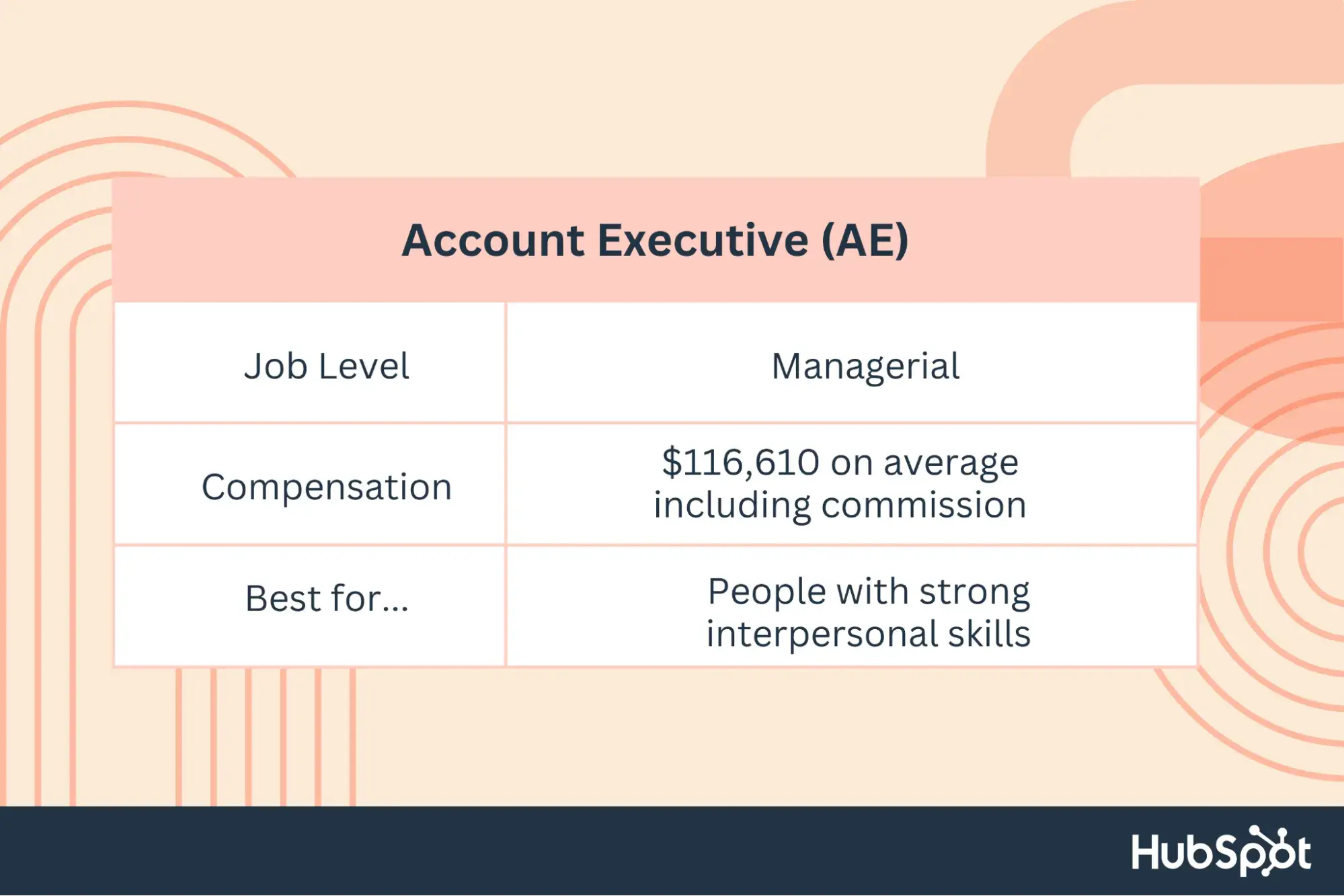
types of sales jobs, account executive, managerial, $116,610 a year, best for those with strong interpersonal skillsJob Level: ManagerialAfter approximately 6 to 18 months, most sales development reps are eligible for promotion to account executive. As an AE, you have a brand new set of responsibilities:

  • Running demos or giving presentations.
  • Identifying, surfacing, and addressing potential buying obstacles.
  • Crafting personalized value propositions.
  • Securing a commitment to purchase.
  • Negotiating the actual terms.

AEs are held to quotas — sales targets they must meet either monthly, quarterly, or annually. Account executives earn a total of $116,610 on average including commission, though in some industries, like B2B SaaS, compensation averages as high as $167,000.

How to know if this job is right for you: Being an AE is a natural next step once you’ve gotten some selling experience under your belt. People with strong interpersonal skills thrive as AEs, since the lion’s share of their day is spent in meetings, on the phone, sending emails, and/or engaging prospects on social media.

Resiliency is crucial for this role. Like most sales jobs, the AE role comes with rejection and uncertainty. You’ll be miserable if you don’t learn to bounce back quickly after failure and remain calm in high-stress situations.

Of course, there are also a lot of highs. If the idea of closing a big deal or winning a low-probability opportunity thrills you, this position is right up your alley.

3. Outside Salesperson

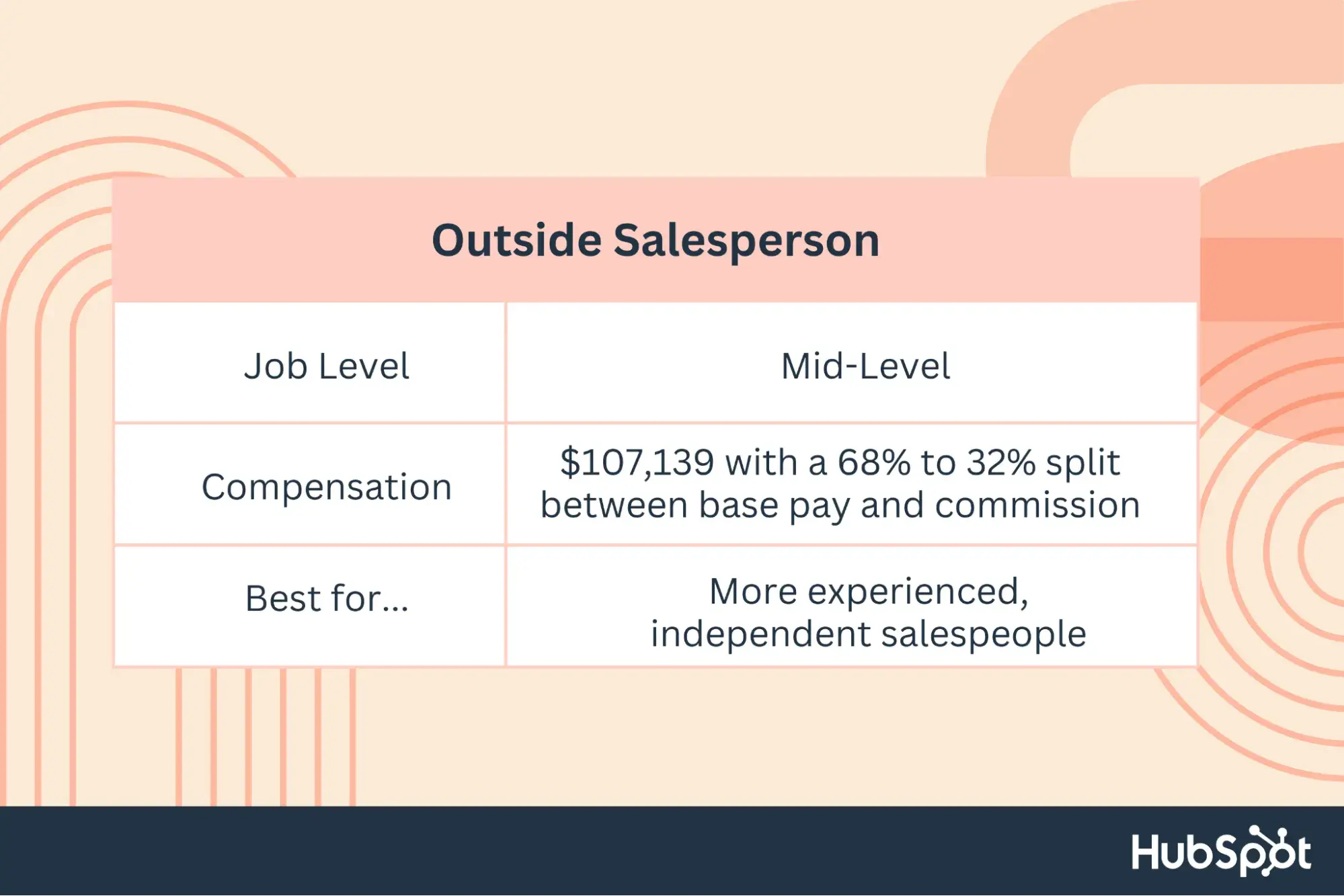
types of salesperson, outside sales person, mid-level, $107,139 per year, best for more experienced salespeople. Job Level: Mid-LevelAn outside salesperson spends most of their time “in the field,” or visiting potential customers at their offices. Picture a pharmaceutical sales rep visiting doctor’s offices or a rep selling equipment to manufacturing plants. You’ll be constantly on the move: around the city, region, state, country, or even the world.

Outside sales typically involve longer sales cycles and higher-value deals, and they also get paid slightly more. The most common industries for outside sales roles are manufacturing, Fortune 500 companies, and retail.

Because you’re largely working by yourself or with a few other team members, a field sales job can be isolating. On the other hand, you have more autonomy.

Thanks to the rise of email, social media, and web-conferencing tools — not to mention, a growing desire to talk to salespeople virtually and on the phone rather than in person — outside sales roles are becoming increasingly less common. They’re also evolving: Outside sales reps are starting to include some virtual tools and selling techniques into their multi-step processes.

The average total compensation for this role is around $107,139 according to Glassdoor, with a 68% to 32% split between base pay and commission.

How to know if this job is right for you: Employers usually look to more experienced salespeople for outside sales roles since you’ll typically be meeting buyers on your own. It’s also harder to learn selling fundamentals when you’re operating solo or in a small team.

As a result, an outside sales role might not be the optimal choice when you’re new to sales. Constant travel can take a toll too — whether you’re a novice or a veteran.

Working in outside sales does offer some advantages, like changes of scenery if you’re someone who can’t stand the thought of being in an office staring at a computer screen all day. Building rapport and establishing trust with your prospects tends to be easier if you’re face-to-face. In addition, many reps like how much independence this role offers.

4. Inside Salesperson

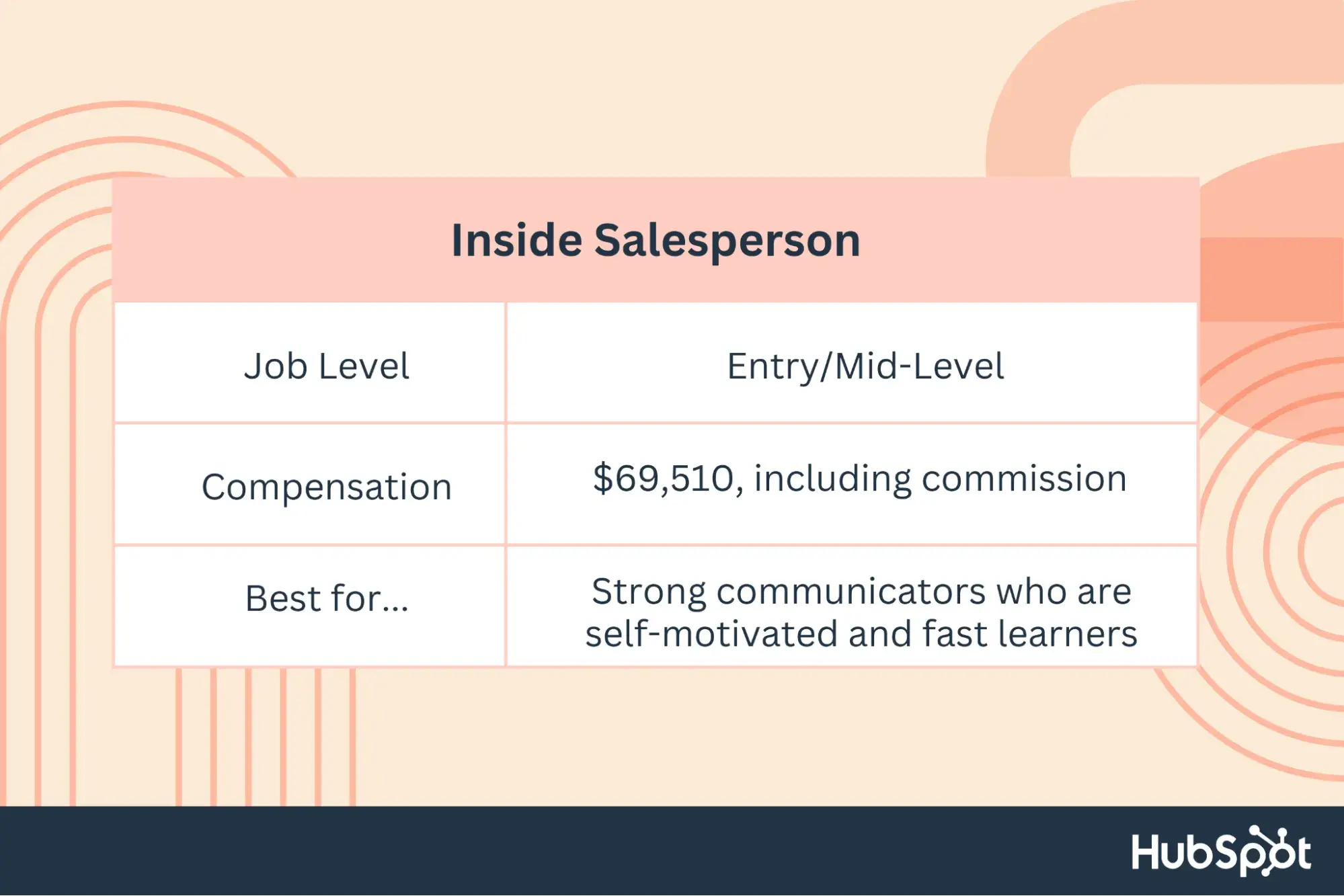
types of sales jobs, inside salesperson, entry/mid-level, $69,510 per year, best for strong communicatorsJob Level: Entry/Mid-LevelThanks to technology, salespeople now have the ability to sell to nearly anyone, anywhere, which is the basis of inside sales.

Inside salespeople guide their customers through the sales process remotely, building relationships with their buyers over time using video, email, and phone calls to connect.

The role of an inside salesperson typically does not involve travel or in-person interaction with customers, as the work is primarily done from their company's offices or remotely.

According to Glassdoor, the average salary for an inside salesperson is $69,510, including commission. Approximately 44% of those occupying the inside sales rep role are early in their career, and 19% of those in the role are considered mid-career.

How to know if this job is for you: If you’re a strong communicator who is self-motivated and a fast learner, you may be well-suited for an inside sales role. A job in inside sales can be a good place to begin your career in sales because you can work alongside other sales professionals in a safe environment for learning.

5. Account Manager

Job Level: Entry/Mid-Level

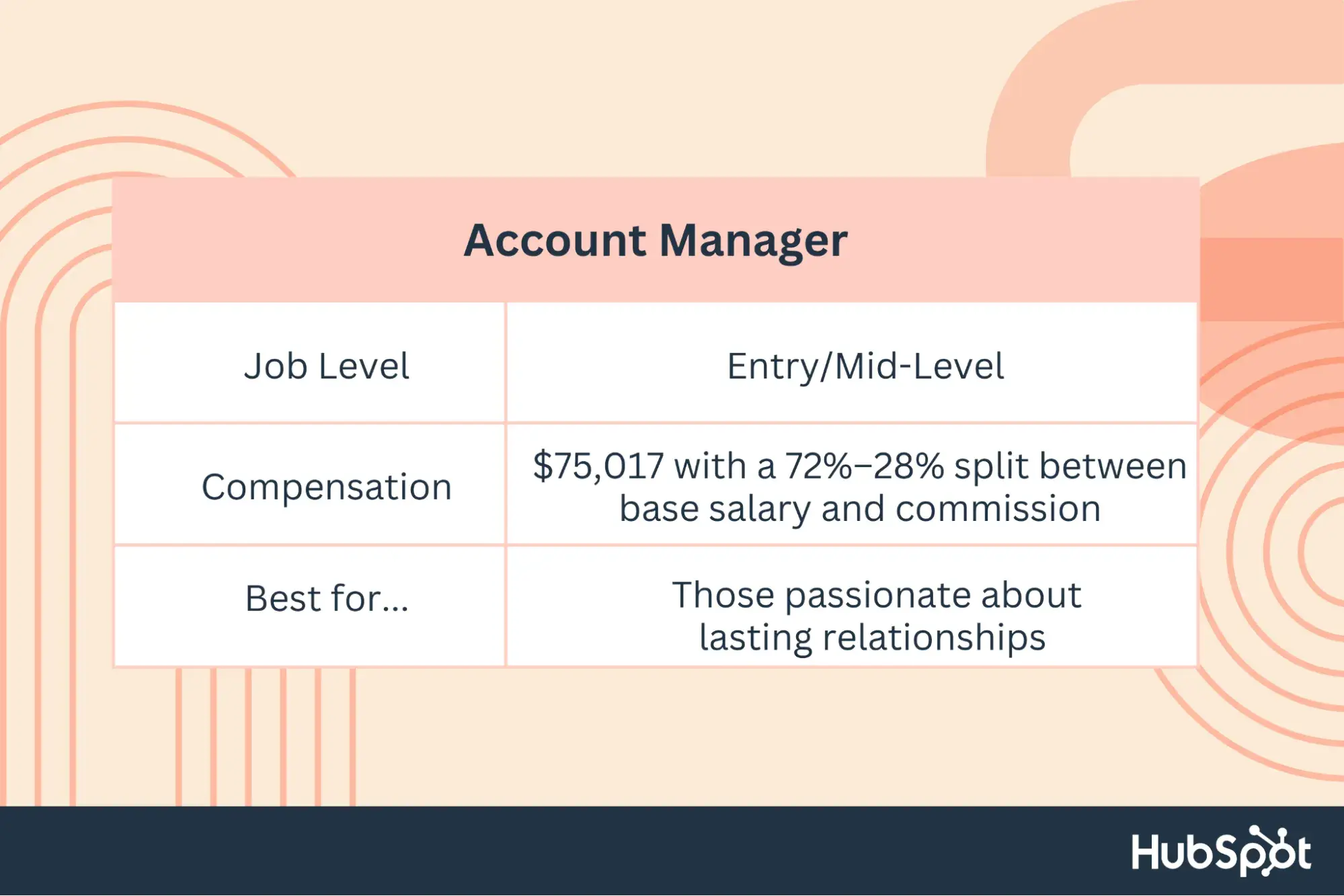
types of sales jobs, account manager, entry/mid-level, $75,017 per year, best for those passionate about lasting relationships

Account managers enter the picture once the initial purchase is complete. Unlike a salesperson, whose accounts are constantly changing, an account manager’s portfolio is relatively stable.

You’ll work with each customer to understand their needs, create a long-term strategy, and help them realize the greatest possible ROI from your product.

An account manager also serves as the client’s primary point of contact at the company. When they have non-support questions, they’ll go to you.

The main metrics you’ll be measured by? Retention and satisfaction rates. But account managers also look for upsell and cross-sell opportunities. At some organizations (usually smaller ones), they’ll handle this conversation with the customer directly. At larger companies, it’s more common for a salesperson to take over once an opportunity to expand the account comes up.

The average national compensation is $75,017, according to Glassdoor, with a 72%–28% split between base salary and commission.

How to know if this job is right for you: If you’re passionate about building lasting relationships and being an internal advocate for your customers, you’ll do well as an account manager.

Successful account managers are also skilled at balancing multiple needs. For any given account, you must consider the client’s objectives, your company’s objectives, sales targets, and more.

Lastly, you’ll need to speak your customer’s language. With a deep understanding of their business, market, product, and industry, you’ll earn their confidence and turn them into loyal customers and brand advocates.

6. Regional Sales Manager

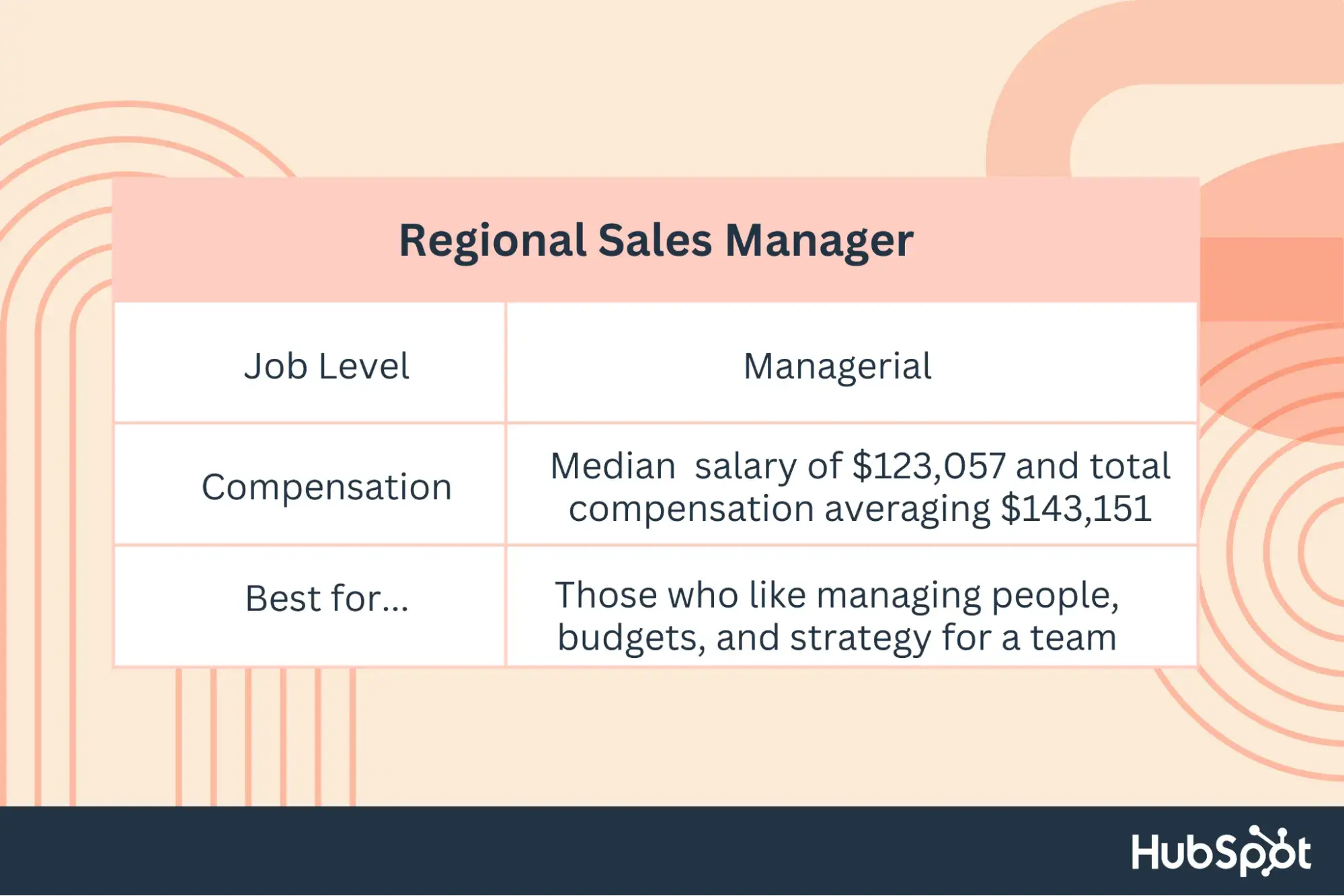
types of sales jobs, regional manager, managerial, median salary of $123,057, best for those who like managing people. Job Level: ManagerialSales managers and regional sales managers lead teams of SDRs, reps, and, sometimes, account managers. You'll set individual quotas and team goals, analyze data, coordinate sales trainings and call reviews, and manage sales territories.

You also might be involved in the recruiting, hiring, and firing of employees. And, depending on your organization's hierarchy, you might need to represent your team in executive and company-wide meetings.

According to Salary.com, you can expect a median annual salary of $123,057 and a total compensation averaging $143,151. Though regional sales managers no longer manage their own sales accounts, they still earn commissions and bonuses based on the entire team’s performance.

How to know if the job is right for you: You'll need at least three years of sales experience, often more, including some managerial experience. You might have held an account executive position or overseen a few SDRs, and you should be familiar with managing a small budget and analyzing team performance.

Once you have the experience, ask yourself whether you like managing people, budgets, and strategy for a team. A sales manager position involves a lot of people management and coaching. But some salespeople prefer to remain individual contributors. If you're happier in the trenches making sales and ringing the gong, a sales manager position might not be for you.

7. Sales Operations Manager

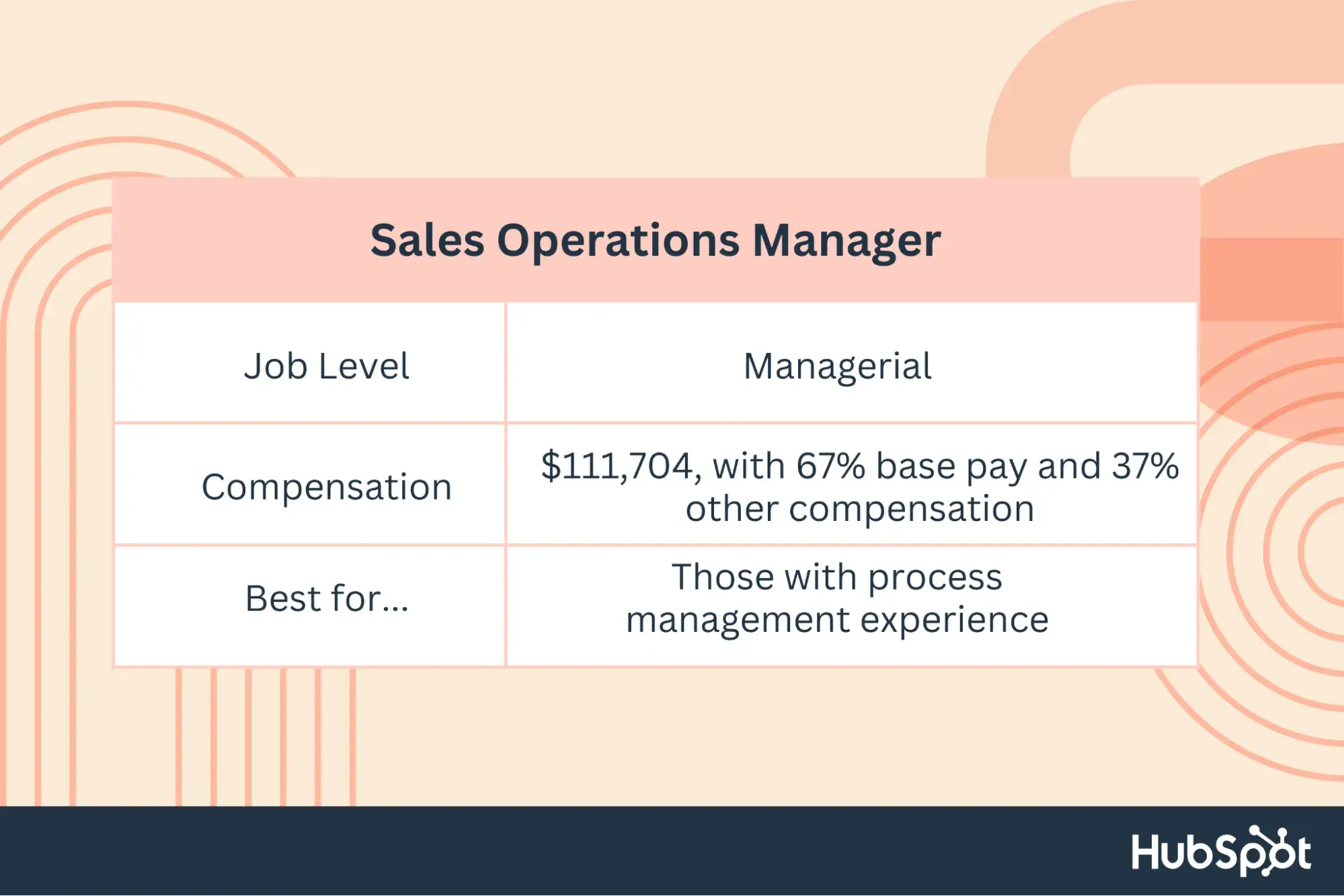
types of sales jobs, inside sales operations manager, managerial, $111,704 base compensation, best for those with management experienceJob Level: ManagerialWhile a majority of sales jobs revolve around, you know, selling, many successful sales organizations have team members focused solely on supporting the organization as a whole. The role of the sales operations manager falls into this category.

The goal of sales operations is to minimize friction in your company’s sales process to help your sales organization achieve its goals. In larger organizations, operations teams consist of analysts led by sales operations managers.

Sales operations managers are responsible for managing and simplifying the sales process on behalf of their company using automation and sales enablement best practices. Sales operations managers often oversee a company’s CRM and sales data and analytics. Key competencies include analytics, process management, basic sales knowledge, and business acumen.

According to Glassdoor, the total compensation of a sales operations manager averages $111,704, with 67% base pay and 37% other compensation.

How to know if this job is for you: If you have a strong understanding of sales and have experience with process management and sales enablement, you could be well-suited for a sales operations management role.

8. Sales Engineer

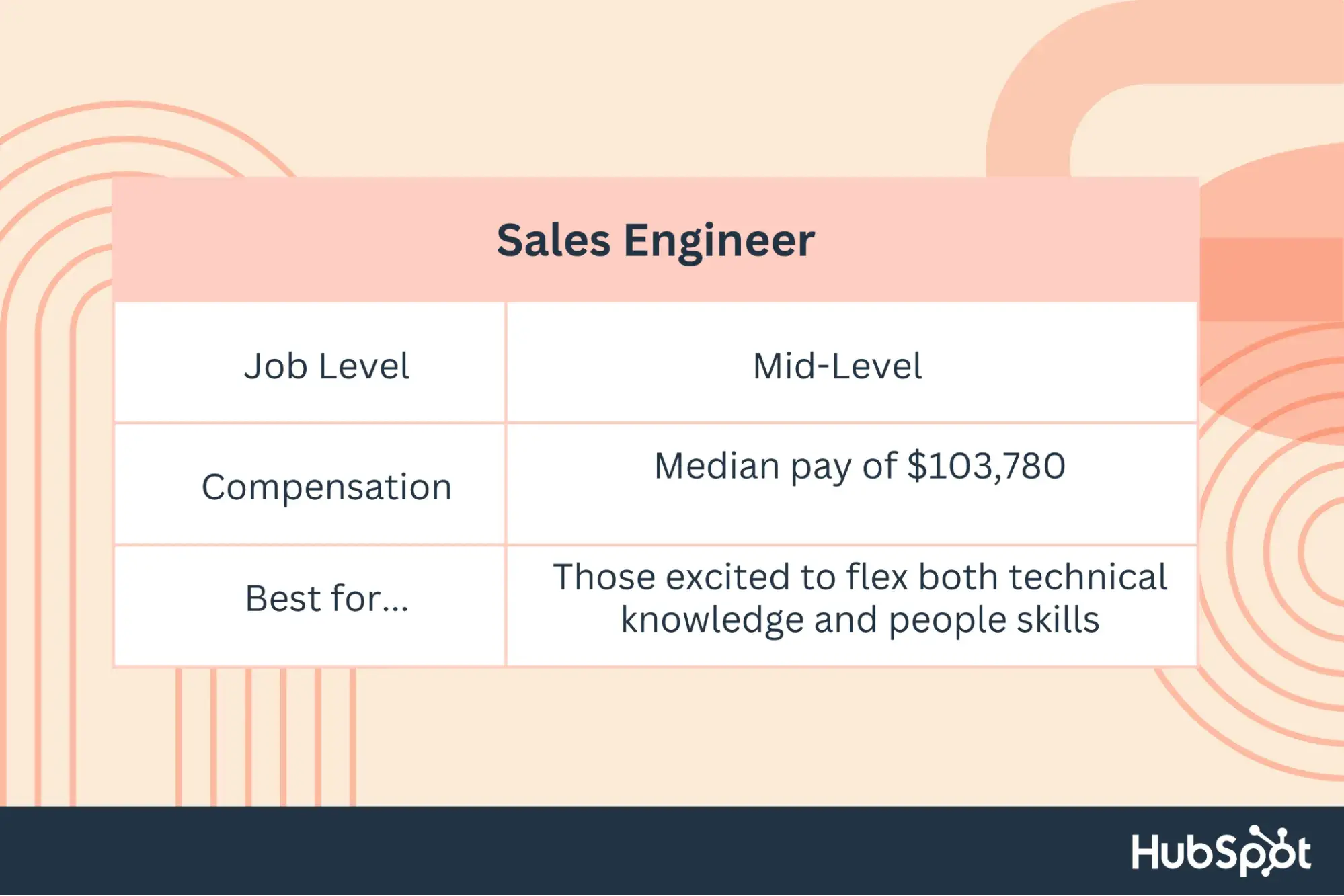
types of sales job, sales engineer, mid-level, median pay of $103,780, best for those who have technical knowledge and people skillsJob Level: Mid-LevelThese professionals are also known as “pre-sales support,” “systems engineer,” or “field consultant.” Sales engineers combine the technical expertise of engineers with the business acumen and selling skills of a traditional rep.

That’s a powerful — and rare — combination, so demand for them is relatively high.

As a sales engineer, you’ll answer in-depth product questions, work with prospects to determine their technical needs, communicate those needs to your sales, engineering, or product teams, help salespeople give demos, and craft the technical components of proposals and contracts.

You’ll either be paired with a single rep — in which case you may be held to a joint quota — or assigned to deals based on demand. Reps often complain there aren’t enough sales engineers to go around, so it’s likely you’ll have a full schedule.

Because sales engineering calls for more tech savvy than a traditional selling role, the median pay is relatively high: $103,780, according to the U.S. Bureau of Labor Statistics.

How to know if the job is right for you: This position is ideal if you’re excited to flex both your technical knowledge and people skills. It requires fantastic active listening, presentation, and communication skills, as you’ll be spending a great deal of time in front of customers.

Some sales engineers are always on the road. Can you picture yourself spending a few days per week away from home hosting workshops for prospective customers and giving demos? If just the thought exhausts you, a sales engineering position may not be the best fit.

It’s also worth noting most employers look for a B.S. in computer science, a B.A. in engineering, or another related degree. Five-plus years of experience in pre-sales roles will also increase your chances of getting hired.

9. Director of Sales

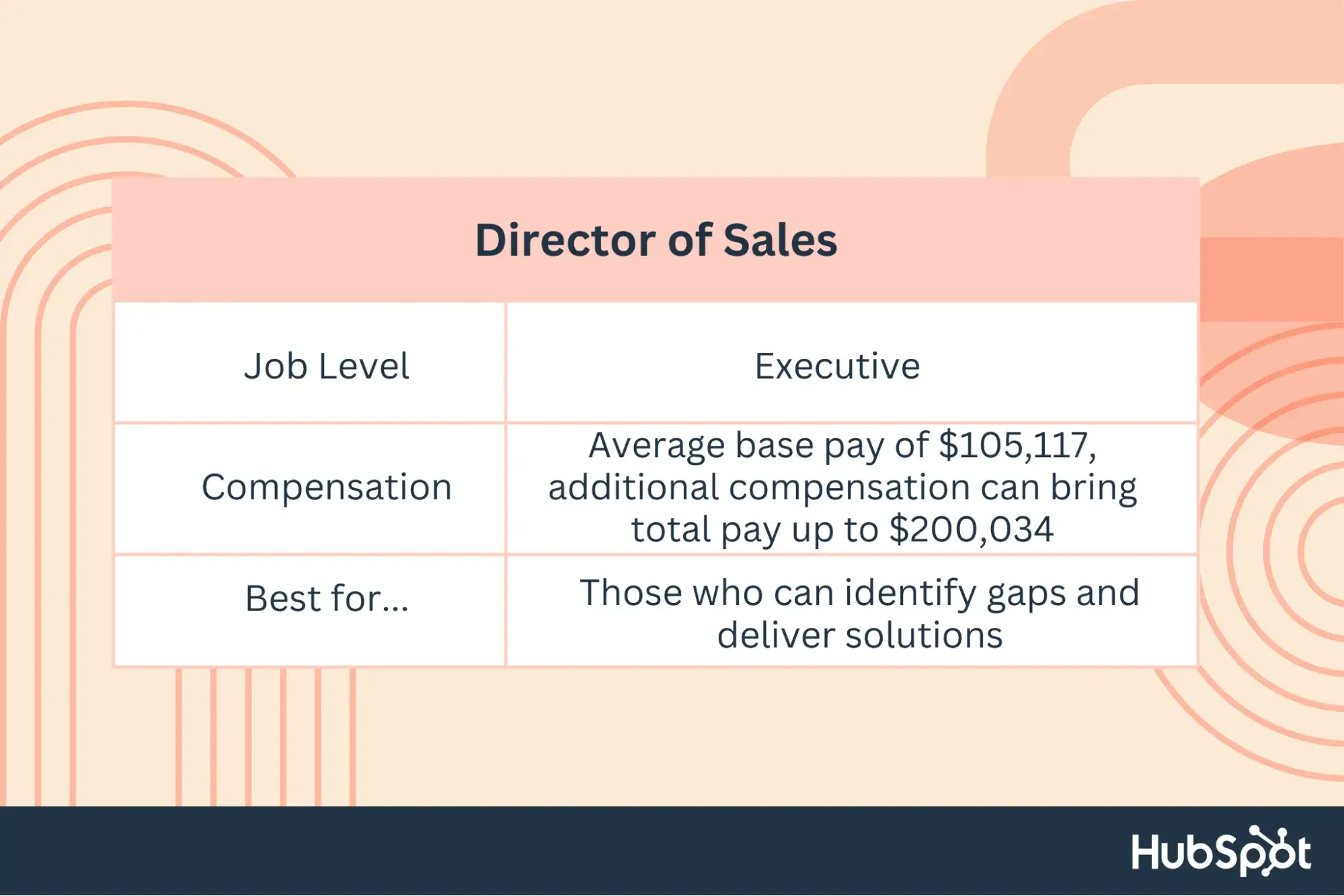
types of sales jobs, director of sales, executive, average base pay of $105117, best for those who can identify gaps and deliver solution Job Level: ExecutiveA director of sales works with sales managers to determine sales objectives, forecast and develop sales quotas, maintain sales volume, and oversee management functions such as hiring and team development.

In this position, you‘ll maintain a more strategic role than that of a sales manager. You’ll likely report to the VP of sales, and communicate executive directives to the rest of the sales organization.

You'll probably be held responsible for the performance of your department. And your bonus will be awarded when your sales organization meets or exceeds goals. Budgeting, people management, recruiting, and business development initiatives will also be on your plate.

While Glassdoor sets the national average base pay at $105,117, additional types of compensation can bring your total pay up to $200,034.

How to know if the job is right for you: Are you a sales manager who's ready for more responsibility and leadership potential? This might be the role for you.

You should be able to demonstrate growth and performance from your team as a sales manager. Your reps and region should be thriving, and you should already be flexing your muscles outside your job description.

Demonstrate a one-step-ahead mentality against your competition by identifying gaps in your business and delivering solutions first.

10. VP of Sales

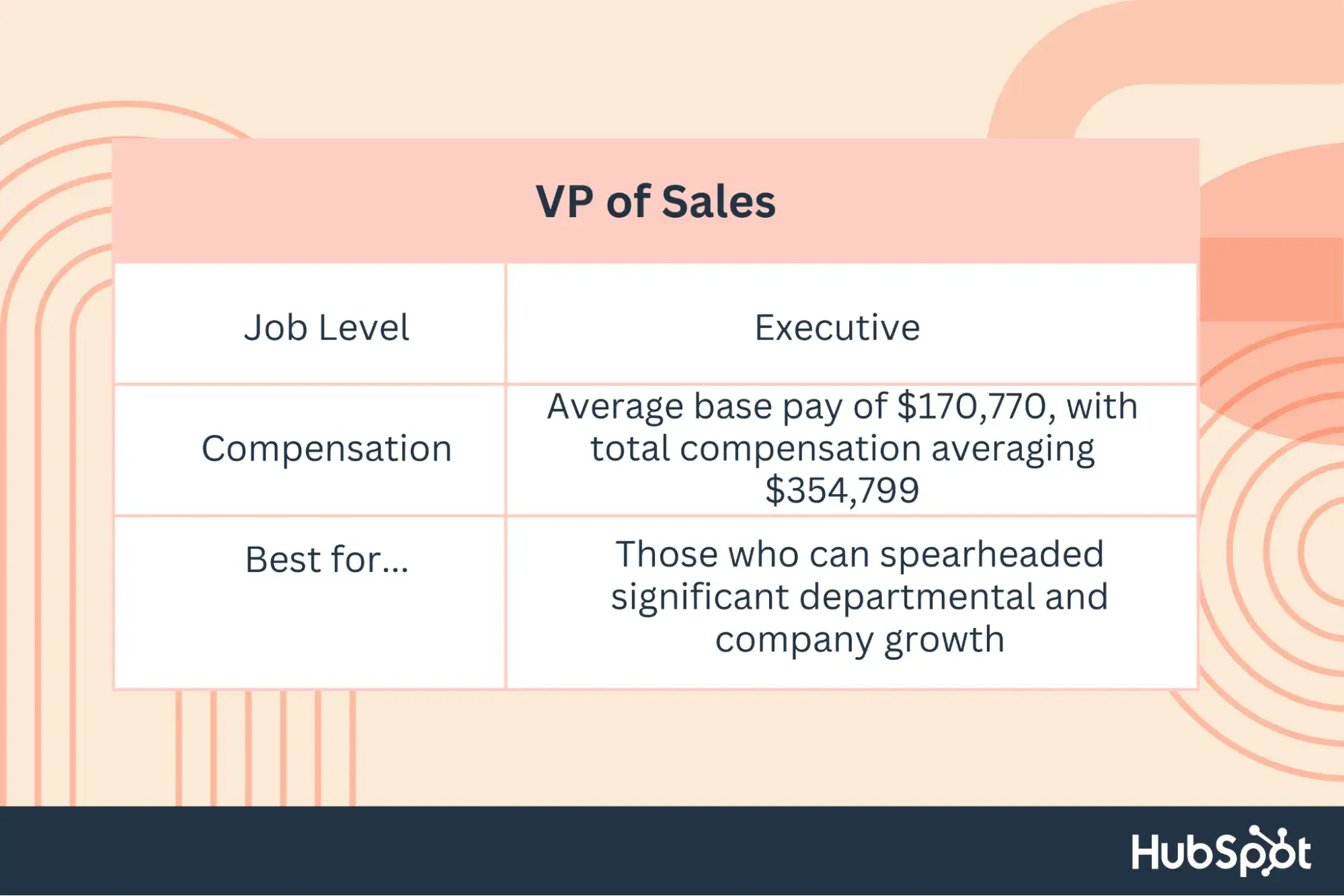
types of sales jobs, vp of sales, executive, average base pay of $170,770, best for those who can spearhead growthJob Level: ExecutiveA vice president of sales should contribute to the overall growth and strategy of the sales team — and depending on the organization structure — the company as a whole.

As a VP of sales, you’ll identify strategic hiring opportunities that will strengthen your team, and aid in recruiting top talent. You'll also be in charge of team strategy like deciding which markets your organization will expand to and selling the tactics your team will need to get there.

At the end of the day, your goal is to help your company scale and grow. You can use your experience and insights to set a vision for the company’s next moves.

Because this role requires 10 or more years of experience and a proven track record of success, VPs can command a large salary and even larger commissions and bonuses.

Glassdoor reports the average base pay of VPs of sales as $170,770, with total compensation averaging $354,799.

How to know if the job is right for you: You’ve held managerial and director-level sales positions and can demonstrate that you’ve spearheaded significant departmental and company growth.

You should feel comfortable in a leadership role, be able to think analytically about your sales organization, and be proficient at communicating with executive- and board-level colleagues.

11. Chief Sales Officer

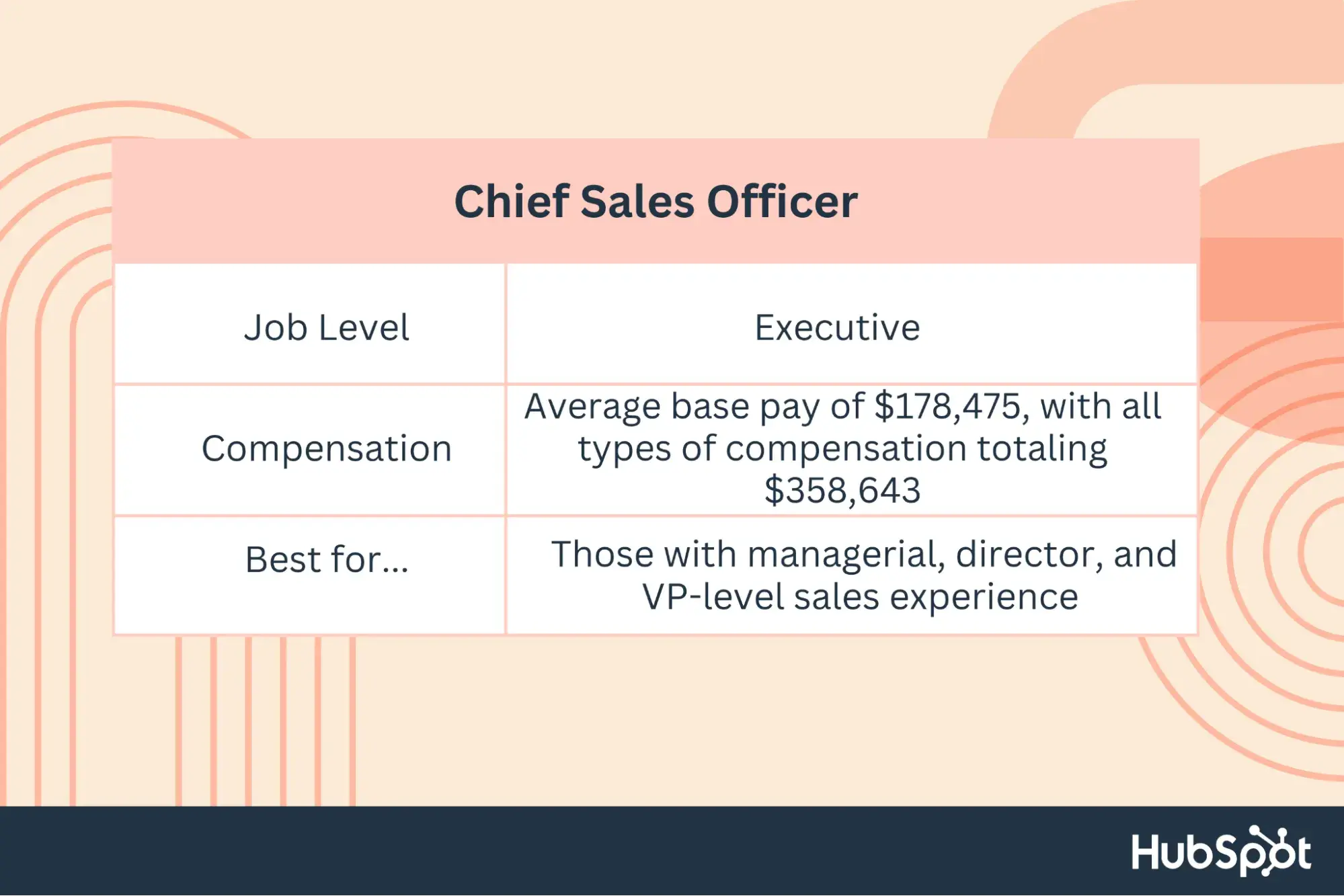
types of sales jobs, chief sales officer, executive, base pay of $178,475, best for those with managerial experienceJob Level: ExecutiveOften found at large enterprise companies, the Chief Sales Officer oversees complex sales strategies executed by their sales team. These roles are rare and competitive.

The Chief Sales Officer often reports directly to the CEO of the company and is expected to have top-tier sales expertise.

According to PayScale, over 80% of Chief Sales Officers are classified as being “experienced” or “late in career,” meaning those in this role typically have decades of sales experience under their belt.

Glassdoor reports the average base pay for a Chief Sales Officer at $178,475 per year, with all types of compensation totaling $358,643 per year.

How to know if the job is right for you: You have managerial, director, and VP-level sales experience and are able to drive revenue growth for an enterprise organization.

What’s the highest-paying sales job?

Among salespersons working as individual contributors, the highest-paying types of sales jobs are account executive (averaging $116,610 total compensation) and outside salespersons (averaging $107,139 total compensation).

Among managerial and operations positions, the highest paying sales jobs are Chief Sales Officer (averaging $358,643 total compensation) and VP of sales (averaging $354,799 total compensation).

Just remember that most sales jobs are commission-based, so there’s no limit to what a high performer can earn in any type of sales job.

What is the best entry-level sales job?

There’s a wide variation in what education or experience you need to get your first sales job. With little to no experience, you can start out as a sales development rep (SDR), seeking and qualifying leads.

Depending on the company, you can also land an entry-level role in inside sales or account management with only a bachelor’s degree. Inside sales is a more competitive, direct-selling role while account management builds relationships and offers solutions over time.

Good luck finding your perfect job in sales. No matter what type of sales job you choose, it's a career that offers fulfillment, autonomy, and unlimited earning potential.

Editor's note: This post was originally published in August 2020 and has been updated for comprehensiveness.

08 Mar 16:38

Interactive Storytelling: How to Make Your Content Strategy Soar in 2017 (with Examples and Stats)

by Robbie Richards

One of the keys to content marketing success is differentiation.

How can you provide unique value nobody else is offering?

For a long time, “content marketing” was seen as a daily 500 word blog post. That’s it. You’d build a massive audience with nothing more than a topical focus and consistent scheduling.

As you know, those days are long gone.

Over 4 million blog posts have been published in the last 24 hours. Think about that for second. Let the math sink in.

If you want to stand out, you can’t rely on a publish-and-pray content strategy. You need to differentiate yourself, and find a more effective way to engage your readers. Today, we’re going to look at a simple, but ultra effective way to break through the noise and grab reader’s attention.

It’s called interactive storytelling. And, it will give wings to your content strategy.

What is Interactive Storytelling?

The concept of storytelling in a business context can be a bit confusing, so let’s take one step back and look at the importance of storytelling itself.

Since the beginning of time, people have told stories. Teachers tell stories in their lessons, business men and women tell stories in presentations, artists tell stories through their work, and so on.

People have been telling stories since the beginning of time. This ancient story was created many centuries ago, on the walls of a cave.(Source)

So why would businesses use storytelling in their marketing efforts?

Because stories are sticky. And, here’s why:

Stories engage the brain through a phenomenon called neural coupling, causing brain waves in the listener to mirror those of the storyteller.

Stories help us hook readers emotionally. Engaged emotions help create empathy with the speaker/ writer.

Stories light up the brain more than factual reporting or data. When people read factual reports, only two regions of the brain activate. FMRI studies show that storytelling activates additional areas of the brain. The brain reacts to stories as if they are actually happening to the reader.

Stories change the brain’s chemistry. When a reader is engaged with an emotional story their brain produces oxytocin (the “trust hormone”), a substance proven to increase trustworthiness and generosity.

“What we’ve found is that once we see a personal resonance in the brain, there is very likely to be an action following that story,” – Dr. Paul Zak (neuroeconomist)

Hear that? Action. This is very powerful.

And, the use cases are endless.

Storytelling in businesses can be used to tell a story about a brand, and what it stands for, like the TOMS shoes brand does:

Interactive storytelling example

Stories in business can be used in product descriptions to increase conversions:

TOMS interactive storytelling example on a product page

So exactly what is interactive storytelling?

“Interactive storytelling” is simply storytelling enhanced by digital tools.

Because sometimes words aren’t enough to tell a complex or compelling story.

Interactive storytelling uses technology to captivate the user on multiple levels, engaging as many of the senses as possible, in order to create a unique experience that stands out over traditional forms of content.

The most sophisticated forms of interactive storytelling utilize a blend of psychology, sociology, cognitive science, linguistics, design, computer science, and artificial intelligence.

According to Visme, “If done right, viewers forget they’re reading text, listening to sound effects, looking at visuals and scrolling down all at the same time and begin to experience it as a whole.”

Sounds great, but let’s see some examples of interactive storytelling in aciton to get a better understanding of it’s potential.

Examples of Interactive Storytelling

Interactive storytelling blurs the line between art and marketing.

The following examples demonstrate what is possible with interactive storytelling, whether the purpose is to sell a product or simply create something more engaging for your readers.

1. The Boat

Let’s start with a bang. The Boat is a visually haunting scroll-based story experience.

The Boat - interactive storytelling example

As you land on the website, you are hit with the sight of pouring rain while the page finishes loading, setting the mood for what’s to come.

As you scroll down the page, the story combines text, audio, visuals and interactive elements to deliver an immersive experience. The boat sways in the water, lighting and thunder cracks overhead, and the wind howles in the background. The interactive component of this story makes it feel like you’re actually on a boat, in a large storm.This level of interaction dramatically increases engagement and keeps visitors on the page longer.

2. Apester

Apester is an online software that businesses or individuals can use to create elements of interaction to incorporate into their website content.

Their website is an interactive story:

Apester interactive storytelling example

Apester’s website effectively showcases the meaning of branded “interactive storytelling”.

As you scroll down the webpage, interactive elements begin to unfold – balls bobble across the page, while tick marks flash as the ball drops onto the “your brand” box. As the ball moves, different background images slide into view, all highlighting the Apester brand.

The site’s interactivity supports the headline text “Send your readers on a journey through your site”. The bobbing ball makes you feel as if you’re actually bouncing around the site. The motion of the ball bypasses critical branding pieces, keeping the reader engaged, while ensuring you are subjected to the most pertinent information on the page.

3. New Burger Capitals of America

Time magazine launched the interactive “burger builder”:

Burger Builder interactive content example

With the burger builder, find out which cities share your taste in burgers, and share your results.

Had the website only used text to demonstrate the burger preferences of people in cities across America, it may have been a dull read. But, delivered in a game-winning format made it a more engaging, and a fun way of finding out burger preferences in America. Above all, it tempts (excuse the pun) the viewer to play.

4. Killing Kennedy

Killing Kennedy - interactive content example

National Geographic released this interactive story on the 50th anniversary of the assassination of JFK.

This example uses imagery, audio, and video to create a compelling side-by-side story of the lives of JFK and his killer Lee Harvey Oswald. Not only does the content keep you engaged, it tells a headline story from a largely uncovered angle.

Compelling visual cues, creative use of multi media, layered on top of a famous storyline makes this piece extremely memorable. As a result, the animation captured the attention of dozens of large media publications and thousands of engaged readers.

5. Hell and High Water

ProPublica interactive storytelling example about Hurricane Ike

Houston is the fourth largest city in the country. It’s home to the nation’s largest refining and petrochemical complex. And it’s a sitting duck for the next big hurricane.

Through the use of interactive maps, compelling data projections, and striking photography, The Texas Tribune shows us what it would have been like if Hurricane Ike’s potential storm surge had hit the Houston ship channel in 2008. The results are enough to make anyone living in the area stop and question their safety. It’s not a matter of if, but when another super hurricane will strike the area.

Why Interactive Storytelling Is Important

So now that we have a better feel for interactive content, it has to be asked…

“What go through all this trouble?”

Obviously, creating interactive content like this requires some investment. It’s certainly going to be more expensive than writing a blog post. Why do it?

Modern readers are inundated with choices, and have limited attention spans.

We can thank the rise of gadgets for some of this: a 2014 study by OMD found that the “average person shifts their attention between smartphone, tablet and laptop 21 times in an hour.”

Our attention spans are getting shorter. Studies have shown that the human attention span has decreased 33% over the last 15 years from 12 to 8 seconds. For context, that’s a shorter attention span than a goldfish!

This shift in consumer pychology has forced the hand of marketers. You need to get smarter about how you grab the attention of readers, and keep them engaged for longer. Since content marketing is the backbone of all online marketing efforts, it seems like a logical place to start.

But:

Don’t just take our word for it. Listen to what your peers have to say:

  • 93% of marketers agreed that interactive content is effective in educating its buyers.
  • 88% of marketers said that interactive content is effective in differentiating their brand from their competitors.
  • 70% of marketers say that interactive content is effective at converting site visitors.

Bottom line:

Outside of higher engagement levels and stronger connections with your audience, interactive storytelling will help differentiate your brand, better educate your readers, and close out more sales.

Up to this point, the majority of marketers have already incorporated interactive assets like images, video and infographics, but at a much simpler level.

The key is to add a level of interactivity that nudges all five senses. This is where the real potential to differentiate your brand and maximize conversion rates exists.

Content touching all senses

Aim to touch as many of the human senses as possible. Tell stories that inspire, amuse and entertain readers, and you’ll keep their attention longer.

Note: Higher engagement, deeper scroll depth and longer time on site are now signals that Google uses to rank content in the search engines.

What Types of Digital Stories Are A Good Fit?

At this point, we understand what interactive storytelling is, and why it’s important. Now, it’s time to learn how to implement it into your campaigns.

As you may have guessed, this isn’t something you can just “phone in” or force onto any old sale pitch. You really need the right type of story in order for this content style to work.

There are three different story types that tend to fit the interactive storytelling mold really well.

1. Personal Stories

These stories are often emotionally charged and attached to life changing events. If you are passionate about something or someone, this type of story will resonate strongly.

Narratives are often based on personal discovery and introspection, when readers get to find out something personal about us.

In this case, it’s the story that drives the interactive tools being used are to visually support and stimulate the senses.

A good example of a branded narrative story is Bombas:

Bombas interactive storytelling

Bombas tells a powerful brand story: their socks were created to fill a community need – providing socks for the poor. For every pair of socks purchased from Bombas, a homeless person is given a pair of specially designed socks; made to last, keep looking clean and prevent fungi so it doesn’t need to be washed as often as normal socks.

This story changes Bombas’ product from a commodity to a meaningful brand, with a meaningful purpose.

When you compile a personal or narrative story, give it a beginning, middle and end.

The beginning should attract your reader’s attention, the middle explains what happened, and the end tells of how the situation turned out, and confirms the intention of your story.

2. Instructional Stories

This format is all about education. A typical example would be the “how-to” blog post.

Adding interactive elements breaks up the text and supports the message, like this blog post by Neil Patel, who was demonstrating how to choose a domain name for your website. Not only does he always include loads of images and video content to support his instructional stories, but in this post, an interactive tool was embedded in the post, so that readers could check domain availability witthout having to leave the post:

Instructional storytelling example

3. Historical stories

A typical business example of historical stories would be the history of the brand (if there is a story to be told), which would be demonstrated on an “about” page.

For example, GoSquared Analytics uses an interactive analysis of London’s 2012 Olympics in story form to demonstrate why the reader needs to use their digital product:

Past storytelling example

Once the viewer has scrolled all the way down, they are presented with interactive information; a simple, powerful and relevant way to explain the functionality of their product:

Clever.

How to Choose an Interactive Format for Your Story

Interactivity can be captured through a number of different mediums. The key is to start with the story, and then find the vehicle that helps you best tell that story.

Truth is:

You don’t always need a custom microsite or detailed landing page to tell a powerful interactive story. Sometimes an infographic or simple animation is plenty.

Conversely, in-depth industry reports with loads of data is often overwhelming when presented as a long form blog post or 50 page static whitepaper. For more complex topics, it can make sense to build a story around the data, and allow readers to interact with it at their own pace. This makes it more approachable, and much more engaging than a dense wall of text and graphs.

Here are some of the different tools you can use to add an interctive layer on top of your stories:

  1. Microsites
  2. Infographics
  3. Whitepapers
  4. Video
  5. Ebooks
  6. Aritcles
  7. Landing pages

Conclusion: Putting it Into Practice

Interactive storytelling can differentiate your brand and level-up your content marketing.

When putting all this into practice, it’s important to consider the following:

  1. Your marketing budget. Many online tools are free to a point, but you may need to hire others for the designing. More sophistication requires more sophisticated designers (with sophisticated pricing). Know your budget from the beginning, so you can pick the appropriate style of interactive content.
  2. Business goals. Marketing goals are grounded in the company’s overall business obective, so the type of content produced should be congruent with your business focus.
  3. Your audience. Meaningful interactive storytelling can only be built successfully into your digital strategy when you know the needs and desires of your audience. If you aren’t telling stories they care about, the sophistication of your interactive elements won’t matter.
  4. Distribution channels. You will need designs that match the requirements of your content distribution channels. For instance, if you plan to post interactive storytelling on Facebook, you should create content that works with Facebook.

I hope this guide has helped you better understand the potential of interactive storytelling for your business.


08 Mar 16:36

Startup Best Practices 24 - Marketing Your Product with Novel Framing to Maximize Sales Success

Every software company competes with another — if not directly, then at least for budget. With global IT spending flat to down in 2015 and 2016, software businesses are fighting for share of wallet. At this point, the critical marketing imperative is to start a conversation with a receptive buyer, and do it thousands of times per year. But how?

I met a master software marketer last week, and he shared some of his wisdom. A luminary, he has built the positioning, packaging, and pricing for several multi-billion dollar software companies.

The marketer’s fundamental challenge: buyers don’t perceive a substantial difference amongst vendors. A 2015 CEB study confirmed this:

Over and over we found that customers, generally speaking, see significantly less difference between us and the competition than we do ourselves. It’s not that they think most suppliers are particularly bad on brand, product, or service. It’s just that [customers] don’t think [suppliers are] particularly different.

This master marketer pointed to our language. Within in a market, competitors often use the same language to describe their products. Big data. Machine learning. Cloud. Inevitably, the pitches sound the same.

His advice: choose new words to describe your business and your value proposition. These new words raise questions in the buyer’s mind: What is this new thing? How is it different? Why haven’t I heard about it before?

Apple does this consistently. The Retina display premiered with iPhone 4. Apple coined Retina to distinguish screens with pixels too small for the human eye to see. The rest of the market described their displays in pixels (e.g., 960x640). The Retina term changed the competitive landscape. Which devices are Retina? Only Apple.

Why don’t more software companies frame their products differently? First, there’s the pull of the analysts and fitting into a market segment. Second, there’s the inertia of describing a product similarly to others to bootstrap demand. We’re like X but different in this regard. Third, it’s not easy. It requires creativity and the willingness to make a bet.

But it’s worth doing because if it works, novel framing skews the playing field in your favor and increases your sales success.

Employing new words in marketing open the door to a challenger sale, which is the most effective sales technique. Challenger sales people represent 23% of the population, but 39% of top performers.

Challenger salespeople start by listening to understand their customers problem. Then they insert a new perspective to a problem and debate the superiority with their customers.

By combining new language with a challenger sales techniques, the marketing team sets up the sales team for success. Novel language, challenger sales, innovative product is a powerful combination.

07 Mar 17:04

How to Use Calls to Catch your Prospects Attention (6 Script Examples!)

by Hannah Lindstadt

After years of undervaluation and blatant misuse (cold calling, I am looking at you…) the B2B sales call is finally making a come back and getting recognized by thought leaders as the powerful communication channel that it is.

Ken Krogue, the president of Insidesales.com, recently explained how a well integrated call strategy is often the missing ingredient growth-focused companies are lacking to land big accounts and drive conversions. The key is to seamlessly thread calls into your content focused email campaigns and maintain a holistic view of every stage of the buyer’s journey.

Below I share 6 different script examples, organized for a content focused Threaded Email and Call Cadence, and easily adaptable for any company to guide their prospects from the first touch, through the 3 main buyer’s journey stages; Awareness, Consideration, and Decision. Make sure to read the pro-tips and check out the script examples that accompany each call stage.

Example Call for the Awareness Stage

1.) The Content Focused Warm-Cold Call

How To:

Your first contact with any prospect should be focused on adding value and discovering your prospect’s pain points. This call should be made after first sending the prospect an email that shares a relevant piece of content on a topic of a possible industry wide interest.

Pro Tips:

  • Always state your name and give a one sentence “tagline” to describe how you help your current customers. Make sure not to over sell yourself or your company!
  • Reference the email and content you sent, but don’t bank on them having read it.
  • Ask questions. Think of this call as a discovery call. The goal is to uncover pain points, and if possible offer a preview of your company’s solution to those pains.

Example Script:

“Hey Hannah, this is James Cooldude calling from VOIQ, we are an automation platform that helps growth-focused companies scale their sales by layering data-driven intelligent calls into their sales stack. I hope you received my email this morning, I sent over [Pertinent content] because we’ve been seeing many companies in [Prospect’s industry] struggling with [Related pain point] . We’ve been [Alleviating pain point] and I wanted to ask you a few questions to identify if you are in a similar boat. [Begin asking top five pain point identifying questions]”

…….

Example Calls for the Consideration Stage

2.) The Content Focused Nurture Call

How To:

Similar to the Content Focused Warm-Cold Call, this call should be made after sending the prospect an email with relevant content. Because the prospect is now in the consideration stage and you are already aware of their specific concerns and pain points, you can personalize this content to directly address the pain points you discovered in your first call (this is why it’s so important to keep detailed notes of every call).

Pro Tips:

  • The shared content should be personalized to their specific pain points expressed in the previous call.
  • The focus of the call should be on building trust, the sales rep should help the prospect consider their options and explore solutions.

Example Script:

“Hey Hannah, this is James Cooldude again from VOIQ, we’re the call automation platform. When we talked last you mentioned that you already have an in-house sales team and you were still considering whether or not outsourcing your team’s prospecting was the lever you needed to pull to reduce your high Customer acquisition costs. This morning I sent over [Pertinent content] as it talks about the correlation between segmenting your sales teams and lowering CAC…”

…….

3.) The Friendly Fan Club Call

How To:

Follow the company on social media or set google alerts to receive news updates to gain opportunities to engage personally with and check in on prospects that you haven’t heard from in awhile.

Pro Tips:

  • Reach out to the contact if you notice any interesting company news.
  • Tie the news back to something you discussed in your previous call and ask if they are still trying to find a solution to their original pain points.

Example Script:

“Hey Hannah, it’s James again calling from VOIQ, I was surprised to see you pop up in [News source] for [Receiving an award/ Passing a milestone/ Attending an event/ Other positive company news] it made me think of you and our last conversation when we talked about [Soft push back] and I wanted to let you know that [Value add]….so you can continue to make your decision equipped with the best information possible.”

….

4.) The Post (Demo/Meeting/Info Sharing Session)-Call

How To:

After an in person meeting, a demo or an information sharing session, a Post-Call can be used to keep your company top of mind and reinforce the main take-aways you want your prospect to remember.

Pro Tips:

  • Remind them of the value of the offer and revisit their main pain points.
  • Guide them through the call with an outline of what you will talk about, look confident and organized, and schedule the next call while you have them on the phone.
  • Follow up the call with an email that clearly outlines the next steps and a summary of the value adds and pain points addressed so they can easily share them with their team.

Example Script:

“Hey Hannah, this is James again with VOIQ. When we last spoke you let me know that you’ve been having difficulty developing a strategy to improve your in-house sales team because your current process lacks an organized analysis procedure or a system to track call data and outcomes. It sounded like you were already looking for an automation solution to track your sales call data but that you were hesitant to learn a new gadget that required you to leave your current CRM.

After our talk I continued to think about your situation, I’d like to let you know what I came up with, and then you can let me know your thoughts or any questions you may have. Sound good?”

….

Example Calls for the Decision Stage

5. ) The Disappearance Investigation Call

How To:

Prospects almost always return every email and phone call so if you haven’t heard back from a prospect you should contact local authorities and report them as missing…Actually DO NOT DO THAT. If a previously interested lead stops answering emails or missed a scheduled call appointment, don’t email, and don’t call the authorities…. Call them! Even if they are no longer interested, they have valuable insight as to why they have changed their mind, and you can’t afford to ignore that feedback.

Pro Tips:

  • Remind them why they were interested originally
  • Restate that you want to help them, and you understand they are busy
  • Ask why they have pumped the breaks (Have they gone with someone else? Are they focusing on solving a different pain point? Do they still have concerns? Are they a later opportunity or totally uninterested?)

Example Script:

“Hey Hannah, James again from VOIQ, I am sorry we haven’t been able to connect. When we first spoke you let me know you wanted to find a solution to [Prospect’s pain point]. I know how busy things can get and it’s not my intention to waste either of our time, but I want to ask why you have been delaying making a decision. Have you found a different solution to [Prospect’s objective]? If you have gone with someone else I would love to understand your thought process a little better, and if now is not the right time for you, let me know when I should reach out to you again or if there is anything specifically I could help you with to get you back on track towards your goals.”

….

6.) The Deal Closing Call

How To:

When nearly all that’s left is to dot the “I”s and cross the “T”s make sure you don’t lose focus. Today’s purchasing and acquisitions processes are complex, and often made by entire teams. Always restate value and offer to talk with any other contacts involved in the final decision.

Pro Tips:

  • Ask directly what’s holding them back, and try and counter…(maybe you can offer incentives)
  • Verify they don’t need anything more from you, and that everyone on the decision team has all the information they need.
  • Ask directly for a time frame, so you know when to take your next steps.

Example Script:

“Hey Hannah, James again, with VOIQ. After our chat last Friday you seemed very interested solving your [prospect’s pain point] problem and I would love to get the wheels in motion from our end. I wanted to make sure everyone on your decision team is feeling comfortable moving forward, and let you know I can reach out directly to anyone who could use a bit more information. Could you let me know the time frame your team is looking at for when you might be ready to take the next step?….

For more great sales advice, Ebooks, infographics and case studies, check out VOIQ.com or download our free Ebook on sales development below.

07 Mar 17:04

10 Corporate Event Ideas For a Harmonious Company Culture

by Alan Rita

A tightly-knit company culture is one of the key ingredients to business success. It cultivates accountability, which in turn impacts employee engagement, productivity, and motivation when advocating for your brand. Millennial workers also value company culture the most in business organizations.

Today, some of the best ways to build company culture is to hold corporate events and team-building activities. Once you understand the core components of a successful corporate event, the next step is to choose an actual idea that will resonate well with your workforce.

While there are thousands of corporate event ideas out there, below are ten of the best ones you should try this 2017:

1. Sporting Events

If your employees root for a local sports team, bringing them to a game is a great way to have them cheer together. While there’s a chance that someone will favor the opposing team, conflicting views in sports is an effective ice-breaker. You can leverage this opportunity to bring employees closer together and build up friendly competition.

2. Volunteering

Volunteering not only gets everyone contributing to a common cause, it also provides your employee advocates with plenty of material for social media sharing. This will also make your brand look good in front of the masses.

3. The Biggest Loser

Statistics show that a 1% weight or blood pressure reduction can save up to $103 a year in medical costs per employee. You can encourage employees to lose more by holding a “Biggest Loser” event. Weight-loss challenges not only improves your employees’ health, it will also help build their confidence and loyalty by offering rewards that matter to them.

4. Birthday Surprise Party

This is something your company can do as many times in a year as the number of employees you have. But since everyone can see it coming, the least you can do is try new activities every time to keep the celebrant guessing. The important thing is that employees feel the sense of belongingness and gratitude toward your company.

5. Professional Development Workshop

Although corporate events are opportunities for employees to relax, offering professional development workshops that focus on relevant skills should still win their full attention and participation. Besides, employees can have fun while learning at the same time if you have excellent motivational speakers. I strongly refer to this post for the qualities in a speaker you should look for.

6. Laser Tag

A fast-paced, team-oriented game of laser tag not only pushes employees to be competitive, it’s also a great way to develop the leadership skills of certain individuals. Since laser tag won’t usually consume the whole day, you can schedule it along with other events that will enable employees to unwind.

7. Escape Rooms

You can test the observation, deductive reasoning, and decision-making skills of your employees through escape rooms. To make things more interesting, form groups and make it a contest on who are faster in beating the puzzle. This will let you see who among your employees can cope with pressure.

8. Outdoor BBQ Party

An outdoor BBQ party is a simple and cost-effective way to help employees socialize and build workplace relationships. Just remember to pick a great venue that allows other outdoor activities like swimming or Frisbee. You can also spice things up by hosting a BBQ cook-off and pit your organization’s culinary aspirants against each other.

9. Brewery Tour

You may expect a dinner or night out somewhere in this list, but you probably already had one or two before. If you want to try something different, you can bring your team to a brewery or winery tour – given there’s one near your location.

10. Social Media Takeover

A social media takeover gives employees full control of your company’s social media accounts. During that period, they can post anything they want – like a Facebook Live video of your company behind the scenes. This particular example is a great way to stir up social media engagement since live videos are viewed three times more than recorded ones. While it’s something that you can frequently do, you need an employee that knows their way around social media and naturally communicates well with the rest of your company.

07 Mar 17:04

Prioritize the Right Accounts with Enhanced Search in Sales Navigator

by Alexandre Lee
  • account-search-updates-to-linkedin-sales-navigator

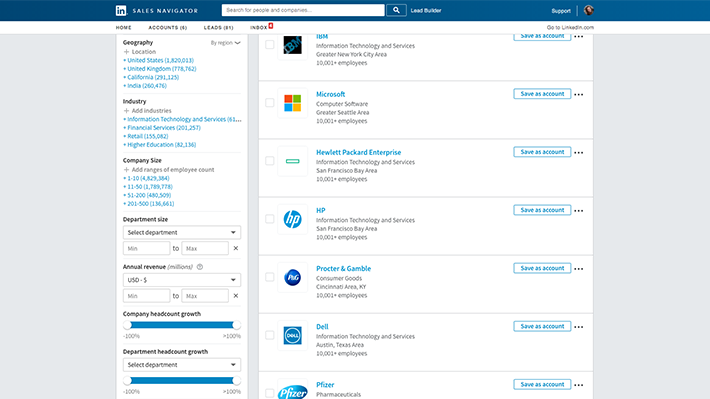
With over 11 million account pages on LinkedIn, it’s critical to have powerful search capabilities at your fingertips to identify and prioritize the right accounts. That’s why we’ve been enhancing our account search capabilities with several new filters to help you be more productive. Here are a few of our favorites:

  • Senior Leadership Changes - Multithreading is critical to ensuring your deals don’t go dark. Start by identifying companies where senior leaders have changed roles or joined the organization in the past three months. These could be great indicators that it’s time to reach out.

  • Department Size - The size of a department you’re selling into often gives clues to the potential size of the account or budget. Now you can find companies with a minimum number or range of employees in a department using data unique to LinkedIn.

  • department-size-filter-sales-navigator
  • Headcount Growth - Closely related to department size, significant headcount growth can be a sign that the company might be more open to your product(s) and be a trigger to prioritize outreach to that company. We’ve also added filters so you can track growth by either company or specific department.

  • Company Revenue - We recently added a revenue filter for public companies, so you can search companies in a specific revenue range, in numerous currencies. (Currently available for companies in Australia, India, UK and the US).   We will continue to expand coverage to include more companies in the near future.

  • revenue-growth-filter-sales-navigator
  • Headquarters Postal Code - Got a territory? Then you know how critical it is to narrow accounts by territory descriptors like postal code.  In Sales Navigator you can now pinpoint accounts by one or more specific postal codes.

  • zipcode-filter-sales-navigator

Pivot from Account Search to Lead Search

Once you’ve identified all of the accounts you want to target, you’re probably ready to find the right decision makers. Select your target accounts, and with a single click, switch to view all employees at those accounts.   You can narrow even further by applying unique Sales Navigator people filters.

If you're a Sales Navigator user, you can click here to access the new Account Search filters today. Let us know how you like them and how you’re using them.

If you’re not yet a customer, check out these and all of the great premium filters only available on Sales Navigator -- we’re adding more all the time!

      
07 Mar 17:03

Objection Handling: 44 Common Sales Objections & How to Respond

by lye@hubspot.com (Leslie Ye)

High-performing sales professionals aren’t triggered to surrender by a sales objection. Instead, they use objections to craft personalized value propositions to differentiate their company, their offerings — and ultimately close the deal.

As a long-time sales and business development professional, I’ve always seen sales objections as guideposts along a buying process: they tell me what a prospect needs to move forward.

When overcoming objections in sales, salespeople must be curious, intuitive, and empathetic enough to ask questions that motivate prospects to disclose their objections instead of just ghosting the salesperson and leaving them wondering why.

Download Now: Free Objection Handling Guide + Templates

In this article, you’ll learn proven, practical objection-handling strategies you can use in your business development tactics.

Table of Contents

A typical sales objection arises when a prospect has a perceived or actual lack of specific resources. Prospects usually object to a sale when they feel they don’t have the money, interest, need, or autonomy to buy from your business.

My experiences taught me that prospects are reluctant to speak with a sales rep if they:

  • Don’t have a defined mandate or the authority to engage with a salesperson’s offer.
  • Don’t feel they are prepared or educated enough on a topic to have a meaningful conversation.
  • Have had negative experiences with salespeople in the past, with your company, or otherwise.
  • Feel overwhelmed if a seller’s pitch is full of technical jargon or industry-speak.
  • Are reluctant to get into a high-pressure, prolonged sales process with an unfamiliar (or even a familiar) company or representative.
  • Work in a matrixed organization with complex or rigid buying and approval processes.
  • Have real or misconceived concerns about the cost, commitment, or inflexibility of your company and its solutions.
  • Are skeptical your solution can deliver the value you describe in your pitch or promotional material.

While sales objections present some daunting obstacles to a sales process, overcoming objections in sales is possible with practice and proven strategies.

Handling Objections

Handling objections is an inevitable and often challenging task for sales pros. According to HubSpot data, sellers who successfully defend their product against buyers' objections can have a close rate as high as 64%.

Underachieving sales reps respond to prospect objections by:

  • Conceding defeat immediately and disengaging from the prospect.
  • Arguing their case defensively without probing for the source of an objection.
  • Trying to pressure the prospect into remaining engaged by sowing fear, uncertainty, and doubt (FUD).
  • Making derogatory statements about competitors the prospect has (or is considering) a relationship with.
  • Using tired transactional sales tactics like offering discounts or making false claims instead of taking a consultative sales approach.

These kinds of aggressive selling approaches aren’t effective at handling objections.

Prospects often feel these kinds of responses justify their attitude about your company, or sales people in general. Using these tactics can undermine any trust or rapport you’ve developed with a customer or prospect, and anyone they share their experiences with.

In contrast, proper handling of objections in sales demands that a salesperson:

  • Demonstrates situational awareness.
  • Gathers or accrues background information throughout the sales process.
  • Leads with empathy.
  • Asks thoughtful, open-ended questions.
  • Treads carefully when the prospect isn’t correct.

Next, I’ll break these items down a little and add some context.

Have situational awareness.

There isn’t a single cure-all objection handling formula. Instead, you need to develop instincts for where you are in your sales process, the nature of the deal you’re pursuing, and your prospect’s needs and interests.

Understanding the circumstances that are shaping a prospect’s objections is central to addressing them effectively.

In my experience: I’ve learned from making situational awareness mistakes a couple of times. Once I admitted to a customer that I had been so busy pursuing other opportunities that I hadn’t checked in with them in a while. The customer responded saying their feelings were hurt that I deprioritized them. I focused more on my account farming responsibilities after that conversation.

Gather extensive background information.

This point is a natural extension of the one above. Gathering background information informs effective, actionable situational awareness. Thoroughly research your prospect's company and, to a certain extent, the specific prospect or client.

See if you can answer the following:

  • What challenges is the customer or prospect currently facing?
  • What are the prospect’s near- and long-term goals?
  • What issues do the prospect‘s industry peers encounter?
  • What is their decision-making authority?
  • What aspects of the company's operations do they work with on a day-to-day basis?
  • What obstacles and restrictions does someone in their position typically encounter?

Uncovering these background insights can put you in a better position to handle objections tactfully.

In my experience: As I described earlier, I discovered the hard way that customers need to be consistently reminded of how much you value their business through regular follow-up. Your other business activities aren’t material to their needs.

Lead with empathy.

Empathy is central to every successful sales effort. You likely didn’t get into sales purely entirely earning commission or meeting or exceeding quota. The best salespeople I worked with loved to help businesses solve problems with the products and services they helped the customer gain access to.

Always bear a client’s needs and interests in mind, and they will often respond with trust, signed contracts — and best-case — become an advocate for your business through testimonials and success stories.

Ask thoughtful, open-ended questions.

The ability to ask thoughtful, open-ended questions can underscore every other point listed here. You need to get to the root of your prospect’s pain points if you’re going to understand and effectively handle the objections they raise.

Avoid questions that only warrant “yes or no” answers — and don't be afraid to use silence to your advantage. Also, let your buyers air their thoughts out. Feel out their concerns and put yourself in a position to overcome objections they might raise with calm confidence.

When the customer isn’t right, tread lightly.

Telling a prospect their objection isn’t justified can derail a relationship quickly. Instead, acknowledge their objection, then explain how doing business with you would actually look.

It's also important to distinguish between sales objections and brush-offs. While objections are authentic, brush-offs are excuses. Think of an objection as, “I see the value in your product, but I'm not sure about buying it for X reason,” while a brush-off translates to, “I don't want to talk to you.”

Unstated objections are far more serious than brush-offs. If you don’t know why a prospect doesn’t trust you or value what you have to offer, you are wasting your time and theirs.

In my experience: I once had the IT manager of a local government tell me they would never do business with my company (a large Canadian telco). When pressed, he said he felt my company was too big to offer his organization personalized service. Fortunately, I had testimonials from the prospect’s peers across the country who had similar reservations at first, but were pleasantly surprised at our ability to meet their needs. That reassured the prospect, and I landed his business.

Pro tip: Keep a list of customer success stories, testimonials, or third-party data that addresses common objections like cost, flexibility, or return on investment. Share authentic, quantifiable examples of the impact of your company’s products and services.

Objection Handling Framework

A proven and effective method for objection handling is Carew International’s LAER: The Bonding Process®. LAER involves four steps — Listen, Acknowledge, Explore, and Respond — and creates a positive, two-way transaction between the salesperson and the customer.

I’ll break down each step along with insights from sales leaders I talked to.

Step 1: Anticipate

Before you start with the LAER process, the first step is to anticipate objections by preparing for the conversation.

Laura Youngblom, president and chief revenue officer at Sell It, suggests “by consistently preparing for potential objections, you will learn more about your customers and what’s holding them back and eventually be able to predict what their objections will be.”

If you did your homework, you can address the objection factually, offer some context to allay their concerns, and enable you both to proceed with confidence.

Step 2: Listen

When confronted with an objection, the first requirement is to actively listen to it. Listening demonstrates to your customer that you are interested in their concern and care about what they have to say.

“The adage ‘people buy from those they know, like, and trust’ is still true. Buyers want (and expect) a personalized sales experience. How you present yourself and your product either builds that trust — or gives your competitors a foot in the door,” comments Mark Tanner, co-founder of Qwilr.

Step 3: Acknowledge

The next step is to acknowledge your customer’s concern. This is where you demonstrate you have been actively listening. Acknowledging and validating an objection can be as simple as a head nod or a restatement of the issue as you understand it. A sincere acknowledgment can build trust and have a calming effect. Sometimes, your customers just want to know that they are being heard.

“Not pretending you have all the answers and being genuine in communicating when you don't know something helps build trusting and reliable relationships,” says Sami Malik, CEO of Linear Health, a founder-led sales expert.

Youngblom adds that “when you disagree, you stop the flow of communication, but when you agree, their defenses come down.”

Step 4: Explore

The third step is to explore the concerns underlying your customer’s objection. It's imperative that you understand exactly what your customers meant by what they said.

For example, your customer may raise a price objection. Take the time to explore the customer’s objection, and you may discover they are using price as a smokescreen for fears of putting their own reputation on the line.

In my experience: I once had a customer who expressed an interest in integrating my company’s document management software (which they had deployed) and their ERP software. However, we hit a roadblock when my customer objected to our acquisition process because of RFP requirements on his end.

Fortunately, because I was able to uncover the details of the roadblock by active listening and exhibiting empathy, I was also able to come up with a solution and ultimately make the sale.

Step 5: Respond

The final step is to respond. Only once you have a complete understanding of your customer’s objection can you effectively respond with a credible:

  • Counterargument of how your company can exceed their expectations and deliver measurable value.
  • Product or service recommendation.
  • Business proposal that specifically addresses the customer’s concerns and closes the transaction.

Objection handling doesn’t have to be a painful activity for salespeople. Instead, objections should be viewed as opportunities to help your customer and grow your relationship with them.

Why is objection handling important?

Nothing is more dangerous to a deal than letting sales objections go unaddressed until the final stages. When a prospect’s objection goes unaddressed (whether warranted or not), it grows stronger and becomes deep-rooted, making it harder to overcome it.

With this in mind, don’t avoid objections — welcome them. You can proactively find them as well by periodically asking questions like:

  • “Do you have any concerns about X?”
  • “Can you see your team making X part of their daily routine?”
  • “Is X a strategic business goal for your company this year?”
  • “Are there any obstacles that would stop you from buying X?”
  • “How confident do you feel you'd see success from [product]? Why?”
  • “You seem a little worried about X. What are your thoughts?”
  • “What do you think will happen if X problem doesn’t get addressed over the next few months?”

As I touched on at the beginning of this article, most sales objections stem from some kind of “lack” — and they typically come from a reasonable place. Prospects who raise objections generally point to the fact that they simply can't buy right now.

But those “lacks” are often misplaced, and if you know what you‘re doing, you can usually find ways to work around them. Let’s take a closer look at some of the most common types of objections in sales.

1. Lack of Budget

“It's too expensive.”

Objections based on price are the ones you‘ll come across most frequently. That’s because all purchases come with some level of financial risk.

As a sales rep, you'll want to consider the positioning of your product or service and how to demonstrate that value. This turns the conversation into one about risk vs. reward.

By providing value and painting a picture of where your solution will take them, they can be convinced that the reward is enough to justify the risk.

2. Lack of Trust

“I've never heard of your company.”

People do business with people they like, know, and trust.

In an inbound sales conversation, the prospect will have likely interacted with your content or will already be familiar with your organization in some way. This objection could be overcome by jogging their memory, or you might consider your sales cycle and whether it's feasible to nurture them through it.

But not all conversations are inbound conversations, and they may have genuinely never heard of you. It's at this point that you double down on the value you provide with your elevator pitch. Be sure to emphasize the authority your organization has in the market, and share examples of the companies you’ve worked with to gain credibility.

3. Lack of Need

“I don't see how this can help me.”

This may seem like an objection on the surface, but it's actually an opportunity to give information to the prospect (and get information from them in return). Use open-ended and layered questions to qualify the prospect and evaluate their needs. If you find a fit, leverage it to demonstrate value.

4. Lack of Urgency

“[X problem] isn't important for me right now.”

The goal here is to figure out if timing actually is an issue or if the prospect is brushing you off. One way to do that is by asking them to elaborate on why it's not important or what competing priorities currently have their attention.

Listen closely to determine if their response involves concrete timing issues or vague excuses. If they're doing backflips to justify inaction on a real pain point, you may have an opening.

When all else fails, try and schedule an appointment with them at a later date to dive deeper into the issue.

When trying to overcome sales objectives, it’s imperative you respond appropriately and avoid reacting impulsively to your prospect’s objections. Here are some helpful strategies for overcoming objections.

1. Practice active listening.

First and foremost, as your prospect is sharing their concerns with you, make sure you are using active listening skills to take in what they’re saying.

While your prospect discloses their objections, listen to understand, not respond. Avoid interrupting them while they are speaking, and give them space to voice their concerns and objections freely.

2. Repeat back what you hear.

Once your prospect has stated their objections, repeat back what you heard to make sure you are understanding correctly. Not only will this help clarify their points for you, but it will also help your prospect feel heard and valued, which is important for building trust.

3. Validate your prospect’s concerns.

After you have confirmed you understand where your prospect is coming from, continue building trust by empathizing with your prospect and validating their point of view. No, that doesn’t mean you have to talk down on your product or recommend a competitor.

For example, if you are selling automation software and your prospect is worried about their ability to implement your software into their complex system, you could say, “I understand. Implementing new software can feel like a daunting task. Thankfully, we have an incredible tech team that has experience working with similar organizations and can handle a seamless transition for you.”

With this response, you acknowledge that their concern is valid and offer a solution to mitigate their fears.

4. Ask follow-up questions.

When you hear objectives, you want to do all you can to keep the conversation going in a natural way. If you hear your prospect pulling back, asking follow-up questions can be a tactful way to keep them talking.

Don’t ask questions that can be answered with a simple “yes” or “no.” Make sure you ask open-ended questions that allow your prospect to continue expressing their thoughts on your product. The more information they give, the more you have to work with.

5. Leverage social proof.

Depending on the nature of your prospect’s concern, sharing the story of another customer who had similar reservations and went on to see success with your product can be a successful approach.

If you are in B2B sales, you can also share relevant information about your prospect’s competitors and any success they’ve seen from overcoming a similar objection.

6. Set a specific date and time to follow up.

If your prospect asks for more time to think things over, give them the time and space to weigh their options. But you don’t want to leave them hanging. Set up a specific time and date to follow up in the near future so too much time doesn’t pass, and offer to answer any questions they have in the meantime as they deliberate.

7. Anticipate sales objections.

Ultimately, the most effective strategy for handling sales objections is to predict them. When you are prepared to have objections come up, you’re far less likely to be thrown off your game.

Keeping track of the objections you receive most often is also helpful. Once you know what to expect, you can devote extra time to practicing and refining your responses.

We also recommend sales reps use role-playing to boost their objection-handling abilities. Take turns with another rep on your team posing common objections (like any on the list below), answering, and then giving each other feedback.

“No” is something salespeople hear often. In fact, 60% of customers say no four times before they say yes. Objections vary by business scale, industry, and what you're selling. But, knowing and preparing for the most common objections can help you close more sales.

The answers below can help you respond to the objections you're most likely to hear on your first few calls with a prospect. But, the most effective way to handle objections is to craft your own responses.

So, if you're looking for a quick and easy way to get started, check out this sales objections and answers PDF. It has useful templates to jumpstart your personalized objection responses.

Sales Objections About Price and Budget

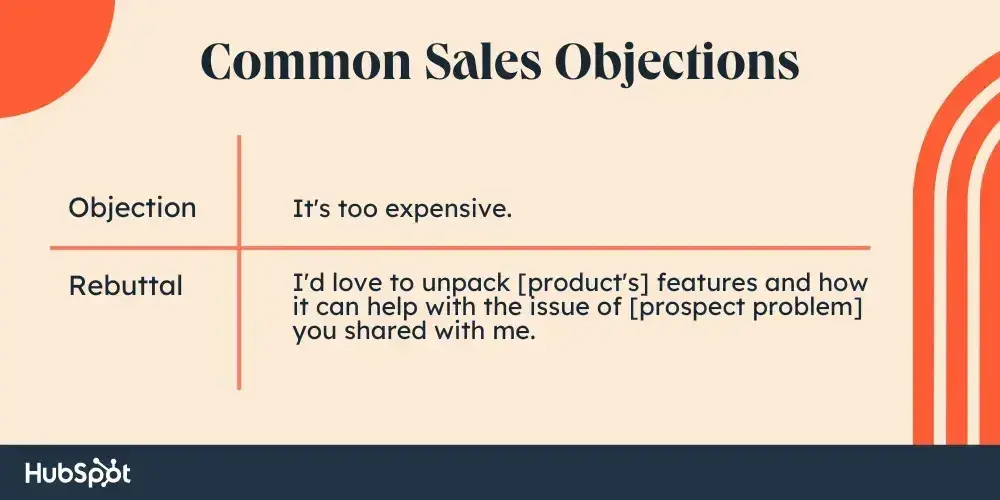
1. “It's too expensive.”
sales objections about price and budget

Price objections are the most common type of objection and are even voiced by prospects who have every intention of buying. Beware — the moment you start focusing on price as a selling point, you reduce yourself to a transactional middleman. Instead, circle back to the product's value.

Try responding this way:

“I‘d love to unpack [product’s] features and how it can help with the issue of [prospect problem] you shared with me. I can also share a case study of how another business in your industry [realized measurable ROI]”

2. “We don’t have the funds for this.”

It could be that your prospect‘s business simply isn’t big enough or generating enough cash right now to afford a product like yours. If the prospect has a strategic long-term upside offer to keep in touch. Monitor their growth and see how you can help your prospect get to a place where your offering would fit into their business.

Your company may have alternative financing, subscription tiers, or phased implementation models that may put your products or services in reach. A small-scale purchase may not be significant this quarter, but

Try responding this way:

“I understand. Allow me to explain our other offerings that may be a better fit for your current growth levels and budget.”

3. “We don't have any budget left this year.”

A variation of the “no money” objection, what your prospect’s telling you here is that they’re having cash flow issues. But if there's a pressing problem, it needs to get solved eventually. Either help your prospect secure a budget from executives to buy now or arrange a follow-up call for early in their next fiscal cycle when funds are being allocated.

Try responding this way:

“Let's schedule a follow-up call for when you expect funding to return. When do you think that may be?”

4. “We need to use that budget somewhere else.”

Prospects sometimes try to earmark resources for other uses. It's your job to make your product/service a priority that deserves budget allocation now. Share case studies of similar companies that have saved money, increased efficiency, or had a massive ROI with you.

Try responding this way:

“We had a customer with a similar issue, but by purchasing [product], they were actually able to increase their ROI and assign some of their new revenue to other parts of the budget.”

5. “I don't want to get locked into a long-term contract.”

A prospect with a genuine need and interest who balks at time-based contract terms is generally hesitant for cash flow reasons. In many cases, there are workarounds — find out if you can offer month-by-month or quarter-by-quarter payment instead of asking for a year or more commitment upfront.

Try responding this way:

“I understand. Let's talk about some different contract terms and payment schedules that I can offer you. Perhaps these would be a better fit.”

Sales Objections About the Competition

6. “We're already discussing this project with [Vendor X].”

sales objections about the competition

A prospect who’s already working with a competitor can be a gift. They’ve already recognized a need and identified a solution; much of the education you’d otherwise be responsible for has already been done. You can spend your time doing the one thing you’d have to hold off on with a prospect who hasn't recognized their pain yet — talk about your product.

Just because a prospect is working with a competitor doesn’t mean they’re happy with them. Probe into the relationship and pay special attention to complaints that could be solved with your product. Resist the urge to disparage the competitor. Instead, highlight your company’s strengths, product advantages, and service differentiators. Don’t say anything that could be damaging to your company’s reputation if it got back to the competitor. Be factual and respectful.

Try responding this way:

“Why did you choose [vendor]? What‘s working well? What’s not? Allow me to explain how [product] is different.”

7. “I'm locked into a contract with a competitor.”

This objection often seems like a deal-killer, but can be overcome if your sales leadership team is empowered to offer competitive upgrades. This objection is worded in a way that indicates your prospect's feeling of being trapped. See if you can come up with a creative discount to offset the cost of breaking a contract early, or demonstrate ROI that will make up for the sunk cost.

Of course, your prospect could have simply chosen an overly negative turn of phrase. Ask questions about their relationship with the competitor to determine whether they're actually happy or are itching for a vendor switch.

Try responding this way:

“How is your relationship with [competitor]? I can work with my manager to see if there is a way we can help ease the cost and effort involved to upgrading to our solution.”

In my experience: In software sales roles, I enjoyed positioning a migration from a competitive solution as an upgrade. Of course, it only worked if I could demonstrate how my solution was uniquely better for the prospect than their existing solution.

8. “I can get a cheaper version of your product somewhere else.”

Find out what you're dealing with here. Are you in a competitive situation, and the prospect is playing you against a competitor to drive up discounts? Or is your prospect under the impression that a similar, cheaper product can do everything they need? I often reminded the prospect of how the old adage “You get what you pay for” is usually true.

If it's the former, lay out your deepest discount and emphasize the features that make your product superior. Walk away if they ask you to go lower. In the second scenario, take advantage of the comparison. Play the differences up and emphasize overall worth, not cost.

Try responding this way:

“What are the points of differentiation between [product] and your other option? What gives you the most value and support?”

9. “I'm happy with [Competitor X].”

What if your prospect is happy? The same strategy still applies — find out why they believe their relationship with your competitor is beneficial, and identify vulnerabilities where you can build a business case for how your offerings can offer more value than their current provider.

Try responding this way:

“That‘s great. What components of the product or relationship are you most satisfied with? I’d love to learn more and see how we compare.”

10. “Competitor X says [false statement about your product].”

According to the creator of Your Sales MBA® Jeff Hoffman, when faced with a false statement from a competitor, salespeople should first respond with, "That's not true," then pause. Be prepared to explain how things really are, but don’t rush to do so. That could show weakness or uncertainty.

Hoffman says this reply will satisfy the buyer about 90% of the time, and they’ll be willing to move on. You’ll seem confident and collected, whereas your competitor will seem desperate and insecure.

If your prospect is still unsure, they'll ask another question. At that point, you can offer more background in your rebuttal.

Try responding this way:

“We manufacture our products in Canada, not Thailand. I have a map of our factories and distribution routes if you'd like to see it.”

Sales Objections About Authority or Ability to Buy

11. “I'm not authorized to sign off on this purchase.”
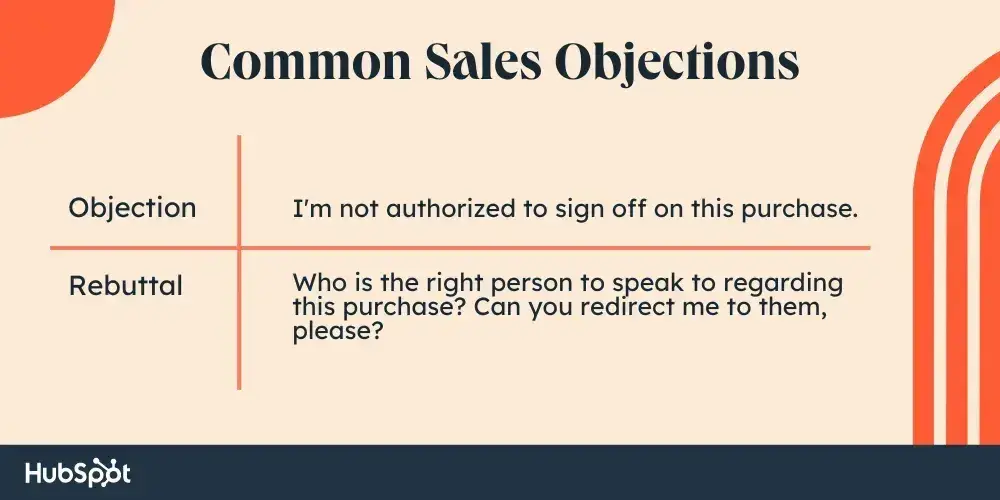
sales objections about authority or ability to buy

No problem. Ask your prospect the name of the right person to speak to, and then redirect your call to them.

Try responding this way:

“Who is the right person to speak to regarding this purchase? Can you redirect me to them, please?”

12. “I can't sell this internally.”

Well, your prospect might not be able to, but you can. After all, you sell your product every day. Ask your prospect what objections they anticipate, and help them prepare the business case for adopting your product.

I often wrote email and PowerPoint templates that I called “Business case in a box” that described my company’s unique sales proposition, success stories, and campaign offerings in a way that could be shared by my champion influencer. Relying on someone else to be your sales advocate in their own company is far from fool-proof, though, and I preferred to write the messaging to take the pressure off my point of contact.

Try responding this way:

“What objections do you think you'll face? Can I help you prepare the business case for when you speak with your decision-makers? I may have some enablement materials I can share to help.”

13. “[Economic buyer] isn't convinced.”

If you've already addressed objection #12 by providing internal selling advice and coaching, and your prospect can’t win over the decision maker or help you get access, it might be time to walk away. While it’s disappointing to give up on a prospect who’s on your side and just can’t convince the higher-ups, it’s also a waste of your time to keep butting heads with someone who will never see your product’s value.

Try responding this way:

“That‘s too bad. If anything changes, please don’t hesitate to contact me. I'd love to help you get your team onboard.”

14. “We're being downsized/bought out.”

This happens rarely, but there’s usually nothing you can do when a company is enduring a lot of internal turmoil, as buying processes are often postponed indefinitely. Wrap the relationship professionally so that when the dust settles (or the prospect finds a new gig) they’ll be more likely to restart the conversation. Albeit possibly from a new company, mind you.

Try responding this way:

“Thank you for your time and for speaking with me regarding this product. If you‘re ever in need of [product or service], please don’t hesitate to contact me.”

15. “There's too much going on right now.”

Ask your prospect to define their competing priorities for you. If they can’t, it’s likely a brush-off, and you should press them on precisely why they don't want to engage with you.

If they can offer concrete answers, don‘t sweat it. Set a meeting time for a follow-up and send over helpful resources in the meantime to stay on your prospect’s radar. Or, take a bolder step if you can, and be prepared to explain why waiting for next quarter, next month, or next year might cost the customer in the long run. Can they really afford to put off addressing the business need that was the catalyst for the conversation in the first place?

Try responding this way:

“I understand. What are some of your competing priorities? I'd love to schedule a follow-up call for when your calendar clears up.”

16. “I'm part of a buying group.”

Buying groups enable independent companies to team up and make joint purchases from vendors — usually getting a far better price than they'd be able to secure on their own. (I just completed a proposal to qualify for a significant North American buying group, so I know this can be a significant obstacle.)

If your company isn‘t on a prospect’s list of approved suppliers. You may be able to win them over by matching the cost and delivery terms of the buying group contract, but that may erode your profit margins, so be sure to discuss this scenario with your management team.

Respond to this objection by delving into the details of their membership. When you’ve learned more, you can decide whether it makes economic sense for this prospect to work with you — and if there’s an opportunity to become one of their buying group's vendors.

Try responding this way:

“Are there limits on whom you can buy from? What price are you currently receiving? What companies belong to your buying coalition?”

Sales Objections About Need and Fit

17. “I've never heard of your company.”
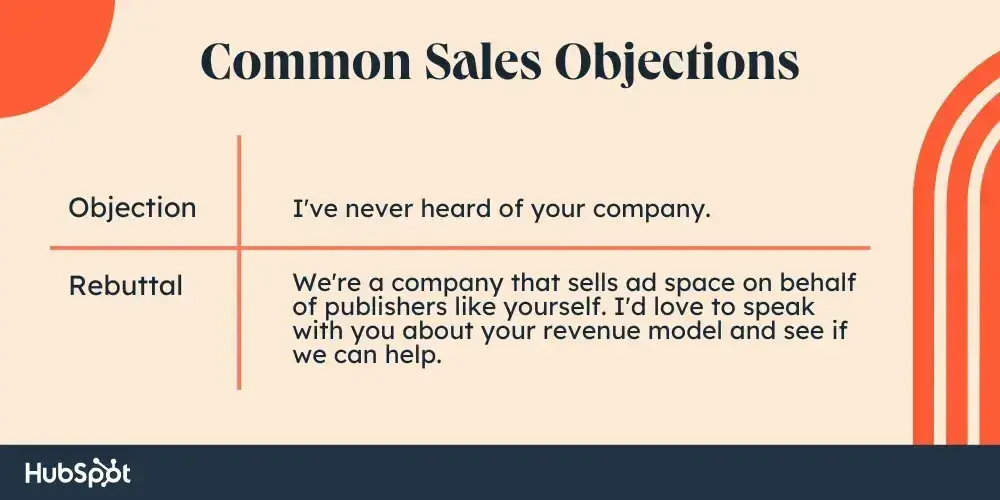
sales objections about need and fit

Treat this objection as a request for information. Don't give an elevator pitch, but offer a quick summary of your value proposition.

Try responding this way:

“We‘re a company that sells ad space on behalf of publishers like yourself. I’d love to speak with you about your revenue model and see if we can help.”

18. “We're doing great in X area.”

If you hear this objection, ask a few more clarifying questions and do a little more qualification.

Try responding this way:

“What are your goals? How much progress has been made?”

19. “Our business doesn’t experience the challenges you describe.”

This objection is often raised as a brush-off, or because prospects haven’t realized they’re experiencing a certain problem yet. Ultimately, you might discover they really don’t need your product or service, but don’t take this objection at face value.

Try responding this way:

“Interesting. Do you have any business goals or challenges that you are struggling to address that I might be able to help you with?”

20. “X problem isn't important right now.”

Sometimes, a simple “Oh?” will be enough for your prospect to start talking. Listen closely for real reasons the need has low priority versus platitudes. Keep in mind that excuses can be a sign that your prospect understands they have a problem and is trying to rationalize their inaction. Capitalize on this and instill a sense of urgency.

Try responding this way:

“Tell me more about that. What are your current priorities?”

21. “I don't see what your product could do for me.”

Another request for information packaged as an objection. Reconfirm the goals or challenges you've discussed and explain how your product can solve specific problems.

Try responding this way:

“Interesting. Can you share what specific challenges you're facing right now? Perhaps [product] presents a solution we have yet to discuss.”

22. “I don't understand your product.”

If your prospect literally can’t wrap their head around your product, that’s a bad sign. If your product is particularly complicated or specialized, it may be time to disqualify your prospect, lest they churn two months from now.

Don’t give up immediately, though. Ask your prospect what aspects of your product they’re unclear on, then try explaining it in a different way. Alternatively, bring in a technician or product engineer to answer questions out of your depth. Make sure you aren’t using any business jargon, acronyms, or complex wording that might make your pitch unclear to the uninitiated.

Try responding this way:

“What aspects of the product are confusing to you? I'd love to connect you to a customer success technician or product engineer to help you better understand how we can help you.”

23. “I've heard complaints about you from [company].”

Word-of-mouth reviews are powerful, which can be both a blessing and a curse. Rather than defending your solution, business, or brand — which will only validate the criticism — thank them for sharing the feedback with you. Then, follow up with an offer to add value.

This gives you an opportunity to establish credibility and trust with your prospect. Once you‘ve given them a positive experience, they’ll naturally form a high opinion of you.

Try responding this way:

“Thanks for sharing that feedback with me. I‘ll pass it along to [relevant department]. While we’re on the phone, would you be interested in hearing a few tips for improving your average invoicing turnaround time?”

24. “We don't have the capacity to implement the product.”

This objection can be a deal-killing roadblock. Depending on what product you sell, it’s possible your prospect will have to add headcount or divert resources to fully take advantage of your offering, and if they truly aren’t able to, you might have to disqualify them. Do you have any services that can help them add implementation capacity and help them realize measurable results at costs they can justify without hiring additional staff?

Try responding this way:

“I hear you, and I want [product] to add value, not become a burden. What are your current day-to-day responsibilities in your job? I'd love to explain how [the product], once onboarded, can alleviate some of those problems without requiring additional staff overhead or being a resource drain.”

25. “Your product is too complicated.”

Find out if your prospect is confused about specific features or if the product is indeed over their head. If it’s the latter, you might have to disqualify that lead. But if it’s the former, remind your prospect that they’ll have help from your customer service team should they choose to buy and that you’ll be on hand to answer any implementation questions they have.

Try responding this way:

“What features are confusing to you? Our customer success team can help you tailor the user experience to the way you do business. Our support services will be available around the clock to help with implementation and beyond.”

26. “You don't understand my challenges. I need help with Y, not X.”

It‘s crucial to make your prospect feel heard. Restate your impression of their situation, then align with your prospect’s take and move forward from there. A lot of misunderstandings and hard feelings can be resolved simply by rephrasing your prospect's words.

Try responding this way:

“Sorry I got that wrong. Would you allow me to restate my understanding of your challenges, and correct me again if I'm still missing or misstating anything that’s important to you? I assure you that I will make it worth your time.”

27. “You don't understand my business.”

If you sell to a specific industry, chances are you know a bit about the challenges and priorities your prospect's business is likely faced with. Let them know that you have experience working with similar companies and have solved similar problems in the past.

If you simply made an incorrect assumption about your prospect’s company or industry, don’t be afraid to own up to it. Your prospects will appreciate your candor.

Try responding this way:

“Sorry — I assumed X was true, but it looks like that doesn't apply to your business. Can you tell me a little more about how it works for your business?”

28. “Your product doesn't have X feature, and we need it.”

Try suggesting a supplementary product that can be used in conjunction with yours. But if that specific need is a must-have and your product can't solve it, your prospect might not be a good fit. Time to disqualify and move along to a better-fit opportunity.

Try responding this way:

“Have you checked out [partner or conjoining product]? It's a good fit with ours and can be used alongside it to solve for Y.”

29. “We're happy the way things are.”

Maybe everything really is going swimmingly. But more likely, your prospect is having some sort of challenge (after all, who isn’t?). Do some light qualification to determine if they’re facing any problems you can solve, then move forward or disqualify them based on their answers.

Try responding this way:

“That‘s great! Can you tell me how you’re currently solving for X?”

30. “I don't see the potential for ROI.”

This is a sign that you'll have to prepare a formal pitch for either your contact or their managers, either using internal numbers from your prospect or customer case studies. Nothing sells quite like hard numbers.

Try responding this way:

“I‘d love to show you. Can we schedule a time for me to explain our product’s potential to deliver a high ROI to you and your team?”

31. “X is just a fad.”

You might hear this objection if your product pioneers a concept that’s new to your prospect’s industry. For example, social media is now widely accepted as a necessary part of a sound business strategy, but seven years ago, many would have scoffed at it.

Now is the time to pull out any testimonials or customer case studies you have to prove the ROI of your product. If you’re pioneering a new concept or practice, you’ll have to show that it works.

Try responding this way:

“I understand why you may think that. Let‘s schedule a time for me to walk through how our product helped some other businesses like yours find success with X — and why it’s here to stay.”

32. “Your product doesn't work with our current [tools, set-up].”

common sales objections example

This objection can be a deal-breaker if the buyer is committed to their existing solutions. But sometimes, your product will replace these tools or make them obsolete. A workaround may be possible as well.

To find out, ask some questions.

Try responding this way:

“Which tools are you currently using? How integral are those tools to your [strategy]? What do you like and dislike about your existing platform?”

33. “Your product sounds great, but I'm too swamped right now to handle [implementation, roll-out].”

Prospects are often put off by the effort required to switch products, even if the ROI is substantial.

To empathize with them, prove that you're trustworthy, and ensure they do have the bandwidth. Next, combat their reluctance to change by digging into the costs or pains of their current situation.

Calculate what they stand to gain — in time, efficiency, money, or all of the above.

Try responding this way:

“I understand. It typically takes our customers [X days/weeks] to get fully up and running with [product]. How many minutes a day do you spend on [task]?”

Sales Objections That Are Actually Brush-Offs

34. “*Click.*”

If your prospect hangs up on you, don't sweat it — it happens to everyone eventually. Try reaching out to a different person at the company using a different approach.

Or you can go on the offensive. Wait a few seconds, then call back. Which approach you choose is purely dependent on how your conversation with your prospect went before the hang-up.

Try responding this way:

“Sorry, looks like we got disconnected! Do you have a few minutes?”

35. “I'm busy right now.”

Of course your prospect is busy — almost every professional is these days. Simply explain that you're not looking for a full-blown conversation, just a quick chat about whether or not a longer discussion about your product would be a good fit at their organization.

Try responding this way:

“I don't want to take up too much of your time. Can we have a quick chat about your challenges with X and how [product] may help?”

36. “I'm not interested.”

During a prospecting call, it’s far too early for a prospect to be able to definitively say they are or aren’t interested in your product.

Try responding this way:

I liked to respond with, “Some of our clients weren’t initially interested either, but when I showed them they could realize (X benefit), they changed their mind. Can your business afford to pass up on this opportunity without taking some time to explore the possibilities?”

37. “Just send me some information.”

common sales objection example

This is a great opportunity to segue into some qualification questions.

Try responding this way:

“I‘d be happy to send you some materials, but I want to make sure that they’re relevant to you. What are you interested in learning about?”

38. “Call me back next quarter.”

Prospects will often say this to dissuade you from pursuing a conversation. But don‘t let them off that easily — it’s a vague brush-off uttered in the hopes you'll fade away and disappear. Ask some questions to find out their motivations for brushing you off.

Try responding this way:

“I‘ll touch base next quarter. Before we hang up, I’d love to get a sense of how your next quarter will go. Do you feel you'll get the go-ahead from your superiors?”

39. “How did you get my information?”

Hopefully, you‘re not pulling numbers from lists you got off the internet — because if you are, your prospects have every reason to be annoyed.

Don’t get defensive — simply remind the prospect that they filled out a form on your site, or signed up for more information at a trade show, or that you simply came across their website and wanted to connect to see if you could help.

Try responding this way:

“I came across your website in my research and believe that [product] would be a great fit for you.”

40. “I hate you.”

Generally, prospects won‘t actually come right out and say this, but if you and your prospect really just don't get along, consider handing them off to a colleague, lest your company lose the deal for good. The upside? This objection has nothing to do with your product or its value.

Try responding this way:

“I'm sorry you feel that way. Can I introduce you to my colleague [name] to continue the conversation? She is very knowledgeable about how businesses like yours can [overcome the kinds of challenges/achieve the goals] that we discussed, and she has great relationships with executives like yourself.”

If the prospect isn’t willing to work with your colleague, their underlying objection is really not about you. Talk to your manager or colleagues about the best way forward.

41. “I'm not responsible for making these decisions.”

This common objection signals that a prospect doesn’t have (or doesn’t believe they have) the authority to discuss their company’s business challenges. Nor do they want to get involved in a sales cycle where they feel pressured to make decisions above their pay grade.

Try responding this way:

“Thanks [Name], for letting me know that you don’t have decision-making authority pertaining to purchasing decisions. Who on your team handles these types of decisions? Can you introduce me to them, or could you and I have a preliminary, no-pressure conversation? I think [solution] could help your team [achieve a defined benefit] by partnering with my company.

42. “Does your product do X, Y, and Z?”

This is one of the most common obstacles that prevent an SDR from converting the lead to an SQL. The good news is this generally means the prospect is interested. Use this opportunity to end the conversation on a good note and set up another appointment to discuss it.

Try responding this way:

“I am glad you asked that. I think it will be helpful to set up a time when we can answer this question and others with a specialist. When is a good day and time for us to talk?”

43. “Sorry, I have to cancel. I'll get back to you with a better time.”

People don't like to say “No” — and that includes your prospects. This manifests in ghosting, procrastination, and asking for more time.

Sales Pro Mike Rogewitz swears by Sandler's Negative Reverse Selling strategy to overcome tricky non-objection objections like these. “You want to call out your prospect‘s lack of interest and get them to admit the answer is ’No' without going too negative,” says Rogewitz.

Try responding this way:

“Typically, when someone cancels and says they‘ll get back to me, it means they’re just not interested in what I have to offer right now. Is it fair for me to assume that's the case?”

44. “Hello, you‘ve reached [Prospect’s Name] ... ”

Does your prospect avoid your phone calls like the plague? Do they take a while to get back to you and always need approval? Do they give vague answers when you ask about budget and priorities for the year?

If you answered “Yes” to any of these questions, you might be speaking with an individual contributor. They’re usually not as comfortable talking on the phone as managers or decision-makers, they need a lot of internal approval, and they aren’t privy to important budgetary information or company-wide priorities.

It’s important to gain the gatekeeper’s trust and learn as much as you can from them, but then you need to move on and build relationships with the people in the company who can actually choose your product or service.

Try responding this way:
  • “Have you ever purchased this type of product or service before?”
  • “Who will be in charge of this buying process?”
  • “Who else should we bring on board for this conversation?”

Objection Handling Training

If you want to improve your team’s objection-handling skills, consider sales training programs or guides. Here are a few objection-handling training programs to give your sales team a leg up.

1. HubSpot’s Objection Handling Templates

This free guide goes over the why and how behind objection handling. Not only does it explain data-backed behaviors top sellers use to push back with buyers, but it also includes scripts for how to handle the most common sales objections, and these templates offer a goldmine of sales expertise.

2. Sell It

Founded by one of the top real estate agents in the country, Ryan Serhant, Sell It is a sales training and membership platform. You don’t need to be in real estate to benefit from the sales lessons shared on the platform. The resources are geared toward all types of business owners and entrepreneurs — anyone who sells, which applies to many professionals.

3. Challenger

Research shows that 38% of B2B purchases end up in no decision. That’s where Challenger can help. Challenger is an online sales training program that offers courses and playbooks for every step of the sales process. Sales teams can tap into the platform’s B2B expertise for objection handling training and more skills that they can apply to real-life deals.

When an Objection is a Firm “No”

Some prospects won’t give you a chance to explain the value that you can provide. They are too busy and have too little faith in the hordes of SDRs and sales reps that contact them on a daily basis. This means as a salesperson, you have to be creatively persistent. Suggest ways of continuing the dialog at a time that works

That said, at a certain point, “no” means “no.” The responses to the common objections above give you a way to pierce through the reactionary objections prospects give without thinking. If you or your sales team overcome all of a prospect’s objections and they still aren’t willing to invest their time with you, it’s sign they’re a poor fit.

Rule of thumb: If the prospect says an objection twice, it's real. No means no.

Overcoming Objections Can Become Your Best Sales Skill

As a sales professional, you’ll hear “no” a lot more than you hear “yes” —but overcoming a no can be more fun than an easy yes. Every no is a step toward helping prospects realize opportunities they never knew existed, and solving problems with your products or services.

Objection handling helps you learn how to get to the root of your prospects’ issues. With a little assistance, you can lead with empathy and understand where most objections are coming from. If you read these interactions right, you’ll be in a good position to handle any objection that comes up.

Editor's note: This post was originally published in September 2015 and has been updated for comprehensiveness.


07 Mar 17:03

Laying the Groundwork for a Successful Account Based Marketing Strategy

by Ian Bannister

Laying The Groundwork for a Successful Account Based Marketing Strategy

So, you’re in the big leagues now with ABM, and you’re looking to hit the ground running. In this blog we are giving you all the tips you need to know so you can implement a successful ABM strategy. While ABM is a widely used buzzword, keep in mind that it’s not a “one size fits all” strategy. Depending on your business model, target customer, and maturity of your sales/marketing teams, you’ll need to assess what makes the most sense for your business.

There’s no shortage of content written about the benefits of pursuing an ABM model for customer acquisition, but if you’re struggling with how to actually implement and manage an ABM model across your customer-facing teams and systems, take a few pointers from us:

Wait, what are we trying to accomplish?

Generally speaking, if you’re pursuing an ABM strategy, you want to align and personalize your marketing and sales efforts across target account segments. You will even target personas within those accounts as well. To get started, you’re going to need to draw lines in the sand to create your Ideal Customer Profile, or ICP. You’ll ultimately apply more personalized and targeted strategies against your ICP than you would your non-target accounts.

Define your target segments

  1. If you’re not sure where to start, a good way is to analyse your existing customer base to find the attributes (e.g. industry, employee count, annual revenue, location) that are indicative of their fit for your product, propensity to buy, or desirability as a target. It’s important to use commonly used attributes (e.g. not an ambiguous metric you can’t reliably collect) to make this easier to manage.
  2. Start segmenting! We created a Industry x Account Size grid to visualize and define our account segments, but you can conceptually segment however you want. Ultimately, these are the segments you’ll be applying different marketing or sales strategies to.

Start segmenting

  1. What if there are target accounts that don’t fit the target segments we mapped out? No problem, you can always create a segment called “Named Accounts” that are effectively hand-picked companies that you’d like marketing and sales to treat in a special way.

Define your target roles and personas

  1. This is a fairly straight forward exercise, but it’s important to get right. Start by defining a set of standard job roles that you can map the multitude of job titles to.
  2. Once your roles are defined, determine which ones personas that would be targets for your marketing efforts. For example, a contact with a title of “VP of Sales” would map to a “Sales Leadership” role, and a target persona of “Buyer”.

Laying the Groundwork For ABM

What you’re going to find is that at a bare minimum, your CRM needs to reflect your ICP and target personas clearly and accurately. Otherwise, how will your target accounts and personas be entered into the correct marketing campaigns?

In practice, underlying CRM data (e.g. job titles, employee count, annual revenue metrics, etc.) rolls-up to classify your ICP and personas, so having clean account and contact data is crucial. Executing on your ABM strategy depends on how you maintain data quality and how data enters your systems.

Laying the groundwork for ABM, here’s what works for us:

  1. Calculate your segments with formulas. Do yourself a favor and refrain from making your segments a field that needs to be manually updated. Instead, use formulas to calculate this based on the underlying account or contact data.
  2. Automate data collection with Clearbit or other API-based enrichment tools. Since your ABM segments are calculated from underlying data, it’s critical to enrich your data where gaps exist. Tools like Clearbit will hunt down missing data and update your records automatically.
  3. Create structured data out of unstructured data. Having been on the front lines of our Salesforce and Marketo systems, one thing that has helped tremendously is standardizing data. Take job titles as an example. For a given role like “Account Executive” there can be 50 different variations that become problematic if you’re trying to run a targeted email campaign to Account Executives. What we do is run field updates that scan for keywords in the title and update our handy “Role” field that we then use in marketing campaign logic.Create structured data out of unstructured data
  1. Auto-converting leads and matching them to existing accounts is a must. In ABM, it’s important for leads to belong to accounts so that they inherit the account-based strategies you’ve defined. We do this by setting an email domain field (e.g. acme.com) on each account, and then mapping and converting any lead that shares that domain. Engagio is a solution if you don’t have the in-house resources.

Pair Your Strategy To Segments

Now that you have your segments defined, configured in your CRM, and easily accessible by your marketing automation system, you’re ready to get up and running with your ABM strategy. Establishing the plan for each segment and persona will require Marketing and Sales input, especially in your ICP where a more personalized and coordinated approach will be needed.

Initiate the process to get set yourself up for success with these tips:

  1. Drive results in your most valuable segments with specific and valuable offers. For example, send gift cards, pre-loaded Amazon Kindles, or any other valuable, attention-grabbing item in exchange for a demo at high-value accounts, while pursuing a more scaled approach with other segments.
  2. Personalization is key. Tailor your marketing messaging based on your customer persona and/or vertical. This is particularly valuable when communicating the value propositions of your product or if you have different calls to action.
  3. If you’re a business that has readily accessible customer usage data, you can add another layer of personalization by sending emails based on their engagement levels. Offering 1-on-1 training for a high value account with low engagement might be worth a worthwhile strategy.

However you decide to implement ABM in your organization, use the following tips for a successful start:

  • Define your ICP and use CRM formulas to calculate your segments automatically.
  • Keep your segments clean by automating account and contact data collection.
  • Collaborate and plan your ABM strategy with your sales and marketing teams. Be sure that everyone understands which accounts are in your ICP and how they will be treated differently.
  • Start testing your ABM strategies with a small batch of target accounts. When you’re ready to go full scale, remember that a clean database and automated processes to maintain data accuracy will play an important role in keeping your ABM strategies humming.

What are you doing to set yourself up for ABM Success?

07 Mar 17:03

How to Go From Solopreneur to Entrepreneur

by Ryan Shelley

“Pride is a master of deception: when you think you’re occupied in the weightiest business, that’s when he has you in his spell.” – Marcus Aurelius

I started my business back in 2009 but it wasn’t until 2015 that I went all in. Although I had grown my revenue over 100% in the first year and officially turned my side gig into a real business, I still was not satisfied. I knew I had so much more in me, but that I was not going to be able to accomplish it alone. This month marks one year from transitioning from a Solopreneur into an Entrepreneur.

One of the most valuable lessons I learned when taking my agency on full-time was the power of maintaining the posture of a student. I was becoming obsessed with learning. This is one of the major reasons I believe I was able to grow so much in my first year as an inbound agency. I never assumed I knew the answers and used every interaction as an opportunity to learn. This sparked new ideas and pushed me further than I ever allowed myself to go before. I knew that to continue to grow, I had to remain committed to learning.

Going “Back to School”

I started 2016 off by taking Seth Godin’s altMBA program. The altMBA is an intensive, 4-week online workshop designed by Seth Godin for high-performing individuals who want to level up and lead. This course stretched me and my thinking further than ever before. I never set out to start a business. I just had some skills that other people were willing to pay me for. This crash course in business and thought leadership was just the training I needed for the new year. The relationships I built as a result of this program continue to add value to my life today. Some of the priceless lessons I learned were to understand sunk costs, how to use constraints to push me forward, and the importance of good structure in any organization. I also learned that if I was going to hit my 2016 goals, I couldn’t do it as a one-man show.

As the altMBA wrapped up I looked forward to making the goals I set there a reality. The first step was to sign up my first inbound retainer. One of my current clients was looking for a way to expand his business. As I listened to his needs and goals I realized he was a great fit for inbound. I made the recommendation of taking a leap with me and to my surprise, he was all in. Just like that, I had my first inbound retainer. Once I had closed the deal it was like the floodgates opened up. All my hard work was finally paying off. Two weeks after my first deal was signed I got another and had a very qualified lead in the pipeline. New business was coming in, but I now had a new problem, I needed help delivering.

Being a team of one has its advantages, but it has many more limitations. I wanted to grow my agency substantially, but to do so, I needed help. The first place I looked was to HubSpot. These guys have been doing it a while so I figured they would have some ideas. Through them, I found some help getting content created for my clients. While this was great, I still had to manage all the writers as well as the inbound campaigns, SEO retainers, website projects and maintain my own marketing. As you can imagine, this was not scalable.

The Virtual Solution

After reading Chris Ducker’s book Virtual Freedom, I set off to build my team virtually. My business need was organization. While I am pretty good at the creative side of things, organization is not my strength. I had never hired anyone before. I did have a friend who I trained in SEO and he was helping on the side. However, I had never actually hired anyone. I decided to use eaHelp to find a Virtual Assistant (VA). They made the process easy and stress-free and found the perfect person for my team. While I originally thought Rhonda would be filtering emails, running my calendar and doing research, I soon realized she had much more potential.

Handing over parts of your business is not easy. While I knew I needed help, there was part of me that liked the control. As more and more work was coming in, the weight of growing was forcing me to let go. Part of my issue was that I had never had anyone to help organize my work life. I didn’t know what or how to give things away. Thankfully Rhonda did and she helped create a system that made sense for both of us. Before long she was not just organizing my inbox and schedule, she was helping me organize the business.

Shortly after Rhonda came on board we landed another new retainer. It was one I had been working on for a while and was pumped to finally close. We were on our way toward becoming a tier HubSpot partner while helping businesses create authentic personal connections online. With the addition of a new client, it was time to once again hand more tasks off. Rhonda stepped up in a big way and took over the content process for all clients. She also started writing for our company blog and was crushing it. Every one of her posts was driving double the traffic of mine!

Today Rhonda has moved up the ladder in the agency and is now a critical player in helping me grow and develop the business. She handles the day-to-day content operations and is moving into the role of account executive, where she will oversee all of the projects we are working on.

Letting go and empowering others have helped me focus on what I do best. Giving up a few things opened the door to the realization that I can let go of even more. As Rhonda moved into her new role, I’ve added a new assistant Beth, who picked right up where Rhonda left off and is crushing it.

Knowing that I could relax about the content issue, I started to look for help on the developer side. Many of new clients needed redesigns and I had become stretched too thin.

You Win Some, You Lose Some

This time I used Chris Ducker’s company, Virtual Staff Finder, to look for a developer. Again the process was easy and straight forward, the only difference was I had to choose between three candidates. After doing the interviews I decided to go against my gut and choose the applicant that looked best on paper. While the arrangement started off ok, it quickly went south and work was not getting done on time.

Expectations are funny. You see I expected this arrangement to go well simply because the one with Rhonda went well. Boy was I wrong. As my frustrations and missing deadlines grew I knew something had to change. I needed help, but this wasn’t working. Out of the blue, the applicant my gut had told me to hire emailed me and asked if I had any part-time work. After talking a bit I gave him a shot on a smaller project. He blew me away. I let go of my first developer, not an easy thing to do, and brought Lyndon onto the team.

Having to fire someone sucks. In the past, I would have strung out the arrangement and tried to force it to work. But in all reality that would not have helped anyone. The fairest thing to do for both parties was to separate. Before I added anyone else to the SMA team, I asked Jordan, my HubSpot CAM, if he could connect me with other HubSpotters who were further down the road. Bob Ruffolo of Impact Branding was one of them. His advice was to hire slow and fire fast. Little did I know that I would have to learn this valuable lesson so soon.

With the mishaps behind us, the team and I pushed forward. In just the first quarter we matched our previous year’s revenue. By the end of the second quarter, we were on pace to not only hit my goals for 2016 but crush them. One of the things that helped push our growth faster was focusing on a niche. In the HubSpot partner training, they emphasize this a lot. By narrowing your focus, you can create more personalized content and increase your thought leadership in that industry. This is exactly what Geoffrey Moore explains so brilliantly in his book “Crossing the Chasm.” If we were going to make the leap, we needed to focus.

Expanding the Team

The more you give away, the more you realize you need to give away. It’s easy to think and fall into the lie that “you are the only one that can do it.” For most businesses, the real bottleneck for growth is the owner. If you are the only one of your team that knows how to do something, you’re in real trouble. To grow, you need others to help you. Letting go of control over everything can be hard, but it’s the best thing you can do. It frees you up to do what you do best. Over the past year I have brought on and trained people to help me with SEO, Design, WordPress maintenance and security, content writing, research and more.

Again, I find myself at a pressure point. But this time, instead of charging through blindly, I am working with my team to find solutions and create more space for growth.

07 Mar 17:02

New Buyer Insights Needed To Unlock Growth In An Era Of B2B Digital Transformation

by Tony Zambito

Illustration entitled Insight by Yu Luck

The digitization of the global business economy has been taking place at an unprecedented rate. Consider this. Approximately forty years ago, 83% of the market value of the S&P 500 were tied to tangible assets – physical products. Today, the complete reverse has happened. Intangible assets, such as copyrights, patents, training, procedures, data, digital innovations, and intellectual property, now comprise 84% of the market value of the S&P 500.

This startling transformation of the S&P 500 is just one snapshot of what is taking place globally. A new era of business will develop in the next 10 years that will fundamentally change how organizations work, conduct business transactions, and establish relationships. Largely driven by technology, we will see the digitization of nearly every aspect of the global business economy.

Such transformation will also redefine what it means to acquire buyer insights. The paradigm of buyer insights will shift and be reshaped by the forces impacting the global digital economy.

Escaping The Bubble

What we can be sure of is the buyer insights of the future will be fundamentally different than the buyer insights of the past. Many B2B firms today are either severely lacking in buyer insights or are led to believe the buyer intelligence they obtain is relevant to buyer insights. When in fact, the intelligence obtained have little to do with how businesses and markets are fundamentally changing.

B2B companies may have to come to grips with the fact they are living in their own digital information bubble. This includes an over-reliance on activity-based data intelligence mistaken for true buyer insights. For instance, the ability to gather data-centric intelligence on buyer search activity is expanding. However, it is intelligence that remains activity based regarding buyer activity on websites. Artificial intelligence can be applied to this intelligence and provide clues on how interests levels are shifting in real-time.

This is where it gets tricky in distinguishing intelligence from insights. Inside the bubble, intelligence is gathered to support predefined expectations around CX, account-based marketing, buyer’s journey, content marketing, content conversion rates, etc. Where success is oftentimes measured on how many downloads occur and the ability to identify real-time shifts in which content is accessed.

This also occurs on the level of the buy decision. Where intelligence, mistaken for insights, is rooted in outdated sales and product marketing precepts of buying teams, buying criteria, ill-defined success factors, etc. Rooted in the past as the world spins by them at a rapid pace. It is troubling to see in the world of buyer personas, for instance, many mistakenly created buyer personas representative of buyer intelligence rooted in the past. As opposed to being representative of true insights into the new era of business evolving today.

Buyer Insights That Matter For The Future

In a recent survey by PwC of CEOs, as well as, recent studies by KPMG and IBM, finds that over three-quarters of CEO’s surveyed (over 1300 by PwC) are concerned about the lack of insights about customers, buyers, and markets. Thus, it is fair to say that the mountain of data related to intelligence is having little impact on much needed strategic insights CEO’s need. Recent surveys (by McKinsey for example) also indicate that CEO’s are lacking confidence in marketing to apply critical commercial thinking to their businesses.

What type of buyer insights will matter as technological forces ushers in a new era of business in the next 10 years? What level of authentic buyer insights do CEO’s and their C-Suite need? Here are five areas of transformation CEO’s will need insights on:

Digitization of Products

While B2C has most of the buzz related to digital transformation, the impact is felt mostly in channels and distribution. For example, the physical properties of a book will forever remain the same. Yet the distribution channel of how consumers get a book has been radically disrupted through digital transformation.

Consider though the digitization of B2B industrial products will have a far greater impact on businesses than in any period in history. GE, as an example, is turning into a technology software and digital company as its machinery in several markets are supported by a term GE coined – a “digital twin.” These digital twins provide ongoing real-time data on hardware machinery performance related to uptime or downtime, operating efficiencies, and the likes.

CEO’s today will need to understand the B2B2C value chain as the digitization of products will ultimately disrupt consumers as well. Take, for example, Nike. They are supplied by businesses with digital abilities that enable them to then create digitized consumer products. Is a running shoe connected to an app that tracks miles and heart rates truly just a running shoe anymore? Or is Nike in the healthcare business?

How an organization’s product fits into the future digitization of businesses and the B2B2C value chain is what keeps CEO’s concerned.

Platforms and Communities

The expansion of the platform economy now taking place in the world of business continues unabated. Cloud-based platforms are dynamically reshaping how people interact, communicate, engage, perform activities, make buy choices, and make decisions. Disrupting the notion of what constitutes users and buyers as platforms create virtual independence whereby users, power users, and buyers may be fused into one.

B2B buyer insights CEO’s need is related to how to create open platform interoperability and how to create engaged platform communities. For example, John Deere’s platform strategy is turning their digitized equipment and machinery into a platform for managing crop production.

Developing Ecosystems

The digital revolution in B2B is creating new ecosystems. Ecosystems related to everything from how products are developed to how they are integrated into eventual end products are evolving. GE and NIKE today have far different ecosystems than that of a decade ago. Understanding new market ecosystems will become a source of critical buyer insights shaping informed strategies for CEO’s and their C-Suite. An inability to integrate into newly developing ecosystems caused by digital disruption will severely put a crimp on sustainability.

Business Models

Digitization and data are drastically redefining business models. Redefining how business transactions are taking place between organizations. Cloud-based digital technologies are disrupting long-standing norms of business transactions and market strategies. Transforming some industries from six-figure annual contractual transactions to two or three figure subscription-based business models. A good example is Adobe. Adobe has completely transformed itself by switching to a subscription based business model across the board. The business models of software, as an industry, are being drastically affected by digital transformation.

Collaboration

As new digital ecosystems develop, it increases the need for collaboration. Collaboration, however, is being redefined today towards trust-based relationships. B2B companies must rely increasingly on both internal and external partners to develop value chains in the digital economy that ultimately reach end users and consumers. Trust-based relationships are now centered around the amount of data exchanges that companies are willing to let take place. Making the degree of data exchanges and security key items on the negotiating table when organizations consider business transactions.

Insights Focused on The Future

The fundamentals of the buyer-seller relationship are being significantly transformed in ways unforeseen just a few short years ago. Requiring business entities to gather buyer insights that are future-oriented. The ability to adapt and sustain in the next ten years will be an overarching focus and a mission-critical aspect governing every organization.

The implications, specifically for B2B companies, is they will be required to distinguish between buyer intelligence geared towards measuring marketing and sales performance and future-oriented buyer insights. Both are needed and are interdependent to each other. This challenge now requires a transformation in how buyer insights are gathered, portrayed, and communicated to help B2B organizations create aligned strategic vision.

The difference in the next ten years will be quite dramatic. The entities that can recognize today they may be in a perpetual bubble of intelligence gathering and need future-oriented buyer insights will be able to sustain. Those who remain in the bubble will one day find the bubble bursting. And, find themselves in a world they do not recognize.

(The following is a video featuring George Westerman of MIT Sloan discussing the importance of effective leadership and vision when leading an organization through digital transformation. Effective leadership is informed leadership. Informed by buyer insights that guide a future-oriented vision.)

07 Mar 17:02

Message Maps 101: A Quick Guide to Creating the Perfect Nurture Road Map

by Courtney Abud

So you’ve decided to build an email nurture. That’s great! Whether it’s part of an awareness campaign, a follow-up from an assessment or an attempt to turn a sale, an email nurture is a great way to deliver relevant information to prospects and customers. But how do you make sure that your nurture is comprehensive and that all of your internal stakeholders are happy with the content before spending a lot of time and effort on the copy? Message maps!

What’s a message map?

You probably already know the answer but as a refresher, a message map is a holistic view of your content—a way to organize your key messages and ensure consistency throughout the buyer’s journey. In this case, it’s a layout of your nurture that provides all the key ingredients of each email. For instance, if your nurture is targeted toward buyers in the awareness part of the funnel, you may want to focus each email on a specific problem and solution.

To support each message, you should be able to provide two or three key facts or messaging statements that will allow your writer to expand on the topic. If there’s an existing graphic you’d like to incorporate into your email, mention it in the Supporting Facts section of your map, along with a link to the original file. Additionally, your message map should include up to two asset links per email that will drive the reader to keep engaging with your content.

For example, a message map for a company that provides project management software might look like this:

Drop One Drop Two Drop Three
Problem Many projects are completed late and over budget. It’s hard to keep stakeholders involved. Management has very little insight into their available resources.
Solution Project management software can identify and mitigate risks that may slow production. Keeping stakeholders up to date and informed of project progress can help encourage their involvement. Project management software can offer visibility into talent availability.
Supporting Facts
  1. Fewer than a third of all projects were successfully completed on time and on budget over the past year.
  2. The use of commercially available PM software increases performance and satisfaction.
  3. 97% of organizations believe project management is critical to business performance and organizational success.
  1. 33% of projects fail because of a lack of involvement from senior management.
  2. 63% of companies defer to executives to decide when to eliminate or put off a project.
  3. The use of commercially available PM software increases performance and satisfaction.
  1. 31% of companies claim that their main business challenge is poor visibility of available resources.
  2. Collaboration tools allow different teams (sales, support, development) in your business to communicate easily and resolve issues faster.
Primary CTA “How to Keep Projects Efficient” white paper “Top 5 Ways to Excite Stakeholders” infographic “Increasing Visibility” video
Persistent CTA Phone number: 512-055-1234

*All example map statistics captured from the Capterra blog.

What else should a message map include?

Beyond these details, how in-depth your message map gets is up to you. Sometimes, your message map is accompanied by a campaign architecture. In those cases, the messaging details may be all you need; however, if no architecture is available, you may want to include cadence information.

Cadence information can come in three forms:

  • Interval drops: In some campaigns, emails are dropped in a pattern, such as every three days or once a week.
Drop One Drop Two Drop Three
Cadence Emails drop every 7 days.
Problem Many projects are completed late and over budget. It’s hard to keep stakeholders involved. Management has very little insight into their available resources.
  • Event-anchored drops: For other campaigns, emails may drop in relation to a customer-specific event, such as a subscription expiration.
Drop One Drop Two Drop Three
Cadence 30 days before expiration. 1 day before expiration. 7 days after expiration.
Topic Your subscription will expire in 30 days. Your subscription expires tomorrow! You’ve been without coverage for a week!
  • Dated drops: For time-sensitive campaigns, such as holiday campaigns, the cadence may not be listed in intervals; instead, specific dates will be labeled.
Drop One Drop Two Drop Three
Cadence December 20 December 25 January 1
Topic Christmas is coming! Merry Christmas! Happy New Year!

If your message map contains statistics or other supporting facts, it may also be helpful to include the relevant citations or sources. Doing so will help your writer quickly track this information if they need to use the data in their copy. And finally, if your email nurture covers multiple stages of the buyer’s journey, you should use your message map to label which emails belong to each stage.

What programs should I use to create my message map?

Your message map doesn’t need to have a lot of bells and whistles. For some people, creating a table in Excel or Word will do. For others, programs like Visio and PowerPoint provide more in-depth options that are perfect to illustrate the flow and messaging aspects of a campaign simultaneously.

Then what?

When you’ve finished your message map, it’s important to circulate it among your key stakeholders and get their seal of approval. Once everyone is happy and has signed off on the document—congratulations! You’re ready to pass it on to your writer.

If your writer is following the message map closely, there shouldn’t be any surprises when they submit their first draft of emails. Instead, your main focus at that point should be on phrasing, layout, length and grammar. Altering your process to include a message map allows you to focus on the details much sooner and eliminate the guesswork for your writer. And trust me—they’ll thank you for giving them such a thoughtful, stakeholder-approved document to guide the way!

07 Mar 17:01

What Role Does Ethics Play in Selling?

by Andy Neillie

The archetypal salesperson is a dinosaur. Whether the picture we have in our minds is Alec Baldwin’s character in “Glengarry Glen Ross” from 1992, Vin Diesel or Giovanni Ribisi in the 2000 movie “Boiler Room,” or just about any other film or TV show with salespeople. The easy stereotype to reinforce is that of an unethical con artist focused on making the sale no matter what it takes.

Unfortunately, there can be a kernel of truth to the stereotype, as headlines revealing scandals and unethical selling practices attest to. The mistrust of those in the selling profession has always been a challenge for salespeople, but now it is more elevated than ever. Simply put:

Buyers don’t want to buy from salespeople. They want to work with executives and consultants who understand their businesses. They don’t want a short-term fix; they want long-term solutions.

Today’s ultra-informed buyer is doing more research and due diligence ahead of time before ever contacting a salesperson. Sometimes, their research is not great research, but right or wrong, they’ve done their homework and think they know what’s what. Their preparation requires salespeople to come in as consultants if they want to be part of the decision-making process. Showing up with slick sales pitches won’t work anymore.

The cumulative impact of all these factors means that if a salesperson takes a shortcut, if there is even the appearance of impropriety, it impacts more than a single deal. The fallout can impact the overall relationship, other relationships, the salesperson’s reputation, and even their organization’s long-term success. News of unethical behavior quickly spreads, with social media postings continuing to keep the story fresh.

The perennial challenge is that trust cannot be earned overnight. You don’t get to put “Trusted Advisor” on your business card and have people believe the title. Salespeople have to be in it for the long haul. They have to be committed to ongoing customer relationship development. They have to take a sustained role in account management, eschewing a transactional approach to selling.

Just as buyers are spending more time on research, so should salespeople. The amount of preparation and due diligence a salesperson needs to do to bring value to the buyer’s table is greater than ever. Salespeople certainly need to understand their own product or service, but they also have to understand their customer’s needs, their political environment, their buying cycle, and not just who the salesperson is competing against but who their customer competes against. All this work needs to be done ahead of time, so when an opportunity presents itself, salespeople can show prospects depth of understanding about their pain points and market needs.

Consider these questions:

  • What makes someone an ethical person?
  • An ethical leader?
  • An ethical salesperson?

There are two primary things an ethical person displays: character and competence.

Buyers know when salespeople are being duplicitous, manipulative, or shortsighted. Their character speaks louder than words. So, while salespeople can’t claim trusted advisor status, they can be trustworthy people. And they can show their competence through preparation and due diligence to not only understand their customer’s goals, but to show they truly care about their customer’s business.

By showing the strength of their character and the depth of their confidence, salespeople can bury the dinosaur stereotype that taints their profession. Doing so is essential to succeeding with customers in today’s increasingly skeptical business environment.


Our latest eBook offers practical ideas to build, maintain, and regain trust with your customers. You can download it here, or by clicking on the image below. If you need immediate assistance please contact us at 215-940-9255 or info@richardson.com.

the importance of sales ethics

The post What Role Does Ethics Play in Selling? appeared first on Richardson Sales Training & Enablement Blog.

07 Mar 17:01

Machine Learning Is Marketing’s Future: 3 Ways How

by Michelle Huff

Machine Learning is Marketing’s Future: 3 Ways How

When you hear “artificial intelligence” or “machine learning,” what comes to mind? A complicated technology that demands deep domain experience or a degree to use?

This was once the way technology worked; only a select few had access. But innovation has a funny way of changing things. What might seem out of reach today can become widely accessible tomorrow – just look at the GPS system, or drones.

We’re seeing this now with marketing technologies. Machine learning has made it so that marketing automation platforms can be predictive – able to learn, think, and act without explicit instructions. The result: more precise, efficient marketing that adapts to the journeys customers travel. What used to be nice only in theory (predictive analytics, often complex and expensive) can now be put into practice, via features that allow for real-time data optimization, automated workflows, and personalized content.

Think of it as a team of robots at your disposal — at the ready to evaluate, modify, and optimize your company’s programs so you can better anticipate and respond to the customers in your care. Here are three specific benefits:

Real-time responses.

On any given day, most marketers are up to their ears in data — data from the programs they run, the buyers they court and track. Marketing automation enables them to separate signals from noise, wheat from chaff, so that they can orchestrate specific actions based on the stories data tells them.

In fact, some marketing automation platforms have evolved to the point of predicting the best times to engage specific buyers, using past behaviors and actions to identify an optimal time for sends and engagements (a window when opens and click-throughs are likely to be highest).

The technology has also gotten smarter in the lead scoring and weighting department and can enable marketers to go beyond conditional scoring rules, prescribing scoring values for behaviors and actions across different segments, industries and buyers.

And it can help marketers with segmentation by dynamically creating lists of engaged contacts by any combination of factors; these segments can automatically adapt as new information is provided.

A more tailored approach to outreach.

Marketers have long relied on A/B tests to optimize their programs and strategies, to ensure the most effective message is used. But this method has always resulted in a one-size-fits-all approach, in much the way segmentation has – assuming that the behavior of a set of buyers tells us everything we need to know about a whole swath of buyers.

The modern customer engages with a business across multiple digital touch points, and it’s crucial that brands personalize their experience at every stage: from first interaction to purchase through ongoing customer care. Machine learning allows for this, finding patterns at faster speeds and on far greater scales. It provides an immediate, high-definition view of customers and their behaviors – allowing us to find smaller micro-segments of customers that have shared interests and needs. It immediately connects dots that traditional methods are slow to recognize, if they ever do at all.

More creativity overall.

Nothing, including marketing technology equipped with the latest artificial intelligence, can ever replace marketers’ experience and instinct. Marketing is a human endeavor, no matter how much machines enter the picture.

But this technology has immense value in offering fact-based insights gleaned from real-time data. It tests conventional wisdom and assumptions and offers prescriptive advice. In these ways, machine learning does a lot of heavy lifting for marketers, freeing them up to be creative and strategic.

This is why, when considering marketing automation software, organizations should look for vendors that are embracing predictive and machine learning. It allows them to get the most out of their technology investments and their marketers alike.

07 Mar 17:00

Why Is Social Media Measurement So Hard?

by Jay Baer

It’s not every day that you hear someone saying, “The return on my social media strategy is outstanding!” In fact, new research from eMarketer shows that less than 20% of B2B marketers know for sure that their social media is generating positive results, and I’d guess the B2C data is similar.

And according to The CMO Survey, 44% of marketers haven’t been able to show the impact of social at all, much less point to real ROI.

Does this mean that social media isn’t making an impact? No (although social IS getting harder). But it does mean that marketers don’t have an effective way to measure the impact.

Enter Samantha Ngo from Forrester Research and Jonny Bentwood from Edelman Intelligence, two smarties who are going to help solve this conundrum of what and how to measure social media effectiveness. They’ll be joining Talkwalker on Thursday, March 16th at 8am PT/11am ET for a webinar that you do not want to miss!

Samantha and Jonny are going to dive DEEP in this webinar, but here are a few reasons why measurement remains elusive for many social media marketers:

1. We Don’t Know What to Measure

KPIs are personal. Every business wants to measure something different. This makes the question of what to measure a complicated one, but the process of determining which KPIs matter starts with understanding your business’s unique value proposition and defining your goals.

Do you sell products or services? Are you trying to generate leads or sales? Awareness or loyalty?

There are a million questions you need to ask yourself as you determine what the most important goals are to your brand and your growth. Spending the time looking inward at your overall business strategy will help you determine the right KPIs for your brand, but remember that these are not set in stone. Your KPIs may change over time. The trick is to figure out what they are so you can determine what metrics and data points you’ll need to look at to see the impact of social.

I’ve written about this recently through the content marketing lens, but these ideas can easily be applied to social media.

2. We Have Limited Data

Unfortunately, every social media platform provides a different set of analytics. Some tools share demographic information, but not most engaged followers. Others show engagement, but not when and where. Plus, we don’t have a great way to see everything together without a significant amount of mining. This is a problem when we’re trying to measure and we often rely too much on tools, not human intelligence, to see how we’re doing.

3. We Only See Qualitative, Not Quantitative Results

Shares, likes, and comments are great. They tell us that people enjoyed our content enough to do something about it. But where does it go from there? Are they actually taking an action? Buying something?

Furthermore, when they do share, are their friends creating any impact on your bottom line?

If you’ve got the warm fuzzies because someone gave you a compliment on social, pat yourself on the back and then dig deeper. But to measure actual revenue behavior, you have to get Web analytics involved. That’s not that difficult, but what if most of your purchases happen offline? Today, social gets very little credit in those scenarios, even though it may be driving purchases.

4. We Don’t Understand the Business Impact

Even if we can tie social media activity to business goals and KPIs, that doesn’t mean we understand what it means to our bottom line. We often forget that ROI is not just about return, it’s about investment as well.

How many people do you have working on your social media team? What are their salaries? Those numbers compared against impact must be considered along with advertising costs, graphic design, social media software, and tools. In our consulting business, we find that companies routinely undervalue the true costs of social media.

5. We Aren’t Looking Beyond the Numbers

Social media is about people. And the amazing thing about it is that it helps us connect to more people than any other marketing tool. We can’t always measure the feeling that someone gets when they see our content, or when we respond to their question or retweet the photo they took at our store. But feelings matter. Listening to and really hearing what customers say about us matters.

Don’t overlook the other numbers, such as sentiment and net promoter score. These will help you understand the full picture of how customers are interacting with your brand.

Next week’s webinar will provide solutions to all of these common problems and more, so I encourage you to sign up and join the live event to have an opportunity to ask your burning questions or tune into the recorded version afterward. Your social media team and your boss will be glad you did!

       
07 Mar 17:00

10 Ways To Make Your Lead Generation Website Convert On The First Visit

by Brad Shorr

The internet is open for business 24/7, which is great for your digital marketing campaign because it means customers can find you on their own schedules. However, what you might not be aware of is that once a potential customer visits your site the first time, an unseen clock begins counting down — and unless that consumer takes action on your site before he or she navigates away from your page, your time may have already run out.

After examining more than 350,000 sales leads, we here at Straight North discovered something alarming — 84% of website conversions happen on the first visit. After that, the odds of a visitor converting on subsequent visits drops substantially, making it essential that your website is engineered to drive a visitor to action on the first try. The following presentation outlines 10 steps you can take to ensure more of your visitors convert on the first visit. Now that you’re aware that the clock is ticking, don’t let it run out on you.

Deck courtesy Straight North.

The post 10 Ways To Make Your Lead Generation Website Convert On The First Visit appeared first on OpenView Labs.

07 Mar 17:00

7 Steps to Building Sign Up Forms That Convert

by Olivia Dello Buono

Your sign up form is one of the most important things to consider when planning your email strategy. After all, it's one of the key steps to growing your email list and generating more leads. In this week's #EmailChat, we teamed up with our friends at Privy to discuss how marketers can give more attention to their forms and collect more subscribers and more sales. Here's what we found:

1. Understand why optimizing your sign up form is important

Before we jump into tactics, it's important to know why you should spend time optimizing your sign up form in the first place. The key to email marketing success is to grow a healthy, permission-based list. This means that your subscribers are opting in to your list because they want to hear from you. And when a subscriber opts in to your list, they're more likely to be engaged with your emails. https://twitter.com/AWeber/status/837348707754442752 https://twitter.com/Jake__Wallace/status/837349089083809794 https://twitter.com/privy/status/837349104938270720 https://twitter.com/jabbawy/status/837349969476608002

2. Remember the key elements that every good sign up form has

Your form should include a clear benefit of signing up, including what subscribers should expect to receive from you and how often. This can help define expectations up front and reduce the risk of spam complaints or unsubscribes. Another way to attract subscribers is to offer a compelling incentive as a thank you for signing up. Think of it like a transaction—if a subscriber gives you their email address, they are expecting something in return. The best types of forms are short, clear and concise. https://twitter.com/AWeber/status/837351107550654468 https://twitter.com/privy/status/837351631284908033 https://twitter.com/KristenWritesIt/status/837351888328744961 https://twitter.com/oliviadello/status/837351871962562560

3. Try one of these unique calls to action

A strong call to action (CTA) can help emphasize the importance of signing up for your email list. Placing some urgency in your CTA can encourage visitors to take action. (Think "Join now!" or "Yes, I want in!") Nobody wants to "sign up" for your email list; they want to opt in to receive valuable content that only you can give them. Add some excitement back into it. And remember, this is a key area of opportunity for testing! https://twitter.com/AWeber/status/837352623154003968 https://twitter.com/privy/status/837352933578665984 https://twitter.com/oliviadello/status/837352959050645504 https://twitter.com/Jake__Wallace/status/837354460372430848

4. Design your form for maximum conversions

Design can have a major impact on how people perceive your form. That's because 90 percent of first impressions are based on visual or color cues alone. In order to maximize your sign up form's potential, here are a few things to consider:
  • Keep your fields to a minimum to decrease friction. (The more you ask of someone, the less likely they are to sign up for your emails.)
  • Experimentation is key. What works for one brand may not resonate with your audience.
  • Try using a bold color palette or font so that your form stands out from the rest of your content.
https://twitter.com/AWeber/status/837353913976238082 https://twitter.com/jabbawy/status/837354324678279169 https://twitter.com/privy/status/837354537123999744 https://twitter.com/sjbadlater/status/837355391071707141

5. Know when to use different types of forms

Using different types of forms can help to improve each visitor's experience with your site. While some may immediately interact with a pop-up form, others might respond better to a form that's embedded on your site. By keeping your form contextual—relevant to the user's experience, without feeling intrusive—you'll be able to take advantage of the opportunities when people are most likely to convert. https://twitter.com/AWeber/status/837355652251013120 https://twitter.com/tnrt/status/837356314254802945 https://twitter.com/lizwillits/status/837356681638076416 https://twitter.com/sjbadlater/status/837357373748621314

6. Find the best placement for your sign up forms

As we just discussed, different types of forms can yield different results so it's important to keep testing. What might be a high-converting placement for someone else might not work for you. A good rule of thumb is to find the most noticeable yet natural placement that doesn't interrupt the experience someone has with your site. Whether you go for a pop-up, slide-in, exit intent or a classic embedded form, always test to see what types of forms your audience responds well to. (This goes for different pages of your site, as well.) https://twitter.com/AWeber/status/837357742134296576 https://twitter.com/oliviadello/status/837358072834174976 https://twitter.com/missmontesa/status/837358689656930305 https://twitter.com/Jake__Wallace/status/837358765791920132

7. Remember these sign up form best practices

Now that you've got a few ideas for optimizing your form, keep these best practices in mind:
  • Have a clear value proposition. Your sign up form should be easily understood and tell subscribers exactly what they're signing up for.
  • Keep it simple. Don't ask for too much information from your subscribers or risk losing their interest.
  • Optimize for mobile. Always make sure that your forms work for both the mobile and desktop experiences.
https://twitter.com/AWeber/status/837359374544875524 https://twitter.com/privy/status/837359501837762560 https://twitter.com/1fete/status/837360139434934274 https://twitter.com/oliviadello/status/837360281382707200

What's Next

Email is one of the best ways to connect with your customers and build stronger relationships. And it all starts with a strong sign up form. Try one (or all) of these tips to make your sign up form work harder for you. Have you tested any of these strategies? How are they working for you? Let us know in the comments! popup_blog

The post 7 Steps to Building Sign Up Forms That Convert appeared first on Email Marketing Tips.

07 Mar 16:59

What is Demand Generation Marketing?

by Nathan Isaacs

What is Demand Generation Marketing?

The role of demand generation marketing is evolving along with technology, enabling B2B marketers to get better at filling the pipeline with actual opportunities versus just a bunch of leads.

In one of my favorite Ted Talks, Malcolm Gladwell shares a story about choice, happiness and Howard Moskowitz. He talks about Howard’s role as a food scientist, and his work to discover the perfect food products for Campbell’s Soup, Pepsi, and Vlasic Pickles among others.

Now why is this relevant to the role of demand generation, you may ask? Well, as Gladwell summarizes Howard’s revelation, “There is no perfect pickle, only perfect pickles.”

Today’s Demand Gen Marketer is a key cog in your marketing machine, fueling your sales pipeline. But as the buyer’s journey has changed, as B2B decision makers are now a team of buyers, the one-size-fits-all lead has been dumped because it doesn’t work.

Instead, modern marketers take advantage of technology advances to adapt their strategies to engage buyers with a message that is relevant and personalized to that specific buyer, at that specific time.

As a send up to this evolution, Act-On is releasing a series of videos styled in the Big Short way of using metaphors to humorously explain Brand (awareness), Demand, Expand (customer marketing) and how marketing automation can help marketers adapt to the ever-changing buyer’s journey. In the Demand video, we poke fun at stereotypes and how you can’t squeeze every buyer into the same stage of the funnel.

“What used to be called lead generation is now called pipeline generation or demand generation because it’s not just about volume, and putting stuff in the top,” said Kari Seas, Act-On’s head of Demand Generation (interim), and founder of Seas Marketing. “It’s about seeing that lead all the way through the funnel. Marketing has to be able to prove ROI.

“And it’s not just about proving the value that marketing is contributing to the business. That’s important, as any CMO will tell you whose butt’s on the line to deliver those results. But it’s about understanding what’s working and what’s not working, so you can continually optimize and tweak your programs.”

Back in the Good Ol’ Days (or around 2012 and earlier)

As recently as 2012, the demand marketer had to do some manual work to really track a lead through to revenue. The evolution of marketing automation platforms, like Act-On, and the ability to tightly integrate with CRMs like Microsoft Dynamics, Salesforce, or SugarCRM has increased our confidence in the data.

Back then (and shockingly, even today), many companies only thought about leads in terms of cramming as much as they could into the funnel. Sales was yelling for leads, and telling Marketing ‘our sales people can sort through it and figure it out – we just want leads.’ So the goal was to get as many of your target market as possible into the sales funnel. The thinking was, if they’ve expressed some sort of interest in the topic we’re talking about—which back then was much more focused on product versus building thought leadership—then there’s somewhat of a good chance they might be an opportunity for us.

But when the lead machine eventually kicked into gear, Sales became overwhelmed by these, frankly, unqualified leads. They couldn’t prioritize which leads to focus on; they wasted time on leads that never converted and missed opportunities with leads that could have converted, if only Sales would have given them the time and attention they deserved.

Today’s Demand Gen Marketer

Seas concurs. “Previously—because the technology wasn’t in place to really track how a lead resulted in revenue—it was all about volume at that point. I would say in today’s marketing, demand generation is all about developing a pipeline for your sales team filled with leads most likely to convert into opportunities and eventually result in revenue.”

It begins with a buyer persona: knowing who your target is, what they care about, what problems your offering helps them address, why your offer is relevant, and why it’s unique. You need to understand the buying journey for that persona or personas—which type of information they need at each stage of the buying journey, all the way through from initial awareness to becoming a customer.

You also work with Sales to agree on all funnel definitions: when a marketing-qualified lead becomes a sales-accepted lead, when that SAL becomes a sales-qualified lead, etc.—all the way through to closed/won or closed/lost.

This is a picture of Kari Seas, head of Act-On’s demand generation marketing programs.

With those building blocks in place, you can then identify which tactics – white papers, webinars, and so forth – you’ll employ to get the conversions you need.

How Marketing Automation Helps

Marketing automation, like Act-On, is ready to help your demand generation scale.

“How marketing automation helps is that you start looking at this less as generating leads and more as ‘how can I have an ongoing conversation with my personas, all the way from when they first are considering this problem through when they become a customer,’” Seas said. “The right marketing automation platform will enable you to have that kind of ongoing conversation, all the way from when they’re a prospect through to becoming a customer, and beyond. And do it in a way that is very natural and seamless, and really helps your buyer overcome any problem they face in their marketing world.”

Act-On helps attract more potential customers through inbound tactics. You’re then able to convert those visitors into sales leads via Act-On’s easy-to-implement forms on webinars and other premium content.

Act-On’s lead scoring lets you prioritize those leads based on the prospect’s engagement. And you can then nurture those leads along their journey, based on their engagement. Through Act-On’s integrations with your favorite CRMs, you’ll get actionable intelligence about a user’s engagement, so your sales team has better, value-added conversations.

Finally, you’ll be able to see the revenue impact of your marketing efforts via Act-On’s reporting tools.

“In this data-driven world, it doesn’t matter what people say or what people do, the data must prove it,” Seas said. “You have to have a marketing automation platform that connects the dots all the way from A to Z, to give you that visibility.”

07 Mar 16:59

Right Time, Right Offer: A Simple Tip to Deliver the Ideal B2B Referral Incentives

by Will Stevenson

During my time with Ambassador, I’ve had the fortune of working with a number of incredible B2B brands to build out their referral marketing programs. HP and SAP are two of the most notable examples, but there have been several others.

With many of those B2B clients, I’ve been asked to help address a common question:

When is the right time to offer a B2B referral incentive.

This is an interesting — and sometimes difficult — question to answer because most people assume that there’s only one time to pay out a B2B referral incentive: When a referred lead closes. If I refer you to a B2B software company that’s offering $500 for a referral, most programs stipulate that I’ll only see cash when you sign up and become a customer.

That’s a perfectly appropriate approach to paying out referrals, but it has one major flaw: Most B2B sales cycles are long and many businesses’ close rates are low.

What we’ve found with our B2B customers (particularly the ones with sales cycles that are longer than 30 days) is that ambassadors tend to lose interest in a referral program if their referral activity isn’t quickly rewarded. If they have to wait 30, 45, or 60 days to see some sort of financial reward for a referral, they’re less inclined to participate.

So, How Can You Work Around This?

To help our customers avoid this, we’ve recommended offering a smaller incentive for referring a qualified lead (or whatever a company considers a qualified entry point into their pipeline). If that lead ultimately closes, that same referrer is then given the larger incentive for referring a new customer.

This is effective for one very big reason: When an ambassador knows that there’s a short-term incentive for simply referring a qualified lead (and a potentially bigger reward for that customer closing), it removes a critical barrier to participation and immediately ramps up referral activity.

Qualitatively and quantitatively, we’ve seen this work time and again for our customers. In fact, we analyzed referral metrics of two customers — one that follows this best practice and one that doesn’t. Here’s what we found:

Customer X, which only offers an incentive for a closed sale, generated a lower number of shares over a 30-day period

Customer Y, which offers a small referral incentive for a qualified lead and a larger incentive for a closed sale, saw a 75% higher referral share rate

The bottom line: Even if the incentive for referring qualified leads is low (i.e., a $25 gift card — a reasonable amount to pay for qualified B2B leads), it almost always ramps up referral activity. And, like any marketing activity, the more qualified referrals you get into your pipeline, the better your chances are of driving a healthy ROI.

The Next Big Question: What’s the Right Type of Incentive to Offer?

I’ll get to the point: Cash is king — whether it comes in the form of actual cash (PayPal or Dwolla) or gift cards. While points, loyalty credits, and discounts might work for B2C referral programs, B2B referrers aren’t interested in those incentives. Instead, they respond to cold, hard cash.

For more on that — including examples of incentives and CTAs that we’ve seen work really well in B2B referral programs — you’ll have to download our newest eBook, “When, What, and How Much? A Comprehensive Guide to Structuring B2B Referral Incentives.”

In it, we share tips for how to structure your incentives, which types of incentives to focus on, and one way you can avoid offering huge lump sum incentives. To download the free eBook, simply click on the button below and dive in.

07 Mar 16:59

11 Types of Sales Jobs: Which is Right for You?

by afrost@hubspot.com (Aja Frost)

There are more than 13 million sales jobs in the U.S. — that’s more than all the teachers, doctors, nurses, and police officers combined. Before you apply to your next role, educate yourself about the types of sales jobs in the market to find your perfect fit.

Sales remains a career path with high earning potential that’s accessible to people from all backgrounds. With every variation from retail to software to aircraft sales (yes, this job exists!), career opportunities abound.

Use this comprehensive guide to sales jobs to find opportunities that pique your interest. You’ll learn what each position encompasses and how to tell whether it’s right for you.

Free Kit: Everything You Need for Your Job Search

Table of Contents

What to Look for in a Sales Job

Before you can analyze a sales job, you need to know what to look for. Take the following five points into consideration.

1. Industry and Career Path

Are you interested in working for Software-as-a-Service (SaaS) companies? Chances are, you’ll need to start as a business development rep and work your way to an account executive position.

On the other hand, if you go into manufacturing sales, you’ll probably be responsible for handling deals from start to finish. Business-to-Business (B2B) sales is a very different experience than selling to consumers.

This is to say: The industry you work in will determine the type of sales roles open to you, and vice versa. Before you commit to a certain career path or industry, make sure the positions and focus are compatible with your goals and preferences.

2. Long-term Job Outlook

Certain jobs, like SDRs, are steadily growing more popular. Others, like outside sales, are on the decline. Before you commit to a career path, make sure your role will still be necessary in 10 years.

3. Type of Sales Compensation

How do you like to make money? Sales compensation ranges from zero-commission (retail salespeople, for example) to pure commission (your salary is completely determined by performance). The former offers a greater sense of security, but the latter can be incredibly profitable — assuming you’re good at your job.

It’s even more important to keep in mind the average and median pay of the role. You might discover that the position you’re interested in doesn’t provide enough income to maintain your desired lifestyle.

4. Type of Leads

If you prefer working with inbound leads, a role that asks you to proactively find your opportunities won’t be the best fit. Consider what types of leads you prefer working with before you sign for a new job.

5. Personality

You’ll be miserable if you dislike the main activities of your role. For instance, someone who loves to get to know their customers and help them achieve their goals over an extended period would likely be best in account management.

The Top 11 Types of Sales Jobs

1. Sales Development Rep (SDR)

types of sales jobs, sales development rep, entry level, $76,000 per year, best for those at the entry level

Job Level: Entry-Level

SDRs (also commonly called business development reps, or BDRs) are responsible for the first part of the sales process: researching, prospecting, and qualifying leads.

Depending on the organization, that may mean identifying and reaching out to potential good fits, answering requests for more information, following up with prospects who downloaded content, prospecting on LinkedIn and other social networks, and more.

Once an SDR has determined the lead is qualified, they pass the opportunity to a sales rep. That rep is responsible for presenting or demoing the product, resolving the buyer’s objections, and creating a proposal.

Unlike a closing sales rep, SDRs don’t carry a traditional quota. They’re typically measured on their activity, like the number of calls made or emails sent. Most companies base an SDR’s commission on the number of meetings or opportunities they pass to their partner reps and the number of meetings or opportunities accepted by those reps, according to The Bridge Group’s 2021 Sales Development Metrics and Compensation report.

The Bridge Group also found average SDR compensation is $76,000, with an average 65% to 35% split between base pay and commission.

How to know if this job is right for you: This position is a great entry point to sales. Not only is there a clear promotion path, but you don’t need much experience. Of the companies that have an SDR career path, 93% require just 1.2 years of experience on average.

You’ll spend most of your time speaking with potential prospects, so you may not want to become an SDR if you’re not comfortable talking on the phone. The typical SDR role requires excellent written and verbal communication skills.

2. Account Executive (AE)

types of sales jobs, account executive, managerial, $116,610 a year, best for those with strong interpersonal skillsJob Level: ManagerialAfter approximately 6 to 18 months, most sales development reps are eligible for promotion to account executive. As an AE, you have a brand new set of responsibilities:

  • Running demos or giving presentations.
  • Identifying, surfacing, and addressing potential buying obstacles.
  • Crafting personalized value propositions.
  • Securing a commitment to purchase.
  • Negotiating the actual terms.

AEs are held to quotas — sales targets they must meet either monthly, quarterly, or annually. Account executives earn a total of $116,610 on average including commission, though in some industries, like B2B SaaS, compensation averages as high as $167,000.

How to know if this job is right for you: Being an AE is a natural next step once you’ve gotten some selling experience under your belt. People with strong interpersonal skills thrive as AEs, since the lion’s share of their day is spent in meetings, on the phone, sending emails, and/or engaging prospects on social media.

Resiliency is crucial for this role. Like most sales jobs, the AE role comes with rejection and uncertainty. You’ll be miserable if you don’t learn to bounce back quickly after failure and remain calm in high-stress situations.

Of course, there are also a lot of highs. If the idea of closing a big deal or winning a low-probability opportunity thrills you, this position is right up your alley.

3. Outside Salesperson

types of salesperson, outside sales person, mid-level, $107,139 per year, best for more experienced salespeople. Job Level: Mid-LevelAn outside salesperson spends most of their time “in the field,” or visiting potential customers at their offices. Picture a pharmaceutical sales rep visiting doctor’s offices or a rep selling equipment to manufacturing plants. You’ll be constantly on the move: around the city, region, state, country, or even the world.

Outside sales typically involve longer sales cycles and higher-value deals, and they also get paid slightly more. The most common industries for outside sales roles are manufacturing, Fortune 500 companies, and retail.

Because you’re largely working by yourself or with a few other team members, a field sales job can be isolating. On the other hand, you have more autonomy.

Thanks to the rise of email, social media, and web-conferencing tools — not to mention, a growing desire to talk to salespeople virtually and on the phone rather than in person — outside sales roles are becoming increasingly less common. They’re also evolving: Outside sales reps are starting to include some virtual tools and selling techniques into their multi-step processes.

The average total compensation for this role is around $107,139 according to Glassdoor, with a 68% to 32% split between base pay and commission.

How to know if this job is right for you: Employers usually look to more experienced salespeople for outside sales roles since you’ll typically be meeting buyers on your own. It’s also harder to learn selling fundamentals when you’re operating solo or in a small team.

As a result, an outside sales role might not be the optimal choice when you’re new to sales. Constant travel can take a toll too — whether you’re a novice or a veteran.

Working in outside sales does offer some advantages, like changes of scenery if you’re someone who can’t stand the thought of being in an office staring at a computer screen all day. Building rapport and establishing trust with your prospects tends to be easier if you’re face-to-face. In addition, many reps like how much independence this role offers.

4. Inside Salesperson

types of sales jobs, inside salesperson, entry/mid-level, $69,510 per year, best for strong communicatorsJob Level: Entry/Mid-LevelThanks to technology, salespeople now have the ability to sell to nearly anyone, anywhere, which is the basis of inside sales.

Inside salespeople guide their customers through the sales process remotely, building relationships with their buyers over time using video, email, and phone calls to connect.

The role of an inside salesperson typically does not involve travel or in-person interaction with customers, as the work is primarily done from their company's offices or remotely.

According to Glassdoor, the average salary for an inside salesperson is $69,510, including commission. Approximately 44% of those occupying the inside sales rep role are early in their career, and 19% of those in the role are considered mid-career.

How to know if this job is for you: If you’re a strong communicator who is self-motivated and a fast learner, you may be well-suited for an inside sales role. A job in inside sales can be a good place to begin your career in sales because you can work alongside other sales professionals in a safe environment for learning.

5. Account Manager

Job Level: Entry/Mid-Level

types of sales jobs, account manager, entry/mid-level, $75,017 per year, best for those passionate about lasting relationships

Account managers enter the picture once the initial purchase is complete. Unlike a salesperson, whose accounts are constantly changing, an account manager’s portfolio is relatively stable.

You’ll work with each customer to understand their needs, create a long-term strategy, and help them realize the greatest possible ROI from your product.

An account manager also serves as the client’s primary point of contact at the company. When they have non-support questions, they’ll go to you.

The main metrics you’ll be measured by? Retention and satisfaction rates. But account managers also look for upsell and cross-sell opportunities. At some organizations (usually smaller ones), they’ll handle this conversation with the customer directly. At larger companies, it’s more common for a salesperson to take over once an opportunity to expand the account comes up.

The average national compensation is $75,017, according to Glassdoor, with a 72%–28% split between base salary and commission.

How to know if this job is right for you: If you’re passionate about building lasting relationships and being an internal advocate for your customers, you’ll do well as an account manager.

Successful account managers are also skilled at balancing multiple needs. For any given account, you must consider the client’s objectives, your company’s objectives, sales targets, and more.

Lastly, you’ll need to speak your customer’s language. With a deep understanding of their business, market, product, and industry, you’ll earn their confidence and turn them into loyal customers and brand advocates.

6. Regional Sales Manager

types of sales jobs, regional manager, managerial, median salary of $123,057, best for those who like managing people. Job Level: ManagerialSales managers and regional sales managers lead teams of SDRs, reps, and, sometimes, account managers. You'll set individual quotas and team goals, analyze data, coordinate sales trainings and call reviews, and manage sales territories.

You also might be involved in the recruiting, hiring, and firing of employees. And, depending on your organization's hierarchy, you might need to represent your team in executive and company-wide meetings.

According to Salary.com, you can expect a median annual salary of $123,057 and a total compensation averaging $143,151. Though regional sales managers no longer manage their own sales accounts, they still earn commissions and bonuses based on the entire team’s performance.

How to know if the job is right for you: You'll need at least three years of sales experience, often more, including some managerial experience. You might have held an account executive position or overseen a few SDRs, and you should be familiar with managing a small budget and analyzing team performance.

Once you have the experience, ask yourself whether you like managing people, budgets, and strategy for a team. A sales manager position involves a lot of people management and coaching. But some salespeople prefer to remain individual contributors. If you're happier in the trenches making sales and ringing the gong, a sales manager position might not be for you.

7. Sales Operations Manager

types of sales jobs, inside sales operations manager, managerial, $111,704 base compensation, best for those with management experienceJob Level: ManagerialWhile a majority of sales jobs revolve around, you know, selling, many successful sales organizations have team members focused solely on supporting the organization as a whole. The role of the sales operations manager falls into this category.

The goal of sales operations is to minimize friction in your company’s sales process to help your sales organization achieve its goals. In larger organizations, operations teams consist of analysts led by sales operations managers.

Sales operations managers are responsible for managing and simplifying the sales process on behalf of their company using automation and sales enablement best practices. Sales operations managers often oversee a company’s CRM and sales data and analytics. Key competencies include analytics, process management, basic sales knowledge, and business acumen.

According to Glassdoor, the total compensation of a sales operations manager averages $111,704, with 67% base pay and 37% other compensation.

How to know if this job is for you: If you have a strong understanding of sales and have experience with process management and sales enablement, you could be well-suited for a sales operations management role.

8. Sales Engineer

types of sales job, sales engineer, mid-level, median pay of $103,780, best for those who have technical knowledge and people skillsJob Level: Mid-LevelThese professionals are also known as “pre-sales support,” “systems engineer,” or “field consultant.” Sales engineers combine the technical expertise of engineers with the business acumen and selling skills of a traditional rep.

That’s a powerful — and rare — combination, so demand for them is relatively high.

As a sales engineer, you’ll answer in-depth product questions, work with prospects to determine their technical needs, communicate those needs to your sales, engineering, or product teams, help salespeople give demos, and craft the technical components of proposals and contracts.

You’ll either be paired with a single rep — in which case you may be held to a joint quota — or assigned to deals based on demand. Reps often complain there aren’t enough sales engineers to go around, so it’s likely you’ll have a full schedule.

Because sales engineering calls for more tech savvy than a traditional selling role, the median pay is relatively high: $103,780, according to the U.S. Bureau of Labor Statistics.

How to know if the job is right for you: This position is ideal if you’re excited to flex both your technical knowledge and people skills. It requires fantastic active listening, presentation, and communication skills, as you’ll be spending a great deal of time in front of customers.

Some sales engineers are always on the road. Can you picture yourself spending a few days per week away from home hosting workshops for prospective customers and giving demos? If just the thought exhausts you, a sales engineering position may not be the best fit.

It’s also worth noting most employers look for a B.S. in computer science, a B.A. in engineering, or another related degree. Five-plus years of experience in pre-sales roles will also increase your chances of getting hired.

9. Director of Sales

types of sales jobs, director of sales, executive, average base pay of $105117, best for those who can identify gaps and deliver solution Job Level: ExecutiveA director of sales works with sales managers to determine sales objectives, forecast and develop sales quotas, maintain sales volume, and oversee management functions such as hiring and team development.

In this position, you‘ll maintain a more strategic role than that of a sales manager. You’ll likely report to the VP of sales, and communicate executive directives to the rest of the sales organization.

You'll probably be held responsible for the performance of your department. And your bonus will be awarded when your sales organization meets or exceeds goals. Budgeting, people management, recruiting, and business development initiatives will also be on your plate.

While Glassdoor sets the national average base pay at $105,117, additional types of compensation can bring your total pay up to $200,034.

How to know if the job is right for you: Are you a sales manager who's ready for more responsibility and leadership potential? This might be the role for you.

You should be able to demonstrate growth and performance from your team as a sales manager. Your reps and region should be thriving, and you should already be flexing your muscles outside your job description.

Demonstrate a one-step-ahead mentality against your competition by identifying gaps in your business and delivering solutions first.

10. VP of Sales

types of sales jobs, vp of sales, executive, average base pay of $170,770, best for those who can spearhead growthJob Level: ExecutiveA vice president of sales should contribute to the overall growth and strategy of the sales team — and depending on the organization structure — the company as a whole.

As a VP of sales, you’ll identify strategic hiring opportunities that will strengthen your team, and aid in recruiting top talent. You'll also be in charge of team strategy like deciding which markets your organization will expand to and selling the tactics your team will need to get there.

At the end of the day, your goal is to help your company scale and grow. You can use your experience and insights to set a vision for the company’s next moves.

Because this role requires 10 or more years of experience and a proven track record of success, VPs can command a large salary and even larger commissions and bonuses.

Glassdoor reports the average base pay of VPs of sales as $170,770, with total compensation averaging $354,799.

How to know if the job is right for you: You’ve held managerial and director-level sales positions and can demonstrate that you’ve spearheaded significant departmental and company growth.

You should feel comfortable in a leadership role, be able to think analytically about your sales organization, and be proficient at communicating with executive- and board-level colleagues.

11. Chief Sales Officer

types of sales jobs, chief sales officer, executive, base pay of $178,475, best for those with managerial experienceJob Level: ExecutiveOften found at large enterprise companies, the Chief Sales Officer oversees complex sales strategies executed by their sales team. These roles are rare and competitive.

The Chief Sales Officer often reports directly to the CEO of the company and is expected to have top-tier sales expertise.

According to PayScale, over 80% of Chief Sales Officers are classified as being “experienced” or “late in career,” meaning those in this role typically have decades of sales experience under their belt.

Glassdoor reports the average base pay for a Chief Sales Officer at $178,475 per year, with all types of compensation totaling $358,643 per year.

How to know if the job is right for you: You have managerial, director, and VP-level sales experience and are able to drive revenue growth for an enterprise organization.

What’s the highest-paying sales job?

Among salespersons working as individual contributors, the highest-paying types of sales jobs are account executive (averaging $116,610 total compensation) and outside salespersons (averaging $107,139 total compensation).

Among managerial and operations positions, the highest paying sales jobs are Chief Sales Officer (averaging $358,643 total compensation) and VP of sales (averaging $354,799 total compensation).

Just remember that most sales jobs are commission-based, so there’s no limit to what a high performer can earn in any type of sales job.

What is the best entry-level sales job?

There’s a wide variation in what education or experience you need to get your first sales job. With little to no experience, you can start out as a sales development rep (SDR), seeking and qualifying leads.

Depending on the company, you can also land an entry-level role in inside sales or account management with only a bachelor’s degree. Inside sales is a more competitive, direct-selling role while account management builds relationships and offers solutions over time.

Good luck finding your perfect job in sales. No matter what type of sales job you choose, it's a career that offers fulfillment, autonomy, and unlimited earning potential.

Editor's note: This post was originally published in August 2020 and has been updated for comprehensiveness.
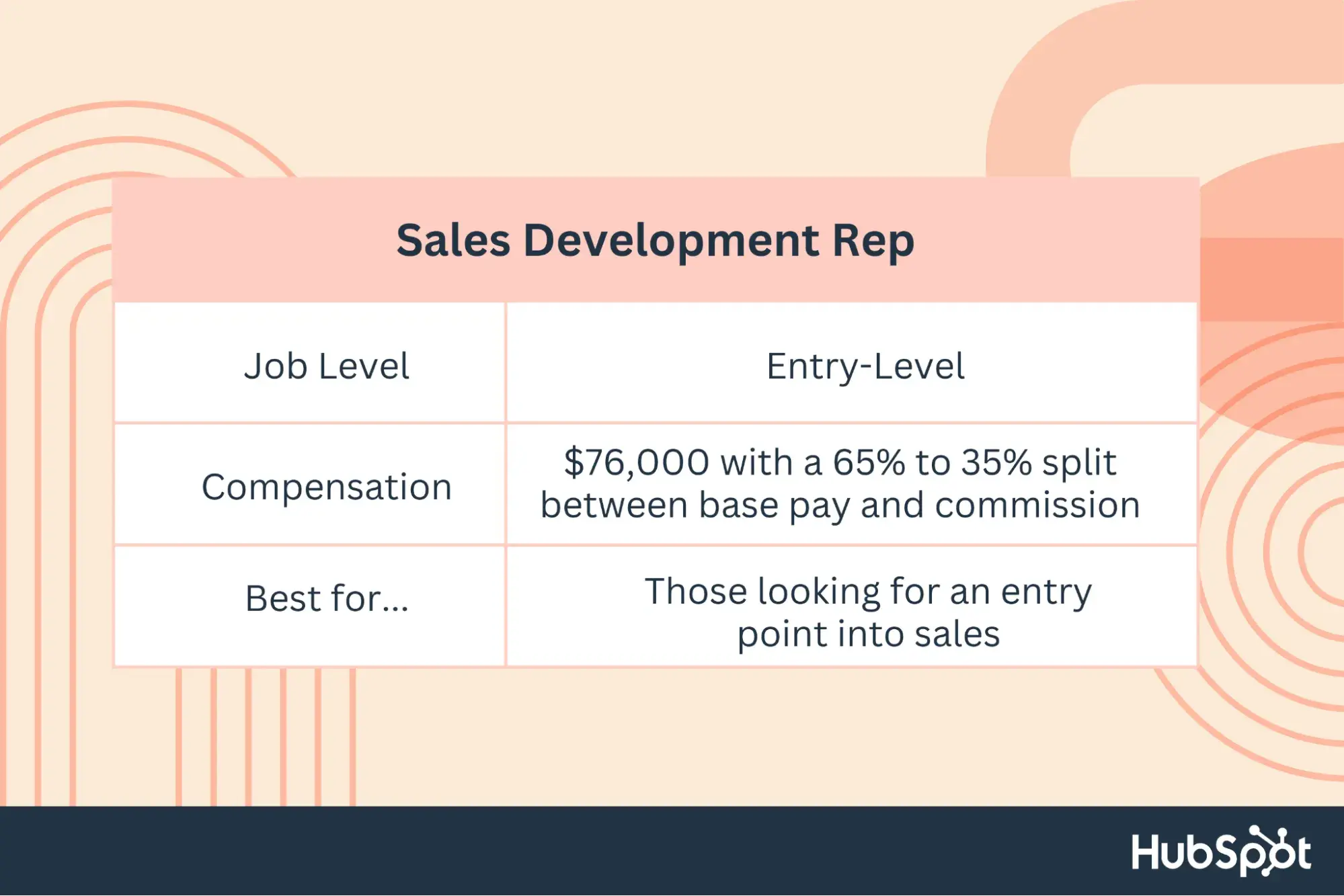
07 Mar 16:59

Intro to Trade Show Planning

by Eric Dyson

trade show planning

Trade shows, expos and conventions provide companies with a one-of-a-kind marketing opportunity to showcase products and capabilities and engage face-to-face with prospects and clients. In fact, an organization may achieve more at one event than they could over the course of weeks or months of marketing through other mediums.

To reap the many benefits of exhibiting at a trade show, exhibitors need to properly plan for an event. Successful trade show planning takes time, discipline and foresight. This means that exhibitors need to choose the correct show, set clear event marketing objectives, design an effective trade show exhibit and properly promote their presence at the show.

This article will help you prepare for your next trade show by outlining the best practices for to planning a trade show, from setting a trade show planning timeline to choosing the right trade show exhibit for your company’s needs and more.

Defining Success and Create Trade Show Goals

Trade shows are a major investment in time, money and resources. This is why the first step in trade show planning should always be outlining a clear idea of what you want to achieve by attending a trade show.

While planning your trade show goals, it is important to set goals that can be tracked and measured. By having metric-based goals, you can evaluate the performance of each show you attend and make tweaks and adjustments to your trade show planning for great success at future shows.

Common Trade Show Goals:

  • Increase brand prominence within your industry
  • Unveil new products
  • Bolster press coverage
  • Build better relationships with current clients
  • Generate qualified leads for your salesforce
  • Learn about emerging industry trends in your industry
  • Generate sales orders

Tips for Defining Success:

  • Be realistic about your goals; it does you no good to set unreachable goals. If you do not have the manpower, enough money or time to achieve a certain goal, you should adjust your expectations to better suit your capacity.
  • Setting benchmarks is a great way to keep your goals and expectations focused on past performance. Before you begin planning your next event, analyze your year over year numbers to see where you stand and where you need to go in relations to your goals.
  • Make sure you clearly communicate your trade show goals to your exhibit partner so they can design an exhibit that will help you reach your goals.

Assessing Trade Show Opportunities

One of the keys to successful trade show planning is selecting the right event. With over 10,000 trade shows held annually in America, choosing the right trade show to can seem like a daunting task.

To make the show selection process easier, familiarize yourself with trade show opportunities within your industry as well as relevant trade shows on an international, national, regional and local scale. Make a list of exhibiting opportunities that best suit your company’s trade show marketing goals. After you have compiled your list of shows, highlight events that you believe will yield the highest return on your trade show investment.

Questions to Ask Yourself When Evaluating Trade Shows

  • Is the show large enough to attract a healthy cross-section of prospects and vendors?
  • Is the show in the right place geographically to attract your customers?
  • Does the show date align well with your company’s ability to fulfill orders and follow up on leads?
  • Can you rely on the show’s management? Does the event have a long track record of success?

Tips for Assessing Trade Show Opportunities

  • If your company is looking for heighten brand exposure, consider selecting new trade shows or events on an international or national stage.
  • To generate a strong return on investment, select trade shows conducive to selling and prospecting on the trade show floor.
  • Investigate your competition to learn which shows they frequently attend.
  • Request show statistics from events you are interested in attending. Compare attendee numbers, demographic information, average booth space cost, travel expenses and a list of exhibitors.

Setting Your Budget

Setting your budget is one of the most important phases of trade show planning. If you want to have an accurate trade show budget, give yourself as much time as possible to plan, take advantage of early bird discounts from vendors. Remember, when setting a trade show budget, your objective should focus on being cost—and marketing—effective.

Tips for setting your trade show budget:

  • Typically, exhibiting space makes up 25-35% of the average trade show marketing budget. To save money on space, see if your event offers early registration incentives, which can save on the cost per square foot.
  • Make sure you consult your “exhibitor’s kit” to pinpoint shipping cut-off dates. Having an understanding of these dates will help you avoid additional fees.
  • Show services can be costly, so make sure you take them into account while planning your budget. There are many minor costs related to exhibit services that, if left unrestrained, will really add up.

Trade Show Planning Timeline

The longer that you have to plan and prepare for a trade show, the better the chances that you will be able to save money and avoid costly potential issues in the process.

Smart exhibitors often begin their trade show planning up to a year in advance of their event. When drafting your trade show timeline, you should begin by organizing your timeline into quarters or three month intervals. Place the most time sensitive items at the beginning of your timeline to make sure they are done promptly and organize less pressing items accordingly.

Tips for setting a Timeline:

  • The first item on your timeline should be booking your show. Many popular events fill up quickly and, if you wait too long, you may find yourself on a waiting list for booth space. Also, the earlier you book your booth space, the more options you will have regarding the location for your booth.
  • Many shows will sell you a mailing list of pre-registered attendees. Make room in your trade show timeline to focus on pre-show mailings that include your show contact information, booth number and promotional incentives to help you generate interest in your booth.
  • Exhibit design can take time to perfect, so when drafting your trade show planning timeline, make sure your give yourself enough time to design the right exhibit for your brand.

Choosing Your Exhibit

Your trade show exhibit is the centerpiece of your trade show program, so making sure you get the right design is an essential part of trade show planning.

You should prepare for designing your trade show exhibit by researching what kind of exhibit options best fit your space and budget. Will a large custom trade show booth work best for your brand? Or will a smaller portable display do the trick?

Tips for Choosing your Exhibit:

  • If you are unsure of what design will work for your, remember to keep it simple with your booth graphics and design features.
  • Design a trade show exhibit that helps visitors experience your product or service. Let them touch, see, feel, hear or taste your offerings.
  • Promotions, product demonstrations, giveaways and contests can drive traffic to your booth. When planning the design of your exhibit, make sure that your space has room for these in-booth activities.

Staffing

trade show planning and staffing

After selecting an event, starting the planning process and designing your exhibit, you are left with one question: who will be staffing your trade show booth?

Best case scenario, you will have a team of personable and experienced sales professionals ready to engage attendees on the show floor. However, are these sales representatives prepared to encounter potentially thousands of prospective buyers over the course of a few days? Will they be able to weed out the lurkers from genuinely interested potential buyers? To make sure you get the most out of your booth staff, outline staff training as part of your trade show planning program.

Tips for staffing:

  • Account for staff training in your trade show timeline. Make sure your staff are prepared to properly deliver your brand messaging, give product demonstrations, acquire leads/sales and achieve your overall trade show goals.
  • Understaffing can make it difficult to reach your goals and put extra stress on your booth staff. If you need more staff members to man your booth, plan to hire outside sales staff in your trade show budget.
  • Enlist your staffers to help you plan for your trade show. Staff will better understand your trade show program if they are incorporated in the trade show planning process.

Shipping

Trade show carriers are a vital part of the trade show planning puzzle. Great carriers can make the logistical and strategic challenges presented by a trade show a breeze. If all goes well, you should have an easy time getting your items to the venue and back into to storage. Remember, planning in advance will save you both time and money, so make sure to do your research.

Questions to Ask Your Trade Show Carrier

  • How long has your company specialized in trade show freight?
  • What services do you provide exhibitors?
  • How can I track my freight once it leaves the warehouse?
  • How does you company pack and secure freight?
  • Do your vehicles use air-suspension to avoid bumps and minimize shipping damage?
  • Can you have a comprehensive shipping quote that covers all your expenses, and can you have it in writing?

Tips for shipping:

  • Contact event organizers about preferred carriers/vendors for shipping and freight. This will lessen the stress of shipping your exhibit as you can rest easy knowing your carrier is familiar with the show.
  • To make shipping as painless as possible, schedule shipping to the show as well as return shipping.
  • Drayage is the cost of venue professionals transporting your exhibit from the warehouse to your booth space. Rates are typically based on weight. Incorporating lightweight materials – such as fabric graphics – can help save on the cost of drayage.

Conclusion

The more often you attend industry trade shows, the better you will get at budgeting and planning for events. As you continue to hone your trade show prowess, you will be able to increase your customer base and your trade show ROI, making the investments of time and money you put into trade shows well worth it. You can begin making that investment today by identifying events that would be ideal for your company to attend and getting to work planning your next trade show. If you would like to learn more about trade show planning, download Nimlok’s free Planning Guide.

07 Mar 16:58

B2B Salespeople Need to Act More Like Travel Agents

by Nicholas Toman
mar17-07--538988687

Having more information doesn’t always make it easier to decide. Consider what’s happened with travel: With the explosion of internet travel sites in the 2000s, consumers took charge of their own travel, and travel agencies hemorrhaged business. Fast forward to today. According to the travel and leisure marketing firm MMGY, the use of travel agents increased by 50% from 2014 to 2015. Why? Because consumers, overwhelmed by information and inundated with choices, are again turning to travel agents to take the work out of travel planning.

A similar sequence has happened with B2B buying. Just as with travel, a wealth of easily available information has made it possible for buyers to do much of the work themselves. By 2012, our research shows, nearly 60% of a typical B2B purchasing decision — researching solutions, ranking options, benchmarking pricing, and so on — was happening before the buyer even had a conversation with a supplier. But just because customers can research their purchase doesn’t necessarily mean the process is going smoothly. As we describe in our recent HBR article, “The New Sales Imperative,” the torrents of information, expanding array of options, and growing size and diversity of purchasing groups are leading to a kind of purchase paralysis: Customers are taking longer than ever to make purchases, and abandoning them more often. At the same time, second guessing and post-purchase regret are on the rise, while loyalty is falling. As purchasing becomes ever more complex, it’s becoming harder and harder — and buyers are now looking for sellers who can make the process easy once again.

Surely B2B purchasing hasn’t become that bad. Or has it? Try this simple exercise: Think about the last major purchase for which you sat on the buying committee. Perhaps it was a CRM solution, a consulting engagement, or new infrastructure. Now think about the stakeholder group on day one and how that group had changed by day 100. Think about the information you initially consulted and how that changed over time. Consider the revolving door of experts, colleagues, vendors, and their specialists. Think about the seemingly infinite set of options you needed to consider. Now ask yourself, if given the choice, would you do it that way again? Probably not.

As our research highlights, by becoming their customer’s “travel agent,” leading suppliers are spinning the challenges customers face into tremendous commercial advantage. They’re easing customers’ burdens by guiding them through difficult decisions and choices, and improving win rates for high-end solution sales by as much as 60%. Here are examples of how firms in three industries are simplifying the purchase process, and the specific tactics they are using:

An employee wellness benefits provider uses content marketing. Programs to support employee wellness and keep health care costs in check are a fairly new type of service. As such, many HR departments have never made this kind of purchase. As employers try to learn about the market, a mob of brokers, sales people, employee evangelists, and others typically flood the decision makers with information. As one benefits provider watched its customers become increasingly overwhelmed, it created marketing and sales content focused exclusively on best practices for purchasing wellness benefits. The content is highly prescriptive, guiding customers through the stages of decision making, assessing their readiness to provide wellness benefits, and walking them through benchmarking exercises and even RFP builders. This guidance is vendor-neutral; it doesn’t promote the provider’s solution, but instead guides prospects through the purchase process, offering practical tips and warnings about pitfalls they may encounter. Subtly, within the content, the provider orients customers toward its distinct strengths without overtly pitching its solution. The campaign has resulted in dramatic increases in marketing leads and sales.

A marketing automation company creates bespoke presentations. When customer decision makers don’t agree, it can make purchasing difficult and slow or scuttle deals. Consider the common situation where a marketing head approaches the CIO seeking approval for a marketing automation purchase. If, as often happens, the CIO believes the company’s CRM solution already does adequate marketing automation, they may block the purchase. To address this problem, one supplier built a series of readymade decks for marketers to present to CIOs and other stakeholders in the purchasing decision. These decks contain benchmarking tools, customizable ROI calculators, and other content to showcase the potential impact of the firm’s solution, and, most powerful, they use the language and metrics of the stakeholder receiving it.

A health care software company uses networking events early in the sales process. Sellers often use references from previous customers to help get a new one through the final stages of a difficult purchase. Most sellers approach this in a similar way: They get their happiest customer on the phone with the prospective customer late in the sales process and ask them to sing the company’s praises. This software company takes another approach, asking customers who have recently completed a significant purchase that is similar to the one the prospect is evaluating to spend half a day alone with the prospective customer early in the purchase process. The engagement is billed as a networking and best-practice sharing event, so both companies benefit. But the software company asks the customer reference to candidly discuss their purchase process. This includes openly discussing missteps they made, pitfalls to avoid, information to consult, RFP advice, and how to best engage with the software company. Because this is a true peer-to-peer networking opportunity, few prospects turn away the opportunity. As a result of the reference engagement approach, the software company has seen cycle times fall and deal win rates increase.

Like these companies, B2B suppliers need to focus on making it far easier for customers to buy. What opportunities do you have to be your customers’ travel agent?

07 Mar 16:58

For Prospecting Success, Leave Your Data Order Till Later

by Ruth Stevens

Marketers looking to acquire new customers, or generate sales leads, typically rely on outside data providers for lists and contact data to give them access to new markets. But when they place an order for prospecting data—whether it’s email, telephone, or postal addresses—marketers often end up with data that isn’t exactly what they had in mind. What happens then? They have to order again, wasting time and money. Or worse, they may use the data in a campaign and wind up with suboptimal results.

With a bit of planning and strategy, these problems can be avoided. The secret? Get your prospecting campaign ducks in a row before ordering the data. Think through where you are going and why. Key elements to consider:

  • State your campaign objectives, with specific goals and time frames. For example: Generate 45 qualified leads, at $350 per lead, in the quarter.
  • Identify the target audience. A great way to refine your target audience is by profiling your current best customers. Your data vendor may offer profiling as a free service.
  • Select a compelling offer that will motivate the target to respond. Offers are most powerful when they are unique, tangible, perceived as valuable by the prospect and related to the key benefit of your product or service.
  • Determine the key campaign messages. Craft campaign messages based on the key benefits that are valued by your target audience.
  • Plan how you will handle campaign responses and follow up. Plan a series of follow-up messages to deepen the customer relationship, and to stimulate retention, repurchase and referral.
  • Prepare a pro forma estimate of campaign results and ROI. If your pro forma estimate does not show a satisfactory result, then tweak the other elements to improve the campaign: Select a narrower, more targeted audience. Find a more compelling offer. Identify more powerful customer benefit statements.

This pre-planning process may seem counter-intuitive. You know that the target audience is the single most powerful driver of campaign success, so you’d think that specifying the audience should come first. And that’s true. But experience shows that working through the other elements—the offer, the messaging, the projected results analysis—often results in refinements to your thinking about the audience itself. So don’t actually place the order until you’re comfortable with all the other elements of your campaign.

This article is excerpted from the white paper “How to Place an Order for Prospecting Lists and Data That Ensures You’ll Get Exactly What You Need.” Get your own copy here.

07 Mar 16:58

This Program Uses Lean Startup Techniques to Turn Scientists into Entrepreneurs

by Greg Satell
mar17-07-hbr-cat-yu-entrepreneurship
Cat Yu for HBR

When Subra Suresh was tapped to lead the National Science Foundation (NSF), in 2010, he saw that many of the pathbreaking discoveries developed through the agency’s grants weren’t finding their way to the marketplace, so he sought to foster better links between government and industry.

This, of course, was not an entirely new idea. Over the years, there have been numerous efforts, ranging from the Bayh-Dole Act, of 1980, to numerous initiatives to revamp technology transfer offices within government agencies, but nothing really seemed able to speed new discoveries out of the labs and into the marketplace.

This time, Suresh and his team decided that instead of reorganizing how things worked inside the NSF, they would help scientists become entrepreneurs themselves, using a model that had already worked wonders in Silicon Valley. The result, a program called I-Corps, is helping hundreds of scientists become successful entrepreneurs.

An Idea Takes Shape

Errol Arkilic always knew he wanted to be an entrepreneur, but he took an unconventional path to starting companies. Rather than launching a startup in his garage, he got a PhD in the emerging field of microelectromechanical systems at MIT. He then spent six years starting companies in Silicon Valley before joining the NSF when Suresh asked him to run I-Corps. Arkilic immediately saw that changes would have to be made to the program’s initial vision.

“The original idea was to get academics and industry types into a room, and then the ‘magic will happen,’ and I never thought that was going to work,” he told me. “I had a front-row seat to over 400 commercialization projects, and the common cause for failure was that people were creating solutions for problems that nobody cared about. That’s what we needed to change.”

Arkilic had been reading Steve Blank’s blog, as well as his book, The Four Steps to the Epiphany, which would later spawn the lean startup movement. So he decided to call Steve to see whether he would be willing to help apply his principles to the work done at NSF. Much to Arkilic’s surprise, he found Steve intensely interested in the idea.

They designed an eight-week course to teach graduate students about Steve’s methods. Graduate students would serve as entrepreneurial leads and would go through the course with their professors and a business mentor. Later, they would partner with VentureWell, a nonprofit that focuses on accelerating innovation.

Now there was a plan in place. The only thing left was to see whether it would actually work.

From Product Development to Customer Development

One of the core tenets of Steve Blank’s philosophy is that startup founders always begin with a flawed idea, so the key to success is to identify the flaws and fix them before you run out of money. That’s why he advises founders to go out and talk to customers before they start building a product that, they might find out later, no one wants to buy.

This harsh reality hit home for Adam Tilton of Rithmio on his very first day in the I-Corps program. As a graduate student in the prestigious Coordinated Science Laboratory at the University of Illinois, he had developed control system algorithms for things like missiles and satellites that significantly outperformed the current technology.

He was certain his work had great business potential. So he worked hard to prepare his first presentation to the I-Corps panel, and then practiced and honed it for a week. He fully expected to wow everyone in the room with the sophisticated solutions he had spent years designing. Surely, they would see they had a winner on their hands.

Unfortunately, the panel was not impressed. It was a rude awakening. “They were like, ‘You’re not in the lab anymore. This is Silicon Valley. Go out and interview 10 companies in this space before tomorrow and tell us if they really have any interest in buying this software,’” Tilton told me.

The Pivot

After that less than auspicious beginning, Tilton and his professor, Prashant Mehta, began working their network of military contractors to find people who were willing to listen to their idea and give them feedback. They worked at a furious pace, conducting 350 interviews over the course of eight weeks, but couldn’t find anyone interested in it.

“In our very naive early entrepreneurship days, we thought we were going to be able to sell math,” Tilton remembers. “But people would look at the algorithms we developed and say, ‘Great, come work for us.’ That’s not what we had in mind.” It slowly dawned on the pair that they would have to come up with another avenue to market their technology.

The turning point came when they saw an announcement for the MotionTracking Developers Conference that was being held in San Francisco. Having no other ideas, they bought tickets to attend. It would prove to be an amazingly wise investment.

As luck would have it, wearable technology was just heating up, and the two immediately saw how their algorithms could help create wearable products that were vastly superior to what they saw at the conference. They started work on their new idea as soon as they got on the plane. By the time the flight landed in Chicago, they had already built a simulation of their product on Tilton’s laptop.

Turning a Minimum Viable Product into an Actual Product

Another pillar of Blank’s method is the minimum viable product. Unlike a traditional prototype, the idea is to build something you can use to test your hypothesis, rather than a fully featured version. Tilton was able to build one for his wearable product in three weeks. It wasn’t something he could go to market with, but it was good enough to show potential customers.

That allowed him to learn even more about what the market was demanding from wearables. He flew to New York to attend the Wearable Tech Expo and asked questions about who bought wearables, how the sales cycle worked, and what technical specifications he would need to achieve with regard to power consumption, accuracy, and robustness. Each insight led to a better product.

That spring Rithmio won the COZAD New Venture Competition, and on the strength of that was able to secure $650,000 in angel financing. Later it received an additional $3 million in seed funding from blue-chip investors such as Intel Capital and KGC. What was once a misguided idea that nobody was interested in is now a full-fledged company.

Rithmio is just one example of I-Corps’ success. Opus 12, a cleantech company, won Fortune’s startup competition, while Zephyrus Biosciences was recently acquired by Bio-Techne. There are countless others, many of which would have never gotten off the ground without the program.

The Future of I-Corps

Today I-Corps is running at full steam. According to VentureWell, as of May 2016 the program has trained over 700 teams, which have raised more than $80 million from venture funding, government grants, and other sources. 81% of the entrepreneur teams are still active 13–21 months after taking the course. Those are impressive results.

Building on this success, the program has grown beyond the NSF, to similar programs at other agencies, such as the NIH, the Department of Energy, and the Department of Defense, as well as other countries, such as Australia and Singapore. Clearly, the model is catching on.

Another interesting aspect of the program is that almost 90% of participants say it changed their approach to the way they do science, with respect to the types of experiments they perform, how they write grant proposals, and how they prepare papers for publication. As Tilton told me, “Innovation Corps changed my life.”

And I think that underlines something we often miss about the lean startup movement. It’s not just a series of techniques and tricks. It’s a fundamentally different way of thinking that can help anyone launch a new product or venture, whether it is someone tinkering in a garage somewhere, a group of executives at a major corporation, or a scientist with a fundamentally new discovery.

06 Mar 22:40

10 Revealing Statistics About Compensation And Benefits You Should Know [Infographic]

by Jacob Shriar

compensation and benefits

Compensation and benefits is a pretty sensitive topic that most managers like to avoid.

So we put together an infographic with some interesting statistics that show you what employees are truly thinking when it comes to compensation.

Enjoy!

infographic about employee compensation

80% of employees would prefer new or additional benefits over a pay increase

Remember, money can’t buy happiness.

What employees really want is freedom and autonomy. I’ve spoken to many people who have told me that they would take a $5,000-$10,000 salary cut for the ability to work from home a few days a week.

As a manager, there are a ton of things you can do to make your employees happy that don’t cost any money.

I’ve said this many times before, but at the end of the day, employees just want respect. You can give them that respect by giving them autonomy, freedom, and power (all great benefits).

90% of millennials would prefer benefits over a pay raise

A lot of possibilities here of why this number is so high, but this statistic is very interesting.

Millennials are all about work-life balance.

They understand that it’s better to enjoy life and make a decent living. They witnessed their parents work unbelievably hard only to have it all taken away from them when the market crashed.

I think millennials have a much better appreciation for happiness, and they (rightfully) have high expectations of how a workplace should work.

As a manager, both of these statistics show that you should clearly be focusing on benefits.

Pro tip: Ask employees what they would want as benefits. Even if you can’t give them everything they want, it might help you spark some ideas for what you can do.

60% of women (and 48% of men) rate work-life balance and well-being as “very important” in a new job

My dream is that this number would be higher.

I don’t think many people understand the importance of work-life balance and the kind of effects that overworking has on you.

This statistic gives us an interesting insight, many people are looking for work-life balance in a new job, so when you’re recruiting, you can highlight elements of work-life balance to attract candidates.

57% of U.S. job candidates report benefits and perks are among their top considerations before accepting a job.

This is great for advertising your employer brand, and especially good insight for recruiters.

Now, you can know what you should be highlighting in job descriptions, on careers pages, and in interviews.

If your benefits packages aren’t up to par with other companies, you’re missing out on a huge opportunity to attract top talent.

Again, good benefits are cheap (free), you just need to take the time and energy to put these things into place. Easier said than done, but it comes down to trust and respect.

84% of employees with high benefit satisfaction report high job satisfaction

There’s clearly something about employee benefits leading to more job satisfaction.

I think a clear focus for managers should be about testing and frequently implementing new benefits with the help of your employees.

Not only is that guaranteed to make them more satisfied, but including them in the process will empower them and give them that sense of ownership, helping increase their loyalty to the company.

70% of employees believe salary transparency is good for employee satisfaction

I’ve always personally been a fan of salary transparency.

My thinking is, if you have nothing to hide, why not make it public? It can open the door for some interesting conversations.

Having said that, I understand that not every organization or even every employee is comfortable with releasing that information.

The key takeaway here isn’t that salaries need to be transparent, but that transparency in general is great for satisfaction.

Men earn 24.1% higher base pay than women on average

Transparent salaries would likely help solve this problem, but this is something that needs to be fixed.

I’m not entirely sure why this still happens, and this is part of the larger fight to bring more equality into the workplace.

It’s too bad that women don’t get the same level of respect as men in the workplace, because the research shows that one of the best ways to have a more successful team is to have more women on the team.

This is something for all leaders to keep an eye on, it’s unfair to pay women less for the same work.

67% of U.S. employees said they were not likely to apply for a job at a company where men and women were paid unequally

Continuing the conversation, this is even more reason to pay people fairly.

People won’t apply to work there, and even worse, people will leave.

No one wants to work in an environment that they don’t respect, and many companies out there are starting to become much smarter and more strategic with their brand.

If you’re not following suit, you are in for a rude awakening when your top talent leaves and you can’t seem to find anyone good to replace them.

Only 65% were satisfied with their compensation

I wouldn’t get too worried about this statistic.

Yes, many people are unsatisfied with their compensation, and yes, people will always want more, but there are other ways to make them happy.

It’s important to pay your people well, but if you genuinely can’t afford to do so, you can make up for it with the benefits you offer.

This might genuinely be an issue of underpaying employees, which can be fixed relatively easily. I just wouldn’t put too much emphasis on paying people more.

49% of employed adults in the U.S. feel they must switch companies in order to obtain any meaningful change in compensation

What’s important to note here is that this could be a perception problem.

It’s possible that people are unhappy and believe that the only way to see any meaningful change is to switch companies.

This is definitely scary, because employee turnover is incredibly costly and annoying, but I think this can be fixed by calming those fears from employees. Again, most employees want better benefits and don’t care as much about more money.

If you can improve their overall compensation (salary + benefits), they’ll be much more likely to stay and not think about leaving.

Do You Agree With These Compensation Statistics?

I’d be curious to hear your comments below!

06 Mar 22:38

11 Trade Show Booth Ideas To Beef-Up Boring Modular Exhibits

by Louis Ross

Plain and simple. We put together 11 common trade show booth ideas that in unison or on their own can dramatically beef up standard modular exhibits.

1. Ditch the Photo Booth. Incorporate VR or AR.

We’ll step off with one quick point. Green screen photos booths are outdated! If exhibitors are not thinking of ways to integrate today’s tech like Virtual Reality, Augmented Reality or other tech advances, then the competition will soon surpass.

2. Swap Out Standard Paneling for Better Materials

Most modular exhibits may be designed to accept standard PVC (Sintra), Gatorfoam or Foamcore panels but unbeknownst to many exhibitors, common modular exhibit framing is also designed to accept SEG (silicon edge graphics).The advantage? Eliminating breaks and seams in graphics while simultaneously opening up options like back lit walls and reducing shipping weight and drayage bills. “Does that person have a huge gap I their teeth?” Nope it’s just a seam in the panel!

3. The More Lighting the Better

modular-exhibit-lighting.jpeg

Here is an experiment; Try Googling “trade show booth ideas” and look at “images”. It is easily noticed that booths with the most lighting – more specifically, colored lighting stand out the most. This is no different on the trade show floor. Inserting lighting wherever possible is an essential trade show booth idea that will beef up any modular exhibit. Consider placement in these key areas to start:

  • Overall hero graphics.
  • Behind TV’s.
  • Inside fabric panels.
  • Within or behind 3d letters.
  • Even consider using basic string lights for a warmer vibe. (Great for outdoor themed trade shows).

4. Using Glass, Plexiglass or Acrylic Panels

Want to make the allotted space more private yet still inviting? Try using transparent Plexi or acrylic panels. Dive deeper by use vinyl branding overlaid over the panel. To go for the gusto, try adding in back lighting too!

5. Supplement With Props

trade-show-booth-prop-ideas.png

Even if it makes no sense we can’t get over how attendees stop dead in their tracks when they see props. This trade show booth idea has been around for decades for one reason only. It works. Try experimenting with these types of props to spruce up an otherwise boring modular exhibit:

  • Life-sized statues of mascots, key players or a company icon.
  • Robots of any kind.
  • 3D Printers for handing out Swag.
  • Miniature models of facilities, mock-ups, products or processes.
  • Original designs and patents to add nostalgia.

6. Custom Greeting Counters

Convention greeting counters come all shapes and sizes. Some modular, some ultra custom. Adhering to budget requirements is usually a restriction but often times jumping for the next tier of greeting counters can make the difference between a walker by and a stop-in. This is after all the face of the exhibit booth and first impressions are undoubtedly a necessity. Consider trade show greeting counter ideas such as EdgeLit acrylic tops in place of wood or 3d logos instead of a simple slide in graphic panel. Remember, It’s called modular for a reason and it doesn’t need to mean boring.

7. Better Display Cases

modular-exhibit-display-cases.png

If we’re talking product companies (not service industry) then display cases are the window into the company. As you’ve most likely already discovered basic display cases let alone custom ones are not cheap. Unbeknownst to many exhibitors, rental options do exist. Inquire with the trade show management company in question and see if they offer some of the following cases.

  • Interactive and hands-on display cases.
  • Turntable tops.
  • Themed display cases (wood, cardboard, rope, etc.).
  • Custom lit cases.
  • Wall integrated cases.

8. Rotating Banners & Inflatable Banners

Even during event Install and dismantle I personally can’t wait until our clients hanging banners are up. The overload of exhibit materials, freight and booth staff makes it a challenge to find our exhibitors without that beacon in the sky. Imagine how difficult it is for attendees whom never stepped foot on the show floor prior to opening!

Point being; if a booth is basic make the banner stand-out. They come in all shapes, sizes, styles and materials but the best way to beef up an existing current modular banner… make it spin. Banner motors are surprisingly affordable and should be in stock at a decent trade show manager’s warehouse.

9. Use “Real World” Materials

Digital-trends-exhibit-fabrication-a-314344-edited.jpg

Interested in going the themed trade show exhibit route? Using “real world” materials is a must. Experiment with the following ideas to get that custom exhibit feel without a complete trade show booth overhaul.

  • Live walls and adding in faux fauna.
  • Using crates as displays (saves on drayage too!).
  • Cover walls with faux facades/veneers like wood or stone.
  • Use smoke and mist machines to generate curiosity.

10. Brand Meeting Spaces

Although sitting at a trade show is heaven, meetings are sometimes not. If a dedicated meeting space is a requirement then make it enjoyable. Try adding in some of these elements to jazz up meeting spaces.

  • Add graphics to tables and chairs.
  • Hang company pictures.
  • Use branded tablecloths.

11. Go Beyond Solid Carpet

Praise the ground that they walk on. Make fans and prospects feel like they are part of something special by swapping in trade show flooring other than the basic solid carpet. Below are some ideas:

trade-show-flooring-ideas.png

  • Faux wood vinyl flooring.
  • Branded carpet.
  • Sectional foam paneled flooring.
  • Faux grass/AstroTurf.
06 Mar 22:37

The Demise of the White Paper is Greatly Exaggerated

by Howard J. Sewell

If you can say anything about marketers, it’s that we love obituaries. Yes, we love to declare things dead.

Inbound Marketing? Dead.
The MQL? Dead.
Lead Funnels? Dead.

white paper marketingOutside the rarified air of marketing punditry, however – i.e. in the land of marketing practitioners – all three of these concepts are still alive and well. Why all the premature death notices? A simple explanation is that marketers love the new and different and bright and shiny, and nothing generates views and shares more than telling marketers that everything they’re doing is old-fashioned and outdated and well, deceased.

Aaron Dun wrote a great article last month for CMSWire in which he detailed strategies that he believes B2B Marketers need to adopt to stay current in “a highly digital, connected world.” Amongst those strategies, according to Dun:

1. Better Persona Mapping
2. Targeting and Personalization

No argument there. B2B marketers have long understood that identifying prospects by role, company type and selling stage, and then targeting content and campaigns to those same segments, is a sure recipe for success. What’s changed? Mainly that technologies – ABM being a prime example – now make it possible to implement that personalized approach with a sophistication, and at a scale, that wasn’t previously possible.

Where Dun’s views and mine part company, however, is with his third point:

3. Expand Beyond the White Paper

According to Dun, “the era of the lead-gated PDF as a driver of scale leads is coming to an end … an increasing number of marketers are turning to interactive content to create more dynamic experiences with buyers.”

Look, I’m all for creating a mix of content – ebooks, video, Webcasts, infographics, ebooks, case studies, etc. – the better to attract a wider spectrum of prospects with different preferences for how they like to consume information. But is the white paper dead? Sorry, I don’t buy it. And neither would all the B2B companies who generate thousands of quality leads every year through content syndication and other white paper marketing channels.

I understand that the PDF white paper seems quaint and old-fashioned, and because we marketers live on the bleeding edge of all that is bright and shiny, we might have trouble accepting that prospects would rather download a 5-page ebook vs. say, watch a 5-minute interactive video.

Just remember that there’s one principle that trumps everything we think prospects SHOULD want simply because it’s more dynamic and interactive. That principle is convenience. Yes, prospects want information that is targeted and personalized and relevant. But they also want information that is easy to access, easy to consume, and easy to share. And a PDF document, no matter how old-fashioned, is about as convenient as it gets.

Now I will grant Dun this point … the old-school, 8-1/2 x 11, text-heavy, academic-style white paper is indeed on its last legs. Most white papers (ebooks, really) are now much more likely to be colorful, image-centric, visually engaging and mobile-friendly. But I would argue that’s not because prospects necessarily demand more engaging, interactive content. It’s because a less text-heavy, ebook-style white paper is easier to read.

As a marketer, should you look for ways to make your white paper more engaging? Absolutely. But don’t let the siren call of all that is new and shiny cause you to abandon white papers altogether. Contrary to rumor, white papers still have some life left in them.

For a closer look at creative ways to make demand generation content more engaging, check out our slideshare (no registration required): “10 Great Examples of Demand Generation Content

06 Mar 22:35

A former US Marine says every leader should ask an uncomfortable question to learn what people really think of them

by Shana Lebowitz

angie morgan

Over the course of my adult life, I've learned that I stutter when I'm nervous, that I barely talk in groups of four or more people, and that I slouch almost always.

By "learned," I mean a friend, coworker, or family member told me; I got defensive and refused to believe it was true; then subsequently caught myself in one of these behaviors and realized their assessment was extremely accurate. 

These sometimes unflattering assessments are what Angie Morgan calls a "gold mine." Morgan is a former US Marine and a co-author, along with Courtney Lynch and Sean Lynch, of the new book "Spark: How to Lead Yourself and Others to Greater Success."

Morgan and her co-authors, who are also the co-founders of leadership development firm Lead Star, write that it's important for leaders at any level of an organization to actively solicit other people's feedback. Because chances are, there are lots of things they know about us that we don't.

Morgan visited the Business Insider office in March and said you can start collecting that feedback by asking a super simple question: "Can you please share with me two things I'm doing really well in this circumstance and two areas where you think I can improve?"

You can pose this question to your direct reports, your peers, or even your supervisors.

At first, Morgan said, "people might be a little, 'I don't know where you can improve' or, 'I don't want to give you criticism.'" But if you keep asking, and if you show a willingness to receive that information (i.e. by thanking them and not getting defensive), over time they'll open up.

"A lot of people we work with and around hold the key to how we can be more successful in either relationships or at work," Morgan said. "People observe me every day and they may have tips or ideas for how I can be better." 

US Marine SaluteMorgan's insights recall something executive coach Marshall Goldsmith wrote in his 2007 book, "What Got You Here Won't Get You There." 

According to Goldsmith and his co-author Mark Reiter, it generally matters less what you think of yourself and more what other people think of you. That's why, even though unsolicited feedback can be painful, it's almost always helpful. 

In "Spark," Morgan and her co-authors write that it's important to "challenge yourself to consider the points of view of others, such as by asking yourself, I personally think I'm good when it comes to credibility — but would my colleagues share that same opinion of me? What about my manager? What about my friends?"

Obviously, trying to put yourself in someone else's shoes isn't as effective as asking them directly for feedback. But given that you can't solicit feedback on every single behavior, thinking about your actions from other people's perspectives is a good habit to practice. 

The goal here isn't to become obsessed with the image you're projecting at work or elsewhere.

Instead, it's to realize that there might be a discrepancy between the way other people see you and the way you see you — and to acknowledge that other people might be able to help you become the best version of you.

Watch the full interview below:

SEE ALSO: One piece of go-to advice to be happier isn't doing any good for your career

Join the conversation about this story »

NOW WATCH: Navy SEALs explain how a leader's ego can destroy a team

06 Mar 22:35

Sales People Change The World!

by Dave Brock

Recently, I was privileged to observe a series of training sessions at Microchip. My friend, Mitch Little, kicked off the session with some introductory comments. One sentence captivated me, “We change the world…”

That has been occupying my thinking since I heard Mitch make the statement.

Salespeople have the opportunity to change the world!

Think about that for a moment, what we do impacts our customers, organizationally and individually. It changes them, even if in a very small way.

  • We help customers solve problems, improving what they do and the results they produce.
  • We help them discover opportunities they might never have discovered otherwise.
  • We help them drive dramatic improvements in their businesses, ultimately enabling them to help their customers.
  • We incite them to change, where they may not have recognized the need, or the opportunity to change.
  • We help them individually, whether it’s helping them get sanity in their lives, get a promotion/bonus, spend more time with their families, or even keep their jobs.
  • With each engagement, we have the opportunity to change the world through what we help our customers achieve.

We help our own companies change.

  • It may be the competitive insights we discover and share internally.
  • It may be the intimate knowledge of our customers businesses and changing markets that enable us to help drive our companies’ strategies.

Collectively, more than any other group in our organizations, we have the opportunity to change the world. However small it is, it’s through what we do in helping our customers and companies grow and thrive that drives changes in them, changes with their customers, changes in the markets, changes in competition.

Every day, we have the opportunity to change the world.

Yet too often, we fail to recognize that we are changing the world. Instead we focus on our products, leaving the customer the challenge to figure things out. Or we fail to provide feedback within our own organizations, to help them change.

In doing so, we don’t create the value we can and should create. We don’t take the opportunity to change the world, albeit, one step at a time.

What we do is important! We have a huge impact on our customers and our companies! We can never lose sight of this!

Great salespeople have the opportunity and obligation to change the world! Mitch, thanks for reminding me 😉

06 Mar 22:32

When is the Best Time to Send Email?

by Olivia Dello Buono

When is the best time to send emails

You may have heard it a million times before. But it's true: There's no one best time to send email.

That's because at its core, email is communication. And communication requires two parts: the sender and receiver.

And every email has a unique group of receivers. Every audience is different.

Plus, if the receiver isn’t in the right frame of mind to process your message, you might as well be talking to yourself. Like any form of communication, your emails are going to have more of an impact if you use timing to your advantage.  

In this post, we’ll take a closer look at how email send times can impact your overall email marketing performance, as well as ways to optimize send times for success.

Here’s what we’ll cover in this post:

  1. What is the best time to send emails?
  2. What is the best day to send emails?
  3. How to find the best time to send email?

What is the best time to send email?

The best time to send an email is 5:16 a.m. EST.

Or at least it is if your name is Seth Godin. Seth sends an email nearly every day at that exact time.

But your name isn’t Seth Godin.

Seth has figured out that early morning is the time to reach his audience. However, what works for Seth might not work for everyone. 

And there’s the rub...

The best time to send email is different for every audience

You have to know your audience like the back of your hand:

It’s important to be aware of:

  • Who your audience is
  • What their behaviors are
  • What motivates them
  • How you fit into helping them achieve their goals

For instance, if you’re a nutrition coach and you want to optimize when email send times and days to drive more sales of your ebook, you may consider the following:

People starting a new routine may be feeling most motivated in the morning when decision fatigue is less. 

On the flip side, if you offer business consulting services, your optimal send times and days may differ:

Your audience may be working on their side-hustle at night or on the weekends, so considering the times when they are logged on and paying attention could yield better results.

Ultimately, it’s about considering what you’re asking people to do, and when they’re most likely to be in the frame of mind to do it.

We know hearing “it depends” is hard when you’re looking for a quick answer. So take into account the following takeaways from a meta-analysis conducted by Co-Schedule:

  • The best time to send email in the morning is 6 a.m. or 10 a.m. This is because many people tend to check email upon first waking up or after they’ve settled into the day mid-morning.
  • The best time to send email in the afternoon is 2 p.m. or 8 p.m. This is because people tend to look for a mid-afternoon distraction in their inbox before winding down for the workday. They also check emails before going to bed. 

What is the best day to send email?

Just like finding the optimal send time is highly dependent on your unique audience, the same is true for finding the best day to send email.

Consider the examples of the nutritionist and the business services consultant above:

The nutrition audience may be feeling down about their choices coming off a weekend, so Monday may be a good time to present them with a solution (i.e. your ebook).

Meanwhile, the consulting audience may be swamped with emails on Mondays and may be more likely to respond to an inquiry mid-week.

Different audiences. Different goals. Different optimal days to send email. 

However, if you’re looking for a good place to start, the same meta-analysis from Co-Schedule offers the following:

  • Tuesday, Wednesday and Thursday are the best days to send email, with Tuesday being the far and away best day of the week to send.
  • Some studies show that Saturday and Sunday are the worst days of the week to send emails, as people tend to not pay attention to their inboxes during the weekend. However, others show these days yielding the highest click through and open rates.

Optimize your email send times with split testing

If people are going to respond to an email, they’re most likely to do so within two minutes of opening it.

From there, the likelihood of a response starts to dwindle. If someone doesn’t take action within 48 hours, they probably won’t.

That means if you’re not sending emails when people are most ready to respond to your calls to action, you may be missing important opportunities.

With that in mind, let’s talk about how to figure out your optimal send time and day. 

Because the optimal send time is different for everyone, your best bet is to run a few experiments to find out when your audience is most likely to open your emails.

If you know your target audience, you can probably make an assumption about when you think they’ll be most in the mood to engage with your subject matter. But, of course, you want to test your assumptions.

Deliberately schedule your next few emails at a variety of different times, and on different days. Run a few different split tests to see if the same email content yields different results on different days. 

In order to split test email send times, take the following steps:

  1. Create 2 versions of the email you want to send. 
  2. Set up a split test in your email service provider. It should be a 50/50 split, ensuring that half of your segment receives version A and version B.
  3. Schedule your email for the times or days you’re interested in testing.
  4. After a few days, analyze your results. This will give you insight on the best time to send your emails.

Keep in mind you’ll probably need to test a few different emails to be fully confident in your results. 

Ready to find your best time to send email? 

With AWeber, you can split test nearly every aspect of your emails — subject lines, send times, copy, templates, buttons, and more! This gives you the power to optimize your email strategy.

Sign up for AWeber Pro to unlock split testing today. 

The post When is the Best Time to Send Email? appeared first on AWeber.

06 Mar 17:19

The Promise of Blockchain Is a World Without Middlemen

by Vinay Gupta
mar17-06-block

The blockchain is a revolution that builds on another technical revolution so old that only the more experienced among us remember it: the invention of the database. First created at IBM in 1970, the importance of these relational databases to our everyday lives today cannot be overstated. Literally every aspect of our civilization is now dependent on this abstraction for storing and retrieving data. And now the blockchain is about to revolutionize databases, which will in turn revolutionize literally every aspect of our civilization.

IBM’s database model stood unchanged until about 10 years ago, when the blockchain came into this conservative space with a radical new proposition: What if your database worked like a network — a network that’s shared with everybody in the world, where anyone and anything can connect to it?

Blockchain experts call this “decentralization.” Decentralization offers the promise of nearly friction-free cooperation between members of complex networks that can add value to each other by enabling collaboration without central authorities and middle men.

How Blockchain Works

Here are five basic principles underlying the technology.

1. Distributed Database

Each party on a blockchain has access to the entire database and its complete history. No single party controls the data or the information. Every party can verify the records of its transaction partners directly, without an intermediary.

2. Peer-to-Peer Transmission

Communication occurs directly between peers instead of through a central node. Each node stores and forwards information to all other nodes.

3. Transparency with Pseudonymity

Every transaction and its associated value are visible to anyone with access to the system. Each node, or user, on a blockchain has a unique 30-plus-character alphanumeric address that identifies it. Users can choose to remain anonymous or provide proof of their identity to others. Transactions occur between blockchain addresses.

4. Irreversibility of Records

Once a transaction is entered in the database and the accounts are updated, the records cannot be altered, because they’re linked to every transaction record that came before them (hence the term “chain”). Various computational algorithms and approaches are deployed to ensure that the recording on the database is permanent, chronologically ordered, and available to all others on the network.

5. Computational Logic

The digital nature of the ledger means that blockchain transactions can be tied to computational logic and in essence programmed. So users can set up algorithms and rules that automatically trigger transactions between nodes.

Let’s start by examining the potential effects of this on an industry that touches all of our lives – banking. The banking industry is filled with shared resources. Consider ATM machines: each machine is owned by a single institution, but accepts cards from a huge network. This sharing requires a complicated management apparatus, mostly provided by VISA. That central entity owns the database and transaction processing layer, which makes everything else possible. If the process of using an ATM had been invented today, with the blockchain as a state-of-the-art database technology as an option, we would most likely not need an administrative entity like VISA to manage the process. Instead, the technology itself would do the heavy lifting of uniting the interests and business processes of the member banks. One can easily imagine a single global blockchain network for managing the interoperability of bank cards. Rather than creating hub-and-spoke methods for organizing our shared resources for mutual advantage, this new technology would provide solutions without any central oversight.

In a world without middle men, things get more efficient in unexpected ways. A 1% transaction fee may not seem like much, but down a 15-step supply chain, it adds up. These kinds of little frictions add just enough drag on the global economy that we’re forced to stick with short supply chains and deals done by the container load, because it’s simply too inefficient to have more links in the supply chain and to work with smaller transactions. The decentralization that blockchain provides would change that, which could have huge possible impacts for economies in the developing world. Any transformation which helps small businesses compete with giants will have major global effects.

Blockchains support the formation of more complex value networks than can otherwise be supported. Normally, transaction costs and other sources of friction associated with having more vendors keeps the number of partners in a value network small. But if locating and locking in partners becomes easier, more comprehensive value networks can become profitable, even for quite small transactions.

Insight Center

Consider the problem that small manufacturers have dealing with giants like Wal-Mart. To keep transaction costs and the costs of carrying each product line down, large companies generally only buy from companies that can service a substantial percentage of their customers. But if the cost of carrying a new product was tiny, a much larger number of small manufacturers might be included in the value network. Amazon carries this approach a long way, with enormous numbers of small vendors selling through the same platform, but the idea carried to its limit is eBay and Craigslist, which bring business right down to the individual level. While it’s hard to imagine a Wal-Mart with the diversity of products offered by Amazon or even eBay, that is the kind of future we are moving into.

As we outline in “The Internet of Agreements,” our paper for the World Government Summit in Dubai, “the incidental complexity involved in business operations could go down by a very large factor, into a domain where a much more complex, contingent and interwoven business environment will emerge. Such an environment might be as different from today’s business environment as container shipping is superior to packing boats by hand.” (Disclosure: I’m the founder of Hexayurt.Capital, a fund which invests in creating the Internet of Agreements.)

For example, imagine the overhead involved in renting temporary furnishings for a house. Right now, this is not a very common practice (particularly for short stays) because of the overhead involved — insurance of each rented item, dozens of vendors, coordination costs getting everything in and out and so on. But if those transactions came down in cost by 90%, it is easy to imagine sites like AirBnB starting to offer custom furniture options in the spaces people are renting. Add robot delivery trucks to that future, and even short stay homes might have custom furnishing options. Making the kind of logistical complexity that is common to (say) theatre productions or aircraft maintenance accessible for smaller events like weddings is just one area where falling transaction costs open up new kinds of business as complex value networks integrate to offer services that simple value networks cannot.

We’re going to see the potential for a trajectory of radical change in all industries. As a society, we’re experiencing a time of unprecedented technological change. It can feel like an insurmountable challenge for leaders to stay on course in such rapidly changing tides.  And yet, with each passing generation, we are acquiring more skill and expertise in navigating a high rate of change, and it is to that expertise that we must now look as the blockchain space unfolds, blossoms, and changes our world.