Shared posts

16 Mar 21:24

6 Reasons Your Sales Team Compensation Plan is Failing [Infographic]

by Taylor Dumouchel

Your sales team compensation plan has a significant impact on attracting top performing salespeople and maximizing their performance. Creating the ultimate sales compensation plan can mean the difference between building a sales team that makes the number, or one that misses it by a mile. That’s why at Peak, we conducted a comprehensive study to

Read More

The post 6 Reasons Your Sales Team Compensation Plan is Failing [Infographic] appeared first on Peak Sales Recruiting.

08 Mar 16:42

The Real Drivers of Revenue Growth from the CEO Seat

by Greg Alexander
Today we’re going to demonstrate how to create clarity throughout the entire company by getting everyone laser focused on the real drivers of revenue growth.  As a guide to the discussion, download our 10th annual workbook, How to Make Your Number
08 Mar 16:42

The Right Sales Process Wins More Deals, Bigger and Faster

by Matt Sharrers
08 Mar 16:42

How To Mitigate Dark Traffic’s Impact on Digital Marketing

by Christopher S Penn

Digital marketing is at a crossroads. Thanks to dark traffic, we can no longer rely on our software alone if we want clean, clear analytics and true, verifiable attribution in our marketing analytics data. Tackling dark traffic will require significant resources just to keep the attribution we have. What is Dark Traffic Dark traffic is […]

The post How To Mitigate Dark Traffic’s Impact on Digital Marketing appeared first on Christopher S. Penn Blog.

08 Mar 16:41

What Does it Mean to Be a Woman in Sales? 16 Sales Experts Speak Out

by inica@hubspot.com (Irina Nica)

international_womens_day-compressor-552816-edited.jpg

Sales has traditionally been a male-dominated environment, but over the last few decades, more and more women have entered this career and thrived.

As we celebrate International Women’s Day events at our offices across the world, we wanted to take a moment to shine a light on the amazing, smart, savvy women in sales.

Together with WOMEN Sales Pros, we invited some of the most successful salespeople to help us celebrate this day by answering: “Which woman in sales do you admire the most?”

Watch Lori Richardson, Anthony Iannarino, Jill Rowley, and many others share their stories.


Curious for more?

These interviews surfaced really inspirational stories. Stories of women who beat all odds. Women who give back to the community. Women who shaped careers and continue to work tirelessly to promote other women in sales.

You can find their full stories below. We hope you enjoy them and find inspiration for your own sales journey.

The world needs more #WomenInSales

1) “There are a lot of women who I admire in sales, but there aren’t enough women. When I was preparing for this interview, I went on LinkedIn and I typed 'VP of Sales,' searched my first-degree network, and (looked through) page after page after page after page. I could only find men. There aren’t enough women in sales. There aren’t enough women in sales leadership roles. So let’s change the numbers.” -Jill Rowley, startup advisor, speaker, and social selling evangelist, jillrowley.com

2) “You see most women in sales are either individual contributors or managers. A lot of them don’t get to the level of VP or Director level. The more women we see in these positions, the more young women will start to see sales as a real career they could be very good at.” -Ali Powell, Principal 3 Sales Rep at HubSpot, enabling women in sales at womenintechsales.com

#WomenInSales who defied all odds

3) “Deanna Renda is a salesperson I admire because she’s funny, she’s passionate, and she’s committed to getting her product out there. She founded the Naples Soap Company back in 2009. When she started out, she was a nurse; she didn’t have sales skills or training. She started because she wanted to cure her daughter’s skin condition. Deanna went to all the doctors but couldn’t find a solution that worked. She educated herself about the causes of the disease and ended up formulating her own bar of soap especially designed for her daughter’s problem. The product worked so well she started selling it at farmer’s markets. In time, she had her own radio show, and in 2009 she opened her first store in Florida. She has grown that to roughly eight stores. After all these years, she is still passionate about her business. I appreciate her passion. She is living proof that anybody can sell, as long as they are passionate about their product or service. If you’re in sales and you’re not passionate, then you should probably find something else or have a conversation with somebody and try to find that passion. Go out there and try to find something you’re passionate about, like Deanna and you can build a business, or a career, like you never thought possible.” -Bob Phibbs, CEO of The Retail Doctor

4) “The woman I admire most in sales has to be my mother. My father left my mom when I was seven and, at that time, she had four kids between the ages of seven and one. She had never had a job since she got married and when she did restart her career, she got a job as a recruiter. Back then, recruiters were practically head-hunters, calling passive candidates and pulling them out of their companies. Over time, she understood that selling was about developing relationships with other people and helping them with the outcomes that they needed and she became a tremendous salesperson. When the branch she was working for closed down, she decided to go out on her own with her colleague because both of them were either number one or number two in sales every single month. They started out with very little money, literally pulling herself by the bootstraps, and now she’s running a $45 million business. She still has relationships from when she started the business in 1980 and some are still clients today. I think the kind of salesperson that can create and maintain relationships for over three and a half decades is a person worth emulating.-Anthony Iannarino, sales kickoff speaker, bestselling author, thesalesblog.com

5) “There are a lot of women I admire in sales: Lori Richardson, Jill Konrath, Trish Bertuzzi. However, the one I want to talk about now is my wife: She’s always been in sales even though she hasn’t taken a traditional approach to sales, she sold in a very male-dominated world, and I think she has one of the things you need if you want to be successful in sales, which is passion. My wife is an environmental scientist. She didn’t go to school for sales -- like no one goes to school for sales -- but in every single position she had as an environmental scientist, she had to sell. She had many roadblocks she had to face, and she fought through all of them. Now she’s an entrepreneur who runs her own business. I think sales is a great pathway for women. It opens up a lot of opportunities, including starting their own business.” -John Barrows, sales trainer, jbarrows.com

#WomenInSales who helped start careers

6) “The person that I really admire most is my very first sales manager at Xerox, Cindy Thompson Martin. She was clear on the results that needed to be accomplished, but she was also great at recognition and feedback. That was an environment I thrived in and set me up for my career.” -Lisa Magnuson, corporate sales strategist at Top Line Sales

7) “My first sales job was at a women’s retail store. One day, I wanted to rearrange a display, so I spoke to the women who’d been there a long time. They said, ‘Joanne, that’s never been done before.’ I went to my manager and told her what I wanted to do. When I told her about the feedback I'd gotten, she said, ‘That’s the best reason I know for doing it!’ I have never forgotten that. I was 22 years old, and that became my mantra: The best reason for doing something is because it’s never been done before. If we follow the same path everybody else follows, we’re going to be one of the pack.” -Joanne Black, lead generation and referral selling expert at NoMoreColdCalling.com

8) “The woman that I admire most in sales is Donna Kalajian Lagani, the Senior VP and Publishing Director of Cosmopolitan Magazine. I worked with Donna at Cosmopolitan years ago and she showed me how to be passionate about sales, how to be metrics-driven, customer-focused, and agile in a changing industry. She’s used her passion in sales to lead Cosmopolitan to record-breaking earnings. She is fearless, persistent, and wicked smart, which is critical to being successful in sales. Donna has shown me, and a lot of other women, what it means to work hard and achieve your goals. She started on Wall Street and set her sights on becoming the publisher of a major magazine and she achieved her goal. Today she consistently leads her team to success with a positive attitude, and makes it fun along the way.” -Haley Katsman, director of account development at Highspot

#WomenInSales who give back to the community

9) “There are so many women I admire that it's hard to pick only one. Women sales leaders worldwide, and just in our WOMEN Sales Pros community, there are at least 50 women I could speak about and admire. If I have to limit to naming just one, this time I'll mention a woman who works tirelessly to promote women in business. Her name is Afi Ofori. Her company produces the Women in Sales Awards. I’ve seen women gaining a lot of visibility in their company by being nominated for these awards so, thank you, Afi, for shining a light on women in sales.” -Lori Richardson, founder and CEO of Score More Sales, president at WOMEN Sales Pros

10) “Laura Madison is a person I admire. She earned the nickname ‘Toyota Laura' after her success in the automotive sales industry. Now she made it her mission to help other women really understand how to leverage themselves effectively in sales. I really like that strategy.” -Mark Hunter, keynote speaker and bestselling author, The Sales Hunter

11) “The woman in sales I admire the most has to be Lori Richardson. There are a lot of women today who are powerful sales leaders and successful salespeople, but Lori is the type of leader who doesn’t seek to be a leader. She influencers others and helps raise them up. There’s plenty of room on the stage when Lori is (there) because she’s willing not only to share the spotlight, but point it towards others. I think that’s what we really need today to start to bridge the gap for women in sales and technology.” -Carole Mahoney, sales change agent, trainer, and coach at Unbound Growth

12) “There are so many women in sales that I admire, but the one I have to point out has to be Jill Konrath. I’ve learned so much from her, her book, listening to her speak, and her blog posts. She’s got such a strong voice and has such a pragmatic approach to selling. I don’t even consider her a ‘woman in sales,’ to me, she’s one of the most important, most influential people I learned from and had a an enormous impact on many, many sales professionals today." -Matt Heinz, president at Heinz Marketing

13) “Maria Margenot is the woman in sales I admire most. She’s the Senior Vice President of Sales Development, Recruiting and Training at Wyndham Vacation Ownership. One of the things Maria always says is that her greatest achievements are also her greatest challenges. She’s mentored thousands of people, she’s taught herself public speaking -- and she was terrified of that. But the thing I admire most is her sense of balance: She’s got a child and she gives back to the community. She does it all!” -Shari Levitin, sales expert, author, and speaker, ShariLevitin.com

There are so many creative, passionate, smart #WomenInSales out there who are changing the industry every day. Today we celebrate them all

14) “Deborah Esayian is now the CRO of Marketron. I’ve known Deb for probably 25 years, and what I admire most about her is her creative problem solving abilities. If there’s a sale that’s stuck, she is going to find the most creative way to get that sales unstuck and actually close. I’ve seen her do it multiple times -- and increase the size of the sale while she’s doing it. I learned a lot from her about sales when it comes to that .” -Caryn Kopp, chief door opener, Kopp Consulting

15) “The person I admire is Amanda Faillo, who’s an account executive at Terminus. She has this ability on the phone with prospects to be magnetic and engaging -- and still move a sales forward. Ultimately, prospects enjoy working with her and don’t feel like they’ve been ‘sold’ to.” -Tonni Bennett, VP of Sales at Terminus

16) “There isn’t just one woman in sales that I admire and I have learned from -- there have been many women throughout my past 20 years in sales. When I joined Salesforce.com with zero sales experience, Shelly Davenport took me under her wing and helped counsel, nurture, and develop me. At Eloqua, there were a number of women. Diane Updyke, whom I worked for, was an incredible mentor. I also watched a number of women develop into incredible sales leaders while at Eloqua, including Katie Azuma and Susan Lorkovic. Today, there are women in the analyst world who are evangelizing the future of sales: Mary Shea at Forrester, and Tiffani Bova, who was a VP at Gartner for 10 years before she joined Salesforce.com as Leading Innovation Evangelist. There are also VPs of sales whom I admire, like Emmanuelle Skala and Jen Spencer. Ali Powell started a WomenInSales Slack community -- which is a great resource for both for women who have been in sales for a while and who are just getting into this career. Tonni Bennett is blazing trails in the ABM (Account-Based Marketing) space at Terminus. Finally, I want to mention Cate Gutowski. She is driving digital sales transformation on a global basis across all GE’s business units.” -Jill Rowley, startup advisor, speaker, and social selling evangelist, jillrowley.com

It’s your turn

Is there a woman in sales you admire? Let her know how her work has helped you grow. Use the #WomenInSales hashtag to share your story with us on Twitter.

Happy International Women’s Day!

Check out more content from global female leaders and allies.

08 Mar 16:37

Strategy Is Not About The Competition

by Guest Author

Strategy Is Not About The Competition

The concept of strategy originates in war, where the objective is to destroy the enemy. In business, if the enemy is your competitor, then the objective of strategy must be to crush the competition. Michael Porter gave academic standing to this way of thinking when he made popular the idea of “competitive advantage” with his best-selling textbook, Competitive Strategy, published in 1980. A decade and a half later, Microsoft gave corporate life to the “crush your competition” version of strategy when CEO Bill Gates very publicly went after Netscape as the dot-com era was just heating up.

Today, we see military metaphors used everywhere in business: price “wars,” market share “battles,” marketing “campaigns,” promotional “blitzes,” and even “bullet” points. Books on war are often cited as sources of great wisdom for business strategy. Even Tony Soprano, the TV mob boss, got into the act when he argued that Sun Tzu, who wrote The Art of War, was a better strategist than Machiavelli.

But war is mostly a zero-sum game, and business is mostly not. Companies are disproportionately rewarded when they create new value for customers and grow the market for everyone. None benefited more than Pan Am from its early adoption of the jet airliner, but that move also expanded the market for all airlines. The iPhone didn’t just make Apple a leader in smartphones; it also greatly expanded the market for mobile voice and data telephony. Sierra Nevada’s Pale Ale made it the first national—even global—brewer of craft beer while simultaneously growing the market for premium beer. Thanks in large part to novelties such as the Frappucino, Starbucks became a global icon in less than 20 years; but it also created millions of new customers for a whole slew of premium coffee purveyors. And George Mitchell—the “father of fracking”—who injected new life into the U.S. oil and gas industry, not only benefited hundreds of companies but also his own entrepreneurial efforts. In each case, the new value created for customers expanded the pie for everyone while giving the company a bigger slice of the pie. Business never has to be a zero-sum game, particularly beyond the very short term, because there’s no limit to creating new customer value.

On the other hand, when leaders think of business as a war with their competitors—and many continue to do just that—they inevitably seek to beat their rivals in ways that don’t meaningfully enhance customer-perceived benefits—such as with product-feature frenzy or predatory pricing. Such moves rarely grow the total market and almost always produce lower margins and losing products. This is what happened when GM and Ford went to war with the Japanese in the late 1970s and ’80s and, as I wrote here, when the mainstream airlines took a costly wrong turn because they tried to beat JetBlue and Southwest Airlines with their own discount airlines. When strategy is about competitors, leaders lose focus on the unlimited opportunities to grow customer value. Even the revered Steve Jobs made a big mistake when he declared “thermonuclear war” on Google, pledged to destroy the Android operating system, and subsequently introduced Apple’s own version of Google Maps, a clearly inferior product whose only real purpose was to inflict harm on the competition. His customers revolted, his successor was forced to apologize, and Apple’s halo became a bit dimmer.

Whereas making strategy about competitors can be highly destructive, making it about the customer encourages leaders to find ways to win without having to pay the price for their victories. Does this mean that competitors can be safely ignored when it comes to strategy? No. Understanding competitors’ value propositions is one effective way to generate new thinking on how to improve your own value propositions. For example, JetBlue systematically studied traditional airline offerings and what customers liked, disliked, and didn’t care about them. This led to a strategy of “focus on what really matters.” Out went free meals and first-class seating. In came media consoles for every passenger; comfortable leather upholstery with more legroom for every seat; and multiple healthy or indulgent food options for purchase. The idea was to give a “premium travel experience at a discount price.” Fliers love the value proposition and have helped JetBlue penetrate a highly competitive market with formidable incumbents that have decades more operating experience.

As an inherently competitive species, we are greatly tempted to think of business as war or sport where one’s gains can only come at the expense of our rivals—where winning means the other guy is losing. (Or as Genghis Khan is often quoted: “It is not enough that I succeed. Everyone else must fail.”) Indeed, there are strong motivational benefits to rallying around “beat Coke” if you are Pepsi, “buy Detroit” if you are Chrysler, or a “holy war with Google” if you are Apple. But such “strategies” will only be successful if they spur their organizations to bring better products and total value propositions to their target customers.

Business is not war or sport. Strategy in business is different than strategy in war and sport. It’s not about competitors. It’s about the customer, your value proposition, and the capabilities you need to deliver it better than anyone else. It’s that simple—and that difficult.

Contributed to Branding Strategy Insider by Ken Favaro, Act2. © 2014 PwC. All rights reserved. PwC refers to the PwC network and/or one or more of its member firms, each of which is a separate legal entity. Please see here for further details. No reproduction is permitted in whole or part without written permission of PwC. “strategy+business” is a trademark of PwC.

Build A More Valuable Future For Your Brand At The Un-Conference – Marketing’s Only Problem Solving Event.

The Blake Project Can Help: The Brand Positioning Workshop

Branding Strategy Insider is a service of The Blake Project: A strategic brand consultancy specializing in Brand Research, Brand Strategy, Brand Licensing and Brand Education

FREE Publications And Resources For Marketers

08 Mar 16:34

Are You Making These 5 Common Mobile App Marketing Mistakes?

by Megan Marrs

Let’s face it, we all make mistakes. Let he who has never send a poorly-timed push message cast the first stone!

Mistakes and missteps are part of life – especially in the relatively new field of mobile marketing, where, to steal a line from the musical Hamilton , “every action’s an act of creation.”

Learning from our errors is how we grow and thrive, which is why today we’re highlighting five common mistakes we see mobile marketers making (don’t worry, we’ll show you how to fix those mistakes as well)!

hamilton.gif

Have you ever been guilty of one of these mobile faux pas?

1. They Send Broadcast Messages

Believe it or not, many apps are still sending broadcast messages in 2017! With the vast amounts of user data at your disposal, there are no excuses for continuing this outdated practice.

broadbast.jpg

How to Fix This: Segment audiences and personalize your push and in-app messages!

Just like the failure of one-size-fits-all clothing, broadcast messages send out the same generic template message to your entire audience. Marketers can do so much better! Today, apps have access to a wealth of information about their users, from simple stats like a user’s name and age, to more advanced data like purchase history and the user’s last app launch.

Use this great info to customize personalized push notifications and in-app messages that speak to your users as individuals, rather than the masses, resulting in more engagement and higher conversion rates [not sure if you have a stat for this – I saw a stat in the mobile marketing 2017 guide but you probably would rather link to a blog post, right? ].

2. They Don’t Track Their Best Acquisition Sources

Most mobile marketers are investing big money to increase app installs. These installs can be driven by any number of sources – Facebook, the App Store, or 3rd party app networks, among others.

At first glance, it’s easy to see where the most installs are coming from. However, it’s also important to consider whether or not various app acquisition sources are driving valuable users – as in, users who don’t install your app after a day or two.

How to Fix This: Don’t obsess with the download metric – study which sources provide the highest LTV app users.

Hold your app acquisition sources to a higher standard. App downloads are great, but the value of those new app users is much more important.

Which users are most likely to convert? Which are most engaged with your app? Many would argue that a smaller, more active audience is much more valuable than a large audience that churns quickly. Measure all the data to see which app acquisition sources are worth investing into!

3. They’re Not Working Enough to Combat Churn

Churn is scary – really scary! In fact, our data shows that 80% of app users churn after 3 months!

However, too many mobile marketers simply accept defeat and throw up a white flag in the face of churn, even when there are actions that can be taken to combat churn and increase retention.

How to Fix This: Track users and implement predictive app marketing.

Predictive app marketing is a true-life saver when it comes to fighting the battle against churn. With predictive marketing, you can track the behavior of churners vs converters over a span of time. This data can then be used to predict which new users are likely to churn, allowing you to encourage certain activities that may steer users away from app abandonment.

For example, predictive app marketing may reveal that users who complete their profile in your social app within the first week of installing are 20% less likely to churn. What do you do with that info? Send out push messages to new users, encouraging them to fill out their profile!

Start implementing predictive app marketing to better understand your users, discover your most valuable app actions, and stick it to the churn!

4. They Aren’t A/B Testing

Testing isn’t just for high schoolers taking the SATs – tracking and testing various elements of your app is what helps you decipher what’s working and what’s not. However, some apps don’t bother to implement A/B testing (maybe they think it’s too complicated, although in many cases it’s quite simple).

Failing to A/B test is basically a guarantee that your marketing efforts aren’t as successful as they could be. If you’re not measuring and testing, you’re flying blind!

ab testing.gif

How to Fix This: Use control groups and experiment with messaging and other elements.

A/B testing doesn’t have to be complicated – you can test something as simple as the wording of a push message, or the color of a button in your app. Apps are often simple, streamline interfaces (when compared to a traditional website), which means that even a very small change can have a huge impact.

Use a control group to ground your test, and then have at it! Even just for messaging, the variables are endless. You can test:

  • Wording
  • Emojis
  • Punctuation
  • Timing
  • Frequency

Once you begin testing, you’ll see what resonates with your audience and what doesn’t. In some cases, structures you assumed were working well will actually prove to be lackluster. However, you’ll never know if you don’t test!

5. They Don’t Use Rich Push Messages

We live in an age of visual stimuli, in which users prefer image-heavy memes and infographics over lengthy text-based essays. Just as incorporating emojis into messaging can often provide app users with an immediate visual, visceral response (smiley emoji = happy), rich push promises to provide similar success.

While Android has already had the option to send rich, image-based push messages, only with the advent of iOS10 has iPhone offered the same capabilities. Now, apps can send rich push notifications that feature an image, gif, or even a video!

Rich-Push-Examples-GIF.gif

Mobile marketers should be jumping at the chance to send rich push messages to users, but some are fearful of the new and unknown.

How to Fix This: Experiment with rich push for increased engagement.

Rich push messages will likely become huge this year – we’ve already seen a tremendous increase in video content over the past few years, and rich pins will be sure to benefit from the modern visually-oriented user.

Don’t wait until users have become over-saturated and desensitized! Start implementing rich pins now – while it’s too soon to back our beliefs with data, we bet you’ll see some pretty remarkable engagement metrics with rich pins.

What mistakes have you seen your fellow mobile app marketers make? Share your thoughts in the comments!

08 Mar 16:33

The ‘Uberization of mining’ is worth $425 billion over next 10 years, conference told

by Sunny Freeman

More than $400 billion is at stake in the “Uberization of mining,” as disruption from outside and inside the resources industry forces change in one of the sectors most resistant to change, a former World Economic Forum director said Tuesday.

Gillian Davidson, the former head of mining and metals at the WEF and now chair of sustainability committee at Lydian International told a panel at the Prospectors & Developers of Canada convention that in the next 10 years some $425 billion is at stake for industry — value for players to capture or that could migrate to emergent players.

Among 21 industries studied in a WEF report, mining was most resistant to disruption, she said, adding that if the industry doesn’t change from within, forces from outside it will cause transformation anyway. 

Technological change could also help capture about $30 billion worth of carbon dioxide and save 1,000 lives in the next 10 years. On the flip side, about five per cent of jobs are at risk due to automation, she added.

“For an industry that was slow to come around to the conversation, we’re having really dynamic conversations especially within the C-suite.”

Michelle Ash, chief innovation officer at Barrick Gold Corp. was one of the first in the industry to recognize the importance of  embracing digital disruption. Barrick partnered with tech giant Cisco to implement new approaches in mining, starting with small changes such as bringing Wi-Fi into the mines so that workers can call operations headquarters if there are problems on site.

Barrick is ramping up toward more complicated technologies, such as artificial intelligence, real-time data collection and virtual reality. Ash said such innovations could reduce all-in-sustaining-costs by about one-third.

The mining industry has long-thought disruption is difficult because of the cost barriers of getting in, but technology is increasingly making mines more small-scale operations, reducing the barriers to entry, she added. 

Luis Canepari, vice-president of  information technology at Goldcorp Inc., said it was Ash who put pressure on the rest of the industry to innovate. Goldcorp is undergoing its own digital transformation, experimenting with real-time data and even autonomous vehicles and is opening its doors to startups that might never have been considered before.

“If we really want to Uberize this industry, we have to listen to those ten guys who come up with a disruptive ideas.”

Financial Post

08 Mar 16:31

The Care and Feeding of Strategic Clients

by Anthony Iannarino

Strategic clients require more from you than other clients. All clients are important, but your strategic clients have a different set of needs. They need you to be more engaged, and they need you to deliver greater outcomes than you would for a client that doesn’t have their same needs.

Communication

Your strategic clients require more communication. Because your relationship is deeper, they need to you to be aware of what they’re doing, and they need to know what you are doing. This isn’t just a good idea, it’s critical.

You have to communicate with your strategic clients so that you understand their strategy. This is high level communication that ensures that you know where they are going, and that you are aligning the right resources to do your part. You also have to communicate much more frequently at a more tactical level, to make sure what is being delivered is working.

Caring requires constant communication.

Execution

You simply cannot retain a strategic client without being able to execute effectively. If they are strategic, they rely on what you sell to a great enough extent that you cannot fail them. The fastest way to lose a strategic account is to fail to execute.

This is about outcomes. You are accountable for the outcomes you sell. The care and feeding of your strategic clients requires that you execute continuously. It’s not that you can’t have problems. It’s not that things can’t go wrong, or that you can’t hit a rough patch. You strategic clients have those same problems. It’s your ability to smooth out those rough spots and execute that allows you retain their business.

Improved Performance, Yours and Theirs

Over time, you have to help your strategic clients get better. Over that same period of time, you also have to get better.

What you do has to help your strategic client get better at producing the results they need. You need to help them improve what they are doing. You will notice things as you execute, and those things will allow you to help them make changes, changes that improve their performance.

You have to get better too. As you work together, you have to get better at delivering the outcomes you produce. As my friend, David Allen says, “The better you get, the better you better get.” It’s not enough to rest on your laurels. Or to believe your contract secures your relationship.

New Value, New Outcomes

But wait. There’s more.

The value that you created when you helped your strategic client understand their world and that led them to choose you is just the beginning. The value that you created as you executed is what allowed you to build the relationship. This is necessary, but not sufficient.

From quarter to quarter and year to year, you have to create new value. You have to generate new ideas and new initiatives that take things up another level, that generate new outcomes. Some of these ideas and initiatives will be small, and some will be transformative. Sometimes the small ideas are what allow you to see the greater ideas. They are all important.

The care and feeding of your strategic clients has always been about creating value.

The post The Care and Feeding of Strategic Clients appeared first on The Sales Blog.

08 Mar 16:31

7 Ways to Fix a Long and Boring Sales Email

by Melissa Robinson

It’s hard enough to get a prospect to open your cold email, and even harder to get them to respond.

Which is why long, wordy emails are not your friend.

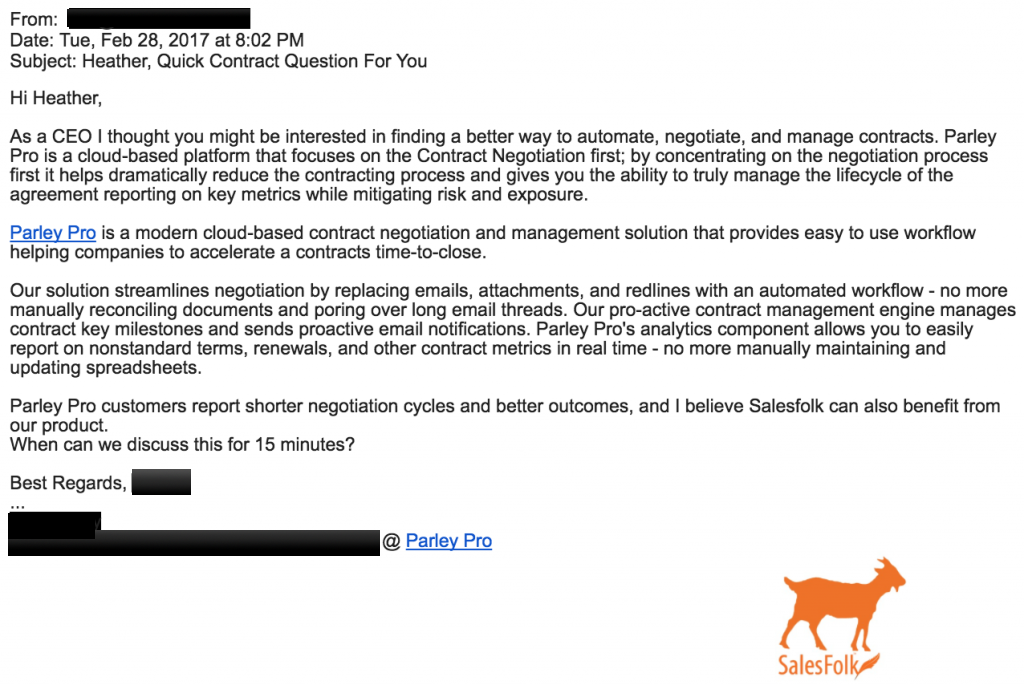
Even if your long email is packed with amazing benefits and tons of social proof, it’s going to feel overwhelming, causing your reader to hit “delete” before finishing the first sentence. As soon as your email becomes a burden to read, like the following email from Parley Pro, you’ve lost:

how to fix parley pro's bad sales email

What’s wrong with this email

The best cold emails create interest with a short, easily readable, and highly persuasive piece of copy. Everything about your email should beam with the subliminal message, “I’m helpful and worth your time.” And that begins before you even start reading.

Let’s talk about why Parley Pro’s email does not give us the warm, fuzzy feeling of helpfulness we’re looking for:

  1. It’s too long and the blocks of text are too dense, which is an automatic turn-off to the recipient.
  2. The sentences are too wordy and jargony, which makes it difficult to read.
  3. The first sentence doesn’t hook the reader and sounds too much like a formal sales email.
  4. It’s too seller-centric, focusing more on product features than how it helps the prospect (high-level benefits).
  5. It lacks specific and persuasive social proof.

Unfortunately, even if this email did contain convincing social proof and powerful benefits, that information would be lost in the midst of overly complex sentences and dense blocks of text.

How to improve this email

By making your emails easy to read with short paragraphs and simple, conversational language, you’re actually better able to highlight value and convince your readers to hit “reply.”

In re-writing this email, I’d do the following:

  1. Shorten the whole email.
  2. Craft a one-sentence opening paragraph that hooks the reader and is easy to read.
  3. Focus on 1 or 2 high-level benefits instead of product features.
  4. Edit out jargon and write in a way that’s straightforward and conversational.
  5. Add specific social proof.
  6. Make the subject line more enticing.
  7. Remove links to improve email deliverability (links increase your chances of being marked as spam).

Like the subject line, the first sentence of your email is super important. I’m not a huge fan of Parley Pro’s “As a CEO” opener, because it feels too generic and disingenuine. It also doesn’t inspire me to keep reading. I’d prefer a first sentence that cuts through the fluff and speaks directly to a major pain-point or benefit, thus piquing my curiosity.

With that in mind, here’s how I’d rewrite this email:

“SUBJECT: slow contracts

Hi Heather,

I have an idea on how {!Company} can shorten its sales cycle using one simple contract negotiation hack.

[1-2 sentence customer-centric description of service, focusing on high-level benefits.]

[Short 1-2 sentence paragraph on how Parley Pro has helped clients better negotiate contracts and shorten their sales cycles. Use specific stats and examples.]

When do you have 15 minutes for a quick call?

Best regards,

[Name]”

This email is much more approachable due to its shorter length. The one-sentence opener is easy on the eyes and gently guides the reader into the rest of the copy. The overall tone is customer-centric, and the content is focused on high-level value (a shorter sales cycle) with social proof.

In general, one of the best ways to improve your cold emails is to ask yourself, “Would I read and respond this email if it landed in my inbox?”

Long, wordy emails are almost always a turn-off and can deter prospects who might very well find great value in your product or service.

Have bad cold emails in your inbox? Send them to us!

Help us fight the thoughtless spammers, one crappy cold email at a time by sending us the worst cold emails you’ve ever received.

We’ll put them up anonymously on the “Hall of Shame,” and shoot you an email when they go live.

Please send all submissions to “shame@salesfolk.com.”

(And feel free to suggest what you want to nominate the “bad cold email for!”)

The post 7 Ways to Fix a Long and Boring Sales Email appeared first on Salesfolk.

08 Mar 16:31

The Winning Social Media Content Strategy TV Networks Use

by Jay Baer

Winning Social Media Content Strategy

From a marketing perspective, there is no such thing as “social media.” It’s nearly pointless to think of social media as one thing, because the audiences, use cases, technology, algorithms, optimal cadences and other characteristics of each social platform continue to diverge.

For example, a study by CoSchedule found that the “optimal” number of daily posts on Twitter (your mileage may vary) is 15, but just one to two posts per day on Instagram and Facebook are the sweet spot.

Posting the same social media content, in multiple channels, at the same time and hoping to achieve spectacular results hasn’t worked in years—the variances are just too great among what works in each venue.


Posting the same social media content, in multiple channels, at the same time is no longer a winning strategy.
Click To Tweet


So instead of thinking about a “social media” strategy, you really need to adopt a Twitter strategy, and a Facebook strategy, and an Instagram strategy, and a LinkedIn strategy, and beyond. 

Take a Cue from TV Networks

Scripps Networks owns HGTV, The Food Network,  DIY Network, Great American Country, and several more. They don’t think of those channels in aggregate as “television programming.” Instead, they think of HGTV viewers, and DIY viewers, and GAC viewers because the demographic and psychographic characteristics of each viewer group differs. And more importantly, what each group WANTS from each channel varies as well.

Similarly, Walt Disney Television owns ABC News, The Disney Channels, EPSN and more. Can you imagine if ESPN randomly aired Mickey Mouse Club House and vice versa? Yeah, that would be weird.

Your social media strategy should adopt the same approach. For each social platform where you are active, identify the distinct strategy, audience, metrics, cadence, and programming that makes sense for that platform.

Social Media Channel Strategy Example (and Downloadable Template)

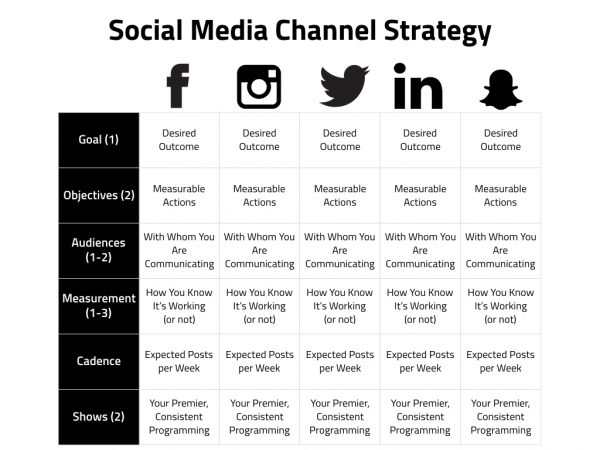
Here’s how it looks in chart form. Download this Social Media Channel Strategy Template.

social media channel strategy template

Channel Goals

What is the overall desired outcome of being present on this platform? One goal per platform and these must tie to higher-level business outcomes.

Channel Objectives

Two specific, measurable actions that guide the progress toward the goal.

Audience(s)

Who do you want to reach on this platform? Identify one or two specific segments, with as much detail as possible.

Measurement(s)

Identify up to three metrics that either measure against the objectives, or measure something that correlates to the objectives. This is not the place for “number of followers” as a metric.

RELATED eBOOK: The 3 Types of Social Media Metrics (And Why They’ll Get You Promoted)

Cadence

How often you plan to add new content to this platform, expressed weekly.

Shows

Decide what two “shows” you will commit to in this platform, and on what schedule.

Think TV Shows (Regularly Scheduled Programming) for Your Social Media Content Strategy

HGTV, or any other television network, doesn’t just randomly put an episode on the air. Everything revolves around specific shows, with a defined audience and narrative arc. Social media practitioners could learn a lot from this approach. Yet, much of what happens today in social is “random acts of content” with no repeatability, tune-in value, or consistency.

For each social platform, think about what social media content initiatives you can execute on a regular basis, keeping in mind your audience and objectives for that platform. Then, create and distribute these “shows” consistently. This gives your audiences something to recognize, engage with, and (hopefully) look forward to on a regular basis.

Social Media Show Example: David Weekley Homes

One of our clients is David Weekley Homes, America’s largest private home builder. They never had an Instagram presence, but decided to target home interior fans with a goal of making their brand the preferred private homebuilder amongst this audience. To do so, we helped them architect a daily Instagram “show” that features two or three lovely photos of a David Weekley Home model. From a cold start, they now routinely generate more than 5,000 likes per photo. More importantly, each photo gets 50+ comments—many from design pros—that help the company think through future layouts, design touches, and more. It’s a highly targeted, nearly free focus group.

Not only do shows of this types create tent poles for your social media strategy, it makes it a LOT easier to plan your time and your resources, because you know what you’re doing, in what format and how often.

Your entire social media strategy is not comprised of show episodes, but they give you the nuclei for your content, and then around them you post non-show electrons that are original, circumstantial content and/or curation.

Download the free social media channel strategy template here.

The post The Winning Social Media Content Strategy TV Networks Use appeared first on Convince and Convert: Social Media Consulting and Content Marketing Consulting.

08 Mar 16:30

How to Make Every Dollar of Infrastructure Investment Go Further

by Jonathan Woetzel
mar17-08-486840292

It’s no secret that much of the U.S.’s infrastructure is in desperate need of repair or modernization, and that many cities struggle to meet demands for infrastructure and affordable housing. It’s also not controversial to argue that any infrastructure investment must get more out of each dollar invested, raising the productivity of the construction sector.

Global labor productivity growth in the construction industry has averaged only 1% a year over the past two decades, and was flat for most advanced economies. In the United States, the construction sector’s labor productivity is lower today than it was in 1968. In contrast, many U.S. sectors, including agriculture and manufacturing, have increased productivity tenfold to fifteenfold since the 1950s.

Our research at McKinsey Global Institute finds that the construction industry could boost productivity 50% to 60% by instituting best practices and innovations in seven areas: regulations; contractual relationships; design and engineering processes; procurement and supply chain management; on-site execution; digital technology, new materials, and advanced automation; and workforce development.

The productivity challenge cannot be solved by any one actor. Private-sector project owners, public-sector project owners at the federal, state, and local levels, and the engineering and construction industry will all need to act to drive change. The industry is currently in a deadlock. Owners should be the main beneficiaries of a move to a more productive model, but tend to be risk averse; they need productive contractors that they can trust and that provide them with choice, high quality, and low prices — at scale — before they can change procurement practices and build capabilities for a new paradigm. Many contractors stand to lose revenue and margin from moving to productivity-based competition if owners and the broader industry environment don’t move as well. A shift to productivity-based competition is only likely to be attractive if contractors can build the scale (and repeatability) needed to drive cost efficiencies from productivity gains that outweigh revenue losses from lower price points and fewer customer claims, and provide payback on up-front and ongoing investments in technology or skill building.

The U.S. construction market has two distinct halves: large-scale players that work on major civil and industrial projects, and smaller, specialized contractors. Firms with less than $1 million in annual revenue are half as productive as those with revenue over $10 million. However, the higher-productivity large-scale half of the industry is not immune to the low productivity of the other half. Large-scale players routinely subcontract to smaller specialized players, and their productivity in civil, industrial, and buildings, including trades subcontractors, drops by 12%, 26%, and 28%, respectively. Therefore, any action to boost sector productivity needs to apply to the entire supply chain and to both parts of the market.

The fragmentation also affects the workforce, and in particular skills building and training on new tools or approaches that can accelerate productivity. Companies cannot find enough skilled workers, such as carpenters, plumbers, and electricians, to meet demand.

Related Video
How Digital Is Your Industry?
Research shows some sectors are outpacing others.

Construction companies also sorely underinvest in the technology, automation, and digital tools that would allow them to achieve significant productivity gains. In the United States, construction comes in second to last in terms of digitization, ahead of only agriculture, according to MGI’s digitization index. The index finds there are particular deficiencies in the sector’s ability to use digital tools to facilitate stakeholder interactions and in the rate of growth in digital tools available to the frontline labor force.

Technology has the power to disrupt this situation by creating more transparency and competition among the small contractors. A handful of online marketplaces have emerged in recent years for individuals looking to hire local contractors, but we have yet to see a truly disruptive digital marketplace for use by owners and large contractors.

More broadly, the use of digital technologies in construction has demonstrably had substantial productivity benefits. In a tunnel project that involved almost 600 vendors, the contractor put in place a single platform solution for bidding, tendering, and contract management. This saved the team more than 20 hours of staff time per week, cut the time it took to generate reports by 75%, and sped up document transmittals by 90%. In another case, a $5 billion rail project saved more than $110 million and boosted productivity by using automated work flows for reviews and approvals.

Robotics has already had a dramatic impact on manufacturing productivity, and it could do the same in construction. Highly repeatable elements of construction, such as bricklaying and concrete paving, have already started to incorporate it. Companies in Australia and the United States have achieved a masonry productivity gain of more than 100% through the use of bricklaying robots.

For some in the industry with repeatable structures, such as affordable housing, the shift to a system of mass production in which precast units and panels would be manufactured off-site, streamlining and simplifying work on the site itself, would change the dynamics of the industry. Such an approach would negate the majority of market failures that constrain the industry’s productivity. Evidence on the cost and time savings achieved by companies using the production system suggests that productivity could be five to 10 times higher.

The opportunity is large. If global construction productivity were to catch up to the total economy over the past 20 years, the industry’s added value could rise by $1.6 trillion — and one-third of that opportunity is in the United States alone. There is no reason to wait. There is a clear opportunity now to improve how we plan and deliver infrastructure in America.

08 Mar 16:30

6 Creative Ways to Make Your LinkedIn Message Stand Out in 2017

by mpici@hubspot.com (Michael Pici)

how-to-make-linkedin-message-stand-out-compressor-466437-edited.jpg

When LinkedIn was still new, some salespeople might have been seen decent results even with boilerplate, generic LinkedIn messages.

In 2017, however, sending a spammy sales InMail definitely won’t win you responses -- let alone new business.

To prospect effectively on LinkedIn, you need to craft engaging, creative messages that’ll make you stand out and grab your prospect’s attention. Try these six innovative strategies to write response-worthy InMails.

1) Mention a Detail from Your Prospect's Recommendations

Reading the “Recommendations” section of a buyer’s profile is one of the best ways to learn more about them.

In a quick glance, you’ll discover details about their work ethic, greatest strengths, biggest career accomplishments, professional reputation, personality, and more.

Any of these make good fodder for the first line of your LinkedIn message. Not only are they highly specific to the individual prospect, but they’ll prove you’ve done your homework.

Here are three sample messages to illustrate.

1) Congrats on the great news

Hi [name],

Congrats on [accomplishment] -- that’s impressive considering [reason]. Are you working on any similar projects these days?

Best,
[Your name]

2) Read your recommendation

Hey [name],

I just read your recommendation from [recommender]. It seems like you excel in [business area, skill]. What’s your [process, approach]?

Cheers,
[Your name]

3) Curious about your background

Hi [name],

Judging by your recommendations, you’re an expert in [field]. How did you originally become interested in that?

Have a good [day of the week],
[Your name]

These messages are short, simple, and most importantly, flattering. Once you’ve started a conversation with your prospect and learned more about their objectives, you can begin to add value -- and down the line, present your solution.

2) Riff On a Common Interest

If you share a common interest with the buyer -- which you can discover by reading their summary -- use that in your InMail to build rapport.

Depending on how unique the commonality is, place it at the beginning of your message or include in the postscript.

Take a look at these two sample messages:

1) Love non-fiction crime investigation podcasts

Hi Stefan,

Like you, I’m a big fan on non-fiction crime investigation podcasts. I highly recommend Someone Knows Something if you haven’t already listened to it.

I was also wondering if you’re struggling to scale your recruiting efforts. My clients with similar growth rates typically say it’s hard to maintain their hiring standards while bringing on enough new hires. I have a couple tips, if you’d like to hear them.

Best,
Inken

2) Love podcasts

Hi Stefan,

Are you struggling to scale your recruiting efforts? My clients with similar growth rates typically say it’s hard to maintain their hiring standards while bringing on enough new hires. I have a couple tips, if you’d like to hear them.

Best,
Inken

P.S. I’m also a big podcast fan. Would highly recommend The Growth Show -- it’s one of my favorites.

3) Offer a Personalized Piece of Content

Try to quickly move a LinkedIn conversation to email. Prospects spend far more time in their inbox than on this network, so you’ll have a better shot of getting replies over email (not to mention, giving you their contact information is a sign of interest).

To encourage the transition, offer to send them a helpful, relevant piece of content.

Use this template:

Hi [prospect name],

Are you [seeing X pain, hoping to meet Y goal]? I ask because [client #1] and [client #2], both in your [industry, market, region, product space], experienced this [challenge, opportunity].

There’s a great [ebook, white paper, blog post] I can send you on this topic. It might be easier to send over email so I can highlight the sections you’ll find most useful -- what’s your address?

Best,
[Name]

It’s important to justify your request for their email, otherwise they might ask you to forward the content on LinkedIn. Luckily, you don’t need an in-depth explanation.

4) Foreshadow Your Email

When you already have a prospect’s email address, try warming them up with a preliminary LinkedIn message. You’ll boost your name recognition, meaning they’re likelier to open your email.

To give you some inspiration, here’s a template:

Hi [prospect name],

Wanted to give you a heads up I’ll be reaching out via email with some [suggestions, strategies, observations] relating to [pain point, opportunity].

For example, my first tip is [short piece of advice].

Looking forward to speaking,
[Your name]

You still need to add value, even though you’re using this message to prepare the buyer for your real email.

5) Insert a Picture

Since most users don’t attach visuals to their InMails, a funny GIF or interesting picture will make your message stand out.

Try adding a visual that reinforces your note. For example, HubSpot sales reps often use humor memes in their outreach messages, like so:

LinkedIn_Buddy.png

Or use details from their profile to find a picture that’ll put a smile on their face:

LinkedIn_Pats.png

6) End on a Cliffhanger

Pique your prospect’s curiosity by ending on a cliffhanger.

Imagine your InMail is a chapter. It needs to include something substantive (like a tip, observation, or thought-provoking question), otherwise the buyer will feel like you wasted their time. But hold something back -- this guarantees they’ll read your next message.

To give you an idea, you might write:

Hey Andrei,

Just browsed your GitHub repos. Your team is working on some exciting open-source projects -- MathLAB looks like it has the potential to transform college study groups.

Two entrepreneurs I know fund projects just like MathLAB. I’ll reach out to them and will be back in touch soon with their response.

Best,
Hugo

Your prospects probably receive at least four spammy, boring, and salesy LinkedIn message per week. But creative ones? Yours might be the first they’ve gotten all month. A little extra effort will go a long way.

HubSpot Free Sales Training

08 Mar 16:30

The Tragedy of Either/Or

by Dave Brock

Our society and business worlds seem to be becoming increasingly polarized with group taking extreme positions, suggesting their way is the “Right Way!” They argue that everything else is wrong and terrible things befall those not doing it their way.

Social media channels are filled with people taking these positions.

There are the social selling and “cold calling” camps, each thinking the other is wrong.

There are the marketing versus selling camps, each taking positions they are the most important contributors to revenue growth.

There are the high velocity/high volume advocates that claim they’ve discovered the secret to predictable revenue. And, of course, there are those that focus on complex sales that can’t imagine the approaches of the other.

It’s amazing how fierce the disagreements are. Each side calling the other “morons, idiots, dinosaurs.” Dig a little into each of the positions, usually you find whatever they sell is driving their position. Social sellers will always advocate social selling because they make their money selling those tools and services. Likewise, cold callers will always advocate cold calling because they sell tools and services for cold calling.

Perhaps it’s a simpler world to imagine everything is black and white, good or bad, either-or.

It certainly makes it easier for these people to do their jobs and make money, but it doesn’t recognize the reality the rest of us face.

Nothing is ever black or white, good or bad, either-or. Every situation is different, we live in a world that is more shades of grey or colors than black and white. What is good practice for some fails with others.

Our world is not simple and simplistic approaches inevitably fail.

Imagine if rather than considering things in such black and white or either-or terms, we started considering, “Both-and.”

Both-and opens up whole new approaches to working with each other and our customers.

Both-and enables us to see differing points of view. It enables us to broaden our perspectives and our options for getting things done with our customers and colleagues.

Both-and enables us to choose the most appropriate approaches to address a specific situation, rather than continuing to try to force fit the only approach we have.

Both-and enables us to consider things that aren’t black and white.

Both-and creates conversations and engagement, giving us the opportunity to create far greater value than one approach.

We can only begin to truly collaborate when we start opening ourselves to both-and.

Both-and is an open, growth oriented mindset where either-or is a closed mindset.

In the real world, there is no definitive answer or best way. When asked “what’s the best approach to prospect, market, sell, service, support …… our customers,” the only reasonable answer is “It depends,” followed by deeper questions and discovery to determine the best approach.

Recently, I spent time with one of the highest performing sales organizations I’ve experienced. I started peppering them with questions:

Social selling or cold calling? They responded: Yes!

Marketing or sales? They responded: Yes!

Complex or transactional? They responded: Yes!

Consultative Selling, SPIN, Vito, Solution, Strategic Selling, Customer Centric, Value Based, Insight Based, or Challenger? They responded: Yes!

For every “Either-or” question I asked, they responded Yes! They lived in a world where they leveraged everything they could to create value for their customers and drive performance within the organization. I suspect this pragmatism is part of what makes them a high performing team.

The real world is “Both-and,” perhaps the gurus and experts from all camps would create greater value in the community by shifting their points of view.

Afterword: Perhaps these are good lessons for our elected officials and society in general.

Afterword 2: Thanks to Deb Calvert for contributing to this concept! Her great comment in, “94% of Buyers Research Online–So What!

08 Mar 16:30

Why It’s Time for SMBs to Implement ABM

by Mary Kate Francis
ABM for SMBs

Author: Mary Kate Francis

ABM might be a new addition to the marketing buzzwords dictionary, but the concept is nothing new. Account-based marketing (ABM) has existed as a marketing strategy for decades. If you’re influencing more than one individual in an organization for a deal, then it’s likely that you’ve been practicing some form of ABM.

So why has account-based marketing only recently gained widespread popularity and practice among B2B businesses? In the past, ABM was a fairly tedious, manual, and sales-driven process. However, the introduction of new digital ABM technologies has removed the barrier that kept small and medium-sized businesses (SMBs) from employing the strategy, allowing organizations of all sizes to do ABM at scale. In fact, our SMB marketing team at Marketo has seen great results with this account-centric strategy.

SMBs Stand to Make Huge Strides with ABM

By implementing an ABM strategy, SMBs can realize significant business and revenue growth. According to data from the Marketo ABM Benchmark Survey, 33% of B2B SMBs are already conducting ABM. This means that one-third of B2B businesses recognize the benefits of and are investing in account-centric thinking to more effectively utilize their resources and focus their efforts.

Account-based marketing is a necessary tactic for SMBs, in particular, for several reasons:

  • Improve marketing ROI: As an SMB, your time and resources (aka people and money) are especially precious. ABM allows you to use your resources more strategically since you’re spending them on the accounts that matter the most. When the SMB segment of Marketo’s marketing team began implementing an ABM strategy, we discovered that our target accounts were 40% more likely to close than non-target accounts.
  • Drive attributed revenue: Strategic ABM allows you to deliver a set of coordinated activities across target accounts. With this laser focus, you’ll gain a better understanding of the impact of each activity so you can focus your efforts on the most effective ones. While we call the tactic account-based marketing, in reality, it’s a way of thinking that influences all areas of the revenue team. By driving marketing-generated or sales-generated revenue through targeted activities, you can greatly increase the number of closed deals and spend your time and energy more thoughtfully in the meantime.
  • Generate more conversions and qualified leads: Broad-based marketing casts a wide net, luring in a large number of leads—not all of which are qualified ones. However, when you select your target accounts in ABM, you look at which business profiles are more likely to buy your product and thrive while using it. Because you’re factoring this in on the front-end, your conversions and sales qualified leads (SQLs) will improve on the back-end.
  • Drive business momentum: While SMBs may have smaller account lists, an ABM strategy will help you achieve more big-impact wins because you’re vetting your target accounts from the get-go. In fact, Marketo’s SMB marketing segment has noticed a 50% increase in average selling price (ASP) from our target accounts vs. our non-target accounts.
  • Align sales and marketing: Account selection is collaborative. By discussing strategic account selection criteria with sales, you’re guaranteeing increased visibility and buy-in across all of your revenue-generating teams. Not to mention, both teams feel more confident about dedicating their time and resources to implementing the strategy.

3 Key Steps for Account-Based Marketing

Despite the numerous benefits, implementing an ABM strategy from the ground up can seem daunting, especially if you have a lean team or limited resources. The key is to start small and gradually expand the strategy over time.

Here are the three main steps for SMBs to implement account-based marketing:

1. Identify and manage high-value target accounts. The account selection process can’t be rushed. Every business has different reasons for going after a specific subset of their audience. You’ll want to evaluate factors such as territory, industry, lifetime value, and more.

As an SMB, it’s vital for your team to identify your highest yield account profiles so that you can focus your marketing budget and time on accounts that will not only result in bigger deals and preserve your sales team’s energy, but will also be more likely to renew and become advocates for your product or service.

2. Engage target account leads in every channel. Once you’ve identified your target accounts and have a management system in place, it’s time to get marketing! Think about the primary channels where your target audience is engaging, create personalized, relevant content, and orchestrate programs that drive desired outcomes.

Marketing teams at small or medium-sized businesses have limited bandwidth. You don’t have money for endless program types, and even if you did, you wouldn’t have the people to execute all of them. By keying into the channels that are the most effective for your target accounts and identifying at which point in the buyer’s journey these programs are most pertinent, you can accelerate the sales process without overextending yourself.

For example, at Marketo, we’ve been running a multi-channel direct mail program for target accounts that have not connected with our sales team. We identified the correct contacts within our target accounts and trigger part one of a two-part direct mail when they reach a mid-level engagement score to prompt them to call our sales team. After the call, we trigger a second, higher value direct mailer. This program has proven to be a successful way to accelerate mid-stage prospects within our target accounts.

3. Analyze your results and optimize engagement. Finally, to understand the success of your ABM strategy, you must measure the impact. Define success at all stages of the ABM process–from account whitespace insights to channel engagement to account score. These insights will help you optimize your programs and provide sales with vital information needed to close the deal.

Closely monitor your successes so that you can attribute pipeline and revenue to your targeted efforts and compare those findings with results from your non-targeted efforts. By doing this, you’ll be able to prove the impact of ABM so you can invest more resources in this tactic over time. 

Ultimately, to fully achieve a scalable ABM strategy, despite limited time and resources, SMBs must invest in the right ABM solution. There are many things to consider when evaluating technologies, but it really comes down to finding a tool that will allow you to build out your strategy in the three ways outlined above–by helping you target and manage accounts, engage accounts across channels, and ultimately measure revenue impact.

Are you ready to start your ABM journey? We’ve got you covered! Download our cheatsheet How Small and Medium-Sized Businesses Benefit From an Account-Based Marketing Strategy to make a business case for ABM and get started.

Register for Marketing Nation Summit!


Why It’s Time for SMBs to Implement ABM was posted at Marketo Marketing Blog - Best Practices and Thought Leadership. | http://blog.marketo.com

The post Why It’s Time for SMBs to Implement ABM appeared first on Marketo Marketing Blog - Best Practices and Thought Leadership.

08 Mar 16:30

Lots of cryptocurrencies to choose from: Investors who missed bitcoin rally go for dash, ether, monero

by Olga Kharif, Bloomberg News

With bitcoin on a tear, Mira Kwon decided there’s more money to be made elsewhere. A little over a month ago, the University of Maryland economics graduate began pouring more than $2,000 into a different crypto-currency called dash.

“Bitcoin is expensive,” Kwon, a mother, investor, Korean interpreter and U.S. Army veteran, said in a telephone interview. “I think dash has a bigger growth rate.”

So far, it’s worked. Dash has risen to $46 from $15.20 when Kwon started, according to prices at CoinMarketCap. With a market value of $326 million, dash has become the third-largest crypto-currency, behind bitcoin and ether. Other digital currencies are on the move, too, including monero and zcash, to name some of the 700-plus out there. Investors who feel they missed out on bitcoin are seeking a different path to crypto-riches.

“They think they’ve missed most of the move, so they are starting to look at other coins that could be their ticket,” said Adam Wyatt, chief operating officer of the crypto-currency researcher BullBear Analytics.

Trading crypto-currencies is speculative. Characteristics that may give each version value include a restricted supply, the willingness of merchants to accept it as terms of trade, technical features and ultimately the faith investors put in it.

Chris Burniske, an analyst at Ark Investment Management LLC, sees signs that some investors are cashing out of bitcoin and putting funds into so-called alt coins, varieties that haven’t gone up as much. His company operates an exchange traded fund with 5 percent of its assets in blockchain — the database technology underlying bitcoin — and peer-to-peer computing.

Bitcoin fell 0.5 percent to 1,239.35 Tuesday in New York. It’s up 30 percent this year.

Others are trying to hedge as bitcoin approaches possible speed bumps: The first bitcoin-based exchange-traded fund is expected to be rejected or approved by U.S. regulators by March 11, and the price has risen in anticipation of new investor interest in the digital currency. A decision — one way or the other — could lead to more volatility.

With a rejection, “probably the entire crypto-currency market as a whole could drop,” said Alex Sunnarborg, an analyst at researcher CoinDesk, said in an interview.

Another issue facing bitcoin is network speed, which has been sluggish. At high congestion times, bitcoin transactions have taken hours to clear. While that’s faster than a traditional cross-border money transfer through a bank, it’s too slow for some users. Bitcoin developers are having trouble agreeing on ways to scale up the network, and the deadlock is pushing some investors to look at the alternative coins.

“This creates tension and uncertainty,” said Leah Stephens, a Kansas City-area writer who has investments in crypto-currencies such as steem, dash, monero and bitcoin. “Many traders are hedging in alt coins because of these reasons.”

What I think you are seeing is dash emerging as a true challenger to bitcoin in the market

Other coins have features that bitcoin lacks: Dash transactions are confirmed much faster, so it may be better for payments, Kwon said. Many of the coins that are on a tear — such as dash, monero and zcash — offer extra privacy protection.

“What I think you are seeing is dash emerging as a true challenger to bitcoin in the market,” said Ryan Taylor, director of finance at the team that developed dash. “We are doing it by adding features customers really like. What you are seeing is recognition on the part of the users.”

Smaller markets also present major disadvantages: The currencies tend to be less liquid, and more volatile. Large holdings of dash, for example, are concentrated in several thousand hands, Burniske said.

Not that that’s deterring investors like Kwon, who are partial to crypto-currencies because they reduce dependence on money regulated by central banks.

“We need some alternative currency other than fiat currency, and bitcoin is too slow and expensive,” Kwon said.

08 Mar 16:29

The Ultimate Artificial Intelligence Resources Guide

by Kyle Poyar

Special thanks to Laura Rosca for helping to compile this data.

The term Artificial Intelligence was originally coined by John McCarthy in 1955 who defined it as “the science and engineering of making intelligent machines.” More than half a century later, AI and machine learning are taking their places among tech’s most talked about trends.

Over the past few years, AI has made inroads in data mining, industrial robotics, speech recognition and much more. And its rise is only slated to continue. By 2022, the overall artificial intelligence market is expected to be worth more than $16 billion. That’s an expected compound annual growth rate of over 62% from 2016 to 2022. It’s not wonder then that tech giants and small startups alike are investing heavily in AI and machine learning. Here, we’ve compiled an in-depth guide to help you brush up on your AI knowledge.

Table of Contents

Market Overview

The road to artificial intelligence: A case of data over theory
In the summer of 1956, a collection of scientists gathered at Dartmouth College to invent a new field of science – artificial intelligence. This article takes a look at the six decades of AI research and where we’re headed.

Artificial Intelligence Industry – An Overview by Segment
A lay of the land of the AI industry, including its various segments and application areas.

The rise of artificial intelligence in 6 charts
A looking at AI funding, patent holders and more. Who do you think is in the lead?

Valuing the Artificial Intelligence Market, Graphs and Predictions
An overview of AI’s growth and market value in the coming decade.

The real risks of artificial intelligence
Is AI putting us on a path towards Singularity? Maybe not. But AI does have real risks (and benefits, of course). Those are explored here.

Artificial Intelligence and the Future of Work
How might AI impact the future of work? Startup advisor Steve Ardire weighs in.

Major Players

Google AI invents its own cryptographic algorithm; no one knows how it works
AI technology is developing, fast. The leading companies are pushing AI towards new horizons. A look at open-sourcing machine intelligence designs here.

IBM Gives Watson a New Challenge: Your Tax Return
In its broadest deployment to date, IBM’s Watson will assist H&R Block’s 70,000 tax professionals at 10,000 branch offices across the United States to help more than 11 million people file their taxes.

Current Use Cases

The Top 10 AI And Machine Learning Use Cases Everyone Should Know About
A look at some of the most important uses cases for AI and machine learning.

15 examples of artificial intelligence in marketing
An AI primer for marketers looking to capitalize on the trend.

Emotional intelligence is the future of artificial intelligence
Will emotionally intelligent AI emerge as the technology’s next phase? Seems likely according to this researcher.

Forecasts & Trends

Artificial Intelligence Market by Technology (Deep Learning, Robotics, Digital Personal Assistant, Querying Method, Natural Language Processing, Context Aware Processing), Offering, End-User Industry, and Geography – Global Forecast to 2022
What is the slated growth for AI and machine learning? Some estimates predict the market will be more more than $16 billion by 2022.

Artificial Intelligence: Trends to Watch in 2017
What trends in AI should be on the lookout for in 2017? Find out here.

The Future of Artificial Intelligence and Cybernetics
Might AI raise ethical questions and moral concerns? This research seems to think so. Find out how AI and Cybernetics are moving beyond the realm of science fiction and why that matters to you.

Gartner’s Top 10 Strategic Technology Trends for 2017
A look at Gartner’s top 10 strategic tech trends for 2017 – intelligent, digital and mesh.

18 artificial intelligence researchers reveal the profound changes coming to our lives
How might AI significantly impact and improve our lives in the future? 18 AI researchers weigh in on everything from climate change to giving the elderly better lives.

Risks & Limitations

Benefits and Risks of Artificial Intelligence
Does AI threaten the future of humanity? If so, why, how and when can we expect such threats to take hold? Take a closer look here.

The rise of robots: forget evil AI – the real risk is far more insidious
Robots may not turn against us, but could the AI we program into our daily lives ultimately end up as a nuisance or worse?

These are three of the biggest problems facing today’s AI
Does AI lack humility? Signs point to yes. Here’s why that’s a problem and other issues we face with today’s artificial intelligence.

Miscellaneous

Artificial Intelligence Startups list
A comprehensive list of AI startups.

Artificial Intelligence & Machine Learning: Top 100 Influencers and Brands
Who are the individuals, brands and companies influencing AI now? Find out here.

AI concept/process historical perspective
A brief history of artificial intelligence from ancient history to today.

The post The Ultimate Artificial Intelligence Resources Guide appeared first on OpenView Labs.

08 Mar 16:29

10 Surprising Stats About Personalization

by Madeline Boehmer

The success of failure of many of today’s online customer experiences are largely based on how personalized they are to their customer’s needs. As product recommendations, geo-targeted offers, relevant content and so much more all contribute to the all important personalized customer experience, it’s now up to the retailers to meet these demands head on. Yet, as much of today’s research shows, that’s easier said than done.

As many struggle to understand what customers want, what a successfully personalized experience really looks like, or how to implement it, dozens of surveys and studies are being published with important information retailers can leverage to create and improve their personalization strategy.

We’ve collected just a few of the most recent and interesting statistics to give today’s retailers a snapshot at how they’re doing when it comes to personalization, and what their customers are looking for in a personalized experience:

  1. Smart personalization engines used to recognize customer intent will enable digital businesses to increase their profits by up to 15% (Source: Gartner, 2016)
  2. 75% of consumers are more likely to buy from a retailer that recognizes them by name, recommends options based on past purchases, OR knows their purchase history (Source: Accenture, 2016)
  3. 81% of consumers want brands to get to know them and understand when to approach them and when not to (Source: Accenture, 2017)
  4. 74% of customers feel frustrated when website content is not personalized (Source: Infosys, 2016)
  5. 79 percent of organizations that exceeded revenue goals have a documented personalization strategy, compared to 31 percent of those that met revenue goals and 8 percent of those that missed revenue goals (Source: Monetate, 2017)
  6. 68% of marketers struggle to achieve a real-time view of their customers (Source: Monetate, 2017)
  7. 83% of marketers say creating personalized content is their biggest challenge (Source: Rapt Media, 2016)
  8. Personalized home page promotions influenced 85% of consumers to buy while personalized shopping cart recommendations influenced 92% of shoppers online (Source: Kibo, 2017)
  9. Over 78% of consumers will only engage offers if they have been personalized to their previous engagements with the brand (Source: Marketo, 2016)
  10. 98% of consumers have been dissuaded from completing a purchase because of incomplete or incorrect content, with 32% of consumers being dissuaded every time (Source: Episerver, 2017)

While there is no perfect recipe for personalization, it’s clear that understanding the customer and creating a user flow that eases frustrations and provides value are important aspects that customers will appreciate.

08 Mar 16:29

3 of the Most Underrated Channels For Customer Support

by Olivier Hamelin

Your support team is only privy to 3.8% of your customers’ problems. The rest are more likely to switch to a competitor than speak up.

Most customers don’t bother with support because they expect a repeat of terrible support experiences they’ve had in the past. They’ve been put on hold over and over again or, worse, never hear back about complaints they’ve issued. They know how frustrating customer support can be, so they avoid it at all costs.

At the same time, trying new products is easy. Free trials and samples sound a lot more appealing than drafting up an email you expect to be ignored. It’s no wonder that so few customers bother reaching out to your support team.

Lowering the barrier for support encourages your customers to speak up before giving up on your brand. Give them as many support options as possible, so they can reach out to you according to their preferences rather than yours. By making your support team easily accessible over multiple channels, customers can engage with them wherever they want to with relatively minimal effort.

Here are three underrated channels for support to add to your support stack.

1. The neglected SMS channel

Only 30% of customers interact with businesses through SMS. It’s the least popular platform among support teams, even though text messaging is still the most common consumer cell phone activity.

SMS has a distinct advantage over channels: the customer is likely to read every message. We don’t need to worry about our meticulously-drafted support email getting buried in an overflowing inbox or our missed call not being returned. Texting puts a quick, concise message right in front of your customers. Because customers are texting everyday, they’re much more likely to respond. The customer response rate for SMS is more than seven times higher than that of email.

Most US customers already use SMS as a primary means of communication — Americans spend 26 minutes everyday texting compared to only 6 minutes on calls. There’s no reason they shouldn’t be able to communicate with your business the way they do with anyone else.

Multi Channel Customer Support

[How on-demand legal services company LawTrades uses SMS support]

Most support teams avoid SMS because they’re afraid to bother customers on what they perceive to be an intimate platform. While customers don’t want to be overwhelmed with spammy marketing messages, they do want relevant updates that cut through the noise of their daily lives. They want that notification that tells them when their bank funds are low or that their refund has been processed.

Leave the channel open for your customers to reach out to you, but only reach out to them first for time-sensitive messages:

  • Sending confirmations for bookings or charges.
  • Sending reminders for appointments or owed payments.
  • Alerting customers about changes to services or accounts.

SMS is a valuable and personal line to your customers. Connect with them on a platform that most businesses don’t venture into, and make interacting with you a natural part of their day-to-day. To get started, set up an API-ready phone number from a service like Sonar or Twilio. Send and respond to messages from those platforms, or Front makes it easy to respond to SMS messages alongside your other channels.

2. The underappreciated Facebook channel

Facebook has become much more than just a platform for connecting with friends; it’s an extension of our lives. We “check in” at events we attend, share pictures of how we spend our time, talk about our lives, and discover content and news. In fact, 1 in 5 mobile minutes are spent on Facebook.

Facebook Messenger has gone further to blur the line between our real and virtual lives. Facebook’s launch of a separate Messenger app made the chat experience real-time even when we were away from our computers. Without a phone number or even the real name of a person, you can instantly engage any of the one billion people using Messenger.

Facebook Messenger for Business adapts this real-time line of communication for companies. Customers find you the way they find anything on Facebook — typing your company’s name in the search engine. Since Messenger is an extension of Facebook, you quickly realize the value of this channel:

  • People can engage with you where they already spend their time.
  • You can directly engage people who leave positive or negative public comments.
  • You can automate some of your support here (but don’t overdo it!).

Multi Channel Customer Support

[KAYAK uses a chatbot to give information on their Flights and Hotels]

Facebook also gives your business page more credibility when you’re responsive to customers via messenger. When you reach a 90% response rate of 15 minutes or less, you get a badge on your page telling your customers that you have great support.

To use Facebook Messenger for support, go to your company’s Facebook page, click “General Settings” and then “Messages.” Select “Edit,” and then select the checkbox that lets people contact your page privately. Integrate it with your support software using their API.

3. The deserted phone support channel

A few years ago, The New York Times observed that “tech is leaving phones behind.” Phone has traditionally been the go-to channel for support, but recent high profile abandonments of voice support imply that business is moving away from it. Companies like Google, Facebook, Twitter, and LinkedIn have killed their call centers (or never set them up to begin with), and many smaller companies are following suit.

Phone support, however, remains customers’ preferred medium for resolving an issue. Additionally, according to an HBR study, most businesses reported that it was easier to meet customers’ expectations on the phone than any other channel:

Multi Channel Customer Support

[source]

Most companies know that their customers would like to see a phone number at the top of their support page. But it’s hard to do phone support well — only 14% of support calls are answered without being placed on hold. Companies are giving up on it rather than risk delivering sub-par phone support. We disregard the fact that real-time voice communication is the fastest way to resolve an issue, and it’s the easiest way to placate a frustrated customer. Empathy is easiest to convey in the tone of your voice, rather than over carefully formulated text.

Rather than give up on phone support, find a way to incorporate it into your other support workflows. You don’t need to have a landline to offer phone support. We work with Aircall, which integrates a voice channel into your shared inbox. Easily follow up on any missed calls and voicemails, and you’ll be sent recordings of every call to reference later.

Transition to omni-channel support

If you’re not using these three channels of support, the problem isn’t that you’ve chosen the wrong channels — it’s that you have to choose at all. Your competitors’ marketing efforts are on every platform, while your support might be only available on a few. Make the choice to reach out to your support team instead of trying out a competitor as easy possible for your customers. Create support options that are an extension of how they already communicate.

The best part: more channels doesn’t necessarily mean you need a larger team. The future is in omni-channel support, where your team can collaborate on messages across every channel and get back to your customers faster.

Multi Channel Customer Support

08 Mar 16:25

Prepare to Win or Prepare to Discount

by Ryan Estis

estis-prepared-2-1

“This is the max budget. Can we make this work?”

We’ve been asked this question twice in the last 24 hours. I fully expect to be asked again several more times this week. We know it’s coming, so we’re prepared to respond.

I also know that customers don’t buy on price. They default to price in the absence of value and a quality experience.

That’s on us.

So I wasn’t a bit surprised when the “max budget” moved north to meet our fee for services and both contracts got signed. Lynn has become very skilled at understanding her customer and expertly delivering a differentiated and compelling value proposition. She is prepared and doesn’t compete on price.

“Executive buyers tell us that only 20% of the salespeople they meet with are successful in achieving their expectations and creating value. Only one in four of these salespeople get agreement from executive buyers to meet again.” —Forrester Research

The best sales professionals are fanatical about preparation because they understand that customer expectations have changed. The opportunity to advance the relationship is dependent on meeting customers where they are. Your customers are overwhelmed, time-poor and expect you to deliver more value, consistently.

Brand the Customer Experience

A recent Gartner survey on the role of marketing in customer experience found that 89% of companies expect to compete mostly on the basis of customer experience, versus 36% four years ago.

It pays to consider: Why do you exist in the first place? What purpose do you serve? How do you make the world better for your customers?

Our customer experience roadmap informs every sales conversation and client engagement:

I am often hired to deliver a 60-minute keynote presentation. Those agreements are pretty standard. They typically include a couple of conference calls to plan the event, an AV test on-site at the event, the presentation and occasionally a meet and greet following the keynote.

They also include a very real opportunity to customize and personalize the experience beyond the standard agreement to deliver more value for the customer. We obsess over how we can continually upgrade our approach.

For example, we recently helped Lowe’s leadership kick off their 2017 conference in Las Vegas with a keynote to more than 3,000 regional and district leaders and company officers. To elevate the engagement, we:

  • Held a series of discovery calls to better understand customer challenges, opportunities and learning objectives and align around the desired outcome for a successful keynote. This is a pretty standard expectation.
  • Surveyed client stakeholders to understand their goals, challenges, opportunities and learning objectives. We used that insight to establish clearly-defined expectations around content, delivery and the program details.
  • Spent a morning in a store with Lowe’s leadership to better understand their commitment to culture and customer experience and their vision for the future. They earned all my future home improvement business that morning (they asked for it)! I hired a photographer/videographer to document my visit, which helped me customize my presentation.dsc_0007-2
  • Created a briefing document with relevant industry trends, research, a company profile, competitive intelligence, recent news stories and insights related to the future direction of the organization. If the CEO was interviewed in Fast Company magazine, I need to know what he said. That research informs additional discovery work and curriculum design.
  • Mystery shopped two additional Lowe’s stores in Minnesota with specific buyer personas to further experience the Lowe’s approach to the customer. They actually earned Lynn’s business, too, and it made for a great story in the presentation.
  • Offered to conduct quantitative research to further customize the curriculum.
  • Reviewed the talking points of each executive presentation that preceded my keynote. Understanding the leadership message helped me tailor my presentation.
  • Participated in the conference. I always participate in as much of the conference as my schedule allows prior to my presentation. In this particular instance, taking in the opening round of presentations provided both the pulse of the audience and a little more perspective on my approach.
  • Followed through. We delivered “after care,” which we send after every engagement — in this case, it included a portfolio of videos and articles that Lowe’s leaders can use to keep the message alive inside their business for months, inspiring new conversations and ideas.

I want to show up prepared to make the maximum impact. It isn’t just about that hour on stage — every touch point with a customer is an opportunity to add value, advance a relationship and move beyond the transaction into a more meaningful partnership.

“You are rewarded in public for what you have intensely practiced & refined in private!”
Tony Robbins

The invitation to kick off an important meeting like this for Lowe’s is an incredible privilege and I wanted to make sure I had earned the right to put on that red vest for my contribution. When you are prepared, you can meet the moment with confidence.

img_3764-1

If you’re feeling pressure of price-driven sales conversations every day, stop the cycle. Step back and consider your approach to the sales process.

  • How are you preparing?
  • How can you elevate the conversation to focus on value the customer cares about?
  • How can you deliver the customization and personalization your customers expect?
  • How can you help customers solve big problems or accelerate opportunities?
  • How can you give more than the competition?
  • How can you make it easier for customers to buy?

Prepare to win.

It’s way more fun than preparing to discount.

08 Mar 16:25

3 Things that Kill the Sales Performance of the Modern Sales Person

by Mario Martinez Jr.

Improve your sales performance by managing technology

Authors have been writing books to help others with their sales performance for seemingly forever. There are literally countless amounts of “self-help” titles out there to help you boost your productivity in the sales workplace. But honestly, a majority of them seem oblivious to the biggest productivity detractor of them all: technology. There isn’t anything out there that has fully addressed the modern salesperson’s digital attachment issue. Until now.

More Sales Less Time - Improve your sales performance Jill Konrath, a decorated leader in modern sales strategies and prolific author, just released her newest title, More Sales Less Time: Surprisingly Simple Strategies for Today’s Crazy-Busy Sellers, and it’s the first book of its kind to tackle the problem of digital attachment that is ubiquitous in our jobs today. You might think this obsession with technology is a necessity in the world of selling today–your buyers are mobile so, therefore, you must be too. But this constant state of connection is destroying your work productivity, and Konrath thinks it’s time we own up to our addiction. Frankly, after having read the book… she is right!

Today your daily tasks are being hindered by technology. Konrath has been there, and she has pinpointed a few key problem areas in her book that can help you get your productivity back on track. To get the full benefit of fixing our mobile attached, digitally engaged, social enabled and video hungry addiction I highly recommend that you go out and purchase the book, as what I highlight below is just scratching the surface. You might also listen in to our podcast we recently completed.

Problem #1: The notification high

Our bodies are inherently designed to pay attention to the external world. It just so happens that instead of having to look to the horizon for new information, we now look down at the endless array of information coming from our devices. We constantly want and love to find new information, and our brain knows it. Every time you discover something new, your brain rewards you with a little surge of dopamine. That dose of dopamine feels good, so we go back out to find more information.

As you can probably imagine, that cycle can be a little distracting to your sales performance and productivity throughout the day. We don’t just get this feeling of accomplishment from searching for information however. We also get it from those rings and bings that constantly emit from our devices throughout the day. Every time you get a notification, it’s like a little alert for your incremental dose of dopamine. You check the notification, swipe and scroll around for a bit, and then you get back to work. Or at least you try to. The reality is each one of those little notification distractions you receive throughout the day can tank your productivity by as much as 30 percent.

“We have oozed (technology) into our lives,” Konrath said. “I don’t mean eased–we literally ooze technology from every pore on our body!”

The solution: Find a way to minimize your distractions. You have to ask yourself: “How can I prevent myself from getting caught in it?” Most of the time the answer is to create a different work environment. Turn off those notifications! Your emails will still be there even if you don’t check it right away. Trying to take in all of this information all at once seems productive, but really it’s just sapping your attention from any one task. You can pick up 1 to 2 hours a day just from avoiding this attention switching and increase your sales performance.

Problem #2: Constant connection

Technology has created a fast-paced world of selling. Not only are we instantly connected, but we are also constantly connected. They say you shouldn’t bring your work home with you, but it seems that is being encouraged with our interconnectivity. Working longer hours has become easier and easier thanks to technology but that doesn’t mean other responsibilities go away. You have a home life, you want to stay fit, and you want to maintain a healthy work-life balance. But if you’re always working, you compensate by parsing out time from your personal life.

Living in this state of chaos is not conducive to your sales performance or becoming more successful. The stress itself is a burden–under this stress, our brain shuts down and we go into the same old patterns that don’t allow for self-betterment. In order to stay competitive, you need to figure out new strategies and new ways to connect with your customers–and you simply don’t have the drive or the ability to do that when you’re bogged down.

“The constant need to go is destroying our productivity, and we are not able to use our God-given talents to the best of our ability,” Konrath said. “The stress is always eating away at us.”

The solution: Make time to breathe! A salesperson needs time to plan what they can do to better sell to the buyer, and it needs to be in normal realm of thinking for us to be able to do that, not just mindlessly doing the same thing over and over. There’s is always learning to be done, and being less frazzled allows for more time to do that.

Problem #3: Leaving your calendar wide open

With the way we are connected these days, stuff is constantly popping up in your inbox or on your phone that needs to be done. Sure, these things may be important, and you will probably want to address them. But if your day is at the whim of whatever is plopped into your lap at that given moment, you’ll find yourself in a constant game of catch-up, and that is not a way to improve your sales performance or be successful in the day-to-day.

The solution: Implement time blocking into your schedule. Every day when you go into the office, allocate some time to stop and think: “What is the best use of my time today?” Put everything that you need to get done on your calendar and stick to it. Don’t leave any blank spaces–this opens you up to unexpected tasks that may throw your day off. Another tactic you can implement is to stop checking your email first thing in the morning. Checking your mail at the beginning of the day puts other people’s priorities in your hands. This way events and tasks can’t just pop up and evolve into something that you haven’t planned for. Your job is hard enough–you need to get your day in line before you start worrying about others!


“Really stop and think strategically about your day before you move forward,” Konrath said. “This in itself is a very powerful and calming tactic that will make your days more productive.”

Jill Konrath - Improve your sales performance by managing technology

Technology has interwoven itself into our daily and professional lives to the point where we may think there is no going back. It will take some work, but you can develop good habits just as you have developed bad ones. Just be cognizant of the effect that your devices are having on your life, and you are sure to see a huge uptick in your sales performance and productivity.

To hear my full interview with Jill Konrath on this topic, listen to this #SellingWithSocial podcast!

08 Mar 16:24

4 Steps to Backup Your LinkedIn Account in the NEW User Interface

by Mario Martinez Jr.

three laptops with LinkedIn logo connected to the blue 3D word BACKUP

LinkedIn is a powerful career & sales tool because it helps us make connections and build relationships with people that evolve into job or sales opportunities. Through LinkedIn we’re able to build professional credibility with complete strangers by posting insightful content, receiving endorsements and personal recommendations from colleagues, engaging online, publishing personal blogs and crafting our profile pages in a way that showcases our abilities and or value we bring to our buyers. Indeed, millions of people turn to LinkedIn to learn about other people’s backgrounds and to get reliable information about businesses and other organizations.

Although we invest considerable time and care into updating and polishing our LinkedIn pages—both our individual page and our business pages—virtually no one thinks to create a backup of this content. But there are two main reasons we absolutely should be backing up our LinkedIn accounts on a regular basis:


  • Hackers can take control of your accounts: If a hacker takes control of your LinkedIn accounts, you may never be able to regain control of your accounts—and it may not be worth it anyway if all of your personal information, connections, and endorsements get erased or replaced.
  • You may violate LinkedIn’s terms of use: We’d probably all like to think LinkedIn is the benevolent curator and protector of our LinkedIn pages. But the reality is that LinkedIn has very specific rules and guidelines for use—and the company doesn’t mess around when it comes to those who violate its terms of use. Although rare, when LinkedIn finds that you’ve violated its terms of use, the company will terminate your account—and that decision is typically final and irreversible.

You violated their Terms

In cases where LinkedIn deletes your account for violating the terms of use, your profile page may be gone forever. All of the text you’ve carefully crafted about yourself is instantly erased. All of the private correspondence you’ve had with colleagues and recruiters becomes permanently inaccessible to you. And all of the connections and endorsements you’ve accumulated vanish forever. All the links you maybe have included from articles you were quoted in finished! Often, you’ll be forced to sign up for a new account and start over from scratch.

And what exactly are these terms of use that LinkedIn users violate? Unfortunately, there are many, and most users don’t bother to read the terms of use they’ve agreed to. Here are four reasons (knowingly or unknowingly) why your LinkedIn profile might violate the company’s user agreement:

  • You’re not supposed to invite people you don’t know to join your network: If you’re trying to build up your personal network or make contact with specific people, you probably will ask people you’ve never met to be part of your LinkedIn network. Although users do it all the time, it’s technically a violation of LinkedIn’s user agreement.
  • You’re not supposed to upload profile photos that aren’t of you: Not everyone feels comfortable uploading a classic head-and-shoulders shot to LinkedIn. It’s not uncommon to find very non-standard photos on LinkedIn, such as symbols, logos, cartoons, and images that convey political or social messages. However, you’re only allowed to upload traditional head-and-shoulders photos that are your likeness. Here is a great article to help you with your picture problem.
  • You’re not supposed to include information that’s not asked for: LinkedIn profiles are made up of a series of sections that require you to input specific information. If you put the wrong information in the wrong box, such as web links and non-relevant promotional material, you could be in violation of LinkedIn’s user agreement.
  • You’re not supposed to copy and/or plagiarize someone else’s work: As much as you may want to use a portion of someone else’s text for your own profile, if someone complains you could unknowingly be in violation of LinkedIn’s user agreement.

How to Backup your LinkedIn Account in the New User Interface

Backing up your profile on a routine MONTHLY basis is, fortunately, a piece of cake. You can manually copy and paste all of your text into a separate text file, or you can take screenshots of your pages. Or go the easy way! As LinkedIn also offers us the ability to create a free backup at any time of all of our LinkedIn data, posts, and connections; you save this backup file to your own hard drive. Simply go to request a data archive:

  1. Click the “Me” icon at top of your LinkedIn homepage.
  2. Click “Settings & Privacy.
  3. On the Account tab under Basics, click “Change” next to Getting an archive of your data.

Note: You may be prompted to sign in.

  1. This will take you to the “Request your data archive” page.

Our LinkedIn profiles are incredibly valuable to us, but also incredibly vulnerable to being compromised by a hacker or being removed for violating LinkedIn’s terms of use. We can only do so much to prevent our account from being compromised by a cyberattack, but we can always make a concerted effort to follow LinkedIn’s user agreement, including not inviting people we don’t know to join our network, not uploading a profile picture that’s not our likeness, not inserting information that isn’t asked for, and not plagiarizing and copying someone else’s profile.

08 Mar 16:22

The Marketing Mind Meld: Millennials Meet Boomers

by Christina Del Villar

In a galaxy where the skills of our youngest and oldest generations peacefully co-exist, modern marketing will go where no man has gone before.

marketing-mind-meld-crop

We’re at a very interesting crossroads in marketing—there are many Millennials (hereinafter referred to as red shirts. Just kidding, we’ll call them Ensigns) coming into the profession but there are still plenty of Generation Xers and Baby Boomers (hereinafter referred to as Admirals) who are still working. I don’t know about you, but I’ve had enough finger pointing about the contrasting styles of each generation. Endlessly debating about our differences gets us nowhere, and considering the pace at which we all must move today, there’s simply no time to waste. Instead, I’d rather explore the anomaly in the space-time continuum that occurs when we fuse the best marketing tools of the youngest working generation with those of the oldest. By melding all of our most efficient tools together and letting go of practices that don’t work, we can achieve a perfect age-blind blend, bringing forth a super-generation of successful marketers. So let’s explore this strange new world together, shall we?

Plan like an Admiral

If my 25-plus years in marketing (in case you were wondering which camp I fall into) has taught me one thing, it’s that Admirals know how to plan go-to-market strategies. In fact, it’s one of their strongest characteristics. Planning and goal-setting creates a sense of purpose and urgency that otherwise just going with your gut never will. Of course, an important part of planning is having a firm understanding of the metrics that are available to you, whether those come from Google Adwords, website traffic, number of leads, or conversion. Without having those metrics planning is fruitless, and without understanding those metrics, you’re shouting into the wind.

Step up to the tech

As adept at planning as Admirals are, they’re equally ineffective when it comes to understanding and embracing today’s social media platforms and technology. In fact, I often run into marketing professionals of my generation who say, “I don’t even have a Twitter account. I don’t need that.” Free social media platforms like Facebook, LinkedIn, Twitter, Pinterest, Snapchat, YouTube, and Instagram are the exact tools that enable all marketers to maximize their planned promotions, increase lead channels, and reach bigger audiences. To discount them as unnecessary is irresponsible marketing.

And when it comes to technology, there’s plenty more to choose from in the areas of marketing automation, artificial intelligence, predictive programs, targeting, segmentation, and personalization. No matter your age, if you’re not leveraging technology in your marketing plan, you’re leaving leads behind.

Move quickly like an Ensign

Conversely, Ensigns are far more adept at figuring out how to incorporate new technologies into their marketing channels and programs. Because of their social media skills and willingness to use any new tools, they learn quickly and have more of a sense of what it takes to make something go viral. They adopt the tool, try to figure out how to make it work, and apply their creativity in real time to make the most out of that tool. Sure, plenty of programs go viral just by the luck of the draw and there’s not much you can do to control it. But building marketing programs with both agility and virility in mind gives you a much better chance at executing a campaign that performs far beyond expectations.

Go for the goal

For Ensigns, having the ability to pivot and do things on the fly is great, as long as there is some clear direction and an end goal. For example, you can’t be so focused on a single YouTube video (or even YouTube as singular vehicle for said video), that you hope is going to go viral that you’re not thinking about the other components of your campaign, the rest of your organization, and where it’s going to take the company as a whole. It’s crucial to go with your gut but still have a very clear understanding of the big picture, what the company is looking for, the messaging that resonates with the customer, and a unifying vision and mission as an organization. Having a clear understanding of the big picture and the direction of the company three, five, or even 10 years out is imperative because your plan needs to get you there.

And speaking of plans, it’s great that metrics are becoming more important for Ensigns. There’s no need to get locked up in the numbers and cause paralysis by analysis, but often what’s missing with the younger set is a real understanding of marketing measurements. Ensigns would unleash the full power of their technology skills when instead of creating a list of KPIs and reports for the sake of it, they take the time to really grasp the metrics and use the data to build better programs.

The best of both worlds

Back in the day (crap, did I just say that?!), we used agency-produced print ads that would take about six months to develop and campaigns would last for a year. Nowadays, we develop digital ads in-house and we tweak them ourselves as needed. For example, we can change the language and message to suit different audiences or switch out a graphic if the ad isn’t performing well.

So because of today’s tools, we have flexibility to make those changes quickly and to A/B test the heck out of everything. Print just didn’t move fast enough, but the planning methodologies from traditional print branding brings important consistency to digital marketing, enabling the audience to identify and follow the brand. The same works in the reverse—today you can go out with digital ads for a month and use those learnings to inform a higher budget, longer-term branding, more successful campaign for the year.

Another one of the big differences between then and now is how content is disseminated. In the days of yore (again? really?), marketers would try to have publications pick up their content and of course that still happens—with all the online content that’s out there now, it’s actually much easier to get content distributed. Not surprisingly, as a result the media’s response to that has been the increased prevalence of pay-to-play content distribution. So more than ever there’s a real need to have a lot of great thought-leadership content and to incorporate content into all of your different programs and campaigns. If not only for SEO value, marketers need to get the content out there, disseminate it as much as possible, and then pick up on the paid opportunities where it makes the most sense to up the game for the brand.

Dance with the data

Artificial intelligence or predictive programs, to a marketing person, means having enough data to understand what your audience’s next step is going to be, and therefore being able to present them with an easy way to complete that next step. Fortunately, today it’s easier to find and use that predictive data than ever before, so why not take advantage of it? All the data you’ve collected on sales for years can be put to good use by predicting customer behavior.

A match made in cyberspace

It’s important to think about your e-mail campaigns in conjunction with your social media campaigns, and, come to think of it, with all of your campaigns and programs. What are those different channels and how do they all fit together? You need them all, but it’s just a matter of how they come into play and how you set-up your campaigns for success. The key is creating a consistent message and look across all of those channels. These days it’s rare to accomplish what you need to without a combination of e-mail campaigns and social media, especially if you’re a B2B company.

How to maximize leads

These days I find it interesting to see where the spending mix for marketing ends up, because now marketing touches so many areas, it’s hard to say exactly which marketing program should be credited.

Long story short: One meld just won’t do it. Back when I was a young whippersnapper (yes, I just said that), all leads came from print advertising or maybe a billboard (please don’t ask about the Yellow Pages), but now it’s very different. Website clicks are a result of the organic marketing and SEM that’s been done for the brand and awareness, so it’s really important to look at all of the different channels that you have, what all of that means to your website leads, and whether you’ve fully optimized all of your marketing with keywords for search. It takes many touches to convert a customer, so make sure you’re looking at the entire sales pipeline when assigning leads.

Let’s give credit where it’s due. Many companies label lead differently, for example, is a website lead an inbound lead or is it really a marketing lead. All of that goes toward creating that inbound traffic that you absolutely need. And so this combination of all mediums brings brand awareness to the market in a different way. A lead comes in and you might not ever know exactly what it was that led them to the company. But the likelihood that someone miraculously typed in w-e-b-g-i-l-i-t-y in the hopes it shows you a solution for automating and syncing your retail channels and accounting is pretty slim.

Get to know your SEO. Regardless of where customers are coming from, you need to have a plan in place for your SEO and SEM, and it’s absolutely critical because all of that traffic going to flow back through your website. Because this creates a lot of noise, you have to figure out a balance between having a clear message that people see and understand and just having too much of information out there. You need both.

When marketing has melded

You have a plan, you have the goals, you’ve strategized to get to those goals, you leverage metrics, and then you use all of these different channels to meet your ultimate objective. Ideally you’re incorporating everything based on what your brand needs—videos on Snapchat, longer posts on Facebook, Facebook live events, tweets, Google Adwords, print advertising, digital advertising, contributed content, press releases, the whole nine yards—to meet your end goals. But this requires you to think like both an Admiral and an Ensign. If you’re lucky, you’ll have a team that is made up of all generations. The best mix of Ensign and Admiral marketing will require everyone to have an open mind and a unbiased understanding of why all these tools and practices are important in the world we live in today. Follow this advice, and your company will reach Warp 10 in no time. #NowBeamMeUp

08 Mar 16:22

It’s Not the Number of Leads You Have. It’s the Quality that Counts!

by Mark Hunter
What does your sales funnel look like? Is it full of junk? What is the % of leads at the top of your funnel that actually become customers? I see way too much time being spent on keeping names in a sales funnel just for the sake of keeping a sales manager happy. It’s time […]
08 Mar 16:21

The Enablement of Women in Sales

by Tamara Schenk

shutterstock_386224138Did you know that the women’s right to vote is a challenge that took more than 200 years and is still not achieved everywhere on the planet? The movement began in the 18th century.

But most countries only allowed women to vote starting in the early 20th century – the UK and Germany in 1918 and the US in 1920 – after decades of very painful processes. Many countries in Europe and around the world only followed decades after WWII.

I normally don’t write about gender equality and gender collaboration, simply because it’s not my research focus in my role as research director for CSO Insights. Today is an exception, because we celebrate International Women’s Day on March 8, and because we have the March edition of Top Sales Magazine written entirely by women contributors. Furthermore, and this is probably the most important reason: Women cannot take anything for granted, including what we have already achieved, as recent political trends unfortunately show.

In general, there are always two sides to gender equality. One is the legal part as mentioned above, with the women’s right to vote as an example. The other one is our cultural reality in all aspects of our lives. This cultural dimension is much more important because it shapes the political and the business landscape and the decisions that are made in parliaments and organizations.

Women in sales and sales force enablement – where are the women in sales?

It’s still the sad truth that there are too few women in sales, especially in sales leadership roles. Data provided by LinkedIn suggests that women occupy 39% of sales roles, across the globe and across industries. That means there are far more women in typical female industries such as education and healthcare than, for instance, in technology or high tech. And the number of female sales executives is much smaller; the gap in sales is bigger than in other functions.

When I look at my current role as an analyst, I have to say that the number of female clients I work with is below 10%. And the few women I work with have marketing, sales enablement, sales training, or L&D roles. Just to give you an impression. Why are women so often found in enablement roles rather than in sales roles?

Women prefer a collaborative working environment

This is a personal experience as well as a perspective I hear from many women. Doing great work and creating great results in a collaborative environment seems to be much more attractive to women. And this is a prerequisite for working in a sales enablement role.

Based on our 2016 Sales Enablement Optimization Study, sales force enablement is a highly collaborative discipline that requires enablement leaders and practitioners to collaborate with up to eleven functions. It’s much more than aligning sales and marketing only. Furthermore, the need to set up collaboration in a formal way has a tangible impact on sales performance: Quota attainment is 21% better compared to organizations with “ad hoc” collaboration only.

Based on my own experience in my previous role as the VP of sales force enablement in a large IT organization, setting up collaboration in a formal way across several departments, countries, and cultures is a huge challenge that must not be underestimated. It is by no means a “soft issue” that can be done with second priority or “when we have time” (which never happens in sales as we all know). Instead, it is a mission critical task that requires a clear vision, practical smaller steps, time-consuming calls, meetings, and discussions, and process development and adjustments. Finally, the different players find their “new” place in the game and recognize that they can now achieve even better results than before. Women are often, not always, of course, predestined for leading those processes.

Communication, listening skills, and empathy are excellent for sales enablement roles

All these skills are important for being successful in sales. And as women are often highly gifted with communication and listening skills as well as with empathy, they have great prerequisites to be successful sales professionals. Especially in the age of the customer, connecting products, services, and solutions to the buyers’ desired business results is much more relevant and successful than talking about features and functions. A value-based selling approach depends on “soft” skills and the ability to connect the dots in increasingly complex buying situations.

These skills are even more important in sales enablement than in pure sales roles. Sales force enablement as a strategic discipline with an orchestrating character requires first and foremost a lot of internal selling to various stakeholders. And as anyone who has tried it knows, internal selling demands excellent communication and listening skills. Additionally, women often have a better connection to their intuition which leads to an excellent sensor for the “corporate weather forecast” and how to adjust their approaches.

Skills once called “soft” are now “must-haves” – More awareness is needed

This trend is a great opportunity for women in sales and sales enablement roles. What’s needed in the industry and among male sales leaders is more sensitivity and more awareness of the situation and the facts at hand. Recognizing changed skill profiles has to be translated into changed hiring profiles and changed, gender-neutral, perceptions. Skills that are admired in men shouldn’t be ranked inadequate in women, as, for instance, being “bossy.” And that requires more women in sales leadership and sales hiring roles so that men AND women look together at candidates to ensure better hiring decisions.


This article was initially written for Top Sales Magazine, March edition, 2017

The post The Enablement of Women in Sales appeared first on Sales Enablement Perspectives.

08 Mar 16:21

What Does it Mean to Be a Woman in Sales? 16 Sales Experts Speak Out

by inica@hubspot.com (Irina Nica)

international_womens_day-compressor-552816-edited.jpg

Sales has traditionally been a male-dominated environment, but over the last few decades, more and more women have entered this career and thrived.

As we celebrate International Women’s Day events at our offices across the world, we wanted to take a moment to shine a light on the amazing, smart, savvy women in sales.

Together with WOMEN Sales Pros, we invited some of the most successful salespeople to help us celebrate this day by answering: “Which woman in sales do you admire the most?”

Watch Lori Richardson, Anthony Iannarino, Jill Rowley, and many others share their stories.


Curious for more?

These interviews surfaced really inspirational stories. Stories of women who beat all odds. Women who give back to the community. Women who shaped careers and continue to work tirelessly to promote other women in sales.

You can find their full stories below. We hope you enjoy them and find inspiration for your own sales journey.

The world needs more #WomenInSales

1) “There are a lot of women who I admire in sales, but there aren’t enough women. When I was preparing for this interview, I went on LinkedIn and I typed 'VP of Sales,' searched my first-degree network, and (looked through) page after page after page after page. I could only find men. There aren’t enough women in sales. There aren’t enough women in sales leadership roles. So let’s change the numbers.” -Jill Rowley, startup advisor, speaker, and social selling evangelist, jillrowley.com

2) “You see most women in sales are either individual contributors or managers. A lot of them don’t get to the level of VP or Director level. The more women we see in these positions, the more young women will start to see sales as a real career they could be very good at.” -Ali Powell, Principal 3 Sales Rep at HubSpot, enabling women in sales at womenintechsales.com

#WomenInSales who defied all odds

3) “Deanna Renda is a salesperson I admire because she’s funny, she’s passionate, and she’s committed to getting her product out there. She founded the Naples Soap Company back in 2009. When she started out, she was a nurse; she didn’t have sales skills or training. She started because she wanted to cure her daughter’s skin condition. Deanna went to all the doctors but couldn’t find a solution that worked. She educated herself about the causes of the disease and ended up formulating her own bar of soap especially designed for her daughter’s problem. The product worked so well she started selling it at farmer’s markets. In time, she had her own radio show, and in 2009 she opened her first store in Florida. She has grown that to roughly eight stores. After all these years, she is still passionate about her business. I appreciate her passion. She is living proof that anybody can sell, as long as they are passionate about their product or service. If you’re in sales and you’re not passionate, then you should probably find something else or have a conversation with somebody and try to find that passion. Go out there and try to find something you’re passionate about, like Deanna and you can build a business, or a career, like you never thought possible.” -Bob Phibbs, CEO of The Retail Doctor

4) “The woman I admire most in sales has to be my mother. My father left my mom when I was seven and, at that time, she had four kids between the ages of seven and one. She had never had a job since she got married and when she did restart her career, she got a job as a recruiter. Back then, recruiters were practically head-hunters, calling passive candidates and pulling them out of their companies. Over time, she understood that selling was about developing relationships with other people and helping them with the outcomes that they needed and she became a tremendous salesperson. When the branch she was working for closed down, she decided to go out on her own with her colleague because both of them were either number one or number two in sales every single month. They started out with very little money, literally pulling herself by the bootstraps, and now she’s running a $45 million business. She still has relationships from when she started the business in 1980 and some are still clients today. I think the kind of salesperson that can create and maintain relationships for over three and a half decades is a person worth emulating.-Anthony Iannarino, sales kickoff speaker, bestselling author, thesalesblog.com

5) “There are a lot of women I admire in sales: Lori Richardson, Jill Konrath, Trish Bertuzzi. However, the one I want to talk about now is my wife: She’s always been in sales even though she hasn’t taken a traditional approach to sales, she sold in a very male-dominated world, and I think she has one of the things you need if you want to be successful in sales, which is passion. My wife is an environmental scientist. She didn’t go to school for sales -- like no one goes to school for sales -- but in every single position she had as an environmental scientist, she had to sell. She had many roadblocks she had to face, and she fought through all of them. Now she’s an entrepreneur who runs her own business. I think sales is a great pathway for women. It opens up a lot of opportunities, including starting their own business.” -John Barrows, sales trainer, jbarrows.com

#WomenInSales who helped start careers

6) “The person that I really admire most is my very first sales manager at Xerox, Cindy Thompson Martin. She was clear on the results that needed to be accomplished, but she was also great at recognition and feedback. That was an environment I thrived in and set me up for my career.” -Lisa Magnuson, corporate sales strategist at Top Line Sales

7) “My first sales job was at a women’s retail store. One day, I wanted to rearrange a display, so I spoke to the women who’d been there a long time. They said, ‘Joanne, that’s never been done before.’ I went to my manager and told her what I wanted to do. When I told her about the feedback I'd gotten, she said, ‘That’s the best reason I know for doing it!’ I have never forgotten that. I was 22 years old, and that became my mantra: The best reason for doing something is because it’s never been done before. If we follow the same path everybody else follows, we’re going to be one of the pack.” -Joanne Black, lead generation and referral selling expert at NoMoreColdCalling.com

8) “The woman that I admire most in sales is Donna Kalajian Lagani, the Senior VP and Publishing Director of Cosmopolitan Magazine. I worked with Donna at Cosmopolitan years ago and she showed me how to be passionate about sales, how to be metrics-driven, customer-focused, and agile in a changing industry. She’s used her passion in sales to lead Cosmopolitan to record-breaking earnings. She is fearless, persistent, and wicked smart, which is critical to being successful in sales. Donna has shown me, and a lot of other women, what it means to work hard and achieve your goals. She started on Wall Street and set her sights on becoming the publisher of a major magazine and she achieved her goal. Today she consistently leads her team to success with a positive attitude, and makes it fun along the way.” -Haley Katsman, director of account development at Highspot

#WomenInSales who give back to the community

9) “There are so many women I admire that it's hard to pick only one. Women sales leaders worldwide, and just in our WOMEN Sales Pros community, there are at least 50 women I could speak about and admire. If I have to limit to naming just one, this time I'll mention a woman who works tirelessly to promote women in business. Her name is Afi Ofori. Her company produces the Women in Sales Awards. I’ve seen women gaining a lot of visibility in their company by being nominated for these awards so, thank you, Afi, for shining a light on women in sales.” -Lori Richardson, founder and CEO of Score More Sales, president at WOMEN Sales Pros

10) “Laura Madison is a person I admire. She earned the nickname ‘Toyota Laura' after her success in the automotive sales industry. Now she made it her mission to help other women really understand how to leverage themselves effectively in sales. I really like that strategy.” -Mark Hunter, keynote speaker and bestselling author, The Sales Hunter

11) “The woman in sales I admire the most has to be Lori Richardson. There are a lot of women today who are powerful sales leaders and successful salespeople, but Lori is the type of leader who doesn’t seek to be a leader. She influencers others and helps raise them up. There’s plenty of room on the stage when Lori is (there) because she’s willing not only to share the spotlight, but point it towards others. I think that’s what we really need today to start to bridge the gap for women in sales and technology.” -Carole Mahoney, sales change agent, trainer, and coach at Unbound Growth

12) “There are so many women in sales that I admire, but the one I have to point out has to be Jill Konrath. I’ve learned so much from her, her book, listening to her speak, and her blog posts. She’s got such a strong voice and has such a pragmatic approach to selling. I don’t even consider her a ‘woman in sales,’ to me, she’s one of the most important, most influential people I learned from and had a an enormous impact on many, many sales professionals today." -Matt Heinz, president at Heinz Marketing

13) “Maria Margenot is the woman in sales I admire most. She’s the Senior Vice President of Sales Development, Recruiting and Training at Wyndham Vacation Ownership. One of the things Maria always says is that her greatest achievements are also her greatest challenges. She’s mentored thousands of people, she’s taught herself public speaking -- and she was terrified of that. But the thing I admire most is her sense of balance: She’s got a child and she gives back to the community. She does it all!” -Shari Levitin, sales expert, author, and speaker, ShariLevitin.com

There are so many creative, passionate, smart #WomenInSales out there who are changing the industry every day. Today we celebrate them all

14) “Deborah Esayian is now the CRO of Marketron. I’ve known Deb for probably 25 years, and what I admire most about her is her creative problem solving abilities. If there’s a sale that’s stuck, she is going to find the most creative way to get that sales unstuck and actually close. I’ve seen her do it multiple times -- and increase the size of the sale while she’s doing it. I learned a lot from her about sales when it comes to that .” -Caryn Kopp, chief door opener, Kopp Consulting

15) “The person I admire is Amanda Faillo, who’s an account executive at Terminus. She has this ability on the phone with prospects to be magnetic and engaging -- and still move a sales forward. Ultimately, prospects enjoy working with her and don’t feel like they’ve been ‘sold’ to.” -Tonni Bennett, VP of Sales at Terminus

16) “There isn’t just one woman in sales that I admire and I have learned from -- there have been many women throughout my past 20 years in sales. When I joined Salesforce.com with zero sales experience, Shelly Davenport took me under her wing and helped counsel, nurture, and develop me. At Eloqua, there were a number of women. Diane Updyke, whom I worked for, was an incredible mentor. I also watched a number of women develop into incredible sales leaders while at Eloqua, including Katie Azuma and Susan Lorkovic. Today, there are women in the analyst world who are evangelizing the future of sales: Mary Shea at Forrester, and Tiffani Bova, who was a VP at Gartner for 10 years before she joined Salesforce.com as Leading Innovation Evangelist. There are also VPs of sales whom I admire, like Emmanuelle Skala and Jen Spencer. Ali Powell started a WomenInSales Slack community -- which is a great resource for both for women who have been in sales for a while and who are just getting into this career. Tonni Bennett is blazing trails in the ABM (Account-Based Marketing) space at Terminus. Finally, I want to mention Cate Gutowski. She is driving digital sales transformation on a global basis across all GE’s business units.” -Jill Rowley, startup advisor, speaker, and social selling evangelist, jillrowley.com

It’s your turn

Is there a woman in sales you admire? Let her know how her work has helped you grow. Use the #WomenInSales hashtag to share your story with us on Twitter.

Happy International Women’s Day!

Check out more content from global female leaders and allies.

08 Mar 16:21

How Salespeople Can Be Account Based Marketing’s Secret Weapon

by Derek Pando
  • trojan-horse-secret-weapon

Because it’s called account based “marketing” (ABM), many assume sales has little to do with ABM. Yet salespeople can play a critical role in the success of ABM initiatives which, in turn, means more qualified leads in your pipeline. Here are three reasons why you could be the marketing team’s secret weapon.

1.Sales Can Access People and Information That Marketing Cannot

As a sales professional, you meet in person with prospective buyers, giving you the opportunity to find out more about the account’s initiative and who is involved. This access is beyond marketing’s reach. As you interact with prospects, you can ask critical questions to validate – or disqualify – an opportunity. Marketing’s only insight in this regard is gleaned through the prospect’s digital interactions with the company and content downloads. You can even seek out purchase influencers who are not online and not engaging with your content – again, an exercise that is beyond the purview of most marketers.

2. Sales Can Enable a Level of Personalization and Targeting Beyond Marketing’s Means

Poorly targeted marketing and broad-based marketing masquerading as personalized communication increasingly runs the risk of backlash. Just see what happened when one misguided salesperson sent a generic message to the CTO of Amazon without doing his homework. While the CTO changed the rep’s name so as not to publicly humiliate him, he did share the exchange on Twitter to express his frustration at receiving poorly targeted emails.

While we will continue to see advancements in “personalization at scale,” the truth is that effective personalization is still hard to execute at scale. Sure, marketers can now segment audiences and send messages that appear more personal than a few years ago, yet most buyers can easily discern a marketing-personalized message from an actual personal message. Buyers still value handwritten note-style messages, even in digital form. In certain situations, the salesperson should be the one to deliver these messages, making  them truly personal.    

3. Sales Can Incorporate Feedback More Quickly

Sales can pivot strategy more quickly and improvise more freely than marketing in response to buyer feedback and interactions. This can even include stopping efforts with an account entirely, such as upon learning that project funding has been pulled. Or it may mean tweaking an existing message or content asset to better speak to the target account’s concerns and priorities. Handling these one-offs in a timely manner is tough for the marketing team. But such individualized attention is part and parcel of a top-notch sales professional’s standard way of operating.

As a salesperson, remember your critical role as it relates to ABM. And when the marketing team brings up the topic, ask for a seat at the table. The most effective ABM strategy combines the best of sales and marketing to enhance the pursuit of high-potential accounts.

Want to learn how to your ABM strategy to the next level? Download our free eBook, The Ultimate Guide to Account-Based Marketing and Social Selling

08 Mar 16:21

6 of 14 rules for marketing like a billion-dollar martech unicorn

by Scott Brinker

Marketing Like a Martech Unicorn

The following is a guest post by Jeremy Epstein, CEO of Never Stop Marketing. He served as VP marketing at Sprinklr as the company grew from 30 people and a valuation of $20 million to 1,400 employees, valued at over $1.8 billion. The following is an excerpt of his new whitepaper, 14 Rules for Successful High-Growth Marketing.

A “unicorn” company is one that achieves a private market valuation over $1 billion dollars. Growing as quickly as we did at Sprinklr helps you realize what’s essential for great marketing and what’s not, particularly if you are a start-up. The same applies even if you’re trying to jump start your marketing initiatives. As a former mentor said to me, “marketing is less about the sexy part and more just rhythm and process.”

Hopefully, you can benefit from our hard-earned lessons to accelerate your own efforts.

It’s critical to note that marketing isn’t all you need. I was fortunate to work for a great CEO, with many extremely passionate and talented people, and have a great product behind us. In other words, it was a serious team effort.

However, as the person responsible for marketing, I found these 14 rules for successful high-growth marketing helpful and hope you will too. I’ll highlight 6 of the 14 here and look forward to your feedback.

Rule #1: Don’t Confuse Activity With Outcomes

Activity feels good. Make a checklist, get the stuff done, check it off. But that’s not what you are paid to do.

If your goal is to lose weight, and you say, “well, I’m going to the gym every day, but the scale says nothing has changed,” then you are focused on activity, not outcomes. It’s critical to be super clear with yourself — and your team — about what you are trying to accomplish.

I’ll give you one example.

We had a telemarketing team (I called them “individual outreach”). Their job was to identify the right people at a target organization (we were going after Fortune 2,000) and secure meetings. A lot of orgs call these people “inside sales.”

Most teams like this send a boatload of emails that are copy/paste saying, “Here’s what we do, can I have 15 minutes of your time?”

It’s “spray and pray.” I know this to be the case because as VP marketing, I was on the receiving end of a ton of these.

While it does work (a bit) and generates some meetings, it doesn’t consider the number of people who now think less highly of your company. It also doesn’t really move the relationship between you and the prospect forward in any meaningful way.

Here’s what we did differently:

Our team would meticulously research people.

We looked at their Twitter profile, LinkedIn, blog posts, etc., until we had as deep an understanding of the person as we could get.

Then, each team member would write a highly customized, personalized email that clearly demonstrated the fact that he had done the research about the prospect (without being creepy — though admittedly, some people didn’t like it).

If you liked baseball, we would comment on it.

If you had just come back from a trip, we would ask about it.

If you recommended a book or an article, we might read it and explore the topic.

The point was: we took the time to get to know you as a person, and we were trying to engage on that personal level.

What happened?

We sent out a lot fewer emails per day than a typical organization, but our response rate was astronomical. People saw that we actually gave a damn about them as people. Not as number, but as real people.

They responded with comments such as:

  • “This is the best pitch email I have ever received.”
  • “Anyone who does this amount of work before contacting me is the kind of company I can respect.”
  • “What a refreshing change from the usual copy/paste!”

And this was a key driver in growing leads by 400% YoY.

The Lesson
This approach of highly personalized emails may not work for everyone and that’s fine, but the key thing we did was just asking ourselves, “What do we need to do?” Drive more initial meetings/leads.

Then we said, “Okay, given the way the world works today, what can we do to increase the likelihood of achieving that outcome?” But always stayed focus on the outcome.

Rule #3: Build Your Community of Advocates

While the advertising on the Super Bowl can be funny, emotional, or sexy, don’t get caught up in the glitz. You’re watching the Alamo of brand advertising and, unlike the really big guys (or people who don’t care about their money as much), you don’t have cash to burn.

The fundamental, earth-shaking shift that marketing has undergone in the past ten years is the explosion in the number of channels and the hyper-connectivity among people-anywhere, anytime, for free. To think that marketing would not change dramatically when the entire structure of modern life has been so upended is insanity.

That’s why our entire marketing effort began and focused almost entirely on our natural communities.

As we’ve all seen during the past election cycle, you’re not going to change people’s minds. Key point here: you’re going to be far better off finding the people who naturally agree with your worldview and turn them into raving fans than pretty much anything else.

I consider myself a disciple of Seth Godin, having become a fan after hearing him speak in New York in 1998. All we did was take his various ideas and put them into practice.

He calls this “First, Ten.”

He’s not alone though. Clay Shirky suggests 100 (I fell in love with his book 9 years ago). Kevin Kelly says it’s 1,000.

Again, the concept is the same. All we did was execute against it.

My personal favorite was our events. We did over 100 meet-up style events around the world, hosted by our clients and prospects, in which the presentations were attendee-driven.

Rule #4: Ask Not What Influencers Can Do for You, Ask What You Can Do For Them

Imagine you had a big social media following or gave a lot of presentations. Then, imagine that every single day, you get an email from some start-up saying, “Hey, will you promote our site, our product, etc., to your entire list?”

Why should they? What’s in it for them?

These “influencers” have built up a reputation as a trusted source of information. If they start flooding their feeds with “noise” instead of “value,” their influence will plummet. That’s not in their interest.

Instead, focus on how you can make influencers even smarter and more valuable.

Do you have proprietary data you can send them? Interviews with clients or early adopters? Cool use case stories?

That’s what they need. Give, give, give and then give some more until it hurts. It will be worth it in the end.

Rule #6: Do Creative Outside; Do PR In-House

You’re a technology start-up, not a creative agency. When you have a contract with a creative agency, you will more easily stop yourself from doing all the stupid things you come up with that you would just do if you had creative in-house.

The “Shiny New Object Syndrome” is real, especially at start-ups looking to move fast. You protect yourself from questionable creative ideas (and there are many) by putting the costs of paying them as a stop-valve. This creates the natural checks and balances that you need.

Without this built-in protection, you increase risk because you’ll end up burning a lot of time and money on the debatable creative ideas since the resources (your employees) are already paid for.

That being said, having a junior designer on staff who is just polishing PowerPoints so your sales guys and execs don’t put up total garbage does pay for itself.

On the flip side, PR agencies are great when you need surges of attention. For big “moments in time” (e.g., funding rounds or major product announcements), call in the reinforcements.

But the real value of PR comes from patience, focused storytelling, and non-transactional, external relationship-building. That’s how you climax to a series of great featured articles. You need someone with sustained attention and loyalty to your company. Plus, it’s almost always way cheaper.

Bottom line: in the very early stages, particularly in a disruptive market, you’re going to pay an agency a ton to educate them. The ROI isn’t there.

Key caveat: every now and then, you find an agency that really gets an industry, but they are few and very far between.

If you want to get super-technical, this is an extension on Coase’s Nature of the Firm.

Rule #10: Don’t Let the Perfect Be the Enemy of the Good (or the Corollary from Steve Jobs: “Real Artists Ship”)

Your job is to put items in market. What’s true for developers is true for marketers. You must be sensitive to the needs of the company and larger market trends. Respect your brand, yes, but you can’t wait forever. You need to move the market.

“Ship it!”

Rule #13: Communicate the Strategy

Write your strategy statement. Use the framework in this article. Make sure everyone knows it.

You will know if you are failing by doing an occasional pop quiz on your team. Ask them, “What’s our strategy statement?” Have them write it down for you right there. If everyone doesn’t write the same thing, you’re not doing your job.

Conclusion

I was a history major in college, so perhaps I’m biased, but I believe that learning from the mistakes of others is one of the cheapest ways to get ahead.

This is by no means an exhaustive list, but it might get you going in the right direction, save you time, money, and headaches, and free you up to make other errors.

Good luck, and never stop marketing.

Dedication: A big thank you to Brian Kotlyar, AVP of Marketing at Sprinklr for much inspiration, assistance, and refinement of these ideas and this article.
Thanks, Jeremy!

Readers: Jeremy will be speaking at the MarTech Conference in San Francisco, May 9-11, with a fantastic presentation on Marketing in a Blockchain World. Register now for the lowest “alpha” rate on tickets to guarantee your seat.

The post 6 of 14 rules for marketing like a billion-dollar martech unicorn appeared first on Chief Marketing Technologist.

08 Mar 16:21

Overcome the Complexity of B2B Telecom Sales With a 1-1 Personalized Referral Program

by Jessica Edmondson

Telecom referral program_Hero image

In the mid-1800s, the avant-garde movement started in an attempt to push the boundaries of the status quo. This concept was taken up by artist, writers, musicians, and in recent years, many businesses, which has fueled new and creative innovation, like a referral program. Avant-garde is still extremely relevant today and some might say a necessary part of business, especially in the B2B Telecommunication industry. B2B Telecoms have been forced to take on tremendous change. With the development of SaaS products, Telecoms have been able to provide a more agile application and offer a wider variety of solutions to SMBs. But because of this, the market has become extremely saturated. And to add onto that, traditional lead generation channels are decreasing in effectiveness which has forced Telecom businesses to change the way they go about customer acquisition.

Along with trying to find new, non-traditional ways to generate leads, Telecoms are also faced with the challenge of having their lead generation tactics reflect their move away from a transactional business model to a relationship-oriented selling approach. But even after a Telecom is able to acquire a high-quality lead, the complexity of the B2B sales process presents its own challenges including:

  • A long sales pipeline
  • Demonstrating value

While these challenges can be daunting, many Telecoms have been able to transcend them by creating an innovative, automated referral program integrated with sales technology.

3 referral program software solutions for Telecoms

1. Find high-quality leads organically

Google has grown into somewhat of a monster. With the recent volatility Google search has been having and the decrease in effectiveness of PPC, it has never been harder to get found digitally. Of course, that doesn’t mean you’re not doing a great job riding the Google waves, but generating greater numbers of quality organic leads requires a greater and more diverse strategy. This is especially true when competing against the climbing number of B2B Telecoms. Referral programs have proven to not only resonate with the relationship-focused selling of Telecoms, but the target customers as well. In fact, after 3 years a very well-known Telecom not only had their referral program accounting for 20% of all new customers, but a 17% higher LTV than non-referred customers. And just in the last year, a relationship-focused B2B Telecom had 43% conversion rate from referrals to customers. These numbers alone are amazing, but factor in that in 2016 the paid search average conversion rate decreased to 2.70% according to a WordStream benchmark report, and you have referral programs taking lead generation to a whole new level.

Referral programs accomplish this by creating a personalized 1-1 connection between the business and the referral by having the customer advocate facilitate a trusted introduction through attributable, online, offline, and verbal referrals. Referral programs automatically reward customers when a referral is successful to show appreciation for the time and effort a customer puts into making the referral and working with a salesperson to qualify the referral. This way, a customer is more motivated to refer multiple times because they understand that their efforts are appreciated.

On its own, a referral lead is a much higher quality lead since it is brought in by a customer who knows your product, the need of the referral, and the value you can offer. But by adding referral software that enables sales, Telecoms can not only automate the referral process but speed up the sales pipeline.

2. Speed up the long sales pipeline

In a recent eBook, How to Climb to Smarketing Success, Bob Peterson, Senior Research Director, pointed out that, “Customer advocacy can support demand generation by increasing the velocity of identified deals. Referral deals move faster through the pipeline.”

Each step of the sales pipeline in B2B Telecoms is arduous. Between challenges like having other competitors in the buying process, custom configurations and reaching the decision maker, a lead can take much longer to make it down the pipeline. A referral program help surpass the complexity of Telecom sales process as a result of:

  • Leads that come from referrals often drastically reduce competition since they already trust the solution to fit their needs because it has been recommended by someone they trust, who has experienced the value of the solution.
  • Referrals often come in with a higher level of knowledge surrounding the business. This means that they don’t need to be sold as much.
  • Since the customer advocate knows the referral’s pain, when sales talks to the advocate to qualify the referral they will be able to understand if their needs are too custom or unaligned with their product or service offerings.
  • The referral is more often one of the decisionmakers so sales doesn’t take up as much time trying to climb an organizations ladder.

3. Demonstrate value to prospects

When selling complex products or services, communicating the value directly is not enough to drive a lead to buy. Along with B2B customers needing to be completely sure that your product will deliver as advertised, they also have a variety of different priorities that they want you product or service to accommodate.

Referral advocates have already had time with your product and can clearly prove the added value of a service or product. Even if a customer has had a bumpy road integrating your product at first, communicating the ups and downs to referrals can be beneficial. No product or service is perfect all the time, and knowing that a company is willing to go above and beyond to take care of their customers is a plus for decision makers.

But since Telecoms cater to a wide variety of customers that can have substantially different needs, understanding how to go about displaying value can also be a challenge. In an automated referral program, sales has the advocate details and the referral details at their fingertips. When reaching out to the advocate to qualify the referral they can get the details about what the referral is looking for and their business needs in order to focus on the specific needs of the lead from first contact. This way a company can communicate that they have a deep understanding of a customer’s pain and the solution to that pain.

How RingCentral and Cable One Business use referral programs

RingCentral has seen the remarkable value of referral program software for sales. RingCentral had three iterations of a referral program. The first two were manual which gave them insight into the potential for a referral program to become a top lead generation initiative but had too many challenges, including referral to advocate and reward to advocate attribution breakage. Upon implementation of an automated referral program, RingCentral has been able to provide sales the ability to:

  • Enter trackable verbal referrals.
  • Let sales check the status of a referral in their own platform.
  • Qualify referral leads through their advocates.
  • Reallocate resources that were used on their previous manual program to focus on program growth.

As for Cable One Business, they have many different B2B referral programs for each of their different advocate groups. Two specific B2B referral programs that have been highly successful, targets salespeople and customers. Their sales team are a large part of their program and the ability for them to submit referrals was necessary for their success. Rewarding was an important functionality to Cable One Business since they reward their salespeople and customers in different ways within the different programs. Cable One offers two rewards to their salespeople:

  1. Points for each successful referral that can be used in a store similar to Amazon.
  2. Money added to their paycheck that is 1X the customer’s first monthly bill.

Both of these reward methods motivate salespeople to continue to nurture advocates and referrals.

For their customers, they offer something similar. Once a referral is successful they assign bill credits equal to the first month’s payment of the new customer.

The technology requirements for each program were different. The ability to integrate these programs with different parts of Cable One Business, including their CRM, is what contributed to the success of these programs.

Do you want to discover how your Telecom could benefit from a referral program like Cable One Business and RingCentral? Try the ROI calculator now!

07 Mar 17:04

The Sales Manager’s Guide to Running a Successful Sales Role Play

by julie@actingforsales.com (Julie Hansen)

sales-managers-guide-sales-role-play.jpg

While as children most of us engaged in some form of role play, sales has managed to turn this experience into an awkward, high-pressure test of a rep’s ability to correctly articulate product knowledge, messaging, or sales methodology. Expectations are high and circumstances are vague: "Okay, Bob, you’re the salesperson. Carla, you’re the customer … Go!"

This all takes place under close scrutiny of the sales manager and an audience of peers.

The result is a performance that has little or no resemblance to how the salesperson will act on an actual sales call. And with reps singularly focused on nailing their lines, real gaps among your team remain unexposed and problem areas continue to go unaddressed.

Adapting the key concepts from a rehearsal-style role play model can help your reps perfect their messaging, reveal how they react under specific circumstances, and give them the opportunity to practice more effective behaviors.

Use the following five guidelines to turn sales role playing into a valuable learning tool for internalizing knowledge and adopting new skills and practices.

1) Set the stage 

Choose specific objectives for your role play. What skill(s) or messaging do you want reps to focus on? Sticking to one or two objectives keeps the focus sharp, so participants won't be  overwhelmed. Give instructions like, “Focus on incorporating our new value proposition into the conversation and making better eye contact." The more straightforward and specific your goals are, the better.

2) Create a specific scenario

Good sales reps rarely go into a sales call blind, so why send them into a role play with little to no backstory? Providing specific circumstances helps ground reps in the “reality” of the situation, which can relieve some of the panic associated with role play.

For example, instead of vague instructions, like “You’re meeting with a doctor,” try, “After five attempts to see Dr. Henry, a busy internist in her mid-forties with a large practice, you finally have an appointment. The nurse says she is familiar with our drug but has been prescribing brand X with satisfactory results. Dr. Henry is running thirty minutes late and you’ve just been invited into her office.”

3) Cast the roles

You have two roles to cast, both the sales rep and the prospect. Since the goal is to “suspend disbelief” as much as possible, you’d do well to cast two people who are not close friends in these roles. Here are some unique considerations for each role:

  • Sales Rep: Surprisingly, this is the easier of the two roles if the scenario and objectives have been clearly laid out.
  • Customer or prospect: The rep playing the “customer” takes on the difficult task of putting aside what they know about your solution and stepping into the customer’s shoes. To assist your rep, provide him or her with a specific buyer persona. Based on this persona, ask the “customer” to focus on their circumstances and respond accordingly. How does this challenge fit into their business? What impact is it having on them? What would be helpful to know in order to solve the problem?

4) Allow time for getting into the role

Actors need a few moments to “get into the role,” and so do your sales reps.  Ask them to focus on the specifics of the scene and consider questions like, “When and where is this conversation taking place? What is my relationship with the other person? What do I expect to happen or encounter?” Imagining what took place just prior to the role play is a very helpful technique for jumping into the scene; for example, “I am in the conference room setting up my demo before my meeting and chatting with one of the project managers.”

5) Direct the role play

Fostering a safe environment is critical to getting authentic performances from your sales reps. Tell your reps you are taking off your manager’s hat and that this is a rehearsal, not a judged performance. If they’ve done traditional role play before, reps are likely skeptical, so it’s vital that you stick to your word.

Review the objectives of the role play and set the time-line. This may be either time or objective based. (Note: Ongoing role plays with no end in sight make even professional actors nervous!)

After the role play is over, start by asking each rep what they think they did well, followed by what they would do differently. If time allows, take a few comments from the group.

When it’s your turn to offer constructive feedback, honor your rep’s trust and courage by keeping focused on the objectives as much as possible.  Avoid labeling things “right and wrong.” Instead, note where there may be more effective choices. If you find there are additional areas to work on, plan a follow-up session.

It’s extremely valuable to give your reps a “second take,” where they repeat the role play making one or two adjustments based on the feedback they've gotten. This is where new behavior starts to go from theory to reality. It’s likely you and your team will see a big improvement in this round, so go ahead and feel free to applaud.

Adopting a rehearsal-style role play may not bring back that childhood love of role play, but your reps -- and you -- will love the results.

HubSpot CRM