Shared posts

13 Mar 16:51

How Disruptors Have Rocked the Corporate World

by Paul Keijzer

For just over a decade now the digital age has dramatically altered and accelerated the pace of technological growth, innovations, user adaptability and the way information is shared. The world has seen massive growth in new technologies and businesses that’s pushing the boundaries of normal competition. The speed with which new technologies are being adopted by users, and how user needs constantly shift has dramatically rocked and disrupted incumbents. In a very short period of time many industries have been caught off-guard by competition that weren’t on the incumbents’ radar. In fact, some of these disruptors didn’t even exist too long ago.

The exponential change the world has experienced in the recent years has been so rapid that most organizations haven’t been able to cope with it. In the list of Fortune 500 companies of 1955, only 12% exist today. And that massive decline isn’t slowing down either. Today, startups are fast gaining traction and gaining larger market share, higher share prices and total equity than companies that have existed for half a century or more. You could say, it’s the golden age of disruptors!

Where These Disruptors Roam

In the automobile industry, GM, Ford, Toyota and VW have enjoyed a global stronghold for close to a century now. And while they’re still major market players, disruptors like Uber and Tesla (startups that didn’t exist 14 years ago) have crept in to alter people’s perception and needs from the automobile industry. Sure, Uber doesn’t manufacture vehicles, but it has altered the way people commute. And even if Tesla is producing cars for a niche market, it’s only a matter of time till it expands and eats into the market share of automotive giants. Plus, Tesla has been a major disruptor in shaping consumers’ perceived needs of their vehicles. It truly has gotten major automobile manufacturers scratching their heads.

Similarly, disruptors have rocked the communication industry as well. In 2013, Verizon CEO Lowell McAdam, stated “if you allow unlimited usage, you just run out of gas”. However, just last month Verizon, the largest wireless communications provider in USA, announced its unlimited data plan to fight off competitors and meet consumer demands. They had to give in. A decade ago, in 2007, Blackberry was at a high point with its mobile devices that offered cutting-edge messaging services, enjoying a peak share price of C$241.90. Today it’s trading at C$9.03! At the core of its decline was its inability to adapt and evolve quickly to changing consumer demands. During the same time that Blackberry was nosediving communication application WhatsApp was born (in 2009) and in a matter of just 5 years was valued at US$19.3 billion by its acquirer, Facebook. Let’s not forget, Facebook itself is just 13 years old with an equity of US$59.2 billion. Compare that to IBM, a pioneer in computing, a multi-technology giant and in existence for 106 years, that has an equity of US$18.2 billion.

There’s also been a huge shift in how users choose to be entertained. For the large part of the 90’s and up till the mid 2000’s, Blockbuster was USA’s larger provider of video rental. In 2010 it filed for bankruptcy, largely due to its rigid strategies that prevented it from adapting to consumer needs and embracing the digital age. Also, at play were disruptors like Redbox and Netflix (the latter which Blockbuster turned down to purchase for US$50 million in 2000 and is currently valued at US$2.7 billion!). Netflix itself has evolved from video streaming to producing its own content, and quite successfully.

Survival of the Agile

Consumers today, are driving the market like never before. It’s a highly competitive and ever changing world and organizations have to remain agile, flexible and innovative to continue their growth trajectory.

Among the several organizations that have brilliant strategies to embrace the future two stand out – Google and Amazon. And that’s mainly because of their ability to not only creep in, disrupt the market and rock the incumbent, but also to be agile, attentive and adaptive. They’ve constantly maintained a pulse on users, and not just on what they’re demanding. In fact, these two organizations have stayed ahead by observing cultural trends and how people behave and then reshaping behavior around their products and services. Embraced technology is just a small part of it. Expanding beyond your scope, your current competencies and abilities and having a stake in the full cycle of users’ lives is what’s empowered them. Basically, what drives organizations such as Google, Amazon and others like them is their Massive Transformative Purpose.

Here’s a perspective on the impact of disruptors in the current world. How is it that a bookseller was present at the Academy Awards a few weeks ago? In 1994, Jeff Bezos started Amazon.com selling books. It pushed incumbents like Barnes & Noble against the wall, but he didn’t stop there. Today, that same company has evolved from being an online retailer to innovations like Kindle ebooks, cloud computing, video and audio streaming, the entertainment industry and artificial intelligence (Echo). There’s a very slim chance Mr. Bezos will stop here!

Google has approached its expansion in a different way. It has absorbed technologies and companies to build upon its vast reach and strength allowing it to further strengthen its abilities. What started as a free search engine is today a giant that has an arsenal of over 200 acquired companies and valued at US$139.04 billion!

Disruptors have forced incumbents to rethink their strategies and business models. The main driving force behind these disruptors – technology and evolving consumer needs. Agility and adaptability are paramount for organizations otherwise they’ll see their rapid demise.

13 Mar 16:44

Opinion: Uncertainty key factor discouraging mining investment in Canada

by Harvey Enchin

In recent years, depressed commodity prices have plagued Canada’s mining industry. One recent report showed that spending on exploration — the lifeblood of the industry — dropped for the fourth consecutive year and is at its lowest point since 2005.

In conditions like these, when prices are low and profits are uncertain, onerous regulatory costs and uncompetitive policies can discourage investment in exploration, thereby diminishing the chances that a viable deposit will be found and eventually developed into a producing mine.

While Canada performs well as a whole in offering an attractive policy environment for mining exploration, a number of Canadian provinces and territories continue to fall behind. And policy uncertainty appears to be the main culprit.

Every year, the Fraser Institute surveys miners around the world to determine which jurisdictions are attractive — or unattractive — for investment, based on policies and geology.

Again, in general, Canada performs quite well. Saskatchewan and Manitoba rank number 1 and 2 this year in overall attractiveness for investment. Quebec also ranks in the global top 10, followed by Ontario (18) and British Columbia (27) — although both Ontario and B.C. dropped in the rankings compared to last year.

Despite the relatively strong performance of these provinces compared to their international competitors, a number of policy issues continue to hold much of Canada back.

For example, in every Canadian province and territory involved in the survey, uncertainty stemming from disputed land claims or regulation is among the top two greatest deterrents to investment.

And in many cases, respondents were much more deterred by these issues in Canadian jurisdictions when compared to others in Australia, the United States and Europe.

Why is this important? Because in a highly competitive industry, uncertainty can seriously dampen investment and drive it elsewhere. If explorers or miners are uncertain about whether they’ll be able to access land or how regulations will affect their activities, they’ll be less likely to invest, which means fewer jobs and lower revenue flowing through provinces and territories.

In addition, it’s also the little guys who are most hurt by uncertainty. When results for the survey are separated by type of company, explorers (not the larger producer companies) are much more deterred from investing because of land and regulatory uncertainty.

For example, in B.C., 72 per cent of explorers indicate that uncertainty from disputed land claims deters investment, compared to 60 per cent of producers. As for uncertainty resulting from existing regulations, 49 per cent of responding explorers in B.C. indicate this deters them from investing compared to only 36 per cent of producers.

Quebec is another province where explorers struggle much more with uncertainty than the large producers. While in Ontario, explorers and producers are equally concerned about issues surrounding regulation and land claims.

Simply put, despite Canada’s overall performance, there’s certainly room for improvement. If provinces and territories are keen to attract more investment in mining, and the high-paying jobs associated with such activities, reducing uncertainty would be the place to start.

Kenneth P. Green is senior director and Taylor Jackson is a senior policy analyst in natural resource studies at the Fraser Institute.

13 Mar 16:37

Austin evolves ridesharing

by tmirchan

Austin ridesVisitors to SXSW this week found a city without Uber and Lyft but where plenty of other ride sharing services have moved in. From CNN

"There's no secret sauce," Joe Deshotel, spokesman for Ride Austin told CNNTech. "The technology is becoming easier to replicate. It's really about culture. Do riders and drivers like what you're doing? Do they feel like they're a part of it?"

Ride Austin sprung up immediately after Uber and Lyft exited. Fasten, an existing Boston ridesharing service, followed suit and is among the most popular new services in Austin. Ride Austin will charge surge pricing, but Fasten does not. Fasten uses "boost pricing," in which a customer can get a ride quicker if they choose to pay extra.

Fare and Wingz, which specialize in airport rides, have also found a niche.

Many former Uber and Lyft drivers have joined these services. The cost is in the ballpark of what you would have paid for Uber and Lyft.

13 Mar 16:37

The Hot Mess Dumpster Fire That Is Corporate Content

by Mitch Joel

How many brands are creating content that you just can't wait for? 

Go ahead. Make a list. I'll wait. You're done, aren't you? Are there any brands on your list? Stop for just a second and think about that. We've been looking at this content marketing space for some time now. My blog, Six Pixels of Separation, started back in 2003. It wasn't the first corporate blog. It won't be the last. Since then, we've seen so many new and exciting forms of media (text, images, audio and video) come into their own. On top of that, we've seen platforms grow beyond many of our own wildest imaginations. Seriously. Think about it: Facebook is closing in on two billion users. Snapchat has over 160 million daily active users with an average of 2.5 billion snaps per day. Instagram is racing past half a billion users. The list goes on from YouTube to LinkedIn to Medium and beyond. In short, any brand can create content (in short and/or long form) and have that content distributed (in text, images, audio and video) for free (well, almost free) to the entire planet. These brands can put that content on their own website, app, blog, etc... or choose one of many of the platforms listed above (and even more that are not listed). This has been going on for well over fifteen years.

If you sit back and think that, it's staggering that advertising is still (primarily) the best that most brands can do.

Of course, this is painting a pretty wide brush across the business landscape, but it feels true. From small, medium and large brands to those that are focused on B2B and B2C, there are many that are creating, publishing and distributing content in new and interesting ways. Many brands are getting great response from the content that they're producing. Still, how many of these brands have "must see" content. The kind of content that you actively seek out, pursue, like, share, comment and engage with? As a consumer, you may appreciate the fact that there are some smart brands who are speaking to you, rather than screaming at you, but it's not the vast majority. Now, if you lay that raw fact on the table, and compare it to how many talk the talk about their content marketing strategies, platforms and more... something doesn't add up.

It's not a real interaction. It's just an interaction.

You can go back to the early 2000s and read me saying things like: the beautiful thing about social media (when done right) is that it enables and empowers a consumer to have a real interaction with a real human being at the brand. That all of this publishing empowers brands to speak in a more human, humane, friendly and relevant voice and tone. The more like-minded a brand can now be with their consumers, the better. Yes, many brands capitalized on this moment in time. Still, many more brands commoditized this moment in time. I agree with my friend, Chris Brogan. Today, he posted an article titled, Nobody Reads Your Corporate Blog Because It's Boring. It's true. Make a run through some of the brands that you admire most. Most of them have blogs. Some of them have abandoned ship. Some of them have slowed down on their publishing frequency. Most of them are not fresh. Most of them are self-serving. Most of them are nothing more than a slightly personalized press release. Chris lays out the blog problem like this:

"But there's a NEW challenge afoot. The attempt at a solution for most companies was to either outsource their content creation or to assign the task to someone internally. In both cases, the person usually tasked with creating the material just isn't all that into the company, the customers, and the space that they're covering. Meaning, they don't really talk about anything useful or interesting to the person hoping to learn more and get involved in some way with what the company does or sells. Plus, they're writing 'me too' and boring content." 

It's not just blogs. Check out the Twitter feed. Check out their Facebook Page. Go ahead... stomp around.

Most social media spaces are being used to put out fires of one sort or another. Customer service complaints, the promotion of the day, an attempt to newsjack something that has happened in the media, an opportunity to shine the light on someone in the organization who did something right, a platform to distribute their traditional advertising on, and more. In my second book, CTRL ALT Delete, I wrote about something called, Utilitarianism Marketing. The hopes of this opportunity were that brands would now create something (an app, a website, a tool) or - better yet - content that consumers actually need. Sounds simple enough, but there are so few examples of brands that have been able to make this happen, that it's scary.

If you care about your brand...

Go ahead and do your own quick audit. It's a simple exercise. Grab the last three months of content that your brand has put out into the world. Grab everything. Every tweet, post, article, video, etc... Split the content into these three lists:

  • List number one: self-serving content (stuff that's about you/your brand). 
  • List number two: all customer service related content (stuff that's about issues that your consumers have with your products/services).
  • List number three: content that adds real value to the consumer's life (that doesn't have a self-serving ask/call-to-action at the end of it).

How to improve your brand experience...

Odds are that most of your content will come from lists number one and two (sorry). Here's the challenge: inverse the results. Try to make the most content that you produce, content that adds real value to the consumer's life (list number three). This will one of the toughest marketing challenges that you will ever take part in, but I can promise you this: your content will actually become valuable. Your consumers will take notice. They will become more valuable to you and anyone else who may touch your brand. And, slowly, over time your content will stop being the hot mess dumpster fire that it probably is these days.

Are you up for the challenge?

Tags: active user advertising advertising agency app b2b b2c blog blogger blogging brand brand audit brand experience branded content business blog business book chris brogan content content audit content creation content distribution content marketing content marketing strategy content publishing corporate blog corporate content ctrl alt delete customer service digital marketing digital marketing agency digital marketing blog facebook facebook page instagram j walter thompson jwt linkedin marketing marketing agency marketing blog marketing challenge media medium mirum mirum agency mirum agency blog mirum blog mirum canada mirum in canada mitch joel mitchjoel mobile app newsjack platform promotion publishing publishing platform six pixels of separation snapchat snaps social media traditional advertising twitter twitter feed utilitarianism marketing website wpp youtube

13 Mar 16:36

You Don’t Sell Over Email

by Anthony Iannarino

A prospective client sends you an email requesting information. You have the information they need, and you want to send it to them as quickly as possible.

You might want to believe that your responsiveness is going to make you appear professional and helpful. You might even suffer from the delusion that sending the information will help create a preference for you, your company, and your solution. Unfortunately, the opposite is true.

When a prospect emails you to request information and you send it, you have allowed the prospect to determine that you are going to transact. That makes you—and your company—transactional. And that makes you a commodity.

What Is Most Important

Is it more important that your dream client knows about you, your company, your product, or your solution? Or is more important that you understand who they are, what their challenges are, and what they need?

The information that you transmit isn’t going to differentiate you. If it is about your product, service, or solution, then you are not going to look a whole lot different than your competitors. If it’s about your company, it will generate no interest at all. If it is an answer to a question, it won’t likely be all that different than anyone else’s.

Why would you consent to a process that doesn’t serve you or your prospective client?

What’s most important is that you serve your prospective client where they are, and create the kind of value that positions you to win. Being subservient and transactional does neither.

Control the Process

When a prospective client emails you, you should pick up the phone and call them. You don’t have to agree to a transactional process—especially if you are not an undifferentiated commodity.

The questions you ask on a telephone call will do more to position you to win a new deal than any information you might provide. Asking for a meeting and sitting down face-to-face to help your dream client determine what they want and need and how to get it is infinitely more powerful than trying to sell by email.

Email isn’t a good medium for selling. The asynchronous nature of the communication is a poor substitute for a face-to-face meeting, a video conference, or a phone call. If you are going to sell, pick up the telephone, and do everything in your power to serve your prospect. And, do everything in your power to win.

The post You Don’t Sell Over Email appeared first on The Sales Blog.

13 Mar 16:36

The 10x Value of an “A-Player” Sales Leader

by Dan Perry
SBI research findings indicate that “A-Player” sales leaders produce 10x more revenue than “C-Player” counterparts. They combine strategy and execution flawlessly, enabling their sales teams to consistently make the number. Consider exploring our 10th annual workbook, which codifies emerging best practices
13 Mar 16:35

Entanglement of quantum clocks through gravity

by noreply@blogger.com (brian wang)
Researchers find that there exist fundamental limitations to the joint measurability of time along neighboring space–time trajectories, arising from the interplay between quantum mechanics and general relativity. Because any quantum clock must be in a superposition of energy eigenstates, the mass–energy equivalence leads to a trade-off between the possibilities for an observer to define time intervals at the location of the clock and in its vicinity. This effect is fundamental, in the sense that it does not depend on the particular constitution of the clock, and is a necessary consequence of the superposition principle and the mass–energy equivalence. They show how the notion of time in general relativity emerges from this situation in the classical limit.

In general relativity, the picture of space–time assigns an ideal clock to each world line. Being ideal, gravitational effects due to these clocks are ignored and the flow of time according to one clock is not affected by the presence of clocks along nearby world lines. However, if time is defined operationally, as a pointer position of a physical clock that obeys the principles of general relativity and quantum mechanics, such a picture is, at most, a convenient fiction. Specifically, we show that the general relativistic mass–energy equivalence implies gravitational interaction between the clocks, whereas the quantum mechanical superposition of energy eigenstates leads to a nonfixed metric background. Based only on the assumption that both principles hold in this situation, we show that the clocks necessarily get entangled through time dilation effect, which eventually leads to a loss of coherence of a single clock. Hence, the time as measured by a single clock is not well defined. However, the general relativistic notion of time is recovered in the classical limit of clocks.

In the (classical) picture of a reference frame given by general relativity, an observer sets an array of clocks over a region of a spacial hypersurface. These clocks trace world lines and tick according to the value of the metric tensor along their trajectory. Here we have shown that, under an operational definition of time, this picture is untenable. The reason does not only lie in the limitation of the accuracy of time measurement by a single clock, coming from the usual quantum gravity argument in which a black hole is formed when the energy density used to probe space–time lies inside the Schwarzschild radius for that energy. Rather, the effect we predict here comes from the interaction between nearby clocks, given by the mass–energy equivalence, the validity of the Einstein equations, and the linearity of quantum theory. We have shown that clocks interacting gravitationally get entangled due to gravitational time dilation: The rate at which a single clock ticks depends on the energy of the surrounding clocks. This interaction produces a mixing of the reduced state of a single clock, with a characteristic decoherence time after which the system is no longer able to work as a clock. Although the regime of energies and distances in which this effect is considerable is still far away from the current experimental capabilities, the effect is significant at energy scales that exist naturally in subatomic particle bound states.

Clock decoherence time tdtd of Eq. 8 as a function of the clocks’ energy gap (ΔEΔE) and the separation between clocks (xx) for a macroscopic number of particles N=10^23. The dotted lines show three different decoherence time regimes for different scales of ΔEΔE and xx: 10^17 s (the order of the age of the universe), 10^7s (the order of 1 year), and 100 s. Note that the blue region, showing relatively short decoherence times, corresponds to energies and distances far from the Planck scale regime, suggesting a breakdown of the measurability of time at larger distance and lower energy scales.

These results suggest that, in the accuracy regime where the gravitational effects of the clocks are relevant, time intervals along nearby world lines cannot be measured with arbitrary precision, even in principle. This conclusion may lead us to question whether the notion of time intervals along nearby world lines is well defined. Because the space–time distance between events, and hence the question as to whether the events are space-like, light-like, or time-like separated, depend on the measurability of time intervals, one can expect that the situations discussed here may lead to physical scenarios with indefinite causal structure (25). The notion of well-defined time measurability is obtained only in the limit of high-dimensional quantum systems subjected to accuracy-limited measurements. Moreover, we have shown that our model reproduces the classical time dilation characteristic of general relativity in the appropriate limit of clocks as spin coherent states. This limit is consistent with the semiclassical limit of gravity in the quantum regime, in which the energy–momentum tensor is replaced by its expectation value, despite the fact that, in general, the effect cannot be understood within this approximation.

The operational approach presented here and the consequences obtained from it suggest that considering clocks as real physical systems instead of idealized objects might lead to new insights concerning the phenomena to be expected at regimes where both quantum mechanical and general relativistic effects are relevant.

Read more »
13 Mar 16:34

6 Short But Powerful Questions to Ask on Sales Discovery Calls

by marc@MarcWayshak.com (Marc Wayshak)

sales-questions-big-impact-compressor-008979-edited.jpg

Salespeople frequently focus on the “big questions” they should ask their prospects in order to close more sales. It’s great to ask the big questions about what your prospects are looking for and what their key challenges are. But in many cases, more value comes when you dig deeper with smaller questions.

The short, specific questions you ask throughout a sales meeting can often lead to the most valuable discoveries about your prospect. Try asking these six questions when you meet with prospects to help crush your sales goals.

1) “Why?”

Successful salespeople never assume they know why a prospect says something. Much like a psychologist would, you need to peel back the layers of what’s going on in your prospect’s head. Try asking, “Why do you say that?” or simply, “Why?” This small question will prompt your prospect to dig deeper and share valuable information -- empowering you to better understand the prospect’s biggest frustrations and how to solve them.

For more, watch the video below:

2) “Can you clarify what you mean by that?”

When your prospects make vague statements during sales meetings, don’t assume you know what they mean. For example, if a client remarks, “It’s just been a disaster,” don’t simply nod in agreement.

Instead, try asking, “Can you clarify what you mean by that?” or “What exactly do you mean by that?” Your prospect may respond, “Well, we’ve had a plant close, and it’s led to these new challenges in our organization.” This sets you up to learn important information you would’ve missed without the help of that little clarifying question.

3) “How does that affect you personally?”

When you’re digging into key challenges that your product or service may solve, it’s important to remember that not all challenges are equal in the eyes of your prospects. They’re going to be most concerned with those challenges that affect them personally. When your prospect mentions a particular problem, try asking, “What does that mean to you?” or “How does that affect you personally?” By encouraging prospects to vocalize the toll the challenge is taking on them personally, you can connect massive value to the solution you’ll soon share in your sales presentation.

4) “Can you tell me more?”

Just because a prospect stops talking doesn’t mean you’ve learned everything there is to know about a particular situation, challenge, or objective. Dig deeper by simply asking, “Can you tell me more?” This small question encourages the prospect to open up and share more details -- which can often lead to big discoveries. Even the tiniest details can turn out to be extremely valuable when it comes time to connect your solution to their needs.

5) “Really?”

The key here is to get prospects to continue talking. The more they say, the more opportunity you have to discover what they’re really thinking. Don’t overthink this. Try asking “really?” if clients tell you that they’re way behind schedule, or that they’re dealing with a crisis at one of their factories. Simply asking, “Really?” is often all it takes for the prospect to continue, “Yes, and it’s costing us a lot of money. Here’s why … ” One simple word is all it takes to start a valuable conversation that taps into what’s going on at your prospect’s organization.

6) The silent question.

This one takes guts, but it works. Whenever there’s a pause in the conversation, your first instinct will be to fill it with words. Resist that urge and simply offer a silent shrug. This “silent question” will compel the prospect to fill the space instead. This is a subtle but effective way to invite your prospect to continue talking and open up more about their challenges and needs.

How will you use small questions to make big discoveries in your next sales meeting? Share your plans in the comments below. Check out this free Ultimate 3-Step Prospecting Call Script Template for more powerful sales advice.

HubSpot Free Sales Training

13 Mar 16:34

The 7 Factors of Company Value

by Lee Frederiksen

No matter how the economy is, some companies find ways to thrive. These firms become top acquisition prospects and can receive extraordinary valuations. What makes these companies so special that they command many times the price of an average firm? What do they do differently?

A company’s depth of expertise, its employees and its ability to complete projects on budget and on time are all important components of maintaining a competitive edge. However, they don’t contribute much to premium valuations.

According to a study by Hinge Research Institute, valuation experts look at the following factors when appraising a construction firm. (Rankings are based on a zero to 10 scale, with 10 being most important to obtaining a premium valuation.)

  • Strength of existing client relationships (8.39)
  • Technology (8.00)
  • Quality of management team (7.86)
  • Marketing strategy (7.51)
  • Financials (7.21)
  • Employees (6.89)
  • Profile/Image (6.28)

Here’s a closer look at how each factor fits into a premium valuation.

Strength of Existing Client Relationships

Although this is one of the more difficult factors to quantify, experts value existing client relationships most highly. Considerations include loyalty of existing clients (8.98), client contracts (8.52), and how many long-term relationships have been built up throughout the years (7.68). A company’s ability to attract and retain clients is a key indicator of future success.

Technology

Technology has the potential to generate a competitive advantage and create efficiencies that previously weren’t possible. Valuation experts look for innovative, proprietary technology that changes the way a company works—whether it’s back-office software for managing resources or field equipment that makes construction faster, cheaper or safer (8.27). New, patentable green construction techniques, for example, could provide a competitive advantage as the demand for LEED-certified buildings increases.

Quality of Management Team

Successful companies have exceptional management teams. When a company is acquired, top leaders often leave, so acquirers pay attention to the quality and depth of middle management (8.36). If top managers appear likely to remain after an acquisition, a firm’s valuation improves.

Marketing Strategy

Most often, this factor is tied to a firm’s market niche. The more a construction company is specialized in a growing and well-funded market, the better its valuation prospects. Unfocused companies are unlikely to receive a better than average valuation. Other factors considered include revenue concentration (7.16) and marketing strategy (6.00). An acquiring firm almost always looks for synergies that exist between the two companies (8.00).

Financials

For a premium valuation, current financials are of less importance than projected growth rate. The market potential must be high and supported by real evidence. Experts pay attention to a variety of factors, including a company’s profitability (8.30), its backlog of work (7.95) and its historic growth rate (7.91). Though physical assets (vehicles, field equipment and offices) have value, they do not contribute to a premium valuation.

Employees

Employees are important to a premium valuation, but to a lesser extent than many might think. In a high-value firm, technical competency is assumed. An unusually low staff turnover rate, however, could raise a firm’s valuation.

Profile/Image

Acquirers seem to discount the strength of a company’s brand. Obviously, a firm’s reputation and image in the marketplace are critical to its success (7.89), but a company’s identity is usually absorbed into the parent company. The relatively low position of this factor is misleading because a firm’s image is highly important to creating growth potential. And of course, a tarnished public image could irreparably damage a company’s valuation prospects.

Advice from the Experts

Valuation experts who participated in the study offered the following advice to business owners interested in pursuing premium valuations:

Avoid growth without strategy. Demonstrating steady growth is important, but don’t dilute the company’s specialty for the sake of growth. The construction industry is vulnerable to volatility in individual segments, but firms that stick to their strategies in tough times often are rewarded with a high valuation.

Find a strong differentiator. Whether it’s a vertical market niche, specialized expertise or a technological advantage that provides more value at less cost, try to develop a differentiator that separates the company from competitors. Keep in mind that valuation experts value proprietary technology over off-the-shelf solutions, so installing new construction management software probably isn’t going to make a difference.

Build strong customer relationships. If a company consistently anticipates a client’s needs, it is likely to foster long-term, mutually satisfying relationships, which are critical to premium valuations.

If a firm has built up many long-term, loyal clients, and can demonstrate a clear competitive advantage that will carry it into the future, it is well-positioned to earn a premium valuation and interest from prospective acquirers, even in a down market.

Note: A version of this article was originally published in Construction Executive magazine.

13 Mar 16:34

28 Creative Email Subject Lines That Restart Stalled Sales Conversations

by lye@hubspot.com (Leslie Ye)

Subject Lines for Reconnecting

  1. Closing the loop
  2. Re: [your last email]
  3. Should I stay or should I go?
  4. Here's that [resource] you were looking for
  5. Persistence or harassment?
  6. Am I off base?
  7. Are you seeing someone else?
  8. Still on track for [goal]?
  9. Only X weeks left to achieve [goal]
  10. This will only take 26 seconds
  11. Any questions, [name]?
  12. The ball's in your court
  13. ?
  14. Some thoughts on [problem]
  15. [Name]?
  16. :(
  17. Congratulations on [trigger event]
  18. Saw [content], thought of you
  19. Loved your blog post
  20. In response to your [social media post]
  21. I need a sign …
  22. There’s one simple reason you should read this
  23. Don’t know many others who [like X hobby, lived in Y place, worked at Z company]
  24. I messed up
  25. Tomorrow
  26. Should I assume this is the case?
  27. Checking in
  28. I made you something

Sales emails: Easy to send, difficult to perfect.

Professionals receive an average of 94 business-related emails a day, according to the Radicati Group's 2018 Email Statistics Report. How can yours stand out?

Answer: Your subject line.Creative email subject lines act as tantalizing teasers, while boring or generic ones will prompt prospects to send your messages straight to the trash folder.

Below are 28 creative sales email subject lines you can use to restart a stalled conversation without getting lost in the noise.

28 Creative Email Subject Lines to Follow Up With Prospects

1. "Closing the loop"

The header of Blair Enns' trusty "magic" email, this breakup email subject line isn't attached to a big ask or even a small one. It just states a fact -- you're wrapping the relationship professionally, unless your prospect tells you not to.

2. "Re: [your last email]"

Instead of counting on the fact that your prospect remembers your name and what you were talking about, build your previous interactions right into your subject line when attempting to re-engage by replying to your last email. According to a ContactMonkey study, sales emails with "Re:" as the subject line are opened 92% of the time.

Note: You should only use this subject line when you've already had previous contact with your prospect and are following up. Don't use this subject line in a mass first-touch send or as an opener -- it's misleading to pretend you're replying to an email when you're reaching out for the first time. And of course, we never recommend mass sends: Sales emails should always be tailored to your specific recipient.

3. "Should I stay or should I go?"

A straightforward question + a pop culture reference = gold.

4. "Here's that [resource] you were looking for"

If your prospect requested specific resources and then never responded, follow up with a new tidbit of information to keep them interested.

5. "Persistence or harassment?"

A little self-awareness goes a long way. Even if you don't intend to bother your prospect, their threshold for annoyance might just be low -- simply acknowledging this can get you back in their good graces.

6. "Am I off base?"

This subject line invites your prospect to redirect your conversation toward a topic that's useful for them ... or end your relationship altogether. Either way, you get closure.

7. "Are you seeing someone else?"

Has your prospect gone with a competitor and just hasn't bothered to tell you? Give them an off ramp so you can restart the deal or mark it closed-lost. (Note of caution: Use only if your prospect appreciates cheekiness.)

8. "Still on track for [goal]?"

Creating a sense of urgency is always helpful for spurring action. Provided you've had a conversation about their goals before, remind your prospect of the reason they were speaking to you in the first place.

9. "Only X weeks left to achieve [goal]"

A more urgent version of the above, use this subject line if you also discussed a timeline accompanying their goals. There's nothing like an impending deadline to get prospects moving.

10. "This will only take 26 seconds"

As a rule of thumb, the shorter the email, the better -- your prospects are busy people. Show them you're aware their time is valuable by outlining exactly how long it will take them to read your email. Keep the ask simple so they can respond quickly as well.

11. "Any questions, [name]?"

People love the sound (or the look) of their own name. Get their attention by including their name in your subject line, and then ask how you can help.

12. "The ball's in your court"

Another breakup email subject line, this one lets your prospect know right off the bat that your relationship is in their hands.

13. "?"

This subject line is simply intriguing -- what do you want? To find out, your prospect will have to click.

14. "Some thoughts on [problem]"

Even if your prospect isn't ready to buy right now, help with their business pain will always be welcome. Sometimes offering your insights is enough to keep the conversation going.

15. "[Name]?"

A spin on #11, this subject line is short, sweet, and to the point. Where is your prospect? Hopefully they'll tell you.

16. " :( "

If a picture is worth 1,000 words, how much is an emoji? Definitely at least one email click. (Again, only use if you're in an industry that's comfortable with a little informality.)

17. "Congratulations on [trigger event]"

Did your prospect's company launch a new product? Hire a new C-level executive? Get a positive mention in the press? Leverage the trigger event and reach out.

18. "Saw [content], thought of you"

Your follow-up emails shouldn't just be pestering your prospects for a response. Add some value by sending them a blog post, study, or relevant industry news.

19. "Loved your blog post"

If your prospect has an active online presence, use it to your advantage. Follow them so you're alerted of any activity and offer commentary or a response to a relevant blog post they (or their company) published.

20. "In response to your [social media post]"

If your prospect's asking questions on social media, even better. Respond to them on that channel so they'll get notified (and other potential prospects can see it too), then follow up with an email.

21. “I need a sign … ”

Begin this email to a prospect who’s gone dark with the line: “ … to let me know you’re here.” Your prospect will smile at the Train reference -- which will encourage them to get in touch.

To add even more levity to this message, insert a YouTube link to the song or a “rocking out” GIF.

giphy (2).gif

22. “There’s one simple reason you should read this”

Provoke the buyer’s curiosity with this subject line. Then, provide an actionable tip or insight so they feel like the contents of the email lived up to its title.

23. “Don’t know many others who [like X hobby, lived in Y place, worked at Z company]”

Prospects are always compelled to click on emails with subject lines that reference personal details -- especially when you’re making them feel unique.

24. “I messed up”

This unexpected line makes your recipient eager to know what mistake you made. Inside the email, explain how an earlier piece of advice you gave them was misguided or incomplete.

For example:

“I previously suggested holding a ‘Customer Day’ where you could reconnect with existing clients and look for opportunities to expand the partnership. But after thinking about it longer, I’ve realized you’d probably see a higher return with a learning event for both customers and non-customers. If you’d like to hear why, let’s schedule a quick 10-minute call.”

25. “Tomorrow”

Create literal urgency -- after all, tomorrow is less than 12 hours away -- with this subject line. The buyer will think, “What’s happening I need to know about?”

In your email body, give them a reason to get on the phone with you the next day. To give you an idea, you might write:

“After looking over the info on your website about your design services, I’ve estimated your pricing structure is costing you roughly 20% of your total revenue. Are you available tomorrow between [time] and [time] to discuss this?”

26. "Should I assume this is the case?"

This is another way to force your prospect into action. If you haven't heard from them in a while, try this subject line. In the email body, say:

"I've tried to schedule a demo with you several times, but we keep having to push it back. Usually when this happens, it means our solution isn't a priority right now. Is fair for me to assume that's the case here?"

27. "Checking in"

This is a bland subject line. What matters is who it's from. When you need to spur your prospect into action, have your CEO or sales executive send a note. The subject line might not get their attention, but the "from" field will. Make sure you respect your executive's time by drafting the email and subject line so all they have to do is press "send."

28. "I made you something"

Grab your prospect's attention with a video. Shoot a quick message on your computer (around a minute) and link to it in the body of the email. Keep it friendly and action oriented. You might be surprised at what seeing a human face can do to move a deal forward.

What sales email subject lines do you use to re-engage prospects gone cold? Let us know in the comments below.

HubSpot Free Sales Training

13 Mar 16:34

Increase the Value of Marketing by Comparing it to its Peers

by Laura Patterson

Analytics-based insights derived from Marketing’s data have become the lifeblood of both Marketing and the business. These data driven decisions are the critical component in improving Marketing’s effectiveness as well as proving Marketing’s value to the business. However, in order to formulate actionable recommendations that will be of value to the business, you have to ensure that you are offering insights into the business priorities that are advantageous to the C-Suite. Doing this begins by changing your focus from budget management to performance management and operating as a Best-in-Class (BIC) Marketing Center of Excellence.

Benchmark Your Marketing to Outperform Your Peers

If data is the lifeblood, Marketing Performance Management (MPM)—which Forrester describes as “a discipline that governs goal setting, monitoring, and continuous optimization of marketing’s contribution to revenue and other priority business goals” – is the heartbeat of Marketing. Performance measurement and management requires Marketing organizations to optimize operations and adopt best practices in order to connect their investments to results. For Marketers, it takes operating as a Center of Excellence (CoE) by transforming into a center of competency focused on value creation, customer-centricity, outcome-based planning, and the related analytics to achieve this target.

But how do you know that you’ve achieved this level of excellence? The attributes associated with excellence need to be clearly identified so you know what to strive for and when the target is achieved. Since 2001, VisionEdge Marketing’s annual Marketing Performance Management Benchmark study has explored what Marketers who earn high marks from the C-Suite do better and differently than their peers. The results indicate that marketers who earn the high marks are serving a value creator function within the organization.

The question, however, remains how do you become a BIC value creator that produces long-lasting benefits for the organization? You begin by benchmarking yourself against the other leaders in the industry with the following criteria:

1. Who are you aligned to? Those Marketers who choose to align themselves with the priorities that are important to the C-Suite are critically differentiating themselves from the pack as BIC marketers and giving their organization a longer shelf life.

2. Are you measuring what will be impactful to the business? Did you know that even out of BIC marketers, only about 80% transcend other marketing organizations’ ability to select the right metrics? Being able to select the right metrics is a result of marketers knowing which business outcomes matter to the business leaders and then aligning Marketing to these outcomes.

3. Do you leverage data for a specific purpose? BIC marketers aren’t enamored with data because they love numbers. No, data has a purpose. Those who know what data they need, where it is, how to access it, and how to use it will be the ones to make solid business decisions and strategic recommendations.

4. Are your analytics descriptive or predictive? BIC marketers are making fast strides in climbing up the analytics maturity model. They are reorienting themselves quickly from implementing descriptive and diagnostic analytics to utilizing analysis for its predictive capabilities.

5. Are your performance targets quantifiable and outcome-based? If your performance targets are not aligned to what outcomes the business needs, then they will never be of value. However, even if your targets are already aimed at business outcomes, you still need to pause and ensure that they are easily measurable.

6. Have you created a dashboard that is actionable? How to design an actionable dashboard is a massive subject of its own because you need a dashboard to fulfill two functions: allowing you to improve Marketing while simultaneously proving Marketing’s value to the business. BIC marketers accomplish this dual functionality by have their dashboards oriented toward mitigating risk, facilitating decision making, and guiding course adjustments.

7. Do you pursue excellence? BIC-Marketers do not settle for the status quo. They continually strive to innovate on their ability to deliver business results by working closely with the business to prove their value. For these marketers, becoming a best-in-class center-of-excellence is the force that will continue pumping longevity and relevance through the Marketing organization.

Isn’t it time if you learned if your Marketing organization has the endurance necessary to operate with a Best-in-Class designation? Take the 2017 MPM Benchmark study and find out. Check out this presentation to learn how you can crack the code on measuring Marketing’s impact.

13 Mar 16:34

What Is Customer Marketing?

by Nathan Isaacs

What is Customer Marketing

B2B marketers are focusing more and more on making sure their customers are successful after they’ve signed the contract and started using your product or service.

This renewed attention helps in a couple of ways. First, successful customers are happy customers and their more likely to renew with you. The second reason is that successful, happy customers are also great advocates for your brand.

“Your best salespeople aren’t on your payroll,” said Jill Rowley, speaker, startup advisor and social selling evangelist on the Rethink Podcast. “They’re your customers who are willing to advocate for your brand, your company, your solution, your people.

It’s where the worlds of Customer Marketing and Customer Success collide. At Act-On, we see this falling in the Expand (retention) phase of marketing joining Brand (awareness) and Demand (acquisition). All three phases are important, and feed into the success of the others.

As a send up to how some people think of marketing, Act-On is releasing a series of videos styled in the Big Short way of using metaphors to humorously explain Brand, Demand, and Expand and how marketing automation can help marketers adapt to the ever-changing buyer’s journey.

In the Expand video, we discuss the importance of customer marketing, or what the video describes as sustainable marketing … dude.

In recent years, there has been a shift in B2B marketing from looking at customer marketing as an activity to leverage customers to support lead generation activity through case studies, reference calls and so forth. And while that is necessary, today’s modern marketer is recognizing the importance of ensuring their customers’ success so that they are more likely to renew with you, more likely to speak at your event, and more likely to tell their peers about you.

“A lot of companies still see customer marketing as supplying references to the sales team when they need it; for getting customers to be quoted in a press release; for getting customers to get up on stage at your annual conference; or to speak to an analyst,” said Stephen Schleifer, Act-On’s senior director of customer marketing. “That is just the tip of the iceberg with customer marketing. There is a lot of untapped potential most organizations are not realizing by being able to engage with their customer base way beyond those kind of very lead gen and pre-sales types of activities, including online communities, customer advisory boards, advocacy programs, product adoption, upsell campaigns, and events.”

Research from Frederick Reichheld of Bain & Company, inventor of the net promoter score, and published in the Harvard Business Review, has found that acquiring a new customer is anywhere from 5 to 25 time more expensive than keeping a current customer. And by increasing customer retention rates by 5% increases profits by 25% to 95%.

“I love this quote from the Forrester Research in the B2B Loyalty the B2C Way report” said Schleifer. “They say ‘It’s time to expand the focus of B2B engagement to the entire customer relationship, including loyalty and retention, which are not traditional priorities for B2B marketers.’”

And in this world of Tweets and Facebook livestreams, it’s critical to recognize the importance of your customers as ambassadors for your brand when they are talking with their peers,

“Being able to get customers to validate a lot more of what you’re doing is very, very important,” Schleifer said. “You’re really kind approaching it from we’re successful as a company because we’ve been able to help our customers be successful. The more successful they are using the platform, the more it’s able to deliver on their business objectives, then the stickier it becomes to them as a must-need business tool, and the more they’re going to say, ‘Hey, I’m realizing value and this technology platform is a big part of that.’”

This is a pull quote about the importance of customer marketing and helping customers get the most value from their investment

By using a marketing automation workspace, like Act-On, marketers are able to grow their customer relationships after the sell in a number of ways, from automating the customer onboarding process through nurture emails, to sending emails about product adoption, new features or training opportunities. You can score and measure their engagement with you, whether they are attending a training webinar, opening your nurture emails, or sharing your social posts.

By leveraging your marketing automation, CRM and ERP data, you can also better understand when a customer is ready for an upsell or cross-sell. You can use your marketing automation to deploy surveys to gauge their satisfaction and get feedback on your products. From here, you can identify prospective brand advocates.

“There are lot of ways we’re focused on making sure we are engaging with the customer after that contract has been signed, but before that renewal process starts. We’re working on targeting communications and programs based upon where a customer is at in their product use and adoption lifecycle – it’s a highly personalized approach. We want to make sure customers are continuing to adopt, use, and see value,” Schleifer said. “We want our customers to get the most value out of their investment that they can.”

13 Mar 16:27

B2B Buyers: What Content Do They Respond To Best?

by Will Humphries

You don’t have to invest a lot of time, effort and resources into figuring out how B2B buyers behave; they’ll tell you.

This point holds true when trying to figure out which elements to include in your content marketing to achieve demand generation.

A Demand Gen Report offered excellent insights into the types of content that B2B buyers responded to in 2016.

The following is a look at these items along with tips on how to incorporate them into your content.

51 percent of B2B buyers rely on content for pre-purchase research

Offer Shorter and More Interactive Pieces

The Demand Gen “Content Preferences” survey revealed that 51 percent of B2B respondents rely on content for pre-purchase research.

This data aligns with other reports that illustrate the importance of the self-directed research process in the buyer’s journey.

This point is particularly the case during early stages of research. Thus, videos, images, and other non-text tools help keep a B2B reader’s attention in the midst of a typical blog post.

Infographics are a better way to break down data and facts as opposed to straight-line copy.

This infographic from Curata, titled “Content Marketing Strategy: 3 steps to get more content and leads on a tight budget”, is an excellent example:

Curata - Content Marketing - How to get more content and leads on a tight budget

Educate Rather Than Sell

B2B buyers also prefer that the content you produce should focus on educating rather than selling.

The opportunity to sell comes after a prospect has gathered enough information to evaluate options. During initial demand generation stages, aggressive sales content is a turn off to the buyer looking to get informed.

Use your early-stage content to establish authority and credibility on relevant topics and problems. When you educate b2b buyers looking for information, you establish yourself as someone that customer can trust.

Let the reader sort through the content on his own, and then engage him in a sales conversation at the right time.

According to a LinkedIn report, B2B buyers are 5x more likely to engage with a sales professional who provides new insights about their business.

Include Proof Devices

Your prospects want evidence that supports your words or message.

This point is backed up by the fact that 73 percent of B2B buyers in the Demand Gen survey viewed a case study during their journey.

Case studies are evidence that your solution or process achieved desirable results with a real client.

In addition to case studies, visual depictions of your process, testimonials, company or product reviews, and video demonstrations can all serve as proof devices.

Integrate Thoughts from Industry Leaders

Another key finding of the Demand Gen study was that an overwhelming 96 percent of B2B buyers want content from industry thought leaders.

This fact supports the previous point about using early-stage content to establish your company as a credible industry resource.

It also suggests that highlighting your firm’s history, its relevant background of leaders, and innovative elements of solutions can all carry significant weight in content marketing.

In fact, in the same LinkedIn report, it was found that nearly 90% of B2B buyers are more likely to engage with sales professionals who are viewed as thought leaders in their industry.

Business meeting

Your content should establish that your company and its leaders understand the industry, needs of buyers and solution capabilities.

Wrap Up

You don’t have to read the tea leaves to achieve success in demand generation.

Just look at the precise data from B2B buyers telling you what they want during their online journey.

Your job is just to execute quality content that aligns with prospect desires and distribute it in the right way.

13 Mar 16:27

How to Drive Accountability Among Your Sales Reps

by Rachel Serpa

Did you know that, according to CSO Insights, more than 45% of salespeople miss their quota? Of course, there could be a million reasons why this is happening, but the question we want to address here is, who should be held accountable for this deficiency?

While some fingers may immediately point to management and lack of coaching, others may find themselves blaming rep ineptitude or lack of productivity. The truth is that it’s actually a combination of shortcomings from both sales leaders and reps – but it’s up to managers to take the steps necessary to correct course.

Harassing and hovering over your team may drive reps to push toward their quota out of fear for a short period of time, but it will only create a culture of “Big Brother” and frustration in the long-term. Instead, managers must focus on creating a culture of rep accountability wherein reps effectively manage and measure their own performance, allowing management to make the transition from giving orders to providing strategic coaching.

Fortunately, sales teams today are lucky to have the technology and tools to make this easier than ever. Here’s how to get started.

Firm up Your Sales Process

When you’re driving, you must know the right turns to take to arrive at your destination, otherwise you won’t get there. In sales, your destination is always a closed deal, but the problem is that, while many companies expect reps to arrive at this destination, they fail to provide them with the directions that they need to reach it. When this happens, reps either a) get lost, or b) find their own way.

While there are many routes that can lead to the same destination, some are more efficient than others; the same goes for sales. As a manager, it’s your job to provide your reps with the directions they need to get to their destination in the fastest and most effective way possible. These directions are your sales process, which provides reps with a clear series of steps they need to take to move a lead all the way through the sales pipeline to close.

Screen Shot 2016-07-21 at 3.50.43 PM

For example, to move a deal from the Qualified stage to the Quote stage of the sales pipeline, an established sales process may require reps to complete the following:
– Conduct 360 analysis of company’s needs
– Visit prospect on-site
– Create proof of concept
– Receive a verbal yes

Rather than management having to constantly correct course or harass reps about their next steps during 1:1s, once reps have a defined “map,” it’s up to them to follow it.

Pro Tip: This process should also indicate where hand-offs should take place between BDRs and AEs, so reps have a clear understanding of where their job ends and another’s begins.

Choose a Set of Metrics

Obviously, the #1 metric on every sales person’s mind is revenue. But as sales guru Jason Jordan put it in a recent interview, “The problem with that data is, as important as it is, we can’t manage it.” And if you can’t manage it at scale, your reps can’t manage it individually either.

Jordan continues, “From my perspective, the most important data is the data that gives you insights into how you can sell and manage better. And it’s not outcome data!” Instead, managers should choose a standardized set of metrics that measure the sales activities that lead to revenue, as well as how leads are converting at each and every stage of the sales pipeline. These are metrics that reps can actively monitor and take action against on a regular basis.

For example, you should know the ideal number of calls a rep must make to reach a certain quota based on historical conversion data. Providing reps with their expected number of dials, emails, meetings, etc. establishes a set of activity metrics that they can independently monitor and use to benchmark performance.

Process measures, as shown in the chart below, comprise another key set of metrics that sales teams can use to better understand how leads and opportunities flow through their sales pipelines.

Process Measures

Breaking conversion rates down stage-by-stage allows you to pinpoint bottlenecks and pitfalls at various points within the sales process. For instance, if a rep notices that her deals are consistently getting stuck in the “Consultation” stage of her pipeline, she may need to revisit the materials she is sending prospects, the content of her discovery calls or her product knowledge.

Make Reporting Accessible

If you’re a seasoned sales vet, chances are you remember the days when sales reporting was quite the ordeal. Sales leaders would spend days slaving over Excel and guard the results with their lives. By the time the sales org as a whole got its hands on these reports, they were already outdated, and reps would have to wait until their next 1:1 to get any sort of performance feedback.

Fortunately, today’s sales platforms have the power to do the number crunching and provide up-to-the-minute reports. With robust permission controls to boot, there is no reason why modern sales managers shouldn’t be sharing these reports with their reps and encouraging them to check them out multiple times a day. Choosing a sales platform that makes these reports available across mobile devices takes this to a whole other level, giving your reps 24/7 access to real-time performance data.

Not only does this provide reps with the transparency they need to be held accountable for their numbers and activities, but giving them the ability to see where they stand compared to the other members of their team also creates a healthy layer of competition that fuels success. As Base’s own sales manager Kathleen Osgood tells it, “The feedback from our salespeople on having visibility has been overwhelmingly positive. I frequently overhear reps making comments like, ‘I’ll catch Pat in one more call.’”

Hold Yourself Accountable for Rep Accountability

Empowering your reps to hold themselves accountable is one of the most pivotal and impactful things you can do as a sales manager. Ensuring that BDRs and AEs alike know how to monitor and measure their own performance sets them up for a lifetime of sales success, as well as opens the door to more strategic coaching moments. For more insight into how to improve rep relationships and performance, check out this free eBook: 5 Reasons Why Your Reps Don’t Want to Use CRM (But Should!).

11 Mar 19:27

My Cold Calling Works. Your Cold Calling Doesn’t Work – Episode 62

by Anthony Iannarino

This video is about My Cold Calling Works. Your Cold Calling Doesn’t Work – Episode 62

The post My Cold Calling Works. Your Cold Calling Doesn’t Work – Episode 62 appeared first on The Sales Blog.

11 Mar 19:25

Phone Calls From These Area Codes Might Be a Scam

by Kristin Wong

Phone call scams have become so common that most of us don’t bother even picking up when we don’t recognize the number. However, as we grow warier, scammers get savvier and find ways to get our attention. Inc.com lists some area codes you might want to watch out for.

Read more...

11 Mar 19:09

How Win-Loss Surveys Helped Us Sell Smarter

by Jacquelyn Scharre

Sales is tough. Contrary to popular belief, you can’t schmooze your way to the end of a sales cycle by wining and dining prospects these days.

Training salespeople is tough too. Old notions about how to close don’t always hold up in a modern marketplace. Prospects want transparency and autonomy in their paths to purchase, and it’s up to the salesperson to detect those preferences and deliver.

In fact, Salesforce recently reported that 89% of business buyers expect companies to understand their business needs and expectations. That’s no small feat, especially when most of the contact happens over email or the phone rather than face-to-face.

Plus, salespeople don’t usually get a constant flow of feedback from buyers that they can use to refine their approach. When I lose a deal, I might think: The price was just too high or We had a feature gap. But if the prospect told me honestly, would they list the same reasons?

Asking for feedback seems natural with customer service interactions, but most people are hesitant to collect feedback during the sales process. As a result, most companies focus on measuring service touchpoints only. However, I would argue that sales surveys can tell you just as much about your business and make an impact on it faster.

I’ll explain how our sales organization uses win-loss surveys to refine our processes and develop our competitive positioning.

Why and how we decided to run win-loss surveys

A couple years ago, we were a small organization with a very immature Salesforce instance, and we had an issue with sales reps going “rogue.”

There weren’t too many rules in place for moving through opportunity stages, and though we had a closed-lost field, it was optional. As a sales rep with a lot of deals to manage, filling in those details for each deal just seemed to take time away from actually selling.

We tested a few methods for gathering information, and some worked better than others.

First, we tried adding a bunch of fields in Salesforce for the sales reps to fill out.

Each time a sales rep closed an opportunity, they’d have to fill out these fields. This quickly became a burden, and the extra info cluttered up our Opp detail pages. Plus, to get reliable data, each sales rep would have to fill out the fields by the book (which wasn’t happening).

Next, we tried sending internal surveys to the sales reps.

The survey had a preset number of questions (never more than 5) that we could easily click through and submit. We weren’t hit with a bunch of required fields in Salesforce—things were looking up!

Moreover, our team integrated the survey with Salesforce, so our survey responses would tie back to the opportunity and rep. This meant management could run reports and analyze the data alongside the information in the Opp itself.

While this gave us a lot of great insight, it wasn’t enough. The sales rep surveys weren’t giving us objective data on why we were winning and losing deals. As I mentioned in the intro, my own beliefs about why I lose deals probably don’t align perfectly with what my prospects would say.

So, we decided to survey the sales rep and the prospect.

We created workflows in Salesforce to automatically send an internal survey to the sales rep and a close-won or close-lost survey to the contact when we closed an opportunity. You can see an example of our close-lost survey here.

win-loss surveys - close-lost

This felt like the best route for many reasons:

  1. Right off the bat, we could see the differences in perspective between the rep and the prospect. We could measure reps’ judgment accuracy when it came to win and loss reasons, and tie that back to gaps in the sales process. Did we spend enough time identifying prospects’ needs and how we could fulfill them?
  2. Prospects were more likely to answer honestly. I always ask people why they didn’t choose us when I lose a deal, but over weeks of discussions, you build some camaraderie with your contacts. If you’re the problem, they’re less likely to tell you. On the other hand, they’ll probably tell the truth if they’re getting a survey invite from a generic email.
  3. Accountability became a very real thing. When we lost deals, it was easy to see how the sales process had failed. Maybe we didn’t qualify enough or dive into the real issues the prospect was facing, and explain how we could help. In our weekly sales trainings, we could focus on solving that particular issue, then put it into action as soon as the next day.
  4. Positioning, positioning, positioning. We could share all the feedback we collected with our product and marketing teams. What are our strengths and weaknesses? Is this how we want to market our offerings? Are these the types of deals we should be focusing on? How should we frame conversations with companies of this size in this industry? When this or that competitor is in the mix, how does it affect things?

What we learned from the feedback

win-loss surveys - close-lost reasons

We learned a lot! And in a very short period of time.

For example, after the first few weeks, we realized our product team needed to focus on building out native analytics in our platform. Built-in analytics weren’t essential to using our product, and our Salesforce customers tended to manage their reporting and analysis within Salesforce anyway. But as it turned out, native analytics was an item we needed to check off the list in order for some companies to commit.

We also learned that prospect feedback evolves, so running batch surveys once a year doesn’t deliver the kind of insight you need to make real changes in your business. When you start gathering feedback, you may see that the data tells a story you didn’t expect, or that trends change quickly. This is why a feedback program needs to be iterative by nature to deliver long-term value.

How we run win-loss surveys today

Today our sales management team uses dashboards to aggregate data from our win-loss surveys. They inform some of the most important aspects of our business:

  • Sales experience: how companies rate their satisfaction with our sales team, win or lose
  • Sales performance: sales reps’ product knowledge and ability to consult companies on their customer experience initiatives
  • Product experience: the quality of our product and how well it answers our target customers’ needs

A few takeaways on sales surveys

Based on my experience watching our own feedback program grow, I’d offer the following tidbits of advice:

  1. Formalize your feedback process, and do it early. Decide how and when you’re going to survey prospects and customers, then communicate that process company-wide. Make sure you’re sending on-brand, mobile-friendly surveys and following the standard survey design best practices. GetFeedback surveys have worked tremendously well for us because they’re engaging and quick, and you can map the results back to Salesforce seamlessly.
  2. Get feedback from both sales reps and prospects/customers. You could miss out on a learning experience here if you just survey one group. What “I” think may be different from what “they” think.
  3. USE THE DATA. Sounds obvious, but you have no idea how many people survey customers just to say that they survey customers. Use your learnings to alter product direction, pricing and packaging, sales processes, marketing campaigns, and more. You’re getting direct feedback on why someone did or didn’t choose your service, so make the most of it!

Wrap-up

Don’t be afraid of the win-loss survey. People are much more willing to give feedback than you think, especially when you ask in a way that makes them feel heard.

As competitive offerings today continue to converge on features and functionality, customer experience is a stellar way to differentiate your company. The more you can learn about and refine the experience you provide throughout the sales cycle, the better chances your chances of succeeding!

Getting and analyzing data is awesome—but doing something meaningful with that data is revolutionary.

11 Mar 19:09

The Upside of Compartmentalizing

by Joseph Riddle

*Please note: this is not intended as a political post. It’s a strategy post, about keeping separation between areas of one’s work and personal life.

In the past few weeks, I’ve read several articles highlighting survey data that found Americans have had trouble focusing on work since the presidential election. I’ve contended with this. In the weeks leading up to November, I actually enjoyed a surge of productivity — because I’d put myself into a media blackout. I wasn’t checking social channels or news sites. Simplifying my life in that way led to a calmer mind and better focus.

Alas, shielding yourself from the outside world is not a long-term strategy for success. Since November, it’s been difficult to do. Unless one wants to become a recluse (I don’t), citizenship obliges us to be at least minimally informed and engaged with the world. Engagement comes with risks. It’s hard not to get buried in the cycle of breaking news. This reality has caused me to re-think some things — including the value of compartmentalizing one’s life.

If you’re like me, you’re accustomed to hearing mainly about the negative aspects of compartmentalizing: that parts of yourself may atrophy, or that you risk losing access to your emotions, But what’s the adage? Moderation in all things: including compartmentalizing.

It’s not good to let emotions flood us all the time. Reacting negatively to political debate arouses our fight-or-flight response. That’s human nature. Anger, frustration, fear; each can be paralyzing.

In our lives, whatever’s going on in the moment is our focus. And what’s going on in the world right now is important. We should care. Sometimes it’s good to zoom out and get the bigger perspective… and sometimes it’s not. Sometimes a micro-focus is important. We have to go out and be successful. One step at a time. One project at a time. It’s good to get your head into work. Here’s a game plan:

  1. Focus on the positive, especially positive connections. When you feel overwhelmed, surround yourself with like-minded people. However you’re feeling, you’re not alone in it.
  2. Carve out time to worry, if you need to; more importantly, make time to engage your feelings about the world — and take steps do something about them. Feelings and action should be your sole focus during that time. Get angry. Argue. Rally. Organize. Feel the feels.
  3. Then let it go. Close that web browser and bury yourself in something you have control over, or that offers fulfillment — a work project, a piece of art, a conversation with a friend.

This is not denial. It’s not a choice to be unaware. It’s learning to turn our focus completely toward something we care about, and to consciously set things aside that are not in our control. Finding a connection to like-minded people, especially, can help to put you back in a good space when you’re having trouble finding it.

No one wants to live in an echo chamber and it’s good, occasionally, to engage respectfully with people whose views are different. For me, the best strategy for putting myself in a frame of mind to do that has been following the steps above. Making a practice of putting feelings into action allows one to be less defensive when encountering opposing views. Sometimes it’s even possible to find common ground.

Assessing the need to compartmentalize has additional benefits. Simplifying, and allocating your focus in this way, helps uncover aspects of your life that don’t deserve their own compartment. Do I really need to binge-watch Breaking Bad right now? Maybe I don’t. Or maybe I do. In which case I’ll do it with a single-minded focus, right before getting back to real life.

11 Mar 19:09

A woman who retired at 28 with $2 million in the bank explains how she saved 70% of her income in New York City

by Emmie Martin

Woman New York City skyline

Like any other 28-year-old New Yorker, JP Livingston spends her free time playing with her corgi, binging Netflix, and exploring NYC. However, unlike most 28-year-olds, Livingston is retired.

After spending seven years in the finance industry, working her way up the ranks to hold a senior position at her firm, Livingston had built a nest egg of over $2 million — 40% from investing and 60% from pure savings — allowing her to fulfill a dream she'd held since middle school: early retirement.

"The way I think about it is, if you don't need to work for money, you can do anything you like," she told Business Insider. "If you want to go work at a traditional job, you can, but you don't have to. [Early retirement] is a word I picked up when I was looking at my future way back in middle school [and] high school."

Livingston landed a lucrative job straight out of college, earning $100,000 a year. However, she was determined to achieve her goal of financial independence, and chose to live frugally, squirreling away 70% of her take-home pay into savings. Even as her income rose year after year, she refused to succumb to lifestyle inflation, choosing to put even more money toward her retirement goals instead.

Since making financial independence a reality, Livingston now spends her days working on her personal finance blog "The Money Habit," walking her dog along the Hudson River, and making up her schedule as she goes along — all while keeping her and her husband's combined expenses down to around $65,000 a year.

As the second most expensive city in the world, New York is notorious for its exorbitant prices. But as Livingston exemplifies, it's not impossible to enjoy city life without going bankrupt. Here are her four best tips and tricks for saving money in the Big Apple.

1. Identify your big-ticket expenses and cut them back

The average American spends the bulk of their money on three big expenses: housing, transportation, and food. For Livingston, minimizing these big-ticket items paved the way for her to save at least 70% of her annual income.

"You really should focus on the biggest needle-movers to your spending," she says.

Though her high salary could have afforded her a much more extravagant apartment, Livingston chose to live with a roommate in a three-floor walk-up on the Upper East Side, which cost her $1050 a month — a very reasonable price by New York standards.

"You've just graduated [from] college, you're used to not the most luxurious accommodations," she says. "That was my biggest thing. I know my contemporaries were probably spending $400 to $600 more on rent per month, so that's $7,000 more a year."

Even as her salary grew, Livingston chose to keep her living arrangements modest. She and her husband now share a 300-square-foot one-bedroom apartment in NYC's West Village for $2,400 a month, despite their multi-million dollar nest egg.

By tackling her biggest expense first, Livingston was able to save and invest hundreds more per month than her peers. You'd have to cut out 100 lattes a month to achieve the same result.

JP Livingston apartment

2. Buy furniture secondhand

New York's high turnover rate makes it an ideal place to score secondhand goods at dirt cheap prices, especially through online marketplaces like Craigslist.

"Usually the stuff is less than a year old, just because there are so many people who are moving every year in the city," Livingston says. "There are people in the city for a couple years who then leave."

She routinely purchases her furniture through Craigslist, often for less than 50% of the original sticker price. Livingston says New York's dense nature and fast pace also makes it easy to take chances on pieces that end up being less than perfect.

"You can sell your mistakes really easily," she says. "Every once and awhile, I'll buy something and never really use it, and I'll be able to offload it for a decent price."

3. Take advantage of the density of the city

New York overflows with more bars, restaurants, and coffee shops than any one person could visit in their lifetime, offering its residents variety in every sense of the word, from cuisine to atmosphere to price point.

If your apartment is too small to host multiple people, you don't have to head to a place with $16 cocktails in order to spend time with your friends. Livingston seeks out cheaper — yet still fun and chic — places to socialize.

"There's so many coffee shops where for $3 or $5, you've got a gorgeous space and something to drink or eat, and you get to hang out with your friends," she says. "I love taking advantage of stuff like that."

JP Livingston blogging

4. Think about every purchase in terms of cost-per-hour

Livingston's No. 1 piece of advice for saving money comes down to a shift in mindset: Don't take prices at face value, but consider them in the context of how many hours of work it would cost, a strategy she picked up from Vicki Robin and Joe Dominguez's "Your Money or Your Life."

"If you think about how much you earn and you divide it by the number of hours you work, you get the amount of money per life unit," Livingston explains.

Let's say your cost-per-hour comes out to $20. That means a new $700 iPhone would shake out to 35 hours worth of work. A $100 night out would cost five ours. A $40 blouse would run you two hours worth of work. Ask yourself: Is the purchase worth it?

Livingston emphasizes that it's not just money saved — it's money that can be invested and grown.

"If I were to get one point across, it's that if you think of things as not just what you save that day, but having that money work for you and compound, it will totally change the way you spend money," she says.

Cutting out your daily latte isn't just $5 saved in the moment — it's $1,825 per year that could be garnering interest in an investment account. Keep that up for 10 years, add an 8% rate of return, and you've got more than $33,000.

SEE ALSO: I saved 50% of my income for a month — and it wasn't as impossible as I expected

DON'T MISS: How one 31-year-old paid off $220,000 in student loans in just 3 years

Join the conversation about this story »

NOW WATCH: The 15 most expensive ZIP codes in America

11 Mar 19:07

How Inbound Marketing Helps Ministries and Nonprofits Connect More Authentically

by Ryan Shelley

The internet has transformed every area of our lives. I remember as a child in school doing writing assignments on “what will the world look like in the year 2000?” Most of us talked about flying cars, watches that made phone calls and the ability to have video conversations with anyone, anywhere and at any time. Well, it’s 2017 and two of those three “dreams” are now part of our daily lives. (Flying cars are here too, just not mainstream.) Technology is moving faster and faster each day, due in large part to the connections made from the internet. Technology is moving so fast, that many industries can’t keep up, especially nonprofits and ministries. With so much opportunity to connect with people in real time and build deep relationships online, ministries and nonprofits have a lot to gain by staying in front of the technology curve.

For nearly a decade, SAAS companies, agencies, and forward-thinking businesses have been using inbound marketing to build deep and lasting relationships online. This has lead to growth not just in revenue for these companies, but growth in engagement, referrals, and trust as well. The reason is simple. Instead of nagging and begging people to buy their products and use their services, they used the digital channels available to them to educate, engage, and inspire them. Ministries and nonprofits can learn a lot from the companies already having success online by applying the same strategies to connect deeper with their congregations, followers, communities, and charities.

Educate

When I look at most ministries’ or nonprofits’ digital strategies, they are usually a combination of requests to share their page or an ask of some sort. This quickly becomes noise, even to your most devoted members. We are constantly bombarded with online ads, clickbait, and news stories and we’ve learned to ignore most of it.

We live in a time where the average attention span is 8 seconds. The reason the attention span is so short is not due to the fact that we can’t pay attention, it’s due to there being so much for us to pay attention to. We have less time than ever to choose what is worth our time. The key is giving your community content that provides value to them. Using your blog or website to share ways for people to get involved in the community, educate people on your core mission and beliefs, and provide helpful guides that will increase the value of their lives is a great way to build trust and credibility.

Engage

Social media is all about being social. It’s more than just a message board to promote events, giving, and your next service time. Yes, social media can be used in this way, but the real gain is when you engage. People have more relationships and more interactions with friends, families, and groups through online channels than any other medium. Ministries and nonprofits can benefit greatly from engaging with their communities online. It shows that real people are behind these organizations and that they care about the people who take the time to interact with them.

Inspire

One of the best ways to use digital channels with your ministry or nonprofit is by inspiring your community in creative ways. Simon Sinek has a powerful quote from his book Start with Why: How Great Leaders Inspire Everyone to Take Action, “People don’t buy what you do; they buy why you do it. And what you do simply proves what you believe.” While ministries are not selling goods or services, they do need buy-in from their congregation if they are going to make an impact.

Too often we get wrapped up in “what we do” and forget the “why” behind it. Inbound marketing is really all about telling the right story. It’s about sharing with your people why you are doing what you are doing. A well-crafted message can inspire people to engage and create lasting change in their communities. People are tired of hearing about projects, building plans, and fundraising. They want to connect to a purpose that is bigger than them. Using inbound and digital marketing, you can help share your passion and purpose in a more powerful way.

As you can see, inbound marketing is for more than just tech companies and marketing agencies. It’s more than just a form of marketing, it’s a better way to tell stories online that get people to take action. If you want to learn more about how your ministry or nonprofit can benefit from inbound, I’d love to connect with you. As someone who spent 15 years in ministry and is still active in helping nonprofits, I’m passionate about helping them grow effectively.

11 Mar 19:03

Sales Fails: 9 Avoidable Mistakes We Can All Learn From

by Nathan Lippi

Before we get into sales fails -#RevSummit17 was an unforgettable event that brought together B2B marketing and sales leaders from around the globe.

With their hard-hitting advice it’s easy to forget that the biggest winners have often had the biggest #fails.

We asked #RevSummit17 speakers to share their most memorable sales and marketing #fails — because learning what not to do is a great complement to learning what to do.
Enjoy!

Sales Fail #1 – Lack of Prioritization

Tonni Bennett, Terminus

When I was a sales rep at Pardot, there was one quarter when I almost did not hit my quota. Looking back, my mistake was a lack of prioritization and understanding of what a late stage opportunity actually is. I focused on drilling accounts that had been in my pipeline the longest, who I’d had the most conversations with, but I was focusing on accounts that were never going to move forward. These were tire kickers. I learned that I needed to ask the right questions in my sales process in order to better understand which of my accounts had the strongest use cases and closest potential timelines for implementing the project. That’s where I focused at quarter end moving forward.

Sales Fail #2 – Pricing Woes

Amit Bendov, Gong.io

It’s that moment when a prospect instantly accepts your proposal. Now you know that you have underpriced your solution :).

I was running sales for an early stage cloud startup. These were the early days of inside sales and the perception at the time was that you can only close smaller deals over the phone. So most of the deals we were closing at the time were in the 25K-30K range. I was determined to test the limits.

And then I got a lead that I knew is going to be my six figure deal. Large company, funded project. A 100K deal would be nothing for them. So I quoted them $126K. Like a good startup, we didn’t even have a solid price list at those early days 🙂 But I left some room for negotiation, so that I will not end up with a six figure deal.

Long story short, I got on a call with their procurement person. He starts going over various parts of the proposal asking for clarification on terms and conditions. Nothing major. But in the back of my mind I’m still waiting for the bloodbath when we get to the last section: pricing.

And then he asked me: if we pay cash, do we get a discount? This is often a trick question negotiators use to try to get a first price cut. So I responded carefully: “I’m not sure, how much do you want?”

“1/4 of a percent” he responded.

I thought that I did not hear well. “How much?”

“1/4 of a percent”

And that was it!

“Shoot! I should have doubled the price.” Or maybe triple?

The key takeaway is that the limits are more likely in your mindset than anywhere else. Ruthlessly test your assumptions, and don’t be afraid to test and fail, if the upside is important.

Sales Fail #3 – Lead Management

Dayna Rothman

“One of my first B2B marketing/sales roles was at a small tech company that built a CRM software for property managers. We were going to Chicago to meet with some prospects, so I helped plan a prospect happy hour at a local Chicago bar. This was the first event I had ever planned, so I was super nervous and mentally unprepared. At the event we were giving away these orange swag bags with branded items to everyone that came to the Happy Hour. And because this was back in the day before ipads or anything like that, when people came into the bar I got their business card. And where did I put their cards? In one of the orange plastic bags. So, I was handing out orange bags and putting the leads in orange bags. I am sure you can guess what happened.

At the end of the night, my boss asked me for the lead bag. I went to go get the bag of business cards and it was nowhere to be found. I searched everywhere to no avail–I had clearly handed out the orange lead bag to an event attendee instead of the swag bag. Disaster. I had to tell my boss that I no longer had the bag–and that was the only way we would know who attended this event. He was beyond angry.

In a panic, we decided to send an email out to the original invite list and offer a gift card to whoever handed over the lead bag. Luckily, someone came forward with the bag and gave it back to us. Miracles do happen!!

What did I learn? A) always keep your leads close, b) make sure you have a backup event registration method, and c) Pay attention and don’t be a dumb a**.

Sales Fail #4 – Lack of Preparation

Matt Heinz

Years ago, I showed up at a prospect meeting completely unprepared, couldn’t remember who would be in the room and hoping I could wing it.

Turned out I had met with that company two months prior, had pretty much forgotten everything that meeting (even though I had notes in CRM with all the details), and began to recite the same initial thoughts on their sales & marketing efforts they had already heard.  

Would be easy to chalk it up to too many meetings and not enough prep time, but that’s unacceptable. Suffice it to say, I didn’t win the business.

Part of my early morning routine now is to review my day’s schedule to ensure I’m prepared – briefed on key attendees, reminded of any history we have, prepped with whatever documents or information I need during the meeting.  

Sales Fail #5 – Lack of Focus

Julia Stead, Invoca

In the past we underestimated and undervalued the time and attention it would take to properly compile a list of target contacts for a trade show campaign. We spent lots of time debating the messaging and the offer, but ended up scrambling to put together a contact list and confirm details. As a result we had low response rates and lots of junk interest. We’ve learned to spend the majority of our time and resources focusing first on the list, then the messaging, and very little time on the actual offer. It’s getting the right messaging in front of the right person that is most important.

Sales Fail #6 – Harsh Rejection (But Perserving)

Shep Maher, guidespark

When I was 22, I had a sales call in Pittsburgh with the CFO of Mellon Bank. Mellon Bank, since acquired by Bank of New York, was founded in 1869 and at the time was one of the largest publicly traded banks in the US. I was selling a service that allowed publicly traded companies to webcast their quarterly earnings calls, thereby providing investors with more transparency.

This was a couple of years prior to Sarbanes-Oxley and Regulation Fair Disclosure – so companies were not legally obligated to do this. When the CFO fully realized what I was pitching, he promptly tossed me out of his office. I was embarrassed, shocked, and ashamed. I think if Rudolph the Red Nosed Reindeer got a look at how red my ears were as I crawled out of that office, he would have been quite jealous.

While we did eventually win Mellon Bank’s business, that was not what made this sales call such a great learning experience.  What made this such a great learning experience was that I realized that a 22 year old kid, who knew next to nothing, could land a meeting with one of the most important C-level executives in the country.  All that it took was a mix of persistence, elbow grease, creativity, temerity … and an ability to relate your value proposition to the challenges that exec was facing.  I learned that while you might not win every deal, you could get to the table with quite literally *anyone*.  No matter how too important, busy, or high and mighty your target audience might seem, if you are fearless (or you can swallow your fear) and you have a strong ROI, you can convince them to take time to hear your story.

Sales Fail #7 – Being Too Salesy

Bastiaan Janmaat

My biggest sales fail is that for the first year of building DataFox, I always dove straight into a product demo! I was so excited about what we were building, and lacked the sales experience to know that it’s essential to deeply understand the customer’s needs first. We hired our first sales rep from Salesforce and he put me through what felt like an intensive sales bootcamp to whip my need-finding in shape! 🙂

Sales Fail #8 – Too Many Emails

Sangram Vajre

The epic fail was when people don’t respond to you, I would send more emails. I learned that I should rather pick up the phone and talk to them. Emails are reactive and phone calls or face to face conversations at events are real.

Sales Fail #9 – Too Humorous

Richard Harris

I once changed my elevator pitch to be “more humanly humorous”. I found out that while it might work in a social setting it does not work in a formal business discussion.

I had about 4 deals go from what I thought was great to ice cold.

I switched it back and the pipeline started growing again.

The post Sales Fails: 9 Avoidable Mistakes We Can All Learn From appeared first on Sales Hacker.

11 Mar 19:03

Lead Scoring: Set Yourself Up for Success

by Linda West

Lead Scoring_Set Yourself Up for Success

I’m just going to come right out and say it: We really should separate.

No, I don’t mean it like that. I mean separate as in … pick the wheat from the chaff. Cull the proverbial sheep from the goats. Pick and choose. Winnow and glean.

As marketers, we need to prioritize the good leads over the bad. When it comes to pursuing prospective customers, it pays to spend some time determining who makes the grade. The modern marketing department can’t afford to waste time chasing after the wrong prospects. Budgets are tight, marketing staffers are overworked, and marketing managers have their hands full running the show.

But, by taking the time to set up a lead scoring system, you can assign points to potential prospects, target the attributes most often associated with serious customers, and more easily identify which people to further invest time and resources in.

As Matt Heinz, President of Heinz Marketing, explains it: “By assigning relative point values to various customer activities and traits, you can better rank your leads and focus your marketing efforts where they will be most successful.” It sounds ideal — but it’s not a paint-by-numbers exercise. A well-designed system takes time, research, and cross-departmental teamwork to develop.

Heinz provides an eight‒step checklist for implementing a lead scoring system. TOPO’s Craig Rosenberg also offers his advice and top tips for augmenting your lead scoring method.

1. Create and embrace your target buyer persona(s).

“The first step to any marketing program is to identify your target buyer. When I advise organizations on this first step, they often chuckle as if it is obvious. Actually, it is a very important exercise. Scoring is the act of deciding whom to spend time on, and when to spend it. Also identify the people you don’t want to talk to. Scoring is often broken up into two categories: psychographic and demographic. With regard to demographic factors, there are types of buyer personas that are a waste of time, and negatives scores should help sales avoid them. A simple example of this is the company that does not sell to consultants. If a consultant is identified, they should be scored away from sales. Psychographic scoring is the process of scoring prospects based on their activity, such as downloading whitepapers. One common negative scoring activity is when prospects hit the careers page, as they are often a waste of time.” (Rosenberg)

2. Know your customers’ buying cycle and buying signals.

“Customers need your products, but not necessarily all the time. Let’s say you’re selling office supplies, and you know that a customer places an order every three months. You can use that information to rank their likelihood of buying based on when they placed their last order. If your records indicate a seasonal bump — for instance, from a tax preparation firm that makes an extra purchase in the spring, you can also use that information. Tracking past purchases will also tell you whether a customer typically makes an extra purchase at certain times of year, or simply increases the size of a regular purchase.” (Heinz)

3. Score each step, activity, or buying signal based on its relative value.

“Not all data segments are equal, so it’s important to accurately rate their relative importance. Let’s take another look at your tax preparation customer, again assuming a three-month buying cycle. One month after their last purchase, their buying cycle might score them 20 points; 40 points at two months, and at three months — when they’re running low on supplies — they score 60 points. Another customer buys every four months, so they might advance in 15-point increments each month. Both customers are ‘ready to buy’ at 60 points, and you can accurately compare the two buying cycles.

“Other data segments might accumulate points over time. One visit to your website might indicate curiosity or price-shopping, so you might score that at 10 points. But as customers accumulate points from repeated website visits, you’ll be able to differentiate between customers who are just looking and customers who are looking to buy. A request for a quote might be worth 30 points all on its own, because the customer has specifically indicated their interest.

“But what if a customer is making extra website visits when their buying cycle doesn’t indicate that they’re ready for another purchase yet? This is where lead scoring is especially useful. If a company is growing and needs to buy from you more often, their buying cycle might not tell you that, but combining it with other signals for a total score will. A customer three months into a four-month cycle has only accumulated 45 points from the calendar, but extra website visits or a quote request might tell you they are ready to make their next purchase early.” (Heinz)

4. Create three to five segments to start (don’t overdo it).

“Data is useful, but too much data can let less relevant data obscure more important information. In our examples, we’ve seen how effective lead scoring can be using only three data segments: buying cycle, website visits, and quote requests. It’s possible to add more data — as much as we want about any metric we care to look at — but doing so defeats the purpose of lead scoring, which is to extract and use the most relevant data about your customers. Start out by picking just a few essential data segments. You can always add more if you need to.” (Heinz)

5. Use anecdotal data initially.

“You will not have enough data when you start, so you will need to make your best guess. Sales is a terrific resource for this data. Lead scoring is often at its most optimized after a year of data, so just get started and your scoring will get better over time. In the meantime, stay a bit broader than you want to be; don’t rule too many leads out, because over time, the data you collect will allow you to make better scoring decisions going forward.” (Rosenberg)

6. Get complete alignment with sales.

“You’ve set up your system, but marketing isn’t the same as closing the deal. Your sales staff will also need to use the system to guide their actions, and (depending on the data segments you chose) may also be making inputs to the system based on their interactions with customers. It’s important that everyone understand the data segments, their relative importance, how to assign scores, and what action to take based on scores. If they don’t, data — or customers — might slip through the cracks.” (Heinz)

7. Build a set of specific next steps.

“Using the data you’re already using to score your leads, you can customize call scripts and email templates for use at certain benchmarks. For instance, mentioning a customer’s three-month buying cycle during a call can convey a sense of personal service that enhances your relationship with the customer. Your website might be able to automatically use an email template to respond to quote requests or a certain number of visits.” (Heinz)

8. Track behavior, and adjust scores and tactics accordingly.

“Like any other strategy, follow-up is vital to accurate lead scoring. Make sure the data segments you’ve chosen accurately predict customer behavior. If customers are reaching the ‘buy score’ but not buying, you’ll need to either raise the benchmark or adjust how many points customers accumulate from each segment. If customers stop visiting your website after preliminary contacts, that might indicate a problem with those contacts, and you should adjust accordingly.” (Heinz)

In Closing

By better ranking your leads and targeting the attributes most often associated with serious customers, you can focus your marketing efforts where they will be most successful. Concentrate your initial efforts on buyer personas, buying cycles and buying signals, and anecdotal data. As you make progress, leverage data to determine the steps to take based on specific benchmarks. Be sure to track behavior and adjust your system according to real-world prospect and customer behavior.

Investing the time to set up a lead scoring system is well worth the effort. You’ll find selectivity and separation pays off, big time.

11 Mar 19:03

3 Reasons You’re Still Not Aligned with Sales…

by Neha Jewalikar

At Demandbase, we’re strong proponents of aligning Sales and Marketing. So much so, that we’ve spent the last few years making sure all the programs and campaigns Marketing works on have sales involvement. But this wasn’t always the case, and it’s not always the case for a lot of companies. In fact, a majority of B2B marketers are still struggling to align with Sales. While they understand how important it is for both teams to get along, especially since Sales and Marketing work so closely to drive growth for the organization, they’re often stuck on “the how.”

To really address this problem, B2B marketers have to first figure out what they’re doing wrong. Chances are, it’s one or all three of these things:

You’re Focused On Lead Volume

One of the biggest causes of hostility between Sales and Marketing is lead handoff. At most organizations, Marketing focuses on lead volume—with a goal to generate as many leads as possible—and Sales focuses on companies. When Marketing sends over a bunch of leads that don’t align to Sales priorities, deals don’t close.

But by switching the focus to the accounts that Sales is already investing their efforts on, you’re able to break out of the quantity pattern. And if Sales doesn’t have a set of accounts, you can work with them to build a list of companies, who have the most potential for your business.

Your Vanity Metrics Don’t Mean Much

We all know difficult it is to actually measure ROI for our campaigns. With all the data out there today, it can be difficult to measure and report on the right things, especially when you don’t know what the right things are. That’s why more often than not, B2B marketers turn to vanity metrics like impressions, CPMs, CTRs, web traffic and unique visitors to measure their results. But what happens when Sales has a bad quarter, and you’ve managed to hit your goals? It’s probably safe to assume you won’t be invited out for happy hour.

While the metrics mentioned above provide insight into how our campaigns are performing, they don’t really help us determine the impact we’re having on the broader organization, and more importantly, revenue—which of course, is Sales’ favorite number.

To understand your impact on revenue, you need to break your metrics up into two buckets: leading and lagging indicators. Leading indicators are the more proximate measures that can help you determine the effectiveness of campaigns. Meanwhile, lagging indicators show you business outcomes, that’s things like: closed revenue, available to close, win/loss rates, annual contract value, funnel velocity and retention and upsell.

You’re Building Campaigns Without Sales Input

Not only do you want to agree with Sales on goals, you also want them to be on board with the activities you’re doing to hit those goals. Getting Sales involved at the campaign level not only helps you with overall alignment, it can provide very useful insight. While every company has their own set of unique programs, here’s a taste of how some of your programs will change with Sales involvement.

Advertising

Typically, traditional B2B advertising tends to cast a wide net. But when you work with Sales to to build and target a list of specific, priority accounts, you’ll not only narrow your advertising approach, but you’ll also be able to share metrics like account engagement and lift with Sales, so they can prioritize follow-up.

Events and Field Marketing

We all know how important events and field marketing are to driving pipeline. But there’s a way to make them even more focused and strategic: by partnering with Sales. With Sales input, you can determine which regions and cities need the most attention, and focus your event strategy on the accounts that matter.

Content Creation

Marketers pride themselves on their creativity and ability to deliver messages that resonate, but more often than not, Sales is left out of the conversation. Working with your sales team to identify key pain points your prospects and customers face, will make your content more relevant and more engaging to your target audience.

So if you’re still struggling to align Sales and Marketing or are curious to learn how the changes above are implemented, check out our recent on-demand webinar—Expert ABM: Bring Sales and Marketing Together.

11 Mar 19:02

Email Subject Lines: 8 Principles for Improved Open Rates

by Shanelle Mullin

There’s no such thing as a perfect email subject line. No one can give you a formula that will work every time.

However, you can follow these principles, which will guide you closer to writing email subject lines that are perfect for your audience.

It’s an iterative process though, so you’ll need to put in the work to reap the rewards.

1. Test your subject lines and measure the right metric.

Let’s get this one out of the way early. If you’re sending emails, you should be testing your subject lines.

Think of your email list as a living, breathing thing. It’s always changing. People come, people go, your content direction changes and attracts different people, etc. The email list you had 6 months ago is not the same email list you have now.

So, you need to be constantly testing subject lines because every insight you gain has a shelf life. What was once your top performing formula could be useless in a matter of weeks, depending on your growth.

Amelia Showalter of Pantheon Analytics, who led digital analytics for Obama’s 2012 campaign, agrees…

“AmeliaAmelia Showalter, Pantheon Analytics:

“Eventually the novelty wore off, and we had to go back and retest.” (via Bloomberg)

When testing email subject lines, start by deciding what you want to learn. Sounds obvious, but many people run subject line A/B tests simply because the option is right there in their tool.

Once you know what you want to learn, you can design a meaningful hypothesis. From there, follow the same A/B testing processes and methodologies you’ve been reading about on CXL for years.

Generally, you’ll want to start by testing to variations on a small portion of your audience. Then, you can roll the winner out to the rest of your list and record the insights gained in an archive.

Here’s an example from the 2012 Obama campaign…

Obama Email Testing Process

Image Source

What works for email subject lines can and will shock you. Your preconceived ideas of what works and what doesn’t will be proven wrong. So, forget about best practices you’ve read in blog posts, pitch your craziest ideas and test everything…

“AmeliaAmelia Showalter, Pantheon Analytics:

“We were so bad at predicting what would win that it only reinforced the need to constantly keep testing. Every time something really ugly won, it would shock me.” (via Bloomberg)

Of course, you’ll also want to be sure you’re focused on the right metric. As Joanna Wiebe from Copy Hackers and Airstory explains, open rate is the KPI for email subject lines…

Joanna WiebeJoanna Wiebe, Copy Hackers & Airstory:

“If we tried to make subject lines also responsible for click throughs in our emails, then that would be really problematic. You know that a subject line is there to get people to open, and when used in combination with the from name, the purpose is to get people to open the email.

If you try to measure it based on whether people clicked through or purchased, I think you’d be setting that poor little subject line up for failure.” (via Litmus)

A good open rate is an open rate that has improved from the previous. But looking at averages can help guide you, so here’s a look at open rates by country…
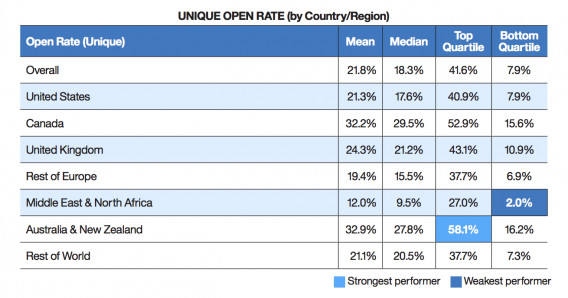
Open Rate by Country

Image Source

As well as open rates by industry…
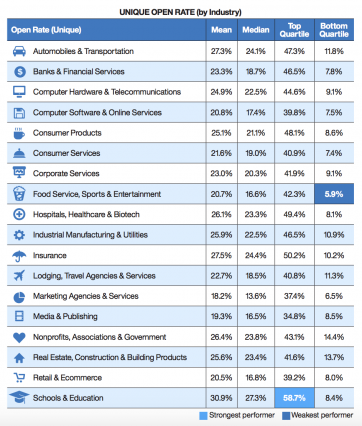
Open Rate by Industry

Image Source

As you can see, though, these numbers vary depending on the source…

Open Rate by Industry (Confirmed)

Image Source

So, the best average to judge your success by is your own.

Here’s a look at email open rates in each industry by device type…

Open Rate by Device

Image Source

Now take a look at that same data year over year…
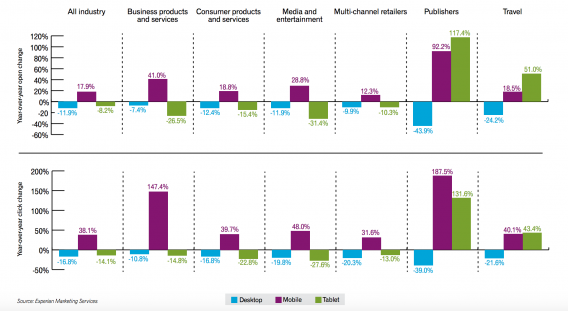
Open Rate by Device (YOY)

Image Source

You can draw two conclusions from this…

  1. Without exception, mobile email use is on the rise.
  2. The industry average data is varied and purely based on a select sample, so the best place to look is and always will be within your own data.

A big problem email marketers encounter is inconclusive tests…

Inconclusive Test

Image Source

Inconclusive tests happen… often. But there are a few things you can do to minimize the neutral result. First, make sure you’re truly isolating and testing a single variable. As Loren McDonald of IBM Watson Marketing explains, it’s easy to get off track…

“LorenLoren McDonald, IBM Watson Marketing:

“A) 1 in 5 emails will be opened on mobile | 5 key CRM questions

B) 1 in 5 emails will be opened on mobile

C) 5 key CRM questions

D) 5 key CRM questions | 1 in 5 emails will be opened on mobile

An A-B-C-D test approach like this would have accounted for any bias in the order of the content and the type of content used. For example, if both A and D had the highest performance, and if the test were repeated multiple times with different content, then a multiple topic subject line could be considered the winner.” (via Silverpop)

Second, it’s likely you’ll have to run tests multiple times to confirm the results. There are a lot of external factors that play into email, increasing the risk of sample pollution.

2. Research your audience’s voice.

If you haven’t already, take the time to research your audience’s voice. This can be time-consuming, but the insights can be used for all of your other copywriting efforts, so it’s worth it.

Here’s a basic process you can follow to get to the heart of your audience’s voice…

  1. Run customer and lead surveys. Focus on open-ended questions that’ll give you insight into: who they are, what words and phrases they use, and how they really feel about your brand / product.
  2. Schedule 1-on-1 customer interviews. I’ve written an entire article on this topic, so I won’t go into too much detail here, but talking face to face (even over Skype) gives you much deeper insights.
  3. Analyze the qualitative data and identify trends / patterns. It helps to code your data: needs / wants, pain points / benefits, hesitations, likes / preferences, etc. Then, consolidate your data and show the frequency at which each was mentioned. What trends / patterns do you see?

I really recommend reading this voice of customer article Jen Havice wrote for CXL.

Once you’ve done the research, rely on it. Go back to it for every email subject line you write. More importantly, conduct the research regularly to ensure it’s up to date. (Your customers change, after all.)

You can also use other insights you may already know. For example, what types of value propositions work best, what words get your audience clicking on your PPC ads, etc.

When thinking about words that get your audience clicking, you might be tempted to turn to Google, which would return something like this…
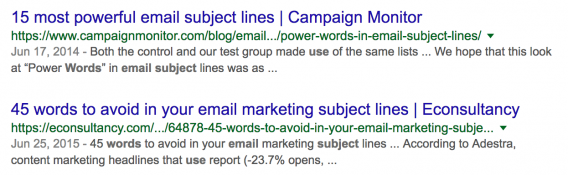
Bullshit Articles

Please resist that temptation. Focus on the data you have (or could easily have) in front of you.

3. Use personalization… strategically.

I’ve written an entire article on email personalization, so I’ll keep this short to avoid rehashing what’s already been said.

Personalization comes in many forms…

  • Including a first name in the subject line.
  • Including a location reference in the subject line.
  • Including a birthday or other significant date in the subject line.
  • Including purchase or activity information in the subject line.

All these forms help reinforce one simple concept: this email was written just for you.

Chris Hexton of Vero offers some additional personalization ideas you can test for yourself…

Chris HextonChris Hexton, Vero:

“When personalising your subject line, here are a few things you can A/B test:

  • First and last name: it might be common but it’s always worth a try!
  • Alter the details in the subject line based on the recipient’s location: summer vs. winter and holidays in different parts of the world (Father’s Day isn’t the same date in every country) are two examples.
  • Gender: using men vs. women in the subject line of a clothing store’s newsletter or highlighting specific product names for each group are some basic examples.
  • Use details of the actions the customer has taken: what has the customer been doing on your website? What are their favourite products or what features are they yet to use? The examples above all use this tip.” (via Unbounce)

Is there any data to support the idea that personalization works and isn’t just the latest trend? Yes, actually…

  • MailerMailer found that personalized subject lines had an average open rate of 12.9%, compared to 9.8% for subject lines without personalization.
  • Experian found that personalized subject lines had 26% higher open rates than subject lines without personalization. The lift was highest for travel companies.

MailChimp also conducted some research into personalization performance. They found that first and last name have the biggest impact on open rate…

Name Personalization

Image Source

And that first name personalization works better in some industries than others (and not at all in the legal industry)…

Name Personalization by Industry

Image Source

Again, personalization is something you want to test. Please don’t take this research’s word for it.

What’s interesting is that despite these overwhelmingly positive results, the Experian study found that 70% of brands don’t personalize their emails at all.

Now, that might be because companies just don’t know enough about their email leads or even customers to really take advantage of email subject line personalization.

One solution is implementing a one-click onboarding survey like this…
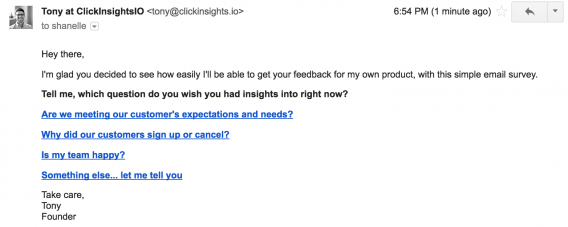
One Click Survey

Or you can try a more extensive survey, like the one we use for CXL…
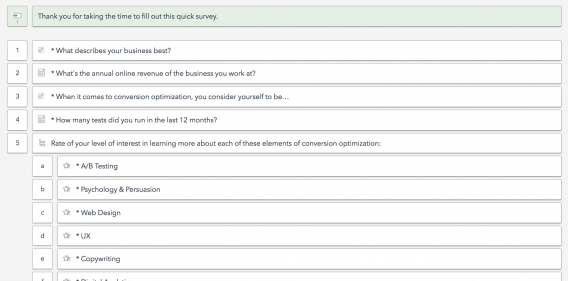
Typeform Survey

Then, you can personalization email subject lines based on the data you collect.

Using personalization too much or using it incorrectly (e.g. “Hello |FNAME|”) really sucks. So don’t use personalization unless it’s adding value to your recipients.

4. Be specific, descriptive and clear.

Being trendy or clever is often worse than being clear and direct. If you’re familiar with heuristic analysis, you know that clarity is a key factor of optimization. (You can read more about improving clarity, in general, in this article.)

For example…

  • In 2014, 2,211 MailChimp campaigns had “dads and grads” in the subject line.
  • Half way through 2015, MailChimp users had already sent 2,005 “dads and grads” emails.

Those “dads and grads” emails, sent around Father’s Day / graduation season, had an average open rate of 18%. Not too bad, but lower than MailChimp’s benchmark.

Kate Kiefer Lee, Communications Director, explains…

“KateKate Kiefer Lee, MailChimp:

“If you’re thinking of sending a campaign with a trendy subject line like ‘Gifts for Dads and Grads’ (or one that references ‘sizzling’ summertime deals, which I imagine is coming to my inbox soon), I won’t stop you.

But I will encourage you to test it against one that’s a little more straightforward. Try something like: ‘Our annual apparel sale starts now.’ Not every customer enjoys a marketing slogan.

Plus, if the straightforward subject line wins, you can always get creative with your headlines in the body of the email. Or you can try a happy medium: a descriptive subject line with personality.” (via MailChimp)

Also note how the trend started in 2014 and seemingly picked up in 2015. Hey, maybe the first 100-200 companies that sent a “dads and grads” email saw a huge return because it was new and original. But by the 4,000th company, I’m sure the concept was stale.

That’s the problem with doing something because it’s trendy. By the time you hear about it, it’s probably already overdone.

MailChimp conducted another interesting study. This time, they analyzed over 40M emails and singled out the ones with the highest and lowest open rates. The highest open rates were in the 60-87% range while the lowest open rates were in the 1-14% range.

Best Open Rate vs. Worst Open Rate

Image Source

Hopefully you notice the difference. On the best side, the email subject lines are straightforward and clear. On the worst side, they’re salesy.

Why? A big reason is likely that people get a lot of email spam, so they’re great at detecting it. If it reads like an unsolicited sales pitch, it’s probably being reported as spam before it gets deleted.

Note that being direct and clear does not mean being devoid of personality. Here’s an example from my own personal inbox…

Kira Email

And another…

Talia Email

In both cases, I can guess what will be inside the email, so clarity is high. Yet both have personality.

Here’s an exception and something you might want to test for yourself. Sometimes being vague builds suspense and piques interest. Here’s another example from my inbox…

Can we make it happen?

It’s undoubtedly a vague and unclear subject line, right? Here’s the response…

Marcus Responds

Joanna calls this the curiosity gap or empty suitcase…

Joanna WiebeJoanna Wiebe, Copy Hackers & Airstory:

“Then comes the ‘This is how you get traffic and convert it…’

This is the open loop, or curiosity gap, in that you’ve been introduced to this idea that there’s a way to do the thing that you really want to do. But importantly, the subject line doesn’t say what it is.

It says ‘this.’

In ‘writerly’ language, that’s called an empty suitcase. ‘This’ without a noun after it, is the empty suitcase.

I don’t know why they call it an empty suitcase [laughs]. I learned it all the way back in my first year as an English major. And it’s not like we sat around talking about grammar as English majors, but somehow I learned it and it’s been really valuable to know it.

It’s a bad practice when you’re writing an essay or a novel to have an empty suitcase. But it’s a very good thing for copywriting if you want people to be intrigued enough to click or open.” (via Litmus)

One thing matters most when considering whether to stick with clarity or experiment with an empty suitcase, a trend, a joke or pun, etc. Expectation.

Are your subscribers signed up specifically for promotions? Maybe those cheesy, salesy email subject lines will work. Test it. Are your subscribers signed up specifically for your newsletter? Maybe an empty suitcase will help you stand out. Test it.

5. Be aware of mobile subject line character restrictions.

Character counts mean next to nothing to your open rate.

MailChimp is one of the many companies to look into email subject line character counts. They pulled data on 12B emails sent and analyze the subject line length. The results?

Sometimes, people like long subject lines…

Long Works

Image Source

Sometimes, people like short subject lines…

Short Works

Image Source

John Foreman, VP of Product Management, explains…

“JohnJohn Foreman, MailChimp:

“Even if there existed a pretty graph showing a relationship between subject-line length and campaign performance, that doesn’t mean that by padding your subject with purple prose you’d suddenly be swimming in a sea of opens and clicks.

No, that relationship (like what is shown above for users X and Y) is likely caused by a third variable.

For instance, what if I sent out a weekly campaign with the subject line “Christmas sale on processed meat logs full of fat and salt” and didn’t get any opens, so I changed it to “Sale on summer sausage.” Well, “summer sausage” sounds a lot more appetizing than “meat log.”

I bet I’d get better performance. Would that be due to the lower character count? Only indirectly. Rather, it’s due to my astute change in diction. Hemingway would be proud.” (via MailChimp)

Most of the time, people don’t really give a damn…

Subject Line Length Doesnt Matter

Image Source

Yesware found similar results in their own study of subject line length…

Subject Line Length Doesnt Matter (Confirmed)

Image Source

Here comes the but. But email subject line count does matter on mobile. Check out this email subject line on desktop…

Desktop Subject Line

And on mobile…

Mobile Subject Line

If you recall, mobile email open rates are increasing across the board. So, you want to be aware of how your subject line will appear (or, rather, not appear) on mobile. Simply find the top mobile email clients for your audience and then find the subject line character count restrictions for each.

That’s not to say you should never go beyond those restrictions. It’s just something you should be aware of.

6. Choose every word carefully.

In the testing world, a single word in a headline is inconsequential. In the email subject line world, those minute changes can have huge rewards.

Alexis Rodrigo of Mirasee explains how a single word can have a major impact on the open rate…

“AlexisAlexis Rodrigo, Mirasee:

“In 2013, Adestra released a study of email subject lines from 2.2 billion emails in an attempt to identify specific words and phrases that get both higher open rates and higher click rates.

The study covered various sectors, including B2B, B2C, nonprofit, retail and e-commerce.

Across all sectors, the email subject lines with the following words and phrases had open and click rates that were higher than average:

  • Free delivery
  • Sale
  • Alert
  • News
  • Video
  • Win
  • Daily
  • Weekly” (via Vero)

It makes sense when you really think about it. Email subject lines are short and vital to persuading a recipient to open. Each word plays a significant role.

MailChimp was able to confirm the significant impact of single words and short phrases in a study they conducted. Here’s a look a words that imply time sensitivity…

Urgency

Image Source

And commonly used word pairs…

Word Pairs

Image Source

And free vs. freebie…

Free vs. Freebie

Image Source

And even something as seemingly unimportant as capitalization…

Capitalization

Image Source

But, of course, all of this data is all contextual. Above, we saw a 0.02 impact on the open rate in standard deviations when using “free”. Below, you’ll see the word performs better and worse in some industries…

Free by Industry

Image Source

So, again, test this for yourself. As Neel Shivdasani, Data Scientist, explains, the real takeaway here is not which words you should use in your subject lines…

“NeelNeel Shivdasani, MailChimp:

“The more interesting takeaway, though, is that a single word’s presence can dramatically alter the likelihood that your readers will open your emails. The content of your message is really what determines which words you use, but with so few words in a subject line, each one matters quite a lot.” (via MailChimp)

Now, most email marketing tools have a subject line researching tool of some sort built right in that can help with word and phrase selection. Be aware that the data is typically pulled from all campaigns being sent via the tool, not just your data.

Here’s a look at how MailChimp does it. Just input some terms…

MailChimp Subject Research Tool (Step 1)

Image Source

And it’ll spit back some suggestions…

MailChimp Subject Research Tool (Step 2)

Image Source

Whatever email marketing tool you’re using, you likely have a feature like this built in already, so take a look around for it. If you want to be truly data-driven, use these types of tools (and your own audience research) as ideation assistants.

Test the suggestions you get, don’t accept them as absolutes.

7. Please, please segment your list.

I’ve written an entire article on email segmentation, so I’ll keep this short to avoid rehashing what’s already been said.

Segmentation works wonders. In fact, MailChimp has found that open rates are 14.31% higher when the email campaign is segmented…
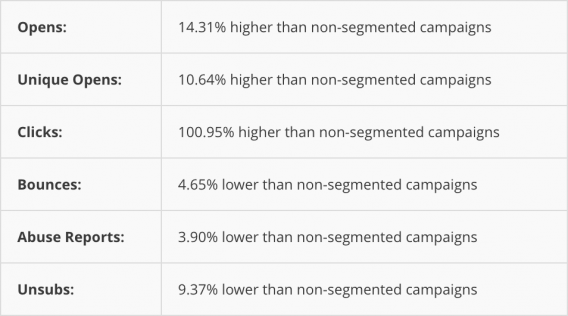
Segmentation

Image Source

As with any type of segmentation, your options are virtually endless, but here are a few examples…

  • Segment based on opt-in offer.
  • Segment based on stage of the sales cycle.
  • Segment based on activity.
  • Segment based on industry.
  • Segment based on location.
  • Segment based on previous purchases.

Once you have set up your segments, you can test email subject lines within individual segments. For example, do people who opted into the beginner’s guide respond better to Variation X or Variation Y? Do people who work for agencies respond better to Variation A or Variation B?

Any time you can drill further down and extract more segmented insights, take advantage of it.

Here’s another reason you want to segment. Let’s say you run a subject line A/B test and it’s inconclusive. If you drill down into the segments, you might find that Variation B actually went over significantly better than Variation A for people who work in SaaS.

Without segmentation, you wouldn’t have that nugget of information to run with and test further. You would’ve simply declared another test inconclusive and called it a day.

Raphael Paulin-Daigle of SplitBase explains further…

Raphael Paulin-DaigleRaphael Paulin-Daigle, SplitBase:

“An open rate or click through rate could have decreased for Segment #1, but will have highly increased for Segment #2. The improvements in Segment #2 might have brought you more sales and increased your revenue too. Yet, with no segments, your email marketing tool will calculate an average and might tell you no improvements have taken place.” (via SujanPatel.com)

8. Treat preview text and from name as an extension of your subject line.

On a landing page or a site, all of the elements of the page work together towards a common goal, right? The same can be said for the email subject line, the preview text and the from name. They’re the only three elements working to convince recipients to open your email.

When it comes to the from name, your options are fairly limited…

  • Shanelle
  • Shanelle Mullin
  • Shanelle from CXL
  • Shanelle at CXL

You get the idea. In my case, more people recognize the CXL brand than my name. So, having it in there can help with familiarity. For Peep Laja, founder of CXL, maybe the opposite is true. Test it for yourself to see what works best for you.

As Joanna explains, the preview text (or preheader text) is vital as well…

Joanna WiebeJoanna Wiebe, Copy Hackers & Airstory:

The preheader text is huge as well. It should work with your subject line, but also stand independent from it in case your subject line only does half the job.

That means it should say something that builds on your subject line, or further teases at something from your subject line, or provides a new piece of information like a data point that people will want to open and read about.

The subject line doesn’t stand alone. It’s a matter of testing all the different elements.” (via Litmus)

Here’s a great example…

TMNT Subject Line

Image Source

If you’re familiar with the Teenage Mutant Ninja Turtles, you can see how the subject line and preview text are connected. They’re working together, they’re an extension of one another.

Here’s another example…

Flash Sale

Image Source

Here, they both play off one another and stand alone, as Joanna mentions.

What’s important is simply that you recognize how these three elements work together to achieve a common goal.

Conclusion

If you put in the time and apply an optimization mindset, you can improve your open rate through optimized email subject lines that inspire action.

Here are the core principles to keep in mind…

  1. Continuously test your subject lines and measure your success by open rate.
  2. Research your audience’s voice through surveys and interviews.
  3. Use tasteful personalization meaningfully, but test it to prove that it works for your audience.
  4. Choose clarity over being trendy or clever. If you’re considering an empty suitcase or curiosity gap, think about the expectations you set with your audience upon opt-in.
  5. Be aware of mobile subject line character restrictions.
  6. Choose every word carefully. In subject lines, a single word can make a big difference.
  7. Segment your email list to uncover deeper insights about what’s working and what’s not.
  8. Treat preview text and from name as an extension of your subject line.
11 Mar 19:02

How To Identify and Activate Your Mobile MVP Customers

by Ashley Sefferman

If you could talk to your most loyal mobile customers, what would you ask? How would you engage them? What could you learn from them? Every marketing team dreams of identifying and activating this loyal group, although few take the time to really get it right.

These customers, or your “mobile MVPs” as we like to call them, hold a ton of power and play a major part in the success of your business. Take the 80/20 rule, for example. This old sales adage still holds true when it comes to identifying MVP customers: 80% of your revenue tends to come from 20% of your total customer base. There’s even a popular theory that companies only need to identify 1,000 MVP customers to make their business successful. MVPs are the key to growth.

Identifying and engaging with your MVPs can feel like a daunting task, but it doesn’t have to be! This post dives deep into how to first identify customers who will fit your mobile MVP profile, and then shares tips to help you activate them in order to gather their feedback and to turn more customers into raving fans.

Let’s get started!

Step 1: Identify Your MVPs

Start with segments

As with any good marketing strategy, identifying your mobile MVPs starts and ends with segmenting. The deeper you’re able to segment your customers by their in-app actions, the closer you can get to understanding which actions trigger MVP status, along with building customer profiles to identify future MVPs. Breaking your customers into segments will help you understand MVP behavior, sentiment, and more in order to nurture similar actions across larger groups of your customers.

Segmenting also helps you better understand what customer data you should look at to gauge product success and growth. Whether you look at customers by individual or by org, there is plenty of data to consider.

customer segments

To start segmenting your customers in order to eventually pull out the MVPs, begin by asking yourself the following questions:

  • What’s the profile of customers using our mobile app, and how do we currently segment them?
  • What are the most valuable in-app actions our customers take?
  • How do we define “customer loyalty” and what makes a customer loyal?
  • How many new customers do we adding in a given period? How many customers do we lose in the same time period?

To help you answer the above questions, you’ll likely need to pull some data to use as a starting point. Consider capturing the following mobile customer data points to start:

  • Mobile customers broken down by tier or loyalty level (if they already exist)
  • Counts of iOS and Android customers
  • High-level in-app actions or engagement points
  • Demographic data (e.g. industry, location, age, gender, etc.)

Pull out the MVPs

Now that you’ve segmented your mobile customers, it’s time to pull out your MVPs. As noted above, MVPs take actions that set them aside from your general customer base. Although the profile of an MVP looks different at every company, there are three major areas MVPs typically stand out in across all industries:

  1. Registration: Completing an action like signing up for a newsletter, downloading content, signing up for free trials, joining loyalty program, etc.
  2. Engagement frequency: The higher the frequency, the likelier the customer is to be an MVP
  3. Advocacy: When a customer takes a brand advocate action like sharing positively on social, referring friends, etc.

If a customer registers for a high volume of engagement points, interacts with your company at a high frequency, and advocates for your brand throughout the social circles, it’s likely that they may fall into your mobile MVP segment.

Don’t forget cohort marketing!

If you’ve already taken the above steps in segmenting your mobile customers but are still struggling to identify the mobile MVPs, cohort marketing is a great tool to leverage. Cohort marketing relies heavily on a marketing team assessing its goals, so it’s important you spend a bit of time reviewing the most important and high-value actions offered in your mobile experience. Once your goals have been revisited, you can leverage them in a cohort marketing exercise to find the customers that fit, better identifying your mobile MVPs.

Many marketers have dabbled in some form of cohort marketing, but here’s an example exercise you can use specifically for mobile:

cohort marketing example

As you can see above, Cohort 3 has come closest to reaching the goals the marketing team has set, so they are most likely to be the cohort of MVP customers.. They are registered, convert frequently, come back average, and advocate average. Companies can get much more granular with these weightings, but even when working off of a yes/no for registered and then low/medium/high for the other categories, this framework helps you identify the cohort of your customers that gets you closest to the goals you’ve set.

Gauging sentiment, the most important step

As we explored above, there are many behaviors and criteria that make up a mobile MVP segment, but the most important metric of all is sentiment. Let’s spend a bit of time talking about what makes sentiment stand out, and what you can do to measure it for mobile.

Sentiment is the emotion behind customer engagement. When you monitor sentiment, you try to measure the tone, context, and feeling from customer actions. Whether a customer completes a purchase, leaves a review, or mentions your company socially, there is always an emotional state connected to their action. Customer sentiment can range anywhere from pleased or loving to neutral or angry, and no matter where your customers fall on the sentiment spectrum, it’s imperative you understand not only what their emotional state is, but what’s driving it.

Understanding sentiment is crucial to identifying your mobile MVPs. The more positive a customer feels about their experience with your app, the better they’ll feel about your brand, and the likelier they are to share that experience with their communities. Word-of-mouth marketing is still the holy grail in the digital age, and nothing is a better indicator of how far your referrals can go than sentiment.

To look at sentiment metrics specific to mobile, track the following:

  • Willingness to recommend (or NPS): Will the customer give your company a word-of-mouth recommendation?
  • In-app ratings and reviews: What feedback are customers leaving you through the app stores?
  • Social monitoring: What do customers say about your brand across their social channels?
  • Direct customer feedback: What thoughts and feedback do customers share directly with your company?

The more sentiment analysis you can do early on, the more you’ll learn about your mobile MVPs, and the easier it will be to interact with them one-on-one. Which leads us to our next section….

Step 2: Activate Your MVPs

Now that you’ve identified your mobile MVPs, it’s time to activate them. MVP customers look different for every company, but there are a few common strategies to implement in order to encourage engagement, feedback, and ultimately, loyalty.

Targeting

Targeting helps you interact intelligently with the right customers, at the right place, and at the right time. Treating customers with a personal touch is important to growing any customer segment, but it’s especially important to activate and nurture your MVPs.

Customer targeting

We’ve talked at length about finding the right place and time to engage with mobile customers (see our targeting guide for best practices). There are three categories for every in-app action app publishers should focus on to better engage with groups of targeted customers:

  1. Who: The first decision you must make is who should be targeted. You can make this decision based on a number of attributes, including custom person and device data, actions people have taken within the app, and which interactions they have or have not seen in the past.
  2. Where: Once you determine who should be eligible for a particular interaction, you need to choose the place at which customers will see the interaction. Interactions should never disrupt the customer from using the app for their intended purpose, so it’s important to be cognizant of customer behavior when engaging in-app.
  3. How often: Lastly, you must consider how often to display the interaction. The frequency in which you engage with customers in-app should be dependent on the interaction as well as the customer receiving it.

Asking who, where, and how often will help guide you to the best locations to place your interactions in order to encourage maximum engagement from your customers.

Personalized messaging

Personalized messaging, like one-to-one marketing, is the manifestation of how we incorporate everything we know about our customers’ loves, likes, and dislikes into their mobile app experience. Using customer insights, mobile analytics, and customer journey mapping, we can design a marketing strategy that puts our customers first.

There are two major strategic components for putting together a world-class personalized messaging plan:

  1. Deep audience segmentation: Is your message one that everyone has to see, or is it one that only applies only to a particular segment of your customers? When you segment your message by audience, you’re suddenly able to deliver a personalized customer experience. You now provide value to your customers, pulling them in to be engaged, rather than pushing unwanted content at them.
  2. Find the right “mobile moments” within your experience: Our mobile devices are some of the most personal pieces of technology we own. Finding the right mobile moment looks different for every brand as the placement, timing, and customer segment the in-app message is intended for will vary due to endless variables. To start, think about the in-app message you’re sending to figure out timing and placement. If the message is proactive, it should occur after customers take a high-value action within your app (like completing a purchase or a level) rather than in the middle of an action. If you’re asking customers to leave feedback through a survey, it should occur at a non-disruptive moment rather than interrupting the action the customer came to take. The example below shows a survey prompt while a customer is attempting to complete a purchase—in other words, the wrong mobile moment for an in-app message.

Special access

Nothing makes a customer feel loved than getting special access to your product and company! And when it comes to MVPs, these customers deserve the royal treatment in every way possible.

Special access will look different for every brand, but here are a few ideas to get you started:

  • If you provide software, give your mobile MVPs access to beta releases or new features, and be sure to get (and implement!) their feedback on what can be improved.
  • Let your mobile MVPs “cut in line” by being able to order ahead, expedite their shipping, or speeding up another part of your product delivery process. For example, Nordstrom allows its loyalty members to access their annual sales a day before the rest of their shoppers. Talk about a win-win!
  • Give special discounts on in-app purchases, shipping, or any other monetary transaction your mobile MVPs can take. Nothing says “thank you” like saving your customers a few bucks. :)
  • Celebrate with them! Your customers are human, and there’s no better way to make connections than by celebrating person to person. Remember to say happy birthday, celebrate customer “anniversaries,” and reach out around the holidays.

Validate feedback

Customers who leave feedback drive your business forward, and every piece of feedback whether it is praise or criticism should be valued, and then validated. Feedback from every customer is important, but feedback from your MVPs is especially important. The more you can let this group of customers know they have been heard and that their suggestion (especially the time it took to give it!) was appreciated, the happier they’ll be.

There are a few rules to follow when validating mobile MVP customer feedback:

  • Say thank you: Always respond with a “thank you,” even if the feedback was incredibly rude or it was something you have heard a million times.
  • Follow up: Always be sure to follow up with your customers after they leave feedback with another thank you, the status of their request, etc. For customers who may have had a larger issue, consider giving them something for free for their time.
  • Be honest: Sometimes it’s not possible to solve a problem on the spot. If a customer leaves feedback around an issue that can’t be fixed or is a low priority, be honest and tell them why.
  • Give credit: When there are updates or changes made to the app, give credit where credit is due by thanking your customers who drew your attention to the issue in the update notes. You can even take this one step further by personally reaching out to those who gave feedback and thanking them privately. Customers who get their problems solved become some of your biggest fans, growing your MVP segment!

Wrapping it up

Identifying and activating your mobile MVP customers may seem like a challenge, but it’s more within reach than you may think. If you follow the steps and tips outlined above, you’ll be on your way to engaging with—and most importantly, learning from—your most valuable mobile customer segment in no time!

11 Mar 19:01

Sales Presentation Ideas to Turn Prospects into Buyers

by Michael Steinberg

The ultimate goal of a business. What is it? No… it isn’t about having an awesome sales presentation.

From executive board discussions, to conventional bar chats, it is a discussion that has taken place thousands of times along centuries. To be honest, there is no single correct answer.

As many things in life, it is circumstantial and subjective.

Even in the for-profit area, profits are not always the ultimate goal.

Capitalism is not only about money.

Nonetheless, there is one goal that all businesses have in common: sustainability.

If a business isn’t sustainable, it ceases to exist. To achieve this, most businesses need to generate revenues.

One of the final and most important steps on this process is to pitch your business’s offer before your (hopefully) soon-to-be customers. As “simple” as that, usually taking place in form of the well-known sales presentation.

Sales Presentation Ideas for the Modern Age

What is a sales presentation, actually?

Is it a 1 minute pitch on the elevator or an elaborate one hour display before a board of executives?

Depending on your point of view, it can be both, or it can be none.

Nowadays sales presentations not always take place in person, many are done remotely via Skype or similar means. However, although various circumstances can change, the presentation will usually be the same.

In this article, I refer to sales presentations as the actual material or content you employ to support your arguments.

If you are a prepared businessman and have a small pitch stored on your smartphone, well kudos to you, you can give an original pitch on the elevator!

But what is it that really makes a successful sales presentation?

You might have seen a lot of articles out there on top templates for sales presentations, on how to dress properly, body language and all that trivial stuff. Most of those facts are just secondary, compared to other priorities for your presentation.

If you ace such essentials, you are bound for success.

So, it isn’t about beautiful PowerPoint or Keynote designs; it’s about achieving those conversions by delivering a powerful, memorable sales presentation.

Some of these aspects take place long before the actual presentation starts and others long before it has ended.

These are the five most relevant you should watch out for.

Before the Sales Presentation

1. Research and Preparation Are Your Strongest Weapons

As the popular saying states, it is half the battle to be forewarned.

Intense preparation and research about your target customers are vital in order to understand their needs and to pitch exactly in that direction. Therefore, this is one of those methods that will never be outdated.

  • Research your customers,
  • Research their business,
  • Take advantage of social media,
  • Use articles they have published, or
  • Look for information about other companies they engage in business with

All this data can help you better understand your targets and thus adapt your information flexibly towards their needs.

If the target is a business, find who the decision makers are and focus on them.

Furthermore, look for information about the company’s budget to better prepare yourself for the economic approach.

Take a look at your competitors and predict how they might approach your prospects and what their weaknesses and strengths are compared to your business.

Once you have gathered all the necessary information, organize it accordingly so that you have a better overview. The more extensive your homework is, the better grade you will get.

Before & During the Sales Presentation

2. Your Prospects on the Foreground – Your Business on the Background

Your prospects have to be the center of the presentation at all times.

Your aim is not to make clear why your product or services are great, but why they are great for them.

If you have done your research properly, you should have accumulated enough information to understand the exact needs of your prospects. Use this as the main pillar of your presentation.

Also, it is fundamental to have a clear picture of the buyer’s journey process of the customers.

Are the customers completely aware of their needs, are they already considering options or are they waiting for a last push to take a decision?

sales presentation ideasThis is according to a report by Impact Communications.

To understand which applies for your customer, sales and marketing need to collaborate intensively to generate a presentation that appeals to the prospect.

It is estimated that prospects complete around 57% of the Buyer’s Journey before they even reach the sales department.

Thus, it is imperative for marketing to report on such development to sales and for sales and marketing to coordinate the final presentation that will be addressed towards the potential customer.

Knowledge is power.

Once you have a clear picture of the exact profile of your customer, their needs or problems and how you can help them with this, create content that makes them feel identified.

To not provide boring statistics that apply to the general public, engage with them personally with interesting stories and anecdotes.

During & After the Sales Presentation

3. Call to Action

This is usually the most important moment during your presentation.

A call to action is the final step to incite your prospect towards a purchase.

There are many ways through which this can be done and it always depends on the structure of your presentation.

Naturally, it is also different to call your customers to action on a live presentation, then through a link to your pricing site at an online presentation.

Nonetheless, in each and every case the purpose is to drive your customer towards purchase.

Challenge your prospects, ask a question, invite them to do something, use an applicable quote or even wrap-up with a story.

Just keep in mind that your call to action should cover the following aspects:

  • Short and to the point: Do not bore your viewers to death. A call to action should be efficient and clear. If it is too abstract, you will miss your chance.
  • Must require action: Do not mention just a famous quote that does not require any action from your viewers. Challenge them to choose your product/service as the right one by leaving the ball on their court.
  • Wrap-up your entire presentation: Your call to action should summarize the most important arguments of your presentation. A great way is to close your presentation with the final part of a story that you introduced at the beginning, which shows how all the points you presented are important for your customers.

After the Sales Presentation

4. Aim for Feedback and Referrals

One thing is clear: your sales presentations won’t be perfect from day 1.

It is an extensive learning process along several years.

The best way to get better at it, is to collect as much feedback as possible from your prospects.

  • What did they like?
  • What didn’t they like?
  • Was the presentation too long or too short?
  • Are there any questions left?

Not all pitches are going to be successful and you won’t sell 100% of the times you try, but almost all prospects will be willing to provide you with any constructive criticism on your pitch.

Encouraging your prospects to clear any doubts with questions will also help you understand which information you need to provide more transparently in future presentations.

Furthermore, if you share your presentation through blogs, social media or any other online channels, be sure to follow up on any comments.

In case your presentation was a success and your customers are purchase-ready, do not forget to use the opportunity to ask for referrals.

What other companies or people do your prospects know that might have similar needs? This is a great opportunity to find sales-ready leads.

sales presentation ideasThus, referrals will not only help you save research time on acquiring potential prospects, but the ones you acquire will probably be much more likely to purchase.

At Any Time

5. Expand the Reach of Your Sales Presentations: Use Online Channels!

Sharing your sales pitch online might not always apply, since many times your presentation is created for a specific client or business.

However, there are also various cases in which the pitches are directed to a more general group of people.

In such a case, it is highly recommended to take advantage of the reach of the internet and share your pitch-deck online, for channels such as social media are believed to have at least 100% higher lead-to-closure rate than outbound marketing activities.

Whether on social media, on your LinkedIn, in specific groups and forums, on blog posts or emails, there are diverse tools that let you share your sales presentation online.

This not only allows your message to reach far more people, but most tools also have smarts statistics with which you can follow the behaviors of leads along the presentation and even capture their contact details.

Your sales and marketing team can put together specific inbound marketing or sales presentations to generate leads online based on specific prospect niches.

This will not only result in automatic leads without a major time investment, but it will also drive much more traffic to your business by taking advantage of the virality of online content.

Just keep in mind the 4 previous points when creating such presentations and leads will start to knock on your door in no time.

Conclusion

Nonetheless, by researching your prospects thoroughly and keeping them always in the foreground you can make sure the content you provide on your presentation will be accurate and effective and will drive your customers towards that purchase decision.

Help them take that jump and remind them to refer you to similar prospects to enhance the possibilities of acquiring more high-quality leads.

Finally share your material with online communities to increase your visibility and brand awareness.

Do you have a pitch coming up? Does it cover all five points? If not, you know what to do.

Happy prospecting!

11 Mar 19:01

Why Brand Advertising Drives More Conversions than You Think

by Larry Kim

Search marketing is so awesome because it’s efficient – the ROI is measurable and tangible.

Those big brand advertisers – the ones spending millions to advertise on TV, radio, and billboards – what do they know? What a waste of money, right?

Well, if those formats are so useless, why are the big companies pouring so much money into these ads every year? What do they know that we don’t?

brand advertising

Well, maybe they know that if consumers have never heard of you, they won’t search for you when they need the product or service you sell. And if they do a search, most probably won’t click on your paid search ad or organic listing. And if they don’t click on your brand, they can’t buy from you.

Why? What’s stopping them?

Again: They’ve never heard of you. You aren’t a magical unicorn everyone knows and loves. You’re just a boring donkey – another link in a sea of blue links.

The ultimate conversion hack is making sure people have heard of your brand before.

Here’s why.

Search harvests existing demand

We know there are three types of searches:

  • Informational: These searchers want to find an answer to a question or learn something. We lure in informational searchers via SEO, creating inspirational, memorable, optimized content that your target market will find informative or educational (not promotional).
  • Navigational: These searchers want to locate a specific website – like people looking for “facebook.” They already know you – they’ve visited your site before, liked what they saw, and want to return.
  • Transactional: The searcher is signaling intent to buy something. This is where search marketers live – the SEOs who create content for visitors who have demonstrated buying intent and the PPC marketers who write compelling ad copy with irresistible offers for hot prospects.

Search marketing is all about harvesting existing market demand. Don’t get me wrong: as search marketers, we do a brilliant job of harvesting that demand. But search doesn’t grow new demand.

What will ultimately make these searchers click on your organic result or your paid search ad? More importantly, how many of them will actually convert into leads and sales when they arrive on the landing page?

Small changes = small conversion rate increases

unicorn math

Pop quiz: there’s one way to dramatically increase your website conversion rate right now. Is it:

  • Changing a keyword from plural to singular on your landing page
  • Adding a high-quality image of smiling people
  • Reducing the number of fields on your form
  • None of the above

If you said none of the above, you are correct! These changes won’t dramatically increase your conversions. Small on-page changes result in small conversion rate increases.

Changes to on-page elements – things like button placement or color, image sizes, and fonts – might spike sales by 5 percent. And that’s exciting.

But you can’t crown A/B test winners and losers for life. Offer fatigue is a big issue. No A/B test alone can turn a donkey into a unicorn.

ab testing myths

Winners are just winners “for now.” Those gains tend to disappear over time, once the novelty wears off.

There’s so much more you can do beyond these small on-page changes. Why settle for 5 percent when you could do things that move the needle 5x?

What turns search clicks into conversions?

On-page elements, as well as things like targeting, psychology, and ad extensions, all play a role in the conversion process. I’m not saying these and other traditional CRO tactics aren’t important – they are.

But you can’t predict which of your tweaks will result in changes. That’s why you A/B test.

The single biggest predictor of whether people will purchase is whether they’ve heard of you before. That process should start long before people are ready to buy and they click on your organic listing or paid search ad.

i dont know her

Think of a conversion as a lifecycle, not a singular event. Target qualified prospects before they even know they want to buy from you!

Go brand yourself!

importance of branding

If you want to bias people in your favor, you need to build a brand.

When people are scanning through the search results, they click on brands they know. In fact, 70 percent of consumers will click on a retailer they know, according to Search Engine Land and SurveyMonkey research.

If you’ve built a brand people know and love, people are more likely to click on your organic listing or your PPC ad. Non-branded keywords can act like brand terms when enough brand affinity exists.

brand recognition effects

Your CTR has a clear impact on your conversion rates. In fact, click-through rate is the most important conversion metric. A higher CTR means a higher conversion rate:

ctr vs. conversion rate

This is just one example from one large WordStream client, but we see a similar type of curve across industries.

Why?

We’ve found that if you can get someone excited enough to click on your offer, that excitement usually carries through all the way to a sign-up, checkout, or purchase.

How to see the impact of brand advertising

The value of branding has been ridiculously hard to measure historically.

If you use RLSA, however, you can split test people based on brand affinity. A repeat visitor works as a proxy for brand affinity – and they convert 2-3x higher than first-time visitors. Crazy!

conversion rates for repeat visitors

This suggests when it comes to prioritizing activities we should be doing things a little differently!

Attention search marketers: if you want to see truly monstrous differences in conversion rates, you’re better off segmenting conversions by new vs. repeat visitors.

What does it all mean?

PPC people – be open to other forms of online brand advertising (such as display and social advertising) as well as broadcast media (radio and TV). Branding helps convert those clicks you’re paying for into customers.

With a smart social ad strategy, you can promote your content to the perfect audience for just pennies. Send people to your most engaging content rather than sign-up forms. Sure, they won’t convert right away, but you can later remarket to them using social media ads. When you hit them with an offer next time, they’ll be 2x to 3x more likely to convert.

SEO people – the brands that appear in organic search results more closely correlate with their overall popularity. So cast a wider net with off-topic content that will grow your popularity and start biasing future commercial searches and conversions in your favor.

10 Mar 16:17

Diverse companies see higher profit and have better focus — here's why

by Lindsay Dodgson

women

Diversity matters to any company worth working for, and it's becoming increasingly clear that it's also important for the profitability and success of a business.

A report in 2015 by McKinsey looked at 366 companies in the US, UK, Canada, and Latin America and found when companies commit themselves to a more diverse leadership, they are more successful. This correlation doesn't necessarily mean higher diversity caused the positives, but the pattern was telling. 

Overall, the report concluded that diverse companies were more likely to win over top talent, and thus improve things like employee satisfaction, leading to more positive returns.

In 2012, Credit Suisse performed a similar study on 2,400 companies, and found large-cap companies (those worth over $5 billion) with at least one woman on the board outperformed their rivals who had no women on their boards by 26% over six years.

In a blog post for Psychology Today, human performance coach Dr. David Rock outlines why more diverse teams are often smarter, more efficient, more innovative, and generally prove to be of greater value than non-diverse ones. 

1. They are better at focusing on facts

Rock says people from diverse backgrounds can actually alter the behaviour of the group as a whole. For example, in one study of 200 people published in the Journal of Personality and Social Psychology, subjects were split into six-person jury panels of either entirely white people or four white and two black people. When deciding whether the defendant was guilty, the diverse panels raised more facts and made fewer factual errors while discussing the evidence.

According to Rock, diverse teams are more likely to re-examine facts when there is a disagreement. They're also more likely to remain objective, and be less timid about scrutinising others' points of view. He says making sure people in the workplace are socialising and working with different groups allows employees to become aware of their own biases, possibly highlighting errors they wouldn't be aware of before.

workplace

2. They think about facts more carefully

Not only are the facts more likely to be considered, but Rock says greater diversity in a team means those facts are probably thought about more carefully. 

A study published in the journal Personality and Social Psychology Bulletin sorted sorority or fraternity members into groups of four, and asked them to read interviews in a murder investigation and guess the correct suspect. Three members were from the same sorority or fraternity house, and after five minutes they would be joined by another of their members, or someone new from a different house. 

The groups who were joined by a stranger felt less confident about their verdict, but they were correct in guessing the suspect more than the groups joined by someone familiar. 

The research team concluded that having someone with a different perspective in a group may make people process information more carefully.

3. They are more innovative

Innovating and adapting are hugely important parts of business, and according to Rock, the best way companies can ensure they do this is by hiring more women and culturally diverse team members.

A study from journal Innovation: Management, Policy & Practice analysed the gender diversity of research and development teams from 4,277 companies in Spain. According to the results, companies with more women came up with more innovative ideas over two years. 

Another study from journal Economic Geography gathered data on 7,615 firms from the London Annual Business Survey to show that businesses run by culturally diverse teams were more likely to create new products than homogeneous ones.  

Rock says although it can be comforting working with people who share your background, this shouldn't be mistaken for an advantage. Actually, a team of different genders, races, and nationalities boosts a company's potential in many ways. It also helps ensure team members aren't being biased, and makes them question their own viewpoints, which is a valuable skill.

Join the conversation about this story »

NOW WATCH: Affect or effect? A writing coach breaks down the most common grammar mistakes in under 2 minutes

10 Mar 16:09

Build Your Pricing From the Data Up: How to Build a Modern Pricing Data Supply Chain

by Steven Forth

Pricing is an historically data-centric discipline. And pricing consultants spend a lot of time crunching numbers and building models like price distribution graphs and pocket price waterfalls – useful approaches to answering some basic questions about pricing like:

  • “How do we segment our customers by price?”
  • “Are some of our customers getting exceptionally good (or bad) deals?”
  • “What price are we really getting (the pocket price – the amount of money we put in our pocket)?”
  • “How do discounts and off-invoice concessions impact our actual price?

Internal data, which you can harvest from sales and invoicing systems, can be used to answer the above questions. Putting all of this information into a pricing management system for analysis is a good start. But, in today’s world, it isn’t remotely sufficient. The move to cloud-based solutions, subscription pricing models and IoT (Internet of Things) have opened vast new realms of data that can and should be used to improve pricing.

So what does the new pricing data supply chain look like? It uses formal models for value, price and usage (or engagement) and draws the connections between these three sets of variables to create a dataset from which you can pinpoint your ideal price. Furthermore, it integrates data from inside and outside the company to get as complete a picture as possible of how value is being created.

There are some important feedback loops taking place in a sophisticated pricing data supply chain. First, value informs pricing. How you set prices depends not only on the value you create for your customer, but also on how much value you aim to capture. Second, price impacts use. How you price your offer will impact how and how much your customer uses your product. Third, use determines value. How and how much your customer uses your offer determines what value they get from it. So we travel from value to pricing to use and back to pricing.

This is why pricing is dynamic. You can’t just set a price and forget about it. The value you create for customers, your price and how your customers use your product all interact in often surprising ways. You need to understand these interactions and make regular adjustments to ensure that each component in your pricing system is reinforcing the other. Increasing the wrong pricing metric can reduce use, which can decrease value, setting off a negative spiral. On the other hand, a pricing metric that communicates and tracks value can set off a positive feedback loop. This is what has happened in online advertising, where pay-per-click is much closer to value than impressions or ‘eyeballs’.

The last step in the system is when your customer pays against your invoice. The actual invoice is created by taking the price from the pricing model and applying the usage data. Policies on discounting, volume adjustments and so on are then applied and the fee for the time is period set.

Let’s look at some of the concrete steps you can take right away to build your pricing data supply chain:

  1. Build a formal model of how your customer gets value from using your offer.
  1. Identify all of the variables in the model – these are the points for which you’ll be collecting data.
  1. Look at your usage and engagement model. Are there any variables that show up in both your value model and your usage model? These are going to be critical to your pricing model.
  1. Ask if there is additional usage data that you could collect that would inform your value model. If yes, start tracking that data.
  1. Go back to your value model. Are there any variables that are determined by data external to your system? Interest rates, energy prices, labor rates, basically anything that impacts your customer’s business model should be considered. You should also look at data that can be derived from other enterprise systems, like your CRM or project management systems. If there are variables that you can track then connect these to your model.
  1. The intersection of variables in your value model, your usage model and external variables that impact your customer’s business model are the ones you should consider for your pricing model.

Building a system that follows these six steps enables you to track changes in the value you provide to your customer based on the interaction of how they use your solution. In other words – build your pricing model from the data up. This way you can tie value, usage and price together into a meaningful bundle. By tracking the variables underneath each of these critical vectors of performance, you’ll get a better understanding of the value of your offer, how to price and how to adjust pricing in order to create positive feedback loops between value, customer, price and usage.

Steven Forth is a co-founder of the skill management platform TeamFit. He also provides consulting on revenue models and pricing strategies to companies in the B2B SaaS and Industrial Internet of Things space as a partner at Ibbaka collective.

The post Build Your Pricing From the Data Up: How to Build a Modern Pricing Data Supply Chain appeared first on OpenView Labs.

10 Mar 16:04

Say “Hello” to the Conversational Presentation

by Julie Hansen

What comes to mind when you hear the word, presentation? For many it conjures up the image of a salesperson holding court in front of a group, typically with a slide deck and limited audience participation. But this formal monologue is simply one type of presentation style in a broad spectrum of choices about how to communicate with potential customers. In fact, it’s a style that is waning in popularity and effectiveness (for reasons you can read more about here.) So what is in style? Say “hello” to the conversational presentation.

The majority of reps today are in front of customers in less formal circumstances, whether it’s a doctor’s office or waiting room, across the table from a prospect, or via webcam. You may prefer to call these more informal customer facing events conversations. And conversations are great. They are typically a two-way exchange and more fluid than a linear presentation. However, if you aren’t prepared to talk about a solution in an engaging and memorable way at some point in the conversation, you are not likely to drive the opportunity forward.

If you desire results from your conversations you can benefit from applying presentation skills, preparation and mindset. Consider what a presentation really is according to Merriam-Webster:

Presentation, definition: Something set forth for the attention of the mind; a descriptive or persuasive account

Call it what you like, but what salesperson doesn’t need to win their prospect’s mindshare? Who doesn’t wish to communicate descriptively and persuasively ?! Considering yourself a conversational presenter opens you up to many tools you may not currently be using.

A conversational presentation is an elevated, purposeful two-way conversation with a plan.

Presentation Skills fora Conversational Presentation include:

  • Structure:
    Whether you call your valuable face-time with customers a presentation or a conversation, winging it is dangerous. Even professional improvisers have a plan. The most effective conversational presentations strike a balance between structure and free-flowing conversation. Without some structure, it’s difficult to maintain control over the conversation. A conversational presentation built on a flexible but proven structure will keep the conversation on track, maintain engagement, and increase your chances of a successful outcome.
  • Voice and Body Focus:
    Whether you’re standing in front of a large group or sitting across from one person, your voice and body are proven to influence your customer’s perception of you and your solution. But most people don’t think about getting in their best voice or physical state for a “conversation.” Adopting a more presentational mindset means recognizing the power of these tools and leveraging them to make a stronger impression on your prospect.
  • Intention: Successful presenters know how they want their audience to feel after their presentation. After all feelings and emotions ultimately drive most sales. What emotions do you want your audience to feel during and after your conversation? Motivated? Curious? Convinced? This clarity of purpose elevates your conversation above the everyday and brings depth and meaning to your words.
  • Emphasizing key points.
    In a conversation it’s easy for key messages to get buried or go left unsaid. In a conversational presentation, you are prepared to speak about your key message in a conversational, yet impactful way that your prospect will remember long after you have gone.
  • Engaging with your customer.
    Salespeople often rely solely on questions to keep their customer engaged in a conversation. But that doesn’t differentiate you from most reps. And what happens when your prospect is tired of being interrogated? The conversation usually ends. The conversational presenter has other tools for keeping their prospect engaged. Whether it’s a story, whiteboarding, visuals or a poll, the conversational presenter has the advantage of a larger toolkit for keeping busy buyers engaged.

Just like people, presentations come in all shapes and sizes. Don’t limit yourself when so much is on the line by saying “it’s just a conversation.” Leverage the skills, tools and mindset of a presenter to have more memorable conversational presentations that produce results.