Shared posts

22 Mar 16:10

Tips for Pulling Off a Successful Business Event

by Richard Larson

Business events can be a really big deal for companies that rely on them to generate new customers and increase word-of-mouth endorsements. If this is your type of business, then you know all to well how important a successful business event is. Your event can be a presentation, a convention, or a trade show. All of these types of events require a venue, and selecting the right venue can definitely make or break your event. With events like these, there is no “next time” and you don’t get a “do over,” so setting it up for success is vital. Read on to learn how to prevent a disaster during your next event with tips and information about what to do and what not to do when selecting the venue for your next business event.

Tips for selecting a venue for your business event

Event Venue Infographic Image Credit: Pinterest

Selecting the right venue sets your event up for success. This infographic helps you learn what steps to take when choosing the venue for your next business event. See what planners who set up these types of events for a living suggest to do before making your venue choice. Here are their recommendations:

  • 85% review the hotel floor diagrams: Whether your event as at a hotel or not, they will still have a layout or diagrams of the floor plan. Reviewing this document will help you understand if there is enough space for your event, how begin to plan out the layout, etc. The layout or floor plan will also help you figure out what else you will need like tables, chairs, stage, podium, room separators, and where they will go.
  • 84% check room capacities: This is something that can be easily overlooked. Don’t expect the hotel to do this for you. If your event is not at a hotel, then make sure there are plenty of hotels with room capacity nearby.
  • 75% visit the site: Visiting the site in person can help you visualize everything and also ensure that their maps and floor plans are accurate.
  • 71% submit an RFP: RFP stands for a Request for Proposal. It usually outlines everything about your event including available dates, pricing, and is a starting point for negotiations. In addition to looking professional, an RFP also is an unspoken way of letting the venue know that you are likely asking for other RFPs, so they might quote more competitive rates. The proposals you get after and RFP will generally include more details and information than pricing alone, so you will have all these details in writing.
  • 65% review the location on a map: Looking at the map view of the venue online will help you with a number of things and is vital if you are not familiar with the area. A quick search will immediately let you know what is in the surrounding area including hotels, dining, and shopping options. This information is good for your guests or attendees too and is important to help you make the right decision for a venue that has accommodations nearby. It will also tell you important things like if it is a business district. If it is, as many business venues are, and your event is on the weekend, then you need to make sure that the nearby eateries and stores are open on the weekends.
  • 53% review room diagrams: If your guests or attendees will need overnight accommodations to attend the event, then checking room diagrams is a great idea to provide a little extra service and ensure their comfort. Just as you want to make sure the daytime facilities are adequate for your guests’ needs, their nighttime accommodations are equally important.

Other helpful venue tips not mentioned in the infographic above include:

  • Getting a guarantee from the venue that no other events are booked during the same time as yours. If there are other events, is there adequate space and facilities?
  • Do you have a backup venue? In the event that something happens with this venue, is there a backup in place?
  • Make a list of your own dos and don’ts as you go. Each time you host an event, you will likely have your own lessons learned as well as things that went right that you don’t want to forget.
22 Mar 16:09

Overcome the Fear: 3 Steps to Effective Pricing

by Jeff Weinberger

Marketers hate figuring out effective pricing. It often seems challenging or obscure, and the risk of getting it wrong seems so high. After all, what you charge for your offerings ends up determining your revenue. Price too low, and you harm your revenue stream; price too high, and you drive potential customers away.

There are two major schools of thought about pricing: one that says you should price your offerings to match the willingness to pay of your potential customers and one that says you should price your offerings based on what it costs to produce and deliver them so that you achieve a chosen margin.

Many companies, notably those that manufacture products, use a cost-plus method to determine effective pricing. The motivation to earn a given margin is certainly a strong one, but this approach ignores market realities. The economics of any market show that potential customers are willing to pay based on a range of factors, from supply and demand to delivered value to competitive pricing.

That leaves value-based pricing as the more viable approach. But unless you have a team of econometricians at your disposal, it can be hard to determine the right price to extract enough, but not too much, value from the market and your customers.

The Three Steps to Effective Pricing

Here are three things to do to get your pricing right:

  1. Know the competitive landscape. You need to know who your competitors are and what they charge. But that’s not enough. Don’t forget that “competitor” means anyone―even if it’s the contractor paving the parking lot―competing for the same budget dollars you hope to get. Know what they charge. If you can’t find out from public information, ask your sales reps because their prospects are telling them. On top of that, figure out your competitive position. Are you a leader? A follower? A price-setter? A price-follower? A premium offering? A value alternative? Once you know that, you can set price compared to your competition.
  2. Know the history. What have customers paid in the past for your offering? Other similar offerings? You don’t have to deliver exactly the same as always, but unless you’re selling to the few truly innovative potential customers or are a completely new offering, you can only change price levels so much―but you can change them.
  3. Get your packaging right. What do your customers value most about your offering? Can you break out parts of your offering and price them separately? Can you add new pieces that will deliver additional value? Do you offer any services your customers especially value? Make sure your minimal offering delivers value but also make sure you add value where you can.

Once you know the answers to these three questions, you can choose your price level. When I do this, I always sit down and write a price list. That tells me what I have and what I’m missing. Once you feel you’ve documented everything you need, you can validate your thinking with a little market research (I usually just call five to ten potential customers and ask if it makes sense).

The last step is one where most marketers should feel comfortable: Test, test, and test again. Pay attention to how potential customers react. Are they balking? Or are they eagerly accepting your new pricing? Did you get your base product right, but your add-ons are too high? Make adjustments. Then keep making adjustments until you don’t see many more needed.

Marketers may hate or fear the idea of creating analytics for more effective pricing, but these three steps can help take the challenge and put it into a context that is much more familiar and easier to approach. And, I hope, make it less scary.

22 Mar 16:07

Why a Differentiated Customer Experience Is the Best Thing for Your Brand

by Michael Becker

Why a Differentiated Customer Experience Is the Best Thing for Your Brand

The most progressive organizations are adjusting to the trend that’s defining 2017: The war for the mindshare and share-of-wallet of each customer will be won on the battlefield of customer experience.

How can brands create a winning experience? Let me back up for a moment.

I’m in the middle of an incredibly interesting book called Zag: The #1 Strategy of High-Performing Brands by branding expert Marty Neumeier. The premise is that when everybody “zigs,” you “zag.” This concept might sound abstract or vague, but it’s actually pretty simple and logical.

“Of course,” most business leaders would say, “we should differentiate ourselves from others in order to be competitive and increase [X, Y, and Z].” But the more time I spend ruminating on this idea, the more I realize that this supposed effort toward “differentiation” almost always manifests in small (and ultimately insignificant) changes to the business or the customer experience. Once a brand is established, it’s really hard to change.

“Zagging,” to me, means identifying the outward-facing facets of your brand, then letting your true identity set you apart from everyone else. Instead of slightly diverging from the competition, it means taking a giant leap miles ahead of anything they’re doing. It means keeping focus on the people who actually buy your stuff, and creating an unparalleled experience for them.

Could there be more to customer retention than affordable prices, friendly staff, quick customer service, and great product functionality? Though those facets are pivotal, I propose an extension of that concept: Those who refuse to conform, who pave their own, one-of-a-kind path forward—guided by the customer—will ultimately reap the richest rewards.

What if this mentality was embraced by more of the companies we do business with, the places we eat, and the stores where we shop? What would that look like, and is there actually business potential there?


The war for mindshare of each customer will be won on the battlefield of customer experience.
Click To Tweet


The Potential of a Nonconformist Customer Experience Strategy

As customer experience industry expert Mike Wittenstein described, there is much research to support the correlation between enhanced customer experience and increased revenue. Now it’s just a matter of creating a little separation—a little distance.

In his book Experiences: The 7th Era of Marketing, my favorite marketing and customer experience expert Robert Rose explains how we’ve recently moved into the next evolution of marketing which he describes, simply, as “experiences.” Rose goes on to write about crafting remarkable, content-driven experiences, but he’s right that we’ve entered an age where experience is the primary competitive differentiator.

It’s 2017, and as Gartner alluded to, customer experience is truly the new X factor. It’s time to focus on creating memorable experiences for customers. We live in an age where the companies that bring the most unique value will win. It’s an experiential world, where the distinctive brands thrive and the cookie-cutter, same-as-everyone-else companies crack and crumble.

There’s something about a new experience that disrupts our expectations which monotony and routine have created, and instead creates a novel flavor for a loyal brand advocate waiting to happen.

We can learn a lot from companies that are actively distancing themselves from others by creating their own kind of customer experience. These innovative brands are using resources they have available to carve their own path. They understand what it means to be a pioneer, and that if you can manufacture memorable interactions that only your brand could offer, then you have no true competition.

Case Study: Zappos, a Call Center without Rules

Zappos sets the bar for a truly differentiated customer experience. The contact center at Zappos looks more like a Party City than a corporate call center. That’s because more than any other brand, Zappos embraces the individuality of its employees.

Zappos encourages employees to be creative and decorate every inch of their space. That sort of philosophy also translates through its vision and its customer service philosophy. While its agents champion the company’s culture, its customers are the real heroes.

Zappos empowers customer service reps to aim toward only one contact center metric: complete customer satisfaction. It doesn’t use restrictive call scripts, has little corporate red tape, and few rigid policies. It expects agents to serve as an extension of its quirky, cool culture, and to serve the customer in the way that best meets their needs. It’s different.

If talking with a customer for hours moves the needle toward greater satisfaction, employees are encouraged to do so. It’s all about going the extra mile. And that’s what people love.

Shifting a Mindset

People initially gravitate toward experiences that are consistent with their original or existing point-of-view, but they subscribe to or continually consume content and experiences that are contrary to it or which challenge their original belief. Creating a differentiated experience requires you to surrender yourself, in a way, to understanding that you’re not going to please every customer. Being unconventional isn’t for every company, certainly, but it’s a surefire way to zig when everyone else zags. Talk about breaking through the clutter!

Numerous other companies embody this concept in their own way. Google, Jungle Jim’s, and Ripley’s Believe It or Not! Museum, for instance, all pride themselves on philosophies and tactics—both in terms of workplace culture and customer experience—that would probably embarrass other brands. But these cultural and customer-focused characteristics are precisely the engine that propels each forward.

I’m not suggesting companies ought to intentionally provide bad or negligent customer service. Bad customer service will cost any business. But being your true self can drastically set you apart. You just need to have the courage, as a company, to give yourself permission to be exceptionally diverse.

Arnold Schwarzenegger once said, “The worst thing I could be is the same as everybody else. I’d hate that.” So why should companies give customers the same experience they could get anywhere else? They’d hate that.

It’s a radically differentiated customer experience, maybe more than anything, that evokes an emotional response in your customers’ minds which keeps them coming back. It’s the notion that if brands can provide an experience that people can’t get anywhere else, that they’re operating in uncharted waters, and in their own niche. (The Blue Ocean Strategy discusses ways brands have successfully diverted to create their own space, rendering the competition irrelevant). They are relentless and hyper-focused on their own, well-defined ideology.

Let’s, collectively, shift our ideology. Let’s move from providing isolated, monotonous interactions to creating meaningful and memorable experiences that ultimately culminate in a solution to the customer’s problem. After all, isn’t that what people want?

Get a weekly dose of the trends and insights you need to keep you ON top, from the strategy team at Convince & Convert. Sign up for the Convince & Convert ON email newsletter.

       
22 Mar 16:06

7 signs you're too smart for your job

by Áine Cain

Jim Halpert Office Toby Gabe

No one wants to feel like their skills are being underutilized or their potential is being wasted.

But it's still a fairly prevalent issue. According to one survey, 35% of millennials with bachelor's degrees said their first jobs out of school didn't require a college degree.

Of course, having a college education doesn't necessarily make a candidate more intelligent than people without degrees. Anyone can be too smart for their job, whether they're overqualified or just stuck in the wrong role, field, or organization.

Here are some signs that it's probably time to move on to something more challenging soon:

1. You're bored

Nonstop boredom is the biggest indicator that you're too smart for your job, according to a LinkedIn Post from CEO and founder of Human Workplace, Liz Ryan. "If boredom overwhelms you such that you need sugar and caffeine to stay awake, you're in the wrong spot," Ryan explains.

Michael Kerr, an international business speaker and author of "The Humor Advantage" says that feeling bored doesn't necessarily mean that you're not doing anything.

"You might find yourself constantly taking on other tasks or helping on other projects out of sheer boredom or just to keep your mind stimulated," he told Business Insider.

2. You don't have to try hard

Tasks that don't phase you at all always seem to stump everyone else in your office. Of course, it's great to be adept and above-average in some areas, but if you're consistently outperforming pretty much everyone all the time, it's time to consider that you might be overqualified.

"It could be a sign that you're too smart for your role if you're finishing you assignments and taking on more," says Ryan Kahn, a career coach, founder of The Hired Group, and author of "Hired! The Guide for the Recent Grad. "This is a great sign and grounds for a promotion if you are able to excel in your role and take on projects of higher value and responsibility."

3. Your coworkers are stuck in place

If your coworkers can't keep up when you explain a complex idea, or are opposed to reworking the way things have "always been done," it might be a sign that they're not intellectually challenging you. Even if they're friendly and hard-working, it won't better you to stay in a position that doesn't push you. "You don't improve your game by playing with people a level (or two or three) below your league," Ryan says.

4. You're not learning anything

Jobs should always function as learning opportunities, whether you're miserable at the company or loving your work. If you find that there's nothing else to learn from your role, it's probably time to move up within the organization or move on altogether.

According to Kerr, signs of lack of intellectual stimulation at work include feeling "increasingly bored, un-energized or demotivated by your current workload, to the point that you are often distracted or can't focus to the point that your work is suffering."

5. Your boss doesn't have a vision

"You can't grow your flame working for someone who has no idea what a vision is or where to get one," Ryan says. Your boss should be someone you can learn from and bounce ideas off of. If they don't have a plan for how to grow the department, or even further their own career, it's a sign there's not much they can offer you.

6. You clam up

"You have a tendency to not speak up during meetings because you're concerned that people view you as the office know-it-all or that you're always trying to be in the spotlight," Kerr says.

7. You're basically managing your bosses

"We all make mistakes, but if you find yourself consistently finding errors in your bosses' work or opportunities to elevate their work, could be a sign that you're too smart for your role," Kahn says.

Kerr says that if you find yourself constantly looking at your boss and thinking "Wow, I could so do that job," then you're probably due for a promotion.

Emmie Martin contributed to a previous version of this article.

SEE ALSO: 6 tips to quit your job with grace

Join the conversation about this story »

NOW WATCH: 10 weird jobs you probably didn't know exist

22 Mar 16:06

Six Tips for Creating a Winning Content Strategy

by Christie Moll

Congratulations are in order if you’re beginning your content strategy! You’ve made the first important step in developing thought leadership, increased traffic, and return on investment. The world of content marketing can be daunting, but it’s a rewarding one, literally and figuratively.

In today’s marketplace, it’s also vital to your success. According to research from the Content Marketing Institute, nearly three-quarters of all B2B marketers surveyed reported they planned to create more content this year than they did in 2016. It’s not hard to see why – content is a reliable and cost-effective source of revenue.

Think of it this way: It only takes one blog post with a steady stream of traffic to automatically generate more leads for your company (through embedded links, for example). When done well, a content strategy educates, informs, establishes your authority, and creates awareness for your brand.

This should provide a compelling reason to start your content strategy (or refresh one, if yours is getting stale). But where to begin?

Begin at the End

Your content strategy should start with some brainstorming. What is your goal? What do you want out of your content ultimately? What does your vision of success look like? Answering these questions will help frame your strategy. It also will help you gain executive support for your strategy down the line – if you have a clear goal, higher ups are more likely to give you the go-ahead – and forgive any missteps along the way.

Develop Your “Reader Persona”

Anyone in the marketing field is familiar with buyer personas, and your content uses the same strategy. To develop a successful content plan, you’ll need to define a target audience. This helps you create engaging, relevant content that will actually gain traction on your site.

For veteran marketers, this may also present an ideal opportunity to reassess your targets. Is it time to expand your market? Are you vying to reach a new demographic? Align your content strategy with your market research to ensure you’re delivering pieces your audience wants to read.

Consider All Types of Content

When we say “content marketing,” people automatically think blog posts, but this is only a facet of content. E-books, videos, social media, infographics, webinars, case studies, even memes can be part of your content strategy. If you’re posting blogs week after week and failing to gain traction, consider branching out.

Podcasts are emerging as a popular way to engage with content; they help your target audience reach your brand, especially if they don’t have any time or interest in reading online. Estimates say that 57 million people tuned into podcasts each month in 2016, making them a huge potential market. Podcasts work well as a content format for businesses that have interesting people to interview.

While a health podcast may provide people with valuable information, it might not be ideal for someone with a painting business. Be sure your platform is relevant to your target audience.

When done well, video is also a great way to connect with your audience. The “Like a Girl” campaign from Always provides a compelling example of how a video marketing campaign can go viral.

Brainstorm Subject Matter

Brainstorming fresh, relevant content ideas is easier said than done. Once you dive into content marketing, you’ll find the hardest part is delivering excellent content consistently. Thankfully, a wealth of resources online can help you:

  • What to Write is an online blog generator that promises to help you come up with a month’s worth of blog topics in 10 minutes.
  • Outsource to a content marketing or writing firm. If you’re not the creative sort or if you tire of coming up with ideas for blogs each month, share your vision with a content management company and let them bring it to life.
  • Ask your audience. When pressed for ideas, reach out to those who keep you in business. What do they want to read? Eliciting input from your readers will help ensure your hard work creates value, both for your audience and your company.
  • Feedly is a useful tool for marketers who are stuck in a content rut. This RSS feed organizes trending topics by industry, so you’ll never run out of ideas. A caveat: Take these ideas and make them fresh, providing your own point of view.

Understand the Basics of SEO

Optimizing your content for search is essential to broadening your reach. Google spits out a few algorithm updates each year, changing the way we write and produce content. Search engine optimization is always evolving, but the fundamentals remain the same:

  • Excellent content will always rule over quantity. Google punishes “dupe” content, so don’t plagiarize or fill your blogs with keywords in an effort to rank your page on top. Well-written content will not only engage your readers, it will rank higher in search results.
  • Best practices suggest that long form content is better for SEO than shorter content, but take this with a grain of salt. Your readers will be the ultimate decision-makers of the length of your content.
  • Use keywords sparingly and consciously. Google punishes a practice called “keyword jamming,” or stuffing your content with keywords just to rank it higher. Preferred keyword density is 1-3%. In other words, in a 1,000-word article, use your keyword about 10 times, but no more than that. Ensure that the keywords flow organically in the content. Google’s algorithms can sniff out words that have been tossed in.

Reassess Your Strategy

Here’s the reality about content strategy: You might not hit it out of the park the first inning. Your strategy will evolve as you learn more about your readers and their desires. Work to align your strategy with your reader’s pain points: This will ultimately convert leads and help gain traction with your readers.

Over time, you’ll become more comfortable with your content and create relevant pieces your audience will love. It takes time and practice, but it’s well worth the effort.

22 Mar 16:05

The 7 Top Sales Blunders, and How Modern Sales Pros Avoid Them

by Alex Hisaka
  • Businessman Jumping Over Obstacle

Sales is a competitive profession and the spoils go to those who hone their game. The top reps continually build their knowledge and craft their approach to ensure a winning performance. When they make mistakes that result in losses, they own the mistake. It becomes a learning opportunity.  

To get on that path to success and make the most of every opportunity, here are seven common mistakes, and ways to avoid them.

1. Relying on a Single Relationship

In the B2B space, the days of courting a single decision maker are long gone. You’re selling to a committee, and that means zeroing in on a single decision-maker could actually lose you the deal.

The more contacts you can add to your network, the better you can build relationships and provide value on the committee’s path to purchase. We call this the multi-threaded approach: establishing multiple relationships (6 or more connections on LinkedIn) at an account. And our research proves the value of it – multi-threaded sales reps focused on new business saw a 34% lift in win rates compared to those with just a single account contact.

2. Wasting Time with the Wrong Contact(s)

When you sell to a committee, you need to drive group consensus around the best way to solve their problem or achieve their goal. Whatever the solution, it will involve some type of change, and some committee members will be more open to change than others. In their research, CEB discovered seven key B2B buyer types, their role in the purchase process, and how to win each member over. In some cases, it’s best to let the passionate committee members help break down the resistance of others. Just make sure you’re focused on the right contacts and understand how to best serve their information needs and get them on board to change the status quo. You can identify those people using search capabilities on LinkedIn.

3. Always Be Closing

Some still hew to the principle that “Always Be Closing” is all that matters when it comes to sales. But that mindset can actually sink potential deals these days. In an era when buyers can access lots of information on their own, they bristle at hard sales pitches and people who come across as opportunistic.

A more effective way to engage today’s buyers is to cultivate relationships by positioning yourself as a trusted advisor focused on the prospect’s needs, not yours. Spend time reading and commenting on their posts and share relevant posts and content with them. Be sure to connect the dots – perhaps with a compelling InMail subject line – so they understand why it’s worth their time to consume what you pass along. Providing added context that saves time is a fast way to build trust and deepen relationships.

4. Offering Me-Too Information

With access to so much content and information, prospects frown upon reps that simply pass along more of the same. Conversely, they greatly appreciate a rep who can offer insightful commentary, ideas, and suggestions about how to apply the latest data, approaches, and solutions to their particular situation. That’s not to say you should push your solution on them. Instead, do your research to understand the company’s strategic initiatives and the relevant concerns and goals of each buyer committee member. Then tailor your conversations and the information you supply to speak to each concern or goal, keeping the focus on the prospect’s situation at hand.

As Jill Rowley, social selling evangelist, says, “The modern sales professional is an information concierge and a content connoisseur.”

5. Waiting to be Engaged

It’s hard to argue that buyers are now in control as compared to the previous generation of buyers, but sometimes sales pros mistake this to mean they have no option but to wait for prospects to reach out. You’re wasting valuable chances to connect if you wait for the phone to ring. Rather, it’s in your best interests to inject yourself into the buying process by providing helpful guidance. Engaging in online social networks is an effective way to do just that. This environment gives you the opportunity to find out what matters to prospective buyers, what information they’re seeking, and what is proving problematic as they consider a change. It’s also where you can learn more about their companies’ top priorities and potential buying triggers. With these insights, you can engage with relevance.  

6. Not Exhausting Every Opportunity for a Warmer Introduction

We’ve all seen the reports: cold calls and cold emails simply get ignored. So how do you connect with someone who isn’t taking your calls or answering your emails? Through a warm introduction.

The fastest route to a warm intro is by finding someone in your network who is connected to your prospective buyer and asking for the introduction. But that’s not always an option. Fortunately, you can use social networks to learn about a prospect’s interests, preferences, and habits. Find a commonality and you might just open the door to a conversation. Even a subject line reading “Two questions from a fellow Parrothead” could pave the way for engagement.

7. Thinking Personality Trumps Valuable Insight

Don’t get me wrong – it’s important to showcase your personality. A strong personal brand makes you more likeable, which is still a huge plus in sales. But personality and schmoozing will only take you so far. Your often-overwhelmed buyers are looking for sales professionals who do their homework and offer valuable insights.

Consistently share knowledge and recommendations that are truly thought provoking and helpful to the buyer. Doing so will facilitate the buying process while establishing you as a highly credible, trustworthy professional.

At the end of the day, the fundamentals of selling remain the same: The ability to establish and nurture relationships and build trust is what sets the top-performing sales professionals apart from the rest. Today, sales pros who tap into social to extend their abilities are the ones closing the deals.

Don’t make the mistake of missing out on insight from three veteran social sellers. Check out The Post Cold Call Era: Combining Inside Sales Tools with Social Selling.

22 Mar 16:05

How to Ensure a Positive Customer Experience for Your B2B Buyers

This is so obvious that it shouldn't merit a full blog post.   

Sadly, though, it requires a blog post because this offense is repeated over and over again by sellers. Buyers notice and are bothered greatly by it. Yet sellers persist, not fully aware of the negative impact.  

22 Mar 16:05

Empathy Is Key To Engaging B2B Buyers

by Forrester

It’s no secret, company websites are a key implement in the B2B marketer’s toolbox. B2B marketers rate websites as the second most effective demand management tactic for building awareness (behind events) in our 2016 Business Technographics marketing survey. B2B companies also expect more than half of their customers to buy online within three years.[i] These trends show just how important it is for marketers to get the website experience right – and to produce Web content that builds empathy to engage buyers.

So, is anyone doing this well today? And, if so, what are they doing to make their content more engaging? In “Empathetic Content: The Key To Engaging B2B Buyers” we looked at 60 corporate websites across 12 different industries to figure this out. Sadly, we found most fail to deliver engaging, customer-focused content. Sadder still, not much has improved since we first undertook this exercise in 2014.

The need to streamline content for mobile devices and showcase product catalogues to facilitate eCommerce transactions certainly contribute to this result, but the resounding finding is that B2B marketers – who write this content – really don’t understand and empathize with their buyers.

All is not entirely grim: we found a few websites that led with thought leadership, took a provocative stance on industry issues, or established a narrative around their target customer. These approaches to content marketing – as compared to droning on and on about your products and services — helps prospective buyers understand that you are not only in tune with their industry and issues, but that you also have other, actual customers who benefit from using your products and services.

Simply put, the customer needs to be the primary design point for your content strategy – and your website is a key way to show that you want to engage in dialogue, educate buyers, and build relationships. Buyers spend more time online researching and buying products, which means your content marketing practices must keep pace.

B2B organizations dedicate three times more headcount to content marketing than their B2C counterparts.[i] Unless you want to waste all that effort — it’s time to revamp content marketing strategy around new ways to engage buyers and show them that you know what it’s like to walk in their shoes.

This article was originally posted on Forrester.com.

By Laura Ramos

[i] Forrester’s Business Technographics Global Marketing Survey, 2016.

[i] Source: Forrester/Internet Retailer Q2 2016 Global B2B Sell-Side Online Survey

22 Mar 16:04

3 Ways To Adopt A Multi-Channel Marketing Strategy

by Ryan Chang

As a Customer Success Manager at Radius, I am lucky enough to work with some amazing clients day in and day out. Some are startups who are brand new to outbound marketing while others are in the Fortune 500 and have helped shape marketing trends. No matter how different the company, the one constant is that multi-channel marketing (and ultimately omnichannel) produces significantly better results than being single threaded.

Check out this article by the Pedowitz Group to learn the difference between multi-channel marketing and omnichannel.

In this modern era where product information is expected to be readily available, many customers want to interact with businesses in ways that are convenient for them. The simple fact is: using one, single channel is impractical and insufficient.

Why is multi-channel marketing an effective strategy?

The benefits of multichannel marketing are widely documented, but in my opinion, there are 5 main reasons why marketers should adopt this approach:

  • Build a cohesive brand experience – Prospects naturally patrol on multiple channels – it’s important to leverage each of these channel opportunities to connect with them or at the very least have them interact with your brand. By using a multi-channel strategy you are allowing prospects to choose where, when, and how they want to engage with you.
  • Drive consistent campaigns that inform prospects – With multiple channels, you can ensure that your prospects are making informed decisions each time they interact with your brand through a consistent presence across a variety of touchpoints.
  • Put your prospects in the buyer’s seat – What is the saying – “No one likes being sold but everyone likes to buy?” Having the choice to interact with your brand where it’s most convenient puts prospects in the driver seat to begin the buying journey. Multi-channel marketing makes it convenient for your prospects to learn about your company and gives them the right information on the right channels at the right time.
  • Personalize your efforts for each prospect and buying journey – What works best for one person may not always resonate well with another. By being single threaded, your message may only impact a small portion of your potential market. Instead, navigate the new age of interconnected digital touchpoints by personalizing your outreach for each specific segment of your audience.
  • Fine tune your marketing strategy by measuring each touchpoint – Marketing teams need to have an acute understanding of how to leverage channels in the context of each customer lifecycle. This ideal state of go-to-market strategy requires being able to target the right people at the right time – delivering insight and value with an integrated, multi-channel approach built on numerous factors. Multi-channel marketing allows you to measure what works and what doesn’t to refine this strategy.

So you may be wondering what you can do right now to implement this type of strategy? You’re not alone. According to a 2015 study by Econsultancy and Adobe, only 14% of marketers said they were running coordinated marketing campaigns across all channels.

To help address this challenge, I’ve highlighted three simple ways I’ve seen Radius customers engage their prospects across multiple channels.

3 examples of multi-channel marketing

It’s important to note here that these are just a few simple examples used by other leading businesses to leverage multi-channel marketing. While this is by no means a definitive list of campaign ideas, the goal here is to inspire you to rethink marketing strategy with multi-channel driving the change:

1) Combine digital ads with phone calls

Our customers have time and again seen an increase in conversions when they launch social campaigns prior to their sales reps making calls. Here’s an example – if you’re hosting a conference, try running a campaign to a Facebook custom audience promoting your brand a few weeks before the event. Then, a week or two before the conference, have your reps follow up on that same list with phone calls and emails. This not only gives your business multiple at-bats to drive attendees, but the digital ads help warm up the prospects for your sales team. Prospects tend to be more receptive to speak with companies that they are already familiar with.

2) Leverage email campaigns with social media efforts

There are multiple creative ways to integrate these two channels. One example is to monitor how prospects are interacting with your digital ads and then customize email campaigns based on levels of engagement. If someone has shown no interest, try following up with a softer email campaign educating them on who you are. If on the other hand, someone is engaging with multiple ads, an email that offers a clear call to action (ie: sign up for a trial) can be a great way to drive lower funnel leads.

3. Bring all channels together

The strategy I have seen the most success with is when customers tie all their channels together in one integrated effort. In fact, a report from SaS found that multi-channel strategies generated up to 24% higher conversion rates. In practice, this could include leveraging social to build awareness, email and direct mail to drive sign ups, and phone calls to initiate prospects into the sales process.

Wrapping it up

It’s no longer enough for marketers to use one, single marketing channel – you need to match the modern buyer’s journey and target prospects across multiple channels. The more effectively you get your message out there, the easier it will be for buyers to know who you are, what you do, and why they can benefit from your product or service.

Experiment with your available channels, use historical data to guide your testing and try to find the optimal mix of channels that gets you in front of the right prospects at the right time.

22 Mar 16:04

How to Get a Better ROI from Your Lead Generation Efforts

by Will Humphries

Successful lead generation isn’t just about getting a high volume of prospects into your sales pipeline; you also have to consider the efficiency with which you do so.

As with other primary business activities, a healthy return on investment is the real signal of lead generation strategies that work.

The question is, what is it that you can do to help you achieve the best ROI possible from your lead generation efforts?

Your Data Needs To Be Accurate

To evaluate and continuously improve your lead generation efficiency, you have to consider your database. It is the first port of call for your sales & marketing teams.

Track the success of your efforts at getting people into your pipeline with accurate contact details.

You might find that your database is getting flooded with low-value opportunities that cause reps to waste a lot of time.

Your sales & marketing team should be creating leads that have detailed data collection, including all necessary contact information, along with demographics, firmographics and geographics.

If you start this practice early, you will find it easier to manipulate your data sets later on when you are nurturing leads through your pipeline.

If you identify gaps in your approach, perform coaching and training to help your team execute better with its lead generation strategies.

Performance Contact Analysis

One of the best ways to attract the right types of prospects is to evaluate your contact details on a continuous basis.

Analytics help you identify common profile traits of your most profitable customers for a given solution.

As the adage suggests, “The best predictor of future success is past performance.”

In this vein, the best prospects for your company’s solutions are people whose traits and behaviours closely align with those of your top current customers.

Customer habits evolve over time, though.

You can’t assume that the motivators that cause some personas to behave favourable now will remain constant.

Track data as you add new customers, and always evaluate profitability to target the highest-ROI opportunities.

Follow-up with Qualified Leads for a Healthy Pipeline

You can’t measure ROI on lead generation without following the process of opportunities as they progress through your pipeline.

Sales managers need to maintain a view of the pipeline by monitoring the sales funnel and identifying any potential bottlenecks.

If you have a lot of people getting stuck at the leads stage, for instance, it could signal that your team isn’t able to efficiently qualify prospects.

You either need to revamp your qualifying and nurturing activities or fine-tune the way you assign reps to leads.

Identify any other gaps or missteps between lead generation and conversion. Remove bottlenecks and emphasise how qualification plays out over the entire selling cycle.

The sooner you get out of bad deals, the sooner you can move on to more qualified prospects.

Group meeting in a conference room

Partner with a Lead Generation Expert

A tad self-serving I know, however, B2B companies often find that they achieve a higher lead generation ROI by working with an expert partner.

Outsourcing lead generation activities allows you to leverage the expertise of the partner, save on inefficient manual efforts and enable your team members to focus on the rest of the opportunity pipeline.

Primary benefits of outsourcing lead generation include:

  • Expert strategies and processes for getting the right leads in your database
  • Freedom to focus on high-efficiency internal selling steps
  • Access to the best technology, tools and process for lead generation
  • Time saved on the steps involved in attracting prospects
  • Optimised results tracking and strategy modification

Also, when you outsource lead generation, you don’t have to worry about investing in the building space, infrastructure, people and resources required to complete these activities.

Instead, the partner is responsible for providing all of these things as they do for all of their clients.

A 2016 Global Benchmark Report on Lead Generation Strategy and Tactics revealed that only 12 percent of companies surveyed outsourced these activities.

lead generation strategies and tactics

However, anecdotal examples provided by businesses that take this approach suggested there is no comparison in the relative ROI of outsourcing versus self-managed lead generation.

The costs to hire internal staff, allocate space, and offer benefits can be exorbitant – particularly if you are a technology startup, or an organisation selling into a new territory for the first time.

Wrap Up

There are steps your business can take to improve your lead generation return on investment.

You can have dedicated staff in charge of developing strategies, conducting routine database reviews, continuously evaluating analytics reports and monitoring pipeline efficiency. And in a lot of industries, that makes good sense.

However, the time and costs involved in performing these activities in-house can be extensive.

Therefore, it could be more beneficial to have your team focus their lead generation efforts on the latter event – closing sales leads.

22 Mar 16:03

36 Best Sales Training Programs for Every Budget and Team [Data + Expert Tips]

by afrost@hubspot.com (Aja Frost)

Sales training courses and programs equip you with the techniques, skills, and habits you need to close more deals and become a top performer.

But as many sales professionals can attest, there are simply too many courses on the market. So, determining which program is right for your needs can be challenging.

I’ve combed through the options and put together a comprehensive list of what I think are the best sales training courses available right now. For each course, I’ll give you the basics — including the format, length, and price. I’ll also tell you the key lessons you’ll learn, along with the course’s main pros and cons, so you can decide if it’s a good fit.

Download Now: Free Sales Training Plan Template

Table of Contents

Why Invest in Sales Training Courses?

Sales training is crucial in today’s highly competitive business environment. Here are some of its main benefits.

Improved Sales Performance and Business Growth

HubSpot's 2024 State of Sales Report shows that improving sales training and career development opportunities is a top strategy for business growth, according to nearly 20% of sales professionals. And 18% cited the availability of training opportunities as a key factor for sales teams’ success.

Better Customer Relationships

Sales training equips sales personnel with advanced interpersonal and communication skills, enabling them to better understand and meet customer needs. This leads to happier customers who feel listened to and valued, fostering trust and loyalty.

Lower Sales Personnel Turnover

A lack of adequate training and coaching is a significant reason for leaving a job, 13% ofsalespeople reported.

High turnover rates can be costly to your organization. Effective training equips your team with the tools and knowledge they need to succeed, keeping them motivated and confident. Training also shows you’re invested in their development, which boosts morale and job satisfaction. In fact, 17% ofsalespeople cited the availability of training opportunities as a key factor for motivation.

Lower Costs of Selling Activities

Trained salespeople are more efficient. They can identify high-quality leads, close deals faster, and use fewer resources in the process. In my experience, this translates to lower selling costs and increased profitability.
Image of HubSpot’s Sales Training Plan template

Recommended Resource: Free Sales TrainingTemplate

Choosing the Best Sales Training Course: Insights From an Expert

I asked Abin Dahal, marketing operations manager at professional training company Funnel Clarity, for some advice on finding and selecting the right sales training course.

Before you begin your search, he recommends you “try to narrow down the skill sets you are trying to improve” — which can often be the part of the sales cycle you need help with (e.g., prospecting or qualifying leads). This will help focus your search.

As for selecting a course or program, look for those that focus more on tactics than theory. “Good training programs give you actionable skills that you can practice over time to get better,” he says. Also, opt for courses that include examples of each skill set that they teach you.”

Finally, Dahal says that your chosen program should include practice and reinforcement components “to make sure the new knowledge and skills turn into habits.”

The Best Sales Training Courses

Ready to choose the perfect sales training course to propel you and your sales team to success? Here are some of the best options right now.
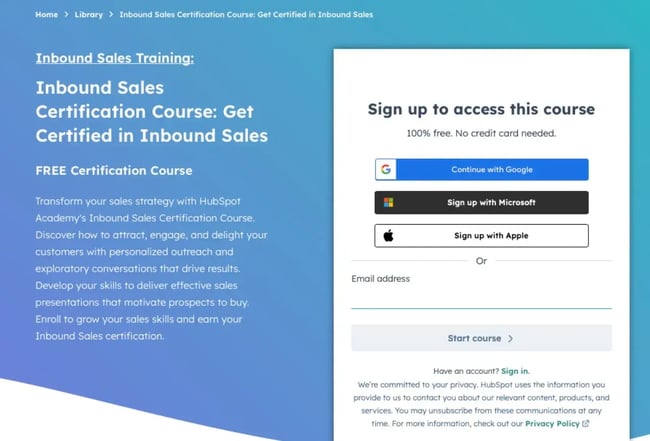
1. HubSpotInboundSales Certification Course

HubSpot inbound sales training course.

Image Source

Vendor:HubSpotAcademy

Delivery format: Online modules

Length: 3 hours, 12 minutes

Focus: The inbound sales methodology

Intended audience: Sales professionals and small business owners

Price: Free

HubSpot’sInboundSales certification course introduces you to the inbound sales methodology. Over a series of 22 videos, you’ll learn how to identify and attract prospects, understand their needs and challenges, and guide them toward the best solutions.

You’ll also discover how to create compellingsales presentations that resonate with your audience and drive results. The best part for me? Once you complete the course, you’ll get a badge and certificate to showcase your newfound skills on your LinkedIn profile, your website, or anywhere else you want.

Key Lessons

  • Identifying active buyers and getting their attention.
  • Uncovering prospects’ goals and challenges.
  • Guiding buyers toward purchase decisions.
  • Creating and delivering personalized sales presentations.

Pros

  • Free and accessible to anyone from anywhere at any time.
  • Quizzes and practical exercises to keep you engaged and enhance learning.
  • Short duration, which makes it easy to fit into busy schedules.
  • Shows you how to use HubSpot’sCRM to apply what you learned to your existing sales processes.

Cons

  • The course’s brevity might limit the depth of each topic.
  • The online-only format may not fit those who prefer in-person learning or guidance.
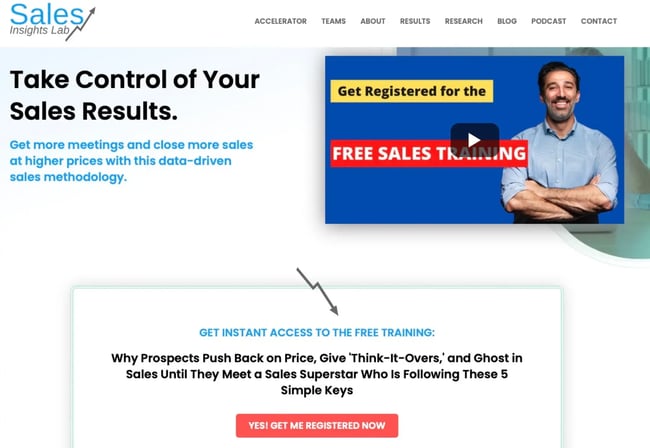
2. Sales Insights Lab Accelerator Program

Sales Insights Lab sales training course.

Image Source

Vendor: Sales Insights Lab

Delivery format: Virtual sessions; online modules

Length: Varies

Focus: Sales performance improvement

Intended audience: Salespeople struggling to close deals and hit goals

Price: Contact for details

Want to skyrocket your sales? The Sales Insights Lab Accelerator is a data-driven sales training program designed to help you do just that. It promises to give you the tools and strategies you require to find high-quality leads, secure more appointments with potential customers, close more deals, and even command higher prices for your products or services.

In my opinion, the best feature of this program is that you get direct mentorship from Marc Wayshak, a renowned expert and bestselling author. You’ll also gain access to a community of like-minded salespeople and business owners to exchange ideas and keep each other accountable.

Key Lessons

  • Creating compelling value propositions and differentiation strategies.
  • Attracting and securing meetings with qualified leads.
  • Handling objections like a pro.

Pros

  • Data-driven sales methodologies.
  • Expert guidance.
  • Mentorship and accountability support.
  • Proven success with numerous positive testimonials.

Cons

  • Limited admissions.
  • Might require previous sales experience to get maximum benefits.
3. B2B Sales SkillsTraining

Corporate Visions sales training course.

Image Source

Vendor:Corporate Visions

Delivery format: On-demand online modules; virtual and in-person instructor-led training

Length: Varies

Intended audience: Business-to-business (B2B) sales teams

Focus: Buyer psychology

Price: Contact for details

If your B2B sales team is struggling to connect with buyers, the Corporate Visions sales program can help. Because the program leverages buyer psychology — the science of how and why buyers make decisions — you can trust that the tools and tips provided will help your team succeed.

By understanding how buyers frame value and make decisions, your team can tailor their sales conversations or pitches to resonate with each prospect's unique motivations. The result? More successful closes and a thrivingsales pipeline.

Key Lessons

  • Communicating your products’ value.
  • Igniting prospects' interest.
  • Overcoming price pressures and maximizing the profitability of every deal.
  • Succeeding with digital sales.
  • Driving high-velocity sales.

Pros

  • Multiple delivery formats.
  • Science-backed training and methodologies.
  • Well-known global clientele.

Cons

  • Details like pricing only available after consultation.
  • Only available for teams.

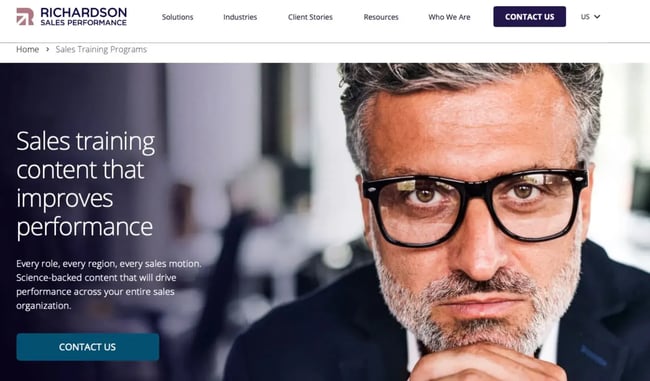
4.RichardsonSales PerformanceCourses

Richardson Sales Performance sales training courses.

Image Source

Vendor:RichardsonSales Performance

Delivery format: Virtual and in-person instructor-led workshops; webinars

Length: Varies

Focus: Behavioral selling

Intended audience: Service and sales professionals, sales leaders, and marketers

Price: Varies

Richardson Sales Performance offers a collection of science-backed courses designed to improve the performance of sales professionals across various roles and industries.

What truly sets the program apart for me is that each course has customization options to enhance skills based on the stage and complexity of the sale. This ensures you get exactly the skills you need to excel.

Key Lessons

  • Strategies for prospecting, qualifying leads, and building a robust sales pipeline.
  • Closing deals and converting opportunities into loyal customers.
  • Managing and growing existing sales accounts.
  • Sales management and leadership.

Pros

  • Multiple delivery formats offer flexibility and convenience.
  • Science-based methodologies.
  • Tailored programs for different sales roles and stages.
  • Numerous real-world success stories.

Con

  • Navigating the extensive course library can be overwhelming.
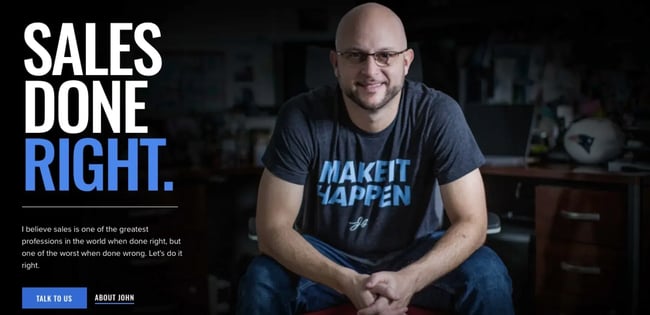
5. JB Sales by John Barrows

John Barrows sales training course.

Image Source

Vendor:John Barrows

Delivery format: Live virtual training sessions; online workshops and on-demand modules; on-site team training; one-on-one virtual coaching

Length: Varies

Focus: Driving immediate sales results

Intended audience: Sales professionals and teams

Price: $419/year for individual training subscription; $7,500-$50,000 for teams

Sales guru John Barrows has been featured in notable publications and platforms like Forbes, LinkedIn, and Inc. His sales training programs are designed for sales pros and teams “who want immediate results.”

For $419 a year, you can attend live monthly events, including training sessions on “Driving to Close” and “Filling the Funnel.” You’ll also have access to an extensive on-demand resource catalog that includes additional courses.

If you’re a sales manager, you can order a customsales trainingpackage for your team.

I like that once you finish the program, you receive official certification to validate your new skills.

Key Lessons

  • Developing and attracting high-quality leads.
  • Advancing deals through the sales cycle and closing.
  • Creating personalized and impactful sales messages.
  • Handling prospects' objections.
  • Running sales meetings effectively.
  • Developing consistent and effective sales routines.

Pros

  • Monthly live training sessions and workshops.
  • Extensive content library.
  • Positive testimonials from satisfied customers.

Cons

  • Subscription model may not be a fit for everyone.
  • Live session times might not fit your schedule.
6. SandlerSales Training Program

Sandler sales training course.

Image Source

Vendor:Sandler

Delivery format: Self-paced online learning modules; virtual and on-site instructor-led training

Length: Varies

Focus: Sales performance improvement

Intended audience: Sales professionals, sales managers, and customer success teams

Price: Varies

The Sandlersales program is designed to develop and reinforce effective sales behaviors, attitudes, and techniques through a unique blend of in-person and online training methods. What I love most about the course is that it's built on proven methodologies backed by decades of experience and research.

Kathleen Hanover, a multichannel B2B marketing expert with 25+ years of experience, has been a member of this program for over a decade. She calls it an “integrity-based program that helps a salesperson get to the reality of the situation (can you help the prospective customer or not?) as quickly as possible with the least amount of gamesmanship or manipulation.”

Key Lessons

  • Identifying and engaging high-potential prospects.
  • Negotiating tactics.
  • Ensuring customer satisfaction and cultivating long-term relationships.
  • Strategies for nurturing and growing your sales accounts.

Pros

  • Covers the whole sales process.
  • Provides ongoing support beyond the initial training sessions.
  • Allows you to network with other professionals.

Con

  • Requires dedicated time investment over weeks or months.
7. High-ImpactSales ManagerTraining

Sales Readiness Group sales training course.

Image Source

Vendor:Sales Readiness Group

Delivery format: On-site and virtual instructor-led training; digital blended learning

Length: Two days on-site or seven two-hour virtual sessions

Focus: How to lead a high-performing sales team

Intended audience: Sales managers

Price: Varies

68% ofsales managersand professionals personally coach or train their sales reps or teams. While this is a positive, some managers — despite being great leaders — may lack the skills needed to coach their teams adequately.

Sales Readiness Group’s High-ImpactSales ManagementTraining program aims to bridge that gap by giving managers the framework, skills, and tools they need to build and coach their sales teams.

The best part? The course includes experiential training — i.e., learning by doing — to keep things engaging and reinforcement strategies to ensure continued sales success.

Key Lessons

  • Effective sales coaching.
  • Sales leadership.
  • Sales pipeline management.
  • Sales performance management strategies.
  • Recruiting and selecting the best sales talent.

Pros

  • Flexible modes of learning.
  • Programs personalized to your organization and needs.
  • Free initial consultation.
  • Tools to assess program’s impact.
  • Ongoing support and reinforcement.

Con

  • Specifically targeted at sales managers, so it might not be a good fit for other sales professionals.
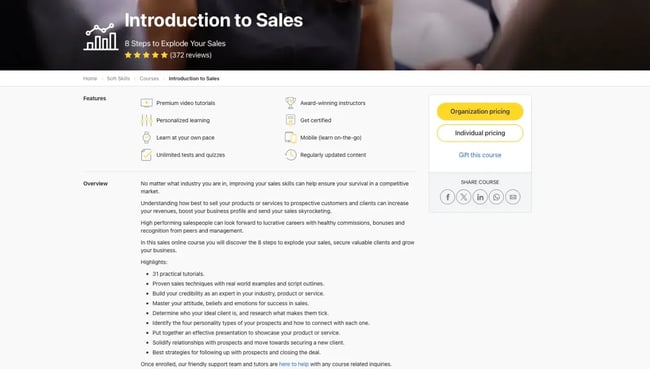
8. GoSkills Introduction to Sales

GoSkills sales training course.

Image Source

Vendor:GoSkills

Delivery format: Online modules

Length: 15.5 hours

Focus: Introductory training on sales

Intended audience: Beginner sales professionals

Price: Varies

Are you new to sales? GoSkills' Introduction to Sales course equips you with the essential skills you need to launch your sales career. This online sales training course consists of 31 easy-to-follow practical tutorials that cover fundamental sales skills such as prospecting, crafting effective sales presentations, and, most importantly, closing deals.

Even though it’s a beginner course, it offers official certification upon completion, making this a great option for new sales reps.

Key Lessons

  • Building credibility in your industry.
  • Identifying and researching your ideal client.
  • Connecting with various prospect personality types.
  • Putting together effective presentations.
  • Following up and successfully closing deals.

Pros

  • Mobile access for learning on the go.
  • Unlimited quizzes and tests.
  • Up-to-date content.
  • Evidence-backed sales techniques.

Cons

  • Not suitable for advanced sales professionals.
  • Self-paced learning requires discipline.
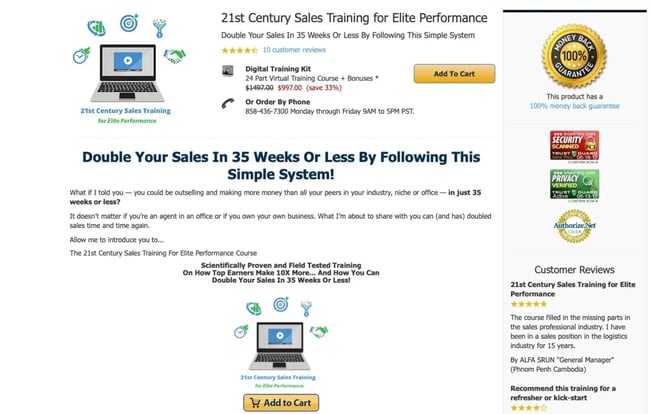
9. 21st CenturySales Trainingfor Elite Performance

Brian Tracy’s 21st century sales training course.

Image Source

Vendor:Brian Tracy

Delivery format: Online learning modules

Length: 12 weeks (60 minutes per week)

Focus: Comprehensive sales training

Intended audience: Sales professionals

Price: $997

The 21st CenturySales Trainingfor Elite Performance program, created by celebrated self-development coach and author Brian Tracy, could help you double your sales in less than a year. The 24-video training modules include practical exercises to enhance information retention.

What stands out for me about the course is that it emphasizes a scientific and field-tested approach. Whether you’re new to sales or want to refresh your skills, this program can make a big difference in your performance.

Key Lessons

  • Sales prospecting.
  • Building relationships.
  • Effectively presenting products.
  • Handling objections.
  • Closing deals.
  • Getting referrals and repeat business.

Pros

  • Taught by a respected sales expert.
  • One-time fee.

Cons

  • Higher price compared to other sales training programs.
  • Limited interaction with the instructor.
  • Requires a 12-week commitment.

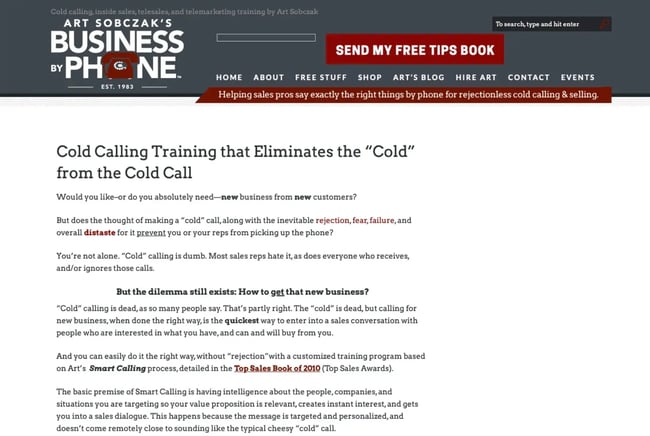
10. Art Sobczak’sCold CallingSales Training

Art Sobczak’s cold calling sales training course.

Image Source

Vendor:Art Sobczak

Delivery format: Customized team training

Length: Varies

Focus: Effective cold calling

Intended audience: Cold callers

Price: Varies

If you’ve always dreaded cold calling like me, I have no doubt you’ll love Art Sobczak’s course. He’ll develop a custom program that equips your team with the skills to make effective, rejection-free cold sales calls.

You’ll learn how to engage and create interest with your prospects within a few seconds, deal with resistance, and stay motivated in this relatively brutal form of sales.

Key Lessons

  • Gathering intelligence on prospects.
  • Creating powerful opening statements.
  • Avoiding common mistakes that lead to call failures.
  • Handling objections effectively.

Pros

  • Customized to your situation.
  • Delivered personally by Sobczak, a seasoned sales training expert.

Cons

  • Need to contact the business to get a price quote.
  • Focuses exclusively on phone-based sales.
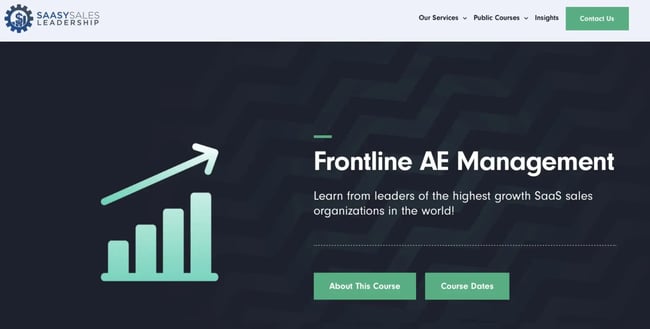
11. Frontline AE Management

Frontline AE Management sales training course.

Image Source

Vendor:SaaSySales Leadership

Delivery format: Live virtual training sessions

Length: Six days (two hours/day)

Focus: Account executive sales management

Intended audience: Software-as-a-service (SaaS) sales managers in their first two years of management

Price: $1,600

The Frontline AE Management course is based on some of the best practices and philosophies used by leading Silicon Valley SaaS companies. The engaging course covers topics like territory planning, building sales cultures, sales productivity, high-performance coaching, forecasting, and recruiting.

Gaining access to the private Slack channel was helpful for my networking efforts and allowed me to build out my sales contacts. The course also includes ongoing support and several post-training resources to ensure continuous professional development.

Key Lessons

  • Building effective management frameworks.
  • Recruiting and coaching a world-class sales team.
  • Creating a strong sales culture.

Pros

  • Continuous support through community and post-training resources.
  • Certification after course completion.
  • Access to membership clubs.
  • Interactive and engaging learning environment.

Cons

  • Not suitable for non-SaaS sales managers.
  • Limited admissions.

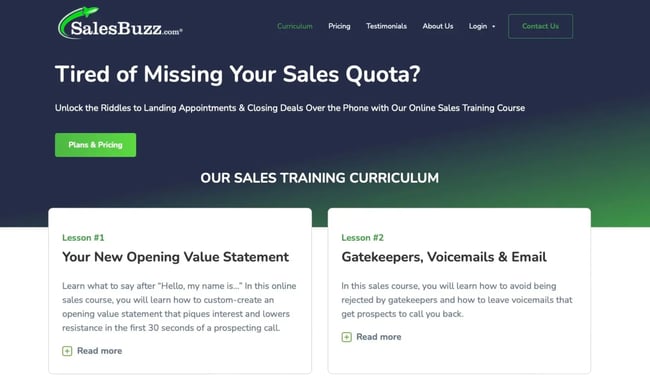
12. SalesBuzzSales Training

SalesBuzz sales training course.

Image Source

Vendor: SalesBuzz

Delivery format: Online on-demand modules; live virtual coaching sessions.

Length: Eight weeks (one course per week)

Focus: B2B phone sales/cold calling

Intended audience: B2B sales teams

Price: $495 for on-demand learning modules; request a quote to add live coaching

The SalesBuzzsales training course, targeted at B2B sales teams that primarily sell through the phone, promises to help learners land more appointments and close more deals.

The course is structured into eight distinct modules, each covering an important cold-selling topic, such as making effectivefollow-ups. Since there are quizzes in every chapter, plus a graded exam, my reps were able to check their understanding of the material. If your team is particularly struggling or many of your reps are new to sales, I recommend signing up for live coaching, as well.

Key Lessons

  • Powerful openings.
  • Gatekeeper management.
  • Engagement techniques.
  • Prospect qualification.
  • Presentation and closing skills.
  • Follow-up strategies.
  • Goal setting and time management.

Pros

  • Self-paced learning.
  • Completion certificate.
  • Access to valuable sales script templates.

Cons

  • Might not be appropriate for non-B2B sales teams.
  • Course access expires after one year.

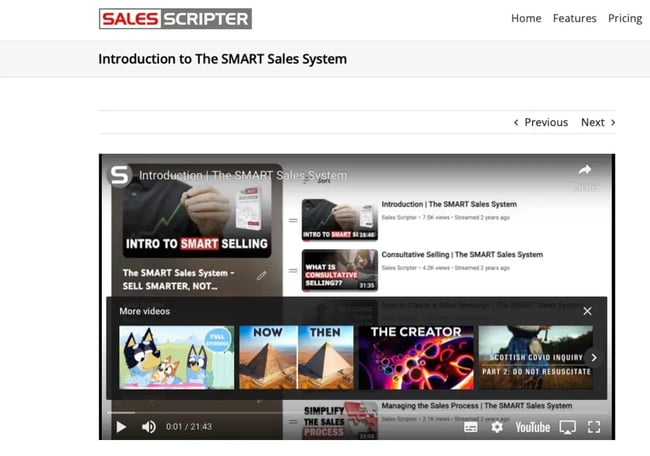
13. SalesScripter SMART Sales System

SalesScripter Smart Sales System course.

Image Source

Vendor:SalesScripter

Delivery format: Online learning modules

Length: 13 hours

Focus: The entire sales process

Intended audience: Sales professionals

Price: Free

The SalesScripter SMART Sales System is a comprehensive sales training program based on a book of the same name that provides participants with practical strategies and techniques for every step of the sales process. It consists of 18 insightful videos ranging between ten minutes and one hour, each focusing on a specific aspect of the sales process, from sales scripting to closing techniques.

Ultimately, my favorite thing about the course is that it's absolutely free of charge.

Key Lessons

  • Scripting emails, voicemails, and sales presentations.
  • Mastering cold calling techniques.
  • Qualifying prospects.
  • Dealing with objections.
  • Networking.
  • Developing mental resilience for the challenges of sales.

Pros

  • Free.
  • Covers the entire sales process.

Con

  • No direct instructor support or interaction.
14. Iannarino Sales Accelerator

Iannarino sales accelerator course.

Image Source

Vendor:Anthony Iannarino

Delivery format: Online learning modules; live events

Length: 30+ hours

Focus: Sales skills

Intended audience: Salespeople and sales managers

Price: $997 per year

The subscription-based Sales Accelerator program promises to help you develop the skills needed to maximize sales effectiveness. It offers a comprehensive curriculum with over 30 hours of on-demand video lessons and access to live events hosted by sales expert Anthony Iannarino.

The downloadable workbooks and premade scripts helped to train new sales reps on my staff and build their confidence quickly.

Key Lessons

  • Maximizing sales effectiveness.
  • Crushing your sales targets.
  • Building a disciplined mindset.

Pros

  • Coursework is available 24/7.
  • Accessible from any web-enabled device.

Cons

  • Relatively higher price point than other sales programs.
  • Limited course content and structure preview.
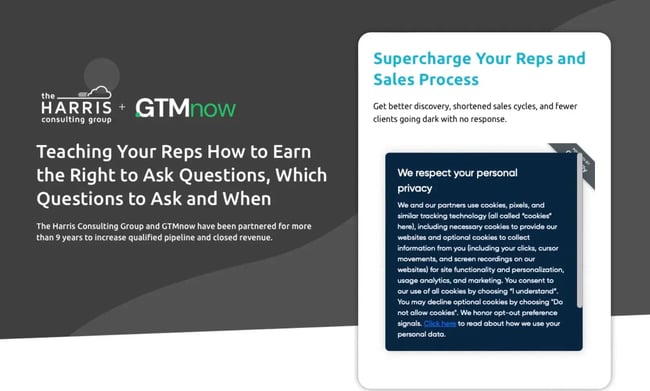
15. The Harris Consulting Group and GTMnowSales Training

The Harris Consulting Group and GTMnow sales training course.

Image Source

Vendor:The Harris Consulting Group andGTMnow

Delivery format: Virtual and on-site live sessions

Length: Varies

Focus: Full-funnel sales training and process development

Intended audience: Sales professionals

Price: Contact for details

The Harris Consulting Group and GTMnow program equips salespeople with the skills and knowledge to excel at every stage of the selling process, from lead generation to closing deals. What impresses me is that the custom program zeros in on the exact areas of your sales environment that need a boost.

I also love that the sessions use real-world scenarios to make learning practical and impactful.

Key Lessons

  • Growing sales pipelines.
  • Opportunity qualification.
  • Effective questioning techniques.
  • Negotiation strategies.
  • Sales process design.

Pros

  • Customized program.
  • Interactive group sessions to promote knowledge sharing and deeper understanding.

Con

  • Details like pricing are only available after consultation.
16. Action SellingSales Training

Action Selling sales training program.

Image Source

Vendor:Action Selling

Delivery format: Online learning modules

Length: 3-12 hours

Focus: Sales culture development

Intended audience: Sales teams at all types of organizations

Price: Contact for details

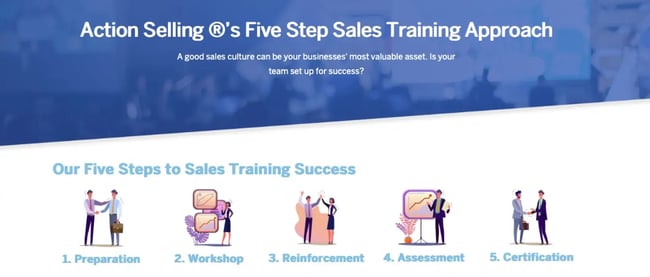
The Action Selling sales program uses a five-step approach to impart essential sales skills and strategies for success in today’s competitive market. The course can be customized to meet the unique needs of your industry or organization, and the dynamic roleplays allow reps to become more effective at handling customer objections.

One of my favorite things is that it goes beyond what many programs offer by including post-training support, such as period skill drills to test your team’s continued progress.

Key Lessons

  • Sales call planning.
  • Questioning skills.
  • Presentation skills.
  • Gaining commitment from prospects.

Pros

  • Customizable to various industries and needs.
  • Post-training support and continuous reinforcement to ensure long-term skill retention.

Con

  • Program duration varies, which can complicate planning.
17. ASLANSales Training

ASLAN sales training course.

Image Source

Vendor:ASLAN

Delivery format: On-site and virtual coaching sessions; on-demand learning modules

Length: Varies

Intended audience: B2B sales executives, account managers, sales leaders, and pre- and post-sales tech support

Focus: Sales development and leadership

Price: Contact for details

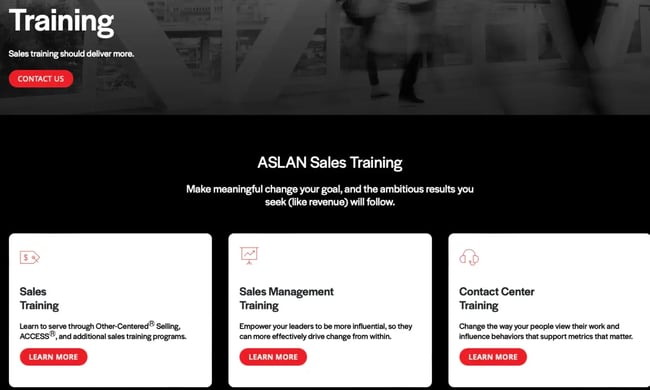
ASLAN offerssales training programs that cater to different sales roles. The program portfolio includes training for sales executives, account managers, sales leaders, and tech support staff.

Because the programs are highly customizable and include a mix of online and in-person training options, I was able to pick what skills to focus on and what delivery method works best for my schedule. Training covers areas such as prospecting, closing, customer service, and leadership.

Key Lessons

  • Customer focus and trust building.
  • Prospecting and lead generation.
  • Account management and growth.
  • Customer relationship management.
  • Sales leadership.

Pros

  • Diverse selection of training courses.
  • Multiple delivery formats for maximum convenience.

Con

  • Pricing is only available upon request.
18. MTDSales Training

MTD sales training course.

Image Source

Vendor:MTDSales Training

Delivery format: Online learning modules

Length: 3 hours

Focus: Sales fundamentals

Intended audience: New salespeople and those with no formal training

Price: Contact for details

MTDSales Training aims to equip you with essential sales and techniques you can apply to your work immediately.

Because this course is divided into small, manageable sessions, each lasting around five minutes, it was easy to fit into my busy schedule. Plus, you can access sessions on demand via any web-enabled device, allowing for learning on the go.

Key Lessons

  • Prospecting fundamentals.
  • Successful cold calling.
  • Buyer perspectives.
  • Rapport-building.
  • Planning out winning sales interactions.
  • Strategies to differentiate yourself from competitors.

Pros

  • Certificate upon completion to validate your skills.
  • Comprehensive curriculum.
  • Assessment at the end of the course to gauge your understanding.

Cons

  • Self-paced learning requires discipline to complete.
  • May not offer in-depth exploration of some topics.
19. SALESDOCk Academy

SALESDOCk Academy sales training course.

Image Source

Vendor:SALESDOCk

Delivery format: Online learning modules; one-on-one consultation (optional)

Length: 1.75 hours for modules; 4 hours for consultation (optional)

Focus: B2B sales

Intended audience: Sales professionals in B2B sales

Price: Starts at €349/year

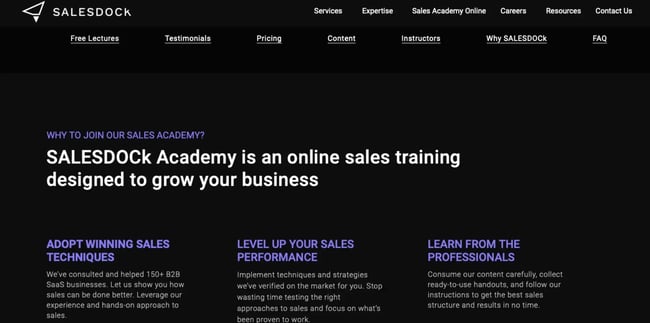
SALESDOCk'ssales training course seeks to enhance the skills and performance of B2B salespeople, particularly those in SaaS. It covers different elements of the sales process, including qualification techniques and pipeline management.

The course is divided into four modules, comprising 27 video classes on demand. I love that you also get access to a wide range of downloadable materials, including worksheets and templates, to enhance your learning. If you’d like some extra help, I recommend checking out the optional one-on-one sessions.

Key Lessons

  • Sales mindset development.
  • Prospecting strategies.
  • Qualification techniques.
  • Pipeline management.

Pros

  • Support via online chat and comments.
  • 30-day money-back guarantee.
  • Certificate upon course completion.

Con

  • Course access is limited to one year after purchase.
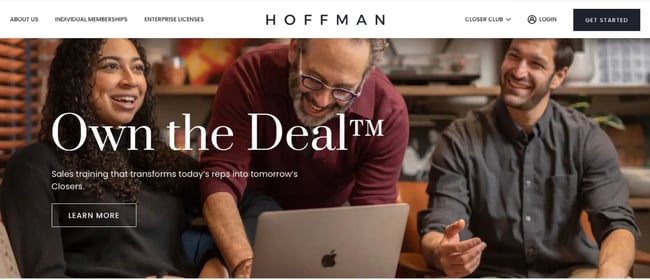
20. Own the Deal

Own the Deal sales training program.

Image Source

Vendor:Jeff Hoffman

Delivery format: Virtual classes and one-on-one sessions; on-demand learning materials

Length: Ongoing

Focus: Closing deals

Intended audience: All kinds of sales professionals and teams

Price: Starts at $395/year for individuals; corporate license starts at $1,495/member

Created by Jeff Hoffman, the subscription-based Own the Deal course introduces behaviors and techniques that can help you close more deals. It comprises live weekly classes with Hoffman and fellow sales expert CeCe Aparo on all kinds of sales topics.

A subscription also entitles you to other great benefits depending on your plan, such as access to a resource hub, private coaching from Hoffman and Aparo, and an on-demand video library.

Key Lessons

  • Building relationships with prospects.
  • Recognizing opportunities.
  • Asking for commitment.
  • Pipeline inspection.
  • Forecasting.
  • Closing deals.

Pros

  • Flexible subscription models, including individual and corporate plans.
  • 30-day money-back guarantee with some plans.
  • Live weekly classes led by experienced instructors.

Con

  • Relatively high price point for corporate plans (up to $1,995/member).
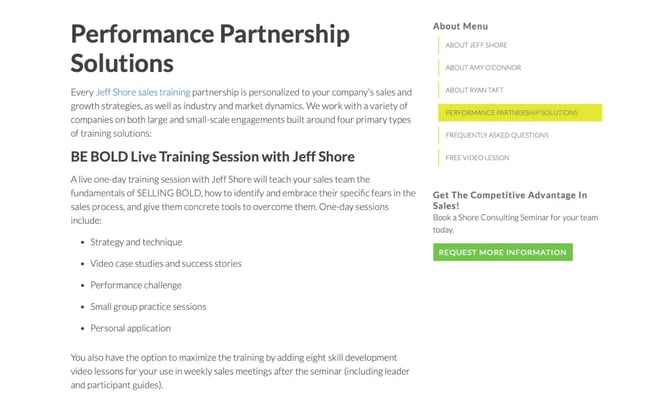
21. Jeff ShoreSales Training

Jeff Shore sales training.

Image Source

Vendor:Jeff Shore

Delivery format: On-site training; online modules (optional)

Length: Varies

Focus: Overcoming mental selling roadblocks

Intended audience: Salespeople

Price: Varies

If you’re like me, there’s one or more elements of selling that you dislike or even fear. It could be calling prospects, responding to objections, or negotiating prices. Jeff Shore's one-day workshop teaches you how to find what makes you uncomfortable and overcome it.

The training sessions include video case studies, a performance challenge, and group practice sessions. To maximize the training, I recommend purchasing the skill development video lessons to use in your internal sales seminars.

Key Lesson

  • How to embrace and then overcome your selling fears.

Pros

  • Expert trainers.
  • One-day format is ideal for busy sales professionals.

Con

  • Additional costs for supplemental video lessons.

22. SPINSales Training

SPIN Selling course.

Image Source

Vendor:Huthwaite International

Delivery format: Virtual and on-site classes; on-demand modules

Length: Varies

Focus: How to structure and executive impactful sales conversations

Intended audience: Salespeople, sales managers, business development managers, and anyone in a customer-facing role

Price: Contact for details

SPINSales Training, developed by Huthwaite International, aims to help you generate more sales plus attain higher customer satisfaction levels through an approach that’s based on extensive research into customer behavior.

The high-energy program gives you a framework for asking the right questions to uncover customer needs, build trust, and move deals forward.

Key Lessons

  • Demonstrating value to customers.
  • Making each customer interaction insightful and compelling.
  • Understanding buyer psychology.
  • Understanding and dealing with customer objections.

Pros

  • Available through a range of formats to suit different needs.
  • Data-driven and research-backed sales methodology.

Con

  • Pricing is only available upon request.
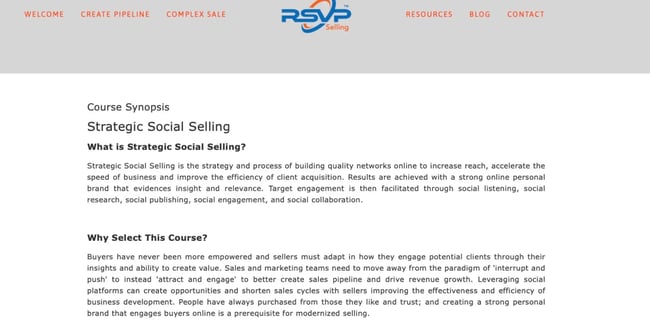
23. Strategic Social Selling

Strategic Social Selling course.

Image Source

Vendor:RSVP Selling

Delivery format: On-site custom coaching

Length: Two days or four half-day sessions

Focus: Social selling

Intended audience: B2B salespeople

Price: $2,200/day for course plus $395/person for electronic course manual

36% ofsalespeople said social media is among the most effective sales channels. And 31% think it results in the most leads when it comes to cold outreach.

In this strategic socialsales training course delivered by Tony Hughes, you’ll learn how to use social platforms and modern technologies to create a strong brand that helps you reach your target audience better and drive revenue. To get the most out of the course, I recommend your team review the “pre-learning activities” listed on the landing page.

Key Lessons

  • Building a strong online brand.
  • Using social selling techniques, like social listening.
  • Creating and sharing valuable content that establishes you as a thought leader.

Pros

  • Focused on a modern approach to sales.
  • Developed by a proven sales expert.

Cons

  • Includes additional costs, like hiring visual equipment, catering, and travel.
  • Recommends a max class size of 20 participants — no information about how the program handles larger class sizes.
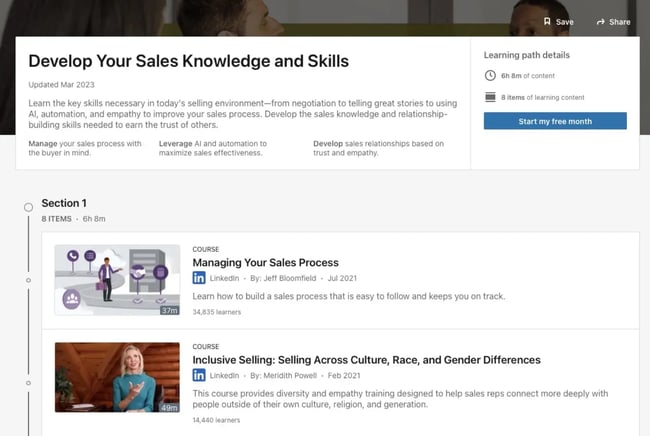
24. Develop Your Sales Knowledge and Skills

LinkedIn Learning sales training courses.

Image Source

Vendor:LinkedInLearning

Delivery format: Online learning modules

Length: 6 hours

Focus: Sales fundamentals

Intended audience: Sales professionals

Price: $29/month (LinkedIn Learning subscription)

Develop Your Sales Knowledge and Skills from LinkedIn Learning equips learners with essential sales skills for success in the modern sales environment. This self-paced collection includes eight video tutorials led by experienced sales professionals.

My favorite aspect of the program is that most courses include quizzes and practical exercises to reinforce learning and track progress.

Key Lessons

  • Building relationships.
  • Implementing inclusive selling.
  • Using storytelling to drive sales.
  • Negotiating deals that stick.
  • Leveraging artificial intelligence and automation to improve efficiency and sell more.

Pros

  • Self-paced learning allows for flexibility.
  • LinkedIn Learning subscription gives you access to multiple other courses and resources.
  • Covers a diverse range of courses.
  • Expert instructors.

Cons

  • Self-paced format requires discipline or personal motivation.
  • No personalized feedback.

25. Consultative SellingTraining

Consultative selling training course.

Image Source

Vendor:RichardsonSales Performance

Delivery format: Virtual and on-site instructor-led; blended learning format; on-demand learning modules

Length: One- or two-day instructor-led workshop; two or four 4-hour virtual instructor-led training

Focus: Consultative selling

Intended audience: Sales professionals and leaders

Price: Contact for details

The Consultative SellingTraining course equips salespeople with a powerful roadmap for conducting successful sales conversations. You’ll learn how to better understand customer needs by asking insightful questions, persuasively articulate value to prospects through tailored presentations, and close more deals.

I like that the course pairs online learning modules with virtual and in-person live workshops, giving participants some flexibility.

Key Lessons

  • Establishing rapport with prospects.
  • Uncovering prospect needs.
  • Effectively demonstrating value.
  • Handling objections.
  • Closing the sale.

Pros

  • Flexible learning formats.
  • Richardson is a recognized leader in the sales training industry.

Con

  • Prices are only available upon request.
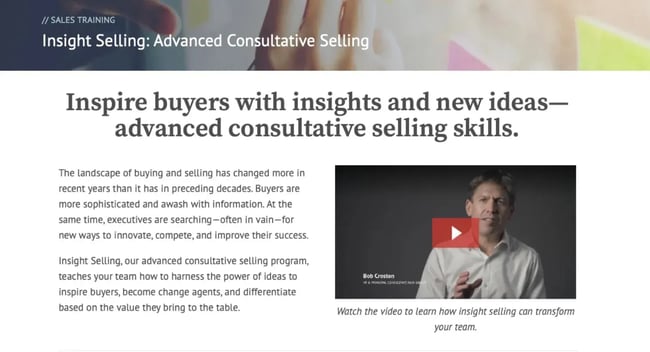
26. Insight Selling

RAIN Group’s Insight Selling course.

Image Source

Vendor:RAIN Group

Delivery format: Virtual and on-site instructor-led training; hybrid training; self-paced online modules

Length: Varies

Focus: Insight selling

Intended audience: Experienced sales professionals and managers

Price: Contact for details

Modern buyers value sellers who bring them new insights and ideas. In fact, 26% ofsalespeople said that not receiving enough information while making a decision is one of the biggest reasons prospects pull out of deals.

Meanwhile, RAIN Group ’s research shows that salespeople who close deals educate buyers with fresh information three times more than other reps. Its highly effective Insight Selling training course teaches you and your team how to develop and share insights and ideas that inspire buyers to think differently or move them closer to a decision.

Key Lessons

  • Developing insights and ideas that resonate with buyers.
  • Influencing the buyer agenda.
  • Encouraging buyers to consider new perspectives.

Pros

  • Research-based methodologies.
  • Flexible delivery, including online and in-person options.
  • RAIN’s programs have a strong track record.

Con

  • Some of the content is only suitable for advanced sales pros.
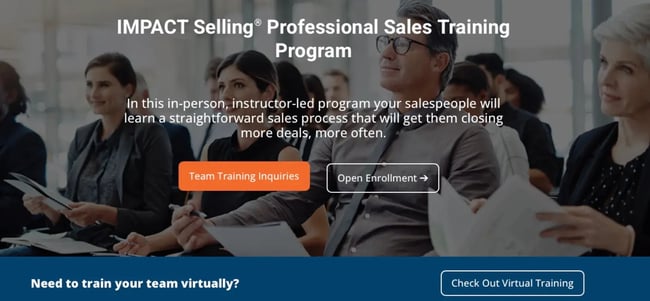
27. IMPACT Selling ProfessionalSales Training Program

IMPACT Selling Professional Sales Training Program.

Image Source

Vendor:The Brooks Group

Delivery format: In-person and virtual instructor-led training

Length: Two days (in-person); six 2-hour sessions (virtual)

Focus: Improving sales performance

Intended audience: B2B salespeople and managers

Price: $2,495/person for in-person; $2,195/person for virtual

This program teaches a straightforward six-step sales approach called IMPACT selling, an acronym that stands for Investigate, Meet, Probe, Apply, Convince, and Tie-it-up. The framework guides participants through building relationships, uncovering customer needs, delivering effective presentations, and closing deals.

One of my favorite things about the course is that it’s designed to be adaptable to your specific sales environment and training needs.

Key Lessons

  • Effectively researching and connecting with your target customers.
  • Asking the right questions.
  • Understanding prospects’ challenges.
  • Presenting solutions in ways that guarantee a close.

Pros

  • Adapts to your unique business needs.
  • Flexible delivery options.

Cons

  • Limited preview of specific course content.
  • In-person sessions have a set schedule, which might not work for everyone.
28. Engage SellingSales Training

Engage Selling training course.

Image Source

Vendor:Engage Selling

Delivery: On-site training

Length: Half or full day

Focus: Sales process and performance

Intended audience: Businesses across all industries looking to boost their sales teams’ performance

Price: $17,500 for full day or $12,500 for half-day, plus travel expenses

If you partner with Engage Selling, creator Colleen Francis will first perform an in-depth analysis of your sales team and environment to identify potential areas of improvement. Based on this analysis, she and her team will then develop a customized training program and deliver it on-site to your reps.

I love that the program focuses on your specific sales needs instead of cookie-cutter solutions, ensuring the greatest impact on your team’s performance.

Key Lessons

  • Sales strategy development.
  • Sales process optimization.
  • Skills development for different sales scenarios.

Pros

  • Tailored to your specific needs and sales environment.
  • Positive testimonials from satisfied customers and brands.

Cons

  • Relatively high price point for just one day of training.
  • Travel costs not included in price.

29. Sales Managed Environment

Anthony Cole’s Sales Managed Environment course.

Image Source

Vendor:Anthony Cole Training Group

Delivery format: On-site training sessions; live webcasts; online learning materials; one-on-one coaching

Length: Ranges from a few days to 18 months

Focus: Coaching skills development for sales managers

Intended audience: Sales managers

Price: Contact for details

Anthony Cole Training Group has been helping companies improve their sales performance for over 25 years. The Sales Managed Environment course equips sales managers with the coaching and leadership capabilities they need to unlock their teams' full potential.

If you’re looking to invest in the development of your management skills, this is a course you should seriously consider. I recommend checking out the introductory samples on the landing page before selecting which of the three approaches would work best.

Key Lessons

  • Coaching and mentoring skills development.
  • Performance management strategies.
  • Sales talent acquisition.

Pros

  • Integrated or standalone program options to fit your specific needs.
  • Experienced instructors.
  • Multiple delivery formats.

Con

  • Can be tough to choose the best package for your organization.
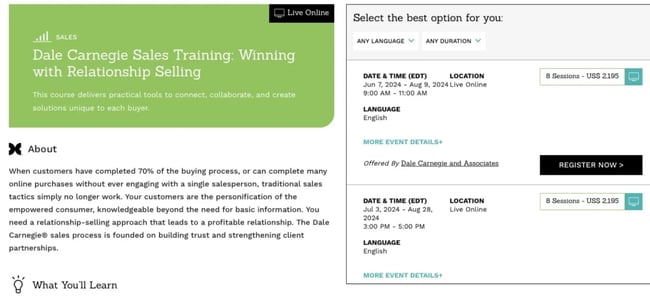
30. Winning with Relationship Selling

Winning with Relationship Selling course.

Image Source

Vendor:Dale Carnegie

Delivery format: Live online and in-person seminar

Length: One session per week for eight weeks or three days

Focus: Relationship selling

Intended audience: Sales professionals

Price: Starts at $2,195/person

26% ofsalespeople said that the increased importance of establishing trust and rapport with prospects was one of the biggest ways their roles changed in the past year. What’s more, 28% said not establishing enough trust was one of the biggest reasons for prospects backing out of deals.

Because trust has become so important to sales, I recommend checking out Dale Carnegie's Winning with Relationships Selling program. It gives you the necessary skills and strategies to cultivate trust, build rapport, and foster long-lasting client partnerships that increase your sales performance.

Key Lessons

  • Relationship-building.
  • Interpersonal skills.
  • Customer-centric selling.

Pros

  • Based on proven methodologies.
  • Expert, highly vetted trainers.
  • Options for online or in-person training.

Con
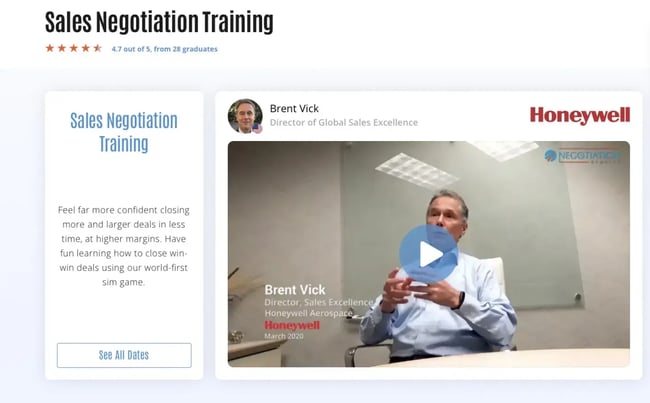
  • High price point.

31. Sales Negotiation Training

Sales Negotiation Training course.

Image Source

Vendor:Negotiation Experts

Delivery format: On-site and virtual instructor-led sessions

Length: Half-day to six days

Focus: Negotiating skills

Intended audience: Sales professionals looking to improve their negotiation skills

Price: Contact for details

This Sales Negotiation Training is designed to help you improve your negotiation skills and thus close bigger deals faster. It covers all aspects of sales negotiation, from preparation and strategy development to execution and closing.

The course uses a highly interactive approach that includes role-playing exercises, group discussions, polls, and Q&As — with theory limited to a minimum. I love that you can customize the course before you order, including the interactive elements to include and number of training days.

Key Lessons

  • Choosing between negotiation styles.
  • Gathering information about prospects.
  • Building trust and rapport.
  • Effectively communicating value propositions.
  • Handling objections.
  • Using storytelling for persuasion.

Pros

  • Multiple customization options.
  • Engaging and interactive learning formats.
  • Practical strategies you can apply to the real world immediately.

Con

  • Prices only available upon request.

32. Effective Sales Coaching

Effective Sales Coaching course.

Image Source

Vendor:ValueSelling Associates

Delivery format: In-person and virtual instructor-led training; on-demand courses

Length: Varies

Focus: Value-based selling

Intended audience: Salespeople

Price: Available upon request

The Effective Sales Coaching program teaches how to communicate value effectively to potential buyers. It’s based on the ValueSelling Framework, a proven sales methodology that emphasizes understanding and communicating value from the customer's perspective.

When you sign up, the team will create a practical, fully customized program designed to help you meet or even exceed your objectives. With big-name participants like Google and YouTube, you can trust the program to help you win in a crowded market.

Key Lessons

  • Communicating value to buyers.
  • Conducting impactful sales conversions.

Pros

  • Customized coaching.
  • Engaging training format with a combination of online resources and workshops.
  • Experienced trainers.

Con

  • Consultation needed to get details like pricing.
33. GP StrategiesSales Training Programs

GP Strategies sales training programs.

Image Source

Vendor:GP Strategies

Delivery format: In-person and virtual instructor-led training; on-demand courses

Length: Varies

Focus: Sales performance improvement solutions

Intended audience: All customer-facing roles

Price: Contact for details

As part of its sales training programs, GP Strategies partners with you to understand your organization's unique needs and challenges and then designs a high-value program specifically tailored to address those needs. The goal is to give your team the skills and knowledge they need to excel in your specific sales environment.

If you’re looking for multiple types of staff training, I recommend checking out GP Strategies’ other learning solutions, which cover everything from diversity, equity, and inclusion (DEI) to technology change management.

Key Lessons

  • Engaging customers.
  • Navigating sales conversations effectively.
  • Identifying customer motivations.

Pros

  • Customizable programs.
  • Flexible learning formats.
  • Expert instructors.

Con

  • Need to contact GP Strategies to get pricing information.
34. Ariel GroupSales Training

Ariel Group sales training course.

Image Source

Vendor:Ariel Group

Delivery format: Virtual and in-person instructor-led training; one-on-one coaching

Length: Varies

Focus: Consultative selling skills

Intended audience: Sales professionals and client-facing consultants

Price: Contact for details

Modern prospects don’t simply want to be sold to. Instead, they want to talk about their unique challenges and see how you, as a salesperson, can address them. In fact, 27% ofsalespeople shared that the shift toward focusing on solutions instead of products/services was one of the most impactful changes to the sales process in the past year.

The Ariel Group’ssales training course transforms sales professionals into trusted consultants who can build stronger relationships with clients, identify and relate to their needs, and deliver tailored solutions. Because the course is flexible — it can be delivered virtually or in person — I was able to pick the best option for my team.

Key Lessons

Pros

  • Customized to your needs.
  • Can be delivered virtually or in person.

Con

  • In-person training can only have 12 participants.
35. Ian KoniakSales Coaching

Ian Koniak sales coaching.

Image Source

Vendor:Ian Koniak

Delivery formats: On-site training (teams); on-demand online courses

Length: Varies

Focus: Mindset coaching and B2B sales skills mastery

Intended audience: B2B salespeople

Price: Contact for details

Ian Koniak is a sales guru who currently boasts over $100 million in career sales at Fortune 500 tech brands, such as Salesforce and Ricoh.

Koniak’ssales coaching focuses on developing the right mindset for selling and mastering the skills needed for every stage of the B2B sales cycle. With his program, Koniak promises to help you become a top sales performer.

The individual package includes on-demand online courses. The best part? You also get direct mentorship from Koniak. For the team package, he’ll develop and deliver a custom interactive program.

Key Lessons

  • Sales fundamentals.
  • Strategic selling.
  • Mindset and habits for selling.

Pros

  • Both individual and team training are available.
  • Expert course instructor.
  • Custom training for teams.

Con

  • Pricing may vary based on the level of customization and delivery format.
36. RISOR Training

Sales Gravy RISOR course.

Image Source

Vendor:Sales Gravy

Delivery: Virtual sessions

Length: Eight hours, but can be expanded to two days

Focus: Recruiting, interviewing, selecting, onboarding, and retaining (RISOR) sales talent

Intended audience: Sales managers

Price: Contact for details

Hiring greatsalespeople can be tough — I know that firsthand. It's even harder if your business sells a product or service that requires prerequisite knowledge or a specific skill set.

The Sales Gravy RISOR program is designed to improve your organization’s hiring processes, ensuring you attract and retain the best sales talent. The course covers every stage of the talent management lifecycle, from recruitment to retention. To go even deeper, I recommend adding on the advanced coursework.

Key Lessons

  • Recruiting strategies.
  • Interviewing skills.
  • Selection processes.
  • Onboarding programs.
  • Retention techniques.

Pros

  • Expert instructors.
  • Addresses all critical aspects of sales talent management.

Con

  • Limited information on the specific content before signing up.

Unlock Your Full Potential With Sales Training

Sales training courses offer a variety of benefits, including improved sales (and thus more revenue), better customer relations, lower turnover, and reduced costs of selling activities.

While there are many factors to consider when choosing a program, the best options perfectly align with your current needs, budget, and learning preferences. See which of the courses in my list is a good fit for you.

Editor's note: This post was originally published in October 2023 and has been updated for comprehensiveness.

30-60-90-sales-training-plan-template-bottom-cta


22 Mar 16:03

How Marketing Can Get Sales Asking for Referrals

by Jessica Edmondson

Get sales to start asking for referrals

Innovative . . . at one point being described this way by an industry expert would have given a company a huge differentiation. But in the past few years the title of innovator has become less of a differentiation and more of a requirement in business in order to even compete in an overcrowded ecosystem. While innovation can be broadly defined, when talking about innovation it is usually referring to the reinventing of business process, structure, or model. One area this has been evident is in the sales and marketing arena. Between marketing taking majority responsibility for lead generation and sales becoming key to the success of marketing initiatives like referrals, the inclusion of sales enablement functionality within marketing programs has become vital. Hubspot discovered that sales and marketing misalignment costs companies $1 trillion per year in decreased sales productivity and wasted marketing efforts.

Referral marketing programs have become an established way to generate leads, and has even been called innovative. But in order to take referrals to the next level and make them a transformative lead generation initiative, marketers need a technological catalyst that can align sales with marketing and motivate sales to generate more marketing leads by asking for referrals.

Here are three ways to accomplish this task.

3 ways to motivate sales to increase referral leads

  1. Promote your referral program to sales

When thinking about promoting a referral program or any program, companies generally don’t included a campaign to sales in the promotional strategy. But like with customers and partners, sales is an integral part of a referral program and that means they need to be engaged in it. Many times what happens with a referral program is sales doesn’t feel driven enough to start or continue asking for referrals. And if the referral program isn’t implemented as a strategic channel worked by marketing AND sales it could be forgotten about. One company who understood the need for sales to be an engaged is Cable One Business. At launch, Cable One Business:

  • Had email blast targeted at associates that emphasized the value of the program
  • Made program specific branding to give the referral program a recognizable look to salespeople
  • Put up flyers around the offices that had details about the referral program to create awareness and understanding
  • Hung flyers in the bathroom with the theme of cheesy pickup lines that would teach sales how to start asking for referrals

Through Cable One Business’s promotion to their sales teams they were able to successfully align sales and marketing goals in the referral program.

  1. Structure your referral program to incentivize sales

For companies that have run a referral program they know that along with being motivated by loyalty, advocates are motivated by incentives. When asking for referrals, salespeople are no different. Salespeople have a hard job and high quotas to fulfill. So what do they get out of taking some of their precious time and using it for a marketing owned program? Well, by instituting a program that can enable advocate ownership, sales can overrides the normal lead routing rules. This way any referrals that come from the advocates owned by a specific salesperson will go to that salesperson instead of keeping with regular lead routing rules. The referral functionality motivates sales to invite and nurture customers to become engaged advocates while working their referrals. This then becomes another means to meet quotas and get sales commissions. By aligning sales and marketing goals within the referral program a company can drastically increase revenue. Hubspot discovered that companies whose sales and marketing teams are aligned generated 208% higher marketing revenue when compared against misaligned teams.

In addition to implementing this type of functionality, many companies have also made referrals a part of sales team’s quota incentive. Cable One Business offered their salespeople a $4,000 incentive if they hit certain revenue goals which included submitting at least 4 referrals.

  1. Make it easy for sales to take part in the referral program

A company can promote and incentivize their sales team all they want, but if it isn’t easy to see advocate and referral data, and recruit and nurture customers, they aren’t going to put the effort in. This is where having the referral program data and functionality integrated into the sales CRM is critical. It’s not surprising that Aberdeen found that salespeople spend up to 43 hours/month trying to find information. To put this in perspective, that is 10.75 hours a week, and over one day of work. A referral program shouldn’t add to that struggle. By having a sales enabled referral program, sales has access to everything they need in their CRM instead of having to search through multiple programs and locations to find it. This includes functionality and data such as:

  • Ability to invite customers to the program
  • Seeing referring advocate information to reach out and qualify the referral and get a facilitated introduction
  • Seeing advocate referral metrics in order to nurture them to refer multiple times
  • Ability to input trackable verbal referrals for both registered and unregistered advocates
  • See lead source as a referral

Aberdeen proved that companies with top-tier sales enablement strategies experience 13.7% annual increase in deal size. Discover what a sales enabled referral program will do for your ROI. Try the ROI calculator now!

22 Mar 16:03

Introducing The Definitive Guide to Account-Based Marketing

by Ellen Gomes
introducing-the-definitive-guide-to-account-based-marketing

Author: Ellen Gomes

If you’ve been keeping up with digital marketing trends, then account-based marketing is most definitely on your radar. In fact, you’ve probably heard about it so often that it may have started to feel like just another buzzword.

But account-based marketing is not to be ignored and it’s not just another buzzword. Buzzwords become dated terms as time passes, but it’s just the tip of the iceberg for ABM as more B2B marketers than ever are realizing its significant impact and value.

Why Is Account-Based Marketing Gaining Traction?

At its core, account-based marketing (ABM) is a targeted strategy that focuses on delivering personalized programs, messages, and content to select companies, and the leads within them, in an effort to engage them and move them towards a goal—whether that’s an initial sale, cross-sell or upsell, contract renewal, or even advocacy.

While it’s not a new concept, ABM is experiencing a resurgence and gaining momentum because of recent technology innovations that allow organizations of all sizes to practice ABM in a scalable and automated way. As Matt Heinz, a notable industry influencer, put it “ABM isn’t about company size. If there is more than one person in the organization you need to influence to get the deal, ABM applies.” And with ABM solutions that are either native to a platform or complementary, marketers can plan, manage, and measure their campaigns and collaborate with other cross-functional teams more effectively.

Is ABM Right for Your Organization?

Smart marketers know better than to jump on the bandwagon and cave into “shiny new objects.”  Account-based marketing is a strategy and not a tool, although it may require one, to support it well you will need to shift your overall marketing strategy, budget, and/or resources. To determine whether ABM is right for your business model, ask yourself the following questions:

  • Does your sales cycle involve a research/evaluation phase due to the cost or level of commitment required from the buyer and often involve multiple stakeholders?
  • Do your sales and marketing teams want to make a bigger impact with a more strategic focus?
  • Do your best-existing customers who generate the most revenue for your business have distinct characteristics OR have you identified accounts with distinct characteristics that have the potential to generate more revenue?
  • Are there organizations with needs that your solution clearly addresses?
  • Do your organization’s goals include expanding into a new segment, territory, or vertical, or going after your competitor’s customers?
  • Does your organization offer several products or services and have goals to grow customer lifetime value through upsell and cross-sell?

If you answered yes to any of the above, then an ABM strategy will benefit your organization. How you choose to practice ABM will depend on your objectives and bandwidth. Some organizations are in in the early stages of the ABM maturity curve, exploring whether ABM is right for them, while others are more seasoned experts, looking for ways to fine-tune their strategy. Regardless of your stage, the key to success is to continuously learn, iterate and optimize your strategy.

The Benefits of ABM

Rather than casting a wide net, which catches anything and everything, account-based marketing focuses your efforts on targeting and engaging companies that deliver more value to your organization. ABM can benefit your organization in the following ways:

  1. Increases return on investment (ROI): Compared to other B2B marketing strategy or tactic, ABM delivers the highest return on investment, according to the 2014 ITSMA Account-Based Marketing Survey. Because ABM focuses your organization’s efforts on generating pipeline and growing revenue within strategically significant companies—those with a high propensity to purchase from, stay with, and buy more from you—it results in bigger deal sizes, more recurring revenue, and large lifetime values.
  2. Improves efficiency: Rather than having a low conversion rate from new names to qualified leads as you would with broad-based marketing strategies, you’ll start with a pool of accounts that are already more likely to convert, fill the white space of contacts in those accounts that matter, and then give them personalized, focused attention. By strategically targeting your efforts, you minimize the expenditure of resources on less important buyers or segments of the market—often significantly reducing waste.
  3. Improves engagement: Prospects and customers are more likely to engage with content that is specifically for them and is relevant to their business and stage in the buyer journey. In fact, according to Aberdeen Group, 75% of customers say they prefer personalized offers. And because ABM is inherently personal, your campaigns are already optimized to engage your target audience with the right content.
  4. Attributes revenue: With an ABM strategy and the right technology to support it, you can show the impact each activity has on driving a sale or other objective. Because of the tight alignment required between sales and marketing, each team is able to see an account-centric view of their revenue attribution and understand which channels, channels, and messages drove engagement and made an impact.
  5. Increases sales and marketing alignment: Account-based marketing requires both marketing and sales to work together toward the strategic goal of landing and expanding target accounts. This collaboration holds each team accountable for working towards the same goal. Marketing is just as invested in targeting, engaging, and penetrating target accounts as sales, and they work in tandem to do so—planning, agreeing on definitions and processes, coordinating outreach, and sharing feedback.
  6. Improves the customer experience: With new technologies that support account-based marketing at scale, marketers can focus on continuing to build relationships with their customers after the sale to support different objectives. In fact, according to Alterra Group, 84% said ABM provided significant benefits to retaining and expanding existing client relationships. This is critical when you consider that marketers are shifting their focus toward a customer-centric agenda.

Learn how to reap the benefits of account-based marketing by downloading The Definitive Guide to Account-Based Marketing. This comprehensive 100+ page guide covers everything from obtaining organizational buy-in to account identification, content creation, multi-channel engagement, and measurement. It also provides guidance on how to choose the right ABM solution and comes with a tactical playbook for use cases across the customer lifecycle. Download today!

Download The Definitive Guide to ABM


Introducing The Definitive Guide to Account-Based Marketing was posted at Marketo Marketing Blog - Best Practices and Thought Leadership. | http://blog.marketo.com

The post Introducing The Definitive Guide to Account-Based Marketing appeared first on Marketo Marketing Blog - Best Practices and Thought Leadership.

22 Mar 16:02

Using social media marketing in B2B markets?

by Neil Davey

How does social media compare to other channels for B2B Marketing? Social media marketing might initially appear to be the sole preserve of the business-to-consumer (B2C) marketer. But according to this research into B2B Social media marketing by Omobono, not only can …..

The post Using social media marketing in B2B markets? appeared first on Smart Insights.

22 Mar 16:02

Sometimes nothing is better

by Drew McLellan

nothingThere is a required critical mass in terms of marketing. Sometimes it’s actually better to do nothing as opposed to underfunding an effort. In this conversation underfunding could mean not having enough money but it could just as easily mean not being willing to commit the time, the focus or have the discipline to honoring a schedule.

I get that this is counter-intuitive. Surely it’s better to do something rather than nothing, right? Actually, if what you’re going to accomplish is simply diminishing your resources and not really moving the needle – why bother?

Just to be clear – I am not saying that no marketing is ever a wise choice. Just that you need to be realistic about your resources and allocate them wisely.

Here are some signs that should indicate to you that maybe you’d be better off just putting the money back in your pocket and/or the time back into your day.

If you can’t sustain the effort: Marketing is a marathon, not a sprint. I don’t care how compelling your offer is, how fascinating your story is or how awesome your product/service is – marketing takes time. You can’t speed up the process of when a prospect actually needs what you sell. Sure – you can trigger an earlier purchase with a killer discount or some other enticement, but until they have decided to buy, the ball remains in their court.

Add to that the amount of marketing noise out there. It takes a while to break through the clutter. All of that adds up to the reality – if you can’t sustain something for a minimum of six months, don’t bother doing it. That doesn’t mean every marketing tactic requires a six+ month investment of time or money. But it does mean you need to be ready to make that level of commitment, just in case. If you run out of time or money short of the finish line, you’ve basically wasted that resource and not reaped any of the rewards you might have enjoyed if you could have stuck it out a few more months.

If you’re desperate: I’ve rarely seen any company make a good marketing decision when their back was against the wall. Desperation typically leads to a herky-jerky series of attempts – none of which are well thought out, executed in the best way or left in place long enough to be effective.

Prospects can smell desperation and it’s off-putting, to say the least. If you’re desperate, odds are you’ve taken your eye off the marketing ball because you’ve been so busy servicing clients or developing a new offering and now, your pipeline is dry. Sadly, there is no short fix to that other than to learn your lesson and make marketing a daily activity – even on the busiest of days so the pipeline always has some flow.

If you’re just going to talk about yourself: Until you get it through your head that marketing should always be about, for and in the voice of the consumer, you might as well not waste your money or time. They only care about us in the context of their work or their life. If you can’t frame your marketing to help them understand how you can enhance some aspect of their world, don’t bother.

That’s not to say you never mention what it is you sell. But marketing is about gaining their interest and their trust. That’s accomplished through being helpful, not through selling. They’ll let you know when they’re ready to shift the conversation to sales.

Marketing is something you should do every day but that doesn’t mean every possible tactic is a good choice. Watch for these red flags to avoid spinning your wheels for nothing.

The post Sometimes nothing is better appeared first on Drew's Marketing Minute.

21 Mar 15:28

3 Surprising Ways to Drive Business Performance

by Lynn Hunsaker

business performance driversIs artificial intelligence, digital marketing, predictive analytics, customer engagement, big data, or some other “shiny object” the key to driving business performance? Certainly all of these endeavors can make a difference in revenue growth. Yet there is a bigger picture. None of these is standalone in what’s required to sustain revenue growth, and they may or may not be big influencers of profit growth.

Research of 10,000 companies across 25 years proved that a strong customer culture drives business performance in over 35 performance measures, including ROI, growth, customer retention, market share and sales.1

When you think about it, that makes a lot of sense:

  • 40-70% of customers switch loyalty due to a perceived attitude of indifference
  • 91% of companies claim to be customer-focused, yet only 10% of customers agree2

Surely you’re asking: how can something like strong customer culture be quantified? Answer: the 35 performance measures mentioned above can be distilled into 3 pivotal factors — (1) Customer Insight & Foresight, (2) Competitor Insight & Foresight, (3) Peripheral Vision.

As you explore the following descriptions of these 3 monumental factors, consider the degree to which they are embraced in your organization’s strategy.

1) Customer Insight & Foresight

The extent to which employees — at any and every level and in any and every function — monitor, understand, and act on (a) current customer needs and satisfaction and (b) potential customer needs and opportunities.

As the ultimate source of salaries, budgets and dividends, customers make the world go ’round. So it makes sense that being attuned to customers, through and through, is a massive driver of business performance.

Bad habits in organizations of any kind excuse certain roles from paying attention to the ripple-effect they have on customers, or at least, to their impact on those who serve customers. Poor traditions allow weak accountability for acting on customer needs. Inside-out thinking creates silos of many kinds that get in the way of maturity in this factor, and of business performance overall.

2) Competitor Insight & Foresight

The extent to which employees — at any and every level and in any and every function — monitor, understand, and respond to (a) competitor strengths and weaknesses and (b) new market entrants and potential competitors.

As the contextual realities of customers’ spending choices, your competitors (along with you) shape customers’ expectations. So it’s logical that being astute about competitors, in all you do, is a substantial driver of business performance.

Silo-ization of competitor insight to functions such as strategic planning, business intelligence, product marketing and research and development hamper your organizational mojo competitively. Standing in your customers’ shoes to gain their perspective of your competitors can influence every job level and functional area in setting appropriate performance standards for themselves. It’s especially effective to see competitors from the standpoint of different customer segments/personas. This can be instrumental in driving business performance overall.

3) Peripheral Vision

The extent to which employees — at any and every level and in any and every function — monitor, understand, and respond to trends in the larger environment (political, economic, social and technical).

Context is essential for the success of most things in life. In some countries, it’s more natural for employees at all levels to be ever aware of context, while in other countries we need to train ourselves to think about the “concentric circles” around what we do. Being in-tune — or out of tune — with the larger environment in our thinking and doing is an obvious driver of business performance.

Peripheral vision is hampered by silos — organization silos, process silos, data silos, etc. It is weak when any of us take our job for granted, as an end in itself, rather than as a cog in a bigger wheel. Adaptability of the organization (i.e. agility) in the context of evolving external forces is certainly fundamental to driving business performance overall.

Foundational Levers

The 3 pivotal factors of business performance outlined above are internally enabled (or thwarted) by 3 foundational levers:

(A) Cross-Functional Collaboration: The extent to which employees interact, share information, work with, and assist colleagues from other work groups.

The necessity of this foundational lever is clear when you consider the horizontal flow of the customer life cycle and the end-to-end customer experience journey. It’s underscored when you consider the multi-faceted dynamics of competitor and peripheral vision forces. Nothing is an island, so employee/leader behaviors at odds with cross-functional collaboration are a detriment to business performance impact of the 3 key customer culture factors.

(B) Strategic Alignment: The extent to which employees understand and enact the vision, mission, objectives, and strategic direction of the company.

The need for this foundational lever is readily seen in mis-matches between strategy and execution. This has historically been a thorn for every employee level, and is also of keen interest to investors. Lack of alignment across functions, and/or at successive group levels, is a deterrent to business performance impact of the 3 key customer culture factors.

(C) Empowerment: The extent to which employees are able to make decisions that are best for the customer without the explicit approval of senior leaders.

The indispensibility of this foundational lever is undeniable, especially when seen from the point of view of customer-facing employees and customers themselves. Freedom to make sensible decisions is essential for numerous special circumstances. Lack of freedom (read: trust) is a severe source of frustration and churn for employees and customers alike, and hence, a stumbling block to business performance impact of the 3 key customer culture factors.

Business Performance Leadership

Mastery of these customer culture factors and levers is not as hard as you think. As Linden and Chris Brown describe in their book, The Customer Culture Imperative, a database of more than 200 companies makes it possible to benchmark your organization to growth success standards. The database is diverse across geographies and industries, and the benchmark findings provide a practical roadmap for your organization’s progress in strengthening its customer culture.

Statistical validation outranks measures such as SAT scores and college GPA3 by far — the correlation of benchmark findings and business performance is nearly at par with the correlation of a location’s temperature and its nearness to the equator.

Executives at Vodafone, PWC, Hitachi, Westpac, Telstra, HP, Ergon, Bell Canada, and dozens of other companies have attested to the eye-opening and unifying power of benchmarking the customer culture factors and levers described above. As a direct result of the benchmarking and its roadmap, “Speedo’s performance was turned around from one in decline to one of growth in market share, profit margins and the development of new market segments” said Tim Lees, Marketing Director. Kristin Gates, Worldwide Corporate Marketing Account Manager at HP said this benchmarking work “is the best thing we have done to increase our marketing capability at HP”.

Silver bullet for business performance? Yes, customer culture is it! Customer culture strength significantly enhances all the shiny objects’ potency. Alone, none of the buzzword techniques can do the whole job. In harmony with customer culture strength, your organization can take on a firm leadership role in driving sustained growth in all business performance measures.

1The Customer Culture Imperative, Dr. Linden Brown and Chris Brown, 2014
2Forrester Research, 2012
3SAT = standardized admission test for universities in the United States; GPA = grade point average

For more information about this research and how organizations can use it, see Measure Customer-Centricity at MOpartners.com.

Image licensed from Shutterstock.

21 Mar 15:28

The One Question Ultra-High Sales Performers Never Ask

by Guest Blog Post
Guest Post By Jeb Blount, Author of Sales EQ:  How Ultra High Performers Leverage Sales-Specific Emotional Intelligence to Close the Complex Deal

In a recent training session, a sales rep asked this question:

21 Mar 15:24

My best sales tools ever: The (free) Startup Sales Resource Bundle

by steli@close.io (Steli Efti)

startup-sales-resource-bundle.pngDownload the free Startup Sales Resource Bundle now!

You’re on the hunt for the best sales tools and advice. But it’s hard to know where to look, what information to consider valuable, and which tools to use. That’s why I’ve collected all of my best templates, scripts, books, and more in one place so you’ll always have the right tools at your fingertips.

This bundle has something for everyone, whether you’re:

  • A technical founder eager to learn how to sell & scale your business
  • A sales manager driven to find & train great salespeople
  • A sales rep hungry to deliver the perfect pitch, qualify the right customers & write emails that sell

For almost 20 years, I’ve coached thousands of founders, sales managers, and sales reps on how to scale their sales processes. I know what works and doesn’t work. That’s why I’m giving you:

  • 8 CRM-ready email templates to get you selling by email immediately
  • A sales script template so you can deliver sales pitches with confidence
  • An objection management document to help you master tricky objections
  • A list of 42 powerful sales questions to help you close more deals
  • A sales hiring checklist so you hire the right people at the right time
  • A meeting cost calculator to save you time and money on meetings
  • A SaaS churn calculator to make measuring churn easier
  • And much more!

Plus, my five books:

  • The Ultimate Startup Guide to Outbound Sales
  • Cold Email Hacks (which contains six more proven email templates!)
  • From 0 to 1,000 Customers And Beyond (co-authored with my friend Hiten Shah)
  • The Sales Hiring Playbook
  • Product Demos That Sell

Why am I giving this all away for free?

First of all, because it helps my company to get more customers. We're selling software for inside sales teams. Our marketing strategy from day one has been all about content marketing. Sharing sales advice has worked tremendously well for us.

But there's more to it. My team and I invested hundreds of hours and a lot of energy into the creation of these resources.

We share our knowledge so freely because we want you to succeed. We want you to learn from our mistakes, so that you can skip them. We've seen too many great teams with great ideas fail, simply because they didn't know how to get customers.

If the advice you find in this bundle helps you get more customers, do me a favor and tell me about it. I’d love to hear your success story. Click below to claim your free goodies.

Yes, I want the sales bundle!


21 Mar 15:24

Social Media Campaigns: 7 Powerful Shortcuts and Strategies

by James Scherer

Social Media Campaigns: 7 Powerful Shortcuts and Strategies

You have a very relaxing life, right? Marketing a business is easy. Social media never changes and you don’t have a To-Do list longer than you are tall. Right?

Good, then feel free to bounce from this article and get back to sipping piña coladas in a hammock.

Because if you’re anything like me and every social media marketer I know, you’re a bit pressed for time.

Now, there’s a new “time-saving app” article written every couple minutes. They’re great. But they’re not results-focused.

This article will go beyond “time-saving.” I’ll give you seven social media campaign shortcuts which focus both on saving you time and energy and also delivering the results you need.

#1. Use an Image Template for your Quote Posts


However you feel about quote Posts, there’s no arguing that they get results. Unfortunately, they also take a bit of time.

Finding the right font combinations, sourcing a stock photo and then putting it all together in a professional way – there’s got to be a shortcut here, right?
Social Media Campaigns: 7 Powerful Shortcuts and Strategies

There is.

There are a bunch of awesome, free visual marketing apps out there which can be tapped to save you some time and energy.

A few of the top visual apps include…

Before jumping in, though, you need to remember that each social media platform has different posting size best practices. Here they are in pixels (width x height):

  • Facebook – 1,200 x 628
  • Twitter – 1,024 x 512
  • LinkedIn – 700 x 400
  • Google+ – 800 x 1,200
  • Pinterest – 735 x 1,102
  • Instagram – 1,080 x 1,080

Here’s the template we use for Facebook posts:
Social Media Campaigns: 7 Powerful Shortcuts and Strategies

To access the free Facebook quote post template you see above with stock photos, quote resources and font recommendations, click below and then make a copy for yourself so you can edit:

Click here to access the Facebook quote post template

To get more visual design tools, check out 113 Visual Marketing Tools and Apps.

#2. Use a Social Media Campaign and Like Incentives to Get Fans Quickly


A large social media Fan base is often the best way to determine the bigger picture:

  • Do people like the content you’re publishing?
  • Do people like the brand persona you’re putting online?
  • Are you providing value to your target market, and do they want to stay in touch with you?

Unfortunately, trying to build a substantial social media Fan base can be exhausting. Luckily, there’s a shortcut for that…

A social media campaign. Incentivize your target market to become a Fan and submit their contact information in exchange for entry to win something related to your business.

That last phrase is a crucial one – “win something related to your business.”

Unless you give away a prize related to your business (like a product or a gift card) the people who enter your social media campaign aren’t going to be your target market. They’ll just be people who want to win your prize. It’ll be impossible to turn them into real customers down the line.

And it’s the real customers you want. Fans are all well and good, but dollars and cents are what make your business succeed.

So there’s a couple options here when it comes to turning the people who view your social media campaign into Fans…

You can either add an “Earn Extra Entries” section to your campaign page or add a popup as soon as they click “Enter,” like this:
Social Media Campaigns: 7 Powerful Shortcuts and Strategies

Or you can add a “Like Prompt” entry popup which appears as soon as people arrive on your social media campaign page, like this:
Social Media Campaigns: 7 Powerful Shortcuts and Strategies

Personally I recommend the “Earn Extra Entries” option because people see it after they’ve seen the value of entering to win. This is when they’re most excited about entering, and the desire to win is strongest. That’s a powerful motivator for them to Like your Facebook Page or Twitter profile.

We have a couple articles which might help you out here. Check out social media contest examples, social media contest best practices, and social media contest prize ideas.

#3. Use a Social Media Management Tool to Schedule and Source Content


Most businesses have a presence on more than one social media platform.

So you save time if you can see your profiles and engagement in one dashboard. And that’s where a social media management tool comes in.

Here’s an example from Wishpond’s Buffer social media management dashboard.
Social Media Campaigns: 7 Powerful Shortcuts and Strategies

This is our Twitter dashboard, where we can see the analytics of our posts. On the left side you can see our Facebook and Instagram profiles as well. This makes it easy to switch between them all.

Here are the top 5 social media management tools (pricing and features will vary):

SMM platforms are more than just schedulers though. They also give you insight and analytics beyond what you get with the social media networks themselves. They source content related to your business, help you identify influencers and give you insight into what opportunities you might be missing on social media.

Post Planner, for instance, has a tool called “Find, Plan, Post” which helps businesses increase engagement by showing content published by other businesses and Pages in their industry. You can share that content yourself to start a relationship and provide value to your fans, or you can use it as inspiration.

#4. Use a Fan-Exclusive Social Media Campaign to Turn Fans into Sales


You could spend the next few months of your life focusing on creating social media content that gets your Fans to your site and encourages them to buy. You could take a thousand awesome pictures of your products, hire models, run sale after sale, and you’d be disappointed.

A better strategy, and a social media shortcut, is to create a social media campaign exclusively available to your Fans. To enter they’ll have to submit their lead information. This, very quickly, turns a Fan into a Lead, which allows you to far more effectively market to them.

Why is an email address so much better than a Facebook or Twitter Follower?

  • Facebook shows about 5-10% of your current Fanbase any single Post you share. Email is sent to 100% of the people it’s targeted at.
  • Facebook users don’t like to be sent off-platform (I’ll talk a bit more about this in the shortcut below). People assume that the links in their emails will send them to a website.
  • Click-through rate on links shared isn’t even in the same ballpark. Email marketing has an average click-through rate of 3.57% while Facebook and Twitter are less than .1%.
  • Email marketing drives more conversions than any other traffic source (including social and search)

So, in other words, you want to be turning social media Fans into leads as quickly and as effectively as possible.

Here’s an example of a Fan-Exclusive campaign:
Social Media Campaigns: 7 Powerful Shortcuts and Strategies

For more on Fan-exclusive campaigns, check out “How to Use a Fan-Only Promotion to Turn Followers into Leads.”

#5. Use Curation to Find Awesome Content to Post


Writing content is time consuming. Believe me, it’s my job. I mean, it can be really enjoyable. I get to write for a living (which I, as an English major with a marketing minor, never thought I’d get to do). But who are we kidding? It’s time consuming.

So sometimes you need a hand. Your Fans don’t want you to share the same blog article or PR story over and over again, but you don’t have time to write content every day, all day.

That’s where the content curation shortcut comes in.

Save yourself time, engage your audience, and learn something yourself by identifying relevant content pieces and sharing them with your Fans.

Here’s a screenshot from my Scoop.it account:
Social Media Campaigns: 7 Powerful Shortcuts and Strategies

Scoop.it uses my keywords and phrases as well as my top content creators list to compile content it thinks I’ll be interested in. And it’s rarely wrong!

Top Content Curation Apps:

#6. Create a Facebook Landing Page to Get Contact Information from Facebook Fans


Have an ebook, webinar, whitepaper or lookbook? Or perhaps you’re generating blog subscribers?

A top shortcut to turn Fans or social media users into leads is to keep them on the platform, but prompt lead submittal nonetheless.

You can do this by embedding a lead generating form onto your Facebook Page (any good third-party lead gen provider should make this pretty straightforward):
Social Media Campaigns: 7 Powerful Shortcuts and Strategies

Your form conversion rates will be significantly higher than if you ask Facebook users to leave the platform. They’re comfortable where they are; if clicking your link makes them leave they’re immediately out of their comfort zone and hyper-aware they’re probably being sold to.

Here’s an example of an embedded Facebook landing page from Shopify:
Social Media Campaigns: 7 Powerful Shortcuts and Strategies

For more on Facebook landing pages, check out our article “Facebook Landing Pages: 38 Ideas, Tips and Examples.”

#7. Use a Social Media Networking & Listening Tool


Keeping track of everything going on with your social media accounts is difficult enough, but you need to be doing more than that.

You need to be keeping track of everything going on in your network, your industry, your social media world.

That’s where social media listening and networking tools come in.

These differ from social media management tools in that they don’t just provide scheduling or content curation (though some of them do), but give your business the ability to track conversations on social media. They allow you to detect and identify influencers, buyers, and prospective customers.

They enable your business to listen to what’s being said about your brand and about your competitors. They’ll show you who said it, on what platforms, and what their issues or motivations might be.

Social media listening tools are a difficult thing to understand without trying them out or seeing what the platforms look like. I recommend you start a couple free trials to educate yourself more effectively than I can here.

Here’s an example, though, from Crowdfire (a popular social media networking tool in which the platform identifies a new product you’ve posted and prompts a social media share for it:
Social Media Campaigns: 7 Powerful Shortcuts and Strategies

Here are a few of the top social listening tools:

For more on social media listening tools, check out our article “Why Social Media Listening is Key to Your Marketing Strategy.

Wrapping it Up


Hopefully this article gives you some valuable social media shortcuts which can help your campaigns succeed with less energy, less money and less time.

Social media can be a powerful driver of business success, whether through leads, Fans or sales. But, like any marketing strategy, you need to minimize the effort you put in and maximize the return you get out.

Hopefully these social media shortcuts can help you do just that.

Have any questions? Don’t hesitate to reach out in the comment section below.

21 Mar 15:23

Pitchy No Value Prospecting

by Anthony Iannarino

The young salesperson’s email promises me that his product will allow my sales team to produce 30 percent more appointments than they are producing now in the same time. He wonders if that is interesting enough to me to warrant a phone call. It isn’t.

I wonder what said salesperson actually knows about me. Nothing in his email suggests he knows who I am, what I do, or anything about any of my teams. He has been told that if I am in a certain industry, the product is right for me, even if this isn’t true.

I wonder how the salesperson knows about our prospecting processes. We haven’t published them anywhere, and he has never worked for my company. Since I have never spoken with him or anyone on his team, I am not sure how he is able to spot the inefficiencies that results in 30 percent fewer appointments than we should be scheduling during the hours we spend prospecting.

His software helps his clients improve their follow up on leads. I am not sure what leads he believes my team is being provided, and I am not sure how he knows that those leads aren’t being pursued. Mistakenly, his marketing team believes that we have a problem that we don’t have.

This young salesperson believes he can help me improve my team’s sales results. Yet, the person who is promising me better performance has chosen email as his preferred method of trying to schedule and appointment with me, regardless of the fact that it is a poor medium for sales communications, and despite the fact that my team uses the telephone to great effect.

Would I trust someone to advise me on sales who believes that the best way to engage with me is email?

Without any knowledge or insight at all, this salesperson believes that his product is right for me and my team.

My reply to this young salesperson to explain to him that I am not a good prospect did not in any way dissuade him. In fact, he took my direct statement that I see no value in what he sells, and that I am not going to buy it, and that my team doesn’t need account-based anything as engagement. He’s not intentionally tone deaf, he is just poorly trained, poorly led, and poorly managed.

No value, and a little pitchy.

The post Pitchy No Value Prospecting appeared first on The Sales Blog.

21 Mar 15:22

Anthony Burgess on What Gives Art and Science Their Immeasurable Value

by Maria Popova

“[The] excitement we derive from a work of art is mostly the excitement of seeing connections that did not exist before, of seeing quite different aspects of life unified through a pattern.”


Anthony Burgess on What Gives Art and Science Their Immeasurable Value

“Because of their outstanding permanence, works of art are the most intensely worldly of all tangible things,” Hannah Arendt wrote in contemplating the difference between how art and science illuminate the human condition. It’s a sobering sentiment to consider at a time when the funding of the arts and sciences — that is, of the wellspring and measure of our humanity — is being weighed as an expenditure against military budgets and commercial goals. Wars begin and end, countries come into existence and dissolve into oblivion, entire civilizations rise and fall, yet what remains are humanity’s works of art and scientific discoveries.

But what, exactly, lends art and science their centrality in culture, their supreme significance to our experience of being human? And how do they differ in what they nourish in us, despite their creative sympathies? A physicist might give one answer, and a philosopher another — Schopenhauer likened science to “the innumerable showering drops of the waterfall, which, constantly changing, never rest for an instant,” and art to “the rainbow, quietly resting on this raging torrent.”

Anthony Burgess (February 25, 1917–November 22, 1993) offers a beautiful, dimensional answer to that question in the opening chapter of his student guide English Literature (public library), which he wrote while working as a teacher of English literature in Malaya in 1954, eight years before A Clockwork Orange catapulted him into worldwide artistic acclaim.

Anthony Burgess (Photograph courtesy of the International Anthony Burgess Foundation)

Noting that most of what is taught in school can be divided into two categories — the sciences, including subjects like mathematics, physics, chemistry, and geography; and the arts, including painting, music, drama, and literature — 37-year-old Burgess questions the foundational assumptions on which our society is built:

The purpose of education is to fit us for life in a civilised community, and it seems to follow from the subjects we study that the two most important things in civilised life are Art and Science.

Is this really true? If we take an average day in the life of the average man we seem to see very little evidence of concern with the sciences and the arts. The average man gets up, goes to work, eats his meals, reads the newspapers, watches television, goes to the cinema, goes to bed, sleeps, wakes up, starts all over again. Unless we happen to be professional scientists, laboratory experiments and formulae have ceased to have any meaning for most of us; unless we happen to be poets or painters or musicians — or teachers of literature, painting, and music — the arts seem to us to be only the concern of schoolchildren. And yet people have said, and people still say, that the great glories of our civilisation are the scientists and artists. Ancient Greece is remembered because of mathematicians like Euclid and Pythagoras, because of poets like Homer and dramatists like Sophocles. In two thousand years all our generals and politicians may be forgotten, but Einstein and Madame Curie and Bernard Shaw and Stravinsky will keep the memory of our age alive.

artscience

In a sentiment of piercing prescience today, when art and science are under budgetary assault from a government that prizes war spending and industrial commercialism above this pulsing heart of humanity, Burgess unmoors the question of immediate, practical usefulness from that of value and considers what lends art and science their importance:

I suppose with the sciences we could say that the answer is obvious: we have radium, penicillin, television and recorded sound, motor-cars and aircraft, air-conditioning and central heating. But these achievements have never been the primary intention of science; they are a sort of by-product, the things that emerge only when the scientist has performed his main task. That task is simply stated: to be curious, to keep on asking the question “Why?” and not to be satisfied till an answer has been found. The scientist is curious about the universe: he wants to know why water boils at one temperature and freezes at another; why cheese is different from chalk; why one person behaves differently from another. Not only “Why?” but “What?” What is salt made of? What are the stars? What is the constitution of all matter?” The answers to these questions do not necessarily make our lives any easier. The answer to one question — “Can the atom be split?” — has made our lives somewhat harder. But the questions have to be asked. It is man’s job to be curious; it is man’s job to try to find out the truth about the world about us, to answer the big question “What is the world really like?”

This question, Burgess argues, boils down to the measure of truth. (To be sure, it might be more accurate — per Hannah Arendt’s incisive distinction between truth and meaning — to say that this is a question of meaning rather than truth.) Burgess explores what “truth” means in this context — this “truth about the world and about us” — and, in doing so, makes a sublime case for the value of science as a centerpiece of the human endeavor:

“Truth” is a word used in many different ways — “You’re not telling the truth.” “The truth about conditions in Russia.” “Beauty is truth, truth beauty.” I want to use it here in the sense of what lies behind an outward show. Let me hasten to explain by giving an example. The sun rises in the east and sets in the west. That is what we see; that is the “outward show.” In the past the outward show was regarded as the truth. But then a scientist came along to question it and then to announce that the truth was quite different from the appearance: the truth was that the earth revolved and the sun remained still — the outward show was telling a lie. The curious thing about scientific truths like this is that they often seem so useless. It makes no difference to the average man whether the sun moves or the earth moves. He still has to rise at dawn and stop work at dusk. But because a thing is useless it does not mean that it is valueless. Scientists still think it worthwhile to pursue truth. They do not expect that laws of gravitation and relativity are going to make much difference to everyday life, but they think it is a valuable activity to ask their eternal questions about the universe. And so we say that truth — the thing they are looking for — is a value.
A value is something that raises our lives above the purely animal level — the level of getting our food and drink, producing children, sleeping, and dying. This world of getting a living and getting children is sometimes called the world of subsistence. A value is something added to the world of subsistence. Some people say that our lives are unsatisfactory because they are mostly concerned with things that are impermanent things that decay and change. Sitting here now, a degree or so above the equator, I look round my hot room and see nothing that will last. It won’t be long before my house collapses, eaten by white ants, eroded by rain and wind. The flowers in front of me will be dead tomorrow. My typewriter is already rusty. And so I hunger for something that is permanent, something that will last forever. Truth, I am told, is a thing that will last forever.

Drawing by the Soviet artist and mathematician Anatolii Fomenko from his Mathematical Impressions

Alongside the value of truth, Burgess considers the value of beauty — the domain of art:

Some philosophers tell us that beauty and truth are the same thing. They say there is only one value, one eternal thing which we can call x, and that truth is the name given to it by the scientist and beauty the name given to it by the artist. Let us try to make this clear. There is a substance called salt. If I am a blind man I have to rely on my sense of taste to describe it: salt to me is a substance with a taste which we can only call “salty.” If I have my eyesight but no sense of taste I have to describe salt as a white crystalline substance. Now both descriptions are correct, but neither is complete in itself. Each description concentrates on one way of examining salt. It is possible to say that the scientist examines x in one way, the artist examines it in another. Beauty is one aspect of x, truth is another. But what is x? Some people call it ultimate reality — the thing that is left when the universe of appearances, of outward show, is removed. Other people call it God, and they say that beauty and truth are two of the qualities of God.

A 1573 painting by Portuguese artist, historian, and philosopher Francisco de Holanda, a student of Michelangelo’s, found in Cosmigraphics by Michael Benson

In a sentiment which physicist and poet Alan Lightman would echo half a century later in his beautiful meditation on the parallels between the exhilaration of creative breakthrough in art and science, Burgess adds:

Both the artist and the scientist are seeking something which they think is real. Their methods are different. The scientist sets his brain to work and, by a slow process of trial and error, after long experiment and enquiry, he finds his answer. This is usually an exciting moment. We remember the story of Archimedes finding his famous principle in the bath and rushing out naked, shouting “Eureka!” (“I’ve found it!”) The artist wants to make something which will produce just that sort of excitement in the minds of other people — the excitement of discovering something new about x, about reality. He may make a picture, a play, a poem, or a palace, but he wants to make the people who see or hear or read his creation feel excited and say about it, “That is beautiful.” Beauty, then, you could define as the quality you find in any object which produces in your mind a special kind of excitement, an excitement somehow tied up with a sense of discovery. It need not be something made by man; a sunset or a bunch of flowers or a tree may make you feel this excitement and utter the word “Beautiful!” But the primary task of natural things like flowers and trees and the sun is perhaps not to be beautiful but just to exist. The primary task of the artist’s creations is to be beautiful.

One of William Blake’s rare illustrations for Milton’s Paradise Lost

Burgess examines the nature of this “artistic excitement” and finds at its heart something akin to Keats’s notion of “negative capability” — the transcendent willingness to embrace uncertainty and find in it not agitation but serenity. He writes:

First of all, it is what is known as a static excitement. It does not make you want to do anything. If you call me a fool and various other bad names, I shall get very excited and possibly want to fight you. But the excitement of experiencing beauty leaves one content, as though one has just achieved something. The achievement, as I have already suggested, is the achievement of a discovery. But a discovery of what? I would say the discovery of a pattern or the realisation of order. Again I must hasten to explain. Life to most of us is just a jumble of sensations, like a very bad film with no plot, no real beginning and end. We are also confused by a great number of contradictions: life is ugly, because people are always trying to kill one another; life is beautiful, because we see plenty of evidence of people trying to be kind to one another. Hitler and Gandhi were both human beings. We see the ugliness of a diseased body and the comeliness of a healthy one; sometimes we say, “Life is good”; sometimes we say, “Life is bad.” Which is the true statement? Because we can find no single answer we become confused. A work of art seems to give us the single answer by seeming to show that there is order or pattern in life… The artist takes raw material and forces or coaxes it into a pattern.

Different artists, Burgess notes, coax chaos into patterned order in different ways — the painter by arranging objects into a single composition on a canvas, the sculptor by shaping shapeless stone into a human figure, the musician by stringing chords into harmony, the novelist by ordering events and experiences into stories. But what all artists have in common is this quest for unity of feeling, often achieved through the deliberate fusion of contrasts and contradictions. With an eye to the various ways in which “unity, order, and pattern” can be created, Burgess writes:

The poet may bring two completely different things together and make them into a unity by creating a metaphor or simile. T. S. Eliot, a modern poet, takes two completely different pictures — one of the autumn evening, one of a patient in a hospital awaiting an operation — and joins them together like this:

Let us go then, you and I,
When the evening is laid out against the sky,
Like a patient etherised upon a table.

Beethoven, in his Ninth Symphony, makes the chorus sing about the starry heavens, and accompanies their song with a comic march on bassoons and piccolo. Again, two completely opposed ideas — the sublime and the grotesque — have been brought together and fused into a unity. You see, then, that this excitement we derive from a work of art is mostly the excitement of seeing connections that did not exist before, of seeing quite different aspects of life unified through a pattern.

Noting that this excitement only belongs to the highest forms of artistic experience and is qualitatively different from the aesthetic delight of sensorial pleasures like sunsets and apple pie, Burgess turns to art’s ultimate value in human life — the artist’s ability to give shape and expression to our own feelings:

The artist finds a means of setting down our emotions — joy, passion, sorrow, regret — and, as it were, helps us to separate those emotions from ourselves. Let me make this clear. Any strong emotion has to be relieved. When we are happy we shout or dance, when we feel sorrow we want to weep. But the emotion has to be expressed (i.e. pressed out, like juice from a lime). Poets and musicians are especially expert at expressing emotions for us. A death in the family, the loss of money and other calamities are soothed by music and poetry, which seem to find in words or sounds a means of getting the sorrow out of our systems. But, on a higher level, our personal troubles are relieved when we can be made to see them as part of a pattern, so that here again we have the discovery of unity, of one personal experience being part of a greater whole. We feel that we do not have to bear this sorrow on our own: our sorrow is part of a huge organisation — the universe — and a necessary part of it. And when we discover that a thing is necessary we no longer complain about it.

Complement this particular portion of Burgess’s English Literature with Marcel Proust on what art does for the human spirit, Jeanette Winterson on art as a form of critical thinking, and Carl Sagan on science as a tool of democracy, then revisit Burgess on the magical moment when he fell in love with music.


donating = loving

Bringing you (ad-free) Brain Pickings takes me hundreds of hours each month. If you find any joy and stimulation here, please consider becoming a Supporting Member with a recurring monthly donation of your choosing, between a cup of tea and a good dinner.


newsletter

Brain Pickings has a free weekly newsletter. It comes out on Sundays and offers the week’s most unmissable reads. Here’s what to expect. Like? Sign up.

21 Mar 15:22

Taking Sales Navigator To A New Level

by Doug Camplejohn
  • update-to-linkedin-sales-navigator

Our goal on the product team is to make Sales Navigator the best version of LinkedIn for salespeople and the System of Engagement for our customers.

Over the last year, we’ve made great progress on these fronts, deepening our CRM integrations, releasing a new Gmail extension, rolling out Mobile Discovery, redesigning the InMail experience, launching a CRM partner program, and many other exciting new features (over 50 in all).

Our lineup has included two tiers to date. Professional Edition is the best version of Sales Navigator for individuals, including features to help you find your next sales job.

Team Edition is the best version of Sales Navigator for groups of salespeople, and includes more InMails, TeamLink for expanding your network of warm intro paths, CRM integration, central reporting and volume discounts.

Today I’m excited to announce that we’re adding a third member to our family - Enterprise Edition - and rolling out two significant new features for both Team and Enterprise Edition customers: PointDrive and enhanced CRM integrations.

Enterprise Edition - Expand your reach

Our newest addition, Enterprise Edition, is designed to be the best version of Sales Navigator for high-functioning sales organizations. As they say, we’re turning up the volume to 11.

Enterprise Edition ups the number of InMails to 50 per month, adds improved manageability features like Single Sign-On (SSO) and introduces an exciting new feature: TeamLink Extend.

Until now, if you were looking for a warm introduction to a lead, you could go through your personal LinkedIn connections, or use TeamLink, which pools the networks of all the Sales Navigator seat holders in your company. But we know your reps are probably not connected on LinkedIn to the vast majority of employees at your company, and not every employee in your company needs a seat of Sales Navigator (as much as we’d like that).

TeamLink Extend solves that by letting anyone in your organization opt-in their LinkedIn network to the TeamLink pool. That means, if you’re trying to reach a prospect, you can quickly see if anyone in your company has a connection with that person, and reach out to your colleague to ask for warm introduction.

The first 1,000 seats of TeamLink Extend will be bundled free with every Enterprise Edition contract.

PointDrive Integration - Tell beautiful stories

Successful salespeople tell great stories. But what happens when you have a terrific meeting and your prospect asks for more information, like a presentation, data sheet or customer videos? You send them an email with a bunch of attachments and links. With an average of 6.8 people in the buying process, the minute they forward that email to the rest of the buyer’s circle your story is lost.

In 2016, we acquired a company called PointDrive because they nailed the experience of delivering this type of content better than anyone else. With PointDrive, you could easily package up a bundle of materials and have them beautifully rendered in a mobile or desktop experience for the buyer. And once the content was sent, the seller could track how it was being consumed and by whom.   

Today, we’re integrating PointDrive into Sales Navigator Team and Enterprise Editions at no additional charge. Team Edition customers will be limited to 10 PointDrives per seat per month, while Enterprise Edition customers will have unlimited PointDrives and additional management reporting.

If our internal use of PointDrive in LinkedIn’s sales team is any indication (it spread like wildfire), we think PointDrive is going to be a big hit in your company, not only for your sales team, but also for Marketing and Customer Success.

Enhanced CRM integration - Be more productive

CRM is the System of Record. As some people claim, “if it’s not in the CRM, it doesn’t exist.”  But logging Sales Navigator activities into your CRM has been a manual, time consuming process in the past.

Sales Navigator’s new CRM Sync now includes writeback functionality, to give you that time back. As you take notes, send InMails or even place calls from the Sales Navigator mobile app for iOS and Android, you can now write them as activities to your CRM with a simple mouse click. For Sales and Operations leaders that want their reps’ Sales Navigator activity recorded in the CRM, they now have an easy, authorized way to do it. At launch, CRM Sync will be available in Salesforce, and on other CRM platforms this year.

This integration also includes new CRM Widgets, which lets you view LinkedIn Sales Navigator profile details, like photos, work history, job titles, and TeamLink shared connections within CRMs like Salesforce and Microsoft Dynamics. Widget integration will also be coming from other partners like Oracle, SAP Hybris, Netsuite, SugarCRM, Hubspot and Zoho in the near future.

Today’s announcements take Sales Navigator to the next level. We’re excited to finally share these features with you.

Sales Navigator Enterprise Edition is available today.  Pricing starts at $1,600 per seat per year before volume and multi-year discounts.   

To learn more, visit our Sales Navigator page.

21 Mar 15:22

Your Complete Guide to an Accurate Inventory Count Across All Sales Channels

by Chad Rubin

inventory-count-management-hero

Inventory management is a crucial element of running an ecommerce business, but it can be one of the most difficult and technical parts of the job to learn.

The simple process of keeping track of goods purchased and sold is complicated by costs, overhead, rate of sale or turnover, cost of purchase, and other details that can be difficult to manage as your online sales grow.

However, you need accurate inventory management to maintain the profitability of your store, as inventory carrying costs can represent as much as 25% of your inventory value.

In addition, poor management, which results in out of stock events and overstocking, can be costly.

Overstocking means you could get stuck paying for storage and management for items you might never sell, while selling out loses customers, can slow shipping time, and reduce customer satisfaction.

This is especially relevant for Amazon sellers, whose listings and Amazon SEO will plummet if a product is out of stock.

Maintaining an accurate inventory count allows you to manage reorders, keep just enough inventory in stock to meet demand, and reduce costs by understanding your sales and losses.

While there are numerous elements of your inventory that will require care, you can start by ensuring that your physical inventory counts are accurate, so that the rest of your data is correct as well.

How to Physically Organize Your Inventory

The first step to accurate inventory counts is simply organizing your inventory. While very small ecommerce stores often skip this step, it becomes more and more crucial as your inventory grows.

Organization allows you to understand what you have, how you are keeping track of it, and gain a better understanding of your data once you perform a count.

The first element of organizing your inventory should almost always be physical organization.

  1. Label bins
  2. Create a structured order
  3. Integrate an inventory movement system such as “first in, last out” or “last in first out.”

This will enable you to track where items are in your warehouse and handle counts more quickly.

Great organization necessitates a quality inventory control system comprised of detailed labeling and naming.

Inventory Labeling

Using physical labels gives you the opportunity to improve the accuracy of your inventory count using technology like barcode scanners. Even if you manufacture all your products yourself, you should have a physical labeling system that matches your digital inventory count.

Your label should include:

  • SKU (Stock-Keeping-Unit)
  • UPC/EAN
  • Measurements
  • Location, if applicable

Inventory Naming

You need quality, organized inventory names to track and manage your inventory and stock levels. In most cases, this means using or creating SKU numbers to track your internal inventory while adopting and using other technology for efficiency and retail sale.

You also need actual product names, which should be descriptive based on product type, size, color, etc.

Many of us are tempted to create product names that are semantic, but good inventory management means creating titles that are searchable.

  • Semantic: Blue Chuck Taylor Converse Shoes
  • Searchable: Converse, Chuck Taylor, Blue, Size 8.5

Why? If you’re attempting to perform a manual update and you’re using “Blue Converse Shoes,” your shoes would be located under “Blue” and not under “Converse.”

By creating a non-semantic naming system, you can categorize the most important part of the product first. It also makes performing inventory counts easier, because you can more easily see what a product is.

SKU

A SKU is the smallest saleable unit of any inventory (for example a pack of paper cups or a vacuum) and allows you to track internal goods and quantities. If you don’t have your own SKUs, create them today and start using them for inventory tracking.

A good SKU is descriptive of the product, between 4 and 14 characters long, does not contain special symbols, and is unique.

For example, using a simple first letter and product number system, you could create SKUs like:

  • Chocolate bar – SKU: CB001
  • Chocolate bar, vanilla – SKU: CB001-01
  • Chocolate bar, hazelnut – SKU: CB001-02
  • Toffee – SKU: T002
  • Toffee, Caramel – SKU: T002-01

This type of system allows you to neatly organize everything in your system in alphanumeric order. This improves the accuracy of your counts by ensuring that you can clearly see what each item is, and what variation.

On the other hand, if you were to start an SKU off like 0001ABC you would have no way to find the SKU with a sort function, and you can’t tell what it is at a glance.

SKUs allow you to update the number of physical units you have available for sale, and organize everything into your own system that makes sense for your company.

They also make it easy to handle physical organization using either alphabetical or numerical organization. For example, if you use a system that values each SKU based on when it was added to your system (First: 0001, Last, 12987, you can easily structure and organize your entire warehouse.

If your warehouse is large enough, and you manage all your inventory from a single location, you can also add location to your SKUs. However, this is not recommended if you use Amazon FBA, a third-party logistics company, or another type of external fulfilment.

How to Create SKUs in BigCommerce

There are multiple ways to create SKUs in the BigCommerce platform. There are two main options:

  • Import products and SKUs from an excel file
  • Create custom SKUs on a per product basis

For those wanting to create custom SKUs on a per product basis, you have a few options. Each product within BigCommerce can have more than 500 variants or options. This means 500 various SKUs for a single product type. Of course, you can also have a single product with no options, as well.

Here is how you set that up.

Navigate to your products page in the BigCommerce platform. Click “Add.”

Now, where you add in your SKU will depend on if you have a single variant or option for your product, or multiple.

If you have multiple options or variants for each product, you have two options in adding SKUs.

Custom

Auto-generated

Units of Measure

You can add units of measure into your SKUs or product labeling system to track how much of any given item you have, making it easy to perform counts.

By ensuring that you have approved units of measure, you can create a system that allows you to track SKU volume using a simple and efficient method.

Common measurements include:

  • Unit
  • Each
  • Pound
  • Gram
  • Crate
  • Box
  • 24 Count
  • 12 Count

By establishing which units of measure you use and creating standardized abbreviations for them (for example; ea. instead of EA, Ea, EA(s)), you can organize your count process because you know what each quantity stands for.

UPC / EAN Barcode

Any retail item needs a UPC or Universal Product Code. If you purchase mass-market products instead of manufacturing your own, they should automatically feature both a UPC and EAN Barcode.

UPC and EAN are almost always used in combination with each other, and can be used to introduce technology like barcode scanning to speed up inventory counts. If you manufacture your own product, you will have to purchase UPC and EAN codes to use them.

UPC is valuable because it refers to a specific unit but not necessarily the smallest unit of sale. So, a UPC can include a box of 24 individual units, allowing you to scan in a crate or a box rather than having to scan individual items. This can speed up inventory count a great deal when managing bulk purchases.

ISSN/ISBN/ISMN

If you are selling books, magazines, journals, or music, you have to use ISSN, ISBN, or ISMN (International Standard Serial Number, International Standard Book Number, and International Standard Music Number). These numbers function almost the same as UPC/EAN but are assigned by the publisher using a unique publisher code.

Amazon ASIN

If you sell on Amazon, you must use Amazon’s ASIN (Amazon Standard Identification Number), but you can use it in tandem with your own SKU.

In most cases, the best inventory naming policy is to integrate the primary universal number (ISBN, UPC, etc.) with your own internal SKU system. Combining these systems allows you to use electronic tracking to easily scan barcodes during counts to improve accuracy, while using your own system for organization and search. This gives you maximum control over your system, while allowing for the most efficient electronic counts.

How to Ensure Accuracy

Improving the accuracy of your physical inventory count means taking charge of your inventory process so that you can control when and how items are counted.

The first step should be to track moving inventory, so that you know where every item in your inventory is at all times.

For example, many inventory systems add inventory in transit from the manufacturer but fail to note the location of the inventory, which can cause inaccurate inventory counts.

Integrating location labeling and ensuring that your inventory management system integrates with your supplier or manufacturer will solve this problem.

You can also integrate barcode scanning to scan every item in and out of your warehouse to track incoming and outgoing inventory, and automatically move it to a new location.

Cycle Counting

You need regular physical counts to ensure the accuracy of your digital inventory. The more secluded your warehouse and the fewer employees you have, the less necessary this becomes, but you should physically count all your stock at least once per year no matter what.

Stock is often lost, broken, damaged, or misrepresented in your inventory system. A physical count will give you a better idea of what you have, so that you can update your system to match.

  • Use item count for large items. UPC and EAN barcode scanning speeds up this process and reduces human error.
  • Use rough calculations for items that are too small to warrant item counting. Use weight or volume measurements to calculate rough estimates of how many small items (like plastic bags or packages of small toys) you have so you can save costs.
  • Use valuation to prioritize your top selling inventory. Track your sales so that you understand which products make you the most money, and prioritize them in your count. If you sell 100+ of one item and less than 5 of another per month, it’s more important to count the 100+ item multiple times per year.
  • Consider completing a cycle count of top-selling stock at least once per quarter.
  • Consider creating stock sheets and having receivers counter sign them for accuracy and auditing purposes if you have a large warehouse.

Inventory auditing

Human error is one of the primary causes of inventory count issues. For this reason, a strong inventory audit process should be part of your inventory count. By auditing your count as part of the process, you can strategically check every count as part of your process.

  • Use a control officer to begin checking inventory counts against expected numbers as soon as the count begins. If you wait until the count is over, you’ll have to do a recount to audit.
  • Ensure that the count is performed by someone familiar with the products. If you’re counting boxes, it’s easier to count if you know what is in the box and how many.
  • Create an organized count process. Start with top selling products, count in alphabetical order, or count based on location, but use a process to ensure that everything is counted.
  • The auditor should inspect the inventory during the count.
  • The auditor should observe the stock counting procedure to make sure that it is adequate.

How to Make It All So Much Easier

The easiest way to improve your inventory counts is to make your system easy to use. By taking steps to create better organization, reduce stock, and define areas of importance, you can make cycle counts faster and more accurate.

Reduce Your Stock

While it’s not right for every ecommerce store, stock reduction using a JIT (Just in Time) or other inventory management system can greatly reduce the volume of stock you have to count. This will improve accuracy, because you will have fewer items to count.

JIT inventory management relies on understanding how much you sell and when, so that you can stock just enough to order again Just in Time to prevent a stock out.

Inventory Locations

Clearly defining inventory locations as part of your system is crucial to inventory accuracy. While many leave this out of their inventory management system, a defined location allows you to easily see if the stock should be at your warehouse, in transit, with a third-party logistics company, or in manufacturing, so that you can account for it even if it isn’t in your warehouse.

Automate

Automate alerts or re-orders when stock reaches certain levels to avoid overstocking. This can save you money on storage, but will also reduce the burden on cycle counts by ensuring that you never have too much of an item.

Cross-Channel Inventory

While a reliable number relies on a physical count, you also have to know what your actual inventory should be.

If you’re selling through multiple sales channels like Amazon and eBay plus your own site, you’ll need cross-channel inventory management to avoid mistakes. A cross-channel inventory management system will allow you to sync your inventory in real time, so that you know your sales and total inventory across all channels.

Consolidating your multi-channel inventory makes physical counts easier, gives you more foresight when it comes to planning, and helps prevent problems.

Establish Standards

Creating an internal policy of organization and counting will help to ensure that you keep track of your stock over the long-term. Using EAN barcodes to scan items in and out of warehouses, ensuring that deliveries and delivery counts are verified manually, and using an auditing system to prevent loss or theft can greatly improve your internal organization.

Great inventory management will reduce your costs by helping you to avoid overstocking or selling out, and enhance customer service by offering faster fulfillment. Create a brand policy of regular inventory cycle counts, develop strong internal organization, and use the right technology.

21 Mar 15:21

3 Foolproof Ways to Generate Leads with Social Media

by Jordan Lore

3 Foolproof Ways to Generate Leads with Social Media

If I refer to social media as a lead generation tool, what comes to mind first? I hesitate to ask because the response is not always positive. Maybe because the scars are still healing from a past failed social media campaign. Maybe it’s from reading one too many faux-advice columns on optimal social media posting times. Whatever the reason, there seems to be a bad taste in many marketers’ mouths when social media is promoted as a solid lead generation tool.

We can all agree the algorithm age changed the way marketers approach social media. Brands that used to see each post reach the majority of their social media Followers saw their numbers dwindle to a small trickle a couple years ago.

Even so, not all is lost. Though it might go against what some marketers will tell you, there are still opportunities for brands to offer up value on social media and collect leads in return. Let’s cut through the chaff and stick to what we know works: I’ll show you three foolproof ways to generate leads using social media.

1. Run a Photo Contest

If you’re an active social media user, you’ve likely seen your fair share of online photo contests. If not, the basic idea is this: Submit a photo according to the theme or guidelines of the contest, and be entered to win a prize.

What makes a photo contest well-suited for social media lead generation is its visual and interactive appeal. Your fans get the opportunity to exercise their creativity and contribute to a brand they love. Participating is half the fun (the other half is winning).

To make your photo contest reach an exponentially larger audience, encourage all participants to share it on social media. If they do, they’re rewarded with bonus entries for a greater chance at winning.

Aside from the leads you generate, you also get user generated content (UGC)—the photos. Not all businesses have the resources to create awesome visual content, so why not let your fans help? UGC can be shared across your other social networks or used on branded assets like your website. I like to think of a photo contest as a killing-two-birds type of marketing initiative.

One of our clients, Dia & Co, ran a wildly successful photo contest on their Facebook page to find their next style icon. Participants were encouraged to share the contest as much as possible to garner more votes for their entry. The grand prize winner was chosen among the entries that got the most votes. In the end, the photo contest received a total of 2,291 leads (i.e., emails) and thousands of shares in less than a month. They also got some amazing photos from the folks who love their brand most.

Dia & Co photo contest

Key Takeaways

Beyond anything else, Dia & Co were finely attuned to the values and interests of their target audience. It showed in the quality and amount of entries they received. The excellent prize Dia & Co selected and the clear and concise contest rules were all factors that contributed to their success. They knew the prize would be something their fans would love to win. Plus, the added encouragement to vote leveraged the networks of all entrants and extended the organic exposure of the contest.

If you plan on running a photo contest, make sure you have clear goals. What end result are you looking for? What theme will produce the best UGC for your business? How can your fans get involved with the overarching story of your brand? How can this be a win for you and your fans?

2. Promote Gated Lead Magnets

Social media is a great tool for brand building. There’s no debate. But when it comes to converting followers into leads, your choices are limited. That’s why it’s crucial to focus part of your social media marketing strategy on getting your followers off of social media and onto an asset you have full control over. I’m talking about a dedicated landing page with a high-value lead magnet.

You can ask any marketer—a lead magnet converts best when paired with a dedicated landing page because there’s only one conversion goal. A visitor that clicks through on your post to download your free ebook has only two options, convert or bounce. It’s what makes landing pages such a powerful tool. They focus visitors on your desired conversion goal and eliminate every other distraction.

You have two options when deciding how you promote your lead magnet: organic and paid. Last year, the content team at Wishpond put together a report on Instagram marketing and opted for an organic promotion strategy. As part of our traffic push, we sent all our social media traffic to this dedicated landing page to collect leads:

Gated lead magnet

To promote it organically on social media, we did the following:

  • Pinned it to the top of all our social channels.
  • Changed our cover photos on Facebook and Twitter to highlight the industry report.
  • Included it in inline CTAs on blog content we shared to social media.
  • Created a custom landing page on our Facebook page.
  • Shared it regularly across all channels.

We saw a 38 percent conversion rate on that landing page alone and still receive leads from it every month.


Get your followers off of social media and onto an asset you have full control over.
Click To Tweet


Key Takeaways

Generating leads with content on social media requires two things: a high-value lead magnet and a dedicated landing page. Once you’ve created both, it’s only a matter of promoting it to the right audience.

I’d advise you not to rule out both paid and organic methods of promotion. Paid ads can return a lot of traffic at a low cost if you’ve created something that genuinely interests your target audience. Especially if you’re new to social media, paid ads can deliver an immediate influx of traffic.

If you’re worried about overspending, modern advertising tools can dial down your costs and allow you to only bid as much as a lead is worth to your business. Experiment with both and see what works best with your target audience.

3. Run a Social Sweepstakes

If you’d rather not get involved in running a photo contest, there’s always a social sweepstakes. Pick a killer prize, create a landing page to accept entries, and pick a winner. Easy as cake.

David’s Tea recently put on a branded social sweepstakes for their fans. To celebrate their partnership anniversary with MeToWe, they gave away the trip of a lifetime: an all-expenses-paid adventure to Kenya with a friend.

To promote the start of the sweepstakes, David’s Tea posted this photo to their Instagram feed urging their fans to click the link in their bio and enter.

Davids Tea social sweepstakes

After clicking the contest link, visitors arrive here at the sweepstakes landing page (pictured below). To enter, they provide their information, plus 200 words on what winning the trip would mean to them.

Requesting an additional creative task like this does two things: It allows the best entries to rise to the top, and it creates user-generated content to use for promotional purposes in the future. An addition like this makes sure the contest isn’t only a win for your fans but for your business as well.

Davids Tea sweepstakes entry

Key Takeaways

A social sweepstakes is perfect for those who don’t want the added involvement of a photo contest. Pick an awesome prize to give away and collect leads. It’s really that simple. And it gets better even: Once you run one, it’s easy enough to duplicate your contest and run another every quarter or so.

Like we saw in the David’s Tea example, it’s important to cross promote your social sweepstakes—meaning, promote it across your social media accounts, email, and blog. Don’t rely on only one marketing source for traffic.

Remember that a social sweepstakes doesn’t only have to benefit your fans—your business can win too. Additional requirements, like the 200 words on why you should win, make for great user-generated content to use in the future.

Hopefully these three strategies have given you some ideas on how social media can be applied to your lead generation strategy. While some marketers may scoff at the idea, you’ll be laughing all the way to the (lead) bank.

To repeat, the three strategies were:

  • Run a photo contest.
  • Promote gated lead magnets.
  • Run a social sweepstakes.

Whichever you choose, it should line up with your marketing goals and the audience you’re trying to reach. Plan your attack carefully from beginning to end. Once you find an approach that works, change the theme, rinse, and repeat. Double down on what works, and you’ll have yourself a proven lead generating machine.

Do you use social media as a lead generation tool? Have you experimented with any of these strategies? Share your stories with me in the comments below!

Get more content like this, plus the very BEST marketing education, totally free. Get our Definitive email newsletter.

21 Mar 15:20

Win Probability is the First Rule of Ultra-High Sales Performance – Guest Post

by Tibor Shanto

The Pipeline Guest Post – By Jeb Blount
Author of Sales EQ: How Ultra High Performers Leverage Sales-Specific Emotional Intelligence to Close the Complex Deal

Imagine that you are standing in the doorway to a large room. At the far end are two identical dollar slot machines. As you walk in, the room attendant hands you a single dollar coin. You are offered the choice to play either machine. You’ll get to keep the original coin plus any winnings.

As you walk toward the machines, you notice something curious. Above each one there is a sign with a number on it. One sign reads 93 and the other 33. You turn back to the room attendant and ask, while pointing up at the signs, “What do those numbers mean?”

“Smart of you to ask,” the attendant replies, smiling. “Most people never do.”
He continues, “Those signs indicate the win probability of each machine. On the first machine, you have a 93 percent probability that you will win your dollar back plus more. With the second machine, you have only a 33 percent chance of winning.”

Which machine will you choose? Of course, it’s a no-brainer. The smart bet is on the machine that gives you the highest probability of winning.

Managing probability is how ultra-high performers play sales.

Average salespeople look in awe at the performance of ultra-high performers, believing that UHPs have somehow defied the odds. The truth, though, is UHPs bend the odds in their favor.

Poetry and Probability

There is not a one-size-fits-all solution for every sales situation. Complex sales are different from one-call closes. Calling on a business is different from selling a car. Selling software requires a different skill set than selling office automation equipment.

In sales, context matters. Every prospect, sales conversation, territory, company, and product is different and requires salespeople to adapt and adjust to those unique situations.

There is no black and white. There is no easy button that will make sales work perfectly every time. In some situations, you’ll do something completely inappropriate and still manage to close the deal. In others, you’ll run the sales process like a textbook and fall flat on your face.

It’s what I find so beautiful about sales. There are no guarantees, no magic pills, no holy grail. There is only poetry and probability.

Poetry

There is poetry in emotion. It is the glue that connects all the disparate elements of the sales equation. Emotion is sales process agnostic. It influences sales outcomes across industry verticals, deal complexity, inside sales or field sales, any product or service, and in both business-to-business and consumer environments.

It’s the ability to manage and leverage emotion to create the highest statistical chance of winning that separates ultra-high performers (UHPs) from everyone else.

UHPs never forget that they are dealing with emotional, fallible, irrational human beings. They work hard to gain a deep understanding of the motivations, desires, needs, wants, fears, aspirations, and problems of each stakeholder.
In sales, perceiving, interpreting, and reacting to your own emotions and the emotions of stakeholders are critical capabilities. Sellers must learn to manage their own disruptive emotions and respond appropriately to the emotions of stakeholders, resident within the logical, linear, systematic sales and buying processes. This is the true genesis of competitive differentiation.

Mastery of sales-specific emotional intelligence (Sales EQ) explains why one person becomes an ultra-high sales performer while another is just average, even though the intellectual ability and knowledge of the two people are equal.

Ultra-high performers are virtuosos with people. They shift win probabilities in their favor through perceiving, controlling, managing, and influencing nonconforming, irrational, human emotions. They possess a toolbox full of influence frameworks along with the agility to apply them in any situation to improve the probability of getting the outcome they desire.

Probability

Your ability to shape and influence win probabilities is the only reason you have a sales job.
Consider a potential buyer opening your company’s website to look for a product; if, when they open the product page, the probability that they click a buy button, enter a credit card, and make a purchase is north of 80 percent, you would be unemployed. Your company would need only to focus its resources on getting more potential buyers to that page.

Purely transactional purchases don’t require salespeople to shape the win probability. However, the more complex the sale, the longer the sales cycle, the higher the dollar amount, the greater the risk to the stakeholders, and the more emotions are involved in the decision to purchase, the more companies need salespeople who are intelligent, creative, insightful, influential, and persuasive to shift win probabilities in the organization’s favor.

Admittedly, sales would be much easier if there were signs over prospects indicating win probability. But alas, prospects are not slot machines and, unlike slot machines, in sales win probability is fluid, complex, influenced by many variables, and impossible to know with certainty until, of course, the deal is lost or won.

For this reason, ultra-high performers take nothing for granted. They’re constantly checking, testing, and analyzing where they stand with the opportunities in their pipeline. UHPs are perfectionists, managing every element within their control to shape, influence, and bend the win probability curve in their favor.

Jeb Blount is the author of eight books including Sales EQ, Fanatical Prospecting, and People Follow You. He is a Sales Acceleration specialist who helps sales organizations reach peak performance fast by optimizing talent, leveraging training to cultivate a high-performance sales culture, developing leadership and coaching skills, and applying a more effective organizational design. Contact: 1-888-360-2249 or https://www.SalesGravy.com

The post Win Probability is the First Rule of Ultra-High Sales Performance – Guest Post appeared first on Renbor Sales Solutions Inc..

21 Mar 15:20

Cool animated overview of how media manufactures consent

by Andrea James

Manufacturing Consent feels like a must-read all over again lately, and this excellent primer by animator Pierangelo Pirak lays out the five filters of the mass media machine.

Per Manufacturing Consent, this sounds as if it could have been written about those covering a certain sitting President:

A propaganda model has a certain initial plausibility on guided free-market assumptions that are not particularly controversial. In essence, the private media are major corporations selling a product (readers and audiences) to other businesses (advertisers). The national media typically target and serve elite opinion, groups that, on the one hand, provide an optimal “profile” for advertising purposes, and, on the other, play a role in decision-making in the private and public spheres. The national media would be failing to meet their elite audience’s needs if they did not present a tolerably realistic portrayal of the world. But their “societal purpose” also requires that the media’s interpretation of the world reflect the interests and concerns of the sellers, the buyers, and the governmental and private institutions dominated by these groups.

NOAM CHOMSKY - The 5 Filters of the Mass Media Machine (YouTube / Al Jazeera English)

21 Mar 15:19

9 sales email templates to inspire urgency in your prospects

by afrost@hubspot.com (Aja Frost)

Most salespeople face the same persistent challenge: Their prospects lack urgency. There are a number of strategies — both successful and unsuccessful — reps use to overcome this inertia. Often, they end up offering huge discounts with expiration dates.

While this technique might result in an initial sale, I advise against it because the company‘s margins and the rep’s commission bonus both take a hit. Once other potential customers learn the business‘s salespeople are willing to discount heavily, it’s difficult to sell at full price. The solution?

Create authentic urgency using an effective urgent email template.

I’m sharing my nine best sales email templates that encourage your prospects to buy sooner rather than later without resorting to discounting or manipulative tactics. Let’s dive in!

Download Now: 50 Sales Email Templates  [Free Access]

Table of Contents

There are many different emails in your sales arsenal, like the professional reminder email, email notifying of an overdue payment/unpaid invoice, etc. Today, we're going to focus on the most critical part of the lead cycle: getting a lead to buy.

I recommend developing your own personalized email templates (using data like open and click rate) within the free HubSpot Email Builder. Send emails, see which perform best, and then turn those into new templates with just a few clicks. Instead of copying and pasting the email templates over from this article, they’re stored directly in your HubSpot email template library.

urgent email template example

Source

Now, let’s dive into those urgent email templates.

Template 1: “What your competitor is missing”

Subject line: What [prospect's competitor] is missing

Hi [prospect name],

I recently got off the phone with someone in [relevant department] at [company in prospect's space]. [Company] is doing some really interesting things around [business area prospect is interested in].

Would you like to hear how I think [prospect's company] could apply some of those takeaways?

Best,

[Your name]

Why I think it works: Mentioning the buyer‘s competitor will immediately spark their fear of falling behind. They’ll be eager to learn how they can update their strategy — meaning you‘ll get a response asking when you’re available.

Better yet, include a link to your calendar so they can schedule a meeting right then and there. While you may be eager to hit send before setting up your calendar scheduling link, I know you’ll be relieved by the ease of scheduling calls this way.

This message is also compelling because it establishes your knowledge of the space. You show you‘re not only familiar with the competition, but have valuable information about their game plan as well. Of course, never invent a conversation that didn’t happen. Lying is no way to make a sale.

Template 2: “How does your company compare?”

Subject line: [Prospect's company] compared to average?

Hey [prospect name],

I‘m impressed by your [campaign for X, recent company announcement about Y, work in Z area]. I’d expect your results to be above the [industry, vertical, market] average.

Would you be interested in discovering exactly where you stand compared to your peers?

Best,

[Your name]

Why I think it works: With your inside view into companies with similar products, missions, locations, audiences, and so on, you're ideally positioned to extend this offer — and few are more enticing.

It’s win-win-win: If your prospect is hitting it out of the park, she‘ll want to see just how heartily she’s beating the other companies in her space.

If she‘s doing good but not great, the buyer will want to learn her current margin so she can increase it. And if she’s failing, she'll be curious to know if everyone else is struggling even more than she is.

I like the benchmarking approach because it uses curiosity to generate a response, and it leads with your value.

Template 3: “Thoughts about your issue with X”

Subject line: Thoughts on [likely challenge]

Hi [prospect name],

Lately, I‘ve spent some time thinking about [challenge prospect is likely facing]. It’s a big issue for companies like yours — after all, [reason why this pain point is significant].

I don't have a full-fledged solution yet. However, I do have a couple of ideas that could make a difference. Do you want to hear them?

Best,

[Your name]

Why I think it works: Leading with a relevant pain point tells your prospect that you're knowledgeable — and just as importantly, empathetic and helpful.

By admitting you don‘t have the perfect answer, you’ll seem genuine rather than salesy. The buyer will feel compelled to reply and learn what you've come up with.

Template 4: “Taking X step”

Subject line: Taking [X step] at [prospect's company]

Hey [prospect name],

I saw you haven‘t [updated X strategy, changed over to Y system, added Z policy]. While I don’t want to ring any unnecessary alarm bells, I think you‘re risking your company’s [long-term growth in A, health in specific area B, plans for C].

Here‘s the first thing I’d do: [Actionable suggestion or high-level tip]. If you'd like to hear the next steps, let me know.

Best,

[Your name]

Why I think it works: Bring your prospect‘s inaction front and center. Once you’ve reminded them they still haven't made any progress, they typically want to correct that as soon as possible.

To make sure the buyer follows up with you — rather than coming up with their own plan — I recommend that you give them a solid tip. They'll quickly see you as a source of guidance.

Template 5: “Biggest takeaway from our call today”

Subject line: Biggest takeaway from our call today

Hi [prospect name],

I‘ve included a recap of what we discussed today. One of the most significant insights from our conversation: You’re currently [losing X per month, missing out on Y per week, at a huge risk for X]. The sooner [prospect's company] [solves this challenge, takes this opportunity], the better.

Main items covered:

  • [Item #1]
  • [Item #2]
  • [Item #3]

I'm looking forward to speaking again on [date and time]. Do you have any questions I can answer in the meantime?

Best,

[Your name]

Why I think it works: This email reinforces the urgency you (hopefully) instilled during the call. Its straightforward, neutral tone conveys confidence and tells your prospect you're not wasting any time or words.

Start with a polite greeting, keep the tone professional, and make it clear that this email requires prompt attention. They‘ll start taking the matter seriously, if they haven’t already.

Template 6: “Timeline for accomplishing Y by [date]”

Subject line: Timeline for [doing X] by [date]

Hi [prospect name],

Glad we got the chance to discuss [topic] today. [Important event] you mentioned is just X [days, weeks, months] away — if you want to have a strategy for [achieving Y] by then, you'll need to follow this timeline:

  • [Action step #1] by [date]
  • [Action step #2] by [date]
  • [Action step #3] by [date]

Are you available on [date and time] to talk about [action step #1]?

Thanks,

[Your name]

Why I think it works: Remind your prospect time is of the essence. To hit their goals, they can't let this deal slip to the bottom of their to-do list.

I’ve found that providing a sample timeline is effective for two reasons. First, it's a major value-add: Rather than figuring out what they need to do and when, the buyer can follow your plan.

Second, it structures the sales conversation. Your prospect will know what to expect from each stage, which makes them feel more secure.

Template 7: “Few more suggestions for accomplishing your goal”

Subject line: Few more suggestions for [solving X]

Hey [prospect name],

Now that I‘ve had some time to think about our last conversation on [date], I’ve come up with a few more suggestions for [solving X pain point, meeting Y objective, exploring Z opportunity]. You'll be excited to hear these.

Do you have some time in the next week?

Here's a link to my calendar so you can book a time that works: [Link].

Cheers,

[Your name]

Why I think it works: This follow-up email template — which isn't for the faint of heart — lets you take back control of the sales conversation.

First, the offer gives your prospect a great reason to reply. Who doesn't want free, no-strings-attached ideas for hitting their goals or improving their business?

Telling the buyer they‘ll be “excited to hear” these ideas also shows a lot of confidence, as does linking to your calendar rather than asking if they’re available on a certain date and time. Typically, this self-assurance makes you seem more credible.

Template 8: “How [customer] got Z results”

Subject line: How [customer] achieved [X results]

Hi [prospect name],

[Prospect‘s job title] at [rep’s company] is always busy doing [X, Y, and Z] — so I assume you've got a full plate as well.

But spending some time upfront to put in place a solution for [pain point] will pay off exponentially. [Customer], for example, [saved X hours per week, trimmed Y from their budget, made Z more per month] after using [product].

Are you free on [date and time] to pick up where we left off?

Thanks,

[Your name]

Why I think it works: Guilt-tripping the buyer for their unresponsiveness doesn‘t work — they’ll either feel annoyed or ashamed, neither of which prompts them to reply.

So, use a different approach. Show that you‘re not taking it personally that they haven’t gotten back to you: Based on your relationship with their counterpart at your company, you know they're slammed.

Then, remind your prospect that they really can't afford to wait. I’ve found that this one-two punch of empathy and urgency convinces buyers to answer every time.

Template 9: “[Name], you're a special case”

Subject line: [Prospect‘s name], you’re a special case

Hi [prospect name],

Normally, I stop following up with people if they haven‘t gotten back to me after [X weeks]. I figure they’re not interested, and I don‘t want to waste anyone’s time.

However, my conscience won‘t let me give up so easily with you. Based on our conversations on [date and time] and [date and time], I’m confident you could [solve X pain point, capitalize on Y opportunity] — which will allow you to [get that promotion to X role, increase your team's output by Y amount, outperform your competitors in Z area].

So before I walk away: Are you sure you're not interested in [solving X, capitalizing on Y]?

Best,

[Your name]

tips for expressing urgency in emails

Remember to customize.

Yes, it sounds so obvious it doesn't even need to be said. But then why do I have emails addressed to “Dear [insert name]” sitting in my inbox right now? Even when writing an urgent request, no one should be in a rushed or careless state.

Personalization matters: 82% of sales professionals surveyed in our Sales Trends Report said that connecting with people and building relationships is the most important part of selling.

All of my email templates shared above use brackets — search your email for them using Ctrl + [ or Command + [ to ensure you've removed all of the placeholders before hitting send.

Or, use email software with built-in customization, like the free HubSpot Email Builder. You can quickly customize emails with all the details leads expect, like:

  • First name, company name, etc.
  • Relevant documents.
  • Your meeting links.

Plus much, much more using our built-in AI feature. See it in action here:

email personalization, hubspot ai email tool interface

Saving time with AI: 81% of sales professionals surveyed in our Sales Trends Report said that AI can help them spend less time on manual tasks, saving up to two hours a day.

This works in both automated email sequences and one-on-one emails. I love how this feature makes it so easy to add more depth to emails. It moves beyond using first names and gives readers the feeling that you really remember them.

Urgency example: You‘re sending a live demo reminder. The name, time, date, time zone, link, etc. must be customized correctly or the upcoming event will be missed, and you’ll lose your chance to sell live to your prospect at the end of the demo.

No bait and switch subject lines.

No one wants to get an email that says “Found your wallet! — Just kidding, but while I have you here...” This is a real example!

Sure, tricks can yield high open rates. It might even trigger an immediate response! But it will rarely be a positive response. A clear subject line wins every time.

Urgency example: Instead of a goofy subject line, let readers know about a time-sensitive matter like a discount code, invitation, or opportunity that's expiring. Inspire FOMO (the fear of missing out) instead of an eye roll.

Make urgency obvious.

Most people skim their inboxes looking for whatever requires immediate attention. If you want readers to respond immediately, then a sense of urgency is required in your subject line and email body. Clear and concise language will yield the best response.

Urgency example: Mention any scarcity factors, such as limited call spots or expiring deals, to get the reader's attention and inspire a prompt response.

Cut the clichés.

Raise your hand if your eyes glaze over these overused email phrases:

  • Look forward to hearing from you.
  • Make time in your busy schedule.
  • Hope this email finds you well.
  • Kind regards/best regards.
  • Just a gentle reminder.
  • Earliest convenience.
  • Quick reminder.

“Hope this email finds you well” is so overused that it was turned into a viral meme during the pandemic:

meme from twitter/x referencing “i hope this email finds you well” https://x.com/therealwavybaby/status/1298867840288559104

Now, there‘s nothing wrong or unprofessional about these well-wishes — they’re just overused (to the point that you probably have all of these clichés sitting in your inbox right now).

Urgent follow-up emails need to get the reader's attention. Thoughtful email copy will help achieve that more than overused filler.

Urgency example: Swap out filler like “looking forward to hearing from you” with a time-sensitive push like “reminder that link expires in 48 hours.”

Clear CTAs.

A reader shouldn't have to wonder how to take action on your email. Proposition readers with one clear call to action per email.

Again, try touching the reader‘s FOMO when writing your CTAs. What will they miss out on if they don’t act? Consequences are important in urgent emails.

If you want your email to be addressed promptly, consider touching on one of these fears:

  • Trend/seasonal relevance will pass.
  • Event registration closing.
  • Discount code expiring.
  • Price increasing.
  • Spots filling up.

Urgency example: You‘re running a time-sensitive promotion. If your CTA doesn’t reflect that, viewers miss out and don't buy from you.

Ask a question.

Sometimes, leads take longer to convert. You might not make a sale with this email sequence, but you can still develop the relationship if you keep the conversation going. Add a question to every email template to achieve this.

If you forget to include a question inside the free HubSpot Email Builder, you'll get reminder messages like this thanks to the “content suggestions” feature:

email suggestions with hubspot’s free email template tool

Monitor for results.

Like all sales efforts, monitoring and optimization are key. You can do this manually by gathering data from multiple tools and tracking in a spreadsheet, or you can use email tools with built-in analytics like the free HubSpot Email Builder.

At a glance, you can see open rates and clicks for your email templates:

email analytics with hubspot’s free email template tool

Then, rather than recreating the most successful emails manually, you can turn them into email templates:

building templates with hubspot’s free email template tool

The more emails you send through your HubSpot account, the more data and actionable recommendations you’ll be given:

email analytics with hubspot’s email tool

A data-first approach to your urgent email template will fuel more growth than being guided by guesswork.

Urgency example: You notice that the fourth message in your email campaign is where readers lose interest and stop opening emails, so you add a time-sensitive offer to incentivize opens.

Urgent Reminder Emails — My Final Thoughts

I know that sending an urgent request in a sales email can be difficult — asking for urgent attention is a delicate act in sales. With these free email templates up your sleeve, kindling urgency becomes as simple as pressing “Send.” Customize them to fit your prospects and monitor performance.

21 Mar 15:18

Pitchy No Value Prospecting

by Anthony Iannarino

The young salesperson’s email promises me that his product will allow my sales team to produce 30 percent more appointments than they are producing now in the same time. He wonders if that is interesting enough to me to warrant a phone call. It isn’t.

I wonder what said salesperson actually knows about me. Nothing in his email suggests he knows who I am, what I do, or anything about any of my teams. He has been told that if I am in a certain industry, the product is right for me, even if this isn’t true.

I wonder how the salesperson knows about our prospecting processes. We haven’t published them anywhere, and he has never worked for my company. Since I have never spoken with him or anyone on his team, I am not sure how he is able to spot the inefficiencies that results in 30 percent fewer appointments than we should be scheduling during the hours we spend prospecting.

His software helps his clients improve their follow up on leads. I am not sure what leads he believes my team is being provided, and I am not sure how he knows that those leads aren’t being pursued. Mistakenly, his marketing team believes that we have a problem that we don’t have.

This young salesperson believes he can help me improve my team’s sales results. Yet, the person who is promising me better performance has chosen email as his preferred method of trying to schedule and appointment with me, regardless of the fact that it is a poor medium for sales communications, and despite the fact that my team uses the telephone to great effect.

Would I trust someone to advise me on sales who believes that the best way to engage with me is email?

Without any knowledge or insight at all, this salesperson believes that his product is right for me and my team.

My reply to this young salesperson to explain to him that I am not a good prospect did not in any way dissuade him. In fact, he took my direct statement that I see no value in what he sells, and that I am not going to buy it, and that my team doesn’t need account-based anything as engagement. He’s not intentionally tone deaf, he is just poorly trained, poorly led, and poorly managed.

No value, and a little pitchy.

The post Pitchy No Value Prospecting appeared first on The Sales Blog.

21 Mar 15:18

A Proven 14-Part Framework for Kicking Off Account-Based Sales [Infographic]

by afrost@hubspot.com (Aja Frost)

move-to-account-based-sales-269272-edited.jpg

It’s usually no easy feat for a sales organization to transition to an account-based model.

Depending on your current process, you might need to start from scratch. For example, if you currently have a large team of business development reps (BDRs) finding and qualifying leads for account executives (AEs), moving to account-based selling will require redistributing both the BDRs and AEs into pods with lists of target accounts.

You’ll also need to coordinate with the marketing department, who may be running high-velocity campaigns. Marketing will need to shift to far more personalized, narrow outreach.

Involving your customer success team is necessary as well. To be successful with an account-based model, your customers must have a seamless, high-value experience both before and after the sale.

Do you feel overwhelmed by the thought? Luckily, there are plenty of resources out there to help you through this change. This infographic from Sales for Life covers the 14 items you should tackle to kick off your account-based efforts.

account-based-sales-dev-routine-infographic.jpg

Free Sales Training from HubSpot Academy

21 Mar 15:18

The top 10 mistakes in B2B Marketing

by Jill Quick

How to avoid the common pitfalls of B2B marketing campaigns

As a marketer with practical experience within the B2B space as well as working as a trainer, teaching a number of digital marketing subjects, means I have direct access to marketers and business owners. I've noticed a number of issues and themes have appeared quite frequently over the last 12 to 18 months. When coming up with the 10 mistakes for this guide I brainstormed with Dave and his team and it was a much wider list!

We boiled down to 10 themes that I have explored in detail, giving you some background into what they are and examples which you may sympathize with or are currently experiencing. The advice to tackle these issues includes a mini do to list to help shape your actions plans, and it goes without saying that there are more practical and detailed resources within the Smart Insights ecosystem of content.

Although the focus for this guide has been B2B, any marketers can get something out of this 10 mistakes guide.

1. Thinking that user experience is just for web and dev

If I'm honest, even though I totally agreed with the principles of user experience the 1st time I studied it back in 2008, and I loved Steve Krug’s book “Don't make me think”, I’ve read Jakob Nielsen “Web Usability”, and I’ve used user flows and use cases for my web personas.

However, post website projects I've left user experience alone.

What a mistake that was.

If you really want to succeed and provide products and services and market them in a way that's really going to connect with your prospects you need to get into this. It will make you more money, I promise.

Usability means making sure something works well and that a person of little experience can use it for its intended purpose without getting hopelessly frustrated.

The key fundamentals of good UX is to:

1- Identify the user needs. This comes from having a deep understand of your customers which take shape in the form of personas and customer empathy maps.

2- Understanding your business goals. You should have clear KPI's and map back to an objective first approach for all your campaigns and activities

3- Technical constraints. Does it Better will always beat Did it First.

Set up your personas with a customer empathy map to dig deeper into your prospects and customers and do some UX testing.

B2B marketing generally has a longer process and sales cycle than you find in B2C and you must have a good understanding of your decision-making unit and how they go about finding information on your products and services.If you have a persona drawn up, use them. I still see marketing teams that create a persona, tick a box in their head, and carry on as they did before.


To punch up your personas a notch and really embrace UX, you need to create a customer empathy map for your personas.

The empathy map has 6 different components:

  1. How the customer thinks and feels
  2. What the customer hears
  3. What the customer sees
  4. What the customer says and does
  5. The customer’s pain
  6. The customer’s gain

A customer empathy map can improve your marketing. It can help you understand what keywords would be a better fit for your SEM, what content works, should you be doing paid social etc. otherwise you are just guessing.

It has become a lot more affordable to do UX test, you can get 10 videos of tests from whatusersdo.com for £300 and add filter questions to who gets the test so your matching to your target audiences.

Usabilityhub.com can give you insights on things like your navigation, or click tests for your latest DM campaign or landing page, responses start at $1 per response. $1! Cheap as chips.

Does it work?

I asked Timi Olotu, Senior Writer & Content Strategist for What Users Do, he shared a case study from Pan Macmillian, they increased click throughs to book retailers by 400% after watching user tests struggle with completing their business goals.

“It’s amazing the things we can overlook when we become acclimatised to our own sites or lack the mindset of a user genuinely in need of a solution. For example, Pan Macmillan – one of the world’s largest publishers and B2B businesses – increased click-through to book retailers by 400%, simply by adding a ‘Buy' button next to book descriptions. The company never had these because the site was traditionally considered to be an ‘online catalogue’. But having watched UX testing videos of how people actually use its site, the Pan Macmillan team realised a ‘Buy’ button would not only be great for users, it would also be great for business.” 

2. Not setting up your Analytics to correctly track your leads

This is a very deep subject, but for this guide so I just focused on some of the common issues I have seen with the B2B analytics accounts that you should be giving some attention to.

One of them is not having goals set up on your website.

I do a lot of analytics audits, and teach analytics in a monthly workshop for General Assembly, so I get to see a lot of analytics accounts. From my experience, around 40% of the accounts I see do not have any goals set up on their accounts. This is more down to not understanding how to set up analytics to create the goals. For example, if a goal for you is to submit a form, but that form does not have a destination URL , you need to set up event tracking, and with that, create an event goal. I always say “you don’t know what you don’t know” so don’t kick yourself. Just learn it, and fix it.

Access free Member resource – 10 business to business mistakes guide

This detailed free guide takes you through useful strategies to avoid the 10 most common B2B mistakes..

Access the 10 Business-to-Business Mistakes

You cannot expect anyone to put value on our marketing efforts if you are not able to track and attribute what you are doing. For me, this is a vital part of marketing.

I like to map out the flow of the business through their funnel, from top to bottom, and check what tracking solution they need (based on their website configuration). This is a worthy exercise to do as you may find that you’re not tracking everything correctly for you to understand and find a solution to the questions you are trying to answer.

For example, you have a lot of video content assets and you want to know if they help people convert for a free trial, therefore a micro goal would be ‘watched a video’. So, in your analytics audit you need to check and set up event tracking on your website to see this data.

RACE Macro and Micro Goals Type of tracking needed          In place ?

Yes / No
Reach Scroll Reach Event N
Act Read Blog / case study

Watch Video

Watch Webinar

Social Share

Live Chat

CTA clicks
Standard Reporting

Event (YT script GTM)

Event

Event

Event

Event
Y

N

N

N

Y

Y
Convert Lead gen- form for content

Request Free Video

One Month Trial

Create Account

Watch Video (how to get started)

Contact form (enterprise accounts)
Event

Event

Event

Destination

Event

Destination
Y

Y

Y

Y

N

Y
Engage Log into SaaS account Event N

In the guide, I talk about Event Tracking, Segmentation, Custom Dimensions and Data Import, so download and have a read!

3. Not testing improvements

“We don’t use A/B tests to pick winners. We use them to avoid losers as we stack confirmed winners”. @growthtactics

When you have FREE tools like Googles Optimize, Convert.com or Optimizely for your website, and nearly all campaign programs from Adwords to email have FREE options to test, and people are STILL not doing it. A few small changes is all it can take to make your marketing efforts go further. We all have a leaky bucket, wouldn't it be nice to understand what is stopping people from converting?

AB testing is not just for ecommerce testing to see if a man holding the shoe gets more people to convert that a woman holding the shoe. You should be testing everything, all the time. Make it a company culture.

You can test anything, and you can make an impact just playing around with words. Don't believe me, here are some A/B tests I did for a hotel company targeting B2B bookings. If we used the word star instead of using an asterisk I got more sales, it was a simple as that.

When it comes to testing, it can be easy to get lost in the sheer volume of “where the hell do I start”

I am a big fan of Widerfunnels PIE framework, as it really helps you to understand where you should be focusing your attention.

You need to rank each page with a score out of 10 over these 3 areas.

  1. Potential – How much potential for a conversion rate increase does this testing opportunity have?
  2. Importance – How important is this page? How many visitors will be impacted from the test? What is the traffic volume? What is the cost of the traffic? What is the quality of the traffic? What is the impact on ROI?
  3. Ease – How easy is it to test on the identified page? What are the barriers, both technical and political, to testing that surround this page.

This gives you your test order.

Download the guide to find out how to create a good hypothesis and see a CRO case study in action.

4. Buying technology and not knowing how you will use it

Sales using one CRM, Marketing using a Marketing Automation tool, both not talking to each other and thinking that some new tech-tool is the magic wand to make things better. It isn’t. You need processes, you need procedures, you need data and content in place for it to work. I have spoken to a few marketing managers recently who are spending time doing admin to add more detail to the database which is just an email address and sometimes a name.

There are loads of cool tech solutions to make our marketing pop. However, if you jump in and buy the technology before you know how you will use it, and how it will fit into your current ecosystem, you can waste money, and actually hinder your sales. The tech works but with no data, it is just an expensive place to hold your mailing list.

I had a good chat about this topic with John Odam-Adjei, founder of Medasi, he has worked for large, multinational technology-oriented transformation projects for large multinational companies and now helps startups and established SMEs take advantage of cloud technologies to better engage customers, reduce their costs and increase profits. To do more with less, if you will.

“It’s really important to have a roadmap when deploying a new solution such as CRM. It doesn’t have to be complex at the start – that tends to happen anyway as the project unfolds. A roadmap is a good tool to hang, discuss and structure ideas for how the new business processes and tools will impact the business. From there, you can craft a project plan to get the outcomes you need.

Download the guide to get the 6 steps to creating a road map.

5. Content Mapping: Aligning content assets to the Sales Funnel

“We are thinking about content marketing as campaigns, we need to do better. 9/10 marketers are doing some content marketing, 50% don’t have a strategy or know what success looks like. On average only 30% of content is effective” Joe Pulizzi, Content Marketing Institute.

You know the drill, create original, relevant content that mirrors your personas pain points, use it to communicate a message to your audience and hope to drive a profitable customer interaction. Blahblahblah.

Content is a meaty subject, and needs to have a defined strategy, you NEED content! It feeds your website, your email programs, your social comms, everything. After you have defined your personas, and worked on your pain points, content themes, and objectives with clear and solid KPIs, I always do an audit.

I see people with an editorial calendar and they think that that is their content strategy. You need to audit your content to the funnel. Why? See what you are missing. I see clients either have too much at the front or back, and they never repurpose. That white paper you want people to download on twitter. That should be an intro to a blog post and a click to email the pdf to your desk which is a better UX and makes your content efforts go further.

6. Using social media as a billboard

"View social media as a two way medium. You have to offer something interesting or valuable in order to garner engagement. Simply broadcasting your offers will put people off. Think immersive store experience vs market trader”. Andrew White, Media Solutions Consultant, Linkedin

Social Media is supposed to be Social

I think there are a lot of brands, that see social media as a channel to broadcast their marketing messages. Personally, I think that we have become a little jaded and don’t ‘trust’ brands and their social content, and some brands struggle to have a unified and authentic brand voice on social media.

If a brand is using social as a broadcast channel, then that brand voice will never be heard. You need to understand your audience, how they use social media, and max this out with empathy. This is hard to do as you may need to let go of some of the control and be media neutral putting yourself in the shoes of your customers.

B2B brands that do social really well.

Intel on Facebook to celebrate the diversity of its own engineers. It called attention to the strength of Intel’s corporate culture and surely went a long way toward helping its recruitment efforts.

Oracle used Twitter to really show their 440,000 followers its philanthropy side, gives prospects, customers, and potential staff a chance to see a softer side to the brand.

7. Not cleaning your database

Hands up. Who has a data strategy?

It is not the most glam of all marketing tasks, but your data is the blood that runs through your marketing body, and your blood may be a little toxic. Having a data strategy and process of how you manage data will keep your blood flow moving in the right direction.

You have all heard the phrase that B2B data decays faster than B2C, around 25% of your data, on average, will be dead in a year, job moves and changes, that sort of thing, yet you will still meet businesses that have NEVER cleaned their data.

Data is just a proxy for people and the truth is, you can not do email, CRM, Direct Marketing campaigns to your prospects and customers if your data is poor.

Crap in, crap out.

The term dirty data was created for a reason, and you should be scared by it. But what to do? The first step to recovery is to define a data strategy.

Step 1- Do an audit

Step 2- De dupe

Step 3 – Check and honor preferences

Step 4- Enrich your dataset.

Step 5 -Write as formal document

Download the guide to find out what is involved in each step of a data audit.

8. Not following best practices in Organic or Paid Search

Search is a high intent channel, people head over to Google and are actively looking for information, you may have the best product, super smart website, but if no one can find you, you don’t catch any fish and will go hungry.

PPC

2016 saw quite a large change to Adwords in the form of expanded text ads. You have until January 2017 to edit all of your PPC adverts before they roll over to the new format. Previously we had headlines of up to 30 characters, a single description of up to 80 characters.   Now you have almost a 50% increase in the amount of space for your adverts.

Do an audit and tweak your ads also check for ad extensions and site links, You can use site links to drive people to different pages on your website, you can use call out extensions for specific value proposition messages, you can have all localization extensions to show where your business is located, what time you open till etc.

Remarketing

I am a big fan of remarketing, actually let me rephrase that, I am a big fan of people that don't do sloppy remarketing. I am referring to the business that follow me around the web like a little lost puppy based on the notion that I came to your website and didn't convert your big-hitting-we-are- going-to-die macro conversion……. so they stalk me. What's worse is when I actually convert and fill out your damn form or buy your products and services, you still follow me around the web.

You can build very clever bespoke remarketing lists based on the actions of your users on your website by creating segments and using these to build your remarketing lists.

Organic

I've always believed that as long as you adhering to Google best practice guidelines in creating and setting up your web site and you're producing valuable relevant content that people want to read and the people want to link to, then you're all good. There is a tool called Screaming Frog which is free to use and it will pull all of your web pages, the title tags, alt tags, meta descriptions, keywords for you to export as an Excel document for you to audit and tidy up your house.

“Only 3% of searches have the classic 10 blue links” Rand Fishkin, MozCon 2016

3% of searches show 10 blue links, I had to reread it, and what do we all ask for? ‘Hi SEO team, can I rank #1 for this page……” Download the guide to read how to use keyword research to improve your organic reach and find opportunities to rank within the SERP features.

9. Care sales copy

Yes, it is b2b, but that does not equal boring, b2b is personable there is a human emotional element as well as rational. You can have fun, you can improve your writing with storytelling, you can make better use of your email campaigns without making it all about the sale.

The problem with this is that your customers really don't want to listen to all the wonderful features and benefits of your products and services they just don't care enough. You need to bring storytelling to the table and inspire people to behave differently.

DropBox is a great example of using storytelling to connect to an audience, because the truth is your customers will relate better to the story if it can identify with the characters or personalities within.   Drew Houston the founder of Dropbox could have just started with the story of “we have invented a file hosting system offering a personal cloud as a service”. Back in 2007 people didn't really understand what a cloud was, the FAB message didn't stick. So instead he opted to start with a story that his target prospects could identify with and that story started by reminding people about the frustration of leaving behind USB sticks or being given a USB stick which might have made you worry about getting a nasty virus on your laptop and then he started talking about Dropbox .

How do you write customer centric converting copy? Yep, you guessed it, dowload to the guide for the tips.

10-Not aligning Sales and Marketing

Small or large , there is always some silo behaviour between work streams, but for us all to get along and achieve the same company wide objectives you need to work together. Sales and marketing need to align, agree on what a MQL is and when to hand over to sales, what is the user flow for that.

Could you have a service level agreement between the two departments and work together to master the technology you are using to manage your prospects and customers.

Could you have a service level agreement between the two departments and work together to master the technology you are using to manage your prospects and customers?

Your SLA document aims at providing mutual accountability by agreeing project plans and responsibilities together at the start of any marketing programs or campaigns through to what sales intend to do with leads when they get their hands on them.

Ideas for your SLA:

  • Quotas: how many leads do marketing need to deliver to sales over a set period.
  • Define what a lead is: all data is not equal, therefore not all leads are created equal. Agree with sales what a qualified lead looks like and either set this up in your automation system or take a spreadsheet approach.
  • Timescales for follow-up – agree what the follow-up will look like and within what time scales this will be completed. Do prospects get a welcome email as soon as they fill out a form, when will someone call if they request a call back?

Map strategy and tactics to RACE to visualize activity to achieve goals together. I have found this very powerful for the whole company to see how each cog turns the wheel, and to expand on this and identify how marketing is going to find customers, how they will manage the leads, and when they hand over to sales.