Shared posts

02 Jun 15:51

The 49 Commodity Crushing Differentiators of Value

by Mark

You want to make more sales.

You want to communicate your value in a compelling way.

You want to differentiate the advantages of your product or services to close sales.

But, you fear justifying your value effectively to decision makers. You’re not 100% confident in handling strong price pressures.

I know this is the case, for two reasons. No. 1, studies show that the inability to sell value is the main reason salespeople fail to hit sales quota.

No. 2, studies also reveal that justifying value to top decision makers is one of the two biggest fears of B2B salespeople.

Wish I could video joint client-sales calls (for 15 years) because you would see the apprehensive, awkward conversation occurring when B2B salespeople get challenged by customers to make a compelling argument for how their product differs from the competition, and why it matters!

The damage from vagueness and a lack of confidence in selling your value is like the damage weeds can have on a robust garden.

I appreciate the way bestselling author Stephen King describes it:

“If you have one [dandelion] in your lawn, it looks pretty and unique. If you fail to root it out, however, you find five the next day … fifty after that … and then, my brothers and sisters, your lawn is totally, completely, and profligately covered with dandelions. By then you see them for the weeds they really are.”
– Stephen King

Ultimately a sale comes down to how customers interpret your message. You must communicate clearly and confidently if you’re going to be convincing.

Use the following list of 49 Commodity Crushers to create a clear, convincing message of differentiated value to your customer.

Eventually, narrow your differentiators to the main ones.

49 Commodity Crushing Differentiators

  1. Processes
  2. Performance – Dependability
  3. Performance – Reliability
  4. Performance – Durability
  5. Problem Solving
  6. Problem Prevention
  7. People – Experience
  8. People – Craftsmanship
  9. People – Consistency of performance
  10. People – Caring
  11. People – Likeability
  12. People – Trustworthiness
  13. People – Accessibility
  14. People – Ease of doing business
  15. People – Responsiveness
  16. People – Communications
  17. Technology
  18. Financing: terms, creative solutions, capital outlays, discounts
  19. Quality – Assurance & Testing
  20. Quality – Testing
  21. Quality – Reputation
  22. Quality – Material Sourcing
  23. Ingredients/Formulas or Steps to create and deliver products/services
  24. Peace of mind assurance
  25. Field Support
  26. Storage Processes and Controls,
  27. Convenience
  28. Time Savings
  29. Delivery
  30. Cost Reduction immediate
  31. Long-term bottom-line cost
  32. Turnaround
  33. Track Record
  34. Product Offering: Variety – sizes, shapes, types, models
  35. Compliance to specifications
  36. Compliance with government regulations
  37. Compliance with industry standards
  38. Customization or specialization ability
  39. Salesperson – Expertise, valued insights or experience
  40. Salesperson – Relationship or Likeability
  41. Salesperson – Trustworthiness
  42. Salesperson – Responsiveness
  43. Salesperson – Accessibility
  44. HS&E – Health
  45. HS&E – Safety of employees, safety training, certifications
  46. HS&E – Environment/climate
  47. Risk Mitigation
  48. Guaranty
  49. Warranty

As you narrow your list keep in mind:

  • It’s only a value IF it’s a significant, relevant value in the eyes of your customer
  • Differentiators must align with your company’s, product’s or services’ strengths
  • Differentiators should be linked clearly to each customer’s unique value drivers

You can have a powerful value proposition. Deliver it in a confident, compelling way.

Your product or service may be considered a commodity. However, you must influence your customer to recognize you provide the best overall value for their money.

Experiment: Search the term “zoo poo” or “zoo doo” and you’ll be amazed at the different ways zoos differentiate animal waste. Not to be crass, but if you can differentiate “Crap” you can differentiate anything!

Knowing what truly makes your offer better than the competition and communicating it in terms of how your value improves the customer’s condition, equips you to make sales in any situation.

Share this Post

12 Apr 17:47

Mark Carney: Blockchain could 'transform' payments, clearing, and settlement

by Oscar Williams-Grut

Mark Carney

LONDON — Bank of England governor Mark Carney thinks the technology first developed to underpin digital currency bitcoin could "transform" crucial parts of financial infrastructure.

Speaking at the Treasury's first International Fintech conference in London on Wednesday, Carney said:

"New technologies could transform wholesale payments, clearing and settlement. In particular, distributed
ledger technology could yield significant gains in the accuracy, efficiency and security of such processes, saving tens of billions of pounds of bank capital and significantly improving the resilience of the system."

Distributed ledger technology refers to technology, also known as blockchain, that was developed to underpin bitcoin. The technology is a form of shared ledger that is updated in near real-time across different members of the network.

For payments, the clearing of payments, and the settling of transactions such as securities trades, it has the potential to cut out duplications and admin. Rather than working through middle men such as clearing houses and maintaining separate ledgers to monitor trades, banks and other institutions can talk directly to each other and update their shared database at the same time.

Santander and Oliver Wyman estimated in 2015 that blockchain could save up to $20 billion in infrastructure spending by 2022.

Carney said:

"Securities settlement seems particularly ripe for innovation. A typical settlement chain involves many
intermediaries, making it comparatively slow and keeping operational risks high. Industry has begun to work
together to determine how distributed ledger technologies could be used to solve these issues at scale."

However, the Bank of England Governor warned that just because these efficiencies are possible, doesn't mean they will necessarily happen. He said:

"It is not clear, however, that that the only challenges are technological. Indeed, the FCA highlighted earlier this week that settlement times could also be cut using existing technologies. This requires market participants to change their collective practices as it takes more than one intermediary in a chain to compress settlement times."

Carney said the Bank of England is committed to "help build the right infrastructure for the financial technology industry to realise its promise."fintech has the potential to "democratise financial services," give consumers "more choice and keener pricing," "access to new credit" for SMEs, and "help make the system itself more resilient with greater diversity, redundancy and depth."

He said fintech has the potential to "democratise financial services," give consumers "more choice and keener pricing," "access to new credit" for SMEs, and "help make the system itself more resilient with greater diversity, redundancy and depth."

The Bank of England is working with fintech companies and Carney announced on Wednesday that it is accepting applications for the fourth round of its accelerator.

The governor said: "We are looking to work on new proofs of concept on maintaining privacy in a distributed ledger and applying a range of big data tools to support the Bank’s analysis."

Chancellor Philip Hammond at the Treasury's International Fintech conference.Earlier in the conference, Chancellor Philip Hammond said fintech is part of the so-called "fourth industrial revolution" and said: "Fintech will transform again the way we live and the way we do business."

Hammond said that London is "at the forefront of the fintech revolution, changing the way in which financial services are accessed and delivered." He announced that Barclays is opening a new branch of its accelerator in, Rise, in London, with 500 desks. It makes it the biggest dedicated fintech booster space in Europe.

But he cautioned that "we cannot and we will not rest on our laurels." The Chancellor said that, post-Brexit, Britain must "build trade links with those fast growing economies of Asia," such as India, where he led a fintech trade mission last week.

Hammond closed by saying that business, investors, regulators, and government must work together "to build the world’s greatest finch hub, right here in London."

You can read Bank of England governor Mark Carney's full speech here and read Chancellor Philip Hammond's full speech here.

Join the conversation about this story »

NOW WATCH: These are the states you should live in to pay the least taxes

12 Apr 17:42

How to Choose the Right Accounts for ABM, from HubSpot's ABM Product Manager

by Brandon@PersistIQ.com (Brandon Redlinger)

There’s no doubt that Account-Based Marketing (ABM) is hot right now. According to HubSpot's State of Marketing Report, more than 67% of brands are leveraging it in 2020.

ABM has been top of mind for several years, but the many businesses (SMBs in particular) have yet to implement any formal ABM strategy.

Why? Because companies get stuck. Of all the steps involved with starting an ABM strategy, the one that usually stops people in their tracks is picking the best target accounts.

But, it doesn’t have to be hard. In fact, equipped with the right approach, marketing and sales teams can pick their accounts together in as little as an hour.

Learn More About HubSpot's ABM Software

Picking the wrong targets will make it hard for sales and marketing to align and will lead to poor financial results.

On the other hand, picking target accounts correctly is critical to the success of ABM campaigns. The right targets will lead to better account engagement, faster deal velocity, and larger deals. What’s not to like? 

Here are the steps to choose the right accounts for ABM campaigns.

How to Choose Target Accounts for Account-Based Marketing 

1. Identify your goals.

The first (and most critical) step to picking target accounts is to start with your campaign goals:  What is the business objective that closing these target accounts would help achieve? Once the business objective is identified and mutually agreed upon by marketing and sales, it becomes much easier to select the right accounts to focus on.

There are many reasons you may choose to purchase an account-based strategy. We’ll do a brief overview of the most common reasons first. Then, we’ll go into deeper detail on three of those. Let’s dive in! 

  • Land and expand: The goal of this type of campaign is to grow by closing a deal with a subsidiary and then use them as a jumping off point to other buying units. Here, it’d make sense to pick target accounts that have multiple buying units or subsidiaries.
  • Logo acquisition: Buyers - particularly upmarket/enterprise buyers - crave social proof. As a company grows, they may need brand-name logos on their website or brands that are well known in a particular industry/market. They’d be wise to identify and target these brand-name companies with a bespoke account strategy.
  • Wake the dead: A closed-lost deal need not be the end of a relationship. After a year or two has passed, it’s common for buyer requirements and product capabilities to grow and change. An ABM campaign is an excellent way to re-engage big prospects who went with another solution and educate them about what’s changed since their decision. The best part? You’re usually familiar with at least one member of the buying committee. Tip: Keep renewal cycles in mind before initiating your campaign.
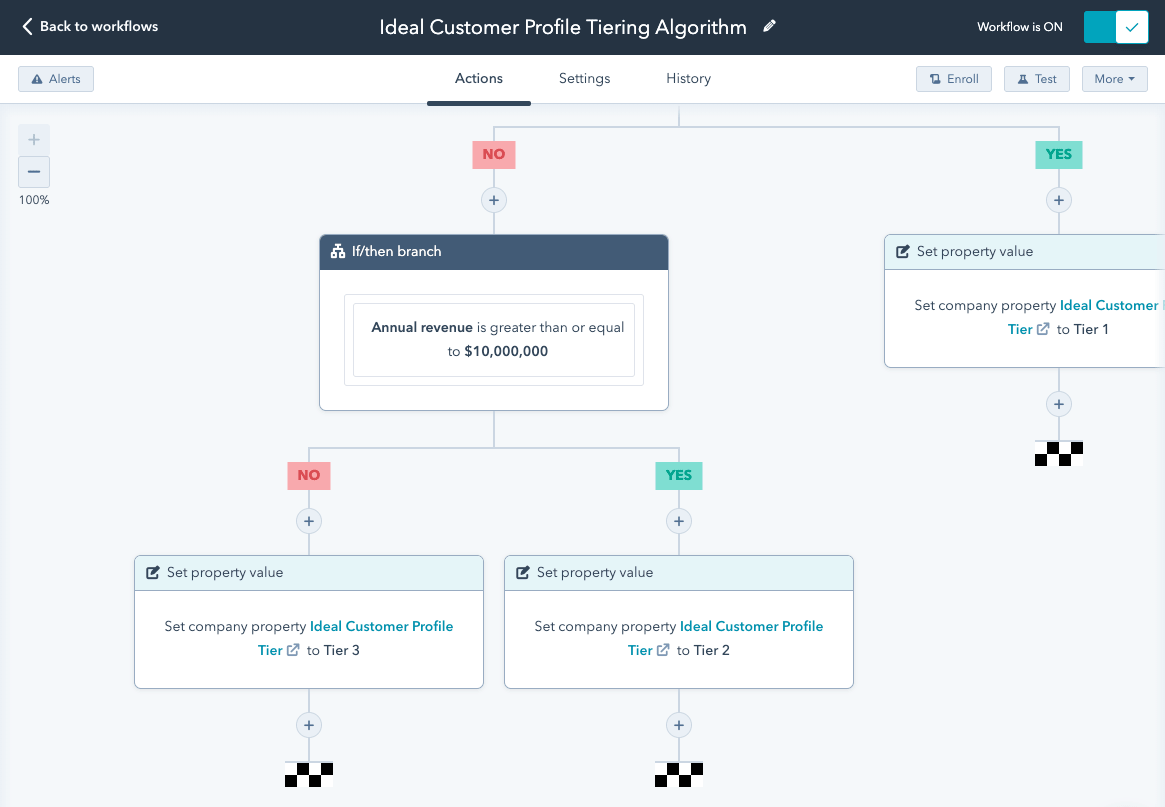
  • Targeting best-fit accounts: Sometimes the goal of an ABM campaign can be as simple as focusing more attention on best fit accounts to drive better engagement, deal size, deal velocity, and close rate. For this type of campaign, it’s best to use an automated Ideal Customer Profile (ICP) workflow to flag best-fit companies. We’ll go into more detail on this approach below.
  • Upsell, cross-sell, or renewal: As most sales reps can attest, it’s often easier to sell more to an existing customer than to close an entirely new customer. If sales and marketing have identified major upsell/cross-sell opportunity from a distinct set of customers, the team can mark them as target accounts and run coordinated campaigns to educate the customers.
  • Deal acceleration: Coordination between marketing and sales not only helps deals get created more quickly, but it can also help buyers make decisions more quickly. For this campaign, each company associated with the deal you want to accelerate would be a target account.

2. Identify accounts that will add credibility to your brand.

Of all the reasons to pick target accounts, this one is probably the easiest to understand and implement. The goal of this campaign is to close deals with target accounts whose logos and testimonials would add legitimacy and social proof to your brand. This strategy is often called, "logo acquisition."

To get started with a logo acquisition campaign, Sales and Marketing leaders should ask themselves two questions: 

  • Is there a segment of the business in which we could be growing faster but are losing deals because buyers don’t recognize our customers or see us as “legitimate” for their needs?
  • Which brands have the most name recognition and respect among that segment of buyers?

Having answered those questions, identify 10 to 15 companies that match that criteria, mark them as target accounts, and create a campaign for engaging them.

3. Look for accounts with an ideal customer profile (ICP).

ICP Workflow

Define your ideal customer profiles with HubSpot's ABM software.

For teams willing to invest in some upfront analysis, building an “ideal customer profile” can help identify target accounts. Teams with a marketing automation tool can even flag best-fit companies automatically with tailored workflows.

An ideal customer profile like the company version of an individual buyer persona. It’s a collection of the characteristics (e.g. industry, company size, technographics, location) that define the type of company that is an ideal fit for your products or services. Usually, team members have an intuitive idea for what that profile should look like, but it can be worth taking some time (about a week or two) to analyze the common characteristics of your largest deals and most successful customers. Need convincing? Here are two reasons to invest the time:

You can identify less obvious ICP traits:

An ideal customer profile can be as simple or complex as need be and sometimes adding a few non-obvious traits can explain why two seemingly identical customers buy very differently.

For example, if you sell to hospitals, it’s probably obvious that your ideal customer is a hospital. But, by analyzing your most successful customers, you could uncover that the most successful customers are not only hospitals, they are hospitals with an attached emergency room.

To uncover the details noted above, review your largest deals and repeat/renewed customers. Break down which activities led to created deals and review support tickets or consulting done with those customers. Conduct at least seven interviews with Sales and Service teammates and try to identify any themes that come up.

Conducting this analysis keeps the conversation data driven:

Humans are notoriously irrational (e.g. motivated reasoning and recency bias) and grounding the conversation in hard facts will help teams come to a better final result.

Once you have a list of qualifications, it’s common to add tiers or levels to the ICP. With tiers, you can differentiate perfect fits from the “good-not-great” fits. Matching companies with the appropriate ICP and ICP level can get tedious FAST. If your marketing system or CRM supports automation, it’s worth investing in a workflow that automatically marks companies matching the ICP (and the corresponding tier/level if you choose) so they can be viewed and reported on in real time. Tools like HubSpot's ABM software can help you define your ICPs with workflow templates. You will also be able to leverage AI-powered recommendations.

After your ICP is determined, your team should review the companies matching the ICP weekly or monthly and see if any companies are worth marking as target accounts. Done correctly, an ICP can provide an evergreen source of target accounts that leverages the inbound funnel you have already built.

4. Consider picking accounts based on deal acceleration opportunities.

One of the fastest ways to realize the value of an ABM strategy is to use it to help deals close more quickly.

No doubt, the sales team is already expertly educating the buying committee over email, in meetings, and on the phone. But, sales is limited by how much time each member of the buying committee wants to engage with that rep. What if the decision maker misses a demo meeting or the end-user wants to research on their own time?

By deploying marketing (e.g. website smart content, targeted ads, social media, personalized email) that matches the same value propositions that Sales is using. With this strategy, buyers can make decisions even faster because they are able to be educated by sales teams as well as branded content.

Mark the companies associated with the largest active deals as target accounts. Then, create simple account plans for each deal and deploy content accordingly.

No matter what reason you have for picking target accounts - be intentional! Choose them for a reason and make sure Marketing and Sales are in agreement on what that reason is. When you choose the right target accounts for the right reason, every other step of ABM fall into place more easily.

5. Build a data-driven account-targeting strategy.

ABM Dashboard

Track and measure key milestones with HubSpot's ABM software.

Using the right data fuels your ABM rocket. Neglecting to use data, or even worse, using the wrong data, can lead to internal combustion and complete system failure.

The two key types of data you’ll need to draw better company-level insights are firmographics and technographics.

Firmographics are company characteristics that best predict a good fit including company size, industry, number of employees, estimated revenue, estimated growth, and number of locations.

Technographics are the technologies your target accounts currently use or are looking to invest in -- for example, complementary technologies to yours, technology that rules out your solution or makes it less necessary, or competitive solutions where you know you have a highly win rate.

6. Get insights on contacts to shorten sales cycles

Next, identify the contacts you’ll need to reach out to within your target accounts. Take the time upfront to research the customer stakeholders, their place on the organizational chart, personal goals, and the level of influence they each have. Targeted sales prospecting lets you get to the right people in less time.

The specific details you’re looking for include:

  • Job title
  • Tenure
  • Decision-making hierarchy
  • Account affiliation
  • Activity/engagement history
  • Skills and proficiencies
  • Experience with your category

Once you’ve collected these details, you can build an “influence matrix,” which will give you and your team members more clarity into the buying and decision making processes within the account. This step can decrease your sales cycle by as much as 50%.

7. Get access to decision makers with market insights

After you’ve found the right accounts and the right contacts, deliver relevant business insights.

To organize your account based plays effectively, you need to know:

  1. The target’s industry and market trends
  2. SWOT analysis of the target account
  3. The relationships inside the account
  4. Your connections to the account

This information will lead you to the content and delivery methods you should use with each account. Providing compelling insights generates credibility, trust, and ultimately more business.

Identify the Right ABM Data with Insight Resources

If you want to be successful with ABM, you need to invest in new resources. The proportionately larger deals you’ll be closing will make this investment worth it.

Here are some of our best tips and lessons we’ve learned around implementing ABM:

  • Insight generation has to be somebody’s job, or it’s nobody’s job.
  • Incentivize your people: Compensate your Sales Development Reps on insight collection metrics, or run a SPIF.
  • Utilize third-party vendors that specialize in collecting insights on companies and people.

This is just the beginning of the ABM process, but it’s the most important piece. Get this wrong, and you’ll be setting yourself up for failure. Get this right and your business will see growth like it’s never seen before.

Editor's Note: This blog post was originally published in April 2017, but was updated for comprehensiveness and freshness in 2020.

Take me to Projects


11 Apr 23:36

Cross-Sell & Up-Sell: 3 Key Areas Your Sales Team Needs to Be Trained In

by Rachel Clapp Miller

Cross-Sell-Up-Sell-3-Key-Areas-Your-Sales-Team-Needs-to-Be-Trained-In.jpg

When it comes to sales pipeline, net new logos are never a bad thing. However, your sales reps ability to cross-sell and up-sell is often a lynchpin to your organization meeting its revenue goals repeatedly.

Too often sales leaders issue a directive to pull money from existing accounts, in an effort to make those quarterly numbers. That creates a fire drill for managers and reps who are trying to push forward deals that aren’t baked. The end result is a lot of frazzled sales behavior and an increase in discounting.

To effectively cross-sell and up-sell, your reps need to master the fundamental sales skills. Cross-selling and up-selling should be part of their regular operating rhythm.

3 Key Area of Cross-Selling & Up-Selling Your Sales Team Needs to Be Trained In

1. Digging Deep in Discovery

You can’t effectively cross-sell and up-sell if your reps can’t uncover the pain points and their business impact. Many sales teams use role plays to provide reps practice having the sales conversation. They can also be effective training reps to use silence and effective questioning to truly uncover the business impact.

Effective discovery requires the right question flow (here are some podcasts on that topic) as well as an ability to feel comfortable digging deep on negative consequences. Salespeople are natural problem solvers. They want to solve problems not talk about them. However, if your salespeople are unable to dig deep into the problem they won’t be able to effectively quantify the pain that demands a premium price.

  • Create opportunities for your reps to practice effective discovery with role plays.
  • Observe them on phone calls and listen specifically to their discovery skills.
  • Identify the reps whom you think do a great job of uncovering business pain and provide opportunities for other reps who need coaching to observe them.
  • Encourage your reps to be comfortable with silence and structure their questions around getting to the end game.

2. Clarity on How you Create Value for Customers

There is no better tool to provide for your reps than a framework that allows them to effectively demonstrate how they can create value for their customers. Ensure your reps have a keen understanding of the following:

  • Who are the target buyers that own the problem you are solving?
  • What are the key value drivers that drive these buyers to action?

You may think you have clarity around those questions, but does every rep in your organization have that same clarity? Does the digital content your buyers see demonstrate that same value? How is your service or product organization prepared to deliver that value?

What do you do?

First, assess your organization around the value you deliver. You can use this template to email key members of your team. The next step is to train your reps on those value drivers and how you deliver on them. Your reps will never be able to land and expand or cross-sell and up-sell if they don’t understand how they can create additional value for customers.

Building this clarity is not a one time event. You need to shift the mindset of your sales organization from inside out to outside in. This maniacal focus on the customer requires a transformation in many organizations – treat it as an ongoing process, not a one-time shift and you’ll be more successful in implementing true change in your organization.

3. Articulate Differentiators in a Way that Has Meaning to the Buyer

Many salespeople can rattle off product or solution features that are different that they’re competitors. The challenge is that these features and functions rarely have meaning to the buyer. Why do I care that you offer unlimited licenses for your product if I only have 10 team members? (well I may care if I want to expand the solution to my sales team to drive better data insights between marketing content and revenue generation). When it comes to cross-selling and up-selling, your salespeople need the ability to align the differentiation with what is meaning to their targets.

Your reps need to understand these three points

  • If they’re expanding their solution, what is the business problem they’re aligning with (related to the value drivers mentioned above)?
  • Then what’s important to the decision maker as it relates to the solutions requirements?
  • How do your differentiators align with those requirements.

Teach your reps to effectively maneuver their cross-sell and up-sell conversations by effectively mapping out these three components. A pre-call or pre-meeting planner can be an effective tool to ensure that their conversations are focused on uncovering these critical components as it relates to differentiation.

11 Apr 23:22

5 Ways to Transform Silence into Gold When Engaging Prospective Buyers

by Alex Hisaka
  • A Businesswoman Listens on the Phone While Taking Notes

Every sales professional knows the need to balance talking with listening when engaging prospects. But what is the right balance, exactly? Recent research makes a strong case for listening far more than you talk. It’s no wonder Willy Loman – the protagonist in Death of a Salesman – lamented his inability to talk less.

While you may feel you do listen to your prospects, are you truly hearing and understanding them? That’s exactly how your prospects should feel after interacting with you: understood. Here are five ways to convey the sense that you truly understand their concerns, priorities, and goals.

1. Be Prepared

It may seem counterintuitive to prepare to listen, but the more you can understand about your prospect ahead of time, the more quickly you can grasp their talking points and respond with intelligent questions. Before meeting with buyers, do your research to find out as much as you can about the situation at hand, the company’s strategic objectives, and who else might be part of the buying committee.

2. Ask Truly Open-Ended Questions

Many sales professionals have been trained to walk prospective buyers down the path to purchase by asking leading questions: questions that can only be answered with a response that points to your company or solution as the right choice. While it can be advantageous to prepare a strategic line of questioning, if it’s not done tactfully, this type of interrogation can come off as manipulative. Once trust is lost, so is the sale, so tread carefully when it comes to leading questions. 

By engaging the prospect in a natural conversation, you will have more to listen to and you can learn more in the process. Focus on being a conversationalist. Ask questions that allow your prospect to talk for minutes on end, such as “Interesting, how does that process work?” This way, your prospect feels more at ease and more in control, making it easier for you to build rapport.  

3. Help Don’t Sell

It’s been well documented that today’s B2B buyers want sales reps to provide insights and guidance that helps ease the purchase process. Remember, even though today’s buyers can find tons of information online, they don’t always know how to make sense of it all. In fact, they often feel more overwhelmed than empowered.

By actively listening, you put yourself in position to truly teach the prospect something relevant. Your recommendations become more meaningful because they are based on what you’ve learned, as opposed to assumptions. Knowledge-based advice goes a long way toward earning trust and puts you in position to make the short list.

4. Get Personal

No one feels special when they get a canned response. Another reason to do your research and actively listen is so that you can tailor your replies and the information you share for each prospective buyer. By personalizing your sales approach, you demonstrate a grasp of the individual’s – or buying committee’s – situation. As Theodore Roosevelt said, people don’t care how much you know until they know how much you care.” Personalized messages show people you care.

5. Tell Stories

Your prospects want to be the hero of their own story. If you can paint a picture that features them in the hero role, they are more likely to feel that you understand their goals and motivations.

By listening intently to prospective buyers, you can zero in on the stories in your toolkit (think existing case studies) that are most relevant and compelling. Then you can tell a gripping, memorable story that captivates your audience and motivates them to take action.

A lot has changed in selling, but attentive listening never goes out of style. When your prospects speak, don’t just wait for your turn to talk, or ask the next question on your list. Actively listen and take a genuine interest in what is being said. Shoot for thoughtful questions and considerate responses that are guided by the conversation more so than your agenda.  

For more ways to make your prospects feel special, check out our eBook, How Personalized Selling Unlocks Competitive Advantage.

11 Apr 23:22

Discover Your Customers’ Deepest Feelings Using Microsoft Facial Recognition

by Chris Mohritz

Body language can speak volumes — and it’s often said that body language doesn’t lie.

So imagine what your customers’ facial expressions could tell you about how they feel towards your products, services and brand experience?

And as luck would have it, artificial intelligence is stepping up to put that insight at your fingertips.

Rounding out a Clear View into Your Customer’s Mind

In my last post, we used Google Cloud to perform sentiment analysis on text — and in this post we’ll extract similar sentiment information from visual content.

More specifically, we’ll be using Microsoft’s Emotion API to classify facial expressions in photos and video based on a given set of emotions:

  • Happiness
  • Neutral
  • Sadness
  • Surprise
  • Disgust
  • Anger
  • Fear
  • Contempt

Giving you the power to further humanize your products and marketing with emotion recognition.

Reading Emotions Through Facial Recognition

You can use this tool in a wide variety of ways — to create systems that marketers and product developers can use to measure people’s reaction to a store display, a movie, a meal — you name it.

Or you can use it to add some emotional intelligence to an application — offering up different options based on emotions identified in a photo or video.

Ready to go?

Before we jump into it, let’s take a quick look at pricing:

Plan Limits Price
Free Images: 30,000 calls/mo
Video (uploads): 300/mo
Video (streaming): 3000/mo
Free
Basic Images: 10 calls/sec $0.10 per 1000 calls
Standard Images: 10 calls/sec
Video (uploads): 3000/mo
Video (streaming): 30,000/mo
$0.25 per 1000 calls
Free for video

Microsoft gives you a healthy dose of free usage, so why not jump right into testing this API?

So without further ado…

What You’ll Need

Right off the bat, let’s get the initial requirements knocked out.

Download the source repository.

To start, let’s pull down the source files. (You’ll need a git client installed on your computer for this step.)

Move to the directory you want to use for this guide and run the following commands in a terminal…

# Download source repository
git clone https://github.com/10xNation/microsoft-emotion-recognition.git
cd microsoft-emotion-recognition

The repository includes a few simple python scripts (compatible with Python 2.7) to demo the Emotion API.

Create an Azure account.

Go to the Azure home page (Azure is Microsoft’s cloud services platform).

If you don’t already have an Azure account, go ahead and create one by clicking on the “Free Account” button and completing the registration process.

Next, we’ll spin up the service…

Step 1: Create the Emotion API Instance

Go to the Azure Dashboard and sign in with your Azure account.

Click on the “+ New” button.

Then select the “Intelligence + analytics” and “Cognitive Services APIs” options.

Note: This will enable all of the Cognitive Services APIs — Text Analytics, Computer Vision, etc. But for the purposes of this guide, we’re going to stick with the Emotion API.

On the Cognitive Services API Create page, enter an “Account name” — select a “Subscription,” “Location,” and “Pricing tier,” — then create or select a “Resource group.” Enable “Account creation” if required. And of course, be sure to select “Emotion API” for “API type.”

Once everything is filled out, hit “Create.”

And after a few minutes, the new subscription will show up on your dashboard. Go ahead and click it.

Get the subscription key.

That should take you to the Overview tab for your new service.

Click on the “Keys” tab and copy the first key — we’ll need it in the next step.

Your Emotion API instance is now ready to go, so let’s move on…

Analyze an Image

We’ll start by submitting a series of images to the API, testing its capabilities from different angles.

Note: pexels.com provides free images you can test with.

To submit an image, simply run the following command (in the terminal you set up in What You’ll Need) for each image:

# Submit an image to the API
python analyze_image.py

Change “IMAGE_URL” in analyze_image.py to the (publicly accessible) URL for the image you want to analyze — do this for each image, and “API_KEY” to the key you copied when creating the API instance.

So let’s get to it…

Contextual expressions.

Here’s an interesting test using a relatively complex facial expression, sour face

The system interpreted this expression as anger with a 42.1% confidence and happiness at 30.5%. Below is the API response:

"scores": {
  "anger": 0.421138048,
  "contempt": 0.00308842212,
  "disgust": 0.165829882,
  "fear": 0.0116129108,
  "happiness": 0.3052208,
  "neutral": 0.0149854887,
  "sadness": 0.074684456,
  "surprise": 0.00343998941
}

As these systems get smarter and smarter, it isn’t much of a stretch to see them not only understanding what ‘sour face’ looks like…but also recognizing and taking a cue from the lemon to better understand context.

Wearing glasses?

Here’s a test to see if the API can see through eye glasses…

The system interpreted this expression as happiness at 76.2% and neutral at 22.8%. Below is the API response:

"scores": {
  "anger": 0.000019574929,
  "contempt": 0.008707933,
  "disgust": 0.00002546404,
  "fear": 0.00000554377539,
  "happiness": 0.76220423,
  "neutral": 0.22810261,
  "sadness": 0.0001318246,
  "surprise": 0.000802798255
}

So it didn’t appear to have any issues with the glasses, so let’s test a hat…

Wearing headgear?

Here’s a test to see if the shape and shadows of a hat will trip up the system…

And the system came back with happiness at 99.9% confidence. Below is the API response:

"scores": {
  "anger": 1.50342938e-8,
  "contempt": 0.00000364264451,
  "disgust": 1.9485384e-8,
  "fear": 5.003781e-10,
  "happiness": 0.99922,
  "neutral": 0.000774948334,
  "sadness": 0.00000126923146,
  "surprise": 6.72026843e-8
}

So it doesn’t seem to have any trouble with headgear as well.

Let’s test angles…

Tilted expressions.

Here’s a test to see if head position affects the results…

The system came back with neutral at 91.6% confidence. Below is the API response:

"scores": {
  "anger": 0.0001890776,
  "contempt": 0.0129517857,
  "disgust": 0.000122931233,
  "fear": 0.0000413908238,
  "happiness": 0.000543844129,
  "neutral": 0.916418254,
  "sadness": 0.06961859,
  "surprise": 0.000114119932
}

And I’d call that another successful test. So let’s try multiple faces in the same image…

Multiple people.

Here’s a test to see if the system can deal with multiple people…

And the system described the girl on the left with happiness at 99.9%, and the girl on the right as neutral at 99.9%. Below is the API response:

"scores": {
  "anger": 9.171868e-10,
  "contempt": 6.706198e-7,
  "disgust": 2.71957e-9,
  "fear": 3.94775e-11,
  "happiness": 0.999625862,
  "neutral": 0.000373453251,
  "sadness": 2.47323229e-9,
  "surprise": 3.79722955e-8
}
"scores": {
  "anger": 8.55076053e-7,
  "contempt": 0.000147526938,
  "disgust": 6.414273e-7,
  "fear": 6.04651e-8,
  "happiness": 0.0000471687235,
  "neutral": 0.999756932,
  "sadness": 0.0000290200387,
  "surprise": 0.0000178117425
}

Personally, I’d say the girl on the right has a hint of happiness on her face — but that’s certainly debatable. Otherwise the API nailed it.

Limitations.

Here’s a test to see how far we can push the limits…

And the system failed to identify a face in this image. I would guess that’s because her head was tilted just a bit too far — Microsoft recommends less that a 45° angle.

Hair in the way?

Here’s a test to see if hair can trip things up…

The system came back with happiness at 99.9% confidence. Below is the API response:

"scores": {
  "anger": 8.054016e-9,
  "contempt": 5.76588235e-8,
  "disgust": 1.88049029e-7,
  "fear": 1.96213636e-11,
  "happiness": 0.999986231,
  "neutral": 0.00001347793,
  "sadness": 2.01189856e-8,
  "surprise": 2.07863149e-8
}

And I’d call that a successful test. So let’s push the envelope with hair…

Another limitation.

Here’s a little deeper test to see if even more hair can confuse the system…

And sure enough, the system was only able to identify the young girl — and came back with happiness at 99.9% confidence. Below is the API response:

"scores": {
  "anger": 1.23730332e-10,
  "contempt": 1.611374e-9,
  "disgust": 1.61184052e-10,
  "fear": 3.99333261e-10,
  "happiness": 0.9999991,
  "neutral": 2.53400572e-7,
  "sadness": 5.869352e-7,
  "surprise": 5.085489e-8
}

The API wasn’t able to pick out facial features of the woman through the glasses and hair, but it didn’t have any problem with the young girl.

Next, let’s test out images with a busy background…

Noisy images.

Here’s a test to see if a washed out background color and noise will affect the results…

And the system interpreted this expression as neutral at 76.5% and happiness at 19.6%. Below is the API response:

"scores": {
  "anger": 0.0005269143,
  "contempt": 0.00700004352,
  "disgust": 0.0005294192,
  "fear": 0.000477180554,
  "happiness": 0.196570709,
  "neutral": 0.7652676,
  "sadness": 0.00578457443,
  "surprise": 0.02384355
}

No problem there. So let’s move on and test a video…

Analyze a Video

Processing a video is actually a two-step process. First, you submit the video. Then, after some processing time, you request the result.

Note: pexels.com also provides free videos you can test with.

To submit a video, simply run the following command in the terminal:

# Submit a video to the API
python analyze_video.py

Change “VIDEO_URL” in analyze_video.py to the (publicly accessible) URL for the video you want to analyze, and “API_KEY” to the key you copied when creating the API instance.

And be sure to copy the OID that the API responds with, you’ll need it to capture the results. Here’s an example “Operation-Location” URL — you want the OID (highlighted portion):

https://westus.api.cognitive.microsoft.com/emotion/v1.0/operations/003f5367-9595-4fd4-9a5a-d0d6b1210ae8

To request the analysis result, run the following command:

# Get video processing result
python video_result.py

Change “VIDEO_OID” in video_result.py to the OID you copied when submitting the video, and “API_KEY” to the key you copied when creating the API instance.

The system will provide you with a (lengthy) response for the entire video — it can also do it in near real-time — that lists faces and emotions for specific timestamps. Below is an abbreviated API response:

{
  "version": 1,
  "timescale": 24000,
  "offset": 0,
  "framerate": 23.976,
  "width": 1280,
  "height": 720,
  "fragments": [
    {
      "start": 0,
      "duration": 48048,
      "interval": 12012,
      "events": [
        [
          {
            "windowFaceDistribution": {
              "neutral": 0,
              "happiness": 1,
              "surprise": 0,
              "sadness": 0,
              "anger": 0,
              "disgust": 0,
              "fear": 0,
              "contempt": 0
            },
            "windowMeanScores": {
              "neutral": 5.4903e-8,
              "happiness": 0.999995,
              "surprise": 2.99175e-8,
              "sadness": 3.09663e-7,
              "anger": 4.44625e-7,
              "disgust": 0.00000404055,
              "fear": 2.69972e-10,
              "contempt": 9.6594e-9
            }
          }
        ],
        [
          {
            "windowFaceDistribution": {
              "neutral": 0,
              "happiness": 1,
              "surprise": 0,
              "sadness": 0,
              "anger": 0,
              "disgust": 0,
              "fear": 0,
              "contempt": 0
            },
            "windowMeanScores": {
              "neutral": 2.45505e-8,
              "happiness": 0.999998,
              "surprise": 5.09985e-8,
              "sadness": 1.34317e-7,
              "anger": 2.34993e-7,
              "disgust": 0.00000210687,
              "fear": 2.49678e-9,
              "contempt": 8.54064e-9
            }
          }
        ],
      ...
      ]
    },
  ]
}

And that’s it for video. Not too much more complicated than submitting static images.

Troubleshooting

If you aren’t getting the expected results, check the quality of your images. Ideally, you’ll want to use unobstructed, full frontal views of faces.

Expect accuracy to drop with partial faces and when faces are rotated more than 45°.

Here are some of the technical details:

  • Supported file formats: JPEG, PNG, GIF (first frame only), BMP
  • Maximum file size: 4MB
  • Detectable face size range (within the image): 36×36 to 4096×4096 pixels

Outside of these few guidelines, the API should be pretty straightforward to use.

Next Steps

But this is just a start. What will you do will this new tool?

The real power comes when you plug this type of analysis into all of your customer experience and marketing tools capturing images and video.

You can dig deeper into the Emotion API in the developer documentation.

Enjoy!

11 Apr 20:01

Key Influencer Marketing Stats to Inform Your Marketing Strategy

by Maria Sipka

Consumers are increasingly wary of advertisements, leaving marketers scrambling to find new ways to capture, and hold, their attention. As a result, influencer marketing is on the rise, enabling marketers to circumvent ad blockers and reach consumers through the voices they trust most – their peers.

But how many marketers are using influencer marketing? Is it a hot fad or a strategic marketing channel? Does it really work? Here’s a compilation of influencer marketing stats that you need to know so you can use them to inform your influencer marketing strategy in 2017.

THE EVOLVING MEDIA CONSUMPTION LANDSCAPE

THE ADOPTION AND GROWTH OF INFLUENCER MARKETING

  • 86% of marketers today use influencer marketing to fuel their content marketing strategies, 88.5% of whom find the influencer content valuable. (Source: Linqia, The Value of Influencer Content 2017, April 2017)
  • 90% of Millennials value the opinions of their friends, parents, and online experts over traditional media and advertising, with 33% relying mostly on blogs before they make a purchase. (Source: Millennial Branding, The Millennial Consumer Study, January 2015)

THE STRATEGY BEHIND INFLUENCER MARKETING

  • 31% of all referral traffic comes from social media (Facebook accounts for 25% of it), making social media #1 driver of all website referral traffic. (Source: Shareaholic, Social Media Traffic Report, January 2015)
  • Nearly 50% of marketers consider influencer blogs the third most important social channel for their influencer marketing strategy. (Source: Linqia, The State of Influencer Marketing 2017, December 2016)
  • 66% of marketers repurpose influencer content in other marketing initiatives, including email marketing, website and product pages, and paid and organic social channels. (Source: Linqia, The Value of Influencer Content 2017, April 2017)

THE COST OF INFLUENCER MARKETING

  • 48% of marketers planning to increase their influencer marketing budgets in 2017, compared to only 4% who plan to decrease it. (Source: Linqia, The State of Influencer Marketing 2017, December 2016)
  • 38-40% of marketers work with influencer marketing companies that provide all influencer assets as part of the program spend for an additional fee. (Source: Linqia, The Value of Influencer Content 2017, April 2017)

THE CHALLENGES OF INFLUENCER MARKETING

  • 78% of marketers cite measuring the ROI of influencer marketing as their top challenge for 2017, resulting in a gain in traction for performance-based influencer marketing pricing models. (Source: Linqia, The State of Influencer Marketing 2017, December 2016)
  • 59% of marketers struggle with approaching and engaging potential influencers. (Source: eConsultancy, The Rise of Influencers, January 2016)
  • Only 55% of marketers report that they know what the most recent disclosure guidelines are, despite 88% stating that they require that influencers disclose sponsored content to comply with FTC regulations. (Source: Linqia, The State of Influencer Marketing 2017, December 2016)

THE PERFORMANCE OF INFLUENCER MARKETING PROGRAMS

  • 50% of marketers report that cost-per-click (CPC) and cost-per-engagement (CPE) pricing models are the most effective for driving results. (Source: Linqia, The State of Influencer Marketing 2017, December 2016)

Influencer marketing isn’t going away. In fact, it’s only getting more popular. Marketers are increasing their influencer marketing budgets as programs continue to prove their ability to reach and inspire consumers to take action. Looking forward, marketers can measure the ROI of their influencer marketing efforts by structuring their programs to align with the brand’s goals, whether it be engagement, sign-ups, conversions, or sales.

Influencer marketing will remain a valuable part of the overall media mix as marketers realize that the cost efficiency and proven performance of influencer content enables them to increase their investment in content that’s proven to drive results.

11 Apr 20:01

Hard Questions on Our Transition to Driverless Cars

by Ashish Khanna
apr17-11-623979206

Artificial intelligence (AI) is transforming the automobile. In so doing, it will transform much more than that. Given how central automotive transportation is to our cities, commerce, and daily lives, saying that AI will change life as we know it is no understatement.

To understand where this new mobility might take us, it’s important to distinguish between two types of AI-powered motor vehicles: self-driving and driverless. Self-driving vehicles offer the options of automated and manual driving. Either way, there’s someone in the driver’s seat. Driverless vehicles, on the other hand, have neither driver nor (eventually) a steering wheel. This distinction is important because the driver is typically the most expensive part of a transport business, be it taxi services, last-mile logistics, or long-haul trucking. Self-driving capabilities can boost safety and driver productivity. By eliminating the driver altogether, businesses could slash costs by as much as 60%, depending on the industry.

In combination with the sharing economy, driverless vehicles are likely to be deployed in fleets, benefiting higher utilization in urban settings. This portends a dual-track future. While sharing and driverless will converge for the 1.7 billion population living in sizable cities, the remainder of the population will also benefit, but largely from the safety advantages of self-driving cars that they will own.

Where and When the Technology Might Be Deployed

Automakers are already producing self-driving autonomy features for specific uses, such as highway driving, in premium vehicles. As expected, uptake has been slow because extra costs are limiting demand, but the rollout is growing.

Insight Center

  • The Age of AI
    Sponsored by Accenture
    How it will impact business, industry, and society.

By contrast, driverless vehicle adoption depends on overcoming three factors: infrastructure maturity, technology readiness, and regulation. Of the large markets, the U.S., thanks to a mature infrastructure and, thus far, supportive regulatory environment, is at the forefront, and driverless technology is undergoing real-world, large-scale testing to train machine learning algorithms. We expect Europe (excluding the UK) to lag the U.S., given the higher technical complexity of medieval cities and regulations resulting in limited on-the-ground testing. China and India are still in process of building out their infrastructure; their technology will need more effort to adapt to their complex street environments.

What Leaders Need to Consider

It’s time for boards and executives to ask themselves hard questions about how the new mobility could affect their business models. For example:

Infrastructure. As mobility changes around us, how should we approach our master plans for airports, car parking, high-speed trains, energy, ports, toll roads, and so forth? These plans have investment horizons of 15 to 30 years or longer. What will happen to demand, pricing, and usage patterns over that horizon? How do we de-risk our investments, and how can we accommodate for different future scenarios?

Cities. How will autonomous vehicles affect congestion? Can we balance their benefits against the probable increase in demand as mobility costs decline? How do we navigate their integration into our emerging “mobility as a service” offerings and realize the benefits of less congestion and lower pollution? How will road pricing models need to change? How will we need to change urban planning in this future?

Transportation. How will driverless vehicles complement existing public transit infrastructure? How can we remain relevant in this future? 

Automotive OEMs. How do we reposition ourselves to sell not just vehicles, but mobility? What’s our role in the value chain: facilitator, fleet operator, driverless “driver” supplier (versus vehicle manufacturer)? What should we buy or partner with instead of building? Where and how do we develop a relationship with cities? How can we help businesses benefit from greater vehicle automation?

Aftermarket automotive. What is our role in a fleet-led urban future? How can we embrace the opportunities that connected vehicles create? 

Insurance. What strategic moves should we pursue as increased autonomy shrinks the motor claims pool? What products will be relevant in this evolving future where fleets and product liability become more important?

Financial services. How will vehicle ownership patterns evolve as Millennial and Generation Z customers claim a greater share of mobility consumption? How can we finance fleets through leasing and/or mobility securitization?

Energy. How does the confluence of autonomy, sharing, and electrification change the fuel mix in automotive applications? What will our retail footprint be? In a driverless world, how could vehicle-to-grid (V2G) help us create new ways to distribute and store energy?

Retail and consumer business. If new mobility can dramatically reduce distribution costs, should we rethink the industry’s value chain and distribution access to customer? How does our logistics footprint need to evolve, and how can we realize the savings? What new propositions can we create? What customer segments could this “mobility as a platform” allow us to serve?

Health care. How do these changes help us manage the needs of our aging population? How can we use driverless vehicles to reduce health care costs?

Public policy. How will society adapt to the loss of service jobs that results from automated driving? What new roles could fill this gap, and how can policy makers ease the transition?

Modern vehicles are safer and more tech-enabled than ever, but AI-enabled mobility holds the promise to an accident-free future. Some disruptors’ systems already outperform humans on the open road. It is a matter of time before we start seeing robo-taxis and autonomous commercial vehicles appear and upend today’s business models. Now is the time for business leaders and city administrators to get in front of the transformation.

11 Apr 20:00

China is playing a US$9 trillion game of chicken with investors

by Tian Chen and Feng Cai, Bloomberg News

BEIJING/SHANGHAI —  Like many individual investors in China, Yang Mo has no idea what’s in the wealth management products that make up a big chunk of her net worth.

She says there’s really no point in finding out. Sure, WMPs invest in all kinds of risky assets, but the government would never let a big one fail, she explains.

“It’s not how the Chinese government does things, and it’s not even Chinese culture,” says Yang, a 29-year-old public relations professional in Beijing.

Hers is a common refrain in Asia’s largest economy, where savers have poured US$9 trillion into WMPs and similar products on the assumption that they’ll get bailed out if the investments sour. Even after news in February that policy makers are drafting rules to make it clear that state guarantees don’t exist, Yang is undaunted. She says she’ll only withdraw money from WMPs in the unlikely event that they start to suffer losses.

“Cracking down on implicit guarantees is just like curbing home prices,” she says. “It’s something that the government needs to say, but it’s not something they will eventually do.”

Yang’s steadfast faith in bailouts illustrates the dilemma for authorities as they try to reduce moral hazard and improve the pricing of risk in China’s financial system: It may require a major WMP blowup to shake investors out of their complacency, an event that could wreak havoc on banks that increasingly rely on the products for funding.

“Only after a WMP defaults in a high-profile way will investors start worrying about their money,” says Hao Hong, a Hong Kong-based strategist at Bocom International Holdings Co. who’s known for his prescient calls on Chinese markets.

While Hong characterizes the proliferation of WMPs as a “bubble” that will eventually burst, he says imminent losses are unlikely because policy makers are focused on maintaining market stability before a leadership reshuffle at the end of 2017.

Still, that doesn’t mean it will be smooth sailing this year. WMPs — a key part of China’s shadow banking system — are getting squeezed as the nation’s central bank increases interest rates to discourage excessive leverage. That’s not only putting pressure on products that use borrowed funds to meet their fixed return targets, it’s also weighing on the Chinese bond market, where WMPs allocate the biggest portion of their funds.

For as long as they can, banks will make investors whole when WMPs run into trouble because they fear the reputational damage of a failed product, according to Hong. At some point, though, WMP shortfalls may be too large for the banks to cover, forcing policy makers to decide whether they’re willing to allow losses.

Intervention is becoming less likely, if the new draft rules are anything to go by. Regulators are working on language that would make clear there are no state guarantees on asset-management products — which include WMPs, trusts, mutual funds and other products — people familiar with the matter said in February.

The investments’ sheer size shows why Beijing is keen to quash the notion of a government backstop. Assets in AMPs amounted to about 80 per cent of China’s gross domestic product as of June, data compiled by the China Securities Regulatory Commission and Bloomberg show.

WMPs are the biggest category of AMPs, with assets of around 29.1 trillion yuan (US$4.2 trillion) at the end of December, according to the China Banking Regulatory Commission. They’re also the products most widely viewed as risk free by Chinese savers.

It’s easy to see why. Despite investing in volatile assets from corporate bonds to stocks and real estate, WMPs have produced remarkably steady returns. Among the more than 181,000 products that matured in 2015, just 44 suffered a loss, most of which were sold by foreign banks. WMPs issued last week advertised an average annualized return of about 4.3 per cent, according to Chengdu-based research firm PY Standard, versus the benchmark one-year deposit rate of 1.5 per cent.

While public evidence of WMP bailouts is scarce, the People’s Bank of China has said that when products struggle to meet their return targets, the banks that distribute them often make up the shortfall. Most of the nation’s biggest lenders are majority-owned by China’s government.

“Major banks appear to have sufficient capabilities to offset the potential losses,” says Weiwei Fang, 35, who works at a consulting firm in Shanghai and keeps about 90 percent of her personal savings in WMPs. “At least I think my principal should be safe.”

The PBOC, the CSRC and the CBRC didn’t respond to requests for comment.

If WMPs do start to fail, the worry is that a run on the products will spark a liquidity crunch. The average WMP tracked by the China Banking Wealth Management Registration System matures in 127 days, versus 7 1/2 years for the average Chinese corporate bond. The mismatch leaves banks and other WMP managers exposed to market swings if they can’t raise fresh cash by issuing new products. It could lead to a downward spiral of falling asset prices, the liquidation of WMP holdings and still lower prices.

Three of the four individual investors interviewed by Bloomberg News for this story say that while they currently aren’t concerned about their exposure to WMPs, they’ll shift money out of the products if they see evidence of losses. 

Yang, the PR professional with about a third of her savings in WMPs, says she’ll move her cash to bank deposits, while Django Zhang, a 28-year-old analyst at a research company in Beijing, says he’ll consider shifting into foreign exchange or real estate investment trusts. Zhang currently has all his savings in WMPs, about half of which carry guarantees on principal and interest.

Even Michelle He, a 30-year-old client manager at a state-owned bank in Sichuan province, says her faith in WMPs has limits. He, who buys the products on her mobile phone, says she’s confident that banks or the government will step in to prevent failures, but concedes that any sign of losses in WMPs would prompt her to pull out.

The challenge for policy makers is to create an environment where troubled WMPs can inflict losses on investors without sparking a mass exodus. The government’s most likely approach is to let loss-making WMPs fail, before stepping in to contain the fallout, according to Andrew Collier, managing director at Orient Capital Research and author of a book on shadow banking. That could result in a “limited financial crisis” centered on smaller banks, he says, adding that some institutions would likely be recapitalized by the government or merged with larger peers.

As for the Chinese savers who lose their money, Collier says it would be an important learning experience. “Shadow banking has been a great lesson in capitalism and it has allowed many Chinese to learn how to manage their money in a free-market environment,” he says. “However, the real lessons about the risks of capitalism have yet to be learned by the average investor.”

11 Apr 19:59

The News Feed is Outdated: How Stories Changed the Way I Think About Social Media

by Ash Read

Right now, the standards we expect on the web are being re-written for mobile. The rise of stories across Snapchat, Instagram, Whatsapp, Messenger and Facebook is the perfect example of this.

The News Feed is outdated and stories are becoming the default for content consumption.

Very few formats, features, apps, or services are truly unique.

Facebook, for example, didn’t invent the vertical scrolling feed.

For decades, way before Mark Zuckerburg even enrolled in Harvard, online content has been viewed in vertical, scrolling feeds.

From reading content on blogs and news sites to seeing which of your friends had recently made changes on Bebo, we’ve been accustomed to seeing data aggregated vertically for as long as I can remember.

What Facebook actually popularized was the algorithmically-sorted feed, which they pioneered in 2006 with the release of their News Feed.

Since the New Feed’s launch, we’ve seen Facebook’s influence on across the web, with many platforms also adopting algorithms to show users more specific, personalized content that some data wizardry has deemed they’ll have an interest in:

  • In 2016 Instagram shifted to algorithmically-sorted feed
  • Twitter launched “While you were away” to show tweets you may have missed since you last opened the app
  • Medium orders your homepage based on content you’ve read/recommended in the past

And now, since Snapchat brought the stories format to prominence, we’ve seen its influence reflected across mobile, with many of the largest social/media products in the world implementing their own version. From Facebook Stories to Medium Series and Twitter Moments.

You see it all the time. When one app or product breaks out and challenges the norm, others will follow. You just need to look at how many Uber-for-X or Tinder-esque apps have been released over the past couple of years.

But why do we see this copy-catting with successful new technologies?

As Wired writer, David Pierce explains, when a system works, it’s just easier if everyone implements it:

Having one broadly adopted system just makes life easier, since people don’t have to learn a new language and dance routine every time they want to try something. It happened a while ago on desktop PCs, for instance: it was eventually decided that keyboards should be QWERTY, interfaces should be graphical, and things should scroll up and down.

Why Stories are the new News Feed

The News Feed is not a native experience on mobile

The News Feed was designed for desktop and was a wonderful place to share text-based statuses and links to your favorite blog posts, the funniest YouTube videos and full albums of your holiday photos. But social media has now moved on.

Facebook now reaches 1.86 billion monthly active users and the biggest driver in revenue and user growth is on mobile. Facebook now counts 1.23 billion daily active users, where 1.15 billion of them are on mobile. For ad revenue, mobile represents 84 percent of the total, too.

In contrast, as mobile has increased its dominance across the web, Facebook has seen a drop in original user-generated content shared to its platform with a 21% decline reported between mid-2015 and mid-2016.

“The way people have been prompted to share for 10 years, it’s very text-centric,” Facebook Camera product manager Connor Hayes explained to TechCrunch. “Even when you look at the way we’ve done this on mobile, you can see half of the screen is still taken up by a place for you to type text.”

Whilst Facebook is seeing a downward trend in user-generated content, Snapchat is reportedly generating more than 10 billion video views daily and over 150m Instagram users are creating stories each day, too.

It seems that sharing to a feed isn’t quite as appealing anymore. Neither is consuming content via a vertical feed.

The camera is becoming the focal point of communication

With the News Feed, users have to put in a lot of work to get any value: Content is surrounded by empty space, you have to scroll to find something that interests you and, often, content doesn’t take up your whole screen, so you have to tap to enjoy the full viewing experience.

“We like to think of the camera as the new keyboard,” a Facebook Product Manager told TechCrunch. And in Snap’s IPO letter to investors, Evan Spiegel wrote: “In the way that the flashing cursor became the starting point for most products on desktop computers, we believe that the camera screen will be the starting point for most products on smartphones.”

Sometimes it’s hard to encapsulate moments or feelings in words and this is where the camera comes into its own as a communication tool. Through photos and videos we can share the fun, fleeting moments of our lives with those closest to us, without needing to sum them up in a sentance or two.

Of course, the camera won’t fully replace our need for a keyboard just yet, if ever. And Facebook see Stories as an “additive,” sitting alongside the News Feed and their other products rather than replacing them. “We’ve tested in markets with Instagram Stories and Messenger Day, and we’ve seen this as accretive. They end up posting more and they like using the Stories format across apps,” Hayes said.

A shift in sharing habits

With the rise of Snapchat, we’ve become accustomed to sharing multiple and frequent updates throughout the day – a way of communicating that just doesn’t fit with a traditional, web-based vertical feed.

With a vertical feed, it’s hard to lace together groups of posts into a cohesive story someone can easily follow along. A case in point here is live sports on Facebook, I often see scores and in-game updates showing in my feed hours after a game is completed.

But with stories, everything is there, in one place from start to finish. Viewers always see the first post in story ahead of the newest or most popular post.

The beauty of stories is really in how easy they are to create and consume. In just a couple of taps and swipes, you can create and share snippets of your day. Stories enable us to share the exciting, vivid moments of our lives in-the-moment. And rather than posting a singular highlight of our day to the News Feed, we can share immersive narratives that tell a story over a 24hr period of time.

Just as the News Feed has been the default way to discover and consume content for the last decade-or-so, I feel all social channels with now shift to stories-like, mobile native ways to create and consume content. The ephemeral nature of Stories – they disappear after 24hrs on each channel – also make them must-view content.

“Stories are a format, not an app,” Mills Baker, former Product Designer at Facebook, explained on Quora. “When Periscope and Meerkat, and later Twitter and Facebook (and others) launched “live” video, or when multiple companies offer solutions for “360-degree” videos, we view it as something much nearer to a commodity feature than a unique innovation.”

The launch of Facebook Stories enables Facebook to begin a gradual shift towards a mobile product that’s truly built for the mobile/video world. With stories, the core Facebook product and News Feed continues to work for everyone, but they can now simultaneously support newer users and those with a thirst for sharing, too.

Since rolling out Instagram Stories in August 2016, Facebook has launched variations of Stories across its various platforms with Messenger Day, WhatsApp Status and Facebook Stories.

Additionally, Twitter has launched Moments as a way to stitch together groups of tweets into a narrative and Medium has recently launched Series as a way to encourage users to create stories that unfold over time.

How Stories changed the way I think about social media

When Stories were first introduced by Instagram, it felt like a bit of a gimmick: “Hey, the cool kids at Snapchat are doing stories. Let’s do them, too.” But stories are much more than a gimmick. They’re a potentially seismic shift in how we create and consume content.

And with the recent launch of Facebook Stories, the format has now been exposed to Facebook’s 1.16 billion mobile users – way more people than have already used stories on Instagram and Snapchat, who both have ~150m people using the feature:

  • Snap announced in their S-1 filing that Snapchat had 158m daily active users in Q4 2016
  • Instagram announced that Stories had 150m daily active users in January 2017

Stories, by nature, are more immersive than other types of digital and social content. The experience exists within a single place and doesn’t try to drive you away to new websites and platforms (though Instagram has experimented with links in stories).

The uptake of Facebook Stories in many markets hasn’t been as immediate as the adoption of stories on Instagram, however, I firmly believe that the feature’s launch signals a huge shift in the way we’ll consume content on mobile and the type of content we’ll share.

Creating opportunity for shared experiences

The future of social media will no longer be about sharing only the perfect moments. It’ll no longer be about retweets and how many people like your content. It’s about going deep, not wide: how many people are tuning into your stories each day; how many people share your content directly with their friends and close-knit groups and how we use storytelling to create empathy through shared experiences.

User-generated content has always been valuable for brands, but stories have taken the possibilities to the next level and created a space in which everyone can create and share authentic content in important moments.

For example, Snapchat regularly curates crowd-sourced stories around large and important events, enabling anyone, not ‘influencers’, in a location to share their experiences at scale.

Snapchat has also opened up its search functionality to allow users to search for accounts to follow or stories to watch, based on topics.

This opens up new opportunities for users to discover content that’s relevant to them—whether it’s a local event in their home town or at a huge national sporting event.

Series on Medium, another stories-based feature, also enable shared experiences between the creator and consumer. For example, one series tells the story of someone training to be able to dunk a basketball, documenting his struggle along the way.

Series differ from stories in a couple of ways: Series are permanent and writers can create multiple series at the same time. With Series, you don’t have to publish a long-form piece on content and can instead tell a story periodically in a way that’s mobile friendly to create and consume.

Brands (and dollars) follow attention

Why should brands care about stories?

The stories format has gained velocity as a user behavior and is much-loved by the individual people who contribute on social media: you, me, our friends and family. Shifts like the News Feed and shifts like stories first occur because of demand by individuals. And as more and more people start using a platform or behavior, businesses follow.

In the early days of Facebook, Twitter and Instagram, many businesses didn’t quite know how to use these new platforms. But those who did won big.

Social media early adopters knew attention was shifting away from more traditional channels like radio, TV and email and into social. They joined the conversation in an authentic, compelling way and began to build huge audiences, often from nothing, and shifted their budgets over from traditional advertising channels to social.

It feels like we’re about to see a similar shift again, with attention moving away from a vertical scroll and into stories.

Ad dollars will always follow attention. And with the addition of Stories to Facebook’s main app and Instagram, Facebook has created additional revenue streams and opportunities to monetise content separately from the News Feed.

Alongside paid marketing opportunities, there will also be additional opportunities for reach and engagement through stories as it’s the medium that many consumers are going to be using. This has been evidenced by the fast adoption of Instagram Stories by businesses.

“Immersive storytelling through Instagram Stories engages and invites our community to be part of an adventure. Instagram provides us the perfect tools to build awareness around our recently launched product Airbnb Experiences,” says Eric Toda, Global Head of Social Marketing and Content at Airbnb. “By creating and publishing experience-driven stories, we can truly captivate and reach travelers wishing to book aspirational trips on Airbnb.”

Stories and Camera: Two new advertising opportunities

Facebook makes billions of dollars in profit every quarter, largely from its incredible advertising product. And yep, you guessed it, stories bring new advertising opportunities to Facebook as well.

Snapchat and Instagram already include ads between two stories from your friends or other accounts you follow and I don’t think it’ll be long before we see ads between stories on Facebook, either.

The big opportunity here is to create additional ad space in products that have previously been hard to drive ad revenue from, like Messenger and Whatsapp.

Conversations are hard to monetize and if Facebook were to inject adverts in-between instant messages it would probably be met with much anger from users. Adverts between videos, however, is much more accepted. If Messenger Day and Whatsapp Status begin to see traction, Facebook could have ways to increase revenue from both those products.

On a similar note, Series could also provide a route to revenue for Medium with full-screen interstitial ads that showing up between slides.

Driving revenue from the camera

The new Facebook camera also launched with six Snapchat-like lenses from six major Hollywood studios to promote current or upcoming releases:

This is another way for Facebook to create additional revenue from its largest advertisers (who can afford the likely six-or-seven-figure costs associated with these types of sponsorships – Snapchat reportedly sells these sponsorships for between $450,000 and $750,000 per day).

Sponsored Lenses on Snapchat has already proven to be a great business advertising model, with Gatorade’s sponsored Super Bowl Lens which generated over 100 million views over SuperBowl weekend – that’s almost as many views as the game received live on TV (111.9 million).

By using an augmented filter on a selfie, and making themselves a part of the content, brands can create fun, shareable experiences for consumers, instead of adverts.

By integrating stories and launching a new camera, Facebook has opened up new advertising opportunities in places that ads would have previously felt invasive.

Over to you

Have stories changed the way you use social media? Do you find it challenging to come up with content for stories across platforms?

What do you think the future of social media looks like?

Leave a comment below, I’m excited to hear your thoughts and join the discussion 💬

11 Apr 19:59

The Stage Where Most Innovation Projects Fail

by Scott Kirsner
apr17-11-106479445

When a CEO announces a major initiative to foster innovation, mark your calendar. Three years later, many of these ambitious ventures will have quietly expired without an obituary. Among those that have met that fate in recent months are initiatives at Target, Alaska Airlines, Coca-Cola, the New York Times, and Chubb.

The problem isn’t that large companies lack good ideas. In most cases we’ve studied at Innovation Leader, an online resource for people responsible for innovation and R&D, there’s a surplus of good ideas for new products, services and business models. Often, there is early data that shows customers are willing to buy.

The problems arise when projects need to be transferred to the business units for a large-scale launch. Is there enough communication? Does the business unit feel like the project is something they had a hand in shaping — or is it like a perishable package left on a doorstep? Are people moving from the innovation lab or pilot test team to help with the roll-out? Are there sufficient resources devoted to solving issues that occur with scale-up? Is anyone responsible for ensuring these projects don’t fall through the cracks, or drop to the bottom of the sales force’s priority list?

In a recent survey of 164 executives at companies with more than $1 billion in revenue, 26% of respondents told us the transition from innovation or R&D group to the business unit “needs serious work” at their company. Another 16% described it as “terrible,” and said they’d seen multiple projects wither following the hand-off to a business unit. Most respondents admitted that there was room for improvement.

So how to improve? At many companies, new innovation initiatives get the blessing of the CEO — but have little interaction with the business units. Each initiative thus becomes like a satellite orbiting the earth, communicating sporadically only with a few senior executives on the ground. Freedom to explore long-term ideas and emerging technologies is important. But most of these new teams will require help from the business units to make it out into the “real world,” and generate substantial revenues.

One way to create an alliance is to invite business units to lay out targets or problem areas for the innovation or R&D group to explore, or supply funding so they have skin in the game. Forty-six percent of our survey respondents said that some of their funding came from business units; another 24% said business units provided the majority of their funds. And the vast majority of respondents told us that business unit leaders were either “somewhat involved” (59%) or “extremely involved” (26%) in setting the agenda for innovation efforts at the company. Yes, too much involvement can lead to a fixation on incremental improvements that can be shepherded to market quickly, to impact the next quarter’s results. But it also ensures that the innovation group isn’t drifting off into deep space.

April Bertram, a business development director who works on a startup inside of GOJO, the Ohio-based maker of Purell, talks about letting business unit leaders design “guard rails.” You don’t want to rein in creativity, she says, but you do want to focus an innovation team on things that could realistically be commercialized.

At Aon Health, part of $11.7 billion Aon Hewitt, chief innovation officer Jim Winkler says that as part of the annual budgeting process, “we have a day-long innovation session with our line of business leaders and a lot of our product people, folks from IT, etc. who walk through where we see the marketplace evolving to, and the competitive landscape. …The line of business leaders are very vocal participants in that process.”

Consumer packaged goods giant Clorox has decided to move most innovation roles into the business units over the past five years. A central corporate team focuses on coaching and improving processes, but “each brand has an innovation team composed of marketing, research, and R&D folks planning one to five years out,” says Patrick O’Loughlin, Innovation Business Leader at Clorox.

Those three companies are pursuing what might be called “intertwined innovation,” where the interests and needs of the business units are woven into the mandate of an innovation team or individual staffers charged with hunting for new opportunities and growth. (The opposite of that is “insulated innovation,” when you set up a skunkworks facility or a group of high-powered researchers, and don’t require much on-going engagement with the business units. Google’s X division is a good example of that model, as is the global network of innovation labs set up by Lowe’s, the home improvement retailer.)

“Working hand-in-hand has proven to be much more effective, in my career, than those skunkworks ‘go away and come up with a magic box and bring it back to the business and have them figure out how it will best fit in,’” says Scott Burns, Head of Customer Experience at Reliant Energy, a Houston energy services provider.

To make the intertwined model work, some companies are also rotating business-side people through the innovation group — often to provide commercial expertise, or help make introductions to customers who might be willing to test something new and provide feedback. Or they are exporting innovation team members to the business unit that will be responsible for launching a project, so there’s someone involved who is knowledgeable and passionate about it. “Don’t call it a hand-off,” one survey respondent advised. “It needs to be a transition.”

But as that transition plays out, few companies are paying sufficient attention to creating accountability and incentives for success. The transition is one of the most vulnerable phases of innovation. Is the CEO or another senior executive paying attention to the milestones it is expected to hit, and asking whether members of the innovation team are continuing to support it as promised? Is the business unit being measured not just on how much revenue they generate from new products, but how many times they drop the ball or under-resource something that has been developed for them? This area is the black hole of innovation — no matter how much you’re spending on staff, training, new tools and software, and nifty innovation centers, so much value can just vaporize at this stage.

Innovators thrive on discovery and nurturing new ideas. Operators in the business units love hitting goals and finding new efficiencies. While their motivations are very different, it’s time to acknowledge that they need one another to succeed in the market. And CEOs need to foster constructive connectivity between the two groups if they intend for innovation to deliver real impact after the initial press release.

11 Apr 19:59

MarketInvoice keeps going strong

by BI Intelligence

MarketInvoice Invoice Totals

This story was delivered to BI Intelligence "Fintech Briefing" subscribers. To learn more and subscribe, please click here.

Following the announcement of major expansion plans earlier this month, MarketInvoice, one of the UK’s largest alt lenders, revealed on Mondaythat the value of invoices funded through its platform for UK businesses rose by 160% year-over-year (YoY) in Q1 2017, reaching £130 million ($160 million), according to a press release seen by BI Intelligence.

This brings the cumulative value of invoices funded through its platform to £1.2 billion ($1.5 billion), with March 2017 accounting for £55 million ($68 million) of this figure. MarketInvoice helps small- and medium-sized businesses (SMBs) secure credit by selling their unpaid invoices to investors. The company said MarketInvoice Pro, a specialist invoice discounting service that it launched in February 2017, was the major driver behind this dramatic increase. The company’s continued success, as well as the rapid growth of the invoice factoring market more broadly, suggests that it is well on track to meet its £2 billion ($2.5 billion) origination target by the end of 2017. In addition, unlike its counterpart in the US, the UK alt lending industry seems to be holding up well in an increasingly complex economic and geopolitical environment.

We’ve entered the most profound era of change for financial services companies since the 1970s brought us index mutual funds, discount brokers and ATMs.

No firm is immune from the coming disruption and every company must have a strategy to harness the powerful advantages of the new fintech revolution.

The battle already underway will create surprising winners and stunned losers among some of the most powerful names in the financial world: The most contentious conflicts (and partnerships) will be between startups that are completely reengineering decades-old practices, traditional power players who are furiously trying to adapt with their own innovations, and total disruption of established technology & processes:

  • Traditional Retail Banks vs. Online-Only Banks: Traditional retail banks provide a valuable service, but online-only banks can offer many of the same services with higher rates and lower fees

  • Traditional Lenders vs. Peer-to-Peer Marketplaces: P2P lending marketplaces are growing much faster than traditional lenders—only time will tell if the banks strategy of creating their own small loan networks will be successful

  • Traditional Asset Managers vs. Robo Advisors: Robo advisors like Betterment offer lower fees, lower minimums and solid returns to investors, but the much larger traditional asset managers are creating their own robo-products while providing the kind of handholding that high net worth clients are willing to pay handsomely for.

As you can see, this very fluid environment is creating winners and losers before your eyes…and it’s also creating the potential for new cost savings or growth opportunities for both you and your company.

After months of researching and reporting this important trend, Sarah Kocianski, senior research analyst for BI Intelligence, Business Insider's premium research service, has put together an essential report on the fintech ecosystem that explains the new landscape, identifies the ripest areas for disruption, and highlights the some of the most exciting new companies. These new players have the potential to become the next Visa, Paypal or Charles Schwab because they have the potential to transform important areas of the financial services industry like:

  • Retail banking

  • Lending and Financing

  • Payments and Transfers
  • 
Wealth and Asset Management

  • Markets and Exchanges

  • Insurance

  • Blockchain Transactions


If you work in any of these sectors, it’s important for you to understand how the fintech revolution will change your business and possibly even your career. And if you’re employed in any part of the digital economy, you’ll want to know how you can exploit these new technologies to make your employer more efficient, flexible and profitable.

Among the big picture insights you'll get from The Fintech Ecosystem Report: Measuring the effects of technology on the entire financial services industry:

  • Fintech investment continues to grow. After landing at $19 billion in total in 2015, global fintech funding had already reached $15 billion by mid-August 2016.
  • The areas of fintech attracting media and investor attention are changing. Insurtech, robo advisors, and digital-only banks are only a few of the segments making waves. B2B fintechs are also playing an increasingly prominent role in the ecosystem. 
  • It's not all good news for fintechs. Major hurdles, including customer acquisition and profitability, remain. As a result, many are becoming more willing to enter partnerships and adjust their business models. 
  • Incumbents are enacting strategies to ensure they remain relevant. Many financial firms have woken up to the threat posed by fintechs and are implementing innovation strategies to stave off disruption. The majority of these strategies involve some interaction with fintech firms. 
  • The relationship between incumbents and fintechs continues to evolve. Fintechs are no longer viewed exclusively as a threat, nor can they be ignored. They are increasingly viewed as partners, but that narrative alone is too simple — in reality, a more nuanced connection is taking hold. 

This exclusive report also:

  • Assesses the state of the fintech industry. 
  • Gives details on the drivers of its growth. 
  • Explains which areas of fintech are gaining traction. 
  • Outlines the range of current and potential models for fintech and incumbent interaction. 

The Fintech Ecosystem Report: Measuring the effects of technology on the entire financial services industry is how you get the full story on the fintech revolution.

To get your copy of this invaluable guide to the fintech revolution, choose one of these options:

  1. Subscribe to an ALL-ACCESS Membership with BI Intelligence and gain immediate access to this report AND over 100 other expertly researched deep-dive reports, subscriptions to all of our daily newsletters, and much more. >> START A MEMBERSHIP
  2. Purchase the report and download it immediately from our research store. >> BUY THE REPORT

The choice is yours. But however you decide to acquire this report, you’ve given yourself a powerful advantage in your understanding of the fast-moving world of financial technology.

Join the conversation about this story »

11 Apr 19:58

A Sales Enablement Game Plan for Marketers

by John Tintle

Competitive marketers know how every step they take impacts sales. They combine boldness with shrewd analysis to win deals and keep customers happy. As sales enablement becomes increasingly vital to their company’s success, these same marketers are again expanding their comfort zone to drive greater top-line impact. Today we’ll share how and why.

A larger role awaits

Marketers face daily decisions on the style of offense they’ll play and how long they’ll play it. Too often, the hyperactivity of a product launch, announcement, or campaign gives way to pursuit of the next new thing. Ideas and supporting assets are defended rather than fine-tuned and sales teams are given less than optimal support. By abandoning the offensive too early, many marketing teams shortchange the revenue growth they originally set out to achieve.

Our recommendation: stay in the game.

The game we’re referring to is the buyer’s journey. Given the enormity of competition and the cost of misused sales and marketing opportunities, anything less than end-to-end participation is asking for substandard results. Fortunately, modern sales enablement is helping marketers and salespeople act in tighter and more sustained unison than ever before.

As illustrated in the 2017 State of Sales Enablement report, marketers widely acknowledge their own room for improvement in categories ranging from making sure the sales team can find needed content to training and onboarding, providing sales management with performance analytics, and more. The report also highlights that over 75% of sales, marketing, and sales enablement respondents from companies using sales enablement tools reported revenue increases over the past 12 months. Of these same respondents, nearly 40% reported sales increases greater than 25%. How’s that for motivation?

If you’re a marketer, we highly recommend sales enablement as the perfect chance to roll up your sleeves and join the best-of-the-best. The success of your product or service increasingly depends upon it.

A sales enablement game plan for marketers

  • Start with internal research. For example, reach out to your sales team and identify how your marketing technology and processes are helping or hindering progress. You’ll likely uncover an abundance of suggestions, including that you should spend additional time on sales enablement. You’ll also become a more trusted partner by showing a willingness to adapt, improve, and hold yourself accountable.
  • Identify content gaps. Sales enablement provides an unprecedented ability to tailor marketing content strategies to support specific points in the buyer’s journey. A thorough review of where you’re over and under-invested is essential and quickly attainable via modern sales enablement capabilities. This is the gateway to higher content ROI.
  • Analyze content performance. Using sales enablement platform analytics, you can clearly identify content categories and formats that are working vs. those that are not. This will help tighten proximity between you (and by extension your marketing team) and your target audience. Meaning you’ll also have an opportunity to infuse fresh ideas into the flow of the audience conversation. In short, you’ll be better able to translate sales data into marketing insights, and marketing insights into higher-performing activities throughout the sales process. Which is why you’re in the game in the first place.
  • Embrace a lead role in sales training. Another benefit of modern sales enablement is the option to maintain all of your company’s sales content on a single platform, training included. This is an open invitation to marketers who value upfront connections with their sales counterparts. We have yet to meet a marketer who didn’t wish they had more time with sales or additional chances to drive consistent messages via sales training. Here it is.
  • Make yourself available. There’s no shortage of strategic and tactical advice on how to become a better marketer. Still, the most effective pros begin with clear visibility into what’s happening on the ground. Embed yourself with your sales team. Seek to drive the degree of alignment both sides have sought for so long. Hop aboard the sales enablement platform that makes it all work and as you do, keep an open door policy. Playing offense is taking the initiative (and keeping it).

Assessing performance

Given the investment you’re making, you’ll want to evaluate whether or not you’re moving forward together. Here are three leading indicators:

  1. You’re less surprised.
    • The assets and guidance you produced are being used without massive revisions by sales.
    • The sales team has a strong grasp of your brand, messaging, positioning, value proposition, and the content available to them.
    • Your perception of customer needs is up-to-date and your customers’ perception of your product is as-intended.
  2. You’re on the same platform as your sales team.
    • Marketing is publishing content to the platform sales relies upon to find and pitch it.
    • Marketing and sales are referencing identical content performance analytics.
    • Content modifications by sales are visible to marketing and fully measurable.
  3. You share the same goals. Including goals that might be – at times – out of your direct control.
    • Your performance reviews are both revenue-based.
    • Conversion rates are a shared KPI.
    • You’re equally invested in sales enablement ROI.

The relentless pursuit of customer growth

The level of marketing sophistication behind high-growth companies would astonish business leaders of just five years ago. From technology platforms to audience intelligence, media options, analytics, and more, marketing has evolved at a lightning pace and will not slow. Yet for many companies, sales and marketing alignment remains an elusive prize.

Modern sales enablement technology and processes make it easy for marketers to step deeper into the fray, unite on a more meaningful level with their sales counterparts, and influence events throughout the buyer’s journey. For those inclined to compete on a larger stage and hold themselves accountable to the sales results their company needs (this should be every marketer), there have never been better options for making it happen.

11 Apr 19:58

Holy CRM System! The Vatican is Doing Social Selling

by Senraj Soundar

South by Southwest (SXSW) is an annual gathering of film, interactive media, and music festivals and conferences that take place in mid-March in Austin, Texas. For the past three years over 70,000 young, tech savvy, musical and chronically hip youth have been making SXSW sine quo non event on their calendar. For the first time in the conference’s 30-year history, the Vatican claimed a seat on one of the technology panels? Why ?

“Social media or digital culture,” said Bishop Paul Tighe, “in general is changing the way people relate to each other. It’s changing the way people form community. It’s changing the way people communicate and share ideas.”

A report released in 2015 by the Pew Forum found that the total number of Catholics in the United States dropped by 3 million from 2005 to 2015. Yet, internet users in the U.S. increased over 82 million in the same period. Perhaps, this 2000 year old institution is onto something? Perhaps, they’re going to where the people are going, which is online. As of today, the pope has more than 10 million followers on Twitter, as well as an Instagram account.

Social networking consumes a quarter of all time spent online and involves 75% of all users. In B2B markets “social selling” quickly became synonymous with selling. You’re told if you’re not doing it, then you’re a century behind.

But, is social selling the hottest thing going and the future of new business? Monica Zent, founder and CEO of Foxwordy answers: “potential investors, employees, colleagues, clients and customers are literally at your fingertips.”

And that’s what Bishop Paul was doing at SXSW — social selling — for after all, the Vatican is in the “business” of “selling” or offering a solution. They have a product for those with certain needs; so the church needs to reach out to them, to find them, and connect with them. They need to be where their “customers” are, which today is on social media: Facebook, Twitter, Instagram, LinkedIn.

Social selling promises connections and sharing insightful content. It’s about showing that you’re knowledgeable and offering your opinions as a way to prove yourself as a trustworthy source. It’s about building relationships, listening for the right moment, and then presenting yourself as a solution to a problem. And this is exactly what Bishop Paul was getting at when he said that “the church as an organization has an interest in how we communicate with people, what we have to say, and how we relate. So it was clear to us that we had to think about what an appropriate presence for the church in the digital arena would look like.” And that is what brought him to SXSW — social media — the need in this day and age to be engaged in social selling.

In the B2B world, social selling is a way for sales reps to use social media to connect with prospects. The immediacy of social media can help the rep, just like Bishop Paul, monitor prospects, looking for opportunities that signal when it’s a good time to reach out.

Concerning social selling, the statistics speak for themselves:

— 78% of salespeople engaged in social selling are outselling their peers who are not using social selling

— 62% of B2B buyers respond to salespeople who connect with them via social media to share insights and opportunities that are relevant to their business

— 31% of B2B professionals are saying that social selling tools allowed them to build deeper relationships with clients

— 74% of B2B buyers conduct more than half of their research online before making a purchase or contacting a salesperson

— Lead developed via social media is 7x more likely to close

— Organizations using social selling have seen a 10-20% increase in win rate, 20-30% acceleration in cycle time, and 10-15% increase in revenue

— In the final stage of the purchasing process, when stakes are highest, online professional networks (e.g., LinkedIn) are the number 1 information preference of buyers

Any salesperson will tell you that sales is about building relationships, establishing rapport and credibility, and providing the right solution to the right prospect at the right time. That is what being a good salesperson is about. Social selling isn’t any different. It gives today’s sales rep a set of tools which can put the focus on the most productive parts of the sales process, maximizing the benefits of the relationships and the connections to build an expanded network of prospects. Please remember social selling does not replace live conversations on the phone, instead it emphasizes having conversations (to build relationships) with the right prospects that are ready to buy.

Social selling is about establishing a trust through social networks. Social selling is the art of using social networks to find, connect with, understand, and nurture sales prospects. It’s the modern way to develop meaningful relationships with potential customers that keep you — and your brand — relevant and in your customer’s mind, so you’re the natural first point of contact when they are ready to buy.

Customers and prospects are constantly sharing incredibly valuable information on their social channels. They’re basically telling you exactly what they want and need. All you have to do is pay attention. Right now, there are buyers all over the world who want what you’ve got to sell. You just need to know who they are, where they are, and how to contact them.

Ways in which social selling are used today by B2B professionals include lead development, account research, call preparation, and awareness building. You can also monitor when an executive leaves one company for another, when one company buys another, or a when a division gets spun out as its own company. The opportunity to gather intelligence on prospects and competition is always right there to be found on the “grapevine” — the social media line, or platform — you just have to be on it and listen.

Social selling tools can help provide advance notice of significant shifts in the business environment. They can monitor what your competitors are saying, what individuals within their company are saying, and the responses they’re receiving. This lets you spot competitive movement earlier, and react faster.

One good way to monitor competitors with social media is to set up Google Alerts for terms related to the competition (brand names, products, key people). Another is to join customer groups on LinkedIn. Also, follow customers, competitors and thought leaders on Twitter. For additional insight, look at Q&A sites such as Quora.

And this engagement definitely pays off. Your prospects may well be discussing their needs online – posting comments on forums, asking questions to their followers on Twitter, and updating their status on LinkedIn. Again, you just need to be listening.

Social selling is more than listening, though, it’s also about sharing great content. Identify your target, and which social media platforms they use, and then create original content, such as blogs, articles, and white papers, as well as sharing complementary content from other trusted sources to affirm your credibility. Engage your audience. Positioning yourself as an industry expert and interacting with your prospects will keep you on your buyer’s radar.

You should also be thinking about getting sales to work together with marketing to generate inbound leads. Working together is essential. Both sales and marketing need to understand what the ideal customer profile looks like, so that marketing can ensure the website is up to date with content that attracts and converts the right people into leads for your sales reps to follow up with.

And then you have to flow what you know, the info you gather, into your CRM system, creating a social customer profile which allows you to capture everything from Twitter handles, tweets, and LinkedIn profile pictures, to details of user/customer connections – plus anything that’s ‘public’ on Facebook. The most useful tools will give their users a single, multi-dimensional view of each customer.

Every good salesperson researches their prospects prior to making contact. “Without detailed knowledge of your customer base, your social selling strategy will implode before you launch your first ad,” says Ryan Kh of Catalyst For Business. If you really want to understand your customer base, you must tap into data. Social sellers should leverage market research tools to learn more about their target customers. “You need to take advantage of analytics software that is capable of tracking and deciphering your data, for monitoring traffic and conversion rate optimization.” Analytics also provide insights for social selling. “You can monitor bounce rates, heat maps, click through rates, time on site and other important variables to see how users engage with different types of social media content. Analytics data can help you test new ads, angles, engagement styles and pain points in your social selling campaigns.” Maximizing ROI is the goal of every social selling campaign. And it’s good data that helps you see what factors have the strongest impact on your bottom line.

Another thing our bishop at SXSW was concerned with was losing parishioners — or “customers” in business parlance — so the question for him, just as with any business, is how to prevent customer attrition. And the answer is “social selling,” because social networks glue connections together. You’re continuously updating and checking and sharing. Everyone knows what everyone else is doing and the shared interests keep the connections strong.

But, don’t be a robot! Don’t use automated liking and commenting tools. Engage! Show up, be active, be alive, care, predict assistance and provide it. The point of social selling is to build relationships, to be there when needed and throughout the entire sales process. Always be authentic, be real in social media interactions. In an almost counter intuitive way, social selling is not about making sales, it’s about building the relationship and sharing a value that will nurture sales far into the future. Your goal is to engage buyers on an on-going, long-term basis. So, put the emphasize on “social” rather than “selling.”

It does seem the bishop was in the right place physically after all, when he sat on the technology panel, and in the right frame of mind when he proclaimed “social selling” to be the the way to find, and a place to form, the religious communities of the future. So, if you’re a sales rep, follow the Vatican’s lead, get engaged like the pope on social media — get your company involved with social selling. The time is now. The conversation is already happening. Join it! And watch your prospective targets turn into prosperous sales.

11 Apr 19:57

15 Bad Habits That Make Salespeople Seem Pushy (And How to Correct Them)

by lye@hubspot.com (Leslie Ye)

Salespeople get a bad rap. In HubSpot Research's newest study, Buyers Speak Out: How Sales Needs to Evolve, respondents were asked to submit the word they most associated with salespeople.

The #1 response? "Pushy."

Yikes. Persistence is part of being a salesperson. In fact, 80% of sales require five or more follow-ups. And there's an obvious difference between consistently adding a bit of value with each check-in and doggedly pursuing prospects who have, in no uncertain terms, told you they're not interested.

But the contrast between persistence and pushiness isn't always so clear. If you're doing any of the things on the list below, you might be coming off as pushy without even realizing it.

1. Never call or email without new updates to share.

What you think: You're keeping yourself top-of-mind and on your prospect's radar.

Why it's pushy: You're keeping yourself top-of-mind, all right -- as that annoying salesperson who won't stop calling. Don't reach out unless you have something new to share; otherwise you're taking up your prospect's time without providing any value.

2. Always ask a different question.

What you think: You haven't gotten the information you need, so it can't hurt to ask again ... right?

Why it's pushy: Your prospect has already answered your question to the best of their ability, so why keep beating a dead horse? Try phrasing your question a different way or coming at it from a different angle to avoid exhausting your prospects.

3. Avoid talking about your product right away.

What you think: Your product is great! Why wouldn't a prospect want to hear about it?

Why it's pushy: Never lead by talking about your product. Unless your prospect is already quite familiar with your product's value proposition, starting with the value it brings and how it will change your prospect's business is a more effective way to get a conversation started.

4. Skip declarative words and phrases ("should," "have to," "need to," etc.)

What you think: You try to spend time during each sales call giving advice and sharing best practices with your prospects.

Why it's pushy: Your intentions are noble, so keep doing what you're doing. The problem here is a matter of semantics. Telling a prospect repeatedly what they "should" or "have to" or "need to" do comes off as bossy and condescending even if your only intent is to help. Instead, try phrases like, "Businesses like yours have seen success …" or "What we've found drives results is …"

5. Ask questions instead of making statements.

What you think: You're an expert on the vertical you sell into, so there are a few safe assumptions you can make about your prospect's business.

Why it's pushy: While your prospect's business might function like the hundreds you've seen before in their industry, you don't necessarily know the specifics. Even if you have a pretty good sense of what the answer might be, asking questions such as, "So I've seen X problem a lot at companies like yours, are you experiencing something similar?" shows your prospect that you care about their unique perspective, while simultaneously showing off your expertise.

6. Don't answer objections with "But … "

What you think: You're just trying to handle objections, and "but" is the first filler word that comes to mind.

Why it's pushy: Constantly saying "but" comes off as argumentative and puts prospects on the defensive. Instead, try the Ransberger Pivot:

  1. Acknowledge your prospect's objections.
  2. Understand their hesitation, or ask questions until you do.
  3. Find a common goal burned in your prospect's objections, and build on it to convince them your offering is the best way to achieve that end.

7. Treat all objections as unique.

What you think: You (understandably) want to make the sale, so sometimes you find yourself on autopilot when answering objections.

Why it's pushy: There's a significant difference between, "This problem is a priority for us, but let's wait until next quarter to talk … " and "We've had seven straight quarters of losses -- we just can't afford to implement anything right now."

Not all objections are created equal. Some can be resolved simply by educating your prospect. Some are a result of inertia and can be mitigated by creating a sense of urgency. But there are always objections that stop a deal in its tracks, and treating those like minor concerns that can be talked away won't endear you to your prospects. Learn to spot the difference between brush-offs, points of confusion, and true blockers.

8. Let your prospect off the phone.

What you think: Your prospect actually picked up! You've got to take advantage of the opportunity and cover as much as possible.

Why it's pushy: Your prospect is busy. Really busy. If they're a good fit for your product, schedule a longer call when they have more time and follow up with helpful resources so you stay on their radar.

9. Never force the offering.

What you think: You're trying to pique your prospect's interest by mentioning new product lines or services that could benefit them.

Why it's pushy: Offering an add-on or trying to go for an upsell isn't inherently bad. Just be sure you're telling a coherent story that ties all your offerings together. Making it clear that you're tailoring a specific set of products for your prospect avoids the impression that you're throwing everything at the wall to see what sticks.

10. Know when to say when.

What you think: If you just try a little harder, maybe your prospect will buy.

Why it's pushy: It's unfortunate, but let's face it -- you won't win every deal. At some point in most closed-lost deals, it becomes apparent that there's no more you can do, and continuing to pester a prospect will leave a bad taste in their mouths. So know when to throw in the towel. Your time is better spent on prospects who stand a good chance of closing.

11. Get buy-in from your prospect.

What you think: You've gone through this sales process hundreds of times before, and you know what makes sense for your buyers.

Why it's pushy: Besides the fact that it's just not smart to try and run a sales process without confirming your prospect is okay with it, it's also bad manners. At every step of the way, check to see whether your proposed next steps make sense. Not only will your prospect appreciate your solicitousness, getting their buy-in on small steps will psychologically make it easier for them to say "yes" to the big ask -- would you like to buy?

12. Speak slowly and allow your prospect to respond.

What you think: You're naturally a fast talker and an enthusiastic person.

Why it's pushy: You're understandably excited about your product and eager to share its value with prospects. But blazing through a conversation creates the impression that you're just waiting until your prospect's done speaking so you can talk again. Cutting prospects off is a no-no as well -- in fact, the less you speak, the more useful information you're likely to get.

13. Align your calls-to-action with your prospect's buying stage.

What you think: You can tell your buyer has the business pain your product solves, and you want to help them by jumping into a formal sales process.

Why it's pushy: Just because you can tell a buyer suffers from X business pain doesn't mean they've realized it yet. So even if a call-to-action will eventually be useful for them (like a product demo), offering it when they're still in the education stage just makes it seem like you're rushing them along because you want to close a deal. Instead, move the sales process forward by teaching your buyers about their problems and helping them devise a solution that includes your product if appropriate.

14. Take no for an answer.

What you think: You know certain commitments make prospects far likelier to close, so if at first you don't succeed in getting the buyer's phone number, an introduction to the signing authority, or a meeting with Procurement, you keep trying.

Why it's pushy: Your prospect has rejected your request for a reason. They don't feel comfortable giving you the information or help you've requested, and asking again will only make them more uncomfortable.

The issue probably stems from how and when you asked. If you haven't explained why your ask will benefit your prospect and timed it appropriately, of course they'll say no. It's fine to ask for their personal number on the first call (provided you give context, such as, "It'll make it easier to answer questions and schedule future meetings if we have each other's cells.") However, it's typically not a good idea to ask for an intro to the decision maker -- you haven't yet proven your value.

15. Vary your outreach.

What you think: You have the buyer's email address, so when you're trying to connect with them or engage them after they've gone dark, you keep sending emails.

Why it's pushy: It's the "boy who cried wolf" effect. After a while, your buyer will completely tune out your messages. The same holds true no matter which channel you're using -- if you keep calling them or nudging them on social media, you'll quickly become a nuisance.

To avoid this issue, spread your outreach across multiple mediums. Here's a sample schedule:

  • Day 1: Email.
  • Day 3: Call (leave a voicemail.)
  • Day 4: Like their post on LinkedIn.
  • Day 6: Call (don't leave a voicemail.)
  • Day 8: Email.
  • Day 10: Send a break-up email.

Simply mixing up your outreach decreases the chances you'll seem stalkerish.

The behavior that comes off as pushy to buyers likely sparks from your excitement to share insights with your prospects and help as many as possible. This isn't a bad attitude to have. But realize that you won't get through to prospects who are frustrated with yet another "pushy" salesperson. Avoid these bad habits so you never lose a deal for the wrong reasons.

11 Apr 19:57

The Best (& Most Unique) Response to "Sell Me This Pen"

by dw@trustradius.com (Dailius R. Wilson)

"Sell me this pen." That might just be the best sales one-liner in history.

Download Now: Free Sales Interview & Hiring Templates

It's a favorite amongst sales professionals, from used car salespeople to Wall Street wolves. And for good reason — it's an exciting, accessible way to test a salesperson's fundamentals. How someone responds to those four words can tell you a lot about how — and how well — a candidate is going to sell.

Here, we'll cover the best approach to nail this question and some sample responses from HubSpot experts.

Why Ask a Sales Candidate to "Sell Me This Pen"?

Over the last 10 years, I've seen many sales leaders use this question as part of their interview process to whittle out the "can-dos" from the "can-nots." There are generally three standard responses to this question — each of which illustrates one of the three selling styles typically used by salespeople.

The Value-Added Approach

The first of the three is known as value-added selling, where a candidate attempts to create interest by highlighting the various features of the product that make it desirable. They may say something like:

  • "This pen is gold — that positions you as a person of value to your peers."
  • "This pen has refillable ink cartridges, so you'll never need to buy a new one."
  • "Compared to other pens, this pen is very smooth and comfortable to hold."

The majority of people without selling experience will utilize this method. That figures; it's probably the most straightforward. But that's not to say that everyone who takes this route is inexperienced. Even the most seasoned pros succumb to the pressure of an interview and lead with this approach.

The problem with value-based selling is that you show zero knowledge of what the buyer feels is important to them. There's no discovery. You're making blind inferences with your assertions of value.

To put it bluntly, you're shooting in the dark. If you're lucky, one of your guesses will stick, but this approach just doesn't cut it in one of my interviews.

The Solution-Based Approach

The next evolution in this method is solution-based selling. This is when a candidate successfully asks me questions about what I look for in a pen and if I have any problems with my current one. Then, they build the case that this pen will solve my needs.

  • "What is the most important thing for you when buying a pen?"
  • "What color pen are you in the market for?"
  • "What were the strengths and weaknesses of the last pen you owned?"

Candidates with an enterprise sales background typically demonstrate strength in this area. However, many of them still hit a roadblock when the questions they ask lead to a conclusion where the customer needs a solution they can't offer.

For instance, you can find out a customer is in the market for a pen, but they may need a red one when you're only selling black. Plus, there's no guarantee a buyer will keep answering your questions. They might not even have any interest in talking about their problems with someone they don't know.

The solution-based approach is better than the value-added one, but there's still a good chance it'll take you nowhere. That's why I always look for reps who demonstrate the third technique.

The Problem-Creation Approach

Problem creation is, without question, the best way to "sell me this pen."

Reps who use this tactic establish a clear "ladder" for buyers to follow using questions that make them concerned about problems they didn't even know about in the first place.

With this approach, the buyer arrives at a pre-set conclusion which the sales representative has orchestrated. This is the best possible outcome. Any rep who can successfully take this route has the kind of grip on the sales process every hiring manager wants to see.

That being said, this outcome is a rarity. Reps who can successfully use the problem-creation method aren't easy to come by.

How HubSpot Sales Reps and Partners Respond to "Sell Me This Pen"

We asked a few HubSpot sales reps and HubSpot partners how they would respond to this interview prompt. Here's what they had to say.

1.Sarina Kowaguchi, Account Executive, North America, HubSpot

For me, it always comes down to knowing your prospect and custom-tailoring your sales approach based on their specific needs and goals. You can't sell a person the benefits of your pen without any context. If you pitch them benefits that they don't care about, you're just throwing pasta at the wall hoping something will stick.

Additionally, if they aren't experiencing any frustrations with their current pen situation or don't have ambitions to improve their current state, you may be trying to sell something to a person who will never buy.

Before I even begin pitching my product, I would ask my prospect questions along the lines of:

  • Why are you in the market for a new pen (or why aren"t you in the market for a new pen)?
  • What kind of pens do you currently use?
  • In what scenarios are you using their pens and are there any pain points associated with your current pen choice?
  • What does an ideal pen look like to you?
  • Are you evaluating any other potential pens?

Information is everything — when you have enough data or insight about how a prospect thinks and what they are looking for, it helps you sell the value of your product in a way that is relevant to them.

2. Sharen Murnaghan, Solutions Partner, Dublin, HubSpot

When I worked in Yellow Pages, we were taught that the sales process was "the logical thought process a buyer (prospect) goes through before making a positive decision to buy".

I believe this still holds true — the most successful salespeople think differently. These salespeople want to collaborate with their prospects to enable them to make this positive decision to buy. These salespeople want to create opportunities for the buyer to solve problems they didn't even know they had.

So when a salesperson is asked to "sell me this pen," typically they will respond with one of the following approaches.

The first approach is value-based, meaning they will focus on creating interest in the benefits of the pen.

"This pen has refillable ink cartridges, so you'll never need to buy a new one."

"Compared to other pens, this pen is very smooth and comfortable to hold."

The second approach is solutions-based — these salespeople will focus on the features of the pen and hope that they hit on a solution it might solve.

"What color pen are you in the market for?"

"What were the strengths and weaknesses of the last pen you owned?"

A third approach, which I believe is most impactful, is based on identifying a problem for your prospect and positioning the offer as the solution. Salespeople who do this are often successful because they think differently.

They see the sales process as a collaborative process that both buyers and sellers go through together to help the buyer to make that positive decision to buy. These salespeople create insights and ideas with their prospects so that the prospect will realize a problem they didn't even know they had.

Once the problem is realized, this salesperson will collaboratively work with that prospect through their logical thought process and present an opportunity to them that will solve the problem.

"When you get married, how will you want the thank you cards to look when you sign them?"

"When delivering your presentation to the board, how would you like your 'pointer' to represent you?"

3. Tim Jones, Founding Partner of Eternal Works, HubSpot Solutions Partner in Virginia Beach, USA

In the days when I went in for interviews, I'd take a notepad and pen to take notes.

If someone asked me to "sell me this pen" today, I'd ask to see the pen.

Then I'd take a few seconds to examine it, scribble something down on my notepad as if I were taking the pen for a test drive.

Finally, I'd ask the person to write down a few things they look for when buying a pen. As they go to reach for the pen, I'd say, "So you're obviously admitting you need a pen right now; would you like this pen? It might be for sale."

4. Rajathurai Nagarajah, Senior Account Executive, Tank Utility

Raj uses the use case approach:

"(Prospect name), when"s the last time you used a pen? Oh, this morning? But you mistakenly snapped it due to all your at-home workouts paying off? Ugh, it was your favorite pen because of its flashlight and multi-ink features? Well, there are several pens, we offer — flashlight pens of all styles that have been trusted by people since 1982.

Would you be interested in learning more?"

5. Mintis Hankerson, HubSpot Sales Manager SMB, NA

Gap selling is how things are sold today. Customers want a sales rep to identify apparent gaps and consult them on how to fill them.

Buyers need to know the impact of filling the gap and the quantifiable pain that investing in a solution will resolve. If I were to sell a pen today, I would ask:

"I'd love to hear how you are using your pen today versus how you would like your pen to serve you in the future?"

"How are you taking notes today? How much time do you spend taking notes?"

"What are your greatest pain points in the way you use your pen today?"

Based on how your prospect answers these questions, you can then position the pen as a solution to the pain points and gaps in their current experience and then highlight how this pen is going to be the difference-maker to help achieve the desired future state.

If a prospect is content with their current pen experience, that is when the consultative part of your job starts. Talk about how other people are able to perform better because their pens serve them and help them work efficiently.

How to Answer "Sell Me This Pen"

When I first started asking this question, I noticed that it drew a number of cliché or pre-prepared responses. It makes sense though. I would say a solid majority of the sales community knows this example at this point. That's why I started bringing a pair of sunglasses to my interviews.

I would keep them next to my notepad and the candidate's resume as they presented. At one stage in the interview — normally toward the end — I would place my iPhone carefully on the middle of the table and say, "Sell me these sunglasses."

I would get a number of responses, most of which would fall into one of two buckets:

  • Value-based selling: The candidate would try to sell me on all the exciting features these sunglasses had to offer. They'd emphasize something like the glasses' polarized lenses or high-brow brand name.
  • Solution-based selling: The candidate asks me questions about my daily life to see if the product could potentially solve any of these for me, such as, "Do you have trouble seeing while driving?" or "Do you like to go to the beach?"

None of these candidates were nailing the question. In fact, it took a full 34 interviews before I found the unicorn.

After asking another candidate to sell me my sunglasses, they sat there in silence and didn't ask any questions. Seeing the iPhone, they simply turned on the flashlight, shone it in my eyes, and said, "How would you like some sunglasses now?"

Needless to say, they got the job, and I know I made the right call. They went on to be one of my highest performers and most loyal employees.

That's the kind of mentality you need to bring to the table if you really want to "sell me this pen." Get me thinking of a problem I didn't even know I had: a problem that only "this pen" can solve. If you can do that — and do it compellingly — you're the kind of salesperson hiring managers are after.

The moral of the story? A good salesperson can solve a problem a buyer can see, but a great one can solve a problem a buyer didn't know they had.

11 Apr 19:57

Here’s The Difference Between Sales Spam and Human Connections

by Jon Miller

Ten years ago, our inboxes were flooded with marketing spam. Fortunately, technology (in the form of spam filters) and the law (in the form of email regulation) caught up, and now our inboxes are mostly clean from marketing spam.

Unfortunately, ambitious sales and sales development reps found that emails they send from their individual mailboxes could get around these legal and technical barriers to reach their targets’ inboxes. And then new sales email tools emerged to automate the process of sending lots of these sales messages. Lo and behold, a new category emerged, and now our inboxes are flooded with unwanted messages asking for the “right person to talk to about whatever I have to sell” and wondering why I haven’t responded to all their prior crappy sales emails.

Marketing spam was bad enough, but this ‘sales spam’ is far worse. Why?

Sales spam pretends to be personal and relevant while being exactly the opposite.

Here are four examples of sales spam (it’s embarrassing):

  1. Emails with badly automated personalization.
    We’ve seen “Hi, Mr. Jr!” to a contact whose name was Bill Smith Jr., and another that called me (Jon Miller) ‘Steve’ in the salutation. Nice.
  2. Approaches that focus on the salesperson’s needs.
    What a turn-off. “I’ve been trying all week to get you” is your problem — not theirs.
  3. Generic, templated emails.
    These types of emails pretend to be personal, but are actually the opposite. They end up being more crass than helpful.
  4. Blind templates.
    Maria Pergolino tells of a sales rep she heard about who kept not-so-nice personal notes about the buyer in Notes field in their CRM. Result: an email that arrived with the unflattering comments included!

These kinds of tactics are bad enough for small deals. For the big opportunities, you’ve got to raise your game. It’s so easy to hit the spam button – why would you ever risk your ability to communicate with the most important people from the most important accounts by sending them a generic, irrelevant message?

“Template emails are roulette wheels. If you only get 100 rolls of the roulette wheel, then you need to increase your odds.”
– Craig Rosenberg, Co-founder and Chief Analyst at TOPO

I’m here to say that it’s naive to think that technology and regulation won’t find a way to block these unwanted, templated sales emails, just as they stopped marketing spam. If you are relying on outbound sales to drive your business and you want to keep getting into the inbox, it’s time to find a way to do better. It’s time to start making real, human connections.

What a human connection looks like

There’s no mystery to the kinds of things that make people lower their Sales Defense Barriers and listen to your Account Development Reps (ADRs):

  • Helpful advice about best practices
  • New insight into pressing issues
  • A look at how similar companies attack the same problems
  • Reliable data that throws new light on a challenge
  • Expert views on trends and futures

These are the same things that made content marketing replace old-school, broadcast-style, interruption-based advertising. And they work just as well in a sales context.

Sales reps are 5x more likely to get engagement if they add value to prospects, but just 20% of sales people are currently seen as valuable by their buyers. — Salesforce blog

What does “relevant to my business” mean?

The three most important factors in an enterprise decision, according to the ITSMA:

  • Knowledge and understanding of my unique business issues
  • Knowledge and understanding of my industry
  • Fresh ideas to advance my business

In other words, the best prospecting messages prompt Challenger Sale-style conversations that bring true commercial insight. Account Based Sales Development is the ideal enabler of The Challenger Sale, a breakthrough concept summarized in the excellent CEB book with the same name. The book shows how the best sales reps are those who are comfortable as Teachers and Tailors.

  • Teachers offer unique perspectives to their prospects and are great at two-way communication.
  • Tailors understand the prospect’s value drivers and can craft messages to their economic motivators.

This approach is far more specific and tailored than generic ‘thought leadership’. In fact, it’s something far more valuable: customized commercial insight. The best sales development teams are the ones who best deploy this kind of commercial insight. Specifically, they demonstrate an understanding of the prospect’s world.

They don’t just claim an understanding, they prove it and back it up with evidence. They also disrupt the prospect’s world view, breaking the frame of reference to expose a flawed assumption, challenging the status quo.

There’s a lot of noise for SDRs to cut through, but if they succeed then they get to the real commercial insight that can make a prospect lean forward.

Out with the old…

Here are the differences between the old way and the new Account Based Sales Development way.

How is your declaring war on Sales Spam and embracing these new ideas?

11 Apr 19:57

Understanding Selling Challenges in 2017: Prospecting Insights

by Andrea R. Grodnitzky

In our annual selling challenges survey, we asked more than 350 sales professionals to tell us about their biggest challenges in prospecting  in 2017:

  • 17% of respondents reported that creating a targeted prospecting strategy would be their greatest challenge
  • 14% said that the quality of leads from marketing would be their greatest challenge
  • 12% said gaining appointments would be their greatest challenge

These results tell us time is a precious commodity, especially as demands for productivity increase in an increasingly difficult selling environment. Being able to create a targeted prospecting strategy is essential to avoid wasting time, making this the number one prospecting challenge in 2017.

Compared with 2016 responses, this year’s top challenges indicate a trend toward greater targeting and quality of leads. Sellers are homing in on ways to become more strategic in their prospecting efforts, while being less concerned with the “how” — which sales and marketing enablement tools to use — in identifying triggers for their accounts. The availability of data through lead generation and research tools has lifted some of this burden from sellers. The problem, however, is that without a plan for how best to use this data, sellers can easily get lost in the sheer volume available.

The top two prospecting challenges from 2016 dropped off this year’s list. With more sales enablement tools being used, sellers are easily able to research companies as possible targets and to set triggers for their accounts.

Richardson’s Prospecting Insights

A successful prospecting strategy is comprised of dedicated time and focus in the following areas:

  • Identifying the right prospects (depending on a well-documented ideal client profile)
  • Identification of contacts and triggers; market, organization, and contact research
  • Tailoring of targeted messages and insights
  • Networking; cold and warm calling activity
  • Social prospecting
  • Referrals
  • Effective time management

Sellers need to attack these areas with a specific game plan and stick to it. Every week, no matter the gap to goal, sellers must dedicate time to growing their portfolio. Sales enablement tools can give sellers better visibility into their target prospects and the issues they face, laying the groundwork for developing an executable strategy. Marketing departments can provide a wealth of information about prospects, allowing sellers to be more strategic in how they use their time.

Sales and marketing need to work together in defining the standards for a quality lead so marketing can identify and nurture them, helping sellers connect with the right prospects at the right time. The role of the Sales Development Resource continues to gain in popularity to nurture leads until they are truly qualified for sales. Getting a prospect to engage and agree to an appointment — by phone or face-to-face — has become more challenging as buyers are targeted and inundated with every prospecting strategy imaginable. The old saying remains as true today as it ever was — there is no easy path to success. Understanding industry challenges, relevant messaging, and persistence are paramount in a successful prospecting effort. Research, insights, business acumen and preparation are necessary, and each takes time and effort.

Click here to download Richardson’s complimentary report, “Understanding Selling Challenges in 2017.”


Richardson Selling Challenges Study 2017Connect with us at 215.940.9255 or info@richardson.com to learn how we can help your sales organization with their current challenges.

The post Understanding Selling Challenges in 2017: Prospecting Insights appeared first on Richardson Sales Training & Enablement Blog.

11 Apr 19:54

17 Actionable Instagram Business Tips for 2017

by James Scherer

17 Actionable Instagram Business Tips for 2017

Are you looking to drive engagement and sales from Instagram?

With more than 600 million users, Instagram gives your business an almost limitless potential for driving brand awareness and turning users into prospective customers.

The challenge, of course, is figuring out how to compete with the millions of brands and competitors on the platform. How do you stand out? And how can you be sure you’re doing everything right on a platform as competitive as Instagram?

This article will give you 18 actionable Instagram business tips. I’ll show you real-world examples of these tips in action from some of the most successful business accounts on the social media network. These are actionable strategies you can see and try for your business today.

Let’s get started!

#1. Brand your Instagram Content


People should know they’re looking at your company’s content even if they don’t see your name. You should have your own style, and stick with it.

Why? It increases brand recall and gives your profile a visually-appealing and professional look.

Here’s an example of branded Instagram content from Converse:

17 Actionable Instagram Business Tips for 2017

#2. Use Hashtags


Identify a set of 5-20 hashtags that are relevant to your business, your campaign and the content of your Posts. Add them beneath whatever caption you select for your post.

Why? Hashtags massively increase the spread of your posts on Instagram. People use hashtags to find content that is relevant to them and their interests, and you want them to find your business.

Here’s an example of a great use of Hashtags from Keen Footwear:

17 Actionable Instagram Business Tips for 2017

#3. Invest in Video


Consider investing in a studio, high-end DSLR camera, tripod and lapel mic. You’ll take better pictures (see below) and be able to take video of your products and your team.

Why? Nothing says “we know what we’re doing” more than a professionally-done video with great sound, entertaining content and high-quality visuals. Video does more to communicate professionalism than any other type of media.

Here’s an example of video posts from Monster energy drinks:

17 Actionable Instagram Business Tips for 2017

#4. Build your Following with an Instagram Hashtag Contest


An Instagram hashtag contest is the fastest way for your business to generate new Instagram followers and turn users into prospective customers. Prompt Fans (and non-Fans) to Like your page, tag a photo with a campaign-specific hashtag, and get entered for a chance to win a prize related to your business.

Why? More Fans means greater reach to your content on Instagram. A contest can also turn Fans into leads, who you can email and turn into real-world sales.

Here’s an example of an Instagram hashtag contest from WeddingWire:

17 Actionable Instagram Business Tips for 2017

#5. Make your Products Look Good


Instagram is a platform where you can showcase your products. If anything, users expect it.

But the worst thing you can do is take low-res, boring photos of your products with your phone and upload them to the Instagram platform. So make your products look good.

Why? People are scrolling through a hashtag newsfeed or the accounts they follow. You want your product posts to stand out. A great way to do this is to take and post several posts in a row, as APL has done below…

Here’s an example of good-looking product posts from APL Shoes:

17 Actionable Instagram Business Tips for 2017

#6. Only Post High-Res, Professional Images


Related to the last post, I want to reiterate how essential it is for you to post high-res images. No content is better than content which makes you look bad. Honestly, I’d rather you didn’t market on Instagram at all than uploaded a shot which doesn’t have the right aspect ratio, is pixelated when I click on it, or looks like it was taken on your 2002 Nokia.

Why? Because a boring product can be made desirable if you know how to take a photo. A professional photographer can make a lug nut sexy. The example below is of cotton candy, which is a pretty cool product. But Bon Puf takes all their product photos for Instagram up a notch.

Here’s an example of high-res images from Bon Puf cotton candy:

17 Actionable Instagram Business Tips for 2017

#7. Give People a Behind-the-Scenes Look


Take the camera and move it out of the studio. Interview your CEO. Talk to the customer support team. Show a summer barbecue or Friday after-work drinks.

Why? People love seeing behind the curtain (why do you think blooper and “making of” videos are so popular?) Behind-the-scenes content can also personalize your business, turning a faceless corporation into a company made up of real people. And that results in trust. And trust results in sales.

Here’s an example of behind-the-scenes content from IBM:

17 Actionable Instagram Business Tips for 2017

#8. Try a Seamless Feed


This is a strategy I’ve only seen in 2017, and it’s an exciting one. A lot of successful Instagram business accounts are considering the experience people have when they see their whole newsfeed (on both mobile and desktop). Doing this allows you to show a big idea in the thumbnails.

Why? Honestly what better reason do you need than that it’s really cool. You want to be cool on Instagram, as much as anything else. If you need a better reason, though, check out the Do You Even example below, where an ecommerce company showcases more visually their new product line.

Here’s an example of a seamless feed from The OA:

17 Actionable Instagram Business Tips for 2017

Another cool example is this one from Do You Even, which would work great for ecommerce companies showcasing a new product:

17 Actionable Instagram Business Tips for 2017

#9. Feature Reviews & Testimonials


You’re an untrustworthy source of information when it comes to your own business. You can say “The greatest innovation in car sharing since the wheel!” and I’ll discount you immediately. If they say, “Honestly the coolest car sharing app I’ve ever used,” I’m going to give a lot more attention and a lot more trust.

Why? Because testimonials and reviews are a powerful way to tell prospective customers about who you and what you do. That’s true in your landing pages, so why wouldn’t it be in your Instagram posts?

Here’s an example of a testimonial-focused post from Beats by Dre:

17 Actionable Instagram Business Tips for 2017

#10. Identify Influencers and Team Up


The example I have for this one is Nike and Kevin Hart, and that’s a no-brainer.

But you don’t have to be Nike, and your influencer doesn’t have to be the biggest comedian working today.

You can use tools like Gramfeed, Keyhole, Moju, Upfluence and many more to identify people in your industry who can help your business increase its reach on Instagram.

Why? Because teaming up with an influencer can, faster than any other strategy, expose your business to prospective customers within your target market. It can also boost your brand reputation – i.e. “If [x] person I know of and respect likes [your brand] then [your brand] must also be awesome.”

Here’s an example of an influencer-focused post from Nike:

17 Actionable Instagram Business Tips for 2017

#11. Consider What’s Trending Before Posting


People are far more likely to engage with your business if you post content which coincides with what they’re already thinking about or things that are going on in the world around them.

Of course this can be the Christmas season, Mother’s day and Valentine’s Day, but it can also be #nationalpuppy day or International Moment of Laughter Day (April 14th).

Why? Because people love to be involved in a conversation. If your business is involved in the conversation of Mother’s Day or National Women’s Day or French Fry Friday, they’ll feel a desire to be involved as well.

Here’s an example of more typical trend-focused content from Ben & Jerry’s:

17 Actionable Instagram Business Tips for 2017

#12. Use Quotes


This one’s just a no-brainer: people love quotes on social media. They love sharing them and they love commenting. Your business should inspire people.

Plus, they’re the thing you schedule when it’s 5pm on a Friday and you’re still finalizing your social media calendar (let’s be honest, here).

Why? Because people love them and they have been a social media best practice since Facebook took its first steps.

Here’s an example of a quote post from Postplanner:

17 Actionable Instagram Business Tips for 2017

#13. Invest in Instagram Advertising


All the best practices in the world can only do so much. And they can be time-consuming.

So instead, consider paid ads. Instagram’s ad platform (which is part of Facebook’s) offers unparalleled targeting and more-than-competitive cost per click.

Why? You can do more with 10 bucks of paid Instagram ads than you can with hours of organic marketing. What’s an hour of time worth to you?

Here’s an example of a great Instagram ad from HeyFlyWheel:

17 Actionable Instagram Business Tips for 2017

#14. Use Brand and Campaign-specific Hashtags


You want to be found, so you use hashtags, but you also want to be recognized. People like to categorize things, and using a campaign or brand-specific hashtag allows them to do that.

Why? Campaign-specific hashtags do more than enable prospective customers to find you, they also allow them to add to the conversation buzzing around your brand on Instagram. Users tag their own photos with your brand and campaign hashtags (REI, for instance, uses #OptOutside) and can get in on the conversation.

Here’s an example of a campaign-specific hashtag from Forever 21:

17 Actionable Instagram Business Tips for 2017

#15. Re-Post the Content of Fans and Influencers


People love being featured by a brand (they love being featured, period). And re-posting a Fan or prospective customer’s Instagram posts helps to develop your own community.

Why? Re-posting content or “user-generated” content publishing is awesome for a few reasons…

  • You feature the content of real people, thereby personalizing your own “faceless” corporation.
  • You develop your own community of Fans, making it feel like a two-way street (rather than you just spouting content and them taking it in).
  • There are some very popular photographers/Instagram profiles out there. Re-posting and @mentioning their content can boost your own reach if their audience sees what you do.

Here’s an example of re-posted Fan content from Mountain Equipment Co-Op:

17 Actionable Instagram Business Tips for 2017

#16. Feature a Brand Lifestyle


The best Instagram profiles advertise both their products and their brand lifestyle. Instagram can help develop your company as “cool.” And nothing’s bigger for that than featuring the lifestyle you associate yourself with.

Why? Because people don’t just want non-stop product posts. But you don’t want to be completely selflessly posting educational or entertaining content (it doesn’t drive your bottom-line anywhere). Publishing lifestyle content is more subtle – creating an associated “feel” which, in the long run, may increase sales even more than a product post would.

Here’s an example of lifestyle content from LuluLemon:

17 Actionable Instagram Business Tips for 2017

#17. Allow People to Buy The Products in Your Posts


By now, you’ll have noticed that you can’t put product links next to a post featuring your product (this is a bit frustrating…). What you can do is add sales-oriented links to your bio. There’s a couple ways to do this:

  • Add a bit.ly and CTA (call-to-action) message in your bio which sends people to your website’s product page.
  • A better option is to use an Instagram monetization app, like like2buy and have2have.it. These tools populate a page of your website with the products you’re promoting on Instagram. People click the link in your bio and can buy exactly what they’ve seen in your posts, directly.

Here’s an example of a Like2Buy link in the Brooks Brothers Instagram bio:

17 Actionable Instagram Business Tips for 2017

Wrapping it Up


Hopefully this article has given you a few Instagram strategies you can act on today. A few vital things to remember:

  • Balance your posts by interspersing product-focused content within entertainment, lifestyle or educational contest
  • Never post unless the photo you’re publishing is high quality, high-res, and beautiful. Instagram is a platform of very judgmental amateur photographers.
  • Post as frequently as your audience engages. Anyone who tells you there’s an optimal number of posts/week or posts/day is full of it. Every business is different, and you’ll have to test to determine what works best for you.

Other than that, just try these actionable Instagram business tips and tell me how it went!

11 Apr 19:54

Automate Your Ecommerce Sales Using Consumer Psychology

by Calvin Torra

Welcome to the 4 Ecommerce Automations that are going to create sales and generate good will with your customers, past present and future.

I’m all about creating automation in as many parts of my business as I can and email has been an integral part of that.

These 4 automations are going to warm your customers up, educate them, send the specific offers based on their interests and get them to tell you what they want to buy next!

I haven’t included all 10 automations that I set up for all of my partners as this post would go on forever.


Automation #1 – Welcome To The Family

Ok, so welcome to the first automation that needs to be created is the “Welcome to the Family” series.

Don’t worry if you don’t know what to say in your emails just yet, we’ll be covering a simple framework to get that handled. You’re going to be providing value and speaking directly to your customer in a one to one format.

This Welcome email Series will take you and your subscriber from strangers to acquaintances in no time. The welcome automation will give them a much needed introduction and a guide for what to expect from you in the coming months.

They’ll only receive this series once, so things to include would be;

  • Who are you
  • Why you’re different as a business
  • What content to expect from you and how often
  • What they need to do next

Creating Immediate Engagement

A really useful little trick to trigger their immediate engagement with you is by asking them to reply back to your first email in the welcome series.

This first email will include 1 or a couple of questions that will help you serve them better in the future;

  • Asking them why they joined your list.
  • What content they’d like to see.
  • or even what they expect from you.

This trick also helps with staying out of the SPAM folder in the future too. If someone has replied to an email of yours, their system is less likely to treat your emails as SPAM next time.

It’s been noted that subscribers have much higher engagement rate with future emails if they’ve been sent a welcome series. Their responsiveness to your future campaigns increases and that means more opens, clicks and sales as a result.

Another little trick for your first email to them would be having something in the subject line like “Welcome to the family (please read)” in brackets for example.

The emails that follow on in your welcome series can start to introduce them to what your company is all about:

What makes you;

  • Different
  • Special
  • More favourable than the competition etc

Then move on to how often they can expect to hear from you;

  • Daily
  • Weekly
  • Bi-weekly
  • Quarterly

What do your emails typically include and how often do you run things like promotions?

Welcome Email to Transactional Email

Turning your welcome series into a money maker is pretty straight forward too.

What offer can you make them that would be impossible to turn down?

Welcome emails have a surprisingly high open rate, so placing an offer there would be highly recommended. If you’re running an online store, it could be free shipping or a discount on orders over a certain amount.

This forces them to spend a minimal amount to even activate their coupon which a clever strategy used by larger organisations.

If you’re creating this for a service business, it could be a free consultation or something similar.

What ever it is, just make it plainly obvious in your first email and also don’t forget to include things like social media links.

You don’t want to miss an opportunity to gain more followers while they’re still open to being a part of your world.

If you’ve chosen to use HTML in your emails, make sure you’re double checking how your email looks when images are switched off!

This is a big mistake made by a ton of companies.

Their offers are photoshopped on to images and as a result, if images are off – their offer disappears.

The welcome email series can be spread over 2 3 or even 5 emails that allow your subscriber to really get to know who you are and your business.

If your chosen email system allows it, try to have your first welcome email trigger within minutes or seconds of someone signing up.

The faster you hit their inbox, the higher your engagement is going to be and the faster they can take you up on your offer.

A welcome series is definitely a must for all companies. It sets the subscriber up to expect nice things from you rather than constant sales pitches which get boring quickly.

Put yourself in their shoes for a minute and craft a campaign that will get your relationship off on the right foot from the very start.

emailloyalty.com-image1

Automation #2 – Leading with Value

This next automation is going to appear counter productive to your need to make sales quickly. However, it’s only going to strengthen your relationship with your subscribers.

This automation builds loyalty and primes them for additional sales in the future. We want to give them a false sense of security with a nurturing campaign. This makes them feel less pressured to buy and provides value before the sales begin.

Additionally, what’s the rush to make sales anyway?

  • If they land on your site and purchase immediately, happy days.
  • If they land on your site, don’t purchase and bounce, you’ve lost them.
  • If they land on your site, don’t purchase BUT they sign up to your list, you’re going to have an automated series in place to bring them back to the sales process.

There must have been some reason why they didn’t buy in the first place, so we’re going to lead with value and build trust using a nurturing campaign.

Another reason to create a nurturing campaign is to train people to open your emails more often. If all you ever send is poorly targeted and non relevant promotions, your open rates are going to start suffering.

So again value first and sales later!

If you think back to the last few emails that you received from online stores or a business, can you remember the last campaign that didn’t try to sell you something?

There are a tonne of companies that just don’t nurture their subscribers. They’re constantly pressuring you into a “buy now or get out” scenario.

The aim of the nurturing series is not to sell, at all, but to provide your subscriber with value.

Here’s how it’s done

In another post that I talk about having a blog on your website but removing the date of publication. This tactic ties in perfectly with the nurturing series we’re talking about here and i’ll explain why.

A quick method of creating a Nurturing series can simply be blog posts from your website, delivered to your subscribers as a form of education.

So for example. Let’s say again you sell sunglasses.

Your blog posts can include;

  • 10 Reasons why sunglasses will protect your eyes
  • The history of sunglasses from 200 BC to now
  • How cheap sunglasses destroy your vision
  • How to match sunglasses to any face shape and so on.

All of these blog posts can be used as nurturing content to educate your subscriber. It shows them why your product or service is of value to them.

The reason I say to remove the date on these blog posts is that this is an automated system. It may last for months or years.

It doesn’t matter if the content that you wrote in 2012 is still valid today. Dated content turns people off. it’s not fresh or new and internally it makes people believe it’s irrelevant.

If you content has no dates, people can’t quantify the age of your content and it can be promoted for as long as you like.

Can you also see how these pieces of content lead the conversation to a pitch for your product or service? If you were selling sunglasses, the post can contain several links to the strongest UV protection lenses that you offer.

Yes, we are technically selling here, but it’s a soft sell. Not a direct pitch. We’re helping your subscriber become a savvy buyer of your stuff.

If they do happen to buy during the nurture process, they would feel that it was totally off their own back and not at the hand of your forced promotion.

Space out the Promos with Nurturing

If you’re sending routine promotional campaigns each month, intersect these with nurturing emails at least once a week

Alternatively a good rule of thumb is three pieces of content followed by a pitch. When you’re sending nurture campaigns, don’t give them the full content in the email. Seeing a wall of text in an email is enough to make anyone ignore it.

Lead in with a bit of a teaser, like a movie trailer for your blog post. Pique their interest and get them to read the full article on your site. This also helps with tracking that we’ll talk about later on.

Once they’re on your site, you’ll be able to tag people that have read XYZ article, segment them within your list on so on.

The nurture sequence is a must have for any business, it removes friction from the automated sales we’re looking to achieve.

Again not having dates on your blog posts allows you to promote them in your automations forever. This saves you the effort of having to constantly have new content each month. Build up a backlog of undated blog posts and stick them in the automation.

emailloyalty.com-image2

Automation #3 – First Time Customer

Now it’s time we made a hard push for some sales using automation. In this section we’re going to get your subscriber to take another step closer to making a purchase.

So right now we have a welcome series of 5 or so emails, a handful of education or nurture emails to build rapport and deliver value.

By now your subscriber is fully up to date with who you are and knows that you’re a provider of value.

Now we want them to buy.

Promotional emails are pretty straight forward and something that you’re probably already doing, but maybe not on autopilot.

I’m going to assume that you typically create a promo email each month and blast it out to your entire list?

If I’m right, it’s ok.
If I’m wrong, you’re already ahead of the pack.

Your email marketing system should be set up with some standard list segmentation.

Hopefully you’ve done this and also organised your tagging rules.

If your email marketing system is sophisticated enough, you should definitely have site tracking enabled. If you don’t, you’re missing a lot of potential data and revenue.

During the nurturing automations, we’re teasing subscribers back on to your site, the links they click and specific emails they show an interest in will give us the first bits of data we want.

The site tracking will give us the rest.

(ActiveCampaign is the most cost effective email automation software I recommend to all of my clients and partners. It also has a wicked easy site tracking feature.)

We’ll be able to see what pages they’ve visited, categories they’re interested in or even down to the specific products they repeatedly look at.

All of this combined allows you to create promotional emails that are hyper relevant to your subscribers.

You can craft a promo email that is just for people interested in product or service X, you know they’re into it because your tagging has marked them as part of that demographic.

Giving them an offer on something that they keep checking out is going to be like having telepathy.

Telepathy Example in Real Life.

Let’s say you walked into a shop everyday for a week and looked at the same pair of shoes, then walked out without buying.

Then on day 5 of doing that, the shop owner comes over and gives you a discount specifically for those shoes….Would you buy them?

Probably. That’s what we’re looking to achieve without even speaking to your subscriber using Site Tracking (offered cheaply by ActiveCampaign)

Another type of promotion could be to give them a discount once they’ve spent a certain amount. This guarantees that you’ll have a fixed amount of revenue per sale once their discount kicks in.

If you have too much of one product, you could target people in segment X and make them an offer they can’t refuse.

You’ll have much more luck shifting an overstock to a targeted segment of people that you know are interested in that stuff – than you would if you did an email blast to your entire list.

So to Recap

  • Your welcome email can contain an offer, just for joining your list
  • Your nurturing series is a soft sell behind a cloak of education
  • And now your promotions are highly targeted.

Fool Proof Sales Campaigns

I see this time and time again, when a business owner sends out a promotional email and waits, twiddling their thumbs.

Not everyone on your list is going to jump the minute your email comes in. We need to build up the promos to make them more desirable.

There’s a particular strategy that only a select few people use and it works wonders and I’m sure you’ll understand why.

Here’s How It’s Done

Ok – Decide what promotion you’re going to run, now or in the future.

Send out your hyper targeted email announcing the promotion 4 days before the sale starts, mention why it’s happening and how much they’ll be saving.

Send an email on days 3 and 2 at the same time of day, announcing that you’re preparing the stock, or getting excited about this months biggest promo for example.

Send an email on the day of the sale 3 hours before it starts and mention how long it’ll be going on for.

Finally email them again 4 hours before it ends.

Set this up as an automation and see the results you get from that – yes if you email people a lot they’ll unsubscribe. It’s email marketing, people unsubscribe all the time. I do it, you do it, it’s the nature of the business.

However, the ones that stay will be your loyal customers and you can rinse and repeat this method to each segment you have every month.

Once someone becomes a valid customer of yours, have your system add the necessary tags and segments and track all the data.

Don’t forget your personalisation techniques to make these even more targeted and effective.

emailloyalty.com-image3

Automation #4 – Auto Segmentation = Sales Telepathy

One of the most powerful things you can implement in your email marketing is segmentation. Creating buckets of people in your list that are interested in similar products, have viewed similar categories or have purchased similar things.

When used correctly, segmentation allows you to send hyper targeted email campaigns for maximum results. But with new subscribers it can be difficult to segment them without any data.

If your sign up form only has one field – “email” then you’re kinda stuck when it comes to segmentation.

This can be a problem later on, but I have a solution for you.

You’re going to create an automated campaign that is going to make people segment themselves!

They won’t even know it’s happened, but they’ll be setting themselves up to receive hyper targeted campaigns.

This is almost like having telepathy.

Your Subscribers are going to tell you what they want to buy.

Then you’re going to have automations send them offers based on their interest. Just for the record – HTML emails are best for this!

Let’s say you sell sunglasses, we want to find out which types of glasses your new subscriber are interested in.

You need to create an automation that features your “Newest” or “Most popular” products. This gets sent out after your welcome series or to anyone that hasn’t yet been tagged or segmented.

Layout the email without any pricing or sales pitch. This is simply a “flyer” type of email campaign.

One box will feature blue sunglasses, clicking through to your blue glasses category.

Another box will be yellow or red and they’ll click through to their own individual category pages.

Whatever image they click on, your email marketing system segment them appropriately. Once they’ve been segmented, the promotional automations can start being sent.

If I’d never wear yellow sunglasses, I probably wouldn’t click on any of the yellow sunglasses, but if my favourite colour was blue, I’d take a quick look just to see what you had.

I wouldn’t necessarily buy anything, but just by clicking an image, I’ve registered my interest and told you what my preferences are.

You can also use this on old subscribers, past customers and lost leads to reengage them.

Let’s say you’re thinking of offering a new range of products or services but you’re not sure which stock to get in.

Run one of these automations the gather interest and find the most popular item. Automatically tag those people that have shown interest.

Then go and get those items and sell them to the people that have segmented themselves!

You’re effectively getting people to raise their hands, telling you what they want to buy.

Automatic Segmentation is an extremely powerful strategy to keep the sales in your business flowing. Think about the example I just gave you and replace those ideas with your own products or services.

Get your subscribers to raise their hands, segment themselves and then sell to them.

emailloyalty.com-image4

Easy Writing Framework #1 – Go + Do & Next

So, we’ve covered 4 of the 10 most important automations that you need to have set up we can move on to how to write compelling and sales worthy emails.

One of the main problems that a lot of people came to me with, was that they didn’t know what to write in their email campaigns. I admit I used to struggle with this too until I came across a number of resources shared by great copywriters.

So the first one I want to share with you is the “Got + Do & Next” Framework.

It’s a simple list of 3 questions, that if you flesh them out each time you need to write, you’ll always have something to say.

So first GOT

What have you got for them?

These are all the features of your product. Start your content with your shiny new object that you’re looking to sell to them. Describe it in vivid detail like size, colour, weight, durability and more.

Next is DO

What will it do for them?

This is where we move on to benefits. Once you’ve got their interest in what it is that you have. Start to explain what this new thing will actually do for them.

Will it save them time, money, make them look cooler, taller, sexier? What are the benefits of owning this new thing that you have. How does it bring value to their lives?

Lastly is NEXT

What do they have to do next?

A confused customer will never take action and no action means no money for you. They need to understand without a shadow of a doubt, what they need to do to own this new fantastic thing. Do they need to call you, visit you in your office, claim a coupon at the checkout?

When you’re giving instructions, you need to write so clearly that even a 4 year old can understand what to do.

Don’t hide a link deep in your content. You need to tell them to “click here”

Or if your using HTML, place a contrasty coloured button that they can’t miss telling them what to do next.

Use this Framework every time for easy quick content.

Each time you have a new product this 3 step framework will give you a few hundred words to play with.

You obviously don’t want to send this wall of text to your subscriber but, it’s better to choose from an abundance of words than from a scarce amount of words.

Start looking at words and sales copy that you see out in the world.

Postcards that come through your door, descriptions of products in catalogues.

These are all great educational places when looking for ideas to write.

The Very Best Place For Inspiration

The very best place to understand what to say and how to say it….. is the shopping channel. I could literally watch it all night.

The stories they tell, the benefits that they blow out of proportion, the money back guarantees that are too good to be true. Buy 1 get 1 free, buy now pay later. It’s literally magic in action.

Think of how much it costs to run an infomercial for as long as they do on repeat – all day.

They have tested their copy and offers 10 times over to make sure that every penny they’re spending is being used efficiently. If their copy wasn’t working, they wouldn’t be running the same ads day in and day out.

So, start using the Got Do & Next framework in your promotional campaigns and start taking note of how other people are making you buy their stuff.

How to make people take action on your emails

Psychological Trigger #1 – Reciprocity – Doing something for someone to make them feel like they owe you.

We naturally want to return favours to people and treat others with the same kindness they’ve shown us.

What can you do for your subscribers that they’ll appreciate and remember?

If you’ve followed the automations that I’ve given you, you’ll already have this in motion with the nurture campaign.

The value that you’re providing in your nurturing automations will be considered a “giving action”.

Helping people use your type of products better or helping them become savvy buyers of your products.

Psychological Trigger #2 – Social Proof – What actions are other people taking that I should be taking.

This is how as people, we learn to act in the world.

It’s more like social conditioning. If you have no idea how to act in a particular social situation, you simply look around and follow what others are doing.

This is why testimonials are used so much in marketing material (think again of the shopping channel. How crazy are their use of testimonials).

It builds trust and let’s your customers know that other people, just like them, have made the leap and it’s safe on the other side.

If you walk past a restaurant that’s always full of people, this sends signals to you that it’s a good and safe place to eat.

You could include customer success stories in your campaigns to help subscribers feel more trust for you.

Psychological Trigger #3 – Commitment – As humans we want our beliefs to be consistent with our values.

We try to maintain consistent with our personality, morals and standards.

So if we’ve publicly stated that we’ll be committing to a 4 week juicing diet, we’re more likely to stick to it.

If you can get people to commit to a small favour or action, you can slowly increase the level of ask from them.

Bearing in mind that your nurturing campaign is still providing value.

An example of this would be starting with an email address to get them to your list – This is a small commitment.

Then, maybe a 2 question survey that segments them or possibly asking for a like on social media.

Each small commitment they perform can be built upon right through to the purchase phase.

Top 8 Best Email Marketing Practices

To finish up we’re going to dive into the Top 8 Email Marketing Mistakes made by so many. This is going to save you a lot of time and headache in achieving your automated sales. I include some very specific points like;

  • Dangers of Copy and Paste Templates
  • Why Deleting Subscribers is a good thing
  • The best time to send email campaigns
  • Avoiding Spammy trigger words
  • Best Subject Line Practices
  • HTML Templates vs Plain Text
  • Using Calls To Action
  • The 1 Habit you need to use to see massive results

Enjoy.

Download this entire Guide in PDF Format for Later Reading (including automation workflows and videos)

11 Apr 19:54

Visitor Identification for B2B Website Lead Generation: What You Need to Know

by Matt Fenn

There are a range of techniques you can use to generate leads on your website. From landing pages and conversion forms to connecting directly with potential customers via live website chat.

One of the often misunderstood techniques is visitor identification.

e of the often misunderstood techniques is visitor identification.

The idea is simple, and it has the promise of a never ending supply of warm leads with no more effort than the addition of some website tracking code.

But as with most things in life, it’s never quite that simple.

What is visitor identification?

Quite simply, it’s the ability to identify information about the visitors on your website that can be of use from the perspective of lead generation.

And in a world where telemarketers and pro-active sales teams are scratching for any indication of interest, then investing time in pursuing it. This can make sense.

But it’s not for everyone, and there are some situations where it’s useful and there are situations where it’s not.

So it’s worth finding out a bit more about visitor identification and whether it would be a good fit for your business before committing to implementing it.

How does it work?

Whenever you go online your computer is identifiable by an IP address, which is it’s network address and where the data is transferred to and from as you navigate any website.

So how you connect to the internet and where you are will affect the IP address that you have. If you are at home, it’s likely that you’ll be connecting via and internet service provider (ISP).

If you are at work then you’ll be connecting via the network connection provided by your employer.

This is where the information is generated. As the organisation that owns the IP address you are connecting from can be seen by analysing your IP address.

What information do I get?

Visitor identification will identify a visitor at an organisation level, so you will see the name of the company and their location, which can be useful when an organisation has multiple offices.

You don’t get an individual visitors name, email address or telephone number. To get this information, you’ll need to convert your visitor into a lead with a conversion form or landing page.

How and why is it of value?

Whether this organisation level information is of value, and it’s degree of value depends on a number of things. And it’s worth considering these carefully.

Are you B2B or B2C?

If you sell to businesses and you have a clear idea of the type of business you sell to, then knowing the businesses that are visiting your website can be of value.

Can you identify your buyer within an organisation?

If you find it easy to pin down the people within an organisation that have the responsibility for purchasing your products, this is for you.

Is your customer value high?

If you have a high customer value and are looking to enable a proactive sales team, it can be a useful technique.

However, if you are selling a high volume low cost product or service or your customers are B2C. Then it’s not a good fit for you.

I’ve seen customers use this technique and have their sales team spend their days calling buyers who had specific requirements and that’s all they did.

However for the majority of us, it’s not so easy. The customer value might not cover the sales time overhead. The buyer might be impossible to pin down in a large organisation. They might be way too early in their buying cycle.

What other options are there?

Luckily there is a lead generation process that generates richer lead information, along with the capability of nurturing leads throughout their research phase.

Creating landing pages for your business to convert website visitors into leads, then following up over time to nurture and qualify with marketing automation allows you to scale up lead generation at a much lower cost.

If you think that visitor identification might be a good fit for your business, I’d encourage you to give it a try.

However, if it doesn’t sound like a good fit. I’d recommend looking into building a lead generation process using conversion forms and email nurture campaigns to give you a greater depth of lead information and the ability to follow up and nurture over time.

11 Apr 19:54

Launching a Partner Program: Why, What, and How

by Amy McCarthy

starting a partner program

Throughout the many, many years of working in different aspects of channel management through value-added resellers (VARs), channel partners, or original equipment manufacturer (OEM) partners, I’ve learned firsthand how powerful partnerships can be. B2B organizations, large and small, partner with other companies to enhance their brand, extend their sales footprint, and grow their customer base.

Partnerships can come in several forms:

  • Reseller and VAR partners are applicable to any industry whether it’s hardware or software, or a product or a service. Any company that needs to grow without the overhead of a large sales force can set up a program for other companies to resell their product.
  • Technology partners are an integral part of the software world. These partnerships augment your sales teams, broaden your reach, and can provide your customers with a complete solution if the technology is vetted, tested, and adds value to your ecosystem.
  • Services partners support implementations, installations, support, consulting, or product training. Services partners generally augment the professional services department of a company as opposed to the sales teams.
  • An OEM partnership is a bit more involved, requiring white-labelling (i.e. rebranding) a product or embedding it into another product, generally necessitating more contracts and billing requirements.

In this blog, I’ll share how you can launch a partner program for your organization—from defining objectives to structuring the program:

Make a Business Case

Before you kick off your partner program, you need to establish what the goals are for the program.

  • Is it to create an end-to-end solution for your customers? If so, the application and integration of your solutions will be the most important elements, and you may need to provide partners with additional development resources from your team, at least one ‘sandbox’ for development and testing, and full access to API roadmap discussions.
  • If your goal is to add an extra source of revenue along with the full solution, then sales engagement and co-marketing programs will be critical.

At Marketo, the LaunchPoint ecosystem was developed to provide a comprehensive solution for our customers and to be an additional lead generation source.

To create a successful program, the partnership must be a win/win for both your company and your partners. For example, as a LaunchPoint partner, companies gain more visibility, business growth, and validation. At the same time, our LaunchPoint technology and services partners help make Marketo the world-class, end-to-end marketing platform that it is today.

While business growth is certainly important for Marketo, there’s a more immediate benefit: Our partners add valuable apps that complement our platform to provide best-in-class options for every category of solution needed. These solutions span categories like predictive analytics, social media, video, global translations, content marketing, tracking, and categorizing tools and provide our customers with the perfect solution for their unique business needs. These integrations have helped Marketo grow, stay competitive in the space, and compete, head-on, with other companies that have a non-integrated suite of solutions.

Structuring Your Program

Once you determine the different objectives you’re trying to accomplish, you need to structure your program to allocate your resources appropriately. Most teams don’t have the bandwidth to introduce 200 different partners to the sales team, run all the co-marketing programs requested by each partner, and provide deep developer support to everyone.

3 Basic Levels of Partnership

There are easy wins that you can accomplish right from the start. For example, there is inherent value for our partners to list their solution on our LaunchPoint site without further support from our team. The LaunchPoint site drives traffic to their website and raises awareness about their product’s compatibility with our solution. To drive more value, however, it’s critical to invest in more opportunities for business growth such as co-marketing programs that raise brand awareness for both parties.

If a partner has an integration with your solution already and has mutual customers, you may want to invest time and effort into developing a tighter integration based on a valuable and prevalent use case. Aside from the developing the API, this requires creating integration documents, both companies being available for support questions, setting up fields to sync in a timely manner, and more. This level of support presumes a possibility of greater sales to a larger number of customers and therefore, of course, revenue.

The next differentiation that determines your level of engagement with a partner might depend on–to borrow the oft-used description—how much the partner ‘leans in’. Has the partner provided case studies? Are there mutual customers that can serve as references? Have they participated in your field events, webcasts, or tradeshows? It’s not always about the money they spend, but more so about the partner’s level of interest and engagement in building their business with your complementary solution in mind.

Consider a Tiered Program

As you start to differentiate your partner levels, you may want to create tiers of value as a partner engages further and provides additional lead generation opportunities or revenue commitment. In the interest of mutual benefits and sound business practices, be transparent as your develop partner relationships so that every partner understands what they need to do to gain a high level of support from your team, whether it’s from a Channel Manager or Business Development Director.

The best way to structure a tiered program is to start at the lowest level and build up:

Bottom Tier—Starting at the first level available to a partner, define the minimal level of support they should receive and the level of engagement, such as a website listing, integration documents, and basic support for developing the integration. If they’re a reseller, this could include sales collateral and online training. For Marketo, we provide partners with a listing on our LaunchPoint website, an integration sticker once there are case studies to validate it, and a sandbox for development testing. This tier will have the most partners because it has the least requirements.

Middle Tier—For the second tier, focus on partners that add value to your company—this could include partners that have mutual customers, refer new prospects, or add a strategic component to your platform. For resellers, it could be the companies that have sold a lot of your products and services. Create a go-to-market plan with these partners that supports co-marketing, co-branding of collateral, and mutual lead generation efforts. You may even want to build out a budget forecast with the partner for a joint campaign that provides greater visibility into each other’s prospects and customers. The number of partners in this tier will depend on your team’s bandwidth and the ability to successfully run a marketing campaign with each of the partners.

Top Tier—The highest tier in your partner program should not only include the full go-to-market plan with support for thought leadership programs, press releases, regional events, and a sales engagement process but also the opportunity to meet directly with your customers at an industry conference or user group meeting for further validation of the solution. Additional benefits include a partner advisory board, exclusive access to a new product as the first adopters or resellers, or the option to join in an analyst report.

Using the 80/20 rule— 20% of partners will drive measurable value—the top two tiers will probably equal to about 20% of your total number of partners. Because of the value they bring to the table, these partners should also have access to your sales team and mutual customers and vice versa. For example, when our sales team understands the value of a partner’s integrated solution, they inevitably bring the partner into a sales process to provide prospects with the full solution that they’re looking for. Partners can also bring in additional references to seal the deal. This requires creating sales engagement programs like training, social events, mutual account mapping, and joint customer events.

Here’s an example of a tiered structure you could use (Disclaimer: This is a sample only and does not represent Marketo’s program):

Benefits Standard Silver Gold Platinum
Additional Sandboxes, Assigned Developer, and Product Support Ø Included
Press Release Quotes From a Director From an SVP From the CEO
First Option at Summit Sponsorship Ø Included
Option to Sponsor SKO Ø Included Ø Included
Option for Customer Webcast Ø Included Ø Included
Integration/Services Certification Ø Included Ø Included
Option to Participate in Field Events Ø Included Ø Included
Multiple Leads per Quarter:Account Mapping Ø Included Ø Included
1 Qualified Lead per Quarter:Sales Engagement Programs Ø Included Ø Included Ø Included
Integration Doc and 2 Case Studies:Integration Badge

Highlighted Listing

Ø Included Ø Included Ø Included
Listing on WebsiteDeveloper Hours

Sandbox

Ø Included Ø Included Ø Included Ø Included

If you’re creating a partner program for resellers with the sole purpose of driving more revenue through them, the tiered structure will be based on the revenue driven by the partner. In this case, you need to provide sales collateral and training, a co-marketing plan, potentially a SPIF (sales performance incentive fund) plan, and very specific goals and measurement. The tiers for this type of program, based on the revenue levels, might be adding more marketing development funds (MDF), lower costs of product and larger sales incentives.

Ultimately, your partner program may look different than what’s outlined above based on your business model and objectives. The important thing is to think about the outcomes you want your partners to drive and the value you can provide them to promote that behavior. You need to be very specific in the requests and requirements and very generous in the added value a partner can expect. Everyone, including partners, performs better when there are specific goals and benefits.

Make sure you also have a process in place to track everything easily–a partner portal for entering all leads and providing metrics, but a spreadsheet can work as well. The important thing is to be transparent and communicate regularly! You never know which of your partners might be the next hot software app or who could provide the best reseller/services value for your customers. Treat them all as you’d like to be treated by one of your strategic partners. Help them build their business with you and make it a successful win/win partnership.

Are you leveraging the power of partnerships at your organization? Share your best practices below!

11 Apr 19:51

How to Leverage Social Intent Data for Email Marketing

by Jingcong Zhao
leveraging intent data to trigger emails

Author: Jingcong Zhao

At this point, many marketing organizations have adopted a digital marketing platform. We nurture our prospects and customers with the goal of increasing conversions and generating revenue, yet many of us are struggling to engage enough of our audience via email.

Recent research found that the average office worker receives 121 emails every day. Your prospects are bombarded with pitches from different vendors. However, the top reason why U.S. internet users unsubscribe from emails isn’t because they don’t like the content of those emails; it’s because they receive too many emails in general.

Here at Socedo, getting our leads to engage with our emails is an ongoing challenge. Since we adopted Marketo in 2015, we’ve been nurturing our leads with weekly emails that provide educational content. We created separate nurtures tracks based on industry and buyer personas, and we have learned a lot of lessons along the way.

Data: The Missing Link in Your Nurture Campaigns

To nurture your prospects effectively, you need a detailed understanding of your buyers, their interests and priorities, and where they are in the buying journey. However, a common challenge is that marketers simply don’t have enough data about their buyers’ interests and timing. When you build an email nurture track based on limited data, you assume that certain groups of prospects share the same interests and buying timeline. In reality, buyers in different roles have different needs, and you shouldn’t lump them together.

In the past six months at Socedo, we’ve shifted our email marketing strategy from persona-driven campaigns to intent-driven campaigns. Instead of sending broad, content-based emails on a weekly basis that may or may not appeal to our segments, we now develop tailored emails grouped by different topics of interest. Rather than sending out an email once a week, we send out behavior-driven emails as soon as our prospects take relevant actions (i.e. read a piece a content on a certain topic).   

This shift to intent-driven email campaigns has helped us dramatically increase our email performance and opportunity creation rates. In this blog post, I’ll explain why an intent-based email marketing strategy is effective and how you can create successful email campaigns from social intent data:

What Is Intent-Based Email Marketing?

An intent-based email marketing campaign is one that targets prospective buyers as soon as they show interest in a particular topic. The email references the prospect’s interest and provides relevant content.

To implement real-time, intent-based email marketing, you need intent data. Intent data, otherwise known as behavioral data, represents any action taken by a prospect that signals what they care about.

Broadly speaking, there are two types of intent data–first party and third party data:

First party intent data includes all the actions people take on your owned digital properties. At this point, most of us are tracking our prospects’ website visits, content downloads, and campaign engagement. This behavioral data is captured in your marketing platform and can be used for a variety of things, such as audience segmentation, website personalization, advertising programs, and to inform your content strategy, campaign strategy, and scoring model.

First party intent data can be extremely useful. But it’s likely that you don’t have this type of data on a portion of the leads or contacts in your database, especially if you’ve acquired contacts from a variety of sources.

Third party (external) intent data represents the collection of activities on channels outside of your owned digital properties. Today, many of your buyers do their own research long before they enter an active sales cycle. They go to industry publications and social networks like Twitter and LinkedIn to learn about and discuss issues in their industry. Some visit Quora to get perspectives on how to tackle certain business challenges or go to Meetup.com to find in-person events where they can gain a broader view of the industry.

At this time, there are a handful of companies in the B2B space (known as third-party intent data providers) that can provide you with data on what your prospects are learning and talking about online.

Together, first party and third party intent data can help you fill in the gaps on your buyers so that you can create better segments and more engaging marketing programs. For example, if you could identify the companies and contacts in your database who are talking about Topic A versus Topic B in the past week, you could put them into the correct topic-based nurture tracks and increase your conversion rates. 

Developing Personas for Intent-Based Marketing

To develop intent-based email campaigns, you need to start by developing buyer personas. Talk to your marketing and sales team to figure out what your target audience cares about. As you do the research, be sure to answer these questions:

  • What issues does your target audience care about?
  • What are the hot topics in your industry?
  • What keywords do they use when they search for solutions in your space?
  • What events does your target audience attend?
  • What industry publications do they trust?
  • Who are the influencers your target audience turns to for educational content?
  • Who are your top competitors?
  • If you’re marketing to other businesses, what solutions are in their technology stack? Do they use products that are complementary to your products?

Once you have answers to these questions, you can use it to build a list of all the activities and keywords that can help you identify the people who are showing interest in your space.

Using Social Intent Data in Your Marketing Campaigns

There’s a wealth of behavioral data that exists within social media platforms. On Twitter, you can identify potential buyers based on their tweets and following relations. On LinkedIn, you can find potential buyers by looking at their job titles, companies, group affiliations (i.e. Marketo User Group in Seattle, WA), the influencers they follow, and the articles they share and comment on. On Quora, you can look at which users are asking questions related to a specific product category. On Meetup.com, you look at the users who attended certain meetups.

At Socedo, we chose to start with Twitter as the basis of our intent data because all of the data generated on Twitter is public (as long as it’s coming from a public profile) and available to third parties who want to build applications on top of this data. We can tap into technology that associates specific Twitter activities to individuals in our database. On the other hand, other social networks such as LinkedIn limit the amount of data third parties can leverage.

To leverage Twitter intent data, we use our own platform to monitor real-time social media activities on any lead in our Marketo database. Of course, you can use any social demand generation platform and marketing platform that integrate and have the same features mentioned below.

By leveraging both platforms, any lead that engages with you on social media is synced to your marketing platform along with valuable data like their company name, job title, and location. You can then create a program in your marketing platform that listens for keywords or hashtags from your prospect’s social media activity. Then, your social demand generation platform will add that action to an activity log, which will be used to trigger emails as well as score leads and enable sales. Some marketing platforms even allow you to create smarts lists from this data to track specific lead activity, such as those who respond to a direct message or click on a link.

In this example, anyone who is a prospect in our database and tweets a post containing a content marketing keyword or hashtag will be added to the campaign:

track social media activity

After a minute from when the member is added to the campaign (or however long we set it as), they will receive an email that references content marketing:

trigger intent-based emails

social intent-driven email example

Social Media Activities to Track

Based on our experience running intent-driven email campaigns, we recommend tracking the following activities on Twitter:

1. Usage of relevant topical keywords

Many of your buyers are talking about hot topics in your space on Twitter. Are you listening to them? For example, we know that our target audience (B2B marketers) cares about different domains within marketing such as SEO, content marketing, marketing automation, lead management, and analytics. Many people go on Twitter to discuss, read, or share articles on these topics. We “listen” for keywords and hashtags around these key topics so we can trigger relevant email campaigns.

2. Engagement with industry influencers

Every industry has movers and shakers who are prolific at creating educational and thought leadership content. Many of these influencers are consistently sharing tips, tricks, and the amazing content they create and/or find.

Determine which influences your target audience looks to for this information and track Twitter activities around them. For example, we know that our target audience likes to read articles from industry publications such as Content Marketing Institute and corporate blogs from brands like Marketo and Moz. We track our leads’ Twitter activities around these organizations’ Twitter handles. As soon as a lead in our database follows @CMIContent (Content Marketing Institute) or mentions the publication in a tweet, we send the person an email letting them know that Socedo was featured in a recent article published on their website.

using Twitter intent data to trigger emails

Our target audience also looks to influencers like Matt Heinz, Jay Baer, Rand Fishkin, Ann Handley, Neil Patel, and others for B2B marketing lessons and inspirations. Anyone in our database who follows these influencers on Twitter is a potential lead for our business.

In our case, one of the influencers in our space–Matt Heinz–is also a user of our product, so we track Twitter activities around @HeinzMarketing, his Twitter handle. Anyone who follows @HeinzMarketing in our database will receive an email that includes a quote from Matt on how to use Twitter and Socedo for lead generation.

intent-based email campaign tracking influencers

3. Interest in industry events

Another great indicator of intent is attendance at industry events. Do your research and determine which events your target audience is likely to attend this year. (This is also a great opportunity to look for events to sponsor to generate more leads.)

Nowadays, almost every industry event has its own hashtag for attendees to use as they talk about the event. Hashtags typically pick up volume about a month or so before the event and last a couple of weeks after. By tracking social media activities around the hashtags of key events in your space, you can identify warm leads for your business.

4. Engagement with key brands/technologies in your space

If your product is complementary to well-known technologies or products in your space, it may make sense for you to reach out to people who are engaging with these companies or products on Twitter.

For example, Socedo has integrations with the leading marketing automation and CRM platforms in the market, so that our customers can sync new leads from our system into their system of record. For us, it makes sense to track our leads’ activities around a digital marketing platform like Marketo because we have a story to tell about how our products work together. It’s also reasonable to assume that when someone is engaging with Marketo on Twitter, they are interested in topics such as lead management and content marketing.

Here’s an example of an email we sent out to leads who tweeted about Marketo:

intent-based campaign tracking brand affinity

While this email is plain text and super short, it works because Marketo is top-of-mind for the recipients. This email has helped us convert cold leads–people who have not engaged our emails or visited our website in the past 90 days–into MQLs.

Here’s a real-life example:

Anna is a Marketing Operations Analyst at a technology company. She became a lead in our system on June 1, 2016. We acquired her contact information from a list purchase and we know that she is a Marketo user.

For six months, Anna received our weekly nurture emails. During that time, she only opened one nurture email and never clicked the links. She did not visit our website once during that time. On December 16, 2016, she tweeted about the 2017 Marketing Nation Summit, so we sent her the email above. Within 24 hours, Anna clicked on the link in the email and visited our website. She instantly became an MQL because her activities pushed her lead score over the threshold to be contacted by sales.

Since Anna had shown interest in us and in Marketo, our sales rep sent her an email that references her engagement with the @Marketo handle and provided information about how our product works with Marketo. Anna responded to this email right away and asked to join a demo call for Socedo for the following week. Here’s the email our rep sent to Anna:

using intent data for outbounding

5. Engagement with competitors

If someone in your database is engaging with one of your top competitors on Twitter, it is likely that this person is entering a buying cycle. Perhaps the person is thinking about adopting a new solution or switching products. By reaching out to these leads and explaining your product advantage, you may be able to win new customers from your competition.

Do you have case studies on customers who have switched from a competitor to your product? Or an article authored by an executive that explains how your company approaches a business problem differently from other players in your space? These types of content can be effective lead nurturing assets when delivered at the right time.

As my team continues to iterate on these real-time campaigns, we’ve learned that certain keywords and topics of intent do a better job of engaging leads than others. We have to stay up-to-date on what our audience is talking about online, keep our content fresh, and continue to try new things.

While it does take work and iterations to set up these campaigns, think about the potential ROI downstream. By adding intent data from social media activities into your marketing platform and setting up these real-time emails, you can identify and reach out to qualified leads you wouldn’t have engaged otherwise. And that means you can make sure they’re giving you a fair shot.

Are you currently using intent data to inform your email campaigns? I’d love to hear your tips, tricks, and best practices!

Register for Marketing Nation Summit!


How to Leverage Social Intent Data for Email Marketing was posted at Marketo Marketing Blog - Best Practices and Thought Leadership. | http://blog.marketo.com

The post How to Leverage Social Intent Data for Email Marketing appeared first on Marketo Marketing Blog - Best Practices and Thought Leadership.

11 Apr 19:51

Is Your Sales Team Equipped With the Right Knowledge?

by Guest Post

Guest Post by Trishla Tyagi

equip-sales-team-right-knowledge

Did you know that 40% of salespeople cannot understand a customer’s pain? When a customer comes with a problem, sales reps panic and end up giving the first option that comes to their mind, which can prove to be a disaster if their solution addresses a problem which the customer did not even have. There are many factors that salespeople do not control but the failure or success of a sales rep is mostly dependent on the level of preparedness and constant adaptation to the dynamic sales environment.

Being the Founder/Head of Sales of the organization, one question you need to ask yourself constantly is: “Is my sales team well-equipped to cope with the pressure of this dynamic environment?”

How often do you sit with your sales team to evaluate the tools they use? Many companies, especially start-ups, miss the mark when it comes to equipping their sales teams effectively and efficiently.

There are three stages to have a fully equipped sales team:

  • On-boarding
  • Knowledge Sharing
  • Feedback


On-boarding Process proper-onboarding-key-sales-team-success

Gone are the days when a phone book and a script were handed over to a new sales rep. These days, more and more organizations understand the importance of on-boarding. It helps new salespeople understand and retain crucial information, making them more effective in their role.

Many organizations have designed a well-planned on-boarding program, which is a critical step towards growth. Sales background does not end at product or solution differentiation but extends to the differentiation between sales professionals.

Best Practices:

  • The primary goal is to give new hires the right tools and information so they can ramp up quickly and successfully in their new role.
  • Formal communication should be in place to inform new hires of what the on-boarding process entails, what the expectations of the organization are at various intervals and how their success will be measured throughout the process.
  • The combination of online, instructor-led and field practical training can help in covering information about the company, product, customer, sales role and tools.
  • Consider incorporating formal mentoring and/or coaching programs into the salesperson on-boarding process in order to provide ongoing support and guidance. These programs allow for a deeper focus on developing key sales skills and competencies in a personal, non-intimidating manner.

Key Takeaways:

By the end of an on-boarding program a sales rep should have answers to the following questions:

What to Sell:

  • What is the product(s)/service(s) and how is it different from your competitors?
  • How does your product(s)/service(s) satisfy a customer’s need and what is its value proposition

How to Sell:

  • How are leads generated?
  • Is there a marketing team that supports or do they have to prospect for themselves?
  • Is there any CRM systems integrated? If yes, then how do they make use of them?

There are software programs such as Brainshark or Seismic that can help achieve a better on-boarding process for new sales reps.


Knowledge Sharingsharing-knowledge-builds-strong-sales-team

In order to have a more reformed system in place to retain and share knowledge and potentially decrease employee turnover, companies can make use of software available in the market such as KnoBis.

When an employee leaves an organization, he also takes away knowledge with him, causing loss of manpower as well as knowledge. With the help of a knowledge management system, one can create and access knowledge in the form of articles, videos and much more.

Best Practices:

  • Push knowledge (delivering specific information to a targeted audience) is very different from broadcast knowledge (posting something socially, hoping the right people find it). Both push and social sharing are important. Pushing crisp information to sales reps ensures they know the plan, criteria and goals for success.
  • When publishing and pushing knowledge into an organization it’s critical that it is targeted at the right group. For example: if you’re publishing a tool guide for the North American sales team, don’t confuse or waste time by putting it in front of the South American sales team. Creating an effective way to target workplace teams, locations and employee types is key.
  • For bridging the silo problem, invite people from all disciplines (including sales, in-house customers, quality regulator, support, etc.) and together internalize why the project is getting underway, what the requirements are and any alternative approaches that could be considered.
  • When a sales rep is stuck somewhere and needs help, make guidance and content easy to find. It’s best to have an organization-wide, complete search that finds people, teams and content readily available to everyone.
  • Integrating a knowledge management system with a CRM can help in approaching customers and their queries in an efficient and effective manner.

Key Takeaways:

  • Knowledge management systems allow team members to share relevant knowledge, content and documents. They also ensure that everyone has the latest and greatest information, remove redundancy, prevent “reinvention of the wheel” and at the same time give management complete control on who is able to access what.
  • Simple knowledge design lined up with existing systems and an artificial intelligence engine can help you stock significant and useful knowledge for the employees.
  • Strong analytics that provide information on what people are looking for allow sales reps to reach their target customers more effectively.


Feedbackfeedback-central-sales-team-success

In order to remain a strong competitor and have happy customers, one must acquire feedback. 96% of customers usually don’t complain and 91% simply choose never to do business again. With the help of ClientHeartbeat or SurveyMonkey, one can collect customer feedback via e-mail, social media channels, etc. allowing you to get to know a customer over time.

Best Practices:

Feedback from Customers:

  • Social media can prove particularly useful for gathering candid feedback from customers. This method is called “social listening” because direct comments or mentions on social networks aren’t the only way for your business to get responses.
  • Conducting usability tests while giving trial access can uncover potential problems. This test can help in gaining a deeper insight into what the customer is thinking or struggling with, which can be used by sales reps to improve their pitch for the next trial provided.
  • Directly reaching out to the customer for feedback can be beneficial. By asking open-ended questions sales reps can gather valuable feedback on how the customer is using and liking the product.

Feedback from Management:

  • Managers should have KPIs ready and mutually agreed upon with sales reps, before they are placed in their role. And in sync with that there should be a monthly or quarterly meeting to discuss those KPIs.
  • After analyzing the performance gap, managers should engage in open and supportive discussions. As a starting point, sharing what they have observed and then providing an opportunity for the sales rep to respond and ensure there is an agreement on the performance gap can be beneficial.

Feedback within the Team:

  • Discussion forums or Q&A sessions can be set up where sales reps and managers discuss openly what kinds of training and support they need from each other.
  • Recording conversations with customers and then analyzing them on a one-on-one basis provides a deeper understanding of what is working and what is not.

Key Takeaways:

  • Measuring and tracking customer usability behavior over time helps in tailoring a successful sales pitch.
  • It’s important to identify unhappy customers based on feedback and take action accordingly in order to prevent them from cancelling or leaving.
  • Once a feedback form is set up, then it can be turned into an autopilot program.

These are very simple steps towards achieving the gap that we tend to miss out on from time to time. Having an approach which includes these three steps towards building and equipping the sales team can help spread out the workload, allowing your team to complete tasks more efficiently, build better customer relationships and increase in quality of leads.


Meet the Author

Trishla Tyagi

Trishla Tyagi is an inbound marketer with KnoBis in Gurugram, India. She received her certification in Strategic Marketing from the Imperial College Business School in London.


The post Is Your Sales Team Equipped With the Right Knowledge? appeared first on SalesDrive, LLC.

11 Apr 19:51

3 Ways Artificial Intelligence Can Improve Your Sales ROI

by Jake Soffer

Voice controlled digital assistants may not sound that exciting, but if you’re in sales, sales management or in any position responsible for revenue, they should be. When properly implemented, digital sales assistants let reps update the CRM with simple voice and text instructions. No logging in required. No screens, menus, dialog boxes and commands. No excuses for not updating the CRM.

Though the technology is relatively new, it’s already been shown to drive better ROI from your existing sales technologies. Here are three benefits users are seeing.

50% Faster CRM Adoption

Voice controlled digital sales assistants help break down two barriers to CRM adoption.

First, there’s the ramp up. Reps need to learn your implementation—your screens, menus and requirements. Then adapt to new requirements as they evolve. These assistants have been shown to flatten that learning curve, asking reps for information rather than forcing them to learn a computer interface.

Second, and perhaps more important, high-performing salespeople engage well with others. Their natural rhythm is to talk, listen and build relationships. CRM turns them into data entry clerks, a job more suited to introverts. It disrupts the flow of what makes them successful.

Voice-controlled assistants let reps talk to the CRM the way they talk to a client—following a basic script but essentially using their own words and personality. The artificial intelligence engine extracts the information you need and puts it into the right CRM fields.

Improved Forecasting and Pipeline Management

Companies with voice-controlled digital assistants report capturing up to 300% more data.

That’s because the digital assistant is like a human aide—one who reminds you to do something and asks you about it when you’re done.

A bit of a nag, maybe. But now reps have no excuse for not updating the CRM. Or for just entering the bare minimum. A digital sales assistant can be configured to know what’s required and prioritize what isn’t. You get more data and you get it immediately after each activity.

The data should also be error-free. The voice interface captures all the data and asks the rep to check the work, usually in a text message format. If the speech recognition engine misunderstood or got a spelling wrong, the rep simply texts the correction to the assistant.

More data + accurate data + timely data entry = better analytics.

Up to 100 Extra Selling Hours Per Year Per Rep

According to Hubspot, 29% of salespeople spend an hour or more each day on data entry and 17% of cite manual data entry as the biggest challenge using their existing CRM.

Oddly enough, it’s the best reps who data entry hurts the most. They have more deals in the pipeline, they capture more information, and have that much more to enter into the CRM.

Voice-controlled digital sales assistants eliminate manual data entry. That frees reps up to generate leads, research accounts and yes, sell.

Which, when you think about it, is what all sales technology should be doing.

11 Apr 19:51

5 Ways to Work Smarter with Your RFP Response Process

by Ganesh Shankar

This is a sponsored post from RFPIO.

Our approach to responding to RFPs (Request for Proposals) is critical to our organization’s success. It can mean the difference between winning new business or losing out to one of our competitors. It can also be extremely inefficient, which is why the most successful teams have to work smarter—and they have to do it together.

“You don’t have to be great to start,
but you have to start to be great.” – Zig Ziglar

Rather than jumping straight into execution, now is the time to evaluate our sales processes to ensure we have a solid foundation to fortify our efforts. If that foundation is shaky in any way, by mid-year teams risk facing greater inefficiencies while racing to meet their revenue goals.

Here are five ways to optimize your RFP response process to set yourself up for a success.

#1 Strengthen Your Answer Library with a Content Audit

Whether you’re using RFP software or spreadsheets, don’t wait until you’re in the spring cleaning mood to overhaul your answer library.

Your answer library likely has anywhere from hundreds to thousands of RFP responses. Take the time to delete irrelevant content and refresh existing answers to make them stronger. A high quality response will increase your win rate—if an answer hasn’t worked for you in the past, it’s time to move on. (Learn how to do an RFP content audit here.)

#2 Automate Time-Consuming Manual Procedures

After performing an answer library audit in that hefty spreadsheet, you will likely be asking yourself: Why are we still working like this?

It’s a valid question, and one that deserves attention in your next all-hands meeting. Unfortunately trying to maintain your own RFP response database wastes valuable hours teams really can’t spare.

Source: Hubspot

And companies trying to find a middle ground between manual and automated use tools like SharePoint. While that’s a step in the right direction, they experience workflow obstacles and realize it’s not a sustainable solution. So, take a good look at these repetitive tasks and find ways to save hours through automation.

#3 Identify Your SMEs for Better Collaboration

An RFP response simply doesn’t work without the expertise of your SMEs (Subject Matter Experts). Because RFP response is a time-consuming process—and not a primary job responsibility for SMEs—the tendency is to give sales proposals the brush-off instead of taking ownership.

Does the project lead know who these experts are? Do these experts know what is expected of them? Identify the key players in your organization and be clear about roles and responsibilities ahead of time. That way when an RFP comes in, there isn’t a scramble to figure this out, pointing fingers while you’re trying to meet a tight deadline.

#4 Reduce Friction Between Teams with an SLA

When teams are fully aligned, revenue growth is the ultimate reward. Only 22% of sales and marketing teams have a formal service level agreement (SLA) in place, leaving too many responsibilities and timelines in the dark.

Source: Hubspot

Even the best-in-class organizations using SLAs use them in the traditional sense for inbound leads. But RFPs should be treated the same way, so sales doesn’t have to worry about what’s going on and the project lead can rest assured that the RFP is being handled.

Like inbound leads, RFPs can come in at any time and establishing a defined SLA greatly decreases internal frustration. Create one with the project lead, SMEs, and sales to realign your RFP response procedure.

#5 Track Metrics to Improve Your RFP Process

Measuring your team’s efforts is the most accurate way to pinpoint the gaps in your RFP process. Few organizations track metrics relevant to RFPs, but there are several simple calculations that will offer useful insights, such as:

  • Average Response Rate – A high RFP response rate can reveal a need for more checks to ensure the RFP source is a genuine pursuit. A low rate will show the likelihood that your company is losing out to more nimble and effective organizations.
  • Average Team Hours – Every team member collaborating on an RFP should track their hours diligently. This hard data will inform executives on the true internal resource cost of RFP efforts.
  • Average Response Time – Rather than being a poor reflection on a team, a late response will shed light on an understaffed department that needs to be addressed. It can also help you clarify involvement required by team members to improve your RFP workflow.

Source: Hubspot

How we approach RFP response is the differentiator between growth and stagnation in an organization. By making strides to work smarter early on, we can build the strong foundation necessary to realize success.

Ready to work smarter with your RFP response process?

Calculate your ROI to see how many hours you can save right now.

11 Apr 19:51

Sales Enablement Best Practices

by Matt Ellis

Sales Enablement Best Practices

Despite rapid growth and expansion, the sales enablement field is relatively young. As such, accepted standards and best practices can quickly change as new solutions are built or more research is conducted. In an attempt to get a handle on this emerging market, late last year Forrester released an industry defining report that determined the leading vendors in sales enablement by interviewing organizations that have implemented solutions.

The report provides a definitive look at the vendors within sales enablement and the platforms they offer. Now, Forrester has distilled those findings and interviews to derive sales enablement best practices. By harnessing the power of the information they collected in their survey, Forrester was able to identify key areas where practitioners of sales enablement should focus their efforts for best results.

Be sure to read Forrester’s full report as it goes into great detail – and includes enlightening statistics – about how to get the most out of a sales enablement solution. Using their framework as a jumping off point, we’ve compiled some sales enablement best practices you can begin implementing, and included some first-hand experiences from our own Customer Success team to provide context.

Organize Your Content in a Logical Manner

One of the biggest upsides of implementing a sales enablement solution is the prospect of hosting an organization’s entire library of content in one central location. Many of the breakdowns between Sales and Marketing when it comes to content usage happen because sometimes it’s simply just too difficult to locate a piece of content. Time spent searching for the right materials is time that could be spent selling; the opportunity cost only snowballs as time goes on and hours spent searching pile up.

With a sales enablement solution in place, content will be stored in a central repository, eliminating the need to pore through far-flung directories and perform exhaustive searches. Both Marketing and Sales can access the content in its centralized location and there will be no confusion about where to go when searching for materials.

However, like any great library, there needs to be a system of organization and categorization in place to unlock the greatest level of efficiency possible. Simply dumping all of the content into one location is not enough to alleviate the burden of finding the right piece. “Have you ever heard the saying ‘garbage in, garbage out’? I feel strongly that applies here,” says Jon Freeberg, Principal Consultant at Seismic.

When content is being uploaded into the library it needs to be properly tagged and sorted so that it will be easy to locate. In a large organization sales reps will have different territories and targets, so not every piece of content will be applicable to their needs. By properly categorizing content you reduce the time people spend wading through materials they have no use for, and increase the time they spend doing what they’re best at: selling.

Freeberg sums up the direct correlation between easily finding content and improving productivity. “Time saved equals more time selling. Time selling equals more sales. More sales equals a better bottom line.”

Integrate Sales Enablement with a CRM + MAP

The greatest thing a sales enablement platform provides is that it gives Sales and Marketing x-ray vision. Well, not in the sense that Superman has x-ray vision, but suddenly these two departments start seeing a whole lot clearer than they had previously.

Traditionally leads are generated by Marketing and passed over to Sales. Like a relay race, this model is a team effort that is actually more of a collection of individual accomplishments than a true cohesive endeavor. As the lead approaches the hand-off moment, there is no insight into how it actually reached that stage, and once it’s passed off it gradually fades out of view.

With a sales enablement solution that problem vanishes. The platform serves as the linchpin around which vital Sales and Marketing technology revolves. By integrating with Sales’ CRM and Marketing’s MAP, crucial information is made available to both teams and improves the relationship between the departments.

With this integration in place the type of details that are uncovered are eye-opening. When Sales is handed a lead, a whole host of information comes with it. They now know exactly what type of campaigns and content the lead interacted with, what parts of the content resonated most, and what particular pain points motivate them most. After handing off the lead, Marketing can generate content recommendations within the CRM that speak directly to a single buyer, follow the buyer’s progress closely by seeing how Sales uses content to close deals, which content Sales actually uses, and definitively determine the ROI of their efforts by measuring content’s usage and effectiveness.

A Sales enablement platform’s ability to integrate with CRMs and MAPs goes a long way towards achieving sales and marketing alignment.

Harness the Power of Reporting

A sales enablement solution offers a whole host or reporting and usage analytics. But just because all of that data is on offer doesn’t mean that it’s being properly utilized. Coming from a world where none of the insights available in a sales enablement platform were available previously can make it difficult to start taking advantage of the data.

It will take time for the statistics to become significant and reveal trends. Upon implementation it will take time for adoption to get underway and for stakeholders to get a handle on the new system. As usage ramps up and everyone gets comfortable with the new operating procedure important insights will begin to reveal themselves – if you harness the full power of the platform’s capabilities.

Initially the most evident and compelling statistics will be the content usage analytics. Marketing will be eager to learn what pieces of content Sales gravitates towards the most and begin shaping future content strategies around their findings. But this data can be taken much further to shed even greater light on content’s effectiveness.

Hear it from Jon Freeberg again, “We urge customers to keep their content fresh and constantly up to date by looking at their content usage all the time. We can use content usage analytics to see what documents Sales is using most often as well as what content they are searching for. With this information we can surface the right content to Sales within one click, no searching necessary.”

Dig deeper into a platform’s reporting capabilities and soon you will discover that you have unearthed a more complete picture of your buyers than ever before. By closely studying in which stage of the buyer’s journey content is used, when and where sales reps deploy content, and how buyers engage with the content, Marketing can begin carefully honing their strategy based on real-world data. Soon the process becomes like a well-oiled machine as the in-depth analytics begin reinforcing theories and buyers begin receiving content that has been created to specifically answer the questions they have and solve their specific problems.

11 Apr 19:50

6 Great Lead Nurturing Email Examples

by Mark Simmons

Successfully building your client base isn’t just about delivering valuable content that has generated leads. The next, and one of the most important steps is nurturing your leads, you know, the ones that aren’t quite ready to convert yet. If you’re not sure what to do next, following are 6 great lead nurturing suggestions and email strategy examples that you should definitely make your own.

lead-nurturing-emails-mixed-digital-llc-promotion

Don’t Just Promote

Framebridge does a great job of engaging their prospects and they do it by sending them emails that they want to open and read. Framebridge does this by providing educational information, delivering value in exchange for a favor of sorts – asking the recipient to read the guide, etc. By educating the reader and providing them with a helpful skill, they’re creating trust and appreciation, the perfect way to nurture leads.

Personalize Content

Qualified prospects that are nurtured through personalized content are 20% higher than those who are not. Zapier does a great job of using personalized content. In one email, the head of Zapier follows up with leads that haven’t finished their product setup process. Offering technical support via helpful, friendly emails, including a link to handy documentation, is almost always received well, adding clarity and value.

Litmus

Successful marketing companies will tell you that triggered email messages generate higher open rates (67.9% higher) and higher click rates (241.3%) than conventional email messages. In other words, by using a person’s behavior, for example downloaded content regarding email workflows (Litmus does a great job of this) to trigger relevant emails based on an action, it will usually always perform well. Litmus’s email regarding email workflows appeals to their target audience because it solves a common problem for businesses by providing them with a relevant email that provides a lot of value.

lead-nurturing-emails-mixed-digital-llc-inspire

Inspire and Encourage

Another company that does a great job creating nurturing emails is Sprout Social who has been using a new feature as a reason to touch base with leads. The company teaches their leads about their latest new feature, also informing them that their trial is about to expire (fear of loss kicks in). They also give their leads exciting descriptions about the feature in an effort help them make an informed decision, edging them closer to a sale. According to Kapost’s blog, 60% of us are inspired to learn more about a service or product after reading compelling information about it, especial if they’re a current client you’re upselling to. If you use this approach, include links to relevant information where your leads can find out more.

lead-nurturing-emails-mixed-digital-llc-personalization

Addressing Inactive Users

Anyone who markets online and utilizes email campaigns understands how challenging writing good email copy can be. One of the most important things to keep in mind as you create content is keeping it helpful, to the point and friendly. Typeform really does a great job of keeping their emails honest and relatable, tactically making use of their user’s inactive status by reaching out to them through creative, “triggered” content, also using a great secondary CTA that doesn’t feel like it asks too much. They start out by saying “we haven’t heard from you for a while”, reminding users what they’re missing out on, asking them to click on a link to “get inspired” again. Then, they add a secondary CTA, challenging their leads to check out their Leaderboard. Clever approaches worth emulating.

Reminder to Renew

Skillshare uses a common sense tactic that can result in a purchase or renewal of service (s) – they add a friendly reminder at the top of the page that their trial is about to expire. This reminder is combined with some discreet, advantageous CTAs regarding varied educational classes/opportunities.

Hopefully these lead nurturing email suggestions will help you create your own inspired versions that generate a successful sales funnel.

Original Post

11 Apr 18:21

What If The Half Truths About Sales Were Absolutely True?

by Dave Brock

It’s not often I disagree with Anthony Iannarino’s take on things. He recently wrote an article, 10 Half Truths About Sales.

I really don’t disagree with his views (perhaps this is a “Yes, and……” post). But what if we considered these to be 100% true, what does it mean for sales?

The post is really reaching out to counter the dozens of ill informed posts about the “Death of Sales.” I’m always amused by these posts. They are usually written by vendors or consultants who sell to sales people. Ironically, they are foreseeing the deaths of their own businesses.

Let’s walk through Anthony’s 10 Half Truths, but this time thinking, what does it mean if they are 100% true?

  1. Buyers are spending their time researching: I happen to think self education is fantastic. 100% of buyers should be researching on the web. What’s it mean for sales? Well, perhaps more opportunity. If more people are researching issues with their business, perhaps more will reach out asking us to help. Even if that isn’t the case, what’s it mean for sales—for years our value as information concierges has diminished. But what that does is frees up our time to focus on the most critical information that buyers will not get from their web research, that is, “What’s it mean for me? What are the risks? What return will I get?” Web research will only be able to address the general case—perhaps for a persona, perhaps for a certain industry. But the real value and opportunity for sales is the “last mile,” that is helping the customer translate what they learn to their specific situation. This is the real opportunity for sales, this is where we maximize the value we can create for them.
  2. Buyers are well educated and informed: I don’t know that this is true. Too often, they don’t know what they should be looking for, too often, they may be asking the wrong questions or missing something. But what if we accept that this is 1005 true? Why then to the majority of buying efforts end in “No Decision Made?” As sellers, we are always focused on which solution the buyer is going to select. But that’s not the most difficult part of buying. Today’s consensus buying is very tough, 6.8 people involved in the decision-making process. Buyers don’t get derailed in product selection, they get derailed because they can’t align priorities and agendas within the buying group. They get derailed because they don’t know how to buy. This is where sales creates, possibly, their greatest value–helping the customer learn how to buy (by being prescriptive), and facilitating their buying process.
  3. Buyers are spending their time on social sites: So what if they do? More power to them! This still doesn’t help in the issues I’ve identified in 1 and 2. (And there will be more as we go through the 10 points.) This is a non issue, we should encourage buyers to be socially engaged, we should engage them through every channel possible, but this doesn’t impact the critical value we create as sales people.
  4. Buyers now control the process: This is the height of sales arrogance. They’ve always controlled the process, as they should. But buyers need help. Again, if they control the process, why to the majority of buying decisions end in No Decision Made? Clearly, they don’t know how to buy, they don’t know how to manage their own buying group to make a decision. Again, here’s where sales creates great value.
  5. Marketing is going to generate your leads: Wonderful, if they can! But this still doesn’t address the struggle buyers have in buying!
  6. Marketing automation can nurture relationships: This is a bit of a semantic discussion, I tend to agree with Anthony’s point of view. However, let’s assume that it’s 100% true. This doesn’t represent the complete relationship the customer wants. Yes, some transactional sales can be done untouched by human hands. But complex sales/buying is a struggle. Not just for the reasons I’ve already outlined–though those would be sufficient to cover this point. Buyers are people, they have fears, concerns, worries–personal as well as business.
  7. Inbound is better than outbound: What if this were true? What if 100% of our opportunities came through inbound? Again, all we are talking about is the very start of the buying process, there’s a huge amount of “selling” to be done in helping buyers. I’ll get to outbound in a moment, but briefly outbound is critical because not 100% of buyers will come to you, consequently you miss huge opportunities–even if you are making your number through outbound.
  8. Sales people are only necessary to close opportunities: I don’t know that this is a half truth. I think it’s wishful thinking from sales people who don’t want to sell. It’s clear buyers need sellers to help them buy. I think the core of the issue on the death of sales people is that too many sales people don’t want to sell, they just want to collect orders.
  9. The best sales people should not prospect: Again, I think this is not a half truth, but rather wishful thinking from sellers that don’t want to sell. But what it we could make our numbers only from incoming leads? That still leaves the majority of the sales opportunity untapped! We’ve talked about the struggle buyers have buying. But where do they blow up in their buying process? It’s roughly 37% through the buying process—long before the proverbial 57%. What about those that never recognize they need to change and never start a buying journey? For top performers, quota is something they pass on the way to meeting their personal goals. Even if they could meet their quota without prospecting, top performers will always be driven to look for more. They will be driven by wanting to provide leadership to convince their customers they should change and facilitate their buying processes.
  10. There will be fewer sales people in the future: Again, I don’t believe this to be a half truth, but wishful thinking (albeit self destructive thinking) from sellers who really don’t want to sell). If we don’t change, if all we do is continue to push products, if we don’t incite customers to change, if we don’t help them with their buying process, if we don’t create value with our customers–we will not be needed. But customers need this help and someone will do this with them—helping our customers buy and achieve their goals, helping their companies achieve their goals. I happen to think this is the sales professional. I think there are unlimited possibilities for people who can do this, I know our customers need and welcome this.

The death of sales won’t come because our customers aren’t buying and need our help. The death of sales will come from those who won’t change and sellers who really don’t want to sell!

Note: Most of the data cited in this post comes from the Challenger Customer and CEB. If you haven’t read it, you aren’t staying current with the practice—you don’t have to agree with it, you just need to use it to stimulate your own thinking.

10 Apr 16:02

Experience Economy – Part One: What Your Customer Wants

by Mark Cameron

The following article is part one in a three part series.

Part One – What your customer wants

Over the last decade Australia really enhanced its reputation as “the lucky country”. While other economies were struggling with the fallout of the GFC Australia’s economy was strong. But this success has come at a cost. While many global businesses were rapidly transforming around the needs of the customer and the impacts of digital technologies, many Australian businesses were slow to react. There was no real “burning platform” for change.

As a result many market commentators now say that Australian businesses are trailing the major western economies when it comes to digital proficiency. This makes Australian businesses much more susceptible to new “disruptive” business models and non-traditional competitors. To deal with these perceived threats many Australian businesses have been scrambling to find a “silver bullet”, investing heavily in technology and data – sometimes at the expense of focusing on the overall competitive strategy.

For leaders who are looking to develop a new lens on their competitive landscape, and to discover where new opportunities may lie, investing in understanding the needs of their customers is a great place to start. Surprisingly, many businesses think of the customer experience as a mere piece of the overall services that they offer. But in this day and age, excellent customer experiences are now their own distinct type of economic offering – and they are one of the most valuable ways for a business to cut ahead of the competition. This concept is detailed in “The Experience Economy”, a book written by ex-IBMer and TED talker Joe Pine and his co-author James Gilmore. When it was first published it broke new ground by providing any type of business with new ways to improve the experiences it provides its customers, and demonstrated how this can drive new revenue opportunities.

As a certified The Experience Economy Expert, the only one in Australia in fact, I use many of the concepts, frameworks and models presented in The Experience Economy to design digital transformation programmes for our clients. In this series of articles I will discuss some of the key themes of the book and frame them up for the current digital world. This is not a series about the common tools for understanding your customer. We won’t be discussing design thinking, journey mapping or service blueprinting, although all of those tools are very valuable. This is about looking at your whole business from the customers viewpoint and using this perspective to design new engaging, memorable experiences.

Understanding the progression of economic value

Most businesses exist in a competitive environment. As the landscape in which they operate matures, businesses need to evolve the value of their offering, or risk becoming commoditized.

The Progression of Economic value is a model created by Pine and Gilmore to help business leaders understand how offerings move up and down the value ladder.

The progression of offerings starts with commodities, the lowest-value offerings, and progresses up toward transformations, the highest value offerings. Low value offerings are material things, while the highest value offerings are intangible. The dynamic forces of an ever-evolving economy, with its continual creative destruction, continually innovates offerings.

Here are some examples of business offerings at each level of the ladder:

  • A commodity business charges for undifferentiated products. e.g. iron ore
  • A goods business charges for distinctive, tangible things. e.g. a can of food
  • A service business charges for the activities you perform. e.g. a delivery service
  • An experience business charges for the feeling customers get by engaging it. e.g. Disneyland
  • A transformation business charges for the benefit customers receive by spending time there. e.g. a university degree

Progressing to the next stage more or less requires giving away products at the more commodified level. For instance, to charge for a service such as new car warranties, one must be prepared to give away new cars to replace “lemons”. And to charge for transformations, one must be prepared to risk not being paid for the time one spends working with customers who don’t “transform”.

Discovering where your business’s offerings sit on the value ladder, and the upward and downward pressures on them, is a critical first step in understanding the needs of your customers and the opportunities in the market.

What follows is what you do about it and how you design experiences that change your business. This is what we will discuss in the next article in this series.