Shared posts

10 Apr 16:12

6 Quick Hacks for Increasing Organic Social Media Reach

by Disha Dinesh

6 Quick Hacks for Increasing Organic Social Media Reach

According to Ogilvy, the organic reach of content published by brands on Facebook is plummeting.

In an attempt to make feeds more relevant to their users, Facebook has prioritized content shared by friends and family. As social networks acquire more users and see more activity on their pages, organic reach is sure to continue its descent.

It is important for marketers to remember that social networks are search engines in their own right, and like Google, will continue to focus on providing their users with the most relevant content.

As a brand, how do you ensure that your content continues to reach your target audience, and a good percentage of them?

Relying solely on paid advertising is unlikely to get you the exposure or brand recognition that you are hoping for. Besides, the number of people using ad blockers in the US is expected to double by 2020.

Clearly, ad aversion is growing and realizing this, many large brands have begun to focus more on strong organic efforts to increase their exposure and complement their paid activities.

This post lists six smart ways to boost your social media reach organically.

1. Optimize your social profiles

Google’s crawlers use your Facebook page’s name, description, number of likes, and number of people talking about your page. Pages with keywords in their Facebook profile names rank over the biggest brands you can imagine.

For instance, if you search for “beer on Facebook”, none of the top brands show up.

Use the keyword in your page name to get your social pages to rank on Google.

If you’re targeting search on Facebook itself, observe that the platform page ranks your page if you list the keyword in your “Subcategory” in addition to having the word in your page name. So, brands that don’t have the word “beer” in their names also appear on search results.

On Twitter, don’t mention hashtags in your bio, or you’ll be directing people away from your page. You can use hashtags that your brand owns or dominates instead, or you can use the space to share an additional link to your blog.

In addition to social search optimization, ensure that you have the basics straight.

  • Use your free social space to standout (profile/display images and username). You can demonstrate your expertise here to make your profile powerful.
  • Provide a clear description of what you do, supported by links to additional references.
  • Complete your information section and include keywords to describe products or services.
  • Share keyword rich social media posts that are directed at helping people. Avoid being overtly promotional, and using words like “free” on your posts.
  • Link back to the most relevant page of your website or blog where it makes sense.
  • Use “high engagement keywords” to boost your engagement and in turn your search ranking.

2. Post the right content

Your content strategy should cater to your exact target audience. To do that, you need insights about who they are, what speaks to them and how they consume content.

If your audience consumes most content on mobile devices, you should ideally be creating mobile-friendly content that makes reading and sharing easy on mobile devices. Traffic analysis tools like Google Analytics and SimilarWeb can give you a sense of which devices your audience members are using.

To identify what type of content will engage your social media audience, you can use in-built monitors on each social platform – like Facebook insights and Twitter Analytics. The “interests” field will help you analyze your content strategy. You can also go by engagement on your posts or consult a social media analytics tool like Quintly or SumAll for help.

Additionally, you could also audit a competitor’s profile and identify the content that is working best for them.

3. Activate advocates

The more users interact with your posts, the more your organic reach is boosted on Facebook. You could kick-start your engagement with the support of brand advocates.

Anyone can be an advocate – a social fan, an employee or an influencer even. Some employee advocacy platforms even pull content from your social feeds and allow employees to like them in-app, making it easy for them to boost your social media engagement.

Additionally, you can activate advocates and encourage them to share your content each time you post. This requires relationship building and motivation from your end. You can also involve influencers in the process by creating and posting content that is likely to be of interest to them. Alternatively, you can invite them to participate in an interview series or a social media discussion.

4. Use supplementary platforms

You could look at external websites as platforms to earn content social media shares. Tons of marketers guest post to build their presence in an industry. You could request editors to allow “Tweet quotes” to drive more social media shares on your posts. This feature can be easily enabled using WordPress’ Better Click to Tweet plugin.

Alternatively, you can use distribution platforms to amplify your content on social media. BuzzFeed, DrumUp and Viral Content Bee are three great examples.

BuzzFeed – this site attracts about 150 million visits a month, and you can redirect a good part of that traffic to your page by making it to the first page of BuzzFeed. All you need is great content, inline with whatever is currently trending on the site.

DrumUp – this content discovery platform also allows you to promote your content. It uses the same algorithm that runs its content suggestions feature to “suggest” your content to people seeking it.

Viral Content Bee – this platform runs on a mutual benefit scheme that has other people share your content on social platforms in exchange for you sharing theirs.

5. Curate content

Overcrowding is one of the reasons why organic reach is declining on social platforms. It is also an indication of just how much content your audience is forced to consume on a daily basis. You could earn their support by behaving as a content curator for top content in your niche.

The objective is to curate content that is useful to your audience.

The benefits:

  • Audience loyalty
  • Social media authority
  • Opportunity to build relationships
  • Less promotional appearance
  • More visibility

Facebook boosts posts of the authors you have had previous interactions with. Curation can help you establish that interaction with influencers by sharing their posts, so you can get on their radar. Similarly, Twitter connects you with people you @mention, and curation is a great way to make the most of this function.

6. Make it personal

We have already discussed how Facebook boosts your posts on the feeds of people you have interacted with. So interact with your fans. You should ideally do this anyway, because people are more receptive to your content when they have personally interacted with you previously.

Brands are also using personal communication as an opportunity for real-time marketing, to make a real impact on their audience. There are numerous instances of this, most of them customer care related.

You may have come across the Morton’s Steakhouse and Sainsbury examples.

Morton’s caught the tweet and had a porterhouse steak waiting for Peter Shankman in under three hours.

Brands are using social media listening tools to monitor smart keywords and find opportunities to build strong bonds with their audience. You can also use Twitter lists to monitor influential fans, so you can connect with them at exactly the right time and drive an invaluable positive impact for your brand.

Wrap up

If you are looking at social media solely as a content distribution platform, you are seriously limiting your marketing opportunities. Social media is now also a PR platform, a customer care outlet, an SEO factor, and has many undetectable effects on your overall brand presence. To make the most of them all, you have to keep an open mind and be observant. There are probably many more ways in which you can boost your organic reach.

10 Apr 16:10

The Only Thing That Improves Sales Results

by Anthony Iannarino

I want you to think about this.

If a sales process alone was enough to ensure that salespeople win business, then the results most sales organizations produce would be radically improved. Their results would be far better than they are. A sales process is important, even critical, but it isn’t enough to ensure salespeople produce the results they are capable of.

If a methodology was enough to produce better results, any organization that bought into a new methodology would see immediate improvement once that methodology was installed, trained, and implemented. Methodologies are important. They’re processes you run inside your sales process. For some reason, however, they don’t move the bell curve that is the whole sales force forward.

So we now look to technology. The promise of CRM was that once the salesperson’s activity could be tracked, measured, and managed appropriately, better performance would follow as sure day follows night. Additionally, forecasting sales would be simple and accurate, and leaders could easily make decisions based on their forecasts. None of this, however, has proven true.

Social Selling was supposed to connect salespeople to their prospective clients in a new way, a way that would make the old, antiquated prospecting methods a thing of the past. With these new tools, every salesperson could easily connect with their prospects, engage them in a conversation, and quickly create new opportunities. Yet, with all the new tools, sales performance has still not improved.

The digital age required a new way of organizing a sales force so that better results could be more easily had. Instead of having a salesperson, we sliced the roles into BDRs, SDRs, AEs, and AMs, all supported by SMEs. The answer had to be that dividing the roles into people who qualify, people who do discovery, people who close deals, and people who manage clients would produce the results sales organizations needed. This was the silver bullet. Except, it wasn’t. And it isn’t.

The top 20 percent  of any sales force has the same product, pricing, irrational competitors as the rest of the sales force. They have the same process, same methodologies, and same technologies. They all work for the same company, and they call on the same prospective clients. The reason they are in the top 20 percent is because they are better salespeople.

If you want better sales results, build better salespeople, better sales managers, and better sales leaders. The processes, the methodologies, and the tools are more powerful when put in the hands of someone worth buying from in the first place.

The post The Only Thing That Improves Sales Results appeared first on The Sales Blog.

10 Apr 16:09

How Are They Succeeding When You Are Not? – Episode 84

by Anthony Iannarino

You believe your product is to blame for poor sales. Or maybe you believe it is your pricing or your irrational competitor. But isn’t any of those things. It’s how you sell.

The post How Are They Succeeding When You Are Not? – Episode 84 appeared first on The Sales Blog.

10 Apr 16:06

These 3 Underutilized LinkedIn Tools May Help You Engage in a Sharper, Smarter Job Search

by Virginia Franco

Last Fall, LinkedIn rolled out 3 tools to help users make informed decisions during a job search, and to help draw recruiter attention to their profiles, and to help them acquire critical skills. LinkedIn’s New Year roll out of a new User Interface shortly thereafter caused many of my clients, who come to me for help with resume and LinkedIn writing services, to forget about these tools altogether!

With 467 million users and growing, it can’t hurt to take advantage of whatever tools are at your disposal to stand out and gain access to as much intel as possible.

These tools can help:

  1. Salary Insights

Launched in November of 2016 and available at www.linkedin.com/salary, the Salary Insight tool taps into its vast LinkedIn network to gather compensation data. You can search by job title and location, and get a detailed outline of base and bonus structures in your region of interest.

U.S. users can access top-paying locations and compare salaries against years of experience, company size, and education level. LinkedIn reports that the tool will rollout globally in 2017.

Share your salary info to unlock free salary insights for one year. Anything you share about your salary will remain private. It will not appear on your profile and will not be shared with recruiters.

  1. Open Candidates

Launched just one month before Salary Insight in October of 2016, Open Candidates lets you make recruiters aware you are open to hearing from them WITHOUT notifying your current employer.

The best part? You can customize the kinds of roles and companies that appeal to you.

Similar to Salary Insight, Open Candidates came out first on a smaller scale (US, UK, Canada and Australia) with plans for a global rollout this year.

To set things up, go your home page and select the “Jobs” tab at the top. Select “the Update your Preferences” and scroll down to turn the Open Candidates feature to “On.”

Next, answer the questions about the types of jobs that interest you and you are ready to go! Recruiters who subscribe to LinkedIn Recruiter will see your signal.

  1. LinkedIn Learning

Launched in September of 2016, LinkedIn Learning is the company’s repackaging of the online training classes it got back when it acquired Lynda.com in 2015.

Free to LinkedIn Premium members and available via a-la-carte pricing for everyone else, the goal is to help LinkedIn members secure skills they need to remain relevant. Check it out by selecting “more” at the top right corner of your LinkedIn home page.

Topics span the gamut from Finance & Accounting to Marketing, Leadership to Professional Development. There are social media 101 courses under the “Digital Lifestyle” umbrella and Agile Project Management courses under the Project Management header. Once you’ve completed a course, you can add it to your profile to appeal to prospective employers!

Take some time to set up and familiarize yourself with these tools and resources. As someone who works day in and day out providing resume and LinkedIn writing services — I can assure you they are worth checking out!

10 Apr 16:05

Top Sales Leadership Skills Needed To Deliver Top Performing Salespeople

by Rachel Clapp Miller

top-sales-leadership-skills-needed-to-deliver-top-performing-salespeople.jpgIf you want a top performing sales organization, you need the consistent ability to coach and enable salespeople to success. Providing motivation is a component, but results come when your managers have a cadence that helps them minimize administrative burdens, while providing continuous and effective coaching that does one thing – delivers revenue and enables sales results.

Your managers are a pivotal part to the success over your sales organization. Here are the top sales leadership skills they need to develop and execute.

Top Sales Leadership Skills Managers Need to Develop and Execute

Don’t Just Give the What, Provide the How

It doesn’t do any good to have a team of sales managers that force tasks without explaining how to do them or more importantly, the value of doing them. One of the best sales leadership skills your managers can develop is the ability to consistently provide the how. Knowing where a sales rep is coming up short is one thing.

Effectively conveying how the rep needs to improve is another, and can often be a challenge for sales managers. Don’t just tell your reps to have more meetings with the C-suite. Give them the tools, content and the skills to have high-level sales conversations that earn them those meetings.

Provide Effective Feedback

It’s easy to see where a sales rep may need improving. However, the ability to provide direction that helps him/her clearly understand how to improve is a top sales leadership skill. The key to giving great feedback is to do it in a way that motivates and builds confidence. Here are some easy techniques to use in any feedback session:

  • Have the rep first say what he/she did well and then where he/she needs to improve. Allowing them to go first helps you understand what think. Typically, the rep will also bring up those negative points which gives you the opportunity to coach instead of being critical.
  • When you do have to speak about negatives, do it in terms of “what you would do differently”. Focus on what the rep needs to do moving forward.
  • Ensure there are clear action items at the end of the conversation. Again, don’t just give the what. Provide the how.

Ensure Relevancy

Top sales leaders have the ability to demonstrate value and make any new initiative relative to the sales rep. Rolling out a new CRM system, a new sales process, even a new territory review cadence requires sales managers demonstrate why the change is relevant to what the reps are doing every day. They need to see the value in the change and understand what’s in it for them.

Protect the Job

Bottom line, no matter the organization, sales reps are charged with one priority – sell more, faster. Arguably, the sales leadership skill with the most impact is the ability to protect the time salespeople need to sell. Assuming you have the right sales talent on board, the more time your salespeople can spend on building pipeline and move opportunities to closed-won deals, the more successful your sales organization will be.

Demonstrate Desired Behaviors

The best sales leaders lead from the front. You can’t tell people what to do and then leave for your 11am tee time. You need to demonstrate the behaviors you want in your sales organization. For example, if it’s critically important that salespeople adopt a new methodology, you need to demonstrate how you are leveraging the methodology. Promote the content and inspect its use. Your managers will do the same and so will the reps. Remember, leadership cannot be delegated.

In First, Break All the Rules, Marcus Buckingham writes,

“The talented employee may join a company because of its charismatic leaders, its generous benefits, and its world-class training programs, but how long that employee stays and how productive he/she is while they are there is determined by the relationship with their immediate supervisor.”

Top sales leadership skills can be taught and learned, but ultimately it’s owning the leadership and the critical role you have in the company that drives productivity and creates a culture of success.

10 Apr 16:04

How to Write Great Content for Short Attention Spans

by Amanda Clark

There is always more and more online content vying for readers’ attention—yet it seems like the average online attention span is getting shorter all the time.

This is something that any content marketer has to take into consideration. You need your content to be read and interacted with, yet your audience may have very little patience to sit through anything that isn’t totally optimized to keep them engaged.

So how do you optimize your written content? Here are a few tips to consider.

Start with Buyer Personas

People are going to be a lot more willing to read your content if it feels like it was written directly for them. That’s why you need to start with your audience, and ideally with a well-composed buyer persona. What are the pain points you need to address? What are the values? What kind of language should you be using—highly technical or extremely casual? And what do your readers ultimately want to gain from your content? To answer these questions, you have to have a pretty good sense of who you’re writing to.

Structure it Well

It’s also important to make sure you organize your content in a way that makes it easier to read—and, for that matter, to skim. Some ways to do so include:

  • Write in short paragraphs
  • Avoid long sentences
  • Use subject headings to break up the content
  • Use bulleted lists whenever you can
  • Make sure you end with a good summary of your main takeaways/action steps

Don’t Let Your Words Stand Alone

A plain black-and-white page of text is inevitably going to be a little boring, and strain the average reader’s attention span. Images, infographics, and embedded videos can spice things up significantly, while also helping to break up the content and make it more digestible.

Be Clear in Your Value Proposition

Put yourself in the shoes of your reader, and ask: What’s in it for me? The reader should be able to walk away from your content with some value, some specific benefit. You need to emphasize that value up front, both in your headline and in your introduction, ideally in the first paragraph. Let readers know that they will see a benefit from reading your content.

Don’t Be Afraid to Go Long

A final note: Short attention spans do not necessarily call for short content. There is still plenty of room for articles that go in-depth and provide more specific value. In fact, a reader with a short attention span may prefer these articles; a flimsy blog post may seem like a waste of time, while something more substantive may seem like it’s a lot more worthwhile.

10 Apr 16:04

How to Launch a New B2B Product People Will Line Up For

by Wendy Marx

How to Launch a New B2B Product People Will Line Up For

Congratulations! A new B2B product launch is an exciting time for any company — especially if this is your first one! We know the time and energy it takes to create a new product. The question you’re now faced with is how to launch a new B2B product and then create the buzz it deserves. Let’s look at how you can do just that with an effective B2B PR strategy focused on a product launch.

We have a great example in Steve Jobs, who put Apple on the map when it came to product launches. He pulled at every emotion in the book, and had us hanging on his every word. It wasn’t just about an innovative product — it was the whole experience that had us on the edge of our seats.

Now, don’t worry. You don’t have to clone yourself into Steve Jobs to generate excitement for your product launch. But what can you do to generate interest? Let’s look at the 10 key steps to a successful product launch. Read on to learn how to get people lining out the figurative door to grab your offer!

How to Launch a New B2B Product Successfully in 10 Easy Steps

1. Create a Must-Have Product

Don’t be too hasty to launch your product before it’s ready. It’s best to get it right the first time than to have to revamp it later. Take your time and make sure that it will thoroughly fit a need within your industry. You want the whole product experience to be seamless.

You want your customers to think, “I need that,” — not, “That would be nice to have.” The more that buyers see a product as a must-have, the more likely they will be to invest in it.

2. Engage Influencers Early On

We mean early. Before the product is even ready to demo, start the buzz around your special product. Engage influencers, thought leaders, and bloggers to pump up the conversation around your company’s soon-to-be-released product.

Don’t give them all the information about your product right away. You want to create buzz around the possibilities of this new product, in much the same way that tech bloggers hypothesize about what the next iPhone will do. This mystery and speculation entices your audience to keep their ear to the ground, and look out for more details.

This is where a good relationship with the press can comes into play. If you have not yet established a good rapport with journalists and bloggers in your industry, then now’s the time. Plan ahead, and while your product is still in the development stages, develop or beef up your media relationships so when you are ready to launch, you have receptive ears.

Timing is a major factor here. A warning: Have your product locked down before you involve the media. Imagine the problems that could arise if journalists report on a feature that you later decide to eliminate. You also don’t want the media to focus on the negatives, which can be the case until your product is buttoned up and ready.

3. Make It an Experience — Not Just an Event

A product launch should be an experience for everyone involved — but it doesn’t have to break the bank. Even on a tight budget, you can create an unforgettable launch experience for your audience. First, though, there are a number of factors to take into consideration when planning an event. For example:

  • What is your goal — media coverage, brand awareness, sales boost, product distribution?
  • Who will be your audience — the media or peers within your industry?
  • Would it be best at a physical location or as a cyber event?
  • Where is your audience located?

Then, give people an incentive to attend. This might be a first-hand experience with the product itself, or a product discount offered to attendees. Whoever your audience is, satisfy them with what they will consider real value. This may be in the form of a speech by a well-known influencer. You could also connect the event to a certain cause that pulls at people’s heartstrings.

Whoever may participate at the event, there should only be one person who unveils the new product: the CEO of the company. He or she should be front and center to generate excitement, field questions, and show the event’s importance.

4. Create Suspense

Secrecy fuels excitement — it’s a basic principle of human psychology. The more shrouded in secrecy your product is, the more likely people will want to learn about it. Draw on that anticipation by releasing as little detail as possible (just enough to keep people engaged) until the big reveal.

5. Make Your Campaigns User-Centric

Create value in the mind of your user. How does it benefit the user’s daily life? What features are designed for the user? What tasks will it make easier for the user? All of your campaigns and content should be focused on the user and his or her needs rather than an in-depth summary of the product’s specs.

6. Get the Timing Right

You can have the best and most innovative product, but if your launch timing is off, it could fall flatter than a pancake.

Avoid scheduling your product launch around conflicting events, such as holidays, major world events, or during another popular brand’s launch. Your product may even be season-dependent — for instance, you wouldn’t want to release your new business tax software at the end of April!

Any experienced product manager will tell you that an accurate launch calendar is crucial to a successful product launch. –Sonny Ganguly

7. Generate Excitement for the Product on Social Media

Social media is the perfect place to promote your upcoming product launch. Keep your audience engaged by progressively revealing details about your new product. While B2B companies traditionally use LinkedIn and Twitter for social campaigns, networks like Facebook and Instagram are great avenues to promote your product and its launch.

Social media is also a nice way to involve your customers in the creative process. Before your product is in the manufacturing stage, ask your audience what features they would like to see in a new product. It not only gives you insight into your customers’ needs, but also creates an emotional connection to your product.

The process of creating, marketing, and engaging with a brand is a two-way street—between the brand and its customer, not merely a broadcast from a company. –Steve Olenski

8. Don’t Overcomplicate Things

While you may be mesmerized by every detail of your new product, chances are your customers won’t be. Technical jargon and detailed specs may drown your customer’s interest before it has a chance to grow.

When you first start to release the initial details of your product, don’t go overboard. Skip the jargon, and focus on the features that will readily benefit your customer. Keep it light and simple. A good test is to explain it to a family member who knows little about the industry — if their attention trails off, you know you’ve hit technical-overload territory.

9. Leverage Content in All Its Forms

Content is key to keeping your audience’s attention. Since people generally process visual information more easily than text-only content, strive for a balanced mix of content forms. You could create…

  • Images
  • Infographics
  • Slideshares
  • Videos

Don’t be afraid to embrace new forms of content. It could give you that extra boost you need, and a certain edge with some customers. Although still new, live streaming video on social networks has been an extremely effective tool for many B2B companies in spreading the excitement for upcoming product launches.

Social media users love to feel “in the moment,” and live videos give them that perspective.–Jayson Demers

10. Seize the Post-Launch Opportunity

What you do after launch can have just as much influence as the event itself. For everybody that was there during your launch, there are many others that weren’t able to attend. After the launch, you have a ripe opportunity to spread the product launch excitement even further.

Live stream the entire launch so that others can feel involved and view it after the fact. Create and share content (blog posts, video, and infographics) about your product or service and what was discussed at the launch. Don’t forget the power of user-generated content — encourage people to share their experience from the launch on social media, and then highlight those experiences in your own content.

Key Points to Remember…

  • Create a “must-have” product, not a “it would be nice to have” product.
  • Offer incentives at your product launch to make it a valuable experience for your audience.
  • Leverage campaigns that are focused on the user experience rather than the product — and use social media to its fullest.
  • Don’t forget to keep the excitement going during your post-launch period.

Now that you have a good idea of how to launch a new B2B product, the exciting part begins. Throw yourself into, and enjoy the process. You’ve earned it.

10 Apr 16:03

20 Inspiring & Actionable Influencer Marketing Tips for The Modern Marketer

by Ashley Zeckman

The heat is on for marketers to incorporate influencers into their marketing strategy. The problem is, the sheer amount of bad advice about influencer marketing can make it difficult to separate the good from the bad.

While the pursuit for influencer marketing success doesn’t appear to be slowing down, many marketers are unsure which direction to go. In fact, the new Influence 2.0 report that we developed in partnership with Altimeter Group and Traackr, 48% of marketers are still experimenting with incorporating influencers into their marketing.

The way that different organizations define influencer marketing vary greatly. However, TopRank Marketing CEO Lee Odden describes influencer marketing as:

“Developing relationships with internal and industry experts with active networks, to co-create content that helps drive measurable business goals.” 

So if you’d like the opportunity to co-create content with industry experts but are facing some roadblocks, use the actionable tips below to help guide your approach.

Not Sure What Types of Influencers to Include?


Everyone is influential about something. @leeodden #InfluencerMarketing
Click To Tweet


Don’t rely on just one source. Utilize multiple platforms and tools like Buzzsumo, Traackr, Onalytica and GroupHigh to find the right influencers for your brand.

Explore the use of marketplaces. Some situations may require paying influencers to participate. Consider influencer marketplaces like TapInfluence or Fango for augmenting with paid influencers.

Audience appeal. Success in co-creating content with influencers is that they are actually influential to your target audience.

Utilize a mix of influencer types. Instead of just focusing on the ever popular brandividual, include internal experts, micro-influencers, niche experts prospects and customers in your influencer marketing mix.

Look for influencer alignment. Focus on identifying influencers whose message aligns with your brand.

How Can You Create Value for Influencers?


Influencers are not just there to sell your product. @AmishaGandhi #InfluencerMarketing
Click To Tweet


Create a great experience. To stand out in a sea of requests, aim to create a great experience for every influencer you work with.

Be empathetic to influencer’s busy schedules. Chances are, most experts you want to work with have a full-time job, and receive co-create requests constantly. Be understanding a provide adequate turn-around times.

Personalize your approach. If you don’t take the time to get to know insights about your influencers, don’t expect them to take the time to respond.

Be transparent. It’s essential that you are always up-front and honest with the influencers you collaborate with. Don’t ever pull a bait-and-switch.

Increase exposure. Individual influencers will have different objectives but increased exposure for an expert is a win-win situation for everyone.

What Are Some Ways to Inspire Co-Creation & Amplification?


Influencers help validate your own good content & helps promotes influencers. @JasonMillerCA
Click To Tweet


Warm up the relationship. Your chances of success with an influencer greatly improve if you send out signals of credibility to them prior to asking them to co-create.

Make it easy for influencers to participate. Clearly outline exactly what you’re looking for in your outreach and give experts a couple options for collaboration.

Repurpose influencer contributions. Influencer contributions are pure gold. Instead of using them just once, find ways to repurpose and reuse the content they create with your brand.

Provide pre-written social messages. Again, influencers are busy people. Take a few moments to pre-write social messages that influencers can easily copy, paste, edit and publish into their social queues.

Share content success with influencers. A coordinated promotion effort will often lead to increased shareability of a piece of content. By alerting influencers of the content performance you can help inspire additional amplification.

What Makes for a Good Influencer & Brand Relationship?


Influencer marketing is about developing relationships to have influencers market w/ you. @amandamaks
Click To Tweet


Keep in touch. Many brands will only communicate with influencers when they need their help. Make a point to nurture the relationship by reaching out on a consistent basis.

Build an influencer community. A mature influencer marketing program will likely focus on a core set of influencers that are aware they are part of a community and have developed loyalty to the brand.

Build brand advocates. Ultimately, you want to create such a great experience for influencers that they are inspired to advocate on behalf of your brand.

Be thoughtful. While many experts will not require payment for co-creation (if the relationship is solid), consider sending small, thoughtful gifts to show your appreciation.

Get feedback from influencers. Want to know if influencers enjoy co-creating content with your brand? Ask them what is working and what some opportunities for improving the experience might be.

Keep This List Close

It doesn’t matter if you’re just exploring influencer marketing or have seen some success already, these 20 tips should be top of mind for any influencer program, large or small.

What have you found to be one of the most critical elements for influencer co-creation success for your brand?


Email Newsletter Gain a competitive advantage by subscribing to the
TopRank® Online Marketing Newsletter.

© Online Marketing Blog - TopRank®, 2017. | 20 Inspiring & Actionable Influencer Marketing Tips for The Modern Marketer | http://www.toprankblog.com

The post 20 Inspiring & Actionable Influencer Marketing Tips for The Modern Marketer appeared first on Online Marketing Blog - TopRank®.

10 Apr 16:03

Build Stronger Relationships at Your Target Accounts Through Promoters

by Alex Hisaka
  • Silhouetted Man Shouting into Bullhorn

You’ve likely heard of customer advocates: customers who are such passionate fans of your company and that they’re willing to spread the word far and wide on your behalf. The fact is customer advocates drive new business, so it’s easy to see why companies go to great lengths to tap into their power. You can do the same within your target accounts, by recruiting those who rank high on the Net Promoter Score scale.

The Net Promoter Score indicates how likely a customer is to recommend your product or company – or even you as a sales rep – to others. A customer’s willingness to promote you can help in more ways than one with your named accounts.  

Pave the Way for Warm Introductions

Like you, your promoters are likely connected to many other like-minded professionals. In other words, if your customer is the CTO of a manufacturing company, she probably knows other technology leaders in that industry and beyond. Compare your network to your promoter’s network to identify contacts at your target accounts, or contacts who are connected with people at your target accounts. Next, do a bit of research to identify the best opportunities, and then ask your customer promoter for a warm introduction.

Get the Buying Committee On Board

Let’s say you gained a promoter when you successfully sold into an account and are now trying to expand the account. But you are struggling to secure buy-in from all decision makers across the organization.

Getting them in lockstep can be tough, so call upon your customer promoter to do some of that work for you. Figure out which type of decision maker your advocate is so you understand their influence within the target account. Since your promoter has already indicated a willingness to speak about you in glowing terms, there’s a good chance they’ll recommend you to others within their organization as well.

Cross-Pollinate Your Targeting Efforts

As mentioned, it’s common for people to network with their peers – it’s like they say: birds of a feather flock together. For example, CMOs congregate, just as CEOs like to gather. And research shows that B2B buyers turn to their peers for input and advice during the buying process. You can leverage this social tendency to make inroads with different target accounts.

For example, let’s say you’re on solid footing with one target account but are running into a few speed bumps as you try to convince the CFO at another account that your solution makes good financial sense. This is the perfect time to call upon your CFO promoter at a won account to help you make the business case. The target CFO is much more likely to give credence to a respected peer he can relate to, especially one who was once in his same position.

The value of your network relationships can extend in many directions. By harnessing the enthusiasm of your passionate customers to influence peers within your target accounts, you can build new relationships, strengthen existing ones, and ultimately, earn more business.

Learn how to identify and engage the right people at your target accounts. Check out our eBook,  The Challenger Customer: The New Reality of Sales.

10 Apr 16:02

Launching a Partner Program: Why, What, and How

by Amy McCarthy
starting a partner program

Author: Amy McCarthy

Throughout the many, many years of working in different aspects of channel management through value-added resellers (VARs), channel partners, or original equipment manufacturer (OEM) partners, I’ve learned firsthand how powerful partnerships can be. B2B organizations, large and small, partner with other companies to enhance their brand, extend their sales footprint, and grow their customer base.

Partnerships can come in several forms:

  • Reseller and VAR partners are applicable to any industry whether it’s hardware or software, or a product or a service. Any company that needs to grow without the overhead of a large sales force can set up a program for other companies to resell their product.
  • Technology partners are an integral part of the software world. These partnerships augment your sales teams, broaden your reach, and can provide your customers with a complete solution if the technology is vetted, tested, and adds value to your ecosystem.
  • Services partners support implementations, installations, support, consulting, or product training. Services partners generally augment the professional services department of a company as opposed to the sales teams.
  • An OEM partnership is a bit more involved, requiring white-labelling (i.e. rebranding) a product or embedding it into another product, generally necessitating more contracts and billing requirements.

In this blog, I’ll share how you can launch a partner program for your organization—from defining objectives to structuring the program:

Make a Business Case

Before you kick off your partner program, you need to establish what the goals are for the program.

  • Is it to create an end-to-end solution for your customers? If so, the application and integration of your solutions will be the most important elements, and you may need to provide partners with additional development resources from your team, at least one ‘sandbox’ for development and testing, and full access to API roadmap discussions.
  • If your goal is to add an extra source of revenue along with the full solution, then sales engagement and co-marketing programs will be critical.

At Marketo, the LaunchPoint ecosystem was developed to provide a comprehensive solution for our customers and to be an additional lead generation source.

To create a successful program, the partnership must be a win/win for both your company and your partners. For example, as a LaunchPoint partner, companies gain more visibility, business growth, and validation. At the same time, our LaunchPoint technology and services partners help make Marketo the world-class, end-to-end marketing platform that it is today.

While business growth is certainly important for Marketo, there’s a more immediate benefit: Our partners add valuable apps that complement our platform to provide best-in-class options for every category of solution needed. These solutions span categories like predictive analytics, social media, video, global translations, content marketing, tracking, and categorizing tools and provide our customers with the perfect solution for their unique business needs. These integrations have helped Marketo grow, stay competitive in the space, and compete, head-on, with other companies that have a non-integrated suite of solutions.

Structuring Your Program

Once you determine the different objectives you’re trying to accomplish, you need to structure your program to allocate your resources appropriately. Most teams don’t have the bandwidth to introduce 200 different partners to the sales team, run all the co-marketing programs requested by each partner, and provide deep developer support to everyone.

3 Basic Levels of Partnership

There are easy wins that you can accomplish right from the start. For example, there is inherent value for our partners to list their solution on our LaunchPoint site without further support from our team. The LaunchPoint site drives traffic to their website and raises awareness about their product’s compatibility with our solution. To drive more value, however, it’s critical to invest in more opportunities for business growth such as co-marketing programs that raise brand awareness for both parties.

If a partner has an integration with your solution already and has mutual customers, you may want to invest time and effort into developing a tighter integration based on a valuable and prevalent use case. Aside from the developing the API, this requires creating integration documents, both companies being available for support questions, setting up fields to sync in a timely manner, and more. This level of support presumes a possibility of greater sales to a larger number of customers and therefore, of course, revenue.

The next differentiation that determines your level of engagement with a partner might depend on–to borrow the oft-used description—how much the partner ‘leans in’. Has the partner provided case studies? Are there mutual customers that can serve as references? Have they participated in your field events, webcasts, or tradeshows? It’s not always about the money they spend, but more so about the partner’s level of interest and engagement in building their business with your complementary solution in mind.

Consider a Tiered Program

As you start to differentiate your partner levels, you may want to create tiers of value as a partner engages further and provides additional lead generation opportunities or revenue commitment. In the interest of mutual benefits and sound business practices, be transparent as your develop partner relationships so that every partner understands what they need to do to gain a high level of support from your team, whether it’s from a Channel Manager or Business Development Director.

The best way to structure a tiered program is to start at the lowest level and build up:

Bottom Tier—Starting at the first level available to a partner, define the minimal level of support they should receive and the level of engagement, such as a website listing, integration documents, and basic support for developing the integration. If they’re a reseller, this could include sales collateral and online training. For Marketo, we provide partners with a listing on our LaunchPoint website, an integration sticker once there are case studies to validate it, and a sandbox for development testing. This tier will have the most partners because it has the least requirements.

Middle Tier—For the second tier, focus on partners that add value to your company—this could include partners that have mutual customers, refer new prospects, or add a strategic component to your platform. For resellers, it could be the companies that have sold a lot of your products and services. Create a go-to-market plan with these partners that supports co-marketing, co-branding of collateral, and mutual lead generation efforts. You may even want to build out a budget forecast with the partner for a joint campaign that provides greater visibility into each other’s prospects and customers. The number of partners in this tier will depend on your team’s bandwidth and the ability to successfully run a marketing campaign with each of the partners.

Top Tier—The highest tier in your partner program should not only include the full go-to-market plan with support for thought leadership programs, press releases, regional events, and a sales engagement process but also the opportunity to meet directly with your customers at an industry conference or user group meeting for further validation of the solution. Additional benefits include a partner advisory board, exclusive access to a new product as the first adopters or resellers, or the option to join in an analyst report.

Using the 80/20 rule— 20% of partners will drive measurable value—the top two tiers will probably equal to about 20% of your total number of partners. Because of the value they bring to the table, these partners should also have access to your sales team and mutual customers and vice versa. For example, when our sales team understands the value of a partner’s integrated solution, they inevitably bring the partner into a sales process to provide prospects with the full solution that they’re looking for. Partners can also bring in additional references to seal the deal. This requires creating sales engagement programs like training, social events, mutual account mapping, and joint customer events.

Here’s an example of a tiered structure you could use (Disclaimer: This is a sample only and does not represent Marketo’s program):

Benefits Standard Silver Gold Platinum
Additional Sandboxes, Assigned Developer, and Product Support Ø  Included
Press Release Quotes From a Director From an SVP From the CEO
First Option at Summit Sponsorship Ø  Included
Option to Sponsor SKO Ø  Included Ø  Included
Option for Customer Webcast Ø  Included Ø  Included
Integration/Services Certification Ø  Included Ø  Included
Option to Participate in Field Events Ø  Included Ø  Included
Multiple Leads per Quarter:

Account Mapping

Ø  Included Ø  Included
1 Qualified Lead per Quarter:

Sales Engagement Programs

Ø  Included Ø  Included Ø  Included
Integration Doc and 2 Case Studies:

Integration Badge

Highlighted Listing

Ø  Included Ø  Included Ø  Included
Listing on Website

Developer Hours

Sandbox

Ø  Included Ø  Included Ø  Included Ø  Included

If you’re creating a partner program for resellers with the sole purpose of driving more revenue through them, the tiered structure will be based on the revenue driven by the partner. In this case, you need to provide sales collateral and training, a co-marketing plan, potentially a SPIF (sales performance incentive fund) plan, and very specific goals and measurement. The tiers for this type of program, based on the revenue levels, might be adding more marketing development funds (MDF), lower costs of product and larger sales incentives.

Ultimately, your partner program may look different than what’s outlined above based on your business model and objectives. The important thing is to think about the outcomes you want your partners to drive and the value you can provide them to promote that behavior. You need to be very specific in the requests and requirements and very generous in the added value a partner can expect. Everyone, including partners, performs better when there are specific goals and benefits.

Make sure you also have a process in place to track everything easily–a partner portal for entering all leads and providing metrics, but a spreadsheet can work as well. The important thing is to be transparent and communicate regularly! You never know which of your partners might be the next hot software app or who could provide the best reseller/services value for your customers. Treat them all as you’d like to be treated by one of your strategic partners. Help them build their business with you and make it a successful win/win partnership.

Are you leveraging the power of partnerships at your organization? Share your best practices below!

Register for Marketing Nation Summit!


Launching a Partner Program: Why, What, and How was posted at Marketo Marketing Blog - Best Practices and Thought Leadership. | http://blog.marketo.com

The post Launching a Partner Program: Why, What, and How appeared first on Marketo Marketing Blog - Best Practices and Thought Leadership.

10 Apr 16:02

Sales leaders, here’s how to deliver bad news to your team (a no B.S. 5-step guide)

by steli@close.io (Steli Efti)
deliver-bad-news.jpg

Another Monday morning: The sun’s shining, the investors are happy, and the entire office seems to be in an exceptionally good mood. You can just tell it’s gonna be a great week. Or so you thought, until you got that call.

You know, the one from your most profitable customer saying, “Yeah, we’re not gonna be renewing our contract at the end of the month. Thanks for the last five years, though. Peace.”

The news hits like a bombshell, and your head’s still reeling when you come to a terrible realization: As a leader, you actually have to do something about this. Moreover, you have to be the one that breaks the bad news to your team.

There’s nothing worse than having to drop bad news on the people you’re responsible for. But here’s a wake-up call: As a leader, navigating bad news is your job, your responsibility, and your privilege.

Your team chose you as much as you chose them, and this is your opportunity to prove to them they made a good decision. If you don’t mess it up.

Startups are hard. Make it easier by claiming your free copy of From 0 to 1,000+ customers & beyond

Seriously, don’t mess it up

There’s only one thing worse than bad news: Bad news, delivered badly.

I see it all the time in inexperienced leaders: They get the news and immediately think, “Okay, how can I make sure nobody knows about this?”

It’s a symptom of imposter syndrome. Suddenly, all of your time and energy goes into hiding the problem rather than solving it, but guess what? Your team always finds out sooner or later, and in the worst possible way: By uncovering something you were trying to hide.

And just like that, your credibility as a leader is compromised. Now not only do you have a crisis to navigate, you have to navigate it without the trust and faith of your team. And spoiler alert: It’s probably not gonna work. Your team’s too divided to survive.

How to break bad news to your team

Alright, that’s the wrong way to break bad news. Thankfully there’s a better way. It just takes a bit of finesse and patience. I recommend breaking the process down into three days:

  • On the first day, keep the news to yourself and focus on managing your emotional response.
  • On the second day, do research around the problem, gather data, and ask for help from advisors.
  • On the third day, call a meeting and break the news to your team.

Let’s take a closer look at each of the three days.

Day I: Getting perspective

First things first: When you get bad news, it’s probably gonna sound like the end of the world. It’s not, unless you treat it that way.

Because here’s the thing: If you, as your team’s fearless leader, claim the sky is falling, people are gonna believe you. They’re gonna buy into your fear and helplessness, and that doesn’t help anyone.

So pause, take a minute, and breathe. Don’t jump to conclusions, solutions, or decisions; not yet. Your number one priority after getting bad news must be managing your own emotional household before you worry about anyone or anything else.

Before taking any further action, I recommend completing two exercises: The Worst Case Scenario Planner and The Five Why’s. Let’s take a quick look at each.

The Worst Case Scenario Planner

If the present crisis feels like the end of the world, you lack perspective. The truth is, even the worst case scenario probably isn’t really all that bad.

You can prove this theory by mentally playing out the crisis until it’s final consequence. For example:

  • The bad news: Our biggest customer just canceled.
    • Okay, I acknowledge and accept that. What happens next?
  • Well, we’re really going to struggle financially this year.
    • Okay, I acknowledge and accept that. What happens next?
  • We’re going to have to report this to the board. We’ll probably be criticized and have a lot more pressure on us in the coming quarter.
    • Okay, I acknowledge and accept that. What happens next?
  • We’re going to have to come together as a team or we’re going to get into trouble raising the next round of funding.
    • Okay, I acknowledge and accept that. What happens next?

You get the idea: Keep playing this out until you reach whatever that final consequence is. Do this long enough and you’ll usually come to one conclusion: It isn’t final, it isn’t consequential, and it certainly isn’t the end of the world.

Even if the final consequence is, “And then the company dies,” that’s still not the end of the road. You’ve already got a great team, so use it to build something new. Play any crisis out over a long enough period of time and the answer is always the same: Everything is going to be fine.

The Five Why’s

We’ve talked about The Five Why’s before so I’m not going to spend too much time on them here. Instead, let me give you a quick overview: The Five Why’s help you understand the root cause of a problem, and the process is pretty self-explanatory: Ask “Why?” until you uncover what truly caused the crisis. For example:

Again, you get the idea: Keep asking “Why?” until you can’t dig any deeper and you’ve found the cause of the crisis. Only once you truly understand the problem can you start developing a solution.

Speaking of which …

Day II: Finding answers

Alright, you’ve spent the last 24 hours processing the news and should be in a more stable emotional state. Even so, you’re still not ready to break the news to your team.

Before you call a meeting, spend a day gathering data, getting advice, and identifying potential solutions to the problem. Depending on the severity of the crisis, you can find help from a number of sources. For example:

  • Your co-founders
  • Your peers
  • Your advisory board
  • Your legal counsel
  • Your mentors

Someone, somewhere, has experience with whatever problem you’re facing. Find them, talk to them, and develop an action plan.

You don’t need all the answers but, by the end of the second day, you should at least have a few proposed solutions. Then get some rest. You’re gonna need it for tomorrow.

Day III: Breaking the news

On the third day, after you’ve had a chance to process the information, find help, and identify potential solutions, it’s time to let the cat out of the bag. You’re no longer doing anyone any service keeping the news to yourself.

Here’s the five-step process I use to turn an undeniably unpleasant situation into a smooth and productive experience as possible.

But first, one quick side tip: Never break bad news on a Friday. It doesn’t give your team enough time to process or make progress. Don’t ruin their weekend. Save the news for Monday morning.

Step I: Drop the bomb

Successfully delivering bad news to your team is an art. Luckily it’s an art that can be easily replicated with the right formula. Here are a few tips to start your meeting off right.

Lead with the bad news

Bad news is, by nature, bad. Don’t try to disguise it as anything else.

If it’s a big deal, don’t pretend it isn’t. If you’re worried, don’t pretend you’re not. People pick up on incongruencies, and your dishonesty is going to compromise their trust in you as a leader at a time they need it most.

Just be straight with people and kick off the meeting with the unfiltered bad news. Tell ‘em what happened, what it means, and how it’s going to affect them. For example:

“Alright, I’m not gonna sugarcoat this: Our biggest customer just canceled. At best, this means our year’s revenue predictions are down by 30% and, as a result, we’re going to be facing some pretty major consequences.”

Take ownership

As a leader, the buck stops with you. Regardless of who may have been involved in the screw-up, you need to be the one that takes ownership and responsibility. For example:

“I know this is a shock and, trust me, I hate it. But ultimately, this is on me. I messed up and we lost this customer as a result.”

Sure, Bob may have actually been the one that failed to give the customer the support they needed. But you’re the one that put Bob in that position. You’re the one that failed to follow-up and follow through.

Summarize your journey

Finally, give your team a quick summary of the journey you’ve been on so far. Tell them when you learned about this, how you reacted, the research you’ve done, and the lessons you’ve learned.

But keep it short. People aren’t going to be able to take in three day’s worth of research. For example:

“I got the news on Monday and took the day to process what exactly this meant for us. On Tuesday, I reached out to the customer and learned they canceled primarily because they weren’t getting enough value out of our product. If we’d provided more support and training, we might have kept them. Following that, I reached out to a few board members to devise an action plan.”

Step II: Help your team process

At this point, it’s usually really tempting to try and ease the tension and fear by jumping right into your proposed solutions. Don’t.

Just like you needed time to process the news, so does your team; give them the freedom to feel angry, scared, frustrated, or whatever else they need to feel. Let them ask questions, throw blame, and point fingers. It may not be pretty, but it’s necessary.

Before they can think productively about the crisis, they need the opportunity to feel whatever it is they're feeling. If necessary, break people out of shocked silence with specific questions like, “What are you feeling right now?”

Once you’ve got ‘em talking, let ‘em talk. Only step in to answer questions or steer the conversation back on topic.

Step III: Present your solutions

Even after processing, most of your team is probably still going to be reeling from the news. As a result, they’re going to look to you for answers and guidance.

This is when you want to introduce your solutions. Keep in mind: You might have 15 different ideas but you don’t want to overwhelm your team. Instead, focus on the top three, then ask for feedback. For example:

“After talking with the customer and the board, I see three different ways this can play out. I’ve got my preference, but I want to know what you guys think. And please: If you’ve got a different idea, let me know.”

Note: Don’t worry if you don’t have it all figured out yet. Even a rough outline will give your people hope to cling to and a goal to work toward.

Step IV: Take immediate action

Once your team has decided on a plan of attack, identify the first step of that solution. This should be an action item that can be tackled immediately. Not tomorrow, next week, or next month: Today, right now, in the meeting.

Here’s why immediate action is so important: There’s going to be a lot of uncertainty, anxiety, fear, and nervous energy in that room. As a leader, you have the power and obligation to transmute that negative energy into something productive. And once you’ve got your people actively working on something, you’ll notice an immediate shift in their mental and emotional states.

Here’s a short example of what this might look like: “We can’t undo what’s done, but we can make sure it doesn’t happen again. Let’s take a look at all of our current customers with a total value of $10,000 or more. If any of them haven’t been contacted by our success managers in the last 90 days, let’s make sure we check in with them.”

Step V: Remind your team who they are and what they’ve done

Even after all this, your team’s probably still feeling pretty scared and discouraged. Don’t let them leave the room that way: Remind them that this problem isn’t bigger than them by closing with a strong, encouraging, empowering call-to-action. For example:

“Most people don’t get the privilege of facing a crisis of this magnitude. We do because we’ve overcome so much in the past. And we’re gonna do it again. I don’t have all the answers, but I know that if anyone can pull through this, it’s us. Why? Because I believe in each of you individually and I believe in us as a team. So fuck it, let’s beat the odds and make this happen!”

The meeting started with a slap in the face, so end it with a pat on the back.

Lead the charge

As a leader, “Bearer of Bad News” is part of your job description. But don’t forget: Breaking bad news is just the beginning. Now you’ve gotta actually fix things.

And that’s where my final piece of advice comes in: In times of crisis, you don’t get the luxury of leading from an office chair. You need to be on the front lines, with your team, leading the charge and taking the hits.

  • If someone needs to take public responsibility, it should be you.
  • If someone needs to write a painful press release, it should be you.
  • If someone needs to host a Q&A with your customers, it should be you.

Find the most difficult, most painful part of the solution and take full responsibility for it. That’s what it means to lead from the frontlines.

No one said it was going to be easy, but we both know you didn’t get where you are by taking the easy route; so get back out there and crush it.

Want to increase your chances of creating a great startup? Get your free copy of From 0 to 1000+ customers & beyond. It'll teach you the strategies and tactics used by two startup CEOs to acquire thousands of B2B customers. Click below to claim your copy. 

Claim your FREE B2B customer acquisition guide

Too busy to read? Watch this video  to learn how to deliver bad news to your team. 

Recommended reading:

Numbers down? Missing your quota? 3 steps to deal with stress in sales
No doubt about it: Even if you handle the situation flawlessly, most bad news still causes stress. Learn how to process and channel that stress into action here.

Impostor syndrome: How to stop feeling like a fraud
As a leader, you have to take ultimate responsibility for the company’s failures. If you’re feeling discouraged after a round of bad news, read this to get back on track.

6 signs you’re an awful sales leader
No surprise, your competency as a leader directly affects how often you have to deliver bad news. If it’s becoming a regular occurrence, do a little soul searching with this article.

10 Apr 16:02

Why Micro-Influencers Make a Winning Influencer Strategy

by Lilach Bullock

Why Micro-Influencers Make a Winning Influencer Strategy

Social influencer marketing is more accessible than ever to brands. As one of the most effective forms of promoting a business, it’s increasingly used as a means of increasing brand awareness, gaining more traffic and more engagement, and boosting overall sales.

With social media, though, social influencers can be very diverse—not necessarily in terms of their niches, but rather in terms of the size of their audience and their popularity. Most brands tend to go for the big names in their respective industries—after all, they’re very well-known and respected, and they could possibly have hundreds of thousands, if not millions, of followers just on social media.

That being said, what if you could get amazing results with smaller, micro-influencers? Or even regular people who have a decent following on social media and who hold their own influence, only over a smaller crowd?

There’s no denying the power and influence of a macro-influencer with a large audience of loyal followers. But, largely because of this very reason, it’s also more difficult and more expensive to employ macro-influencers to help promote your business.

To give you an idea of the kind of numbers involved in using macro-influencers, say you have a clothing brand and are looking to use one of the many Instagram female models and top influencers to help promote your clothes. You could be looking at an investment of over $1000 per single Instagram post, while for male models, you could potentially have to shell out around $700 per promotional post. And if you want to go for the biggest names in the business, then you’re probably looking at prices of hundreds of thousands of dollars per post.

Micro-influencers, though, are much more accessible, and with enough work, you can get similar results—improved brand awareness, more traffic to your website, and more engagement on social media—but at a much lower price.


Social influencer marketing is more accessible than ever to brands.
Click To Tweet


What Are Micro-Influencers?

Micro-influencers are social influencers that have an audience of about 10,000 to 100,000 followers. They have a loyal following, although smaller, but it doesn’t affect the influence they hold. In fact, as they have fewer followers, this also usually means that they are much more engaged with them on a day to day basis, compared to some of the hugely influential people with hundreds of thousands of followers who couldn’t possibly have the possibility to engage with their followers at a high rate.

Another thing that happens when an influencers’ popularity grows and they start getting more and more followers is that their audiences broaden exponentially. Micro-influencers, on the other hand, have a much more compact, targeted audience, which is much more useful when you’re actually selling something.

markiplier

For example, if you look at some of the biggest gaming vloggers in the world, like PewDieDie or Markiplier, they have huge audiences, of millions of subscribers. When we’re talking about audiences this size, you get people from all walks of life, with all kinds of interests and passions. The more famous someone becomes, the more attention they get from a wide variety of people—people that otherwise probably wouldn’t have had any interest.

Influencers, usually, are thought leaders in their respective niches. They tend to stick to a certain niche, and their popularity grows because of their thoughts, views, and expertise in that particular industry.

What to Look for in a Micro-Influencer

Before you can start an influencer marketing campaign, you need to establish what your goals are. Do you simply want to raise brand awareness? To get more traffic to your business blog? Do you want influencers to help promote a product so as to drive more sales?

Once you’ve established these goals, you can start looking into what micro-influencers you can use. When researching influencers (in general, not necessarily just in the case of micro-influencers), these are the main things that you need to look into.

Niche

What niche would you put them into? What sorts of subjects do they cover and talk about the most? What is their area of expertise, if any?

Engagement vs. Followers

While an influencer’s number of followers definitely has some bearing, it’s much more important to look into the amount of engagement they receive, as well as give. Check to see how often people engage with these influencers, as well as the engagement and response rates of the influencers themselves. The more they engage, and the more genuine the engagement, the better.

This is one of the big benefits of using micro-influencers. Because they don’t have as many followers, they can afford to interact more with them. If an influencer has a lot of followers, but they’re rarely engaging with them, or their followers aren’t engaging with them, then they won’t be of much help to your promotional campaigns. You can use this Twitter Report Card to not only get a quick snapshot of any account, including their followers and engagement, but you can also compare several accounts at the same time.

Agorapulse Twitter analytics tool

Audience

Who forms their audience? Do you share a similar target audience? Is their audience in the same location you’re operating in (where applicable)? When using influencers, the end goal should be to reach more of your target audience, so that you can raise awareness of your brand and make more conversions. Because of this, if an influencer doesn’t share a similar target audience, then they won’t help much in achieving your ultimate goals.

For example, if I were to use to use influencer outreach to promote a digital marketing business to entrepreneurs, I wouldn’t get much value from using an influencer whose target audience is formed by corporations. Even though they might cover the same subjects, they are targeting a different audience. Most likely, I won’t get many inquiries from my target audience based on this promotion. You need to look beyond the subjects they usually cover and the niche they are in to make sure you have a very similar target audience.

What They Share

What kinds of links, tools, apps, and so on are they sharing with their audiences? If, for example, your goal from influencer marketing is to raise traffic to your website, then you should look into the types of links they tend to share to get an idea of what types of content they prefer. The more you understand what types of content they like, the better you will be able to create content that they would want to share and, therefore, increase your chances of getting your own content shared by them.

Authenticity

How authentic is the influencer? People tend to be much more trusting of those who are authentic and have an organic approach to promotion. If an influencer is very aggressive in the way they’re pushing a product or a brand, more often than not, this will put off their followers. This could even impact the advertised brand negatively.

As an example, look at Joe Pulizzi’s Twitter account. Although he does actively promote his blog posts, he also shares other information that might be relevant to his audience, he live tweets from the events he attends, and, in turn, he always receives likes and retweets from his followers. If you take a look at his “Tweets & Replies,” he also takes the time to engage with other users and respond to any of their questions.

Now that we’ve gone through what to look for when researching social media influencers, here’s how to actually find them.

How to Find Micro-Influencers for Your Influencer Marketing Campaign

If you’re using social media often, then you’re probably already aware of some of the influencers in your niche. However, for many influencer marketing campaigns, you’ll need to find and reach out to a much larger number of influencers.

There are quite a few options for tools you can use to find influencers. First, start by looking at your own followers to find influencers that are already following you, as well as any followers that have a decent-sized audience (in the thousands) that is very engaged with them. For this, you can use something like Agorapulse.

Agorapulse influencer identification tool

As you can see from the screenshot above, any influencer or brand ambassador in your list of followers is tagged as such, and they are ordered in terms of their social media popularity and the size of their audience. If you can find any relevant influencers this way, you have the big advantage of already being connected with them, which means it will be that much easier to get them on your team.

To find more influencers, there are many different tools you can use. Some of the most popular include BuzzSumo (for influencer research) and GroupHigh (for influencer research and for outreach).

With BuzzSumo, for example, you start by searching for influencers with relevant keywords:

BuzzSumo influencer identification

From there, you can filter your results so that you can easily find the right influencers for you. You can filter by type of influencer (everything from regular people to companies), as well as by city or country, and you also have the option to order your result by follower numbers, reply ratio, or average retweets, among others. These filtering options make it very easy to find influencers that are not only appropriate for your campaign, but also that have a certain amount of followers. Plus, you can also get an idea of how engaged they are, as well as what types of links they tend to share:

BuzzSumo Twitter influencer analysis

Once you’ve compiled a list of influencers to use, you can use a tool like the aforementioned GroupHigh or Buzzstream to start reaching out to them.

Micro-influencers and regular people can be a highly effective promotional tool. So long as you share a similar audience and they are actively engaging with their followers on a daily basis, they can be just as useful as a macro-influencer.

Are you using micro-influencers to promote your business online?

Get a weekly dose of the trends and insights you need to keep you ON top, from the strategy team at Convince & Convert. Sign up for the Convince & Convert ON email newsletter.

       
10 Apr 16:00

How to Bridge Marketing and Sales in Your Buyer’s Journey

by Josh Ritchie

Content marketing isn’t a nice-to-have these days; it’s an incredibly effective and necessary tool. Whether it’s increasing brand recall with an online video, generating more exposure through earned media, or delivering higher social engagement via microcontent, it is essential to your operation. That’s why 89% of marketers pursue content marketing, according to the Content Marketing Institute’s 2017 B2B Content Marketing Report.

But just creating content doesn’t mean you’re doing content marketing well. The best success comes when it’s executed correctly. Great execution entails many things:

  • Building a solid content strategy
  • Crafting a strong brand identity
  • Creating content that connects with your customers on an emotional level
  • Publishing consistently to maintain that connection

But even if you do all of these things, there is one thing that may be sabotaging your content marketing: approaching content with an advertising mentality.

Advertising is interruption marketing. It wedges itself into a buyer’s experience. True content marketing is engagement marketing. It participates in the buyer’s experience.

For many marketers, the advertising mentality is colliding with the content marketing mentality.

Many brands are approaching content marketing as a way to sell a product or service. As a result, their approach to content marketing is overly salesy. And they wonder why their efforts aren’t converting friends into customers.

Marketing and sales: a fine line

Sometimes it’s hard to know when marketing stops and selling begins. Because of that, there’s a tendency to create content with themes and ideas that are more appropriate in a sales setting.

When this happens, marketers end up doing sales—and that’s not their job. Their job is to attract people to your brand, to get them interested in learning about your perspective, what you have to say, and what you stand for. It’s hard for marketers to do this successfully if they are also aggressively trying to get people to buy stuff.

Of course, content serves different purposes at each stage of the buyer’s journey. As people become familiar with your brand and begin to express an interest in your offers, it is important to have those sales conversations with them—but only once they get to that point. (Unfortunately, the Content Marketing Institute found that only 53% of marketers craft content based on specific points of the buyer’s journey.)

So, how do you ensure that content marketing and sales collaborate instead of cannibalize each other? And how do you make sure nothing falls through the cracks along the way? By developing a killer buying experience that lets marketers deliver potential customers to the sales door and lets sales make sure they get through that door safely. Here’s the two-part process to help you do that.

Part 1: Let Content Marketers Create Connection

how-to-map-content-to-buyer-s-journey (2)

The first step and the biggest priority for content marketers is to develop a rapport between your brand and your would-be customers. You want to develop true “friendships” with your audience. The end goal is to develop some sense of interest, excitement, and attachment in the buyer.

The best way to do this? By telling brand stories that communicate what your brand stands for and what its values are. This helps your audience connect at a relationship level—it’s not a transactional experience.

There are many definitions of “story.” Ask 100 people and you’ll get 100 different answers. The stories I’m referring to are those that communicate your perspective and understanding of your customers’ experience. This content provides your audience value. It increases their knowledge, enhances their life, or relates to their experience.

Within a marketing context, you can tell your powerful stories by sharing:

  • What has worked for you and what hasn’t worked
  • What you’ve learned from your failures
  • The secrets that have helped you grow
  • What matters to you and your organization
  • How you help your employees

Your audience relationship relies on transparency and understanding. Content that lets you show your human side, that demonstrates your willingness to help is key. To keep things simple, create content that is interesting and useful to other human beings.

Part 2: Carry That Connection Into Sales

how-to-map-content-to-buyer-s-journey

A solid buyer’s journey is a cohesive, complete experience. As content marketers create that connection and move buyers to sales, there should be a seamless transition. If your marketing goal is to create an emotional connection with your customer, coming in with a hard sell will dismantle all the work content marketing has done.

Selling well against the backdrop of content marketing requires you to carry the same mentality in your sales as in your marketing: Put the customer first. The same friendly, helpful positioning should infuse your sales conversations. Make your customers a priority and ensure your customers’ goals are understood and addressed.

At the sales level, carrying over a content marketing mentality includes taking every opportunity to connect and engage. This may include:

  • Having proper calls to action
  • Keeping in touch regularly so they have an easy way to buy from you
  • Being responsive
  • Asking for feedback (so valuable!)
  • Finding opportunities to meet and talk with your customers
  • Offering exclusive deals
  • Providing gifts (or other signs of appreciation)

Additionally, the goodwill fostered during the buyer’s journey should continue after the sale is complete. In this sense, content can come full circle. After you close a sale, sending a buyer a relevant blog post or interesting piece of data helps reinforce that relationship, making them feel genuinely cared for.

The goal is to marry your sales and content marketing to create a solid ecosystem.

Sales and content marketing teams must be aligned

One of the biggest barriers to creating a cohesive buyer’s journey is internal siloing. Many companies have separate leadership teams and use different playbooks for marketing and sales. This isn’t inherently wrong, but if these teams and these leaders aren’t talking, strategies won’t be as effective and your customers may suffer for it. (Learning how to build a solid inside sales team is key to helping create a cohesive operation.)

You can’t dictate the timeline of when or if anyone becomes a customer; it’s up to them to decide when they’re ready to buy. But if you design your content marketing process well and thoughtfully, the end result will feel invisible to the buyer. And that’s how you turn friends into customers—without selling stuff.

10 Apr 16:00

Why Your Salespeople Aren’t Making Discovery Calls (and What to Do About It!)

by Julie Hansen

Picture this. As a salesperson, you’ve been asked to give a presentation or demo to a qualified prospect. No easy feat in today’s competitive marketplace! After high-fiving the rest of the team, what’s your plan?

  1. Start cutting and pasting from previous presentations.
  2. Review your prospect’s website and get the needed information.
  3. Plan discovery calls with key people within your prospect’s organization.

If you do anything other than number three, you may very well be wasting your time. There’s a saying that applies to presentations in this regard:

Garbage in – Garbage out

Your presentation is only as good as the quality of the information you have, therefore discovery plays a critical role in your ultimate success. While much information about a company can be found on-line, the best, most insightful and valuable source of information comes directly from the mouths of key people within your prospect’s organization. This information helps in several ways. You are able to more closely tailor your presentation to a prospect’s interests, role, and experience. And you also gain a broader perspective of the problem so you can provide a more comprehensive solution.

Yet many salespeople tell me it’s difficult to get decision-makers or key influencers to commit to a discovery call. Salespeople’s efforts are being ignored, or they’ve given up trying after making a cursory attempt.

Why Salespeople aren’t Making Discovery Calls

I find most difficulties making discovery calls boil down to these three reasons:

  1. Salespeople are so excited at the opportunity to get in front of a prospect that they don’t want to push any further for fear the chance will evaporate.
  2. Buyers are skeptical about the value of these calls. Their time has been wasted in the past by reps who ask probing questions. Unfortunately, those same reps often show up and deliver a presentation or demo that ignores the information they provided.
  3. Salespeople aren’t selling the prospects on the benefits for the prospect of a good discovery call.

These three issues are inter-related and can be corrected by adopting the right mindset and tactics.

Adopt a Discovery Mindset:

As a salesperson, you must recognize that it is a fair and reasonable request to ask for input from those within your prospect’s company. Drop the idea that they are “doing you a favor.” After all, you are working to provide a solution to a problem or challenge that likely affects them, either directly or indirectly.

Sell the Value of Discovery:

Don’t assume the stakeholders you are reaching out to recognize the value of taking a discovery call with you. Buyers who have had valuable time wasted are understandably skeptical, which means you need to sell the benefits. The primary benefit is that it gives you a better understanding of your prospect’s situation and needs. This of course allows you to provide a more accurate and precise recommendation to address their problem.

Another benefit is that it allows you to deliver a “tighter” (read: shorter) presentation since you won’t have to guess which information is relevant. Don’t underestimate the appeal of a shorter presentation to those who are going to be present at your presentation or demo.

Note: If you show up at your presentation and don’t incorporate or ignore your stakeholder’s valid and relevant input, you are perpetuating the problem! Get more tips on how to do a great discovery call here.

Adopt a Prospecting Approach

If you were prospecting, would you reach out to a potential customer without providing a clear value statement as to why you should meet? Not likely. You’d know you need to pique their interest and state the benefits of the conversation up front. You’d ask for a specific call to action. And, (this part is often forgotten), if you didn’t get a response, you’d follow up! When prospecting, you wouldn’t expect to get a “yes” with the first email or call, so don’t expect it when you’re trying to do discovery either. Implement a discovery follow-up plan to ensure you have the needed information in time for your presentation.

By the way, you can make it easy for your prospect to schedule that call with you by using a tool like HubSpot Sales. In addition to allowing your prospect to quickly select a time that works for them, you’ll be able to easily capture and organize the information from your call to use in your presentation or share with your team.

Don’t be shy about making discovery calls. Sell the value of the call and be dogged in your pursuit. Discovery is a two-way street. Done right, it benefits both you and your prospect.

10 Apr 16:00

4 Ways Top Sellers Break Through Resistance

by colleen@engageselling.com (Colleen Francis)

As sellers, we must immediately break down prospect resistance by creating a great first impression. Yet most salespeople fail to do so — repelling buyers and making them think, "It's a salesperson, how do I get them off the phone?”

The best reps know what they're facing each time they call and have developed repeatable strategies for dispelling resistance. Here we'll review some of the core causes of sales resistance and look at four strategies you can use to break through it.

Download Now: Free Objection Handling Guide + Templates

Sales resistance is one of the most fundamentally ingrained and constantly frustrating elements of sales. And it can come from a lot of sources — here are a few of the most common ones you can expect to run into during your sales career.

Prospects are skeptical of your offering, your company, or you.

Some sales calls can be sketchy for prospects. Odds are, they're not going to have an intimate understanding of your business or your solution. And you can't exactly bank on them trusting you, right out of the gate.

This point is particularly pertinent if your solution is relatively new or unique. Consumers rely on other consumers to validate their preferences and decisions to assume risk.

If you don't have a solid base of customers to vouch for how awesome, effective, and legitimate your product or service is, you might find yourself in a bit of a pinch.

The idea of being the first customer to boldly go where no business has gone before generally isn't attractive to your average prospect. So if you don't have a vocal, enthusiastic base to offer your solution some clout, you might run into some resistance.

Prospects are reluctant to shake things up.

Inertia can be one of the tougher roadblocks to figure out. If a prospect is content with the solution they're leveraging, what do they need you for? They might have established relationships with contacts who work at your competition. They might feel they don't have time to learn and implement your solution. Or they might be resistant to change in general.

Prospects who are stuck in their ways are particularly difficult to sway, and when you're talking to them, you're at a major disadvantage. It's not just that you have to convince them that your product or service is the best one for their business — you have to show them that it's so much better than their current solution that they should go out of their way and fundamentally alter their current operations to leverage it.

People often push back on putting in that kind of effort — particularly when they're not sure it's necessary. That can make for some serious resistance from prospects.

Prospects don't like your sales process.

Sales resistance doesn't always stem from problems or concerns your prospects have with your product or service. Sometimes, prospects will get testy with you because they don't like how you're selling to them.

Your messaging might rub them the wrong way. The frequency of your outreach might be too often or too scarce. It could just be that your company's approach to certain steps in your sales process doesn't suit their interests or sensitivities. That makes for a unique kind of resistance — one where the prospect winds up pushing back on you as opposed to your product or service.

Prospects don't want to choose any solution for fear of making a mistake.

Some prospects aren't reluctant to embrace your solution so much as they're reluctant to embrace any solution. This kind of resistance can be particularly frustrating. These prospects are so afraid of making a mistake that they refuse to make a choice at all.

This point can put a lot of sales into a limbo that ultimately turns potential deals into non-starters. Most people are naturally risk-averse, and that tendency gets even stronger when they're faced with making a big purchase on behalf of their company.

How to Overcome Sales Resistance

1. Cut the clichés

Most sellers open their calls with clichés, immediately turning off their prospects.

These are the most buyer-repellent statements I hear in my coaching work:

  • How are you today?
  • Is this a good time to talk?
  • Could I have a few minutes of your time?
  • I was wondering if maybe you would be interested in …
  • This is (name) and I’m calling to tell you about … (followed by a 2-minute monologue)
  • I'll only take a minute of your time.
  • I'd like to talk to you about …
  • I think that I can …
  • Are you looking for ways to become more profitable?
  • I have a product that can save you money.
  • I’m in the business of making our customers more successful.
  • I create partnerships with our buyers to help them save money on …
  • I want to show you how we would help you …
  • I know we can save you time and money.

Cutting the sales-y statements will instantly increase your success rate by not naturally generating resistance. This is especially true for the ubiquitous, “How are you?"

Every buyer on the planet has heard that exact phrase at the beginning of a sales call they didn't want to take. After my clients stop using this question on calls, they typically see a 25% jump in success.

When you call, your buyers are usually busy doing other work — which means you're 99.9% likely to be interrupting them. Instead of ignoring this fact, use it to your advantage.

Try"Mary? This is Colleen Francis. I know you weren’t expecting my call; have I caught you at a bad time?"

When it comes to receiving a sales call, it's always a bad time, so it’s a refreshing change when the person who's making the call recognizes this upfront.

When we use this statement at the beginning of a call, we almost always get the same answer: A laugh or chuckle, followed by either: "It's always a bad time, but what's up?" or"Sure it's a bad time, why are you calling?"

The magic in this answer is that now it is the buyer's choice that you're on the phone with them — not yours. When a buyer feels like they're being held hostage in a conversation, they tune out and start planning their escape. When it's their choice the two of you are talking, however, they're far more likely to listen to what you have to say and participate.

2. Let them know you have experience with similar businesses.

In many cases, a prospect's resistance is born out of suspicion. They hardly know you — if at all. Why on Earth should they trust you? They've never leveraged your solution. How can they possibly know whether it's right for their business?

A conversation with a prospect with those questions at top of mind is an uphill battle. You're at a disadvantage because they're absolutely right. It's perfectly justified for them to be skeptical of what they might feel is some random company on the other side of a sales call.

So you're confronted with a dilemma: How can you convey the benefits their business — specifically — can expect to see by leveraging your solution? Well, one way is to reference how your product or service has helped similar businesses.

See if you can describe how their industry peers or businesses of similar scale and structure have seen considerable success with your offering. There's no guaranteeing results for your prospect, but giving them some appropriate context about what they can probably expect as a result of doing business with you is the next best thing.

3. Switch your focus

Sales calls are about the buyer — not about you. If the buyer hears the word "I" first, they think, “Who cares what you want? What about me?”

Your buyer is focused on what's in it for them, so give it to them right up front.

Try some of the following ideas:

  • If you're calling because of a referral, use the reference's name first, as in: "Colleen Francis suggested we talk."
  • If it's a follow-up call, remind them what they wanted you to do: "The last time we spoke, you asked me to call today with pricing information."
  • If this is an outreach call and you don’t have a reference, build a third-party story focused on people like your buyer, such as: "CIOs like yourself have been pleased with the security our product offers from email viruses. They've told me that … Is that important to you?"
  • If you don't know who you should be talking to, try a question, like: Maybe you can help me?" People usually have a difficult time refusing help when they're asked for it, so make sure you use that word.
  • If you reach the gatekeeper of a client you've had a hard time contacting, try:"Maybe you can help me? I've been trying to reach Ms. Francis for a week now with no luck. Do you know if there's a best time to find her in her office?"

4. Drop the assumptions

Be careful about making broad claims — buyers who don’t know you will instinctively poke them for holes.

Many will react with:“You don't even know me. How do you know you can do that? You have no idea what you're talking about, so I'm going to argue with you and then get rid of you.”

Replace assumptive language with examples and questions, such as:

"Mary, business owners like you tell me that we've been able to save them money on their printing costs. Depending on your printing requirements, it might be possible that we can do the same for you. Can we discuss your printing requirements now?"

Ultimately, you can build a relationship and avoid creating resistance by focusing on two key things going into a call:

  1. The buyer’s needs and goals (versus your own)
  2. Starting a conversation (rather than trying to sell)

These two areas will help you relax and project an open, friendly demeanor. Instead of encountering resistance, you’ll get a warm response.

Sales resistance is every bit as natural as it is frustrating. As a sales professional, you're bound to run into it at some point. Still, if you can understand where it stems from and some strategies to remedy it, you can keep it from stalling your sales efforts.

New Call-to-action

10 Apr 15:59

Build Stronger Relationships at Your Target Accounts Through Promoters

by Alex Hisaka
  • Silhouetted Man Shouting into Bullhorn

You’ve likely heard of customer advocates: customers who are such passionate fans of your company and that they’re willing to spread the word far and wide on your behalf. The fact is customer advocates drive new business, so it’s easy to see why companies go to great lengths to tap into their power. You can do the same within your target accounts, by recruiting those who rank high on the Net Promoter Score scale.

The Net Promoter Score indicates how likely a customer is to recommend your product or company – or even you as a sales rep – to others. A customer’s willingness to promote you can help in more ways than one with your named accounts.  

Pave the Way for Warm Introductions

Like you, your promoters are likely connected to many other like-minded professionals. In other words, if your customer is the CTO of a manufacturing company, she probably knows other technology leaders in that industry and beyond. Compare your network to your promoter’s network to identify contacts at your target accounts, or contacts who are connected with people at your target accounts. Next, do a bit of research to identify the best opportunities, and then ask your customer promoter for a warm introduction.

Get the Buying Committee On Board

Let’s say you gained a promoter when you successfully sold into an account and are now trying to expand the account. But you are struggling to secure buy-in from all decision makers across the organization.

Getting them in lockstep can be tough, so call upon your customer promoter to do some of that work for you. Figure out which type of decision maker your advocate is so you understand their influence within the target account. Since your promoter has already indicated a willingness to speak about you in glowing terms, there’s a good chance they’ll recommend you to others within their organization as well.

Cross-Pollinate Your Targeting Efforts

As mentioned, it’s common for people to network with their peers – it’s like they say: birds of a feather flock together. For example, CMOs congregate, just as CEOs like to gather. And research shows that B2B buyers turn to their peers for input and advice during the buying process. You can leverage this social tendency to make inroads with different target accounts.

For example, let’s say you’re on solid footing with one target account but are running into a few speed bumps as you try to convince the CFO at another account that your solution makes good financial sense. This is the perfect time to call upon your CFO promoter at a won account to help you make the business case. The target CFO is much more likely to give credence to a respected peer he can relate to, especially one who was once in his same position.

The value of your network relationships can extend in many directions. By harnessing the enthusiasm of your passionate customers to influence peers within your target accounts, you can build new relationships, strengthen existing ones, and ultimately, earn more business.

Learn how to identify and engage the right people at your target accounts. Check out our eBook,  The Challenger Customer: The New Reality of Sales.

10 Apr 15:59

The 10 Worst Ways to Start a Sales Email in 2022

by afrost@hubspot.com (Aja Frost)

Whether you’re at a networking event, a party, a conference, or an office function, walking up to a stranger and introducing yourself can be terrifying.

And while you might be strategic about your in-person opening lines, it's important to apply the same level of thought to your online communications — especially with your sales emails.

Download Now: 25 Sales Email Templates  [Free Access]

Check out what sentences to avoid to get more responses and make a great first impression.

The 10 Worst Ways to Start a Sales Email in 2022

1. "Can I ask a favor...?"

This opening is a big no-no — especially when you're reaching out for the first time. This sends a clear message to the recipient that you're only looking after your own interests. And in sales, you're supposed to solve problems for your prospect, not the other way around.

how not to start your emails

Instead, try a different angle. For example, take a genuine curiosity in the prospect and ask a thoughtful question, or briefly explain the problem you’re hoping to solve with their assistance. You could say something along the lines of, “I’m reaching out about...”

2. "To whom it may concern..."

Although this is a professional salutation, it's also impersonal and cold. On top of that, it can send the wrong message.

For example, the prospect might assume that you didn't bother to research their name — and if you didn't research that, you probably didn't do homework on their company, either. And who wants to work with a rep who knows nothing about them?

In 2022, email personalization is key. In fact, it's no longer a nice-to-have, but a necessity. 71% of consumers expect companies to offer personalized communication.

3. “Congrats on…”

A trigger event — a relevant, recent occurrence that creates an opening for a sales opportunity — is a fantastic reason to contact a prospect and offer your help, with a catch.

Starting your email with a vague or generic “Congratulations” is a huge misstep, according to Anand Sanwal, CEO of CB Insights.how not to start your emails

“This is a hollow, lazy opening,” he says. “While I like being congratulated on things as much as the next guy or gal, this screams ‘form letter.’”

To make it clear you’re not spraying and praying, get specific — really specific — with your congratulations.

For example, instead of “Congratulations on getting funded,” you could write, “Just read that you raised $1.5 million in Series A — congratulations! Your plans for growth sound exciting, especially an expansion into the Midwest market.”

Bonus: That gives you the perfect segue into your next line: “Usually, when companies move into new territories, they need to get boots on the ground as soon as possible…”

4. "I know you're busy..."

It's always important to respect your prospect's time. That said, buffering your emails with "I know your busy..." or, "Sorry to bother you..." implies that your email isn't important or much of a priority.

If you believe in your product’s value, and you’ve done some basic homework to ensure your prospect is a potential fit, then you’re not wasting their time. You’re helping them.

how not to start your emails

5. “Did you know…?”

Some reps attempt to create urgency by starting their emails with a rhetorical question, such as, “Did you know most U.S. workers have an average of 199 unread emails in their inbox?” (Yup, that’s a true stat.)

I have bad news for anyone who believes prospects will read this line and think, "No, I did not know that. Wow, I better drop everything and work with this salesperson!"

The typical reaction is usually closer to: "Ugh, if I wanted cheesy selling, I’d go watch an infomercial. Delete."

how not to start your emails

You can definitely use intriguing stats to instill a sense of urgency, but dropping them out of the blue won’t get you a response. If you’re going to start with a stat, make sure that you personalize it to the prospect’s unique situation and weave it into your email naturally, like so:

  • "Email marketers like yourself usually struggle to improve their open rates. After all, the average consumer has 300% more unread emails in their inbox than four years ago.
  • "In the past year, I helped two other companies in autocare increase their email open rates by an average of 20%…"

6. “My name is…”

Names are one of the hardest things to remember — because, let’s be honest, people aren’t that interested in them. That means starting emails with, “My name is Aja Frost, and I’m an account executive for Zone,” will send my recipients straight to snoozeville.

Plus, it’s easy for prospects to figure out your name if they want to. All they have to do is look at the "From" field or email signature.

Luckily, fixing this mistake is easy: Just cut this sentence from your message so it now begins with the second sentence. Your recipient will appreciate how quickly you get to the point.

7. "[Excessive small talk]"

This isn't to suggest that small talk is inherently bad. Instead, it's a reminder to strike a balance between being friendly and getting to the point.

Dive right into your message. If you need to add details, they should come later. Not only will you save precious space, but you'll also have a far better shot of catching your prospect's attention.how not to start your emails

8. “I’ve been thinking…”

Your closest friends care about what you’ve been thinking. Your prospects? Not so much. So rather than starting off with “I’ve been thinking” — and immediately coming across as self-interested — simply invert the statement.

Okay: "I’ve been thinking about your recent acquisition of Darby Apparel, and…"

Better: "Your acquisition of Darby Apparel on Friday got me thinking…"

The second approach feels much less self-serving, simply because it starts by referencing the prospect (“Your”) rather than the rep (“I’ve”).

In fact, you should never begin an email by talking about yourself — sales emails should be about prospects. If you find yourself saying “I,” use this inversion trick.

Let’s say you wrote, “I’m also a member of the Dallas Entrepreneurs group on LinkedIn, and I saw you posted a question about Google AdWords.” Flip this sentence so it reads: “You posted a great question about Google AdWords in the Dallas Entrepreneurs group on LinkedIn last week.”

Now the focus is firmly on the prospect.

9. “I work for…”

Launching into your message with “I work for so-and-so” is even worse than starting with your name. Not only is it boring and unoriginal, but it’s like planting a huge sign in the prospect’s brain that says, “I’m trying to sell you something!!!”

Telling the prospect which organization you represent can be useful; for instance, if the company is well-known, or if you’ve met the buyer before and this detail will help jog their memory. However, you’ll want to weave your company’s name in naturally.

To give you an idea of what “naturally” looks like, you might write:


Hi Randle,

Dale Harding recommended we get in touch. I work with Dale on HubSpot’s sales products team.

That’s actually why I wanted to reach out — he mentioned you were adding some reps to your team, and I thought our CRM might be a great fit for you. It’s 100% free and really easy to use.

How do you normally handle onboarding a large group of reps at one time? I might be able to share some pointers.

Best,

Billy

send-now-hubspot-sales-bar

This HubSpot mention feels natural because the recipient knows an employee who works there — so if your prospect has a connection to a coworker, feel free to drop your company’s name.

You can also swap out “we” for “the [company] team;" for instance, “In the past year, the HubSpot team has partnered with…”

Oh, and if you’re sending along content from your company? Just insert the name into the description like so: “I’m linking to a HubSpot blog post on CRMs you may find helpful…"

10. "Did you find what you were looking for?"

Sales reps sometimes use this line to follow up with inbound leads who downloaded a piece of content, watched a video, or visited a site page.

The good thing about this line is that it's timely. You're reaching the buyer right at the moment they'd like to be contacted by Sales.

The bad thing about this line is that it's vague and confusing. What does "find what you're looking for" mean, anyway?

Get specific so your buyer knows exactly which opportunity or pain point you're referring to.

Here are some sample lines:

  • "Did our pricing page have all the details you need?"
  • "Do you feel ready to start a Facebook ad campaign after watching our training video?"
  • "Can I answer any questions about the feedback our job description analyzer gave you?"

The more granular you get, the easier it will be to kick off a productive conversation.

Forging a good first impression with a new prospect can be tricky — but with these openers out of the way, you’ll have a better shot. Sometimes, what you don’t say matters as much as what you do.

sales email templates

10 Apr 15:58

5 Website Best Practices that Produce More Leads and Faster Growth

by Elizabeth Harr

What separates a professional services website that builds your business from one that simply describes it?

The first type plays an active role in business development, attracting a steady stream of quality leads, nurturing them over time and contributing materially to your firm’s growth.

The second type does none of the above – yet is far more common. These websites are largely passive. They are a place to send prospects whom you meet in person to learn more about your firm and its services.

While there is nothing inherently wrong with these traditional, brochure-style websites, they aren’t built to address a large and growing segment of the market: modern buyers of professional services who find and vet potential service providers online.

So what sets a business-building website (we call these “high-performance” sites) from a descriptive website? I would argue that there are 5 characteristics — all website best practices — of a high-performance website:

  1. Built around educational content
  2. A strong focus on SEO
  3. Displays offers throughout the site
  4. Employs forms extensively
  5. Uses analytics and A/B testing to understand and improve performance

Let’s look at each of these best practices in turn.

Best Practice 1: Produce Valuable Educational Content

The modern professional services website requires that you think about marketing differently. It represents a shift from talking about your expertise to demonstrating it. And how do you demonstrate your expertise?

  1. You write and speak openly about how your clients can solve common problems.
  2. You describe specific techniques and provide critical context.
  3. You use language that is relatively simple and easy to understand.

In short, you make complicated topics seem simple. This ability to simplify the complicated is a hallmark of a true expert, and many of your prospective buyers crave this kind of information. Their businesses have real challenges, and individuals in those firms are tasked with solving them. But before they hire a service provider, they need to understand their problem and what options are available to fix them.

To feed this need, your website should be both a receptacle and promotional vehicle for your expert content. In fact, this content can dramatically expand your firm’s reach, drawing in interested, motivated visitors from around the nation and the globe.

At professional services firms that embrace content marketing, it’s not uncommon for the vast majority – we’re talking over 90% — of visitors to enter their website through a piece of educational content. Many of these become repeat visitors — and, over time, devoted followers.

When they are ready to buy services, these devotees will think first of the firm’s they’ve come to trust online.

Best Practice 2: Take Search Engine Optimization (SEO) Seriously

Firms that invest heavily in content marketing — and most high-growth firms do — understand that SEO is a key factor in their success.

Think of SEO as a powerful magnet capable of attracting thousands of new visitors to your website each month.

Now, SEO is not a single technique that you apply to your web pages, then sit back. Instead, it is a suite of techniques that involve a variety of skills — some technical and some softer, such as reaching out and negotiating with third-party online publications.

At its most fundamental level, search engine optimization comprises two components:

  1. On-site optimization
  2. Off-site optimization

Onsite optimization is focused on building a website that can deliver high-ranking pages. It requires a wide range of skills, such as researching keyword phrases, writing, and building your pages to meet the increasingly high standards of Google’s search algorithm, among many others.

Offsite optimization is all about developing high-quality links to your website and select individual pages. This can be accomplished by creating high-value content to which other websites like to link, as well as writing guest articles and blog posts on reputable third-party sites and including links back to your site. Google sees high-quality links back to your site as “votes” for your content. These backlink endorsements are usually the most powerful driver of high rankings in search engines.

Best Practice 3: Employ Offers Throughout Your Site

Attracting visitors to your website is not enough. You need a mechanism to turn casual visitors into raving fans. And that transformation can only happen if you have produced content for people at multiple stages of your sales funnel.

Suppose someone first discovers you through a blog post. You need a way to keep them engaged and demonstrate that you have a deep understanding of the topic. A proven way to do this is to produce a number of longer, more in-depth pieces of content (such as executive guides, ebooks and webinar recordings) on topics that span your range of expertise.

Then you need a way to introduce the long-format content to your new visitors. You do this with offers — mini on-page advertisements that point readers to highly relevant, next-stage material.

Consider placing offers on many, if not most of your pages — especially the most trafficked ones, including your homepage. But not all offers should promote content. To cater to people at the bottom of your funnel, those who are almost ready to buy, you will need offers that drive them to a relevant service or deliver a more personal experience, such as a free consultation.

Look at the page you are reading now. How many offers do you see. And what do they promote?

Best Practice 4: Place Your Most Valuable Content Behind Forms

Forms are the way you turn visitors into prospects. So put your most valuable, enticing stuff behind them. Gated content works because most people are willing to exchange a small amount of personal information for something they perceive as valuable.

You can use that personal information, especially their email address, to build a marketing relationship. This relationship involves sending the person additional educational material over time, not spamming them with sales pitches.

Of course, a form is a barrier, too. Any time you use one, you will turn off a certain proportion of people who might enjoy that content. But it’s a tradeoff worth making. People who fill out forms tend to be more serious about the topic, and they are more likely to become clients eventually. And it is a truth universally acknowledged that the more fields you put on a form, the fewer people will fill it out. So one of your jobs will be to determine how much information to collect — and where you strike that balance between losing potential prospects and letting in the most qualified ones.

The bottom line? If you produce great content but don’t gate any of it, you are missing the entire point of content marketing.

Best Practice 5: Use Analytics and Testing to Monitor and Improve Your Performance

According to our latest research, the best performing firms monitor 22% more metrics than their low-growth peers. They are also far more likely to keep an eye on online performance metrics like conversions and social media engagement.

The reason? You can’t steer a boat if you can’t see where you are going. Analytics shine a strong light into the darkness. And they give you the ability to change course if you don’t like what you see. There are many analytics tools out there — enough to make your head swim. So start with the basics.

Google Analytics is a free package with more than enough power for most firms out there. You will be hard pressed to use all of its features.

You can track likes and shares in the Twitter, Facebook, LinkedIn and YouTube apps. Or you can try a third-party social analytics tool like Hootsuite or Kissmetrics.

Savvy firms are also aware that they don’t always know what works. To find out, they conduct scientific tests, called A/B tests, to discover whether small tweaks to a web page — changing a headline or the color of a button — will affect performance. Tools like Optimizely make this process relatively simple, even for non-technical marketers.

So why haven’t more firms embraced these website best practices? In most cases, it’s because building a high-performance website requires retooling their entire approach to marketing. And that’s very hard and painful. But in the professional services marketplace, change is constant. And firms have to adapt, even when the going gets tough.

I hope that these five best practices inspire your firm to reevaluate your approach to marketing — and the role your website plays in selling your services.

I guarantee you won’t regret it!

10 Apr 15:58

More Isn’t Always Better: Why Lead Funnel Efficiency Matters

by Melissa Nazar

As B2B marketers, it can seem like we’re in a constant grind to deliver more: more content, more campaigns, more leads, etc. It’s overwhelming, and it’s too easy to get into a rhythm of just churning through things – capture names, score the leads, pass to sales, check the box. Rinse and repeat.

Being in this cycle can make it difficult to take stock of the work we’re doing. But it’s so important – and often hard – to take that step back and ask the hard questions: Are the things we’re doing actually hitting the mark? Are we making a real difference for the business? Marketing resources are finite, so we need to be spending time on the things that really matter.

What Does This Have to Do With Lead Funnel Efficiency?

Our lead funnels are a kind of truth-teller for marketing – what’s really coming out of all that content you’re creating? Is it the kinds of prospects your sales team cares about? Or is it a bit more random?

If you think it’s the latter, you may be wasting some of your time and effort. Lead funnel efficiency is the measure of how effectively you are qualifying the leads that you are sending over to sales.

Basically, it helps you determine if the prospects you’re calling “marketing qualified” are truly sales ready, or if you are spending time chasing down leads that aren’t really quite right.

The reality is that sometimes we cast a very wide net when it comes to leads. After all, more leads means more deals, right? Turns out that it’s not always the case. More means marketing can point to an impressively high number of leads generated, but it creates a self-defeating cycle.

Marketing thinks it’s doing a great job, sales follows up on some bad leads and eventually stops calling on MQLs, marketing thinks sales isn’t doing their job, sales says the leads they are getting are a waste of time, and so on.

The Quest for Super MQLs

What sales is actually asking you is for more of those highly qualified leads that they can accelerate through the funnel – your so-called “super” MQLs. A super MQL is a lead that meets all the target criteria that make for a good sales target:

  • They have signaled some level of interest in what it is that your company does.
  • They are engaged with you on a deeper level than merely “opening an email”
  • They have a need that your company can solve
  • They have money to solve this problem, or can get money in the future

If you prioritize these leads, you’ll end up with better conversion rates, healthier pipeline, and a much happier sales team.

So how do you find those super MQLs? Take a look at a traditional lead funnel below:

To get to the lead funnel efficiency percentage, you need to complete a simple equation:

Efficiency-Equation-700.png

In our example table, of the 100 MQLs, only three were ready to talk to sales right now. Seven more were in your sweet spot, but the timing was off. These 10 are considered your super MQLs – 10% of your total funnel. This is 10% lead funnel efficiency, meaning you’re spending your marketing resources and budget on leads that only hit the mark for sales 10% of the time – not great!

Instead, how about a model where you’re focusing your time on those great leads – the super MQLs – that your sales team gets excited about. Sure, this may mean you send across fewer total MQLs, but you’ll be sending over better-qualified targets. Below is an example of what a funnel optimized for super MQLs looks like.

While in this model, you’re sending over fewer MQLs, they are way more targeted, and way more likely to convert. Suddenly, you have a much more optimized lead funnel, all the result of targeting your efforts on the prospects that are good fits for your business.

So try it out yourself – grab data on a sample of 100 MQLs you’ve recently passed on to your sales team, including MQL status and details. Dig in and take a look at your leads – are any of them bad data? Any of them not interested, etc.? Completing this exercise and the efficiency equation will give you a benchmark to work from.

Now What?

Once you’ve taken a look at your current lead funnel model, you can figure out where your inefficiencies are and make appropriate changes. Some other steps you can take to get better-qualified leads into your funnel:

  1. Spend some time with your sales team. Ask them what attributes really make an MQL awesome. What qualifying questions are they asking? What is it about certain leads that makes them a good target?
  2. Identify the top, tangible attributes and elevate them in your content and campaigns. Work these into your nurturing and scoring process.
  3. Attack inefficiency ruthlessly. Look at every lead that went to sales that shouldn’t have, and then design a way to get them out of the flow.

10 Apr 15:58

What Is Lead Scoring? How to Create a Beginner to Advanced Model

by Vanessa Porter

Lead scoring is a B2B marketer’s best friend. When I think about the major difference between the world of B2B and B2C, lead scoring is one of the big dividers. So, why do marketers lead score?

Marketers use lead scoring to differentiate leads and prioritize them for sales.

Why Lead Score?

If you have a lead funnel and have different personas and buyers for your products, you should use lead scoring.

Lead scoring has become a cornerstone for B2B marketing because there is a specific audience for specific products. Unfortunately, not everyone is in need of a software that helps HR professionals or HVAC systems for industrial spaces, so lead scoring is leverage to find those people who are and prioritize them for sales.

Readers, a few questions for you: should you be using lead scoring? And are you using lead scoring effectively?

Once you’ve decided lead scoring is right for you, let’s begin with a big question: how do you know if a lead is “good” or not?

Getting Started With Lead Scoring

Often, marketers feel compelled to google search “lead scoring metrics” or take a page from one of the “Definitive Guides to Lead Scoring” to determine the attributes they’ll score. Things like: clicked in email, visited, downloaded content. These are great, but they are pretty basic and generic, which can become a big trap for marketers.

When you don’t know where to start, foundational mistakes come easy. Then life gets busy and it’s hard to go back and adjust. To avoid this trap, separate out your thinking into two categories: demographics and behavior.

1. Demographic Lead Scoring

Demographic scoring is based on characteristics the lead poses.

For example: job title, country, revenue, employee size, etc. I often remember this as the part of the lead that normally doesn’t change.

As you review or begin your lead scoring, outline what’s important to your business. Start with your ideal lead. If you sell HR software, maybe that person is a VP (seniority) of HR (department) at a 500+ person (employee size) B2B company (company type).

With this exercise, you’ve just identified four demographics:

  1. Job Level/ Seniority
  2. Department
  3. Employee Size
  4. Company Type

Now using those four demographics, you can begin to build out a table for scoring based on preference:

4DemographsLeadScoreChart.png

If you’re just beginning to score leads, don’t worry about numbers just yet. Focus on your framework.

Try this blank table for your own. Remember you can have numerous scoring options for your different demographics. Get as detailed as possible.

Fill in Your Possible Scoring

BlankScoreTemplate.png

2. Behavioral Lead Scoring

Behavioral scoring is scoring based on the actions the lead takes.

Are they showing interest in your company and your offering? Think of this as their digital body language – viewing multiple website pages, clicking in emails, downloading content, signing up for webinars, etc.

You should have a lot more behavior lead indicators than demographics since you probably have a variety of marketing activities. Start with a laundry list of possible behaviors.

Feeling overwhelmed with the possibilities? Start by thinking about your different marketing channels and go from there.

Behavorial-Lead-Score-Chart.png

**Bonus: if you’re advanced, add another column and identify what buyer stage the behavior correlates to. Is the behavior showing the lead as not interested, aware, engaged, or considering purchase.

Factors To Consider

Now that you have a basic framework setup, there are a few areas to consider for lead scoring:

  1. Demographic vs. Behavioral Scoring
  2. Global and Local Scoring
  3. Adjusting Scoring
  4. Your Relationship With Sales

Demographic vs. Behavioral Scoring: Working Together for a Complete Picture

Now that you have an outline of both demographic attributes and behaviors you are scoring, it’s time to see how they work together. Most systems today recommend keeping a separate score of each demographic and behavior, and then one combined.

This is strong practice because behavioral scoring should change all the time while demographic data should be somewhat stable.

You can run reports and set up triggers using the combined or separated out scores. Taking action with lead score data is the first step in creating a system that works.

So, let’s talk setting and using scores.

Why is one action 10 points and another is 5? Honestly, this is the hardest part of lead scoring – figuring out what the scores should be. In order to anchor yourself, pick a number that will be your threshold for sales. Let’s pick something easy: 100 points. At 100 points, you’re going to say this lead is ready for sales, it’s a MQL (marketing qualified lead) or an AQL (automated qualified lead).

If 100 is your threshold, start with the demographics. Do you want your “perfect” looking lead to become a MQL/AQL without any behavior? Probably not, but you may want it to be close. Therefore, go back to your outline and give points that meet your business expectations.

Same with behavioral scores, do you really want someone who opened 10 emails to become a MQL/AQL? Probably not, so run a couple of scenarios with the different scores.

Here’s an example of one I ran for us at SnapApp. The scoring model is for a BDR (Business Development Representative) to score a lead based on their marketing title (job role) and their behavior of completing more than one content download.

BDR-Score-Model.png

Global and Local Scoring

This is an aspect of lead scoring I find many marketers overlook. When we talk about lead scoring, we generally are talking about it on a global level, meaning every single person is subject to the same criteria, every single time.

But what if you’re using a tool that allows you to capture even more information? Or if you are looking deeper into the lead?

For example, with a medium like interactive content where you can collect much more information than just behavioral actions, that data may not neatly correlate to something in your MAP or SFDC.

For these use cases and others, it might be helpful to have additional scoring rules at the campaign or local level. If someone gets a certain result on an assessment or quiz, score that result. Or perhaps, they answer questions about their goals or submit other relevant information, like favorite tradeshow – score it. If you can capture their information, you can use it.

Adjusting Scores: The Continuous Improvement

Lead scoring is very much an art and a science which require maintenance and tweaking. I recommend biweekly to monthly check-in’s with sales and quarterly deep dives to make sure everything is working.

If you have a long lead lifecycle or have people come in and out of the funnel frequently, you may want to consider resetting behavioral scores after a period of dormancy or inactivity. Adding in lead scoring steps that take into account recycled leads is important for keeping a very important party happy during this process: your sales team.

The Partnership with Sales

How can we talk about lead scoring without mention of how important the relationship with sales is? Sales depends on leads and so they should be involved during the process of determining and adjusting lead scores. Ask your reps what makes a good lead. You may be surprised on the insights they bring. For example, at SnapApp we underestimated what a huge impact opening emails were having on lead scoring. It was only 2 points, but they add up quick. So much so, we eliminated that lead score.

We also learned which content assets were the best indicators of discovery calls. Pretty cool, right?

As you begin or refine your lead scoring journey, keep in mind your goal of prioritizing leads to sales and developing a scalable approach.

10 Apr 15:57

Landing Page … Or Microsite? Forget the Bad Rep of Microsites and Learn When & Why To Use Which

by Bart de Pelsmaeker

Microsites used to be a very popular tool a couple of years back, but got a very bad rep because microsites were heavily abused by black-hat SEO folks, who used them to set up private blog networks and artificially create backlinks to content.

However, microsites are still a very powerful tool and used in a the right setting, will provide you with many benefits. A question I get regularly when talking about microsites is how they are different from their cousin ‘ the landing page.

The article here will give you a solid overview of the differences between them and when to use which.

Let’s get started with defining what exactly a microsite and a landing page is.

Definition of a microsite

On the Readz site, we find a microsite definition that is more up-to-date than most other descriptions, which keep on referring to the (improper) use by black-hat SEOs:

A microsite is a smaller, simpler auxiliary site that is different from a company’s main website, serves a specific purpose and is usually temporary. Some have their own domain names, while others live happily on a brand’s main site.

microsite example procter gamble

An example of a great microsite: Procter & Gamble’s Being Girl

Definition of a landing page

A landing page, on the other hand, is defined as such: In its simplest form, a landing page is any page on the web in which a visitor can “land.”

However, this can confuse people into believing that all pages on the web are landing pages, which is not true. While all landing pages are web pages, not all web pages are landing pages. Make sense? Let’s continue.

Unbounce describes a landing page as such:

“When discussing landing pages within the realm of marketing and advertising, it’s more common to refer to a landing page as being a standalone web page distinct from your main website that has been designed for a single focused objective.”

Sounds a lot like a microsite, but there’s more… “This means that your landing page should have no global navigation to tie it to your primary website. The main reason for this is to limit the options available to your visitors, helping to guide them toward your intended conversion goal.”

landing page example

Here is an example of a SalesForce landing page

A deeper look into the difference between a microsite and a landing page

In terms of their similarities, they are both extensions of your main website, focused on one particular campaign or purpose, and both can have SEO benefits. But the similarities end there.

Landing Pages Use

In a nutshell, landing pages don’t mess around; they get right down to business. They are meant for visitors who are ready to take action and ready to buy. Karo Kilfeather writes in a blog post, “Landing pages provide a controlled, testing-friendly environment where there is a clear indicator of effectiveness: Someone either clicked the button or did not” (Percussion).

Landing page pros

  • Hyper-focused message designed around call to action
  • Easy to test effectiveness with fewer page elements and A/B testing

Landing page cons

  • Low engagement due to hyper-focused content
  • Can be a huge turn off to visitors if viewed at wrong buying stage
  • Continuity with main site design can be restrictive

Microsites Use

Microsites are more about the content. You are providing a solution to your visitors’ problem. Microsites work great in the awareness stage of the buyer’s cycle. You can still have a call to action (and it will be clearer than it might be on your main website), but ultimately, landing pages are best for that immediacy. However, microsites are invaluable in that they build trust and keep your visitors coming back for more because of it.

Micro site pros

  • Stronger content focus and stronger message for campaigns
  • Opportunity for high engagement levels
  • More flexibility with content and design
  • Higher SEO benefit

Microsite cons

  • More content needed
  • Call to action not as explicit as with landing pages
  • Potential abuse of design flexibility and confusion of brand identity

When To Use Which

You’ll want to use a landing page solely for the purpose of collecting visitors’ information.

You can do this through a lead capture form (like in the above example). Visitors can find this landing page through search engine optimized search results, social media, email, a QR code or an online advertisement. Some common uses for landing pages are promotional offers, free trials, product sales, sign-up sheets (for special events or newsletters), and (gated) free content. Remember, the goal of a landing page is to convert site visitors into leads.

A landing page will typically act as a gate. Use a microsite for a specific purpose, like launching a product, campaign, or (ungated) free content, with the goal of pushing users toward a call to action.

A microsite can hold more information, and can help when campaigns are more complex or when there are multiple paths to conversion (Keepmarketingfun).

A microsite is much more about providing content and gaining awareness, while a landing page is more about gathering information and capturing leads — although you can accomplish that with a microsite, too, by adding in lead capture to ols.

So, should you use both landing pages and microsites?

Because the two marketing tools are designed for varying purposes, yes, there is no good reason why you couldn’t incorporate both into your digital marketing efforts. It really depends on your goal.

And even though the end-user experience of microsites and landing pages differ, these two marketing tactics belong to the same ‘family’ in the sense that they both create a digital presence outside of your main website.

Here’s how microsites and landing pages might work together:

1. You promote your content offer, driving traffic to the landing page.

2. The landing page acts as a gate and collects visitor information.

3. Your actual content offer is created as a microsite.

4. Your landing page drives registered users to the microsite.

5. You add CTAs to your microsite and build further engagement.

6. Since both your landing page and microsite are digital, you can optimize and test both to increase your conversions.

If you’re wondering the best choice, we hate to say it, but it depends. They each work given the right situation and can work hand-in-hand to make your campaign even more successful.

10 Apr 15:57

Sales Metrics 101: The Ultimate Guide to Understand What to Track, How to Track, & Why

by afrost@hubspot.com (Aja Frost)

Data is the key to making informed decisions and achieving success, so having a clear understanding of your sales metrics is essential. Without these indicators, it can be challenging to identify areas for improvement. 

 

Download the Sales Metrics & KPI Calculator

Successful companies measure every aspect of their go-to-market model, sales strategy, and sales team, but with so many sales metrics, how do you determine which numbers are truly relevant? 

I've compiled this ultimate guide to sales metrics to help you identify the numbers you should be paying attention to.


What are sales metrics? Let's dive in.

Table of Contents
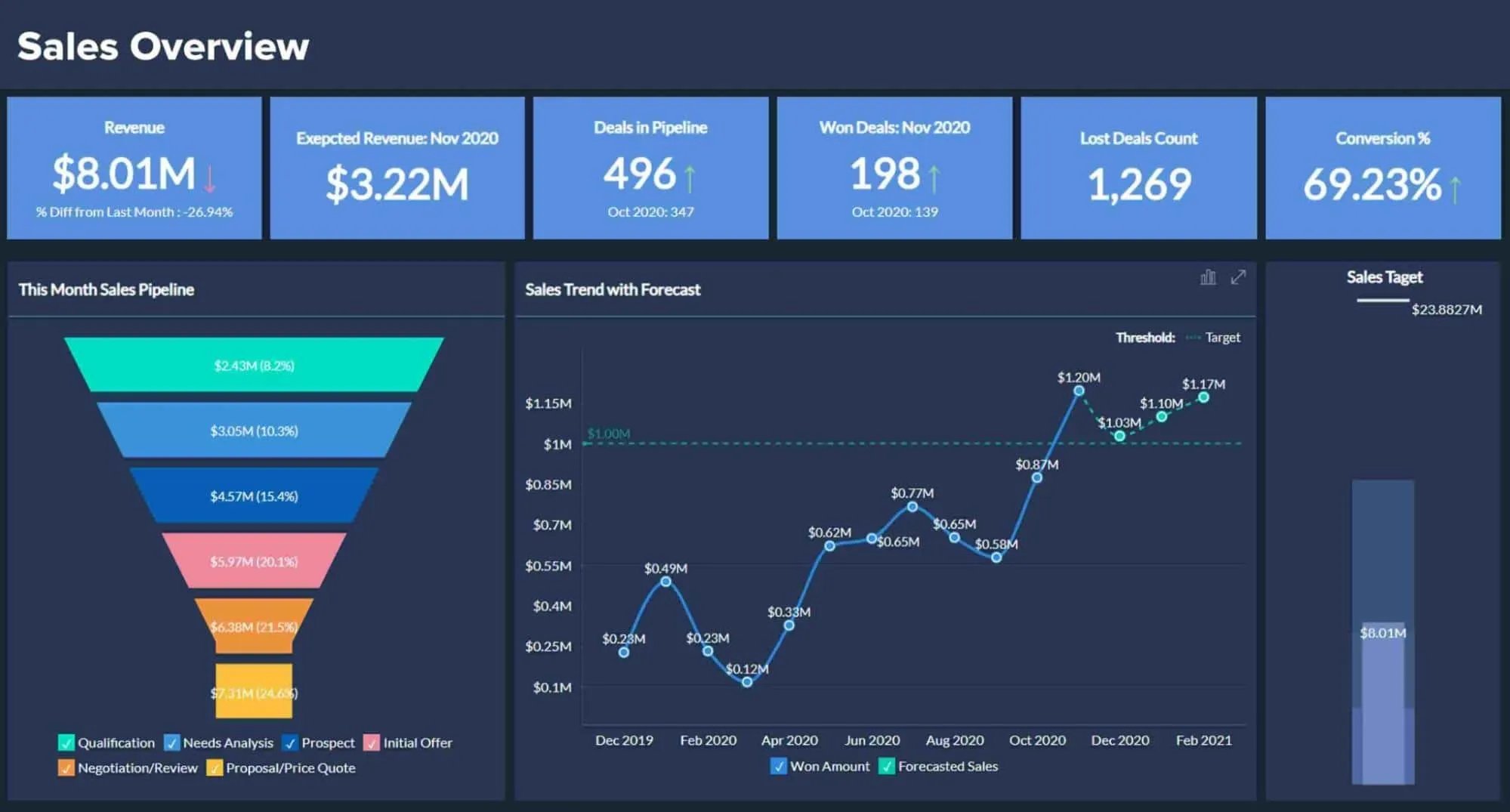
sales-metrics_0

Image Source

Now, you might wonder how many sales metrics there are and which ones you should track.

Tracking the right metrics throughout each stage of the sales process is essential for effectively measuring the performance of your sales efforts. I dug through data from our 2024 State of Sales Report and found a list of key sales metrics that salespeople think are the most important to track. 
top sales metrics to measure


Key sales metrics to track

1. Total Revenue

Measures: Sales performance and effectiveness

Who this sales metric is helpful for: Sales managers+

Total revenue, also known as gross sales or turnover, is a crucial metric in evaluating your business's financial health and success. It is the entire income generated from all operational and sales activities across all products and services.

Calculate total revenue using:

Total revenue = Quantity of products and services sold x Price of the product or service

sales metrics: total revenue formula

Suppose your company sells 100 units of its product for $10 per unit. Your total revenue would be $1000.

Why track it: Your business's total revenue objectively measures your ability to generate income. It helps monitor your progress and make informed decisions about enhancing profitability and optimizing sales operations.

Michele Potts, Director of Sales at Zoe Marketing and Communications, told me, "Tracking sales revenue helps you understand the direct outcome of your sales efforts. It allows you to gauge the effectiveness of your strategies and make informed decisions to drive growth.” 

2. Percentage of Revenue From New Business

Measures: Sales performance and effectiveness

Who this sales metric is helpful for: Sales managers+

Our survey respondents told us that revenue from new vs. existing customers is the third-most important metric to track. 

The percentage of revenue from new business is the monthly or quarterly revenue generated by new customers. 

Calculate the percentage of revenue from a new business using this formula.

Percentage of revenue from new business = (Revenue from new customers / Total revenue) X 100

sales metrics: revenue from new business formula

If your company generates $20,000 in revenue from new business and has total revenue of $100,000, it generates 20% of its revenue from new business.

Why I recommend tracking it: I recommend tracking the percentage of revenue from new businesses because it measures your company’s growth and success in acquiring new customers, and your ability to generate income from these new relationships.

3. Percentage of Revenue From Existing Customers

Measures: Sales performance and effectiveness

Who this sales metric is helpful for: Sales managers+

The percentage of revenue from existing customers is the income you generate from cross-selling and upselling, repeat orders, and expanded contracts. 

Calculate the percentage of revenue from existing customers with this formula.

Percentage of revenue from existing customers = (Revenue from existing customers / Total revenue) * 100

sales metrics: revenue from existing customers formula

If your company has total revenue of $100,000 and generated $20,000 in revenue from new business, it generated 80% of its total revenue from existing customers.

Why I recommend tracking it: Tracking revenue from existing customers helps you understand the success of your customer retention efforts, which is important because it’s more cost-effective than acquiring new customers: our survey respondents say it drives an average of 72% of their company revenue. 

4. Conversion Rate

Measures: Sales performance and effectiveness

Who this sales metric is helpful for: Individual reps for personal performance (BDR, SDR, etc.), and sales managers+

Conversion rate is the percentage of leads that turn into customers. You can calculate conversion rate overall, or even get more granular with conversion rate by sales funnel stage. 

Your conversion rates define your level of success. Higher numbers mean you’re well able to convert customers and can continue with your current process. If your conversion rates are lower, you have the opportunity to optimize your sales cycle to better target and speak to your leads. 

Calculate conversion rate using this formula.

Conversion rate = (Total number of won deals / total number of opportunities) x 100

sales metrics: conversion rate formula

Why track it: “A deep focus on this metric allows us to identify not only the quality of the leads generated by our marketing efforts but also the efficiency of our sales processes. By analyzing our conversion rate, we can adjust our persuasion techniques, improve the training of our sales team, and refine our marketing messages to better resonate with our target audience,” says Jose Rodríguez Maldonado, CEO of Databay Solutions

5. Cost of Selling

Measures: Sales performance and effectiveness

Who this sales metric is helpful for: Sales managers+

The cost of selling, also referred to as selling expenses or sales expense ratio, is the overall comparison of a sales activity's expenses to the revenue it generates. It’s helpful to measure it as a percentage. 

Calculate sales expense ratio with this formula:

(Cost of sales) / (Total value of sales) x 100

sales metrics: cost of selling formula

Why I recommend tracking it:  Understanding how much you spend throughout your selling process lets you know if you’re spending money in valuable ways. If you have a lower ratio, you’re effectively generating revenue. If you spend more money selling than you get as profit, you’re overspending to bring in customers and can benefit from revisiting your sales strategies and optimizing your process so nothing goes to waste. 

6. Average Length of Sales Cycle

Measures: Sales performance and effectiveness

Who this sales metric is helpful for: Individual reps assessing personal performance, sales managers+ for team performance

The average sales cycle length refers to the time it takes for potential customers (leads) to go through the various stages of the sales process until they become a successfully closed deal.

Calculate the average length of sales cycle with this formula:

(Total number of days to close all deals) / (Total number of deals) = Average Sales Cycle 

sales metrics: average length of sales cycle formula

Why track it: Knowing how long it takes to convert a lead into a customer helps with forecasting, resource allocation, and planning. Chris Percival, Founder & Managing Director at CJPI, tells me, “Tracking the sales cycle more closely helped us to identify bottlenecks that extended our cycle and helped us refine our approach. We continue to streamline steps that are not improving the customer experience and are dragging deals out. We now close more deals faster, boosting our revenue and allowing for better forecasting.”

7. Market Penetration

Measures: Sales performance and effectiveness

Who this sales metric is helpful for: Sales managers+

Market penetration is your total customer base compared with the total market potential.

Calculate the market penetration rate using the following:

Market Penetration Rate= (Number of customers/Total Target Market Size) X 100

If your company sells its product to 500 customers with a target market of 1000 customers, your market penetration rate is 50%.

The higher the market penetration rate, the greater the opportunity for growth and revenue.

Why I recommend tracking it: Your market penetration rate will give you valuable insight into your market potential and help you develop strategies to increase your market share. 

8. Win Rate

Measures: Sales performance and effectiveness, 

Who this sales metric is helpful for: Any individual sales rep (BDR, SDR, etc.), and sales managers+ for team performance

Win rate refers to the proportion of successful deals out of the total number of opportunities. It can be evaluated at the team and individual levels, providing valuable insights into performance and effectiveness.

Calculate the win rate using this formula.

Win rate = (Number of won opportunities / Total number of opportunities) X 100

sales metrics: win rate formula

If your sales team had 100 sales opportunities for a particular product and closed 50 of them, the win rate is 50%.

Why track it: By tracking win rates based on product, market, target audience, and other factors, you can pinpoint the chances of success for each opportunity. This will enable you to strategically direct your resources toward those with the highest conversion potential.

Eugene Garla, Tech and recruiter lead at Index, shared an example with me about how you can use win rates to increase success. He said, “Understanding why you win or lose deals can help you make the right changes and sell more. For example, if a member of the sales team has a higher win rate than others, they can share tips on how they achieve that. It will help the overall team to increase their win rate and close more deals.”

9. Year-Over-Year Growth

Measures: Sales performance and effectiveness

Who this sales metric is helpful for: Account managers, sales managers+

Year-over-year (YoY) growth is the metric that compares revenue generated from year to year.

Calculate YoY Growth using:

YoY Growth = ((Current Year Revenue - Previous Year Revenue) / Previous Year Revenue) * 100

yoy-growth

For example, if your company had revenue of $100,000 in 2021 and $120,000 in 2022, it had 20% YoY growth in revenue from 2021 to 2022.

You can also use this formula for any specific sales period. For example, if you wanted to see quarterly growth, you would simply do (current quarter metric - previous quarter metric)/ previous quarter metric * 100 

Why I recommend tracking it: YoY growth is a valuable way to evaluate overall performance and success in growing your business and meeting your goals. 

10. Revenue by Product or Service

Measures: Sales performance and effectiveness

Who this sales metric is helpful for: Individual reps, sales managers+

Revenue by product or service is the income generated by product or service. It’s vital for understanding the financial performance of different products and services.

The best way to track this is within your CRM since it’s typically automatically tracked.

Why I recommend tracking it: Tracking revenue by product or service lets you identify your most and least profitable offerings and optimize product mix to drive growth.

11. Average Customer Lifetime Value (CLV)

Measures: Sales performance and effectiveness

Who this sales metric is helpful for: Individual reps, sales managers+, marketing teams

The average customer lifetime value is a metric that measures the total revenue your business can anticipate generating from a single customer over the course of its relationship with your company.

CLV considers various factors such as customer behavior, purchase frequency, and average order value, providing valuable insights into each customer's value to the business.

To calculate CLTV, use the following formula.

Customer Lifetime Value = Customer Value x Average Customer Lifespan

sales metrics: CLTV

Why track it: Tracking CLV helps you make informed decisions about acquisition and retention strategies, maximizing long-term profits and sustainable growth. When you know what type of customer spends the most, you can target that same persona with the rest of your marketing and sales strategies. 

Zeeshan Khan, CEO of Dark Square, says that CLTV is the most important sales metric he tracks for his marketing and advertising agency. He says, “By meticulously tracking CLTV, we've been able to identify high-value customer segments and tailor our services accordingly. This has led to increased customer satisfaction, repeat business, and ultimately, higher revenue.” 

He says the metric has also helped optimize marketing budgets by helping them focus on channels that deliver customers with the highest lifetime value. 

12. Net Promoter Score (NPS)

Measures: Customer satisfaction

Who this sales metric is helpful for: Sales managers+, marketing teams, account managers

Net Promoter Score is a customer satisfaction and loyalty metric that measures how likely customers are to recommend your business to others.

To calculate NPS, you survey your customers and ask, “On a scale of 0 to 10, how likely are you to recommend us to a friend?” 

You’ll then categorize respondents as detractors (0-6), passives (7-8), and promoters (9-10). Next, you subtract the percentage of detractors from the percentage of promoters. 

Results range from 0 to 100, and higher scores mean customers are more satisfied and likely to recommend you to others. 

Why I recommend tracking it: NPS helps you better understand your customers' experiences and take action to improve customer satisfaction. This, in turn, helps build strong and lasting relationships with your customers, increase customer retention, and drive long-term business growth.

13. Number of Deals Lost to Competition

Measures: Sales performance and effectiveness

Who this sales metric is helpful for: Sales managers+, business development reps, sales development reps

Number of deals lost to competition is the number of opportunities you failed to win due to competition from direct competitors. 

Why I recommend tracking it: As companies risk losing up to 30% of their sales opportunities to competitors, it's vital to assess where your business lags and take action to enhance sales processes, marketing techniques, or product offerings. This will help you stay ahead of the competition.

14. Weighted Value of Pipeline

Measures: Sales performance and effectiveness

Who this sales metric is helpful for: Sales managers, BDRs, SDRs

The weighted value of the pipeline metric shows the estimated value of deals as they move through the sales pipeline. You assign a value to each potential deal based on its position in the sales funnel and the likelihood of it closing. 

Calculate the weighted value of the pipeline rate using the following:

Weighted value of pipeline = Probability of the deal closing x Deal value

Here, the probability depends on the stage of the pipeline. For example, the probability in the negotiation stage can be considered as 50%.

Why I recommend tracking it: A weighted pipeline provides accurate revenue projections and cash flow forecasting. It also highlights which stages of sales require the most attention. If you’re a HubSpot user, you can dive into your sales pipeline in the reporting feature. 

sales-metrics_6

Image Source

15. Annual Contract Value (ACV)

Measures: Sales performance and effectiveness

Who this sales metric is helpful for: Sales managers+, SDRs, BDRs, account managers

Annual contract value refers to the amount of revenue a contract generates per year.

Calculate Annual contract value using:

Annual contract value = Total contract value / The number of years in the contract

If your company signs a five-year contract for $50,000, the Annual Contract Value is $10,000.

Why I recommend tracking it: Calculating ACV helps you identify accounts that generate the most revenue, which lets you know which accounts require strategic customer retention strategies and support.

16. Frequency/Volume of New Opportunities Added to the Pipeline

Measures: Sales performance and effectiveness

Who this sales metric is helpful for: Sales managers+, BDRs, SDRs

This metric refers to the rate and number of new sales leads or potential customers added to your sales pipeline.

Why track it: Tracking the number of new opportunities added to your pipeline helps you gain valuable insight into its overall health and the effectiveness of your sales and marketing strategies. The more new opportunities you have, the more deals you’ll likely close. 

David Martirosian, Founder of David Martirosian, told me that tracking new leads or qualified appointments is the most important sales metric he tracks. He said, “From my experience, it’s very easy to start chasing old leads, pursuing lost deals, and even following up too much with clients. It's the path of least resistance, and it causes your pipeline to stagnate and fall apart…To me, tracking new leads will keep your business healthy and moving forward.

17. Average Lead Response Time

Measures: Sales activities

Who this sales metric is helpful for: Individual reps, sales managers+, SDRs, BDRs

Average lead response time is how long it takes salespeople to respond to a new sales lead. The faster the response, the more likely it is to turn that lead into a customer. 

You calculate it by dividing the total time (minutes, hours, or days) spent responding to leads by the total number of contacts

Why I recommend tracking it: Tracking this information can reduce response time and increase lead conversion. About 50% of B2B sales go to the vendor who responds to a customer first; this highlights the importance of timely and efficient lead response.

17. Percentage of Leads Followed Up With

Measures: Sales activities

Who this sales metric is helpful for: Individual reps, sales managers+

The percentage of leads followed up refers to the ratio of the number of leads actively pursued and contacted by your sales representatives to the total number of leads generated.

Why I recommend tracking it: It is a metric used to measure your sales team's effectiveness in reaching out to potential customers and converting leads into paying customers.

18. Percentage of Leads Dropped

Measures: Sales activities

Who this sales metric is helpful for: Individual reps, sales managers+, BDRs, SDRs

The percentage of leads dropped refers to the ratio of the number of leads not pursued or contacted by your sales representatives to the total number of leads generated.

Why I recommend tracking it: This metric is crucial for understanding the quality of your leads. If you see a high drop-off rate, your leads are low-quality, and you need to change your marketing approach.

19. Percentage of Qualified Leads

Measures: Sales performance and effectiveness

Who this sales metric is helpful for: Individual reps, sales managers+

The percentage of qualified leads refers to the ratio of the number of leads that meet specific criteria and are deemed ready for the sales process to the total number of leads generated.

The higher the percentage of qualified leads, the more likely your sales team is to close deals and achieve their sales targets.

Why track it: Faton Sopa, Co-Founder & CEO of Superlinks, tells me that the most important metric at his company is qualified sales calls. He says sales teams start out focusing on quantity and monitoring open rate, interested leads, and booked calls, but that “None of these matter if the person who shows up in front of you on your call is unqualified. That is a loss of time, resources, and investment.” 

Overall, this metric gives you insight into the efficiency of your company’s sales and marketing efforts in attracting and nurturing leads. It helps you measure your success and identify areas for improvement to generate higher-quality leads.

Featured Resource: Sales Metrics Calculator

sales-metrics_7

Download the Template for Free

20. Email Open Rate

Measures: Sales performance and effectiveness

Who this sales metric is helpful for: Individual reps, BDRs, SDRs, sales managers+

Email open rate refers to the percentage of recipients who opened an email campaign out of the total number of emails sent.

Calculate email open rate using:

Email Open Rate = (Number of Unique Email Opens / (Number of Emails Sent - Number of Bounces)) X 100

For example, if you sent 1,000 emails, 200 were opened, and 200 got bounced, your email open rate would be 25%.

Why I recommend tracking it: This metric gives you a clear picture of your email marketing campaigns' performance and helps you improve future campaigns. Open rates average between 25% to 41%, so it’s essential to continuously track and optimize your sales emails to get better results. 

21. Email Response Rate

Measures: Sales activities and sales effectiveness

Who this sales metric is helpful for: Individual reps, BDRs, SDRs, sales managers+

Email response rate refers to the percentage of recipients who respond to an email campaign.

Calculate email response rate using:

Email Response Rate = (Number of Responses / Number of Emails Sent) X 100

For example, if you sent out 100 emails and received 10 responses, your email response rate would be 10%.

Why I recommend tracking it: You can use the response rate to make data-driven decisions about future email campaigns, such as changing the email content, subject line, or sending time to improve response rates.


22. Email Engagement Rate

Measures: Sales performance and effectiveness

Who this sales metric is helpful for: Individual reps, BDRs, SDRs, sales managers+

Email engagement rate is a metric that measures the level of interaction between recipients and an email. Unlike response rate, email engagement rate takes into account a range of actions that recipients may take with an email, such as opening it, link clicks, video plays, and so on.

Calculate email response rate using:

Email Engagement Rate = (Total Number of Engagements / Number of Emails Sent) X 100

For example, if you sent 100 emails and received a total of 200 engagements (e.g., 100 opens and 100 clicks), your email engagement rate would be 200%.

Why I recommend tracking it: Email engagement rate is a valuable metric for understanding how recipients interact with your emails and how you can improve your email campaigns going forward.

23. Total Revenue From Partner Deals

Measures: Sales performance and effectiveness

Who this sales metric is helpful for: BDRs, SDRs, account managers, sales managers+

Total revenue from partner deals is the amount earned from partnerships or collaborations with other companies. 

This revenue is generated from agreements with other companies to offer products, services, or solutions to its customers. The partner company typically earns a commission or a percentage of total sales generated through channel sales.

Why I recommend tracking it: Knowing the total revenue generated from partner deals helps you plan your finances more effectively. You can use this information to set budget goals, allocate resources, and make informed decisions about pursuing more partnerships or expanding existing partnerships.

24. Revenue by Partner

Measures: Sales performance and effectiveness

Who this sales metric is helpful for: BDRs, SDRs, account managers, sales managers+

Revenue by partner refers to the amount of money your company earns from each partnership or collaboration. It provides a detailed view of the revenue generated from each partner, allowing you to understand which partnerships are the most profitable and valuable.

Why I recommend tracking it: By calculating revenue by partner, you can gain valuable insights into the performance of individual partnerships and make informed decisions about which partnerships to continue or discontinue.

25. Margin by Partner

Measures: Sales performance and effectiveness

Who this sales metric is helpful for: BDRs, SDRs, account managers, sales managers+

Margin by partner refers to your company's profit from each partnership or collaboration.

Why I recommend tracking it: It provides a detailed view of the profit generated from each partner, allowing you to understand which partnerships are the most profitable and have the highest margin.

26. Retention Rate of Partner Customers

Measures: Sales performance and effectiveness, customer satisfaction

Who this sales metric is helpful for: Individual reps, account managers, sales managers+

The retention rate of partner customers refers to the percentage of customers that continue to do business with your company after their initial transaction through a specific partner.

Why I recommend tracking it: Tracking retention rate measures customer loyalty from your partner customers. If a specific partnership has a higher percentage of customer churn, it signals that you should look to other types of businesses for future partnerships so you have a more qualified customer base that is less likely to churn. 

27. Average Cross-sell and Upsell Rate of Partner Customers

Measures: Sales performance and effectiveness

Who this sales metric is helpful for: Individual reps, account managers, SDRs, sales managers+

The average cross-sell and upsell rate of partner customers refers to the average rate at which customers make additional purchases from a company through a specific partner.

Cross-selling refers to selling additional products or services to existing customers. In contrast, upselling encourages customers to purchase a higher-value or premium version of a product or service.

28. Average Customer Satisfaction Score of Partner Customers

Measures: Customer satisfaction

Who this sales metric is helpful for: BDRs, account managers, SDRs, sales managers+

The average customer satisfaction score of partner customers refers to the average rating or score customers give regarding their experience with a company through a specific partner.

The average customer satisfaction score of partner customers can be calculated by taking the average score from all customers who have transacted through a specific partner.

29. Percentage of Time Spent on Selling Activities

Measures: Sales activity

Who this sales metric is helpful for: Individual reps (including SDRs, BDRs, account managers), sales managers+

The percentage of time spent on selling activities refers to the amount of time your sales representatives spend engaging in activities that directly contribute to generating revenue, such as making sales calls, conducting product demonstrations, and closing deals.

Why I recommend tracking it: This metric tracks your sales team's efficiency, provides insights into your sales team's productivity, and identifies areas for improvement. What’s more, sales reps told us that sales productivity metrics (like CRM and sales tools usage, high-quality lead follow-ups, conversations, etc.) are the most important sales metrics to track. 

30. Percentage of Time Spent on Manual Data Entry

Measures: Sales activity

Who this sales metric is helpful for: Individual reps (including SDRs, BDRs, account managers), sales managers+

The percentage of time spent on manual data entry refers to the time that employees or sales representatives spend manually entering data into a company's systems or databases.

This can include inputting customer information, updating sales records, and entering product information.

Why I recommend tracking it: If you find that you spend more time on manual data entry and similar tasks, it might be time to invest in sales tools that automate the process and give you time to focus on selling. 

Regardless of your score, using a tool for manual data entry, especially an AI-powered tool, is a worthwhile investment. 43% of salespeople use AI tools that automate manual tasks (like data entry), and 63% say AI is highly effective.

31. Percentage of Marketing Collateral Used by Salespeople

Measures: Sales activity

Who this sales metric is helpful for: Individual reps (including SDRs, BDRs, account managers), sales managers+, marketing teams

The percentage of marketing collateral used by salespeople refers to how your sales representatives use various marketing materials, such as brochures, flyers, product sheets, presentations, and other promotional items, in their sales activities.

Why I recommend tracking it: This metric provides insight into the effectiveness of your sales team and the quality of the marketing materials produced.

32. Average Number of Sales Tools Used Daily

Measures: Sales activity

Who this sales metric is helpful for: Sales managers+

Average sales tool usage refers to how many resources your salespeople use to support their sales activities daily, such as software applications, CRMs, databases, presentations, and specific tools, such as LinkedIn Navigator, Datanyze, or Sales Hub.

Why I recommend tracking it: This metric can help your organization understand the level of technology adoption and utilization among their sales teams.


33. Percentage of Sales Management Time Spent Recruiting

Measures: Sales activity and sales effectiveness (if compared to number of hires)

Who this sales metric is helpful for: Sales managers+

The percentage of sales management time spent recruiting refers to the amount of time your sales manager dedicates to finding, interviewing, and hiring new salespeople for their team.

This can include reviewing resumes, conducting interviews, participating in job fairs and networking events, and overseeing the onboarding process for new hires.

Why I recommend tracking it: Calculating the percentage of time spent recruiting can enable you to determine if the sales manager's recruitment efforts are efficient and productive.

34. Average Time-to-Hire

Measures: Sales activity and sales effectiveness (if compared to number of hires)

Who this sales metric is helpful for: Sales managers+

Average time-to-hire refers to the average time it takes to fill an open position, from when a job is posted to when a candidate is hired. It is a key metric that measures the efficiency and effectiveness of a company's recruitment process.

Why I recommend tracking it: Effective tracking of the average time-to-hire is critical in sales, where time-sensitive positions require prompt filling. Any delays can obstruct the sales team's success in reaching their targets and achieving their quotas. Moreover, a delay in the hiring process can result in losing top talent, as 55% of job seekers expect job offers to happen within two weeks of the initial interview. 

35. Percentage of Hires From Various Sources

Measures: Sales activity

Who this sales metric is helpful for: Sales managers+

The percentage of hires from various sources is a metric that measures the proportion of new hires that come from different recruitment channels.

Why I recommend tracking it: By tracking this metric, organizations can determine which channels deliver the best results in attracting high-quality candidates and allocate resources accordingly to optimize recruitment.

36. Average Turnover Rate

Measures: Sales activity

Who this sales metric is helpful for: Sales managers+

The Average Turnover Rate is a metric that measures the rate at which employees leave your organization.

Why I recommend tracking it: Tracking the average turnover rate is vital to prevent high employee turnover. It helps you identify turnover trends and root causes, enabling you to take proactive steps for better employee retention and build a stable, effective sales team.

37. Average Cost to Replace a Salesperson by Role

Measures: Sales activity

Who this sales metric is helpful for: Sales managers+

The average cost to replace a salesperson by role measures how much it costs to replace a salesperson after they leave. This includes the cost of recruitment, advertising, hiring, training, and lost productivity associated with replacing an employee.

Why I recommend tracking it: By tracking the average cost to replace a salesperson by role, you can identify the financial impact of high turnover and make decisions about employee retention accordingly.

38. Sales Ramp

Measures: Sales activity

Who this sales metric is helpful for: Sales managers+

Sales ramp-up time represents the average time a new salesperson takes to become fully productive. You can use it to make hiring and firing decisions, set expectations with new reps, and develop more accurate sales forecasts.

There are multiple ways to calculate it. CRMs often automatically calculate the meantime to 100% quota attainment, which you can use to set the ramp. For instance, if it typically takes a salesperson four months to hit 100% quota, your ramp-up time would be four months.

Although this method is fairly simple, it ignores that new sales reps often take over existing accounts or prospects, giving them a head start. In addition, a salesperson who hits 98% of their quota is likely fully ramped, but this formula wouldn’t count them as such until they hit 100%.

Alternatively, Ideal CEO Somen Mondal has developed a formula that factors in training, the length of your sales cycle, and prior experience.

Ramp-up = amount of time spent in training + average sales cycle length + X

X is based on the salesperson’s experience: The more they have, the smaller this number is.

Here’s an example for a well-seasoned rep, assuming training lasts 20 days and your average sales cycle is six weeks.

Ramp = 20 days + 42 days + 16 days

This salesperson would receive 78 days to reach full productivity.

39. Percentage of Reps Following the Sales Process

Measures: Sales activity and sales effectiveness (if compared to other success metrics)

Who this sales metric is helpful for: Sales managers+

The percentage of reps following the sales process refers to the proportion of your sales representatives who consistently adhere to the established steps or stages of the sales process. It is a metric used to track the effectiveness and efficiency of your sales team and the sales process itself.

Why I recommend tracking it: Tracking the percentage of reps following the sales process ensures that all reps follow the same method, resulting in a more consistent sales experience for the customer.

40. Average Level of Satisfaction With Sales Training

Measures: Sales activity

Who this sales metric is helpful for: Sales managers+

The average level of satisfaction with sales training refers to the degree to which your sales representatives are satisfied with the training they receive.

Why I recommend tracking it: It is a metric used to measure sales training programs' effectiveness and identify areas for improvement. Additionally, tracking this metric can help your organization determine whether its investment is paying off.

Now, let’s look at how to make sense of your raw data with leading and lagging indicators.

Leading and Lagging Indicators in Sales

Leading and lagging indicators are used in sales to predict and look at final results.

Leading Indicators

A leading indicator predicts your results. In other words, it tells you which direction you're trending with enough time to change the outcome. Leading indicators can be more challenging to measure than lagging indicators, but they’re easier to influence. 

Lagging Indicators

A lagging indicator reflects your ultimate results.

They're reactive, not proactive. For instance, a lagging indicator might be your team's quota attainment at the end of the month. After seeing the lagging indicators, creating or revisiting your sales plan can help you improve your results in the future. 

SaaS Sales Metrics

Software as a service (SaaS) is a software distribution model that provides customers with access to applications on the internet instead of requiring physical media and custom installation.

SaaS and subscription businesses require different metrics. As David Skok, general partner at Matrix Partners, explains:

“SaaS and other recurring revenue businesses are different because the revenue for the service comes over an extended period of time (the customer lifetime). If a customer is happy with the service, they will stick around for a long time, and the profit that can be made from that customer will increase considerably. On the other hand, if a customer is unhappy, they will churn quickly, and the business will likely lose money on the investment that they made to acquire that customer."

Rather than solely focusing on acquiring the customer (the "first sale"), Skok explains you must also focus on keeping them (the "second sale").

sales-metrics_5

1. Customer Acquisition Cost

Measures: Sales performance and effectiveness

Who this sales metric is helpful for: BDRs, SDRs, sales managers+

Customer acquisition cost (CAC) is the average amount of sales and marketing expenses required to acquire one new customer.

Here are some potential components of your CAC:

  • Inbound marketing (blogging, SEO, social media)
  • Sales and business development
  • Paid advertising
  • Events and trade shows
How to Calculate CAC

To calculate CAC, divide the total amount you spent on sales and marketing in a given period by the number of customers you acquired in that same period.

(Cost of sales + cost of marketing) / Number of new customers = customer acquisition cost

CAC

For example, if you spent $1,000 in one month and acquired 50 customers, your CAC would be 20.

This formula is easy to follow, and the result of your equation lets you know if any aspects of your acquisition strategy need optimizing so you’re not spending more than you bring in.

HubSpot's former VP of Growth Brian Balfour explains that it can only be accurate if your prospects become customers extremely quickly or your marketing and sales expenses are static (which is unlikely).

If you measure CAC by month, but it takes your typical prospect two months to buy after the first marketing touchpoint, your results can be misleading. Perhaps you start a new marketing campaign in January — its impact on CAC won't be visible until February. If this sounds like your situation, Balfour recommends using the following formula:

CAC = (Marketing Expenses (n-60) + 1/2 Sales (n-30) + ½ Sales (n)) / New Customers (n), where n= Current Month

The cost of acquiring new customers for merchants has risen dramatically in recent years, with a 222% increase over the past eight years. To stay ahead of the trend, it's crucial to continuously monitor your Customer Acquisition Costs and implement strategies to minimize them.

2. Cost Per Acquisition

Measures: Sales performance and effectiveness

Who this sales metric is helpful for: BDRs, SDRs, sales managers+

Balfour also points out people commonly conflate "Customer Acquisition Cost" with "Cost Per Acquisition" — but the two are different, and this mistake can be expensive.

CPA represents how much money you need to spend to acquire a non-customer, like a lead, a free trial, a registration, or a user. 

This means CPA and CAC are related: Your CPA is a leading indicator of your CAC.

For example, if you offer a freemium version of your software product, your CPA would measure the cost of acquiring a free user. Your CAC would measure the cost of acquiring a paid user.

It's calculated by dividing advertising spend by the number of acquisitions generated. 

Cost Per Acquisition = Advertising spend / Acquisitions generated

CPA

Months to Recover CAC

SaaS companies must know how many months it takes to recover CAC and the amount they invested in getting a new customer.

Not only does this metric help you manage cash flow, but it also tells you how long you need to retain a customer to break even.

Let's say your CAC is $200, and your Average Revenue Per User or Account (ARPU/ARPA) is $400. Your gross margin is 95%.

Months to recover CAC = CAC divided by (ARPA x GM)

In this example, you'd break even in approximately two weeks.

3. Customer Lifetime Value (LTV)

Measures: Sales performance and effectiveness

Who this sales metric is helpful for: Account managers, sales managers+

Customer lifetime value (LTV) is the average amount of money your company makes from an individual buyer for however long they stay a customer (i.e., X months or years). 

LTV tells you whether you're spending too much or too little on acquiring customers. The optimal LTV:CAC ratio is 3:1. In other words, if it takes a dollar to get a prospect to buy your product, they'll spend $3 over their time as a customer.

Segment your customers, then look at the average LTV. The findings will tell you where to focus your energy and/or change your strategy. For example, if Tier X of accounts has a 1.5:1 LTV:CAC ratio, while Tier Y has a 4:1 ratio, you'd probably want to:

  • Decrease your marketing and sales expenses for Tier X and increase them for Tier Y.
  • Figure out why Tier X customers are less profitable — are they churning earlier, buying less, and/or purchasing fewer add-ons?

4. Average Revenue Per User or Account

Measures: Sales performance and effectiveness

Who this sales metric is helpful for: Account managers, sales managers+

Average Revenue Per User or Account (ARPU/ARPA) is the mean amount of revenue from a single user or customer. Companies typically calculate it per month or year, depending on their business model.

If you offer monthly contracts, calculate it per month; if most of your contracts are annual, calculate it per year. This is the standard ARPU formula I recommend using: 

ARPU = Revenue during set period / Number of active users/accounts during set period

ARPU

5. Monthly Recurring Revenue (MRR)

Monthly Recurring Revenue (MRR) tracks the total predictable revenue your company expects to make each month. It's one of the most important sales metrics for SaaS businesses, since it reflects growth and helps you forecast future revenue.

How to Calculate MRR

There are two ways to calculate MRR.

  • Add up the monthly revenue you're bringing in from each customer for the total MRR.
  • Multiply ARPA/ARPU by your number of paying customers.

The first method takes longer but is also more accurate. If Customer X is paying $200 per month, and Customer Y is paying $400 per month, your MRR would be $600.

The second method is easier. If you have four customers, and your ARPA is $150, your MRR would be $600. This is the formula to use for yourself: 

MRR = Average Revenue Per Account/User x Total Accounts That Month

Make sure you're not including one-time payments in your MRR, like implementation and/or limited support fees.

Be careful about quarterly, semi-annual, and annual plans as well. Let's say a new customer signs a $1,200 year-long contract in December.

If you tally up your MRR on a customer-by-customer basis that month, you might incorrectly add $1,200. But you're not generating $1,200 from this account each month — you're generating $100.

To include these subscription values in your MRR, divide them by four, six, or twelve if they're quarterly, semi-annual, or yearly, respectively.

There are different types of monthly recurring revenues you can calculate: new MRR, expansion MRR, and churn MRR.

New MRR

New MRR refers to revenue from new customers. Suppose you acquired one customer paying $50 monthly and a second customer paying $45 monthly. Your new MRR would equal $95 per month.

New MRR Formula = New MRR + Expansion MRR - Churned MRR

Expansion MRR

Expansion MRR is revenue generated from existing customers, including cross-sells (buying complementary products or services), upgrades/upsells (a more expensive plan), and greater volume (buying more seats, usage data, transactions, etc.)

Expansion MRR is considered the "holy grail" of MRR. Why? It's commonly known that retaining an existing customer is 5 to 25 times less expensive than acquiring a new one. Plus, customers are far less likely to churn when they've invested more into your suite over time.

Churn MRR

Churn MRR is the revenue you've lost from customers who have downgraded their plans or canceled altogether. It's a leading indicator of next month's MRR. For example, if two customers each paying $400 canceled in June, your MRR would be $800 lower in July.


6. Annual Recurring Revenue

Measures: Sales performance and effectiveness

Who this sales metric is helpful for: Sales managers+

Annual recurring revenue is your MRR multiplied by 12 or the recurring revenue you'll generate in a calendar year.

It has a significant advantage over MRR. Because salespeople typically sell more during longer months (like March, August, and December) and sell less during shorter months (like February, June, and April), your predicted MRR might be off from month to month.

Since ARR applies to the entire year, monthly variance has no impact.

Should You Focus on MRR or ARR?

The short answer is that you should focus on both. While MRR tells you how your business is doing monthly, ARR gives you a yearly picture.

Your priority should depend on your company's maturity and business model. If you're generating more than $10 million every year, think in terms of ARR. A shorter-term lens is more helpful if you're generating less than that.

7. Churn Rate in SaaS

Measures: Sales performance and effectiveness

Who this sales metric is helpful for: Account managers, BDRs, SDRs, sales managers+

Your churn rate is the percentage of customers who cancel their recurring subscriptions. You can calculate per month, quarter, or year, depending on your most common contract type.

The formula for churn rate is:

(# of customers lost in a given time period) / # total customers at the beginning of a given time period

Imagine the majority of your customers are on semi-annual plans. In January, you have 400 customers. In June, you have 500 customers.

Your churn rate equals: -100 / 500, or -20%. You're gaining more customers than you're losing.

8. Revenue Churn

Measures: Sales performance and effectiveness

Who this sales metric is helpful for: Sales managers+

Churn is never ideal. 

However, revenue churn is different from customer churn. Revenue churn is the amount of revenue you've lost (a.k.a. churn MRR), while customer churn is the number of customers you've lost.

From a business standpoint, it's probably preferable to lose three customers, each paying $40 per month, than one customer paying $300 per month.

9. Negative Churn

Negative churn is a term popularized by Skok that means your expansion MRR exceeds your churn MRR. If you can achieve negative churn, your business will grow exponentially.

Measures: Sales performance and effectiveness

Who this sales metric is helpful for: Sales managers+

Negative churn is a term popularized by Skok, and it means that your expansion MRR exceeds your churn MRR. If you can achieve negative churn, your business will grow exponentially.

Sales KPIs by Team Type

You can also look at sales KPIs by the type of team you have. Inside sales, field sales, and sales development have different metrics to measure.

Inside Sales KPIs

Inside sales teams rely on these KPIs (from most frequently used to least):

  • Number of deals closed.
  • Opportunities by stage.
  • Calls.
  • Meetings.
  • Significant interactions or events (for example, ROI meetings or conversations lasting four-plus minutes).
  • Opportunities created.
  • Demos.
  • Quotes/proposals.
  • Emails.
  • Meetings scheduled.

Field Sales KPIs

Outside sales teams use many of the same metrics as inside sales teams but prioritize meetings more heavily.

  • Meetings
  • Number of deals closed
  • Opportunities created
  • Opportunities by stage
  • Quotes/proposals
  • Significant interactions or events
  • Calls
  • Demos
  • Emails

Sales Development Metrics

Companies use these sales development metrics to benchmark their SDR team’s efficiency and ability to grow their pipeline.

  • Meetings
  • Calls
  • Opportunities created
  • Significant interactions or events
  • Opportunities by stage
  • Number of deals closed (by their partner Account Executive)
  • Demos
  • Emails
  • Meetings scheduled

I’ve covered a lot of metrics so far — luckily, you don’t have to keep track of them manually. A sales metrics dashboard can compile these insights in an easy-to-scan format. 

Here’s an example of a dashboard:

sales-metrics_3

Image Source

CRMs, like HubSpot, come with the ability to create these dashboards within the system. Most provide pre-built dashboards, while others (also like HubSpot) let you build custom reports to track your most important sales metrics.

Learn how to create custom reports with HubSpot's Reporting Dashboard through a free demo.

Let’s review some metrics you’d track on a dashboard.

1. Sales Performance by Rep

Create friendly competition by tracking how each salesperson is performing. Pick your sales metrics based on the behavior you want to promote; for example, if you’re trying to increase your team’s prospecting efforts, you might display the number of total opportunities created in the last month.

To ensure your reps don't chase unqualified leads simply to fill their pipelines, you might also display total sales by rep.

2. Sales Activities

Keep your reps focused on the right tasks with an activities dashboard. Visualize how many days in a row they’ve logged into the CRM. This includes how many calls they made in the past week, how many presentations they gave, how many emails they sent, etc.

3. Sales Management

As a sales manager, you need to know how your team is trending. Track the value of new opportunities compared to the previous month or quarter, the weighted value of your pipeline, total sales versus your target, and/or close rate by the salesperson.

4. Funnel Reports

It is important to know how many contacts have been created, how many have been assigned, and how many are still in the sales funnel so that you can make better decisions for the team and set new goals. It can also help you identify and diagnose friction points in the sales funnel.

If you’re not ready to invest in a CRM that offers a sales metrics dashboard, I recommend using a sales KPI template that you can compile into a spreadsheet. 

Sales KPI Template

sales-metrics_4

Image Source

A sales metrics calculator gives you an easy way to track your sales metrics in a single place.

This KPI calculator is customizable to your business goals. It includes tabs for different KPIs that you can then track monthly, quarterly, or yearly.

You’ll be able to track the following KPIs:

  • Average Deal Size: Your company’s total revenue divided by the number of deals closed in a month, quarter, or year.
  • Win Rate: The number of deals won versus the number of deals lost.
  • Demo-to-Close Ratio: The number of demos that were carried out divided by the number of deals that were won.
  • Quota Setting Calculator. On-target earnings (OTE) multiplied by five.
  • Commission Calculator: The total amount you’ll pay out in commissions to your sales reps.
  • Customer Acquisition Cost (CAC): The amount spent on sales and marketing efforts, divided by the number of customers acquired.
  • Customer Lifetime Value (CLV): Average annual revenue per customer divided by the average lifetime of a customer.
  • Revenue by Product: Amount of income generated per product.
  • Customer Retention Rate: The percentage of customers who stay with your business.
  • Revenue Churn: The amount of revenue that’s lost in a month, quarter, or year.
  • Employee Turnover Rate: The percentage of sales reps who leave your team.

Track Sales Metrics to Increase Efficiency and Grow Better

It's critical to track sales metrics to ensure that your team is heading in the right direction. Carefully picking which ones to prioritize and then course-correcting (or even completely pivoting) will put you ahead of the game. You can analyze your progress, achieve your sales goals, and positively impact your bottom line.

Editor's note: This post was originally published in September 2019 and has been updated for comprehensiveness.

sales-metrics_1 (1)


10 Apr 15:57

It's Time for Salespeople to View Social Media as the Telephone

by Gerhard Gschwandtner
Today’s post is by Mark Hunter, CSP, “The Sales Hunter.” Mark is the author of High-Profit Prospecting: Powerful Strategies to Find the Best Leads and Drive Breakthrough Sales Results and High-Profit Selling: Win the Sale Without Compromising on Price. Some people argue social media is the new way to prospect – and that the telephone is dead. Others argue that the telephone is still viable and there is no need to put too much emphasis on social media. I’m tired of this bogus war pitting social media against the telephone. It’s time we start seeing both as allies. Sales is...
10 Apr 15:56

Real-world Strategies for Strong Sales and Marketing Alignment

by Ashley Minogue

“Building a strong and productive partnership between sales and marketing is easy,” said no one ever. In fact, a recent survey conducted by OpenView all but proves the contentious relationship. Across a survey of more than 500 SaaS marketing leaders, only 22% claim to be fully aligned with their sales counterparts. The idealist in me says the response should be 100%, but based on my experience, I was surprised the number was even that high. And I have a feeling that had we posed the same question to sales leaders; the number would have dwindled further.

While sales and marketing leaders are ultimately playing for the same team and working towards the same goals, their individual perspectives and focuses often send them careening in opposite directions.

So, instead of simply complaining about this sometime tumultuous relationship over a Friday afternoon beer, what can sales and marketing leaders do to drive alignment? Zak Pines, VP of Marketing at Bedrock Data, knows a thing or two about building cohesion. He’s spent more than 15 years creating sales and marketing partnerships that work.

“The buzzword is a-lign-ment,” Pines says, distilling his broad experience and best practices into three syllables. “The question is, how do you get there?”

That is indeed the question, and it’s one that Bedrock Data is helping its customers answer with an integration platform that’s tailor-built to help marketing, sales, customer success, and operations teams connect, clean, and synchronize data across disparate SaaS systems.

This alignment of critical information across and within departments gives the sales team better visibility into key marketing interactions and enables marketing to improve targeting within CRM databases.

Technology, however, is only one part of the alignment equation. As Pines explains, a successful sales and marketing partnership depends as much — if not more — on the human side of the relationship.

Define What’s Driving Growth

I think we all can agree with Pines, when he states, “There has to be alignment on goals and defining success. It starts with having a rationale around the targets, meaning we agree — at a leadership level — that as sales and marketing we have a specific bookings or revenue number as the key goal, and here’s why. Being aligned around these key goals builds a natural sense of teamwork between the groups.” Teamwork helps to develop mutual respect which is another thematic key to successful alignment.

It’s also critical to ensure that the alignment is more than just skin deep. “There’s an even broader alignment required outside of sales and marketing,” Pines says. “Those teams must not only be aligned with each other, but also with finance, the CFO, the CEO, and the board.” In fact, Pines emphasizes, that’s where the alignment needs to start. “It’s the responsibility of the leadership team, whether that’s one person or multiple executives, to create that broader alignment. Once the overall target and growth strategy are in place, sub-goals for specific programs and channels will fall into place.”

This is where most companies miss the mark. It is “easy” to define a KPI and a specific target goal, but the more challenging part is determining how you’ll get there and staying in sync as you adapt to what it’ll take to achieve the goal. Pines recommends focusing on one question to gain and maintain clarity around your goals. “A key to success is being able to define what’s driving your growth,” he says. “Which things do you all agree are the keys to growth? Is it key partnerships? Is it developing those partnerships and producing more leads, pipeline, and revenue through them? Is it new products? Is it building on proven success by scaling out more leads through proven channels?”

For every SaaS company, the answer will be different, and you’ll be tempted to list 87 things that are the “key” drivers of growth. Here at OpenView, we have seen time and time again, that the most successful companies are the ones who are constantly forcing marketing and sales to answer this question, reach an agreement and stay focused on prioritizing the top three, not 87, drivers of growth.

Map Out the Path to Purchase

But it’s not enough to align around just the big idea. Another, often overlooked, point of alignment is agreement on exactly what you’re selling. It seems like what you’re selling should be so obvious that you wouldn’t need to define it, but it’s easy to confuse the issue. “When I talk about aligning around what you’re selling, I’m asking about the path to purchase for your product,” Pines explains. “For example, are you all about free trials – getting more and more people to try the product? Or are you selling to specific use cases – the specific problems a customer can solve by using the product?” How you answer that question defines the path people take to buying your product. Once you’ve answered it, then the integrated customer buying experience you create – from your website to your marketing programs to your sales conversations and even your customer on-boarding – needs to align around this.

It’s a deceivingly small detail that actually makes a huge difference. “If marketing and sales are aligned on what they’re selling, you can build everything around that — your marketing programs, website content, everything,” Pines says. “If you’re not aligned on this point, then the way marketing generates leads can result in a lot of wasted effort because it won’t deliver the kinds of leads sales is looking for.” Alignment here is critical to creating an optimized lead funnel.

Use Metrics as a Conduit, Not the Sole Source of Truth

One of the most common mistakes Pines has seen around building a working sales and marketing partnership is the misuse of metrics. Even when a company manages to get leadership buy-in, align around shared goals, and correctly position BDRs within the organization, they can still be tripped up if they apply metrics incorrectly.

“Metrics should be used to provide visibility into progress, guide collaboration, and allow for fluid decision making,” says Pines. “They shouldn’t be used to cast blame without context. For example, if lead numbers are viewed in a vacuum, that may cause friction. Rather than casting blame on one group or another, use the data as a guide to make good decisions.”

Too often, Pines has seen teams assume that a performance problem is indicative of a specific function being ineffective, but there’s almost always more to the story. “You can’t reach the right conclusions without the right context and collaboration,” he says. “For example, some lead sources may convert higher than others – but both have value. That’s what I mean by context.”

On a related point, Pines cites the backlash against MQL. “Metrics can become overly black and white. There’s nothing intrinsically wrong with the MQL metric, but it has been abused by some who have placed too much weight on it,” he says. “Instead of making MQL (or any other metric) the sole point of measurement, metrics should be used as a conduit to create a dialogue between marketing and sales leadership.”

“Ultimately, if the marketing and sales leadership teams stay focused on looking at everything from the perspective of solving for what you need to do to grow, good things will result.”

Tactical Tips for Getting Started

Another way to ensure positive results is to establish good rapport between sales and marketing. “I’d say start by helping them spend time in each other’s shoes,” Pines suggests. “If you’re a marketer, offer to shadow a sales rep for a deal cycle, listen in on a sales call, or spend time in the field.” Pines also encourages teammates to be curious and ask a lot of questions so they can gain a deeper understanding of day-to-day sales challenges.

Having previously led a team of B2B marketing analysts at Wayfair, I’d have my direct reports shadow 2 to 3 reps informally during their first 30 days on the job. This turned out to be a critical part of onboarding and was a real eye-opener both for the new team members and for me. As a marketer, it’s easy to make an impact and see results right away. But for a sales rep, to make an impact (close a deal), much of the process can be out of their control. Learning about the day to day tasks of my counterparts made me a more compassionate marketer.

I’d also urge marketers to spend time with customers and lost prospects. You’d be surprised to hear what people are willing to share when they’re not fending off a “sales pitch.”

Pines concurs, “Customers are a great point to align around. Spend time with them. Interview them. This will not only help you generate insights about customers and the problems they’re facing, but it will also build credibility with your sales team.” Ultimately, the insights will help marketing teams develop more effective prospecting and engagement strategies, which in turn will accelerate the buying process.

From my own experience, it’s been easier to have a conversation with sales based on “consumer insights” instead of funnel data metrics alone.

Finally, it’s important for marketers to do a thorough and proactive job. “Be diligent and genuine about solving for growth,” Pines says. “Don’t think that just because you’ve generated leads, you’re done. Continuously evaluate how you can help your company and your sales organization grow. That’s what will help you generate appreciation and respect with the sales team so you can strengthen that critical relationship.

While creating true sales and marketing alignment is neither easy nor something that can be done once and forgotten, it’s a worthwhile effort with very tangible benefits for sales, marketing, customer success, and your company’s overall potential for growth.

About Zak Pines

Zak has worked in MarTech and marketing automation for nearly two decades. You can follow Zak’s marketing musings at MoneyballMarketer.com and on Twitter @MoneyballMktr.

The post Real-world Strategies for Strong Sales and Marketing Alignment appeared first on OpenView Labs.

10 Apr 15:56

Why There’s No Room for LeBron on Your Sales Team

by Lindsey Bly

There’s no shortage of sports analogies in the sales world, but bear with me while I introduce one more. Sales is like soccer, but it’s not like basketball.

In the book The Numbers Game, economists Chris Anderson and David Sally examine the concept of weak links versus strong links in soccer as compared to basketball. Their analysis shows soccer is a “weak link” sport, meaning teams win more games when the whole team is better than average but there isn’t necessarily a star player. Data shows the opposite for basketball, which is a “strong link” sport wherein teams win more games if they have a star on the team regardless of the remaining players.

This weak link/strong link concept is explained well in Malcolm Gladwell’s “Revisionist History” podcast and can be applied to a number of dimensions. While Gladwell relates the weak and strong link concepts to education, communities and funding, there’s also a very obvious (and slightly less controversial) relation to sales.

Sales as a Weak Link Sport

Sales is a weak link “sport;” resources are best spent on getting the majority of your team above average rather than focusing on increasing performance of a few star reps.

First, as with any well-balanced portfolio, you want to diversify your investments. Investing time and money into increasing performance of a single top performer or a few already great reps is risky. As top performers, these reps are ripe for promotion out of your team and could be exploring other opportunities. Their success could also be due to an underlying, unsustainable variable such as an abnormally strong territory.

Second, investing in getting reps from below average to “good” makes economic sense. Let’s test this theory. Say we have a team of 7 reps with the following performance:

Screen Shot 2017-03-30 at 7.55.31 AM

There’s one star rep and a number of reps who are underperforming. As a team, we’re only at 85% of quota. If we focus only on increasing our star rep, Erin’s, performance and were able to increase it by an impressive 55 percentage points ($275K), but failed to focus on the low performing reps, overall team attainment would only increase by 9 percentage points.

Instead, if we focus on the rest of the team and are able to get Jordan and Matt to perform at Ashley’s level (105%) and get Amanda, Joe and Andrew just to 75% attainment, team attainment increases by 30 percentage points and the team exceeds quota!

Now the tricky part – taking low performers and turning them into above average performers. A great way to do this is to identify what the “stars” are doing well. In this case, what are Erin and Ashley doing that’s getting them to exceed quota?

First, look at the data. Compare the activities these reps are doing that the others aren’t. Are they working more deals? Do they have a higher conversion rate? Do they get to the demo stage faster? If you’re using Base, great! You’ve got a head start. Base comes pre-loaded with a host of reports that allow you to compare reps on these key process metrics. The Rep Performance Dashboard is a great place to identify these trends.

rep-performance-dashboard

Second, talk to the reps and listen to calls. Do they have a better discovery or follow-up process? Are they using tools others aren’t? Are they using different messaging? Or do they simply receive a high volume of inbound leads due to geography?

Once you’ve identified what is making the “stars” great, you can make adjustments to uplift the rest of the team. This might mean process and system changes, introduction of new tools and/or sales enablement training.

Sorry, LeBron

The idea of focusing on uplifting a rep who is already a star might be tempting, but remember there’s no place for LeBron in soccer. And while it may be less glamorous, your resources are best used on taking the majority of your team to “good.” For more information about how to make this happen using data-driven techniques like the ones discussed in this blog post, download the free eBook From Art to Science: 5 Steps to Predictable Sales Growth.

08 Apr 16:52

Opinion: Small parties may hold key to B.C. election victory

by Harvey Enchin

In next month’s provincial election, Green voters will have a chance to do exactly what they did four years ago.

Namely, they elected the Liberals as the government instead of the NDP. I’m not saying that was the intent — probably quite the opposite. But that is what happened. Here is how it worked:

At the election, the Liberals got 47 seats in the legislature and the NDP 35. Now, in a full 11 close ridings won by the Libs, the (small) Green vote was still very significantly higher than the NDP margin of loss. In each of these ridings, the absence of any Green candidate would almost certainly have produced an NDP MLA. Another take: If fewer than 5,000 particular Green voters had stayed home, the Libs would have lost government.

Of course, this could work the other way on the other (right-wing) side of the street. For example, if the Conservatives can get their act together this time, their few votes might have a similar adverse effect on the Liberals, while electing none of their own.

This is what happens to small parties under our current rules. Many people rightfully feel unfairly pressured, being faced with an electoral system in which a vote for your principles might inadvertently elect someone who isn’t only not your second choice, but also actually someone you really don’t want at all. 

That is why B.C. has been a leader in the quest for electoral reform. You may remember the Citizens Assembly, which over 10 years ago proposed a better system, according to 160 members who studied it for a year. Almost 58 per cent of British Columbians supported that change in a referendum, but the then-government wanted a least 60 per cent and the initiative died. The reform could have changed Canadian politics for the better forever, and we should revisit that option in future. But this year, for this election, we have the current system, and we have to deal with it.

As the numbers are shaping up, we have a very tight contest. A “poll-of-polls” (ThreeHundredEight.com) gives rough numbers of NDP 39, Libs 35, Greens 15 and Conservatives 11.  Traditionally the two smaller parties will drop as people assess their realistic options, leaving a real horse race between the top two.

The campaign of NDP leader John Horgan and Liberal Christy Clark will make all the difference, again, as happened last time when the soon-to-be-Premier Clark climbed what seemed an impossible hill to overtake NDP leader Adrian Dix.

This time? Horgan is a truly decent, competent and honest man who cares about real people. In politics, that doesn’t necessarily get you very far. The charisma quotient is limited.

Clark by contrast is a political star. She is a fantastically skilled surfer on the changing waves of public opinion, without parallel in Canada. She exceeds the amazing Justin Trudeau himself and does it without a famous name.

Then there is money. With their fabulously successful “cash-for-access” program, the Liberals have the ability to far outspend their opponents, on the traditional media and on social media as well, where the millennials are beginning to settle their voting patterns. There is a fair bit of greenery there, which Clark will use to split the vote. The very persuasive Green leader, Andrew Weaver, will be her unwilling accomplice in that.

In the end, though, it will all come down to ballots in boxes. If they’re cast strategically, people will get something close to what they want. If they’re cast emotionally, making the perfect choice the enemy of the good, the future is much harder to gauge.

The two small parties will be critical in this. The few Conservatives around would most likely give their strategic votes to the Libs. On the other side of the street, the opposite. Ironically, this time around, a vote for the Greens in many ridings will really be a vote for Clark. Who said life is fair?

Gordon Gibson is a veteran political commentator. ggibson@bc-home.com


CLICK HERE to report a typo.

Is there more to this story? We’d like to hear from you about this or any other stories you think we should know about. Email vantips@postmedia.com.

08 Apr 16:50

Opinion: Canada's income tax has grown too costly and complex

by Harvey Enchin

As the April 30 tax deadline approaches, Canadians will be interested (though probably not happy) to know that this year marks the 100th anniversary of the federal income tax. Conservative Finance Minister Sir Thomas White introduced it for debate July 25, 1917, three years into the First World War, just days after Parliament adopted compulsory military service. What conscription did for young men the income tax was to do for wealth.

Conventional wisdom says the tax was to be temporary. In fact, Sir Thomas said only that he hoped Parliament would consider it again after the war ended. Parliament did consider it. And we’re still paying.

To observe this 100th anniversary, the Fraser Institute is bringing out 10 short essays on the income tax that Fraser Institute vice-president Jason Clemens and I have edited. We call the series “Zero to 50 in 100,” reflecting the income tax having gone from nothing in 1917 to fully half of federal revenues today.

The tax started as a levy on the very richest Canadians. In the early years, as few as one in 50 people paid. As late as 1938, only 2.3 per cent did. Now three-quarters of Canadians file returns, if only to take advantage of such benefits as the refundable GST credit.

The message of the 10 essays is that the income tax is now too high, too important, too complex and too costly. After 100 years, it’s time for serious reform.

Too high? Our top rate used to be middle-of-the-road in the G7. After last year’s federal budget, Ontario’s top rate of 53.5 per cent is below only Japan’s and France’s. Of the top 10 marginal tax rates in North America, seven are in Canadian provinces. B.C.’s lowest-in-Canada top rate of 47.7 per cent is higher than in 42 U.S. states. And top rates for U.S. states start at over $500,000, in some cases almost $1.5 million. In most provinces, by contrast, the top combined federal-provincial rate starts at $200,000.

Too important? Ottawa and the provinces together get more than a third of their revenues from the income tax. The average OECD country gets less than a quarter. Only four of 35 OECD countries (the U.S., Australia, New Zealand and Denmark) rely on income taxes more than we do.

Too complex? The 1917 income tax act comprised just 3,999 words and was only 10 pages long if you put it on a standard Microsoft Word page with 11-point font. The latest version contains more than a million words and takes up 1,406 such Word pages. The 1917 act didn’t even allow a deduction for children (a mistake soon corrected). But by 2014 the number of “tax expenditures” had risen to 128, including a 27-per cent increase in their number just since the mid-1990s.

Too costly? Just filling it out your taxes, or paying someone else to fill them out for you, now averages more than $500 a family in time and outlay. And that cost is regressive — a higher share of income for poorer than richer people.

Then there’s the economic cost from distortions in effort, investment, saving and education because of high marginal rates. Bev Dahlby of the University of Calgary estimates that in all provinces except Alberta a dollar of new income tax revenue creates more than a dollar of economic cost, so that the total cost exceeds $2 per every new dollar raised. In Ontario, the cost is almost $7 for every new dollar of revenue raised.

A tax that costly, complex and overused should be reformed. For the income tax’s 100th birthday we should either “broaden the base and lower the rate” by eliminating the special carve-outs and tax subsidies that have built up over the last century. Or, as the University of Calgary’s Jack Mintz recommends, we should give up on income taxation and tax consumption instead — not with a one-rate-for-everyone GST, but with a personal consumption tax, where we each subtract any saving we do from our income and pay a low, but progressively rising rate, on our consumption.

After 100 years it’s probably time for a change.

William Watson teaches economics at McGill University in Montreal and is a senior fellow with the Fraser Institute.


CLICK HERE to report a typo.

Is there more to this story? We’d like to hear from you about this or any other stories you think we should know about. Email vantips@postmedia.com.

08 Apr 16:50

Editorial: Resilience the new buzzword at Vancouver's City Hall

by Harvey Enchin

The City of Vancouver has joined an elite clique of like-minded municipalities in the 100 Resilient Cities movement, an initiative of the Rockefeller Foundation, intended to help cities become … well … more resilient.

This week, Mayor Gregor Robertson introduced the city’s new Chief Resilience Officer, Katie McPherson, a city staffer who has been working with Vancouver’s emergency planning office. In that capacity, she led a risk assessment for oil spills and was involved in the city’s responses to the 2015 bunker fuel spill in English Bay and a portside container fire. In fact, what she will be doing as Chief Resilience Officer sounds much like what she has been doing in the emergency planning department.

But resilience is more than recovery from earthquakes, fires and floods, we’re told by 100 Resilient Cities, but encompasses other stresses cities face such as high unemployment, overtaxed public transit systems, violence, food and water shortage and, of course, the mother of all challenges, climate change. Indeed, so vague are the parameters of the job that it could include anything.

But before we get into the issue of jargon versus substance, we must address the matter of foreign influence in civic affairs.

Vancouver’s chief resilience officer position will be funded by a two-year grant from the Rockefeller Foundation. If that doesn’t strike Vancouverites as unusual, how would they feel about a city economic development officer funded by the Cato Institute? Should a foreign entity have its own paid employee working at City Hall? Of course, some critics would argue such a relationship already exists through Vision Vancouver’s ties to the Tides Foundation.

Leaving aside the questionable role a U.S. foundation now plays in directing Vancouver’s policy agenda, resilience may strike the pragmatic among us as the latest buzzword for bureaucrats rather than a workable concept. Vancouver is already invested in Sustainable Cities International. Presumably, if a city is sustainable, it will be resilient, or vice-versa.

At a news conference, neither Mayor Robertson, nor Ms. McPherson nor 100 Resilient Cities director Jeb Brugmann was able to satisfy reporters’ curiosity as to what exactly this was all about.

“It’s about really ensuring that there are no gaps,” Robertson offered. In that case, we are talking about vulnerability rather than resilience. And, besides, addressing those gaps — that is, ensuring city departments are not operating in silos — would surely be the responsibility of Vancouver City Manager Sadhu Johnston.

To make resilience mean something, we need indicators to measure it as well as a transparent way to determine if efforts undertaken in its name are successful.

CLICK HERE to report a typo.
Is there more to this story? We’d like to hear from you about this or any other stories you think we should know about. Email vantips@postmedia.com.

08 Apr 16:49

Opinion: 'Gentle density' can help increase Metro Vancouver's supply of affordable housing

by Harvey Enchin

When it comes to building new homes, many people are surprised to learn that it takes far longer to make it through city hall than it does to build the house.

To put it in context, a ‘typical’ two-level, 2500-square-foot home takes 16-18 weeks to build, however getting to the stage where the shovel hits the ground can take several months, and in many cases longer.

Why does it take so long?

The recent Housing Approvals Study (HAS) prepared by the Greater Vancouver Home Builders Association, with support by the Landcor Data Corp., indicates high volume and backlogs due to housing demand and variations in builder applications, coupled with resistance to change within a neighbourhood as main factors in causing delays.

Looking at the current building-approvals process, the system is based on a first-come-first-served basis, allowing for incomplete building submissions to clog the system.

A best practice recommended by the HAS report is to process on a risk-based permitting and inspection-policy basis, also referred to as a ‘Nexus Lane,’ rewarding professional applicants with accelerated processing.  

The concept appears to have legs with government taking notice, as noted in Rob Shaw’s March 5 Postmedia News story, “Finance minister wants reasonable deadline for municipal housing approvals,” quoting, “a better solution would be to fast-track developers with proven records, argues the Greater Vancouver Homebuilders Association. (Mike) de Jong expressed support for that idea as well.”

However, the most impactful solution to help improve the supply of affordable housing is to use our limited land base more efficiently by encouraging “gentle density.”

By subdividing, or stratifying current single-family lots into duplex, triplex and quadplex houses, affordable ground-oriented, infill-housing options will be available in communities currently out of reach for many homeowners. This type of gentle density also minimizes the impact on existing communities from an esthetic point of view.

However, change such as this won’t come easy. It’s in people’s nature to protect their neighbourhoods, where one of their greatest emotional and financial investments is located, their home. But in many ways, protecting homeowners today, without consideration for the growth of future homeowners of tomorrow, can result in the very thing people are resisting.

Case in point: Policy No. 702 that restricts subdivisions on an area-by-area basis was set in place in Richmond in 1990 as residents of mature, large-lot properties felt that subdivision applications were negatively impacting neighbourhood character. As land values have increased in those communities, so have the size of newly built homes on the affected properties. Where originally the homes were 2,000-sq.-ft. bungalows, the replacements have often been 5,000-sq.-ft. ‘mini-mansions,’ and a new neighbourhood concern was born, worse than the first.

Currently, achieving gentle densification in Metro Vancouver is nearly impossible because of the lengthy, project-by-project rezoning application process, so many homeowners don’t bother and they’ll replace one housing unit for another, instead of increasing density.

A better way would be to move the zoning process from a project-by-project basis to the official community planning stage, where municipalities can strategically plan by neighbourhood. By enabling this type of “pre-zoning,” communities can then expedite applications, and property owners can be assured of what they’re allowed to build before they begin the lengthy process.

At present, 64 per cent of Metro’s residential land is covered by single-family homes, with many of these lot sizes ranging from 50 to 80 feet in width; significantly larger than a standard city lot width of 33 feet. Opportunity knocks.

As Metro continues to show a shortfall in the Regional Growth Strategy by over 4,400 housing units per year and as the growth rate continues to increase by 3,000 new residents per month, efficient use of land is critical to providing a complete mix of housing choices.

Pre-zoning for infill housing will help to address housing supply and affordability issues through gentle densification and the support for ‘complete livable communities,’ while maintaining and enhancing the integrity of existing neighbourhoods.

To access the HAS report, complete with interactive Metro-wide and municipal data, visit gvhba.org/HAS.

Robert (Bob) de Wit is CEO of the Greater Vancouver Home Builders Association.


CLICK HERE to report a typo.

Is there more to this story? We’d like to hear from you about this or any other stories you think we should know about. Email vantips@postmedia.com.

08 Apr 16:29

SPIF Tip #34: What Sales and Marketing Can Learn From "The Martian"

by Michael Webb

I'm sure you've heard

about "The Martian," Ridley Scott’s thrilling movie about Mark Watney, an astronaut left behind on Mars when a mission to the red planet went horribly wrong. 

about "The Martian," Ridley Scott’s thrilling movie about Mark Watney, an astronaut left behind on Mars when a mission to the red planet went horribly wrong. 
 
Watney's statement, "I'm going to have to science the shit out of this" struck a chord around the world. The only way Mark could save himself was relentless use of a single tool: reason.

 
Businesses face intimidating obstacles too. The movie motivates people because they know reason is required, and reason is not easy.
 
So, what can sales and marketing leaders learn from "The Martian?"      
 
Watney's Predicament

Imagine yourself in Watney's space suit, emerging from unconsciousness, realizing that you are hurt. The instruments in your suit merely display pressure and other readings. Your mind, however, has to do far more than just detect the pain of your injury and interpret what your eyes reveal. Your mind has to be aware of itself as it does these things. You have to manage how you focus your attention. You have to follow a careful method designed to keep your mind in contact with the harsh realities around you. 

 The first three questions on your mind would be:

  • Where am I? 
    You turn to look at the sky. You are alone and in grave danger. The possibility of getting back to earth vanished when your crew left you for dead. To survive, you'll need to know every detail about your surroundings. 
  • How can I discover it? 
    Supplies to keep you alive for a while are at your base a short distance away. If you can get there. Perhaps then you can figure out what to do.
  • What should I do?
    The base also has tools and instruments, although they may be damaged. It is your only shot. Refusing to be distracted by your peril, you begin to drag yourself toward the base.  
Your Sales and Marketing Predicament

Likewise, business leaders must apprehend the harsh realities they face. This requires following a careful method. The first questions on sales and marketing leader's minds should be: 

  • Where am I (in relation to my goals)? 
    If too few of your customers buy, or if they buy what you can't provide, you could be in grave danger. You must learn what stages these companies go through, and find a method that gives them what they want at each stage (now, and in the future).   
  • How can I discover it (the method to achieve my goals)? 
    You have at least some Voice of Customer now. If you can learn more, perhaps then you can figure out what to do. Your sales and service people have information, though it might be biased or incomplete. You'll have to figure out what to do about that.
  • What should I do (to create improvement)?
    Improving requires working with what you have. Refusing to be distracted by your perilous condition, you begin at the beginning: engaging your team in defining their terms, identify the customer's journey and observable deal characteristics. Together you work to identify the biggest bottleneck in your deal flow and develop a process to improve it.   
Mark Watney did not make assumptions. Every cycle of his brain was riveted on distinguishing what he knew from what he needed to know.
 
In sales and marketing this means ignoring old adages like "If you through enough proposals out there, some of them will stick," or "If the sales department isn't making its numbers, there must be something wrong in the sales department," or "If our competitors go to trade shows, we should too."  
 
Instead, the Watney's of sales and marketing carefully analyze variations among prospects and customers. They look for potential causes and effects that might enable learning experiments (in the form of conversations, questions, value propositions, and offers). 
 
These leaders leverage an explicit method for learning: the scientific method. Most importantly, they expect everyone on their team to participate and contribute to improvement. 
 
This leads their team out of the tribal mindset, and enables them to overcome intimidating obstacles. It is powerful because people know reason works. It is motivating, because it makes it makes improvement visible to everyone, so it can be respected, and celebrated. 
 
In sales and marketing, as in "The Martian," the only path to big victories is through small ones.