Shared posts

24 Apr 16:50

A Proven Process to Curate and Publish a Roundup of Industry Influencers

by Daniel Knowlton

proven-process-curate-publish-roundup-influencers

Have you tried putting together a list of top industry influencers?

Curating and publishing this type of list, while reaching out to featured influencers, is proven to create a large amount of exposure for your blog from a highly targeted audience.

This tutorial will walk you through the process. Though I focused on social media influencers, the process can work for just about any industry.

How is this different from every other influencer list strategy?

First off, this strategy uses a proven process that has delivered significant exposure to my content more than once. In addition, this strategy ensures that the list is completely credible. An external tool is used to calculate and rank the top influencers on the topic of your choice.

1. Choose a topic to focus on

One of the simplest ways to choose an influencer list topic is to just focus on your industry, for example “farming,” “manufacturing” or “technology.” However, consider narrowing your topic to research popular themes related to your industry. You could use your keyword research to help in this process.


One of the simplest ways to choose an influencer list topic is to focus on your industry, says @dknowlton1.
Click To Tweet


HANDPICKED RELATED CONTENT:
A Nutshell Guide to Proper Keyword Research

2. Identify the top 100 influencers on that topic

Various identification tools can identify influencers, just search for “influencer identification tools” on Google. In this process, I used BuzzSumo.

Head over to the influencers tab, type in your chosen topic, and hit Search. Use the filter tab on the left to narrow the list to the types of users you’d like to rank. For example, I untick “companies” when I create influencer lists focused on people.

BuzzSumo-Influencers-tab

3. Export the data into a spreadsheet

If you have a paid account, simply click the Export button.

If you are using a free trial, you need to put in a bit more effort to export and format this data onto a spreadsheet:

  • Highlight the first page. Copy everything from the first person on the list’s name (top left) all the way down to the last “average retweets” piece of data for the last influencer at the bottom of the page (bottom right).

Image source

  • Paste this information into a Notepad file.
  • Go back to the list and click on the second page. Repeat the process until you have 100 influencers’ information pasted into a Notepad file.

Influencer-info-notepad

The only information in the Notepad file is the influencer’s name, Twitter handle, and however many pieces of ranking data you want. I include four:

Influencer -info

TIP: To reduce your manual-deletion efforts to remove unnecessary data to achieve your final format, use the find-and-replace function. Simply click Edit, then Replace. Type in frequently mentioned unnecessary words in the “Find what:” box, leave the “Replace with:” box blank. Click “Replace All.” Repeat the process until all chosen words are deleted. Then, delete the remaining extraneous words manually.

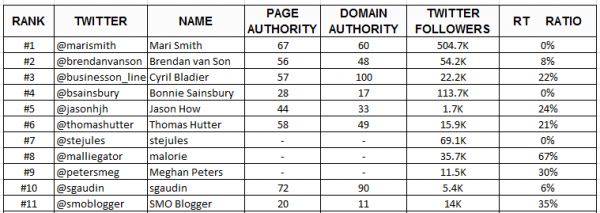
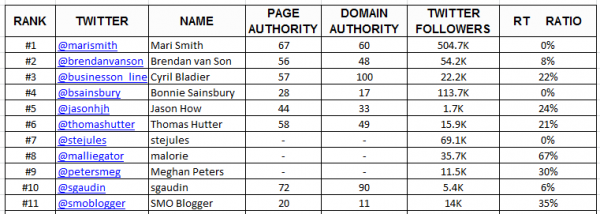
  • Copy and paste the 100 influencers’ information into a spreadsheet and label each column. I use the following: rank, Twitter (handle), name, page authority, domain authority, Twitter followers, RT ratio (retweet ratio – the percentage of each user’s tweets that are retweets).

Influencers-spreadsheet

  • Add hyperlinks to their Twitter accounts for each handle.

Influencers-spreadsheet-hyperlinks

4. Reach out to top influencers for quotes

Getting quotes from the featured influencers will:

  • Increase the credibility of the list
  • Increase the number of influencers and people who share the list
  • Add more depth to the piece of content

Get quotes from influencers to increase credibility and shares, says @dknowlton1. #influencermarketing
Click To Tweet


I’ve found that the best way to contact influencers is to send them a personal email.

TIP: To find an influencer’s email address, do a Google search for “(influencer’s name) email address.” Or read their Twitter bio and visit the Contact Us section on their website. As a last resort, use the contact form on their website.

Influencer outreach email template

To ensure that your outreach email works, use this proven template I have used to email the top 10 to 15 featured influencers. You only need a few to respond to include in the list post.

Subject: Top 100 [topic] Influencers in [year/month]

Hey [Influencer first name],     

I’ve used BuzzSumo to find the Top 100 Most Influential [topic] Influencers in the World in [year/month] (you were # [insert number where influencer was ranked]!).

I’m creating a list post including the top 100 and I’m including one “[topic + year/month]”-related paragraph from the top 10 on the list.

I know you’re super busy so I want to make this as easy as possible for you. It would be amazing if you could send one paragraph or show me where I can copy a paragraph you’ve quoted before about [topic + year/month]?

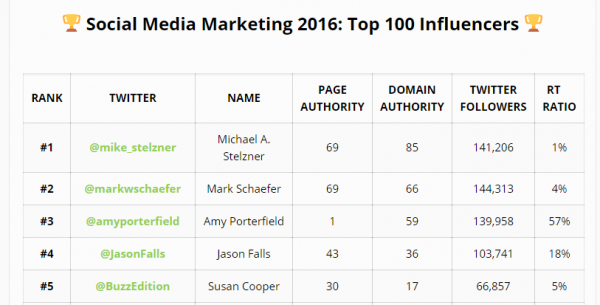
Here’s a quick peek at the top 5 in the list:

[Include screenshot of top 5, example below]

Social-media-marketing-influencers

Can’t wait to hear from you, have an amazing week, [Influencer first name]!

[Your Name]

TIP: Once you email the influencers, send personal tweets letting them know you have emailed them.

Influencer outreach email follow-up

Many factors can affect whether an influencer responds to your outreach email. To increase your chances of a response, you need to follow up with those who have not replied.

Two days after you have sent the outreach emails, send a follow-up email, which forwards the previous email and includes another personal message.

You can use the template below:

Subject: FW: Top 100 Social Media Marketing Influencers in 2016

Hey [influencer’s first name],

I know you’re super busy, I just wanted to see if you received my previous email OK and if you could send over a quick quote for the top 100 [topic+ date] list where you were ranked [rank] by BuzzSumo?

I could even copy a previous quote if you direct me to where I can find and copy it from?

Thanks, [Influencer first name]!

[Your Name]

Once you have received at least two quotes (the more the better), you can move on to the next step.

5. Create the influencer list blog post

Once you have the spreadsheet of top influencers and at least two quotes from featured influencers, it is time to put the blog post together.

You can put the blog post together in a variety of ways depending on your blog’s style. However, include a few key areas to ensure that you optimize the post’s reach and exposure.

Take a look at these examples from Buffer, Business Insider, Richtopia, and Hootsuite for inspiration.

The structure I tend to use is:

Image source

Use a header image with head shots of influencers

It’s no secret that influencers enjoy receiving recognition for their hard work, especially if they are placed next to other relevant influencers they look up to. Incorporating influencer’s headshots into the header image increases the shareability of the blog. I created this one with Canva.


With top influencer lists, create image with headshots to increase interest & shares, says @DKnowlton1.
Click To Tweet


Write a short introduction

A snappy introduction clearly explains the value readers will get from the influencer list. You can use this simple template:

Are you interested in [influencer list topic]?

Would you like to learn from [year/month]’s most influential [types of influencers featured in list]?

We’ve used [tool you’ve used to identify influencers] to identify the ‘Top 100 [influencer list topic] Influencers from [year/month]’.

Congratulations to everyone who made the list! Scroll down to see who made the top 100.

Explain how list is calculated

Explaining how the list is determined increases its credibility and the chances of featured influencers sharing the list to their large online audiences.


Use email, Twitter, & social-media tagging to congratulate influencers on making the list. @Dknowlton1
Click To Tweet


If you can’t find an explanation of how the influencer identification tool you’ve used ranks influencers, then contact them and ask.

Feature quotes from influencers

When quoting influencers, I include a headshot, their name (linked to their Twitter profile), and their preferred title and business (linked to their website).

Incorporate influencer list

Next, cut and paste the full influencer list from the spreadsheet into the blog.

Include a relevant call to action

Creating a relevant call to action at the end of a blog is not a revolutionary idea, but it’s an important part of any influencer list.

Ensure that the call to action relates to the topic of the blog. For example, the call to action for our 2016 Social Media Marketing Influencers list was to watch our video on influencer marketing strategies.

6. Reach out to all 100 influencers

Yes, this does take time. However, this is the most important step to ensure that you gain as much reach and exposure for your influencer list as possible.

The idea is to use a combination of email, Twitter, and social-media tagging to congratulate influencers on making the list. As I and many others have proven, this outreach will prompt a percentage of the featured influencers to share your influencer list with their online audiences.

Outreach by email

To source the email addresses of the featured influencers, follow the actions outlined in Step 4.  Use the following email template to reach out to them:

Hey [Influencer first name],

I’ve used BuzzSumo to find the Top 100 Most Influential [enter topic] in the World in [year/month] (you were #[where Influencer was ranked]!).

Congrats for making the list!

[enter link to list post]

Best Regards,

[Your Name]

Outreach on Twitter

Once you send the outreach emails, reach out to the influencers on Twitter (some influencers need a few prods to remind them about the list before they share it).

TIP: The most efficient way to reach out on Twitter is to use a scheduling tool like Sendible that allows you to bulk upload tweets you created in a spreadsheet. If you can’t bulk upload tweets, you will need to schedule these tweets manually.

You need to schedule one to three outreach tweets per day that tag featured influencers and congratulate them on making the list. You also need to ensure that you post plenty of tweets in between each outreach tweet so that your timeline doesn’t look like you copied and pasted the same outreach tweet to everyone.

You can use the following template for your scheduled outreach tweets:

[Featured Influencer’s twitter Handle] Hey [Influencer’s First Name] – congrats for making the list J [link to Influencer List Post]

Social-media tagging

Tagging featured influencers on social media platforms to congratulate them for making your influencer list is another great way to prompt shares and engagement.

TIP: Only tag a large number of influencers in a single post one time per influencer list on each platform. If you continue to tag influencers they may start to get annoyed with the constant notifications.

Conclusion

Using this influencer-list blog post strategy is more time consuming than creating a standard blog post. However, this strategy works to get you in front of the large online audiences of the influencers you feature.

Do you have any good examples of influencer lists? I’d love to check them out if you leave a link in the comments.

Want to learn in real life from many of the top content marketing influencers? Register today for Content Marketing World. Use code BLOG100 to save $100.

Cover image by Joseph Kalinowski/Content Marketing Institute

Please note:  All tools included in our blog posts are suggested by authors, not the CMI editorial team.  No one post can provide all relevant tools in the space. Feel free to include additional tools in the comments (from your company or ones that you have used).

The post A Proven Process to Curate and Publish a Roundup of Industry Influencers appeared first on Content Marketing Institute.

24 Apr 16:48

5 Ways To Make Agile Talent Work For You

by Paul Keijzer

A few weeks ago I talked about the increasing trend of hiring agile talent and how companies are benefiting from this strategy. There’s a line that differentiates employing agile talent as compared to temporary contractors but that line is quite thick. In fact, it’s thick enough that the two categories of workers have very specific uses for companies – you cannot replace one with the other. It’s a completely different ideology and approach to your strategic goal when you consider hiring agile talent. Which is why it’s all the more imperative to make agile talent work for you.

So now you have three main categories of workers:

  1. Full-time permanent workers who are employed on a long-term basis, provided benefits and are directly linked to your company’s strategies and culture.
  2. Part-time, contractors or temporary workers who you hire for a specified duration to tackle particular tasks, assignments or projects, aren’t provided benefits and who aren’t closely linked to your company’s strategy or culture.
  3. Agile talent who are employed for a short term assignment or project, aren’t provided benefits, however, have a close linked to your company’s strategy.

A Manager’s Dilemma of Working with Agile Talent

Agile talent is definitely a blend of the two traditional worker categories. Hiring them allows companies flexibility and access to expertise. However, ensuring that agile talent work for you can be challenging, particularly because managers aren’t that committed to temporary or agile talent. They know that an underperforming worker in these two categories can be cut loose easily – their contracts can be terminated or not renewed. With a full-time permanent employee, the situation is different. Managers invest time and effort into their teams. They provide feedback, hold detailed discussions and work hard to motivate their permanent team members.

The level of commitment that managers have towards temporary workers is, in contrast, significantly lower. There are fewer strings attached and less invested in this category of workers. Temporary workers are generally easier to replace because their skill-sets aren’t unique or at expert levels. The tasks they perform aren’t of a strategic nature making them less connected to the company’s culture. Hence, managers put in that much less effort.

Agile talent aren’t like temporary workers. They’re as connected to a company’s strategic vision and culture as full-time and permanent employees. Sure, their services may be required for a short and specific duration, however, the skills they possess aren’t easily replaceable. Hence, there’s a higher need for managers to stay connected with the agile talent that works with them. Feedback, motivation, and constant communication (i.e. everything that takes place with permanent employees) are all essential to make it work.

Make Agile Talent Work

In the book Agile Talent, the authors highlight five areas of alignment that companies and their managers should focus on to create an experience that enhances agile talent’s performance.

1. Strategic Alignment

The first step is to ensure that your agile talent is provided specific and realistic goals, timelines and clearly identified priorities. To really extract the most of hiring an expert you’ll need to be detailed and specific about the outcome that you wish to achieve from their efforts. Remember you’re hiring them for a specific duration making it all the more important for you to make most of their time. Start them off with a clear understanding of expectations and how they should prioritize their deliverables.

2. Performance Alignment

Feedback is the key here. Agile talent’s performance should not only be monitored but it’s immensely important for them to receive feedback on their objectives. And it’s not just evaluating them against agreed-upon performance metrics, it’s providing them feedback on how they’re integrating with the company. That means managers should also be going beyond technical feedback and talking about matters related to interpersonal and cultural activities.

3. Relationship Alignment

Keeping in mind that agile talent are closely linked to a company’s strategic vision, it’s all the more necessary to establish deeper relationships with this category of employees. Company’s need to make an effort to build relationships through enhanced onboarding, regular team meet-ups and activities and engagement communications. Relationship building requires managers to invest time explaining and clearly communicating the company’s culture and values, just as they would for their permanent team members.

4. Managerial Alignment

To truly extract the most from your agile talent, managers need to sync up and synergize with their agile talent. This alignment requires managers to exploit their managerial skills and experience to impart their philosophies and perspectives to the agile talent and motivate them to perform.

5. Administrative Alignment

This alignment requires companies to take necessary steps that would prevent agile talent from feeling alienated or singled out. Basically, you’re making sure policies and procedures, culture, acceptable behavior and all those administrative necessities are communicated to the agile talent. Also, you’re making sure their basic needs (such as getting paid on time) are taken care of.

As a company that’s successfully considering these five alignments, you’ll be able to extract more value from the monetary and time invested in your agile talent. You’ll create an attractive environment where agile talent work their best.

24 Apr 16:48

Updated: Steelworkers paying salaries of senior NDP staff

by Rob Shaw

B.C. Liberal Leader Christy Clark says the NDP is allowing a major union to influence its policies by paying for its senior campaign staff.

But she struggled Monday to explain why her party insists that the millions in corporate donations it receives doesn’t influence its decision-making, and how she can hurl those same accusations against her opponents.

“The B.C. NDP are completely compromised,” Clark told reporters while campaigning in Delta. She accused the party of selling out workers because its top campaign officials are paid for by the United Steelworkers, whose American arm is standing beside U.S. President Donald Trump on some protectionist policies.

“His biggest financial backers are the union bosses of the United Steelworkers in Pittsburgh, who put American jobs ahead of B.C. jobs,” she said.

“And now we know the guys in Pittsburgh who stand with Donald Trump are paying directly the salaries of the B.C. NDP’s top campaign officials, and he says that’s not a problem.”

Yet Clark’s party also accepts millions in donations from large corporations, and has insisted in the past it does not influence her party’s policies or government decisions. “Everybody takes donations,” she said when asked that question Monday. 

NDP Leader John Horgan said he’s “morally opposed” to donations like the ones his party has accepted by Steelworkers, but he has to play within B.C.’s existing rules on political financing to have a realistic shot of defeating the Liberals on May 9.

“I have to win an election based on the rules my opponents are playing with,” he said during a Monday morning CKNW interview. “I’m not going to tie my hands behind my back.”

The NDP campaign shot back by saying Clark’s criticizing of greedy lumber barons (which she repeated in Delta) is unfair because the Liberals have accepted $241,000 in donations from Weyerhaeuser, which is leading the U.S. fight to impose duties on B.C.’s softwood lumber.

Green Leader Andrew Weaver called the NDP a bunch of hypocrites for spending months accusing the Liberals of being influenced by corporate donors when the party is influenced by unions like Steelworkers.

“This election is about trust,” he said in a release. “How can you trust a leader who publicly talks about how big money corrupts politicians, and then quietly goes into a backroom and strikes a deal with a union to have them pay for his senior staff?”

The debate among the leaders on the issue comes amid revelations in Monday’s Vancouver Sun that one the B.C. NDP’s largest donors is also directly paying for the salary of the New Democrats’ election campaign director, raising questions about its influence within a party that could form the province’s next government.

The United Steelworkers confirmed that some recent union donations to the NDP are in-kind contributions for party staff, including NDP election campaign director Bob Dewar and deputy director Glen Sanford.

That means the Steelworkers hired Dewar, Sanford, and potentially others, as union employees on contracts, before immediately loaning them back to the NDP campaign to work the election while still being on the Steelworker payroll. It is a legal manoeuvre, and the value of the pay is recorded on the NDP’s financial forms as an in-kind contribution, with the figures generally released after the election.

“We are providing support to the B.C. NDP so they can run a successful campaign ­ which includes hiring staff, airing ads and supporting local candidates,” the United Steelworkers District 3 said in a statement.

“All of our donations, both direct and in-kind, are being recorded, reported and are following Elections B.C. rules. We’re doing so because working people, and Steelworkers specifically, cannot afford four more years of Christy Clark.”

The Liberals leaped to attack the NDP on the issue, with candidate Andrew Wilkinson saying voters should be concerned about the Steelworker influence over the NDP so close to an election. The union donated $672,576 to the NDP last year, which the Liberals claim is the largest contribution in a single year in B.C. history.

“What favours have the Steelworkers of America extracted from the NDP for all of this generous support?” said Wilkinson. The Steelworkers also paid the salary of NDP Surrey-Fleetwood candidate Jagrup Brar after the last election, while he worked as an organizer and was available to help the NDP if needed. 

The NDP shot back at the Liberal hypocrisy, noting that the Liberals take in millions in corporate donations annually, and hold exclusive cash-for-access fundraisers with the premier and her ministers, while claiming that doesn’t result in favours or influence within government.

“I think the Liberals are trying to completely muddy the waters,” said Sanford, the NDP’s deputy provincial director. “Christy Clark is the diva of distraction and she’s just trying to cover for her own party’s record.”

Sanford added that it’s common for political parties in B.C. and elsewhere to obtain staff on loan from unions and corporations, so that the party gets the benefit of their work without having to pay their salary.

“It’s all transparent and has to be reported properly to Elections B.C., and in our case we’re quite happy that organizations for working people support the NDP,” he said.

The Liberals say they have no in-kind party staffers this election. However, the Liberals also raised significantly more money for their campaign than the NDP.

The NDP would not disclose the value of the Steelworker salaries. It will report those figures, and updated 2017 Steelworker donation totals, as per the law after the election, said Sanford.

The NDP has had an, at times, rocky relationship with the Steelworkers. In 2016, an internal memo obtained by The Vancouver Sun showed the union felt it was treated like an ATM.

The union’s American arm is also a source of controversy. United Steelworkers International president Leo Gerard was at the White House beside U.S. President Donald Trump recently when Trump attacked Canada’s dairy industry as a disgrace and said its North American Free Trade Agreement (NAFTA) with Canada was a disaster.

The B.C. Liberals used that material to launch attack ads Sunday, questioning whether NDP Leader John Horgan will side with his big American union donors against Canada. Horgan had commented earlier in the week, calling it “scurrilous muckraking” to attack a Steelworker president for trying to protect local jobs.

“For the B.C. Liberals to denigrate Mr. Gerrard, when he’s participating in an event with the President of the United States, which is his obligation as the leader of an international union, I think that’s just scurrilous muckraking on the part of the Liberals,” said Horgan.

rshaw@postmedia.com

twitter.com/robshaw_vansun

CLICK HERE to report a typo.

Is there more to this story? We’d like to hear from you about this or any other stories you think we should know about. Email vantips@postmedia.com.

24 Apr 16:47

A Surprising Discovery About Work-Life Balance

by Ken Evoy

A Surprising Discovery About Work-Life Balance

On any given day, ask just about anyone the question “how’s it going?” and the response is likely to be…

Oh… life has been very calm
I’m feeling so peaceful
It’s been kind of quiet.

NOT!!

More often we hear…

Crazy busy!
Don’t know where the time is going!
Great to see you! Gotta run! I’m late!

Most of us live our lives at break-neck speed, always “on,” rushing from one place to the next, working, taking care of family, and all the myriad activities and tasks that tend to be greater in number than hours in a given day. Whew! Even that run-on sentence is exhausting. 😉

It’s no wonder the topic of “work-life balance” is so popular. But why do so many of us think in terms of “balance”?

Work-Life Balance Is a Myth

Wikipedia defines work-life balance as “a concept including proper prioritizing between “work” (career and ambition) and “lifestyle” (health, pleasure, leisure, family and spiritual development/meditation).”

Question is… who decides what “proper prioritizing” is? What you prioritize might not be what your spouse / parent / son / daughter / brother / sister / friend / employer would prioritize for you.

The thing is… work-life balance doesn’t really exist.

It’s a myth. A fantasy. There’s nothing to “balance” because life is… life. Life is all of whatever makes up your existence. “Balance” implies that your work and your life(style) are separate. It creates sort of an opposing expectation, doesn’t it? But work is a part of life, and life includes working.

So instead of talking about a nearly-impossible-to-achieve concept…

Let’s. Get. Real.

The Solopreneur Life

When you live your life, which includes work, there’s no balance. Even if you work at home and are present and available to those who may need you at any given time, things are never going to be balanced.

Whatever you’re doing in any given moment means you’re not doing something else in that same moment. And when you’re passionate about your work, like most solopreneurs are, the rest of your life may become “out of balance” at times.

Even with the occasional imbalance, when you love your work and are passionate about what you’re doing every day, you’ll feel a wonderful sense of satisfaction. Why? Because part of what you would choose to do in your “off time” is the same as what you’re doing when you work.

You plan, think, strategize, imagine, daydream, solve problems in your head. And you love it. Your passion for your business begins to weave into and become part of your life.

Solopreneurs think about their business not in terms of a constant need to give their business their all every single day, but as having the ability to temporarily pause or pivot as life directs. It’s understood that there will be ups and downs due to the sheer nature of life. Some days will call for attending more fully to family, others for attending more to business.

Of course, this freedom could become a slippery slope when you’re trying to build and grow a business. Discipline, dedication and making enough time to have an impact on your business must be factored in when you make those family-centric decisions.

One way to make sure you’re moving toward your life goals is to ask yourself “will the choice I’m about to make be best for my business and family in the long run?”

The solopreneurial path is one that calls for constantly reassessing what is the best decision you can make right now for long-term success. Solopreneurs have more options about when to work, what to work on, how long and how hard.

There’s real, intrinsic value when you’re able to design a business to accommodate your life, and not the other way around.

You create a business that works within your life. If you have a family situation that requires more of your time, being able to work from home (or just about anywhere) provides flexibility and control.

Your business can “work around” the hours your children are in school or sleeping. It can work around time spent helping an aging parent, a sibling with health issues or a friend who just broke a leg. Whatever is going on that’s not related to your business can potentially be attended to all while you continue to grow your business.

According to the Women’s Business Center, 61 percent of women business owners use technology to integrate the responsibilities of work and home. The use of technology to manage all responsibilities is potentially even higher than 61% for solopreneurs. Think desktop and laptop computers, tablets, smartphones, video monitors, synced calendars and so on.

The 9-5 Life

Conversely, others believe a 9-5 job gives their life “balance.”

Note: for the purposes of this article, “9-5” means working full-time for someone else. For many, this is a soul-sucking exchange of dollars for hours, 8 hours per day of wanting to be somewhere else. For the lucky few who love their jobs, it is another form of the best kind of balance.

For most, there’s “the work day” and then there’s “the rest of their life.” That’s great, provided there’s that deep level of (job) satisfaction. And also provided the 9-5 is not actually 9-6, -7, -8 or later.

If you find yourself working long hours (especially if you don’t like it) for someone else, eventually things will begin to feel less balanced. Something will suffer. You’ll need to figure out how to combine job success and satisfaction with your desired level of commitment to family and other obligations. Easier said than done, right?

The reality is, some things are sacrificed whether you’re building your own business or working a traditional job. Solopreneurs integrate work and everyday life. 9-5ers are away during the day (or night if working night shift) and are more available to family and friends after work. But options for taking time off are typically very limited when outside needs arise during 9-5.

Work-Life Integration

Did you notice the word “integrate” in the last paragraph? Doesn’t that sound more achievable than “balance”?

Integration. Or fusion, merging, blending — use whatever term makes the most sense to you. The point is, for solopreneurs, work and life become integrated. Work is eventually woven into every area of your life. There’s no work vs. life. There’s simply “life,” in which the people you love and the work you do blend together.

The more all parts of our lives merge, where work and home are no longer separated by some imaginary wall, the quest for an unreachable balancing act dissipates.

If you’re currently in a “9-5” job, integrating work and life might not even appeal to you (at least at first). Why? Because as many folks think, at the end of the day, work can be shut off and the rest of your life can be enjoyed until the next shift.

Or it may not seem possible to do anything other than the 9-5. It’s all you know, what you’ve always done. What your parents did.

But what about the time spent commuting, being gone all day from little ones, putting in extra hours, wage freezes, downsizing threats and all that comes with “working for the boss”? Is that really what you want? Until retirement?

Are the job choices and resulting sacrifices you’re making today moving you towards a goal or vision for your future? Sometimes, you have to walk away from “what you’ve always done” in order to achieve goals in other areas of your life. We’ve all heard common regrets from folks who stayed in a job they disliked for many years…

I wish I’d had the courage to live a life I designed, not the life others expected of me.

I wish I hadn’t worked so hard for someone else’s gain.

If your work is just a “job,” eventually it will “feel” like it’s pulling you away from someone or something important. If you work at a job that you care deeply about, however, then the 9-5 life may be perfectly suitable for you.

Is Solopreneurism Right for You?

Frequent evaluation of priorities, goals, family needs, personal health and all the rest of the areas that make up one’s life will help identify whether the solopreneur journey is right for you. After all, isn’t this about making choices that are the best for the time and circumstances of your life? And living in a way that makes you feel happy and fulfilled?

As a solopreneur, you can approach each day with excitement and enthusiasm, having the option to work long hours as you launch a new product, or tend to a child home from school for the day. You’ll find more satisfaction in whatever you’re doing at the moment — weaving work and life together like a beautiful hand-stitched quilt. Each choice you make brings you closer to the life you want.

We need to go for a work/life merge, where we’re honoring both worlds without feeling burdened by either.” Kara Baskin, The Six Work/Life Balance Habits Of Resilient People

Changing Paradigms Even in BigCos

Even BigCos are taking a hard look at the way employees are required to work, especially those who care about the health and well-being of their workforce (yes, there are some).

Most 9-5 workers today feel overwhelmed, like they’re just trying to survive (rather than thrive), struggling to manage the boundaries between work and the rest of their lives.

One of the upsides of the technological advances we touched on earlier is being able to connect anywhere, anytime. Because of this, telecommuting is on the rise. Sure, not all jobs lend themselves to working at home some of the time but for those that do, businesses are looking at it, testing it, or already allowing it.

Productivity reports about telecommuters are encouraging. Workers report less stress, getting more work done, improved family relationships, and gaining a new perspective that helps them become better workers. The jury is still out when it comes to conclusions on effectiveness but the point is…

The culture of work/business has evolved into a new paradigm — which supports a different human paradigm. Meghan M. Biro, 5 Reasons To Kill The Work-Life Balance Myth

So What’s Your Ideal Lifestyle?

The possibility of becoming a solopreneur essentially revolves around your goals and life circumstances. And the beauty of being alive today is that this route is more possible than ever. It can be a truly wonderful way to…

1) own your life

2) earn enough, and

3) be happy

We all have a thermostat that’s set to an ideal lifestyle, and we all know that includes working. The solopreneurial path gives the best chance for achieving maximum flexibility, independence, control and freedom. Is it for you? Only you can answer that!

Wrapup

So you might be wondering how to improve on this irresistible quest to achieve the near-impossible. Bottom line is, you can’t. BUT, you can maximize efficiency in the way you work. And that efficiency means time saved that can be used to better monetize and grow your business.

24 Apr 16:45

What’s The Difference Between “Engagement” and Account Based Everything?

by Jon Miller

human engagement

From day one, the Engagio team has been focused on finding new, innovative ways to foster engagement at scale for businesses. We’re so convinced of its potential that engagement is literally in our name.

But, we need to talk about what “engagement” really means.

From where I sit, engagement has become a buzzword that organizations are glomming onto in the marketing and sales technology space. Whether you call it Sales Engagement, Account Based Engagement, or Flibbidity Whatever Engagement, the word engagement itself has come to mean so many different things that it has deviated from its original intention and definition.

It’s time to clear this up, because confusion here means misunderstanding the purpose of sales and marketing, particularly within Account Based Everything.

OK, so what is engagement?

While often misused by vendors, the concept of engagement endures because it describes something fundamental about the customer’s connection to your brand.

Higher degrees of engagement mean a deeper commitment. It means more emotion and a more meaningful relationship. It begets activity, such as buying and advocating.

Above all, engagement is about time. Before someone spends money with you, they’ll spend time with you. The more time they spend, the more interest they’re showing in doing business with you. That’s why, at Engagio, we enable customers to measure and score accounts by “Engagement Minutes,” tracking the most meaningful metric to demonstrate interest within a potential account.

Measuring engagement means asking are the right people at the right accounts spending time with the right people in your organization?

By the way, this is why it doesn’t make sense to talk about “sales engagement.” The engagement comes from your customers and prospects, not your sales team.

Engagement is the goal, not the tactic

Engagement is like electricity. It generates heat. It’s what turns the lights on. Engagement with the right people at the right accounts is what drives deals. Engagement is, ultimately, what we are all after.

But, like electricity, engagement is the output of what we do.

Electric currents need a power plant, a generator, or an engine to bring them into existence. Account Based Everything (ABE), powered by a Marketing Orchestration Platform, is that generator. ABE orchestrates marketing, sales, and customer success to operate in harmony to generate an output: engagement at your target accounts.

Account Based Everything is the input (the thing you do), to generate the output you want (which is engagement).

Why does this distinction matter?

The reason this clarification matters is that along with the rise of engagement as a buzzword du jour, we’ve also seen a swath of new sales email tools that make false promises to deliver engagement.

The problem with these sales email tools is that they conflate engagement with automation. The technologies I’m referring to fundamentally deliver automation in the most traditional sense of the word; we know it to mean a series of touches that follow a pattern of “do this, then this, then this.” These tools fail, however, to automate beyond an individual person — or to automate what matters. A sequence of automated interactions is not engagement.

Put simply, you cannot automate the human touch.

Engagement requires humans to interact with humans, not just bits and bytes. And that’s the core difference between marketing automation and marketing orchestration: a true marketing orchestration platform automates where appropriate, and synchronizes human interactions for everything that requires the personal touch.

Buyers beware: Sales spam is NOT engagement

Any campaign tool that emails individuals the same basic message is not truly orchestration and will not result in true engagement. The worst offenders simply provide tracking, templates and analytics to let sales people send more crappy sales emails. These emails trick very few buyers into thinking they come from a real person — but we all know they’re just sales spam that plagues our inboxes.

Let’s call a spade, a spade. Sales spam is still spam. As much as sales acceleration technology has given us greater efficiency, it’s also lowered the barrier to entry to sending a high volume of low-quality emails, and the result is obvious: our inboxes are filled with junk.

If you can simply change the person and company name in the email and still send it to someone else, then it’s sales spam. Period.

Despite what sales email vendors may say, sending more sales spam does not drive engagement. True engagement involves identifying specific accounts, and sharing with those accounts compelling commercial insight as a trusted advisor. It requires research, a focus on quality, and the human touch.

Here’s what true engagement looks like

Although automation is a core component of marketing orchestration and driving engagement at scale, the difference is in what we choose to automate.

True Account Based Engagement delivers content and messaging in a coordinated and interactive fashion that allows for human interaction. It combines interactions across a variety of channels into a coordinated series of touches that develop and deepen relationships. It is multi-touch, multi-channel and multi-player.

We call these efforts “Plays,” and they generally fall into one of five levels of sophistication (and effectiveness). The more advanced the Play, the more orchestration and coordination are necessary.

Evolution of Account OrchestrationDon’t fall for faux engagement

If you’re a B2B organization with a complex sale, the only true way to create a cohesive customer experience and drive target account engagement is by adopting an Account Based Everything strategy.

At the helm of the account-based evolution are Marketing leaders who realize we no longer live in a lead-based world. They are successfully orchestrating interactions between their own team (including sales, marketing, customer success, and executives) and the right people at target accounts. They’re mindful of the journey a customer account undergoes, and create powerful Plays that drive engagement at every stage of the customer experience. And they understand that engagement is the thing they’re trying to achieve, not the tool they need to buy.

What do you think? How would you articulate the different between Engagement and Account Based Everything?

24 Apr 16:45

3 Reason to Establish and Mine The Gap – Part I

by Tibor Shanto

By Tibor Shanto – tibor.shanto@sellbetter.ca 

Sales people are always trying to create urgency, or figure out how they can accelerate a decision. The conventional approach has been to either focus on a “pain point” the buyer may want to solve with haste. The other conventional strategy is to have the client agree to a needs analysis, and leverage the outcome based on that analysis. The beauty of the latter is that no matter what the inputs, in some miraculous way, the output always pints to your product or offering.

We can talk about the merits or efficacy of these methods, they work not because of the skills of the seller, but as a result of the state of the buyer. Specifically, they either have a pain and set out to address it on their own; or realise that their current state is not optimal, hence their willingness to participate in needs analysis. But what about those who are neither in pain, and see their current state as being “satisfied”? Those buyers who respond, “we’re good”, or “we’re all set”, or similar responses. that’s where you have to work The Gap.

To start, this is not about objection handling in the context of cold call, for that click here. This is where you specifically target potential prospects who are “satisfied” in a way that allows them to understand that there are viable alternatives to their chosen path that they are not aware of or have ignored for any number of reasons. In other words, those who are not aware of any gaps in their current state.

Mine the gapThe GAP

The best way to have a prospect understand the “gap” in their current state is not to have them look in the past as many sellers do, or at their current state; people will naturally defend what they have done and what they are doing when their state is “satisfied”. Your only option is to take them into the future, then walk them back to the present to have them experience where a Gap you see exists, but they to date have not. Here is a simple and reusable example, it is somewhat general, if you would like to have it tailored to your vertical or target group, get in touch.

Seller: I am curious VP Jane, if we were sitting here 18 months from now, and you were telling me the team had hit a grand slam, what would that look like?

At this point you have to sit back and let the person talk, this may sound obvious, but I live in the real world. You have to be patient, it takes some people a couple of sentences to really get to it. You may have to help them by asking them to elaborate, expand, etc. But once they get going, once they buy into the fact that they can articulate their view for the future, i.e. their objectives, you will be amazed at the future state they paint.

What I find 95% of the time, is that “18 months from now” doesn’t look anything like “now”. Which allows you to ask the next question:

Seller: That’s a great view VP Jane, so help me understand why we are not there now?

The answer to that is the Gaps they see between where they are and where they say they actually want to be. Among the things they will lay out in their response (with help from you), will be the Gaps you can Mine to develop the opportunity.

To do this right you will need to do some work, understanding what are some common objectives similar people have had, which of those gaps they were willing to invest in, and which were only aspirational. But most importantly, you will need to be able to leverage how you have helped others “fill the Gap”, achieve their objectives, and the impacts you delivered to their business as a result. To be honest, this is not easy at first, you have to fly without product or brochure, and rely strictly on skill, knowledge, and the ability to transform that knowledge to actionable insights for your buyers. Once you can do that, you’ll be able to Mine those Gaps, and deliver sales success.

Beyond the example above, come back Thursday, and we’ll look at some ways to effectively Mine The Gap.

Become one of the thousands of sales professionals receiving my latest updates on sales execution, tools, tips and more.

Join Now!

The post 3 Reason to Establish and Mine The Gap – Part I appeared first on Renbor Sales Solutions Inc..

24 Apr 16:42

14 Phrases That'll Instantly Sabotage Your Negotiation

by afrost@hubspot.com (Aja Frost)

A successful negotiation is like a tango. Both involve coordination, finesse, some degree of grace, and a reasonable amount of back-and-forth. Also — and perhaps most importantly — both can also easily be derailed if one of the people involved says something really off-putting or stupid while it's happening.

Nothing ruins a good tango like one of the dancers saying something like, “You dance just like my mom.” And nothing ruins a productive negotiation like one of the participants using one of the 14 phrases listed below.

Let's take a look at those main culprits and what you can say instead.

Subscribe to "The Pipeline" — The Weekly 5-Minute Read to Help You Crush Quota 

14 Phrases That'll Instantly Sabotage Your Negotiation

1. “I’ll be honest.”

Some reps think saying, “I’ll be honest,” “I’ll be straight with you,” or “I’ll be blunt” makes it seem like they’re passing along valuable or confidential information. But these phrases usually backfire; after all, they imply you haven’t been honest up to this point.

What to Say Instead

Rather than giving your statement a long wind-up, just come out and say it. For example:

Before: “I’ll be honest, we probably won’t be able to deliver the product in less than a month.”

After: “We probably won’t be able to deliver the product in less than a month.”

2. “You won’t find a better product out there.”

It’s pretty hard to take this claim seriously; nonetheless, many sales reps still assure their buyers their product is “by far the best” or ‘the most superior offering on the market." Don’t say this unless you want to lose credibility.

What to Say Instead

Emphasize your product’s unique strengths or features. Maybe yours is the only one with unlimited bandwidth — instead of saying, “Our product beats all of the competition,” say, “We don’t cap your usage, so you can upload as much content as you want.”

3. “I’ll give you X, but only if you sign by [date].”

The rationale behind this kind of ultimatum is that its inherent time sensitivity will overcome the prospect’s objection and compel a purchase. The problem is that it puts an unnecessary burden on the buyer — buy now or lose your opportunity to buy under these conditions, forever — and you can’t force a buyer onto your timeline.

What to Say Instead

“What’s stopping you from pulling the trigger today/this week/this month?”

Use this question to surface the buyer’s remaining objectives — a far better tactic if you want to reach the finish line.

4. “Trust me.”

While you might toss out a “trust me” to reassure the buyer, it can be received as fake and manipulative. Plus, trust isn’t something you can simply request: You have to earn it. As they say, if you have to ask, the answer is “no.”

What to Say Instead

“I’m confident that … ”

For instance, “I know a single day of training doesn’t sound like a lot, but I’m confident we can cover everything we need to in that time.”

5. “I need this deal by X to hit my quota/win a contest.”

It might seem reasonable to share your timeline with the prospect, so they’ll be motivated to move faster and help you out. Right?

If only. Buyers aren’t concerned with your agenda, they’re concerned with their own — which means you should be prioritizing their agenda over yours, too. Mentioning your quota or contest makes you seem self-serving (not to mention desperate).

What to Say Instead

“To hit [buyer’s milestone] by [date], we’ll need to wrap everything up by [date].”

Showing the buyer how the timeline impacts their goals is a much more effective path toward closing quickly. For example, if they need the product on September 1st and it’ll take a month to deliver, wrapping up negotiations by the end of July is in their best interest.

6. “No.”

When you give the buyer a hard and fast no, it’s pretty hard to get the conversation back on track. That’s not to say you have to compromise every single time they make a request, but you can soften the no by using positive language.

What to Say Instead: “While I certainly understand, I’m afraid that’s not possible.”

Alternatively, if you are willing to make concessions, try, “We can’t necessarily do X, but we can do Y and Z, which will get us a lot closer to where we want to be.”

7. “I’d [like, need to get, have to have] … ”

Whenever a rep is talking about their own needs and desires, it’s a problem. The focus must always be on the buyer — yes, even during the negotiation. So although you should be well aware of your objectives and where you’re willing to compromise, your language should always be tailored to the buyer’s needs and desires.

What to Say Instead

Explain how the terms you’re proposing benefit the buyer.

For instance, you might say, “To give you the customer support you’re looking for, we’ll be in the 12 to 15-seat range.”

8. “That’s not fair.”

A conference room is not a courtroom: Appealing to your prospect’s sense of justice will only make you look like you don’t understand how business works. Ideally, you’ll come up with an agreement that makes both you and the buyer happy — but you should never say “That’s not fair,” when they propose something you consider outrageous.

What to Say Instead

To show you’re listening, clarify what they’re asking for. Then, identify their motivations for the request. You can use this information to float a counter-idea.

Here’s how that might look:

You: “You’d like the $500K package with 240-day payment, correct?”

Buyer: “Yes.”

You: “Tell me about how those payment terms will affect your cash flow.”

Buyer: “Well, we’re currently looking for ways to decrease our annual payables outlay.”

You: “Got it. What if we instead did … ”

9. “You want a high-quality product, right?”

Rhetorical questions like, “You care about quality, right?” or “You want the best bang for your buck, don’t you?” will make most buyers bristle. You want to focus on the value of your product, but this method of reinforcing benefits is way too aggressive.

What to Say Instead

Lead the other person to their own conclusion by asking a price or quality-focused question. Let’s say you provide business video software. You’d ask the buyer, “Are you interested in having an account manager? That option is only available with the package we’ve been discussing, but the training and support can help you get the most out of the platform.”

10. “I don’t usually do this, but … ”

If you’re selling to a family member or life-long friend, then sure, giving them a better-than-average deal wouldn’t be too strange. However, when you’re talking to a normal buyer, this line comes across as a seedy tactic to induce gratitude. Not good.

What to Say Instead

If the deal is unusual in some way, you can explain why, but be straightforward. To give you an idea, you could say, “Normally, our pilot programs only last 30 days, but we can extend it to 60 days since you’re implementing the software within two business units.”

11. “I enjoy working with people like you who appreciate value.”

There are a couple of inherent problems with this sentence. First, who doesn’t like working with people who appreciate value? Second, it’s far too reminiscent of the stereotypical used car salesperson — not exactly the association you want buyers to make.

What to Say Instead

Pay the buyer a genuine compliment. If they make an insightful comment, tell them, “That’s an excellent point.” If you’re impressed by their analysis, say, “That’s a smart way of looking at it.” By sticking to the truth, you’ll make them feel good without sounding inauthentic.

12. “I’ll send over the contract right now for you to review and sign.”

Technically, there’s nothing wrong with asking the buyer to sign a contract when the negotiation is complete. But those are pretty cold terms — “contract” and “sign” scream sleazy salesperson/non-invested business partner.

What to Say Instead

“I’ll send over the [agreement/proposal] so you can review and okay it.”

Simply subbing in “agreement” (or “proposal”) and “okay” has a big impact on how friendly and collaborative this phrase feels.

With these phrases cut from your negotiation vocabulary, your chances of closing improve dramatically.

13. “This shouldn't take too long.”

You're trying to put the buyer at ease and make the negotiation process feel quick and easy, so you use this line or promise to get them on their way ASAP.

Yet speed is actually your enemy in negotiations. When the other party feels like they're on a deadline, they tend to act rashly and be more stubborn. If you reassure them that you can take as much time as necessary to answer their questions and develop the best possible agreement, their willingness to compromise will shoot up.

What to Say Instead

“Do you have any obligations I should know about for time purposes? I'm happy to spend as long as you need getting this proposal to a point we're both happy with.”

14. “How low do I need to go to make this happen?”

While you might be trying to identify your buyer‘s ideal price and/or figure out how aggressively you’ll need to discount, this question makes you seem desperate. Your prospect will conclude you‘ll bend over backward to get the sale — and they’ll use this knowledge to their advantage.

And thanks to the anchoring effect (or “the common human tendency to rely too heavily on the first piece of information offered”), once they've named their price, any price you name above that will sound unreasonable.

What to Say Instead

“Our price is X. [Silence.]”

Naming the first amount gives you the power to set pricing expectations. In addition, your prospect probably already has a good sense of what your product costs — if your company doesn't have a pricing page, they can usually find third-party reviews and comparisons.

You also should have already qualified them for budget. Since you know they can afford their solution, don't be afraid to give them a number. Then pause. If they want to negotiate it down or request other concessions, they will.

So there you have it: 14 key phrases you need to avoid at all costs in a negotiation. And while this list might not be exhaustive, it's definitely applicable — so keep these sayings in mind next time you find yourself negotiating with a prospect.

Subscribe to "The Pipeline" — The Weekly 5-Minute Read to Help You Crush Quota 

24 Apr 16:42

Customer Experience is the New Marketing and Customer Experiences are the New Brand

by Brian Solis

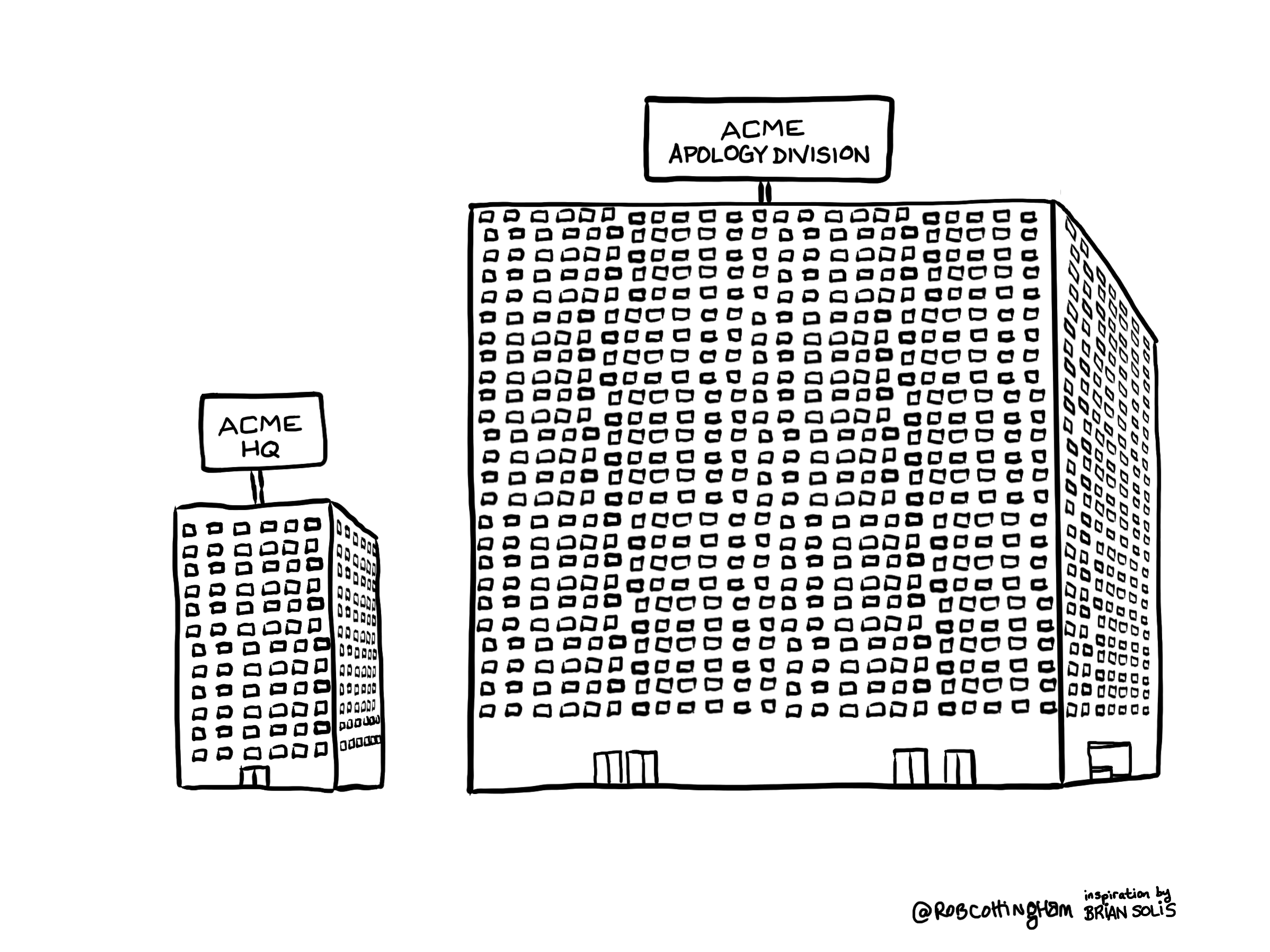
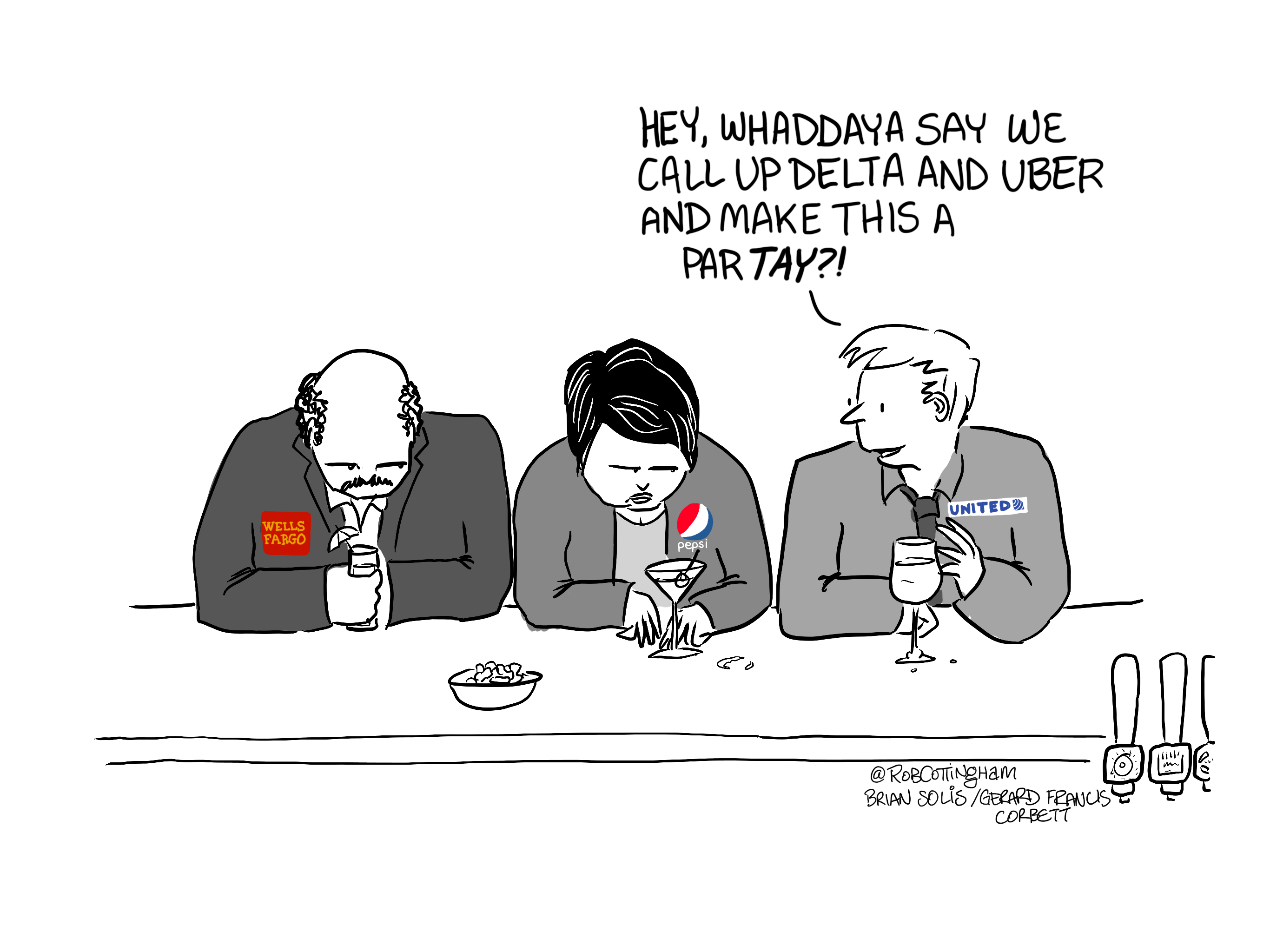
My friends Rob Cottingham, Gerard Francis Corbett and I have had some fun lately. One way to gain perspective on our modern reality is to do so through humor. So when a several big brands in the beverage, transportation, banking and airline industries were suddenly in the global media hot seat, we had a laugh and productive conversations behind the scenes. As a result, we set out to build upon these unfortunate opportunities with a couple of pithy but poignant cartoons hoping to spark a bigger dialogue. Our goal was to not further chastise brands, but instead call attention to the fact that every company can, at any point, fall to the experiences that customers have and share.

I want you to think about that for a moment…”the experiences that people have and share.”

Customer service is the new marketing.

Happy employees equal happy customers.

A happy customer tells a friend; an unhappy customer tells the world.

86% of buyers will pay more for a better customer experience, but only 1% of customers feel that vendors consistently meet their expectations

You’ve heard these adages time and time again. Yet, brands continue to use marketing, creativity and products/services as the means by which they aim to brand. But now everything matters. And you can argue that it always has. The difference between now and then is that great experiences were once differentiators. Now, great experiences are becoming mandates.

This means that it’s time to explore experiences (what people actually experience vs what they want to experience) that people have in every aspect, products, policies, services, touch points, et al. At the same time, it’s key to review current policies, processes, incentives, training, etc., for representatives. And, while you’re at it, review your brand style guide to find gaps between brand promises and real world experiences.

It’s time for an upgrade.

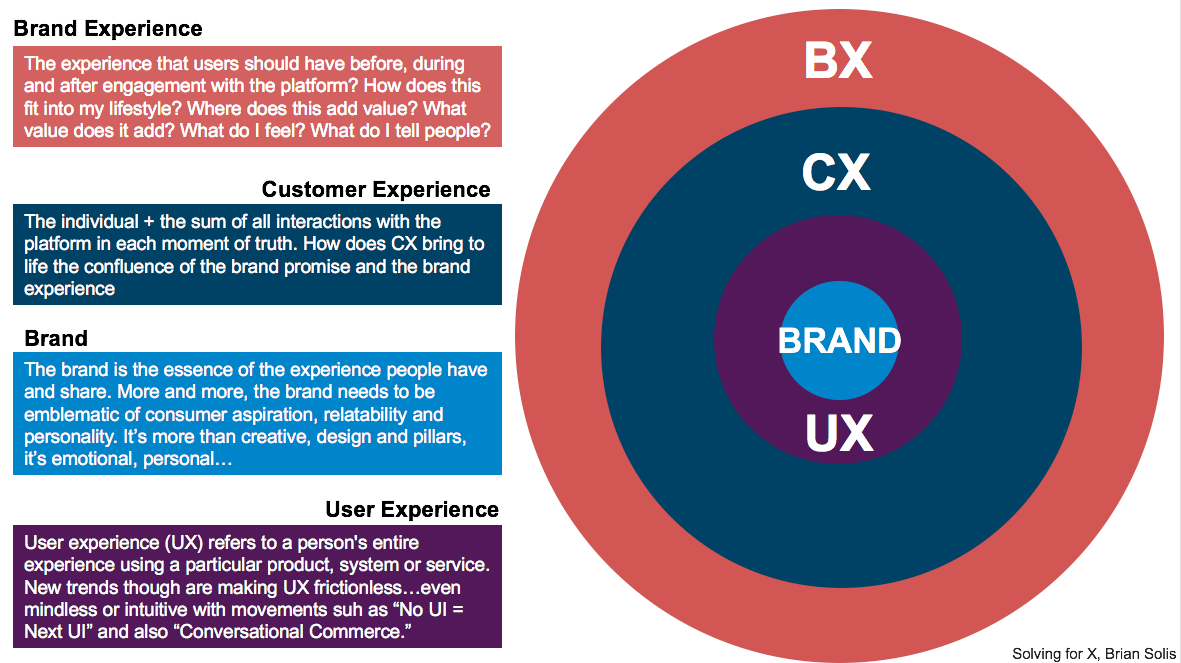
If it’s time to design experiences you want people to have, remember, and share. Customer experience (CX) is the new marketing and customer experiences (what they have, feel and share) become the brand (BX). But more importantly, CX becomes a way of business that permeates and reshapes every facet of how and why companies operate. It’s about purpose, vision, and meaningful work.

BX – Brand Experience
CX – Customer Experience
UX – User Experience
EX – Employee Experience

Experiences become memories…good or bad.

pasted_image_10_17_16__7_52_am

Please read X, The Experience When Business Meets Design or visit my previous publications

Connect with Brian!

Twitter: @briansolis
Facebook: TheBrianSolis
LinkedIn: BrianSolis
Youtube: BrianSolisTV
Snapchat: BrianSolis

Invite Brian to speak at your next event or meeting.

The post Customer Experience is the New Marketing and Customer Experiences are the New Brand appeared first on Brian Solis.

24 Apr 16:42

LinkedIn Hits the 500 Million Member Mark: What It Means for Sales Pros

by Judy Tian
  • global-milestone

Today marks a major achievement by LinkedIn: We’ve recently welcomed our 500 millionth member.

At the same time, we know we still have a long way to go. But reaching this milestone only confirms the rising value of LinkedIn as a friend to social sellers. With such a large, accomplished network of industry professionals, LinkedIn has become an essential tool for salespeople seeking to connect with buyers around the globe.

If you haven’t yet taken full advantage of LinkedIn in your sales methodology, let this mile marker serve as motivation to get in on the action. The tremendous value for social selling on LinkedIn can be traced back to three key trends:

1. More Decision Makers are Joining LinkedIn

Executive decision makers aren’t averse to the influence of social media. In fact, research from IDC has found that 84 percent of senior executives “use social media to support purchase decisions.” Overall, 91 percent of B2B buyers are now engaged in social media.

For any industry, LinkedIn serves as the best platform for building and maintaining these professional relationships. Half of all B2B buyers use LinkedIn as a resource when making purchase decisions. Given the professional context of LinkedIn, social selling activities tend to be more effective than similar strategies applied elsewhere. It makes sense for sales professionals to seek out connections and build relationships by engaging with prospects who are active on LinkedIn.

2. Quality Engaged Members are On the Rise

LinkedIn’s platform has become increasingly content-focused, with the launch of Trending Storylines and content search features. These advances rally engagement around thought leadership, industry news, and other quality content. Whether it’s publishing long-form content, publishing status updates, or responding via a comment, all this content generates millions of conversations daily, which has increased both engagement rates and active time spent on the platform.

This engagement is critical to effective social selling. Salespeople need outlets to identify and engage the right people, to build familiarity and establish credibility. This increased engagement, combined with the LinkedIn Sales Navigator tool, has proven to help sales pros generate qualified sales opportunities.

3. Future Decision Makers are Building Professional Relationships

Tomorrow’s decision makers are already in the workforce, piling up experience and professional contacts. This generation is paramount to the long-term prospects of any selling strategy, and it’s one more great reason to build an active presence on LinkedIn.

By building relationships with young professionals eager to climb the corporate ladder, you can invest in future sales opportunities by using your social media activity to gain a foothold with valuable contacts. Those professionals are hard at work building future opportunities, and sales pros are wise to do the same.

For ongoing advice on engaging LinkedIn’s 500 million members, subscribe to the LinkedIn Sales Solutions blog.

24 Apr 16:39

23 Facts to Pull Out When Someone Says Content Marketing Doesn’t Work

by Dan Shewan

There are few guarantees in life beyond death and taxes, but one thing’s for certain – some people love to dunk on good ideas.

Content marketing stats

Case in point, content marketing. Despite being a reliable, proven way to drive traffic to your site and increase leads and sales, some people just can’t help but talk smack about content. It’s too hard, it doesn’t work, there’s no point – all favored arguments of the content marketing naysayer.

Shame they’re all false.

Next time somebody says content marketing is a waste of time, why not pull out one of these 23 content marketing stats and facts to prove them wrong? You might change their mind – but if not, at least you’ll have the satisfaction of putting them in their place, and who doesn’t love that?

1. Content marketing is incredibly cost-effective and offers amazing ROI. Compared to traditional marketing programs, content marketing costs 62% less and generates approximately three times the volume of leads. (DemandMetric)

2. Content drives conversions like gangbusters. On average, conversion rates are six times higher for companies and brands using content marketing than those that aren’t, at 2.9% vs. 0.5%, respectively. (Aberdeen Group)

3. The biggest brands in the world realize that content is the future. Coca-Cola, for example, spends more money on content creation than it does on television advertising. (Contently)

4. Interactive content is big business – and getting bigger. Of content marketers currently using interactive content (like this interactive timeline of the history of Google AdWords), 75% plan to increase their budgets to produce more interactive content in the coming year. (SnapApp)

5. Marketers are shifting toward longer, more in-depth content. The average length of blog posts is getting longer, with the typical word count of a blog post increasing from 808 words in 2014 to 1,054 words in 2016. (Orbit Media Studios.)

6. Competition in content is fierce – but marketers are meeting the challenge head-on. Almost two thirds of marketers – 60% – produce at least one new content asset every single day. (eMarketer)

7. When it comes to content, longer is better. On average, long-form blog posts generate nine times more leads than short-form posts. (Curata)

Content marketing stats blog post length by industry

8. It’s how decision-makers prefer to learn about you. 80% of executives and business owners prefer to receive information about a company through articles rather than advertisements. (Stratabeat)

9. All the cool kids are doing it. 88% of B2B marketers in North America use content marketing as part of their wider digital strategies. (Content Marketing Institute/MarketingProfs)

10. Buyers trust content. An overwhelming majority of B2B service and product buyers – 95% – consider content as trustworthy when evaluating a company and its offerings. (DemandGen)

11. Content can help prospective customers at every stage of their journey. Almost half – 48% – of marketers support between three and five of their customers’ purchasing stages with specialized content. (LinkedIn Technology Marketing Community)

Content marketing stats segments

12. Content compliments traditional sales techniques perfectly. Approximately half of marketers – 49% – are producing content to align closely with various stages of the typical consumer sales cycle to aid sales teams and increase cross-departmental sales enablement. (LookBookHQ)

13. Prospects WANT content – especially white papers. Approximately 78% of buyers relied on white papers to make a purchasing decision within the past year. (Curata)

14. Content is becoming crucial to the purchasing process. Nine out of 10 B2B product or service buyers say that online content has had a moderate to major impact on their purchasing decisions. (Lenati)

15. Content is incredibly valuable to many organizations. More than half of marketers – 58% – said that “original written content” is their most important digital asset, more so than visual assets such as infographics and video content. (Social Media Examiner)

Content marketing stats popular content formats

16. For many marketers, content remains a primary focus. Approximately 81% of marketers say that they plan to use more original written content in their campaigns in the future. (Ibid.)

17. Content can be amazingly versatile and reusable. Almost 60% of marketers reuse and repurpose content between two and five times. (LookBookHQ)

18. Content has become vital to many companies’ lead generation pipelines. Lead generation, sales, and lead nurturing are the top three organizational objectives for content marketing, at 85%, 84%, and 78%, respectively. (Content Marketing Institute/MarketingProfs)

19. Many companies are turning away from traditional advertising in favor of content. Approximately 28% of marketers say they have reduced their digital advertising budgets in order to produce more content assets. (Gartner)

Content marketing stats Gartner data

20. Content offers amazing long-term ROI. One in 10 blog posts are “compounding,” meaning that organic search steadily increases traffic to these posts over time. (HubSpot)

21. Exceptional content delivers exceptional results. Compounding blog posts generate 38% of all blog traffic, and one compounding blog post generates as much traffic as SIX regular posts. (Ibid.)

22. Content aligns perfectly with shifts in media consumption habits. Almost three-quarters of marketers – 72% – believe that branded content is significantly more effective than traditional magazine advertisements. (Custom Content Council)

23. Content has become a digital marketing powerhouse. The median annual spend on content marketing in 2015 was $1.75 million, with roughly one in six enterprise-level organizations spending more than $10 million on content annually. (Content Marketing Institute)

24 Apr 16:39

15 Growth Ideas for Boosting Ecommerce Sales

by William Harris

Now that we’ve entered into Q2, it’s a good time to stop and briefly think about the specific actions you’ve taken to drive ecommerce sales so far this year, and what you’re going to do differently in the months ahead.

With only a little over 8 months left in the year, you don’t have a lot of time to waste—you have to start compiling and working through a list of growth ideas that you can implement to fuel real growth and profits for your ecommerce business.

So where to begin? Here are 15 quick growth ideas to consider:

1. Implement a Chatbot

Add a chatbot to your website to catch interested customers before they leave. Chatbots can help you keep your overhead down by acting as virtual salespeople or customer service team members for your ecommerce business. As opposed to actual human beings, chatbots can work 24 hours a day, and can answer questions while the rest of your team sleeps. Chatbots not only help you answer questions, they also help you qualify leads and understand who you should be following up with, what their interests or objections are, and what you need to do to convert them.

Recommended Tool: Driftbot

2. Launch a Physical Product Catalog

The jury may still be out on the effectiveness of this one, but I think it’s still worth trying. That’s the conclusion I came to after speaking with a few experts in the industry earlier this month. These days, online consumers are absolutely flooded with advertisements, emails, and offers from ecommerce companies all competing for their business. Physical catalogs can help you differentiate from competitors, cut through the noise, and get your customers thinking more about your products again.

Keep in mind: physical catalogs are not what they used to be. In order to be effective, you have to be willing to hire professional photographers, designers, and storytellers to help you craft a catalog that accurately and fully represents your brand, features your products, and compels your audience to act.

3. Create a Downloadable Resource

To be successful in the ecommerce space today, you can’t just sell products—you also have to provide value. Content marketing needs to be a piece of your overall marketing strategy. Content marketing helps you build brand awareness, drive more traffic to your website, and leverage yourself as an expert in your industry. But content marketing should also be used to qualify and nurture leads down your funnel.

That’s where the downloadable resource comes into play. Downloadable resources are ebooks, checklists, worksheets, guides, or any other form of helpful, original content that you create for your blog. These are rich, valuable resources that you offer to your audience in exchange for their email addresses.

Remember: there’s no sales strategy here—at least not immediately. Your goal is simply to create content that your audience will find valuable enough to want to download. Once you have their email address, your goal is to continue providing them with free value, build an ongoing relationship with them, and in time, start presenting them with enticing offers that drive them to your product pages.

Recommended Tool: Sumo List Builder 3

4. Run a Contest

Boost brand awareness, drive traffic, and connect with more potential customers by creating and launching a big giveaway on your blog. To get the most ROI from this idea, you need to be willing to spend money on a great prize. You shouldn’t have a lot of prizes to offer people who enter—instead, just promote one amazing reward that will give you the attention and list growth you’re ultimately looking for. Your prize should relate to your industry or products in some way.

For example, you could give away a year’s supply of one of your products, or you could incorporate your products into a themed gift box that also includes other products that you think your customers would love.

Use social media and email to promote your contest and drive traffic to the blog post where your contest entry form lives. Give yourself enough time to promote your contest before it actually goes live.

Recommended Tool: Gleam Competitions

5. Send Thank You Cards

Surprise your ecommerce customers by sending them actual handwritten thank you cards after they purchase products from you. You can either include these cards in the same package that your product comes in, or you could send it separately a few days later. Your goal is to illustrate to your customers how much you appreciate their business and value them as customers.

Again, this is a gesture that online consumers won’t expect from a company that they never actually interact with in person. It’s an easy way to differentiate from competition, and it often results in the recipient taking a photo and sharing about it on their social media channels.

To get even more ROI from this idea, include a unique promo code or special offer in your thank you card that drives your customer back to your shop to buy from you again.

6. A/B Test Your Homepage

If you’re not taking the time to launch A/B tests on your homepage, your missing out on learning valuable information about your visitors, and you’re also potentially missing out on sales. A/B tests don’t have to be overly-complicated—you can test something as simple as the placement, size, or color of your primary Shop Now button.

If you’re comfortable and capable, you can also do more advanced A/B testing that involves things like creating an entirely new layout for your homepage, cutting out or adding new sections, or personalizing content based on visitors.

Recommended Tool: Optimizely

7. Hire a CRO Consultant

If you want to do more testing on your ecommerce website but you’re not quite sure where to start, hire a Conversion-Rate-Optimization (CRO) consultant or agency. A CRO consultant can evaluate your business and audience from an outsider’s point of view, and use their industry experience to make recommendations about what kind of tests to launch on your website.

The CRO consultant you ultimately hire should be obsessed with data, knowledgeable about your industry, comfortable with building tests using software like Optimizely, and capable of evaluating results and helping you make informed decisions based on the outcome of the tests you run.

8. Add Upsell Messaging to Your Confirmation Emails

Online consumers get a lot of emails. A lot of them get ignored or deleted, but there is one category of emails that has a fairly high open rate: order confirmation, shipping confirmation, and receipt emails. Why? Because shoppers want to confirm what they ordered, make sure they got all their information right, and find out when they can expect to see the products they ordered show up on their doorsteps.

Because these emails tend to have fairly high open rates, it creates an opportunity for you as an ecommerce marketer to drive more sales. Your customers are excited when they order products from you—use it to your advantage by using your order confirmation emails as sales tools. The simplest way to do it is by including similar or recommended product advertisements with CTA messages and product page links at the top or bottom of the order receipts you send to customers.

Recommended Tool: Spently

9. Utilize FOMO

To drive more sales, make website visitors feel like they are missing out if they leave without buying from you. Or, better yet, make them feel like they will become part of an exclusive community if they buy products from you.

In ecommerce, Fear-of-Missing-Out (FOMO) can be an incredibly effective way to drive visitors to take action. FOMO is a psychology-backed concept that basically says that people will take action if they believe not taking action would either result in them missing out on a reward that other people around them are getting, or experiencing any sort of social anxiety as a result of not taking action.

To use FOMO to your advantage, add social proof statements to your website and other marketing material. Examples of social proof statements include customer reviews, amount of inventory sold, testimonials, frequency at which inventory is sold, or even when an item was last purchased by someone else.

Recommended Tool: Fomo

10. Leverage User-Generated Content

To convince new website visitors to buy from you, it’s not enough to have a functional website, compelling copy, and rich product imagery. To build trust, you need to show potential customers that there are other people out there who have purchased from your website in the past—and that these people love your products. You can build trust by placing testimonials and reviews in different areas throughout your website, but you might find that an effective way to convince people that yours is a company and shop they can trust is by featuring user-generated content on your website.

User-generated content is content that your customers create—in the form of videos, photos, and text. User-generated content should feature your products, but the purpose isn’t to sell. The purpose of featuring user-generated content on your website is to help prospective customers relate to the experiences that other people are getting to experience as a result of buying and using your products.

To get your customers to share or send you photos of themselves using your products, create a unique hashtag for your ecommerce shop, or incentivize participation by offering rewards and promo codes to anyone who shares a photo and tags your store on social media.

11. Launch a Rewards/Referral Program

You can also drive more sales in the next few months by launching an official rewards/referral program for your ecommerce store. A rewards program offers buyers perks based on how often they buy from you or how much they spend. A referral program offers customers perks based on how many friends and family members they can get to successfully buy products from you. The key to making either of these types of programs successful is to make the rewards compelling enough, and to make using the program (spreading the word) incredibly easy and pain-free for anyone who wants to participate.

Recommended Tool: RewardStream

12. Sell on More Channels

If you haven’t branched out to selling your products on other channels like eBay, Etsy, Amazon, or others, now is the time to start. In the past, the idea of keeping track of inventory across multiple platforms might have seemed like a nightmare to many, but thanks to delightfully simple multichannel management software solutions like Sellbrite, tracking and syncing inventory across multiple channels is a piece of cake.

Recommended Tool: Sellbrite

13. Launch a Content-Focused Email Series

As mentioned earlier in this post, you need to be working to leverage yourself as a value-provider in order to connect with more people, build more trust, and sell more products. One easy way to do it is by launching a content-focused email series for any subscriber who chooses to sign up for your email list. These emails should ultimately focused on education and should relate to your products or industry category.

A typical education-focused email series might contain anywhere from 5 to 12 emails, all addressing a different topic. Alternatively, your email series could continue indefinitely—you could send a new email out to your subscribers each week with a focus on providing value and free education.

Remember: your goal with an eduation-based email series is not to sell. Your goal is to nurture relationships with your list, offer value to them, position yourself as a resource, and help them understand who you are, who your customers are, and why they should care.

Recommended Tool: ConvertKit

14. Test Facebook Live

As Facebook Live continues to grow in popularity, more brands and influencers are using it as a new way to connect with and sell to customers. If you want to sell more product in the next few months, give Facebook Live a try. You can use it to:

  • Give viewers a behind-the-scenes look at your operation
  • Feature and unbox your most popular products
  • Launch new products
  • Tell stories about your employees, your customers, and yourself
  • Engage with customers that you will likely never meet in person

Recommended Tool: Mevo – a camera that allows you to edit video in real-time while the live stream is taking place.

15. Incorporate Pop-Ups on Your Website

Finally, if you aren’t using them already, consider using pop-ups on your ecommerce website. Pop-ups can help you announce special offers, capture email addresses of new visitors, catch potential customers before they leave your website, and direct potential customers to products they would be most interested in. With most pop-up software tools, you can do a fair amount of advanced targeting and customization when building your pop-ups. This can ultimately help you ensure that you’re putting the right messages in front of the right people.

Recommended Tool: WisePops

Over to You

What other ideas have you been implementing or testing to boost sales? Tell me in the comments below.

24 Apr 16:39

6 Sales Performance Metrics that Matter Most for the Success of Your Team

by Dan Sincavage

One of the biggest mistakes a sales manager can make is to focus solely on quotas and revenue. While this adds to the bottom line, meeting revenue goals is also the hardest to sustain once the performance of your sales team dips.

Keep a steady eye on these numbers – yes. Because, ultimately they determine the survival of your business. However, also devote some of your attention to 6 key sales performance metrics that measure the effectiveness of your sales team.

These key sales metrics give you a purview of what really goes on with each closed deal and lost opportunity. You can then come in where there is room to improve; and create management strategies and goals that address your specific needs.

Key Sales Metrics 1: Lead Response Time

“The No. 1 key to success in today’s sales environment is speed. The salesperson who delivers the most valuable information to their customer or prospect first, wins the game.” – Dave Orrico, VP of Enterprise Sales at InsideSales.com

The lifespan of a lead – especially one that comes from your online channel – is short. Consider the accessibility of your competitors as the most serious threat. A prospect who reaches out to you with an email or a click of a button can do the same with your competition.

So, don’t wait a full day. Studies show that companies qualify leads seven times more likely when they get in touch within an hour of the inbound query. On the other hand, companies that wait a day are 60 times less likely to qualify inbound leads.

When you want your lead to take the next step with you, get in touch ASAP and provide them with the information they need.

Key Sales Metrics 2: Selling Time

A successful sales team spends less time on repetitive support tasks and more time on actual selling. After all, this is what they do best, right?

Information is one of the biggest hindrances when it comes to time spent selling. Research shows that sales reps spend almost nine hours each week just looking for information. Arguably, this is part of the sales process – your agent has to know who they’re dealing with, their pain points, etc. But, it is also something that can be done faster and more efficiently with powerful data-centric CRM integration.

Observe the selling time of your team. Or, have them log their daily tasks for a sample period. Then, analyse what takes them away from actual selling, and how much time is spent on these non-selling tasks. You can empower your sales team with tools that speed up these tasks.

Key Sales Metrics 3: Use of Marketing Materials

“The modern sales professional doubles as an information concierge – providing the right information to the right person at the right time in the right channel.” – Jill Rowley, Social Selling Evangelism & Enablement, Oracle.

Over the years, content marketing has increased in importance, especially when it comes to lead generation and client engagement. It follows that investment in content marketing has increased too, taking up around 16% of a company’s overall budget, according to the Information Technology Services Marketing Association.

The gap lies in the use of these marketing materials. The American Marketing Association has found that sales departments fail to use around 90% of marketing materials/ marketing content. This can translate to missed opportunities and sales funnel leakage.

A quick solution here is the implementation of a comprehensive sales content management system that allows you to track marketing material usage and push important content directly to your sales team.

Key Sales Metrics 4: Opportunity Win Rate

Consider the game of basketball. A dazzling player may amaze us with their dribbling and blocking skills. They might run the fastest and play the best defense. However, this doesn’t win the game. What wins a game is making a shot and landing it in the basket.

The same goes for sales. The most dazzling rep may have an impressive network. They may draft the best deals and work leads through the sales funnel like water down the drain. But, are they able to close sales?

Watch this metric and then spend time with your low-performing reps. Listen in to their conversations and provide feedback. Sometimes, all it takes to increase the win rate is a little coaching.

Key Sales Metrics 5: Sales Cycle Metrics

When you’ve been in business for awhile, you will notice patterns emerge from your team’s sales cycle. You can derive the average time it takes for leads to go through each stage of the sales funnel, according to the size of the deal. You can predict the likelihood of a win or sale.

Constantly monitor your sales cycle metrics to stay on top of your sales team. Use this data to streamline your efforts. Manage your team’s time by investing in leads that are more likely to convert into clients.

Your sales cycle metrics also gives you a glimpse of possible bottlenecks at each stage of the sales funnel. Is your team member devoting too much time stuck on the first stage with a single lead? Flag circumstances like this, and address the source of the bottleneck.

Key Sales Metrics 6: Sales Cost to Revenue Ratio

Each sale you make comes with a cost. This includes salaries and commissions, as well as the expenses incurred by your sales team. You also need to consider lost opportunity, or leads you to forgo in favor of others.

What you get is your sales cost to revenue ratio. Use this metric to assess the overall efficiency of your team. Measure yourself against the industry average. How does your team fare? Do you need to invest in more sales training to improve the productivity of your team? How much additional investment – in training, manpower and the like – is necessary to achieve future revenue goals?

22 Apr 21:15

When Should I Start PR for My Start-Up?

by David Libby

I get this question all of the time. Some may find it surprising, but what’s more surprising to me is that many start-ups are sitting on real news and doing nothing about it. Sure, it’s easy to recognize when you raise money – announce it! When you partner with a major company – announce it! But, what’s not so obvious to the masses is when you fit into a larger narrative that can drive real business results – even without a major announcement!

Say for example, you are working on a company in the artificial intelligence or driverless car sectors. There are a lot of stories being written about those subjects today. It’s possible that a media outlet hasn’t reported the story from your point of view – you need PR! Or, maybe your research team made an interesting find – you need PR! Have you been tracking other news and trends? Maybe you can fit into those narratives? You need PR!

Though, what you don’t need is a retainer for a PR firm.

Maybe what you need is to sit down with a PR pro who understands what makes news, strategize with him/her, and pitch some thoughtful stories out to media who have been covering similar subjects in days past. It’s not rocket science, just not your job to think this way. IMHO.

Here’s how I would see it if in your shoes.

You’re a CEO at a company with 20-50 employees. Your revenue is in the millions. Yet you’re being out marketed by your competition. They keep coming up in your new business pitches. You’re not coming up in theirs, so you’re hearing. In addition to running email marketing programs, staffing events, publishing whitepapers and such, you can use PR to get into your competitors’ narratives. It seems simple, right?

It’s not. Time and resources are not on your side. They have been doing PR longer than you have. And, they have a bigger team, with a bigger budget for PR. So why do you need PR now? What advantage can it give you, if any?

You’re not starting a PR program to beat out your competition. Accept that. You’re not going to have the largest share of voice, at least not in the beginning of your PR program. Own it. What you do have is a positive attitude and a team – albeit small – of people in your organization who can work together on PR to increase your share of voice and generate awareness and leads for your company, in a short period of time – without any announcements.

Is this ideal? No, not really. It’s rare if a prospect knocks on my door and just asks if it’s time for him/her to do PR. I actually tend to shy away from such calls. Why? Most of those calls come in because the company calling hasn’t done PR before and was told to do it. The best case is when a start-up has an announcement to make and the PR that follows builds upon that announcement (and others) and helps narrate the services and solutions it offers to others.

Talk with a PR pro to find out when it’s ideal to start your PR!

22 Apr 21:15

3 Ways to Win Big When Customers Are Furious

by Jeannie Walters

customers are furious

Have you ever had to deal with a customer who was really angry?

While most days aren’t perfect, if generally takes a lot for us to get red-in-the-face angry. Of course, there are exceptions to this rule, and some people are just plain nasty. But most of us don’t set out looking for conflict, and that includes your customers.

So let’s talk about when customers are furious- when they are so angry they yell at representatives of your company. Or when they’re using ALL CAPS in the comment box after rating the “How satisfied are you?” question with a 1 on your survey. What does it mean?

It means they are fed up, quite literally, with trying so hard. Whatever business you’re in, customers expect you to make doing business easy. They expect you to be friendly. They expect you to be rational.

Angry customers choose words that express how they’re feeling.

They select words like frustrated, insulted and disrespected because their expectations of the ideal, or at the very least, the satisfactory experience, have been shattered. Reasonable ways to get attention to their concern have left them feeling neglected, ignored or just plain beat up by the time they express themselves so fiercely.

Angry customers often bear gifts of great knowledge!

Sadly, once customers reach this point, there’s a good possibility it will be the last straw with your brand. But that doesn’t have to chalk up to a total loss on your part. If you let go of your defenses and read between the anger and frustration, there’s lots of valuable insight for the taking.

Here are a few gifts angry customers can give you, if you’re willing to receive them.

1. They tell you when your employees need more support.

Customers mention employees by name in both good and bad feedback. These employees have a more direct impact on the customer experience than most. If there are cycles of anger, whether it’s a cycle of timing or product launches or when a certain manager runs the call center, employees are mentioned.

Think of these employees as the ones who are asking for your help. They might need a schedule change or better training, or they may simply be the wrong fit! If you see angry comments about specific employees, start looking at what cycles may need adjustment and what kind of support employees need from you.

customers are furious

3. They reveal broken processes.

It may be reasonable to have a 30-Day Return Policy, but if you are receiving angry feedback, it means something is wrong with the policy or how it’s being executed. Perhaps it’s the fine print on the receipt, or how the 30 days begins when the product is ordered but not delivered. Maybe the return process is so difficult it’s worlds away from the magically simple buying process.

Or maybe it’s an arbitrary process that needs to die. Is it there to help or hurt the customer? What would happen if it were extended? Start asking questions and see if there are ways to dial down the anger in the future.

3. They tell you how to communicate more effectively.

When you start seeing words like “misleading,” in customer feedback, it’s time to pay closer attention. What this means is they feel duped and disrespected. They thought they understood the agreement but now find out they didn’t. This is most likely due to communication that is more brand-focused than customer-focused.

Find out exactly what was communicated and how. Could it be misinterpreted or misread? Were details left out? Did the customer not read the entire agreement? Well, maybe that’s because it’s way too long. What can you do to make it easier to understand?

Never dismiss your angry customers.

It’s easy to do when they make us uncomfortable or defensive. We call them “crazies” or “complainers.” We do whatever we can to get them to stop yelling so we can get on with our day. But they have so much to tell us if we’re just willing to listen!

22 Apr 21:11

21 things you should never say when you meet someone new

by Rachel Gillett

coworkersWhether you're introducing yourself to someone at work or meeting a possible client over coffee, your opening words leave a lasting impression.

"Words, poorly and unconsciously chosen, can indeed hurt not only first impressions, but also your credibility, relationships, and opportunities for career advancement," says Darlene Price, president of Well Said Inc., and author of "Well Said! Presentations and Conversations That Get Results."

Price says that when you're nervous, you may speak without thinking, much faster than usual, and say more than is necessary.

While we've all likely experienced foot-in-mouth syndrome at one time or another, keeping these talking points in mind the next time you meet someone new can help you avoid saying the wrong thing:

SEE ALSO: 20 things you should never say to your coworkers

DON'T MISS: 32 things you should never say to your boss

'I hate this company' or 'My boss is a jerk'

Nothing tanks a first impression faster than negativity, Price says. Even when what you say is true, it's best left unsaid in a social or business setting, especially when you're putting your best foot forward in a first-time meeting.

If you have a genuine complaint about someone or something, communicate the issue with the person who can do something about it, such as human resources — not your new contact.


'How much do you make?'

The amount of money a person earns is a very personal matter.

"It's considered rude to ask, and unconscionable on a first encounter," she says. "If you're really that curious, or it's important that you know, instead of committing this faux pas, do some research on sites like GlassdoorPayScale, Salary.com."


'I'm sorry to be a bother'

Why are you saying you're a bother? As Barbara Pachter, an etiquette expert and author of "The Essentials of Business Etiquette," previously told Business Insider, if you are truly sorry about something you haven't done yet, then why would you go ahead and do it anyway? When introducing yourself, "Excuse me. Do you have a moment?" works much better, she says.


See the rest of the story at Business Insider
22 Apr 21:10

The 4-Step Mechanism Your Business Needs to Scale

by Mike Paton

close-up of gear mechanisms

When one of my clients is working to strengthen the Process Component in their business, the ultimate goal is getting a handful of Core Processes documented, simplified and “FBA” – which stands for “followed by all.” Often, when recording a Rock or Goal on the whiteboard that includes “FBA,” I turn around to find one or more leaders looking at me skeptically.

“What’s FBA?” they’ll say, or “How is that a SMART Rock?”

Fair questions.

What FBA doesn’t mean is that every person in the organization does every step in every process flawlessly. That’s not only unattainable, but expending the effort to attain that kind of uniform compliance would kill the spirit (and the cash flow) of an entrepreneurial company in no time.

In an EOS company, FBA has a very specific definition, and it’s definitely attainable. Once a Core Process™ is documented, simplified, and approved by the leadership team, FBA is about building a mechanism with four steps:

  1. Train everyone in your organization who will perform one or more steps in the process. Make sure they clearly understand how to do it right, and how often it needs to be done to consistently get the desired results.
  2. Measure performance on the right scorecard(s), looking for three things:
    • Are the steps in the process being done properly?
    • Are they being done frequently enough to get the desired results?
    • Are we getting the desired results?
  3. Manage (LMA): Use the data provided by step two to lead and manage your people, and to drive accountability for following the process. Reward and recognize those who do things well and get the desired results. Coach or retrain those who don’t follow the process, don’t do it often enough, or can’t get the results you want. Long-term failure here is a good indicator that someone doesn’t “GWC” their seat.
  4. Update each Core Process regularly. Things change in an entrepreneurial company. Can we further simplify the process? Is this still the right and best way to do this work? When you’re IDSing an issue, remember that the process may be a root cause – don’t be afraid to change it. And when you make changes, restart the FBA mechanism by training everyone on what’s changed.

Once that four-step mechanism is built around each of your Core Processes, you’ll know when people are following your processes and getting the desired results. When the scorecards throughout your company indicate otherwise, you’ll be confident that leaders and supervisors are responding to solve those issues at the root.

That’s what FBA means. If you want your business to generate consistently excellent results, make people and processes easier to manage, and help you scale the business to whatever size you choose – consider documenting, simplifying and getting your Core Processes “followed by all.”

22 Apr 20:49

A Definitive Guide to Growth Hacking for Content Marketing

by Ivan Kreimer

Search online and you will see articles about growth hacking everywhere. The only problem is many times growth hacking seems an abstract concept that only big companies can use.

This couldn’t be further from the truth.

Any company or website can use growth hacking to grow. Do you know why?

Because growth hacking is a mindset, not just a bunch of tactics used to improve your conversion rate.

If you are wondering what this mindset is all about and how to use it, fear not.

Since 93% of B2B marketers and 86% of B2C marketers use content marketing as their main acquisition channel, in this post, you will learn how the growth hacking mindset works and how to use it for your content marketing strategy.

Think like a growth hacker

Let’s start by taking this out of the picture: growth hacking isn’t “something” you do, rather it’s a mindset and a process you implement to a set of tactics to achieve a specific goal. Therefore, if you want to be a growth hacker, you need to think like one.

What is growth hacking all about? I could give you all sorts of explanations and definitions, but the fact is growth hacking is all about getting results.

Instead of wasting your time thinking things through and looking at the “right way” of doing things like any conventional marketer would do, you “hack” your way through until you get the results you want.

Growth hackers, however, aren’t disorganized when it comes to “hacking” their way through results. Growth hackers think like scientists:

  • They start by creating a hypothesis around a tactic and goal.
  • They design a test around that hypothesis.
  • They run the test.
  • They get the results.
  • If the test fails, they learn and try again with a different set of hypothesis.
  • If it works, they keep the winning version.

Whatever the result, every time a growth hacker tests a hypothesis he or she learns something that gets them closer to reality.

The key of a growth hacker mindset, the one that separates them from a “regular” marketer, is they use inductive reasoning. Let me explain.

Most marketers use deductive reasoning when testing a marketing tactic. That is:

  • They come up with a theory of how things work, which can be based on “marketing rules”, facts, or technical definitions.
  • They create a hypothesis around those ideas.
  • They run the test and learn based on the results.

That thinking process isn’t bad per se, it’s just inefficient when you are a small startup and you need to get results fast. If you pick the wrong hypothesis, you may lose a lot of time implementing a tactic and trying to grow a channel that has no potential.

As a growth hacker, you don’t have the privilege of time or resources. You need to deliver results fast. That’s why you need to use inductive reasoning. That means when you want to test a new tactic, you would:

  • Make observations on what pieces of content people share and link to.
  • Find patterns within those successful pieces of content (e.g. “the articles that got the most shares have lots of screenshots”).
  • Tie a probability of success to those patterns (e.g. “using screenshots in our articles have a higher likelihood of getting shares”).
  • Create a theory behind those patterns (e.g. “our users like articles with screenshots”).
  • Create a test to see if those patterns provide the results you observed before.

Before moving on, let me say this process isn’t as scientific as the ones real scientists use in the biotech industry and the like. Rather, it’s a highly simplified version of this thought process that you need to use.

Instead of wasting your time to find theories to back your ideas, you flip the coin and focus on what works and how you can replicate those results.

As you can see, this methodology is much leaner and iterative than the theory-based one most marketers use. You make observations, test hypothesis, and find new insights that give you an edge over your competitors.

To sum up, as a content marketing growth hacker, your job will be to:

  • Find successful campaigns from your own company or your competitors.
  • Find patterns of success within those campaigns that have a high likelihood of causing that success.
  • Come up with a different set of hypothesis based on the patterns previously found.
  • Create tests around these hypothesis to validate or refute them.
  • Get results, which will help you learn what works and what doesn’t.

If growth hackers focus on results, then how do you use this same mindset for your content marketing campaigns? According to a Content Marketing Institute study, only 42% of B2B marketers say they’re effective at content marketing. This means there’s a big gap between what content marketers want and what they achieve.

That may have to do with the fact most B2B content marketers use 13 tactics to achieve their results. That dilutes their efforts in a way that makes content marketing fall short of its potential.

Brian Balfour, former VP of Growth at Hubspot, referred to this problem when he wrote:

A lot of teams take a shotgun approach to growth by trying a little bit of everything, but never a lot of one thing. It is harder to focus than it is to try everything. As a result they end up just scratching the surface rather than digging a layer deeper to find what really works. There are two things to remember. One, most successful companies get the majority of their scale from a single channel. Two, there are only a few ways to scale.

In other words, you should focus on making content marketing work. In order to do that, you need to have a clear idea on how content marketing can help you grow. Otherwise, you may fall in the 58% of content marketers that say they aren’t effective at doing it.
In the simplest terms, content marketing can help you fulfill three goals:

  • Attract traffic.
  • Generate leads.
  • Nurture those leads into customers.

All the content you create within your strategy must be focused on achieving those goals. As the Metallica song goes, nothing else matters.

How do you attract traffic these days? By creating content that’s share-worthy and link-worthy.

How do you generate leads? By giving people something they want badly enough so they are willing to give you their email address. With the absurd amount of content out there, that’s something that gets harder each day that goes by.

How do you nurture leads into becoming customers? By creating a full-funnel content strategy that gives them the information they need when they need it the most.

But how do you create content that’s shared and link-worthy? How do you find what people want? And how do you find what content people need at each stage of their buying process?

In the next section of this post, I will show you three hacks you can implement today to achieve two of the three goals for your content marketing strategy.

Hack #1: How to get more traffic with reverse engineering

Your content marketing strategy can be focused on many types of traffic, including referral, social, or email. But according to Andrew Chen, one of the few that can be scaled is organic traffic. If your website has enough domain authority, you can expect to get thousands, if not millions, of visitors per month thanks to the traffic brought by search engines.

In order to get organic traffic, both your website and your content need to be optimized for search engines, especially Google, which in the United States has a market share of 63.8%.

As a former SEO consultant, optimizing a website is as simple as doing two things right:

  • Optimize your most important pages for one main keyword with moderate to high traffic levels.
  • Attract inbound links to your most important pages and to your homepage.

SEO doesn’t get any harder than that. How you can optimize your pages and get inbound links is the big question.

The first part of that equation, the on-site optimization, deserves a separate article. That’s why I will focus on the second one: inbound links.

Inbound links still are one of the most important factors of Google’s ranking algorithm. You need to attract as many high-quality links to your pages through the use of link building tactics to rank them for your given keywords.

There are many link building techniques you can use. The best one, however, is creating great content. Yes, I know “great content” can be a thrilling set of words these days. After all, 76% of B2B marketers blog. Yet, as you may already know, most of them don’t get any results. That’s why you need to create content that makes people want to link to it and share it.

To create high-quality content, you could use the typical deductive reasoning most marketers use, which consists of:

  • Coming up with an idea.
  • Create it.
  • Promote it hoping people will care.

As a growth hacker, you can do better. Instead of spraying and praying, you can deduce that the content that’s likely to perform best is the one that has already performed well before.

In other words, if a piece of content got a lot of shares and inbound links, it means people find that article (and the topic it covers) interesting. If you recreated that article, you could easily get the same results the original one got. You could also change the content type and create an infographic, ebook, video, or podcast based on the topic idea of the successful article you found.

In order to find the content that has performed well in your industry, you need to reverse engineer your competitors. To do that, you need to define some features of what makes a piece of content successful. There are many attributes you can select, from a number of comments to social shares to inbound links. The last two, however, are the most important ones.

In 2015, Shareaholic found that social media is the largest driver of all referral traffic. As of December 2014, 31.24% of all referral traffic came from social media. That means your social shares can help you bring more referral traffic to your site.

What’s more, according to BuzzSumo, longer content can help get the most shares, with 3000-10000 word pieces getting the most average shares (8859 total average shares).

BuzzSumo – Average Shares by Content Length

On the other hand, inbound links are one of the largest drivers of organic traffic. A joint-study made by Brian Dean and Eric Van Buskirk found that “the number of domains linking to a page correlated with rankings more than any other factor”.

Inbound Links Increase Organic Traffic

The best tools that can help you reverse engineer your competitors are BuzzSumo and Ahrefs. The former is a competitor intelligence tool that will help you find what articles got the most shares on five different social media channels: Facebook, Twitter, Linkedin, Pinterest, and Google Plus. The latter is an SEO tool that can help you find keywords, analyze your competitor’s backlinks, among other things.

Let’s say you work for a non-profit that focuses on providing shelter to stray dogs and cats in the United States. Your goal is to bring awareness to your cause. In order to achieve that goal, you would need to create share and link-worthy content that drives traffic to your site.

The first thing you would need to do is head to BuzzSumo and input some keywords related to your organization’s cause. In this case, I used the keyword “animal shelter”:

BuzzSumo – Search Topics by Keywords

The top articles shared related to that topic were about the emotional news: cops adopting stray dogs, an animal shelter that celebrates having adopted all their animals, and so on. They are all histories that are surprising, sweet, and most importantly, emotional.

There may be a pattern of success here: people like reading stories that provide good news and bring a smile to their faces. People want emotional stories.

This may not mean emotional stories will necessary give you more traffic, but at the least, there may be a correlation between both variables. This is a good enough pattern for you to come up with a hypothesis and a test.

You could repeat that process with keywords like “stray dogs”, “abandoned cats”, and other related ones to make sure you see the same pattern. I would recommend you to analyze at least 10 articles in your industry and see what people like sharing. From there, keep looking for patterns and define what specific attributes could be driving those shares.

After you are done with BuzzSumo, repeat the same process with Ahrefs. Instead of using keywords, like the ones you used in BuzzSumo, you want to take the articles you analyzed and see how many backlinks each one got. Since a link requires a larger investment than a share, we can assume that an article that gets many inbound links is highly valuable in its industry.

First, go to Ahrefs and put one of the most shared links in the search box:

Ahrefs – Search Backlink Profile

Then you will see the list of results, with the total number of backlinks, the number of domains pointing to the page, how much organic traffic that page gets, and much more.

Ahrefs – Bored Panda – Backlink Profile
There’s no right or wrong set of results you are looking for. Rather, you are looking to get a feel for the article and compare that with the other results.

In this case, the article got over 350 backlinks, which is a high amount of links for a page like that. This means the article is popular in its industry. You would need to repeat that for the other 5-10 results for the keyword “animal shelter” and the other related keywords to see if the other ones are better or worse. Then, based on what you find, you can decide which articles are the most successful both share and link-wise.

Once you are done with the social and links analysis, you will have a good idea of:

  • What topics people like in your industry.
  • What attributes those articles had that made people want to share and link to them.
  • What attributes your articles need to have to, at the least, match the quality of those articles.

You can’t just recreate what worked before and hope that will work again, however. You need to bring value to the table. Once you find a topic idea that has worked in the past, you will make it better and promote it to the same people that shared the original one. That way, you are guaranteed an audience who will likely want to hear from you and will link to your piece of content.

If an article used a happy emotional story, like the examples shown before, you know you will have to feature stories in your articles. But you could also add some statistics to back your idea better, so the contrast between the happy story and the reality impact your readers even more. You could also show pictures of the subjects being featured in the story.

Peep Laja, the conversion expert and founder of ConversionXL, got 100k visitors in his first year thanks to finding a gap, using research-backed data, and optimizing for shares and links. In other words, he followed a similar number of steps as the one I’ve just shown you and he got those incredible results.

In his own words:

The secret of success is doing something that others are not willing to do for a long, long time.

Once you have finished developing your article, you will need to grab the list of people that shared and linked to the other articles and reach out to them.

In the case of a share, you can send that person a direct message or email. I prefer the latter, which despite being more time-consuming, can be more effective and personal.

Reaching out to people who shared an article, however, can be hit-or-miss. Many people share articles automatically, without even reading them, so the likelihood of them remembering the article you refer to, and the fact they even care makes this outreach a bit less effective.

Outreaching to people who linked to a similar article, on the other hand, can be much better. Not to mention the fact that finding a blog’s manager email is much easier than the previous case. In most cases, you will find the email right on the site itself, on the Contact page.

In the case that you can’t find the manager’s email, you will have to do the following. Grab the site’s URL and paste it in Hunter.io.

Hunter.io – Find Email Addresses

Before doing anything else, you have to have the blog’s manager name at hand. If you don’t know it, take the time to find it. In most cases, it won’t take you more than 5 minutes checking the About Us and Contact pages. Once you have it, add it in the search box that says “Find Someone..”.

Hunter.io – Find Email Addresses with Name

In this case, the confidence level is not large enough, so go to Email Checker, and add that email into the search box.

Email Checker - Find Email Addresses

Now we have the email, we need to send an email letting the blog manager know about the new article. The following email template can help you do that:

Hi NAME,
I just stumbled upon your post at SITE and it caught my attention the fact you linked to this amazing guide on TOPIC.
I recently wrote a more in-depth article on the same topic you might find interesting.
Here’s the link: LINK.
Would love to know your opinion on that article. And if you’ll find it useful, please consider linking to it from that post of yours, or perhaps mentioning it in your future writing.
Cheers,
Ivan

This process can take some time to execute in its entirety, but if done properly, can help you land high-quality inbound links for your content. And this will help you increase your organic traffic.

Hack #2: How to get more social shares

Despite not driving as much traffic as organic search, having a social presence can help you bring consistent traffic that complements the organic one.

But how do you get more social traffic? Having a social sharing plugin installed and a well-functioning Facebook and Twitter presence is a good start, but it won’t be enough. That is too deductive. “People share content if they are given the chance”. Nice theory. But will that alone make people share your content? Not really.

People don’t share content because it’s easy to do so. If that was true, you could put random “Like” buttons around your content and people would share your content. There’s a different reason why people share anything, and it’s not related to any plugin.

Jonah Berger, author of Contagious: Why Things Catch On, explains there are six psychological attributes behind viral content:

  • Social currency: Sharable information that makes us look good holds social currency.
  • Triggers: By Berger’s definition, a “trigger” is something that is easy to remember about a product or idea, helping to ensure it stays top of mind.
  • Emotion: If a piece of content touches one of our core emotions, like sadness or mercy, we share.
  • Public: If something is public, it can be shared.
  • Practical Value: People share what’s useful and relevant.
  • Stories: People are inherent storytellers, and all great brands also learn to tell stories. Information travels under the guise of idle chatter.

There’s no denying that if you want to get more social shares for your content, it needs to have as many of these six attributes as possible. The more it has, the more likely it will become “viral”.

However, this article isn’t about theory. Remember, this article is about doing what works. There are two main ways you can make your content more viral-worthy.

Have you ever read an article and found a small box that featured a quote from that article and a link that said: “Click to Tweet”? That’s exactly what you need to use.

The “Click to Tweet” is a simple plugin you can add to your content which can help you increase the social currency of the reader, give them a trigger for them to share while helping them make it public and giving practical value to their friends, all at the same time. Also, you make it easier for them to share right in the article itself.

Marketing Campaign - Click to Tweet

The key to a successful “Click to Tweet” isn’t just adding a random or promotional quote, like “This article is awesome! Check it out: URL” What social currency would the reader get if he or she shared that? Rather, what you need to do is add a soundbite, something memorable, short, and a bit mysterious that will help you give as much value as possible while making people want to know more.

For example, a good “Click to Tweet” for this article would be one that said: “Marketers think deductively, growth hackers think inductively”. It gives a lot of value while being a bit mysterious, which will make the reader’s followers want to click to read more.

There are a number of WordPress plugins you can use to add a “Click to Tweet” to your content, my favorite being the one developed by CoSchedule.

The second hack to get more social shares is even simpler than the previous one. It’s so simple that I will go ahead and tell you right away: when creating content, use images. I’m not talking about stock photos. I’m not talking about random photos of nature either. I’m talking about custom-made graphics and images that give your content more context, more relevancy, and a more pleasurable reading experience.

Why images? you may be wondering. To start, 37% of marketers said visual marketing was the most important form of content for their business. Not only that, but images can help your readers remember your content better while getting more retweets and likes. In other words, it’s a win-win for both parties.

The easiest kind of image you should use is screenshots. They give a lot of context and help visualize what you explain. Some other custom images you could create for your content are:

  • Quotes from the article
  • Summary of an idea or concept
  • Graphical representation of an idea

Make sure to get a designer to help you create these images, and in the case you can’t or don’t have one, use a tool like Canva.

Hack #3: How to get leads with high-conversion lead magnets

Throughout this article, you have learned about how to attract traffic with SEO and social media. Content marketing isn’t just about traffic, however. As you learned at the beginning of this article, content marketing can also help you attract leads and convert them into customers.

The question then becomes, how do you convert your visitors into leads? There are many ways you can convince a lead to become a customer, but there’s only one effective way to convert a visitor into a lead: lead magnets.

Lead magnets are pieces of content that you offer to your visitors in exchange for their emails. Once you do that, you can begin to “nurture” them until they become customers. Some examples of lead magnets are:

  • Ebooks
  • Webinars
  • Checklists
  • Templates
  • Reports

DebtHelper, a non-profit credit counseling company, offers a “Free Budget Spreadsheet” to their readers. This is perfect for their audience, as they are in need of help regarding their expenditures. Giving something relevant and useful to them is likely to make them convert at a higher rate.

DebtHelper – Relevant Content – Free Budget Spreadsheet

The way most content marketers approach lead magnets is, as usual, deductive:

  • They define what people like.
  • They create the lead magnet.
  • They offer it hoping to get them to convert.

If you are lucky or smart, like the people of DebtHelper, you may convert a decent amount of visitors into leads. But you can’t do business hoping to succeed. As a growth hacker, you only play to win.

The way a growth hacker creates a lead magnet is by repeating the same process as in the first hack: you reverse engineer what’s already working. In other words, you find something that people already like, you create a lead magnet, you offer it. Simple, powerful, and effective.

There are two ways you can find high-performance ideas for your lead magnets:

  • You can analyze what has worked on your own site and then you create a lead magnet based on what you find.
  • You can analyze what has worked for your competitors and then you create a lead magnet based on what you find.

The first way to find lead magnet ideas is the most effective, as you are giving your visitors what they already like. This will also make the content creation process much easier for you because you will need to expand on what you have already developed before. That’s a big time and money-saver.

To get started, go to your Google Analytics account. Once you are in there, go to Behavior > Site Content > All Pages.

In there, take a look at all the articles that got the most traffic and lowest bounce rate. You can even see which ones have the highest page value if that’s something you already track. The most popular articles, based on the metrics previously mentioned, are the ones you should consider expanding to create a lead magnet.

Google Analytics – Articles with Most Traffic

The second way mentioned, similar to the one explained in hack #1, will repeat the same process as before. You will have to go to BuzzSumo, add your competitors’ URLs, and analyze their most shared articles. Then you will repeat the process with Ahrefs and see which pieces of content got the most inbound links. From there, you need to analyze and see what topics are the most popular. Take notes, look for patterns, and start creating your lead magnet.

Just like it happened with the images, you should get a professional designer to help you out with your lead magnet creation. The other option is to use Beacon, a tool that can help you create resource pages, checklists, ebooks, and more.

Wrap up

If you have been a marketer all your life, this article may seem a bit odd and counterintuitive. You’ve been thinking deductively all your life, focusing on theory and certainty.

This article showed you there’s another way of thinking about marketing. It’s a way that focuses on reality and uncertainty. You focus on what works. You focus on what your visitors and customers tell you. You double-down on what succeeds and discard the rest.

That’s how growth hackers think. That’s how they act.

Now it’s your turn to take the leap and start thinking like a growth hacker. Even if you still want to respect the theory behind your actions, this new way of thinking will help you grow faster.
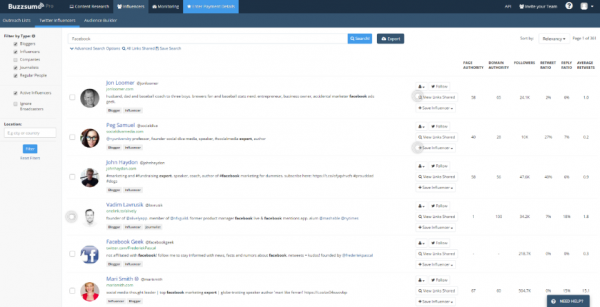
22 Apr 20:49

Marketing And Mobile: When The Union Makes The Force

by Aashish Sharma

Marketing And Mobile: When The Union Makes The Force

There were 23.8 million smartphone users in 2016. A number, undoubtedly, in strong growth expected in 2017. How can brands invest this unavoidable land that is now the mobile?

Overview: the use of mobile phones today

There are 4 billion smartphones in the world in 2016. There are 6 billion smartphones in the world by 2020 (out of 7.5 billion people). The rate of equipment should approach very soon that of the toothbrush!

Today, 77% of the US are equipped with a mobile phone. There are also more seniors, regular users. An increasingly strong market in the US, which two world players are competing: iOs and Androïd. An important fact, when we know that the purchase of an application represents 7.8 billion turnovers in the US, per year during 2015.

Faced with this phenomenon, the mobile is, therefore, indispensable to brands to gain market share. Signs and advertisers must now adapt to these new practices, and consider the mobile as a channel in its own right.

Adapt to a first mobile client, an emergency for brands

Faced with the new uses of audiences and new purchasing behaviors, brands must now take ownership of mobile phones and are gradually taking the turn, becoming aware of the urgency of the approach. Indeed, for a few months, mobile has taken precedence over the computer, and more than 70% of US people connect to the Internet from their mobile. In order to meet these new expectations and offer a simplified customer experience.

What are the keys to the success of a mobile campaign?

Customer knowledge, an essential pillar of mobile campaigns

Like a conventional or digital advertising campaign, the mobile campaign must be based on precise segmentation and targeting. Today, what the customer wants above all is to be recognized, and this on all points of contact. He wants brands to communicate with him in a personalized way and reward his commitment: coupons, promotions, the invitation to events, and involvement in the creation of new products…. And to evaluate its commitment, tracking remains an unavoidable practice.

Yet only 50% of marketers use it today! Tracking allows them to accurately measure commands from a mobile, as well as views, installation, and uninstallation of applications … The use of data is unavoidable, allowing to better know and understand its target. All the more so if it is Geolocalized, allowing to better understand the customer purchasing paths and to mediate them. The use of Geolocalized data in the Drive to store strategy has produced very positive results in Volkswagen and Système U. Customer knowledge during shopping time remains a cornerstone of any mobile strategy.

The need to adapt creative content to the mobile

Brands also have to cope with the expectations of users, in search of new content, with high added value. This undoubtedly passes through video, massively consumed, especially since the social networks. The brands must use their creativity to offer attractive content, but also juggle with technical constraints, linked to the mutation of uses.

Since its beginnings, a video has always been viewed on horizontal formats. With the emergence of the mobile, 50% of videos are viewed on smartphones, and 29% of mobile videos are vertical. Yet today, 98% of mobile users do not return their smartphones to watch a video. A parameter to consider when designing communication media.

But how to offer attractive video content, in line with the expectations of Internet users? This happens first of all in a short format. The message must be passed in 7 to 8 seconds, after which the user scrolled or closed the video. Another parameter to consider: the sound! Indeed, more and more users want the videos to be silent and subtitled so that they can be consulted at any time.

What business strategy to adopt on mobile?

Stimulate the act of purchase via the mobile

Today, M-Commerce (or purchases made on mobile) accounts for 50% of the time spent on smartphones, but only 15% of transactions. It is, therefore, necessary to identify the brakes first.

Users who receive push notifications log on twice as much on an application. 41% of users accept notifications and a click rate of 8%. The mobile is, therefore, a vector of conversion in its own right, which must be fully integrated into the digital strategy. Gummicube’s analysis emphasizes the importance of App Store Optimization and its importance in your Mobile marketing strategy.

Mobile Marketing with ASO

And this is the moment when we find ourselves immersed in a world that resembles the SEO of its beginnings: Meta keywords, index of keywords, queries to a word. No matter how similar, developers are still using traditional SEO tactics and data sources to fuel a mobile effort. With App Store Optimization and the right mobile data, a company’s brand new app can find its audience in the App Store.

With App Store Optimization, companies migrating to mobile can reach the mobile audience they seek. However, to find the organic downloads they need to gain traction in the app stores, companies would need to pay close attention to their creative, tailoring it to app store search trends and high volume keywords to aid in conversion.

Aiding in an app’s discoverability isn’t limited to one location. Global localization helps any app find its audience in any location. By looking at app store search trends in different locations, an app could potentially expand its reach globally.

The mobile app should be designed to deliver content that is appealing to the global user in localized form. It always covers when you present your company, blog, content or anything to the user in the native language, they are more likely to spend money on the app and download.

There are 6 ranking factors for iTunes, both for Google Play, although they are not quite the same. The Google also is a bit more evolved, what makes more sense, Google has dealt with referrers for much longer than Apple … We start to find a good amount of tools for analytics, competitive word tracking Keywords, tracking conversion channels, etc. This is still embryonic but we see emerging a new marketing specialty around the ranking on blinds, especially in the US and Australia.

Mobile must participate in a seamless shopping experience

Expedia, a subsidiary of Microsoft, with around fifteen brands around the trip, explains how mobile offers a seamless shopping experience, just like other devices. Above all, you have to rely on a single account, with the shopping cart memorized on each device. This allows, for example, the user to search for information about the trip via his mobile, to validate or give his opinion on the tablet, and to make his payment and reservation on the desktop.

And what mobile strategies for the future?

The mobile environment of the future will undoubtedly consist of meta-applications, chatbots and web notifications. In any case, it was the feeling of Western Union, Bazar Chic or any App, who testified on this point. One thing is certain: trademarks must take ownership of this vector of conversion. In this sense, we are seeing the emergence of start-ups and agencies dedicated to mobile strategies. However, brands, brands, agencies, and start-ups are in the testing phase – & – learn perpetually, not yet fully mastering the mobile marketing alliance and customer knowledge. As the uses change constantly, the skills are ephemeral. On the other hand, there are certain practices: the need for tracking, reporting, and ROI measurement.

22 Apr 20:48

Why Cold Calling REALLY Bothers Me

by Frank Rumbauskas

On Monday, I had a great conversation with another sales author & trainer about the stupidity of cold calling and why more modern, Information Age alternatives are so much better and more effective today.

More specifically, we talked about how much cold calling works against you, instead of working for you. Many salespeople believe the “numbers game” myth taught to them by the ignorant and outdated dinosaurs of selling. Yes, cold calling sure is a “numbers game,” but not in the way you think.

Why High Cold Calling Activity Hurts You

Salespeople are typically trained to believe that the more cold calls you make, the more appointments you’ll get, and therefore the more sales you’ll get.

What they fail to see, however, is the damage cold calling does to any potential sales relationships you might have otherwise had with all the people who said “no” to you – which in a cold calling situation averages anywhere from 95% – 100%.

Salespeople tend to believe that 100 cold calls are better than 50, that 200 are better than 100, and so on.

But on the phone the other day, my friend made an excellent point:

If you make 100 cold calls, all you’ve “accomplished” was to anger 100 people!

Keep in mind that my friend is not only a sales expert but also a business owner, and the two of us know just how annoying and disruptive cold calls are.

It’s really true: Cold calls angers prospects.

A while back, I ordered a ton of boxes of Girl Scout cookies from a Girl Scout & her mom who had set up a table in our office building’s lobby.

I was excited to get the cookies, but…

When they were delivered to my office, and I heard someone walking in, my first thought was, “Who the hell is cold calling me now?” My first reaction was to get up with a scowl on my face.

My scowl turned to a smile when I saw that it was my cookies being delivered!

The REAL “Math” of Cold Calling

Not too long ago I wrote a newsletter mocking the traditional, old-school “sales math” that says if X number of cold calls equals X number of appointments, and it takes X number of appointments to get a sale and each sale earns you X in commissions, then each cold call is worth $5 in your pocket.

It’s all a BIG LIE! Want proof? If it weren’t a BIG LIE, companies would actually pay $5 per cold call – but they don’t because they know FULL WELL that cold calling is a waste of time, and a sorry excuse for them to cut corners on their marketing budgets!

THAT is why they won’t put their money where their mouth is.

THAT is why they won’t put their money where their mouth is.

The REAL math of cold calling is that 50 cold calls angers 50 people. 100 cold calls angers 100 people. And on and on.

Want to succeed in sales? Here’s an idea:

STOP cold calling and START delivering value instead!

DO NOT continue doing something that aggravates people and will COST you valuable sales with prospects who would’ve bought from you, had you approached them in a more respectful and intelligent manner.

If you’re sick and tired of cold calling, and sick and tired of knowing that you’re angering people, losing valuable sales, and making enemies out of potential customers by doing it, then here’s an idea: Instead of cold calling, start using fresh, powerful, effective ideas that actually WORK to get hot, qualified prospects in front of you, who are ready to buy right now.

Stop cold calling forever and become a sales rock star by downloading the free 37-page PDF preview of the Never Cold Call Again System.

22 Apr 20:40

How to maximise your affiliate marketing program ROI

by Expert commentator

Avoid 5 common affiliate marketing pitfalls with these 5 tips

Done properly, affiliate marketing can yield many benefits for challenger brands and established brands alike. Advances in technology and consumers’ ever-increasing willingness to shop online practically guarantee a strong ROI — if you have the right plan and resources in place.

Though affiliate networks do afford advertisers nearly automated marketplaces, these programs don’t run on autopilot. From commission structure and communication channels to budget, data tracking, and conversion metrics, everything needs to be fine-tuned in order to maximize ROI. Here’s what you need to know before you jump into the affiliate marketing waters.

The Benefits of a Well-Structured Affiliate Program

Affiliate programs are attractive marketing options because they’re inherently self-funding. Instead of buying advertising upfront and hoping it leads to later sales, you only pay a commission when a sale occurs via an affiliate program. A well-structured affiliate program not only delivers a significant boost in traffic to your website, but it also delivers potential customers who clicked to learn more about your offer.

Here are the benefits well-structured programs afford to online marketers:

  • Efficient revenue sources: With the exception of email marketing, affiliate marketing typically delivers the greatest ROI of any marketing channel. A strong program produces high sales conversions, regardless of the number of impressions or clicks.
  • Third-party endorsements: An endorsement from an independent source is a valuable way to influence customers without “selling” something to them. Many affiliate networks are adept marketers of products or services — look to leverage their efforts.
  • Scalability to suit marketers’ needs: A scalable infrastructure offers automated tracking, reporting, payments, and link generation. Today’s technology creates efficiencies, allowing you to get a number of additional sales from affiliate networks without the extra work.
  • Diversified revenue sources: Display advertising and paid searches require you to work with a handful of partners or search engines (e.g., Google, Yahoo, Bing, etc.). A well-structured affiliate program distributes your risk across hundreds or thousands of sites.

While there are plenty of benefits, be aware of some common mistakes associated with affiliate marketing.

Common Affiliate Marketing Pitfalls

Implementing a successful affiliate marketing program is not without its pitfalls and misconceptions. A program can cause your team to misconstrue data, lead to bad decisions, or — worst of all — hurt your ROI. But these are easy mistakes to avoid if you know what to look for. Don’t let these common pitfalls stand between you and that return on your investment.

Download resource – Affiliate marketing strategy guide

This guide, by affiliate marketing specialist Graham Jenner updated by Luca Tagliaferro, explains the opportunities of affiliate marketing. It is aimed at owners or managers of Ecommerce sites who are considering setting up an affiliate programme, or looking to review their current programme.

Access the Affiliate marketing strategy guide

Here’s how to ensure your program avoids these common challenges:

1. Establish policies and procedures. To play by the rules, affiliates need to know what the rules are. Without guidelines, they might promote discounts or offers that you didn’t want promoted. Set policies for paid searches, promotional methods, and brand guidelines. Put procedures in place that ensure your affiliates are following these guidelines.

2. Ensure sufficient resources. To manage and grow your program, dedicate resources to it. Affiliate marketing is never an autopilot activity, and your team will need to actively and regularly recruit and optimize partners to avoid jeopardizing revenue opportunities. Hire enough people in-house or outsource your program to an agency that will manage it.

3. Don’t focus on the wrong metrics. It’s not the number of affiliates you have, the impressions you generate, or the click-through rates that matter. Affiliate marketing is all about sales, conversion rates, and the cost to generate those sales. Focus your analysis on key metrics for conversion rate, sales, and efficiency to maximize your program’s ROI.

4. Avoid having too many networks. Start with a single affiliate network and expand only if there is a good reason to do so (e.g., an enhanced technology feature or a different geographic market). If you plan to join more than one network, be sure your payouts and policies are consistent from network to network. And be on the lookout for duplicate transactions across your networks.

5. Have a fluid marketing budget. Marketers often cut commissions, slow down their programs, or completely stop them because advertisers are stuck with fixed budgets. It’s better to operate with an unlimited budget tied to an efficiency or ROAS goal. As long as your orders are coming in at profitable rates, there should be no reason to stop generating new sales.

Once you’ve avoided these pitfalls, optimize your affiliate program. One way to do that is by learning from the successes — and best practices — of other marketers.

Optimizing Your Affiliate Program

One award-winning program from Fanatics.com leverages great informational pages to educate affiliates about their program, including a YouTube channel that acts as an educational portal.

Home goods online retailer Wayfair.com has a progressive attribution method for compensating affiliates. It’s based on the last affiliate site a visitor clicks on before adding something to the cart, rather than the typical policy of paying a commission to the last affiliate a customer clicked on before making a purchase.

Regardless of which best practices you choose to embrace, here are key strategies to keep in mind to ensure a smooth, effective run for your program and to maximize its ROI:

  • Have a two-sided program.Use one commission rate that the public sees and a separate range of private commissions for top-performing sites. Public commission rates should be built to last — frequent changes can often disrupt affiliates, and they’re difficult to maintain.
  • Do upfront research. You need to know what your competition is doing. If your commission rates aren’t competitive when you launch, it’s tricky to catch up later. Start out on the right foot to make an impact — you only get one launch and one first impression.
  • Future-proof your tracking. Plan ahead and discuss with your agency or affiliate technology provider all of the ways that you might want to track now and in the future. Making changes later is difficult — as is communicating the changes to affiliates after the fact.
  • Insist on great communication. Affiliates need information about your product, your sales, and your promotions. Share brand or promotional guidelines, too. Use newsletters or webinars to update most affiliates, but reserve one-on-one emails and phone calls for top partners only.

Affiliate marketing programs can yield myriad benefits, but only if you sidestep the pitfalls that often keep people from developing solid plans. Learn from others who are successful, do your research, and keep your communication channels open. If you effectively use your budget, you’ll get the exposure you need to maximize your ROI.

Thanks to Chris Kramer for sharing their advice and opinions in this post. Chris Kramer is a founding partner at House of Kaizen, a leading end-to-end digital performance advertising agency based in New York City, London, and Lagos, Nigeria. Chris is the head of affiliate marketing for the agency and considers his most important task to be creating a performance-based service for his clients that’s centered on continuous optimization. You can follow him/her on Twitter or connect on LinkedIn.
22 Apr 20:39

5 Inside Sales Skills Reps Can Use To Improve Customer Success Rates

by Danny Wong

Recent research reveals customer success is a vital component of the overall client experience, and it’s become so important that numerous companies have started to heavily invest in specialized customer success teams. Companies that have high customer success rates have even been shown to have up to a 24% lower churn rate than others.

But the ultimate verdict of customer success isn’t just in the hands of a specialized team; inside sales reps have a unique capacity to influence whether or not their customers thrive after a deal is closed. The journey to improved customer success rates begins well before a salesperson has even picked up the phone to call a prospect, and it continues for the entirety of the business relationship in various stages.

Obsessive curiosity

To routinely succeed in inside sales requires vast reserves of disparate knowledge. People in other fields can be great at their jobs by developing a specialized expertise, such as software coding or accounting practices, but sales reps need to hold a diverse range of information in their heads, including but not limited to: market trends, product information, competitor profiles, interpersonal communications, and psychology.

This kind of breadth of knowledge simply isn’t possible unless a sales rep is inherently curious about everything around them, and constantly wanting to learn more about their business, their customers, and even the state of the world itself. The more curious an inside sales professional is in their daily life, the better equipped they will be to transmit important details to the customer that will allow them to prosper with the solution in question.

Empathetic listening

Every business transaction arises out of need, and one of the key drivers of customer success is always how well the proposed offering aligns with the specific needs of the customer. If the solution doesn’t actually address the prospect’s pain points, how could they possibly be expected to consider the arrangement a success?

High-performing organizations that excel at marketing and sales alignment have a head start on dealing with this issue, because those companies consistently produce qualified leads that are primed for success. However, even the most effective marketing unit will produce leads who aren’t a perfect fit from time-to-time, and that’s when sales reps must listen closely, and put themselves in their prospect’s shoes to determine if the product will truly deliver the promised value.

Attention to detail

Customer success requires proper execution from multiple departments throughout the buyer’s relationship with the company, from the brand design team to customer service representatives. There are so many individual factors that will impact how, when, why, and where the customer implements the product, and inside salespeople must take an active role in the process by controlling as many of these factors as possible.

Since the sales rep is typically the main point of contact for the customer through the early stages, it’s up to them to make sure everything is squared away when the onboarding transition begins. They have to introduce the buyer to all appropriate parties, provide accurate and updated contact info, make sure the financial details are right, confirm the expectations for the onboarding schedule, coordinate with IT implementation teams, and so forth. When salespeople get these details right the first time, it clears the way for immediate and sustained customer success.

Responsiveness

Inside sales reps may not have exactly the same types of client relationships field sales reps do, but they can still act as a hub of knowledge whom buyers can rely on throughout the process. Customers are naturally going to have questions and concerns throughout their journey — all the way from their initial contact to the onboarding process — and they will want to direct those questions to someone they can trust to make things happen.

You are the buyer’s eyes and ears as they navigate their B2B purchase and the sooner you can give them the information they need, the greater the chance that everything will go smoothly, both for their company and yours. Responsiveness is so important, in fact, that in a survey of over 6,000 B2B buyers, it was the second most-listed factor in determining the strength of the relationship, trailing only trust.

Providing ongoing customer value

They most talented inside sales professionals understand they have a limited number of opportunities to show their clients how valuable their company can be, and therefore they have to maximize those opportunities at every turn. Their commitment to being a value-added partner doesn’t stop at the end of the sales call; it continues throughout every interaction between the two parties. Inside sales reps must take it upon themselves to share content and developments that will help the buyer get the most out of their experience, and to strengthen the bonds of partnership throughout the process.

22 Apr 20:39

What is Smarketing (Sales + Marketing)?

by Josh Slone

Over the past few years, a term has been growing around the water coolers of many a tech company – “Smarketing”.

Some think they know what it is, and really don’t. Others know what it is and don’t see the value in changing their processes to match the idea.

Most good-sized organizations will have both marketing and sales teams.

The job of marketers is to produce content (ads, resources, visuals) that will be used to draw in the right kind of leads into the funnel. In some organizations, the marketing crew will even monitor new leads until they reach a point (based on data) that marks them ready for the sales team.

The sales team then takes the “qualified” lead and does what they do to get the account.

If your company works like this, you may be closer to smarketing than you think. If not, you may have a marketing team that just calls as many people into the lead basket as they can and your sales folks are left to figure out whether or not the lead has any need of your product.

We had a great discussion on this live webinar about smarketing with the team at Tallwave. Here are some high-level topics discussed:

  1. How are companies combining the efforts of their sales and marketing teams?
  2. What are they key metrics to measure the effectiveness of the sales and marketing combination?
  3. What are some of the best tools to help integrate sales and marketing efforts?

Smarketing video replay:

Our goal in today’s post is threefold:

  • Give a detailed definition of the term in question.
  • Take a loose, but effective look at the process.
  • Offer practical tips about going from where you are to a little closer to the model.

Let’s get started.

Smarketing (Sales + Marketing) Defined

what is smarketing?

Smarketing: The process of integrating the sales and marketing processes of a business. The objective is for the sales and marketing functions to have a common integrated approach.

That sounds simple enough, but simple definitions often lead to long explanations.

If you picture a pipeline with two sections of pipe. One is marketing and the other is sales. How well you connect and fuse those pipes together, the less likely it is for what is flowing through them to leak when they go from one piece of the pipe to the other.

what is smarketing?

Translation: Leads that have a rough transfer from marketing over to sales are more likely to leak (lose interest, get offended, get confused). That transition has many organizations losing money that they may not even know about.

You fix this by fuzing the two departments into one to the best of your ability.

Is It Even Worth Your Time?

If your sales are growing, you have a new launch coming out, or you have other business-type things to worry about—chasing a new strategy may not be that appealing.

That’s understandable, but the data should be enough to make you perk up.

what is smarketing?

In one study, organizations that had an effective sales and marketing alignment achieved 20% annual revenue growth! It doesn’t matter what you have “on the table” or how many “irons in the fire”… You get the point. If your growth isn’t 20%, smarketing just became important.

The term also has it’s own Wikipedia page, so I guess you can say it’s becoming more “established”.

what is smarketing?

What Smarketing Should Look Like

Ideally, having your sales and marketing folks realize that they’re not so different, that everyone is working toward the same goal, and then work together to better meet that goal is the dream of smarketing.

Some define the process as simply improving communication between departments, but that isn’t much of a difference.

It’s a matter of roles being differentiated and defined to become pieces of one overall funnel—as opposed to two (one sales, one marketing).

You don’t want to lock everyone in a room until they see eye to eye. That’s not what it looks like.

Instead, you want to introduce tools, processes, and resources that alleviate common issues and help everyone improve their performance. Let’s take a second and talk about each.

Resources

what is smarketing?

Marketing is typically responsible for content that educates leads and nurtures them until they are deemed ready to move to the sales team. That content can be case studies, white papers, webinars, and other forms all used almost exclusively by the marketing folks.

But the sales team can use those resources, too.

Imagine a rep has a call with an inbound lead. The call is over and your rep says, “Oh, if I only had a case study to prove that their objection was shared by company XYZ and now they’re experiencing fabulous results!”

Ok, that may be a bit dramatic.

The point still remains. If the marketing team creates resources specifically for your ideal buyers and puts them in the hands of your reps (who are talking with those ideal leads)—it’s a recipe for success smarketing.

Make your marketing so useful people would pay for it.” —Jay Baer

Processes (Role Definition)

what is smarketing?

Just because you are trying to combine two departments doesn’t mean that you’re trying to simplify your sales process—it’s actually the opposite.

In order to have a successful singular process to sell your stuff, it will take multiple roles laid out in tremendous detail. Everyone should know exactly what they are doing during the work day and it should always be a part of the one big picture.

It’s not compartmentalization, either.

The entire process should be understood by all on the team. Your SDRs and BDRs should know the content creation process (to a certain extent) and be allowed to interact and make suggestions for new content that helps nurture leads.

Closers should understand and be privy to all conversations and marketing engagements of the leads they are going to speak with—it only makes sense.

Tools

what is smarketing?

Tech has created a sales and marketing renaissance over the past two decades. It has made code writers into sales people and made sales people more tech savvy.

And it’s only improved the way people are selling.

If you really wanted to argue, you could say that technology has also created the current beast of consumerism. The same wave that brought us sales tools also makes anyone an expert just by doing a search on their smartphone—making it harder to sell them.

While we’re all waiting on Skynet to become self-aware and start hunting us, we’ll get back to the conversation.

Some of these major toolsets include:

  • Customer Relationship Management (CRM): This software should be like a member of the team. It’s likely you’re already using one, but if your sales and marketing teams are disjointed—it’s not being used to its fullest potential.
  • Communication: We use Slack, because it integrates with just about every other tool you could imagine. The point is, you want communication to be fluid and group in all who are needed in the conversation. So much cleaner than email chains.
  • Content Management: You want your content (both being created and finished) to be easy to create and find. For creation we use Trello, it’s easy and clear. A good CRM will have an area for content to be quickly found by your reps. If not, there are other solutions.

This is by no means an extensive list. There are dozens of tools in each tool type that can all be used to better integrate your sales and marketing (slow introductions are better when it comes to tools).

Skynet begins to learn at a geometric rate. It becomes self-aware at 2:14 a.m.” —The Terminator

Where to Begin?

what is smarketing?

While the process is going to take time (more or less depending on your current process/setup), it should be a “figure it out as we go” situation.

Sure, you can try something and change it. That said, the overall goals and process should be detailed out before you actually get started.

You’re essentially changing how your business interacts with leads, which means messing with your revenue stream.

Don’t take that lightly—you’ll need a Service Level Agreement (SLA).

What’s a Service Level Agreement?

It’s a contract that lays out how the smarketing process should look like.

You’re probably thinking that creating one will take some time. You’re right.

It’s not so much that one of these documents has to be in place before you integrate. It’s more like you have a goal to hit, you try to implement it and you’ll change it along the way.

It could take some time before you get to your finalized SLA, but you’re working toward it.

what is smarketing?

It’s likely your SLA will contain the following elements:

  • Ideal Buyer Profile: All of the traits of your favorite (and most common) clients rolled into a few profiles that let your team know who to reach out to and how to sell your products to them.
  • Lead Definition: A lead takes on several forms in the life of a funnel. Ensuring those terms are laid out and understood by all takes putting them on paper (e.g. SLA).
  • Nurturing Practices: What is the path that your average leads will take? What segmentation is involved? When are leads ready for a demo/pitch?
  • Tracking Details: Labeling and laying out which details are important to track and which ones aren’t.

There are others, but this will get you started. HubSpot has a great guide here (for further reading).

Recap and Questions

Just tearing down the wall that separates your sales and marketing departments won’t work.

You will need a lot of trial and error, process writing, and tool testing to integrate properly. The benefits are there and enough companies have paved the way for you to learn plenty about what has worked (and not worked) for others—probably in or close to your industry.

What does your current process look like? Are sales and marketing separate? Are you still the marketing and sales head?

22 Apr 20:39

Cold Calling and Gambling: The Same Thing

by Frank Rumbauskas

“Are Cold Callers Actually Compulsive Gamblers?”

I was doing a bit of thinking about the bad old days when I was still brainwashed to believe that cold calling would eventually work.

I’d go out all day long, or if the weather was bad I’d sit at the phone all day long, making cold call after cold call after cold call.

Regardless of whether or not I got any appointments, or whether those appointments were even qualified leads in the first place, I always had a strong feeling of accomplishment, and was convinced that I was getting closer and closer to that “tipping point” where I’d laid so much groundwork that the big killing would come in soon.

At the time, I was living in Las Vegas, and an old friend from high school came to visit. And boy did he love to gamble!

I personally don’t like to gamble myself – if I lose even $10 in a slot machine, I’ll be annoyed for a week that I threw it away with nothing to show for it. I’d rather spend the $10 on a good sandwich and at least know I got my money’s worth!

In any case, even though I don’t gamble, I tagged along with him to the casino.

And what I saw astonished me.

He’d sit down at the machine and pull a huge stack of $100 bills out of his pocket. I sat there in disbelief as he fed $100 after $100 bill into the machine, waiting for it to “hit.”

He explained that if you play the slots, you have to keep “feeding” the machine until you tip the odds in your favor, and eventually it will hit.

And yes, it did hit sometimes. The first night I watched him win $3,000 after putting about $800 into the machine. And that got him hooked on returning to the same machine, every single day he was in town.

But gambling being what it is, you can’t count on that happening every time. There’s a reason for the old saying, “The casino always has the advantage.” For the rest of his 5-day visit I watched this same spectacle unfold before my eyes. Feeding the machine with loads of cash, waiting for it to “hit.”

Sometimes it hit, sometimes it didn’t. Like I said, it’s not a reliable way to make money, and at the end of the week he went home poorer than when he’d arrived.

Why Cold Calling = Gambling

When I was a cold caller myself, I bought into the same myth that it was a “numbers game” and that if I simply cold called enough people, I’d eventually “hit it.”

And I did sometimes.

And so do other salespeople. That’s why they’re like compulsive gamblers: When they get a “hit,” they get fired up to go back to massive amounts of cold calling, looking for that next big “hit.”

Each “hit” causes your brain to release some dopamine – the “feel good” hormone – and it’s dopamine that causes every kind of addiction, from drugs to alcohol to cold calling.

But like my friend who learned a hard lesson in Las Vegas, I didn’t “hit” often enough to make my numbers, to keep the bills paid reliably, and to live as comfortably as I’d wanted to live. (And guess what – most salespeople tell me the same thing. That’s why they signed up for my newsletter or bought my course in the first place.)

As to freedom, there was none, not when you’re shackled to making hundreds of cold calls each week just to survive. Even if you happen to have a good month now and then, it’s with that nagging feeling that you have to go back and do it all over again next month just to survive, not to mention the craving for that next dopamine hit to soothe your withdrawals.

So if you’re still cold calling, it’s time to stop. Realize that each time you get a rush from making a sale by cold calling, you’re experiencing the same chemical reaction in your brain that gamblers experience when they happen to win – a dopamine rush.

But we all know what happens to gamblers in the end: At the end of the day, they lose. Big time. Don’t be like that. Find new and better ways of sales prospecting – methods that actually work in today’s Information Age economy without annoying and infuriating people – and you’ll start to experience real sales success!

Learn how you can stop cold calling forever and become a sales rock star by downloading a free 37-page PDF preview of the Never Cold Call Again System.

21 Apr 16:39

The Pending Influencer Marketing Bubble

by Mitch Joel

If you're looking for growth in the marketing industry, look no further than influencer marketing.

The global advertising business will see a slight slowdown in 2017, according to Magna. The industry will only grow by 3.7% with total advertising revenue expected to reach $511 billion. That's over half a trillion dollars. The slowdown could be related to a lack of "big events" like a major political campaign or the Olympics (which usually pushes incremental ad spend). We're also seeing something else happen: the chairs on the deck are being shuffled around. Ad spend is bleeding from traditional media channels and being reallocated to digital. Digital budgets will see double-digit growth and will become the top media category this year, over-taking television advertising sales for the first time ever. Every other media category will not feel this kind of wind in their sails.  

This is a big deal, but it does not tell the story...

It's not just money going from tv ads and newspapers over to Google and Facebook. Influencer marketing has shifted from the new and shiny bright object to becoming the fastest growing channel in digital marketing today. TL;DR: brands love paying influencers hefty fees to get them to shill their wares. For every advancement that we're seeing in the marketing technology world (think marketing automation, programmatic, artificial intelligence, self-serve tools, etc...), there's a hot new startup replicating these platforms specifically for influencer marketing. There are multiple and big agencies who have one sole focus: connect brands to influencers. And, of course, influencers are loving it. In the past short while, we've seen companies like Google, Twitter and Adobe make acquisitions of businesses in the influencer marketing space. It still seems to be heating up, with no signs of slowing down. Even Amazon has been (somewhat) quietly renaming their affiliate marketing program as an influencer marketing platform (and targeting some of the influencers with larger followings to create more traction and opportunities). 

If everything is so exciting in influencer marketing, why is there a pending bubble to burst?

Influencers build significant audiences. It's not just a consumer watching a piece of media. Fans of influencers are (usually) "all in." They're attracted to these influencers for a myriad of reasons (the influencer's knowledge, likeablity, how the influencer is a part of the community rather than someone pushing content down to an audience, etc...). Influencer marketing is working, because the relationship between the content creator and the fans is built on trust, and how close the influencer gets to the audience. This makes things (somewhat) tenuous for brands. The brand is not just running a pre-roll ad before the content. For a true influencer marketing campaign to work, the influencer has to really believe in the brand and be able to create content that is reflective of both the brand's needs and the audience's receptiveness to this content. Brands need to tread carefully here, but the influencer is really the one who has to be the most careful. Any mis-step, any sign of shilling without belief in the product/service, and it could cost them audience, growth and long-term staying power. You would think that this would make influencer marketing one of the most powerful forms of marketing and endorsement. 

Yes... and no.

It's not that money corrupts. It is that money can skew things. Influencers can be quite convincing. Influencers can be quite manipulative. Even with full transparency that the content is sponsored (an ad), money can sway influencers. This is especially true in more mature influencer marketing categories like beauty and fashion. Becoming a beauty and fashion influencer these days, is like the new mommy bloggers of a few years back. It's all the rage, and brands all want the hottest, biggest and brightest rising stars of Snapchat, Instagram, YouTube, etc... to shill their latest products. Influencers of the day are like celebrity endorsements of yesterday-year. 

What happened this week is a glimpse of what's happening (and what's to come) in influencer marketing.

Two weeks ago a hand-picked group of beauty influencers were given a new brand - Evaus - to try out. These paid influencers were then brought into a studio to uncover their honest and true thoughts about this new beauty brand. "It's a game changer," said one influencer on camera, "It's edgy. It's modern. It's sleek," said another. Nobody realized that Evaus was really Suave spelled backwards. This "gotcha" campaign was actually an agency stunt in conjunction Unilever (owners of Suave) to demonstrate that more expensive beauty products are more trustworthy, but that lowered-price hair products don't always sacrifice quality. The influencers went along and agreed to still be a part of this campaign once the reveal was made, but it does prove an interesting point: This isn't about a smart ruse on influencers. The influencers often don't dig deep or have the depth of knowledge to understand the full scope of what they're saying "yes" too, and many influencers might inflate how they feel about a brand to ensure that they're invited back (or paid) for other interesting opportunities. This isn't all influencers, but as the playing field intensifies, values, morals and quality tends to wane. Suave (and their agency) proved it... and it's only going to get worse (for more on this Suave campaign read: AdAge: Unilever Turns Tables on Influencers With 'New' Hair Care Brand).... And yes, after watching the video below, there's a whole whack load of additional conversation around brand perception, positioning and what the beauty industry does to a consumer's mind (even the professional influencers).

What this means for influencer marketing...

With so many influencers (and many more coming online daily), brands will have more and more options for where their growing ad spend can be placed. When this happens in any marketing marketplace, the quality of the content tends to drop and the pricing model tends to drop too. Brands are no longer spending big bucks to get one or two influencers to tweet about their product. Things have progressed quickly in this space. Competition drasticaly changes the marketplace. For brands, there are countless more places to get that kind of bang for their buck. The ad dollars are being spread out among several influencers, across multiple social media platforms, and for a much longer period of time. For influencers, they're now being connected to multiple brands. Influencers are getting signed by agents and managers. Influencers are trolling automated marketplaces for revenue opportunities, and spending a good portion of their time developing influencer marketing content (or ads) instead of focusing on the content that built their audience in the first place. For the audience, they're seeing more and more advertising and marketing in their content (whether they like it or not). For the marketing industry at large, we're seeing more and more dollars stream into an industry, because these influencers have eyeballs - and this is always where the money follows.

If everyone can't piece this together and see the bubble, we're simply not paying attention.

Tags: ad age ad spend adage adobe advertising age advertising agency advertising business advertising revenue affiliate marketing ai amazon artificial intelligence beauty beauty brand beauty influencer blog blogger brand brand perception brand positioning business blog business model celebrity endorsement content content creator content marketing digital marketing digital marketing agency digital marketing blog digital media digital media channel endorsement evaus facebook fashion fashion influencer google hair care influencer influencer marketing influencer marketing bubble influencer marketing content instagram j walter thompson jwt magna marketing marketing agency marketing automation marketing blog marketing industry marketing technology marketplace martech media media channel mirum mirum agency mirum agency blog mirum blog mirum canada mirum in canada mitch joel mitchjoel mommy blogger newspaper newspaper advertising olympics online community paid influencer pre roll pre roll advertising pricing model professional influencer programmatic self serve marketplace six pixels of separation snapchat social media social media platform startup suave television television advertising traditional media traditional media channel tweet twitter unilever wpp youtube  

21 Apr 16:35

Trending This Week: The Ultimate Sales Outreach Tactic

by Alex Hisaka
  • Bridge Leading into the Light

A common misconception about social selling is that it’s about using social media to make a sale. In reality though, very few B2B sales methodologies aim to make a sale in the first interaction. Successful B2B sales techniques hinge upon developing a relationship that earns a prospect’s attention, trust, and ultimately their business. It’s no wonder our State of Sales research found that sales professionals see relationship-building tools as having the highest impact on revenue.

Trust is Foundational

At a time when it can be challenging to identify and engage buyers until their decision is nearly complete, social selling makes it possible to establish relationships earlier in the buying cycle. Social networks empower you to better understand the problem, cultivate the right relationships, and built trust among the buying committee. The power of this trust cannot be downplayed. The stronger the relationships, and the more you help to shape the company’s decision-making criteria, the harder it becomes for other reps to swoop in and win the business.

A recent article in Harvard Business Review cited the findings of a study comparing the response to text-based communication (i.e., email) versus the response to face-to-face communication. The research found that people tend to overestimate their persuasiveness via email and underestimate it in a face-to-face context. But the main reason that email proved less effective was that recipients viewed the communication as untrustworthy.

Social Selling Helps Sales Pros Start and Build Relationships

Many of today’s sales engagements start in the virtual world. Without looking someone in the eye or shaking hands, it may feel difficult to engender trust. However, the reality is that you can build personal rapport and demonstrate trustworthiness in interactions and communications with prospects even online.

It starts by using proven approaches to connecting in the online realm. First is finding the right people to engage. More than 76% of buyers [JP1] feel ready to have a social media conversation. You can identify prospects that meet their established criteria – such as role, function, or industry – on LinkedIn.

Once you’ve engaged and qualified a prospect, you can call upon information gleaned from your research to engage by sharing relevant content and information. Over 62% of B2B buyers respond to salespeople who connect with relevant insights and opportunities. Sharing helpful information and insights in genuine conversations – even those occurring via social media – goes a long way toward building credibility. Moreover, the one-to-one interactions cultivate a sense of intimacy – another key factor in establishing trust. But as the aforementioned study notes, there’s still an opportunity forge a deeper connection.

Moving Online Connections Offline

You’ve probably met several people in real life after previously only knowing them via social media or email. It’s almost like you’re making the relationship official.

In social selling, just because a relationship starts on social media doesn’t mean it needs to remain on social media. Relationships that start and develop online can translate fluidly into face-to-face meetings, such as at a conference or other industry event. People are much more inclined to meet in person with someone who has already demonstrated their trustworthiness and value online.

If there are no in-person opportunities on the horizon, consider video. Whether you have access to video conferencing tech or use a more ubiquitous tool like Skype, there’s no question that video is more intimate than voice calls and emails. The face-to-face interaction may be just the relationship accelerant needed to fortify a key relationship at a pivotal moment.

By taking advantage of all the tools at your disposal to personalize outreach and engagement through social selling, you can pave the way for stronger relationships built on trust.

To keep pace with the latest sales insights and trends, subscribe to the LinkedIn Sales Solutions blog.

21 Apr 16:35

Give your Business an Edge – Use Mentors

by Beata Staszkow

A business regardless of size can only flourish if its workforce is switched on and engaged. This is especially true of newer ventures that need to become established quickly and thereby increase growth to make a business more sustainable.

The system that more and more businesses are turning to is the mentoring system. This allows a business to invest in its employees and reap the benefits of increased production through better staff morale and engagement.

This was recently explored by Anthony K. TJan, who wrote “Company leadership should embrace, promote and value mentoring programs to realize a return on investment,” in an article for the Harvard Business Review.

So how does a mentoring system work?

Employees that are felt to show promise are assigned a mentor, an experienced member of staff that can provide day to day, one on one training and guidance. They are not just a teacher; they are also there to support the employee. This provides a platform for the employee to express ideas and concerns and indeed have a confidential ear when needed.

So how does a business gain an advantage through mentoring systems?

With a good mentoring system in place, businesses tend to gain the following:

Better staff morale and engagement. Rather than staff doing their jobs and going home to forget about work they will take more interest in the business, be more willing to accept challenges, and suggest ideas.

Increased productivity and agility. With better morale and engagement productivity increases and each day becomes more valuable to the business. As times change and your business needs to adapt, a better switched on workforce can make necessary transitions easier, and they will be more adept to adjusting to serving new markets.

Business sustainability and growth. Mentoring grooms and develops your next series of leaders. This is very important to business survival and growth. Better, well managed businesses tend to survive even through poor economic times, while good leadership inspires others and gives purpose to a business and its employees.

Better integrated staff and lower costs. The mentor system is arguably better than paying out for course after course to develop your staff, as it provides a feeling of family. Staff who are mentored feel they are part of something, while mentors themselves feel they are passing on knowledge they have earned over the years.

21 Apr 16:35

Less influential influencers

by Danny Bermant

3 ways that less influential influencers can help your business

Influencer marketing often focuses on harnessing major influencers who have the highest reach and authority. Such campaigns are on the rise, as we highlighted in this recent article, 84% of marketers said they would launch at least one influencer campaign within the next twelve months.

Yet, collectively, other influencers can be important as advocates or detractors. Whether its fans mentioning your brand on Twitter, colleagues sharing your articles on LinkedIn, or disgruntled customers posting negative reviews, influencers are everywhere.

And whilst you can’t control what the public say about you, you can engage with individuals who are your biggest fans and ensure that your customers hear their voice.

The first question you might be asking is, do influencers really matter? Does your business really need them?

Here are 3 examples that illustrate the difference you can make by harnessing influencers who aren't necessarily important by reach or credibility and may be missed by a traditional influencer programme.

1. Social proof from your customers

Whilst few people trust advertisements, most people trust what their peers have to say, 81% according to a survey by Nielsen.

 Why not take advantage of those who already use your products and services by showcasing them to your customers?

For example, a B2B organisation can run a joint webinar with a key customer that is well known in your sector. During the webinar, they can describe how they use your product or service and answer any questions from the audience. Structure your webinar in a way that also enables your customer to promote their business as well. That way they also have an incentive to promote it to their followers too (and thus increase your audience and reach!)

Consumer marketers can use their customers as social proof. Toyota are a good example of a company who use their customers as social proof. Their website includes a forum where you can connect with Toyota owners and ask them any questions about their car.

2. Collaborate with businesses that complement what you do

Whatever industry you’re in, there will always be non-competing, comlementary businesses that provide related services to you and whose customers will need your help. For example, an estate agent may be asked to recommend a mortgage broker when they sell a property. A financial adviser who manages a business owners’ affairs may need to refer them to an accountant.

Think about what you can do to promote each other as partners. For example, if you’re a mortgage broker, why note write a guest blog for an estate agent, explaining what factors to consider about when choosing a mortgage broker? Work together on a marketing plan where you can coordinate a series of tweets as well as emails to promote the blog article.

Joint marketing activities such as guest blogs help promote your business in a number of ways:

  • They provide added value to your audience by sharing insights you couldn’t offer yourself
  • They give you additional credibility. You’re not just promoting your own business, you’re helping them by sharing content from a third party
  • You’re reaching a larger audience because your content is being shared by the guest blogger, not just the blog host

Collaboration can work in other ways too such as joint incentives.

For example, if you’re a gym that has other businesses operating from your premises such as fitness instructors, why not create some special offers that can be promoted to both your audiences? E.g. fitness classes can be offered at a discount to gym members. Or members of the fitness class could be offered discounted gym membership.

3. Leverage the less well-known thought leaders in your industry

Then there are more traditional influencers, in every industry, there are people who are seen as opinion formers. These don’t have to be related in any way to your business. Sometimes they are seen as more credible precisely because they’re not related to your business:

  • Journalists who post reviews about your products or services
  • Experts who have a strong knowledge of the industry you are in
  • Activists who believe in what you’re promoting

Identify who these opinion formers are and think about how they can help you. Segmenting influencers as in this example from Traackr can help you think about Level B and C influencers who are not the celebrities or authorities that many brands will court, but collectively will have an influence.

For example, if you’re a charity that promotes healthy eating, think about the opinion formers that can help you. This infographic which provides several examples of less traditional influencers you can approach:

  • There are activists who are campaigning for healthier eating in schools and at home
  • There are experts with a good knowledge of what constitutes a healthy diet
  • There are culinary journalists who regularly write on the topic

Each of these could be enormously helpful. And because this is a subject that is close to their heart, they are likely to be responsive.

For each marketing activity, plan ahead and think about how you can leverage these influencers to help get your message across:

  1. If you’re planning a blog post about healthy eating, why not ask an expert who is an authority on the matter to guest blog?
  2. If you’re launching a campaign designed to change attitudes e.g. healthier school meals, why not reach out to activists who are likely to feel as strongly as you and are happy to share the message?
  3. If you’re running a local fundraising event, why not reach out to local journalists who can promote it to their readers?

Because of the Internet, influencers wield a disproportionate level of power relative to the number of contacts they have. If they’ve used your product and had a great experience, they can tell a few of their friends. But if you can engage with them on social media, their opinion can be seen by thousands and shared by thousands more.

Regardless of how successful your marketing is, there will always be a limit to how many customers you can reach. But by leveraging the influencers in your industry you can multiply the number of potential customers who can hear your message.

21 Apr 16:35

Check Out These Top 10 Marketing Charts for 2017

by Larisa Bedgood

Marketers love charts so in case you missed them, here’s a look at some of the most interesting marketing charts showcasing the latest research and statistics of 2017 so far.

1. The Channels Customers Want to Use to Engage With Your Brand

Recent survey from Lithium Technologies examined 4 types of brand engagement, finding that in each case that owned media such as websites, blogs and social sites were the preferred channels. Online reviews edged email as the second choice when searching more information about a company and about its products and services.

When consumers initiate engagement they favor websites and social channels, but when they’re receiving communications, they clearly prefer email over other channels by a large margin.

Consumers Company Engagement channels

2. Majority of Consumers Consider Customer-First Marketing Important

As you can see from MarketingSherpa’s study, customer-first marketing is important to a majority of consumers, with 22% considering it very important. In fact, only 5% of customers consider the practice not important.

Statistics of companies putting your interests above theirs

3. Obstacles to Data-Driven Customer Strategies

Inadequate budgets are the biggest obstacles to implementation of truly data-driven customer strategies, cited by 54% of marketers responding to a new CMO Council survey

Obstacles data driven customer strategies

4. Top Email Marketing Trends of 2017

Litmus asked 1.200+ marketers to rank the biggest email marketing trends for 2017. The research shows that marketers are betting on Interactive email, Big Data personalization and HTML 5 video in email to break through in 2017.

Statistics email marketing trends

5. How Are Marketers Using Data to Personalize Experiences?

According to a new Monetate survey, the most common ways businesses are using data to create personalized experiences include by incorporating lookalike advertising engines (87%), in-store or customer service clienteling tied to digital channel behavior (83%) and dynamic content creation/promotion generator (75%), which would appeal to the many consumers who find personalized ads to be more engaging and relevant.

Data to surface personalized experiences

6. Value of a Customer-Centric Organization

Customer-first marketing creates loyal customers and will maximize customer lifetime value. According to a study by Marketing Sherpa, 56% of consumers are most satisfied with organizations that provide a positive experience. 43% also stated that it is easy to conduct business with the company across channels, whether online, in person or on the phone.

Statistics about the quality of experience

7. Enterprise MarTech Investments Made Chiefly to Better Understand Customers and Prospects

Marketers at enterprise companies are investing in marketing technology primarily to better understand customers and prospects (62%). Enabling a data-driven approach to marketing was cited as a top goal by 55% of respondents (Data Source: Squiz).

Reasons to invest in marketing technology

8. Effects of Lists Segmentation on Email Marketing Metrics

Recently, MailChimp dove into its customer data to provide stats demonstrating that segmentation does actually work. Here’s what they found for the segmented campaigns:

  • Opens: 14.3% higher than non-segmented
  • Unique Opens: 10.7% higher than non-segmented
  • Clicks: 101% higher than non-segmented
  • Bounces: 4.7% lower than non-segmented
  • Abuse Reports: 3.9% lower than non-segmented
  • Unsubscribes: 9.4% lower than non-segmented

Statistics about list segementation email marketing

9. Optimizing the Customer Experience Remains a Top Goal for Marketers

While customer experience continued to dominate as the single most important opportunity for 2017, it was followed by creating compelling content and data-driven marketing according to Econsultancy.

Most important opportunity for company

10. 69% of Companies Rate Personalizing the Customer Experience as Top in Priority

In a recent study by EverString and Ascend2, 69% of companies rated personalizing the customer experience as a top priority. Survey respondents ranked acquiring new customers ranked at 41% and targeting individual market segments at 36%.

Important goals data driven strategy

21 Apr 16:34

How To Bring Your Client Some Quick Wins On Instagram

by Sahail Ashraf

Okay, here’s the deal. You have a brand new client and they’re wanting results on Instagram really quick. We’re talking yesterday. They’re social savvy too, so they know what does and doesn’t work.

The clock’s ticking, and you need a set of quick wins that will bring value for the client and kudos for you. On top of that, you know that Instagram is perfect for this client. Their brand was born to dominate Instagram, so the stakes are pretty high, and you can’t afford to put a foot wrong. In the end, it’s all about the likes.

We have put together what we feel is a reasonably comprehensive list of tried and tested moves you can make on Instagram. All of them bring value, but combined they make a strong case for a powerful likes strategy on Instagram.

How To Bring Your Client Some Quick Wins On Instagram

Take really bad photos

Just kidding. There are still a million (or so) Instagram accounts out there run by brands, and their photos are awful. There is also a huge misconception among brands worldwide about the equipment you need to have to keep up with the bigger brands, the internationals. We say you don’t need professional photography equipment, let’s just get that out there. You just don’t.

What you do need is the good sense to frame a nice shot, make sure the light is right, and to take a number of shots to find the ‘right one’. That is pretty much all we have to say on this rather obvious matter.

Hashtags

Hashtags are easy to create and even easier to copy. They’re also extremely powerful if you want some quick wins on the Instagram likes front. The best way to look at this option is as a ‘plastic’ kind of fix, not a long term measure but a great way to get a few more people involved in your work quickly.

And on top of this, if someone uses a hashtag you created, you have engagement. Use them sparingly, and follow along with the hashtag thing wisely too. The one thing nobody likes is a hashtag crazy brand. But every now and then, it works.

You don’t have to be crazy to work here, but…

Sharing photos from your place of work is still a great way to bring personality to your brand. It makes you all look human and it will get likes. The more you do it (obviously not the same photos or same context, mix it up a little) the more your brand will be likeable (literally).

Like us and win

Okay, this may seem a little cynical, but many brands have done this to great effect. Simply put, run a contest and ask people to like the photo at the centre of the contest. Everyone who likes the photo is put into a draw and therefore gets a chance to win the prize. Whichever prize you want to give out is up to you, but obviously make it worth taking a couple of seconds over to enter.

Use captions well

Captions are often misunderstood and ignored by brands. This is one of the best ways to add extra flavour to a great image. If you have a good stab at creating a high quality caption along with your image, you’re adding context and adding story. These things make people like you.

Don’t forget your people

You have a brand and that brand has an image. It’s your job to get that image across through your use of a theme. This means being what you are all day every day. If you sell flowers, your Instagram needs to be about amazing images of beautiful flowers, or the process you follow to arrange flowers. It doesn’t have to be anything else or you will ruin your brand’s image.

All good, with filters

Filters are that most misunderstood of Instagram weapons. Get to know them and pick out filters that you can see making an appealing impact for you. What you like, and what your brand fits in well with should dictate filters. Use them though to get more likes. Because your competitors may not.

The profile

Actually, with everyone all over social media, this one is perfectly understandable. The Instagram profile is not a big thing and it shouldn’t take too long to fill out, but with a number of accounts under your belt, we can see why you may have left it incomplete. Don’t, and there is now quite a compelling reason why.

Ever had a friend request on Facebook, head on over to their page and discover that they’ve created one post in the last 12 months? This makes you think that they’re fake, doesn’t it? Well, the same thoughts crop up in people’s head if the insanely brief Instagram profile has gaps.

Posting

Our final tip involves that most fundamental aspect of social media. You have to post regularly. This means posting every day if you can. Not a ton of work that just gets ignored so it has no effect. There are people who post ten times a day and they soon become a little redundant on the channel.

No, you should post one or two times a day, every day. This way people know you’re professional (and legit, see previous point). They know you stick to a schedule and you are in this for the long haul.

The above points can quite easily be implemented and quickly ingrained into your work. Do the above consistently and your client will see that you know what you’re doing, that you have a plan for the road ahead, and you’re taking their account seriously. Make the above a ‘standard’ feature set for all your clients and you’ve brought immediate value. And keep testing it so you don’t trip up (that’s another sign of a good agency, it’s testing).

You need to measure the effectiveness of all that work, right? Why not grab the best metrics on social on the planet, for free. Try Locowise for 7 days entirely free, and see how your agency can become incredible.

21 Apr 16:29

Static vs. Dynamic Segmentation Models for Customer Success

by Paul Philp

Static vs. Dynamic Segmentation Models for Customer Success

The same engagement strategies won’t work for all customers. The wrong actions, sent to the wrong customer at the wrong time can be deal-breakers. Each and every single engagement Customer Success teams should have with their customers – whether that’s in person, online, or automated – should deliver value and drive adoption and advocacy.

Paired with well-defined, action-driven high-touch and low-touch engagement models, a reliable account segmentation model allows Customer Success Managers’ time and attention to be where it needs to be. This ultimately means that Customer Success Managers can avoid spending disproportionate amounts of time on low paying customers and act proactively to identify risk and opportunities with high-paying customers.

Static vs. Dynamic Segmentation Models for Customer Success

Segmentation models have traditionally been thought of as static entities. A static segmentation model operates based on user demographics: industry vertical, revenue, amount of seats, or geographical location. Many companies make the mistake of aligning their segmentation model between Marketing, Sales, and Customer Success. This can happen, but the whole point of a segmentation model is to optimize workflows and playbooks, so it shouldn’t happen by default.

A Marketing segmentation model should include things like how many times a lead has visited your website, how many emails they’ve opened, and an overall lead scoring system.

A Sales segmentation model will be based on things like deal size, and the likeliness of closing it.

What about Customer Success?

  1. Value of the Customer: In short, how much is your customer paying you? This can be taboo, but it shouldn’t be. A high-paying customer should get the attention, assistance, and advocacy that they pay for. Making sure your biggest customers stay customers is important not only because they drive revenue, but because their expectations for ROI are much greater.
  2. Customer Behavior: What is your customer doing with your product, and what are they not doing? You should know what the leading indicators of churn are, based on user data, and you should be able to segment customers accordingly. For instance, our Customer Success team at Amity looked at the behaviour of our churned customers vs. that of our renewing customers. Something as simple as the usage of Amity’s search function appeared to be a key differentiator between churners and renewers.
  3. Lifecycle Stage: It goes without saying that you should treat customers differently at onboarding, throughout adoption, at first renewal, and in their 3rd or 4th year with you.
  4. Outcomes: Customers don’t buy a product, they buy a solution to a problem. So, is your customer getting what they paid for? Sometimes, a customer might be doing all of the right things, but they’re still not achieving the outcomes that they hired you to produce.

In a static model, a customer can be in one segment at a time (think of a pyramid with 4 tiers of customers). In a dynamic model, each customer can belong to many different segments at the same time, and can change as they make progress. With a Customer Success Management Tool, CSMs are able to set up fine grain rules to identify customers right when action should be delivered.

The Golden Rule of Account Segmentation

“Focus on actions, not attributes”

It ultimately does not matter what segments a customer is in if you don’t take action to deliver value and drive adoption. Once you have created those actionable groups of customers, you can focus on delivering the right strategies to each. All of your segmentation rules should be based on the actions you can, and should take based on a variety of indicators, as well as context.

Take this:

  • Customer X is in onboarding stage, and they’re not using a key feature identified as a driver of adoption. Action: send training material about the value of the key function.
  • Customer Y is a high-paying user, approaching renewal, and they’re not using a key feature identified as a driver of adoption. Action: reach out, and give a demo.
  • Customer Z is a low-paying user, approaching renewal, and they’re not using a key feature identified as a driver of adoption. Action: send 1:many coaching material, highlight the value of the key feature (different from onboarding material sent to X – it’s a bit too late for that, isn’t it?).