Shared posts

21 Apr 16:41

3 Time-Saving Strategies the Best Sales Reps Use

by david.t.rynne@gmail.com (Dave Rynne)

sales-productivity-hacks-compressor-982857-edited.jpg

It was the mid-90s in Washington, D.C., and I was a rookie stockbroker at Merrill Lynch. I was your typical rookie -- making hundreds of dials a day from copied pages out of the phone book.

I did a good job of setting appointments with prospective clients. There was just one problem: I kept setting them up at the prospect’s house. I figured if they trusted me to come into their home, they would trust me with their money.

Because I was young and had no money, I was driving an old, beat-up Datsun with questionable AC. In the summer.

While I may have gotten some pity for being a soaking wet, sweaty fool, I did not instill confidence in prospects their money would be safe.

I did this all summer, not once realizing the business I was bringing in was due to the prospect coming into my office. When the client came to me, it was in my environment -- they were giving a buying signal by making a commitment to come in. If I went to them, they only had to hear my pitch, and give me a glass of water.

Driving to my prospects’ houses was hugely inefficient -- and didn't give me an accurate sense of their interest. To get better results, I needed to change my approach. Here are the top three selling time-wasters I've discovered.

1) Going to your prospects

This used to be part and parcel of old-school sales, since communication with prospects was limited to the phone, direct mail, and face-to-face meetings. Travel time, traffic, gas, tolls, delays and an audience that can afford to tune you out all add up to reduced ROI. Anyone ever book a flight, land and then find out the prospect (maybe even a highly qualified one) cancelled?

The solution: Make them come to you. Ask prospects to visit your office -- this shows commitment and a higher level of buying signal. If you sell software, you can accomplish the same effect by signing them up for a demo or trial. They’re more likely to buy if they’ve invested time and energy into researching and testing your product.

2) Smiling and dialing with no targets

Ready. Fire! Aim. That’s what spray and pray prospecting looks like. Randomly calling names off of an unqualified list is a total time suck. When you’re required to make a certain number of dials, targeting goes out the window.

The solution: Pursue qualified prospects. My friend Mike Weinberg, in his book “New Sales, Simplified,” lists targeting clients as the first step in an effective prospecting plan. He says your target list must be Finite, Focused, Written and Workable. Ask yourself “who” and “why” questions to help identify targets when building a list. Asking these questions will help you create targets that fit the profile of your best customers.

3) Not using a CRM

If you’re still writing in your Franklin Planner, checking off handwritten lists to compile your daily prospecting totals, and writing notes that get lost in the pile on your desk, you are wasting time. How much time is spent manually entering data on paper notes that could be spent prospecting?

The solution: Leverage a CRM. With a CRM, every call, email, interaction, and data point is automatically recorded and optimized for the most leverage. Your prospecting time has just been increased because all of the necessary info you need for your targeted prospects and your interaction with them has been saved and stored and analyzed in your CRM.

Your CRM can be set to manage your communication’s cadence and medium. Engage your prospects where they want to be engaged – whether that’s by phone, email, text, or social.

I wasted a lot of time as a young salesman. I had no plan and chased down every lead with no clue if they were worth the effort. I made little use of the tools I had at my disposal.

Today, we have analytics, content, automation, demos, CRM, and more that let us maximize our productivity, sales, and commissions.

Don't be a sweaty fool: Be a pro.

HubSpot Free Sales Training

21 Apr 16:37

How to Develop a Winning Go-to-Market Strategy for Your Firm

by Lee Frederiksen

In past posts, we’ve shared our perspective on the best strategies to drive organic growth and merger-and-acquisition-based growth. In this post, we’re going to turn our attention to your firm’s go-to-market strategy.

Go-To-Market Strategy Defined

Some people confuse a go-to-market (GTM) strategy with a business plan. While they are related, they are different. A business plan is broader in scope and considers every aspect of a business, while a go-to-market strategy is focused specifically on delivering a product or service to an end customer.

A properly developed, carefully considered GTM strategy delivers actionable answers to some tough questions, including:

  • How do you connect with potential clients?
  • How do you offer a compelling value proposition?
  • How do you distinguish yourself from competitive firms?
  • How do you deliver on what you’ve promised?

You often hear go-to-market strategies associated with manufacturers and companies targeting specific markets with a particular product or products. To be sure, GTM strategies are crucial for new product launches, but they can be linked to professional service firms, as well.

Professional Services Are Different

To make things even more challenging, professional services can have special considerations, such as complicated purchasing processes that can be made even messier because you’re dealing with an intangible—expertise—rather than a tangible product that can be defined and compared. This, of course, makes developing a go-to-market strategy for professional services that much more challenging.

With that in mind, let’s take a closer look at what it takes to develop an effective go-to-market strategy for a professional services firm.

5 Steps for Developing a Professional Services Go-To-Market Strategy

At Hinge, we’ve refined the GTM strategy development process down to five steps that fit nicely with professional services firms. Here’s a brief summary:

1) Define your target markets. If starting here seems odd it’s because most firms start with what services they want to offer. Better to start with the kind of problems you want to solve. Or better still, the kind of markets you want to be in.

Growth, geographic location, existing client base are all examples of important considerations that go into selecting markets. Secondary research on market size, growth and dynamics can be very helpful here.

2) Profile your target client. Within a broad market there are typically a wide range of clients. Which segment are you likely to add the most value to? Which segments are most likely to be a good fit with your firm? These are your target clients.

Download our Free “Visible Firm Guide” Now

It’s not a matter of who can use your service. It’s quite likely that many prospects could. But that doesn’t mean you should target them all. You will likely have no advantage, just a very difficult time closing prospects.

3) Position your brand in the marketplace. How do you want your firm to be seen in comparison to your competitors? Do you want to be the innovator? the thought leader? the low price alternative?

Each of these alternatives would, of course, be very different market positioning.

For example, if you are trying to reach young, innovative firms, your positioning, and services mix should align with that focus. Young, innovative and exciting.

Low price positioning? Don’t try to tout your superior client service.

4) Define your service offerings. Most firms start here and search for the right target audience. That’s a mistake. The services you offer should flow from the target and positioning, not the other way around.

What services speak to the unique needs of the niche you have decided to focus on? How do these offerings reinforce your positioning? If you are positioning yourself as innovative, are your services truly innovative? Be honest.

If you are positioning yourself as a low-cost alternative, do you have high-value, low-cost services that are not available elsewhere within your market? Be careful not to paint yourself into a corner with a low-price GTM strategy. That could come back to bite you when you want or need to raise prices. Not to mention the potential for brutal, no-win pricing wars with competitors.

5) Develop an appropriate marketing strategy. Just as your service offerings should deliver on your brand promise, so too should your marketing approach align with your target clients’ preferences. A marketing campaign that speaks their language and specifically addresses their “pains” will be far more effective in reaching and motivating them.

That means you should be discussing the issues that are important to your target clients. Your guest articles should be in publications they read and your speaking engagements at events they attend. Your blog posts should feature keywords they are likely to search for.

But most important, your marketing plan should be built around making your firm’s expertise visible to your target audience.

If you are new to developing a go-to-market strategy all this may seem a bit overwhelming. So where do you start? Usually, the best answer is with research, and there are two types of research that are most helpful:

  • Secondary research. This is finding research information that has been published. Secondary research is most useful for sizing and evaluating markets in which to compete. It’s ideal for creating context and to help frame what you want to do and where.
  • Brand research. This is research, where you (or a firm you retain) collect original data about your firm and your competitors. This is helpful for the other four steps of your GTM strategy.

Ready to Go to Market?

The five steps we’ve outlined here are a great place to start on the road to developing an efficient, effective go-to-market strategy for professional services. For any plan to be successful, though, it must be flexible and current.

As your market and industry conditions change, be ready and willing to revise your go-to-market strategy to keep pace. Nothing should be carved in stone.


21 Apr 16:36

3 List Building Strategies That Still Work Like Magic!

by Jimmy Rodela

List Building Strategies

Let me guess: You are sick and tired of seeing the same number of email subscribers on your web dashboard, aren’t you?

You keep hearing from the experts that the money is on the list, yet as you endeavor to grow your email subscribers, you barely get any results.

At this point, you’re just about ready to hang your gloves.

Sigh…

Friends, don’t give up just yet, will you? Allow me to share with you this simple-to-implement, yet highly effective list building strategies that can help you with growing your subscribers.

Let’s hop right in.

1. Turn your blog commenters into subscribers.

As you can probably imagine, the concept behind this strategy is quite simple; when your blog readers add their comments on your posts, redirect them to a “Thank you” page then add a call-to-action within the page asking them to subscribe to your email list.

Here’s an example “Thank you” page from SEO Yoast that follows the same strategy.

List Building strategies

When using this strategy, I urge you to treat your “Thank You” page’s copy the way you’d treat a sale page’s copy.

Don’t just say, “Thank you for commenting. Sign up now to get your blah blah blah…” If you do this, your conversion rate won’t be as high when compared to using the tricks of the trade that copywriters use to increase the conversion rate of the sales pages they are working on.

2. Value-packed welcome message.

Let me ask you this: When someone connects with you through your social media profiles, do you merely accept their connection request and leave them be? Or do you take the time to say “Hi”?

Or…

Do you take the time to say “Hi,” offer them something valuable, and lead them to your sign up form so they can avail of what you are offering?

I hope you’ve been doing the latter. Otherwise, you’d have missed the opportunity of growing your email list when all you needed to do was to tweak your welcome template a bit, then copy and paste it into your message box.

(Ouch!)

I mean, think about it. How many connections do you have in your social media accounts? How many of them signed up to your email list? If you answered “none,” then maybe that’s because you didn’t offer them something value when you both got connected, and you didn’t ask them to sign up to your list either.

3. Youtube + Clear CTA + Landing Page = Email Signups

According to Youtube.com, they have over a billion users. When you check out their website’s stats in Similarweb.com, you’ll find that they have about 20.50 billion monthly visitors.

List building strategies 3

I don’t know about you, but seeing all these numbers tells me one thing — YouTube is awesome!

You probably agree with me, don’t you?

With how active the community is on the platform, it becomes one of the best places where you can fish for email subscribers.

Now that we’re past how amazing YouTube is, let’s talk about how exactly you can get YouTube’s website visitors to sign up to your email list.

Here’s the gist of the strategy:

  1. At the end of your video, add a clear call-to-action telling the users to click the link on your video’s “Description” section.
  2. Add a link to your landing page in your video’s description.
  3. Add a clear call-to-action on your landing page telling your visitors to sign up.

I have to tell you that this strategy is so effective, that even James Wedmore himself — a seasoned video marketer that’s helped thousands of business owners — is using the strategy.

Before one of James’ videos in YouTube ended, here’s how he added his call-to-action.

List building strategies 4

After his viewers click the link in his video’s description, the viewers are then taken to his landing page.

List building strategies 5

With this strategy, you can funnel your YouTube viewers into your website, and into signing up to your email list.

What’s next?

Did you find the list building strategies helpful? If you answered with a “yes,” then please take three seconds of your time to share the post with your community. Cheers!

21 Apr 16:36

Why Referral Partners Will Overtake Resellers

by Jessica Edmondson

Why referral partners are more engaged than reseller

There are lot of opportunities in the partner realm. With resellers and referral partners (agents) opening up new channels to reach target industries, companies are able to expand their selling power. But not every partner channel is an easy approach to take. There are many factors that play a role in a business wanting to become a reseller or a referral partner and the company/vendor benefit that will result from this relationship.

Consider that each vendor has to factor in the costs of building a reseller channel. There is a high cost associated with training, certification and just to get the attention of the reseller and their sales team. In regards to training, sales and the rest of the team need to understand how to operate the product, the terminology needed to sell it and receive the in-depth knowledge to understand how to provide support and service. With all the training that has to happen there is inevitably a long period of time where nothing is being sold. And then, when an update occurs or new features are added, another round of training must occur. And once a reseller is fully trained, they likely have multiple products in their sales bag, so then it transitions to a struggle to get focus on selling the vendor’s product.

So what does this mean for the vendors? The amount of onboarding effort necessary for both vendors and reseller partners often jeopardizes the partnerships and the success of partner programs. According to the Ryan Morris, principal consultant at Morris Management Partners, prolonged onboarding cycles, program false starts, and ultimately a high rate of partner churn are often a consequence of the necessary burden involved in preparing reseller partners to bring your product to market.

An alternative approach to resellers is to establish a channel of referral partners. As opposed to resellers, training referral partners is a breath of fresh air. While they need to understand the value proposition, ideal user, and features to know if their referral is a fit, they don’t need much more. They aren’t trying to sell the product directly, just make a trusted and highly valued introduction to a company that offers their peer or customer greater value. This way the brand messaging, selling, and post customer engagement is owned by the brand which allows the company to give customers an authentic experience. In addition, partners can get a commission without any of the headache (or financial ache).

Here are some tips and tricks to enable referral partners and make them (and you) successful.

5 ways to enable successful channel partner referrals

1. Make sure your program supports the specific type of referral partners

One big part of referral partner success is how you go about enabling that partnership. The major determination for this is the kind of partners you are enabling with a referral program. For instance:

  • Do you have a bunch of small partners or bronze level partners (individual partners, agents or small business) that have access to your target buyers in their constituency and can influence them? This only requires an automated referral program that can easily scale the referral partner channel and is available for those partners to register, refer, track their progress, and get rewarded.
  • Do you have managed partners or silver level partners that need to enable their sales team to refer customers they interact with and that match your target customer? These require more complex referral partner programs as they need to have two tiers of management (company manages the partner and partner manages individual sales advocates and their activities) in order to provide unique rewarding and reporting by partner.
  • Do you have a high performing large partner or gold level partner program? This is usually a single large partner. This partner’s productivity is so high, a dedicated, co-branded referral partner program is created for them that is highly efficient at generating leads.

Ensure that your referral partner programs aligns with the type of partnership you want to create. The different features in these types of programs can enable substantial growth of referral partners and success of their referrals.

2. Training is a powerful tool

As demonstrated above, training is still an important part of the referral partnership. Since the partner doesn’t need to demo the product or sell it directly, they don’t need to go through the highly intensive training and onboarding typically reserved for resellers which tends to slow down the training process and increase expenditures.

To train partners, think about what knowledge they will need in order to communicate the value proposition of your product succinctly. To help facilitate this, offer resources like:

  • Monthly email updates on product innovation or service improvements
  • Video or documents that gives partners a talk track on how to present the product
  • Details on what makes a lead qualified
  • Introduction and walk through on the referral partner software
  • The types of pains the product solves for

Of course, for a tiered referral program, either the company or the partner will also have to take this training and communicate it to their sales team. The partner may add on certain materials to present their sales team which could include specific incentive levels that align with the unique values of each successful referrals.

And in regards to a dedicated partner, they will most likely have themselves aligned with your value proposition, but providing the generalized information above could always help.

3. Make referring easy and trackable by partners

The complicated onboarding that is associated with the reseller model is part of what makes reseller churn an issue. Learning your lesson from that, make partner referrals as easy as possible.

Try giving partners a variety of trackable referral methods which will allow them to adapt their referral method to the type of interactions they are having. This includes:

  • Suggest a lead form
  • A way to collect verbal referrals
  • Email sharing
  • Social media sharing
  • Shareable urls
  • Printed cards

While suggesting a lead will most likely be the most popular since it doesn’t require the referral to do any work, it is always a good idea to provide options. For instance, if a partners contact is more comfortable with another form of referral they can have the option of using it.

Another important aspect of referral partner engagement is allowing referral partners to check the status of their referrals and know how they are progressing. You don’t want partners calling you up all the time to try and figure out if their referral became a customer.

Make sure your referral partners can easily access information about their referrals in the program. Try automating notifications when a referral status changes to alert the partner if there referral is moving forward or successful or was unsuccessful.

4. Offer incentives that partners find valuable

Determining the incentive that your partners are most motivated by can be difficult. You have to take into account the effort they put in and how deep the relationship is with a certain partner. If you have multiple managed partners, the reward should be able to be automated and managed per partner so partners that are considered more valuable contributors can be treated as such.

When Citrix was deciding on how to incentivize managed partners, they did a number of studies on what competitors in their space where doing and that is how they landed on offering 20% of the annual value of the deal. However, Citrix uses an escalating reward structure as partners mature in order to reward low performers, mid-performers, and high performers in a way that will motivate higher numbers of referrals from a single partner. Automating an escalating reward structure for partners is a good way to incentives and scale a referral partner program.

5. Keep it top of mind

Promotions aren’t only for customer. You always want to make sure that your referral partner program is kept at the forefront of partners minds. For a dedicated referral partner this could be easy. But it is still good to reach out every quarter or so and offer helpful tips or remind partners of the chance to escalate their incentive with more referrals.

For individual partners, you might want to reach out by email or by phone more often in order to keep engagement up. These partners most likely have other companies they are working with and further nurturing is required to keep them sending leads.

Do you want to learn more about how to optimize referral partner engagement? Listen to what Randy Fahrbach, Senior Manager of GoTo Channel Development at Citrix/GoToMeeting suggests as he walks through his experience of automating his managed partners with a referral program.

21 Apr 16:36

How to Be a Yes Woman (or Man)

by Anthony Iannarino

There are some people who have wired themselves to say “no.” There is no risk that is worth taking. There is no new initiative that is worth pursuing. There are no changes worth making. If they get to weigh in on a decision, their answer is universally “no.” These “No men” and “No women” are worse than the Devil’s Advocate. They don’t point out an idea’s weakness; they actively work to make sure it is never brought to life.

In a world of accelerating disruptive change, ideas are the currency of growth—and, if we are being honest, survival. Even though there are plenty of bad ideas, there is a good reason to say “yes” to new ideas, to try things, and to iterate.

Find the Good

Instead of reflexively saying “no” to a new idea, look for what’s right about the idea. What makes the idea interesting? How does it change things that might allow you to do better work in the future? What would your clients value in this idea—even an idea that would, at first anyway, make them uncomfortable?

By looking to see what’s good, you give yourself and your team permission to explore is further.

Ask How

Good ideas are a dime a dozen. Bad ideas can be had for even less. Without the ability to execute, no idea is a good idea. But the most unlikely, unreasonable, and difficult ideas sometimes turn out to be solid gold. More still, the idea that you resist and refuse might be the very idea your competitor figures out how to use to leapfrog you.

Instead of “no,” ask “how?” Instead of finding reasons you can’t do something, explore how you could do what is being proposed. Even if it means you have to collaborate and make changes. Even if it means you have to do it in stages or phases. Even if it means you have to play politics.

Say Yes

Your job is to find ideas that will improve your results and bring them to life. Saying “no” means you cut yourself off from the very things that will propel you into the future. Instead of trying to say “no,” find a way to say “yes.”

The post How to Be a Yes Woman (or Man) appeared first on The Sales Blog.

21 Apr 16:33

Are 1-to-1 Gifts The New Cold Call For Account Based Sales?

by Kim Lindquist

account based sales gifting

If you’re already using an Account Based Everything approach, you know it’s critical that your sales and marketing outreach is researched, relevant and personalized. Even with the best targeted outreach, the odds of engaging a decision maker are slim: Sales reps today have to make 8 cold call attempts to reach a prospect, and compete with an average of 124 other business emails per day in that we each send and receive per day.

Making the old new again: Physical channels

With so much digital saturation in sales and marketing outreach, Account Based Everything teams are “making the old new again” by engaging accounts with timely, relevant direct mail and gifts. Physical gifts and mailers have a response rate almost 40 times higher than email — and that’s with a one-size-fits-all approach. Many Account Based Everything teams have already caught wind of the huge returns and are running prospecting, win-back and sales acceleration plays to capture the attention, and budgets of target accounts.

But imagine what would happen if your team could stand out from the crowd and send unique, handpicked gifts (think: Amazon Echo or skydiving lessons) to each decision maker you want to engage: Wouldn’t that cold call instead turn into a warm and elated conversation? Not only do 1-to-1 gifts and mailers open doors at your target accounts, but they add a human touch to you ABSD approach and show your prospects that you’re invested (and investing) in their success.

While 1-to-1 gifting campaigns require research and orchestration, uniquely chosen gifts are 2.3x more effective at creating sales opportunities, and the most innovative ABM and ABSD teams are already using them to drive engagement and ROI from target accounts. Here’s how…

Launch your 1-to-1 account based sales gifting play

A team of 50 sales reps leaves 1,277 hours of voicemails per month. That’s 32 full workweeks of voicemails, 90% of which will never be returned [Source: RingLead]. On the other hand, teams that use sales gifting for prospecting, can see up to a 20% lift in first calls [Source: 2017 Alyce Customer Study], from a single gifting play. You can create, run and measure a 1-to-1 sales gifting play of your own by following these steps:

  1. Define your goals: Determine your desired outcome. This might be 100 meetings booked or a 20% increase in call-to-connect rate.
  2. Set a budget: Determine a set cost per account, and an overall budget based on the size of your play. Use CAC and ACV metrics to choose a number that you can tie to ROI.
  3. Set a target: Choose the persona you want to send to within your target account. Are they a buyer, influencer, or gatekeeper? What is their title? The more specific the better.
  4. Create messaging: Write follow up emails and talk tracks to create your full gifting “play”. Leave room to mention the unique gift you chose for them in every template. Leverage tools like Engagio PlayMaker to build the surrounding messaging and cadence.
  5. Research and pick 1-to-1 gifts: Perhaps the most time intensive part of the play, use social media like LinkedIn and Twitter, Salesforce notes, and your existing relationship to hand-pick a gift within your budget, or leverage a tool like Alyce to handpick the gifts for you.
  6. Confirm address: Use data enrichment tools or business development reps to confirm address location, or digital gifting delivery to automate the process. Don’t let your unique gifts land in the “Return to Sender” pile of shame!
  7. Execute the play: Arm your team with the research, plays, triggers and talk tracks to achieve your goals. And use sales gift follow-up best practices to engage even more of your accounts.
  8. Measure results: Use tools like Engagio and Salesforce campaigns or even Excel to measure your results. Then learn, iterate and repeat!

With this personal touch, sales development reps will see dramatic increases in response, engagement, and conversion across your target accounts. Start small by deploying a single 1-to-1 sales gifting play this month. With the right tools, plays and unique gifts that engage your buyers in the education process, who knows: Your sales gifting plays might even replace cold calls in your Account Based Sales approach.

21 Apr 16:31

Sales Strategy Tips from the 50 Fastest Growing B2B Companies

by Alex Hisaka
  • fastest-growth-strategies

If you’re searching for endurance running advice, why not check in with marathon finishers? Similarly, if you’re searching for sales strategy advice to accelerate your team’s revenue, why not see what the fastest-growing companies are up to?

Recently, Mattermark and Drift teamed up to identify the 50 fastest-growing B2B companies. Let’s dive into the findings and pull out a few insights to consider for your own sales strategy.  

40% of the Fastest-Growing B2B Companies Make Their Pricing Public

Price has traditionally been a sticking point between B2B buyers and sellers. Buyers want to know the price as soon as possible. Sellers want to learn more about the buyer and establish maximum value before talking price. That 40% public pricing figure may seem low to outsiders, but not by historical B2B standards.

Additionally, of the 20 B2B companies that do include pricing information, 14 of these companies include tiered-pricing. Of the 14 companies that offer tiered pricing, six of them have CTAs asking enterprise buyers to contact them for an exact price quote. This makes sense as selling to an enterprise is typically a more complex endeavor and requires a custom price for each purchase.

Action Point: As more companies disclose price on their website, B2B buyers come to expect it. If disclosing an exact price isn’t possible, helping your potential customers find a price range may be, and it may mean the difference between them considering your company or moving on to other options.

Buyers want clarity so go out of your way to eliminate confusion. If you offer tiered pricing, make it clear how the product or service differs at each price point. If it still doesn’t make sense to include pricing information on your site, make it simple for prospective buyers to contact you so they can get more information, which is a natural lead-in to this next takeaway. 

22% of the Fastest-Growing B2B Companies Use Live Chat on Their Website

As B2B content evolves, and as B2B sites become more user friendly, buyers have become less tolerant of subpar buying experiences. If you can’t provide answers at their moment of need, someone else will. But no matter how much content you create, no matter how many user questions you anticipate, there will still be questions your site is unprepared to answer. That’s where live chat functionality can keep qualified prospects on your site, helping to convert prospects to qualified leads at that crucial moment when they are considering doing business with you.

Action Point: Consider if sales prospects could benefit from a live chat option on your site. If so, work with your marketing department to determine the most appropriate way to implement live chat functionality. Use analytics to determine where otherwise qualified prospects may be bouncing from your site, and implement rules of engagement for interacting with online visitors. This process may take some testing before it results in qualified leads on a consistent basis, but once it does, it will have been well worth the effort.

The Majority of Website CTAs Led to a Product or Service vs a Salesperson

Among the 50 fastest-growing B2B companies, 62% had primary CTAs on their website that directed people to a product or service. The remaining 38% had primary CTAs on their website that directed people to talk to sales. Some companies had a mixture of both.

The main takeaway is to give customers options for how they engage with you and your offering. Some people overwhelmingly favor educating themselves. By offering them product trials and helpful content, you’re playing into their preferences. By only offering an opportunity to talk to sales, you may be alienating qualified prospects, making it more likely that they’ll move to a vendor that caters to their self-guided buying preferences.

Action Point: Give the customer more options when it comes to buying and they are more likely to buy from you. Not every buyer follows the same journey, so give prospects options and the ability to either get more information to make a purchase decision, or, conversely, also give them the option to take the next step if they are ready. 

In summary, examine your online buying experience for your customers’ point of view and make it easier for a variety of prospects to buy from you on their terms. Many of the fastest-growing B2B companies have implemented a buyer-centric sales strategy that starts online, and perhaps your company could benefit from a few of these tactics as well.

Want more tips from the industry's best performers? Download our free eBook, 33 Tips from Social Selling Thought Leaders

21 Apr 16:31

Study: What Fast-growing Companies Know About Purchased Leads That You Don’t

by Jennifer Weyant
Velocify study debunks some myths about perceived lead quality by examining how high-growth companies yield favorable results with purchased leads

BLOG - Velocify guest blog 4.12.17.jpg

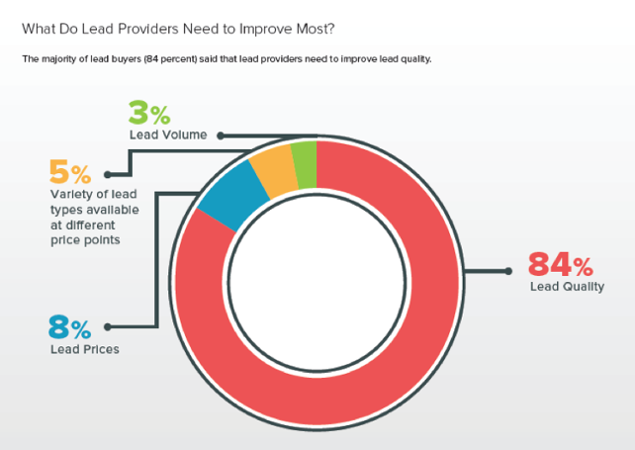
Ask any lead buyer to describe the quality of leads they purchase and the answer is likely to be ‘low.’ In fact, 84% of lead buyers say that lead providers need to improve lead quality.

Velocity Blog 1.png

But is the less than enthusiastic response really warranted? It’s absolutely true that low-quality leads can mean wasted sales rep time and decreased productivity, as well as lower close rates. But, contrary to popular wisdom, successful organizations tell us that purchased leads can and do yield favorable results. Velocify’s newest study, “Lead Trends Report” found that high-growth companies (those with 20%+ annual growth) are relying more heavily on purchased leads than any other lead source. Purchased leads account for a higher percentage of total volume for higher growth companies, regardless of company size. Not only do fast-growing companies have a higher percentage of purchased leads, they also have a lower percentage of referral and direct mail leads, compared to companies experiencing less growth. So what do they know that you don’t?

One of the most compelling findings of the study is that high-growth companies are more willing to invest more per lead to get high quality than are most other companies. The average spend reported by lead buyers was $42 per lead but companies with significant revenue growth spend $86 per lead.

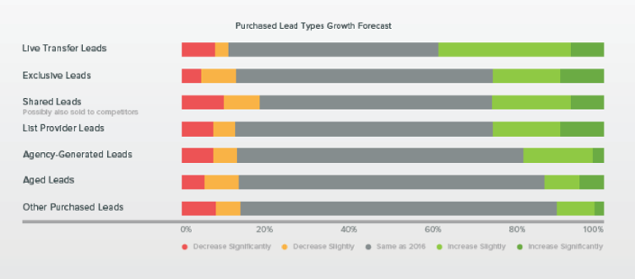
These companies are investing in high quality lead types like exclusive leads and hot transfers, two lead categories that are forecasted to see the most growth. Forty-five percent of lead buyers anticipate an increase in these high quality lead investments in the coming year.

Velocify Blog 2.png

In contrast, changes across most lead sources are expected to remain fairly flat with the greatest decrease expected in shared leads. And despite the fact that shared leads have the most lead buyers indicating decreases (18 percent), there are still more indicating planned increases (26 percent). Even fewer lead buyers plan to increase spend on aged leads (11 percent) and even more are planning decreases (14 percent).

The Bottom Line

Purchased leads can be a more impactful part of your customer acquisition program than common wisdom would suggest. The key is to invest in higher-quality lead sources like hot transfers, exclusive leads and leads that are scored or qualified in other ways for quality. Though generating a high volume of leads from free (or near free) lead sources like referral and web channels is a good strategy, our findings show the value of purchased leads cannot be ignored.

21 Apr 16:30

Why Finding “Warm” Sales Leads on LinkedIn Just Got Way Easier

by John Nemo

LinkedIn just made a pair of moves that will supercharge your ability to engage with “warm” sales leads on the world’s largest B2B marketplace.

LinkedIn continues to listen to its users, which is good news for improving your sales and marketing efforts on the platform.

If there’s one thing I’ve found in teaching others how to use LinkedIn to generate new sales leads, it is how important personalized, 1-on-1 marketing is with LinkedIn.

LinkedIn recently announced several new features (including some previous features that are being brought back from retirement), which make it even easier to scale up and speed up your B2B sales process — from finding your ideal prospects to closing deals.

Here’s how to leverage what’s new.

Personalize Your Pitch with Expandable Profiles

Reviewing someone’s profile before you connect with them is priority #1.

Good news is that LinkedIn is bringing back expandable profiles, which you can use to better connect with prospects.

With this feature, “you’ll be able to more easily view details of a member’s profile, including information on past and present positions, Groups joined, and recommendations,” noted LinkedIn.

In fact in starting out my own business, with a quick view of a profile and a little personalization, I got a more than $10,000 in business from a guy who’d never heard of me before.

Before I invited him to connect, I spent about 14 seconds looking over his LinkedIn profile. I noticed he went to the University of Pittsburgh and graduated in the 1980s. I’m a huge sports fan, and I remember the Pitt Panthers having a nice run in college hoops during the mid-to-late 1980s with Jerome Lane, Sean Miller, Charles Smith and others.

And of course, the seminal moment in Pitt Panthers basketball became “Send it in, Jerome!

(You don’t see that happen every day.)

So when I reached out to this prospect on LinkedIn, I personalized my invite and played up the Pittsburgh sports angle. Keep in mind, I had NO IDEA if this guy was a sports fan or not – I just figured it was worth a shot trying to connect a passion of mine (sports) with a thread of his story (his time at Pitt).

By taking 14 seconds to scan this prospect’s profile and personalize my invitation, I got an instant response:

I was at that game! You can’t believe what it was like inside the arena! Hey, did you know Dan Marino was among the group of athletes at Pitt who recruited me to go there on a scholarship? Oh yeah, and what is it you do again? Debt Collection Agency Marketing? Hey, you know, we’re looking at doing a company video, and maybe some Facebook marketing. We should really talk!

A couple of phone calls later, I had $10,000 in business secured. My new client told me, “You know what really sold it? Send it in, Jerome!”

Just like in real life, selling on LinkedIn requires an authentic connection. You have an ability to break the ice and strike up a conversation around topics that the person is comfortable and familiar with, and you can do it without being sales-y, spammy or sleazy.

Take a quick scan of a potential prospect’s profile to find a touch point: Where they went to school, where they live, even their activities and hobbies.

Publishing + Engagement = Warm Prospects

Publishing your own content on LinkedIn is your currency to buy the time and attention of potential customers on LinkedIn.

If someone is reading content you created, and then liking, sharing or commenting on it, that person immediately becomes a warm sales lead!

They are already getting to Know, Like and Trust you via your content, and now, when you reach out to that person to connect or talk via LinkedIn message, they have a frame of reference for who you are and what you’re good at.

In the past, you could see the individual names and faces of everyone who liked, shared or commented on your LinkedIn articles. However, much of that functionality disappeared once LinkedIn rolled out its redesigned desktop and mobile app.

Thankfully, LinkedIn has shared they will be bringing back certain features in Publishing that offer much more depth in terms of who is reading and engaging with your articles.

I believe we’ll see a return to that “individual level” of data, meaning you can individually see and talk to the specific individuals who are liking, sharing and commenting on your content.

Think about that, and how valuable it is from a lead generation perspective!

Even better, you now have context for a conversation, with the article you published as the jumping off point to build a 1-on-1, personalized relationship on LinkedIn.

Best of all, you can do this in real-time, getting notifications on people liking, sharing or commenting on your post, and then immediately reaching out to each person with an invite or message based on the article you posted.

Easier and More Efficient

The time has never been better to sell on LinkedIn. With over 500 million users on such a highly-visible and trusted platform for business professionals, you immediately have easy access to a pool of prospects to scale up your sales process and generate more warm leads in less time.

By publishing your own content you can demonstrate your expertise and value, and use it in combination with a personalized, 1-on-1 approach that looks for a context to build conversations around.

When you take this approach on LinkedIn, you will build that instant likability, credibility and trust that’s critical to making a sale.

21 Apr 16:29

The Ultimate Guide to Outside Sales

by afrost@hubspot.com (Aja Frost)

outside-sales-compressor-217010-edited.jpg

Before the advent of web conferencing tools, “sales” and “outside sales” were synonymous. These days, reps can easily talk to prospects on the other side of the state, country, and even world.

But does that mean field sales has lost all value?

While inside sales is growing at a far faster rate than outside sales, there is still a true need in some industries for good old-fashioned face-to-face selling.

To help you navigate the world of outside sales, we’ve compiled a comprehensive guide covering:

Outside sales definition

Outside sales (a.k.a. field sales) is a type of selling strategy where reps meet prospects face-to-face. Field salespeople typically spend a lot of time traveling within their given sales territory.

What is an outside sales rep?

A field salesperson manages new and existing customer relationships within her territory. Unlike an inside sales rep, she meets with her prospects and clients in person -- usually at their offices, but occasionally at trade shows, conferences, and other industry events.

Outside sales representative salary

According to PayScale, the median take-home salary for outside sales reps is approximately $53,000. Commissions make up 25% of those earnings.

Outside sales skills

PayScale surveyed outside salespeople and found the most common skills include customer relations, new business development, account management, and account sales.
Having technical sales knowledge can increase a field sales rep’s salary by 24%, while new business development and strategic selling skills translate to a 10-24% earnings boost.

Outside sales vs. inside sales

Inside salespeople usually sell products with shorter sales cycles. Their deals are higher volume and more transactional. Outside reps tend to have longer and more complex sales processes.

Inside reps rely on phone, email, and virtual meetings to communicate with buyers and customers, whereas outside reps use phone and email to set up appointments and in-person meetings to qualify, identify needs, present value, and negotiate.

An inside salesperson has a fairly set, predictable schedule. Each day, they must drive a certain level of activity -- dials, meetings booked, proposals sent, and so on.

An outside salesperson, on the other hand, has a flexible, varied schedule. Because they travel often, their days are anything but regular. Outside reps typically have more autonomy (not to mention, their manager might see them as infrequently as once a quarter).

How to choose an inside or outside sales strategy

Making the call on inside sales versus outside depends on a few factors.

First, does your offering require a physical demo? Some products, like medical equipment or industrial machinery, can’t be demoed remotely. But that doesn’t mean outside sales is automatically the right fit -- it might be possible to use other resources, such as product specs, videos, and customer testimonials, to present your solution to the buyer without physically bringing it to them.

Outside sales is inherently more expensive. You must pay for your reps’ travel, food, and lodging on the road. In addition, outside sales reps usually have higher base salaries. According to SalesLoft, they earn 12-18% more than inside reps. Keep in mind that outside salespeople also usually have more experience -- which unsurprisingly boosts their earnings.

Although video conferencing tools and sales and marketing automation platforms have made it far easier to sell to prospects from hundreds or thousands of miles away, outside sales is more effective on the whole. Some studies have found field reps have a 22% higher win rate than inside reps. Again, it’s difficult to entirely separate this statistic from other variables. Taking a face-to-face meeting signals much higher buying intent than a virtual one, so it may be that field reps are working with more committed prospects and can therefore close deals at a greater rate.

One of the most important aspects of this decision is your buyer personas. Some prospects, like college professors and physicians, are accustomed to field salespeople. If you try to change their buying process, they might opt for your competitor. Use your influence on selling your product, not changing how they evaluate and make purchasing decisions.

Some prospects are extremely comfortable with buying products remotely -- in fact, using a field sales approach might make your company seem out-of-touch. Startups tend to be in this category.

And with an increasing number of people avoiding all direct contact with a rep (preferring to buy things by themselves or using chat to ask questions rather than a phone call), inside sales will probably become the optimal approach for more and more industries.

Inside and outside sales working together

Inside sales and outside sales aren’t mutually exclusive. Many companies are taking a mixed approach: A team of inside reps will prospect and qualify, then hand off good-fit prospects to outside reps who will take the deal over the finish line.

Alternatively, some salespeople handle the first part of the sales process from their office and then travel for opportunities in the middle or end of the funnel. This allows them to focus their energy and attention on the deals likeliest to close.

Whatever you choose, keep an eye on the ROI of your sales team. Measure average revenue per salesperson and average cost per salesperson (including travel, other expenses, and total salary).

You should also compare your cost-of-sales to other companies in your space to get a sense of how productive your sales team is.

Finally, monitor your reps’ conversion rates through every stage of the sales process. Identifying where prospects tend to fall out of the funnel helps you decide where to use an inside versus outside strategy. For instance, if 98% of initial meetings are generating follow-up appointments, your reps are probably over-qualifying -- and leaving money on the table.
To make sure you’re not ignoring potentially valuable opportunities, you could hire inside reps to prospect. This hiring investment will drastically drive up the number of meetings your salespeople can book. Your conversion rate will go down, but your overall revenue should climb.

Hiring outside sales reps

Finding a skilled outside salesperson isn’t always easy. Use these resources to build a top-performing field sales team.

Outside sales rep job description

[Company name] is looking for an outside salesperson [in X location, to serve Y territory]. The ideal candidate will have a combination of these skills:

  • Use X channels to connect with [prospect job title]
  • Qualify leads based on [company’s] strategy and qualification framework
  • Book approximately X [meetings, demos, presentations] per month
  • Travel [X percentage of the time, Y days per week, around Z region on a daily basis]
  • Identify customer needs and tailor our product’s value to those needs
  • Promote [company] brand by offering unexpected insights and thought leadership
  • Conduct in-depth research on prospects using [LinkedIn, Datanyze, Mattermark, etc.]
  • Forecast revenue and proactively course-correct what’s not working or double down on what is
  • Maintain existing relationships and identify opportunities to grow named accounts

Qualifications

You don’t need to fit every bullet on this list to apply. But succeeding in this role typically requires [X%, a majority of] these qualifications.

  • Bachelor’s degree from accredited university
  • Familiarity with a CRM
  • [X years] of sales experience -- especially if you have previously worked [in X field, with Y market, in Z location]
  • Excellent communication skills
  • Ability to work autonomously, prioritize, and manage your time
  • Proven ability to meet quota
  • Negotiation skills

Outside sales interview questions

Use this checklist to identify the best candidates -- from their performance and hard skills to problem-solving approach and work style.

Sales performance interview questions

1) Which techniques or strategies did you use to show your product’s value?

2) Describe a competitive situation you ultimately won. What accounted for your success?

3) Have you dealt with a territory shift in a former sales job? How did you handle it?

4) Tell me about a hard-to-convince prospect and how you managed to win them over.

5) How many times have you beat your quota? What did those months or quarters have in common?

6) What’s the length of your current sales cycle?

7) What are the most common reasons you lose deals?

Sales skills interview questions

8) How do you typically build rapport with prospects?

9) What are your favorite prospecting channels?

10) Would you rather call or email prospects? Why?

11) What role does social media play in your sales process?

12) Which questions do you like to use to qualify prospects?

13) What’s your negotiation style?

14) What’s your average close rate?

15) How closely do you work with the other members of your sales team?

16) How do you deal with rejection?

17) How do you prioritize your time?

18) Do you follow any selling methodologies (the Challenger Sale, SPIN Selling, etc.)

19) How do you stay up-to-date on the industry? Which blogs, websites, publications, and/or newsletters do you read?

20) Which part of the sales process are you most comfortable with? Least comfortable with?

21) How do you prepare for meetings with new prospects?

22) When do you decide to walk away from a buyer?

23) Which technologies and tools are you familiar with? Which ones do you use on a daily basis?

24) How do you use them?

25) Have you experienced a sales slump? How were you able to overcome it?

Personality fit interview questions

26) What drives you to succeed?

27) In an ideal world, how frequently would you collaborate with your team members?

28) What would you like to achieve in the next three to five years?

29) How do you prefer to work with your sales manager?

30) How much feedback and direction do you currently receive from your sales manager? Would you prefer more or less autonomy? Why?

31) Describe your optimal sales environment.

32) What are you looking forward to in this role?

Outside sales interview questions

33) Are you comfortable traveling [X% of the time]?

34) Describe your ability to sell in a face-to-face setting.

35) What makes you nervous about a field sales job, if anything?

36) What do you anticipate will be the main challenges of a field sales role?

Outside sales tips

The fundamentals of selling don’t change: Add value with every interaction; tailor your product’s benefits to their situation, pain points, and opportunities; adapt your sales strategy to their buying process; qualify them properly; establish urgency; and so on.

However, there are a few unique aspects of outside sales that reps should be aware of.

First, be extremely diligent about logging your notes and activity in your CRM. This is tough when you’re always on-the-go -- but if you try to keep everything in your head, rather than in the system, you’ll forget crucial details and let tasks slip through the cracks.

Look for a CRM with an easy-to-use, full-feature mobile app. The easier it is to pull out your phone after a meeting with a prospect and update the opportunity, the likelier you are to do it.

Second, replace face-to-face meetings with virtual ones when you can. If you’re taking a risk on a buyer, suggest speaking over Skype or Zoom before you invest precious time and resources into flying to meet them. You’ll find many prospects would rather have an online meeting, anyway.

Once you’ve qualified a buyer and are ready to move the sales conversation forward, schedule an in-person appointment.

Third, proactively get help from your sales manager. Because you’re rarely -- if ever -- in the same place, spontaneous coaching opportunities are a lot harder to come by. You’ll need to take the initiative. Your manager can make a huge positive impact on your career: Not only can she give you tips and share best practices, she can also influence your results via territory and lead assignments.

Rather than waiting for her to set up a check-in or ask how you’re doing, take control. Schedule call and pipeline reviews yourself, and go to her when you’re facing a significant obstacle.

Fourth, pay attention to your in-person impression. In field sales, appearances matter. Are you consistently on-time, polite (to everyone in the office, not just the decision makers), and appropriately dressed? Different offices have different dress codes, so look at the company’s website to figure out how formal your outfit should be. You can also ask the office manager for help -- call or email them and say, “I’m visiting [prospect] on [date] and was wondering what the general dress code is.”

Fifth, use technology to optimize your route. If you’re visiting more than one company in a trip, consider using a route planning app. This tool will let you minimize driving or flying distance, prioritize your prospects, and manage your appointments. Some even connect to your CRM for painless follow-up.

HubSpot CRM

20 Apr 17:04

How To Build Recurring Customer Value Before It Starts To Decay

by Burke Alder

burke-alder-customer-success-leader-utah

As Customer Success Managers (CSMs) can attest to, the customer lifecycle can sometimes be a game of guesswork. Many of the metrics and indicators of customer satisfaction rely heavily on consumer sentiment and personal attribution. Common CSM practices such as “pulse checks” or questions such as “Are you happy with results of our product/service at this time?” only capture one person’s view point at a specific moment in time.

Delivering a strong moment of value to a customer often can’t be replicated or duplicated because every single person views value and satisfaction differently. It becomes the responsibility of the CSM to peel back the surface layers of a customer relationship to identify what individual roles are looking for in terms of value—and what constitutes as true customer success.

Unfortunately, because of these varying measures of value, success, and sentiment across customer accounts, it can be difficult for CSMs to catch on to decaying value or decreasing customer satisfaction before it’s too late. This is why it’s important for CSMs and brands to continuously deliver recurring value that can be counted on to consistently boost customer sentiment and satisfaction.

What is Customer Value Decay?

As a consumer relationship moves forward, all it takes is one person in the organization to become upset or underwhelmed with a product to begin a cycle of customer value decay. Even if an isolated incident occurs, organizations are made up of people with feelings, and they will talk and discuss with each other. Value decay can start to snowball when multiple negative interactions begin to pile on each other across user personas and departments.

Signs of Customer Value Decay

What types of interactions often kick off this downward spiral of customer value decay?

Customer Value Decay Examples include:

  • A stagnant onboarding process: Beginning a customer relationship with irritation can be a recipe for doom for any organization. Lulls in an onboarding process, no matter which side is at fault, can start to ruffle even the most loyal feathers. It’s crucial to kick off any customer relationship with maximum internal support on both sides and to minimize wasted effort and time.
  • A poor response to a customer inquiry: This is a common reason customers begin to get twitchy with vendors. Customer Success and Customer Support teams must realize that while a certain customer question might not be new, it is probably new to the customer or individual that inquired. Work diligently and respectfully to clear up any muddy waters that could continue a downward value decay spiral and address every question as if it’s the most important.
  • A lull in new features: While customers often enter into a vendor relationship for immediate value, it’s important to continuously innovate and deliver new solutions. This could also refer to a lack of communication with customers about new features or use cases. The last thing you want to happen is for a customer to learn about something they could be doing from your website or, perhaps worse, another customer.
  • A feeling of neglect: Neglecting customers is a straight shot to value decay. Automated “Just Checking In” emails and quick pulse checks can often make customers feel rushed and part of a crowd instead of like a one-in-a-million account.

How to Build Recurring Value

With so many small ways CSMs can inadvertently kick off a customer value decay spiral, it’s critical to deliver and reassure customers of value throughout the entire customer journey. From Executives to Influencers to End Users, value should be delivered on every level at every stage of a customer relationship. While it might be impossible to totally remove any interactions that contribute to value decay, it is possible to build recurring value before, during, and even after an incident occurs.

Build a Customer Journey that Supports Recurring Value

A customer success team can build recurring value by identifying the individual goals of stakeholders across a customer organization and then work towards delivering on those specific goals. Setting private milestones internally is a great way to offset the issues mentioned above.

When CSMs are personally involved in the day-to-day sentiment of individuals within a customer organization it’s easier to catch value decay before it has a chance to get out of control.

How Is Your Team Building Recurring Value For Customers?

It’s essential for customer success teams to focus on building strong, recurring value for customers to offset the inevitable value decay seen in most customer/vendor relationships. What is your team doing to build value for individuals over time?

Here are other customer success resources to help you build customer success strategies that drive results and behavior across your entire company.

eBooks:

5 Ways to Surprise & Delight Your Customers

Customer Success as a Culture: Customer Success Leaders Edition

20 Apr 16:48

Low-carbon market ‘yet to emerge’: Losses continue to mount for Canada’s clean-tech companies

by Geoffrey Morgan

CALGARY – Canada’s promising clean-tech sector continued to pile on losses and even employed fewer workers as the industry reeled from rising competition from foreign competitors, according to a new report.

Analytica Advisors study released on Thursday shows cumulative losses for domestic clean-tech companies reached $3.6 billion in 2015, the most recent year considered in the study, compared with $3.1 billion a year earlier. However, cumulative revenues hit  almost $13.3 billion in 2015, up 8 per cent from $11.6 billion a year earlier.

“Public investment in clean technology R&D was strong at 28 per cent, but Canada’s market share of clean-tech exports declined by 12 per cent from 1.62 per cent in 2008 to 1.43 percent in 2015, suggesting investment in innovation are not leading to greater competitiveness,” according to the report.

The sector’s losses show “markets for low-carbon innovation have yet to emerge”, the report said, calling on the federal government to offer more support for the industry, including “the rapid phase out of fossil-fuel subsidies.”

“In the next 35 to 85 years, we will transition to a world in which we no longer burn fossil fuels to meet our energy needs,” the report said, noting that oil is Canada’s single largest export.

“Eventually, we will need to replace this export revenue with other globally competitive goods and services.”

Last month, the federal Liberal government announced it would allocate $1.8 billion of public money to equity investments, debt financing and venture capital investments in clean technology companies.

Analytica Advisors president Celine Bak said that federal funding “needs to flow right away, not in 2018 or 2019” because clean tech firms need funding immediately to keep pace with competition in the U.S., Europe and Asia.

Bak said that eliminating subsidies for the oil and gas industry would not result in that sector failing, because conventional energy companies have better access to financing and markets.

“Those financial markets don’t yet exist for much of the clean technology industry,” Bak said.

Under the slow-growth scenario, the Analytica Advisor report projects industry revenue would hit $18 billion by 2022 — a long way from the $50-billion in sales estimated by the consultancy in previous editions of the report.

Government funding has been used in the past to support innovation and development in the oilsands, which are now a major and important driver of Canada’s economy, and the same approach could be applied to the clean-tech sector, Bak said.

Her organization’s report also calls for big Canadian banks on Toronto’s Bay Street “to come to the table” and demand that other companies in Canada report their carbon emissions to “support the growth of companies delivering solutions to climate change.”

The organization’s report defines clean-tech companies as firms involved in a broad range of activities green power generation, recycling, energy efficiency, green buildings, water and wastewater and clean industrial processes.

The report notes that around 850 clean-tech companies in Canada employed 55,200 people in 2015 — a slight delight decline from the 55,600 employed earlier.

If the industry can regain its momentum and achieve an 8 per cent growth level, it will directly employ 95,000 people before 2022, Analytica estimates.

Financial Post

gmorgan@nationalpost.com

Twitter.com/geoffreymorgan

20 Apr 16:32

The 16-Minute Exercise That Turns New Sales Hires into Top Performers 3X Faster

by dw@trustradius.com (Dailius R. Wilson)

how-to-onboard-new-sales-hires-compressor-739515-edited.jpg

I always have lived by the motto, “Time and pressure make diamonds.”
In business, we always have enough pressure but never enough time.

This being said, when new hires start in sales, marketing, or any department, I do something with everyone which is extremely unconventional -- yet always yields amazing results.

First, I set the expectation their first day will be unlike anything they've been through before. I also share the fact that every single person in the company has been through the same process, which highlights the common bond the training creates.

Second, I introduce them to the HR onboarding manager to go through the necessary procedures.

That normally takes the first part of the day. Then the real challenge begins.

I sit the new hire down at a desk in the corner with only four things on it:

  1. A pen
  2. A piece of paper
  3. A phone
  4. A one-page summary of what our product does

I give them 15 minutes to study the material and return with the challenge.

In my hand is a piece of paper with 10 numbers. 

“Please dial these and do your best to sell our product.”

Often the most common reaction is an open mouth.

I hear comments like “I don’t know their names” or “I’ve never done this before.” But I insist, telling them that I will be here to listen.

On average it takes four dials for them to connect with someone. Then all hell breaks loose.

The new employee doesn’t know how to introduce themselves. Some of them open with “Hi, this is [name] from [company name]; how are you today?” -- and immediately receive verbal abuse.

Others panic and start apologizing. Some people just get up and walk out. I never ask them back.

For most people, the call lasts about 30 seconds to a minute, with the new employee sweating profusely and looking up at me in distress.

I extend my hand and state:

“Welcome to the family.”

What you have gone through today gives you an idea of how important each and every person is in this room.

Without Marketing, how will people recognize our name when you state it at the start of the call?

Without Sales, who else is there to take the endless pain and suffering of daily rejection

Without Engineering and Product, who can create something amazing enough to captivate and maintain the customer's interest?

Without HR, who is there to support us during our highs and our lows?

After that one minute, you now understand everything behind our business.

You can look forward to every single day you spend at this company -- because every single moment from now on will be better than this.”

Creating a moment of intense pressure accomplishes three things:

  1. It creates a permanent bond between all members of the company
  2. It instills an appreciation for the function of every department
  3. It establishes an all-time low, making all future difficulties feel minor in comparison

Back to my original adage: Time and pressure make diamonds. Through trial by fire, I create more diamonds and in a fraction of the time.

Do you agree with me, or am I taking this concept too far? Share your thoughts with me in the comments below.

Editor's note: This originally appeared on LinkedIn and has been republished here with permission.

HubSpot CRM

20 Apr 16:32

Great Coaching is Counter-Intuitive: 3 Reasons to Coach

by Andrea R. Grodnitzky

Sales coaching is the key to sales success and improving the performance of the sales organization. It is the most important job a sales manager has.

It takes a certain kind of individual to step into a sales manager role — and an even more unique one to be successful at it. Most sales managers know that they have to drive performance through their team if they are ever to have a shot at making their goal. A team goal simply can’t be achieved by one single sales manager. Yet, we often see sales managers making Herculean efforts and resorting to hero tactics to win deals for their team members. Many times, they are putting in the longest hours — more than their direct reports. They put themselves in front of the customer when the stakes are high. They consistently have the monkey on their back.

If you ask a sales manager if coaching is an important aspect of their role, most are sure to agree that it is. It is difficult to find someone who disagrees with the value of coaching. However, in the fast-paced, modern sales environment, where almost everyone has more priorities, more initiatives, more customer issues, and more administrative work, “… it is easy for people to justify not making time for developmental activities.” (Conger, 2013)

There are many reasons why sales coaching is important, here are three core reasons Sales Managers should make a concerted effort to coach their teams.

Accelerate Learning

Regardless of whether you manage new sellers or seasoned veterans, the world is constantly changing. Customers are constantly changing. The competitive environment is constantly changing. Everyone needs ways to overcome challenges and reach success faster.

Achieve Behavior Change

Trying new skills and strategies can feel uncomfortable and risky. It’s easy to slip back into old habits quickly. To achieve permanent behavior change, team members need ongoing, consistent support and feedback.

Improve Results

All businesses face pressure to increase goals and to achieve more with less. By accelerating learning and affecting permanent behavior change, you position your team members to achieve and exceed goals.

Looking at these three reasons, where do you think most managers tend to focus their efforts? Most managers tend to focus on the third point — results. They focus on the numbers. Here’s where there needs to be a shift in mindset. Coaching is not about numbers. Coaching is about learning and behavior change. If you accelerate learning and affect permanent behavior change, the numbers will come. Numbers are indicators; they tell you where there is success or pain. By accelerating learning around success and pain points, and affecting behavior change, you position your team members to achieve and exceed goals.

For more information on Richardson’s Developmental Sales Coaching program, contact us at info@richardson.com or 215.940.9255

Sales Coaching is Counter-Intuitive

The post Great Coaching is Counter-Intuitive: 3 Reasons to Coach appeared first on Richardson Sales Training & Enablement Blog.

20 Apr 16:32

Are You Ready to Embrace Objections?

by Personal Branding Blog

Objections are your friend, embrace them with all your heart!

The opening line may seem a bit peculiar. However, there is truth to those words. Objections are the elements of the conversation that reveal the truth.

Consider this, how often on job interviews or sales meetings do you walk away to feel as if all you heard were lies? What if you can turn events around to have only valuable insights and truth coming your way – would you then be ready to welcome the objections?

My Story

Without sales training in my strategy arsenal at the start of my career, I merely entered meetings with the intent to have engaging conversations. In my wildest imagination, I never expected to sell as I didn’t know anything about the process. But the questions I asked of people meeting with me set me apart from most everyone else. It was curiosity and nothing else that prompted the questions. My intention was to learn and not to sell.

And learn I did! When those I met finally asked me what I was selling only to be told, ‘Oh no, we don’t need that! It’s too bad because I like you!’ This was the beginning of building a likable personal brand. So I’d return the compliment, ‘I like you too, and am enjoying the conversation.’ But I’d quickly add, ‘please tell me why what I sell isn’t needed so that I understand.’

Instead of selling, I strived to:

  • Learn from clients
  • Validate why something is not to the person’s liking and the reasoning behind it
  • Discover improved routes for increasing interest through Q&A

It was the validation and understanding of why something was not agreeable that generated desired results. Embrace objections because they lead you to the improved path for making the sale. Ask ‘Why?’ and you are half-way there.

Your Story

Do you:

  • Embrace objections as learning lessons?
  • Remain friendly and inquisitive vs. attempting to force your opinion on someone?
  • Ask underlying questions to gain a deeper understanding?

Self-education along with classes help us to improve. Being bold enough to ask the hard questions is needed to advance your career or achieve sales goals. Initially, everything appears difficult, and we wonder if the effort is worthwhile. The answer comes only after you pour your heart and soul into the effort to experience the unexpected and incredible results.

Sales Tips

  1. Ask tough questions no one else is willing to do.
  2. Make inquiries when things do not appear to be right.
  3. Stop people from speaking when something sounds inconsistent to clarify.
  4. Interrupt people if you need clarification on what a term means.
  5. Provide your creative ideas.
  6. Give an example of how you overcame an obstacle and the results.
  7. In meetings, ask a buy-in question after answering a tough question yourself.
  8. Learn to welcome objections because they show you the path ahead.
  9. Use the expressed concerns as an educational starting point.
  10. Celebrate Success!
20 Apr 16:29

5 Technology Concepts to Reduce Costs For Your Business

by Hephzy Asaolu

Technology has brought about several improvements in the business world. It is a concept that has brought great automated solutions. The benefits of technology in business cannot be overemphasized. It increases productivity, speed, ease of sharing and storing information, reduces human error through automation etc.

All these benefits lead to lower cost structure and an increase in revenue for businesses. Fortunately, there are several technological concepts you can implement in your business to reduce cost. Some of them are enumerated below:

  1. Cloud computing

Cloud computing is the storing and accessing data and programs over the internet, instead of your computer’s hard drive. Cloud computing is a very efficient way to lower business cost.

Cloud computer reduces staffing cost. The staffing cost in an organization is usually the highest. This is because IT personnel are expensive. With cloud computing, there is less demand for IT personnel. If the servers and other hardware of the provider need upgrades or repairs, it is their sole responsibility to do it. This removes the cost of repairing or upgrading your servers and hardware.

There is a reduction in hardware cost in using cloud computing. Instead of purchasing your own equipment, which can be very expensive, the provider takes care of that. Cloud computing removes the issue of hardware cost, helping your business grow quickly and easily.

Cloud computing works on a pay-as-you-go pricing model. This saves your company from paying for software that is not used. You can choose to cancel your subscription anytime you want, which lessens the financial risk of software that does not work or fit your business needs.

Examples of cloud computing providers include Google Drive, Apple Icloud, Amazon Cloud drive, Box, Dropbox etc.

  1. Customer relationship management software

Customer relationship management software (CRM) is software that has different applications to help businesses manage clients and contacts, customer data, marketing, contracts, sales, employees, knowledge and training, business information, etc.

It is generally used to manage a business-customer relationship and it can be used by a business of any size.

So, how does it save cost for your business?

CRM software can help your business eliminate misplaced invoices. When you use a CRM system, it will help your business by showing all lost invoices that need to be chased. You will not have any outstanding invoices anymore. This means more money for your business.

It will also help you to do away with many unwanted software programs. This will save you money on different software licenses. Some businesses pay huge sums of money every year to keep up their licenses for various software programs. However, using CRM software that has web based project management features means you will only have to pay for a license in a year. This is a very good way to save money for your business.

Good and efficient CRM software includes Infusionsoft, Oncontact CRM, Salesforce work, Maximizer CRM, etc

  1. Business to business integration

Business to business integration is not a new technological concept. It has been in existence since the 1960’s. It is the integration, automation, and optimization of key business processes that go beyond the four walls of a company.

A good example of this concept is receiving orders from your customers electronically instead of through the mails. It makes it easy for the company to process order information quickly and with accuracy. B2b integrations also connects external suppliers electronically which makes it easy to view global shipments, automate the warehouse or distribution centers, and optimize stock control.

B2b integrations can reduce overhead costs and eliminates human handling, such as sorting and circulation of mails, clerical document preparation, and data entry. When you implement b2b integration, it reduces the cost you spend on paper, envelopes, mailing materials, telephone, and courier services to distribute paper documents.

There are several business to business integrations solutions on the internet. However, you need to ensure that the solution you choose has electronic data exchange, business process management, business activity monitoring, and global partner enablement and management features.

  1. Teleconferencing

Teleconferencing is a communication tool used among many participants in different locations. It is a strategy that is common among businesses with multiple locations and dispersed employees.

There are different types of teleconferencing such as business television conferencing, audio conferencing (conference calling) via telephone lines, audiographic conferencing (desktop computer conferencing) and computer conferencing via telephone lines to connect two or more computers and modems.

The process involves using a telecommunication channel, linking people at different locations, providing two-way communications and allowing users participation.

Teleconferencing increases efficiency and helps to manage business costs. Instead of traveling to different locations for meetings, you can easily use it to communicate to your employees across the world at the same time, without having to leave the office.

With teleconferencing, all you need is to move information and not people. This helps to save costs for travel, meals, and lodging. The employees will still be in their offices and this will speed up product development cycles, improve performance through frequent meetings with timely information.

The good news is that you don’t even have to spend a lot of money to acquire a teleconferencing tool. You can start with free options available on the internet, such as GoogleHangouts, Bigbluebutton, MeetingBurner, Mikogo, Webhuddle etc.

  1. Webinar

Webinar is a short word for web-based seminar. It is a live web-based video conference that connects the host with viewers all over the world via the internet. A webinar can last for an hour or two, just like mini-courses. Anyone connected to the webinar can ask questions and make comments. It is a great way to convert your audience to customers.

Webinars have an incredible conversion rate. According to Adobe, they claim 19% conversion rate in their seminars. While Buzzsumo says that 20% of webinar attendees turn into paid customers. Webinars have a higher value over all other content types on the internet.

Therefore, it has the capability to attract more audience and customers to your business. With webinars, you can connect with a wider audience and raise awareness for your product and services. Instead of you organizing a physical event, paying for a venue and the logistics that goes with it, a webinar can take place right there in your office with the right tools at your disposal.

There are different types of webinars tools like Gotowebinar, Anymeeting, Zoom, Google hangouts, Skype etc.

If you are thinking of ways to save cost for your business, use Cloud computing instead of servers and other equipment in your office. Customer relationship management software will help to do away with unwanted software programs. Business to business integration reduces overhead costs. Teleconferencing helps to manage business costs and Webinar helps to attract potential customers without spending much money. Now, you can choose from any of the above technology and start reducing costs for your business.

20 Apr 16:21

“The Best Way To Sell Something…”

by Dave Brock

Recently, I read a quote, “The best way to sell something, don’t sell anything. Earn the awareness, respect, and trust of those who might buy.” I suppose I get the idea, but somehow I think there is much more to selling, and our customers deserve more from us.

Awareness, respect, trust are critical, but they are insufficient to drive customers to change or to buy.

I understand what the person is trying to say. He’s suggests avoiding all the typical bad behaviors we see from sales people—always pitching, focused on their own goals rather than customer goals, leveraging manipulative behaviors and techniques. But we already know those things aren’t characteristics of great selling.

The idea is important, but it is an incomplete view of what professional selling is about.

I think what disturbs me about the sentence is the relative passive tone it implies. Building awareness, respect and trust, and they will buy? Why should they? Why should they even be concerned with us?

Complex B2B selling is not passive, it’s anything but! It’s irresponsible to our customers and our own companies to just focus on building awareness, respect and trust.

Sales people are change agents. We help our customers discover ways to improve, change, to better achieve their business and personal goals.

Great sales people are constantly looking for opportunities where their customers/prospects could more effectively achieve their goals and dreams. Great sales people care about the success of their customers, but recognize customers may not be aware there are better ways to achieve things.

Great sales people are constantly “selling,” that is they are disrupting their customers thinking, they are getting them do learn, discover. They are teaching them and collaborating, help the customer generate a vision of what might be. They are restless and “impatient,” not to get the order, but to see the customer achieve their goals. They know their greatest value is in helping customer recognize new opportunities and in facilitating their buying process.

Great sales people are viciously focused on their time and that of their customers. They don’t waste time with customers who don’t have the problems their customers solve. Yet they know the customer doesn’t care about their products and solutions.

Great sales people recognize they aren’t selling a product or solution, they are selling the need to change. Change is tough, if we aren’t constantly selling change, doing nothing prevails.

We owe our customers and ourselves more, we must always sell!

20 Apr 16:21

No One Expects the Customer Success Inquisition

by Howard Yermish

No One Expects the Customer Success Inquisition

When I first started at Internet Creations, I was given the luxury of a relative “blank canvas.” We knew changes were needed, but we weren’t sure what would make sense. Our Salesforce consultants worked as Success Managers for a small collection of our customers, serving as a key technical contact outside of the Account Executive. What we were doing was working fine, but it wasn’t creating growth and better outcomes for the larger collection of our customers.
The Inquisition Begins

I started going through all the marketing materials that I could find. I also read through all our documentation to see where there were inconsistencies. I kept a long list of questions, some very simple, if not completely obvious. No need to make assumptions this early in the process.

Asking My Questions

I wasn’t interested in consistency at all, I was interested in the differences. I made a clean copy of my questions in an outline and asked each key person individually. Along with listening to the answers to the questions, my goal was to get an understanding of each person’s perspective.

  • Where were the frustrations?
  • Where were the ideas that hadn’t been acted on?
  • Where had there been prior efforts without any significant results?

Diving into Data

Our company uses Salesforce in every area of the business, so we have a lot of data that we can review. I looked at many different data points, but the significant one ended up being average support burden (support hours per customer per year). If I was going to ask others at the company to put any extra effort, I needed to be able to justify the time and expense toward a new initiative.

Define and Describe Customer Groups

Looking at the data also helped define the different groups of customers, which I like to describe in terms of a staircase. I drew the customer stairs on the walls (which act as whiteboards) for anyone that would listen. It helped me shape the definition of our five customer groups. I described ideas that weren’t yet fully formed to get the other person to “fix” what wasn’t properly defined, and relate each idea to one of the stair steps. (The advantage of working with very talented people is that there is never a shortage of great ideas.)
Pick a Place to Start

What could we do that would inspire a customer to “ascend the staircase,” going up to the next group? I considered focusing on training events to promote end user adoption, but the outcomes would be slow to appear and hard to track direct influence. I considered starting with something that was only for brand new customers, specifically about onboarding for our community, but it was too low on the “staircase” and the interaction would be relatively isolated from others at the company: a high frequency of activity, but a smaller potential return.

I shot squarely at the “second step,” the center of a large group of customers that were showing signs of potential growth. I asked the each of Account Executives to suggest customers to invite, with the goal of doing about 8-10 of these reviews to test the process. We didn’t want to force it, so the invitation helped us gauge whether customers would be interested in the review process. We offered a simple description, let them know it was a courtesy service, let them know that a consultant would be doing the work, and let them schedule a time that would work in their calendar. In the first batch, about 10 customers opted into the process.

The question that the Product Implementation Review fundamentally asks the customer is “Are you getting the most value from your purchase?” This is by no means revolutionary. In fact, the very reason that SaaS companies start Customer Success departments is to ensure that customers get the most value from the products to ensure the continued use of the product.
Design the Process to Work Across Departments

Being new at the company, I picked something that involved a lot of different people. The risk was that if this was going to fail, everyone would know it. But with advocates from several teams (Sales, Marketing, Consultants, Support), everyone wanted this effort to succeed. We came up with great plans for automating the process where possible, but waited until we had done the process manually enough times to get a sense of what would be needed.
What We learned

Most customers were thrilled that we were doing this and very receptive to the invitation. During each review, we learned that our customers had MANY questions that weren’t being asked. Even though they already liked our products, they were only scratching the surface in terms of what the products could do for them. We learned that we had stuff buried in our documentation that wasn’t well known by our own employees. And we learned that being proactive and prescriptive could be the catalyst for better customer outcomes, inspiring the customer to take the next step with us.
Key Takeaways

  • Be inquisitive and be willing to ask what may seem like obvious questions.
  • Start something somewhere, preferably where you can get other people outside of your team involved and invested in the outcome.
  • Your customers are waiting for you to help move them forward, so invite them.

20 Apr 16:20

17 fintech businesses that could one day be worth over $1 billion

by Oscar Williams-Grut

Manish Madhvani, GP Bullhound

LONDON — GP Bullhound, a boutique investment bank focused on tech, on Thursday published an in-depth report looking at the global fintech industry.

The report found 39 fintech companies around the world already valued at $1 billion or over, and found that global venture capital investment into the sector has risen almost fivefold in the past three years to reach $13.6 billion in 2016.

As well as identifying existing "unicorns" — private companies worth over $1 billion — GP Bullhound also picked out companies to watch. These are business, founded since 2000, that it believes could one day be worth over $1 billion. These calls are based on bankers’ analysis of growth, business models, and market opportunity.

GP Bullhound identified promising businesses in the alternative lending space, data analytics, digital banking, insurance, and asset management. Here are the 17 businesses that made the cut and, in GP Bullhound's view, could be the next fintech unicorns:

LendInvest — Peer-to-peer mortgage platform

Founded: 2010.

Based: London, UK.

Employees: 200+.

What it does: Peer-to-peer mortgages, focusing on the short-term mortgage market where developers buy a property, do it up, and then sell it on. 

Funding raised: £17 million in equity from Atomico.

Why it's exciting: The startup has lent over £800 million to date, funding over 2,000 properties, and plans to get into the buy-to-let market.

Read more: 'Online mortgage marketplace LendInvest shrugs off Brexit with 50% jump in investment,' 'A big investment bank just signed up to lend over £40 million on mortgage funding platform LendInvest,' ''Ripe for disruption': Online mortgage platform LendInvest just raised £17 million to get into buy-to-let.'


Prodigy Financial — Peer-to-peer university loans for overseas students

Founded: 2006.

Based: London, UK.

Employees: 50-100.

What it does: Provides peer-to-peer student loans for people in emerging markets. The company taps into alumni networks to help fund promising students to study abroad.

Funding raised: £9.75 million.

Why it's exciting: GP Bullhound highlights the fact that it's a cross-border credit platform and says: "Attractive unit economics per high value loan will support as strong growth later."

Read more: 'This startup helps people get student loans funded by grads of Harvard, Cambridge, and other top unis.'


ID Finance — Online lending in Russia

Founded: 2012.

Based: Barcelona, Spain.

Employees: 380.

What it does: Online lending and credit scoring in emerging markets like Brazil, Russia, and Georgia. Loans hit $96 million in 2016.

Funding raised: £46.7 million.

Why it's exciting: ID Finance is only five years old but is already the number one online lender in Russia. It also has a defensible technological advantage. GP Bullhound says: "Proprietary and fully automated scoring model employs machine learning to analyse 10k data points in real time."

Read more: ''We like it when things are difficult:' Meet the 29 and 33-year-old fintech founders who can set up a profitable bank in 9 months.'


See the rest of the story at Business Insider
20 Apr 16:20

In Complex B2B Sales there are 3 key stakeholder groups

by bob@inflexion-point.com (Bob Apollo)

3 Stakeholder Groups Trimmed.pngThe idea that complex B2B buying decisions inevitably involve multiple stakeholders is widely acknowledged, even if the number of actively engaged decision makers can sometimes catch sales people unawares.

The authors of “The Challenger Customer” now reckon that an average of 6.8 stakeholders are actively involved in the typical high-value buying decision process - and point out that the number can easily rise into double figures.

But it’s often even more complicated than that - because in many B2B sales you have to convince three key stakeholder groups…

THE CORE BUYING DECISION GROUP

The first group is the obvious one - the core buying decision group. This is the group of people who collectively determine the need for change, define their vision of a solution, identify and evaluate potential solutions, and select their preferred option.

This buying decision group often includes key functional executives, managers and users, financial executives, technical experts and gatekeepers representing departments like IT.

This is the group that most of us recognise we need to target and engage in our sales process. Given that it can be challenging to deal with them all individually, many of us recognise the value in identifying a change agent who can help to bring the different stakeholders together and drive the consensus-building process.

Getting this group to select us as their preferred vendor, and eliminating all other alternative options, is a necessary but sometimes not yet sufficient condition for winning the sale. This is because in many complex buying decisions there are two additional stakeholder groups that tend to get involved, and whose support is critical to our ultimate success.

These additional stakeholder groups are the negotiating terms group and the final approval group. These groups are not mutually exclusive to the core buying decision group, and there are often overlaps between the memberships of these three groups, but we should not assume that they are all obvious members of the initial buying decision group.

THE NEGOTIATING TERMS GROUP

The negotiating terms group often includes procurement and legal specialists who were not necessarily contributors to the initial selection process. Their role is to protect the customer’s interests and ensure that they secure the best possible commercial and legal terms.

The level of influence wielded by this group depends on the balance of power between procurement on the one side and the operation functions that have the business problem on the other, but sometimes have the ability to block or delay the negotiating process.

It’s critically important that we understand how this negotiating terms group is measured and motivated - for example, is the performance of procurement solely evaluated on the level of discount achieved? - and what their relationship with the core buying decision group is like.

THE FINAL APPROVAL GROUP

The last group - the final approval group - certainly has the power and ability to completely derail a project that otherwise has the full support of the buying decision group. This is because they have a much wider perspective than the specific issue that our solution is intended to address.

Even if a budget has notionally been allocated to our project, the final approval group can still decide not to allow the project to proceed. This is because they are responsible for balancing all the various claims from all of the other possible projects that are competing for a finite amount of investment and management attention.

They are also responsible for enforcing high-level company strategy. For example, they may have been persuaded by a major IT vendor that they should adopt their single suite solution - even though the operating departments desperately want to use a more capable best-of-breed specialist approach.

In order to satisfy this final approval group, our sponsors must not only ensure that there is a strong business case and ROI for our project, they also have to demonstrate that the project satisfies company strategy and deserves a higher priority than at least some of the other competing projects.

AVOIDING FALLING AT THE FINAL HURDLE

I’ve seen many apparently “in the bag” sales fall at this critical final hurdle. And it’s particularly galling that in the final analysis our competition isn’t always another vendor but a completely different way of investing the customer’s resources.

That’s why I believe that in complex B2B sales identifying and engaging the obvious core buying decision group isn’t enough to ensure that we emerge with the order. We also need to understand how the negotiating terms and final approval groups contribute to the ultimate outcome...

ABOUT THE AUTHOR

Apollo_3_white_background_250_square.jpgBob Apollo is a Fellow of the Association of Professional Sales and the Founder of UK-based Inflexion-Point Strategy Partners, home of the Value Selling System®. Following a successful career spanning start-ups, scale-ups and mature corporates, Bob now works with a growing client base of tech-based growth-phase businesses, equipping and enabling them to systematically create and capture mutually meaningful value in every customer interaction.

20 Apr 16:19

6 Sales Strategy Insights from Top Performing Sales Professionals

by Rachel Clapp Miller

6-sales-strategy-insights-from-top-performing-sales-professionals.jpg

An effective sales strategy starts with holding tight to basic sales fundamentals. Creating a dynamic sales team that will dominate the sales cycle starts with taking a step back, determining your key challenges and your fastest path to real impact. To help, we’ve pulled together some expert guidance from the industry’s best sales professionals. They share their thoughts on the top skills sales reps need to master as well as how to boost revenue by aligning sales strategy with value-based messaging.

Learn from their decades of experience and let their thought leadership help you build an unstoppable sales team.

6 Sales Strategy Insights from Top Performing Sales Professionals

1. How To Hire The Best Salespeople

One of the most critical keys to success is hiring the right salespeople. With average annual turnover in sales ranging from 25 to 30%, sales managers have to be strategic about hiring the right people, write GrowthPlay Board of Directors member Frank Cespedes and GrowthPlay CEO Daniel Weinfurter on Harvard Business Review.

This rate of turnover is a huge cost for sales organizations.

“Consider these stats. Direct replacement costs for a telesales employee can range from $75,000 to $90,000, while other sales positions can cost a company as much as $300,000. Moreover, these figures don’t reflect the lost sales while a replacement is found and trained. In sectors like medical devices, big capital equipment, and many professional services, including these opportunity costs can push turnover cost to $1 million or more per event,” Cespedes and Weinfurter write.

“Bottom line: companies typically spend more on hiring in sales than they do anywhere else in the firm. So how do you improve the returns on this investment? Here are four places to start: hire for the task, focus on behaviors, be clear about what you mean by relevant ‘experience’ and on-going talent assessments.”

Jill Konrath, sales thought leader and author, honed her sales skills at Xerox before becoming a sales consultant to firms across the globe. Her best advice on hiring? It’s all about finding reps who can ask the right questions.

“Turns out the ability to ask insightful, thought-provoking questions was the single biggest differentiator between top performers and average reps,” according to Konrath.

2. Why Great Salespeople Make Terrible Sales Managers

To minimize the downtime between hires, many sales organizations will simply promote their best salespeople to sales manager. This is actually a terrible idea because the skills sales reps need to master are vastly different than those of a great sales manager.

“First, only about one out of every six candidates who is a strong fit for a sales role is also a strong fit for a sales management role. Perhaps equally surprisingly, as many as five out of every seven candidates who are poor fits for sales roles are strong fits for sales manager roles. Good fit for sales = bad fit for sales management. Bad fit for sales = good fit for sales management,” writes Bruce Sevy, Managing Director of GrowthPlay Analytics Center on Forbes.com.

3. Leading an Elite Sales Organization

The best sales organizations know that their people are truly what sets them apart.

“Talent is your only sustainable competitive advantage. Think about it – product features are fleeting. Your competitors are going to eventually catch up to you… Your only sustainable competitive advantage over time is talent. When I think about what elite sales organizations do – they refuse to become a statistic. They know who will be successful in their organization,” according to John Kaplan, Managing Director at GrowthPlay.

To get the most out of their team, great sales leaders make the sales message one of the key skills that sales reps need to master. The most effective sales messages focus on two key areas:

“First, the problems you solve – how you create value for your customers and achieve positive business outcomes. Second, how you do that differently or better than the competition. When I say cross-functional alignment – I’m saying marketing, sales, product services – everyone has a crystal-clear vision of how you create value for your customers and how you deliver that value better than your competitors,” Kaplan advises.

4. Why Sales Execs and Salespeople are Misaligned – And How It Costs You

While many companies invest the most in their sales teams, they only deliver between 50 to 60% of their forecasted sales, write Cespedes and GrowthPlay Managing Director Chris Wallace on Harvard Business Review.

“And more than half of executives (56%) say that their biggest challenge is ensuring that their daily decisions about strategy and resource allocation are in alignment with their companies’ strategies. That’s a lot of wasted money and effort,”Cespedes and Wallace write.

“The results show that executives feel that they have a high level of understanding of their companies’ strategic priorities, while sales reps — who aren’t typically [involved with the strategy sessions] — said they did not.”

5. Sales Strategies for Driving Rapid Organic Growth

To take advantage of the tremendous investment that organizations make in sales, companies need to ensure they’re linking strategy and sales, Cespedes advises.

“Globally, firms spend about $100 billion dollars on consulting that is allegedly about strategy. … U.S. firms alone spend about $900 billion dollars annually on sales. To put that into perspective, that is about three times more than a U.S. company spends on all advertisement media. It’s about 15 times more than they spend on digital. It’s more than 30 times what they spend on social media. On average across industries, about 10% of revenues goes to selling efforts,” according to Cespedes.

To leverage this investment into greater sales, teams need to ask these four questions: What do you do for your customers or clients, what do you do that’s different, what do you do that’s better and what are your proof points?

“These seem like really simple questions. But, in my experience when you ask five people within a company these four questions you [get] 20 different answers. It’s very difficult to set this up where it can be developed and delivered with precision across an entire organization. … If you can get this conversation right, you can improve revenue per salesperson by 30% in the current year. It is very hard to do though,” according to Weinfurter.

See Cespedes and Weinfurter in action – watch them discuss more strategies to drive growth.

6. Using Company-Wide Sales Strategy To Beat The Competition Every Time

Once you have your team hired and your sales strategy identified, companies need to focus on one last thing to build continuous, long-term growth:

“Enabling your sales organization to differentiate on value that is specific and relevant for each customer is a critical component to beating the competition every time and hitting your numbers quarter after quarter. We believe this is a root cause of many downstream sales challenges,” according to Tim Caito, Managing Director, Customer Strategy and Success at GrowthPlay.

Hear more from Caito about enabling your company-wide sales strategy.

What are some of the best tips you follow from sales thought leaders? Share them in the comments below.

20 Apr 16:17

The 25 Worst LinkedIn Sins

by ebrudner@hubspot.com (Emma Brudner)

worst-LinkedIn-mistakes-compressor-315704-edited.jpg

We all make mistakes on social media every once in a while, and that's okay. But the gaffes on this list go one level beyond -- into the realm of sin.

LinkedIn is arguably the most important social media site for salespeople, so a mistake on this network carries consequences. However, if you have sinned against your LinkedIn profile or connections, we're here to help. Get forgiveness from your network by reversing these 25 blunders immediately. Absolution is attainable, but only if you stop committing these crimes.

1) Not having a picture.

It's disconcerting to people when they can't put a face to a LinkedIn profile. So much so, in fact, that profiles with pictures are 11x more likely to be viewed. If you don't have a picture, you're missing out on a considerable amount of profile traffic from recruiters, prospects, influencers, colleagues, and a bunch of others who aren't even on your radar. If you think about views as votes, you're losing the election to become someone's salesperson, next hire, or new connection by a landslide.

Granted, it's better to have a bad picture than none at all. Still, there are some types of pictures that are bound to scare away the people you're looking to connect with. If your picture contains duck lips, a bathroom mirror, a dog/cat, a beer, a pained expression, or a cheesy power pose, get a new one. ASAP.

2) Not having a summary.

As a writer, I completely understand the fear a totally blank page can strike into your heart. Instead of writing any summary -- perfect or less so -- some LinkedIn members succumb to intimidation, and just forgo it entirely. This is unfortunate. The summary section is the place where you can let your personality and passion shine through. Without it, your profile might as well just be a resume, which isn't terribly interesting to most people (recruiters excepted). If your profile is lacking a summary, commit to sit down and write one.

3) Writing your profile like a resume.

I don't think LinkedIn would've taken off like it did if it was merely a database of resumes. Resumes are stiff, formal, and self-promoting. LinkedIn profiles, on the other hand, should be conversational, personal, and other-promoting. Not sure what I mean? Take a salesperson for example. Instead of bragging about how many months they surpassed quota by X%, a sales rep's LinkedIn profile should instead describe the success they've helped customers achieve and brag about their accomplishments. By promoting clients instead of themselves, the salesperson will attract prospects rather than recruiters. 

4) Headlines packed with buzzwords.

"Guru." "Ninja." "Rockstar." Unless you're a spiritual master, a secretive assassin, or a member of Van Halen (respectively), these words should not be in your headline. Not only are they over the top and cringe-inducing, they're also self-promoting, which we've already established is a no-no. Instead, Craig Rosenberg recommends answering the question "Who do I help and how do I help them?"

5) Writing in third person.

If you don't address yourself in the third person in everyday conversation (and I really hope you don't), why would you write your profile like that? Even Barack Obama describes his current position on Linked In as "I am serving as the 44th president of the United States of America," so I think you can stand to drop the third person language. 

6) Not including an email address or Twitter link.

Salespeople should make it as easy as possible for prospects to find them and reach out to them. For this reason, make sure to include additional contact information and link to other social media accounts on your profile. Buyers want to work with people who are readily accessible, and there's nothing more frustrating than having to hunt down an email address when it should just be there. 

7) Throwing keywords to the wind.

And speaking of getting found, why is it that we're ultra-conscientious about inserting SEO keywords into our personal websites but not at all when writing our LinkedIn profiles? Sprinkling in a few keywords throughout your LinkedIn profile that your target audience is likely searching for has been proven to boost views. The job of a sales rep becomes a whole lot easier when your ideal buyers come to you, so don't neglect this crucial step.

8) Asking for something way too soon.

I accept most anyone into my network so long as they write a brief message in their request (more on that later). This works out well 99% of the time. But occasionally, I'll get a spammy message seconds after I accept someone, asking if I can take a half hour meeting to talk about synergy, or provide three referrals in X area. Whoa there. You wouldn't demand something of someone you just met in person, so why would you do this on LinkedIn? If you have an ask, warm up your new connection first by commenting on one of their posts, or sharing an interesting article with them. 

9) Not personalizing connection requests. 

You might think sending a few "I'd like to add you to my professional network on LinkedIn" requests aren't so bad. Unfortunately, you're wrong. According to HubSpot's "Is Social Selling Creepy?" survey report, 64% of buyers and consumers said they'd regard a generic LinkedIn request from a salesperson as "creepy." Don't scare your prospects away. Customize your requests using this template as a model.

10) Sending pointless messages.

These are preferable to messages that ask for something way too soon, but still. People are busy, and reading a message like "Have a great week" or "Good to meet you" takes up time without adding value to the relationship. Unless you have something worthwhile to share, skip the message, and go "like" a few of your prospect's posts instead.

11) Sending spammy InMails.

LinkedIn should not be treated as another channel to spam people on. If you're mass sending InMails to everyone in your network, you're doing it wrong. Any interest you might receive in your message will likely by counteracted by a significant number of disconnects. If your message isn't specific enough to be intended for one person and one person alone, don't send it at all. 

12) Being overly selective about your network.

I know not everyone will agree with me here, but from my perspective, there's no real downside for salespeople to accept the majority of requests they receive. The more people you have in your network, the bigger reach you have. The bigger reach you have, the more potential referrals at your disposal to call on and get introduced to a prospect. Of course, however you'd like to craft your network is up to you. But if a person has a valid reason for wanting to connect with you and said as much in their personalized connection request, why not accept them?

13) Not taking advantage of profile views.  

Profile views aren't just ego boosters -- they're also conversation starters. If someone looks at your profile, consider sending them a message asking what sent them by. Once you get the context around the view, you're free to pursue a relationship. Check out how sales trainer Rick Roberge uses this tactic to his benefit in this post.

14) Leaving your "Recommendations" section empty.

Social proof is incredibly powerful in business today, and what is a LinkedIn recommendation if not a mini-endorsement? A sparse or bare Recommendations section is wasted real estate that could be valuable for getting a new job or attracting buyers. With this in mind, salespeople would be wise to request recommendations from their customers, vouching for a positive buying experience and ongoing relationship. If you're not sure how to approach such a request, put this recommendation-seeking email template to work, and watch the social proof roll in.

15) Posting a single piece of content to more than one group. 

It's understandable to want your post to be viewed by as many people as possible. But when you publish the same article in two or three groups in a row, it shows up in your connections' feeds as three identical back to back items. And nothing makes you look like a spammer more than having the same post show up multiple times. If you'd like to post one article in multiple groups, be sure to space out your publishing times so you don't annoy your network.

16) Leaving pointless comments.

If you read a post and you're not compelled to make a substantive comment, that's fine. A "like" will suffice, and it's much better for all involved than a pointless comment such as "Great!" or "Good!" If you're not prepared to advance the conversation, don't enter it at all. 

17) Only using groups to promote yourself.

Would you stay friends with someone who randomly showed up to get-togethers and then refused to talk about anything but themselves? Not a chance. So why do the same thing on LinkedIn? Users who use groups solely to post links to their blog, company website, newsletter, or product pages will quickly develop a bad reputation. 

Occasionally promoting yourself is fine, but make sure it's both relevant and not the only type of content you contribute.

18) Being stingy with your "likes."

Social selling isn't just about messaging and connecting with potential prospects. It's also about interacting with a buyer on social so when you do reach out with a call or email, it's not so out of the blue. One of the best ways to do this is by "liking" a prospect's posts. Even if the buyer doesn't really know who you are, they'll gain a sense of familiarity with your name and associate you with positive feelings. So don't be stingy with your likes -- spread 'em around like virtual pats on the back.

19) Not turning your activity feed off when updating your profile.

"Emma has a new profile picture." "Emma updated her volunteer experience." "Emma has a new skill." Thrilling news for your connections to receive in their feeds (/sarcasm). When you're doing a major overhaul on your profile, make sure to set the "notify your network" option to "no." That way, your connections won't be tired of your updates when you post something of substance you'd actually like people to read. 

20) Not being a member of a single group.

This is a sin for so many reasons. First off, did you know you can message group members without being connected with them? Not to mention that people often look at the Group section of your profile to get a sense of your interests. Finally, people will connect with you based on a shared group. But if you don't have any groups to speak of, you won't reap any of these benefits. Join and participate. 

21) Not taking advantage of LinkedIn publishing.

Blogging can be intimidating for someone who's never done it before. But consider the fact that every time you hit "publish post" in LinkedIn, your entire network receives a notification. That's a lot of totally free promotion for your inbound marketing efforts. If you're in sales, show buyers they can trust you with their business by writing up your thoughts on an industry shift.

22) Viewing profiles anonymously. 

As I said above, profile views can start conversations. Unfortunately, people can't strike up a relationship with "LinkedIn member." You're on LinkedIn to expand your network, so don't hide behind an anonymous grey box.

23) Updating your LinkedIn once -- and never again.

We get it: Your primary focus is selling, which means refreshing your LinkedIn profile probably isn't high on your daily to-do list. However, your page will quickly get stale without periodic attention. 

Every two to five months, review it for out-of-date information and any missing details. For example, maybe your customers' average ROI used to be around 20%. But now that the product is more robust, it's shot up to 30%. Adjusting that statistic is an easy win.

Or maybe you've gotten a glowing testimonial from a client since the last time you updated your profile. You'd definitely want to include that compelling piece of social proof. 

24) Not following any influencers.

One of the best ways to get into your prospect's mind is following the influencers they subscribe to on LinkedIn. You'll get exposure to the same ideas, news, and viewpoints as them -- which will not only help you understand where they're coming from but will give you valuable fodder for conversation as well.

To find the best influencers to follow, visit the profiles of 10 or so of your best customers and copy the accounts in their "Interests" section.

25) Being passive about your "Skills" section.

People will typically endorse you for skills whether you ask them to or not. Yet letting others decide what appears in this section is a missed opportunity. You want to be recognized for the abilities that will most attract new prospects, like "inbound marketing" if you offer an inbound marketing platform or "digital advertising" if you work in media sales. 

First, identify the top three skills you'd like to be known more. (LinkedIn's new profile update highlights the three skills you've been endorsed for most frequently.)

Then, send an email to your coworkers, professional connections, and partners asking if they'd be willing to endorse you for those skills. Most will be happy to do so -- make sure you offer to return the favor by endorsing them for their own top skills.

LinkedIn isn't the easiest platform to master. Case in point: We found 25 sins to include on this list. However, armed with your new knowledge of what to avoid, you can use LinkedIn to its full advantage.

Editor's note: This post was originally published in May 2015 and has been updated for comprehensiveness.

New Call-to-action

20 Apr 16:08

Lead Nurturing: How important is a call or email?

by Joan Schneider

You finally decide to renovate your house and install wood floors. You look online at different vendors and check ratings on Angie’s List or Homeadvisor.com—and then you sit down and start contacting people. OK, you start your research on Sunday—which of course is the only time you have to write emails and make personal calls. And you get voicemail and no reply to your emails.

And then you wait. Finally you get a call back from one of the five flooring installers you contacted. And guess what—you develop a dialogue with that person, he comes to your house, provides a timely estimate and gets the job. Was he really better than the others? Probably not, but he paid attention and got it done.

Now what does this have to do with enrollment marketing? Everything. As admissions and marketing professionals, we kill ourselves to generate leads. We develop elaborate marketing plans, we use all the tools in the marketing mix—we evaluate how our campaign is performing. But are we missing one of the most important aspects of ensuring we meet our enrollment goals—following up on each and every lead?

That sounds like an impossible task—but it’s one that will reap incredible results. In SA’s lead generation and recruitment campaigns, we often produce hundreds of leads per week and deliver them to our college recruitment office clients. At first, they are thrilled—look at all these leads! But soon they are drowning in leads and suddenly, many of what could have been “hot” leads “cool” as they do not get tended to in a timely fashion. By the time we realize the leads are not be nurtured and personally called–it’s often too late to bring those inquiries through the funnel. And the worst part, those students have decided to engage with competitive schools that answered their inquiry more quickly.

Think of how much you hate to wait or how outraged we are when something goes wrong. In this age of constant and over communication, we want everything handled and fixed right now. Most importantly, we value the person or organization that helps fulfill our needs or we move on to providers that are more responsive.

Here’s our take—if someone fills in an online form, it is an indication that the applicant is interested in your college or university. They need to be contacted within 24 hours at the latest because if you aren’t contacting them, one of the other 14 schools on their list will. Additionally, you have to contact them when it’s convenient for THEM, not YOU. More often than not, applicants need to be contacted at time when they will be home—not during the day but after work or on the weekends. This direct contact is one of the most effective strategies we’ve found to influence applicants to consider our client programs. It’s your chance to personalize the experience and put a face on the school. Caring about the applicant’s success is critical to the process and always asking them, “What can we do to help you?” can be the motivator to help the applicant choose your school.

The longer you wait to call, the less likely the applicant will remember if he or she even contacted your school. One of our clients was falling behind contacting the enrollment leads we generated. Our solution? Create an SA call center to close the gap on decisions. To our surprise—if the lead was two to three weeks old, often the applicant could not even remember filling in the form. If we called soon after they signed up, they were pleasantly surprised to hear from us and we were often able to move them from inquiry to applicant.

Our key take-a-way from this particular campaign and subsequent others, is that generating leads is only half of the battle. You have to close them and if your college or university’s program is not equipped to do so, failure is right around the corner. To help you combat the issue, we’ve provided six tips to help ensure your lead capture, nurturing process and closing campaigns are effective:

  1. Review your lead capture process and determine which leads in your database need to be immediately contacted, preferably via phone.
  2. Role play different scenarios so that callers are prepared with answers and messaging that can influence decisions.
  3. Implement sales training for the admissions and enrollment staff to boost confidence and conversion techniques.
  4. Stagger staff hours to make sure contact is happening at optimum times for potential students to engage.
  5. Incentivize staff to participate in call center activities and generate successful conversions.
  6. Use each engagement with an applicant to learn more about this potential student and why he/she contacted the school.

Through our extensive work in higher education, developing enrollment marketing campaigns that convert students, we’ve learned that colleges and universities have to stay in the zone – the Marketing and Sales Optimization Zone. Generating leads is half the battle. But winning the battle takes diligently closing the yield/melt gap by connecting each point of the funnel to an integrated marketing and sales optimization process that moves inquiries to applicants to matriculated students.

We have the experience to help and the numbers to prove it. Call us today.

The post Lead Nurturing: How important is a call or email? appeared first on Schneider Associates.

20 Apr 16:08

30 Habits of Highly Productive Content Teams [Infographic]

by Marcia Riefer Johnston

habits-highly-productive-content-teams

If I could hand you a key to productivity, a key that would magically give you some nights and weekends back, what would you expect it to look like? I’m guessing that you wouldn’t picture a workflow.

Yet your workflow may be robbing you of nights and weekends, according to Heather Hurst, director of corporate marketing at Workfront, and Matt Heinz, president and founder of Heinz Marketing, who presented this topic during a ContentTECH session this year.

The content marketing workflow

The stages of a content marketing workflow look something like this:

  • Develop content ideas
  • Prioritize content development
  • Create
  • Organize and store
  • Publish and promote

As content teams move through these stages, information often moves from spreadsheet to email to a Word document and back again. Inefficiencies abound, and team members find themselves feeling frustrated, overworked, underappreciated, and unproductive.

By adopting the 30 habits described by Heather and Matt, you can improve your workflow to reap results like these:

  • Fewer nights and weekends spent on work
  • More successful budget requests
  • Coordination of efforts across silos
  • Increased visibility and appreciation for your team
  • Simplified approval processes

1. Look everywhere for content ideas

Encourage everyone in the organization – including those who don’t create content – to submit ideas.

“We hear a lot of people wondering where to get more ideas,” Matt says. “You’ll find inspiration for content everywhere if you’re grounded in who your target audience is. Your brain will filter for the right information.”

Here are some places Heather and Matt suggest looking for inspiration:

  • Customer feedback
  • Everything you read
  • People you disagree with
  • Customer-facing teams (sales, customer service)
  • Trade press
  • Conferences, panels, webinars
  • Twitter hashtags
  • LinkedIn answers
  • The news
  • Things you find dumb

That last one is my favorite. Are your potential customers getting dumb advice? That’s a content idea crying out to you.


Look everywhere for #content ideas – including things you find dumb. @heinzmarketing & @hehurst
Click To Tweet


2. Establish a process for requesting content

Create a process for people to request content (or to share a content idea). For example, you might use a dedicated email address, web form, or work-management tool. Document your process, make sure everyone understands it, and require everyone to follow it.

3. Select a process owner

Designate one person to manage the process of requested content. This, in itself, may turn an inefficient and complex process into an easy one. “The process owner doesn’t necessarily have to do a lot of work,” Matt says. The owner sorts and organizes ideas as they come in, simplifying the editorial team’s review task.

4. Include a creative brief with each request

Require that every content request include a creative brief that gives the content team the background information needed to create impactful content. A creative brief is a short document recently described by Katie Del Angel as follows:

“This is typically one page that helps the team – copywriters, designers, client stakeholders, and anyone else involved – understand what the high-level goals are for each (piece of content).

“The content brief ensures alignment about the information to convey, offers suggestions for how to present that information (large copy block or embedded video, for example), provides guidance for content creation, and supports an informed wireframe and design process.”

Provide a template for a content brief that works for all types of content. Fine-tune the template to include everything your team needs but no more. “You have to balance keeping the creative brief simple with getting enough information to make good business decisions,” Heather says.

For an example of what a creative brief looks like, see Katie’s article, A Content Strategy Starter Kit for Marketers.

5. Identify business goals for each request

Ask requesters to connect each content idea to a business goal. (Joe Pulizzi suggests that you look at these four goals for content marketing.) Will the content drive revenue? If not, how will that content be useful? What effect could it have, and how can that effect be measured?

For example, you might expect a good blog post to get people to read your blog more often. Maybe one piece of content generates leads or enables the sales team to more efficiently communicate a point to make people more likely to buy.

Matt suggests asking requesters to clarify the desired results for each content request they submit so that the people who create and use the content understand its intended purpose and business value. Heather agrees, adding, “It’s not all about revenue. It’s about aligning to whatever goal you have in place.”

6. Get the context for each request

Every piece of content needs to do more than give your audience something that’s worth paying attention to. As Heather puts it, “Content requests all need to roll up to the bigger corporate strategy or marketing strategy.”


#Content requests all need to roll up to the bigger corporate or marketing strategy, says @hehurst.
Click To Tweet


Ask requesters questions like these: How should this content be targeted? In what context would this content have an impact? How does it fit with existing content? How does it support our strategy? Ask what you need to ask to get the big picture.

7. Establish a content-distribution strategy

Figure out early how each piece of content will be distributed. “Don’t make assumptions about how that content is going to get into the field,” Matt says. Make sure whoever is responsible for distributing each piece – maybe the sales team or some other customer-facing team – knows why they’re doing it.

“We’ve all seen content get introduced at a sales meeting and distributed in email,” Matt says. “And then everyone forgets it.”

“It just goes out into the ether,” Heather adds.

Before you set out to develop any piece of content, think through the costs and resources associated with distributing it successfully. Make sure your distribution strategy fits your budget and your people.

8. Identify all the content types and formats you need

Think through all the formats and all the types of content you’re going to need to support your content goals. For example, Heather says, “If you roll out a new brochure or a new slide deck in your sales kickoff, you may need a few things to back you up. Maybe you need signage around the sales department, or maybe you need follow-up emails or additional training for your enablement team.”

Will you need social media images? Blog posts? Infographics? Landing pages? Videos? Identify all the formats and types of content you need to succeed.

9. Prioritize all content requests

Don’t treat all content requests as equals. “Just because someone put an exclamation point in an email doesn’t mean that the idea is important,” Matt says. “You can’t get everything done right away. You can’t get everything done, period.”

Establish a system for prioritizing, especially when you’ve got a small team and limited resources. Examine your priority list regularly. Don’t do a project just because it happens to be in front of you or because someone has screamed for it. Consider the impact each piece of content might have and the degree to which timing could affect that impact.

10. Plan for reuse

Before you create a piece of content, envision opportunities to reuse it. For example, you might create a set of independent pieces (say blog posts) that you later feed into a big piece (like a book) for its own distribution. Or you might go the other direction and create a big piece (say a research report) and later break it into parts (like infographics) to use separately.

11. Know how much work you can commit to

Identify the parts of the business that you support. Choose your focus. Decide who your internal customers are and who they’re not.

Then ask yourself how you’ll allocate your time across those parts of the business. Do you support demand gen half the time and sales efforts half the time? Do you divide your time between demand gen, customer marketing, awareness, and recruitment? “You won’t necessarily split your time evenly,” Matt says. “It’s a nuanced game.”

Let everyone know how you’re allocating your time. “That clarity adds a whole lot of efficiency to the process,” Matt says.

12. Handle ad-hoc requests consistently

Allow for the unexpected. “Ad-hoc requests will come at you,” Heather notes. “Some content teams spend most of their time working on emergency projects and hardly ever get to their prioritized work.”

Consider setting up rules for how to handle ad-hoc requests (aka fire drills). Some Agile content teams, for example, allow only one ad-hoc request to be in process at any time.

“You may not always have the luxury of saying, ‘Sorry. We’re already working on one. We can’t take another one,’” Heather says. Still, you need a process. Decide how many ad-hoc requests your team will take at a time and how you’ll reprioritize when needed.

Then let everyone know what you’ve decided. You’ll reduce the number of ad-hoc requests, keeping your strategy on track and helping your content teams avoid burnout.

13. Document your request-prioritizing method

Document the way your team prioritizes requests, and share your documented method with all concerned. “Make a little bit of a penalty for those who come to you with fire drills,” Heather suggests. Matt agrees:

When I was working in a PR agency doing projects for Microsoft, there was a set amount of time allowed for the Microsoft reviews, including legal review and everyone else. If you needed the reviews completed in two days or in one day, you paid for rushing things. There was literally a cost that came out of your marketing budget.

14. Respond consistently to requesters

Keep your requesters informed. After people submit a content request to you, don’t let that request disappear into a black hole (from the requester’s point of view) where, eventually, a miracle occurs and a piece of content pops out.

“People want ongoing updates,” Heather says,” They want to know what’s going on. They want to know where their content idea ended up in the request queue.”

Establish a process for communicating with your requesters. Let them know when you have rejected their ideas, when you have accepted their ideas, and when you need more information. Communicate the production timeline.

Consider creating templates for your standard communication through all stages of content development and production.

“We live in a state of constant interruption,” Heather says. “The last thing you need is 10 requesters a day IM’ing you, sending you emails, coming to your desk, asking what’s going on with the things they submitted to you.”

15. Say no when you need to

Practice saying no. “Like me, you probably want to make people happy,” Matt says. “In fact, you can’t do everything people ask of you if you want to do right by the business.”

The more you communicate your priorities and the outcomes you’re working toward, the easier saying no becomes.

If you don’t have enough resources to fulfill every content request, saying no does, in many cases, help people see where your boundaries are. When you say no, you often make it easier for management to understand that you need more resources.

How do you know when to say no? Understand how long it takes to create a piece of content. Document the steps for creating and producing content. Look at the data to figure out how long each step typically takes, not just to do the work but to wait for reviews, wait for approvals, and wait for a publication spot to open up.

“Think of something that seems simple, like a blog post,” Heather says. “It takes a lot more than just writing some words, finding a picture, and publishing.”

16. Create content templates

Templates help authors create content efficiently and consistently. Make a template for each type of content you create: press release, e-book, brochure, and so on. If you lay out the structure of each type, the amount of time it takes, and the stages you go through to create it, your team sees what they’re signing up for.

17. Design a system of reminders

Design a system of reminders that helps you stay on track through all your content milestones. They don’t need to be emails or automated alerts that pop up incessantly. As Matt explains:

I have a to-do list that I look at every morning. When I travel, I carry a laminated version. It reminds me of a number of content creation and curation tasks I need to do every day.

Reminders can keep your work consistent, save you time, and help you get more done. You spend less time thinking about the things you need to remember and more time executing, more time being creative, more time being productive.


Design system of reminders that helps you stay on track through all #content milestones, says @heinzmarketing.
Click To Tweet


18. Identify reviewers and approvers

Decide who needs to review and approve your content for each stage of your process. When expectations aren’t clear, these points in the workflow often become bottlenecks.

“When you think about reviews and approvals,” Matt says, “you may have this sad feeling that you’re going to have to stalk people and risk having legal action taken against you.”

Figure out which stakeholders need to be involved, when, and with what content. If you send drafts to people who don’t need to see them, you waste their time and yours.

Determine which stakeholders must review – legal, your CMO, the author on a ghostwritten bylined article – and which ones you hope will review but don’t need to wait for.

19. Create an environment of accountability

Establishing a review process doesn’t mean people will follow it. People are busy. They procrastinate. They review half-heartedly and then, at the last minute, call you and ask to have another look.

With each reviewer, make clear what you expect and when you expect it. State the consequences to the project if you don’t get what you’re asking for. Ask each reviewer to commit to delivering what’s needed on time. Have a system in place for accountability when commitments are not kept.

20. Communicate

“We often forget the importance of ongoing communication,” Heather says. “It’s key to keep all your content moving.” Requesters need to know where a piece of content stands in the process. Stakeholders need to know what’s coming up this week and next. Everyone needs to know who’s going on vacation during the production period.

Choose your methods of communication to suit the nature of each type of conversation. For example, Matt says, “Status meetings are mostly a waste of time. They’re rarely more effective than an email, SharePoint, or Workfront summary that gives people what they need to know in a few minutes.”

21. Keep the feedback coming

Your workflow is never final. Capture feedback at every stage so you can learn where your processes are on track and where they could improve. Review feedback and make improvements at least monthly. Doing so reduces friction in your teams and enables them to get more done faster.

22. Know – and share – what “done” looks like

“How many times have you seen something marked ‘Final Version 32’ or ‘Final Version 68’?” Heather asks. To keep content moving forward smoothly, reach consensus on the criteria for when a piece of content is done – and then keep that content off the table.

23. Decide where to store your files

When your content is done, where do you put the electronic files? How do others know where to find the files? “Remember the end of the movie Raiders of the Lost Ark?” Matt says. “This poor guy is stashing the Ark of the Covenant in a government storage facility where no one would ever find it. The place goes on forever. That’s what content storage looks like for most organizations.”

Store your content files in a place that’s accessible to everybody who needs them.

24. Capture info about your files

Your content teams need to know more than where content files live. They may need answers to questions like these: Is this file still OK to use, or has it expired? Does an updated version exist? What type of asset is this? What audience does it appeal to? Who requested it? When was it published and where?

Don’t rely on tribal knowledge about your stored content. Establish a protocol for capturing the information your teams may need about each file.

25. Create consistent file names

Establish file-naming conventions. Consider not only the elements you want each name to contain but the order you want those elements appear in. When files are named in a consistent way, you can sort on whatever comes first in the name. For example, you might start each file name with a project name or client name or you might start with year-month-date. Whatever your content teams are most likely to want to sort on, put that at the beginning. Then, when people sort those files by name, they can quickly find the files that start with that first thing – the project name, client name, date, etc. – because those files will appear together in the list.

Think through your naming convention as thoroughly as you can before disseminating it. After you have a server full of files, it’s impractical to go back and rename them.

Coming up with the naming convention is the easy part; the proof is in the doing. Make sure that everyone involved knows and follows the convention.


Establish a file-naming convention, & make sure everyone follows it. @heinzmarketing & @hehurst
Click To Tweet


26. Publish when the time is right

Matt and Heather quote CMI’s chief strategy adviser Robert Rose as saying, “Just because something is done doesn’t mean it’s time to publish it.” Don’t let the order in which content is completed determine the order in which you publish it. Do your publication and promotion scheduling strategically.


Just because the #content is done doesn’t mean it’s time to publish it, says @robert_rose.
Click To Tweet


27. Keep your promotion teams in the loop

Whoever promotes your content – your sales team, your demand-gen team, your blog team, your social media team – keep those people in the loop so they can have resources and plans ready when the content is ready. Communicate the purpose, audience, and intended use of upcoming content and whatever else the promotion team needs to know to prepare effective emails, ads, and other assets.

28. Develop best practices for promotion

Come up with content-promoting practices that work for your organization. You may want to use certain hashtags in your social media posts. You may want to give new life to your best old blog posts. You may want to elevate your brand by building relationships with influencers in your industry. Whatever promotion practices work well, document them, and do them regularly.


Whatever promotion practices work well, document them, & do them regularly. @heinzmarketing & @hehurst
Click To Tweet


29. Get the sales team to use your content

Getting salespeople to use your content is not always easy. The content may be just fine, but people may not know where to find it or they don’t know how a given piece of content would help them make money.

While sales teams often see direct value in product content they may not understand how content that establishes a need or a commitment to change could impact sales. Help sales reps understand how non-product-related content contributes to customer loyalty and, ultimately, profitability. Make sure that your reps know how to find the content they would find most relevant. Seek the early adopters, and promote their successes to other salespeople.

30. Measure your results

Check in frequently, based on whatever relevant measurements you can get, to find out which content is performing best and how often your content is achieving the business goals you had set for it. Explore ways to determine which topics people find most interesting, which content your sales team used a lot, and which content drove an unexpected level of demand. Keep reviewing results. Adjust your plans accordingly.

Conclusion

The better you and everyone you work with understand your content workflow, the more productive your content teams can be.

How about your workflow? Have you documented and communicated all aspects of it for everyone who needs to know? Have you gained back some nights and weekends? Share your own high-productivity habits in a comment.

30-habits-highly-productive-teams

Click to enlarge

Feel free to share this infographic on your site. If you do, please attribute to CMI by using this embed code:

Share this image on your site

<p><strong>Please include attribution to Content Marketing Institute with this graphic.</strong></p><br /><br /><br /><br /><br /><br /><br /><br /><br /><br /><br />
<p><a href=’http://contentmarketinginstitute.com/2017/04/habits-productive-content-teams/’><img src=’http://contentmarketinginstitute.com/wp-content/uploads/2017/04/highly-productive-content-teams-infographic.jpg’ alt=’30 Habits of Highly Productive Content Teams’ width=’540px’ border=’0′ /></a></p><br /><br /><br /><br /><br /><br /><br /><br /><br /><br /><br />
<p>

Catch Matt Heinz presenting at Content Marketing World this September. Register today for early-bird rates and use BLOG100 to save an additional $100.

Cover image by Joseph Kalinowski/Content Marketing Institute

Editor’s note: Thanks to all our ContentTECH sponsors: Act-On, Highspot, ion interactive, Marketo, ON24, SnapApp, Uberflip, Vidyard, and Workfront. You can access all sessions for free until May 22, 2017.

The post 30 Habits of Highly Productive Content Teams [Infographic] appeared first on Content Marketing Institute.

20 Apr 16:08

What Should You Look For In An Email Service Provider (ESP)?

by Emma Weir

What Should You Look For In An Email Service Provider (ESP)? | Emailcenter

With over 100 billion emails being sent and received each day, it’s no surprise that email marketing is one of the most popular marketing channels used by businesses. With numerous email service providers out there all offering different features and services, marketers can feel slightly overwhelmed when choosing the right one.

We’ve put together a list of important things to think about when choosing an ESP:

1. Dedicated IP Address

An IP address indicates where an email has originated from and it’s reliability. It’s vital to ensure that your ESP can offer a dedicated IP address, or a shared IP with only a few others, to reduce the risk of your emails getting blocked due to others sending spam, resulting in the IP being blacklisted by an ISP.

2. Fully Opted-In Data Only

Following on from point no. 1, to reduce the risk of an IP address being blacklisted data should not have been bought from a third party. Your ESP should only allow and take on clients who have obtained fully opted-in data.

3. API Integration

Having a compatible API integration with your ESP allows you to connect other software you use e.g. your CRM system or customer support system. This can make the lives of your marketing and sales departments run much more seamlessly as they pass contact details and potential leads to one another.

4. Setup and Training

Signing up to something new can be slightly daunting so it’s worthwhile to ask about setup and training available. A good ESP will offer and provide training at setup to guide you through key features and components that may be beneficial to you.

Note: Some ESPs will charge for this service and some will include it within the setup.

5. Features

Every provider will offer their own set of unique features and it’s easy to get a little lost with the different options available. Features can range from being able to add dynamic content to personalisation and transactional trigger emails. It’s useful to make a list of the key components you require and find an ESP that matches your list as well as possible.

6. Testing

Having the ability to test your email campaigns is crucial. Every ESP should have one, if not multiple testing methods available including inbox testing, split testing, A/B testing and spam testing.

7. Reporting

Sending an email campaigns is just the start, you need to be able to track deliverability, opens, clicks, bounces and unsubscribes so it’s vital that your ESP provides great reporting tools. By tracking and measuring statistics you can gain an insight into trends and customers email habits.

8. Support

Everyone needs a helping hand now and then so it’s always wise to find an ESP that offer good customer support whether it be online or telephone, it will give you peace of mind knowing that someone is available at the end of the phone willing to help. If you are looking for an unlimited support option, it’s worth asking about as there is nothing worse than not being able to contact someone in your time of need!

9. Demonstrations

If you would prefer someone to walk you around a system, many ESPs will offer a free online demo so you can preview all the features on offer from a user who knows their platform inside and out. This is also a great opportunity to ask any questions you may have too.

10. Free Trial

A free trial shows confidence in a product/service so most ESPs should offer a free trial so you can try before you buy.

20 Apr 16:08

To Succeed in Sales, You Need a Sales Scorecard

by Peter Helmer

If you’re not getting the sales you want (or your boss wants), look at the sales activities that drive results. Are you doing the right things? Are you doing enough of them?

You’ll never know if you don’t keep score. In this blog post, you will learn how to create a sales scorecard to track your activities.

When you document how you’re spending your time, you can modify your sales activities to become more productive and close more sales.

What Drives Your Business?

To build your sales scorecard, first determine which activities generate business for you. What are your performance drivers?

Here is a partial list of standard business development activities organized by “Prospecting,” “Networking,”, and “Awareness.”

  • Prospecting involves actively contacting target companies.
  • Networking generates referrals.
  • Awareness creates visibility so that prospects contact you.

Salespeople generally spend their time on prospecting activities such as generating and contacting leads. Financial professionals, such as bankers and wealth managers, often spend most of their business development time networking.

Some consultants, on the other hand, generate most of their business by showcasing their expertise through speeches and articles.

Many of us use a blend of prospecting, networking, and awareness.

Tracking Activities

CRM systems, in companies that employ them, capture all the data you need for a sales scorecard. If your company does not use a CRM, you can easily track your activities on a spreadsheet.

It doesn’t take long. But you need to get in the habit of keeping a daily tally sheet like the one below.

Assigning Values

After you decide which activities to track, assign a value to each activity. This will help you determine where to spend your time.

Here is an example of charts I used with one of my coaching clients, a salesperson named Jim (name disguised). First, we agreed on a value for each of Jim’s business development activities. They are called activity points.

Sales Scorecard Activities

Note that some activities are worth more than others. For instance, a phone call (including a voicemail message and a follow-up email) is worth one point. But a phone conversation is worth three points. And a meeting is worth 10.

Setting Goals

After you decide which activities to track, assign a value to each activity. This will help you determine where to spend your time.

Weekly Sales Activity Goals

Creating the Sales Scorecard

Finally, each week review your activities and points. Your CRM system should be able to generate a weekly summary report. For those of you who track your activities in a spreadsheet, design it so your daily updates feed a summary sheet.

Here is an example of Jim’s weekly sales scorecard.

A Summary Sales Scorecard

Note that Jim exceeded his goal of 460 activity points for the week shown. He fell well short of his goal for calls but more than made up for the shortfall with discussions, meetings, and referrals, all more valuable activities.

The biggest take away from this sales scorecard exercise is that Jim’s performance improved over the months we worked together. Jim’s sales increased as he became very deliberate about his business development activities.

He also realized that networking activities were far more productive than cold calling. As a result, Jim scaled back his calling effort in favor of more networking.

Jim could modify his sales activities and improve his performance because he documented what he was doing each week. He couldn’t have done that without a sales scorecard.

The AMA’s Executive Circle is the indispensable community of executive level marketers who share their passion and expertise to ensure each member’s success.

20 Apr 16:07

5 Myths About Your Clients and Social Media That You Should Forget Right Now

by Guest Post

5 Myths About Your Clients and Social Media That You Should Forget Right Now written by Guest Post read more at Duct Tape Marketing

When it comes to social media marketing, any small business can utilize their online presence for lead generation. But, if social media marketing is so easy to leverage, then why do 65% of companies state, according to Hubspot, that lead generation and traffic is one of their top marketing concerns? It’s because many businesses aren’t using social media to its full potential. They are blinded by the many myths floating around regarding their clients and social media.

These misconceptions are hindering your marketing effectiveness and should be forgotten immediately.

My Customers Aren’t Online

This statement just isn’t true. Even if you are selling to an older demographic, your potential customers are on social media and failing to connect with them where they spend most of their time is hurting your marketing campaigns. In fact, according to the most recent study from the Pew Research Center, about 62% of adults ages 65 and older now use Facebook, a noticeable increase from 2015.

5 Myths About Your Clients and Social Media That You Should Forget Right Now

The way customers buy and research products has changed. Your prospects, no matter their age, would much rather do their own browsing until they are ready to talk to a salesperson and dread interruptions like cold-calls. This is a hard fact to explain to your sales team, especially in the manufacturing and industrial sector, but research shows only 29% of people want to talk to a salesperson to learn more about a product, while 62% will consult a search engine. Many owners, especially in B2B businesses feel their target customers aren’t using social media to learn about products and solutions; this could not be further from the truth. Twitter, Facebook, LinkedIn, Pinterest, and Instagram continue to be gold mines to connect with prospects.

I Should Only Post About My Industry

You may be worried, given that social media best practices show you should be posting at least once a day on Facebook and more on other channels, that your industry is too dry or complicated and that you just don’t have enough content to meet that requirement. Perhaps you’re posting to your social channels occasionally with a new blog or content offer, but are not gathering the engagement you want. This could all result from posting too much about yourself and failing to post enough educational influencer content.

Many businesses believe they should only be posting self-made and self-branded content when in reality that comes off as overly self-promotional, driving away potential leads. Try sharing industry news and articles from outside sources and influencers. Chances are if you find it interesting, your target audience will too. Sharing your own content on social media is important, but not as important as striking a balance between your content and influencer insights.

You Can Never Have too Many Hashtags

How many times have you seen a post with dozens of hashtags and considered it spam immediately? Make sure your quality content doesn’t get overlooked, and that you’re packaging each post appropriately for its specific social media channel. Instead of dumping hashtags like sprinkles, use the most efficient amount, which is less than you may think.

According to research from Buffer Social, on Twitter, the ideal number of hashtags was only 1-2, and Facebook was just one or none. Instagram is a bit more lenient; studies show 11+ is optimal for engagement. Keyword research and testing are necessary to craft the best hashtag for your audience; pouring as many hashtags as you can think of into one post is negatively affecting your social engagement.

My Clients Don’t Watch Video Content

To diversify and engage on social media, small business owners and marketers need to be investing in video content for social media distribution. Video is not simply the newest gimmick among marketing tools — in fact, in an average month, 8 out of 10 of 18 to 49-year-olds watch YouTube! Consumers are no longer interested in long blocks of text describing your merchandise; they are visually driven.

5 Myths About Your Clients and Social Media That You Should Forget Right Now

Video is now an established part of life online, and even professional consumers respond well to video marketing, proving that video is not too unprofessional for your industry. A 2010 Forbes Insight Study found that senior corporate executives are just as willing to take action after watching a video as they are after reading text. Your potential clients are most likely watching videos, such as product demos before they make a buying decision.

Messaging Applications are too Creepy for Marketers

Messaging apps like Facebook Messenger and Whatsapp present a tremendous opportunity for marketers due to their increasing popularity, but businesses have been slow to adapt them as part of their marketing strategy. Among smartphone users, 42% of 18 to 29-year-olds use messaging apps and 29% of 30 to 49-year-olds, according to research from the Pew Research Center.

This new development among marketers could be viewed as “creepy”  but there are ways to use messaging apps in conjunction with social media to help nurture prospects through the buyer’s journey in a subtle way. Just remember, do not over message prospects or clients or you’ll be considered intrusive. Try offering exclusive content and hosting contests via messenger apps for a boost in engagement.

Facebook now offers SnapChat inspired stories in messenger, that allow a user to share an image with their followers for 24 hours. Currently, this feature is only available to individual users, which gives small businesses, contractors, and employees the opportunity to take advantage of personal accounts to connect with their audience.

Social platforms are continuing to change and grow and every day are more and more integral to our daily lives. As these networks change, so must your marketing efforts. Adapting to the new features and updates that social media throws at you will help your small business remain at the forefront of your customers’ minds. Acknowledging your clients are on social media, and using it to research, connect and engage is a step in the right direction to craft a better social media marketing strategy.


Megan PrangleyAbout the Author

Megan Prangley works as the Marketing Manager at ManoByte, an inbound marketing agency and Hubspot platinum partner located in Grand Rapids, Michigan. When she’s not posting on social media or blogging, she’s usually filming great content like this webinar. Check it out, and start impressing your clients with video.

20 Apr 16:07

5 Tips for Building a High-Performance Marketing Plan

by Nathan Isaacs

As a modern marketer, you have a lot on your to-do list: build the brand, get leads into the funnel, and help keep those customers when it’s time to renew. Oh, and remember to track data to prove your worth to senior leadership.

It can feel overwhelming.

Well, Act-On’s Linda West is here to help. In this episode of the Rethink Podcast, we interview Linda, our senior director of marketing services and operations, as she shares her tips for building a high-performance marketing plan.

As a member of her team, I can share our informal motto: “Get Sh*t Done.”

So, let’s get to it.

Buyer Stages

The first tip is to recognize that you do not control the buying process ‒ your buyers do. You need to understand what they are going through. So map out their buying stages and figure out how you can interact with them at each point.

As you better understand your buyers and their buying process, you’ll want to map the content you have or will need to create to each of those phases to help your prospects move to the next step. For guidance, listen to our recent podcast on How to Map You Content to Your Buyer’s Journey.

And don’t limit yourself to focusing only on your target persona. Also consider the other stakeholders who may be pulled into the decision-making process, such as the CFO or CTO.

This is a picture that outlines the steps to building your high-performance marketing plan.

Themes

Next, it’s essential you think about the key message or messages you want to get out to your target personas.

“It is important to understand what value you can provide the buyer,” West said.

She suggests creating one to three key themes or ideas to convey to your audience. A message could center on a differentiator you’re creating, or it could be your business purpose or mission, or it could be something very aspirational or forward thinking.

A tax accounting company, for example, might choose the message: “Make taxes simple.” Moving forward, each piece of content its marketing team creates would be influenced by that theme.

Tactics

For the tactics pillar of your High-Performance Marketing Plan, identify how you’ll activate your content and get it in front of prospects at each stage.

This could be developing a middle-of-funnel nurture email campaign, modernizing your website so that it’s mobile friendly, or defining how you prioritize leads that get passed on to sales. The list goes on.

In addition, you should assign responsibility for who will be in charge of those tactics and when they’ll be completed, as well as pinpoint any potential obstacles. Explore ways you can help your vision come to fruition, such as by purchasing a marketing automation program to create nurture campaigns or hiring a vendor to work on your website.

Want to learn more? Listen to Linda’s webinar on How to Create the Ultimate Marketing Plan.

Tech Stack

“Today, marketing is a techie discipline,” West said.

Two core pieces of technology are available to today’s modern marketer – the marketing automation platform (MAP) and the customer relationship management (CRM) system. Additionally, you may have content tools and other technology you need to integrate into your tech stack.

“You want to connect the dots from the technology you’re using to the tactics that you’re planning,” West said. “Because every single time a prospect interacts with you, it means something.”

These interactions provide valuable information about who these potential customers are, what they want, where they are in the journey, and what they’re thinking about your product. You don’t want to miss out on that insight because your tech stack wasn’t able to track it.

Reporting

As you build out your plan, be sure to identify your measurable goals for each stage of the buyer’s journey. For example, you may focus on gaining web traffic for the attract phase and increasing qualified leads at the convert stage.

We asked our Act-On customers and prospects to tell us their key performance indicators (KPIs) for each stage of the journey. Here are some to consider when choosing your own goals:

  • Brand: web traffic, social engagement and social follows, brand search volume, and direct revenue contribution of brand efforts
  • Demand: leads generated, opportunity generated, revenue generated, ROI
  • Expand: website traffic, retention rates, Net Promoter Score (NPS), customer satisfaction score, upsell/cross-sell revenue

West also recommend getting buy-in on your targeted KPIs from your CEO and other executive stakeholders.

The Big Idea

West’s final piece of advice for marketers: Find a big initiative or idea that you can champion and use to boost your career. This can be a new tactic, a new channel, a new type of content (podcasts or videos, anyone?), or a new technology … and the list goes on. Pick one thing in your annual marketing plan that enthuses you and use it to become a change agent for your company. In other words, look for an opportunity to shine professionally.

“This is why you come to work every day,” West said. “Get excited about something ‒ because marketing can be really, really fun, and cool, and interesting.”

20 Apr 16:07

Oops! Sales Bloopers Hidden in Your Phone Calls (& How to Fix Them)

by Ross Wingo

Oops! Sales Bloopers Hidden in Your Phone Calls (& How to Fix Them)

One important way local businesses can measure online marketing results is through call tracking technology, which allows you to see where a phone call came from – whether it’s your website, search advertising, or a Facebook ad – and record the phone call so you can listen to it later.

We feel call recordings can be critical in improving how client-facing staff secure appointments by analyzing how they’re answering questions and closing deals. You can also use recorded calls to identify issues within your business and as a training tool for new employees.

Here are three common sales bloopers that may be lurking in your calls and how to fix them!

Blooper #1: Not Delivering a Good Customer Service Experience

First impressions matter. Whoever is answering the phone for your business is likely your prospect’s first real interaction with someone from your company, and you want to make sure they’re delivering a great first impression.

We’ve heard call recordings where employees seem distracted or uninformed. They rush customers off the phone, don’t try to understand the caller’s needs, or don’t seem to have the basic answers callers need to make a purchasing decision.

73% of consumers say a positive customer service experience can make them fall in love with a business. A great customer service experience includes knowledgeable, friendly employees who can provide relevant, accurate information as quickly as possible. So, make sure your employees are delivering on that every single time they answer the phone. And if they’re not, use your recorded calls as a training tool to explain what they should and shouldn’t do when they’re talking to customers or prospects.

A few tips for making a good first impression over the phone:

  • Every call should be answered in a timely, courteous, and helpful manner. Maybe you even streamline the way your employees answer the phone. For example: “Thanks for calling ReachLocal! This is Ross, how may I help you?” This gives your employees an easy prompt to remember and sets the tone for a positive customer experience.
  • Have your employees take note of the caller’s name and the reason for the call, and encourage them to be personable and build rapport with callers. No one likes talking to a robot!
  • Make sure your employees know who to direct callers to if they can’t fully assist the prospect. You want every caller to feel like they’ve received enough information to make a purchasing decision, and talking to the right people can help with that.

Blooper #2: Not Getting Key Contact Information

As mentioned above, it’s important for your employees to note the caller’s name and their reason for calling as a way to set the tone for a good customer service experience. But, it’s also important so you can log their contact information and follow up with them later. Your employees should shoot to get the name, phone number, and email address of every caller and keep track of it in a consistent place, whether that’s a lead management system or even a spreadsheet just for contacts.

This may seem straightforward, but we’ve heard plenty of calls where this doesn’t occur and causes the business to miss out on a revenue-impacting deal.

We understand that plenty of callers are hesitant about giving out this information, especially if they’re not ready to commit, so encourage your employees to get as much information as they can. We’ve found that the most important piece of contact information you can get from a prospect is an email address. You can then use a lead management system to follow up with them and keep your business top-of-mind until they’re ready to buy.

Blooper #3: Not Establishing Next Steps

Speaking of not being ready to commit, many first-time callers won’t call back on their own. If they don’t receive sufficient attention or help on that first call, they’ll likely move on.

With this in mind, the worst thing an employee can do is ask the lead to call back again later. We recommend always trying to determine the next time of contact.

Even 30 seconds is plenty of time for an agent to:

  1. Ask for someone’s name and number
  2. Log that information in a lead management system with a phone number and email address
  3. Indicate that a specialist will call them back tomorrow morning

We believe it’s important to do everything possible to avoid a situation where it’s the prospect’s responsibility to move forward with the transaction. Your team’s follow-up could include a phone call, email, or a tour or consultation (which, if the prospect skips, should be followed up with a phone call).

Analyzing your business’s sales calls can help you identify potential issues and can serve as a training opportunity for your employees. Go over proper call handling with your employees to ensure they understand the importance of every interaction they have with callers.

20 Apr 16:07

4 Steps to Create Awesome Interactive Content

by Vanessa Porter

make your content interactive

People demand a lot from marketers these days.

Marketers aren’t just expected to generate more leads, they’re also being asked to create more engaging experiences that convert visitors every time.

That is, of course, far easier said than done. It might seem like creating these win-win scenarios–when your audience is satisfied with an awesome experience, and you get the lead information you need–is like finding a four-leaf clover. But it doesn’t need to be that way.

Fortunately, interactive content makes a marketer’s job just a little easier. Interactive content is an experience where individuals can participate with the information they’re consuming, creating an immediate two-way dialogue. It can come in many forms–a knowledge quiz, persona assessment, a poll, or a dynamic ebook or whitepaper with questions layered in.

Not only is interactive content quick and fun for prospects to interact with, it’s proven to be effective. The average reported metrics from SnapApp users include a 30% click-through rate, 85% completion rate, and 45% lead conversion. And, perhaps best of all, it can be fully integrated with your digital or engagement marketing platform.

Here are four easy steps to get started with interactive content:

1. Ideate

This first step requires some big-picture thinking. Before you get into the specifics of creating an interactive asset, determine what you’re looking to get out of it. Are you looking for better engagement from new visitors and early-stage leads? Or are you looking to weed out lesser qualified leads? Maybe it’s re-engaging dormant leads in your database?

Your objective(s) will help shape the content experience. If we look at how Paycor, an online payroll solution, strategized their interactive content, we can see a funnel-based approach:

mapping interactive content across the funnel.png

Paycor created three specific pieces of content for every stage of the funnel to accomplish the following goals:

  1. Engage new leads with a Department of Letter (DOL) calculator that reveals how they could be affected by new regulations.
  2. Learn more about leads and their individual work habits and time spent on processes with a time savings calculator where prospects enter their information.
  3. Guide late-stage leads to the most fitting solution by asking them specifics about their company size and top priorities.

It’s important to consider interactive content as a part of your larger content strategy and its goals and objectives. Because interactive content is a newer medium, it can be helpful to use a planning guide and campaign outline as a springboard to get started.

2. Determine Your Content Type and Theme

Another key starting point is understanding subjects and themes that resonate well with your audience. After all, regardless of what segments you’re targeting, they are simply made up of walking, talking people who have a broad range of interests, even outside their industry (gasp!).

Once you determine the different topics that will engage your target audience, you can move on to choosing the specific content format and theme of your interactive content. As we saw above, calculators and product pickers are options to help demonstrate a value point of your product or service. However, these can come in a variety of formats. Think of interactive infographics used by The New York Times, or more fun-focused assessments and quizzes published by Buzzfeed.

3. Go Beyond the Standard Lead Form

One of the biggest benefits of interactive content is that you can collect valuable information about your leads to pass on to your sales team, without being too obvious or pushy.

For example, we created a personality test based on Game of Thrones. We went with this theme for two reasons. The first is that in March of that year, we launched an interactive bracket about marketers’ most binge-worthy TV show and Game of Thrones won. And the second is that the new Game of Thrones season was starting at the time of the assessment, so it was top-of-mind.

interactive content based on Game of Thrones

On a standard static-content campaign, what’s the typical practice? Usually, marketers promote their assets across social media or in emails or blog posts that lead to a landing page. On the landing page is a lead form that visitors must fill out to access the content, such as an ebook, whitepaper, or infographic. Some lead forms are neither enticing nor effective. Most of the time, marketers can only collect a few fields of lead information (anything more increases the bounce rate).

An interactive asset can transform this experience and gather lead data in a less obtrusive way by following these practices:

  • Ask questions that tie into your theme. By finding ways to connect the prospect data we wanted to collect with Game of Thrones, we created an engaging experience for users that ended in a personalized result for them. We scored our prospects’ answers to tell a user which house they belong in (House Stark, House Lannister, etc.). Their information was synced into our marketing automation platform to update our database and inform our segmentation, scoring, and nurturing tracks. Each answer helped us understand our lead’s top priorities, which informs their nurture content and gives our sales team insights for future conversations.

collect lead data using interactive questions

  • Place the lead form strategically. Of course, you can still leverage a lead form if you’d like, and it can be much shorter. With interactive content, you can choose where the lead form will live in the experience and what type of information you’ll ask. Positioning a lead form directly before a results page boosts conversion because your prospects have already invested their time, with a personalized result in close reach.

4. Connect to Your Marketing Platform

Combine your interactive content with an integrated marketing platform, and you can do so much more. For instance, if you are using Marketo’s Munchkin code, your known leads will have their contact information preloaded into an interactive experience. This allows them to skip the lead form altogether. Their answers are sent to your database, but they don’t get interrupted by a lead form.

An engagement platform, like Marketo, should be the heart of your marketing efforts. Therefore, all the information you collect from your content should flow seamlessly from your content marketing platform to your engagement platform and vice versa.

To accomplish this, add the content you create in your content marketing platform into a specific marketing program. Within that campaign, you can direct and use the information you collected in any way you want. For example, if a prospect identifies as a content marketer, we’ll send them helpful information focused on content. If they are more involved in marketing operations, we’ll focus on that subject instead. Think of how you can assign different subjects to different personas in your own strategy.

What does this integration look like? Check it out below.

From your interactive content platform (just a few fields and presto!):

integrating your content platform with your marketing platform

From your marketing platform:

interactive content field in marketing program

Bonus tip: Once you’ve synced your content marketing platform with your marketing platform, you can leverage the valuable information you collected in a follow-up email. For example, we used dynamic content in our follow-up campaign to call out which Game of Thrones house prospects were assigned to during the assessment. We tailored the email copy to match the house’s description and suggested how our platform could help with their priorities.

Get Busy Creating

All of these steps combined–from initial ideation and goal definition to theme selection, promotion, and personalized follow-up–creates campaign cohesion across your revenue teams. However, this only scratches the surface of interactive content. As you get used to the medium, you can improvise and optimize in numerous ways.

Have you already had success with interactive content? Have a question about how to get started? Start the discussion in the comments below!