Shared posts

29 May 17:12

Inside the GIF factory: How Giphy plans to build a real business by animating the internet

by Alex Heath

Plenty of tech startups dream of building a new consumer brand that's used and recognized by hundreds of millions of people every day.

Few of them get as close as Giphy, the four-year-old GIF search engine that's raised $150 million in funding to date at a $600 million valuation.

Giphy's mission is to evangelize and proliferate the world of GIFs — those micro-videos and animations that replay continuously in an endless loop and have become a standard means for expressing humor, shock or affection in news feeds and message threads across the world.

What started as a simple web crawler for finding GIFs now serves more than two billion of the auto-looping clips every day to more than 150 million daily users. The company recently started experimenting with standalone apps like Giphy Cam, which lets people create their own silly GIFs in seconds.

Giphy isn't profitable yet. In fact, the company doesn't even have a reliable means of generating revenue at this point. But now that GIFs are an ingrained aspect of online behavior, the company is hard at work drafting a blueprint to turn its popular service into a money-making business. 

CEO and cofounder Alex Chung tells Business Insider that his 70-person team is kicking around "over a dozen different business models" that it may implement. Central to the effort is Giphy's move to evolve from being a search engine for GIFs into a hub for what Chung calls "micro-entertainment."

“We are a platform for everything short-form, from communication to entertainment," Chung said during a recent interview at Giphy's newly-opened headquarters in New York City's trendy Chelsea neighborhood. "The future model is going to be jumping between the two.”

More than just the Google for GIFs

Giphy started four years ago as a side project of Chung's while he was a hacker in residence at New York startup incubator Betaworks.

By scraping sites like Tumblr for GIFs, he quickly realized that there were few quality GIFs on the internet, and most of them were low resolution.

“It’s like if Google had indexed the internet and found out there were only a few webpages," he said. “Most of them were pretty much garbage. There was a bunch of not-safe-for-work stuff.”

So he started quickly building a team that could chop down all kinds of content, from TV shows to sports games, into GIFs. Now Giphy licenses content from a wide swath of content providers, including HBO, the NFL, and CBS. Last year, it opened a production studio in Los Angeles to make its own GIFs and GIFs for outside partners.

Giphy's natural habitat remains messaging, as GIFs ricochet across platforms like Apple's iMessage and Slack, the work chat app that has integrated Giphy functionality. Search the word "hungry" in Google and you'll see bland dictionary definitions and famine reports. But "hungry" is one of Giphy's top search terms.

“We kind of branded expression search," said Chung. "No one even thought about searching expression, it wasn’t a thing.”

Slice and dice

After Giphy.com started adding standalone pages for events like New York Fashion Week and shows like "South Park," Chung and his team noticed another behavior. People weren't just coming to Giphy to find a GIF and leave. They were coming to be entertained.

Alex Chung GiphyNow 50% of the visitors to Giphy's website are coming to just browse and watch GIFs, according to Chung. And people watch more than 4 million hours of GIFs through Giphy every day.

“These are people who are coming to us to just look at entrainment, TV, celebrities," he said. "They’re sitting and watching and spending hours just combing through the site.”

What happens if Google wakes up to GIFs and decides to do a better job of featuring the mini-clips within its search page? Chung said he's not worried. 

"We’re years ahead of everyone and we have the brand and partnerships. We’re the Google here," he said.

The company has also made strides in producing GIFs, saving money and time by developing what is effectively a GIF factory that churns out a steady stream of self-looping clips. Every episode of the popular Netflix series "Gilmore Girls", for example, is pumped into an array of PC rigs which dice and tag the content into thousands of GIFs. Each of these GIFs redirects to Netflix's website when a viewer taps.

Make GIFs first, make money later

One thing Giphy hasn't figured out yet is how to make money. But after raising $72 million in additional venture capital funding last fall, monetization is being talked about more seriously internally.

“It's definitely something that’s become more of a priority at the company," said investor Spencer Lazar, who led General Catalyst's participation in Giphy's Series B, C, and D rounds of funding.

“Anyone with a huge network of engaged users who are searching for things has an opportunity to build a business on top of that," said David Rosenberg, who leads Giphy's business development efforts. "Exactly how we slice it, that’s what we’re thinking about now."

There are the obvious ways Giphy could monetize: ads in search, sponsored GIFs, and licensing deals with content providers like Netflix that agree to have their shows sliced into millions of tiny GIFs. Giphy has already experimented with creating sponsored GIFs — last year it made a GIF ad for the NBC show "Superstore" that was displayed on a giant screen in the World Trade Center. 

“It’s not like we’re allergic to the notion of taking money," assured Rosenberg.

But Giphy is still very much in the try-everything-and-see-what-sticks phase of its growth. Last year it acquired the sticker messaging app Imoji, which it turned into an animated sticker app that lets you place GIFs on top of stickers. A software development kit that's in the works will allow developers of all sizes to quickly integrate Giphy's search engine into their apps.

Screen Shot 2017 05 26 at 1.43.45 PM

When Facebook debuted its new camera interface and augmented reality platform at its annual developer conference last month, Giphy was one the first outside partners. Its app Giphy Says can create looping GIF thought bubbles with captions based on what you speak into your phone's camera.

None of Giphy's standalone apps have been commercial hits. Giphy Cam, for example, hasn't ranked in the App Store's charts since it debuted in October 2015, according to analytics firm App Annie.

But Giphy maintains that its many experiments are just that: experiments intended to inform the company's overall direction.

“We can test to see if these products are interesting enough to put into the main product," said Chung, referencing the search engine. "And if it’s good, we’ll bake it in.”

“You do not get to build the massive business that we’re going to build without being maniacal about user experience and product for years and years," said Rosenberg. “I think we have a meaningful chance of being the next American tech consumer company that your grandma hears about.”

For Lightspeed Ventures partner Jeremy Liew, Giphy will succeed because of how it's become almost synonymous with the word GIF. Liew said he invested in Giphy for the same reason he invested early in Snapchat: both are about making communication more visual and expressive.

“If you become part of popular culture, you always figure out a way to make money," he said.

SEE ALSO: The best Snapchat tips, tricks, and secret hacks

Join the conversation about this story »

NOW WATCH: How to turn your Facebook profile photo into a GIF

29 May 17:12

Content Creation Agency Insider Tips on Writing Powerful Headlines

by Andy Beohar

Content creation agency

No matter how interesting and informative your content is, most people just will not click on it and read if it doesn’t have a compelling headline. To make sure that you’re getting the most out of your content, we’ve but together some insider tips from our experience as a content creation agency on how to write great headlines.

Content Creation Agency Tip 1 – Use language that is simple yet powerful

If you want to write headlines like one of the best content marketing agencies, it’s important that you use powerful words that motivate the reader to act. Your potential readers may be turned away by bland or vague language or words that most people don’t know. It’s a good idea to stick to simple language and choose words that interest and motivate your reader.

For instance, you may use your headline as a call-to-action (CTA), inviting readers to try or do something. You can also make use of powerful words like “worst” or “never” to capture your reader’s attention and gain their interest. Avoid using complicated words when simpler, more succinct words will work just fine. For instance, don’t use “utilize” when you can just say “use.”

Content creation agency

Here are a few examples of killer headlines that use simple yet powerful language to entice the reader to click:

“Clever” is a powerful word that is usually seen as a positive trait, especially for people who are engaging in creative endeavors like blogging. However, this headline suggests that being clever is not all it’s cracked up to be. This will immediately grab the attention of someone who wants to understand why their assumptions may be wrong. The word “killing” also adds some drama that may entice the reader to click to ensure that they are not causing harm to their own blogging efforts.

“Ruined” is a powerful word that immediately grabs the reader’s attention. In this case, the author Jay Baer is suggesting that social media giant, Facebook has ruined Christmas. This is a great example of a killer headline that piques the interest of a variety of readers. Whether they love Facebook or hate it, readers will want to read more to find out how the author might support this wild, yet funny claim.

Content creation agency

How facebook Ruined Christmas

Content Creation Agency Tip 2 – Make a bold statement

Making a bold statement is another strategy that a blogger or content creation agency might use to create compelling headlines. Some of the most clickable headlines introduce some sort of shock factor that gets readers wanting to learn more. Making a bold or opinionated statement in your headline is one effective way to boost click-through rates and get more people talking about your content.

Some brands may not feel comfortable relying solely on shock factor to generate interest in their content, and that’s okay. Sometimes just creating a headline that challenges the readers’ beliefs and understanding of how things work can do just the trick. Here are just a couple of examples of headlines that make a bold claim and challenge the reader without being offensive:

This is a great example of a headline that instantly grabs the attention of the audience by making a bold statement. Who wouldn’t want to quit their job, move to paradise, and get paid to change the world? Most people would find this accomplishment impossible or at least unlikely. And that is precisely what entices them to click on the article and read about how Jon Morrow did just that.

This post uses another powerful word – “Failure” – to grab the attention of the reader while also playing on a popular motivational phrase that suggests just the opposite. While some may respond to the mantra, “Failure is NOT an option,” this headline makes it appear that failing may not be such a bad thing. This goes against what most people want to believe and therefore draws the reader in to learn more about why failure could be a viable option.

Content Creation Agency Tip 3 – Ask a thought-provoking question

Another way to engage readers is by asking a question in the headline that is strange, funny, or just thought-provoking. Questions are not only a great way to grab the reader’s attention, but they also get readers wanting to read more in order to determine the answer. When used correctly, this tactic can significantly improve click-through rates (CTRs).

Not only do questions appeal to the readers’ emotions, but they also encourage engagement and provide a conversational tone for the content that is important for connecting with readers. The question creates a curiosity that gets readers wanting to learn more. The only way that they can do that is by clicking on your content and reading what you have to say.

Content creation agency

Though you want to be strategic with the questions that you use in your headlines, you want to be careful not to be misleading. Asking questions in a misleading way can turn potential readers away from your content and even your brand.

Here are a few examples of headlines that are effective in using questions to draw the reader in and get them wanting to learn more:

When creating this post for our own blog, we decided to ask a question that was on the minds of many of our readers. Many individuals who read our marketing blog work for B2B brands that target professionals in a variety of industries. Whether they noticed that Facebook had become more popular for professionals or not, there is a good chance that they would like to learn more about which social networks are most popular among executives and other business decision makers.

Content creation agency

This is a great example of another blog post that uses a question to get the reader’s attention and get them engaged in the conversation. Many people don’t stop to think about why they are using Microsoft Word. It may just be something that they have always done. By asking this question, the blog asks readers to take a look at their own behavior and think about why they have made the choices they’ve made.

Content Creation Agency Tip 4 – Create numbered lists

This is yet another tactic that a content creation agency might use to get more readers to click on their posts. Though this may seem a bit obvious or could be something that you’re already doing, it is worth mentioning because it works. In fact, research shows that headlines with numbers are 36% more popular than other types of headlines. If you want more readers to click, you may want to try formatting your content as a numbered list.

Content creation agency

Source: https://blog.bufferapp.com/headline-strategies-psychology

People are attracted to numbers and numbered lists because they are easier to digest and process. People today lead busy lives and they don’t always have time to sit down and read a lengthy article. Lists help break up the content to make it easier to consume while also providing some predictability, which readers love. Here are two excellent examples of content that use numbers while also combining some of the other tips from this post:

Cracked is a great example of an online publication that knows how to create compelling titles. Most of the articles on Cracked are numbered lists that are well-supported with specific examples and research. In the case of this headline, it not only uses a numbered list, but also uses words like “trick” and “crap” to draw the reader in. No one likes to be tricked, so many readers may be enticed to click and read more about how stores may be tricking them into making purchases.

This post from our own blog is another great example of a headline that uses a numbered list while also combining some of the other great tips in this post. From the headline, readers know that they are getting an ordered list. The headline also uses words like “hacks,” to draw the reader in. Most people love a good hack as it allows them to get the most out of their time and resources. This post promises hacks that come straight from a Facebook marketing agency, which shows authority and knowledge, two things that communicate value to readers.

Content creation agency

Content Creation Agency Tip 5 – Create a sense of urgency

Though many readers may be interested in your content when they see it, they may not be so keen on clicking on the headline right then and there. That’s why it is important to create a sense of urgency that encourages readers to click on your content and read it as soon as possible.

Creating a sense of urgency plays on the fear of missing out (FOMO) that many individuals have. Most people do not want to miss out information that can help them or change their lives in that moment. That’s why creating a sense of urgency works well in helping you develop headlines that encourage readers to act immediately. The following examples use urgency to inspire action:

This post from our own blog creates a sense of urgency by using the word “now.” The headline implies that readers cannot wait any longer to fix these important AdWords mistakes. By suggesting that readers need to act immediately on the information found in the post, this headline creates a sense of urgency that entices readers to click to find out more.

Content creation agency

This headline from author Michele Linn uses the word “today” to create a sense of urgency for potential readers. Though individuals may be interested in content marketing tips, they may save these types of articles for another day. By suggesting that these are tips that can be used to start making real changes to content today, the headline entices readers to click to learn more so that they are not missing out on important content marketing tactics.

Creating effective headlines takes time and effort, but ultimately, it’s a vital step in creating killer content that others want to read and share. Using the tips above, you can be on your way to writing headlines like some of the best content marketing agencies in no time.

29 May 17:11

Oops! What to Do When Email Mistakes Happen

by VerticalResponse

Everyone makes mistakes every now and then. When it comes to email marketing, everyone’s done it; even the big guys make gaffes sometimes. When this happens, the important thing is to take a breath and not panic. Most people think they need to send out an apology right away, but depending on the error and your audience, you may want to wait. Sending too many emails at once, even for a mistake, can send your unsubscribe rate skyrocketing.

Here are four steps to take if you’ve made a mistake in an email:

1. Assess: Before you do anything, take a moment to see what the impact is of the mistake. Here are a few questions to ask yourself before you act:

  • What is the email list size?
  • What is the open and click-through rate?

It’s possible that you caught the error early and can send out a follow-up with minimal impact. Then, ask:

  • How big is the mistake?
  • How will it affect your business?
  • Did you make a spelling error or a pricing mistake, or did you promote the wrong date for an event?

A minor typo, misspelling or coding error probably won’t have much impact, other than some embarrassment or people pointing out the mistake. In this case, sending out a follow-up could be an annoyance for your recipients – save the correction for the next email or newsletter that you send out.

A pricing error or the wrong date could have a major impact on your business or organization, so sending out a follow-up email is a must.

2. Respond: Once you’ve assessed the situation, decide how to respond.

Keep these tips in mind if you need to send a follow-up email:

  • Be quick – A quick follow-up can catch people before they see the first email
  • Be clear – Subject and pre-header should be clear about the purpose
  • Apologize – Own up to the mistake and say you’re sorry for any misunderstanding
  • Send an offer – If you can’t give what was promised in the email, offer a back-up
  • Brand – Stay on brand in the apology, but humor is always good
  • Use social media – Consider acknowledging the error on social media to be transparent and help alleviate customer support issues

You can also try to correct the mistake, depending on where it was in your email. If you’ve made an error in the subject line, in a link or in the content, these tips can help you correct the mistake, even if you’ve already sent the email:

  • Subject line oops – This impacts your open rate, so one thing you never want to do, no matter how tempting, is to use a placeholder subject line like TBD or “test” while creating your email – just in case you launch the email without remembering to change the subject line. You may not know your subject line right away, but even if you use something like “August Newsletter” for the time being, it’ll support your email if it does get sent, and won’t be as detrimental as “test” might.
    • In follow-ups:
      • Use the words “Correction,” “Oops” or “We Apologize” in the subject line, so your recipients know why they received another email.
      • Consider using the pre-header for the correction information.
  • Link oops – Links can be corrected in the reporting area of your account. If you have a URL spelled out incorrectly in the copy, i.e., www.verticalrponse.com, it can’t be changed, but the underlying link can. At least those who click will go to the right page. Since your reporting will tell you how many clicks you have, and which links were clicked, consider mailing only to those who clicked the bad link, rather than your whole list.
  • Content oops – Images can be refreshed. If some of your recipients saw the wrong graphic in the email, contact our support team; they can help you refresh an image in your email. If you’ve made a typo, or the mistake is not business-impacting, address it later. If you’ve mailed to the wrong list segment or have the wrong offer in the email, send an apology email with the correct info.

3. Measure the impact: Once you’ve decided what your plan is and you’ve taken action, or not, look at how things went. The reporting from your emails will give you insight into how your recipients responded to the mistake:

  • Track your opens and clicks – Do you have a normal open rate for your emails? Did it change due to the error?
  • Watch the conversions – Are they where you expected them to be? Or are they higher or lower?
  • Check the unsubscribe rate – Hopefully everything you’ve done has kept it low, but keep an eye on it.
  • Compare original and follow-up emails and see how the stats compare.

4. How to avoid an “Oops!” in the future: Proofread, proofread, proofread. If you’re the only person looking at your emails, enlist someone else. Just one other set of eyes can prevent a mistake from happening again. Also, always send a test email and look at it! Make sure the copy makes sense, that you see the right images and they’re rendering correctly, and that all your links work.

Try some of these content tactics:

  • Use auto-correct and spell check, or use Microsoft Word to discover grammar problems.
  • Print out your emails and check for errors.
  • Read each word out loud to catch anything wrong.

Everyone makes mistakes; the important thing is to learn from them.

29 May 17:09

Blockchains are the new Linux, not the new Internet

by Jon Evans
 Cryptocurrencies are booming beyond belief. Bitcoin is up sevenfold, to $2,500, in the last year. Three weeks ago the redoubtable Vinay Gupta, who led Ethereum’s initial release, published an essay entitled “What Does Ether At $100 Mean?” Since then it has doubled. Too many altcoins to name have skyrocketed in value along with the Big Two. ICOs are raking in money hand over… Read More
29 May 17:07

8 Questions to Ask Yourself Before Starting a Customer Community

by Vitaliy Verbenko

There was a time when customer communities were seen as unpractical and burdensome.

community-hands

With the success of social media and mobile users, many brands have since taken the lead with the engagement and growth numbers to prove it. They’ve demonstrated that online communities are more just a convergence and tracking tool for their users.

Picking out and implementing a new platform that fits within your requirements can be a difficult ordeal, never mind accounting for changes in employees and customer behavior over time. To make it easier, we’ve identified things you should pay attention to when selecting your customer community software. Delivering great customer experiences should not be a difficult proposition.

1. Determine what’s in it for the company

1-community

How is your inter-company communication like? How do the development, marketing and sales teams communicate? If customers aren’t adequately involved in these conversations, are you able to benefit them?

  • Start somewhere else first. When you start with a small mailing list or a Facebook group, you can easily test your assumptions and hypotheses before launching a full-scale platform. Look for vendors that offer an extended demo, as well.
  • Embrace changes in communication. Community systems are collaborative and open on some level. Don’t act on the need to control or censor the information and subject matter that users discuss between one another.
  • Be ready to break down business silos. When the product team is able to talk to the support team, everyone can better understand the pain points customers are experiencing.

2. Visualize the customer’s environment

2-community

When coming up with an environment, the last thing you should be doing is combing through long feature checklists. Your customer service software is built for users, so first thing is understanding how you want a user to behave in the community. Here are some of the questions you can ask yourself:

How do you want your customers to interact with your content? Do you want them to vote, comment or respond in a specific way? How will you keep your audience updated of new developments?

When customers land on your community, where should they focus their attention? Nothing screams like an abandoned site than a lack of activity. When a community is constantly and regularly updated, it draws in constantly grows its audience.

3. Look for a flexible and stable platform

3-community

Regardless of what your team’s like (small and agile / structured) you want to something that you can get set up and working easily while flexible enough to accommodate any changes in your organization.

  • Idea lab which permits a way to submit and vote on other ideas
  • Bug and issue tracking with progress and resolution updates
  • Question – answer area for commonly raised questions
  • Knowledge base for more in-depth content

Understand that your company is going to change and so will your community. Pay special attention to the UI and customization options so that newcomers/existing users won’t be put off by the experience as expectations change.

4. Decide how much control you want to relinquish

Our fast-paced world can quickly override the tried-and-tested approach companies are used to in problem solving. At one point your customers may not only catch certain bugs before your QA team does, but they’ll have a platform to discuss solutions and work-arounds that may otherwise never see the light of day.

What are you prepared to have your customers say on your turf? Can you entertain conversations about competitors? What type of content do you want to communicate – what about embedding media or code snippets?

Communities add a new dimension to a simple knowledge base or FAQ site. If your in-house knowledge base doesn’t promote free-flowing discussions, you could be establishing friction points and communication barriers for customers without realizing it.

5. Decide on your level of involvement

5-community

In many cases, you can’t just start a community and expect customers to participate. A community usually demands you set aside resources (manpower, time) to maximize its potential.

  • Occasionally post questions or ideas such as acting for feedback on future products. Engaging content delivers value and keeps customers sticking around.
  • Fish for customer testimonials and “success” stories to use in marketing or promotional material.
  • Allocate resources to adequately collect, analyze and present data to higher management.

Set update intervals for a news feed, updates list or calendar. Spend time marketing your community content and encourage users to share it.

6. Determine how to tie in loyalty programs

6-community

Those community members that really open themselves up to you – participate and help others – can be the most valuable. Not just for garnering social proof, but also when it comes to advocacy and loyalty programs.

  • Build relaitonships. Run contests, infographics, presentations to grab user attention and encourage discussion.
  • Incentivize customers to participate. Being recognized as an insider or a valuable member who can influence a brand can be an excellent motivational factor. Complement this with loyalty programs to show appreciation for their work.
  • Keep track of your ROI. Are you able to tap into the knowledge of the customer or your processes more effectively? Use community data to influence your marketing decisions (ie do something or not do something based on knowledge gained)

7. Integrate with your help desk system

7-community

Communities are typically built for and around the customer, in order to gain their trust and build on relationships. Since this typically includes customer service, it makes sense to keep your help desk system closely interconnected with the community.

Here are some of the questions to ask yourself:

Can you use the community to help you deflect tickets from your help desk? Can this be measured? Can you insert discussions from the community into tickets? Can you separate helpful discussions from unhelpful ones?

Simply having access to a community isn’t enough – especially if competitors get in on the action and also offer a similar platform. Where you can set yourself apart is how you use the knowledge of the customer and your content in support interactions.

8. Select the right vendor

8-community

Naturally, you should select a vendor that covers all the bases of your organization. While doing these these things can take a toll on your resoures, if you’ve done your homework, it will all be worth it in the end:

  • Make a note of what software you’re already using. What helps is making a list of your existing software stacks and apps that you’d like to continue using post migration.
  • Evaluate a vendor based on your own terms. Since not all vendors will be able to meet your demands to a ‘t’, ensure they can at least answer the most crucial questions related to your organization.
  • Develop a plan to execute the migration. Communication is important, so working with everyone is important to agree on milestones, crucial dates, possible bugs and ways of recovering from them.
  • Decide on a post-implementation training and growth plan. Your community implementation isn’t complete when you have X number of users in it. Understand and revisit outdated information, close the communication loop with all stakeholders and re-iterate everyone’s roles.

Online communities are a big commitment. It’s a commitment based on selecting the right vendor, building trust with your customers and using this inclusive environment to grow the company in the right direction.

Since business priorities change over time, you’ll need to examine and re-adjust constantly, hold regular meetings to monitor roadmap progress, resolve routine conflicts and re-iterate on your vision.

This may all sound like a lot, and that’s because it is. A community is a new perspective, a new level of accountability – yet when done right, can also bring unmatched value to your organization.

Note: This post was originally published here: http://helprace.com/blog/8-questions-to-ask-yourself-before-starting-a-customer-community

29 May 17:07

Differential Lidar Catches "Fugitive" Methane on the Fly

Methane Monitor increases speed and cuts costs of detecting greenhouse gas leaks from the air
Image: Steve Karcher, Ball Aerospace
The methane plume imaged from a light aircraft by Methane Monitor: real-time [left] and processed [right].

In 2015, methane accounted for 655 million kilograms  of the 7.1 billion kilograms of greenhouse gases released into the atmosphere of the United States alone. The energy sector was responsible for just under half of the methane released, about 279 million kg—lost product with a value of hundreds of millions of dollars.

So detecting leaks from the 2.6 million miles of natural gas pipelines snaking across America is properly both a business and an environmental priority. Air surveillance has reduced serious pipeline leaks by 39 percent since 2009, but there have still been 250 serious incidents in the past 8 years. These include a San Bruno, Calif., pipeline blast that killed eight people in 2010 and the Aliso Canyon leak in 2016—which released about 97 million kilograms of methane, essentially doubling the Greater Los Angeles area’s usual volume of methane emissions from all sources for a three month period.

Until now, efforts to detect what the industry calls “fugitive emissions” have been constrained by the instrument sensitivity and response times. Airborne surveillance required low-flying, slow-moving, expensive-to-run helicopters.

A new approach increases sensitivity and tightens control of timing and synchronization to permit the system to operate at higher speeds and higher altitudes—allowing a shift from helicopters to faster-moving, higher-flying single-engine, fixed-wing aircraft, which are less expensive to own and operate. The innovation earned Ball Aerospace & Technologies engineers Steve Karcher, Phil Lyman, and Jarett Bartholomew the Engineering Impact Award for Energy at NIWeek 2017 in Austin, Tex. The award was presented on 23 May.

Their Methane Monitor is a differential-absorption lidar (DIAL) methane detection system that uses two lasers of slightly different infrared wavelengths to map the ground and measure atmospheric methane. Methane strongly absorbs one of the wavelengths (at about 1,645.55 nm, the “on-resonance beam”) and is virtually transparent to the other—at about 1645.4 nm, the “off-resonance beam”). DIAL makes 1,000 to 10,000 measurements per second, firing the off- and on-resonance beams a few nanoseconds apart. The lasers light bounces off the ground and scatters back to the receiver, and the system calculates the intensity differences between the returns to measure the amount of methane in the beams’ paths. Overall, the differential intensity measurement requires signal-to-noise ratios 500 times better than ordinary lidar applications demand.

Return pulses may be sharply reflected by solid ground, distorted by foliage, or, in the case of the on-resonance pulse, completely absent because they have been fully absorbed by high concentrations of methane. The adaptive FPGA-based controller allows the system to compensate on the fly for variations in ground reflectivity, the energies and wavelengths of the two pulses, and aircraft velocity and position. Overall, Methane Monitor gathers data at rates of 2 to 17 gigabits per second.

Cruising in calm conditions at an altitude of 500 to 1000 meters, Methane Monitor can detect methane leaking at 50 cubic feet per hour (a rate about equivalent to what a single person achieves while blowing up a rubber party balloon, noted National Instruments VP Dave Wilson noted during the presentation)—all while sweeping a corridor up to 60 meters wide and providing real-time heat-map images of methane plumes overlaid on ground images from the system itself and such resources as Google Maps.  

29 May 17:06

Stop sending “just checking in” emails. Here are 22 alternatives for your follow-ups

by afrost@hubspot.com (Aja Frost)

Hi, it’s me again, just checking in. Following up. Circling back.

Despite the temptation to try this easy follow-up opener, I never recommend that salespeople send “just checking in” emails. The simple reason? They don’t work. It feels like a guilt trip, and doesn’t add new value or pique the prospect’s curiosity.

But that doesn’t mean you shouldn’t follow up with prospects. In fact, a thoughtful follow-up email boosts the chance of a reply by 49%.

Try these “just checking in” alternatives that add value to the prospect while restarting a sales conversation.

Download Now: 50 Sales Email Templates  [Free Access]

22 Alternatives to “Just Checking In”

Have you thought you had a hot lead come in, only to hear crickets after sending your first email? It’s normal — leads need as many as 28 touchpoints before making a purchase.

Lead nurturing, or following up with a prospect by email, plays a key role in getting sales closer to the finish line.

Here are some cold outreach benchmarks from Belkins for context:

  • The average cold email reply rate is 5.6%.
  • The average reply rate after a follow-up email is 6.9%.
  • The optimal waiting time for a follow-up email is 3 days.
  • The first follow-up increases reply rates by 49%.
  • A second follow-up only increases reply rates by 3.2%.
  • Sending three or more follow-ups has a negative effect on reply rates.

But your choice of words is also crucial.

Next time your email goes ignored, try these “just checking in” alternatives to connect with the prospect. In addition to the ideas below, I also recommend checking out this list of 50 proven sales email templates to give you a strong starting point.

Follow-Up Email Templates for Leads Who Ghost You

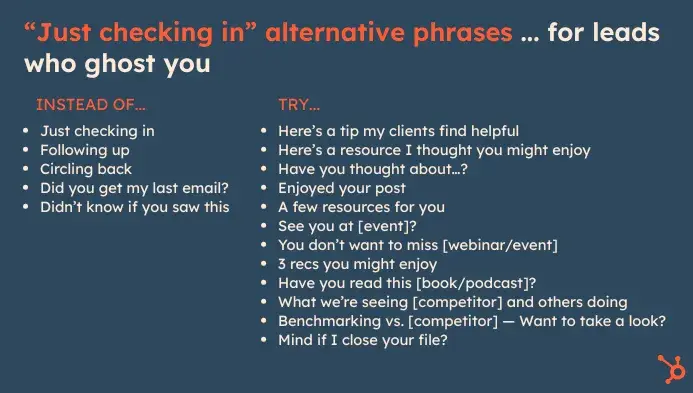
just checking in email alternatives for leads who ghost you

1. Send them a short piece of actionable advice.

One common mistake I see salespeople making is pointing out a weakness or error a prospective customer has made. For example, “I saw your most recent product launch. Here’s where I think you could improve ....” This is insulting, assumptive, and raises the prospect’s defenses. Instead, try a more relaxed and positive approach.

Template:

Hi [prospect],

You likely deal with [business pain], so I thought I’d share a quick tip many of my clients have found helpful: [1-2 sentence actionable piece of advice].

I have a few more ideas around [improving X]. Let me know if you’re interested in hearing them.

Best,

[Your name]

Here’s the same template after I filled it out for a prospect:

Hi Sofia,

I’m sure that your email open rate is a number you watch closely, so I thought I’d share a quick tip many of my clients have found helpful. HubSpot’s data found that email engagement is the highest between 9 AM and noon, Tuesday and Thursdays. This helped client La Petite Luna increase its opens by 30%.

I have some more data and ideas I can share about boosting email open rates. Let me know if you’re interested in hearing them.

Best,

Jamie

2. Send over a longer how-to guide and offer to follow up in person if they want.

I’ve seen that it takes many touchpoints in a customer journey for them to build trust and warm up to your brand. If they aren’t ready to hop on the phone yet, they might read a piece of content relevant to their role. You’ll educate and help them with one simple email.

Template:

Hi [prospect],

Do you [deal with X/want to improve Y]? Here’s an ebook about [dealing with X/improving Y].

There’s a lot of invaluable advice in there — you might find [specific tip or section] especially helpful. If you’d like to discuss these pointers or anything else around [topic], let’s set up a call.

Best,

[Your name]

Here’s the same template after I filled it out for a prospect:

Hi Jordan,

Would you like your new sales hires to get off the ramp faster? Here’s an ebook about shortening ramp time.

There’s a lot of invaluable advice in here — check out page 30 for an in-depth training cadence. If you’d like to discuss these pointers or anything else around sales hiring and training, let’s set up a call.

Best,

Cara

3. Point to areas for growth.

As we’ve covered, you don’t want to harp on your prospect’s weaknesses. However, I have found that there’s room for gentle suggestions of ways to grow and improve.

Template:

Hi [prospect],

[Company] sounds like it’s doing well — just stumbled across this quote on [Glassdoor/Yelp/Angie’s List/other third-party review site] from one of your [employees/customers]:

[1-2 sentence quote].

[Company] would be even stronger if you [fixed X]. Would you like to follow up about this on a call?

Best,

[Your name]

Here’s the same template after I filled it out for a prospect:

Hi Oleana,

Trusthealth sounds like it’s doing well — I was impressed by this quote on Glassdoor from one of your employees: “This is the best, most supportive office I’ve ever experienced.”

Your company could be even stronger if you offered flexible work policies, which typically increase retention for 89% of companies. Would you like to follow up about this on a call to hear about how this has worked at other companies I work with?

Best,

Kendall

Pro tip: Be sure to write compelling subject lines to get your message opened!

4. Respond to a social post, then follow up with more resources.

You never want to be that salesperson pitching someone in the comments section of a LinkedIn post. Engage with your prospect, yes. Respond to their post with a thoughtful, personalized response. But then, take the conversation offline and follow up with valuable feedback.

Template:

Hey [prospect],

Great post on [social network] about [topic]. Your comment about X was particularly astute — [additional comment].

Here are a couple of resources about [topic] you might find interesting:

  • Link 1
  • Link 2

[Connection between resources and the value the salesperson can offer].

Let me know what you think,

[Your name]

Here’s the same template after I filled it out for a prospect:

Hey Annette,

Great post on LinkedIn about banking software. Your comment about fraud detection was spot on.

Here are a couple of resources about online financial programs you might find interesting:

  • Link 1
  • Link 2

They cover several unique strategies for preventing cybercrime.

Let me know what you think,

Mark

5. Answer one of their questions on an online forum, then follow up with more resources.

Don’t use online forums like Reddit or Quora to close a deal. On many of these platforms, pitching is not allowed and could get you booted as a user. Instead, use them as a first touch and follow up offline. This keeps your name familiar when you do connect elsewhere.

Template:

Hi [prospect],

Great [online forum] question about X. [1-2 sentence answer]. (Make sure you link to the post, especially if it’s more than one day old.)

Here are a couple of resources about X that will also help:

  • Link 1
  • Link 2

Let me know if you’d like to discuss this on a call,

[Your name]

Here’s the same template after I filled it out for a prospect:

Hi Tim,

Great Reddit question about finding freelancers. Many of the startups I work with hire college students to freelance for them — the students get experience, and the companies get good content at an affordable rate.

Here are a couple of places where my coworkers have successfully hired freelancers from:

  • Contently (a content marketing platform)
  • Dribbble (a design community with many active freelancers)

Let me know if you’d like to discuss this or get a few more suggestions on a call.

Sydney

6. Send them a blog post your company has just published.

If a prospect downloads a certain piece of your content, follow up with other resources they might find valuable.

Template:

Hi [prospect],

You [previously downloaded or read X piece of content/likely deal with Y problem/belong to Z industry], so you might get value from this blog post my company just published: [title].

If you’re in a rush and can’t read it all, [tip, section X] seems like it’d be particularly useful for [company].

Best,

[Your name]

Here’s the same template after I filled it out for a prospect:

Hi Amanda,

You previously downloaded our guide to designing an intranet, so you might get value from this blog post my company just published containing interviews with the winners of Nielsen’s 10 Best Intranets of 2023 awards.

If you’re in a rush and can’t read it all, example #4 seems like it’d be particularly useful for Cloudius, since it features another energy firm.

Best,

Julian

7. Recommend an event in their area.

If you’re in the same city as your prospect, share local industry events and tell them you’d love to see them there. If it’s a ticketed event, you can even offer them complimentary tickets. This tactic provides your prospect with a valuable networking event and sets you up to meet them in person.

Template:

Hi [prospect],

What are you doing on [date]? Noticed [event] will be taking place next month — it seems like a great fit for you because [value of event].

Here’s the link to the website if you want to check it out: [link].

Best,

[Your name]

Here’s the same template after I filled it out for a prospect:

Hi Jon,

What are you doing on October 3? Noticed there’s an IT professionals meetup on that day in Framingham — it seems like a great opportunity to network and potentially recruit more folks for Kerchief.

Here’s the link to the website if you want to check it out: [link].

Best,

Harold

8. Invite them to an upcoming webinar or educational event your company is hosting.

Similarly, you can keep them updated about events that will help them do better at their job. You’ll immediately build trust and add value to their working lives, and a virtual event is often an easier ask than taking a large chunk out of their day for a physical event.

Template:

Hi [prospect],

Last time we spoke, you mentioned you’re currently focused on [improving X/solving Y/refining Z]. Would you like to attend the [webinar/event] that [rep’s company] is hosting?

The speakers, [name] and [name], will be delving into [topic 1 and topic 2].

It’s taking place on [date] — here’s the link to sign up.

I hope to see you there.

Best,

[Your name]

Here’s the same template after I filled it out for a prospect:

Hi June,

Last time we spoke, you mentioned you’re currently focused on incorporating iPads into the classroom. Would you like to attend the webinar that CurrentFront is hosting?

The speakers, Hakan Staff from Harvard University and Sheila Thomas from Yale University, will be diving into tech-based learning models and how they’ve incorporated them into their classrooms.

It’s taking place on January 14 — here’s the link to sign up.

I hope to see you there.

Best,

Yusef

9. Send them a book, podcast, newsletter, or publication recommendation.

Is your prospect an avid content consumer who’s always sharing the latest book or podcast recommendations online? It only takes a few minutes to find this information and share a few recommendations back. It’s quick, easy, and thoughtful to share your favorite industry resources.

Template:

Hey [prospect],

I saw on your [LinkedIn/X/other social network] account that you’re a big reader. Have you heard of [related publication/book/newsletter/podcast]? If you liked X, you’ll probably enjoy Y.

I couldn’t put it down and loved the interviews with real-world examples. I recommend starting with [issue/edition/episode] Z: [linked].

Let me know what you think,

[Your name]

Here’s the same template after I filled it out for a prospect:

Hey Terry,

Judging by your LinkedIn account, you’ve got a great eye for industry content. The podcast you posted about the rise of consumer loyalty programs was really insightful.

Have you heard of the Brave Commerce podcast? If you like Shopify Masters, you’ll probably enjoy Brave Commerce. I recommend starting with the episode with Ferrero.

Let me know what you think,

Darcy

10. Call attention to something their competitor is doing and ask how they plan to address it.

Knowing what your competitor is doing well is one thing. Having someone outside your business tell you what your competitor is doing is another. This might just be the kick your prospect needs to make a change.

Template:

Hi [prospect],

I saw that [competitor] has been doing [recent initiative] lately. Do you have any plans to do the same?

I have some benchmarks to look at and ideas to fill the gap — if you want to hear them, let’s schedule a call.

Best,

[Your name]

Here’s the same template after I filled it out for a prospect:

Hi Sean,

Gladup has been aggressively hiring new developers. The last time we spoke, you mentioned that you’re also trying to grow your team — do you have any plans in place for staying competitive in the Chicago area?

If you’re interested, I have some benchmarks about hiring at Gladup and other close competitors. Want to schedule a call to go through them together?

Best,

Sarah

11. Bring up a common challenge your buyers face and ask if they’re experiencing it.

Do your research, understand what makes your prospects tick, and know the right questions to ask to open a conversation.

Template:

Hi [prospect],

The clients I work with often face [business challenge]. Has [company] experienced anything similar?

If so, I have several ideas that might help — like [tip #1]. If you’d like to hear more, I’m free for a call on [date and time] or [date or time].

Best,

[Your name]

Here’s the same template after I filled it out for a prospect:

Hi Hayle,

The clients I work with often struggle to find creative, low-cost ways to engage with their local communities. Has Shake Advertising experienced anything similar?

If so, I have several ideas that might help, like organizing an employee volunteer program. If you’d like to hear more, I’m free for a call on Thursday at 4 PM or Friday at 10:30 AM.

Best,

Claire

12. Send a breakup email to close the loop.

Sometimes, they’re just not that into you. If that seems the case, here’s a Hail Mary you can try — it just might prompt them to respond if they’re still curious, but haven’t taken action yet.

Template:

Hi [prospect],

I haven’t heard back from you, so you must be busy or no longer interested in [achieving X]. Mind if I close your file?

Thanks,

[Your name]

Here’s the same template after I filled it out for a prospect:

Hi Liam,

I haven’t heard back from you, so you must be busy or no longer interested in expanding to the San Jose area. Mind if I close your file?

Thanks,

Kevin

Follow-Up Email Templates for a Lapsed Customer

If your customer lapsed after a trial period or an initial purchase, there’s still a chance to bring

them back.

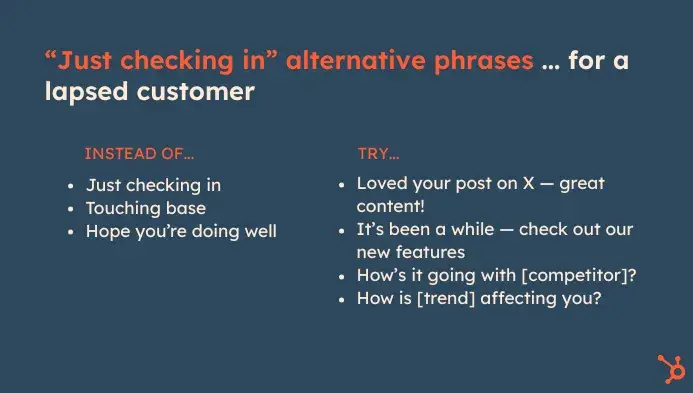
just checking in email alternatives for a lapsed customer

13. Reference a relevant blog post they just published.

To re-engage a lapsed customer, flattery just might get you in the door. It shows you’re staying engaged and are paying attention to their company.

If you do this, make sure you’re speaking to specific things you liked about the post. A generic, “I loved your article on ‘Just Checking in Alternatives,’” comes off as cold and insincere. Instead, say, “I really liked your most recent article on ‘Just Checking in Alternatives.’ Your suggestion to highlight specific things you found valuable about an article when flattering a prospect’s most recent blog is really insightful.”

Template:

Hey [client],

Excellent post on [topic]. Your [comment/suggestion/insight] on X stood out for [reason].

Have you considered writing about Y as a follow-up post?

Best,

[Your name]

Here’s the same template after I filled it out for a prospect:

Hey Dave,

Excellent post on the state’s real estate market. Your argument that restaurants are driving the local retail landscape was particularly persuasive — most investors aren’t looking carefully enough at those stats.

Have you considered writing about the generational shift into cities as a follow-up post?

Best,

Sarek

14. Introduce new products, services, or features.

If your customer left for a particular pain point, it’s worth keeping in touch with them as you roll out new fixes and features.

Template:

Hi [client],

I know you haven’t logged in for a while, and had a few questions about [pain point]. We’ve been working hard behind the scenes, and I wanted to share a few exciting updates I think you’ll love.

Here’s what’s new since you last visited:

  • [Feature #1 and what it helps with]
  • [Feature #2 and how it improves the experience]
  • [Feature #3 if relevant — like security, integrations, speed, etc.]

I think these will really help you [key customer goal]. Now’s a great time to come back and test out the new features!

[Offer with free trial/access code]

Let us know if you have any questions — I’d love to help.

Best,

[Your name]

Here’s the same template after I filled it out for a prospect:

Hey Shawn,

I know you haven’t logged into Rabbit for a while, and had a few questions about integrations and views. We’ve been working hard behind the scenes, and I wanted to share a few exciting updates I think you’ll love.

Here’s what’s new since you last visited:

  • Timeline View. See your projects laid out in a beautiful Gantt-style timeline.
  • AI Task Assistant. Automatically draft task lists from your project brief.
  • Slack & Google Drive integrations. Keep everything connected and in one place.

I think these will really help you keep your team on track. Now’s a great time to come back and test out the new features!

Here’s an access code for another free 30-day trial of Rabbit.

Let us know if you have any questions — I’d love to help.

Best,

Huck

15. Check how things are going with a competitor.

If some time has passed, particularly if their contract with a competitor might be winding down, it’s another great time to jump in and take their temperature, introduce new features your product has unveiled, and tell them how you’re different.

Template:

Hi [prospect],

Last time we chatted, you mentioned your contract with [competitor] is winding down in [month]. How’s everything going with [product]?

Also, I came across a [blog post/ebook/guide] on [topic] you might find helpful: [link].

Looking forward to hearing from you,

[Your name]

Here’s the same template after I filled it out for a prospect:

Hi Ethan,

Last time we chatted, you mentioned your contract with Banyan is winding down in June. How’s everything going with their platform?

Also, I came across a post on Google Chrome keyboard shortcuts your team might like — know you guys are big Chrome fans [link].

Looking forward to hearing from you,

Shruthi

16. Ask if they’re still interested in achieving X goal, then provide a suggestion for how to get there.

Since this is a lapsed customer, you likely already know something about them and their goals. This is gold that you can use to re-engage them in discussion. Offer tactical advice for how they can achieve their goals. This also demonstrates that you understand their industry and the challenges they face.

Template:

Hey [prospect],

Are you still interested in achieving X goal? [Customer] saw [results] by trying [suggestion]. Might be worth a try for [prospect’s company].

If you’d like to know exactly how [customer] did it, we can set up a call on [date and time] or [date and time].

Best,

[Your name]

Here’s the same template after I filled it out for a prospect:

Hey Susan,

Are you still interested in decreasing employee absenteeism? Full Trade raised team-wide attendance by 5% in three months by tying performance pay to attendance. Might be worth a try for Beeline.

If you’d like to know the specifics of Full Trade’s program, we can set up a call on Tuesday at 11 AM or Wednesday at 4 PM.

Best,

Gary

17. Reach out about specific shifts or new challenges in their industry.

Referencing new, emerging challenges in a client’s industry is a good way to show you have a grasp on what their business is dealing with. It can also help you get a picture of what they and similar companies are going to deal with going forward.

Template:

Hi [client],

It’s been a while since we’ve talked. There have been some big shifts and shake ups in [X industry] since we last spoke, [including Y event]. I think it would be great if we could find some time to discuss how [X industry/their business is changing].

I’ve attached a link to my calendar. Let me know a good time for us to hop on a call.

Best,

[Your name]

Here’s the same template after I filled it out for a prospect:

Hi Andy,

It’s been a while since we’ve talked. There have been some big shifts and shake-ups in cybersecurity since we last spoke — particularly CCPA finally going into effect. I think it would be great if we could find some time to discuss what this means for smaller cybersecurity consulting firms like yours and the industry as a whole.

I’ve attached a link to my calendar. Let me know a good time for us to hop on a call.

Best,

[Your name]

Follow-Up Email Templates Following a Trigger Event

If your sales efforts flatlined at some point in the past, sometimes all you need is time. Decision-makers change and promotions, mergers, or funding rounds can significantly change the landscape. You can tactfully reach out after a trigger event to re-engage the contact.

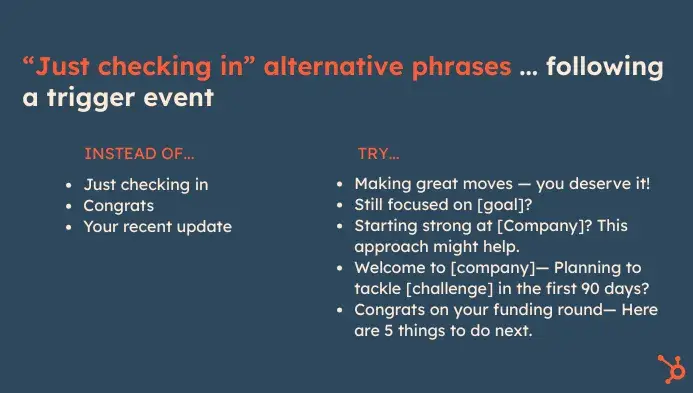
just checking in email alternatives following a trigger event

18. Congratulate a potential decision-maker on a promotion.

This is another example of flattering your prospect. And you can use their promotion as an opportunity to introduce your product/service as a way for them to make an immediate splash in their new role.

Template:

Hi [prospect],

Congratulations on your promotion to [role]. You’ve done some impressive things in your tenure at [company] — including [achievement 1] and [achievement 2] — so it’s well-deserved.

Have you put any thought into how you’ll achieve [business goal]? I have a few suggestions.

Best,

[Your name]

Here’s the same template after I filled it out for a prospect:

Hi Emily,

Congratulations on your promotion to editor-in-chief. You’ve done some impressive things in your tenure at Fantasia — including raising print circulation and rolling out a virtual reality program — so it’s well-deserved.

Have you put any thought into how you’ll find VR specialists? I have a few suggestions.

Best,

Andy

19. Reach out to a decision-maker after a blocker leaves the company.

Don’t let one person close the door on future deals at a given company. If you see a blocker take a new job on LinkedIn, use that as an opportunity to try again.

Template:

Hi [prospect],

In [month, year], we talked about your difficulties with [pain point], and how [offering] could help [achieve specific goal] over [specific timeframe].

I know there have been a few changes at [prospect’s company] since then — are you interested in doubling down on [goal] again?

Best,

[Your name]

Here’s the same template after I filled it out for a prospect:

Hi Jody,

In February, we talked about your difficulties with inefficient driver routes, and how the XYZ software could help reduce team mileage by 30% and improve worker retention by 5% in 6 months.

I know there’s been a few changes at Miller since then — are you interested in working on improving your numbers again?

Best,

Todd

20. Reach out to a new C-level executive.

Show that you’ve followed their career and know what they care about and are good at. Asking about their strategy is a great way to get to the heart of what C-levels care about.

Template:

Hi [prospect],

Congratulations on your new role at [new company]. At your old company you made [X innovative move] that really helped [Y metric]. When I previously spoke with someone at your company, they were doing things [X way] — how are you thinking about this strategy?

Best,

[Your name]

Here’s the same template after I filled it out for a prospect:

Hi Sheryl,

Congratulations on your new role at Waypointer. In your past role, you completely revamped the mid-market strategy, doubling your revenue from that channel. It’s exciting to see what you’ll bring to Waypointer!

When I previously spoke with someone at your company, they were focusing on enterprise deals. How are you thinking about your mid-market approach going forward?

Best,

Jose

21. Congratulate them on a funding round.

Know that they’re likely getting lots of emails and phone calls, if they’ve just announced a round. So make sure your touch base is unique, timely, and personalized.

Template:

Hey [prospect],

Since the last time [we talked, I reached out], you’ve closed a/an $X round of funding. Congratulations! This is probably one of the busiest periods of your company’s life — have you thought about how you’ll [accomplish X goal]?

If that’s on your agenda, let’s set up a quick call. I have a few ideas that may help.

Best,

[Your name]

Here’s the same template after I filled it out for a prospect:

Hey Vincent,

Since the last time I reached out, you’ve closed a $5M round of funding. Congratulations! This is probably one of the busiest periods of your company’s life — have you thought about how you’ll scale your onboarding process?

If that’s on your agenda, let’s set up a quick call. I have a few ideas that may help.

Best,

Simon

22. Ask about headcount changes or reorganizations.

Any time you see a company hiring or changing the structure of their company, it’s a good time to reach out and see if their priorities have shifted to include your product/service in their periphery.

Template:

Hi [prospect],

Congratulations on the creation of [role related to your product]. Whenever I see this, I know it means you’re prioritizing [business goal].

I thought you might be interested in learning how we helped [similar company] get going quickly in this direction in under 90 days.

If you’d like to learn more, let’s set up a quick call. How does [date and time] look on your calendar?

Best,

[Your name]

Here’s the same template after I filled it out for a prospect:

Hi Rafael,

Congratulations on the creation of a branded content role. Usually this means securing corporate partnerships is now a priority.

I thought you might be interested in finding out how we helped May Media establish guidelines and price points while generating interest with their target partners.

If you’d like to learn more, let’s set up a quick call. How does July 30 at 2:30 PM look on your calendar?

Best,

Gina

Turn cold emails into conversations with creative follow-up emails.

Too many prospects ghosting you?

Salespeople often default to the standard “just checking in” message because they’re in a rush. Through my career, I’ve learned that these come off as vague or lazy, and don’t start a conversation or show the value you have to offer.

With these “just checking in” alternative templates, writing a thoughtful, personalized, helpful email takes mere minutes — with a potentially enormous payoff.

Editor's note: This post was originally published May 15, 2019 and has been updated for comprehensiveness.

29 May 17:04

The 7 Most Overlooked Opportunities For B2B Marketers In 2017

by Rachel Foster

Title Image: Woman looking through binoculars towards distance with city skyline at right

Life is hectic when you’re a B2B marketer.

Between attending meetings, planning campaigns, and publishing endless content, you might have trouble keeping up. You barely have time to analyze your own activities – let alone find out what other marketers are doing to succeed.

In the day-to-day rush, you may miss out on chances to engage leads and turn them into customers. Here are seven big opportunities that many B2B marketers overlook:

1. Arming Your Sales Team With The Content They Need To Close Deals

A recent Seismic and MarketingProfs survey found that only 18% of B2B content marketers provide their sales teams with content in an effective manner, as well as ensure that their materials remain updated and on-brand.

Adding to Sales’ frustrations, a CSO Insights survey revealed that only 12% of reps can bring up critical sales material up on their smartphones.

If you don’t have a process to provide reps with the content they need to close deals, your sales cycles will grow longer. The more time reps spend searching for and creating content, the less time they will have to do what they do best – sell.

Equip your reps with content that supports buyers who are in the later stages of the sales process. For example, they may need case studies that provide proof that your products or services deliver results. They may also want content that contains detailed information on your offerings, such as brochures or competitive comparisons.

2. Documenting Your Content Marketing Strategy

According to the 2017 B2B Content Marketing Benchmarks, Budgets, and Trends report, only 37% of B2B companies have a documented content marketing strategy. If you’re not getting the results you want, it might be because you haven’t built your content foundation.

Publishing without a strategy is like taking a road trip without a map. You’re likely to take wrong turns along the way.

Winding road off intot the distance with map showing the way

In addition to a map, you’ll also need a GPS that warns you of upcoming roadblocks and detours. This is because the most successful B2B marketers quickly adjust their content marketing strategy – and get on a better route – when things change.

3. Personalizing Your Existing Content

Gone are the days of one-size-fits-all content. Customers won’t respond unless your content speaks directly to their needs, challenges, and goals.

The demand for personalized content stemmed from the consumer world, where buyers can do everything from view customized Amazon recommendations to pick the exact produce in their organic delivery box.

Eccolo Media found that 48% of B2B buyers consume two-to-five pieces of content before they make a purchasing decision. Meanwhile, TechTarget found that 65% of IT buyers require at least four pieces of content to make a vendor shortlist.

In the B2B space, content personalization can include giving customers relevant white papers, case studies, and email content. And you don’t necessarily need to recreate the wheel to personalize all of your content.

For example, you can take one of your white papers and change parts of it – such as the case studies and introduction – to speak to a different audience.

Then, you can give leads the option to select their role, industry, or biggest challenge when they download a white paper. This gets them more involved in the process. If they know that they are downloading a piece of custom content, they will be more likely to read it. They will also get more value from your content, as it speaks directly to their needs.

4. Cooking Once And Eating All Week By Repurposing Your Content

The more content you produce, the more customers you will attract. However, you may not have the time or resources to create a large volume of original content.

Repurposing your content is a great way to do more with less, so you can:

  • Get your message in front of a wider audience (such as different personas or leads who are in different stages of the sales cycle)
  • Attract more leads from different channels
  • Improve your SEO
  • Get more value from your content investments
  • Publish new content quickly


5. Showing Your Company’s Human Side

Customers buy from people. They want honesty. They want stories.

Stories help you connect with customers on an emotional level so that you can show your value and stand out from the competition.

The most effective content marketers apply elements of journalism and storytelling to their content. Here are three keys to creating compelling stories:

  • Address your weaknesses to make your brand more human. Instead of hiding your product’s flaws, put them out in the open. Customers will appreciate your honesty and be more likely to trust you.

When you bring these key elements into your content, you’ll connect with members of your audience and motivate them to take action.

6. Engaging Leads With Case Studies

The B2B Technology Marketing Group surveyed more than 600 tech marketers to find out the latest content trends and best practices. The results revealed that the most effective B2B content marketing tactic is case studies, with 44% of respondents saying that it helps them achieve their lead generation goals.

Mobile phone with case study on screen and #1 ribbon in background

Here is the rest of the survey’s top 10 list:

  1. Case studies
  2. Blogging
  3. Social media
  4. Customer testimonials
  5. In-person events
  6. White papers
  7. Webinars
  8. Videos
  9. Online articles
  10. Infographics

7. Using More Than Words

Multimedia can make your content more engaging and help you connect with auditory and visual learners. For example:

Here are some ways you can use media to connect with customers and motivate them to take action:

  • Add photos and charts to punch up your content
  • Film video case studies and use them throughout your marketing
  • Turn your content into SlideShare presentations and upload them to LinkedIn
  • Interview your customers about their successes in your webinars and podcasts
  • Create fun and informative infographics

Can you take advantage of any of these opportunities?

Check for holes in your content strategy. For example, did you launch a new product but don’t have case studies to support it? Can you make your blog posts more shareable by adding images and videos to them?

Next Steps

Download The Ultimate Content Library Checklist: 9 Items You Need to Share with Your Team to Create Better, Faster and More Effective Content.

29 May 17:04

Why Can’t My B2B Sales People Sell?

by Ian Dainty

b2b salesB2B Sales is very difficult, and as so, this is a refrain I hear all the time.

There are many reasons for this. But the biggest reason is that very few companies train their sales people anymore, and even fewer have ongoing coaching.

And yet selling in the B2B marketplace is as difficult as it has ever been.

With buyers being bombarded with information from so many channels, B2B sales professionals have many obstacles to overcome. Here is some research from bmp online.

B2B Sales Issues

They have found the following reasons as the top five issues B2B sales and marketers face today
• Finding quality leads (63%),
• Length of the sales cycle (53%), and
• Getting in touch with decision makers (49%) are the biggest sales challenges that organizations name this year.
• Sales productivity (45%) and
• Time spent away from sales activities (39%) follow next.

So why is this happening?

There are a myriad of problems B2B vendor companies face in today’s marketplace.

These issues include;
1. B2B sales is tougher than it’s ever been.
2. There are a multitude of vendors selling something similar to what you sell.
3. The days of buying technology just for the sake of it are over, even though companies need more technology to keep a competitive position.
4. Very few companies train, and then have ongoing sales coaching today.
5. There is too much/too little reliance on technology to solve sales’ problems.
6. Not enough companies understand their own real differentiation, and therefore cannot explain it to their prospects.
7. Etc., etc., etc.

Some History on B2B Sales at IBM

First, let’s look at some history of B2B sales, and how it has evolved.

I first started my business career in the 1974 at IBM.

Back then, IBM put me and several hundred other fresh recruits into a nine-month training program, before we even saw or talked to any customers.

It was very intensive, usually 12 hour days for the entire nine months. And a lot of weekend work. They wanted to weed out any laggards.

They training focused on three different areas.
1. B2B sales and marketing,
2. Business principles,
3. How computers worked.

But, by far, the most time (70%) was spent on sales and marketing. We also spent a lot of time doing role plays, how to develop an account strategy, and how to build strategic accounts.

The intensity was more than any of us had been through. And what we learned has stayed with me since then. It has stayed with me because I practice what I learned every day.

The not so funny thing is that this type of training is needed more today than ever, especially about how to talk to executives, and how build and manage Strategic Accounts.

And yet, I don’t know of any company that even comes close to this type of training, including IBM. Xerox also trained their sales people back then, but not nearly as intensely and as thoroughly as IBM, and does no training now either.

In fact, most B2B companies give no sales and marketing training at all.

Yet, they all expect their sales and marketing people to be fully aware of how to sell in the B2B market right away.

B2B companies will give product training, but that is insufficient to learn how to sell.

Actually, I believe that if B2B sales people know how to sell, knowing their products and services is at the bottom of the list of how to sell.

What B2B Sales People Need to Know

What these B2B sales people need to know, more than anything else, are things like;
• Why did your clients buy from you?
• What ROI did they receive?
• Are they still getting that ROI?
• What about your company made them choose you?
• Would they buy from you again?
• Plus, a list of about 40 other questions I use when I interview customers of my clients.

So if any members of your B2B sales team are struggling making quotas, then you need to look at your training and coaching to ensure it is what your team needs.

Contact me, from my contact info in my signature below, and let’s discuss how to bring all of your sales and marketing people to a standard that fits your needs, and helps them all reach quota and beyond.

29 May 17:03

7 Tactics to Ensure Your Next B2B Content Marketing Campaign is Successful

by Amanda Dooley

A recent Content Marketing Institute #CMWorld twitter chat inspired me to write this post bringing together important insights to help B2B marketers achieve success in their content marketing endeavors. As a content marketer, the never-ending pressure to earn your budget quarter-over-quarter is high. If you aren’t able to deliver results, those funds will just as easily get reallocated to another team or initiative that has proven itself more worthy. While content marketing doesn’t always come with a monetary cost, it most certainly has bandwidth costs. Therefore, whether you are spending time or money on your next content marketing initiative you need to be sure it ‘pays off’. Paying off could mean revenue, new accounts created, or it could mean an increase in traffic. I have outlined seven ways for you to ensure that your next content marketing campaign is a success. Dig in and tell me what you think:

1. Setting Expectations

setting expectations

You need to know what success looks like, by campaign type, so that you and management can identify when success happens, or doesn’t. Start by setting the goal for the content marketing campaign – and make sure you include management in this discussion. Next, how will the campaign be measured against these goals, what are the KPIs, and do you have access to the data/KPIs that will ultimately validate your efforts? Document the expectations with management. David Fortino shared in the twitter chat, “Isolate what you are trying to accomplish ask yourself how you will measure success. #ROI and #CYA are deeply connected.

Here’s a real world example:

In Q1 of this year, I was part of a small content team that produced a series of research reports analyzing marketplace trends in long-form content consumption behavior. We had never done this before, we didn’t know what to expect and we didn’t have much to compare it with. So how did we determine what success would be for this campaign?

As a revenue driven company, the marketing team’s constant KPIs are always ‘number of opportunities created’ and ‘value of opportunities won’. However, in approaching this new content marketing project, we identified brand awareness as an important secondary goal, therefore KPIs such as traffic and report downloads were also necessary to track. To benchmark the first campaign we relied on non-content lead gen initiatives to provide a form a comparison.

(Here’s another great read on setting expectations, Get Back to Reality: 9 Content Marketing Expectations Busted by Neil Patel on Content Marketing Institute.)

2. Promotion and Distribution

facebook-for-lead-gen-the-office-andy-surprised

You keep saying to management, ‘I need to create more content, more content, more content, more content’ and ‘more content will generate more leads.’ Then someone asks you, ‘how will more content generate more leads?’ Ut oh. You’ve been so focused on creating content; you didn’t get to the next step of implementing, promoting, and distributing content towards your end goal – lead generation.

Creating content is only half of the battle. Do you have a documented plan to carry out once the content is ready? This is important and something marketers often miss in the planning process and wait until after the content is created to determine where to put it.

If you’re goal is to get the content in front of as many eyeballs as possible, your promotional and distribution strategies are crucial. Let’s dig into these by inbound and outbound.

Inbound: meaning your content is going to live on your website and you will run campaigns to drive traffic to the content on your website.

Inbound is an important approach, that I believe all marketers would say you must do. Directing traffic back to your website to read your content is a great way to measure quality and intent of a prospect. However, this approach relies on the assumption that you can get the right audience and a large enough audience to your website — the “if you build it, they will come” mentality. But when you run the numbers, are you driving enough professionals to your website each month? Is this scalable?

Outbound: meaning your content will live off-site on third party websites and attract native audiences to engage with your content externally.

Outbound is complimentary to Inbound, and often not thought of by B2B marketers. This strategy rests on the fact that your target prospects might not be willing to venture to, nor even know about, your website just yet. Therefore, outbound helps you reach professionals across the web, where they are actively frequenting and engaging with content. Outbound is an extension or amplification of your content campaigns to increase your probability of success.

Needless to say, outline both the inbound and outbound tactics you will use to ensure your content attracts the best suited audience to increase your ROI.

(Here’s another article about the balance of inbound and outbound strategies, B2B Marketers Lose with Inbound Only Strategies.)

3. Audience Appropriate Content

audience appropriate content

The first step to content creation is learning about your target audience and their needs. Who are you trying to reach, are they C-suite level professionals or are they the influencers and ‘users’ of your product or service? What does this particular professional need to know and what do you want to educate them on? Content creation cannot follow a one-size-fits-all mentality.

One tactic recommended by Dennis Shiao, during the twitter chat, is to learn about your existing clients. He tweeted, “Speak to as many customers and prospects as possible. Costs nothing, but has huge impact.” However, not all clients are the same, so this is not the only approach to content creation, but it’s absolutely a great start to your content creation journey.

4. Action Oriented Content

power-puff-action

Finding a content marketing campaign out in the wild that lacks any form of call-to-action physically pains me (that and bad visuals, and bad headlines…I digress). But the idea that we can spend so much time creating meaningful rock solid content and then not present next steps to capture and convert the user is excruciating. You’ve got them in the palm of your hand, and…we’ll see you later! Take our latest research reports I just mentioned, we included links to NetLine Portal and NetLine’s quality commitment where people can learn more about our solutions and values in B2B lead generation — or get started by creating a free account. How’s that for action oriented content? (See what I did there?)

(Here’s another article about effective content marketing CTAs, 5 Tips Every Content Curator Needs to Write Better Calls-to-Action.)

5. Repurpose, Reuse, Recycle

repurposeMarketers may choose to repurpose content for a variety of reasons. While some may find this to be more of a controversial topic, there are core benefits that I believe make repurposing content an essential tactic to ensuring content marketing success and ROI. Here are three main reasons to repurpose your content:

  1. Format by promotional type: Starting with a massive 30+ page research report you have a lot of content, a lot of data, and most likely many topics which creates a heavy document. Not necessarily an easy item to promote on social media for example. Create a supporting infographic of stats and takeaways from the full report, with links out to download the full report. You will reach a larger audience that you may not have been able to capture with the original piece of content.
  2. Format by audience type: There will be people looking for data intensive resources; while other professionals seek user related content about strategy. A short-form qualitative guide may be better suited for a content marketer, while the quantitative report may be more appropriate for the demand generation marketer. Refine your content for each personas’ needs.
  3. Budget and ROI: Don’t let budget hold back your team’s ability to start a new content project. You can solve for this by revisiting your top existing content assets and assess what can be done to refresh and recycle the content. Adding new stats, dividing into smaller content pieces, and updating visuals can go a long way to reaching new audiences and driving engagement.

An excellent strategy tip shared by Erika Heald was, “Create content with a plan for repurposing to stretch your resources. Structure an ebook to be a blog series, byline, etc…

6. Performance-Based

One powerful way to ensure your campaign will produce meaningful and measurable results is to run performance-based campaigns. For those of you not entirely sure what that means, here are two examples:

  1. Not Performance-Based: Paying $5k for a third-party email campaign (maybe a list rental) after reviewing the list demographics and average KPIs. This flat rate email campaign does not offer any guarantee for delivering results tied to your lead generation goal. You may receive 1,000 visitors to your website from the email or you might receive 10, either way you are paying $5k.
  2. Performance-Based: Running a lead generation campaign with cost-per-lead (CPL) pricing. This means that your campaign cost will be based upon the number of actual people to fill out a form to download your content. In the case of content syndication lead generation, you also receive earned media exposure throughout the duration of the campaign that you don’t pay for (in contrast to a CPM campaign). Performance-based pricing models greatly reduce risk and increase quality, as you are only paying for the end result. And in the case of CPL pricing, you are paying for leads which is directly aligned with your lead generation goals. (1+1=2)

While there is nothing wrong with diversifying your campaign strategy with unique campaign types, always insert performance-based campaigns to ensure you deliver on your lead generation goals for the month. It all comes back to the numbers. If you bring your sales team 75 leads at the end of the content marketing campaign – the outlook is going to be greater than if you cite the number of emails sent and how many people visited your website for fourteen seconds.

For B2B marketers with lead generation as their number one goal this year, check out the NetLine Portal where you can run targeted content syndication campaigns to generate quality leads, with cost-per-lead pricing to ensure success.

7. Data and Optimization

Content marketers, I have to tell you – data matters and you need to respect that. Sure, we care about context, relevance, education, and value but you’re lost without data. Caring about the numbers can help you make smarter decisions about your content marketing campaign that you wouldn’t be able to otherwise. And you can do this without sacrificing quality.

PivotHere’s an example: Most marketing campaigns are automatically attached to data; whether it’s free Google Analytics tracking, paid Adwords dashboard reporting, or NetLine’s campaign analytics. You should be able to see how your campaign is performing and gauge whether you will likely reach your goal, (there’s always a chance you may not.) If not, take the time to pivot your approach and optimize your results. This might mean pausing a campaign to make changes to your targeting, content, creative, or messaging. If there are updates that can be made to alter your results and increase the probability of success – make them! Any good solution/vendor wants you succeed and they should be willing to help you make the necessary changes needed to drive success and keep you as a loyal customer.

Success Starts Now

B2B marketers don’t need a massive budget to drive content marketing success. Sure it helps, but start small. Get scrappy. Work your way up. Prove your worth. In the words of Dennis Shiao, “Demonstrate impact with no budget. That will then justify investment to capitalize on further opportunities.” This list of seven tangible tactics to ensure your next content campaign is successful should help you make real progress towards building your content marketing program. Good luck! And if you ever want to talk through it together, reach out on Twitter or LinkedIn.

29 May 17:03

The Best Sellers Are Cheaters

by Tibor Shanto

By Tibor Shanto – tibor.shanto@sellbetter.ca 

You can slice it six ways from Sunday, the best sales people are the ones who maximize and do most with their time. Success in sales is all about Execution – everything else being just talk, and given that all of us are allocated 24 hours at the stroke of midnight, what and how one choses to execute becomes a critical difference. Execution takes time, a non-renewable resource, finding ways to stretch and bend that time in your favour is critical; and doing that will usually involve cheating. Not cheating like when a company cheats a rep out commissions, or by deceit, but cheat as in:

“to elude or thwart by or as if by outwitting – “cheat death” (Merriam-Webster)
I would suggest the sales equivalent being time – “cheat time”

To begin with, top sellers spend much less time talking, and a great deal more time executing. That does not mean that they get everything right, but since they spend more time doing than, thinking, planning or talking, they are bound to get more things right. More importantly, they will have more mistakes to review and learn from. A big unspoken consequence to waiting for perfection before taking action is you are not making enough mistakes to learn from, and as the end of the month quarter or year draws near, we revert back to doing things they way we always have, the same way that leads to almost half of B2B reps missing quota.

In order to ensure that our clients get maximum bang for their training dollars, we put a great deal of focus and effort on adoption, changing people’s habits. No matter how great a sales methodology you introduce, if you don’t change the habits of the team you are working with, you will not change the way they sell. The book of the last trainer is clearly on display on the shelf of each rep, just absent from the way they execute, because their habits remain the same, they are just applied using a different story.

In this process, we work closely with teams over time, and have come to see specific things recur time and time again across different teams. One being how they value and deal with time, not just their own, but that of the buyer.

Time Question Concept

Using our Activity Calculator, each rep calculates approximately what percentage of their time they have to allocate to high value activities across a period of time, ideally a sales cycle, or if we have to a week or month. (I really prefer sales cycle, but many sales people don’t know how long their sales cycle is, their default answer is “Depends”) Once a rep makes a commitment to how much time they will allocate to critical sales activities, the challenge is to stick to it.

The best sellers cheat time by ensuring that they complete the most important high value activities. Their view is that the most important thing is attaining quota, so they cheat by ensuring those things that drive quota get done before and above all other things. The less successful sellers, cheat themselves by doing everything but what drives their quota. They find it more important to do things their customer support or product people can and are paid to do, eating up valuable time, eating away at their ability to win.

I understand the need to be customer focused, which is exactly why your company hired support teams better equipped to do that than you; they hired you to sell. So stop cheating yourself and your customer, yes, by stepping between them and the right resource you not only risk resolution, but risk losing customers as a result.

So if you’re gonna cheat, do it in a way that helps your customers, company, and you; go out and sell, don’t waste time on things that don’t lead to revenue.

Become one of the thousands of sales professionals receiving my latest updates on sales execution, tools, tips and more.

Join Now!

The post The Best Sellers Are Cheaters appeared first on Renbor Sales Solutions Inc..

29 May 17:03

Future of B2B Marketing and Sales: 20 Experts Share Their Predictions

by Vignesh Subramanyan

Revenue, that’s the name of the game in 2017. And has been for a long time.

We’ve heard a lot this year about AI, machine learning, and the like. But regardless of what lens you approach the revenue problem, there’s one constant. Success comes down to the right people, processes, and technologies. Combining these three elements in today’s data-abundant world is the key to success. But this continues to be a pervasive challenge for B2B go-to-market teams. Especially in the current buzz-heavy, ‘jump on the next trend’ world that we live in.

Yet, bridging the customer-brand relationship isn’t so simple.

Being able to filter through the deluge of noise can help you focus on the right trends. Looking out for technologies, strategies, and organizational thinking that helps your company excel.

To help answer this question, we reached out to thought leaders in the B2B space. These are marketing and sales leaders with a proven track record of driving scalable growth. In this post, we highlight some of the top findings we heard from them. Check out the list and learn about the key trends you should keep top of mind this year.

B2B marketing and sales predictions from experts

1) Jon Miller, CEO and Co-founder, Engagio – Twitter

“In 2017, the industry will start to realize that ABM isn’t a technology category, it’s a business strategy. To succeed in B2B markets, you must embrace this. Move the focus from leads to accounts, and cover the fundamentals of lead-to-account matching and analytics/metrics. Only then can you go on to other parts of ABM, like orchestrating highly relevant plays leveraging multiple channels across multiple departments. Make this shift and your chances of success skyrocket.”

2) Scott Vaughan, CMO, Integrate – Twitter

“Mastering the full customer journey is the clear mission to maximize revenue and profitability. Lead generation and a ‘net-new’ effort alone won’t cut it. Marketing is doubling down on smarter top-funnel strategies to identify and engage the right pros at the right companies. Working with sales, marketing’s focus is also extending beyond MQLs shifting resources down funnel on revenue generation, including post-sell advocacy, cross-sell and upsell.”

3) Dave Rigotti, VP of Marketing, Bizible – Twitter

“When marketing starts planning, optimizing, and measuring, all marketing for revenue we’ll see a huge shift in not only focus, but also additional business growth and improved alignment culture. There will always be an art to marketing, but gone are the days of leads and MQLs as goals — sales deserves better and so do the organizations we serve.”

4) Matt Heinz, President, Heinz Marketing – Twitter

“Two words – operational alignment. Mere alignment isn’t enough, just because you say the same things is mere lip service. Operational alignment means coordinated action towards the same revenue-producing objectives.”

5) Adam New-Waterson, VP Demand, RevJet – Twitter

“2017 is a back-to-the-basics, focus on proven results, kind of year. No distractions from ‘shiny purple squirrels’, instead focus on the fundamentals. In the 2nd half of the year, I plan to investigate (beyond the hype) how AI can make my team’s life easier. We might scale this up going into 2018, but it’s not going to fundamentally shift focus in 2017.”

6) Sam Melnick, VP of Marketing, Allocadia – Twitter

“Marketing and sales leaders will shift their focus from campaign execution and the question ‘what activity is planned next?’ Instead, they’ll spend more time on the strategic ROI of their decisions behind the scenes, asking ‘where should we spend our next dollar with confidence?’ This is a shift to revenue operations and Marketing Performance Management”

7) Satya Krishnaswamy, Head of Personalization, Adobe – Twitter

“The hurt caused to companies (of any size) by the technology silos between marketing and sales departments will force a fundamental relook at how they deploy these technologies. Marketing & sales can no longer afford to be separated technologically or strategically – bridging the age-old gap has to happen now to ensure continued revenue growth.”

8) Adam Stein, Principal, APS Marketing – Twitter

“Marketing and Sales continue to gain big data, AI and automation intelligence within B2B use cases. Auto-discovery and population of relevant prospect, customer and sales information into CRM is nearly a given today. LinkedIn and its new parent in Microsoft further this initiative by creating an intelligent rolodex to better communicate with customers, partners, and prospects.”

9) Garrett Scott, Marketing Director, Quip – LinkedIn

“Without a doubt, the ability to fully understand buying patterns and collect accurate & up-to-date data on prospects’ interactions across the customer lifecycle will fundamentally transform how sales and marketing go about their day. Tracking behavior through various touch points and unlocking related insights will become synonymous with the success that GTM teams see across their efforts.”

10) Chris Hemberger, Senior Director of Corporate Sales, InvisionApp – LinkedIn

“As buyers become increasingly savvy and informed, B2B sales organizations will have to operate more like customer service organizations and shift their attention toward ‘assisted sales’ vs. selling proactively.

Also, as people become more comfortable with AI/bots, sales and marketing teams should look to employ automated sales bots on sales oriented landing pages. This will more promptly assist buyers and simultaneously reduce spend.”

11) Bilal Jaffery, Digital Strategy, Deloitte Digital – Twitter

“We’ll see a shift in marketing with CMOs becoming more responsible for growth strategies in an effort to focus on marketing effectiveness. This shift will force the CMO to wear multiple hats, from being a customer champion to a technology champion to a data champion to architect the optimal experiences marketing, sales, and service organizations that drive bottom line results.”

12) Mark Woollen, Chief Product Officer, Radius – Twitter

“2017 is going to be the year when companies really think about growth in a smarter, more holistic, and comprehensive manner. By capitalizing on comprehensive data to drive more intelligent marketing actions, marketers will finally be able to connect with prospects and customers in a more targeted manner. In turn, B2B marketers will draw inspiration from their B2C counterparts to leverage intelligently targeted, omnichannel marketing campaigns – focusing on delivering a seamless, unified experience to truly scale growth.”

13) Mark Yeager, President and Co-Founder, Yeager Marketing – Twitter

“The biggest change will be the way sales and marketing teams interact with each other. More sales teams are taking to social selling – marching to their own beat. Additionally, because of rapid changes in traditional marketing such as ABM, and the increase in technology advances like AI, teams need to transform the way they interact to be effective in today’s modern marketing.”

14) Shari Johnston, SVP Marketing, Radius – Twitter

With the rise of ABM, a more focused GTM strategy and continuous blending of inbound and outbound we will see increased necessity for sales and marketing to play nice in the sandbox. Winning organizations will have marketing AND sales accountability for hitting their revenue targets, instead of blaming or celebrating just sales.

15) Jordan Gadapee, Chief Creative Officer, Radius – Twitter

“This year will be the year of differentiation. The explosive growth of the MarTech space (5,000+) vendors requires more clarification. The bulging list of feature buzz words like A.I., Data Science, Machine Learning, or Predictive no longer function as a differentiator. Being able to stand out in a creative, story-driven manner, will define tomorrow’s winners.”

16) Sam Ruchlewicz, Director of Digital Strategy & Data Analytics, Warschawski Public Relations – LinkedIn

“Two things working together: (1) a massive increase in customer/data analytics that can be used to generate deep, sophisticated buyer insights; those insights, in turn, will cause (2) an increase in data-driven, sales-marketing alignment. The organizations that are able to leverage their customer and business intelligence to create behavioral models of potential customers and secure buy-in from sales teams willing to use bespoke solutions will be the ones that succeed. Prospects are simply overloaded with offers and pitches; the companies that find a way to cut through the clutter with the right message and the right time are the ones who will succeed.”

17) Siddharth Bharath, VP of Growth, Thinkific – Twitter

“The rise of bots, combined with advanced in AI, will allow marketers to engage with and qualify leads at scale. Smart bots can effectively guide prospects through the funnel, essentially replacing human SDRs, to drive sales calls and even sales.”

18) Kyle Golding, CEO, The Golding Group – Twitter

“Going extremely deep with customized messages and specialized platforms to a highly receptive and loyal audience will replace wide approach mass marketing. Follower numbers are not as important as interactions and engagements. More soft or no ask/call to action marketing focused on community building, experiences and lifestyle over product-specific messaging.”

19) Jared Franklin, Product Manager, Blispay – Twitter

“We’re going to see a blurring of the lines between product development, product management, marketing, and sales from the perspective of the end buyer. Buyers have too much information hurled at them from all angles each day. To have a shot at them buying, companies will need to enable them to try and experience the value hands-on far earlier in the buyer journey than in the past.”

20) Khalid Saleh, CEO and Co-Founder, Invesp – Twitter

“Creating relationships with customers through personalization. That’s the major shift in marketing will be seeing in the short term. You can segment your customers according to various personas and adjust your content to answer most probable pain points. That’s powerful for conversions. And it is just starting out.

Bottom line: Personalization is the major shift in marketing in 2017. Tending to customers’ specific needs is the marketing strategy that will gain customers’ hearts.”

Wrapping it up

While this is by no means a comprehensive list, the common trends are still worth noting. Differentiating offerings, especially in buzz-heavy spaces, and implementing mature strategies are key trends.

Keep these technologies and trends top of mind. Identify what works in the context of your business and start implementing. The actions you take today will dictate revenue growth later in the year.

Stay tuned for more detailed posts on major trends and predictions we envision for 2017. In the meantime, watch this video discussion of executive peers on the seismic market shifts that leaders can capitalize on in 2017 and beyond.

27 May 17:58

Should You Have Two LinkedIn Profiles if You Have Two Jobs?

by Wayne Breitbarth

Businessman rocking out with guitarNearly every week someone asks me, "I currently have two jobs" [sometimes related, sometimes unrelated]. "Should I have two LinkedIn profiles?" 

The answer is simple: No. As a matter of fact, the LinkedIn User Agreement does not permit a person to have two profiles.

But how you list the two jobs depends on your LinkedIn strategy. To help you understand your options, let me take you through several multiple job scenarios and show you how you can get the results you desire and avoid confusing people who view your profile.
.

Scenario 1: Career-related full-time job and part-time job unrelated to your career—and probably never will be related to your career

As long as you're confident that the part-time job will not be part of your future employment or career, I'd recommend you leave it off altogether.

One exception to this is hobbies that may provide a bit of income and that people in your network might find interesting—like playing guitar in a classic rock band that does weddings and parties or a side gig as a photographer or artist if your work could be displayed in homes or businesses. In these cases, I would include a current job entry. Place it second on your profile, and share information that may help you get gigs for or sales to your connections or their friends and acquaintances.

You might also find it advantageous to add a short paragraph at the bottom of your Summary to tell people about your part-time job or hobby.
.

Scenario 2: Career-related full-time job and part-time job related to your current career or a potential future career

Keeping your current full-time employer in mind and any possible repercussions, I would include an additional current experience entry for your part-time job. Place it in the second position on your profile, and mention in the description that this job is part time. Then explain in your Summary which job is full time and which is part time—clearly emphasizing that your full-time job is your passion.
.

Scenario 3: Non career-related full-time job and career-related part-time job or side business 

Include two current experience entries, the first being your career-related part-time job or side business and the second being your non career-related full-time job. Make sure the first entry is loaded with your most important keywords relating to this job or side business. Share loads of details about your responsibilities, accomplishments, and whether you are open to being contacted about full-time employment in this field.

Your headline should revolve around this part-time career-related position or side business. Use your Summary to bring clarity to your current situation as well as where you want to end up—in all cases being sensitive to your current employer if you don't want to lose your job.
.

Scenario 4: Full-time job seeker or student and part-time job unrelated to your career or any potential career

Include a placeholder current experience entry that says you're a student or job seeker, and spell out the kind of job you're looking for and what skills and experiences you can bring to your future employer. State when you're available for hire. In addition to including keywords in the description of your experience, put them in your headline and title.

It's up to you whether you list the part-time job or not. Stating that you're gainfully employed will be looked upon favorably by some employers. If you can show how the skills you're developing at the part-time job can be helpful in the job you're seeking, that's obviously a good thing. Just be clear that this is a part-time job you're doing while you seek full-time employment.
.

Scenario 5: Full-time job seeker or student and part-time job related to your career or a potential future career

As spelled out in Scenario 4, include a placeholder current experience entry that includes the kind of job you're seeking, when you're available, etc., and include pertinent keywords as mentioned above. Be sure to include a statement about the part-time nature of this job and your desire to find full-time employment in this field.

When you embark upon changing your LinkedIn profile for any of the above reasons, be clear, truthful, and mindful of your career goals—and LinkedIn will help you get where you want to go.

Special Offer

If you'd like me to provide a detailed critique of your profile and help you develop a winning LinkedIn strategy, be sure to take advantage of my May special offer: A one-hour, one-on-one consultation for just $175 (50% off my regular fee).

This consultation will take place on the phone, and I will share my computer screen with you. There are limited spots available, so don't delay. Book yours today by clicking here.

The post Should You Have Two LinkedIn Profiles if You Have Two Jobs? appeared first on Wayne Breitbarth.

27 May 17:56

LinkedIn Finally Gets “Personal” With Remarketing And Beats Facebook

by Warren Knight

LinkedIn

LINKEDIN HAVE STEPPED UP THEIR GAME.

As someone who has a business that is B2B, I have found that LinkedIn has been the most successful Social Media revenue driver. I use each of the main social networks, as well as Google to promote my business, but since the beginning of this month LinkedIn has become my NBF (new best friend).

Why?

Because the way I can market to my potential customer has become more effective and intelligent.

I have spoken before about Facebook and their remarketing features and how great they are for niche-targeting but for today’s article I want to talk to LinkedIn and how I am able to take a potential customer, and nurture them which then turns them into a paying customer.

WHAT IS LINKEDIN’S MATCHED AUDIENCES?

At the end of April, LinkedIn introduced a brand new piece of software that allows you to combine LinkedIn’s professional data with your own LinkedIn Data to create campaigns that target a specific audience. Matched Audiences will help you engage with the key members of your audience through three different features; Website Retargeting, Account Targeting and Contact Targeting.

WEBSITE RETARGETING

With website retargeting you can re-engage with your website visitors and nurture them through engagement.

ACCOUNT TARGETING

Account targeting is a unique option where you can upload a list of company names to match against the 12 million LinkedIn company pages. You now have the power to market to thought leaders and decision makers with all of the hard work of finding them done for you by LinkedIn’s new remarketing feature.

CONTACT TARGETING

For me, contact targeting is the most powerful tool because of the large database that I have. I can now upload this database to LinkedIn through a CSV file and engage with potential customers that have already been through my email marketing funnel.

FACEBOOK VS LINKEDIN

Fortunately for LinkedIn, Facebook’s audience reach has been widely criticised for the last 8 months with many businesses looking at other options as they are finding that they are not getting a ROI (return on investment)

You will find one big different when taking your database and uploading it into Facebook, and doing the same inside of LinkedIn. Less than 15% of the email addresses you upload into Facebook will be matched to a Facebook account meaning that you are marketing to such a small percentage of your database. Having a low match rate inside of Facebook means that your ad volume will also be low, as will your conversions.

It has been reported that around 75% of someone’s database is actively using LinkedIn and because they have both their personal, and work-related emails registered with their LinkedIn profiles, the chances of being able to remarket to them, and personalise your content is much higher, meaning your efforts will be greatly rewarded.

Facebook might have the bigger user total at over 1.9 billion, but if you’re B2B, LinkedIn will be your best bet when it comes to advertising on Social Media.

WHY IS MATCHED AUDIENCES SO POWERFUL?

I have had a huge shift in how I market to my audience over the last 12 months. I have always tried to be as personal as possible with the content I write, and the way I communicate through the emails I send but I have now understood that my audience want more personalisation and I am able to achieve this through advertising, and even more so through LinkedIn’s new Matched Audience.

When I run a webinar, there are a number of things my team and I do to prepare all of our marketing content. We think about the content we share leading up to that webinar, as well as our email marketing, Social Media strategy and of course; our PPC campaigns. This is where Custom Audiences comes into play.

Let’s first take a look at website retargeting. People come over to my website and click on my webinar landing page. They decide not to sign up for the webinar for one reason or another and that’s OK because I allow Custom Audiences to re-engage with them inside of LinkedIn, allowing for further nurturing to help them make the decision to sign up and join me on my webinar.

Once they sign up, I can then take that signup list, and upload it into LinkedIn for both account targeting and contact targeting. If I wanted to better understand their needs I would look at account targeting as I can then connect with their LinkedIn company pages and follow their updates.

With contact targeting, I can delve deeper, and actually start my remarketing campaign that ultimately generates even more leads and sales. This database I upload to nurture through Custom Audiences has already been “touched” by my personalised marketing at least 7 times, which means they are near the point of becoming a potential client of mine, and purchasing a product or service.

How powerful would that be for your business?

LinkedIn have said that using Website retargeting will get you a 30% increase in click-through rates and that using Account targeting will get you a 32% increase in post-click conversion rates. More impressively, LinkedIn have also said that using Custom targeting will give you a 37% increase in click-through rates.

How do you feel about using LinkedIn’s Custom Audience features, and if you have already used it, have you got the results you were looking for?

The work doesn’t stop at LinkedIn’s advertising options, as there is so much more to the B2B social network that can help you generate leads, awareness and sales.

Did you know:

  • LinkedIn users are FOUR TIMES more likely to visit your website than Facebook users
  • LinkedIn generates the HIGHEST visitor-to-lead conversion rate at 2.74%, which was 277% higher than Twitter
  • 40% of users use LinkedIn DAILY
  • 94% of B2B marketers use LinkedIn to distribute content

What if I told you, you could generate a 6-figure income through LinkedIn in just 21 days?

This is one of the best LinkedIn learning opportunities you’ll have this year, and it’s 100% free, certified and live!

Find out how I built a LinkedIn community of over 13,000 connections, 14,500 content followers and daily engagement that attributed to a 6-figure income.

I know that as a business you are time short, but If I could help YOU grow your personal brand and sales through LinkedIn in just 60 minutes would that be time well spent? I think so!

YOU CAN SIGN UP FOR THE WEBINAR RECORDING HERE!!

27 May 17:50

Are Companies Rushing Into the Cloud Without Knowing How to Keep Their Infrastructure Safe?

by David Libby

While cloud adoption seems to be rising, according to a recent report from McAfee, security confidence still seems to be in the fog. “The problem,” says Tom Smith, Research Analyst at DZone.com, “is the code and applications hosted in the cloud have inherent security flaws because companies are more interested in getting a product to market and generating revenue than they are ensuring their applications, and the data they are collecting is secure.”

Smith, who has had the opportunity to speak to hundreds of IT executives about cloud computing, security, and many other IT issues, has found that there is “still a tremendous lack of knowledge, expertise, and trained professionals focused on security and everyone should be relying on the recommended ‘security best practices’ and security tools provided by the major public cloud vendors.”

People Are People

CloudSploit’s Founder Matt Fuller begs to differ. Most cloud security failure is the user’s fault. Fuller recommends that vendors continually monitor for security and configuration vulnerabilities. “Even the most secure cloud providers only offer security of the cloud,” says Fuller. “The user is responsible for security in the cloud. As groups, roles, and devices change, oversights and misconfigurations open vulnerabilities that lead to outright hacks. Unfortunately, a single misstep can compromise your entire infrastructure.”

But, even the most diligent may not be able to keep up the pace. “Today, the average company is utilizing hundreds of cloud apps and may not even know all of them,” says Nick Belov, Chief Information Security Officer at Computer Generated Solutions, Inc. “Know and understand where your sensitive and confidential data is stored and processed. Ensure that those systems are evaluated by a credible security assessor, and review the results.”

The Data is Key

According to a recent report from Thales e-Security, two of the top three concerns of adoption and data security within cloud environments are 1) 60% of enterprises would increase cloud use if cloud service providers offered data encryption in the cloud with enterprise key control and 2) ‘lack of control over the location of data’ (55%).

“Safeguard the data,” advises Jim Crook, Senior Product Marketing Manager at CTERA. “Make sure you own user identities, metadata, encryption keys and always control, data residency, network countermeasures and internal and external sharing policies.”

“This is what the good guys need to do before the bad boys get there,” says cybersecurity expert Ashwin Krishnan. He recommends identifying the sensitive assets in the cloud, encrypting the same, and most importantly keeping the encryption keys locally or on another cloud. The “rationale being it is akin to keeping all your key assets in a safe deposit in a bank and keeping the keys to the vault in the same bank.” Not the best of ideas.

Help is On the Way

The Thales e-Security additionally reported highlights that organizations interested in both taking advantage of advanced technologies and keeping data secure can do including:

  1. Consider deploying security tool sets that offer services-based deployments, platforms and automation;
  2. Discover and classify the location of sensitive data within cloud and SaaS environments
  3. Leverage encryption and Bring Your Own Key (BYOK) technologies

“100% of companies have been hacked,” adds Smith. “The good ones know this and have taken steps to mitigate the damage done and the information lost. The ignorant ones stick their ‘heads in the sand’ and refuse to admit it – ignorance is bliss.” At least it is until you’re lost in the cloud.

27 May 17:48

How Brand Values Engage The Consumer Brain

by Guest Author

How Brand Values Engage The Consumer Brain

There are brands that consumers trust and there are brands that consumers love. Love is not easy to achieve. It requires a certain tipping point of positive stimulus in the consumer brain. We are mistaken if we believe a brand can be loved by meeting the personal preferences of its consumers. There is no measure of contribution a brand can make to achieve love by satisfying consumer preferences in relation to self-interest.

That’s because the human emotion of love is not associated with self-interest. Love is more closely associated with selflessness. The old model built on self-interest was never able to fully explain why people would choose to have children, or why they would sacrifice so much for them. Love is an unconscious motivator that moves the human condition past the base motivators of self-interest toward social awareness, or even preference toward others.

In Nobel Prize-winning economist George Akerlof and Rachel Kranton’s hypothesis on Identity Economics, they questioned the original concept of behavioral economics. They found that belonging and values of community are core to human identity. That’s why values are often the most powerful force of influence in consumer behavior, or any behavior for that matter. Indeed, they wrote about the rules for behavior saying modern scholars “agree on the importance of anxiety that a person experiences when she violates her internalized rules.”

That means the consumer brain feel less anxiety over choices about features and benefits than they do when they make choices that might violate their core purpose or values. These core values are tied directly to the most powerful motivator in the consumer brain: love.

The consumer brain is less interested in meeting its need for preferences toward features and benefits than it is in maintaining its need to get love or provide love to others.

Let’s talk tactics. How can we make this practical in the automotive industry, for example. The values of the automotive manufacturer are more important to its consumers than the features and benefits. People don’t fulfill their need for identity from a car that tested high in crash safety. However, that doesn’t mean that crash safety features and benefits are irrelevant either. In fact, these features and benefits may become critical to demonstrate your brand values.

Perhaps you think it’s silly for a brand to promise selfless love to its consumers, but consider Subaru. It wasn’t flattering to show a car smashed in a commercial about Subaru. In the commercial titled “I’m Sorry,” after a teenager gets in a car accident, the mom says, “You’re OK? That’s all that matters.”

When Subaru demonstrated safety as a selfless value owned by the brand, they earned the right to say, “Love, it’s what makes a Subaru a Subaru.” They were able to tie crash safety features to emotionally charged values of self-sacrifice that Subaru demonstrated by showing its vehicle smashed.

Values such as love are verified by action. That’s because the evolved consumer brain is acutely perceptive. It possesses an authenticity barometer that will test your values to be sure they are true. Before the consumer brain assigns love to your brand, your brand will need to demonstrate love first.

In this belief structure, the brain’s left hemisphere weighs in on your brand’s emotional promise with a desire to see action. That’s why you can’t fake your values in advertising. What good would it do if Subaru said it loved your kids, if their cars put them in danger? In this commercial, Subaru never had to say they loved your kids. They demonstrated love by their “lifetime commitment to getting them home safely” through crash survival outcomes.

How Brands Build Emotional Connections

In our updated belief structure, we must appeal beyond the preferences of our consumers to identify with their values. The consumer brain seeks preferences in the “what I want” part of the brain, but it will never violate its identity, or the “who I am” part of the brain. The latter function has been proven to short circuit self-interest. As we meet the preferences of our consumers to come into alignment with their identity, we will find values alignment. That creates a condition where love is found.

Best Practices For Employing Values

Consumers connect emotionally to your brand values. These are not soft, intangible feelings. Leading brands are flipping the pyramid. Brands are feeding and clothing consumers who can’t afford to pay. Brands are healing people through commerce. Brands are giving purpose to employees and to the consumers who love these companies more than any generation before us ever thought they could.

The longer brands take to get into the movement, the more they will look like inauthentic followers of this powerful trend. Significant benefits will be rewarded to brands who act now with authenticity, seizing control of early-mover advantages.

These are the key best practices to keep in mind:

1. Determine North Star Values For Your Brand: Establish a moral true north for your brand values that guides everything your company and its employees do. Plan a safe launch for these brand values in today’s socially charged marketing landscape.

2. Love Is The Greatest Value Driver: Most importantly, love is the universal value driver. If in doubt about a complex values question, test it to see if it falls under the definition of selfless love that you can demonstrate as a brand.

3. Social Cause Is The New Personal Service: In recent studies, a brand value proposition tied
 to social responsibility has shown more impact than personal service, which is being replaced by mobile apps and self-service.

4. Action Speaks Louder Than Words: That means demonstration is better than assertion. So, don’t be anxious to promote your values in your ads by talking about them, unless you can show accountability.

Contributed to Branding Strategy Insider By: Daniel Brian Cobb, excerpted from his book Surfing The Black Wave: Brand Leadership in a Digital Age.

The Blake Project Can Help: Accelerate Brand Growth Through Powerful Emotional Connections

Branding Strategy Insider is a service of The Blake Project: A strategic brand consultancy specializing in Brand Research, Brand Strategy, Brand Licensing and Brand Education

FREE Publications And Resources For Marketers

27 May 17:48

Ask Ariely: On Passionate Presents, Curious Compulsions, and Happiness Hints

by danariely

Here’s my Q&A column from the WSJ this week  and if you have any questions for me, you can tweet them to @danariely with the hashtag #askariely, post a comment on my Ask Ariely Facebook page, or email them to AskAriely@wsj.com.

___________________________________________________

Dear Dan,

Before we got married four years ago, my husband and I would give each other amazing, thoughtful birthday gifts. After we got married and set up a joint bank account, our birthday presents stopped being exciting or original—and recently, they stopped altogether. Now we just buy things we need and call them gifts. Is this deterioration because of the shared bank account, or is it just the story of marriage?

—Nis 

Some of it, of course, is how marriage changes us once we’ve settled down. But the shared bank account is also important here, and that part is simpler to change.

In giving a gift, our main motivation is to show that we know someone and care for them. When we use our own money to do this, we are making a sacrifice for the other’s benefit. When we use shared money, this most basic form of caring is eliminated. We are simply using common resources to buy the other person something for common use—which greatly mutes a gift’s capacity to communicate our caring.

The simplest step to restore some excitement to your gifts is to set up a small individual account for each of you for your own discretionary spending. The longer, harder discussion is how to get marriages to sustain passion longer.

___________________________________________________

Dear Dan,

I recently started investing in the stock market. I know that people who manage to outperform the market buy stocks and then don’t look at their performance for a very long time. But I can’t stop looking at my portfolio every couple of hours. How can I keep myself from peeking so often?

—Edwin 

Curiosity is a powerful drive, and it can lead us to expend time and effort trying to find out things that we’re better off not knowing. Curiosity also can create a self-perpetuating feedback loop, which is what you are experiencing: You think about the value of your portfolio, you become curious, you get annoyed by not knowing the answer, and you check your investments to satisfy your curiosity. Doing this makes you think about your stocks even more, so you feel compelled to monitor them ever more frequently—and then you’re really caught.

The key to getting a handle on this habit is to eliminate your curiosity loop. You can start by trying to redirect your thinking: Every time your mind wanders to your portfolio, try to busy it with something else, like baseball or ice cream. Next, don’t let yourself immediately satisfy your curiosity. For the next six weeks, check your portfolio only at the end of the day—or, better, only on Friday, after the markets have closed.

All of this should let you train yourself to not be so curious—and not to act on the impulse as frequently. Over time, the curiosity loop will be broken.

___________________________________________________

Dear Dan,

Have you found any small tricks you can use to make yourself happier?

—Or 

At some point, I managed to record my wife saying that I was correct. That doesn’t happen very often. I made this recording into a ringtone that plays whenever she calls my cellphone.

This not only made me happy when I was able to get the initial recording but also provides me with continuous happiness every time she calls.

See the original article in the Wall Street Journal here.


27 May 17:48

Drive Leads with 6 Critical Web Design Elements

by Kara Jensen

There is a lot you can do to drive traffic to your B2B website: on-page search engine optimization (SEO), promoting it on social media channels, search engine marketing (SEM), display ads, direct mailers, and email campaigns, just to name a few.

However, what good is all that great visitor traffic if your website if you aren’t getting any new leads?

While the purpose of a website is not solely to drive leads, it’s often the most tangible ROI of any B2B website. For this very reason, it’s critical that any B2B firm’s website is maximized for lead generation. Below are six tips to start driving more website leads.

Intuitive Layout

Recently, we explored critical considerations for digital marketing and usability along with how this impacts the perception of your brand. It’s essential that your B2B website layout is intuitive, easy to navigate, and prioritizes things your prospects and clients care about.

If your firm’s contact information and access to the products and services you offer are the main concern for prospects, put those at the top of the page. If articles discussing how your products are best utilized or a demo of your products are important to your potential clients, make those very easy to find.

There is no one best layout for a B2B website (hence why template websites aren’t ideal), but the main rule is that you don’t want your users to have to hunt for information. Make everything easy to find and enable users to get to information within one to two clicks.

Clear, Concise Copy

Get to the point and get there fast. You only have a limited amount of time to reach a potential client and show them the value of your products or services. This does not mean that you can’t weave a story, but it does mean you can’t mince words. It also means that you must be selective about what you include on the homepage and other pages. Be sure to prioritize the main benefits or values of your products or services at the very start of your copy.

Working with an experienced, professional copywriter is a great way to achieve this goal. The copywriter can take your input and expertise and finesse it into concise copy that entices prospects to convert.

Compelling CTAs

A variety of compelling calls-to-action on a B2B website are crucial for driving leads. Don’t leave it up to the user to figure out what they should do next – instead, guide them on what to do next. Prompt them to schedule a consultation, take a product demo, see what customers are saying, read your blog posts, or view your product catalog. Make sure your CTAs are designed to convert visitors. Speak to their needs in your CTAs.

Trust Elements

To convert website visitors into new leads, you need to first build credibility and create trust in your brand. People are more likely to trust you if they feel like they know you. A great trust element to add to your website is actual pictures and short bios of your leaders and employees. Do not use stock imagery for these elements. Use actual pictures or professional photos taken of your employees.

Another great way to invite prospects to get to know you is by sharing images and stories of your company. Share any events your company hosts, pictures of your company’s softball team, holiday parties, company BBQs or birthday celebrations in the office. Humanizing your company can go a long way to build trust in your brand.

Third-Party Validation

You can say you’re the best at what you do, but many of your competitors may be saying the same thing. A B2B website can showcase third party validation by listing awards or including certification badges on the website. Has your CEO written articles that have been published in industry trade magazines? That’s third-party validation and should be showcased on the website. Make sure the validation sources you use are credible and related to your industry. Never make up third-party validation since this can be easily ferreted out and will significantly hurt your firm’s reputation.

Client Reviews & Experiences

Prospects want to know what it is like to be a client or partner of yours before they start a conversation with you. Client reviews or testimonials are a great way to show (not tell) prospects what it is like to be your client. This can come in the form of reviews listed on the website, quotes of reviews left on third-party review sites like Yelp, or in longer-form content like case studies and white papers.

A Lead Generation Tool

A B2B website can be a great lead generation tool when carefully designed. Use the elements listed here to entice website visitors to complete desired actions on your website.

27 May 17:46

The #1 Website Metric That B2B Marketers Are Getting Wrong

by Rachel Foster

Boosting website traffic is a top priority for many marketers.

According to the 2017 B2B Content Marketing Benchmarks, Budgets, and Trends Report, 78% of B2B marketers use “website traffic” to measure their content’s success.

While traffic is an important measurement, it often doesn’t correlate with how well your content actually performs. Who is visiting your website and viewing your content? Are they qualified leads or random people? Just because people land on your site, it doesn’t mean you will convert enough of them into customers.

If your traffic isn’t turning into revenue, you may want to focus on other areas.

Understand Your Buyer’s Journey

The B2B buying process is long and complex. Today’s buyers won’t go directly to your site and contact your sales team.

In fact, B2B buyers don’t trust what vendors say about themselves on their websites. They know that your website content will present you in the best light and won’t give them the full picture.

That’s why they turn to other channels before they make a purchasing decision.

According to a LinkedIn study, B2B buyers mainly perform online searches, use social media, and share information across their organization when they are in the pre-purchase phases of the sales cycle. Vendor websites don’t come into play until after customers have made a purchase and are implementing a product.

The Types of Content That B2B Buyers Really Want

B2B buyers use social media and internal information sharing to gather recommendations from their peers.

According to Google, 60% of B2B buyers search for peer reviews and testimonials before they make a purchase. Meanwhile, online reviews firm Software Advice found that buyers who sought feedback from customers before purchasing software were 2.5X more satisfied with their decision than those who failed to take this step.

Since B2B buyers rely heavily on peer recommendations, it’s not surprising that 78% of B2B marketers call case studies their most effective marketing tactic. Customers want to see how their peers use your products and learn about the results they can achieve. When buyers read a case study, they envision themselves in the role of your happy customer.

But buyer’s don’t always want to see these success stories on your website.

How B2B Buyers Perceive ContentHow B2B Buyers Search for Case Studies

When B2B buyers look for customer success stories, they turn to Google.

They often enter the name of your product or company, followed by “case study,” “testimonial,” “review,” or “customer success story.” These search terms are buying keywords. Leads who enter these phrases are in the late stages of the sales cycle and are already aware of your company. At this point, they are either making a shortlist of vendors or a final decision about your product.

Since these late-stage leads already know who you are, they don’t need more content from your website. They need validation from third parties that your products will deliver results.

Sharing your customer success stories across other platforms, such as a third-party case study directory, is key to getting your content in front of the right leads at the right time. Here are three reasons why a third-party customer success site can help you raise brand awareness and convert more leads into customers:

1. It gives you credibility.

You can post a case study on your website, and buyers may dismiss it as “sales content.” But when you put the same story in a case study directory, you gain the benefit of third-party validation.

In case study directories, readers can view your content and give it between one to five stars to rate its helpfulness. A TrustPilot study found that content with stars gets a 30% higher click-through rate than content without stars. The more stars you get, the better your conversions.

2. Your content will perform well on Google.

Buyers trust that Google will deliver high-quality content that is relevant to their searches. In fact, the first organic search result gets 30% of all clicks, while the third position gets 12% of clicks. Click through rates drop off dramatically after the top three results.

The higher a case study directory ranks with Google, the more late-stage leads will find and read your content. Look for a site that can put you in the top three organic results for your keywords.

3. You will get more value from your case study investments.

The average case study can cost between $1,500-$2,500. If you post 40 case studies on your website, you could have $100,000 worth of content waiting for leads to find it.

Using another targeted channel, such as a case study directory, can help you get your case studies in front of leads who are ready to buy. This can exponentially increase the value from your investment.

As you can see, if you put too much effort into increasing your website traffic, you can miss opportunities to engage late-stage leads who want to learn about you on third-party sites.

While it’s important to post success stories on your website, you should also consider other distribution channels. A third-party case study directory can put your content in front of the right leads at the right time, helping you convert more prospects into customers.

27 May 17:43

A Fast (and Easy) Way to Chat Up New B2B Prospects Online

by John Nemo

Here’s a nifty way to use LinkedIn Search to find real-time, warm leads to engage with on the platform.

Looking for more B2B sales leads online?

There are 500 million of them sitting over on LinkedIn, which continues to add two new members to the platform every single second.

The secret to mastering LinkedIn for sales, however, lies in this helpful (and often ignored) feature hidden inside LinkedIn’s powerful internal search engine.

First, a bit of background: LinkedIn indexes every piece of content its members create – from user profile data to blog posts and status updates – with keywords that you can leverage for your own specific business development needs.

LinkedIn = B2B Prospecting Power

The best way to go B2B prospecting online right now is to use LinkedIn’s massive internal search engine like Google for professionals.

Because LinkedIn indexes every piece of content and word published on the site, you can search the platform using keywords and phrases (just like Google) to find what you’re looking for.

Even better, you can filter your LinkedIn Search results to display people, blog posts, status updates, company names, job openings or other professional topics based around those keywords or phrases you entered.

When you understand the power of real-time, 1-on-1 personalization using the data available at any given moment on LinkedIn, that’s when your B2B prospecting goes to a whole new level.

Feeling Minnesota

For example, it could be as simple as entering in a location (Minnesota), seeing someone bemoaning the weather there (a common occurrence!) in a status update, and adding a comment to his or her post.

Even better, if this person seems like a potential sales lead or a good fit for your product or service, you can reach out and connect with him or her using the “Minnesota weather” angle as a personal note in your invitation.

From that point forward, you can then begin to move your new connection (whom you’ve already broken the ice with!) through your normal LinkedIn lead generation and sales cycle.

How to Search for Posts

In order to utilize this approach with LinkedIn Search, it’s important to step into the shoes of your customer and think like he or she would.

Ask yourself this question: What would my ideal client or prospect type into Google when looking for content, tips or help related to a specific topic?

Try and reverse-engineer the common topics, trends or thoughts your ideal clients have when searching for content or help online, and plug those terms into LinkedIn Search.

Next, filter by “Posts” and see what shows up.

You can even try and search for terms like city names, state names or other markers to find people “talking” about those topics on LinkedIn. (See the “Minnesota” example screenshot included in this post.)

It’s important to note, the way LinkedIn seems to filter its “Post” Search results depends on (A) If any of your 1st or 2nd level connections are sharing posts or status updates that include those search terms, and then (B) It widens the search to anyone on LinkedIn using those search terms in an blog post or status update.

Keep in mind, the “Post” Search results can return both blog posts others are creating that have your keywords and quick status updates someone fires off.

Both are great opportunities to engage someone in their online living room, and use the content of their status update or blog post as context to begin a 1-on-1 conversation.

See if you can add to the discussion, ideally by answering a question or adding a dose of your own wisdom that helps demonstrate your expertise in the area.

LinkedIn & Real-Time Leads

The idea is simple – you engage others around a topic they’re talking about, and you do it in a way that isn’t sales-y, sleazy or spammy. Rather, you add to the conversation, sharing your thoughts, answering questions or asking additional questions to keep the discussion going.

Make sure you take some time today to experiment with LinkedIn Searches that you filter by “Posts,” and be creative with your search terms and topics!

If you do, you’re likely going to find some warm leads and conversation opportunities waiting for you.

27 May 17:43

How Tim Armstrong, a hotshot Boston sales guy, wowed Google's founders, built its multi-billion-dollar ad business from scratch, then became AOL's CEO

by Alyson Shontell

tim armstrong

Tim Armstrong is the CEO of AOL, and he will be the CEO of the combined AOL-Yahoo company under Verizon once that merger is completed.

Before joining AOL, Armstrong was an executive at Google who helped build its advertising business from $700,000 a year to billions every quarter. He was also an expert advertising salesman and entrepreneur, and the first person to sell a $1 million digital-advertising deal, back when all the money was flowing to print and TV companies.

Armstrong visited Business Insider and spoke with Business Insider's US editor in chief, Alyson Shontell, for "Success! How I Did It."

In the interview, Armstrong discussed how he built a high-powered career. During the wide-ranging conversation, he talked about:

  • How he started a newspaper out of college, where actor Casey Affleck worked for him.
  • How he became a great digital-ad salesman and sold the first $1 million ad deal online.
  • What it’s like to be interviewed by Google founders Larry Page and Sergey Brin.
  • How he helped Google pivot from a licensing business to an advertising business, and launch products like AdSense, which would eventually generate billions in revenue.
  • How you know it's time to leave a safe, cushy job (Google) for one that's high-risk (AOL).
  • The advice his dad gave him the night before he started at AOL.
  • How he spent his first 100 days as CEO.
  • How he makes gnarly decisions and comes to peace with them.
  • How he inspires his teams when morale is low.
  • How talks with Verizon CEO Lowell McAdam heated up and led to AOL's $4.4 billion acquisition.
  • How you can be an effective leader who is also well liked and respected.
  • The advice Tim gives to his children, and to anyone who wants to build a high-power career.

Here's the full interview, which you can listen to below.

Subscribe to "Success! How I Did It" on Acast or iTunes. Check out previous episodes with:

Or, if you'd rather read the Tim Armstrong interview, here's a transcript, which has been lightly edited for clarity and length.

A strawberry farm, volunteering to be fired, and employing Casey Affleck

Nancy Tim Armstrong AOL CEOAlyson Shontell: Tim Armstrong is the CEO of AOL, and he'll be the head of the combined AOL-Yahoo company when the merger closes. Before AOL, Tim built Google's ad products and is basically responsible for the brainchild of AdSense. And he built the ad team from scratch. We're really happy to have you, Tim.

Tim Armstrong: Alyson, good to see you. Thanks for having me on a rainy New York day.

Shontell: I want to go all the way back, to the beginning of your career. It sounds as if you were always entrepreneurial. I remember the story about your making a strawberry farm successful during college?

Armstrong: When I was growing up, I always had the entrepreneurial bug. There were multiple things I did when I was younger, in my middle-school and high-school ages. But one of them was with a friend from college. There was a strawberry farm that the bank owned. I don't know if the farmer had lost it to the bank, but there was a strawberry farm, and we went to the bank and they weren't using the farm, so we said, "Could we take over the farm for the summer and do a pick-your-own strawberries? It'd be a lot less work for us, and probably a lot more profitable."

And so we did a you-pick strawberry farm, from a farm we didn't own, and cut a deal with the bank to do it. We had hundreds of customers drive up and go pick their own strawberries, and it ended up being a very successful venture and a lot of fun.

Shontell: So then you graduate and you have a short stint in finance?

Armstrong: Right when I graduated from college, I actually taught a program called the Explorer Program at Wellesley College. That was for the summer. Then I went to an investment bank in Boston, and I was there for about three or four months, and I realized that banking was not something for me. So I went to my boss and said, "You know, I think you should let me go."

Shontell: You volunteered to be fired?

Armstrong: Yeah, I just said, "I don't think this is the career for me, and I should do something else." And they said, "No, why don't you stay? It seems like you could do a good job here over time." And I said, "I want to go do something else." So I left and ended up starting a newspaper in Boston, out of that experience. And that's really what got me — if you look back to the seminal moment for me — what got me sitting here today — it was really that decision.

Shontell: It's no wonder you're the head of essentially a media company now. So BIB, was the “Beginnings in Boston” newspaper that you started. And the way you got into that, I guess you had been cold-calling executives, just hoping they would talk to you? And you discovered that nobody would talk to you unless you were a reporter?

Armstrong: I was calling people in Boston. I was really trying to just figure out what I wanted to do, and learn about different careers. I again had thought that banking would be something I would be really interested in, but when I realized it wasn't, I thought, "I should go do research and find out, really, what I want to do." And so I would call different executives in Boston, CEOs of companies, and see if they would meet with me, and not many of them would. I called one of a very large financial institution in Boston, and the woman was very nice on the phone, the CEO’s assistant. She said, "You know, the only people who really cold-call here, or who get through to the CEO, are journalists."

Later that night, I was talking to my roommate and I said, "You know what we should do? We have all our friends in their 20s, everyone's finding jobs or figuring out what they want to do — why don't we start a publication to get advice from all of these people, and give it to them? Boston's filled with young people graduating."

So we decided to launch the magazine. It was targeted at exactly my demographic back then, and I didn't know anything about publishing newspapers or magazines, but we basically launched from scratch.

We sold everything we owned — cars, bikes, surfboards, the whole thing. We bought an Apple Quadra 650 computer. And we basically learned how to publish from scratch, and print from scratch, distribute from scratch.

In that journey, I learned probably the most I've ever learned, just about what a business is from start to finish. And it was a wonderful experience. It was really hard. We did an OK job at it, not great. And we ended up buying a second newspaper, which was a better idea. That was in Cambridge and Harvard Square. So that was the launch of my phone calls to newspaper ownership, in a very short time period.

Shontell: It sounds like you never had a problem cold-calling people, which is Sales 101. So it's not really surprising that you ended up having a career in that. But you were telling me a funny story before this podcast, about how actor Casey Affleck used to work with you?

Armstrong: So we bought the second newspaper, The Square Deal, and if you went to Harvard back in those days, you used it. It had coupons in the back; it told you what was happening around town, in Cambridge Square. And we hired people, kids from Harvard, to hand them out to other Harvard students.

I was at a dinner a couple of years ago, when Casey Affleck said to me, "Hey do you remember me? Do I look familiar?"

And I said, "Yeah, of course you're familiar — you strike me as very familiar."

He said, "You don't remember, but I used to work at The Square Deal and hand out the newspapers for you." Obviously he's done really well, and he's not handing out newspapers anymore, for sure. I think he's even won an Academy Award, so that was a fun story, and a good memory back to the old days.

Tim Armstrong AOL CEOShontell: So you soon became interested in the internet. You visited MIT and saw a presentation about it, and you switched gears. What happened there?

Armstrong: Another friend of mine, Peter Dunn, owned a store in Boston called Cool Beans, which was a Grateful Dead store. And he was very networked in the Cambridge and MIT communities. He said, "Hey, there are some people coming. They have this new thing called an "internet browser." We're going to meet down at MIT, and you can see it."

I went down, and literally within one minute of them turning it on and showing what the browser did, I looked at my friend and said, "I'm selling my newspaper as soon as I got back to the office. I'm going to go do this thing. This is 100 times easier, faster, and more scalable than what we're doing in the newspaper business."

And so I literally went back, called my parents on the way home from that meeting, and I said, "I'm selling the newspaper. I'm going to try to move to an internet environment."

We started actually trying to put our newspapers online. This is 1994, I think. And then, long story short, I moved pretty quickly. We sold our share in the newspaper back to another publisher in Boston, and then I went off to start doing internet things, which was a lot of fun.

Shontell: So you rise as this great salesperson, with the first internet magazine, I believe. And the company you end up later working for gets acquired by Disney?

Armstrong: Yes. After the newspaper, the only thing I found right away — because not many people were doing internet things — was IDG, the big tech publisher, was launching the first internet magazine, which was a magazine about the coming internet.

I went to work there. In those travels — it's an incredibly long story — but I went to an event with the founders of NASCAR, the France family. And the Frances got up and gave a presentation about where they thought this internet thing was going. I talked to the NASCAR family, and they basically said, "Look, there's this company. Paul Allen's starting a company on the West Coast called 'Star Wave.'"

Shontell: Microsoft cofounder Paul Allen, right?

Armstrong: Yes. And they were the first real content company on the internet. So when I got back to Boston from that trip, I had a voicemail on my phone from Star Wave. And they said, "Hey, we heard you're in Boston. We hear you're doing internet things, and you're trying to do advertising and content on the internet. We have a company in Seattle. Would you like to come out and visit us?" So I flew out to Seattle. I did a day's worth of interviews and got offered the job at the end of the day. I went back, moved from Boston with a bag of clothes — I didn't own anything else at the time —and moved to Seattle. And I had an awesome experience out of Star Wave.

We launched ESPN.com, NFL.com, ABCnews.com, and worked with a whole crew of people from all over the US who had moved there to really get into internet content. And that was an amazing experience. Then Disney bought us. I ended up moving back to New York, to work for Disney, helping them get their internet things off the ground, including ESPN and ABC.

Shontell: From what I understand, you were pretty young when you went out to Seattle. You were in your mid-20s maybe, and you were working across platforms, which was a really early concept of TV-plus-digital, plus all these things. And you're also working with the legacy-TV sales guys, who are the old guys who've worked their way up to the top. How did they let you in? Why were you such a good salesman?

Armstrong: Well, one is, when I was at Star Wave in Seattle originally, I had done, at the time, the largest deal on the internet ever done. So I did a $1 million deal back in probably 1996 or 1997. And this was when most of the deals were $10,000 deals. I got on Paul Allen's radar screen. I ended up flying down to a Portland Trailblazers game with Paul Allen and some friends from Star Wave. And then when Disney bought the company and I moved to New York, people knew about this deal.

The deal I had done was with Rick Scott, who's now the governor of Florida. He was the CEO of Columbia/HCA, and he did the first really, truly large ad deal at Star Wave and for ESPN. When I got to New York, I sort of had a reputation of somebody who was energetic, creative, and doing deals.

I showed up in New York, and I was really one of only a couple internet people there. It was a little bit more like we were outside-the-box people who didn't fit into the normal way that everything was happening in New York and media. So they kind of took us everywhere. It was sort of like a dog-and-pony show, and we were the dog.

I learned a lot from working at ESPN, which was an amazing company with amazing people. I got to spend a lot of time with people who were super knowledgeable about advertising and super knowledgeable about content. I became, like, their internet buddy.

What it's like to be interviewed by Google cofounders Larry Page and Sergey Brin

Larry Page Sergey Brin

Shontell: That served you well, because then Google came calling. Google at the time was this tiny startup. It was barely generating any revenue. Omid Kordestani, who's now the executive chairman of Twitter, calls you up.

Armstrong: Right.

Shontell: And he's at Google at the time. What does he say and what's that meeting like?

Armstrong: Omid had called, through another woman I worked with at Star Wave. And he said, "Can you meet me in New York City?" I met him at the Carlisle Hotel in New York on a rainy Friday. And we hit it off right away. If you know Omid, he's one of the best humans on the planet, and one of the most engaging.

At that time, Google was into licensing software. That was the main business model at that point. And they were thinking about getting more into advertising, so Omid asked me a whole bunch of questions about what I thought, and I ended up going out to meet and have breakfast with Sergey Brin in Palo Alto.

I had had another job offer at the time from a large gaming company, an unbelievable job. Which would have, at my age, been super enticing. But after meeting Omid and Larry Page and Sergey Brin, and some other people from Google, you could tell there was going to be magic there. And it wasn't exactly clear what it was going to be, but I decided to join Google, and that was a great decision. A lot of fun, and just an unbelievable experience. And again, super-talented people. It was a highlight for me.

Shontell: Do you remember what that first meeting with Larry and Sergey was like? What is it like meeting the Google founders back then, as they're growing it?

Armstrong: I don't think I've ever told this story. But when I had my first discussion with them, they basically said at the beginning of the meeting, after a few questions, "We're not really sure what to ask you. Ask yourself the questions. Like, what questions would you ask yourself, if you were us?"

So I said, "Look, I'm very direct person, very honest. Here's what I would ask, the following questions." And I thought that was interesting. I realized later, after working with them, that that was not an anomaly, that was one of their tactics.

But they were driven. I think to this day, Larry and Sergey are obviously very smart, and very creative. They're very competitive also, in a good way. I'd say they care a lot. At their size now and what they're doing, I'm sure there's a lot of feedback on them, how people feel about them. But they're, at their heart, very good people. Both of them.

Creating AdSense for Google, from scratch

Tim Armstrong AOL CEOShontell: When you get to Google, it's generating about $700,000 a year in ad revenue. And now it's generating about $25 billion a quarter. So you got in and helped them figure out what ad products were going to work. And one was AdSense, right? How did you help develop that? It's now a multibillion-dollar-a-quarter business for them.

Armstrong: First of all, Salar Kamangar used to be the head of YouTube and was really the brainchild behind AdWords, and a few other people we worked with. Really, it all kind of came together in a very mad-scientist way, of how AdWords got off the ground, and the ad business. But there were a whole bunch of us working on it, and it had a good outcome on the AdWords side.

And then one day a guy named John Firm, who worked in our ad-sales group, came and said, "Hey, we have a whole bunch of customers who don't have budgets spent on search. They basically load all their budgets in. There's lot of room for other places they could run it, but we can't spend all their money."

And by the way, one of our publishers, About.com, said, "Is there any way for you guys to help us figure out how to make more money?" And so we literally took a PowerPoint page, mocked up a content page, and put AdWord boxes on it that were laid into the content. We took it into the Google meeting, to the executive-team meeting, and said, "Hey, why don't we syndicate all of our ads onto content properties?"

Which today doesn't sound like brain surgery, but it was a moment in the company's history when there were a whole bunch of people who didn't want to do it. They were like, "We're a search company. Let's stay focused on search. This doesn't make any sense. Display ads don't really work."

There was a big argument, back and forth, but at the end of the day we got a group of engineers. We hired Kurt Abrahamson, who was the president of Jupiter, to come and run it. We spend about a year in my group developing it and growing it, and then we turned it over to Susan Wojcicki, who's running YouTube now. She took it over and ran it.

Then Applied Semantics was a company that was bought by the product and engineering team, so that was another product that had a lot of founders to it, I guess, and a lot of success because a lot of energy got put into it.

One untold story about Google I should have gone back to is, one of the reasons Google is successful in ads is because the search-licensing business went away. Yahoo bought Inktomi, and so one of Google's major revenue lines kind of went away, because search licensing went to a free model from a paid model. That allowed a lot of the engineering talent at Google to go focus on ads. I think without that type of transition, we never would have had the horsepower in terms of the intellectual capital on engineering a product.

Sometimes in business you get lucky, and what looked like a bad situation with the licensing business turned out to be an unbelievably big opportunity. And that's really what led to AdWords. And with the DoubleClick acquisition, there was lots of stuff like that that came out of it. What looked like a tough situation originally turned out to be a boon for the entire company.

Shontell: So this works. You become this god within Google, managing this massive department.

Armstrong: I was not a god within Google. There were a lot of gods within Google. So there was a massively talented team there. Unbelievable talent, yeah.

A call from Jeff Bewkes

Jeff BewkesShontell: Well, that may be true, but still. The head of Time Warner gives you a call, Jeff Bewkes. He notices what you've built and what you've done. This is 2009. What made you intrigued to take a meeting with him, and to talk about the idea of joining AOL?

Armstrong: You know, a few things I would go back to. The reason I ended up going to Google was that it looked like there was a huge opportunity in the information business, and putting information connected with where commerce happens, was a big opportunity. Earlier in the 2000s I had cofounded and funded a company with my college roommate, Luke Beatty, called Associated Content, which was more of a content company that eventually got sold to Yahoo.

But my time at Google, I'd say after I was there for almost 10 years, I have a personal career philosophy, which is, I think you should continue to do something as long as you're learning quantum number of things in general. And I think the quantum learning is probably the most important attribute to people's careers, to continue to grow.

At Google I just wasn't learning anymore, but my interest level over time had started to get really focused in on the content space, and where media was going, and working on Associated Content a little bit. I was on the board for a while. It got me interested in where content was going.

And then when Jeff Bewkes called, it seemed like a unique opportunity. I could go into my investing philosophy, but I'm also somebody who likes to invest. I think a lot of opportunities are opportunities because everyone can't see them. And if you can read something in the newspaper, it's probably not an opportunity anymore. And AOL was the exact opposite. It was something that everyone had given up on, but they had a lot of resources, a lot of users, and they had a lot of talent. So it seemed like an opportunity.

If I was going to do something disruptive, that'll also be a big runway to do something disruptive because people frankly were counting it out. I think that you have a choice to go to a startup to start something, or you have a choice to do something at bigger scale. I wanted to do something at bigger scale.

And it was just an interesting asset. It was probably going to be a windy path, because it was inside of Time Warner. If we wanted to spin it out, we'd have to go through the whole process of spinning it out, and then we'd have to make all these changes to the company, and it was a challenging experience, and that's what I wanted at the time.

How to weigh a big, risky career move and leave your safe, cushy job

tim ariannaShontell: So at the time when you're having this conversation, you're thinking about taking the job. But there was a graveyard of AOL CEOs. There were five, I think, within that decade. How did you measure the risk, and how did you decide to jump? How did you make sure you weren't the sixth CEO in that graveyard?

Armstrong: Yeah, you know, it's interesting. I didn't want to take the job if I didn't think I could do it. And I definitely had a lot of reflection time on that, because a lot of these companies that have these situations have a lot of CEOs, and they're all smart people. They are good at their careers. I was carefully thinking about it, but on the other hand I thought: What if this totally fails and it's the world's biggest failure? Really — who cares? I'll probably learn more doing it.

A lot of people said to me, "Why would you ever leave Google? Why would you leave Google and your reputation at Google to go do something like AOL?" But I thought about it the opposite way, which was, if you wanted to have the most intense learning experience, and apply a lot of the skills I had learned in the 10 or 15 years prior, AOL seemed like a great opportunity to do that. My personality is more entrepreneurial, and it just seemed like an opportunity that, although it had tons of risk, it also had tons of opportunity. And you've got to be willing.

My dad said to me the night before I started at AOL, "This is a burn-the-bridge moment. If you fail at this, you can't walk backward. So you should figure out how to always look forward."

My dad said to me the night before I started at AOL, 'This is a burn-the-bridge moment. If you fail at this, you can't walk backward. So you should figure out how to always look forward.'

And I think that was a great piece of advice, because that's essentially what we had to do, over and over and over again.

Shontell: How do you make a burn-the-bridge decision? How do you know you're making the right choice? Especially as the leader of a huge company?

Armstrong: One thing is, when I took the AOL job, I traveled around and went on a little mini leadership roadshow before I actually started.

I got to announce that I was going to start, and then I had some time before I started and I spent a lot of time with a lot of different leaders, who I respected, who are big leaders across corporate America and some entrepreneurs.

Essentially, I think in a CEO job, you have to be OK with risk and you have to be OK with failure. I have a saying which is, "You have to fail toward a goal."

As long as you're failing, if you know what the goal is, it's OK to fail in that direction. And that's the advice I got from people. On that roadshow, I had a lot of people challenge me. The best mentors I had are also the most challenging people. And on that roadshow, they asked me a lot of the questions I ended up facing further on. I wasn't prepared for all of them but I kind of knew what the role was, and what the job was going to be. And fortunately, or unfortunately, for AOL, a lot of that I learned on the job overall. So it was challenging.

Shontell: And when you come into a new job like that, do you need to bring your own team with you? Because that's something you did. You cleared out the executives, brought in some people from Google. Was that essential?

Armstrong: When I first started I brought a couple people like Maureen Sullivan, who's the president who runs Rent the Runway now. She was the first person who came over from Google with me. And what I told the AOL team was, "Look, this is the team. Everyone's going to have their shot. We have to change what we're doing. Some of the changes, if you want to roll with them and stick with them, great. If this is not what you want to do, raise your hand, because we're going to go in a different direction." And I think over time I did end up bringing a bunch of people in from Google, and other people as well.

I would say looking back on it, overall, you had a very challenged company. Out of the gates, we were trying to spin a company out of a public company and take it public alone, which is a massive challenge. Forget about one that's in a downturn, overall. I think there was a whole group of us who were somewhat experienced, but not fully experienced in doing all the things that we were doing. So we were figuring it out on the fly.

I bet if you went back and talked to a lot of those people, it was probably one of the best — and hardest — but best learning experience. If I went back to it now, at my experience level, I would probably take a step back and take a better account of my own skills of what I was really good at, and what I was not good at. And I probably would have augmented the team slightly. Not that I wouldn't have brought the people in from Google, but I would have had a couple other people around me who had more experience, and I think that was a lesson, and something I'm frankly taking into the Yahoo deal we're working on now.

How to inspire a team when morale is low

Tim Armstrong AOL CEOShontell: You also had a really tough challenge of, this was an uninspired company. It had gone through a couple of rough years, maybe people didn't even remember what a good year felt like. And you had to come in and get people to buy into your vision and get people excited again. So how do you go in and breathe inspiration into a company that feels deflated?

Armstrong: We did a 100-day process, and I traveled around the whole globe. There were about 10,000 AOL employees at the time, I saw about 9,000 of them in person, and I had three processes I was running: feedback from the entire company and team, feedback from the management team, and then a list I was keeping of things that I thought we should be doing.

After the 100 days, we held a meeting at the Time Warner Center and I put up three whiteboards. On one white board I wrote back the results from the entire global team of what they thought we should invest in. I put up a white board of what the management team thought, and I put up a whiteboard of what I thought. I flipped them all around at the same time. Each one had five things on them. All of the white boards were identical, except for one area on the white board that I had flipped around on my personal side.

So the whole company was already in alignment and I think that got people excited. They weren't told what the strategy was. They got input, and everyone was on the same path in believing in it.

A meeting with Verizon's CEO that led to a $4.4 billion deal

Lowell McAdam

Shontell: Down the road, Lowell McAdam, the CEO of Verizon, and you have a conversation. Verizon ends up buying AOL for $4.4 billion. How did that conversation start, and how do you decide, as the head of a huge company, that this was the right move?

Armstrong: There were two things. Lowell is an incredible CEO at Verizon, and somebody who really helped grow it from a wire line to wireless — and Verizon to become one of the most successful companies on the planet in doing so.

When I sat down with Lowell, it was one-on-one. It was at the Allen and Co. conference at what they call the "duck pond," where people kind of have meetings after the conference is over. And essentially I had a blank sheet of paper and Lowell asked me a number of questions. Things like, where the industry is going, what the structure would be, and what I thought was happening. I drew him a diagram of what I thought was happening. We talked for an hour or two about it, and then I didn't see him for months afterward, and then he called.

We had talked about [how] maybe there are operational things to do together between the companies, and then he called and came back in the fall. I met with him, and we had more and more conversations. So over the course of time, there was a very natural progression of where things were going. On the AOL front, what was happening was everything was going mobile and everything was going data-driven. I used to carry around a five-column chart from our board-of-directors meetings that I started every meeting with, that had the strategic priorities for the company.

Mobile, video, and data were the first three things on that chart, and I knew we needed to solve that issue. And Verizon, at the time, wanted to solve their challenge of, how do they grow services? So what naturally grew out of that conversation was a combination of what Verizon needed to solve and what we needed to solve.

It didn't start out as an M&A deal. It started as a big operational deal, then it went to a joint venture, then it went to a full company sale. But that's how it started. And at the same time, there were other companies kicking the tires on AOL, and we were meeting with people, but the reality was Verizon, if you think the future is mobile, then it's going to be about video and data.

If you think the future is mobile, then it's going to be about video and data.

It's hard to argue Verizon wasn't a great outcome for us as a business. I've been there for two years now; it's been a great experience.

Shontell: One thing that's happening in the broader media landscape in digital is this term "duopoly." A lot of media executives keep talking about it — it's the idea that Google and Facebook. the duo, are taking a ginormous share of all digital-ad dollars. There was recent a study from IAB that showed 89% of the digital money was going to those two, and 11% was going to everybody else, like AOL or Business Insider. How do you look at this landscape and what AOL's role can be? Where is everything going, in your opinion?

Armstrong: I think you have got to add Amazon to that list.

Shontell: A "triopoly."

The digital triopoly of Google, Facebook, and Amazon — and how everyone else can survive

Mark Zuckerberg HarvardArmstrong: People are saying duopoly, but they are missing one of the legs of the stool. Amazon's a real competitor in the space. I'm probably a contrarian thinker on this. I like the fact that Google and Facebook are getting more successful, and getting bigger at what they're doing. Frankly for us, we have a different strategy. So the stronger they get at what they're doing, the harder it will be for them to adjust out of that big scale to some of the things that we're thinking about doing.

We're a big publisher; we're one of the largest publishers on the web with our content, and we're one of the larger ad players. So it's challenging, but you have a choice. I'll give you the choice.

You have a choice of being in an industry that's growing at 15, 20, 30% globally. The internet is going to double in the next five years in terms of people who are connecting to it, through mobile. Only 15% of commerce by 2020 is going to be on the internet. There's huge opportunity in front of us.

You have a choice as a leader and as a company. You can go compete in linear spaces or offline spaces that are really challenged, or you can go into a space that's growing and you compete against gold-medal Olympic athletes. It's tough to say Google and Facebook aren't executing at the top of their game. Same thing with Amazon. But that sets an awesome bar for us as a company to compete at that level. And it challenges us creatively to try to get in that game.

From where we sit right now, I'd choose the tailwind industry that's growing, and I would choose to have Olympic-gold-medal competitors, because it's only going to raise our game.

I would choose to have Olympic-gold-medal competitors, because it's only going to raise our game.

With the industry, I have a whole viewpoint on industry consolidation, but where the world's going, we're heading to a place where there's going to be giant scale we've never seen before globally. There's going to be a set of companies that have the abilities to do that. And those companies are going to really, really have the chances to build companies the size that the world hasn't seen before.

Shontell: A final question: You've had to make a lot of hard decisions as a leader of many companies at this point. But you're also personable and a likable guy. How do you strike that balance between gaining respect from your employees and making the hard choices, and being liked and respected at a manager?

The advice Tim gives to his children, and to anyone building a career

Armstrong: There's advice I got when I was growing up — and I give it to my own kids — which is: To thine own self be true. What you see is what you get. If you interact with me, this is who I am, love me or hate me. And I think being authentic is important.

The second thing is, the mentor crew I have. I have a bunch of advice I always give to younger people, but one of them is to build your personal entourage or board of directors.

I have five or eight people outside the company I rely on. I have one person, David Bell, who used to be the CEO of IPG. He's in our office almost every day. I meet with him every Friday. And every Friday he starts by telling me everything I'm doing wrong. For me, it's the most helpful meeting of the week because it always resets me back to, "OK, what am I supposed to be doing as a leader? What's my job? What are those things? If you're yourself, and you're authentic, and you're honest and direct.

The other thing I've learned from David and people like [former Starbucks CEO] Howard Schultz and [American Express CEO] Ken Chenault and other people like that who have mentored me over time is, just be direct with people.

I did an all-company meeting with AOL and Yahoo yesterday. I got asked if there are going to be impacts from doing the deal. I said, "Yes, there are. That's what happens when two companies come together."

I'm not going to beat around the bush. We're going to try to do the least amount we possibly can, but the bottom line is, that's part of what's happening with the deal and I want to be direct about it. So that directness, I think, helps a lot, and being honest with yourself.

Join the conversation about this story »

NOW WATCH: I wear these computer glasses every day even though I have perfect vision — here's why

27 May 17:42

A Template for Measuring Demand Marketing Orchestration

by Kate Athmer

At what point in your demand generation process do you start with attribution reporting? Are you able to pinpoint marketing’s influence through the duration of the funnel?

For most of us, we get started at the point of inquiry, because that’s where our marketing automation platform starts providing us with detailed metrics. But the customer lifecycle doesn’t start with an inquiry. It starts with identifying new targets – something we must be doing constantly, every day.

In fact, when I was working through some of this reporting at Integrate, I noticed that our circular customer lifecycle stage map was missing this key stage too. Even we had overlooked that aspect, despite living and breathing it every day!

The problem: Measuring what happens before an inquiry is a pain in the ass! Your lead sources and channels are painfully manual and scattered, so much that tracking them seems out of reach. But think about how much energy and dollar investment is spent here. You can’t afford not to measure that.

Recently, SiriusDecisions recognized the neglect in this area and released an updated, expanded version of their oft-cited B2B “Demand Waterfall” to include all the work required before an inquiry or engagement. Check out the new and improved version here.

You’ll start by making a list of everywhere you get leads from. This will tell you what reports you need to create. Below we’ll chunk it up into 3 areas, and provide you with templates from our Demand Marketing Assessment Guide and Workbook to address each area in case you don’t have a software that can handle it.

Inbound Metrics

Worksheet I helps you track leads coming from traditional “inbound” channels like your website, organic search, and social media. It’s important to know who is coming to your website, and whether your content is converting visits into known contacts and ultimately opportunities.

Are you performing well in search? How about social? Are your investments paying off? If they aren’t, you likely can adjust course quite easily, possibly in the middle of a campaign. Worksheet I was designed to help you monitor changes and identify patterns in these online metrics over time.

Worksheet I.jpg

3rd-party data sources

Next, take a look outside your marketing automation platform to the top-funnel programs you’ve created. Through channels such as webinars, events and content marketing syndication, you’re likely investing considerable effort, and probably even more money, to put educational content in the hands of your prospective buyers while they’re in research mode. Worksheet J provides a template for evaluating these sources – of course it is very manual.

Worksheet J.jpg

demand orchestration measurement tip.png

If you’ve shied away from 3rd-party efforts simply because it’s a royal pain to process the data fast enough and ensure it’s clean and valid before putting into the system, Worksheet J should help you ramp up and make sure you’re at least able to determine which partners performed and which should be dropped.

Eventually, you’ll want to consider investing in demand orchestration software to automate and streamline this process, plus allow you to adjust course and optimize campaigns mid-flight.

Campaign Influence

The main goal of Worksheet K is to help you justify past spend and prioritize future investments. Are the leads from advertising closing as quickly as the leads from tradeshows? Do we get bigger deals from webinar leads compared to those found through 3rd-party data sources? Did we get enough new leads from that last tradeshow to justify the spend?

You’ll need to decide a couple things before using this worksheet:

  • What is the “cutoff time” after a campaign when you measure final results? Based on your companies buying cycle, is it fair to measure funnel impact after 1 month? 6 months? You decide, then apply it consistently.
  • How will you determine attribution? First touch, last touch, multi-touch, weighted – there are a variety of ways to do this. Software is pretty much mandatory to achieve multi-touch or weighted attribution, so if you do not have access to such software, you’ll pretty much be stuck with first, last, or a combo of the two.
  • What qualifies a company as “priority,” and do you want to list them in the report? If you don’t have a target account list, or if your company closes hundreds of deals each month, this might be a column to skip since it will be difficult to populate.

Don’t forget that different campaigns have different goals. For example, one month you might host a webinar with a partner in hopes of generating new leads to grow your database. The next month, your webinar might be designed to move existing prospects further down the tunnel.

For this reason, Worksheet K has a number of columns used to track different aspects. At Integrate we’re responsible for influencing the entire journey, so we track new leads against a database-growth goal and total participants to measure influence at any stage in the journey.

Worksheet K.jpg

One final word of caution: be careful that Worksheet K doesn’t turn into a battle of who gets “credit” for opportunities and deals. We’ve written extensively about sales and marketing integration, and nothing will sour that relationship faster than a battle over credit.

Keep the focus on using this data to plan for a more effective marketing future (and maybe to defend your budget ask)!

To get the 3 worksheets discussed above, download the Demand Marketing Assessment Guide & Workbook below.

27 May 17:42

How To Reach The Buyers That Matter With Intent Data

by Will Humphries

Earlier this week we discussed how to get the best results from b2b content syndication. So let’s talk about amplifying the value of your content syndication by integrating intent data.

Intent data can help identify higher quality leads by assisting you to understand when, where, and what topics your prospects are interested in.

It goes beyond the basic demographics, geographics, and firmographics by helping you to target customers who are searching for products and services that your business (or a competitor) offers.

And let’s face facts here. What sales person wouldn’t want to be in contact with those accounts? Why waste precious time prospecting companies that you are hoping will be looking for a solution that you provide? Wouldn’t you rather be speaking with the accounts actively researching topics related to your products and solutions?

So let me introduce you to the role of intent data within content syndication, along with insights on how to leverage it for optimal results for your sales team.

What Is Intent Data?

In the simplest terms, intent data demonstrates when a prospect or account is exhibiting the most propensity to buy.

As business people, we all research topics that are of interest to us. B2B buyers and decision makers do the same.

Intent data comes in two forms: internal data and external data.

Internal Intent Data: Your ‘Contact Form’ on your website is one example of internal intent data. It is called first-party data because it happens on your website. The person contacting you is openly revealing their intent – that they want to know more about your products & services.

Also, the customer data you have on your CRM or marketing platform that your marketing team uses to score leads as they move closer to becoming sales-ready is also internal data.

External Intent Data: This type of data is only available through third-party providers. It is whereby large publishing companies collect data at the IP level or via shared cookies, curated from millions of visits to hundreds of thousands of websites. For example, it can be used to see how many times a white paper was downloaded, a video was watched, an infographic was clicked, or a search was requested for a particular term.

Connecting Intent Data To Content Syndication

Traditionally, the goal of building a target market profile or buyer persona was to understand the traits and interests of the audience. With this knowledge, it is easier to create content that aligns with the market’s respective needs and preferences.

B2B external intent data allows you to go a step further. Providers of this type of data help customers achieve this by identifying which accounts are showing surging interest surrounding a particular keyword or topic.

By informing you of the surging topics being searched for and aligning that surging interest at an account level, you now know what accounts are researching what topics.

In essence, this data eliminates the guesswork or the necessary step of trying to connect your content to the buyer’s interests. Instead, you know the prospect’s intent based on the frequency and volume of searches from that particular account.

leveraging intent data

What Are Surging Topics?

Surge data, combined with intent data, creates a powerful synergy.

Surge data identifies which companies are actively researching your services, signaling when and what they want to hear from you. Many companies have buying committees, meaning there are many decision makers across an organisation. The average number of decision makers on a buying committee is 5.4 people.

By recognising a “surge” on a particular topic from that specific account helps you know that many people within that company are searching for services like yours.

This data tells you which companies are most engaged in searching for content based on a list of intent topics.

An Example Of How To Use Intent Data In Marketing

Let’s consider a business that sells accounting software. Naturally, your target market is companies that could use the software for accounting processes.

So your marketing team decides to do an email marketing campaign targeting all of your finance contacts in your database. Fingers crossed that they click they link sending them to the landing page where your new eBook is about the latest accounting practices.

If they even open the email in the first place.

Now think about this: what if you knew in advance that certain accounts were searching for information about cloud-based accounting software? You could now target a number of people (the CTO, Finance people, compliance people) within each set of accounts showing intent for that surging topic – using that topic as the hook.

Intent data enables you to engage with these potential clients, plus craft topical content that more precisely addresses these desired features with the top benefits your solution offers.

discussing the importance of content syndication

Strategies To Effectively Leverage Intent Data

To leverage intent data, you have to go against the current flow. Only 17 percent of companies are advanced in behavioural marketing analysis, including the use of intent data. However, recognising the benefits of a more direct correlation between your buyer’s motives and your content sets the stage for a huge competitive advantage.

To maximise the collection of intent data, correlate it with other demographic, firmographic, and geographic data that you collect. Otherwise, it is difficult to know which behaviours match with particular customer profiles.

Create and Pinpoint Content – When you understand the intent behind buyer persona research, you are in a better position to create content that is relevant and useful. Develop articles that speak to the background of your target market, address their business problems, and the particular interests signalled by their intent data. When you do these things effectively, you establish authority and credibility as a provider.

Finally, distribute your content to expand your reach, including execution of a targeted content syndication strategy as shown in my earlier example.

All the pieces of content marketing are now in place. Develop content that matches prospect intent and achieve optimum value from it through syndicated distribution.

Competitive Advantages Of Intent Data

These should be fairly obvious by now. There are numerous competitive advantages to utilising intent data. But one of the most important is the ability to target different buyers across an organisation. In some cases, you have distinct target markets or personas under the same company roof. What is important to an executive in one division or department is often very different than what matters to a leader in another.

Therefore, you can tailor content specifically made for each person involved in the buying process. Multiply that by hundreds of companies searching for similar keywords, and you now have a very targeted content marketing campaign.

Intent data makes you better equipped to present your solutions and content to prospects with a more precise customer profile match.

Wrap Up

A lead generation plan using content syndication and the latest technologies as outlined above gives you a competitive edge in B2B sales.

To set yourself apart from competitors, and to increase your chances of becoming an industry leader, leverage intent data in your content marketing and syndication. Build a more direct and seamless content strategy that matches with the intent signals your targeted prospects put out when they conduct searches related to their business problems.

Not only will this help your marketing efforts to generate better quality leads, but it will also impact your bottom line. Your marketing campaigns will be more successful, which in turn means your sales teams will spend more time with the right accounts and close more deals.

And that is what marketing is about – creating demand and supporting your sales teams to help close more deals.

27 May 17:42

The Marketing Collateral You Need to Start a Business

by Julie Chomiak

Marketing collateral is traditionally associated with print products such as business cards, flyers, sales presentation materials, and the like. In today’s business world, though, marketing collateral includes both print and digital assets. Having the right mix of marketing materials from the outset will help your small business in the long run, as you’ll be well equipped to handle nearly anything that comes your way.

If you’re starting a small business or re-evaluating your marketing collateral needs, ensure these essential items top your list.

Mission statement

Starting a small business comes from a passion or need to fill a hole in the marketplace. However, knowing how to market and differentiate your business from the competition takes something extra; this is where a mission statement comes into play. A mission statement is “a written declaration of an organization’s core purpose and focus that normally remains unchanged over time.”

While a mission statement seems easy enough to craft in theory, it takes some thought to craft a distinctive and memorable one. Feeling uncertain where to start? Follow these five-step guide to writing a mission statement and you’ll be well on your way. Once your mission statement is finalized, share it with your stakeholders and position it prominently in your workspace, so you’re continually reminded of why you’re starting this business.

By developing a thorough mission statement, your small business will be better able to position itself in the most authentic sense throughout its lifecycle. Your mission statement will inform every other piece of marketing collateral you have, so it is prudent to have it finalized before designing anything else.

Logo

With your mission statement firmly in place, it’s time to design your brand identity. Every business needs a visual representation of itself, and that typically starts with a logo. Designing a logo that speaks to the mission and values of your business is a way to convey your brand’s personality and create awareness.

Think of the most iconic logos (i.e. Coca-Cola, Apple, FedEx). They garner immediate recognition and are simple in design, yet portray their brand’s individuality. Your choice of fonts, colors, graphics, and general feel (modern, classic, artistic, etc.) help bring your business to life through your logo. When starting a small business, consider your unique selling proposition and other components of your business identity. Incorporate these elements into your logo design to create a recognizable image.

Your logo is often a potential customer’s first interaction with your business, so it needs to make the right impression. Having a logo that speaks to your core values will contribute to your brand equity as your business grows.

If design is outside of your comfort zone, you can use our logo maker tool or work with a designer to develop your business logo.

Business cards

A business card was probably the first piece of marketing collateral you thought of when starting your new business, and rightfully so. Business cards remain an integral marketing material for small businesses, especially as they’re launching. They provide a sense of credibility and establishment to prospective clients and customers.

When designing your business card, include your critical information. Beyond your business name, address, email address, and phone number, add your domain name so people can easily find your website and learn about your business. Regardless of your industry, small businesses need websites as more and more consumers are going online to do research before making purchases or opting to work with vendors. Having your complete business information on your business card shows that your business is legitimate and ready for customers.

Website

Unsurprisingly, having a business website is more important than ever before. Consumers are mobile and expect their preferred businesses to be online, too. Think of your website as your online business card; it’s a central location for prospective customers to learn about your company.

Make the best impression possible by having an informative website with compelling images, easy to read fonts, your logo prominently displayed, and your full contact information in the header or footer area. A best practice is to have a dedicated ‘Contact Us’ page to encourage communication and help you establish a list of viable leads. Visitors experience your website through the functionality of its design, so keep it simple and educational to hit the mark.

If you have a social media presence, your website is the perfect place for social media buttons so your website visitors can go directly to your social profiles and interact with your brand on those platforms.

Brochures and flyers

Much like business cards, brochures and flyers are important marketing collateral for new businesses. These documents are terrific leave behind items for new clients and give people a sense of your business in a tangible format. Your business brochure or flyer should include everything on your business card, as well as a bit more content regarding your products or services, price points, and hours of operation and availability.

As you launch your business, you’ll want to have brochures and flyers handy as you’re networking and out and about in your community. You never know who you’ll talk to and how your business may benefit them. A plus: they’re extremely economical and can be used in a multitude of ways to attract customers.

Email marketing templates

Email templates are often overlooked, but are an important part of a brand’s marketing materials. While you might not yet have a robust customer email list, you will eventually and at that time, you’ll want an on-brand template for sending email campaigns.

Beyond having a branded email address (think john@mycompany.com) instead of a Gmail or Yahoo account, designing a template or two that your business will use repeatedly is a smart decision. Consumers receive tons of emails per day, but if they recognize your email and value your content, they’ll open it and click instead of sending your message to the trash.

Part of establishing that recognition is through email templates. It doesn’t need to be hyper-stylized or fancy, but your email does need to reflect your business’s aesthetic. Incorporate your go-to fonts, colors, and logo so your readers associate your emails with your business. While this may seem like a small thing, it will have a big impact on your readers and their opinion of your brand.

Stationery

Even though much of business is conducted digitally, there is a need for business stationery. Branded letterhead is an important marketing collateral purchase for new businesses. Letterhead serves many purposes from invoices to RFPs to thank you notes. It is a small nod of legitimacy and is another way to incorporate your business name, logo, and contact information in a useful material.

Bonus tip: Sidewalk signs or a grand opening banner for your brick and mortar store!

If you have a physical store, your business needs signage and banners to drive street traffic and drum up excitement prior to and after opening. A simple grand opening banner or sidewalk sign that says, “Open for business” are two budget-friendly ways to promote your business. There’s a reason these marketing materials are still around: they’re effective. One or two well-designed signs or banners can help establish your business’s presence in the community and get people through your doors.

Starting a business is an exciting time! Guarantee that you make the best first impression possible by having the right mix of marketing collateral ready from the get-go.

27 May 17:42

Closed Loop Reporting: Setting Goals to Get Sales and Marketing on the Same Team

by Kevin Page

Sales Manager: “We didn’t achieve our revenue goals this quarter, let’s talk about what needs to change for us to hit our numbers next quarter.”

Sales Team:

  • “We aren’t getting enough leads.”
  • “The leads we’re receiving are garbage and unqualified.”
  • “The marketing team doesn’t understand what we’re looking for”

Marketing Manager: “We didn’t achieve our revenue goals this quarter, let’s talk about what needs to change for us to hit our numbers next quarter.”

Marketing Team:

  • “The sales reps never close any leads.”
  • “The sales reps don’t take the time to record any information in our CRM.”
  • “We don’t have any information to understand what makes a lead qualified.”

Does this sound familiar? I know I’ve had experiences in meetings like these and I’m sure you have, too. They tend to be focused on excuses and negativity – two of my least favorite things. I’m here to tell you that there is a better way. Some people refer to the ‘better way’ as closed-loop reporting, but I prefer to call it ‘heaven on earth.’

So what is closed-loop reporting, why is it so useful, and how can you pull it off at your organization? Keep reading to learn more about the tactics and technology you’ll need to pull it off. You may even get some goal setting tips to align your sales and marketing teams even further!

What is Closed-Loop Reporting?

Most people are familiar, so no need to get too deep in the weeds. Closed-loop reporting is simply the practice of recording information about leads after they’re passed along to the sales team. Therefore, “closing the loop” refers to the sales team reporting on what happened to the leads that they received. Make sense? If not, check out this article.

Closed Loop Reporting

What are the Benefits

The easy-to-see benefit is that closed-loop reporting helps the marketing team understand their best and worst lead sources (based on lead-to-customer conversion rates). Once loops are closed on particular contact records, the marketing team can see what efforts and activities had the most success moving leads down the sales funnel closer to a sales-ready mentality.

This is a monumental benefit to the marketing team; without that data, they are just throwing leads, who may or may not be qualified, over the wall to the sales team, never knowing what the outcomes of those sales conversations are. This makes it very difficult for the marketing team to make strategic, data-driven decisions for the future.

With closed-loop reporting, the marketing team may notice that 50% of customers closed this month have all read a specific blog post or landed on a specific page at some point during their buyer journey. With that information, the marketing team can refine certain campaigns to include that blog post or web page to get that content in front of more eyeballs in an effort to qualify more leads for the sales team and eventually shorten the overall sales cycle.

CMBlogPost052517.png

“But Kevin, this just seems like extra work for the sales team. What’s their benefit?” Good question!

After analyzing what is working and what isn’t, the marketing team should be able to, in theory, provide the sales team with more qualified leads. After enough data is collected, the marketing team will know what makes a lead qualified and ready for sales touch points vs. leads that may need more educational email nurturing or simply more time before they’re ready to be passed along.

With the right technology (see below), the marketing team may have the ability to set up lead scoring to automate the qualification process based on actions such as form submissions, email opens, email clicks, webpage visits, videos watched, etc. With these processes in place, the sales reps are able to intelligently prioritize their owned leads like never before with very little work on their end.

Not only that, but they won’t have to spend their time working on unqualified leads because the marketing team is busy getting those leads buttered up for the sales team before passing them along.

While this process is taking shape, I can guarantee that the alignment and comradery between your sales and marketing departments will get stronger and more aligned by the day.

The benefits do not end there. This ‘heaven on earth’ model better allows employees to get credit for their work and cultivates a sense of purpose.

Closed-loop metrics is one vehicle that creates a sense of transparency into our contribution, and that is both empowering and rewarding. Jeremy Boudinet of Ambition says it like this:

“The teams that get an edge in sales-marketing alignment will be those who maintain commitment to overarching strategy and continuously seek ways to further improve alignment.”

How to Accomplish Closed-Loop Reporting (The Technology)

So, how is it accomplished? Well, before we get into the technology, the non-negotiable piece in this puzzle is the commitment from your teams. The marketing team and sales team need to commit to each other and to their aligned goals. I’ll provide some tips below for goal alignment; let’s talk technology!

Marketing Automation Software keeps a record of your marketing data on multiple levels — campaign level, individual tool level (email, landing page, CTA, lead sources, etc.), individual contact record level, and an overall dashboard. This software allows the marketing team to make strategic, results-driven decisions and serves as a one-stop-shop for tool utilization.

CMBlogPost052517CRM.jpg

Customer Relationship Management Software (CRM) can be used to support your business in numerous ways, from storing large amounts of information, to logging notes and contact properties on a contact record level, to rewarding loyal customers. In general, CRMs are mostly used by sales teams as a way of organizing their pipeline(s) and prioritizing their leads.

In order to automate the closed-loop reporting process, you’ll want to either find a tool that has both a marketing software and CRM (like HubSpot) or identify/build an API integration between the two tools.

How to Set and Align Goals

I promised a couple tips on goal setting and alignment, and that, my friends, is what you shall receive. I encourage you to navigate through the example below and insert numbers specific to your business. First, I’m going to have our example company start with their monthly revenue goal.

ABC Company (for this example, assume every time I say “lead” I actually mean “qualified lead”)

Monthly Revenue Goal = $500,000

    • What percentage of your monthly revenue goal do you want to generate online?
    • Let’s say 20%.
  • $500,000 X 20% = $100,000

Online Monthly Revenue Goal = $100,000

    • What is your average revenue per customer?
    • Let’s say it’s $1,000/customer on average.
  • $100,000 / $1,000 = 100

Monthly Number of Customers Needed to Close = 100

    • Currently, how many monthly [online] leads do you generate on average? Let’s say 400.
    • How many of those 400 leads close as customers each month? Let’s say 80.
  • 400 / 80 = .20 = 20%

Average Online Lead-to-Customer Conversion Rate = 20%

Now, let’s put it all together. If we now we need 100 customers to achieve our online monthly revenue goal AND we know that we convert 20% of our online leads to customers, then we can figure out how many online monthly leads we need to achieve our online monthly revenue goal.

100 / 20% = 500
Online Monthly Leads Needed = 500

Therefore, the marketing team needs to generate 100 more leads than they currently are and the sales team needs to keep the same rate of lead-to-customer conversion. Either that or marketing needs to continue generating 400 leads/month and the sales team needs to increase their customer conversion rate from 20% to 25% (100 customers / 400 leads = 25% customer conversion rate). Does that make sense?

Now the topic of commitment. For these aligned goals to work, marketing needs to make a commitment to the sales team, and vice versa. This can be done in the form of a Service Level Agreement (SLA). Here’s how it works.

Marketing commits to deliver a specific number of qualified leads to the sales team on a monthly basis. I’d encourage the marketing team to track their progress towards the monthly goal on a weekly basis to stay true to their commitment. If the leads are trending down, the marketing team needs to make adjustments to ensure they meet their goals and stay aligned with the sales team.

Sales commits to being accountable for a certain customer conversion rate. Similar to the marketing team’s commitment, I suggest tracking the sales team’s progress towards their commitment on a weekly basis.

In the end, you’ve generated two different goals for the two teams, however, both goals are in an effort to achieve a cooperative goal together. That’s alignment at it’s finest! To find success through this goal setting model, it’s imperative to close loops. Without that step, marketing won’t know what makes a lead qualified vs unqualified and sales will be frustrated and pass the blame for missed conversion rate goals along to the marketing team. Make sense?

If nothing else, walk away with this: Closed-loop reporting and goal alignment will make your organization smarter and more efficient because it makes the people at your organization smarter and more efficient. Mic drop.

27 May 17:42

Beware the Siren Call of Pre-Qualified Leads

by Howard J. Sewell

There is a growing trend in the content syndication space, and among Cost Per Lead (CPL) programs in general, for media vendors to offer B2B clients the option of pre-qualified leads. Whereas typically, content syndication has meant acquiring leads, at a fixed cost, that are filtered by criteria such as job title, geography, and company size, now many publishers and other lead generation companies are adding the option of BANT criteria such as purchase timeframe.

Question: is this a smart choice for marketers? For the publishers, I can see the appeal: the opportunity to diversify their product portfolio, add another revenue stream, and charge higher CPLs. For the average B2B marketer, I’m not so sure this is a wise move. Here’s why:

pre-qualified leads

First, some context. The emergence of pre-qualified lead programs is part of a larger trend in B2B marketing, namely the movement away from an inbound marketing approach towards one that focuses more exclusively on prospects with a higher propensity to buy. The rush to Account-Based Marketing (ABM) is the primary evidence of that same trend.

I’ve argued recently that, in part, the reason for ABM’s sudden popularity is that marketers are really bad at inbound marketing, and, in particular: lead nurturing. If you adopt the “cast a wide net” approach to lead generation, you’ll need an effective lead nurture and sales follow-up strategy in place to make sure those leads are successfully filtered, qualified, and converted to sales-ready prospects. If your lead nurturing process is sub-par, inbound marketing will be viewed as generating a bunch of unqualified leads, which leads to frustration from sales, which leads to companies wanting to short cut the entire process and just buy sales-ready prospects instead.

In my view, buying pre-qualified leads (or “MQLs” as some lead generation companies call them) makes sense in a scenario where the marketer has a finite window of opportunity or a limited timeframe in which to hit sales targets. For example, if you just built your sales team from scratch, it’s reasonable to expect that you don’t have the luxury, nor does your management team have the patience, to wait months for new leads to mature, qualify, and convert to revenue.

However, over the long term, I’d argue that it’s almost always more cost-effective to qualify your own leads. Here’s why:

1. Naturally, you pay a big premium (in the form of a higher CPL) for pre-qualified leads. It’s much cheaper to generate leads that are filtered solely by more traditional demographic criteria: job title, geo, company size, installed technology, etc.

2. No lead generation vendor will qualify and convert leads better than you will. You know your business. You know the questions to ask. You know how to probe for needs and address common objections. Given the same pool of leads, there’s every reason to expect that – with the right people, programs, and processes in place – you’ll be able to convert more qualified leads over time.

3. If you generate a pool of leads that meet your demographic criteria – right person at the right company – and nurture those leads over time, you will have the opportunity to educate them on your solution, build credibility, and increase the chances of them ultimately converting to sales-ready prospects. If you’re only buying pre-qualified leads, I would argue, you’re in effect leaving prospective clients on the table, in the form of leads that might be qualified if only for the opportunity to learn more about your company.

Now, ultimately, all of this comes down to basic math. If a publisher offers you pre-qualified leads at some incredibly attractive CPL, and those leads prove to be genuinely qualified, and if they convert effectively to pipeline opportunities, then my entire argument falls apart, since no matter what the relative efficiency, you could just simply continue to buy pre-qualified leads.

So my plea to you is: do the math. Don’t just assume that buying pre-qualified leads is more efficient. There are times and scenarios where such programs make sense. But in general, I would argue, and with the right systems, people, and processes, you can do better by nurturing and qualifying leads in-house.

For a larger discussion of this same topic, download our white paper on “Lead Recycling: A More Cost Effective Approach to Demand Generation for High-Technology Companies.”

27 May 17:42

The Insider’s Guide to Why You Can’t Stick to Your Inbound Marketing Strategy

by Rick Kranz

The mantra for the past few years is that content and inbound marketing is the only marketing there is. Any company that wants to stay relevant in the 21st century must execute a comprehensive inbound marketing strategy now.

Then the sales team gets itchy because they need to close sales now. The CFO sees budget going to new marketing campaigns that don’t show any return yet, while tried and true advertising budgets got cut to support inbound campaigns. So now marketing is nervous because they know sales and finance are going to lay it all on the doorstep of the “typical, flaky marketing mumbo-jumbo.”

This, my friends, is the inevitable inbound cluster that will develop if an inbound marketing strategy isn’t brought in with wide buy-in and the understanding that’s a long-term game, not short term quick fix. Here’s how it happens.

You embraced the trend without making fundamental changes

Throwing up a blog and setting up some drip email campaigns are actions without impact if they aren’t supported by a more thoughtful inbound approach. Successful inbound marketing requires a 360-degree view. It starts with researching and understanding your personas and what concerns and drives them. Sure, you have a blog – but is it addressing the questions your market has? It can’t be a resource for them otherwise.

Let’s say your email drip campaign generates a flood of active prospects. Have you worked with sales to ensure they have the content and processes in place to work these prospects? Are you collecting the right information to help sales qualify leads and identify the hottest opportunities?

The point is that inbound isn’t a trend even if it’s trendy. It’s a sophisticated solution that can provide sophisticated results empowering marketing and sales to grow sales and operate more efficiently. But it requires reworking a number of approaches and workflows across departments in order to succeed.

Everyone had unrealistic expectations, including marketing

The most damaging unrealistic expectations marketing teams have about the inbound strategy is the myth that they can “set and forget” a campaign, and it will bring in quality leads, and that if they publish it, leads will come. These unrealistic expectations are what lead marketing teams to embrace the trend without making the fundamental changes, as discussed above.

Unfortunately, marketing can also set unrealistic expectations for sales and finance if it’s not clear about what inbound can achieve if it has the time and resources invested in it. Marketing owns the inbound strategy, so it’s marketing’s responsibility to give the other departments clear and realistic expectations as to what to expect and when.

Inbound marketing success is a long-haul proposition with the potential to achieve serious ROI on the marketing budget and add quantifiable revenue. But a lot of work must occur first before you hit the tipping point where bottom line metrics start showing its impact.

Give the other departments realistic expectations about inbound by mile-stoning different types of metrics. Let them know upfront a timeline of what they can expect to see. The first three months, traffic and inquiry increases may be the success metric. By six months, it may be more leads, with seeing more qualified leads at the nine-month mark.

When you can validate realistic expectations along the way, sticking with inbound long enough to see the game-changer numbers becomes more likely.

You didn’t set a baseline

You must baseline current efforts to show where and how inbound marketing would provide efficiencies and increase revenue. It’s relatively easy to track leads coming in from print or digital ads. An ad campaign making a special offer can bring in lots of leads and result in some sales. What’s the average sale value (ASV) of those sales? How does the ASV of ad-induced sales compare to your overall ASV?

What are your current cross-sales and upsell revenue numbers? What’s your average customer lifetime value? If you don’t know these numbers, you can’t put sales numbers from your inbound strategy in context.

Old habits die hard

Let’s face it. Running an ad campaign or sending out a quarterly newsletter is easy to execute compared to planning and executing a comprehensive inbound marketing campaign.

Even those inbound campaigns that could bring in relatively rapid results, such as email campaign targeting abandoned leads or upselling current customers, are a big shift from the old way of doing things and take a lot of effort. Frankly, when we stress – say, over whether new marketing strategies will work – it’s natural and easy to revert to comfortable past behaviors.

Of course, losing market share and revenue are never comfortable places to be. Nobody just treads water. Are the old, interruptive, brute force ad campaigns going to improve marketing and sales efficiencies while growing revenue? No, they’re not. Buyers, consumers and businesses, take very different journeys today. Inbound marketing strategies are a response to meet the needs of Digital Age buyers, regardless of where the purchase is made.

Which of these obstacles took your team off the inbound track? Pick a new initiative, say a major product re-development or new market entry opportunity, and build your new inbound marketing strategy around that. It has no baggage of past ad campaigns to weigh it down.

If you don’t have a major initiative you can point to right now – no worries. That just means you have time to lay the groundwork for a successful pivot to inbound in the near future. Research and develop personas from an inbound perspective. Ask sales to specify what makes a hot lead for them. Put together the business case to get better inbound buy-in from sales and finance.

27 May 17:41

Salespeople Should Never Answer This Question

by Mike

Politicians typically are not great examples for us. But the one area where skilled politicians continually impress me is in their ability to deftly answer a different question than the one they’re asked. In many cases, it’s not that they are avoiding the question, but that they are intentionally focused on communicating a particular message to the their target audience. And delivering an on-target, compelling, constituent (client/prospect)-focused message is something that sellers must become very effective at doing!

In sales, quite often we are asked a seemingly very innocent question that I strongly recommend we never answer – or at least not answer it the way it was asked. It’s pretty common for someone to ask us any variation of this question:

“What do you do?”   or   “What is it that your company does?

Sure, it’s an innocent question and I have no doubt that the asker is sincere in his/her desire to hear the answer. The problem, and it’s a huge one, is that if you provide the answer to any variation of that question, you will undoubtedly end up talking about what it is that you or your company do. And the harsh reality is that buyers don’t give a flip about what we do; what they really want to know is what we can do for them. Let me say that again with a slightly different twist: From the customer’s perspective, it does not matter what we do. They could not care less about our “offerings” (products & services). They want to know what we (our solutions) will achieve for them. Subtle? Yes, very. But very significant in how it plays out.

As I detail throughout much of New Sales. Simplified. and many of my articles, the power in your Sales Story comes from articulating a succinct, crisp, compelling list of issues we address for customers/clients. Therefore, we want to put those issues… the problems we solve, the pains we remove, the better results we produce – the outcomes we help clients achieve – front and center when communicating. The challenge is that it’s not natural to talk or write that way. Just look at the questions we get asked:  What do you do?  Tell me about your business. What is it that your company does?  Those questions, while innocent, are a trap that leads us down the path of providing a boring, self-focused, and likely non-compelling answer.

Think about it. If I start my communication with a potential client by telling them what I do , it would sound something like this:  “I’m a consultant, speaker and author; I lead workshops, consult senior executives, coach salespeople, and have a few bestselling books.” Ugh. Boring. Self-focused. Who cares?

I’m sure as you read my example you began naturally swapping out my sales consultant/speaker words and plugging in your (software/distributor/manufacturer/company) words that express what it is that you or your company does.  Even if your statement is brief, crisp, and clear, it is still not compelling or attractive to a prospect because it’s focused on what you do, not what you do for clients!

So what if instead of answering the question we are so often asked, (or when we start to describe our business/solution to prospects) we instead started with this simple phrase:

“[Customer Type] turn/look to [me/us/company name] when…

That transitional phrase is what I call the bridge line. It forces us to bridge into a list of the issues we address for clients and it prevents us from spouting off about our offerings. I am asking you to trust me on this and try it for yourself. Plug in either the type of customer or the type of position in the beginning of the phrase. Here are a few examples to get your creative “sales story” juices flowing:

  • Manufacturers look to XYZ Widget when…
  • CFOs turn to Abracadabra Software when…
  • Senior executives look to us when…
  • Dental offices turn to ABC Supply when….
  • Sales leaders bring me in when looking to….

Here’s the magic and my promise: The magic of the bridge line is that it stops you from offering up a boring list of your offerings and headed down a self-focused path describing what you do. And my promise (that comes with 100% money-back guarantee) is that if you start your answer (sales story) with some version of that bridge line, whatever you say or write next will be good!

So when asked what you do, instead of being lazy and simply spouting a list of your activities and offerings, provide a shrewd, powerful, customer-issues-addressed (outcomes) focused answer.

If you want to see a quick example of how I answer that question and how I deploy my own “story,” there are two examples of using that bridge line at the top of the Engage Mike page on my site.  I am so committed to not leading with offerings, that even when someone clicks to see the page listing my services, I make them first read the issues I address (outcomes I produce) for clients. And that, my fellow sellers, is exactly how I would encourage you to begin your “sales story” or respond to someone inquiring about what you or your company do.

_______________________________________

Random Reflections Following a Crazy Week

In the last nine business days, I was on eleven airplanes and led sessions for an executive team, group of sales managers, a sales team, association members attending an annual conference, and a group of CEOs. On the personal front, my son’s car broke down 187 miles from home, we had a giant tree catch fire during a storm which led to a fun hour hanging out with the local fire department, a friend was in the hospital with a mystery illness, and I flew to Minneapolis to attend another friend’s mother’s memorial service. Aside from being worn out, here are some of my keenest (non-sales) observations from the past week:

  • American Airlines is awful. Still. And last week they reminded my why Southwest Airlines is my Sales Force One. Not only did American show no hustle or urgency at turning a plane that came in late, when we arrived in Phoenix 45 minutes late with very limited time for dozens of us to make connecting flights, we sat on the tarmac for 15 minutes waiting for a gate (even though we could see four open gates out the window). Once we pulled in, it took a painfully long time for an agent to pull out the jet bridge before he came on board and welcoming us to Phoenix boldly announcing that we all missed our connecting flights. Thankfully, while sitting in the American plane during the delay, using the Southwest iPhone app, I booked a backup ticket to get me to my destination from Phoenix that evening.
  • After years of searching for a good dry-cleaner and suffering from poor service and results, I found Pleats a couple years ago. Everything about Pleats is outstanding… their system of barcoding clothes, no paper tickets, easy pay, and the way dress shirts come back! Last week, they were installing an all-new system because the owner wanted to improve operations and provide an even better customer experience. What a lesson for us! If it’s not broken, break it and make it even better to delight customers and squash competition. Pleats is the antithesis of American Airlines. Just saying.
  • I spoke for a client’s annual meeting at the Live Aqua resort in Cancun. By bizarre unrelated coincidence, it was the second company this year that had me speak at Live Aqua. Two thumbs-up for this place! Beautiful views, great facility, wonderful staff, and the best food I’ve experienced at this type of all-inclusive resort. If you’re looking for a getaway spot, check it out. Speaking of sales meetings, in my next post, I am going  tackle sales team meetings, provide some tips for transforming yours, and also tell you about a client of mine that might be able to supercharge your team meetings or next company outing.
  • Brad Stevens can flat out coach. Sure, I’m biased because I am a Butler fanboy, but what a job he did with the Celtics. Congrats on a great season and all the well-deserved acclaim he gets.
  • Always go to the funeral. A spiritual mentor drilled that into me years ago, and he was right. The highlight of this wild end to May was attending my dear friend Rob’s mother’s memorial service in Minnesota. Each of the children and grandchildren spoke and it was the most beautiful picture of what a life lived well looks like. Faith. Family. Healthy relationships. Grace. Love. Laughter. Encouragement. In the midst a world full of so much brokenness and pain and fear, what a treat to celebrate the life of this wonderful woman who left an indelible mark on those around her.

Peace to our friends in the United Kingdom as you mourn the loss of so many young people from the tragedy at the concert in Manchester. And a wonderful long Memorial Day weekend to everyone here in the States. Let’s pause to remember those who sacrificed all to provide us with this incredible freedom we enjoy.

27 May 17:41

What B2B Marketers Must Know About SEO in 2017

by Rachel Foster

What B2B Marketers Must Know About SEO

Staying on top of SEO best practices and increasing organic traffic is a priority for many B2B marketers. The more targeted buyers you bring to your content, the more you will increase your conversion rates and generate leads.

I sat down with Stephen Johnson, resident SEO expert at Salt Water Digital, to find out how search engine optimization is affecting B2B marketers in 2017.

Q: How has SEO changed in 2017?

Stephen: Google made some major updates in the early part of 2017 that we are still trying to understand. Many of the core principles of SEO remain valuable. But we need to determine what best practices will move the needle the most.

The two most important SEO considerations are content and domain authority. It’s important to publish high-quality, long-form content, as search engines send traffic to pages that are authorities for keywords. Pages with thin content won’t perform as well as pages with longer content.

However, content isn’t everything. The strength of your domain is still critical. A domain’s age, size, and popularity determines its authority. A site gains authority when other sites with high authority scores recognize it.

To improve your domain authority, focus on link building.

Q: Everyone talks about link building. How do you effectively build links?

Stephen: Passively waiting for backlinks is not an effective way to improve your SEO. You must be proactive.

We recommend two strategies for building links. The first involves using industry-specific citations or directories. Most industries have online resources where you can list your company or provide content in return for a link, such as through an interview or a guest post. Providing your expertise on blogs is an excellent way to acquire links.

While some directories aren’t high impact, they can still support your link-building efforts. Industry blogs and resources often have high domain authority – not to mention the respect of your customers. Find out which sites can provide you with high-quality links and form relationships with their editorial team.

The second strategy is to outsource your link building to an SEO company that can take care of everything for you. However, it’s important to learn how they plan to acquire links to your website so that you can avoid penalties from Google.

For example, ensure that they won’t use black hat techniques that spam your site around with low quality or hacked accounts. Avoid Fiverr at all costs. You should also find out which websites they will get links from and check their domain authority using MOZ.

Q: Are one-way links more valuable than linking between websites?

Stephen: Google looks for logical link building. Does the link make sense?

For example, you can’t add your financial planning software to a website about dogs. The website doesn’t have any relevancy, and Google will recognize this. Industry relevant links are important.

Q: To avoid thin content, is it better to have one long post per month instead of four shorter posts?

Stephen: You don’t need to write super posts all the time because you’ll burn out and send your blog to an early grave. But the meatier your content, the better.

Write at least 500 words for your blog posts and product pages. Mid-length content will go a long way in improving your SEO.

But don’t create fluff articles just to meet your blog’s deadlines. You must produce useful content. Hire a copywriter to ensure that your content is something that your customers want to read.

Also, include images and videos whenever possible. When you add media to your content, you can tag it with keywords and increase your chances of getting found. Google wants to provide search results with great content – including images and especially videos. The more media you add, the better more likely your content will succeed.

The content you create – whether text or media – should relate to your targeted keywords. You should also interlink and optimize it using anchor text. Meaning, if you want to rank for “HR software,” use this phrase as your anchor text when you interlink between your blog and your product page. Don’t use “click here” as your anchor text.

Q: Should all B2B companies focus on SEO?

Stephen: SEO isn’t for every business. Optimizing the SEO for a B2B company can be tough. Many B2B keywords have low search volumes when compared with B2C keywords. This makes achieving ROI challenging, as you might target keywords that only get a few searches per month. In these cases, I recommend investing in PPC strategies.

Q: If my keywords have a low search volume, will I get any value from SEO?

Stephen: Yes. Even if the keywords that describe your products or services have a low search volume, they could still provide you with value. For example, optimizing for specific phrases can bring targeted buyers to your website. These customers can go on to purchase something that costs thousands of dollars – making your SEO investment worthwhile.

Q: What mistakes do you see B2B marketers making with SEO?

Stephen: When B2B companies tell me they are “doing SEO,” I often see a disconnect in what this means. Many aren’t doing anything other than adding keywords to their web pages or blog posts.

Also, some B2B companies fail to perform keyword research. They guess what people are searching for, rather than doing research to find out what customers actually look for. You can use free tools, including the Google Keyword Tool, to see which phrases your customers are using.

Q: What are your favourite tools?

Stephen: There are a number of tools that I find helpful for marketers. Moz is a great tool to check your site’s domain authority and get an idea of what links already point to it.

If you’re interested in checking out the competition from an SEO and PPC perspective, Spy Fu is really cool. It gives you an idea of what your competitors are doing to get found online.

The Google Keyword Planner is the tool that I use the most for clients. The foundation of SEO is knowing what people are searching for, and the Keyword Planner shows you this information.

Finally, I use SEMrush for its keyword tracking capabilities. It is fantastic if you are pursuing aggressive content strategies, as you can clearly see how your content performs from an SEO perspective.

Next Steps

Want to Create Content That Attracts Leads, Shortens Sales Cycles, and Drives Revenue? Download the B2B Content Planning Checklist.

26 May 14:20

To Guard Against Cybercrime, Follow the Money

by Matthew Gardiner
may17-26-148209403

Email attacks are cheap, easy, low risk, and high reward. No wonder a “malicious email is the cyber spy’s favored way in.” An email security breach could impact your organization’s revenue and reputation. Protecting yourself from a breach can be daunting, given how many emails pass through your organization each week.

But if you think of cybercriminals as a business, you can keep up with them more effectively. After all, most want to make a profit. They work in a well-oiled, thriving criminal industry. Their operations involve partnerships, specializations, and supply chains. These criminal enterprises often share information with each other when it is mutually beneficial, but at other times compete to attack the most profitable targets. Rather than thinking of a clandestine hacker working out of a basement, you will be better served to picture a sophisticated, professional operation working out of an office tower. To strengthen your digital resilience, adopt a competitor’s mindset.

Lies, Deceit, and Email Attacks

Before you can mitigate your organization’s security risks, it’s important to understand how email gets companies in trouble. The most common type of email attack is phishing, fraudulent emails purporting to be from a potentially relevant entity such as a shipping firm, major bank, or tax authority. The email attempts to trick recipients into revealing personal data, opening a malicious attachment, or clicking a link that installs malware.

These broad phishing attacks are not targeted. It’s a volume play, as any strategist would recognize, and it preys on our shared human weaknesses. We’re digital-first, we aim to please, and we’re used to moving fast. We share lots of information instantaneously online. We trust our digital communication tools — social media, email, messaging. And the tendency to click and share before thinking about the risks is exactly how we become victims.

Spear-phishing attacks, in contrast, are much more sophisticated. They are not volume plays. Think of them as targeted ads for premium customers. With spear phishing, the email is targeted at a specific individual or organization of which the attacker has cultivated deep knowledge. Spear-phishing emails have been used in many of the most notorious attacks, including the 2017 French presidential election and the infamous attack on the Democratic National Committee. DNC staffers received emails, claiming to be from Google, saying that a sign-in attempt had occurred in Ukraine and that they should change their passwords immediately. One survey of IT decision makers found that the average cost of a successful spear-phishing attack is $1.6 million.

Impersonation attacks are even more specialized spear-phishing attacks, ones that occur when attackers pose as an individual you know and trust. To gain this trust, a cybercriminal will mine information so they can credibly assume that person’s identity. A cybercriminal might impersonate a CFO or CEO, and then send an email to accounts payable asking for a wire transfer, or to HR requesting a dump of employee tax information. Workers at technology giants Facebook and Google — filled with tech-savvy people — fell for such a scam that almost cost them $100 million.

Another type of phishing attack that is growing in popularity is ransomware. The recent, well-publicized WannaCry outbreak highlights what makes these attacks especially unnerving: their ability to disrupt entire organizations by freezing IT systems. Ransomware is a type of malware that prevents victims from accessing their systems or data by locking them out until a ransom is paid. WannaCry hit numerous hospitals in the UK, forcing them to divert emergency patients to unaffected hospitals.

You Understand Cybercriminals Better Than You Think

To fight this myriad of possible attacks, you need to adopt a competitive mindset. Consider how someone would go about making money from attacking your organization. Ask yourself:

  • In the case of an attack, what data or systems could someone demand the highest ransom for? What could they most readily monetize on the black market?
  • Which employees have the most financial power, influence, and access? Whom do they work with? How could someone trick them or use them to trick others? What information is available about them on social media?
  • What systems, data, or business processes can your organization least afford to live without?
  • What suppliers or partners have access to your digital assets?

Once you’ve answered those questions, you can get to work with a renewed focus. With the right technology, training, and business processes, you can strengthen your cyber resilience.

First and foremost, employ advanced email security controls. Use modern, secure email gateway systems, not email security systems, which only focus on stopping spam or known types of malware. As you now see, the most dangerous attackers have moved far beyond blasting out threats indiscriminately. Integrate email security into your organization’s risk management program. Security is a business problem more than an IT problem.

Second, understand the value of your data. After all, it’s the bargaining chip in ransomware attacks. Identify the systems you could not stand to lose, and then prioritize security around them. By doing so, you can deploy strong security and backup and recovery programs where they are most needed. It’s also important to take a close look at your vulnerability patching program. Can you speed it up or prioritize it more? WannaCry took advantage of hundreds of thousands of unpatched systems. Organizations should stop using old or unsupported operating systems and applications. And certainly do not use pirated software — which, surprisingly, was another weakness exploited by WannaCry.

Third, your employees are your last line of defense, so you need to train them to be more aware of threats and to understand what to do when they think they have spotted one. In a survey of IT decision makers, just 25% of respondents were confident that their employees could spot and defend against phishing attacks. For a Fortune 500 company, it might seem daunting to train many thousands of employees. Start with the employees that would be at most risk: those with financial power and access to sensitive data. Your valuable employees are even more valuable if they are smart and cautious.

Whether your organization operates in the private sector or in government, you are of interest to cybercriminals. They are relentless, focused, and well funded. Success against them is possible, but it requires intense focus and a competitor’s mindset.