Shared posts

06 Jun 16:58

Vancouver real estate market heating up again as sales and prices recover from buyers tax

by Garry Marr

Realtors in Canada’s most expensive city for housing report that market activity returned to near record levels in May, a mere nine months after the province introduced a 15 per cent tax on foreign buyers.

But the Real Estate Board of Greater Vancouver reported Friday that demand has shifted away from detached homes — thought to be the most attractive to foreign buyers — and moved to townhomes and condominiums.

“First-time buyers and people looking to downsize from their single-family homes are both competing for these two types of housing,” said Jill Oudil, president of the board, in a statement.

Residential property sales in the region were 4,364 in May 2017, a drop of 8.5 per cent from the 4,769 sales in May 2016, which was an all-time record, but an increase of 22.8 per cent compared to April 2017, when 3,553 homes sold.

May sales were 23.7 per cent above the 10-year May sales average and are the third-highest selling May on record.

The Vancouver experience is being watched closely in Ontario, which in April instituted a 15 per cent tax on non-resident buyers in the Toronto area, where March prices climbed 33 per cent year over year.

Listings have surged since and realtors say prices are dropping, but officials numbers from the Toronto Real Estate Board are not due out until Monday.

In Greater Vancouver, May new listings for detached, attached and apartment properties were 6,044 in May 2017, a 3.9 per cent decrease compared to the 6,289 units listed a year earlier and a 23.2 per cent increase from April 2017.

The month-over-month increase in new listings was led by detached homes at 27.1 per cent, followed by apartments at 22.7 per cent and townhomes at 14.1 per cent.

The total number of properties for sale on the MLS system in Metro Vancouver was 8,168, a 5.7 per cent increase compared to May 2016 and a 4.5 per cent increase compared to April 2017.

“Home buyers are beginning to have more selection to choose from in the detached market, but the number of condominiums for sale continues to decline,” Oudil said.

The sales-to-active listings ratio across all residential categories was 53.4 per cent. By property type, the ratio is 31 per cent for detached homes, 76.1 per cent for townhomes, and 94.6 per cent for condominiums.

“Generally, analysts say that downward pressure on home prices occurs when the ratio dips below the 12 per cent mark for a sustained period, while home prices often experience upward pressure when it surpasses 20 per cent over several months,” the board said.

The home price index composite benchmark price for all residential properties in Metro Vancouver was $967,500 last month, an 8.8 per cent increase over May 2016 and a 2.8 per cent increase compared to April 2017.

Sales of detached properties last month were 1,548, a drop of 17 per cent from a year earlier. The benchmark price for a detached property was $1,561,000, a 3.1 per cent increase from May 2016 and a 2.9 per cent increase compared to April 2017.

Apartment sales were 2,025 in May, a decline of of 5.8 per cent from a year ago. The benchmark of $571,300 was up 17.8 per cent increase from a year ago and 3.1 per cent from April 2017.

Financial Post

05 Jun 16:39

These surreal motion-activated images created by Microsoft technology during America's biggest bike race are beautiful

by Daniel McMahon

Microsoft Motion-Driven Art Installation at Amgen Tour of California

Cycling is a great-looking sport. The scenery alone draws millions of television viewers during the Tour de France. Sixty-one percent of people in a French survey said the gorgeous images shown were a major reason for tuning in to watch the Tour, whereas just 32% said it was the actual racing, as reported in "The Economics of Professional Road Cycling."

The folks at Microsoft and Volvox Labs have taken the beauty of cycling to the next level. In May they teamed up with North America's biggest bicycle race, the Amgen Tour of California, and used Microsoft's Kinect technology to photograph cyclists while they were racing. The results? Amazingly cool motion-activated images.

"A custom rig was made for the Kinect cameras, specifically for outdoor use to photograph and capture the 3D motion of the cyclists," Microsoft said. "Together with laser scans, the Kinect output was used to give the final images a surprising and beautiful perspective."

"The goal was to give fans a new, artistic, perspective of the race. Rendered prints will be accessible for the fans as high-resolution posters, as a desktop, mobile device wallpaper and to save and share with friends."

Learn more about the tech here, and check out some of the images below, along with a related video:

SEE ALSO: The coolest high and low tech at the Tour de France


See the rest of the story at Business Insider
05 Jun 16:38

Pharmaceutical Content Marketing: How to Cure What Ails You

by Jodi Harris

pharmaceutical-content-marketingDo you have trouble communicating the benefits your business provides in terms that the government will allow and that consumers can relate to? Have you experienced problems with public perception that hinder your ability to earn trust and foster greater support in the marketplace? Do you feel constrained in your ability to creatively communicate meaningful stories due to the complex and highly regulated nature of your products and processes?

If you commonly experience the symptoms described, you may be suffering from a condition called “being a pharmaceutical industry marketer.” Thankfully, content marketing can help you address and overcome these issues – and you don’t even have to talk to your primary care physician to get started.

Pharma’s complex marketing landscape

The pharmaceutical industry faces all of the standard concerns that typically impact modern content marketers – including the need to differentiate in a competitive marketplace, questions about how to align results with business goals, and uncertainty about the best ways to attract and retain the attention of the right target audience at the right moment.

Yet, additional layers of complexity are at play for pharma and life science marketers given the unique considerations that come with caring for people with illnesses or injuries and communicating about life-saving therapies and technologies manufactured by their companies. Not to mention that there’s no room for factual errors or marketing missteps in an industry where human lives can hang in the balance.

Regulations and accountability: One of the biggest challenges is that pharmaceutical marketers operate in a highly regulated industry monitored not only for product safety and efficacy but also labeling and messaging practices. Content needs to be precise, credible, well vetted, and go through strict validation and approval processes. This makes it exponentially more challenging to efficiently source, produce, and publish meaningful, useful stories than most other industries.


In regulated industry, #content needs to be precise, credible, vetted, validated, & approved, says @joderama
Click To Tweet


Consumer privacy and information sensitivity: Unlike companies that market less-regulated products and programs that promote better health and wellness (like fitness devices, nutrition supplements, or diet and exercise programs), pharmaceutical companies are focused on treating and managing illnesses with FDA-approved products. This comes with an added responsibility to communicate messages consistent with their FDA-approved indication.

Pharma marketers also must transcend the social stigmas that surround certain health conditions. People are protective when it comes to disclosing details of their personal health, and may even be reluctant to engage in conversations with fellow sufferers, let alone drug companies – especially when they are affected by a rare or misunderstood disorder. When communicating with their target, marketers need to exercise greater caution and sensitivity when it comes to finding the right stories to tell – and the right way to tell them.


Pharma marketers need to exercise greater sensitivity when it comes to finding right stories to tell. @joderama
Click To Tweet


B2C messaging in a B2B world: An additional complication for pharma and life science companies is that their sales processes are more B2B than B2C: While their products are used by consumers in need of medical treatment, companies are legally prohibited from selling directly to the patients themselves. Licensed health-care professionals determine what types of treatments will be best for their patients.

Creative limitations: Both regulatory-compliance issues and the indirect nature of pharmaceutical messaging can make it more difficult for content marketers in this space to explore new creative territories or embrace open platforms like social media. While they may understand the need to be “where the audience is,” they also live in fear that the uncontrolled nature of the channel might give their detractors free reign for public criticism, bringing issues to light before the company is prepared to respond to them. And no company in any industry wants to find itself dealing with a communication crisis without warning (Am I right, United Airlines?).

Reputation issues: Finally, there’s the 800-pound gorilla in the room: public perception. Pharmaceutical companies have a pressing need to overcome the perception that they have little regard for human suffering when there are profits to be made. While this reputation may have been based on some legitimate concerns and has been highlighted in some well-publicized stories of executive greed and questionable ethics (think “Pharma Bro” Martin Shkreli and Elizabeth Holmes of Theranos) – there are other sides to the story that don’t get the same level of attention, and content marketers are often challenged by how to bring them to light.

According to government estimates, 845,000 people work in the pharmaceutical industry in the United States. Yet the high-profile antics of any industry will get the most attention from the media. Shkreli and Holmes have become poster children for drug-pricing increases and shady practices, but the reality is that they only represent a very small percentage of drugs and health services providers in the United States.

There’s a lot of misunderstanding around how treatments are developed and how the complexity of the process factors into the information the public picks up on. Pharma is a big business, but it’s also a business built on a need to care for people who are sick or injured. “It takes a lot of skill to increase understanding of the business side without losing sight of why these companies take on those risks to do what they do,” says Buddy Scalera, senior director of content strategy at The Medicines Company. For example, it takes on average about 12 years to bring a drug from a lab to the local pharmacy. (If you are curious about the full process, Pfizer has a YouTube channel with useful information about drug development.)

Diagnosis and content-based treatment

While the above concerns are certainly not inconsequential, Buddy believes content marketing holds a tremendous potential to chip away at the divides that exist between the business and its audiences – along with plenty of opportunities to creatively connect in impactful, measurable ways.


#Contentmarketing can chip away at the divide between the pharma business & its audiences, says @BuddyScalera
Click To Tweet


“Health is incredibly personal, so people are looking for information that they may not want to discuss with family and friends,” says Buddy. “We can create content that goes beyond basic data and actually makes sense of a diagnosis – for both patients and their caregivers.”

Being diagnosed with a serious health condition is scary. People commonly turn to Google to learn more about a disorder that affects them; so content marketers have a responsibility to provide useful information across multiple languages and cultures. That means developing core content, and then repurposing it across multiple channels, for different reading levels and different stages of a user’s informational journey.

“You can’t assume that every patient is recently diagnosed,” says Buddy. “Many patients will require treatment for the rest of their lives, so they become very well informed about their condition. You can create deep, high-quality content that addresses their ongoing patient-education and patient-support needs.”

What does it take to achieve a healthy outcome when creating content in this space? Here are some ideas and examples:

Focus on real-life scenarios, not oblique terms: The simple route is often best when communicating about complex health-care issues. Buddy points out that pharmaceutical marketers can tell powerful stories by focusing on how their companies’ efforts impact the lives of the people affected by the illnesses they treat rather than on the treatments themselves.

Example: Transforming Parkinson’s disease – IBM and Pfizer are collaborating to build a new Internet of Things system that measures indicators of patient health and quality of life in real time. As this video Pfizer shares on its Facebook page explains, insights derived from the data they gather can help doctors tailor treatments for patients with Parkinson’s disease and address their symptoms more effectively.

Shift your content focus: Another observation Buddy shares is that many pharma companies concentrate on acquisition (top of the funnel marketing), while failing to spend enough time on retention efforts that might help existing patients better address their health-care needs on an ongoing basis. As he sees it, it’s critical for both patients and prescribing physicians to be kept well informed about available treatment options – particularly when it comes to medications that treat chronic illnesses or are prescribed for long-term use, which can give rise to questions such as what happens when multiple medications need to be taken simultaneously or when drugs start to work differently over time.

Fortunately, creating a clear user journey map can help with this. By outlining the path existing patients might take throughout the course of their treatment, pharma companies can get a more cohesive view of the potential barriers to long-term use. And, by applying this information to storytelling efforts, content marketers can better communicate the benefits of remaining compliant with their treatments while emphasizing their concern for the patient’s real-life experiences.

Example: IBD unmasked – Mild-mannered scientist and IBD sufferer Ian has no problem fighting off the bad guys who invade his lab, looking to destroy important forensic evidence. But when it comes to opening up to fellow scientist and love interest Emily about his chronic inflammatory bowel disease and its symptoms, he needs a little backup to broach the conversation. Luckily, Ian’s story can help others who suffer from this condition to find their own inner super-strength, thanks to this custom-created comic, developed by Takeda Pharmaceuticals and Marvel Custom Solutions. With Ian’s colorful champion Samarium by his side, the stigmas associated with IBD no longer stand in his way. The idea is to get people to stay on treatment, make positive health modifications, and continue on with life (even if you are secretly a superhero).

Illustration - Samarium superhero copy

Don’t be afraid to tackle the taboos: Social media presents an ideal opportunity for pharma marketers to help patients overcome the stigmas associated with personal health issues, while dispelling the myth that facilitating open, honest discussions on these issues is too risky an endeavor for this industry to take on. In truth, plenty of campaigns prove that “pharma can’t do social media” is an incorrect assumption – even when it comes to hot-button issues like women’s health and family planning.


“Pharma can’t do #socialmedia” is an incorrect assumption, says @BuddyScalera.
Click To Tweet


Example: #ActuallySheCan – Best known as the maker of Botox, pharmaceutical company Allergan targeted millennial women with the #ActuallySheCan content marketing campaign for Lo Loestrin Fe birth control pills. A play on the popular phrase “I can’t even,” used to express speechlessness, #ActuallySheCan was designed to empower millennial women to “participate and talk to each other, and in a language that’s really meaningful for them.” Starring an illustrated character named Violet, the campaign’s pop-culture references should be familiar to any millennial with an Instagram account, as avocado toast, the perfect selfie, online dating apps, and emojis all make an appearance.

actually she can

Conclusion

By focusing on real-life scenarios, not pharma treatments; shifting your content focus to encompass reader retention; and going after what some assume as taboo topics, pharma content marketers can overcome some of the challenges their industry presents and be a go-to resource for their target audiences.

Want more insights, ideas, and examples on how pharmaceutical companies can leverage content marketing to their best advantage? Register to attend the Life Sciences and Pharma Lab at Content Marketing World 2017. Use promo code BLOG100 to get $100 off registration.

Cover image by Joseph Kalinowski/Content Marketing Institute

The post Pharmaceutical Content Marketing: How to Cure What Ails You appeared first on Content Marketing Institute.

05 Jun 16:37

Self-driving cars could be terrible for traffic — here's why

by Danielle Muoio

uber driverless car

Self-driving cars might make your future commute a lot more pleasant, but they won't eliminate traffic.

Execs like Google cofounder Sergey Brin have touted traffic reduction as one of the many benefits of having self-driving cars on the road. The idea is that autonomous cars will eliminate accidents caused by human error, a major contributor to traffic.

But experts say the vehicles' impact on traffic will either be minimal or negative.

Lew Fulton, a co-director at UC Davis' Institute of Transportation Studies (ITP), told Business Insider that autonomous vehicles won't fix congestion woes unless a pricing system is put in place that discourages zero-occupancy vehicles.

"We are especially concerned about zero-occupant vehicles that can happen with automated vehicles," Fulton said.
"That scenario is especially plausible with private ownership of those vehicles and no limits to what we can do with them."

For example, many companies are interested in programming autonomous cars to run errands or pick up packages, but these efforts could increase traffic by multiplying the number of zero-occupant cars, or "zombie cars," on the road, Fulton said.

Massachusetts lawmakers have already proposed a tax on driverless vehicles to prevent zombie cars. The bill calls for a per-mile fee of at least $0.025.

Congestion could also worsen as companies like Lucid Motors explore designing self-driving vehicles around comfort, like installing reclining seats.

Consumers may opt to live farther outside of cities if they can commute in vehicles that allow them to sleep and relax. But that sprawl increases the number of people traveling in and out of cities during rush hour, Fulton said.

Lucid Motors

Self-driving cars can still contribute to congestion even if they operate as part of a ride-hailing network, like Uber.

Without the cost of a driver, Fulton said he worries self-driving Ubers or Lyfts will become so cheap there will be no financial incentive to opt for car-sharing services like UberPOOL.

"I think it's going to take some kind of pricing system that discourages zero-occupant vehicles and also makes penalties for single-occupancy vehicles," he said.

Fulton isn't alone in this line of thinking.

Matthew Turner, an economist at Brown University, has studied road congestion and co-authored a 2011 paper titled "The Fundamental Law of Road Congestion." Turner found that vehicle pricing structures have had the biggest effect on reducing travel time, more so than increasing public transit access.

"Maybe autonomous cars will be different from other capacity expansions, but of the things we have observed so far, the only thing that really drives down travel times is pricing," Turner told the New York Times.

Some cities have already mobilized to discourage people from taking cars alone. States like California and Colorado have installed high-occupancy toll lanes that single-occupancy must pay a fee to use. That fee increases during rush hour.

"We have to figure out systems that promote pairing," Fulton said. "It really is a silver bullet if we can do it."

SEE ALSO: Lyft's co-founders claim 'smart lanes' could make traffic disappear

Join the conversation about this story »

NOW WATCH: We took a ride in the futuristic electric car created by former Tesla execs

05 Jun 16:35

8 Writing Lessons from Everybody Writes by Ann Handley

by Ellen Gomes

As a marketer, you write—regardless of your specific role, or which company you work for.

I’m a writer right now, as I write this blog. I’m a writer when I create session descriptions for my presenters at conferences. I’m a writer when I communicate with my sales team. I was a writer when I created the slides for my webinar, 8 Biggest Mistakes Field Marketers Make. You get my point. All marketers are writers in some capacity.

So, when Ann Handley titled her book, Everybody Writes, she was SPOT ON. And I was intrigued. Sometimes it can take a while to motivate yourself to read a professional development book­—so my apologies for being a little late to the game with this report. But, the topic simply does not expire, so I hope you’ll still find value in the top 8 writing lessons I took away from Ann Handley’s Everybody Writes:

1. Writing Can Be Learned

I like to think that I’ve been a decent writer for most of my days. On the flip side, I’ve been drawn to dating those with less aptitude for the craft (to put it nicely). And it warms my heart to hear Ann say that this skill can be honed even without the “original gift.” The difference between good and bad is hard work—and trying extremely hard to improve.

2. Make The Beginning of Your Sentence MATTER

Drop the modifiers and qualifiers. Give your reader exactly what you want to say instead of coloring your sentence with phrases like:

– In my opinion…

– The purpose of this email is…

– I think that…

Be stronger and just say what you mean!

3. Reframe Your Writing Goals

Don’t set an arbitrary time metric for your dedicated writing. Instead, think about your goals around output (words). As Ann put it, “I’d rather produce 500 awesome words than 10,000 terrible ones.” Just like most things in marketing, it’s about quality, not quantity.

4. Don’t Be Lazy: Fact-check!

There is nothing more embarrassing for a writer than to have a simple misspelling of a company name or include a link that points to the wrong destination. Take the time to check that everything you’ve written is exactly how you intended it to be—FACTUAL. Avoid making these obvious mistakes. Like the one time I saw someone misspell their CEO’s name in a tweet…

5. Length Guidelines Exist for Most Content

Wondering how long your various pieces should be? This can vary based on your audience’s preferences but to get started, Ann includes a quick-and-dirty guide for 11 kinds of content:

  • Blogs (1,500 words)
  • Email subject lines (50 or fewer characters)
  • Website text line (12 words)
  • Paragraph (3-4 lines maximum)
  • YouTube video (3-3.5 minutes)
  • Podcast (22 minutes)
  • Title tag (55 characters)
  • Meta description (155 characters)
  • Facebook post (100-140 characters)
  • Tweet (120-130 characters)
  • Domain name (8 characters)

We shall see if I hit the coveted 1,500-word count on this blog!

6. Using “Free” Is Okay Again?

I put a question mark here because I’ll admit, I’m a little skeptical about this one. Ann points to our hesitation, as marketers, to use the word “free” because of the belief that it will 100% trigger a spam filter. But Ann quotes Carolyn Nye, writing in PracticalEcommerce, that Internet Service Providers (ISPs) are now working with more advanced filtering techniques. But Nye cautions against the following (a list that I plan to print and post next to my computer):

  • Too much punctuation or capitalization in the same subject line
    • Examples:
      • Can you believe what we have to offer?!READ THIS:
      • Hot new deal for you!
  • Starting your subject line with $
    • Avoid things like:
      • $50 gift card for speaking with us
      • $100 discount inside
  • False promises in your subject lines

7. Personalization Is Powerful

Leveraging the power of your engagement platform, you can make your emails more personal than ever—with tokens, but also nurture and predictive content. One such reference is using the recipient’s first name in the subject line with an almost 3% lift in open rates.

8. Tools Exist To Help Record Your Thoughts

You’re not always by a notebook or computer, but that shouldn’t stop you from capturing your great idea when it strikes. And so that’s why I think this lesson is really cool. I would love to blog on my commute to work instead of needing to be at my computer. Or maybe whenever the inspiration arose! I’ve jotted down a few tools to check out based on Ann’s recommendations—Dragon Naturally Speaking, Rev, and Speechpad.

Granted, these are just a few things that I highlighted to myself. There was a lot of other great tips, and practical examples in the text—so be sure to pick up a copy today! Ann is often on the road as well, so maybe you can be lucky enough to get your copy signed 🙂

Anyone else pick up any good tidbits from their reading of this book? Are there any other great books that help you with your writing? Write in the comments below to create our own little virtual book club!

05 Jun 16:35

“Selling Is Helping,” What A Load Of Crap!

by Dave Brock

Mike Kunkle has posed an interesting question about the trend to describe “Selling Is Helping,” on LinkedIn. You really need to read the discussion.

I get hugely bored with much of the discussion about selling is helping. The concept is fine–with some revisions, but the main challenge in this concept is in execution.

So I get everything off my chest, this movement is parallel to the movement to not call sales people “sales people.” There are dozens to hundreds of titles people use to distance their sales people from the “stigma” of being in sales.

Pile onto this the companies proudly declaring, “We don’t have sale people…..” Yet when you go research their companies, they have lots of people with purely sales backgrounds and lots of people who are accountable for working with customers to generate revenue.

Yes, sales and selling leave bad tastes in the mouths of customers. When I speak to customer groups, I generally start with the joke

“What do you call 600 sales people at the bottom of the ocean? ….. A good start?”

It always generates laughter and applause.

But it’s us, sellers and sales people who have created this! We have no one to blame but ourselves.

Selling has always been about “helping!”

But how we sell and our behaviors are anything but helpful! Chanting mantras, changing what we call ourselves won’t change a thing until we change our behaviors!

Until we genuinely put the customer at the center of everything we do, rather than putting ourselves, our goals/commissions, our companies at the center of what we do, we will never eliminate the “stigma” regardless what we call ourselves or how we describe what we do.

Let’s be clear, we are not in a charitable business–even of the company we work for is a not for profit. We are in the business of generating revenue helping our companies grow.

But the only way we do this is through our customers. If we our customers aren’t achieving their goals leveraging out solutions, then we are creating costs/problems for them.

We need to be viciously focused on how we apply our “helpfulness.” We can’t help everyone. We have to know: 1. What are the problems we are the best in the world at solving? 2. Who has those problems? 3 Who has those problems now? These are the only people who want and will appreciate our help. For companies outside this “sweet spot,” we are wasting their time and our time—we are not being helpful.

Yet too many organizations and sales people don’t pay attention to this. They call anyone they can. They don’t do the research to say, “This company has problems we solve, this person/persona owns those problems.”

Noticed I focused on the problems we solve and the customers that have them (Yes, you can reframe this to opportunities). It’s these the customer cares about — it’s finding the solution to their problem or addressing an opportunity.

Yet even when we call the right people, we talk to them about the wrong things–we don’t talk to them about their problems and what they want to achieve. We pitch them our products. Customers don’t care about our products. They aren’t going to take the time to figure out, “Is this product the best solution to my problem?” It’s our job to do that for them.

In complex B2B, customers struggle with buying, we provide great value in helping customer learn how to buy and facilitating their buying processes.

There are all sorts of other things we do to “help” customers.

The point is, at its core, sales has always been about helping. It is through these actions that we achieve our goals.

But we haven’t been very helpful—our customers tell us this and the data is horrifying. They don’t want to see salespeople, they don’t see salespeople as helpful, we don’t understand their businesses, we don’t understand their problems, we don’t listen to them. We care about our products, our commissions/goals.

Changing what we label ourselves is meaningless if we don’t change our behaviors, what we do, why we do it, and how we do it.

Customers see through this so our mantras and title changes become meaningless or worse.

I’m sick of the sales apologists. We should be proud of the professional execution of our jobs. We should be true to what selling is–finding customers with the problems we solve and helping them solve them. We should not tolerate mediocrity or those who aren’t committed to what professional selling is about.

And we must stop playing word games. It’s an insult to great sales professionals and to the intelligence of our customers.

05 Jun 16:35

How to create the most value for the next technology wave

by Doug Clinton
 Major technology platforms shift every 10-15 years, with new platforms building on the ones they preceded. We’re due for the next major technology platform shift, and artificial intelligence, augmented reality and virtual reality are those next platforms. So how do you maximize value creation for the next wave? Read More
05 Jun 16:34

Big Companies Do Not Have It Better

by Anthony Iannarino

When I was very young and new to sales, I thought that bigger companies were better managed, better resourced, and had fewer problems. The larger the clients I won, the more I realized that bigger companies have bigger problems, and they have more of them. Wal-mart is now dealing with the very real threat of Amazon.com, a giant problem, and one not easily solved.

I also believed that bigger companies have better talent. I thought that because they had more money and more opportunities, they would acquire all the best talent. The scale of a larger company requires more talented people, and their much larger needs often leaves them with a much larger deficit when it comes to hiring the people they need.

For the first few years I worked in sales, I believed that my larger competitors had advantages when it came to sales. They worked for a bigger company with more locations. They had better technology, and they had way better programs. They also had much better marketing and much better sales collateral. When I saw how crisp some of their people looked, I was sure that they were unbeatable. Over time, I discovered that sales chops level the playing field, and many of the largest companies I competed against were paper tigers when it came to selling.

As I won large clients, I believed that winning them was enough, that I could throw them over the fence and the operations team would take care of executing. I thought that responsibility belonged to someone else. As the problems mounted, I was disabused of this notion by clients who expected to me to be standing right next to them in the fox hole when the bullets started flying. I learned that I was accountable for the outcomes I promised.

Your beliefs will change over time. Your growth and your experience will provide you with new beliefs, beliefs that serve you better than the beliefs you hold right now.

The post Big Companies Do Not Have It Better appeared first on The Sales Blog.

05 Jun 16:34

This anecdote about Amazon CEO Jeff Bezos shows the indirect way he thinks his businesses can change laws and society

by Nathan McAlone

jeff bezos

Over the past few years, Amazon CEO Jeff Bezos has gone full-throttle into realms where “story” is king, both by buying The Washington Post in 2013 and pushing Amazon into producing its own shows and movies.

And for Bezos, it’s not just about the prestige of owning a paper, or wearing a tuxedo to the Oscars.

Don’t get me wrong, Bezos does seem to loves those elements — he did have a cameo in a Star Trek movie, after all. But he also firmly believes in the power of storytelling to enact massive change, according to Amazon’s star showrunner and “Transparent” creator, Jill Soloway.

At Vox Media's Code Conference this week, Soloway shared a revealing anecdote about Bezos. Soloway said she once asked Bezos for his take on balancing her desire to help push social change, with her career as a Hollywood showrunner.

“They are the same thing,” Bezos replied, according to Soloway. “The way that you make change with story … is so much faster than the way politics can make change,” he continued. If you create pop culture products that have compelling stories in them — for example stories that humanize transgender people like in “Transparent” — “laws follow,” according to Bezos.

But, the money

Changing society is one thing, but Amazon certainly sees the estimated $4.5 billion it will spend on video in 2017 as a smart business move as well. It even helps the company sell shoes, according to Bezos.

“We get to monetize [our subscription video] in a very unusual way," Bezos said last June. "When we win a Golden Globe, it helps us sell more shoes. And it does that in a very direct way. Because if you look at Prime members, they buy more on Amazon than non-Prime members, and one of the reasons they do that is once they pay their annual fee, they're looking around to see, 'How can I get more value out of the program?' And so they look across more categories — they shop more. A lot of their behaviors change in ways that are very attractive to us as a business."

Still, from Soloway’s comments about Bezos’ stance on storytelling, it seems no accident that Amazon got its breakout hit with “Transparent,” a show very much at the center of a political and cultural conversation around the lives of transgender Americans.

And that thread doesn’t just apply to fictional storylines. Being at the center of the political conversation has also proved to be a boon for the Washington Post in the last year, both in terms of its relevancy and its bottom line. In December, a memo from Post publisher Fred Ryan said the paper was “profitable and growing,” and it had a string of high-profile scoops in the run-up to the presidential election, which it has continued after as well.

With both Amazon’s original TV shows and movies, and the purchase of the Washington Post, Bezos has shown he values the power of story, both monetarily and in more abstract ways.

That sentiment was “exciting to hear from him,” Soloway said.

And it’s especially important as Amazon and Bezos continue to climb in power and wealth. On Tuesday, Amazon hit $1,000 per share for the first time.

SEE ALSO: Amazon could spend $4.5 billion on video in 2017, and it's making TV shows in a 'very different' way than old networks

Join the conversation about this story »

NOW WATCH: Economist: Climate change won’t be the only major concern if Trump pulls out of the Paris Accord

05 Jun 16:33

How Many of These LinkedIn Secrets Have You Discovered?

by Wayne Breitbarth

Now that the new LinkedIn changes have been rolled out to everyone, let's take a look at Office rumorsthe very best and oftentimes hard-to-find features on the brand new Microsoft LinkedIn site.

.
6 best-kept LinkedIn secrets

Some of these features may be hard to find, but I promise that you'll have improved success on LinkedIn if you take advantage of these hidden gems.

1.  15 free direct messages per month to fellow group members. There used to be no limit on direct messages within groups, and now you're limited to 15, but it's still a significant value (15 InMails typically cost $150). Therefore, use your 15 freebies before you use any InMails that may be part of an upgraded account. When you find a fellow group member whom you'd like to message, simply click Message.

2.  Expand your reach by creating three free search alerts. If you like the results of an advanced people search, be sure to scroll all the way down in the right-hand column and click Create search alert, and then LinkedIn will keep looking for new people who meet your search criteria.

3.  Download your connections. Did you know you can get a detailed list of your 1st level connections? You can, and it's free and simple to do.

On your top toolbar, click Me>Settings & Privacy>Account>Getting an archive of your data.

You'll then receive much of your LinkedIn data in a zip file, including a spreadsheet with first name, last name, current title, current company, and each connection's primary LinkedIn email address.

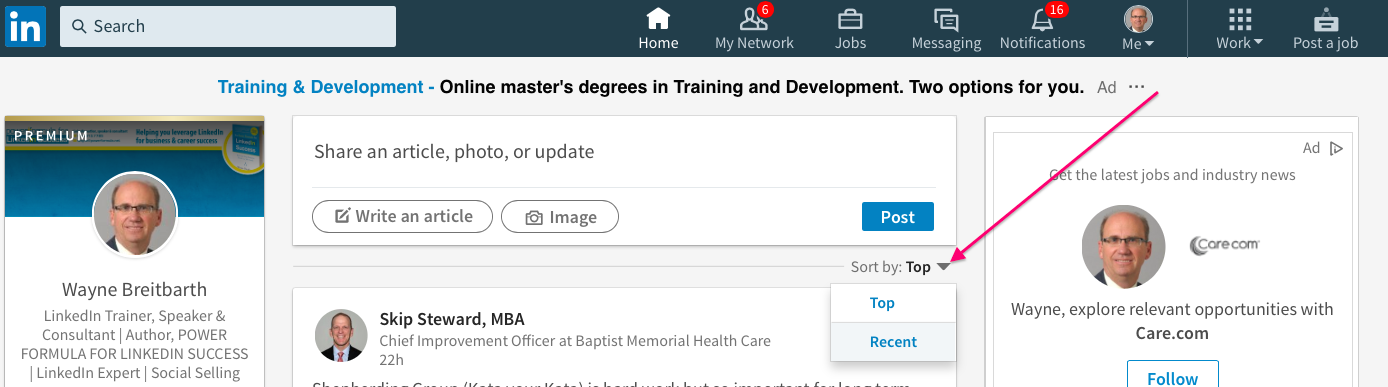
4.  Review your organic LinkedIn home page feed. You can review the status Screen Shot 2017-06-03 at 11.42.03 AMupdates from your network in the exact order they're shared rather than in the order the LinkedIn algorithm shows them if you simply change the Sort by option (top right of your home page feed) to Recent rather than Top. If you choose Recent, you'll receive all the updates of everyone in your network. If you choose Top, you'll only receive the updates LinkedIn chooses to show you.

5.  Find fellow alumni on your university's alumni page. On the top toolbar, put the name of your school in the search box, choose your school's company page entry from the drop-down list, and then click See Alumni. You'll then see a listing of all alumni who are LinkedIn members, and you can filter that list by city, keywords, years attended, and much more.

6.  Take control of the Skills section of your profile. Your Skills section and the endorsements you receive for those skills have increased importance now that LinkedIn features your top three skills. But you can now add, delete and rearrange your skills. Check out my article on the ins and outs of this feature here.

There you have it—six terrific LinkedIn features that should improve the results you're getting on LinkedIn. Good luck using them!

The post How Many of These LinkedIn Secrets Have You Discovered? appeared first on Wayne Breitbarth.

05 Jun 16:33

The founder of '22 Words' gave us 6 tips on how to turn your blog into a business

by Lindsay Dodgson

desks

Back in 2008, Abraham Piper set up the blog 22 Words to share pictures of his children, write about books, and try to be "convincingly contrary to anyone who would listen."

The idea was originally a gimmick, with every post being exactly 22 words long.

"In my defense, or perhaps to my shame, I hadn't heard of Twitter yet," Piper told Business Insider in an email. "This schtick obviously required concision — a constant value online no matter what year it is. So the content was always extremely easy to consume. If it was good, readers got what they wanted quick. And if it was bad, no harm done. I mean, how much time can be wasted by a sentence or two?"

Piper knew he was onto something when 22 Words started getting a million pageviews a month. Today, it has 4.8 million fans and a post reach of 500 million.

Piper gave Business Insider some tips for people who are working on their own blogs on how to turn them into profitable businesses. Here they are:

1. Don't be precious about your work.

Some people are lucky enough to build a business out of their work, with people being interested in their identity from the beginning. However, this isn't the case for everyone. Piper says this approach requires too much luck.

"You're a blogger, not Picasso," he said. "Most of us need to adapt, tweak, and even compromise how we create if we want to turn our efforts into money."

He says that at 22 Words they try things out and obey the results — even if that means using Comic Sans on the homepage.

2. Spend a ton of money on Facebook.

For a blog to go anywhere, it needs traffic. Sometimes blogs take off of their own accord, but that happens rarely. If a post does happen to go viral, you can't guarantee it will happen for all others. That's not a great way to start a business, so don't be precious about spending some money.

"Always strive for organic traffic, but to fill in the gaps, buy traffic," Piper said. "That sounds bad, though. That's why you'll usually hear it called 'marketing.'"

Most importantly, make sure you're spending less per click than you make from each person who visits your site.

3. Don't be an early adopter.

It might be thrilling to be the first to adopt a new trend, but that doesn't necessarily mean you'll get the credit for it. It can also be expensive to hop on new things before they are proven, which makes it a risky business move.

"Let other people adopt early; let other people test new, risky strategies; let the big players with all kinds of funding spend money hand over fist on R&D," Piper said. "Then do what they do."

It's almost as good to follow fast as it is to be the first on the bandwagon.

One example of this was Facebook Instant Articles. Competitors of 22 Words went all in with the idea, but Piper sat back and watched while they wasted money. Facebook Live on the other hand really took off, and Piper adopted the idea when he saw it working for others. 

4. Capitalize on your good fortune.

Piper says there's a lot of value in admitting you're lucky, because good fortune is part of every success story.

"You have to take luck when you can get it and wring success out of it for all you're worth," he said. "In my story, meeting my business partner Josh Sowin was good fortune; Stumbleupon 'discovering' 22 Words in 2010 was good fortune; Facebook deciding they were going to take over the world completely revolutionized 22 Words."

5. Remember you can't do this by yourself.

Finding a partner is important, especially if you know someone who can offset your weaknesses. If you have a blog, you are probably a creative type. This could mean you don't necessarily have the best business mind, so it's a good idea to find someone who does to help you out, Piper says.

"This will take a healthy dose of humility," he said. "And a mega-dose of trust, because business partnership is almost as risky as marriage."

6. Treat your site like it already is a business.

Don't treat something as your hobby if you want it to be more. Blogging may have started as something to fill your time, but if you're passionate about turning it into a money-maker then you should treat it as such.

Dedicate the same amount of time to it you would a job, and put the same effort in as if you were looking to be promoted. You only have yourself to answer to, so motivation is key.

"Hobbies can come and go, no harm done. If your blog is your hobby, there's no problem skipping a day or a week. But what happens if you treat your job like that? You get fired. And if you treat your business like that? You go under," Piper said. "So if you want your hobby blog to become your business blog, it's important to treat it like a business, not a hobby. It needs attention every day, just like any other career."

Join the conversation about this story »

NOW WATCH: Former Navy SEAL commanders explain why they still wake up at 4:30 a.m. — and why you should, too

05 Jun 16:33

Why we chose to partner with Membrain

by bob@inflexion-point.com (Bob Apollo)

Membrain_Logo_Centered Trimmed.pngInflexion-Point has just announced a partnership with Membrain to incorporate our Value Selling System® methodology into their groundbreaking sales effectiveness platform for complex B2B sales.

We’re delighted to build on what has been a long-standing relationship, and I thought it might be worth highlighting some of the key motivations behind this important initiative.

Any sales leader responsible for a team of B2B-focused sales people that are selling into a complex B2B buying environment is facing a set of challenges that simply don’t exist in more transactional sales situations. You may recognise some or all of the following issues...

  • The fact that your sales people often need to create, uncover or reframe the customer’s problem before they can start to think about proposing your solution
  • The ever-increasing number of stakeholders that have a significant role in the buying decision process (an average of just under 7, and still rising according to the CEB)
  • The growing percentage of apparently well-qualified opportunities that end with the prospect deciding to stick with the status quo and “do nothing” (over 50% according to SBI)
  • The large and growing performance gap between the handful of the best sales people who have mastered value selling and the rest (a nearly 3* gap according to the CEB)

THE PROBLEM WITH MOST CRM SYSTEMS

The problem with most CRM systems - and therefore with most CRM implementations - is that they simply weren’t designed to cope with these complexities. Here are a few simple examples that I hope will illustrate the point:

  • The absurd and illogical idea that the probability of any deal closing is the same fixed percentage that is applied to every opportunity that has reached the same stage. This may even itself out in high-volume, simple sales environments - but it’s a recipe for disastrously inaccurate revenue projections in complex sales environments where the outcome of a few critical deals can dramatically swing the overall revenue number
  • CRM implementations that expect sales people to capture a bunch of data points that no-body ever seems to subsequently review with them and which seem to them to be irrelevant at best (and a distraction at worst) to getting on with the task of selling
  • CRM implementations that do nothing to guide new sales people in (or remind long-established sales people of) the critical things that evidence has shown they need to know and do to give themselves the best possible chance of winning

You are probably familiar with a number of related issues. And whenever enlightened sales leaders have attempted to address the challenges in the past, it has typically involved a long and often eye-wateringly expensive customisation of their CRM platform. So even if they recognise the problem, many sales leaders don’t think that a practical and affordable solution is available.

THE MEMBRAIN ADVANTAGE

Membrain’s CRM has been designed from the ground up to address these issues as a central design objective, rather than as a bolted-on afterthought. The platform probably represents over-featured overkill to organisations with a B2C or a simple transactional B2B sales model - but those organisations are already well served by an ever-growing choice of conventional CRM platforms.

We see Membrain's approach as a perfect fit for the organisations that represent the vast majority of our client base: well-funded, fast-growing, B2B-focused, tech-based businesses with a disruptive value proposition that are selling into complex B2B buying environments and need to engage, influence and persuade a number of significant buyer stakeholders.

The Membrain approach is designed to facilitate widespread and rapid adoption across a sales organisation, and we’re aiming to accelerate that process further by embedding the well-proven principles of successful complex B2B sales into our Value Selling System® powered by Membrain.

Our clients now face an equally attractive and effective choice: if they have no current CRM system, or are so dissatisfied with their existing CRM that they are ready to start afresh with a much more effective platform, they can choose to deploy the Value Selling System version of Membrain CRM.

INTEGRATED DIRECTLY INTO SALESFORCE

Or - if like many of our clients - they are committed to using salesforce.com but want to do a much better job of opportunity management, they can implement the Value Selling System powered by Membrain directly into their existing salesforce.com implementation. Either way, they will get all the benefits of a modern guided sales process that their sales people will actually want to adopt.

The potential benefits - in terms of shorter sales cycles, higher win rates, larger average deal values and getting more sales people on or above quota - can be truly transformative.

Take a look at the 2-minute video below to preview this powerful combination in action. And if you like what you see, why not get in touch to find out how this new partnership between Inflexion-Point and Membrain could help to transform your sales effectiveness?


2:01


2:01


Wistia video thumbnail - Membrain Demo with Intro and Outro
 

Thanks for reporting a problem. We'll attach technical data about this session to help us figure out the issue. Which of these best describes the problem?

Choose one Video plays but frequently stutters Video has poor quality Video fails to play Other

Any other details or context?

 
CancelSend
message


⇨ Download our recently updated Introduction to the Value Selling System® ⇦

ABOUT THE AUTHOR

Apollo_3_white_background_250_square.jpgBob Apollo is a Fellow of the Association of Professional Sales and the Founder of UK-based Inflexion-Point Strategy Partners, home of the Value Selling System®. Following a successful career spanning start-ups, scale-ups and mature corporates, Bob now works with a growing client base of tech-based growth-phase businesses, equipping and enabling them to systematically create and capture mutually meaningful value in every customer interaction.

05 Jun 16:32

Why a $15 minimum wage is good for business

by Armine Yalnizian
“Now Hiring” sign in a store window

(Joe Raedle/Getty)

This week the Ontario government introduced plans for truly sweeping labour reforms. Perhaps none is more important—and controversial—than the proposal to raise the minimum wage to $15 an hour by Jan. 2, 2019.

There’s an argument to be made that going so far so fast could kill the goose that lays the golden egg, destroying jobs at a time when more are desperately needed, particularly for the young.  The counterargument is that this would add another gold-egg-laying goose to the mix, and spur the demand that creates jobs in the first place.

Unsqueeze the driver of growth

Domestic consumption drives the economy, in Canada and around the world.

Household purchases account for 57 per cent of Canadian GDP, a rising share of economic activity since the Great Recession of 2008 because business-to-business purchases, business investment and exports haven’t found their mojo since.

Housing costs have been rising in the biggest cities where most of the population lives. That is eating up even more disposable income, constraining how much of the monthly budget is left to make purchases from domestic and international producers.

When higher income households see wage gains, some of it goes to savings. Additional consumption also often flows to vacations and luxury goods, often imported. In other words a non-trivial part leaks out of the local economy.

When lower income households see a sustained rise in incomes, they spend virtually all of it. Most goes to food (more nutritious food or eating out), better health care and more education. Sometimes it also goes to rent (moving to a better neighbourhood). Almost all of this spending stays in the local economy.

So boost the minimum wage and you boost the economy from the bottom up.

Spur productivity

You may be surprised to learn nearly 30 percent of Ontario’s labour market earned less than $15 an hour in 2016. The nation’s biggest labour market has more people working at low wages than any other big economic engine of Canada (Quebec, B.C., Alberta)

minimum-wage-map-4

While some workers may lose their job after the minimum wage increase (more on that in a minute), a very large number of workers will see an important pay hike, and that will loop back into the economy. Increased consumer spending will grow the top line of businesses, and increase the need for more workers to meet the higher demand for goods and services…and earning better pay.

Rising costs will also raise productivity, something virtually every business and economist says we want and need.

That’s harder to do if you’re doing things the way you’ve always done them.

Canada has been running a low-wage economy for decades, relatively speaking, according to Statistics Canada.  In fact, at last count Canada outpaced the U.S. in the reliance on low-wage work. Within Canada, Ontario has the highest reliance on low-wage work.

Boosting wages may knock out some jobs and some marginal businesses. The remaining enterprises that rely on low-wage work will see improved productivity, less absenteeism and turnover, reducing recruitment and training costs.

We shouldn’t rue the loss of a few poorly paid jobs, particularly when rising minimum wages also help meet the twin challenges of the early 21st century: constrained revenue growth and higher service needs due to population aging.

We’ve got to spur change, and a substantially higher minimum wage will surely spur change.

Job loss and (teen) angst

Economic theory offers a perfectly reasonable assumption: a higher minimum wage leads to job loss. Theory has not been borne out by evidence, with one possible exception: teenagers.

Let’s take this in two steps: research on job loss, and teen troubles.

A 2016 study examining 78 years of federal minimum wage hikes in the U.S. (between 1938 and 2009) showed no correlation between those increases and job losses, even in sectors most affected by such policies.

Between 2013 and 2014, 13 states increased the minimum wage. The majority of these states saw above-average job growth.

A review of studies suggests even where the impact of minimum wage increases is not “benign,” job loss evidence has to be weighed against what happens to the purchasing power of the remaining workers.

The point is, even where there are job losses, other opportunities open up, and there is more purchasing power to spur demand.

Furthermore, higher minimum wages improve not just the top line, but the bottom line of business. Exhibit A: Walmart, which last summer reported higher than expected profits, partly due—according to the company—to paying its workers higher wages.

But what about the kids?  A paper written for the Ontario government in 2007, and widely cited of late, says a “10 per cent increase in the minimum wage is likely to reduce the employment of teens by three per cent to six percent.”

This is a serious issue. Though their unemployment rate has been very slowly falling, young Canadians (15 to 24) are the only demographic group who have seen their employment rate remain far below pre-crisis levels. This means there are more young people simply out of the labour force. A growing group of idle young men has never produced a happy turn of events.

But minimum wage policies are not the only worry young workers face. Their unemployment rates go up even when the inflation-adjusted value of minimum wage declines, because macroeconomics swamps all. Any reduction in demand will mean last hired is first fired. That means young people and newcomers always have higher unemployment rates, no matter the level of the minimum wage.

The new normal?

A more nagging problem is that “failure to launch” has led to more people in their prime earning years working minimum wage jobs.

In Canada, the proportion of people aged 20 to 24 working a minimum wage job doubled since pre-recession, as did the proportion of people aged 25 to 54. The proportion of older workers (55+) working minimum wage jobs grew much more slowly…but it’s the fastest growing age cohort of workers.

(Click charts to enlarge)

Armine chart 1

ArmineChart2

The fact is, a higher proportion of teenagers work at a minimum wage job in most provinces across Canada today than a decade ago (49 per cent across Canada, 70 per cent in Ontario in 2016), but a growing proportion of adults have been doing so as well.

(Click to enlarge)

ArmineTable1

In 2016, 64 per cent of minimum wage workers across Canada were not teenagers, up from 52 per cent in 2006. In Ontario, the proportion of minimum wage workers who are not teenagers has risen from 45 per cent to 61 per cent in a decade.

When do we start to be concerned about the macroeconomic effects of so many workers having to wait for a law to change before they get a pay hike? Have you ever tried to change a law?

In the 1950s and 1960s, the manufacturing sector provided a growing share of middle class job opportunities, thanks to strong unions. In the 1970s and 1980s, growth of the public sector (and its organization) accomplished the same.

It’s unclear where the next middle class will come from, but until we figure that out, it should be clear why people are raising the roof about raising the wage floor.  It may only be one tool to help low-wage earners—others include reforms introduced this week by the Province of Ontario, more affordable housing and  child care, and more ways to pursue collective action—but it’s a big one.

Why is $15 the magic number?

Most people agree that today’s $11.40 an hour minimum wage in Ontario is too low to make ends meet, unless you can depend on others’ incomes.

But why is $15 an hour the “right” amount for a minimum wage in Ontario?  Why not $30 or $100 an hour?

There is no articulated policy reason for the $15 minimum wage, but there could and should be.

Some say it should be enough to lift someone out of poverty if they work full time and full year. Historically, however, minimum wage wasn’t about poverty reduction. It was about acknowledging the inter-relationship of all work, and making sure no one got left too far behind as wages grew.

In many European countries public policy sets the minimum wage in relation to other workers’ wages, at between 50 per cent and 60 per cent of the average wage.

Today the average hourly wage in Ontario is $26.43.

Half of the average is $13.22; 60 per cent is $15.86

The government’s proposal to raise the minimum wage to $15 an hour by January 2019 will bring it to roughly 55 per cent of the average wage, if wage growth keep pace with inflation in the intervening period.

Once you have reached the target level, annual inflation adjustments should take care of increases; but the level should be reviewed every five years, in case things are getting out of whack.

This makes the process rooted in logic, and predictable, both of which rightfully improve business buy-in.

By the way, there is no legislated minimum wage in Sweden, Finland, Norway, Denmark, Switzerland, Iceland and Italy.

The reason? Collective bargaining covers all workers, and minimum pay in these agreements is most commonly between 60 and 70 per cent of average wage rates.

Still think $15 is too rich?  The negotiated minimum in Denmark is the equivalent of C$22.50. The legislated minimum in Australia is C$17.70.

Both countries pay their lowest-skilled workers much more than we do, but have unemployment rates similar to Ontario’s, around six per cent.

The elephant in the room: big business

Raising the minimum wage raises costs for business, there is no denying; and the affected businesses are not just small business.

Businesses large and small have been making the case that they can’t afford paying more for labour going back to when laws were first proposed to curb the use of seven year-olds in coal mines or put an end to 16-hour workdays.

Of course, there will be some job losses, and some smaller businesses that go under. There are always some marginal businesses for whom any higher cost—electricity or any other input, a legal dispute—will mean The End. That is genuinely heart-breaking for that business.

But small business isn’t the only beneficiary of minimum wage laws.

Low wages help maximize profits. Period.

Did you know at least half of all minimum wage workers in Ontario work for employers with over 500 employees?  That’s a growing trend. The same is true in most other provinces.

(Click to enlarge)

Arminetablet2

It’s unclear why governments need to protect corporations, but not the workers they hire.

And it’s also unclear why businesses (and many economists) bemoan the increase in minimum wage but are mum about ballooning compensation of employees at the top, from senior management to the CEO.  After all, these are also rising input costs. That should also trigger concerns about prices, employment levels and solvency, n’est-ce pas?

Businesses will understandably worry that uncertainty from south of the border may make all of this more challenging to implement. Let’s pause on the fact that Ontario’s economy is expected to enjoy the fastest growth in Canada in 2017.

But it’s true. The future is uncertain.

What’s not uncertain: the slow drip of unresponsive labour market regulations and mostly unenforced rules over the past quarter century has shifted bargaining power towards employers, against workers.

That was just challenged in Ontario.  And not a moment too soon.

Armine Yalnizyan is a Toronto-based economist and business commentator. You can follow her on Twitter @ArmineYalnizyan

The author wishes to thank the team at Statistics Canada for the timely production of these custom tabulations.  Statistics Canada is back! 


MORE ABOUT WAGES:

The post Why a $15 minimum wage is good for business appeared first on Canadian Business - Your Source For Business News.

05 Jun 16:29

Funnel Analysis: Finding and Fixing Conversion Problems with Google Analytics

by Edin Šabanović

The conversion funnel is the most important part of every e-Commerce website. It’s where the magic happens: visitors turn into customers, fulfilling the purpose of your website.

But sadly, as we know, not all visitors who put a product into their carts end up buying.

This is what’s known as a dropout or cart abandonment. The visitor initiates his journey through the conversion funnel, but he never completes it. Why?

Visitors do not complete their journey through the funnel for any number of reasons. Frequently, we have to guess at the reason for an abandoned cart.

But, using Google Analytics, we can locate where they quit.

While the existence of goals in Google Analytics (and other analytical tools out there) is common knowledge, many e-Commerce sites still struggle with getting the proper setup.

How to Spot Trouble Areas in Your Google Analytics Funnel

While the initial setup of your conversion funnel is undoubtedly important, we won’t go into technical details today (you can read more about designing your checkout flow here).

To start, you need to create goals in Google Analytics.

For a goal to be eligible for a funnel, it must be a “destination” goal — meaning that that you’ll set a specific web page as a goal, and the goal is achieved when the visitor loads the specified page.

In a typical e-Commerce environment, this is usually a page that marks the completion of a shopping process, such as a “Thank You” or “Transaction Confirmed” page.

Image Source

After you setup your destination goal, you’ll be rewarded with a Funnel Visualization report, a highly useful feature in Google Analytics.

Here’s a typical example of a Funnel Visualization report:

Before you can be confident in your Funnel Visualization reports, you must first identify the exact pages that serve as the starting or entry point of your funnel. For most e-Commerce sites, product pages will generate most of the entries into the funnel.

However, other entry points are possible, too — such as landing pages or personal pages on your website.

A typical checkout process could look like this:

  • Product page, landing page, or recommendation page
  • Cart page
  • Shipping and billing info
  • Confirmation screen
  • Thank you page

Regardless of how many funnel entry points there are, the rest of the journey through the funnel should be a single-line railroad. Ideally, customers should be able to initiate the journey through the funnel only when they add a product to the cart. Otherwise, your conversion ratios and Funnel Visualization data will make no sense.

So what can go wrong here? How can visitors end up on a page that should only be accessible as part of the checkout flow?

Three common goal-tracking issues

1. Technical Errors

The first thing that can go wrong is a technical error. Somewhere on your site, there’s an erroneous link to that final step in the funnel, and visitors are able to access it without initiating checkout.

If this is the case, you will start noticing a larger number of people in the bottom steps of the funnel than the total sum of dropouts and customers who proceeded to the next step. To solve this problem, identify and eliminate the “backdoor” entry and enable only legitimate customers to get to the goal page.

2. Omitted Page in the Funnel

Second, you may have omitted a page in the funnel and have a step unaccounted for. This omission should be very easy to spot. Contrary to the previous example, the sums will not add up, since you will have missed all the potential customers who dropped out on the omitted step.

This problem is also relatively easy to solve. Just go through the purchase process yourself and find out which step is missing from Google Analytics. Add it, and the data should miraculously appear.

3. Payment Gateways

One final possible error: You notice buyers drop out at the final step of the conversion funnel, but they return to the “Thank You” page in the same number.

This happens because the website uses a payment gateway (e.g. PayPal), so each time a customer goes to initiate payment, they effectively navigate away from your website to the third-party site. When they complete the payment, they are referred back to your website.

The result? A mess of the funnel data, and more generally of all your analytics data.

The solution to this issue is simple. In fact, there are two:

  • If you’re using a third-party payment system or gateway (such as PayPal and similar merchant processors that take customers off the site to initiate and complete payment), add the third-party URL to the referral exclusion list.
    • You can do this in Google Analytics. Go to the Admin tab and open Property Settings. There, open Tracking Info, and you’ll find the referral exclusion list. Fill in the field with the URL you need to exclude (for example, www.paypal.com).
  • Use a payment system that integrates into your cart. That way, you have everything on your own site, so your funnel is foolproof, but you also preserve the integrity of the data in Google Analytics. You still retain the main advantages of your third-party payment gateway (trust and credibility), while removing the need for your customer to go to some other website to complete the payment.

Before we go on to analyze the funnel, there is one additional checkpoint to cover. Google Analytics has a report called “Reverse Goal Path.” Once you define your conversion goal and wait a week or two, you can go there and check what pages people open prior to reaching the goal.

If your funnel is structured correctly, there should be no difference between this report and your goal funnel steps. Using this method, you can verify that your funnel includes the pages customers actually open to complete the goal.

How to Analyze Funnel Data

Once you set up your funnel, you will need to allow some time to pass before the data become available. It may take a week or two for high-traffic sites (or longer for lower-traffic ones) to get enough data to draw valid conclusions. Ideally, you’ll wait for a month to get at least one well-rounded sales cycle to use as a baseline.

To analyze your funnel, open the Funnel Visualization report in Google Analytics. There you should see something like this:

Funnel visualization report with the three major steps highlighted

Basically, the funnel represents the visitor’s path from adding the product to the cart and going through a checkout, to enabling your merchant provider to charge them for it and deliver it to their address.

That means your visitor needs to complete the following steps:

  • Add a product to the cart, select different options (color, size, etc.)
  • Provide their contact information, delivery address, and billing method
  • Validate that the order is correct and initiate payment

The reason to focus on those elements is that they represent the primary source of friction and funnel dropouts (in this specific case), so solving issues in these spots can net a substantial increase in number of conversions.

Below is the process I used in this specific case — but obviously your approach might differ based on the data you have.

Step 1: Address Dropout Rates from “Add to Cart” to Shipping and Billing Info

The first step of most e-Commerce checkout funnels starts with the cart. The visitor adds a product to the cart and then clicks “Proceed to checkout.”

This first step traditionally sees the largest dropout rate of all steps. According to a Baymard study, 69% of all online customers abandon the cart in their first step, just after adding the product.

When a prospect adds a product to the cart, but does not proceed further, it’s called cart abandonment — and it represents a large issue for e-Commerce retailers. The Baymard study also gives the average rate of shopping cart abandonment in e-Commerce stores as 75%.

And according to a Business Insider study, shopping cart abandonment for online merchants amounted to over $4.6 trillion worth of goods, of which approximately 60% was recoverable.

Cart abandonment represents a huge opportunity for ecommerce sites.

Given these data, it’s well worth your while to use every tool you can to address cart abandonment.

The problem with this step in the funnel is that you may not know why the customer added the product to the cart. They might be testing the water, checking the shipping price, or may even have added it by mistake. Without knowing why your prospect did not proceed with checkout, it is hard to improve the entry point.

The first step in the funnel.

As we can see, 1,287 prospects directly exited the funnel. We can only guess at their reasons.

However, 871 prospects exited the funnel to sign in, and this indicates a possible problem that can be solved to reduce dropout rates. By making it unnecessary to leave the funnel to sign in, those 871 prospects would likely join the 3,200 others who moved on, increasing likelihood that a number of them would complete the purchase.

Those 871 prospects represent a quarter of the total number that went on further. Of all the prospects that reached the step 2 of the funnel, 38% of completed the entire process. If we take that we can make 871 people reach it, then 330 prospects will be actually complete the entire checkout. With an average order value per customer of $224 USD, this could increase revenue by $74,000 a month.

Three Tips for Removing Dropout Rates on Step 1

There are a few general principles that can help you lower your dropout rate:

  1. Provide all relevant and pertinent information about price, shipping, and other important factors on the product page. The potential customer should not face unpleasant surprises later on.
  2. When a new visitor adds a product to the cart, consider offering a discount or benefit to strengthen their interest.
  3. Offer discount codes or some other benefits in exchange for a visitor’s email address. This way, you can contact customers who abandoned the cart and re-engage them through your remarketing efforts.

As Tommy Walker put it in a previous CXL blog post:

Tommy Walker

““Free Shipping,” “Live Support,” or “Free Return Shipping” are all huge selling points, and could become the deciding factor for lower-cost cart abandoners. Harris Interactive has found that 56% of customers would be willing to switch brands based on better customer service options.

Using a service like Retargeter, you could run a campaign that leverages banner ads, video, and sidebar advertising, that highlights your customer satisfaction policies.

So if a cart abandoner leaves your site to watch a product video on YouTube, or searches a product review on a different blog, you’d be right there clearly demonstrating why your site is the best choice.”

Step 2. Address dropout rates from shipping and billing to confirming transaction

Shipping and billing information represent the first big test of your website’s credibility and trust. Before you can deliver your product to your customer, they need to tell you where to deliver the goods and how they are going to pay.

Generally, that requires giving away sensitive private information, such as home address, phone number, and credit card information.

The second step of the funnel

This step has a remarkably low dropout rate in our example. Of all the prospects, only 706 left the checkout process, and 343 left the site entirely. This is a good result, and indicates this store has few issues with trust, credibility, or friction at this step.

Aside from privacy and trust issues, you face several other potential hurdles, including shipping cost, payment options, and shipping options.

The issue of trust can be resolved in several ways, such as placing reliable trust indicators and seals at appropriate steps of the funnel to foster the prospect’s trust. For example, you might include the Symantec Safe Site seal to show customers that your site is secure from hackers.

The answer to this dilemma, as with everything else in optimization, is to test what works for you.

The issue of shipping cost is hard to overcome, as you may have little flexibility in changing what your shipping providers charge. Dealing with this will be part of your business decision-making, and depends on how much benefit you can provide to prospects without harming your bottom line.

Payment options (or rather, a lack thereof) are also a frequent cause of friction and cart abandonment. If your only payment option is charging a customer’s credit card directly and you require them to provide all the necessary data, don’t be overly surprised if fewer customers are willing to share this information.

Finally, shipping options can be a very large point of friction, as sometimes potential customers will add a product to the cart only to realize that it cannot be delivered to their location in reasonable time or at all.

Studies, such as this one on Practical ECommerce or this one on CXL, have shown that promising short delivery times, same-day shipping, or overnight delivery will increase conversions. Leverage this to your advantage, experiment with the copy used to describe shipping options, and reduce this obstacle.

Discovering the precise issue at Step 2 is not easy, but something that can help is triggering an exit-intent survey to get some qualitative feedback.

The best way to try to get customers who abandon their carts at this step to look back at your offer and eventually complete the purchase is to use remarketing to offer them additional benefits. Offering things like free shipping, additional items that complement the one the prospect was interested in, and discounts can all help change a prospect’s mind.

Step 3: Address Dropout Rate at the Payment Confirmation Step

While this step is usually viewed as a mere formality, this is only true if you’ve communicated all the information about the costs, shipping, and other store policies up front.

In this scenario, the customer already knows the final price tag, delivery time, and other potential qualifiers. If the final price tag contains surprising elements that raise the price or qualify the purchase — such as requiring purchase of some other product to use it or get it delivered — you will lose the customer at this final step.

The details of the final step in the funnel

We can see that 196 prospects left the checkout here. Although this is an insignificant number, those are still people who were willing to fill out the shipping and billing form, and then quit at the point of payment.

It means they were relatively highly motivated, and seeing them leave at this point is disappointing.

Prevent this by providing all pertinent information up front. If the particular product requires your customer to make other purchases, clearly state so on the product page itself. Never leave this sort of information to be the last thing your customer discovers just as he is about to click the “Complete Purchase” button.

Here is a breakdown of the most frequent reasons for cart abandonment, as identified by the aforementioned study conducted by Business Insider:

Image Source

A full 58% responded that they did not complete the purchase because the shipping cost made it cost more than they expected, while 50% quit because they did not qualify for free shipping.

Additionally, 37% quit because the shipping and handling costs were listed too late in the process. All the aforementioned issues can likely be avoided by providing all this information at the start of the checkout process, or even before.

This is why you must carefully think through your checkout process and identify areas that can reduce friction. Avinash Kaushik, Google Analytics guru and analytics advocate, suggests putting yourself in your customer’s shoes:

Avinash Kaushik:

“Investigate if there are simple things people are looking for — information that is only in the cart or checkout process that could “falsely” get people into that process. Two examples:

  • Shipping Costs: If people just want to know the shipping cost, make it easier for people to find shipping than by having to go to checkout or add to cart. Not only will this reduce abandonment, and give you your real abandonment rate, but it also sucks for your customers that you make this painful.
  • Delivery Schedule: How long will it take me to get the product? Do you have it in stock? Let’s not wait until the end to share this nice information.

Check that your website is carrying out promotions correctly and reiterates in the cart and checkout process (in bold, gigantic letters) the discounts that your customer was promised in the offer, or on your affiliate site, or your product pages or in your campaigns. It is amazing how many websites don’t do this simple thing well.”

How to Segment your Funnel Data Despite Analytics’ Handicap

Now it’s time for some bad news — but don’t worry, it’s not that bad, just a bit inconvenient.

Unfortunately, unlike most other reports in Google Analytics, standard goal Funnel Visualization cannot be segmented (though you can overcome this with enhanced ecommerce funnel visualization). This can handicap your research, since you will not be able to see how different groups of your customers behave in the funnel and compare the patterns.

This sort of information can be very helpful for personalization or identifying whether your target audience converts better, as well as showing you how well the acquisition channel(s) convert, and if your marketing message is aligned with the offer.

Fortunately, there is a roundabout way to segment funnel data. It may take a bit more time to analyze and derive information, but it is worth it.

Introducing the Goal Flow report:

The Goal Flow report contains much the same information as the Funnel Visualization

This report can be segmented using the Advanced Segments feature, and that way, you can derive useful information that would otherwise be missing.

For example, you can check how mobile traffic converts, and what represents the great issue for that segment:

Mobile traffic Goal Flow

By examining the behavior of individual visitor segments in the funnel, we can uncover what can be improved to help them convert better.

Here, it looks like the mobile traffic has trouble going through to the billing and shipping step. This may also mean that mobile visitors add goods to the cart using mobile, but complete their purchases using their desktop computers.

If the former is the case, then you need to improve the design of the shopping process so that it enables mobile users to complete their purchases. By making your website more responsive to mobile users in general, you can solve this problem and capture an important audience segment.

As I mentioned above, Enhanced Ecommerce also gives you the ability to customize your funnel visualizations with more flexibility.

Image Source

Conclusion

If your checkout process isn’t virtually flawless, keep working.

The checkout process is the most important part of an e-Commerce website, and it ought to function flawlessly to enable you to sell your products and generate revenue from your site.

For most sites, Google Analytics enables you to structure your funnel by the goals and steps a customer must take to complete the purchase process (single page applications are a trickier situation, but that’s for another article).

While Analytics can’t tell you exactly why a user quits, the position of the step in the funnel enables you to make an educated guess. And by analyzing where visitors go after they quit, you’ll get further insight into what may have gone wrong.

05 Jun 16:29

Cobalt Surges 150% As Tesla And Tech Giants Fight For supply

by brian wang

This super-metal is the hottest commodity on the market right now—and it’s NOT lithium.

Instead…

It’s a metal that early investors are eyeing as a massive opportunity.

This is a sponsored post

Supply is already in deficit – and that’s before the anticipated 500 percent increase in demand.

It’s a metal that is critical to the future stock price of everything from Google, Apple, Tesla,

Amazon, UPS and many more.

Welcome to the supply crisis that is all about Cobalt

Cobalt is a metal that few investors know much about – it is critical to the electric vehicle (EV) revolution because it makes up some 35% of the lithium-ion battery mix.

That’s 30% of batteries that are the backbone of EVs, EVs that are now mainstream. To meet demand for EVs, billion-dollar battery gigafactories have been built and continue to be built.

Consumer electronics are contributing to the demand and resulting shortage of supply.

And, unlike lithium, which is a fairly common commodity… we can’t source enough of cobalt as things stand today – and demand is increasing quickly.

Soon this story will get out.

Analysts at Macquarie Research project deficits of 885 tons of this resource next year, 3,205 in 2019 and 5,340 in 2020. That’s a deficit increase of 503 percent.

As a first principle of investing, where there is a supply problem, there is a massive opportunity for early investors.

In the perfect storm that is the cobalt market, there are additional challenges. Currently, more than half of the world’s supply of cobalt comes from the Democratic Republic of Congo (DRC).

Use of child workers in appalling conditions in the DRC means that difficult supply chain questions are starting to be asked. Apple and Tesla will not be able to ignore the awkward questions they are being asked about their supply chains. Is their cobalt ethically sourced?

Generally speaking, no. This is a huge and growing problem.

What’s the answer? Where possible, cobalt sourced from America. For early investors, now is the time to act.

This is where US Cobalt (previously Scientific Metals) (TSX:USCO.V; OTC:SCTFF) enters the picture with a pure play cobalt project that could put the U.S. on the cobalt map in a meaningful way, for the first time in history.

As the cobalt supply problem grows, and EV giants and gigafactories continue to increase demand, a home-grown solution is at hand.

US Cobalt is in an ideal position to answer the call and create shareholder value.

Here are 5 reasons to keep a close eye on US Cobalt (TSX:USCO.V; OTC:SCTFF):

#1 In the Cobalt Surge, All-American Supply is Key

The math on this one is simple: We don’t have enough cobalt. We will have run out by the end of this year, according to Macquarie Research analysts. Beyond that, we’re looking at 500-percent demand growth between now and 2020.

The battery industry already uses 42 percent of global cobalt production, while the rest is used in industrial and military applications—all competing for supply.

Tesla—now with a $50-billion market cap—launched a $5-billion battery gigafactory in Nevada in January. By the end of 2017, it will have doubled the entire global battery production capacity. By next year, it will be producing more batteries than the rest of the world combined. Tesla’s run on cobalt alone will be phenomenal, and that ignores all those competing for the super metal.

Small-cap explorers like US Cobalt (TSX:USCO.V; OTC:SCTFF), which offers up new North American supply could be among the biggest winners.

But it’s much bigger than Tesla. The EV market has grown over 15 times, with an amazing compound annual growth rate of over 72 percent from 2011-2016. This year, analysts expect it to gain another 25-26 percent.

Last year, global EV production grew 41 percent, and sales are up more than 60 percent year on year.

In the midst of all this EV growth alone, there is a “complete vacuum” in cobalt supply, according to traders interviewed by the Financial Times as early as 23 February.

Because so much of it comes from the DRC, and because Western buyers are under pressure to find more ethical sources, new sources must be found—with America being the most appealing—especially since it’s in Tesla’s back yard.

#2 Watch What Hedge Funds are Doing with Cobalt

The run on physical cobalt started in February in the least expected corner: Major hedge funds started buying up physical cobalt and hoarding it in order to gain exposure to the major supply shortage.

Swiss-based Pala Investments and China’s Shanghai Chaos have already hoarded 17 percent of last year’s global production. At today’s prices that’s worth around $280 million. At tomorrow’s prices, it will be worth a lot more.

When hedge funds start stockpiling physical cobalt, it sends its traditional buyers into a panic to secure new shipments.

Since November, cobalt prices have rallied more than 50 percent, and this is only the beginning.

#3 In the Heart of the #1 Cobalt Trend in America

In September, US Cobalt (TSX:USCO.V; OTC:SCTFF) entered into an agreement to acquire an amazing cobalt property, Iron Creek, right in the heart of the Idaho Cobalt Belt, one of the most prolific cobalt mineralization trends in the U.S.

This isn’t new exploration: this is property that’s already seen major historic exploratory work, including 30,000 feet of diamond drilling. And when it comes to cobalt, Iron Creek has historic (non 43-101 compliant) indications of 1.3 million tons grading 0.59 percent of cobalt with encouraging indications of up to 10 million tons.

The ‘closeology’ is also brilliant. US Cobalt’s project is right next door to the ONLY advanced cobalt project in the U.S. with an estimated 3 million-plus tons of cobalt.

Right now, the most important thing on the cobalt scene is homegrown exploration, and US Cobalt is a first-mover on this.

As one of only two pure play cobalt companies in the U.S., US Cobalt could be among the first to put America definitively on the cobalt production map just as EVs and batteries hit feverish demand.

The clients will be lining up to get at homegrown cobalt because major buyers like Samsung are all under pressure over unethical cobalt sourced from the DRC.

The bottom line: The EV revolution is already in full force. And it needs cobalt it doesn’t have.

#4 The Dream Team Behind the Bet on Cobalt

The CEO of US Cobalt, Wayne Tisdale, is a legend in spotting emerging trends with impeccable timing and creating outstanding shareholder value.

He’s already done it with uranium, gold and oil and gas, and his most recent homerun was in lithium, with Pure Energy. When it launched in 2012, lithium was selling for about $5,000 per tonne. Just a short time later, it had increased 450 percent.

His next bet is on cobalt.

Tisdale and his team at Intrepid Financial have in recent years created $2.7 billion in value by building and financing 5 companies in completely different industries:

• Rainy River (gold) was worth $1.2 billion at its peak

• Xemplar (uranium) hit $1 billion at its peak

• Ryland Oil (oil and gas) sold for $114 million

• Webtech Wireless (tech) was worth $300 million at peak

• Pure Energy (lithium) is worth $65 million (and counting)

#5 Proving Up 10 Million Tons of Cobalt

Not only is US Cobalt (TSX:USCO.V; OTC:SCTFF) fully financed to develop its Idaho Cobalt Belt project, but it hopes to prove up 10 million tonnes of cobalt resource.

That’s worth a potential $1 billion at today’s prices with a grading of 0.59 percent.

And as Tisdale and the team set out to become the largest pure play cobalt company, advance projects towards production and sell to a major, they have shareholder value in mind. After all, the team are major stakeholders in US Cobalt, with 35 percent ownership.

As global consumption for refined cobalt is set to reach 100,000 tonnes in 2017, US Cobalt is forging an Idaho future that will truly make America great again.

By. James Burgess

Legal Disclaimer/Disclosure: This piece is an advertorial and has been paid for. This document is not and should not be construed as an offer to sell or the solicitation of an offer to purchase or subscribe for any investment. No information in this Report should be construed as individualized investment advice. A licensed financial advisor should be consulted prior to making any investment decision. We make no guarantee, representation or warranty and accept no responsibility or liability as to its accuracy or completeness. Expressions of opinion are those of Oilprice.com only and are subject to change without notice. Oilprice.com assumes no warranty, liability or guarantee for the current relevance, correctness or completeness of any information provided within this Report and will not be held liable for the consequence of reliance upon any opinion or statement contained herein or any omission. Furthermore, we assume no liability for any direct or indirect loss or damage or, in particular, for lost profit, which you may incur as a result of the use and existence of the information, provided within this Report. All content contained herein is subject to the terms and conditions set forth in the original article posted on Oilprice.com and subject to the terms and conditions therein.

05 Jun 16:29

This Mary Meeker chart illustrates Apple's '$1,000 iPhone' problem perfectly (AAPL)

by Jim Edwards
  • Mary Meeker has a chart that depicts the main problem Apple will have trying to sell iPhone 8 for $1,000.
  • iPhone sales have declined in four of the last five quarters, so the price tag on iPhone 8 is a huge decision for Apple.
  • Apple is trying to take market share from Android, with a new ad campaign and discount iPhone offerings like the iPhone SE.
  • Apple's revenues, profits, EPS and the price of AAPL stock all depend on Apple setting the price of iPhone 8 right.

Kleiner Perkins Caufield & Byers analyst Mary Meeker delivered her legendary annual "state of the internet" report last week, and this chart within it describes Apple's "$1,000 iPhone" problem perfectly.

The global market for smartphones has topped out. Sales growth is in decline:

iphone Kleiner Perkins Caufield & Byers

Apple has always taken a roughly 15% share of this market (the orange iOS columns), creaming off the customers who are willing to pay the highest prices for a phone. Google's Android system takes the other 85%.

But now the entire market has stopped growing. So Apple must either take a greater share of the market — which it has never done before — or expand the market as a whole.

Apple's problem is that it needs iPhone prices to be high. To maintain its profits, revenues, EPS, and the valuation of AAPL stock, iPhone 8 — expected in September — will likely be priced starting at about $1,000 (£775), according to Goldman Sachs.

Can Apple take a greater share of the market when it wants $1,000 for a phone?

One thousand dollars is nearly $200 more than the current average price of an iPhone ($815 in the US or £696 in the UK, according to Deutsche Bank's ranking of iPhone global prices). But it is a psychologically testing barrier for most consumers. Most phones do 90% of the things an iPhone can do. Do you really need to spend the equivalent of half a month's average income on a slightly better phone?

The problem is material to Apple's financial results. 

Tim CookIn four out of the last five quarters, iPhone sales declined. CEO Tim Cook believes buyers put their purchases on "pause" when they know a new iPhone is coming. The problem with iPhone 6s and iPhone 7 is that neither model was sufficiently different from iPhone 6, and many consumers held on to their old phones waiting for the next model. This is Apple's other high-class revenue problem: Its phones are now so good you don't have to buy a new one very often.

There are signs that Apple is working on this. Three years ago, I suggested before the launch of iPhone 6 that the new phone had better be "amazing and cheap" in order to fend off precisely the kind of sales declines that Apple saw in the iPhone 6s/iPhone 7 era. Apple did, in fact, do that — but not quite the way I predicted: iPhone 6 was amazing — it set sales records and a lot of consumers held onto it because it was so good. Apple also launched a cheap iPhone, the iPhone SE, which is currently priced at about half what iPhone 7 costs.

More recently, Apple has become more aggressive in its war against Android. As my colleague Rob Price reported, Apple has launched an ad campaign to persuade Android users to drop the world's favourite operating system. It has a new website dedicated to helping Android users port their stuff over to iPhone as seamlessly as possible. And, as we know, Tim Cook has for years watched the rate of "Android switchers" coming to iPhone very closely. It is one of the key benchmarks he has touted to investors. 

iphoneSo the next few years will be very interesting: Can Apple take market share with an incredibly expensive phone? Can it take more share with the cheap iPhone SE (or whatever lower price iPhone succeeds it)?

Or is Apple doomed to find itself managing 15% of a category that is mature, stable, and — from a sales point of view — stagnant?

Join the conversation about this story »

NOW WATCH: How to answer Elon Musk's favorite job interview question

05 Jun 16:27

How to Become a Top Salesperson

“HOW DO I BECOME A TOP SALESPERSON? I WANT TO BE BETTER BUT I’M STRUGGLING!”

Here’s what I’ve found that worked for me…

What Works – The Skinny Details

Reading Sales / Business / Self-Help Books
It doesn’t matter which books. There are plenty of great choices. Just pick one and go with it. Try reading at least one per quarter and watch your sales numbers go up. Also, don’t feel that you have to implement “everything” you read into action… many a times its just one or two nuggets that you can take away that will have a huge impact for you long term.

Here are my favorites:

  • Stephen Covey – 7 habits of highly effective people
  • Dale Carnegie – How to win friends and influence people
  • Spencer Johnson – Who Moved My Cheese?

Listening to Audio Tapes
Try listening to a business (sales / self-help etc) book on tape for at least 5-minutes everyday on the way to work for 20 business days in a row and watch how much of an impact that will have on your attitude.

Here are the ones I’m listening (and some, re-listening to) the past two weeks:

  • Donald Trump – Art of the Deal
  • Chris Voss – Never Split the Difference
  • Mark Roberge – The Sales Acceleration Formula

Role-Playing
Role-playing was one of the single biggest contributors to my success and I’ve seen it save many a salespersons job. Of course you need to make sure you are role-playing the proper sales techniques. Otherwise you reinforce what isn’t working!

Tip: Set up a sales role-playing schedule. Options could be:

  • Monday through Friday;
  • Monday / Wednesday / Friday or…
  • Tuesday and Thursday.

Whichever schedule you decide on make role-playing “mandatory”. Also, role-playing sessions should be anywhere from 5-minutes to 20-minutes max and they can be a great replacement for morning sales meetings. (It can also give your sales manager a break as well… It’s not easy coming up with a new way to say the same thing all the time)

Recording Your Sales Calls
Fastest way I know to correct phone sales mistakes is to record your calls and then have them critiqued. Have your calls analyzed in front of your peers as well. It magically speeds up the learning curve.

Learning from those who have already achieved what it is that you are after
Someone else has already conquered the roadblocks to your success. Learn from them and you will leapfrog to that next level.

PS… In case you’re wondering…

Here’s What Doesn’t Work

  1. Doing nothing / Waiting for things to get better on their own
  2. Blaming the leads, management, marketing department etc
  3. Not trying anything new
  4. Believing it’s not “you” it’s “them”
  5. Not believing in yourself (or your sales team)
  6. Learning from has-beens, no it all’s and Naysayers who’ve never really reached or sustained the level of what you are after.

– Michael Pedone

05 Jun 16:27

How to Prevent Your Content From Bleeding Sales Leads

by Mitt Ray

How to Prevent Your Content From Bleeding Sales Leads

Are you unsure if your content is converting? Would you like to learn how to prevent your content from bleeding sales leads?

On average, most sites will convert traffic at a rate of 1.95%. This means that for every 100 visits you will just get around 2 leads. This might seem like an astonishingly low figure, but it is the truth. And the number of sales you convert from these will be far fewer.

Therefore, if you want to convert more traffic to sales leads than the average 1.95%, you need a better content marketing and conversion rate optimization strategy. You also need to work on creating a stellar funnel that will convert more leads to sales to get maximum ROI from the leads.

Hence, today I am going to show you how to prevent your content from bleeding sales leads so that you can maximise ROI…

Start by measuring the conversion rate of your content

The first thing we need to do is determine if the conversion rate is above or below average.

This can be easily achieved by using a free tool, Google Analytics. Google Analytics has a feature called ‘Goals’ that lets you measure the conversion rate of your content.

To set up a goal visit the ‘Admin’ section of your Google Analytics. Then click on ‘Goals’ under the site you want to create the goal for.

After that click on the red ‘New Goal’ button on the page you are redirected to.

Now begin setting up your goals by choosing a template or creating custom one. I am going to choose the ‘Create an account’ template under ‘Acquisition’. This is the best option for tracking a visitor who converted into a subscriber.

After that click on the blue ‘Continue’ button.

Then give your goal a name, a goal ID and a type.

For type you have a choice between destination, duration, pages/screens per session and event.

For tracking conversions, destination and event are the best options. A destination goal is achieved when someone lands on a page. This could be something like the thank you page a visitor is redirected to after signing up. Every time a visitor lands on this page they are counted as a conversion.

Events happen when someone plays a video or downloads a document.

I am going to show you how to track conversions using the destination option. They are very easy to set up. So choose it and click on ‘Continue’.

Now add your goal details. In the ‘Equals to’ field, add the URL people will be redirected to after they sign up. You can use something like the text in below screenshot.

It should only take a few minutes to create. I just thank people for signing up and let them know what to expect.

If you know how much each lead is worth, you can turn on ‘Value’ and add a number. This will make it easy for you to measure how much potential revenue your content is providing. You can also specify a path.

You can verify the goal to see how well it has been performing if you have been using the thank you page for a while. If you haven’t done that before, just click on ‘Save’ and your goal will be set up.

Now you can view your conversion rate in your Google Analytics dashboard. One place you can see this is in ‘Overview’ under ‘Goals’ in ‘Conversions’.

If you want to get a more specific picture, you should visit the landing page section which can be found under ‘Landing pages’ under ‘Site content’ in ‘Behaviour’.

Here you can choose to see the content conversion rate for all goals together or just a goal of your choosing. You can also see the conversion rate of each and every page (blog post, landing pages, etc.) on your website.

As you can see above the overall conversion rate of this site is 3.35%. Below that the conversion rate for the individual pages on the website are shown.

Now you too will know the overall conversion rate of your site and the conversion rates of the different pages. Use this data to set more specific and realistic goals to increase your content conversion rate.

Choose a percentage you would like to aim for and plan your conversion rate optimization strategy accordingly.

Improve the conversion rate of the low converting pages

After you perform the above step a lot of you will find that only some of the pages on your website are able to capture leads higher than the average 2%. The majority will convert less than this average, some will even be converting at 0%.

If some of these low converting pages are getting a high amount of traffic, you need to figure out a way to increase their conversion rates too. Here’s how you can go about it…

Study the pages that are already converting well:

If some pages are converting higher than the average conversion rate of your website, you need to study them carefully and make a note of everything that is right and wrong with them. You can correct the wrongs to see if this will further improve your conversion rate. You can implement the ‘rights’ on the low converting pages.

Analyse the high trafficked pages that are converting low:

Now study the pages that are converting low to see what is causing them to lag behind. You will be able to spot some of the culprits effecting this just by looking at the pages. While those like testing the loading time, require extra steps. So take plenty of time to analyse this and compare your well converting pages against these low converting ones.

If you spot something that is effecting your conversions, rectify it. After that you can wait for a week and check your Google Analytics to see if the conversion rate of the page improves.

Create more specific lead magnets:

Sometimes some pages convert better than the rest on your website because the lead magnets that you are using on your site are relevant to the topic on these pages only. Visitors will be more likely to sign up for a lead magnet if they find it relevant to the topic they are reading because they are looking for as many solutions as they can get on that topic.

Therefore, a page on your website could be converting low because the popups, side bar option forms and other optin forms are displaying an irrelevant lead magnet. To increase conversions, you should remove these and replace them with optin forms that promote very relevant lead magnets. Most lead generation WordPress plugins and tools can help you display different forms for different pages on your website.

You can also try using content upgrades. Content upgrades are lead magnets that are very relevant to the blog post they are reading. For example, Brian Dean created and offered a checklist on the 10 most important Google ranking factors on a post on a similar topic. This increased the conversion rate of the post by 785.01%.

Like Brian, you too can create a highly relevant checklist and embed an optin form in the post itself to see if your conversion rate improves. You can try this method with various types of lead magnets to see which one converts better.

Create a proper funnel

It is not just enough, if you work on getting several leads. The amount of sales you get from this is important too. Hence, it is necessary for you to set up a strategic inbound marketing funnel that nurtures leads and further qualifies them.

Most businesses have an incomplete inbound marketing funnel. They create blog posts and capture leads with a lead magnet and then send an email containing the lead magnet. After that all they do is send emails on their latest blog posts, products and offers. But there is a lot they need to do in-between that can help them convert better. This is called nurturing.

Absence of this nurturing process causes a low conversion rate. Ask yourself the question? Would you prefer having a list of 1,000 subscribers who convert at 10% or a list of 5,000 subscribers who convert at 2%?

If you want the higher conversion rate, you need a strategically planned nurturing process. The simplest way to do this is by sending a sequence of autoresponder emails that educate your lead with more quality content. For the first 5 days after they sign up you can send an email a day and then send one every week. This will help you build a trustworthy relationship with your readers. They will be more likely to buy from you once they trust you.

If you want to make this nurturing process even more effective, you can use other forms of content like webinars and case studies.

A good email marketing provider will let you tag leads based on behaviour like opens, clicks and purchases as they move through the funnel. This will help you send the most relevant content to your subscribers. It can increase conversion rates and reduce unsubscription rates. Therefore, invest in an advanced tool. This process can be automated, so it shouldn’t take up too much of your time.

For a good guide on nurturing leads, check out the sliced bread methodology in the below video.

Leadpages use it to nurture their leads for months as they found that 50% of people convert to customers in the first 4 weeks while 75% come three months out. This shows the importance of nurturing.

To sum up, if you want to prevent your content from bleeding sales leads you need to follow a strategically planned process. It should start with analysing your content to measure the overall conversion rate of the website and the individual posts. After that you should take steps to optimize this content to generate more leads. Also make sure you build a funnel that converts more leads to buyers.

How do you prevent your content from bleeding sales leads? Would like to share some additional tips with us? Please leave your comments below.

Is Your Content Bleeding Sales Leads? Heres how to stop it

If you found the above post on increasing the sales lead conversion rate of your content helpful and feel your followers will too, please share it with them by using the share buttons below.

05 Jun 16:27

5 B2B email templates & formulas that win business in 2017

by ramin@close.io (Ramin Assemi)
cold-email-templates-for-business.jpg

I hate to be the bearer of bad news, but if you’re in B2B sales, the world is against you.

OK, maybe not the entire world.

But when you’re a B2B sales professional, then your leads, prospects, email service, the government, industry executives and sometimes even the people on your team—they’re all against you.

Don’t take it personally—they’re not against you as an individual. It’s more that they’re against many of the practices and behaviors that have given sales professionals a bad rep.

Poor sales practices in the past have resulted in an industry where tracking down a single email address can become a two-week process, and where governments have even banned cold emails unless specific requirements are met.

So though it might seem like the world is against you, we’ve got your back here at Close.io. We’ve sent literally thousands of cold emails over the years and have learned quite a bit about which techniques lead to a conversion and which don’t. In this post, I’ll share with you five cold email approaches, along with templates for each, that you can use to increase your chances of success.

Want more proven email templates? Download them here!

The “right contact” approach

One of the most popular cold email strategies is asking the recipient if they’re the right point of contact. This approach has been leveraged for many years by sales professionals because it’s been proven to work.

The “right contact” approach is a great strategy especially when reaching out to senior executives at a company. (Steli Efti recently talked about this in a piece about enterprise sales pitfalls and the role that CEOs play in the sales cycle.) When taking this approach, you can establish buy-in or at least intrigue from a CEO, and then your request will be delegated down the organization to a more appropriate contact. The advantage is that when you engage a senior team member, they become connected to the outcome and can help you move the deal forward.

Here’s a sample email using this approach:

Subject: Are you the right person?

Hey [First Name] – I’m writing in hopes of finding the person at [Their Company] who handles [specific area of focus].

I also reached out to [Colleague 1] and [Colleague 2] to try and lock down someone at your company in this space. If you’re the appropriate person to chat with, let me know and I’d love to schedule some time to talk about [Your Company].

We help organizations like [their company] [problem you solve]. We’ve worked with others in your industry like [Company 1] and [Company 2] .

If you’re not the appropriate person to chat with, please let me know whom I should connect with.

The problem-focused approach

If you’re selling something, you’re obviously trying to solve a problem. The problem-focused approach to cold email strives to catch a recipient’s attention by revealing their problem and then asserting that you can solve it. Like so:

Subject: Managing payroll is rough. Let us help.

Hey [First Name] – As an entrepreneur, managing payroll is probably at the bottom of your list of things you want to be spending your time on, especially when your company is growing as much as I read in [article/software/etc].

You should be spending more time on [priority task] and less time dealing with 401ks, benefits and payroll management.

[Your Company] helps organizations like yours focus on what you do best while we manage the payroll. We’ve helped companies save money on accounting fees, free up time and find budget inefficiencies that were being overlooked.

If you’re tired of handling payroll and need some help, let’s schedule a time to chat. What’s your calendar like next week?

The email template above focuses heavily on the pain points of payroll and how the sender’s company could take those burdens off the recipient’s plate. By placing the problem front and center in the email, the salesperson forces the recipient to confront the problem and decide whether it actually resonates with them. This template is most successful for organizations selling a painkiller rather than a vitamin. A vitamin is a nice-to-have (but not must-have) product while a painkiller can have a meaningful and measurable impact on a business.

The central intelligence approach

Have you ever felt like you were being watched? What if I told you that I knew exactly what you ate last night, where you purchased the food and how it was made? You’d be interested, right? (And maybe a little creeped out, true.)

The central intelligence approach entails finding out something about the prospect’s existing business and putting that knowledge at the beginning of your email. For example, if you’re selling marketing automation software, you might write an email like this:

Subject: How’s [Competitor] working for you?

Hey [First Name] – I understand that you may be using [technology] as a [service delivered], and I was wondering what kind of results you’ve seen so far.

I’ve met a handful of companies using [Competitor] who have found [problem – scaling issues, glitch, missing feature, internal failure, etc]. In fact, many companies have turned to [Your Company] for assistance and leveraged our [solution] to increase [result].

I’ve got a bit of availability on Thursday and Friday this week if you have time for a quick call to discuss—let me know.

PS: Here’s a great rundown on why more [technology] users are [switching to or using] [Your Company].

In some industries, it will be pretty easy to find out what businesses or tools your leads are working with. In others, it might be a bit more challenging and require a little digging. Some tools that can help you gather this type of intelligence about a prospect are BuiltWith.com, DataNyze, NerydyData, and Wappalyzer. These tools can show you the web frameworks, ecommerce platforms, analytics tools, advertising networks and other programs and tools that companies are using simply by visiting their sites.

The curiosity hook approach

Understanding psychology can completely change the way you do sales. In a study conducted out of Carnegie Mellon University, researchers sought to find out why people open certain messages but not others. The researchers found that “participants wanted to open messages when they had moderate levels of uncertainty about the contents.” Meaning, the recipients were more likely to open an email that made them curious as to what was inside.

The best place to leverage curiosity is in the subject line for your email. Once you’ve done that, it’s important that the first one or two sentences continue to stir up curiosity in your reader. The template below is an example of how this could work for a cold B2B email:

Subject: What you should know about [service (e.g., payroll, inside sales, marketing)]

Hey [First Name],

Did you know [startling fact about the industry]? Crazy, right? When I found this out, I was kind of floored and it made me change the entire way I do business. Most recently, [Your Company] has started assisting companies like yours solve [problem] by tackling these three things:

  • Benefit
  • Benefit
  • Benefit

We’ve worked with clients like [Customer 1] and [Customer 2] and they’ve seen amazing results. If you’re interested in learning how we could help you, I’d love to schedule some time to chat.

In the meantime, I think you would also appreciate this blog post we wrote that highlights everything you should know about [service]: [LINK] — Check it out and let me know what you think.

My calendar is pretty flexible this Friday if you’re around for a call.

The 10x personalization approach

Over the last few weeks, I’ve seen more and more executives complaining about the plethora of automated emails with no true personalization. These days, a lot of the traditional personalization tricks such as using a lead’s first name and mentioning their company in the email are not enough to stand out—even bots can do that. As a result, many executives are putting on their blinders and ignoring practically every cold email that hits their inbox.

So how can you stand out in a world of automated personalization?

Simple: Go above and beyond.

The 10x personalization approach is the idea of making sure the prospect feels like you’ve truly done your research. It’s not an easy approach to implement but if you’re going after enterprise deals, 10–20 minutes of research might be all it takes to cut through the clutter and close a game-changing customer.

The template below shows what an uber-personalized email might look like:

Subject: {First Name}, did I catch you? :)

Hey {First Name}
I hope this email finds you well! I wanted to reach out to you because we are in the same {LinkedIn Group, Slack Group, Association, etc} , {Link To Group} and I think I may have something interesting for you.

If I did my homework correctly you are spending {Estimate} per month on {Service relevant to yours} at {Company website} and {Any other information related to the spend}.

I work at a {Company Name} and we {Value proposition}. We can lower your monthly cost for {Service mentioned above} by XX% with very little effort.

Just reply to this email and I’ll give you a product demo.

Let me know what you think!

Wrapping things up

We’ve created a lot of cold email templates over the years. Our own team has taken advantage, and we continue to receive positive feedback from other sales professionals who’ve had success with these resources. But as much as we love sharing these templates to help sales professionals, we have to point out a reality that many salespeople overlook:

You’re not the only one using these templates.

Just as you found these cold email templates, someone else in your industry has likely also found and started using these templates. That’s why it’s important to never copy and paste an email and run with it as is. Instead, modify the templates to fit your own voice and your own story. Use these formulas as inspiration and leverage them as you begin crafting your own templates that will land real results.

Make sure to constantly experiment your way to more effective sales emails. Here’s just a few variables to test:

  • subject lines
  • sender names
  • changing or removing greetings
  • the email body text
  • timing
  • personalization
  • formatting
  • images
  • And more…

Personalization and differentiation is the key to cutting through the noise. Want more proven email templates? Click below to download templates, winning subject lines, and more!

Download Your FREE Email Templates Now

05 Jun 16:26

4 Ways Your Reps Are Wasting Valuable Time

by Rachel Serpa

You may have heard the statistic that reps spend just ⅓ of their time actually selling. Of course, every business wishes that their sales team could sell more in a shorter period of time. But unfortunately, some businesses actually believe that the way to do this is to tell their reps to dial faster and stay later.

As sales leaders, we all know that certain tasks like manually dialing are a waste of time and can easily be automated. However, being more efficient isn’t necessarily about working faster so much as it is about working smarter. After all, your team only has so much capacity. And what if they’re doing the wrong things? Asking them to do these wrong things at a faster pace isn’t going to accomplish anything.

Here are four areas where your sales team is probably wasting valuable time, and how you can help them work smarter to achieve greater efficiencies and productivity.

Manually entering too much data.

When HubSpot polled sales reps about the biggest challenges to using their company’s CRM, the No. 1 complaint was manual data entry. What’s more, research shows that the average employee using Salesforce spends roughly 4 hours per week doing data entry. That’s 10% of the workweek doing something the CRM should either make seamless or handle automatically.

To avoid this trap, choose a sales platform that automates data capture as much as possible, particularly for repetitive and mundane tasks like call logging. Where manual entry is necessary, leverage dropdowns and pick lists to simplify the task. Not only does this give your reps back valuable time in their days, but it also ensures that data is consistently and accurately captured.

Completing unnecessary process steps.

Sometimes companies forget that, while consistently adhering to your process steps is critical, your sales process is supposed to work for your organization – not the other way around. Teams can waste time – or even worse, lengthen sales cycles and lose deals – by completing unnecessary or misplaced process steps that they have simply been conditioned to take.

As such, the best organizations consistently review and revise their sales processes to make sure every step counts. In addition to interviewing your reps to learn where they feel they’re getting hung up, another effective way to do this is to utilize a stage duration analysis report. This report allows you to see, on average, how much time deals are spending in each of your sales pipeline stages.

Using ineffective scripts and templates.

Chances are that your team is using email templates and prospecting scripts to avoid reinventing the wheel each time they engage with opportunities. Unfortunately, if these assets are not measured on a regular basis, this strategy can actually be counterproductive. Case in point: an average buyer gets more than 100 emails a day but clicks on just 2 of them, while only 2% of cold calls result in a scheduled appointment.

First, make sure that your team is consistently documenting the talk tracks and templates that they use in their outreach. Then, leverage an activity outcomes report like the one below to identify which templates or scripts are resulting in the fastest and highest response rates. Be sure to revise those with low conversion rates, and widely distribute the winners.

Reaching out to the wrong leads.

As best-selling sales author Jill Konrath pointed out in a recent interview, you can make 100 bad calls and get zero meetings. Or, you can make 5 good calls and get a 20% response rate. While 500 dials is impressive, if 499 of those calls were to businesses or contacts that were not the right fit for your business, (and if just one converted then they probably were), then they were a waste of time. You would be better off making fewer calls to a more relevant audience.

This is a mistake that many sales folks make: getting caught up in activity metrics without taking the time to do research and be strategic. Don’t let this happen to your team. Instead, pay close attention to the types of leads that have not only converted, but have also generated a lot of value for your business in the past. What was the company size? The contact title? The industry? Etc, etc. Use this information as a guideline to conduct outreach and prioritize leads.

Time’s A’wastin’

As salespeople, we only have so much time to make contact with leads, build relationships and close deals. Every moment counts and can make the difference between hitting your quota or falling behind.

05 Jun 16:26

12 Global Internet Trends to inform your 2017 strategy

by Dave Chaffey

Key Insights and implications for marketers from Mary Meeker's latest annual report for KPCB

Have you seen Mary Meeker's latest report of Internet trends? There's a fair chance you have. The Slideshare featured at the end of this post has been viewed by over one million since it was released on the 31st May. It's testament to the quality of insight in the report, with a reputation built up over 10 years. What we can add, other than alerting you to it, is a summary of implications for marketers since many of the charts in the 355(!) slide report are similar to previous years and not directly relevant to digital marketing.

Trend 1. Global Internet and Smartphone growth has slowed

Well, it had to happen, after banging the drum about the rate of mobile growth for many years, Mary Meeker leads with this summary of the main trends:

  1. Global Internet Users = 3.4B…Flat Growth +10% vs. 10% Y/Y…
    +8% vs. 8% Y/Y (ex. India)
  2. Global Smartphone Shipments = Slowing +3% vs. +10% Y/Y
  3. Global Smartphone Installed Base = Slowing +12% vs. +25% Y/Y

This chart shows how smartphone shipment growth tailed off dramatically in 2016 (and the dominance of Android).

Marketer's implications: The main implication for marketers here is in forecasting marketing leads and sales, where upward trends in online contributions from annual marketing leads and forecasts should be reduced.

Trend 2. Growth in the Facebook/Google Ad Duopoly Continues

In our regular update on digital marketing trends for 2017, we have featured the growing importance of this duopoly. As with much insight from this report, Meeker's example is from the US, but shows the dominance and growth of these two platforms against other platforms. Facebook's ad revenue growth in particular is marked.

Marketer's implications: If you're not using these paid platforms, at least for re-targeting, then you are likely missing out on driving visitors through the customer lifecycle stages.

Trend 3. Ad Blocker growth continues

The impact of this trend is shown by Google's recent announcement of the inclusion of an Adblocker in Chrome, albeit for its own ads, but poor quality ads.

Marketing implication: This and low ad clickthrough rates suggests the importance of using Native advertising and content marketing to get your message through. Some publishers like Adage.com are encouraging whitelisting of ad blockers.

Trend 4. Voice input on the rise

You will have heard, or maybe experienced, the growth of Amazon's Echo featuring Alexa. The report has an interesting chart showing the shipments of Echo which are significant.

Also interesting, is the rise in voice search with these stats from use of Google's Assistant showing that nearly 70% of Requests on Google's Assistant are Natural / Conversational Language and perhaps more surprising 20% of Mobile Queries are made via voice.

Marketing implication: If they're not already, search marketers should be trying to answer their common users questions by featuring in Google's rich snippets format.

Trend 5 Customer Service

The customer service trends focus on:

  • The ongoing requirement for better options and quality of online customer support channels

  • Messaging apps - including the popularity of Facebook Messenger for this
  • Using more interactive dialogue solutions such as Intercom which has featured tremendous recent growth:

Trend 6 Retail innovation

Meeker's report should be a must-read for retailers since she has many examples (e.g. p58 to 78) of retailers with high growth rates that are adopting innovative techniques including Untuckit

Other Innovations:

The report has many other slides which may be of interest if you specialise in working in one of these market sectors. Tends in these areas are:

  • 7 Gaming and Gamification examples (p80 to 150)
  • 8 Music and video streaming (151 to 178)
  • 9 The Cloud, enterprise and security (178 to 190)
  • 10 China Internet trends, particularly in Entertainment + Transportation (193-231)
  • 11 India Internet trends = Competition Continues to Intensify…Consumers Winning (232-287)
  • 12 Healthcare trends (288 to )
05 Jun 16:26

Lessons on How to Amass Power, Get Things Done, and Be Eaten Alive

by Taylor Pearson

Robert Moses may be the most influential historical figure you’ve never heard of.

Moses was the master builder of New York. If you’ve ever set foot in a major city, he’s affected your life.

He built more infrastructure than any individual in modern history. To name a few of his works, he built Shea Stadium, Lincoln Center, Jones Beach, the United Nations headquarters in New York, the Henry Hudson Parkway, the Verrazano Narrows Bridge and the Triborough Bridge.

He also had more public works named after him in his lifetime than any other non-president in American history: Two state parks, Robert Moses State Park (Thousand Islands) and Robert Moses State Park (Long Island); the Robert Moses Causeway on Long Island; the Robert Moses State Parkway in Niagara Falls, New York; and the Robert Moses Hydro-Electric Dam.

By the time he left office, he had built 658 playgrounds in New York City alone, plus 416 miles (669 km) of parkways and 13 bridges.1

There is not a section of New York City he did not touch.

The works of Robert Moses.

Other builders — architects, engineers, and public officials — from around the world consulted him on many of the major building projects of the 20th century.

New York politics has never been for the faint of heart. In Moses’s era, it was filled with names like Rockefeller, Roosevelt, and La Guardia.

Moses was not intimidated.

When Franklin D. Roosevelt was governor of New York, Moses once stormed into his office and shouted, “You’re a liar, Mr. Roosevelt.”

He referred to Fiorello H. La Guardia, possibly the most powerful mayor in the history of New York, as “that dago son of a bitch.”

Not only did these remarks not get him removed, Roosevelt and La Guardia actually gave Moses more power.

In his book, The Power Broker, biographer Robert Caro offers us a look at Robert Moses, focused around a single question:

How does one individual amass so much power?

Power = Extreme Competence x Public Opinion

The answer, told in extreme detail over the course of 1,165 pages, boils down to extreme competence for getting things done combined with a vice-like control over public opinion.

Over time, these two turned into a self-reinforcing cycle that made Moses’s power almost dictatorial.

Extreme Competence

Moses started his career as an idealist. For almost a decade he fought uncompromisingly for reforms in New York city politics and public works.

There was only one problem: he didn’t get anything done.

And so, Moses learned to become more pragmatic. He started to inch his way up the power pyramid of New York politics cutting the deals that needed to be cut and intimidating the people that needed to be intimated to get things done.

His big break, and where he demonstrated his ability to get things done, was during La Guardia’s mayoralty.

When La Guardia was first elected mayor of New York in 1934, he was elected as a Republican Party candidate, who also appealed to the “Fusion” group of Independents. The Democrats, under the auspices of Tammany Hall, had dominated New York politics for decades, but fractured in the lead-up to the election. This created the possibility for another candidate to win.

La Guardia had done it.

But La Guardia knew that the Democrats would not make the same mistake again. If he was to have any chance at re-election, he had to show results — and fast.

One of his key campaign promises had been to modernize the city’s infrastructure, especially transportation and parks. He turned to Robert Moses.

Moses delivered on some of the most impressive civil works projects in the city’s history, despite the fact that the country was in the depths of the Great Depression.

Because the Depression had put many contractors out of work, Moses had his pick of whomever he wanted. He scoured the North East, and brought in dozens of foremen who were known for their ruthlessness and skill.

For the first 100 days of La Guardia’s mayoralty, building crews worked 24 hours a day, with spotlights out at night, during the New York winter.

At midnight, workers left home and trudged for two hours in the snow in order to manicure lawns until the sun rose. These conditions were endured not in the name of battle shelters or military equipment for war time, but… parks.

It is not an overstatement to say that Moses got more done for New York City parks in the first 100 days after La Guardia’s election than anyone else had in the rest of the century preceding it.

When Moses unveiled his progress after those first 100 days, he was hailed by the press for his competence.

This led to more works, which Moses executed with similarly extreme amounts of competence, which led to more favorable press, and consequently La Guardia’s re-election.

In order for La Guardia to get re-elected, he had to show progress and Moses delivered more progress than the rest of La Guardia’s appointees combined.

So La Guardia was forced by political realities to give Moses more power.

This was in spite of the fact that LaGuardia didn’t really like Moses. In fact, basically everyone in New York politics didn’t like Moses. This was 1934 — as early as 1927 Moses had been called “the most hated man in [New York].” He was mean and disrespectful to anyone who had less power than him and seemed to care little for his workers.

However, he was hyper-competent at getting things done. This cycle played out again and again in Moses career. Despite being wildly unpopular by many who knew him, he was able to get things done. The result was that he was given more projects, more money, and more power.

This phenomenon doesn’t just happen in politics, it happens everywhere. If a company has a vice-president that no one like but who generates more sales or new products than anyone else, the VP usually gets more power which leads to more results in an upward spiral.

Controlling public opinion

Moses heavily reinvested his power into buying the court of public opinion.

This was one of Moses’ core tactics for getting his agenda pushed and his projects completed, and it was based on his realization that it’s always a public relations battle at the margins.

Though there might be lots nuance and detail to a particular issue, whoever got their soundbite into the newspaper first was able to set the tone and control the public’s opinion.

When he was building Jones Beach earlier in his career, Moses had confiscated property on Long Island in a way that was almost certainly illegal. It was required by law that he have the funds to pay for any confiscated property immediately, and he did not have it.

He was promptly sued by the property owner.

He used his lawyers to delay the case from going to court for as long as possible, and started building a parkway going to Jones Beach, a new beachfront park, right away.

By the time the case got to the courts, he had already built the parkway and the beach. Hundreds of thousands of New York residents had driven to the beach with their families for sunny summer afternoons.

There were lots of subtle issues at play about under what circumstances the State had the right to seize property and the ruling on the case would set a precedent. From a legal perspective, the case was ‘dark grey’ — probably illegal, but there was some justification if you really stretched the law.

And stretch the law the judge did. The judge knew he would get crushed by the newspapers and voters if he ordered a section of the parkway to the beach be turned back over to the original owners. The beach would be inaccessible for years while the highway was being re-routed.

The headline “Judge Rules You Can’t Go to the Beach with Your Kids Anymore” is a career ender and both Moses and the judge knew it.

At the margins, public opinion wins. And he who controls distribution, controls public opinion.


Weapons of Mass Distribution
The main distribution channel in Moses’ time was newspapers, so he actively courted all the newspaper people. He used state funds to build entertainment facilities and hold private concerts, then gave away tickets to editors and owners of papers.

This led to more favorable press, which made him even more effective. Over a period of decades, he was able to build a public image as a selfless public servant. This meant that anyone who was seen as going against Moses was quickly cast as a profiteer or corrupt politician.

Was some official blocking an expressway he wanted to build? At the height of his power, Moses could dash off a memo in the afternoon that the official was “holding back progress” and have it on the front page of all the major New York newspapers the next morning.

If you crossed him, he could ruin a decades-long career over lunch, and he did.

Control of public opinion is no less important today than in Moses’s era, though the mediums have changed. Obama’s surprise victory in 2008 is in significant part attributable to his use of email and online marketing.2


What Does It Take To Get Things Done?

The interpretation of Moses’ legacy is mixed.

At the time The Power Broker came out in the 1970s, everyone agreed with Caro’s impression that Moses was “a mean son of a bitch” and responsible for the Fall of New York.

He was overtly classist and racist, building bridges unnecessarily low over his parkways to prevent buses, and the less wealthy people who rode them, from using his parkways.

At some points, Moses comes across as an alpha gorilla, taunting his superiority in another gorillas face, just to show he can.

He is responsible for the abysmal state of public transportation in New York. For forty years he blocked every public transportation project, preferring instead the grand parkways and bridges that would serve as monuments to his legacy.

He got away with it because he never took a meaningful salary and never skimmed off of public funds. This made him untouchable legally, and politically helped him maintain the image of a selfless public servant. His currency of choice was power, not money.

Recently, there has been a re-interpretation of Moses.

Moses built many of the parks and green spaces which make the city that is often referred to as “a concrete jungle” livable. The Hamilton Fish Pool and The Lincoln Center, of the Lower East Side and the Upper West Side respectively, both became anchors that helped rejuvenate decaying neighborhoods.

Anytime you are doing major construction in an already densely populated area, there is going to be someone who is unhappy with it, even if it’s a net benefit to the city and the people who live there.

How do we decide when it’s appropriate and when it’s not?

Can we construct a way to get things done that doesn’t require actors like Moses?

Eaten Alive by Power

When Moses was finally removed from power in his 70s, he was unable to step down into life as a private citizen.

Desperate to regain power, he spent years sending out memos and calling old allies trying to get some of his influence back.

In his mid-80s he was having lunch with the Bronx Borough President, and the president called him “Bob” instead of his preferred “Mr Moses.”

His head jerked back. Ten years earlier such familiarity from a man he considered his subordinate would have been met with an icy glare that had withered mayors and their aides for decades.

However, remembering he desperately needed any friends he could get, his head bowed back down and he continued the conversation.

I was reminded of a section of David Foster Wallace’s famous commencement speech, This is Water:


“Because here’s something else that’s weird but true: in the day-to day trenches of adult life, there is actually no such thing as atheism. There is no such thing as not worshipping. Everybody worships. The only choice we get is what to worship. And the compelling reason for maybe choosing some sort of god or spiritual-type thing to worship — be it JC or Allah, be it YHWH or the Wiccan Mother Goddess, or the Four Noble Truths, or some inviolable set of ethical principles — is that pretty much anything else you worship will eat you alive.

If you worship money and things, if they are where you tap real meaning in life, then you will never have enough, never feel you have enough. It’s the truth. Worship your body and beauty and sexual allure and you will always feel ugly. And when time and age start showing, you will die a million deaths before they finally grieve you. On one level, we all know this stuff already. It’s been codified as myths, proverbs, clichés, epigrams, parables; the skeleton of every great story. The whole trick is keeping the truth up front in daily consciousness.

Worship power, you will end up feeling weak and afraid, and you will need ever more power over others to numb you to your own fear. Worship your intellect, being seen as smart, you will end up feeling stupid, a fraud, always on the verge of being found out. But the insidious thing about these forms of worship is not that they’re evil or sinful, it’s that they’re unconscious. They are default settings.

They’re the kind of worship you just gradually slip into, day after day, getting more and more selective about what you see and how you measure value without ever being fully aware that that’s what you’re doing. And the so-called real world will not discourage you from operating on your default settings, because the so-called real world of men and money and power hums merrily along in a pool of fear and anger and frustration and craving and worship of self.

Our own present culture has harnessed these forces in ways that have yielded extraordinary wealth and comfort and personal freedom. The freedom all to be lords of our tiny skull-sized kingdoms, alone at the center of all creation.

This kind of freedom has much to recommend it. But of course there are all different kinds of freedom, and the kind that is most precious you will not hear much talk about much in the great outside world of wanting and achieving and [unintelligible — sounds like “displayal”]. The really important kind of freedom involves attention and awareness and discipline, and being able truly to care about other people and to sacrifice for them over and over in myriad petty, unsexy ways, every day.”


In the end, his lust for power ate Robert Moses alive.

Acknowledgments: Shane Parrish, Ryan Holiday, and Drew Austin.

02 Jun 16:20

Five Popular Infographic Templates (And Why They Work so Well)

Infographics are everywhere on the Web, but it isn't easy to come up with good designs to create your own. Here are five the most popular types of infographic templates, the reasons they work so well, and tips and tricks to help you make them your own. Read the full article at MarketingProfs
02 Jun 16:05

Why Companies Should Measure “Share of Growth,” Not Just Market Share

by Eddie Yoon
jun17-02-508476443

Accelerating growth is on every CEO’s agenda. Each year business leaders commit to an overall revenue growth target, but the reality is that growth within a business is often very uneven. Some parts grow faster, and one hopes that they offset the other parts that may be declining. Dave Calhoun, former vice chair at General Electric and now senior managing director at Blackstone, says that it’s better to double down on your winners than to invest in fixing the losers. But many companies have a one-size-fits-all mindset toward metrics, which makes it hard to use that judgment when allocating resources from the top.

Similarly, there tends to be very little incentive for leaders below the C-suite to double down, even when they see a great opportunity. We personally know of three executives who were pivotal in launching $100 million-plus innovations. Despite the huge incremental value all three created for their corporations, their compensation plans failed to adequately reward them for creating such explosive growth. Yes, they received bonuses and public recognition, but they had to fight with HR to ensure their teams received just a tiny fraction of the value they’d created. Why? Again, it comes down to metrics and key performance indicators (KPIs) that don’t properly capture the subtleties of how a business is growing. Sadly, all three of these executives left their big companies to work in smaller, more entrepreneurial firms.

How do we fix the problems of properly measuring, allocating resources to, and compensating people for driving growth? Here are two ideas: First, companies should move beyond looking simply at market share, and instead focus on “share of growth” as the key metric when driving a business forward. Second, companies should find ways to exponentially reward leaders who drive share of growth.

Adding share of growth as a KPI solves for three drawbacks to market share.

The definition of “market” is likely outdated. Market share definitions are rarely updated, and the reality is many markets are blurring due to disruptive innovation. The basis of competition is now category versus category, as opposed to brand versus brand.

Market share is inherently backward looking. This is where a forward-looking share of growth is more valuable. Consider the market for single-serve coffee pods, such as those made by Keurig. If you looked at share of growth, you could have predicted the national scale of single serve about eight years earlier than when it actually occurred. Share of growth tells you where a market is going, not where it’s been.

Market share engenders less helpful emotions than share of growth. Share of market tends to create a static worldview where those with high market share are at risk of overconfidence, whereas those with low market share are at risk of fatalistic despair in their decision making. Share of growth creates curiosity. Leaders ask: “Why is this segment growing so fast, and what can I do about it?”

Importantly, share of growth must drive allocation of resources and rewards that are exponentially greater than typical programs. In the same way that a star athlete can make more money than the coach or general manager, the directors and vice presidents should have the ability to earn seven-figure incentives (and even make more money than the CEO) if they create such value.

This will not be a huge cost to the organization. Two of our colleagues looked at more than 27,000 brands, using Nielsen data. Only 3% of brands had share of growth higher than their share of market. Companies should reserve 5%–10% of budgets and incentive pools for brands and leaders that sign up to be measured on share of growth and believe they can grow faster than the category.

Consider a few examples. A major publishing company set out to create a new weekly magazine brand that would grow the celebrity news category. It created a special “phantom stock option” program that would share 10% of the profit created if this brand was successful. The new magazine was the first successful weekly-magazine launch in 10 years, and it became the fastest-growing subscription-based magazine in history. Years later, the publisher recounted that the magazine owed much of its success to the incentive plan, which enabled it to attract top talent from across the industry to a risky startup.

Another example is from an established paper products company with dominant market share. The company decided that for emerging, high-growth categories like adult diapers, focusing on market share was insufficient. By introducing share of growth alongside its more traditional market share measure, the company could increase the urgency of achieving a market-leading position as quickly as possible. Not only did the company succeed, it grew the category. The adult diaper category is forecast to grow 48% by 2020, according to Euromonitor, or nearly $1 billion.

The data suggests that brands with higher share of growth than share of market exist across brands of all sizes, with a particular sweet spot for brands between $100 million and $1 billion in sales. How much more growth could be created if fuel was added to these already growing fires?

Ultimately, one of the downsides of adding share of growth is that it’s not a straightforward metric. It requires careful consideration, especially if you’re going to measure and reward executives based on it. However, adding a bit of complexity and chaos to a crusty KPI like market share may be exactly what is necessary for executives to dig deeper to find growth.

02 Jun 16:04

There’s No Such Thing as Big Data in HR

by Peter Cappelli
jun17-02-646851106

“Big data” has become such a ubiquitous phrase that every function of business now feels compelled to outline how they are going to use it to improve their operations. That’s also true for Human Resources (HR) departments, which is where most of a company’s money is spent, and where —  we’d like to believe — the real value lies.

One of the reasons for the special attention being given to big data in HR is that the department is always under pressure to be more analytic — which is justified to some extent. Some wishful thinkers believe that the application of big data techniques will somehow rid HR of the some of the attributes they don’t like about it, such as the perception that they’re focusing on “soft” issues and not detailing the return on HR-related investments.

As with most of “the next big thing” stories in business, big data is really important in some areas, and not so important in others.  As a literal definition, HR does not actually have big data, or more precisely, almost never does.  Most companies have thousands of employees, not millions, and the observations on those employees are still for the most part annual.  In a company of this size, there is almost no reason for HR to use the special software and tools associated with big data.

Related Video
The Explainer: Big Data and Analytics
<span>What the two terms really mean -- and how to effectively use each.</span>

For most companies, the challenge in HR is simply to use data at all — the reason being that the data associated with different tasks,  such as hiring and performance management, often reside in different databases. Unless we can get the data in those two databases to be compatible, there is no way to ask even the most basic questions, such as which applicant attributes predict who will be a good performer.  In short, most companies — and that includes a lot of big ones — don’t need fancy data scientists. They need database managers to clean up the data.  And they need simple software —  sometimes even Excel spreadsheets can do the analyses that most HR departments need.

Another major difference in HR analytics is that the questions that really matter have been under investigation longer than most other business topics.  What determines a good hire, for example, has been studied in almost the same way since WWI. So the idea of bringing in exploratory techniques like machine learning to analyze HR data in an attempt to come up with some big insight we didn’t already know is pretty close to zero.

Consider Google’s very prominent efforts over the years to analyze their people data with initiatives such as Project Oxygen, a multi-year research project that was designed to try to figure out what makes a good manager — a much more substantial effort than most any other company could pull off. Most of the conclusions from that very intensive exercise were ones that research discovered decades ago and which could have been found in textbooks. That doesn’t mean it’s not a worthwhile exercise to test how those standard assumptions of management play out in our own organizations, but expecting to find big and new insights is simply a bad bet.

Insight Center

The very nature of HR data imposes some unique limitations on analyses. Companies operating in the European Union, for example, know that employee data cannot be moved legally and easily across other national borders. Multinational companies can’t legally examine employee data across countries at the same time.  In the U.S., analyses on employee data that could reveal the possibility of adverse impact on protected groups — e.g., our female employees in this unit are paid less than the males — triggers the need for legal and then management responses that wouldn’t happen in other parts of the business. HR has to be careful not to turn their data over to other departments that don’t understand these limitations.

So, what should HR be doing with data, after we clean up our datasets? Anytime we analyze data, it helps to start with the basics.  First, just look at the big picture — graphs plotting outcomes across the organization and then over time: Where has turnover spiked, and when did it happen?  Are there places where there are consistent employee complaints? Second, look at more of this data, more often.  For example, the move to pulse surveys (short, very quick, sometimes daily surveys) of employees that replace the annual and ponderous morale surveys are a good idea. Smart companies like IBM compile data that the employees themselves generate on company-sponsored social media, for example, to monitor morale and identify workplace concerns.

Finally, HR should be analyzing relationships among the data. Start by asking how your hiring criteria relates to actual performance. This is important not just because hiring is arguably the most important task an organization does (partly because it happens so often), but also because we are required to use criteria in hiring that do not have adverse impacts on protected groups.

At the end of the day, everything starts with the quality of the data: If we don’t think our performance appraisal scores are good measures of actual performance, for example, then no analyses that try to predict who will be a good employee will be worth doing.

02 Jun 16:01

The 14 Best Sales Books to Add to Your Summer Reading List

by Emily Bauer

Editor’s Note: This post originally appeared on the Propeller CRM blog here.

There’s always room for improvement and growth. Whether you’re new to the business or a bona fide sales veteran, seeking out new information and learning from the mistakes of others will positively impact your career and your life.

Maybe that’s why many successful CEOs read an average of 4 to 5 books per month?

When it comes to books on professional development and improving your sales techniques, there are tons of titles to sift through. We put together this list of the best sales books ever written to help you choose a starting point.

If you haven’t read any or all of these books yet, I suggest charging up the old Kindle so you can take advantage of the knowledge available at your fingertips.

Ready to get reading? I sure hope so, because these 14 sales books need to be at the top of your summer reading list!

1. Secrets of Closing the Sale by Zig Ziglar

Although there are no shortcuts to success in sales, there are many tried and true techniques you can use to develop strong relationships and make the right connections. This popular book reminds us that “we’re all in sales” and provides over 100 examples of different ways to close a deal.

Anyone with an interest in the psychology of communicating with prospects should spend some time with Ziglar’s book. Read this to find out why people aren’t buying from you and how you can win your next sale.

Amazon Rating: 4.6/5 stars

2. Little Red Book of Selling: 12.5 Principles of Sales Greatness by Jeffrey Gitomer

This accessible guide teaches readers how to sell more effectively. By breaking down large concepts into easily-digestible bits of wisdom, Gitomer helps salespeople understand what drives their prospects’ purchasing decisions.

The Little Red Book of Selling and Gitomer’s other classic sales book, The Sales Bible, should be required reading for anyone in the business of sales. Both are packed with valuable advice and among the best-selling sales books of all time.

Amazon Rating: 4.5/5 stars

3. The First 90 Days: Proven Strategies for Getting Up to Speed Faster and Smarter by Michael Watkins

Less geared towards sales specifically, this book provides plenty of insights that can be used to overcome challenges in a range of business scenarios. Whether you’re being promoted, starting a new job, or taking on new responsibilities, the first few moves you make in a new role are vital to your long-term success.

Watkins’ illustrates his points using real-world examples, dialogue, and potential strategies that new leaders can adopt to succeed in any environment.

Amazon Rating: 4.6/5 stars

4. The Ultimate Sales Machine by Chet Holmes

As a source of clear, easy-to-follow strategies for excelling in your career, The Ultimate Sales Machine consists of a 12-part program that requires “pig-headed discipline and determination” to get the results you want. Holmes encourages readers to focus on developing a few key skills, rather than trying to master too many things at once.

Read this book if you want a methodical guide on how to bolster your sales, marketing, and management abilities – simply by dedicating an hour each week to the area of concern.

Amazon Rating: 4.4/5 stars

5. Smart Calling by Art Sobczak

Cold calling is both an art and a science. While some experts claim that prospecting is a numbers game, Sobczak asserts that effective cold calling is the secret to making more sales. Smart Calling empowers salespeople to overcome fear, prospect with confidence, and get more positive responses from cold calling.

Whether you believe quality or quantity is the key to successful cold calling, Sobczak offers techniques to help you minimize rejection. The second edition of this book also includes real-life examples and stories from readers who have applied Sobczak’s techniques to great success.

Amazon Rating: 4.7/5 stars

6. Fanatical Prospecting by Jeb Blount

Contrary to the main message in Sobczak’s Smart Calling, Blount’s Fanatical Prospecting is written on the assumption that an empty pipeline is the biggest cause of sales failure. This book explains why and how effective prospecting is vital to your success.

If you’re struggling to find new leads and prospect consistently, Blount’s book could be just what you need. Prevent your pipeline from drying up by following his advice on how to identify and pursue qualified opportunities across multiple channels.

Amazon Rating: 4.9/5 stars

7. The Sales Development Playbook by Trish Bertuzzi

Written for business-to-business professionals who want to keep their pipeline full, The Sales Development Playbook encourages readers to aim for explosive growth. Much like Blount in Fanatical Prospecting, Bertuzzi believes sales development and prospecting are the keys to achieving high-level success in any industry.

In this book, Bertuzzi distills what she’s learned from three decades of sales experience into six crucial elements your business needs for accelerated growth: strategy, specialization, recruiting, retention, execution, and leadership.

Amazon Rating: 4.8/5 stars

8. How I Raised Myself from Failure to Success in Selling by Frank Bettger

Before Bettger established himself as one of the highest-paid salespeople in the country, he was a failed insurance salesman. This book reveals the secrets he learned along the road to success so readers can benefits from his mistakes without experiencing them firsthand.

Pick up a copy of Bettger’s book if you’re looking for a step-by-step guide on how to position yourself as a winner and make more sales. Through a mix of personal anecdotes and proven principles, this inspirational read will boost your confidence and help you become a more respected member of your team.

Amazon Rating: 4.8/5 stars

9. Agile Selling by Jill Konrath

One of the best skills you can master is the ability to think on your feet. Konrath is a sales guru who encourages readers to develop the mindset and habits needed to become an agile seller – that is, someone who learns quickly and delivers results despite tight deadlines, unfamiliar environments, and unexpected curveballs.

This book explains the value of developing “meta-skills” and provides tips for absorbing information more efficiently. If you master the strategies in Agile Selling, you’ll be able to sell with conviction, even under pressure.

Amazon Rating: 4.7/5 stars

10. Take the Cold Out of Cold Calling by Sam Richter

This book focuses on how to quickly find information online that can be used to a seller’s advantage. Whether you want to know more about your prospects, research your target demographic, or connect with and impress your next customers, Take the Cold Out of Cold Calling can help you do it.

You should check out this book if you want a practical plan that you can put into action as soon as you’re finished reading. According to Rieva Lesonsky, CEO of GrowBiz Media, those who follow Richter’s advice are “almost guaranteed to get results.”

Amazon Rating: 4.8/5 stars

11. The 10X Rule: The Only Difference Between Success and Failure by Grant Cardone

Grant Cardone encourages readers to dream big rather than settling for a mediocre existence. The 10X Rule explains how to maximize your return in business and in life by setting attainable goals, using fear as a motivator, and taking what he calls “massive action.”

To get 10X more out of any experience, you need to put in 10X the effort. This book will teach you to work towards your goals in every aspect of your life so you reach the level of success you’re after.

Amazon Rating: 4.6/5 stars

12. New Sales. Simplified: The Essential Handbook for Prospecting and New Business Development by Mike Weinberg

This irreverent page-turner walks readers through a proven formula to land new customers. Weinberg breaks down the process for locating new prospects, making contact, building a relationship, and reaching an agreement that works for both parties.

If you want a simple, step-by-step guide to finding and connecting with new clients, this book is exactly what you’re looking for. You can refer back to New Sales. Simplified whenever you need an honest reminder that it takes hard work and perseverance to land new business in the competitive world of sales.

Amazon Rating: 4.8/5 stars

13. How to Win Friends and Influence People by Dale Carnegie

How could we write a list of powerful sales books without including this time-tested guide to influencing others’ decisions? Written over 80 years ago, Carnegie’s classic advice still rings true today. Successful people from all professions have used Carnegie’s strategies to improve their careers and personal lives.

This book will teach you how to deal with people diplomatically, build trust and increase your likability, help others understand your point of view, and encourage people to change their behavior without being pushy.

Amazon Rating: 4.7/5 stars

14. The Psychology of Selling by Brian Tracy

Another classic sales book that you can turn to for guidance at any stage of your career, The Psychology of Selling explores various methods for managing your pipeline and winning more deals. Tracy shares his wisdom through a series of strategies that readers can put into action immediately.

For salespeople who are willing to make the effort and apply what they read to real-life scenarios, this book is goldmine of practical sales tips. It’s a must-read for anyone who wants easy-to-follow techniques that deliver fast results.

Amazon Rating: 4.6/5 stars

You Need More Sales Books in Your Library!

How many of these books have you read? Feel free to drop me a line if you have any other recommendations for aspiring sales pros.

The post The 14 Best Sales Books to Add to Your Summer Reading List appeared first on OpenView Labs.

02 Jun 15:59

5 Reasons Your B2B Sales Team Needs Account-Based Marketing

by Tonni Bennett

Editor’s Note: A version of this article appeared on Terminus.com.

Would your B2B sales organization benefit from an account-based marketing strategy?

Account-based marketing (ABM) focuses on marketing at the account level rather than just the lead level. But in reality, it’s about much more than just marketing.

ABM gets your sales, marketing and customer success teams all on the same page by focusing on the acquisition/retention of best-fit accounts and turning them into advocates for your brand. At Terminus, we try to “drink our own champagne” with ABM, and it’s helped contribute to our growth. Wondering if ABM would benefit your B2B sales team?

Here are five reasons why your B2B sales team needs account-based marketing:

1. Your sales team hates marketing lead lists.

If your sales team is like mine, they hate having to sift through lists of countless leads from their marketing team because the percentage of leads that are actually qualified is really low. They feel they can find better accounts faster by doing their own prospecting rather than having to disqualify a large portion of every marketing list.

In part, this is because the definition of a marketing qualified lead (MQL) is still insufficient for many B2B organizations. Many times, the quality of the MQL is based on the activity and title of an individual instead of the quality of the account the individual comes from.

As a sales leader, when I train new sales hires on how to maximize their outbound prospecting efforts, I train them to find accounts that meet our ICP (ideal customer profile) and pursue only those. Based on our research, we know that the accounts that meet our ICP are much more likely to buy our product and to do so at a higher price point. These accounts in our ICP are the most efficient for the sales team to invest time in. We want our definition of what an MQL is to reflect the quality of an account.

I recommend focusing on MQAs (marketing qualified accounts) instead of MQLs because an MQA requires that multiple contacts be engaged in an account. At many companies, MQLs can actually slow the sales team down.

2. Your marketing team is currently nurturing one (maybe two) contacts per account.

If your marketing team is only nurturing one or two contacts per account, they’re missing a huge opportunity to accelerate pipeline. As a result, your sales team has to do the legwork to identify and then win over the rest of the decision-makers at every account they’re working.

“But wait!” you might say. “How can I nurture contacts I don’t have in my database?” Simple. You can use account-based marketing technology like Terminus to expand your reach within accounts to contacts that are not in your database.

In other words, if a curious intern at a target account attended your webinar, you can use ABM tools to automatically reach other contacts at that account. As a result, you can get your solution in front of the entire buying committee instead of one or two individuals.

This means:

  • Your marketing team has already generated brand awareness across the account by the time your sales team reaches out to prospective buyers.
  • Your company will stay top-of-mind as the account progresses through the buying cycle.

3. Your marketing team’s primary goal is generating leads, not pipeline.

According to a 2015 BrightTALK survey, 53% of marketers spend at least half their budget on lead generation. The problem is, less than 1% of B2B leads turn into customers. That’s a huge chunk of your company’s marketing budget down the drain.

When you adopt account-based marketing, your marketing team will shift their focus to pipeline rather than lead generation. As sales leaders know all too well, a lead is only useful if it turns from a prospect into an opportunity — and eventually into a happy customer.

When shifting the focus from volume-based marketing to a targeted approach, it’s important to measure account progression instead of lead generation. In other words, how many of your target accounts are progressing from one stage of the buyer’s journey to the next, and how quickly is this transition happening?

With a good ABM strategy, both of these metrics should increase. Your sales team cares about account quality and win rates, so it’s time to get marketing onboard too.

4. Your marketing team runs campaigns without input from sales.

Prospective customers don’t distinguish between your sales and marketing teams. You have one brand. When marketing deploys a campaign without collaboration from your sales team, they’re leaving room for a serious disconnect.

If prospective customers Bob and Lucy are talking to a sales rep about your product and your marketing team sends them an email with mismatched messaging, they’re going to get confused or possibly lose trust in your business.

Account-based marketing is all about complete alignment between the marketing and sales teams or “smarketing.” Here at Terminus, we have a smarketing meeting first thing every Monday so all our team members start the week on the same page.

The most important thing here is collaboration. In order for your marketing team to support the sales pipeline, leaders from both teams must plan for a joint go-to-market approach. This often means you have to take some time in order to plan ahead, but I can tell you from experience it’s worth it.

Important questions you can answer for your marketing team include:

  • What activities drive engagement within your target accounts?
  • What kind of content is most effective in moving an account from one stage of the buying cycle to the next?
  • What common objections do you see from prospective customers?

Bottom line: Your marketing team should sync up with sales before running any new campaigns, and your sales team should do the same before trying out new messaging or sales email cadences.

5. Your company is using email as its primary marketing channel.

If your marketing team frequently uses the term “email blast,” you could probably benefit from ABM. Whether they’re blasting the same emails to the entire database or they’re relying heavily on lead nurturing, they’re missing a huge opportunity to engage with prospective clients.

Emails can easily be ignored, and this approach requires marketing and sales to have contact information for each contact in an account, which is far from scalable for most companies. It’s important to use a multichannel approach to increase the likelihood of getting your prospect’s attention, and to maximize the number of contacts you can reach in the account, as some individuals prefer different channels.

Account-based marketing allows you to engage your target accounts across multiple channels. For example, the Terminus platform lets you reach stakeholders not in your CRM across social, mobile, video, and display channels with digital ads, even if they haven’t been to your website. Other ABM technology can facilitate engagement and account progression at-scale via channels like:

  • Direct mail
  • Events
  • Personalized videos
  • Interactive content
  • Your website and blog

All Signs Point to Account-Based Marketing

Not doing account-based marketing will cost you – literally. Read The Cost of Delaying Account-Based Marketing to learn how. Fortunately, the ABM space is full of technology that will help your B2B company overcome marketing, sales and customer success challenges. Click the banner below to explore dozens of ABM tools and build your ideal account-based marketing stack.

The post 5 Reasons Your B2B Sales Team Needs Account-Based Marketing appeared first on OpenView Labs.

02 Jun 15:59

Summer Marketing Strategies to Make Your Business Stand Out Online & Offline

by Kaila Strong

Summer Marketing Strategies to Make Your Business Stand Out Online & Offline

Summer is just around the corner and spring is in full bloom. For some businesses, summertime means a lull in business, fewer customers, less website traffic, and lowered engagement … not to mention employees’ much-needed vacations.

After a long, busy season, it’s tempting to slow down your marketing efforts. A summer respite is just the ticket, right? But don’t rest on your laurels too long; there are many great seasonal marketing and promotional activities you can implement as part of your summer marketing strategy!

Here are a few of the summertime marketing strategies that can help you beat the lull in the coming months.

Online Marketing Strategies for Summer 2017

There is a plethora of ways you can adapt summertime themes into your marketing. Beyond that, some strategies just work better in the summer. School is out, vacation travel is booked, and hot weather and more daylight are a combination made for marketing bliss. Let’s discover a few ways you can take your marketing up a notch this summer.

Promotional Summer Holiday Marketing

It seems like there’s a day for just about everything: International Left Handers Day, Cheese Day, or even Talk Like a Pirate Day! As marketers we can utilize these fun holidays, along with federally recognized holidays, to inspire our prospects to take action. Consider the following ways to “holiday-ize” your marketing, and, who knows, maybe you’ll even catch the eye of the local television news or print media to get some free press.

  • Ad copy and creative can take on a new spin with specific holiday themes. If they’re well-timed, they can effectively capture the attention of your prospects. Consider running a specific holiday-themed campaign on Facebook, add a tracking pixel to keep tabs on your website visitors, and retarget them using Facebook.
  • Run a specific discount or product giveaway on a themed holiday and promote the day ahead of time. For example you could give out a gift card for a free Coldstone ice cream with the online purchase of a product or meeting a minimum order amount.
  • Partner with an area company to do cross-promotion on a summer-themed marketing campaign. Apartment complexes throw pool parties for their residents in some cities. The partnership opportunities could include an alcohol brand on National Tequila Day or a local meat supplier on Hot Dog Day.
  • Run a customer-appreciation program during the Discovery Channel’s annual Shark Week. Give out shark-themed prizes, send shark-themed thank you emails to clients, and include shark themes in ad creative and copy.
  • Use the heat to your favor and offer a discount that kicks in when the temperature reaches a certain degree. Advertise the special on your website, social media channels, and in your store.

Here are special days you might tie into your summer marketing:

National Summer Holiday Schedule
Memorial Day: Monday, May 29th
Flag Day: Wednesday, June 14th
Independence Day: Tuesday, July 4th
Labor Day: Monday, September 4th

Fun Summer Holidays
National Donut Day: Friday, June 2nd
National Best Friends Day: Thursday, June 8th
National Hot Dog Day: Wednesday, June 19th
Summer Solstice: June 21st
Canada Day: Saturday, July 1st
National Ice Cream Day: Sunday, July 16th
Shark Week: Starts Monday, July 23rd
National Tequila Day: Monday, July 24th
International Beer Day: Friday, August 4th
National Sisters Day: Sunday, August 6th

Event Marketing

Many outdoor events and festivals take place during the summer months. Sponsoring or partnering with a local event has a lot of benefits for marketing your products or services to a wide audience. Niche-specific festivals can provide a way to get in front of your prospective customers if you opt to have a booth or employees onsite.

Sponsoring or partnering with an event is something you’ll want to get out in front of early on. Printed flyers, online promotions, social media campaigns, and other avenues are part of the benefit of event marketing. These take time to create and usually are shared with potential attendees, sometimes as much as a year before the event. That means you’ll want to plan your sponsorships well in advance to get the most benefit.

Consider hosting an open house, summer picnic, or even tweetup. A summer customer-appreciation event is a good option, too. It’s amazing how shindigs like these can bring people together and turn into more business. Consider inviting current clients, prior clients, prior employees (good referral sources), local media, and industry professionals.

Try hosting a lunch and help professionals and prospects in your industry learn a bit more about a specialized topic. Invite a speaker or have one of your own thought leaders host the learning session. Either way, you’re bound to meet a few new people and maybe close some business. You’ll drop some knowledge, too.

Internships & Scholarships

Summer is a great time to utilize the help of college kids on summer break. They’ll gain life and work experience, and you’ll get help with projects. Internship job boards allow you to post job specifics, along with links to your website and information about your services. Schools may include your business and job listing in their emails to students, getting even more eyes in front of your brand.

Offering a scholarship to students is another way to get your brand out there while also giving back. A law office could offer a scholarship specifically for law students and get listed on scholarship pages and in emails to students. A salon could host a scholarship hair design contest for aspiring stylists and use the before/after photos of hair for marketing promotions. Think about the possibilities in your industry and try out a corporate scholarship program this summer.

Win-Back Campaigns & Sales Blitz

Your competitors might be slacking this summer, relaxing and taking their eye of the prize. Use this as an opportunity to lure previous customers by conducting a win-back campaign or a “we miss you”-themed campaign. This might include sending out a promotional offer to past clients to give them incentive to come back, or sending prior customers a survey asking why they left, or revisiting old leads and popping in to see old customers for some face-to-face time.

Or consider a sales blitz, focusing your sales and marketing efforts on one collective goal and possibly one specific territory. Communicate your message to a select market, align your efforts with multiple team members, and collaborate to close clients and increase sales. Put a timeline and goals around your sales-blitz strategies, sit back, and watch the magic happen.

Don’t Stop Now – Continue Your Momentum

The momentum of summer shouldn’t slow down through the last quarter of the year. If you’re diligently adding new leads to your database, continue to reach out with marketing automation efforts like content marketing, emails, promotions, retargeting ads, and special offers. That way your brand stays in your audience’s mind all year long.

We’d love to hear your plans and strategies for summer marketing. Share with us in the comments below!

02 Jun 15:59

What is the best frequency for email marketing?

by Dave Chaffey

How often should businesses mail their subscribers? Research reveals the average number of monthly contacts.

These are classic 'tough questions' for email marketers which always raise a lot of debate. A question on our LinkedIn group about email reminder frequency for events had 20 comments.

Choosing the best frequency for sending email emails is challenging since we are looking to maximise response, but avoid 'over-mailing' which can lead to unacceptable levels of unsubscribes and an increase in inactives since our audience may feel they are being spammed. Even if they don't unsubscribe they will become "emotionally unsubscribed". Worse still, with overmailing, the business may have email delivery problems and messages aren't getting through to the inbox at all.

On the other hand, with 'under-mailing', opportunities to explain the proposition and promotions or to get the right product in front of the right subscriber and sales may be lost.

The DMA's National Email Client Report§ now known as the 'Marketer Email tracker' shows us that, generally, there is a trend over the past four years where companies are contacting individuals less on a monthly basis. Email Marketers look to be becoming more strategic in their approach, recognising that content needs to be relevant and are moving more towards behavioural and triggered based marketing, rather than programmatic timed campaigns.  It's very apparent that irrelevant, low quality emails can damage a brand and increase the number of unsubscribes.

The research from the DMA highlights that 17% of companies are still sending 4-5 emails a month to their contacts,  8% 6-8 times and 8% more than 8 times a month.

On the other hand, frequency can be too low and companies still need to be careful, as too little contact is not good for brand awareness. In 2015 25% of respondents were sending just one email per month to each contact.

Of course, this data is cross-sector, so we would expect some types of businesses such as retailers and publishers to email at least weekly, possibly daily. The research also doesn't show the effect of lifecycle emails like welcome emails, personalisation, and dynamic content which can help make content more relevant and contextual, but can increase email frequency for subscribers showing content.

Download Expert member resource – Advanced Lifecycle Email marketing guide

This guide steps you through the options to deliver more relevant emails and manage frequency throughout the customer lifecycle.

Access the Advanced Lifecycle Email Marketing Guide

Q. What is the best email frequency to maximise response?

Is there an optimal email frequency? Is it one email a quarter, week, month or day even? Is less more or or is more more?!

This is a basic question every digital marketer has to try to answer to maximise profit or response of email activity. I thought I'd share some some testing suggestions and case studies which could help you decide.

Average UK Email Frequency

Compare this to the original research when I wrote this post way back in 2010 when I wrote the conclusion for the UK DMA National client benchmark report. The question here was: What is the maximum number of times you contact an address on your list in one month?

Evaluating current email frequency and customer response behaviour

The first step to answer this question is to assess the impact of your email marketing frequency on customer activity and perceptions. If frequency  is too high, subscribers will tune out. The obvious thing to measure is aggregate open and click rates and most email broadcast systems are good at this. Mark Brownlow has a good roundup of research on customer perceptions of email frequency. In one study 73% said that frequency was the main reason for opting out. Ouch!

Another measure is to look at the average of number of emails you and your competitors send to subscribers per week, month or year.

But you need to go beyond this and use these measures that most systems can't measure readily, so you need to do some more analysis to identify:

  • Average frequency of email received and plot profile by frequency for different list members - to see the proportion of the list who are receiving too many or two few emails - see chart.
  • List activity - The % of your list that open, click and buy within a period, e.g. quarterly or annual.
  • Recency of response - what is the average for the last open, click or purchase - a good  tip is to store recency in your email database as a field for analysis. Alternatively score list members by activity and store this in the database also.
  • Break down list activity and recency measures by different type of list members - it may the frequency is working for some segments but not others.
  • Break down list activity by time on list - commonsense suggests, that the longer they are on your list, the less responsive your emails will become

Testing options to decide on the best email frequency

It's not an easy question to answer by gut instinct, so you have to test. So how do you decide on frequency? Here are some ideas and examples showing how you can approach frequency testing:

Defining a random control group to test frequency changes against. Here you continue with current mailing frequency for the control group and then vary the frequency for other groups and review changes in response and in particular revenue per 1000 subscribers. In one case a bank tried frequencies of 1,2,3,4 times per month and found the right frequency this way.

Example 1 Toptable

Sean Duffy reported how Toptable measured the long term impact of increased frequency by creating a control group with half the new customers that joined in a month held back from the second send.

After three months this control group was measured against those who had joined the site at the same time yet received the default setting of two emails a week. Open rates were 86% higher, unsubscribe rates 57% lower.

But the main figured that proved why sending too many emails leads to long term damage - those receiving only one email a week had made 14% more bookings than those receiving two emails over that three month test period!

Example 2 Net-a-porter

In this case Fashion e-retailer Net-a-Porter.com reduced the number of emails it sendt to customers from up to 10 per week to two according to Brand Republic.

It had been emailing some customers up to 10 times a week with information including generic updates, highlights from specific designers and details of new products.

After the experiment Net-a-Porter.com now sends each user two automatically generated emails a week that take into account their specific interests and preferences. Conversion rate has increased. Product update emails get a conversion rate of more than 10% and newsletter emails are opened by nearly half of recipients.

The report also shows the importance of getting email marketing frequency right. The company sends out around 300,000 emails a week. Email drives 32% of Net-a-Porter's sales and generates more than £1m in revenue each month.

If you have a single email newsletter as in the Toptable example, testing is more complex than these examples suggest since there are a range of different types of emails such as enewsletters, promotional offer emails and also individually tailored event-triggered emails. Different offers or creative to each segment will also be overlaid upon this.

Other options to solve the frequency dilemma include:

A. Reduce Email frequencies automatically for lower responding customers? Set a database field for activity or engagement level for each customer to help implement this. Amazon is good at implementing this and increases frequency through event-triggered emails sent in response to someone browsing, searching or buying - this is the smartest approach.

B. Change frequency for different segments. One frequency size is never going to fit all. So if you find that open or click response is lower for certain segments, then decrease the frequency when they are inactive.

C. Give customers a choice on frequency. You do this through their profile or "'communications preference centre". Give options to change content and frequency preferences through profile or survey (E-mail, DM)?

D. Increase Direct Mail or SM for customers with a lower Email response. This is sometimes called "right channeling". To test the value of this use a holdout group. This small group, perhaps 5% of your list or a specific segment who doesn't receive the catalogue (or email if you're testing this) at all.

E. Re-engagement campaigns.  Re-activation campaigns use content or discounts to encourage email subscribers to become active again.

I'd be interested to hear what you think where you've tested this, or what you feel is too high a frequency in a sector.

02 Jun 15:59

How to Fuel Your Pipeline with Tech Leads Faster

by Barbara McKinney

How to Fuel Your Pipeline with Tech Leads Faster

As things go with the tech industry right now, a lot of startups are popping up and wanting some piece of the action. We can then assume that generating high-quality leads for this arena has become more competitive in recent years, mostly due to the fact that tech companies are aligning their marketing strategies with new digital platforms.

We can thank social media for that. It has made things easier for small and veteran brands alike. All you have to do is to establish an effective marketing base on the web via social networking sites and blogs. Still, even if we already have the means, the application remains to be a noteworthy issue. And as tech companies are scrambling to find better ways to generate high-quality tech leads, you will have to do much better along these lines.

Your goals right now is to grow your enterprise. Of course, you need a time frame for that, since the speed by which you generate your leads translate to future sales successes.

But how exactly can tech companies go about generating tech leads faster? Here are some ways.

Use effective marketing automation.

As someone who knows a lot about technology, you do understand that automated systems can do pretty much any kind of work, hassle-free and for lesser the costs. It would then be a better option to purchase a marketing automation system to help you locate, nurture and qualify leads. Here’s why you to care and nurture your IT and Tech leads.

In addition, marketing automation affords you pinpoint accuracy, allowing you to concentrate your resources on prospects that are very likely to purchase your tech products.

Hold regular webinars.

We’re not kidding. Webinars are really effective when it comes to generating high-quality tech leads. Because of face it, decision-makers want to be informed, and not pressed to buy a tech product right then and there. With webinars, you are able to identify people have a strong possibility to make a sales appointment since they were already motivated to know more about you through your webinars.

Offer creative and informational content.

Do not hesitate to consider content marketing as an important tool for IT lead generation. Your prospects respond positively to content that considers their issues and provides a glimpse at the kind of solutions they have on the table. It only takes determining the most effective types of content to promote. In your case, you may want to consider giving away ebooks.

Take part in trade shows.

There are trade shows for every industry, and we can say that technology trade shows are the most vibrant. Expect your leads to increase dramatically by having your presence known in highly important industry events. For more on trade shows, you may want to check out this article on getting your first customer through them.

Grab a copy of our FREE EBOOK, The Ultimate Lead Generation Kit Ebook! Updated with links to the best and latest techniques that will help generate quality sales leads for your business.