Shared posts

29 Jun 00:17

Content Repurposing: Getting the Most Bang for Your Content Buck

by Ana Hoffman

Mechanical engineer Richard James invented Slinky by accident.

In 1943, he was working to create springs to keep sensitive ship equipment steady at sea.

He happened to knock some samples off a shelf and watched in amazement as they gracefully “walked” down instead of falling.

In its first 60 years, Slinky has sold over 300 million units.

Its sweeping success could be attributed to the fact that Slinky has been repurposed in many ways other than a toy in the playroom:

  • During the Vietnam War, U.S. soldiers used Slinkys as mobile radio antennas.
  • In 1959, composer John Cage created an avant garde work called “Sounds of Venice” that incorporated the sound of an amplified Slinky.
  • NASA used the springy toy for zero-gravity psychics experiments in space.
  • High school teachers and college professors used Slinkys to simulate the properties of waves.

Not bad for a precompressed helical spring!

Your content has to be repurposed

Your content is your Slinky that’s begging to get off the shelf and be repurposed.

how recontent is your slinky

It has so many possibilities… so many ways to reach your customers where they are – RIGHT NOW – and bring them back to your site in the form of traffic and sales!

Yet… all it does is rot in your archives because you believe it was created for one purpose only.

😢 😥 😭

On the other hand, I repurpose everything. I mean it.

So much so that I’ve repurposed my head as a walking billboard for Traffic Generation Café…

content repurposing ana head

Why on earth?…

Because I KNOW the power of repurposing content.

And I am on a mission 🥁⚔🛡 to show you how YOU too can take your archived content and spring it into action… by repurposing it.

What is content repurposing?

CONTENT REPURPOSING is a multi-channel marketing strategy that puts your business message in every format and on every platform your potential customers are looking for it.

YOUR content

YOUR target audience

EVERYWHERE they search for it

If…

Content marketing is all the marketing that’s left.

~ Seth Godin

Then…

Repurposed content is the new reality of content marketing.

~ Ana Hoffman

Not everyone agrees though.

Why content repurposing gets thumbs down from Chris Brogan

Here’s what Chris Brogan told me he thought of content repurposing:

I’m not into content repurposing. When I see it, it tells me that the person has very few ideas.

It means they’re struggling to be creative and have enough varied and unique perspective to bring information to the world on a regular basis. Which means, to me, at least, that they’re not the right person to follow.

I’d rather follow people who go to sleep still STUFFED with ideas, and who are dying to share their take the next day and every day. Those are who I follow.

~ Chris Brogan

content repurposing by chris brogan

(❤ you anyway, Chris! 😉)

Responding to my raised eyebrows 🤔, Chris clarified:

I see people copy/paste, change a dozen words and call it good.

I’ll sum up what Chris is saying this way: people who repurpose content lack creativity and imagination.

I beg to differ.

I say folks who think that aren’t clear on what content repurposing is.

They see content repurposing as content reusing, recycling, syndication (which, by the way, there’s nothing wrong with – that too should have a place in your content marketing plan.)

Instead, I want you to think of content repurposing as content reinventing, reimagining.

Ann Handley and C.C. Chapman put it this way in the fifth “rule” of Content Rules:

…repurposing suggests something that might happen as an afterthought – like you might reuse an old Cool Whip container to store leftovers – whereas we’re talking about something far more intentional, as something that happens in the first phase of your content plan development.

Rather than repurposing, try reimagining.

content repurposing by ann handley

Well said indeed.

BEST. #ContentRepurposing. Advice. Ever. Thanks, @AnnHandley! Click To Tweet

Repurposed content redefined

Since there’s so much confusion about the word ‘repurposing’, I propose we start with a clean slate.

Repurposed content is currently referred to in many different ways:

  • reformatted content
  • reformed content
  • relocated content
  • restructured content
  • regenerated content
  • reworked content
  • reimagined content
  • reinvented content
  • recycled content
  • reused content

(Truth is it makes NO difference what you call it… as long as you know exactly how to use it to benefit your business… BUT it does help to be on the same page.)

Let’s repurpose the phrase ‘content repurposing’ into

 RECONTENT = REPURPOSED CONTENT

Recontent is NOT about reusing an old piece of content again and again.

It’s content reimagined and reinvented.

Recontent has to be every bit as good, creative, compelling as the content it’s based on.

repurposed content without pizzazz is out

'Repurposed content without pizzazz is out.' ~ Ana HoffmanClick To Tweet

As a prospect discovers your recontent across various platforms and channels, she forms an impression of you and your brand.

That overall impression is what, in the end, will determine whether you get the sale.

Amy Porterfield on content repurposing

content repurposing by amy porterfield

Think of it this way. If you bought an expensive pair of shoes would you show them off once and then hide them away in your closet, never to be seen again? No way! Same goes for your best content. Show it off multiple times, in multiple places, in multiple ways. It’s just too good to take it for a spin once!

~ Amy Porterfield
AmyPorterfield.com

👠 👠”Show off your best content multiple times, in multiple places, in multiple ways,” says @AmyPorterfield.Click To Tweet

Brian Fanzo on content repurposing

content repurposing by brian fanzo

I believe content isn’t king. GREAT content is king and brands must focus more on creating great content and getting it in front of the right audience.

I “Up-Cycle” my content, which means I take one great piece of content and transform it into different types of content for each platform.

For example: record my podcast on Facebook Live, upload audio to iTunes, create a blog post, take 4 best quotes from the episode and create graphics for Pinterest, take 4 clips from a months worth of episodes and create a 2-minute video to use as a Twitter video.

It takes 30 minutes to record the video and it turns into 6-7 pieces of content.

~ Brian Fanzo
Isocialfanz.com

🛑 Stop creating content for content sake! says @iSocialFanz. What then?Click To Tweet

Why bother with content repurposing /recontent/?

So why would you, a busy business owner, want to take on an entirely ‘new’ content marketing strategy as opposed to sticking with what you already know and do – continuously churning out new content?

Below is a conversation I had with Ralph Moorhouse, my Traffic Hacks email list Subscriber who owns a site dedicated to vacation rentals in France.

Ralph: I feel your pain – constantly trying to write blog posts to support my vacation rental business – other things always get in the way.

Ana: Why do you keep writing content for the site? Who’s reading it?

Ralph: Basically I haven’t a clue – just hope [misguided it seems] that I will start getting traffic [bookings] through website.

Unfortunately, Ralph’s story is a way-too-common cautionary tale of the content that never could.

Here’s how it goes…

You, the business owner, create content.

You have great hopes for it – traffic, leads, sales…

Yet nothing happens… the content just sits there… on your website… right where you put it.

What’s the problem? Location, location, location!

How’s your content going to fetch you traffic and sales if all it does is… yep, just sit there! 🐶

Now, imagine your website is a cute little chocolaterie off the beaten path.

content repurposing for a chocolatiere

Sure people would go nuts about your chocolate… IF they knew your shop existed!

So what do you do? Can’t just twiddle your thumbs waiting for customers to miraculously show up at your doorstep, right?

Yet that’s exactly what you do with the content on your blog.

How about this:

  • you hit the busy city streets (third-party platforms)
  • …with samples of your incredible chocolate (repurposed content – REcontent)
  • …and business cards with your store name and address (your call to action).

Do you think THAT will fetch you customers and sales?

You betcha!

And this, my dear online business owner, is exactly why you MUST repurpose your existing and future content.

Michael Stelzner on content repurposing

content repurposing by Michael Stelzner

I think businesses that invest a lot in creating valuable content but don’t think of creative ways to slice and dice it in different mediums are doing themselves a disservice. There’s wisdom is taking what works and reapplying it to different formats.

~ Michael Stelzner
SocialMediaExaminer.com

😲🤔 Are you doing your business a disservice? You might be, says @Mike_Stelzner. Click To Tweet

Jay Baer on content repurposing

content repurposing by Jay Bayer

The content you make is not THE thing, it’s just the FIRST version of that thing.

~ Jay Baer
ConvinceAndConvert.com

#ContentRepurposing in a nutshell. @JayBaer lives it. You should too.Click To Tweet

Ted Rubin on content repurposing

content repurposing by Ted Rubin

If your content is good, you should be able to ride it until the wheels fall off. Re-sharing and reposting the good stuff is a critical distribution tactic that can help you get the best mileage and is a key to unlocking the content puzzle.

By sharing quality content multiple times on multiple channels, you expand the reach of your marketing efforts and make it that much more likely to build a loyal following. In addition, repurposing and syndicating good content will be a powerful tool that builds on your most successful ideas.

Syndicate, Syndicate, Syndicate, Repurpose, Re-use, Re-think, and Syndicate some more. I syndicate everywhere I can. So I post on TedRubin.com (or whoever I am being paid to write for, then TedRubin.com), then LinkedIn, then Medium, HuffPost, and TheSocialCMO. Usually from each around 2 weeks apart… then socialize via all my social platforms, including FB, LinkedIn, Twitter and Google+, each time I post.

Stay on track by developing a strategy and processes for sharing good content over and over, and you’ll establish better thought leadership and keep your brand, and content, top-of-mind.

~ Ted Rubin
TedRubin.com

Blog early, blog often

Let’s look at content repurposing from another point of view – cold hard stats.

Did you know?…

  • In a survey of over 1,200 people, when asked “What is an effective way for a company to attract your business?“, 53% of respondents said providing free content about a topic of interest. (Frac.tl, 2017)
  • A study by Frac.tl and Moz concluded that inbound marketing tactics like content marketing can earn your brand nearly 200% more views than traditional advertising. (Frac.tl, 2015)
  • Companies that published 16+ blog posts per month got almost 3.5X more traffic and about 4.5X more leads than companies that published 0-4 monthly posts. (HubSpot, 2015)
  • Companies that published 11+ blog posts per month got almost 3X more traffic and about 4X more leads than companies that published 0-1 monthly posts. (HubSpot, 2015)
  • 42% B2B marketers publish new content daily or multiple times per week. (B2B Content Marketing Report, 2015)

Whoa!

Do YOU create nearly as much content to compete with those numbers?…

Mike Allton on content repurposing

content repurposing by Mike Allton

Some of the most recent studies in content marketing suggest that it may take a business 50 or more pieces of content before they will begin to see exponential improvement in traffic, leads and sales. Therefore, businesses that blog once a week can expect to wait a year to really begin to see dramatic improvements.

A year. Who wants to wait that long?!

It’s the savvy business owner who sees that repurposing their content into a variety of ways and channels can significantly amplify and accelerate that process!

~ Mike Allton
TheSocialMediaHat.com

Some time ago, I experimented with blogging every day for 30 days – to see if my traffic would go up. And it surely did!

Of course, the quality of my content went down, but no surprise there.

The surprising part was the quality of the increased traffic. My page views, engagement, lead quality went down significantly to correspond with the quality of my content.

Lesson learned? Less is more.

Blog early, blog well

Fast forward to 2017, and ‘less is more’ is more of a case.

In the B2B Content Marketing Report 2017,

  • 70% B2B marketers from companies of all sizes are creating more content from the previous year,

BUT…

  • 76% prioritize delivering content quality over content quantity.

content repurposing quality

  • Content Quality remains the bedrock of success, according to the hot-off-the-press Periodic Table of SEO Success Factors: 2017 edition. (Search Engine Land, 2017)

Sounds like more and more marketers are realizing that…

content repurposing by Ann Handley

Creating ridiculously good content is hard, which is why you have to squeeze every drop of juice out of whatever content you create.

~ Ann Handley
AnnHandley.com

Blog less, promote more

Creating great content is great, BUT… not nearly enough to drive traffic and engagement on its own.

BuzzSumo says 50% of content gets 8 or fewer shares and 75% gets zero links. 😱😰

I am sure that comes as no surprise to you. You know exactly how hard it is to drive views/traffic to your content!

Truth is…

content repurposing by Mark Schaefer

(source)

Promotion might be more important than content creation, says Mark Schaefer. Now what?Click To Tweet

Ian Cleary on content repurposing

content repurposing by Ian Cleary

I believe that to stand out in the crowded world of content marketing, you need to deliver more strategic content that takes more time to deliver but delivers you better results.

When you do invest the time in this content, you need to maximize the value you get from it and that’s where repurposing comes in.

Spend more time on bigger pieces of content and then work out how you can distribute this content in as many relevant places and in as many different ways as you can. Create a presentation about it, create social media updates that you share for months about it, create graphics about it.

It’s NOT about producing lots of lower quality content. Produce higher quality strategic content and repurpose.

~ Ian Cleary
RazorSocial.com

Content promotion trumps content creation.

Blog less, promote better

Promoting great content is great, BUT… it’s smart to make it more promotable first.

How?

I’ll give you a hint…

Vision trumps other senses

Vision trumps other senses:

  • In the brain, neurons devoted to visual processing take up about 30% of the cortex, compared with 8% for touch and just 3% for hearing. (Discover Magazine)
  • MIT neuroscientists say we can process an image in as little as 13 milliseconds (MIT, 2014)
  • Hear a piece of information, and three days later you’ll remember 10% of it. Add a picture and you’ll remember 65%. (Brain Rules)
  • Colored visuals increase people’s willingness to read a piece of content by 80%. (Xerox, 2014)
  • Eye-tracking studies show readers pay close attention to information-carrying images. In fact, when the images are relevant, readers spend more time looking at the images than they do reading text on the page. (Nielsen Norman Group)
  • People following directions with text and illustrations do 323% better than people following directions without illustrations. (Research)
  • Articles with an image once every 75-100 words got double the amount of shares of articles with fewer images. (Buzzsumo, 2015)
  • Facebook updates with images had an amazing 2.3x more engagement than those without. (Buzzsumo, 2015)
  • 52% of marketing professionals worldwide name video as the type of content with the best ROI. (Syndacast, 2015)
  • Marketers who use video grow revenue 49% faster than non-video users. (Traffic Generation Café, 2016)

Including visuals in your content makes it more

  • findable,
  • readable,
  • enjoyable,
  • promotable,
  • lead-generatable,
  • convert-able,
  • revenue-bringable.

Recontent is the answer to all of the above.

After all, ‘reimagining‘ = ‘telling the story in images‘ = ‘visual storytelling‘, remember?

Bottom line…

repurpose content more, write less

How to turn failing content marketing into a success? Write less, repurpose more!Click To Tweet

…and avoid this extremely sad statistic:

  • On average, 75% of ideas are turned into a content asset, published once, and never reused or repurposed again. (Kapost)

How will recontent benefit your business?

You might be thinking,

“Content repurposing sounds great… for content marketers!

That’s not me. I’m just a small business owner with too little time and too much to do as is.”

Oh, so you are NOT a content marketer?

But you ARE creating content hoping it’ll help you to break through to your target audience?…

And you do understand the way to your customer’s wallet is through content marketing?…

As Jon Morrow said:

content repurposing by John Morrow

FACE IT: you ARE a content marketer.

Without content marketing, your business is next to doomed.

And without content repurposing, your content marketing is next to doomed.

Neal Schaffer on content repurposing

content repurposing by Neal Schaffer

Content repurposing is to content marketing what marketing automation is to email marketing.

~ Neal Schaffer
NealSchaffer.com

Imagine a smartphone without a data plan… I know! 😭 #ContentRepurposing (#recontent) defined by @NealSchaffer.Click To Tweet

Now that we’ve determined you need to continue reading this post, let’s take a look at the benefits of recontent.

Content repurposing increases your chances to be heard

‘The rule of 7’, first defined by the marketing expert Dr. Jeffrey Lant, says that your prospects need to come across your message at least 7 times before they really notice it and take action.

It’s based on a psychological phenomenon called the mere-exposure effect, which states people tend to develop a preference for things simply because they are familiar with them.

In other words, your target prospect needs to see your content multiple times to become familiar with you => develop trust for you and your brand => enter your conversion/sales funnel.

Repetition increases the chance that you get heard.

Repetition also increases … the authority and believability of what you have to say. Listeners go from awareness of the message to understanding to trust.

Saying it twice may in fact be twice as good as saying it once.

~ Seth Godin

How are you going to expose the prospect to your content on a repetitive and consistent basis?

By creating even more content?… that quickly drowns in your blog archives?

Joel Comm on content repurposing

content repurposing by Joel Comm

You put a lot of work into your content. Why not make sure your audience can see it wherever they want? I like to do live videos, edit them in iMovie and repurpose them to YouTube, Facebook, my blog and iTunes.

~ Joel Comm
JoelComm.com

🤔👍 Shouldn’t your audience see your content wherever they want? @JoelComm says yes!Click To Tweet

Sam Hurley on content repurposing

content repurposing by Sam Hurley

Recycle your content! Else it gets old, stale — and you’ve wasted all your time and money using a multi-use product just once! #ContentCrimes

~ Sam Hurley
Optim-Eyez.co.uk

Content repurposing increases your website traffic

Content repurposing is the most effortless way to improve your search engine rankings.

Here’s why.

Every time you publish a piece of recontent, you get at least one backlink to your site.

The more recontent you publish, the more backlinks you get.

Some of those links might be more valuable than others, but don’t obsess over it.

Focus on creating a strong CTA (call to action) in every piece of recontent and bring prospects back to your site – that’s your priority #1.

SEO value of backlinks is a by-product of driving actual traffic.

Since you publish it on sites with high domain authority, your recontent is likely to rank on search engines for the topics (keywords) you optimize it for.

For instance, SlideShare gets over 75% of its overall traffic from search engines; thus, your SlideShare presentations are very likely to see some of that traffic.

That’s why it’s so incredibly important to make your recontent findable (search engine optimized) as well as readable (reader optimized).

When your recontent ranks on search engines, it sends indirect search engine traffic back to your site, as in

Google => recontent => strong CTA => primary site

The more you recontent, the more ‘visible’ you become.

Your potential audience sees you everywhere they go.

Whether they come to your website right away or not, they now perceive you as a niche expert.

And when they DO need what you offer, you just might be the first one they come to.

That’s the TRUE power of recontent: being recognized as THE one with a solution to a problem.

The by-product of growing your brand and niche expertise through recontent are

  • mentions on other sites
  • backlinks
  • referral traffic
  • higher domain authority of your primary site
  • higher overall search engine rankings

Stick with repurposing your content and you’ll see ALL of the above as a result. I guarantee it.

Eric Enge on content repurposing

content repurposing by Eric Enge

Content marketing is an incredibly powerful tools for businesses to gain substantial exposure. However, it only works if you invest the time to create high quality content, and that can be quite expensive to produce each piece. For example, imagine you spend 10 hours creating one fantastic piece of content, and it gets some great results. Sounds great, right? But wait, who has the 10 hours these days, and how many times per month can you find 10 spare hours to create the next great article?

Content repurposing is about getting more value from each great piece of content you create. Imagine you still spend 10 hours to create the first piece of content, just as outlined above. What if you could take pieces of that content and break it out into many different incremental pieces, each at much lower cost? Here are some examples:

  • Extract 10 to 20 social shares from the post, and share them over time on social media
  • Record a related YouTube video using all the same concepts from the article
  • Reach out to third party sites and pitch them on guest posts which cover the same topic area. Don’t send them the exact piece of content, but rewrite it to fit their audience (note this will take some time, but a lot less than 10 hours)
  • See if you can get interviewed by people on topics closely related to your post
  • Take the original content, put a little more time into it with some key additional ideas and offer that as a PDF download which you use to capture email addresses

These are just some ideas, all of which leverage the original content you created, and they can all help multiply the total return off the initial piece of content!

Lastly, from an SEO perspective, content repurposing helps create a lot of additional exposure for your content, and this can lead to more links and traffic back to your site.

~ Eric Enge
StoneTemple.com

Content repurposing helps reach a much wider audience

A research by the child development theorist Linda Kreger Silverman suggests that:

  • about 30% of the population strongly uses visual thinking,
  • another 45% uses both visual thinking and thinking in the form of words,
  • and 25% thinks exclusively in words.

So… if your primary form of communicating with your audience is words – blog posts, for instance – you are only reaching about 25% of them effectively.

The rest needs you to show it to them.

Content repurposing allows you to appeal to multiple audiences with various content preferences.

Henley Wing on content repurposing

content repurposing by Henley Wing

Repurposing is important because it opens up different entry points for potential readers/customers to discover you.

It’s like using an original pick-up line that works like crazy attracting women in a bar.

Why not reuse that pick-up line in a different setting? Chances are very few, if anyone would’ve heard it the first time.

~ Henley Wing
BuzzSumo.com

Content repurposing breaks through multi-screen reality

Your target audience is constantly plugged in, using multiple devices and services at a time.

  • 83% of consumers globally are constantly plugged in, using, on average, 2.23 devices at the same time. (Adobe, 2016)

content repurposing helps with multiscreen reality

On the other hand,

  • 47% of global device users admit feeling distracted by multiscreening. (Adobe, 2016)

Duh!…

What’s a content marketer to do?

Repurpose your content into videos, SlideShare presentations, and images.

Your prospects might not want to read an in-depth blog post on their mobile devices, but they might watch a 2-3 minute recap of the post. Or flip through a slide deck. Or listen to the audio version of the post.

  • With limited time (15 minutes or less), 57% people opt for videos over text and 63% for shorter stories over long articles. (Adobe, 2016)

In other words, it’s a great disservice to your business to fail to optimize your content for this multiscreen reality.

So… recontent, recontent, recontent!

Rich Brooks on content repurposing

content repurposing by Rich Brooks

Content repurposing is a multiplier. It’s the triple word score on Scrabble, except you’re not limited by triples.

Once you’ve developed a piece of valuable content–valuable to your audience–it’s about taking the same content and using it in multiple places to reach a wider audience with a minimum of additional work.

A video becomes a blog post. And that becomes an infographic. And that becomes a slide deck, which begets a series of tweets and status updates. And then you can create an “evil twin” post and submit it for a guest blogging opportunity, or do some podcast outreach to become a guest one someone else’s show.

The possibilities are limitless.

~ Rich Brooks
TakeFlyte.com

Rebekah Radice on content repurposing

content repurposing by Rebekah Radice

Content repurposing isn’t a new idea, but it certainly is an underutilized one. When you repurpose, you take one piece of content and turn it into many. And the beauty behind this tactic? You get more mileage out of your content, a higher impact, and all at a lower cost. In other words – more bang for your marketing dollar.

And there’s so many ways to repurpose your top content. You can turn it into a Slideshare of 3-5 tips, a Youtube video, infographic, podcast, webinar – the sky’s the limit. Tap into your creativity and test what works, drive traffic, and increase your social media engagement.

~ Rebekah Radice
RebekahRadice.com

❤ what @RebekahRadice said about #contentrepurposing - get more bang for YOUR content buck!Click To Tweet

Content repurposing saves time

I know, I know… content repurposing sounds great! AND extremely time consuming…

But what’s the alternative?

Creating even more content that rots in your blog archives?

repurposed content Ana Hoffman quote

'When something isn't working, 'trying harder' won't help.' ~ Ana HoffmanClick To Tweet

That’s how I got into content repurposing to begin with.

I needed to find a better way to get my existing content in front of more people. To give my content more shelf life.

My recontent journey started with SlideShare.

Often referred to as the ‘Sleeping Giant of Content Marketing’, SlideShare is the largest presentation and document hosting platform in the world. It’s owned by LinkedIn and now Microsoft and has about 70 million active users.

So…. as a complete newbie to SlideShare, here are my very first recontent results:

  • 30 days.
  • 9 presentations.
  • Over 243K views.
  • Several first-page Google rankings.
  • 1,400 clicks to Traffic Generation Café and my Facebook fan page.
  • Over 400 new Facebook fans.
  • SlideShare became my second largest referral traffic source.

243,000 views!!!

Imagine trying to do that on YouTube… 🤔

Learn more about my SlideShare success and how you can do the same for your business:

How did I find the time to do all of that?

I stopped creating new content.

Instead, I promoted my existing content by repurposing the heck out of it.

As a result,

  • I spent less time creating more content (9 presentations vs my typical 3-4 blog posts in 30 days)
  • I leveraged high-trafficked platforms where my target audience spent time
  • I drove a LOT more traffic and conversions than I ever had via traditional blog post promotion on social media.

Less effort and a LOT better results, in other words.

So if you are overwhelmed, overworked, and discouraged by your current content marketing efforts, you can’t afford NOT to repurpose your content.

The less time you have, the more you should repurpose your content.Click To Tweet

What does it look like to reimagine your content?

Did you know Thomas Edison was by far not the first one to invent the light bulb?

In fact, some historians claim there were over 20 inventors of incandescent bulbs prior to Edison’s version.

So why is Edison the one popularly known for the invention of the light bulb?

Edison was the first one to recognize that the bulb itself was nothing without a system of electricity to make it truly useful.

So not only did Edison create his version of the bulb, but also developed an entire industry of power generation and supply to go with it!

Tim Brown, Founder of IDEO, wrote in Harvard Business Review:

Edison’s genius lay in his ability to conceive of a fully developed marketplace, not simply a discrete device. He was able to envision how people would want to use what he made, and he engineered toward that insight.

What is the ‘marketplace’ for your content? How would people want to take it in?

Would they want to read an in-depth blog post? Or prefer to watch a video on a mobile device? Or listen to an audio on the way to work?

It’s not enough to create a useful piece of content.

You need to build a recontent ecosystem around it to get it into the hands of the right people at the right time in the right format.

Recontent Ecosystem in action

Think of your content as a set of legos that could be shaped into endless forms – your Recontent Ecosystem.

What does it look like?

content repurposing ecosystem

The recontent ecosystem above works best for

  1. content creators with a stockpile of existing content
  2. people who write as their preferred content creation method

SIDE NOTE

Your starting point will depend on what your primary way to create content is.

If you are a vlogger, start with Step 5.

If you are a podcaster, start by… recording your podcasts as videos! It always amazes me how many podcasters don’t even think of doing this, yet it should be a no-brainer. Same amount of effort – double the content.

Going back to bloggers: your recontent starts with a blog post.

RECONTENT STEP 1

Scout your blog archives for a post:

  1. that’s evergreen (update it if necessary)
  2. solves a problem for your target prospect
  3. has a relevant call to action (remember: recontent is not about website traffic per se, but converting that traffic into customers!)

More worthy reads on creating best calls to action:

RECONTENT STEP 2

Believe it or not, this is one of the most challenging parts – turning a full-sized blog post into a bite-sized outline.

Takes a bit of practice going from some 2,000 words to 300-400 (that’s about how long your outline should be), but soon becomes second nature.

Here’s the BEST editing advice I’ve ever read:

content repurposing: how to edit outline

RECONTENT STEP 3

Next, your outline will become a slide deck (a PowerPoint or Keynote presentation, in the other words.)

Why?

Because a presentation is, essentially, a collection of images.

And how can you repurpose images? The sky’s the limit!

RECONTENT STEP 4

Once you have a presentation, turning it into a video is a cinch.

Simply record yourself reading through the slides with any screencasting software.

I cover recontent steps 3 through 5 in a bit more detail in this post:

RECONTENT STEP 5

There are several simple ways to separate the audio from your newly created video.

Here’s the easiest one: once your video is published on YouTube, go to ListenToYouTube.com, enter your YouTube video URL, and press Go.

This free service will quickly strip your video voice-over and turn it into an MP3 ready to be distributed to various audio sites, like SoundCloud.

Here’s a helpful video tutorial by Ileane Smith:

RECONTENT STEP 6

Your slides ARE images.

Some of them are transitional images that only make sense within the context of the presentation.

But many of them could be used as standalone images to be shared on social media, added to blog posts, articles, etc.

Just make sure those images:

  • contain a completed thought
  • have your branding
  • (optional) include your call-to-action URL

RECONTENT STEP 7

Creating an infographic doesn’t have to be intimidating.

It could be as simple as stacking a few slides together – as long as the end result contains a complete thought.

Like I did in this post:

RECONTENT STEP 8

This one is easy-peasy and EXTREMELY valuable – sharing images as social media updates certainly beats spitting out links in terms of engagement and clicks.

Don’t just share an update once though. Rinse and repeat.

Learn more about why you should share your social media updates more than once (or twice!):

RECONTENT STEPS 9 & 10

In these steps, you are going to use and reuse everything you’ve created thus far: slide deck(s), video(s), images.

Embed them in your posts and in articles you publish elsewhere – guest posts, LinkedIn Pulse articles, Medium publications, and so forth.

Needless to say, everything you see in this post was created according to the recontent ecosystem chart above with one exception: since I wasn’t repurposing an existing blog post, I started with an outline, then created a SlideShare presentation based on that, THEN wrote the actual blog post.

outline
👇
SlideShare presentation
👇
blog post
👇
presentation images added to the post
👇
images added to Click to Tweet CTAs
👇
YouTube video (also used as native video uploads to Facebook, Twitter, Instagram)
👇
all of the above continuously used in social media updates
👇
all of the above embedded in various articles [LinkedIn, Medium, etc.]

create content with content repurposing in mind

More examples of recontent at Traffic Generation Café

7 Simple Tips to Create Traffic-Driving Mobile Friendly Emails

blog post
👇
infographic
👇
SlideShare presentation (using infographic images)
👇
infographic and presentation images added to the post
👇
images added to Click to Tweet CTAs
👇
YouTube video (also used as native video uploads to Facebook, Twitter, Instagram)
👇
all of the above continuously used in social media updates
👇
all of the above embedded in various articles [LinkedIn, Medium, etc.]

5 Brilliant Ways to Go Blog-to-Video with Content Samurai [Review, Tutorial, Discount]

blog post
👇
SlideShare presentation
👇
blog post video trailer* [short YouTube video]
👇
full video tutorial [YouTube video]
👇
all of the above continuously used in social media updates
👇
all of the above embedded in various articles [LinkedIn, Medium, etc.]

So you see, each piece of recontent was created to amplify the original as well as serve as a standalone piece of your recontent ecosystem.

How to make recontent work for you

Repurposing your existing and future content is no longer an option – it’s a must.

I hope you understand it by now.

And if not… oh, well. It’s like Jay Baer says,

That’s okay. More opportunities for the rest of us.

…AND your competitors.

🙄 😲 😱

The only thing that might stand in your way is… the lack of skills.

That’s why you should download “How to Repurpose Your Blog Content for Maximum Impact” PDF now and learn how to put recontent to work for your business – and be ahead of the pack… for a change!

Content Repurposing: Marketing Takeaway

No more rotting in blog archives.

Your content is now working for you 24/7 on high-trafficked sites where your potential customers are RIGHT NOW, branding you as an expert in your niche, and bringing those potential customers back to your site in the form of traffic.

The ultimate circle of content life! Or recontent ecosystem, I should say…

29 Jun 00:14

The 7 Signs of Truly Effective Content

by Amanda Clark

FirmBee / Pixabay

The sheer amount of online content is staggering—and there’s more of it every second. Companies in all industries now regularly post blogs, prepare e-books, and build out their own website content—and the effect is something of a content overload. It’s more difficult than ever for your content to stand out. Difficult, but not impossible.

See, there’s a wide gap between good and mediocre content—and if you know the hallmarks of the good stuff, you can work to make your content truly distinguished and effective.

But what does good content look like? We’d argue that there are seven traits all effective content shares. We’ll list them for you here.

What Makes Content Great?

Good content is written for a specific audience. Effective writing is never general. It’s written with a specific group of people in mind—the audience laid out in your buyer personas. Before you ever write a word of content, you should think carefully about who you’re addressing, what their needs are, and how your content can offer some kind of solution.

It’s optimized for search and social, too. What do we mean when we say that content is optimized? Well, for our purposes today, we mostly just mean that it has the right keyword phrases inserted—as naturally and as judiciously as possible. This allows your content to be discovered by search engine users, including people who search for content on Facebook or Twitter.

Good content provides value. What’s in it for your reader? What benefit will they receive from reading your content? Those are the questions that should guide your content creation. Always have an actionable takeaway you can provide to your readers. If you don’t provide value, the content won’t do well—it won’t get shared, and nobody will come back for more.

To be most effective, content must also be structured well. We say this all the time, but it’s important: Nobody wants to read a long, unbroken block of text. You’ve got to provide bullet points and section subheadings for your content to be more readable.

Your content should inform. Facts, figures, statistics, how-tos—your content needs some meat to it. It shouldn’t just be a tease. It shouldn’t require the reader to call you or buy your product in order to obtain value. Your content should be enriching and informative in and of itself.

Good content converts. A strong, simple, and clear call to action should be included at the end of your content, directing readers on the next steps they should take.

Finally, good content should be properly distributed and promoted. If you’re not sharing your company blog posts across different social media channels, as well as in your email newsletter, you’re missing out on some key opportunities to connect.

29 Jun 00:10

Why Buying Stages Are Really Investment Stages

by Ellen Gomes

Let’s take a quick poll. When was the last time your boss asked you to do something and you didn’t question why you needed to do it a specific way? You see, sometimes we just assume that the old way of doing things is the right way. But every so often, we forget to test what’s right under our noses.

It all started with one simple question: What types of content resonate with what types of leads? In other words, does the early stage content you have work for early stage leads? Or would it work better for late stage leads? Or does the content even work at all?

In every database, there are three types of leads. You have the folks that are brand new and have yet to learn about you or your product. Then you have folks that have an idea of who you are but aren’t yet ready to buy. Lastly, you’ll have folks that are well-educated, interested in evaluating your product, and could potentially buy from you. Each of these stages maps to a content stage, which is often how marketers define and guide the buyer’s journey.

Now when you plot out those leads on a curve to see where the bulk of people fall in the buyer’s journey, you’ll find that the database looks a little something like this:

buyers journey

The bulk of your database is most likely early stage leads because we tend to have more people that aren’t yet ready to buy from us than those that are pulling out their checkbooks. Sad but true.

Now let’s define how marketers tend to think about the stages of content.

  • Early: Content that builds brand awareness —it’s fun, engaging, and doesn’t have a hard sales message for either your brand or product.
  • Mid: At this stage, the content is focused on educating the audience. It introduces the product in the context of the market, explains why it’s the best product, and how it can provide a solution to your company.
  • Late: At this stage, we assume that the lead has already been educated enough on the product to make an informed decision. This content helps sell the product by helping the buyer make a purchase decision.

Let me tell you a story of how I came to believe that marketers are missing something here. And like any good story, I will tell it in chapters.

Chapter 1: The Discovery

A couple months ago, I was preparing to speak on a webinar called 3 Hacks to Boost Email Open Rates. From my perspective, this was primarily an early-stage webinar but our normal process would be to promote it to all leads in the buyer’s journey (early-, mid-, and late-stage). After the first email invite deployed, I became curious to know what types of leads were registering for this webinar, particularly if they were, in fact, early-stage leads.

Here’s what I found when I looked at the registration list:

Leads by Buying Stage

To my complete confusion, I found that even though this was an “early-stage” webinar, only 5 early stage leads registered. How many early-stage leads received the first invite email, you ask? Roughly 96,000. I know, you might want to take a seat for this…

Chapter 2: Is the Test Repeatable?

Feeling like my world had been turned upside down, I went back and reviewed the webinar program for the 8 Biggest Mistakes Social Media Marketers Make, which was another early-stage webinar that took place the month prior.

Here’s what I found:

Registered Leads by Buying Stage

The exact same pattern appeared! Despite this being what we believed to be another early-stage webinar, most registrants are late-stage leads. But what about the attendees? What happened to the attendance rates?

Attended Leads by Buying Stage

With this data, we uncovered the following insights:

  • Late-stage leads are over 2x more likely to attend a webinar than an early stage lead
  • We can send a high volume of emails to early-stage leads and yet only get 23 people to attend

Chapter 3: Back to the 3 Hacks Webinar

Armed with surprising new data about registrations, I thought I would break the data down further by looking at email performance by buying stage.

When comparing late-stage leads to early-stage leads, late-stage leads performed significantly better:

  • 131% higher open rates
  • 913% higher click-to-open rates
  • 47% lower unsubscribe rates
  • 9,588% higher conversion rates on the registration page

If it wasn’t clear before, it was now. Leads that are still early in the buying cycle are not ready for a webinar, no matter the topic. This was the perfect example of why we need to test everything. Only after this webinar analysis did I truly understand what content format is resonating with leads at each stage of the buying cycle.

Chapter 4: A New Day

I started this blog making the bold statement that what you thought about content marketing might not be true. How we, the marketers, define what is early-, mid-, and late-stage content may not actually hold up once it hits our target market. So, what are the lessons here?

  1. Listen to your audience. No one knows your audience better than your audience. They will tell you what is working and what isn’t. Having strong intuition is a wonderful quality in a marketer, but pushing that intuition aside to humble yourself through data and make a shift in your marketing strategy is a better quality.
  2. Buying stages should be called investment stages. An early-stage lead cannot invest in a webinar. They don’t know enough about your brand, your product, or your vision to give you 1 hour of their work day. You might as well be asking them for a credit card number while you’re at it. The leads that are willing to make the investment with you are the ones that are listening, which takes time and patience. Your marketing efforts need to open their ears first before you can push them heavy content, even if the topic is early stage. Also, this goes beyond webinars. At every stage of the buying cycle, think about how easy or difficult it is for a buyer to access your information. Your goal shouldn’t be to feed them content that you deem as early-stage but to feed them consumable content that will open their ears, hearts, and ultimately their wallets.
  3. Raise your hand and ask questions. Just because “that’s the way we’ve always done it” doesn’t mean that it’s right for the business. Let the data be your single source of truth. Seek answers in numbers, not just in your gut.

The end. What does this make you think about your content strategy? Do you have any ideas how to make content more relevant for each stage of the buyer’s journey? Please share your thoughts below!

29 Jun 00:10

4 Sales Pitch Strategies From Experts of Persuasion

by julie@actingforsales.com (Julie Hansen)

proven-persuasion-techniques-compressor-232075-edited.jpg

Whether in the courtroom or the boardroom, trial lawyers and salespeople share a desire to influence the outcome of a decision. The ability to present a persuasive case is key to your success in sales --especially as modern buyers often juggle multiple priorities and grow increasingly reluctant to change the status quo.

The following four techniques of persuasion have been road-tested in the courtroom and will give you the winning edge you need in sales.

1) Start off strong

Research suggests most jurors arrive at their verdict during or immediately after opening statements. They spend the rest of the trial selectively looking for evidence that justifies that initial decision.

Unsurprisingly, trial lawyers spend a great deal of time and energy preparing and practicing an opening statement that will grab the jury’s attention, spark interest, and lay the foundation for their full argument.

A salesperson is also making a case -- but for your product or service. Your prospect will start weighing the evidence from the moment you begin. That means you can’t afford a slow start.

Practice a strong beginning to your sales pitch. As with a good opening statement, you shouldn’t lay out your entire proposal -- that will overwhelm the buyer and make you seem overly eager. Instead, give them a preview of what they can expect. For example:

“Today we’re going to show you how a single solution can eliminate the delays and errors you’re currently experiencing in your pipeline by helping you quickly get the key information you need.”

2) Understand your audience

To win over a jury, a trial lawyer must understand what makes each juror tick long before she gets to trial. Law firms spend a lot of money researching jurors’ backgrounds, experience, and beliefs. During the selection process, lawyers start to develop connections with jurors and further hone their understanding of each individual. By the time the lawyer arrives at trial, she is well-prepared to present a strong case tailored to her specific jury.

Similarly, if you’re not armed with a good understanding of your buyer’s unique experience, perspective, and needs before your presentation or meeting, you are at a distinct disadvantage. Schedule pre-meeting discovery calls with key decision makers or influencers to get the information you need for a credible proposal. Avoid “selling” during these discovery sessions. Use this time to gain valuable insights and forge a stronger connection with your buyer.

Information like the following is vital to your understanding:

  • How your customer thinks about this problem
  • How they’re currently dealing with it
  • The impact of this problem on their organization
  • Their goals or objectives
  • Other vendors under consideration
  • Dates by which they need a solution in place

3) Be consistent

From the moment she steps into the courtroom, a trial lawyer knows she is on stage. Whether she’s questioning a witness, talking to a judge, or consulting with her client, the jury will be taking in the lawyer’s every word, movement, and facial expression. Any inconsistences in behavior raise dangerous doubts and erode her credibility.

When you’re in front of a customer, you’re under scrutiny as well. The prospect’s impression of you is influenced by everything from the way you handle questions and objections to something as simple as your response to a technology challenge. Like a good trial lawyer, you need to give a good performance. Be on time, treat everyone you meet with courtesy and respect, and stay level if problems come up. Your professionalism won’t go unnoticed.

4) Appeal to emotions in your close

Because verdicts are reached behind locked doors -- outside of the attorney’s influence -- closing statements must be strong and memorable. Trial lawyers can’t finish with a dry summation of the facts. Emotions play a large role in decision making, so attorneys often appeal to jurors’ emotions in their closing statement.

Buying decisions are also often made after the salesperson is gone. However, most sales calls and presentations close with a weak “any questions?” or a boring recap of the facts. If you want to influence your buyer’s decision and make purchasing your product a priority, your close must include an emotional component.

Restate what’s at stake for your buyer, and highlight the difference between his current painful state and the future state where his problem is solved or his goal has been met. For example:

“Unlike your current platform, which you’ve struggled to get your team to adopt, your salespeople will love how intuitive our solution is. They’ll also get up to speed quickly, which will save you days of additional training every quarter.”

To convince the modern prospect to buy your product, you can’t simply show up with information. Present your proposal in its best possible light with these four proven principles of persuasion.

HubSpot Free Sales Training

29 Jun 00:10

What every inside sales team needs to know about using LinkedIn for prospecting, qualifying & closing deals

by ramin@close.io (Ramin Assemi)
inside-sales-linkedin.jpg

In the inside sales rep’s toolkit, LinkedIn is definitely a hammer.

But as with any tool, if you’re not equipped with the training and knowledge to use LinkedIn correctly, you’re never going to reap the full benefits. Like other social networks, LinkedIn is filled with opportunities that businesses and sales professionals often overlook.

With more than 450 million users, there’s no question that LinkedIn is a sales professional's ideal network. If you’ve been using LinkedIn but struggle to see the channel as an opportunity to drive success, then this post is for you. Have you ever asked yourself...

  • How I can generate more leads from LinkedIn?
  • How can I nurture relationships on LinkedIn?
  • How can I get the most out of Sales Navigator?
  • How can I gather useful lead data from LinkedIn?

Then buckle up.

Let’s look at some of the latest developments that LinkedIn has rolled out, and we’ll offer insight into how you can use these tools to drive success.

Want even more tips and resources? Download our free sales plan cheat sheet!

LinkedIn Lead Generation Forms are a sales dream

Generating quality leads is one of the most frequently discussed issues in sales. LinkedIn’s new Lead Generation Forms reduce the friction that often comes with creating lead magnets and other assets that are meant to generate leads. Like your typical lead magnet, the Lead Gen Forms ask users to give their info in order to receive a piece of content. The form is auto-populated with the user’s data (pulled from their LinkedIn profile, of course), making it easy for the user to submit their info and instantly gain access to your resource—while you gain access to the contact info of someone who’s clearly interested in your content.

When using LinkedIn Lead Gen Forms, the key is to ensure that you’re offering something your potential buyers will want. As a sales professional, it’s your job to understand the wants and needs of your audience. You should use your experience working with clients and customers to arm your marketing team with the type of info that your ideal customer would be interested in downloading.

Make sure to ask questions during your sales conversations that gain valuable insights, which you can then pass on to your colleagues in marketing. Is there a book that many prospects are referring too? A new methodology everyone is interested in? A problem many of your ideal customers are struggling with? A frequently asked question? Pass this information on to the marketing team, so they can create content that helps you move sales conversations forward. That content could be:

  • Research results
  • White papers
  • Industry trends
  • Survey analyses
  • Exclusive interviews

You get the idea.

The best part about Lead Gen Forms is that you gain actual leads. With a typical lead magnet, a user can offer false information to access the content, but with this tool, the data comes from the user’s profile, which, presumably, contains factual info. When you download the data from LinkedIn, you will have access to the user’s name, job title, location, contact info, seniority and more. Then you can manually upload this information to your inside sales CRM or sync it directly to your CRM from LinkedIn.

LinkedIn Matched Audiences helps you stay top-of-mind

One of the best ways to stay top-of-mind with pending and potential customers is to physically stay in front of your target audience. To help you take advantage of the time your prospects spend on LinkedIn, the site has new ad targeting capabilities called Matched Audiences.

Matched Audiences gives you the ability to combine LinkedIn’s powerful professional data with your own first-party data using three new capabilities:

  • Website Retargeting: Target people who have visited your website or specific pages on your website with ads tailored to them, or target based on the content they may have viewed on your website
  • Account Targeting: Upload a CSV with company names and LinkedIn will use that data to show employees your ads
  • Contact Targeting: Input the emails of individuals you would like to target and LinkedIn will cross-reference the emails with the site’s data in order to show contacts your ads

Leveraging these tools will help your product get in front of more people at the right companies and help you stay top-of-mind with those involved in the buying process.

Here’s a closer look at what Matched Audiences can do:

Sales Navigator can be used to track lead activity

Setting up daily notifications for your saved lead lists can help you get the first-mover advantage. A study from DiscoverOrg found that 80% of decision-makers who spend +$1 million on new initiatives do so in their first 90 days. Using LinkedIn’s Sales Navigator, you can set up a search that tracks exactly these situations.

For example, if you’re selling a SaaS product that would be of interest to CMOs at companies in the marketing and advertising space with more than 100 employees, you can set up a lead list that monitors when new people match that criteria:

sales-navigator-1.png

After you input your filters, LinkedIn will create a list of people who fit the bill. The resulting feed can be divided into four key sections: Total results, Changed jobs in the past 90 days, Mentioned in the news in the past 30 days, and Posted on LinkedIn in the last 30 days:

sales-navigator-2.png

Right away, you can begin looking at the individuals in the “Changed jobs in the past 90 days” section. If you want to take it a step further, create a saved search email alert that will notify you when new people match your saved search criteria. To do this, simply select “Save search” at the top left, which will result in this dialog box:

sales-navigator-3.png

Here you can name your list and set the frequency for your alerts. As more people join the lead list, more and more opportunities will appear in your inbox.

Messenger makes it easier to nurture leads

Many professionals used to view LinkedIn as a secondary inbox. As a result, messages sent from one user to the next were often formatted like emails. The evolution of LinkedIn as a platform and the increasing role of messaging in our daily lives has resulted in a shift in how people communicate on the site.

The introduction of LinkedIn Messenger is an opportunity for sales professionals to take a more casual and quick approach to their follow-ups and check-ins and the lead nurturing process as a whole.

Wrapping things up

When it comes to inside sales, LinkedIn can truly change your entire process for building relationships and closing deals. LinkedIn gives sales reps the ability to reach practically any professional worth reaching.

Of course, you need to ensure that you’re using the tool correctly. You also need to ensure that your marketing team is well aware of the new opportunities being offered by LinkedIn so that you can capitalize on them before the competition does.

So what are you waiting for? Pass these tips along to your marketing team and start implementing them for yourself too!

Create a winning plan for your team with our sales plan cheat sheet. Click below for your free copy!

GET YOUR FREE SALES PLAN CHEAT SHEET

29 Jun 00:08

10 Lessons from Coach Eric Taylor to Inspire Your Sales Team

by Alex Hisaka
  • social-selling-lessons

Six years have passed since NBC’s Friday Night Lights ended its five-season run, but the words “Clear eyes, full heart, can’t lose” still echo through American pop culture.

For whatever reason, the series resonated in a way that few network dramas can match. Perhaps it was the infusion of intense sports scenes, or the quality acting, or the convincing portrayal of high school football obsession in a rural Texas town. But I would suggest that, more than anything, the show’s ability to tackle complex real-life issues in sensible and often inspiring ways helped it connect with everyday viewers from all walks of life.

At the center of it all was Coach Eric Taylor, played by Emmy-winning actor Kyle Chandler. In seemingly every episode, the firm-yet-fair leader of young men delivered a life lesson that hit home.

On the screen, his teachings galvanized a group of troubled adolescents, enabling them to reach new heights on the field. The 10 lessons below might just do the same to inspire success among your sales team.

10 Sales Lessons from Coach Taylor of Friday Night Lights

1. “Success is not a goal, it's a by product.”

Of course, closing the deal is your ultimate objective. But focus on the process rather than the results. If you consistently take the right steps and follow a plan you trust, the results will come.

2. “Opportunity does not knock. It presents itself when you beat down the door.”

Prospects and leads won’t materialize out of nowhere. We must constantly seek out new opportunities, wherever they might lie. Your success will reflect your proactive efforts.

3. “You listen to people that love you and you listen to people that you trust. Most of all, you listen to yourself.”

There are many people in your life who can provide useful advice: your family, friends, colleagues… even good old Coach Taylor. But ultimately, you must always trust your own instincts in the field.

4. “6 AM sharp means quarter to 6.”

The early bird gets the worm. If you get to work before your competition, you’ll have at least one advantage.

5. “I said you need to strive to be better than everyone else. I didn't say you needed to be better than everyone else. But you gotta try. That's what character is: It's in the try.”

You probably will not end up being the best salesperson in the world. Maybe you won’t even be the best on your team. But if you are giving it your all, every day, then you will never have anything to regret.

6. “I can’t give you any answers. You gotta make the answers.”

When your coworkers or managers don’t have a solution to the problem at hand, or aren’t available, you will have to dig up your own. With the World Wide Web at your disposal, there is almost always a relevant resource that can help.

7. “We will all be tested. It is these times, this pain, that allows us to look inside ourselves.”

Losing a sale is frustrating, especially if it is one you felt was in the bag. But within that frustration we can find enlightenment. Reflect (without dwelling) on any missteps and take the lesson forward with you.

8. “You can't beat yourself up because you're taking chances on things. Don’t start giving up on what you set forth to do in the beginning.”

A great salesperson is one who experiments and continually broadens his or her horizons. Not everything will work; some ideas might fail spectacularly. But don’t let that hinder your resolve.

9. “Right here, right now, God has placed you to do what you do best. Go all the way.”

You are in sales for a reason. You have skills that lend themselves to the job, and within you lies the ability to excel. Push yourself to the max and don’t quit on a deal until it’s closed or gone.

10. “If you give a hundred percent of yourself tonight, people are gonna look at you differently.”

Give everything you’ve got, each day. Your colleagues and higher-ups will notice. So will your clients.

Keep your eyes clear and your heart full by subscribing to the LinkedIn Sales Solutions blog for more sales inspiration.

      
29 Jun 00:08

How To Optimize The Sales Reporting Process: A Guide For Busy Executives

by Conner Burt

The quarter to quarter whirlwind of sales can be overwhelming. Without a surefire sales reporting strategy and a clear understanding of where your organization stands—it’s easy to feel lost in the woods.

Lessonly’s Chief Sales Officer, Justin Fite, likes to use an old hiking adage to describe the sales landscape that I’ve found very useful as we plan for the upcoming year.

In short, the advice says:

If a hiker gets lost in the woods, they shouldn’t start running around in a panic. 

Great executive sales reports should orient us to the reality of where we stand as a sales organization and where we need to go.

Leadership teams need concise and effective sales reporting that give an accurate snapshot of the business, but it’s worthless if we don’t know where we stand.

Sales Reporting Should Accomplish 3 Key Objectives

At the very core, effective sales reporting should answer the following questions:

How are we doing on sales so far?

Where are we going to finish?

What will our next quarter look like?

Recently, the Lessonly leadership team learned a few lessons that have changed how we answer these questions through our sales reporting.

Takeaway #1 – Pacing Is Essential

create urgency sales hacker

To continue Justin’s metaphor from earlier: after realizing that you’re lost in the woods, the first step is to stop and gather yourself.

For us at Lessonly, this gathering was the implementation of pacing goals throughout the company.

We can avoid the stressful end-of-the-quarter scramble to close sales with a focus on hitting measurable goals throughout the quarter.

Pro Tip: Divide your quarter into both months and weeks, setting goals for smaller periods of time.

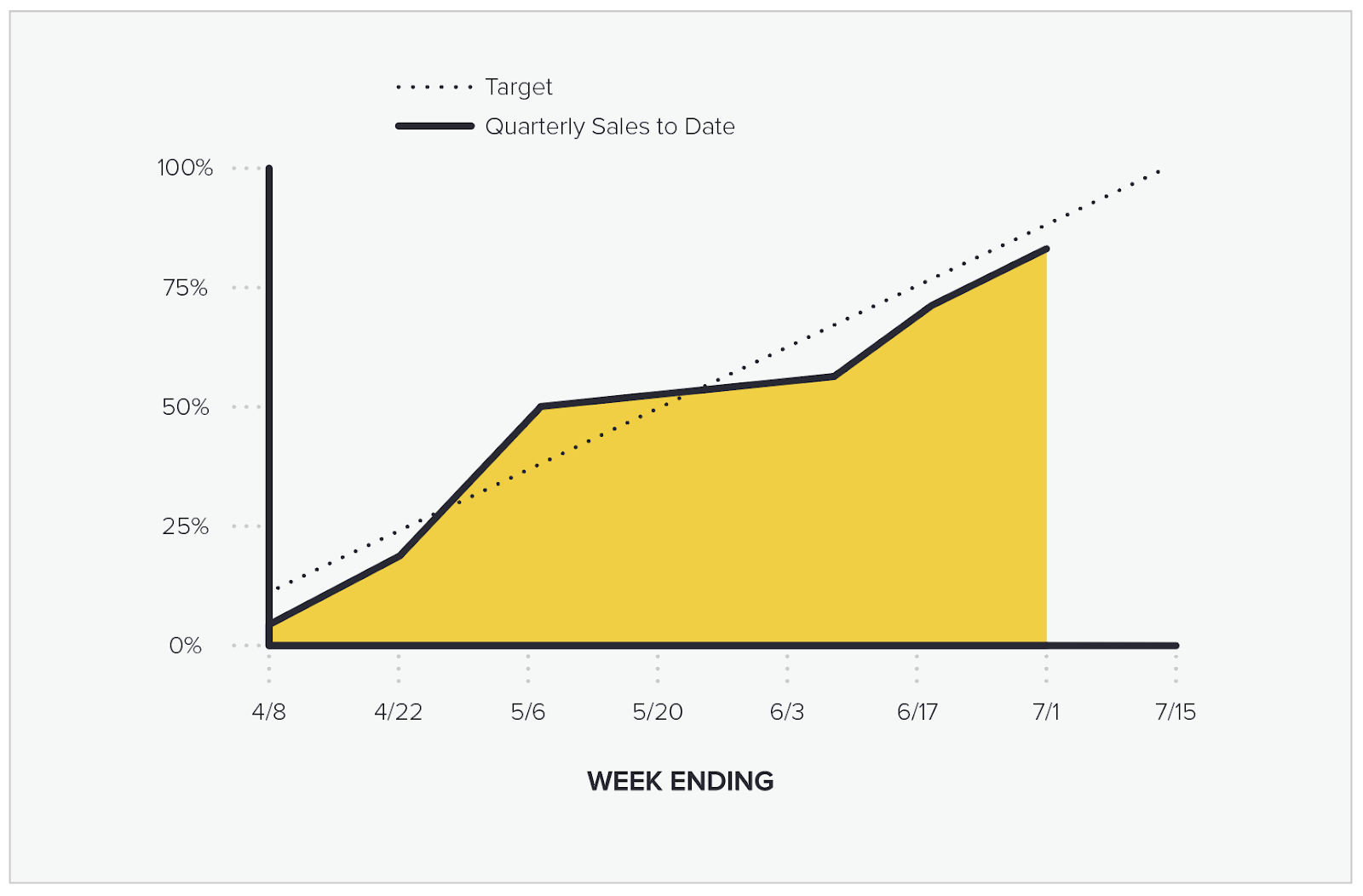
Every sales and forecast report we look at shows our pacing line.

When you’re lost in the middle of the woods, all the variable options and next steps can get pretty overwhelming. However, if you break them down into more manageable decisions, it starts to seem a little less terrifying.

Similarly at Lessonly, rather than trying to reach a massive sales goal by the end of the quarter, we’re concentrated on our week-by-week, and month-by-month performance. This keeps us focused.

Pro Tip: Recognize that some metrics will have linear growth, while others will have curved growth. 

When considering pacing, recognize that many goals will have linear growth, such as total leads in the pipeline.

This number should be growing steadily throughout the quarter. Other pacing strategies will have curved lines, with greater emphasis later in the quarter such as ARR on closed deals.

Recognize that, because of attrition, many of the straight growth lines prime the pump for the curved line growth later in the quarter.

Optimizing Sales reporting 1

These pacing lines allow us to quickly and visually understand where we are and where we should be. This orientation is crucial to optimizing sales reporting for the quarter, just as orientation is crucial in the wilderness.

Key Takeaways Recap:

  • Emphasize pacing, pacing, pacing
  • Over-communicate with your team about pacing. 
  • Set goals for smaller time frames.
  • Review goals regularly with your team.
  • Address shortfalls early in the quarter: don’t wait for the last week.

Final Thought On Pacing: Never look at a sales report without a pace line—These pacing lines are not only the map for our sales process, but an aspirational goal. We can’t understand the bigger picture of our quarter without them.  

Takeaway #2 – Data Integrity Is Found Through Simplicity

sales forecasting metrics

Accuracy in sales reporting relies immensely on individual sales reps inputting and updating data.

Too often, we ask our reps to input so much data into opportunities and end up forgetting what’s important. 

4 Primary Sales Metrics To Include

  1. The Deal Size—What’s the opportunity (in dollars) of this contract?
  2. The Stage—What stage is this client at in the sales process?
  3. The Close Date—When do we expect to close?
  4. The Forecast Category—How likely are we to close this deal?

These four sales metrics can inform 90% of the reports our leadership team needs.

Of course, more metrics can add valuable insights to a sales report, but we don’t want to overcomplicate it—we need a clear picture of the path ahead of us.

Choose only a few metrics that best capture your sales strategy, because using too many metrics can often be worse than no metrics at all.

By focusing on just four critical sales metrics, we also limit the number of fields we need our people to keep up-to-date on an ongoing basis.

We use tools like Pattern to make this process easy for our reps. This simplicity allows for more precise reporting at any given time. More accurate information, updated more easily is a win for everyone, right?

Key Takeaways Recap:

  • Get foundational data inputs right.
  • Pick your top 3-5 metrics that will provide the most clarity for your decision-making.
  • Hone in on those numbers, and use them month to month to improve your team.
  • It can be tempting to want to track everything under the sun, but simplicity is crucial.

Takeaway #3 – Solidify Your Sales Reporting Process BEFORE Investing 

losing money sales hacker

Now that you’re looking at the right data inputs, you have all the info you need to get out of the woods. Let’s put it together into a usable map.

Start by assembling a predictable, data-driven forecast and executive reports manually. Don’t throw this data at software just yet. Pull your data together in spreadsheets, and assemble it into a slide deck for regular review.  

It’s important at first to do this without automation in order to gain confidence and understanding of your sales process and cycle. Every week, evaluate your reporting. Are you getting the information you need to make effective decisions? Do you need to see the data differently?

After you build confidence in your sales reporting process, then you can invest in dashboards, tools, and automation to compliment everything.

This investment can take a lot of different forms, from software solutions like TopOPPS or InsightsSquared, to a dedicated Sales Ops team. But understanding our business has paid dividends in motivation, improved decision-making, and a higher level of focus.

Yes, it may seem like an unjustifiable expense when you’re first starting out, but it’s necessary for growth. The value added from productivity and better understanding of your sales cycle can take your business to the next level. Investing in your sales operations is worth it—just make sure you have the right process first.

Key Takeaways Recap:

  • Don’t expect software to solve your problem.
  • Start by assembling sales reporting manually to flesh out your process.
  • After you’ve perfected the data you need, then begin to invest in the process with software or a dedicated Sales Ops team member who can help you improve your sales reporting.

Takeaway Summary

As your team grows, it will become increasingly challenging to accurately measure, report, and forecast your sales. At some point, you will be lost in the woods, but don’t caught running in the wrong direction.

Optimizing your sales reporting process is absolutely essential for growth. 

  • Emphasize pacing, pacing, pacing.
  • Never look at a sales report without a pace line.
  • Get foundational data inputs right.
  • Don’t expect software to solve your problem.

The post How To Optimize The Sales Reporting Process: A Guide For Busy Executives appeared first on Sales Hacker.

29 Jun 00:07

The Ultimate Guide to Channel Sales

by afrost@hubspot.com (Aja Frost)

One of the biggest challenges to scaling revenue? Your salespeople only have so much time. Even if you hire the most focused people, invest in tools that boost their efficiency, and remove all distractions, there’s a limited number of selling hours in the day.

Some companies choose to hire more reps, and while that might work — it's not the only solution. Plus, recruiting, hiring, and employing salespeople is expensive and cuts away at your margins.

So what else can you do? Well, something called a channel sales model presents a viable, potentially game-changing opportunity — instead of hiring more reps, you distribute your products via a channel partner that can market and sell the product for you.

Free Download: Sales Plan Template

Table of Contents

What is channel sales?

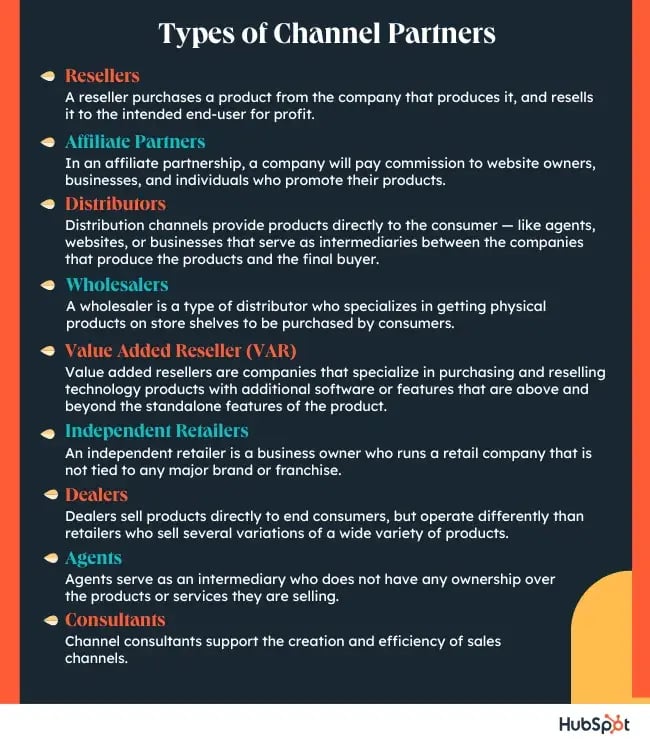
In a channel sales model, a company sells or distributes its offering through a third party (or multiple third parties). Those could be:

  • Resellers
  • Affiliate partners
  • Wholesalers
  • Consultants
  • Value-added resellers
  • Independent retailers
  • Dealers
  • Agents
  • Distributors
  • Consultants
  • Any other third party a business can tap to sell its solution on its behalf

We‘ll dig deeper into these various entities a little later, but if you’re eager to learn more right now, you can click here to skip ahead to that section.

Why use channel sales?

We‘ll explore the key benefits of a channel sales strategy in depth later in this article, but here’s a high-level overview of some reasons why you might use channel sales:

  • To access new markets.
  • To lean on an external workforce.
  • To affiliate yourself with trusted brands
  • To experiment with new bases

As with the last section, we‘re going to lock in on this concept later — but if you’re really eager to get to that immediately, you can click here for a more thorough look at the benefits channel sales can pose.

Channel Sales vs. Direct Sales

In channel sales, a company sells and distributes its products and services via a third party. In direct sales, a company sells its products and services directly to a consumer. Companies that use a channel sales model don’t always need an in-house sales team, though they might use a mixture of direct and channel sales.

Shocking as this might sound, your sales team is responsible for directly selling in a direct sales model. In channel sales, you typically rely on third parties to sell your product or service. When considering adopting a channel sales model, you should take a few factors into account. Let's take a look at what those might be.

Sales Channel Strategy

A channel sales strategy works much better for some businesses than it does for others — so before you jump into putting one of these programs together, you need to take some time and determine whether it suits your organization.

Should my business use a channel sales strategy?

Not every business is fit for a channel sales strategy, and whether you should leverage one rests on a few factors. You need to ask yourself some key questions to determine whether pursuing channel sales suits your interests — those include the following.

Does my business have the resources to handle increased demand?

A channel sales strategy is, at its core, an expansion method. You're diversifying your sales channels, getting more eyes on your brand, and ultimately setting yourself up to move more of your product or service. So if you want to pursue channel sales, you need to be equipped to handle all of that.

If you don't think you have the means or necessary production infrastructure in place to accommodate increased demand, you might want to wait on leveraging a channel sales strategy.

Is my sales process effective, repeatable, and accessible enough to suit channel partners?

How you sell your product or service might be the key sticking point when establishing an effective channel sales strategy. So if you want your strategy to work, you need to have a provenly effective sales process, a firm understanding of your target market, and an accessible way of conveying those elements to channel partners.

If you‘re still refining your sales process or getting a feel for who you’re trying to appeal to, you might wind up leaving channel partners high and dry — leading to an ineffective strategy that doesn‘t do much for anyone involved. So if you’re still “getting there” sales process-wise, a channel sales strategy might not be for you (yet, at least).

Am I willing to trust potential partners with my brand reputation?

A channel sales strategy is, in large part, about trust. You‘re letting people outside your organization sell your product on your behalf — that means you’re forfeiting a fair amount of control without losing too much accountability.

If your channel partner does something wrong, the prospect or customer on the wrong side of that mistake is going to associate it with your product or service. If the thought of that is too stressful for you, you might not want to leverage channel sales.

What are channel partners?

A channel partner is a company that sells and distributes a manufacturer’s product. As we touched on earlier, channel partners can include resellers, affiliate partners, distributors, value-added providers, independent retailers — basically, anyone who doesn’t work directly for your organization.

Aside from making your product more broadly accessible, channel partners serve a similar target buyer and have existing collateral or content that appeals to that buyer.

It might be tempting to partner with as many channel partners as possible, but it’s best to choose only a few and to do so carefully.

Just like trying to sell to everyone reduces your focus and actually harms your overall results, trying to partner with everyone is a bad idea. Being choosy will pay off — resulting in a much longer and more productive partnership.

What makes a good channel partner?

The process of finding partners is a lot like finding prospects: First, you need to define what an “ideal partner” looks like. Let’s take a look at some of the aspects that you should look for.

Complementary to Your Product

The partner’s product or service should fill a gap in your offering or help your customers use your offering more effectively. For example, HubSpot’s marketing agency partners help small businesses take full advantage of HubSpot’s marketing software.

Aligned With Your Market

You should also consider whether your partner’s customers would benefit from your product. Are they demanding additional support, features, or solutions that your partner can’t currently provide? Are their customers the right fit in terms of geography, use case, and size?

High Technical Expertise

Identify how much technical knowledge your partner would need to sell (and potentially service) your products. You might have to do very little education and support — or you might have to do a great deal. Although training a partner requires more time and resources, it also gives them an additional incentive to work with you.

Tip: If your average selling price (ASP) is low, and your partners resell your product relatively infrequently, investing so much into training them isn’t wise. Make sure you’re tracking how much revenue the partner is bringing in compared to the average return.

Similar Sales Process

Your partner’s sales process should be compatible with yours. Ideally, there’s a natural point in their sales or services process for introducing or upselling your product.

Manageable Commitment Level

Ask yourself how much commitment would be required for success. For example, maybe your partner would need to spend one full day per quarter at your office getting training. On the other end of the spectrum, perhaps all they need is a basic understanding of your product, which they can learn from one 30-minute video.

Once you’ve crafted your ideal partner persona, rank the characteristics by importance. This exercise will give you a framework for evaluating specific partners.

Types of Channel Partners

types of channel partners

1. Resellers

A reseller purchases a product from the company that produces it and resells it to the intended end-user for profit. Essentially, a reseller serves as an intermediary between the company that makes a product, and the final customer. In this scenario, the customer will typically go straight to the reseller to initiate the purchase and the reseller will work with their sourcing companies to fulfill the order.

Example

A department store that buys clothing from brands and sells them in its brick-and-mortar locations would be considered a reseller.

2. Affiliate Partners

In an affiliate partnership, a company will pay commission to website owners, businesses, and individuals who promote their products. Affiliate partners are typically paid a percentage of each sale they are responsible for bringing in.

Example

The HubSpot affiliate program is a well-known B2B affiliate program and the Amazon affiliate program is popular among those in the B2C industry.

3. Distributors

Distribution channels provide products directly to the consumer. Some distribution channels are agents, websites, or businesses that serve as intermediaries between the companies that produce the products and the final buyer.

Example

A website that sells toys on behalf of a range of smaller, more boutique toy companies would be considered a distributor.

4. Wholesalers

A wholesaler is a type of distributor who specializes in getting physical products on store shelves to be purchased by consumers. Wholesalers typically have sales reps who work to sell their products to retailers.

Example

Common examples of wholesalers include suppliers who sell food and other goods to restaurants.

5. Value-Added Reseller (VAR)

Value-added resellers are companies that specialize in purchasing and reselling technology products with additional software or features that are above and beyond the standalone features of the product.

Example

An example of a value-added reseller would be a computer company that sells hardware with another company’s software pre-installed.

6. Independent Retailers

An independent retailer is a business owner who runs a retail company that is not tied to any major brand or franchise.

Example

If an entrepreneur founded and operates a clothing boutique without the support of a parent company, they would be considered an independent retailer.

7. Dealers

Dealers sell products directly to end consumers but operate differently than retailers who sell several variations of a wide variety of products.

Example

The most common type of dealer is an automobile dealer, who sells and leases cars directly to the end-user.

8. Agents

In this channel, agents serve as an intermediary who does not have any ownership over the products or services they are selling. Agents facilitate deals between buyers and sellers, assisting with the negotiation process.

Example

A common example is real estate. A real estate agent or broker is not the owner selling the property to a buyer — however, they do oversee the process until an agreement is reached and the deal is closed.

9. Consultants

Channel consultants support the creation and efficiency of sales channels. Individuals in this role often connect retailers, manufacturers, distributors, and vendors to ensure the smooth delivery of a product to its customers. Though channel consultants do not directly sell, they play an integral part in making sure sales channels are running smoothly.

Example

A representative from a cybersecurity firm brought in to onboard a team to a new security platform its business recently invested in would be considered a consultant in the context of channel sales.

How to Create a Sales Channel Program

1. Craft relevant, useful content to attract partners.

Use your ideal partner persona to craft relevant, useful content. For example, if you want to work with staffing firms, you might write an ebook on how to place consultants or host a virtual networking event for staffing firms to meet job candidates.

The partners you attract should be highly relevant to your industry. Once you’ve attracted a few prospective partners, reel them in by focusing on their needs.

2. Focus on the partner’s needs.

Once you’ve started talking to a potential partner, make their needs the focus of the conversation. They won’t be interested in working with you unless they’re also benefiting. Figure out how you’d be able to help — by enabling them to sell additional services, reach new clients, or enhance the value of their product or service.

Once you’ve established a few partnerships, choose a structure for the partnership.

3. Choose a structure for the channel sales partnership.

There are three main ways to structure channel sales.

  • You and your partner can sell together. Your products improve each other. For instance, if you offer catering services, you might partner with a company that provides event clean-up. This type of partnership helps companies add more value to their customers.
  • You can sell through your partner. Department stores are a classic example — they curate items from a range of third-party brands. Variety is typically the key. If you can find a partner who’s already selling several similar products to yours, they may be a good fit for this type of partnership.
  • Your partner can sell for you. These partners incorporate your product into theirs — in fact, the end user may never know about your company. When you go to the supermarket and buy the store brand, you’re actually buying an independent brand that’s been packaged with the grocery store’s label.

You don’t have to use one method exclusively. Many companies use two or even three of these simultaneously, along with a direct sales model. It all depends on your needs.

4. Motivate your channel sales partners to sell.

Channel sales is extremely challenging because you’re trying to motivate people you have no direct influence over. If a regular salesperson doesn’t meet quota, you can work with them and/or put them on a performance plan. If a partner isn’t selling — well, there’s not much you can do, apart from “fire” them from the program.

To get partners to sell, you’ll need to develop excellent resources that they can use to confidently sell your product. Make sure they’re armed with clear, comprehensive, prospect-ready product specs, testimonials, customer examples, competitive comparisons, email templates, call scripts, meeting agendas, and objection-handling cheat sheets.

5. Communicate often with your partners.

If your partners rarely hear from you, they won’t be as invested in the program. They also won’t know the latest news, product updates, and strategic announcements. On your end, you might not discover issues until they’ve festered for a while.

The solution? Maintain regular contact with your partners. Send a periodic email, create a Slack room, make a Facebook group, hold partner “office hours,” run webinars, host meetings at your office — whatever you need to do to stay in touch.

6. Offer extra rewards.

While earning commission on deals is a compelling incentive, some companies (like HubSpot) add additional reward systems to their partnership.

This lets you create “superpartners” and drive specific desired behaviors. For example, you might have a tiered system: One tier for basic partners, a higher tier for partners who sell over a specific amount per month or year, and a third tier for partners who sell over an even higher amount per month or year.

Depending on their tier, offer advanced marketing support, tickets to exclusive events, strategic consulting, meetings with your executives, access to beta features, premium listing in your directory, opportunities to interact directly with your audience, features in your email newsletter, and so forth.

7. Use a sales channel partnership platform.

For scaling multi-channel businesses, keeping data related to your partnerships organized can be a challenge. Using a tool designed to keep your channel data streamlined can be a helpful option, such as PartnerPortal. This will not only allow you to keep track of revenue generated by your sales partners but also sustainably grow your channel sales program.

It takes a lot of time and energy to get a partner channel system up and running. If you need money sooner rather than later, focus on direct sales for now. Firas Raouf, an expert in early-stage B2B tech companies, recommends building at least $20 million in revenue before launching a partner sales program.

How to Know Whether Channel Sales is Right for You

If you’re planning to adopt a channel sales model over a direct sales model, it’s important to consider the state of your company, product, sales process, and more.

Key Factors to Consider With Channel Sales

Company Size and Maturity

Small companies can use partners to grow their business without needing to invest in hiring and training a sales team. Once they’re larger, they can bring their own reps on board (or if channel sales is working, continue with what they’re doing!).

Product Maturity

If your product is still in the early stages, you might want to take advantage of a direct relationship with your customers so you can quickly and efficiently assess what’s working, what’s not, and what to build next.

Sales Process Maturity

Before you can teach other people how to sell your product, you need to understand how to sell it yourself. If you haven’t defined the various stages of your sales process, the most important buying triggers, which customer stakeholders are typically involved, how long the average deal takes to close, and so on, you may want to postpone a channel sales initiative.

Location

If your offices are spread out, it might make sense to use a channel sales model. That makes creating multiple sales teams unnecessary. Of course, you can also use an inside sales model where appropriate.

Revenue Needs

It takes a lot of time and energy to get a partner channel system up and running. If you need money sooner rather than later, focus on direct sales for now.

Channel Sales Pros

Adopting a channel sales model has significant benefits to consider. Apart from the fact that you could downsize your sales team, you’ll also enjoy built-in trust, increased efficiency, rapid testing and experimentation, and increased customer success. Let’s go over these one by one.

Built-in Trust

If your channel partner is already well-known within a market or vertical, you don’t have to do the work of establishing a brand presence. Your product will automatically seem more credible because of their endorsement.

Increased Efficiency

One channel manager paired with several channel partners can bring in the same amount of revenue as five or six salespeople at a fraction of the cost. It can also be easier to bring on new partners than to hire a new salesperson – especially once you’ve created the program and worked out the kinks.

Rapid Testing and Experimentation

Channel partners let you experiment with new customer bases, products, packages, promotions, and/or marketing campaigns in a low-stakes environment.

Customer Success

If your customers need training, onboarding, implementation support, and service, partnering with vendors who offer these services lets you focus on closing new business without sacrificing your existing users.

That all sounds great, right? But channel sales does have some cons — let’s take a look at them below.

Channel Sales Cons

While adopting channel sales has tangible benefits, there are a few drawbacks that make it less than ideal for some businesses.

Less Control Over Sales

You’re not directly managing the sales process. Your reps might not be able to jump in and take control if a partner is mismanaging a deal. They also might have zero say over the timeline of the deal — which can be frustrating and lead to unpredictable revenue.

Brand Risk

If you partner with someone who has a poor reputation or treats customers badly, you’ll look worse by association. That’s why it’s important to choose a channel partner who’s known for a good reputation and excellent customer service.

Reduced Profits

In exchange for bringing in and/or closing deals, your partners will get a piece of the pie. You’ll make less on individual sales (but keep in mind, it’s probably cheaper to acquire each one).

Harder to Manage

It can be difficult to update your sales strategy, change your messaging, add a new product, or make any kind of major shift. You’re not simply rolling out a change to one group — you’re asking multiple external groups to adapt.

Slower Feedback Cycle

Because your partners are talking to some or all of your customers, feedback will take longer to get to you. And that feedback might not be 100% accurate — even if your partners are trustworthy, they may ask bad questions, use unreliable methods of gathering and/or analyzing the results, or unintentionally give you a biased interpretation.

Potential Competition

Things can get very messy, very quickly when your direct salespeople compete with your partners for the same business. Suppose a rep decides to cut their partner out of the deal because they don‘t want to give up the commission. If the partner finds out, they’re unlikely to ever pass the rep leads again. This leads to a case of channel partner conflict that could result in the relationship being severed.

Sales Channel Partnership Platforms

Here are a few sales channel tools that can support your business as your channels and partnerships become more complex.

1. PartnerTap Ecosystem Sales Platform

a sales channel partnership platform called partertap ecosystem sales platform

Image Source

PartnerTap’s partner ecosystem platform helps companies drive more revenue with and through partners. Customers use PartnerTap to automate account mapping, automate pipeline sharing, and auto-connect sales reps to co-sell with partners on their mutual accounts. Data from PartnerTap helps companies identify new logo deals and source more pipeline with each partner.

PartnerTap is also part of the HubSpot Ecosystem, and its tools integrate flawlessly with your CRM.

Pricing: Free Channel Edition; and enterprise pricing available upon request.

2. Crossbeam

[alt] a sales channel partnership platform called crossbeam

Image Source

Crossbeam provides powerful software to manage channel partnerships. A major upgrade from spreadsheets, notable features of Crossbeam’s tool include real-time forecasting, instant account mapping, and cross-partner lead generation.

Crossbeam can also connect directly

Pricing: Free; Pricing available upon request

3. Channeltivity

a sales channel partnership platform called channeltivity

Image Source

Channeltivity’s partner relationship management software provides an all-in-one channel management solution. This cloud-based tool has an extensive set of features including a channel partner portal, partner training materials, distributor management, a commission management platform, and more.

Channeltivity also offers a HubSpot edition of its software that provides real-time pipeline visibility for businesses and partners.

Pricing: $1,899/month (Standard Edition); $2,199/month (HubSpot Edition)

4. Allbound PRM

a sales channel partnership platform called allbound prm

Image Source

Allbound designs its partner portal technology to strike a strategic balance between customization and automation. Channel managers can tag partners based on region, industry, company size, and other descriptors so the platform only displays content relevant to individual users. Multi-tiered learning tracks and accompanying quizzes automatically award new portal permissions as partners advance their learnings. Plus, Allbound’sChannel Insights grants full visibility into engagement and partner sales performance.

As a HubSpot-certified app, Allbound integrates with your CRM for comprehensive pipeline visibility and consistent practices across your sales ecosystem.

Pricing: Available upon request

How to Measure Your Channel Sales Program

Wondering what success looks like? Here’s what to measure for every aspect of your channel sales program.

1. Total Number of Partners

This metric can help you gauge how effective you are in establishing partnerships — how well you can conduct outreach and how solid your relationship-building skills are.

2. Recruitment Quota Attainment

This metric is sort of an extension of the one above. It can tell you how solid your recruitment efforts are relative to the goals you set for establishing partnerships.

3. Partner Attrition Rate

Attrition rate typically refers to employee or staff turnover. In this context, it's a measure of how many of your partnerships fail over a given period.

4. Percentage of Partners Recruited by Channel

This metric gauges where your partnerships are coming from. For example, 50% might come from networking groups, 20% from proactive outreach, and 10% from referrals.

5. Average Cost of Recruiting and Onboarding a New Partner

This measure helps you tell how cost-efficient your channel partnership-building process is.

6. Average Length of Time to Recruit and Onboard a New Partner

This metric helps you determine whether your recruitment and onboarding processes need to be reevaluated or streamlined.

7. Total Number of Partner Deals Registered

This metric gives you a picture of the volume of deals your channel partners are able to make.

8. Average Value of Partner Deal

This shows you how effective your partners are in selling your product or service.

9. Percentage of Accepted Partner-Submitted Deals

This is another metric that helps you gauge the success of your channel partners' sales efforts.

10. Percentage of Closed Partner-Submitted Deals

This point is a natural extension of the one above.

11. Average Sales Cycle Length

This metric can help you gauge how effective your partner training is and which partners are particularly effective.

12. Percentage of Partners Who Registered Leads in Past Month or Quarter

This is another key channel sales success metric.

13. Percentage of Partners Using Provided Sales and Marketing Collateral

This metric helps you gauge whether the materials you're providing partners are accessible and effective.

14. Percentage of Partners Who Attend Optional Events and/or Ongoing Training

This metric can help you gauge partner enthusiasm and the effectiveness of your training methods.

15. Average Partner Satisfaction Score

This measure can let you know if you need to tailor your training and support to better suit partner needs.

16. Percentage of Partners Who Attempted Certification

This can tell you whether your partners find your certifications useful and unimposing.

17. Percentage of Partners Who Completed Certification

This metric can tell you whether your certifications are accessible enough.

18. CAC for Each Partner Sale Versus Direct Sale

This helps show you how profitable your channel partner strategy is.

19. Retention Rates for Partner Sales Versus Direct Sales

This shows you whether the relationships developed during your partner sales have staying power.

20. Cross-Sell and Upsell Rates for Partner Sales Versus Direct Sales

This metric shows how effective your channel partners are at generating extra revenue.

Looking for someone to manage your channel partner relationships? You’ll need a channel sales manager. Below, you’ll find a general definition of a channel sales manager, plus a sample job description you can use in a job posting.

Grow Your Business with Channel Sales

While building a channel sales program is a major investment, it can make a huge difference to your company. Not only will you reach new customers, but you’ll develop mutually beneficial relationships in your industry and grow your revenue as a result.

Editor's note: This post was originally published in June 2017 and has been updated for comprehensiveness.

29 Jun 00:07

Targets Are Greater Than Leads – Episode 44

by Anthony Iannarino

Targeting your dream clients is a better and more important activity than calling on leads, warm, hot, or cold.

Subscribe to My YouTube Channel: http://www.youtube.com/c/iannarino
_

Bio: Anthony Iannarino is a bestselling author and internationally recognized speaker on sales, success, personal development, leadership, and entrepreneurship. Anthony’s 3 privately held staffing firms generate annual revenues of $50M. These firms serve some of the most well-recognized brands in the United States. Anthony speaks to and provides transformational workshops to sales organizations throughout the world.

His blog, www.thesalesblog.com, is read by 60,000 people each month, and he has published there daily since 2009. His widely acclaimed Sunday newsletter reaches 80,000 people.

Anthony has continually been named one of the 25 most influential people in the world in sales and marketing.
_

Subscribe to my Sunday Newsletter for Exclusive Content: http://www.thesalesblog.com/newsletter

Read the Daily Blog: http://www.thesalesblog.com
Listen to the In the Arena Podcast: http://apple.co/2jlSKMr
_

Stay Connected Online:

LinkedIn: http://www.linkedin.com/in/iannarino
Twitter: http://www.twitter.com/iannarino
Facebook: http://www.facebook.com/thesalesblog
Instagram: http://www.instagram.com/iannarino
SnapChat: https://www.snapchat.com/add/iannarino
Solutions Staffing: http://www.solutionsstaffing.com
Iannarino Fullen Group: http://www.iannarinofullen.com

The post Targets Are Greater Than Leads – Episode 44 appeared first on The Sales Blog.

29 Jun 00:07

How to Warm Up Cold Leads with an Email

“WE’RE USING COLD EMAIL CAMPAIGNS TO TRY AND WARM UP LEADS BEFORE INSIDE SALES CALLS ON THEM. MY QUESTION IS, WHEN SHOULD THE SALES REPS BE CALLING AFTER WE KNOW AN EMAIL HAS BEEN READ BY THE PROSPECT?1 WE KNOW SPEED IS CRITICAL BUT I FEEL THAT RESPONDING TOO QUICKLY HAS TOO MUCH OF A “BIG BROTHER” FEEL TO IT. YOUR THOUGHTS?”

First things first… Sending a cold email to a prospect before calling them doesn’t “warm” them up.

The definition of a warm lead is when a prospect is raising their hand. That’s it.

How many times have you sent an email out, tracked it with tools that told you when the prospect opened the email only to call them and have them still give you some sort of blow-off or stall? I’m betting a lot!

How to Really Warm Up a Lead Via Email Marketing

Understand that the end game is to get your prospects to reach out to you! A warm lead is when a prospect raises their hand (by either picking up the phone and calling you or filling out a form on your website and submits a request to be contacted).

If you truly want to “warm up” leads for your inside sales team through email marketing, here’s what you need to do:

1 – START WITH A QUALITY LIST.

This means use resources that attract your target audience that want to hear from you again. Developing and then promoting valuable “how to solve” webinars is a great way to attract targeted prospects and build your email marketing list. (For an example of this, view our free voicemail strategies webinar) You will want to STAY AWAY from purchasing lists, etc.

2 – BE CONSISTENT.

Sporadic “Hey, we need deals so let’s blast out a mass email” campaigns often do more harm than good. You want to have well thought out material that goes out on a consistent basis for your audience to read.

3 – HEADLINES THAT HIT HOT BUTTONS.

Your subject line and your headline in the email have to be short and creative. Something that HITS your targeted audiences hot buttons!

4 – HELP, NOT SELL. SOLVE, NOT PROMOTE.

The content of your email should not be about you and what your product or service does, but rather focus on a problem that your audience has and that your company is an expert at solving, and then give the information away for FREE on how to solve it! This makes your targeted audience WANT to read what it is that you have to offer. It also builds your brand as a valuable resource – a Subject Matter Expert, if you will, to your targeted audience.

The majority of your email list won’t have a problem that needs solving right now, however, as you provide quality advice on solving issues they deal with, when a problem arises that they can no longer afford to ignore, they will know who to call / contact. And now you reap the benefit of speaking with a warm lead that you can help.

5 – CALL TO ACTION.

Make sure that at the end of your email marketing campaign / newsletter that you have a clear CALL TO ACTION for those who may be in need at this moment for your particular expertise. Make it clear and easy for them to hit the CONTACT ME I NEED HELP button so that your inside sales team can be busy helping prospects that need it, rather than trying to figure out who to call that has read the email.

Just make sure your inside sales team knows what to say when calling those warm leads. The last thing you want after investing the time to generate those true warm leads is to have your sales team blow it by calling them and saying “Did you have any questions?” or “I’m just following up”.

29 Jun 00:07

One Dangerous Mistake is Preventing Successful Buyer Persona Development

by Brittany Laeger

I see it all the time. Whether it’s a new HubSpot portal, a PDF document, or just in conversation, there seems to be one, universally dangerous tactic that keeps marketers from having successful and useful buyer personas.

Now before I tell you what the one thing is, let’s just make sure we are all on the same page.

Buyer personas are meant to be fictional representations or cross-sections of your ideal potential buyers — a tool to identify and visualize your target audience.

When done correctly, they can help you better understand what drives a customer purchase, how to communicate with them in the consideration process, and what barriers they might have along the way.

Personas.png

Creating buyer personas doesn’t mean that you have a magical organization system that every potential lead, prospect or customer will fit in without exception. Defining personas will never compare to a real sales person asking real questions to identify what a company needs, but that doesn’t mean they aren’t important.

Why Are Buyer Personas Essential for Any Business?

  1. Clarity and Focus: Buyer personas should be based on your best potential customers. By focusing on the ideal, you can create more clarity around prospects who might not be the best fit because of budgets, needs, etc.
  2. Communication: Successful buyer personas will help create effective communication across teams. If your leadership, sales, and marketing departments can all agree on your personas, then they become a standard definition that can be used company-wide.
  3. Efficiency: Personas can create efficiencies with marketing messages, sales communication, and internal dialogue.

So, What’s the One Dangerous Mistake?

It’s going to seem simple, but don’t be fooled. The one dangerous mistake I’ve seen numerous companies make is creating too many buyer personas. If you miss the mark on this, you might as well not create personas at all. You can’t have a target audience if the target is all of the rings on the bulls eye.

I know your next question is going to be, “How many is too many?” And that answer is not black and white. Most companies who have really successful personas limit themselves to 3-5, but there are some key ways that you can identify if you’ve crossed the threshold.

  1. Titles Only: If your buyer personas have morphed to just include every single potential job title that your visitor might have, then it’s no longer helpful. Remember, these are meant to be representations that help you categorize your visitors. Job titles might not be the best way to represent the different groups of people that visit your website. Instead, think about their motivations, locations or compelling events as possible options for grouping different personas.
  2. They Don’t Help Solve Business Problems: In persona development discussions, it’s tempting to focus on unimportant details, but that misses the goal.

    Every business is different, so those essential details will vary from company to company. But beware of getting caught up in the definitions of your personas. Most likely, their hair color and the type of dog they have won’t affect how you interact with them, yet those minute details can become a real distraction.

    When your conversations turn back towards solving businesses problems, then you’re on the right track.

  3. Nobody Refers to Them: If your buyer personas are just a PDF document that lies on the proverbial shelf and no one ever mentions them, then they weren’t done in a way that is really going to impact your business. Don’t be afraid to let them go and start again, some companies will need to come back to this problem a few times before getting a great solution.

How Can I Create Great Buyer Personas that Will Help My Business?

If you are one of the many businesses that don’t have working personas, it’s time to let go of your preconceived ideas about how to craft stellar buyer personas and keep these few tips and tricks in mind.

CustomerBuyerPersonas.png

Start by getting all of your key players in the room: upper management, marketing, and sales. Each of these departments will bring a slightly different understanding of your ideal customers. Try to balance the future vision of the company with what is working well for sales today.

    1. Identify an Ideal Client: Use this as an ice-breaker to get your team thinking and talking about your business, ask them to think about specific people they have worked with in the past. What’s the best new customer that has recently closed? What makes a client a great fit?
    2. Identify Motivators and Pain Points: What drives new clients to your business? What is the compelling event that leads them to you? What stops people from making a decision?
    3. Identify the Sales Cycle: Where do they start in the research process? What is their timeline? When do they want help from sales?
    4. Identify the Characteristics and Demographics: Now that you’ve narrowed in on the “why,” start thinking about the “who.” Where do they work, what’s their job, title, education, salary, spending habits, etc?
    5. Categorize Likenesses: Spend some time finding the similarities between the personas and bucketing groups together. Remember, this doesn’t mean that every person has to be 100% represented.
    6. Verify the Personas: Coordinate phone or in-person interviews with clients and other members of your team to verify your findings. Ask your interviewees the same questions to see if their responses are what you expect or something different.
    7. Create a Persona Document: Using all of the data and interviews you’ve collected, create a templated persona document that quickly and succinctly communicates your personas to your company. If you don’t have a great template, use ours!
    8. Review, Revisit, Revise: Taking all of these steps won’t magically mean that your personas are done, but they should be something that is living and breathing that you can update as you get new information, new products, etc.

Now it’s time to take your creation into the wild. Use your newly developed personas as a guideline to help you better communicate with your customers and prospects online. If you are a HubSpot user, make sure to use the personas tool to manage your personas and collect more data from your lead submissions.

If you haven’t developed your personas yet, be sure to download this persona template to help you get started.

27 Jun 16:16

Why Buying Stages Are Really Investment Stages

by Ellen Gomes

Let’s take a quick poll. When was the last time your boss asked you to do something and you didn’t question why you needed to do it a specific way? You see, sometimes we just assume that the old way of doing things is the right way. But every so often, we forget to test what’s right under our noses.

It all started with one simple question: What types of content resonate with what types of leads? In other words, does the early stage content you have work for early stage leads? Or would it work better for late stage leads? Or does the content even work at all?

In every database, there are three types of leads. You have the folks that are brand new and have yet to learn about you or your product. Then you have folks that have an idea of who you are but aren’t yet ready to buy. Lastly, you’ll have folks that are well-educated, interested in evaluating your product, and could potentially buy from you. Each of these stages maps to a content stage, which is often how marketers define and guide the buyer’s journey.

Now when you plot out those leads on a curve to see where the bulk of people fall in the buyer’s journey, you’ll find that the database looks a little something like this:

buyers journey

The bulk of your database is most likely early stage leads because we tend to have more people that aren’t yet ready to buy from us than those that are pulling out their checkbooks. Sad but true.

Now let’s define how marketers tend to think about the stages of content.

  • Early: Content that builds brand awareness —it’s fun, engaging, and doesn’t have a hard sales message for either your brand or product.
  • Mid: At this stage, the content is focused on educating the audience. It introduces the product in the context of the market, explains why it’s the best product, and how it can provide a solution to your company.
  • Late: At this stage, we assume that the lead has already been educated enough on the product to make an informed decision. This content helps sell the product by helping the buyer make a purchase decision.

Let me tell you a story of how I came to believe that marketers are missing something here. And like any good story, I will tell it in chapters.

Chapter 1: The Discovery

A couple months ago, I was preparing to speak on a webinar called 3 Hacks to Boost Email Open Rates. From my perspective, this was primarily an early-stage webinar but our normal process would be to promote it to all leads in the buyer’s journey (early-, mid-, and late-stage). After the first email invite deployed, I became curious to know what types of leads were registering for this webinar, particularly if they were, in fact, early-stage leads.

Here’s what I found when I looked at the registration list:

Leads by Buying Stage

To my complete confusion, I found that even though this was an “early-stage” webinar, only 5 early stage leads registered. How many early-stage leads received the first invite email, you ask? Roughly 96,000. I know, you might want to take a seat for this…

Chapter 2: Is the Test Repeatable?

Feeling like my world had been turned upside down, I went back and reviewed the webinar program for the 8 Biggest Mistakes Social Media Marketers Make, which was another early-stage webinar that took place the month prior.

Here’s what I found:

Registered Leads by Buying Stage

The exact same pattern appeared! Despite this being what we believed to be another early-stage webinar, most registrants are late-stage leads. But what about the attendees? What happened to the attendance rates?

Attended Leads by Buying Stage

With this data, we uncovered the following insights:

  • Late-stage leads are over 2x more likely to attend a webinar than an early stage lead
  • We can send a high volume of emails to early-stage leads and yet only get 23 people to attend

Chapter 3: Back to the 3 Hacks Webinar

Armed with surprising new data about registrations, I thought I would break the data down further by looking at email performance by buying stage.

When comparing late-stage leads to early-stage leads, late-stage leads performed significantly better:

  • 131% higher open rates
  • 913% higher click-to-open rates
  • 47% lower unsubscribe rates
  • 9,588% higher conversion rates on the registration page

If it wasn’t clear before, it was now. Leads that are still early in the buying cycle are not ready for a webinar, no matter the topic. This was the perfect example of why we need to test everything. Only after this webinar analysis did I truly understand what content format is resonating with leads at each stage of the buying cycle.

Chapter 4: A New Day

I started this blog making the bold statement that what you thought about content marketing might not be true. How we, the marketers, define what is early-, mid-, and late-stage content may not actually hold up once it hits our target market. So, what are the lessons here?

  1. Listen to your audience. No one knows your audience better than your audience. They will tell you what is working and what isn’t. Having strong intuition is a wonderful quality in a marketer, but pushing that intuition aside to humble yourself through data and make a shift in your marketing strategy is a better quality.
  2. Buying stages should be called investment stages. An early-stage lead cannot invest in a webinar. They don’t know enough about your brand, your product, or your vision to give you 1 hour of their work day. You might as well be asking them for a credit card number while you’re at it. The leads that are willing to make the investment with you are the ones that are listening, which takes time and patience. Your marketing efforts need to open their ears first before you can push them heavy content, even if the topic is early stage. Also, this goes beyond webinars. At every stage of the buying cycle, think about how easy or difficult it is for a buyer to access your information. Your goal shouldn’t be to feed them content that you deem as early-stage but to feed them consumable content that will open their ears, hearts, and ultimately their wallets.
  3. Raise your hand and ask questions. Just because “that’s the way we’ve always done it” doesn’t mean that it’s right for the business. Let the data be your single source of truth. Seek answers in numbers, not just in your gut.

The end. What does this make you think about your content strategy? Do you have any ideas how to make content more relevant for each stage of the buyer’s journey? Please share your thoughts below!

The post Why Buying Stages Are Really Investment Stages appeared first on Marketo Marketing Blog - Best Practices and Thought Leadership.

27 Jun 16:01

The Love Languages of Amazon and Whole Foods

by johnmoore

It’s been said that for any lasting relationship, both partners need to understand, appreciate and quite possibly share the same “love languages.” Knowing the love languages of your partner helps you to better express your affection towards someone and to better interpret how your partner loves you.

John Mackey, Whole Foods co-founder and ceo, used the metaphor of marriage to describe Amazon acquiring Whole Foods. Mackey said, “It’s been a whirlwind courtship. Because, little over six weeks after we met on this blind date, we’re officially engaged.”

That marriage metaphor sparked me to think about what “love languages” have driven both Amazon and Whole Foods to achieve business success. In this context, love languages are the cultural and operational underpinnings that have fueled the success at both companies.

Having worked at Whole Foods as their director of national marketing in the early 2000s, I have a much greater understanding of Whole Foods love languages than I do of Amazon’s. However, I’ve studied Amazon enough, to know enough, to make a few observations.

Listed below are eight love languages that help to explain some of the foundational business aspects Amazon and Whole Foods have used to become beloved brands.


Technology & Data

Amazon is a digital company with zettabytes of data about how its customers behave. They use this information to make the smartest decisions possible.

Whole Foods is a retail business with loads of customer data but its physical locations and store-level operations make it a deeply-rooted analog business.


Efficiency

Amazon has been built to be highly efficient in every way it does business. Its fulfillment centers are wonders of logistical design and its growing global transportation network is threatening to upend UPS and FedEx.

Whole Foods is decidedly inefficient. The company places significant responsibilities to its twelve regions to solve for procurement, distribution and scores of other duties that retailers of its similar size centralize in order to bring about efficiency. This inefficiency was designed to give Whole Foods greater ability to localize the brand in the communities it serves.


Customer Obsession

Amazon prides itself on being obsessive about customers. Jeff Bezos, Amazon founder/ceo, believes, “We’ve had three big ideas at Amazon that we’ve stuck with for 18 years, and they’re the reason we’re successful: Put the customer first. Invent. And be patient.”

Whole Foods is designed to deliver awesome in-store customer experiences but if the company was truly obsessed with customers then it would’ve have solved for delivering lower prices to customers years ago.


Frugality

Amazon is notorious for being a frugal company. Frugality is a core Amazon operating principle: Accomplish more with less. Constraints breed resourcefulness, self-sufficiency and invention. There are no extra points for growing headcount, budget size or fixed expense.

Whole Foods practices frugality but not near to the extent of Amazon. The frugality practiced at Whole Foods is more geared towards sustainability practices of reduce, reuse, recycle.


Decisiveness

Amazon practices something Jeff Bezos calls “high-velocity decision making.” It’s where speed meets smarts. Bezos believes, “Most decisions should probably be made with somewhere around 70 percent of the information you wish you had. If you wait for 90 percent, in most cases, you’re probably being slow.” He trusts that if/when a decision starts to look bad, his teams will be able to recognize the issue and make a quick course correction.

Whole Food makes decisions by consensus and that takes time and lots of meetings. If Amazon waits for 70 percent of the information to make a decision then Whole Foods waits for 99 percent of the information. Empathy drives so much of the culture at Whole Foods and that empathetic ear translates into having to hear all sides to every story many times over before a decision can be made.


Innovation

Amazon is a retail pioneer. They have changed, are changing and will continue to change the digital retail landscape.

Whole Foods was a retail pioneer. They proved a global retail grocery chain could be built focused on selling natural/organic products and humanely raised meat/poultry/fish. Competitors ranging from Costco to Walmart to Target to Trader Joe’s have surpassed Whole Foods in a few meaningful ways.


Triple Bottom-Line

Amazon doesn’t follow the triple bottom-line philosophy of people, planet and profits. Its environmental and people practices continue to be scrutinized. The company discloses very little about its carbon footprint amidst its growing global distribution network. Amazon has also had to answer to questions about its treatment of employees. To my knowledge, Amazon has never been listed as one of Fortune’s 100 best companies to work for in America.

Whole Foods is a leading business practicing “conscious capitalism” where business decisions are based and measured upon the impact to people, planet and profit. It has a longstanding reputation for supporting and advancing environmental concerns. The company is celebrated for being an employer of choice having been listed for 20 consecutive years by Fortune magazine as being one of the best companies to work for in America.


Point-of-View

Amazon’s retail point-of-view is strictly operational. It’s all about making it easier for customers to do business with them. Huge Selection. Low prices. One-click buying. Fast shipping. Liberal return policy. Speedy customer service. All of these factors make it easier for customers to remain loyal to Amazon.

Whole Foods point-of-view is staunchly aspirational. The company promotes a lifestyle of eating wholesome foods that do not contain anything artificial. Whole Foods has been at the forefront of setting organic standards and promoting eating a plant-based diet. Mackey has routinely said, “We’re in the business of selling whole foods, not holy foods.” Despite that, Whole Foods strong point-of-view on what’s healthy can alienate customers who must go elsewhere to purchase products that Whole Foods deems unhealthy.


CONCLUSION

Just because Amazon and Whole Foods speak different love languages doesn’t mean their impending marriage is setup to fail. However, it does mean they will need to communicate often and the partnership will need to be open to change.

Let’s be real. Whole Foods Market isn’t a healthy business. Comparable store sales are on a downward trend. Its stock price had stagnated. Competition has increased. Pricing pressures have hurt profitability. New store growth has slowed. For those reasons and more, Jana Partners, an activist investment firm, purchased nearly 10% of Whole Foods Market and pushed for big changes.

Amazon is a retail behemoth. They’ve changed the retail game in the digital era like Walmart did before the internet became omnipresent. Today, Amazon accounts for nearly 35% of all U.S. online sales. Expectation is that by 2021, Amazon’s online retail market share will grow to 50%.

With a $500 billion market capitalization, some industry folks have said the $13.7 billion purchase price for Whole Foods is a “rounding error” for Amazon. In many ways, Amazon risks little with this purchase. On the other side, Whole Foods risks a lot.

What’s at stake is more about Whole Foods point-of-view and its willingness to adapt to a new retail landscape.

The Altar Alters Little

With this proposed marriage, both Amazon and Whole Foods need to fully accept what makes each business unique. If Amazon tries to change Whole Foods too much then the marriage will fail. Whole Foods cultural and operational underpinnings have very strong roots and trying to change the core of what makes Whole Foods a beloved brand has the potential to crumble the relationship.

Consummating a relationship at the altar will not alter the core of what makes each partner unique. Amazon will be smart to hold off on its high velocity decisiveness and allow for time to better understand its marriage partner. For Whole Foods, the company needs to be open to evolving and incorporating more of the customer obsession mentality that has made Amazon outrageously successful.

The post The Love Languages of Amazon and Whole Foods appeared first on Brand Autopsy.

27 Jun 16:00

The Artificial Intelligence Impact: Friend or Foe to Marketing?

by Paige Musto

The Artificial Intelligence Impact: Friend or Foe to Marketing?

The era of Artificial Intelligence (AI) is upon us. More and more, computer systems will become able to perform tasks that previously required human intelligence, such as decision making, visual perception, and speech and language recognition.

Marketing, like most other fields, will feel AI’s impact in several areas, including database marketing techniques, search queries and search engine optimization (SEO), personalization, predictive customer service, sales forecasting, customer segmentation, pricing, and many others.

Act-On recently asked several marketing experts and analysts for their assessments of the pros and cons of using Artificial Intelligence in marketing and what they foresee for the future.

Question: Will Artificial Intelligence (AI) be marketing’s friend or foe? How do you see the two co-existing as AI becomes more mainstream?

Jim Ward (Act-On customer)

CEO
Brainsell
https://www.linkedin.com/in/brainsell/
https://twitter.com/BrainSell

As AI learns and develops, I can foresee buying behaviors and automated nurture- or real time- programs tied together as an example. Literally with any data that impacts behavior, AI will be able to quickly make assessments and guide a process. Think about the weather in a target region and how that might impact a buyer, or a decision process which, connected with marketing automation, will likely enhance results.

David Raab

Industry Analyst
Raab Associates
https://twitter.com/draab

If AI takes over our jobs and relentlessly seeks to eliminate all vestiges of human involvement, Terminator-style, I guess that would qualify as “foe”.

But it’s much more likely that AI will augment human capabilities, in particular by making individual- or micro-segment-level decisions with much more specificity than humans can do. In other words, AI can easily monitor individual behaviors and find appropriate responses in millions of different situations, whereas human marketers can only deal with segments and create rules or workflows that deal with dozens or hundreds of situations.

Similarly, AI can closely watch results to find new patterns as they emerge, something that humans can only do sporadically and with less attention to detail. For example, it’s wholly conceivable that AI could write individually tailored catalog content for tens of thousands of items, taking the tone and pitching the features that will most appeal to every person based on their psychological profile.

What AI won’t be able to do for a long time is to come up with radically new ideas, or to judge which random possibilities are actually promising enough to be worth testing. So we’ve already seen AI take over some more routine marketing tasks, such as certain kinds of reporting and analysis, and even climb a bit up the value chain to making suggestions based on those reports. That will be more widespread.

And, AI will take over much of the actual message selection, replacing human-built rules with AI-based recommendations: something that’s also already in place. One thing I do expect is that AIs will broaden their scope, so instead of a lot of separate AIs, each handling a particular task (chatbot here, recommendation engine there, etc.), we’ll see a single AI or several tightly connected AIs working together.

Michael Krigsman

Industry Analyst
CXO Talk
https://twitter.com/mkrigsman

AI is a tool; it’s neither the next great hope for marketers nor something to fear and avoid. If we remember that AI is really advanced pattern matching based on lots of compute power crunching through large data sets, the whole conundrum becomes easier to manage.

AI tools can find correlations between customer digital activity and likely subsequent behavior. For example, AI will help us personalize and tailor messages specifically for individual customers. If a woman on your site is looking at shoes, historical data patterns may suggest that sending an offer late in the evening will be more effective than during the workday. Or maybe the patterns will show that men buying black shoes in wide sizes on the weekend are six times more likely to buy blue socks within three days. AI can help us find these patterns in ways never before possible.

Despite the obvious benefits, there are also real concerns, especially around privacy. With great power comes the ability to become annoying — and even creepy. Marketers must temper their enthusiasm for personalization with the caution not to be overly intrusive. Remember the story of a teen whose father found out she was pregnant because her shopping patterns at Target triggered advertisements for pregnancy items? That’s beyond creepy and it’s all based on data and analysis.

The lessons for marketers are clear: Use AI to personalize messages your customers will welcome and want. Think about campaigns through the eyes of your customer; if it’s helpful and useful to customers, they’ll respond positively. If the personalization becomes too personal or frequent, you’ll just alienate valuable customers. As with many things, finding the right balance is critical.

Douglas Karr

CEO
DK New Media
https://twitter.com/douglaskarr

As with any tool in marketing, AI can be either [friend or foe]. Email, for instance, gets amazing results when utilized effectively. When it’s not, you’re a spammer who is doing more harm than good. AI is no different; it’s a tool that will have tremendous results when applied to situations where the marketing strategy is on a solid foundation.

Bots, for example, may hold great conversations for a company that has too many site visitors to respond to each independently. They can both help or route the conversation based on the interaction learned. A/B and multivariate testing with AI will help marketers automatically improve their site copy or even personalize it for maximum input. AI can streamline and reduce the workload on the marketer, enabling them to build strategies instead of handling mundane tasks or efforts they lack the resources for.

Daniel Newman

Principal Analyst, Futurum Research
CEO, Broadsuite Media Group
https://twitter.com/danielnewmanUV

Artificial Intelligence will be the best thing to ever happen to marketers. With all of the data being created every second, there is almost no way for marketers to access and process all of the useful data in real time. This is where AI will be able to augment the role of the marketer. By rapidly processing and synthesizing an unprecedented amount of data from across the web and from our structured data systems, marketers will be able to get closer to not just real time, but also to right time marketing that puts the right information in front of the right consumer in as close to their “Zero Moment” as possible.

Christine Crandall

Consultant/Journalist
Forbes
https://twitter.com/ChrisCrandell

Our love/hate relationship with AI has its roots in science fiction movies like Her, Transcendence, and Star Wars. In these stories, AI thinks for itself, creative problem solves, and mostly tries to keep humans from getting into more trouble. Fiction is great, as it fuels dreams of innovation. The reality of AI is quite different. Software programs, created and managed by humans, perform predefined micro-tasks following pre-set decision trees designed to automate routine, repeatable tasks.

Augmenting marketers’ skills, akin to being their wingman, AI will have more impact on the discipline than any martech product to date. The ability to quickly conduct data analysis to spot and evaluate trends and then develop risk/return-based actions to a host of routine activities and decisions such as ad networks, keywords, CTAs, personas, journeys, budget and ROI reports, competitive intelligence, etc., will enable marketing to focus on higher value-add activities better suited for humans such as strategy, cross-functional collaboration, new business/markets, customer alignment, etc.

How each organization, however, leverages AI depends on its own market, business model, and core competencies. It won’t be “one size fits all” but rather an ecosystem of interlocking frameworks that will require marketers and CIOs to closely partner in order to reap the potential benefits. Marketing will need to prepare for AI and carry forward the lessons learned from predictive analytics and today’s patchwork of martech solutions — automation can only offer recommendations that are as good as the underlying data sources. In the end, the human is still the pilot.

Blake Morgan

Customer Experience Futurist, Author, and Keynote Speaker
Columnist at Forbes
https://twitter.com/blakemichellem

Artificial intelligence makes marketers better listeners. Machine learning can help determine what a customer needs. That said, being a good listener is an important piece of being a good communicator. It’s marketing’s job to learn how to communicate to prospects and customers. Marketing will rely increasingly on AI in the future to determine what customers need, what they want, and what kinds of experiences they are looking for.

Morgan’s book More Is More: How the Best Companies Go Farther and Work Harder to Create Knock-Your-Socks-Off Customer Experiences can be found here.

John Koetsier

Journalist, Analyst, Futurist, and Dreamer
https://twitter.com/johnkoetsier

AI is most definitely going to be a marketer’s friend. Marketers spend far too much time right now gathering, merging, cleansing, and normalizing data, and AI is going to make that simple. (In fact, it already is.) In addition, the customer journey is far too complex — one company mapped 500 points on their customers’ journeys — to really understand, never mind react to in real-time with appropriate messages, resources, or services. AI will also help here, delivering on the promise of technology by enabling one-to-one communication with prospects and customers at scale.

Ankush Gupta

COO & Editor-in-Chief
MarTech Advisor
https://twitter.com/thelearnedman

Marketing is driven by consumer behavior and needs. And, consumers today expect marketers to be clued into their expectations, actions, and needs in real time. Of course, they want this without marketers being the least bit intrusive or creepy. And, marketers on their part want to seem like they knew all of this somehow magically, making the entire delightful experience as seamless as possible.

So, I think yes, AI can and will be marketing’s friend, because there is no other way for marketers to provide personalized delightful experiences at scale. Whether it’s with customer experience or business decisions, AI is going to propel marketing into the future, which is all about data and intelligence.

Not only do I believe AI and marketing will co-exist, AI will be the driver for marketing to keep pace with customer dynamics and evolution. Whether you’re talking B2C or B2B, buying behavior is changing dramatically and at great speed. There is no way to keep pace with it manually. But, AI can do the heavy lifting at scale. Whether it’s tracking the millions of customer-generated data points and variables, running analytics on seemingly disjointed pieces of data and turning it into intel, answering (millions of) customer queries intelligently in real time, or recommending micro-segmented campaign strategy based on predictive models, AI can be the strongest ally for marketing yet.

The only catch is getting the balance between machine-generated intelligence and human instinct and discretion right. Building in cultural nuances, for example, is a critical area for technology and marketing to get right before entrusting customer experience to AI.

Dom Nicastro

Staff Reporter
CMSWire
https://twitter.com/DomNicastro

Poor customer experience is an epidemic. It’s going to bring down the largest companies in the next few years. The only ones left standing will be the ones that provide exceptional experiences.

I know this personally because I went through a terrible experience where I was bounced around several different channels in an ordeal that took weeks to resolve. No matter how great the product and technology is, no matter how many great offers and discounts I get, I associate this brand with that experience. And I tell people about it.

How does this relate to AI? I do think machine learning engines could have been used in my experience to at least learn more about me — which channels do I go to in order to resolve problems, what’s my tone and sentiment toward the brand? “Dom, we understand you’ve interacted with us several times recently. Let us help you now.”

Still, though, AI will not eliminate the need for the marketer to do the foundational work for knowing its customers. In other words, marketers will mostly always be the ones creating content, delivering content, and managing content.

AI can be a great friend. It won’t matter, though, if brands aren’t committed to exceptional experiences ― in marketing and beyond.

Barb Mosher Zinck

CEO, Content/Product Marketer, Marketing Technology Analyst
BMZ Content Strategies
Digital Tech Diary
https://twitter.com/bmosherzinck

The discussions around AI and marketing are heating up, and there’s good reason for this. Marketing is under great pressure to deliver more personalized targeted experiences ― and to do that at scale is just not possible using manual techniques. AI is the answer to personalization at scale, but it needs to be done well, and how it’s working needs to be transparent to the marketer.

The biggest concern is a technology vendor will wrap artificial intelligence in a black box and expect marketing to just “know it works.” That’s a bad idea. Marketing needs to see the data that drives AI decisions; they need to understand how AI is implemented. Maybe they don’t understand the details of the algorithms, but they have to understand the strategy and approach. And, depending on the purpose of the AI, marketing may need to influence how it works by configuring some key aspects.

I don’t think we’ll ever be in the position of looking to technology to do everything for marketing automatically, but there are certainly areas where AI can take the load off the marketing team. Marketing can then focus on aspects that technology can’t do or that we don’t want it to do on its own, like creative, like strategizing messaging, designing campaigns, and key customer interactions.

Ann Handley

Head of Content
MarketingProfs
https://twitter.com/marketingprofs

The editor in me wants to edit your question: It’s not future tense (“Will AI be…?”); it’s present tense (“Is AI…?)

Artificial intelligence is already here. And it’s already our friend.

It might seem that AI will render some marketing jobs obsolete. We could argue that machines that do the gathering and interpreting and optimizing better than people will forever alter the jobs of those marketers who are focused on interpreting data, doing testing, and optimizing campaigns.

But we could also argue that those same marketing technologists and data scientists are also perfectly situated to in turn manage and leverage those AI systems and technologies.

I come out of the creative side of marketing (like most marketers have). So, should we artsy-fartsy creative types be freaking out at the rise of AI?

Nope. Because writers, designers, videographers, and storytellers are more valuable than ever. A world steeped in AI means we have the data and processes in place to get to know our customers better. We can use the brilliant gold that AI beautifully spins for us to craft more effective marketing — to create brighter, more creative, and more winning programs. We can also zig while the machines zag. Because sometimes breakthrough marketing is doing exactly what your customers don’t expect.

At least, that’s how I see things.

To quote Noam Chomsky: “Thinking is a human feature. Will AI someday really think? That’s like asking if submarines swim. If you call it swimming then robots will think, yes.”

Kerry Cunningham

Senior Research Director
Sirius Decisions
https://twitter.com/KerrySirius

AI will be a great friend to organizations that market. AI will be a great friend to marketing leaders and the marketers who learn to incorporate AI into their skillset. Without a doubt, artificial intelligence is going to help organizations and the leaders that implement AI effectively become more effective and more competitive. From automating some prospect communications altogether, to automating various aspects of prospect nurture, prioritizing and sourcing prospects, and even improving pipeline and revenue forecasting, there are a variety of ways AI will improve marketing effectiveness.

As with all processes that automate what would otherwise be human actions and decisions, there may be displacement. At the same time, many of the actions and decisions AI can improve and automate are actions and decisions that don’t even occur today. For example, marketing organizations have automated, programmatic nurture programs, but these can also be enhanced with AI to react in real time to prospect behavior and market conditions. Such an enhancement should improve nurture performance (possibly leading to growth and new opportunity), but doesn’t involve displacing existing people and processes.

AI can also be inserted into very human-centric processes, such as teleprospecting, to optimize the intensity, timing, and even content of teleprospector calls, helping revive a challenged B2B function.

Back to you:

What are your thoughts on AI in modern marketing? Is your firm taking advantage of any of these technology advancements? Tell us your thoughts, experiences, and predictions in the comments!

27 Jun 15:58

Who Should Be Involved in Setting a Sales Enablement Strategy?

by Juli Durante

Our friends at HubSpot define sales enablement as “the technology, processes, and content that empower sales teams to sell efficiently at a higher velocity.” If you’re using the inbound marketing methodology, sales enablement is a natural extension: It’s all about giving sales teams the coaching and content that they need to sell smarter. Of course, like anything else, sales enablement strategy isn’t just a matter of handing out some sales content and calling it a day—real strategy is involved. The big question is: Who should be part of that strategy and process? As it turns out, there can be a lot of players … with a lot of different ideas and opinions. Here are the top considerations:

The Big Question to Ask: What Are the Inefficiencies in Our Sales Process?

If sales enablement is about making sales work smarter, then the gap analysis should be focused on the inefficiencies and what’s not working well. A big question to start with is, “Where are leads falling out of the sales process?” The root of this question is, more measurably, “What stage or phase of the process causes the most dropoff?” If you’re using the HubSpot CRM and reporting add-on, check out this excellent funnel report:

HubSpot deal stage funnel for sales enablement strategy

Based on this report, I would expect to hear some of the following questions:

  • Only 25 percent of deals are moving from the “Created” stage to Phase 1 of our sales process. Are we creating deals that are truly sales opportunities? What’s keeping us from getting more prospects to the first stage?
  • Just over one-third of our prospects are moving from Phase 2 to Phase 3. What’s our big ask at that point in the sales process? What information can we provide during this stage to better show value before a proposal is sent?
  • What will I find if I drill into this at a deeper level? How do these averages compare by rep? By industry? By company size? By line of business?

These questions are at the core of most conversations with sales leaders regarding sales improvement that I’ve been a part of. It makes sense—they’re important questions! Asking them is the first step to diagnosing bigger issues such as:

  • The business development team has a high quota for appointments set, so its primary focus has become quantity, not quality, and 75 percent of appointments booked aren’t progressing. The sales reps then have a small pool of qualified appointments to get to the demo phase. Though the organization needs the quantity of leads, it also needs to drive
  • Many contacts are seeing a demo but not moving to the informal proposal stage afterward. Is this solution really meeting their needs? Are we providing the right information? We need to show more value and get prospects excited about moving forward after a demo.

In both of these scenarios, there’s a real opportunity for sales enablement to make a difference. And who should be involved in putting together that strategy?

Every Key Decision Maker in the Organization Is Involved in Sales Enablement Strategy.Yes, every. Single. One. Because sales enablement is a strategy that directly affects the department that keeps much of the organization running—sales—you can bet that there will be lots of heads turning in this direction. Here’s a quick list of who is typically at the table and the role they should play: Sales Leadership

This one is a no-brainer. The head of the sales team is easily the most important person for incorporating new ideas and strategies, and analyzing existing sales data.

Marketing Leadership

Because sales enablement works best when sales and marketing can work together for the right kind of messaging and content, the head of marketing is another key leader. Furthermore, sales and marketing leadership are the key players for determining how well-aligned sales and marketing efforts are, all the way from a lead generation standpoint—which directly affects how many leads will get passed to the business development team for potential sales readiness.

Executive Leadership

These are the people who have the “big goals” and often the “big budgets” in mind, so getting their buy-in is crucial. If you can’t align a sales enablement strategy with the goals and budgets of players such as the CEO, CFO, and COO, your strategy likely won’t be around for long.

Top Sales Reps

Though sales leadership can offer the theories and data behind decisions, your top sales reps often have an excellent pulse on what’s going on right now and can be open about what needs they have in the sales process. For example, a rep might say, “I always get asked for references between Phase 2 and Phase 3, but it takes some time to get them lined up. I’d like to be able to send them something industry-specific in the meantime.” That’s a comment that marketing can run with.

Top Business Development Rep

To the same point, the top “frontline” business development rep can contribute much to the conversation internally, based on what’s being heard from prospects the team makes contact with on a regular basis. (Bonus: For marketers, this is excellent, excellent material for blog posts.)

Your Agency

I know I may be biased here, but if you’re working with an agency, bringing it into these conversations is a good idea as well. Not only will these experts know a lot about your content, sales, and marketing processes, but they’ll also have insights from other clients and similar organizations in your industry that you can seriously benefit from. In addition, they often offer some third-party objectivity that is a nice complement to internal teams.

Get Rolling with Sales Enablement Strategy With the right players in the room, moving forward with a solid strategy for sales enablement becomes much easier. Remember, there are many people who are invested in the sales team and have valid and varying opinions about what would improve performance. Taking all ideas into consideration is important, but always, always look to data and past experiences whenever possible. It’s not always about what we like, but what buyers are expecting.

27 Jun 15:57

Increasing Forecast Accuracy for B2B’s

by David Fitzgerald

StartupStockPhotos / Pixabay

For years, industry surveys of B2B businesses tell us we’re struggling with forecast accuracy. According the 2013 CSO Insights survey, only 50% of the opportunities are closing as originally forecasted. Other survey data points to and 60% to 70% of opportunities are being “Closed-Lost” due to “No Decision”.

We don’t need to stress the importance of an accurate forecast. If you’re reading this article I’m sure you’ve already had that discussion with the CEO, CFO, and perhaps a Board Member or two….to the point where you could write your own white paper on the importance of an accurate forecast. Nate Lentz wrote an excellent article, “No Decision” Sales Losses – The art of Inefficient Selling. Nate, as an investor with a focus on early stage enterprise software companies says, “I would rather see a company lose two of three deals to a competitor than to a “no decision” because competitive losses tell me that there are real dollars being spent and that there are real lessons that can be learned from a real loss to improve process, product, or pricing.”

Forecasting across individual B2B companies have many nuances and differences…but, at their core, each opportunity requires answers to 5 key questions. Senior management needs to ensure that a consistent opportunity review process is being used by sales managers and sales reps. The sales team needs to be “on the same page”, working together to produce an accurate forecast.

If you’re like most growth oriented B2B businesses, you’re trying to drive the majority of your revenue through “new accounts” and they are the most difficult to forecast. Upgrades, add-ons, professional services, etc. add an additional level of complexity to the forecast, but tend to be more straightforward to forecast than the new account. This blog focuses on the “new account” forecast.

The 5 key elements regarding B2B “new account” sales opportunity:

  1. Has a Champion and/or Coach been identified?
  2. Where is the opportunity in the Buying/Selling process (which stage)?
    • Requires all steps in prior stages to have been completed.
  3. What is the anticipated transaction amount?
  4. What is the anticipated close date?
  5. What is the probability of closing? (on this date for these dollars)

Ensure everyone in sales management team is asking each of these questions and then probes as deeply as possible into each question to ensure the answers reflects reality. Sales management needs to ensure that the resulting opportunity updates (dollars, close dates, probabilities, etc.) are entered immediately into the forecasting system.

Focus on getting the “real” answers to these 5 questions. It’s all about the consistency of the sales management team to ask the probing questions eliminating the rep’s gut feels, happy ears, and wishful thinking about their forecast. Get the sales managers and the sales reps to agree on the opportunity forecast. These review sessions act as a great coaching moment to get the reps thinking about reality…and that will pay dividends to the accuracy of the forecast in future months.

Probing questions such as:

  1. Has the Champion told you you’re winning? Does the Champion make the decision or does the Champion report to the decision maker? If the rep is forecasting the opportunity at 90%, we must be winning but is the Champion saying it, or is the rep hoping it to be true? Some one from the project team is always trying to coach their preferred vendor on what they need to do to win…. therefore, if they’re not coaching you, they’re probably coaching a competitor. If they’re not coaching a competitor, maybe this opportunity is headed for a “no decision”, which is a loss anyway.
  1. Probe to determine if reps are skipping steps in the process. Skipping steps invariably come back to bite you. Skipping steps either lengthens the sales cycle or gets you eliminated entirely. Are the reps establishing documented business cases with value propositions the prospect can expect from deploying your solution (ROI)? Have they done a complete needs assessment…. or are they skipping that and going right for the demo.
  1. How did they arrive at the dollar amount? Is it the reps “gut feel” or was it a collaborative exercise done with several people on the buyer’s project team…or better yet done with the decision maker. If we’re going into Negotiations as the next step in the process, have we established our value proposition so to minimize potential discounting?
  1. How was the close date arrived at? Pulled from the air or collaboratively arrived at with the prospect? Is there a pending event that’s driving the close date, or not? Ask about end of the quarter dates Sept 30th or Dec 31st…really, is that your planned date or are you just saying you’ll need all the time possible in the quarter? Watch for forecasted dates that fall on Saturdays and Sundays…. a clear sign that the rep is pulling the close dates “out of the air”.
  1. Deploying consistent opportunity review sessions and immediately recording opportunity updates to your forecasting system will greatly improve your opportunity probability %. Getting the reps and managers to agree on the probability % of winning will go a long way towards making any weighted forecast more accurate.

The consistency of the forecast probing questions across the sales team is key. We’ve all experienced an opportunity forecasted at $50K closing for $100K one month early. Nice, but inaccurate “low balling” by reps doesn’t provide for the accuracy and consistency we need to run the business. Unfortunately, most of our experiences are reps forecasting $100K deals that close 1-month late for $50K…or worse, reps forecasting opportunities that are lost to “no decision” (60% to 70% of opportunities according to the surveys).

Do you ever have that problem of trying to interpret the gap between what the reps are forecasting versus what the managers are forecasting? Detailed and consistent opportunity probing questions can eliminate the differences between reps and managers. Reps and sales managers should be working together (two heads are better than one) to agree on the “real” representation of each opportunity. Having them work together towards a mutually agreed to forecast eliminates a layer of interpretation. Eliminating forecasting layers along with implementing consistency in the forecast review process will create a more accurate forecast.

27 Jun 15:57

Are Company Websites Losing Their Reach?

by Brent Pohlman

Online Marketing

Over the last year, I have found that I have lost interest in searching. Before social media and the introduction of smartphones, I thought Google Search was very cool. Today, I find I just don’t spend time searching for news and interesting facts. I find myself looking at information a lot differently online.

I find myself looking more at

  • the information being shared by my competitors
  • getting caught up quickly on Facebook Posts, Linkedin News, The Latest Tweets, and pictures on Snapchat and Instagram
  • headlines and notifications from the local paper and Wall Street Journal
  • email headlines
  • listening to podcasts
  • watching videos, streaming over television, (Cut the Cable)

I find myself looking less at

  • websites with pop-ups that take over the whole screen
  • websites that are not optimized for mobile

In my, opinion, our customers are not going to our site like they once did. They are using their time to get caught up on their news sources. To me, this signals the need to migrate my marketing efforts more and more to a “Word of Mouth” approach. If people are not talking about our brand, it is going to quickly die. When was the last time you spoke about an item you bought at Sears or Payless? When was the last time you talked about an item you bought at Amazon or a 30% off Coupon you received at Kohls?

This is not about keyword search, SEO, content marketing. This is a much bigger deal. What are you going to do to keep your company from becoming irrelevant?

Watch what Amazon is doing?

The goal of Amazon is to permanently diminish the value of brands. Today, Nike is selling its merchandise to Amazon. Walmart has always been about reducing margins for brands if they wanted to be a partner of Wal-Mart. Amazon is no different. We are in the middle of some massive changes in our industry. The $13.7 billion purchase of Whole Foods should be a wake-up call. Have you tried finding your company brand on Alexa? Try it. Is this being done on purpose? I can’t answer that question right now.

What am I doing?

I need to move faster than ever and develop a stronger presence in all markets. It is going to be critical that people recognize our brand and understand the work that we perform. Also, I need to be active in our industry and make sure our company continues to be an innovative company. It is going to require investment, connections and new ways of thinking.

27 Jun 15:56

Management Consulting Tools – 5 Ways Consultants Use Spreadsheets (That Could Be Improved)

by Edwin Miller

Of all the management consulting tools out there, the spreadsheet is possibly the most prevalent. Consultants use spreadsheets on a daily basis in the analysis stage of their projects, ultimately creating models that draw conclusions from a data set to inform the outcome of a project. Lately we’ve examined how the spreadsheet is becoming an outdated tool with alternatives that automate many of the things that must be done manually in spreadsheets. But in order to really understand how consultants would benefit from replacing spreadsheets with more updated tools, it helps to take a closer look at exactly what consultants do with Excel.

Here are a few examples of common ways consultants use spreadsheets and the problems that accompany them.

  1. Model Creation

Consultants use spreadsheets to create data models, a combination of formulas that manipulate data to form the main analysis of a project. Models need to provide accurate conclusions and also be easily understandable and easy to update. Ideally, a completed model can be used as a standardized asset that a firm can use over and over again to solve the same problem.

The problem with creating data models in spreadsheets is that they are not easily shareable or repeatable. They frequently live on individual hard drives rather than being stored in a central database where they can be used again. Rather than allowing a firm to use and build on existing models, firms are often forced to recreate the wheel every time, costing them both time and money. Consultants need a tool that stores their models in the cloud, allowing for easy sharing within the firm so that models can be used repeatedly and the firm’s intellectual property can grow continuously.

  1. Pivot Tables

Ask almost any consultant what his or her favorite Excel functions are, and pivot tables will almost certainly be one of them. Pivot tables have the ability to slice and dice data by any dimension of the data set, and they help consultants derive insights from data sets by comparing different parts of them. Ideally, they will help you understand what you can know from the data you have and where you need to fill in the gaps with further research.

But there are downsides to pivot tables. They are limited in capacity and only work smoothly with datasets that aren’t too big; when the data exceeds the capacity, Excel will slow down significantly or may crash. Additionally, some data isn’t conducive to pivot tables and must be converted into the correct format. Finally, pivot tables may not update when additional data is entered, requiring a manual update or an entirely new pivot table.

In place of Pivot Tables, what consultants need is

  1. Data Cleansing

Because data is collected in all different formats, collecting data in a spreadsheet often means that a number of different formats end up in a single spreadsheet. Not only is it important to have consistent formatting for the sake of clarity, but Excel can actually only handle a limited number of unique formats in a worksheet and will crash if that limit is exceeded. Thus consultants need to be familiar with basic data cleaning functions: VALUE() for converting text to numbers, TEXT() for converting numbers to text, functions to remove duplicates and achieve consistent capitalization, etc.

The basic problem with data cleansing in spreadsheets is that although Excel has many shortcuts for doing so, consultants shouldn’t have to spend any time on data cleansing. Modern management consulting tools should have the capability to cleanse data as it is collected so that the format is consistent from the get-go. Any consultant who has experienced the joy of nested TRIM() or SUBSTITUTE() commands to account for user error and data entry oversight is likely ready for something different. Automatically clean data will save consultants valuable time that could be spent on analysis.

  1. Basic Logic Functions

Creating a data model requires using a number of different Excel logic functions to manipulate the data and draw conclusions. Some of these include lookup and reference functions (VLOOKUP, HLOOKUP), math/trig functions (SUMIF, SUMPRODUCT), statistical functions (AVERAGEIF, STDEV), etc.

The problem with the logic functions in Excel is that these are highly subject to human error. The smallest error can have enormously harmful effects, as we have seen in the London Whale incident and many other cases. In order to avoid costly errors, consultants need a tool that will allow them to manipulate data without manual input of logic functions.

  1. Charts & Graphs

Manual chart and graph creation is a large part of what consultants do, disconnected dataespecially in their early years at a firm. New consultants at many large firms, for example, spend their first three years manipulating “chevrons” on PowerPoint slides trying to get the graphs and charts to look “just right.” While an attractive and easily understable output is desirable, current methods of manually tweaking PowerPoints are not cost-effective. Ideally, today’s consultants should be able to present straight from the data set, rather than wasting time putting together a presentation. At the very least, graphs and other visuals should be easily exportable from the data set.

Digital Transformation: The New Face of Management Consulting Tools

A closer examination of how consultants use spreadsheets clearly shows the gaps that must be filled. Spreadsheets may get the job done eventually, but they are error prone, time-consuming, and offer results that are ultimately not repeatable. A digitally transformed process uses management consulting tools that eliminate these manual and time-consuming steps that ultimately don’t add value to client engagements. Instead, consultants can automate analytics so they spend more time extracting insight from data and less time manipulating data to get to the insights.

27 Jun 15:55

When Did Prospecting Become Optional

by Anthony Iannarino

Maybe you haven’t noticed. Maybe you have ignored the signs. The lack of new opportunities. The passivity. The waiting. The belief that opportunity creation belongs to someone else, like marketing, like SDRs, like anybody else.

Maybe, because you can’t see that your sales reps have been spending way too much time with their existing clients, you haven’t recognized the fact that there aren’t enough prospects being moved into opportunities. It would be one thing if there were so many opportunities being created inside your existing clients that you fear outstripping the capabilities of your operations team, but it’s nothing like that.

Perhaps you listen in on pipeline calls where salespeople share the same two or three opportunities they have been sharing for more quarters than make up a single year. When you here the stories, it sounds convincing, like there is a real opportunity, and that you are getting closer to a won deal. The total value of the pipeline more than covers what you need to generate this year, so what could wrong? What could go right?

You don’t want to be some old luddite, asking your salespeople to pick up the phone when you know that “modern” salespeople use the new technologies to develop opportunities. Sure, it takes a lot longer, but you don’t want to come across as old school, out-of-touch with this new millennial generation. They are our future after all, aren’t they? Soon they’ll be buyers and everything will change, right?

What used to be what salespeople do every day is now something they rarely do, if at all. What used to be reported weekly is not reported at all. What used to make salespeople salespeople is now something to be avoided, and something sales managers and sales leaders no longer require.

If you want to produce better results than your peer group, prospecting will provide that result. If you want to create more opportunities and win them at a much higher rate than what comes to you through inbound marketing, prospecting will provide those outcomes. If you want enough coverage to ensure you make your number? Right, prospecting.

If you are a leader, prospecting cannot be optional. If you are a sales manager, prospecting must be required of your team. If you are a salesperson, level the playing field with those who are smarter than you, who have a better territory than you, and who have advantages you only wish for by out-hustling them on this single activity.

Salespeople prospect. It’s what we do.

[smartads]

The post When Did Prospecting Become Optional appeared first on The Sales Blog.

27 Jun 15:55

The 7 Sales Processes You Desperately Need

by jjordan@vantagepointperformance.com (Jason Jordan)

If you ask most executives if they have a sales process, they’ll immediately say yes. But when you ask them to describe their sales process, their descriptions vary wildly. To some, a sales process means milestones in their sales pipeline. To others, it means weekly call patterns. To others still, it means a key account plan.

We observed this troubling phenomenon while conducting research for our book Cracking the Sales Management Code. Without a common understanding of the term "sales process," sales managers can’t coach or communicate with their sellers as effectively. They also find it extremely challenging to automate, measure, and improve their sales process quite challenging.

Our research revealed basic sales processes that encompass the most important activities of every salesperson’s daily effort. Incorporating defined processes can make it easier to measure, manage, and coach salespeople. Having clear definitions for your sales process matters a lot.

1. Call Management

A call management process improves individual interactions between a seller and a buyer because it creates much-needed structure and intentionality for sales reps as they carry out their calls.

In this process, there are typically three stages: planning, execution, and debriefing. During the planning stage, salespeople should have clarity around the following questions:

  • What is the objective of the sales call?
  • Which questions should you ask?
  • What objections do you expect to encounter?

During the execution of the sales process, the rep should rely on their planning and preparation to guide the call, while still being attentive and allowing room for flexibility if the conversation doesn’t go as planned.

When it’s time to debrief, it’s helpful to bring on a peer or manager who can provide feedback on what went well and what could be improved for the rep’s next call. It is also a great time to reflect on any questions the rep didn’t get a chance to ask, or to consider solutions to objections they were not able to resolve during the call.

2. Lead Qualification

Sales teams should take a systematic approach to qualify leads early in the sales process. Having a process for qualifying leads provides a valuable gut-check for reps so they know what to look for when engaging with leads.

By having a specific set of criteria reps should look for when qualifying leads, along with a consistent set of questions they can ask in initial sales calls, reps will be more prepared walking into their initial conversations with prospects, and can feel more confident when pursuing the right leads for their offer.

As reps are qualifying leads in their pipeline, here is some criteria they can consider:

  • Does this potential customer fit your ideal customer profile?
  • Is this individual the appropriate decision-maker for this purchase?
  • Does this potential customer have the budget to pay for your products or services?

The answers to questions such as these can be helpful for qualifying and disqualifying leads as needed. Ultimately, when your reps are selling to the right people, their job and sales process as a whole will be much smoother.

3. Opportunity Management

In sales, an opportunity is a highly qualified lead that is likely to buy. The opportunity management process helps sales teams source and track sales opportunities throughout their pipelines.

Many sellers engage in opportunity planning when they pose questions such as:

  • What business problem are you trying to solve for the customer?
  • Who are the stakeholders you need to engage with?
  • How will you position yourself against the competition?

Once they’ve entered the pipeline, reps should closely track and document how opportunities move through the sales process, noting what methods of communication and sales tactics work best when converting opportunities into customers.

4. Account Management

The account management process maximizes the long-term value of select customer relationships by continually aligning your company’s capabilities with the needs of your customer. This process often ramps up after the initial deal has closed to ensure the success and satisfaction of the customer.

Account plans help guide your account management strategy by answering questions such as:

  • What are your company’s goals for the relationship?
  • What are the customer’s business needs?
  • What plan of action will keep the relationship healthy and profitable?

Though the role of account management often falls to account managers, not sales reps, both the account managers and sales reps need to maintain alignment on how best to transition customer accounts. This usually entails a debriefing period where sales reps prepare account managers to take over the account, providing the insight they gained while making the sale.

5. Territory Management

This process helps salespeople allocate their effort most efficiently among different types of prospects and customers by prioritizing buyers according to their potential value and then mapping call patterns to maximize the seller’s expected return.

Territory plans are common for field-based salespeople who must answer the questions:

  • Who are the top customers and prospects in my territory?
  • What level of attention does each deserve?
  • How will I ensure the right level of service to each?

6. Deal Management

For sales teams, deal management involves having an aligned approach to revenue-generating initiatives. This sales process tracks the workflow of a sales deal from beginning to end, providing valuable data and insight into ways the process can be optimized for more sales.

HubSpot sales rep Sarina Kowaguchi shares why her team prioritizes deal management:

“My sales team recently celebrated hitting quota every month for a year, far exceeding our attainment to ring in our 12th month. While many factors contributed to our success, I believe much can be attributed to our obsession (let’s call it what it is) with deal management.

By having a deep understanding of where our deals stand at each week of the month, and knowing what inputs we need to put in to feel comfortable about hitting or exceeding our goals, we’ve been able to ensure we stay ahead of the game.

This means consistently nurturing our open deals, staying on top of existing client relationships for cross-selling and up-selling opportunities, as well as having a good grip on which accounts we own that could turn into an opportunity.

With all of this, organization is key. It certainly helps to have a world-class CRM help us map out our month and surface up leads that are most likely to convert.”

7. Sales Automation

Sales teams can use AI-powered tools to automate mundane tasks, cutting back on the time spent performing admin and driving efficiency in their sales processes.

Begin automating sales processes for your team by performing a time audit. Have each rep and manager track what tasks they perform in a week, and how long each task takes them. With this data, your team can identify opportunities to streamline your efforts. Some common processes sales teams choose to automate include:

  • Sales reporting— Reduce the number of systems your team pulls reporting information from. Use tools that provide all the reporting you need from within one platform.
  • Creating CRM records— Setup workflows to automatically create new contacts and deals in your CRM so reps don’t have to.
  • Email templates— For common emails create a set of templates reps can easily replicate and customers without recreating the wheel.
  • Proposals— Creating quotes and proposals can be easily streamlined by integrating sales enablement software with your CRM.

Wondering if you need to implement all seven of these processes?

Not exactly. The efficacy of a sales process will vary depending on the individual who is using it.

For instance, an entire salesforce might not need an account management process, but sellers who manage key customer relationships will. Furthermore, inside sales reps won’t need a territory management process, but salespeople with dozens or hundreds of assigned customers in a specific geographic location will.

There are discrete sales processes, and each process has a particular application to specific sales roles. If your sales processes aren’t aligned to the role (say, requiring territory managers to do account planning), they’ll quickly be abandoned. There’s no such thing as a bad sales process – just the wrong sales processes.

If you have no formal sales processes in place, now is a good time to implement them. If you have the wrong sales processes in place, you’re likely frustrated.

However, if you have the right formal sales processes in place, you’re in a position to become a sales management rock star. You can confidently measure, manage, and coach your salespeople to higher performance through more consistent execution of their most important activities.

27 Jun 15:55

23 Sales Email Templates With 60% or Higher Open Rates [+ Bonus Templates]

by afrost@hubspot.com (Aja Frost)

Research shows that just over 37% of emails are opened across all industries. So as you can imagine, capturing a prospect’s attention takes a compelling subject line and a clear message that leads to decisive action. In other words, you need a perfect sales email.

Thankfully, there are sales email templates that can help you win in inboxes with better open rates, convincing copy, and powerful CTAs.

Download Now: 50 Sales Email Templates  [Free Access]

In this post, I’ll share my best practices for sales introduction emails and then walk you through tried-and-true templates with 60% or higher open rates, 8% or higher click-through rates, and 30% or higher response rates. I've lightly edited the templates so you can tweak them for your industry, market, product, and prospect.

Table of Contents

How many sales introduction emails are you planning to send today? Consider your prospects. They are likely receiving several sales emails daily — many of which are spam, full of false promises, or aren’t personalized to the recipient’s needs.

Here are some ways I get my emails noticed.

1. Make your subject line captivating.

The subject line is the most critical part of an email, with 47% of recipients opening emails based on the subject line, and 69% using the same factor to report emails as spam.

If prospects aren’t motivated to explore beyond your subject line, the time and effort you put into the content, messaging, and CTA of your message is for naught.

One trick to boost email opens is to include your recipient’s name in the subject line. Undoubtedly, this gets tricky when you send sales emails at scale. Sales software simplifies this process considerably compared to a salesperson’s personal email client. It helps sellers to automate email sequences and personalize messages using your contact list and other CRM data.

2. Keep it simple.

The longer the email, the more likely the target recipient will skim or simply ignore the content after a cursory glance.

  • Keep your emails simple, starting with the subject line (around five words).
  • Don’t overload your prospects with information.
  • Provide them with an idea and guide them to follow up for more information.

According to HubSpot research, the ideal sales email length is between 50 and 125 words. Brevity and clarity FTW!

Pro tip: During my sales career, I would either end my emails with a line from a testimonial or an ROI statistic. I would invite the prospect to talk about whether they wanted to achieve similar results. I found it effective at motivating responses.

3. Introduce yourself.

You can’t assume that your prospect knows anything about you or your company. One of the first things you should do is introduce yourself.

  • Include your name, your title, the name of your company, and your value proposition.
  • If you are sending your prospect your first message, briefly describe the value your company offers to your target market. (This makes it easier to transition to asking whether the recipient has a need that aligns with what you do.)

Introducing yourself confidently and without gimmicks or false promises is a great way to set yourself apart from the other sales emails a prospect receives that day or week. People buy from people they know, like, or trust.

4. Include a clear call-to-action.

Don’t be vague. After receiving a sales email, your prospect should have a clear idea of what the next step is. Are you asking them to respond to an email? Should they reach out by phone? Do you need them to schedule a time on your calendar using your meeting scheduler?

Include a clear call-to-action in your email so your prospects aren’t left wondering what to do.

Pro tip: I always thought my most important job when I wrote sales emails was keeping the recipient engaged enough to read down to the call to action. I had a fishing analogy where the subject line is the bait and hook that I would cast into the “lake,” which represented my target market. The body of the email is how the seller reels in the prospect, and keeps them engaged enough to be drawn “into the boat” with the call to action.

5. Included a personalized email signature.

Set up a custom email signature to stand out and appear more trustworthy. It should include your name, job position, and/or logo of the company you work with.

Add extra contact details like your phone number and links to your website or social accounts. These allow prospects to learn more about you and reach out through other methods if they wish to do so.

6. Make sure you follow up.

Following up is crucial to forwarding the conversation, and you should aim to do it at least two or three times. Sometimes my best email results were from drip campaigns.

The first email would be a preview of a sequence of messages that would introduce a concept or campaign message. It told the prospect to anticipate the next email would follow with an offer that would be of great value to them, because I did my research, and was confident it would be of strategic value.

The second email would describe the offer or the promotion and include a content asset like an ebook or a webinar. It would give the prospect the option of acting right away, or tell them to keep an eye out for a third message.

I found that by getting the prospect used to seeing messages from me without a hard sell, they were more likely to open my messages and respond than if I tried to use one email and call to action to try and spark the relationship.

hubspot ai email writer tool interface

Source

Pro tip: If you want a hand when you start writing your emails, try using HubSpot’s free AI email writer for a quick productivity boost — in place of staring for hours at a blank screen. You can also use it to easily customize emails using slash and highlight commands to edit length, spelling, and tone.

Sales Introduction Email Templates

Here are some email templates you can try, with some direct feedback and ideas from me.

1. Standard Sales Introduction Email Template

sales email example, template

Subject line: Are you doubling down on [goal]?

Hi [prospect name],

I checked out your website, and it looks like you might be trying to [accomplish X specific goal]. Without making any assumptions about your business goals, I believe [Y] might play a pivotal role in your success.

If you’re unfamiliar with [company], our solution helps businesses in [prospect company's] space with three main goals:

  • [Goal #1]
  • [Goal #2]
  • [Goal #3]

Are you free in the next few days for a call to discuss [prospect company's] strategy for [business area]?

Best,

[Your name]

If the prospect hasn‘t heard of you before, give them a reason to talk to you. Mentioning their goals and showing you did your homework is often enough to pique a buyer’s interest.

Why It Works: In a sales introduction email, you are introducing yourself to a stranger. For most, it is easy to brush off or ignore someone they don’t know. This email template puts you in a position where your prospect might not know you, but they think you know them. By focusing on their goals and success, you can draw them in. As you mention how your company can aid in their success, you can move your company out of the stranger category and potentially facilitate a conversation.

Mark’s Take: I would probably change the subject line to something like “Taking your [goal] strategy to the next level?” or “What’s your next move for achieving [goal]?” I wouldn’t want to suggest that pursuing a goal I want to talk to them about requires lots of effort or risky “doubling down.”

The body of the email is great, but I think prospects are already reluctant about the risk of working with a salesperson or company they don’t know. Using a gambling metaphor doesn’t seem like a good idea.

2. Trigger Event Email Template

Subject line: Congrats [Client Name]! Let’s discuss next steps

Hi [prospect name],

Your [LinkedIn description, company’s recognition in the Inc. 500, connection XYZ colleague] inspired me to reach out. My company has worked with several staffing firms to help them cope with the kind of growth trajectory your company is on. Within six months of working with [company], [client] saw [X results]. I’d be happy to share a few ideas about how [prospect company] could accomplish similar results.

If you’re open to it, when would be a convenient time to chat? Say, [XYZ time]?

[Your name]

Strike while the iron is hot. A trigger event gives you a compelling reason to reach out, boosts your credibility by demonstrating you clearly pay attention to what's happening in their space, and establishes urgency.

Why It Works: Corresponding with a stranger can seem so unexpected that you’re put off by the initial interaction. The trigger event email template allows prospects to bypass this discomfort because you’re reaching out for a reason. This trigger event makes your email seem more valid and less like spam.

Mark’s Take: Keep the focus on the prospect, don’t make it about your product. Offering to discuss next steps communicates confidence and approachability.

3. Offering a Better Solution Template

Hi [prospect name],

I'm [your name] with [company name]. I help sales executives to discover the benefits of collaborative sales tools that they can use to better communicate with their teams. Many of the customers we’ve onboarded recently had great visibility to management-level forecast data. Yet their direct reports struggled to keep their managers informed about their activities and challenges. Does that challenge seem familiar with the sales tools you use?

[Your product name] resolves this issue by [Share main benefits]. What day works best for setting up a demo?

[Your name]

Why It Works: If you know what tools your prospect is using, you can offer your product as a better solution to their pain points. This technique enables you to quickly point out the competition's flaws and how your product resolves those friction points — making it a better fit.

Mark’s Take: Talk about your strengths or your success stories. If you know where your product excels, focus on that. Don’t compare it to a gap in the competitor’s feature set — it’s important you find a way to earn the prospect’s trust, and trashing a competitor is a risky way to do so.

4. Complimentary Email Template

sales emails template

Hi [prospect name],

A colleague of mine just introduced me to your brand. I love the video you put out regarding [topic]. I found it both insightful and entertaining. [Mention one or two things you found interesting].

You mentioned in the clip that your company's biggest challenge was [challenge mentioned in the content you found]. Our product actually solves for that [mention a few key features].

If you’re open to it, when would be a convenient time to chat? Say, [XYZ time]?

[Your name]

Why it Works: This method works when the compliment is genuine and the rep has done proper research on the prospect. Flattery is a powerful tool that can help build rapport and connection with a prospect and make it more likely they'll respond to your email.

Mark’s Take: This template could be very effective, but it’s important not to gush, and possibly come across as insincere.

5. Mutual Contact Reference Email Template

sales email template

Subject line: You know [mutual contact]?

Hey [Prospect],

A mutual contact of ours, [Referral partner], and I were recently discussing experts in [their field] whom I could reach out to for some insight about [topic].

You were the person who came to their mind immediately.

I'm writing an article about [topic].

Would you be willing to review it?

Best,

[Your name]

In a lot of ways, sales is the art of cultivating trust with potential customers. One of the better ways to do so is by finding some common ground via mutual connections, peers, or former colleagues.

Taking this angle can add some degree of familiarity with your prospects, put them at ease, and give you a leg up in the trust-building process.

Why It Works: “It’s not what you know, it’s about who you know.” Connections play a substantial role in the business world, and this perception is what makes this email template successful. A mutual contact instantly establishes a level of trust and credibility with a potential client. If there is a perceived connection between you and your prospect, they will be more willing to transform that connection into a relationship.

Mark’s Take: I’ve used this approach successfully, and word-of-mouth referrals are great. But I’ve also seen salespeople who didn’t really have permission to name-drop a common connection. Awkwardness ensued.

6. Useful Resource Email Template

sales email templates, useful resource template

Hi [prospect name],

I saw your recent post on LinkedIn [title of post] about [industry-related topic]. Have you thought about trying [thing your product helps with]? If so, you should check out this case study from one of our clients [link to case study] that overcame a similar challenge.

Within six months of working with [your company], client [saw X results]. I’d be happy to share a few ideas about how [prospect's company] could accomplish the same.

If you’re open to it, let me know a convenient time to chat? Say, [XYZ time]?

[Your name]

Why It Works: One of the easiest ways to hook prospects is to provide them with value from the start. In the example above, the rep pulls out a challenge the prospect may have mentioned and then provides them with a case study showing how a company solved similar issues using their product, and that the process can be replicated at the prospect's company.

Mark’s Take: I remember that sales coaches would recommend I use the word “challenge” instead of “issue” because challenges can come across as forward-looking or aspirational, while an issue can be quite negative. To improve this email, I would try out an A/B test with prospects and swap out those words.

Best Sales Email Templates

7. Website Visitor Email Template

sales email templates, website visitor template

Subject line: Resource for [business area] questions

Hi [prospect name],

I am a business development specialist in [prospect company's] industry, and noticed that you and a few of your colleagues visited our website recently.

This inspired me to spend a few minutes on your website to gain a better understanding of how you are approaching [business strategy]. In doing so, I noticed some opportunities where my company could help you attain your goals, and I was compelled to reach out to you directly.

[YourCompany] is working with similar companies in your industry, such as [X], helping them [accomplish Y], while providing them with the tools to [manage Z].

Do you have 15 minutes available on your calendar to connect this week?

Please also feel free to book time directly onto my calendar here: [Meetings link].

Thanks,

[Your name]

Based on the prospect‘s browsing behavior, you know they’re at least interested in your solution. If you want to capitalize on that interest, position yourself as a trusted advisor who can guide them through the decision-making process.

Why It Works: Without an explicit answer, it is virtually impossible to know why a prospect clicked out of your website. The website visitor email template opens a door to discovering where the interest in your products or services ended. It allows you to draw interest back into your company while enticing prospects with the notion that their competitors are using similar methods. It provides them with a direct line of communication to explore new opportunities with your products or services.

Mark’s Take: I’d use a stronger subject line. Something like “Let’s achieve your [business goal] together.” Positioning yourself as a trusted advisor shouldn’t seem like an offer to be a sounding board before you buy elsewhere. The internet is for answering questions; don’t devalue your worth.

8. New Prospect Email Template

sales email templates, new prospect email template

Subject line: [Prospect Name], are you pressed for time?

Hi [prospect name],

Your time is valuable, so I’ll get right to the point. As a [job title] at [company], I get to speak with people like you about [achieving X]. [Prospect company] is on my radar because we've helped a lot of companies in [X space] with [business area].

Could we schedule a 15- to 20-minute call to discuss your strategy for [Y] — what you are working towards, which obstacles you are faced with, and how you envision your business rising to the occasion? I am confident you will take away some valuable ideas for tackling [business goals] that could make an immediate impact to your [top/bottom] line.

Best,

[Your name]

The first touch email is the most important one you'll send. Like the first template in this list, this email will give your prospect an overview of your company while showing off your knowledge of their organization.

Why It Works: Cold emails are challenging because you’re looking to establish a relationship with someone potentially unaware of both you and your company.

Mark’s Take: This template works because it demonstrates a respect for prospects’ time, but makes it clear that if they invest time with you, they will get value for their time investment. It isn’t an aggressive sales pitch either, so the prospect won’t feel pressured into an unexpected sales call.

9. Recent Voicemail Email Template

sales email templates, recent voicemail email template

Subject line: [prospect name] — My recent voice message

[Name],

I saw that you were considering investing in our [product or service], and wanted to connect with you to ensure we address your needs..

Is there a good time for you in the coming days? You can book some time directly on my calendar here: [Meetings link].

Best,

[Your name]

P.S. Thought you might like this as well while getting started:

  • [Helpful link #1]
  • [Helpful link #2]

Why It Works: It is easy to skip over a voicemail, especially when it’s coming from an unknown caller. Prospects are likely to ignore unsolicited messages. This voicemail follow-up email template is one way to establish your credibility so they aren’t tempted to delete your voicemail before hearing your offer. Many prospects are reluctant to take calls from strangers in today’s business climate. This email strategy helps introduce you to the prospect before opting into a discovery call.

Mark’s Take: Voicemails are all too easily deleted or forgotten, so following up is critical to ensure you get a response.

10. Requested Demo Email Template

sales email templates, requested demo email template

Subject line: [Prospect Name’s] request to explore our [product]

Hi [prospect name],

I understand that you requested a live demonstration of our [product]. I work with companies in your area, and my goal is to ensure you can make an educated decision as to whether our [solution] meets your business goals and requirements.

My company takes a two-step approach to providing personalized demonstrations to ensure we address your unique needs. The first step is to have a discovery conversation focused around the use cases you would like us to present to you, to get some context as to how your users would be applying our platform into their business day. I would then tailor the demonstration environment to the scenarios we discussed, and make sure we are focused on what features and benefits are most important to your business. I’ve found that it is much more effective to take this approach than assuming your needs and walking you through a generic demo which may not address what you are most interested in.

To get started, you can book time on my calendar here: [Meetings link].

Looking forward to connecting,

[Your name]

Why It Works: This email helps you establish a relationship with the prospect and set the right expectations for the process. If they're not prepared for a discussion of their company and objectives before the nuts-and-bolts product talk, they might become impatient.

Mark’s Take: We live in a world of instant gratification. When a prospect requests a demo, they create an idea of when they can expect to receive the information. It is often sooner rather than later. The requested demo email template is necessary for managing expectations. It establishes a timeline and helps form a relationship with your prospect instead of instantly opening and closing the door with the requested demo.

11. Free Tool or Trial Email Template

sales email templates

Subject line: X people on your team using [product]

Hi [prospect name],

I saw that [prospect company] is test-driving/using the no charge version of our [platform], and your team currently has [X number of] users accomplishing [Y]. This message is an invitation to discuss your experience so far, and to see if there are features or functions that might better align with how your business operates.

Your business needs might be addressed by our basic plan, yet there are several advantages to activating a paid subscription that can help you achieve quick wins, and long term return on your investment.

Trial Scenario 1: Our trial provides you complete access to all our features for [X more] days, so I wanted to make sure your team is familiar with how to access the features and benefits that matter to them most. I would be happy to arrange a conference call with your team.

Freemium Scenario 2: The Basic plan has a number of valuable features, and they are a great way to start transforming your business workflows. Many of our customers started on the basic subscription tier, but as they learned about the benefits of the paid-tier functionality, the ROI was easy to justify.

Please choose a time on my calendar that works best for you and I'll follow up: [Meetings link].

[Your name]

Why It Works: A free trial or freemium experience is pivotal. During this time, prospects expect to be wowed by your products or services — wowed enough to commit to paying for them. The free tool or trial email template works because it shows potential clients or customers that you’re on their side. You want them to get the biggest bang for their buck. You want them to succeed. When prospects think your company is willing and able to help them, they are more likely to engage.

Mark’s Take: Help your prospect get as much out of their free sign-up or trial as possible. Not only will this help them see the value of your product, it also lets you influence their purchasing criteria.

12. No Response to Original Email Template

Subject line: Are you still investigating [goal] strategies?

Following up on my last email, I wanted to see if [increasing X, decreasing Y] are on your priority list. I am eager to share some insights I’ve learned from working with organizations like yours.

[Company] offers tools for [business area] that include the following:

  • [Feature #1 and why it's helpful]
  • [Feature #2 and why it's helpful]
  • [Feature #3 and why it's helpful]

Should we find some parallels between your needs and what my company could offer you, I'd be happy to present some approaches to addressing your business needs with our industry-specific solutions. My goal would be to help you make an informed decision as to whether my company’s offerings align with your objectives.

I look forward to your positive response. If you aren’t responsible for this initiative, and there is someone in your organization that would have a vested interest in this area, please feel free to forward this message on, or I would be happy to make direct contact.

[Your name]

Why It Works: Sometimes a prospect needs a push in the direction of your company. After the initial email, there’s a chance they forgot about your offer. They might not be sure how your company can help them. Remind them. Inform them. A nonresponse doesn’t always mean they’re not interested. The “no response when opened” email template can help your company return to the minds of those who are.

Mark’s Take: The prospect is interested in learning more — after all, they read your message — but they‘re either too busy to respond or not interested enough. Get the conversation going again with an explanation of your company’s solution and an offer to give them a demo.

13. Continued Nonresponse Email Template

sales email templates

Subject line: Resources used by [competitor #1] and [competitor #2]

Hi [prospect name],

Following up on my previous email, as they have a tendency to slip through the cracks. At the very least, I wanted to provide you with the top resources that your peers at other [prospect's industry] companies found helpful:

  • [Helpful link]
  • [Case study]

Would it be helpful if we scheduled 15-20 minutes to discuss how some of these topics may align with [prospect company's] strategy? You can book time on my calendar via the link below. Otherwise, all the best to your business, and I hope to work with you in the near future.

[Meetings link]

[Your name]

Why It Works: Heard nothing? Before you give up on this prospect, send a few more resources their way. You'll add value while simultaneously reminding them your tool might be able to solve a pressing pain point — as it has for their competitors.

Mark’s Take: After a few tries, you have to consider that your prospect isn’t interested. The continued non-response email template works for two reasons. One, it puts your company back into the mind of your prospect. Two, it helps draw them in with resources they can use to propel their goals.

14. Re-Engaging a Non-Responder Email Template

Subject line: Not as bad as an awkward first date

Hi [prospect name],

Looks like we might not be meant for each other. But I still wanted to reach out to you one last time. I have a few suggestions on how [prospect company] can [accomplish X and Y]. If I don‘t hear back, I’ll assume that the timing isn't right.

In the meantime, here are two resources I thought you might find valuable because [reason why they're relevant]:

  • [Link #1]
  • [Link #2]

Best,

[Your name]

Why It Works: People think there is always time. The door is always open, so there is no haste in action or a decision. The “re-engaging of a non-responder” email works because it forces potential buyers to realize that they are about to miss an opportunity. When it looks like the door is finally closing, they could be motivated into action.

Mark’s Take: This lighthearted email gives the buyer a chance to change their mind. I think it’s a great way to re-engage them without guilt-tripping them.

15. Building Rapport Email Template

building rapport email template

Subject line: [Location, activity, or interest] recommendations?

Hi [prospect name],

In our last call, you mentioned your interest in [insert interest area]. I was curious what advice you'd have for someone just getting started in [interest area]?

Thanks,

[Your name]

Why It Works: No one wants a ton of offers shoved in their face. If your prospect has lost a bit of interest, the building rapport email template helps slowly draw them back in. Instead of meeting them with an offer for your products or services, asking a question about their business or seeking advice can jump-start the conversation. It also shows your prospect that you’ve paid attention.

Mark’s Take: Let‘s say your conversation has stalled a bit and you want to keep the momentum going without being too pushy. Try a rapport-building approach. It requires you to know a little about the person you’re sending an email to — just another reason why it's important to get to know your prospect in your initial outreach and discovery calls.

16. Taking Action Email Template

Subject line: Where do we stand?

Hello [prospect name],

We've been unable to connect for a few weeks now, and that usually means one of two things:

  • 1. This isn't a priority for you and your company at the moment.
  • 2. You've been busy and we should keep trying to connect.

If the answer is option one, I won't take up any more of your time. Otherwise, do you have time to connect this week?

Thanks,

[Your name]

Why It Works: While connecting with a prospect isn’t a waste of time, it could be a waste if they’re dragging their feet and uninterested in your company. The taking action email template works because it compels them to make a decision. If they are disinterested, you can save your resources and end the correspondence or regroup for a different approach. If they are interested and still hope to connect, it confirms that you can go to greater lengths to secure this client.

Mark’s Take: Sometimes you've spent so much time on a deal that you simply need to know if the prospect is interested in moving forward. If they keep rescheduling meetings, missing calls, or pushing for a longer discovery period, it might be time to cut to the chase.

17. Responding To Content Email Template

responding to content email template

Subject line: Love your recent article!

Hi [prospect name],

I saw the [content medium] your company published about [subject].

I was impressed by how you managed to make such complex subject matter so accessible without sacrificing context or your authentic experiences. [Reference to what they do].

I have experience at [helping companies with relevant assistance]. Would you be interested in chatting for twenty minutes this week?

Thanks,

[Your name]

Why It Works: As shallow as it sounds, people are driven by compliments. Additionally, we always strive to do better. The “responding to content” email template appeals to both. This email will initially catch the eye of your prospect because of its reference to their content. After stroking their ego, you can drive a conversation with the idea of helping them do even better.

Mark’s Take: Prospects like to know you've taken a sincere interest in their business. One of the better ways to demonstrate that interest is to take the time to read, understand, and offer constructive guidance based on the content they publish.

18. Congratulating Prospects Email Template

Congratulations!

Hey [prospect name],

Congratulations on [recent achievement]!

Your company’s growth and success are really gaining traction in [their industry].

I'm looking forward to seeing where you go from here.

Regards,

[Your Name]

Why It Works: Sales emails typically request something from the prospect — a response or phone call. This email template works because it makes no request. Congratulating your potential clients on achievements puts you in favor with them and keeps a positive relationship open for future pitches.

Mark’s Take: Do your research and stay abreast of any milestones they reach. Then, reach out and reference those big-time wins.

19. Re-establishing A Connection Email Template

re-establishing a connection email template

Subject line: Let’s catch up this week

Hi [prospect],

Hope all is well, it has been some time since our last connection. I created a reminder for myself to check in with you to see how things were going with your [name of campaign] initiatives. We had discussed a potential partnership a few months ago, but we didn’t get a chance to present a tailored solution for your needs.

I would love to catch up and see if there are any opportunities to engage with you and help with your [department (eCommerce, marketing, etc.) ] strategy. Let me know if you have some time to reconnect this week and catch up business-owner-to-business-owner on where you see things and I can provide some ideas on where we can help.

Look forward to hearing from you.

Best,

[Your name]

Why It Works: Things change. Your prospect might have been uninterested or unprepared to take advantage of your product or services before, but they could be open to hearing about them now. This template reminds them of how your business can benefit them and reopens an avenue for communication.

Mark’s Take: Sometimes when prospects go completely radio-silent the casual route isn’t always effective.

20. LinkedIn Connection Email Template

linkedin connection email template

Subject line: Thanks for accepting my LinkedIn request

Hello, [Prospect],

Thanks for accepting my request on LinkedIn. I look forward to learning more about you and your organization.

I’d love to hear more about what you do in your role. If you have any business challenges that I could help you address in the area of [your industry], please don’t hesitate to reach out.

Best,

[your name]

Why It Works: The LinkedIn connection email template works because it takes that initial introduction and helps you build from it. Starting the relationship on the networking platform and shifting it into a sales email creates a segue for introducing your company and its benefits.

Mark’s Take: LinkedIn is a platform for making professional connections. If someone accepts your request, you can assume that they’d be open to hearing from you. I have found it is better to send a message with your invite, as many LinkedIn users have expressed they are opposed to cold invites followed by immediate sales pitches.

21. Mutual Alma Mater Email Template

mutual alma mater email template

Subject line: [College] alumni

Hey [prospect],

Did you go to [college]? I graduated in [year]. It’s so great to connect with a [college] grad! Do you remember [interesting / unique feature of your university]?

I see that you’re in [field/industry/role] now. How did you get to this role? What would you say is your biggest challenge?

Best,

[your name]

Why It Works: Many consider graduating from college a significant achievement, and it’s easy to find someone who will boast their institution and graduating year. Knowing that someone attended your alma mater quickly creates camaraderie.

Mark’s Take: This can work well when it sets up a bond of shared experiences and pride.

22. Out Of Office Reply Email Template

Subject line: About our conversations a few weeks ago

Hi [prospect],

I hope you’re well and that you enjoyed your vacation!

If you remember, we had a conversation a few weeks ago about [product or service]. You’d told me you’d need a few weeks to get the go-ahead from your manager.

Would you have some time next week to catch up?

Best,

[Your name]

P.S. Check out this resource I put together for your team. [link]

Why It Works: When someone returns to the office from a temporary leave, their email inbox is typically overflowing. Urgent matters get handled first. Depending on how your prospect views your correspondence, your email might fall to the end of the list. Instead of anticipating their response, follow up with the out of office reply email template.

Mark’s Take: I would also link to a resource in case they forgot the details and don’t want to look through your email thread or read a long email with all of this information.

23. Social Post Comment Email Template

social post comment email template

Subject line: Following up

Hi [prospect],

You and I briefly chatted on [social platform]. It’s so great to connect with you!

I really liked your comment about [specifics about their comment]. You seem like you’d be a great fit for our product, and I’d love to give you a quick walkthrough.

Are you available for twenty minutes this week?

Best,

[your name]

Why It Works: You’re already off to a great start if you need the social post comment email template. It means you already have confirmed interest in your company. This email works because you’re able to remind your prospect of their demonstrated interest in your company and quickly transition your email correspondence to a phone call.

Mark’s Take: If the comment is related to your product, DM them first and ask if you can follow up over email. If they say yes, send them the following template.

Use Email Templates to Nurture More Leads

Email templates can make your life much easier, allowing you to reach more prospects in less time and close more deals. With the templates I’ve shared, you’ll be sure to increase open rates and efficiently meet your sales quota.

Use these templates for any scenario — and don’t forget to tailor them to your prospect’s needs.

Editor's note: This post was originally published in June 2017 and has been updated for comprehensiveness.

27 Jun 15:55

Fiverr launches a Pro tier and acquires video production marketplace Veed.me

by Ryan Lawler
 Freelance marketplace Fiverr has for years worked on connecting buyers and sellers of online services that range from writing to design to programming to digital marketing. Today the company is launching Fiverr Pro, a new offering that highlights a curated group of professional freelancers on its marketplace. Read More
27 Jun 15:49

Building a Referral Partner Channel: Step 1 – Identify Potential Partners

by Trisha Winter

referral partners, resellers, channel partners, partner network

So you’re sold on the value of referral partners, but who do you recruit? You could go after individuals or large entities that are willing to enable their sales teams to pass you referrals. Both are credible approaches, but first you need to determine who has access to your target buyer and target accounts.

Here are the questions for marketing, sales and channels to work together to answer in order to explore possible referral partners:

1. What companies have a complimentary product that sell into your same targets?

  • This could be integration partners or just companies selling into your same buying group. Another approach to answering this question is to identify the typical technology stack and services used in your target buying group. The other technology and service providers are a great place to start.

2. Who has influence over your target buyers?

  • If you are selling to SMB, there are many trusted providers to consider such as their accountants and bankers.

3. Are there any associations that your target buyers are members of or that they follow/trust?

  • Local associations and chamber groups are often a key way that small businesses network.

4. Are there any purchases that typically happen in coordination with yours?

  • For instance, when someone buys marketing automation, they may also buy a webinar platform. Or when looking to purchase VOIP telephony they may also be looking at video conferencing platforms.

5. Are there any consultant groups or agencies that are typically engaged in to advise on a purchase decision in your area or a process that is complementary to your offering?

  • From niche consultants to goliaths, there may be players that are influencing your target buyers.

6. Are your target buyers part of a franchise model?

  • If so, the franchisors have direct access and significant influence worth pursuing.

Certainly, if you have an existing partner network, you may want to consider transitioning poorly performing resellers into referral partners. And to avoid “failed resellers” in the future, you can make participation in the referral program a qualifying step before reseller. This proves out that the potential reseller truly has access to your target buyers before you put in the effort to train them.


27 Jun 15:48

How the Reluctant Social Media User Can Excel with Social Selling

by Alex Hisaka
  • social-selling-for-skeptics

The world of social media carries a number of negative stereotypes, many of which are well warranted. At times it can feel like a cesspool of vitriolic venom, faceless bot accounts, and hokey hashtags.

For salespeople, a distaste is perfectly understandable. In certain ways, the inherently impersonal nature of interacting on social platforms runs counter to the core principles of selling. A public message or tweet may feel much less engaging than a face-to-face meeting, or a phone call, or even a thoughtful email. As such, it is no surprise that many traditionally trained salespeople are put off by the whole deal.

But in today’s environment, ignoring these channels is not really an option. The statistics surrounding social selling in the B2B space are undeniable. Cold calls and cold emails are rapidly losing any semblance of efficacy. Data from the LinkedIn’s State of Sales survey last year revealed that 90 percent of top sales pros are using social selling tools, and that individuals utilizing these tools are much more likely to hit their quotas.

If you feel like you may be lagging behind on this front, the good news is that you don’t need to reinvent your entire sales approach in order to conform. There are several simple strategies that can help you get what you need out of social selling without diving headlong into the realm of status updates and viral memes.

Social Selling for the Social Media Skeptic

1. Polish Your Public Profiles

This takes a little time up-front, but the payoff is worth it. Here is an exercise: Google your name (or, if your name is common, add a job title or location). Then, check which social media profiles pop up toward the top of the results. These are likely the same search results your  potential prospects and leads will come across.

Keep this in mind as you carefully craft and tweak content for these pages. If you are more of the private type, don’t feel the need to share personal information with the world. Instead, use these profiles to establish yourself as a knowledgeable, approachable, and helpful individual in your field. Ensure your contact info is always up-to-date, and use fitting keywords to make yourself discoverable.

2. Set Up Alerts and Notifications

Monitoring social media for opportunities does not mean you need to have feeds open 24/7, consuming your attention constantly. This is the beauty of alerts.

Identify specific terms or hashtags that interested buyers or researchers seeking your solution use frequently. Then, enter them into a social media monitoring tool. This can provide you with a real-time stream of mentions, queries, and conversations relating to your product, service, niche, or brand (not to mention your competitors). With many of these services you can set up email notifications when prioritized phrases appear, lessening the need for ongoing diligence.

3. Lean on LinkedIn

The single biggest issue with social selling, from my view, is that it often involves pestering people in places where it’s unwelcome. Folks mostly surf Twitter, Facebook, and Instagram for leisure, and don’t care to be sold while using them. It feels invasive.

LinkedIn, however, is business-driven by design. While this does not mean we should start unleashing a barrage of salesy or promotional messages upon LinkedIn members, there’s nothing wrong with using the platform as a research tool and for developing professional connections. Take advantage of the wealth of relevant data available to you. Educate yourself about a prospect and his or her company. Use InMail for targeted outreach that stands out from the clutter.

LinkedIn Groups tied to your specific industry or niche are also great places to network. Make sure you contribute useful information and insights, rather than pitching products or services, and you will build trusting relationships with tremendous future value.

4. Know Where Your Customers Are

Regardless of the industry, they are almost certainly on social media; statistics show that in 2017, more than 80 percent of the population has at least one social networking profile, up from 24 percent less than a decade ago. But the usage habits of different demographics can vary dramatically.

Certain platforms, like Facebook and Pinterest, usually lend themselves more to the B2C side. LinkedIn and Twitter tend to be more conducive to B2B activity. At a high level, the latest Social Media Update report from Pew Research provides some illuminating data points with regards to which types of users are on which platforms.

5. Stay Active

Or, at least, keep up appearances. When people visit your social media pages and find a dead zone, they might get the wrong idea. Contrary to popular belief, maintaining an active presence doesn’t require a ton of commitment; it can be as simple as jumping on a few times per week to share quick tips or interesting articles. This can also assist with your discoverability factor, as people are likely searching the terms you’re discussing.

You will also want to make sure you’re responding to messages, mentions, and comments. Again, setting up email notifications will make this much easier, eliminating the need to log in and check for engagements frequently.

With these pain-free, practicable pointers, you can greatly improve your social selling impact even if you generally prefer the old-fashioned approach to selling.

For a more in-depth exploration of utilizing these methods throughout the purchasing cycle, check out LinkedIn’s definitive resource: How to Use Social Selling at Every Stage of the Buyer’s Journey.

27 Jun 15:48

What is a Sales Opportunity and How To Manage Sales Opportunities

by Nikka Alejandro

There has been a lot of confusion on what a sales opportunity is. This is because a sales opportunity has no single, universal definition.

However, some common misconceptions deserve to be clarified because the concept of an opportunity impacts your sales process, your ability to qualify, and your alignment with Marketing (if you can’t agree with Marketing on what an “opportunity” is, you’ll have all kinds of challenges in scaling your sales).

A “sales opportunity” is more than a “lead”

Simply put, a sales opportunity is a qualified sales lead. This means an opportunity is also an object which represents a potential deal, but this specific deal has met certain criteria which indicate a high value to the business, or a high probability of closing.

This is where the differences between sales processes emerge. Since every business has a different set of criteria which determine how qualified a lead is, each business will consider a lead qualified at a different stage. There are many different pieces of information that can be used to qualify a lead, which we’ll cover below.

All sales opportunities should share three traits. Start with these, and then layer criteria particular to your company on top.

1. Pain

A lead needs to have some sort of pain (AKA need) before they can be converted into an opportunity. People generally buy to reduce pain, so if there isn’t pain, there probably isn’t a high likelihood of a sale.

However, it’s the job of the sales rep to identify that pain. Just because a prospect doesn’t explicitly express the pain to you out of his or her own volition doesn’t mean there is none. To be successful in sales, a sales rep needs to develop the right qualification skills to bring that pain to the surface and pull it out of prospects by asking carefully crafted questions.

This goes for inbound leads as well. It’s great that a prospect downloaded an ebook from your website, but that might just mean they want to learn the content. So the rep still needs to qualify for pain before converting the lead into an opportunity.

2. Interest

The next thing to look out for is interest. For example, the prospect might be aware of their problem, but does that mean they’re interested in solving it? Ask them how long they’ve had this problem.

If they say it’s been around for 20 years, then why would they care to solve it now? They’ve lived with the issue a long time without being bothered by it. There is clearly little interest in solving it.

Executives must pick and choose their battles, and the acutest pain will get solved first.

3. Fit

Let’s say you have a prospect who has a pressing need and a strong desire to solve the problem. Just one issue. They operate a three-person company, and your product is made for businesses with 100+ employees. Does this person represent a sales opportunity?

No, because they’re not the right fit for your offering. They might want to buy your product, but the salesperson shouldn’t sell it to them. Since the product and the prospect’s situation aren’t well aligned, it’s a recipe for an unhappy customer. And unhappy customers often take to online review sites to express their frustration.

By definition, an opportunity means that you have a chance of selling a customer — not a guarantee.

An opportunity is a prospect who has pain, interest in solving that pain, and fit. A salesperson can pick up on the budget, timeline, and authority throughout the sales process to further qualify (or disqualify) the opportunity.

Using these three criteria to upgrade leads to opportunities ensures that sales managers and leaders analyze apples to apples in reporting. Managing sales opportunities is crucial to successfully converting opportunities into a sale.

So, how can do we manage sales opportunities?

1. Qualify – when to create an opportunity?

Considering the resources you spend on winning an opportunity, you need to decide what criteria must be met before you initiate a sales opportunity. Often, sales opportunities are created prematurely, causing salespeople to spread themselves too thin and spend too much time on low priority opportunities.

They may even be spending time with opportunities that can never be won because there’s simply no opportunity there in the first place – just a person who wants some free education. Be diligent when you qualify. Ask the tough questions.

You might be better off focusing your sales resources on larger deals and over invest time with them to increase your likelihood of winning a few of those instead of many smaller ones.

Learn more about it here

2. Understand the buyer

In order to take a sales opportunity from start to finish, your sales people need to identify the buyers; their decision teams; their buying styles and processes; motivations to change; business objectives; time schedules; and competitive landscapes.

To be able to get all this information, you’ll first need to build rapport and establish trust. Your sales team must coordinate discussions with everyone involved, including an increasing number of people on both sides of the table.

It takes a lot of effort – and this is not even a complete list.

3. Uncover the perceived risk for the buyer

One thing that sales people often underestimate is the buyer’s perceived risk in buying your solution.

While it may be “just another sale” for the salesperson, it might be the first time the customer has invested in a solution like yours, or they may have made similar investments in the past that failed to deliver the promised results.

The level of perceived risk will increase the complexity of the sale. Failing to confront these risks will become costly.

4. Visualize your opportunity insight

As the sales manager, you need to be able to quickly determine the state of each opportunity.

Expecting sales people to keep all of these parameters in their heads is not a good idea; nor is using Excel or traditional CRM systems where an opportunity is just a list of activities with an estimated closing date and a value. In traditional CRM systems, you’re looking through a straw, when what you really need is a wide-angle view.

5. Measure deal progress (not just activity levels)

Once you have a structured system in place, you will be on top of each opportunity and be able to create the best individual deal strategy and coach accordingly.

Good opportunity management includes having a clearly outlined process with the right milestones and progress indicators to ensure that each deal is moving in the right direction.

6. Disqualify– when to stop spending resources?

With this structured opportunity process in place, you can create rules that proactively alert you when important milestones are missed, or when sales people forget to identify the right people, for example.

“Sales opportunities are often created prematurely, causing sales people to spread themselves thin and fail to spend enough focus on opportunities that should be prioritized.” -GEORGE BRONTÉN

27 Jun 15:48

Why Prospects Are Buying From Your Competitors, Not You

by deb.calvert@peoplefirstps.com (Deb Calvert)

add-value-sales-compressor-672457-edited.jpg

For buyers, the perception of value has shifted.

Once upon a time, the inherent value of the product was what sold the product. The features drove the value. The benefits, uniquely positioned to fit an individual buyer’s stated needs, helped make the sale.

Using well-crafted, benefit-laden presentations, sellers deliver on their buyer’s priority value. If a buyer valued premium service, for example, the seller emphasized this strength and connected it to the ways it would make the buyer’s life easier.

As competitive pressures increased, B2C marketers created “added value” to ensure buyer loyalty with everything from the old S&H Green Stamps to today’s Box Tops for Education and frequent shopper perks. B2B selling followed suit, incentivizing buyers with various bonus programs.

Value-added came to mean everything from taking your top client to the ball game to special pricing and bundling options to product enhancements. Broadly speaking, the term “value-added” means any offering where the offered price is lower than the sum total of all the piece parts priced separately.

Inherent product value and value-added selling are no longer sufficient. These won’t differentiate you. These won’t spare you from commoditized perceptions. Today’s buyer wants superior products (still laden with benefits!) plus the extra added-value you routinely give to others AND something more. The “more” is usually vague and undefined. Buyers don’t know exactly what they want, but they know what it is when they find it. Until they find it, they’re always on the lookout for it.

Since a semi-satisfied buyer is unlikely to be loyal, this is problematic for sellers.

What causes this vague buyer dissatisfaction? It isn’t always attributable to price, product quality, or corporate image. It isn’t necessarily a lack of value or a deficit in added value. It’s a lack of value creation. The job of creating value falls squarely on the individual seller.

Creating value is not the same as adding value. The bar has been raised significantly by empowered consumers who are looking for better, more, different, special, and unique.

Adding value is practically de rigueur in the course of regular business. Creating value goes further. It requires identifying what would be of value to an individual buyer and then finding or making a way for that unique value to be realized. Unlike added value, created value is original and unique to the one buyer it suits.

Buyer demand for value creation has come about through a trickle-down effect. Companies began focusing on value creation to meet shareholder demands as competition escalated for many industries in the 1970s and 1980s. Now, decades later, buyers at every level want more, and they want it to come directly from sellers.

This is challenging because buyers don’t directly request value creation. Most buyers don’t even think in those terms. All they know is they want a little something more, something different from what everybody else is already getting.

Value creation happens in human-to-human interactions. Consider these three examples:

  1. A seller takes time to ask her buyer about the philanthropic cause prominently mentioned on the buyer’s LinkedIn page. The seller is genuinely interested, listens and asks follow-up questions to understand the buyer’s back story and commitment to the cause.
  2. A seller researches a buyer’s unique problem and offers advice about resources the seller doesn’t sell. The seller makes an introduction to a colleague who can help in that area of expertise.
  3. A seller notices a process that is clunky and prone to producing low-quality output. The seller, without selling anything, simply advises on a process fix that will save the company money and boost productivity levels.

Creating value requires being attentive, bold and committed to your buyers.

Take a look at this illustration to better understand the differences between value, added value and created value. Give yourself and your company a quick evaluation. What value are you delivering and which type of value could you increase?

3-Levels-of-Value-Graph-1.png

After answering that question, sellers must then fill in the gaps. First consider what value you're providing that buyers may not be recognizing. Don’t let what you offer be taken for granted. Remind buyers of the value your products deliver, the added value your company delivers, and the extra special value you are creating.

With your evaluation (based on your buyer’s individual and unique values), find a way to add and create value. This does not have to be costly. Simply asking insightful questions creates value if it makes the buyer think and leads to higher-quality decisions. Figure out what your buyer needs and create value to meet that specific need.

Finally, be sure to keep in touch with what your buyer values. As their priorities change, the perception of what you’ve created may change, too. What was high value last year may be utterly irrelevant this year.

Empowered buyers buy from sellers who create unique, relevant and meaningful value.

HubSpot CRM

27 Jun 15:47

Apple's latest acquisition could be a major step towards making virtual reality mainstream (AAPL)

by Shona Ghosh

HTC Vive

Apple has quietly acquired a German company, SensoMotoric Instruments, which can track people's eye movements.

It isn't clear how much Apple paid, but the company certainly tried to keep the acquisition quiet by purchasing it through a shell company called Vineyard Capital.

On the face of it, this looks like a pretty niche virtual reality play.

Eye tracking is generally considered pretty important in making the user feel immersed in virtual reality. Imagine you were playing a horror game where you swore things kept moving when you weren't looking. It's the headset's ability to track where you're looking that gives you that feeling.

But Apple's acquisition of SensoMotoric might be much bigger than making augmented and virtual reality look and feel realistic — it might be the key to making the technology mainstream.

Here's why:

Before Apple bought the company, SensoMotoric was showing off just how good its eye-tracking technology was.

The company did the rounds of tech trade shows last year, like the Consumer Electronics Show, showing off versions of the Samsung Gear VR and the HTC Vive with its technology built in.

Samsung Gear VR

VR fans got pretty excited about these modified headsets. There was one specific aspect of SensoMotoric's tech they really liked, called "foveated rendering."

Foveated rendering means a VR headset can save power by only showing you a high-resolution image where you're actually looking. Anything in your peripheral vision is less high-resolution.

Overall, this means games can look better in VR without a bunch of extra processing power.

This is a big deal. Current VR headsets are pretty bulky and most have to run tethered to a PC because they require so much computing grunt. Anything that reduces that load is a major step forward. And anything that leads to smaller VR headsets will probably help encourage people to buy them.

SensoMotoric's tech is also potentially huge for mobile VR. Foveated rendering should mean running virtual reality apps on your phone won't kill the battery life. That's currently a big drawback in mobile virtual reality — poor quality graphics that use a lot of processing power.

SensoMotoric

Before Apple bought the company, SensoMotoric was so confident in its tech that it partnered with ARM to show off how it could make mobile VR higher quality. It also partnered with Qualcomm on a VR reference headset, which one reviewer described as more impressive than any other headset. A reference headset is designed for other manufacturers to copy, using Qualcomm's technologies.

What we don't know yet is whether Apple will integrate SensoMotoric's technology into the iPhone somehow, but it feels likely. Google bought a similar company, Eyefluence, in October last year and has integrated the team into its Daydream mobile VR project.

There's also a chance Apple bought the company for its intellectual property, given SensoMotoric holds multiple patents relating to eye tracking and virtual reality.

When touting its modified headsets at Mobile World Congress last year, SensoMotoric's director of OEM sales Christian Villwock told the RoadtoVR blog: "We want this to be standard in the headset and we don’t offer this as a consumer add-on reference, because it’s not a snap on device ... this is basically targeted to convince all the headset manufacturers to give them the real thing."

In short, SensoMotoric was so confident it could persuade the big VR manufacturers to integrate its technology, that it didn't bother selling its own modified headsets to consumers.

And now Apple owns it.

Join the conversation about this story »

NOW WATCH: Here's why Boeing 747s have a giant hump in the front

26 Jun 16:06

Pulling the Tablecloth Out From Under Essential Metabolism

by Washington University in St. Louis
Newswise imageMost organisms share the biosynthetic pathways for making crucial nutrients because it is is dangerous to tinker with them. But now a collaborative team of scientists has caught plants in the process of altering where and how cells make an essential amino acid.
26 Jun 16:06

Customer Service Agents and Chatbots: A Beautiful Relationship [Infographic]

Chatbots are often positioned as an alternative to live customer service agents, but using both may give your customers the best experience. Check out the infographic to see how this match made in customer-care heaven can work. Read the full article at MarketingProfs
26 Jun 15:51

Complimentary Should Mean Free

by Shep Hyken

My buddy went to dinner with his wife to celebrate their anniversary. The server overheard them talking about how many years they had been married and was flattered they chose to spend their special night at the restaurant. So, he brought them over complimentary champagne. They were surprised and most appreciative. That is, until the bill came.

As my friend looked over the bill he noticed there were two complimentary glasses of champagne on the bill had a charge of two dollars per glass. Since it was only four dollars, and rather than have a confrontation with the server, he just paid the bill. A perfect evening derailed when the surprise champagne turned out to be a bigger surprise than he expected.

That four dollars nagged at him all night. The next day he decided to let the owner know that charging four dollars for two glasses of complimentary champagne was wrong. And, when he called the owner, the owner was mortified. He couldn’t believe it and apologized profusely. There was a good explanation. It turns out that there should have been no charge for the drinks, but for the purposes of book keeping, the bartender had to charge something for the drinks. The next step would have been to reverse the charge. That’s something the bartender forgot to do.

So, there was a legitimate explanation. My friend will go back, and I’m sure the owner of the restaurant will go overboard to take care of him. However, that is not what this lesson is about.

What would have happened if my friend chose not to call the owner? I found out, because I asked him. He told me that he would never go back to the restaurant. Ever! And, he would tell his friends about how they “nickel and dimed” him. He isn’t sure why he called the owner that day. He said, “I was just so surprised I had to let him know how unhappy I was about it.”

We all know the stats. Depending on the ones you read, up to 96% of customers who have a complaint, don’t make the complaint. They just don’t come back. But we thought they were happy.

In this case, my friend had a legitimate complaint. What caused it was a breakdown in the system. The good intentions of the server and the restaurant were ruined because a bartender accidently didn’t properly put in the order.

So, what’s the lesson here? Fix the system. What other process can be created to ensure this mistake never happens again? To me, it’s simple. I’m not a restaurateur, but I asked my friend who is and he said, “Assign a dollar value of zero to complimentary drinks. Then it won’t show up as a charge that has to be reversed.”

How many processes in your business can, because of human error, cause a Moment of Misery? What complaints can be avoided by making a common-sense change? Are you losing business but gaining negative word-of-mouth advertising that you may unaware of because of a breakdown in these processes? Think about these questions and come up with some answers.