Shared posts

07 Aug 16:38

The ultimate guide to sales development

by steli@close.io (Steli Efti)
ultimate-guide-to-sales-development

Things used to be a lot simpler. Marketing was responsible for building interest and generating leads and then sales would pick up the baton and close revenue. Easy.

And then, things changed. Marketing, driven largely by traffic goals, developed all sorts of techniques to build inbound interest and send leads pouring in— but this increase in traffic also increased the number of low-quality leads. Meanwhile, sales has always been driven by quotas. They spent their time focusing only on the most interested parties they felt they could close, leaving most of those leads completely ignored.

With marketing asking why sales wasn’t following up on their leads and sales wondering if marketing even knew what a decent lead was, it became apparent that something needed to fill the gap. Enter sales development.

Overview of sales development

What is sales development?

Sales development is the process by which potential leads are identified and qualified for further sales outreach, bridging the gap between marketing and sales to reduce the time and resources spent on low-quality leads.

Let’s break this down a bit. In high-performing organizations, marketing teams cast a wide net of outreach through campaigns and content to increase awareness among potential customers.

Successful campaigns = more leads.

But more doesn’t necessarily mean better. In fact, the vast majority of leads won’t convert. Even precisely targeted campaigns generate just a small proportion of successful leads. The conversion rate average for lead generation in the software industry is just 5-10%.

Want more advice on selling software? Grab a free copy of our book on customer acquisition for B2B software companies!

Companies assign leads a numerical score to rank their sales-readiness. High scoring leads are ready to buy, while low scoring leads may need some more nurturing. Lead scoring models may differ a little depending on the company and industry, but in general, points are given based on different attributes and behaviors of the prospect.

  • A lead that has engaged with content and is ready for a conversation with sales is called a marketing qualified lead (MQL).
  • A sales qualified lead (SQL) has been researched and vetted by both marketing and sales and has been deemed ready for the next step in the sales process.

Sales representatives generate the most value when they’re focusing on qualified leads. The initial sales qualification process typically occurs over the phone in an initial discovery call.

sales-development-discovery-calls

(Source: neilpatel.com)

This conversation helps qualify the lead by determining their pain points, budget, and overall needs so sales can be armed with exactly what they need to close the deal.

Sales development vs business development: Are they the same?

This is where it can get a little confusing. In most organizations, sales development is executed by a team of trained Sales Development Representatives (SDRs), also commonly referred to as Business Development Representatives (BDRs). While there can be some overlap between sales development and business development, using these titles interchangeably obscures the different purposes and goals between the two functions.

Both are in pursuit of growing new business, but they employ different techniques and focus on different people.

Business development refers more broadly to efforts around

  • entering new markets,
  • building connections to new business, and
  • finding qualified leads.

Sales development refers more narrowly to

  • qualifying existing leads and
  • moving them down the funnel.

Neither is interchangeable with the sales process, however, which occurs after sales development and relies on previously qualified leads to generate revenue for an organization.

4 reasons why sales development is essential to your business

1. Faster response times increase conversions

sales-development-faster-response-times(Source: Velocify)

When it comes to responding to leads, it’s no exaggeration to say that every minute counts. According to a study by HBR, companies that respond to leads within an hour are 7 times more likely to convert leads to sales. In fact, up to 50% of sales go to the vendor that makes contact first. Dr. James Oldroyd found that calling a lead within 5 minutes will increase your chances of reaching a lead by 100 times compared to calling after 30 minutes of sign up. Your chances of qualifying that same lead? 21 times higher. A team of well-trained SDR’s can use a variety of channels including email, SMS, and phone calls, to make contact with prospects as soon as possible and help win their business.

2. Increased ROI from sales reps

Improving the quality of your leads increases the number of deals your sales team can close. But just getting in touch with prospects can take up huge amounts of time and resources. It takes an average of 18 calls just to connect to a buyer. And younger generations in the workforce view phone calls as tedious and disruptive, preferring to be contacted digitally. Quota-carrying sales reps simply don’t have the time to follow up with leads across multiple digital channels. 

SDRs can be outsourced and staffed with entry-level hires, making them an affordable way to free up valuable bandwidth from your top closers. Combined with their ability to leverage technology to rapidly respond to and cultivate leads, investing in sales development can exponentially increase the ROI of your expensive sales reps. According to Marketo, a 15% decrease in the length of the sales cycle can yield a 30% increase in revenue! (If you’re doing complex sales, we have an actionable piece of advice for you to shortening your sales cycle!)

3. Better relationships with prospective customers

We live in the ‘Age of the Customer.’ Influenced by their experiences with brands like Amazon, Disney, Netflix, and others, customers expect nothing less than the highest level of service and personalization. SDRs are the face of your company. Better than any PR campaign or ad, they are living, breathing, avatars of your brand. Armed with the right attitude and content, they have the ability to deliver the personalized and meaningful support your buyers crave.

4. Improved marketing

Marketing teams need data to improve and optimize their campaigns. Sales reps are notorious for not updating information or leaving incomplete data about their leads. (Which is one of the reason why our sales CRM automatically tracks all sales activities in the CRM for you, thus minimizing the time reps spend on data entry and reducing incomplete or erroneous sales data.) SDRs practically live in CRMs and are well equipped to maintain data. This helps marketing get the information they need to craft better lead generation campaigns and optimize their messaging.

Sales development team members/roles

sales-development-roles

(Source: saasx.com)

One of the first decisions you’ll need to make as you build your sales development team is where they’ll be housed. Sales development teams sit, metaphorically, right between sales and marketing. Most organizations place SDRs under the sales umbrella, but some feel they fit better under marketing. Either way, their success will boil down to their leadership and training, not their spot on the org chart.

While it may be tempting to have just one group of SDRs, your sales development team should specialize to maximize their impact. The most obvious decision is to split your SDRs into inbound and outbound focuses. Converting inbound leads requires different skills than outbound prospecting. Because they deal with people who are very aware of your products and are motivated enough to make contact, inbound SDRs generally need to have deeper product knowledge than your outbound team. Lastly, inbound and outbound SDR face different kinds of objections and challenges that require more specialized knowledge and preparation.

Here are some of the most common sales development roles, responsibilities, salary ranges, and reporting structures:

Outbound sales development representatives

Main Responsibilities:

Outbound sales development representatives research, identify and prospect for new customers. Once those prospects have been determined, outbound SDRs reach out to them through phone calls, emails, or even social media. Their key objectives are to uncover pain points and needs, analyze if your product is a good fit, and educate leads on how your product can improve their business.

Salary Range: According to PayScale, the average salary for a Sales Development Representative in the US in 2019 is $43,165.

Reports to: Sales development managers

Inbound sales development representatives

Main Responsibilities:

Inbound sales development representatives qualify inbound leads for further sales engagement. They are responsible for promptly following up with prospects that have already shown interest in your products and have engaged with your company's marketing content. Their key objectives are to respond to as many inbound leads as possible in a timely manner.

Salary Range: According to PayScale, the average salary for a Sales Development Representative in 2019 is $43,165. They don’t differentiate inbound and outbound SDRs, and the compensation depends mostly on the company, industry, and other facts. There’s a lot of variation in the compensation of an SDR across geography and industries.

Reports to: Sales development managers


A note about compensation and expectations for inbound and outbound SDRs:
Due to the different nature of the roles, you should expect a smaller amount of demos from your outbound SDRs than your inbound SDRs. Inbound SDRs can expect a steady stream of high intent prospects from day one, whereas outbound SDRs are reaching out to cold audiences. Determine your compensation and success metrics accordingly. For example, you may choose to measure an inbound SDR's performance on things like response time and the percentage of demos qualified while outbound SDRs may be accountable for the number of demos booked. The split between base pay and total compensation can vary depending on your sales structure. Some inbound SDRs earn a slightly higher base salary than outbound SDRs, but the outbound SDRs earn higher commissions per demo.


Sales development managers

Main responsibilities:

Experienced sales development managers are critical parts of high performing SDR teams. They are responsible for interviewing, hiring, and training members of the team, as well as mentoring and coaching. They do this through training sessions, situational plays, and call monitoring.SDRs require this level of management strata to reach their full potential. Skipping this role and having your SDRs report directly to a VP of Sales or similar can be disastrous because they simply don’t have the time to provide the coaching and management SDRs require.

Salary Range: According to PayScale, the average salary for a Sales Development Manager in 2019 is $70,708.

Reports to: Senior managers, directors of sales or business development or the VP of Sales

Director of sales & business development

Main Responsibilities: 

Typically the head of a sales development program, the director of sales and/or business development is responsible for providing guiding strategy, delivering market feedback to company leadership, developing sales tools and collateral, and growing the number of overall sales opportunities.

Salary Range: According to PayScale, the average salary for a Director of Sales & Business Development in 2019 is $96,014.

Reports to: VPs or C-level executives

Hiring sales development specialists

SDRs play a crucial role in the modern sales organization, bridging the gap between marketing and sales. While it may be tempting to go for quantity over quality, investing in your sales hiring is one of the effective ways to level up your org and get an edge over the competition. The goal here is to create an efficient, repeatable, and sustainable hiring process that can help you scale effectively.

The typical SDR hiring process:

hiring-sales-development-specialists

(Source: https://42hire.com/)


How to build your sales development team in 3 steps:

Step 1: Establish your sales development program based on the unique needs of your sales team and product.

No two organizations, solutions, or products are the exact same. Determine the makeup and focus of your SDR by carefully considering these factors:

  • Your buyer - Who is your ultimate customer? Will your SDRs be speaking to executives or individual contributors? Identify who their audience will be and you can figure out exactly what skills you need to hire for. (Creating an Ideal Customer Profile can help with that!)
  • Your solution - How simple or complex is your solution or offering? Will you need experienced SDRs or can you hire college grads that are more entry level? SDRs are the face of your business and can dramatically impact how your brand or products are perceived.
  • Your environment - Who are your competitors? Do you have sufficient inbound interest or will your team need to be comprised of entirely outbound sales? The structure and size of your SDR team can be influenced by a variety of factors including the strength of your inbound marketing engine and your organization’s position in the competitive landscape.

Step 2: Find leaders & initial hires with previous experience in your industry, working in inbound or outbound.

To effectively scale your SDR team, you need to hire quality candidates. Consider creating an exercise potential candidates must complete as part of the interview process. Be sure to evaluate multiple candidates for each position and check references.

Want more advice on hiring great sales talent? Get a free copy of our book “The Sales Hiring Playbook.”

sales-hiring-playbook-close

While the sales development representative is typically an entry-level position, consider applicants with experience that could be beneficial to the role including customer service and data entry. A winning personality plays a key role in SDR success. Some qualities to look for include:

  • Competitiveness - The best sales teams are like athletes— they want to win. Competition amongst your team can be good and push everyone to deliver their absolute best.
  • Attention to detail - Customers expect personalized solutions and little patience for errors. Top performing SDRs are detail-oriented, focused, and make full use of all the tools available to them to deliver a top-notch experience.
  • Resourcefulness - Prospects have problems that they are looking to solve. Successful SDRs are doers that earn the trust of potential customers by consistently providing relevant information and solutions to problems.
  • Phone skills - People underestimate how difficult it is to build rapport and carry a conversation over the phone. Since phone calls will make up the bulk of their time, look for people with strong conversation skills and phone etiquette.
  • Time management - Sales development is all about reaching as many prospects as possible in a timely manner. CRM software can help, but strong time management skills are a must.
  • Persistence - This may just be the most important trait for anyone in your sales org. The SDR that continues to follow up and chase those leads are the ones that help close business.
  • Positivity - Let’s be honest, sales is a grind. Even if you’re in the upper echelon of salespeople, you’re going to have more losses than wins. Staying positive and remaining polite at all times are non-negotiable for anyone on your SDR team.
  • Listening skills - Successful SDRs are great listeners. They know how to uncover pain points and get to the heart of what their prospects are looking for. A real conversation is not one-sided. Ensure your SDRs aren’t doing most of the talking.

Step 3: Create recruiting programs to attract & train talent.

According to the latest U.S. Bureau of Labor Statistics, the current unemployment rate is now under 4 percent. That means it will be harder than ever to find qualified talent to fill your SDR positions. To compete with the name-brand employers that are trying to court the same talent you are, consider implementing a university program to bring on new college grads.

LinkedIn’s Business Leadership Program for Global Sales is a great example of a recruiting program that appeals to college grads by offering additional training and skill building. Generation Z values mentorship as much as they do healthcare. Offer coaching and career development to attract interest and inspire loyalty.

Employing this 3 step strategy will ensure you build the right team that can efficiently scale over time.

Sales development training: Build the skills of your team

sales-development-training

Investing in a training program is one of the most valuable things you can do for your organization. Previous experience is usually not necessary for the SDR role, but you’ll want to provide plenty of coaching and mentorship so your sales development team can reach their full potential. Arm your SDRs with best practices so they can hit the ground running. A few teaching tools and exercises include:

  • Role-playing exercises - Take the anxiety out of those early calls and prepare your SDRs for rejection through role-playing. Educate your team what they should say based on the responses of the buyer so they can be prepared to navigate even the most difficult situations.
  • Example scripts - Phone and email templates are valuable tools that can prepare your SDRs for the most common scenarios. While they should refrain from saying things or writing things exactly as you have them laid out, a good script can ensure they remember key details and questions to ask and keep conversations productive. (Don’t have a sales script yet and dread the work of putting one together? We’ve got you covered with a proven sales script template!)
  • Objection handling techniques - The objections your SDRs encounter are very different from the objections your closers do. Giving your SDRs best practices for how to counter the most common objectives is the easiest way to improve their effectiveness. (We’ve created a simple but effective objection management template for sales teams. Download it free today!)
  • Closing scenarios - While they may not be focused on closing business, they do need to push leads down the sales funnel by scheduling a call or demo with an account executive. Train your SDRs how to steer their conversations to get to this endpoint.
  • Automation and tools training - SDRs have a wide range of tools to choose from and are often some of the most technically proficient salespeople on your team. Your SDRs should feel comfortable with their technology and capable of using these tools to their full potential. 

    "Close has helped us tremendously to increase the efficiency of our sales strategies at Bonsai. The email sequences tool specifically has helped our team to maximize outreach and results, and the customer support team has always been a great help whenever we needed them. I would strongly recommend Close to any company that is looking for a CRM that is easy to use and delivers results." - Julian Golden, ShopBonsai.com

Once your SDRs are out in the wild, listen in on their calls and ask to see their email templates to provide feedback and coaching. All too often, training happens only once at the beginning of their tenure, but effective training should be continuous and evolve over time.


Recommended books:

Online courses and workshops:

Sales development analytics and goals

There’s a saying: “If you can’t measure it, you can’t improve it.” Diving into the data is the only way you’ll be able to effectively scale your sales team, grow your revenue and beat your competition. The goal is to be data-driven, not data drowning. Measuring everything without any goals or purpose will only confuse your team and cloud your focus. Instead, pick a few of the most relevant KPIs and relentless focus on improving. Below are a few metrics that will help your SDR team track their efforts and increase their effectiveness:

What to track

Activity Metrics - What are your SDRs doing?

  • Number of calls, emails, or touches - The number of emails, calls, meetings and other outreach attempts SDRs make. This will give you an idea of how active your SDRs are and what their bandwidth is. You can track this per day, week, month and year. Use this information to optimize how your SDRs spend their time.
  • Open and response rates: How often prospects positively respond to voicemails, emails or other outreach attempts. Use this information to coach and train your SDRs to be more successful in their outreach.

Effectiveness Metrics - How successful are these activities?

  • Conversation rates: The number of outbound activities that result in meaningful conversations or interactions.
  • Number of calls per win: The amount of outreach it takes to generate a successful deal.
  • MQL to SQL: The number of SQLs your SDRs can qualify per day, week, month, or year.
  • SQL to opportunity: The rate at which SQLs become sales pipeline per day, week, month.
  • Average deal size: This metric reveals the average value of the opportunities your SDRs are vetting. SDRs should not just be focused on quantity but quality as well. Encourage them to go after the big fish whenever possible.

Results Metrics - What are our most impactful results?

  • Opportunity to win/close rates: The percentage of SDR-generated opportunities that become closed business. Reveals the quality of your SQLs.
  • Win/close rate: This measures how many SQLs are lost or won over time.
  • Total & percentage of sales pipeline sourced by sales development: These are general measures of the effectiveness and contribution your SDR team is making to the sales org.

How to track it

Track performance data through digital tools, CRMs, ESPs, etc. Map these numbers to individual and team performance over time. This can help you identify which parts of the sales funnel need attention and which individual SDRs are creating the most impact.

sales-development-process-conversion-rates

(Source: TOPO Sales Development Benchmark, 2016)

The most important piece of advice when it comes to tracking your sales teams performance is to find a solution that’s a) easy to use and b) provides you meaningful insights.

Here’s why this matters:

There are a lot of very powerful sales reporting and BI tools out there with very advanced feature sets which allow you to generate any kind of report. However, unless you have a dedicated data analyst and sales operations manager on the team, in reality these tools rarely are useful in surfacing actionable insights.

Which is why most sales teams are better off with actionable reporting that helps them stay focused on the metrics that matter.

sales-crm-activity-overview-close

Our CRM with built-in reporting will give you an always up-to-date snapshot on how your sales organization is performing, what needs to change, and enables you to drill into any data point in more detail if you want to investigate. All this is possible both on an individual contributor and on a team level, and the Leaderboard features makes it easy to keep your reps to stay focused on sales activities that actually generate revenue.

How to forecast and set goals for your team

Forecasting is a critical part of your sales strategy. By identify trends early, you can course correct to remain on track. Accurate forecasting also helps you anticipate any changes in headcount or budget so your organization can adequately prepare.

Accurate forecasting starts with good data. Here’s what you’ll need to get started:

  • Individual and team sales goals: What are your team’s success metrics? Determine not only which goals are most important but which are attainable, and make sure they support your overall sales strategy.
  • Your detailed sales process: Top performing sales teams not only know how to move prospects down the sale funnel, they know how long it will take, what their bandwidth is, and how to repeat the process consistently. Without some steady numbers here, it’s nearly impossible to generate accurate forecasts.
  • Standardized definitions of leads, opportunities, and closes: As your organization grows, it becomes incredibly difficult to keep people in alignment. Don’t underestimate how easy it can be to develop different definitions for what should be common terms. Only by getting everyone speaking the same language can you make progress on your sales forecasts.
  • A powerful and flexible CRM: Sales teams need a single source of truth to track and manage all of their prospects, leads, conversations, and sales data. CRMs revolutionized how sales teams work by making all of this data easily accessible. There are a ton of CRMs on the market, but Close was built from the ground up specifically to meet the needs of modern sales teams. We don’t usually like to toot our own horn, but beep beep! (But don’t take our word for it: Try it free for 14 days!)
  • Info on product costs, expenses, and potential market or price fluctuations: It’s never entirely possible to predict how every factor will affect your business in the future, but make your best guesses and look to the past to give you some ballpark numbers.
  • Financial data: Businesses are pretty simple things— money comes in, and money goes out. Get the specifics on where and how the money is flowing so you can build an accurate model that will help you plan for the future.

With all of this data in hand, you can start estimating future sales, plan for future growth, and anticipate any problems before they happen.

For specific forecasting strategies, check out our guide to 7 forecasting strategies for startups. It breaks down 7 of the most popular forecasting methodologies and will help you determine which one is right for your business. And our sales forecast templates will help you to get up and running in no time.

Goal setting can ensure your sales team supports business goals and objectives, but they can also help ensure everyone is performing at their peak. The best sales goals are SMART:

S - Specific

What exactly are you trying to achieve? The more specific the goal, the more likely your sales team is to hit it. Set a clear number for your team or individual SDRs to work towards.

M - Measurable

Your sales goals should have a quantifiable outcome. This will help you and your team ensure everything’s on track and enable changes to be made if anything starts to slip. Review and measure your progress at regular intervals and provide coaching when necessary.

A - Attainable

Goals that are unreachable don’t inspire your team, they crush morale. This isn’t to say you shouldn’t set stretch goals. You always want your team to push themselves beyond what they feel is possible, but it should always be within the realm of possibility. Set goals that are within reach and be sure to celebrate your wins.

R - Relevant

Setting unrealistic goals or irrelevant goals will do more harm than good. People want to understand how what they do fits into the whole, and that their work matters. Align individual and team goals with overarching business objectives and you’ll inspire your team to give their all.

T - Timely

A goal without a timeframe will not keep your team motivated. Set limits on when you’d like to see goals achieved and you’ll be better able to prioritize effort and develop a successful strategy.

Setting ambitious goals and reaching them can put your team into what psychologists call flow— a state of peak performance and energized focus. Set SMART goals for your SDR team and empower them to achieve consistent growth.

Other great tools and software to use

There are several components to a sales development workflow including researching prospects, following up on warm and cold leads, reaching out through a variety of digital and analog channels, and passing on qualified leads to sales executives. It’s a time-consuming process, so SDRs rely on several different categories of tools to speed up their process and help them execute at scale. Here are some of the best and most popular tools and resources for sales development teams:

Data source tools

One of an SDR’s key responsibilities is researching and identifying prospective customers. Data source tools can help provide SDRs with information and insights about companies and buyers without wasting a lot of time or effort.

  • LinkedIn Sales Navigator
    This tool is proving indispensable for SDRs because it enables you to quickly filter LinkedIn’s 500 million strong user base down to the most relevant leads for your business. It provides actionable information, recommendations, and insights so SDRs can find the best prospects to connect with.
  • Datafox
    Datafox helps sales teams identify and prioritize their prospect lists through AI-sourced, human-audited company data. It integrates with some of the most popular CRMs to push intelligent account data into your leads, contacts, and accounts.
  • DiscoverOrg
    This marketing and sales intelligence provider guarantees direct-dial phone numbers, verified email addresses, and department level org charts so SDRs know exactly how to reach key buyers.
  • ZoomInfo
    This data platform boasts the world's most comprehensive B2B contact database. It's even searchable by industry, location, company size, company revenue, job title, job function, and more.

CRM tools

Managing leads, conversations, prospect data, and interactions make up the bulk of an SDR’s day-to-day work. CRM tools make it easy to keep all of this information in one, easily accessible and searchable database.

  • Close
    A CRM developed for salespeople, by salespeople. We’re the only CRM to offer lead management, email sequences, predictive dialers, text messaging, and more. Manage your workflow, stay on top of your pipeline, track every touchpoint, and win more with Close.
sales-crm-close

Standalone email tools

Email is one of the most popular channels for outreach and one of the best ways to follow up after successful conversations. These tools help SDRs monitor, track, and schedule their email communications so nothing slips through the cracks.

  • PersistIQ
    This sales engagement system enables you to schedule, automate and personalize your email outreach at scale.
  • Rebump
    A browser extension that enables you to send friendly, automated and customized email follow up messages.
  • Reply
    This email outreach tool allows you to automate and personalize communication with inbound leads.
  • Clearbit
    Easily get in touch with anyone—Clearbit promises you'll be able to find anyone's email address under five seconds.

Standalone calling tools

Despite major advances in communication technology, most B2B buyers till prefer the humble phone call. These modern tools add the ability to log, record, and analyze phone calls so SDRs can optimize their technique.

  • CallHippo
    Log, track, and analyze sales calls with CallHippo’s virtual telephony and workflow automation.
  • CrazyCall
    Automate, record, monitor and transfer hundreds of calls with a few clicks of a mouse.
  • Gong.io
    Get powerful visibility into your customer conversations with Gong.io’s advanced call analysis.
  • Myphoner
    Simple call tracking software for sales teams with email follow up functionality built right in.

4 important sales development FAQs

  • How are leads qualified?
    Qualified leads are prospective customers that match your company’s ideal customer profile. They are aware they have a problem, understand that your company may have the solution, are in a position to buy and have the authority to do so. For more information on what goes into qualifying a lead and what goes into it, this guide can help.
  • What are the most popular methods for qualifying leads?
    There are a number of sales qualification methodologies that are usually represented by acronyms. Three of the most popular are BANT, CAMP, and MEDDIC.
sales-develpoment-bant-chart

(Source: https://www.lucidchart.com/blog/what-is-BANT-and-how-can-it-streamline-lead-qualification)

BANT

  • Budget
  • Authority
  • Need
  • Timing

CHAMP

  • Challenges
  • Authority
  • Money
  • Prioritization

sales-development-meddic-chart(Source: https://now.iseeit.com/meddic-sales-process-checklist/)

MEDDIC

  • Metrics
  • Economic buyer
  • Decision criteria
  • Decision process
  • Identify pain
  • Champion

Read more about all three of these methodologies.

  • Can/should you outsource sales development?
    There are pros and cons to using an outsourced sales development team. Because the SDR is typically an entry level sales role that requires little experience, it can be tempting to outsource this function. Outsourced SDR teams can be an incredibly affordable option. They are experienced, require little time to ramp, are well equipped, and often have access to multiple business databases. In-house teams have their own advantages including providing better feedback, being more flexible in case priorities shift, and have more intimate knowledge of the brand and products. Many of the same things that are generally true for outsourcing sales also apply to outsourcing your SDR team.
  • How large should my sales team be before I start doing sales development?
    If your sales team is struggling to devote enough time to prospecting, are allowing leads to go uncontacted, or are finding it difficult to maintain a prospect’s interest during a long sales cycle. you should specialize and hire SDRs. A good rule of thumb is one SDR for every three account executives.

Awesome articles and guides to learn more

sales-development-articles

It should be clear by now that SDR teams are a critical part of the modern sales org. They are at the front lines and are often your potential customer’s first human connection with your brand. They serve the valuable purpose of transforming warm or cold leads into real sales opportunities. Building your processes and investing in technology to support an SDR team can have an exponential effect on your sales org’s ability to close business. We covered a lot of ground in this article, but we’re just scratching the surface of all there is to know about sales development. Check out the resources below to get further insights on how you can build the ultimate sales team:

Looking to expand your sales skills even further? Download our free Sales Library today to access sales templates, books, checklists, and more!

ACCESS THE SALES LIBRARY FOR FREE

02 Jul 16:24

How the Lies You Tell Yourself Kill Your Sales Results

by Anthony Iannarino

No one answers their phone. No one wants to meet with salespeople. Buyers are researching online and making decisions without talking to a salesperson. Everyone wants a lower price. This territory is terrible; no one here is buying. The lies you tell yourself can kill your sales results.

The list above includes some of the generalizations you hear from salespeople. All generalizations are lies (including this one I just typed).

Generalizations can be useful or harmful. Light switches tend to be three or so feet from the floor on the left side of the door you walk through. When you enter a dark room, you slide your hand up the wall expecting to find the light switch. When the light switch isn’t there, you are surprised. Doorknobs mostly work the same way everywhere. In human beings, however, you will find much greater variability.

It’s Never Always or Never

When you say “no one answers the phone,” you are commenting on the fact it can sometimes be challenging to reach people by phone. What makes this generalization dangerous is that the things you say to yourself are true for you. When you say “no one answers their phone,” you are expressing the belief that you don’t think you should have to use the phone to reach your prospects or clients. Your generalization absolves you of the responsibility to continue to try.

The broad generalization that “no one wants to meet with salespeople” is not even close to accurate. Every day, people have meetings with salespeople. This generalization is what one might believe when they struggle to schedule meetings, framing the challenge they have trading enough value for a meeting as a universal and something outside of their control. If something is universally true, then you cannot possibly be responsible for accomplishing something that universal law prevents.

Some buyers do a lot of research online before making a purchase. For the last decade or so, this generalization has been misused by some on social media to suggest that salespeople are no longer necessary, that they create no value, and that prospecting using traditional methods were no longer effective. This broad generalization infected salespeople and sales organization with the belief that outbound prospecting was no more, having been replaced by inbound marketing, something that hasn’t proven true, and isn’t likely to in the next hundred years.

Of all the generalizations salespeople make, my personal favorite is “everyone wants a lower price.” The modicum of truth in this belief is that the likelihood of your client asking you for a lower price is very high. It’s also true that it can be difficult to beat “good enough,” that competitor who is inferior to your company, but still wins and retains clients by having a lower price. The variations here include companies and people for whom “good enough” isn’t good enough, of which there are many.

Evidence a Generalization is a Lie

You know that a generalization is a lie when other people are producing the results you want in spite of your strongly held belief.

One salesperson believes the telephone is not useful for scheduling meetings and another salesperson in the same company is booking meetings every week by making cold calls. Somehow, the second salesperson is calling people who do answer their phone, in spite of the universal law that the first salesperson believes controls their outcome.

I am sure some people refuse to meet with salespeople, but I am not sure I know anyone that fits this generalization. Every day, throughout the world, salespeople are having meetings with their prospective clients and dream clients, strong evidence that contradicts the belief that “no one” wants to meet with salespeople. A more accurate generalization might sound something like, “No one wants to waste their time with a bad salesperson.”

The variations in what people and companies will pay for certain outcomes is enormous. Some will invest more money in a result because of the critical and strategic nature of their need, and others will underinvest, believing that “value” is found in taking money out of a program. There is a certain elasticity of pricing between sales organizations—and individual salespeople.

If You Are Going to Lie to Yourself

If you are going to lie to yourself by generalizing, choose lies that serve you better.

Start with a generalization like, “Everyone is going to want to meet with me. They just don’t know it yet,” a generalization no more or less accurate than the debilitating belief that no one wants to meet with salespeople, but instead one that empowers you to put forth the effort to try.

Another useful generalization might be, “People will pay more when they recognize the greater value, and when I justify the delta.” This is no bigger lie than the one that suggests people only buy on price, and it returns you the power and agency to acquire clients who are willing to invest more in the outcomes they need.

I once had a sales leaders who worked for me that told me the territory she was assigned was terrible. She said there was simply no market for what we sold in one of the largest cities in America. The sales leader that replaced the first believed that same territory  was a target rich environment. They were both generalizing, but one of them had a healthier generalization, which proved to be more helpful in winning new business.

If you are going to be infected with beliefs, choose ones that serve you.

Essential Reading!

Get my 3rd book: Eat Their Lunch

"The first ever playbook for B2B salespeople on how to win clients and customers who are already being serviced by your competition."

Buy Now

The post How the Lies You Tell Yourself Kill Your Sales Results appeared first on The Sales Blog.

02 Jul 16:24

What’s So Different About Sales in the UK? w/ James Ski {Hey Salespeople Podcast}

by Laura Hall

The Hey Salespeople podcast hosted by Jeremey Donovan, SalesLoft’s VP of Sales Strategy and self-proclaimed sales nerd,  is going global this week discussing sales in the UK.

Episode five features James Ski, founder of the UK’s top professional organization for salespeople, Sales Confidence. As SalesLoft expands our presence across the pond, we have been studying the ways in which sales in the UK is different than in the US. We thought you might be curious as well, so James and Jeremey sat down to compare and contrast the two approaches in detail.

The two cover everything from GDPR to delivering value on the first call. Don’t miss the (very entertaining) part of the conversation where they determine the right pitch for having milk delivered… in the early 2000s.

What’s So Different About Sales in the UK? Hey Salespeople podcast with James Ski

Listen to this episode for answers questions like:

  • What indicates a well-developed skill in influencing? (Hint: Silent Bob had the right idea.)
  • What’s the ideal talk time on a sales call?
  • Can you actually deliver value on a first cold call?
  • In general, how does social selling work in the UK?
  • What is the right LinkedIn etiquette in the UK?
  • Is it appropriate to talk business on Day 1?
  • What advice does James have for a US company seeking to go to market in the UK?


Partial transcription:

Jeremey: Welcome to the Hey Salespeople Podcast, where we focus on delivering immediately actionable best practices for sales professionals. I’m your host, Jeremey Donovan from SalesLoft.

Today, our guest is James Ski. James is the founder of Sales Confidence. They’re the largest network of SaaS leaders and sales professionals in the UK. Welcome to the show, James.

James: I’m also named Jeremy. Good to be here. Thank you for having me.

Jeremey: I always love to start by delivering immediately on our promise of value to listeners by asking our guests their favorite sales or leadership book and to talk a little bit about what impact it had on you.

James: I had a keen interest in sales from a very young age. So I discovered leadership and sales books about the age of 15-16. Thinking about that question, the book that really stood out for me was How to Win Friends and Influence People. It’s very well-structured. It has clear ways of laying out how you should approach influencing and persuading people.

The key thing that stands out for me is genuinely having an interest in somebody, genuinely seeking to understand their needs and care about what they are saying by being a good listener. Typically when you think about sales in an early stage of your life or career, you believe it has a lot to do with talking. It was the first time I really was able to read something and reflect on the importance of listening as a skill.

Jeremey: I wish I had discovered that book back at that age. I was sadly not reading much then. In fact, I didn’t read my first book cover-to-cover until I was 15 years old, believe it or not. It’s so interesting that the most influential people actually are the ones who, in some ways, are doing the least. They’re not talking; they’re just listening.

James: It’s something that I’ve noticed while navigating my sales career. The more senior the individual in the organization or in the meeting, the less they say. I’ve seen it work extremely well.

I had the opportunity to work for a chap called Simon O’Kane, who was Marc Benioff’s first hire outside of the US. It was noticeable how much he would spend time reflecting and listening to the conversation. And then when he did speak, what he delivered would be impactful.

That’s a key difference in someone that’s really developed the skills around influencing and persuading individuals and that book, How to Win Friends and Influence People, talks a lot around that area.

Jeremey: We’re talking about leaders, but it’s also so true for salespeople. I know there’s some great research from Chris Orlob over at Gong. He’s looked at the percentage of talk time versus listen time for salespeople. I think the optimal talk time for a salesperson during a sales call is something like 48% of the call.

I listened in and review so many sales calls or I’m on the receiving end of sales calls where salespeople just dominate the conversation. They don’t realize that if they just asked me questions, I’d be very happy to explain what I’m trying to solve.

James: It’s often hard though. When you’re hitting the phones and someone eventually picks up, you feel like you need to unload your entire sales script without actually pausing. The ability to pause and then ask questions is something that needs to be reinforced in many sales organizations.

Jeremey: Another question for you. It relates to selling in the UK, but what was the first thing you ever remember selling?

James: My first role doing some kind of formal sales was knocking on people’s doors and persuading them to have their milk delivered. Bear in mind, this was in the early 2000s when pretty much everyone picks up their milk from the local supermarket.

Jeremey: The pitch for the milk… I’m trying to think of how that would work here. There’s definitely a segment here where the local farm thing is the key, right? It’s local, it’s organic. Was that the pitch? Or were you pitching convenience?

James: Absolutely it was the local farm and also supporting an industry that was on its knees. But you will always be able to comment, ‘You often must drive around your local street and see the milkman. We want to keep that alive. That’s something very British. By getting involved in starting to have your milk delivered, even if it’s only a few pints a week, that plays a role in supporting your local community.’

Jeremey: Yeah, that pitch would work here, too.

I’d love to learn a little bit about what it’s like to sell in the UK, especially for US-based listeners who wonder what’s different. Do the same techniques at the same approaches work there? As we go through your background and what you learned in each of the roles that you’ve been in with respect to selling, I can weigh in on whether those sorts of things work in the US as well and what’s different.

Your first job was at a company called O-bit Telecom. Is that right?

James: That’s correct. It was a traditional telecom reseller in an SDR-type role. It was a cold calling role.

Jeremey: You went to school for a Business Innovation degree, I would presume you weren’t taught how to cold call and engage people other than reading How to Win Friends and Influence People. How did you learn to do that job?

James: By simply doing it. I remember the very first day that I arrived, super excited that this was my first professional sales role.

I met my manager and he explained to me that there was a list of companies based in the west of England. Here are all the names, these are all the phone numbers. He gave me a print out a piece of paper – which was the pitch – pointed at the phone, and told me to pick it up and start dialing.

I remember the fear, the level of anxiety that I felt; I can even access that feeling now. Because I was so overwhelmed and so nervous, the very first time someone actually answered and said ‘Hello, who’s speaking?”, I actually just hung up. Having to deliver a pitch made me too nervous.

This went on a few times over the first few weeks, until I started to build up that muscle and feel comfortable with the volume of calls, the conversation, and being able to pick up key triggers that can influence someone to spend time with you. I think this is often something that is forgotten.

Those very first calls are not really to sell your solution or pitch your product, in my opinion. You’re pitching yourself and asking for someone’s time. You’re asking for their attention. And if they’re willing to give you up some time on that initial call, or the second call, you then have the opportunity to pitch, explain, ask questions, and understand their needs.

It took me a while to understand that. So it was often a very hard pitch, not understanding how to follow up and ask the right questions that meant people would hear the pitch. That taught me a lot about overcoming objections and doing it at speed as well.

Jeremey: Obviously, nobody wants to read a script. I would assume at first you were probably reading the script because you didn’t know better. Then, over time, you began to internalize what the value proposition was, what the messaging was, and so on.

Did you find that the pitch they gave you is too long? I often find that’s the case – the starter pitch is just way too long.

James:  Yeah, it’s very corporatized, if that’s even a word. There’s way too much meat on the page and often you find that lengthy introduction about yourself or the company is unnecessary. Much of it has to do with your tone of voice, and the enthusiasm and the energy that you deliver to capture their interest. And then pausing and giving them time to adjust to the fact that they’re having this conversation.

For me, it’s breaking the ice, like you would if you approached someone at a networking event. Often the caller on the end of the phone will not remember what I said in those first initial few seconds, but they need to feel something. They need to feel like this is a person that has some form of authority and create curiosity, which then allows that individual to create time. Then you have time. Once you’ve got the time and their attention, you can begin to thread the page with questions.

Jeremey: Can you really deliver value on a first cold call? If you do, what would you do to deliver value or engage them with value?

James: I genuinely feel that the rapport and the human connection and authenticity will allow them to sit back and feel comfortable. Once an individual feels comfortable, they’re willing to listen. I actually think is quite difficult on that call to immediately add value. They’ve got no context on where you’re coming from.

Now, I do agree with personalization, so I do agree with leading with some information that you already understand about that individual, their company. But I also feel like you have to be realistic about what is achievable if you have interrupted their day. It’s very different if you’ve teed the call up with email introduction and the call is scheduled in the diary.

If you interrupted the flow of the day, there’s limited time for you to feel their need and get that next step. So for me, the less time the better. The call to action is where they agree to set some time aside. Having that second call conversation is key.

What I find in early-stage software businesses in the UK is that they have an engineering background rather than a commercial sales background and they’ve probably read a few books like Predictable Revenue. They believe they can just hire some SDRs who are going to make a high volume of calls and immediately book a demo that individuals going to turn up to.

Actually, it’s the second call, getting an agreement to have a second call. There, you can add value, understand their needs, influence them towards your value proposition, and then agree to the demo. That has a huge impact on the conversion rate of calls to demos, to then creating pipeline.

Jeremey: A lot of folks in the US don’t understand GDPR. They worry that GDPR means you can’t do what you described that you were doing back in the 2009-2010 timeframe, where you get a list of phone numbers to call, addresses to email. Are there restrictions and being able to pick up the phone and call people in the UK or send emails to people?

James: I don’t claim to be an absolute expert in GDPR. One thing I will say that there was a huge amount of hype and fear-mongering around GDPR. I noticed it impacted us businesses strategy. Like ‘wow, we don’t even want to take that risk, we’re actually going to stop doing business in the UK.’

I think is very much settled down. Your data sources have to be qualified from some source. A business number that is on a company’s website is public information; it’s publicly available. We’re not talking about speaking to an individual in their home, or that initial call being their mobile if they haven’t opted into something.

I would suggest people go and do the research, but I feel that the ability to still pick up the phone and dial a business number and create interest for your business is still the same.

Jeremey: So it sounds like the phone is okay, which is good, just like here. Here, the government is contemplating stricter guidelines, But they also recognize, though it’s not talked about enough, that your business would grind business to a halt if you outlawed all cold calling. And ditto with email.

There’s always these debates about having opt-in only but it would do the exact same thing. Are emails fine as well, even if it’s not an opt-in email?

James: It is still legal and it’s very much effective to send business sales emails. However, what you do with the personal data, adding someone to a newsletter subscription without their opt-in, that’s very much a no-no. But you’re doing a number of outreaches, they look at whether the type of service you’re offering fits the needs of a business buyer? Yes, you would expect that individuals in business to buy. So there is some kind of fear, absolutely. But it is still something that you’re able to do.

Where people would need to quantify that is how often you’re hitting someone in terms of those number of touches. You definitely can still reach out to individuals, and you can still pick up the phone to call individuals in their office.

Jeremey: I presume many UK professionals are on LinkedIn. Is that the business social network of choice over there as well?

James: Absolutely. I was a fan of LinkedIn when I was in a recruitment role to network and connect with professionals. I was very fortunate to actually find myself working for LinkedIn directly for about three and a half years.

For about 12 months, I was the number one social seller at LinkedIn, on LinkedIn in the world. So I’m very passionate about LinkedIn as a tool for sales professionals. It’s absolutely an opt-in platform. Since the development around content, the level of engagement on LinkedIn has never been so high.

Also, following the acquisition by Microsoft, generally in the public’s consciousness in the UK, it is very commonplace to understand that you should absolutely have a LinkedIn profile. If you’re entering the workforce from school or university, those institutions are educating you on LinkedIn. It’s almost like a rite of passage that you should have a LinkedIn profile.

Because everybody’s opted into the user agreement, for me, it is one of the most effective ways to do business in the UK. I would not have had the success in creating the Sales Confidence network without the reach that LinkedIn has allowed me. So it’s a significant tool.

Jeremey: You mentioned social selling. That term is both loved and hated because it’s left to such broad interpretation. What is social selling mean to you, in general, and what social selling tactics work in the UK?

James: Fundamentally, just around cold calling, to begin with, I believe every call is warm. Because when I pick up the phone to have a conversation with you, I’m a human being. I’m breathing, you’re breathing. So for me, as a mindset, cold calling doesn’t exist. I’ve only ever done warm calling.

From a social selling perspective, you are breaking the ice before you ever have either physical contact or verbal communication over the phone. So you are sowing the seeds in an individual’s mind about you as an individual. That you exist, that you work for a company, that you have some form of solution. It’s a much softer way to build relationships to make that very first contact call or face-to-face warmer.

Build the relationship online. Provide insights and value to the point we were talking about earlier. It’s also very much creating familiarity with you as an individual. That’s why having a profile picture is so important.

When you look at a photo of your family or a group of colleagues, the first face you focus on is yourself. There are studies that prove that you look at your face first, even if it’s your beautiful children there. We’re very much wired to connect with a human face and feel comfortable with interacting with that face, even if it’s in an interactive digital format.

The more you can reach out via Inmail or like and comment on your target buyer’s content, those touch points build up. There’s already some sense of familiarity. The barriers come down and it’s easier to create trust, connection, and rapport with an individual.

Jeremey: In our engagement cadences, we have to social touches, We basically start soft. We will like or comment on someone’s post just to basically provide some degree of value to them. If someone likes your post, that’s a good thing. If someone comments on it, that’s even better.

We do a soft first touch. It that adds value and is not asking anything of them, it’s just giving to them. Once we’re about halfway through the cadence, we will do a connection request. But with a super light, personalized sentence or two of just framing why we’re connecting.

What I don’t like, and I know does not work particularly well in the US, is someone will connect with me just out of the blue. And then the next thing I get is like a half page long Inmail. I would assume that that’s also a bad practice over there.

James: Yeah, I mean, it’s terrible. I also really find that the bravado of individuals that put out a calendar link in the first connection request. As if I’m so much in need for their service that I’m going to – just because they’ve connected with me – because they provided their calendar, I’m somehow going to book a call. That’s a big ask.

The easiest way to get somebody to accept your connection request is to personalize it. That information is on LinkedIn, so I don’t see how that’s so difficult for an individual to do. Secondly, if you can name drop a mutual connection, that immediately crosses the barrier of having to think about whether you’re credible. Someone’s already demonstrated that you are and has suggested that I should connect with you because we both know, Sean Murray, for example.

THERE’S A LOT MORE AFTER THIS! Listen to the full episode for the rest of the conversation with Jeremey and James.


If you have a passion for the art and the science of sales, are looking to further your career, or just want to hear some great, practical tips, ‘Hey Salespeople’ is the podcast for you. Subscribe so you can follow along as Jeremey interviews the brightest minds in modern sales to bring you immediately actionable advice. Listen and subscribe here.

02 Jul 16:23

The Three Step System for Keeping Clients for Three Years or Longer

by John Jantsch

The Three Step System for Keeping Clients for Three Years or Longer written by John Jantsch read more at Duct Tape Marketing

Marketing Podcast with John Jantsch on the 3 Step System to Keep Clients 3 Years or Longer

I’ve been a marketing consultant for many years, working with all sorts of small business owners. Not only that, but I’ve also spent a lot of time with fellow marketing consultants, having developed the Duct Tape Marketing Consultant Network.

The topic of this podcast relates to any business, but especially to those in a service business or those who are marketing consultants. When you’re running this type of business, the key to success is developing a specific method for keeping clients happy and getting them increasingly better results over the years.

My business took off when I realized that there was a process to doing this, and in the intervening years, I’ve created a three step system, which I share with the Consultant Network, that helps them to keep clients for three years or longer. Today, I’m going to share that process with you.

1. Develop a Repeatable Process

Having a process that you can repeat and get better at is one of the secrets to scaling a consulting firm and keeping clients longer.

The Duct Tape Marketing System is our repeatable system. It relies heavily on the idea of placing strategy before tactics; we call our practice strategy first. We help our clients understand who their ideal client is, what their core message and value proposition are, and then use content as the voice of that strategy. All of this is mapped out over the customer journey, or what we call the marketing hourglass. Any client that walks through our door gets a variation of this service. After that, we get into build, grow, and ignite—our terminology for our implementation steps.

This allows us to have a repeatable process that isn’t simply cookie cutter. In reality, 80 percent of small businesses all need the same 80 percent of services. They just need those services applied in slightly different ways, depending on the specifics of their business and their core strengths. That is really what the consulting part of the job is; the other stuff is about implementation.

Beyond the repeatable marketing system for developing your strategy, you must also have a repeatable methodology. Every client is educated the same way, converted the same way, the discovery process and research you do for the client is managed the same way. You not only have a repeatable process for getting them results, you also have a repeatable process for their experience.Duct Tape Marketing System

Our system is also built around the fact that marketing is always changing and evolving. We have 11 channels that our approach is built around.

We have to understand that all of these channels exist, and our job is to look at where each business is and then see which channels make sense for them. For example, if a business has an outdated website and no social media presence, they’re not going to be ready to start a podcast. We’ve got to go back to basics with them and get those foundational steps up and running before moving on to other channels.

We use the build, grow, and ignite roadmap to show a client how they’ll move down the roadmap. We charge a monthly retainer fee and can show a client exactly where we’re going to take them. A lot of consultants sell a project or specific result; we show clients how they have the ability to grow over the years if they stick with us and our broader plan for their business.

2. You Need a Consistent Flow of Leads (and a Process to Convert Them)

You don’t need a ton of leads or a complicated funnel to find them, you just need to make those leads convert. You need to get to a point where 50, 60, or 80 percent of those leads see a compelling reason to hire you.

A lot of consultants can get by with only a handful of clients at any given time. That means you only need to be speaking to two or three leads—as long as they’re the right leads—every month.

It’s important to establish a set of funnels. Don’t just put all of your prospecting eggs in one basket. Network with strategic partners to tap into their existing set of customers and contacts. Go out and speak at relevant events and conferences, establishing yourself as a thought leader and showing to people the value that you could add to their business, should they choose to hire you.

Content plays a huge role in the prospecting process. I’ve been speaking a lot recently about the value of hub pages.

hub pages graphic description

If you want an example for how a hub page looks in the wild, check out our local marketing guide. This page is structured in a way that looks like an online course, and it contains everything you could want to know about local marketing. A lot of this content was written long before we created this hub page, but it was scattered everywhere.

We know people are looking for information about this broad topic, so we built a hub pages where we’ve taken all of our relevant content that we’ve written over the years, and structured it in a way that would be helpful for someone looking for a total crash course on the topic.

Then on the page we include a content upgrade—someone looking for local marketing tips is probably interested in the local SEO checklist, too. From there, we capture their email address and are able to start a conversation that gets us on the road to nurturing that lead.

Once we’ve shared information via our hub page and gotten the attention of leads with a content upgrade, we offer our Total Online Presence Audit. As a part of this audit process, we’ll look at your website and understand the message; look at the content, structure, SEO, paid leads, competitive landscape; and then provide you with a full report and recommendations on what should be your top priorities.

We charge a little money for this service. And the reason we do this is because it attracts leads that have the mentality of wanting to invest in their marketing. We’re then able to use the research from the Total Online Presence Audit to put together a thoughtful, specific proposal for that business, should they choose to engage us for marketing services.

This approach not only allows us to convert more people, but to also convert them to a higher priced fee. Customers get bought into wanting to really fix the problems we’ve identified, and then we’re able to convince them of the value of investing in a broader marketing strategy.

3. Have Trained Partners and an Account Team

Unless you’re just doing strategy consulting and not offering any sort of implementation, you’re going to need extra hands to help you get it all done. It doesn’t make sense for you as the consultant who’s building the business to spend time on implementation for each of your clients. You need to be free to do the higher level thinking on behalf of your clients and on scaling your own business.

Bringing in a team of qualified partners and an account team allows you to free up your time. And when your process is repeatable, it’s easy to delegate tasks to this team.

There are components of a repeatable process that you can train outside people to do. There are so many great freelance remote workers out there; you as the consultant can do the strategic thinking, but then you can ask the account manager to deal with the more tactical work.

They can also manage reporting. An account manager is able to keep track of both your clients and your partners, communicating with them on a weekly basis. You as the consultant can then stay at the strategic level, but you can remain in clients’ fields of vision each week so that they know they’re being taken care of.

Bonus Step: Invest in a Mentor and Community

When you’re a solopreneur, it’s important to have a community for feedback and support. You want proof that you’re not crazy, help finding new clients, and feedback on your strategy and approach.

Working by yourself in a room every day can be lonely and leave you feeling disconnected. Finding a community that is doing the same thing you’re doing can be extremely valuable (both in growing your business and keeping your spirits high).

Want to learn more about the Duct Tape Marketing Consultant Network?

If you’re a consultant and anything resonates that you’ve heard here today resonates, check out ducttape.me/discover for information on an upcoming live training with me, where I walk you through the methodology of our Duct Tape Marketing Consultant Network.

Like this show? Click on over and give us a review on iTunes, please!

This episode of the Duct Tape Marketing Podcast is brought to you by SEMrush.

SEMrush is our go-to SEO tool for everything from tracking position and ranking to doing audits to getting new ideas for generating organic traffic. They have all the important tools you need for paid traffic, social media, PR, and SEO. Check it out at SEMrush.com/partner/ducttapemarketing.

02 Jul 16:03

Your Secret Weapon to Scaling: Account-Based Everything

by Laura Hall

For B2B companies, the journey to identifying the right targets for your product and earning their attention can be tricky. A “spray and pray” approach to lead generation isn’t effective and certainly doesn’t deliver a great return on your marketing investment. You realize the best ROI when you take a more surgical approach.

How can you speak directly to those companies who would benefit from your solution and avoid wasting time, energy, and money on businesses that aren’t a good fit? If someone is allergic to tomatoes, you certainly wouldn’t waste your energy trying to sell them ketchup.

The solution is Account-Based Marketing (ABM). It the simplest terms, ABM consists of identifying a company and treating it as its own market. You create a strategy and content specifically for the different touch points and decision makers within that prospect.

According to research from ITSMA, Account-Based Marketing offers the highest return on investment of any B2B strategy or tactic. Not only does implementing ABM help to improve pipeline, but it also can also help to increase average deal size, decrease sales cycle length, and improve close rates.

Using ABM can also help keep sales and marketing teams on the same page. Traditionally, marketing teams focused on volume. Quantity plays tend to create vague brand recognition for the largest possible population. In this scenario, the likelihood of finding the needle in the growing haystack that will eventually convert into a closed-won customer is slim.

ABM offers teams the opportunity to stop wasting their marketing budget talking to people who will never become customers. It allows the focus to be on providing real value to the audience that can truly benefit from your offering.

Your Secret Weapon to Scaling: Account-Based Everything

Shari Johnston, a partner at Winning By Design who specializes in account-based strategy, spoke about this at Rainmaker earlier this year. She outlined a path for B2B firms to identify and target accounts while maximizing their return on marketing investment.

Identify and Target the Right Accounts

The first step, she says, is selecting a killer target account list. If you aren’t choosing the correct accounts to go after, you waste your efforts. Marketing and sales teams need to keep in constant conversation to ensure that they target the right players. This is the first – and maybe the best – example of the importance of ABM spanning across departments to achieve goals.

An easy way to align your sales and marketing teams and begin to identify the correct accounts to pursue is to look at existing closed-won accounts. If you can determine the best examples of successful customers, you can start to duplicate their journeys and create real value for your organization.

By focusing intently on past successes, you can also begin to eliminate the uncertainty of the right person is within a target account to focus your attention on. Starting with a sales team’s ‘little black book’ of prospects, you can compare the key attributes of those prospects to valuable customers. It’s helpful to pull details out of your closed-won deals that will help you determine which personas were involved and how many touchpoints occurred across departments during the process.

With those learnings, you can begin to replicate winning customer journeys. Information about your success stories gives your organization a roadmap for how to engage target accounts.

Once marketing and sales have agreed on a list of target accounts, the next step to a successful ABM strategy is to have a plan to continue driving alignment between marketing and sales. There needs to be an ongoing conversation between departments to make sure that everyone is marching towards the same goals.

Establish regular intervals to check in on key accounts where you track activities. This is beneficial in keeping everyone on the same page while ensuring that tasks are distributed logically and the ownership of the sales journey isn’t lost. Basically, it breaks down to everyone asking: “Are we getting the contacts we want? If not, what are we doing about it?”

At this point, it’s important to note that ABM may be slower to show results based on traditional marketing key performance indicators. It can be disappointing if there’s no pipeline in the first month. Gain confidence by looking for early signs such as contact acquisition and engagement by key accounts. Seeing those early stirrings is an excellent indicator that this model will soon lead to pipeline and revenue.

Now that we know who we’re targeting and how we want to talk to them, the next step is to choose the plays to run against these accounts. According to Shari, the ABM framework breaks down into five different levels of engagement. Activities at each level will depend on your resources and the needs of the target account.

5 Levels of Engagement

  • Level 1: Send a personal email to a persona within a key account.
  • Level 2: Build on Level 1 by creating and sending a personalized series of emails.
  • Level 3: Marketing will provide air cover to the account with a series of social ads targeted to the recipients of your email campaign, as well as making phone calls to the key players.
  • Level 4: Add additional personas within the account. Instead of targeting one key account figurehead, an ABM strategy will target influencers such as champions, user-buyers, and financial decision makers.
  • Level 5: Incorporate touches from additional members of your team. For instance, if one of the key account personas is the CMO, it might be helpful to pull your CMO into the cadence. Sometimes that extra touch can push a prospect over the finish line.

When orchestrating a series of ABM plays, it’s important to keep your content personalized and relevant. Make sure you’ve done your research to figure out what types of resources will help to establish your solution as the right one. Also, make sure you know who within the account should see it. Storytelling is the “secret sauce” of your ABM strategy. Take the opportunity to highlight the pain points a prospect is experiencing, and share examples of similar customers who have found relief with your solution.

Depending on your ABM strategy, you may have the opportunity to tell your solution’s story from many different angles. Get excited. This is your chance to dig in and prove yourself to multiple personas from the outset.

Account-based marketing, especially high-level ABM, can be daunting. If your organization has experimented with light ABM plays that haven’t turned into revenue, it’s time to troubleshoot. Get a little more sophisticated and begin to incorporate multiple touches into your strategy. Not all ABM is created equal. Experimenting and A/B testing will help you refine your unique approach.

Whether you are a seasoned veteran or new to the ABM process, a successful account-based strategy includes targeting strategic accounts, personalizing your efforts, and engaging consistently. Include both sales and marketing when identifying target accounts and coordinate resources accordingly. Show your customer the impact your solution can have on their success with storytelling. Lastly, stay engaged by having multiple conversations that move prospects through the buying journey. Listen carefully to understand the nuances of what they’re looking for and use that to show how you can uniquely provide a solution.

By focusing intentionally on target accounts and engaging deeply on a personal level, you can create lasting partnerships to drive sustainable growth in your organization.


Sales engagement with SalesLoft helps the world’s best sales organizations deliver value and create trust by connecting with their customers in an authentic, human way, at scale. Learn more about how we do this in our Sales Engagement Buyer’s Guide.

Sales Engagement Buyer's Guide

02 Jul 16:02

I'm a VC who has attended more than 100 board meetings. The best ones have decks that follow a formula — here's an example of one.

by Delian Asparouhov

Board Meeting illustration 597640324

  • Delian Asparouhov, principal at Founders Fund, has attended hundreds of board meetings.
  • He says there's a clear correlation between the companies that have positive long-term outcomes and those that properly prepare for and structure their board meetings.
  • Below are his tips for holding a successful board meeting, including spending a week preparing the deck and paying attention to every single detail.
  • He also shares a board deck example based on his own 2014 healthcare startup.
  • Visit Business Insider's homepage for more stories.

Over the past two years, I've attended 100+ board meetings that range from companies that are just a handful of people to companies with over one thousand employees that are preparing to go public. These board meetings vary significantly in quality of discussion and participants, but there is a clear and strong correlation between the companies that have positive long term outcomes and those that properly prepare for and structure their board meetings. With proper preparation you can extract much more value from your board which can have an outsized impact on your company.

I noticed that the best board meetings and board decks follow the same formula, which I'll discuss here. I've also created a theoretical board deck based on my own startup from 2014 as an example that I linked to at the bottom of the essay.

The ultimate guide to board meetings

  • High-quality board members can have a massive impact on your trajectory, and you can recruit independent ones if you don't love the ones you got from your financing.
  • Get feedback on what topics to cover at least two weeks before the board meeting from your directors.
  • Spend a week preparing the board deck, covering your mission, overall thoughts, KPIs, topics you agreed on with your board, and housekeeping.
  • Pay attention to all of the little details when you run the meeting, make printouts of the deck, make sure the room is well-lit etc.
  • Bring your team into the meeting to present their initiatives so they get exposure to the board and vice versa.
  • Step out of the room so your board members can agree on overall feedback to give you.
  • Present the board deck and the feedback you received to your whole team.

1. Spend time building an effective board

Startup boards typically include one or more founders representing the common shareholders of the company, a seat for each major investor (usually the lead of each financing round), and one or more independent board directors. Importantly, these independent directors are not the "advisory board" members some startups put at the end of their pitch decks. Board directors have more reputational skin in the game, actual legal liability, commit to regular board meetings, and are on the hook for giving proactive critical feedback to the CEO.

Most founders I've met don't appreciate the significant impact that high quality board members can have on their company. Ideally the investors you add to your board are high quality, however that's not always entirely in your control, since it's dependent on how hot your financing is and how much you're able to pick your investor versus them picking you. The quality of your independent board members is far more in your control. It can take 6-9 months of recruiting and coffee chats to find a high quality independent board member but the effort is absolutely worth it.

When you start recruiting independent board members can vary from startup to startup, I typically advise companies to start even directly after their Series A, however you can delay it if your current board is decent enough and covers the areas of knowledge critical to your startup's success.

A while back, one of the startups we'd invested in had seen some early success with large enterprise customers. However, as they started to scale their sales team they encountered some really tough challenges. Mostly because the DNA of the founders was primarily around consumer and product, less so on sales. After about 6 months of spinning their wheels and rotating through heads of sales, the founders decided to try and accelerate their learning by recruiting an external board member who was a world expert in enterprise sales. The effects were immediate. Within weeks they were making headway on specific customers and within months they had a very effective sales lead and team delivering results. Over the following few years, this independent board member was critical to helping this company transform into a world-class sales organization.

Founders also tend to not realize they can stretch even higher in recruiting board members than in recruiting C-level executives for your company. Being asked to join a board is incredibly flattering, a relatively low time commitment, and the topic can be broached with very little social cost, relative to asking someone to leave their job to join you. You can shoot for the stars. Typically compensation for an external board member like this should be the same amount of equity you would give a director of engineering at your current stage, with immediate monthly vesting; no cliff.

Ideally your board members should just be employees that you really wish you could hire, but can't. That also means you should treat your board members as employees, meaning they should have access to all of the knowledge and information your best employees would have. It also means that you should not treat them as your boss, they are there to give you feedback and guidance, not determine the direction your company takes. Per Scott Nolan's tweet:


2. Gather feedback on the agenda

Two weeks before your board meeting you should circulate a high-level proposed agenda to all board members. The agenda should contain the top 3-4 questions and existential risks that are on your mind as CEO. Here are some examples:

  • What milestones do we need to hit for our next fundraise to not be painful?
  • What gaps do we have in our current leadership team and how should we fill them?
  • How should we trade off cashflow for growth?
  • Given our current sales pipeline metrics are we ready to step on the gas and rapidly grow our sales team?
  • Have we properly prepared for a downturn where defaults on our loans increase by 50%?
  • Is it the right trade-off to take on large capital expenditures to derisk parts of our supply chain?

3. Prepare the deck

Preparing the deck should take a significant amount of your and your leadership teams' time for at least a week. Outside of fundraising decks, these are going to be the most impactful documents that affect the success of your company. You are effectively creating the most concise and comprehensive dashboard for how your company operates and what your biggest problems are. Per my prior essay, spending time to create an extremely high-quality board deck is a great example of a very high-leverage way to spend it. For many teams, the preparation is more valuable than the meeting itself.

As with a fundraising deck, it's best to start out by writing out the title of each slide as a complete sentence. When you string together all your titles it should read like a couple paragraph summary of what is going on in your business.

At a high level, your board deck should be broken down into five different sections, listed below.

  1. Mission and Agenda
  2. Exec Summary
  3. KPIs / Business Formula
  4. Key Initiatives and Topics
  5. Housekeeping and Feedback

In my example essay that I've attached at the end, I will only cover sections 1, 2, and 5, as they should effectively be the exact same across any startup.

3-1. Mission and agenda

The best founders maintain a very consistent mission and message over the course of their startup. For example, Elon has effectively been running the same strategy for the past 15 years at Tesla:

  • Build sports car
  • Use that money to build an affordable car
  • Use that money to build an even more affordable car
  • While doing above, also provide zero emission electric power generation options

Principles are reinforced by constantly being repeated and especially should be done at the most important meeting your startup has. This should be clearly and easily communicated on a single slide. It's also a great place to highlight a customer or team story that highlights your mission. Here's an example:

Board meeting deck example

The next slide should give an overview of the agenda for the meeting, both with high level titles and each individual subtopic to be covered. Ideally each section should have an expected amount of time that will be spent covering it. During the meeting you should have someone responsible for keeping track of the time and moving the presentation along so that you are able to cover every topic.

Board meeting example 2

3-2. Exec summary

The goal of the executive summary is to provide a very short 2-4 slide summary on the overall state of the business, in particular what has changed in the past 2-3 months since the last board meeting. The executive summary should be primarily put together by the founders/C-suite. For most companies, you should be able to copy the exact content I provide below.

The first slide should be purely a narrative: If one of your board members were to grab coffee with you and ask what's going well and what isn't, how would you describe that? Each of the points should be a complete, self-encapsulated sentence.

board meeting exec summary


The next slide should be the most important KPI you track. In most startups, this would be your revenue run rate, ARR, or GMV. For pre-revenue social apps it could be DAUs, or for more technical companies it could be the progress towards a technical milestone.

most important KPI - board meeting deck example


You should also update your board on the status of the team. As per Vinod's famous quote, in the long-term, your team ends up being the business you build.


First, what are the key hires you've made in the past few months and what are the next hires that you believe are most important? Second, recap how your team is structured; both in terms of physical location and also how they are distributed across various departments and who leads those departments.

Deck example 5


The next section should cover the key underlying metrics of the business, where they were the last time the board met, what goal was set for each metric, whether that goal was met, and who was responsible for that metric. It's important to set single owners for each metric, both so your team clearly knows what they are responsible for, but also so your board gets an understanding for how each member of your team is performing. While I don't believe in judging the quality of your team members purely on their outputs, it is important to measure them and display them.


board meeting - show metrics

3-3. KPIs/Business formula

The purpose of this section is to convey your current understanding of your business equation to the board. Over time you should get better at understanding, predicting, and affecting the underlying inputs to your main high-level KPI. This section should be no more than 4 slides and can vary wildly by the type of company you are running. However within your category of company, there are gold standards. For example, the best marketplaces, or the best SaaS, or the best D2C subscriptions all have almost the exact same underlying equations and how they explain their business.

Ideally what you are trying to convey to your board members is an equation that looks like W plus X times Y equals Z, where Z is your most important high level metric. This section should also be primarily prepared by the founders and c-suite as well.

3-4. Key initiatives and topics

This section is meant to primarily cover the agenda you agreed upon with your board. Now that the board has an understanding of both your overall thoughts on the business and the underlying formula, they should have the necessary context to provide feedback on particularly tricky topics. You also shouldn't necessarily be limited to a presentation in this section. I've seen founders put together lengthy memos that provide an overall narrative with supporting data.

3-5. Housekeeping and feedback

Typically the only board consents you need in most meetings are option grants. The one mistake I see founders regularly make on these is not including both the total number of shares and the percentage of the company that represents. Your board members have no idea how many shares your company has, so just telling them 30,000 shares communicates nothing to them.

feedback board meeting

4. Run the meeting

While each of the small details I mention below might seem trivial, I subscribe to the Bill Walsh philosophy: paying attention to all of the little details will make your board meeting more effective, which will make your company more effective, which will ultimately make you more successful. I highly recommend reading "The Score Takes Care of Itself (link)" if you're curious to learn about how Bill Walsh successfully applied this philosophy to win 3 Super bowls with a team that was originally bottom of the league when he inherited it.

4-1. Prepare the room

The room should be well-lit, with a large enough table to comfortably fit your whole board and guests, but not so large that it's difficult to have a discussion. There should be a large screen that everyone can easily see with the slides loaded up.

You should print out copies of the board slides and any memos you've written for everyone at the meeting. This lets your board members flip back and forth between slides during discussions or when someone references a KPI/graph they can't remember. Make sure all your slides are numbered so if someone wants you to pull up a particular slide on the big screen, they can reference it by number. Pens and a notepad for every board member are ideal as well so they can markup the printed slides and take any necessary notes. I typically encourage founders to ban laptops for all but one note-taker for the company. If board members need to take notes for the rest of their partnership, they can transfer it from paper to email after the meeting. For you, it's better to have one person on your team taking notes so that you can fully engage in conversation.

Your board members are likely traveling from afar to come to the meeting, make sure the room is well stocked with various beverages, snacks, and lunch if appropriate. Ideally ask them ahead of time what their preferences are so you don't have a grumpy uncaffeinated board member thirsting for their diet coke.

4-2. Present and bring in your team

One thing your board can be very helpful for is gauging the quality of the various members on your senior team. For most of the meeting I would limit the number of people from the company to be the founders + any c-level execs, but during the key initiatives, you should bring in the leaders on your team that are in charge of those initiatives. This is a benefit both to your senior team because they get exposure to your board which can be incredibly helpful for their careers long term, but also for you as a founder because you get can your board's perspective on the quality of the team. Ideally these senior team members would also be solely responsible for the sections of the board deck they are presenting so the quality of their thinking comes across both in their presentation of the slides as well as their content.

4-3. Gather feedback

Throughout the board meeting you should be collecting follow-up items that are agreed upon, and at the end you should review them all with the board to make sure nothing was missed, and assign each follow-up item to a specific person.

Another critical aspect of gathering feedback from your board is by doing what's called an "executive session". During this the founders and anyone from the company should step out of the room to let just the external board members and investors agree upon feedback to deliver as a group back to the founders. There are times where an individual investor wants to give a particularly difficult piece of feedback, but would prefer to run it by the other board members to make sure they are on the same page. Typically this would just happen via email after the meeting and then would be delivered to the founder asynchronously. Doing an executive session short circuits this process and guarantees that you as a founder get all of the feedback that your board members are thinking of giving you, while it is fresh in their minds.

5. Share the discussion

Within a few days after the board meeting you should present the slides internally to your company and share as much of the feedback as you can. In order for your company to be as effective as possible, you want each individual member to have a full strategic understanding of how you operate and where the company is headed. This final step is part of why spending time preparing your board deck is so important, you are effectively creating the dashboard and narrative that everyone should be referencing when deciding what to prioritize and how to spend their time every day.

See Asparouhov's Example Board Deck here.

Delian Asparouhov is a principal at Founders Fund. Previously he was principal at Khosla Ventures, the head of growth at Teespring, and the founder of a healthcare company called Nightingale. He was also a Thiel fellow. 

SEE ALSO: I launched Okta during the 2008 recession, and it's now a $25 billion company. Here are my 4 recommended steps for starting a business during an economic downturn.

SEE ALSO: Employees who trust their bosses have more energy, less stress, and fewer sick days. Here are 4 ways to establish trust with your workers, according to a senior vice president at Salesforce.

Join the conversation about this story »

NOW WATCH: Epidemiologists debunk 13 coronavirus myths

27 Jun 16:26

The Secret to Scaling Sales Effectiveness

by Marissa Gbenro

Research from SiriusDecisions’ 2018 Global Chief Sales Officer Study found that fewer than 50% of sales reps are hitting quota and that at 70% of companies, barely 30% of reps are meeting quota. These statistics illuminate an unsettling fact — the majority of sales teams are ineffective.

With less than half of their sales team hitting quota, it’s easy to understand why sales leaders often focus their time and energy on top performers in the hopes that they inspire the rest of the team to keep up. However, this only exacerbates the issue. Neglecting core performers who, on average, make up 60% of the sales force, is a huge missed opportunity. Core performers, or “B reps,” are actually a company’s most valuable revenue driver.

Why is that?

Research done by the Sales Executive Council found that a 5% increase from the middle 60% of performers yielded 80% more revenue than a 5% increase from just the top 10%. If sales leaders want to increase quota attainment, they have to start by improving the effectiveness of their core sellers.

How to Move the Needle

Quota attainment is a universally high priority for sales and enablement leaders. So why are the majority of sellers struggling to hit their numbers? Better yet, how can scalable and lasting change be achieved to drive quota attainment for the masses? We recently discussed these questions and more with Heather Cole of SiriusDecisions in our webinar, Fire Up Your Sales ROI by Thawing the Frozen Middle.

In the webinar, we explored:

  • How to define and measure sales effectiveness
  • Why reps are failing to meet goals
  • How to drive scalable and lasting change to achieve quota attainment for the masses
  • What role technology plays

To improve the effectiveness of core sellers, sales leaders and enablement teams must first define what sales effectiveness means to the organization. Once a clear definition is created, sales leaders and enablement teams can use data to identify sales activities that are driving revenue and those that are falling flat. These proven best practices give sellers the roadmap they need to achieve individual and team goals without unnecessary confusion or heroics. Clear success patterns aligned to the sales organization’s goals are the foundation for more effective execution.

Incorporating the established sales activities into onboarding, coaching, and content guidance helps sellers to put these winning processes and best practices into action. But before they can engage customers, sales reps must be armed with compelling content that is well-aligned to buyers’ needs and therefore encourages the potential customer to act. Relevant and well-timed content enables core sales reps to tackle any buyer conversation confidently.

Sales Enablement Drives Effectiveness

Now that sellers have a clear definition of success, proven best practices, and compelling content, how do sales leaders scale effectiveness across their team? Improving one rep’s effectiveness is good, but how about 20? The best way to accelerate effectiveness across the entire sales organization is by investing in a sales enablement platform that provides analytics into the sales activities that are most effective.

When sales leaders have visibility into the sales activities that drive revenue, they can discuss which to make best practices with team members. Creating or tweaking best practices by using real-world data improves seller buy-in and potential outcomes. With buy-in from sales reps, enablement teams and sales leaders can then replicate high performing behavior across the entire sales force.

Clearly defined actions that tie directly into sales goals make successful sales habits easier for sellers to understand and execute — ultimately helping reps guide buyers more effectively through each stage of the sales cycle.

To learn more about how to improve sales effectiveness and drive revenue, download our newest brief, Fire Up Your Sales ROI by Thawing the Frozen Middle

27 Jun 16:26

3 Incentives to Get Your Clients to Pay On Time

by Taylor Gordon

When clients pay late, it can have a nasty rippling effect on other areas of business. You may not be able to pay yourself, your bills, or your contractors. Cash flow problems can destroy a business. That’s why it’s so important to do whatever you can to encourage prompt payments. Your role is getting your invoices out quickly, and making it as easy as possible for clients to pay you. The ball is in their court once the invoice is in their hands. Here are a few incentives to get your clients to pay on time or even early.

Incentive #1: Pay on time, avoid late fees.

Avoiding a late fee is an incentive for clients to pay on time. A common late fee is around 5%. You don’t want your late fee to be so high that it’s insulting. But you do want to have a late fee that’s high enough to deter your clients from paying past the invoice due date. Put your late fee in your contract terms. When due dates from your invoices are coming closer and closer, remind your clients that a late fee will be due if they pay past the deadline.

Incentive #2: Pay early, get a discount.

Offering a special discount when a client pays early can get money in your hands even faster. You can choose to offer a set amount off the invoice or a percentage discount. People like to feel like they’re getting a deal. They may be more inclined to put an early payment due date on their calendar knowing that they’ll get something in return fo paying early. Just make sure the discount you set isn’t going to cut into your profit.

Incentive #3: Pay on time, continue working with me.

This is perhaps my favorite payment incentive because freelancers and other business owners can underutilize it when trying to maintain business relationships. You can cut ties with clients who consistently pay late. The incentive for them here is that paying on time keeps you working. If you’re highly skilled and you produce great work, they need to understand all of your value comes with a price. You don’t have to continue being in a toxic relationship where you’re getting paid whenever someone feels like it.

The business or person you work for needs to understand that payments need to be made on time as a condition of working with you. If they’re not paid on time, you will no longer work on future projects. Even if you have a contractual agreement, a client who doesn’t pay on time is likely not fulfilling their side of the agreement. If clients see that you continue working without payment, it shows that they have the leverage. Business is business. Letting someone pay late once may be okay as a favor but allowing it consistently can start impacting you.

Final Word

Offering incentives can get you paid sooner than later. You may even find your clients pay earlier than the deadline when you explain the benefits of doing so. Think of the payment incentives you want to offer. Add the payment incentives to your contract.

27 Jun 16:25

How the Lies You Tell Yourself Kill Your Sales Results

by Anthony Iannarino

No one answers their phone. No one wants to meet with salespeople. Buyers are researching online and making decisions without talking to a salesperson. Everyone wants a lower price. This territory is terrible; no one here is buying. The lies you tell yourself can kill your sales results.

The list above includes some of the generalizations you hear from salespeople. All generalizations are lies (including this one I just typed).

Generalizations can be useful or harmful. Light switches tend to be three or so feet from the floor on the left side of the door you walk through. When you enter a dark room, you slide your hand up the wall expecting to find the light switch. When the light switch isn’t there, you are surprised. Doorknobs mostly work the same way everywhere. In human beings, however, you will find much greater variability.

It’s Never Always or Never

When you say “no one answers the phone,” you are commenting on the fact it can sometimes be challenging to reach people by phone. What makes this generalization dangerous is that the things you say to yourself are true for you. When you say “no one answers their phone,” you are expressing the belief that you don’t think you should have to use the phone to reach your prospects or clients. Your generalization absolves you of the responsibility to continue to try.

The broad generalization that “no one wants to meet with salespeople” is not even close to accurate. Every day, people have meetings with salespeople. This generalization is what one might believe when they struggle to schedule meetings, framing the challenge they have trading enough value for a meeting as a universal and something outside of their control. If something is universally true, then you cannot possibly be responsible for accomplishing something that universal law prevents.

Some buyers do a lot of research online before making a purchase. For the last decade or so, this generalization has been misused by some on social media to suggest that salespeople are no longer necessary, that they create no value, and that prospecting using traditional methods were no longer effective. This broad generalization infected salespeople and sales organization with the belief that outbound prospecting was no more, having been replaced by inbound marketing, something that hasn’t proven true, and isn’t likely to in the next hundred years.

Of all the generalizations salespeople make, my personal favorite is “everyone wants a lower price.” The modicum of truth in this belief is that the likelihood of your client asking you for a lower price is very high. It’s also true that it can be difficult to beat “good enough,” that competitor who is inferior to your company, but still wins and retains clients by having a lower price. The variations here include companies and people for whom “good enough” isn’t good enough, of which there are many.

Evidence a Generalization is a Lie

You know that a generalization is a lie when other people are producing the results you want in spite of your strongly held belief.

One salesperson believes the telephone is not useful for scheduling meetings and another salesperson in the same company is booking meetings every week by making cold calls. Somehow, the second salesperson is calling people who do answer their phone, in spite of the universal law that the first salesperson believes controls their outcome.

I am sure some people refuse to meet with salespeople, but I am not sure I know anyone that fits this generalization. Every day, throughout the world, salespeople are having meetings with their prospective clients and dream clients, strong evidence that contradicts the belief that “no one” wants to meet with salespeople. A more accurate generalization might sound something like, “No one wants to waste their time with a bad salesperson.”

The variations in what people and companies will pay for certain outcomes is enormous. Some will invest more money in a result because of the critical and strategic nature of their need, and others will underinvest, believing that “value” is found in taking money out of a program. There is a certain elasticity of pricing between sales organizations—and individual salespeople.

If You Are Going to Lie to Yourself

If you are going to lie to yourself by generalizing, choose lies that serve you better.

Start with a generalization like, “Everyone is going to want to meet with me. They just don’t know it yet,” a generalization no more or less accurate than the debilitating belief that no one wants to meet with salespeople, but instead one that empowers you to put forth the effort to try.

Another useful generalization might be, “People will pay more when they recognize the greater value, and when I justify the delta.” This is no bigger lie than the one that suggests people only buy on price, and it returns you the power and agency to acquire clients who are willing to invest more in the outcomes they need.

I once had a sales leaders who worked for me that told me the territory she was assigned was terrible. She said there was simply no market for what we sold in one of the largest cities in America. The sales leader that replaced the first believed that same territory  was a target rich environment. They were both generalizing, but one of them had a healthier generalization, which proved to be more helpful in winning new business.

If you are going to be infected with beliefs, choose ones that serve you.

Essential Reading!

Get my 2nd book: The Lost Art of Closing

"In The Lost Art of Closing, Anthony proves that the final commitment can actually be one of the easiest parts of the sales process—if you’ve set it up properly with other commitments that have to happen long before the close. The key is to lead customers through a series of necessary steps designed to prevent a purchase stall."

Buy Now

The post How the Lies You Tell Yourself Kill Your Sales Results appeared first on The Sales Blog.

26 Jun 21:21

15 Reports Charting the Future of Content Marketing

by Lane Ellis

Office interior with graphs and diagrams - Image.

Office interior with graphs and diagrams - Image. How can you be as prepared and knowledgeable as possible for the complex and challenging future ahead for content marketing? Here are 15 insightful reports loaded with B2B data to help you define and chart your optimal content marketing future, and provide the best-answer and trust-building solutions clients expect today. The reports here, presented in random order, are all excellent sources of information to help you gain a clearer understanding of B2B content marketing, while keeping more than an eye open towards the future as marketers push onward to 2020.

1 — Edelman-LinkedIn B2B Thought Leadership Impact Study

Edelman-LinkedIn B2B Thought Leadership Impact Study Image. The 2019 Edelman-LinkedIn* B2B Thought Leadership Impact Study examines the theme that thought leadership digital content is in high demand, and that it remains hard to find, presenting an opportunity gap. “Senior decision-makers are willing to pay a premium. B2B buyers are likely to pay more to work with companies who have clearly articulated their vision through thought leadership,” the study notes, pointing to a rising leadership vision trend, as our own CEO Lee Odden has examined in detail in his recent “7 Top B2B Influencer Marketing Trends for 2020.” [bctt tweet="“The growth of influence on individual and organizational effectiveness in the B2B marketing world will continue for years to come.”  @LeeOdden" username="toprank"] MarketingProfs’ Ayaz Nanji also digs into some of the Edelman-LinkedIn study’s findings in “What B2B Firms Get Wrong About Thought-Leadership Content.” Also worth exploring is another fine new report from Edelman, the 2019 Edelman Trust Barometer Special Report: In Brands We Trust?, which Ethan Jakob Craft recently explored for AdAge.

2 — Content Marketing Institute / MarketingProfs B2B Content Marketing 2019: Benchmarks, Budgets, and Trends

B2B Content Marketing 2019 Image Agency content marketing statistics and budgeting trends for 2019 are examined in the fascinating and detailed “B2B Content Marketing 2019: Benchmarks, Budgets, and Trends - North America” report from the Content Marketing Institute and MarketingProfs, which is explored in Lisa Murton Beets’ “2019 B2B Content Marketing Research: It Pays to Put Audience First.”
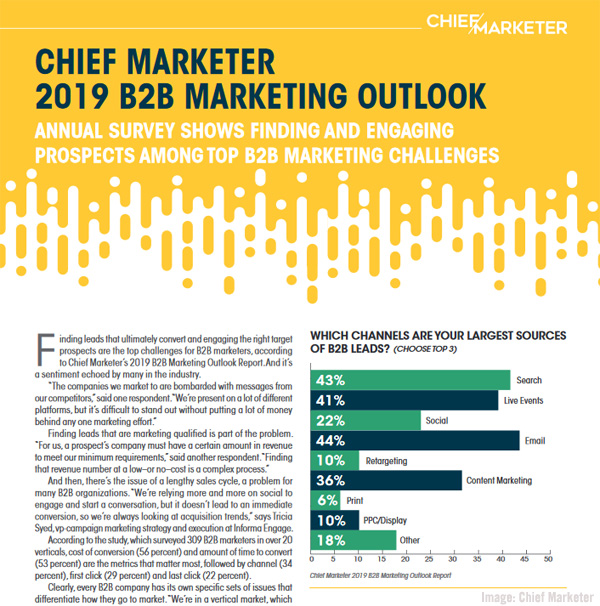
3 — Chief Marketer 2019 B2B Marketing Outlook Survey

Chief Marketer 2019 B2B Marketing Outlook Survey Image The Chief Marketer 2019 B2B Marketing Outlook Survey offers a wealth of B2B marketing data to learn from and apply to your own campaign strategies. Whether it’s which marketing channels are performing the best for B2B lead generation and nurturing, the increasing demand for higher-quality B2B content, or data to help increase support from the corporate suite, this report offers helpful insight.

4 — Vidyard: Video in Business Benchmark Report

Vidyard Video in Business Benchmark Report Image The average length of B2B video has decreased by 33 percent to just over four minutes, while the number of viewers watching the entirety of videos has climbed to 52 percent, up from 2017’s 46 percent — just a few of the detailed statistics of interest to digital marketers contained in the newly-released 2019 Video in Business Benchmark Report from Vidyard. The report is explored by Chief Marketer in “B2B Video Length Drops, but Engagement Increases,” and additional bonus video insight comes from a separate recent study, with MediaRadar’s “Research Insight: Video Ads Are Getting Longer.”

5 — Cision 2019 Global State of the Media Report

Cision 2019 Global State of the Media Report Image For 2019, the tenth-annual Cision Global State of the Media Report surveyed some 2,000 journalists to find out what matters the most in the push towards 2020, including insights into social media, trust and distrust in the media, and how big data will inform the future of content marketing.

6 — Shutterstock: State of Content Marketing

Shutterstock: State of Content Marketing Image A different take on the future of content comes from the Shutterstock: State of Content Marketing report, examining the changing roles of micro-influencers, data privacy and blockchain, micro-moments, social segmentation and personalization, plus other trends to follow.
7 — Mary Meeker 2019 Internet Trends Report

Mary Meeker 2019 Internet Trends Report Image Since 1995, one of the most anticipated reports containing B2B trend data is the “Mary Meeker Internet Trends Report,” and for 2019 it comes in packing a whopping 333 pages of information. Mary Meeker is founder of venture capital firm Bond Capital and former Kleiner Perkins general partner, and I recently took a close look at many of the B2B elements contained in her new report in “Key B2B Takeaways From the 2019 Internet Trends Report.” [bctt tweet="“Mary Meeker’s 2019 report paints a picture of a world where it’s more challenging than ever to find new growth in certain areas, but one that also shows very real opportunities in others.” @lanerellis" username="toprank"]
8 — LinkedIn: The Enlightened Tech Buyer: Powering Customer Decisions from Acquisition to Renewal

LinkedIn The Enlightened Tech Buyer Image LinkedIn’s 2019 global report “The Enlightened Tech Buyer: Powering Customer Decisions from Acquisition to Renewal” includes many insights for B2B marketers, taken from a survey of over 5,200 global professionals with roles centered around adopting new technology solutions. Our Senior Content Strategist Nick Nelson examines the report in detail in “Top Takeaways from LinkedIn’s New ‘Enlightened Tech Buyer’ Report,” a great way to quickly dig in to how B2B technology brands can market and sell more effectively. [bctt tweet="“Effective marketing now goes beyond the scope of traditional functions. Brands need to be readily available, with the right content at the right time.” @NickNelsonMN " username="toprank"]

9 — Buffer: 2019 State of Social

Buffer 2019 State of Social Image Buffer’s detailed 2019 State of Social report offers an in-depth look at what digital marketers are focusing on, along with an examination of many new and ongoing trends, and how the industry is changing. In conjunction with Social Chain, the newest Buffer report utilizes survey data gathered from over 1,800 marketers at firms of all sizes, and looks at issues such as how businesses are investing in influencer marketing and which social platforms businesses are having the most success with.

10 — Edison Research and Triton Digital: The Social Habit

Edison Research and Triton Digital The Social Habit Image The latest Edison Research and Triton Digital The Social Habit 2019 study includes many B2B marketing insights, leaning towards the social media side, showing how we’ve entered a new era now that social media usage has remained largely unchanged over the past four years, while Instagram has seen newfound success especially among young Americans. Jay Baer, Founder of Convince and Convert, takes a look at the study in “Social Media Usage Statistics for 2019 Reveal Surprising Shifts.”

11 — Pew Research Center: Mobile Technology and Home Broadband 2019

Pew Research Center Mobile Technology Image How the mobile landscape is changing in 2019 will have an impact on B2B marketers, and the Pew Research Center offers up a selection of related insights in its Mobile Technology and Home Broadband 2019 report.
12 — Sprout Social: Sprout Social Index: Edition XV: Empower & Elevate (2019)

Sprout Social Index Image Sprout Social’s most recent Sprout Social Index: Edition XV: Empower & Elevate (2019) surveyed more than 1,000 social media marketers to find out where their biggest successes are coming from, and where they plan to place their focus moving ahead. The report shows that Facebook, Instagram, Twitter, YouTube, Facebook Messenger, and LinkedIn are the most-used social media platforms among social marketers, and includes data relevant to B2B marketers well worth researching. Nathan Mendenhall took a look at some of the study results in “8 Social Media Marketing Stats You Shouldn't Ignore.” Sprout Social has also recently updated its study of the optimal times for publishing content on various social media platforms.

13 — Hootsuite / We Are Social: Digital 2019 Q2 Global Digital Statshot

Hootsuite / We Are Social Digital 2019 Image Hootsuite and We Are Social have produced another report filled with helpful information for B2B marketers, with their latest Digital 2019 Q2 Global Digital Statshot. The report utilized numerous sources and offers plenty of insight into where social media marketing currently stands and where it appears likely to be heading.
14 — Pew Research Center: January 2019 Core Trends Survey (2019)

Pew Research Center: January 2019 Core Trends Image The Pew Research Center has also taken a close look at how U.S. adults are using social media, in its recent “Share of U.S. adults using social media, including Facebook, is mostly unchanged since 2018,” offering additional data to help B2B marketers prepare for the social world of 2020 and beyond.
15 — Social Media Examiner: 2019 Social Media Marketing Industry Report

Social Media Examiner 2019 Social Media Marketing Industry Report Image The final of our 15 reports is Social Media Examiner’s eleventh-annual social media marketing industry report, the 2019 Social Media Marketing Industry Report. Company founder Michael Stelzner shares 46 pages of various statistical data pulled in from surveying over 4,800 marketers, and the report offers interpretation on how various aspects of social media are working for marketers today.

Fly High & Implement What You’ve Learned From 15 Reports

via GIPHY The 15 insightful and data-packed reports we’ve explored here from the Pew Research Center, Edelman, Edison Research, Cision, Shutterstock, Mary Meeker, Buffer, LinkedIn, Content Marketing Institute, MarketingProfs, Chief Marketer, Vidyard, Triton Digital, Sprout Social, Social Media Examiner, Hootsuite, and We Are Social will help you be as prepared and up-to-date as possible for whatever the future of content marketing may hold. Because it takes considerable time, top skills, and plenty of effort to create best-answer content marketing, it’s often wise to partner with a top-tier marketing agency, such as TopRank Marketing. We’ve had the honor of being named by Forrester as the only B2B marketing agency offering influencer marketing as a top capability in its latest “B2B Marketing Agencies, North America, Q1 2019” report.” *LinkedIn is a TopRank Marketing client.

The post 15 Reports Charting the Future of Content Marketing appeared first on Online Marketing Blog - TopRank®.

26 Jun 21:14

The markets poised to outperform developed countries like the US and UK might surprise you — but investors say they're the best places to look for growth

by Carmen Reinicke

India Commuters Train Crowded

  • Emerging markets are poised to lead developed markets on a growth basis for the rest of 2019, according to LPL Research.
  • There are positive growth opportunities in various countries from Brazil to India, and in industries such as technology.
  • Investors should also consider countries in emerging Europe. Russia was a top performer last year and is up more than 20% year-to-date. 
  • Read more on Markets Insider.

Investors looking for growth should consider often-overlooked markets outside the US — and even the developed world.

Emerging markets, which include countries such as Brazil, India, and China — as well as an array of others around the globe — are poised for growth as the US economy slows, according to one Wall Street firm.

"We still expect emerging markets to continue to lead developed markets in economic growth, given the challenges in developed markets," wrote a team of analysts from LPL Research for the firm's 2019 Midyear Outlook.

Emerging markets have lagged their peers in the developed world for some time as the economic recovery in the US has ramped up and boosted global growth. Now, however, the US economy is sending mixed signals that can be a good sign for emerging markets.

Developed countries outside the US are also dealing with barriers to growth; Brexit in Europe, the yellow vest protests in France, and budget problems in Italy have made emerging markets look increasingly appealing.

Increased urbanization and a rising middle class has boosted the potential for growth in countries outside of the US, said Rashmi Gupta, a money manager at JPMorgan Chase Bank. One example is India, a long-term overweight in her portfolio. India is a largely domestic economy, Gupta said, and thus tends to move differently from other countries.

In addition, since the country's election wrapped up in May, Prime Minister Modi has focused on economic growth in the country. "We expect India's GDP growth to outpace the rest of EM," wrote the team from LPL Research. 

Elsewhere, there are political reforms that could lead to growth such as in Brazil, which is up double-digits today. President Jair Bolsonaro campaigned on pension reform and it has remained a top priority of his in office. The bill's proposed overhaul of the social security system would leave more money to invest in economic growth, a huge opportunity if it passes, Gupta said.

A bonus just for you: Click here to claim 30 days of access to Business Insider PRIME

A number of Asian countries are also seeing positive earnings growth around technology, one particularly large area where EM countries have benefited because it has allowed them to leapfrog expensive infrastructure spending. A recent note from Lazard Asset Management points out that technology companies now make up nearly 30% of the MSCI Emerging Markets Index, up from 2.3% in 1995. They are now the biggest industry represented in the index. 

Of these technology firms, "some of the newer companies we're seeing in EM could potentially become global leaders," said Peter Gillespie, a portfolio manager at Lazard Asset Management, pointing out that there's been company growth in digital payments, online shopping, education, esports and 5G.

Most technology innovation is coming from China, Korea, Taiwan, and India, Gillespie said. But there are also opportunities to invest outside of Asia in countries such as Russia, Brazil and South Africa. 

This is not to say that all EM countries are immune to fears of slowing global growth or are not impacted by trade tensions — many are. However, given the current economic conditions in the US and globally, growth is harder to come by. EM can provide opportunities for growth and some protection from trade war fears if investors play their cards right and consider the entire EM landscape. 

For example, Gupta said that emerging Europe is often overlooked, especially Russia. This year, Russian equities are up more than 20%, and it was a top performer in EM last year. 

"We talk about emerging markets as one block one asset class but you have to remember that there are many different countries within emerging markets," Gupta said, with many different policy regimes, and many different drivers of growth.

He added: "I think that for managers it's one of the richest grounds for generating alpha or excess returns."

Join the conversation about this story »

NOW WATCH: 'Blue's Clues' is making a comeback with a new look and new host. Here's what the original host, Steve Burns, did after he quit the show.

26 Jun 21:13

Why Every Team Wall Should Have Personas on Them

by Dave West

As CEO and Product Owner for Scrum.org I get the amazing opportunity to visit lots of different companies. Recently I spent a week in Brazil visiting some amazing companies and talking about agility. The visit was fantastic for many reasons, but one thing did strike me as I toured many team rooms and looked at a large number of Scrum and Kanban boards. The walls lack any mention of the customer or mission. And then I realized that my team room also was lacking any mention of the customer as well!

Scrum is an amazing framework, but it does nothing without a mission. The intent of Scrum is not to be agile; it is to deliver value and because the value is hidden behind complexity Scrum is required. Scrum encourages the empirical process, self-organization and continuous improvement to solve complex problems and deliver value. Each complex situation has a customer. Our recently released Professional Scrum with User Experience spends two days providing Scrum Teams with a set of ideas of how to unlock the customer, and encourages that customers, their motivations and needs are made TRANSPARENT.

I can hear a Scrum Myth coming on, “Isn’t the Product Owner responsible for the customer?’” Yes, the Product Owner often has a deep knowledge of the customer and the market they live in, but it is EVERYONE’S responsibility to know thy customer! It would not be very agile if every time we had to make a decision about the customer, we had to talk to the Product Owner. The Product Owner makes decisions about value, which things to focus on and which things to do instead of other things. The Product Owner concentrates on economics. The team has to deliver value. They have 10000 decisions to make in pursuit of the economic value defined by the Product Owner. They need to understand the ‘why’, they need to understand the context, they need to have the motivation and desire to provide that value to the customer.

But there are still Scrum Teams that don’t know their customer! Or they have forgotten.

“A fictional character created to represent a user type that might use a product in a similar way.”

One approach to keeping the customer front and center is using customer personas. And when I say customer I do not mean people that pay, I include anyone that consumes the Product being built, this includes users, buyers, admins, etc. A persona is:

Alan Cooper is widely credited in using the term in his groundbreaking book, The Inmates are Running the Asylum. The book, as the title suggests encourages “creators” to take control of their work and engage the customer. Personas provide a tool for talking about customers in an abstract but practical fashion. They help inform the team by helping them ask questions like, “what would Bob do?” at Sprint Reviews or other inspection moments. They encourage healthy debate at Sprint Planning as we focus on outcomes for a particular persona. And, like everything in Scrum they enable us to inspect and adapt our understanding of them via delivering ‘stuff’. But perhaps the most important thing that personas give us is they help motivate the team because, though abstract they are about real people who need us to improve their lives! Personas connect the abstract product work to real human beings. Dan Pink described the value of knowing the context of the word in his amazing book Drive, the Surprising Truth that Motivates us as Purpose. Purpose along with Autonomy and Mastery are key ingredients to extrinsic motivation.

“But we don’t know our customer and it seems silly to be creating these fictional characters,” I hear you shout. After all, we are professional teams focused on doing stuff, personas sound like a fluffy nice to have!

The reality is that teams can get going quickly and just spending an hour looking at the customer and the types of customers the product serves can really expose assumptions and misunderstandings. Everyone has their own view of who the customer is and by making it explicit and on the wall those views can be exposed and then reviewed. Once the first version is ‘up’ we can regularly refine it adding additional ideas, thoughts, and assumptions as we deliver value to real customers and get feedback.

The other great thing about hanging up your personas is visitors can provide some really valuable perspective. For instance, when another team visits on their way to the pub they see the persona and say, “wow I did not know you served that role, did you know we did X or Y?”. Also, when the boss comes down from their gold-plated office it provides a reason to talk. Personas are great conversation starters. And it is amazing what you learn when you make your customer and their pains transparent.

And at the very least it makes your team room and walls look cool.

Scrum On.

26 Jun 21:13

5 Reasons Your Employees Should Have Strong LinkedIn Profiles

by Charlotte Rowe

ElisaRiva / Pixabay

Prospective clients and new hires are not only scanning your company’s website, but your LinkedIn company page and employees’ pages too, from the C-suite to interns alike.

There’s a demand for a holistic and comprehensive digital view of your firm—and this includes your employees. Many discussions on ways to bring a human element to corporate social media have focused on one individual–the CEO. However, brands are beginning to realize the importance of having the face of the company represented on social media through employees of all levels, actively engaging with clients and prospects.

These connections create relationships that resonate with clients, prospects, and hires, and they keep your firm top of mind. One of the best ways to establish these professional connections is through LinkedIn. Here are a few reasons and benefits for your employees to have strong LinkedIn profiles.

1. Positive public image and brand reputation

LinkedIn is a great opportunity for your firm to show off its collective company expertise. Prospects, clients and others can see the expertise of each employee if profiles are kept up to date with skills, experience, endorsements and accomplishments. Additionally, employees can post news updates, job openings and new hires to demonstrate the growth of your company. This puts your company in front of your employees’ networks, but also prospects, clients and job seekers who are searching for your company. It’s important that your CEO maintains a strong LinkedIn profile, as they are often the most well-known face of the company. But the collective presence of your employees on LinkedIn is essential in that it makes your brand more human and authentic.

2. Increased firm visibility

Oftentimes one of the only things an employee will do on LinkedIn to promote the firm is by updating their profile to list you as an employer, which links to your Company Page. This is important because a person’s job title and place of employment are the only thing you can see about another user before clicking on their profile. However, there are several other ways that employees can edit their profiles to increase the visibility and reach of your firm. Employees can include a brief description of your company under Experience or the Summary section of their profile, use company keywords in the job description, and even add a link to your website. Employees can also follow the Company Page so that it shows up in the Interests section of their profile, share thought leadership produced by colleagues, connect with their coworkers and give each other endorsements for relevant skills. All of these ideas will make your firm more visible when someone lands on an employee’s profile, and the keywords and information will help profiles appear in search engine or LinkedIn search results.

LinkedIn is great for search engine visibility. Oftentimes when your firm’s name is searched, its LinkedIn page will come up in the first several results. This valuable search engine real estate should be leveraged to show your firm to be the well-rounded capable partner that it is. To not take advantage of this search engine real estate is a missed opportunity.

3. Lead generation and nurturing

LinkedIn is a primary place to make professional connections. In fact, 80% of B2B leads generated on social media come from LinkedIn. When you meet people at conferences or speaking engagements, connecting with them on LinkedIn will give them insight into your brand and what it’d be like to work with you, and it gives them an easy way to connect with you going forward, should a need arise.

People want to know who they are working with, and LinkedIn is a primary way for prospects to assess whether they deem your team competent to handle their business. Also, being active on LinkedIn and engaging with your connections will allow for a more personalized experience that creates trust. This is not limited to firm leadership. When your employees are active on LinkedIn and keep their profile up to date in these ways, it creates a positive and engaged public image for your firm and makes your brand more human.

4. Further your brand reach

Part of having a strong LinkedIn profile is being active on the platform by sharing content and engaging with others. LinkedIn research says that on average, employee networks have 10 times as many connections as a firm’s Company Page followers. This means that turning employees into brand advocates on LinkedIn, where they engage with and share your company’s posts, will greatly increase the posts’ and page’s reach. When a post receives more engagement (likes, comments, shares), it will move up to the top of users’ news feeds. That means that even just by commenting on a post, employees can increase the visibility of your firm throughout their network. They also will be more likely to read and engage with the post because people are more likely to trust information that’s shared by someone they know.

5. Drive traffic to your website

LinkedIn is almost always a top referral to B2B and professional services websites, consistently driving a sizeable percentage of traffic to the sites, especially when updates are regularly shared via the company account. As your employees become more active on LinkedIn, engaging with your company’s posts or sharing blog articles, it will expand your reach and drive even more referrals to your site.

6. Attract Talent

LinkedIn is a primary tool for job seekers. And even if jobseekers aren’t actively looking for jobs on LinkedIn, they will almost always use LinkedIn to vet your firm and your people. Prospective employees want to get a sense of your culture and see who they would be working with. The most effective employer branding showcases what it’s really like to work for a firm, and LinkedIn is a great tool to allow prospects to gauge this by scrolling through your people.

A team effort

A strong LinkedIn presence is table stakes in today’s landscape, and the lack of a cohesive LinkedIn presence across your organization is an easy missed opportunity. Although not everyone is a social butterfly, keeping LinkedIn profiles up to date should be encouraged by employers, and inviting your people to like and share content at select intervals is something that is quite effective. Your employees will likely be happy to participate with encouragement and reminders. Your CEO and firm leadership should lead this effort! Management can set a good example by strengthening their own profiles and engaging with the company page in order to encourage others to do so too.

26 Jun 21:12

How Email Triggers Can Generate More Sales

by Stella Lincoln

To overcome the issue automating your emails is one of the best ways to increase your sales. You can send emails to the right person at the right time.

It is not activated all the time, but whenever a particular event occurs, or your website indicates something, it is sent automatically to the users. It is a reaction of the action taken by any particular user on your website. You can also schedule them at particular moments, like the birthday of your user or when you are willing to announce something publically or at Ester/Christmas, etc.

Boost Up Your Sales Through Different Types of Email Triggers

Email triggers are created based on prior information and data in the database. It is sent on different occasions and can work for you as a sale booster. Let’s discuss how it can be productive to increase sales and conversion rate.

1 Welcome Email After Subscription

Most of the website visitors are not yet prepared to purchase, but they are suitable for our automated email campaign as they have shown interest by registering. Now the main objective is to set up a relationship and persuade them to purchase.

What we could do best is to make them join our newsletter. This is a quick and primary activity, which will make them progressively slanted to make a buy. After subscribing to the website, clients will get an activated welcome email that may contain gifts with greetings (discounted coupons and offers) that rewards them for their trust and urges them to complete another activity (make a buy, give us reviews and take part in surveys, or sharing us on their social media network).

Obviously, this is not a 100% guaranteed process to convert users to buyers. However, it lets you track and screen the growth of a campaign and evaluate its effect on sales.

2 Send Greeting With Offers

Once, any user has filled the form for registration, you will have their basic information saved. Information like birth date, interests, and hobbies will work for you. If you haven’t included these slots in your registration form, include them now.

Send birthday emails to your users with personalized content and a promotional discount. Users enjoy when you wish them their special moments. It helps you to,

  • Improve your relationship with the customer
  • Build loyalty
  • Encourage them for a purchase

email triggers

It takes 5 times more investment to create a new customer than retaining a previous one. Hence, it is necessary to keep reminding your existing customers that you exist. Send them emails on different events based on their interests. Include packages and offers related to the upcoming event, which will make them purchase.

3 Reduce Cart Abandonment

About 7 out of each 10 users left your store without buying anything, even if they added products to the cart. To convert these users to buyers, you need to send them an automated email. Whenever your customer visits your store and add some items to the cart, be alert. After few days or a week, send them an email, reminding them they have left items in the cart. Make sure:

  • You have specified the items left in the cart and included product features
  • Get them a direct link so it could be easy to follow it back to purchase the item.
  • Offer discount or free shipping which will encourage the customer

4 Use FOMO Emails

FOMO is a Psychological term stands for ‘fear of missing out’. It could be utilized in marketing to attract more customers and make them purchase. According to a study by Strategy Online, 60% of millennials reacted to and made a purchase after experiencing FOMO.

It is a human behavior that we are more attracted to the things we think we might lose them. Similar goes with email marketing. Let suppose some of the products in your store are about to finish. What you need to do is to contact your vendor to send them more. Along with that, you should set a triggered email with each of your product or with the ones on high demand. This email will notify the users that a specific product will be out of stock soon, so you should buy it now.

email triggers

Again you need to be careful with your content, you should include details like product features and why the product is important so users could realize the importance of that item. Using phrases like ‘Only 7 Left’, ‘Don’t Miss Out’, or ‘Hurry Up’ could work for you.

Crowd Writer has utilized FOMO to increase their sales by 57% in June 2018. According to their co-founder Mrs. Tori Tucker,

“We were focusing on different marketing strategies to bring back our customers we lost during the past six months due to unsatisfactory customer support. Thanks to our Psychology tutor, ‘John Williams’ who advised us to utilize FOMO in our email marketing campaign, and it worked for us.”

5 Remind Your Customer About the Features You Offer

Either you are running an eCommerce store or a brick and mortar store, it is very important for your sales that your customers should know about the features you offer. Obviously, your features make you prominent among others, and if your customers are unaware about it, they will not going to buy regularly.

For the purpose, you can utilize automated emails. Send this email quarterly or every couple of months to the customers who are showing less interests in your services. Remind them how beneficial are you for them by telling them about the free services you are providing them. Highlight features like free shipping, 24/7 human support, etc. You can also target particular users by offering 20% or 30% discount code under the same email.

6 Send Reviews With Caption ‘What Others Say About Us’

Reviews are very important for newcomers. It creates a sense of authenticity about you and your services. Customers are more likely to make a purchase if they found true reviews about any particular service.

I will recommend you to send the reviews through emails to the users who have initially shown interest in your website and then moved away. Reviews could work as a magnetic attraction to bring these users back to you. It not only provides brand awareness but shows that your people are using your services.

While sending reviews through email, be careful not to send all reviews with a 5-star rating. Customers are more attracted to the brands with an overall rating of 4.2 to 4.5. Do not forget to send one or two negative reviews. It will show that you are loyal to the customers and will boost sales.

7 Send Product Recommendations

Product recommendation is one of the most used and traditional marketing strategies. It is how you make your customer feel special and promotes your different items. Online stores have observed an increase of 75% in the sales using product recommendations.

email triggers

By sharing personalized and relevant content based on customer’s browsing history and buying habits, these emails are beneficiary for the cross-sell and upsell scenarios. The best time to send the product recommendation email is right after your customer has made a purchase. Show them relevant products to the one they have just purchased. For example, your buyer has got jeans from your store, it will be best if you recommend some casual shirts and T-shirts.

Some More Tips & Tactics

Apart from the above strategies, you will need to optimize your emails to get more conversions and boosted sales. Let’s discuss some tips that will help you to increase your sales through email triggers.

Catchy Subject Line

Your subject line decides whether a receiver will open your email or not. A good subject line ensures a high opening rate and contact’s attraction. Try not to use long phrases. Be precise and use positive words.

Personalization

Have a look at the below two emails and decide which will work for you.

“Hi,

It is our pleasure to have you at our place. We hope that you enjoyed the meal. Kindly fill the attached review form. We will appreciate your feedback.

Regards,”

OR

Hi Mrs. Carnell,

We hope you enjoyed your meal on Sunday at 10 pm with your family at table number 5 at our place. We would love to have your review about the Hamburgers and Peanut Shake.

Regards,”

I’m sure you will like to receive the second email as it is more personalized.

Well-Arranged and Compelling Content

Most of the time, users did not read the email word by word. The just go through it and find something of their interest. Your content should be so organized that it delivers your message with just a look at it. Make your content persuasive so that it could bring you more sales.

email triggers

Use CTA

Try to use at least one call to action button with your triggered email. It will improve your CTR and will lead your user to your desired destination easily.

Analyze Your Outcome

Track the performance of your triggered emails through your website’s monitoring system. It will allow you to take the necessary actions in your future campaigns.

26 Jun 21:12

Value-Based Pricing for Professional Services

by Lee Frederiksen

Today’s professional services firms face challenges from many directions. Increased competition and commoditization of services put downward price pressure on services even as talent shortages drive up costs. And the advent of artificial intelligence and automation threatens to undermine some firms’ core service offerings.

It should come as no surprise, then, that many voices have suggested the adoption of alternative pricing models to reflect new approaches to building and capturing value. This post will focus on one of the most promising of those approaches, value-based pricing.

Value-Based Pricing Defined

Value-Based Pricing is a pricing strategy that attempts to capture the extra value that a particular client segment associates with a particular feature or benefit of your firm’s service. It requires that your service offering is different in some meaningful way from your competitors (i.e., differentiated) and that potential clients value that difference.

Value-based pricing rests on two key concepts. First, the value of a service is subjective and will likely vary for clients in different circumstances. Further, a given service may be perceived as more or less valuable depending on how it is “framed” or explained. This point is particularly important for professional services, since many clients have little understanding of the real business value of the services they buy.

The second key observation is that the cost of providing a service is only partially related to its perceived value. The client is the final judge of the value received and is often unaware of what is involved in providing a deliverable. This can lead to mismatched expectations between client and service provider. In fact, fear of “overpaying” is the second biggest concern of professional services buyers (after not solving the problem).

How a Value Pricing Strategy is Different

A value-based pricing strategy can be contrasted with three other pricing strategies common to the professional services marketplace.

Time and Materials Pricing involves calculating the cost of the labor (time) and other expenses (materials) and adding a markup to cover overhead and profit. This marked up rate is often referred to as hourly billing rate and may vary depending on who does the work. More-senior professionals, or those employed at firms with a stronger brand, typically command a higher rate.

Market Pricing, another common approach to pricing professional services, attempts to price a service at a rate that reflects the price commonly paid for this service at competitive service providers. This pricing model assumes that the service and benefits are comparable across competitors (i.e., undifferentiated). A firm may choose to be at the low end of the market to gain a pricing advantage or at the high end of the market (premium pricing) to capture the value of their brand or reputation.

Package Pricing is a strategy that offers a fixed price for a defined group of services. Sometimes called fixed pricing, this strategy can be used with or without value pricing. However, there is a natural affinity between package pricing and value pricing. Since clients are not being billed based on time spent, they are already focused on the overall value of the package. This makes value pricing easier to implement.

Value Pricing Examples

To understand how value pricing works, let’s start with a simple example. Consider an accounting firm that offers an outsourced bookkeeping and accounting service. Three local competitors offer this same basic service at around $1,000 per month. In a market pricing scenario, the firm would charge around the same amount to remain competitive.

However, this firm has observed that clients often ask what the monthly financial reports mean for their business. So the firm decides to provide analysis and basic business advisory services as part of their offering. This increases their cost by about $200 per month. In a time and materials scenario, the firm would simply raise its monthly fee to $1,200.

But by researching potential clients they learn that a segment of clients feels that the analysis and insight services doubles the value they receive. A value-pricing scenario would suggest that their enhanced package should be priced at $2,000 per month and marketed to that prospect segment that perceives the added value.

Now, lets assume that the firm acquires some new software that automates a number of routine functions, reducing their monthly labor expenses by 20%. Do they reduce their monthly fee by a corresponding amount? A value-pricing strategy would say no, as long as the automation does not impact the value clients receive.

But what if the new software offers greater functionality and delivers more insightful analysis? If clients recognize more value because you have explained and framed these new capabilities appropriately, a price increase would be in order. However, if this new value goes unrecognized or unappreciated, you will be unable to harvest that potential value.

Benefits of a Value Pricing Strategy

As you come to understand how value pricing works, it becomes quite clear that it has many benefits to offer the professional services. Below are the top five benefits, in our experience.

  1. Both you and your client are focused on the same thing: the real business impact of the services. In a traditional hourly billing model you focus on the cost of providing the service. How long will it take? Who will do the work? Your client is focused on the value of the service. Will it be worth the expense? Will it really solve my problem? In a value pricing model, however, both client and provider are focused on the value received. Their interests are better aligned, which promotes better communications and outcomes.
  1. It allows you to better capture the value of your expertise and insight. One of the cruel ironies of time-based billing is that it punishes fast and efficient professionals. The more skilled you are at a task, the less time it takes you to do it well. In a time-based scenario, a highly skilled professional might charge lessthan a bumbling beginner! This can add administrative and operational burdens, as the client may feel a need to micromanage your choice of resources. To some degree, different billing rates can offset this time discrepancy. But billing rates are only a crude reflection of the value a top-level expert can bring to a project. The right expert could add thousands of dollars of value in minutes. Value pricing frees you to leverage resources as you please. And perhaps more important, you can capture the full value of the greater efficiency and added insight that a highly trained specialist brings to a project.
  1. It adds predictability to pricing. No one likes “billing surprises.” When competently delivered, value pricing should have no unexpected charges. Scope and price are agreed upon before work is started. If a material change occurs, the price can be adjusted accordingly (with a change order, for instance). From a psychological perspective, this arrangement frees the client from avoiding important questions or discussions simply because they are afraid of incurring hourly fees.
  1. It encourages you to leverage technology and optimize processes. Why would you invest in time-saving technology or systematic process improvement if it only reducedyour revenue? A value-based approach eliminates this problem. Instead, it incentivizes you to embrace every margin-boosting improvement in process or technology that does not compromise the client deliverable. Further, if the technology or process improvements add more value, even better.
  2. It reduces common billing questions and disputes. Just because your charges are accurate and well documented doesn’t mean they don’t annoy clients. “You charged me (insert the hourly fee amount) just to photocopy a document? That’s outrageous!” If you currently use time-based billing, some variation of this conversation is probably painfully familiar. Value pricing eliminates these conversations. The client does not see hourly rates or time and task details. Annoyance avoided.

Common Barriers to Overcome

So in light of all these benefits, why isn’t value pricing more widely practiced within the professional services? The answer is probably because there are significant barriers to overcome when implementing it. Here are some of the most common ones and some strategies to get past them.

It requires a change in core administrative processes.

Sometimes a firm’s administrative processes can present barriers to value pricing. If your billing system automatically generates invoices based on tracked time, there may be internal resistance to adjusting these processes. Similarly, if your firm compensates staff and/or equity partners based on billable hours, value-based billing could turn that model on its head. And even if the required changes to your system are relatively minor, you may encounter resistance simply because many people dislike change.

To counter this barrier, focus on educating affected people on the benefits of a value-based pricing strategy. The upside typically outweighs any associated costs by a wide margin. Also consider positioning your initial moves toward value pricing as an experiment that can be adjusted or expanded as you gain experience.

Many professionals are unsure how to calculate the value of their services.

This is a very common issue in many professional services industries. Unless executives and billable staff have prior training and experience with value-based pricing it can seem arbitrary and downright risky. This often creates anxiety and hesitation.

Training and successful experience will typically overcome this concern. And of course, it is incredibly important to have a systematic process to follow for establishing your pricing. Below, we describe the model that we use at Hinge and recommend to our clients. It minimizes the seeming arbitrary nature of value pricing while preserving the ability to be flexible as you encounter various business situations.

It requires a rethinking of the entire business development approach.

Business development is no longer just about describing what you will do and how long it will take. You must now consider the full impact of your services. Do they actually solve the business problem at issue? What is the value of solving those problems? Does your approach add value over and above what a competitor would do? How can you demonstrate that value? Does the potential client trust that you can deliver on your promise?

Each of these questions could have a significant impact on the price you can command for your services. Many professionals will need a new way of thinking about the process of business development and an opportunity to develop the skills needed for success. You need to be a good listener as well as a strong presenter. Your proposal will need to be convincing to justify what may seem like a premium price to the selection team. And above all, you must believe in the value you can create. If you don’t believe in the impact of your approach, it is unlikely that the prospective client will either.

Some potential clients will not accept value pricing.

Not every potential client will appreciate the benefits of value pricing. And even if they do appreciate it, they may not be in a position to act. Some prospective buyers simply can’t afford premium pricing. Or your designated contacts may be reluctant to request the additional funds for fear of putting their career at risk. And just as you may have internal policies or processes that make administrating value pricing a challenge, so to may your potential client.

While you may be able to overcome some of these challenges, you may not be able to conquer them all. You will have to accept the fact that value pricing will not work in all situations. Having said that, the upside is so substantial that it outweighs the loses you may experience. Track you closing percentage and compare it to your pre-value-pricing baseline. Take note of the margins on value-priced and non-value-priced projects, as well. What you will likely discover is that the value-pricing approach delivers superior results.

It demands a higher level of project management.

Time and materials billing can hide a lot of project management inefficiencies and missteps. If it takes more time, you simply charge for more hours. In this scenario, the client bears all the project execution risks. (No wonder they are so nervous!) With a package price or value price model, however, that risk is assumed by you. (Now look who is nervous.) You also inherit the nearly universal problem of “scope creep,” in which the client’s needs evolve as the project unfolds and they want more than originally bargained for. If these adjustments fall outside the original scope, you may need to adjust that scope. Generally, this adjustment is handled with a “change order” that spells out any changes in scope and their associated additional costs.

In many ways, this value-based arrangement is a benefit. It forces you to focus on the project delivery process and relate it to the value delivered. In our experience, it tends to improve both efficiency and the client experience. But it does take dedicated effort and training to make sure you have a methodical project management process that keeps projects within scope and achieves the desired outcomes.

How to Implement a Value-Based Pricing Model

Step 1: Understand the business issues your service is meant to address.

Start by understanding the business context that your services address. Go beyond what specific services clients are requesting and try to understand the “why” behind the request. Is there an unusual urgency? Is this an essential step in a larger business strategy? Understanding this business context will help you determine what you need to accomplish (see Step 2) and the real value that your client will receive (see Step 3).

  • Is this a regulatory requirement that triggers a natural instinct to minimize costs? How can you approach it so that you can add real value beyond a simple check the box exercise?
  • Is this a situation where anxieties are high and finding an approach that will reduce them will add real value? Remember that value is subjective and is ultimately judged by the client. While it may seem trivial to you, this kind of emotional relief can be very valuable to a client.
  • Is this a growth opportunity where the upside potential is key? Think in terms of increased revenue and profits over time.
  • Is it a cost reduction or efficiency play where potential savings are the driver? Here again the metric will likely be cost savings or increased efficiencies expressed in economic terms. Think of the savings extend out over time.

Step 2: Calculate your costs to deliver that service.
How will you address this challenge? What is your approach and how will you staff the engagement? To many professionals, this step will feel very familiar, especially if you are used to giving estimates or doing fixed-price projects.Consider similar projects you have done in the past. What did it take to achieve the results you are trying to achieve here? Try to be realistic about what will be required. Take into account this particular prospect and their unique situation. Give yourself a little “wiggle room” in case you are being a bit too optimistic.Then calculate the cost using your billing rate, including overhead and a reasonable profit margin. If you do not have billing rates, take your direct costs and add a sufficient margin to cover overhead and profits. This is your floor. It is (or should be) the minimum that you will accept to do the job.

You might think of this as sort of a package price that does not yet have a value-billing component added. Now we’ll turn to the value add side of your pricing calculation.

Step 3: Estimate the value of fully addressing the targeted business issues.

Start this step by adopting your potential client’s perspective. What is the value to me (the client) of fully achieving the real results I’m seeking? Think back to the first step. If I knew for sure that the proposed approach would work as described what is that outcome worth?

Consider cumulative benefits over a realistic time frame. Include both the tangible and intangible benefits. Now, this is the area where many professionals falter. They feel out of their depth when trying to assess subjective value.

There are alternatives to consider. If you are constructing a package that you want to offer to multiple clients, you may want to do some research on the perceived value of different possible service combinations. This type of research is a common practice in many consumer-focused marketing organizations. Research will reduce your risk and give you a more objective starting place for your pricing decisions. It is an approach favored by many of our clients when making these decisions.

Step 4: Adjust the value price to fit the current business context.

You now have developed your pricing floor by focusing on your estimated costs in Step 2 and your projected price ceiling by focusing on estimated value in Step 3. These are the range of prices to consider. Now it is time to decide what price to offer to the prospective client.

From your perspective you are trying to determine how much of the value you will bring to the engagement can be captured. The client is trying to determine the likelihood that the value you promise will actually be delivered. “Will I actually receive this much savings?”

When making these judgments consider these factors:

  • What is the probability that we can deliver the promised benefits? The lower the likelihood, the lower the price.
  • What is the emotional impact of the service we provide? Does it reduce anxiety and stress? Remove a serious threat? The greater the relief, the higher the price you can charge.
  • What is the client’s ability to pay what you want to charge? Is it easy or will it take a major effort on the client’s part? Even if the payoff is great, if a buyer cannot afford it, they are unlikely to move ahead with your offer.

You may be able to impact these factors by the way you structure the offer to the client. For example some firms will tie their fees to the results actually achieved. Let’s say you are reviewing a firm’s state and local tax filings to find opportunities for savings. The fee may be quoted as 50% of any documented savings. Or you might charge a reasonable base fee (calculated in Step 2) that will be paid no matter what, and set additional fees that will be paid upon achieving specific goals or metrics. This structure dramatically reduces the client’s uncertainty and perceived risk and makes it an easy sale.

Another common mechanism is to offer some type of guarantee. Here again you are removing perceived risk and making it easier for the client to accept your offer.

Step 5: Build the case for your value price.

Your goal with this step is to help the prospective client understand and appreciate the value that they will receive by working with you. Remember that value is based on the client’s perception, so you need to be able to help them “see the value” before you have started work.

The best business developers are able to paint a mental picture of how the client’s organization will be improved or transformed by your work. They can help the client anticipate the emotional relief they will experience or the joy they will feel when the desired outcome materializes. Case stories and examples are very helpful at this stage of the process.

But it is not just the emotional part of the proposal that is important. If you can present relevant analytics and past performance data, that may be very persuasive to others. It’s not emotion or rationale, it’s both.

And remember, often these purchasing decisions will be made by committees. So be sure to arm your advocates with the tools they need to persuade their colleagues that your value-pricing approach is the right one for them.

A Final Thought

The professional services landscape is rapidly changing. Technology, new business models and the threat of commoditization are eroding traditional ways of providing value to clients. Firms will need to find new ways to compete — and new ways to package, and be compensated for, the value they can deliver. Value-based pricing is well suited to this challenge.

25 Jun 17:39

Here's why transportation leaders including Daimler and Volkswagen are pouring billions into R&D for electric trucks (UPS, DMLRY, BUD, OTC, TSLA, FDX, VWAPY, PEP)

by Ayoub Aouad

This is a preview of a research report from Business Insider Intelligence. Current subscribers can read the report here.

Trucking, which can be perceived as the lifeblood of global economies, has experienced healthy growth in recent years due in part to surging e-commerce shipments. In the US alone, trucking accounted for over $700 billion in revenue, representing a 3.5% increase year-over-year (YoY).

When Parity Will Be Achieved Between Commercial Battery Electric Trucks and Diesels

However, to maintain its stature, the entire industry — truck manufacturers, fleet managers, and other logistics companies — will have to transform to meet the demands of the future. As a result, the trucking industry is in the early stages of a technological shift, with a particular focus on transitioning fleets from diesel to electric energy.

While electric trucks (e-trucks) are not an entirely new concept — they've been around in some form for over a century — three key factors are renewing focus in the technology: government-mandated reductions in carbon emissions, the rising total cost of fleet ownership (TCO), and heightened investment in e-truck infrastructure. 

As such, the industry is seeing many any high-profile companies already investing in commercial e-truck technology: For example, Daimler, the parent company of Mercedes-Benz, is plowing $3.2 billion into the research and development of e-trucks over the next two years, and Volkswagen will invest $1.7 billion in e-truck and bus technology by 2022. And leading logistics companies are following suit, increasingly incorporating e-trucks into their operations: UPS announced that it will collaborate with Workhorse Group to deploy 50 electric delivery trucks, for example. 

In the E-truck Report, Business Insider Intelligence will size the e-truck market and identify the core drivers that will lead to e-truck adoption. We also discuss which segments of the trucking industry will be early adopters and profile the players expected to take on a prominent role in the future of e-trucking. Finally, we look at what manufacturers and logistics companies will have to do to not only advance the market but also prepare for the operational changes that come with deploying new technology. 

The companies mentioned in this report are: Anheuser-Busch, ChargePoint, DHL, Daimler, Element Fleet Management, FedEx, PepsiCo, Tesla, UPS, Volkswagen, Workhorse Group, and Vion.

Here are some of the key takeaways from the report:

  • The trucking industry is transforming from diesel fuel-based to electric-powered, and the e-truck market is expected to climb at a 30% compound annual growth rate by 2026 as a result. 
  • Automakers and logistics firms are turning to e-trucks for three reasons: a global push for stricter emissions regulation, rising TCO, and increased investments in the e-truck infrastructure. 
  • In the near term, e-trucks will be most useful for short to medium-length trips, like urban deliveries, carried out by Class 3 to 6 vehicles. 
  • A network of companies — automakers, logistics firms, and charging startups — are making shorter-distance trucks a reality while laying the groundwork for long-haul e-trucks to become viable. 
  • E-trucks will eventually become the norm for the trucking world, but not without significant work on the part of truck manufacturers and logistics companies.

In full, the report:

  • Identifies and explains the factors that will be core in rising e-truck development and adoption. 
  • Details what some of the leading manufacturers and logistics companies are doing to improve their e-truck offerings and solutions.
  • Pinpoints where early adoption will occur and what will need to happen for all e-trucks to become viable options for other logistics companies. 
  • Outlines what manufacturers and logistics companies need to do in order to take full advantage of a market that is poised to grow as market pressures only continue to increase going forward. 


SEE ALSO: These are the top 5 startups across digital freight services, warehouse robotics, AI, last-mile delivery robotics, and self-driving cars

Join the conversation about this story »

25 Jun 17:38

How Tableau's CEO pulled off a giant $15.7 billion sale to Salesforce with no experience of running or selling a public company

by Shona Ghosh

adam selipsky christian chabot_tableau

  • Tableau CEO Adam Selipsky is fresh from Salesforce's $15.7 billion deal to buy his company.
  • Selipsky is an Amazon cloud software veteran who had never run a public company before joining Tableau, nor had he ever negotiated a mega-acquisition.
  • Salesforce was already interested in buying Tableau, which sells data visualization software, by the time Selipsky joined. He says a relentless focus on customers made the firm more attractive.
  • Click here for more BI Prime stories.

Before pulling off one of the biggest deals in the history of enterprise technology, Adam Selipsky was a newbie at two things: running companies, and selling them for billions of dollars.

That all changed after Selipsky took over the top job at listed data visualization firm Tableau in 2016, then negotiated a $15.7 billion sale to software giant Salesforce.

Selipsky is extremely tight-lipped about the deal, which was announced on 10 June but won't close for a few months yet. You can read about the drama in the run-up to the deal here.

But he did say he had been upfront with Tableau's board while interviewing for the job in 2016.

In an interview with Business Insider, Selipsky said: "I was very open about this when I came in — the question did come up when I entered Tableau — I actually have very little experience in sizeable acquisitions on either the acquirer or acquiree side.

"I was really open about the fact that I was coming in to help build a long-term, successful, sustainable franchise and make customers wildly successful."

Read more: A CEO who negotiated directly with Jeff Bezos reveals what Amazon is like as a strategic investor and buyer

Selipsky came in as CEO of Tableau in September 2016, replacing founding CEO Christian Chabot. The firm had gone public under Chabot in 2013, but the firm's stock price had plummeted by the beginning of 2016. Selipsky was a veteran cloud software exec, having spent the best part of a decade at Amazon Web Services. He had, however, never been a CEO.

He viewed the chance to run a public company as an opportunity for "personal growth." "It was a good combination of a situation in which I could contribute a lot as well as continue to learn a lot. I always think that's a good combination," he said.

Salesforce was talking to Tableau about a deal as early as 2016, just before Selipsky joined

Along with the learning curve of being directly accountable to shareholders, Selipsky would have gone into the job knowing that Salesforce was a potential and even likely acquirer.

About a month after Selipsky's appointment, an internal Salesforce presentation titled "M&A target review" leaked and showed which firms might be acquisition targets for the cloud giant. The presentation was dated May 2016, and listed Tableau as one of three likely targets. A footnote in the presentation stated that a Tableau discussion was "in play" and The Wall Street Journal reported that the two companies had had talks that summer.

In other words, a deal with Salesforce was already on the table when Selipsky was appointed. But for whatever reason, a sale wouldn't happen for another three years.

If Tableau's board had brought in Selipsky to drive up the price, they were successful.

Tableau had a troubled start to 2016, with its share price cratering to $40.25 and giving it a market cap of around $3 billion, according to MacroTrends. Its performance began to improve under after Selipsky took over the top job, and its share price had lifted to $125.21 just before its acquisition was announced.

Selipsky told Business Insider that a sale had not been his primary goal. Instead, he had taken his one major lesson from Amazon to transform Tableau's fortunes: a relentless focus on the customer.

"If you take that focus and build a sustainable long-term business, that makes you more attractive as an acquisition candidate," he said. "The less you focus on it, perhaps the more valuable you become. Honestly, starting with myself, we completely heads down, completely focused on the business, and focused on the customers."

In person, Selipsky is a different character from Salesforce founder and CEO Marc Benioff.

He is fairly conventionally dressed in a grey suit, has close-cropped hair, and sticks to talking points about Tableau. He thumps on the desk with his hand when talking about customer focus and the opportunities in big data. From what he says, he's a detail-oriented type.

salesforce tower san francisco marc benioff 5332

Benioff, by contrast, is a big-vision, loud personality who famously sports customized designer sneakers and once had Hawaiian dancers open Salesforce's annual Dreamforce conference.

For now, Selipsky will continue to run Tableau as a separate brand and its management team will stay on. The firm will remain in its Seattle headquarters, effectively creating a second headquarters for Salesforce, whose head office is in San Francisco.

In time, he says, the two will become more closely merged. "I think from a company and a customer perspective, things are really going to stay intact," he said. "At the same time, we have tremendous opportunities for synergies and integration with Salesforce."

SEE ALSO: Gympass raises $300 million from SoftBank's Vision Fund and other backers to get office workers into the gym

Join the conversation about this story »

NOW WATCH: Watch Ford's delivery robot that walks on two legs like a human

25 Jun 17:37

VCs say that these common problems sink startups ⁠— here are 5 lessons they give founders to avoid failure

by Callum Burroughs

Elizabeth Holmes Theranos

  • Business Insider spoke to two VCs and a startup mentor who outlined some of the biggest pitfalls plaguing new companies — from excessive funding to poor management. 
  • "Getting the right founders is one of the toughest things in our job," says one VC. 
  • Click here for more BI Prime stories.

Building startups can be an arduous task. Founders need funding, a great idea, good advice, and a large dose of luck to succeed — but even all the right ingredients aren't a guarantee of success. 

From Theranos to Juicero, majorly hyped startups have gone from investment darlings to case studies on MBA courses. 

Business Insider spoke to two VCs and a startup mentor who outlined four pitfalls that tend to sink companies and how to avoid them. 

1. Poor product

Having a market leading product is essential. Prior to launching, a company needs to both know that customers want the product, and demonstrate a strong revenue base from purchases. 

"Customer acquisition is key," Max Kelly, an SVP at startup accelerator Techstars, said in an interview with Business Insider. "You need repeatable, scalable sales to ensure strong revenue growth."

Juicero was an excellent example of hype masking a product that ultimately wasn't very good. The company claimed its $400 juice maker would crush sachets of pre-cut fruit and vegetables with two tons of force. It was later found that squeezing the juice packets with two hands had the same effect. The company received over $120 million in VC funding. 

2. Too much money, too early

"Too much money early on can swamp businesses," Kelly said. 

Having too much funding can lead to a culture of execs which damages a startup's ability to make rational spending decisions and prioritize things. Failed startup fund Rothenberg Ventures is a good example of a company which failed to get its priorities in order, having spent $200,000 of investors money on a box at the Super Bowl. 

Rothenberg Ventures did not respond to requests for comment.

Avoiding these kinds of issues is all about governance, according to Reshma Sohoni, cofounder of London-based VC and accelerator Seedcamp. "It's a fallacy of startups that governance makes you slow, but having these structures in place is what ultimately builds the right mindset for subsequent growth," she said in an interview with Business Insider.

And sometimes the risk of failure isn't a VC deterrent, especially for bigger funds. 

"Some funds can afford a cockup because they have so much capital to deploy," said Rob Moffat, a partner at Balderton Capital in London, who used to work at Google and Bain.

Reshma Sohoni

3. Failing to hire the right people

Unsurprisingly, getting the right people in to help scale and grow your business is one of the main reasons startups are successful.

"It's team, team, team for us," Kelly said. "Hiring the right team is essential and getting the best people in is massively important to a company's infrastructure."

VC's noted that hiring top talent was key to getting over growth hurdles. This can be tricky for some founders who are unwilling to hire staff who are more qualified than them or fail to pick people suited to hard-working cultures. 

On top of that, erratic management from founders and management can have a real impact on the culture of a startup. At Zenefits, an insurance market disruptor, the company's larger than life founder Parker Conrad was found to have stopped at nothing to scale rapidly while the business was also increasingly famous for wild, out-of-control parties.

Conrad even created an internet extension which allowed employees to bypass a 52-hour online course required by the state of California to sell insurance there, according to Bloomberg.

When contacted by Business Insider, Zenefits CEO Jay Fulcher said: "The company grew too quickly, in an unchecked way, and spent too wildly. But, we haven't lost our way or our potential."

"There's a winner-take-all mentality in more and more markets," said Sohoni. "This growth pressure can be a powerful driver to cut corners. Founders with good or bad behaviour, therefore, have outsize impact, because their attitudes and behaviours permeate right across their businesses."

4. Misguided belief from founders

The pages of startup history are littered with founders who extol the virtues of incredible self belief and a determination to succeed. Unfortunately, these same individuals can be the designers of their own downfall as they stop at nothing to win at all costs.

Famously, Elizabeth Holmes of Theranos took in billions in investor money for a blood testing product which ultimately didn't work. 

"There's a fine line in entrepreneurship between having massive belief in your business and abilities but you can stray very quickly away from that," said Moffat. "Getting the right founders is one of the toughest things in our job."

You can read more about Theranos in this Business Insider story by Lydia Ramsey. Holmes' lawyers did not respond to a request for comment. 

5. Failing to know your rivals

Competitors in the same industry can kill growing startups in their tracks.

In the US, wearable fitness Jawbone was blown out of the water by similar products from Apple and Fitbit, which were seen as a better device at a lower pricepoint. 

Similarly, UK ride hailer Hailo was swamped by companies such as Uber. Hailo raised $100 million to push into the US market, despite the fact that competitor Uber had raised $1.5 billion by the same stage.

"Hailo didn't know enough about its enemy's ability to raise funds much faster, and the sheer quantity of funds needed to build scale across the big US cities," Moffat wrote in a blog post. 

SEE ALSO: These 5 charts show why London's fintech scene could soon eclipse Silicon Valley's

Join the conversation about this story »

NOW WATCH: WATCH: The legendary economist who predicted the housing crisis says the US will win the trade war

25 Jun 17:26

Leveraging Email in Your Mobile App

by Miles DePaul

A person holds an iPhone up in front of his computer

Have you ever looked at all the apps on your phone and wondered what went into making them? Maybe you’re on track to start building your own. But, whether you’re building an app to support a larger project, or building the next big thing in the App Store, you’ll quickly realize that email is a much larger part of your user’s experience than you expected.

Starting even before you sit down to build your app, all the way to scaling and monetizing your app, email plays a pivotal role in its success. All along your app’s journey, email has a role to play. It can be used as a tool to feel out what interest there might be in the idea behind your app, then used to promote and engage users before and after launch, and finally improve engagement and user experience on an on-going basis.

So let’s dive in and see how email can help drive interest, downloads, and most elusive in the app universe – recurring users.

Table of Contents

  1. Why email marketing
  2. Using email collection as a proof of concept
  3. Email in your app’s onboarding process
  4. Use behavioral emails to increase active users

Why email marketing

Before anything, we’re going to set the stage by telling you why email should play a crucial role in your app’s marketing. As we’ve said many (many) times, email is the most personal and impactful medium for communicating with users and prospective users.

With a return of $40 for every $1 spent, email marketing continues to drive far better engagement than any other channel, including keyword advertising (17:1) or banner advertising (2:1).

Email also allows you to interact with your users in a secure and private way. You can easily send important communications like password resets, billing information, usage reports, and more to your users.

If you have any plans to communicate with your users outside of the app, make sure you include email in your plans. If you don’t, you’ll not only miss out on improved engagement, but you may also take a hit in the customer experience department.

Using email collection as a proof of concept

Everyone from your doctor to your grandmother has an idea for an app. It’s why we have apps like Drake Shake, which adds a photo of Drake to any photo, by just shaking your phone.

Brilliant, right? We’re wondering why we didn’t come up with that one ourselves.

And it’s getting easier than ever to build apps. With intuitive platforms popping up everywhere letting you create a basic app without any code, anyone can make an app and put it on the market.

But like anything else, just because you built it doesn’t mean they’ll come.

via GIPHY

Regardless of whether you’re a student looking to come up with the next big thing, or a large company considering a new app launch, you should first validate and confirm that the idea behind your app has some traction.

Email is going to make this easy for you.

You can do this by launching a simple landing page with some branding and key messages, and an email collection form. If your idea and your message resonates, people will sign up for your list. If your list is big enough, it’s a good indicator that you should probably build your app.

Brands as big as Buffer created a landing page just like this to validate their idea before ever launching their real product. They launched a landing page with a logo, some key messages about the product they wanted to build, and a single call-to-action – “Plans and Pricing”.

Buffers landing page to validate their idea

If you were intrigued enough to explore plans and pricing, you would have been sent to a page that said “Hello! You caught us before we’re ready”.

Buffer offers to let you put in your email address to be added to the list

Now, Buffer knows that X number of people were interested in looking at pricing, and Y number of people were so interested in their product that they provided an email. That’s some invaluable data before launching a new product or app.

There are an endless number of apps like Hipster that did the same thing to simply tease an idea, validate interest, and then build an email list to begin to nurture future users.

Hipster landing page with a photo of the Golden Gate Bridge

Harry’s Razor’s, while not an app, is a great example of how to build a list of excited customers/users pre-launch and then use this same audience to drive viral expansion.

Ahead of the launch, Harry’s rewarded users who invited their friends and family by gifting them with free products. With one click, users could invite others to join the list. You can also easily integrate an email service provider like Mailjet into your website to trigger these personalized emails immediately. Just think, wouldn’t you be much more likely to try out a product if your best friend told you to give it a go?

Harrys pre-launch page with a photo of a mammoth

You can use the same logic in your app to create a viral effect. What can you offer to users to encourage them to share? A free product? Free credits? Early access to the app? Social credit?

In fact, this is such a popular approach to product validation that Product Hunt built an entire service for users to create lead capture landing pages for this specific purpose. There are even apps like Sparetoolz that help you prep for launch with an easy email list collection tool to (1) validate the idea, and (2) ensure that when the product is ready to launch, you have an engaged list of emails you can promote to right away.

via GIPHY

Email in your app’s onboarding process

Use an email to educate about the app

As you gear up for launch day, you might want to use your pre-launch email list to invite users to the beta launch or full launch of your app. We’re going to throw a pretty heavy statistic at you, so are you ready? Here it is: 80% of users delete an app they downloaded within just three days. Keeping this in mind, it’s important to optimize those first three days for on-going success. And email is one of the ways to do this.

Giving them a little reminder about why they signed up for your list in the first place is a good place to start. As Lyft does below in it’s introductory email, make it clear (1) what your app does, (2) why it will benefit the user, and (3) how they can get started NOW.

Lyfts welcome email

Introduce them to a feature they may not know about

Getting a contact from your email list to actually download the app is one thing. Getting them use your app daily (or weekly) is a whole other beast. One great way is to use email promotions to introduce, or re-introduce, key features in the app.

Swarms email introducing them to the chat feature

For example, Swarm is an app that allows you to easily share your location with friends. An important component of Swarm’s email marketing efforts included an early promotional campaign to new users to introduce them to a new feature. In this case – messages.

Note that this email has one message and one goal.

You can use an email automation tool and transactional email API to automate these messages to be sent based on things like “days since the user signed up” to ease your customers into your app’s experience.

Use behavioral emails to increase active users

What are behavioral emails?

Behavioral emails are personalized emails related to a behaviour taken on your app. They can be a great way to not only increase engagement in your app, but also be a bit of a bonus in the overall experience.

For instance, by using a transactional email tool, you can trigger emails based on actions in the app, achievements, messages, and more.

Email reports using data from the app

A great example of this is an app like Strava, which is a fitness app that sends emails based on milestones achieved, daily or weekly reports, and more.

Stravas milestone email

These are one-to-one messages that are personalized specifically for the user that has received it. It could be anything from fitness data from Strava, to mileage data from brands like Lyft or MileIQ. MileIQ is an app that monitors driving miles to make expense reporting seamless for people who drive for work.

Apps like Duolingo do a great job of using behavioral emails, not for generic reporting, but to encourage re-engagement. Their email reports show progress meters that pull on basic psychology to incentivize action. If you haven’t opened the app in a while, you may not know how close you are to a new achievement. Email triggers may be the only way to encourage action. And let’s be honest, who doesn’t want to make a new achievement.

Duolingos progress bar email to get you to log back in

Design your user experience, not just your app

At the end of the day, your app is the center of a larger ecosystem that your user will interact with. When you get started on building your app, or even thinking through the wireframe of what it could be, take a step back and think about the many touch points you’d like to have with your customers.

Think about where email can not only improve your ability to communicate with your users, but also improve your user’s own experience. What things are better said by email than, say, a push notification?. When should you remind users of a cool feature in your app? When do users need a little encouragement to come back?

Taken all together your app may stand a chance. If Drake Shake can make it to the top of the app store, anyone can. :)

25 Jun 17:25

Leveraging the Innovation Process to Improve the Customer Experience

by Len Ferman

The term “innovation” conjures up a multitude of visions. Most people associate innovation with emerging technologies such as artificial intelligence (AI) and 3D printing. Or they think of venture funded startup firms working on hot new products, such as Grail, which seeks to develop blood tests for early detection of cancers. But rarely is innovation associated with improvements to the basic, everyday customer experience.

Innovation is generally thought of as having to do with product and technology development, not methods for improving services, processes, or programs that can enhance the customer experience at any given touch point with a company. However, the basic process for innovation is equally applicable for this task.

In this post I will outline a basic process for innovation that I’ve initially conceived over 25 years as an innovation manager at Fortune 500 companies and then refined over the past 6 years in my post-corporate journey as a professor, consultant, author and speaker on business innovation. In future posts I will provide more in-depth discussions of each phase of the innovation process, as well as where it can be specifically applied to improve the customer experience.

I prefer simple approaches to describing a process. Thus I advocate just four basic phases each titled by a single word:

  1. Explore
  2. Ideate
  3. Evaluate
  4. Design

Companies that follow this process can gain a competitive advantage by systematically identifying both tactical and strategic initiatives that will improve the customer experience. This can lead to both a superior competitive position and long-term company success. The innovation process can be equally applied towards new products, services, programs or processes targeted to both external and internal customers. This means innovation is just as important for customer facing initiatives, as internal process improvements.

1 – THE EXPLORE PHASE

Explore is the first phase of the innovation process. It is the phase in which CX and market research professionals are often most familiar and comfortable. In the Explore phase we seek to gain a deep understanding of the customer. Generally, we want to gather data in a way that we can empathize with the customer’s end-to-end journey. Specifically, we need to identify moments of truth, customer pain points, and challenges in those moments. This can be done with a variety of tools, often in combination, including CX tracking programs, customer journey mapping, in-depth interviews, focus groups and ethnographic research.

No matter how you are collecting data, it is particularly important to look for common themes. I like to summarize the themes into a vision of what customers would prefer to experience. I call these summaries the “themes for ideation.” The themes for ideation may not have been articulated by any one customer in the research, rather they are a composite description that is crafted based on what the research has informed us.

When it is performed comprehensively, the Explore phase sets up the entire innovation process for success. I often cite a famous quote from Albert Einstein to capture the importance of spending the proper time and resources to conduct the Explore phase. Einstein said, “If I had an hour to solve a problem, I’d spend 55 minutes thinking about the problem and 5 minutes thinking about solutions.” The reason for this is that when you properly understand the problem, the potential solutions become obvious.

2 – THE IDEATE PHASE

The Explore phase is the fuel for the second phase in the innovation process which I call the “Ideate” phase. In this phase we generate as many ideas as possible in order to solve for customer pain points, challenges, and the themes for ideation.

The Ideate phase is the fun part of the innovation process. And that fun should be extended broadly to as many people in the organization as possible. Decades ago, it was common for upper management to be the only source of ideas in a company. But in today’s business environment, the most innovative companies have embraced open innovation, in which ideas can come from any employee and even from people outside the organization; including suppliers, consultants and even customers. At the very least, it is important to solicit ideas from a wide cross-functional team. There are several reasons why it makes sense to encourage ideas from cross-functional teams, which we will discuss in depth for a later post.

It is also critically important to allow time to generate a large number of ideas. In the Ideate phase we take on the ethos of a professional photographer. If you have ever seen a photo shoot, the photographer snaps an incredibly high volume of pictures from different angles, varied lighting and an array of props. The reason photographers do this is to try to maximize their chances of finding one or a few gems when they later review the pictures. Good ideation follows the same principle. We generate a high volume of ideas hoping we end up with one or a few great ones to implement.

The Ideate phase is kept distinct from the Evaluate phase for a good reason. In the Ideate phase we don’t want to judge ideas before we’ve had a chance to hear them and build on them. Some of the greatest ideas in history were almost never implemented because the idea was initially thought to be nonsensical and the idea originator was chastised or worse. Again, I like to quote Einstein, who said, “If at first the idea is not absurd, then there is no hope for it.”

Einstein is conveying that great ideas that may lead to fantastic solutions can often sound so radical at first that they are easily dismissed.

3 – THE EVALUATE PHASE

Once we are satisfied that we have generated an exhaustive list of ideas, then it is time to move on to the third step in the innovation process – the “Evaluate” phase. When idea generation is complete, it is not uncommon to have hundreds of ideas representing a myriad of potential customer solutions.

Most organizations do not have the resources to invest in large numbers of initiatives. In fact, many companies have budgets that will only allow them to pursue a critical few initiatives. Thus, idea evaluation is an essential step in the innovation process.

There are many methods that can be used to evaluate and select the optimal ideas. In evaluating ideas, I like to deploy the adage that the customer must come first. Customer feedback on ideas is critical to ensuring that a potential solution does in fact solve a customer problem or will contribute towards increased customer delight.

In addition, ideas need to be evaluated in terms of a company’s core competencies and specifically the company’s ability to cost effectively deliver on the idea. When an idea scores high on customer feedback, core competencies to deliver and the ability to develop it cost effectively, then it has a high likelihood of successful implementation.

4 – THE DESIGN PHASE

When the Evaluate phase is complete, we have agreement and possibly the funding allocated for a few initiatives. Now we are ready to begin the final phase of the innovation process – the “Design” phase.

In Design we start by diving deeply into each of the ideas that have been selected to understand the customer requirements for implementation of the idea. We then build rapid prototypes so that we can test the solution and validate basic assumptions, such as does it solve the customer’s problem. Rapid prototypes do not need to be complete working solutions. In fact, in their earliest stages they can be as simple as a video that demonstrates the vision.

The key to successful design is to enable multiple iterations of a prototype build/test/refine cycle. Once we have refined prototypes that pass all of our tests, we are ready to build out the solution for the customer.

CREATING A CULTURE OF INNOVATION

A systematic innovation process can provide your organization with the ability to better identify and develop initiatives that will improve the customer experience. And even more important, it can create an organizational culture in which all employees feel they are making a contribution towards customer delight and company success.

25 Jun 17:25

We Signed Up for 12 Products: Here’s What We Learned About Sales Email Subject Lines

by Josh Bean

An email subject line packs a powerful punch (or at least it should). With the amount of emails the average worker receives a day (121 daily emails on average!), you need to grab the readers of your sales emails quickly. Instead of viewing the limited characters of a subject line as a challenge, view it as an opportunity.

Here are sales email subject lines lessons from twelve companies to help you do just that.

Make the message personal

Accenture found that “75% of customers are more likely to spend their hard-earned money with brands that recognize them by name and remember information about them.” Use this desire to your advantage with sales email subject lines.

Include the contact’s name

According to The Washington Post, a “person’s name is the greatest connection to their own identity and individuality.” Using a contact’s name in an email subject line has the same effect as it would in a personal conversation — it establishes a personal connection between the contact and company.

Alexa sales email

Alexa’s email subject line

Another personalization tactic is to use the contact’s first and last names. Mailchimp found that, although including both first and last names in a subject is less common, it has the largest positive impact on open rates.

Use the word “you”

Too often, our inboxes are slammed full of formal email subject lines, which ultimately sound salesy. Cut through the formal clutter and sound friendly instead. One tactic is to address the recipient using the second person — “you.”

Wistia sales email

Wistia‘s email subject line

Subject lines like “Are you ready?” “Have you tried XYZ?” are simple, but effective. This tactic makes you sound less formal and more conversational.

Customize your subject line

A report by Silverpop found that 50% of recipients unsubscribe to email lists because the content they receive is not relevant to them and they don’t have any interest in learning about it. Along with using the prospect’s name, take advantage of email segmentation through segmented lists and CRM third-party integrations (e.g., Mailchimp) to create customized email subject lines that individually speak to every prospect’s needs.

Chameleon sales email

Chameleon’s email subject line

Start by organizing your email list by customer demographics, pain points, etc. Then, divide the customers in each segment according to their purchase stage. For example, if a small financial company is in the pre-purchase stage, create a subject line about “X best blog posts for finance startups.”

Use few words

Wordiness has been the death of many a subject line — people have short attention spans, and long subject lines beg to be skimmed over. Shorter, concise subject lines are not only easier to read, but they also have a higher open rate because they grab the reader’s attention in the inbox.

Write 41-character subject lines

Short subject lines are also easier to read on a mobile device. According to Convince & Convert, 35% of business professionals check email on smartphones and tablets. The number of characters shown depends on the device, but most people view emails on iPhones and Gmail, which show between 41 to 70 characters.

According to Marketo, 41 characters (or 7 words) is the best length for an email subject line, but you can also use fewer. With the average subject line being about 51 characters, your shorter subject lines will have a better chance of standing out.

Compare these two subject lines:

  • Get ready for our amazing product upgrade this summer to XYZ 4.0: Sign up today!
  • Are you ready for XYZ 4.0?

Which subject line are your eyes more drawn to? Most likely the second one, because you can see the whole message right off the bat.

PandaDoc sales email

PandaDoc‘s email subject line

Another tip? Think about using sentence-case rather than title-case. “Congrats on your Series B funding!” is much easier to read (and less spammy looking) than “Congrats On Your Series B Funding!”

Pique the reader’s curiosity

By nature, humans are curious. Convey that you have something the reader doesn’t and give them a reason to want to open your email. A few ways to capture your reader’s attention is to ask a question, share number-based facts, and speak to a reader’s pain point.

Ask a question

You don’t have to give away everything about the email in the subject line. Instead, ask a question that hints at the nature of the content. A question makes the reader want to know the answer and fill their knowledge gap. Questions also sound like an actual human conversation and not computer-generated messages.

FollowUp sales email

FollowUp‘s email subject line

Simple questions such as “Want to build a startup faster?” are thought-provoking and intriguing without giving away too much.

Share data-based insights

Yesware found that subject lines with hard numbers have higher open and reply rates. Build the prospect’s trust in your company by backing up your claims with data. Talk with marketing about using your company’s original data to develop data-based content.

For example, if your company offers e-Signatures, find out how many of your clients use it to sign documents instead of signing paper documents that must be printed and mailed or scanned and emailed. A possible subject line could be “Decrease time to sign by XX%.”

CoSchedule sales email

CoSchedule’s email subject line

If you don’t have a bunch of original data to work with, be creative with numbers. For example, “The 3 step guide to social selling,” or “6 ways to improve content marketing” can also be effective.

Convey a pain point

Prospects don’t care about your company’s accomplishments as much as they want to know what you can do for them. How can your product/service solve their problem? Prove in the subject line that you’ve done your research on the prospect and recognize what their business struggles with.

Appcues sales email

Appcues’ email subject line

Other possible subject lines include “X blogs for [Pain Point]” or “How to improve [Pain Point].” This type of subject line makes you seem more customer-centric than product-centric, which helps set the right tone for a future customer relationship.

Share valuable information

If the reader feels like there’s a gap in their knowledge base, they’re more likely to click your email. First, use tools like a CRM to understand your audience. What questions are current customers asking customer support? What are their main pain points? Then, use this information to craft helpful emails/subject lines.

Be direct

You don’t have to be crazy creative with subject lines. If you’re offering something of value, let the content speak for itself. Share the exact benefit the reader will gain from opening your email in the subject line.

Chargify sales email

Chargify’s email subject line

“Introducing the 2019 Social Selling Report” or “[Your Company] Video Content Marketing Guide” are subject lines that get straight to the point and convey exactly what the reader will receive.

Continue the value

Have you ever bought something online that promised to be amazing, but when you received the item in the mail, it didn’t even match the description? Disappointing to say the least. An email works the exact same way. Make sure that the body of your email delivers what the subject line promised to the reader.

Airtable sales email

Airtable‘s email subject line

Above all, don’t trick your readers with subject line clickbait. If your subject line says that you’ll be sharing “10 tricks on how to improve employee retention,” ensure that the content meets the expectations that the subject line sets up.

Experiment with the language

Word choice matters. For example, the subject line “Crush your social selling techniques” is more likely to be opened over “How to social sell.” Weave together words in a way that’s both intriguing and direct. And avoid words like “free” in your subject lines — it has been shown to lower email open rates.

Create a sense of urgency

Urgent subject lines have been shown to increase open rates by 22%.Mailchimp also found that including words like “urgent” and “important” result in higher open rates. For example, “Last chance to sign up” suggests that the reader will miss out if they don’t click on your message.

YNAB sales email

YNAB’s email subject line

Like YNAB, imply time sensitivity to your messages to increase the open rate.

Thank the recipient

Everyone appreciates being appreciated, so it’s not surprising that saying thank you increases email open rates (e.g., “I wanted to say thank you…” or “Thank you for —”). By showing gratitude, you forge a closer bond with the recipient.

Sell sales email

Zendesk Sell’s email subject line

Combine with the contact’s name to make the subject line even more personal: “[Contact Name], thank you!”

Give alliterations a try

If used correctly, alliterations (the repetition of consonant sounds, e.g., The Subscription of the Season) can help make your subject line memorable. Even just a couple of words that work well together can eliminate the monotony of an email. “Want to master memorable marketing?” or “Get your startup financially fit” are a couple of examples.

CB Insights sales email

CB Insights‘ email subject line

Granted, you have to be careful with this tactic (it’s easy to overdo). Experiment with different word pairings and find what sounds best for your brand.

Improve your sales email subject lines

Chadwick Martin Bailey found that the subject line is what drives people to open an email 64% of the time. When crafting your subject lines, place yourself in the reader’s shoes. What message would make you want to open the email?

Use a CRM to compile and automatically send your sales emails. Also, experiment with A/B testing with your sales email subject lines. Do some subject lines get a higher click rate than others? If certain subject lines aren’t working, refer to this article again and try something new the next time.

No matter your target audience, be customer-focused with every sales email starting with the subject line.

25 Jun 17:25

9 Tips for Creating a High-Converting SaaS Landing Page

by Steven Macdonald

Thanks to its high levels of recurring revenue and infinite scalability, SaaS – or Software as a Service – is one of the most lucrative business sectors in today’s digital economy, thought to be generating revenues in-excess of $85 billion in 2019.

The trouble is, it’s also one of the most competitive spaces for business owners to be in.

With a staggering 34,727 products available on software comparison site G2Crowd – including an estimated 6,829 in the marketing category alone – it’s easy to see that bringing your marketing A-game matters if you want your SaaS company to succeed.

At the heart of any SaaS marketing campaign is the landing page – which is somewhere on your website you can drive traffic to in order to show them content that you hope will convince them to sign up for an offer or make a purchase from you.

The trouble is, that if your landing pages aren’t up to scratch, they won’t convert the traffic you’re driving there into new business.

9 SaaS Landing Page Tips

In order for your SaaS marketing campaigns to be a success and for your landing pages to turn into high-converting lead generation machines, I’ve put together 9 of my top tips to help you create your own high-converting SaaS landing pages.

1. How Aware Are Your Visitors?

One of the first things you need to do when you’re planning a high-converting landing page is to think about the specific stage of the customer journey that your potential buyer is in – starting with the awareness stage.

First coined as a concept by legendary 60’s Copywriter, Eugene Schwartz in his book ‘Breakthrough Advertising’ – a must have for marketers everywhere, despite the $150+ price tag – the 5 stages of awareness is a classic conversion principle that is still essential in today’s digital world.

To help make your offer as enticing to the reader as possible, you need to consider at which of the 5 stage of awareness they’re at. Are they:

  • Unaware: They don’t know they have a problem, let alone that your product can fix it. Probably not worth marketing to at this stage.
  • Problem Aware: They know that they have a problem, they just don’t know about potential solutions, yet.
  • Solution Aware: They know that solutions to their problem exist, they just don’t know about your product yet.
  • Product Aware: They have heard of your product, but need to be convinced that it truly solves their problem.
  • Most Aware: This is when a person is most likely to buy. They already know a lot about your product, how it solves their problem, they just need to find out some specific details to help close the deal.

By working on messaging that resonates with the specific stage of awareness your landing page visitor is at, you’re going to stand a much better chance of converting them and pushing them towards the next stage in your marketing funnel.

2. Do Your Messages Match?

When it comes to online marketing, one of the biggest mistakes that people make is wasting huge sums of money on advertising that doesn’t work.

In fact, some estimates suggest that 98% of all paid advertising budget is wasted.

It’s not that the advertising doesn’t get clicks, or that the clicks aren’t from targeted traffic.

Oh no, the problem is that when people click on an advert, the landing page they arrive at is dreadful!

Why is it dreadful?

Well, it’s because the messaging on the landing page has almost nothing to do with the messaging on the advert and it feels like they’ve landed somewhere completely alien to what they were expecting.

Message matching is all about creating a consistent link between the copy used in the advert and the copy used in the landing page headline to reassure visitors that they’ve come to the right place.

Doing it properly means you could see as much as a 212.74% lift in conversion rate on your landing page. Doing it wrong could reduce your ad relevancy and increase your cost of customer acquisition.

Cost per conversion

Increased message match reduces the cost of pay-per-click advertising. Source

This is because not only will a failure to match your advertising and landing page messaging result in you radically reducing your conversion rate, but it will also affect your ad quality score, so advertisers like Google will charge your more money per click.

3. Is Key Information Easy To See?

You never get a second chance at a first impression, and when it comes to landing pages, you’ll get less than 15 seconds to capture a readers attention and make a lasting impression on them.

This means, it’s imperative that you get the key information across at first glance, without users having to scroll or click.

In the newspaper industry, the practice of placing important content in the upper half of the front page is known as putting it ‘Above the Fold’ – and you should aim to take the same approach with your landing page.

By placing an eye-catching headline, a short and snappy summary of your offering, and an enticing call to action, up front and centre as the user enters the page, they’ll quickly be able to understand what is in it for them and make the decision to continue reading.

Where we spend time reading

Is your content compelling enough to take readers below the fold? Source

It’s critical that you make sure the content you have ‘above the fold’ is enticing as it sets a precedent for what they user can expect to see further down, with the highest level of engagement happening around the ‘digital fold’ area and a staggering 65.7% of all engagement with your landing page happening below the ‘fold.

However, if you fail to make that initial content punchy, direct, and appealing, then they’re likely to hit the back button in less than 15 seconds, never to be seen again.

4. Concentrate On Benefits, Not Features

One of the most important things you can do as a marketer is to look past what your product does and instead concentrate on why people should buy it. In other words, you should concentrate on selling the benefits of using your product, rather than the features.

No one wants to visit a landing page and read through a list of features like this:

  • API
  • 2-Factor Authentication
  • Cloud-based hosting

It’s dull to read, and unless you know what they mean already, it becomes a meaningless list of jargon that the average user can’t or won’t relate to.

Instead, you should be presenting the benefits of these features and what the upshot is for the person who buys them, which would look more like this:

  • Advanced Integration – use our API to connect our software with all your favorite SaaS tools for a seamless workflow that helps you get the job done in a fraction of the time.
  • Stay Secure – our inbuilt 2-Factor Authentication means that only approved users can log in to the system, so your user data is more secure than ever.
  • Connect Anywhere – because our product is cloud-based it means that you can log in from anywhere using any internet enabled device, at any time.

5. Use A Proven Copywriting Formula To Structure Your Page

Successful landing pages are structured to make sure that all the right information appears on screen to convince and convert readers.

Not only do you need to make sure that you’re getting the right message across, but you also need to make sure that everything you say has a consistent flow that guides your reader down your landing page, answers their questions, and makes them want to read on to the next bit.

Without a well thought out structure, your landing page becomes a hot mess of random information and images that has no chance of efficiently converting visitors into leads or sales.

The good news is that you don’t need to plan out this structure from scratch, you can simply use a proven copywriting formula to do the heavy lifting for you.

These formulas have been developed, tested, and refined, by experts over the course of years. This means that you can use their hard work and hours of testing to help kickstart your new landing page and guarantee that your messaging will stand the best chance of making the highest impact on your readers.

6. Show High Quality Product Images

The best landing pages boast a combination of compelling copy, modern and intuitive design, and quality images that help to bring your SaaS software to life.

Generally speaking, the types of imagery you’ll need for your landing page can be split into two categories – product images and illustrative images.

Although a high quality SaaS product image will essentially be a screenshot of your software, it should be:

  • Crisp and sharp to look at – no blurry or fuzzy bits
  • Cropped and zoomed in to concentrate on specific parts of the software interface
  • Shown with context, so people know what they’re looking at

Alongside your product images, you’ll also need some illustrative images – for most landing pages these tend to be photos of the types of people who’ll use your software, or the types of environments they’ll use it in. These photos will help set the tone and enable your landing pages visitors to quickly relate to what they’re seeing onscreen.

Whether you use stock photography or have your own professional photos taken, you’re going to need to crop, edit, and refine your photos before you can use them on your landing page. Tools like AutoClipping allow you to do this cheaply and easily online, so you can edit your photos in minutes.

7. Get Some Social Proof

Before a landing page visitor will even consider signing up for your offer, starting a free trial, or even purchasing a license for your SAAS product – they need to be able to trust you.

Ultimately, human nature means that people want to be reassured that other people have successfully used your product before they consider it for themselves.

Because 70% of readers will trust reviews from people they’ve never even met, it means that one of the biggest ways to build up trust on a landing page is to leverage social proof.

Social proofing on SaaS landing pages

Are you leveraging social proof on your landing page? Source

Essentially, social proof is a catch-all term to describe a number of different ways to share feedback from existing customers with new users. This could include:

  • Testimonials
  • Case Studies
  • Reviews
  • Press Coverage
  • Logos of impressive big-brand clients

Text is an obvious way to communicate a lot of this social proof information, but don’t forget to consider things like videos, photos, and documents to really bring this information to life and make it more tangible for readers of your landing page.

8. Strong Call to Action And Compelling Offer

One of the best ways to improve the conversion rate on your landing page is to concentrate on your offer – what action do you want them to take and what will you give them in return?

The stages of awareness we mentioned earlier mean that you’d need to make sure the offer is relevant to the reader based on where they are in their buying process.

As an example, offering them a 10% discount on an annual plan when they didn’t even realize they had a problem yet is probably not going to convert as well as driving them towards a free webinar on common problems faced in your industry.

Once you’ve established what you’d like your user to do on the landing page – and make sure that it’s appropriate for the stage they’re at – you need to concentrate on making that offer clear.

There’s no point going to the effort of designing a landing page and driving traffic to it, if your call to action sucks.

Make sure that you’re clearly outlining what’s in it for them every step of the way.

As an example, a generic, unclear, and uninspiring call to action would look something like this:

“Subscribe to our newsletter”.

It doesn’t really tell the reader anything about the newsletter, what they’ll get from reading it, or even when they can expect to read it.

Don’t make your readers think! Instead try spelling out the value for them with a super clear and compelling call to action and offering, for example (like on Business 2 Community):

“Join over 50,000 of your peers and receive our weekly newsletter which features the top trends, news and expert analysis to help keep you ahead of the curve”.

Adding that extra layer of information helps to turn the call to action from uninspiring to compelling, making your offering go from a “no thanks” to a “must have”.

9. Measure, Optimize, Test, Repeat

Online marketing is more data driven than ever.

The days of setting up a website or landing page, seeing some decent results and leaving it to run on autopilot are long gone.

Even if you get your landing page to convert traffic into leads or sales, you can always do more to help make the conversion rate even higher – in a process known as conversion rate optimization.

Put simply, conversion rate optimization sees marketers go through a series of stages to measure their success to date, come up with ideas to optimize or improve the page, test those ideas, and then measure them again. By doing this on a consistent basis, marketers can make substantial improvements to their conversion rate over time.

Measuring can be as simple as using tools like Google Analytics to look at the number of visitors your landing page is getting and then combining that with the number of conversions you get, to end up with a conversion rate percentage.

However, to help you understand in more detail what to optimize we’d suggest using tools like HotJar – which includes heat maps, screen recordings, and even surveys – to really measure what your users are doing on your website. This should give you insights into which parts of your landing page are under-performing and ideas on how to improve it.

To test your new ideas – which could be as simple as changing the headline or adding a button – you should use an A/B testing tool like Optimizely to help you run tests and experiments in parallel. This means you can quickly test new ideas against what is currently working, to understand if they’re going to make an impact on your overall conversion rate.

Conclusion

There is no real secret to making sure you have a high-converting SaaS landing page.

If you can make sure that it looks good, reads well, and resonates with your target audience, then there is no reason why you shouldn’t see your conversion rate start to sky-rocket.

The 9 key tips we’ve outlined in this article are designed to help you get as many big wins as you can, as easily as possible. The next time you develop a landing page for your SaaS product, try following the list in order, and by the end of it you’ll have your very own high-converting SaaS landing page.

Do you have any SaaS landing page tips to share? Let me know by leaving a quick comment below.

25 Jun 17:25

Multi-Channel Lead Generation Strategies for SaaS Companies

by Barbara McKinney

Multi-channel Lead Generation Strategies for SaaS Companies (Featured Image)

Lead generation cannot just depend on one singular lead acquisition channel. We live in a time where all your potential customers are lurking on different platforms waiting to be tapped. It would be a shame not to create multiple channels of lead acquisition channels.

In this short article, we discuss the multiple channels that you can use for your SaaS company.

SEO

Digital marketing experts claim that there are more than 200 factors that cause your site to rank first. However, which of these factors matter the most?

Being first on search engine results pages (SERPs) matters a lot to your company because most of your customers are actively searching for things on their phones all day long.

Due to this, it pays to be first on SERPs. We won’t dive into this in detail, but consider hiring an SEO specialist to help you rank your website properly. When you’re first, you know that people would consider clicking on your web property before the second or third guys in the search. This is always a benefit.

The priority keywords that you want to rank for the ones with buyer intent. Second, are more specific keywords relating to information about your industry.

You want to do this because you want to be focused on converting.

Industry Referrals through Websites

Back in the day, we used to rely a lot on word of mouth advertising, and industry referrals through websites are kind of the same. Make sure you make friends with other complementary services in the industry so that they can refer you and you can do the same for us.

A simple recommendation on their website can do wonders for your business (and your SEO will always love having new links being sent to your website) because it assures potential clients that you are trusted in the industry.

Lead Nurturing

Here’s a problem that you have: you might have a lot of leads, but most of them will drop out of your pipeline if you do not strategize your efforts correctly. Lead nurturing is an essential part of your lead generation campaign.

Strategies such as email drip campaigns are really effective in making sure that you keep potential leads interested. However, you have to make sure that the nurturing that you do is really appealing to your customer base without being too annoying or too promotional.

Whitepapers and EBooks

Giving out whitepapers and eBooks are great lead capture moves that you can easily implement on your web property. All you have to do is put in a gateway where they have to enter their email addresses so that you can send them the whitepaper or eBook.

This proves to the prospect that your industry leader status and that you are willing to do give away great information for free. Make whatever you release relevant to the potential customer that you have. It has to be able to solve a problem that they usually have in their industry.

You don’t have to promote your products in these materials, a simple logo of yours somewhere there is a good enough reminder of your company.

Advertising and Retargeting

Your potential customers aren’t just lurking on one platform. They are on multiple platforms. It’s also not enough that you are just advertising on a singular platform.

Let us explain.

Say you’re publishing whitepapers and articles on LinkedIn to establish yourself as an industry leader. Your first instinct would be to advertise on LinkedIn only, right? Here’s a better way of pulling this off. Make sure you’re able to pull the emails of the people who are interested in your services and retarget these people again on Facebook.

In a sense, you get them on two platforms, with one being a subtle way of getting your name out there, and the second being the platform on where you try to convert them.

Free Stuff

We never really use the stuff we all get (S.W.AG.) for free but we love getting what we can …as long as it’s free. What some people do not realize is that you can this as leverage. Everybody loves a generous person and it also translates to the company that you have.

There’s a lot of stuff that you can give out for free. You can set up a competition online to win a free subscription for a year. You could also do “Buy 1 Get 1 Free” promotional campaigns. The possibilities are definitely endless.

Just remember.

Always leverage the free stuff that you want to give out to your potential customers.

As you can see, you can definitely make more progress when you strategically divide your resources into multiple lead generation and acquisition channels. You will be able to cover more ground and ensure that your efforts are as efficient as possible. As the saying goes, “two is always better than one,” but in this case, having more than two is always better.

25 Jun 17:24

3 Ways to Improve Your B2B Cold Calling Success

by Sabrina Ferraioli

3 Ways to Improve Your B2B Cold Calling Success

There’s no way around it. Cold calling is a challenge. That doesn’t mean you should stop making the calls. Instead, get smarter about your cold calling strategy, which is possible with today’s data tools. They can help you be smarter about your contacts and provide insight into their buying plans that gives you the competitive edge. Brushing up on your sales techniques and being persistent about making calls also pays dividends.

Here are some quick tips to make cold calling work better than you ever thought possible.

1. Use Data Insights

Data provider TechTarget believed that it could use its data insights to improve B2B cold calling results significantly. In a month-long study, the vendor tested data-driven calls head-to-head with traditional calling strategies — pitch-focused calls to leads and non-lead prospects. The data-driven calls were to Qualified Sales Opportunities (QSOs). In these calls, reps used project insights specific to each contact to tailor their messaging.

The results were dramatic. The inside sales reps (ISRs) who used the insights provided as part of QSOs increased their appointment setting by as much as 19 times. On average they scored one appointment for 67 calls.

What this study suggests is that having access to massive volumes of data—what we call Big Data—isn’t enough today. What you need are the tools to help you turn massive datasets into something meaningful. Something that enables you to understand what the data is saying, find your best prospects and talk with them on a personal level.

The more you can use the data to understand your leads and prospects—and in some cases anticipate their buying plans—the better you can estimate outcomes. You’ll also know how best to prioritize your efforts.

With predictive programs, you’re reducing Big Data down into the right data. A good program relies on three data points: Fit data, opportunity data and intent data.

Fit (or Fitness) Data

Fit data helps you determine if a company is a good fit for the products and services you sell. It provides you with a clear, more comprehensive, identification of your lead or prospect.

Fit data is firmographic data—geographic location, size, revenue, assets, number of employees, industry, years in business, and more. Technographic data, about the prospect’s hardware and software platforms and vendors the company currently uses, is also included in fit data. And depending on what you’re selling, you may want insight into other datasets that help you understand purchasing habits and history.

At the individual level, fit data will provide demographic information on key decision makers—such as title, current phone number, etc.

Opportunity Data

Now that you know that a company fits your customer profile, opportunity data can help you better determine if they are ready to make a purchase. When you know the opportunities that exist, you can better time your sales outreach.

Prospects love to deflect your call with the excuse, “Now isn’t a good time.” But when you have insight into the signals that suggest this is the ideal time to be buying, you’re ahead of the game. Your reps can feel confident that the time is right and can even explain why the opportunity is ripe for contacts.

Signals that indicate opportunity can vary widely and might include: a new round of funding, an acquisition, a merger, and an IPO or award announcement. Signals can be about personnel as well, such as reports of a C-suite shuffle, a new CEO, layoffs, promotions or hiring.

Purchase Intent Data

Between the fit and opportunity data, you can focus your sales efforts on your best prospects. Now, what if you could know that a company is actively looking? And what they are looking for?

That’s the purpose of intent data. By tracking online behavior across the Internet—either at the individual or account level—vendors are collecting and aggregating the behavioral signals that suggest activity, interests and potential pain points.

Intent data can help you better understand your buyers, identify potential opportunities, score leads and tailor your message to their wants and needs.

2. Polish Up Your Sales Techniques

But cold calling is not all strategy and insight. It’s also about presenting yourself as a professional, gaining the prospect’s trust and building a relationship.

A few pro tips:

  • Don’t stumble on the first sentence. You may be dialing for a while until you speak with someone live. Don’t act surprised! Be ready when that call is connected to that all-famous decision maker you have been trying to reach for days.
  • Leave the script to the amateurs. Scripts almost always make you sound like an automaton. Learn to engage prospects through the give-and-take of conversation. Talk with people; don’t pitch. Ask questions, and listen actively to the response.
  • Practice until your message is second nature. Just because you’re abandoning your script doesn’t mean you should wing it. To the contrary, you need to practice, practice, practice. You want to know your subject, your company, your products/services and your message thoroughly.

3. Be Persistent

Back in 2007, Dr. James Oldroyd launched his Lead Response Management study. It’s been reviewed, reported on and studied several times since, and the results have remained consistent.

There’s one aspect of the study that applies to both cold calling and inbound inquiries — persistence.

Cold calling prospects—even ones that resemble your ideal customer profile—takes persistence. And yet most reps give up after making an average of 1.5 attempts to reach a contact. And 49 percent will make only one follow-up call.

Our advice is to keep calling. When you’re cold calling, you’re in the earliest stages of developing a relationship. It often takes 6…9…even 12 contacts to set a meeting, move the prospect farther along the buyer’s journey and, ultimately, close a deal.

In summary, use today’s technology to cold call the right people at the right time with a tailored message that engages them. Also, polish up your technique and persist with your calls. If you conquer all three of these areas, you’re sure to increase your conversion rates.

25 Jun 17:21

12 Must-Have Skills for B2B Content Marketers

by Joshua Nite

B2B Content Marketing Skills

B2B Content Marketing Skills Scene from a dinner party: “So, Josh, what do you do?” “I’m in marketing.” “Oh, like Mad Men? Ad campaigns and stuff?” “No, it’s content marketing.” “Oh, like the Wendy’s Twitter account?” “...Sure... like that.” I’ve had variations on the above conversation more times than I can count. I’ll usually leave it at “Wendy’s Twitter account” in the interest of changing the subject. No one has the patience for, “I write business-to-business content designed to help people do their jobs better, which also builds affinity for a client brand, with the end goal of influencing purchase decisions.” So most people think I just write fun stuff all day, that it’s a purely creative job. But my fellow B2B marketers know better. Content marketing requires an incredibly diverse set of skills, and “innate writing ability” isn’t even the most important one. [bctt tweet="Most people think I just write fun stuff all day, that it’s a purely creative job. But as my fellow #B2B marketers know, #contentmarketing requires a diverse set of skills. @NiteWrites" username="toprank"] Here’s my list of must-have B2B content marketing skills. If you’re looking to get into the career, fill out your team, or, say, hire a marketing agency, keep these in mind.

12 Must-Have B2B Content Marketing Skills

This list is divided into two categories: The "hard skills" that you learn through instruction, and the soft skills that rely more on personal development and human interaction.

Four Hard Skills

#1 - Search Engine Optimization You don’t have to be a SemRushin’, Google Analytics wizard to be a content creator and strategist. But creating great content does require a solid understanding of modern SEO practices. You should know how to understand search intent, dig into ambiguous keywords, and create best-answer content that meets search demand. #2 - Social Media Marketing You may have a dedicated social media person or team, but content marketers should still know how to create compelling B2B social posts that attract attention without breaking the brand voice. You should be up to date on what type of content performs best on each platform. #3 - Influencer Marketing Content marketers should know how to co-create content with influencers. That means writing a framework that allows for collaboration, asking the right questions to guide influencer responses, and even conducting intelligent interviews. Content marketers' expertise makes all the difference in the resulting content feeling cohesive and compelling. #4 - Measurement Measurement is what turns content into content marketing. Content marketers should be able to strategize, create goals and metrics that match them, track progress, and ultimately optimize over time.

Eight Soft Skills

#1 - Empathy The heart and soul of any content marketing is empathy. You have to be able to take the customer’s perspective and make a human connection. Empathy is even more important in B2B content, because it keeps the content focused on people. It’s easy to lose the human connection when you’re writing about container-based software-as-a-service platforms. That empathy for the people, the buyer, the end user, should be what drives the content. [bctt tweet="That empathy for the people, the buyer, the end user, should be what drives the content. @NiteWrites" username="toprank"] #2 - Creativity I would argue B2B content requires even more creativity than B2C. The difference is having to work within strict limitations. Big B2B brands have whole departments concerned with brand reputation, brand voice, standards and practices, approved image libraries and fonts… Content creators have to produce something eye-catching and meaningful without breaking any of these limitations. And they have to know when it makes sense to push the boundaries. #3 - Communication The success of B2B content depends on explaining complex concepts in simple terms. You may know all the ins and outs of your solution, but odds are your audience won’t. Clear, jargon-free, conversational writing that offers value is the only way to succeed. #4 - Organization This skill is important for any B2B marketer, but especially if you work at an agency. We’re working on a dozen different clients at any one time, each with multiple assets in various stages of development. Without organizational skills, it would be impossible to get everything done on time (even with a dedicated project manager on staff). #5 - Motivation I read recently about a man who had been on the payroll of a major corporation for over a year without ever doing any work. Seriously. Somewhere between restructuring and management turnover, he simply got separated from responsibility without losing his salary. via GIPHY That won’t ever happen for a B2B content marketer. There’s nowhere to hide: We’re responsible for concrete, quantifiable, and quality deliverables. There’s no such thing as slacking off, and there’s no such thing as writer’s block. The ability to push past obstacles, buckle down and get the work done is vital. #6 - Confidence Part of the job description is defending and explaining your work to stakeholders. For an agency, that includes account managers and clients. For a marketing department, that might include the executive suite, too. B2B content marketers need the (justified) confidence to advocate for content and approach they know will be effective. #7 - Humility The flip-side of confidence is the ability to put the content ahead of one’s individual ego. B2B content is bound to go through layers of review, with each stakeholder adding their own critique and suggestions. Humility means that you can take in constructive criticism and apply it with an eye toward producing the best content possible. While confidence is key, knowing your way doesn’t have to be the only way is equally important. #8 - Collaboration Finally, B2B content marketing is a team sport. It’s not about making a name for yourself — you have blog posts for that. It’s about partnering across areas of specialty to create something stunning. I found that my content got even better when I involved the design team from the start, for example. Working closely with design, SEO, influencer and social specialists only makes the work better. Here's a shot of the gang I get to work with every day:

B2B Content Marketing Is a Game of Skill

I’ll admit it: Before I got into the field, I thought content marketing was just getting paid to write all day. Now I know there’s a lot more to the job than just filling buckets with prose. Content marketers are writers, strategizers, empathizers, collaborators, and so much more. Need to level up your B2B content marketing? Our highly-skilled team is ready and waiting.

The post 12 Must-Have Skills for B2B Content Marketers appeared first on Online Marketing Blog - TopRank®.

25 Jun 17:19

Sidewalk Labs’ blueprint for a ‘mini’ smart city is a massive data mine

by Kirsten Korosec

Sidewalk Labs, the smart city technology firm owned by Google’s parent company Alphabet, released a plan this week to redevelop a piece of Toronto’s eastern waterfront into its vision of an urban utopia — a ‘mini’ metropolis tucked inside a digital infrastructure burrito and bursting with gee-whiz tech-ery.

A place where high-tech jobs and affordable housing live in harmony, streets are built for people, not just cars, all the buildings are sustainable and efficient, public spaces are dotted with internet-connected sensors and an outdoor comfort system with giant “raincoats” designed to keep residents warm and dry even in winter. The innovation even extends underground, where freight delivery system ferries packages without the need of street-clogging trucks. 

But this plan is more than a testbed for tech. It’s a living lab (or petri dish, depending on your view), where tolerance for data collection and expectations for privacy are being shaped, public due process and corporate reach is being tested, and what makes a city equitable and accessible for all is being defined.

It’s also more ambitious and wider in scope than its original proposal.

“In many ways, it was like a 50-sided Rubik’s cube when you’re looking at initiatives across mobility, sustainability, the public realm, buildings and housing and digital governance,” Sidewalk Labs CEO Dan Doctoroff said Monday describing the effort to put together the master plan called Toronto Tomorrow: A New Approach for Inclusive Growth.

Even the harshest critics of the Sidewalk Labs plan might agree with Doctoroff’s Rubik cube analogy. It’s a complex plan with big promises and high stakes. And despite the 1,500-plus page tome presenting the idea, it’s still opaque.

25 Jun 17:17

Email Rules and Regulations to Follow

by John Jantsch

Email Rules and Regulations to Follow written by John Jantsch read more at Duct Tape Marketing

If you’re just getting into email marketing (or even if you’ve been at it for a while!), you may be unaware of some of the rules and regulations that come along with managing a mailing list and launching campaigns.

While you may be eager to get things up and running, there are some legal guidelines you should know about before undertaking any email marketing.

In 2003, President Bush signed the CAN-SPAM Act into law. The act set very clear guidelines for how marketers are allowed to contact consumers, what information they must disclose in their mailings, and how requests from consumers regarding their personal information is handled.

More recently, the European Union ratified the General Data Protection Regulation (GDPR), their data protection law, which also sets forth some requirements for email marketers. It’s important that you know about this if you’re reaching out to any consumers abroad.

Here, I’ll walk you through the essentials of all the relevant laws so that you can make sure your email marketing practices comply.

Keep Headers and Subject Lines Honest

The CAN-SPAM Act requires marketers use accurate header information. The “To,” “From” and domain name and email address, must all show the real name of the business or person who sent the message. No pretending to be a celebrity or fictional character in your email address!

Similarly, your subject lines must reflect the actual content of the message inside. You can’t indicate in the subject line that you’re giving away a free car and then have an email body that never mentions it again.

Declare That It’s an Ad

Not every email that you send from your business to consumers will be an advertisement. Some businesses run a newsletter, where they share purely informational content with their subscribers. Others have a need to reach out to customers to confirm shipping of a purchase or to follow up on a customer service request.

If you’re reaching out to your mailing list with commercial content, which the CAN-SPAM Act defines as”[content which] advertises or promotes a commercial product or service, including content on a website operated for a commercial purpose,” then you have to clearly announce within the email that it is an ad.

Include Your Address

You must include your business’s address—either a street address or P.O. Box—in the footer of the email. It has to be a valid address for your business, too. So if you’ve moved recently, add the footer of your email to the list of places where you must update your address!

Allow for Unsubscribes and Honor Requests Quickly

Both the CAN-SPAM Act and GDPR have some pretty strict rules about how you handle unsubscribe requests from folks on your mailing list.

First and foremost, you must give all subscribers the option to unsubscribe. This opt-out messaging must be included in every email you send, and the means for unsubscribing from your list need to be clearly outlined. Additionally, your opt-out process can’t involve carrier pigeons and a scavenger hunt; it must be easy for people to request an end to communications from you.

If someone does ask to be removed from your mailing list, you need to take them off quickly. CAN-SPAM requires that you honor the request within 10 business days.

For GDPR compliance, you must also keep evidence of consent to reach out in the first place. This evidence of consent should cover the who, when, and how of each interaction. For example, “Joe Smith provided consent for us to reach out to him by signing up for our mailing list on our website on June 5, 2019.” You must also indicate the messaging they received from you at the time of consent. All of this information must then be maintained by you, and if they do revoke consent at any point, you need to note that, too.

Know What Others Are Doing on Your Behalf

If you hire a marketer to do your email campaigns for you, be sure that they’re up to date on these laws. If you break any of the rules, you could be hit with a hefty fine. And both the marketer and your company may be held responsible for any gaffs when it comes to adhering to the laws.

Email marketing is a powerful tool for companies wishing to reach prospects and customers. But it’s important that you’re aware of the rules that come along with the medium. As long as you follow these fairly simple and straightforward laws, you can take advantage of this wonderful marketing channel.

If you liked this post, check out our Small Business Guide to Email Marketing.

25 Jun 17:16

The Case For Brand Systems: Aligning Teams Around A Common Story

by Laura Busche
The Case For Brand Systems: Aligning Teams Around A Common Story

The Case For Brand Systems: Aligning Teams Around A Common Story

Laura Busche

There’s a disconnect. If you’ve been in business for enough time you’ve definitely felt it. Teams are pulling companies in different directions with internal processes and specialized frameworks for absolutely everything. They’re focused on building their “part” of the product, and doing it incredibly well. There’s just one problem: our internal divisions mean nothing to customers.

In customers’ eyes, it’s the same brand replying to their support tickets and explaining something in a modal; the same entity is behind the quality of the product they use and the ads that led them to that product in the first place. To them, there are no compartments, no org charts, no project managers. There is only one brand experience. At the end of the day, customers are not tasting individual ingredients, or grabbing a bite during each stage of preparation, they’re eating the entire meal. At once. In sit-downs that keep getting shorter.

Something is getting lost in the process. Somewhere between our obsession with specializing and our desire to excel at individual roles, we’ve lost perspective of the entire brand experience. We spend our days polishing individual touchpoints, but not enough time zooming out to understand how they come together to shape our customer’s journey. The time for shying away from the word “holistic” is up — it’s the only way customers will ever perceive you. And that is the ultimate inspiration behind Brand Systems, a tool we will explore throughout this article.

What Is A Brand System?

At its core, a Brand System is a shared library that helps define, preserve, and improve the customer’s experience with the brand.

Just like we can’t assume that the sum of quality ingredients will result in a great meal, our individual contributions won’t magically translate into a memorable brand experience for customers. Their brand experiences are blended, multifaceted, and owner-blind. It’s time for the product, design, engineering, marketing, support, and various other functions to establish a single source of truth about the brand that is accessible to, understood, and used by all. That source is a Brand System.

Why Is It Useful? The Benefits Of Building A Brand System

Your brand is the story that customers recall when they think about you. When you document that story, your team can align to live up to and protect those standards consistently. There are multiple benefits to building and maintaining a Brand System:

  • Cohesion
    It helps preserve a uniform presence for the brand.
  • Access
    It empowers teams to apply assets consistently. A common language facilitates collaboration across different functional areas.
  • Flexibility
    This system is in continuous iteration, providing an up-to-date source of truth for the team.
  • Speed
    When your building blocks are readily available, everything is easier to construct. Collaboration is also accelerated as individuals get a fundamental understanding of how others’ work contributes to the brand experience.
  • Ethos
    Documenting the brand’s ethos will motivate the team to preserve, protect, and extend it. That level of care is perceived and appreciated by users.

To accomplish the above most effectively, the Brand System must remain accessible, empowering, holistic, extensible, flexible, and iterative. Let’s take a closer look at each of these traits and some examples of how they can be put in practice.

Accessible

Open to all team members, regardless of their level of technical expertise or direct involvement with each element. Systems that perpetuate divisions within organizations can be visually mesmerizing, but end up fragmenting the brand experience.

Help Scout provides a visual example of what the concepts of illustration scale and grid mean for those who may not be familiar with them. (Large preview)

Empowering

Full of examples that encourage continuous application. Some aspects of the brand experience can be hard to grasp for those who don’t interact with them daily, but a Brand System should empower everyone to recognize what is fundamentally on and off-brand — regardless of the touchpoint involved. Does the company’s support team feel confident about how the brand is visually represented? Does the design team have a general idea of how the brand responds to customers’ requests?

Webflow provides clear examples and instructions to empower different team members to write for the product, even if they’re not used to it. (Large preview)

Holistic

No aspect of the brand’s execution is too foreign to include. Brand Systems surface the tools and frameworks various teams are using to clarify the bigger picture. Too often the customer’s experience appears disjointed because we’ve compartmentalized it. The brand experience “belongs” to marketing, or design, or some kind of executive-level team, so resources like UI components or support scripts are dealt with separately. As the unifying backbone of all business functions, the brand experience informs execution at every level.

For WeWork, physical spaces are a key part of the entire experience. Their brand system includes guidelines in this respect. (Large preview)

Extensible

Individual teams can develop specific subsections within the system to fit their needs. Regardless of how specialized these different areas get, the Brand System remains accessible to all. Team members decide how deeply they want to dive into each element, but the information is readily available.

Atlassian makes use of its Confluence platform to host guidelines related to different parts of the brand experience. Sections have varying levels of access and are regularly maintained by different teams. (Large preview)

Flexible

There can be alternative versions of the Brand System for external audiences, including media and partners. While we’d like the brand experience to unfold in owned channels, the reality is that sometimes customers interact with it through earned channels controlled by third parties. In those cases, a minimized version of the Brand System can help preserve the story, voice, and visual style.

Instagram, for example, offers a special set of guidelines for users broadcasting content about the brand. (Large preview)

Iterative

The Brand System should evolve and be continuously updated over time. To that end, host and serve the content in a way that makes it easy to access and edit as things change.

Salesforce surfaces ongoing updates to its Lightning system in a section called Release Notes. (Large preview)

What Does A Brand System Contain?

Brand Systems solve a fundamental disconnect in teams. Nobody outside of marketing feels empowered to market the product, nobody outside of design feels like they have a solid grasp of the brand’s style guidelines, nobody outside of support feels confident responding to a customer. Sounds familiar? That’s why it’s crucial to build a Brand System that is as all-encompassing and transparent as possible.

While Design Systems are the closest implementation of a resource like this, a Brand System is centered around the brand story, understanding symbols and strategy as necessary layers in its communication. It is informed by product and design teams, but also functional areas like support, marketing, and executive leadership that are key to shaping the entire brand experience. In Brand Systems, visual components are presented in the context of a business model, a company mission, positioning, and other strategic guidelines that must be equally internalized by the team.

Comet, a Design System by Discovery Education. (Large preview)

A Brand Style Guide is another commonly used tool to align teams around a set of principles. While useful, these guides focus heavily on marketing and design specifications. Their main objective is to impart a shared visual language for the brand so that it is applied cohesively across the board. That resolves part of the problem but doesn’t reveal how other functional areas contribute to the overall brand experience. Therefore, these guidelines could be considered as part of the larger Brand System.

Brand Guidelines for the Wildlife Conservation Society
Brand Guidelines for the Wildlife Conservation Society (Designed by Pentagram) (Large preview)

That said, these are some of the sections and components you should consider including in your Brand System:

Story

If the brand experience is embroidery, the story is the thread weaving all the touchpoints together. It reveals what has been and will continue to be important, who the brand is trying to serve, and how it plans to do so most effectively. Start your Brand System by answering questions like:

  • What is this brand’s core value proposition?
  • What does its history look like? Include a timeline and key milestones.
  • How do you summarize both of the above in an “About Us” blurb?
  • What are the brand’s core values? What propels this team forward?
  • Who is the audience? Who are the main personas being addressed and what are these individuals trying to get done?
(Large preview)
The Smithsonian Institution included a section called Audience Segments in the strategy section of their branding website. (Large preview)
  • What does their journey with us look like? If known, what is their sentiment towards the brand?
  • What is the brand’s mission as it relates to its target customers? How about the team itself and society at large?
  • How does this business model work, in general terms? (Specifics will be included in the “Strategy” section).
  • Who are the brand’s direct competitors? What sets it apart from them?
  • How does this brand define product/service quality? Are there any values around that?
  • What is the brand’s ultimate vision?
Shopify summarizes the brand’s Product Experience Principles in their Polaris design system. (Large preview)

Symbols

You know what drives the brand and the narrative it brings to the table. This part of the Brand System is about actually representing that. Symbols are sensory: they define what the brand looks, sounds, and feels like. Because they help us convey the story across multiple touchpoints, it’s vital for the entire team to have a grasp of what they stand for and how they can be properly deployed.

Here are some examples of building blocks you’ll want to define in this section:

  • Main and alternative versions of the brand’s logo
  • Color palette
  • Typography scheme
  • Icons, photography, and illustration style
  • Patterns, lines, and textures
  • Layout and spacing
  • Slide deck styling
  • Stationery and merchandising applications
  • Motion & sound, including audiobranding
  • Packaging (if applicable)
  • Scent (if applicable).

For brands built around digital products:

  • User Interface components
  • Interaction patterns
  • Key user views & states
  • User Experience guidelines
  • Code standards
  • Tech stack overview.
IBM includes patterns for common actions like “Next” in its Carbon design system. (Large preview)

Bear in mind that the nature of your product will determine how you complete the section above. A tech-based company might list elements like interaction patterns, but a retail brand might look at aspects like store layout.

Strategy

Once you’ve clarified the brand’s story, and the symbols that will represent it, define how you go about growing it. This part of the Brand System addresses both messaging and method, narrative and tactics.

It’s not enough for the team to be aware of why this brand is being built: the goal is to get everyone familiar with how it is sustained, grown, and communicated.

Just like customer support can feel alienated from the design function, these growth-related tenets are often not surfaced beyond marketing, acquisition, or executive conversations. However, those kinds of strategic ideas do impact customers at every touchpoint. A Brand System is a crash course that makes high-level perspective accessible to all, unlocking innovation across the entire team.

Here are some guiding questions and components to include:

  • How does this brand define success? What growth metric does the team focus on to track performance? (GMV, revenue, EBITDA, sales, etc).
  • What does the conversion funnel look like? How does this brand acquire, activate and retain customers?
    • What is the average Customer Acquisition Cost (CAC)?
    • What is the retention rate?
    • What is the Customer’s Lifetime Value (LTV)?
    • Which channels drive the most revenue? Traffic?
    • Which products and categories drive the most revenue? Traffic?
    • Which of the buyer personas defined in the “Story” section bring the most revenue? Traffic?
  • What are the brand’s key objectives for this year (to be updated)? These are company-wide goals.
  • What initiatives or themes is the team focusing on to meet those objectives this year?
  • How is the team organized to meet those objectives?
  • What channels does this brand use to communicate with its target audience? Name them and specify how big they are in terms of reach and/or traffic.
    • Owned
      • Website, blog, or other web properties
      • Social channels
      • Email
    • Earned
      • Ongoing brand partnerships
      • Referrals
    • Paid
      • Specific ad platforms
      • Influencers
      • Affiliates
  • What is this brand’s personality like?
  • What defines the brand’s voice? How does it adopt different tones in specific situations?
  • How does the brand’s voice come to life in owned, earned, and paid channels?
    • Company website and landing pages
    • Social channels. Clarify if tone varies
    • Email
    • Ads
    • Sales collateral
    • Press releases
    • Careers page & job sites
  • How does the brand’s voice come to life in the customer’s experience with the product, before, during, and after purchase?
    • Call to action
    • Navigation
    • Promotion
    • Education
    • Success/error
    • Apology/regret
    • Reassurance/support
  • How does the brand’s voice come to life internally (within the team)?
    • Employee handbooks
    • Onboarding process.
  • What topics should this brand aim to be a thought leader at?
UC Berkeley defines the themes and key messages to highlight when speaking to different audiences. (Large preview)
  • Grammar and spelling-wise, does this brand adhere to a specific style manual?
  • What are some common words and expressions users can expect from this brand?
Mailchimp’s Content Style Guide
Mailchimp’s Content Style Guide (Source) (Large preview)

How To Get Started With Your Own Brand System

If you’re feeling ready to shape your own Brand System, here are some steps you can take to approach the challenge as a team:

1. Kickoff

Set up a company-wide planning session. If you can’t have everyone attend, make sure there’s someone representing product, design, marketing, support, and the executive team. Lead a conversation with two goals:

  • Brand audit
    How is the brand represented in various contexts? Is there brand debt to account for? Consider the brand’s story, symbols, and strategy.
  • Brand definition
    Discuss how this brand:
    • sounds,
    • looks,
    • speaks,
    • feels,
    • interacts,
    • introduces itself in a few words.

2. Production

After having that open discussion, delegate the various sections described above (Story, Symbols, Strategy) to the teams that interact most closely with each of them. Ask specific individuals to document the brand’s point of view regarding each system component (listed in point 2).

3. Publication

Upload the full Brand System to a central location where it is readily available and editable. Schedule a team-wide presentation to get everyone on the same page.

4. Summary

Condense the main guidelines in a one-page document called Brand-At-a-Glance. Here are some of the key points you could include:

  • Brand mission, vision, and values
  • Visual identity: color palette, main logo versions, type scheme, illustration style
  • About Us blurb.

5. Revision

Establish a periodic cross-functional meeting where the brand is protected and defined. Frequency is up to you and your team. This is also where the Brand System is formally updated, if needed. In my experience, unless this space is scheduled, the revisions simply won’t happen. Time will pass, customers’ needs will change, the brand experience will shift, and there won’t be a common space to document and discuss it all.

Brand Systems: Aligning Teams Around A Common Story

When customers interact with your brand, they’re not aware of what’s going on backstage. And there is no reason they should. All they perceive is the play you’re presenting, the story you’re sharing, and the solution it represents for them. When the individual actors go off script, as great as they might sound solo, the brand experience breaks.

Enter the Brand System: a shared library that defines the brand’s story, symbols, and strategy. In doing so, this tool aligns all actors around the multi-faceted experience customers truly perceive. Within teams, Brand Systems help avoid fragmentation, confusion, and exclusion. Externally, they’re a script to deliver the most compelling brand experience possible — at every touchpoint, every single time.

Smashing Editorial (ah, yk, il)
25 Jun 17:16

Video: Key Challenges Facing B2B Sales People

by bob@inflexion-point.com (Bob Apollo)

TMP Video ThumbnailI had the chance to work with The Marketing Practice at a recent event at Worcester College Oxford and one of the by-products was the opportunity to make a short video highlighting a few of the many challenges facing today's B2B sales people.

We covered widely-recognised issues such as longer sales cycles, increased price competition, and why so many deals end in "no decision".

We also touched on changes in the buying process, the involvement of multiple stakeholders, and the rise of the consensus buying decision.

We also highlighted a few of the available remedies - such as the need to reinforce the need for change before we sell the benefits of our solution, and the importance of identifying the structural and behavioural characteristics of our Ideal Customers.

It's short (less than 3 minutes) but to the point. You can watch the video by clicking on the link below...


Can you relate to the challenges? And do my recommendations make sense? Drop me a line if you'd like to learn more about putting them into practice.


ABOUT THE AUTHOR

bob_apollo-online-1Bob Apollo is a Fellow of the Association of Professional Sales, a member of the Sales Enablement Society, a regular contributor to the International Journal of Sales Transformation and the Sales Experts Channel and the founder of Inflexion-Point Strategy Partners, the leading UK-based B2B value-selling experts.

Following a successful corporate career spanning start-ups, scale-ups and market leaders, Bob is now relishing his role as a pro-active advisor, coach and trainer to high-potential B2B-focused sales organisations, systematically enabling them to transform their sales effectiveness by adopting the proven principles of value-based selling.

25 Jun 17:16

High-Touch is the Competitive Differentiator, Says Auxillium’s New Executive Director

by Andrea Nellestyn

Hired through Peak Sales Recruiting, Randy joined eight months ago as Auxillium’s Head of Sales and Marketing. Flash to 2019 and Randy is now in a C-level role as the new Executive Director, running Auxillium’s entire operations.

The post High-Touch is the Competitive Differentiator, Says Auxillium’s New Executive Director appeared first on Peak Sales Recruiting.