Shared posts

15 May 16:57

Panama. The Country Beyond the Canal by Amanda Nordman

by Reg Nordman

Beyond the Canal

by Amanda Nordman


Due to the political situation in Panama in 2005, we were discouraged from visiting Panama City during our Panama cruise. It has taken us 14 years and many discussions with various friends to finally make this trek.  The cruise lines are still telling passengers to skip Panama. How wrong they are! 


We spent the first four days upon our arrival exploring the highlights of Panama City. Our hotel, the Tryp Wyndham is situated in the El Cangrejo district central to the metro (subway), therefore nothing ventured, nothing gained, we headed down to the subway station and figured out the system. With two  ($2()etro cards in hand and a cost of 35 cents to travel to any corner of the city, we set of to explore this bustling city. It was hot, humid, with very little shady areas and no respite from the heat. We were sweating buckets but noticed that the Panamanians looked as cool as cucumbers! The locals were dressed in long pants, jeans, long sleeves, some with hoodies while the gringos wore shorts and T’s – something wrong this picture!


 El Cangrejo

The first day was spent getting our bearings and exploring the area. El Cangrejo or ‘The Crab’ founded in the 1950s, was the first Jewish quarter and was once exclusive. Now it’s known for its vibrant nightlife, with hip bars, laid-back brewpubs, casinos and mercados, many clustered around Via Argentina. We took a walk along Via Argentina which was getting a facelift at this time – widening sidewalks, underground cables, etc. It should look great when finished. Via Argentina is Panama City’s restaurant row with dining spots serving Cuban, Chinese, Indian, Lebanese, Mexican, Peruvian, Spanish, and Venezuelan cuisines.  Sampled some great churros at a cafe along this street. 

Mercado de Mariscos 

Three subway stops to Cinco de Mayo and a short walk, dodging crazy traffic took us to the city fish market. There are two parts to this market. The market proper, where you can buy freshly caught seafood fresh off the fishing boats you see in the bay. The other part of the market is where the restaurants are, where the freshly caught seafood is served up for your dining pleasure. They are not fancy joints, just sectioned off counters with tables and plastic outdoor seating under a canopy, more like Istanbul’s Karakoy Waterfront and San Francisco’s Fisherman’s Wharf. The local specialty is ceviche, served in cups, where the raw fish is “cooked” in citrus juices. Not impressed with the ceviche at all, it was tough and too citrusy, Costa Rica and Mexico has far better ceviche. The seafood was certainly fresh but unfortunately they tend to deep fry the fish, plantains and everything else. On Wednesdays they have an open air farm market with tons of fruit and vegetables for next to nothing. 

From here it is an easy walk to Casco Veijo, the Old Quarter. 

Casco Veijo 

Also known as Casco Antiguo or San Felipe, is the historic district of Panama City, established around 1673 by Spanish colonists, the Catholic Church and other settlers. It was declared a World Heritage Site by UNESCO in 1997. The narrow cobblestoned streets are filled with 16th & 17th century Spanish Colonial buildings that served as homes, cathedrals, churches and government buildings. There is the Presidential Palace, the plazas of Casco ViejoPlaza de Catedral, Plaza Bolivar, Plaza de Francis, Plaza Herrera . Some of the buildings have been painstakingly restored and now house museums, gourmet restaurants, quaint shops and upscale residences. There is a sharp contrast between old and new. Some buildings stand in disrepair or complete ruin and the homes of poor families juxtaposed next door with a remodeled, exclusive property.  At the Plaza de Francia is the Las Bovedas Monument which are vaults or dungeons that originally formed part of the fortification wall around the Old City. Above the monument is a promenade that runs along the top of the sea wall with great views of the bay and Panama City`s skyline. You then come to a vine and bougainvillea covered esplanade known as Paseo de Las Bovedas where the indigenous Kuna Yala women set up stalls here to sell their unique handicrafts called Molas. This hand made, colourful textile forms part of the traditional women’s clothing. They also adorn they arms and legs with beads. When you walk a bit further down the walkway you get a view of the Bridge of the Americas and the ships waiting to pass beneath it to enter the Panama Canal. Casco Veijo is of course the city’s hottest district where the “hip and trendy” gather after dark in jazz clubs, rooftop bars, etc. and where everything is twice the price. 

Miraflores 

We just had to visit the Miraflores locks which brought back memories of our canal cruise in 2005. Five subway stops took us to Albrook Mall, not a particularly attractive mall but it’s the largest shopping mall in Latin America, with a massive bus terminal. Every city in the interior of the country and within the City of Panama is connected by a network of bus stations, the prices range from 25¢ to $18.25. After much hand pointing and with our limited Spanish we finally managed to get on the right bus for a 20 minute, 25¢ bus ride from there to the Visitor Centre. This Center is made up of four exhibition halls; it covers the history, function, international importance, and the biodiversity of a man-made waterway, namely the Panama Canal, linking the Caribbean to the Pacific. It also showed the building of the third canal. The building has three levels for observing the Canal’s operation, the passage of ships through the locks and how they move. Unfortunately we were a little late getting there and just missed the 10:00 am ship transiting the canal. The next ship was scheduled for 2:00 pm, we debated but decided there were too many other areas to cover. 

Ancon Hill 

At the foot of Ancon Hill is Mi Pueblito, a mock village depicting three Panamanian cultures: Afro-Caribbean, the interior region, and indigenous groups. At the main entrance is a colonial Spanish hacienda-style building. The climb up Ancon Hill up takes about 30 minutes. The incline is quite steep but it is gradual and on a paved road. Through the thick jungle, you will see glimpses of the city along the way up. At the top there are two viewing platforms with great views back across the city center and the ocean. Another viewpoint gives you views of the new Panama Canal. 

Amador Causeway 

The Amador Causeway was once just a strip of tarmac used to link the capital to the small islands of Naos, Perico and Flamenco, now it’s a 6km-long stretch of road which extends into the Pacific Ocean at the point where the Panama Canal meets the sea. This beautiful new causeway was built using soil excavated during the canal’s construction. Today it is popular with walkers and cyclists. It also boasts beautiful views of the city and is the best vantage point for watching the large container ships enter and exit the canal. 

Biomuseo

The Causeway also leads to the Biomuseo. This brightly coloured, world class museum designed by Frank Gehry (he also designed the Gugenheim Museum in Spain) is an introduction to Panama’s genetic, ecological and biological bounty. It tells the story of the natural history of Panama, of how the isthmus of Panama rose from the sea uniting two continents, separating a vast ocean in two and changing the planet’s biodiversity. The story of humans in the isthmus since their first arrival up until the present. Also in one corner, 97 animals are suspended representing the cross-migration that took place once the isthmus of Panama rose from the deep to create a land bridge between North and South America some 3 million years ago. The Biodiversity Park beside the museum is a living extension of the museum’s architecture and exhibits, it features endemic and native plants. 

From the Museum we decided to rent this silly canopied pedal cart for two to complete our exploration of the causeway – walking was definitely out of the questions, we wouldn’t have survived the blazing sun. We made the 5 km to Isla Perico for lunch. From here you face the canal’s Pacific entrance and you can watch the ships passing. 

We had an early morning start on day 5 for the next part of our journey. It was back to the Albrook Mall for 2 bus tickets to David. The kindly ticket lady gave us the best seat on the bus, a double-decker and right up front with full view of the road ahead. The buses are comfortable with reclining seats and movies, of course they only played all the Marvel action-packed movies! It was a 7 hour journey – the only drawback, but the price was right at $18.20 per person versus airfares costing $500 for 2. The little discomfort was worth it! A 1 hour stop in Santiago gave us some respite for a bathroom break and a meal. The choices for meals were well overcooked fried chicken (definitely not KFC style), a couple of varieties of stewed meats, rice and a limited choice of salads. Oh, to be in Turkey again where they served great truck-stop meals. 

David 

We arrive David, the capital of Chiriqui at around 2:00 pm. The second largest city in Panama, with a population of over 145,000, it feels like an overgrown country town – not pretty at all. We pick up our rental car and head for Cerro Punta which is about 71 km (a little over an hour’s drive). We weave our way through nightmarish traffic with our GPS set for the Pan America Highway to Cerro Punta. One thing we did not know about driving around the country side is the number of police checkpoints, sometimes they will smile and signal you to proceed, other times they will check your ID. So we merrily watch the arrow on our GPS as we take in the country side, until we come to a check-stop. The officer looks at our passport, then asks if we enjoyed Panama. With a puzzled look on our faces we say, “Yes, we’re from Vancouver, Canada and am enjoying the warmth!”. We must look like respectable tourists so they wave us through. As we drive along, something just doesn’t look right, there seems to be chaos everywhere. There are tractor-trailer trucks lined up and lots of vehicles parked haphazardly everywhere. The area is extremely busy, with lots of shops, people waiting around and others trying to sell things. We check the GPS again and it dawns on us that the device has led us astray, the road seems to have veered off into an unknown direction. We realize we just crossed the border into Costa Rica, a half hour from the turn off for La Concepción!  Sign, what sign – signs are not prolific in the whole of Panama! Back we go and finally locate the correct turn off. 

Volcán 

We reach Volcán around 5:00 pm and get our first glimpse of the beautiful Volcán Baru, an active volcano and the tallest mountain in Panama at 3,475m. The town of Volcán sits on an old lava flow from Volcán Baru. With a population of just over 12,000, this is a quiet, sleepy little place, the town’s commercial district is about 10 blocks long. Due to its rich volcanic soil Volcán is deemed the “breadbasket of Panama” producing most of the countries vegetables such as onions, potatoes, carrots, and more. In addition, most of the flowers and bouquets enjoyed by Panamanians all over the country, some are shipped overseas are grown in Volcán. It’s cool year-round climate and altitude allows many species of plants, trees and flowers to flourish here that you won’t find in other parts of Panama. 

After a quick consult on Mr. Google we chose La Carbonera for a quick meal. This restaurant came with excellent reviews and lived up to its name. After having mediocre to bad food in Panama City this was a real treat. Their 18” calzone was amazing and the fillet of pork, perfectly done. The whole meal with beer cost us a mere $24.00. With happy tummies we head off to Cerro Punta for our 3 day stay at Orilla del Rio.

Cerro Punta 

We found Orilla del Rio through Airbnb, an excellent find. Our host Gudrun (Canadian expat) was patiently awaiting our arrival. Located in the middle of an agricultural valley, it was a quiet retreat with great views of the surrounding mountains, a bubbling brook at the rear of the property and a beautiful garden buzzing with different varieties of birds and humming birds. Gudrun was a wonderful host providing us with more information about life in Panama than we could take in. She is also a yoga instructor and does shiatsu, qigong and other healing therapies. Her breakfasts were scrumptious, healthy, consisting of fresh fruit smoothies, fresh fruit, tasty omelettes with her homemade yoghurt, jams, bread and 2 coconut cookies to take with us on our hikes. Breakfast was served on the patio while basking in the early morning sun with views of the mountains – what else could one ask for! In the evening we would light up the outdoor stone fireplace and enjoy our dinner in front of it. We spent one evening with Marta & Antonio from Spain, cuddling up to the fire and enjoying an interesting conversation about their backpack travel through Costa Rica & Panama. 

Cerro Punta is the highest inhabited area of Panama, located on the west side of Volcán Baru at an altitude of 2,000 m above sea level. It is a picturesque town with sprawling fields and horse ranches and a nature lover’s paradise. This bowl shaped highland valley is also known as the green basket or food basket of Panama because every available meter of land on the steep slopes is dedicated to growing fruits and vegetables, supplying between 80% to 90% of all the country’s garden produce. A mist, which locals call bajareque, often engulfs the valley, then retreats back to the mountaintops. This leads to frequent, fleeting rain showers that keeps the valley green year-round. 

About a five minute walk up the road sits the little village of Guadalupe at an elevation of 2300 m above sea level. Guadalupe is at the end of the road where friendly Guaymi Indians reside. The downtown is only one block full of plant shops, produce shops, handicraft shops and little restaurants. The weekend market is buzzing with people, locals and tourists checking out the souvenir stands, vegetable and fruit stands, standing in line to sample chorizos on sticks, brochettes, etc.


While in Cerro Punta, Gudrun suggested we visit the following places: 

La Amistad 

Parque Internacional La Amistad lies about 5 km away. This international park, about half of which spills into Costa Rica is spread along the Talamancan mountain range.  The cool, humid cloud forests of this region offers access to some of the most diverse plant and animal life in Panama. Nearly 600 species of birds live within the park, as well as animals such as ocelots, jaguars, and pumas. There are trails leading through the forest that gives way to vast vistas, bamboo tunnels, and a cascading waterfall. 

Finca Dracula 

Located in the little village of Guadalupe, this orchid farm contains about 2,500 species of orchids. We took a guided walk through the nursery with a very knowledgeable guide who led us through the different species of orchids and their many different scents and shapes they have evolved in order to attract different pollinators. The site’s altitude places it in a unique position in a cloud forest that can host several species of orchids found nowhere else in the world. Their famous orchid is the Dracula and like its famous counterpart, sleeps during the day and opens up after dark. In addition to the orchid greenhouse, the 22 acres hosts beautiful gardens, a lake framed by tall palm trees and broad-leaved water plants, a waterfall, and many beautiful local species of plants and trees. 

Sitio Barriles

This is a very interesting archaeological site located near the town of Volcán. It has artifacts from 300-900 AD and is named for the barrel shaped object which was the first artifact found here. The site is on a private farm, the owners being custodians of the site. I swear the owners had about 101 Dalmatians. Unfortunately, after having to wait for well over an hour for lunch at the Black Mountain Cafe and finally walking out in disgust, we headed back to the Volcán Cafe (which we should have done in the first place), where they serve a delicious Caprese Salad. By the time we got to Sitio Barriles the heavy rains were starting thus making it impossible to view the complete site but managed to see some of the artifacts. The house and grounds are surrounded by beautiful trees, flowers and many birds.

Janson Coffee Farm

Gudrun managed to get us a private tour of Janson Coffee Farm located near the town of Volcán. The owner, Lief Janson met us and took us through the growing process. The farm is located at an altitude of 1300 to 1700 m, it is a family owned and operated farm producing award winning coffee. The Jansons focus on specialty grade Arabica beans and also produce the famous Geisha coffee which sells for $50-$500 per lb. In 2013 Janson Geisha coffee won second prize in the annual Best of Panama Coffee Competition. Janson Coffee Farm’s micro climate provides the perfect conditions for growing this high quality coffee. He then took us through a tasting of the Janson Family Coffee, Red & Green brand, the Geisha Brand and Tea made from coffee husks, on the veranda of their coffee shop with a stunning view of the estate and mountains. No doubt we brought some samples home. 

We say goodbye to Gudrun and head off the Boquete. 

Boquete 

The small town of Boquete, lies in a lush valley and surrounded by mountains. It is almost 2000 m above sea level and has a cool climate. It has become one of the top spots for expats to retire in and a destination for nature and outdoor lovers with umpteen hiking trails, waterfalls, hot springs, flora, fauna and exotic birds, white-water rafting, zip-lining, etc. If one is lucky enough, a hike up Volcán Baru (the highest point in Panama at 3,475 m), is rewarded with stunning views that stretch to both the Pacific and Caribbean Coasts. But, Volcán Baru is shrouded in cloud most of the time. The downtown is composed of an assortment of shops, eateries, cafés, and parks. The surrounding countryside hosts an assortment of coffee farms, parks, wildlife sanctuaries. Boquete didn’t inspire us in any way, we found the town somewhat messy, disorganized with far too many expats buzzing around, prices rather steep, plus it rained heavily in the afternoons making the place rather damp and drear. 

Reg took one hiking tour called the Hanging Bridges Tour where you cross 6 suspension bridges ranging from 70 – 135 m long and reach heights from 10-75 m. He did not see any exotic birds only a few native flowers, a waterfall and a few rivers. On the whole, rather disappointing. A day and a half stay in Boquete was more than sufficient. On Gudrun`s recommendation, she was correct when she said that we would not like Boquete, we then headed off to Las Lajas for some much needed warmth

We hit a heavy rain storm on our way out of Boquete, eased off when we hit David and picked up again as we neared Playa Las Lajas and the resort, after that it was sun, sun, sun. Playa Las Lajas is set along Panama`s Pacific coast and one of the most popular beaches in the area. The beach sand is gray, vehicles are allowed along this 12 km long beach (one of the longest beaches in Panama), the water about 27⁰C with surf ideal for body boarding and fishing. When the tide is out, there is about a hundred yards of sand, when it’s in, the water is about waste deep for a hundred yards. Our destination is the Show Pony Resort. On the way to this resort we pass the small quaint village of Las Lajas with its small subdivision of houses, schools, cattle ranches; a number of small restaurants, grocery stores, where you can stock up on food and beer. The road to the resort is very rough, a 4-wheel drive would be advisable but the reward at the end was worth the trip. The small resort is owned by Canadians and situated in a very peaceful location. We had a beautiful, large one-bedroom apartment, complete kitchen, full bathroom and an outdoor honeymoon shower, for US$80 per night, breakfast included. Both the bar and pool were about 10 steps from each apartment doorway.  There are only 8 of these apartments plus one 4-bedroom suite. At the back of the resort is an eco area and mangrove estuary. The ocean enters through the mangroves inside the coast for more than 10 km, making a peaceful place to relax and watch the wildlife. We had the beach all to ourselves and especially the lagoon where the surf was really gentle. Also did some kayaking and a hike to see Mesoamerican petroglyphs. The owners have a rescue center for birds, and care for them until they are ready to be released into the wild. We enjoyed playing with 2 rescued toucans, such beautiful, colourful, gentle birds. We parked ourselves there for 6 days and enjoyed the tranquility of our surroundings. Got to know a very nice lad from France who was traveling through Costa Rica & South America on his motorbike. 

Then it was back to David to return our rental car and catch the bus back to Panama City. This bus trip however was not quite as comfortable as the previous, we were held up for about an hour due to some demonstration along the route and were bushed by the time we hit Panama City. Our stay here is at the Occidental Barceló in the Obarrio District which is the city`s financial district. As El Cangrejo is just across Via Espana, the main thoroughfare from Obarrio we were able to visit some of our old haunts plus enjoy a new range of restaurants in Obarrio. As we were quite tired after the long bus trip the day before, we spent the last day in Panama City revisiting Mercado de Mariscos for a seafood feast as well as Casco Veijo. 

Summary 

Panama does very little to advertise all the things that are offered there. It appears to be a reasonable place for expats to retire to, very affordable, good food available for purchase is you`re willing do your own cooking. Restaurant quality is mediocre unless you`re willing to pay a very high price. They seem to overcook meats and seafood. The locals are invariably friendly, interesting and happy. The economy appears to be on the upswing with locals reasonably prosperous. It suffers with the same corruption at the high level as any of the Latin & South American countries. Using the American dollar makes it easy to manage your way financially. Driving to the most part is very easy on highways but not in the bigger cities. Unlikely that we will return to Panama.

02 Jul 16:11

Design Your Mobile Emails To Increase On-Site Conversion

by Suzanne Scacca
Design Your Mobile Emails To Increase On-Site Conversion

Design Your Mobile Emails To Increase On-Site Conversion

Suzanne Scacca

I find it interesting that Google has pushed so hard for web designers to shift from designing primarily for desktop to now designing primarily for mobile. Google’s right… but why only focus on designing websites to appeal to mobile users? After all, Gmail is a leader within the email client ranks, too.

Email can be an incredibly powerful driver of conversions for websites, according to a 2019 report from Barilliance.

On average, emails convert at a rate of 1.48%. That includes all sent emails though — which includes the ones that go unopened as well as the ones that bounce. If you look at emails that are opened by recipients, however, the average conversion rate jumps to 17.75%.

Let’s go even further with this:

Recent data from Litmus reveals that more emails are opened on mobile than on any other device:

Litmus email opens data
Litmus data reveals that 43% of email opens occur on mobile devices. (Source: Litmus) (Large preview)

Many sources even put the average mobile open rate at well over 50%. But whether it’s 43% or 50%+, it’s clear that mobile is most commonly the first device people reach for to check their emails.

Which brings us to the following conclusion:

If users are more likely to open email on mobile and we know that opened emails convert at a higher rate than those that go unopened, wouldn’t it make sense for designers to prioritize the mobile experience when designing emails?

Mobile Email Design Tips to Increase Conversions

Let’s explore what the latest research says about designing emails for mobile users and how that can be used to increase opens, clicks and, later, your website’s conversion rates (on mobile and desktop).

Design the Same Email for Mobile and Desktop

Although email is often ranked as the most effective marketing channel for acquiring and retaining customers, that’s not really an accurate picture of what’s going on.

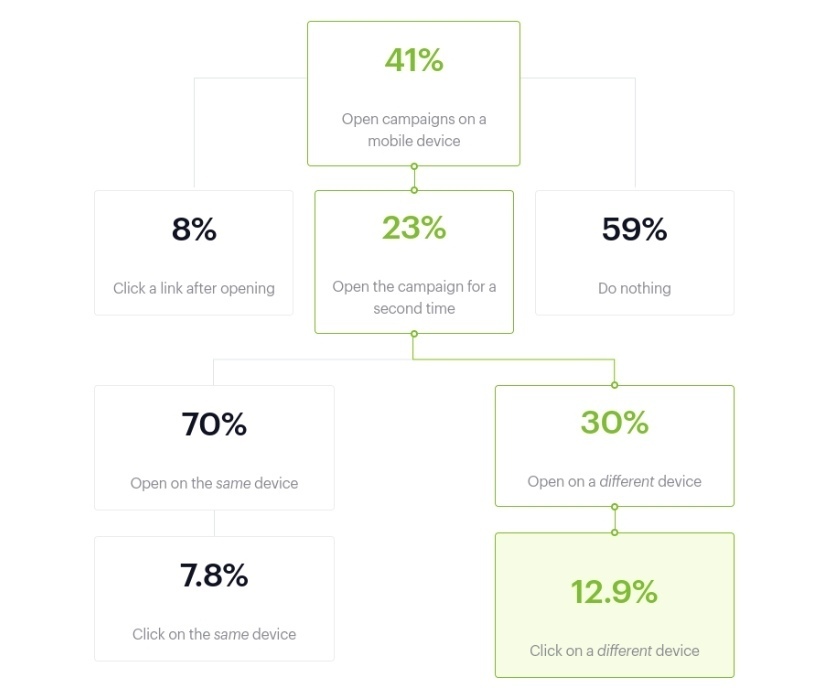
According to Campaign Monitor, here’s what’s actually happening with mobile email subscribers:

Campaign Monitor mobile CTR data
Campaign Monitor charts the progression from mobile email opens to click-through rate. (Source: Campaign Monitor) (Large preview)

The open rates on mobile are somewhat on par with the Litmus data earlier.

However, it can take multiple opens before the email recipient actually clicks on a link or offer within an email. And guess what? About a third of them make their way over to desktop — where they convert at a higher rate than those that stay on mobile.

As the report states:

Data from nearly 6 million email marketing campaigns suggests the shift to mobile has made it more difficult to get readers to engage with your content, unless you can drive subsequent opens in a different environment.

I’ve reconstructed the graphic above and filled it with the number of people who would take action from an email list of 1,000 recipients:

Campaign Monitor mobile open and click data
An example of how Campaign Monitor’s data translates into real-world numbers. (Source: Campaign Monitor) (Large preview)

At first glance, it looks as though mobile is the clear winner — at least in terms of driving traffic to the website. After the initial mobile open, 32 subscribers go straight to the website. After a few more opens on mobile, 5 more head over there.

Without a breakdown of what the user journey looks like when opened on desktop, though, the calculation of additional clicks you’d get from that portion of the list isn’t so cut-and-dried.

However, let’s assume that Litmus’s estimate of 18% desktop opens is accurate and that Campaign Monitor’s 12.9% click-through rate holds true whether they open the email first on mobile or desktop. I think it’s safe to say that 23 desktop-only email opens can be added to the total.

So, that brings it to:

37 clicks on mobile vs 26 on desktop.

Bottom line: while mobile certainly gets more email subscribers over to a website, the conversion-friendliness of desktop cannot be ignored.

Which is why you don’t want to segment your lists based on device. If you want to maximize the number of conversions you get from a campaign, enable subscribers to seamlessly move from one device to the other as they decide what action to take with your emails.

In other words, design the same exact email for desktop and mobile. But assume that the majority of subscribers will open the email on their mobile device (unless historical data of your campaigns says otherwise). Then, use mobile-first design and marketing tips to create an email that’s suitable for all subscribers, regardless of device.

Factor in Dark Mode When Choosing Your Colors

You don’t want there to be anything that stands in your users’ way when it comes to moving from email to website. That’s why you have to consider how their choice of color and brightness for their mobile screen affects the readability or general appearance of your email design.

There are a number of ways in which this can become an issue.

As we hear more and more about how harmful blue light from our devices can be, it’s no surprise that Dark Mode options are beginning to roll out. While it’s prevalent on desktops right now, it’s mostly in beta for mobile. The same goes for email apps.

That said, smartphone users can hack their own “Dark Mode” of sorts. This type of color inversion can be enabled through the iPhone’s “Accessibility” settings.

Gadget Hacks iPhone 'Dark Mode' hack
Gadget Hacks shows how iPhone users can hack their own 'Dark Mode'. (Source: Gadget Hacks) (Large preview)

Essentially, what this does is invert all of the colors on the screen from light to dark and vice versa.

Unfortunately, the screenshotting tool on my iPhone won’t allow me to capture the colors exactly as they appear. However, what I can show you is how the inversion tool alters the color of your email design.

This is an email I received from Amtrak last week. It’s pretty standard with its branded color palette and brightly colored notices and CTA buttons:

Amtrak email on Gmail mobile app
What a promotional email from Amtrak looks like on the Gmail mobile app. (Source: Amtrak) (Large preview)

Now, here is what that same email looks like when viewed through my iPhone’s “Smart Invert” setting:

Amtrak email with inverted colors
What a promotional email from Amtrak looks like in Gmail when colors are inverted. (Source: Amtrak) (Large preview)

The clean design of the original with the white font on the deep blue brand colors is gone. Now, there’s a harsh mix of colors and a hard-to-read Amtrak logo in its place.

You can imagine how this kind of inconsistent and disjointed color display would create an off-putting experience for mobile users.

But what do you expect them to do? If they’re struggling with the glare from their mobile device, Dark Mode (or some other brightness adjustment) will make it easier for them to open and read emails in the first place. Even if it means compromising the appearance of the email you so carefully designed.

One bright spot in all this is that the official “Dark Mode” being rolled out to iPhone (and, hopefully, other smartphones) soon won’t alter the look of HTML emails. Only plain-text messages will be affected.

However, it’s important to still be mindful of how the design choices you make may clash with a surrounding black background. Brightly colored backgrounds, in particular, are likely to clash with the surrounding black of your email app.

How do you solve this issue? Unfortunately, you can’t serve different versions of your email to users based on whether they’re viewing it in Dark Mode or otherwise. You’ll just have to rely on your own tests to confirm that potential views in Dark Mode don’t interfere with your design or message.

In addition to the standard testing you do, set your own smartphone up with Dark Mode (or its hack counterpart). Then, run your test email through the filter and see what happens to the colors. It won’t take long to determine what sort of colors you can and cannot design with for email.

Design the Subject Line

The subject line is the very first thing your email subscribers are going to see, whether it shows up as a push notification or they first encounter it in their inbox. What do you think affects their initial decision to click open an email rather than throw it in the Trash or Spam box immediately? Recognizing the Sender will help, but so will the attractiveness of the subject line.

As for how exactly you go about “designing” a subject line, there are a few things to think about. The first is the length.

Marketo conducted a study across 200+ email campaigns and 2 million emails sent to subscribers. Here is what the test revealed about subject line length:

Marketo subject line length test
Marketo tested over 2 million sent emails to determine the ideal subject line length. (Source: Marketo) (Large preview)

Although the 4-word subject line resulted in the highest open rate, it had a poor showing in terms of clicks. It was actually the 7-word subject line that seemed to have struck the perfect balance with subscribers, leading 15.2% of them to open the email and then 10.8% of them to click on it.

While you should still test this with your own email list, it appears that seven words is the ideal length for a subject line.

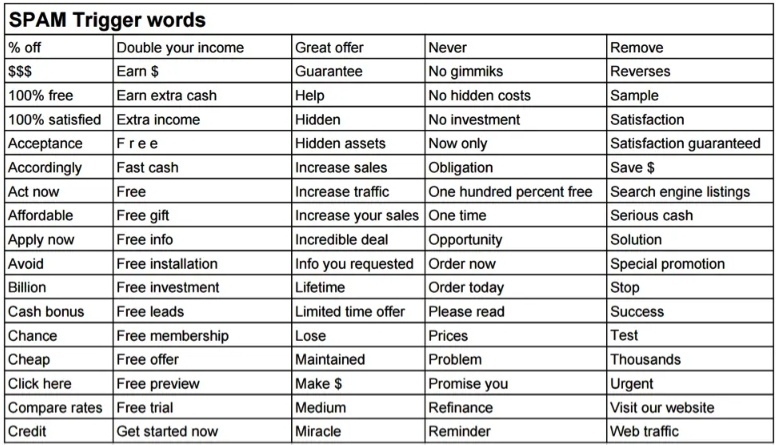
Next, you have to think about the buzzwords used in the subject line.

To start, keep this list of Yesware’s Spam Trigger Words out of it:

Yesware list of spam-trigger words
Yesware’s analysis and list of the top spam-trigger words. (Source: Yesware) (Large preview)

If you want to increase the chance the email will be opened, read, clicked on and eventually convert on-site, you have to be savvy about which words will appear within the subject line.

What I’d suggest you do is bookmark CoSchedule's Email Subject Line Tester tool.

CoSchedule email subject line tester
CoSchedule tests and scores your email subject lines with one click. (Source: CoSchedule) (Large preview)

Here’s an example of how CoSchedule analyzes your subject lines and clues you in to what increases and decreases your open rates:

CoSchedule subject line score
The first part of CoSchedule’s subject line analysis and scoring tool. (Source: CoSchedule) (Large preview)

As you can see, CoSchedule tells you which kinds of words increase open rates as well as those that don’t. Do enough of these subject line tests and you should be able to compile a good set of wording guidelines for your writers and marketers.

Further down, you’ll get more insight into what makes for a strongly worded and designed subject line:

CoSchedule subject line recommendations
The second part of CoSchedule’s subject line assessment and recommendations. (Source: CoSchedule) (Large preview)

CoSchedule will provide recommendations on how to shorten or lengthen the character and word counts based on best practices and results.

Finally, at the very bottom of your subject line test you’ll see this:

CoSchedule email client preview
The final part of CoSchedule’s subject line tester includes an email client preview. (Source: CoSchedule) (Large preview)

This gives you (or, rather, your writer) a chance to see how the subject line will appear within the “design” of an email client. It’s not a problem if the words get cut off on mobile. It’s bound to happen. However, you still want everything that does appear to be appealing enough to click on.

Also, don’t forget about dressing up your subject lines with emoji.

When you think about it, emoji in mobile email subject lines make a lot of sense. Text messaging and social media are ripe with them. It’s only natural to use this fun and truncated form of language in email, too.

Campaign Monitor makes a good point about this:

If you replace words with recognizable emoji, you’ll create shorter subject lines for mobile users. Even if it doesn’t shorten your subject line enough to fit on a mobile screen, it’s still an awesome way to make it stand out from the rest of your subscribers’ cluttered inboxes.

The CoSchedule test will actually score you based on how (or if) you used emoji, too:

CoSchedule Emoji Evaluation
CoSchedule suggests that the use of emoji in subject lines will give you an edge. (Source: CoSchedule) (Large preview)

As you can see, CoSchedule considers this a competitive advantage in marketing.

Even just looking at my own email client, my eye is instantly drawn to the subject line from Sephora which contains a “NEW” emoji:

Sephora subject line with emoji
A Sephora email containing an emoji stands out from others in the inbox. (Source: Sephora) (Large preview)

Just be careful with which emoji you use. For starters, emoji are displayed differently from device to device, so it may not have the same effect on some of your subscribers if it’s a more obscure choice.

There’s also the localization aspect to think about. Not every emoji is perceived the same way around the globe. As Day Translations points out, the fire symbol is one that could cause confusion as some countries interpret it as a literal fire whereas some may view it as a symbol for attraction.

That said, emoji have proven to increase both open rates and read rates of emails. Find the right mobile-friendly emoji to include in your subject line and you could effectively increase the number of subscribers who visit your website as a result.

Wrap-Up

There are so many different kinds of emails that go out from websites:

  • Welcome message
  • Post-purchase transaction email
  • Abandoned cart reminder
  • Promotional news
  • Product featurette
  • New content available
  • Account /rewards points
  • And more.

In other words, there are plenty of ways to get in front of email subscribers.

Just remember that the majority of them will first open your email on mobile. And some will reopen it on mobile over and over again until they’re compelled to click on it or trash it. It’s up to you to design the email in a way that motivates them to visit your website and, consequently, convert.

Further Reading on SmashingMag:

Smashing Editorial (ra, yk, il)
25 Jun 17:26

Leads vs. Prospects: How You Should Treat Them Differently

by Sarah Mead

Demand generation is a powerful element of any sales and marketing strategy, especially an inbound strategy. However, leads are just one piece of the puzzle. And although the inbound methodology is built upon the idea of attracting, converting, closing, and delighting qualified contacts, this methodology is only effective when communication with prospective clients is aligned with the Buyer’s Journey.

One major piece of building your sales and marketing strategy is considering how you will communicate with people at each stage of the buying process. This means determining how you’ll approach communication with leads versus prospects.

Here’s where it gets fun: One common misconception in marketing is that the terms “lead” and “prospect” are interchangeable. They are, however, different and therefore your communication with them should be adjusted accordingly.

The Difference Between Leads and Prospects

The main differentiator between leads and prospects is the level of engagement between the contact and your brand.

Leads have likely only had one-way communication with your brand and are at an awareness level in their Buyer’s Journey—meaning they have not shown an indication that they’re intending to buy.

Prospects, on the other hand, are more qualified and have demonstrated some interest in your product or service. As it pertains to the Buyer’s Journey, they are likely further down the pipeline and more closely aligned with the consideration stage.

Here is a comparison so you can more clearly see the differences between leads and prospects:

Leads Prospects
Type of Communication One-way communication Two-way communication
Stage of Buyer’s Journey Awareness Consideration
Possible
Behaviors
  • Downloaded an awareness level piece of content from your website
  • “Liked” or “shared” a piece of content on social media
  • Commented on a blog post
  • Received a “cold email” or message from the organization
  • Connected on the phone with a member of the organization
  • Had a face-to-face conversation at an event
  • Reached out or responded to an email from your organization
  • Answered questions on a web form that indicated potential intent to purchase
Goal of Your Communication Convert to a prospect through brand awareness Convert to a sales opportunity by further nurturing the relationship

How to Approach Communication with Leads: Lead Nurturing

The goal of your communication with leads should be to convert them into prospects who can be further nurtured through the sales funnel. This communication strategy shouldn’t begin with a sales pitch or a hard sell of your brand. Remember that the lead hasn’t given any indication that they are ready to buy and should be treated accordingly.

Consider how this lead came to you in the first place and what information you have about them so far. Let’s say a lead downloaded an awareness stage e-book on your website. Are there other resources you can share with this lead that align with the topic of the e-book? Begin to build a communication strategy with multiple touchpoints based on the lead’s interests and what they will find most helpful.

Once you’ve built in helpful touchpoints with the lead, you’ll want to consider the type of content you can share that will move the lead to a prospect stage. Look at behavioral and persona data you have in order to inform this strategy.

How to Approach Communication with Prospects: Sales Prospecting

Once leads become prospects, your goal should be to convert them into sales opportunities. Now that these contacts have been moved along in the pipeline, you can shift your approach to inject more promotional content, while still being helpful.

The key to effective communication with your prospects is confirming they are qualified to be a potential customer and then aligning their known challenges with your solutions.

Remember that e-book they downloaded? What problem were they looking to solve when they found that content, and how can your product or service help meet those needs?

When building out your touchpoints, consider how the prospect has engaged with your content and your organization to date. Do they value phone calls and face-to-face time or do they prefer email communication? Are they engaging with videos or your long-form blog posts? Use data to inform how you engage with prospects so they stay engaged and keep moving through the pipeline.

As with any strong marketing strategy, it is crucial to communicate with people at the right place and right time. There is a much greater likelihood that your team will improve conversion rates when marketing and sales are aligned and have an intentional approach to communication through every stage of the pipeline.

25 Jun 17:26

Making the Point: How to Nail the Lead so Success Will Follow

by JaeMi Pennington

While I consider myself an effective communicator, I recently recalled a bad habit I used to have when writing and speaking. The problem was, I would often “bury the lead,” the important points I was trying to make would be lost in other less crucial details I was passing along.

Doing this can be tremendously frustrating to a person pressed for time. This is not only the case in the busy world of business, when it comes to public relations (PR), it’s important to remember that editors, analysts and other influencers you’re targeting are inundated with similar messages and on deadline.

Standing out is imperative and brevity removes clutter.

Get to the point

Those of us in this line of work are story tellers. So it stands to reason we would communicate in the same manner; establish a premise or angle, support it with facts and other secondary details, then make a conclusion. However, not everyone has time to read down to the bottom of a lengthy email to learn the ultimate point. One place where that is particularly evident is when pitching the media.

Today, news rooms are understaffed, leaving reporters to crank out articles at a rapid pace. Gone are the days when they’d review a well laid out, lengthy pitch. So, when reaching out to media, keep pitches short and be sure to put the ultimate ask right up top – such as scheduling an executive interview on breaking news – without overwhelming the recipient with details.

This allows reporters to triage what’s in front of them. If they’re working on a story and realize you have a resource that can fill a hole, they’ll quickly see it. If you bring up a new angle they should consider, tease it and they’ll read further and possibly set up an interview.

The word to keep in mind is “relations;” reporters remember the PR people who understand what they need and can help them get their job done easier. By reaching out with relevant information, and making your points quickly, you’ll build relationships that ensure you’ll be considered.

It’s that first hurdle that’s the toughest to clear. Just remember, make sure your information has a strong connection to what the reporter is covering or their beat (the topic area they focus upon). Reporters have been known to call out those on Twitter who waste their time with pitches that are entirely unrelated to anything they would work on.

Form a new habit

For most people in business and the media, email remains the most common form of direct contact. So, those messages are a good place to focus upon and form the right habits.

If you’re wondering how to be succinct in media outreach, a basic email should be three or four short paragraphs. Be sure your ask, and a brief payoff as to why the recipient of the message should care, is made within the first three sentences. Next, follow with a paragraph or two with supporting information that adds flesh to your claims.

This can include relevant market stats, company leadership, work in a specific area or executive bio details to highlight credibility and knowledge. To generate excitement, tease successful results in overcoming a problem, maybe present a provocative viewpoint or story angle not being considered.

Basically, you want to show you’ll add depth to their piece.

Apply it everywhere

The goal of not burying the lead also applies when speaking with clients and colleagues from whom you want to get “buy in” – such as an executive you hope to enlist as a media spokesperson. I used to provide a long lead up to justify what I was proposing. While this seems sensible in our personal lives, it’s not the best approach when a deadline is looming or the business clock is ticking.

That said, when speaking, employ the same approach as when writing – lead with the ask.

Don’t forget the subject

Finally, one of the most overlooked areas of the email isn’t even in the body text – it’s the subject line.

This is a bit more complex because with a very few number of words, you’re looking to convey that you have something a recipient can use – and sometimes there’s urgency. With a reporter, there are so many different pitching scenarios that it’s tough to offer a rule of thumb other than to be as direct as possible.

That, and remember you’re not trying to trick them into opening an email; nothing exasperates a reporter more than finding there’s no substance to consider.

Getting to the point faster increases the odds you’ll get attention and a response from the other person – whether it’s a reporter or a colleague. Lead with what’s important or it’s your ideas that’ll be buried.

25 Jun 17:26

Who Sets the (Low) Bar in Your Sales Department?

by C. Lee Smith

In sales, we often talk about setting the bar high. But there’s another bar for sales managers to consider.

It’s not the high bar that sets the desired standard, it’s the LOW bar that can be a job killer.

The “low bar” is the lowest level of performance acceptable to keep their job. And you set it by what you allow your salespeople to get away with. You may not see the negative impact immediately, but it’s a morale killer to the other higher performers on the staff.

Here are seven examples of how the “low bar” gets set on your sales team…

1. If you allow: Salespeople to routinely miss their goal.

The “low bar” you’re setting: If you miss your sales goal, there’ll be no consequences. So don’t worry about it.

How to fix it: Adopt a “three strikes and you’re out” policy.


2. If you allow: Salespeople to be rewarded for reaching only 80% of goal.

The “low bar” you’re setting: 80% is really good enough. 100% becomes the REAL stretch goal.

How to fix it: Stop all incentives for anything less than 100% of goal. Be more realistic about the goals you’re setting.


3. If you allow: Salespeople to routinely show up late for meetings.

The “low bar” you’re setting: It’s okay to be 5-15 minutes late. Hope your advertisers feel the same way!

How to fix it: Start meetings no more than two minutes late. Reserve the front row of chairs or those closest to you for late arrivers so they just can’t sneak in undetected.


4. If you allow: Salespeople to not enter everything into your company CRM.

The “low bar” you’re setting: The CRM isn’t all that important to you. The problem is “garbage in, garbage out” or “lack of information in, means lack of information out.” You’ve greatly reduced the effectiveness of CRM.

How to fix it: If it’s not in the CRM, it didn’t happen. No ifs, ands, or buts.


5. If you allow: Salespeople to go long stretches without engaging in a two-way conversation with their accounts.

The “low bar” you’re setting: It’s ok to take long time accounts for granted and put them on auto-pilot. There are no consequences for not doing your job.

How to fix it: If a rep goes more than X weeks/months without a telephone or in-person conversation with an account, they lose it – and the commissions that go along with it.


6. If you allow: Salespeople to not use the valuable tools and research you’ve provided them.

The “low bar” you’re setting: Anytime we bring in a tool for you to use, you can just ignore it, then we’ll make it go away if enough of you don’t use it.

How to fix it: Using these sales tools regularly is part of their job. Make it an item on their performance evaluation.


7. If you allow: Salespeople to text, check email or otherwise fiddle with their mobile phones during your sales meetings.

The “low bar” you’re setting: The content of the sales meeting isn’t important enough for your full attention. Heck, YOU aren’t important enough for their full attention.

How to fix it: Movie theater rules apply. No texting, message checking or anything else during meetings. Allow for checking of content or for Googling that directly relates to the topic of the meeting. If they have to take a call, make them leave the room.


7+1. If you allow: Salespeople to blame the customer, the competition or other people in your company for their lack of success.

The “low bar” you’re setting: You don’t have to be personally responsible for anything. It’s okay as long as you tried. Problem is, you now have a culture of finger pointing and backbiting instead of positivity and teamwork.

How to fix it: Always bring the conversation back around to what could YOU have done better? Did you provide value to the customer before trying to make a sale? Did you make a recommendation that makes sense (or did you just take their order)? Did you reduce their risk? Were you proactive? Were you persistent? Were you resilient?


You might think the worst person at returning calls sets the low bar for the rest of the staff. Or that the worst performer in terms of revenue, closing rates, proposals, account satisfaction, professionalism, etc. sets the low bar for the rest of the staff. And you’d be 100% wrong.

The fact is YOU set the low bar for the minimum level of performance needed to keep their jobs.

You’re not a passenger, you’re the driver of the sales team. So no whining about “I just can’t get the salespeople to use it/show up on time/stop doing what they shouldn’t be doing/start doing what they should be doing.” When you do that, you’re just admitting to the world that you suck as their manager.

There’s nothing wrong with being demanding or having high standards, so long as those demands are realistic – and you’re ready, willing and able to help them meet those standards whenever they need it. You also need to be ready to “walk the talk” and do what you’re asking them to do.

One solution? Start adaptive sales coaching immediately not only for you but your entire team. The Harvard Business Review has that top quality coaching will improve the results of the middle 60% of a workforce by up to 19 percent. And, even with less than optimal coaching, the results can be as much as a 6%-8% increase per sales professional.

Not everything is in your control, but coaching is, if you are willing to step up and change your approach.

A version of this article originally appeared here.

24 Jun 16:24

The next service marketplace wave: Vertical market-networks

by Arman Tabatabai
Ivan Smolnikov Contributor
Ivan Smolnikov is the CEO and founder of Smartcat, the market network platform for the translation industry.

The last few decades have produced many successful marketplaces. We went from goods marketplace pioneers such as eBay and Amazon to simple service marketplaces such as Uber, Lyft, Doordash, Upwork, Thumbtack, TaskRabbit, and Fiverr. But why haven’t we seen many successful B2B service marketplaces?

Table of Contents


Why Many B2B Service Marketplaces Failed

Some would argue that companies such as Upwork, Thumbtack, Fiverr, or TaskRabbit are horizontal B2B marketplaces in the sense that they provide access to suppliers of different services. But while businesses do indeed transact with freelancers on such “horizontal” marketplaces, for most service verticals these are limited-value, one-off transactions. They fail to enable long-term business collaborations.

So, such marketplaces haven’t delivered more valuable services nor introduced a new paradigm for how businesses buy specific services at scale and on an on-going basis. Why is that?

Horizontal marketplaces are stuck at the discovery process

Horizontal services marketplaces don’t provide much value beyond matching clients with quality service providers. In other words, they don’t facilitate collaboration between buyers and suppliers, never mind provide ways for the two parties to collaborate more efficiently over time as they engage in follow-on projects.

In essence, the model these marketplaces were built around is not much different from the likes of Craigslist, which put a convenient UX on traditional classified advertisements.

Complex B2B services require workflow and collaboration tools

In their article “What’s Next for Marketplace Startups?,” Andrew Chen and Li Jin found that there aren’t many successful service marketplaces because those offerings are complex, diverse, and difficult to evaluate. It’s challenging to define a successful transaction in a service marketplace because it’s harder to quantify success.

One reason is that several service providers must often work together to complete a single job for a buyer, requiring a complex workflow from end to end. As a result, it’s difficult for marketplaces to not only mediate service delivery but also make it significantly more efficient for buyers and suppliers. If both the buyer and suppliers don’t see a significant efficiency gain other than being initially matched, why would they continue using the marketplace?

(Image via Getty Images / Lidiia Moor)

The $50 billion translation industry is a prime example of complex B2B services marketplaces. On the supply side are roughly 50,000 small agencies around the globe responsible for more than 85% of this $50 billion industry. (Note we are referring to agencies here as suppliers, though they play on both sides.)

On the demand side are businesses that need to translate text from one language into another. Plus about 1,500,000 freelance linguists work in this industry, many of whom are more specialized than professionals in other industries.

Anyone can find and hire a translator on Fiverr or Upwork. Both provide a vast selection of language translators. However, the quality and cost of the translation depends on the translation tools available to the translator as well as their subject expertise.

Neither Fiverr nor Upwork provide computer-aided translation (CAT) and collaborative workflow solutions for users of their platforms. Additionally, neither provides an effective way for all parties to collaborate and continuously improve the efficiency and quality.

But the problem with traditional marketplaces goes even further: Multiple translators and reviewers are usually needed to complete a single job for a customer. Multi-language translation projects are even more complicated. Such projects require multiple service providers and cost estimates, in addition to project management tools.

This is why building a B2B service marketplace is difficult. Service marketplaces must not only connect buyers and suppliers, but also provide tools to enable an efficient and collaborative workflow that reduces wasted time and effort.

Horizontal marketplaces suffer high attrition

In addition to the problems already outlined, traditional marketplaces experience another issue that prevents them from growing and retaining market participants: Buyer and supplier attrition.

Many business services are based on regularly recurring engagements. In some cases, a buyer and a service provider interact daily, requiring a different workflow than gig-marketplaces are built around.

Buyers and suppliers have little motivation to continue interacting on a platform with no workflow automation solutions. They lack a way to improve service efficiency and quality, automate collaboration, payment, paperwork, and other basic processes required for a business.

This is why many traditional marketplaces suffer from slow network effects and high attrition. (A network effect is what happens when a platform, product, or service delivers more value the more it is used.

Think Facebook, eBay, WhatsApp.) Why wouldn’t companies work directly with service providers outside of a marketplace after they were introduced? What incentives keep the service transaction on the marketplace? These are critical questions to answer when building a marketplace.

Traditional marketplaces target broad services, making it nearly impossible to provide workflow solutions for buyers and suppliers. Going forward, successful service marketplaces will be developed relying on an industry-specific SaaS workflow. This will focus buyers and suppliers on longer-term projects and interactions that serve the unique needs of collaborations and transactions in a specific vertical.

Image via Getty Images / OstapenkoOlena

What makes a successful service marketplace?

In “The next 10 Years Will Be About Market Networks,” James Currier, Managing Partner at NFX Ventures, defines a new era of service marketplaces, which he calls market networks.

A market network is a platform that combines elements of an n-sided marketplace, a network, and workflow solutions. An n-sided marketplace is one that requires coordination of multiple supply-side parties to provide a complex service for a single buyer.

Market networks enable multiple buyers and suppliers to interact, collaborate, and transact on the same platform. They provide users with industry-specific workflow solutions that enable efficient, ongoing collaboration on long-term projects. This reduces costs and leads to a higher quality of services and increased overall value for all users.

But how do you actually build a successful market-network platform? While the answer to that varies from company to company, here is our approach. We were able to build a market network for the translation industry that combines the components: network, marketplace, and workflow solution.

STEP 1: SaaS workflow platform unlocks high-value collaboration

The first step to building an effective complex market network is to develop a workflow that is easy for users to embrace. It might not seem like much, but this increases productivity by enabling teams to perform tasks that were previously impossible.

24 Jun 16:16

Learning to Master the Art of Your Career

by Daniel Burrus

It doesn’t matter what you do for a living — whether you work in medicine or retail, law or construction, software engineering or writing — there’s an art and science to every career. Each profession has its scientific aspects, those more mechanical facets, rules, and methods you must know to succeed. Yet no matter how dry, straightforward, or technical, these professions also have creative qualities that foster critical thinking.

This dichotomy is the reason no two professionals within the same industry are identical. These people may work within their careers for the same amount of time, possibly went to similar schools, or perhaps have the same position at the same company. However, they differentiate themselves in the ways they apply creativity and critical thinking to their jobs.

This idea impacts our personal lives as well. Consider medical professionals with the same specialty. If all dentists were the same by virtue of having identical skill sets and nothing more, you would have no preference for whom you go to for a root canal. But this isn’t the case; you prefer your dentist over one you have never been to due to their individual touch.

A real-world example occurred with one of my brothers, as some years back he struggled with pain in his legs. He visited three different orthopedic surgeons, all with identical skill sets and backgrounds. The doctors examined my brother. One suggested invasive surgery and the second proposed a more exploratory surgery. Both of these were unfavorable options. It wasn’t until we saw the third orthopedic surgeon that creative critical thinking took place. The doctor took one look at him and asked if he always wore his leather belt around his hips in the same place. When my brother answered in the affirmative, the doctor recommended he switch belts, replacing his leather one with a softer, more elastic material. With this change, his ailments were cured within a week.

All three doctors had the same impressive credentials and experience in the science behind their specialties; however, the third doctor utilized creative critical thinking to problem-solve.

Whether you’re training or in any level of schooling for a career, the “science” of that field is where the education lies. You’re receiving a hard, factual, standardized education, based on data and a proven methodology. Likewise, whether it’s accounting or food service, you’re also being schooled in the best practices of your industry.

Even in the creative fields, you still learn both the science and the art of your craft in order to find professional success in it. Writers must learn grammatical and syntactical convention, but they also have to learn how to write something everyone must read. Musicians need to learn scales, notation, and instrumental technique, but they also need to learn how to touch the hearts and souls of listeners to achieve musical greatness.

So where does the “art” come into these fields?

Artistic aspects of a career are picked up by professionals through years of experience and another, more flexible, less standardized type of “education,” one of induction. The first method of becoming more creative within your career through personal and professional experience is somewhat obvious — the longer you do something, you’ll become better at problem solving and thinking “outside the box.”

The second method, the nonstandard educational method of developing intuitive insights coupled with creativity, involves gleaning the best-kept secrets and most well-honed, time-honored methods, the knowledge and wisdom of your profession from other professionals. These should be people who’ve already distinguished themselves through their own creativity. You might seek these people out, like a musician choosing to take lessons from one of his favorite players, or an entrepreneur asking the advice of someone who’s already established herself as a success in business. You might also stumble into these people during the course of your life, like having a captivating, inspirational professor or being trained by a capable manager who knows the secrets to making your job fun and interesting.

You can learn the science of your job from books, manuals, and classroom lessons and know that you will be good at what you do — but you need to learn the art from the artists of your field to become exceptional. This knowledge and wisdom transfer is key not only to success, but to a rewarding career as well. Not only does it provide professionals an essential balance of skills, it’s what keeps industries thriving and innovative. It’s what pushes us to compete with others by bettering ourselves and, in doing so, to push our very professions forward.

Pick up a copy of my latest best selling book The Anticipatory Organization to help shape your future and accelerate your success.

24 Jun 16:11

Smart Machines Are the Future of Manufacturing

by Louis Columbus

Smart Machines Are The Future Of Manufacturing

  • Industrial Internet of Things (IIoT) presents integration architecture challenges that once solved can enable use cases that deliver fast-growing revenue opportunities.
  • ISA-95 addressed the rise of global production and distributed supply chains yet are still deficient on the issue of data and security, specifically the proliferation of IIoT sensors, which are the real security perimeter of any manufacturing business.
  • Finding new ways to excel at predictive maintenance, and cross-vendor shop floor integration are the most promising applications.
  • IIoT manufacturing systems are quickly becoming digital manufacturing platforms that integrate ERP, MES, PLM and CRM systems to provide a single unified view of product configurations.

These and many other fascinating insights are from an article McKinsey published titled IIoT platforms: The technology stack as value driver in industrial equipment and machinery which explores how the Industrial Internet of things (IIoT) is redefining industrial equipment and machinery manufacturing. It’s based on a thorough study also published this month, Leveraging Industrial Software Stack Advancement For Digital Transformation. A copy of the study is downloadable here (PDF, 50 pp., no opt-in). The study shows how smart machines are the future of manufacturing, exploring how IIoT platforms are enabling greater machine-level autonomy and intelligence.

The following are the key takeaways from the study:

  • Capturing IIoT’s full value potential will require more sophisticated integrated approaches than current automation protocols provide. IIoT manufacturing systems are quickly becoming digital manufacturing platforms that integrate ERP, MES, PLM and CRM systems to provide a single unified view of product configurations and support the design-to-manufacturing process. Digital manufacturing platforms are already enabling real-time monitoring to the machine and shop floor level. The data streams real-time monitoring is delivering today is the catalyst leading to greater real-time analytics accuracy, machine learning adoption and precision and a broader integration strategy to the PLC level on legacy machinery. Please click on the graphic to expand for easier reading.

  • Inconsistent data structures at the machine, line, factory and company levels are slowing down data flows and making full transparency difficult to attain today in many manufacturers. Smart machines with their own operating systems that orchestrate IIoT data and ensure data structure accuracy are being developed and sold now, making this growth constraint less of an issue. The millions of legacy industrial manufacturing systems will continue to impede IIoT realizing its full potential, however. The following graphic reflects the complexities of making an IIoT platform consistent across a manufacturing operation. Please click on the graphic to expand for easier reading.

  • Driven by price wars and commoditized products, manufacturers have no choice but to pursue smart, connected machinery that enables IIoT technology stacks across shop floors. The era of the smart, connected machines is here, bringing with it the need to grow services and software revenue faster than transaction-based machinery sales. Machinery manufacturers are having to rethink their business models and redefine product strategies to concentrate on operating system-like functionality at the machine level that can scale and provide a greater level of autonomy, real-time data streams that power more accurate predictive maintenance, and cross-vendor shop floor integration. Please click on the graphic for easier reading.

  • Machines are being re-engineered starting with software and services as the primary design goals to support new business models. Machinery manufacturers are redefining existing product lines to be more software- and services-centric. A few are attempting to launch subscription-based business models that enable them to sell advanced analytics of machinery performance to customers. The resulting IIoT revenue growth will be driven by platforms as well as software and application development and is expected to be in the range of 20 to 35%. Please click on the graphic to expand for easier reading.

24 Jun 16:11

Why the First Thing a New Marketing Manager Does is Critical

by Remington Begg

Maybe it’s growth. Maybe it’s change. Maybe it’s a new chapter in some way. Whatever the reason for needing a marketing manager (or similar position), if your business is looking for the right person to manage your message, keep an eye on the transition.

The early time that a marketing manager comes into your business can be critical to the success of your growth plan.

But let’s back up a moment, and make sure we’re on the same page.

What exactly does a marketing manager do?

black lab as a curious dog to show a question in why the first thing a new marketing manager does is critical

The answer to this can depend on a few factors, like the size of the company, the size of the marketing department, the vertical the business is in, and the vision of leadership.

For most businesses, the core responsibility of the marketing manager is to implement and report on marketing initiatives. The role is focused on the what, like what actions need to be executed. That’s different from the role of a marketing director, who explores the why and the how of those actions.

Of course, getting into titles like director versus vice president or CMO can get to be a little much for most average businesses. And don’t even think about all the creative twists to titles many companies take nowadays.

For ease of clarification, let’s consider the marketing manager as the person in charge of running the day-to-day marketing initiatives, laid out by a director of marketing. You’ll want someone who can think for themselves of course, but you want to have a marketing manager who’s a doer, not just a thinker.

In very small businesses, this marketing manager may report directly to the owner, with the goal of eventually taking over strategy and planning like a director or VP would. It’s all about growth, after all.

Now that we’re on the same page, let’s look at the early part of the journey as a marketing manager comes aboard your crew. Here’s what your new marketing manager should do first.

Listen

We all have ideas. And most of us want to bring those ideas to the table as quickly as possible. But this is where it’s important to exercise restraint. At least for a little while.

Anyone coming into a new position does well to listen first. Whether it’s listening to the owner, their direct manager, the team or other colleagues in the company, using the two ears you have versus the one mouth is key.

young boy listening to adults in why the first thing a new marketing manager does is critical

A marketing manager ready to listen is a person interested in collaboration.

They should get to know the people and processes within the company, from their manager to their peers and especially – if applicable – their direct reports.

Learn

Along with listening, a willingness to learn is vital. From learning the business to learning the vertical it’s in, someone willing to listen and learn is huge.

Learning from the business owner and/or leadership will help a marketing manager better understand the story behind the brand, the clients they already serve, and the dynamics of the team.

In addition to general learning, a new marketing manager needs to clarify responsibilities. From their own goals and duties to shared responsibilities with teammates or other teams (sales and marketing alignment, anyone?), clarifying expectations is a recipe for clear communication and success.

Offer Ideas

You likely hired this person because of their talents or experience. As Steve Jobs essentially said, hire smart people and let them work. Listen to their ideas, too.

“It doesn’t make sense to hire smart people and tell them what to do; we hire smart people so they can tell us what to do.” – Steve Jobs

As your new marketing manager is getting the lay of the land, listen for their ideas. Maybe they’re experienced in podcast production or strategic pay-per-click advertising. If you’ve never thought of these tactics, a fresh perspective is helpful.

If you’re willing to hear the ideas, they’ll be more comfortable sharing them. Conversely, if they aren’t sharing any ideas, you may have difficulties brewing.

Dive In and Work Hard Smart

As covered earlier, a marketing manager is a doer. Early on in the journey, this person should be ready to dive in and work. Maybe it’s blog article drafts in the first couple weeks. Maybe it’s a social media plan and calendar suggestion. Perhaps they suggest a podcast plan to make your business the next Joe Rogan, Marc Maron, or NPR.

Whatever the case, if your new marketing manager is only interested in more meetings, more discussions, more dreams … you may be seeing a red flag. Encourage them to make progress. Set goals. Clarify expectations.

Pro Tip for Marketing Managers: Start From the End and Work Your Way Back

This one’s for marketing managers reading this. Align yourself with sales. Then, with the sales team’s support, start at the bottom of the funnel. Make sure sales reps feel supported by your plan. Make sure you understand where they’re coming from. And make sure you’re sharing with them how they can work inbound leads you’re planning to generate.

Maybe Don’t Do This

slow down sign to illustrate why the first thing a new marketing manager does is critical

Something you don’t want is a marketing manager who wants to dismantle everything you’ve done just for the sake of making a name for themselves.

A new logo. New branding. Starting over. These should be red flags if it’s their first focus.

Maybe your logo needs some attention, or maybe the website could use a little conversion rate optimization. What you don’t want is a marketing manager who’s not willing to listen or learn, and who only has the arrogant belief that everything they’re bringing to the job is perfect and the best idea ever.

Your new marketing manager should slow down and work smartly.

Bonus: Education and Collaboration

If you’re looking to hire a marketing manager – to replace someone else or to spin up a new position and maybe department – set yourself up for success.

If you understand the current marketing world a little bit, you’ll be prepared for conversations on subjects like conversational marketing, inbound marketing, content marketing, lead generation, social media, and more.

Finding the right person to fit your culture will take time. I’d suggest looking for a collaborative spirit about the person so that they work well with the team, plus a drive for growth so you’re not constantly having to push them for progress.

Sounds Great – What if I Don’t Have the Time?

Finding a good fit takes time. And effort.

Finding the right fit takes even more work.

So, what happens if you know you want a marketing manager, but don’t have the time or expertise to find them? Or when you do find the right fit but aren’t equipped to provide the direction you need?

That’s when you can hire an agency that can bring both strategy, AND implementation to the table. We’ve found great success working with businesses who want to grow with purpose, who are building teams, and who need that extra set of experts to help plan and execute.

Want to know how we coach businesses on business growth, marketing strategy and more? Check out the conversion report tool we built for businesses just like yours.

Planning photo by Marten Bjork on Unsplash
Curious dog photo by Sharon McCutcheon on Unsplash
Listening photo by Cristina Gottardi on Unsplash
Slow down photo by Nareeta Martin on Unsplash

24 Jun 16:11

Email Campaign Management for Newbies: From Strategy to Deployment

by Kevin George

geralt / Pixabay

At the heart of an effective email marketing strategy lies carefully considered “email campaign management”. Without proper campaign management, your email strategy will be like a punctured tyre that does not get you anywhere. Email campaign management consists of diverse interlocking activities that range from building an email list through lead generation tactics to designing and coding an email to its timely deployment. Every task conforms to intricate practices that should be followed for its flawless execution.

If you are an amateur email marketer, we have put together the different steps in the campaign management process, which will help you execute your email strategy better.

Ascertain the email purpose

Here are some questions that you should ask, to determine the purpose of your email campaigns:

  1. “What are you looking to achieve through this email campaign?
  2. “Do you want to promote a new product?”
  3. “Are you trying to build brand loyalty?”

The answers that you get, will let you know whether you want to:

  • Create brand awareness
  • Increase open-rates and reach more people
  • Generate website traffic by improving click-through rates
  • Get brand evangelists and building customer loyalty
  • Increase conversions and drive business growth

Suppose you are looking forward to creating brand awareness through the email campaigns. In such cases, the email campaigns will primarily focus on building trust and nurturing the leads, rather than showcasing the products and persuading them to buy.

Email Campaign Production and Deployment

To make email campaign production easily comprehensible, we shall break it into 9 simple steps.

Planning it right

To make sure things are on track, it is recommended you have a detailed email calendar at your disposal. It will help you avoid the last-minute hustle or procrastination by setting the right timeline. Before planning a calendar, decide on the number of emails that should be sent.

The calendar should serve as a document that communicates the purpose, goals, and target audience of every email campaign along with the deployment date. It is advisable to have a yearly calendar and a monthly update regarding all the emails that are planned.

Building a list

The fuel that propels the vehicle of email marketing is an email list. You should work on a well-designed landing page or opt-in form that serves as a lead magnet and offers something valuable to the user in exchange for the email address. Make sure the landing page conveys the message clearly because visitors judge a website within 50 milliseconds once they land on it.

Here’s a schematic representation that can help you build better landing pages.

traffic-landing page- email campaign

To sum it up, as the intent and interest of the lead increases, you have better opportunities to collect personal information from the subscriber.

Rather than having a single landing page asking “everything” to the subscriber at one go, it is recommended you ask questions in installments based on the user engagement.

Segmenting the email list

Blasting an email to the entire subscriber list is not enough. It is important to send the right message to the right person, and this is possible through email list segmentation. Segment the email list based on every detail available—demographics, geographical location, past purchases, total purchase value, frequency of purchase, etc. This is important to send targeted and more relevant emails to the subscribers. For example: Mother’s Day is celebrated on different dates in US and UK. Segmentation based on geographical location will help you send the right email to the right people at the right time.

Preparing the Email Copy

Once you have a calendar, you pretty well know the next email that you have to work on. Conceptualize the theme and draft an interesting as well as relevant email copy. Based on those metrics, write a suitable subject line, From name and copy of the email.

Designing and Coding the Email

Pass on the document to the email design team after the final approval from the concerned professional. The concept and design idea should be shared with the email designer. While designing an email, you should take into account the coding limitations and also design an appropriate fallback with suitable alt-text for the non-supportive email clients.

Subsequently, after the design approval, the email coding team comes into picture. The coded email should be pixel perfect and render well on every device and email clients.

Testing the Email

Every email coded must be carefully tested. It should be checked for the links and be free from any bugs. Every link and CTA should redirect the user to the right page.

EmailMonks checks the HTML version of the email thrice before deploying it- once by the reviewer, next by the team leader, and finally by the project coordinator.

Test the email on tools such as Litmus and Email on Acid.

Deploying the Email and Analyzing Metrics

The FINAL (approved) email is integrated in the ESP of your choice and checked across the major email clients and different devices with various screen sizes before deployment. This ensures that there are no rendering issues, regardless of the device or email client on which the subscriber views the email. In case there’s still an issue, it has to be fixed before the deployment.

Only after the email is meticulously checked, it should be sent to the specific segment at the scheduled time and day.

Of course, the email marketer’s task does not end at this. They have to constantly keep a track of the email metrics like open rate, click-through rate, bounce rate, unsubscribes, and time spent on an email. If there is a sharp dip in any of the metrics, you should make the required changes. For example: Work on creating better CTAs and place them more strategically if the click-through rate is constantly dwindling.

Optimizing the Campaigns and Email List

Email marketing professionals should stay abreast with the industry updates besides the performance of the email campaigns. These learnings should be used to optimize and keep the freshness alive in the email campaigns.

Over a period of time, the email subscribers are likely to go dormant and stop engaging with the emails. Such inactive subscribers who have not engaged with the emails in 90 days should be targeted with a series of reengagement emails. If they still show no activity, they should be removed so that you can maintain a clean list with good email deliverability. You should remove the hard bounces and invalid addresses of subscribers and update their email addresses, if available.

Automating the Email Campaigns

You might have to automate the email campaigns and set a workflow of triggered emails. Let’s say you are a player in the e-commerce industry. You can set email automation for product recommendations, cart abandonment emails, or reengagement emails for them in addition to the mandatory transactional emails – order confirmation, shipping notification, and delivery confirmation.

Wrapping Up

Most of people use email marketing and email campaign management interchangeably. It is important to understand that email campaign management is a part of email marketing – the most indispensable part. Effective email marketing is only possible if you have efficient campaign management in place.

24 Jun 16:11

The 10 Cs of Sales Training

by Richard Higham

Sales training strategy is a vital component of managing a sales team. Here are 10 things to think about as you look at the way your salespeople learn and develop.

Sales Training Strategy Cs: 10 Focus Areas

Challenge: What’s the goal? Be clear about the objective. “Increase market share by 10 percent in a flat market”, “Generate 50 percent of revenue from our top 10 percent of accounts”. “Failure only comes when we forget our ideals, objectives and principles”. Agree what success looks like before going ahead with training.

Clarify: It is essential to have a clear and accurate picture of the current situation. This means a clear analysis of data using the powerful tools available to understand why the sales outcomes are at current levels, and what is really needed for tomorrow.

Create: Don’t settle for “the same old same old.” Demand excellent training design, strong concepts and innovative approaches. Use traditional and new techniques in the classroom and in the virtual space.

Collaborate: The best training comes from working together with the different stakeholders: Line management, L&D, the participants themselves.

Communicate: Tell people in advance what to expect and why it’s happening. The “why frame” is absolutely essential before you start and at the start of each session.

Commitment: This all about changed behavior and this needs a commitment from line managers to encourage and coach-in the new practices until they become part of business as usual. 70/20/10 is a vital approach for embedded sales learning. It also needs effective implementation resources designed–in from the start and not retrofitted as an afterthought.

Codify: The systems need to measure and support implementation. For example, if the KPIs do not align with changes you want to see then the impact of the learning will be limited.

Check: Measurement is key. Kirkpatrick’s four levels of measurement still work to identify the response to the training, changes in understanding and thinking, changed actions and changed the result.

Combine: Stand-alone sales training simply doesn’t work. It’s been well recognized but it still happens. Changes in behavior come when the three sales levers are operated in concert:

  • Activity – Changes in the intensity of customer contact consistently drive changed results
  • Concentration of focus – Equip people to concentrate on the right offerings with the right people in the right organizations
  • Effectiveness – Changing the knowledge, skills and attitudes of the sales team will produce results if put into practice and if combined with the first two levers

Change: Every week seems to bring new insights into how people learn, apply and succeed. Developments in neuroscience demand that we adapt our ways of working. As Dr. Michael Merzenich (co-founder of Scientific Learning) puts it: “We established that the brain is modified on a substantial scale, both physically and functionally, each time we learn a new skill or develop a new ability. Our brains were created to reinvent and reconfigure themselves throughout our lifetime. This ability is known as brain plasticity.”

This concept is very exciting. It means that good learning approaches can go more than skin deep and can provide significant and lasting benefits to individuals and their organizations.

24 Jun 16:10

Aligning Sales and Marketing in One Platform

by Ryan Shelley

Do you know which of your marketing actions are leading to sales? The answer to this question will determine where you should invest your time and money. For many businesses, they have the data, they simply don’t have it integrated in a way that allows them to answer this question easily. In this video, I’ll share the benefits of aligning your sales and marketing within one platform.

Slide Deck:

Video Transcript:

Hey, thanks for checking out this video. If this is your first time watching or maybe you’ve been watching a while and you haven’t yet subscribed to our channel, please do so now. We publish new content each and every week. And don’t forget to turn on alerts. That way you know each and every time we publish a new video.

So, we’re going to be talking about how to align sales and marketing inside of one platform. What this will allow us to do is achieve closed loop reporting quicker. Closed loop reporting is understanding the entire pathway between marketing and sales and knowing which channels and actions led to conversions and led to a user becoming a customer. This is extremely important if we want to understand which of our marketing channels is returning the most ROI to our business.

Here’s what we’re looking at: closed loop reporting. What it starts with up here is a prospect. They visit your site, right? They come in. They get a tracking code. They’re an anonymous visitor. They take some actions. They become a lead. They work their way through the funnel and become a customer. And when we are tracking them through this and using all the different technologies available to us, we can see which actions, which channels led to the most amount of customers for our business.

Now it’s not as simple as putting one different code on to somebody’s profile. The reality is, a lot of marketers, a lot of businesses, are using more than one software to achieve all of these different actions at one time, which means that we’ve got a lot of data in a lot of different places.

And this is why tracking success is really complex. We have more access to data, but it’s located in a number of different tool sets. This report from the Winterberry Group shows a poll of companies and marketers, how many tools they’re using to drive to support their data-driven marketing or advertising. 51% is using five to 10 and 27% are using 11 to 20. If we look at the blended average, it’s about 12.4 tools per business to understand and use, and do what’s called data driven marketing, using data to make those decisions.

Now the reality is that when you’ve got 12 or more tools trying to speak to each other, it gets extremely complex really fast. It’s hard enough getting one or two like your email platform and your CRM connected together. Now we’re talking about 12 different tools? We’re talking about tons of data coming from a number of different locations, some of it that might not even integrate together. And that’s another one of the big issues. 61% of marketers, they want both better integration of the tools as well as improved process for sharing data among tools. You see there’s 61%, 61%, 61%. Obviously I know that doesn’t add up to 100; this is obviously please select all that apply, so we can have more than 100 here. But they want better integrations and tools, improved processes for sharing data, and also more experienced practitioners to lead their efforts. They need people that understand this.

The reality is, in order to do this, you have to have an understanding of how databases work. You have to have an understanding of how different tools can push or send information, whether it be an API, or maybe you need to structure your own pipelines. There’s a number of tools. One of the ones we use is Supermetrics, which allows us to pull data from a number of different tools into sheets, and from sheets, then we can begin to collaborate and layer that data together.

Another tool we use is Octoboard, where it allows us to build dashboards or BI tools, BI dashboards that pull in tons of data and allow us to manipulate it to see it with blending Google Analytics with Facebook, or our CRM, and seeing how people move through the funnel. I spend a lot of time and energy learning as much as I can about BI, learning as much as I can about data science. I’m still doing that right now. I’m in two different courses at the moment. The reality is the reason I’m doing that, is I want to have a better understanding of this as well. And if you don’t have experienced practitioners to lead this effort, you’re not going to be able to glean the insights you want from your tools.

One of the biggest questions as, whether we are speaking with marketers or business owners that we work with is, what marketing efforts are actually generating income? Which ones are generating new business for us? And if we can’t know that, and we can’t share that with our clients, they typically don’t stay with us very long. And that’s why we’ve always been on a mission to help do that, to say, “These are the actions that we’re taking, and this is how it’s returning investment back to your business in real dollars.” And when you’re able to do that, whether you’re running the marketing or business, or you’re a small business owner, you know where to invest. You know where to invest your time and energy. You want to invest in the things that are producing real business results.

Pulling data from all of our tools to make an informed decision like we’ve talked about, this is not a simple task. This is not something you just click a button with, right? And this is why having a sales and marketing platform that is inside of one tool can help you make informed decisions.

I’m going to pitch HubSpot a little here. We’re a HubSpot Certified Partner. We’ve been a HubSpot partner since 2015, and we use the tool with a lot of success. I have to say this: it’s just a tool. If you sign up for HubSpot, and expect it to do the work for you, it’s not going to do it for you. It’s impossible. It’s just a tool. It’s like having a screwdriver or a hammer or whatever tools that you use; unless you know how to use them, they’re not going to be effective for you.

But when you do have a tool like HubSpot, and everything is centered around … As you can see, this is what they call their flywheel now. Their CRM: this is a contact database. So all the contacts come in here, and then typically what we’re working with is the Marketing Hub and Sales Hub. Now, here’s the cool part: both of these have free versions, so you don’t have to spend a dime to get started with this stuff. You can build forms, you can build lead flows, you can start to use a CRM and track user interaction without spending an extra dime.

They’ve also got some other tools here, but really, we’re talk about marketing and sales today. And these can help you make an informed decision, because from the Marketing Hub, you can begin to generate leads, and it ties into the CRM, and you can track those with your sales interactions, and understanding how somebody moves through the funnel.

How HubSpot helps us track success: we’re going to look at five different things, prospects, and how prospects move through that funnel. We’re going to show you how HubSpot can come into play there. There are other systems that do this. I like HubSpot because it’s easy to use. It also integrates with a lot of tools, so you have somebody that likes to do business intelligence, that has some database administration background or has some sort of background in APIs and things of that nature, their backend is extremely open, and this allows you to push and sync data. We do a number of integrations, whether it be from Salesforce, the G2 Crowd, to add platforms. Well, we’re pushing in tons and tons of powerful data that are all now linked to our contacts inside of HubSpot. So you can do a lot of open-ended stuff with this tool, but I’m talking specifically about having Marketing and Sales Hub, and using them on the free account.

We have five stages that a prospect typically goes through. They search for a solution, they become a lead, nurture them through email, and then that lead becomes a discovery call, and then they become a customer. We’re going to look at these five different examples of how somebody moves through the funnel.

Prospect searches for you. Maybe they have a pain point, so they Google something. We know HubSpot is big on inbound, inbound strategy, inbound marketing. This is where content marketing can come in. So what would happen if somebody comes and they find your site, like we talked about in that first slide, is we place a cookie on there, so we begin to track them. Now we have … it’s a unique identifier, because we don’t necessarily have their email address at this point, but we know them as a visitor. They’ve come to our site, they’ve interacted with us.

What happens next, is we present to them some sort of offer, where we’re going to give them something powerful or something helpful, that addresses their pain point, but they also take that next step to give us their name, their email, their company, their phone number. Now, what’s happened is that cookie that was placed inside of their browser is now going to attach to their name, their address, their company and their phone number. So now we have some more information about them. Now they’re not only a unique number in our system, but they’re a person: a person with a company and what’s important is their email address.

We’re going to prospect them through email, and over here is an example of the HubSpot timeline. And you can create all of these emails here, and send them, and then it tracks it through the timeline, so you know when these different emails were sent. Now, with some of the other tools, you can do sequences and stuff here, and so you can copy and paste things in. But the reality is you can email people right through HubSpot. You never have to leave the system, and it tracks it inside of their contact record, so you always keep it there.

The next step is sales comes in. So you’ve seen a prospect, they’ve been active. It’s time for your sales team to reach out and learn more. And now it’s time for them to have that call. And let’s say they have the call and it goes really well. They can take those notes down, and now they can add those notes into HubSpot.

After I’m done with this, I’m going to show you what a contact record looks like specifically. And how we’ve got these powerful notes attached to this person as well. Finally, that prospect becomes a customer, so they make a purchase with us, and they’ve converted all the way through the process, and now they are our customer.

Let’s look really quick at a contact record. This is me. This is in my own database. But as you can see here, these are all these different actions that Ryan has taken. Ryan was created from an offline source, which means I was created from an import. Actually, I added myself to the tool. Well, as you can see, I’ve looked at pages on my site. I’ve looked at certain email notifications. I’ve submitted form submissions. This is me talking back to people who’ve submitted stuff for my blog. But if it wasn’t me, let’s say Ryan Shelley was somebody we’re prospecting. Ryan visited these sites, he was sent an email, he opened it, he clicked that email. He now filled out this form, and let’s say Ryan’s been really, really active.

What I then can do, using all this information, and it’s a long engagement history that I have, I can add notes right here. I can create a note, and I can talk about “Hey, Ryan’s been really active.” I can send Ryan an email. I can actually call Ryan through this system. I can hook up my cell phone number here, which I have, and I can make a call, and it will track and record this call into the system. I can set myself up with tasks. I can say, “Call Ryan back, close him as a customer,” all of those different things. And now anybody on my team that comes here, they’re going to see this really detailed activity record. They’re going to be able to see when I’ve called them, when I’ve emailed them, the actions that he’s taken back. It helps management understand what’s going on, but it also helps the team to do collaborative selling. It then helps marketing to understand the steps that sales takes, and helps sales understand the steps that marketing takes. Just by having all this data in one system.

I don’t have to have another SEO tool. I don’t have to have another CRM. I don’t have to get another email tool. It’s all within here, which allows all the data to be attached to one database, so you don’t have to worry about integrations, and you can still get the information that you’re looking for. This is going to allow us to do closed loop reporting. As you can see here, looking at some traffic … what it does, HubSpot’s got these really good reports. They run for you automatically, so you’re not going to have to go in there and build these out. They’ll tell you sessions. Sessions, contact rate, the amount of new contacts. Customers’ contact rates: how many customers were generated from organic search or direct traffic. And you can see those different trends.

You can also have specific reports, whether it be your blogs or your post views. You can build these out to meet the needs of your team, so that management can see what’s happening at a high level, understand how people are moving through the funnel, see how they’re moving through the marketing funnel, the actions that are being taken … all the things that apply to what’s going on with your team or with the teams that you’re working with. That’s what really allows you to be powerful, so you can see the visits, the contacts, the customers being generated by each channel in your marketing processes.

Once again, let’s go back through this. We talked about a prospect visits our website for the first time. They’re assigned a unique identifying tracking code. It’s called a cookie. That’s what a cookie is. Then this anonymous visitor, they take activities on your site. We’re recording that activity, and adding it to this unique tracking record. Once they convert by giving us information, all this data that we’ve found and used here that’s being processed, is now attached to the record.

Google Analytics, I’m a big user of Google Analytics, it does all of this, tracks all this information. What it does not do is connect that to a user’s email address. And there’s a lot of reasons that Google doesn’t do that. Their Analytics tool is very deep, and it has a lot to do with security and privacy. But from HubSpot’s standpoint, this is going into your CRM, so they do have this ability to track user actions from a website level, and then can connect that to your CRM. Now the visitor goes through this process, and they’re beginning to build their lead profiles and take actions. Finally, they become a visitor, and then they become a customer, and we can look at this entire process: how they’ve moved through the marketing funnel, through the sales interactions, and became a customer.

HubSpot’s a great tool. Again, it’s not the only tool on the market. If you’re using HubSpot, you have some questions about how this works, please comment below. If you’re not using HubSpot, you want to know how to get started, please comment below. We can help you guys get started with that as well. Any questions you have on the process, we always want to make new videos, ways to help you make sure that you guys are getting the most out of the actions you’re taking online.

Thanks so much for watching, and until next time, Happy Marketing.

24 Jun 16:10

How to Use Instagram Stories to Engage with Your Customers

by Kaitlyn Hammond

PhotoMIX-Company / Pixabay

Instagram is an extremely popular social media network that over ⅛ of the world, or 7.7 billion people, is currently enjoying! It allows users to share their photos and videos, follow others and search for content based on keywords.

While Instagram is not intended specifically for business use, such as LinkedIn, all of the biggest and many of the smaller brands around the globe are seizing the opportunity to connect with a broader audience. Learning how to use Instagram stories, a great newer feature of this platform, is a proven way to engage with your customers.

Instagram Stories Explained

Instagram users are able to share content by uploading it to their profile grid, but they can also create stories, which is a feature that shows photos and videos in a bar at the top of the main feed. Unlike regular content on the feed, stories disappear within 24 hours, making it more tempting for your followers to view your stories daily, or risk the chance of never seeing them again.

When your followers open their Instagram account, they are able to see circles with the accounts they follow that uploaded an Insta-story. All they need to do to see it is to click on it to see it. In addition to uploading your content, you can add music, text, images, and locations to your stories. Note that your followers can’t like or comment on stories like they can on other content.

How to Use Instagram Stories

Creating a story is extremely easy; just click the “+” sign on the top left of your screen. You will have the option to upload content from your phone or to use the camera to take a new video or photo.

The screen will provide you with the options to customize your content with filters, stickers, drawings, and text. You can check the analytics of who has viewed your story by clicking on it; you will be able to see every single person who saw the story, along with a total count.

Tips to Encourage Engagement with Instagram Stories

Tag Your Location

If your business has a physical storefront, make sure to tag it in every single Insta-story you create. The location tag will show up right on the story, allowing your followers to clearly see your business name.

Instagram allows users to search for companies in certain locations, such as “hair salon New York,” and is a great way to connect to a new customer base.

Add Hashtags

Hashtags are keywords that you can add to your story along with the # sign. Examples include:

  • #cheapmechanicLouisville
  • #ChineseFoodinLosAngeles
  • #trendiestshirtsonline

Instagram now allows users to search stories by hashtags, so as long as you know what keywords your customer base will use, you can attract them to your profile with your hashtags.

Use Polls

Polls are a fun feature on Instagram stories that allows you to ask your followers to vote on a certain topic. After adding a photo or video, add the “Poll” sticker to your story and write your question with two answer choices. Voters will be able to choose their selection right on your story, and you can see the answers.

This is a great way to engage with your followers and ask them what they prefer to see in your stories, what questions they may have, what products or services they are mostly interested in and more!

Instagram is a fun way for you to connect with a wide range of audience online. It can be a great marketing strategy, but since there is so much competition, it may be helpful to work with an Instagram specialist or influencer to truly make your business stand out on this social media channel.

24 Jun 16:10

The Three Circles of Team Commitment

by Kevin Eikenberry

Team commitment

Having team commitment seems like a good thing (it is). But it isn’t something people always think about or feel like they have much influence over (you do). Even if you want to and believe you can improve your team commitment, you must know what you are trying to improve. Because team commitment isn’t one […]

The post The Three Circles of Team Commitment appeared first on Kevin Eikenberry on Leadership & Learning.

22 Jun 16:47

A look at the blossoming machine-learning community in Africa, where IBM and Google are trying to use AI to tackle challenges like hunger, poverty, and disease (Karen Hao/MIT Technology Review)

Karen Hao / MIT Technology Review:
A look at the blossoming machine-learning community in Africa, where IBM and Google are trying to use AI to tackle challenges like hunger, poverty, and disease  —  In the last few years, the machine-learning community has blossomed, applying the technology to challenges like food security and health care.

22 Jun 16:46

IoT 101: Your Essential Guide to the Internet of Things

by Business Insider Intelligence

You’ve likely heard the phrase Internet of Things, or IoT, at some point if you have been following any tech news in the last several years.

iot 101 report

But at the same time, you might be scratching your head figuring out what it is or what it means past a flashy buzzword.

Simply put, the IoT refers to the connection of devices (other than typical fare such as computers and smartphones) to the Internet. Cars, refrigerators, juicers, wine racks, heart monitors, ovens, watches, and more are all candidates for connection.

A new report from Business Insider Intelligence, Business Insider's premium research service, called IoT 101: The Essential Guide to the Internet of Things, outlines the basics of the IoT and what this next wave of technology means to the everyday individual.

The report dives into key IoT terms, predictions and trends for the IoT in the next five years, the industries that the IoT will affect the most, and the biggest challenges facing the IoT.

To get your copy of this exclusive report absolutely FREE, simply click here.


Join the conversation about this story »

22 Jun 16:45

Think Marketing Won’t Work In Your Industry? Think Again.

by Autumn Sullivan

Marketing doesn’t work in our industry. Our customers don’t care about marketing. Our product is too complex to distill into a marketing message. Sound familiar?

If you work in marketing, you’ve probably heard these statements at least once in your career. If you believe any of these are true, and that marketing won’t work in your industry, I hope you’ll give me a few minutes to try and change your mind.

Marketing isn’t about clever puns, slick graphics, and Facebook audience metrics. Those things matter, but they aren’t the heart of a marketing strategy. Your customer — their pain points, ambitions, anxieties, preferences, and personality — is the core of effective inbound marketing, and focusing on your customer works in every industry.

Two people reaching out to help one another

My product is too complex for marketing

If you think your product is just too technical or complex to explain in layman’s terms, you’re not alone. From hydraulic machine components to reselling cloud-based human resources management software, lots of industries believe their products or services are too complicated to communicate in traditional marketing messaging.

To put it bluntly, they’re wrong.

How can marketing help? First, focus on the value. Forget the complexity and think about the problem your product solves for your customer. Focus on communicating the value your product or service adds to your customer’s workday or life.

Turn it into a story. Your customer is on a journey. Your product is the magic wand, the lightsaber, the sword pulled from the stone, that ensures their story ends happily ever after. If you can craft a narrative around your customer and their relationship to your product or service, you can keep your audience’s interest long enough to educate them.

Invest in video. Video is one of the most effective ways to communicate complex topics. Create demo video, feature videos, and even Frequently Asked Question videos. These types of content can live on your website, your landing pages, and should be included as part of your social media strategy.

This is especially true if you’re trying to reach a B2B audience. Video on LinkedIn is on the rise, with 51% of video marketers saying they’re using video on the platform.

“In a world of content overload, video is a welcome means of communication,” says Elizabeth Weddle, Marketing Director at GoZone WiFi. “Watching something is a much easier way to learn new technology. We’ve certainly found that to be true with the success of our video marketing and onboarding efforts. Video always plays a critical role throughout the user journey – from nurturing and informing to selling and onboarding.”

Our buyers don’t care about marketing

“Our buyers don’t care about marketing; they just want to know the price.” If I had a dollar for every time I’ve heard this from a B2B brand, I’d have enough cash to keep the office snack closet stocked for a year.

What this comment usually means is either, “Our customers don’t like to be sold to,” which … duh, or “Our customers are too smart for marketing.” It’s true that very knowledgeable buyers disrupt the traditional buyer’s journey strategy. They don’t need Awareness stage content, because they start their buyer’s journey aware of their problem and, quite possibly, a few possible options to resolve it.

Jenni Nix-McGerald, a Pursuit Specialist at global design and consultancy company Arcadis, experiences this with her buyers, “The project manager on the client side is often technical, an engineer for example, and they don’t want to talk to a business development person who isn’t going to touch their project.”

So, who is talking to the customers? “The actual, day-to-day marketing is from our ‘seller/doers,’ who are usually engineers or other technical roles,” says Jenni. The advantage of the seller-doer model is authenticity. It’s easier for two engineers to talk to each other than it would be for a marketer to try and sound like an engineer.

But, that doesn’t mean marketing doesn’t work in your industry, or that your customer won’t appreciate marketing.

Market to the relationship. Those long-standing relationships between your seller-doers and their client contacts are an untapped resource for marketing insight. It starts by forming a strong alignment between the seller-doers and the marketing department. Show empathy and respect for the relationships they’ve created and help them meet their goals. Get to know their contact like they do, as a person.

  • What are they into?
  • What do you laugh about together?
  • What are their pain points?
  • What’s the next big project they’ll focus on?

When you work together, your marketing can be not just account-specific, but contact-specific.

Bonus — first-person data! As your marketing team reaches out and gathers data from your seller-doers, you can take it back and inform your buyer personas. Are there similar personality traits among your transportation client contacts? Do all healthcare clients share a common concern? Give your seller-doers the individual messaging they need and use the personas to craft effective marketing assets that can be used in your marketing strategy execution.

Use first-person insight in extreme account-based marketing. RFP-driven industries often have “capture plans,” which is their pre-positioning strategy focused on specific clients whose work they want to win. When you have solid first-person data from your seller-doers, you can leverage that when you’re speaking to someone in the same role at a prospective company. Personalize website and email content based on their role and industry. You know the pain points, the concerns, and roadblocks. Start building a relationship of empathy before they ever get on the phone with the engineer who will one day manage their project.

Empower seller-doers to be marketer-doers. Help out your seller-doer team with those tough conversations that move the needle, close the deal, or resolve an issue. Remember, we’re the “soft skills” department. You can create content that empowers them to tell better stories, communicate value more clearly, and even help them become better presenters. That’s what RS&H, an engineering and architecture firm a national engineering, architecture and consulting firm based in Jacksonville, FL, aims to do. “Our Creative Team Leader teaches a presentation skills class,” says Jennifer Stutts, VP of Communications, Marketing & Strategy at RS&H. “And he also works with individual pursuit teams on a project-by-project basis for some of our strategic pursuits.”

This level of marketing mentoring helps your sales team — engineers or not — reach their goals and educates them on the value of marketing beyond “prettying up” the RFP decks.

The sales process is too long for traditional marketing

They won’t submit on a form. They research for months, have multiple calls, and only then make a decision. A long sales process may seem like it doesn’t need marketing at all, but the truth is you need marketing more than shorter, impulse-buy industries.

Marketing doesn’t stop when sales starts. But, unless you have a strong interlock between the two departments, it can certainly feel that way.

Be ever-present with an omnichannel strategy. If it takes 18 months for a prospect to become a client, you need to remind them you’re around in between. An omnichannel strategy that includes retargeted ad funnels for social and display, premium content offers, and personalized social selling, will keep you top of mind with the customer. And if you do it right you’ll be at the top of the list when they’re ready to commit!

Nurture the entire journey. A long sales journey is music to an email marketer’s ears. Every week is a new opportunity for a touchpoint. Share your most relevant content, invite them to deepen their engagement through video and premium content pieces. Gather more information to help your next sales call through quick surveys in the email.

“It can take a year or more for a prospect to turn into a deal, and it’s critical that we stay relevant with prospects during that process,” says Jim Brennan, VP of Sales at 360 Advanced. “Email marketing allows us to show value, generate engagement, and learn more about prospects during the journey toward a closed deal.”

Nobody wants to need our product

There are certain products and services that you hope you never need. I once had a client tell me, “Companies only need our product when they’re being sued.”

Ouch.

If your company specializes in something most people would choose to ignore, you may think marketing is just screaming into the void. And it could be, if it’s not done right.

Define the goal of your marketing. If an external trigger, like the threat of a lawsuit, is what converts a prospect, then your marketing goal shouldn’t be incoming leads. Launch a content-focused marketing campaign to change public perception around your service and track visits to your blog, content downloads, and engagement with your social media.

You can’t force a lawsuit to happen — and who would want to? — but you can be the first company a prospect thinks of should the worst happen.

Lean in on difficult conversations. Even if it’s an uncomfortable subject, customers value honest, straightforward information. Be the resource they can turn to. Keyword research will tell you that people Google literally everything. Find the commonly asked questions, and the tough questions, and the embarrassing questions (especially these), and answer them in a frank, helpful way. And if you can, find the humor in the situation.

Need help embracing your inner comedian? Marketing coordinator and local stand-up comic Shannon Kelly can help with that.

The real reason marketing isn’t working in your industry

When someone says, “Marketing doesn’t work in my industry,” here’s what my brain hears:

I have an outdated idea of what marketing is. Or, I’ve been burned by bad marketing tactics before and no longer believe in it.

Does that sound harsh? Sorry, not sorry.

Marketing is about relationships built on value, and that works in every industry. But ignorance of what marketing is and who it’s for, or fear of change and risk can cripple a marketing department’s ability to execute meaningful strategies.

Here’s what happens when your leadership doesn’t believe in marketing:

Lack of resources. If your leaders don’t believe in marketing, they’re more likely to under-fund those efforts. A multi-million dollar company with employees and clients all over the country should have more than two people in their internal marketing team — or an engagement with a marketing agency. Choking the resources available to your marketing is like putting a glass jar over a flame. It literally sucks the life out of it.

Stifle marketing innovation with a culture of fear. Just because you deal with serious topics doesn’t mean your customers don’t enjoy a little fun now and then. Too many B2B companies are so afraid of not being taken seriously that they won’t drop even one GIF in their social. This kind of risk aversion, typically accompanied by committee approval on even the most minute details of anything, makes it damn near impossible to establish an authentic brand personality that customers want to engage with.

When a company starves its marketing department of resources, creativity, and independence, it creates a self-fulfilling prophecy.

  • You fail to give your marketing team the tools and environment it needs to succeed.
  • Marketing struggles to show ROI.
  • You sagely nod your head, your suspicions confirmed.

What marketing needs — in any industry — is a leader in the company brave enough to step up and learn what marketing is now, who it is for (and who it isn’t for), and how it connects sales and service teams to drive more new and repeat business.

22 Jun 16:43

The Truth About Stopping Your Dream Client from Going Dark

by Anthony Iannarino

Have you ever said, “The prospect has gone dark?” Or have you ever complained that your dream client “ghosted you,” engaging with you through some part of the sales conversation only to cut off all communication? Maybe the call didn’t go as well as you believed, or maybe your dream client had a new priority take over their time and attention.

But perhaps there is another cause of their disengagement that you may have caused or that you could have prevented. Maybe you didn’t sell the prospect the value of going through the process. If you want to stop your dream client from going dark, you have to sell the process.

What Do You Sell on the First Meeting

Sadly, there are still salespeople who believe they need to sell themselves and their company during a first meeting, pitching their company and their solutions to create an opportunity. They think they are selling their prospective client on buying from them based on factors like their company’s history, their big important clients, and their full range of products, services, and solutions (yawn).

Others believe a successful first meeting is a discovery meeting, something I would broaden to Explore, as one of the best outcomes is helping the prospect discover something about themselves, and not answering the question, “What’s keeping you up at night?” While a good and productive conversation that includes exploring change is evidence of progress, it isn’t the only—nor it is the most important—outcome.

The most important outcome is selling the process, gaining the commitment to what comes next (something that’s easier to accomplish if you create real value for the prospect in your first meeting) and the one that follows.

How You Lose Control of the Process

“But wait,” you say. “Iannarino, I did create value, and I did ask for the next meeting, and the client told me to call them next week. Now they are ghosting me.”

When the client asks you to call them next week, they may or may not actually intend for you to call them, even though I am skeptical that right now there are thousands of heartbroken prospects sitting next to their phone and mumbling to themselves, “I wonder why Johnny didn’t call me this week. I thought we agreed he would call. Where is he?” Whether or not your dream client really wanted you to call, one thing is certain: the prospect did not commit to any next step, even if the salesperson believes they committed to a phone call.

This is how you lose control of the process. You cede control to the prospective client, and you end up calling, leaving voicemails (some of which sound desperate), and relentlessly emailing them in attempt to get them to reengage.

How to Control the Process

There isn’t much disagreement about how to open a sales call. You say thank you, you establish an agenda, you share what next steps might be, and you ask the client to share anything they want to add to the agenda. Some things are so fundamental that they don’t change much over time. What you might have missed is the part where you “establish what next steps might be,” should this meeting be valuable.

Saying the words “next steps” is an indication that there is a process, that there are other items you need to discuss and things you will need to do together to help your dream client move from their current state to the better future state you can help them create.

You can use words like, “Can I share with you what tends to work best for the clients and companies we work with?” Or you can say something like, “What we have found to be most helpful for making the change we have been exploring is to schedule a meeting with the people who are doing this work to get a better understanding of how we might help them.” Whether it makes sense to share the whole process or the next step, the way you help your client is by helping them commit to the process.

From Commitment to Commitment

The sales process and buying process are often drawn on PowerPoint decks as a linear process, starting on the left side of a slide and ending on the right. There is nothing wrong with an orienting generalization that helps one locate themselves in space. However, just like a map isn’t the terrain, the process shows you some things while deleting others; too much detail can be as harmful as too little.

In the Lost Art of Closing: Winning the 10 Commitments That Drive Sales, I outlined the ten commitments most prospects seem to make in a B2B sale (even though this framework is visible in B2C sales, even if it takes fewer meetings and fewer stakeholders).

No more pushy sales tactics. The Lost Art of Closing shows you how to proactively lead your customer and close your sales. The Lost Art of Closing

Here is what these commitments look like:

  • You gain the Commitment for Time so you can gain the Commitment to Explore Change.
  • You gain the Commitment to Explore Change so you can build the case for the Commitment to Change.
  • You gain the Commitment to Change so you can obtain the Commitment to Collaborate on the right solution and the Commitment to Build Consensus around that solution.
  • You gain the Commitments to Collaborate and Build Consensus so you can justify the Commitment to Invest, even though you may need to do this earlier in the process, as all of this is non-linear. You can gain any of these commitments and need to go back over ground you have already covered.
  • When you have gained the Commitment to Invest, you next gain the Commitment to Review your solution to make sure it is perfect, and then the Commitment to Resolve Concerns, the commitment you need to prevent your client from going dark when you hand over your proposal only to hear, “We are going to talk this over as a team, and we’ll get back to you in a couple of weeks.”

The ninth commitment, if you are keeping count, is the Commitment to Decide, meaning you ask your dream client to buy the solution, having done all the work to have earned the right to ask and the right to a solid “yes.” This is the commitment necessary to the Commitment to Execute.

Always Be Closing

The directive to always be closing is still valid, but instead of closing for the sale, you are closing on the process, the next step your dream client needs to take to be able to move closer to the better results they need.

If you want to be a consultative salesperson, it is your responsibility to know what—and why—the client needs to do what comes next, successfully selling them on the process. Without having the necessary conversations, your client isn’t likely to find their better future. This is why they need your help.

If you can’t sell the next steps, you won’t have any next steps.

Get the Free eBook!

Learn how to sell without a sales manager. Download my free eBook!

You need to make sales. You need help now. We’ve got you covered. This eBook will help you Seize Your Sales Destiny, with or without a manager.

Download Now

The post The Truth About Stopping Your Dream Client from Going Dark appeared first on The Sales Blog.

22 Jun 16:41

Proving the Value and ROI of a Customer Service System

by Matthew Brown

Creating a solid business case for customer service initiatives has been difficult in the past. There’s still a mindset in the workplace that customer service is a “necessary cost” and that’s it. You need customers to have a business, and they require customer service to stick around. That’s the way the relationship has been viewed for decades.

But, over the last ten years, the dynamic has changed. Why? Because as technology has evolved, so has the way businesses maintain relationships with customers. One method, the customer service system, can provide the ideal foundation for great customer relationships. However, not all systems are created equal, and proving the ROI of the right system to company leadership is critical to getting the correct foundation in place.

With all of this said, let’s look at the two key factors in proving the value and ROI of a customer service system – how it saves time and how it saves money.

How a customer service system saves time

Faster customer communication – Modern customer service is more than just phone and email. Live chat is powered by the right customer service system and saves time for both customers and employees. With so many channels, simple questions are often asked over chat instead of clogging up the ticket queue. This means agents focusing on tickets don’t need to sift through simple requests to locate the issues that require immediate attention.

Efficient internal collaboration – The right customer service system makes it easy to work with colleagues on complex issues and solve them quickly. Private actions are a great benefit and can be made directly within tickets using the system. This lets internal conversations stay in the ticket area (but customers can’t see them). In addition, sophisticated reporting provides visibility into what agents work the fastest with specific customers while also keeping them happy.

Tracks products and inventory – Improved collaboration is great, but sometimes agents have routine product info requests that slow down their day because they take hours instead of minutes to complete. Within an optimal customer service system, product and inventory information is stored in real-time so agents can get the information they need right away.

How a customer service system saves money

Decrease in total ticket volume – A modern customer service system enables companies to provide 24/7 digital solutions including self-service and wikis so customers can answer their own questions. This tactic is ideal for improving ticket deflection rates (reducing the total number of tickets your team receives). This means fewer agents are needed to work tickets.

Automatic ticket routing – Many customer service teams have a “gatekeeper”, or someone who reviews every ticket that comes in and manually assigns them to the right agent. With a customer service system, the primarily responsibilities of this role can be accomplished through ticket automation. This means the resource allocated to assigning tickets can be transitioned to another, more productive, role in the company.

Improved customer understanding – With all of the capabilities and information stored in a customer service system, your business can learn more about customers to reduce churn. Built-in solutions monitor real-time customer distress and sentiment based on multiple factors (ticket tone, ticket close times, etc.) to let you know when that extra effort needs to be made with an at-risk customer to save the relationship.

In short, proving the value and ROI of a customer service system is easier than ever before. The system saves time and money in multiple ways, ensuring it will have an immediate impact on a business.

22 Jun 16:40

How to Build a Strong Network of Telecom Leads Using Social Media

by Judy Caroll
Having difficulties generating leads for your telecom company even after following everything in the book to a T? You’ve exhausted all your options and still can’t see any significant results? Maybe it’s time to embrace utilizing your social media platforms to its full potential. How you may ask? Don’t worry, we’ve got you covered. We have compiled and put together tips and strategies on how you can generate B2B telecom leads using social media.

The way of marketing has changed in all the best ways. It is far from what it used to be 20 to 30 years ago, but the struggle of lead generation was never a stranger to those who have worked in Telecom B2B business long enough. The good news is that Marketing and PR have dramatically changed because the internet has changed and evolved. The internet is no longer constricted to stationary computers anymore and it has evolved to the adoption of smartphones and real-time marketing. And yet, even with all the modern technology at our disposal, many telecoms still use outdated and ineffective means to acquire leads.

As it is with just about anything nowadays, social media plays a big role in B2B lead generation in every market as it is useful for both PR for your telecom industry and for lead generation. Your buyers spend a lot of time immersed in social media and trying to keep up with its changes. You as a business owner, a marketer, or a salesperson should do the same.

To give you more insight, here are ways you can use social media for telecom lead generation.

Who are they?

Using the top social media platforms such as Facebook, LinkedIn, and Twitter are highly recommended tools to use for B2B telecom companies to use. To determine who your possible candidates are, start off by creating a profile of your target prospects. Use key indicators which include their company name, job title, location, and shared connections. Once you’ve done that, weigh out those indicators to help you locate your potential clients on social media.

By using LinkedIn, you’ll find quality prospects by locating their company employees in senior buying positions, as well as monitoring professional groups that are industry specific. With Twitter, by configuring paid ads to target users it will make it easier to find your prospects based on their profiles, connections, companies, location, and interests.

Helpful Content

Like we always emphasize with using social media, content is of utmost importance. It’s about more than just pumping out one post after the other. It’s all about offering content that is also helpful and offers your clients advice. Once you’ve been able to identify all your prospects, the next step is to engage with them. It’s very easy. Observe their page, comment on their content, and always answer their questions. You can also engage in discussions with them about the newest technology and share content that’s designed to guide them through their decision-making process.

Connect and Reconnect

While social media is a great way to connect with new people, it’s also a great way to reconnect with and upsell existing customers that you might have. Try to find your top-tier customers on social media and interact with them on a more regular basis. This not only boosts up your relationship with them, but also makes you a more reliable telecom company to work with. An even greater advantage is that through building your customer relationships, it will garner you a higher and steadier lead generation for your brand.

Nurture and Follow-up

Compile a list of all your prospects and make sure you keep a tab on them. You don’t want to lose them after the first initial contact. Send them follow-up messages; stay in touch all without having to be disruptive. In cases of promotion, new hire, or sharing of relevant content, you can let your sales team reach out to your prospects, providing them with the information they need.

When you do Telecom lead generation, you have to go all-out on it. Like we said, social media plays a big role. In addition to your social media sites, your own website is also of utmost importance. The content that you create and post onto your social media should include links that will take your prospects directly to your website to create more traffic for you, thus, also more leads.

Take your content marketing into consideration as well. It has been shown that it costs 62% less than traditional marketing, generating up to 3 times more leads according to Demandmetric. Stick to sharing relevant content for both you and your prospects on third-party sites and this will help you gain recognition as “thought leaders” in the industry.

It’s important that you build content that speaks to the future as much as it speaks to the present. Your telecom solution may have large and small benefits to your prospective buyer, and your content should also highlight these benefits.

And finally, your content should address the direction your telecom brand wants to take for the future. Strive to inspire your potential buyers by showingthem where your brand is headed. Remember that people are more convinced if a brand as a clear vision of where it stands and where it wants to go. If the see the conviction with which you lead your brand, and you won’t even have to do much convincing anymore. They will just naturally gravitate towards you.

This article is originally published at The Savvy Marketer.

22 Jun 16:33

The ENIAC Programmers: how women invented modern programming and were then written out of the history books

by Cory Doctorow

Kathy Kleiman, founder of the ENIAC Programmers Project, writes about the buried history of the pivotal role played by women in the creation of modern computing, a history that is generally recounted as consisting of men making heroic technical and intellectual leaps while women did some mostly simple, mechanical work around the periphery.

Kleiman summarizes her twenty years of research into the programmers of the ENIAC -- the Electronic Numerical Integrator and Computer, the first modern computer -- whose first programmers were six women: Kathleen McNulty Mauchly Antonelli, Jean Jennings Bartik, Betty Snyder Holberton, Marlyn Wescoff Meltzer, Ruth Lichterman Teitelbaum and Frances Bilas Spence.

The ENIAC programmers had to invent programming as we know it, working without programming codes (these were invented a few years later for UNIVAC by Betty Holberton): they "broke down the differential calculus ballistics trajectory program" into small steps the computer could handle, then literally wired together the program by affixing cables and flicking the machine's 3,000 switches in the correct sequences. To capture it all, they created meticulous flowcharts that described the program's workings.

The women stayed on the ENIAC project after the war because "no solider returning home from the battlefield could program ENIAC," and went on to train the next generation of ENIAC programmers, also creating modern computer science education; they also went on to create the first computer instruction codes.

Kleiman's scholarship is an important rebuttal to the sexist, revisionist history of early computer science, like Nathan Ensmenger's odious 2010 book "The Computer Boys Take Over," which characterized the ENIAC women as "glorified clerical workers" and insisted that the women were only given the job because it was perceived as "low priority" (in reality, the women were the cream of the US Army's Ballistics Research Labs, recruited from math programs at top universities). The slander continues, with the ENIAC women mischaracterized as "low on the intellectual and professional status hierarchy."

Keilman says that the confusion may stem from the Army classifying the women as "subprofessional," and notes that it was common for sensitive intelligence jobs to have misleading titles -- cryptographers were classed as "secretaries" and "clerks" in a bid to disguise the work they did from hostile spies.

The negative language of the critique of the ENIAC Programmers, as is the book’s cover art, a picture of a lone white man standing before a huge mainframe computer. Overall, the book sends a clear message: girls do not look to computer science for education or jobs.

We can do better. I talk to groups of young technologists around the world and share the story of the ENIAC Team – women and men who worked together and changed the world. The audiences light up. Knowing pioneers of computing and programming came from different races and backgrounds is exciting and inspiring. Our computing history is rich and inclusive – so why not share it? In the future, I hope we will and thank Princeton for the times we shared my documentary, The Computers.The discussions afterwards were priceless!

Misunderstandings of the Past [Kathryn Kleiman/Freedom to Tinker]

22 Jun 16:25

Never Make the Mistake of Allowing Your Champion to Sell for You

by Anthony Iannarino

One of the most important trends in B2B sales today is the customer’s strong desire for consensus before moving forward with an initiative. Another trend, one that closely follows consensus, is an increase in the number of stakeholders who believe they can do the work of shepherding a deal through their organization without the help of a salesperson, the result of which is rarely positive. But it is a mistake to allow your champion to sell for you.

We Lost Authority

In the past, salespeople were taught and trained to find “the authority,” the single stakeholder necessary to winning a deal. The idea is located in the now-defunct qualifying methodology called BANT, an acronym for Budget, Authority, Need, and Time-Bound. Salespeople were encouraged to start as high up in the organization as possible and to find the person whose support would be enough to secure a deal. While this might still be good advice in deals to smaller organizations, it presents problems now.

In lager more complex deals, there have always been more people involved in the decision-making process. Now, however, the decision-making authority has been dispersed, decentralized, and dissected from a single person one might reasonably call “the authority.” However, this doesn’t mean you don’t need someone with the formal authority to bind the company to a deal, which brings us to the first reason you cannot allow your primary contact to go it alone.

The Enduring Need for an Executive Sponsor

The reason so much of the ideas and recommendations here on the Internet are wrong is that they are devoid of context. What I write here is contextual, meaning the advice may be better for you in some scenarios than others, and you have to do the hard work of thinking about when it where it benefits you.

One of the challenges of a stakeholder going it alone when it comes to pursuing and presenting a deal on their own is their lack of ability to make it as compelling as would the salesperson. In Eat Their Lunch: Winning Customers Away from Your Competition, I wrote about the four levels of value a salesperson or sales organization can create. Level 1, the value found in your product or service being necessary but not sufficient for making a compelling case for change. Level 4, strategic level of value is what compels change, especially as executive sponsors are concerned.

A failure for the stakeholder who is trying to present your solution isn’t likely to know there is such a thing as a fourth level of value, let alone have the deep understanding of all the factors that should compel change. You are better positioned to make a case for change, and you are responsible for getting executive sponsorship of a deal.

The Ins and Outs of Change

Even if you have had a half dozen excellent meetings with your contact, it isn’t likely they understand your value proposition or how to address all the questions about your solution, your implementation, or the concerns some stakeholders are sure to have, especially if these parties were excluded from early conversations.

It’s important to remember that your contact may buy what you sell very few times when compared to the number of times your sell your solution. Even if they have some experience, it isn’t the nuanced experience you have as someone who works with hundreds of companies and can recognize different factors that allow you to offer the advice that comes from experience.

One point of evidence that your contact should not be the person selling your solution is their belief that they can or should be doing it without you. Another factor would be their intention to acquire approval without having all the conversations necessary when a decision is going to require consensus. Allowing the contact to go it alone is to set them up for failure.

A No Now That Precludes a Yes Later

The worst potential outcome of allowing your contact to present and manage the deal without you is that when they get a “no” to your proposal, you sometimes get a “no” that prevents you from getting a “yes” later. When your proposal has already been rejected, it’s difficult for your contact to present it again. Even worse, you may not be able to present it again for some time into the future.

The responsibility for the loss of the deal will not belong to your contact, even though they insisted they go it alone. The loss will be yours and yours alone. It was your deal to manage, yours to win or lose.

We often fear the wrong danger, perceiving some risk as being more significant than another, and in doing so, make poor decisions. It’s natural to be concerned about discussing the need for you to be involved and engaged with all the stakeholders who will be included in deciding whether to move forward. That concern, no matter how great, should not be greater than your fear of losing the deal because your contact was not prepared to sell the rest of their company on you and your solution.

The time to have this conversation is early in the process, asking who is going to be involved or affected by a decision to change, asking whose support you might need from executive leadership, describing the process and going agreement to having all the conversations necessary for a deal—and to ensure you can execute later (see The Lost Art of Closing: Winning the 10 Commitments That Drive Sales for more on how to successfully have these conversations).

If you want your dream client to agree to your proposal, you are going to have to be the one to sell it.

The post Never Make the Mistake of Allowing Your Champion to Sell for You appeared first on The Sales Blog.

21 Jun 15:56

How to Onboard New Clients in the Customer-Centered Economy

by Mia Jacobs

Imagine you’re a customer who’s just subscribed to a service or purchased a new product. In a perfect world, what would happen next? You’d probably begin using the product and discover it works exactly as described. The value of your purchase would be immediately apparent. There would be a dedicated customer success team that would help you learn to use all the features. And if you had an escalation, that team would assist you through the channel of your choice.

We may not live in a perfect world, but there are processes and customer success software that can help you deliver an onboarding experience that is as close to perfection as possible. In this customer-centered economy, customers are in control. They can easily spread feedback about your business online, giving them the power to hurt your reputation if they have a bad onboarding experience. Therefore, learning how to onboard new clients really means becoming more customer-centered. And to do that, your enterprise must be able to gather data from every customer interaction and draw conclusions to make smarter onboarding decisions.

How to Onboard New Clients

Customer-centric onboarding starts with realizing that your business’s success and your customers’ success are really one and the same. By aligning your business goals to match your customer’s goals, you’ll be able to retain customers for life, ensuring stable revenue for a long time to come.

Good onboarding means knowing if each milestone of the onboarding process has been achieved and if customers are successful in using your product to gain their desired value. In order to do this, make sure customers learn to use your product and see its value within a timeframe that meets their expectations. As such, you need the ability to monitor their progress and intervene with education should they run into roadblocks.

You need to track your customer’s KPIs as they pursue their goals, but the KPIs you track are entirely up to you. For example, if your product is software that enables your customers to chat with their customers, you could measure the number of abandoned chat sessions. This might indicate that customers were not getting good answers from chat representatives or that they located their answers themselves and left the chat session early. Whatever you need to measure, you want to keep a close eye on relevant customer data.

Here are some other ways to make the customer onboarding experience better:

Measure How Long Onboarding Takes

Onboarding begins as soon as a sale is concluded and ends whenever the customer has learned to use all of a product’s features on their own. The amount of time each customer needs to complete onboarding will vary, so, depending on your industry or product type, you can set different projections for how long you think onboarding will last. But once you set a timeline for onboarding customers, you’ll need to measure how much time your onboarding periods actually take. This will tell you if you’re meeting your company’s expectations or if you need to complete future onboarding periods faster. You can track how long onboarding is taking using customer success software.

Measuring the length of the onboarding process also benefits your customers. With a solid onboarding process in place, they will be more likely to feel secure, comfortable, and cared for. There will be more frequent engagements, allowing the customer to get answers to any questions and feel confident that they made the right decision.

Monitor Customer Progress

Customers move through onboarding by successfully completing a series of milestones. These milestones are as unique as your product and can include anything from the adoption of a specific feature to passing a certain frequency of use threshold. You need to identify these milestones early on and watch to ensure that all customers are passing them with ease. If customers stagnate during any part of the onboarding process, they will not gain value from your product, and that creates the potential for churn. So, identify struggling customers by monitoring their usage and give them the information they need to gain product value as soon as possible.

On the other hand, you should also be tracking customers who are doing well and making sure you continue to engage them. If a customer is moving through the onboarding phase much quicker than most customers, for instance, you can engage with them to learn what allowed them to move so fast. Then, you can apply these insights when optimizing the standardized onboarding process so that future customers can also complete onboarding more quickly.

Make Each Onboarding Phase Better Than the Last

You want to make sure your onboarding processes are getting better over time so that your customers consistently enjoy great onboarding experiences. One way of doing this is to use customer success software that has out-of-the-box best practices you can leverage to work on critical gaps in the onboarding experience, such as poor customer education or slow success team responsiveness. As the quality of customer onboarding improves, you can know you’ve successfully solved these problems.

Engage Customers During Onboarding and Establish a Relationship for Life

Learning how to onboard new clients means transforming your company so that your business is centered around helping your customers achieve their goals. It also involves putting time and effort into cultivating customer relationships that can last a lifetime. If you set up customer relationships right in the onboarding phase, you will be able to count on existing customers to provide stable revenue and accept growth-enabling upsells.

Lasting customer relationships are forged through quality engagements. That means you must constantly work to understand your customers’ experience of your brand and product. To do so, you’ll need to collect as much data as possible from every customer engagement. And then you must use the insights you’ve gathered to make the customer experience better.

If you’re working on this task without the right tools you’ll have a hard time establishing lifelong relationships with customers, especially if you have many customers or multiple product lines. The best way to streamline the process is to use customer success software. It gives you the functionality you need to set customer relationships up for long-term success and helps teams engage them proactively and responsively.

A quality customer success platform also makes it possible to automate certain key tasks. For instance, you could choose to send an automated congratulatory email when certain goals are reached. Plus, it makes it easier to identify trends and ensure customers stay on track. You can monitor the progress of onboarding customers and gather feedback in order to finetune the process for future customers.

In the customer-centered economy, unhappy customers have endless options. If you can’t engage them properly early on, they’re empowered to abandon your product for a competitor’s. Each customer is precious, and it costs time and money to seek out new ones, so try to foster an environment where customers won’t want to churn. By knowing how to onboard new clients in a customer-centered fashion and giving your customer success team the tools they need to consistently engage customers, your business and customers will be able to achieve shared goals.

20 Jun 16:49

5 Powerful Ways to Drive More Sales Through Email

by Jill Fanslau

social proof

Ever see an advertisement for a fitness program? There’s typically a “before” photo and an “after” photo of a customer who followed the workout.

On the left is a “before” photo of a shirtless, slouching man. He’s pale. Average-looking. He’s not smiling.

Then, in the photo on the right, the same guy magically turns into a tall, bronzed, Greek God with an eight-pack of cobblestone abs. His biceps are the size of bowling balls. He’s ridiculously happy.

They barely look like the same person. But that’s the point, right?

You can relate to the guy on the left, but you want to be the guy on the right. If lefty could do it, so can you!

I may be exaggerating this a bit to make my point, but here’s the thing: Social proof works.

What is social proof?

The gist of social proof: When people are uncertain, they’ll look to others for guidance. In marketing, social proof can be a powerful psychological trigger to influence people to buy a product or service.

Social proof is so effective because it helps your customers confidently make a decision. You’re providing evidence that your product is beneficial, has more fans than just your mom, and can positively transform people’s lives.

Luckily, you don’t have to get your customers to go shirtless to provide evidence that your product works. (If you’re not in the fitness industry, that would be . . . awkward.) There are other ways to do it.

5 Ways to Include Social Proof in Your Emails

Social proof #1: quotes

Ask a satisfied customer for a quote about why they love your product or can’t wait to try it. Or grab quotes and comments from your social media feeds.

When a new subscriber reads that other people are excited about your product, they’ll be more likely to take action, too.

Jonathan Goodman, the founder of Personal Trainer Development Center, uses quotes from his social feeds as proof of happy customers. This helps drive more sales for his latest issue of Fitness Marketing Monthly, a print newsletter delivered to subscribers’ doorsteps.

social proof: quotes

Social proof #2: numbers

Marketing professionals use data all the time to persuade people to buy a product or donate to a cause. They call it the “Statistics Appeal,” and it’s based off research that shows people generally trust numbers. So use numbers and stats that tie directly to the success or quality of your product to give perceived weight to your product.

Brian Dean, the SEO expert behind Backlinko and an AWeber customer, uses his numbers to prove why he’s an expert in SEO on YouTube. He uses this as social proof for why you should sign up for his course.

social proof

Social proof #3: ratings

Have 5/5 stars on Amazon or Google? Let your subscribers know!

Great reviews or ratings provide social proof that others recommend your business or products, which might compel prospects to click through to the order page or check out the reviews. If your subscribers see others taking positive actions, they will be more inclined to buy.

Below, you can see how Henneke Duistermaat of Enchanting Marketing ends her 16-part snackable writing course with links to buy her two books. She also points out that they both receive 5/5 star reviews.

social proof

Social proof #4: influencers

If you have famous customers, tell your subscribers. Or have them give you an endorsement that you can include in your messages. People are more likely to buy a product if they admire a person or business that uses it.

Social proof #5: case studies

Have a customer who is extremely excited about your product or service? Ask them to relay their experience to you, and post it on your blog or website. Their story may entice others to try your product, as well.

Ramit Sethi uses case studies of happy students to sell his 6-Figure Consulting Program.

Social proof — when used to drive home why you’re an expert in your field and why your product can help transform your subscribers’ lives — can exert immense influence over your readers’ actions. But like any other email marketing tactic, social proof only works if you provide your audience with compelling, helpful content.

20 Jun 16:41

Podcast: The Foundations of Sales Effectiveness

by bob@inflexion-point.com (Bob Apollo)

Pouring Concrete SquareI recently recorded a second wide-ranging podcast on the foundations of sales effectiveness with Michael Webb of Sales Performance Consultants Inc.

We continued to develop the topics we had discussed in our initial podcast, and this time we turned our attention to the need to find ways of eliminating the avoidable errors that so often prevent sales people from achieving their full potential.

Inevitably, we turned to the structural and cultural foundations of successful sales organisations - and the reasons why (despite the huge sums of money invested) so many CRM implementations fail to deliver the hoped-for improvements in performance.

We also discussed some of the basic foundations of any scalable sales "process" - including the critical importance of recognising the common characteristics of our ideal customers. I hope you enjoy listening to our discussion...


Here's an edited transcript of our conversation:

Michael Webb: Hello, this is Michael Webb. Some people focus on reaching decision makers and selling value, other people focus on gathering data, analysing cause and effect. In this podcast, we focus on both. On selling value and using data to tell us where the value is so that we can create wealth for customers, our companies, and ourselves.

This is the Sales Process Excellence Podcast, and I’m thrilled to have Bob Apollo with me again. Bob, thank you for coming.

Bob Apollo: Michael, thank you for inviting me again. I’m very glad to have joined you today.

Michael Webb: And just for those who might not have heard the first podcast we did; can you give us a 30-second overview of what you do?

Bob Apollo: I run a sales effectiveness consultancy company based here in the UK. But last year, our client footprint stretched from Salt Lake City to Mumbai. One of my goals this year is to make that footprint a little bit smaller. We help our clients to put together an integrated program combining training, systems, processes, and materials to help all of their salespeople do a more effective job of engaging with their customers.

Michael Webb: Super. So I, definitely, think from my research, you are in the leading edge consultancies in process effectiveness, sales effectiveness, because you’re connecting multiple factors. So when we had our first discussion, we kind of ended that discussion and you were making some observations about CRM software, and how it has changed over the years, and the need for, as you just pointed out, this integrated approach a variety of factors.

So we agreed to have another conversation and, this time, to focus especially on CRM, and software, and the role of software. So to kind of start this out, I have a sort of a strategic definition question to start us out just to make sure that we’ve defined our terms, and we’re talking about the same thing.

So there’s this group of customer-facing people in any company, they’re usually working really hard, they have various kinds of expertise in sales, and marketing, communications, relationship building, negotiation, training, and servicing customer, and so forth. Now if you’re the leader, and you’re responsible for the performance of the company and, specifically, for this sales marketing servicing team; so that’s the context.

Now, if you’re the leader of that company at the end of the day, ultimately, Bob tell me, what are you pursuing or wanting to maintain, gain, or improve, at least at a high level, kind of a results-oriented level? What are you trying to maintain, gain, or improve as a leader?

Bob Apollo: Both at the individual and collective level with a group of people with a range of sales responsibilities, I want to accomplish a really clear, and common understanding of who our best customers are, what the key problems we solve for them are, how we deliver solutions that enable them to achieve business advantage, and I want to ensure that this information is widely shared and disseminated within our organisation.

So in turn all of that important understanding and insight can be shared back with both our current and future customers. I think really that’s a matter of making sure that we create a learning environment, that we eliminate sources of waste and of error, and that we recognise that much of this information is actually in the heads and in the experience of our colleagues in the front line. And it’s only really by collecting and re-sharing that frontline experience that we can maximise our progress.

Michael Webb: All right, so I have a follow-up question, and then I’m going to ask you a clarification question. So the follow-up question is that same person, that leader, what do you wanting to avoid or decrease?

Bob Apollo: Well, I think it depends on where I’m starting from. But, certainly, I would want to be decreasing or eliminating the silos of information that commonly bedevil large organisations. I’d like to avoid any of the members of my team making repeatable, avoidable errors.

I’d probably be less concerned about the pursuit of perfection because I think that’s a particularly difficult challenge in any complex sales environment. But certainly I’d want us, collectively and progressively, to eliminate the predictable things we should be avoiding or not doing in order to get the best possible results both for ourselves and for our customers.

Michael Webb: Okay.

Bob Apollo: And you need data for that. You need to be able to identify patterns of performance and behaviour, and you need to be able to draw conclusions as to the relationship between different data points.

Michael Webb: Yeah, okay. So let me ask a clarifying question, and it’s going to sound like I’m pushing back a little bit, and I am, but I think you’ll agree with the reason why. Because you just said we need data and evidence to be able to figure out what to stop doing, right?

Bob Apollo: Mm-hmm (affirmative).

Michael Webb: And so the question is how do you know? How do you know that you need to decrease the silos? Why are you decreasing the silos? Why are you needing to avoid errors, just like why do you need to know better what customers want? Why do you need to take what’s in people’s head and synchronise it around the team?

I guess what I’m trying to say is that an organisation is a system, and it consumes resources, and it produces value. So you have input, and you have output, and at the end of the day, you’re trying to increase the value that it produces, and reduce the resources that it consumes. Would you agree with that?

Bob Apollo: Broadly speaking, I don’t think that’s the only objective, but certainly going to be one of the high-level objectives for an organisation.

Michael Webb: Okay, so we haven’t defined what value is. So what other objectives would there be besides that?

Bob Apollo: Well we might for example want to increase our share of our existing market, we might want to penetrate a new market, we might want to change the balance or the shape of our business. Now all of those, ultimately, point towards the creation or the destruction of value, but there are some specific ways in which we might choose to look at those goals.

Michael Webb: Yes, okay. So yes, I see why you said broadly speaking. So now, I mean at a high level then, the purpose is to increase the value, the profit, and reduce the cost, and the waste. And so if you get past that, then you get into, “Well, gee, this is the system, what are the elements or the factors that affect it, those outcomes that you desire?” So you mentioned some of them, I think. Is there like a framework that you repeatedly use when you’re thinking about those causes and effects that are in a sales and marketing organisation?

Bob Apollo: There are a number of indicators which can I think provide a framework. One of the things I’d look for in any client engagement is the clarity with which we understand our ideal customer profile. And that ideal customer profile is not just about we sell into this demographic, or that geography, or into that role; it’s more about the type of organisations we have managed to be most successful with.

And there’s a closer correlation, when you look at these things, between structural and cultural factors which I will acknowledge are harder to measure - but no less important for that - than there is a correlation between our focus on this or that industry. And that’s just one potentially foundational piece of information.

Michael Webb: Sure, so keep going, what are some of the other foundations?

Bob Apollo: Another one is what common issues we are choosing to try and solve for the customer. Now, this implies of course that we are a company whose mission is to deliver somewhat replicable solutions, and that we’re not trying to craft a brand new and unique solution for every individual customer.

If we’re an organisation that’s trying on a replicable and somewhat predictable basis to identify and address common customer problems, we need clarity about, “what issues did our customers come to us with, and what outcomes did we successfully enable them to achieve?” And to your point about value, of course, I think one of the key elements is the degree of value that they enable their customers to achieve as a consequence of their involvement.

Michael Webb: Okay. Anything else?

Bob Apollo: When it comes to processes, I’ve always found it more helpful to be able to diagnose where we succeed or fail in any customer engagement if I look at it through the lens of, “where’s the customer in their decision-making journey?”

Michael Webb: There we go, yeah.

Bob Apollo: And what have we done to facilitate that decision-making journey?

Michael Webb: Right.

Bob Apollo: And that is at odds with many conventional approaches to sales management, which tend to be sales activity or sales stage based. It’s also contrary to what you typically get if you opened up the virtual box of a CRM solution and looked at how it has been initially configured.

Michael Webb: I’m working with a client, right now, and that’s one of their fundamental complaints, is that the way that they’re managing sales right now is all about activities.

Bob Apollo: Yep.

Michael Webb: And so one of the sales managers sort of, surreptitiously, pulled some information from the database and made an analysis that the people who were the best at hitting those activity targets were, typically, not the ones who are the best at achieving the revenue goals, and customer satisfaction goals, and so forth.

Bob Apollo: Well, and I think one of the potential challenges is if the metrics are largely quantity based and are not quality based.

Michael Webb: Exactly.

Bob Apollo: If by “quality”, you mean play a real role in advancing the buying decision process, then you’re absolutely right. And in fact, I think it is a significant failure in many organisations that they think about activity as fundamentally a question of quantity and not of quality.

Michael Webb: And so I’ve often observed that within a B2B company, it’s very common for almost no one to really understand how sales are made. Have you seen that too?

Bob Apollo: Maybe I’m fortunate in that the clients I work with are somewhat more enlightened than the average. You mean outside of the sales management team?

Michael Webb: Yeah. Outside of sales management and the rest of the company. They don’t understand.

Bob Apollo: No, I think that is a bit of a issue and it’s actually an even broader problem than that. Because, of course, many of the clients I work with are in a scale-up or growth phase, and they’re looking for external growth investment.

One of my observations is that whilst the external investors are typically highly experienced when it comes to financial due diligence, but they are very often blindsided by what I’d characterise as "sales effectiveness" or "sales scalability" issues.

Michael Webb: Tell me more.

Bob Apollo: Well the financial due diligence measures are relatively easy to establish. But if I’m thinking about investing in an apparently promising business, then part of my investment hypothesis - whether I declare it openly or not - is my belief that the financial resources I inject will be invested in increasing capacity in well-identified parts of the sales process that have the effect of driving revenue and profit.

And unfortunately the influx of new investment often results in a round of hiring of new salespeople without a proven framework to induct them in. And those new salespeople are thrown into a context that they don’t really understand.

Michael Webb: Right.

Bob Apollo: But also the organisation recruiting them doesn’t properly understand. So they can’t give them the sort of guidance that would allow an otherwise well qualified new salesperson to become effective anything like as quickly as they could be.

Michael Webb: Well, and there’s even more. I’m reminded of a book, an old book, Managing Major Sales by Neil Rackham and Richard Ruff.

Bob Apollo: Yeah.

Michael Webb: From the 1990s or something. But there’s a story that Neil Rackham talks about in there of a company that was struggling to grow, so they hired a new sales manager. And when the sales manager observed that the salespeople were only making like two calls per day, immediately issued the edict, “Well you guys have to triple that. We need sales people making way more calls per day.”

Bob Apollo: Right.

Michael Webb: And there were objections, and there was resistance and, ultimately, there was turnover, and there were customers leaving, and it did not work at all. Because that sales manager had in his mind a different industry where he had grown up, and the way to succeed in that industry was higher call volume activity.

Bob Apollo: Sure.

Michael Webb: And nobody really could articulate the qualities that could tell you whether a salesperson was doing a good job or a customer was really a good prospect.

Bob Apollo: And it’s more about outcomes achieved than activities completed. But that takes a slightly different mindset - if I might suggest a somewhat more sophisticated mindset. Because it’s pretty convenient, isn’t it, to just think in terms of an easily measurable activity. But of course the purpose of any activity in the sales process - I would suggest - is to achieve a desired outcome. And that’s really where the focus needs to be.

Michael Webb: And the outcome, ultimately, some people think the outcome is a sale. But I heard you say something that more advanced companies, and I agree with this, I think you’re saying that the outcome is a customer who’s more profitable because of you. Because that way, they’re reference-able, and they’ll be loyal.

Bob Apollo: Sure, that’s one version of a long term outcome, but I’d also suggest to you that the short term outcome might be the recognition, sooner rather than later, that the opportunity you’re pursuing is actually unlikely to be successful either for you or for the customer. And so one of the desirable outcomes is the willingness to walk away from bad business, or bad potential business.

Michael Webb: Right, right, to be able to identify it-

Bob Apollo: Yeah.

Michael Webb: And then to have the license to walk away from it. That can be difficult for those organisations to get used to.

Bob Apollo: Well and to your point about data, again, we’ve discussed why activity levels are not necessarily particularly good metrics if they’re out of context. Raw pipeline value isn’t a particularly good measure. And in fact, what I’ve observed is those organisations who have an obsession about building pipeline value without proper regard for the quality of the pipeline, very often they create an environment where salespeople are discouraged from qualifying out bad opportunities. And that’s a really dysfunctional way of running a sales organisation.

Michael Webb: Yeah, absolutely. So your point is that we have to be able to identify quality?

Bob Apollo: Yep.

Michael Webb: How do we do that?

Bob Apollo: I’m sure some examples might be helpful. I work with many clients who are pioneering new market segments or attempting to sort of re-engineer existing markets.

And it takes a certain type of potential customer to be open to that sort of thing. A customer that is open to innovation, has a track record of buying best of breed solutions, rather than always falling back on the safe established brands.

And you might not be able to determine that just by looking at LinkedIn. You might get some inkling of it in the annual report, but you really make that judgment as a result of having informed conversations with the customer - but of course you need to know what to ask.

Michael Webb: And so how do you know if a salesperson is doing a good job?

Bob Apollo: You need to start by understanding what outcomes those salespeople are expected accomplish. And that depends on how you’re measuring the outcome. It is much easier to do that in an environment where you have implemented qualification criteria that the salespeople buy into and see value in, where you’ve implemented a pipeline definition that reflects with reasonable accuracy where the customer is in their buying journey.

In my experience, the difference between success and failure can often be found in no more than a handful of key things that need to be accomplished during the sales process - and perhaps the most important to those is the discovery and qualification exercise.

I think if you’re a sales leader you would want to satisfy yourself that your salesperson had done their due diligence and discovery before deciding to aggressively invest the company's resources in pursuing the opportunity.

Michael Webb: Okay. So when we were talking before, you made some points I thought were really quite valid that the history of CRMs that started out, unfortunately-

Bob Apollo: Yep.

Michael Webb: As being kind of administration oriented. And from what you said, I was taking it to also mean that that included gathering data and storing the data, if I’m not mistaken.

Bob Apollo: Yeah, by the way, I don’t want any of this to imply that I’m anti-data. I just think that many of the initial CRM systems didn’t actually collect particularly useful data.

Michael Webb: Right, yeah so I’m in agreement with you there. And then you also said that rather than have a data orientation, you said it’s easier to have a behaviour orientation-

Bob Apollo: Well then-

Michael Webb: And bring it back into the data. So explain here what your philosophy is.

Bob Apollo: Well, behaviour or process. So as per our earlier interview, I’ve got a slightly ambivalent attitude to how people use the word ‘process’. But if you have a data-centric approach to CRM you tend to think that it’s all about what’s in the activity record, what’s in the contact record, what’s in the account record and so on.

Whereas I think if you take a behavioural or process orientation, your primary concern is how do we guide salespeople into doing things that are likely to result in valuable outcomes, and what data do we need to support them in their mission to generate valuable outcomes? So you’re kind of reversing it in a way. The data needs to be supportive of the outcomes that you’ve recognised you want to accomplish.

Michael Webb: Right, and so how do you know those things? How do you know that certain behaviours will create the outcomes that you want?

Bob Apollo: Well if you’ve chosen to instrument whatever CRM you’ve chosen in a way that allows you to gather the data you will, of course, be able build up increasingly useful analysis of the underlying patterns of success and failure.

But before you have that data built up, one of the really illuminating exercises is to conduct proper independent win/loss analysis that doesn’t just consider why did we win or lose.

That’s an end-of-sales cycle perspective, but I’m much more concerned about what were the key stages the buyer went through in their decision-making journey, and how well we managed to facilitate it. What where the moments of truth and the moments of frustration, and what can we do as a result of that learning to encourage more of the right behaviours on the part of the salesperson?

Michael Webb: Right can you put a concrete example of that? Can you tell us about a situation that’s simple enough but it’s real?

Bob Apollo: I’ve been undertaking an exercise with one of my clients. We wanted to identify the patterns of success and failure. They are a highly innovative software vendor, and one of the hidden patterns was that they were far more successful in selling to customers that had a “best of breed approach” to implementing solutions, than they were into more conservative customers that always tended to stick with the big established brands.

Michael Webb: Is that an observation, or is that a judgment, or how do you know that?

Bob Apollo: When we were conducting the loss analysis very often the champions of the project would say, “we hadn’t anticipated that our corporate strategy was going to come down so hard in favour of the established vendors.” That insight can then allow us to make sure that we ask the right question about how potential new customers have made previous decisions.

Michael Webb: Good. Okay. All right, so keep going.

Bob Apollo: I think the other clear pattern was that the salespeople who were more successful were the ones that had the confidence to really stick with the discovery process for significantly longer than the more boisterous colleagues who would rush to pitch the solution too early.

Michael Webb: Yeah.

Bob Apollo: And that was a pivotal observation. Investing in discovery improves the chances of success and allows salespeople to qualify bad deals out early. Recommendation number one was to target early-adopter organisations who are predisposed to buy your sort of solution from your sort of company. Recommendation number two was to focus first level sales leaders on insisting that their salespeople really do deep discovery.

And when those sales leaders were conducting opportunity reviews, they insisted that their salespeople did not just make hopeful assumptions about a deal but qualified effectively based on evidence. We distilled that into a handful of formalised qualification criteria.

Michael Webb: Mm-hmm (affirmative).

Bob Apollo: We also insisted that the sales people applied simple and clearly-defined “green-amber-red” criteria for each qualification factor. We encouraged them to acknowledge what they didn’t know, and to take steps to fill in the blanks in their knowledge. And - this was very important - we asked them to come with a simple one-line explanation of how they came to their conclusion. 

We also positioned the exercise as being for their benefit, and not ours. We explained that our primary goal was to ensure that they thought about each opportunity in the right way, and to ensure that they didn’t miss anything they could have known or done that would have improved their chances of success.

Michael Webb: Yeah, and something that’s what’s in it for the salesperson?

Bob Apollo: Yeah. My general observations are CRM projects are much more successful when the organisation implementing them whole-heartedly involves the salespeople in their definition, in their rollout and in their subsequent refinement. If these systems are imposed centrally, the chances of success are very significantly reduced.

Michael Webb: Okay, so is there more … You had said to me, “It’s easier to start with a behavioural mindset-”

Bob Apollo: Yeah.

Michael Webb: And then look at what data is required to change behaviours.”

Bob Apollo: Or to measure the ideas. I think it depends on how we’re defining behaviour. If by behaviour we mean things that salespeople ought to know and do, then we can establish data which helps us recognise patterns of effective and ineffective performance.

But behaviours are also about mindset, and it really helps if you’ve got a bunch of salespeople who’ve got the right mindsets to start with. When you make new hires, your focus must be about attitude and aptitude and potential capability, and not just about the past experience that they claim to bring to the party.

Michael Webb: Yeah, one fellow I talked with a few years ago had a great way to capture that. He said, “Some organisations try to hire salespeople and expect them to prove how good they are. But better sales organisations hire salespeople and then expect them to improve how good they are.”

Bob Apollo: Well, yeah-

Michael Webb: Difference in mindset there.

Bob Apollo: And I think you’ve actually implied a very, very fundamental point here. Because in our discussions, we might have been implying that it’s the organisation for whom the salesperson works that sort of bears the brunt of sales effectiveness initiatives.

But I think really what we’re looking for is to recruit a team of sales people who are prepared to collaborate with each other and are not just focused on their personal success.

We need to look for salespeople who have accepted a personal responsibility for self-improvement - who are curious, who read sales books, who attend events, who would never ever get to a point where they either think or imply that they’ve learned it all.

People who are still seeing themselves on an upward learning trajectory. I think that’s just so, so important and it’s extremely dangerous if either by accident or design we end up recruiting people who have peaked, who have no further to go-

Michael Webb: Right.

Bob Apollo: In terms of their desire, or their willingness, or their ability to improve themselves.

Michael Webb: Okay so sort of a wrap-up question here then. In this context, which I think has been fascinating and very well-articulated, this role of CRM software, something has changed from the early years to now.

Bob Apollo: Yeah.

Michael Webb: What is it that the CRM software enables you to do that you couldn’t do before?

Bob Apollo: Well, of course, you have to choose the right platform. And I would suggest for anybody who’s looking at CRM today, to look for a platform (like Membrain) that recognises the importance of guiding the right behaviours in the salespeople.

What we can do today - a way that was hard to achieve before - is to incorporate situational guidance in our CRM. For example, if I’m selling into finance, how can I be equipped to have really constructive conversations with finance companies at this stage in the process?

One of the things that a really effective CRM system can do is to guide the salespeople in accumulated best practice - and of course is evolving all the time. One of the things one of my clients does is regularly run sessions with their salespeople saying, “So what are the new objections you’re hearing.” And then we role-play them, so that everybody in the sales organisation can be exposed to, “So how could I deal with this?” So that’s one thing.

I think the other thing to look for - whether it’s integrated directly into the CRM or whether it’s a third-party specialist add on - is that all of the CRM data is exposed and can be viewed and acted upon through an easy-to-use sales analytics function that identifies opportunities for improvement. There’s a bunch of other things but-

Michael Webb: Yeah.

Bob Apollo: I would suggest that those two are particularly important.

Michael Webb: I remember a lengthy conversation I had, pardon me, with a product manager of a … let’s put it this way, the largest, if not one of the largest, CRM software companies, and admitted to me on the phone that his system out of the box is not capable of calculating or tracking the conversion rates that actually take place-

Bob Apollo: Right.

Michael Webb: From stage one, to stage two, to stage three, stage four. But it does so many other good things, it’s a really, really good system. And I’m thinking to myself, “Oh my God, oh my God.”

Bob Apollo: Well that did a couple of things, though. One, it opened the door to third-party analytics vendors, and I know the company you’re thinking of. And one of its virtues, actually, is if you know where to look, you can find all of that information.

Michael Webb: It just costs extra, right? Extra to pull that information out, and customise the program, and put add-ons.

Bob Apollo: Yeah.

Michael Webb: And all that.

Bob Apollo: So at least they opened the door to a bunch of third-party analytics vendors who just do an outstanding job of helping sales leaders to detect patterns.

And it also opened the door for a new generation of CRM solutions that if they had built around the idea of guiding and analysing sales performance and which embedded analytics at the core of what they do.

Michael Webb: Right, that’s right. And the truth is, those systems were built to fulfil the need perceived by the managements of the time.

Bob Apollo: Yeah.

Michael Webb: And it’s a shame, but most managements don’t understand how you can use data to change and improve the sales process; they think it’s about more activity, better salespeople, work harder, more proposals. And as long as senior leaders think that’s just the way it is in sales, there’s not going to be much demand.

Bob Apollo: Well-

Michael Webb: In improving it.

Bob Apollo: Old fashioned behaviours may still exist amongst a certain proportion of the sales leadership population. But I tend not to come across them, because anybody who looks at my philosophy and buys into it by definition fits into the more enlightened category.

There are a growing group of sales leaders who have already recognised the value of data. Everything from very simple things like time in stage, conversion by stage, how those things differ between net new business, and installed base, and up-sells, and recognising that you can’t apply a one size fits all. I’m encouraged. I believe even if they’re yet not in the majority, there’s a growing group of sales leaders who are becoming far more data literate.

Michael Webb: Yes, I agree with you. So Bob, once again, great conversation. Thank you very much for agreeing to be on the podcast and speaking so openly, and in putting up with my sort of analytical questions; I appreciate it. If someone in the audience wants to learn more about you, how do they find you?

Bob Apollo: Well I certainly hope they do. And if they choose to want to find out more, you can find me on my website at www.inflexion-point.com. I’d encourage visitors to take a look at a couple of areas in particular. One of the obvious ones is the blog, and I’ve got also what I hope they will find a useful resources area, where there’s a number of videos downloads, etc., that I hope they will find informative and maybe even stimulating.

Michael Webb: Super, well thank you very much, we’ll have to do this again soon.

Bob Apollo: I look forward to it.

IF YOU ENJOYED THIS, I THINK YOU'LL ALSO LIKE

ABOUT THE AUTHOR

bob_apollo-online-1Bob Apollo is a Fellow of the Association of Professional Sales, a member of the Sales Enablement Society, a regular contributor to the International Journal of Sales Transformation and the Sales Experts Channel and the founder of Inflexion-Point Strategy Partners, the leading UK-based B2B value-selling experts.

Following a successful corporate career spanning start-ups, scale-ups and market leaders, Bob is now relishing his role as a pro-active advisor, coach and trainer to high-potential B2B-focused sales organisations, systematically enabling them to transform their sales effectiveness by adopting the proven principles of value-based selling.

20 Jun 16:41

Five Data Points To Sales Success

by Tibor Shanto

By Tibor Shanto

There is a lot of talk in sales about numbers, metrics, KPIs, and many ways to assess success and progress.  Rather than measuring everything, we focus on five data points to drive sales success.    Sadly, most salespeople do not know these simple data points, either intentionally or other unknown reasons. At the same time, many managers do not have a continuous improvement plan for their reps, no long game at all.

Five Data Points To Success

It does not take much at all. If you know five data points, data points every rep should know, and you are set. This 3-minute video walks you through how to use those data points and the Activity Calculator to build an ongoing improvement plan that will have you wanting to know your numbers and more.


The post Five Data Points To Sales Success appeared first on TiborShanto.com.

19 Jun 15:50

How to Determine the ROI of Account-Based Marketing

by kniemisto

When it comes to marketing and sales, the more precise and specific you can get with every customer, the better. Customers want to feel important and recognized by brands, and it is exactly why strategies like personalization are so effective.

Account-based marketing (ABM) is when you target prospects by identifying a point of contact or persona within an organization which you believe you’ll be able to serve the best, build a lasting relationship with them, and then offer an increasingly wide range of services to the account. As you observe how your customers move from phase to phase in the buyer’s journey, you have the opportunity to create more personalized messaging, and also collect better data for improving their experience and increasing customer lifetime value in future.

All in all, ABM shortens the sales cycle and improves your lead conversion ratio. Research from the Altera Group found that 97% of businesses that use an ABM approach saw higher ROIs than with any other marketing strategy.

The problem that arises here is proving just how much ABM is helping. Measuring and reporting ROI has consistently been a top challenge for marketing teams. Account-based marketing processes are also typically quite effort-intensive to establish and execute, given that it is hyper-personalized and requires a lot of data for segmentation.

So, how can your team ensure that you are getting a precise report on the actual return on your business’s investment for account-based strategies?

Clarify your goals and objectives

The only way to know if any strategy was a success is to first set a goal for it to meet. When it comes to ABM, you need to set realistic goals and objectives that are based on your current results and your team’s abilities.

Start off by taking a look at your current scores from whatever marketing strategies you are using—account-based or otherwise—to identify the metrics that could use improvement. You will also want to know the exact numbers for comparison so you can tell whether or not ABM is proving to be more valuable than strategies that have been used in the past.

Digital Marketing Dashboard Example

An ABM MarTech stack should include tools like a content management system, an analytical reporting program, an email automation tool, and a CRM platform. Each of these tools plays an important role in executing ABM campaigns as well as track progress along the way.

If you have already been using an ABM approach for your marketing for some time, it may be helpful to use a solution that has capabilities for account profiling, account validation, account scoring, and tuning your model. Look for a solution with AI capabilities to build account lists (by analyzing millions of data points) for you and ranks them based on predictive scoring.

Assign fixed costs to each campaign

Once your objectives have been set, you need to set budgeting parameters on your strategies. Again, it is important to be realistic here and find a balance between what you want to do and what is actually possible. Don’t expect million-dollar results on a hundred-dollar budget here.

The next step to assign a fixed cost to every piece of content that will make up part of your strategy. This includes billable hours for content creation (for example, hours it costs your content team to write a blog piece or create an email), as well as the cost of publication (paid advertising costs, PPC, and monthly costs of platforms used).

You need to be clear about the exact cost of each piece of content or marketing campaign so that you are able to determine accurate ROI.

Identify metrics that matter

Most businesses tend to focus on revenue-based metrics like growing conversions or lead generation. These are certainly important objectives, but you should also explore account-specific opportunities like impressions, engagement levels, and brand sentiment. These may be a little bit trickier to measure, but they are important objectives that business should focus on, too.

As you set these objectives, consider how they play into your ROI. Obviously, a conversion is a direct return, but just because you don’t see an immediate monetary reward from a marketing campaign does not make it a total failure. On average, customers need to interact with your brand 7 to 13 times before they can be qualified as leads. Therefore, boosting brand recognition and reaching more audiences can help your bottom line later on down the road.

As you can see, the key metrics to track can generally be broken down into two groups: influence on conversions and actual conversions. Be sure that you keep each separate so that you know the exact return in terms of money at the moment as well as the impact it has on potential sales.

So, which metrics matter the most in terms of ROI? Does the reach or views really matter, or do you just want to know the financial impact in terms of leads generated and conversions?

Track closely and adjust along the way

It is obviously tricky to measure the potential impact that your strategies will have. One way to estimate it best is by tracking your content’s engagement, coverage, and focus. For example, you can easily measure the number of accounts who have downloaded your ebooks or followed your social accounts.

Over time, you can create data-sets based on consumer behavior to see the likelihood of conversions that occur when customers follow these behaviors to help you get a better understanding of the long-term influence that your ABM strategies have.

Once all of your goals are defined and metrics recorded, it is best to utilize software to determine the ROI and monitor it in real-time. It is very important that whatever system you use is able to tag and track each and every piece of content or element you create and connect it to a customer account for an accurate ROI reading.

Be sure to pay close attention to these numbers and look for patterns and falling-off points. If certain content pieces are failing to bring in the numbers, adjust and test the results until you find the strategies that work best.

Ace your ABM

As with any marketing strategy, account-based marketing will require a rinse and repeat approach until your marketing team finds the ideal mix that works best for your target prospects. The ultimate goal is to reach and convert the largest number of accounts using the least resources possible. For this, you need to

  • Amass and analyze data that will help you zero in on and convert the best-fit accounts that you can work with.
  • Know exactly how you will work out the ROI of your ABM initiatives.
  • Define KPIs that are comparable with your previous or alternative marketing strategies.
  • Constantly track metrics and refine your attribution model as you grow.

How do your ABM-related metrics differ from your traditional ones? How long does it take for you to identify accounts and convert them? What’s the quantifiable impact on your bottom line? We’d love to hear your experiences in the comments.

The post How to Determine the ROI of Account-Based Marketing appeared first on Marketo Marketing Blog - Best Practices and Thought Leadership.

19 Jun 15:50

Don't Let The Buying Journey Turn your salespeople into lapdogs

by george@membrain.com (George Brontén)

I admit, I’m not a dog person. But those little lapdogs some people carry around are kind of cute, especially when they do little tricks like speak on command or walk at their owner’s heel.

19 Jun 15:49

SurveyMonkey’s Pricing Change 10 Years in the Making [Podcast]

by Kyle Poyar

After a decade, it was finally time to make a change to SurveyMonkey’s pricing. In this episode, learn from Pri Carr (SVP, Strategic Development) and Jordan Nolff (Senior Manager, Business Strategy & Monetization) about how they were able to pull off a massive revamp of the pricing and packaging of a beloved PLG brand without seeing a meaningful impact on acquisition or churn.


Prefer to listen on iTunes? Listen here.

The post SurveyMonkey’s Pricing Change 10 Years in the Making [Podcast] appeared first on OpenView.

19 Jun 15:38

How to Build a Cold Calling Script (Step-By-Step)

by Marc Wayshak

A cold calling script can make all the difference between a lost sale and a closed deal. Here, you’ll learn exactly how to build a cold calling script that really works, step by step. Check it out!

The post How to Build a Cold Calling Script (Step-By-Step) appeared first on Sales Speaker Marc Wayshak.