Shared posts

09 Jul 18:47

5 Ways to Ramp New Sales Hires Faster

by JBarrows Team

This is a guest blog post written by Chris Orlob, Senior Director of Product Marketing at Gong.io

As illustrated by many sales teams before, there’s a dramatic ROI when you ramp new hires faster. The sooner they come up to speed, the sooner they pull in full quota revenue.

This is such low-hanging fruit. You’ve got this.

Here are five tips on how to ramp new hires faster.

1. Show them what ‘good’ looks like

Help new hires understand the strike zone. Make sure they know what “good” looks like in every important sales call or situation.

And don’t just describe it in vague terms. Show them.

Show them what a good discovery call looks like and what a poor one looks like.

Show them a good demo and how to handle key objections, pricing problems, or competitive situations.

Shine the light on these vital aspects of your sales process to bring new hires up to speed dramatically faster.

Have them copy your best reps and model their behaviors. How do you do that?

  1. Create a library for call recordings.
  2. Set up folders for each call and situation your new hires need to master:
    • Prospecting calls
    • Discovery calls
    • Demo calls
    • Objection handling
    • ROI discussions
    • Competitive positioning
  3. Save your team’s best calls in a relevant folder.
  4. Prescribe each folder to new hires using just-in-time learning. The day before a new hire has their first discovery call, have them listen to everything in the discovery calls folder. The day before their first demo, have them listen to the demo calls folder.

2. Make learning available on demand

Most organizations send new hires to boot camp, then ship them off to shadow veterans on live demo and sales calls.

While the strategy of learning from experts is sound, the method is broken.

When new hires shadow as the primary learning method, it takes them longer to produce at full quota.

Why? There’s too much time between shadowed calls.

It doesn’t scale.

New hires have to coordinate their calendars to match the veterans’ scheduled sales calls and demos, and there can be days between calls.

Even worse, if the live sales calls are no-shows, everyone has to start back at the beginning.

Fast forward 30 days, and each new hire has only shadowed a handful of calls.

That’s hardly enough to ramp-up fast.

This process decelerates their ramp time, and defers a new hire’s revenue production into the future.

So instead of having six new reps listen to a live Webex while your best rep puts on a show, let them learn on demand.

You can either build a call recording library or use conversation intelligence platforms

3. Let them demo sooner

Sales managers get nervous about letting new hires demo too early.

They worry that the newbie will mess up and waste a good lead.

But here’s some news for you …

They’re going to mess up no matter how long you wait before throwing them into a live demo environment.

Think about it — You can’t learn to surf by reading about it.

If you don’t let your team demo for a month because you want to train them first, they’ll retain very little.

They’ll be twiddling their thumbs.

A first demo done on day 30 will be just as terrible as on day 10.

But the rep who demos on day 10 will ramp to their full quota faster than the rep who demos on day 30.

An easy way to achieve this is by having your reps practice their demos as soon as possible.

And if you can create a demo environment without your new reps knowing they’re on a fake call – even better.

4. Create a demo certification due date

Consider putting a deadline on how fast it takes reps to get up to speed.

For example, if they don’t pass the demo certification by the 30-day mark, they’re required to use a sales engineer for their demos until they’re ramped.

Having a 30-day mark looming over each new hire injects a dramatic sense of urgency to learn quickly.

Reps who aren’t given that gift of urgency will take much longer to ramp up to their full quota.

5. Review and improve with call coaching

At the end of the day, “onboarding” is a bit of a misnomer, because it never really ends.

Learning is an ongoing process that consistently helps reps ramp up to more revenue.

There’s always room for improvement, especially when you’re rolling out new messaging, new processes, new products, etc.

The best thing you can do post-boot camp is move to ongoing call coaching.

Sales calls are where the magic happens. They contain the most defining moments of the sales process.

So record the calls.

Review them together.

Score them.

Suggest new approaches.

Iterate.

You’ll see consistent improvements and keep your hires ramping upward as fast as possible.

Author Bio:

Chris Orlob is Senior Director of Product Marketing at Gong.io. – the #1 conversation intelligence platform for B2B sales teams. Gong helps you convert more of your pipeline into revenue by shining the light on your sales conversations. It records, transcribes, and analyzes every sales call so you can drive sales effectiveness, figure out what’s working and what’s not, and ramp new hires faster.

The post 5 Ways to Ramp New Sales Hires Faster appeared first on JBarrows.

09 May 16:57

PODCAST 06: The Secret to Incredible Sales Management and Building a Coaching Culture

by Sam Jacobs
Podcast 06: Building a Sales Coaching Culture

On this episode of the Sales Hacker podcast, we talk with Marc Jacobs, SVP of Sales and Customer Success at CB Insights about the secret to incredible sales management and building a sales coaching culture.

What You’ll Learn

  • How to instill a coaching culture in an organization
  • Building a professional development program resulting in high quota attainment for SDRs turned Account Executives
  • Aligning Account Executives and SDRs in the right structure to drive efficiency
  • Building an interview process that leads to good performance and cultural fit
  • Coordinating retention and revenue growth to ensure product-market fit
  • Building the right revenue targets in coordination with the CFO and the Executive Team
  • Getting to your targets using both top-down and bottoms-up plan development

Subscribe to the Sales Hacker Podcast

Show Agenda and Timestamps

1) Show introduction [00:10]

2) About Marc Jacobs and CB Insights [1:10]

3) Building a coaching culture within the organization [6:55]

4) Hiring and growing a millennial sales force [9:45]

5) How to pick the right startup to work with [14:20]

6) Aligning Account Executives and SDRs to drive efficiency [16:50]

7) Building the right revenue targets with your CFO [24:22]

8) Advice to budding SDRs and salespeople [28:55]

9) Quick-fire questions [30:18]

10) Sam’s corner [40:58]

Sales Hacker Podcast—Sponsored by Node

Sam Jacobs: Hi, everyone, and welcome to the Sales Hacker podcast. I’m your host, Sam Jacobs, founder of the New York Revenue Collective.

Before we start, a quick thank you to this month’s Sales Hacker podcast sponsor Node. Node’s AI discovery platform can understand the meaning, context, and connection between any person or company by proactively surfacing opportunities that are highly relevant and personalized in real time.

Node is creating an entirely new paradigm for sales and marketing professions to grow pipeline and accelerate revenue philosophy.

Now on with the show.

About Marc Jacobs and CB Insights: Baseball Card Stats

Sam Jacobs: Hey everyone, it’s Sam Jacobs with the Sales Hacker podcast. I’ve got Marc Jacobs here with me, SVP of Sales and Customer Success at CB Insights. We’re so excited to have you! Welcome Marc!

Marc Jacobs: Thanks, Sam! I’m happy to be here. Appreciate you having me.

Sam Jacobs: You’re one of the best sales leaders in New York City. You built a great business from Greenhouse. What we want to do first though, is just get your baseball card stats. Give us your title really quickly.

Marc Jacobs: I’m the SVP of sales in Customer Success at CB Insights.

Sam Jacobs: Tell us a little bit about what CB Insights does.

Marc Jacobs: We have a platform. We aggregate lots of data on patents and media tensions through machine learning. With the analysts that we have on the team, we try to predict where technology is going.

We deliver that to our large customers through this platform. Which they then use to make strategic decisions either in their innovation teams or strategy teams to make sure they’re not the next blockbuster.

Sam Jacobs: CB Insights—what’s the revenue range of the company?

Marc Jacobs: We’re somewhere in the $30-50 million range.

Sam Jacobs: You’re running the sales and success teams?

Marc Jacobs: I am.

Sam Jacobs: How big is your organization?

Marc Jacobs: We’re closing in on almost 200 people. The sales and customer success organization is around 75 people—growing responsibly but rapidly as well.

Building a Coaching Culture Within the Organization

Sam Jacobs: One of the things I’ve heard about you from Dan Brown at WeWork. His brother Mike Brown works under you. Mike said you spent an hour with him in a pod last year going over the sales discovery process.

Where did your sales training come from besides just learning on the job? Are there specific methodologies that you use? How do you think about the act of developing a structured sales process when there isn’t one?

Marc Jacobs: What’s going to decide how successful your sales process is, is getting buy-in from the team. Second of all—making sure that there is a process and cadence in place, so you can have an actual coaching culture.

And in order to do that, you have to continually be coaching on whatever it is that you’ve been teaching.

I was fortunate enough at Greenhouse to have a really good sales enablement person who was great at helping with training. As managers and leaders, we would continually work with the people on our team. It’s the same thing at CB Insights. It’s something that I did bring to the organization—a coaching culture where there is a cadence from a one on one perspective, from a team perspective both from onboarding and ongoing training.

What is a coaching culture cadence?

Sam Jacobs: What is a coaching culture cadence? CCC. What does that look like, for example, at CB Insights?

Marc Jacobs: It’s across the board. It has to be a brought in throughout the organization. The sales enablement person is doing a great job of setting up trainings and making sure that people are getting the right onboarding sessions—it has to be across the board.

At CB Insights, it’s not only the manager that’s managing either the SDRs or the account executives—it’s pod captains.

It’s the AEs coaching the SDRs they’re working with. We have alignment between our AEs and our SDRs.

Hiring and Growing a Millennial Sales Force

Sam Jacobs: That is incredible! What are your strategies on motivating the millennial sales force?

Marc Jacobs: In my opinion, millennials are the best generation that we have if you pick the right ones and hire the right ones. You do have this perception that sometimes there is entitlement.

But, I would argue the other way. If you find the right group of millennials and you hire them the right way, they’re gonna be willing to work and do whatever is necessary to get shit done. Particularly if you’re willing to give them some goals that they need to reach and some rewards for hitting those goals, not just compensation.

The right way to interview the next AE/SDR

Sam Jacobs: You were one of the first people to hammer the concept of sales career ladders for me. Do you have a point of view on the right way to interview when you’re looking to hire the next AE or the next SDR for CB Insights?

Marc Jacobs: There are two main things I focus on. One is from a cultural perspective. You have to be able to ask questions of the candidate to see if they are in that group that I mentioned that feels entitled.

Or are they they type of person that’s willing to do whatever is necessary, get shit done, to get to the next level and be successful?

An easier portion of the interview process is making sure that put them in a similar situation that they’re going to be in when they start the job.

We test our SDRs on the things they have to do to be successful. They’re going to do a cold call. Send a personalized email prior to even coming into the interview process. We’re going test them for coachability. Finally, we give them feedback on what they’ve done and see how they handle that.

Spotting red flags in the interview process

Sam Jacobs: Are there any red flags that you have in the interview process? One of mine is a phone screen. If they don’t answer professionally, that’s a red flag. I call them and they say, “Hello?” Instead of, “Hi, this is Sam Jacobs, how are you?”

The second thing is whether they’re sending follow-up emails.

Marc Jacobs: The second one you said would definitely be a red flag for me. If there’s no follow-up coming back after the interview, I’m not sure how we can expect them to follow up with their prospects.

Some other ones that are red flags for me are if I hear anything in the interview process where they’re not sure that sales is what they want be in.

How to Pick the Right Startup to Work With

Sam Jacobs: What do you think are the biggest lessons learned from the last 15 years? You’ve figured out how to hire and you’ve figured out how to motivate people, but what else have you learned?

Marc Jacobs: First of all, picking the right startup to go to. The founders are essential. You have to be able to not only have smart founders, but you need to align with whatever their vision is.

Finding founder alignment

Sam Jacobs: What does alignment look like and how do you figure out whether you’re aligned with the founder or not?

Marc Jacobs: For me, it was about how they want grow the company. From a product perspective—we can talk all day about product fit, product market fit and all that. I’m talking more about just the feeling working with this founder/founders on a daily basis. Trying to go after some really aggressive goals, and making decisions together.

If you’re in the interview process and you don’t see yourself being able to work daily with those people and learn from those people, that’s gonna be a problem for you.

We talked about the millennial sales force and motivating them. I think that’s really important. From a investing and training perspective—you’re not going be able to scale if you don’t invest early.

We’re doubling down on hiring younger sales or less-experienced sales people and expecting really large and big things from them not only right now, but soon in the future. If you’re going to do that, you damn well better provide them with really good training, onboarding, and constant coaching.

Aligning Account Executives and SDRs to Drive Efficiency

Sam Jacobs: You’ve cracked some kind of code when it comes to the success rate of SDRs. What do you attribute that success to?

Marc Jacobs: We have our account executives work on named accounts, and these account executives are aligned with their SDRs. Generally it’s two to two. If an account executive has 100 accounts, maybe they’ll provide 35 accounts to 1 SDR, 35 to another, and they’ll do prospecting on the other 30.

The SDR has the opportunity to work with the account executive regularly to map out accounts and look at who we should be going after. They are on some of the important calls—whether it be with a procurement or a negotiation.

This gives them a chance to understand our customers, they know how to prospect, they already have prospecting mindset.

We’ve had a lot of success with it. The latest is eight SDRs that were promoted into account executives and every one of them hit their number in 2017. Some of them actually doubled it.

Sam Jacobs: Wow. Here’s a common objection to that strategy. You’ll get feedback, “What if I’m paired with a bad SDR?” or “I’m an SDR and I’ve built a compensation plan that includes some element of closed business. What if I’m paired with an AE that can’t close the business or move the pipeline along?” How do you address those objections?

Marc Jacobs: It’s a fair objection. We’re doing two to two. You’re never going to be relying on just one person. Also, I’m a firm believer especially when it comes to the AEs, that they are directly responsible for the success of the SDRs in many cases.

We also try to make sure we rotate it based on management—deciding how to make it fit best.

Building the Right Revenue Targets with the CFO and the Executive Team

Sam Jacobs: Always interesting to hear how a senior leader is evaluated in the organization. Is it just straight revenue or is it more complicated than that?

Marc Jacobs: In 2017, my main goals were on revenue, and then also net retention. And we were able to crush it from both perspectives. This year, our focus is obviously still on revenue but we’re paying specific attention to gross retention as opposed to net.

Sam Jacobs: How do you pick those goals? Do you work with the CFO to build those goals?

Marc Jacobs: Our goal is actually not to double this year. What we’re going to try to do is have 75% growth while also making sure that our gross retention is where we want it to be.

And that includes a product perspective a customer success perspective.

The way that I work with the CFO? You have to be able to build the plan both top-down and bottom-up. You need to make sure there’s enough lead flow to hit those sales goals and make them realistic.

If a number os thrown at me from a competitive standpoint—I’m going to do what I have to do to get there. You also have to make sure that you have the lead flow, the product, and the right team to get to the goal.

Advice to Budding SDRs and Salespeople

Sam Jacobs: Imagine you’re a 25 year-old SDR or account executive listening to this right now. What advice would you give that person?

Marc Jacobs: Take it one step at a time. Coming in as an SDR, it’s a great goal to want to be the SVP of sales or be the CEO of the company. But, make a lot of mini goals. And make sure that you’re in a place where you can achieve those goals.

Make sure you’re at the right company where if you do bust your ass and you work really hard and you see success, you’ll get to the next level in reasonable time.

Quick-Fire Questions

Sam Jacobs: Who do you think SDR’s should report to—marketing or sales?

Marc Jacobs: It depends on the company. I’ve always been a believer that the SDR should reporting to sales. In the sales organizations and marketing organizations I’ve been a part of, sales is much more geared towards the coaching and managing of the SDR role.

Of course, alignment with marketing is extremely important. If you don’t have that alignment, then you’re not gonna be successful. It would have to be a marketing leader that has sales expertise, in my mind, for them to be able to manage and motivate SDR’s.

Sam Jacobs: How does your quota system work?

Marc Jacobs: It depends on the size of the deal. I’ll just use CB Insights as an example. I think that monthly quotas work from a tracking perspective, but quarterly from a comp perspective and a performance perspective.

The sales tech stack at CB Insight

Sam Jacobs: What’s in your sales stack and what technology are you using?

Marc Jacobs: I love this SalesLoft—I put it in at Greenhouse and then I brought it in at CB Insights. It’s a big part our sales stack. Obviously, salesforce.com, LinkedIn—big parts of our sales process. One of the first things I brought in at CB Insights was Gong—a great tool for recording and listening to and coaching off of calls.

We also just brought in Guru, because one of the pains that I was seeing at CB Insights was, we had a ton of great content, but no one could ever find it. Guru helps us to organize that content very easily. And then recently, we’ve brought in Clari, which is a tool that we use on top of Salesforce and helps us to forecast more accurately.

Marc’s top mentors, books, and podcasts

Sam Jacobs: That’s great, thank you. Who are some of your mentors?

Marc Jacobs: Sam, you’re one of my biggest influencers and mentors. You did not pay me to say that! I also have a person that I worked with a while back that has remained a mentor of mine, Jeff Miller.

Sam Jacobs: Give us some books that are important to you, some podcasts?

Marc Jacobs: I listen to Winner’s Dream by Bill McDermott. I thought that was a really great book that talked a lot about getting stuff done and what you have to do to not only motivate yourself, but the people on your team to hit your dreams.

I listen to a lot of Sales Hacker stuff too!

Sam Jacobs: If people want to get in touch with Marc Jacobs to seek you out as a mentor or to apply for a job, are they allowed to? Is there a medium you prefer?

Marc Jacobs: I’m fine with any means of reaching out to me if it’s about finding a job or about potentially working together. My email at CB Insights is mjacobs@cbinsights.com. I’m on Linkedin as well.

Sam Jacobs: Marc, thank you so much for joining us today! You’re a good friend but also, you’re an incredible manager, leader and mentor to so many people in the New York community. Thanks for joining us.

Marc Jacobs: Thanks, Sam. I appreciate you having me.

Sam’s Corner

This is Sam’s corner. What a fantastic interview with Marc Jacobs! Always insightful, and always a good person to talk to.

One of the things he said which I think was really important, is, he doesn’t make decisions in a vacuum with his team. He involves his team in the decisions. That enables them to have accountability and ownership.

If you’re out there in a leadership position and say you’re thinking about building a new comp plan, use the team to build that comp plan. They are not so self-interested and self-involved that you can’t rely on them for their insights. They will help you build something that’s going to address their concerns and align with the company goals.

Don’t Miss Episode 07

To check out the show notes, see upcoming guests, and play more episodes from our incredible lineup of sales leaders, visit www.saleshacker.com/podcast-subscribe

You can also find the Sales Hacking podcast on iTunes or Stitcher. If you enjoyed this episode please give us a share on LinkedIn or Twitter.

Finally, a special thanks again to this month’s sponsor, Node. If you want to get in touch with me, find my social handles in my bio below.

I’ll see you next time!

The post PODCAST 06: The Secret to Incredible Sales Management and Building a Coaching Culture appeared first on Sales Hacker.

09 May 16:45

How Fintech is Disrupting and Innovating The Financial Services We Use

by Mitul Makadia

Innovations in the IT industry have been the driving force behind business growth where technology has helped enterprises to stay competitive in the market rather than becoming obsolete in the rapidly changing world. Fintech players have grown in massive numbers attracting considerable entrants to their market every day. Today Fintech offers simplified services that give access to a variety of value-added services and quicker solutions.

The wait for the transaction to complete is not valid anymore. Fintech has transformed banking sector with the new incumbents that pose challenging tasks to the bankers that still prefer the traditional model of banking. The brick-and-mortar banks have their work cut out to overcome the emerging threats. The extension of their services to the customers by embedding new technologies in their traditional banking setup is seen as a step towards a positive change that may help to retain customers.

Customers like to experiment with the new services offered by the Fintech players, especially when it eases their banking needs. They would want to spend smart, track their expenses consciously and use secure applications that fulfill all their requirements in a flash. Tedious steps involving registration, approval for simple transfer annoy them, and a visit to the bank just for the signature will add to the frustrations.

Traditional Banking and Fintech Startups
Certainly, banks are facing the heat on how to overcome the disruption caused by new Fintech counterparts, how to synchronize and adapt to the new changes that facilitate customer’s satisfaction. Despite these obstacles, the four major banks continued to remain top of the table data released by the Federal Reserve.

The Federal Reserve released statistical data pertaining to large commercial banks that have consolidated assets of $300 million or more. JPMorgan Chase (JPC) topped the rank with $2,138,002 worth of consolidated assets followed by Wells Fargo with $1,749,176, Bank of America with $1,707,215, and Citibank with $1,369,153.

The Federal Reserve Bank of San Francisco statistical data of the first half ending June 2017 showed a marginal rise in the profits compared to the last year. The data released showed that profit from interest income of large commercial banks across the district stood at 4.03% compared to the previous year of 3.98%. The report also read that district’s return on average assets ratio (ROAA) surpassed the national average in 2016. This half-yearly rise in these commercial banks shows that their earnings have strengthened despite the disruption caused by fintech startups.

Commercial banks have managed to compete with the Fintech startups by embedding the latest trends in banking technology in their existing infrastructure. Accessing their financial services at the most straightforward and convenient way possible is the best thing to do to maintain the reputation among their privileged customers. Smartphones are becoming the tool to manage the finances and banks offer their services on API platform. These applications are easy to use, and there is a constant improvement to make the technology user-friendly with safety and security.

Various surveys conducted by the Federal Reserve show that 80% of the people own mobile phones and have access to the Internet at home and away. Mobile banking is a far more convenient and smart way of managing your finances.

Future Hold for Those Who Thrive With Digital Transformations
Innovations are driving banking sector like ever before. Bank of America tops the table for best innovations in digital capabilities concerning functionality, ease of use, privacy, security, quality, and availability.

To boost up the business – Bank of America, Wells Fargo, JP Morgan Chase, Ally Bank and other banks offer banking chatbots in their app to give the customer a pleasant experience in managing their financial data. It is a virtual assistant that advises you on all business dealings and assists you in saving money. For e.g., the virtual assistant may calculate reward points based on your credit card payments and asks you to push the notification to evaluate the exact amount you might be saving. Generally, we manually calculate the reward points and more often than not we allow it to expire due to our hectic schedule. These chatbots help us precisely and fill the gap where we lack and offer significant benefits.

With all the disruption talk on banking sectors, Lael Brainard, member of the board of governors of the Federal Reserve had a different opinion about fintech apps during her speech in April 2017. Brainard indicated that all fintech developers need banks somewhere in their businesses. Access to payment systems, complete automation in banking activities, legal framework, and access to accounting data are some of the essential aspects that fintech startups look upon to banking.

Fintech Players and How They Are Beneficial

Undoubtedly, Fintech companies and other non-banking financial institutions have changed the functioning of traditional banking. These new startups have the advantage to tear down and rebuild. Often with the fast-changing technology, the startups outstrip the law and regulations. They need to adapt to the legal and regulatory framework at the beginning of the new venture. This is the key to challenging existing models.

There are many players in the market that provide various financial services from loans, setting up the online business to accept and make payments. The talent is the most prominent investments for all fintech startups. You do not need any more physical retail showrooms to sell. You need to sign up for the apps and start selling your products.

There are lots of Personal Finance apps that make life a lot easier, and it comparatively gives better results when compared to the traditional complications that are involved in the banking parameters. When it comes to availing loans, there are an increasing number of online lenders available in the market which offer better interest rates that challenge the loan options offered by brick-and-mortar banks. There are a number of apps that help find the credit score. Even for those who have bad credit, lenders are willing to offer loans tailored made to fit their repaying capacity.

Below, are some leading financial apps in the market that help to manage our finances, and where brick-and-mortar lacks, these come in handy to fill the gap and make things a lot easier.

SoFi is best known for student loan refinancing in the market. Students can apply for unemployment protection if they lose a job with no fault of their own. However, the interest will continue to accrue and will be added to the principal amount. SoFi also offers job placement assistance during the forbearance period.

Mint is one of the best known for managing finances with ease. It even lets you check your credit score for applying for loans. It tracks your bills, payments, creates budgets and also offers suggestions based on your spending. The data exchanged with Mint is encrypted with 128-bit SSL which provides high-level protection for your information.

Wally is most similar to Mint when it comes to managing your money. It gives you the full picture of the income and expenditure and helps you understand your finances better. Earlier it was available only for Apple users. However, now with their recent innovations, it is now available on Android platforms too. Users can download and experience the application that is available for free on the market.

Pocketguard specializes in connecting all your financial accounts in one place and gives you a clear picture of your financial health. This application is downloadable for free, and when it comes to remembering and logging into each bank application, these apps come handy to see all our bank accounts on a single platform. It also suggests the ways to save money and alerts you when you need to slow your spending. Pocket guard is available only in US and Canada and as for other users visit their website for updates.

Brick-and-mortar banks have clear tasks ahead on how to develop a system that is more convenient for its customers compared to those financial applications that offer substantial benefits available for free. Most importantly these apps are tailor-made for people, and it surpasses all the complications of procedures and gives the users a satisfying experience which in turn serves as a referral for others to download the app. Bankers may connect with their existing infrastructure with the latest technologies and compete with these entrants in satisfying the customers.

In conclusion, Fintech can be disruptive if the innovations in banking sectors take the backseat. Bankers must continuously look out for the additional benefits and improvements they can provide to satisfy the customers. Opportunities for fintech is wide open and how well the startups rise to the customers’ expectations will be a challenge.

However, there are positives for both sides, and as incumbents have a strong reputation and an established leader in the financial framework, they have the added advantage to watch fintech players operate and later step-in as and when required.

09 May 16:45

On the Care and Feeding of Golden Geese

by Anthony Iannarino

Aesop warned of the dangers of cutting open the goose that lays the golden egg to gain what you want now. By doing so, you destroy the geese—and your future. Wonka tried to warn young Verruca Salt as it pertained to his geese, which he made unavailable to her (and rightly so). She wanted the entire world, and she wanted it now. Verruca, like many others, was unable to delay her gratification.

In business, this shows up when one misunderstands means and ends. Let’s start with shareholder value, the idea that a business exists to make shareholders money as its dominant priority. Because the concept starts with shareholders as the end, employees and customers become means. Mistreating the means is the most certain way to destroy your ends. Treating employees and customers as if they exist only to help you produce a profit leads to poor care and feeding of the geese.

Flipping this and treating the employees and customers as ends almost ensure shareholders get the returns they seek. As a leader, you want customers to be your end. In making that decision, you have relegated employees to means. Again, this is to abuse the geese which produce the golden eggs. Your customers and clients are going to get a certain experience working with your team. The worse your employee’s experience, the worse your customer’s.

Success, financial success more specifically, comes from focusing on things in the right order. Customers and clients are important, but not more important than the people that serve them. Shareholders are important too, but they should be an afterthought. If you get the care and feeding of employees, customers, and the stakeholders right, the return on investment is automatic. It’s when you get the sequence wrong and decide that care and feeding of the wrong parties should come first that things get sideways.

The post On the Care and Feeding of Golden Geese appeared first on The Sales Blog.

09 May 16:45

Is Gmail Sabotaging Your Email Marketing?

by Tom Tate

Is Gmail sabotaging your email marketing?

It’s easy to fear the worst when Gmail makes updates to the way subscribers receive and interact with your messages. (Remember the “dreaded” Promotions tab?! The horror!😱 ) So, when Gmail recently announced that they’re rolling out new changes — like the option for people to “snooze” emails and the ability for their interface to “suggest unsubscribes” — marketers everywhere started flipping out. Alarms were sounded. Panic buttons were pushed. People proclaimed email marketing “dead” for the 9384759th time. But when I sat down and actually dissected four of the important Gmail updates, I saw a very different picture. These new features shouldn’t be feared. In fact, they’ll actually help your long-term email strategy — not sabotage it. Let’s review them together and see how they work in your favor.

Google introduced a new side panel

Googles new side panel.

Image Source: Google

What is it? In the new update, Gmail is integrating a side panel that allows users to easily access their Google Calendar, Tasks, and Google Keep content (Keep is an easy way to capture notes and lists.) You can also add other apps, like Asana or Trello. By dragging and dropping an email into Google Tasks, you can easily create a to-do item from an email message.

How does this impact your email marketing? Google has said their recent updates will help users “do more without leaving the inbox.” The introduction of the side panel is likely to be a huge win for marketers, as your subscribers will be spending more time in Gmail, rather than split their time browsing different tabs. This could mean that your emails are more likely to be noticed, and earlier. Here are a few things your subscribers can now do easily:

  • Receive an event or webinar invitation, or time-sensitive email from you and immediately check their calendar availability without ever leaving the inbox. If there’s an opening, they’re more likely to confidently opt-in to your invitation and note the date and time in their calendar.
  • Receive a product offer or very important email that they wish to follow up on at a later date. Your subscribers can now drag that email into Tasks to create a to-do item to buy your product, engage with your service, or simply follow up.
  • Take notes! You subscribers can use Google Keep to take notes and jot down insights from the content of your emails, without ever leaving the message.

Google could give your message a “nudge”

Googles new nudge feature.

Image Source: Google

What is it? In this new suite of changes, Google has introduced an AI-powered “nudge” feature that might bump old emails back to the top of the inbox. Using artificial intelligence, Google can detect emails that are likely to require a response or follow up and push them to the attention of the users after some time has passed.

How does this impact your email marketing? Ever send an awesome email to your subscribers asking a question, soliciting feedback, or inviting them to attend an event? Then… crickets. This feature has the potential to bubble your emails back up, and possibly at the most appropriate time. We don’t have access to the exact algorithm Google is using to control this feature — how it knows when to “nudge” an email — but because Google has stated that their intent is to prevent things from “slipping through the cracks,” it’s likely that your engaged subscribers might get a “nudged” message when the content is time-sensitive and important.

Subscribers can “snooze” your emails

Googles snooze feature.

Image Source: Google

What is it? Nudging is awesome, but it’s controlled by Google’s artificial intelligence, not your actual subscribers. Within the new interface, Gmail users can optionally “snooze” your emails. This has been a popular feature with Google’s Inbox mobile app, as well as third party tools like Boomerang. Snoozing simply means that the email will no longer be in the inbox, and will re-appear at a time of your choice. This could be later within the same day, or possibly even a week.

How does this impact your email marketing? It might feel like snoozing is a bad feature for marketers, possibly decreasing your open and click rates immediately after a send, or the same day. But it may actually be a great feature for you. After all, if your email is not sent at the optimal time for your subscriber, without the ability to snooze, they can only archive, delete, or even click SPAM. When a subscriber clicks “snooze,” however, they are not saying “no” to your email, they’re simply saying, “not right now.” As more users adopt this feature, may see your email engagement distributed more throughout the week after sending.

Google could suggest a response to your emails

Image Source: Google

What is it? Another popular feature from Google’s Inbox app is suggested responses. Google’s AI will present users with a few suggestions for how to reply to an email they receive. This could be as simple as, “Sure!” or more detailed like “Friday works for me.” When a user clicks the response, it prompts a reply message with the content pre-filled, making quick replies easier than ever.

How does this impact your email marketing? Email is a conversation. We recommend marketers treat it that way, rather than blast messages or push content out with “donotreply” reply-to addresses. There’s value in giving your subscribers the opportunity to answer questions, ask questions, provide feedback, get in touch with you, and let them know what’s on their minds. If Google provides the perfect contextual response to their emails, marketers may notice an increase in replies. This has the potential to branch into conversations with engaged potential customers, and the act of responding could also help both deliverability and inbox placement (getting your emails into the primary inbox for the subscribers that want it there.)

Google might recommend your subscribers to unsubscribe

Googles unsubscribe suggestions.

Image Source: Google

What is it? Referenced specifically as a mobile feature, Google will now prompt users to unsubscribe from email newsletters they haven’t opened in a certain period of time. It’s unclear how this algorithm will work specifically, but it’s likely that Google’s AI will target newsletters that a user has completely lost interest in.

How does this impact your email marketing? Now, your immediate reaction might be, “Curse you, Google!” But here’s why you should be shouting, “Hallelujah!” or “Heck yeah!” or “Finally, Google gods!” Getting the right subscribers to unsubscribe from your email list is extremely good for you. Here’s why it’s a cause for celebration: When a subscriber disengages from your content — yet you continue to send to them —your open rates will decrease your deliverability may suffer (meaning, you hit the SPAM folder a lot more often), and you run the risk of having those subscribers inevitably marking one or more of your emails as SPAM. That’s right: Purging uninterested or unengaged subscribers is key to a successful email marketing strategy. It’s recommended to re-engage dormant subscribers, and invite subscribers to opt out of your email list if they’ve lost interest or the content is no longer providing value. Gmail’s latest feature to encourage yields two possible benefits for marketers:

  • This change will undoubtedly encourage people who don’t want to be on your email list to no longer be on your email list. (And that’s a good thing.)
  • This change will possibly remind dormant subscribers that they’re on your email list, which they do still want to be subscribed to, and encourage them to read future or past messages.

This feature might feel the most intrusive as a marketer, but it is in fact Gmail is doing much of our work to ensure that we have a robust list of active and engaged subscribers.

What do you think of the new Gmail changes?

So is Google sabotaging your email marketing efforts?

Quite the opposite, in my opinion. As a long-time Gmail user, I welcome any usability improvements, and as an avid email marketer, I’m excited at the prospect of my audience spending more time in the inbox. After all, that’s where my messages live. But I’m super curious what you think! Let me know in the comments below.

09 May 16:34

8 Vital Google Sheets Add-Ons for Better Spreadsheets

by Kayla Matthews

Google Sheets is a powerful, free tool for spreadsheet creation. The ability to collaborate with others on spreadsheets is particularly useful.

However, there’s another element of Google Sheets many people don’t know about: add-ons. Think of Google Sheet add-ons as the equivalent of browser extensions, but specifically for Google Sheets.

How to Access and Choose Google Sheets Add-Ons

You can browse the available add-ons with just a few clicks. Get started by opening a Google Sheets document. Then, find the add-ons menu at the top of the screen. From there, choose Get Add-Ons.

Putting your mouse over any add-on in the gallery describes an add-on’s functionality. The description includes a blue button with a plus sign. By clicking it, you’ll install the add-on.

Check out your installed add-ons by clicking the add-ons menu in Google Sheets. They appear in the dropdown list for hassle-free access.

Add-ons exist for almost every purpose imaginable. Below is a list of some designed for better productivity.

1. Merge Sheets

google sheets add ons - Merge Sheets

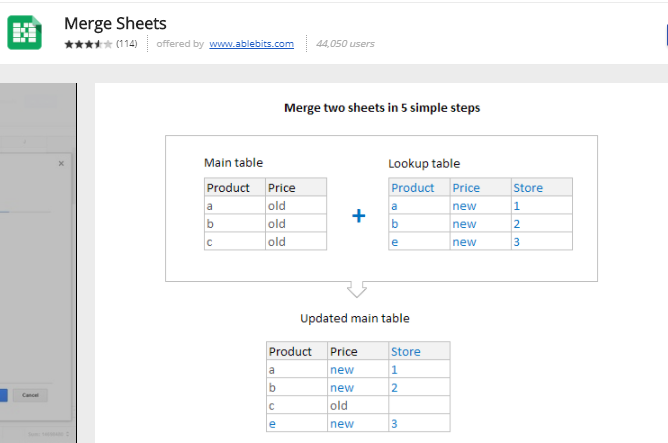
This is an excellent add-on to try when you need to combine data from two sheets. It accomplishes that goal through a five-step process.

The only thing you need is at least one common identifier column in the two sheets. The tool takes the information from those shared columns and brings it into one.

After the tool completes a merge, it gives you a summary of changes. That information helps you keep accurate records. It could also highlight unnecessary material in one or both sheets.

This add-on is free with an available annual subscription.

2. From Sheets to Calendar

google sheets add-ons - Sheets to Calendar

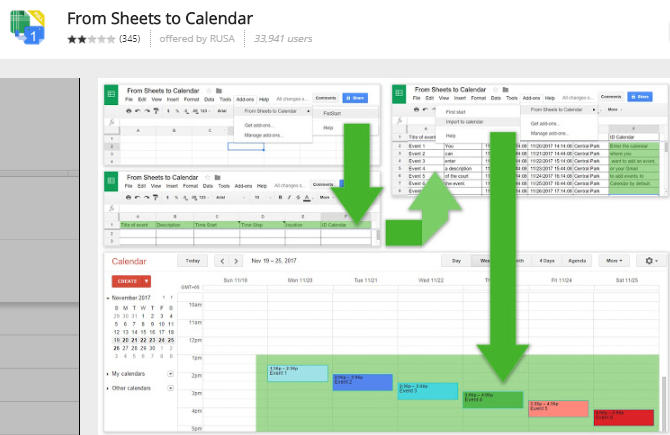
This add-on combines the convenience of Google Sheets and Google Calendar. It helps you create calendar events in batches and import them into Google Calendar to save time.

Consider using it if you have an employee birthday calendar or volunteer schedule. It works well for any use of Google Calendar involving numerous events.

The free version permits importing up to 20 events at once. If you get the paid version, it lets you work with up to 100 events in a batch. Using this add-on prevents you from switching between Google Sheets and Google Calendar too often. It avoids using a more cumbersome method of adding events.

This add-on is free with a full-featured version for a one-time fee of $1.

3. Power Tools

google sheets add ons - Power Tools

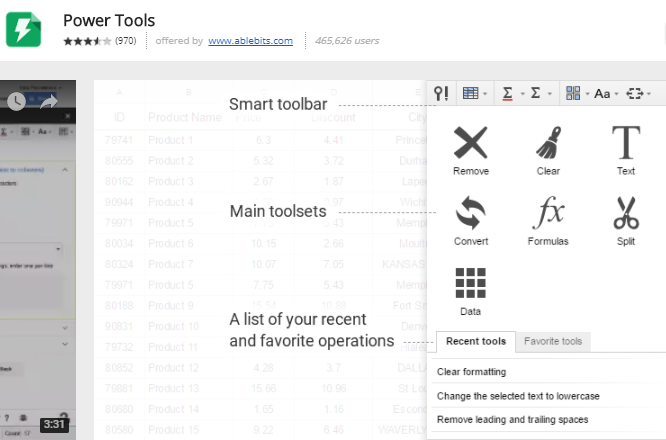
Working with spreadsheets often involves many repetitive tasks. The power tools add-on lets you minimize some of them. It offers a dedicated toolbar designed for applying one characteristic or change to cells in bulk. The toolbar features categories of tasks, plus creates a list of the features used most often.

In the remove group, you can get rid of extra characters in cells or delete blank rows. The data group allows merging sheets and rows, plus combining content from multiple sheets. Because power tools provide so many options in one place, you can streamline your workflow.

This add-on has a 30-day, full-featured trial available with a yearly subscription for $29.99.

4. Remove Duplicates

google sheets add-ons - Remove Duplicates

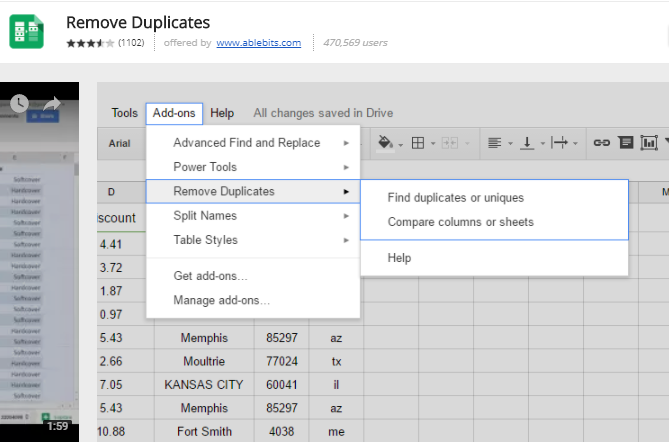
There are some basic rules of thumb you can use to reduce data entry errors, and then there are handy shortcuts like this add-on. It has two integrated capabilities.

The first gets rid of duplication through a four-step process. The other examines values from two columns and spotlights repeated information.

Incorrect information on a spreadsheet can lead to unnecessary confusion and wrong conclusions. If you know duplication is the most common error on your spreadsheets, this add-on reduces associated issues.

This add-on has a 30-day trial with an available annual subscription for $16.80.

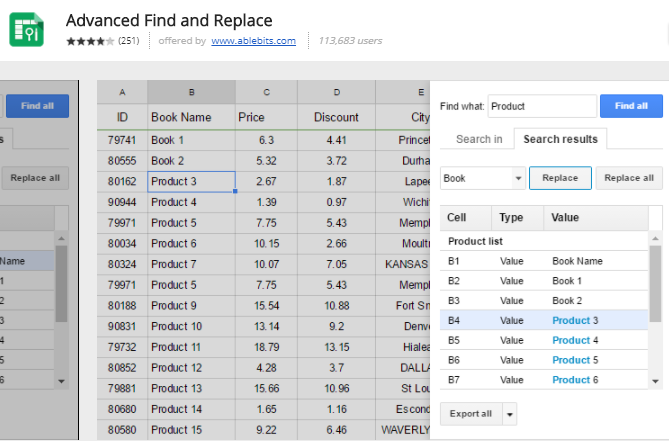
5. Advanced Find and Replace

google sheets add ons - Advanced Find and Replace

Find and replace is a useful feature that lets you make fast and accurate spreadsheet alterations. Instead of only relying on your eyes to locate parts of a spreadsheet requiring editing, use technology.

Depending on the scope of your task, the normal find and replace option may not be sufficient. If that’s the case, the advanced find and replace add-on is a good substitute.

It lives up to its name by offering more capabilities than find and replace typically does. It checks for information within cells, looks at link text, and things you type into notes fields.

Searching through custom formulas and values only goes so far. When you need something more, choose this add-on to work more efficiently.

This add-on has a 30-day trial with a $1.99/month subscription after that.

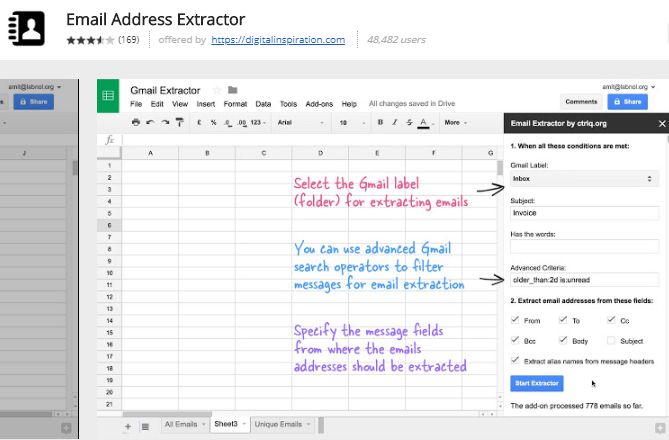
6. Email Address Extractor

google sheets add-ons - Email address extractor

Google Sheets isn’t only for numbers-related data. You can also use it to build a running list of sales leads, business contacts, or attendees. Once one’s complete, it’s an excellent resource. But, creating the list can take a while if you do it manually.

By using the email address extractor add-on, you can eliminate time-wasting steps. That’s because this tool searches through your Gmail account and pulls emails from it.

Besides looking through fields such as To:, From: and CC:, it examines subject lines and message bodies. That means no matter how people send you contact details, this tool will find and compile them.

Within the add-on’s settings panel, you can get more specific. For example, set it to only look through messages with certain words in the subject line. Alternatively, set up advanced criteria, such as unread content older than three days.

After you run an extraction process, notice the two tabs at the bottom of the spreadsheet. One shows you all the emails found. The other section lists all the unique emails.

Using the second tab makes you immediately aware of the duplicate content. That could reduce the chance of finding it later and getting slowed down as a result.

The free version of this add-on extracts up to 500 addresses from Gmail. It’s free with premium versions costing $29 per year for single users and $299/year for organizations.

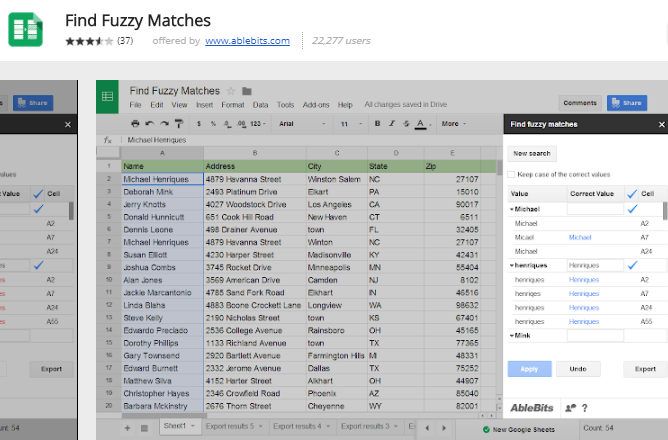
7. Find Fuzzy Matches

google sheets add ons - Find fuzzy matches

Besides the potential problems created by duplicate information, you must also be mindful of typos. Correct those as soon as you spot them. Otherwise, it’s unnecessarily difficult to interpret your spreadsheet.

By installing this add-on and tweaking the settings, you can discover minor or severe spelling mistakes. Then, fix them in seconds and feel more confident about the accuracy of your data.

The add-on makes suggestions for spelling the typos correctly. Choose one of those, such as using auto-correct on your phone. You can also input a correction into the field.

It’s also possible to see groups of errors. So, if you often misspell Adams by typing too many Ds, this tool could spotlight patterns. It gives awareness that helps you to change your bad habits.

This add-on is free.

8. Translate My Sheet

google sheets add-ons - translate my sheet

There may be times when you need to make a spreadsheet for a non-English-speaking recipient. This translation-ready add-on is a helpful addition to Google Sheets with compatibility for over 100 languages.

One useful characteristic of it is you can translate an entire sheet or only selected cells. Also, like Google Translate, it can automatically detect the source language. Use the dropdown menu to choose the desired output language.

In addition to saving you time, this add-on could prevent you from hiring costly translators. It’s particularly handy for making spreadsheets with multiple languages represented in the documents.

This add-on is free.

A Note About Add-Ons With Subscription Costs

You can purchase a premium subscription for any applicable add-on above within Google Sheets. Pay attention to the pop-up window indicating you have a number of days left for the trial. A subscription link specifies the cost and duration of a subscription. You’ll find that information in the add-on descriptions above when available.

However, in some cases, it’s not possible to see the price of a subscription in the early stages of a trial. This is presumably to help you realize how the add-on could benefit you before paying.

How Much Time Do You Save With Add-Ons?

After reading this list, you may use Google Sheets in ways that seemed impossible. Since some of the add-ons allow making uniform changes to multiple cells, you can automate tasks, too.

It only takes a few seconds to install an add-on. Doing so could give you more time in your day to take care of other things. Try using the add-ons discussed in this article to save time throughout your day and be your productive best!

Did you enjoy reading our list of add-on tools for Google Sheets? Now, take your Google Forms to the next level with these awesome Google Forms add-ons!

09 May 16:34

Demand Generation vs. Demand Fulfillment: What’s the Difference?

by Hannah Swanson

A lot of marketing terms are important concepts for demand generation marketers to understand and adopt. Others are just jargon – trending language that only matters to a select few.

While not every marketing term has lasting value, it’s important to understand the terms with relevance. Understanding the language of thought-leaders and forward-thinking marketing pros can be beneficial to adopting the right demand generation techniques.

Demand Generation vs. Demand Fulfillment

Two terms that are frequently confused are demand generation and demand fulfillment. They’re both important. However, they’re very difference concepts that shouldn’t be used interchangeably.

What is Demand Generation?

Demand generation is an discipline to B2B marketing which focuses on driving knowledge of and creating desire for a company’s products or services throughout the customer lifecycle. This practice can involve a wide range of techniques: engaging new audiences, acquiring lead data, converting leads to prospects, nurturing prospects into opportunities, retaining business and even upselling/cross-selling current customers.

This discipline is different from other B2B marketing practices; the success of a demand generation program is determined by a variety of metrics that may require close collaboration between marketing, sales and customer success. These metrics include lead quality, lead velocity, pipeline value and marketing’s revenue contribution.

Demand marketers often use a variety of strategies (e.g., account-based marketing), channels (e.g., display, third-party lead gen, events, etc.) and tactics (e.g., programmatic display, account-based lead generation, event case study sessions, etc.) to generate interest throughout the customer lifecycle.

Let’s use it in context: The demand generation campaign exceeded the B2B marketer’s KPIs for Q1 2018 with regard to three metrics: marketing-qualified leads, sales-qualified leads and marketing-influenced opportunities / sales pipeline.

What is a Demand Fulfillment?

Demand fulfillment is a business term which describes the process of meeting a customer’s demand for product or services by fulfilling their request.

  1. A B2B marketing agency may fulfill demand by creating campaign materials.
  2. A media company or lead gen provider may fulfill demand by achieving a CPL campaign’s lead volume and pacing requirements.
  3. A software-as-a-service firm might fulfill demand by providing a subscription to a web app.
  4. A manufacturing organization could fulfill demand by building products to specifications.

Fulfillment is exactly what it sounds like – delivering on a customer’s expectations in the form of products or services, and ideally satisfying the customer in the process. Demand fulfillment isn’t (only) a B2B marketing term, even though it’s an idea that matters in full-funnel marketing.

What’s the Difference?

Ultimately, there are quite a few differences between demand generation vs. demand fulfillment, since they’re very different actions that involve very different business functions. However, one of the biggest ones is this: demand generation isn’t for every business.

Demand fulfillment is a necessary action for any business that wants to survive. Demand generation is a marketing practice used by B2B organizations, and in very rare cases, some B2C organizations with long sales cycles such as home mortgage lenders.

Are you sure demand gen is NOT demand fulfillment?

Some marketers argue demand fulfillment starts in the consideration phase of the sales cycle. TaeWoo Kim, CTO at One Smart Lab once made the case that if a customer is searching for your website, you’ve already generated demand and you’re fulfilling their request by having a website.

With that said, we’re of the camp that demand generation and demand fulfillment aren’t the same and don’t have significant overlap.

Here’s why: The term “demand fulfillment” has been used in academic and business contexts in a consistent way for a long time, and demand generation success is not defined by leads generated.

Christoph Kilger, a partner at Ernst & Young, and Dr. Herbert Meyr, an academic supply chain management director, published the seminal definition of demand fulfillment in 2008 in Supply Chain Management and Advanced Planning as: how the actual customer demand is fulfilled.”

This definition is still used most commonly today.

If your idea of demand generation begins and ends with generated awareness, you’re probably doing it wrong.

Demand marketing challenges today aren’t just about lead generation. They’re about adopting a full-funnel mindset, aligning with sales, scaling, developing automation and using key performance measurements to optimize.

Demand marketers are responsible for a whole lot more than awareness.

More Than Building Awareness

Do B2B marketers need to add the term “demand fulfillment” to their marketing strategy? Not necessarily. However, creating demand with campaigns and content requires an understanding of demand fulfillment, and how your brand stacks up to the competition.

Ultimately, these terms are not synonymous. You can do demand fulfillment, and then you can do demand generation. But, if you want to drive the best results, you should probably do both.

09 May 16:34

Is it OK to Publish Pricing on My Website?

by Marvin Magusara

Many B2B and B2C businesses face the same question: What will bring more sales, disclosing our prices or having prospects contact us?

The answer to this question varies. As consumers, we live in a world of instant gratification. We are accustomed to finding the information we need right away.

We rarely send emails. Instead, we look someplace else if we don’t find the information we need.

Worse, we grow suspicious when a company doesn’t disclose their pricing. We think, “Maybe they are so expensive that they need to sell me on it?”

Not to mention that we want to speed up the process. Who would like to be called by a sales team for wanting to buy a fridge?

Dan Meir, a creative designer and the founder of Hidden Depth, seems to have the answers to why companies publish their pricing guides.

”The success of online marketplaces like Amazon show the value in listing prices, but a higher end exotic car dealership may not show anything to encourage interested buyers into talking to the dealer directly. Consider your ultimate goal and audience, and the answer should become apparent.”

Your audience holds the key.

If you are a digital marketing company looking for a new CRM, you will most definitely need to have a talk with the sales team.

B2B clients are more informed when it comes to making purchases. They perform extensive research and they are prepared to negotiate. In big companies, there are people hired for the sole purpose of making informed purchases. When you are buying $1 million worth of office furniture, you need to do your homework first.

On the other hand, if your target audience doesn’t spend huge amounts of money on your products or services and what you offer doesn’t leave any space for customization, publishing your prices might be a good idea.

Let’s review the pros and cons of publishing your prices on your website and look at a few questions you should ask yourself before you take the big step.

The pros of disclosing your pricing

The companies that can benefit the most from disclosing their prices are usually B2C or B2B companies with a standardized service that leaves no room for customization.

That said, let’s take a look at how being transparent might benefit you.

1. Keeps bounce rates low

Price is an important step in the buying cycle, and we usually want to find out right away how much we will pay for a product or service.

When you don’t disclose your prices, your website visitors might look somewhere else for pricing info instead of sending you an email. Dealing with a sales team for a services package that leaves no place for interpretation is an extra hassle that nobody wants to deal with.

When it comes to products destined for consumers, not companies, disclosing your prices is a must.

Prospects want to save as much time as possible and compare the prices with other companies as well. When they don’t have this possibility, chances are that they leave your website.

2. Improves your SEO

Since many companies shy away from disclosing their prices out of fear that their competition might spy on then (to be fair, they can easily request a quote with a fake email address and find out your pricing), keywords that include “price” and “cost” have millions of searches.

However, few take advantage of this opportunity.

This happens because many companies don’t want to disclose their prices yet consumers want instant gratification. Writing an email, sending it, and waiting for the reply takes time. Most people would just leave your website and search for a company that is more transparent.

If you’re wondering what SEO is and why that would improve it – the average time users spend on your site and overall user engagement are ranking factors.

3. Helps your prospect’s budget until they can afford you

You’ve probably done this before as well.

You see something you like but can’t afford, so you bookmark it and you start saving money until you can afford it.

This applies to services as well, especially if you have a strong brand that will make some wait and save money until they can afford you.

But if they don’t know how much you charge, they will probably flee. Many times, not disclosing your prices causes your prospects to believe they’re too high.

The cons of showing your price

The cons usually apply to highly-customized services where companies have a lot to lose if the difficulty of the task the client brings to the table is higher than expected.

For example, take a fitness company who contacts you after reading about your social media management services. If you have a fixed price yet the niche in which the company operates is quite crowded and is more difficult to stand out, you will have to put in a lot more work to satisfy your client.

1. Leaves no room for negotiation

You may be losing clients who need a smaller package than the one already posted. On the flip side, some projects might be more challenging while you get paid the same money for more work.

If you want to disclose your pricing, make sure you post a typical range along with some factors that bring the price up or down. This way, your prospects will have a reference point and there is some room for negotiation as well.

2. Your competition lowers their rates

There are many companies out there that race to the bottom and use pricing as their main selling proposition.

This is one of the risks that transparency brings. But if you have a large number of testimonials, a few case studies, and a clear description of what you can do for your clients, your competition’s strategy will fail.

You should also keep in mind that a client that chooses you based on your pricing only will likely be more demanding and less flexible if the work you do gets increasingly complex.

3. You aren’t sure what to charge

This can be quite problematic, but it’s usually caused by a lack of understanding of the market, or by highly-customizable services and products.

For example, let’s say you are offering SEO services, and you aren’t sure what you need to charge. The problem is a lack of clarity.

SEO is a large field, so you have to be more specific.

What kind of SEO services do you offer? How do your prices compare with other companies? How much experience do you have in the field, and how large is your portfolio?

The answers to these questions should give you a pretty accurate price range in case you are constantly scratching your head regarding the value of your work.

Questions that will help you figure out how much you should charge

1. Do you attract more clients than you can handle?

This sounds like every business owner’s dream. However, at times the answer to this question is not hiring more people but increasing your rates.

2. Does your product or service leave any room for customization?

It’s very easy to sell a t-shirt with a quote on it, but what about a t-shirt with customized graphics made by the client?

What about services that aren’t well-defined? What happens when each one of your clients has unique needs?

If you don’t offer the carbon copy of the service you delivered to your first client to the second, publishing your pricing will work against you.

3. Do you enjoy negotiating with people?

Some business owners simply don’t like the idea of running a sales organization. The CEO of Hotjar, David Darmining, purposely cuts costs on certain products just so he can avoid having salespeople try to convince his leads about the value of what he is selling.

If you are more extroverted and enjoy having conversations with your leads, not disclosing your prices could be a good starting point for negotiations.

This approach can work both for you and against you, depending on your skills in sales.

What should I do now?

There is no absolute answer to this question. However, companies that sell physical products benefit the most from disclosing prices, while service-based companies have a hard time creating a standardized service at the same price, regardless of the client’s needs.

The nature of your business also plays a role. For example, some companies would rather cut costs and disclose their prices instead of hiring an in-house sales team to negotiate one-on-one with each lead.

“Many of the bigger companies that we approached for our comparison site don’t display prices on their site. They prefer to sell their services to other benefits. Smaller companies often offer more competitive pricing and look to beat their competition this way. It would, therefore, depend on your business model. On the other hand, consumers will always prefer for prices to be available.” – Says Matt Taylor from WhatStorage?, a storage comparison website.

In conclusion, the size, the nature of your business, and the types of services or products you offer should determine your final decision.

08 May 16:23

Why You Need to Stop Covering for Your B+ Employees

by Liz Kislik

When you inherit incumbent staff members, you almost never get all grade-A players. But if you wind up with too many people who are stuck at B+ or lower, it can be tough to achieve all the results you’re responsible for.

I’m currently working with a leader who’s been reassigned — at a higher level — back to her old group. She reviewed her team members’ strengths and weaknesses with me, and identified who needed which kinds of development.

Several times, she mentioned one or another employee’s skill, style, or attitude deficits, and described how she could still make the situation work. In response, I noted that she needs to allocate her limited time and energy to learning her new job, working with her team, building relationships with her new peers, and driving a much larger set of results.

I cautioned her about trying to make up for her team members’ deficits. If she’s simultaneously covering 20 to 40 percent of other people’s jobs, what kind of outcomes is she likely to get?

Can — or Should — You Try to Fix Low-Grade Employees?

When you’re busy repairing too many people, or bridging the distance from what they’re really doing to what they should be doing, it’s hard to stay focused on your vision for the entire team and drive toward all of your goals. It’s also difficult to give your top performers enough of your attention to ensure they’re doing their absolute best and achieving everything possible.

If you have to keep checking on B+ employees instead of doing your own work, you can also create bottlenecks in processing, both up and downstream. And if you have to intervene on their behalf because they can’t manage their own interactions, not only do you wind up using your time, but you also expend your political capital.

So how much risk or exposure is it prudent to accept on behalf of B+ employees? Is it wise to cover for them when you’ll have to answer for whatever messes they make, putting your reputation on the line every time their work or interactions go badly? Are their behaviors or communications merely annoying, or are you afraid that, without your intervention, they might do real damage to customer relationships, colleagues, or the brand itself?

Assess Whether B+ Employees Are Worth the Risk

Developing subordinates is a crucial managerial skill, but developing people because they’re not what they should be carries a big cost, and therefore requires rigorous assessment. If you’re working with any individual whose performance is clearly below par, this checklist will help you decide whether they’re worth risking your own reputation on their behalf:

  • Identify their upsides, which might include knowing the organization; their technical expertise; their historical knowledge; and/or their interpersonal abilities for keeping the group together.
  • Assess their downsides. How much of that gap are you likely to need to cover? Are you compensating for relationship quality, technical ability, their ability and willingness to collaborate, and/or business acumen?
  • Look into the future: Can you see this person in it? If you’re confident that you can work an employee up from B+ to A- within 90 days, then keeping them is probably a decent bargain compared to having to start over with an unknown quantity. But if you think it will take more than six months to get someone up to speed, and you’re already providing the same depth of support for other team members, things become a lot more problematic. If the B+ person needs training, can someone besides you provide it? If B+ team members need coaching, can they get any of it from their peers?

Put Yourself into the Picture

Sometimes leaders don’t have the option to replace incumbents and are forced to support people whose performances are sub par. But when a good manager has the leeway to replace incumbents, the choice can be excruciating. It’s common for leaders who care a lot about other people to be too optimistic about how little energy, time, or other resources it will take to turn someone around.

There are also leaders who prefer not to deal with the stress of corrective action, performance improvement plans, or risking having to terminate someone that they and the rest of the team care about. These leaders may not only try too hard to fill in the gaps of their employees’ inadequacies but also try to save employees who have demonstrated loyalty or potential but haven’t been effective at their jobs. Most of the time, though, leaders are thinking about how to get the work done with the least amount of disruption.

In any case, when you have to make decisions about incumbents, get very concrete about the value and output you expect, based on their upsides, as well as exactly what you’ll need to do to cover their downsides. And then consider how you could build up the entire team’s capacity and drive for excellence — rather than draining your own.

08 May 16:16

Machine Learning: How To Take Hold Of The Latest Evolution In All Things Digital

by Shelly Dutton

One of the most overhyped and underestimated forms of digital technology might be machine learning (ML), and it is shaking up the foundation of the digital business. Data-pattern anomalies are detected in real time to weed out spam, fraud, and potential security threats. People are working more efficiently and strategically as routine tasks are automated. And even the definition of ‘business intelligence’ is evolving from a tool of reflection to a resource for real-time – and forward-looking – truth.

And if Jim Harris, author of Blindsided: How to Spot the Next Breakthrough That Will Change Your Business Forever, is correct, this is only the beginning of machine learning’s influence. “When combined, ML, AI, and cognitive computing revolutionize the way we work, how industries operate, and how society functions,” he acknowledges in the SAP e-book “The Path to Digital Innovation.”

Opening the door to insight-driven digital transformation

In recent years, data growth has brought unprecedented complexity to businesses of all sizes and regions. Everything from employee hiring, retention, and engagement to asset management and product pricing has become an interconnected factor in a massive ecosystem of layers upon layers of data. And, quite frankly, most organizations are struggling to understand how to extract the most value from this information.

Fortunately, the vision of machine learning embedded in technology, processes, and machines is quickly becoming a reality. For businesses that are prepared, tremendous opportunity for growth is on the horizon as their workplace culture becomes naturally data-driven.

In fact, Aberdeen research revealed that organizations with a data-driven culture have achieved a seven percent annual increase in revenue by improving efficiency and accelerating operational cycles. Plus, they decreased functional costs by 12%, which were regarded as wasteful spend before the transition.

Unleashing the full potential of data with groundbreaking computing power

Machine learning may seem like a clear path to solving the jigsaw of data value. However, as Gregory Piatetsky-Shapiro, president and editor of KDnuggets, warns, “[The technology] will improve efficiency, but has a danger of limiting choices since customers are likely to see only what they are predicted to like.”

But as Mike Flannagan, senior vice president of analytics at SAP, argues, the accuracy of those choices boils down to the quality of the data. In an interview with CXO Talk, he observes, “A lot of companies have a garbage-in, garbage-out problem. If you use incorrect data as training data for machine learning algorithms, your predictions are all going to be wrong…and all these advanced technologies, all of these new techniques from learning from data, will not benefit you in any way.”

Nvidia Corporation is working to bring data accountability to machine learning by delivering the power of an entire row of servers within the confines of a single integrated hardware and software supercomputer. “In the world of machine learning, there are two aspects: training and inference,” explains Jim McHugh, vice president and general manager at Nvidia. “The training is when you take all of the data and you teach [the application] to do things like image recognition or the rationalization components of it. Once [the application] learns to a certain extent, then you put it in inference. In essence, [the application] will infer based on what it was trained on.”

By designing a platform with tremendous processing power, Nvidia is enabling businesses to benefit from machine learning capabilities that are continuously learning from the data it receives as well as observed human actions and behaviors. For example, the use of natural language processing and deep learning techniques on Nvidia’s GPU platform enables analysis of unstructured data and creates automated rules to categorize and route tasks to the right process or alert the right people when exceptions or errors arise.

Digital transformation and machine learning: It’s all connected

As companies move deeper into their digital transformation, machine learning is shaping up to become a critical approach to unlocking unprecedented insights and establishing tight integration between their IT systems and business processes. Every functional area – from HR and finance to sales and supply chain – will finally derive the most value from its data to deliver cost-efficient operations, process accountability, and meaningful work. But most importantly, the promise of delighting customers consistently will become a reality.

For more executive insights on leveraging machine learning, download the SAP e-book “The Path to Digital Innovation.”

08 May 16:16

Lessons from the Professional Pricing Society Spring 2018 Conference

by Steven Forth
chicago_blog.png

Three of the Ibbaka team were at the Professional Pricing Society 29th Annual Spring Workshops and Conference (Karen Chiang, Steven Forth and Rashaqa Rahman). As always at these events, we learned a great deal and met some fascinating people. We would like to share just a few of the high points.

But first, a big thank you to Kevin Mitchell and his team. The event was well attended with almost 500 participants (a good economic indicator itself). It was well organized and had lots of great content. The Fall Conference will be October 23-26 in Houston Texas.

Ibbaka gave a presentation on the work we have been doing with TeamFit on the skills of pricing experts. We will be publishing a full report on this work later this month. TeamFit recently published a blog post on this work that has a number of useful links. The skills of pricing experts - skill insight research. One important question that came up during the discussion was one of process. One of the keys to pricing expertise is to have a good, repeatable process. One that you can apply again and again, build benchmarks, and continuously improve. It is not enough to understand the core concepts and to have the critical skills. You need to have a process too. We will dig into this point in future research into pricing expertise.

Tim Smith from Wiglaf Pricing gave one of the keynotes on Thursday morning. His focus was on commercial policy and pricing governance. The best part of this excellent presentation was his framing of the pocket price waterfall. In what he calls Collaborative Price Management, Tim showed how different parts of the organization are responsible for different parts of the waterfall, with the product owner often leading the setting of the list price (and the overall pricing architecture and design), with sales owning the discounting policy and finance controlling the application of logistics and payment terms. Using the Pocket Price Waterfall to clarify governance seems like a very good approach. (Check out our recent interview with Tim Smith).

Brad Soper from Simon Kucher & Partners covered the impact of digital transformation on pricing. There was a lot of talk about digital transformation about the event, but the SKP team has done the best job on linking this to pricing strategy. Being consultants, they needed a 2 x 2 matrix (we like to use these too as they can help frame abstract concepts). In the SKP matrix, the Y-axis was the standard one of how far have you gone in your digital transformation. The X-axis asked about monetization. Have you applied digital transformation to your pricing and monetization strategies? To get into the top right quadrant you have to have both implemented digital transformation across your company and worked out how these impact your pricing and monetization. Digital transformation opens many new revenue and pricing models and to truly reap the benefits of investments in digital these need to be leveraged.

For both Karen and me the high point of the conference was the presentation by Caspar de Bono of the Financial Times on their journey from a a print publication reliant on advertising revenue to a digital mashup of content, software and data that gets most of its revenue from subscribers. Caspar also hosted an engaging town hall as one of the very last sessions at the conference.

This was (I believe) the third presentation that Caspar has given on the Financial Times journey over the years. It was a very hopeful talk, and showed how hard thinking about value creation, value and pricing models, when combined with good data analysis, can transform a staid old business into a digital leader. It is a great example of a company that belongs in the upper right of the SKP matrix.

The outcome - the Financial Times is profitable and growing. It has been able to increase investments in journalism and editorial content. Let me repeat that. Compared to the days when the Financial Times was an advertising driven print publication, it now has more people doing research, writing articles and creating content. It has also added people who develop interactive content, data analysts and software engineers. Investment in the quality of content has continued as the FT is able to rely on its readers, and not its advertisers, for revenue.

How did they do this? There are many stages to this story, with critical decisions being made along the way. Caspar shared a wonderful slide that tracked the critical decisions and outcomes across the years. We should all keep maps of our decision journeys and review them from time to time. One of the keys, though was to get a data driven understanding of what drives engagement. They used the classical formula for engagement: frequency of use, volume of content used, recency of use. The equation for this is Engagement Score = Frequency x Square Root of Volume over Recency +1.

Engagement Score

This is an example of something that we sometimes call Predictive e. The most important measures of engagement are those that predict future engagement (see Predictive e: the future of engagement metrics). In these early days, it is difficult to use this kind of metric as a pricing metric (that day will come). What the Financial Times did was to run their numbers and find that when a user views nine articles in a month they are likely to become hooked and demonstrate a willingness to pay. They used this to build an Engagement Pricing model for their B2B customers. Is is worth spending some time on the Financial Times Pricing Page to get a feel for how this is presented to buyers.

An interesting aside, Caspar de Bono is the son of renowned writer Edward de Bono, who write the groundbreaking book on lateral thinking and has recently published Bonting: Thinking to Create Value, which I will have to look into.

Ibbaka intentionally combines pricing science with design thinking, and our basic approach is not to set or optimize prices but to design pricing (see Don't Set Prices. Design Pricing!). The Engagement Pricing approach of the Financial Times is itself a good example of lateral thinking and pricing as design.

There were many other great presentations at the Spring Professional Pricing Society conference. The most interesting presentations generally dove deep into a practical problem and showed how it was solved. We are looking forward to the next events in Houston and Amsterdam.  The Professional Pricing Society is a great place for pricing professionals to build relationships, share ideas and generally take our work up to the next level.

Subscribe

Sign up with your email address to receive news and updates.

Email Address Sign Up

We respect your privacy.

Thank you!
08 May 16:15

Account-Based Marketing: the Most Lucrative Market At Your Fingertips

by kniemisto

As a B2B marketer, you have probably heard of account-based marketing (ABM), which is sometimes referred to as customer-based marketing. ABM is widely used in B2B marketing because it’s well suited to the long sales cycle, helps build customer relationships with multiple stakeholders, accelerates the sales process, and offers multiple opportunities to close the deal.

In addition, ABM is precise, targeted, personalized, and measurable. It allows you to track every marketing dollar and has the highest ROI among B2B marketing strategies.

Altera Group Example

With the aid of fast-evolving marketing technologies, more B2B marketers are adopting ABM strategies. What can you do to stand out and stay ahead of your competition?

In this blog, I’ll cover the latest trends in ABM you can’t ignore.

Be Rigorous With Your Data

Since delivering personalized content is a critical component of ABM, the use of customer data is important in aligning your message with the target audiences.

After all, if you’re missing data or having errors in important customer information such as names, key roles, titles, industries, or company size, you won’t be able to target your marketing content effectively.

Data Analytics

To start, make sure that your customer data is accurate. You may have to clean up your data, verify existing information, round out customer profiles with additional data, or start your collection process anew.

All your customer information should be stored in a centralized database that allows you to create a 360-degree customer profile that informs real-time, omnichannel interactions.

In addition, adopt a data-driven approach to make sure you’re measuring the effectiveness of your campaigns accurately so you can fine-tune your tactics strategically.

Go Above and Beyond With Your Content

As more B2B buyers are doing their research online before engaging with a brand, you need to catch your prospects at the early stage of their customer lifecycle by sharing content that’s relevant, informative, and educational.

EcommerceandB2B Example

Content marketing has been proven effective for B2B companies to generate and nurture leads, allowing you to cultivate relationships with prospects that are not ready to make a purchasing decision.

However, since more vendors are using similar strategies, your content has to go above and beyond the same old “relevant and informative” to cut through the clutter.

It needs to capture the attention of your audience, share a perspective that establishes your unique positioning, communicate a brand personality that’s relatable, and invite engagements that build trust over time.

In addition, you need to show up in front of your prospects consistently to nurture relationships by planning a series of high-value content that’s distributed over time and through a variety of channels.

Ensure Audience-Message-Channel Match

The premise of ABM is the delivery of a highly personalized customer experience. The efforts you put into crafting buyer personas, analyzing customer data, and creating high-quality content will be for naught if you fail to put the right content in front of the right people in a way that they’ll consume and engage with it.

The need for highly personalized content may mean ramping up content creation. You need to establish a system that allows you to scale your content production without sacrificing quality.

In addition, you have to format, distribute, and position the information according to the needs and preferences of each buy persona. The format should align with how the target audience prefers to consume content. If the audience prefers short actionable content such as a checklist, a long ebook won’t be appealing to them. If they tend to learn visually, an infographic may generate more engagement than a blog post. You also need to distribute the content through the appropriate channels so it will be shown to the audience at the right time.

For instance, a post on a work-related topic shown to a B2B buyer during business hours on LinkedIn will be more relevant than during the weekend when she’s connecting with friends and having relaxing conversations on Facebook. You can often share the same piece of content with different buyer personas by framing the information differently to articulate why it’s relevant to each audience segment. For example, adjust the email copy to speak to the challenges of each subscriber segment when sending out the link to a blog post.

Align Sales and Marketing Teams

While the marketing department is generating high-quality leads and nurturing them with targeted initiatives, it’s important that these prospects are converted into customers effectively by the sales team to optimize ROI.

Your marketing efforts should be in sync with your sales activities so prospects are primed for the sales conversations when they’re ready to make a purchase.

Organizations with highly aligned sales and marketing teams are found to generate more sales and have higher conversion rates.

Smarketers Example

To increase the effectiveness of ABM, synchronize your sales and marketing efforts.

Each department should plan purpose-driven activities that directly address the needs of each account so it can be seamlessly transitioned from marketing to sales to increase the close rate.

Sales and marketing teams should also be in constant communication and collaboration.

For example, sales reps can get insights from the customer data and analytics compiled by the marketing team to identify key B2B stakeholders so they can shorten the sales cycle and maximize upsell or cross-selling opportunities.

Use the Right Automation Tools Strategically

Marketing automation technologies allow marketers to process the large amount of data required to deliver a personalized experience for individual B2B stakeholders within each account.

To do so cost-effectively, use a marketing automation software application designed specifically for ABM and has the capabilities to support sophisticated functions such as:

  • Building aggregated audiences: create and self-maintain audience segments without a dependency on current relationship mappings in your CRM.
  • Lead-to-account matching: clean and match individual leads to accounts so you can deliver the most appropriate content and offers.
  • Self-updating account and account groups: make single adjustments to a centralized list to save time, accelerate sales process, and reduce errors in reporting.

Though automation can save a lot of time and efforts, keep in mind that ultimately ABM is about cultivating relationships to increase sales.

Use the software to closely monitor prospects’ activities and interactions with your company so your sales team can jump in to offer the kind of 1-on-1 dialogues required to close a sale in a timely manner.

Leverage AI and Predictive Analytics

AI and predictive analytics give you the accurate data insights you need to properly execute ABM strategies.

It helps you understand buyers’ behaviors so you can market to them cost-effectively.

Sirius Decisions Example

Predictive analytics can be used to identify the accounts most likely to buy so you can allocate resources strategically. It allows you to understand what each contact cares about so you can articulate your value proposition in a way that will create engagement. Predictive analytics also helps align sales and marketing, especially using a technique called lead scoring, so the right leads can be passed from marketing to sales at the right moment to maximize conversion.

In addition, predictive analytics allows you to identify the prospects that are a good fit for your products or services. This often translates into less churn, more cross-sell or upsell opportunities, and higher customer lifetime value.

Account-Based Marketing: a Lucrative Market of One

Even though all the new technologies and strategies available to B2B marketers can sometimes seem overwhelming, the premise of ABM is quite simple: treat each account and stakeholder as a market of one. Successful account-based marketing leverages customer data to provide targeted content and personalized offers that position your brand as the most trusted and relevant resource in providing the solution your customers need. As such, the most effective ABM strategies are the ones that allow you to deliver the best customer experience.

Have you implemented ABM with your company? Tell me about your strategy in the comments.

The post Account-Based Marketing: the Most Lucrative Market At Your Fingertips appeared first on Marketo Marketing Blog - Best Practices and Thought Leadership.

08 May 16:13

Why Sales Is the Best First Job, According to HubSpot Sales Reps

by Somen Mondal

Getting to connect with people everyday. The autonomy and flexibility. The potential for high commission. 

Ultimately, there are plenty of exciting reasons to start your career in sales. 

Working in sales will enable you to learn the skills you need to sell anything — even yourself for future career moves. You'll also become a master of communication, increase your confidence through closed deals, and build an impressive professional network that will benefit your career now, and into the future. 

Here, let's dive into six reasons you should start your career in sales, according to HubSpot sales professionals.

Free Kit: Everything You Need for Your Job Searchwhy you should start your career in sales-1

1. Sales offers a crash course in business acumen.

Heather Baynes, an Enterprise Account Executive at HubSpot, told me one of the biggest benefits to starting your career in sales is the learning opportunities it presents, which will set you up for long-term success in any role.

As she puts it, "Sales offers a crash course in business acumen … In many environments, you can skip the MBA and go with what you learn in sales."

Baynes adds, "Working in sales also offers exposure to all divisions and levels of an organization, which offers unparalleled learning and networking opportunities from the CEO down. A sales person will have this exposure within their organization and in many client/prospect organizations."

If you're a recent graduate with no prior business experience, sales can be a fantastic opportunity for learning more about how an organization runs, what matters most in a business setting, and how to conduct yourself professionally with both peers and even C-level executives.

2. Sales allows you to strengthen your communication skills.

Regardless of which career path you choose (and even outside of the office), communication is undoubtedly one of the most important skills you can strengthen to succeed professionally.

Strong communication skills helps you connect with colleagues, managers, and customers. And, as you move up in your career, communication skills is also a vital trait for enabling you to lead others more effectively.

HubSpot's Manager of North America Business Development, Advika Mukherjee, told me, "Sales is a great first job for folks who are trying to hone their communication and active listening skills."

"You have to listen and communicate effectively every day to be successful. Those are two major transferrable soft skills that you can apply to other roles (and even personally) as you progress throughout your career."

Mukherjee adds, "Sales wasn't the career I thought I'd be in when I graduated college, but I'm glad I stumbled upon it!"

(Mukherjee isn't alone — only 39% of salespeople intend to go into sales. The remaining 61% become salespeople a bit more accidentally!) 

Additionally, when I surveyed 300+ individuals, I found a little over half (51%) marked "communication and listening skills" as the number one most important trait to succeed in sales. 

most important trait in sales

HubSpot BDR Hallie Thompson agrees that starting a career in allows you to foster plenty of transferable soft skills, including communication and listening skills. 

Thompson says, "I onboarded a little later in the game after working in various other roles and I sure wish I had started my career in sales! If I could go back, I would choose sales for the sheer amount of transferable skills. Among other skills, sales forces you to adapt to various people and situations, which strengthens interpersonal communication."

Thompson adds, "I would also say that sales encourages you to network, network, network! Which ultimately puts you in a stronger position down the road should you choose to switch career paths."

3. Sales will help you gain confidence. 

"The #1 thing I've gained from working in sales is confidence," HubSpot Solutions Engineer Carrie Buth told me. 

Buth continues, "Sales has allowed me to gain confidence in speaking to large groups or very senior prospects, in presenting demos and solutions, in navigating difficult situations and conversations, and, ultimately, in advocating for myself."

Unsure how to build confidence in sales? Take a look at our The Ultimate Guide to Confidence to begin exploring resources that will help.

why you should start your career in sales according to carrie buth

4. Sales helps you increase your resiliency. 

"Everyone should do a stint in sales to learn that rejection doesn't debilitate you, that hearing 'no' isn't a bad thing, and that someone's work ethic and drive has a direct impact on how much they can earn," says Anya Taschner, a HubSpot Inbound Success Coach Manager. 

Taschner continues, "Sales helps develop social skills, ability to negotiate, conflict resolution, and, above all else, resiliency."

"If you can resist defeat and withstand the pressure, working in sales is a crash course in many of the most critical things you need to navigate the human experience."

HubSpot BDR Matthew Healey seconds Taschner's point, telling me, "For a recent grad, moving into sales is a strategic way to start your career because it builds resilience (or grit, as we like to say) to overcome obstacles, and forces you to be quick on your feet to strategize/find a resolution."

5. Sales will enhance your collaborative skills. 

Inbound Success Coach at HubSpot Sahil Rikhy told me he believes starting a career in sales can help you develop three critical skills. 

These include: 

  • Collaborative skills
  • Consultive skills
  • Conversational skills 

As Rikhy puts it, "These are three skills that no matter where you go or what you do (even outside your professional life), will always play a part in giving you an edge. A sales role puts us in front of the customer, so we have to learn how to be comfortable talking to others and how to navigate conversations, and of course guide them through to the end."

"Mastering these skills first in your career will make future opportunities a lot easier to tackle, since you've already gotten your hands dirty before."

6. Sales can offer financial freedom. 

Baynes told me another big benefit of starting your career in sales is the financial freedom sales can offer. 

For instance, median on-target earnings for a B2B AE is $132,000, and is $156,000 for an AE Manager.

She told me, "When you work hard in sales, you can achieve anything. You can build personal and generational wealth if you ask questions of those who have gone before you and put some investment strategies in place."

Baynes adds, "All of this is said with a big 'must have'. It has to be the right culture where you can be free to do your best, where you feel supported and where you can be your most authentic self. The alternative makes sales a tough place to be."

Of course, your salary varies widely depending on your specific sales role — a sales development rep (SDR) will make a different salary than a account executive (AE) will make, and an AE will make a different salary than a sales engineer.

But one thing is certain about any sales role: Your performance largely dictates your pay. The more deals you close, the more potential financial rewards. 

Why Sales is the Best First Job

Ultimately, starting your career in sales can help you whether you stay in sales for the long-run, or eventually switch to a different career trajectory. 

As we've covered, sales can help you foster and strengthen both soft and hard skills that are critical for any professional role.

Additionally, being in sales will help your personal life, as well — particularly as it comes to both communication and listening skills, and confidence. 

why you should start your career in sales according to chris locke

As Senior Account Executive Chris Locke puts it, "For me personally, sales has put me in a position to exponentially grow my career and expand my network. Whether you choose to stay in a selling role or move to a different profession, sales will give you an invaluable skillset that will be helpful in all facets of your life."

Locke adds, "If I had to go back and do it all over again, I would pick sales every time." 

Ready to start your career in sales but unsure where to start? Take a look at Which Type of Sales Job Is Right for You? to explore which specific career path is best for your unique strengths. 

Apply for a job, keep track of important information, and prepare for an  interview with the help of this free job seekers kit.

08 May 16:12

How to Turn Your Google Analytics Dashboard into a Powerhouse Business Intelligence Tool

by Helene Clary

Turn Your Google Analytics Dashboard into a Powerhouse BI Tool

According to a Pew Research Center survey conducted in January 2018, 77% of Americans go online on a daily basis. Much of this time online is spent learning about new products and services, which means digital marketing is no longer optional for most businesses. With an ever-increasing number of consumers conducting research online, it’s imperative in most industries to include a robust digital marketing component in the overall marketing plan.

The path for many buyers has evolved from communicating with company representatives as a core method of learning about products and services, to conducting primary research independently online. It’s only after a person has uncovered enough information to form an opinion and determine which solution is likely the one they need, that they will then be willing to connect with a company representative. Even at that point, the first contact is often initiated online.

With the multitude of online marketing approaches, and the numerous sites a prospect could visit for research, companies often find themselves with a variety of digital marketing channels to monitor, track and correlate. Fortunately, most initiatives direct visitors back to the main company website, or designated landing page, for the information they desire. This approach creates a smooth experience for users and also makes it easier for marketing teams to track results.

Google Analytics is by far the most common tool for tracking website information like page views, bounce rates, exit rates, best/worst pages, page views over time and origin of search – whether it be direct, referral or search traffic. The platform is designed to provide users with easy access to the most critical metrics. This information is incredibly valuable, but what is even more valuable is connecting Google Analytics to a business intelligence (BI) system.

Consider, for example, the value of combining Google Analytics data with information from your CRM system, a third-party survey tool, or a campaign management solution. In addition to learning about the website behavior of your prospects and customers, sales representatives can correlate the behavior to purchase history, customer support records and customers satisfaction rates. Marketing teams are empowered to consolidate website data with campaign results and view each step of a buyer’s journey, so they can better understand the sequence and make appropriate adjustments to future campaigns.

A powerhouse BI tool connected to Google Analytics provides exponentially greater intelligence for your sales and marketing leaders. The ability to make better-informed decisions results in direct increases in sales and ROI. This level of insight creates a distinct competitive advantage for your business.

08 May 16:12

How to Go from Transactional to Strategic Sales Skills in 5 Months

by Alex Rynne
Man in suit jumping

Who’s thinking about the best way to apply your talents in the months and years to come?

We’ve all seen to-do lists and good intentions set aside in the face of pressing matters and an overflowing inbox. And relying solely on your company for professional development may not always be the best option if your goal is to stay marketable.

The best way to ensure you’re ready for a new opportunity, whether elsewhere or at your current company, is to prepare for advanced situations yourself. That might seem like a daunting task given your current workload, but in this article, we offer tips for breaking down career development aspirations into manageable portions.

The Future of Sales

The sales process has gotten increasingly complex over the last decade. Buyers are armed with information and options, which reduces their reliance on sales reps. Sellers enter the buying process later than in decades past, limiting opportunities for personal consultation.

Recognizing the shift, some sales professionals are moving to a more collaborative approach, enabled by tighter sales and marketing alignment. According to LinkedIn’s recent survey, 58% of marketing and sales professionals reported increased customer retention as a result of collaboration.

A collaborative approach with marketing promotes buyer involvement earlier in the process, often in the vital needs assessment and consideration phases. This increased collaboration gives sellers access to timely data, which they can then use to earn the attention of key prospects.

How Success Will Be Determined

In our e-Book “The Power Couple: How Sales and Marketing Alignment Makes Your Business Unstoppable,” we revealed that of the businesses believing they are delivering a good customer experience, 66% have a clear understanding of their customer. Sixty-four percent collect feedback from customers, with a 57% implementation rate of the findings. Companies which evaluate and enhance the customer purchasing journey commit to putting what the customer needs at the center of what the company needs to do.

Salespeople who take on roles as personal consultants find that the positive contribution deepens the buyer-seller relationship in a way that maximizes the lifetime value of the customer.

Where to Find Help

Now we’ll explain what you can do to ensure you grow your skills accordingly.

1. Improve transparency: Good communication is the key to growing relationships, both internally and with customers. Technology can enable more timely and richer communication so that everyone operates from the same playbook. Sales pros who know how to extract key information from their CRM aren’t just doing themselves a favor in terms of lead gen, they become the go-to people in the department.

An intuitive CRM or lead management system can help salespeople keep track of contacts and relationships. It can document specifics about prospect budgets, needs, and concerns. Some systems also support marketing automation to assist with the nurturing process.

Gain technical skills in these products: LinkedIn Sales Navigator, HubSpot, Pardot, Salesforce, Insightly, Zoho, or other lead management systems. In addition to requesting demos or trial accounts from these or similar companies, you can also pick up knowledge for several of the software leaders at HubSpot Academy, Lynda.com, and Udemy.

2. Learn to produce and adjust more rapidly: As we covered earlier, the state of sales is rapidly changing. Forrester estimates that by the year 2020, 1 million B2B sales jobs will no longer be relevant. While some low-level sales positions may be eliminated, trusted advisors with strategic sales skills will continue to be in demand.

Learn these strategic operational skills:  Agile or scrum methodologies can turn the sales teams of yesteryear into nimble agile agents. Agile is particularly useful when adopted as part of the sales and marketing alignment effort. Good sources of information include LinkedIn LearningMcKinsey & Company, and Content Marketing Institute, and Agile Sherpas. Sales expert Jill Konrath’s book, “Agile Selling,” will also help salespeople adapt to change.

3. Become more self-aware: When sales professionals invest in learning about their identity (self-perception) and reputation (how others perceive them), they can begin to gain a more realistic view of their strengths and weaknesses. Those weaknesses can inhibit a salesperson from realizing their full potential as a collaborative sales professional.

A 2009 report published by the Keller Center of Baylor University found “...research shows that when a salesperson has the ability to accurately appraise the emotions of other people, it amplifies their skills for adaptive and customer-oriented selling. This means that salespeople with high emotional intelligence (EQ) should be able to read clients’ emotions better, use that emotional information to better adapt within the selling situation, help clients solve problems in a way that makes them feel valued, and as a result, improve their overall lead conversion rates.”

Cultivate these soft skills:  Empathy, active listening, humility, and adaptability are valuable skills for effective sales pros learning to identify with others. Training sessions on developing emotional intelligence and communicating with empathy are offered by Lynda.com as is another one, also by Lynda.com. Other sources include Udemy, MindTools, and Psychology Today. Harvard Business Review also features a number of articles covering emotional intelligence and the role it plays in career development.

How to Make Development Happen

If it seems like we’re suggesting you go back to school for another few years, don’t worry. Beginning today, you can start a habit of active improvement that will put you in a much stronger position than you started out, with plenty of time to reap the benefits of your new knowledge. Here’s one schedule to try:

Month one: Subscribe to a few reputable blogs covering buyer-driven sales, agile methods, or EQ. Set aside at least 45 minutes each week to read the blogs and reflect on how the information can be applied in your job. The best way to make sure this happens is to block time on your calendar for it.

Month two: Secure a few product demos or register for trials with CRM software providers. If your employer has talked about trying one (or has a subscription you’ve never made use of), take steps to learn about program features and benefits. Experiment with setting up profiles and contacts, and grow your involvement from there. You don’t have to achieve expert-level status to make positive strides you can document on your LinkedIn profile or resume.

Month three: Complete one book. This should comprehensively cover whichever strategic sales skill you’ve set your sights upon.

Month four: Start and complete one or more of the virtual training programs referenced above. Be sure to add them to the Skills section of your LinkedIn profile. As you begin to exercise the new skills in your daily work, consider asking for endorsements to start establishing competency.

Month five: Complete a second book. The topic could be any you didn’t pick the first go-around. Are things starting to get interesting? Would it be beneficial to have a working lunch with your boss or peers to talk over the new material or concepts you’ve learned? Try publishing a post on LinkedIn to showcase your career development efforts.

Learn more ways to future-proof your sales career by checking out our latest e-Book, The Future of Sales: Rise of the Strategic Seller.

      
08 May 16:11

Sales Hack: 100s of MSP Leads Are Waiting For You

by Shannon Eckroth

There’s been a lot of buzz in and around my office regarding local prospecting techniques and our members are desperate to learn better, more strategic ways of filling their sales funnel. Furthermore, nurturing those leads until the prospect is ready to make a purchase. Building a sales funnel is challenging… especially if you’re not the “prospecting type” and networking, relationship building and engaging isn’t really your thing.

Over the past few months, I have been working one-on-one with MSPs challenged with this exact problem. You may have already attended CharTec Sales Lab and have the five steps to selling managed services down but what does any of that matter if you can’t even get in front of the prospects? Your sales strategy MUST start with prospecting and filling your sales funnel if you want to have a consistent stream of RRM opportunities.

Luckily for all of you, I happen to be pretty good at playing the prospecting game and I’m here to help! I’ll be sharing some of the sales-life-hacks I have come up with over the years to not only keep my sales funnel full but also continue to tighten the qualification process in which I evaluate my leads. Back in 2009, I was hired into my first sales position with a large executive staffing firm in Silicon Valley. At the time, I had zero experience managing opportunities and the first thing my management requested of me was 140 sales calls a week and 18 face-to-face meetings in order to achieve my weekly goal of 2 new clients.

This may not scream anything to you now and it certainly didn’t to me then but I have to tell you…. that’s not prospecting.

Quantity is useless if there is no quality.

It makes so much more sense to connect with less people and as a result have far more engaged and purposeful conversations, really getting to know WHO you are selling to, building relationships and loyalty within your community. Prospecting is all about researching who YOU want to do business with –> not reaching out to as many people as possibly in hopes that SOMEONE will have SOME SORT OF minimal interest in you at best.

Ok, so that’s all wonderful and fluffy feeling but HOW do we build our lead list without purchasing from a third party, cold calling into random homes and businesses, flooding the airways with SPA advertising, passing out flyers at the parking garage in the mall…. HOW?!

Well, today is your lucky day because I am going to reveal one of the EASIEST and SMARTEST ways to jump start your new warm-lead-generation-lifestyle. I should preface this with assuring you I was never compensated or rewarded for my recommendations and I just think these tools are THAT amazing for the 2018 sales rep’s tool kit. (COMING SOON!)

LinkedIn Sales Navigator + Dux Soup = LEAD GENERATION PERFECTION

LinkedIn is probably a pretty familiar concept to you, especially if you’ve been working on your profile but it’s likely you haven’t heard much about LinkedIn’s social selling service called Sales Navigator. And, it’s probably 99% likely you’ve never heard of the Chrome browser extension, Dux Soup.

LinkedIn Sales Navigator

Sales Navigator allows sales professionals to tap into the power of LinkedIn efficiently. It improves social selling in support of powerful daily habits,” said Diana Kucer, LinkedIn’s Director of Global Product Marketing. When you first launch the tool, a wizard guides you through setup. Based on your existing network, you can pick which organizations are current opportunities. You can import from SalesForce into Sales Navigator to see LinkedIn activity for your accounts.

Sales Navigator goes far beyond a passive system though. Based on the contacts you have selected, Sales Navigator suggests potential organizations that fit a similar profile. You can also define your territory so that suggestions are limited to your area. When I test-drove the system as it was brought to market a few years ago, I was immediately impressed with it’s ability to comprehend my target market based on my preferences and to take it a step further, found it ridiculously useful when it made suggestions to me on companies and professionals that it recommended I try doing business with. Intuitive and brilliant although back then not nearly as capable as it is now.

Dux-Soup

Isn’t that a crazy name? I should look up the purpose of that name sometime… but for now, let’s talk about what it’s capable of. Dux-Soup is the ultimate lead generation tool for LinkedIn. Whether you use the free LinkedIn platform or you subscribe to Sales Navigator, it will literally visit thousands of profiles with one easy click, document everything it’s seeing all the while sending personalized invitations to connect. Taking it one step further, the Chrome extension follows IFTTT trigger workflows and it’s power to operate in a fully automated state elevates a sales person’s productivity from zero to hero before lunch.

To help my members better understand the brilliance I am speaking of, I made a video of the two platforms in action together…. take a look!

I don’t think it could get any easier. If you were to set up this workflow each day to crawl new profiles, you would have a very champagne problem of figuring out how to capitalize on all of the prospects you have with only 24 hours in your day!!! (I’ll have tips for that not-so-bad-crisis soon)

Seriously, MSP world… quit trying to take shotgun approaches to getting your “at bats” with decision makers and look to build long term relationships by listening more, talking less and going the long haul. Prospects that are nurtured and developed over time stick around for renewals and product upgrades. If you don’t know… now you know. 🙂

08 May 16:10

Are You a Slave to Your Data? How Taking a Narrow View of KPIs Can Limit Growth

by Gian Clancey

I’ll be the first to tell you that data is critical for proper digital marketing efforts.

It’s crucial.

Without numbers, goals and key performance indicators (KPIs), it’s impossible to know whether or not our efforts are producing the results we desire.

Despite that, “more data” isn’t always “better data” – and it certainly isn’t always “better results.”

Marketers today face the enormous challenge of sifting through the wealth of data available to them and transforming these key pieces into actionable insight.

And while there are plenty of articles out there telling you how to gather this data and how to choose your target metrics, there are far fewer talking about their limitations.

Today, I want to explore some of the challenges marketers face when implementing data-driven analytics initiatives and when dealing with the limitations of data themselves.

After that, I’ll leave you with some strategic insights that’ll help prevent the way your organisation uses data from limiting its future growth.

The Problem with Data

Attribution and performance data used to be incredibly expensive to come by – not to mention unreliable, due to a lack of precision in collection methods.

Think about it – back when your company was running TV spots and print adverts, could you really tell which collateral pieces sent you sales? Or were you making your best guesses and hoping they proved correct?

Now, all you have to do is load a bit of code onto your site and be granted access to seemingly-unending streams of engagement, conversion and attribution data.

Compounding the problem are the number of new tools entering the market every day, promising bigger and better results.

Marketers who don’t know how to dive into these streams to pull out the highest-priority insights run the risk of a number of problems.

They get stuck in “analysis paralysis”

It’s unfortunately common, but too many business owners and marketers – when faced with an immeasurable amount of data – simply do nothing.

The problem is “analysis paralysis” – a condition the Todoist’s Becky Kane describes as follows:

“Rather than empowering us to make better choices, our virtually unlimited access to information often leads to greater fear of making the wrong decision, which in turn leads to us spinning our wheels in a seemingly inescapable purgatory of analysis paralysis, all the while getting nowhere on our important projects.”

Kane backs up her definition using psychologist Barry Schwartz’s principle, the “Paradox of Choice.”

According to Schwartz’s work, having too many choices at our disposal doesn’t – as we might assume – make us happier.

Instead, an abundance of choice is more likely to leave us feeling anxious, dissatisfied or paralysed.

Image Source: Todoist

I see this all the time in marketers. Being able to choose from hundreds of different data analysis tools should make it easier for us to find the right one.

Instead, we’ll spin our wheels – reviewing tool after tool – unwilling to rest until we’ve found the right one (let alone the right metrics to track with it).

In the end, all we have to show for our efforts is wasted time.

They focus too much on easily-provable vanity metrics

Now, let’s say you manage to overcome analysis paralysis and select both marketing data tools and the KPIs you’ll measure with them.

Be careful that the metrics you’ve chosen are ones that have actual value to your company.

The Harvard Business Review’s Linda J. Popky explains:

“It’s not that marketers don’t want to measure the right things. With a wide variety of advanced, easy-to-implement analytics, it’s easy to be led off track and fall prey to a few pitfalls. The foremost one is measuring what’s easy to track. Just because a lot of web and social media behavior is trackable doesn’t mean you should track it. Much of this data (e.g., clicks on a web link) is too granular to be used for higher-level decisions.”

Let’s say you decide to hone in on your email marketing campaign – a good choice, given that some studies have identified a 4400% ROI and $44 for every $1 spent using the strategy.

Your email marketing program likely provides a number of different data points for your consideration, including (but not limited to):

  • Delivery rates
  • Open rates
  • Link clicks
  • Conversions from email subscribers

The first three on this list are easy to measure – and easy to improve upon.

However, they have very little impact on the overall success of your campaign.

Imagine two scenarios:

  • Marketer A has a list of 5,000 subscribers. He sends an email blast promoting an upcoming event and gets 100 people to open the message (a 2% open rate). He revises his subject line, resends the message and gets 200 opens. He’s doubled his open rate and declares his second message a success.
  • Marketer B also has a list of 5,000 subscribers. She sends a similar sales message to her list, gets the same 2% open rate as Marketer A, and notes than 1 of those opens turns into a sale. She tweaks her CTA, resends the message, and although her open rate doesn’t change, she doubles her conversions.

Which of these two marketers do you want to be?

In the first case, Marketer A improves his open rate, but because he’s only tracking this surface-level, vanity metric, he has no way of knowing whether or not he’s actually made more money for his business.

Marketer B, on the other hand, can say definitively that her activities yielded tangible results for her company.

That’s the power of focusing on meaningful metrics – not vanity KPIs.

How Data Limits Growth

The two scenarios described above – marketing that’s either stalled or pegged to vanity metrics – represent clear limits to growth.

If you aren’t moving forward and you aren’t collecting the right data, you can’t advance your marketing campaigns. Simple as that.

That said, most modern marketers have already faced – and overcome – these challenges.

In these cases, the limitations data places on growth can be more subtle, though they’re no less deserving of your attention.

Measuring Quality Over Quantity

In the “Marketer A vs. Marketer B” scenario I described above, an issue was the fact that Marketer A was tracking a surface-level metric without a direct impact on campaign performance.

But just because you’re tracking metrics that are further down the funnel doesn’t mean you’re tracking the right aspects of those KPIs.

Take the example of leads generated, as illustrated by Marketo’s Jon Miller:

“Focusing on quantity without also measuring quality can lead to programs that look good but don’t deliver profits. (To take this idea to the extreme, the phone book is an abundant source of “leads” if you only measure quantity, not quality.)”

On the surface, “leads generated” appears to be a better metric than something like the “website clicks” or “average time on site” that might precede a site visitor turning into a lead.

But the quality of these leads is another layer that must be considered.

A higher number of low-quality leads isn’t a real win, even if it might look like one on paper.

Continue drilling down to the metrics you’ve select to ensure they’re indicative of actual performance gains for your company.

Overinflating Contributions and Channel Importance

Part of the reason situations like the low-quality leads example above continue to happen is the way marketing budgets have been decided in the past.

In siloed environments, in which every department must defend the use of its spend, it’s natural for marketers to emphasise the impact of their efforts by any means necessary.

If you knew that your ability to get funding for the next quarter or the next year was dependent on the results you presented to your c-suite, wouldn’t you try to trump up the numbers to look as impressive as possible?

Unfortunately, this results in situations like the one Marketing Land’s Matt Nitzberg describes below:

“Each channel manager often takes more credit for sales than they actually earn, so channel activity, added together, is often a bigger number than total sales. Goals that reward cross-channel synergy and total sales growth can help stop unhelpful internal competition.”

The consequences of channel managers overinflating their own contributions are two-fold:

  • The total performance of individual channels relative to each other can’t be fully understood, due to internal competition.
  • Specific tactics carried out within each channel can’t be prioritised appropriately, since their actual impact on channel performance isn’t known.

Both of these outcomes are undesirable from a performance management perspective.

Target KPIs must be designed in such a way that there’s no advantage to team members or departments who fudge the full impact of their actions.

Focusing on the Short-Term, at the Expense of the Long-Range

In my experience, one of the most insidious ways an excessive adherence to metrics stifles growth is the way it dampens long-range thinking.

Even metrics that seem performance-oriented can suffer from short-range thinking, as I’ll demonstrate in the example below.

Suppose your business sells a SaaS product with a $47 per month price point, and that you use three primary strategies to generate leads: Facebook Ads, programmatic ad buys and email marketing to subscribers who enter your funnel via opt-in forms on your website.

Let’s assume that each strategy generates 200 leads for you.

If you set your target KPI to conversion rates or new customers generated – two common “results-oriented” metrics – Facebook Ads would be the clear winner.

They’d still be the winner if you looked at the total revenue generated by each of the three campaign strategies.

If you took this short-range approach, you’d like decide to scale up your Facebook Ads campaigns – and in doing so, you’d miss that email marketing generates a higher customer lifetime value and a better ROI from spend to revenue generated over the long-range.

Now, admittedly, this is a pretty simplified example I threw together for the purposes of this article. Your numbers aren’t likely to be quite so clear or well-defined.

But that doesn’t negate the problem of short-range thinking. According to Josh Graff, senior director at LinkedIn EMEA, as interviewed by Marketing Week’s David Burrows:

“As an industry, we’re guilty of focusing on short-term metrics, which fail to offer a holistic view of how campaigns fit together to reach the same goals. There needs to be a shift in thinking long-term, where marketers are always ‘switched on’ and looking for ways to build more meaningful relationships with consumers.”

Part of that comes down to asking whether or not the metrics you’re targeting adequately reflect the long-term performance of your campaigns.

But it’s also about looking at the bigger picture of customer experience.

Limiting Creative Thinking

One of the challenges a narrow data-driven focus presents is that it transforms transactions and customer experiences into data points.

But customer relationships aren’t black and white. Individual customer experiences exist on a spectrum of grey. Treating them like individual data points risks missing out on the breadth of more complex factors that could be driving purchasing and referral behaviours.

Consider the following data points from HelpScout, which suggest that customers value the relationships they have with brands more than ever.

  • 78% of consumers have bailed on a transaction or not made an intended purchase because of a poor service experience.
  • 3 in 5 consumers (59%) would try a new brand or company for a better service experience.
  • On average, loyal customers are worth up to 10 times as much as their first purchase.

All of these trends are indicative of the need to treat marketing as just one piece of the bigger picture.

Do your current target KPIs take loyalty into account? Do they account for variables like a poor service experience that could be lowering conversion rates?

Further, what will your company do if the steps needed to produce a better customer experience don’t come from the marketing department at all?

If your nose is buried in conversion rate and ROI reports, you may completely miss the fact that what’s needed to drive real growth for your company is better onboarding and faster customer support responses.

You’re essentially seeing the trees of purchase decisions, but not the forest environment – in all its many complexities and influences – in which they occur.

Until you learn to step outside of your strict focus on marketing metrics and see this bigger picture, you’ll miss opportunities to drive real growth for your company.

How to Move Forward

I’ve covered some individual tactics for determining whether or not your target marketing metrics support long-term growth, but what really interests me as Louder’s CMO is the strategic side of things.

If you’re a CMO or other high-level marketing exec, I’d like to leave you with the following challenges:

Do the metrics you’re tracking reflect real growth for your company?

Hopefully, this isn’t a concern for you. Enough has been written online about choosing metrics that prove engagement – rather than “vanity metrics” – that none of us should be thinking about social shares, website clicks or other surface-level KPIs as indicative of real growth.

That said, I know how easy it can be to assume that your team (if you have one) is on the right track without noticing that the up-trending reports they’re handing you aren’t measuring the right things at all.

Do you sign-off on the reports that come across your desk without another glance?

When was the last time you sat down with your team to really assess the value of every KPI you’re tracking?

If you can’t confidently say that your team’s target metrics really matter, it’s time for an all-hands meeting.

Have you created a culture that restrains your team’s creative thinking?

As you’re evaluating the metrics your team is measuring, analyse your company culture as well.

Have you inadvertently set up systems of internal competition that might lead employees to overstate their own impact?

Or have you stuck them with such a narrow range of performance metrics that they lack the freedom needed to explore new, potentially-profitable channels?

Employees may not be honest with you if you ask them these questions directly, out of fear of rocking the boat.

Instead, pay attention to the subtle signals.

Do overarching metrics add up, or is the sum of the pieces greater than the sum of the total? Are your team members testing new things – even if they risk missing metrics goals by doing so?

Sniff out these situations, and adjust course to embrace more creative thinking and flexibility.

How are you thinking about growth outside of target KPIs?

Finally, start looking at that broader forest of future growth.

What factors could be contributing to the performance of your marketing channels, outside of the channels themselves?

Are there other departments you need to loop into your conversations to ensure critical contributing factors aren’t overlooked?

Continually be evaluating the role of your department within this larger ecosystem to uncover wins you can’t score through marketing metrics alone.

Looking Beyond Metrics to Drive Future Growth

Don’t take this article to mean that I’m against setting target KPIs or measuring metrics. Quite the opposite.

I believe we need data to help give our campaigns direction and to ensure every dollar being spent is returning as much revenue as possible.

But I also believe it’s important that we avoid treating data and hitting metrics goals as the “true north” of driving growth, when the real picture can be so much bigger.

Don’t let a narrow focus on metrics prevent your company from reaching its full potential. Expand the way you think about the role of marketing – and how you measure it – in order to facilitate future growth.

What do you think? Do you agree or disagree? Leave me a note below sharing your thoughts:

Image Sources: Pexels, Pexels, Pexels

08 May 16:10

4 Ways to Use Agile Sales to Improve Your Cold Email Conversion

by Jessica Barrett Halcom

The very idea of sending cold emails may cause you to shy away from even considering it. You may wonder if you’re wasting your time. Does it even work? With the cold email open rate being lower than that of an opt-in email list, and it sounding a little like cold-calling, it’s understandable that some companies aren’t excited about giving it a try.

In order to make cold emails convert, there are a couple things we need to reframe as we think about it. First, we need to approach cold emails as a way to start a conversation, not make a sale. When you’re sending cold emails, you can’t come on too strong. Nowhere in a cold email should you be trying to sell the advantages of a product or service. A cold email should always include the ways in which your business can help that person. That’s it. You’re only looking to establish a relationship at this point.

The other thing we can begin to look at regarding cold emails is using agile sales. According to Hubspot, agile sales “takes project management strategies from the IT world like sprints, standups, and constant iteration and applies them to selling.” Agile sales teams work together to continually work on the best ways to sell to customers, and they use data and deep communication to improve their processes and increase revenue.

Rather than just going in blind, making best guesses, and casting a wide net hoping to catch an undefined “something,” agile sales helps you track, measure and then improve your cold email approach. Here are four ways to use agile sales to improve your cold email conversion.

Define Your Target Market

Perhaps one of the largest advantages to using agile sales is the ability to define your target market. In the past, businesses had to make more assumptions and do a lot of “hoping for the best” when it came to who they thought they should be contacting. Through the use of agile sales, you know exactly who you should reach out to. You’ll understand more about your prospects, what their business model looks like, and whether nor not your product or service is a fit for them, making it simpler to narrow in on those companies and contacts you should spend your time on.

Prospects Are People

For all of the technical aspects of agile sales, it’s surprisingly good at making things more personal. Because you’re going to have a good read on who your contacts are, from a data perspective anyway, it’s easier to think of them as a person, rather than a random contact on a database. It’s easier to imagine them as they really are; probably very busy, needing emails to be short and direct, and someone with a lot of problems to address–some of which you can hopefully solve.

Reach Multiple Contacts

Most companies have several decision makers involved in every decision, purchase, and change they make. When you’re trying to find the right contact within a business, your odds are better that someone will read it and you may hear back if you reach out to more than one person. It’s important that each email isn’t identical, so try not to use a canned approach. If you can find some personal way to connect to each person differently you’re better off, but if not, try changing the copy to be different in some way. Within some agile sales or customer relationship management (CRM) tools you may have the option to use an email finder feature to give you a hand with locating the right contacts within the companies you’re looking to connect with.

Easy Does It

It can be tempting to really go for it when you’re trying something new, especially if you’re trying out a new tool or learning a new, promising strategy. But with cold email marketing, it’s best to learn what has the highest response and conversion rates by sending emails in small batches. Then, you can track and measure what results you’re getting and make the necessary changes and improvements moving forward. Think of it like testing and iterating your process according to your tests, and you’ll have a lot more success than putting all your eggs in one email basket.

Remember that cold emails are a way to begin a conversation and start to develop a relationship. You’re not looking to make a sale right out of the gate. Keep this in mind as you craft your email copy and approach prospects looking for qualified leads that will convert.

Using agile sales may be one of the best ways to build a cold email strategy that allows you to utilize metrics in order to focus your efforts in the right places. Before you start sending cold emails you’ll be armed with a clearly defined target market and have the information you need about your contacts.

The post 4 Ways to Use Agile Sales to Improve Your Cold Email Conversion appeared first on OpenView Labs.

08 May 16:10

Do You Have Prospects or Only Suspects?

by Mark Hunter

Do you have prospects or are they only suspects?  I cover this in-depth in my book High-Profit Prospecting. You can be more efficient and successful at prospecting.

I’m always amazed at how many times a person’s pipeline can become filled with nothing but suspects who have zero potential to become prospects and ultimately customers.

A coach can help you excel in your sales career! Invest in yourself by checking out my coaching program today!

Copyright 2018, Mark Hunter “The Sales Hunter.” Sales Motivation Blog. Mark Hunter is the author of High-Profit Prospecting: Powerful Strategies to Find the Best Leads and Drive Breakthrough Sales Results

07 May 16:12

The Real Threat to Your Goals and Ambitions

by Anthony Iannarino

0The real threat to you not producing the results you want are not external. They are not somewhere “out there on the horizon, looming, lurking, and threatening. You might believe that the risks to your results are your irrational competitor, the government or politics, changes in the general economy, global events, or black swans. While there is no reason not to be aware of what’s going on around you; that still leaves you responsible for doing something.

All the risks to your goals are right here, right now, and internal.

The real danger you face is that you don’t do what you need to do when you need to do it. The danger to reaching your goals is that you allow small things to take your time and attention away for the few, critical, big things you need to do. The real danger is not putting outsized effort into your real priorities.

Knowing what you need to do and not doing is a failure to execute, one of the most certain factors that will cause you to miss your goals. You are vulnerable not because of your competitor’s irrational pricing model, as much as you are your failure to execute your own strategy. For all intents and purposes, knowing what you need to do and not doing it is the same as not knowing.

The way you fail to generate the outcomes you want is to avoid dealing with the constraints, believing that your strategy and your effort will be enough to reach your goal. Strategy is mostly made up of what you are not going to do, and what you are going to give up. Having what you want often requires that you have less of one thing to have more of something that is going to move you forward.

Looking outside for threats instead of looking inside for obstacles is to spend time and energy on threats that are not going to do as much to harm to you as you are by not doing what you need to do. Awareness of external threats is enough. Turn your attention inwards and do the work you need to do to have what it is that you want.

The post The Real Threat to Your Goals and Ambitions appeared first on The Sales Blog.

07 May 16:08

32 B2B Content Marketing Case Studies for 2018

by Lee Odden

B2B Content Marketing Case Studies

One of the great honors of working in the marketing agency world is seeing your work recognized. For me, an even greater honor is seeing the work of our clients and my team recognized and that’s exactly what happened at the 2018 Killer Content Awards.

This year the award in question went to our client Cherwell Software. Thanks to amazing work by Alison Munn and the Cherwell Software team (pictured above), as well as our team at TopRank Marketing, their integrated influencer content program drove 22% of all new sales pipeline revenue in 2017.

But this post isn’t about just one B2B content marketing story. It’s about 32 stories from an impressive collection of B2B brands. These award winners are case studies for content marketing that we can all learn from. A BIG THANKS goes to the team at B2B Marketing Exchange for sharing raw case study data and both Anne Leuman and Lane Ellis from my team at TopRank Marketing for their collaboration on word-smithing the content and capturing the images of this post.

Check out the case studies below covering a range of categories including:

  • Measurable ROI, Nurture Campaign
  • Multi-Touch Campaign
  • Account-Based Marketing Campaign
  • Sales Enablement Campaign
  • Buyer-Focused Content, Bundled Content
  • Influencer Content
  • Interactive Content
  • Short-Form Content
  • Video Content
  • Research-Based Content
  • Agency Partnership
  • Social Amplification

32 B2B Marketing Case Studies Featuring Killer Content and Performance Results

Ciox Health
#1 – Ciox Health

Project: Ciox Health partnered with Content4Demand to uncover new growth opportunities with target audiences (e.g. law firms). After creating detailed personas, they developed highly tailored content messaging for all stages of the buyer’s journey. The final campaign featured an infographic, interactive quizzes, interactive listicles, checklists, Q&A sessions, and mixed media video.

Results:

  • Reached 1,884 potential prospects
  • 42.8% open rate
  • 14.5% CTR

Equifax
#2 – Equifax

Project: Equifax developed a multi-touch campaign consisting of more than seven touch points, including emails, social posts, blogs, webinars, and promotional emails. Quarterly webinars were the centerpiece of the campaign, allowing Equifax to capitalize on existing economic trends and CreditTrends reporting that were relevant to their target audience.

Results:

  • Increased webinar registrations by over 200%
  • Nearly doubled webinar attendees

The Kount
#3 – Kount

Project: The Kount team, a provider of award-winning anti-fraud technology, created the Fraud360 worldwide tours, regular webinars, and video ads, which were designed to provide market-specific content and tailored insights that focused on specific trends and industries.

Results:

  • Average of 450 registered webinar attendees per session
  • Thousands of views on video ads
  • Reached thousands of professionals in target regions, including Asia, Australia, and EMEA

Xactly
#4 – Xactly

Project: In order to prove its knowledge of buyer pain points and the effectiveness of its solutions, Xactly rolled out the Power of X campaign. Using customer testimonials and product demos, Xactly strived to nurture existing relationships and drive demand through an integrated, buyer-focused campaign across all segments, featuring a landing page hub, social promotion, direct mail, customer videos, and webinars.

Results:  280 leads generated

SAP Ariba
#5 – SAP Ariba

Project: SAP Ariba wanted to create a complete lifecycle nurture program for each of its targeted personas: Procurement, Supply Chain, Finance, and IT. Working with DemandGen, SAP Ariba mapped all 80 emails appropriately and used non-promotional language to emphasize their “thought leadership” content.

Results:  454% higher open rate

ADP
#6 – ADP

Project: To identify potential buyers and convert readers into sales opportunities, ADP developed a flagship Research Nurture Program. The program leverages website analytics, marketing automation, and scoring to identify key buyer personas, customize content, and send nurture emails for longer-term engagement.

Results:

Generated thousands of influenced sales opportunities
Millions of dollars forecasted in total opportunity pipeline

Bottomline Technologies
#7 – Bottomline Technologies

Project: Bottomline Technologies breathed new life into its quarterly awareness email campaigns by introducing themes that aligned with pop culture events. By making subtle tweaks, the company was also able to create relevant messaging for different lines of business (e.g. strategic finance, controller, accounts payable), including infographics, white papers, and checklists.

Results:

  • 1,000 infographic downloads within 24 hours
  • 62% of downloads were net-new contacts

Veracode
#8 – Veracode

Project: Veracode created the Application Security Program Journey multi-touch campaign to drive awareness and generate demand for application security. The integrated, multi-touch campaign consisted of various content mapped against the buyer’s journey, as well as multiple inbound and outbound promotional tactics.

Results:

  • 4,000 inquiries
  • 479 opportunities
  • 241 wins

Optum
#9 – Optum

Project: To promote the launch of its new brand, OptumIQ, Optum created Data In Focus, an event to attract decision makers and influencers in person and via a livestream. Over a six-week period leading up to the event, the company unveiled key event details via an integrated campaign utilizing email, paid and organic social, digital advertising, retargeting ads, direct mail, and more.

Results:

  • 5,022 external registrations
  • Exceeded registration-to-attendee conversion rate goal by 33%
  • 13.6 million impressions
  • 886 marketing contacts

Broadridge
#10 – Broadridge

Project: With a sales cycle that can be quite lengthy, Broadridge sought to create a campaign that would steadily educate target buyers — finance executives and operations/IT leaders — on their value proposition. The full-funnel campaign included interactive infographics, eBooks, executive briefs, and Q&A’s that addressed buyer pain points. Broadridge paired this campaign with an internal guide to educate sales on the campaign goals, individual assets, and follow-up conversation starters to ensure quality interactions with buyers.

Results:

  • 2,133 MQLs
  • 6,995 content downloads

Grant Thornton
#11 – Grant Thornton

Project: The Growth and Future of Industry campaign from Grant Thornton was created to help business leaders understand ways to accelerate growth and manage disruption. With over 60 pieces of content and an extensive social media campaign, it is the single biggest research program and thought leadership campaign the company has ever undertaken. Grant Thornton also leveraged paid media — a first for the company — to improve campaign reach and visibility among clients and prospects.

Results:

  • Exceeded reach goal by 4x
  • Exceeded conversion rate goal by 7.5x
  • Industry-specific reach and conversion goals were also exceeded

Open Text
#12 – OpenText

Project: The OpenText Digital Disruption thought leadership campaign was launched to engage enterprise executives in a fun and engaging way as they strive to understand and embrace digital disruption. The campaign used a re-designed microsite to house a variety of assets with a fun superpower theme, allowing visitors to easily consume content — even binge it all in a single sitting.

Results:

  • 9:12 average session duration
  • Increased social traffic to the microsite by 1,062%

Cherwell Software
#13 – Cherwell Software 

Project: Cherwell Software partnered with TopRank Marketing to develop a comprehensive influencer program for the IT service management industry. A 24-page eBook called IT Service Management 2020, kicked off the campaign, featuring influencer opinions about the future of the ITSM industry. To generate pre-launch interest, Cherwell produced and promoted several blog posts, an infographic, and co-hosted a webinar with the influencers.

Results:

  • 100% share rate with influencers
  • 240% greater download rate than the average gated asset
  • 29% increase in web traffic to Cherwell.com from social
  • Leads from the campaign contributed to 22% of the revenue pipeline for 2017

Paycom
#14 – Paycom

Project: Paycom collaborated with best-selling author, keynote speaker and futurist Jacob Morgan on a series of content to give HR professionals a closer look into why employee engagement scores are at an all-time low despite increased employer investment. The campaign featured a two-part podcast, a webinar, and a series of thought leadership blog articles — all featuring Morgan.

Results:
255 live attendees, 30 of which signed up for a Paycom consultation
1,172 podcast downloads
494 podcast page views
1,410 blog post page views

Blackbaud
#15 – Blackbaud

Project: To differentiate the company’s two fundraising solutions, Blackbaud launched their Choose Your Solution campaign. The campaign featured an interactive quiz to help arts and cultural organizations identify the right fundraising solution based on their needs, and to help qualify leads faster and bypass repetitive introductory questions asked by sales reps.

Results:

  • 36 influenced opportunities that resulted in $34,000 in pipeline
  • 42% MQL-to-opportunity conversion rate

Uberflip
#16 – Uberflip

Project: Uberflip created an interactive marketing maturity assessment and companion eBook that asked marketers to take a hard look and identify where they stand in their marketing path. The assessment enabled Uberflip to provide their sales team with better MQLs and gain more information about existing accounts.

Results:

  • 907,843 impressions and 1,297 clicks on social media in just three months
  • 38% question completion rate
  • 64% average lead submission rate

Siemens PLM Software
#17 – Siemens PLM Software

Project: To educate customers and prospects on digital twins and digital threads, Siemens PLM Software created a thought leadership initiative. This initiative included creating a series of blog posts answering common buyer questions on digital twins and threads.

Results:

  • 3,800 page views across articles
  • Ranking No. 2 on google for “value of the digital twin” and No. 14 for “digital twin technology”

CAS
#18 – CAS

Project: In order to help scientists and research leaders at research and development organizations define important problems and highlight the opportunities additional time could give them, CAS, a division of the American Chemical Society, developed the Where Does Your Time Go? infographic.

Results:

  • Generated 489 leads
  • 20,400 views

Oracle
#19 – Oracle

Project: Oracle developed The Modern Finance Leader blog series to establish itself as a leader in the world of finance. The blog targets finance executives across North America, EMEA, and APAC and provides content designed to educate and inform the audience on the latest trends and topics in finance.

Results:

  • 330 posts published
  • 90,000 unique visits
  • 500,000 page views
  • 63% increase in web traffic quarter over quarter

Bottomline Technolgies
#20 – Bottomline Technologies

Project: Bottomline Technologies partnered Content4Demand to develop an interactive eBook designed to showcase how three organizations — from manufacturing, healthcare, and property management industries — used their Paymode-X network to elevate efficiency and improve their bottom line.

Results:

  • 54.3% email open rate, 39.8% CTR, 73.4% click-to-open rate
  • 362 downloads through content syndication
  • 4 MQLs, 2 SAOs, and $3.2 million in associated pipeline

Anthem Blue Cross Blue Shield
#21 – Anthem Blue Cross and Blue Shield

Project: Anthem Blue Cross and Blue Shield collaborated with Skyword to revamp an existing piece of content, titled: The Benefits Guide. In response to new audience needs, Anthem pivoted the asset away from the Affordable Care Act (ACA) focus and replaced it with a newsroom that conveyed news and decisions relevant for plan holders.

Results:

  • 103% increase in page views and 102% increase in search views from Q2 to Q3 in 2017
  • 798,000 total page views from 2016 to 2017

SAP
#22 – SAP

Project: SAP launched its #LifeAt video campaign to highlight their many innovators, game-changers, and true entrepreneurs, but SAP also sought to humanize the brand for its target audience. The SAP team partnered with the video marketing agency Aftermarq to produce video stories of SAP SMB clients of varying lengths.

Results:

  • 4.5 million impressions
  • 31% view-through rate for 5:00 videos
  • 21% view-through rate for 1:00 videos

LinkedIn
#23 – LinkedIn

Project: LinkedIn’s Live with Marketers campaign is a live talk show by marketers for marketers, designed to resolve pain points around top-of-mind topics such as marketing attribution, ROI optimization, and driving business impact on social media.

Results:

  • 12,000 registrants
  • 5,000 live attendees
  • Increased projected revenue from deals closed through this series versus traditional webcasts

Matrixx Software
#24 – MATRIXX Software

Project: MATRIXX Software designed its 150 Points of Opportunity campaign to differentiate their content from that of their competitors, while also showcasing how their product delivers value to customers. The campaign featured a 44-page eBook and five standalone videos.

Results:

  • 77% return rate to the MATRIXX website
  • 43% increase in average session duration
  • 25% growth in C-suite interaction and target account engagement rate

Tempur Sealy
#25 – Tempur Sealy Hospitality

Project: Tempur Sealy Hospitality was looking for a way to present their high-quality mattresses to B2B buyers in the hospitality industry without having to lug around a physical sample. The company worked with The Mx Group to create an interactive mattress cutaway tool that allowed sales reps to digitally present and sell various mattresses to hospitality customers online and at industry trade shows.

Results: Achieved a 90% adoption rate with the sales force

LookBook HQ
#26 – LookBookHQ

Project: In an effort to re-engage lost opportunities and give the sales team more prospects that were more likely to convert, LookBookHQ created their Caveman campaign. The campaign consisted of an interactive digital experience built on the LookBookHQ platform, a direct mail component, and follow-up email outreach from sales.

Results:

  • Booked 300 meetings
  • Generated more than 50 new opportunities
  • Saw a 56% overall conversion rate, up 27% from the previous year

Channel Advisor
#27 – ChannelAdvisor

Project: ChannelAdvisor decided to create two unique ABM campaigns that targeted strategic accounts via direct mail. The two campaigns provided over 250 prospects with pre-loaded Amazon devices, featuring ChannelAdvisor skills and apps that educated prospects on e-commerce strategies that were relevant to them.

Results:

  • Achieved an ROI of 130%
  • 39% of generated opportunities were net-new

Trapeze Group
#28 – Trapeze Group

Project: Trapeze Group kicked off an ABM pilot with the objective to identify top accounts with which to deepen engagements and create personalized one-to-one messaging and campaigns — ultimately influencing closed-won opportunities. The ABM pilot has since been rolled out to 60 target accounts.

Results:

  • 111% increase in session duration
  • 100% response rate to the direct mail component

Harland Clarke
#29 – Harland Clarke

Project: To drive awareness for the company’s new product, GRC Spotlight, Harland Clarke created the “Keeping Up with Kevin” campaign. The star and subject matter expert for the campaign, Kevin Malicki, participated in video blogs that were shared over social media — primarily LinkedIn — to help deliver tips and real-world scenarios in the GRC space.

Results:

  • 33,000 LinkedIn impressions
  • Increased Malicki’s LinkedIn connections by 22%
  • Increased Malicki’s LinkedIn profile views by 110%

Ipswitch
#30 – Ipswitch

Project: Ipswitch created the “Defrag This” podcast and blog to help provide a trusted knowledge base for IT professionals that offers audience-centric content via social channels.

Results:

  • Nearly 200% growth in blog subscribers
  • 174% increase in monthly visitors to the blog
  • 133% increase in organic traffic to the blog

Radius
#31 – Radius

Project: Radius’ Revenue Ops campaign was designed to help educate prospects in marketing and sales operations on how their role in B2B business is evolving — from simple execution to providing data and insights to help drive revenue. The campaign was fueled by an eBook that Radius co-created with companies such as Heinz Marketing, Engagio, Forrester, and more.

Results:

  • 500 eBook downloads in the first two days
  • Engaged more than 300 top-tier accounts
  • Influenced more than $5 million in pipeline

Emma
#32 – Emma

Project: Emma wanted to learn what makes today’s marketers tick, as well as promote collaboration and learning within the community. The company surveyed roughly 200 marketers and interviewed more than 25 industry experts to gauge the goals, concerns, and pressures facing marketers, then compiled the data into its first Email Marketing Industry Report.

Results:

  • Over 41,000 unique views
  • Contributed to 37% of the company’s content downloads

Top Takeaways for B2B Content Marketers

Themes of success from this collection of B2B content marketing examples include: data informed personas, personalization, interactive content, integrated content, thought leadership and influence. Of particular note was the use of live video by LinkedIn Marketing Solutions.

As interactive content has become a more common feature in award-winning B2B content in 2018, I think video will take that spot in 2019.

There’s a lot to learn from with award winning content marketing programs and I congratulate all the B2B brands that brought him Finny’s this year. The awards give recognition to great work and they also give us a look inside what’s really working in the industry.

Have you noticed a B2B content marketing campaign this year that was remarkable? If so, please share in the comments why you thought it was special.


Email Newsletter Gain a competitive advantage by subscribing to the
TopRank® Online Marketing Newsletter.

© Online Marketing Blog - TopRank®, 2018. | 32 B2B Content Marketing Case Studies for 2018 | http://www.toprankblog.com

The post 32 B2B Content Marketing Case Studies for 2018 appeared first on Online Marketing Blog - TopRank®.

07 May 16:02

Shaping Our Customers’ “Why”

by Bob Apollo

Golden Circle

I recently shared my thoughts about applying Simon Sinek’s “Start With Why” concept (also known as The Golden Circle) to the sales process.

I used Sinek’s framework to make the point that our best customers don’t just buy what we do, they buy into why we have chosen to do it and are prepared to pay a premium for how we do it.

Being able to articulate our why – and going on to explain how our approach is distinctively different and capable of driving superior outcomes for our customer – is a critical advantage in complex B2B sales.

But what about our prospective customer’s why and how – the reason why they believe they need to change and their vision of how they are going to make that change happen? What can we do to influence their thinking?

The answer, it turns out, is a great deal. And it involves applying the principles of the Golden Circle. Exactly how we apply them depends on where our customer is in their buying decision journey. Most successful customer decision journeys evolve through a series of key phases:

  • At first our prospective customer is unconcerned or unaware
  • Then they turn their attention to exploring the issue
  • Then they turn their attention to defining their needs and decision process
  • Then they turn their attention to selecting their preferred option
  • Then they turn their attention to verifying their choice
  • Then they turn their attention to confirming that the project can go ahead
  • Then they turn their attention to implementing their chosen solution

It goes without saying that this journey is rarely perfectly linear. The phases can sometimes seem to blur together, and of course our prospective customer can choose to move forwards or backwards, to stay as they are or to abandon the project at any stage. How can we align this with the Golden Circle?

Golden Circle and Customer Decision Journey-1

Start with Why (Unconcerned or Exploring)

If our prospective customer is at the very early stage of their journey – if they are either unaware or unconcerned about any of the issues we have chosen to target or have just started to explore them as a result of some recent trigger event – our focus should be on why they need to change.

We need to help them establish a clear value gap between their current situation and their future potential. We need to stretch that value gap by introducing unconsidered or undervalued needs until the contrast between where they are today and where they recognise they need to get to, and the associated case for change, is unarguable.

In doing so, we need to introduce and develop needs that are best satisfied by our core capabilities – but at this early stage, we need to be careful to lead towards our solution, and not with it. A premature product pitch or solution proposal can destroy the momentum that we have carefully sought to build.

During this all-important discovery phase, we need to stick with the problem and progressively develop the consequences and implications until our customer convinces themselves that action is necessary – and if after all our efforts the reason to act still seems vague or weak, we should carefully consider whether the opportunity is likely to lead to a sale.

Turn to How (Defining)

Once both we and our prospective customer believe that the gap between their current situation and future potential is sufficient to justify change, our joint attention must turn to how best to achieve that change.

This needs to include both a clear vision of their future solution, and an agreement about how they are going to decide and how their decision-making process is going to be managed (decision team, process, timing and criteria).

It is particularly critical that we do all that we can to influence our customer’s vision of a solution – and we need to start with the high-level approach (our “how”). What is the best type of solution? The most appropriate architecture? The essential philosophy and key principles upon which the solution must be based?

The decision-making process is a key part of their “how” – who needs to be involved in the decision team? What other internal experts or specialists might have a contribution? What are the key steps and milestones in the decision process? What is the timeframe? And what criteria are going to be used when making the decision – closely related to their high-level vision of a solution.

Whenever we are closely engaged with our customer during their how phase, we give ourselves the opportunity to influence their thinking in our favour. If a competitor takes the initiative during this phase, we may find ourselves at a strong (and potentially permanent) disadvantage.

Now What? (Selecting, Verifying and Confirming)

If we have already helped our prospective customer to shape their why and how, establishing exactly what they need to buy is far easier to influence in our favour. But what if we only become aware of an opportunity once the customer is already in the selecting phase, and have clearly defined exactly what they think they need?

This is most obvious when, for example, we receive an RFP without any prior warning or involvement on our part. Even if the RFP appears to be well aligned with our capabilities, this is a very dangerous stage to enter proceedings.

It is highly likely that other influences (most probably our competitors) have already been at play, and that their fingerprints – whether we can see them or not – are all over the document and the thinking that underpins it.

In issuing the RFP, the customer has already defined what they believe they need to buy. We have had no chance to influence their thinking around either why they need to change or how they need to change.

Make no mistake – when entering the opportunity at this late stage we find ourselves at a huge disadvantage. It is quite probable that they have only called us in because their procurement process requires that they receive a minimum number of competitive bids.

We need to make a very careful and rational assessment whether we should invest the considerable effort required to submit a bid we are unlikely to win (the statistics suggest that our chances are in the low single digits at best).

We are faced with a choice. My inclination has always been to test whether we can work backwards to the customer’s underlying why and how and in doing so at minimum get to better understand their motivations and if possible reshape their thinking in our favour.

This must involve engaging with the key business problem owners directly (and not just via procurement). If we are refused access, we must decide whether to play in game where someone else has established the (quite probably biased) rules.

It’s always best to Start with Why

But of course, this question never need arise if we manage to engage the prospect in the earlier stages of their consideration – while we can still shape their why, how and what. This, of course, requires that we carefully and clearly identify and target the issues we are best at solving, the organisations that are most likely to suffer from them, and the roles most likely to drive the change agenda and that we monitor the trigger events that are most likely to upset or challenge our prospective customer’s status quo.

In my previous article, I made the case for Starting With Why in our communications with our market, our customers and our prospects. In this article, I hope I’ve made a case for Starting With Why (or returning to it) in our response to every significant customer opportunity.

We can either influence or be the victims of another parties’ influence. I know which situation I prefer…

07 May 16:02

How to Avoid the ABM Trough of Disillusionment

by Jon Miller

ABM hype cycle

Summary: What causes good marketers to execute bad ABM and fall victim to the hype cycle (plus, how to avoid disappointment.)

I think we’ve hit peak hype with ABM.

These days, you can’t trip over a B2B marketer without hearing them talk about Account Based Marketing (ABM). Adoption is on the rise, and more vendors than ever have attached themselves to the term to take advantage of the fervor. Don’t get me wrong, in many ways this is great, and exactly the type of excitement we predicted and hoped for when founding Engagio. To-date we have brought hundreds of organizations onto our platform to experience the benefits of ABM.

But, excitement comes with a consequence.

Hype inevitably creates backlash. Recently, a post featuring the “ABM Hype Cycle” has made the rounds, illustrating the sharp and quick rise in excitement, and a fall into a “trough of disillusionment” when expectations aren’t met:

(Source: #FlipMyFunnel)

Gartner began using the Hype Cycle in the 90s, and it can be applied to any new technology that earns a groundswell of activity and growth. In the post, Steve Watt argues that the Hype Cycle doesn’t just work for technological adoption, it can also be applied to new business strategies such as ABM — and as I’ve often argued, ABM is NOT a technology category, it is a business strategy.

As a founder situated firmly in the midst of the ABM hype, I want to address this perceived letdown, and offer some strategies for avoiding the hype cycle entirely.

First thing’s first:

ABM only works if it’s done right.

ABM is not a fad, it’s a fundamentally better way of doing business for high-value B2B sales and marketing. We know it works from the incredible success of Engagio customers, and from empirical studies proving ABM drives higher ROI than any other tactic for the vast majority of marketers.

But, ABM only works when it’s done right. The term may be everywhere right now, but few companies are really doing it optimally. Hype is causing some well-intentioned marketers to take shortcuts simply to “check the box” on ABM.

The danger is, ABM shortcuts are the fastest way to the “trough of disillusionment,” not to mention a huge waste of time, resources, and budget.

I get it — ABM done right is hard, and marketers are busy. Most CEOs don’t approach their CMO saying “do you want more budget and people to do this ABM thing?” So, it’s not surprising marketers take the easy path. But, it takes some real effort to work — and that’s the point. That’s what earns you the right to win business with high-value accounts.

Don’t forget, ABM is about identifying your highest-value target accounts, then finding creative ways to cut through the noise to engage with the right people. It’s about standing out. These executives aren’t raising their hands, as they do with inbound marketing. They haven’t expressed interest in you, as they do with lead-based demand generation.

To engage these buyers, you must delight, educate, and/or add value.

Or, as Watt recommends in his post, blow their minds!

B2B industries are more competitive today than ever before. They’re crowded, commoditized, noisy, and everybody is trying to knock on the same doors. Buyers are overwhelmed by this noise, and will immediately throw away anything uninteresting, hit “SPAM” on emails that smell like sales, and ignore your ads (no matter how targeted they may be).

We need to break through all that noise to be successful with ABM. The best way to do that is with customization.

Customization is not optional in ABM

We know from The Challenger Sale that the best B2B salespeople are able to teach their buyers, and tailor that teaching for each unique business. In addition, ITSMA studies show 75% of executives will read unsolicited marketing materials if relevant to their business, and 92% will pay attention to these materials even from providers they’ve not done business with before. But the key here is that it must be relevant — which means tailored to their business.

ABM requires high-value, customized, valuable touchpoints.

If you don’t find a way to stand out from all the noise, your ABM efforts won’t deliver on the promise and you’ll end up in the trough of disillusionment.

ABM is about focus — different styles of ABM

However, you can’t be super-customized for every account. You can’t blow the minds of every decision maker. Nobody has the resources for that. You need to make decisions as to where your energy goes, and where it doesn’t go. The whole point of ABM is that it’s an opportunity to focus more resources on the accounts that are the most valuable and the most meaningful.

That’s why target account selection is a critical step in ABM. But it’s not enough just to pick the accounts, since it’s unlikely that each target account is worth exactly the same value; you also need to put them into tiers.

ABM experts have long agreed that there are different styles ofABM. They’ve laid out three distinct ways that teams currently approach ABM. Here’s how we think about them at Engagio:

  • Strategic ABM – these are seven figure plus accounts that require and deserve true one to one engagement: deep research, personalized content, bespoke campaigns, and organizational-wide focus. Even the largest organizations will only have a handful of these whale accounts, and each ABM marketer will typically handle only four or five of them. When the ITSMA talks about ABM as treating each account as a “market of one”, this is what they’re talking about. (Note: Strategic ABM is most often used on existing customers. According to the ITSMA and ABM Leadership Alliance, 84% of strategic accounts are current customers.)
  • Scale ABM – in Scale ABM, each account gets personalized outreach but at a lighter level. For example, you might have a “lite” version of the Account Plan, and you might use the same basic campaign template but then customize it for each account’s unique business needs. By definition, scale ABM is more scalable than strategic ABM and can handle dozens of accounts (usually less than 100 total), but there’s still hard work and lots of human touch involved — and as a result this style is usually most appropriate for deals worth six figures.
  • Programmatic ABM done right – programmatic ABM evolved to deliver some of the benefits of the other styles of ABM but at a much greater scale for deals worth less than $100K. Done well, it can still deliver value to customers by delighting and/or educating them with industry- and role-specific content; personal, human emails; interesting direct mail; and other scaleable ABM tactics.

Each style of ABM should come with “entitlements”. Entitlements answer the question “what is the right amount of time, money and resources dedicated to each account in each style/tier of ABM?” The entitlements document the balance of investment in time and resources to target accounts, and serve as the service-level agreement (SLA) between marketing and sales as to who does what and when for each kind of account.

Once you’ve built alignment around your entitlements for each style, you’ll be able to determine how many accounts you can realistically support in each tier — which will inform your account selection process. Learn more about entitlements for account-based marketing here.

Programmatic ABM done wrong

Programmatic ABM done wrong occurs when marketers use the same tactics as they would in lead-based demand generation, but just happen to send them to target accounts. This is just targeted demand generation in disguise. (Hint: if you’re still tracking leads and MQLs and not marketing qualified accounts / MQAs, you’re probably at risk of this. By definition, ABM requires account-centric metrics.)

It’s here that many fall into the trough of disillusionment with ABM.

So often when marketers say “I’m doing ABM,” what they’re really doing is running some ads and maybe sending some direct mail packages to target accounts. Too often, these packages don’t amount to much more than sending some generic SWAG, and the only follow-up is a generic lead nurture track. These generic tactics aren’t going to break through the noise and connect with executive decision makers at named accounts.

I think, in an attempt to scale ABM, too many marketers have placed unrealistic expectations on programmatic tactics.

ABM is about saying no

As mentioned before, you can’t be customized for everybody, you don’t have the resources. That’s why programmatic tactics are so appealing, on the surface. It feels “scalable.” It appears to reach the largest possible audience. It casts a wide net. But, by relying on generic tactics we’re falling victim to the mindset of lead-based marketing. ABM is about fishing with spears, not nets.

To drive real account-based engagement, to stand out from all the noise, there are no shortcuts. It requires hard work, elbow grease, and the involvement of real, live, human beings. If you successfully close large deals, you know this to be true. Customization is not optional.

Advertising is not sufficient for Account Based Marketing

Let’s get real about ads.

As Michael Brenner said, “If content marketing is the hero of the modern marketing story, then banner ads are most certainly the villain.” Display ads carry an average CTR of 0.1%. In fact, you’re more likely to survive a plane crash, get into Harvard, or win the lottery, than have someone click on your banner ad.

I’m an executive. Personally, I can’t recall the last time I clicked on an ad.

Not to mention, display ads suffer serious issues including viewability, click fraud, bots, ad blockers, and viewer fatigue – not to mention the brand risk of having your ad show up on a site whose content you don’t agree with.

The account-based advertising platforms available today don’t allow for real customization or personalization beyond funnel stage and maybe industry. (Sticking the company name in the ad doesn’t count; that’s no better than saying “Dear [[FNAME]]” in an email.) By their very nature, ad networks force marketers into larger segments to have enough impressions – the opposite of the smaller, more targeted segments that ABM is all about.

In my opinion, ads are often the cause of the ABM trough of disillusionment.

ABM has become over-identified with advertising, and that’s a real disservice to the category.

When Ads Do Play a Role

Now, I’m NOT saying ads don’t work at all, and I’m NOT saying they don’t fit into an overall ABM strategy. They CAN work as part of an orchestrated campaign, especially if your goal is to increase awareness with a much broader set of people at a target account. I’m just saying that you shouldn’t rely on ads and feel confident that you’re “doing ABM” well. That requires a deeper ABM foundation and broader orchestration strategy.

The Data

Of course, don’t just take my word for it. We did some experiments at Engagio with integrated ABM plays in a campaign that included sending packages (two test versions) with valuable content and customized, handwritten notes for multiple target personas at key target accounts. For half the accounts, we also purchased advertising to see what incremental impact it had.

The results? Ads did provide a significant lift in web traffic from target accounts, but there was absolutely NO LIFT in our ability to get meetings with the right folks or to create opportunities at the accounts that had ads versus those that didn’t:

  • Package 1 only: 34% meeting rate
  • Ads and Package 2: 21% rate
  • Ads and Package 1: 20% rate
  • Package 2 only: 18% rate

Ads provide awareness, but most marketers aren’t just trying to drive awareness with ABM. They’re trying to drive meaningful engagement, meetings, and sales opportunities.

Remember, ABM works when you do it right. But, so many companies fail with ad-only ABM strategies, and that trough gets bigger and bigger.

So, what tactics do work for ABM?

The ITSMA asked ABM practitioners of each style of ABM what specific tactics were most effective. The conclusion: no matter which style of ABM, the most effective tactics involve custom, human interactions.

Source: ITSMA, Account Based Marketing Benchmarking Survey, March 2016

Even in programmatic ABM, the tactics that work best are the ones that deliver customized value.

The conclusion is simple: you simply cannot remove human beings from the ABM equation if you want to deliver customized value.

3 tips for the road ahead – getting the most value out of ABM

I hope by now you agree that avoiding the trough of disillusionment means executing ABM correctly, and that means there’s no “easy button”. But while it can be tough, it’s certainly not impossible. Here are my recommended steps forward to start – or maybe recover – your ABM initiative:

  1. Start with an account-based foundation.

ABM is not a year-long, painful, massive project that will derail your marketing organization. It certainly takes more time than ads do, but the rewards are worth it.

The most straightforward path to success starts by building your account foundation. Match leads to accounts (if you want to think with an account-centric lens, you need a single view of accounts), and begin to adopt concepts like MQAs, not MQLs. (Read the difference.)

  1. Partner with Sales.

Customization requires collaboration. As Watt’s hype cycle article says:

“New ways of going to market will require new ways of thinking, acting, and collaborating…. not enough that they sign off on it or otherwise passively agree. You need full, active co-ownership. Nothing less will create the conditions for real success.”

Book a recurring standup between someone on the Marketing team and Account Executives (and SDRs) to review target accounts and discuss ways to jointly go after them. Give Sales the insights they need into what’s happening with their accounts. (I don’t mean simple news alerts – I’m talking insight into cross-channel engagement.) Sales needs to know what marketing is doing, and what their accounts are doing.

  1. Orchestrate meaningful interactions.

Finally, put the tactics to work that are meant to work in ABM. Set up one-to-one meetings, create custom thought leadership, craft personalized emails, and drive executive engagement. Have a sales person, marketer, or member of your executive team take action at the right time, ensuring follow-up. Ads can play a role here, but they are not sufficient for meaningful engagement.

The bottom line – ABM is about setting expectations

The Hype Cycle article made some great points.

One, in particular, was about setting the right expectations. If you go into ABM without realigning the organization’s expectations – you’re walking into a buzzsaw. Traditional, lead-based metrics focus on quantity. ABM focuses on quality.

Set the right expectations, and stop relying on programmatic tactics to deliver the value that truly customized ABM delivers. You’ll set your ABM initiative up for success – and avoid that dreaded trough entirely.

07 May 16:02

“Sales Hasn’t Changed, We’re Just Leveraging Cool New Tools!”

by Dave Brock

mohamed_hassan / Pixabay

I read a quote from Graham Hawkins. I started, “Sales hasn’t changed…..” Those quotes suck me into reading further and Grahame made the point that sales has changed profoundly.

But I reflected, is this true?

I know that buying and buyers have changed. It has become increasingly difficult to reach and engage them. They are incredibly busy doing their own jobs, and often are just trying to survive. Where sellers were important sources of information to buyers, they now have many, far better channels to get information on new solutions, capabilities, and so forth. Where sales would introduce buyers to users of their products, buyers can now engage in discussions with users on line.

How buyers buy has changed profoundly. More B2B decisions are consensus decisions from an ever increasing buying group. As a result, the buying process has become much more complex and prone to failure. Herding cats seems to be a much simpler task.

When we talk to buyers about sellers, we hear how little value they perceive from sellers. Sellers talk about what they want to talk about-their products, not what the buyer wants to talk about. They don’t understand the buyer or the buyer’s business. They repeat information that buyers can get more easily/accurately through other sources, they don’t know their products or the problems customers have.

Buyers act on this dissatisfaction, increasingly, by engaging sellers later and later in the buying process. And if possible, they eliminate sellers totally, favoring e-Procurement.

So buyers and buying has changed.

But has sales and selling changed?

Yes, we have great new technologies that enable us to spew ever increasing amounts of crap in higher volumes and higher velocities. And when these don’t produce results, our answer is to just double up on the volume and velocity or cast a much wider net to more people.

If we listen to customers (go back a couple of paragraphs) they are telling us that sales people haven’t changed. They still are pitching their products, they still don’t understand the customer, they still aren’t creating value.

Our customers are virtually shouting, “Sales hasn’t changed…..”

And that’s the problem.

Changing sales isn’t about changing the volume and velocity in which we inflict our product pitches on customers. It’s changing how we engage customers in ways that are relevant and create value to them now, and tomorrow.

Too many salespeople are increasingly unprepared to engage customers in meaningful and impactful ways. They are doing what they have always done, but producing fewer results.

With few exceptions, sales and selling haven’t changed.

And that’s the problem.

07 May 16:01

Why Customer Success Needs to Understand Sales

by Siddhata Khatri

Why Customer Success Needs to Understand Sales

When one thinks of a Customer Success Manager, the ‘Happy To Help’ attitude is what usually comes to mind. That is what a CSM is; a multi-tasking, proactive individual who will always be more than willing to help a customer out, drive growth, add value to the company, all the while making the job look like a piece of cake.

We look at Sales and Success as two different departments, where they ought to be cross-functional. Success picks up where Sales ends off. And while Sales might focus on hitting targets every month; Renewals, Upselling and Customer Retention would not be possible without the Customer Success Manager. A Customer Success Manager interacts with many cross-functional departments, building and maintaining relationships from Success to Sales. But we can think of relatively few cross-functional relationships that have more of an impact on a customer’s long-term success than the relationship between Customer Success and Sales. Read on to see some of the benefits of CSMs understanding the sales process.

Identifying And Limiting Over-Selling

Closing deals are the primary goal of your Sales team. While there is nothing wrong in selling your value proposition, a lack of communication between Sales and Customer Success might end up in promises that cannot ultimately be delivered. This disconnect in the post-sales process not only leads to a poor customer experience but also increases the time it takes for a customer to start seeing the value. Unsuccessful customers are guaranteed to fuel your churn rate. Remember to close the communication gap. By being involved in the sales cycle, the CSM can understand what promises (and over promises) are made by the sales team, and they can more easily tackle the expectations of the new customer. Walking into a situation as a CSM can be daunting, so understanding what brought the customer to this point is critical in starting off onboarding on the right foot.

Transfering Knowledge

In any given situation, Sales wants the customers they sign up to be successful, but they might not be aware of what Customer Success teams actually do. Due to not understanding the customer’s requirements completely, a miscommunication about existing product features or promised features can occur and this can eventually become a nightmare. For Success teams, it can feel like they are handed a bunch of numbers without any context. For customers, they’re wasting time repeating the same conversations they had during the sales process with a CSM who hasn’t been brought up to date.

Customer Success Managers can bridge that gap between prospects and Sales by working around features that a prospective customer wants in their software, but aren’t available at that moment in time. To make sure there aren’t any loose ends, CSMs and Sales can collaborate at scale and integrate their pre-sale CRM to send data directly to their Customer Success Platform, which will provide a simplified record of all communication that’s ever occurred between the company and the customer. This forgoes the need for the CSM to go back and forth between the sales team and the customer to rally up all that was promised in the initial sale.

Onboarding Customers

Once the Customer Success Manager has a full understanding of the customer’s history with the company, it’s time for them to come into the light and make direct contact. The first and arguably most important responsibility of the CSM is to onboard new customers and educate them about the product. While Sales can pitch the product to the customer, it’s the Customer Success Manager who will guide the customer through achieving the value proposition.

This is enabled by CSM’s ability to understand the customer’s goals for the product, and by discussing what metrics they will be using to measure success. How well your customer is educated about your product matters because this will ensure their engagement with the software in the long run. In doing so, the process will not be limited to being Sales oriented, and it’s a win-win for both parties.

Many times customers have seen great demos and the salesperson set high expectations about what is possible. It’s now the CSM’s job to set expectations about what is realistic and practical within given time frames” – Jason Whitehead

Takeaway

Selling to your customer is not a guarantee of success. Reducing your churn rate by the way of keeping your customer successful, however, is. Not only this, by focusing on fostering a closer relationship with your customer, you will increase your chances of your customers becoming advocates. This long-term business relationship will even allow for greater opportunities such as upsells and cross-sells.

07 May 15:56

How to Gain More Customers Using a LinkedIn Engagement Strategy

by JoAnne Funch

How to gain sales with a focused engagement strategy

Growing sales leads utilizing LinkedIn is more than inviting a lot of people to connect, followed by a promotional sales message. The top sales people using LinkedIn know long-term success is about mastering a LinkedIn engagement strategy.

Why Sales Messages Alone Don’t Work on LinkedIn

Most people don’t like to be sold to, we want to be courted first. You’ve all heard the dating analogy before about getting to know someone before asking for more, so think about how you approach people on LinkedIn because first impressions matter. Simply said, build warm relationships with people you want to stay top of mind with and nurture the relationships along.

LinkedIn as a networking tool is a goldmine in terms of meeting people, it also allows you to increase your visibility and your credibility simply by engaging with others on the platform. So, the bottom line, take time to build a network and not a database!

LinkedIn Rewards Those Who Engage Others

The key to success in gaining more exposure or visibility is being more active. LinkedIn’s goal is to keep people talking on their platform. What does that mean? It means engaging in discussions, not just hitting the thumbs up button under a post. I mean real conversations where you are engaging in a virtual dialogue with others on the platform.

You Can Train the LinkedIn Algorithm to Work for You

LinkedIn is a machine and works on data or machine learning. YES, you can influence the algorithm by your actions or teaching it what you want to see. For example,if you only see the same people in your newsfeed, it’s because it’s a combination of your actions and of course theirs. If you comment and ‘Like’ the same people’s posts over and over, you keep seeing the same people over and over.

First, let’s make sure you know how to navigate the home page or also referred to as the newsfeed.

Desktop and Mobile Function Differently

Below is an image of the Home or newsfeed viewing from desktop. You have the ability to sort what you want to see in the newsfeed from TOP posts which are what LinkedIn deems the most interesting I’m sure based on the person who posted, and the engagement level. When you click on RECENT you see what has been posted chronologically.

LinkedIn newsfeed top recent

Home page newsfeed from mobile

When you click on the home tab within the LinkedIn mobile app, you do not have the ability to sort top and recent.

You can however, immediately start retraining LinkedIn to show you posts you want to see or post you want to hide.

By clicking the three dots in the upper right corner of any post you can take any of the following actions:

– Share the post
– Hide the post from your newsfeed
– Unfollow the person who made the post
– Report the post if it is offensive
– Improve your newsfeed – gives you options of following other influential people

mobile newsfeed

Influence the Algorithm

If someone does write a post on a certain subject and you comment, then the algorithm starts learning what you want to comment on. If you don’t respond to posts, the algorithm will stop showing people’s posts. So, in terms of staying top of mind with specific people and companies, be sure you are commenting on a regular basis.

LinkedIn only shows you posts from people you follow or are connected to and it does not show information from all your connections, it seems to only be those people you engage with.

You can also influence the algorithm by viewing profiles and they view you back, it recognizes an interest factor from you.

Messaging and in-mail – if you don’t reply,your lack of actions can also affect the algorithm.

Engagement Strategies

1. Find content that is worth getting in the conversation

2. Search key words in search bar, click on content from top bar – important topics that your prospects are interested in. You will find posts and articles, look for ways to get into a conversation. Don’t be afraid to start a conversation, but also

Search hashtags, #marketing – gives you a content result. But many people don’t use hashtags in their posts so it eliminates a lot of posts

Start to ‘Follow’ people who you join in conversation with, this way when they post, their content shows up in your newsfeed

Clean up your newsfeed: unfollow people’s content who you don’t want to see anymore. Anytime you unfollow, the algorithm is being trained by your actions and what you don’t want to see and what you do want to see.

You are in control to either hide the post or unfollow the person if you no longer want this type of content in your home page. Simply click the three dots on the upper right corner to pull down the menu of options.

3. Post your own content on interesting topics and ask questions which engages people in conversation. It’s not enough to drop an article headline with a link. Ask yourself, what’s the key idea of the article and why should others read it – that should be what you want to share.

4. If you want the ‘right’ people to see your posts, you can @mention people – they may be notified dependent on how active someone is. Don’t rely on everyone getting notified.

Mix up your content posting text-only questions or commentary, images with relevant quotes, photos relevant to what you want others to know, videos are hot and is such a great way to teach and inspire. Posting a blog post has lost some exposure from LinkedIn’s algorithm as they don’t reward links taking people off the site. With that said, just know you won’t get as much exposure but you may get it in front of the right people if you have cleaned up your newsfeed. In addition, you can message a link to your article directly to a connection.

Pay Attention to Your Profile Insights

If your LinkedIn profile has been optimized for the right keywords your search appearances will provide insights as to who is searching for you along with what they are searching for.

Conclusion

You can be successful in gaining more customers utilizing LinkedIn when you become more engaged with your network. The success is dependent on your own actions as illustrated in this article. Be sure you are focused on asking what do my ideal customers need, what are they most interested in and that is what you engage with.

Learn how to develop an effective content strategy with JoAnne Funch, Linked In For Business.

**Originally published on my blog

07 May 15:56

Sales Motivation Video: Using News Links to Stay Engaged with Customers

by Mark Hunter

Do you know one of the best ways to stay in contact with people? Send them something of value in the form of a news link.

I regularly send prospects and clients news links to articles I think they will find beneficial.

Check out the video to see what I mean:

A coach can help you excel in your sales career! Invest in yourself by checking out my coaching program today!

Copyright 2018, Mark Hunter “The Sales Hunter.” Sales Motivation Blog. Mark Hunter is the author of High-Profit Prospecting: Powerful Strategies to Find the Best Leads and Drive Breakthrough Sales Results

07 May 15:47

How to Replace Tired Sales Tactics with Authentic, Engaging InMail Messages

by Kylee Lessard
Cold outreach is often impersonal and irrelevant.

Cold calling has a bad rap for a pretty good reason. It can be intrusive. The people targeted may not feel like their interests are a primary concern of the person initiating the contact. And there’s an overcast of awkwardness to it all.

To the relief of buyers and sellers alike, the robocalls of yesteryear have been replaced with more informed, consultative tactics like LinkedIn InMail.

Sales pros finding success with LinkedIn InMail know there are steps that can improve the quality of your outreach. In this post, we’ll cover a couple of tactics to avoid, as well as ways to personalize InMail to send messages that earn responses from prospective buyers.

Fake Enthusiasm is Transparent

Some salespeople may feign excitement in an attempt to get their sales prospects to share the same level of enthusiasm. Over the phone, this tactic is more transparent than you might think, and it can make prospects wary of your outreach and skeptical about your motives.

Fake enthusiasm tends to be obvious in written form, too. Using all caps, excessive punctuation, and superlatives in an email can negatively affect how a prospect sees you. People are usually more even-keeled in real life, making it a good idea for you to mirror their behavior.

Instead of forcing excitement that your prospect may not feel, consider striking a tone that’s positive and friendly. A warm yet confident demeanor will help you seem approachable and knowledgeable, allowing for the first strands of trust to knit.

Templates Can be Easy to Spot

Templates can streamline almost any task, creating efficiency and simplifying the effort needed to achieve something. While that’s useful for systematizing recurring work, email templates aren’t the best way to convey to a prospect that you’ve done your research and are confident you can make things better for them.

Email templates fall short because they’re impersonal and oh-so-similar to other emails your prospect has received. Generic templates can make your prospect feel unimportant and indistinguishable from the other people on your prospect list.

Rather than fully templating your email outreach, consider using a basic message formula instead. A formula can serve as a checklist to ensure your message hits on certain points without prescribing your exact words.

Personalizing InMail Works Wonders

Some things in life can be forced, like cramming one extra file folder in your jam-packed briefcase. But familiarity isn’t one of those things.

A blog run by the Penn State psychology department explains how familiarity plays a role in forming relationships, like those critical to B2B sales pros. “...in the absence of preexisting opinions, increased exposure [to someone] results in positive feelings due to familiarity and perceived similarity.  Familiarity has been shown to be positive and reassuring for most people, while perceived similarity results in the assumption that people have more in common, facilitating warmer, more comfortable interactions.”

Familiarity opens windows of opportunity for people to connect in meaningful ways. How do you develop familiarity with prospects through InMail to leverage the opportunity? Here are a few tips:

  1. Be active and visible to help prospects know you before they hear from you. Part of your social selling strategy may include maintaining a strong, active presence on LinkedIn. The exposure and interaction can give prospects insight into your areas of expertise and warm them to your InMail outreach.
  2. Conduct research on LinkedIn. View the profiles of your prospects to gain insight into areas like where they attended school, cities in which they’ve worked, companies they’ve worked for, and training they’ve had. Find a common link between their background and your own. Use the commonality to capture your prospect’s attention in your next InMail.
  3. Remember customers are not all the same. Prior experience selling to a similar company can certainly be useful to a point, however, don’t let what you know keep you from diving deep to learn about your prospect’s specific situation. When writing your InMail, let your experience, along with specific knowledge of the prospect’s company, demonstrate your interest in helping them personally.
  4. Move beyond basic contextual personalization. The [insert name here] is personalized only in that it includes your prospect’s name, which is to say it isn’t very personal. What kind of first and third-party information is available to help you customize your InMail messages in more significant ways? CRM and sales engagement tools along with purchased data can help to increase the relevancy of your message.

InMail works well with other tactics to boost conversions. When you invest time and effort in improving the quality of your outreach, you’ll succeed in fostering valuable connections with prospective buyers.

Learn more ways to establish authentic connections with your top prospects when you download our latest guide, Read Me If You Want to Improve Your InMail Response Rates on LinkedIn.

05 May 15:02

Melody Ma: Amazon not a 'big win' for the Vancouver technology sector

by Harvey Enchin

Amazon announced that it will open a new satellite office with 3,000 new technology jobs in Vancouver. Prime Minister Justin Trudeau and Mayor Gregor Robertson heralded the announcement, with the mayor saying it was a “big win for the Vancouver economy.” But it isn’t. Not only will Amazon’s influx of jobs add more strain to the housing affordability situation, it will also strain our technology labour market, potentially negatively impacting the very sector that it is supposed to help.

In 2017, the Vancouver Economic Commission produced a technology sector labour market report for the government of B.C. as part of the Labour Market Partnership Program. Some 500 sector stakeholders who participated in the study identified top three recruitment issues: Lack of mid- to senior-level talent availability, salary competitiveness with other jurisdictions or with local companies, and cost of living. Inevitability, Amazon’s increased presence will exacerbate all three recruitment issues for local firms in the sector.

First, as a top-tier company with best-in-class technology, Amazon demands mid- to senior-level talent to fill its ranks from an already limited local talent pool with a shortage of high-skilled workers. Second, because of Amazon’s global scale and access to capital, they have the ability to pay a premium for talent compared to local firms. The higher-paid Amazon employees will be more able to afford the high costs of living in Vancouver, while putting additional pressure on already scarce housing resources and impacting affordability for everyone else  —  the “Amazon effect.”

Vancouver’s homegrown technology firms, which are mostly startups to mid-sized firms, will not be able to compete with Amazon in the talent arena. The industry already relies on poaching due to a constricted talent pool. Unlike peers in the U.S., most Vancouver-based companies do not have access to the necessary financial capital to pay a premium for talent due to our small venture capital ecosystem. Amazon’s increased presence can potentially stunt the development and growth of existing local companies that do not have competitive access to skilled talent.

Some critics may argue that Amazon will bring in more international talent or train local talent that may eventually spin off to create new innovative startups, a phenomenon that is observed in North American technology hubs. But unlike other hubs, Vancouver has limited startup financing resources. This, coupled with a high cost of living, can easily discourage would-be entrepreneurs from taking the financial risks to start quality startups, since it is more financially secure and lucrative to work for a global corporation like Amazon.

Even when a promising startup is spun off, the Vancouver technology sector has a culture of opting for quick exits like being acquired by a large U.S. firm rather than to take the longer and harder route of developing an anchor company, partly due to the lack of access to large and later-stage capital to scale. A recent example is Buddybuild, started by a team of ex-Amazon employees, which sold to Apple shortly after its launch. Another is Paypal’s latest acquisition of Vancouver-grown TIO Networks that led to ceasing of operations and closure of the office totalling hundreds of local jobs. In many cases, foreign acquisitions and satellite offices makes Vancouver’s technology sector vulnerable to job, financial, IP and brain drains. On the other hand, local anchor companies and committed small to medium-sized firms would retain those assets locally, attract talent and capital that reinvests, and organically grow the sector for the city to become a viable technology ecosystem.

Politicians might be celebrating Amazon’s job announcement as a “win” for economic development in Vancouver and Canada. However, we should be wary of their sales pitch. To create a successful local technology sector, Vancouver needs resources, talent, and cultural change to encourage homegrown companies to develop into anchor companies. Otherwise, we risk becoming a back-office city reliant on foreign technology behemoths, while hindering our homegrown companies from reaching their full potentials.

Melody Ma is a technology product manager and web developer who participated in a subcommittee for the government of B.C.’s and Vancouver Economic Commission’s Labour Market Partnership Program for the B.C. technology sector.

05 May 14:56

7 Strategies to Better Engage Community Members With Email Campaigns

by Jake Fabbri

A successful email campaign is one that results in opens, clicks, and further engagement with your audience. You don’t want your beautifully crafted emails to sit in recipients’ inboxes unread.

When sending email campaigns to members of a community group, trade association, or other organization with members, you will encounter a different set of advantages and challenges than if you were sending emails to customers or leads.

That’s because you already know that your recipients are invested in your group and its mission. Why else would they be a member? Knowing that your members care about your work and goals helps you plan what to include in emails you send to them.

On the other hand, members might get too accustomed to receiving emails from you. While it’s not a bad thing for members to know that your association cares enough to reach out, they can fall prey to email marketing fatigue and start to tune your messages out. You have to make sure that each email you send is valuable to members.

Are you ready to revamp your email campaigns to boost member engagement? In this post, we’ll be sharing 7 strategies for community groups, trade associations, and other organizations with paid members, that want to better engage their audience using email.

1. Enlist personalization

Seasoned email marketers won’t be surprised to hear that personalization is key for engagement. We know that addressing a recipient by their name vastly increases their chances of opening the email.

But a name in a subject line isn’t the only way to personalize a members-only email campaign — not when you have an entire membership CRM of information to pull from.

To show your members that you deeply value their place in your community, make specific references to their time as a member in your emails. You can nod to:

  • Membership level
  • Events attended
  • Merchandise purchased
  • Upcoming birthday
  • Local events
  • Membership renewal deadline

The more member information you store in your membership database, the easier these emails will be to create. You can’t reference information you don’t have.

Need some inspiration for creative, personalized emails? Check out these eight examples from brands like Sephora and Adidas.

2. Pay careful attention to timing

One of the major contributions to email marketing fatigue is volume. If you send too many emails, no matter how engaging they are, you’ll notice your open, click, and response rates decline.

Combatting volume-induced email marketing fatigue doesn’t require you to stop sending emails. Instead, it requires more careful attention to timing.

Luckily, when sending email campaigns to participants in a membership program, you’ve got your choice of appropriate times to choose from, such as:

  • During a membership drive
  • When individual memberships are up for renewal
  • Leading up to an event, conference, or important capital campaign
  • When your association is being recognized with an award
  • Around their birthday or holidays
  • At the beginning of tax season, for nonprofit memberships

Email campaigns sent to members around these times won’t seem strange! In fact, because your members might expect to see emails from you during these times, they will be more receptive to opening and engaging with them.

3. Offer incentives via email

Why do we get so excited about unwrapping presents? It’s because we know there’s something amazing, picked out just for us, waiting inside where we can’t see it.

You can capture that same sense of excitement by offering special incentives for members in your emails. Your members are sure to anticipate your emails if they know that they could lead to:

  • Discounts on online purchases
  • Free, limited-run, branded gifts
  • Early registration to popular events
  • Invitations to special events
  • Customized recommendations

Who wouldn’t look forward to those emails?

Plus, offering unique discount codes to different segments of your membership base or at different times of the day can give you valuable insights into the most popular incentives, the recipients that take advantage of them, and the best time to send emails.

The right membership software makes it possible for you to automatically apply the appropriate benefits to members when they log on to their online profile.

4. Share relevant news

You know that you need to keep your association in the front of your members’ minds, which requires you to send regular emails. But what if you can’t think of anything to say? You can’t just send an email that says, “Remember us?”

Instead, send relevant news articles about topics that your members are interested in.

You don’t even have to guess at the topics that your members would like to see! You know that they’re interested in your association and your cause, so tailor the news you share with those preferences in mind.

For example, a professional association of software developers might share a news story about a newly discovered software vulnerability that might affect products that its members are likely using.

Sending relevant, interesting news articles doesn’t just engage your members because it reminds them that your association exists — these kinds of emails also establish your association as an authoritative source of information.

If your members know that you stay on top of contemporary news and updates in your field, they’ll be more likely to take other messages seriously. Building up this kind of authority pays off when you ask for members to renew or make a donation.

5. Design emails so that they’re on brand and easy to read

Which would you rather read?

  • Three paragraphs of black, 12-point font.
  • Three bullet points under a full-color image and a 24-point header.

Visually interesting emails are always sure to encourage more engagement than text-heavy emails. Humans are visual!

However, if you load up your emails with tons of high-resolution images, videos, and interactive elements, you can waste too much time with a design that’s likely to distract recipients from the point you’re trying to make.

Plus, too many multimedia elements can slow load times, increasing the number of recipients who give up instead of waiting.

To ensure you strike the right balance, check out this comprehensive guide to email design, complete with a checklist you can use when putting together your next campaign.

There are a few elements of great email design that apply specifically to email campaigns sent to your members:

  • Branding: Reinforce where the email is coming from by using the logo, name, and colors of your association.
  • Personalization: You have the information to personalize your emails with your members’ names and other personal information, so use it!
  • Calls to action: Whether you’re asking for membership renewal, a donation, a reply, or an RSVP, make sure your members know what action you want them to take.

Great email design isn’t easy, but it’s one of the most effective tools you have to encourage your members to not only open but read and engage with your messages.

6. Integrate your social media

Chances are good your association has a profile on at least one social media platform. Social media is one of the most engaging communication channels out there, if you use it well.

With the best email marketing platforms, you have the opportunity to integrate your social media accounts with your email campaigns. You’ve got plenty of integration opportunities to choose from:

  • Link to your profiles in your email’s header and footer.
  • Include a “follow” button in your email’s header, footer, or body.
  • Embed a particular post in your email’s body.
  • Share a social media poll for your members to respond to.
  • Promote a hashtag for your followers to use.
  • Ask members to share a post or article on their own pages.

The best social media integration strategies are the ones that make it easy for participants. You’re asking your members to go out of their way, so make the process as simple as possible.

Take a popular example: an advocacy campaign. If you’re encouraging participation in a social media advocacy campaign, write a message that members can simply copy and paste into their own profiles, and give them easy “follow” buttons to follow your association for updates on the campaign.

There are many other ways in which email-social media integration can push your advocacy campaign forward— for more on that, head on over to Salsa’s advocacy campaign planning steps.

7. Give opportunities for feedback

Engagement is a two-way street. You can’t ask the world of your members without giving something back.

Asking for feedback is an easy and effective way to engage your members while shouldering some of the perceived effort.

Conduct your surveys and polls so that they will be useful for both you and your members, at times such as:

  • After an event
  • At the end of the calendar year
  • Before a big campaign
  • During a membership drive
  • Around membership renewal deadlines

Feedback surveys show your members that you care about their opinions. They also demonstrate to your members that you want to get better for them.

When they see you putting forth effort and caring about their thoughts, they’re more likely to give you effort and thought in return.

While asking for feedback is a great engagement strategy on its own, you can provide incentive for your members to respond in the form of coupon codes, free gifts, or even a chance to win a bigger prize.

Wrap up

With the technology available to us today, you have the ability to craft amazing emails that are sure to capture your members’ attention. Let these email campaign engagement strategies lead you to make the most of that attention in the long run.