Shared posts

09 Jul 18:47

Your #1 Competitive Differentiator

by John Barrows

In my sales trainings I always ask reps what they think their #1 competitive differentiator is.

Most answers focus on specific features, functions, the company history, people, customer service, etc.  These are great but unfortunately, they are things your competitors are saying, too.  If your team is your differentiator, do you think your competition is saying their team is terrible but their product is awesome? If you talk about specific features, don’t you think your competition knows what those features are and how to position themselves against them?  Of course they do.

Regardless of whether or not it’s true, our competition can say or spin information however they want, and they will.  However, there is one thing they can’t say they have, which is ultimately the #1 competitive differentiator for all of us. It’s our customers and the results we drive for them.

Think about it. What do you think my #1 competitive differentiator is? Me? I wish. My good looks? Yeah right. My content? It’s good but there is other good content out there.  None of that resonates more than “I train Salesforce, Google, Tableau and Marketo how to sell.”  It’s also something my competition can’t say they do.

What we (our Marketing departments) say about us is usually ok but rarely believable to a client. A third-party validation is always better.

What our customers say is gold.  This is why the best marketing material we have is our client testimonials.  What kind of results have you been able to drive for other clients like the ones you’re targeting?  If we have this information, we can leverage it throughout the sales process.

Here are a few examples:

  1. Messaging When Prospecting: “We showed XYZ Company in your industry how to drive ABC results, and I’d like to speak to you about it.”
  2. Objection Handling: “I can appreciate your concern. We had another client in a similar situation with similar concerns. After they implemented our solution, they were able to see XYZ results. Would you be open to learning how?”
  3. The Sales Pitch / Presentation: Instead of a powerpoint presentation, tell a story of a client you worked with. This is a far better way of presenting the benefits of your solution than giving a pitch.

These are just a few areas where we can leverage our clients to help us differentiate.

I recommend each of us read one case study a week and get to know how to tell the story.  If you don’t have any case studies, tell Marketing you need them and make sure they get specific results you can point to. Also, don’t wait for Marketing if you don’t have to. Call a satisfied client and ask them, “If someone asked you what value we bring to you and your company, what would you say?”  Then, take what they said and tell everyone else who fits that profile the story.

Make It Happen!

Share your story

Enter the Make It Happen Giveaway by sharing an inspiring story of when you made it happen. The winner will get a bunch of gear from my store, a license to my online portal training and my time to help them continue to Make It Happen. Let’s see what we can do to inspire each other to take it to the next level.


The post Your #1 Competitive Differentiator appeared first on JBarrows.

11 May 15:42

Alicia Cornell at Shopify Plus on "Breaking Up" and Falling Back In Love with Sales

by Rebecca Luo

For episode #7 of our interview series featuring women in sales, I am so excited to feature someone who has inspired me since the beginning of my sales career. 

Alicia Cornell is a Sales Manager at Shopify Plus. She graduated from Carleton University in Ottawa, and shortly after joined McGraw-Hill Ryerson, the Canadian division of McGraw-Hill, an educational publishing house. After a few years selling there, she traded in textbooks for e-commerce software and joined Shopify in 2014, where she was previously a manager for the Shopify Partner Program, and worked on the Enterprise sales team. 

Alicia has always been a true student of the sales game, but at one point during her career, as the top salesperson on her team, she took a break from sales. Her heart told her to explore other functions within Shopify, which she did, only to eventually fall back in love with the craft of sales. 

Check out the rest of the series [Links]: Soundcloud | iTunes | All of Our Guests 


11 May 15:39

Do Google Sustained-Use Discounts Really Save You Money?

by Bill Supernor

When looking to keep Google Cloud Platform (GCP) costs in control, the first place users turn are the discount options offered by the cloud service provider itself, such as Google’s Sustained Use discounts. The question is: do Google Sustained Use discounts actually save you money, when you could just turn the instance off?

How Google Sustained Use discounts work

The idea of the Sustained Use discount is that the longer you run a VM instance in any given month, the bigger discount you will get from the list price. The following shows the incremental discount, and its cumulative impact on a hypothetical $100/month VM instance, where the percentages are against the baseline 730-hour month.

I have to say here that the GCP prices listed can be somewhat misleading unless you read the fine print where it says “Note: Listed monthly pricing includes applicable, automatic sustained use discounts, assuming the instance runs for a 730 hour month.” What this means to us is that the list prices of the instances are actually much higher, but their progressive discount means that no one ever actually pays list price. That said – the list price is what you need to know in order to estimate the actual cost you will pay if you do not plan to leave the instance up for 730 hours/month.

For example, the price shown on the GCP pricing link for an n1-standard-8 instance in the Iowa region is (as of this writing) $194.1800. The list price for this instance would be $194.1800/0.7 = $277.40. This is the figure that must be used as the entry point for the table above to calculate the actual cost, given a certain level of utilization.

What if you parked the VM instance instead?

Here at ParkMyCloud, we’re all about scheduling resources to turn off when you’re not using them, i.e., “parking” them. With this mindset, I wondered about the impact of the sustained use discounts on the schedule-based savings. The following chart plots the cost of that n1-standard-8 VM instance, showing Google sustained use discounts combined with a parking schedule.

We can definitely see progressively more sustained use savings added to progressively less schedule-based savings. I am sure this would end up getting described as the typical hype of “the more you spend, the more you save!” But, the reality of the matter must intrude here and show the more you spend…the more you spend!

Looking at what this means for ParkMyCloud users, here is the monthly uptime for a few common parking schedules, and the associated cost:

These are a far cry from the $277.40 list price, and even the $194.18 max discounted price. From this, it can be seen that even with the most wide-open “work day” schedule of 12 hours per weekday, the schedule is barely nudging over the 182.5 hours needed to hit the first price break of 20%. And even then, the 20% discount is only applied to those hours above 182.5 hours. A welcome discount to be sure, but not very enormously impactful to the bottom line.

Another way our users keep these utilization hours low is by keeping their VM instances “always parked” and temporarily overriding the schedule for a set number of hours (such as for an 8-hour workday) when their non-production resources are needed. When the duration of the override expires, the instance is automatically shut down. Giving the best possible savings, and usually never even hitting the first GCP discount tier.

Do Google Sustained Use discounts save you money?

In short: definitely! At least, they do save you money over the price listed by Google. Do they save you the maximum amount of money possible? No, not if it’s a non-production VM instance that is only needed during a regular workday (although it’s close).

To get the optimal savings on your resources, keep them running only when you’re actually using them, and park them when you’re not. If you meet the threshold of 25% usage for the month, Google’s Sustained Use discounts will kick in, and further lower your cost from the list price. These two savings options combined will optimize your costs and provide the maximum savings.

10 May 18:20

Break Free: 5 Tips To Differentiate Your Brand

by kniemisto

Brands across the globe and in virtually every industry are suffering from a crisis of differentiation. It seems every time one company discovers something that works well, others race to copy the idea. Professional services, airlines, wireless communication, and insurance are just a few examples of industries in which major brands have become nearly indistinguishable from one another. The primary reason for this: Companies have forgotten how (and why) they need to differentiate their brands.

In this blog, I’ll cover why brand differentiation matters and how to achieve it with your brand.

According to the WPP and Millward Brown 2015 “BrandZ Top 100 Global Brands” Report, which studied brands from 2006 to 2015, differentiation is the single most important contributor to a brand’s success. The top 50 brands in the world achieved an average Difference Score of 139, while the next 50 scored an average of 96. That’s a significant difference.

To be fair, the importance of differentiation is not a new idea. It is arguably the basis upon which modern brand management was founded. However, as more recent theories and measurement techniques (such as Net Promotor Score, brand purpose, and brand relevance) have gained traction in the world of marketing—and for good reason—it seems to be at the expense of differentiation. While these concepts all have merit, they do not alleviate the need for differentiation. In fact, they all depend on—if not actually assume—a minimal level of distinction in branding.

Importantly, brand differentiation is not only critical from a marketing perspective, but it also has far-reaching broader business implications. Simply put, differentiation directly affects a brand’s short-term profitability and long-term viability.

Specifically, when customers see brands as interchangeable, they make purchase decisions based primarily on price, which inhibits a company’s ability to command premium pricing. This translates to lower product margins and reduced profitability. Additionally, customers are (not surprisingly) less loyal to brands they feel are undifferentiated. This leads to lower revenue, reduced market share, and ultimately compromises a brand’s ability to survive, especially in challenging market conditions.

Yet despite the undeniable advantages of achieving differentiation, brands can’t seem to get out of their own way. As far back as 2006, a Copernicus and Greenfield study discovered that consumers were beginning to see more categories as interchangeable commodities. Several years later, Deloitte confirmed that customers saw several categories of products as homogenous, ignoring labels for the cheapest item on the shelf.

The good news is brands can break the monotony, but to do so, they must remember what it means to be different.

Becoming Truly Different

To establish meaningful differentiation, follow these five brand strategy tips.

1. Start With Your Positioning

All brands need to establish a compelling and unique positioning to attract customers and resonate with stakeholders. Every single aspect of brand activation—from the core product or service offering to the experience it delivers to customers—must be rooted in (and consistent with) its positioning.

Back in the day, conventional wisdom suggested that brands needed to be positioned around a consumer-facing benefit: in other words, “what” the brand does for you. But the “what” question is just one way to position a brand. Today, there are numerous examples of brands that have achieved meaningful differentiation in other ways.

For example, the Red Bull brand is arguably positioned around a “who”—namely the persona of an active, successful person. Other brands, like Dove, lean on their purpose as the basis for their positioning, or in other words, the “why.” Still other brands achieve differentiation through the way they go about their business—the “how.” Nordstrom, with its exceptional customer service and Southwest Airlines with its people-first attitude, are two such examples.

Point being: There are a number of energy drinks, personal care lines, department stores, and airlines available, but each of the above brands discovered ways to become more relevant in customers’ lives—and they did so in different ways.

2. Look for Your Customer Experience

Customer experience is another aspect of branding that has become homogenized over the years. As soon as one brand decides to offer a drive-thru option, free delivery, or same-day service, you can bet other brands will quickly follow suit. However, consistent with the point above about positioning, by definition, different brands should provide different experiences.

Too many companies think in terms of “the” optimal customer experience as if only one optimal experience exists. The reality is that different customers are attracted to different brands because they don’t all want the same thing! So why would customers expect (or even want) the same experience from different brands?

Rather than focusing on the ideal customer experience, companies should think in terms of brand experience. Brands should seek to create touchpoints along a customer journey that are consistent with and inspired by the brand positioning. Doing so paves the way for individual brands to consider what they want their interactions with their customers to look like. It also provides customers the benefits of distinctiveness and variety, enabling them to choose the experience that is most meaningful to them.

Take inspiration from Disney, the king of branded experiences. Every part of the Disney experience, from trips through the park to movies at home, traces its purpose back to the famous Disney magic that has made Disney so successful for so long.

3. Keep It Personal

Customers want to feel like people, not mass-marketed demographic numbers. Advances in technology, along with more creative and sophisticated marketing practices, make it easy to customize experiences, so there’s no reason not to provide customers with personalized offers and experiences that make them feel appreciated.

Target accomplishes this by assigning guests a personal identification number after their first visit to the store. Over time, guest behaviors create personality profiles, which Target uses to provide more relevant offers, experiences, and communication. Sometimes this works too well, like when Target accidentally outed a pregnant teen to her family by sending pregnancy product advertisements to the house based on shopping history. Brands should try not to appear too knowledgeable, but they should leverage customer information to create better brand experiences.

Coca-Cola’s “Share a Coke” campaign from 2014 executed mass personalization perfectly. Every Coke can carried a popular first name on it, with names from cultures around the world, which encouraged people to find their own cans and share with their friends and family online.

4. Cultivate Stronger Relationships

Brands must bridge the gap between transaction and relationship in order to connect with customers in more meaningful, lasting ways. Technology and social media make it easy to interact with customers outside the store, but those multiple touchpoints should all be consistent with the brand positioning.

Customers can easily spot disingenuous brand tactics, and they understandably resent them. Resist the temptation to jump on the latest meme or joke just to join the conversation. Instead, touch customers in areas where the brand’s presence makes sense. Uber, for example, partnered with Hilton’s loyalty program to help guests book transportation in new cities and find things to do near their hotels. It makes sense, it feels genuine, and it stays true to Uber’s brand positioning.

5. Push the Limits of Growth

Following the crowd never produces exceptional results. Brands should reject incremental fads and flavor-of-the-month line extensions. Instead, they should pursue long-term, transformational brand-inspired growth.

Don’t fear extending your brand into new markets and industries. It’s the only way to achieve meaningful and sustained growth. Instead, identify bold steps—without contradicting or otherwise jeopardizing the brand’s positioning—and take the plunge.

Evaluate potential new opportunities through three lenses. First, determine where the brand’s boundaries of extension lie. An environmental company, for example, probably shouldn’t jump into the oil and gas industry. Next, lean on the brand to see where new opportunities might lie. That same environmental company might do well in other areas pertaining to relevant social issues. Finally, test new opportunities with small steps to validate their usefulness. At all times, ask not only whether these steps are consistent with the brand positioning, but also whether they further differentiate the brand from its competitive set.

Differentiation is a long-term objective, not a take-one-and-call-me-in-the-morning solution. That said, it’s a noble goal and by no means an unattainable one. By keeping these principles in mind, brands can escape the proverbial “sea of sameness” and provide customers with what they really want: relevant, unique, on-brand differentiation.

How do you differentiate your brand? I’d love to hear about it in the comments.

The post Break Free: 5 Tips To Differentiate Your Brand appeared first on Marketo Marketing Blog - Best Practices and Thought Leadership.

10 May 18:20

6 Easy Ways To Boost The Efficiency Of Your Sales Pipeline

by Amberlynn Adam

6 Easy Ways To Boost The Efficiency Of Your Sales Pipeline

No matter how simple and common the job of a sales rep sounds, it still requires a lot of patience and steady positivity to drive leads from the initial contact stage to the final deal closure stage.

Every business thrives on customers and with a good sales team, more leads mean more customers.

So what exactly is a sales pipeline you may ask? Sales reps acquire leads, connect and capture their interest, market products and services to solve pain points and ultimately close the deal; all these steps constitute a process that’s called a sales pipeline.

Building a successful sales pipeline mainly means that sales reps are able to lead more contacts from the initial stage to the deal closure stage to become customers.

The possibility of a high win rate at sales may seem like a distant dream for every salesperson, but it isn’t impossible. The key step in this process- Prospect, Prospect and keep Prospecting!

Brian Tracy of Brian Tracy International has rendered some sound advice in this perspective – “Keep your sales pipeline full by prospecting continuously. Always have more people to see than you have time to see them.”

Setting up a process to increase your customer base not only helps in fetching greater profits but also helps build long-term relationships that enrich and sustain brand loyalty.

Still wondering what a sales pipeline is and how it differs from a sales funnel?

While a sales pipeline is the sequence of actions that a sales rep executes to convert a lead into a customer, a sales funnel is the visual representation of the success rate at each step of the sales pipeline.

Although the main concept of a sales pipeline and sales funnel are the same, there is a vast difference in the insights or results that can be inferred from them. It is important to know the critical difference between the two in order to learn how to boost the efficiency of your sales pipeline.

Image Source

In order to understand the progress of each step of the sales pipeline, it is vital to take insights from your sales funnel. The coordinated analysis and tracking of the sales pipeline and funnel can help you accelerate the conversion rate achieved from your sales strategy.

How exactly can you perk up your sales pipeline efficiency?

Every time as an entrepreneur, when one sees the sales figures rise there is an inexplicable sense of elation!

How is this achieved? What are the points or processes where streamlining can result in better sales?

Here are 6 easy ways to boost the efficiency of your sales pipeline:

1. Track progress at each stage of your sales pipeline

Basically, a sales pipeline constitutes 5 stages and the vigilance of the sales team at each of these stages can prove to be critical to evaluate the success of the sales pipeline.

The 5 main stages of the sales pipeline include:

  • Prospecting
  • Qualification
  • Proposal
  • Closing The Deal
  • Repeat Business

It is important to assign reps in sales teams the job of evaluating the efficiency at each stage in order to surmise the overall success of the sales pipeline. Sometimes the clogging of leads at a particular stage can slow down the progress of the pipeline and can ultimately lead to loss of potential prospects and ultimately a lower conversion rate.

Thus tracking each stage of the sales pipeline cannot only boost its efficiency but can also guarantee long-term business relationships with the chance of repeat buyers.

2. Understand the potential of your sales pipeline

Image Source

Every sales team needs to have a plan in place before starting to execute at each stage of the sales pipeline. It becomes vital for sales personnel to identify the potential opportunities at each stage of their sales pipeline and make the most of them.

For this, the first and foremost requisite is to understand whether the prospect or lead is at the ‘ready to buy’ stage or still requires ‘convincing and nurturing’ to be able to proceed to the buying stage.

Once this vital understanding is obtained then the process is fairly simple, sales reps need to adopt different approaches and strategies to make the maximum conversions happen.

Getting an idea of the number of possible conversions that can happen not only helps in boosting the success of your pipeline but also helps to predict when to slow down the lead generation efforts and when to fuel them up so that your sales pipeline management is smooth.

3. Push forth the velocity of each stage of the pipeline

I am sure as a sales rep your main aim would be to present a sales report at the end of the month that shows the highest conversion rate ever!

But for that, you would have to ensure optimal momentum and flow of leads into conversions out of the sales pipeline.

How can you possibly ensure something that seems like a huge challenge? It’s easy! All you have to do is track the speed of each stage of the sales pipeline and try to circumvent all possible obstructions.

Tracking the velocity of the pipeline includes ensuring constant prospecting and the setting up of metrics to measure the success rate at each stage of the pipeline.

It is estimated that if you are not connecting with all those on your database at least 1.8 to 2 times a year you are losing out on a huge chunk of potential sales profit. Hence it is important to prospect by contacting prospective customers on a regular basis.

As a kid I wondered why we had different parameters to measure our success at school, isn’t being good at studies enough? Why do I have to be evaluated at sports, moral conduct, artistic talent and a million other things when I am getting good marks in my exams?

Now I realize that there was a need to explore the potential of each child to help them grow into multi-talented individuals. Similarly, there is a huge potential in your sales pipeline and thus, at each stage we need to track its progress with the help of certain metrics.

Some of the important metrics that can measure your sales pipeline success include:

  1. Number of qualified opportunities
  2. Win rate
  3. Size of deals
  4. Sales cycle length

Each of these metrics will help not only estimate the success of your sales strategy but also help to map out the buyer’s journey in a systematic manner thus, aiding optimal changes in product design, marketing, and sales strategies.

4. Identify points of lead leakage and control lead loss

With continuous prospecting and an inflow of leads, sometimes tracking each lead’s progress across the pipeline becomes difficult.

This often results in unforeseen leakage of leads due to clogging at a particular stage or not enough nurturing.

Lead scoring can be extremely helpful in categorizing leads into sales-ready and those that still require nurturing. Lead scoring prevents clogging of leads at different stages of the pipeline and also helps in effective lead management.

Image Source

Controlling lead leakage and lead loss is an important step to ensure the efficiency of the sales pipeline. For this, the marketing and sales teams need to work together to make sure that leads who enter the sales pipeline are prospected, qualified, presented attractive proposals and ultimately converted to satisfied customers.

Even minor glitches in the proposal or qualification process can prove to be detrimental to the sales profit figures if not tracked regularly.

5. Increase the prospect influx with better acquisition techniques

There are several tactics and techniques that can boost your lead and prospect influx. Acquiring better leads and guiding them along the sales pipeline carefully to ensure maximum conversion is what every businessman aims for.

There are several techniques that can aid in better lead generation, these include:

  • Build an impactful blog. A blog can be a powerful tool to increase your outreach, capture your target audience’s interest and acquire qualified leads.
  • Create lead magnets. Video demos, free perks, discounts, reports and guides etc. are lead magnets that can ensure a steady influx of leads for your brand. These lead magnets need to be created carefully and promoted optimally for the acquisition of good leads.
  • Employ an efficient sales team. A sales team that works together coordinating different touch points of the sales pipeline can prove to be a valuable asset to your company. Moreover, tightly aligned sales and marketing teams can boost your pipeline efficiency exponentially.
  • Be active on social media. In today’s world, social media is where the world is! So if you want to have a big audience and an even bigger client base then you need to perk up your social media marketing tactics.

6. Use a pipeline management tool to boost productivity

Pipeline management is an important step to sales success. Pipeline management tools such as CRM Software, Marketing Automation etc. can accelerate your sales pipeline success significantly.

Managing the individual steps of the sales pipeline and providing vital information of the prospect’s purchase behavior accumulated from previous transactions are some of the most important benefits that can be obtained with the use of a pipeline management tool.

A few conclusive words

Building a sales pipeline is critical to a business set up and must be done well so as to ensure guaranteed results and profit. With the mentioned 6 ways to boost the efficiency of your sales pipeline, I hope I have given you tips that can help your business grow and succeed.

10 May 18:19

6 Tips to Improve Your Amazon Email Subject Lines

by Chris Dunne

Email tips

You’ve carefully crafted your email content, personalised it, kept it short and to the point. You’re providing valuable information to your Amazon customers and are perfectly poised to get that all-important seller feedback or Amazon product reviews.

But…

All that effort can be in vain if your email is never opened — and with the average person receiving between 80-120 emails per day, it’s getting harder and harder to get your Amazon feedback and product review requests opened.

It’s the equivalent of spending all your efforts opening a shop, getting the right staff and stock, and then wondering why sales aren’t good despite you not putting any effort into getting customers through the door — with advertising, signage and marketing.

We see it all the time

We often get users of FeedbackExpress telling us that our solution isn’t quite working as expected, yet when we look at the campaigns they’re sending out, it’s obvious that buyers aren’t opening their emails at all. Why? Because they’re scanning the subject lines and deciding the email doesn’t need their attention.

The problem in numbers

So, how do open rates affect click-through rates and what’s typical for the average Amazon seller?

Well, it’s difficult to go with averages here as the range of products on Amazon is so huge. Buyers who have purchased an expensive television are much more likely to offer seller feedback and product reviews than those who have spent $5 on a new USB pen.

But, we know you’re dying to know the average, so here goes…

  • Average open rate: 38%
  • Average click-through rate: 5.6%
  • Average Seller Feedback/Product Review rate: 0.8% – 2.8%

So…

For every 100 orders you send emails for, you might expect 38 people to open the email, 5-6 to click on links in your email and 1-3 people to post seller feedback or a product review.

By focusing on getting more people to open those emails, you can positively impact the number of people who ultimately post feedback and product reviews.

Email smartphone

Context is everything!

Before I offer you the six killer tips to improve your subject lines and open rates, it’s important to fully understand the context of your buyers receiving those emails. More and more people access their emails on the go via their smartphone. They scan the opening words of subject lines and senders’ names to quickly determine relevance. This isn’t a conscious action in many cases — it’s how we, as humans, scan email inboxes.

Your email can be buried within a list of spam, offers, friends’ emails and work-related stuff. To stand out, you need to grab your buyer’s attention, and these six Amazon email subject line tips will help you do that.

Six tips for better email subject lines

Here are six incredibly easy ways you can increase your chances of getting your emails opened — and consequently get more seller feedback and product reviews.

  1. Show relevance: Mention “Amazon order” in your subject line as fewer people will ignore an email about an Amazon order they have recently placed.
  2. Be slightly vague: If you just outright ask for a product review in your subject line, then your buyer can decide there and then that they don’t have time, however, if you don’t say exactly what the reason for the email is, they’ll be curious enough to open it.
  3. Personalise it: Include your buyer’s first name in the subject line — it works!
  4. Add urgency: Don’t go over the top with this one but adding the word “important” to your subject line can provide enough urgency for the buyer to open the email.
  5. Be official: Adding an order ID to your subject line can often confirm to the buyer that the email is definitely in relation to their Amazon order, as it contains an official identifier of that order. Remember, your buyer knows they recently purchased from Amazon, so showing the order ID is both assuring and relevant.
  6. Be specific but authentic: If you have specific email campaigns for specific products, you might on occasion include the product name within the subject line, but only if it’s short. So, say “hair curlers” instead of “Babyliss Remington Pro 1-1½ Curling Wand with Pearl Ceramic Technology and Digital Controls, CI9538”. 😀

Two other factors that can boost your open rates

Timing of emails
Timing can be hugely important when determining if buyers will open your email. Whilst there is a lot of data that suggests certain days of the week are best for sending emails, this varies across industries and email types.

We’ve looked at our own data and consistently find that open rates are higher when you send an email around the same time the buyer purchased from you on Amazon — and we built that functionality right into FeedbackExpress. Simply select this option on your campaign sending options.

Email timings

Resend option
Here’s one of the best pieces of advice you’ll receive, ever, when it comes to improving email open rates. For whatever reason, this just works!! If you resend your email to the buyers who didn’t open the first one, a period of days after the first one was sent, a decent percentage of those buyers will open the second one.

That might sound crazy — if they didn’t think it was important the first time, why on earth would they open it the second time?

Well, for a number of reasons, all of which are speculative—they could have simply missed the first email, they may not have had time to read it so passed over it, or simply deleted it. But contexts change and for whatever reason a number of buyers will now open the second email.

And yes, you’ve guessed it, this option is built right into FeedbackExpress, within the send options of your campaigns.

Final thoughts

So, there you have it, six things to think about when you’re sending your Amazon email requests to customers. Optimising your subject lines can really boost your open rates and consequently your feedback rating and product reviews. Another way to boost open rates is by using our Amazon feedback software to send perfect emails at the optimal time.

Sign up today for a free 30-day trial. No credit card required. No-long-term contracts.

*A version of this article first appeared on the FeedbackExpress blog

10 May 18:19

Brand Loyalty: How to Convert Your One-Time Shoppers Into Lifelong Customers

by Brandon Brown

Did you know that there is a large chance that someone who has already become your customer will repeat purchase?

According to the book “Marketing Metrics” by Paul Farris, there is a 60-70% chance that your repeat customers will convert again!

And a study by Adobe found that returning customers can generate three times higher revenue per visit compared to other shoppers…

Your goal should be to ensure that your first-time shoppers become repeat customers and develop a loyalty towards your brand.

And building brand loyalty is fairly simple if you know the strategies.

If you’re serious about growing your business, you cannot afford to let your one-time shoppers drift away.

But, how do you convert one-time shoppers into lifelong customers?

Let’s find out.

1. Get to Know Your Customers

Once a customer shops with you, that interaction leaves you with a big opportunity to get to know them better. And it is important to do so. You need to know your customers well to deliver the kind of experience they expect. Analyze the demographic data you have on them. And if possible, find out more about their interests, hobbies, and lifestyles.

Are they married?

Did they buy things that would suggest that they have kids?

Can you learn more about their daily habits?

Which site did they visit last before landing on your site?

Once you know your customers well, it will give you better ideas for creating more touch points with them to build stronger relationships and instill brand loyalty.

2. Analyze and Optimize Their Sessions

Have the right tools in place to analyze their shopping sessions.

Analyze their behavior, and find out the if there are things they looked at but did not buy.

Did they have trouble finding a product? Did they have enough information on the things they bought or wanted to buy?

Where did they click on your site? It pays to know which products and pages they checked out. Data tracking will tell you if they were indecisive or hesitant at any point. Or if they had any problem with the website at any juncture.

Source

Find out the pain points if you can.

Did they know the right procedure to purchase any product or service they were interested in? If you pay attention and make an effort, you will be able to learn a lot from a session analysis and then you can work on optimizing the experience.

3. Treat Your Customers as Your Business Partners

You have to start looking at your customers differently.

Treat them as business partners.

Try to learn what they think about certain procedures and policies you have built into your business.

You can conduct surveys and ask the questions you would like answered from a particular subset of your customers.

If there are any changes you are planning to incorporate into your usual business practices, let them know in advance.

Are you turning a monthly subscription service into quarterly? Then inform them and try to learn what your customers think about the proposed change.

Explain your rationale, and listen to what they have to say.

When you go for win-win strategies, you earn the trust of your customers.

There are also training sessions and workshops available that can help you with advanced user acquisition.

4. Have a Rolling Calendar of Communication

The best way to be in touch with your customers and keep them in the loop is by having a rolling calendar of communication.

It should detail your whole gamut of messaging.

You could send them direct mailers, emails, details of any events you plan to have, phone calls, cards, etc. at defined points in pre-sales, sales, and post-sales processes.

Source

The picture shown above is Kohl’s gift to their customer for 19 years of opening their charge card with the company. It acknowledges the customer as a valuable part of the organization.

You will be surprised to learn how much your customers appreciate these efforts. It’s an opportunity to acknowledge your customers and make them feel valued.

Post sales communication strategies make them feel like part of the organization, which can help make them want to keep in touch with the excitement of the journey ahead.

5. Segment and Prioritize High-Value Customers

All customers are not the same.

There are some who will spend more on your products or services than others. You must be smart enough to recognize these whales.

It pays to be more attentive to them because big buyers appreciate the attention.

If you are serving your high-value customers, assign your best sales team to attend to them. There are several tools such as Selligent and Zendesk that will help you segment your customers properly to improve their shopping experience in every way you can.

They are worth more than the average customers to you, so you should prioritize retaining them.

6. Ask for Feedback and Act on It

You might think everything is hunky dory with your processes if your customers don’t complain. But they may be experiencing small issues that they don’t find important enough to complain about.

Don’t wait for things to escalate and become complaints.

You can ask your shoppers for their feedback at an opportune time to see where you can make improvements.

Once you get their feedback, make sure you act on it and make changes.

If your customers have any questions, respond quickly. Every element of your interactions with your customers must convey to them that they are valuable and their opinion matters.

Don’t forget to thank them once they provide their input, like Aaron’s Auto, does in the following screenshot.

Source

7. Send Them Discounts or Promotional Coupons

It is best to track the behavior of your customers when they shop with you and then stay connected with them through follow up emails.

There are various subjects that can be covered in the follow-up emails you send. If you track their behavior, you will know if there were things they passed on.

Source

If there were things they stopped looked at but didn’t buy, you can cover those products which you think would be of interest to them and notify them when they are on sale.

You can also send promotional coupons to them. The idea is to know what interests them, and then to draw them back to your site using those interests.

8. Cross Sell or Up Sell to Your Customer

Find out the products your customers want to buy, and then implement upselling and cross-selling tactics. Predict the things your customers could return for by analyzing their purchases.

For example, you can send them emails suggesting “If you buy this now, you can get this other item at a discount of 20%.” Or, “Instead of opting for B, you can opt for B+ at a 25% discount.” You could even provide product recommendations while they are shopping and display items that would go well with the product they are currently viewing.

Turn your customers into loyal shoppers by always provide them with solutions.

Don’t ask them, “What can we do for you?”

Find out the answer yourself, and proactively tell them, “This is what we can do for you.”

This approach generally works as you are helping simplify your customer’s life.

9. Personalize Web Pages Based on Past Shopping Lists

Use the previous history of your customer’s purchases to personalize web pages for them. A personalized web page is different from a normal web page. It will have the things a customer would most probably buy again.

For example, if they buy dog food, they would probably need another packet of dog food again. If they bought diapers, they would need diapers again soon.

Source

There are algorithms that can predict the recurring purchases.

You can also add your suggestions on the personalized web page for them to explore. In the example shown above, SmartMart takes personalization to a whole new level, complete with the recipient’s name.

10. Reward Them With Loyalty Programs

To make your one-time shoppers loyal lifetime shoppers, try to enroll them in your loyalty program. A customer loyalty program promises members rewards in the form of discounts or freebies.

Loyalty programs help engage, retain, and reward loyal customers.

Most programs have the points system where customers earn points for each purchase. Customers can redeem those points for some gifts or a reward or a discount.

Source

There are non-monetary programs too that engage customers and earn their loyalty.

Toms, the footwear brand, donates a pair of footwear to an underprivileged child in South America on behalf of the customer. Many customers like this social cause that Toms supports and this has won their loyalty.

11. Build Relationship on Social Media

In this age of super connectivity, you need to provide your customers more than one channel to connect with you.

You need to have a presence on social media.

One of the best ways to gain a customer’s trust and to build a relationship with them is through social media.

The main advantage of connecting with your customers on social media is that you can talk to them in real time. You can deal with their issues in real time.

Social media works as a customer support channel where the grievances of the customers are heard quickly and are addressed in real time.

You can have fun with it like Wendy’s does in the screenshot below.

Source

12. Share Related Influencer Content, Customer Stories, and User-Generated Content

Customers like to see content from real people, including influencers.

Partner with influencers that your target audience looks up to.

Let them create content for and about your brand and products, and then share this content with your own audience as well.

When they see a reliable influencer vouching for you, this audience is likely to trust your brand more. This trust will act as the foundation for loyalty.

It’s crucial that the influencer is highly relevant to your brand.

You can look for relevant influencers in your industry using tools like Grin. You can use location, category, and social platform filters to narrow down your search.

But it’s not just content from influencers that you should be sharing.

Share content created by your regular customers as well (also known as user-generated content).

This not only wins the trust of other customers and potential customers but also wins the loyalty of the customers whose stories or content you share.

Keep your eye out for valuable customer stories and interesting user-generated content about your products and services. They can be aligned with your content strategy, and used in remarketing strategies to bring back those customers.

Source

Using customer stories and user-generated content makes a brand seem friendlier.

It increases customer loyalty.

As shown in the picture above, Buffer used user-generated content and saw their followers grow by 400%.

13. Put Out Fires Quickly and Make Amends

A good brand takes care of their customers at all times.

Your customers should be satisfied by your offerings, and the customer service that accompanies them. In spite of our best intentions, sometimes things do go wrong.

That’s why you need to be armed with a hose at all times to put out any fire you see.

Social media fans fires and spread them fast. You need to be seen dousing the flames as soon as they appear.

Source

Starbucks has always believed in equality.

Recently, an unfortunate incident resulted in the arrest of two of their customers. The incident sent shockwaves everywhere. Starbucks soon posted the statement shown in the picture above on their social media profiles to contain the damage.

It certainly helped douse the flames to a significant extent. Customers want to know where you stand when the controversies hit your brand.

14. Use Effective CRM Tools

There are several tools that can help you manage your customers properly. They can help you turn one-time shoppers into loyal lifetime customers.

Pipedrive: Pipedrive is one such tool. It helps you manage the sales pipeline.

It organizes and manages your business leads efficiently and it helps you focus on the prospects you want to pay special attention to.

They can be your one-time shoppers too.

The system is intuitive and develops an individualized approach for each of your prospects.

Freshsales: Fresh sales optimize sales.

It is a cloud-based CRM system that helps you with email tracking, enables direct calls, lead management, and more. It helps you track the history of the client, discovers what got them interested in your product, and how they are interacting with the product.

Building Brand Loyalty is Important for Your Business

Your one-time shoppers can very easily drift away to your competition if you are not attentive and smart enough to engage them.

You need to gather all of the information you can on your shoppers, understand their interests/pain points and provide solutions, and ultimately make their lives easier.

If you can do these things, they will stay with you as loyal customers and some will turn into brand advocates.

Any thoughts on these points? Feel free to share them in the comments.

10 May 18:18

Top 20 A/B Ecommerce Test Ideas

by Peep Laja

There’s nothing that always works and pretty much nothing that never works either. Websites are highly contextual.

That being said, there are tests that tend to have a very high win rate. These are the test ideas that, while they don’t work 100% of the time, work more often than not.

Naturally, everything depends on the specific implementation — a good idea implemented poorly will not yield any results.

The following 20 testing ideas come from our own client-based research done over the years.

Test idea #1: One static image with a single value proposition is better than an auto-rotating slider.

In general, don’t use auto-rotating sliders (aka carousels). Though there are undoubtedly examples of them working better than static images (rare as they are), for the vast majority of sites, they are a usability nightmare.

What’s wrong with using carousels?

  • The human eye reacts to movement, distracting us from the important stuff.
  • Too many messages equals no message. This is known as the clutter effect.
  • They look like banners, which people ignore because they mistake them for ads and generally hate them (Banner blindness).

Ultimately, users crave control and autorotating carousels offer the opposite of that.

The solution?

Implement a simple, static hero image with a strong value proposition. Here’s a good example from Acquainted.

Test various images and messages that complement each other.

User quote

The constantly sliding images were very distracting, too fast and made me feel like my computer was sliding off the desk. I’d much rather see scroll arrows at each side of an image, so I can look through if I want to, and at my own pace. Also, they continued to slide around in the background when I was obviously not looking at them, because I had a menu pulled down.

Test idea #2: Proper value proposition beats no value proposition.

A value proposition is a promise of value to be delivered. It’s the primary reason a prospect should buy from you.

If you’re Amazon, you don’t need to explain yourself. Most ecommerce stores don’t have that luxury and have a large portion of visitors that have never heard of them before.

You have to present your value proposition as the first thing the visitors see on your homepage, but should be visible in all major entry points of the site (category and product pages).

What should your value propositions convey? Relevancy, quantifiable value and unique differentiation.

Here’s a good example from Podia.

If you want to know more about crafting compelling value propositions, read this.

Test idea #3: Prominent contact information

Although it seems like a small thing, putting your phone number and email address on the top of your site usually boosts conversions.

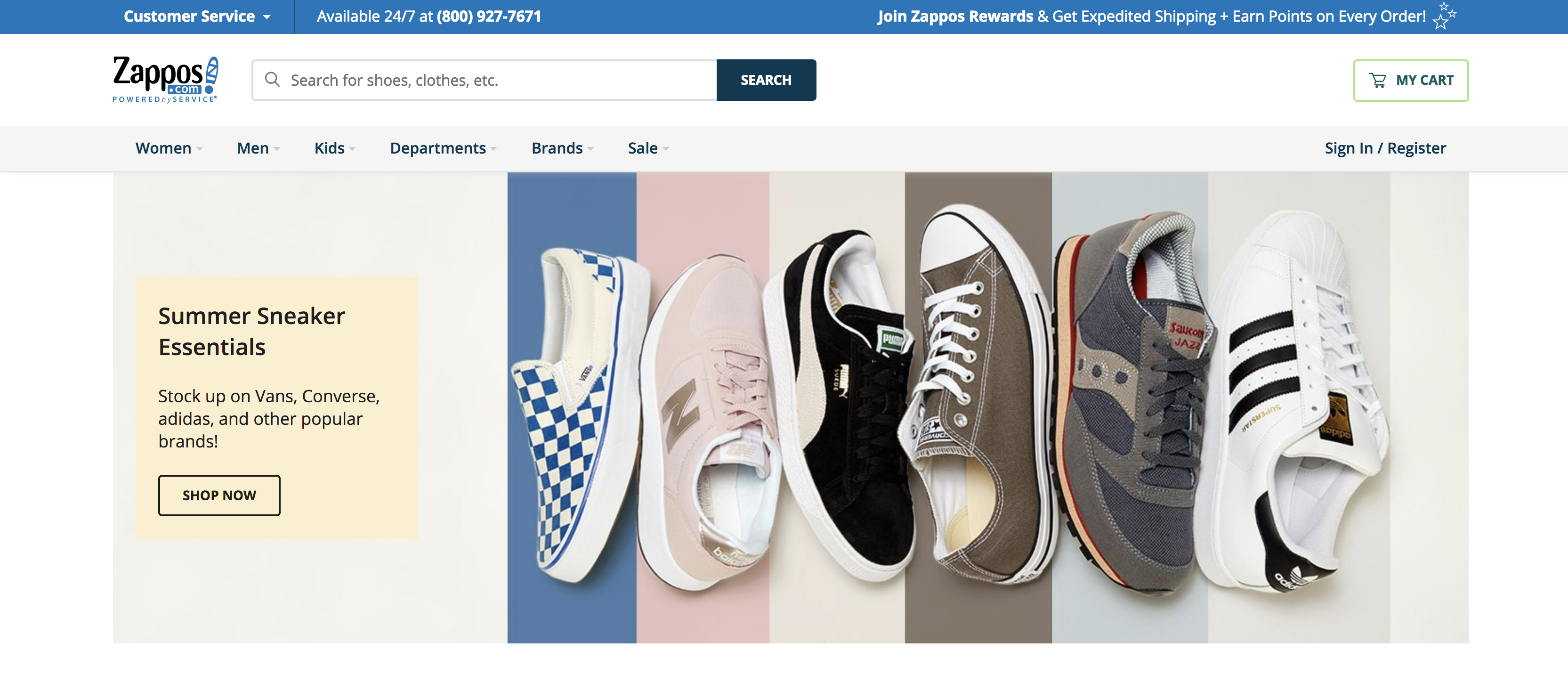
It’s a trust thing. People want to know that they can reach you. It’s a simple fix that adds a lot of value in most cases. The famous example, of course, if Zappos. Along with their fanatical customer support, they’ve always featured their number prominently on their site:

Test idea #4: Prominent free shipping information

Charging for shipping is a conversion killer.

At this point, the majority of companies offer some form of free shipping, and pretty much every ecommerce site competes with Amazon Prime.

If you’re not offering free shipping, try to figure out a way you can offer it.

Sometimes, it might be near impossible to make free shipping profitable. However there are strategies you can experiment with:

  1. Establish a baseline: Compare conversion with and without a free shipping offer.
  2. Create thresholds: Increase the minimum order value required for free shipping, and test the improvement in margin.
  3. Set restrictions: See what kind of improvement you’ll get by offering free shipping only on select products where it is profitable.
  4. Enact price increases: Increase all your product prices to compensate for the loss you take on free shipping and see how your profit compares.

Test idea #5: Prominent section for sales and specials

Various studies have repeatedly found that about half the online buyers would only buy discounted products, except under exceptional circumstances. Around 60 percent say they are looking for a section that identifies sales and specials.

Ultimately, do what’s right for your brand, but it might be something worth experimenting with.

Test idea #6: Emphasize wide-appeal products

The goal of the homepage is to get people off the homepage. The best way to do it is to get them to click on an offer they’re interested in.

Look at your best-selling products or best deals, and emphasize them on the homepage above all other (make them #1 in the visual hierarchy).

Here’s how WineLibrary makes it hard to miss these three great deals:

Test idea #7: Make the search bar more prominent

If you sell products that people know to search for, making the search bar bigger and more prominent tends to work great. Think Amazon-style search bar — the center of it all.

Test idea #8: Add a site-wide benefits bar below the header

“Why buy here and not from Amazon?” is a question that all ecommerce sites must answer. A prominent benefits’ bar above the fold is one way to make your case.

Test idea #9: Level-up your product descriptions

Product descriptions matter. The role of product copy is to give buyers enough information, so they could convince themselves this is the right product for them. Clarity trumps persuasion.

Amazon has proper text for humans, turns features into benefits, and even provides a comparison table. Technical info is provided too.

If you sell stuff you don’t make, don’t just repeat the manufacturer’s canned descriptions. Add your personality and recommendations. Tell the customer why you personally recommend this product and how it will help them.

Test idea #10: Use product videos and test autoplay with captions

Images are good, but everything indicates that video is the future. Photos have their limitations, video is the next step before actually touching and feeling.

If you’re not doing product videos yet, do them for at least part of the inventory and see if it makes a difference.

Zappos has videos for nearly all of their products.

Read my post on how using video increases conversions. Our own split tests have suggested that auto-play videos work well fro complex, high-ticket items.

Test idea #11: Ask for email first on checkout

This is so you’re able to do email retargeting if they abandon their cart.

This is the screen people are taken to on Amazon when they’re ready to check out:

Make sure the first follow-up email goes out ASAP. If they complete the purchase somewhere else, it’s over. If the purchase takes place, send one or two more follow-up emails (might include a coupon).

Track the effectiveness of those emails (open, clickthrough and conversion rates).

Many ecommerce platforms, such as Magento, 3DCart and Volusion offer integrated cart abandonment solutions. There are also several add-on software providers out there that can do this, such as Rejoiner.

Test idea #12: Make the shopping cart persistent

People comparison shop. A common behavior is that they add products to cart on a site, so they can return to it later.

If upon their return, they discover the contents of the shopping cart has expired, they will not start from scratch (too much hassle).

The solution? Persistent shopping cart.

Done with a persistent cookie, this shopping cart will be right there even a day or a week later.

Save the cart.

An alternative to this option is to save their cart so the user can come back to it later.

Giving them the option to send the cart contents to email (later retrievable through a link) is a smart way of staying on the shopper’s mind.

Test idea #13: Create visually prominent and clear progress indicators during checkout

People like to be in control and to be in the know.

Are we there yet?

We to know how much longer something is going to take. This is why numbered lists are better than unordered lists and why you should have clear progress indicators on your site.

Crutchfield has it in the top right corner, but I think it’s quite small and may go unnoticed by many.

Crate & Barrel’s approach is better, with more prominent steps (1, 2 and 3):

Test idea #14: Clearly address purchase uncertainties

Is this safe? Can I return it? When will I get my stuff?

If the visitor has never ordered from you, she will have several uncertainties you must deal with.

Make a list of the most common objections and doubts, and address them on the product pages and in the shopping cart.

Here’s how Groupon deals with this (see sidebar):

Test idea #15: Expand payment options

Options are good for two reasons:

  1. Given the credit card scandals about identity theft, some people are wary of using credit cards for online payments (especially on sites they’re unfamiliar with).
  2. A 2009 survey of 2,000 online British adults found that 50 percent of those who don’t regularly shop online said that if their preferred payment method isn’t available, they’ll cancel their purchase.

These people aren’t the majority, but adding options like Paypal or Amazon Payments to credit card payments will help you win over some customers you’d lose otherwise.

Checkout how Moosejaw does it:

Test idea #16: Cut form length

Eventually, people will add some stuff to the cart, and they’ll be ready to check out.

Your success in leading them through this process depends a lot on forms. The more fields they have to fill in, the more friction there is.

This is the very reason people prefer to buy from Amazon.

Their shipping and credit card information is already there, so they will save themselves from the hassle of completing forms. They’re even ready to pay a higher price just to save a couple of minutes (I know I am!).

We do something similar at CXL Institute. Look at how short our demo request form is:

I’ve seen stores ask for shipping addresses for digital downloads. Ugh! Just stick with the essentials!

You don’t need the customer’s title or middle name!

Bottom line: Don’t ask for information you don’t absolutely need.

Test idea #17: Don’t force people to register, add it in the backend

Surely you know the $300 million button story.

Don’t force people to register!

Instead, offer the option to register if they want, but create an account anyway for those who opt for guest checkout. They will enter their email and name anyway. You just have to generate a password and email it to them once they complete their order.

Home Depot plays nice and offers guest checkout as the first option.

Test idea #18: Display reviews more prominently

People use reviews a lot. Even while they’re shopping in brick and mortar stores they read reviews online. You’re probably doing it too. I know I am.

Nearly 60 percent of online shoppers consult reviews prior to purchasing consumer electronics, and 40 percent of online shoppers claimed they wouldn’t even buy electronics without seeking reviews about the product online first.

Bottom line: Start gathering and showcasing reviews on your site.

If you sell commodity products and can’t get users to write many reviews, you may want to look into pulling reviews from an external site to have more of them.

Don’t delete negative reviews they actually help sales if there are only a few of them.

Test idea #19: Intelligently upsell

Upselling and cross-selling will boost your average order size.

Apple knows this and immediately after adding an iPad to your cart, it tries to upsell you:

Here’s the rule of upselling: You only offer related products (Apple offers smart cover for iPad and doesn’t try to sell you an iPod), and the offer must be at least 60 percent cheaper than the product they just added to their shopping cart.

So, if they’re buying pants, upsell a belt.

Brick and mortar supermarkets will try to upsell you while you’re checking out (grab a candy bar while you wait). Online, don’t do it. Focus on getting them to check out.

Idea #20: Clear, big calls to action

The user experience must be smooth. Smooth in the sense that they should never have to look for something. It should always be obvious how things work.

If people need to look for “add to cart” or “checkout” buttons, you’re failing miserably.

Those two are the most important buttons in your store. You want them big, bold and prominent. Avoid text links.

The wording and color of the button also matter, but you must test it.

Bigger buttons are better.

Check out how Patagonia has evolved their product page. Notice how the newer design on the left, and the red color that sticks out is the add to cart button and the cart itself.

Conduct user research to come up with test hypotheses

I strongly recommend conducting user testing on your ecommerce site to find problems with your interface you might not be aware of. Give people some tasks (e.g. find X, and buy it), and have them comment out loud while they’re browsing your site.

You either watch over their shoulder or watch the recording of it. TryMyUI is what we used for our user testing. Try them out. Fifteen people will discover 99 percent of your problems. Even testing one target user is better than testing none at all.

Want to get some quantitative data? Try standardized surveys via UX benchmarking.

We have our own methodology that was used in this report. You can try that, or use your own approach.

One benefit of UX benchmarking is that it is increasingly useful as you repeat, either as a comparison after a design change or against competitors to see where you’re falling behind.

Conclusion

Take ideas from this post and take the ideas in this report, and do your own testing. Don’t copy blindly.

10 May 18:17

Why These Complexities are Stalling your Deals

by Alice Heiman

Is your sale complex? Are there multiple buying influences and long sales cycles? Does it seem like these deals are getting more complex and harder to close?

Not every B2B sale is a complex sale. Some sales are merely a transaction. One phone call to ask a few questions and then buy the product. Some initial sales for lower dollars, don’t require much more than a salesperson from your company talking to the person who has the budget. But for some of you, the larger deals, with companies much bigger than yours are complicated and painstaking. It’s hard to predict the dollars that will be spent and even harder to predict when they will close.

Not sure if you have a complex sale or just salespeople who can’t get a deal closed?

Defining the Complex Sale

I researched the definition of the complex sale and believe it or not, I didn’t find much. The definition from my father Steve Heiman and his partner Bob Miller, from the late 70’s is, “A Complex Sale is one in which a number of people must give their approval or input before the buying decision can be made.”

According to their definition:

  • The buying organization has multiple options.
  • The selling organization has multiple options.
  • In both organizations, numerous levels of responsibility are involved.
  • The buying organization’s decision-making process is complex – meaning that it is seldom self-evident to an outsider.

I believe this is still relevant today and there is more.

Googling, I found this from George Brontén:

“Interchangeably used with Enterprise Sales, a complex sale is typically a long sales cycle deal (sometimes longer than 12 months) that requires an RFP (request for proposal) and then winning that proposal against a sea of competitive sellers. Complex sales have large contract values and contain multiple decision makers and stakeholders.”

His article is quite good, but I decided I needed more, so I asked a few experts and of course got different answers:

Kendra Lee, President of the KLA Group says, “A complex sale involves multiple layers of contacts, multiple decision makers, multi-faceted needs that must be fully understood. It involves a solution that must be customized in some way to meet the needs of the organization. As a result, it typically has a longer sales cycle and is more expensive. I don’t feel like competition is a key factor although it’s very common because of the size of the opportunity.”

Anthony Iannarino, Speaker, and Best-Selling Author of The Only Sales Guide You Will Ever Need and the Lost Art of Closing says, “Difficult problem, high-value strategic outcome, multiple stakeholders, transformational change, serious implications for failure, high risk, high reward, significant investment, variable outcomes possible.”

Janice Mars, Principal and Founder of Sales Latitude says, “Complex sales are B2B sales where there is involvement of many people on both the buyer’s side and the seller’ side since there are many different people/job positions that are affected if/when change occurs.”

Regardless, there are some similarities and I believe some elements we all need to be aware of, several of which I feel are being overlooked.

Elements of a Complex Sale

Long Sales Cycle

Is your sale cycle getting longer? Would say your sales cycles on average is 3 months? 6 months? 1 year? More than a year? Are you not sure? Most of the companies I work with don’t measure consistently and don’t really know. Think about how you are measuring the length of your sales cycle. Could you fine tune?

High Dollar Stakes

The deals are 6 and 7 figures. What is a complex deal worth at your company, $100K or less? Over $250K? $500K? $1 million? For many of you, these are the largest deals you close. Could they be larger? How many of the deals under $500K could be more if you were better positioned?

Multiple Buying Influences

Besides the obvious players, there are many that you will never know about. In fact, according to CEB/Gartner, there are 6.8, which is up from 5.4 just 2 years ago. How many of the decision makers are your salespeople working with 3, 4? Where are the rest and how are they getting to them?

Perceived Risk

This is a tough one for most salespeople. They find it hard to put themselves in the shoes of the buyer and truly understand the risks involved in making a decision. Not just to buy your product, but to make any decision. Buyers are afraid they will be fired. Knowing that your approach will have to address that. Buyers need approval from their peers and superiors, so they feel secure that they won’t be fired for making a decision. When the buying influences can’t come to a decision your sale stalls or disappears. This is probably why doing nothing is one of our biggest competitive threats these days.

Multiple Solutions

There are so many competitors out there selling solutions similar to yours. Buyers want to make sure they choose the best solution. They take the time to look at many of them and they are trying to compare them to yours. It’s more important than ever to be able to differentiate yourself in the marketplace, have great testimonials and online reviews.

Technical and Integration Complexities

Even if everyone agrees on everything, can IT make it work? How long will implementation take? How will its use be integrated? What training will be needed? What problems need to be anticipated? Will outside consultants be needed to help with integration? Lots of unknowns here.

Multiple Influencers on the Sellers Team

This is one most of you may not have considered. Think about what it takes from your side to get a deal done. What resources are needed, are there SME’s involved? Do sales leaders need to get involved? Does legal get involved? Is there a sales prevention department lurking somewhere that is actually lengthening the sales cycle on your end?

Other – Unique to Your Sale

What complexities are unique to your sale? How are they making the sale more complex?

What Will You Do?

Knowing all of these complexities exist, what can you do? How can you help your salespeople navigate these complex deals?

I recommend putting a process in place for mapping the players and information to better position yourself. Insist that your salespeople use that to plan their strategy and their sales calls. Then debrief with them. Ask them a series of questions to find out how they are positioned and help them uncover where they have gaps in information that could stall the deal.

Tomorrow

Ask each member of your sales team to map one complex sale and assemble a team to help them think through the opportunity and share ideas on how to advance the sale and shorten the sales cycle. Put 2 or 3 members on each team and give them a format so they stay focused. You don’t have to be at every strategy meeting but you do have to make sure they happen and hold them accountable.

Sometimes, we have to slow down to speed up. Complex sales require strategy. Salespeople are busy and don’t want to slow down to map out or discuss a strategy, but, if they could win more deals would you figure out a way to get them to do it? I’m betting you would.


Want to talk over a complex deal that is stalled? Schedule 30 minutes with me or Liz and we will help you with a strategy.

The post Why These Complexities are Stalling your Deals appeared first on Alice Heiman, LLC.

10 May 17:38

It Matters How You Lose

by Anthony Iannarino

When you lose, you may be remembered for the loss.

You are going to win and lose deals. You are not going to go undefeated in sales. No one does, no matter how good they are. But how and why you lose matters.

If you lost because you were unprepared, knew nothing about the client’s business, had no point of view about what’s changed in their world and what they should be doing about it, when another opportunity arises, you may be precluded because you are not considered a value creator. If you lost after establishing yourself as a consultative, trusted advisor type, you increase your chances of winning the next competition.

Losing because you had a poor bedside manner, did not listen to your dream client, did not pay attention to what they wanted, and having made them feel as if you were more concerned about what you wanted, means it will be difficult for your prospective client to want to see you again when their needs change. Being other-oriented and engaged gives you a better chance of getting another conversation in the future.

Being passed over for the opportunity to serve your dream client because your solution wasn’t right can mean that you weren’t paying attention to what they needed in order to choose you, or because you tried to jam your solution in without making it fit the client’s needs (i.e. the Commitment to Collaborate and the Commitment to Review from The Lost Art of Closing). If you missed capturing their vision and weaving it together into “our solution,” you may have made a second try in the future more difficult by projecting that you are unable to tailor what you do to fit the client’s needs. You want to be remembered for your consultative, collaborative approach.

If you lose, you want to be remembered in such a way that causes the clients to say, “We should have gone with them. I liked them the most the entire time. We made a mistake.”

Second place is different than “also-ran.” Don’t lose because you did a poor job selling.

The post It Matters How You Lose appeared first on The Sales Blog.

10 May 17:36

5 Biggest Challenges of Business Intelligence Software (and How to Solve Them)

by Rob Wood

how to solve top BI challenges

As with any new technology, the success of the initiative lies in its effective planning, implementation and adoption. It’s critical to successfully complete each of these three phases to gain the full value of your new solution. Complete buy-in from the executive team plays an important role and should be secured before undertaking any new technology solution that will affect the daily operations of associates throughout the company. Organizations that spend the time to gather that consensus and support the initiative are those that benefit the most. Consider the following five potential challenges to your BI project and learn tips to address them.

Strategy

BI initiatives require a significant investment and are typically launched to address specific needs or fill existing gaps. While those overarching goals may be apparent to all stakeholders, a loose definition of tactics for how to accomplish these goals can lead to diminished results, lack of collaboration and tension across departments.

Start with a solid strategy that articulates your objectives and aligns with company goals. Take the time to document and define each objective in detail. Work with your BI consultant when creating your strategy and rely on their experience and expertise to help define best practices.

Key Metrics

Choosing metrics that provide the needed insight to drive new routes of decision-making can be tricky. It can be particularly challenging to get department leaders and/or upper management to agree on them, but it is critical to choose those that support fact-based decision-making.

First, get clear on the top three to five metrics that your executive team believe are most crucial to business operations. Collaborate with department heads to identify the top two to three metrics they need to measure. Consider which of those most directly correlate to the metrics defined by senior management. This process will streamline the identification of your final set of metrics.

Data Integrity

The accuracy of your company data determines the value received from your BI solution. Unfortunately, it is difficult for many companies to ensure clean, current and consistent data is getting pulled from various business systems across the company.

Take the time to assess, review and repair data within your business systems before you begin your BI implementation. Create projects as needed to clean up your databases and employ processes that will ensure more consistent data entry moving forward. This can be a significant time investment, but it will greatly improve the end results of your BI reporting.

User Adoption

New technology solutions almost always require new employee processes and time for training. Even the best strategy, plan and solutions can fail without a successful rollout and training program.

Identify an internal champion for your BI initiative. It will be critical to have a person leading the charge and promoting the value and benefits to all employees that will be affected. Be clear on expectations and prepare communicates from the executive team that emphasizes their commitment to this new initiative. Establish a complete training program and provide access to internal BI experts for employees who have questions or need clarification.

Return on Investment

ROI is one of the most telling metrics to the success of your project. As noted above, there are many variables that affect the results of a BI project. Lack of clarity or focus can derail your success and lead to results that don’t measure up to expectations.

Create BI results that are immediately useful to senior leadership and other revenue-focused areas of the business. If your BI team is diligent in addressing the points addressed above, time to ROI can occur quickly. Keep a narrow focus to start rather than trying to ‘boil the ocean.’

10 May 17:35

12 key sales qualifiers

by bob@inflexion-point.com (Bob Apollo)

Dice_Yes_No_TrimmedEarly, accurate qualification is critical to success in complex B2B sales. It allows us to identify the opportunities that we have a real chance of winning, and it allows us to quickly eliminate poorly qualified deals from our pipeline.

In my experience (and hopefully yours as well), one of the key factors that separates top performing sales people from the rest is that they have too much respect for their own time to waste it pursuing opportunities they are never likely to win.

They qualify hard, and they qualify early, while their less confident colleagues cling on to prospects that by any rational analysis are never likely to close - and waste a huge amount of their time (and that of their colleagues) in the process.

For years, the default mechanism for qualifying sales opportunities was BANT (Budget, Authority, Need and Timeframe) - but it is now so inadequate and inappropriate that I shudder when I hear of sales teams that are still using it. Here’s why...

BANT reflects a bygone age

BANT was designed for a bygone age and is particularly ineffective when qualifying early-stage opportunities where the customer may have a significant latent need but is not yet actively in the market.

The prospective customer doesn’t yet have a budget. The person initiating the search may not be the ultimate decision maker. They may not yet be able to articulate a clear need. And they are unlikely to have a firm timeframe.

And yet they have - or will shortly recognise that they have - a real and potentially serious problem. A sales person who rigidly applies the BANT criteria is likely to think that the opportunity is not worth any current effort on their part.

Customers still need help

And yet the customer still has the problem. So, they probably end up engaging with other sales people who are less narrow minded. The new sales person helps the customer to shape their need. They build a business case that enables their contact to justify the budget. They help the customer to make their case to the ultimate decision authority. And they inject urgency that turns into a timeframe.

At last, the opportunity is BANT qualified. But by now, the new sales person’s fingerprints are all over the project - so even if the original sales person tries to re-engage, they will find that their chances of winning are significantly reduced.

Clearly, it is better if we engage early. Research by Forrester has shown that the sales person who does the most to shape the prospect’s vision of a solution, which often pre-dates full BANT qualification, wins three-quarters of all contested opportunities.

BANT doesn’t seem so smart anymore, does it? But sales people still clearly need to qualify. So, what’s the alternative?

Progressive qualification

We need to recognise that qualification is not a one-off event - it is a progressive exercise. And we need to recognise that our customer’s behaviour will often change - so a previously well-qualified opportunity may become less attractive.

This is not a time for over-simplistic acronyms. We need a checklist that can guide our qualification, and we need every sales person to use it consistently. In the complex B2B sales with which I am most familiar, there are at least 12 significant qualification criteria. Can you think of any more?

Initial qualification

There seem to be half-a-dozen consistently important initial qualification criteria. Here’s my version - drawn from multiple complex B2B sales environments.

  1. Problem: has the customer acknowledged a clearly articulated and potentially significant issue that we are in a good position to address?
  2. Motivation: does the customer have a potentially compelling business case and a clear reason to act?
  3. Organisation: how closely does the organisation conform to our ideal customer profile?
  4. Contact: is our current contact a credible potential change agent or can they help us to reach one?
  5. Money: is sufficient budget allocated, or if not, is there a clear source of adequate funding?
  6. Urgency: does the customer have a compelling event or a compelling reason to act within a reasonable timeframe?

Subsequent qualification

There are a number of additional factors that we may only be able to make a judgement on after further customer interaction. Here are my next six follow up qualifying criteria:

  1. Requirements: is the customer’s vision of a solution and top priority requirements in line with our capabilities, and do we have any unique advantages or showstopper weaknesses?
  2. Competition - have we identified all the other options (including in-house) the customer is considering, and where do we stand against them? Do any of the other vendors have any relationship advantages?
  3. Decision Group: have we identified all the key members of the decision group, have we engaged with them directly, and what is our assessment of their roles and attitudes?
  4. Decision Criteria: do we understand their key decision criteria, and how do we stand against them?
  5. Decision Process: do we understand the key steps and timeline in their decision process, and which members of the decision group will have a significant involvement at each stage?
  6. Priority: what is the relative priority of this project compared to all their other investment priorities?

Self-honesty and self-awareness

But implementing a checklist isn’t enough - unless we also demonstrate self-awareness and self-honesty in our assessment of our opportunities. There’s no value (and a great deal of downside) in fooling ourselves.

We need to acknowledge what we don’t know and take steps to fill in any gaps in our knowledge. If our continued pursuit of the opportunity depends on clarifying some matters, let’s make this a priority.

Let’s carefully assess whether the customer is likely to do anything, whether they are likely to decide to do business with us, and whether the effort involved in winning and supporting the sale will be worthwhile.

And if we have any reservations, we must not keep them to ourselves, but raise them to our manager and take account of their perspective. If, after all that, we have any significant doubts, it’s almost always best to qualify out and focus our energies on finding better opportunities.

Have you got any other favourite qualification criteria?


IF YOU LIKED THIS, YOU'LL PROBABLY ALSO APPRECIATE:

BLOG: Shaping our customer's "why"

BLOG: Starting with "Why?"

BLOG: Is your thought leadership really "thought followership?"

BLOG: Discovery - the foundation of B2B sales success

BLOG: The compelling case for hastening slowly

BLOG: The issue with generic "unique value propositions"

BLOG: Are your sales people leading with gain or pain?

BLOG: Encouraging our sales people to think


ABOUT THE AUTHOR

Apollo_3_white_background_250_square.jpgBob Apollo is a Fellow of the Association of Professional Sales and the founder of UK-based Inflexion-Point Strategy Partners. Following a successful career spanning start-ups, scale-ups and corporates, Bob now works with a growing client base of tech-based B2B-focused high-growth businesses, equipping them to Sell in the Breakthrough Zone by systematically creating, capturing and confirming their unique value in every customer interaction.
10 May 17:13

How to Find Targeted Twitter Followers (Part 3)

by Ruby Rusine

find targeted Twitter followers

With Twitter’s 330,000,000 million active monthly users (as of Q4 2017), is it possible to find targeted Twitter followers?

That would seem like looking for a needle in the [digital] haystack, right?

But yes, it is possible to find the right followers on Twitter for your business.

Is this about that vanity metric-thing? Nope!

Just really quickly let us tackle the benefits that your business can reap out of using Twitter.

If used correctly, Twitter is a great tool to amplify your message, increase awareness about your business, and potentially get more leads.

According to a few major digital marketing players:

  • If you want referral traffic to your preferred landing page that contributes to brand awareness and potentially more leads: “link clicks account for 92% of all user interaction with tweets. Link clicks are the low-hanging fruit of Twitter, and they’re your strongest chance of gaining views and shares for your content.” Source
  • 80% of Twitter users have mentioned a brand in a Tweet, and
  • 69% have bought something because of a Tweet that they saw.

Well, that’s all fine and dandy, but not if you do not have the right followers.

The right followers are the ones who will read your posts, then maybe share it, talk with (or about) you, and perhaps buy what you are selling.

Your targeted followers are the ones who will help your brand grow on Twitter.

Yes, there are millions of users on Twitter and your right followers are on there. You just have to know HOW to find yours.

So here are…

5 easy to follow tips to find targeted Twitter followers

Do these steps proactively and regularly to find your targeted Twitter followers and in no time your brand will grow:

Research

It is where we are all supposed to start before joining the Twitter frenzy. It is not too late though.

Some call it as listening or monitoring.

Listening should be an ongoing and active process for every business.

You know, there is wisdom in our having two ears and just one mouth.

Listening takes time, but it will save you lots of time in the future if you have this taken care of.

Now, amid the digital white noise on Twitter, there are ways to research for your right followers.

So what are ways to find your targeted followers on Twitter?

a) Advanced search

You can go to this link to get there: https://twitter.com/search-advanced.

You can search by keyword, location, and hashtags.

It would be convenient bookmarking it if you consider listening on Twitter (read: research and monitoring) as an essential part social selling for your business.

b) Using Twitter’s search formula

You can use these search booleans at search.twitter.com. Yes, it is a different URL from advanced search.

twitter search operators

c) Harness tools

There are so many tools that can assist you when finding the right followers.

  • commun.itIt categorizes your engaged followers, supporters, new followers, and retweeters. These are your VIPs that you should pay attention.

twitter followers categories

  • Moz’ followerwonkIt sorts social authority of each account and how long it’s been on Twitter.

The above tools allow you to test drive it for free for a few days, and each has its strength so I can’t call it an apple to apple comparison.

No, I am not an affiliate in case you are wondering.

d) Use Twitter’s “Who to follow”

It is determined by the Twitter algorithm as it detects what you are doing on the platform. You can find it either on the left side or right side of your Twitter timeline or feed.

Pay to play

a) Paid influencer

Look beyond the number of users of an influencer. Look for the quality of content they are sharing and who it is that may be engaging with them.

Sometimes money is not everything for influencers. There are values and a company culture that some influencers look into.

Make sure that if you are going this route, you have a plan with a goal and social media KPI in mind that you may want to measure to gauge success.

I know some accounts pay influencers without checking those “influencers” digital presence nor had set up ways to measure this type of campaign’s success. Don’t be that company.

b) Promote your Twitter profile

When you run a Twitter ad, your Twitter profile gets seen by more of your potential followers.

If you are going to run a followers ad on Twitter, there are options in the Twitter ad dashboard where you can refine the demographics based on events, interests, follower look-alikes and keywords.

Use it well, so you do not waste your money by showing it to an audience that is not your targeted followers that will be using your product/service.

twitter follower growth ad campaign

If you do a Twitter ad campaign, your Twitter handle will be grouped under the “Who to Follow” section, but it’ll be more prominent than the rest of non-paid handles.

Follow the hashtag-trail

Every savvy social media marketing maven understands its value. Basically, to get you and your content found.

But you can also use the hashtags to find your targeted Twitter followers proactively.

How do you find Twitter followers using hashtags?

a) Click the market-specific hashtag that you are using.

You will see all sort of things happening, conversations and images shared and more when you click it.

Of course, you will most likely find your competitors using it, but the beautiful part about it is that you can “watch” how they are using it and who they are tweeting with. That’s all public on Twitter.

So if you are a material handling expert and you are using #materialhandling, see who else is using that hashtag.

b) Click ancillary hashtags

Now going back to our material handling niche mentioned above, some of the potentially related hashtags are #manufacturing #mfg #shippingsoftware about your industry.

Like the market-specific hashtags, follow the trail too of your ancillary hashtags to find your relevant Twitter followers.

c) Search hashtag within a specific location

This tactic is helpful when you want to connect with anyone within a specific area. Remember URL for this is under “Research.”

find targeted twitter followers

Let the content find them

Content lends so much to exponentially growing your brand‘s Twitter visibility, and follow-worthiness. Hence, endeavor to share as many non-promotional contents as you can.

I can’t stress this enough: helpful contents attract followers, and it gets retweeted often.

That also means the more your potential targeted Twitter followers will find you.

So how do you find non-promotional posts to find the targeted Twitter followers?

a) Curated Content

These are articles or posts not written by you or your team. You can use Feedly and Pocket to do this.

Or, you can simply bookmark it from your computer.

b) Created Content

These are articles that you or anyone on your team wrote.

This one is premium with plenty of returns (in different forms).

If you want to rock inbound marketing and grow your authority to gain targeted followers, friend you have to create your own content, not just curate them.

Go back to basics

Authentic engagement is the core of social selling.

Engagement is key because according to a survey 77% of Twitter users feel more positive about a brand when their Tweet has been replied to.

Twitter has four different forms of engagement that you can use to find and attract the exact followers that you want for your business:

a) Mentions – It is mentioning another Tweeter by including their Twitter handle in the post.

b) Replies – It is when you reply to someone’s tweet.

Don’t forget to check whether you have followed that Twitter already.

You do not have to find these followers. These are low hanging fruits!

c) Retweets – It simply means resharing someone’s content. There’s free content for you, in a way.

Now, additional bonus for that: it puts you on the radar of the Twitter whose tweet you just shared.

d) Favorites – It is an expression of appreciation. This is the easiest and no-sweat form of engagement on Twitter.

As an aside visibility is also a way to find your Twitter followers, I have written extensively about making your business visible in your niche on Twitter.

Over to you, how do you find your targeted Twitter followers?

Photo cred: [pixabay.com] | [twitter.com]

10 May 17:13

Time Is of The Essence: How Leading Marketers Match Messages to the Right Moments - SPONSOR CONTENT FROM GOOGLE


Google Image for Post#1

By Sean Downey, Vice President, Media Platforms, Google

A few years ago, it was clear that mobile technology was changing the way people searched when they wanted to know, go, do or buy. With advancing technology, people are again changing how they search — and time is of the essence.

Google data shows that in the U.S., search interest for “open now” grew 300 percent from June 2015 to June 2017. During that same period, mobile searches related to “same-day shipping” grew 120 percent. And travel-related searches for “tonight” and “today” grew 150 percent.

Perhaps it’s no surprise that as people navigate life from the palm of their hand — or with just their voice — they’ve become more curious, more impatient and more likely to make decisions on the fly. As people search for answers, assistance becomes the new marketing battleground. And the biggest challenge marketers face in this age of assistance is knowing when to act.

Changing Expectations
New technology has changed people’s behaviors — and it’s also changed marketers’ expectations for the tools we need in order to measure results and react just in time. The companies leading the way are those that embrace both sides of this equation. They uncover insights to better understand their customers, and they use technology to deliver messages at precisely the right moment.

Bain & Company, in partnership with Google, surveyed marketing decision makers around the world to gain a deeper understanding of how marketers use audience insights and technology to drive growth. Marketing leaders — defined in the study as the top 20 percent in a composite score of revenue and market share growth — are gaining a competitive edge because they are:

● 1.6x more likely to prioritize integrating technology
● 1.2x more likely to be advanced users of their technology
● 1.4x more likely to manage marketing technology within their marketing organization today

Read More

As the Bain report notes, “Timing comes into play through signals, sequence and speed. And the technology now exists for marketers to test with high confidence when to communicate and in what order — and to do so in near-real time.”

Leading the Way
Both our own work with our customers and the research with Bain show that marketers making the biggest leaps forward share four common ways of working:

1) Leaders connect their systems. These companies take the initiative to merge their internal systems with media platforms to understand their customers and their marketing performance more deeply. In North America, 80 percent of marketers prefer integrated marketing and advertising technology from a single vendor.

More than that, North American marketers surveyed in the Bain study say that their top priority for achieving their marketing goals in the next three years is gaining an improved understanding of and reaching the right customers.

2) Leaders act fast to improve performance. Leaders turn to technology to help them act in just the right moments — and keep up with the changing media landscape. Marketing laggards are 1.7x more likely to be held back by slow decision making. But leaders are using technology with built-in intelligence to surface ad trends and patterns in near-real time so they deliver more relevant marketing with speed to assist consumers in the moments that matter.

3) Leaders take control and gain visibility. The Bain research showed that leaders are 1.7x more likely to indicate that their CMO is the final decision maker for advertising and marketing technology. With marketers driving decisions about their tech stack, the marketing department can ensure that the tools teams use provide greater visibility and control over investments and channels. For example, connecting analytics and advertising systems helps marketers easily see what parts of their strategy are working and make informed decisions to better allocate budgets and improve performance.

4) Leaders share insights across teams. Decisions can happen faster if you share customer insights across your organization so everything doesn’t have to go through the same old bottlenecks. That’s why we’re seeing more leading companies invest in a test-and-learn approach, with the goal of quickly uncovering and sharing insights to not only improve campaign performance but also drive business growth. A key to that culture is near-real time information. According to the study, marketing leaders are 1.7x more likely to refresh their most critical marketing metrics and dashboards at least weekly.

Making Timely Connections
As customers grow more time-sensitive and demanding, companies need technology that can help them keep pace. Marketers who use rich insights, cross-functional collaboration and integrated technology are best positioned to break through the clutter — and make those winning customer connections right on time.

Download the full report from Bain & Company and Google to learn how leading marketers get their timing right.

10 May 17:10

How Advanced Analytics Is Changing B2B Selling

by Lori Sherer
may18_10_112239921
Marcus Winther/Getty Images

From targeted online advertising to more precise recommendation engines, consumer markets are bursting with innovation around machine learning and advanced analytics. While there’s less buzz around business-to-business markets, these innovations are changing the game in B2B as well, even in old-line industries selling what might be considered commodity products.

A growing number of B2B companies are using data and analytics to add services that bring new elements of value to customers, and in some cases new sources of revenue.  These elements are fundamental attributes of a company’s offering in their most essential and discrete forms – things like product quality, flexibility, and associated expertise; they lift value propositions above commodity status and benefit customers in particular ways. (For a deep dive into the elements, see our related HBR article “The B2B Elements of Value”).

Consider recent moves by Australia-based Orica, which provides packaged explosives materials to mining companies worldwide. Orica’s explosives are being used in roughly 1,500 blasts per day, and until a few years ago, data on those blasts existed on bits of paper and in disparate electronic sources. Orica invested in digitizing all that data and combining it with data supplied by its customers, including the objectives of the blast, conditions of equipment at the site, the exact techniques and products used in the blast, and the outcome.

Insight Center

Orica used the data to build pre-blast modeling and post-blast measurement and analysis, packaged in a user-friendly online system called Blast IQ. The service provides benchmarks and insights to ensure sustainable, cost-effective improvements in blast performance. When a mining customer enters information about an upcoming blast such as geological data, drilling equipment data and the desired outcome, Blast IQ runs a set of sophisticated models to simulate blast outcomes. This enables engineers to fine-tune a “high-resolution blast” so that it produces more predictably sized rock and dirt for subsequent loading, hauling and grinding, which together account for most of a mine’s operational costs. Producing blasted rock of the proper size helps Orica deliver a crucial element of value: reduced cost.

Orica is now codifying the decision logic of the most experienced blasting managers through predictive modeling to serve up personalized recommendations on demand. And as customers use Blast IQ and contribute more of their own data, over time, the company will have a large enough dataset to train more powerful machine learning models.

Blast IQ thus delivers a whole new level of value to customers apart from the purely functional or economic elements—notably in the areas of enhanced productivity and a closer relationship with Orica. Through an “elements of value” perspective, we see that Blast IQ provides time savings, information and expertise. At an even higher level, Blast IQ helps a less experienced engineer move up the learning curve much faster than in the days when one learned strictly by trial and error. The service offers the possibility of enhancing an engineer’s marketability and growth and development.

In another old-line industry, agriculture, Monsanto has steadily enhanced its core commodity chemicals business with data and analytics-based services to expand the value elements delivered. One of its boldest moves was the 2013 acquisition of The Climate Corporation, which was founded by two former Google engineers who built on 30 years of free government weather data to help underwrite weather-related risks. The Climate Corporation chose to focus on agriculture given the size of the industry and the fact that adverse weather conditions are a leading cause of crop failure. They assembled a massive data set using soil sensors and field experiments. Monsanto folded the entity into its suite of farmer advisory services, and has continued to build a loyal customer base with additional mobile applications and advisory services.

Taking this strategy a step further, the company established Monsanto Growth Ventures (MGV), a venture fund based in San Francisco that looks for other inventive, environmentally sustainable ways to improve crop yield. In the past two years, The Climate Corporation acquired two of the companies in the MGV portfolio: HydroBio, a data-based, irrigation management platform that incorporates satellite imagery and crop models to improve the yield on water supply; and VitalFields, a reporting and tracking application that incorporates climate, disease and growth patterns to help farmers comply with local environmental regulations and better plan their season.

Starting from explosives and farming chemicals, these B2B companies have embedded their expertise in powerful software platforms to expand beyond the traditional products. They have enhanced the underlying data assets with search capabilities and algorithms that recognize patterns and make recommendations that can inform a complex array of decisions.

This kind of access to expertise and logic provides substantial additional value to B2B customers, whether through risk reduction, information or other value elements. In Monsanto’s case, this evolution also opens up opportunities to position the brand as a company that uses data and analytics to provide the elements of hope and social responsibility in farming.

Any product that requires some expertise to use is a candidate for analytics innovation. B2B companies that neglect this area could find themselves sinking into a commodity trap. Stores of wisdom and experience in their employees’ heads, hard drives and file cabinets cannot become valuable until they are packaged up and made accessible to customers. Machine learning takes all that experience, tests it in algorithms and delivers the best tailored answer more comprehensively than any human could.

10 May 17:09

10 Promising AI Applications in Health Care

by Brian Kalis
may18_10_641191796
Peter Dazeley/Getty Images

There’s a lot of excitement right now about how artificial intelligence (AI) is going to change health care. And many AI technologies are cropping up to help people streamline administrative and clinical health care processes. According to venture capital firm Rock Health, 121 health AI and machine learning companies raised $2.7 billion in 206 deals between 2011 and 2017.

The field of health AI is seemingly wide—covering wellness to diagnostics to operational technologies—but it is also narrow in that health AI applications typically perform just a single task. We investigated the value of 10 promising AI applications and found that they could create up to $150 billion in annual savings for U.S. health care by 2026.

We identified these specific AI applications based on how likely adoption was and what potential exists for annual savings. We found AI currently creates the most value in helping frontline clinicians be more productive and in making back-end processes more efficient—but not yet in making clinical decisions or improving clinical outcomes. Clinical applications are still rare.

W180418_FU_TENAI


Let’s take a look at a few examples of AI on the frontline of care. AI has demonstrated its aptitude for improving the efficiency of image analysis by quickly and accurately flagging specific anomalies for a radiologist’s review. In 2011, researchers from NYU Langone Health found that this type of automated analysis could find and match specific lung nodules (on chest CT images) between 62% to 97% faster than a panel of radiologists. Our findings suggest such AI-generated efficiencies in image analysis could create $3 billion in annual savings by giving radiologists more time to focus on reviews that require greater interpretation or judgement.

Another area is AI-assisted robotic surgery. In orthopedic surgery, a form of AI-assisted robotics can analyze data from pre-op medical records to physically guide the surgeon’s instrument in real-time during a procedure. It can also use data from actual surgical experiences to inform new surgical techniques. A study of 379 orthopedic patients across nine surgical sites found that an AI-assisted robotic technique created by Mazor Robotics resulted in a five-fold reduction in surgical complications compared to when surgeons operated alone. When applied properly to orthopedic surgery, our analysis found AI-assisted robotic surgery could also generate a 21% reduction in patients’ length of stay in the hospital following surgery, as a result of fewer complications and errors, and create $40 billion in annual savings.

AI techniques are also being applied to the costly problem of dosage errors—where our findings suggest AI could generate $16 billion in savings. In 2016, a ground breaking trial in California found that a mathematical formula developed with the help of AI had correctly determined the correct dose of immunosuppressant drugs to administer to organ patients. Determining the dose has traditionally depended on a combination of guidelines and educated guesswork—and dosing errors make up 37% of all preventable medical errors. While this type of AI technique is nascent, the example is powerful considering that the correct dose is critical to making sure a graft is not rejected after an organ transplant.

Using AI to aid clinical judgement or diagnosis still remains in its infancy, but some results are emerging to illustrate the possibility. In 2017, a group at Stanford University tested an AI algorithm against 21 dermatologists on its ability to identify skin cancers. The clinical findings, as reported by Nature last year, “achieve performance on par with all tested experts …demonstrating an artificial intelligence capable of classifying skin cancer with a level of competence comparable to dermatologists.” Our findings suggest AI could yield $5 billion in annual savings by doing a preliminary diagnosis before a patient enters the emergency department.

We’re also starting to see potential of AI-powered virtual nurse assistants in helping patients. For example, Sensely’s “Molly” is an AI-powered nurse avatar being used by UCSF and the UK’s NHS to interact with patients, ask them questions about their health, assess their symptoms, and direct them to the most effective care setting. Our findings estimate AI-powered nurse assistants could save $20 billion annually by saving 20% of the time nurses spend on patient maintenance tasks.

AI also holds promise for helping the health care industry manage costly back-office problems and inefficiencies. Activities that have nothing to do with patient care consume over half (51%) of a nurse’s workload and nearly a fifth (16%) of physician activities. AI-based technologies, such as voice-to-text transcription, can improve administrative workflows and eliminate time-consuming non-patient-care activities, such as writing chart notes, filling prescriptions, and ordering tests. We estimate that these applications could save the industry $18 billion annually.

For example, while Beth Israel Deaconess Medical Center garnered attention for an AI-enabled cancer screen, its first foray into AI was more prosaic: using it to reduce hospital readmission rates and identify possible no-shows. Using machine learning, technologists at Beth Israel Medical Center developed an application to predict which patients are likely to be no shows or lapse on treatment so they can intervene ahead of time.

Errors and fraud are a similarly expensive problem for health care organizations and also for insurers. Fraud detection has traditionally relied on a combination of computerized (rules-based) and manual reviews of medical claims. It’s a time-consuming process that hinges on being able to quickly spot anomalies after the incident occurs in order to intervene. Health insurers are experimenting with AI-supported data mining, coupled with AI-based neural networks (which mimic the processes of the human brain, but much more quickly) to search Medicare claims for patterns associated with medical reimbursement fraud. We estimated that AI could create $17 billion in annual savings by improving the speed and accuracy of fraud detection in Medicare claims.

Beyond fraudulent activity, the litany of data breaches, such as WannaCry or Petya, over the past few years has made cybersecurity a major concern for health care organizations. Health care breaches are estimated to cost organizations $380 per patient record. Using AI to monitor and detect abnormal interactions with proprietary data could create $2 billion in annual savings by reducing health record breaches.

As AI technologies become more prevalent, health care organizations will have to invest in those that deliver the most value. Uses of AI for clinical judgement still remains in its infancy and will need time to fully take root in a meaningful way. But the AI applications that can deliver the most value today (AI-assisted surgery, virtual nurse, administrative workflow) should be prioritized and invested in, so health care providers and insurers are free to focus on better care.

10 May 17:08

Influencing People: How to Do It the Right Way

by Rick Lepsinger

How to effectively influence others in the workplace

Influencing is the ability to change someone’s behavior, attitude, or perspective. Every member of an organization will, sooner or later, have to influence others to get them to commit to a course of action. For example, leaders may need to convince team members to take on new responsibilities, or one member of a team might need to ask a colleague for help to successfully complete a project.

The problem is that when influencing is done the wrong way, it can create resentment and resistance rather than commitment. This creates obstacles that make it difficult to achieve both short and long-term objectives. Leaders who use the wrong kind of influencing tactic may negatively impact employee engagement and performance.

So, how can influencing be done effectively—that is, in a manner that helps build trust and cooperation for the long term rather than creating points of division that impede productivity?

Here are some ways that leaders and employees alike can ensure that they effectively influence people:

Learning the Different Types of Influencing Behaviors

When people make a request and try to convince others to commit to a course of action, how they try to influence the other person will fall into one of 11 different “influencing behaviors.” The influencing behaviors that a person most frequently relies on is called their “influencing style.” However, some influencing behaviors are more effective than others, and a few can be counterproductive depending on the situation.

So, one of the most important things that an employee can do to improve their ability to influence others effectively is to learn the different influencing behaviors and when each is most effective. This will help them understand their influencing style as well as their strengths and weaknesses when it comes to influencing others.

But not all 11 influencing behaviors are created equally, so we’ve ranked them all from most to least effective below.

Most Effective for Gaining Commitment

  • Reasoning. Using logic and facts to show why a request may be necessary or beneficial. Most effective when the influencer has identified common ground with the other person and established their authority/expertise.
  • Consulting. Asking another person to suggest improvements or help plan a proposal is effective for gaining commitment from the other party by giving them a sense of ownership. Useful for when the influencer lacks relevant knowledge or expertise and wants the other person to feel included in the decision-making process.
  • Collaborating. Offering to provide resources that help the person being influenced carry out a request can make it easier for the other person to have the time and resources they need to commit to the influencer’s requests.
  • Inspiring. Appealing to others’ values, beliefs, and emotions can be an effective way to build excitement for an idea or proposal. However, this tactic requires an understanding of the other person’s personal value systems to be effective.

Moderately Effective for Gaining Commitment

  • Appraisal. Clarifying how a request will benefit the other person specifically can be an effective way to gain commitment to a course of action. Requires knowing how the action will benefit the other person and that the other person desires that particular benefit.
  • Personal Appeals. If there is a personal relationship between the influencer and the other person, asking them to carry out a request out of a personal sense of loyalty or friendship can work. This is generally most effective when the request has proper authority and isn’t too difficult or costly to carry out.
  • Exchanging. Offering the other person something they want or to reciprocate a “favor” at a later time if the request is carried out can gain commitment to an action by incentivizing cooperation. Most effective for people with the resources and reputation to make the exchange seem likely to happen.
  • Recognizing. Using praise or flattery to improve the other person’s mood can make them more likely to comply with a request. However, may be ineffective if the influencer only ever uses it prior to making a request.

Least Effective for Gaining Commitment

  • Coalition. Enlisting two or more close individuals (either personally or in organizational rank) can help convince someone else to commit to a course of action when a requester lacks credibility or doesn’t have direct access to a decision maker.
  • Pressure. Repeating a request to remind someone who is forgetful about a critical task can be one way to make sure the task is carried out. Mostly useful for when there is a lot at stake, other approaches have failed, and compliance is more important than commitment.
  • Legitimizing. When an influencer’s authority is questioned, they may have to clarify that they do have the authority to make a request. However, this method is mainly for use when other influencing tactics have failed and simple compliance is all that is needed.

Of these influencing behaviors, the last three (coalition, pressure, and legitimizing) are considered the most likely to backfire on the influencer when used incorrectly.

For example, the coalition tactic can make the person being influenced feel like they’re being cornered or “ganged up on.” Pressure, when applied too frequently or in the wrong context, can be interpreted as coercion or a bullying behavior. When legitimizing is overused, the subject is already questioning the influencer’s authority to make the request, and may require more information (reasoning) or motivation (inspiring or collaboration) in order to change their behavior.

By learning the strengths and weaknesses of different influencing behaviors, employees can identify and modify their style as needed to become more effective influencers.

Screen Shot 2018-05-02 at 12.51.21 PM

Setting the Stage for Effective Influencing

Many of the influencing behaviors listed above are much more effective when the person using them has laid down the proper groundwork. The point of influencing isn’t that it’s a “one-and-done” activity. Instead, influencing is a tool to be used in the building of long-term relationships between employees in an organization.

How can employees set the stage for effective influencing? Two key strategies include:

  1. Continually Demonstrating Integrity and Expertise. Several influence behaviors are much more effective when the influencer is trusted by the other person—either as a “subject matter expert” or as a reliable and honest person. Keeping promises made and demonstrating expertise in a given field helps build the reputation necessary to make influencing strategies such as reasoning, consulting, and inspiring more effective.
  2. Building Trust-Based Relationships with Others. Aside from demonstrating personal reliability, keeping promises helps build trust-based relationships with others. Also, by building stronger relationships, employees can learn more about what motivates their peers, bosses, and direct reports. This, in turn, can be useful for exchanging, appraisal, personal appeals or inspiration-based influencing strategies.

Laying the groundwork for influencing others can make it much easier to use a range of influence behaviors so the influencer does not need to rely on any one approach.

Varying the Influencing Strategies Used by Employees

While it may be easy to rely on one or two influencing behaviors because they’re familiar, these strategies can be ineffective if not used in the right situation. Learning to adopt different influencing behaviors to match the situation at hand can help employees become more flexible as influencers.

To help employees develop their influencing behaviors, it may be useful to conduct workshops with teams where they can roleplay different situations where influencing is needed. Providing learning course content that covers each of the different influencing behaviors and how they can be used also enables employees at all levels of an organization to become more effective users of influence.

Learn more about how employees—even those without authority—can effectively use influencing tactics to boost productivity by reading the Water For People case study. Or, contact OnPoint Consulting for help laying the groundwork for effective influencing.

Meta: Knowing how to influence people the right way can mean the difference between harmonious, effective teams and uncooperative ones that fail to meet expectations.

10 May 17:08

How to to generate higher volumes of qualified leads with Alex Berman of Experiment 27 and Ryan Robinson

by Ryan Robinson
Alex-Ryan Webinar Graphic (1200 x 630) FINAL

Here's the recording of today's webinar on how to generate a higher volume of well-qualified leads with Experiment 27's Alex Berman and your truly from Close.io.

We had a couple of last minute cancellations for today's webinar, unfortunately. Kenan from ZenProspect couldn't make it, and Steli was out of pocket as well—so today's conversation about lead generation was between Alex Berman and I.

In this webinar, Alex and I talk about the most effective inbound AND outbound lead generation tactics we're seeing work best for B2B startups and SMBs today (from lessons learned through years of lead generation). Topics today include nailing your outbound prospecting strategy with cold emailing (both individualized and at-scale) & improving your cold calling success rates. We also cover how we've driven over 200,000 qualified inbound leads through content marketing with blog content, videos and audio here at Close.io.

Tune in to the full recording of the webinar right here:

Big thanks to Alex Berman of Experiment 27 for making this happen with us today!

Alex is the CEO of Experiment 27, where he and his team help dozens of digital agencies with generating more leads, getting more referrals, and launching high-converting outbound selling campaigns. They're your  outsourced, all-in-one marketing team that brings in new customers or manages your current team to hit their lead goals.

About me: I'm a content marketer extraordinaire here at Close.io, as well as the writing 💪 behind the blog, ryrob.com and 🗣 behind the podcast, The Side Hustle Project where I teach 200,000+ monthly readers and listeners how to start and grow a profitable side hustle.

Want more webinars like this?

We're continuing this series of conversations with leading sales and marketing leaders from the world's top B2B startups. You can sign up right here for updates on our next webinar.

Who would you like to hear from next?

10 May 17:07

10 Copywriting Strategies Every Entrepreneur Needs To Know

by Carmine Mastropierro

designedbyjess / Pixabay

Copywriting can make or break your business. It’s how you, directly and indirectly, communicate with your customers. It brings out emotions, answers questions and leads users towards the sale. You don’t have to be a pro either to improve your sales copy.

Ahead are 10 copywriting strategies that will improve conversion rates and are easy to implement.

1) Features versus Benefits

When writing product and service descriptions, don’t forget to include the benefits of what you’re offering. What are benefits you ask? They are everything the customer should experience by using your product and generally include emotion.

For example, instead of just stating the materials and color of a rain jacket, you can add it will keep them dry while looking stylish. This makes purchasing much more enticing and justifiable as they can imagine exactly what they will experience.

Similarly, you can communicate pain points that customers may be facing. Continuing off the jacket example, we could mention that they won’t have to worry about arriving to work soaked anymore or getting their hair messed up.

Where your customers are in the buying journey will also change how you write your sales copy. These are the three stages and how you can adjust your copy accordingly:

  • Awareness stage: Customers in this stage are beginning to realize they require a solution for a problem. Ask questions you believe they’re thinking and write about pain points. This will get them more emotionally invested in your brand.
  • Consideration stage: Some research has already been done by the customer. They may be considering you already so add more call to actions.
  • Decision stage: The customer is making a final decision on whether to purchase or not. Testimonials, reviews, and case studies can help convert them to a final sale.

2) Storytelling

Connecting with your audience is a great way to build trust and community. When users can relate to you and your business, they are more likely to become customers. One of the best ways to achieve this is through storytelling. It can be done in many forms.

Consider the position a potential customer is in and talk about how you were once there too. Maybe you were in a financial struggle before starting your business. Tell them about it and how you got to where you are now. Storytelling can also be a lot simpler, like mentioning something recent you experienced that inspired your latest article.

3) Sound like an Expert

If you sound like an expert on any given subject, people are more likely to trust your brand. When speaking about your product, service or while writing content, use statistics and numbers. This is a surefire way to build credibility. For example, instead of just saying a marketing strategy generates more revenue, state exact numbers. Use case studies and real data to back up your claims. This is a simple and easy way to make you appear more trustworthy and credible.

4) Use Urgency

Imagine you’re shopping and there are 100 items left of what you’re looking for. Odds are you wouldn’t be in too much of a rush to get one. Now, if there were only a few left, it would probably be a different story. This is what we call urgency and it’s easy to implement into sales copy, such as:

  • Announcing a sale is almost over.
  • Displaying how many units are left of a product if it’s low.
  • Saying a coupon only lasts until a certain date.

Strategies like these create urgency for the customer. It makes them feel like they must take action now or they may miss out.

5) Buy with Emotion, Justify with Logic

The purchasing process is very emotional based even if you don’t realize it. It’s very common to wish to buy something based on emotion and then justify it with logic. An example would be fancy sports cars. Some people enjoy the allure of how it would make them appear and believe it puts them in a higher class. This is pure emotion of course but they would justify by claiming the gas mileage and high tech features are what sold them.


Always lead sales copy with emotion and then justify the purchase with logic.


With this in mind, always make sure to lead sales copy with emotion and then justify the purchase with logic. This ties in with the previous features versus benefits approach as well. Tell the customer how they will benefit but mention why the purchase is reasonable. Will they save money? Will it improve their health? That is how you finish it with logic.

6) Exclusivity

Everyone loves feeling special and unique. This is how a lot of luxury companies brand themselves. If you purchase a product from them, you’re part of an exclusive group. Not all businesses can pull this off but here are some ways to try:

  • Having a members only area of a website.
  • Branding your product as rare and one of a kind.
  • Selling limited edition products.
  • Offering a private newsletter.

7) Honesty

Being honest about your business is key to success. You may think that mentioning disadvantages or cons wouldn’t be beneficial but it can help quite a bit. This makes you appear more trustworthy and credible since you aren’t only focusing on the good things about your product.

Be honest about how your company started, what your products do/don’t do, and what you can deliver. The last thing you want to do is surprise your customer or make them feel unsatisfied.

8) Calls to Action

This is the first copywriting strategy almost every entrepreneur learns first. It’s also one of the most effective. A call to action is simply a phrase that tells users to take a specific action. These include:

  • “Buy now”
  • “Don’t wait any longer”
  • “Contact us today”
  • “Get your free quote”

They are often short and sweet. It’s enough to make a sale or lead a customer towards one. Depending on your business, you will use different calls to action.

9) Formatting

Have you ever come across an article that was pure paragraphs of text? You probably took a few scrolls and left. Without good formatting, content is hard to digest. It makes it difficult to find the answer you need and understand what the article is going to discuss. Some good formatting rules are:

  • Use header tags to break down different points within the content.
  • Use lists and bullet points for organization.
  • Bold certain keywords in every paragraph.
  • Include useful links to other resources.
  • Add images or video.

10) Get Them Saying Yes

When you understand your customers well enough, you can tailor your content perfectly to their personas. You should ask questions they are probably thinking throughout your sales copy. If the answer is yes, they are more likely to agree with the purchase later. It also is a wonderful way to build trust as it shows you understand them well. Examples include:

  • “Have you been trying to build a website?”
  • “Struggling with SEO?”
  • “Are you thinking about X or Y?”

Key Takeaways

Small changes in your sales copy can make a big difference. It’s an aspect that every business owner should strive to improve. The following is a summary of the 10 above strategies:

  1. Include how the customer will benefit from using your product or service, not just what it does.
  2. Tell stories that relate to your audience.
  3. Use statistics, studies, and data to sound like an expert.
  4. Create urgency to entice customers to purchase.
  5. Justify the purchase with logic.
  6. Make your product appear exclusive or rare.
  7. Be honest about your brand, history, and products.
  8. Use call to actions.
  9. Format your content so it’s easy to digest.
  10. Ask questions your audience would be thinking.

As you can see, copywriting doesn’t have to be complicated. It’s one of the most cost-effective marketing strategies for any business. Try one or a combination of the above techniques and experience the results for yourself.

10 May 17:07

How to Build and Train an Ace Sales Team

by Shoaib Yunus

You have just shipped out a great product, and now you need to get those leads and deals flowing into your Sales CRM software. While you’ve seen most organizations relying on a marketing and sales team to bring home the revenue, the success of these functions depends on how you train them.

Building a successful sales team requires attention to certain key details. And here are some factors I believe are critical in building and training a great sales team to expect the desired results.

Understand your market and define your sales goals

Like most early-stage startups, you want to scale up your sales presence to compete with your competitors. And based on the complexity of the solution your business offers, you need to decide the sales technique that best works for you. Do you want to build an inside sales team or a field sales team? Do you want to target mid-market with velocity sales or focus on the larger accounts?

If your solution is cloud-based primarily focusing on SaaS and B2B companies, an inside sales team is a great way to start off. Inside sales representatives give presentations, conduct demos and perform most of the functions that are traditionally handled by field sales reps, but remotely. Most customers today prefer connecting online, and with decision-makers receptive to doing business remotely, inside sales are very cost-effective. With the help of latest communication technology, sales reps respond faster to customers leading to improved engagement.

Another key point to note is that even for large enterprise deals, the prospecting and relationship building phase can begin with the inside sales team before the field sales reps get involved. So while hiring, make sure your inside sales reps are highly skilled and knowledgeable.

Once you’ve finalized a sales management approach that works best for your business, look out for a sales leader who believes in your vision.

Hire a leader, not a manager

One of the most memorable sales speech is the famous “pep talk” scene by Alec Baldwin from the 90s movie, Glengarry Glen Ross. The scene shows Baldwin unleashing a torrent of verbal abuse on the salesmen in the name of ‘motivation.’

Clearly, Alec Baldwin’s character doesn’t symbolize leadership. Leadership is earned. It definitely cannot be achieved by instilling fear in people.

Hiring a leader is hard, but it’s very critical to the success of your sales team and business. Teams need leaders who can influence and inspire them to do their jobs. Leadership is all about giving the right guidance and motivation, and not many people are good at it.

Here’s what Chad Burmeister, Senior Director, WW Sales Development at RingCentral and author of Sales Hack said in an interview with Heinz Marketing when asked the advice he would give to new sales managers,

“Are you a manager or a leader? You know you’ve made a move to a leader when you can answer “yes” to this simple question. “Would each of my reps walk through fire for me?” From experience, reps don’t want to be managed; they want to be led. Whether your reps will literally “walk through fire for you” or figuratively, just remember, it is YOUR PEOPLE, not YOU, who get the job done every day!”

As Chad Burmeister rightly put it, sales teams do not need managers. Sales teams need real leaders from whom they can learn and share ideas. As for sales leaders, they need to create an environment for open discussions where suggestions are heard and fairly debated.

When you have the right leadership for sales, a successful sales team is a natural result.

Build a world class team

When hiring people for sales, we often find ourselves looking out for individuals passionate about selling. The most common question asked is — “Sell this object to me.” Now that’s not a bad exercise, but it’s important that you look out for the right signals to find the best candidate. Most commonly candidates take the following two approaches –

  1. Offer a great deal or propose ways to save cost
  2. Get directly to a sales pitch without asking the right questions

Cost savings are great. But think about it, your product is designed to solve a critical business problem and achieve better results. Your sales reps should ask the right questions to check if the problem even exists! Inside sales are all about great discovery and prospecting by asking the right set of questions. So look out for candidates who ask pertinent questions and can build a great conversation to narrow down on pain points before making that awesome pitch.

You may also consider candidates who do not always take this approach but demonstrate similar skills and who you believe can be trained quickly.

Training them to a T! – Understanding the value of your product

Before you go ahead and train your reps on the sales techniques, it’s really important that they understand the value your product offers and what difference it can make to the customer. Understanding the value helps them communicate effectively and build trust and loyalty with the customer, which is really essential for teams that sell remotely.

I’m a huge fan of Simon O.Sinek, and in one of his TED Talks, he answers the ‘value of a product’ with this simple idea, he calls the ‘golden circle.’

Simon takes Apple as an example and explains how differently they position their value from the other organizations.

Here’s the strip of transcript from his TED Talk.

“Let me give you an example. I use Apple because they’re easy to understand and everybody gets it.

If Apple were like everyone else, a marketing message from them might sound like this: “We make great computers. They’re beautifully designed, simple to use and user friendly. Want to buy one?”

“Meh.”That’s how most of us communicate. That’s how most marketing and sales are done, that’s how we communicate interpersonally. We say what we do, we say how we’re different or better and we expect some sort of a behavior, a purchase, a vote, something like that. Here’s our new law firm: We have the best lawyers with the biggest clients, we always perform for our clients. Here’s our new car: It gets great gas mileage, it has leather seats. Buy our car. But it’s uninspiring.

Here’s how Apple actually communicates. “Everything we do, we believe in challenging the status quo.We believe in thinking differently. The way we challenge the status quo is by making our products beautifully designed, simple to use and user friendly. We just happen to make great computers. Want to buy one?”

Totally different, right? You’re ready to buy a computer from me. I just reversed the order of the information. What it proves to us is that people don’t buy what you do; people buy why you do it.”

Introduce your new sales reps to real problems

One of the most effective training methods is solving real business problems of customers with your product offering. Solving customer case studies help sales reps think on their feet and provide relevant solutions rather than relying on a script. They also get to know the various business problems and resolving each one of it can be quite exciting for a sales rep.

Buddying always helps

If you already have a running sales team in place, one of the best ways to onboard recruits after they have sufficient product knowledge is to have them shadow a seasoned sales rep. Let the new rep listen in on a few discovery calls, observe how meaningful conversations are built and ride along on appointments, so they have a fair understanding of how it works.

Once your new salesperson is familiar with the product lines and how good conversations can be structured, engage them in mock calling sessions. Share useful feedback and help them focus on areas that need more working.

Create an environment for knowledge sharing and continuous learning

Although your sales reps follow a certain structure or flow of calls, it’s not really scripted, and this allows them to develop a unique style over a period. And with this, they run into customers who absolutely love them. These interesting stories need to be shared among teams to ensure they’re always learning from each other. A good way to do this is through bi-weekly team huddles.

Initially, there will be a bit of resistance from sales reps because they don’t want to be judged by their peers. This is when the sales leader needs to step in and assure the team that it’s just a learning exercise and nothing more. Pick one or two calls that your team can listen to and let everyone share their comments, ensuring there is full participation. Nobody likes long meetings, and if it’s just one or two calls, it’s just a half hour huddle where you have everyone’s attention.

I can tell you from my experience that my team now waits for these sessions not only because it’s fun listening to some whimsical conversations but also because these sessions allow them to learn from others. Successful and regular huddles result in smarter sales teams that know how to work together and win together.

In the meantime, let’s have a conversation.

Comment below with your ideas and plan on training your sales team. Go ahead and tag your friends and colleagues into this discussion.

Cover illustration by Udhaya Chandran

Thanks to Radhika Bhangolai, my co-author on this blog.

09 May 17:18

A new strain of IoT malware can survive a reboot

by Cory Doctorow

As scary as the epidemics of malware for Internet of Things devices have been, they had one saving grace: because they only lived in RAM (where they were hard to detect!), they could be flushed just by rebooting the infected gadget.

But a new strain of malware, dubbed "Hide n Seek," can live through a power-cycle: it writes a copy of itself to the /etc/init.d/ directory in the IoT device's embedded GNU/Linux system, where startup programs are stored. When a device that's been infected this way is rebooted, it is freshly infected.

Bitdefender experts first spotted the HNS malware and its adjacent botnet in early January, this year, and the botnet grew to around 32,000 bots by the end of the same month. Experts say HNS has infected 90,000 unique devices from the time of discovery until today.

Crooks used two exploits to create their initial botnet, which was unique from other IoT botnets active today because it used a custom P2P protocol to control infected systems.

Now, experts have found new HNS versions that have added support not only for two other exploits [1, 2] but also for brute-force operations.

What this means is that HNS infected devices will scan for other devices that have an exposed Telnet port and attempt to log into that device using a list of preset credentials.

"Hide and Seek" Becomes First IoT Botnet Capable of Surviving Device Reboots [Catalin Cimpanu/Bleeping Computer]

09 May 17:18

Join Us Live to Learn Smarter Ways to Sell with Webinars

by Sonia Simone

When I first heard about “webinar hired gun” Tim Paige, I really was a bit skeptical. I’ve read and watched a lot of sales education, and most of it is a horrible fit for me. Either the tactics feel weird and manipulative (and I’m never going to get the personality transplant I’d need to implement
Read More...

The post Join Us Live to Learn Smarter Ways to Sell with Webinars appeared first on Copyblogger.

09 May 17:16

Find the Perfect Image with the Free Photo Library

by Thomas Bishop

You’re finishing up a blog post and want to add a photo, but you don’t have the right image. There’s a solution right in your WordPress mobile app: the Free Photo Library.

As part of our never-ending mission to improve Media in the WordPress apps, you now have access to over 40,000 free, high-quality photos (courtesy of Pexels) right from the WordPress mobile app. It’s available to every WordPress.com member.

(Did we mention that they’re free? And so are the WordPress apps, if you still haven’t downloaded one!  They’re available here.)

How does it work?

To get started, make sure you’ve updated the WordPress app on your phone or tablet to the latest version (9.9). Once you’ve updated the app, you can find and add free photos to your library directly from the post and page editor, or from within the Media Library:

Adding from the Editor

Open the Editor by either creating a new post or opening an existing one. Once you’ve opened the Editor, tap the Add Media icon to open the Media Picker. You’ll see a few different options to choose from: device, camera, or WordPress media.

If you’re on Android, tap the Device Media icon ( Device Library ), and select “Choose from Free Photo Library” from the menu.

If you’re on iOS: tap the ••• icon, and select “Free Photo Library” from the options.

Next, search for a photo to add to your post. Select as many images as you’d like and tap the “Add” button on the bottom right of the screen. That’s it! The images are inserted  into your post or page, and they’re also added to your Media Library seamlessly. (Note: these images will count against your site’s media storage limits.)

Adding from the Media Library

To add from your Media Library, navigate to My Sites ( My Sites ) and choose your site. From there, navigate to “Media, tap the Add Media button in the top right corner, and select “Free Photo Library” from the menu.

From here, the process is the same: select as many photos as you want and tap “Add” to put them into your post or page and your Media Library.

Give Feedback and Get Involved

The WordPress mobile apps are free and available on both iOS and Android!

If you have any questions or feedback, reach out to our in-app support team by tapping Me → Help & Support → Contact Us.

If you’re a developer and would like to contribute to the project, learn how you can get involved.

free-photo-ios-editor
free-photo-library-demo-android-media-library
09 May 17:11

MDR of Japan and D-Wave will apply quantum machine learning to drug discovery, finance and cars

by brian wang
MDR Corporation, a Japanese company located in Bunkyo Ward, Tokyo, announced the signing of an agreement with D-Wave Systems Inc., the leader in quantum computing systems and software, to use...

[[ This is a content summary only. Visit my website for full links, other content, and more! ]]
09 May 16:56

The 2018 SDR Metrics Report is Here

by mattbertuzzi@gmail.com (Matt Bertuzzi)

In the Sales Development world, metrics can be finicky beasts.

What works at Google, LogMeIn, or Okta might not be transferable from one to the other, let alone work for you. Questions around how can I benchmark my team make leading an SDR group all the more challenging. In our 2018 SDR Metrics & Compensation Report, we analyze the biggest shifts in recent years and provide core metrics to measure these groups. We also break out findings by company revenues, ASP, and other factors.

About the Participants

This is our seventh round of this research project and I can tell you it's our best dataset yet. This year, 434 Executives from a broad range of B2B companies participated. (89% with HQs in North America, median respondent revenues of $24M, and median ASP at $28K).

18sdrtakers

New in This Year’s Report

Each time we’ve published this research, readers have asked how model, metrics, compensation, tech stack, etc. differ between high-growth companies and the rest of the pack.

But what exactly makes a company “high-growth”? If Company A did $2M in 2017 and projects $6M in 2018, that additional $4M represents 200% growth. Compare that to Company B who will do $290M in 2018 up from $200M in 2017, that’s “only” 45% growth—but an additional $90M in revenue.

Clearly, raw growth percentage doesn’t tell the whole story.

We decided to take an approach that separates that fastest growing companies by revenue band. Using revenues and growth rate, we marked the top quintile (top 20%) per band as “high-growth.” Throughout the report we called out comparisons between “high-growth” and non companies.

sdr-high-growth

Download the full report

The report provides a comprehensive look at the data, trends, and metrics driving sales development in 2018. We couldn't do these types of research without this community. So thank you.

Get your copy of our 2018 SDR Metrics & Compensation Report. And let us know if you have any comments, questions, or improvements for the next round.


09 May 16:49

Open-Ended Questions for Sales Set You Apart From Your Competition

by deb.calvert@peoplefirstps.com (Deb Calvert)

Through research with buyers and sellers spanning over 25 years, I’m convinced that there’s one tool, above all others, that accelerates sales cycles and win rates. It’s why I recommend building your skills in asking open-ended questions for sales success.

09 May 16:44

Coaching The Millennial Salesforce (Part 1)

by Mike Macioci

Over the last several years, I have had the opportunity to conduct approximately 1000 sales coaching sessions, with a diverse set of sellers across different demographic groups. A majority of these individuals are classified as millennials. There are several different definitions of classifying millennials. For purposes of this discussion, we will use a commonly accepted one: born after 1980 and entering adulthood in the 21st century. They are also referred to as Generation Y. The following chart from Pew Research shows how different age groups are segmented:

It is somewhat ironic that we are even discussing this, since a key tenet of effective sales coaching is keeping an open mind and never pre-judging a person or situation. However, anytime you are trying to teach, sell, market or communicate to an audience, it is vital to understand that audience the best you can before you actually engage them. In general, different demographic groups learn differently, partly because the brain processes information differently at different ages and partly because of environmental factors. Therefore, it is important to factor that into your coaching, mentoring or training. You can then adjust to individual traits as you and your coaching clients discover them.

How are millennials different than other demographic groups?

● They tend to be less experienced in most aspects of business, although some individuals have specific business experiences that older individuals may not have.

● They have a clear desire to impact society in a positive way. That is a significant aspiration; hence, a motivator. It is not all about the paycheck, status, benefits, title, etc.

● The desire to express their opinions is extremely important.

● Understanding why they are doing a certain task (i.e., learning a particular skill) is of high importance, as is understanding how that task fits into the bigger picture. They will seek out and value feedback. Praise is especially valued. Experience is respected.

● They tend to be more impatient as it relates to information flow, since they developed their learning habits during an era where virtually all data is available on demand.

● They are savvy and comfortable with the uses of technology, especially social media; hence, there is a greater emphasis on sharing information.

● Probably most importantly, they best understand information when it is provided in bite-sized portions, whether it is word based or a visual representation of data and ideas. This sounds logical when you consider that millennials grew up in a world of tweets, searches, memes, etc.

In an upcoming article, I will address some approaches and best practices on coaching millennial sales professionals. If you have any best practices you like to share please do so.

This article first appeared on Linkedin.

09 May 16:33

Overcoming 3 Psychological Barriers to Closing Sales in the Digital Era

by Steve Kearns

What are the biggest roadblocks in closing a deal? We’re all familiar with the usual culprits: establishing urgency, gaining a warm intro, competing against lower prices, overly long sales cycle, etc.

While these can be challenging obstacles, you won’t have trouble finding an assortment of proven sales tactics designed to overcome them. (In fact, you’ll find plenty of them on this blog.) On a deeper level, though, there are also a number of psychological factors that tend to derail B2B sales, and because these are more innate and ingrained, they can be much more difficult to surmount.

It’s true: the brain works in mysterious ways. But recognizing some of the underlying cognitive drivers that commonly stall out deals can bring clarity, helping us to alter our approaches and minimize these barriers.

Addressing 3 Common Psychological Barriers in Sales

Decision Fatigue

Here’s an example I often see used to illustrate this phenomenon: You're shopping for cereal at the supermarket, and you become so overwhelmed with the sheer number of options on the shelves that it mentally wears you down. This often leads to hurried or irrational choices. It can also lead to something called decision avoidance.

One landmark research study found that “people who had more choices were often less willing to decide to buy anything at all,” suggesting that “choice, to the extent that it requires greater decision-making among options, can become burdensome and ultimately counterproductive." This is a form of analysis paralysis.

When making a significant B2B purchase decision, the stakes are much greater than choosing a box of cereal for the kiddos, so this effect tends to be heightened in such scenarios.

What Should I Do?

You can’t control the number of options a prospective buyer faces on the open market. But you can control the way you present and deliver information when engaging them. The simpler you make this experience on their end, the better your chances of avoiding paralysis by analysis.

Take unnecessary decisions out of the equation. (President Obama famously would give himself only two suit choices, so as to avoid wasting his time and energy on choosing attire each morning.) Streamline your message and drill down to the bare essentials. Research ahead of time so you can eliminate extraneous questions (instead of asking “Do you need help in this area?” you could say, “I see from your recent LinkedIn post you guys might need some help in this area…”). Use tools like Point Drive to deliver materials in a seamless and structured manner.

The less information you cram into a buyer’s brain, the more clearly they’ll be able to evaluate your offering.

Anticipated Regret

This theory is also referred to as regret aversion, and suggests that people will sometimes stall in making a decision because they (often subconsciously) dread the future remorse of making the wrong choice. Regret is a powerful negative emotion and in cases like this its mere prospect can interfere with our rational thought.

This dynamic comes into play for many everyday decisions, but again, it’s magnified in a B2B purchasing situation because choosing the wrong solution could lead to professional ramifications and emotional strain.

What Should I Do?

The way to overcome anticipated regret is taking every step you can to eliminate the feeling that a buyer will ultimately realize they should’ve gone another direction. And that means positioning your solution as the best one for them, based on their specific circumstances and needs.

Most sellers recognize that it’s bad form to rail on the competition directly during the sales process, but there are ways to subtly cancel out reservations. An account-based approach is helpful here because it enables your sales and marketing teams to develop an acute understanding of the organization you’re pursuing, so you can tailor the pitch and explain why your solution is the exact one for them.

Additionally, social proof carries weight here. When a buyer sees that others with similar needs have done business with you and wound up satisfied, it helps reduce the potential for regret aversion. Case studies, customer reviews, and referrals (especially from someone the individual is already familiar with) can be profoundly impactful.

Lack of Trust

I would posit that this is the No. 1 inhibitor of relationship-building and forward progress in sales. In fact, it’s usually the top barrier in getting a response or starting a conversation in the first place.

When the B2B decision-maker sees you as a stranger operating out of self-interest, gaining sway and influence with them can be extremely difficult. It doesn’t help that salespeople in general carry a negative stereotype in the eyes of some.

Sales pros who can consistently overcome this barrier have a dramatic advantage over the field. But it’s not easy.

What Should I Do?

There are no shortcuts here. Trust is earned, not given. The vital process of building trust begins before you reach out, and continues through the follow-up phase and beyond. It requires taking an earnest interest in the prospect’s pains and needs, and demonstrating this in authentic and genuine ways.

Some good methods for doing so? Establish your credibility through a consistent, interactive, and insight-driven social presence. Do them a favor before ever asking them to do you one (e.g., “I found this great digital guide that might help you solve the CRM issue you referenced recently”). Build a network of strong relationships, LinkedIn connections, and endorsements so that your reputation speaks for itself.

Keep in mind that as difficult as trust is to develop, it is equally easy to break. As long as you take a consultative approach guided by honesty above all, you’ll be on the right track.

A Clearer Path to Closing Deals

Those old inevitable roadblocks will continue to arise along the journey to converting a sale, but by being cognizant of hidden psychological barriers and accounting for them in our sales tactics, we can facilitate a smoother ride with superior outcomes.

For today’s sales pros, an approach designed to overcome these dissonance factors -- simplifying your pitch, minimizing anticipated regret, and building authentic trust -- is a no-brainer.

For more tips to help you develop a routine that checks all of these boxes, download the Tactical Plan for Selling on LinkedIn.

09 May 16:32

23 Ways to Create Consistent Content Among 101 Other Priorities

by Will Blunt

Don’t beat yourself up about it… We’ve all been there.

Meticulously preparing a content strategy, and mapping out blog post ideas for months in advance, only for it all to be derailed when something more important comes up.

Your intentions are good. I’m not questioning that. But consistent content isn’t easy to come by.

Sometimes it feels like Groundhog Day; a repetitive loop of missed deadlines, knee-jerk reactions, and inconsistent posting schedules.

When you get back to the beginning of the loop, once again you tell yourself (and your team) that things will be different. This time you’ll actually stick to the schedule you set.

And you do for a little while. Until clients come knocking, your kids need picking up, or perhaps you just don’t feel inspired one day.

So you push things back a week… and a week… and another week. Until it all just feels too hard and you’re back at square one again.

If this scenario describes the way you feel sometimes you aren’t alone.

According to the Content Marketing Institute 57% of B2B marketers rate “Producing Content Consistently” as one of their top challenges.

Top challenges for B2B content marketers

Image Source: Content Marketing Institute

This recurring challenge is something we face time and time again, and unfortunately, there is no magic formula for solving it.

However, what I have learned is there are a lot of things you can do to try and break the trend, get yourself out of a rut and re-energize your content marketing agenda. I’d like to share 23 of those with you right now.

Part 1 – Time Savers and Productivity

1. Plan content in advance

This is without a doubt the best strategy for maintaining consistent content on your blog, but it’s not easy.

The idea is that you get a whole bunch of blog content pre-prepared to about 70-80% of what it will be when you publish. The structure, dot points, examples, images etc.

Then you stockpile it.

What this does is whenever you are overrun with other priorities, you can draw from this library of pre-prepared content and publish it by topping and tailing these 80% posts with an intro and conclusion.

In an ideal world, you wouldn’t let this stockpile of content ever get below about 2 or 3 articles.

Of course, this actually requires you to create all of these blog posts in the first place, which brings us back to the original challenge. But here are two quick tips for making it work;

  • If you ever have downtime when you aren’t as busy, dedicate it to producing multiple articles rather than just one.
  • Hire a blog writer or researcher to stock up your content bank for you. Get them to write 5 to 10 articles at once, not only will this be cheaper overall, but it also gives you the peace of mind that you won’t be starting from scratch when you REALLY need content.

Then, write when you have time and pull from your content bank when you’re too busy to keep up.

2. Create a blogging template or checklist

You probably intuitively know all the elements of an effective blog post, but when you’re rushing to get through the writing process it’s nice to have a checklist so you cover all your bases.

Here’s a screenshot of the one that I use;

create a blogging template or checklist

I used to have a version of this printed and on my desk, so I could refer to it every time I would write, now it is second nature.

3. Streamline your keyword research

Keyword research can be a huge task if you let it be. Before you know it you are off down a rabbit hole and the whole day has gone by. But it’s important because it’s your way to communicate with search engines.

Here is a keyword research method I use regularly that shouldn’t take more than 10 minutes and can bolster up your blog content:

  • Take your initial keyword (e.g. “how to create consistent content”) and type it into Google
  • Then scroll down to the bottom of the search results and see the “searches related to” section
  • These are some great related keywords that you can sprinkle throughout your content

Answer the Public is another quick tool you can use to find long tail phrases to include in your content.

Here I typed in “blog content” and got a cool semantic map of related questions:

blog content semantic map

4. Mine content to create a post structure

No matter how knowledgeable you are about a certain topic, writing an entire post from scratch straight from your head is slow work.

You can speed things up by mining similar content from other bloggers to create your post structure. (Hint: I hire people to do this part)

Here’s how:

  • Type your target keyword into Google.

mine content to create a post structure

  • Click on any articles on the first 2 pages of results that are reputable or sound interesting.
  • Skim through the articles and jot down some key points and consistent themes you identify.
  • Organize your notes into a logical structure and add any missing details you can think of.
  • If you’re really feeling motivated, rinse and repeat the process with other platforms (e.g. Buzzsumo or SlideShare) to make a mega outline.

mega outline

5. Speed up image editing

Managing the images you use in your posts can be very time-consuming. But there are some tools and plugins you can use to speed up the process.

One I like to use is Awesome Screenshot:

plugins for image editing

It’s a plugin that captures screenshots and lets you edit them immediately.

Another great couple of screenshot tools are Snagit and Skitch.

6. Use plugins for SEO

SEO is another blogging task that can take a lot of time to complete. I recommend using a plugin to speed things up.

If you’re on WordPress, SEO by Yoast is a winner. It has a lot of features, including analyzing your text and suggesting SEO improvements.

plugins for SEO

Simply indicate your focus keyword, write your SEO title, and add your meta description all in one place:

plugins for SEO

Image Sources: SEO by Yoast

7. Leverage voice-to-text technology

Sometimes inspiration strikes when you simply can’t sit down and write something. Or perhaps you just don’t like writing at all, but you still want to make the most of these moments.

Using voice-to-text technology can help you get your thoughts recorded quickly, and turn them into a blog post.

If you use Google Docs, just click “Tools”, then “Voice typing…”

voice to text technology

A little widget will appear that records your voice:

widget for voice recording

Or you can simply record something on the microphone of your smartphone and then get a service like Speechpad to transcribe it for you.

Once you have the copy, use an editor to clean up the text and put your final touches on it as a blog post.

8. Make the most of a content calendar

You’re much more likely to keep your blogging consistent if you have a set plan for your monthly content. If it’s just in your head, then it’s never going to get done.

You can do this with something as simple as a spreadsheet, or to create even more accountability, use an editorial calendar tool like FlypChart:

9. Do things in chunks

This is perhaps my favorite productivity hacks and one I swear by when it comes to creating consistent content.

If you have a set number of blog posts planned for the month, you can speed up the writing process by “chunking” specific tasks together and do them all at once.

This is especially time-saving when developing headlines. For example, if you use a headline analysis tool like the Emotional Marketing Value Headline Analyzer, you can save time by perfecting 20 headlines at once, rather than one at a time.

Refer back to your blog post checklist to see what other tasks you can tackle in chunks; writing introductions, keyword research, sourcing images, coming up with blog post topics etc.

do it in chunks 2

10. Remove all distractions

If you’ve set aside time to write, make the most of it by removing all your distractions.

Pick a time slot on your calendar every day, or every week, that is dedicated to writing. Then initiate a string of symbols.

Turn off your phone. Switch off email notifications. Shutdown your internet browser. Eliminate any clutter at your workstation. Make it clear to everyone who could possibly distract you that you have an important task to do – don’t accept disruptions unless they are genuinely urgent.

Research has shown it takes an average of 21 minutes to regain focus after being distracted.

11. Set goals

Goals are great motivators to get things done, so turning blogging into a quantifiable task can make it more approachable.

Consider making short and long-term goals to boost your motivation.

For your long-term goals, create some accountability by sharing them with family and friends.

If you find goals to motivate you well, take advantage of a goal tracking app like Goals on Track to set, monitor, and evaluate your progress towards your blogging goals:

make goals

Image Source: Goals on Track

12. Reward yourself (and others)

Growing your business is a great reward for your blogging efforts, but often it isn’t enough for the day to day motivation because you can’t SEE it. Creating tangible rewards that you can focus on often do the trick and help spur motivation.

For daily goals, a reward can be as simple as having an extra beer in the evening or ordering a pizza. For long-term goals, it may be something more enticing, like finally buying that new camera you wanted, or a Saturday at the beach.

Take this same mentality into how you motivate your team to produce regular content.

What do they truly value that you can give them? What are you willing to give up in order to achieve your content marketing goals as a business?

You’d be surprised at how things you perceive to be of low value, are actually considered significant motivators for your staff.

13. Stay on task

When I sit down to create content and don’t feel motivated, my mind often wanders to 15 other things I could be doing at that moment instead.

Considering multitasking decreases productivity by 40%, it’s important to stay on task during these moments.

If you’re one of those people whose mind tends to wander and mouse clicks follow suit, consider using an activity tracking tool like RescueTime.

stay on task

It tracks how much time you spend on different applications and websites (including social media). The results might guilt you into staying on task.

14. Take a break

You don’t always need to be creating more content, especially if you don’t have the time to invest in quality.

Being “consistent” doesn’t mean you need to pump out 5 low-quality articles a week, it just means you need to set expectations with your audience, your team and yourself and stick to them.

So you’re better off producing less content and focusing on quality, promotion, and optimization. Rather than spinning your wheels trying to post a new blog every other day.

Moz and Buzzsumo found that 75% of blog posts they analyzed had 39 or fewer shares.

take a break

Image Source: Buzzsumo

They also found that the kind of content that does get a lot of shares (and links) is relevant, useful, and comprehensive (lengthy).

If you are purely racing to create MORE, and sacrificing quality as a result, your posts will be less effective.

So rather than doing everything you can to keep a steady stream of content when you don’t have the time, allow yourself to take a break.

Then come back from your hiatus, and write something really high quality.

As it turns out, taking breaks is a major strategy for the most productive workers.

take a break 2

Image Source: Sumohacks

Part 2 – Ways to Outsource or Delegate

15. Recruit your internal team members

Pass off some of the blogging burdens to internal team members who can offer their knowledge and expertise to your audience.

This will not only give you your time back, but it will also improve the perception of your team members, and your brand in the industry.

Having your internal team members contribute will help humanize your business, in addition to helping you keep up on your posts.

Encourage them to contribute with incentives such as money, benefits or extra vacation leave.

16. Invite guest contributors

To attract expert guest contributors (who will give you high-quality content for free) you need to find a win-win.

They want exposure, brand awareness, traffic, leads… Plus they want a warm fuzzy feeling inside that they are actually getting noticed.

When you are asking people to contribute to your blog you need to understand what they value and put that information in front of them. Things like average social shares on blog posts, email subscriber numbers, and social followings, as well as other experts that have contributed in the past to build your credibility.

Just like anything, you will need to start small and build your way up, but as you gain momentum it will become easier and you will start getting the experts you really want.

Plenty of businesses have a page set up to entice guest post contributions:

invite guest contributions

You can set one up as well, or you can approach people individually.

17. Use customer and audience data

If you’re a marketer, you probably have plenty of data from your customers that you can turn into content.

Think about the number of interactions people have with your business across email, social media, your website and an array of other platforms that record information. Use this data and insights to your advantage by turning them into interesting blog posts.

You can also draw on qualitative customer data as well, such as FAQ’s, comments on other posts, social media interactions etc.

How does this help you create consistent content?

It’s more of an indirect tactic, but it solves the “I don’t know what to write about problem”. For example, you could publish a monthly customer insights blog with your latest customer data and information. Once you have a format locked down, this will essentially write itself every month and you can outsource it, or get someone internally to publish it. Saving you time and energy in the process.

18. Create case studies

Your customer data can also be turned into case studies (success stories or customer testimonials).

Case studies are perhaps the best piece of blog content you have at your disposal when it comes to closing sales, especially if they are embedded with results-driven figures and real-life stories.

They “show” instead of “tell” prospects what you do, and give a behind-the-scenes look at how your business operates.

The great thing about case studies is they aren’t actually that hard to create. Once you’ve put together one case study, you’ve got a formula that is replicable time and time again.

As I said before, once you have a formula you don’t have to do any of the legwork yourself anymore. Just come in and add the last 5% of polish before you hit publish.

19. Tap into user-generated content

This one’s a bit out of the box, but it’s a doozy.

User-generated content is a great way to whip up some consistent content for your blog without doing much work yourself.

Collate quotes from social media, interview customers or audience members on your list, or run a social media contest to get user-generated content.

For example, Chobani yogurt ran a contest asking customers to submit videos and images about why they love their yogurt;

run a contest or campaign

Image Source: Hubspot

You can do something similar, and feature the submitted content on your blog.

20. Send out a survey

Another way to capture user-generated content is to send out a survey to your email list, then use the results to write a blog post.

The key is to collect data that would interest your audiences, such as industry trends, user opinions or customer success stories.

send out a survey

You can easily create a survey with Survey Monkey, Typeform, or Google Forms.

21. Do a content roundup

Instead of writing your own content, you can curate posts by others on a certain topic in your niche. Or create a list of the “Best 50 [INSERT TOPIC]” things your customers care about. This is called a “content roundup”.

They are a really easy way to drum out a bunch of blog posts, not to mention if you collate some great information it’s extremely useful for your readers.

do a round up

22. Hire a writer

Another way to keep your blog content consistent is by hiring a writer to make bylined contributions to your blog or hiring a ghostwriter to write under your name.

Paying for content is definitely on the rise. According to Hubspot’s latest State of Inbound report, businesses are using a combination of sources to write their content:

outsource blogging tasks

Image Source: State of Inbound

You can pay for writers on a post by post basis at a content mill, such as:

  • NeedanArticle
  • Scripted
  • Textbroker
  • Zerys

But just keep in mind that these writers aren’t paid that well and there’s no guarantee they have experience in your niche. You get what you pay for.

Another option is to post a job on freelance sites like Guru or Upwork to find a writer with the right experience to work with you one-on-one. (This is my preferred option)

Or you can use Google to find a writer in your industry, here’s how:

  • Think of a popular blog related to your niche. I chose Duct Tape Marketing.
  • Do a site search for the words “freelance writer”. Here’s the syntax:

hire a writer

  • In the results, I found some freelance writers who have bylines on the site that I can reach out to.

hire a writer 2

Make sure the content they have written is the type you’re looking for and then contact them.

Finding well-suited content writers isn’t a walk in the park, so be prepared to put in the work up front.

23. Outsource other blogging tasks

If hiring a writer isn’t in your budget, you can still get some help to free up more of your time for writing by outsourcing different blog tasks.

Some tasks you can outsource:

  • Post research (sourcing images, data, etc.)
  • Blog editing
  • Blog management (uploading posts, managing meta descriptions, alt tags, approving comments, etc.)
  • Content distribution
  • Social media management

Check out this blog post and infographic to see a list of 27 blog tasks you can outsource.

Conclusion

So what does content marketing really mean to you and your business? Is it a priority? Does it make it onto the strategic agenda every quarter?

If it’s not a priority, then don’t stress – creating consistent content shouldn’t worry you. Spend your time focusing on other marketing activities.

But if it is a priority, how much longer can you go at your current pace?

How much longer is it going to be OK to “push back that blog post” until next week?

If you’re sick of spinning your wheels and making excuses every time you miss a deadline, apply some of these tips. And if you’re still not making any progress, hire someone to help out, or change your priorities.

What else has worked for you when life takes over and you need to produce content?

This was originally published on Flypchart.co

09 May 16:32

We've long known that financial data is a goldmine — but this number from Goldman Sachs shows just how much (GS)

by Dakin Campbell

lloyd blankfein, goldman sachs

  • Wall Street firms have long complained about the high cost of financial data.
  • Goldman Sachs spends around $400 million per year buying data from third party sources, according to one executive's estimate. 
  • The fact that Goldman is paying so much for data illustrates how important data has become for the finance industry.

Wall Street firms have long complained about the exorbitant cost of financial data. We just got a sense of what a goldmine it's become for the providers. 

Goldman Sachs spends about $400 million each year on buying data from third-party sources, according to one executive's estimate. That figure includes simple things like the data used by investment bankers to value companies and industries as well as more complex datasets such as credit-card transactions or real-time closed caption feeds from television stations across the globe, he said. 

The executive, a managing director, requested anonymity to discuss a figure that he considers to be a back-of-the-envelope calculation. Goldman doesn't disclose the number, which gets folded into a line item called "communication and technology expenses.'' Those came to $897 million in 2017. 

A Goldman Sachs spokesman declined to provide an official figure, or confirm the managing director's accuracy.  

The fact that Goldman would bear such a cost is just the latest sign of how important data has become for the finance industry. Wall Street investors have long sought an information edge when making investment decisions. As new technologies like the Internet and mobile phones have gained widespread acceptance, users are throwing off huge amounts of data that investors hope to mine for insights they can turn into investment alpha. That's leading them to pay huge sums for the most promising leads.

Goldman uses the data it purchases across the firm, from the investment management division, which houses money managers looking to generate market-beating returns, to the executive office, which monitors the closed caption feeds for mentions of Goldman Sachs in the media. The investment banking and sales and trading divisions also consume large amounts of third-party data.   

In some ways, the marketplace for data was pioneered by the the large stock exchanges. When firms like Nasdaq and the New York Stock Exchange discovered high-frequency trading shops were willing to pay higher fees for exclusive data feeds or colocation of computers, they began to think of additional ways to monetize the vast amounts of data flowing through their pipes everyday. 

As more of the world has gone digital, savvy players have discovered new sources and looked to monetize them.

As one would expect of any market maker, Goldman plays both sides. In addition to buying data, the firm also sells some market data to clients. And it's exploring other alternative sources of data within its securities division to see if that can be sold as well, Risk Magazine reported this month. The bank poached Matthew Rothman from Credit Suisse in January to lead the effort.

Even so, the mad rush to find hot new data sources has concerned some privacy advocates. Consumers have shown an uneasiness with having marketers or mobile carriers use their smartphone data unless they get some value in return. Facebook also caused a firestorm after providing user data to Cambridge Analytica that was then used in the 2016 election. 

If anything, that may mean Goldman's bill will only climb higher. 

Join the conversation about this story »

NOW WATCH: Here’s what is keeping stocks from completely crashing with the 10-year above 3%