Shared posts

22 May 18:47

The State of Push Notifications: Broadcasting No More

by Thomas Rodde

Push notifications have made significant progress and become increasingly more relevant to end users in the past few years thanks to more sophisticated segmentation via things like location-based targeting and dynamic messaging. But, while we know that consumers are used to and even appreciative of push notifications, there is still a large gap between reality and the ideal state of push.
opt-in-rate-2018
Case in point: the overall push opt-in rate in 2014 was 52%. Today, it has barely budged.

One reason for this lack of progress is likely due to many brands still requesting push permissions too early in the process. We’ve said for a long time that it is essential that marketers build trust before asking for permission to activate push notifications. A brand must first convince an end user that interacting with its app will provide value to their life. This starts with creating a great impression on first launch. In the past, we found that the sweet spot to offer the opt-in is somewhere between four and six sessions.

6% of people still say that even one weekly push will cause them to abandon an app and 21% of users still abandon an app after one use. We as an industry have work to do to remedy this situation, but the good news is that even now we are seeing growth. Let’s start by reviewing these positive changes.

Push notification engagement continues its meteoric rise

Engagement is a key metric that marketers use to evaluate pretty much everything they do. When it comes to push notifications, engagement is measured as the average number of sessions push recipients completed within the first week of receiving the message.

We are happy to report that engagement across all apps has seen a 30% lift since January 2017, is currently peaking at 3.75 sessions, and shows no signs of slowing down.

It’s clear that marketers are learning more effective ways to engage their mobile users with push notifications in addition to segmenting audiences. The use of more advanced methods such as geo-push and dynamic content are definitely a big step in the right direction.

85% of push messages sent in 2017 were personalized

Following the upward trend in app engagement is a linear increase in the percent of personalized (aka segmented) messages sent vs. broadcast (aka blast) messages sent.

pushes-by-campaign-type

In 2015, 65% percent of all push notifications were segmented. This reached 75% in 2016, and hit a high of 85% in 2017. Meanwhile, the percentage of broadcast push notifications being sent has come crashing down to a diminutive 15%. Gone are the days when marketers sent out ineffective blast campaigns to their entire user base.

What’s so great about personalized messaging?

There are a few different campaign strategies that mobile marketers use. The most basic is the broadcast campaign, but the addition of user attributes, dynamic content, and location-based targeting offers a more layered approach.

User attributes are profile factors such as name, age, email, favorite teams, or language and behavioral factors such as “added item to cart,” “viewed video,” or “registered 7 days ago.”

Dynamic messaging involves crafting a push notification that takes into account a user’s profile and behavioral data to speak directly to that user. Take a soccer app for instance: instead of setting up hundreds of campaigns, marketers can set up just one campaign and dynamically insert each user’s favorite team name based on the profile attribute for “favorite team” associated with that user. They only have to type one message: “Soccer season is here! Check out the latest news and results for [favorite_team].”
Combining campaign and message type gives us:

  • Broadcast campaigns that use dynamic messaging – campaigns that, while sent to an entire user base, are catered to the users’ interests and demographic profile. These are often curated using simple attributes such as first name, last name, birthday, city, etc.
  • Segmented campaigns that use dynamic messaging – The best of both worlds. These are campaigns that take into account complex attributes to deliver a great experience for users.

Let’s take a look at our three core performance metrics (engagement, open rate, and conversion rate) to evaluate just how effective these messages are.

Engagement

The simplest way to gauge satisfaction with your messaging is to calculate how many times users launch the app following receipt of a push. High engagement proves that users found value in your message and kept coming back for more.

engagement-by-type

Engagement is noticeably higher for segmented campaigns that send dynamic messages. Even broadcast campaigns perform above the average if the content is dynamic. All types beat the average we see for all push engagement (meaning average engagement across all of the apps that Localytics works with), except for broadcast campaigns.

Open Rate

Another simple way to determine a message’s weight is its open rate, or the number of times recipients clicked on a message within seven days following receipt, divided by the number of messages sent. A high open rate indicates that the message itself was interesting enough for users to explore further.

openrate-by-type

We see similar results to engagement, with segmented campaigns that use dynamic messaging at the top of the pile and pure broadcast messages at the bottom.

Conversion Rate

Although a great deal of actions completed can be considered “conversions,” ranging from “track favorited” to “video viewed” to “page viewed,” conversion as a metric still offers a means to understand how well marketers are reaching their goals. High conversion means that a message convinced someone to perform an action. These conversion rates are also calculated on a weekly basis and answer the question: seven days following receipt of a message, how many times did recipients convert?

conversion-rate-by-type

Once again, dynamic content sent to a targeted audience brings the best results, while broadcast campaigns that use dynamic content perform sub-optimally. This is surprising considering this combination performed well and even beat out pure broadcast campaigns on open and conversion rates.

However:

  1. When marketers send out broadcast campaigns without dynamic content, their defined conversion events are usually more rudimentary, i.e., “Push Sent” or “App Opened.” Therefore, the marketer’s goal isn’t quite so lofty.
  2. With broadcast campaigns and dynamic content, marketers frequently define more complex conversion events because they are more thorough in general. Although the message is catered to the end-user, the goal is loftier, so conversion is more of a challenge.

Marketers are still working to understand mobile conversion rates , so it’s essential that we view them through a critical lens. Boosting app conversion is a balance between defining your app’s conversion goals and building engagement strategies to reach those goals.

Location-based messages convert three times more often

If apps really want to create a unique experience, then tracking users’ physical location (with permission and secure data transfer of course) is a strategy that can pay off in spades. According to a recent Localytics survey, location tracking was voted as the most valuable type of trigger for push notifications after stated preferences. Since consumer perception is generally positive for this method, examining our own data can provide support for its use.

Let’s return to our essential metrics to understand how enticing location-based messaging truly is. We found that location-based messages were opened nearly twice as much and converted nearly three times as frequently as regular pushes on a weekly basis.

open-conversion-places-push

Although conversion rates remain difficult to define, they are actually more clear-cut when used in the context of location-based push. Circling back to the concept of marketers’ conversion goals, consider the fact that a geo-push is a real-time reaction to the end-user’s observed location. Any communication that reaches a user with little delay is going to incite a sense of urgency. Whether that means opening the notification or viewing a product, it will likely happen at a rate similar to how it was received, offering the user a reward for his or her quick reaction. Timing is everything.

We haven’t cracked the code on push notifications just yet

Achieving the ideal state of push can be a challenge. Marketers should feel encouraged by the work they have done and the rewards they currently reap, but the battle is not yet won. The rate at which users abandon apps is still too high. Changing mobile users’ brand perception requires constant care, and using data to inform marketing decisions can go a long way in creating a pleasant user experience. It’s a lot more engaging to be communicated with like a friend in a language only you share than to feel like a cog in a machine. Push is always striking a balance between satisfying users and nudging them to complete an action.

Methodology

Localytics is the leading mobile engagement platform across more than 790 million devices and 12,000 mobile and web apps. Localytics processes 115 billion data points monthly. For this study, Localytics looked at apps that have integrated push messaging across both iOS and Android. The opt-in rate was calculated using apps that have incorporated push messaging. Broadcast campaigns are defined as messages that are sent to all of an app’s users, while segmented campaigns are sent to users based on behavior and/or profiles. The timeframe for data in this study was January 1st 2017 to April 30th, 2018 except the 2018 opt-in rate, which was calculated using data from January through April 2018 and the 2017 percent of pushes by campaign type was calculated using data from January through December 2017. All results are based on worldwide app usage.

22 May 18:46

5 Tips on Getting the Most Out of Your NPS Survey

by Rachel Sullivan

qimono / Pixabay

At the heart of your business’s success lies customer loyalty. Net Promoter Score (NPS) surveys are integral in determining just how strong your customers’ loyalty is to your business, which is why they’ve become an important tool to many tech PR founders and leaders.

How you design your survey plays a significant role in the value of the insights you receive. This entails asking the right questions, and phrasing them in such a way that they draw out a customer’s true thoughts and feelings regarding the goods and services offered by your company. The following tips can help you craft your NPS survey to receive the optimum results, which will be invaluable to your technology marketing team and customer PR program.

  1. Know when to conduct surveys.
    As the saying goes, timing is everything. This is certainly true of NPS surveys, which must be distributed thoughtfully to ensure they are well-received by customers. For instance, weekly questionnaires may seem like a good way to stay in step with customer sentiment, but can actually annoy your customer. When sending questionnaires, focus on those times when customers will be least busy and more likely to pay their full attention to your queries.
  1. Don’t neglect the follow-up.
    Receiving feedback from customers is really just the first step in the process. Next you must take the proper follow-up measures to ensure customers remain engaged and that you continue receiving valuable insights. Responses are key in this case, as they will help you organize customers into meaningful categories. Depending on the NPS, your customers will be classed as promoters, passives or detractors, and you can use these classifications to tailor follow-up practices.
  1. Make use of reminders.
    Along with follow-up, reminders are useful for nudging busy customers to complete a survey. When sending reminders, do so carefully; refrain from sending more than three reminders, and make sure you carefully separate customers who have completed the questionnaire from those who have not.
  1. Craft a compelling subject line.
    Most people have inboxes brimming with unwanted emails. That’s why it’s crucial that you craft a compelling subject line when sending out emails to ensure your customers don’t mistake these messages for spam. Try to make your customers feel like individuals, while also properly identifying your company. DigitalMarketer.com offers some insight on writing effective subject lines for your emails.
  1. Make the customer feel valued.
    Even negative feedback is useful for your business. After all, you won’t be able to zero in on lapses in quality or service if you don’t know where the true problems lie. Accordingly, you should make all customers who take the time to respond feel valued, whether their responses are good or bad. Use language that shows appreciation and highlights the importance your customers play in the success of your business.

22 May 18:42

Find More Prospects on LinkedIn With These 4 Tools

by Susan Gilbert

Improve Your Business Sales by Finding Targeted Customers From Your LinkedIn Network

4 Tools to Find Targeted Customers From Your LinkedIn Network

It takes massive time and research if your business wants to connect with more leads online. Thankfully your efforts can be greatly enhanced for a very low cost right on social media. There are several ways you can use your LinkedIn profile to make new connections and spread the word about your brand. Would you like to increase your conversions? Take advantage of these great tools, and let me know how these work for you!

1) Become a lead magnet – eLink Pro

Leverage your network for better lead generation and sales. eLink Pro is an online marketing software that will help your business find thousands of targeted leads on LinkedIn and Twitter. Attract new visitors to your profile and website and gain insights on who is connecting with you. A free trial is available through Google Chrome with no credit card required.

2) Combine LinkedIn with your Salesforce account – Ebsta for Salesforce

If you would like reach more prospects on LinkedIn without having to go to another software or platform then you will love this easy Chrome extension. Ebsta for Salesforce includes integration with your profile as well as Gmail so that you can locate new prospects and important them directly into your Salesforce account. This is a great way to build your leads on a daily basis without spending a lot on expensive sales systems.

3) Gain valuable insights – Oracle Eloqua

Take advantage of both Oracle’s sales tool and LinkedIn’s Sales Navigator tool from one place. With Oracle Eloqua you can tap into more than 546 million members and transform them into content-rich profiles where you can track activities from a variety of social channels. This will help your business find the right leads with improved communication and more sales.

4) Nurture your prospects – Leadfeeder

Would you like to put your LinkedIn leads into one place? Leadfeeder is a robust tool that not only lets you know who is visiting your website, but also provides more details on your target market. Learn more details about each person such as company information, job title, contact information and more. The software works directly with Google Analytics as an all-in-one CRM tool.

Hopefully you will find these tools useful to your LinkedIn sales strategy to find targeted customers. Are there any that you would like to add as well?

22 May 18:41

5 Key Tips for Building a Successful Email Marketing Strategy

by Syed Balkhi

Email marketing is one of the best strategies for promoting products and building a loyal audience. In fact, email has an ROI (return on investment) of 122%, which is 4X better ROI than social media and paid search.

However, not every business is successful at email marketing. Mainly because they approach it without a proper strategy.

Sending random emails to your subscribers hoping for the best is not a good way to get the most out of your email marketing efforts. You need to craft a strategy with a plan for achieving your business and sales goals.

In this post, we’ll share a few tips you can use to craft your own email marketing strategy that delivers better results.

Craft automated follow-up sequences

What do you do when a customers abandon your website half-way through the checkout process, or abandon their shopping cart, or leave your website after viewing the pricing page? You get in touch and ask them to come back to your website, of course.

Image source: getelastic.com

In this kind of situations, there’s no better way to reach out to your potential customers than sending an email. Sending a follow-up email to your abandoning customers to remind them about their unfinished shopping cart or to offer a discount on a pricing plan is a great way to drive more sales.

Make sure to setup automated email sequences to follow up with these visitors to encourage them to get back to your sales funnel.

Ask for feedback

No product, service, or business is perfect. Improvement is a massive part of sustaining business growth. When it comes to making your products and services better, customer feedback is the key.

Even the world’s biggest brands like Apple always listen to customer feedback and roll out updates to its software and products to make them better. As a small business, you also have to gather feedback from your customers to find more ways to improve your products and services.

Image source: betaout.com

Luckily, by growing an email list, you will also be building a loyal and an engaging audience around your brand. You can use this audience to gather feedback or do surveys and polls.

For example, when a customer buys a product from your store, send a follow-up email asking them to rate or review the product.

Segment your email list

An important part of email marketing is creating effective email campaigns. This involves sending personalized email targeting specific audiences in your email list. Like sending specially crafted email promotions to parents or promoting your SaaS products to business owners.

List segments help you create better email campaigns by categorizing your email list into smaller groups. For example, you can create a list segment for the location to create a group in your email list based on the location of your subscribers. Or the job title, age, gender, etc.

With the help of these list segments, you’ll be able to run even better promotional campaigns via email to boost your email open rates, click-through rates, and generate more sales.

Take advantage of transaction emails

Every blog, business, startup, or online store has a transaction email. Whether it’s to confirm a purchase or a signup to a newsletter, sending a transaction email is a must for every email marketing strategy.

Instead of making these transactional emails boring and unimportant, you can use it to your advantage to tell your customers and leads about your products and services.

For example, include a link to get a free trial to your software or a coupon code in the transaction email to let your customers get a discount on their next purchase.

Use mobile-first email designs

47% of email opens happen on mobile while desktop accounts for only 17%. If you craft your emails only focusing on desktop devices, you’ll be missing out on a lot of engagement.

Source: cm.engineering

Make sure that you choose a mobile-optimized design for your emails. When in doubt, go with a simple text-based email template. According to HubSpot, 64% of users prefer rich text emails.

Conclusion

In 2017, the number of email users hit 3.7 billion. By 2020, it’s expected to grow over 4.2 billion users. As you can imagine, email is very much alive and it’s here to stay for a very long time. If you still don’t have an email list yet, then now is the best time to get started.

22 May 18:41

Don’t Miss the Gold in Your Old Leads

by Valerie Schlitt

erik_stein / Pixabay

Are you sitting on a gold mine of untapped forgotten leads? If you’ve been in business for a while, odds are you’ve got a stack, or a closet, full of forgotten leads.

Business owners and sales people naturally pursue the newest and hottest opportunities – the ones with the greatest probability of closing in the near future. You’d be crazy not to! But, that leaves a mountain of overlooked leads.

These are leads that once expressed interest but backed down. Or, you called and called but never got anywhere. Perhaps the prospects just didn’t have the budget. Or, you came back from a trade show with a roster of leads that you never touch again.

Some sales people forget that these leads cost money, time and effort to find. It’s always easier pursuing old leads than finding brand new ones.

Sales is all about timing. If the leads weren’t fully qualified the first time, maybe they are now. Sometimes, leads are a lot more promising the second time around. I call these “Cinderella leads”.

I once had a client who had generated an amazing number of leads through a website form, much more than anticipated. The client put all the leads through a rigorous internal scoring process and had the sales team pursue the best ones. The rest were left to collect dust for over a year. One day someone took ownership of the orphaned leads and sent them over to us to see what we could unearth.

Sure enough, we found some gold, including big name leads like Toyota Motor Sales USA, NBC Universal, and Bank of America. These companies were finally ready to meet with our client about a sale. Talk about Cinderella leads!

The moral of the story is: Don’t let your old leads collect dust forever! Take them out for a spin and see what kind of gold you might find.

Here are our top five tips for unearthing the gold in forgotten leads:

  1. Do it on a consistent basis.We recommend sifting through your old leads two to four times a year, every year. Otherwise, the connecting with them will become more and more daunting.
  2. Stay the course.It can be a little tedious and frustrating at times, similar to the process of sifting for gold. Keep faith and stay the course.
  3. Find a way in.Sometimes it can be awkward to reach out to old leads without a viable reason. This could be news on their end, such as a new website or partnership. Or, it could be news on your end like an upgraded feature or benefit. Sometimes companies use new free information such as a white paper or webinar.
  4. Don’t be afraid to ask why. If the forgotten leads you are pursuing are ones who seemed interested but fell off the grid, don’t be afraid to ask them directly what happened. Do it in a non-confrontational “just gathering information” way. You’d be surprised what an excellent conversation starter it can be. Also, their answers will provide you with some great insight as well.
  5. Organize as you go. This is crucial. What you don’t want is a CRM wasteland of forgotten leads that is so huge it becomes overwhelming. Instead, you want to organize your leads into several categories that let you know when and how frequently to follow up with them. Of course, your goal is to continue to cull out the gold within an otherwise overwhelming roster of uncategorized, forgotten leads.

It’s natural to worry that spending time on leads that you once called “dead” throwing good money after bad. The truth is I have yet to come across a ‘forgotten leads’ campaign that didn’t produce viable results. In the B2B world, one customer is often worth quite a lot, both initially and over time. Almost always, campaigns to old leads generate more revenue than they cost to implement.

22 May 18:41

How to Land Clients and Build Professional Relationships with LinkedIn Sales Navigator

by Monique Danao

LinkedIn is great, but you’re not using its full potential if you’re not on Sales Navigator—a platform that allows B2B sales professionals to get in touch with decision-makers and clients.

Unlike a basic LinkedIn profile, this tool allows you get lead recommendations, find and filter prospects and get updates on saved leads. And, if it’s not a part of your lead generation strategy, then you’re missing out on A LOT.

How can your business leverage LinkedIn Sales Navigator? Let’s discuss how you can navigate this new platform:

1. Hire Socially-Engaged Sales Reps

First, hire socially engaged sales reps to ensure your team’s success. Here are some hiring tips:

  • Choose experienced reps to take charge of your team
  • Consider virtual assistants and remote workers

Once you’ve assembled a team, you can gauge their performance with LinkedIn’s Social Selling Index (SSI).

The index analyzes the activities of sales reps and determines what they’re doing right, and where they might need improvement.

2. Create a Strong Sales Profile

Before you dive into lead generation, build a strong sales profile for everyone in your team. Prospects will judge your business based on the profile of your sales reps. So, if their profiles are incomplete and cluttered with wrong grammar, that’s a major turn-off.

What does a strong sales profile look like? LinkedIn has a few tips:

  • Upload a professional photo
  • Get LinkedIn recommendations from colleagues and clients to highlight your team’s skills and experience
  • Write an effective LinkedIn headline that highlights your team members’ specialty and professional value. If your team members received an award or were featured on authoritative news sites, include it to get an instant credibility boost.
  • List down their past experiences and encourage them to highlight their contributions and skills
  • Share content that is of interest to the prospects that you are targeting.
  • Add media such as ebooks, white papers and presentations that can complement their past experiences. For example, if a team member’s campaign was featured on CampaignLive, then include a link to the press release.
  • Encourage connections to give skill endorsements and return the favor.
  • Join LinkedIn groups to promote your expertise and to start discussions with potential prospects.

Want to learn more tips for building LinkedIn profiles? Check out this post by LinkedIn Marketing Leader Dougherty on how to optimize your LinkedIn profile.

3. Identify High-Quality Leads

Identifying high-quality leads take time, but it’ll get you better results and conversions. In fact, LinkedIn found that only half of B2B consumers contacted by sales teams, were the right people to connect with.

Fortunately, LinkedIn provides premium search filters that allow you to find and filter prospects based on industry, relationship (i.e. 1st degree connections), company and industry.

4. Reach Out and Close Deals

Now that you’ve found great prospects, it’s time to reach out and close deals.

With LinkedIn Sales Navigator, you can send InMail campaigns or sponsored updates. According to LinkedIn, 64% of B2B decision-makers like receiving relevant content.

Here are some ideas for reaching out to prospects:

  • Add CTAs to your LinkedIn profile to get prospects on your website
  • Post eBooks, case studies, newsletters and white papers. These should discuss why readers need your product or service, and how it will benefit their company.
  • Ask teams to promote your product or service by participating in LinkedIn Groups or responding to comments in your feed.
  • Find great examples of how other sales reps engage with their target accounts. Compile these screenshots and show it to your team for future reference.

Aside from InMails, LinkedIn helps you get in touch with potential leads through connections with peers. A good tip is to leverage your connections for a nice introduction.

Getting Started with LinkedIn Sales Navigator

It’s a lot to take in.

LinkedIn Sales Navigator comes with a ton of new features.

Not only does it allow professionals to create authentic and personalized introductions, but it also makes the sales process a mutually beneficial experience.

And, it’ll be an important sales tool for years to come.

While you’ll need to experiment to find out what works, LinkedIn has a variety of options to help you get started.

22 May 18:41

How Storytelling Can Lead to Greater Alignment of Sales & Marketing Teams

by Jonathan Bentz

Stray_Pic / Pixabay

There is nothing quite like watching a long and challenging project coming to successful fruition. For those who have big goals, they wish to accomplish in their life, achieving those goals doesn’t happen as the result of completing a singular action or task. Rather, goal achievement is the result of successive hours of hard work and multiple moving parts coming together.

Think of how a sports team — in this case, the “underdog” — defies the odds with the spirit and talent necessary to win a championship game, emerging victorious. Some players have a greater impact on the outcome than others, but overall the entire group is working towards a common goal, and people will never shake off their enjoyment of watching different people come together to achieve success.

Sports allegories aside, behind every successful business, are its people. For better or worse, all of the people working for a business want the same thing — more revenue. It’s a commonly shared perception that sales and marketing are related to one another and yet they are often isolated.

The traditional thought process being that marketers are only responsible for getting the leads, and salespeople need to focus on closing.

However, our world is rapidly changing and digital technology has had an irreversible effect on daily work life. The “lines” dividing sales and marketing have now been blurred, and at many companies, they are in fact coming together. The need for sales and marketing teams to combine their efforts is only growing, and companies that fail to do so in the coming years will most likely falter to their competition.

If there is one concept that sales and marketing professionals can unite under a single banner to make the quickest impact to help their business, it is in how they tell their brand story. Learn why better alignment between sales and marketing is crucial to future success, and get my take below on how they can collaborate to have a true impact on business growth when they improve their storytelling.

The Case for Better Alignment

When large groups of people unite to achieve something as a well-oiled machine, witnessing such a thing can be quite spectacular. Sales and marketing teams can come together to do great things, but alignment is easier said than done.

Here are several interesting pieces of data from a study Marketo did about the sales and marketing alignment practices of 500 companies:

  • 209% stronger contribution to revenue from marketing-generated leads
  • 67% higher probability that marketing-generated leads will close (wow!)
  • 108% less friction

Of these findings, the increased likelihood of a lead becoming a sale should be something to grab anyone’s attention. Or consider a survey LinkedIn performed more recently, involving 3,500 sales professionals and 3,500 marketers. 70% of respondents said sales and marketing collaboration delivers a better buying experience for the customer.

More and more companies are going all in on the idea of sales and marketing alignment. What some don’t realize is that one of the best ways to unite sales and marketing teams is through better storytelling.

The Importance of Storytelling

The rise of the Internet and mobile technology means that buyers and customers are in control to some extent. The content they enjoy is custom-tailored to their liking, and they engage in online communities which trigger their particular interests. Mobile devices have also made it possible to summon a whole world of information in an instant.

To reach customers and prospects, brands need to break through the noise created by the digital landscape while also being more customer-centric. Storytelling is an extremely effective tool from a marketing perspective because it not only communicates products and services, it has the power to connect brands to customers at a deeper, more emotional level when done correctly. It is ultimately what defines the types of conversations you are having with your customers.

When it comes to sales and marketing alignment, both teams need to share a single vision of the conversations they are having with customers. By striving to tell the same story, prospects have a better chance of becoming customers.

How Sales & Marketing Teams Can Use Storytelling

The first place to start when attempting to unite sales and marketing teams is by having honest, collaborative discussions where salespeople and marketers talk about how they can agree on finding their singular vision. From there, there a couple of different ways both teams can begin implementing their mission become better aligned.

The Symbiotic Relationship Behind Sales Enablement

Despite how important it is for marketers to understand their target audience, the fact is that they aren’t the ones talking to customers and leads day in and day out. Salespeople are ultimately required to build relationships with customers by having those regular conversations — their job is to know how to talk to buyers.

Sales teams are focused mostly on talking to customers, but there will always be the potential improve the quality of their conversations when given the right tools. This idea of positioning salespeople to succeed is commonly referred to as sales enablement wherein these professionals have the tools, information, and supplementary content help them sell more effectively.

Content is becoming increasingly important for almost any business since these assets are most often the tools salespeople use to sell more effectively. Whether content was the reason a lead was acquired or if salespeople use content to push a lead further down the sales funnel, sales teams need marketing teams to build up these assets. The assets are more effective as selling tools when it’s apparent that sales and marketing teams are on the same page regarding their approach to storytelling.

Marketers should always strive to build up their assets with as many different types of content for every level of the sales funnel. But even deeper than creating content for salespeople, marketing teams have to break it down into simpler terms. For better alignment through storytelling, marketers need to provide sales teams with well-crafted talking points to tell an engaging story.

For example, let’s say a sales team decided to embrace whiteboarding as their preferred presentation style due to its effectiveness in retaining viewer engagement. Because the salesperson can’t rely on pretty slides created by the marketing team, they have to rely on their ability to tell a story through visuals. Whiteboarding is just one-way salespeople can engage customers, but it will fall flat if the presentation doesn’t have a clear and apparent story to convey.

Additionally, it always helps salespeople to anticipate conversations with customers about their competitors when they have a bit of intel available to them. Marketers should always be evaluating their competition and by doing so can prepare salespeople to have better conversations.

Sales Enablement Goes Both Ways

When sales and marketing teams work independently of one another, they are abandoning one of the most powerful tools for creating not only great content, but crafting powerful messaging that resonates with customers. Salespeople are having the conversations that naturally give them better insights into the psyche of these individuals.

Those insights are like gold to marketers for many reasons. At the highest level, content is often created with the intent of answering specific questions when buyers are in the initial research phase. Without understanding the questions buyers have, how can they know what to create in order to answer those questions?

Another reason salespeople need to share insights with marketing teams is to gauge the effectiveness of their overall messaging. Perhaps sales and marketing teams are united in their storytelling, but whether or not that storytelling is engaging prospects enough to turn them into customers is another question. Sales teams must freely share what they learn from talking to customers in order to make marketing teams better.

Quid pro quo — sales teams need to enable marketing teams so they can, in turn, make their own team more effective.

Collaborating Like Never Before

Collaboration is the key to making sales and marketing alignment work. By injecting a more free-flowing, collaborative spirit between these two teams, alignment is more achievable.

One way to do this involves having regularly scheduled meetings between marketing and sales teams. This could include brainstorm sessions to come up with new content creation initiatives or encouraging key marketing team members to attend weekly sales meetings.

An idea to keep in mind is that whenever special marketing campaigns or sales promotions are going on, teams should have an understanding of both sides. This can be achieved by sharing team calendars and email communications between the two.

Another thing to think about is having team members from both sides collaborating on projects normally kept independent of one another. One example is if a sales team has several members who are perfectly capable of writing strong blog content, the marketing team should incorporate those people into their editorial strategy and production workflow.

Sales and marketing alignment is not only a good idea, it’s far easier to implement than most would believe. It starts with everyone going all in — sales and marketing teams just need to take the leap.

22 May 18:41

B2B Marketing Campaign Ideas for the Bottom of the Funnel

by Robbie Richards

The perfect B2B marketing campaign looks different depending on where your prospects are in their buying journey. From helping them understand that they have a problem at the top of the funnel, to offering solutions in the middle of the funnel to convincing them that you are the right man for the job to at the bottom of the funnel.

Welcome to the bottom of the funnel: By this point you’ve poured blood, sweat, and dollars into getting leads through the door and ready to buy.

But you need to make sure that your campaigns at this point are able to clearly position yourself as the right decision over your competitors, and that’s where the expertly crafted BOFU campaign comes in.

Bottom funnel campaigns are designed to tip leads and opportunities over the edge and become paying customers, and use case studies, fact sheets, demos and other material geared towards getting leads to open their wallets and say “ring me up!”.

Need some inspiration? Here are 4 killer bottom funnel campaign types to test.

Case study Campaign

(Source)

When buyers are evaluating your solution, one question in their minds is “what can you do for businesses like mine?”

Case studies answer the “what” by providing data on real success stories, and make it relevant to a certain industry or business size by zeroing in on one specific example.

As with most bottom funnel content, the performance is measured in paid conversions.

The goal here is to make it easy for the potential buyer to bridge the gap between features and benefits, while clearly communicating the potential ROI.

Example: Lever

Lever’s case studies are cleanly-formatted masterclasses in creating logical, high-converting content like this.

Rather than settling for the easy way out — a blog post or PDF — Lever uses custom pages on its site to make the case studies pop.

The three core segments of B2B case studies — the challenge, the solution, and the results — are all broken down underneath an eye-catching header that features the client’s logo.

Rather than trying to use the data to appeal to a wide range of company needs, Lever targets this case study at businesses trying to grow with employee referrals.

“The SHYFT Analytics team has hired 50 percent of all employees through referrals, and 76 percent of SHYFT employees are active Lever users. In total, the team has grown by 5x since in investing in Lever – hiring 110 new employees to date.”

It also agitates any pain the reader might be feeling with their current solution, calling SHYFT’s former platform “non-intuitive” and noting that they “absolutely dreaded” using it.

Since 2012, Lever has raised over $72m from investors such as Y Combinator and Matrix, tackling the tricky tasks every startup faces when breaking into an enterprise market.

Demo Campaign

Sometimes all a lead needs to convert is a hands-on session with your product. Consider this: 99% of people will not buy a vehicle without driving it first. And, according to AE Magazine, 80% of the buying and selling is done in the demo stage.

Over four fifths of salespeople believe an in-person or phone connection with a customer is a vital part of closing the deal:

(Source)

From this, it’s clear that you should be using any means you have at your disposal to push middle funnel leads towards a demo, whether that’s with email marketing, AdWords, or social retargeting ads.

Example: LinkedIn

This highly-targeted Facebook ad from LinkedIn goes after bottom funnel leads that are one demo away from conversion. It uses hard data to seal the deal, and the visuals make it clear that you can quickly enter the dashboard and get to work, which could reduce a buyer’s resistance if they associate social selling with something difficult or complex.

From the relatively low public engagement, you can tell this ad went out to a very select number of leads — it’s not like LinkedIn doesn’t have the budget to regularly reach millions of leads, it’s just that in this case they didn’t want to.

Instead, LinkedIn targeted the demo offer to a small segment of bottom funnel leads that have expressed interest in the past.

Customer Referral Campaign

You might think your advertising strategy is killer, but…

(Source)

Studies show that prospects are uneasy with the claims made in ads, instead preferring recommendations from individuals they perceive as unbiased.

(Source)

Your happy customers are more effective at selling than your best sales or marketing copy.

Why not leverage that to help close deals with leads at the bottom of the funnel?

Example: LevelEleven

Today’s B2B buyer does a lot more research. Up to 90% of the buyer decision is complete before a prospect ever talks to a sales rep:

This makes optimizing for the bottom of the funnel by creating content that aids that research process so important.

However, don’t overlook the importance of review sites like G2 Crowd, Capterra and GetApp. Customers will be using external comparison sources heavily, so it’s important to use your existing base as a resource to generate favorable reviews.

In 2014, LevelEleven decided to double down on the emerging user reviews trend by emailing a link to existing satisfied customers requesting them to leave a review.

“Fast-forward 10-days later, and we now have 65 reviews…up from a meager 4 just 10 days prior! And these are real, genuine reviews from our actual customers. The key to it all was getting our team rallied behind putting a little extra attention on asking for reviews.”

Now boasting over 200 reviews, the company says they hear leads are finding them through G2 Crowd reviews, and that it has made a powerful addition to their sales funnel.

Bonus tip: For a lot of B2B SaaS companies, review sites like Capterra and G2 Crowd dominate the search results for high value search terms:

Rather than trying to compete for the #1 spot, at least in the short term, you can focus on profile optimization or paid placement in those directories to get immediate visibility on a third party review platform.

Upsell Campaign

A customer arriving at the bottom of the funnel is really only at the start of their journey. It’s all about retention, cross-selling, and upselling to maximize customer value.

(Source)

An upsell can be delivered through many channels — email marketing, support, as a banner inside your app — but a good way to retain momentum and stay top of mind is to make the upsell offer in a place where the customer is already about to spend.

Example: Dropbox

(Source)

Your pricing page is the ideal place to prompt a buyer to spend more than they were intending to by highlighting the extra benefits of a more expensive premium package.

After Dropbox’s thunderous entrance and sustained growth in B2C, the company turned its attention to the B2B enterprise space in 2015. And, by 2016 had netted around 150,000 enterprise customers.

Here, the upsell is in the enterprise-specific features such as granular permissions and device approvals. Dropbox has obviously found the key needs of enterprises, and then set up a more expensive plan to capture enterprise leads ready to make a purchase.

Master the bottom of the funnel

This critical point in the buyer journey requires specified campaigns that make your buyers choice clear, and empower your buyers to choose a solution that is right for them — yours of course!

If you missed the other posts in this series, we have B2B marketing campaign ideas to keep your funnel flushed with leads at the top and the middle as well.

21 May 16:21

Sales Motivation Video: Morning Exercise Can Make All the Difference

by Mark Hunter

What is your morning exercise? This isn’t necessarily about having an elaborate exercise routine.  But you do need to do something to get your blood pumping.

Engage yourself and get moving!

Check out the video to see what I mean:

A coach can help you excel in your sales career! Invest in yourself by checking out my coaching program today!

Copyright 2018, Mark Hunter “The Sales Hunter.” Sales Motivation Blog. Mark Hunter is the author of High-Profit Prospecting: Powerful Strategies to Find the Best Leads and Drive Breakthrough Sales Results

21 May 16:16

How to Prevent Burnout in Salespeople: Seven Steps

by Gerhard Gschwandtner
Businesses need to have key measures in place to prevent their sales teams burning out.
21 May 16:14

Three words that guide all marketing strategy today

by Mark Schaefer

three words

By Mark Schaefer

I’ve been thinking a lot about the malignant complexity of our business world. I get to visit with marketing leaders at companies all over the country (and beyond) and they all seem to share a frustration that they are falling behind. There is an insecurity about what works today, and what’s next.

There are three words that keep rolling through my head as I meet with these friends. The more I think about it, it seems that our marketing direction can be boiled down to these imperatives, despite the complexity of our world.

I think we are beyond the days where we need to insist that market messaging has to be honest, authentic, human, creative, etc. That’s a given. But if you’re looking for a way to focus your marketing and branding strategy, I think is a simple elegance in these three words …

Relevant.

You need to provide meaning, perhaps even a sense of belonging, to an audience. This doesn’t mean you appeal to everyone, but to the people who are attracted to your brand, your product needs to occupy some defined, differentiated space in their lives. What do you mean? What do you stand for? Why is that relevant to anybody?

Superior.

If you provide a product in a profitable niche, you will rapidly attract competitors. All that hard work you’ve put into your business will be jeopardized unless you remain relentlessly superior to the competition. It’s so easy to discover new products and services today that you can never, ever stop innovating. Move forward or become replaced.

Consistent.

The aim today is to become a habit, part of the fabric of a customer’s life. That means you always have to be there. You can’t ever let your customers down. You must be reliable and you need to keep your promises every day, everywhere, in every format and channel.

I think it is that simple. If you’re struggling with a marketing strategy, it might help to ask these questions:

  1. What makes us relevant? Who thinks we are relevant? Are we sure about that?
  2. The people who love us — how are their needs changing? What do we need to do remain relentlessly superior against all possible disruptions?
  3. How do we express who we are in every single thing that we do? Every customer touchpoint is marketing. Do our customers see a consistent expression of our love for them in every interaction?

Whether you are B2B or B2C, high tech or low tech, a blogger or a movie studio, I think this is the appropriate focus.

Is this helpful? Let me know your thoughts.

Keynote speaker Mark SchaeferMark Schaefer is the chief blogger for this site, executive director of Schaefer Marketing Solutions, and the author of several best-selling digital marketing books. He is an acclaimed keynote speaker, college educator, and business consultant.  The Marketing Companion podcast is among the top business podcasts in the world.  Contact Mark to have him speak to your company event or conference soon.

Illustration courtesy Unsplash.com

The post Three words that guide all marketing strategy today appeared first on Schaefer Marketing Solutions: We Help Businesses {grow}.

21 May 16:12

Alibaba’s newest initiative aims to make Hong Kong a global AI hub

by Jon Russell

Alibaba is teaming up with SenseTime, the world’s highest-valued AI startup, to launch a not-for-profit artificial intelligence lab in Hong Kong in a bid to make the city a global hub for artificial intelligence.

Alibaba, which is SenseTime’s largest single investor thanks to a recent $600 million round at a valuation of $4.5 billion, is providing financing for the “HKAI Lab” through its Hong Kong entrepreneurship fund. SenseTime said it will contribute too, although the total amount of capital backing the initiative hasn’t been revealed.

The partners of the project — which also includes the Hong Kong Science and Technology Parks Corporation (HKSTP) — said the aim is to “advance the frontiers of AI,” which includes helping startups commercialize their technology, develop ideas and promote knowledge sharing in the AI field.

That’s all fairly general — Alibaba has a track record of politicking through technology investment schemes in Greater China and Southeast Asia — but one tangible project is a six-month accelerator program planned for September which will welcome AI startups to the HKAI Lab. Alibaba’s Cloud business and HKSTP are among the backers that will help the program offer early-stage funding to successful applicants, while Alibaba and SenseTime will help with mentoring and development during the program.

“Alibaba sees AI as a fundamental technology that will make a difference to society,” Alibaba executive vice chairman Joe Tsai said in a statement. “We envision the Hong Kong AI Lab to be an open platform where researchers, startups and industry participants can collaborate and build a culture of innovation.”

China and the U.S. are the two biggest players in the global AI battle; this project alone won’t divert that, but it could stir up potential in Hong Kong.

Alibaba maintains tight relationships in Hong Kong, particularly through the fund which is around $130 million in size. While the program is ostensibly aimed at promoting startups in Hong Kong, particularly around AI, it is also sure to galvanize Alibaba’s ties to Hong Kong’s establishment and tech community. Hong Kong is growing as a destination for startups, as a number of the city-state’s key players discussed at a TechCrunch China event last year, but still the issue of talent is a key one and this initiative could benefit Hong Kong in that respect.

21 May 16:00

There Is No Buyer’s Journey in B2B Sales. There Are Journeys.

by Anthony Iannarino

Dave Brock writes an excellent piece on the hyper-focus on buyer’s journeys here. Here is another reason one must be careful in the way they use this concept.

The traditional idea of a buyer’s journey starts with awareness, then moves to interest, then to consideration, then to purchase, then re-purchase. If you want to throw in other stages, like “delight” or “evangelist,” you won’t be the first or last to do so.

I’ve always believed that the buyer starts when they are unhappy enough about something that they are compelled to change, at which point they start to explore what they might do differently, explore their choices, resolve their concerns, and then decide. Now, we compel that change by helping them to recognize the greater results available to them. We do that by helping them recognize and the dissonance they are experiencing.

Whatever the process, you are likely to see it displayed as starting on the left side of a PowerPoint slide and progressing towards the right side of the slide. The way that the journey is displayed indicates that it is a linear process, and that it progresses from one stage to the next, each moving the buyer closer to a purchase. But the truth is that the buyer’s journey is non-linear, and in B2B sales, the non-linearity is non-linear (which is to say, it’s a mess)

One contact inside your dream client company is unhappy with the results they’re producing. You can call this pain or dissatisfaction, or maybe it’s just dissonance, something just not working right without being understood. But her peers don’t agree that there is anything wrong, nor are they close to being compelled to do anything about the dissonance she’s experiencing.

Two levels above her, the senior leadership team is not only unaware that there is a compelling reason to do something different, it isn’t something that is going to make their priority list if they were aware. The leadership team is working on what they believe to be their two most strategic initiatives.

There is no buyer’s journey in B2B sales. There are buyer’s journeys (plural). Not every constituency within a company is going to be neatly aligned with the main contact, or what I call the CEO of the Problem. Not all stakeholders are going to reach the same point in their journey at the same time, and this process isn’t one that is easily managed or controlled. The misalignment, disagreements, and resistance to management make this a difficult challenge for salespeople—and the people trying to pursue change.

I dedicated a chapter to this concept in The Only Sales Guide You’ll Ever Need titled Managing Change. I also included a chapter in The Lost Art of Closing on Building Consensus. If what you sell requires consensus and requires the support of different constituencies, knowing that the process is non-linear, meaning that it isn’t likely a straight line, and knowing that it’s non-linear between individuals and departments gives you a fighting chance of finding a path to consensus – even if you have to slow down the hard chargers and work on bringing the laggards up to speed.

The post There Is No Buyer’s Journey in B2B Sales. There Are Journeys. appeared first on The Sales Blog.

21 May 15:59

SalesLoft Acquires Meeting Intelligence Provider NoteNinja

by Kyle Porter

It’s a great day for SalesLoft users and authentic sellers around the world. Today, we are excited to announce the acquisition of meeting intelligence provider, Noteninja. I’m incredibly proud of what this means to our customers and the advanced opportunity they will now have to deliver a better sales experience to their customers.


Personally, I’ve spoken with over 200 VPs of sales this year. They tell me they’ve codified their go-to-market plans in SalesLoft and they share how they use it to deploy action lists to their AEs, SDRs, and account managers.


It’s helping them execute on their cadence of communications with customers and prospects through phone, email, social, and other activities. And they’re seeing success. Customer analysis shows that users are increasing opportunities created by over 25% in the first 90 days. According to a recent TOPO report, our customers have ranked us #1 for sales dialer and #1 for sales email which is a testament to the value of SalesLoft’s Sales Engagement Platform.

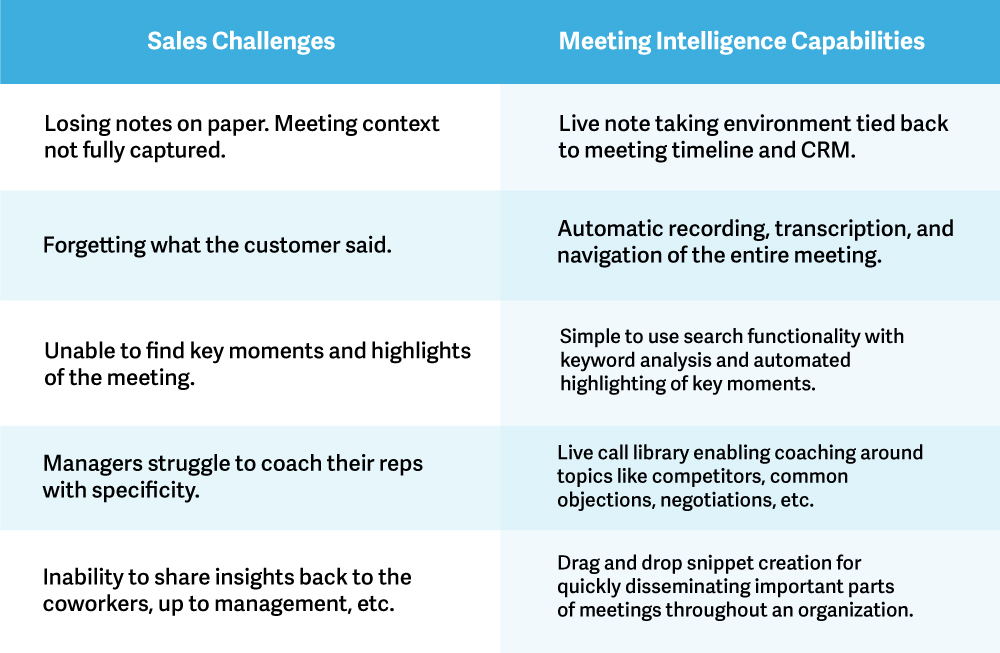
Recently, I realized our category of software was missing something important. Neither us nor other engagement solutions were solving an additional problem. Customers told me they need more insights on what’s actually happening during sales meetings. They realize (and Gartner reports) “three out of four customers report spending more with a company because of a positive buying experience”.

Modern revenue organizations need meeting intelligence software to solve painful problems:

According to Forrester, 90 percent of meetings with sellers add no value. Sales reps are failing to demonstrate value to buyers. If sales leaders lack the visibility required to coach reps effectively, the problem isn’t likely to be resolved.

When I saw Noteninja, I immediately realized our customers are going to want this solution. I was impressed by Noteninja’s innovation, customer-centric approach, and by the culture and character of their founders.

Adding intelligence capabilities, along with continued innovation in our meeting scheduling module is a natural addition to better serving customers to greater sales.

Many SalesLoft customers are already leveraging this solution to scale performance across their teams and coach their reps more effectively.

Dude Solutions is one customer that relies on both SalesLoft and Noteninja today to deliver better selling experiences for their customers. According to Donna Sanborn from Dude Solutions: “Having a record of all our meetings and interactions, and being able to quickly pinpoint and learn from what’s working best across our teams – has been a game changer for our organization. We’re able to onboard and coach our reps easier, and we’re seeing the results as those reps become more effective sellers.”

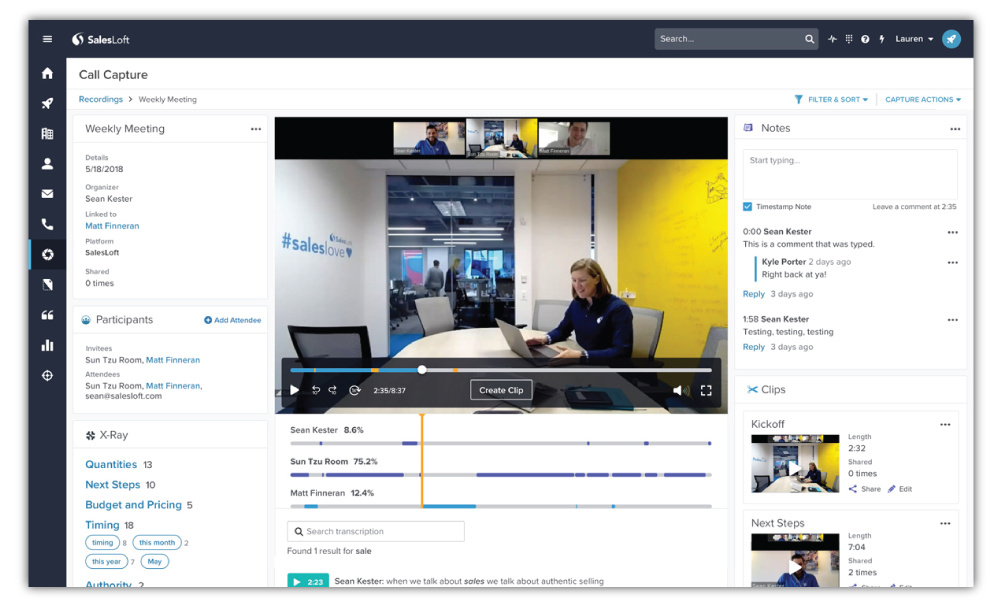
With the acquisition of Noteninja, SalesLoft is providing our customers with the first full suite Sales Engagement Platform that combines sales cadences with sales intelligence, serving AEs, SDRs, CSMs, managers, and execs to better sales. We will continue to support existing Noteninja customers and will soon be offering the Noteninja functionality incorporated natively within the SalesLoft platform.

Sign up below to get every innovation (including more details on this one) straight to your inbox.

With #saleslove,
Kyle

  • Email Address*
Subscribe

The post SalesLoft Acquires Meeting Intelligence Provider NoteNinja appeared first on SalesLoft.

21 May 15:56

The Finance To Value Framework

by Fred Wilson

There are two major failure modes in startups.

The first common failure mode is the thing you make doesn’t get adopted. That’s called not finding product market fit in startup lingo.

The second common failure mode is “getting too far out over your skis” and it happens to companies that do find product market fit but mess things up by building an inappropriate cost structure (and capital base) and it all comes crashing down on them when they either can’t continue to raise money at ever increasing valuations and/or when they can’t grow into their cost structure quickly enough.

The first failure mode comes with the territory. The world of startups is all about experimentation. Most experiments fail. If this happens to you, it sucks, but that is what you signed up for.

The second failure mode is entirely avoidable and way more common than you might think.

The capital markets are efficient over the very long run but highly inefficient in the moment. So just because investors are willing to throw gobs of money at you and your company, it doesn’t mean that it is smart to take it. And, as I have written numerous times here before, having lots of capital does not derisk your business plan. In many cases, it amplifies the risk of your business plan.

So how do you stay in balance and avoid getting too far out over your skis?

I like this framework that I call “Finance To Value” which means you finance your business to regular valuation targets that are driven by fundamental value analysis.

The first thing you need to know is how your business will be valued by a buyer or the public markets when it is a scaled business. I like to use EBITDA and Revenue multiples for this work. And the best place to get them is from bankers who work in your sector and/or investors who are active in your sector. The key point is these multiples are what you are going to be valued at upon exit or IPO, not currently.

Revenue multiples work better for this than EBITDA because very few companies have positive EBITDA during their growth phases.

Here are some examples. Please don’t use these multiples without verifying them with someone who knows your industry and your business. These are simply examples:

E-commerce business – 1 to 2 times revenues

SAAS business – 6 to 8 times revenues

Marketplace business – 4 to 6 times revenues (which can be less than 1x GMV depending on your take rate)

Once you know this number for your business (and don’t be aspirational or agressive in determining it as that will just lead to problems), you can apply the Finance To Value framework.

There are two Finance To Value rules:

Don’t raise more money in a given financing round than you can create in incremental value during that capital window.

Don’t let the post-money value of your round get higher than you can grow into during the capital window.

So let’s apply it to a fictional company.

Let’s say you have a SAAS software company that is doing $10mm of annual recurring revenue and you want to raise money to fund the business for the next 18 months. Let’s say that your business is growing at 40% per year and that your annual recurring revenue will be $18mm in 18 months. And let’s say that the post money value of the your last round was $60mm.

So using a revenue multiple of 6x revenues says that you should not raise more than 8×6 or $48mm. But that means you won’t create any incremental value. If you want to create incremental value then you should raise some fraction of that, maybe half of that.

Also, you should not let your post-money value get beyond $108mm (6×18). So if you raised the entire $48mm, it would be a flat round with your last one.

This is a bit of art vs science, but what those two calculations tell me is that the right raise for this company would be something like $20mm at $70mm pre/$90mm post, leaving some cushion to miss plan and still be able to raise an up round.

The challenge for founders and CEOs operating in startup land is that investors are often willing to throw more money at an opportunity at a higher price than you should accept. Who wouldn’t want more capital and less dilution?

But that is how you get out of balance. Don’t be tempted by the money and the valuation. Stay in balance and always make sure you can get the next round done on fundamentals.

If you stick to that practice, you can significantly reduce the possibility of getting too far out over your skis.


USV TEAM POSTS:

Bethany Crystal — May 28, 2018
How to Get a Whiteboard into Your Apartment Via the Roof

21 May 15:55

4 Ways to Show Customers You Care

by Stephanie French

4 ways to show customers you care

“In the world of Internet Customer Service, it’s important to remember your competitor is only one mouse click away.” – Doug Warner

This quote could not be more true.

All it takes is one less than stellar experience for customers to move on to the competition.

One way to decrease the possibility of your customers moving on is to let them know how important they are. Showing customers you care is extremely important and should be on your mind every day. Happy customers can make or break your business, so be sure to consider them when making decisions.

Even though you work hard every day to provide a great customer experience, here are a few simple things you can do to take it up a notch:

1. Show appreciation

After a customer makes a purchase, it’s the perfect time to say “thank you.” This simple act of appreciation can really go a long way when you take extra time and effort. There are a variety of ways to do this:

Email:

If you’re like most people and starved for time, email is a great option. With email marketing, you can easily say “thank you” with the click of a button. All it takes is a simple message to show your gratitude.

Handwritten note:

Another way to show appreciation is a handwritten thank you note. While it may seem “old school,” it’s a great way to make your customers feel special. They’ll know you took the extra time to write and send them a personal note. Be sure to talk about the experience and thank them for their purchase or support.

In addition to your thank you note, think about other ways you can show them the love. Consider inviting them to a customer appreciation event, include a coupon with your thank you note, or even offer your loyalty program. It can be as simple as a punch card. One example, is where you offer a free item or service after their fifth purchase.

2. Ask for feedback

The above ideas are great, but it’s just as important to ask for feedback. Jim Trinka and Les Wallace said, “Feedback is a gift. Ideas are the currency of our next success. Let people see you value both feedback and ideas.”

Asking for feedback shows you care by wanting to improve the product and experience for the customer. They will feel included and that their opinions and ideas are important to you. Understanding your customers’ feedback will help your business thrive by meeting their needs.

Don’t forget – It’s important to respond to both positive and negative feedback. This is the perfect opportunity to thank them for leaving feedback and fix any issues to make the situation right. This builds trust and shows customers that they are valued.

Gather feedback with an onboarding series:

Show customers you care by providing the right information when they need it with an automated onboarding series. An onboarding series is used to follow-up after a purchase and ensures that customers are seeing success, which also helps to build loyalty.

You want to prove to them that they made a great choice and keep them motivated about your products or services. Here’s an example of what an onboarding series may look like.

A simple formula:

Email 1 – Say thanks and provide information on getting started
The first email is your chance to thank them for their purchase and provide any essential information they need to get started. You can include the crucial tips and tricks for getting the most out of the product or service. We suggest sending this email one day after the purchase.

Email 2 – Share educational information
In email two, three days later, it’s your chance to provide any additional information to best use your product. This might include educational videos, or even FAQs that show them how to accomplish a task in your product.

Email 3 – Ask for feedback
The third email in an onboarding series is your chance to ask for feedback and can be sent in another three days. At this point, your customers have been using the product or service for about a week. It’s a great way to check in to see how things are going.

You can ask customers to write reviews on platforms like Yelp, Facebook, or even complete a survey. Ask them for more than just a rating and allow them to provide details about the experience, and how you can improve.

If needed, you can entice people to leave feedback by running a sweepstakes or providing something of value in exchange for their time.

Feedback campaign

This automated onboarding series is a great way to fully thank your clients, provide helpful information, and ask for feedback. Even though you’re using automation, you’ll show how much you care and want them to be successful.

3. Personalize your communications

You’ll continue to build loyalty by personalizing your email campaigns. It goes beyond just adding a name to your email. Rather than sending general emails to a broad group of contacts, show how your business can meet their needs by sending targeted, relevant information. Customers will be more engaged and take the actions you want them to take. All because you took the time to understand their interests.

For help personalizing your emails, check out the recording of our recent webinar How to Create More Personalized Email Messages for Better Results. You’ll learn about the great tools in Constant Contact to help you send personalized email campaigns.

4. Give back to the community

Customers love when they’re able to give back to their favorite charity or community organization. You can be a part of this by donating a portion of each customers’ purchase. This is just another great way to show your gratitude, while giving back to the community.

Communicate this initiative by sending an email, and let your contacts know you’re running a promotion to donate a portion to their preferred organization.

Put your customers at the forefront of your business

The above are just a few ideas that you can use in your own business to build loyalty and show your appreciation.

Customers and clients are the forefront of your business. So take the extra step to show just how much you value each of your customers. Add at least one of these ideas to your everyday so customers always feel valued when they do business with you.

Over time, you’ll build a great reputation and your customers will begin to spread the word about your business, all because they feel valued.

How do you show customers you care?

Want to generate customer loyalty? Join us for a free webinar on how to build stronger relationships by sending timely, relevant emails to your subscribers

21 May 15:54

Scale-up Lessons: HubSpot’s Journey from MQL to PQL

by Kieran Flanagan

One of the best things about working for a scale-up company is you get an opportunity to work on many different challenges.

Scale-ups become scale-ups because they’re able to find new growth engines to continue scaling the business.

At HubSpot, I’ve been lucky enough to work on two of those growth engines. I initially joined HubSpot as the marketing leader for international. My role was to grow both a team and a marketing funnel of traffic, leads, and MQLs for our target regions.

I next joined a small team within HubSpot who had a mission to turn a free chrome extension into a freemium business. Instead of building a marketing funnel, we created a product funnel of traffic, free users, and product qualified leads (PQLs).

Freemium is now an integral part of HubSpot’s go-to-market. You can start using our CRM for free, along with features of both our marketing and sales hub.

1. HubSpot Freemium Platform

We learned a lot about what it takes to build a successful product funnel. In this post, I’ll cover some of the main reasons we made that funnel successful.

The Product Funnel Equation

We broke the funnel down into two core components:

Product Value + Product Demand = $$

How to measure and iterate on product value?

You want to track a metric that shows the number of people getting value from your product is growing over time. It’s your north star metric and should have some correlation to better upgrades and retention. Improving this metric should help you to create sustainable growth for your product.

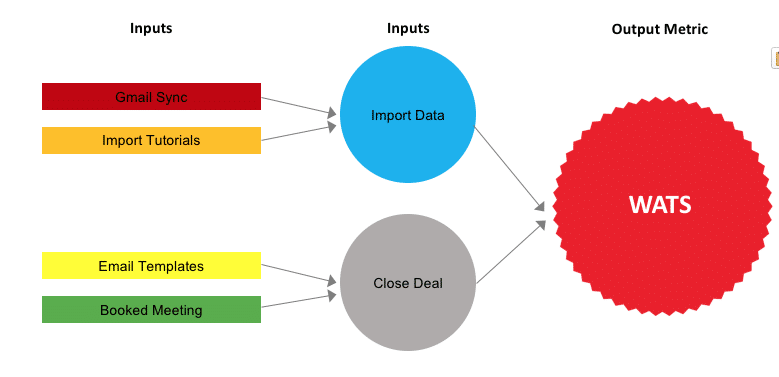
At HubSpot, we decided early on that our metric was weekly active teams (WATs). The more WATs we had, the better our freemium business would look.

Metrics like WATs (weekly active teams) are challenging to create an actionable plan for. As Brian Balfour argues, they’re too big, too broad, and not actionable. Instead, they’re a lagging indicator of success, one that tells you if you’re winning or not.

You need to break that metric down to its inputs by looking for common user actions that have a positive correlation to improvements on your north star metric e.g a high percentage of users who complete action X go on to become a [whatever you’ve defined as your north star metric].

Let’s take the following example for WATs.

2. Wats broken out by channel

Instead of running experiments and measuring their success or failure by changes in WATs, you instead focus on having a measurable impact on the different inputs that go into WATs.

For example, if we find ways to get more users to import their data, or close more deals using our sales tools, our WAT number would increase.

We could go one layer deeper, by increasing the number of people who imported contacts via Gmail, who consumed in-app tutorials on how to import their data, who used our email templates or booked meetings via our scheduling app, our WAT number would eventually increase.

Taking this approach means you can run experiments against inputs where you get near instant feedback on whether your efforts were successful or not.

How to measure and iterate on product demand?

Along with a ‘product value’ metric, we also obsessed over monetization.

We created product demand in the form of a touchless sale or a ‘product qualified lead’ for the sales team.

PQLs are a combination of product actions (how people are using the product), and whom that person is (using demographic and firmographic data).

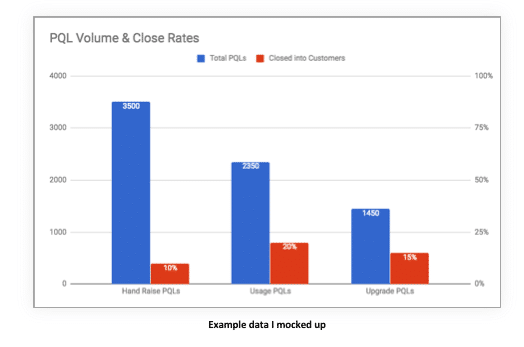
We categorized our PQLs into different buckets to find the best opportunities to grow revenue.

3. PQL Categories

  • Hand Raise PQLs: We would show free users call to actions within the product for paid only features or the opportunity to get assistance with a particular task, those users would interact with the CTA to reach out to us. We used them sparingly.
  • Usage PQLs: We triggered a call to action based on product usage, for example using all of your free call minutes or email templates would trigger an option to upgrade or talk with sales.
  • Upgrade PQLs: These were features only available to paid users, they would send users to an upgrade page.

Each PQL event was like a unique MQL so had to be measured as its own funnel. The result was a giant spreadsheet that showed each PQL event, the category it belonged to, the number of times the PQL event had occurred, the amount of revenue we closed from that event and its conversion rate.

4. PQL Dashboard

The spreadsheet helped us to not only decide on the PQL category we should focus on but the actual PQL events with the best potential upside for improvements in conversion rate and revenue.

Experimenting Your Way to Product Funnel Success

How our product funnel works today is a result of the many experiments we ran since its beginning. Every test you run is an opportunity to learn something new. Those learnings slowly add up to real changes in how the funnel itself works.

Let’s look at an example using three actual experiments with differing levels of complexity that build on each other.

Way back when we started building a product funnel, we prioritized experiments that were easy to implement and would increase the number of ‘hand raise’ PQLs generated.

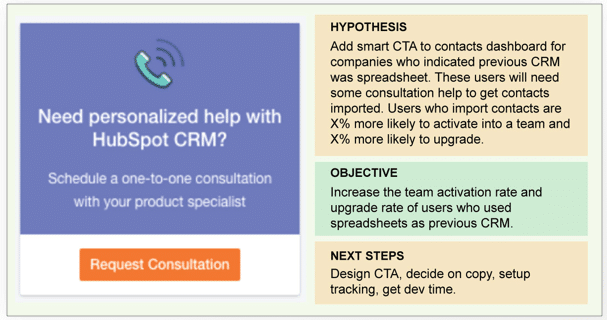
For example, we had a hypothesis where we believed customers who had previously used a spreadsheet as their system of record struggled to import their data because a CRM was unfamiliar to them. We would experiment by showing a CTA at common points of friction that offered consultation to help that user get their data imported. The execution of this was pretty basic; we were just getting started.

5. PQL HandRaise

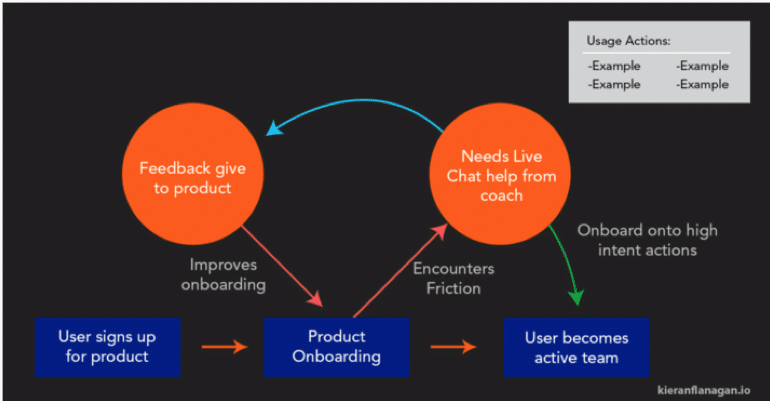
That PQL event became one of our top upgrade points for a period. It also provided us with two crucial learnings, many free users wanted to reach out to us when using the product, and those calls provided us with a lot of information on how we could improve our freemium onboarding experience.

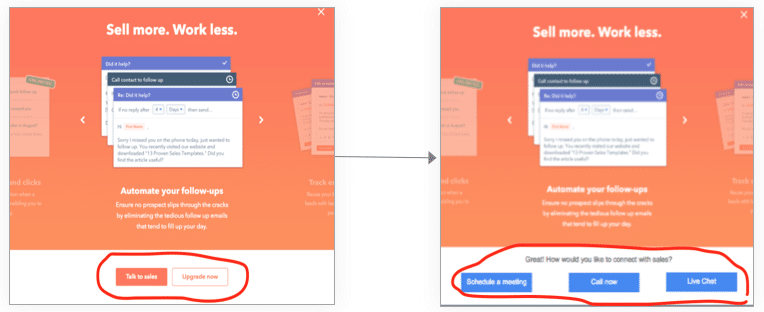
Over the months our CTA’s evolved to a modal that free users would see when they completed specific events, e.g., hit a limit on a free feature. The modal provided an option to talk with sales, and an opportunity to buy via touchless.

Successful B2B companies of the future are going to be those who make it easy for their customers to buy their software. It sounds so simple, but most companies make you buy their products based on how they want to sell them to you.

One of the missions of our product funnel was to allow users to buy our software in the way they wanted to. We had an hypothesis that some of our free users didn’t upgrade because we didn’t have the right communication channel for them, so we experimented with providing different options in-app for them to reach out to us.

5. PQL HandRaise

Initially, users could either reach out to talk with sales or upgrade themselves. We then experimented with providing them new options; schedule a meeting with a sales rep; they could live chat with someone to get their questions answered, or call a sales rep directly.

There was a lot more effort involved in running this experiment, but we saw a notable improvement in our conversion rate.

Making it easy for people to buy your software also means removing the hurdles they need to jump through to make a purchase. We continued to try and optimize the experience. Instead of making users click the ‘Schedule a meeting’ CTA, open a kickback email, click on a calendar link and book time with a rep, we experimented with allowing them to do it all from within the app. Once a user clicked on ‘Schedule a meeting’ our scheduling app would pop open and they could book a meeting with a sales rep without ever having to leave the app.

Again, we saw our conversion rates improve as a result of that test.

The experiments also provided us with new learnings, or reinforced learnings we had gotten previously:

  • People liked to live chat; it was the best performing communication channel.
  • Some cohorts of people needed help with getting on-boarded onto our freemium products.
  • Gathering information from these people helped us to engineer away the points of friction and improve our onboarding.

Using the previous learnings, I showed the following chart at one of our meetings:

7. User Success Coach Live Chat

The idea was to show live chat to specific groups of users at different points of friction. User success coaches would help answer questions, and provide constant feedback to both our product and engineering teams.

Again, there was a lot more time, effort and resources needed to run an experiment like this, but your natural trajectory in growth is to get wins on the board, build trust with the leadership team and earn your right to tackle more complex opportunities.

After several iterations the experiment proved successful, and coaches are now a core part of our freemium go-to-market and a great way to gather information to continually improve our freemium onboarding.

As a scale-up, we’re never happy with our current success. We always want to get better. We’ve managed to build a successful marketing funnel and product funnel both fueled by creating inbound demand, but it still feels like we have an ever-growing list of opportunities to keep getting better and that’s exciting!

The post Scale-up Lessons: HubSpot’s Journey from MQL to PQL appeared first on OpenView Labs.

21 May 15:53

After a Merger, Don’t Let “Us vs. Them” Thinking Ruin the Company

by Jennifer J. Fondrevay
may18-21-1766231-John-Gichigi
John Gichigi/Getty Images

More and more companies are relying on mergers & acquisitions (M&A) as a competitive growth strategy. Since 2012, M&A activity has increased dramatically in both number of deals and size of transaction, with the yearly value of global M&A deals tracking above $4.5 trillion for the past four years. These are heady numbers and 2018 is expected to continue apace. Yet when mergers are not done correctly, the end result can be at best uncomfortable, and at worst devastating to both companies.

As part of my consulting work on mergers and acquisitions, I created a playbook that defines the best practices for optimizing the human side of M&A. To uncover the human facets and the consistent challenges of M&A, I interviewed 55 executives from multinational to small- to medium-size companies all over the world. The interviewees, who were in the process of an M&A deal or who had recently been through one, included C-suite executives, private equity dealmakers, business owners, entrepreneurs, and middle managers. From these sessions, a consistent theme emerged: M&A often fosters us-versus-them thinking, which can undermine deal success from the get-go.

One of the great ironies of M&A activity is that trust, a key ingredient for business success, often quickly dissolves, as M&A activity is usually cloaked in secrecy. A workforce can feel blindsided when a deal is announced, eroding trust and transparency in three mutually reinforcing ways:

  • “our” company versus “their” company
  • executives versus frontline employees
  • who stays versus who goes

Let’s look at each of these:

Our Company Versus Their Company

When a merger or acquisition is announced, people instinctively wonder who “they” are — “they” being the company on the other side. Whether the company is known or not, there’s an instinctive reaction to regard “them” with a wary eye. Cultural differences can emerge, particularly if the companies have been at different ends of the spectrum in the marketplace. What makes sense on paper — i.e. a high-end product-line company merging with a low-end product-line company — can devolve into an us versus them dynamic as the companies’ different approaches and cultures inevitably conflict.

Consider this example: When The Interpublic Group (IPG) merged the direct-marketing company Draft with the ad-agency Foote Cone & Belding (FCB) to become one agency in 2006, “it was immediately apparent that the cultures of the two agencies were wildly different,” shared Marty Stock, then head of Coors advertising at FCB. “In bringing together a specialist direct-marketing agency with a generalist creative shop, cultural differences were bound to arise, given the contrast in customer approach and sensibilities. The differences drove an ‘us’ and ‘them’ mentality which was never really resolved, and which made integration unbelievably difficult.” Millions of lost dollars from client defections later, FCB split from Draft and reverted back to its origins in 2014.

Insight Center

Examples of successful acquisitions do exist, however, where the “our” company versus “their” company dynamic is minimized, largely due to the approach of the acquiring company. When Enterprise Rent-A-Car acquired Vanguard’s Alamo Rent-A-Car and National Car Rental in 2007, rather than executing a takeover, it moved slowly and sought to learn from its new brands. “Once the deal closed,” shared Enterprise CEO Andrew Taylor, “Enterprise pursued a deliberate integration. It was far more important to do it right than to do it quickly. We acquired Vanguard at an affordable price, so we could afford a thoughtful approach. When a new direction was chosen, it would reflect the best elements of both cultures and operating approaches.”

Executives Versus Frontline Employees

As senior leaders drive the integration process, midlevel and lower-level employees can begin to perceive senior level executives as getting more than their “fair share.” A perception that senior management is making money off of midlevel employees’ hard work can emerge. Should job losses occur, tensions may intensify as the remaining workers feel burdened “doing the job of many” to implement a strategy that executives, not managers, defined.

Even when there’s been a strong camaraderie throughout the organization, people can feel betrayed when executives leave with robust pay packages. Employees are not ignorant to M&A precedents where even CEOs of failed acquisitions have left with substantial pay packages. In those moments, trust erodes.

Executives have a critical role in minimizing us versus them thinking. Demonstrating commitment to the vision in word and deed is critical, and the pursuit of every activity must tie back to how it fits (or doesn’t fit) with the bigger picture. Nothing undermines change and its adoption more than behaviors by key individuals that are inconsistent with their words. To gain the workforce’s trust you must “walk the talk.”

Who Stays versus Who Goes

Cost-cutting and job losses typically occur in M&A as companies aggressively pursue efficiencies and eliminate redundancies. Deciding who stays and who goes are hard-wrought decisions. Transparency is difficult as executives and managers are either legally prohibited from being more open or don’t know how things will play out. Trust is diluted further when, in an attempt to keep people motivated, early communications sometimes say that “nothing will change,” and yet employees see change happening as people are let go.

Kim Feil, Chief Marketing and Strategy Officer for Aspire Healthy Energy Drinks, who experienced five separate M&A deals as head of marketing for Cadbury, IRI, Kimberly-Clark, Walgreen’s, and OfficeMax, had this to share: “Leaders know that while M&A can make sense on paper, the ability to achieve the vision is only as good as the team you put together.” During her multiple M&A experiences, Feil encountered well-thought-out organizational planning as well as unexpected curve balls. “Who will still have a chair when the music stops becomes the daily question,” Feil added. “So much is dictated by timing and where you are when the music dies. That said, you can’t just hope that things will work out.”

Feil attributes her successful acquisition experiences to upfront planning with leaders from both companies. “The key was focusing on the requirements for success, defining the teams needed to achieve them, and how they would intersect. ‘Who’ did it was not part of the upfront discussion, just the organizational design and structure were considered. Once that was defined, then all potential candidate profiles were considered and names then populated the structure.” What about the names not immediately selected? A clear message arose, consistently shared by executives I interviewed: when experiencing a merger or acquisition, know your value; don’t wait for the company to tell you what it is. Determine how your skills and experience will contribute to the mission and demonstrate that expertise repeatedly. Equally critical? If you determine your skills are no longer valued, find the employer who values them.

While us versus them thinking can undermine deal success, it doesn’t have to. These examples emphasize actions to take which can minimize the downside potential: a well-planned integration with a cohesive culture as the focus; consistent communication and commitment to the transition in both words and actions; and an organizational structure defined by what is best for the customer will go a long way toward positioning the new organization for success.

21 May 15:53

How to Design Sales Reports for Better Alignment and More Revenue

by Nakul Kadaba

Nothing excites a sales manager more than seeing their staff complete or surpass their monthly quotas. Cue the balloons and streamers. More commission for everyone.

Salespeople are naturally interested in showing off their success. And, hey, who could blame them? That’s how you get promotions, bonuses, and the recognition you need to advance your career.

But salespeople should think bigger than simply using sales reports to depict success. Instead, consider using reporting for further alignment with their marketing counterparts. I know what you’re thinking: “Why should I care about alignment with marketing?” Well, let me explain exactly how lucrative it can be.

If you examine the deals closed vs. goal report, sales managers can pinpoint sources and characteristics that relate to leads more likely to convert into customers. For that reason, reporting should be achieving a dual purpose -- to measure performance and identify sources of further growth.

Reporting purposes

Reporting can be used to show this progression from different angles. The differentiation for what report you use is based on your role.

In sales, SDRs may only need to know the qualifying criteria of incoming leads, number of deals, and commissions they are accumulating vs. their colleagues. However, sales managers and VPs might need more complex layers of data, including rep productivity, performance, and pipeline value as exemplified in question form below:

  • How much revenue is coming through the funnel?
  • How productive are our sales reps (meetings, calls, tasks, duration, etc.)?
  • Which products/service packages are getting sold the most?
  • How often are qualified leads being transferred to sales? How often are they contacted by sales afterward?
  • How much revenue is being attributed to marketing once closed by sales?
  • Which assets are being used as the first conversion point for contacts that eventually close as customers?

But these reports don’t have value without a defined set of metrics or goals beyond simply how much quota the sales team must hit.

Marketing directors and associates goals for reporting. Associates implementing the strategy probably care about which campaigns or content are generating the most traffic and leads. Meanwhile, directors might just care about the amount of revenue attributed to marketing or the number of qualified leads being handed to sales. Examples are identified below:

  • How often are qualified leads being transferred to sales? How often are they contacted by sales afterward?
  • How much revenue is being attributed to marketing once closed by sales?
  • Which assets are being used as the first conversion point for contacts that eventually close as customers?

At first look, there’s some similarity here that could be used to spur conversation about what could be done better on either the marketing or sales side. But how do you use reporting to make your discussion relevant?

Why Sales Reporting? Metrics and Alignment

Sales reporting is key to meeting success metrics and encouraging greater alignment with marketing.

The C-Suite provides the mission statement and vision for their staff to execute. Beyond that, many departments have revenue targets, which the sales team sees first because they are tasked with meeting that magic number.

Provide this revenue goal to marketing quickly, so they can share the responsibility and help you meet that goal. Remember, if sales has to close a certain number of deals, marketing must generate and qualify a certain number of leads for sales to work -- so, it’s better to be transparent about that number and collaborate on how you’ll achieve your collective goals.

What’s the best way for marketing and sales to communication progress towards goal attainment? Smarketing meetings, of course.

Smarketing meetings: Closing the feedback loop on Sales Reporting

Routine smarketing meetings are key to encouraging alignment between marketing and sales. Sales managers who listen to how marketing generates and qualifies leads will benefit from a more holistic view of the business. And when slow months occur, they’ll have a mouthpiece to marketing who can give them some extra assistance.

This post elaborates on this by outlining the following:

  1. Focus on solving problems – i.e. keep it relevant. Your first meeting might involve building and depicting a revenue report for sales & marketing to have a benchmark to build from. This revenue figure is something that can act as the catalyst to drive further discussions between sales and marketing around sources for this revenue and other contributing factors.
  2. Be thoughtful about your meeting invite – i.e. keep the C-suite out, the groups small, and rotate attendees if you have sales and marketing teams of more than ten people. Small groups are more manageable in terms of getting everyone’s opinion, especially when dealing with large marketing and sales teams. Large groups are more unwieldy, with everyone having a distinct opinion about the state of affairs.
  3. Ensure everyone in attendance speaks in roughly equal proportion – i.e. ensure these meetings are an ongoing conversation to provide visibility for both sides. Keeping an open line of communication between your sales and marketing teams enables a conversation involving constant exchange of feedback, optimization of content (for marketing) and revenue (for sales), and greater collaboration.

The following reports aren’t used enough, but will spur deeper conversations in smarketing meetings:

  1. Closed reason won: This provides marketing an opportunity to realize what the value added proposition for their product/service(s) is. Depending on the reasoning -- whether it’s price, the product/service’s competitive advantage, or talking to a particular sales rep -- marketing can use this reasoning to think of new content offers for the decision-stage to entice more leads to convert into customers.
  2. MQLs not touched: This provides sales an opportunity to see how productive they are. Marketing Qualified Leads are those that explicitly raise their hands to talk to sales -- and should be a first priority for salespeople to follow-up and nurture into their deal pipelines. If there are significant numbers of MQLs that have not been contacted by sales reps, sales managers can use this to follow-up with their reps and ensure they’re pursuing every qualified lead.
  3. Marketing’s contribution to revenue: This allows marketing a pulse-check to see what any revenue coming from contacts that were tagged as MQLs have contributed to overall revenue. Sales can laud a higher number of marketing’s contributions to revenue while spurring a conversation about what information qualified leads care about. This can lead to content offers that spur higher revenue in attribution.
  4. Average number of days as a [qualified] lead: This is somewhat similar to “Average Days to Close” for opportunities in a particular deal pipeline. This allows sales managers/VPs a pulse check similar to the “Marketing’s contribution to revenue” chart. It also gives marketing a chance to point out holes in the sales process, challenging their colleagues in sales to optimize and push through for more revenue.
  5. First touch conversion point: This points important assets to marketing, which provides them the impetus to further publicize the asset or create similar assets to spur similar conversion numbers. Meanwhile, sales colleagues can sit up and see what assets are providing them more commission. Once they have that information, they can provide encouraging feedback to marketing to bring in more qualified leads.
  6. Resell/Upsell rate: While this might be beyond post-initial sale, it still provides marketing and sales teams important information about what is making customers stick to their products/services. If a customer is happy enough to be resold, or even satisfied enough to purchase add-ons/consulting blocs, this gives marketing teams important cues on what areas of their product/service to highlight in case studies. Sales colleagues can highlight the advantages of these add-ons in order to generate stickiness and, hopefully, a longer deal at initial sale.

Sales reporting does so much more than to enable data-driven decision making from the top of an organization. It acts as a tool to push sales and marketing teams together, as well as drive a business’ mission and vision statement forward.

Start the free Sales Enablement Certification course from HubSpot Academy.

21 May 15:53

Why Hearing “No” in a Fund-Raising Process is Actually Healthy

by Mark Suster

Every entrepreneur wants to hear “yes” during the fund-raising process but I would argue that being too risk averse and not pushing hard enough and be willing to hear a “no” is what holds back many people from “yes.”

I believe people generally hate making decisions and especially so when they involve commitments and risks. This is true of any buying process where a customer has to make a large investment decision on your software or when an investor must decide whether to give you $5 million. In the case of the investment they are often also not only committing personal risk of looking bad at their partnership if things don’t go well but also countless hours of board meetings, financial reviews, legal documents across what is often 7–10 years or more.

So it should be no surprise that “yes” doesn’t come easily. But “no” also doesn’t come as easily as most people would like so entrepreneurs get stuck and frustrated by this endless string of “maybes” or non-responses. When somebody has to tell you no, the potential investor must:

  • Feel discomfort of letting you down. Investors are human, after all
  • Come up with a valid reason because they know in communicating with founders if there’s no reason to say “no” you can generate bad will
  • Risk missing out on an inflection point: Investors of course are also concerned about saying “no” too early in the process when they can “hang around the rim” and see what happens?
  • Possibly offend and entrepreneur leading to reputation risk amongst other entrepreneurs. Investors fear that saying “no” to you now will offend you and have them tell other entrepreneurs and/or make it harder that they’ll come back to you in the next round

For these reasons and more fund-raising often leads to a frustrating sense of never really knowing where you stand with most of your prospects and founders often have no plan for how to push prospects along — often out of fear that being too pushy could lead to an earlier “no.” Maybe this is reverse “hanging around the rim” where if you keep you VC process going long enough you’ll eventually get to “yes?”

Of course stringing out the process doesn’t lead to good outcomes. I spend a lot of time coaching entrepreneurs through their fund-raising processes by doing “pipeline reviews” of all of the firms with whom they are speaking. These are similar to the pipeline reviews I used to do with sales reps when I was a CEO. What I’m looking for in the conversation is:

  • Whom at the firm are you meeting with? Do they have authority to invest? Do they have influence? Can they get deals done? Do they understand your space?
  • When was your last contact? How many meetings have you had? What information did they request? When did you last hear from them? What feedback did they give you about the process?
  • What is your next step in the process? It surprises me how few entrepreneurs even know what the next step is. Because entrepreneurs often don’t feel comfortable in a sales process (as a fund-raising process is) they often don’t enquire about the approval process at the firm. It is perfectly acceptable (and should be required!) to politely ask about the process.

The net result is that often I find founders who don’t really know where they stand, what they would need to do in order to get an investment, who has to decide, what is the process to get that decision and what are the next steps in the process.

My belief is that founders often don’t push hard enough in asking for more meetings, asking where they stand, asking what the next steps are in part because they know that if they push too hard they might hear “no.” I often counsel people that they might need to hear 20 “no’s” in order to get 3–4 firms that move closer to a “yes” but those 3–4 firms might not make progress without the founders taking a bit of a risk on the process to get to yes.

I actually have to admit that I learned this from Carly Fiorina. When I was young in my career I did some consulting for the European arm of Lucent. We were working on their go-to-market strategy for Europe and Carly was Group President of the division where I was advising (a $19 billion line of business) at Lucent and she flew out for the final presentations. She stood in front of the sales executives and shouted at them like she was a high school football coach. She was imploring them to push harder in their sales process. To go “top down” in all of their campaigns. To use advisors or contacts to help them build executive-level relationships. And to be willing to hear “no” as long as it came quickly. That they shouldn’t accept a “muddy maybe” where buyers avoid making a decision. She told them they should embrace “no” because if they say “no” they were likely to say “no” eventually anyways so it’s better that you know early and can focus your resources on places where you had a better chance of getting to “yes.”

It was deeply uncomfortable for me because it was a sort of in-you-face, aggressive, go conquer the world kind of speech. But honestly it changed me in positive ways because the message — however hard to hear — resonated. It conveyed urgency, it implored people to respect their own time as much as they respected customers’ time and it asked that people have the courage to face rejection. I have now developed this into my own standard (softer) speech I give to entrepreneurs.

“People are afraid to hear ‘no’ so they don’t push hard enough. You need to be polite, but if you respect yourself you’ve earned the right to ask the awkward questions about where you stand and what comes next. If people tell you ‘no’ as a result of a polite push they were going to say ‘no’ anyways. But often if they don’t say ‘no’ you’ve just got yourself a commitment to re-engage.”

I push for commitments in my own job, sometimes beyond my comfort level. I once had a potential LP back in 2010 (when fund-raising as a VC was harder for me) tell me that he thought he was a better fit to look at our next fund rather than this one. I had learned that this is a standard line every LP uses to have an “easy no” for VCs. He hadn’t actually told me ‘no’ so I figured, “what the hell?” I’d give it a bigger shot.

I told him, “why don’t you come visit me in LA. I’ll set up a dinner with 6–7 VC firms and a bunch of prominent local entrepreneurs. At the end of it if we’re not a good fit — you’ve at least gotten informed about the LA market for when you do ever want to invest? What have you got to lose? Besides — the weather in LA is great this time of year!” I then stayed silent. It’s hard and awkward to do this because silence demands a response.

He said it sounded like a good idea and he committed to coming right then and there on the phone. Phew. I was relieved. I had no downside. At the very least I would build a better relationship and help other VCs in LA get to know an important potential LP. He did come, he enjoyed himself, learned a lot and we became much closer. What I liked about this approach is that he could “see me in the wild” how I normally am with my peer group rather than pitching Powerpoint at conference room table to his colleagues and him.

Then he went a little bit dark on me. It wasn’t surprising — if he engaged he’s have to make up his mind and I knew he was leaning against saying “yes” but I forced myself to actually hear “no” from him. I asked him for a quick call to give him an update on my progress. I used this opportunity to turn this into asking him how the trip went and what he was thinking about LA. He told me, “I had a great trip. But honestly we normally invest $15 million in funds and I don’t think I have the time to get the work done in order to make a commitment to your fund. I’ll try to get the work done but I doubt we’ll have a positive answer in this process. In any event give me time to do the work.”

I knew that I was going to get sucked into another 6–8 weeks of avoidance, some basic analysis and likely no progress. So I pushed harder, being willing to embrace a “no.” I told him, “Listen, why don’t you just give me $5 million. I don’t need the $5 million, it will be amongst our smallest commitments. But I know that if you invest you’ll take more time to get to know us. If you like us over the next three years I promise you a $15 million allocation in our next fund and if you’re not happy I promise not to hassle you for another dollar. You literally have nothing to lose. What do you say?”

Yes, this was out of my comfort zone. I was pushing for a “no” but hoping for a “yes.” This wasn’t the first time I had pushed this hard and I had certainly heard “no” many times back then. But this time he told me he’d think about it and we scheduled a call 48-hours later. And as you imagined, he said, “yes.” I couldn’t believe it. For us $5 million was a small check but it was a victory.

The firm he invested from has now invested more than $30 million with us but as importantly he changed jobs and moved to another firm and he went on to commit $70 million over a 6-year period of time at this other investment firm. He also has gone on to become one of my closer LP advisors. He pushes me hard on issues that have helped me grow.

But I swear to you if I hadn’t been willing to hear “no” I never would have gotten a “yes.”

Embrace “no” and don’t take it personally. Embracing “no” will unlock your much bigger potential.

No SUCKS, but it is also liberating.

Wait, there’s more!

This is part of a series on fund-raising advice for entrepreneurs and VCs. You can see the first post “Lemons Ripen Early,” which also has an outline and a link to all of the other topics.

Photo on Visual Hunt


Why Hearing “No” in a Fund-Raising Process is Actually Healthy was originally published in Both Sides of the Table on Medium, where people are continuing the conversation by highlighting and responding to this story.

21 May 15:53

How to Optimize InMail Subject Lines for Higher Response Rates

by Kylee Lessard
To catch the attention of busy sales prospects, write concise and punchy LinkedIn InMails.

Here at LinkedIn, we’re celebrating the holidays by bringing you 12 days of awesome sales content. Today, we invite you to take a look at these tips for improved InMail subject lines.

Considering the comparatively great response rates sellers enjoy with LinkedIn InMail, it can be tempting to quickly settle on a subject line and dive into the message of your InMail. That would be a mistake.

The moment a sales prospect reads your subject line, the evaluation begins. A vague, confusing subject line tells your prospect there’s more confusion to come, whereas a clear, succinct subject line can indicate that you’re easy to work with. These are snap judgments, sure, but the point is, the quality of your subject line doesn’t just determine whether your message gets read; it often determines how open-minded a prospect is to your idea.

In this post, we explain how to write compelling, personalized subject lines that can significantly boost your InMail response rates.

How Salespeople Can Optimize Their InMail Subject Lines

When it comes to subject lines, shoot for clear, personalized, and a conveyance of value. Your prospect should be eager to open your message, but not oversold to the point that they’ll be underwhelmed. Below you will find a few tips for writing subject lines that get prospects excited to open your InMail.

Think Like an Email Marketer

Email has long been a top B2B communication channel because everybody uses it – the average professional gets about 120 emails a day. That’s an onslaught of information, most of which is perceived to be more relevant than your sales message, and most of which is from people your prospect knows. This is what email marketers (and sellers) are up against, which is why the best email marketers work relentlessly on their subject lines.

Today, before any selling can commence, most prospects must first be sold on a subject line. Until this micro-sale happens, the seller’s thoughts and ideas remain hidden. Given the implications, it’s easy to see why sellers would want to apply similar scrutiny to their own subject lines.

Here are a few email marketing best practices you might want to incorporate:

  • Keep a swipe file. Which subject lines delivered results for you in the past? Which subject lines caught your attention and might be applicable? Which subject lines work best for certain situations, like requesting an introduction, or specific sales triggers, like an acquisition? You will be glad to have this info handy when you’re staring at a blinking cursor.
  • Use specifics. The obvious exception here are curiosity subject lines – as in, “Why on Earth Am I Sending You This InMail?” – but curiosity subject lines are tough to pull off, even for experienced email marketers. The safer bet is to be as specific as possible. Why say “Your Onboarding Process” when you can say, “I’m Confident We Can Solve Your Onboarding Woes in 75 Days, Susan”?
  • Experiment. Some prospects are going to be harder to reach, and you know that going in. These longshots are the perfect opportunity to experiment with creative ways to capture attention. So long as your creativity is backed by substance, your creative tact might help you start conversations with several promising prospects.   

Capitalize on Personalization to Increase Open Rates

A recent marketing report revealed that personalizing emails resulted in a 50% lift in response rate. To personalize your InMail subject line, try naturally incorporating your contact’s name or another identifiable element (like city, industry, or an interest) to add relevancy. Or try referencing something going on in your buyer’s world like a promotion, achievement, or business milestone.

For example, you might try:

  • Bob, we’ve figured out what successful MarTech startups do differently
  • Congrats on becoming CXO, Bob! Here’s a handy checklist for your first year

Personalization helps your InMail stand out as a message specifically intended for the recipient, rather than something batch-produced without much thought.

Evaluating Your Headline: 3 Questions to Ask

You have 80 characters to work with in your InMail subject line. To ensure you make the most of this prime real estate, ask yourself the following questions:

  • Who is my reader, and why would they want to read my message?
  • Does my subject line promise a benefit or reward for reading the message?
  • Is my subject line as clear and specific as it could be?
  • Does my subject line relate logically to the message that follows?

Writing better subject lines leads to higher open rates, but the even bigger benefit is having sales prospects click your message with anticipation, open to new possibilities.  

For more ways to boost your results with InMail, read our latest guide, Read Me If You Want to Improve Your InMail Response Rates on LinkedIn.

21 May 15:53

Cold Calling–Chapter 19 from “Selling Fearlessly: A Master Salesman’s Secrets For the One-Call-Close Salesperson”

by Robert Terson
Actor John Wayne said, “Courage is being scared to death—but saddling up anyway.”  If you’re a one-call-close salesperson, this post is for you.  If you’re not a one-call-close salesperson, I suggest you read Sam Richter’s Take the Cold Out of Cold Calling. If you’ve ever perused sales-job ads, you’ve probably noticed many promising “leads, leads, leads—no […]
21 May 15:53

Attracting Channel Partners

by Jocelyn Calderon-Arroyo

Channel Sales Strategy

Running a business can be quite the challenge, especially when your business depends on channel partners to as part of your revenue generation model. Truthfully, finding sales partners is not the main challenge. The challenge comes when it’s time to enable and encourage channel partners to sell your products.

In order to have a successful channel sales strategy, you need to ensure that your business is set up to enable your channel partners for success.

This blog will guide you through the steps you need to take in order to attract channel partners who will be ready to sell your products successfully.

Before we begin, it is important to note that the foundation of your business is of the utmost importance to not only the success of your channel partners but to yours as well. Like anything ever built, a strong foundation is needed.

Step 1: Define a business strategy and let it be known

Defining a business strategyThis seems like an obvious step. We all know that every business needs a strategy in place, otherwise, how are you operating? What most business owners fail to do is SHARE their strategy with those involved in the business.

It is understandable that a business owner may not want to express all elements of their strategy in fear of their methodologies being discovered by the competition. But, we need to put some trust in our partners and employees. Remember, strategies should always be optimized, the turning wheel of your strategy will remain an element of your business that competitors won’t be able to get their hands on.

So, why is sharing the business strategy with your channel partners so important? If they don’t know what your goals are or/and the plan of action to reach those goals, how can you expect them to succeed in their role as a channel partner?

Step 2: Develop a marketing plan that includes a defined partner program and portal for partners

Building a marketing planNow that you have a business strategy in place, it’s time to start executing the parts of your strategy that will benefit channel partners. This starts with your marketing plan.

Marketing is a huge part of sales. In most cases, marketing plays the role of attracting perspective leads. In fact, one of the ultimate goals of marketing is to provide sales with the tools they need to close deals.

A portion of your marketing plan should be tailored to your channel partners. This includes defining a partner program and developing a partner website or partner portal.

For starters, a partner program will clearly define the role a channel partner plays in your business, your expectations and the benefits they get from being a partner. Remember, when it comes to attracting channel partners, it’s a two-way street – you need to be attracted to your channel partner, and they need to be attracted to your business.

Like a partner program, having a professional website or portal for channel partners is essential to providing them with the right tools for success.

A partner portal will not only house all marketing pieces channel partners need, but it can also act as a communication and partner relationship management tool. The possibilities of a partner portal are endless.

Step 3: Building your channel partner base

Building your channel partner baseNow that you have implemented everything needed to have successful channel partners, the final step in the process is to attract capable and qualified channel partners and retain them.

A lot of this retention can be done right on that partner portal from your marketing plan in step 2. A variety of marketing promotions and activities can be implemented using the portal to attract and retain channel partners.

Before any promotional activities can be launched, you must define the persona of your channel partners. What do they like? What are they interested in? How do they respond? Knowing your ideal channel partner will give you insights that can help advance your strategies, improve processes and optimize your business.

Here are a couple of promotional activities that you can run, utilizing your partner portal:

Blogs:

Share your ideas and provide thought leadership online and attract other like-minded individuals such as channel partners who may be interested in partnering with your business. It’s also a good way to reassure current partners of your standpoint and inspire them through your content.

White Papers:

Engage channel partners with content that educates them on a specific topic related to the business. Demonstrating your knowledge on a specific topic within the business is a great way to draw partners to your business.

Trade Shows:

Attending events as an exhibitor can really help extend your brand reach. Channel partners want to work with well-known and established businesses. Trade shows can assist with building and growing your brand awareness and reputation.

Online Communities:

An online community is an amazing way to keep channel partners engaged. The community not only provides support for channel partners but it also acts as an open discussion where partners can connect on various topics.

Electronic Resources:

Sharing resources such as supporting documents, brochures, e-books etc. helps keep channel partners informed. Resources can also be transformed into playbooks that channel partners can use when closing sales.

Ready, set, attract, and retain

Now that you have taken all the steps needed to have successful channel partners. It’s time for you to get out there and attract and retain channel partners who will help grow your business.

Remember, having a strong foundation in place will really help propel your business with channel partners.

19 May 17:57

Sales Doesn’t Need to Become a Profession. It Already Is.

by Anthony Iannarino

Sales does not need to become a profession. Sales already is a profession. Even if there are not hundreds of university courses. Even if there are not degree programs on professional selling. Even if there is wild disagreement as to what would make sales an actual profession, like a doctor, lawyer, or certified public accountant.

There are thousands of people who get an MBA (Master’s of Business Administration) as part of their professional development as a manager. Does that impact the quality of managers? Are all managers that go through a professional course better managers for having done so? Or, are some managers far better than others, even without the degrees? Is someone somehow more virtuous, more moral, or even more effective because they have a certificate that says they are certified?

Doctors are professionals. So are lawyers. So are accountants. All of these are so-called professions. Just because all doctors are required to go to school for more years than almost any other profession does not mean there’s an improvement in the professionalism of the field generally. The effectiveness is distributed in the form of a bell curve, with some being exceptional, some abysmal, and most something close to average. This is true, even though they took the course and got the sheepskin.

Whether or not something is your profession is a personal decision you make. It’s a continuous development and honing of your craft. It’s the commitment to excellence and how you go about your work in the outcomes you produce. It’s the intentional decision to be a professional. The diploma, the certification, or the professional organization does no more to make you a professional then the ticking alarm clock gave the Tin Man a heart. You are a professional because you believe and behave as if you are one. Nothing more is needed

The post Sales Doesn’t Need to Become a Profession. It Already Is. appeared first on The Sales Blog.

19 May 17:55

STORIES – The Key to High Impact Presenting

by Maurice DeCastro

Stories are the key to a high impact business presenting and the jewel in the crown of public speaking. It’s the most powerful route to connecting emotionally with an audience. Whether you are looking to lead change, inspire action or unify a team, you have to tell them a story worth getting behind.

This article is part of the series of The A to Z of Mindful Presenting.

It’s neurobiology

Most people would agree that a presentation without stories is likely to be boring. I’d go as far as to say that ‘A presentation without stories is a lecture’ and very few people relish the idea of being lectured to.

The evidence that storytelling is how we learn, connect and relate to each other is steeped in science. Neuroscientists have been telling us for some time that a good story, well told, stimulates the release of a neurotransmitter called oxytocin. Medical News Today describes oxytocin as ‘the love hormone’ which sounds a little overzealous for an article on public speaking, I know, but it’s worth understanding what they mean. As a hormone and neurotransmitter associated with empathy, trust and relationship-building, it’s a means of connecting with an audience to influence and persuade.

In simple terms, a short, relevant and compelling story which is well-told can release enough of the hormone to help your audience to feel as though they are experiencing what you have experienced.

If they feel what you feel they are far more likely to accept and act on your message.

What to tell

Can you imagine how many of us would continue to buy newspapers, watch or listen to the news if all we ever heard was good news. As blissful as that may sound the truth is most of us like to read and hear about struggle.

Difficulty, hardship, loss and struggle seem to be the key pillars that capture our attention, interest and curiosity. However, told on their own without the contrast of transition, growth or achievement stories are a recipe for tedium.

If you accept the premise that our whole lives are made up of a tapestry of stories it becomes easier to find them. They are everywhere and our task as presenters and public speakers is to find the relevant and fascinating ones that speak to our message. Here are seven of my favourite types of story.

Spark action

Truth

Origin

Rebellion

Imagination

Eureka

Struggle

Spark action

These are the stories you tell that leave your audience wondering:

‘Is there a lesson in that for me; should I…’

‘We seem to be going through something similar, what if…’

‘Perhaps that could work for us if…’

Many years ago, whilst leading a team of several hundred people in an ailing business, I read a book about a business owner who in a similar position introduced the idea of a mascot to his team. After learning of their great success, it sparked the idea in me and action to do something similar in the business I was trying to turn around. The initiative not only worked beautifully but having recounted the story many times over the years I have seen it spark action and success with others in a similar position.

Truth

Stories about truth are in essence about who we are. They relate to our core values; what makes us think and behave in the way we do.

Shortly after launching Mindful Presenter I faced my own truth.

The response from one executive sponsor who enquired about training for his management team shook me. I asked him the most important question we ask at Mindful Presenter which was, ‘What do you want your audience to feel when presenting’. He said: ‘I don’t care what they feel as long as they do exactly as I tell them’.

At complete odds with everything, I believed his response caused me great anxiety and a few sleepless nights before I had the courage to stand by my truth and decline working for that company.

Origin

These are stories which describe why you do what you do and what drove you to lead the change.

I’m often asked why I started Mindful Presenter and why I am so passionate about public speaking and presenting. In response, I tell the story of my son’s very first day at school where we listened to his headteacher give a 30-minute welcome speech. After 10 minutes my son looked up with a tear in his eye asking ‘Daddy, this story is so boring, what time will it finish’.

I realised in that moment that the pain my son described wasn’t isolated to the headteacher’s speech. It dawned on me that businesses across the entire world were doing exactly the same things to adults in the workplace every day.

That was the birth of Mindful Presenter.

Rebellion

These are stories about how you challenged the status-quo.

Do you remember the mascot story I shared with you earlier?

One of the reasons that business was in decline was because it had cultivated a potent ‘yes, but’ culture. Every time someone came up with an idea you could guarantee it would be ‘yes butted’.

In a desperate bid to fix the problem, I gave each of the team a stress ball. One side had the words ‘yes but’ printed on it with a big black cross running through it. On the other side of the ball were the words ‘YES AND…’printed in big bold letters. I invited each of them to carry their ‘yes and…’ ball with them everywhere they went whilst at work. I gave them permission to throw their balls at anyone in the business anytime they heard them utter those fatal words ‘yes but…’.

The HR Director of the company insisted that I withdraw the action immediately. I politely explained that if she could offer me another way to save the business I would do so gladly.

She couldn’t and so the balls took flight.

Imagination

These are stories about the future.

After listening to the Headteacher ramble on my son’s first day at school I had a dream. Compounded by many years of listening to dull, uninspiring and arguably unnecessary presentations I began to imagine what the world would look like if we:

  • Stopped reading slides to our audience
  • Told stories
  • Used compelling images instead of text
  • Left the corporate spokesperson at our desk and spoke authentically
  • Only shared what was meaningful, valuable and relevant

Stories of imagination are about the future, what the future could look like if only we…

Eureka

These are stories of that moment of realisation; a discovery, epiphany or flash of inspiration.

I often tell a story about a eureka moment I had whilst working in Japan. After traveling for 18 hours I arrived feeling totally despondent about being so far away from home and my beautiful family.

I decided to have a bath and an early night in the hope that a good night’s sleep would do the trick.

Whilst relaxing in the bath a rubber duck changed everything.

I picked the duck up, played with it and beautiful memories of my baby son thousands of miles away came flooding back to me. A simple, yellow rubber duck brought such joy to me when I needed it most.

In an instant, I realised and embraced the idea that the smallest and simplest thing could make such a mammoth and empowering difference.

Struggle

Stories about personal and professional struggles and how we overcame them in a way that others may be able to learn from are immensely powerful.

Many years ago, an old boss of mine caused me a great deal of unrest and many sleepless nights. We clashed terribly on just about everything imaginable. The relationship became so insufferable from my perspective that I felt the job was untenable. After months of anguish, I decided that the only solution for me was to resign. I had resisted the idea for a long time because I loved the job; it was just my boss I couldn’t stand.

After making the decision to resign over the weekend I sat down to read a book called ‘The Alchemist’ by Paulo Coelho. By the time I finished reading the book it occurred to me perhaps there was another solution to my dilemma.

What if I were to look at things from my boss’s perspective?

What if I put myself in his shoes?

What if I worked harder to support him rather than resist and challenge him so much?

I spent the next 3 months doing exactly that and our relationship changed; everything changed for the better.

Within 6 months my boss left the company.

This was one of the greatest struggles of my career although when I had the presence of mind and courage to change the way I was looking at the situation everything changed.

When you want to connect with your audience emotionally as well as intellectually tell them a story. When you want to make an impact and be remembered take your audience on a journey of struggle, growth and triumph.

I really hope you enjoyed this post. If you did, please feel free to share it through your preferred social media channels below and subscribe to our mailing list so you won’t miss any future posts.

Image courtesy of: istockphoto.com

19 May 17:43

Trending This Week: Here Come the Robots

by Steve Kearns

If you use pop culture as a reference point, robots are to be feared. Most science fiction movies, books, and television shows seem to predict the fall of mankind at the hands of robots or some form of AI.

Luckily, we live in the real world, where the use of AI isn’t quite as dangerous. Advanced technology is helping salespeople analyze and organize data efficiently, freeing sellers up to invest more time into strategy.

This week’s trending sales content includes a look at how salespeople can use AI to their benefit. You’ll also learn how to turn cold sales meetings into sales wins, how to overcome negativity, and more.

Here’s What Sales Professionals Are Reading and Sharing This Week:

Beyond the Hype: How to Transform B2B Sales With AI

It’s hard to get too far into a conversation before someone mentions that AI will steal our jobs. Fear not, says VentureBeat, as they say AI can be a valuable tool for B2B salespeople. In fact, their post says 76% of companies leveraging AI are seeing greater sales growth.

The reason? Salespeople have more customer information and data than almost anyone. So much so that it can be difficult to analyze and use efficiently. AI can help you parse that data, and this post goes into more detail about how AI can help salespeople in four areas:

  1. Mining for prospects
  2. Anticipating customer questions
  3. Offloading administrative tasks
  4. Closing deals

How to Convert Cold Sales Meetings into B2B Sales Wins

A recent story by Promo Marketing Magazine’s Joseph Myers explores how to convert cold sales into wins. The piece notes that 58% of buyers find no value in their sales meeting. That’s a high number, so what can be done about it?

The crux of the story is that you need to look for ways to add value. The piece includes these five ways that buyers say sellers can add value:

  1. Focus on the value you can deliver
  2. Collaborate with the buyer
  3. Educate the buyer with new ideas and perspectives
  4. Provide insight into the industry or market
  5. Deepen the buyer’s understanding of their own needs

Using CRM Data for Lasting Benefits

Sana Ansari of 3Q Digital examines the variety of ways CRM data can be used for sales in this post for Search Engine Watch. She says it is important to take a high-level look to see what is driving sales results. This post is the third part in a series that goes into more detail about how you can leverage different marketing channels and audiences to jumpstart your B2B sales.

All three posts are worth your time, and this one on data analysis is especially beneficial as it gives a glimpse into how you can take the results of your campaigns and refine them to make sure they ultimately drive sales.

Protect Your Mindset From Negativity

Negativity can creep in for even the best salespeople. After all, sales is as much about hearing “no” as it is about hearing “yes.” Author and speaker Anthony Iannarino says accepting the negativity as a reality is the best way to protect yourself from getting too high or too low.

If you accept that being turned down is part of the job, you won’t see it as a negative, Iannarino says. Having a sales pitch turned down is just a job duty, and if you treat it as such you won’t spend as much time bouncing between highs and lows.

Easier said than done, perhaps, but good advice nonetheless.

What Sales Should Know About Modern B2B Buyers

Gartner recently published a post about the modern B2B buyer. It covers a lot of the common ground about adding value when selling, but it also hits on another key area: The prevalence of digital in B2B sales.

Customers are not only relying more on websites, they are relying on a bevy of digital channels at all stages of the buying journey. Gartner research showed that 83% of buyers were using digital channels even in the later stages of a deal. That means salespeople need to be leveraging digital throughout the sale, even if they have already had an in-person interaction.

For more ways to solidify your friendship with sales technology, subscribe to the LinkedIn Sales blog.

19 May 17:41

3 Must Have Strategies When Building Out a Topic Cluster

by Ken Mafli

rawpixel / Pixabay

What Is a Topic Cluster?

Defined by HubSpot: A topic cluster is a content program that enables “deeper coverage across a range of core topic areas, while creating an efficient information architecture in the process.”

In 2016, HubSpot developed an SEO strategy that they named topic clusters. Simply put, a topic cluster is a group of pages (typically blog posts) that each focus on a subset of a particular topic and interlink with themselves and a pillar page (a 10x piece of content that explores the topic in full).

While long-time SEO strategists may recognize features of the methodology, such as skyscraper pages (i.e., pillar pages) or link clustering (i.e., topic clusters), HubSpot has created a strategy worth more than the sum of its parts.

The genius of the strategy is that, when done properly, it creates a dense network of engaging content that offers a better user experience and a more compelling reason for search engines to rank your pages higher.

Why? Instead of creating one-off blog posts about specific keywords, you create a pillar page that is head-and-shoulders above the competition in terms of explanatory power, with more fully explored subjects (along with more images, graphics, videos, and so on) and surround it with a cluster of inter-linking pages that each explore a subset of that topic further.

This produces a rich environment for the user to find answers to their questions and explore a topic beyond just one specific keyword. The pillar page also allows Google to clearly understand what your cluster is about and rank each page for search queries more closely matched to their topic.

In order to succeed with a topic cluster, however, there are some essentials that you must have in place. Follow along as we explore some of the key components of a topic cluster strategy.

Overall Keyword Strategy

Topic clusters focus on broader topics, but that doesn’t mean you don’t need to do your keyword homework. At its core, keyword research is finding out how users ask Google about a particular topic. Getting the vernacular right means you are speaking in a way the user understands.

First, in a spreadsheet, type out the keywords that best describe the topic you are working on. Use this as an exploratory exercise. You will not use all of these, but this is a way to get your ideas out of your brain.

Next, explore your competition. In a browser’s search bar, search some of the keywords you jotted down. Note the top four or five ranked pages. Find out how they describe their pages in the meta description. What keywords do they use? Do they use specific phrasing? Can you improve upon their work? Add your findings to your list.

From there, continue researching potential keywords in Google. What pops up in Google’s autocomplete as you type in the keywords? What are the related search suggestions? Adding keywords straight from Google will help, because the keywords will already be closely matched to keywords you are interested in.

Next, fire up your favorite keyword tool such as Moz, SEMRush, or AdWords (to name a few). Enter your keywords and see what other suggestions come up. Are there keyword suggestions that frame questions the user would likely ask in a better way? These will come in handy as you develop your content strategy. Are there keyword suggestions that could help you explore your topic further? Add your findings to the list.

From here you should have a sense of what keywords work and which need to be removed. You should also have a sense of what keywords should be grouped together as part of a subset of the overall topic. These can form the basis of your cluster pages and subheaders on the pillar page.

Once you have your keyword list mapped out, add items like the monthly search volume and difficulty score. These will help you decide if a keyword is worth going after or should be left for another day.

A handy Chrome extension for this is Keywords Everywhere.

As an example, let’s say you are going after the overall topic of “red spinning widgets,” but you see that it has a monthly search volume of just 1,000. Because you know that you will likely get 10 percent of that traffic if you rank well for your topic cluster, you conclude 1,000 is just too low for the amount you will do to garner that traffic. Instead, you decide to make “red spinning widgets” a sub-topic and make “red widgets” (5,000 monthly searches) your main topic.

Overall Content Strategy

Now that you have your keywords mapped out, it’s time to start developing your content strategy. First, let’s start with your core topic. Type your broad keyword that will be used for the pillar page into Google. Note the top four to five webpages in the organic search results. Click on each page and determine the word count of the article or blog post.

A great Chrome extension to use is Word Counter Plus.

Once you determined the length of each page, find the average. Because you are trying outperform your rivals in explaining the topic, you will want to at least hit the average word count, if not go above the highest count. Please note, word count does not equal content excellence, but the person who takes their time to fully cover a topic in 2,000 words will likely be more comprehensive than the person who does it in 1,000 words. Additionally, larger word volume will give you more opportunity to send the correct signals to Google as to what your content is about.

Next, note the average to high number of creative elements used, such as images, graphics, gifs, and videos. How is your competition using these creative elements? Note what they are doing right. Are they using the correct medium for the content? If not, what would you do differently? This is where you can shine. Many times, people get so focused on writing the content that they forget users absorb information in different ways. Some people are visual learners; some are auditory learners; others are kinetic learners. Use as many mediums as you can to fully illustrate your points.

Finally, what kind of user experience does your competition offer? Is the webpage clunky and cluttered? Is it clean with well-designed navigation aids? This is another area where you can shine. Take time to make your page feel effortless to navigate. Use imagery and animation to help visitors go further through the page. Make them want to crawl inside the screen and inhabit the page. The highest compliment you will ever receive building a pillar page is when you see individual user dwell times reach over one hour. I have seen it on pages I have built and it was definitive proof that what I built was worthwhile and appreciated by the community I served.

Once you have completed your analysis for your pillar page, repeat the process for your topic clusters. While you do not need to go all out for each supporting blog post you write, it is still good to keep in mind what your competition is doing. Are a lot of your competition including video on their webpages? If so, would you benefit from doing the same?

As a final note on content strategy, make sure you optimize for voice search like Siri and Alexa. Because most voice search is done in the form of a question, make sure you are always asking: What questions does the user need answered? Make sure you include those questions in your content with an answer of less than fifty words directly below it (which I shamelessly did at the top of this post).

Overall Promotion Strategy

Promotion tends to not get the credit it is due. The truth is, you can build the best piece of content out there, but if no one knows about it, it does you no good. With every good piece of content there should be a promotion battle plan.

First, start with linking. Backlinks tell Google that other people find your content useful and that it is worthy of being ranked high in search results. Research each of your competition’s linking profiles by using services such as Moz, SEMRush, Majestic, and Ahrefs. Find out:

  • The number of domains that link to each of your competitors’ pages
  • The average domain authority for the backlinks

Once you have this information, find the average for your total competitors. All of this will give you an idea of the linking profile you need in order to rank in the first four to five positions of Google. As an example, let’s say you find that the average number of domains linking to your competitors’ pages is 10 with an average backlink domain authority of 30. This means that you would likely want to shoot for around 10-15 backlinks with an average domain authority of 30 or higher.

There are many ways to go after links, but in my book, the best ways are ones in which you extend the inbound model by building mutually beneficial networks and offering exceptional content. One practical way is guest posting. By offering quality content to websites with strong domain authority that accept guest authors, you are extending your reach to new audiences and getting much needed backlinks.

A second way to extend your reach to new audiences is through syndication. Syndication is taking content you have already written and republishing it on another website. If done properly with “rel canonical” links, you will not incur a duplicate penalty and you will have link juice flowing to your topic cluster. With that being said, syndicate only where it makes sense, use only a select few posts, and only syndicate content that has proven to have appeal on your own website. You are doing this to project your brand to new audiences, so only put your best foot forward.

Finally, make sure you socialize. Talk up your content on Facebook, Twitter, LinkedIn, and Google Plus. Find blogs that talk specifically about your topic and leave a thoughtful comment with a link back to your content. (Don’t be spammy—only add a comment if you can meaningfully add to the conversation.) Go on Quora and see what questions you can answer. Again, answer the questions in detail and only answer if you can give an authoritative answer.

With these three strategies in mind, you should be well on your way to building a topic cluster. As with all inbound methodologies, the topic cluster is about adding value and growing your network. If you have the mindset of being head-and-shoulders above your competition in terms of adding value, your community will thank you for it and reward you with their visits, form submissions, and eventually—purchases.

19 May 17:41

Hedging the Housing Crisis

by Adam Bergeson

Adam Bergeson is a Strong Towns member sharing today's guest article about an interesting proposition for mitigating the impacts of conflicting priorities for renters and homeowners.


A lot has been written, at Strong Towns and elsewhere, about the conflicting outcomes that our cities are expected to deliver to a diverse range of oft-frustrated stakeholders. Property owners, business leaders, and public officials love to see their city’s economy expand through new investment, but the area’s renting population — often younger, poorer people — are justifiably afraid of being priced out of their homes and pushed further away as a consequence of that investment. 

Relatedly, renters would greatly benefit from the construction of new, affordably priced housing inventory in their city. When new investment gets a little too close for comfort, however, the aforementioned property owners quickly transform into NIMBYs that oppose any project that poses the slightest risk of decreasing their property values or quality of life as new residents further congest existing infrastructure and public services. For many homeowners, their house is the most valuable asset they will ever buy and a significant proportion of their total net worth, making it completely rational for this group to be skeptical of, or downright hostile toward, anything that may diminish their asset’s value.

With such palpable real-world consequences for citizens on either side, trying to balance these opposing concerns and motives would appear to be an exasperatingly complex zero-sum game that our cities are being forced to play. But is this really the case? The societal tug-of-war caused by our modern housing market can be exasperating, certainly. But complex? Maybe not.

The way I see it, the winners and losers of this game are fundamentally defined by their relationship to the movement of a single variable: property values. As a city gains momentum and property values rise, owners win. If that same city tempers unmet demand by expanding the housing supply, especially that of affordable apartment units, renters win and the existing property owners lose. Because prices can only go in one direction (up or down), someone has to lose – that may never change. How then, can we make it less painful, or nearly painless even, to lose? Cities can look to Wall Street to find the simple answer: through hedging our bets.

Investopedia defines a ‘hedge’ as “an investment to reduce the risk of adverse price movements in an asset." For our purposes, the ‘asset’ would be the collective real estate values in a given city, and what constitutes an “adverse” price movement depends on your perspective as either a renter or a homeowner. Like an insurance policy, an effective hedge would help the losing population cope with any losses caused by the other’s gain.  

Screen Shot 2018-05-18 at 12.28.42 PM.png

A HEDGE FOR RENTERS

Most people are familiar with Gross Domestic Product, or “GDP”. This is a measurement of a country’s total consumption and investment. Many also know that, by assuming the economy is a balanced transaction (every dollar spent is, for someone else, a dollar earned), we have another statistic called Gross Domestic Income, or “GDI” – a nation’s total earnings.  

When talking about cities, the U.S. Bureau of Economic Analysis takes GDP and swaps “Domestic” for “Metropolitan” and voila, you have a measurement for the dollars spent within a city’s economy (GMP) and, conversely, the dollars earned (GMI). This latter statistic, Gross Metropolitan Income, is the figure cities should focus on for the purposes of limiting the financial hardship that growth may cause for renters.

GMI-linked bonds are not an entirely novel idea. Yale economist Robert Shiller, a Nobel Laureate and the co-creator of the Case-Shiller Index, has discussed the benefits of GDP-linked bonds for sovereign nations since the early ‘90s. In a number of papers, and briefly in his 2012 book Finance and the Good Society, Shiller describes a unique debt instrument that would behave like a corporate stock due to its indexation to the issuing country’s level of GDP. Simply put, investors in these bonds would own something analogous to “stock” in that country — an investment whose value would rise and fall in step with the economic performance of the issuer.

Shiller is not alone. A quick google search of “GDP-linked bonds” will demonstrate the growing interest this proposed financial asset has drawn from other economists and major financial institutions. In 2015, the Bank of England hosted numerous workshops that produced an overview of the concept, actual investor feedback, and even a potential payment structure if this innovative tool were made a reality. If you investigate GDP-linked bonds further, you will find that much smarter people than me have articulated a host of benefits that a country (or city) could enjoy by taking this approach to debt.

But we are not here to discuss “Strong Countries”; this is a place to discuss Strong Towns, and more specifically, what can be done about the housing crisis that many of our cities currently face. While GMI-linked bonds could have numerous benefits to cities, I will only focus on their relationship with housing affordability.     

Arguments have been made against using statistics like GDP (and presumably GDI, GMP, and GMI) as measures of economic well-being. These concerns are valid, as a lot that goes on in a complex, real-world economy cannot be captured in a simple formula — yet these measurements continue to be used and widely accepted. Furthermore, a silver bullet for America’s housing crisis may not exist, so waiting on a perfect solution is counterproductive. That said, I selected GMI because the things it does account for are all that is required to create an effective hedge against rising home prices.   

In very simple terms, GMI can be expressed by the following formula:

GMI =    Wages + Profits + (Taxes – Subsidies)

For an apartment renter and future homebuyer searching for a hedge against soaring housing costs, a big takeaway would be the formula’s inclusion of local taxes. From a revenue perspective, property taxes — reflective of property values — are the meat and potatoes of most municipal budgets. In addition, the profits made by local landlords (incorporated or not) are captured by GMI as well, offering another layer of correlation to rental rates. So, if ‘Taxes’, ‘Profits’, or both were to increase in a city while all else remained the same, GMI would increase — and the renter who purchased the city’s GMI-linked bonds would see their investment grow.

Returning to the formula for GMI, the variable ‘- Subsidies’ presents another set of implications that would require an article of its own. (Hint: Subsidies are concessions made by a local government to private entities, so those familiar with the sacrifices cities make in the pursuit of a Growth Ponzi Scheme may see where this leads)

Obviously, a community’s poorest residents are, by definition, in no position to use a creative investing strategy to combat the risk of displacement — but this does not have to be the end of the conversation, nor should it be. Asking a more specific question like “How do we get these assets to those who need them most?” is substantial progress relative to wondering, “How do we solve gentrification?”

The other main group that typically falls within the ‘renter’ category is young people, including those with new careers and the 401ks to prove it. As a working 23-year old living in Atlanta, there is no shortage of units that I cannot afford. Atlanta has amazing urban neighborhoods that would be excellent places to raise a family, and it’s for that reason that property values in those neighborhoods are sharply rising. Like a lot of 20-somethings, I often do not have two pennies to rub together, but I do have a 401k through my employer. If I planned to eventually buy a home here in Atlanta and the city issued its own GMI-linked bonds today, it may be wise to add these hypothetical investments to my portfolio.

Screen Shot 2018-05-18 at 12.28.57 PM.png

WHAT ABOUT HOMEOWNERS?

If I have failed to raise your eyebrows so far, this next bit may do the trick. I have described both sides of the housing conflict, what a hedge is, why we should seek to soften losses rather than attempt to make everyone a winner, and how the current losers of the housing crisis (renters) could purchase their city’s debt as a hedge against rising property values. But what about the existing homeowners that do not want to see the value of their property fall? What is their hedge?

Perhaps counterintuitively, I would argue that the exact same instrument — their city’s GMI-linked municipal bond — could act as a hedge for this group as well.

Now, if a city’s economy and housing market decline across the board, individuals owning property and ‘stock’ in that city would lose on both fronts. While rent might go down, renters would also lose in this instance because they would be living in a city with a shrinking economy and the value of their GMI-linked bonds, indexed to the shrinking economy, would reflect that reality. The only silver-lining GMI-linked bonds would produce in a situation where the entire city is struggling would apply to the city itself, whose debt payments to investors would decrease in proportion to its economic struggles. But this is worst case scenario.

As Strong Towns has noted before, the “adverse price movement” that NIMBYs fear will result from nearby housing construction is only a hyper-local concern. A new apartment complex in one neighborhood will not impact property values across town. From a broader perspective, new residents are beneficial to the city as a whole, and therefore to the concerned citizens as well. The new residents mean more employment, more spending, and more tax revenue for the community. The apartment building itself has tax value and serves as an employer and economic engine as well.

If those opposed to a new project were to buy, or be gifted, their city’s GMI-linked bonds prior to the project, they would soon have tangible evidence that, while their home’s value may temporarily fall, there is a real financial incentive to allow growth. As before, investors from this group would watch their bonds become more valuable as a function of the ‘Taxes’ and ‘Profits’ increasing from a city-wide perspective. In addition, this group would benefit as the ‘Wages’ variable in the GMI formula also received a boost from each of the new, working residents of the proposed project.  

This leads me to perhaps the most important product of implementing this solution, which I will end on. If the potential hedging benefits I have described were to hold true for each group, two populations that are currently at complete odds, then cities would suddenly have access to a tool that builds a bridge across the housing divide by leveraging a mutual financial interest in the city’s economic success. If GMI-linked municipal bonds could work, conversations around housing, growth, and community would be transformed.

(Top photo by Johnny Sanphillippo)


About the Author

Adam Bergeson is a Strong Towns member and a Project Analyst at Brailsford & Dunlavey, where he serves as a trusted development advisor to the institutions that advance our communities.  An unapologetic cyclist, urbanist, and a student of Finance, Adam is fascinated by the built environment and how it might be improved. Connect with him here

19 May 17:41

Maintaining Accurate Reporting and Metrics in Customer Support Software

by Matthew Brown

With more companies discovering the value of customer support, and how it’s now a profit center and no longer a cost center, company executives are placing a higher value on support metrics. Data is king in modern business, with more decisions being driven by analytics than ever before. So, if you’re a customer support leader, how can you maintain accurate reporting and metrics in your customer support software? Here are some of the best tactics…

**Disclaimer: Make sure your support software matches your industry! This article is best suited for support leaders utilizing B2B customer support software.

Create accurate labels – When you’re configuring your support software, it’s essential to allocate time for creating fields that make sense. In general, you’ll want fields for the following at a bare minimum

  • Channel (email, phone, etc.)
  • Department/Group (development, accounting, etc.)
  • Ticket status (open, closed, etc.)

That’s really just the tip of the iceberg and fields can vary greatly by company. Talk to your executives, understand what metrics they need to see, and define fields or custom fields to fit their requirements.

Create (and USE) relevant ticket tags – These can help at quickly tracking ticket volume for certain topics to determine what resources need to be allocated where. For example, if a specific feature created a problem but is fixed, you can click on the feature tag to see all tickets related to the issue. This makes following up with customers about the fix much easier. However, tags are only effective if your agents utilize them properly. Train them to always tag tickets accordingly to prevent additional work in the future.

Correctly configure CDI (Customer Distress Index) weights – Some customer support software solutions have a Customer Distress Index (CDI) that provides a 0-100 score indicating how happy a customer may be with your business. This score can be manually configured by providing weights to specific values. For example, if ticket resolution time is of high importance to your customers, you can weigh this more strongly than total number of tickets or another value. This score can be a great asset in building and maintaining positive customer relationships.

Make sure every agent has their own software subscription – Sharing accounts in customer support software is highly discouraged and can really create a mess with reporting and metrics. It’s difficult to tell who is truly working on what, often creating internal chaos. In addition, sharing accounts discredits key agent metrics that can be used for internal evaluation and review. Providing agents with their own software subscription is essential for accurate reporting.

Configure product and inventory information to list all versions – This can take a little bit of time, especially if you have a lot of customer-related products and inventory, but it’s usually worth the effort. Companies who break down products by version find it valuable because they can pinpoint issues to a specific iteration of a product, saving time across the entire company and eliminating guesswork.

To summarize, maintaining accurate reporting and metrics in customer support software is much easier when you prepare in advance. Create accurate labels and tags right from the start, then use them appropriately to keep your information relevant. Take the time to properly set up your CDI, products and inventory, and individual users so you can get extremely granular with your data and find the high value insights your business needs. A customer support software system with excellent built-in metrics and reporting is worth keeping around because of the value it provides to your entire company.

19 May 17:37

5 Practices That Will Supercharge Your Event Marketing Strategy

by Stephen Kim

In today’s crowded digital landscape with endless marketing solutions, it can be difficult to discern which strategy is best for you. Ironically enough, offline marketing, and especially event marketing, has emerged as a lynchpin in the strategies of many organizations who want to forge lasting connections with their customers.

According to the The 2018 Event Marketing Report that surveyed nearly 500 senior marketers, the majority believe that live events comprise the single most effective marketing channel for achieving business goals.

The majority of event marketers (63%) plan on investing more in live events, both in budget and number of events. In terms of event technology, 86% believe that technology can have a major positive impact on the success of their events. All signs indicate that event marketing is a long-term strategy for many brands and will continue to be so into the foreseeable future.

Executing a successful live event consists of many components, but there are a few fundamental pieces that are common across events. Here are five best practices for any event marketing campaign:

1) Determine Your Event Goals

The first step in an event marketing campaign is establishing your objectives and how you will measure success. These are four common event goals and a sample KPI that can be used to track success:

– Build the Sales Pipeline: Live events present a great opportunity for meeting prospects, nurturing them, and even closing deals. (Sample KPI: Time to close sales cycle)

– Amplify Brand Awareness: By attracting the attention of prospects, sponsors, and press, an event can amplify your brand in ways that other marketing channels cannot. (Sample KPI: Social Media mentions)

– Drive Event Revenue: Maximizing registrations and increasing the bottom line are common goals for most large scale events. (Sample KPI: Total registrations)

– Drive Partner ROI: Measuring audience engagement and offering leads to your partners are good ways to drive their ROI. (Sample KPI: Audience engagement with sponsors)

2) Assemble Your Event Technology Stack

Once you’ve established your event goals, the next step is to choose the right technology to help you get the job done. The most successful organizations are investing in CRMs, marketing automation software and event management software for their events strategy. Separately, these platforms may get the job done but when integrated into an all-in-one solution, this can help draw deeper insights.

To get more out of your event strategy, you will want to invest in other behind-the-scenes tech tools. A link management platform like Bitly, for example, tracks all of your links, standardizes UTM parameters, and organizes them by campaign in order to measure your promotional efforts as well as overall attendee engagement and analysis.

3) Unify Your Event Branding

From your event website to your event emails to your event branded links, you’re going to want to create a unified brand. When selecting software for your event technology stack, make sure that these tools provide the ability to feature your brand front and center.

MozCon, the annual conference run by Moz, does an exceptional job of keeping a unified aesthetic when it comes to marketing their event. You can see that both their email and website have similar visual language.

Another important touchpoint to keep on-brand is the URL. Having all event links reflect the brand provides a consistent and unified user experience. For example, the Webby Awards used Bitly to generate and track the wbby.co/vote to measure vote counts. Using a branded URL as opposed to a generic link helps to maintain brand integrity.

4) Partner Up

Partners can be an invaluable asset in your event marketing campaign. There are plenty of benefits that come along with an event partnership. These benefits include:

– Offsetting the cost of the event

– Bringing in additional event registrations

– Providing great speakers and other event content

– Educating your customers in how your organization can work in conjunction with other organizations

In order to find the right partner to team up with, rearticulate the event goals and think of ways in which a partner can help to achieve those goals while hitting their own KPIs. Defining the value proposition for both your company and the potential partner is a good way to start attracting the right people. Tap into your industry for connections and consider organizations that you’ve worked with in the past.

5) Measure Everything

Regardless of your event goals, it’s worthwhile to have data on everything and analyze later. Be diligent and consistent with your data collecting methods as the post-analysis process will be much smoother if all relevant data sets are organized in the same way. Some important metrics to track include are:

– Registrations by Ticket Type: Knowing which types of tickets were most/least popular will help with creating the pricing strategy for next year.

– Event Community Engagement Rate: Being able to prove high engagement levels within the event community on the event app will be something that sponsors and stakeholders want to see.

– Attendee NPS: At the end of the day, the event is for the attendees. Send out NPS (Net Promoter Score) surveys after the event to accurately measure their satisfaction levels

– Customers Acquired: Knowing how many customers were closed as a result of their attendance at your event is a meaningful indicator of ROI that you’ll want to use for future event strategy.

– Clicks by Channel: With all the different channels you’ll be using to promote the event, you’ll want to know which ones worked best. Platforms like Bitly make it easy to gain insight into which campaigns resulted in the highest CTR.

Crafting Your Event Marketing Plan

Embarking on the road to event marketing success may be unfamiliar to some, but the best practices surrounding this strategy are not very different from other channels. To set yourself up for success:

– Set specific event goals to help direct your event strategy

– Find an event technology provider that helps you better manage, market, and measure your events

– Hone your event brand and use it to drive awareness

– Leverage partners to help produce and promote your event

– Review data from your event to make it even better next time

At the end of the day, the most successful marketing campaigns are those that are able to muster the resources and focus to put the attendee experience front-and-center.