Shared posts

18 May 16:45

Affiliate Tracking: Choosing the Right Solution

by Jeff Epstein

Before starting Ambassador in 2009, I founded a company in the affiliate marketing space. I quickly discovered companies were generating millions and millions of dollars through their affiliate channels. It was eye-opening, and since then, I’ve known that affiliate marketing is a must-have for every business.

Since then, affiliate marketing has both evolved, yet remained the same. By definition, affiliate marketing is a transaction between a company and an entity where the business receives customers (or leads) in exchange for a financial incentive.

It’s still a highly efficient marketing strategy because brands specify the cost for a specific action being driven. For example, Company X offers affiliates with a 10% incentive on referred sales or Company Y offers affiliates $100 per lead – in both cases, the companies can easily measure ROI on the number of new buyers or prospects brought in by affiliate marketing.

Consumer brands and B2B companies leverage affiliates as part of their overall relationship marketing efforts, but the challenge with affiliate marketing is that brand recognition has a big impact on success.

Traditionally, brands that leveraged these partnerships had to join a network to access affiliates. Attracting “affiliates” was an arduous process and, often, brands had to compete for “space” on an affiliate’s blog. This led to many bidding wars and higher commission rates, which at the end of the day, would lower the brand’s margins. Especially if your brand was newer to the market or less known than your competitor (who in turn, typically had deeper pockets).

Now while that process is still very much alive and kicking, it also leads us to how affiliate marketing has changed over the past decade. Today, more and more savvy marketers are taking ownership of affiliate marketing and cutting out the middleman (aka the network), so they are able to develop better working relationships with affiliates.

While managing your own in-house affiliate network may take more work upfront, the affiliate partnerships created tend to be stronger, better for your business, and more authentic. Even more importantly, by managing an affiliate program in-house, your marketing team has the ability to better track and optimize affiliate marketing efforts.

Affiliate Tracking Image

Affiliate Tracking Software: Scaling With Technology

In an age where marketing is increasingly driven by technology, most marketing leaders know that one of their most important responsibilities is evaluating, buying, and implementing the right marketing technologies and then building strategies around them.

And that rings true when it comes to scaling your affiliate marketing efforts.

For affiliate marketing to consistently deliver truly exceptional results, it should be treated like any other high-value customer acquisition channel — investing in process and technology, and incorporating it into your overall marketing strategy.

The problem is that choosing the “right” affiliate tracking solution is easier said than done. With dozens of marketing channels and thousands of technologies to choose from, it’s increasingly difficult to decide where to allocate your time and budget.

And, if you’re not careful, you can waste weeks evaluating vendors that may not be able to meet your needs. Worse yet, you might find yourself stuck in a contract with one of those vendors, which depletes precious resources without adding any business value.

Affiliate Tracking IconWhat to look for in an affiliate tracking solution

Let’s break down the “must-haves” when it comes to finding the perfect fit for your affiliate marketing needs:

Custom Registration
The ability to own, brand, and customize the recruitment and registration experience for the affiliates you want and need while keeping true to your brand. Control who receives access, when they do, and to what aspects of your program.

Affiliate Portal + Unique Share Links
This feature is extremely important in order to proactively provide your affiliates with the assets, insights, and reporting they need to optimize engagement. This will also eliminate constant requests and streamline processes.

Enterprise Security & Fraud Detection
In today’s cyber world, you can never be too precautious. The platform you invest in should be able to provide complete control over terms and conditions while flagging any suspicious activity, and even ban affiliates. Especially for international brands that require GDPR compliance, your provider should be well-versed in rules and regulations.

Automated Cash Payouts
The ability to deliver real-time, or scheduled, automated cash payouts to your affiliates is a feature your partners will appreciate – no more manual checks, excel files, or logging into multiple accounts or systems.

Tiered Rewards
Want to pay out differently based on number of sales, revenue thresholds, or specific purchases? That shouldn’t be a problem if your affiliate tracking solution can structure different payout models based on affiliate type, sales generated, or special promotions.

Multiple Campaigns
In order to scale, you’ll need the ability to tailor specific programs, and commissions, or revenue shares for each affiliate campaign or affiliate segment, while ensuring the lead, sale, and commission are continuing to be tracked.

Like most effective marketing tactics, affiliate marketing isn’t a “set it and forget it” strategy. To achieve the biggest results, you need to be able to track affiliate activity, dive into the analytics, look at the reporting, make decisions based on intelligent information, and optimize based on that. If you’re investing in an affiliate tracking platform that can’t provide that, you’re missing out on a huge piece of the puzzle.

18 May 16:44

Want a Sales Pipeline That’s ALWAYS Packing Piping Hot Deals? Follow These 6 Steps

by Brendan Short
How to build a sales pipeline

Let’s take a minute to ensure the most important factors that affect the bottom line have a spotlight on them. Specifically, we’re focusing on the sales development process and how to build a sales pipeline—all from a high level.

We’re charging forward with 6 simple steps to ensure that the focus is not lost along the path to accurate sales forecasting and predictive revenue.

The Modern-Day Revenue Engine

In its simplest form, the modern day revenue engine relies on two things:

  1. Setting up qualified meetings (SDRs)  
  2. Closing deals (AEs)

The 6 steps below outline the “30,000 feet up” view of the sales development funnel + the process built around it to make sure it’s working smoothly. 

So take your fingers and pinch the screen if you’re reading this on mobile because we’re scrolling way out.

How to build a sales pipeline in 6 steps

How to build a sales pipeline: steps

Step 1. Identify your ideal customer profile and target market.
Step 2. Spot your target companies/target accounts.
Step 3. Find internal contacts and do research.
Step 4. Reach out to your internal contacts.
Step 5. Segment and work your pipeline.
Step 6. Move Your SQLs Further Down the Funnel/Book Demos

Step 1: Identify Your Ideal Customer Profile and Target Market

The impact of your ICP

Characteristics of your ideal target customers will render the total number of customers your business is able to sell to based on either a bottom-up or top-down approach. Most likely this number is fluid and will change over time.

Who’s responsible?

The CEO, founding team, and other C-level execs.

The cadence for updating

Minimum 1x/year (more often for companies younger than 3 years old)

Step 2: Spot Your Target Companies/Target Accounts

Use your ICP to get started

These are the potential companies your business is able to sell to based on either a bottom-up or top-down approach. Just like in step 1, it’s fluid and will change over time and is derived from the ICP.

Who’s responsible?

The CEO, CRO, or VP of Sales.

The cadence for updating

Minimum 1x/year (more often for companies younger than 3 years old)

Step 3: Find Internal Contacts and Do Research

Work through your list of target accounts

Build a list of internal contacts to target based on your company’s buyer persona.

Using certain criteria defined by your buyer personas, build a list with “x” number of contacts/leads per company that you’re targeting. For example, you may go after a certain title for a small company and, say, 3+ different titles within a larger company on your “Target Account” list.

Note: it’s important to differentiate the steps included here:

  1. Find names of contacts within your target account (map personas, or titles against the company)
  2. Enrich those contacts with contact information; somewhat commoditized but obviously very important. This includes the email address and phone number.
  3. Research to find truly personal data and metadata points on both the person and the company.

Who’s responsible?

The CEO, CRO or VP of Sales build the criteria. The SDR/BDR sources them.*

*There are essentially two approaches here:

How to build a sales pipeline: outreach

  • Method #1: Buy a list programmatically to get these names, contact details, and personalization information
  • Method #2: Manually search and add these names, contact details, and personalization information. The cost differs considerably based on quality and industry.

The cadence for updating

Minimum 1x/year (more often for companies younger than 3 years old)

Step 4: Reach out to Your Internal Contacts

Set up your sales cadence for outreach

Reach out to the contacts within the target companies, as defined in steps 2 and 3. Phone call, email, social touches or even direct mail among other methods are standard here.  

Who creates these cadences?

SDRs/BDRs

When do you update this?

Daily. This should be an ongoing effort by your outbound sales reps. And a general rule of thumb—reach out to a company (at least 3 contacts at that company at once) every 90 days.

Step 5: Segment and Work Your Pipeline

Focus on value-based selling

Salespeople don’t talk to companies. They talk to humans—building authentic relationships. Again, talking with not at people. Be curious and ultimately, help drive value.

Ideally, each salesperson always has a pipeline of “replied”, “working”, “verbal—demo commits”, and “scheduled” contacts within their personal pipelines. Within each of those categories also comes scripts to overcome objections.

Who’s responsible?

SDRs/BDRs

The cadence for updating

Daily. It should be an ongoing effort by your outbound sales reps.

Step 6: Move Your SQLs Further down the Funnel/Book Demos

The SDR-AE handoff

This is the final step of the SDR/BDR journey that embodies the “completion” of their task. They pass off sales qualified leads to the closer (Account Executive) to further qualify, asses needs, and work through the sales pipeline until Closed-Won or Closed-Lost.

Who’s responsible?

SDRs/BDRs

The cadence for updating

Daily, ongoing. Re-evaluate this process to make sure it’s working smoothly on a quarterly basis. Meet with both the SDRs/BDRs and the AEs in the same room.

The post Want a Sales Pipeline That’s ALWAYS Packing Piping Hot Deals? Follow These 6 Steps appeared first on Sales Hacker.

18 May 16:44

Teaching Sales Managers to Become Coaches

by Kyle Taylor

Coaching is one of the most important contributions to a successful sales organization. Time spent improving skills, implementing best practices, and focusing on the overall development of a sales team pays off tremendously in the long run. However, coaching practices are only as successful as the coaches themselves. Being a top sales rep doesn’t necessarily ensure a person is equipped to be good a sales coach.

Equally important to a successful coaching program is the continuous development of the manager who will put the coaching into practice. Over the last five years, companies have invested more time in improving managers’ coaching skills than the previous 50 years total (HBR). Managers need to have the knowledge and skills in place to ensure that their coaching techniques are effective and ongoing.

Not everyone is born with the ability to run a successful team, but those skills can be developed and nurtured in a variety of ways. As with sports, coaches must develop their own knowledge and skill set to create a winning team.

Start at the Baseline

No, we’re not talking about basketball.

Managers weren’t born with an innate knowledge of what it takes to lead a successful sales team. That’s why it’s important that a sales manager has a baseline understanding of how to coach a winning team.

An organization needs to implement management training practices to ensure sales managers possess the coaching skills required to grow the business. Salespeople have diverse experiences and will require training in different areas. As such, a coach will need to have the following in their personal playbook:

  1. Knowledge to coach in a variety of areas
  2. Ability to identify coaching opportunities
  3. A framework for regular, ongoing training

A certification program is one way to ensure an alignment with coaching knowledge. Of course, a manager will have personal knowledge and experience to pull from, but having a plan in place to fill the gaps is crucial in the creation of a successful coach and manager.

Developing such a program ensures that everyone is equipped with the necessary skills to move beyond average to excellent coaching.

If a sales rep is having difficulty in multiple areas, a coach will need to be able to understand and prioritize which areas will have the most significant impact on performance. It’s not about reporting metrics and calling out bad behavior. The focus should be on developing skills and making improvements that bring the best out of your sales team.

Prioritize Coaching Time

A common reason for coaching to take a backseat is that the manager doesn’t have the time. Between managing a sales team, reviewing metrics and pipeline, and their daily tasks, finding time to coach can become a challenge in itself.

Organizations can help make coaching a priority by allocating time throughout the week for managers to focus on it. Blocking time to concentrate on sales team development and reviewing areas of improvement guarantees that it will actually happen.

Including coaching and team development as a core performance metric for the manager can help solve this problem. Making coaching a priority and a performance indicator for the manager creates a vested interest in setting time aside to focus on it. Incentivizing coaching with specific performance metrics will serve to reward a sales coach for their hard work.

An organization should recognize the improvements a team has made. As the manager works harder to build a high-performing team, the organization can expect to see an increase in their overall revenue.

It’s *sort-of* trickle-down economics!

Provide a Mentor

A mentor can help collaborate on difficult challenges that a sales manager encounters. Sharing each other’s best practices and victories allows a sales organization to grow and learn together, which creates alignment across the organization. A mentor for sales managers can work in a few different ways.

Attending a workshop where managers can collaborate and share ideas in a group setting is one way to encourage sharing. These can be onsite or a group outing. For example, our management team recently attended a ropes course together. Not only did it bring them closer together, but they had fun at the same time!

Similar to the aforementioned time blocking to coach sales teams, managers should allocate one-on-one time to work with their own mentors. It may save time in the long run. Bouncing ideas often leads to discovering solutions; they could find the answer they’ve been seeking in one of their reps’ development.

Peer learning is a value-add for any organization. When studying best practices, who better to learn from than those in a similar role? We expect sales reps to utilize peer learning; why shouldn’t we take the same approach with sales managers?

Regardless of the structure you choose, the impact of a mentor program across a sales organization can serve to demonstrate the power of collaboration and sharing best practices. It fosters a team mentality that is essential to the success of any organization.

Utilize Technology for Deeper Insights

We all know that a critical element of a manager’s role is hitting the numbers. From pipeline activity to deals closed, an important part of a manager’s responsibility is to report on the performance metrics for their team.  What if the solutions go deeper than the numbers?

It’s essential for a manager to reframe how they look at metrics when looking for coaching opportunities. Having technology in place to report on metrics is not the same as understanding what the numbers are telling you. Coaching means improving behaviors and skills, which will then have a more significant impact on quota achievement.

Brad Ansley, a Sales Development Manager at Salesloft, provided insight into the metrics we measure and their correlation with efficiency (check it out here). To summarize, sales efficiency boils down to the number of touches it takes to convert to an opportunity. For some reps, it takes 100 touches to create ten opportunities, for others it requires 120 touches. Understanding the inputs behind the numbers can lead to coaching opportunities and ways to improve sales efficiency.

A manager will need the right technology and tools in place to pull information from multiple sources in order to understand the big picture. CRM data, sales enablement intel, and pipeline funnels all come together to provide insights into improvement areas.

We’re coaching behaviors, not quotas. The ability to identify best practices and improvement opportunities through technology is critical to understanding specific areas in which sales reps need improvement.

It’s All About Relationship Building

A successful sales coach is not a robot. Coaching goes beyond quota attainment and identifying bad behavior. It’s about developing relationships and trust within teams and inspiring success.

A manager possesses knowledge in a wide range of areas. Understanding the personalities of their sales team should be one of them. Each salesperson has their own personal and professional goals or preference for how they like to receive feedback. A successful manager is one that gets to know their team inside and out and works towards helping them achieve their goals.

A manager must understand their self to be better able to lead their team. Coaching based on personality type – both the team’s and the manager’s – helps to build a stronger relationship with the team. There’s a reason companies are continuously investing in personality testing. A manager that understands their individual strengths and weakness will be better suited to adapt how they communicate and provide feedback to their team.

Communication is the backbone of relationship building. Invest the time to train a manager on how different personalities receive feedback and effective coaching techniques will help build the bond necessary to be capable coaches. If a manager learns how to identify what motivates each team member, they will be better equipped to lead their team to success.

The development of sales coaches is an ongoing process. A study conducted by Neil Rackham found that if there was no coaching or reinforcement activity following training, there was a drop-off of 87% of the knowledge acquired. Bringing the best out in a coach requires investments in leadership skills development. This includes proper training, time allocation, and accountability.


Utilizing technology for sales coaching is only effective when it can be applied to real-world situations. Fortunately, we’ve put together some examples of how sales managers can leverage technology to create winning sales teams in our eBook, Effective Sales Coaching.How to leverage technology for effective sales coaching

The post Teaching Sales Managers to Become Coaches appeared first on SalesLoft.

18 May 16:42

9 Times You Shouldn’t Text Clients – And Why

by Young Entrepreneur Council

Texting is a popular means of communication: It’s quick, it gets an idea across and it’s convenient. But organizations can trip up when they’re trying to share news, which is why we asked the following:

Is there a bad time for communicating with your customers via mobile message? If so, when is that and why should you choose a different method of communication instead?

1. When Making an Initial Pitch

When I’m introducing myself to a new high-profile client, the last thing I consider is sending a mobile message. Whether it’s a social media messenger app or SMS, these personal and quick systems are extremely unprofessional. Instead, I’ll draft up a comprehensive email or attempt to meet with them in person. – Bryce Welker, CPA Exam Guy


2. If Dealing With Specific Questions

Mobile messaging should be set strictly for informational purposes: updates, analytics or quick questions. If there is a specific question that can’t be answered with a clear-cut stream of information, you should always communicate in person, or at least over the phone. Ninety percent of communications are nonverbal — mobile messaging makes it that much harder to get your message across. – Artem Mashkov, DEVTRIBE INC


3. When Solving Conflicts and Unhappy Situations

Many customers just want to resolve their issues over a phone call and this should be completely OK with you. I remember working with a self-service startup that tried to resolve everything over the internet and it didn’t do them justice in the long run, because their customers were always complaining about them. They wanted to standardize the process, but they were just receiving more angry customers from mobile messages. – Sweta Patel, Silicon Valley Startup Marketing


4. When Sending Confidential Documents

Don’t send something that could possibly get into the wrong hands via text to a potential customer and ruin their trust in you. When you need to send confidential documents, it’s best to do so via an encrypted email. Not only will this make you look professional, it will give you credibility points as someone who knows what they’re doing. – Syed Balkhi, OptinMonster


5. When Talking Money

When you begin communicating proposals, agreements and money, you absolutely want to make sure nothing is wrongly interpreted with your customers. A text message can be taken completely out of context and that can hurt your business. Talk in person, or at least by phone, so you can quickly clarify any misunderstandings and answer any questions. – Daniel Griggs, ATX Web Designs, LLC


6. When the Message Is Longer Than 160 Characters

Text messages have been a huge success for our company when attempting to contact our sales leads. We limit the messages to 160 characters because beyond that point they get broken up into two messages, and people don’t like long text messages. A simple “Are you still interested in our service. I am available now for a phone call, or schedule an appointment here” works best for us. – Brian Greenberg, True Blue Life Insurance, Inc


7. When You Have Good News

Never miss an opportunity to make someone feel good, smile or laugh. When I have good news I always take the time to call my customers. It stems from the old adage that people will remember how you make them feel. When you have good news, text your customer, “Just got an awesome update. Have a second to chat?” Be respectful of their time, but let them hear your excitement through the phone! – Krish Chopra, Nurse Practitioner Clinical Rotations


8. Whenever There’s Room for Interpretation

Whenever any room for interpretation or emotion exists. Mobile messages should be utilized exclusively for transmission of information not requiring context. This is best practice for communication with any human! Try this sentence, adding emphasis on a different word each time your read it: “I never said you are beautiful.” Six words, six meanings — imagine the opportunity for misinterpretation! – Scott Krawitz, PM Talent Global


9. Avoid Texting, Unless It’s an Emergency

In the event that a client’s privacy or security has been compromised would be the only instance that I would communicate via SMS message. If the client initiates, I respond in a timely fashion during business hours, however it sets an unprofessional precedent and can lead to the same miscommunications as an email sent in haste. – Matthew Capala, Alphametic

18 May 16:42

How To Use Social Media in Word Of Mouth Marketing for Your Brand

by Personal Branding Blog

There is one marketing method that will grow your personal brand like nothing else, and that is through word of mouth on social media. In order to effectively harness this it is important to approach your audience and influencers the right way.

How can your brand best encourage recommendations from others online? Through the human connections and appealing to the desires and needs of your community with helpful content and images that will create a strong image of your brand. Social media allows us to connect with our target market in a meaningful way.

To be successful in today’s online world a personal brand should become more real and intimate with its audience and customers. This will in turn create more of an awareness and can even help increase sales and leads as people share their experiences.

What Attracts Word of Mouth Marketing?

Creating a marketing campaign is just the beginning to connecting with your potential customers in order to generate a buzz for your brand. Here are some benefits of using social media to create more visibility:

  • Increased opportunities – You’ll have more open doors to connect with people beyond your website with a focused strategy on the right networks for your niche. In order to build more brand visibility or to enter into a competitive market you will need your own original spin from what the competition is doing.
  • Create a trusted brand – Not only does social media allow you to connect with your current customers on a more personal level, it costs a lot less in lead generation. Your brand followers can become your biggest advocates, and engage in marketing your company for you.
  • Spy on the competition – Emulate what your competitors are doing and learn what needs are not being fulfilled for your target market by them. You can, in turn, create something that is popular for your audience in a new and creative way that appeals to them.
  • Manage your brand online – People are talking about your business on their social networks — popular measurement websites even provide a score based on your communication and activity. It’s good practice to utilize various social media monitoring tools and find out what your market is after.

As word of mouth marketing continues to remain popular it is important to stay in touch with your audience in a relevant and trusted way. Pay attention to what content or images generate the most interest while remaining focused on the needs of the audience. It’s fresh, original content that is going to make a lasting impression for your brand.

18 May 16:42

Is Your CRM Just A Rolodex In The Cloud? 3 Ways To Fix That

by Steve Hamm

CRMs can often pose a challenge for organizations, no matter their size. Many companies are encouraged to sign up for CRMs with stars in their eyes and great expectations of its capabilities. Automating marketing functions, staying current with leads, and improving overall customer service are some of the plus points of a CRM that are touted early on in the process and often the basis for implementation.

However, after a few months, the spark tends to go out. What most organizations come to find at that point is that their CRM is little more than a contact database, and they do not take advantage of all that a CRM is really capable of – especially when it comes to leveraging it for successful marketing automation.

The missing ingredient for a successful CRM and its usage? Not establishing or reinforcing minimum requirements for all users. This might entail not clearly defining what information needs to be entered in the CRM and its frequency, or defining the process but not how often that should occur.

In order to fix this issue, and ensure that you are getting exactly what you need from your CRM in terms of marketing automation, here are some ways to fix that and ensure your CRM functions as more than just a Rolodex.

1) Define a process and a schedule

This might sound incredibly simplistic, but this is the most important aspect of a CRM – keeping it fresh, updated and always current. Marketing and sales teams are most successful when they are able to access key information right away without having to waste time in verifying if it is still correct.

The only way to really mitigate this is to sit down, define a strategy and the ensuing protocols and schedules to make it successful. What information are you most interested in capturing? What functions will benefit best by being automated? What are lower priority items that could be added in later? What seems to be the most helpful for sales and marketing?

These are just some questions to start the conversation. Once you have answered these, think about what frequency would be most helpful to maintain this data. Should there be a weekly update of the CRM, or does it need to be less frequent? And who is most responsible for its updates?

2) Schedule check-ins

The other failing point for many organizations is having processes and frequencies defined, but forgetting to follow up. Marketing and sales teams are busy, and they have a lot of other priorities, so it easy for CRM management to fall by the wayside.

However, schedule check-ins with the teams either bi-weekly or monthly (just as a start) to see if updates are going smoothly if they are having trouble with the CRM itself and if they are able to update in a timely fashion.

This will help identify pain points early on, as well as serve as a reminder to all teams involved that they must update information in order for the CRM to really reach its potential.

3) Constantly innovate

The third key mistake made by many organizations is never revisiting – at all. It is easy to get complacent between check-ins, updates and other tasks but resist the temptation. Rather than just adhering to processes set early on, think of ways to innovate and improve the process going forward.

Work with your teams to understand where they face issues, what they think improvement is needed on and what is working for them. Use this as a foundation to innovate current processes to ensure that everyone is getting the information they need and it works as more than just a contact database.

Having a CRM is one thing, but actually maintaining a CRM for sales and marketing teams can often be challenging. It might seem easy to let CRM management fall by the wayside, but try not to let that happen.

CRMs are an incredibly important investment since they serve many important functions within sales, marketing and the larger organization, especially when it comes to the ease of automation and other time-saving resources that really can drive success as a whole.

18 May 16:39

Are Startups Addicted to Press Releases?

by Caroline Curran

moritz320 / Pixabay

Did you just close a funding round? Did you make a key new hire, who’s going to propel your company as you scale? Did you just land a household name as a customer?

If any of these are the case, you’ve likely already written up a press release. You’re probably putting on the finishing touches as you read this, and you’re gearing up to take on the world via this press release announcing this fantastic news. You might also have slightly unreasonable expectations as far as what media will pick up the news. There might be better ways to announce your news that will reach more folks. (That’s the goal, right?)

I can appreciate the urge to write and distribute a press release whenever you have news. You’re proud of your startup’s accomplishment, and you want to share it. But first consider this: Wouldn’t it be a shame if it didn’t get picked up anywhere and ended up in the graveyard of press releases that never see the light of print or digital coverage?

All is not lost if you don’t announce your news in a press release. Consider other distribution methods, such as:

  1. Email newsletter or announcement: Your sales funnel probably includes a gathering of email addresses of customers and potential leads. Consider sharing the news directly with them. An added bonus to this distribution method is it can be written directly by you – a chance to connect with your customers in an authentic way.
  2. Social media: Have you considered announcing your news on your social media channels? LinkedIn is a great place to start. Speaking of social media, are you following the right influencers to build your brand? Announcing your news is only half the battle – you have to reach the right people for it to have legs. Have you considered a Facebook Live announcement? If you decide to announce your news via social media, make sure you pick the channel that has the biggest reach.
  3. Your company blog: Your company doesn’t have a blog? Why not? It’s something you can do even if you don’t have a big budget with which to work. Of course, you’ll want to distribute your blog posts on your social media channels, so keep that in mind when devising your social strategy for the announcement.
  4. Blog-swapping with a customer: If you’re a B2B company, consider taking the above-referenced blog to a customer to see if they’ll post it on their site. Of course, the appropriate thing to do would be to offer to host a blog of theirs on your site, as well, which extends your reach, so it’s a win-win for both parties.

If you’ve gone through this post and still think a press release is the way to go (say, you’ve just closed a seven-digit funding round), keep these tips in mind when crafting the press release. Though, if it is a major funding round you’re announcing, you’ll need more than just a press release.

18 May 16:30

Artificial Intelligence Is Changing The Way We Work [Infographic]

by Brian Wallace

The nature of work is changing. From the introduction of industrial robots, to the growth of artificial intelligence, more jobs are disappearing or being taken over by technology. How will your business be affected?

Robotics have been slowly taking over jobs in industrial manufacturing for years. In the 1990s, there was less than one industrial robot for each one thousand workers. By the 2000s, there were more than two-and-a-half. It’s no surprise that robots are appealing to manufacturers, with 1 robot doing the work of nearly 6 people, robotics are a great way to cut operating costs.

Overtime, the value of large companies has grown, while their workforce is constantly shrinking. As artificial intelligence becomes more common, more industries will start to move away from human labor. The Associated Press already publishes articles written by A.I. and in healthcare, A.I. is used to help analyze patient history and genetics to create individualized cancer treatment plans. By 2033, almost half of American jobs with be at risk of automation.

As more jobs disappear, the way people work is beginning to change. American value their jobs, and are unlikely to quit working altogether. Since 2010, employment in temporary help services has grown over 50%. These gigs, like Uber drivers and finding small jobs on TaskRabbit, make workers compete for smaller bits of work, rather than trying to land a full time job.

The growth of gig work is a hint of what’s to come in a world where robots and A.I. do most of the real work for us. Small business owners should note the benefits these jobs offer, like being about to set your own schedule or pick up more jobs for a extra income. How can you help your business be ready?

Check out this infographic to learn more about what a world without work could look like.

Infographic Source: Online Schools Center

18 May 16:30

Demise of Klout Scores Highlights Increasing Sophistication of Social Media Measurement

by William Comcowich
demise of Klout Score highlights growing social media measurement sophistication

Image source: David Armano via Flickr

The Klout Score, which measured people’s social media power, is disappearing.

The score supposedly graded social media influence with a single number and held clout in the past. Social media savants eagerly, even desperately, sought high Klout Scores. The scores boosted — and bruised — egos. High scores improved chances for new jobs, freelance assignments and even hotel room upgrades. Britney Spears once appeared at Klout’s headquarters to demand to know why her score was lower than Lady Gaga’s, Ad Age reported.

Influencers and influencer marketing professionals eventually started to ignore the scores. They learned that the score was actually a poor gauge of influence. Klout based its score on overall social media activity, not audience engagement or the influencer’s audience. Influencers learned to game the scoring system by purchasing followers and churning out posts with automated tools. Brands sometimes partnered with influencers who had large numbers of followers but who actually lacked any real influence.

Social Media Metrics Evolve

The passing of Klout underscores the evolution of social media metrics and the growing sophistication of social media measurement. Brands have become more advanced in how they measure influence and vet influencers. Savvy digital PR and marketing professionals have moved beyond volume of activity and vanity metrics.

Brands can now use advanced social media measurement tools to integrate large amounts of data from multiple social networks and other sources to gain a holistic view of the PR and marketing situations. More PR and marketing pros realize that measurement enables them to improve their influencer marketing programs, demonstrate its value to management and obtain increased funding.

A few people still tout their high Klout scores online like a job applicant bragging about graduating summa cum laude. But displaying Klout Scores in such a way has been outdated for some time now, and those who still follow that practice should move on, urges Andrew Hutchinson at Social Media Today. “It’s time for us all to move on from Klout,” he says.

Klout Score Rides off into the Sunset

Lithium, which purchased Klout in 2014, announced it will “sunset” the service on May 25. “The Klout acquisition provided Lithium with valuable artificial intelligence (AI) and machine learning capabilities but Klout as a standalone service is not aligned with our long-term strategy,” stated Lithium CEO Pete Hess. It will focus on its messaging service.

Lithium, a marketing technology firm that helps brands manage customer relationships, plans to launch a new social impact scoring methodology based on Twitter, Hess added.

That rating system will be interesting to see, Hutchinson says. Companies that provide influencer ratings typically rely most on Twitter since it’s the most open platform. Yet fake automated accounts on social media pose a challenge to influencer ratings, and Twitter suffers an especially severe problem of fake accounts run by automated robots.

The European Union’s General Data Protection Regulation that imposes strict rules on collecting and storing customer data and Facebook’s crackdown on third parties accessing user data may also present obstacles to rating social media users, marketing industry observers say.

Bottom Line: The death of the Klout Score signals the increasing sophistication in social media measurement. While many people once fretted about their Klout Scores, the ratings fell out of fashion in recent years and brought more mockery than respect. Given the complexity of social media, grading social media authority with a single number may have been unrealistic in the first place.

This article was first published on the Glean.info blog.

Schedule a Free Online Demo of the Glean.info Media Monitoring & Measurement Dashboard.

18 May 16:29

The 5 Types of Online Shoppers You Need to Understand

by Anthony Villegas

Mediamodifier / Pixabay

Online shopping has literally changed the way people do business. It allows consumers from all over the world to flock to specific products or services all from the comfort of their homes. While the internet has given us the gift of reach, it is up to a business to give itself the gift of conversion. Remember, traffic doesn’t (always) equal sales. In fact, in order to capture your customer, you have to take into consideration who they really are.

To help you out, we’ve broken down the pool of online shoppers into five categories. Let’s take a look at them so we can really understand the different info customers are looking for when visiting your site.

The Bargain Hunter

  • Focused on value
  • Compares prices
  • Searches multiple sites

Bargain hunters aren’t necessarily looking for the lowest price as much as they are the best value. Sure, lower prices help incentivize their buying process, but they are looking for the most value per dollar paid. You can combat price sensitivity by:

  • Shifting the attention to features your products offer
  • Outlining why customers love your products/services
  • Detailing makes you stand out from your competitors

If your customer is a true Bargain Hunter, they already how your prices compare, now they need to understand why they should shop with you.

The Educated Guesser

  • Researches extensively
  • Compares products
  • Wants to make informed decisions

This type of online shopper is comparing, but they aren’t comparing prices. This shopper is looking for the best quality and features that fit their needs. They don’t want to feel like they made a bad decision, so they will spend hours researching until they feel informed enough to purchase. With this shopper, you’ll want to:

  • Provide relevant specs for your products
  • Include detailed lists of product features
  • Incorporate social proof / reviews on your site

The trick to swaying this shopper’s decision is to provide them an easy way to find all the info they’re looking for on your site – once they leave, it’s hard to get them back.

The Early Adopter

  • Looks for the latest
  • Upgrades often
  • Wants to be the first

Our early adopter is obsessed with having the latest and greatest. They will replace a perfectly good product with another just because it’s newer or trendier (iPhone, anyone?). These shoppers want to stay in-the-know on when the next product is scheduled to come out. You can commonly find the early adopter in fashion, beauty, tech, or any other industry that is constantly changing. These shoppers respond well to:

  • Targeted email tactics to keep them engaged
  • Inbox incentives (i.e. coupons codes, exclusive product info)

If email is the way you decide to go with capturing an Early Adopter shopper, just make sure you’re staying GDPR, CAN-SPAM, & CASL compliant.

The Buy Now(er)

  • Looking to buy quickly
  • Time sensitive
  • Easily lost

This ‘Buy Now’ shopper is sort of like an ‘eats-while-driving-because-it’s-more-efficient’ kind of shopper. They are all about convenience. They know what they need, search it, and get it. To up your chances of keeping this shopper on your site, you should:

  • Implement a guest checkout option
  • Shorten your checkout process to make it faster

Their interaction with your store is very brief and if they can’t get what they need from you quickly, they’re going somewhere else. These customers are easy to convert if you make it easy for them.

The Experience Lover

  • Wants to feel special
  • Focuses on overall experience
  • Extremely brand loyal

The experience-loving shopper loves to feel special (who doesn’t?). They buy into the brand and shopping experience more than any other aspect of the buying process. Some of the ways you can maximize the experience for this shopper are to:

  • Develop a reward or loyalty program
  • Entice them with an exclusive ‘members only’ newsletter
  • Drive in the idea that the experience you provide is unlike your competitor’s

Exclusivity and uniqueness are some of the pillars that these shoppers keep in mind. Brands like Starbucks, Victoria’s Secret, and Chanel have mastered the art of experiential shopping. But don’t worry, so can you.

Remember, you know your customers more than anybody else. They each have their own needs and interact with your products, services, and store differently. Understanding these interactions and integrating strategies to meet those needs can make all the difference for you and your business. Once you have an idea of the type of shoppers you most often attract, you can develop an in-depth strategy to capture them. Remember, creating a one-size-fits-all strategy can harm you more than help you.

18 May 16:27

How Many “Leads” Does $100,000 Buy?

by dan.mcdade@pointclear.com (Dan McDade)


A senior marketing executive once got so frustrated with his sales counterpart that he offered the following choices for spending $100,000 on a lead generation campaign:

Option

Type

Quantity

Vertical Qualified

Email Addresses

1

Contacts (Name, Title)

200,000

No

No

2

Companies (Three Contacts)

100,000

No

No

3

Content Aggregator “Leads”

4,319

No

Yes

4

Appointment Setting

117

No

Yes

5

Sales Qualified Leads

81

Yes

Yes


The frustration by the CMO stemmed from running various campaigns only to have sales either ignore the leads or complain loudly about lead quality. To the sales VP, a contact (you can buy 200,000 or more of them for $100,000) was undifferentiated from a sales qualified lead.

To state this another way, sales was so accustomed to getting poor quality leads from marketing that they routinely allowed them to end up in the digital equivalent of the lower left-hand desk drawer. To be fair, marketing’s mandate was to generate more leads every year with shrinking budgets. A viscous cycle: Marketing generates leads, sales ignores them. Add marketing automation into the fray and you now have a way to get more poor-quality leads to sales faster than ever before.

Before diving deeper, it is my opinion (after more than 35 years in direct mail marketing and B2B tele-prospecting) that there is no such thing as a good list. I am sure you get bombarded with calls and emails almost every week (if not every day) with hot new list offers. Guess what. All lists are going to suck. List selection is the most important decision in a campaign yet lists are so misunderstood that they are often an afterthought. Go to this CustomerThink link for more in a blog called “Lists and the Rest of the Story.” The most important lesson from that blog is that everything (including lists) is testable. More on that to come.

Option 1: Contacts (Name, Title)

The sales executive did not opt for 200,000 contacts. That was probably a good idea. First, it’s never wise to buy 200,000 contacts all at once. Why? Because lists can be tested—and not testing a list is a time and money wasting decision. Second, there is no way the 20 sales executives, even if they were inclined to do so, would have effectively worked through 10,000 contacts each.

If this is the way your VP of sales is inclined to go, marketing leaders should recommend that 1% sample be acquired (2,000 total contacts or about 100 for each rep). Since you would want to cover all segments of the list, and would also want the results to be as good as they could be, you need to intuitively rank the 2,000-name sample and carefully track results. In the end, it would not be surprising to learn that most of the value of the list of 200,000 could be mined by contacting just a small fraction of the list. Without testing, and without tracking results, you’d never know which list segments were great and which were not. See this blog on market segmentation for more information.

Option 2: Companies (Three Contacts)

This option, unfortunately, is the one the sales executive chose. It was selected because the sales executive had a telecom—every door on every floor—sales mentality. So, each sales rep would receive 5,000 companies (15,000 contacts) and it was up to each sales rep to figure out how to work them. The CMO in this scenario did convince the sales executive to purchase a sample of the data rather than the entire list, and received a commitment from sales that results would be tracked and reported on. Predictably, few if any of the prospects were contacted and there was no reporting on results. The only good news was that spend was cut to $5,000 from $100,000—a lot less wasted money.

Option 3: Content Aggregator Leads

There are many different flavors of lead aggregation. Read this blog if you want a specific example of why I am not a fan of content aggregation (though I recognize it’s a huge business). In summary, we’ve found that only 1.8% of content downloaders were with qualified companies. There are competitors, students—even prisoners—on these lists. Regardless, each so-called “lead” cost our client $23.15.

In fact, the effective cost per qualified company was $2,660. Because a lot of the data provided with content aggregator leads is self-reported, you can’t really control level of contact, vertical, size of company (revenue and/or number of employees), environment or need.

The other thing we have found over the years is that there are professional content consumers that end up being less responsive (they don’t have authority or budget, but they love to read and research and gain knowledge) than the real buyers. In my opinion, the reason that companies still use content aggregators is because they can buy a quantity of leads for what appears to be a reasonable price—and because sales reps don’t follow-up on the leads anyway—and marketing can check the box on delivering leads to sales that, well, aren’t. Ask yourself, what is the chance of finding a significant sized deal by connecting with a $23.15 hand raiser? Slim and none.  

Option 4: Appointment Setting  

The most logical argument against appointment setting is, ironically, at the heart of its selling proposition. The selling proposition is that people who agree to see your sales representative must be more qualified than outbound leads generated and assigned to you. The truth is that in most complex selling situations, anyone who agrees to see your sales representative for any amount of time, without additional preparatory conversation, has more time to waste than most senior level executives I know. Based on "guaranteed appointments," large companies send their sales force on expensive appointments (whether across town or across the country) with supposedly qualified leads, when as many as three out of five of those appointments are with no-opportunity "prospects," and at least one out of five never remembers scheduling the appointment to start with.

This approach is pitched as a pure pay-for-performance program. That is why it is so attractive to both marketing and sales. The reality is that the actual cost per qualified lead is substantially higher than the per appointment cost (because so few of the appointments are with qualified buyers) and the actual cost and opportunity cost of travel to appointments is high.

If you are willing to spend a lot of money and waste a lot of time, this is the option for you. 

Option 5: Sales Qualified Leads

Ask a sales rep what they want and they will tell you (and have been telling us for years) that they want more leads and better-quality leads. Quota attainment has dropped every year for the past five years and is under 55%. Sales reps are required, on average, to source 60% or more of the business they close. Why would you place that burden on one of your scarcest and most expensive resources? Fully qualified sales leads are the life blood of any organization. How can the process of creating them be treated so lightly?

Create a table like the one in the header (and also like the one below) for all the major lead generation activity at your company. It is the only way to first understand your actual cost per lead and then you can go on to calculate the cost per closed deal:

Summary

Do the math and you find that the five options the CMO presented to the VP of sales at the beginning of this post cost $.50, $1.00, $23.15, $850 and $1,235 per “lead,” respectively.

The fifth option, 81 Sales Qualified Leads, cost $1,235 each. Is $1,235 per lead worth it? Let’s see:

Number of Leads

81

Close Rate1

20%

Number of Closed Deals

16.2

Average Deal Size2

$100,000

Gross Margin

50%

Total Gross Margin3

$810,000

Total Cost

$100,000

ROI Multiplier4

8.1


1The closed rate is based on a well-known industry analyst reporting that average companies close about 20% of sales qualified leads.

2The average deal size can be a premised based solution or the net present value of a SaaS deal.

3The margin, for most software and services offers, is low to be conservative.

4For a multi-year SaaS offer companies are willing to have a CAC (customer acquisition cost) of as low as 1:1 in year one.

The 81 leads generated for $1,235 each resulted in 16.2 deals. The margin on those deals was $810,000 and the cost of the leads was $100,000—giving this company an 8X ROI.

Create your own spreadsheets, ask questions, give me some feedback. Thank you!

18 May 16:26

6 Massive Ways You Can Change Performance Reviews

by Michael Heller

The middle of the year always brings a sense of anxiety and worry to both managers and employees alike. Performance reviews are an unequivocal pain in the butt for everyone involved. Tedious processes, long forms, emotionally exhausting meetings and unsatisfactory outcomes for everyone make performance reviews something we all avoid.

But the truth is, it doesn’t have to be this way. For years, the performance review process has been the same. Once a year (twice if you’re lucky) you meet with each and every employee and tell them how they’ve been doing, what they’re doing wrong, dredging up old mistakes (that could have been learning opportunities) and forgetting successful projects or wins from earlier in the year. Rarely effective for learning or bonding, these antiquated performance review practices simply haven’t kept up with today’s modern worker or manager.

Instead, weekly check-ins, goal and value alignment and constant guidance are what your employees need. But as a busy manager, you really don’t have time to manage reviews weekly. That’s why iRevü is here. Our mobile-friendly platform not only allows you to give near real-time feedback, but you can get feedback from your people, align your employees to company values and even roll all your communications about performance into your annual or semi-annual performance reviews (Psst! You can get a month free to prove it!). Here’s how iRevü will transform your feedback:

Ditch Annual, Go Continuous

Again, how can you really evaluate performance if you only talk to your employees once or twice a year? It’s simple — you can’t. And, maybe you think that this system works for you. But, times are changing, and the facts are that 65% of employees want more feedback. Those scarce meetings throughout the year just aren’t cutting it anymore.

The problem is, who has time to meet with employees throughout the week? We know your schedule is crazy, but that’s why our platform is the best solution. Our mobile app lets you discuss feedback and performance anytime and anywhere. Your employees deserve continuous feedback and recognition. In fact, 78% of employees said being recognized helps motivate them. You don’t have to schedule a meeting, or even leave your lunch to address a problem or give accolades to someone knocking it out of the park. Just select, type, attach a value and send. The system records it all so if you want to keep your annual reviews you can get a true picture of your employee’s performance.

Enhance Data Collection

With reviews come data, right? Performance, productivity, cost-efficiency — these are just some of the things performance reviews are able to dive into as a way to ensure you and your team are being as efficient as possible. However, it can be hard to figure out numbers when you only meet a few times a year. What about the data from other months?

When reviews are spaced and performance isn’t constantly monitored, you generate performance data black holes where you are seemingly unaware how productive and profitable your team is. That’s where iRevü comes in handy.

With our continuous 360 performance review management features, you can easily capture data insights that help you cut-back on lost productivity. Studies have shown that disengaged staff can lead to a 45% increase in service issues. That’s a huge issue. But, with iRevü, you can ensure that your team is constantly engaged while you track data to stop problems in their tracks. Because it’s the world’s simplest performance feedback system, you can train colleagues and managers to leave feedback as well (both accolades and constructive) and create visibility patterns for management’s eyes only.

Assess Employees And Yourself

This just in: employees aren’t the only ones that need to be assessed. As managers and leaders, you need to be open to learn and develop along with your team. By feeding into your employees’ demands for feedback, you’ll make them comfortable enough to start giving you and your management colleagues feedback, which creates a feedback loop with transparency and efficiency.

According to Fast Company, nearly 70% of young employees feel confident that performance reviews can help them learn and grow. So, image the benefits that can be applied to you as well! This upward and 360-degree feedback means easier communication and better leadership for you and your team.

To help you get started, iRevü has created a resource so you can see what leadership skills you need to improve on. Once you understand problem areas and are able to make adjustments, using continuous feedback and performance management can keep track and monitor your own performance by obtaining upward feedback from your employees.

Set Goals

Speaking of leadership, continuous feedback and performance management, using real-time, 360-degree feedback is a great avenue for managers and employees to set realistic, attainable and company-oriented goals. With the ease of iRevü’s mobile communication functions, managing the improvement progress on both sides of the coin (i.e. managers and employees) becomes one seamless transition from identifying goals to achieving them.

I bet you’re thinking, “That sounds great and all, but how does this really look mapped out?” It’s simple. In a typical, old-fashioned performance review, managers and employees leave the meeting with all the feedback they can shoulder. Most of it probably goes in one ear and out the other for reasons like disengagement or lack of proper recognition. The takeaway here is that all that feedback, whether it’s considered good or bad, is a potential tool for improvement when paired with a continuous feedback process as opposed to a single, annual meeting — with iRevü’s platform, we call this microfeedback.

Studies show that 69% of employees say they would work harder if they felt their efforts were better recognized. One way to help employees feel recognized is to work with them to set goals that lead the way to the appreciation they desire. For example, if Mike from Accounting feels disengaged at work, reviewing what goals he can shoot for provides a path for him to achieve praise and acknowledgment Checking in with him and providing feedback as he progresses lets him know his goals are valued.

Like we mentioned earlier, having an already busy schedule doesn’t make managing this process an issue. Setting goals can be as easy as a 15-second reply to an employee from your mobile device during lunch or between projects. The steady stream of quick communication extends the life of what would normally be condensed into a 30-minute to an hour performance review meeting that only takes place once or twice a year.

Track Progress

Maintaining constant communication makes regular check-ins, updating records and dishing out praise or advice as simple as hitting a send button in a chat messenger. As a manager, and maybe even as an employee, keeping an updated record of progress with microfeedback means a) less paperwork for you and b) instant updates on how everything is moving along.

Annual meetings lose all relevancy when goals are works in progress and when employees need constant feedback to succeed. The proof is in the numbers: 43% of highly engaged employees receive feedback at least once a week.

Say, for example, you, as the manager, need to update Cheryl from Design on how she’s been improving the heck out of her time management skills. Tracking the progress towards her goals is as simple as looking back through previous feedback and seeing what she’s been improving over time. Then, you ping her some new feedback on iRevü letting her know how well she’s been crushing it, which updates the path to the ultimate goal with another step up the improvement ladder. Way to go, Cheryl! But the best part is that the whole process maybe took you five minutes and now Cheryl has new inspiration to motivate her engagement with the company. It’s the ultimate win-win.

Manage The Process

One of the main benefits from switching to digital performance management is the ease of maintaining documents, feedback and responses. iRevü facilitates all these in one system. When you need to refer to feedback in order to keep up to date on the progress of achieving goals, iRevü already has it all documented for you.

But going digital is more than just going paperless. You’re still creating records, they’re just easier to collect and store because they’re chat logs, feedback messages and e-documents sent and received on iRevü. What makes this vital to setting performance goals is that managing the improvement process with digitized microfeedback keeps growth continuous. You don’t water plants once a year to help them grow, do you? Definitely not if you want that green thumb. Performance reviews and performance management function in the same way — employees and managers both need a steady stream of feedback to grow.

Keeping with our theme of continuous growth here, probably the best reason to add goal setting to your list of changes to your performance review system is that it doesn’t just improve employees or managers, it affects the entire organization. Think of the process of managing goals and improvement as a Rubix Cube: every shift and change impacts every decision before and after. The Rubix Cube itself represents overall company goals while each tile or set of tiles represents a different employee and/or department of employees. In order to match the colors and create a congruent pattern, all tiles need to be in alignment with the bigger picture. In other words, achieving an employee’s goal works toward achieving company goals.

That’s where microfeedback, goal-setting, performance reviews and the whole shebang comes into play: the performance management process is one giant, rotating Rubix Cube and requires more than just annual meetings and scarce feedback to become one, congruent whole.

18 May 16:25

Can You Continue to Charge Customers After They Are Dead?

by Christopher Brown

I_fee_dead_people_chris_taylor

Source: Chris Roy Taylor https://twitter.com/chrisroytaylor

Many company leaders don’t know the difference between front-line customer focus and real customer centricity (and some don’t seem to care). This leads to devastating results.

These days many companies collect a large amount of data from customers and use this to analyze to what extent they are customer-centric. This includes customer satisfaction data, customer advocacy metrics like net promoter scores and other customer feedback related to customer interactions with the company.

They fail to realize that these data averages are only a small part of the picture – and not the most important part.

Authentic customer centricity is a culture across all parts of a business that reflects a mindset that believes “what’s best for the customer is best for the business”. It also requires employee behaviors and company processes in every business unit, function, and level endeavor to meet the needs of their customers. Also to provide value for money and deliver a consistently great customer experience – before, during and after all customer interactions.

The current Royal Commission into banking practices in Australia has unearthed some very unsavory practices – charging fees to some customers for services they never received, continuing to charge fees on customer accounts after people have died – and continuing these practices over several years. It is also uncovering the “bad” advice for some clients by some financial planners – something already uncovered in previous investigations. This is clearly a failure of leadership either governed by self-interest or not really have the customers’ interests at heart.

Why is this persisting? It is because many leaders in this industry do not understand the difference between front-line customer focus and real customer centricity!

These same banking organizations have studied their own customer service scores and concluded they are customer-centric. They fail to realize that weaknesses in customer culture can be devastating. Even now at the early stages of this banking investigation, customer and community trust in banks is dramatically reduced and their share prices have dropped.

It is time leaders spend some time understanding this difference and taking action with all their employees to embed a true customer first culture in all parts of their businesses. If they don’t they will inevitably suffer the fate of the banks – more regulation, lost community trust, reduced profitability and customers lost to industry disruptors.

18 May 16:24

Coaching The Millennial Salesforce – (Part 2)

by Mike Macioci

Welcome to Part 2 as we discuss some coaching considerations when working with millennial clients. Please feel free to share your ideas. You can read Part 1 here.

Based on my extensive coaching experience with millennial sellers, the following suggestions will enhance the value you bring to your coaching activities.

  • Explain the value of what you are asking them to do in very clear terms and get agreement to its value.
  • Frequently seek feedback to ensure that they define value in the coaching interactions the same way that you do.
  • Provide a clear roadmap of what you are going to work on during the coaching session, and communicate what the expectations are for them. In other words, they need to understand, “What does success look like?”
  • The use of online tools and graphics is very effective in communicating key learning objectives. Micro-learning exercises like quizzes, for example, are very effective techniques to use. They allow for bite-sized information to be delivered and for instant feedback to be communicated. As a matter of fact, in general, gamification is a powerful delivery method to keep your millennial coaching clients engaged.
  • Feedback needs to be delivered in bite-sized portions. What do I mean by this buzzword, which has historically been a B2B marketing term? It is all about content that is short, concise and relevant. Even better, it should be memorable. Think infographics, 30 second viral You Tube videos, and blog posts that have impact.
  • Feedback needs to be provided immediately for it to be effective. What the client did well is important to reinforce, but what the client could do better is even more important and needs to be emphasized.
  • Millennial clients need to understand that they, too, will need to understand the generational differences of their buyers. These buyers’ attitudes are also affected by cognitive differences, which are generated by environmental differences, and the way information is processed at different ages. However, each individual is still unique, and every seller needs to perfect personalizing each engagement with their buyers.
  • Success stories are a powerful way to provide real life examples that reinforce learning lessons, while at the same time setting realistic expectations. It illuminates the answer to the question: “What is possible?”
  • Questioning is a powerful technique, not only to allow the coach to acquire information, but more importantly, to deliver and reinforce information. Properly executed questioning allows the millennial coaching client to share their point of view and address their need for sharing and expressing their opinions. Also, learning lessons are more easily ingrained by the client when they come to conclusions in their own mind, rather than being told. It is really the primary distinction between instructing and coaching.

I hope you found this post valuable!

This post first appeared on Linkedin.

18 May 16:24

Why Retail is Dying: The Self-Inflicted Wounds Theory (and What’s Next)

by John Lott

retail is dying

The commonly accepted view of why the traditional brick and mortar retail business is imploding is that Amazon is out-executing and simply eating everyone’s lunch.

While it is true that Amazon has built an incredible business around a number of significant competitive advantages and the consumer product discovery process has profoundly changed due to consumers’ adoption of mobile and social media — that doesn’t tell us the entire story.

My view is retailers are suffering most from self-inflicted wounds in response to changes in market equilibrium between retailer, consumer and brand.

Catching a Falling Knife

Retailers overbuilt. Period.

They didn’t overbuild because they were stupid and felt like wasting money.

They overbuilt because they missed early signs of rapid ecommerce adoption and the impact that mobile devices would have on steepening that adoption curve.

That fundamental miscalculation combined with industry standard long-term leases for big box retailers, then further exacerbated with public earnings expectations driving aggressive store roll-out schedules formed the perfect storm for traditional brick-and-mortar retail.

The outcome? Too much capacity, not enough demand.

But the subsequent response to all that excess capacity is mostly self-inflicted.

Want more insights like this?

We’re on a mission to provide businesses like yours marketing and sales tips, tricks and industry leading knowledge to build the next house-hold name brand. Don’t miss a post. Sign up for our weekly newsletter.

The Retailer-Supplier Arms Race

In most, if not all industries, long-term profits are compressed over time where only those with the lowest cost advantage and lowest cost of capital can survive.

Retail is no different. The overbuilding of retail outlets only helped to accelerate this process.

To ease the pain of excess capacity, retailers do what companies do in such circumstances; they disrupt long-standing equilibrium and kick off an arms race by squeezing their suppliers without mercy.

Here’s what happened:

  1. Retailers demanded higher margins, return allowances, marketing contributions, markdown dollars and hundreds of other “programs” that all favor the retailer and stack the deck against the consumer product company.
  2. To add insult to injury, retailers also resorted to private labelling and knocking off their suppliers’ best selling products to capture more of the margin dollars on fast moving products.
  3. And to top it off, in order to attract traffic in an increasingly homogenized world, retailers have taken to a strategy of endless discounting which weakens the brands they carry and erodes much needed contribution margin. All of which has created a feedback loop which puts pressure on retail execs to squeeze their suppliers even more.

Not a pretty picture.

The Next Big Hit

If you have ever spent more than 15 minutes working with large retailers, you know they are perpetually craving new products.

They are forever addicted to the next hit product because hit products bring the thing they need the most: foot traffic.

So, instead of cultivating and developing relationships with emerging brands by offering incentives to innovate in concert with the retailer (they will tell you they do this but ask any new brand how their roll-out at “mega store x” went and you will hear a different story), they deploy draconian contractual provisions which are exactly the opposite of what fragile, new companies need to succeed and continue innovating.

The key takeaway is that the retailers themselves have created a serious threat to their flow of product. As I mentioned above, Amazon is without a doubt a major competitive threat, but what most people don’t realize is that the retailers have been busy strangling themselves.

All of which leads us to the current “death of retail” moment.

Stop over-building. Open SaaS is here.

Adapt your business to changing consumer buying habits and an ever-more competitive industry.

Open SaaS gives you the flexibility you need to stand out, the data orchestration you need for operational efficiency and the low total cost of ownership that lets’ you reallocate dollars to marketing spend, not technology debt.


The Microbrands Strike Back

Whether you are an emerging brand or an industry giant, in the last few years, there has been a proliferation of SaaS tools that enable a company to control every aspect of the consumer product value chain.

Whether it is developing and sourcing new products or targeting and converting new customers, tools like BigCommerce, Mailchimp, OptinMonster, ShipStation and many, many more have greatly reduced the barriers to entry for conceiving of, producing, marketing and fulfilling a consumer product.

As is typical when you dramatically lower the barriers to entry for a given industry, a wave of new start-ups enter the market shortly thereafter.

New brands are quite literally popping up every day.

While many of these brands will fail, the truly innovative ones will succeed. And now, instead of having to hope they get picked up by large retailers, they can start selling in a matter of minutes using BigCommerce.

There is no need for rent. No need for long-term contracts. Just sign up for a free trial of your favorite ecommerce platform, connect your free Mailchimp account and you are on your way.

Large consumer product companies have adapted too.

In response to retailers attempts at gaining leverage on their suppliers, large consumer product companies have launched their own counter-measures such as building out direct-to-consumer channels while smaller players have been forced out of business or have had to dramatically alter their channel strategy.

Now, instead of relying on the foot traffic of retailers, they can target new customers with microscopic precision.

These same brands can fulfill their orders directly through their own distribution network or the many capable 3PL players in the market.

Getting direct access to the end consumer has never been easier on one hand and it has never been more competitive on the other.

These changes have delivered the last thing traditional brick-and-mortar retailers needed; more competition.

“Retail is Dying,” or The Three Front War

Yes, sure Amazon is eating their lunch, but now in addition to trying to defend against a strong adversary with a significant scale advantage, retailers have opened up wars on two more fronts:

  1. Rapidly emerging brands that are skipping retailers entirely like SA Company
  2. Large consumer product companies that have had enough of the draconian terms forced upon them by the largest players in retail.

So, now retailers find themselves fighting a three front war all the while the underlying economics of the retail business worsen.

This is a recipe for disaster.

Retailers are being clubbed by the almighty Amazon while being subjected to the death of a thousand cuts from new brands that are chipping away at every conceivable niche and micro-niche.

Not surprisingly, the number of retail bankruptcy filings has increased significantly and is unlikely to subside any time soon. At the time of writing in 2018, there have already been 6 retail bankruptcies.

The dynamics outlined above are not short-term disruptions to an otherwise healthy market. They are significant and long-lasting changes that will require wholesale changes in operating tactics, channel strategies and financial levers.

Historically, change of this scale works out poorly for the incumbents.

Want more insights like this?

We’re on a mission to provide businesses like yours marketing and sales tips, tricks and industry leading knowledge to build the next household name brand. Don’t miss a post. Sign up for our weekly newsletter.

18 May 16:24

How to Generate More Leads on YouTube

by Dana Kilroy

Want to generate more leads on YouTube without relying on PPC ad platforms like Google AdWords or Facebook ads? I’ve got two words for you: YouTube giveaways (or is that three words?!). YouTube has more than 1.3 billion users and, in any given month, eight out of 10 people between the ages of 18 and 49 watch YouTube. YouTube is also the most frequently accessed social network out there, far surpassing Facebook, Instagram and Twitter.

In other words, there’s a good chance your customers and your potential customers, are already watching YouTube. Yet only nine percent of small businesses have a YouTube channel. Compare that to, say, Facebook, where about half of all small businesses have a presence.

If you already have a couple of videos up and running, and are looking for ideas for how to get more subscribers and turn those subscribers into paying customers, the tips that follow are for you.

Increase Subscribers and Engagement Using Call-to-Action Cards

On YouTube, you can sprinkle preformatted notification cards throughout your videos. These cards are the easiest way to add interactive elements to your videos and keep viewers engaged for longer. When a video creator has installed a card, you’ll know it by the little “i” that pops up in the right-hand corner of the screen. When a viewer clicks the icon, they’re shown your message, including a link if you’ve added one.

You can add up to five cards to any video and there are five different kinds of cards available (though one of the options listed is available only to brands that are part of YouTube’s Partner Program). Here’s a description of each cards.

  • Video or playlist cards. Link to other videos on your channel, or to a playlist.

Allie Glines added playlist cards to her tutorial video to steer her viewers to other videos.

  • Channel cards. Link to a channel you want your viewers to know about, for example, collaborators or brands you work with.
  • Donation cards. Used to make fundraising easy for non-profits.
  • Poll cards. Survey or get feedback from your viewers. You could poll people about product preferences, the industry they’re in, or really anything you want to know about or from your viewers.
  • Link cards. Add links to associated web pages, crowdfunding sites and merchandise. At this time, only members of YouTube’s Partner Program can create link cards.

At the very least you should insert an end screen during the last 20 seconds of your video, pointing people to whatever video you want them to watch next, reminding them to subscribe, or prompting them to visit a landing page where you have information about a special offer or contest.

This is an example of a Poll card. You can insert a poll card in your YouTube video and learn more about your audience’s interests.

Generate Leads Using Contests as Incentives

While watching YouTube videos is typically a fairly passive activity, you can make the videos more engaging by adding things like the cards described above. And you can incentivize engagement even more, and collect leads at the same time, by running contests and giveaways. One of the best incentives a brand (or a blogger) can offer on YouTube is a prize.

In fact, YouTube’s very first viral video was linked to a contest. “The Extreme Diet Coke & Mentos Experiments II: The Domino Effect,” was created by two guys who do kooky science-y experiments. Their Mentos/Coke video was part of a campaign to drive traffic to a contest at Coke.com. The video got 8 million views, doubled traffic to Coke.com for three straight months and was one of the top-viewed YouTube videos for several years (this was before “Despacito” and “Gangham Style,” and other music videos, started getting views in the billions).

A few years later, Ford ran a similar contest — The Fiesta Movement — for which they gave away cars, in this case 100 Ford Fiestas the winners could drive for a year. Yes, a car is a huge prize. But consider the results: Ford tracked more than five million mentions of the contest on social media and saw a 38 percent boost in awareness of the Fiesta amongst a targeted (Generation Y) audience. All that without spending money on traditional ads.

When Ford ran a contest giving away 100 cars, they saw a huge response.

Before I get into the various kinds of incentives and contests you can use on YouTube, I’d be remiss if I didn’t point out some of the issues facing all social networks these days. Every platform is being forced to be more protective of user data and user privacy, and guidelines seem to change by the day. That’s why I’m increasingly recommending that brands and bloggers alike host contests and giveaways and other promotions on their own websites, or as landing pages/microsites, and then promote the campaigns on the various social channels. It’s actually a win-win for brands because you’re able to control your users’ experience, keep more traffic on your own site, and safely collect the data that’s most valuable to you.

Follow YouTube’s Rules for Contests and Giveaways

Before you grab your camera and start filming, take a moment to understand YouTube’s rules for contests and giveaways. Like other social platforms, YouTube has rules creators must follow when they host contests. For starters, YouTube does not allow contests to be run through ads. (You can read the complete list of policies and guidelines here.) YouTube’s vast community guidelines encompass contests, so make sure you’re familiar with those as well.

YouTube has a vast list of rules regarding contests.

Here are some of the most important rules to be aware of, and what they mean for your contest*:

General Requirements

  • What YouTube says: You are solely responsible for your contest. What it means: YouTube is not responsible for any mishaps related to your contest, including cheating, fraud, misrepresentation, prizes that go undelivered or videos that don’t load.
  • What YouTube says: Your contest must comply with all applicable federal, state and local laws, rules and regulations, including U.S. sanctions. What it means: You must ensure you meet local age/eligibility requirements, and disclosure requirements. Some states in the U.S. also require companies to register and bond prizes that exceed $500. In other states, prizes worth $5000 must be registered and bonded. It’s up to you to know the laws of your state (or country). To learn even more, check out this excellent post, written by an attorney; it offers further guidance, including IRS-related cautions for blogger giveaways.
  • What YouTube says: Your contest cannot infringe upon or encourage the infringement of any third party rights or the participation in any unlawful activity. What it means: Don’t ask people to share copyrighted material, or to perform illegal acts as means of entering your contest. For example, you can not ask people to film themselves driving a car at a speed that exceeds the speed limit or is otherwise against the law.
  • What YouTube says: You cannot ask the users to give all rights for, or transfer the ownership of, their entry to you. What it means: You can’t ask for any rights that void YouTube’s license agreement. By uploading anything to YouTube, you are entering into their license agreement, giving them the right to show the video. If you ask for exclusive rights, it may supersede YouTube’s license agreement.
  • What YouTube says: Your contest must be free to enter (don’t forget to check your local lottery laws). What it means: You can’t require people to purchase anything from your company in order to be entered for a chance to win. If you require a purchase you’re running a lottery and private lotteries are illegal in the U.S.
  • What YouTube says: You and a third party must not manipulate metrics on the YouTube service, including numbers of views, likes, dislikes or subscribers. What it means: Do not exaggerate your numbers or use a tool that pads your numbers. Don’t encourage people to fraudulently inflate your metrics by repeatedly watching a video or clicking on ads.
  • What YouTube says: You cannot associate or affiliate YouTube with your contest without YouTube’s prior written consent. What it means: You must specify in your official rules that your contest or giveaway is not associated or endorsed by YouTube.

Your Official Contest Rules

  • What YouTube says: You must have a set of “official rules” which:

1. includes links to the YouTube Community Guidelines and indicate entries that don’t comply will be disqualified. What it means: YouTube forbids content that features or encourages nudity or sexual content; harmful or dangerous content; hateful content; violent or graphic content; harassment or cyberbullying; spam; misleading metadata; and scams or threats. Content that infringes on copyright or privacy, or impersonates an individual or channel, may be removed.

2. states all disclosures required by all applicable federal, state and local laws, rules and regulations, including U.S. sanctions. What it means: On your official rules, include details about the value of your prize, including information about prize registration and bonding, and tax liabilities.

3. are wholly compliant and consistent with YouTube Terms of Service. What it means: Make sure your rules are aligned with YouTube’s Terms of service.

  • What YouTube says: Your contest must be conducted, and all prizes awarded as outlined in your official rules. What it means: If you’re offering a prize, award the prize!
  • What YouTube says: You are responsible for your rules and all aspects of your contest administration. What it means: Write your own rules and ensure people who enter your contest have followed them. YouTube does not have your back.
  • What YouTube says: Your rules must clearly state that YouTube is not a sponsor of your contest and require users to release YouTube from any and all liability related to your contest. What it means: Make clear in your rules that YouTube is not involved with your contest, in any way.
  • What YouTube says: You must include a legally compliant privacy notice in your Official Rules which explains how you will use any personal data you collect for contest and adhere to that use. What it means: Include a privacy policy in your official rules and tell your participants how you will use their information and who will have access to it.

The following YouTube rule is stated separately, under YouTube’s conditions of use, but it’s a biggie: You may not offer or promote prizes or rewards of any kind in exchange for clicking on a YouTube subscribe button.

Finally, if your contest is sponsored by a third party — as in, you’re giving away a prize that was given to you, or the company whose prize you’re giving away sponsors you — you must disclose the sponsorships, per the Federal Trade Commission. The verbiage can be as simple as: “FTC Disclaimer: Some of the prizes offered in this giveaway were given to me by XYZ company and some were purchased by me” — or whatever the case may be. You can read all about FTC guidelines and other suggested verbiage, here.

Decide on the Type of Contest

Whether you decide to run your contest on YouTube, or simply promote it on YouTube, there are lots of options for YouTube contests. Since I’m focusing on collecting leads, I’m only going to talk about those options.

Vote to Enter

Let your fans decide what they like best. Display two or three different videos and have your users vote on their favorite. Before they can vote, they have to fill out your form. Here’s how you’d set it up.

In this example, you own a restaurant and you’re giving away a huge haul of BBQ tools in honor of an upcoming event — let’s say, the 4th of July. You create a video announcing the giveaway and direct people to your landing page where they can watch three quick how-to videos showing off different grilling recipes. Then they get to vote on their favorite of your three recipes. BUT, before they can vote and get a chance to win, you require them to fill out a form, sharing their best email address with you.

Have your followers vote on their favorite video in exchange for a change to win your prize. The more they share, the more chances they have to win.

You choose a winner at random, but make sure you follow-up with everyone who entered, sending them a thanks message, and if it’s appropriate, including a code for a discount on your products.

Upload and Vote

For this kind of user-generated content contest, you ask people to submit their own video — perhaps showing them using or talking about your product — and then have viewers vote on their favorite. In keeping with the grilling theme, you’d ask people to share a clip of them grilling their favorite recipe, or perhaps prepping their favorite dry rub.

If you’re worried about cheating, you can let people know that the top 10 vote-getters will be entered into a final round and then you, or a panel of judges, will choose the final winner.

Have your followers upload their own image, vote on their favorite and share to get more votes.

Comment-to-Win

Comment-to-win contests are the most popular type of YouTube contest or giveaway because they’re so easy to enter. To enter, people just have to, yep, leave a comment. My biggest issue with this kind of contest is that it’s hard to manage entries, and it’s even harder to collect any meaningful contact data.

Of course you could set the contest up so the comment works like a poll, asking people to comment with the name of a favorite product of yours, or asking them to “fill in the blank,” giving the answer to any question you want to know, or to caption your video. What I’d recommend, though, is making contest more useful for you by awarding extra chances to win for anyone who clicks over to your landing page and then fills out your form. That way you’re collecting comments and leads.

Charles Preston is a sushi chef who hosted a “comment to win” contest.

Download & Win

Here’s an example from Kristin Omdahl, a woman who shares knitting, crocheting and sewing tips on YouTube. She has a campaign running where if you subscribe to her channel and share your email address, you can download one of her knitting patterns for free, and be entered to win her popular book of knit and crochet patterns. She certainly has a niche market, but she’s doing a great job of giving away something she knows her followers will value. At the same time, she’s building subscribers.

YouTube creator Kristin Omdahl used a YouTube contest to collect email addresses.

Get the Word Out

As any marketer knows, the time when we could post a piece of content and it would get all the organic attention we could dream of are long gone. These days, whether you’re trying to get eyes on a blog post, or a contest or any other sort of promotional campaign, you’re going to have to get creative with promoting your campaign. That is, unless you’re doing something like giving away motorcycles like Harley Davidson is with their #FindYourFreedom campaign — which every media outlet picked up within hours of the announcement.

Harley Davidson is hosting a promotion that includes a free motorcycle and a paycheck to ride the bike for the summer and write about it.

If you’re using contest software, ideally there are built-in features designed to make the campaign more share-worthy. For example, you can use a “refer-a-friend” tool to award extra chances to win to anyone who shares your contest. You should also promote your contest on your own properties, including your website and blog, your newsletter, and your social channels (including updating all the headers on your channels). Since email still enjoys higher conversion rates than any social network, don’t forget to send an email blast to your lists. If you have good relationships with influencers, encourage them to share a link to your promotion, and don’t be shy about investing some money in paid ads.

If you’re looking for a way to get your business in front of a massive audience — and turn those people from passive viewers into engaged potential customers — a contest is the way to go. You can use a contest to collect UGC, and to drive traffic to your website or landing pages. Let me know if you have had success with a YouTube contest.

*This is not legal advice, I’m not a lawyer. It’s our interpretation designed to help you get on track.
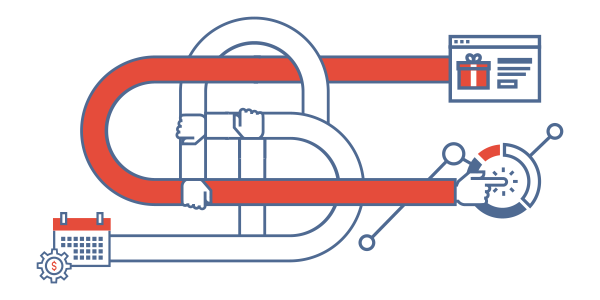
18 May 16:23

How Stitch Fix is Decreasing Their Churn Rate With Two Clever Apps

by Nicole Blanckenberg

According to Forbes, eCommerce subscription market segments have been growing more than 100% yearly over the last five years and now account for a quarter of the online shopping market, generating billions of dollars’ worth of sales.

One of the biggest and most successful names in subscription services is Stitch Fix, who is said to be growing at a rate of over 20% year on year, reported $296 million in earnings last year. This is before the recent launch of two key apps; but we will get to that.

stitch fix fashion fix

In case you didn’t know, Stitch Fix is a subscription service that brings personal shoppers to the mass market. Founded by Katrina Lake in 2011, it is a blend of the top styling experts and clever algorithms, bringing high-quality apparel, styling advice and suggestions to people who don’t know what to wear – right to their front doors.

Stitch Fix’s users grew by 31% from March 2017 to March 2018 and it currently has 2.5 million clients signed up for their service. However, as any online subscription seller will tell you, keeping subscribed users engaged and involved in your brand is vital to keeping your churn rate down and holding on to your users. Profits and sales are important, but hanging on to your customers and keeping them engaging (buying) long-term is the ultimate goal.

So how did Stitch Fix tackle user retention? They recently developed and released two initiatives with the aim of decreasing their churn rate and keeping their customers actively shopping well after the first year of subscription.

Stitch Fix Extras

In February, Stitch Fix launched its new service, Extras. Extras allows shoppers to add extra products to their Fix cart that will be sent over and above the five-item style fix the site and stylists have picked out for users. These include intimate ‘necessary’ products such as underwear, bras, tights, and socks that range between $10-$60. Not only is this an awesome way of up-selling must-have products, but it provides an extra service to meet their users’ shopping needs by providing them with a chance to upgrade this part of their wardrobe as well. All in turn increasing activity and brand loyalty, and decreasing churn rate.

stitch fix extras

And the added extra – if you’ll excuse the pun: Extras not only allows shoppers to choose from all those top brands that suit all budget and style types, but also includes Stitch Fix’s own exclusive brand, Everyday. How better to keep your users engaged and shopping year on year than by creating an exclusive product range they can only buy on your site?

Stitch Fix Style Pass

stitch fix style pass

Stitch Fix traditionally costs users $20 per styling fix, i.e., it’s the cost of curating the shopper’s box and sending their personalized selection to them to try on and choose from. Style Pass, however, gives them the same access for a full year of unlimited fixes, for the one-off rate of $49. Why is this so clever? Up to this point, signed-up users would only pay per fix, which was resulting in inactivity. Now, with Style Pass, users can enjoy as many as they like in a year for one set price – which means more value for the shoppers and far more user activity.

Yes, they are getting the service for cheaper but as it’s one set price, they are far more likely to use their Fixes and be dependant on the site. Users feel like they getting a bargain, and Stitch Fix not only generates more likelihood of fashion sales from more fixes, but keeps their users more active and involved, thus decreasing their churn rate. Win-win!

In a nutshell, Stitch Fix knows their users, knows their goals and knows what it takes to keep shoppers loyal and engaged. And they have the business savviness, tech, and in-depth fashion niche market know-how to back it up. But the most important lesson we can learn is that there is a need for constant brand evolution – no matter how successful you already think you are – to ensure you hang onto your shoppers, users and segments.

18 May 16:22

When Should Entrepreneurs Write Their Business Plans?

by Francis J. Greene
may18_18_903077134
Audi Santoso / EyeEm/Getty Images

It pays to plan. Entrepreneurs who write business plans are more likely to succeed, according to our research, described in an earlier piece for Harvard Business Review. But while this might tempt some entrepreneurs to make writing a plan their very first task, our subsequent study shows that writing a plan first is a really bad idea. It is much better to wait, not to devote too much time to writing the plan, and, crucially, to synchronize the plan with other key startup activities.

A startup business plan seems a good idea at the very start because it answers basic questions like “Where are we now?”, “Where do we want to get to?”, and “How are we going to get there?”. By detailing out how to orchestrate complex interdependencies such as customers, competitors, operations, logistics, marketing, and sales, writing a plan first appears to schedule out actions and strengthen the link between actions and performance for the new venture. And, as we mentioned, planning does have value. In our previous work, we looked at more than 1,000 start-ups, separated them into planners and non-planners, and found that entrepreneurs who plan are more likely to create a viable new venture.

But the real key to succeeding in business is being flexible and responsive to opportunities. Entrepreneurs often have to pivot their business once it becomes clear that their original customer is not the right customer, or when it turns out that their product or service fits better in an alternate market. Because of these realities, business plans written at the start end up nothing more than a fable. And writing a plan takes time – time that could be spent evaluating opportunities. Another danger lurks. A plan might just lock the entrepreneur into a false sense of security that prevents them from seeing the actual opportunity — rather than an imagined one.

To provide startups with concrete and practical help, we went back to the Panel Study of Entrepreneurial Dynamics II’s data on 1,000 would-be U.S. entrepreneurs. Using these representative data, we then charted the entrepreneurs’ attempt to create a viable new venture over a six-year period (2005-2011). In tracking these entrepreneurs over time, we were careful in our analysis to control for an entrepreneur’s background and for startup conditions like a founder’s education and previous experience, which we knew from our earlier research affect the chances of success.

To control for these influences, we used a well-known statistical technique to separate out the would-be entrepreneurs into two groups: planners and non-planners. This allowed us to create “statistical twins” – pairs of startups similar along a number of dimensions, except that one is a planner and the other is not. As a result, we were able to robustly identify what impact business plan timing has on achieving venture viability.

We found that on average, the most successful entrepreneurs were those that wrote their business plan between six and 12 months after deciding to start a business. Writing a plan in this timeframe increased the probability of venture viability success by 8%. But writing one earlier or later proved to have no distinguishable impact on future success.

Next, we examined how long founders should devote to writing a plan. We found that the optimal time to spend on the plan was three months. This increased the chances of creating a viable venture by 12%. Spending any longer than this was futile, mostly because the information used to inform the plan loses its currency. Spending just a month or two on the plan was just as bad. If the choice was between quickly writing a plan or not writing a plan, the entrepreneur was better off not writing a plan at all.

Further Reading

These findings need to be understood in the context of what else the entrepreneur needs to do to make their start-up happen. The reality is that founders are juggling multiple activities and writing a plan is just one of these.

We found that when the plan is sequenced really does matter. Writing a plan alongside early activities like defining the market or collecting information on competitors added nothing to the chances of creating a viable new venture. Equally pointless was writing a plan when the entrepreneur had already hired workers or gotten external funding. In fact, if a plan is written while doing these activities, entrepreneurs have less chance of reaching venture viability than those that did not write a plan.

We found that the sweet spot for writing a plan was around the time when the entrepreneur was actually talking to customers, getting their product ready for market, and thinking through their promotional and marketing activities. Committing a plan to paper alongside these activities increases a start-up’s chance of venture viability by 27%.

But this should detract from the vital importance of spending time writing a good plan. For a plan to be effective, it needs to detail out what the opportunity is, who the customers are, why competitors should be fearful, and how the company operates and makes money.

What is novel about our research, though, is we show that timing really does matter. Our advice to entrepreneurs is not to write a plan too early, don’t spend too long on it, and make sure it is done alongside other activities that actually propel the venture forward.

Good advice not only for entrepreneurs, but also for managers in larger growing organizations who need to plan in contexts – like start-ups – where information is missing or the environment is highly uncertain.

18 May 16:22

5 Behaviors of Leaders Who Embrace Change

by Edith Onderick-Harvey
may18_18_134445282
Patrizia Savarese/Getty Images

At best, mergers and acquisitions (M&A’s) have a 50/50 chance of reaching their intended results. Study after study puts the failure rate closer to 70-90%. Why is the failure rate so high? Repeatedly, research cites the human factor as the leading reason why mergers and acquisitions fail.

Part of the issue is how organizations view the human aspect of the closing date, which is usually treated as the end of the transaction, when it’s really just the start of change. Organizations, processes, and cultures will be integrated for weeks and months after the organizations come together, causing disruption and uncertainty. Leaders in the M&A environment are managing an organization that hasn’t existed before. Their people are no longer part of the organization they joined. Their sense of normal is disrupted. In response, they may choose to hold on to the past and what’s comfortable or feel a bit disoriented as they search for their place in the new company. In the midst of the disruption, new challenges and opportunities will arise not just in the integration of the new organization, but in its marketplace and among its customers. And, the merger or acquisition won’t be the last change they are facing. CEB reports that the average organization has undergone five enterprise-wide changes in the past three years and 73% expect change to accelerate (URL: https://www.cebglobal.com/insights/change-management.html). In this environment, change agility needs to be part of the new organization’s and leaders’ DNA. It can’t just exist in a few people in the organization; it needs to be the way business gets done.

Successful change-agile leaders at all levels in the organization respond to changes in the business environment by seizing opportunities, including throwing out old models and developing new ways of doing business. They try to make change thinking contagious, embedding it into everything they do from the most fundamental daily interactions to the most complex strategy.

Change-agile leaders demonstrate five integrated behaviors that, together, create a competitive advantage for the organization. They:

Share a compelling, clear purpose: Purpose is the guardrail for actions. Change agility requires an answer to the question “Why?”, so that people can fight the natural instinct to resist change. The answer needs to tap into what’s meaningful and important, providing an irresistible invitation to come along. As CEO Shoei Yamana of Konica Minolta has said, “My belief is that people don’t work for numbers…they need to share the same belief that they are creating value in some way.” If you can’t articulate a clear purpose behind the changes being made, it’s unlikely that your employees will be able to implement them.

Insight Center

Look ahead and see opportunity: Most leaders view this as the role of senior executives. To infuse change agility into your culture, mid- and front-line leaders — who are closest to the markets, customers, and daily operations — need to be encouraged and incented to see opportunities in what they do every day. They need to look beyond this month or this year to identify trends and take action. History is littered with market leaders who didn’t see the opportunities ahead or take action on them. Kodak, Sears, and Motorola are just a few.  To build this behavior into the organization, leaders should:

  • Make opportunity-seeking part of the regular conversation. Simply asking questions like “What are our customers talking about? What do you think they will want a year or two from now? What new trends do you think will impact us?” sends the message that looking ahead is important.
  • Provide space to experiment. When a potential opportunity is identified, allow individuals or groups to experiment with ways to take advantage of it. Minimize the need for multiple layers of sign-off.  It makes the culture too risk averse and squelches momentum.
  • Advertise successes. Nothing breeds success like success. Tell the stories at company events and recognize middle and front-line leaders who are looking ahead and identifying opportunities. Show that the status quo is not enough anymore.

Seek out what’s not working: The old adage says that bad news doesn’t travel up. During the integration of an acquisition or even in the internal merger of business units, there will be bad news that the organization needs to learn from. But for real learning to occur, people need to feel psychologically safe to share the good, the bad, and the ugly.

Consider this example: Derek was leading the integration of several internal units into a merged organization. This integration created a new team of direct reports for him. Over the course of the integration, he worked on creating the psychological safety for his team to discuss the challenges of working together and of the integration overall. They used a trust framework to openly talk about what they were doing to build and breakdown trust with each other. Individuals discussed what they brought to the team and what they needed from their fellow team members.  They did pulse checks to assess their alignment and where there was work to do. They had difficult conversations. This type of open conversation and psychological safety cascaded through the new 250-person organization. It culminated in a two-day meeting for the entire organization that included open conversations about what was working well and what opportunities and challenges this new organization needed to address for its clients. The meeting also included a read-out of the employee engagement survey scores that, in the midst of the turbulence of an integration, were among the highest in the company’s history.

Promote calculated risk-taking and experimentation: Robert Kennedy, paraphrasing George Bernard Shaw, said, “There are those who look at things the way they are, and ask why. I dream of things that never were, and ask why not?” Too often, our traditional organizations’ first response to a risk is to ask, “Why?”  Change agility requires leaders to ask “why not?” and to establish opportunities for pilots, prototypes, and experimentation. Experimentation is an integral part of R&D. While an overall strategy informs the researchers’ focus, any R&D scientist will tell you that there are sometimes dozens of experiments that don’t get results and that, without the failures, they couldn’t find the successes.

Look for boundary-spanning partnerships: As work becomes more complex, it takes teams and cross-boundary collaborations to build products, attract customers, and achieve results.  Change-agile leaders and organizations are replacing functional silos with formal and informal organizations that allow for the rapid flow of information and decision-making around a product, customer, or region. For example, Maureen is a mid-level learning and development leader at a global tech company that’s growing rapidly through acquisition. Having growth and development opportunities for key talent has been critical for retention, and enhancing the employee experience is a strategic focus. Learning and development teams are dispersed across the organization, working independently to address business unit needs. Looking ahead, Maureen sensed that the company was also going to be focusing on efficiency in response to market changes and the continued integration of the acquired companies. Seeing the opportunity to improve the employee experience and create cost efficiencies across the learning organizations, she brought together her fellow learning leaders. They designed and implemented a new shared services organization that centralizes training development and vendor management. It will create standardized branding and processes, leverage tools, and create cost savings from consistently negotiated contracts. This creates a more consistent employee experience across learning functions and more efficiently addresses learning needs across the company.

These five behaviors, when used in concert with each other, create culture shifts that increase change agility. They are shifts that need to be made at all levels of leadership. They can mean the difference between M&A success and being an also-ran.

17 May 16:19

Amazon is teaming up with Coinstar to expand Amazon Cash (AMZN)

by Jaime Toplin

This story was delivered to Business Insider Intelligence "Payments Briefing" subscribers hours before appearing on Business Insider. To be the first to know, please click here.

Amazon is partnering with self-service coin counting firm Coinstar to expand its cash top-up offering, Amazon Cash. Since its launch, Amazon Cash has allowed customers to visit select retailers and load their accounts at the register by showing a specialized barcode. But the new partnership, which allows customers to use just a phone number to load between $5 and $500 into their Amazon accounts, will extend the offering to 5,000 Coinstar kiosks — roughly a quarter of the firm’s total — by the end of this year.

Share of US Amazon Customers Who Would Use Banking Services from the E-Tailer

The move could make it easier for a wider swath of customers to pay on Amazon. A large group of US consumers are all but excluded from digital commerce. About 27% of the US population is un- or underbanked, a group made up of roughly 30 million consumers. Much of this population lacks access to credit or debit cards, which makes online shopping complicated. As e-commerce becomes a more important part of day-to-day life in the US, that’s becoming increasingly problematic for these customers. And it’s also a segment that e-tailers can’t access, which is limiting business.

Amazon’s offering could be an appealing solution. These customers may often turn to prepaid cards if they want to begin shopping online, but Amazon’s solution could be a popular alternative since nearly three quarters of US adults shop on the site. And Amazon Cash is fee-free, making it cheaper than many prepaid alternatives, which could make it an easy gateway to e-commerce for users who were looped out before. Coinstar’s large reach extends that opportunity to more customers than ever before.

Expanding Amazon Cash could be a big win for Amazon’s payment efforts. Beyond allowing customers to shop on its own site, Amazon offers merchants a branded buy button called Amazon Pay, which allows buyers to check out and pay using the information preloaded into their Amazon accounts. If Cash users can pay with their pre-loaded balance anywhere that accepts Amazon Pay, Amazon might be more effective at attracting merchants to the button, since it exposes them to a pool of customers who might not otherwise be able to shop online.

But more interestingly, expanding Amazon Cash and extending its reach into the un- and underbanked population could be a smart tool for Amazon as it looks to pursue banking more aggressively. The retail giant is reportedly looking to partner with an issuer and launch its own checking account-type product, which might appeal to younger users and un- and underbanked customers. This target base mirrors those that Amazon Cash caters to, so pursuing this population aggressively could help Amazon build up a target audience for such a product if it launches in the future.  

Subscribe to an All-Access pass to Business Insider Intelligence and gain immediate access to:

Content like this delivered straight to your inbox daily
Access to 250+ expertly researched reports plus all future reports
Forecasts of new and emerging technologies in your industry
And more!
Learn More

Join the conversation about this story »

17 May 16:10

The 3 Levers that Create Value Immediately

by Anthony Erickson
Is cost reduction your company’s approach to value creation? If yes, this article does not address your strategy.   This article is not about cost takeout, cutting your way to growth, or headcount reductions. If you have worked with a company seeking
17 May 16:07

10 Software Experts Weigh in on Managing Through Change

by Devon McDonald

If you tuned into the first season of OpenView’s BUILD podcast (hosted by yours truly), you know we focused on what happens in the first 100 days after implementing or undergoing a huge change. From starting as a brand new CEO to changing up product pricing to introducing a new product, we’ve heard stories this season from some of the leading operators in SaaS. (If you haven’t been following along, you can catch up here. Once you’re all caught up, make sure to ).

So, whether you’re brand new to BUILD or just want a refresher on all the great lessons we learned in season 1, look no further – a recap of the best pieces of advice here:

Building a New Team

“Nothing else matters if you haven’t hired the right people. It’s one of the biggest challenges that we all face.”

Liz Cain, Partner, OpenView

When Liz Cain, Partner at OpenView, was tasked with building out the NetSuite BDR team, she looked to hire dozens of sales reps that could sell SaaS-based ERP solutions. The fact of the matter was (and still is) there just weren’t a ton of salespeople skilled in this area. So instead of looking for experienced (aka costly) sales reps, Cain targeted recent college grads. In three years, she built the NetSuite BDR team from 0 to 170.

You can learn more from Liz’s whirlwind hiring experience in episode 1 of BUILD here.

Expanding Your Global Footprint

“Be really thoughtful about the location you choose when expanding internationally. And select the right people from your existing major hub and get them to that site for 6 or 12 months or even permanently.”

Jeff Diana, Former Chief People Officer, Atlassian

In other words, get your ‘landing party’ in order.

When Jeff Diana was tasked with expanding Atlassian’s global footprint, he made sure to do the due diligence when choosing a next office location. According to Jeff, it’s not just about finding the right person and building the office around that one person. The location you pick must seamlessly fit into the existing culture of your company.

Looking to expand your footprint? Listen to BUILD episode 2 here.

Narrowing Your Focus

“You have to not just own, but be able to defend your hill. We couldn’t in our position so we made the decision to pivot. In order to do so, we had to be comfortable letting some of our revenue go.”

Omar Hussain, Former President & CEO, Imprivata

But in the end it was worth it. When Omar Hussain, former President and CEO of Imprivata, decided to pivot the company away from their core market to focus on a more lucrative segment – healthcare, there was some trepidation. But in the end, the company found its niche and soared to reach over $100 million in revenue. Learn more in the full episode here.

Winning Hearts & Minds Through Storytelling

“When I first began working in tech, I thought of the product as the main thing you’re building and story as the wrapping paper that you put around it to make it look pretty and help sell it. Now, I’ve come to believe that the story is the main thing you’re building, and the product is prop for making that story come true.”

Andy Raskin, Strategic Messaging & Positioning Expert

For Andy, the story acts as your north star around which to align your entire business, including your product roadmap, features list, sales pitch, and – yes – your marketing. Because story drives all these things, it can’t be developed in a marketing silo. Marketing has a large and important role, but the CEO needs to own the big story decisions.

Story is not just the window dressing on your big idea. It is your big idea. It’s the starting point and the end game all wrapped up in one. Listen to the full episode to learn how to craft your own story here.

Ditching Lead Forms

“Gating content and then using targeting ads – a standard B2B marketing approach – is like ignoring the consumer while he’s in the store and then calling him five times a day and saying, “I saw you in the store today. How did you like that thing?”

Dave Gerhardt, VP Marketing, Drift

By now it’s a well known story – viral marketing powerhouse, Drift, ditched gated content and lead forms on their site to give visitors a better experience. While the team was a bit wary at first, Drift saw its brand and content ‘blow up’ in the words of VP Marketing, Dave Gerhardt.

Learn how the company did away with forms while ramping up its business here.

Iterating on Price to Maximize Value

“We solicited feedback from our peers, our customers, and from all our employees. We even posted the new proposed pricing on our internal wiki where we had a rousing debate leading up to final decisions.”

Brad Coffey, Chief Strategy Officer, Hubspot

For Brad Coffey, CSO at HubSpot, updating core product pricing meant getting feedback from as many avenues as possible. But ultimately, going to the customer was the most important. Figuring out which price accurately reflected the value customers saw in the product determined whether or not new pricing would fly or flop. Luckily, Coffey and team nailed the pricing change.

Thinking about updating your product pricing? Listen to this episode first.

Launching a New Product

“I’ve always believed that if you organize product development based on how customers purchase from you and how they think about solving their problems in their company, everything just becomes easier from there on.”

Astha Malik, VP of Platform and Product Marketing, Zendesk

The customer in this case was Zendesk’s core target – the support buyer. Such buyers were open to the new technology, but weren’t sure how much they’d need or use it. That insight, uncovered in discussions with buyers, prompted Zendesk to go off script and offer a usage-based model for Answer Bot. (Zendesk typically charges on a monthly per-agent basis.)

You can learn more about how Zendesk successfully launched a new product here.

Setting the Tone as a New CEO

“It was important that I not get trapped at headquarters in the first 100 days, but make sure that I had been in customer offices.”

Alex Shootman, CEO, Workfront

When Alex Shootman was hired as an outsider CEO to succeed interim leader Susan Carstensen, he put the customer at the center of everything he did. From changing conference room names to that of customers to ensuring he spent time in his earliest days with the company doing on site visits, Shootman encouraged everyone to focus on the customer first. In doing so he successfully transitioned from an outsider to Workfront’s culture carrier.

Learn more about stepping into the role as a brand new CEO here.

Leading Your Company Through Acquisition (right before an IPO)

“The message we continued to drive internally was that an IPO is an event. We go and ring the bell and the next day, you’re back after it. I would submit that the six months after the IPO is far more important than even the 100 days leading up to it.”

Joe Sexton, Former President WW Field Operations, AppDynamics

However, for Joe Sexton and the AppDynamics team, they never actually got to the IPO. Just as the company was set to go public, Cisco swooped in to buy the business for a record-breaking $3.7 billion. Sexton was then tasked with helping his team pivot from gearing up to be a public company to seamlessly joining the ranks of Cisco. Learn how he did it in the podcast here.

Implementing Account Based Marketing

“To sum up Account Based Marketing in four words: Reach. Scale. Relevance. Engagement.”

Jon Russo, Founder & CMO, B2B Fusion

For Jon Russo, Account Based Marketing expert, the emergence of more than 5,000 mar tech companies over the past 6 or 7 years has led to a resurgence of ABM – a technique first developed and introduced three decades ago. Companies that transition to ABM find themselves growing faster than they ever thought possible with just a few simple changes.

Learn how to implement ABM in your business and listen to the full episode here.

Now that you’re all caught up with season 1, tune into BUILD season 2 here.

The post 10 Software Experts Weigh in on Managing Through Change appeared first on OpenView Labs.

17 May 16:07

The Best Sales Pitch Isn’t a Pitch at All

by mattsunshine@csscenter.com (Matt Sunshine)

The Best Sales Pitch

60% of people find generic sales pitches irritating. Instead of rolling out a traditional seller-centric pitch, tell your prospect a story. First, ask questions about their pain points and needs. Then, tell a story about a customer you've helped through similar challenges. A recent study showed 5% of meeting attendees remember statistics, while a whopping 63% recall stories. The best sales pitch is a story. Find out how to tell a great one in this blog.

Despite its increasing irrelevance, the tired, old sales pitch still enjoys a large following. Unfortunately, that washed-up elevator pitch generally focuses solely on the seller -- the company, its capabilities, and its accomplishments -- and rarely highlights the prospect’s needs.

It’s natural for a sales rep to tout their company and its accolades. From their perspective, what their company sells is everything, and their job revolves around trumpeting its value. Ultimately, however, prospective customers aren’t immediately interested in you, your product, or its features. They want to know how you can help them. That’s why you should pitch your … pitch … and tell a story instead.

Why Stories Make the Best Pitch

The power of storytelling stems from our ability to empathize with characters who face familiar challenges, persevere, and overcome. In a salesperson’s case, you’re trying to sell a product or service through that same medium. Storytelling humanizes your pitch and process, and it creates lasting connections with prospective customers.

And there’s proof storytelling is effective. Recent studies show that after a presentation, a mere 5% of attendees remember statistics, while a whopping 63% recall stories.

Still, salespeople remain more comfortable with boilerplate pitches and bulleted PowerPoint presentations loaded with data -- two tools that only activate two regions of the brain. Storytelling, conversely, activates seven; if you can capitalize on a shared connection, you’re much more likely to create a lasting bond.

You’ve likely seen this many times: A prospect hears success stories (either from us or other clients who’ve found success) and they reach out. One story we rely on highlights success our clients have in building and sustaining healthy staff retention.

Having heard this story, one particular prospect with salespeople operating across 100 different territories reached out to see whether they could find similar retention success. This client ended up implementing a solution we presented in a quarter of its sales regions.

In those territories, the client retained 91% of its first-year hires, while the remaining areas experienced a retention rate of 76%. Now, we share this story with other prospects, and it resonates with them far more than stats alone.

If you’re sold on storytelling, you’re on the right track. It has big advantages over the more overt, in-your-face sales pitches most people naturally tune out. But it’s also an art that takes time to perfect.

How to Become a Fantastic Storyteller

1. Focus on them, not you

In a pitch, it feels right to lead with what salespeople view as their most compelling statistics, but prospects are likely not listening. If your company or service is taking precedence over a lead’s needs, you’re doing it wrong.

In fact, almost 60% of people find generic sales pitches irritating. Instead, talk about the prospect’s pain points, and discern how you can help in a non-promotional way.

2. Cover customer pain points in your story

Instead of touting your capabilities, speak to problems you solve that relate to your prospects' pain points. This tactic helps you discover more about your customers and their needs.

At The Center for Sales Strategy, we’ll tell prospects interested in our services we reduce sales department turnover, drive top-line revenue, and boost lead generation. Then, I’ll ask which scenario resonates most. Once I’ve zeroed in on “the one,” I’m able to apply a story about how we’ve successfully helped other clients in that space.

3. Nurture a substantial (and consistent) story bank

Having shareable stories is great, but having a sales team relay them inconsistently is not. A story bank -- an arsenal loaded with stories of your past success -- is only effective if the content within it is consistent.

If Mary tells a story about successful retention tactics to Prospect A and Tom tells the same to Prospect B, both stories should match. Otherwise, your team becomes known for inconsistency from the get-go.

Lastly, continue dropping stories in your bank as you collect client successes, and be sure to go over any new additions as a team in regular training or sales meetings. This, too, will promote streamlined, consistent pitch stories.

Storytelling isn’t a silver bullet. Telling stories is an ideal way to connect with your prospects, but, like everything else, it takes practice. The best salespeople and marketers don’t tell stories off the cuff.

Sure, it might sound that way, but they’ve practiced, rehearsed, and refined it until it got there. Do the same, and you’ll find that storytelling can affect your bottom line in ways that might make you the hero after all.

HubSpot CRM

17 May 16:07

New Analysis: Sales Navigator Boosts Sales Productivity

by Katherine Wong
Young people working in cafe

As a salesperson you need to be able to connect with your target audience. How else can you expect to sell? The nature of sales is to get closer to customers to understand their business and the challenges they face. But how do you optimize building relationships with the right people?

Using LinkedIn data, we studied activity between Sales Navigator users and nonusers within the same company. We compared how both groups discovered and connected with decision makers and aggregated the results. Sales Navigator users vs nonusers saw the following uplifts:

2.8x lift in Searches

4.6x lift in Decision Maker Profile Views

2.5x lift in Decision Maker Connections

Industry Breakdown

From these stats, it may seem straightforward that we see strong results for Sales Navigator in the tech software space given that the product is an online sales tool. But how does Sales Navigator impact productivity of reps in more traditional industries?

Breaking out results by industry, we can see that all industries exhibit positive uplifts across searches, profile views, and connections. Across searches and profile views, industries such as professional services, media, and telecom perform exceptionally well. Across connections, we surprisingly see many traditional industries such as architecture, finance, and retail leading the way with strongest uplift.

Finance & Insurance Sales Navigator users have the highest lift in both Profile Views (~6x) and Connections (~3x). This makes sense, given that we’ve seen many financial advisors use Sales Navigator to bring in new business. Their livelihood is strongly dependent on growing and maintaining assets under management. Due to the nature of this business, reaching out to people becomes more of a necessity compared to less aggressive industries.

Why do these metrics matter?

Searches and profile views allow you to zero in on the right prospects and prioritize those who share a mutual connection or attended the same school as you. These seemingly simple details are significant because finding common ground is one of the easiest ways to engage with people.

Connecting with customers is also key because it allows sellers to stay informed with their customers’ interests and updates. Especially in this digital era where customers are used to personalized experiences, it’s even more critical that sellers do basic research before reaching out. We’ve seen that connecting with people on LinkedIn also translates into 29% average lift in win-rate (source).

How does this impact you?

Regardless of what industry you are in, Sales Navigator can ultimately help you get closer to your target buyers and maximize your team’s productivity. Reps on Sales Navigator are searching and viewing more Decision Maker profiles while other reps may remain in the weeds, having a harder time evaluating who to reach out to. Not only are Sales Navigator reps discovering more Decision Makers, but they ultimately connecting with more of them.

Together, searches, profile views, and connections optimize your team’s ability to target and engage with the right decision makers. The more your team leverages social selling actions to nurture leads and accounts, the more likely they are to successfully win deals. Find out how your team can see these results today.

Source: LinkedIn Internal Data. Analysis included companies with at least 50 SN users and 50 non-SN users. Timeframe for data is from March 2017-March 2018.

Download How to Maximize LinkedIn’s Value with Sales Navigator and equip your team for social selling mastery.

17 May 16:06

Creating a Viral Referral Program is More Strategic than You Think

by Milveen Eke-Allen

Direct marketing gets a bad rap for being, well, too direct. Whether it’s a billboard on the interstate, a Super Bowl ad, or a company invite to ‘Like’ every single one of their products, an increasing swath of customers distrusts direct marketing. Trust can’t be manufactured, but it can be traced, and that special quality marks the power of referral marketing to swell a brand-new company with a huge new customer base. But what keeps that balloon from bursting?

As desirable as it is to have viral growth, it’s actually rare for true viral growth to be sustainable. PayPal, Airbnb, and Dropbox are years out from their initial referral programs, which drove exponential growth for the early years of each company. The key to maintaining such growth was to perfect the viral loop—the steps a customer takes to refer a product to new users. The most viral programs show just how crucial a role optimization, design, and even pre-launch strategy can go into perfecting these steps.

PayPal: Strengthen Your Foundation

Oh PayPal, the money transfer service that gave away free money. What might put other companies in the red—giving cash to customers—grew PayPal’s $60 million investment to a market capitalization of $46.6 billion.

PayPal’s Landing Page in 2000. Source: Internet Archive

PayPal started off by giving $20 to new users and their referrals. The initial cash grew PayPal’s network quickly—within a month, there were 100,000 new users. This rapid growth led to more and more people making PayPal their money transfer system of choice. The size of the PayPal network became a better incentive than any referral reward.

Here are some lessons to learn from the one that started it all:

  • Invest directly in your initial customer base.
  • Make the incentive extremely relevant to the product. In Paypal’s special case, it was free money.
  • Be prepared to adjust the referral reward throughout the program’s lifetime.

In 1999, Paypal was a brand new way of transferring money. The simple $20 reward kickstarted the company’s growth so quickly that its size could speak for itself to new customers, well into the new millennium.

Dropbox: Gamify Referral

PayPal hit viral growth through referral by basically giving away free money—but it only worked because PayPal’s service was based around sending and receiving money. Dropbox, the cloud-based file-sharing service, took a different tack on this strategy, and instead incentivized referral with free storage on Dropbox. By gamifying the social aspect of referral, Dropbox’s referral program netted the company 2.8 million new users within 30 days of launch.

Source: Dropbox

The referral program was social in design and structure, differentiating Dropbox as a file host with an emphasis on the fun of sharing. You and a friend both get 500MB on both sides of the referral, which Dropbox designs to be gratifying at every stage. Set yourself a goal for 1GB, fulfill it by linking the friends already in your Gmail. If you’re a new user, you’ll be inclined to return the favor by the rule of reciprocity, especially if it’s easy to track your progress via checklist.

To stand out from the crowd:

  • Design a double sided incentive that runs on returning the favor. In Dropbox’s email response to recent referrals, there is a link for them to share themselves.
  • Highlight user’s pre-existing networks as a way to upgrade, such as Gmail contacts.
  • Give users a dashboard to keep track of their referral invites and track progress.

We’re ten years out from Dropbox’s original referral program, and it’s still going strong. With clear visuals and email reminders, it’s more satisfying than ever to refer a newbie to Dropbox.

Uber: A Need for Speed (and Ease)

Uber is available in 65 countries and 400 cities, and where it’s not, the ride-sharing giant is pushing city laws to become a transportation option alongside taxis, subways, and just plain walking. Uber can count on its customers to always be on the go, phones at the ready, so its mobile app design makes riding as straightforward as possible.

User flow through Uber’s mobile interface. Source: Extole

The Uber referral program was successful because it was always easy for mobile users to access free rides. All you had to do was tap on the side menu, and a personal promo code appeared. After each ride, customers are prompted to share a personal invite code, making the referral extra friendly for users unfamiliar with Uber. In just two steps, seasoned riders have access to “free rides” via referral.

To get up to speed:

  • Streamline the viral loop by decreasing the number of steps it takes to refer.
  • Make the referral’s onboarding as frictionless as possible.
  • Design the referral to appear at optimal and unintrusive times. Uber riders are reminded to share their referral code within a receipt of their most recent ride.

People depend on their smartphones to navigate more than ever, so Uber’s referral design hits the mark for mobile users, anywhere, anytime.

Airbnb: Hard Data is Your Friend

Airbnb made staying in a stranger’s home a new standard for hospitality. Naturally, a community ethos was crucial for Airbnb to grow, so the company optimized its referral program for trust and goodwill. To do this, they invested in researching the hard data behind referral interactions.

A/B testing for referral email incentives. Source: Medium

Graph of the number of new Airbnb guests across different social media channels. Source: Medium

Airbnb applied its data-centric culture to drive growth through referral. By doing everything from A/B testing referral emails, to engineering new referral features, to tracking user events, Airbnb optimized its way to a 900% year-on-year growth. To be your own best optimization team:

  • Determine metrics for referral success to identify where the program needs improvement.
  • Make an investment in research and development for the problem spots. Airbnb trained engineers to optimize multiple mobile platforms, where the majority of customers processed referral emails.
  • Compare different incentive structures. A/B email testing showed that the altruistic referral did better than giving only the advocate $25.

Airbnb’s referral program optimization allowed in-house teams of mobile engineers, data analysts and designers to grow into a central role within the company. The endeavor to better understand the Airbnb community in turn strengthened the company’s internal community, providing individuals the opportunity to learn new skills for the optimizations to come.

Tesla: The Customer-As-Salesperson

Where Airbnb works off inclusivity, Tesla has grown its referral program by creating a sense of exclusivity. Zero dollars are spent on marketing. After all, Tesla fans are remarkably dedicated to their brand and its community. It’s the kind of confidence that can drive 115,000 people to put down money for a car they’ve never seen. Tesla received a strong customer base by structuring its referral program to reward its most dedicated, convincing advocates through product exclusivity.

The invitation to a Model 3 unveiling. Source: Teslarati

The line for a Model 3. Source: Consumer Reports

Tesla’s referral program is notably personal in scale and substance. The maximum number of referrals has decreased from over 20 to just 5, and the rewards have gotten more exclusive per referral. To get a Tesla S Model for kids, the three referrals needed in January are now whittled down to one. It’s a structure that communicates confidence in customers to make a referral succeed, because its payoff is greater than ever before. Here’s how they pull off the program:

  • Identify the most desirable aspect of your brand: for Tesla, it’s in the anticipation around its newest models, which elides comparable electric vehicle manufacturers.
  • Give advocates a reward to aspire to, in strategic increments of increasing value.
  • Frame the reward tier transparently and confidently, such that potential customers can see for themselves how the company evaluates its own products.

Tesla depends on superlatives. Their homepage states that they are the quickest, safest, and most innovative, with a matter-of-factness and a confidence that feeds back upon itself. The referral program is the perfect program for Tesla customers to show their confidence in the brand.

Robinhood: An Experiment in Hype

Typically, referral programs are used to drive customer acquisition to an existing product or service through incentives. In 2013, mobile stock-trading app Robinhood used referral to drive growth to a new product that didn’t exist yet. The concept was simple: zero-commission trading, fast and on your phone. Their referral program got the word out quickly by creating a waitlist for all prospective users.

Source: Interviewed

Robinhood made referring a friend the difference between waiting and trading, stat. The more referrals went through, the more an advocate could cut the waitlist, which ended up being a million people long. Two-thirds of those million people were referrals. To cut to the chase:

  • Promote the product to key base customers pre-launch.
  • Identify the trade-off that your customers are willing to make for your product, and incorporate the opposite into the referral priority program. For Robinhood customers, it’s time.
  • Structure the referral to be limitless. In Robinhood’s case, the number of referrals a customer can make is only limited by the customer’s social network.

Robinhood’s referral priority program started the company off strong, relying on exclusivity to increase demand even before the service was available.

The experiment was a strategic one, providing a new model for what a referral program could look like in an increasingly hype-driven world.

Angle Referrals for Long-Term Success

It’s easy to consider the headliners of the referral marketing game outliers, exceptions to the rule of steady growth. But careful research, attention to detail in design, and prioritizing the customer experience all lend a measured hand in the companies’ growth. Virality is newsworthy, but strategy is what grows companies for the headlines to come.

17 May 16:05

How to Master Business Intelligence Reporting in Record Time

by Shree Neve

Master Business Intelligence Reporting in Record Time

When businesses make strategic investments in new technology solutions, there are typically some pretty high expectations that accompany that investment. This is definitely the case when companies decide to invest in a business intelligence (BI) tool. While a BI implementation should be the impetus for greater detail in reporting and the ability to make decisions based on more in-depth data, some companies struggle to achieve the results they desire, and the implementation actually causes a delay in the acquisition of useful information.

Fortunately, difficult implementations can be avoided with careful planning and close collaboration with an experienced BI provider. By understanding common pitfalls in advance, you can avoid delays and get your BI solution up and running in record time.

5 Tips for a Smooth BI Implementation

Start with thorough research. There are seemingly limitless variations, options, limitations and specifications available when it comes to BI solutions. Depending on the size of your business, you may want to start by reviewing analyst data from sources like Forrester or Gartner or refer to sites like GetApp, G2 Crowd or Capterra. Look in forums for online reviews, ask for customer references from the providers, and talk to your peers about their experiences.

Get clear on your goals. It’s important to fully dissect what it is that you are trying to accomplish – be specific. Know exactly what questions you’ll need to answer to provide the necessary information to make strategic decisions that will impact the business. Define KPIs that represent all departments. Set explicit expectations and agree in advance on how you will calculate ROI and demonstrate business value. Gain consensus on what success looks like.

Secure executive buy-in. Involvement of the executive team and other key stakeholders will become a critical component to the project’s success. Gain executive buy-in early and identify internal champions who have a vested interest and will benefit from BI reporting and dashboards. Consider end-user involvement early in the process as well. The sooner you can determine who will be using the tool, the sooner you can rally that group to become supporters.

Cleanse your data before you begin. One of the most important steps will be identifying the necessary systems to integrate and ensuring the data within those systems is clean. In most cases, companies need to initiate a data clean-up project before beginning their BI implementation. Be sure this project includes new data entry processes to be implemented moving forward. If this step isn’t completed with care, the integrity of your resulting BI reports and dashboards will be in question.

Start small. Choose a few reports that are most critical or that are in systems you’re sure are up-to-date. Ideally, you want something that will be easy to work with to show quick wins and gain further adoption and support. Be sure to provide thorough training and documentation for all users to help ensure adoption in the initiation stages.

Start today and build on your success over time. ClicData has more than a decade of experience partnering with companies like yours to implement efficient BI solutions. If you want to avoid common challenges and see real business benefits in a short time, connect with professional ClicData consultants to schedule a consultation session.

17 May 15:59

Can Account-Based Marketing and Content Marketing Get Along?

by Joe Chernov

account-based-marketing-content-marketing-get-alongEditor’s noteThe sales and marketing relationship isn’t always hearts and roses. Account-based marketing can change that, as Joe Chernov recently explained to Chief Content Officer magazine’s Jonathan Crossfield. This article recaps his comments.

Account-based marketing arose to address a massive shortcoming in the classic content-driven demand-gen model: It takes a long time for a company to produce enough content to drive the business.

Each blog post you write, each e-book you create will provide some increment of leads. But what you need is an accumulation of lots and lots of content to be able to drop enough hooks in the water to catch enough fish to feed your town. Companies got frustrated with this. Boards got frustrated with this. Executives got frustrated with this. Marketing leaders got frustrated with everyone being frustrated with them.

Along comes ABM, which is essentially a better way to do outbound marketing.

Account-based marketing 101

If you’ve never encountered it, the term account-based marketing might seem vague and unhelpful. However, the central point of ABM is to create greater clarity and specificity within both marketing and sales departments.

In an ABM strategy, the traditional wide-top-narrow-bottom sales funnel becomes more cylindrical. The goal is to pursue fewer accounts, and convert a whole lot more of them. ABM represents a reversal of the usual demand-gen approach taken by most marketers – particularly content marketers.

In ABM, there is no concept of a lead. Marketers have a casual relationship with the word “lead.” To most, it means somebody who’s not yet bought. But if you’re in operations, lead has a very specific meaning as it relates to the CRM.

Leads are essentially people that are untethered to an account; they’re just floating around. It’s a person. In ABM, you need to have accounts, and all of the people on those accounts – the employees – need to be associated with those accounts.


There’s no such thing as leads. It’s accounts and contacts, says @jchernov. #ABM
Click To Tweet


We have a swear jar internally. If you use the word “lead” you have to put a dollar in it.

Account-based marketing difference

In content marketing, the burden shifts to sales. Marketing’s job is to build as large an audience as possible, shove that audience into a funnel, and then let sales worry about which leads are good and which leads aren’t so good.

But I’m prone to say, “Show me how I’m measured, I’ll show you how I behave.” And if marketing is measured on a raw number of leads coming in, then marketing is going to do what marketing does, which is write content that appeals to the widest audience possible with relevance taking a back seat.


Show me how I’m measured, I’ll show you how I behave, says @JChernov. #ABM
Click To Tweet


Along comes ABM. It reverses the whole thing. Marketing now bears the burden. Sales says, “What specific accounts do I want to sell to next year?” And they come up with a list for marketing to worry about.

In a perfect world, marketing would help them come up with this list, but usually sales comes up with this list and then says, “Hey, marketing. Joke’s on you this time. You’ve got to figure out a way to command the attention and get me in front of these companies.”

It’s really in marketing’s best interest to have some say in the companies that are on the list.

How marketing and sales can work together

Sales and marketing need to start by coming together and developing an ideal customer profile (ICP). Before naming accounts to try to sell to, the head of sales and the head of marketing can look each other in the eye and say, “We’re going to sell to companies with this employee range, in these industries, that have this particular role on the account, that are in these geographies, that have these types of technologies in their technology stack.”


Sales and #marketing need to come together and develop an ideal customer profile, says @JChernov.#ABM
Click To Tweet


Collaboratively, get really specific about the attributes of the companies you’re trying to sell to. Then, and only then, go about figuring out who is going to do what and when to try to get in front of these organizations.

In the content marketing world, a lot is made of sales and marketing alignment, but in ABM, alignment isn’t enough. You almost need the two functions to be integrated because it’s very much a dance. Jon Miller, CEO and co-founder of Engagio and co-founder of Marketo, uses the word “orchestration” a lot. It’s a very good term because each plays a part. Sometimes one part leads or one part is louder. Then there are times when that part recedes, and the other group takes the fore. It tends to go back and forth. Simply being aligned – that is, one side knowing what the other is doing – is not enough. It really needs to be orchestrated.

Ideal customer profile in account-based marketing

Account-based marketing changes the fidelity to (the customer profile), the degree of rigor applied to it. You really cannot get too specific.

I’ve talked about ICP in the singular, but you really have to think about it in the plural because big software is bought by committee.

When you implement these programs, what you also find is there are these sorts of proxy personas. In larger companies there may be a junior person who is dispatched by the head of sales operations or dispatched by the CFO or the COO to do the (product) research. We could see a fairly junior person spending a lot of time on our website and on our pricing page and consuming our content. If we were stubborn, saying, “Well, this person doesn’t match the ICP,” then we could essentially fail to follow up on a good account.

Marketing-qualified accounts

Here’s how we’ve gone about engineering this. There is no way we’re going to be able to know everybody who matters on an account because there are any number of these ghost or proxy personas. (Instead) we have a concept called a marketing-qualified account – a named account that shows a level of engagement with us deep enough that we require sales to follow up.

There are three ways to become a marketing-qualified account. You can request a demo or contact sales. If it’s somebody that’s reasonably close to our ICP, we’ll take a hard look. There can be a single person deeply involved in the account. Or there can be a committee of people, each of whom is involved lightly. We can go about it horizontally or deeply. Either will trigger the MQA to be created.

However, once the MQA is created, the salesperson’s job is to engage the contacts on the account. But if the head of sales operations is not on the account, then the salesperson’s job is to use the engaged people to try to reach the target persona.

They’ve got to “enrich the account,” as we call it, to be able to engage the entire buyer committee and fill in the missing persona from that account.

Wide play or parallel marketing strategies

Look, there’s really no wide play. If you have a specific list of companies that you’re going to try to sell to, then there is no wide play.

My father-in-law sells software to nuclear power plants. If he went with a wide play, he’s going to attract prospects that he will never sell to. So, what is the point of a wide play?


Wide-play #marketing only attracts prospects you’ll never sell to, says @JChernov. #ABM
Click To Tweet


Everything needs to get more targeted. Yes, the funnel still has a top. It’s just a narrower top.

I’ll give you a very specific example. Before we made this shift, we wrote blog posts (with) headlines like, How B2B sales is like the Game of Thrones. They would get predictable day-one traffic. Maybe some of them got shared a bunch of times on social and the blogger felt good because he’s measured on views and he did his job. But I don’t really care if Game of Thrones fans happen to read that blog post unless they meet my ideal customer profile.

Our blog now is really inside baseball; very niche. It’s very specific to the needs of sales operations people. None of these posts will ever go viral. They are just too wonky. But our traffic is up significantly because we have found a home with the right readership.

You still need that top-of-funnel content, but you need to resist the temptation to aspire to a larger audience. What you want is a greater composition of the right audience. What is the ratio of right reader to reader? That’s more important than absolute number of readers.

Impact on data and performance measurement

What’s hard is that you’re working with smaller data sets so your data can be skewed more easily, especially early on.

If you have a bunch of reps, each with 25 accounts, it’s going to take you a while to be confident enough in the data to know that this subject line is performing better than that subject line because you’re not sending it to thousands, you’re sending it to handfuls. When a handful of customer wins can skew your results, you have to apply more judgment than you might in a marketing-automated, classic demand-gen world.

You know this strategy is working when you see that deals are getting bigger, deals are closing faster. Our conversion rates within the funnel are all increasing so that the funnel shape is changing to be more cylindrical. Those in the end are the metrics.

This is a really great opportunity to jerk the wheel on the way marketing has historically been measured: How many leads did we procure? What’s the quality of those leads? What were the sources for those conversions? What’s the cost per lead?

Get away from some of those indicator metrics and look at output. Did the accounts that marketing engaged close at a higher clip? Did they close faster? Did they close larger?

If marketing sourced the deal, if we were the first ones to engage the account, did they engage with sales more frequently? Did they pick up the phone faster when sales called?

Your marketing KPIs can start to sound an awful lot like sales KPIs – and that’s a good thing. If you’re measuring the marketing team in those ways, it’s going to force them to think a lot more like sales.

That’s really what ABM is. It’s the fusion of those two functions.


That’s really what #ABM is. It’s the fusion of sales and #marketing, says @JChernov.
Click To Tweet


See if account-based marketing is for you

If you or your team is considering whether to adopt an ABM strategy, hash out a few points in the boardroom.

  • Are your deals big enough to justify this strategy? If you’re selling a $10 a month product, you can’t spend too much time encouraging a company to buy. Consider whether your deal size supports this high-investment strategy.
  • Is the necessary win rate achievable? If you need 1,000 deals a year to grow the business, and you have 2,000 accounts to try to sell to, is a 50-percent win rate realistic?
  • Can the marketing budget withstand the demands of an ABM strategy? You might decide to host a specialized customer or user conference. You might spend more on licensing middle-of-funnel content from analyst firms. You might send premium direct mail, personalized for each recipient. All these tactics can be very expensive.
  • What about post-sale? Sales may think they know the right kind of company to sell to – one they can win easily or at a high deal size – but retention is just as important. If a profiled customer doesn’t renew, is it really your ideal customer? Not only does marketing have to align with sales, but it also needs to align with customer success.

A version of this article originally appeared in the May issue of  Chief Content OfficerSign up to receive your free subscription to our quarterly, print magazine.

Dig deeper into ABM and its content marketing connection at Content Marketing World Sept. 4-7 in Cleveland, Ohio. Register today for best rates and use code BLOG100 to save $100.

Cover image by Joseph Kalinowski/Content Marketing Institute

The post Can Account-Based Marketing and Content Marketing Get Along? appeared first on Content Marketing Institute.

17 May 15:59

Digital Selling Skills Elite Sales Professionals Use Daily

by Doug Dvorak

Digital Selling Skills For Modern Sales Professionals

The modern business world has modern sellers. For every modern seller is a digitally savvy sales professional. Digital skills are non-negotiable in the modern business environment; digital selling skills are a necessity to maintain a competitive edge in our digitally driven sales environment.

The-Evolution-of-Digital-Selling-1990-2006

Great sales reps are turning to digital media and technology to help them sell their products and services. Investing in digital skills as a sales professional matters more now than ever. They are taking advantage of what is available to them in order to provide a better customer buying experience.

Customers are significantly more informed which has leveled the playing field in terms of how they decide to buy. Luckily, the age of digital technology has allotted the modern sales professional to leverage new tactics and strategies for better negotiations and customer engagement.

It’s not enough to have a friendly disposition and winning smile in sales. If you want to be successful, you need to learn how to sell in a digital world. To sell in an ever-changing, competitive and fast-paced digital world, you need to fully understand some key concepts. How to be a salesperson and how to sell digitally are two of the concepts that must be understood.

Be a Lifetime Student And Strive To Learn New Skills

It’s not enough to learn the basics and never have any other education or formal training. You must evolve and learn as quickly as technology does, which can be tough for some. You must be ambitious and want to learn, but you also have to know how to sell and generate leads. Qualities that successful salespeople have include problem-solving skills, tenacity, technical understanding, and more. Plus, they must be prepared.

Utilize Social Media For Improved Branding and Customer Engagement

Nurture relationships with customers and potential prospects by making use of relevant social media platforms. Social media can be used to promote products or services, remind customers of special events, or provide compelling multimedia content that followers and potential customers can view to stay updated with your organization’s brand.

Social-Selling-Quote

Be, Do, and Have

You’ve heard the age-old saying that some people are natural-born salespeople or can sell water to a drowning person. These jokes have been around for decades because some people just have a knack. While it’s helpful to already have the persuasive skills intact, it’s not enough for digital selling. You have to be a salesperson and do what they do, but you need the skills to do it, as well. The best advice is to know yourself thoroughly to determine if selling is the right career choice for you.

Management-Quote

Discover Valuable Consumer Insights With Data and Analytic Software

Sales professionals keep track of a large amount of data. From organizing leads, making use of notes, phone numbers, and other valuable bits of data, sales professionals must juggle huge quantities of valuable customer insights that could get lost in the clutter of information.

Becoming proficient with Customer Relationship Management (CRM) software is an indispensable digital selling skill that the modern sales professional can utilize to track important customer data such as phone call interaction, organize emails, presentations, and dashboard-based analytics.

17 May 15:59

8 Things You Should Know Before Buying CRM Software

by Jaime Nacach

8 Things You Should Know Before Buying CRM Software

Improving efficiency and minimizing manual tasks to the barest minimum are the pursuit of every business. One of the ways to ensure you’re always on top of your game is by using a Customer Relationship Management (CRM) system. This is where most B2B companies give up. Because they can’t seem to understand why there are so many CRM tools whereas only a handful of them truly works. It turns out the majority of CRM providers are out to make some money, or what do you think? The good news is, having used and tested a couple CRM software systems, here are the 8 important things to know before you complete your order:

1. Determine How a CRM tool Will Improve Efficiency

According to Salesforce, CRM applications can help increase sales by up to 29%, sales productivity by up to 34% and sales forecast accuracy by 42%. Today, there are many popular CRM software like Salesforce, SAP, Microsoft Dynamics CRM, Sugar CRM, Agile CRM, HubSpot, etc. But what problems can these tools solve for your business? The right CRM tool can save you a lot of time. For instance, do you or your sales reps spend so much entering data about your leads manually? According to HubSpot State of Inbound Report, 64% of sales reps spend more than 30 minutes entering data, daily.

What you need to know before buying CRM Software

Did you know that having a CRM software will eliminate this and leave more time for converting leads — Thus, improving efficiency in the end? Sure it can. Did you know that having a CRM software will eliminate this and leave more time for converting leads — Thus, improving efficiency in the end? Sure it can.

Does your marketing team works seamlessly with your sales team? With the right CRM software, the status of a lead and all the information about them is available to all departments which eliminates time wasted while exchanging information.

When McDonald’s wanted to get a CRM for its business, it wanted a software that could provide capacity for data capture from customers and also provide both McDonald’s corporate services and individual franchises with access to real-time customer information.

That’s why it chose Astute Solutions for its CRM services. This has provided McDonald’s with more information to serve nearly 60 million customers daily. If you don’t have the budget, an alternative that will serve your business well is Agile CRM. You should give it a shot!

2. Evaluate The Total Cost of Software

An exclusive study by Nucleus Research found that the average return on investment for CRM is $8.71 for every dollar spent. But despite this, a good business should always try to cut costs while providing better services.

If you’re buying a CRM software, you need to know how much it’s going to cost your business. Of course, this may depend on the package you want for your business.

Do you only need specific parts of the software for your business or an all-in-one solution package?

An all-in-one solution will probably cost your business more but can also lead to more profit if that is what your business needs. However, an all-in-one solution may be a waste of money if your team only uses a few parts of the software and leaves the other parts redundant.

For example, with Salesforce, there are plans that range from $5 per user per month to $300.

CRM Software Plans

For SugarCRM, there are plans that range from $35 per user per month for professional to $150 for Ultimate.

Sugar CRM Costs

3. Examine if it’s Mobile-friendly or Not

Your customers are mobile, so you have to be where they are. According to Software Advice, 48% of CRM users now access their software from a smartphone, while 45% access from a tablet.

CRM software used to be a PC-based software that couldn’t be assessed on a smartphone or tablet. But that has changed as there may be a need for your team members to update your leads’ information while out of the workplace.

Porcentage of CRM software used in different devices.

Research by Innoppl Technologies showed that 65% of sales reps who have adopted mobile CRM have achieved their sales quota, while only 22% of reps using non-mobile CRM have reached the same targets. That’s why you must take into account whether the CRM software you’re buying is mobile-friendly or not. Research by Innoppl Technologies showed that 65% of sales reps who have adopted mobile CRM have achieved their sales quota, while only 22% of reps using non-mobile CRM have reached the same targets. That’s why you must take into account whether the CRM software you’re buying is mobile-friendly or not.

Companies With CRM Vs. Companies Without CRM

Companies that offer mobile CRM are Agile CRM, Salesforce, SAP, Oracle, NetSuite, ServiceNow, among many others.

4. User Adoption

In a survey by Merkle Group Inc., 63% of CRM projects in organizations fail. In another survey conducted by Forrester, ‘people’ issues is the biggest challenge to a successful CRM implementation. And slow user adoption accounts for 49% of this issue.

People Issues CRM Software

The key to making a CRM software useful for your business is having your team members actually use it.

Apart from that, people, including your team members, are always skeptical of change — no matter how much they have complained about their current situation.

Before buying the software, you must be sure that your team members are on the same page about its usage. They must be ready to learn how to use it too.

5. See the Complete Picture Clearly

It is difficult to understand a complex software like a CRM software. And if you don’t understand it, how can you use it? If you don’t use it, what benefits can you gain from it?

If you’re about to buy a CRM software, remember that it’s a tool that will affect most of your marketing and sales processes.

CRM Core Activities

Are you ready to dedicate time to training your team members on how to use the software? You must look at the big picture, given that this is the activity that will lead to the maximum benefits of the software.

When products and services company, Pyrotek, decided to implement a CRM system with ISM, training was part of their major strategies.

Joe Tarulli, Corporate Sales Development Manager of Pyrotek was convinced that “a CRM education along with explaining ISM’s philosophy that CRM success is based on People – 50%, Process – 30%, Technology – 20%” was the way to go.

6. Compatibility of the CRM Software to Your Applications

For you to determine if a particular CRM software is best-suited for your business, you have to take into account how easily it can integrate with your current applications.

Compatibility of CRM Software

Let’s say you already use Google Analytics on your website and also use an email marketing software, these are important parts of customer relationship management.

Will your new CRM software be able to integrate with all these applications? Or is it going to replace them? You don’t want to create new problems while trying to improve your service to customers.

If you need to connect all your systems through APIs, then you have to look for a third-party platform that can integrate your systems to streamline data organization.

When sportswear and athletic equipment retailer, Marathon Sports, decided to use a CRM software, its Chief Content Officer, Jaime Morillo, chose SugarCRM because it was easy to integrate a broad range of their internal systems, in-store kiosks, and external social media sources. Likewise, our marketing agency Bloominari, chose to use Agile CRM, for it’s more than 25 built-in native integrations with popular business apps. In fact, the great number of integrations was one of the main reasons we chose to use it.

7. Ease of Reporting

It’s nice to have a beautiful CRM software with many features, but one of the most important features you must look out for is its reporting capabilities. A CRM software must be able to give adequate reports based on the metrics that are important to you.

Through the data available to the software, it must be able to showcase your wins, losses, and opportunities for improvement.

Centix, a rewards and recognition company, grew its client’s businesses by 30% through adequate reports and business analytics from Zoho.

8. Check Customer Reviews for Insights

Consumer opinions online are the third most trusted medium that influence buyers’ decisions. And 88% of consumers say they trust online reviews as much as personal recommendations. That’s because it’s more trustworthy and usually has few strings attached.

Trust in Online Reviews

If you want to know how good or functional a software is, then you have to listen to those who have used it in the past or are currently using it.

Is their customer service great or will they listen and attend to you if you encounter a problem with the software? Do they offer updates regularly for software glitches?

These are the insights you can get when you check customer reviews of the CRM solution even before purchasing it.

You can check out the review of a particular CRM software you’re trying to buy on popular B2B software review platforms like FinancesOnline or SoftwareAdvice.

Conclusion

If all of these factors don’t work, then try the software first before buying it. If after considering all these factors, you still have problems choosing the right CRM provider, then you can request a product trial before making a decision whether to buy or not.

During the trial period, you can determine if all your objectives for using a CRM software are met. If they’re not met, then you should try another software. If they are, then the decision has been made for you.

Buying a CRM software is a big investment for your business. Not in monetary terms alone, but also in the potential it has to influence how you interact and do business with your customers.

Thus, buying this software should not be done on impulse. But with a solid plan. I’m confident that these eight factors will help you to make an informed decision once you’re ready to buy.

17 May 15:59

Rethinking Lead Gen in a GDPR World

by James Gerber

May 25 is when it all changes. If that date isn’t circled on your calendar a little over two weeks from now, it should be, because that’s when the European Union’s General Data Protection Regulation (GDPR) will kick into effect. As my colleague Alex Jafarzadeh recently wrote, it’s imperative to communicate honestly with stakeholders about the change. But, marketers must also look inwardly to adapt their processes and adjust to their new reality.

Marketers must not only ensure that all of their systems used internally to capture and handle customer and lead data are compliant, they also need to worry about third-party providers. Your website, landing pages, forms, etc. will all potentially need to be updated. However, if, for example, you work with a publisher on a lead gen program, you will now need to ensure that they too are compliant with GDPR, as the rules apply to both owned lead sources and external vendors acting on behalf of your organization.

The costs of non-compliance are crushing for any organization that sells to customers in the European Union, particularly for smaller businesses, with fines up to €20 million or 4 percent of global revenues – whichever is greater.

Is GDPR detrimental to lead gen?

With the potentially disastrous consequences of non-compliance and the extra regulations imposed on the methods used to capture and communicate with leads, does this mean that your lead gen efforts will suffer?

For far too many businesses, the answer to that question may be yes because many organizations have been careless with customer data. However, if your organization already has a thoughtful data management process in place and it has implemented an inbound, audience-centric approach to lead generation and nurturing, GDPR may only result in minor changes for you.

Marketers have been playing fast and loose with leads for too long. As one example, email volume increased by 17 percent last year and that shows no signs of stopping. Just because a lead signed up to download one specific piece of content doesn’t mean that they want to receive daily email updates that may not be relevant to them, or that it’s an open invitation for your sales team to relentlessly hound them. While that should have been obvious all along, GDPR will help further ensure that that customer information isn’t abused.

Rethinking Lead Gen in a GDPR World

How to adapt

First, ensure that you have permission for all marketing activities. You can’t assume that people who request to receive a promotional piece of content, such as a gated lead gen asset, want to be signed up for other communications. You must now have them opt-in (and preferably double opt-in) to every type of communication that they want to receive. Data permission must be made a priority. There’s an upside beyond GDPR compliance, too, as this also enables you to more deeply segment customers or prospects by their interests.

Second, you must ensure that you’re not collecting any more data than is necessary, because GDPR requires a legally justifiable reason to collect personal data. For most B2B brands, this won’t entail any major adjustments, but it’s worth considering whether anything other than a lead’s name and email is necessary in many cases to receive content. A smart demand gen program should be set up to progressively capture more information about a lead as their interest grows, and GDPR will force marketers to innovate on that approach by offering real value in exchange for personal data.

Lastly, as the right to be forgotten has entered the mainstream, it is no longer advisable to keep data in perpetuity. It is our responsibility as marketers to ensure that any time someone asks to access or remove their data from a database, that they can do so promptly. Regular cleansing should take place to eliminate leads that haven’t engaged with a company in a while to focus marketing efforts on leads that have the most potential. By keeping up-to-date lists and allowing leads to cleanse themselves or revise their information, it will not only save marketers time, it will shift the focus toward the best opportunities.

Be the change

GDPR may or may not require a major shift in your organization, but it’s going to force marketing innovation to rapidly accelerate. Creating interest in your company via PR activities and developing creative content to captivate your audience will become even more important. Promoting the fruits of those activities on social and using those channels to engage directly with target audiences will be critical to gain influence. Over time, new tactics will emerge that will rebuild trust between organizations and individuals, revolving around personalization, branding and influencer engagement.

Your audience’s attention is worth its weight in gold and it has been long overdue for the scales to tip in their favor.