×You need to sign in to continue.

Shared posts

23 May 15:58

Bare-Bones Content Marketing: How To Do The Best You Can With What You’ve Got

by Patti Podnar


When bare-bones content marketing is the best you can do

All three of my children were born in under three years (and the last two were less than a year apart). When they were bitty — at one point, I had three in diapers, two on bottles, and one on breathing treatments every four hours — parenting “best practices” like teaching them to sign or creating cute little cartoonish scenes from their lunch ingredients seemed as out of reach as flying to the moon. There was a two- to three-year blur when I considered it a win if everybody was safe and healthy at the end of the day. (Shoes, socks, and crafts were optional.)

content marketing best practices

I think that’s how small businesses must feel when they read content marketing best practices: “I’m struggling just to get through the day, and you want me to teach three diaper-wearing preschoolers how to sign?” That’s why I’ve written so much about how content marketing best practices (intentionally or not) can make small businesses feel as if only losers try to do the best they can with what they have.

What I haven’t done (and should have) is create an action plan for those times when bare-bones content marketing is the best you can do.

So here you go: I’m going to assume that you already have a basic website and that you want to add a blog. With that in mind, here’s a prioritized list of content marketing essentials, curated by yours truly for those times when bare-bones content marketing really is all you’ve got.

Identify your goals

Since this is bare-bones content marketing, I’m not going to tell you to set goals that are specific, measurable, etc.: “I want to increase web traffic by 50% over the next six months.” My question is much simpler:

What pain point do you think will be resolved by starting a blog?

Are you trying to attract new customers?

If so, are who are they, and what are they doing right now?

  • Are they currently doing business with one of your competitors?
  • Are they researching products like yours to see what they have to offer?
  • Or are they simply aware of a need, desire, pain point, etc., but have no idea if/how it can be resolved?

Are you trying to up-sell existing customers?

If so, are you trying to sell them more of what they’re already buying (more options, more data, more styles and colors, etc.) or additional products or services (a special cleanser to take care of those hand-made boots they just bought from you)?

Are you trying to resolve your own pain points?

Don’t laugh! It’s a legitimate question:

  • If you’re getting a lot of returns because your product isn’t what customers expected, your goal is to stop them from buying the wrong thing.
  • If you’re getting a lot of damaged returns because customers are trying to use your product improperly, your goal is to keep them from breaking it.
  • If your help desk is flooded with customers asking the same questions over and over, your goal is reduce payroll by providing an easy resource customers can use to help themselves.
  • If your prices are going up because you’re paying more for source materials or because of expenses related to new regulations, your goal is to keep customers from assuming the higher prices are just another example of greed.

If you only implement one of my tips, let it be this one:

No matter what else you do or don’t do, your blog will be a failure if you don’t know what you want it to accomplish for you.

Write good stuff

You don’t necessarily need to spend money on content that will make customers bask in the glory of your words, but you do need to write well enough that people won’t think you’re unprofessional and/or incompetent. Writing that’s full of grammatical and spelling errors, or that rambles down all sorts of backroads before it gets to the point (if ever), can do serious damage to your credibility.

Structure

You don’t want people to spend the first 90% of your blog post trying to figure out where you’re going with it. So follow the simplest, most time-tested structure there is:

  1. Tell them what you’re going to tell them.
  2. Tell them.
  3. Tell them what you told them.

Or, put a bit differently, each piece of content should have an introduction, your core message, and then a conclusion.

Grammar

content marketing grammarI’m not a huge fan of Grammarly because I think it often misses contextual nuances. But this is bare-bones content marketing, so use Grammarly to catch spelling and basic grammatical errors. You can use either the app or one of the browser extensions.

Meaning

I’ve written for a lot of folks over the past 25 years, and the single most common problem I see is content that doesn’t say what the person who wrote it thinks it says. I’ll read their draft, then ask them to just tell me what they’re trying to get across. More often than you would imagine, the two have nothing in common.

So hand your draft off to someone else to read. Then tell them verbally, and ask if the messages are they same. If not, figure out where you went off track, correct the problem, and try again.

Take care of basic SEO

Content marketing SEO and SERP for beginnersI tend to poke fun at SEO evangelists, but only because most businesses can’t devote hours upon hours to the detailed, nuanced SEO tasks thought leaders recommend. But that doesn’t mean you should ignore SEO altogether. There are some quick, simple things you can do to help search engines (and, therefore, customers) find your content.

Pick a keyword

Yes, you really do need to pick a keyword. No, you don’t need to spend hours researching things like search volume vs. competition, or which keywords people are using when they wind up on a competitor’s site.

But you do need to know, in broad terms, what you’re talking about. When you’re telling a friend about your business and what your products/services are for, what words do you use over and over again?

Ideally, include a couple of adjectives describing the things that differentiate you from your competitors. If your laptop’s value proposition is that it’s lightweight and fast, consider using keywords like “light, fast laptop” instead of just “laptop.”

Write your headline

A lot of experts say they spend more time on the headline than on the blog post itself, but we don’t do that here in the land of bare-bones content marketing. Go to CoSchedule’s free headline analyzer, and try out various combinations of headlines built around your keyword. The tool will give you a score for each one, and the results page will give you helpful information on why you got the score you did and how you can improve it (if you have the time).

A score of 70 or above will get you a thumbs-up. But don’t spend time you don’t have trying to get from a 68 or 69 to 70 — it won’t make that much difference.

Fill in the keyword-shaped blanks

There are certain places within a blog post where Google looks to find out what you’re talking about. Once you’ve chosen your keyword, use it to go back and fill in the most important blanks. Exactly how and where you do that will vary based on your site platform, but here are the ones to watch for:

Title tag

The title tag is the headline that shows up in search results. For example, here’s what I get if I Google “reward freelance writers.”

content marketing tips

I currently have the top spot on the results page (your mileage may vary), which is amazing, because it’s a good example of what not to do. I never changed the title tag from the headline of the article itself. But I should have, because it’s a long headline. I should have used “Rewards and incentives for freelance writers” as the title tag. It’s easy to read, and you wouldn’t see the ellipses Google added when I ran out of characters.

The lesson here is that the title tag can be the same as your headline, and sometimes it should be. But, if your headline is more than 60 characters, consider shortening it so that nothing gets dropped. (Just make sure you keep your keyword in there.)

A couple of other tips:

  • All of your title tags should be unique — no duplicates!
  • If there’s room, add your name or your company’s name at the end of your title tag. But it’s more important for the title tag to give an accurate description of what the post is about.

Meta description

The meta description appears under the title tag in search results. And it’s got a big job: Convincing people to click through to your site rather than one of the others listed on the results page.

Most platforms will automatically generate a meta description from the first paragraph of your blog post. If your first paragraph adequately summarizes what the blog post is about, then you can stick with the auto-generated meta description.

But a lot of blog writers like to start with an anecdote, a quote, etc. In those cases, the auto-generated meta description won’t do a good job of telling searchers what the post is about. I’ll use mine again as an example of what not to do:

content marketing tips

The meta description — what comes after “June 3, 2016” — was pulled from my introduction, and it does nothing whatsoever to tell people what to expect if they click on this result. I should have changed the meta description to something along the lines of “7 rewards and incentives that freelance writers actually care about.”

A good meta description clearly and succinctly summarizes your post. The best meta descriptions answer the question that prompted the search, and they do so in a way that piques the interest of the searcher.

Custom URL

A custom URL is what shows up after www.yourwebsite.com/ when you create a new blog post. Most platforms generate one automatically, but not all do it the same way. And some just add a seemingly random string of letters and/or numbers.

There’s no magic formula to choosing a custom URL. Just make sure it contains your keyword and is different from the URLs of any other blog posts you’ve written.

Not customizing the URL for your blog post is like passing up free wine. Or candy. Just…why?

Alt tag

content marketing altYou know your blog post will perform much better if you include images, right? Well, the alt tag is what shows up when the link to the image is broken. Customizing the alt tag is what we called a “gimme” when I was in high school: It’s too easy to not do it

Just type in a few words or a phrase describing your image, and make sure to include your keyword. Preferably, each alt tag should be unique, although that one can be hard to remember when you’re writing the alt tag for your 50th image about “fishing” (or whatever your topic of choice may be).

That sounds like a lot, but honestly — once you figure out the how for your particular platform, making these tweaks is easy as pie and takes no more than a few minutes.

Internal links

Backlinks carry quite a bit of weight in Google algorithms, but backlink outreach isn’t part of bare-bones content marketing. Internal linking is another matter.

Internal linking is when you link from one of your blog posts to another. Why send readers to a resource on another site if one of your own blog posts will do the job?

Also, internal links help Google crawl your site. They’re like little balloons and fireworks saying, “Yoohoo…great content this way!”

Internal linking is fast and easy, but there’s one thing most people forget. Don’t just link from the blog post you’re writing to older content. Once your new blog post is published, go back and edit your older posts, adding links to the new content. Link love should go both ways!

“Put the hay down where the goats can get at it”

content marketing keep it simpleStealing a quote from a former co-worker, there’s no point in having a blog if you bury it in the footer (like a former retail client who always wondered why they weren’t getting the traffic they expected). If you’re going to have a blog, put it in your main navigation menu so that people can find it.

Write for the right audience

If you did a good job of identifying the purpose of your content, this shouldn’t be a problem. But I’ve seen it too many times to take it for granted.

What’s “it”? Writing for people who do what you do rather than for people who buy what you do. Because everybody says to write about what you’re interested in, right?

Yep. So startups write about being a startup, dog walkers write about their own dogs, etc. But the only people who care about the trials and tribulations of launching a startup are other people launching startups — not the startup’s customers. So make sure you’re writing for the right audience.

Cover your backside

The more the internet becomes enmeshed in our lives, the more governments, regulatory agencies, and other interested parties try to control it. Some of those controls are good and necessary…some not so much. But those controls are very real, and they’re not going away. Even bare-bones content marketers need to take some steps to minimize the risks of their online content:

  • Make sure your site meets the ADA’s accessibility requirements.
  • Make sure you abide by all laws/regulations regarding data privacy and security.
  • Abide by licensing restrictions on any images you use (you can’t just go grab something off of Pinterest). Either choose something with a Creative Commons license or get authorization from the creator.
  • Be aware of the risks of user-generated content.
  • , but have a game plan in place just in case you do.
  • Be a mama bear when it comes to brand trust and credibility. That includes all of the above but also extends to things like using only credible sources and developing a nose for sniffing out the sources that aren’t credible.

Distribute your content

Every “best practices” article talks about content distribution and promotion, and for good reason: There’s just too much content out there to think somebody is going to stumble across yours by accident.

With that said…if you’re starting from ground zero, I’d develop a good foundation of content before I started promoting it. There’s not much point in promoting one lonely blog post. Instead, use that time to build a critical mass of content.

Once you’ve done that, you can move on to the bare-bones approach of content distribution and promotion:

  • Share it on your social media accounts.
  • Include a link to your blog in your email signature.
  • Include links to your best content in your LinkedIn profile.

Moving beyond bare-bones

First, let me emphasize that, depending on you and your business, bare-bones may be all you ever need. If you’ve already got as much business as you can handle, and your focus is on providing better service through customer education, distribution and promotion may never need to be on your radar. The same is true for keyword research: There’s not much point in investing hours of research if your focus is existing customers — presumably, they already know where to find you.

23 May 15:53

What questions should the CEO ask about pricing?

by Steven Forth
CEOquestions_blog.png

On May 17, I went down to Seattle to give a talk to the Executive Peer Group (XPEG) on the Role of the CEO in Pricing. (You can get the slides here.) The focus was on the role the CEO should play in pricing, and how to lead in this area.

There is a growing body of evidence that companies with CEO engagement on pricing leadership outperform the competition. Research from Simon-Kucher Partners has found that a strong involvement by the CEO in pricing is correlated with 35% higher pricing power. At Wiglaf Pricing, Tim Smith has found that CEOs who focus on business and pricing strategy outperform their competition. 

One way to frame this discussion is in terms of Roger Martin's cascading choice framework (sometimes known as Structured Choice Making or Playing to Win choices after the book Roger wrote with Proctor and Gamble CEO A.G. Lafley). 

Cascading Choices and Pricing

Where pricing is concerned, the CEO leads the Winning Aspirations and Where to Play choices and supports the How to Win and Capabilities choices. What do these choices look like and how are they communicated?

Winning aspirations

Pricing goals need to support the organization's overall goals. We have a good example of this with one of our new clients, Technical Safety BC. The aspiration is to improve safety in British Columbia and the question they have is whether prices have been designed to encourage the behaviours that lead to better safety.

More conventionally, pricing goals will be around commercial objectives. The goals we see most often are

  • Revenues (many companies want to use pricing to improve the top line)
  • Gross Margin (pricing is often the best way to address gross profit)
  • Cashflow (pricing models and the transition to Software as a Service (SaaS) can have a big impact on cashflow)
  • Unit Economics (SaaS businesses are often evaluated on the Lifetime Value of a Customer (LTV), Customer Acquisition Costs (CAC) and the ratio LTV/CAC)
  • Market Scale (sometimes the growth of the overall market is the top priority)
  • Market Share (sometimes one's share of the market is more important than the overall size of the market)

Pricing is a critical aspect of overall positioning and positioning requires clarity. Pricing is a powerful lever but if one tries to use it for too many things it can confuse the situation rather than improve it. It is the CEO's job to make sure that there is strategic alignment.

Ibbaka Self Assessment Tool

One way to test alignment is with the Ibbaka Self Assessment tool. Have key people in your organization do the self assessment and then compare the results.

Where to play

Where to play choices need to be based on how and where you can provided differentiated value. This is why Ibbaka frequently begins pricing work with a value-based market segmentation. In a good segment, potential customers get value in the same way and buy in the same way. Conventional segmentations that are based on company size or industry are basically useless for making where to play choices. One has to go deeper and understand the economic and emotional value of your offer relative to the alternatives.

The CEO needs to stay close to this work. It is critical to success. The segmentation framework (the set of value drivers and buying processes that bring an offer's unique differentiation into focus) is a critical strategic tool that will be used in many places: with the board to frame strategic choices in product investment decisions, marketing and sales.

Closely related to the segmentation is the value metric. The value metric is the unit of consumption by which your customer gets value from your offer. Having a precise understanding of the value metric is central to value-based pricing, and the key to value- based pricing is connecting the value metric to the pricing metric.

Who should own pricing

There are two basic answers to the question 'Who should own pricing?'

  1. Whoever is accountable for the goal that pricing is meant to drive.
  2. Whoever is closest to the key inputs into pricing:
  • For value-based pricing - whoever has the best understanding of how the offer creates differentiated value for the customer (this is often product management but it can be sales, especially for mature offers)
  • For cost-plus pricing, whoever has the best insight into costs
  • For market-following pricing, whoever is closest to the market and can predict how it is likely to move

At the end of the day, the CEO is accountable for pricing goals and needs to be engaged in pricing strategy. Depending on the goals, pricing methodology, or offer maturity, pricing could be owned by product management, marketing, sales or even operations (when one prices to manage capacity utilization, as airlines and hotels do).

Key questions to ask

The CEO should ask the following questions about pricing, guide the process by which answers are developed, and make sure that all of the critical people in the organization understand the questions, the answers, and where the answers come from.

  1. Are we in alignment on pricing goals? It is the CEO’s job to set the goals.
  2. What is our pricing strategy?
  3. How are prices set?
  4. What is our value metric? (or value metrics)
  5. How does our price track the value we deliver?
  6. Which customers get the most value from our products and services?
  7. How and when do we provide discounts?
  8. What data are we tracking to improve our pricing?

Ibbaka can help your team learn how to answer these questions.

Subscribe

Sign up with your email address to receive news and updates.

Email Address Sign Up

We respect your privacy.

Thank you!
23 May 15:51

How To Execute a Successful Sales Discovery Call

by Daniel Ross

The point of a sales discovery call is exactly that: to discover. You are attempting to either discover a sales opportunity, or disqualify a prospect so as not to waste further time.

The aim of a sales discovery call should be to gain an understanding of the prospects requirements in order to determine whether you can assist them or not.

If you don’t bother to discover exactly what your prospects need, but continue to impart information on your products and services, you’re likely to be wasting both your time and theirs. All this time adds up, so it’s worth understanding how to execute a perfect sales discovery call.

This way, you maximise your time and free it up for those who are really interested in what you have to offer.

What are the components of a successful discovery call?

The nature of your conversation will be the deciding factor in whether you win or lose deals at the crucial moment. For instance, knowing exactly which questions to ask will lead your prospects to where you need them to be: open to further information, demonstration or purchase. There are other factors, of course, which should all be considered.

Here are the steps necessary to make a success of your discovery calls:

Plan and Practice

sales discovery call

Some planning is necessary before you make your calls. Otherwise you’re going to be winging it, and you won’t be ready for any curveball questions thrown your way.

Your prospect is likely to be aware that you’re going to try to sell them something, so their guard will possibly be up and they may pose challenging questions for you to answer.

Depending on your prospect’s position and potential requirements, think about the kind of questions they may ask you. Decide on the kind of answers you’ll give to these questions. Also, think about the language you’ll use – keep it positive and friendly, and drop any tendency to convince.

When you are ready, practice these with an experienced team member or manager ahead of your calls.

When you get around to calling, first let your prospect know exactly what your intention is: you want to understand their circumstances and potential needs.

Take the pressure off by letting them know that there is no obligation to continue discussion at the end of this initial exploration, but that you’re happy to schedule in another chat or demo if they are interested.

Ask the Right Questions

The kinds of questions you ask will make or break your call. Ultimately, all they’ll be thinking about is whether or not your product or service is worth considering.

Firstly, you’ll need to find out how useful your product or service will even be for them; therefore, finding out what they’re planning in terms of team or business growth for the year ahead makes sense.

Try to discover what issues they are currently facing and what plans they have to resolve them. At this point your product or service might start to seem more appealing. The hardest questions to ask are those that will push the idea that there’s some urgency in buying your product or service.

For instance, let’s imagine your business is selling training programs. You might ask what challenges your prospect is facing when it comes to hiring and training new employees within the business’ time constraints.

sales discovery call

(Source: Gong.io)

You could ask something that highlights the revenue your prospect is missing out on. For example, “How much revenue do you think you could be forsaking by not having a regular training program in place for your employees?”

Questions that highlight the need for your product or service are harder to ask as they’re a little more obvious in nature, but they must be broached in some way. So, it’s a good idea to ask questions that highlight potential increases in revenue if they were to bring on board your idea, product or service.

Tell Stories

Stories are great as they help your prospects to relate to the characters within them. When you can give examples of similar challenges and how you helped to resolve them, your prospects are more likely to listen.

Essentially you’re giving them testimonials, but the way you do it is important. You won’t want to talk too much about benefits and features, as that’s too obvious and matter-of-fact. Talk about the problem your previous client faced and how your product or service was able to resolve it effectively.

Talk about the problem your previous client faced and how your product or service was able to resolve it effectively.

A good way to do this is to bring up a case study; one that is ultimately a success story of how your product or service helped someone through a challenge.

For example:

“When I was working with client A, they were struggling with the fact that their sales representatives were giving inconsistent advice and information to customers, thus losing sales. After our one week training course, 85% of the operatives hit their sales targets for the first time in three months.”

You can follow this up with a leading question like, “How many of your sales representatives could benefit from a knowledge upgrade and what impact do you think that might have on your monthly turnover?”

If you can tell a great story and follow up with a leading question about the prospect’s own experience with this scenario, you can open the conversation to how your product may help with their particular circumstances.

Close the Deal, or Get Your Foot in the Door

In order to close the deal, you are going to have to summarize the value your product or service has for your prospect.

This approach is more direct, and assumes there is interest in your product or service. You can end the call with a kind of conclusion on how your product or service will work best to resolve the challenges you discovered during the call. Confidence is very important here, whereas pushiness is a no go.

Another option is to reaffirm the challenges they mentioned, as a reminder that your product and service could be necessary.

You can highlight your capacity for solving them by simply offering a demonstration of your product or service, or a future presentation on how you dealt with those exact challenges elsewhere. This should open up the diary for a later close.

Record Your Calls

sales discovery call

Recording calls is a smart move. For one thing it helps you to retain information that may be forgotten as the conversation flows. Furthermore, with hindsight you can see what worked and what didn’t; what opened up your prospects and what made them retreat.

The problem with making notes is that a) you may not be able to make sense of them later, and b) while you’re writing, you are probably missing other things your prospect is saying. With recordings, you can pick up nuances and subtleties in the conversation that will be a lot of use to you for future calls.

When you have this kind of data at your fingertips, you can analyse it in various ways to review the success (or otherwise) or your calls. This is bound to improve your communication. There are also various conversational intelligence platforms that help you to do this without having to spend hours combing through conversations.

For example, you could install Oreka TR, which records every call your staff makes or receives and stores it for later replay. This is great for monitoring service, solving disputes, maintaining compliance, verifying orders, and of course analyzing the conversations to make improvements.

If you make call replay and analysis part of your daily agenda, this will help to improve calls ongoing. Hone in the key moments in the calls, involve peers in the analysis, and share the insights with everyone who can benefit. It’s also a good idea to listen to your last call with a prospect before calling them again — you’ll seem much more on the ball that way.

In Short — Plan for Each Sales Discovery Call

To conclude, it takes careful planning and preparation in order to execute a successful sales discovery call. You must consider the possible scenarios thrown at you and have already come up with some sturdy solutions.

It takes careful planning and preparation in order to execute a successful sales discovery call.

Pre-briefing your prospects with an agenda or some objectives for the call will loosen them up, and asking the right questions will pinpoint requirements and lead prospects to a close or future appointment. Don’t forget to tell a few success stories and record your calls for future improvement, and you’ll be a master of sales discovery before long!

23 May 15:51

How to Get Traffic to Your Website: 4 Best Insights for Businesses

by Irina Weber

In 2018, putting up a business website looks like a commitment. Why? Simply because the question «how to increase website traffic?» will be bothering you since day one. The competition can be intense in specific niches, so working out ways to boost website traffic is crucial.

A website can get traffic from different sources. There are several types of traffic a business owner can draw to their website:

  • Direct traffic is about brand awareness. If people type in a website URL into a browser input, congratulations, your business has enough recognition. Keep up the good work!
  • Organic traffic largely relies on the niche specific SEO activities. Getting your business website into Google organic search requires time and money, but pays off in the long run.
  • Paid traffic relies on PPC advertising and advertising campaigns run on platforms like Facebook, Google, etc.
  • Social media traffic comes from social networks like Facebook, Instagram, Twitter, LinkedIn, Pinterest, etc. Businesses can be successful at drawing social traffic using a combination of targeting options.
  • Email marketing traffic is derived from email campaigns and newsletters.
  • Referral traffic is based on the link building strategy used by a business. Choosing to buy backlinks won’t do your online resource any good. According to Google guidelines, you’re risking to get penalized if the backlinks come from bad sources.

Honest growth strategies work for most businesses as long as you’re spending enough time and money. So, take a look at the insights to draw traffic to your business website:

  1. Increase Traffic Quality with Relevant Keywords

Most people think, there’s nothing special about keyword research. Does it take much to pick a bunch of keywords in a Keyword Planner? In reality, selecting random keywords will only bring random traffic (if any at all).

Only carefully chosen relevant keywords will draw the traffic that will convert into sales. In doing so, using keyword suggestion tools and conducting competitor research will help a lot. So, what about the keyword research? Keyword suggestion tools provide a set of metrics to make keyword selection easier. Pay attention to search volume and competition rates (this one is essential for PPC campaigns).

How to Select Keywords the Right Way?

The golden standard is “low difficulty, high volume.” Keyword difficulty is a parameter that shows how hard it is to rank for a specific keyword. It’s better to stick to the score below 60 because these are generally low competition keywords. Selecting low competition search terms for your business niche will allow ranking higher in a shorter timespan.

Keyword search volume indicates the number of search queries for a certain keyword in a specific period of time. From the advertising perspective, high volume keywords with 100K-1M monthly searches are more competitive and expensive. If the niche allows using relevant keywords with up to 10K monthly searches, don’t neglect the opportunity.

Qualified SEO specialists use an arsenal of keyword suggestion tools to discover relevant search terms with sensible competition scores. Business owners should not disregard competitive research. Having a sneak peek at competitors’ semantic core and positions will help you avoid highly competitive keywords used by businesses in your niche. Investing in competitor SEO/PPC research tools will pay off by giving insights on competitors’ traffic sources.

For instance, the business analytics platform Kissmetrics ranks for a selection of keywords. Organic traffic is driven by keywords like “search/engines” or “s.e.o” which are not super convertible or even relevant to their services. Still, they require significant investment if used in advertising.

competitors research

All in all, Kissmetrics rank for over 34,000 of search terms bringing over 236K of organic traffic in. At that, they get only 0,01% of paid traffic. Analyzing the keywords used by competitors in the same business niche provides those that might work for you.

organic keywords

Source: SE Ranking

2. Conduct In-depth Competitor Analysis

Competitor analysis in business is a great thing when done right. Still, people with little experience in SEO might be puzzled with a number of questions. Which tools to use for competitor research? Which metrics to analyze and keywords to target? MOZ competitive research template can help a business understand and compare the strengths and weaknesses of SEO strategies used by competitors.

What Are the Best Tools for Competitor Research?

It’s no secret, there is a number of tools with a competitive research feature. Using these tools to understand your business rivals’ tactics will provide you with a bunch of valuable insights.

  • SimilarWeb is well-suited for exploring the traffic sources and analyzing the acquisition strategy used by your business rivals. This tool can be helpful in understanding how much traffic comes from referrals, search engines, social media, and display.
  • Majestic can be used for raking through the competitor’s backlinks. Using the bulk backlink checker, one can get the maximum information on their competitor’s backlink profile. Creating a database of backlinks to drive traffic to your website. The insights on competitor’s backlink profile can help to work out the link building strategy for a new website.
  • Using SEMrush allows conducting organic and advertising research to learn competitor’s best keywords. If you’re interested in discovering new organic competitors and follow the domain position shift. As for the advertising research, you can get an idea of competitor’s advertising strategy and budget.

3. Long Tail Keywords to Answer the Prospects’ Queries

Long tail keywords make about 40% of a total number of online searches. Long tail key phrases generate organic traffic because they correlate to how people search the web in reality. This perfectly correlates with Google Hummingbird update in 2017. Search algorithms were adjusted to match exact phrasing and deepen the understanding of context.

In the era of voice search and personalized search queries, a business must grasp the opportunity of using long tail SEO to draw local traffic. Businesses can benefit from using long tail keyword targeting. Typically, there are 2 approaches to long tail SEO for business:

  1. Viewing long tail keywords as a group of narrowly targeted and highly specific search phrases presenting a very high value to a business. This approach is productive since these search phrases have low competition scores. No need to optimize a website for a gazillion of keywords. Even a dozen can be enough to convert if they precisely match a user’s search intent.
  1. Viewing long tail search terms as a vast range of keywords covering a variety of targets. This approach requires creating massive amounts of content to match the search intent of your prospects. A business website can be optimized for hundreds of long tail keywords. However, parsing thousands of keywords to get the wording right is cumbersome and counterproductive.

What’s the Perfect Formula of a Long Tail Search Term?

Long tail keywords are niche specific and largely related to searcher’s intent, so there’s no universal blueprint for these search terms. Still, there are certain patterns as to how people formulate long tail search queries. These patterns have become evident due to the rise of seo for voice search. The study of voice search queries reveals they are likely to contain questions words like who, what, why, how, are, where, which, when. The “where” questions demonstrate the highest degree of intent meaning a user is ready to act.

22% of voice searches are related to local businesses. Typically, these are so-called “near me” searches.

google trends

Google Trends reflect the rise of this type of search queries in the US, especially for retail and delivery business niches. To adapt these insights for your business, try including the following into your SEO strategy:

    • Phrases typically used for the neighborhood description
    • Phrase “near me” – into the meta title and description, internal links, and anchor text
    • Names of the landmarks near your business location
    • Names of local institutions relevant to your business

And, most importantly, create content that answers the direct questions posed by users while making a search. If a person is asking: “Where is the Italian restaurant near me?” they’re expecting to get a definite answer with a map location and client reviews. Using schema markup in business SEO to provide client ratings and other relevant information in the search results will increase the probability of a visit.

Using the possibilities of a voice search and long tail keywords, you will get highly relevant traffic and avoid competition within your business niche.

4. Promotion on Social Media

Only the laziest haven’t mentioned the latest Facebook algorithm updates. In 2018, local news from credible sources will get a higher priority in the Facebook news feed. Local businesses are given a chance to benefit from Facebook’s emphasizing meaningful interactions. Obviously, Mark Zuckerberg’s creation is outgrowing social media to become a commercial platform for drawing organic traffic.

Which Social Media are Good for Business Promotion?

Most likely, your business is present on social media. But are you sure you’re doing your SMM right? In case your SMM strategy doesn’t do anything for you in terms of traffic, it’s time for social networks presence revision:

  • If your business is related to design, photography, or DIYs, your best choices are Pinterest, Instagram, and Behance.
  • If your business targets other business professionals, influencers, and niche experts, go for LinkedIn, Facebook, and Twitter.
  • If you’re looking for more audience coverage irrespective of the niche, go for Facebook.

What to Expect Doing Business Promotion on Facebook?

Here’s the thing with Facebook for business promotion – it has countless possibilities for ad targeting. However, depending on the industry or business niche, the advertisement performance may vary. So may the audience coverage and cost per click (CPC), which influences the cost of advertising. In 2017, the average advertising costs of a Facebook ad were as follows:

  • Cost per click (CPC) – $1.72
  • Cost per action (CPA) – $18.68.
  • Cost per thousand impressions (CPM) ~$10.

average cpc

Source: WordStream

Due to flexible targeting and budget settings, it’s quite easy to control the advertising expenses. As a result, the final conversions will turn out up to 20-30% cheaper. Speaking of Facebook targeting options, it’s possible to set the ad targeting by demographics, interests, behavior, etc.

Which Facebook Advertising Options Can a Business Use?

Speaking of multiple advertising options, a business can use desktop and mobile news feed, as well as right column ad formats. Mobile news feed ads get better engagement because of their native advertising features. In 2017, 88% of Facebook’s advertising revenues came from mobile ads.

As for the content types to promote, Facebook favors visual content. In spite of making only 3% of the total social network’s content, videos have the highest engagement scores. The study by Quintly shows that a single video post is capable of generating roughly 2,183 interactions a month. Meanwhile, photos make 54% of the content share on Facebook.

Local ads on Facebook will work for a business having a physical location to drive real foot traffic to. Also, Facebook has boosted posts as media of paid promotion. These are posts that originally show on the page as organic content. Boosted posts are effective for audience engagement and driving traffic to the business webpage directly.

Bottom Line

Getting website traffic is a pressing matter for all kinds of businesses, big or small. The lion’s share of traffic a business can get comes from organic and social media sources.

Don’t buy into things like “fast” traffic, because in the end, it will only undermine your SEO efforts.

Competitive analysis will provide you with valuable insights on where your business rivals’ traffic comes from. Invest in competitor research tools to develop an effective SEO strategy.

While creating content for social media, think quality. Spending an extra dollar and time, in the beginning, will pay off in the long run. Answer the queries of your target audience directly.

Use niche appropriate social platforms to promote your business. In 2018, Facebook provides a variety of possibilities for comprehensive promotion.

Conduct continuous website traffic analysis using special tools, invest in legitimate ways of gaining organic traffic. Sometimes it’s about trial and error, but the result is worth it!

23 May 15:51

You Cannot Run Out of Ideas

by Anthony Iannarino

What follows is a true story. The client said to the salespeople sitting in his office, “Wait here, I have to run and get this project I need help with. Our current partner said they don’t have any ideas.” Their exiting supplier told them that they were at a complete loss for ideas.

This incumbent is in deep trouble. The company—and the people who work there—need help, and their incumbent partner believes that they have no new ideas to share. Because they think they have no new ideas, it’s true for them. Moreover, without ideas, the incumbent partner is ripe for a competitive displacement. They have forced their client to look elsewhere for help by giving up on a problem that is surely not intractable.

One of the things that makes you consultative is your ideas. Ideas aren’t the same as what is now popularly called “insights,” those being mostly about making a compelling case that the client should—or must—change. Ideas are more about “how to change,” and “how to deal with this challenge” or “solve this problem.” The ability to generate new ideas, to think laterally, combining ideas from one domain with another, is an attribute that is necessary for success in sales (there is a full chapter on ideas in The Only Sales Guide You’ll Ever Need titled Resourcefulness).

The other attributes and skills you need to develop to prevent your running out of ideas is business acumen, which is a general understanding of how businesses work.  That understanding can help you understand a problem and challenge and recognize potential ideas that are worth considering. Maybe even more important, however, is situational knowledge, the ability to see the patterns of what works, what doesn’t, and because you can draw from your experiences serving other clients and the people you serve within those companies.

Lately, there have a been a rash of young bucks on LinkedIn suggesting that one derives no value from reading business books. In their myopic view, they believe that anything that is known isn’t going to have value now, mistakenly believing that anything known is not disruptive enough. By eliminating ideas, they remove the ability to think laterally, to mix and match ideas from different domains, and to explore what might be possible. When you don’t read other people’s view and their account of their experiences, you deprive yourself of the ability to connect the dots. If you have to choose between being well and widely read or being poorly read, choose the former.

Fortunately, your brain does a pretty good job of ideation all the time, mostly when the ideas are challenging to capture, like when you are in the shower or driving. Sitting down with a legal pad and writing ideas down will help you come up with all kinds of new things to explore. Even better, putting an ideation task force together and locking yourself in a room with a whiteboard for two hours is likely to generate more ideas than you could execute. You need only one good one to solve your client’s most pressing challenge to go from “at risk of being displaced” to “strategic partner.” At least until your client is once again challenged, which should be shortly after you help solve the one you are working on now.


The post You Cannot Run Out of Ideas appeared first on The Sales Blog.

23 May 15:50

Using Message-Mining to Pinpoint a High-Converting Value Proposition for Your Product

by Momoko Price

There are already a bazillion resources out there that spell out how to “craft the perfect value proposition.” In fact, the whole concept of “unique value propositions” (UVPs) is — at least at first glance — really Marketing 101 material.

So why keep talking about it? For one very good reason:

Most courses & books on value propositions FAIL to show you how to actually create value proposition through empirical, quantified research.

Instead, they give you a pile of pretty worksheets, diagrams, and fill-in-the-blank frameworks that encourage you to do little more than sit around the office, brainstorming overly-complicated, run-on mission statements that never even once get put in front of actual customers.

Even extremely practical value proposition books and courses from seasoned and accomplished business experts usually limit the material to conceptual frameworks. Few of them flesh out the full, end-to-end process of pinpointing your strongest value proposition through actual customer research and analysis. And really, the research (and of course subsequent testing) is the only thing that will indicate whether your new value proposition is actually the right one.

How this article here is different

That’s where this piece fills in the blanks: Once you’ve finished the following exercises, you’ll truly understand how to properly collect and quantify messaging research from your target market and transform it into a powerful unique value proposition — one that’s strong enough to serve as the guiding star for your business for years to come.

At its core, a unique value proposition is an incredibly basic, straightforward concept. Your unique value proposition is simply a clear, logical answer to the question:

“Why should I choose you, instead of someone else?”

This is a question that — as customers — we instinctively, unconsciously ask ourselves every single time we think about buying a new product.

It’s what we look for, but can’t articulate

Whether we’re shopping for a vacation package in Maui or just looking for plain old car insurance, we run that same question through our heads over and over again, relying on it like a dowsing wand to help us home in on the best possible bang for our buck in an increasingly noisy, ad-filled world.

Unfortunately as soon as we switch from the role of Customer to the role of Marketer, 99% of us develop a striking inability to give a clear, b.s.-free answer to this question.

Instead, we resort to absurdly complicated explanations we’d never use in a real, everyday conversation, stuff like:

“We synergize next-generation micro- and macro-technologies, revolutionizing the landscape of business solutions in the cloud.”

… or we take the high-drama/low-substance route, opting for ambiguous, 4-word non-statements like:

“Innovation. Strength. Power. Tomorrow.”

To counter this handicap, many business books offer fill-in-the-blank exercises and worksheets for entrepreneurs to help clarify their thinking.

Rely on your customers to come up with your value proposition

What all of these books fail to recognize is how naturally & easily we come up with great value propositions as customers.

We are in fact incredibly adept at coming up with clear, honest, relevant value propositions … when we’re the ones deciding whether to buy.

So, rather than waste hours trying to come up with another awkwardly verbose value proposition on your own, why not just get your customers & prospects to TELL you what your best value proposition is, straight-up?

You’ll be amazed at how much easier and more effective this is than trying to come up with one yourself.

Getting useful data from your customers

As I mentioned before, a unique value proposition is really just an answer to the question “ Why should I choose you , instead of someone else?” To answer this question effectively, you ultimately need to know:

  1. What your prospect is looking for
  2. What outcome(s) they desire
  3. How you achieve those outcomes BETTER than anyone else

Image source

In the bull’s eye graphic above, you’ll note that a good value proposition is built on a strong foundation of knowing what your customer wants.

Once you have this critical information, picking and choosing which product and brand attributes you should talk about with your customers becomes trivial. (This is where a lot of other value-proposition exercises fail — they don’t force you to actually talk to your customers about their desires and build your value proposition off of this feedback first, which is ultimately a recipe for disaster.)

So to find out, objectively, what our customers want, we turn to an often -used -but -frequently -abused marketing tool: surveys.

A better value proposition with just 2 surveys

Before going further, let’s just make sure you have everything in place to send and collect your surveys. You will need:

A reliable, easy-to-use survey tool

Popular choices with free plans are Hotjar, SurveyGizmo, SurveyMonkey and Typeform. I myself prefer using Hotjar for its simplicity and on-site surveys & polls. (To implement website surveys and polls with Hotjar, you will need to add a code snippet to your website HTML. Installation guides for specific CMSes like WordPress, Drupal, Shopify, etc. and tag managers like Google Tag Manager can be found here.)

A reliable email marketing tool

There are a ton of these tools to choose from. Popular choices include MailChimp, CampaignMonitor, GetResponse, Intercom and InfusionSoft. (I personally use MailChimp.)

A large(ish) list of customer email addresses

You should have at least a few hundred paying customers you can send a survey to. If you haven’t already, export these emails from your payment processing app and import it as a distinct list in your email marketing tool. It’s crucial that this list be made up exclusively of people who have spent money on your product(s) or service(s). The more recent their transactions, the better.

Whom to survey?

To get the data we need, we’re going to send surveys out to two distinct audiences (one survey each):

AUDIENCE #1: Your Customers

(a.k.a people who made the decision to spend money on you)

AUDIENCE #2: Your Website Visitors

(a.k.a. people who are thinking of spending money on you)

Make no mistake: Your previous customers — especially your happy, repeat customers — are the ones who have the clearest sense of what your product’s most desirable attributes are.

However, because they’ve gone and actually bought your product and now know everything about it, they may no longer have accurate recall of what their mindset was like BEFORE they bought your product.

This is why we also survey your website visitors — to get a sense of what’s on their mind in the moment when they’re thinking about buying.

Once we find some overlap between what your website visitors are looking for and what your customers love most about your product , BAM — we’ve officially nailed down the fundamental components of your new value proposition.

Link to Customer Visitor Survey So without further ado, here are the exact survey templates I use to gather this critical data from site visitors and customers (including the invitation copy I add to emails and popups to elicit a high response rate):

(survey created in Hotjar, invite and link to survey deployed to paying customers via email marketing software, e.g. Mailchimp, GetResponse, Campaign Monitor, etc.)

Link to On-Site Visitor Survey

Deployed via Hotjar popup survey. Note that the popup invite copy for this survey includes a headline that says “Calling all {{ product-related identity }}!”

For this you should come up with some kind of inclusive-but-distinctive label that helps call out the exact prospect you want to hear from. Here are some examples:

For Petdoors.com, I used the label “Calling all Pet Lovers!”

For a wiper-blade vendor, I used the label “Calling all Car & Truck Owners!”

(If you can’t come up with a label easily, you can also call out your prospect with a question they’re likely to say yes to. A simple go-to question headline you can use is “Looking for a {{ your product category }}?”)

Once you set up and deploy the two surveys above, it should take just a few days to get most of the responses from your customers, and up to a few weeks to get a sufficient number of responses from your website visitors.

Your visitor survey response rate can vary drastically depending on your website’s volume and quality of traffic, but you should expect a decent number of responses to your customer survey.

I generally see response rates well above 10% for most of my clients. So if you send the survey out to 500 customers, you should get more than 50 responses back.

Once you’ve collected enough responses (more is always better, up to about 200 responses for each), you’re officially ready to start mining your data and discovering your business’s new & improved value proposition.

Mining survey data for killer UVP messages

Now that you’ve collected your survey responses, it’s time to extract the key insights that will define your UVP:

Step 1: Determine what matters most to your visitors

Generally speaking, prospects who are thinking about buying your product have certain requirements already in mind. They might be concerned with price, whether your product has a specific feature, or whether your company adheres to specific ethical standards.

The most effective value proposition for your product is one that clearly meets one or more of your visitors’ key requirements — the more closely matched it is to your visitors’ mindset, the more compelling (and higher-converting) it will be (as an aside, Oli Gardner does a fantastic job of spelling out the importance of message-matching here.)

This is precisely why we included Question #4 in our visitor survey …

What matters MOST to you when choosing a {{product category}} like {{product name}}?

(List 5 or so product attributes and/or features that you suspect matter to your prospects in a single-choice, radio button format, along with an option to choose “Other” and elaborate.)

In all likelihood, one or two of the options you listed will have been chosen far more than the others, thus dictating what the general focus of your value proposition should be.

Again, as an example, here’s the distribution of responses I got for petdoors.com:

What matters MOST to you when choosing a pet door?

More than 50% of respondents are looking for durable or weather-resistant pet doors over any other factors (including price).

Just looking at these preliminary results, our value proposition is already starting to take shape.

Step 2: Flesh out how your product meets customer needs

By now you should have a pretty clear (if somewhat general) understanding of what your customers want, which means you officially have the foundation of your value proposition.

(In the case of the pet-door supplier, we know that what our customer wants are durable, water-resistant pet doors.)

But our understanding is still pretty vague — we need vivid details and descriptions of desirable outcomes to really get our customers to see the value of our product. The more we can describe these outcomes in clear specifics and support them with proof points, the more credible and compelling our offer becomes to our customer.

To get this information, we turn next to Question #2 of our Customer Survey:

What would you say is the #1 problem {{your product}} eliminates or lessens for you?

Now, the way we’ve set up this question — a.k.a. asking an open-ended question and collecting paragraph answers — is both good and bad.

On the one hand, by collecting paragraph text answers, we get the benefit of colorful & candid descriptions straight from our customers’ mouths. These descriptions can be an absolute boon for writing compelling headlines and hooks, as Joanna Wiebe from Copy Hackers explains in great detail here.

On the other hand, open-form answers are hard to analyze at a glance (unless you’re whiz at automated text analysis, but that’s a whole other can of worms). Some tools offer built-in word-cloud visualizers, but they really don’t cut it.

Unfortunately, quantifying the frequency of key messages from open-form survey responses requires a little elbow grease, but categorizing each message with a clear label and then using pivot tables in either Google Sheets or Microsoft Excel to gather and sort the frequency of each message cuts down the tedium of the process by a huge margin.

Going back to my example of the pet-door supplier, the most common problems that customers said were eliminated by Petdoors.com’s products came back to:Once you’ve gone through and labeled the message themes of your survey responses for Question #2 and summarized which themes come up most often, you should have one or two clear contenders for the top pain-points eliminated by your product (and by extension, the outcomes they desire most).

  1. limiting their pet’s freedom/happiness
  2. having to get up all the time to let pets in and out
  3. worrying about pets while being away from home
  4. coming home to messes and accidents

Now we’ve got a much more emotionally-charged, contextual understanding of specific pain points our customers want to eliminate, which really beefs up the foundation of our value proposition.

Step 3: Identifying Uniquely Desirable Attributes

The last step of analyzing our survey data is determining what customers find UNIQUELY desirable about our product. Once we have this final piece of the puzzle, we know everything we need to know to create a killer unique value proposition, namely:

  • What the person is looking for (captured via Question 4 of visitor survey)
  • What outcome(s) they desire (captured via Question 2 of customer survey)
  • How you achieve those outcomes BETTER than anyone else (still need this!)

Question #3 in our customer survey is the one that really draws out your brand’s most uniquely desirable attributes:

Why did you decide to choose us over other options? Can you recall if anything in particular appealed or stood out to you?

By asking this question, we prompt our customers to tell us how we edged out the competition in their eyes. Again, to get clear answers, you’ll need to analyze the open-form answers using pivot tables, but once you’re done you should see some key themes stand out in your final summary table over all the others.

In the case of Petdoors.com, two key reasons came up far more frequently than any other:

  1. product sturdiness
  2. having the widest selection of products and parts

Step 4: Putting It All Together

It’s official, you should now have everything you need to craft a well-researched value proposition. Here’s how it all comes together in the case of Petdoors.com:

  1. What our prospect is looking for:
    • Water-resistant/durable pet doors
  2. What outcome(s) they desire:
    • Pet happiness & freedom
    • Not having to let their pets out all the time
    • Not having to worry while at work
    • Avoiding accidents
  3. How we achieve those outcomes BETTER than anyone else
    • Our pet doors are sturdier and higher-quality than those at retail stores
    • We offer a larger selection than anyone else, so you get exactly what you need

Our final task is to weave these messages together in a clear, compelling way and stick it on our website (ideally as an A/B test, if you have the traffic to support it).

Here’s where it’s handy to have a few of those madlib-like fill-in-the-blank copywriting formulas to fill out. We’ll start an amazingly simple, effective formula for creating a clear, standalone UVP statement:

The [ Exclusive Attribute/Adjective ]

[ Product Type Your Visitors Are Looking For ] that

[ Solves Your Customers’ Most Commonly Cited Problem OR Achieves Your Customers’ Most Commonly Cited Desire ]

“Exclusive Attribute/Adjective” refers to any descriptors you can use that sets your product apart as exceptional. Common terms might be “Only,” “Largest,” “Smallest,” or “Most [insert adjective here].”

The “Product Type Your Visitors Are Looking For ” part of the statement (aka the most common response to Question #4 of your visitor survey is critical, as it’s the one part of the statement that immediately orients your customer and lets them know they’re in the right place. It may seem boring or obvious, but if you leave it out you increase the chances of a viable customer tuning you out because you didn’t let them know explicitly that you offer what they’re actually interested in!

Finally, the last part of the statement, “Solves Your Customers’ Most Commonly Cited Problem OR Achieves Your Customers’ Most Commonly Cited Desire,” is where you stick in those desirable outcomes (or eliminated pain points) you gleaned from responses to Question #2 of your customer survey.

So in the example of Petdoors.com, I might write my base UVP statement as follows:

The Largest Selection of Sturdy, Water-Resistant Pet Doors That Give Your Pets Complete Freedom To Come & Go As They Please

Note that every word of this value proposition (besides ‘the’, ‘of’, and ‘that’) did not come from me … I swiped it all from my customers’ feedback .

Now, if you decide you want to test your new UVP on your website (which I highly recommend), a great way to do so is to re-format your UVP into a strong headline and sub-headline combination, and where possible, sharpen your copy with vivid, punchy words and action verbs.

To illustrate, here’s the final headline & sub headline copy I came up with for Petdoors.com:

Shop the World’s Largest Selection of Built-to-Last, Water-Tight Pet Doors

Give your dog or cat complete freedom to come and go as they please … While keeping your home insulated, secure, and “pet accident”-free.

Just to recap here: Virtually every word of this headline & sub-headline combination comes from customer feedback, not from personal preference or writing style.

And when we tested it, this copy went on to increase the pet door supplier’s e-commerce transactions through the home page by 51% and 92% more revenue per user.

Conclusion

Great value propositions are indeed powerful, revenue-boosting business tools — but only if they’re based on a foundation of strong, specific customer desire. So if you’ve been struggling with your own value proposition and having a hard time thinking of an angle that really works, it’s time to put your pen down, throw out those worksheets and start reaching out to your customers.

Because while you might not be able to see it, they know exactly what your brand’s best value proposition is. All you have to do is ask them!

23 May 15:47

How To Publish a Book That Will Sell

by Penny Sansevieri

 Honestly, I don’t get asked about how to publish a book that will sell nearly often enough. Which might come as a shock considering the industry I’m in.

Too many authors today still assume we’re working in a field of dreams, where if you publish a book, the readers will come. Perhaps that works for some. But I’m going to assume most of my seasoned fellow authors have come to the conclusion that that is not at all how it works.

When to begin the book marketing journey

Taking a cue from the sentence structure, figuring out how to publish a book that will sell starts before the book is published.

Yes, I help a lot of authors with books that are already available for retail purchase because book marketing doesn’t stop when the book is available on Amazon. So, there’s a place for post-publication book promotion (a huge one) but authors need to place more value on what they do before the book is in hands.

A big dose of reality from a literary agent

A recent piece by the fantastic @janefriedman covered an interview she did with a literary agent about the changing landscape of fiction. Yes, the piece focused on the process for authors who want a publisher, but these tips are just as relevant to indie authors as well so pay attention.

Aside from a synopsis, any author looking to publish a book is will have to provide a list of five comparable titles from the past five years. In addition, they’ll have a short marketing plan, a description of the next work in progress, and a list of alternate titles for the work being submitted.

What does this mean for you?

What’s the point of all the homework? No, literary agents aren’t lazy by nature, but with over 4,500 books published every day they want to know an author is serious about becoming a success. And simply writing the book doesn’t cut it anymore. Indie authors need to hold themselves to the same standards.

I ask authors that come to us to provide a synopsis. And honestly, I will tell you that we judge them based on their ability to communicate about their book. From that moment I start assessing whether or not they have what it takes to succeed in this industry. Additionally, whether or not it makes sense for us to encourage them to invest in professional marketing support.

If you can’t convince someone to buy your book, how do you expect to succeed on Amazon when you don’t have a captive audience?


THIS is the biggest misconception about publishing and marketing your book on Amazon. Find out…
Click To Tweet


Understanding your buyers and competition

Next up, if you’re figuring out how to publish a book that will sell, you need to understand your market. You need to understand what your buyers and readers want. And a great way to do this is by tracking what successful authors that have come before you are doing.

When you’re considering comparable titles this isn’t a time to fan girl over your favorite authors. This isn’t a dream board. The point of this exercise is to prove there’s a need and a desire for the type of books you plan to bring to market.

Because while many of us want to be recognized for our creative genius, if it was any other product we wouldn’t get a loan for something that wasn’t a sure thing. When you publish a book to sell, it shouldn’t be any different.

The dreaded book marketing plan

The next step is the marketing plan, which I realize makes most authors cringe. But if you’re looking to publish a book that will actually sell, a plan is kind of necessary.

And while book marketing plans for agents may have specific requirements, if you plan to self publish the structure is less important than the intention.

Basically what you want to do is lay out a map of marketing strategies that you can execute. This includes everything from your website activities to blogging. From social media activities to follower growth efforts, discount price promotions. And everything in between: giveaways, your Amazon and Goodreads presence, your plans for generating reviews, lots and lots of reviews, and the list goes on. I’ve written a number of posts on essential book marketing strategies so make it easy on yourself and start there.

Publish a book with other books in the funnel

Next is the works in progress. If you want to publish a book that sells you should realize this includes the books that come after as well. Nothing sells books better than more books. Period.

Readers see you as an investment of their time and energy, and you’re much more likely to convince them you’re a good bet if you can already speak to the next book that’s coming out.

I hear too many authors say, “I just want to see how this book does before I do another one.” And that’s not the attitude of an author who’s in it for the long haul. An agent will smell that coming from a mile away, and don’t think your readers won’t. This is circles back to your marketing plan. Ensuring you have a plan of action, shows that you’re serious on multiple levels, not just to publish a book. It demonstrates that you have the skills to turn yourself into a brand readers – buyers – can get behind.


Trying to sell a book without a clear idea of what you’re selling next will prohibit your book…
Click To Tweet


Opening doors to more sales

The list of alternate titles is another great activity even if you don’t plan to submit to an agent. What this does is stretch your imagination, and opens doors to alternatives that may fit the market needs better. You probably had a title in mind before you even started writing, but as authors we need to realize how much changes between the start, and when it comes time to publish a book.

I also suggest brainstorming subtitles. I wrote a piece on this because it’s become a really strong strategy for Amazon optimization. A well-designed subtitle is another sales opportunity. It’s another chance to speak to your genre and to work in your keywords.

Why putting in the work matters

It might seem overwhelming, but take this advice to heart when you’re planning out how to publish a book that will sell.

I work with dozens of authors a month who are playing catch up with their book marketing. And while it’s far from impossible, it’s not ideal.

Running out of the gate with an expert understanding of what tools you need to publish a book that sells will propel your career forward. Use language that sells, research your competition, and find out what your readers are looking for. Compiling these pieces will ensure your book is never being ignored and always being marketed. That’s the dream, isn’t it? To let book marketing work for you.

Make it your dream and I promise you’ll be selling more books than the competition.

23 May 15:47

New Study: 1 in 5 Calls from Paid Search Goes to Voicemail

by Andrew Sheridan

Does your paid search ROI ever feel like a bit of a mystery? You are spending a big chunk of your budget on paid search, and doing your best to optimize messaging, manage bids, and develop targeting strategies to drive the most conversions at the lowest costs — yet you aren’t seeing the lift you wanted in customer acquisition and revenue. The problem may not be your AdWords campaigns, but who is — or rather, isn’t — answering the phone when consumers call your locations.

DT University, the educational and research arm of DialogTech, recently set out to uncover how many calls generated from paid search ads are going to voicemail. We examined data captured by the DialogTech voice management platform on nearly 400,000 calls generated by paid search ads from a wide range of industries. We flagged the calls sent to voicemail and used AI algorithms to examine the content of the voicemail messages each caller left and scored them for buying intent. Using our AI solution for scoring calls, we dug deeper to find out which of these calls were sent to voicemail and to identify voicemail messages that contained words and phrases that indicate buying intent.

The Paid Search ROI Problem We Uncovered

What we found has huge implications for any business that invests in paid search to drive inbound calls. In short, we uncovered one in five calls generated from paid search campaigns ends up in voicemail boxes.

DT University- DialogTech Study finds nearly 1 in 5 calls from paid search goes to voicemail

What’s more, our study found 57% of voicemail messages from callers contained words and phrases that signaled buying intent. For example, they contained phrases such as “need to schedule,” “make an appointment,” or “how much does it cost.”

DT University- DialogTech Study finds 57%25 of voicemail messages from callers signaled buying intent

The problem here is two-fold — not only are these calls for which you are paying a pretty penny going to voicemail, but they are also calls with high purchasing intent. If you aren’t able to recapture that customer when (and if) your business calls them back, you are wasting ad spend, decreasing your overall paid search ROI, and losing potentially high-value customers all at the same time.

Your Customers Are Calling from Paid Search

Marketers are spending billions on paid search campaigns to generate quality leads and customers. And often, those conversions occur offline and over the phone. Due to the huge increase in searches made on smartphones, there has also been a 50% increase in calls from US mobile search ads from 2015 to 2017, and this trend shows no sign of slowing down. Think about your own consumer behavior. It is much more efficient to click a phone number and call a business than to fill out a complex web form and wait an unknown period of time for someone to get back to you.

US mobile search ads drive calls

Calls from Paid Search Are Big Revenue Drivers

These calls are not only one of the most popular conversions from paid search, they are also among the most valuable. Studies show that inbound calls convert to revenue 10x–15x more than web leads. Forrester found that consumers who call businesses convert faster, spend more, and churn less frequently than those who don’t. In fact, BIA/Kelsey research found calls will influence $1 trillion in US consumer spending this year. To put it simply: for most industries, calls drive revenue.

Are Your Locations Answering Calls You Deliver from Paid Search?

With one-fifth of inbound calls from paid search going to voicemail, businesses are potentially wasting billions of dollars in the US alone. Digital agency Merkle reported recently that paid search spend increased 21% year-over-year. When consumers see a paid search ad and are ready to call your business, is your business ready to answer the phone?

The DT University study found businesses are missing the most calls on the weekends, but calls are also missed on weekdays. More calls are missed on Fridays than any other day. Businesses answer the most phone calls during the 11 AM hour and, unsurprisingly, voicemail rates immediately begin to increase at 5 PM at the end of the business day.

DT University- DialogTech Study finds percent of calls going to voicemail by day and by hour

It’s not only calls on weekends that are going unanswered, but calls during business hours, too. This points to a much larger issue — many locations aren’t answering calls fast enough, even during normal hours of operations. Are they short-staffed? Are they not prioritizing answering the phone? Uncovering the reason is an important step in improving your paid search ROI.

Calls Go Unanswered Across Industries

Even during business hours, a significant percentage of calls in some industries are going to voicemail. For example, in the childhood education, home services, and automotive industries, nearly 20%–25% of calls are going unanswered during normal business hours, Monday through Friday.

What’s more alarming is that, of the calls going to voicemail in some industries, between 44% and 64% have buying intent. Think of the revenue you could add to the bottom line if all these ready-to-buy callers were answered.

DT University- DialogTech Study finds calls are going to voicemail even during business hours

To help you recover some of the budget that may be wasted on calls going to voicemail, we have compiled top tips based on our findings:

8 Call-Related Strategies to Optimize Paid Search ROI

1. Don’t run call-only ads when you aren’t open or staffed to answer calls.

Call-only ads can be effective at driving phone leads since they enable people ready to call to call your business right from the search ad. But those conversions could be wasted if you are running the ads when business locations aren’t open or staffed to answer them. So pause those ads during those times.

This may also be true for other search ad campaigns where a high percentage of conversions are inbound calls. You may want to pause them during nights or weekends when no one is there to answer.

2. Understand how your paid search campaigns drive qualified callers to each location.

Analyze your call data to further understand which campaigns, ads, and keywords are driving the most calls to each location and when. Analyze call data alongside web data to understand what is and isn’t working.

3. Optimize spend for the ads and keywords driving the most high-quality calls at the lowest costs.

Stop spending your ad budget on pricey keywords that don’t turn into customers and revenue. Optimize bid and targeting strategies to drive more calls to each location.

4. Route each caller to the best agent or location right away to convert them to customers.

Connecting callers in conversation with the best agent or location is an important part of converting leads to customers. Don’t make your callers wait on hold or get bounced around from agent to agent — each delay makes them more likely to hang up. Instead, you can set up rules to route callers down the ideal path based on data specific to each call and caller.

By routing callers based on time of day, the marketing source that drove the calls, if they are a new or repeat caller, or whichever strategy makes the most sense for your business, you can connect your callers with the person or location best suited to their needs. It will help your business convert more callers to customers, and that will help increase your paid search ROI.

5. Analyze conversations for unanswered rates, caller buying intent, agent performance, and call outcome.

With AI-driven conversation analytics, it’s easy to find the calls that convert to revenue and uncover the reasons why. For example, are your best-converting calls coming from a specific channel, ad, or keyword? Are your agents using specific words or phrasing on the calls that convert? Conversely, you can find any calls that didn’t convert or were poor lead quality and isolate the ineffective campaign or locations/agents.

6. Follow up with good callers who leave voicemail messages right away.

Like any inbound lead, the faster you respond the more likely they will convert to revenue. Harnessing the power of AI and conversation analytics, you can analyze voicemail transcriptions and prioritize follow-up for the callers most likely to convert.

7. Retarget good callers who didn’t convert with tailored, relevant digital ad campaigns.

Call analytics allows you to capture a wide range of data around the marketing source of the call, the caller’s phone number, what they’re looking to purchase, their purchasing intent, if they converted, and much more. This rich data can be used to retarget unconverted callers with personalized ads, making it more likely they will convert in the future.

8. Target lookalike audiences resembling callers who converted to customers.

Get your ads in front of new audiences that resemble audiences that converted by calling from specific ad campaigns. Extend your reach and acquire more customers and revenue by targeting these new lookalike audiences with the same ad campaigns that worked initially.

View the complete infographic and learn why you may be missing out on paid call conversions.

23 May 15:46

The Marketing Power of User-Generated Content

by Melanie Rodriguez

Thanks to the professional-grade cameras on even the most basic smartphones, it is estimated that 1.2 trillion photos were taken last year, and much of this content features a product or experience provided by the brands they love. These photos and videos invariably end up posted on social media and saved in users’ camera rolls, which has not only created an incredible opportunity for brands, it has changed the landscape of digital marketing.

User-generated content equips marketing teams with one of their most powerful weapons in the quest for conversions: the voice of their customers. Since customers are already creating this visual content, brands can give them the opportunity to showcase how they use the products and offer powerful social proof to their peers. Brands can and should seize the opportunity to leverage user-generated content to bring in more revenue, cut down their content creation expenses, and form a deeper connection with customers.

Increase Revenue

User-generated Content is especially powerful during the consideration phase of the buyer’s journey because it provides the necessary social proof to legitimize the product or experience, which has the power to turn browsers into buyers. When given the chance to interact with UGC, shoppers convert at a rate of 2x on average. This stems from a change in the culture of commerce – consumers no longer inherently trust brands. What used to be a “nice-to-have” tool in a marketer’s toolbox, word-of-mouth marketing has been infinitely amplified in today’s digital age. Companies can harness the power of the conversations that their fans are already having and share them with potential customers to build legitimacy. If a shopper interacts with customer photos, they spend an average of 120% more time on the site. Shoppers who spend more time on a site tend to discover new products and are more inclined to add those items to the cart.

One of the largest opportunities for user-generated content lies in abandoned cart email campaigns. Companies lost $120 million in potential revenue last year to abandoned shopping carts. Reasons range from simply being unsure to issues with the checkout process and unexpected shipping charges, but brands who add UGC to those abandoned cart campaigns are able to recover 7% of that revenue.

Caption: Photos and videos featuring multiple products can be tagged with each product, which has been shown to increase average order value by 6%.

Decrease Content Cost

Content creation is one of the largest pieces of a brand’s marketing budget, professional photographers charge anywhere from $250 to $1,500 per asset. The goal of these assets is to reach a target audience with the right message at the right time in hopes of inspiring a purchase, but it’s nearly impossible to know if an image will actually resonate with customers before making that investment . Keeping up with the demand for fresh content for each customer touchpoint can be overwhelming and pricy for brands. Instead of relying solely on professional photoshoots, companies can realize significant cost savings by incorporating user-generated content into their marketing campaigns. This UGC is not only a free asset, but brands can be sure that it will resonate with their target audience because it came from that audience. When utilizing a user-generated content marketing platform like Pixlee, brands gain access to an endless supply of effective content that’s easy to find, manage, and distribute across all web properties. This allows for the distribution of high-performing content at an unprecedented scale.

Connect With Customers

Brands are on an ever-evolving quest to better understand and build relationships with their customers. The best way to do this is through authentic 1:1 interactions. With user-generated content, brands have the opportunity to open a direct dialogue with highly engaged customers at multiple touchpoints along the customer journey. By seeking out passionate customers and sharing their content, brands are able to create a community of brand advocates and better understand what resonates with their target audience. If done correctly, this feedback loop can go a long way to improving marketing campaigns, informing product decisions, and driving customer engagement.

When brands are paying attention and leveraging the opportunity to connect with customers, they are able to discover and amplify this customer voice. Companies may find that their customers come up with unexpected use cases for their products or create a surprising viral movement. With a little encouragement, these highly-engaged customers soon become vocal advocates for the brand, happily sharing their experiences with their followers, which increases brand awareness and creates the opportunity to turn their friends and followers into the brand’s newest customers.

Seamless Omni-Channel Experience

The user-generated content opportunity for marketers cannot be overstated. Brands that capitalize on this opportunity continue to see increased revenue, decreased content costs, and are able to connect with customers in an authentic way. The use of UGC throughout the ecosystem of social media, mobile web, email, mobile applications, and in-store displays creates a seamless omni-channel experience for customers and fosters a brand-customer relationship that will encourage loyalty and repeat purchases for years to come.

To learn more about how you can capitalize on the marketing power or user-generated content, contact Pixlee today!

23 May 15:45

How to start a business: A startup playbook for entrepreneurs [template]

by Meg Prater

I was 19, broke, and had no business being in business.

My laptop was secondhand, my savings account had $200, and I was convinced that starting a company required connections I didn‘t have and money I’d never see. The whole thing felt impossible.

Download Now: Free Business Startup Kit

But I learned something important: you don't need a trust fund or an MBA to launch a profitable business. You just need a framework that breaks down the overwhelming process into manageable steps.

This guide covers every step I‘ve discovered you need to start a business, from the paperwork and finances to creating your business plan and growing your business online. I’ll walk you through market validation, legal setup, branding basics, and initial growth strategies that generate paying customers.

At the bottom, you'll find a library of the best free tools and resources to start selling and marketing your products and services.

Table of Contents

What do you need to start a business?

When I started my first business, I assumed the biggest hurdles would be creative ones: writing copy, designing offers, and getting people excited.

But I quickly realized that before I could even think about selling, I needed a strong foundation. It wasn’t glamorous work. It meant paperwork, decisions about structure, and figuring out how to actually be “in business” on paper and in the real world.

Here’s what you need to set up to build and run a successful company:

  • Business Plan: At first, “business plan” sounded intimidating to me — like something only fancy MBA grads or Shark Tank contestants needed. But it’s really just your map that outlines what you’re offering, who it’s for, how you’ll stand out, and how you plan to make money in the short and long term. It’s there to keep you focused when shiny new ideas (or panic) try to derail you.
  • Business Name: Naming your business is a surprisingly big moment. It’s what people will remember, search, and talk about. You want something that feels true to you, is easy to spell, and makes you proud every time you say it out loud or see it on an invoice.
  • Business Structure: This is the legal framework you choose, like sole proprietorship, LLC, or corporation. It shapes how you pay taxes, how you’re personally protected, and how you can grow later on. Picking the right structure early helps avoid painful (and expensive) headaches down the line.
  • Business Registration: Think of this as making your business “real” in the eyes of your state or local government. It’s like giving your business its own official identity. Without it, you can’t open a business bank account, pay yourself properly, or operate legally.
  • Legal Requirements: Beyond registration, different industries and locations have specific licenses or permits you might need. I had to go through city websites, read forums, and call local offices to get this right. It might feel tedious, but it’s crucial. Skipping this step can lead to fines or even being forced to close.
  • Funding: Funding doesn’t have to mean pitching to investors or taking out big loans. In fact, 74% of entrepreneurs today use their personal savings to get started. I personally did side gigs to support my early business expenses. Whether it’s savings, a part-time job, small grants, or community funding, know how much you need.
  • Branding: Branding defines how your business is seen — its visual identity, voice, and the immediate impression it leaves. Strong branding builds trust before a single conversation, clearly communicates what you stand for, and makes you recognizable.

Without these pieces in place, every budding entrepreneur risks their dream business staying stuck in their head or worse, launching it half-baked and struggling to survive.

That’s why I broke down every step in this guide, so you don’t have to piece it together alone. And at the bottom, I’ve rounded up my favorite free tools and templates to help you tackle each part without overspending or getting lost in admin overwhelm.

Having a great business idea is just the start. To turn it into a successful venture, you’ll need to refine it and lay the right foundation. Here are a few steps to help you validate and strengthen your idea before launching.

1. Write a business plan.

business plan maps out what you’re building and how you’ll run it day-to-day. It’s tempting to skip this step, especially since 45% of entrepreneurs start because they want to escape the 9–5 grind, and 26% because they feel passionate about an idea. But I learned (the hard way) that winging it often leads to confusion and wasted money.

Don’t skimp on this. A business plan forces you to think through challenges before you’re in the thick of them.

Here’s what I included while creating a business plan:

  • My business structure (I chose a sole proprietorship at first, then switched to an LLC as I grew).
  • A clear description of my services, including how I package and price different offers.
  • A profile of my ideal audience — for me, that was B2B SaaS content managers who needed product-led content.
  • A plan for how I’d handle sales and operations, from proposal templates to client onboarding.
  • The marketing channels I’d focus on first, in my case, LinkedIn and guest articles.
business model canvas example from canva

Source

If you’re starting from scratch, HubSpot’s business plan templates are a solid place to begin. And if a full plan feels overwhelming, start simpler with a business model canvas (like the one shown above).

Pro tip: A big part of your business plan (especially if you’re seeking grants or outside funding) is outlining exactly what you need money for. Be specific — list each expense, why you need it, and how long you’ll need support to cover those costs.

Recommended Reading:
Featured Resource: Free Business Plan Template

free business plan template here.

Grab your free business plan template here.

2. Choose a business name.

Your business name is a big part of your identity. It’s what you’ll put on legal documents, invoices, and your business plan if you decide to share it with potential investors or partners.

But you don’t have to stress about locking in the “perfect” name right away. For example, I operate under my personal name publicly, but I also have an LLC registered as 13479579 Canada Inc.

Choosing a numbered name gave me flexibility. It means I’m not tied down to a single brand name forever, and I can experiment, pivot, or rebrand later without the headache of legal changes.

Pro tip: I still asked trusted friends and family for feedback when brainstorming public-facing names. Even if your legal name is more generic, your brand name can (and should) resonate with the people you want to reach.

Recommended Reading

3. Choose an ownership structure.

Your business’s legal structure affects everything from how much tax you pay to how much personal risk you carry. The most common options are sole proprietorship, partnership, limited liability company (LLC), and corporation.

When I first started, I operated as a sole proprietor because it was simple and quick. But as my business grew, I switched to an LLC.

Why? An LLC protects my personal assets if something goes wrong, like a lawsuit or unexpected debt, and gives me more credibility when working with larger clients. It also offers more flexibility with taxes compared to a corporation.

Pro tip: Definitely talk to an accountant or lawyer when deciding on your structure. It’s one of those decisions that can save you a ton of stress (and money) down the road if you get it right from the start.

Recommended Reading

  • Sole Proprietorship 101: The Easy Guide to Setting One Up
  • What’s an LLP? Limited Liability Partnerships Explained in Under 5 Minutes

4. Register your business.

Once you’ve decided on your structure, make your business official. Registering your business ensures you’re operating legally and gives you access to things like a business bank account and certain tax benefits.

When I set up my LLC, the process felt intimidating at first, but there are services (like ZenBusiness) that make it easier by walking you through each step, whether you’re forming an LLC, a corporation, or something else.

Don’t let this step scare you. Once it’s done, you’ll feel a huge sense of relief and your business will officially have its own identity.

Pro tip: I’ve noticed that when clients see “LLC” or “Inc.” next to your name, it signals professionalism and legitimacy. It tells them you’re serious and that you’ve taken the right legal steps, which builds instant trust.

Recommended Reading

5. Review and comply with legal requirements.

Beyond choosing a structure and registering your business, you’ll likely need to meet other legal requirements to operate safely and legitimately. This usually means getting any necessary licenses and permits, which can vary a lot depending on what you do.

Since I’m in Canada, I had to make sure I was complying with both provincial (Ontario) and federal laws. For example, certain industries require provincial licenses (like trades or food services), while federal registration might be needed if you operate across multiple provinces or deal with trademarks.

When I started, this step felt overwhelming, but it was worth it to avoid fines or unexpected shutdowns later.

Pro tip: This is a great moment to invest in an hour with a lawyer. Having someone review your business plan and check that you’re set up correctly in your province can save you a ton of headaches and unexpected costs down the line.

Recommended Reading

6. Apply for funding.

When I started, I bootstrapped everything, just like 74% of entrepreneurs today who use personal savings to get off the ground. For some businesses, that might be enough, but if your idea requires bigger investments (like manufacturing, equipment, or a team), you’ll need more substantial funding.

Accessing funding isn’t always easy. In fact, 36% of entrepreneurs in the startup phase say it’s one of their biggest challenges. If you know you’ll need outside capital, it’s important to get your business plan and financial projections ready early. Banks, grant committees, and even family or friends will want to know exactly how you plan to use the money and how you’ll pay it back (or turn it into growth).

One thing that helped me early on was working from home. I set up in a spare room, and I was able to take advantage of tax breaks for my home office — a huge cost saver in that first year. Before you rush into signing a lease for a shiny office space, consider if you can run things from home (even temporarily) and keep your overhead low.

Pro tip: Even if you’re going small, think big when planning your funding needs. Running out of cash too soon is one of the most common reasons businesses close.

Recommended Reading

7. Create a brand identity.

Once you’ve tackled the legal and structural pieces, focus on how your business feels to the world. Your brand identity is the overall vibe and experience people get when they interact with you.

Here are a few key elements I focused on when building my brand identity:

  • Brand strategy (your purpose, mission, values, and target audience)
  • Brand personality and voice (how you sound and come across)
  • Logo (even a simple wordmark can work at first)
  • Color palette (mine: pastel purple, blue, and pink)
  • Typography (I use the Karla family)
  • Graphic elements and style (icons, illustrations, photo style)
  • Brand experience (how people feel at every touchpoint)

When all these pieces work together, they create a consistent and memorable impression, so people recognize you immediately and feel like they already know you.

Pro tip: Before you lock everything in, make sure you’ve positioned your business exactly how you want it to be perceived in the market. You can use this free guide on brand positioning to clarify your direction before finalizing the visuals.

Recommended Reading

As you can probably tell, starting a business involves a lot of moving parts — some way more fun than others.

Brainstorming names? Always exciting.

Sorting out taxes and legal paperwork? Definitely less thrilling.

What helped me was breaking everything down into small, manageable steps, staying organized, and tracking what needed my attention (and when). From registering with the government to building your brand to making smart financial calls, each step plays a role in setting up a business that’s actually profitable.

Now that we’ve covered the big picture, let’s break down each step in detail so you can move forward with clarity (and a little less overwhelm).

Having a solid business plan has saved me more times than I can count especially when unexpected challenges pop up (which they always do). But before we explore how to write one, let’s clarify something important:

What is a business plan, really?

A business plan is a living, working document that maps out all the core details of your business.

It usually covers things like:

  • What your business will sell.
  • How it will be structured.
  • What the market looks like.
  • How you plan to sell your product or service.
  • What funding you’ll need.
  • Your financial projections.
  • Which permits, leases, and other documentation will be required.
business plan example: wooden grain toy company

Source

At its core, a business plan helps you figure out — honestly — whether your idea is really worth pursuing. It forces you to step back, see the big picture, and spot problems years ahead (before you get buried in day-to-day details).

I like to think of it as a safety net and a confidence booster rolled into one.

Below, I’ll walk you through the key elements that make up a strong business plan template. I’ll break down what goes into each section, share some example pieces from my own journey, and give you a few tips to make writing it feel a lot less intimidating.
1. Use a business plan template.

hubspot market analysis template

Get HubSpot’s Free Business Plan Templates

Before you begin writing, grab a business plan template. It provides a clear outline and eliminates a lot of guesswork from the process.

Here’s how I like to break it down:

Step 1: Company Overview

  • Create a simple, clean cover page (even if it’s just for yourself).
  • Write a short description of what your business does and why it exists.
  • Outline your main product or service and how it solves a real problem.
  • Share how your business is organized (team structure, roles, etc.).
  • Create your mission statement — one sentence that captures your “why.”

Step 2: Audience

  • Define your target audience or buyer personas.
  • Do your research (surveys, interviews, online communities) to understand them.
  • Describe who wants your offer, why they care, and what problem you help them solve.

Step 3: Products and Services

  • Go into detail about each product or service.
  • Explain your pricing model clearly.
  • Highlight any advantages you have over competitors — even small ones count.

Step 4: Marketing Plan

  • Write out how you’ll market and sell your product or service.
  • Map out your growth strategy (e.g., partnerships, new channels, organic content).
  • Set realistic targets for your marketing and sales activities so you have something to measure against.

Step 5: Legal Structure

  • Decide on your legal structure (LLC, sole proprietorship, etc.).
  • List any extra legal considerations (permits, licenses, health codes, regional laws).

Step 6: Financial Projections

  • Forecast your expenses and income (even if they’re just rough estimates for now).
  • Set short-term financial goals (e.g., break even in year one).
  • Sketch out longer-term goals so you have a north star.

Pro tip: Keep your early supporters and anyone invested in your business in the loop as you build this plan. Fresh eyes often catch gaps or bring ideas you might miss when you’re too close to it.

2. Narrow down what makes you different.

Before jumping into writing your business plan, get clear on what makes your business unique.

For example, if you’re starting an athletic clothing line, you’d want to figure out how your brand stands apart from the hundreds of others out there. Are you making clothes for a niche sport? Using eco-friendly materials? Donating profits?

When I started offering content strategy services, I had to figure this out too. My differentiator? I specialize in product-led, SEO-informed content for B2B SaaS brands. I also help teams extract insights from their own subject matter experts and turn them into standout thought leadership. This approach means my clients get content that connects directly to their product and drives measurable growth.

A few big questions I asked myself (and you can adapt to your own business):

  • What makes my service or product different from the rest?
  • Who exactly am I creating it for?
  • What specific problems am I solving better than anyone else?
  • Am I adding extra value (e.g., strategy, hands-on guidance, or unique frameworks)?

Knowing where your brand fits in the market makes it easier to reach the right audience and turn awareness into revenue.

Pro tip: Remember, you’re selling the total package: the value, the experience, and the transformation you help deliver. Getting super clear on this upfront will make the rest of your business plan (and your marketing) so much easier.

3. Keep it short.

Business plans used to be long, dense documents that felt more like textbooks than actual plans. These days, they’re much more concise and to the point — and that’s a good thing.

When I wrote mine, I was tempted to include every detail: all my market research data, the full list of content packages I offer, even mockups of future website pages. But I realized that’s not what a business plan is for.

You still need to know all those details for yourself, but keep them in a separate doc or a deeper strategy file. Your business plan should focus on the essentials: the “meat and potatoes” of what you’re building, who it’s for, and how you’ll make it work. It should be easy to skim at a glance.

Pro tip: If someone who doesn’t know anything about your service can pick up your plan and grasp the big picture right away, you’re on the right track.
sample business plan, glazed donut shop

Source

Now that we’ve covered the first foundational steps, it’s time to actually build your business plan. Let’s take a look.

4. Write an executive summary.

Think of your executive summary as your business’s elevator pitch — but on paper. It’s a high-level snapshot that gives people a clear idea of what you’re building before they dig into all the details.

I like to write mine last. Once all the other pieces are fleshed out, it’s easier to pull out the big takeaways and see what matters.

Your executive summary should be about a page long (short and sweet), and cover:

  • Overview. What exactly is your business? Where are you based? What are you selling, and who are you selling it to? For example, mine might say: “I run a B2B content strategy consultancy based in Canada, helping SaaS brands create product-led content that drives growth and builds authority.”
  • Company profile. What’s your business structure? Who owns it? What experience or skills do you (and any future hires) bring to the table? In my case, I talk about my 10+ years of experience working with SaaS brands like Zapier and HubSpot, and the fact that I operate as an LLC for flexibility and legal protection.
  • Products or services. What exactly are you offering? Keep this high-level. I might say: “I offer content strategy audits, SEO-informed editorial planning, and thought leadership content production packages.”
  • The market. What did you learn from researching your target audience? Why is there a need for your product or service? For example: “There’s a growing demand for strategic, product-led content as SaaS companies prioritize organic growth channels and founder-led storytelling.”
  • Financial considerations. How do you plan to fund the business? What are your basic projections? I might mention that I started with personal savings (like 74% of entrepreneurs), kept overhead low by working from home, and focused on retainer-based revenue for predictability.

Pro tip: Aim for clarity, not fluff. If someone who has no context at all can read your executive summary and immediately “get it,” you’re on the right track.
Featured Resource: Executive Summary Template

hubspot executive summary template

Download the Free Executive Summary Template

This section is where you lay out who you are and how your business works day to day.

When I put together mine, I focused on keeping it clear and grounded. Here’s what I included:

  • What my company does. In my case: I help B2B SaaS brands create product-led, SEO-informed content that supports sales and positions founders as thought leaders.
  • Mission statement. Mine is simple: Help brands tell stories that are as strategic as they are human.
  • Business structure and owner. I shared that I operate as an LLC under 13479579 Canada Inc. for flexibility and legal protection, and that I’m the sole owner and primary strategist behind all client work.
  • Location. I work remotely from Canada, which lets me support clients globally without unnecessary overhead.
  • Marketplace needs. Many SaaS companies struggle to translate product expertise into content that connects and converts — they either go too fluffy or too technical.
  • How my services meet those needs. My work combines deep product understanding with a clear, approachable style, helping brands create content that resonates with real buyers and builds long-term trust.

Pro tip: When I wrote this section, I reflected on the customer service touches I was already naturally providing like regular strategy calls and proactive content suggestions. I realized these weren’t just “extras” but core parts of my business model and brand promise.

If you do the same, it helps you define what sets your experience apart and build it right into your foundation from day one.

6. Analyze your market’s conditions.

One of the first questions I asked myself was: Is there really a need for this? The market decides whether an idea sticks.

I knew my audience wasn’t just “any company that wants content.” That’s too broad and sets you up to blend in. I focused on B2B SaaS companies with strong internal expertise but who struggled to turn that knowledge into clear, authoritative content — especially when it came to updating outdated thought leadership.

I noticed a trend: as AI tools made content faster, many companies ended up with surface-level articles while deep insights sat unused in old blog posts, reports, and webinars. I stepped in to help brands extract this expertise, refresh existing pieces, and turn them into assets that build trust and influence.

I researched which SaaS companies were investing in this approach, what types of refreshes they prioritized, and what gaps existed. Then I analyzed competitors: who else offered this? Were they truly weaving in founder or SME expertise, or just repackaging SEO posts?

Pro tip: When analyzing competitors, don’t just look at services. Find out where they excel, where they fall short, and how your unique approach — like deeply integrating SME insights — sets you apart.
Featured Resource: Market Analysis Templates

hubspot competitive analysis template

Download 10 Free Competitive Analysis Templates

7. Explain your product and/or service.

This is where you clearly lay out what you’re selling and why it matters. If you can’t easily explain how you help your customers, that’s a sign to rethink the idea.

I start by describing the problem: many B2B SaaS brands have expert insights trapped in old content or stuck in founders’ heads.

My solution? I refresh and reframe that knowledge into strategic thought leadership pieces that feel new, relevant, and directly support growth.

Then, I look at the competition: while many content agencies focus on volume, I focus on quality, relevance, and helping brands sound like trusted industry leaders.
sample business plan, SOS sales training

8. Outline all operations and management roles.

This section explains how your business is structured and who does what even if you’re solo now.

Right now, I handle everything from strategy to execution myself. As I grow, I plan to bring on a content editor to support quality control and a virtual assistant to help with admin and research.

If you already have a team, include short bios highlighting their experience and why they’re a fit. If not, outline the roles you’ll need and what each person will be responsible for.

Pro tip: Create job description templates early on — they’ll help keep responsibilities clear and make hiring smoother when the time comes.

9. Design a marketing and sales strategy.

This section is all about how you’ll reach your audience and turn interest into revenue. By now, you should have your market analysis and buyer personas dialed in.

On the marketing side, I focused on a few core questions:

  • How will I break into and grow in the market?
  • Which channels will I prioritize?
  • How will I communicate and build real trust with my audience?

For me, LinkedIn is my main stage. I share thought leadership, connect with decision-makers, and nurture relationships. My lead generation is mostly automated through Dripify, which consistently feeds me new conversations without demanding all my time.

On the sales side, I keep it lean and personal: direct outreach, tailored proposals, and focused discovery calls. Because my services are strategy-heavy and higher ticket, I don’t need a massive volume of calls — just a few high-quality ones each month.

Cover answers to questions like:

  • What’s your sales strategy?
  • What will your sales team look like, and how do you plan to grow it over time?
  • How do you plan to scale for growth?
  • How many sales calls will you need to make to make a sale?
  • What’s the average price per sale and your overall pricing strategy?

When setting your pricing, think about the true value you’re offering and what makes your solution worth it to your target clients.

Pro tip: As Samar Owais, Founder of Emails Done Right, puts it: “Never stop marketing. You don’t have to use every strategy, tactic, or medium out there — but you do have to market consistently. Pick 1–3 things that work and don’t stop doing them even when you're over capacity.”

I’ve found that to be absolutely true. Even when you’re booked solid, that steady marketing is what keeps your pipeline strong for the long haul.
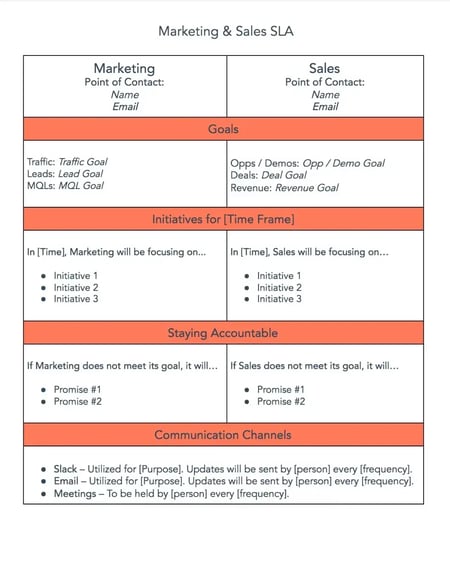
Featured Resource: Marketing & Sales Alignment Template

sales-planning-13-20250224-9732018

Download the Free Marketing & Sales SLA Template

10. Detail a financial plan with business costs, funding, and revenue projections.

This is where you get brutally honest with yourself (and any potential investors) about money. Outline your financial model, including startup costs, ongoing expenses, and revenue projections.

For me, startup costs were fairly lean: a laptop, software subscriptions, branding assets, and some basic home office upgrades. If you’re running a service-based business like mine, you might not need a physical office right away — which helps keep costs down.

Be conservative in your estimates. It’s much better to overestimate and have a buffer than run out of cash too early. According to The Hustle’s 2024 report:

  • 42% of businesses become profitable by year two.
  • 21% hit profitability between years two and five.
  • 2% took over 10 years, and 8% still aren’t profitable.

Once you list your costs, justify them with financial projections and clear revenue goals. This step is crucial if you’re seeking funding since your model needs to be watertight to earn investor trust.

Pro tip: Check out this article on ways to cut business costs and see what might apply to your plan.

11. Summarize the above with an appendix.

An appendix isn’t required, but it’s handy. You can include your resume, your co-founder’s resume (if you have one), permits, leases, and any other legal or supporting documents here. It keeps your main plan clean while still providing all the extra details for those who want them.

12. Review section examples for inspiration.

Before finalizing, it helps to look at a few sample business plans to see how others have structured theirs. One example I find helpful is this one from Upmetrics that’s specifically geared toward solopreneurs and small businesses.
business plan template example

Source

Check out more business plan examples here.

Pro tip: Once you’ve finished your business plan, you’ll have a much clearer sense of your business’s strengths, weaknesses, opportunities, and threats. From there, you can strategically choose a name that truly reflects what you offer which is why naming usually comes after the plan is done.

How to Decide on a Company Name

Naming your business isn’t just making a list and picking what sounds cute — especially if you aren’t using your own name. If you choose a separate name, you’ll need to register it with your provincial or state authorities so you’re legally recognized.

Here’s how I approached it (and how you can too):

1. Brainstorm business name ideas.

Start simple. If you’re local, a city or landmark-based name can help with local SEO (like “Toronto Content Studio”). But if you’re building a brand with long-term growth in mind, consider a name that’s unique, short, and easy to remember.

As I mentioned, I operate publicly under my personal name because it builds trust and credibility, but my official legal entity is 13479579 Canada Inc. — a numbered name that gives me flexibility to evolve or rebrand later without legal headaches.
business name generator

Source

While you probably don’t want to make your final decision based on something a random business name generator comes up with, like this one from Canva, they can be great brainstorming tools.

2. Conduct a trademark search.

Before settling on a name, I ran a trademark search to make sure no one else was using it or anything close to it. Even if a name feels unique, there’s always a chance someone, somewhere, has claimed it.

trademark search

Source

A trademark owner can sue you if you use a name that’s too similar to theirs, even unintentionally. I wanted to avoid that stress (and legal costs) down the line, so I took this step seriously.

Pro tip: When you do your search, look beyond just exact matches. Check for similar-sounding names or slight variations — it’s better to be safe now than scramble for a new name after you’ve already built momentum.

3. Make sure the name you want is available in your state.

I’m based in Canada, so I had to make sure my chosen name was available both federally and provincially. Business names are registered regionally, and it’s possible another business in a different province or state might have the same or a similar name.

When I checked, I learned that even if there isn’t a direct trademark conflict, your provincial or state registry might reject your application if the name is too close to an existing one. It felt tedious, but doing it properly meant I wouldn’t have to rebrand later which can get messy and expensive.

4. Make sure the domain name is available online.

I can’t emphasize this enough: your website domain is just as important as your business name today. When I found a name I liked, I immediately checked if the.com (or.ca) domain was available.

A long or awkward domain (like “best-content-consultant-2024.com”) isn’t memorable and makes it harder for people to find or recommend you. I wanted something clean and easy to say out loud — the kind you don’t have to spell letter by letter over the phone.

Check domain name registrars for availability early on. There’s nothing worse than coming up with a great business name, only to find out the clean domain is taken and having to settle for something like “businessname-1.com,” “business-name.com,” or “therealbusinessname.com.”

While these can work, it’s always best to stick to “businessname.com” (or your country’s extension) for readability and memorability.

In my case, I decided to register my domain under my own name. It felt simple, authentic, and it allowed me to build a personal brand that felt true to me. I bought it directly from GoDaddy years before I even fully launched, just to make sure no one else could grab it first.

Pro tip: Once I secured my domain, I felt a huge sense of relief. Even though I wasn’t building my website right away, owning the domain gave me the freedom to launch when I was ready, without the panic of finding it taken later.

6. File for a trademark if you’ve chosen an original name.

Once you’ve chosen a strong, original name, consider registering a trademark for extra protection. It’s not required, but it gives you the exclusive right to use that name for your type of business.

A trademark protects words, names, symbols, and logos that distinguish goods and services. Filing for a trademark costs less than $300, and you can learn how to do it here.

When I thought about long-term growth and possibly expanding into new service areas, I realized that trademarking would give me peace of mind. It meant no one could ride on my reputation later, and it protected all the brand equity I planned to build.

7. Register your business name (optional).

Because I operate as an LLC, my legal name was registered automatically when I set up my business. But if you’re using a different public-facing name or operating as a sole proprietor, you’ll need to register a “Doing Business As” (DBA) name. Learn how to do that here.

There are rules for naming a corporation and LLC, which you can read about here.

When I explored this step, I realized having a numbered company gave me flexibility — I could publicly operate under my personal name, or introduce a new brand name later without major legal changes.

Pro tip: If this part feels confusing, that’s completely normal. Business structure and naming rules can feel like a maze, but taking it one step at a time (and getting advice from a lawyer or accountant if needed) can make it a lot simpler.

How to Choose an Ownership Structure

Choosing an ownership structure (also called your legal structure or business entity) is a foundational step when starting your business. It affects everything: taxes, liability, funding, and even how seriously clients and partners take you.

I spent a lot of time digging into this before deciding on an LLC, and here’s a breakdown of what I learned.
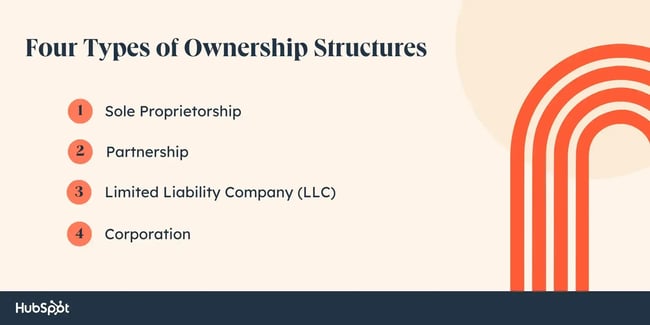
types of ownership structures

1. Sole Proprietorship

A sole proprietorship is the simplest structure. You and your business are legally the same. You can operate under your own name or register a “Doing Business As” (DBA) name if you want something branded.

Example: A freelance designer working alone without formal incorporation.

Pros

  • Easy and inexpensive to set up.
  • Complete control over decisions.
  • Simple tax setup — your business income and expenses flow through your personal tax return.

Cons

  • You’re personally liable for all debts and legal issues.
  • Harder to get funding or investors.

Taxes: All profits are reported on your personal tax return and taxed at your individual rate. You also pay self-employment (payroll) taxes on income.

Personal note: I almost started this way early on. It felt easy, but the personal liability risk didn’t sit well with me as I took on larger clients.
sole proprietorship ownership structure

2. Partnership

A partnership is when two or more people co-own a business and share profits and responsibilities.

Example: Two content strategists teaming up to create an agency.

Pros

  • Simple to set up.
  • Ability to pool skills, networks, and resources.

Cons

  • Shared liability for business debts and each other’s actions.
  • Potential for conflicts if roles aren’t clearly defined.

Taxes: Profits pass through to each partner’s personal tax return. Each partner pays income tax and self-employment tax on their share.

Personal note: I initially considered this model with a friend, but when they changed paths, I had to pivot. Doing the research ahead of time helped me adjust fast without losing momentum.
partnership ownership structure

3. Limited Liability Company (LLC)

An LLC provides personal liability protection, meaning your personal assets (like your house or car) are generally safe if something goes wrong. It’s more flexible than a corporation but offers more structure than a sole proprietorship.

Example: A boutique content strategy consultancy run by one founder with contractors or employees.

Pros

  • Personal asset protection.
  • Less paperwork and fewer formalities than a corporation.
  • Flexible structure and management.

Cons

  • Costs more to set up than simpler structures.
  • Some investors prefer corporations for tax reasons.

Taxes: Profits “pass through” to your personal tax return (no separate entity tax), so you only pay taxes once at the personal level. You also pay self-employment taxes on income.

Personal note: I chose an LLC (specifically 13479579 Canada Inc.) because I wanted that liability protection as I grew and started working with larger brands. Plus, it positions me more professionally and gives me flexibility for future pivots.
limited liability ownership structure

4. Corporation

A corporation is a separate legal entity from its owners and can own assets, enter contracts, and be sued independently.

Example: Well-known brands like Shopify or Microsoft.

Pros

  • Strongest personal liability protection.
  • Easier to raise money through investors and share offerings.

Cons

  • More complex and costly to set up and run.
  • Heavier tax and compliance requirements.

Taxes: C corporations pay corporate income tax on profits, and shareholders pay tax again on dividends (“double taxation”). S corporations (U.S. only) pass income through to shareholders to avoid double tax, but they have stricter ownership rules.

Personal note: I didn’t choose this route because I wasn’t looking for big investment or rapid scaling. But if you’re planning to grow fast, take on large investors, or eventually go public, it’s worth exploring.
corporation business structure

Final Thought

Choosing your structure isn’t forever, but it’s easier (and cheaper) to get it right from the start.

How to Register Your Business

how to register your business

Once your business plan, name, and structure are sorted, it’s time for the less romantic part: paperwork and legal setup.

This is where your business officially comes to life: you’ll register with the government, get tax IDs, and secure any necessary licenses or permits. While the details vary depending on where you live, here’s a general guide (with a few Canadian notes from my own experience).

Step 1. Choose your state (or province) of registration.

In the U.S., you’ll usually register your business in the state where you operate. If you’re remote or home-based, some people choose states known for being business-friendly (like Delaware or Wyoming).

In Canada, you decide whether to register provincially (which protects your business name only in your province) or federally (which lets you operate across Canada and offers broader name protection). I went federal since I work with clients all over and wanted flexibility to expand.

Step 2. Register your business name.

In most U.S. states, your business name is automatically registered when you set up your LLC or corporation. If you’re a sole proprietor and want to use a name other than your personal name, you’ll need to file a “Doing Business As” (DBA) name.

In Canada, this is similar. If you use a brand name instead of your own name, you register it as a trade name or DBA.

Step 3. Get your tax identification number.

In the U.S., you’ll need an Employer Identification Number (EIN) from the IRS if you have employees or plan to open a business bank account.

Even if you’re solo, getting an EIN can be helpful — it allows you to keep your Social Security Number private when working with clients who need W-9 forms.

In Canada, this is similar to getting a Business Number (BN) from the CRA. I got mine early on to keep my SIN private and make client paperwork smoother.

Pro tip: I found that having this in place early felt like a small but empowering step — even as a one-person business, it made everything feel official and ready for growth.

Step 4. Fulfill other legal requirements.

Depending on your state, city, or type of business, you might also need:

  • A business license.
  • Specific permits (for example, health permits or seller’s permits if you sell physical goods).
  • State tax ID numbers or local tax registrations.
  • In Canada, GST/HST registration if you expect to earn over $30,000 annually.

I found this step the most intimidating, but once I broke it down by checking local guidelines and talking to an accountant, it turned out to be much more manageable.

Every region has its quirks. Whether you’re in the U.S., Canada, or elsewhere, it’s worth checking local government websites or booking a quick consultation with a lawyer or accountant. I did one session, and it gave me so much clarity (and peace of mind) that I wasn’t missing anything important.

How to Comply With Legal Requirements

Once you’ve registered your business, there’s one last hurdle before you can confidently hang your “open for business” sign: making sure you’re fully compliant at the federal, state (or provincial), and sometimes even local level.

This part might feel intimidating, but skipping it can leave you open to fines or, worse, forced closure. Here’s how I approached it — and what you should look out for.

1. Get a seller’s permit, if needed.
sellers permit example

Source

If you sell physical products, whether as a wholesaler or retailer, most states require a seller’s permit. This allows you to collect sales tax from customers and remit it to the state, usually every quarter.

This typically applies to “tangible property” like clothes, furniture, or tools. In some states, even certain service-based businesses might need one.

When I started researching, I realized how easy it is to miss this step if you focus only on your product or service and forget the operational side.

You can register for a seller’s permit through your state’s Board of Equalization, Sales Tax Commission, or Franchise Tax Board. To help you find the appropriate offices, find your state on this IRS website.

2. Apply for a federal business license, if needed.
federal business liscense example

Source

Depending on your industry, you may need a federal business license. For example, if you’re operating in transportation, selling alcohol, or running certain financial services, this step is mandatory.

When I first looked into licenses, I was surprised by how specific they can be — even certain consulting businesses in regulated fields might require one.

Check SBA.gov and select your state to see exactly which licenses or permits your business might need.

3. Apply for state licenses.
certificate of occupancy example

Source

States often have additional requirements beyond federal ones. According to Chase Bank, these can include:

  • General operating licenses
  • Building and renovation permits
  • Zoning and land use permits
  • Signage permits

When I was preparing my business, I realized some states even have specific licenses just for putting up an exterior sign. It’s the kind of detail that’s easy to overlook if you’re heads-down in branding or marketing, but it’s critical to get right.

4. Apply for professional licenses and renew them.

real estate license example

Source

If you work in a field that requires a professional credential like cosmetology, therapy, law, insurance, real estate, or architecture, you’ll need to secure a professional license.

These licenses confirm you’re properly trained and compliant with all industry regulations. Don’t forget to mark your calendar to renew them regularly — this is one of those tasks that can easily slip through the cracks if you’re busy serving clients.

Pro tip: I prioritized getting any potential licenses and registrations sorted before fully launching so I could focus on client work right from day one without scrambling later.

5. Understand small business tax requirements.

Taxes are rarely anyone’s favorite topic, but they’re essential.

In the U.S.:

  • All businesses (except partnerships) file an annual income tax return.
  • Partnerships file an information return.
  • LLCs and corporations need an Employer Identification Number (EIN). Even if you’re a sole proprietor using your SSN, you still owe self-employment tax.

Once you’re registered, it’s time to figure out which taxes you’ll be responsible for. Here are the three types:

Self-Employment Tax (SE Tax)

Self-employment tax refers to a Social Security and Medicare tax for people who work for themselves, i.e., business owners. SE taxes require filing Schedule SE (Form 1040) if your net earnings from self-employment are $400 or more. (Note: There are special rules and exceptions for fishing crew members, notary publics, and more.)

You can learn more here.

Employment Tax

When you have employees, you (as the employer) have certain employment tax responsibilities that you need to pay, as well as forms you need to file. Employment taxes include Social Security and Medicare taxes, federal income tax withholding, and federal unemployment (FUTA) tax.

You can learn more here.

Excise Tax

Excise taxes are also something you need to consider, depending on what you sell, where you operate, and so on. For example, in the U.S., there’s a federal excise tax on certain trucks, truck tractors, and buses used on public highways.

You can learn more here.

How to Find Funding for Your New Business

From the moment you sketch your first idea to the day you start turning a consistent profit, you need a way to fund your operation and growth.

Most founders (me included) start out using personal savings or small contributions from friends and family — it’s the most common approach because it gives you total control, though it also means taking on all the financial risk yourself.

Many founders need external start-up capital to get their business off the ground. Here’s how entrepreneurs in our survey report funding their businesses:

  • 74% of use personal funds.
  • 19% take out credit card cash advances.
  • 18% borrow or get donations from friends and family.
  • 27% have business loans (such as SBAs).
  • 14% seek funding from investors, private equity firms.
  • 4% use crowdfunding.

According to The Hustle’s 2024 report, cash flow and lack of access to funding are some of the biggest struggles new entrepreneurs face, often forcing them to get creative about how they finance early growth.

If you’re looking beyond personal savings, here are some of the most common ways to fund your business, and my take on each.
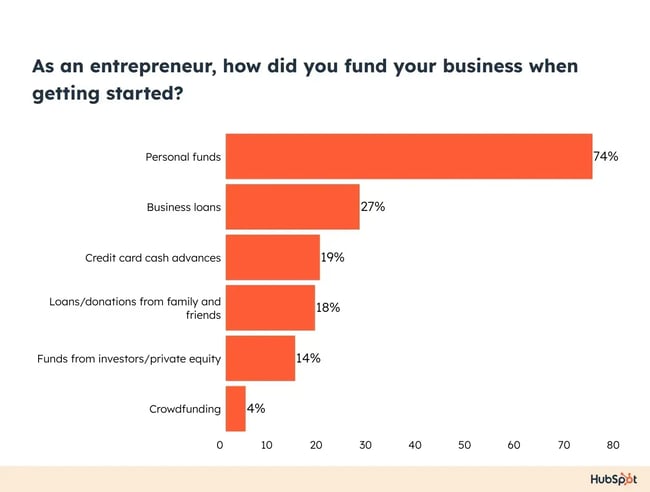
graph depicting most popular ways entrepreneurs fund their business

1. Seed Financing

If you need a relatively small amount of capital to explore a market opportunity or build an initial prototype, seed financing could be the way to go.

The most popular type is seed-round financing, where someone invests in your business in exchange for preferred stock. This gives investors a safety net and they’ll get their money back first (plus potential extras) if your company is sold or liquidated.

Pro tip: Tools like HubSpot’s discounted CRM for startups can help you stretch early funding further. Check it out here.

2. Accelerator Programs

Accelerators are highly competitive programs where startups pitch their ideas for a chance at funding, mentorship, and resources.

While they started out focused on Silicon Valley tech companies, accelerators are now available nationwide and across different industries.

Personally, I love how these programs force you to tighten your pitch and clarify your value proposition even if you don’t win, the feedback can be worth its weight in gold.

Pro tip: Curious? Here’s a list of top U.S. accelerators to start exploring.

3. Small Business Loans

If you have a clear, well-defined plan for using funds, a small business loan can be a great option.

Banks, community development organizations, and microlenders all offer different types of loans from general working capital to equipment and real estate loans.

When I looked into this route, the biggest lesson I learned was to shop around. Rates and terms vary widely, and the right lender will be a true partner,.

Pro tip: Check out SBA.gov’s loan programs to learn more.

4. Crowdfunding

Crowdfunding platforms like Kickstarter and Indiegogo let you raise money from supporters without giving away equity. Instead of investors, you’re appealing to potential fans or future customers.

You can offer early access, special editions, or exclusive perks in exchange for support.

I’ve seen firsthand how powerful this can be for creators or product-focused businesses — it not only funds your work but also helps validate demand before you go all in.

Pro tip: Choose your platform wisely. Some focus on equity-based investors, while others are purely donation-based. Learn more about crowdfunding here.

5. Venture Capital Financing

This one’s not for everyone — only a small percentage of businesses are a fit for VC funding.

If you can prove massive growth potential and need a large capital injection to scale fast, venture capital might be worth exploring.

VC firms typically invest large sums in exchange for preferred stock and governance rights (like a board seat or veto power on major decisions).

A lot of this path comes down to networking. Being in the right rooms and building relationships with the right investors.

Pro tip: If this is your route, spend serious time growing your network. So much of VC funding depends on trust and connections, more than any pitch deck alone.

How to Create a Brand Identity for Your New Business

When you’re starting out, your brand identity is one of the most powerful ways to make your business feel real to you and to your future clients. It’s about defining your values, how you communicate, and the emotions you want people to feel when they interact with you.

Here’s how I approached building mine and how you can build yours, step by step.

1. Design a logo.

Your logo is often the first visual impression people get of your brand. It should be simple, memorable, and reflect your purpose.

When I designed mine, I chose a straightforward exclamation mark. It feels bold yet approachable, and it symbolizes my commitment to helping clients stand out confidently.

Before you land on a final design, think deeply about your mission and who you serve. Brainstorm words or ideas that represent your business, sketch out concepts, and get feedback from trusted peers or clients.

Pro tip: Tools like Canva’s logo maker are a great way to explore different directions before committing.

2. Develop a visual identity.

Your visual identity goes beyond just the logo and includes your overall look and feel, from photography style to graphic elements.

When I was creating mine, I built a mood board to keep everything cohesive and aligned with my brand personality: calm, supportive, and just a little playful. This step helps make sure every touchpoint feels like it belongs to the same story.

color theory chart to develop your brand’s visual identity

Source

Pro tip: If design isn’t your strength, consider hiring a freelance designer to help bring your vision to life in a cohesive, professional way.

3. Create a tagline.

Your tagline should capture the essence of your brand in just a few words. Think of it as your mini mission statement: what you want people to remember, even if they forget everything else.

Keep it short, memorable, and focused on the value you bring. I like to treat taglines as little promises: what do you stand for, and what can people expect when they work with you?

Pro tip: If you feel stuck, a brand copywriter or marketing consultant can help you refine it into something that clicks.

4. Develop your voice and tone.

Your brand voice is how you sound in writing. It shapes your personality and creates an emotional connection.

For me, I wanted to sound approachable, supportive, and a bit playful, so my voice always feels like a friendly guide rather than a rigid consultant.

As brand voice expert Justin Blackman at Brand Voice Academy shares: “Like people, brands contain multitudes. They (and we) have different approaches to different things, and blanket brand voices don't work. They will get you into trouble – and you can’t be monotone across every channel about every topic.”

Consistency is key, but flexibility allows you to adapt your tone to different contexts without losing authenticity.

5. Create brand guidelines.

Finally, pull all of this together into a set of brand guidelines.

Your guidelines should include:

  • Visual rules and mockups: When and how to use your logo, imagery, and other brand elements.
  • Channel guidance: How your brand shows up on social, in emails, on your website, and beyond.
  • Do’s and don’ts: Concrete examples to clarify expectations.
  • Concise layout: Summaries and clear sections so people can find what they need quickly.

When I wrapped up mine, I shared them with everyone I collaborate with — designers, writers, and even virtual assistants — to make sure the brand felt unified across every touchpoint.

Pro Tip: A writing style guide is a great place to start when creating brand guidelines. Check out this blog on brand style guide examples.

Tips for Starting a Business
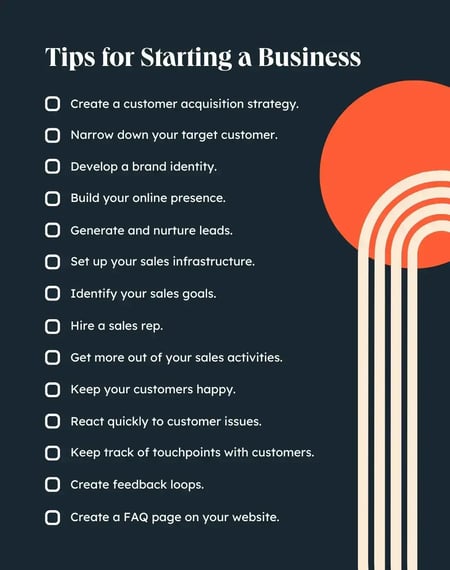
tips for starting a business

Here are the best tips for becoming successful in your small business niche.

1. Create a customer acquisition strategy.

Once you’ve handled all the paperwork and set up your business legally, the big question hits: How do you actually acquire customers?

You can’t just build it and expect people to come. You need to create buzz even before you’re fully ready to deliver. The million-dollar question is: Where do you start?

It all starts with deeply understanding your target customer. You have to ask yourself:

  • Who needs what I’m offering?
  • Who would get real value from this?
  • Who would genuinely be excited to tell a friend about it?
  • Who already knows and trusts these people and can refer me?

In my own business, a huge portion of my early clients came from direct referrals and building credibility on LinkedIn. I automated outreach, but the foundation was always real relationships and word-of-mouth trust.

Based on The Hustle’s 2024 report, founders rely on a mix of tactics to acquire customers:

  • 73% get them through in-person efforts. Of those, 61% rely on word-of-mouth and 12% on outbound sales like cold calls.
  • 47% use search optimization, with 18% coming from their website or ecommerce store and 29% from Google traffic (split between Google My Business and organic search).
  • 60% use non-search tactics, with 46% leveraging social media (mostly organic) and smaller shares from general marketing and co-marketing partnerships.

I’ve found that combining organic thought leadership (like sharing behind-the-scenes stories and lessons learned) with targeted outreach is an unbeatable combo.

2. Narrow down your target customer.

Before you do anything else, get crystal clear on who your target customer is and what they care about. Research, surveys, and even casual conversations can tell you a lot.

Questions I ask myself (and encourage my clients to ask):

  • What are their daily frustrations? Maybe they’re overwhelmed by content requests from sales, or they’re stuck producing thought leadership that feels generic.
  • What goals keep them up at night? They’re focused on building credibility, driving pipeline, and proving ROI on every piece of content they publish.
  • Where do they hang out online? LinkedIn, Slack communities for B2B marketers, and newsletters from people they trust.
  • Who do they trust? They look to other content leaders, marketing advisors, and founders who’ve built successful content programs.
  • How do they make buying decisions? They need to see clear, strategic value — not just surface-level writing chops.

Creating buyer personas (even giving them names if that helps) keeps you grounded. I have mine pinned on my wall, so I’m always creating content and offers for them.

Pro Tip: Erin Pennings of CopySnacks says, While some of my clients find that defining a specific person with a name like Jack or Diane makes it easier to hone in on brand personas, others find it more helpful to have a list of characteristics and statements when it comes to narrowing things down and finding your audience.”

3. Build your online presence.

Once you know your audience and have your brand identity set, it’s time to get visible.

Your online presence is your storefront even if you don’t sell physical products. That includes your website, blog, email list, and social channels.

For me, LinkedIn has been great. By consistently sharing practical insights and personal stories, I’ve built credibility and a steady inbound pipeline.

If you’re not sure where to start, focus on one or two platforms where your audience is most active.

If you want to learn more about these topics, read our beginner’s guide to small business marketing here.

4. Generate and nurture leads.

Getting attention is only half the battle. You need a system to turn that attention into paying customers.

Lead generation is about attracting and converting strangers into prospects. If you do it right, you’ll have a steady stream of potential clients filling your calendar (even while you sleep).

A simple funnel might look like this:

  • Share valuable, relevant content (blogs, videos, LinkedIn posts)
  • Offer a free resource or consultation in exchange for an email
  • Nurture those contacts with useful follow-ups (case studies, client wins, practical tips)

I use my email list and targeted outreach sequences to keep in touch with people who aren’t quite ready to buy yet. Over time, these “quiet” followers often turn into my best clients.

Pro tip: Learn more about lead generation here , and don’t forget to try HubSpot’s free marketing tools , our free lead generation tool that lets you track your website visitors and leads in a single contact database. And, as your marketing grows more sophisticated, our marketing software gives you a one-stop shop for all of your efforts.

5. Set up your sales infrastructure.

Setting up a solid sales process from the start will save you so much pain later.

The first step? Use a proper CRM, not spreadsheets or sticky notes. A CRM helps you track every interaction, organize deals, and avoid losing potential revenue in the shuffle.

I can’t count how many business owners I‘ve seen scramble to find old email threads or client details because they didn’t systematize early enough.

There are great CRMs that cater to small businesses. Find one that feels intuitive and supports your sales style.

6. Identify your sales goals.

Sales buzzwords like key performance indicators (KPIs) and return on investment (ROI) sound intimidating, but it comes down to one simple question: What do you need to earn to keep the lights on and grow?

Start by figuring out your revenue goals, then work backward. How many projects or retainer clients do you need? What’s your ideal pricing?

For me, I started with a modest revenue goal that felt realistic based on my capacity as a solo writer and strategist. Over time, I refined that as I added new services, like thought leadership refreshes and LinkedIn content strategy.

The point is to create a clear sales plan so you can confidently make decisions, like when to raise prices or say no to misaligned work.

7. Hire a sales rep (when it makes sense).

When you’re just getting started, it’s tempting to do it all yourself. I did my own outreach and lead nurturing for years, and honestly, it taught me so much about my clients and what they care about.

But if you want to scale beyond what you alone can handle, hiring that first sales hire is a big turning point. Look for someone who’s great at building trust and understands your buyer’s world inside out, rather than focusing purely on seniority.

Your first hire doesn’t need to be a VP-level sales leader. Instead, find someone who can handle the messy early conversations, experiment with outreach, and help shape your future sales playbook. From there, you’ll want a plan for building your sales development team.

8. Get more out of your sales activities.

Efficiency is everything when you’re small. Create a repeatable sales process, like this 7-step sales process, even if it’s just you.

For me, this looked like setting up automated sales tasks LinkedIn outreach, creating email templates for common replies, and using a CRM to track touchpoints.

The more you can automate low-value tasks (like data entry or status updates), the more time you have for actual selling and relationship building.

A solid framework, like this 7-step sales process, gives you structure but still leaves room to adapt as you learn.

9. Keep your customers happy.
use a customer service survey to get customer insights

Source

Acquiring new customers is important, but keeping them is what builds a sustainable business.

In my own work, I focus heavily on over-communicating during projects, sending small updates, and sharing value even after a project wraps.

Happy clients become long-term partners, repeat customers, and your best marketing channel through referrals and testimonials.

Invest in a customer success mindset early on. It pays off in every possible way.

10. React quickly to customer issues.

Today, people expect fast, personal responses whether it’s an email question, a comment on LinkedIn, or feedback after a workshop.

Pay attention to where your customers engage the most (for me, that’s often LinkedIn DMs or direct email). Be ready to meet them there and solve problems quickly.

A good customer service app or even a simple helpdesk tool can help you stay on top of requests without dropping the ball.

11. Keep track of touchpoints with individual customers.

Context is everything.

Track all your client interactions — when they first connected, how they found you, what feedback they gave, and what offers they’ve engaged with.

When I reach back out to old leads, I always check my notes to mention something specific: “Last time we spoke, you were scaling your content team — is that still a focus?”

It shows you’re paying attention and makes every conversation more meaningful.

12. Create feedback loops.
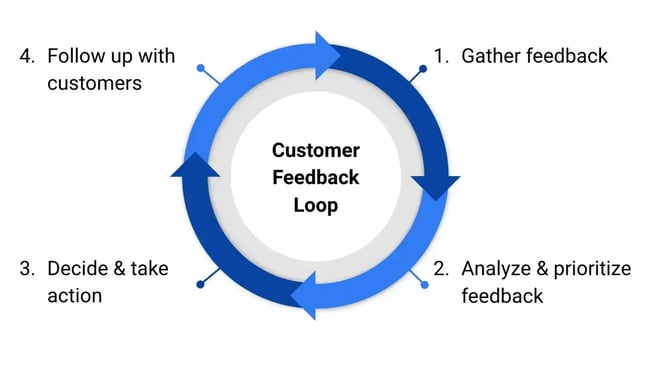
customer feedback loop example

Source

From day one, ask for feedback.

In my own business, I ask clients what stood out about our process, what could be smoother, and what they'd like to see more of.

As you grow, you’ll have less direct exposure to every client. Build a habit early of listening to your customers whether it’s through surveys, post-project check-ins, or informal chats.

13. Create an FAQ page on your website.

Make it easy for customers to help themselves.

Start simple: a clear, honest FAQ page covering your most common questions (like turnaround times, pricing ranges, or service scope).

As you scale, consider evolving it into a full knowledge base or resource library that educates and builds trust even before someone books a call.

I’ve seen firsthand how a thoughtful resource section can reduce repetitive emails and build credibility.

Resources to Start a Business

Here are some helpful resources to help you spread awareness, build your online presence, and get the leads you need for free. In addition, we’ve listed additional templates and sales tools to help you build an efficient sales engine, reach prospects, and close customers for free.

  • The Ultimate Inbound Guide for Startups: A guide that covers how to build an inbound sales and marketing machine, which demand generation activities offer the biggest return on investment and more.
  • HubSpot’s Free Marketing Tools: A free marketing tool that gives you insight into what every lead does before and after they fill out a form. It includes built-in analytics that make it easy to learn which pages, offers, and traffic sources are driving the most conversions for you.
  • HubSpot’s Starter Bundle Build for Startups & Small Businesses: A comprehensive suite of tools designed specifically for startups & small business owners. This bundle includes essential features for managing customer relationships, streamlining sales processes, and scaling your business efficiently.
  • Website Grader: Enter your website URL and email address, and you’ll get a detailed grade on your website’s performance, mobile, SEO, and security, along with detailed tips and resources for making impactful improvements on your website.
  • Press Release Templates: Downloadable press release templates you can customize, along with a corresponding guide to building a press release and promotion plan.
  • Case Study Templates: Downloadable case study templates you can customize, tips on how to find and reach out to candidates, and sample interview questions.
  • Content Creation Templates: 100 social media image templates, 8 PowerPoint presentation templates, 50 call-to-action templates, 15 infographic templates, five ebook templates, five blog post templates, and more.
  • Email Signature Generator: A free tool that creates a professional email signature you can easily add to your Gmail, Outlook, Apple Mail, Yahoo Mail, or any other email provider.
  • Sales Email Templates: A list of email templates that have been used with tremendous success by real companies (including HubSpot).
  • Sales Call Scripts: Easy-to-follow sales call scripts that can help you build rapport and develop trust, understand the prospect’s pain points, identify key decision-makers, and secure a follow-up meeting.
  • iubenda's Terms and Conditions template: Complying with the law also means making your website compliant. Terms and Conditions can be very useful to define the rules of your site and avoid potential problems with your customers, especially when you are dealing with complex activities such as online sales. Thanks to this template, you can draft your Terms and Conditions document, customizing each section and adapting it to your activity.
  • Daniel Pink’s “Sell Like a Human” Video Series: Monthly video series where Sales Expert Daniel Pink and special guests solve your biggest sales challenges in under 30 minutes.
  • Sales Close Rate Industry Benchmarks Tool: Compare your sales close rate against your industry competitors using data from over 8,900 companies segmented by 28 industries.
Additional Resource: Enroll in HubSpot Academy to learn everything you need to know about digital marketing and sales for small businesses. Train your whole team for free!

How to Start a Business Online

Starting a business online isn’t quite the same as opening a physical storefront. You get different advantages (like global reach and lower upfront costs), but it also means you have to work extra hard to stand out and earn trust. Here’s how I approach it, step by step.

1. Determine your niche and business idea.

Your niche is your focus area: the specific audience and problem you’re targeting. Customers today want brands that feel like they “get” them, not generic catch-alls.

When I first started, I wasn’t trying to appeal to every business out there. I focused on B2B SaaS content teams struggling to translate founder expertise into clear, strategic content. That focus helped me stand out immediately.

Think deeply about:

  • Who exactly you’re helping (age, role, goals).
  • What big frustration or problem they have that your product or service solves.
  • How you’ll be different from others in your space.

Pro tip: Matt Hall, founder of Common People , offers the following advice: “You don’t have to reinvent the wheel. Focusing on great execution, customer service, and reputation matters more than having the most original idea. There’s enough work to go around; it’s OK if someone else is already doing something similar.”

2. Conduct market research.

You can’t skip this. Market research helps you understand whether there’s actual demand for what you want to offer in your target market and how others currently solve this problem.

23 May 15:45

Demand Generation vs. Inbound Marketing: What’s the Difference?

by David Crane

Let’s be honest, the B2B marketing industry (and we marketers in general) are pretty bad at defining our terms and sticking to that terminology. Rather than being driven by clarity, our messaging, content and general communications is far more often a haphazard mix of trending buzzwords. This helps neither our marketing teams nor our prospects and customers.

This post is far too small in scope to address this problem – a proper solution would be book-length and require a full-time effort to keep it updated. Instead, I’m hoping to bring clarity to two specific terms that seem to confuse some B2B marketers new to the discipline: inbound marketing and demand generation.

Inbound Marketing vs. Demand Generation: What’s the Difference?

At a quick glance…

Demand generation is a sub-discipline of B2B marketing. B2B marketers specializing in demand generation leverage a mix of different strategies (e.g., account-based marketing), channels (e.g, search, events, email or content syndication), and tactics (e.g., specific keywords for search or target-accounts for content syndication) – all of which are geared towards driving interest in and desire for your products and services (i.e, demand).

Inbound marketing, isn’t a sub-discipline of B2B marketing, but rather a strategy, like ABM. Unlike ABM, however, which can use any marketing channel to engage decision-makers at specific accounts, inbound marketing focuses on the use and optimization of specific digital channels that drive traffic to and engagement at your company’s website and landing pages. Inbound marketing is typically an important part of demand generation, and it often supports ABM strategies as well.

A Deeper Look: What is Inbound Marketing?

According to the definition by Marketo, inbound marketing is,

“A strategy which focuses on non-paid or “pull” marketing tactics to “create brand awareness and attract new business.”

Using inbound efforts, organizations strive to earn the attention of customers and get found, instead of fighting for attention.

Inbound Marketing Tactics

Inbound marketing tactics are typically digital, but are also generally defined within the categories of owned or earned media as well as “pull” marketing tactics.

Examples of inbound marketing include, but aren’t limited to:

  • Blogging
  • Webinars
  • Video
  • Email marketing
  • Websites and microsites
  • Landing pages
  • Search engine optimization
  • Social media

Inbound marketing “pros”:

  • Potentially lowers cost per lead compared to outbound marketing
  • Provides opportunity to develop thought leadership via content marketing and earn industry credibility
  • Is noninvasive when done right
  • Corresponds to the growth of prospect digital research habits

Inbound marketing “cons”:

  • Earning authority and organic results can be time-consuming and slow
  • Winning attention can be challenging in saturated industries
  • Diverse skills are required to execute

A Deeper Look: What is Demand Generation?

Beyond the obvious – i.e., demand generation creates a want for a brand’s products or services – demand gen is focused on the progression of this “want.” A lead doesn’t signify demand; it simply show initial interest. Sales pipeline opportunities, on the other hand, signify demand. Thus, demand generation, as a discipline, includes generating initial leads and then converting them all the way down the funnel into opportunities, and even creating demand for new products/services among existing customers.

To be clear, a volume-based mindset where success is measured by the number of leads generated has now place in modern demand generation. Instead, the success of a demand gen engine is measured in the quality and value of pipeline opportunities (and potentially revenue generated).

Successful demand generation starts before lead generation with the identification of the right audiences or accounts, which is why ABM strategies have become so important to demand gen. Further, demand gen usually requires significant work integrations with sales and customer success teams to ensure processes, technology and people are all aligned to convert prospects down the funnel.

Demand Generation Strategies

Demand generation marketers execute omnichannel campaigns designed to engage prospects throughout every stage of the sales pipeline, from awareness to post-sale outreach. This involves a broad mix of strategies (such as ABM and inbound marketing) and all the channels and tactics they comprise.

Demand gen “pros”:

  • Focused on measurement, so it’s much easier to calculate ROI compared to arts-and-crafts, PR-based B2B marketing of old
  • Forces marketing teams to organize strategies, align team efforts and integrate technologies
  • Supports sales and customer success efforts, leading to more closed deals and higher customer retention rates

Demand gen “cons”:

Demand gen cons typically occur due to maturity issues and biting off more than they can chew. For example, continually investing in more tech solutions before gaining adequate proficiency in tools and systems you already have (i.e., shiny-new object syndrome). Or, jumping head-first into a trending strategy or tactic (such as ABM) without gaining the fundamentals to ensure it will work (e.g., getting sales on board with ABM strategy before launching it).

Demand gen is essentially the evolution of B2B marketing (though it doesn’t cover everything B2B marketing) and it’s much more complex, which means there can be more pitfalls to avoid. But just like a new Tesla Model S is more complex than a 1920s Ford Model T, once you’re tuned into demand gen and understand how to drive it, it’ll get you to where you want to go much faster and more efficiently.

Where Does Inbound Fit Within Demand Generation?

Inbound marketing is one strategy that demand marketers should employ as part of a comprehensive, full-funnel demand strategy.

Digital marketing tactics and pull methodologies falling under the inbound marketing umbrella are highly effective modes of connecting with digitally savvy decision-makers. Thought leadership, lead generation, lead nurturing, pipeline growth and other metrics that support demand generation’s ultimate goal of pipeline growth are very well served by inbound marketing strategies.

However, most marketing organizations find they hit a plateau using inbound strategies alone, and they find they must expand into paid digital efforts (such as 3rd-party lead gen) and traditional marketing channels (such as in-person events) to scale demand and hit goals.

Inbound is a key component of demand generation and will continue to be. Prospects want to do their own research, so your inbound game must be on point at all times. But, like we often say, you can’t expect all your prospects to come knocking at your door. You can’t scale with inbound alone.

Where does your organization fall in various measures of demand gen marketing maturity? To benchmark your B2B marketing program against some of the most effective demand marketing organizations and identify areas where improvement is needed, download the “B2B Demand Marketing Assessment Guide & Orchestration Workbook.

23 May 15:44

15 Powerful B2B Lead Generation Tools You Need to Use

by Wendy Marx

15 Powerful B2B Lead Generation Tools You Need to Use (1)

B2B lead generation strategies include many moving parts, from creating attractive offers, calls to action, and landing pages, to nurturing leads after they download your offer. The right lead generation tools can take the stress out of this whole process — and allow you to focus on making your business the best it can be.

You can find tools for each and every stage of your lead generation journey, including:

  • Offer creation tools
  • Lead capture tools
  • Landing page tools
  • Lead nurturing tools

Learn how to get more B2B leads with that right tools to grow your strategy. Let’s look at some of the industry’s top tools and how they can enhance your B2B lead generation strategies.

15 Must-Have B2B Lead Generation Tools to Kickstart Your Strategy

Offer Creation Tools

Offer Creation Tools (1)

1. SlideShare

SlideShare’s platform is designed to encourage online knowledge sharing. Create a presentation that’s visually stimulating and engaging while addressing prospects’ pain points. Consider creating anything from how-to guides to presentations on powerful industry insights. It has at times been called the Youtube of the B2B landscape.

Sometimes called the YouTube of the B2B landscape, SlideShare integrates well with other platforms, and gives you key insights into how people interacts with your content. There are a variety of ways you can use this tool to attract more leads.

Pricing: Free.

2. Wistia

Video content is blowing up in the digital marketing landscape and has proven to be a great lead generation tool. Wistia’s platform is a premium tool that can help take the angst out of video creation. It is designed specifically for marketers, with customization and SEO built right into each video.

Wistia even gives you plenty of interactive features to make lead generation a piece of cake. For instance, Wistia’s Turnstile feature allows you to gate your video with an email capture form that won’t overwhelm your audience. You can even drop a clickable call to action right into your video to capture leads during or after your video. In short, if you’re looking to expand your lead generation strategy into video, Wistia could be just what you need.

Pricing: Free for the first 3 videos, with a Pro plan starting at $99/month

3. Zoom

Live events like webinars are great way to engage your audience. Instead of reading a dry how-to manual, they get to interact with you in a very real way and see your expertise in action.

Zoom offers a hassle-free and inexpensive live experience that enables you to engage your audience. Interactive features like registration, recording, polling, live dialogue boxes, and even post-webinar reporting have you covered from start to finish of your event. It’s all built right into the platform. Branding options also allow you to personalize the entire experience — from registration forms to the moment you go live — to the smallest branded detail.

Pricing: Free for up to 100 participants, then starting at 14.99/month per host.

4. Canva

We’ve spoken of Canva before as a graphic design option in our blog on PR tools, but it warrants another mention. Some of the best offers are infographics, checklists, and ebooks. But what makes these appealing? Visuals. Colorful graphics and elements can take your boring infographic and make it a top-of-the-line lead generation offer.

Canva makes it easy to create appealing visuals. It includes pre-sized formats, templates, endless color options, and thousands of free elements — we could go on, but you get the idea. Canva is a must-have tool whenever you’re creating content, whether it’s gated or not!

Pricing: Free, with a premium subscription starting at 12.95/month.

Lead Capture Tools

Lead Capture Tools

5. Optin Monster

From the creation of pop-ups and slide-ins to detailed analytics, Optin Monster has everything you need to make your lead generation strategy a success. Once you have your offer lined up and ready to go, choose from any of Optin Monster’s customizable templates, animate your pop-up to grab your audience’s attention, and even set up A/B testing to determine what works best.

Precision target your audience based on such factors as exit intent, location, and number of times they’ve visited your site. So, for instance, if you have a special offer that you want to present only to people who have visited the About Us page of your website and who live in the greater New York City area, you can do it with just a few clicks.

Pricing: $9/month for their Basic plan.

6. Sumo

Just looking to grow your email list? Then Sumo might be a good option for you. From pop-ups to slide-ins, as well as embeds and buttons, there are many ways that you can use Sumo to invite your audience to join your email list.

Pricing: Free for up to 200 subscribers, and then $24/month for their Professional plan.

7. Intercom

Would you like the ability to interact with your audience in real-time? Be available to answer their questions and show some personal interest with Intercom.

Target your messages based on specific audience behaviors, such as time on page, access to certain pages, and clicks on certain CTAs. Use insights from Intercom to optimize your messages for better performance. These features give you the ability to show your audience some personal attention, and ultimately convert them into high quality leads.

Pricing; 14 day free trial, then $29/month for their Messages plan.

8. LeadForensics

How many potential leads view your landing page without filling out your form? Would you like to know who they are? Your first thought might be that this is impossible — but not anymore! LeadForensics has opened the way for you to learn more about your audience.

Get insights into what companies are visiting your landing page, including business names, contact information, demographics, and search behavior. This gives you the competitive advantage to focus on potential customers, learn all you can about them, and then strategically convert them into leads.

Pricing: Available upon request.

Landing Page Tools

Landing Page Tools (1)

9. Unbounce

Simplify your entire landing page strategy with Unbounce. Their endless features include a drag-and-drop landing page builder, high-converting templates, and pop-ups that are designed to drive conversion rates. The platform also integrates easily with many different platforms, including WordPress, MailChimp, and Google Analytics.

Unbounce reserves advanced features for its enterprise-level subscribers. These features include special targeting and scheduling for pop-ups and sticky bars. These kinds of features allow you to precision target your audience and convert more high-quality leads.

Pricing: 30-day free trial, then $79/month for the Essentials plan

10. LeadPages

Leadpages is like a fully equipped lead generation toolkit — with everything you need, from templates, CTA pop-ups, analytics, and easy audience targeting.

LeadPages also offers in-depth analytics that help you track every dollar you spend and clearly prove the ROI of your efforts. Pinpoint the progress of every facet of your lead generation strategy — including individual pages, campaigns, and pop-ups — so you can focus on what works and improve what doesn’t.

The many features of this lead generation tool ensure that you achieve the maximum possible conversion rate for your business.

Pricing: Free 14-day free trial, and $25/mo for a standard plan when billed annually

11. Instapage

Build your landing page in a matter of minutes with Instapage. Use their quick drag-and-drop platform to create any landing page in a matter of minutes. Enjoy a library of over 200 customizable landing pages to fit the needs of your campaign, whether you’re marketing an ebook, webinar, or other valuable offer.

Other key elements of this platform include optimization features that allow you to target segments of your audience with specific messaging based on where they’re located. Advanced analytics also allow you to make periodic adjustments to your landing pages until you get the best fit.

Pricing: 14-day free trial, then starting at $69/month for their Core plan.

12. LeadFormly

Forms are an important part of any landing page. The folks over at LeadFormly know what ingredients in a form increase your lead generation potential — including customizable fonts and colors, specific question styles, and buttons to enhance the look and feel of your forms.

It also fits seamlessly in with over 600 different CRMs, landing page builders, and other lead generation tools, so everything can be business as usual! And their built-in analytics allows you to keep track of what works and ditch what doesn’t.

Pricing: 14-day free trial, then starting at $37/month.

Lead Nurturing Tools

Lead Nurturing Tools (1)

13. AWeber

This budget-friendly platform offers an autoresponder and email service that helps many small business to nurture their leads. If you do most of your lead nurturing through email, then this tool is a nice option for your business.

Send unlimited emails with access to over 700 templates and 6,000 stock photos. You’ll also have access to automation and audience segmentation features that make any email marketing campaign easier.

Pricing: 30-day free trial, then starting at $19/month for up to 500 subscribers.

14. Leadsquared

Leadsquared’s platform provides email campaign and drip marketing features that support both lead nurturing and sales enablement. For example, this platform provides both subject line analysis and send time analysis that will help you to create the best email formula for success. Their drip marketing tool helps you to set up an entire campaign to nurture leads — and only send emails when leads have opened and engaged with previous emails.

Their lead scoring feature uses machine learning to key in on certain lead behaviors to tell you which leads are hot and which are not — so you can focus your attention on leads that have the best chance to become customers.

Pricing: 15-day free trial, then starting at $200/month for up to 5,000 contacts.

15. Nutshell

This is a superb CRM at an extraordinarily affordable price point. It gives your sales team everything they need to move leads into the next phase of the buyer’s journey.

Use their automation feature to set up certain actions and follow-ups in response to specific actions from your leads. Keep track of your leads as soon as they enter the funnel with the ability to visually map their journey and see how you can improve the nurturing process. And, finally, the reports feature gives you insight into how your team is doing and possible weak areas where you can improve.

Pricing: 14-day free trial, then $19/month per user.

Whatever point you are at in your lead generation strategy, the tools you choose to use can play a key role in getting B2B leads and impacting your bottom line. We hope these 15 lead generation tools give you the power to take control of your lead generation once and for all.

Would you like to know more about lead generation? Check out our free ebook, 30 Proven Tips & Tactics to Get New Leads for more insights into lead generation best practices.

23 May 15:44

3 Ways to Get More Leads by Building a Solid Mobile Lead Generation Strategy

by Marco Cirillo

The mobile technology industry is growing by leaps and bounds. It will interest you to know that the number of mobile phone users has grown from 4.1 billion in 2013 to 4.77 billion in 2017 as shown below.

In 2019, the number of phone users is forecasted to reach over 5 billion users.

The question is,

How many of these people use the mobile device to access the internet?. According to Statcounter’s report, the number of people are using their mobile devices (i.e. smartphones and tablets) to access the internet is more than the number of those using desktops or notebooks for the same purpose. According to the report, 51.3% of all web visits came from mobile devices while 48.7% visits are from desktops and notebooks as shown below:

What do these statistics mean for lead generation?

To answer this question, look at another statistic:

88% of consumers who search for a type of local business on a mobile device call or go to that business within 24 hours.

In other words, it means more leads and sales for your business.

Now, the question is, how do you generate more mobile leads for your business?

It is Simple!

In this article, I will show you how to use three strategies to generate more mobile leads for your business.

Let’s get started.

  1. Facebook lead ads

It is a fact that majority of your audience is on social media. It is reported that 1 in 5 minutes of all digital media time is spent on social media apps, such as Facebook, Twitter, Instagram, Google+, LinkedIn, etc. You can make use of this opportunity to generate more leads for your business.

How? You may ask.

The first strategy is to use Facebook leads ads.

Why Facebook?

Facebook has 2.07 billion monthly users as at the third quarter of 2017. The 2017 research of Content Marketing Institute revealed that Facebook is the fourth channel marketers are using to distribute content.

If marketers are using it, then it means they are generating leads and sales from it.

One way to generate leads through Facebook is through the Facebook leads ads.

Facebook lead ads is a tool you can use to generate inexpensive leads for your business through mobile ads. It is cheaper because it reduces the cost per lead to less than a half of usual spend. Apart from generating leads, by constantly featuring your ads before your targeted audience, you build brand awareness. Facebook throughout its Lead Ads feature solved a huge problem: the form abandonment (if you want know more about this topic check out this article).

With the Facebook Lead ads when the user clicks on target ads, a pop-up window appears inside the social itself with already pre-filled user data. In the majority of the cases, the user needs just to confirm its data and gets automatically acquired as new lead!

To create the Facebook lead ads follow the steps below:

  1. Sign in to your Facebook account and go to the Ads Manager. Create a new campaign and choose “Lead generation” as your marketing objective.
  2. Click on “Continue

  1. This is where you need to create a “custom audience“. To do that, click on “website traffic

Create a “custom audience“. To do that, click on “website traffic

  1. Target any of the audience who visits your website or specific pages of your website (Ensure you have Facebook pixel running on your website).

  1. The next thing is to fix the budget. You can set a daily budget or the total budget for the whole campaign.
  2. Click on “Create lead form button“.
  3. Choose a name for your form and set up a welcome screen. You can choose from the alternatives given by Facebook.
  4. Add your own question. These are the details you would like to ask in the pre-filled form.
  5. Choose the privacy policy’s link

  1. Lastly, click on the “Thank you screen” and put a link that will be displayed when users click on sign-up. It can be a link to a page on your website where you tell your users what to do next after signing up.

  1. Review your information and make corrections where necessary. If everything is good, then click on “continue” to submit so that the campaign can start running.

Congratulations! You’ve just finished creating your Facebook lead ads.

When a user click on the ads, it shows them a pre-filled form that is populated with their name and email address. This detail is extracted from their Facebook account.

  1. Instant article + prefilled form

Content is king! Content marketing helps you to build your brand, get access to more users and generate more leads. A lot of mobile users love to access content on their devices. A study revealed that 91% of mobile users say that access to content is very important.

So, what is the Facebook Instant article?

Facebook Instant articles is a mobile publishing platform that allows you to share your content and news to Facebook apps. It provides a faster way of spreading your articles to your audience. With the instant article, you can get your readers’ details without directing them to a landing page. All you need is an opt-in form within the instant article.

So, how do you use it to generate leads for your business on mobile?

Facebook created the instant articles + prefilled forms to help marketers generate leads with their content.

According to Facebook, instants articles is 20-50 percent more likely to be clicked than a regular link post. Also, when a user clicks on an instant article, they are 70% less likely to abandon the article before reading it.

To maximize this opportunity, the Facebook instant article contains a prefilled form within the article.

When your users click on it, it opens up the form with their pre-filled details from their Facebook account.

How to create Facebook Instant article + prefilled form

Below is a step by step process of creating your Facebook instant article + prefilled form:

  1. Sign up for Instant articles publication on Facebook and fill the required information.
  2. Once you sign up and you are granted access to the platform, you will see the tools you can use to get started. All the tools you need for publishing are under the publishing tools at the top of your Facebook page.
  3. It is time to create a style for your article. Go to “configuration” in publishing tools and select “styles”.

  4. Select the articles you want to import to Facebook and convert them to instant articles. To do this you can use three methods:
  5. Use WordPress plugin (FB instant articles).
  6. Use instant articles API.
  7. Use RSS Feed.
  8. Connect your website to start converting your articles to instant articles. To do this, you need to register your Website URL address and find the code. Go to “Configuration” in “Publishing tools” and click on “Connect your site”. If you are using the WordPress plugin method, all you need is to add your URL and if it is through RSS feed or API, add a piece of code to the <head> section of your website’s HTML
  9. You are required to submit 10 articles for review. These articles must be approved before it will be published on the platform. Make sure the articles adhere to the instructions on Submission checklist. Preview the articles through Facebook pages manager app on your mobile device.

To submit the articles for review, click on “Configuration” and click “submit” for review. The review may take 3-5 business days.

  1. Once your instant articles have been approved, you are set to go. You can share the article on your Facebook pages.

Congratulations! You’ve just created your instant articles + pre-filled forms.

You can download your leads details from a CSV on Facebook.

  1. Facebook Canvas

Facebook canvas is a tool you can use to combine text, still images, video, text, and call to action in a single mobile ad campaign. It gives your business a new way to reach your target audience and give them experiences that can lead to conversions. It is a type of landing page for mobile devices.

One good thing about Facebook canvas ads is that it loads very fast on mobile devices. This increases its engagement and made it a great tool for lead generation.

You can use Facebook canvas ad to create different kinds of Facebook ad formats such as Single video, carousal, single image, slideshow, etc.

How to create a Facebook Canvas ads

Follow the steps below to create a converting Facebook canvas ads

  1. Log into your Facebook account and click on your Facebook page. Search for the “Publishing tools” and click on “Canvas” under it. Click on “Create” button as shown below.

  1. Click on “component” in the Canvas builder.

  2. Choose components to shape your canva ads.

  1. Choose a name for your canvas ad and choose a theme.

  2. In the photo section, select a layout.

  3. In the text section, type in the landing page’s headlines and sub-headline.

  1. Create a call to action button. Insert a destination URL, choose the color, style and position. Click on save when you finish. Click on “preview” to check how the canvas you created looks like.

  1. Click on “Finish”Confirm you want to finish it by clicking finish again.

Congratulations! You just create a Facebook Canvas ad.

Conclusion

Above are three solid mobile lead generation strategies you can use to generate more leads for your business.

Have you tried any of the strategies above?

What was the result? Share with us in the comment section below.

23 May 15:44

3 Rules on the Right Way to Make Prospecting Calls

by Mark Hunter

Recently I was on a call with sales managers discussing prospecting calls and the right way to make them.  The universal response I heard was how their salespeople almost always lead with what they do and the services they can provide.

I asked how many of the calls lead to a next call. The numbers were abysmal! But I’m not surprised.

Your prospects didn’t wake up this morning expecting you to call, and they certainly don’t care about who you are and what you do.  What they do care about are their issues, their challenges, and their problems.

We MUST start the call framing it with a question about issues they have, not solutions we offer.

Here are my 3 rules on the right way to make prospecting calls:

1. Engage immediately with a question or statement that links to a need they have.

You’re wasting your time when you lead with your title, the name of your company or, even worse, a really stupid question like, “How’s the weather where you are?”

2. Introduce what you do only after prompting from the prospect.

Remember it’s about them, not about you. As you share what you do, frame it with words they can connect with such as, “We work with other companies just like yours that are having similar types of issues.”

3. Do not look for the customer to have a “eureka moment” and immediately buy from you.

Your goal is to learn a new piece of information and secure a next step. Prospecting is about securing a next step. Don’t over inflate your expectations, and you will be amazed at how you will be able to stay focused and motivated.

Prospecting is not the big bad ugly, creepy, scary activity so many people make it out to be.  When you’re focused on helping the prospect by truly listening, it’s amazing the results you will have.

I have a short video for you to watch as I share exactly what I mean. You can find it at this link.   I share how a company that was starting their calls by saying their company name was getting rejected and by adjusting that approach slightly to start with an outcome improved results quickly.

I can’t stress enough the importance of prospecting.  When salespeople say they’re missing their quota, I always come back and ask them how much time they’re spending prospecting.  There’s a direct correlation between the amount of prospecting you do this quarter and the number of deals you’ll close next.

It’s why I’m passionate about your need to read High-Profit Prospecting.  I wrote this book for one reason, and that is to help you close more sales by being able to prospect better.

A coach can help you excel in your sales career! Invest in yourself by checking out my coaching program today!

Copyright 2018, Mark Hunter “The Sales Hunter.” Sales Motivation Blog. Mark Hunter is the author of High-Profit Prospecting: Powerful Strategies to Find the Best Leads and Drive Breakthrough Sales Results

23 May 15:44

How AI Is Changing Your Marketing Team’s Must-have Skillsets (and How You Can Prepare)

by Bob Van Rossum

Contact Us

Find marketers who can maximize the power of AI

AI continues to make a notable impact on businesses and is transforming the marketing landscape, giving CMOs new opportunities to leverage technology and drive profitable growth.

We are now seeing how AI makes it easier to streamline marketing and sales, allowing the two functions to work more effectively in collaboration. AI delivers value to marketers and organizations at all stages of the sales funnel like never before. It allows marketers to create more personalized campaigns and generate qualified leads faster.

Related Video: What Is Artificial Intelligence? In 5 minutes

Video by Raj Ramesh

Digital Marketing and MarTech Executive Search Firm: How AI Impacts the Future of Digital Marketing

Today’s CMOs need to make sure their teams have the acquired skills that allow them to leverage AI- in order to generate qualified leads and nurture them throughout the entire funnel. Those who fail to accept and embrace the AI evolution will struggle to stay relevant.

It goes without saying that every organization has different marketing goals and different funnel elements. However, as a digital executive search firm, we vet for certain skills in marketing talent that every organization needs to drive digital growth and revenue.

Whether your team is brand new or well-established, here are the key skills your marketers need in order to successfully adapt to the rise of the AI:

Advanced Data-Savviness

Big data is something that’s better left for AI-powered tools to handle, as they’re more equipped to manage and sort through massive amounts of data than humans are.

While AI tools can be used to serve predictive marketing and sales data, and where prospects are in the sales funnel, marketers must be able to apply the data they have at hand to effectively make connections and deliver personalization to their customers. Marketers who are able to leverage AI and attribute findings to specific elements that trigger actions – whether it’s a certain type of content or call to action – can serve their core customer better than ever.

High EQ and IQ

No matter how much AI evolves, sales will always be driven by customer relationships. And truthfully, machines and robots won’t ever be able to connect with customers in a way humans can simply because they lack emotional intelligence (EQ).

Modern marketing is based on storytelling, emotional connections with the customer, and recognition of what makes your end consumer tick. While it’s crucial to have high technical and analytical skills to understand the data that AI provides, marketers must have empathy and psychological depth to apply those insights and genuinely connect with their audience.

The evolution of AI will make it possible and much easier to market to a customized audience of one, and to truly serve hyper-personalized messages and offers. Marketers who have high IQ, but lack EQ and other important human traits like empathy, creativity, and leadership will have difficulty in connecting data insights to the right message.

Related Video: Does Your Company Need an AI Strategy?

Video by Raj Ramesh

Balance of Creative and Technical Skills

AI will be able to give marketers incredible insights and predictions that weren’t possible before. From evaluating the success of your message for a specific audience in driving sales to predicting if a lead is more likely go with a competitor, the power of AI is impressive.

When looking for marketing talent with creative skills, digital executive search firms seek marketers who have the ability to sense what their target audience needs and how to appeal to them in the most compelling way. AI allows for a better understanding of the customer and optimizing the experience in a customer-centric world, but lacks the imagination that humans naturally possess. This is where cutting-edge marketing talent beats out AI by a long run.

Ability to Adapt

There is no doubt that the rise of AI and the future of digital marketing will call for marketers who are highly capable of adapting to major changes. After all, the rise of AI is predicted to change the space of marketing 10 times more than the introduction of the Internet did.

Marketers on your team will need to be lifelong learners and be motivated to constantly acquire new skills and re-assess their success requirements. They must have the ability to learn while adapting in order to drive digital growth, support the sales funnel, and ultimately contribute to the bottom-line.

AI is a fascinating development in the digital marketing space, bringing along new challenges and opportunities for CMOs. Those who encourage their teams to keep up with innovative technologies and continue looking for the new definition of cutting-edge talent will be able to leverage AI opportunities better than competitors.

Closing Words

Artificial intelligence empowers organizations and CMOs to make more accurate decisions, more efficiently. And we are just at the beginning of the AI rise, which ultimately means more opportunities to maximize revenue overtime.

AI and the human mind are a powerful match. However, for organizations to use technology and drive meaningful results, they first and foremost need the right talent in place. A CMO who isn’t digitally-adept and cannot identify the right talent and skillsets to bring onboard to leverage AI, will be blindly leading their organization toward a slow and unpleasant downfall.

No amount of revolutionary technology can reach full potential without the proper human support. We know adopting AI is no easy task – but it’s doable if your team is well-equipped for the major transformation.


23 May 15:44

Engage Your Funnel, Don’t Just Fill It: How to Attract High Quality Leads

by Wyatt Carlson

Editor’s Note: This article first appeared on the Kapost blog here.

Content plays a growing role within organizations as marketers create content that’s more targeted and effective to generate new interest, nurture existing prospects, and ultimately improve conversions.

Not surprisingly, Kapost’s recent Content Strategy & Operations Benchmark found that marketers’ number one marketing priority is generating new leads, followed closely by improving conversion rates.

While creating a high volume of leads and pushing them down the funnel is crucial to marketing organizations, this thinking of quantity first, quality second is leading marketers to pile their funnels with as many leads as possible, leaving sales reps further down the funnel to deal with the poor-quality leads.

What are the Risks?

Generating lower quality leads is problematic on multiple levels. First, if you are generating poor leads, what does that say about the quality of content and engagement that brought them in as a lead to begin with?

If marketers are creating content that is impacting unfit prospects and leads, then perhaps they should reconsider whom they’re targeting and with what content. Marketers need to focus on creating content that’s going to pique the interest of potential customers, not just someone willing to fill out a form.

Additionally, when poor-quality leads are brought into an organization, not only are the chances of them turning into an actual customer lower than a high-quality lead, but the chances of keeping them as a customer are also much lower.

Sales reps’ time shouldn’t be wasted on building relationships with prospects that simply don’t fit the customer profile. Not to mention, an organization with poor-quality leads/customers can expect retention rates to decrease.

The Value of an Ideal Customer Profile

The first step to understand what a high-quality lead looks like is being able to identify what attributes an organization’s ideal customer should have. The key to increasing lead quality: actually holding true to these standards.

This criterion can be based on a number of different contexts in which your prospects live such as industry, revenue size, employee count, region, persona, or any other number of factors. Almost every business will have a different ideal customer profile (ICP) because every organization caters their products to customers based on these contexts.

Once an organization defines its ICP, the marketing team can execute a plan to gather these highly-targeted leads rather than casting a huge net over as many prospects as possible.

There are many benefits that come with targeting leads that fit a business’ ICP. For example, as I mentioned before, high-quality leads are much more likely to realize the value of a product—especially a complex solution—than a low-quality lead that might have been sold on false promises.

With realized value comes other perks for suppliers. Customers that have seen serious productivity gains from a product are much more likely to renew a contract, increasing retention rates from the supplier’s perspective. Taking this line-of-thought a step further, this positions reps to increase deal sizes and gives them opportunity to up-sell and cross-sell to a high-quality customer.

Using an ABM Approach

Account-based marketing (ABM) is another great tactic when it comes to finding not only high-quality leads, but high-quality accounts.

What is account-based marketing, you ask? ABM is an emerging approach to marketing that’s based on identifying qualified companies and connecting with key people within those accounts to build a personalized connection through the delivery of custom content at the right time. By leveraging an ABM strategy, organizations can ensure that both these accounts and the people within them are of high quality.

Contrast this customer-centric approach with a product-centric approach that aims to herd as many leads and/or accounts as possible, regardless of the quality. So how do you engage these high-quality accounts within an ABM framework? With high-quality, highly-targeted content! An organized content operation will ensure that content will appeal to these ICP accounts and the various people that live inside them.

A critical component of a content operation is developing a taxonomy, or complex tagging system, that identifies the exact context an asset is intended for. That means each and every piece of content is labeled with persona, buying stage, and other necessary fields to get the right content, to any given account, at the right time.

Managing the Shift to High-Quality Lead Goals

There are a few hurdles marketing teams can expect to run into when shifting their lead strategy from quantity to quality.

First and foremost, marketers need to have realistic expectations. Inherently, there will be a lower number of high-quality leads within any organizations’ total addressable market than lower quality leads. However, it’s safe to say that the conversion rates among this smaller group of leads will be greater than that of low-quality.

This is why understanding your organization’s ICP and which accounts meet that criteria can be a daunting, time-consuming task. But it’s well worth it to see the increase in retention rates and sales-accepted leads.

According to a blog post by KelloggInsight, “while there may be short-term costs in terms of efficiency and optimization, the resulting data have the potential to teach the company going forward.”

Equally as important as understanding who falls within your organization’s ICP and what content to hit them with, is setting realistic lead goals that reflect the (likely) smaller number of high-quality leads you hope to bring in.

While moving to a strategy that prioritizes lead quality over quantity might not yield results overnight, it’s important to bend the bar and innovate to achieve better results for the long-term success of an organization.

To learn more about ABM and how ICP should affect your funnel activity, subscribe to the Marketeer and get weekly updates on all things marketing.

The post Engage Your Funnel, Don’t Just Fill It: How to Attract High Quality Leads appeared first on OpenView Labs.

22 May 19:02

5 Best PPC Keyword Research Tools

by Erica Silva

Maialisa / Pixabay

PPC (Pay-Per-Click) advertising is one of the most profitable digital channels available today. If you build it out properly, you will be able to expect a high return on investment. You can create holistic digital marketing campaigns by including this channel in your arsenal.

Many small business owners overlook or ignore PPC, since it requires a not-so-small financial investment to launch and keep running. This is the wrong approach. With the right keyword research, you can greatly improve your chances of success with a PPC campaign.

With keywords on your side, you will ensure that the right audience sees your ads. You will also see an increase in the click-through rate (CTR) from these ads to your website.

We have compiled a list of tools that can help you find the best keywords to target for your PPC campaigns.

Google Keyword Planner

Google Keyword Planner is a free keyword analysis tool. It is a part of Google AdWords.

This tool is very popular among SEO experts. It is also one of the most reliable tools for PPC keyword research and analysis. If you are launching a new website, you should absolutely take advantage of this free tool, just like seasoned SEO experts do.

You can uncover potential keywords for your campaign, including search volumes by month for each keyword with this free tool. This is one of the best ways to pick the right keywords.

Although the tool was originally offered strictly for AdWords users to build out PPC campaigns, it is equally effective for doing SEO Keyword Research, which is an added benefit.

This tool is important to incorporate in analysis geared toward growing your site and adding more pages. Google is the leading search engine in most of the more developed nations across the globe. So their keyword data is unmatched on many levels.

To get started, simply enter any desired keyword in the search bar of the tool. Google will return with a list of other keywords related to that search term. This can really expand your thinking about which keywords you might want to target.

You may find a completely different keyword which has higher search volume and lower competition, which can really enhance your performance metrics! Other than keyword information, you get monthly search volumes, competitive metrics, and a suggested “page 1” bid if you are going through AdWords.

Ubersuggest

This tool is all-inclusive. When you use UberSuggest for keyword research, you are relying on one of the most powerful keywords analysis tools out there.

Ubersuggest can help you better optimize the SEO for your website, in addition to finding unique keywords to fuel your PPC campaigns.

For those who are beginning their digital business journey through PPC, this tool has many awesome features. One of the top things about UberSuggest is that it is FREE to use. While other keyword tools are based on prices ranging from $99 to $400, UberSuggest remains free to download and kickstart that dream PPC campaign.

If you are wondering about the pool of data available for filtering, this tool searches Google Analytics and Google Search Console to find keyword information. The results you see via UberSuggest will be credible and come from the best source on the web.

If you are looking for a keyword research tool for SEO rather than PPC, UberSuggest has got you covered as well. Marketers are becoming increasingly SEO-aware, because it’s a must-have skillset in 2018.

UberSuggest gives you a report of competitor performance for a particular keyword and tells you where they rank. This information will make it easy for you to choose the right keywords, and you will be able to stay a mile ahead of competitors in business.

64.6% of consumers click on PPC ads during online shopping, so make sure your keyword research is top-notch with my pick for the best tool on the market.

Wordstream

The free keyword suggestion tool offered by Wordstream is one of the most sophisticated keyword research tools of its nature. It can provide highly relevant keyword analysis for the niche of your choice.

Wordstream has a vast collection of long-tail keyword options in their database, all of which you can incorporate into your campaigns. In recent years, we have seen that people are more likely to enter long-tail keywords when searching for a query.

The suggestions you will get from using Wordstream will be highly relevant and useful for your campaigns

With the free version, users can search up to 30 queries in a day, which is quite impressive for a keyword research tool.

The company claims to have a search base of trillion search queries.

With the paid version, you can get access to Google Search Volume and Competitor Analysis.

Wordstream also offers a range of other free tools like Keyword Niche Finder, Negative Keyword Tool, and Keyword Grouper. All of these tools have been tried and tested for improving the quality of your keyword research.

The more you use these free tools by Wordstream, the more you will educate yourself about keyword research.

Wordtracker Scout

Intelligent marketers know that one of the best places to look for PPC keywords is in your competitor’s campaigns. You can get great keyword suggestions by looking at where your competitors are investing time and money.

Also of note, the SEO Audit functionality is one of the best things about Wordtracker Scout. With that in hand, you can take your website’s SEO to the next level.

Using Wordtracker Scout, you will never miss out on what your competitors are doing. The competition could be trying out something new or stopping focus on a hot keyword you have been eyeing for months.

Healthy competition is always necessary for business. You will find it tiresome to manually visit competitor websites and documenting the keywords they are targeting across their domain.

You need a tool at hand which provides accurate data. Simply add the Wordtracker Scout extension to Google Chrome, and you can easily kick off the research process.

This tool is very easy to use. Once you install the extension, go to any website and hover your mouse over the ‘W’ button. Hit the ‘W’ button to find the strongest keywords on that page.

For those working in the SEO field, you can figure out important things like keyword density or long-tail keywords they are using. At the same time, you will be able to track and analyze what your competitors are planning to try next.

This tool is not complicated, and you don’t have to be an SEO or PPC pro to get the hang of it. Good marketers know that it takes more than just positive keywords to take your PPC campaigns to the next level.

Competitor analysis may be the missing link in your current marketing strategy. I always recommend collecting as much data as you can about any given topic.

With such depth of research, you will be armed with a range of facts and information. Once you have this tool, you can analyze the performance of any page on your own website or that of a competitor.

Google Analytics

When talking about the best and most profitable tools for keyword analysis, I’d be remiss to omit Google Analytics. Google Analytics is the a must-have for any SEO expert or PPC analyst.

This valuable and free tool will provide insight into your campaigns. Google Analytics presents your website statistics in an easy-to-understand format, even for those of us who are tech-savvy.

You can improve the performance of your PPC campaigns after analyzing your Google Analytics dashboard. This tool will break down the keyword activity and even traffic by hours and by day.

When you visit the Organic Search section of Google Analytics dashboard, you see keywords other visitors used in order to get to your site. Use this information to fix anything that isn’t working and to create a solid campaign.

Bonus Tool: Growthrobotics

While PPC success is crucial for a digital marketer, it is essential to keep an eye on your website for potential SEO mistakes. This is where an SEO audit tool comes in.

Use a tool like Robo Auditor to keep your website free of trivial errors that may harm rankings. The tool has been used and endorsed by top industry influencers like Neil Patel and team HubSpot.

Every good digital agency will have an SEO Audit Tool in their toolbox of resources.

Conclusion

All of the tools mentioned above will help you build a well-built PPC campaign. Be realistic and expand your horizons when searching for the best keywords.

Once your site improves in authority, the chase for better keywords will also become tougher. You need to stay educated about the current trends and collect as much data as possible.

Always look at the ‘related searches’ on the SERPs which carry your keyword. You will find out that they can also be helpful in further honing your PPC campaign.

It’s a brilliant move to think out of the box and plan something new in your keyword research.

We hope you found these tools useful, as each one of these will be of great use to you in kickstarting a great PPC campaign.

22 May 18:48

Why and How Simple Storytelling Compels Buyers to Act – by Babette Ten Haken

by Robert Terson
Simple storytelling takes a lot of honesty: with ourselves, our employees and our clients. In addition, crafting a simple story involves introspection as well as insight. Consequently, there’s a lot of work involved in determining the best – and most simple – way to tell your story to the world. And it is worth it. […]
22 May 18:48

21 Sales Qualifying Questions to Identify Prospects Worth Pursuing

by ebrudner@hubspot.com (Emma Brudner)

How do you determine if a prospect's a good fit for your product or service?

Sales qualification is the answer.

Not every lead is a good fit for a product or service — no matter how strongly a salesperson believes they are (or wants them to be). Buyers don't buy just because they have a serious need, a looming deadline, or money to burn. They buy because of a combination of all of these factors, and more.

During the sales qualification process, salespeople can't determine a fit based on one of these criteria. They have to establish a fit based on all relevant factors.

While the specific sales questions a rep asks will depend on the product or service they sell, here are some solid conversation starters that can help you recognize who's a successful customer in the making, and who's better suited for another solution.

Free Download: 101 Sales Qualification Questions [Access Now]

Sales Qualification

Sales qualification is a part of the sales process where salespeople determine whether or not a prospect is a good fit for the product or service they're selling. Salespeople have an ideal customer profile and compare the prospect's characteristics to the profile. If the prospect is not a good fit, the salesperson won't sell to them.

Sales Qualifying Questions

1. What business problem are you solving with this offering?

Change isn't easy, and businesses don't overhaul systems and processes for the fun of it. If there's no real problem the prospect is trying to solve, there's no real reason for them to buy. Establishing a business pain (either from a known issue or from a problem the prospect wasn't even aware of) before diving into other questions can help you understand what the problem is and how you can help.

2. What's prompting you to do something about it now?

Prospects who have recently experienced a significant trigger event, such as a change in leadership, market shift, legal issue, or major company development, will have more incentive to address the problem now rather than later.

3. What has prevented you from trying to solve the problem until now?

Do other priorities keep taking precedent? Is there a bend in the path to a solution? Learning what has historically blocked the way to fixing this problem can help the salesperson understand where it falls on the prospect’s list of priorities, and reveal potential pitfalls.

4. Have you tried to solve this problem in the past? If so, why didn't that solution work?

Alternatively, it could be that the prospect has attempted a solution before, but for whatever reason, that patch didn't stick. Digging into the past could reveal that what you thought was a perfect fit isn't actually so great — or that your prospect needs what you sell ASAP.

5. What happens if you do nothing about the problem?

If the answer is "well, not much," the prospect doesn't have a pressing need. At this point, the salesperson should either disqualify the lead, or explain to them what might happen if the problem goes unresolved.

6. Do you have a budget allocated for this project? If not, when do you expect to have one?

Money isn't everything, but it certainly has bearing on whether or not a prospect is worth pursuing — so make sure you qualify on budget sooner rather than later. The specific number doesn't matter as much as the fact that your offering's price and the prospect's ability to pay are within the same ballpark. For instance, if your product costs $1 million and the prospect can only afford $100, the sale isn't going to go through so it’s best to disqualify the prospect.

7. How does the purchase approval process work?

This question can uncover additional financial decision-makers that need to be looped in sooner rather than later. For example, who is the final decision maker and how soon can you get them on a call? Having this information upfront can help the deal go a lot smoother later on.

8. What are you currently spending to solve this issue?

If the prospect already has a competitive solution in place, the salesperson can get a benchmark of how much they're used to spending. And with a firm number, the salesperson can then ask if the prospect would be comfortable going higher.

Here's how former HubSpot Sales VP Pete Caputa phrases this question in his sales qualification calls:

"We've established that your goal is X and that you're spending Y now to achieve X. But it's not working. In order to hire us, you will need to invest Z. Since Z is pretty similar to Y and you're more confident that our solution will get you to your goal, do you believe it makes sense to invest Z to hire us?"

9. How would the decision process work with an offering like this? What would be your role in the process, and the roles of others on the decision team?

Is the person you're talking to the decision-maker? Or is the decision-maker someone else? Make sure you understand the dynamics of the buying committee and who has authority over what. For example, while one stakeholder could be the "ultimate" signer, another might be the financial approver.

10. Has your company ever considered/used a product like this before? If so, what happened?

The best way to make sure you don't repeat history is to study it. Compare your buyer's expectations and perceptions of "good" and "bad" to your offering. If there's a significant mismatch, it's best to disqualify the prospect now before you spend any more time on the deal.

11. What hurdles could crop up and derail this project?

Too many potential potholes might not make the deal worth pursuing. For instance, there may be a change in staffing on the prospect’s end and the decision-maker could change during the course of the sale. It might be best to hold off on pursuing the lead until their team is ready to move forward.

12. What challenges do you think you'll come up against with the plan I've laid out? Do you think you'll struggle with Z or Y?

When is a prospect who has the requisite need, authority, and money to buy as well as the correct solution timeline not a good prospect? When they won't be able to execute the plan you've laid out. While some offerings require more elbow grease than others, every new product or service requires some effort on the prospect's part to get it up and running. And if the prospect is unwilling to put in the work, they're not going to get results. Find this out early so you're not dealing with an unhappy customer later.

13. What other solutions are you evaluating?

In some cases, an additional vendor is brought in after a prospect has already decided on another in the name of due diligence or to put price pressure on the incumbent provider. Listen carefully to the prospect's answer to assess whether their engagement with you isn't totally authentic.

14. What does success look like to you, both in terms of qualitative and quantitative results?

Whether a prospect becomes a happy customer or a detractor largely depends on their expectations. If their definition of success does not line up with what your offering can provide, it might be time to disqualify.

15. What does solving this problem mean to you personally? What do you stand to gain if the issue was solved? What do you stand to lose if it goes unresolved?

An internal champion can often be more effective at corralling the buying committee around a particular product or service than the salesperson herself. The more skin the prospect has in the game, the more likely they are to be a helpful advocate.

16. Based on what you've seen so far, do you think our offering could be a viable solution for your problem?

Peppering mini agreements or commitments throughout the buying process — even in the qualification call — can lay the groundwork for the ultimate agreement at the end.

17. When do you need a solution in place?

If there's a firm date the problem absolutely needs to be fixed by, the salesperson can then work backward to determine a signing date.

18. Do you agree that the next step is X by Y date? When would be a good time on or around that date to schedule a call or meeting?

This isn't so much a qualification question as a sales best practice. Every sales interaction should end with a next step tied to a date. If the buyer is truly committed to moving forward, they won't have any trouble agreeing to a second meeting or call. Interest: secured. Prospect: Qualified.

19. Do you currently have a solution in place? If so, why are you switching?

It's always good to know whether they have a solution in place already — and what they like/dislike about it. Not only is this helpful to your sales strategy, but it's great intelligence gathering on your competitors.

20. Is this a pain point for everyone on your team? Is there anyone who might serve as a barrier to this solution?

Find out who your potential roadblocks will be as soon as possible. Is the whole team on board? Is your prospect the only champion? These questions will help you build a roadmap to success and tell you how much support your champion will need to sell this solution internally.

21. Tell me about your average day and how this solution would impact that daily work.

This is a great ice-breaker. It's also a subtle way of finding out whether your prospect is a decision-maker, what level of responsibility and buying power they hold, and whether they've purchased a solution like yours before.

Sales lead qualification is a process that can be iterated and improved by just about every sales manager out there. Frameworks like BANT, FAINT, ANUM, and CHAMP are praised and criticized, but they all share some of these same underlying principles.

1. Awareness

The first step to qualifying a lead is to briefly assess how aware they are of your industry and product. If your company sells a niche product or is creating a new product category, this step will be critical as you determine whether the prospect will be a good fit as a customer.

Another reason you should ask the prospect how aware they are of what you sell is that they’ll need to itemize this expense in a category within their budget. If they aren’t familiar with what it is you offer, this could create roadblocks down the line when you ask about their budget for this type of expense.

2. Budget

All sales have an exchange of money, no matter what. The companies your leads work for are probably meticulous about budgets, as they should be, in order to run a successful organization. Early on, figure out how much of that budget is allocated to the team your prospect works on — and what percentage of that budget is dedicated to the category of products and services you offer.

3. Authority

Who exactly is making the final decision in this sale, and who are they influenced by within their organization? Keep in mind, the contact information on the lead form may not be the person making the final decision, so as you ask these qualifying questions, you may have to run through this checklist again when you meet with someone who has decision-making authority.

4. Need

It’s one thing for a single employee at a company to identify a need for what you sell, but if their team, and sometimes even the entire company, don’t find a need for your product or service, the deal may not be worth pursuing. Qualifying a lead based on need goes hand in hand with authority, so as you move further along in the sales process, continue to revisit these two criteria. You’ll want to check that:

  • Everyone’s in alignment on what the team’s/company’s priorities are, and
  • The problems your product or service solves are relevant to the work the prospect is directly responsible for.

5. Roadblocks

Any good sales rep will tell you a closed deal always follows a pain point. By identifying roadblocks your prospect experiences early on, you can position your solution as a reprieve to those roadblocks. Perhaps the prospect’s team has issues with bottlenecks, productivity, or adding value to the company's revenue generation goals. Intentionally identifying this issue upfront gives you a way to add value that will be relevant to them from the first conversation, forward. Find a realistic, truthful, and ethical angle where your product can save the day, then communicate it throughout the sales process.

6. Timeline

Accurate forecasting is a significant part of the role of a sales rep, so establishing a timeline during the lead qualification process is essential. Don’t mistake asking about a timeline as an invitation to negotiate moving the deal along faster than the lead is comfortable with. This criterion simply gives you an idea of when the deal could close. If you are closing out a quarter and want to get this deal through in time to hit your quota, you could lead this part of the conversation with a suggested timeline based on what you learn about the prospect’s situation. If they agree, it’s a win-win for both parties.

Fill Your Pipeline with Qualified Prospects

Qualifying questions are a crucial part of your sales process. They help you discern whether you can help your prospect and whether continuing is a smart use of both sides' time. Customize and carefully craft each set of qualifying questions you use. The results will be well worth the effort.

Editor's note: This post was originally published in May 2020 and has been updated for comprehensiveness.

sales qualification

22 May 18:46

10 Sales Follow-Up Emails the Pros Send to Prospects [Free Templates]

by ebrudner@hubspot.com (Emma Brudner)

Much thought leadership is dedicated to the art of selling: pitching, presenting, closing, building trust, developing a relationship, and a myriad of other skills. But showing off these talents depends on getting on prospects' calendars in the first place.

That's when active selling skills get put on ice and reps have to flex their follow-up email or phone call muscles instead. We asked five sales experts for their most effective follow-up email templates.

Some are simple and others more complex, but all have been tested by the best. (PS -- with HubSpot CRM, you can track sales email templates that generate the highest open and click-through rates, and share the best ones with your entire team.)

1. Follow-up email after a voicemail

You tried calling, but your prospect didn't pick up. Immediately after leaving a voicemail, Colleen Francis, owner of Engage Selling Solutions, recommends sending the follow-up email below.

Sorry I missed you

Hi [Prospect],

Sorry I missed you on the phone today. I was calling because [explain your purpose].

My voicemail said I will try you again on [date and time] and you can always reach me before at [phone number].

Cheers,

[Salesperson]

send-now-hubspot-sales-bar

According to Francis' clients and her own personal experience, this email has an 80% response rate within 24 hours. Why does it work?

"Clients aren't always at their desks to get calls, but can answer a quick email from their mobile devices", Francis explained. The email is short, directive, and requires only a quick answer. It's easy to read and respond to.

2. Follow-up email after a trade show

Alice Heiman, founder and chief sales officer of sales consulting and coaching firm Alice Heiman LLC, gave this example as a 'light' version of a follow-up email after a networking event.

However, she noted that the follow-up approach should vary depending on the prospect's interest level and the context of the meeting. In addition, salespeople should research prospects to personalize their communications as much as possible.


Dear [Prospect],

What an exciting show. I hope you made great connections and learned some things you can use in your business immediately.

I am sure that increasing sales effectively [objective] is on the top of your list. As we promised, here is "Six Ways to Increase Your Sales [piece of content]. If you would like more in-depth information on any of the ways [details of content], I'd be delighted to have a 30-minute conversation with you to dive into that.

I'm here to be a resource to you, so don't hesitate to call.

Best regards,

[Salesperson]

send-now-hubspot-sales-bar

3. Follow-up email to a first conversation

This one is from Dave Kurlan, CEO of Kurlan & Associates, author of the book Baseline Selling, and blogger at Understanding the Sales Force.


Hi [Prospect],

I really enjoyed our phone conversation [or meeting] earlier today and especially liked learning about your unique role at [company]. I understand the challenges you are facing with [challenges discussed] and the impact they are having on [insert personal impact].

As promised, I have attached [or linked to] the resources and materials that can help you better understand how we can help you solve [insert compelling reason to buy].

Please let me know if you have any questions. Otherwise, I look forward to talking with you again on [date and time].

[Signature line]

[Salesperson]

send-now-hubspot-sales-bar

4. Second, third, and fourth attempt follow-up emails

Don't just stop with one follow-up email. Follow up on your follow-ups! Persistence is a virtue in sales, and it can pay off.

"I can't tell you how many times I was persistent and when I finally reached the person they were very grateful", Heiman said. "Basically don't give up unless the person tells you to stop calling."

But she added that it's important to add value in each follow-up attempt. "There is a fine line between being a pest and being persistent. Being persistent without adding value is worthless."

With that in mind, here's a sample voicemail that Heiman suggested for a second follow-up. She advises writing the message out in advance.

Hi [Prospect], this is [Salesperson] calling. I am calling to find out which of the Six Ways you are using to increase your sales [details of content sent during first follow up]. If you haven't tried one yet, I'd like to help you get started. Do you have time for a 30 minute call on [weekday] at [time] or [weekday] at [time]? Give me a quick call back to schedule at [phone number] or send me an email at [email address]. Have a great day selling!

Still no luck? Try this third contact follow-up email.


Hi [Prospect],

I know you are busy helping your team increase sales [replace with job function]. I want to be sure you know you can share that article with your team. Here's the link again. In 30 minutes I can give you some ideas on how to most efficiently increase your sales.

Do you have time for a call on [weekday] at [time] or [weekday] at [time]? [Might also include a brief client story of a client who increased sale using one of the six methods.]

Let me know which of these times is convenient for you or send me a few that work for you. I look forward to talking with you.

[Salesperson]

send-now-hubspot-sales-bar

If you haven't heard back by now, frustration is bound to start creeping in. But don't give up -- here's a fourth-touch voicemail sample from Heiman.


Hi [Prospect], this is [Salesperson]. I am sorry we haven't been able to connect. When we met, you were very interested in increasing your sales [objective]. I know how busy things can get with work and family.

I want you to know that I don't mind scheduling a call before or after work hours if that would make it easier. Just let me know what works for you. I don't want to be a pest, but I do want to make sure we have an opportunity to talk if you still want to fast track your sales growth [objective].

send-now-hubspot-sales-bar

If this gets no reply, should you throw in the towel? Heiman has a creative suggestion.

"If I have had absolutely no response I might give up, but more likely I would reach out on social media and try by phone or email in about two weeks, " she said. "Many times people who don't respond to their email will respond on LinkedIn. More times than not, I find out they haven't received my emails. That is why I call also, and usually, mention that I sent them something by email."

5. Last-ditch effort follow-up email

If you've sent six emails or more to no response, consider deploying a "breakup email." This type of message makes it clear you won't be contacting the buyer any more -- unless they respond to your email, that is.

Breakup emails help separate prospects who want to engage but simply haven't had the time from those who have no interest in a given product or service. Either way, the salesperson learns how to proceed, which is more than half the battle.

After sending the following email to 14 prospects, Kurlan received eight responses in less than a day.

Giving it one last try

In the rare opportunities, I have to work on client acquisition, I have not had much success reconnecting with you. It might just be that you don't have any interest in talking with me -- and that's okay. I just need to know whether or not to keep trying.

So, to make this nice and easy for you, you can reply with a simple keystroke. Just reply with either A, B, C, D, or E and I'll know what to do, but please do reply so that I can stop emailing you if you're not interested.

A. Stop emailing me with attempts to connect but continue to send invites for events.

B. Don't send me anything, remove me from your list. We don't currently and won't ever need your help.

C. I want to talk, we need some help, but the timing isn't right. Keep trying.

D. I would like to schedule a time to talk. We need some help. Please send your calendar link.

E. I forgot who you are. What's this about?

Thank you.

send-now-hubspot-sales-bar

What if you're fairly certain that the prospect isn't interested, and you just need confirmation? Try this message:

Permission to close your file?

[Prospect],

We are in the process of closing files for the month. Typically when I haven't heard back from someone it either means they're really busy or aren't interested. If you aren't interested, do I have permission to close your file?

If you're still interested, what do you recommend as a next step?

Thanks for your help.

send-now-hubspot-sales-bar

This message puts the ball squarely back in the prospect's court in the case that they would like to proceed. By asking the buyer to suggest the next step, the salesperson can gauge the prospect's level of commitment and pick up the process at the right stage.

6. Appointment confirmation email

An appointment confirmation email will ensure your prospect or client won't forget about your meeting. Plus, it helps you stand out from the crowd by putting your email at the top of your contact's inbox.


Hi [Contact],

I’m looking forward to meeting you at [location and time]. As I mentioned during our phone call on [date], I’ll be sharing information about [product/solution], which relates to your [goal, problem, or need].

Feel free to email or call if you have any questions or further needs before we meet on [date and time]. Looking forward to meeting with you.

Best regards,

[Salesperson]

send-now-hubspot-sales-bar

7. Letter to reconnect with a client

Has it been some time since you last spoke with a client? If you're looking to reconnect, use the template below.


Hi [Client],

I hope you're doing well! I recently saw [LinkedIn post, announcement, etc.] about [topic, product launch, etc.], and I wanted to see if you would be interested in hopping on a call and talk about your [topic, product] strategy for the year.

We've launched a few new tools that might be helpful in your approach, and I'd love to tell you more about them. What's the best time for you this week?

All the best,

[Salesperson]

send-now-hubspot-sales-bar

8. 'Sorry I missed you' email

Have a missed connection with a prospect? Try an email like this. Acknowledge the attempt but never guilt your prospect for not answering.

Sorry I Missed You

Hi [Prospect],

I gave you a call a few minutes ago but seem to have missed you. I wanted to follow up with a quick email (because no one really likes listening to voicemails, do they?).

I have a few questions before our pitch to the team on Thursday:

  1. Do the slides I shared earlier this week align with your expectations?
  2. Any concerns from the team you feel aren't addressed in our presentation?

Looking forward to incorporating your feedback before the pitch.

Kind regards,

[Your name]

send-now-hubspot-sales-bar

These email templates are sure to keep your prospects and clients engaged. To learn more, check out these email templates for the best way to ask for referrals next.

Editor's note: This post was originally published in August 24, 2014 and has been updated for comprehensiveness.

22 May 18:45

5 Tips for Mastering the Art of Sales Knowledge Management

by Nathaniel Rottenberg

The world of sales is full of dangerous villains – time-consuming administrative tasks, inefficient internal processes, lack of proper tools and resources, etc. – that are weighing your company down. And to top it all off, there is an even greater foe – the leaking of your valuable sales knowledge.

Sales Knowledge Management to the rescue!

Knowledge Management vs. Content Management

According to Oracle, “The function of [Enterprise Content Management] ECM is central management of content – the ability to create, share, and control content through structured business processes. [Enterprise Knowledge Management] EKM serves quite a different function: it focuses on the process of finding specific information that is directly relevant to a user’s inquiry.”

Traditional Knowledge and Content Management systems have one major difference. Content Management is document or file-based, so you’re looking for information within documents or content. Knowledge Management focuses on creating and allowing direct access to snippets of information that are granular in nature.

Here is an example to highlight this difference. Say a sales rep is looking for information on how to respond to an objection from a prospect. A Content Management system will point her to a document and a section, which she’ll still have to go into to find the answer she’s looking for. Whereas with a Knowledge Management system, she’d be able to enter that particular question and retrieve answers that other sales reps have successfully used in the past.

However, lately I’m starting to see solutions that are trying to be more comprehensive in their features and offer a hybrid of the two systems.

Harness the Power of Sales Knowledge Management

Efficiency

Sales Knowledge Management gives your sales team productivity superpowers by enabling them to focus on selling instead of hunting for information. Time Management for Sales study conducted by InsideSales.com Labs shows that sales reps spend 63% of their time on non-revenue generating tasks.

sales-rep-time-allocation

Image source: InsideSales.com blog

Scaling

For any sales organization, ramp-up time for new team hires is always a big concern. The length of the ramp-up period is influenced by building up the pipeline, average sales cycle, but onboarding and access to the right knowledge is another huge contributing factor.

As for the existing team members, they also significantly benefit from brushing up on their skills through ongoing training programs. According to Salesforce, effective training is directly tied to sales performance: 80% of high-performing sales teams have the support of very good training processes.

Sales Training

Image source: State of Sales report, Salesforce

A Hubspot survey also shows that salespeople value their peers and managers as an essential source of knowledge. Having a Sales Knowledge Management system allows your entire team – whether they’ve just joined or have been with the company for years – to have access to valuable information that will get them ramped up quickly and effectively and enable them to stay on top of the latest and greatest internal knowledge.

3 Ways Sales Knowledge Leaks Happen

1. Turnover

One of the most obvious ways you lose valuable sales knowledge is when employees leave your organization. All of their insights, best practices, and lessons learned walk out the door with them.

2. Tools

Another significant leak source is the lack of adequate tools to capture and access knowledge. Unless you work at a small company where sharing knowledge across your entire team is a piece of cake, you’ll need to leverage technology to make Sales Knowledge Management happen. It’s pretty much impossible to capture information promptly and make it accessible to a large and geographically dispersed sales team without leveraging the right technology and supporting processes.

3. Adoption

When companies introduce new solutions, tools, and processes, they can end up sitting idle. It is crucial to drive engagement and adoption of your Sales Knowledge Management software to prevent information from continuing to leak out of your organization.

5 Tips to Successfully Capture Your Sales Knowledge

1. Promote a Culture of Knowledge-Sharing

I recommend setting team-oriented goals and openly recognizing sales reps who contribute to team projects. As a sales leader, you should lead by example. Create opportunities for training and sharing your insights with the rest of your team. For example, conduct a team-wide session on how you would carry out a demo.

But also let your sales team come up with their own ideas and provide feedback. At Loopio, I host a regular ‘pipe strategy sessions’ where my reps can bring up any particularly challenging situations or objections they come up against. I get the team to brainstorm and share their solutions for how to help move the deal forward. It’s in every rep’s best interest to participate and contribute since the favor will be returned when one of their deals gets stuck.

2. Record Everything

It’s not enough just to have your team share knowledge; you also need to find a way to capture it. Record all training sessions, webinars, emails that your sales team members develop and share the recordings with the entire team.

Let’s say a very knowledgeable rep is leaving your company, and you ask him to conduct an in-person training workshop for your team. Merely hosting a workshop is not good enough. Have you heard of the ‘rule of seven’? It goes like this: for your sales reps to retain information from a workshop, they’d need to attend it seven times. However, if you record that workshop and make it available, your team can keep referring to it until they commit it to memory.

3. Drive Adoption Through Metrics

Prevent your sales knowledge solution from sitting idle by implementing a system that provides metrics and tracking to keep users re-engaged. Sales is very much a metrics-driven discipline and, if your sales team can see that your Sales Knowledge Management system is impacting their core metrics, they will be motivated to increase their engagement.

For example, Gong does this really well by allowing reps to record their calls and demos and feeding insights from those conversations into their CRM. This lets the reps see how their actions are driving results in their sales metrics and entices them to keep using the platform.

Drive adoption levels even further by socializing the results of all team members across the organization.

4. Offer Mobile-Enabled Training

Another way to drive adoption is by offering your reps information in their preferred formats. According to SiriusDecision, 66% of high-performing sales professionals prefer to learn and train at their own pace. So use a system such as Lessonly that enables your sales team to do self-directed learning on the go.

However, remember that at the end of the day technology is not magic; it is there to support your people and your processes, and it won’t solve all of your problems by itself. That’s why the tip #1 is so crucial.

5. Avoid Using Stale Knowledge

Look for a system that gives you insights into how current the information that it contains is. For example, Loopio ranks your information based on how recently reviewed and frequently used it is to help prevent sales reps from using stale content and to make it easier to clean up your knowledge database.

Master the Art of Sales Knowledge Management

You shouldn’t be letting your precious sales knowledge escape into the abyss. Empower your sales reps to become more insightful and collaborative, and turn your sales organization into a revenue-generating machine with the help of Sales Knowledge Management. Make it happen by equipping them with the right tools, resources, and training and continuously improving your internal knowledge-sharing processes.

There are a lot of other things you can do to make your implementation of a Sales Knowledge Management system success but these are my top five.

About Loopio
Loopio is an RFP response solution that enables companies to capture and leverage their sales knowledge to accelerate the RFP and Security Questionnaire response process. Since 2014, Loopio has empowered hundreds of world-leading organizations, including Thomson Reuters, IBM, Netskope, Sprinklr, and Citrix. To learn more, visit www.loopio.com.

Loopio is an OpenView portfolio company.

The post 5 Tips for Mastering the Art of Sales Knowledge Management appeared first on OpenView Labs.

22 May 18:45

Marketing Automation: When and Where to Implement

by Jeremy Durant

There is a large push in marketing to automate as many tasks and workflows as possible. However, automating for its own sake isn’t the best strategy. Especially for B2B marketing, automation should only be implemented where it provides real value. Before we jump into the when and where, let’s take a step back and look at that what.

If you search for “marketing automation” on a search engine, you are served up a ton of ads by, no surprise, marketing automation software providers. The best explanation of marketing automation is from Wikipedia:

Marketing automation refers to software platforms and technologies designed for marketing departments and organizations to more effectively market on multiple channels online (such as email, social media, websites, etc.) and automate repetitive tasks.[1]

Marketing departments, consultants, and part-time marketing employees benefit by specifying criteria and outcomes for tasks and processes which are then interpreted, stored and executed by software, which increases efficiency and reduces human error. Originally focused on email marketing automation, marketing automation refers to a broad range of automation and analytic tools for marketing[2] especially inbound marketing.

The use of a marketing automation platform is to streamline sales and marketing organizations by replacing high-touch, repetitive manual processes with automated solutions

This is a great explanation of the purpose of marketing automation, particularly as it applies to B2B marketing. Now, let’s unpack this definition to discuss when and where implementation is appropriate.

Increase Efficiency Not Add Processes

As you examine the different marketing automation options and vendors, it’s important to not get distracted by all the capabilities. Many tools, like Marketo and Hubspot, have extensive capabilities. The only issue is that your company may not use all the capabilities and will end up paying more for functionality that you and your team will never use.

The main purpose of marketing automation is to increase efficiency and save you and your team time. If setting up all the processes in your marketing automation tool ends up costing you more time, it doesn’t make sense. For example, using an email automation tool to track unsubscribes, send auto-responses, and automatically post to social media will reduce the amount of time your team needs to manage these tasks manually.

Reduce Human Error Not Replace Human Touch

Human error often happens when there isn’t enough time and tasks are rushed, or tasks are so repetitive, the person completing them loses focus. The right tool will reduce these types of errors. For example, a great time to implement marketing automation can be through defined lead nurturing campaigns that are crafted to drip content to the lead over a certain course of time. This typically works best to handle a larger volume of leads and to provide several touch points before passing the leads off to a salesperson.

For many B2B companies, based on the cost of the products or services, there isn’t a huge volume of leads coming in. If that is the case, it can make more sense to manually nurture these leads – particularly if products or services are customized to the end user. When customization is essential, it’s tough to build automation workflows to accommodate all the prospect variables.

Streamline Sales & Marketing to Grow Revenue

Software solutions should always make our lives easier, and in most cases, they do. Just think about sending a fax versus drafting a quick email. Automation solutions should help to streamline the sales and marketing process.

Lead scoring and lead management are two ways that automation can help to streamline the sales and marketing process. Rather than wasting time following up with leads that aren’t ready to close, sales can instead focus on leads that are qualified and ready to talk pricing and implementation.

What Is the Value?

A good rule to follow when evaluating whether to automate a process or campaign is to ask whether it provides value to you AND to the prospect. If both parties aren’t gaining value, then it’s likely not the time to automate. Automated lead nurturing isn’t appropriate if it sends the same content and information to all your prospects and it isn’t relevant to their needs. Similarly, if the implementation and upkeep are costing you and your team more time and headaches, then it likely isn’t the best fit for your B2B marketing strategy.

22 May 18:45

The Most Effective and Easiest Way to Get New B2B Clients.

by Ian Dainty

If you’ve been reading my articles lately, you know that I sincerely believe the most effective and easiest way to get new B2B clients is to completely understand your current clients first.

Why should you do this first?

You do this first because there are a number of things you need to know before you go after new clients.

For instance, you need to know the following items, in order to ensure that you don’t waste your time with the wrong types of clients. These items are imperative before you start going after new B2B clients.
1. Ideal Market
2. Ideal Client Company
3. Ideal Client Personas
4. Client Goals
5. Client Issues
6. Value Proposition
7. Differentiators
8. Competition

The easiest way to understand what you want in a new B2B client is obviously to know all of this information beforehand.

All of these items are imperative to run a successful business.

But, there are also many other questions you need answered from your current clients in order to succeed, and to make your business profitable, and fun to run.

You also should be selling more to your current clients before you go after new clients, so you can test out new markets, new products and services.

Most B2B people think that because they only have one product or service, that is all they can sell to each client.

That of course, is completely wrong, and in fact it is so much easier to sell to your current clients, because you’ve already built up a certain level of trust with them. As you know, people only buy from you, after you have attained that certain level of trust with them.

Example of B2B Clients you can sell more to.

Let me give you an example of why this is important to understand, and how you can use it in your business.

From 1980 until 1994 I started, owned and grew an IT (Information Technology) staffing and consulting business. I started the business from scratch. Although I had about two years of experience with another agency, before I started my own business, plus all of my experience at IBM.

It is interesting to note that I call staffing a commodity business, because it obviously dealt with placing the right “people” into an account to do a specialized job. And especially IT, where IT is a very specialized skill, such as programming, project management, etc.

And of course, we should never think of people as simply a commodity, but unfortunately, that is how most clients saw this business.

There are many reasons for this. One big reason is that different staffing agencies would submit the same person for a contract, and of course all at different rates.

So, the person, in essence, became a commodity.

I won’t get into why this happened, but that was the case back then.

It just shows how lazy some people can be about the basics of any business, such as qualification. And the way people qualify hasn’t changed much since then. Many sales people don’t even qualify at all.

Anyway, I had been trying for about three years to have this Bank (there are only 5 big Banks in Canada) use my company as their agency. In fact, they were not using any agency, but using a lot of individual independents, all on separate contracts.

The value proposition I presented to them was this.

I showed them what kind of money they could save by using an agency to do this type of work for them.

Now every company wants to save money, you would think. But Canada’s big banks are huge monoliths that make billions of dollars a year in profits – not just billions of dollars in revenue, but billions of dollars in after tax profits.

So, saving them a few thousand dollars, or even a few million dollars, here or there, didn’t seem at first like a real Value Proposition.

But it was!

Besides, it wasn’t just saving them money, I was also going to save them valuable time, and give them more productivity from their contractors.

Saving the Bank time & money

I found out that it took three months to get any new employee or contractor to get up to speed on how the IT department of that Bank worked. So, in essence, any new employee’s, or contractor’s first three months, were wasted productivity time for the Bank.

As you can imagine, any large company, especially a large Bank, has a huge IT department. In the 80’s most Canadian Bank’s IT departments had anywhere from 500 to 1,500 people working in IT. And about 10% of these people were contractors.

And, as with any large company, and especially Canadian banks, many times the left hand didn’t know what the right hand was doing. This meant that after a project was finished, it usually meant that any contractors, on that just finished project, were let go.

So, all of the knowledge gained from that project, but more importantly, all knowledge of how the Bank worked, was lost, only to have needless training again, for another new contractor for another project.

Another three months of non-productive time.

A better option

So, instead of losing these people, I suggested this option.

If they turned those independents over to my company, I would do a number of things for them.

1. I would put in a senior Account Manager to manage all of those contractors that worked through my company. His job was to work with all of the VP’s of each division within IT. He would find out what projects they had ongoing, and what projects were coming up, and what skill sets they needed for each of those projects.
2. The Account Manager needed to know the skill sets of each contractor, so he could move the contractors, with the right skill sets, into the next project.
3. His only account was that Bank.

We also gave them a write-up on all of the work done by each contractor, and the rating they were given by their respective project managers on each job.

Every time a contractor finished an assignment, within that bank, my Account Executive would have known that a few weeks in advance.

And by staying in touch with all of the people who ran projects, he knew what skill sets were needed for upcoming projects.

So, he was able to let these project managers know who was available, with the skill sets that were needed for that project.

This strategy helped the bank get more projects up and running on time and on budget, which of course saved the bank a lot of money, and management time on training.

Your Turn

By thinking about how your clients run their business, and by talking with them on a regular basis, where they have issues and bottlenecks, you can come up with ideas that will help them eliminate, or at least relieve these issues and bottlenecks.

This strategy allows you to become invaluable to that client, because you are helping that client grow their business.

So, put on your thinking cap, talk to your clients on a regular basis, and start giving them ideas, possibly outside of your company’s expertise, to help them solve issues, and grow their company.

An Important Method for Getting This Knowledge

One of the best ways, to help you understand your clients, is to have a third-party interview your best clients. It is better to have a professional third-party interview your current clients, for four main reasons.
1. Your clients will usually give a third-party more honest and direct answers.
2. If there is a problem, the third-party interviewer can uncover them better, because of his/her training and interviewing skills.
3. Your client will be impressed that you paid somebody to interview them. It makes them feel special to your company.
4. You will get all of the reasons they bought from you, the results they are receiving, and how they may be using your products/services to get results you aren’t even aware of.

Conclusion

Start interviewing your best clients ASAP to understand how and why you best clients buy.

And to get the best results, let me interview your clients, with my strategic questionnaire, that I have built for the past 40 years, to help you grow your business the most effective and easiest way.

22 May 18:45

4 Steps to Retaining Employees When Your Company Starts to Grow

by Errol Allen

One of the main goals of a business is to establish a consistent pattern of growth. It’s what keeps the business alive. When a small business experiences the good fortune of an extended growth period, it’s critical to maintain a low employee turnover rate. Here are 4 steps to retaining employees when your company starts to grow.

Consider the Ability of Your Current Infrastructure to Handle the New Demand

Business growth can challenge your current infrastructure. When developing marketing plans, one question that business owners and or leadership teams can ask themselves is – If we get the long-term response that we really want, can our current infrastructure handle that influx of new business? It’s important to remember to take this into consideration. When the new demand for a product or service is greater than the company’s ability to process the influx, the door is now open to both employee and customer dissatisfaction. Review your current processes to determine if there are more efficient methods available to handle more business. Can low cost technology assist in meeting the new demand? Do outsourcing opportunities exist? You may discover that additional employees are in fact needed to handle the increase in business.

Consider the Impact to Your Employees

During a growth cycle, it may be assumed that employees should be willing to work longer hours or wear more than one positional hat, but it’s important to remember that it’s critical to maintain experienced employees during the growth period. Losing employees in key roles can result in a negative impact to both current and new customers along with damaging internal morale. Refrain from statements like “They’re not willing to grow with the company.” as this can be construed as insensitivity by employees. Remember that your employees have lives. Communicate the value that your employees have contributed to your company and sincerely express your appreciation for their efforts.

Get in the Trenches

Here’s one suggestion that I recommend to my clients which I believe can change a business owner’s or leadership team’s perspective regarding what is really going on day to day within the company – especially during a protracted growth cycle. Spend time of the front line with employees to see what they encounter in their day to day roles. This exercise is usually an eye opener! One can truly experience what employees encounter when faced with the increased activity.

Make the Necessary Changes

When it becomes apparent that infrastructure changes are necessary, take the steps to do so! The suggestions above are but ways to determine what changes may be required. The most important task is acting on the findings. The goal is to keep experienced employees in place when growth occurs. Your willingness to make the necessary changes goes a long way in employee retention. It sends the message that you are serious about ensuring employees feel that their voice matters. High employee morale is the key to keeping the business machine humming during a growth period.

22 May 18:44

Will You Please Stop Trying “To Connect” With Me!

by James Potter

illustrade / Pixabay

I’m sure you get lots of invitations to connect with people including some you know and even more you have never heard of. Should you just hit “accept” quickly to make your life easier and take them out of your outstanding invitations box, or should you try and connect with them in the truest sense?

In my view you should go with the second option of trying to connect with them and by that I mean speak with them to understand what they do, who they find interesting to talk to, what a good introduction to them may look like and what a client looks like for them.

It doesn’t take a moment to send a quick message back in response to a connection request to ask for a bit more information about them, I tend to use the following words:

“Thank you for taking the time to send me a connection invitation, it is always flattering to be asked to connect.

Is there any chance we could find a 15 minute slot to have a conversation and really connect before I accept your kind invitation?

Rather than just accept a ‘connection’ I like to learn more about what you do, who you find interesting to talk to, what a good introduction may look like, what a client looks like for you and if I can introduce you to anyone useful I may already know”.

The percentage of people who reply to this is just 20% in our research which goes to show that not everyone is looking to develop a business relationship that can benefit both parties. Perhaps they are just trying to increase the number of connections they have under the misguided opinion that the higher number of contacts they have the better, or perhaps they are aiming to become a LinkedIn LION (LinkedIn Open Networker)?

Both approaches may seem valid at a first glance but I truly believe that if you connect with somebody on LinkedIn you should know who they are, that you can share lots of information with them, you can trust them and be honestly happy to refer them onto your other connections who you respect and value. Just like in real life your network and connections reflect on you so it’s better to be around good people that say nice things about you.

If somebody takes the time to respond to your request to speak with them you know you are on the right road to developing a sound relationship and who knows where that might take you in the future.

22 May 18:41

How a Global Mobility Service Provider is Using LinkedIn Sales Navigator to Accelerate Growth in Africa

by Krishna Zulkarnain
Sales Navigator Customer Success Story

To Santa Fe, the world is a small—but hardly simple—place. The leading global mobility services company offers global, regional and local single-source solutions to both international businesses with expatriate employees as well as individuals across six continents, including Africa.

With the once-overlooked African market now transforming into an attractive business destination, Santa Fe is ramping up efforts to grow its presence so as to better serve international companies entering Africa and local companies expanding within the continent. But the journey is not without its challenges.

To achieve the company’s ambitious sales and marketing growth targets, and to reach out to a geographically-dispersed audience in and beyond Africa, Ruth Lockwood, who is now Business Development Director of Africa after a decade of managing Santa Fe’s Asian operations, believes that digital is the way to go.

By establishing a strong digital identity on LinkedIn, then using LinkedIn Sales Navigator to identify and engage the right audience with targeted content, and staying updated with changes in their key target accounts, Ruth reveals that her team’s sales and marketing process has been totally transformed.

LinkedIn Sales Navigator, for me, is absolutely life changing. While we do have an amazing CRM system, with LinkedIn Sales Navigator I can reah out to people, profile them quickly, and better quality the right decision-makers to engage. — Ruth Lockwood, Business Development Director, Africa, Santa Fe Relocation

From Cold Calls to Hot Leads

“I used to regard LinkedIn as a vehicle to connect. Now that I’ve taken on sales responsibilities, I’m discovering that there’s so much more to the platform, especially with a tool like LinkedIn Sales Navigator. As a sales team, we want to reach out to people but we may not always know who they are. With LinkedIn Sales Navigator, we can search, profile, target, and engage them with much more efficiency and efficacy than cold calling,” Lockwood said.

“The training that the LinkedIn Sales Solutions team provided was excellent too. After I learned about LinkedIn Sales Navigator’s advanced lead and company search function, I tried it out on my own and found a contact that Santa Fe was working with globally, but not in Africa. I reached out to him, arranged for coffee, then a meeting, and closed the deal. That account is now worth about €40,000 (US$49,000). It was our first LinkedIn Sales Navigator success story, with many to follow.”

Ruth and her team also uses LinkedIn Sales Navigator for another critical sales and marketing step—to share content of value, in order to engage, nurture and convert.

“Previously, we would send emails, but we would not have visibility into the level of interest and engagement that our emails generate. Now that we’re distributing content via LinkedIn Sales Navigator, we know exactly who has read what, so our understanding of our target audience has definitely deepened. Every day, we’re getting insights that are helping us refine our engagement strategy and improve the way we produce content,” Lockwood said.

“Overall, we’re extremely pleased with the results that we’re getting through LinkedIn Sales Navigator—so much so that we’ve since implemented it globally, to give all our sales teams the tools they need to be great at their jobs.”

After about a year with LinkedIn Sales Navigator, I'm convinced that if a teammate is not logging on regularly, they're missing a huge opportunity to identify new leads to grow business. — Lockwood

To keep pace with the latest trends in sales, subcribe to the LinkedIn Sales Blog today

22 May 18:39

Telephone is Still a Prime Tool for Sales Prospecting

by Mark Hunter

Sadly, too many salespeople think the phone is an outdated method of prospecting. Guess again! It’s a great tool for prospecting, and you should definitely have it in your tool bag if you want to be successful.

I cover telephone prospecting extensively in my book High-Profit Prospecting.

I even give you scripts, specific tips and proven techniques when dealing with gatekeepers, CEOs and more!

Be sure to snag your copy of the book today!

A coach can help you excel in your sales career! Invest in yourself by checking out my coaching program today!

Copyright 2018, Mark Hunter “The Sales Hunter.” Sales Motivation Blog. Mark Hunter is the author of High-Profit Prospecting: Powerful Strategies to Find the Best Leads and Drive Breakthrough Sales Results

22 May 18:39

The Importance of Multi-Channel ABM

by Brandon Redlinger

In traditional models, marketing out meant placing a 30-second commercial on TV. Later, it meant blasting leads in your database with HTML emails.

In today’s evolving B2B landscape where attention is scarce, marketing must always be multi-channel.

Going outbound is essential, and using ABM is the smartest way to do it. What does that mean? It means using personalized and relevant messages across multiple channels. We write about the power of personalization and relevance frequently, which is why we’re going to dedicate this post to the power of multi-channel outreach.

No matter which channel you’re using, each has its own strengths and weaknesses. However, something akin to magic happens when you combine them into a coordinated program. A mix of channels will always out-perform any single channel.

“Avoid over-dependence on a single technique. Prospectors should be experts in two to four complementary techniques and know the pros and cons of each.”
– Aaron Ross & Jason Lemkin From Impossible To Inevitable

The Big Three Channels

There are many ways to reach out to target contacts. But the outbound ABM discipline is built on the big three channels:

  1. Human email – as opposed to automated templates or marketing automation campaigns
  2. The phone – including voice mail and live calls
  3. Social media – and industry community sites

Your best ABM plays will largely be built on touches across these three channels.

“Voicemail and email are equally important. And together, they’re twice as effective as all other touches combined.”
– Trish Bertuzzi The Sales Development Playbook

Email, phone, and social media are the big three channels, but these are table stakes. All reps must be versed in sending real, human emails, eager to pick up the phones, and adept at jumping on social media. There are many more ways to reach out. Think about using any or all of these formats and channels to reach your prospects:

  • Text messages
  • Slack
  • One-to-one video
  • Direct mail
  • SlideShare
  • Comments on blogs
  • AngelList
  • Fax
  • Door-to-door
  • Quora
  • Etc.

The other powerful benefit of a multi-channel approach is the channels can build off of each other.

“Combine touches within seconds of each other – Leaving a voicemail within seconds of your email will increase the likelihood of your prospect opening and responding to your email.”
– Craig Rosenberg, TOPO

One tactic is to help you warm up your leads using multi-channel outreach with sales enablement through marketing. Start with obtaining your prospect’s email address. Then run targeted demand gen ads against those prospects. They’ll see an ad for your company, and even if they don’t click on it, when your email lands in their inbox, they’ll subconsciously think “I know this company, I’ve seen them before.” As Dr. Robert Cialdini explains, “familiarity breed trust.” Now, they’re more likely to respond to your email or call.

Check out this video about the power of the subconscious in advertising.

To take it to the next level, the ads that you run against those companies can even be created specifically with your target audience in mind. For example, you can use a customer quote or testimonial of a successful company. Show how they achieved a very specific result you know the target company is seeking.

Companies like RollWorks are making this even easier with integrations and easy targeting. Now, you can integrate your Salesforce instance with your RollWorks instance and filter your lists by account list, funnel state, etc., then launch an ad campaign against that defined segment.

Which channel does your prospect prefer?

Choose your channels wisely. Respect the prospect and the channel. I love the advice of Gary Vaynerchuck: “If content is king, then context is God.” Neglecting to first take context into consideration can have the opposite effect, relegating you to the blacklist. Sometimes for some prospects, personal channels, like Facebook or Snapchat aren’t appropriate.

“Multi-channel cadences simulate the richness of face -to-face relationships while keeping the costs down.”
–Ken Krogue InsideSales.com

What’s the best channel for reaching out to a prospect? The channel they like best. Ask yourself, “where are my prospects hanging out most?”

The “perfect” prospecting email sent to someone who gets a thousand emails a day may be less effective than a ‘good enough’ direct message sent to someone who likes to communicate over Twitter. Find out – but remember: It’s all about ‘you’, not ‘me’.

No matter which channel you use to engage with prospects, messages must all be crafted around the recipient and their needs. This sounds almost too obvious to mention but it’s amazing how many emails or voicemails we all receive that start with the sender’s company and their needs. If your messages don’t answer the ‘Why should I care?’ question – and do it first, they will fail.

Which channels work best for your ABM?

22 May 18:38

Coaching Tips for 4 Common Sales Personalities

by Kyle Taylor

Focusing on personality type is an easy way to move from being an average to an excellent coach. Sales teams are made up of individuals from a variety of backgrounds. From fresh out of college to veterans who switched careers, the worldview of team members can differ drastically. With so many different personalities and perspectives comes the challenge of how to most effectively coach each individual.

That’s why focusing on personality type is a game-changer when it comes to coaching.

Companies are continuously investing in understanding the personality type of their employees. In fact, 80% of Fortune 100 organizations use some form of a personality test to develop teamwork within their organization better.

With the increased emphasis on personality types, sales managers, in particular, should take note of the makeup of their team. Incorporating different styles into their coaching approach is an excellent way to develop individual strengths and deliver feedback in an impactful manner.

With the variety of personality tests available there isn’t one definitive guide. In this article, we decided to focus on four personality types a sales manager might encounter on their sales team and the best approach to coaching each one. (If you’re still not sure what sales personality type you or your team members are, now would be a good time to check out our quiz and find out for yourself!)

The Hunter

The Hunter goes by many names, but we’re all familiar with this quintessential sales personality. Alec Baldwin in Glengarry Glen Ross. Gordon Gekko in Wall Street. It’s the image we conjure when we think of salespeople.

“That watch costs more than your car. I made $970,000 last year. How much’d you make?” – Blake in Glengarry Glen Ross.

The Hunter’s personality is often described as dominating – they like to be in control of the situation and drive the sales process from start to finish. They are aggressive, quick, to the point, and nothing will stop them from achieving their goals and closing a sale. It’s the thrill of the chase that motivates them, and they like to operate at their own pace, style, and rhythm.sales hunter personality

Coaching Challenges:

Coaching this personality is an adventure that comes with unique challenges. A Hunter values autonomy. Managers who try to make decisions on their behalf will be frustrated. Hunters are usually skilled at their craft; you likely don’t want to get too far into their lane. They shut down when they feel they’re being micromanaged. It’s important to keep that in mind as we look into coaching opportunities.

Coaching Opportunities:

Hunters are result-oriented and to the point, and so should their coaching. They’re not concerned with how things are done, so much as what the result is. Being direct and factual without wasting time is the best approach to coaching. Key focus areas should be:

  • Facts over feelings – Use metrics and data to demonstrate improvement areas.
  • Be organized – Have a detailed plan of action with a business approach.
  • Provide options – Give the seller a choice of methods for improvement. It’s not telling; it’s exploring a path to a result.
  • Turn it into a challenge – For example: Tell a Hunter that Joe was able to get X amount of meetings using a particular sales technique and make their goal higher. Turn it into a competition!

When coaching this personality type, take care not to make it a power struggle. Don’t tell a Hunter what they are doing wrong, but instead guide their improvement while allowing them to maintain their rhythm and autonomy.

The Analytic

This personality type is on a quest for knowledge. They love to use facts, figures, and data to inform their sales process. If you are looking for someone who knows the ins and outs of your solution, this is your person.

In their sales process, they ask a lot of questions. They are methodical and systematic in their approach and want to understand the full picture to help find a solution. Generally, this personality type is polite and reserved, and they focus on precision and perfection. If you are seeking a risk taker, look elsewhere. The Analytic takes the most rational approach to anything they do.sales analytic personality

Coaching Challenges:

The Analytic might come across as indecisive, but that simply means they don’t have all of the facts in front of them. What they lack in aggression, they make up for in their methodical, calculated approach. Their managers should rely less on emotion and more on figures and data. A word of warning: this personality type is at risk of getting lost in figures and losing focus on the close.

Coaching Opportunities:

Since the Analytic operates with facts and figures more so than emotion, it’s important to come prepared with solid metrics and data. What pains them the most is being wrong or inaccurate. Expect them to take more time with new information; their care will benefit the team in the long run. Here are a few approaches to coaching this personality type:

  • Facts, figures, and metrics – Use data-driven evidence to pinpoint and approach improvement areas.
  • Listen in – Join a sales call and provide insights into where they may have focused too much on the figures and less on closing the deal.
    • Tip: Live call studio is a great way to provide feedback in real time and help navigate the conversation if they are stuck.
  • Compliment their knowledge and precision – The Analytic takes pride in being seen as a knowledgeable resource. Encourage them accordingly!
  • Don’t get too personal – Leave emotion at the door and focus on the facts.

With this personality type, it’s important to remain focused on the result – closing the deal. If they get lost in the proverbial weeds, gently redirect their focus and remind them of how important relationships are to a sale. An analytical personality type is a great addition to any sales team. Their knowledge and guidance can serve to answer any tough question that presents itself.

Relationship Builders

Relationship Builders are your best friends. They’re personable, welcoming, warm, and focused on the relationship. Their objective is to be liked and thought of as a good listener.

During the sales process, they check-in regularly, engage on a personal level, and are always focused on what they can do for their customers. Their devotion to a great customer relationship and buying experience is unparalleled. The Relationship Builder will make every effort to avoid confrontation. Generally, we see this personality type as a great team player who is loyal to the company, their co-workers, and especially the customer. They come across as calm and collected and will welcome you with open arms to their social circle.sales relationship builder personality

Coaching Challenges:

At times, the business and personal relationship can become blurred. Their need to be liked can get personal and lead to conflict, so it’s important to focus on keeping the relationship professional. Discounts and price negotiation may be opportunities for extra coaching, as the Relationship Builder wants to be viewed as a friend to their customer. Change and chaos make them uncomfortable and can make them retreat. As a manager, be aware of these situations and provide the Relationship Builder with a little extra support and encouragement.

Coaching Opportunities:

Relationship building is a key to sales, but it’s important to focus on where to draw the line with this personality type. These are the kids in school who were continually sent to the timeout chair (not that we’d know anything about that…). They’re a lot of fun, but they need to be reminded to focus on their own work. If a seller spends too much time making small talk, they can unnecessarily prolong the sale.

Coaches should mirror their personality type and remain calm, relaxed, and agreeable. Use the word “we” to make the conversation feel inclusive. Coaching opportunities for this personality include:

  • Live call coaching – Drop in on calls to gain insight into where the rep might be spending too much time on personal discussions. Then, you can help the rep understand an appropriate balance of small talk and selling.
  • Analyze call length – Take a metric-driven approach by reviewing call length to ensure the rep spends the optimal amount of time with prospects. Too much time on calls can result in lost opportunities.
  • Ask for feedback – Using “we” in the conversation is one way to do this, but go beyond that to learning how they best receive feedback. What can “we” do better? Make coaching a team effort with this personality type.
  • Focus on the close – The Relationship Builder may be reluctant to push their customer to close for fear of damaging the relationship. Spend time role-playing with them, so they’re more comfortable asking for the sale.

A people-person is an excellent asset to any sales team. They are warm, welcoming, and agreeable and help to nurture long-term relationships with their clients. Keep the focus on strengths and where to develop them.

After all, they probably have a great personality, and personality has a significant impact on success.

The Herder

As the ultimate group advocate, the Herder finds strength as a leader. They may not be the manager, but they can appear as one amongst their peers. They are supportive, collaborative, and value team over self.

Throughout the sales process, they are focused on the performance of their team in addition to their work. They view themselves as the glue that holds everyone together, and the success of their peers is just as important as their own. This personality is inclusive. They would rather share the spotlight with their team that hog the glory. If a teammate or customer needs assistance, the Herder is right there.sales herder personality

Coaching Challenges:

Because they tend to see themselves as a leader, they can encroach on the actual manager’s role. It’s not intentional, but it can cause frustration and confusion. They tend to lose focus on their metrics in favor of supporting the team. In their own sales process, they may shy away from being direct with customers to avoid rocking the boat.

Coaching Opportunities:

Maintain an understanding of boundaries and responsibilities between a manager and a Herder, but remain friendly. This personality can help leadership gain buy-in from their peers and should be viewed as a valuable member of the team. Effective coaching methods for developing a Herder include:

  • Career Guidance – If their strength is being a leader, create a path for getting there. Align their personal development with career objectives.
  • Provide leadership opportunities – A good leader allows others to shine. Setting a Herder up for mentorship opportunities boosts confidence and plays off strengths.
  • Peer to Peer training – If it’s group strength they yearn for, then help bring them together with peers for training opportunities.

A peer leader within your own sales team is a great resource to have. Utilize their strengths and put them on a career path for future leadership opportunities. A Herder will appreciate the career direction and focus their own results on achieving the long-term goal.

There are numerous ways to categorize personality types within a sales organization. The important takeaway is that coaching activities should take personality into account. Recognizing the diverse personalities on your team is an excellent opportunity to focus on strengths while working towards improving weaknesses productively. It will only help coaches to be more effective!


Effective sales coaching is an ongoing and evolving process. For more on how to best leverage technology to scale coaching, check out our eBook dedicated to the topic.How to leverage technology for effective sales coaching

The post Coaching Tips for 4 Common Sales Personalities appeared first on SalesLoft.

22 May 18:38

Speed Is The New Currency in Sales: How Agility Selling Leads to Selling Success

by Doug Dvorak

Agility-Selling-Quote

Companies everywhere are evolving and changing so they can better meet customer needs. You may not even realize just how different selling has become, but you probably use the quicker ways to pay. Speed has become the new currency in almost every business aspect, including sales.

Customers want things done faster, want it shipped immediately, and want it in their hands within a few days. Therefore, it’s up to your sales team to know what to do, which means quicker delivery and service. A large majority of customers prefer to handle business digitally. Sales teams must keep up with the pace and demands of their clients. To be more efficient, successful sales teams must focus all of their resources on selling, closing deals faster, and improved productivity. You can’t sell efficiently if you are disorganized.

Agility selling in sales translates to efficient management of customer data and management skills. In our digital age, sales teams must learn to develop the necessary skills and fundamental selling techniques to effectively utilize digital technology.

sales-agility-info

What is Agility Selling?

Agility in selling refers to an organization’s ability to optimize the workflow of their sales force. An agile salesforce is comprised of sales reps who can wear many hats and conduct operations and negotiations with clients on all levels of the sales cycle. Agile sales reps are extremely knowledgeable in all aspects of their product and service which allows them to consult specific questions or concerns from customers in a timely manner. Due to advancements in analytic digital technology, sales reps can sell with more precision and efficiency.

Selling in the Information Age

Customers and sales professionals alike are now more informed more than ever. Digital technology and cutting-edge software means that we are all capable of making highly informed decisions and intelligible choices. This also means that sales professionals can interpret valuable customer data with in-depth analytics to measure customer feedback, adjust marketing strategies, and improve customer satisfaction on a dime.

learning-bruce-lee-motivational-quote

Attributes of An Agile Seller

If you can’t communicate effectively with your customers to understand their needs and pain points than you can’t respond efficiently. Agile sellers are active listeners. They are able to digest messages from customers to find out the true meaning of their messages. Agile sellers choose their language carefully and are flexible with verbal interactions, a crucial attribute when negotiating with customers. Agile sellers are self-aware, humble, and curious. They inspect everything to ensure operations are running like clockwork.

Sales Agility Is Not An Option

In our competitive business landscape, sales teams can not afford to fall behind on new methods of selling. If speed is the new currency in sales than sales professionals must learn to adapt to the new environment by constantly honing their sales skills and integrating them into the latest technological advancements of the digital age. Sales agility requires flexibility from sales professionals in all matters of selling. Sales professionals who lack fundamental sales skills, knowledge, a curious mindset, critical thinking skills, and technological competence are limited by their inability to engage customers in meaningful ways. They will fall behind in the race to selling success.