Shared posts

20 Jun 15:40

5 Hacks for Creating Smarter and More Profitable Digital Content

by Kevin Bobowski

5 Hacks for Creating Smarter and More Profitable Digital Content

Content marketing is approaching an inflection point – this inflection point will determine the role of content marketing in the modern marketing technology stack.

It seems that, everywhere you go, content marketing and native advertising have become the hot-button topic du jour, as it becomes increasingly apparent how these strategies have the potential to drive performance while delivering valuable and targeted content to customers at the right time.

But despite the potential of content marketing and the number of resources dedicated to the creation of content, we are in the middle of a content marketing crisis. In a recent survey of more than 250 marketers for Fortune 500 brands, my company found only 30 percent of marketers report more than half of their content is actually engaged with.

In an industry where it is estimated that $145 billion is spent on content each year, that means that marketers are wasting at least $75 billion every year by creating content that is never consumed, never viewed, and drifts onto the back shelf of the infinite internet library. The net result is wasted resources, loss of website traffic, conversions, and revenue.

Problem presented. So the question is how do marketers rev up their content marketing strategies to create “Smart Content”, useful, discoverable content that delivers real ROI? I promise you that cranking out more content won’t be the solution.

Smart content requires targeted, optimized and integrated approaches that can be adaptive to changes in the marketplace or industry. Such smart content turns content creation from an act of informed guessing to precision driven performance. Marketers need to turn to best practices for creating smart content that fuels modern marketing and satisfies the needs of consumers in the post-mobile world. Without it, marketers will fall behind their competition, lose connectivity with their customers, and ultimately fail. Here are my five recommendations for getting smarter with your content.

1. Understand your audience and target intent

Many marketers understand the capabilities of social media and ad buys to target narrow slivers of the population, but neglect to apply these sentiments to content development and optimization.

We assume our general sense of who we’d like to get our message out to – “potential clients”, for example – will be a sufficient guidepost to produce high-performing content that is easily found by consumers. Easy, right?

Wrong.

The first step to creating the right type of content that is both discovered by and engaged with is identifying the needs of your target audience and the moments when they are looking to address those needs. Why do they care about or need this content?

Consider developing personas that identify aspects of who your audience is, what type of content they want and how they want to consume it – otherwise known as customer intent.

For example, if you manage the digital presence of a home improvement store that identifies women are a core target audience with potential for growth, consider tracking what type of content this audience searches for – perhaps “DIY kitchen remodels” is a common search term. Develop smart content that meets that naturally arising need for that information.

These personas, which are essentially personified marketing segmentation tools, help you better understand the priorities and behaviors of your “average” consumer. Meaningfully understanding consumers can set you up for success as you craft content to guide them along the buyer’s journey. In fact, these personas are essential for effective digital content, as they enable marketers to micro-target content towards the right consumers.

2. Start smart by pairing SEO with content at the beginning

Whether you’re starting up a new content marketing operation or trying to build on top of what you have, one of the most important things you can do is to prioritize search engine optimization (SEO) from the very start.

In the aforementioned survey my company took of 250 marketers, the majority agreed SEO and content are becoming more integrated or converging into one function.

Recognizing the powerful relationship between SEO and organic content early on, in fact, can set your content up for success as it makes everything you write that much more visible to search engines – who will reward you for adhering to SEO best practices. You can learn more with this free-to-download checklist here.

Whether you’re writing the content yourself, or somebody else is doing it, make sure all pertinent stakeholders know what these best practices are so that you’ll get the most out of your content every time. To do this you must ensure that your SEO and content teams are aligned to keep ahead of key trends and build frameworks that impact overall digital marketing success.

For example, that means properly deploying H1 tags, and H2 tags, building your link architecture with some semblance of order and properly categorizing content (like blog posts) every time it’s posted.

Thinking about this at the beginning of the process – and pairing SEO with content from its inception – will save you time and maximize the value of your effort.

3. Reach consumers along key moments that matter

Just like digital search disrupted how we access information in general, the mass-proliferation of mobile devices equipped with high-speed internet has upped the ante. How? By bringing our ability to quickly access information with us everywhere we go, basically all the time.

If that sounds hyperbolic, consider that the majority of searches are now taking place on mobile devices. Then, think back to those personas mentioned at the beginning of this article. If you really consider what the average consumer is doing every day, chances are there is a mobile device in his or her hand at multiple points throughout the 15 or so hours the average person spends awake.

People look at content on their mobile devices and make decisions. If you want to be a factor in that decision making, it’s important that you are developing mobile-friendly experiences.

Rather than wrestling with your content to re-adapt it for mobile devices, just think mobile-first. From the very start, plan to build experiences that load quickly, are visually appealing on smaller devices, and seek to inform, enrich or convert with just a few swipes or scrolls.

4. Always account for change and be optimizing

While we’re on the subject of mobile, it’s important to take an important lesson from how those portable devices completely changed the game for marketers in the space of just a few years.

The lesson? Change is one of life’s key constants – and this is especially true for those of us in digital marketing.

Whether it’s algorithmic change – take, for example, Google’s marking of sites without HTTPS as nonsecure, and rewarding sites with HTTPS higher positions on the SERP. Or shifts in technology, it’s up to marketers to stay on top of these changes to account for both customer behavior and changes in the tech landscape.

Today, it is secure, mobile-optimized content that is the breadwinner for marketers. Tomorrow (almost literally), as artificially intelligent digital assistants and voice-command technology become more relevant, content optimized for A.I. and voice search will be number one. The day after that, there will likely be another technology and set of consumer behaviors to account for. We as marketers must be agile enough to pivot and perform when that time comes.

5. Take advantage of emerging technology shifts to maintain your edge

Everywhere you turn, there are conversations about artificial intelligence and machine learning.

Rather than dismissing this conversation as the latest buzz, marketers should keep their fingers on the pulse on the role that artificial intelligence can (and is already starting to) play in modern marketing technology.

As marketing has grown more data-centric and performance-driven, and as data touch points have exploded in population, there is more information out in the digital sphere than is sustainable for any person to process and respond to effectively. Artificial intelligence in martech is, fortunately, emerging to bridge that gap by quickly parsing data, offering insights about consumer behaviors, automatically updating content to adhere to the latest in SEO best practices, and more.

If marketers are feeling the pressure to perform as their budgets increase and the c-suite looks to them for measurable results, then they would be wise to invest some of those budgets into marketing technology that helps them focus on building maximum ROI from the gate. Artificial intelligence may be the help you need by touching on each of the five “must-dos” for marketing success defined here.

20 Jun 15:38

How to reach millennials now that they don't watch much TV anymore

by Kara Chin and Jacqui Frank

Kristen Lemkau manages a $5 billion marketing budget as the CMO of JPMorgan Chase. Lemkau stopped by Business Insider for an interview with CEO Henry Blodget. She explains why JPMorgan Chase has retreated from an all-in digital marketing strategy and moved some money back to TV even though fewer people are watching. Following is a transcript of the video.

Henry Blodget: And when you look at the different media that you have available to you, most of studies will say that younger folks, under 50, just not watching a lot of television anymore. How do you reach that generation?

Kristen Lemkau: When you look at all the numbers, it shows that TV is just falling off a cliff and 18-24 has gone down 52% since 2001. My own kids are nine and 11, I do not think they have ever voluntarily turned on the TV themselves. So that flywheel is just happening at a hugely accelerated pace. The easy answer is, go all in on digital, and we've done a lot on digital. But as you know, digital can be the Wild West and it's not for the faint of heart and the metrics are funky and the fraud and viewability and brand safety, all of these other nightmarish things that we know.

So we've retreated a little bit from an all-in digital strategy and we have gone back to TV a bit. Because people are watching are live sports or live events. And you still can get a fair amount of value. All of our models still show that the kind of TV that we're doing is working and I think because of what's happened in digital and the awareness that most marketers have realized how their dollars can go awry, you have a flight back to quality — quality digital as well.

Blodget: And what about YouTube? The folks in digital know that there's this huge pot of money still being spent on television and in fact, your company and others have moved money back to TV. YouTube wants to fix the issues, yet it just seems like every few months there's another scandal. Facebook, too.

Lemkau: YouTube is different. We weren't big on YouTube, mostly because I just hate preroll as an ad unit. I think it's one of those things you don't have the right to interrupt a consumer's experience in a digital environment when they are a click away from infinite choice. But we were on there and we never saw our ads next to some of the terrible things that the other brands did. But we just shut down because who's going to take that risk? We went back and forth with Google and they were tremendously helpful, but we realized why would I change the standards for YouTube that we're holding every other publisher to? And we had to go back on a white-list approach, and so we're on their today. The real issue is the ad unit and I'd love to find a way that we can collaborate on more content so you're not forcing a consumer to watch it. And then you feel good about it because it's viewable and it's a human and it doesn't measure that you've massively pissed off that consumer and they may not buy your product.

Blodget: Let's talk about that ad unit. I think your attitude is somewhat unusual there, which is "Hey, you know it's a terrible experience, we're not going to do that." Lots of marketers say "You know what, we're paying for this, we deserve to interrupt the experience and have the user's full attention on us for a minute, that's our right, we're going to take this 30 second unit even though in digital it feels like an hour long infomercial does on TV." How do have that attitude and still actually reach people?

Lemkau: Well, I think the point on pre-roll just defies common sense. When I was at the ANA I showed a video of my then 10-year-old daughter getting pop-up ad during a video game and she's trying to close out of it and it's taking her a while and she's actually saying I won't buy this thing.

The line between publishers, brands, agencies, media companies, are all starting to blur. And the internet has democratized distribution. So anybody who creates content is going to get it distributed. People don't care if it's branded, so long as it's good. So it's time where we have to collaborate on stories where the consumer will accept that the brand has a right to be in there.

Nobody's going to want to do a cheesy infomercial, nobody's going to want to do collaboratively created content that stinks. But where the brand has a right to have a voice in that story, people will watch it, and that's the advent of permission-based content, that we have to find a way to work together, media companies and brands, and you can still monetize it.

WATCH THE FULL INTERVIEW HERE: JPMorgan Chase's CMO explains how she deals with disruption on two fronts at once, why she's moving some ad dollars back to TV, and why it matters what your credit card feels like

This video was originally published on June 19, 2018.

Join the conversation about this story »

20 Jun 15:36

Why startups can’t afford to ignore customer retention

by David Riggs

Venture-backed companies must walk the line between fast growth and efficient growth. Even as VCs value high-quality revenue, companies are still held to a minimum growth rate. We think of this threshold as the “Mendoza Line,” a baseball term we’ve adapted to track the minimum growth needed to get access to venture funding. Above this line, startups are generally attractive to investors and even have a good chance for a strong exit.

To achieve sustainable growth, maximizing customer lifetime value is an important component and one that is often underestimated, particularly for SaaS and other subscription-based businesses that generate recurring revenue. It is estimated to cost somewhere between five to 25 times more to acquire a new customer than to keep one you already have. Additionally, Bain research has shown that a five percent increase in retention rates can increase profits by 25 to 95 percent. Even by conservative estimates, retention is a powerful mechanism for growth.

As companies face greater pressure to grow both quickly and responsibly, we are placing more value on customer retention as a barometer for long-term success. And we are seeing smart startups invest in measuring customer happiness in more sophisticated and consistent ways.

In looking at SaaS deals over the past 10 years, we’ve found that a few key metrics and best practices are predictive of healthy business fundamentals. Here’s the advice I give startups looking to achieve smart growth through customer retention.

Create a system for measuring customer happiness

First, measurement must be an executive priority. Ensure you have a system in place to measure retention on a quarterly basis (at least) and meet as an executive team to diagnose potential problems. While benchmarking against similar businesses can be helpful, trending your own metrics is the best way to see how your performance is improving or deteriorating.

You’ll need to identify the specific metrics that work best for your business. I recommend looking at how efficiently you’re putting resources toward customer retention, which gives you insight into customer happiness and predicts the profitability of your growth.

The percent of ARR spent on retention tells you how much you’re spending to keep your customers happy; let’s call it your Retention Efficiency. You can measure this with a simple calculation:

(Quarterly cost of customer retention) x 4
Ending annual recurring revenue (ARR) base

The ability to keep this number low means you’re retaining your customers without burning money. This means you can invest sales resources toward acquiring net new customers rather than replacing revenue from those that have left.

I’d also recommend looking at the Customer Retention Cost (CRC), which measures how much on average you’re spending to retain each customer:

(Quarterly cost of customer retention) x 4
Total # of customers in your base

Note, this number may increase over time if you’re moving upmarket — enterprise customers generally require more resources to retain than small to mid-sized companies. If your retention costs are going up, this per-customer number can help you explain why in the context of your go-to-market strategy.

Don’t just measure churn rate

Most startups measure retention in terms of churn rate: dollars that left in a given quarter divided by total ARR. In my experience, churn is a vanity metric and not particularly accurate because it combines customers that are eligible to leave and those that are not (e.g. contracts that were signed in the past month).

Renewal rate is harder to benchmark, but tells you more about your customer happiness and health of the business overall. Gross Renewal Rate shows you the dollars that renewed as a percentage of all dollars that were eligible to be renewed. Calculate this metric (Gross Renewal Rate) by summing all renewed contracts and dividing that total by the dollars that were up for renewal:

Dollars renewed
Dollars eligible to renew

Net Renewal Rate is a measurement of the growth of your existing customer base, net of any churn, as a percentage of all dollars that were eligible to renew. Include any expansion dollars with your renewed dollars in your calculation to get Net Renewal Rate:

(Dollars renewed + dollars expanded)
Dollars eligible to renew

Calculating renewal rate by segment is even more helpful in diagnosing issues of customer dissatisfaction. For instance, if your renewal rates are trending down in the SMB segment but not at the enterprise level, you might identify a problem with product-segment fit. Perhaps the product is too complex for SMB customers, while enterprise customers need those features.

Don’t look to customer success as the fix-all solution

If you’re looking to improve retention, the answer isn’t necessarily to pour resources into your customer success organization. Retention is one area that can be impacted by several functions. Look into the factors that play into customer lifetime value, including:

  • Product: Increases in churn or retention costs could signal that you’re drifting from product-market fit or that your product faces increased competitive pressure.
  • Marketing and sales: Ask yourself the following: Does your marketing accurately message your value proposition? How much is your sales team promising above and beyond what the product can do?
  • Customer success: Make sure you’re engaging with customers beyond the first three months of their deployment; the next six to nine months are critical for success. Measure customer success throughout the life cycle to ensure users are getting the most out of the product and understand how to use it.

Define a product engagement metric

Understanding how much your customers actually use and depend on your product is the best indicator of happiness. Engaged customers are more likely to renew their contract — which helps to keep your retention numbers steady. They’re also more likely to tell others about their experience with your product, which improves top-line growth.

Experiment with an engagement metric that works for your business: for DocuSign, it’s the number of envelopes sent; for JFrog, it’s the volume of binaries distributed; for Textio, it’s the number of job requisitions written in the platform.

Your ability to keep customers happy without spending a ton of resources speaks to the value you’re delivering. And if you retain customers efficiently, you can spend more on acquiring new customers. In evaluating a portfolio company, I’d much rather see a business with good growth and high-quality customer retention than one with explosive growth but low retention. VCs will hold you to these metrics — make sure you’re accountable for them.

20 Jun 15:35

Why Our Sales Discovery Process Must Always Be Two-Way

by Bob Apollo

kreatikar / Pixabay

I’ve written before about the critical importance of the discovery process in complex B2B sales. It’s a favourite subject, and with good reason – in my experience the quality of initial discovery is a vital predictor of subsequent sales success.

But it’s critically important that the discovery exercise doesn’t just involve us asking the prospective customer a series of questions that are primarily aimed at helping us to qualify the account, the contact and the opportunity.

If discovery is seen by our prospect as only being for our benefit, it’s all-too-easy for these discussions to descend into a relentlessly one-directional “20-Questions” process that can easily discourage our potential customer from continuing the conversation.

That’s why discovery must always be a two-way exercise. Our desire to learn about the customer must be balanced by a genuine desire to share insights that our customer will find valuable, but also – and perhaps even more important – by helping them to acknowledge previously unrecognized implications of their own current situation.

Fact-based, data-gathering situational questions aren’t of much use in this regard. We also need to share insights and ask thoughtful questions that stimulate our prospective customer to pause and think, and to recognize that their current assumptions aren’t going to be enough to allow them to fully realize their future potential.

We need to help them to recognize the compelling need for change and to start – even from this early stage – to shape their vision of a future solution that will enable them to get to where they now recognize they need to be.

And, of course, we need to start the process of leading them towards the conclusion that our organization and our approach is best positioned to enable them to achieve their objectives – and to create distinctive value in the process.

We want them to look back at our interaction and think “that was a really valuable conversation – it taught me a bunch of useful things and caused me to think about my current situation and future goals from a different perspective”.

And, of course, we want them to believe that continuing our conversation would be very much in their interest. Which, of course, they are unlikely to conclude if we treat the sales discovery process as either a sales pitch or an interrogation.

Here’s how I urge you to approach these discovery exercises:

  • Think of them as an opportunity to teach and not just to learn
  • Balance giving and getting information throughout the conversation
  • Prepare thought-provoking insights you want to share with them
  • Ask stimulating questions that cause them to reflect before they respond
  • Share customer anecdotes that help your prospect see themselves in the story
  • Recognise that – although qualification is important – engagement and rapport are vital
  • And yes, of course, know what we want to learn from them – but don’t make it the primary purpose of the exercise

One of the best outcomes might be that we help them recognize something in themselves and in their situation that they maybe hadn’t recognized before – or hadn’t realized was as important as it now appears to be.

That way, we can start as we mean to continue – as a respected trusted adviser. And we’ll learn some pretty useful information as well…

20 Jun 15:35

Conceding on Price and Establishing the Basis of Future Negotiations

by Anthony Iannarino

Your prospective client asks you for a discount. You tell them you will go and ask your manager what you can do. Your prospective client now knows that they’re getting some sort of concession because you didn’t defend your price or even attempt to justify the delta (the difference between your price and your competitors’, or your price and what they invest now, or your price and what they have in mind).

You must always keep in mind that it is your prospective client’s obligation and their duty to their company is to ask you for a lower price. They must ensure they’re not spending more than is absolutely necessary to achieve the outcome with which you are trying to help them. The people who make purchases for your company do the very same thing.

What you may not recognize, however, is that when you offered to go back to your sales manager to get them a better deal, you more than likely established the basis of all negotiations going forward. When you come back with a concession, you have established the terms of all future negotiations.

I want to be clear here that I am not saying that you should never offer a concession. I’m not even saying that you should never discount your pricing. There is too much context left out of a generalization that deprives you of choices that may be necessary to execute your strategy. What I am saying is that without negotiating, pushing back, and justifying the investment you’re asking them to make, you are indicating that your pricing is flexible. When you give them a 9 percent discount, now they know you have margin built-in that you can give back. You’ve proven it by giving it back.

It can be exceedingly difficult to regain this ground. Because you didn’t negotiate and give a concession, future negotiations become more difficult. When you explain that you cannot concede on price, it will not be your client who is behaving irrationally. They will be looking at the prior negotiation recognizing that you had no trouble reducing your price to win their business. In their mind, this negotiation is no different than that negotiation; the fact of the matter is that you did what you had to do to win the business then, and you will do what you must do to win it now.

Concessions are different than negotiations. In a negotiation, one party asks for something, and the other party determines what it is they can provide and what they will need to do to be able to do so. You create more value and a bigger pie, and then you decide how to split it up.

If, instead of conceding you negotiate, you will also establish terms of future conversations around price, terms, and negotiations. If every time your prospective client asks for something, you work to give it to them by expanding the conversation and getting something in return, you will have established that there is always a deal possible, and they you can help your prospective client find it.

The post Conceding on Price and Establishing the Basis of Future Negotiations appeared first on The Sales Blog.

20 Jun 15:34

How to Write a Blog Post that Converts

by Syed Balkhi

Writing blog posts can be a stellar way to increase traffic to your site and grow your email list. According to an Orbit Media survey, 83 percent of bloggers are seeing results from their blogs, with almost 30 percent seeing “strong results”. But if you’re not seeing any results from your blogging efforts, you’re probably not crafting blog posts that convert.

You may have told an engaging story or provided your readers with valuable information but there are some other aspects you should be including in order to encourage visitors to click on your blog post, read it and subscribe to your email list or make a purchase.

These tips will help show you how to write a blog post that converts so you can grow your email list like rapidfire and boost your conversions.

Optimize for SEO

Optimizing your blog posts for SEO is an important step in getting your blog noticed and attracting more of your target audience. One of the most important aspects of on-page optimization is keyword research.

Determine who your audience is, what they’re interested in and what they’re searching for on the internet, in order to find the most relevant keywords. You should optimize your blog posts for one focus keyword and use multiple other relevant keywords throughout your post in a natural way. Use Ubersuggest’s keyword planner to find low-competition and high-volume keywords that will give your website the best chance of ranking for.

Don’t forget that your blog post headline needs to be optimized for SEO as well. Your keywords should be in the title and it should be compelling enough to make people want to click. Try using CoSchedule’s headline analyzer to make sure your headline has a passing grade.

Other tips to help optimize SEO include adding a proper meta title and description, adding an image alt attribute and interlinking your own content. If you’re not an SEO expert or just want to make it a little easier on yourself, you can use the Yoast SEO plugin to help you handle the technical optimization of your site and also assist with optimizing your content.

Include Stats

Including stats in your blog post is a great way to make your content more authoritative. For example, want to convince your audience that content marketing is the most effective form of marketing? Include a statistic in your article that supports your argument.

Adding relevant stats to your posts will provide your audience with proof that backs up what you’re saying, they’ll trust you more when they can easily tell what’s a fact and not just your opinion.

Source: Hubspot

You might think that incorporating stats into your blog would take a lot of time and research but with a simple Google search you’ll easily be able to find many relevant stats. Only use stats that are recent (from within the last couple years) and from credible sources, to ensure you’re providing your audience with accurate information.

Make sure to always link to the statistic you’ve referenced, this builds credibility and will add more value to your content.

Use Lead Magnets

Lead magnets are one of the best ways to get more email subscribers so you should definitely be including them in your blog posts. A lead magnet is a freebie or incentive you can offer to potential customers in exchange for their email address. This is an amazing strategy that will help you generate relevant leads that you can eventually sell your products to.

Your lead magnet should be relevant to the topic of your post and should offer something valuable to your readers in order to entice them into clicking and subscribing. Instead of asking them to subscribe to get “updates”, offer a free download of a PDF guide or report. Other offerings could include a checklist or worksheets, choose one that makes the most sense for your business.

You can integrate lead magnets into your blog by including call-to-action links in your post that will lead to your content upgrade or you could consider using a popup that’s triggered when the reader reaches the bottom of your blog post page to make sure you grab their attention.

Retarget Via Facebook

People rarely buy from a website they visit only once, in fact, it usually takes many visits to a website before someone feels ready to make a purchase. This is why retargeting is such an important strategy, it allows you to engage with visitors who have abandoned your website and keep your brand top of mind. If a visitor to your site read your article all the way through and left without even giving you an email, you can retarget them to get them back to your site.

Facebook retargeting is a pixel you can add to your site that allows you to show targeted ads to previous visitors of your website. So when your previous visitors are browsing Facebook, an ad will appear to encourage them to return to you.

You know that since they already have visited your website, that they must be interested in some aspect of your business. Retargeting via Facebook will give your visitors a little nudge into returning back to your site and hopefully the next time they return they’ll be more inclined to subscribe or make a purchase.

Conclusion

Don’t you want a blog that will sell for you 24/7? That would be a dream, but a lot of times, writing a useful blog post isn’t enough to make that dream a reality. But with a few of these tips and tweaks you’ll be able to start writing blog posts that will actually convert like crazy.

20 Jun 15:31

Keeping Up with the Evolving B2B Buyer

by Matt Suggs

geralt / Pixabay

The SaaS explosion has affected organizations in multitudes of ways — from how software is purchased and implemented, to how it’s managed. Long gone are legacy systems in favor of those that can be accessed anywhere from the cloud. And with the ease of SaaS comes a new B2B buyer.

This buyer is educated, but they’re also fickle, acting in some ways more like a B2C buyer. That brings a new set of challenges to marketing and sales teams trying to inform and engage with them. Avoiding the sales and marketing disconnect within your organization in this situation is vital. That said, there are steps you can take to evolve and meet prospective buyer demands.

Individualize your approach
It’s easier than ever for consumers to take their business elsewhere. In fact, Salesforce found that 70% of buyers report that technology has made it easier than ever to take their business to another organization. Thus, sellers don’t have leeway for unproductive interactions with prospects. Each interaction must be informative and engaging, and leave the customer with a positive feeling.

With the right pieces of technology in SaaS stacks, sales reps have full visibility into each individual buyer’s journey. What kinds of resources have they downloaded? What kind of touchpoints did they have with the marketing team? Where was their entry point? With a new focus on a holistic view of the prospect, sellers can come prepared to conversations ready to convey the value of their company and its solutions. This results in completely unique conversations: no two buyers are the same, so no two selling conversations are the same. The ability to pivot the sales presentation at any time is vital in this type of selling. That way, the conversation is always geared toward the prospect and their needs.

Optimize your salesforce
The main function of your sales force is to sell, but many salespeople are bogged down with day-to-day administrative tasks. These salespeople are spending valuable time searching for materials, creating content and following up with prospects. Because they’re not directly tied to bringing in new business, these tasks reduce the time that sellers have to generate revenue, affecting your bottom line.

It’s not all doom and gloom for sales teams. Considering the above, it’s time for teams to evaluate current sales tech stacks and make software choices that will advance the team’s productivity and efficiency. A sales enablement solution or CMS can remove administrative work from the sales force, allowing more time for sales activities that engage prospects and drive revenue.

Make recommendations before they commit
It makes sense that organizations don’t want to give away their “secret sauce” to a non-paying customer. However, statistics refute this idea. In fact, 75 percent of business buyers expect that by 2020 companies will anticipate their needs and make relevant suggestions before they initiate contact. Prospects today expect more than a simple demo and walkthrough of features and functions. Sellers need to communicate the business value that their solution will bring to a prospect.

Tailored insights from third-party or CRM data that is applicable to the buyer can set a foundation for the conversation between the seller and the buyer. What will follow is a data-driven experience that positions the seller as an expert in their field.

Have a two-way conversation
Days in which buyers fully focused on sellers at the time of their interaction are gone. With email, cell phones, inter-office messaging and social media, complete engagement with a prospect is a tremendous feat. But, that doesn’t mean complete engagement can’t be achieved — especially with the seller’s proper preparation and attention to detail.

Because these interactions are more personal, sellers can’t simply talk to the buyer. They need to talk to the buyer and share information that isn’t readily available about their solutions. Remember: today’s B2B buyer is educated. They already have information about product features, pricing and have likely already read reviews on software review sites before even talking to a salesperson. This opens the door for sellers to have more productive discussions about how a solution will actually add to a prospect’s business: solving problems and helping to create efficiencies to increase revenue.

This article originally ran on Martech Advisor.

20 Jun 15:30

B2B buyer journey and content preferences 2018

by Somya Mehta

“Buyers are becoming more discerning and selective in the content they decide to consume” As B2B purchases become more complex, it’s important to take a look at some of the latest B2B buyer trends in the market. Buyers are becoming …..

The post B2B buyer journey and content preferences 2018 appeared first on Smart Insights.

20 Jun 15:30

Want Better Profit Margins? Stop Selling Against Yourself!

by Karl Sakas

Stop selling against yourself! You’re hurting your profit margins.

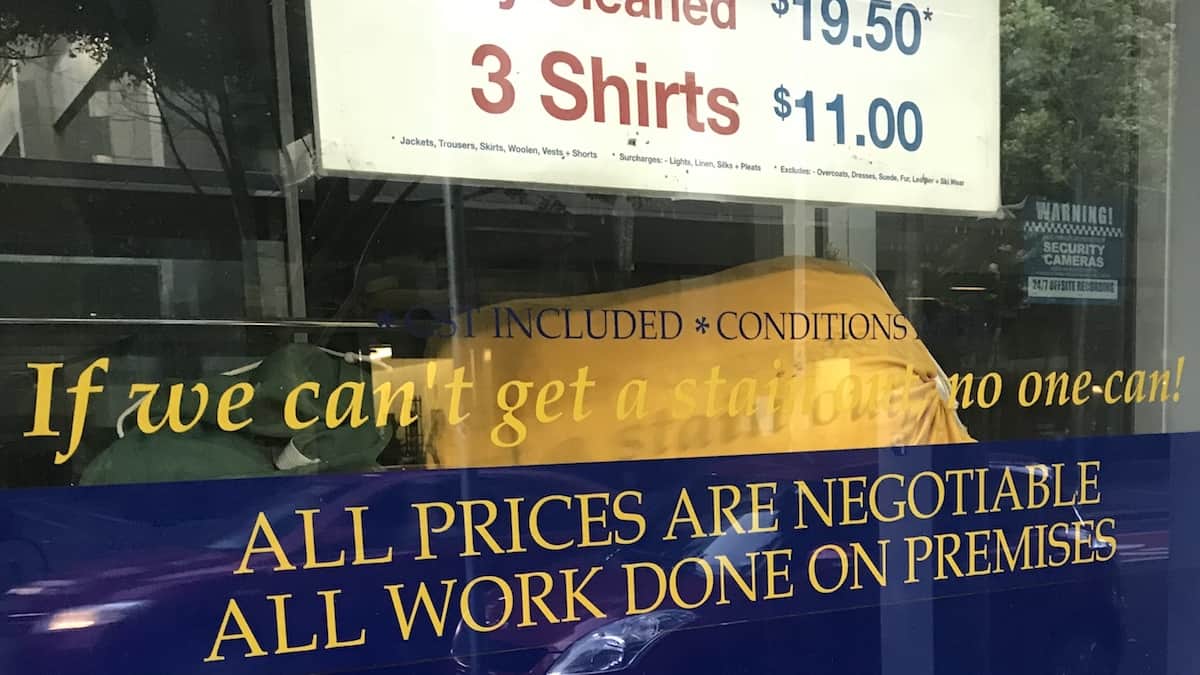
Visiting Australia, I passed a dry cleaner in Sydney—and noticed a terrifying sign (see right). It said: “All Prices Are Negotiable.”

Are you telling your agency’s clients—directly or indirectly—that you’ll cut your prices for anyone who asks? Stop selling against yourself! You’re hurting your own profit margins—and your salespeople may be doing it, too.

Let’s define “selling against yourself,” examine why it’s bad, look at how you may be doing it with your sales prospects, and review how to stop. I’ve also included three “before & after” scenarios to illustrate how to fix things.

What is “selling against yourself”?

Selling against yourself is a sales mistake that hurts your profit margins—it’s when you volunteer to make price cuts without cutting the scope of what you’re delivering.

Selling against yourself is usually a combo of poor self-esteem, weak sales improv skills, and an inability to listen actively (and bite your tongue).

It’s the sales version of an “unforced error” in sports—you didn’t have to make the mistake, but you made the easily avoidable mistake anyway.

Example of Selling Against Yourself

You’re selling against yourself when you tell a prospect you’ll charge less—potentially less than the minimum budget you know your agency needs to get results for clients.

  • You: “Our minimum engagement is $20,000.”
  • Prospect: “We were hoping to keep the budget to $10,000.”
  • You [knowing that charging less than $20K always leaves clients unhappy]: “You know, we can do something for $10,000.”

In a section below, I share the “after” version of how to preserve your dignity.

I learned a client would offer a “friends and family” discount to nearly anyone. He had also given a non-profit discount to organizations that weren’t non-profits—the clients had done nothing to earn the discount.

Keep in mind that “selling against yourself” isn’t downselling—downselling is an intentional sales technique, where you recommend a lower-scope, lower-priced option because the cheaper option is more suitable.

This also isn’t about choosing to make something strategically free—where you choose to discount something (and call it out) because it helps you, too.

Why does “selling against yourself” hurt your profit margins?

You’re cutting prices without cutting the scope—which means you’re reducing revenue without reducing the labor involved.

This is a profit-killing problem regardless of the pricing model you use:

  • Hourly Pricing: When you lowball the hours estimate, you’re unlikely to finish the work you expected.
  • Milestone Pricing: When you reduce milestone prices without cutting scope, you force your team to keep working on the milestone after the budget’s gone, or encourage people to cut corners on quality.
  • Value-Based Pricing: In theory, your value-based price is far higher than what you’d get on a milestone basis, but you risk missing performance payments… or are guaranteed to lose margin via a lower value-anchored price.

Your daily choices add up—if last year’s net profit margins were lower than 20-30%, and your YTD margins also trending low, it’s because you’ve made a series of poor decisions along the way.

As the agency owner, low profit margins are ultimately your fault—but you’re also empowered to fix the problem. Let’s review what the problem might look like, and then how to fix it.

How you might be selling against yourself today

It’s normal to feel nervous in a sales setting—but it’s dangerous when feeling nervous leads to giving away the farm.

Don’t make an instant price reduction

Here’s how an instant price-cut might look in a sales conversation:

  • You: “Our proposal is $50,000.”
  • Prospect: “Wow, that’s a lot of money!”
  • You: “Uh, what if we made it $45,000?”

In a section below, I share the “after” version that helps you keep that $5,000 for your bottom line.

Selling against yourself comes across as desperate—and some prospects will choose to exploit that further by actively requesting further price concessions.

Offering a lower-priced option is OK, but tell the prospect you need to consult with your PM team first, to see what scope you’d need to cut.

Don’t shave your proposal prices

You also sell against yourself when you shave your proposal prices—without cutting scope—because you assume prospects can’t afford what you want to charge.

Here’s how your internal meeting might go:

  • Your PM: “It looks like we can do the full scope for $140,000, and the reduced scope for $120,000.”
  • You: “They don’t want to go over $100,000. Can we get the full-scope price down to $95,000?”
  • Your PM [calculating]: “We can reduce the small scope to $95,000, but the full-scope can’t go below $130,000.”
  • You: “They’re really nice people. I’m going to quote them $99,000 for the full scope; I’m sure we can find other ways to save money later.
  • Your PM [starts looking for a new job]: “Sure!”

Below, I share an “after” version of how to handle that scenario without making your PMs want to quit.

Sometimes this is because you feel like you’d never pay the price—but you’re not your clients, and they often have more money than you think.

Let’s look at new ways to handle the scenarios above—in ways that don’t involve selling against yourself.

“After” Scenarios: What to Do Instead

To create a “before & after,” I’ve “fixed” the earlier scenarios to eliminate selling against yourself!

Standing Firm on Your Minimum Budget

Stick to your guns! Try this instead:

  • You: “Our minimum engagement is $20,000.”
  • Prospect: “We were hoping to keep the budget to $10,000.”
  • You [knowing that charging less than $20K always leaves clients unhappy]: “To deliver work you’ll love, our minimum is still $20,000, but I can point you to a cheaper competitor.”

Prospect Says Your Price is High

This isn’t an automatic request for a price cut—use the opportunity to “sell” the value.

  • You: “Our proposal is $50,000.”
  • Prospect: “Wow, that’s a lot of money!”
  • You: “Let’s review the value. Based on what you shared, you’ll save $120,000 in the first year, and another $100,000 after that.”
  • Prospect: “That’s still a lot up front, but it’s a great ROI!”

Your PM Team Says the Minimum is More than the Client’s Budget

The prospect’s budget may not be as fixed as you think, or the prospect may be open to a lower-fidelity option. Either way, don’t ignore your PMs’ advice—you’ll regret it later when you look at year-end profitability.

  • Your PM: “It looks like we can do the full scope for $140,000, and the reduced scope for $120,000.”
  • You: “They said they didn’t want to go over $100,000. Can we get the full-scope price down to $95,000?”
  • Your PM [calculating]: “We can reduce the small scope to $95,000, but we can’t go below $130,000 on the full-scope option.”
  • You: “OK; I’ll offer the small scope at $100,000, and explain why they’d need to pay $140,000 for the full scope. Can I get your help creating a Reason-Options-Choose summary?”
  • Your PM [sighing with relief]: “Sure!”

If you make some changes, you can stop selling against yourself—read on for my tips!

Tips to stop selling against yourself

The exact solution will depend on the specific causes at your agency—but here are some places to start.

  1. Strengthen your sales pipeline. When you have a strong sales pipeline, you’re less likely to feel desperate—and you’re less like to feel you need to close the deal at any cost.
  2. Say you need to consult your PM team first. This is a good idea anyway, but it creates a built-in “pause” before you confirm a new budget/scope combination. Your team can help you assess risks before you make a binding commitment to a prospect—and it underlines that you “have a team.”
  3. Bite your tongue, and then ask followup questions. Selling against yourself often happens when a prospect stops talking, and you talk to fill the silence. It’s a dangerous verbal tic—one that might cost you thousands of dollars a year. Besides, you should be an active listener anyway.
  4. Focus on selling the value of what you offer. When you convey that the value—to the client—far exceeds the price, they’re less likely to act like they expect concessions. Value-anchoring is a big help.
  5. Listen to your team when they warn you about price cuts. In my experience, your employees are often more concerned about profit margins than you are. Why? Because they hear you talk about profitability… while you’re worried about payroll. Yet they’re the ones who’ll deliver the work—don’t hobble them.

Think About Profits… and Team Morale

Earlier in my career, a boss quoted a web development project at $100,000. The client blamed another agency for problems, and they’d switched the work to us.

During sales negotiations, the client pushed the fixed-bid price down to $40,000… but without a commensurate scope reduction. As the PM, I now had to deliver.

I left the agency during the middle of that particular project, but the coworker who PM’d it said it ended up being a $60,000 scope… on that fixed $40,000 budget. My former boss had denied the agency $20,000 in profits… and frustrated the team by making them clean up the mess.

Question: What do you need to change to ensure you don’t sell against yourself anymore?

20 Jun 15:30

Prospecting: 10 Ways to Master the Art of the Follow-Up

by Mark Hunter

How good are you at following up?  As much as people struggle with getting prospects, it’s amazing how many potential prospects turn cold for one reason —  a lack of meaningful follow-up.

If you think follow-up means to send the prospect an email that says something like, “Did you see my last email?” or worst yet, “just checking in,” then you need to have your email privileges revoked immediately.

Following up is an art. It’s not something that’s done quickly at the end of the day to give yourself the feeling you’ve done your job.

Check this short video on the #1 way to follow-up with a prospect:


There are 10 ways you can master following up with your prospect.

Each one of the techniques will have varying results based on the situation.  We can’t expect all 10 to work for any single prospect. Rather, it’s a process of using the right one or two techniques at the right time.

1. Send an email restating exactly what they shared with you and then ask them a question about what they said. By sending back to them a note with exactly what they said, you show not only that you listened, but also that you value what they say.

2. Send an email sharing one new piece of information about a key interest they have and ask them a question about it.

3. Send an email recapping the conversation you had by using brief bullet points and state what you will be doing as the next step. Conclude by asking them to share back with you if they’re in agreement with what you wrote or if there are any changes.

4. Leave a voicemail stating a new piece of information you found and confirming the time you agreed to meet again.

5. Send a short 20-second video embedded into your email thanking them for talking with you and then recap one key point. End by stating what the next step is.

6. When you send an email to the person you met with, send it as reply to an earlier email conversation you had with the prospect. Continuing the string will help the prospect link back to you, because many times a “sales call” will wind up becoming nothing but blur within hours after it’s over.

7. Send via the regular mail a handwritten note of thanks, followed by the next step you both agreed to do. (Yes! The regular mail still exists and is a great way for you to stand apart from your competition.)

8. Call the person shortly after the first call is over and ask them to explain a little more on something they shared with you. Making the call later the same day helps to create a sense of urgency and will be soon enough that the prospect will not have forgotten what they said.

9. Watch for key news about the prospect’s company or interests they might have. When you see something, immediately call or email them with the news.

10. Send the person a PDF or a URL link with key information they would find of value and ask them a question or two about it. Ask them to get back to you with their thoughts. This approach is a great way to determine if the person is keenly interested in working with you.

This is simply a list of 10 ways to follow-up. There are many more, but the key is to do just that —  follow up!  Don’t wait for the prospect to call you. Be proactive. Bring value. Make the connection.

A coach can help you excel in your sales career! Invest in yourself by checking out my coaching program today!

Copyright 2018, Mark Hunter “The Sales Hunter.” Sales Motivation Blog. Mark Hunter is the author of High-Profit Prospecting: Powerful Strategies to Find the Best Leads and Drive Breakthrough Sales Results

20 Jun 15:30

The keys to maintaining a great culture within a remote sales team

by steli@close.io (Steli Efti)
TinCanPhone

If you’re not restricting your potential employee pool to one location, you’re able to hire the best of the best no matter where they live.

On top of that, you don’t need to pay for a giant office space, meaning employees can be compensated better; your employees don’t have to suffer through a morning commute, giving them more time to execute; and everyone has the freedom to work wherever they feel comfortable.

Essentially, the remote work experience is full of pros.

That said, there’s one primary issue that a lot of remote sales teams struggle with:

Their team culture sucks.

When everyone works in the same office space, it’s a lot easier to establish and maintain a certain culture within the company. Sales reps are able to chat throughout the day, go for lunch as a team on a weekly basis, and form authentic relationships with each other. These things aren’t so easy with a remote sales team.

Does that mean every remote team is destined to have a terrible culture?

Absolutely not.

You just have to be more intentional about establishing a company culture that helps the entire team succeed. We’ve talked about how we maintain a quality company culture at Close.io with a distributed team:

 And in this blog post, we want to break down some of the steps to maintaining a quality culture for a remote sales team. These four steps are key to building and maintaining a great culture where your sales team hits their quota and is committed to your organization's vision and goals:

Set crystal-clear objectives & goals

If your remote sales team doesn’t have concrete sales goals and objectives to work toward, their natural instinct will be to go through the motions. Without ambitious goals to strive for, they have no incentive to put their best foot forward.

Here’s where I see a number of remote sales managers get it wrong:

The idea here IS NOT to have a handful of lofty numbers with no true meaning or connection to legitimate success, and maybe some vaguely worded quality assurance goals. If there’s any confusion about what your objectives are or why they matter, you run the risk of having your team work toward something they think is a priority, when it actually has nothing to do with your overall goals.

To avoid the demotivating realization that your team is working their tails off on the wrong things, ensure your goals and objectives are crystal-clear from the beginning—the very beginning. Prospective inside sales reps should know exactly what their responsibilities and objectives will be so that if they’re hired, they’ll fit seamlessly into the team.

Create a process-driven sales culture

When it comes to creating and maintaining a great culture, processes are paramount.

Having a well-defined sales process for every day-to-day task will keep new sales reps from constantly asking for a tutorial on routine activities—or, even worse, taking a blind guess on how to do something and getting it completely wrong. In both scenarios, the end result is lost time for both the sales rep and their team manager.

Instead of watching time and money dwindle away, take the time to outline every process they might need to know—expenses, travel, building quotes, processing orders, support escalation, and anything else you think they may need to do.

Create the processes, document them, introduce them during the onboarding of new sales reps, and make sure these documents are readily accessible at all times.

Get the right tools for the job

Without the right tools, it’s nearly impossible to successfully manage a remote sales team and maintain a great culture at the same time. Luckily, there’s a near-endless amount of powerful tools out there to help you accomplish just about anything you need to do for your business.

While a lot of these tools are highly specialized for accomplishing certain goals that vary from business to business, there are a handful of staples that every remote sales team can rely on to stay connected and on the same page:

1. Slack for Communication

If you want to maintain a great culture within your remote sales team, communication is key, and Slack can serve as the virtual watercooler where the majority of that communication takes place. Once you set up your team’s Slack workspace, you can create a separate Slack channel for each client, project, or topic and keep every conversation in the proper place.

2. Asana or Trello for project management

There are a lot of moving parts associated with every project, initiative, and account your remote sales team handles. A tool like Trello makes it easy to manage each of these projects remotely. You can create separate boards for clients or company focuses, then add cards to each board that represent projects. From there, you can set due dates and assign team members to each project.

3. Close.io for all sales activity

Of course, in order to maintain a high-functioning remote sales team with a great culture, everyone has to be on the same page when it comes to potential customers and where they are in the decision-making process. You can use a tool like our inside sales CRM with integrated calling and emailing to keep all of that sales activity in one place and easily carry leads from prospect to customer.

Embrace the idea of over-communicating

By now you know that communication is vital for remote sales teams, but maybe you’re afraid of flooding your team’s inboxes or Slack notifications. Think about this:

Your team can never be TOO in the know.

It’s always better to over-communicate than under-communicate. Make sure your team is well aware of everything going on in the company and on their team. If they think they’re out of the loop, they’re going to feel disengaged.

A tool like Slack helps with communication, but nothing can beat a face-to-face meeting. Of course, it can be tough to meet up for a team lunch when your employees live hundreds or thousands of miles apart.

To keep your team engaged, host weekly video calls through Google Hangouts to talk progress, company news and life, and to give the team a chance to celebrate any big wins they’ve had that week.

Now over to you

If you’re thinking about building out a remote sales team or shifting your current team to a remote experience, there are a ton of benefits that you can expect. In order to make sure the team stays motivated, though, maintaining a great remote culture will be key.

Here are those four important steps again:

  1. Set crystal-clear objectives & goals
  2. Create a process-driven sales culture
  3. Get the right tools for the job
  4. Embrace the idea of over-communication

Follow these steps when building out your remote sales team and you’ll be setting yourself up for culture success. With great company culture come great employee happiness levels, and with great employee happiness levels come great results for the company.

Want more tips on building a winning sales team? Download a free copy of my book The Sales Hiring Playbook, where I share my best advice on hiring and managing sales reps.

Get the Sales Hiring Playbook

19 Jun 15:42

Why Scalable Marketing and Growth Hacking Must Be Paired Together

by Ryan Shelley

geralt / Pixabay

Growing a business is not for the faint of heart. While the internet has definitely leveled the playing field, it’s also created a lot more noise. From search engines to social media, there are tons of ways to reach your customer base. But getting their attention takes more than a few growth hacks.

If you have read my content before, you know I love growth hacking. But it’s not a silver bullet to success. In order to fully reap the benefits of a good hack, you need to have a scalable marketing strategy as well. Check out the video below to learn more.

Video Transcription:

Hey. What’s up? Welcome to Hack My Growth. In this episode, we’re going to be looking at a chapter inside of Rand Fishkin’s book, Lost and Founder, about the difference between scalable marketing and growth hacking. All right. Let’s go.

Hey, thanks for checking out the show. If this is your first time watching, or maybe you’ve been watching for a while but haven’t yet joined us, please hit the subscribe button. We would love to have you join our community.

So Rand Fishkin is the starter of Moz, he recently stepped down, he’s got a new project going on now, Spark Toro, so check that out too if you want to continue to follow Rand. But Moz was really one of the first SEO platforms for the everyday digital marketing. They did an amazing job of creating great content early on, explaining how SEO worked and doing a lot of tests and helping educate people about the power of search marketing. And in Rand’s book, he uncovers some of the struggles and the things that are going on in the startup world, but he also has a lot of good insight into marketing.

So this show’s called Hack my Growth. And a lot of times when we hear about growth hacks, we think shortcuts. The reality is we try never to really just give you shortcuts, we try to give you quick tips to help you to execute a good marketing strategy. Now a lot of times, especially in today’s world, we see startups and small businesses looking for that hack that’s going to get them over the top, you know the one that they can leverage, so they don’t have to do any marketing, we just want that secret sauce that’s going to get us up there.

The reality is that doesn’t happen. You can use growth hacks to help grow faster, you can use growth hacks to help get you into a market, but you also need to pair that with a scalable marketing approach. And Rand does a really great job and there’s a whole chapter on the importance of building a scalable model versus a growth hacking model. So here’s what they’re doing here at Moz; this is kind of their scalable, what they call flywheel. But I want to kind of talk about the difference between the scalable approach and growth hacking approach.

So, if you’ve been watching the show for any time now, you know that we follow basic inbound methodology, which is a funnel, right? And we’ve got to move people along this process so that we can move people along the process even more. You kind of start broad and you work your way down. And in this chapter, Rand starts talking about keyword research, understanding who your audience is, you know? This is where we want to attract people. Then we want to be able to build them into customers, covert them. And then we want to close them. And then the last thing on inbound is delight. Don’t just miss the bottom part of the funnel, we want to build a customer that loves us so they stay with us. It’s 10 times more expensive to acquire a new customer than it is to keep a good existing customer.

This is why this part’s so important and it often gets overlooked. The thing about this is it takes time. It takes time to do the research, it takes time to build the content, it takes time to understand who your audience is, it takes time to see what resonates with them. And a lot of businesses don’t have the patience to do this. And so what they do is they look for hacks, they look for ways to jumpstart. Now you can insert growth hacks all along here. Maybe you’re starting to do some A/B testing to find out which is the best version of a landing page which could increase the conversion rates from those two things. Maybe you test a referral program, this is a very popular one in the SAS world, you can test a referral program to see if that’s going to generate more closed customers.

But these on their own aren’t going to do you much good. What you have to do is pair scalable and hacks. When you do this, this is when you actually can start to see a ton of growth. But these have to work together. These aren’t separate things that happen in their own eco-system, they have to work together. Because what’s going to happen, if you just rely on hacks, you’re going to get those short spurts of growth, growth, growth, and then it’s going to stop. If you go to a scalable solution, you’re going to be able to grow long-term and insert hacks along the way to grow even faster.

Hope you guys learned something today, and until next time, Happy Marketing.

19 Jun 15:40

Smarter Amazon: 5 New Sites and Extensions Every Online Shopper Needs

by Mihir Patkar
amazon-extensions

When you are shopping on Amazon, the impulse to buy with a single click can result in some bad deals. With the right websites and extensions, you can save yourself this hassle. And no, we don’t mean old ones like CamelCamelCamel.

Of course, tools like CamelCamelCamel are still good at giving you a better shopping experience on Amazon. What we’re dealing with here are better replacements for them or extensions that solve other problems.

The Review Index (Web, Chrome, Firefox): Graphical Summary of User Reviews

User reviews on Amazon are a mess, but they have valuable information about what you’re purchasing. The Review Index tries to organize what people are saying by turning it into data.

The site analyzes all the user reviews for a certain product, ranking them based on certified purchases. It also runs a spam test to spot fake reviews and weed them out. Once it has all the information, it turns that into data about pros and cons. For example, with a laptop, you will find how positive or negative people have been about its screen, reliability, body, etc. The simple bar graphs make it much easier to figure out the popular opinion.

The Review Index works mainly with technology products like phones, televisions, headphones, routers, and so on. It’s best if you use it for such gadgets.

Download: The Review Index for Chrome | Firefox (Free)

The One (Chrome): YouTube Reviews, Final Pricing, and More

The One is trying to be the only shopping assistant app that Amazon users will need to install. It still has some way to go though, so for now, you’ll need the other extensions we are talking about. That said, The One is worth a look already.

When you are looking at an item, The One simultaneously searches for reviews of that product from professionals on YouTube. The video is then embedded in the Amazon page you are looking at, so you never need to browse away. Just like that, you’ll get to see actual unboxing and review videos.

The One also fixes a persistent Amazon annoyance. Anyone who shops on Amazon knows that the price displayed on the first page doesn’t include add-ons like shipping and taxes. So The One displays the final, all-inclusive price for all sellers, even international ones that will ship to you.

Download: The One Shopping Assistant for Chrome (Free)

Keepa (Web, Chrome, Firefox, Edge): Price Tracker With Messenger Bots

Keepa is still new in the world of price trackers for Amazon, but it has quickly built a base of people who swear by it. It takes some of the best features of existing price-watchers and adds plenty on top of it.

Keepa has bots for both Facebook Messenger and Telegram, which you can use to quickly search for a product’s price, and set up price alerts. Since most of these trackers work through desktop browser extensions, this is a nice touch that brings the tracker’s features to your mobile.

As for the features, they are what you would expect from any good tracker. You can add products to a wishlist, as well as set a price alert. You will see the price history of any product you are looking at on Amazon.

There’s also a Deals section, but I didn’t find anything worthwhile there. There are better ways to get the best discounted deals on Amazon.

Download: Keeps for Chrome | Firefox | Edge (Free)

Recon Bob (Chrome): Can You Trust That Seller?

Usually, you purchase items directly from Amazon, but there are times when a product is much cheaper through one of Amazon’s third-party sellers. But how can you tell if the seller is trustworthy? Recon Bob can figure that out for you.

Before you confirm the purchase, check the seller’s rating on Recon Bob. The tool will analyze what other users have said about that seller, warning you about any potential issues. Even if the seller has majorly positive reviews from customers, Recon Bob will still flag the problem posts to tell you what can go wrong.

Remember, even though Recon Bob is only available for Chrome, you can install Chrome extensions on other browsers.

Download: Recon Bob for Chrome (Free)

Needzly OneSearch (Web): Search Amazon, eBay, and Walmart (and See All Deals)

You would prefer Amazon on most days, but if the product is cheaper on eBay or Walmart, you might as well pick it up there, right? Needzly has introduced a universal search engine for all three online retailers.

Search for anything and you get a list of prices from cheapest to costliest. The search, unfortunately, doesn’t include shipping costs, so even when you see something cheaper, remember that it might cost more with shipping. That said, you can still save a big chunk of money by cross-referencing your item with eBay and Walmart before you buy it on Amazon.

Needzly also has a deals page where it finds discounts across all three stores. These are usually the cheap items like what you’d find on the Amazon’s daily deals, but hey, who said those aren’t worth it?

What Amazon Hides

These new extensions and websites will naturally help you save money. But what you probably don’t know is that Amazon doesn’t easily disclose some of its best deals and discounts. Here’s how to find what Amazon hides.

Read the full article: Smarter Amazon: 5 New Sites and Extensions Every Online Shopper Needs

19 Jun 15:40

What Topics Do Your Prospects Want to See?

by Kara Jensen

Central to a content marketing strategy is the blog and all those wonderful, insightful blog posts. You may be asking yourself, we have a lot of subject matter experts but what do our prospects really want to read? Great question, we are glad you asked.

In this week’s blog post, we are going to explore five main blog types that your prospects want to see on your B2B website.

Instructional Articles

Whether you are in biotech, accounting, manufacturing, or SaaS, many of your prospects want to read instructional articles that have clear directions. These can take on various styles, including:

  • How-to instructions – Explain how to use a product or service. These are particularly great for SaaS companies or prospects looking to implement a new service or vendor relationship.
  • Use cases – These can be a shortened version of a case study or include feedback from actual clients on how they implement your products or services.
  • Real examples and applications – While you do want to tell prospects how a particular product or service works, your B2B website’s blog is the perfect place to SHOW them real examples and applications.
  • Step by step guides – When in doubt, walk a prospect through a particular process or procedure. Take screenshots or discuss every phase in the process to really break it down.

Expert Answers

An effective content marketing strategy positions your B2B firm as a thought leader in your industry. Sharing answers from your subject matter experts are the perfect way to harness all that knowledge and insight across multiple departments in your organization. Great blog topics will cover:

  • Common issues and solutions – What are the pain points or common issues your prospects are facing? Address 3 to 5 of them in a blog post along with recommended solutions. Be sure not to tip to the sales side by providing straight-forward solutions.
  • Basic and advanced questions with clear answers – Never assume that your prospect understands everything about your products or services, your industry, or even the terminology of your industry. Remember, for B2B companies, there are often multiple decision-makers spread out through different levels and departments in an organization.
  • Advice on problem-solving – Your B2B web design should position you as the expert with multiple resources for prospects. As part of your blog strategy, craft posts that provide real advice on problem-solving certain issues or situations. If your blog provides great advice, it will naturally become the go-to resource for your prospects.

Strategic Guidance

What often separates B2B from B2C is the long-term nature of the relationship. Instead of a transactional relationship, it ends up being more of a partnership with the sharing of strategy and back-and-forth communication. For this very reason, it’s essential to draft and share blog posts that provide valuable strategic insights for prospects. How will they know what it’s like to do business with you unless you show them what it’s like? You don’t have to give away all of your knowledge, but start with writing up posts for your B2B website on:

  • Best practices for implementation – You know your products and services inside and out. You’ve seen clients use them with great success and likely seen failed implementations. Share the best practices for using your products or services. What is the best approach to changing software? What is the best way to get all the internal users on board?
  • How to get the most value – Before, during and after a closed deal, you must show the value of your products or services. Create blogs that demonstrate to your prospects how they can get the most value from a particular process, procedure, product, tool, or strategy.
  • Where to save costs, time, resources – Blog posts that show prospects how to save costs, time, and resources are highly sought after. Think about it, if someone can save you time, money, or resources before you become a client – imagine what they can do once you are a client!

Hard Numbers

Let’s face it, it’s important to get down to the nitty-gritty and talk real numbers. Which numbers will resonate with your prospects? For example, we drafted a blog post that discussed B2B web design statistics. The intent with the article was to give marketing managers the data they needed to convince CEOs and CFOs that a website redesign can bring in money in the long run (or cost them money if they have an outdated website). It’s one of our most popular blog posts and helps our prospects get internal buy-in for website projects. Here are a few options for blog posts:

  • Statistics – Real statistics from research, especially on what the industry as a whole is doing, can be critical. Rely on reputable data sources that are fairly recent and help your prospects by translating what the statistics mean for them.
  • Real numbers and costs – Lay it all out and get technical with costs, fees, pricing, costs of outdated info, etc. Great articles are those that show the cost of not doing business with your firm. Lost dollars, time, efficiency, etc. speak to the emotions of your prospects.
  • Data, data, and more data with real examples – Any data you have, whether it’s analytics, number of companies, placements, deals won, etc. that will resonate with your prospects should be included in blog posts. Don’t be afraid to share data (remember that your competitors might already be sharing data!).

Current Trends

You have your finger on the pulse of what is happening in your industry. Sharing that information with your prospects helps them to stay up-to-date and lets them know that you are an industry leader. Below are a few options for current trends blog posts that your prospects will be searching out:

  • Industry overview – Provide an overview of what is happening in your industry. Discuss who is up to what, what you predict to be trending, trends that aren’t what they are hyped up to be, etc. Don’t just list facts about your industry, provide insight and takeaways for your prospects.
  • Industry trends and happenings – Things are constantly changing, sometimes faster than ever. Pick one trend or 10 trends and analyze them. What is working and why? What is starting to show promise? What has died out and makes a firm look dated?
  • The latest methods, research, changes impacting them – What’s In It For Me WIIFM)? Assume that your prospects are innately selfish and what to know what is impacting them and their business (because it’s true). Address the latest methods, processes, advancements in the products and services that will impact your prospects? Will a new advancement reduce costs or improve efficiency? Cover these topics in the blog and post them in a timely manner to avoid becoming yesterday’s news.

At Bop Design, we’ve seen how critical the blog is to the overall effectiveness of a B2B web design and content marketing strategy. By continually adding new, fresh content to your blog, you provide engaging resources for prospects that will establish your firm as a thought leader and reliable source of information.

19 Jun 15:39

How to Set and Achieve Monthly Sales Targets

by Nicole Bryan

Top sales performers are those who achieve or exceed their targeted sales goals. With everything a value-added reseller has going on between juggling their clients and looking for new prospects, it can be difficult to hit sales targets every single month. Why is it that resellers fall short of their goals some months?

On closer evaluation, you will find that this lack of goal-hitting is usually due to weak goal setting in the first place. Setting strong and effective goals is the basis for a reseller’s sales strategy. With the right goals, finding the best leads and following through on sales is nearly impossible.

Here are some effective tips that VARs can follow to set the right goals and achieve their sales targets:

  • First Things First, Set a Goal

Every sales person sets goals, but there is a difference between goals and the right goals. It is important to ask if your goals are “SMART” – Specific, Measurable, Attainable, Relevant, and Timely. If they do not meet every one of those characteristics, then a goal-setting exercise is imperative and the first step towards hitting sales targets. A goal needs to have a clear direction and be able to be measured for effectiveness. Goals also need to be realistically attainable and have a timeline.

  • List Out Your Prospects

On average, sales reps make 52 calls every day and it takes 8 follow-up calls to reach a prospect, with 50% of their time being wasted on unproductive prospecting. You can waste a lot of time prospecting and lose out on prime sales productivity. That is why it is important to figure out your buyer profiles and know who to target and how your POS products can help them. Beyond that, having a list of all sources such as social media, customer referrals, websites, or emails, so you know where your prospects are coming from.

  • Communicate with Prospects to Gauge Conversion Possibility

Setting up meetings with prospects that were never going to purchase or even potentially purchase in the first place can be exhausting and a waste of time. You can cut back on useless meetings with uninterested prospects by researching their needs. Ask yourself, “do I have the right POS system for their needs?” or “are my POS systems in their price range/ budget?” Also, ask the right questions to find out their interest in the initial calls with them. This will give you the kind of insight you need to know whether or not there is a possibility to convert them into a serious prospect.

  • Regularly Communicate with Your Existing Customer

Successful sales approaches are all about building strong relationships. Just because you have made the deal with a merchant doesn’t mean that is where your relationship ends. Keep in touch with them regularly through thank you calls, feedback emails, or even just sending them updates. This will ensure that your partnership with them stays at the forefront of their mind. More than likely, they will stay a repeat customer or provide referrals.

  • Don’t Be Shy, Ask for Referrals

Do not hesitate to ask your customers for referrals. If you have maintained a strong relationship with your merchants, there is no issue at all in asking for referrals. This can be done through email or in-person visits. Having a business card on hand to give to your clients right after you close the deal with them will help keep your contact info on hand for them if they need it. Small business owners tend to have other small business owners as friends.

  • Review Sales Goals Weekly

Goal-setting should be a continuous exercise, one that requires tweaks and revisions depending on the week. Sales goal review sessions give you a progress report – it will show you where you stand and what actions you need to take to move closer to your sales goals. It also helps with facing challenges that may arise weekly.

  • Improve Your Selling Skills

Selling is and should be the bottom line of any salesman, which means there is no way that you cannot afford to master it. Some ways to improve your selling abilities are:

– Understand POS products in detail and understand customers’ needs and expectations.

– Have a firm grasp on competitor’s offerings and market dynamics.

– Keep yourself updated with the latest trends in sales practices, sales strategies, payment processing, and VAR tools.

– Work on your pitches. Make sure you have them down and that they strongly convey who you are and what you offer.

– Be confident and keep a positive attitude.

– Be a good listener and ask the right questions.

The attainment of sales targets is difficult, but not impossible. Setting strong goals and following through on those goals will lead to a successful sales approach. Once the goals are set, it is crucial that you keep the communication open with your current clients, ask for referrals, and always look for ways to brush up on your skill set and stay competitive.

19 Jun 15:38

28 Questions to Ask on a Discovery Call During the Sales Process

by dtyre@hubspot.com (Dan Tyre)

Sexy as closing calls may be, they don't happen without solid discovery calls laying the groundwork. The smoothness of your sales process, the quality of your sales conversations, and ultimately, the difference between a closed-won deal and one that hits a wall can all rest on the success of your discovery.

Not all prospects are created equal — so no matter how sound your offering might be, there‘s no universal guarantee that everyone you talk to is a perfect fit. A well-structured, thoughtful discovery call gives you a sense of the size and viability of a deal — cueing you into whether the 10 to 20 hours you’re going to spend with a prospect will be worth the effort and resources.

Now, you might be thinking, “These discovery calls sure do sound important — but where on Earth can I go to learn more about them?” Lucky for you, you‘re in the right place. Here, I’ll offer more context about what discovery calls are, the best questions to ask whether your prospect is a good fit, and some handy discovery call scripts. So what are we waiting for? Let's dive in!

Free Download: 101 Sales Qualification Questions [Access Now]

Table of Contents

The discovery call is your tone-setter, and I mean that in a few ways. For one, it's the first opportunity you have to talk to your prospect at length — making it crucial in establishing sound rapport.

It also gives you valuable context about your prospect‘s goals, needs, interests, and pain points — giving you a roadmap for how to most effectively structure your sales efforts around your prospect’s specific circumstances.

In short, it can be the difference between establishing an authoritative relationship or spending your whole sales process playing catch up.

Admittedly, I‘ve made my fair share of shoddy, shallow discovery calls at points in my career. The result? I’ve had an equally fair share of unduly complex deals that I thought would be straightforward.

Why are discovery calls important?

Discovery calls are central to understanding any prospect‘s situation. And that makes sense — you can’t understand the nuances of what a potential buyer is dealing with if you don‘t ask them about, well … what they’re dealing with.

Luckily, in my experience, prospects are generally okay with participating in a discovery call — so long as it's not an interrogation.

Discovery calls pose some key benefits, including:

  • Helping your prospect understand your business and product. These days, buyers are as empowered and well-informed as they‘ve ever been. Still, I’ve found that there‘s almost always room for them to learn more in discovery. A discovery call provides a forum for you to answer your prospect’s specific questions about your product and, in turn, gauge and capture their interest.
  • Showing you’re invested in your prospect’s success. A thoughtful, well-executed discovery call shows your prospect that you understand their problems and will make a concerted, professional assessment to see if you can help them — demonstrating that you care about their success, not just their money.
  • Giving you a sense of whether you can actually win their business. I've had my share of ultimately doomed deals that I wasted a lot of time and effort on — and in some cases, that stemmed from undercooked, poorly executed discovery. These kinds of calls give you an opportunity to qualify your prospect, providing the space to learn their pain points and degree of organizational influence. Discovery calls help you get a sense of whether they have a bonafide need for your offering and whether your contact will advocate for you. Incorporating a sound qualification framework like BANT (or an alternative) helps you get this done.

As you can probably tell at this point, I‘m a big discovery call guy. I sincerely believe that delivering on yours is critical to a successful sales process — so at this point, you’re probably thinking, “Oh baby, Dan! I‘m sold on this whole ’discovery call' thing! But where do I go from here? How in the gosh darn heck do I handle these calls?”

To that, I say, “Good question, reader!” Here's the answer — asking the right questions. Let's take a look at some of the questions I often incorporate into my discovery calls.

For context, sales discovery generally involves four parts: setting the stage, qualifying the prospect, disqualifying the prospect, and establishing next steps. You won’t be able to cover every question listed here on every call — and it might not make sense to — but I find as you go along, you should get a sense of the right questions to ask.

You‘ll notice that all of the questions I’ve listed are open-ended — that's because you want to get your prospect talking on a discovery call. If you limit a prospect to “yes” or “no” answers, you limit your ability to get as robust a picture as possible of their circumstances.

Let’s take a closer look.

Questions That Set the Stage

This is where you validate your research and learn about the customer’s situation. This gives you the proper insight you need to move forward.

1. Tell me about your company.

This seemingly simple question begins with an easy topic: The prospect’s own company. This gives them a chance to introduce themselves on their own terms, but be careful — if you ask this question too early, it might seem like you didn’t do any research at all. I generally begin by stating what I already know, then I ask this question, so they can build upon my description of their business.

2. Tell me about your role. What do you do day-to-day?

With this question, you can begin to find out more about the employee (not the business) in a more casual, low-pressure way. I don't dive too deep into the details when I ask this question. Keep things lower stakes here — and in my experience, prospects are usually excited to share.

3. What metrics are you responsible for?

Here’s where the pressure begins to mount. I find that prospects don‘t always touch on what they’re responsible for when asked the previous question. You need to ask this to uncover that information. The language here is also very important — I always use the word “metric.” You need to ask about a quantifiable measure of success. That will allow you to concretely quantify how your offering can improve that metric.

Questions That Qualify

After you’ve learned about your prospect, it’s time to identify their goals and clarify their pain points. You can use the Budget, Authority, Need, and Timeline (BANT) framework to help formulate the questions you'll be asking during your discovery call.

Learn about their problems so you can solve for the customer.

4. Tell me about your goals (financial, customer-related, operational).

In many cases, I append a timeline to this question: "Tell me about your goals for the next month/quarter/year" — adding that kind of specificity tends to produce more pointed, valuable insight. I usually choose a timeline depending on the implementation process of my product. For instance, if I was selling an enterprise-level tool that takes six months to set up, I might ask about yearly goals instead of monthly goals.

5. When do you need to achieve these goals?

While the prior question might hint at a timeline, this question explicitly asks when your prospect must achieve the goal. A yearly goal might be "To increase revenue by 5% year-over-year,“ but the cut-off date for that is in three months, just in time for the New Year. ”Yearly“ does not mean ”next year." It could be as soon as this quarter.

6. What problem are you trying to solve?

Does this question seem vague to you? That's because it is, and I have a good reason for that — that vagueness prevents you from pigeonholing a prospect into giving you a certain answer. I always want to give them a chance to bring up any problem they're facing. That way, I can get a better sense of their business challenges at a more overarching level.

7. Are you having problems in [area as it relates to the product]?

This question lets you lock in on the nuances of your prospect's pain points after the one above. I still keep things open-ended with this one, but now, I drive them toward a specific area of their business. I know this is technically a “yes or no” question — but it still prompts a prospect to think more deeply about their challenges.

8. What’s the source of that problem?

I always ask this question right after the previous one — that sequence lets me uncover key pain points or areas of friction. My prospect might not know what their problem is, but if I don‘t understand why they’re having the problem, I can't hone in on the source as something I can eliminate. Knowing the source of the problem is key to creating an irresistible sales pitch.

9. Why is it a priority today?

I‘ll occasionally skip over this question — but only if my prospect naturally reveals why their problem is a priority in the previous answer. That said, if I think asking this will give me a better sense of exactly why the problem they mention is a priority, I’ll go ahead and do it. It can provide valuable context around how urgent this problem is for your prospect.

10. Why hasn’t it been addressed before?

I find that knowing the roadblocks a prospect has faced in solving their problems can hint at their current roadblocks (or the ones they might face down the line). For instance, when a prospect cites budget as an issue with me, I know to focus on that as a qualifying factor.

11. What do you think could be a potential solution? Why?

I ask this question to find out how a prospect envisions resolving their problem — even if the answer might not include my solution. Asking this gives you a sense of where their strategic vision and priorities lie. It offers a valuable look at how they problem-solve, giving you some perspective on how to tailor your value proposition to suit how they think.

12. What would a successful outcome look like?

I ask this to get a sense of what their image of success looks like, and it's not always realistic — but it generally gives me a picture of whether my solution legitimately suits their ideal outcome. Listen without judgment here, but be sure to take note of their expectations to confirm whether you can actually help.

13. If you didn’t choose a product, do you have a plan in place to address this problem?

This question always gives me a sense of how urgently they need a solution for their challenges. If they say they don‘t have a plan in place or can’t envision solving the problem another way, then I know they're not a good-fit prospect.

Questions That Disqualify

Next, ask questions that might disqualify the prospect. Find out what you can about the decision process, from budget to scheduling.

14. What are your primary roadblocks to implementing this plan?

Even if I have an idea of the roadblocks a prospect will face, I still ask this question to get a straight answer from them. Sometimes, you need to put a prospect on the spot a bit — a frank question like this can get you some hard context on what they're facing.

15. What’s your timeline for implementation?

This question is one of the more important ones I‘ve listed here. If their timeline and my timeline aren’t compatible, I can more or less automatically disqualify them. The “T” in BANT is there for a reason — asking this question is the easiest way to reveal that context.

16. What’s the approximate budget for solving this problem?

Here‘s another frank, necessary question. You always need to know if there’s enough money for them to invest in a new product or project if you‘re going to allocate the time and resources for a sales engagement. I find that when it comes to sales, it’s never too early to talk about budget.

17. Whose budget does the funding come from?

Measure up the tone of the conversation before asking this question. It might be too probing for a prospect who’s not well acquainted with you yet. If you and the prospect are on comfortable terms, find out where exactly the money will be coming from.

18. Is the budget owner an “executive sponsor”?

An executive sponsor is a senior-level employee who’s directly involved in a project and is committed to its success. Whether that’s your prospect’s direct manager or a C-suite executive, it’s important to know whether the owner of the budget is a single person or the entire department.

Questions that Establish Next Steps

Lastly, ask questions that move the prospect along the pipeline. Provide a solution and offer next steps.

19. Who else will be involved in choosing a vendor?

This is a critical question for understanding whether your prospect is a gatekeeper, influencer, or decision-maker. Indirectly, you’ll also find out just how involved the decision-making process is.

20. Do you have written decision criteria for choosing a vendor? Who compiled these criteria?

If you’re speaking with a smaller firm, then the answer will most likely be no. But this question is important if you’re working with enterprise businesses. Try to get access to the decision criteria if possible.

21. Have you purchased a similar product before?

Knowing what your prospect has tried before will be instrumental in establishing a competitive advantage. You should be prepared to uphold your product above the competition’s even if the prospect doesn’t mention them by name.

22. Is this a competitive situation?

Who else is your prospect considering purchasing from? This question will uncover that without sounding whiny or defensive.

23. What’s the process for actually purchasing the product once you decide on it? Are there legal or procurement reviews?

If you’ve gotten to this point, you’ve probably built a high level of trust with your prospect. So you can ask right out about the purchase process without pushing them away.

24. What are potential curveballs?

While question #14 alluded to roadblocks, this question will reveal if there will be any unexpected changes that might bring the deal to a halt. Plus, if the prospect didn’t share too much when you asked about roadblocks, this question could do a better job of uncovering them.

25. How can I help make this easy?

The prospect might not have anything for you, or they might ask for additional resources and documentation. Either way, you want to give them a chance to articulate ways you can make the process easier.

26. How will this solution make your life better?

You can instill relief in your prospect by helping them envision how their work life will improve after they purchase your product. This will do a lot of work when it’s time for your prospect to present your solution to stakeholders.

27. If you implement this solution, how do you hope things will be different in one year?

Will they have more customers? Or will they have wasted less time doing menial tasks? Again, nudge them to envision how things will be better with your product on hand.

28. Can I follow up with you on mm/dd?

Close the call strongly by suggesting a date to follow up.

You’ll know that you’ve run a good discovery call if you and your prospect are able to create a written sales plan and delineate the next steps. If there’s still uncertainty when you hang up the phone, schedule another call to iron out remaining details.

Next, I'll review the sales discovery process, talk about how to run a discovery call and share a full discovery call template that you should follow for a greater chance of success.

This process is the first step in the connect phase of the sales process — and while it might revolve around teasing pressing and relevant insight out of your prospect, you can't go into it knowing absolutely nothing.

A discovery call calls for some prep work. If you approach your prospect without any context, you can‘t ask the kind of questions that will reveal the kind of information you need to thoughtfully consider whether they’re worth your time. You‘ll also run the risk of undermining your credibility with a prospect by coming off as disorganized — or you might lead them to believe that they’re just another name on a list for you.

Research the prospect and their company.

Spend as much time as you can researching and understanding your prospect’s business. Know their vertical, their challenges, and their goals. Take a look at their engagement history with your company — how did they demonstrate interest in you?

For instance, if they downloaded a guide on your website about SEO best practices, you can deduce that they might be struggling with their existing organic search demand generation infrastructure.

Having that kind of insight cues you into their goals and needs — and leveraging that perspective can inform much more thoughtfully tailored, effective discovery questions.

This sales meeting playbook can help you target your research efforts.

Gather what you’re looking for in a customer.

A discovery call‘s value goes both ways. You’re not just looking to impress a prospect — you're trying to determine whether a sales engagement with them is worth your time and effort.

That's why thoroughly understanding what you're looking for is just as important as understanding what they're looking for. Have a comprehensive understanding of your ideal customer profile and buyer personas.

Know who buys from you — along with what your solution can and can‘t offer them, their ideal price points, their buying habits, their typical pain points, and any other information that helps you understand the rationale behind your solution’s typical purchase.

All of this will help you structure the kinds of discovery questions that will reveal whether the prospect has needs and interests that align with your most productive customers.

Separate your questions into 4 segments: Staging, Qualifying, Disqualifying, and Next Steps.

An effective discovery call isn't haphazardly strewn together. It needs to have some degree of structure — arranging the call with this progression is one of the more straightforward, productive ways to get there.

Share relevant insights.

Social proof and hard data are two of the most valuable resources you can leverage during discovery. People trust industry peers and numbers more than they do a random salesperson on the other side of a call.

Having content like relevant case studies or recent research on hand to help give context and reassurance to prospects can go a long way on a discovery call. Reassurance and urgency are two of the most important elements for supporting virtually every aspect of the sales process — and discovery calls are no exception.

Showing that your offering has helped similar businesses or pointing to broader industry trends that your solution suits particularly well can help reveal business needs or pain points they might not have considered and establish that your offering can accommodate them.

Be ready to connect your solution to the prospect’s goals.

Discovery calls are primarily related to qualification, but that‘s not where their utility ends — they also provide an excellent forum for hard selling your solution. They allow you to introduce the ways your solution can suit your prospect’s needs and interests.

That‘s why you need to have a sense of a prospect’s goals — and that generally comes from conducting thorough research ahead of the call and practicing active listening throughout it.

If you conduct your call right, your prospect may very well mention their goals and pain points explicitly — but they'll also allude to more “under the surface” ones they might not have considered.

Regardless of what the insight you get out of them might be, find a way to align your solution with it. Connect what you do with what they need — briefly speak to the benefits they can expect to see.

Be careful though, you‘re not closing on this call, so don’t get too caught up — that can read as overbearing or aggressive. Check out these sales pitch examples if you’re looking for inspiration.

How to Run a Discovery Call

1. Research your prospect’s business ahead of time.

I mentioned it earlier, but I'll say it again — spend as much time as you can researching and understanding your prospect’s business. In my experience, under-preparing for a discovery call is the easiest way to simultaneously undermine your ability to ultimately appeal to a prospect and wind up wasting your time on a deal that goes nowhere.

A discovery call is an invaluable opportunity — you get the chance to convey value towards the beginning of the sales process and gauge the viability of a potential sales engagement before you invest extensive time and resources in it.

If you don‘t do your research, you’re selling yourself extremely short.

2. Create an agenda and send it to your prospect.

Every sales meeting needs structure, direction, and clarity — and discovery calls are no exception. They may seem lower-stakes because they occur towards the start of the sales process, but in my experience, that's the worst possible mindset to approach them with.

I‘d go so far as to say that discovery calls have some of the highest stakes of any sales conversation because they decide where the deal will go. So you need to establish a clear picture of what’s going to happen on the call.

Doing so will help bolster your authority, let prospects know that you value their time, and if things don't pan out, give you a clearer frame of reference for where you have room for improvement.

Send your agenda to your prospect ahead of time, and give them the flexibility to add any more items they see necessary — that will ensure you're covering everything they want to talk about.

3. Set a time and date that works for both of you.

When you send the agenda, set a time and date that works for both parties. Ask your prospect how much time they’ll have. If they’d prefer to meet for 30 minutes instead of an hour, take that into account.

Depending on their flexibility, you might even be able to do a product demo during the discovery call. Be careful with this approach: If you demo the product too early, you might forget to focus on the prospects’ needs and challenges.

4. Open the call conversationally.

I find that discovery calls can be a little awkward for salespeople and prospects, alike — so always keep things light and approachable at the start. Open it up with some easy conversation.

Ask how their day or week has been, or what they did over the holidays, and as you go into the following steps, be sure to keep the tone conversational. This isn’t an interview — it’s a way to get to know each other better.

5. Set the stage.

It’s time to use the discovery questions above. These questions are a great place to start:

  • Tell me about your company.
  • Tell me about your role. What do you do day-to-day?
  • What metrics are you responsible for?

You can skip the last question if they share their metrics of success when they describe their day-to-day work.

6. Qualify the prospect.

Just by the previous questions alone, you’ve probably gotten a good idea of whether your product can help. Further qualify the prospect by asking at least three of the following questions:

  • Tell me about your goals (financial, customer-related, operational).
  • When do you need to achieve these goals?
  • What problem are you trying to solve?
  • Are you having problems in [area as relates to the product]?
  • What’s the source of that problem?
  • Why is it a priority today?
  • Why hasn’t it been addressed before?
  • What do you think could be a potential solution? Why?
  • What would a successful outcome look like?
  • If you didn’t choose a product, do you have a plan in place to address this problem?

Remember to keep the tone conversational. These questions should flow naturally.

7. Ask disqualifying questions.

It’s just as important to disqualify the prospect as it is to qualify them. That way, you don’t waste your time. Ask the following questions:

  • What are your primary roadblocks to implementing this plan?
  • What’s your timeline for implementation?
  • What’s the approximate budget for solving this problem?
  • Whose budget does the funding come from?
  • Is the budget owner an “executive sponsor”?

Feel free to make the tone less conversational here and get a little more firm. You want the prospect to think carefully through their answers and not just throw out the first thing that comes to mind.

8. Establish next steps.

Last, set up next steps. There should be no question about what the prospect (or you) should do to move the deal forward. Be sure to ask:

  • Who else will be involved in choosing a vendor?
  • Do you have written decision criteria for choosing a vendor? Who compiled these criteria?
  • Have you purchased a similar product before?
  • Is this a competitive situation?
  • What’s the process for actually purchasing the product once you decide on it? Are there legal or procurement reviews?
  • What are potential curveballs?
  • How can I help make this easy?
  • How will this solution make your life better?
  • If you implement this solution, how do you hope things are different in one year?
  • Can I follow up with you on mm/dd?

Discovery Call Template
You‘ve done your research, have your questions ready, and are set to begin your first discovery call. But if you’re new to sales or are trying to meet aggressive goals, it can be tough to keep conversations casual.

If you need some inspiration to keep the conversation flowing, it can help to have a discovery call template with some quick discovery call scripts, like the ones below.

These suggestions are organized in chronological order, so you can create a custom template from the choices in each section, or pick and choose from the sections that are most useful for you. Doing so can help you structure a thoughtfully constructed discovery call script to reference when making your calls.

Introduce yourself.

  • “Hi there, [prospect’s name], it’s [name] with [company name]. It’s a pleasure to speak with you today. I’m hoping to learn more about your business and how we might be able to help.”
  • “Hello [prospect’s name], I‘m [name] with [company name]. I’ve been doing some research on [your company] and I’m impressed with what I’ve seen so far. I’d like to learn more about [name a specific goal, challenge, or opportunity] to see if there is a way we can work together.”
  • “Good [morning/afternoon] [prospect’s name], it’s [name] with [company name]. I was initially referred to you by [referral name]. They mentioned you're looking to [insert potential pain point]. I’d love to learn more about your situation and see if we can help.”
  • “Hey [prospect’s name], it's [name] from [company name]. I recently noticed [something positive about the company/compliment]. I wanted to connect with you to see if there might be a way we could work together.”

Create a connection.

  • “Just so I can make sure I understand your needs, could you tell me a little about what your company has been focusing on lately?”
  • “What challenges are you currently facing with [related pain point]?”
  • “I noticed your background in [related industry or experience]. I've actually worked with a few companies in your industry before. Can you tell me more about your current situation?”

If these starters feel too fast or formal for your prospect, check out this list of conversation starters.

Set expectations.

  • “Just a heads-up, our call shouldn‘t take more than [specific time you have in mind]. I’m hoping to get a better understanding of your business and the challenges you're facing. Does that sound good to you?”
  • “I'm looking forward to our call today. My goal is to get a better understanding of your current situation so that I can see how we may be able to help. How does this fit with your objectives for the call?”
  • “To make the most of our time, I‘ve prepared an agenda with a few items I’d like to discuss. We'll start with [first item] and move on to [subsequent items]. Do you have any questions before we get started?”
  • “By the end of our call today, I hope to have a clear understanding of your business and goals and share how we could help. Then the next step would be for us to schedule another call to dive deeper. Does that sound like a good plan?”

Find top pain points.

  • “I have a few questions I‘d like to ask to get a sense of your organization and the challenges you’re dealing with.”
  • “I saw on your website that you recently posted a [blog/article] about [topic related to pain point]. Can you tell me more about the situation that led you to publish that post?”
  • “I've been talking with other companies in your industry and it seems like [pain point] is a common challenge. Is this something your team is experiencing too?”
  • “I know it's been a tough time for businesses in your industry. What challenges have [your organization] faced over the past few months?”

In addition to the qualifying questions above, creative open-ended questions are a great way to surface pain points.

Figure out how pain points impact your contact.

  • “Thank you for telling me about what your organization is dealing with right now. How do you think these challenges are impacting your role?”
  • “I'd like to get a better understanding of [pain point] you mentioned. How does [pain point] impact your business and goals?”
  • “Just curious, what happens if [pain point] isn't addressed? What are the potential consequences?”
  • “How do those challenges impact other departments or stakeholders? Would it make sense to collaborate to solve [pain point]?”

Find and explain your best solution.

  • “Based on what we've discussed, it sounds like [product/service] might be a good fit for your organization. Can I give you a quick overview?”
  • “I've been thinking about how we might be able to help solve {pain point]. Our [product/service] is designed to [brief value proposition]. Would you like to hear more about it?”
  • “I've been through similar challenges with other clients in the past. We were able to help them by [brief case study or testimonial]. Does this sound like it would work for you?”
  • “It seems we both feel [related topic] is important, and our conclusions on [pain point] align with that. Do you think [product/service] could improve your situation?”
  • “Can you walk me through the specific needs of [project], so I can share how we can customize [product/service] to meet those needs?”

Anticipate and handle objections.

  • “It sounds like you may not be ready to put this solution in place. Let's address any concerns so we can find a way to work together.”
  • “I've found that some clients are hesitant to move forward because of [related objection]. Do you want to share your thoughts on this?”
  • “It‘s not unusual to have concerns about trying something new. I’m here to listen to any objections you may have so we can fully address them.”
  • “Some people may not be ready to use a new resource because of [related objection]. We‘ve gotten results for other clients with similar challenges. I’m here to work with you to develop a solution that meets your specific needs.”

This guide to objection handling is essential if objections are a deciding factor in the outcomes of your discovery calls.

Summarize your conversation.

  • “Thank you for taking the time to speak with me today. Based on our conversation, it seems like your top priorities are [insert priorities]. You're looking for a product that can help you [goals for solution or product]. Is that right?”
  • “To summarize, it sounds like you're facing [insert challenges] and you want a solution that can help you [insert priorities]. Does that sound right to you?”
  • “To recap, you're looking for a tool that can help you with [insert priorities]. And the features that are most important are [insert features]. Is that a good summary?”

It's also a good idea to take notes on your summary so that you can include specific details in your follow-up email.

Confirm the next steps.

  • “To pin down the next steps, I‘d like to learn more about [questions you didn’t get to ask during the conversation].” After this intro, follow up with Qualifying Questions, Disqualifying Questions, or Questions that Establish Next Steps.
  • “Thanks again for your time today. Based on what you've shared, it seems like the best next step is for me to send over some more information about [specific product or features]. Does that sound right to you?”
  • “To get started, we‘ll need to complete some specific steps. First, I’ll [specific action, like send you a proposal], and then we can schedule a call to review it. How does that sound to you?”
  • “It sounds like we agree that [product] can help solve [pain point]. What would be your ideal next steps to move forward?”

Discovery Call Tips

1. Prioritize qualification over process-based questions.

Focus on whether the prospect is ready for your product before figuring out how to implement it. For example, a legal or procurement process isn’t a roadblock to a sale, but a lack of a business plan is.

Get the big-ticket items out of the way first. For example, establishing a pain point or goal and talking through potential choices. Then you can move on to the details of the deal.

2. Confirm understanding before moving to the next question.

Clear communication will make the difference in whether you close a sale. It can be tempting to jump to the questions that will bring you closer to close, but that could lead to missed opportunities.

Let your prospect share any insights that could give you context for their business needs and goals. “Why” questions can help you uncover the root of a prospect's challenges. They can also help you understand what has motivated them to find a solution and how urgent the problem is.

3. Keep asking questions until you fully understand your prospect.

Ideally, a discovery call will either clearly surface a sales opportunity or definitively disqualify a prospect. You should come out of your calls with an understanding of your prospect’s needs and how you can help solve them.

4. Utilize active listening and open-ended questions.

Shane McEvoy, Founder of Flycast Media, says, "Over the years, I‘ve honed a couple of secret moves for discovery calls that really pack a punch. First off, active listening isn’t just a buzzword in my playbook — it‘s the golden key. Locking into every word a prospect says lets me dive into understanding the exact pain points they’re wrestling with. It helps me gather the intel needed to tailor a pitch-perfect solution that resonates on a personal level.

"It‘s how I turn lukewarm leads into raving, loyal clients. Then, there’s the art of the open-ended question — my go-to tool for getting prospects to spill the beans. These are the kinds that invite a story, drawing out the juicy details you can‘t get with a simple yes or no. It’s like opening a door and inviting them to walk me through into their world, revealing the hidden gems of what they really need.

“This approach, done right, can skyrocket conversion rates and increase client satisfaction tremendously. It proves that a dash of curiosity and a genuine desire to connect can transform a run-of-the-mill call into a game-changing conversation.”

5. Add value in small and subtle ways.

Always add value to each discovery call. This may mean offering recommendations or simple ways to help. And be sure to personalize so your value-add doesn't seem self-serving.

If you leave the prospect with a positive impression, they are more likely to reach out when they become sales-ready (if they aren’t currently).

6. Set a positive tone with transparency.

According to Lilia Tovbin, Founder and CEO of BigMailer.io, transparency is central to productive discovery calls. According to her, you need to "[be] upfront about your intentions and the purpose behind the discovery call.

"From our experience, being transparent right from the start sets a positive tone and promotes trust with the prospect. This helps align our expectations and ensures that both parties are on the same page, which is crucial for a fruitful discussion.

“I recall a recent discovery call with an e-commerce client. Right from the outset, we transparently mentioned that we wanted to explore how our platform could provide solutions that fit their needs. This immediately created a favorable ambiance for the conversation, as the client appreciated our honesty. It also encouraged them to openly share their challenges and eventually allowed us to be part of achieving their goals.”

7. Personalize your strategy with empathy and research.

Aseem Jha, Founder and Head of Customer Delivery at Legal Consulting Pro, says, "Imagine stepping into a discovery call armed not just with a pitch, but with a personalized strategy that resonates deeply with your prospect. As a seasoned sales leader, I‘ve learned that the secret lies in meticulous preparation coupled with genuine empathy. Before the call, delve into your prospect’s world — understand their industry, challenges, and aspirations.

"During the conversation, prioritize building a rapport that goes beyond the transactional. Share insights gleaned from your research, but more importantly, listen intently to their story. It's in these moments of active listening that you uncover the nuggets of information that can transform the trajectory of your sales pitch.

“I‘ve found that by focusing on understanding rather than simply selling, I’ve not only closed deals but forged lasting partnerships. This approach isn‘t just a strategy; it’s a mindset shift that has consistently delivered results in my sales journey.”

8. Highlight consequences to create urgency.

Lev Tretyakov, CEO and Sales Director of Fortador, "I explain what would happen if they do not solve the problem. We often focus on discussing what would happen if they solve the problem and forget to address what would happen if they don't, which is the key to creating urgency. Ask second and third-layer questions like, ‘How will this impact your business’s revenue, cost, and risk?' This week, I was talking with a potential client who was concerned about the efficiency of their cleaning solutions.

"He felt their cleaning was not up to par. Moving beyond the immediate benefits of our steam cleaners, I steered the conversation to discuss what would happen if they did not upgrade. They would incur more maintenance costs, lower customer satisfaction, and risk of shutdown due to noncompliance with health regulations.

“This highlighted the benefits of our products but created a sense of urgency and necessity. People appreciate it more when you come off as a consultant. So, make a real human conversation beyond checking off a list of questions.”

9. Align value with your client's goals.

Kristy Galea, Director Of Sales at Cadence SEO, says, “When conducting discovery calls, I begin the conversation around the client's goals and build the call around how value can be attributed to those goals and benchmarks — overall, discussing value and educating the client on how they can solve the issues promptly. Their needs are the most important at all times.”

10. Approach calls with a learning mindset.

Chris Riley, Founder of Cuppa AI, says, "My top tip for conducting effective discovery calls is to go in with a learning mindset, not a selling one. Ask open-ended questions to deeply understand your prospect‘s key challenges and priorities. Listen for what’s not being said, read between the lines, and probe further.

“Too often, reps go into calls with a rigid agenda, talking over the prospect. An effective discovery call should be a conversation, not a pitch. Let the prospect‘s challenges and needs guide the discussion. The more you listen, the more they’ll open up. And the more they open up, the better equipped you'll be to provide real value. An insightful discovery call builds trust and sets the foundation for a long, successful partnership.”

11. Follow up promptly and thoroughly

Samantha Odo, Real Estate Sales Representative and Montreal Division Manager at Precondo, says, "It‘s crucial to establish a clear agenda for the call. Let the client know what topics you’ll be covering and what they can expect from the conversation. This helps set expectations and keeps the call on track.

"Always follow up on any action items or next steps discussed during the call. Whether it‘s sending additional information, scheduling a follow-up meeting, or providing answers to specific questions, make sure you’re proactive in moving the conversation forward.

“These strategies have been instrumental in my success as a real estate sales representative. By setting clear agendas, asking open-ended questions, actively listening, and following up diligently, I‘ve been able to build strong relationships with clients and ultimately close more deals. Give them a try, and I’m confident you'll see positive results too.”

Great Discovery Calls Will Help You Close More Deals

Investing time and energy in creating a great discovery call will let you know for sure whether a prospect is a good or poor fit for the product. This will help you focus your time on the prospects who are more likely to close. This can help you exceed quota and become a standout performer in your team.

Editor's note: This post was originally published in October 2015 and has been updated for comprehensiveness.

sales qualification


19 Jun 15:38

This map shows the US really has 11 separate 'nations' with entirely different cultures

by Mark Abadi

11 nations woodard map

  • The United States has many regions, and author Colin Woodard argues that it can be divided into 11 sub-nations.
  • Woodard's defined nations range from the "Deep South" to the "Midlands" and "El Norte."
  • The cultural differences between them contribute to the political tensions between states and how they fit into the US overall, he said.


The United States comprises several different regions, each with its own rich history and cultural identity.

Exactly where those regions start and end has been a long-running debate, but according to author Colin Woodard, the United States can be divided into 11 distinct sub-nations. 

Woodard mapped out the regions in his 2012 book "American Nations: A History of the Eleven Rival Regional Cultures of North America." Some of his regions might sound familiar, like the "Deep South"; others might surprise American readers, like his "Midlands" region that stretches from New Jersey to northeastern New Mexico.

Recognizing the distinct values of each region is critical to understanding the United States, Woodard said.

"The country has been arguing about a lot of fundamental things lately, including state roles and individual liberty," Woodard, a Maine native, told Business Insider in 2015.

"In order to have any productive conversation on these issues, you need to know where you come from," he said. "Once you know where you are coming from, it will help move the conversation forward."

Here is how Woodard described each region of the US:

SEE ALSO: 27 fascinating maps that show how Americans speak English differently across the US

DON'T MISS: The US is split into more than a dozen 'belts' defined by industry, weather, and even health

Yankeedom

Yankeedom comprises New England, upstate New York, and much of the industrial midwest, from northern Pennsylvania to Minnesota, Woodard wrote in Tufts University's magazine.

Residents in these states, founded by Puritans, are more comfortable with government regulation than people in other regions. They also value education, citizen participation in government, and the assimilation of outsiders, Woodard said.


Yankeedom is traditionally welcoming

"Yankeedom has, since the outset, put great emphasis on perfecting earthly civilization through social engineering, denial of self for the common good, and assimilation of outsiders," Woodard wrote.


New Netherland

New Netherland is Woodard's name for the greater New York City area — encompassing the city itself as well as northern New Jersey and part of Connecticut.

The area was settled by the Dutch and retained many of the values that made the Netherlands a paragon of Western civilization.


See the rest of the story at Business Insider
19 Jun 15:38

"Mission Thinking: A Problem-Solving Approach To Fuel Innovation-Led Growth" by Mariana Mazzucato

by Mariana Mazzucato

Mariana Mazzucato

The world is afflicted by problems that people experience in their daily lives: clean air in congested cities, a healthy and independent life in old age, access to digital technologies that improve public services, and treatment of diseases like cancer or obesity that continue to afflict millions of people across the globe.

What is the relationship between these problems and the dynamics of science, research and innovation? Of course we all recognise that science is needed to produce medicines, but what is the role of research and innovation in producing a more ‘caring’ society and solutions to health care systems? Equally, while we know that science is needed for the emergence of renewable energy, what is the role of research and innovation in producing economies that are more sustainable across areas of production, distribution and even consumption patterns? And how can we use innovation to build cities that are more enjoyable to live in?

The good news is that we don’t have to look very far for lessons to learn from. Most of the ‘smart’ products we have in our bags and pockets came from investments that were more far reaching than a simple ‘science push’ explanation provides. They came from the ability to connect science to solving concrete problems — missions!

The internet was not discovered as an ex-ante objective, but to solve the problem that scientists had in the late 1960s to allow multiple computers to communicate on a single network. This led to the creation of ARPANET (Advanced Research Projects Agency Network) funded by the U.S. Department of Defence, and later the Internet in all of our smart products today.

Similarly, the Global Positioning System (GPS) was not discovered so that we can use Google maps on our iPhones, but rather for military and intelligence uses to solve specific problems when the US was at the height of the Cold War competing with the Soviet spacecraft Sputnik in 1957. In other words, both the internet and GPS were spillovers from missions.

Today we have the opportunity to direct innovation in similar problem-solving ways, as bold as the moon shot programme was but instead aimed at the multiple social and technological challenges we have. These will be inspired not by Cold War challenges, but around what one could call the war on poverty and the war on climate change, and thus the urgent need to create societies that are more just and sustainable.

Last year, the European Commissioner for Research, Science and Innovation, Carlos Moedas, invited me to draft strategic recommendations on mission-oriented research and innovation in the EU to guide the future European Union Framework Programme for Research and Innovation. Europe has been ahead of the game by thinking hard over the last decade about how to direct innovation around grand challenges as part of the EU’s Horizon 2020 ambition to create growth that is smarter, more inclusive and more sustainable. For the next framework programme (Framework 9), a mission approach will help steer investments towards tackling challenges using a more focussed problem-solving lens.

Problems are more specific than challenges, but much broader than a specific technology or a sector. Indeed, the moon mission required many different sectors to be involved — from aerospace to textiles, and many different actors to work together on multiple solutions.

Today’s missions are more complex and ‘wicked’ than going to the moon. This is at the heart of what Dick Nelson meant in his excellent work on ‘The Moon and the Ghetto’, where he asked how it could be that we got a man to the moon and back, and have not been able to solve key issues around inequality, such as the emergence of ghettos. Wicked problems require more attention to ways in which social issues interact with political and technological issues, the need for smart regulation, and the critical feedback processes across the entire innovation chain. They also require more civic engagement, as it has become increasingly clear that European tax must be used to work on problems that matter to European society.

This is not about a box ticking exercise to solve one problem after another. Rather this is a way to steer economic growth in more meaningful ways. Indeed, in a historical period in which business investment is lagging, missions also provide more excitement about where economic growth opportunities might lie. By setting missions that require different sectors to work together — it is possible to create instruments that reward those businesses willing and able to co-invest alongside investments by the European Commission and member states. It is not about subsidies, but about co-investments along the entire innovation chain. And while tax incentives (and cuts) might increase profits, they often don’t increase investment. Mission oriented policies can, if designed appropriately, catalyse expectations about new opportunities and in so doing catalyse cross sectoral investments which can also better balance economies that are often too skewed in particular areas. They can create more ‘additionality’ — making investments happen that would not have otherwise.

It can also become an opportunity to better link industrial strategy to innovation policy. Rather than a ‘pick the winners’ strategy to industrial policy, mission setting can foster a ‘pick the willing’ strategy: whoever is willing to engage in the risk taking and long-term investments required to solve ambitious societal problems is welcome to bid for funding! Such ambitions and focus on problem solving also make industrial policy less susceptible to ‘capture’ by the interests of particular sectors.

In other words, mission setting can catalyse a wave of public and private investments that tackle key societal and technological challenges and redirect the process of economic growth, so that we solve concrete problems while also better aligning the economic agenda with the innovation agenda.

On February 22nd 2018, I published my recommendations to the European Commission in a new report launched in Brussels: ‘Mission Oriented Research and Innovation in the European Union: a problem solving approach to fuel innovation-led growth’. In the report I set out five key criteria for selecting missions:

  1. They should be bold and address societal value
  2. They should have concrete targets — so you know when you get there
  3. They should involving research and innovation with technological readiness over limited time frame
  4. They should foster cross-sectoral, cross-actor, and cross disciplinary collaborations
  5. They should allow multiple competing and bottom up solutions

I also provide examples of what possible future missions at EU level could look like, which include a plastic-free ocean, 100 carbon neutral cities by 2030, and cutting dementia by 50%.

Our work on mission-oriented policy is also helping to shape domestic policy here in the UK. Last week, the Institute for Innovation and Public Purpose (IIPP) launched a new Commission on Mission Oriented Innovation and Industrial Strategy (MOISS). The idea is to use the UK government’s Industrial Strategy to support not sectors, but problems facing UK society. Those problems are abundant, but have been framed in terms of three key challenges. The aim of the Commission is to transform those challenges into missions. We will harness the lesson from the five criteria above, and also question key issues regarding ‘who’ sets missions, and how to most involve the wider public and different actors across the economy.

Missions require organisational capacity and leadership. With this in mind, IIPP has also formed a new network dedicated to the study of how mission oriented organisations work called the Mission Oriented Innovation Network(MOIN). The MOIN Founding Partners are a select group of leaders and key members of teams from a diverse set of public organisations — from public banks, to innovation agencies, to strategic design units. The emphasis of the network is on developing new organisational capacities and capabilities needed within public organisations in order to enable them to set missions collaboratively, and to foster the experimentation process necessary for welcoming multiple bottom up solutions. Key to this process is the creation of new ways to both create and evaluate public value, which can, amongst other things, aid ministries of finance to evaluate the dynamic spillovers created by mission oriented innovation outside the static cost-benefit framework.

Our work has also been instrumental in shaping the design of a new mission-oriented state investment bank in Scotland. For the past six months I have been part of a small advisory group developing an evidence-based implementation plan for the new Scottish National Investment Bank. On February 28th, this plan was launched and endorsed by First Minister Nicola Sturgeon at a launch event in Edinburgh. The bank will be tasked with advancing policy driven missions such as transitioning to a low carbon economy and responding to emerging demographic pressures.

Mission-oriented policy is far from being a step into the unknown. There is substantial experience accumulated over many decades of successful practice which we can learn from to foster a more coherent and cohesive framework across sectors, institutions and nations. By harnessing and directing the power of research and innovation, missions not only stimulate economic activity and growth — they can also help address the wicked problems of our time.

This post originally appeared on the UCL Institute for Innovation and Public Purpose blog.

19 Jun 15:37

Opportunity Coaching for Fun and Profit

by bob@inflexion-point.com (Bob Apollo)

IJST Cover June 2018My latest contribution has just been published in the June 2018 edition of the always-excellent International Journal of Sales Transformation. You'll find a limited-period free subscription offer at the bottom of this reprint - I strongly recommend that you take advantage!

I used the opportunity to focus attention on an area that has become a particular interest of mine: using coaching techniques to help our sales people develop significantly more effective opportunity strategies.

I’ve observed organisations that do a particularly effective job of opportunity coaching, viewed others at the opposite end of the scale that appear to ignore the topic altogether, and seen and experienced most points in between.

There seem to be a handful of consistent success factors...

First, the effective organisations set clear expectations for how opportunities are to be managed. They have defined sales frameworks that guide sales people in what they need to know and do at each stage of the process without restricting their creativity or initiative.

Next, these best practices must be embedded into the CRM system, so that the opportunity record provides a single source of truth regarding the true nature and state of the opportunity. Rather than being an administrative burden, the CRM system must act as a first-level coaching stimulus to ensure that sales people are thinking clearly about every opportunity.

Effective managers make a clear distinction between forecast reviews - in which the sales person is expected to reconfirm their expectations regarding deal value, projected close date, probability and next steps for all the forecastable opportunities in their pipeline - and individual opportunity reviews, which go into much more detail on a smaller number of individual opportunities.

ENSURE YOUR CRM IS A SINGLE COMPLETE SOURCE OF THE TRUTH

When reviewing individual sales opportunities with sales people, effective sales managers expect (and require) the information contained in the CRM system to be complete, up-to-date and accurate and make it clear that they expect sales people to come to each opportunity review properly prepared. Where critical information is currently unknown, they expect the sales person to proactively fill in the blanks, rather than wait to be asked.

When we have the benefit of this sort of foundation, opportunity coaching can make reasonable assumptions about the accuracy of core information, and the time invested in 1:1 coaching can be directed towards higher-impact matters.

FREE YOURSELF UP TO FOCUS ON WHAT REALLY MATTERS

This approach frees up managers to pay deep attention to critical success factors such as the sales person’s understanding of the internal politics of the opportunity, the strength of the prospective customer’s business case, the dynamics of the competitive landscape and of the decision-making group and process, and on the unique value we intend to create for the customer.

Effective opportunity reviews challenge our sales people to consider what they really know about an opportunity, to recognise where they may have made untested assumptions, to acknowledge what they ought to know but don’t and what they ought to have done but haven’t.

For the sales person, an opportunity review ought to be a stimulating but sometimes uncomfortable process. It should give them the chance to assess their opportunity strategy from a fresh perspective. It should encourage and reward self-awareness as self-honesty as well as creativity and lateral thinking.

TEACHING, NOT TELLING

The sales manager has a critical role to play in catalysing these thought processes - and as in every other successful coaching initiative, their intervention must serve to help the sales person work out the appropriate approach for themselves and to learn through the process rather than having the sales leader make decisions on their behalf.

I know how difficult this can be for sales managers, particularly those who have only recently come up from the ranks. It can be tremendously tempting to jump in, seize the wheel, and take control of the opportunity - but this will never generate lasting improvement.

It’s much better to invest our management time in implementing the right foundations in the form of a dynamic sales framework and in coaching our sales people how to think clearly and apply best practice. At least that’s my experience, and I'd love to hear yours...

FREE SUBSCRIPTION OFFER

You can download the original article here, but I hope that you'll also want to take advantage of a unique, limited period offer of a free digital subscription to the International Journal of Sales Transformation.

All you have to do it to visit their subscriber page, scroll down and select the ""Annual Single Subscriber - Online Only" option and enter coupon code "q218" at the checkout. But you'll need to act quickly - this offer expires at the end of July 2018.

In addition to getting a year's free digital subscription, you'll also be granted online access to their archive of more than 3 years of high quality content. I strongly recommend that you take advantage today!


ABOUT THE AUTHOR

Apollo_3_white_background_250_square.jpgBob Apollo is a Fellow of the Association of Professional Sales , a regular contributor to the International Journal of Sales Transformation and the founder of UK-based Inflexion-Point Strategy Partners. Following a successful career spanning start-ups, scale-ups and corporates, Bob now works with a growing client base of tech-based B2B-focused high-growth businesses, equipping them to Sell in the Breakthrough Zone by systematically creating, capturing and confirming their unique value in every customer interaction.
19 Jun 15:37

Why Charging Per Hour is Terrible for Your Mindset

by Taylor Gordon

Free-Photos / Pixabay

This year I’m focused on increasing my income — and the focus is paying off.

One thing that has been a significant help in increasing income is no longer seeing myself as an hourly worker. I stopped charging clients a long time ago based on an hourly rate, but for some reason I still thought of myself as a typical hourly worker. It’s a mistake because I always seemed to undercharge for my work.

Why Thinking as an Hourly Worker Is a Bad Idea

When you think in terms of hourly pay it can do bad things for your mindset. For me, I would use the hourly wages I earned in the past and other employee wage benchmarks to decide how much to charge. This is a huge no, no.

Comparing an employee’s hourly rate to your own freelancer rate is unequal. You have to account for self-employment taxes, health insurance, business expenses, and the time spent doing administrative tasks just to keep the business running. Plus the value you’re bringing could be worth much more.

A client doesn’t have to pay employee expenses for contractors. This is a major savings they’re gaining from working with a freelancer. An hourly rate given to an employee takes into account the benefits that employee gains. Freelancers aren’t getting those benefits and should be paid more.

Despite this sound logic, some clients get sticker shock when you name an hourly rate that compensates you properly. Then the nickel and diming starts and you’re left frustrated. If you do come to an hourly rate agreement, it can also be a pain to track and report hours for invoices.

There’s a better way to do this.

What should you do instead?

Set a per project price and don’t name how much you work per hour. There’s no need for a client to know what your hourly rate is. They may have a preconceived notion about how much someone should be earning.

For example, saying you charge $100 per hour could make someone pretty uneasy. They may even look at their paycheck and get uncomfortable wondering why they’re not getting paid $100 per hour as well.

Instead of saying the hourly rate, what if you charge a flat $100 for writing a blog post without naming how much you charge per hour?

You could easily be making $100 per hour, and they would be none the wiser. No one knows how many minutes or hours go into your work, and frankly it’s none of their business if you’re producing what they need.

Final Word

The key for increasing my income (and ditching the hourly model) has been thinking of myself as an expert instead of a workhorse. An hourly worker is doing a task.

An expert is offering expertise along with a product. This is worth more, and my clients seem to be more willing to pay for it if it’s expressed in a flat rate as opposed to an hourly fee.

To get started setting a flat fee, think (privately) of what you want to charge per hour for certain jobs. Then add money beyond this starting point so it offers you an income you can live comfortably on. Add in taxes, expenses, effort costs, and whatever you believe is necessary. Add on an expert fee if you believe it’s required. Then toss out the hourly rate.

19 Jun 15:37

How To Maximize Your 1-on-1 LinkedIn Messages

by John Nemo

If you want to send qualified (and free!) traffic to your webinars, landing pages or other lead magnets you have online, there is no better method than LinkedIn lead generation.

With nearly 600 million members in 200 countries, and with 2 new members joining every second, LinkedIn is basically the world’s biggest Search Engine for B2B sales prospects.

Finding those ideal clients and customers is easy enough using LinkedIn’s built-in search engine.

The hard part, however, is knowing what to say to those people once you connect with them on LinkedIn.

I walk through the whole process in this video:

The video above walks through the single most effective script I’ve created to date when it comes to engaging and enticing your ideal prospects to check out your webinar or another piece of content you have ready to share online.

This script can also be tweaked to ask for time on the phone, a free consultation or similar activities if you don’t have a piece of content online that you want to direct others to.

Make sure as you watch and utilize the approach I outline in this video that you notice how it is not pushy, sales-y or spammy.

Why This LinkedIn Lead Generation Method Works

What I’ve noticed with LinkedIn lead generation efforts in recent months is that people are very wary of feeling “sold to” inside of their 1-on-1 messaging exchanges.

Also, even if you’re not coming on strong with a sales offer, people don’t appreciate you just assuming they want to see a link to your latest blog post or webinar.

Nor do they want to be interrupted with a request from you out of the blue to jump on the phone for a free consultation or something else.

Instead, they want you to ask permission before you offer them any type of content or consultative insights.

This is where the magic is!

Also, your prospects on LinkedIn are only interested (to paraphrase Dale Carnegie) in themselves – Morning, Noon and after Supper.

So if you have something to say, it needs to instantly talk about a benefit they want or offers to solve a problem they need a solution to.

Are You On Target?

Now, if you target the right type of prospects and match your messaging to appeal to that specific, niche audience’s desires, then their answer more times than not is going to be a resounding “Yes!” to your messages.

(In this video example, I’m targeting Business Coaches and Consultants. My goal is to get them to register for a free webinar on how coaches and consultants can use Automated Webinars to pre-qualify potential clients, book discovery calls and sell their services.)

Once you have that niche audience sorted and ready to send messages to using LinkedIn, you want to make sure your message will appeal to their specific desires and pain points.

What a LinkedIn Lead Generation Script Looks Like

As an example, here’s the script I send as a 1-on-1 message to Business Coaches and Consultants I connect with on LinkedIn:

Hi [NAME] – curious if you ever use automated webinars to pre-qualify coaching or consulting clients, book discovery calls and/or sell your services?

I work with a ton of Coaches & Consultants on the lead generation side, and have developed a way for my clients to use automated webinars to build their coaching or consulting practice without having to spend all day long cold calling, doing 1-on-1 coffee meetings or attending networking events.

If you’d like to see how the entire method works, just reply “YES” and I can send over a link to a free online training where I walk through the whole system.

(It’s a lot easier than you think!)

If you’re not interested, no worries at all.

Thanks!

How The Script Works

Now let’s break down the strategy behind this 1-on-1 message.

There are four key components to this script:

Part 1: You ask a question (“Curious if you ever …”) about a specific topic (“Automated Webinars”) and tie it to some specific benefits they want or problems they need solved. In the case of Business Coaches and Consultants, I’m tying the topic of Automated Webinars to the benefits of saving time by pre-qualifying potential clients, booking discovery calls and selling coaching or consulting packages online.

Part 2: You offer something of value (“If so, I have a free training …”) related to the topic and question you asked in Part 1. This could be a webinar, a blog post, an eBook or even a free phone consultation. The key here is that what you are offering is free and of value to your target audience.

Part 3: You ask permission (“Just reply ‘YES’…”) to share your content or information and give them a simple way to tell you they want to learn more (“YES”). Remember too, I’m not assuming these coaches and consultants will automatically want a link to my webinar. Instead, I’m asking them if they do. This makes all the difference!

Part 4: You don’t pressure them (“If you’re not interested, no worries at all…”) and give them an easy out if they’re not interested. Remember the long game! Even if the person isn’t interested in this specific message or topic, he or she might be the next time you send a note about something else. Keep it conversational, friendly and easygoing in tone, and people won’t feel pressured or pushed or “sold to.” That way, when you circle back again in a few weeks with another message about a different topic, they’ll be open to hearing about it.

The Follow Up

Now, if someone replies “YES” to the initial message I send, then I immediately send a follow up reply that gives the URL to my promised piece of content.

Here’s what I send in the case of Business Coaches and Consultants with my webinar:

Fantastic!

Here’s a link to the free webinar: https://webinarsthatwork.net/coaching-webinar/

Can’t wait to hear your thoughts!

Note that my second message is short and sweet – I give them the URL to take whatever the next step is (read the blog post, go to the webinar registration page, etc.) and get out of the way.

Frequency Matters

With 1-on-1 messages like the one I’ve outlined in this video and post, I’ve found that sending around three of these types of messages per month to the same person is plenty. You should always offer something different in each message, and you should always spread it out so people are only getting about 2-3 messages per month from you.

If it’s been a few months, you can circle back to an earlier message you sent and try it again if the person never replied the first time.

The key to all of this is how you phrase things, and following the script and approach I’ve outlined here will work wonders in sending free, qualified traffic anywhere you want online.

Remember to use LinkedIn to first target the right audience, and then talk to them like I’ve outlined, asking questions, seeking permission and not being pushy.

If you do, you’re going to tap into the #1 LinkedIn lead generation method I see working these days!

19 Jun 15:36

13 Tips to the Get Most Out of the LinkedIn Mobile App

by Colleen McKenna

You’re not at your desk, you prefer your tablet or phone to your desktop or laptop, you’ve become accustomed to using apps rather than websites – you may fit in one or more of these categories. If so, learning more about LinkedIn’s mobile apps is important for you.

It’s been a long while since we’ve talked about LinkedIn’s mobile apps. So, over the next couple of blog posts, we’re going to dive in and look at LinkedIn’s current mobile lineup.

First, two tips.

LinkedIn’s apps, like all apps are a light version of the full platform. Rather than be frustrated, know what you need to do and go to the right place to fend off annoyance. LinkedIn’s not trying to annoy you. Each platform is built to manage and accomplish certain things.

Use the apps for quick activities, not a profile update or in-depth business development or recruiting work. For more extensive work, use your desktop/laptop, so you have a bigger screen and more functionality. This is especially true if you’re using Sales Navigator or Recruiter. You don’t want your fingers skimming the wrong key and sending a wonky message to a current or potential client.

Based on iTunes, LinkedIn’s current app lineup includes LinkedIn Mobile, LinkedIn Job Search, LinkedIn Learning, LinkedIn Elevate, LinkedIn Sales Navigator, LinkedIn Recruiter, LinkedIn Slideshare. LinkedIn’s website shows additional apps. However, we don’t see them listed for download any longer. Remember, LinkedIn is always changing, and it appears they are starting to roll some of their previous apps right into the main LinkedIn mobile version.

Here are five ways to use the LinkedIn app.

1. Do a quick check to review your LinkedIn profile. How do you look? Is your profile complete? If not, head over to your desktop for an update. You can edit in the app, however, you run the risk of making mistakes and not catching them.mobile app for LinkedIn

2. Headed to a meeting or prepping for a call? Go to the app and search for the person(s) you are getting ready to talk to and scan their profile. Find something in their profile that will give you insight, start a conversation, add value. Be interested in them.

3. Leave a meeting or finish a call and send a personalized connection request even via the mobile app. So much better than the default message.

4. Check your notifications and see what’s happening in your network. Engage where appropriate and worthwhile. Find one thing to share with your network at least four times per week. No, that’s not too often.

5. Save articles of interest for later and then go in read them when you have a chance. If they were helpful or insightful, then share them. Simply click the bookmark to the right of the headline.

If you’re a LinkedIn mobile diehard or intend to be, here are some additional ways to use your app.

From your Home Page screen:

  1. Access your other LinkedIn apps from the grid at the top right.
  2. Click on your photo (top right) and view your dashboard; Who’s viewed your profile, post views, and search appearances. Under this area, you can see your saved items. Your saved items include the articles and jobs you bookmarked (see #5 above.)
  3. At a live event or do you do a lot of video? Write a post and add native video right from your phone. Think about what you’re posting first, of course. While production value is relative, make sure it’s your best effort and makes sense for your personal brand.
  4. In the Messaging area (click Messaging at the bottom of your screen) check for any new messages and respond with a short message. Check for accuracy, clarity and typos.

mobile app screen

From your profile screen:

  1. Check your Settings. These change all the time, and the mobile app makes it easy to find and review. From your profile, click the gear icon to access Settings & Privacy. Remember to head over to the Settings & Privacy on your desktop version every once in a while to double check what’s there. The mobile app may not have all of the current setting features.
  2. Click the blue edit pencil to make minor edits. Major edits and updates are best reserved for your desktop version.

review settings

Get comfortable using LinkedIn’s mobile app; it will make your LinkedIn experience better, easier and more efficient.

19 Jun 15:36

Amazon’s Third-Party Product Strategy: If You Can’t Regulate Them, Replace Them

by Sebastian Bryers

geralt / Pixabay

Third-party sales are booming on Amazon. The company’s platform for third-party sellers, Amazon Marketplace, accounted for $9.3 billion of the company’s first quarter earnings this year, showing it’s no longer just a platform for part-time side hustlers. Any business that sells packaged consumer goods wants a shopfront on the Amazon superhighway.

While the flood of third-party sellers has resulted in a boon for customers, Amazon has begun to face serious issues with managing the quality of sellers on Marketplace. Amazon might be focused on providing the best value and experience to customers at any cost (famously so), but the new average third-party sellers are much less likely to care; their priority is making as much as they can off of the platform with as little effort as possible. As a result, Marketplace is a breeding ground for product and review quality issues. To give you one example: A co-worker of mine once ordered an iPhone charger on Amazon and was instead shipped a box with a small bag of rocks inside.

Because Marketplace handles such massive volume, it’s becoming increasingly difficult (and expensive) for Amazon to vigilantly regulate the whole platform. Amazon has been facing a serious problem: If Marketplace becomes overrun with low-quality sellers and customers receive faulty products, they’ll lose trust and ultimately take their business elsewhere.

Amazon’s First Play: Crowd Out Problems With Better Products at Competitive Prices

Most marketplaces would simply overcome this problem by enforcing more regulations. Amazon, however, saw an opportunity. Rather than just slap wrists and ban shoddy sellers (which also happened), Amazon decided to take a leap.

The company made plans to expand outside of tech and sell its own products in other categories. Enter AmazonBasics, the company’s generic in-house brand. Not only did Basics help push out low-quality sellers that were dragging the company’s reputation down, but it was also a sure bet for the company’s bottom line. Amazon has the cash, the data, and the platform to launch whatever consumer product it wants and make it a success.

By providing decent-quality, low-cost products to customers, Amazon effectively scared unreliable third-party sellers away. And because the company is famous for pushing prices down in favor of customers at the expense of sellers, distributors, and brands, people trust Amazon. In fact, data from the Harvard Institute of Politics suggests that consumers trust Amazon more than they trust their own government.

While AmazonBasics isn’t known for selling high-quality, premium products, it gets by on the fact that it’s better than low-quality third-party sellers — but it still has a low price tag. For example, Amazon is selling a number of single-ingredient supplements (a popular commodity in the health world) under the Amazon Elements brand. It’s focused on low price points, but it provides information about its ingredients and testing processes for all Amazon Elements products on each product page.

This is a level of transparency that low-quality sellers can’t compete with. If their products don’t measure up to at least the ingredients and effectiveness of the Amazon Elements brand, they’ll end up losing on both price and quality. Instead of creating top-down regulations, Amazon has created a baseline for quality that sellers must adhere to. If they don’t, they’ll find their products lost to the Amazon wilderness forever.

Clearly, Amazon is looking to be a trusted brand for everyday consumer products, and it’s betting that the best way to do that is to make the products in-house.

The question is this: What other markets might Amazon try that approach in?

Amazon’s Second Play: Sell High-Quality Groceries at Competitive Prices

For years, Amazon has been pushing to expand AmazonFresh, its home delivery grocery business. But for a long time, it simply didn’t have the selection of products that an established retail chain has. All that changed when Amazon acquired Whole Foods last year. Now, the company’s strategy of creating a ruthlessly efficient marketplace for high-quality products has finally hit grocery aisles both real and virtual.

In May, Amazon announced a new discount system for Amazon Prime members who shop at Whole Foods, essentially bringing the upscale grocery experience down to a more accessible price point. The second it purchased Whole Foods, Amazon gained access to one of the most varied and expansive product lines in grocery. Whole Foods had the reputation for quality; what it didn’t have was the reputation for reasonable prices. Enter Amazon.

Just like it did with AmazonBasics, the company is now using its in-house efficiency and scale to drive down prices and reshape the market in a way that both pushes out lower-quality competitors and ensures Amazon will come out on top. Some analyses show that Whole Foods delivered via Prime Now is cheaper in some markets than Kroger groceries delivered via Instacart. Shopping with Prime Now was found to save customers anywhere from 2 to 7 percent per basket of $35 to $50 of groceries.

Whole Foods started a trend and changed the way customers interact with their local grocery store; Amazon just put the right price on it. As a result, Amazon is finally a player in the grocery market.

The Final Hour

Now, Amazon holds all the cards. It knows which products are trending, which ones have the best reviews, and which categories have market openings. The approach Amazon pioneered with AmazonBasics is now happening at Whole Foods. Amazon can dictate the parameters of a marketplace by setting the minimum requirements for both quality and price through its own in-house offerings. Theoretically, the company now has a blueprint to be an elite competitor in any market it chooses.

From the start, AmazonBasics was a sure bet. Now, the company’s challenge is to consolidate the Whole Foods product lines and buying programs to reduce grocery costs while still maintaining the relationships with suppliers. If Amazon pulls it off, there’s no telling where it might turn next.

19 Jun 15:34

Pricing in high growth companies - Interview with Kyle Poyar of OpenView

by Steven Forth
blog_interviews_kyle.png

OpenView Venture Partners is known for the high level of support and advice it provides its portfolio companies and for the ideas and best practices it shares through OpenView Labs (Ibbaka partner Steven Forth is an occasional contributor on pricing). One area where OpenView excels is pricing. They understand that it is a critical capability for growth companies and have invested in the area. This work is led by Kyle Poyar, who joined OpenView from the pricing advisory firm Simon-Kucher Partners. Kyle also writes a lot about pricing for OpenView (you can see his posts here).

Ibbaka is also committed to helping growth stage companies execute on pricing strategy and we reached out to Kyle to get his insights into emerging best practices and what it was like to move from a large consulting firm to an agile venture capital firm.

Ibbaka: What drew you into pricing?

Kyle: It was Frank Luby who drew me into pricing. He was a co-author of Manage for Profit Not Market Share with Hermann Simon and Frank Bilstein. He showed me that pricing is really about understanding how people make decisions. A great pricing strategy is to shape purchasing decisions.

When I moved into management consulting, I wanted to work on the growth side and not on cost cutting. Pricing is the most impactful way to help grow businesses.

Ibbaka: Interesting, can you say more about pricing and decision making?

Kyle: Pricing is about understanding what will help someone make a decision to buy. This means understanding the buyer’s motivation. Not all buyers behave in the same way, which is why market segmentation is so important. There are some people who buy because they think they are getting a deal but there are many more who buy because of the brand and the buying experience. People who are good at pricing are able to get into the mind of the buyer.

Ibbaka: What previous experience did you bring to your work as a pricing consultant?

Kyle: Before joining Simon-Kucher, I was a researcher at the National Oceanic and Atmospheric Administration and I have a degree in Economics and Environmental Studies. I was conducting primary research into the decision drivers behind how and why local governments have pursued climate change adaptation in the absence of federal resources. I was looking for ways to operationalize change.

Ibbaka: Was it difficult to move from climate and sustainability to pricing and growth?

Kyle: It was hard to get my foot in the door when I went to move to management consulting. A lot of recruiters are looking to ‘copy and paste’ people into look alike jobs. They don’t really understand the transferability of skills. This means they miss many of the best candidates. I had developed good skills in economic analysis and understanding decision making but I had to convince someone that my skills could be applied in a new area. There was also the change in language. I went from talking about ‘sustainability’ and ‘environmental impact’ to ‘pricing’ and ‘profitability.’

Ibbaka: What was it like to move from Simon-Kucher to OpenView?

Kyle: I love pricing work and the problem solving it involves.

At Simon-Kucher, I was supported by teams of analysts who would collect reams of research and data, which is what our customers required. It would often take months or even years before large clients were willing to make even a small change.

At OpenView, I am working with fast growing, open and innovative companies that are willing to test and learn as they grow. I am seen as being part of the team, since OpenView is an investor in the companies I work with. There are fewer barriers when working in this context.

In other words, most of my management consulting was with large, risk averse companies. The firm hasacademic roots and there is a focus on precision, best practices and research. The clients are cautious about out of the box solutions or any sort of big change.

Early stage companies have shorter attention spans. They are innovating rapidly and need answers fast. We need to come up with hypotheses in three or four weeks and not three to six months. OpenView’s companies are game to try anything. They are willing to take risks and use pricing for competitive advantage. This pushes me to be more creative in my approach and proposals. The sky’s the limit!

Ibbaka: What are the emerging best practices?

Kyle: Product-led growth. This means designing products for the end user and not the buyer. Users adopt and engage with the product and this builds a groundswell of champions who take the product to decision makers. Some examples of this are Dropbox, Slack, Atlassian and SendGrid. Our portfolio companies Expensify and Datadog are having great success with this approach. We have found that product-led growth is efficient growth, since it doesn’t require spending huge sums on sales and marketing.

The pricing model has to support the adoption model of landing new users and then expanding accounts as the user experiences value. One also wants to design in network effects and the product/feature gates have to lead users and buyers along the upsell paths. Pricing and packaging are a way to shape adoption and support growth.

This model will transfer outside of SaaS. Best in class customer experience will get users selling your product on your behalf.

The other thing we are seeing is pricing experiments that go beyond the per-user model. The default current model came from people selling on premise software licenses. In the SaaS world the per user pricing model was just the next step.

What we are seeing now is more experimentation with pay-as-you-go and usage-based pricing models. Payment should be connected to when and how people get value. Think about what actions correspond with value, then bill for value delivered.

At the recent Subscribed conference by Zuora, I saw some research from IDC that showed that companies with usage-based pricing are growing faster than those with user-based pricing. To be more precise, companies with a blended model that combined usage-based pricing with some other model are growing faster than companies that just have user-based pricing or just have usage-based pricing.

Ibbaka: What examples of ‘worst practices’ do you see?

Kyle: Sometimes companies can get too innovative and ready to change. They want to test all sorts of different pricing models. This can confuse the salesforce and send mixed signals to the market. Sometimes companies are just testing one thing after another with no plan as to how the hypotheses are connected and how to move from one hypothesis to the next so that learning is building across the different tests. Testing without advance planning creates headaches all around.

The other worst practice I see is people who see low prices as an innovation. They are even willing to price below costs. In B2B having the lowest price is not an innovation. Testing lower prices frequently does not offset the lower revenues delivered or the possible damage to the brand. The unit economics have to work. Low prices make this a lot more difficult.

Ibbaka: What are the root causes of pricing challenges?

Kyle: Lack of segmentation. Companies often get mixed signals from the market. Some people will tell them “this is way too expensive” and others will say ‘this is great value.’ This is generally evidence of a market segmentation problem. Companies need to know what segment to target and they frequently need to package different offers for each segment. One cannot treat everyone in a large market the same way.

The other root cause is a product team that is not in close touch with sales and customers. They can lose touch with customers’ real needs and create things that are cool but have little value.

Ibbaka: Pricing connects with many other functions in the company. What do you see as the most important connections?

Kyle: Pricing is based on segmentation so the pricing people have to work closely with whoever is leading the segmentation work and make sure the segments are meaningful and actionable from a pricing perspective. Pricing is also closely connected to brand positioning. Look at airlines, Southwest and Delta offer basically the same service but very different brands and they have different pricing strategies. Pricing is part of the experience you create for your customer.

Obviously, the product leaders have to understand pricing and make it part of product design.

When it comes to execution sales, inbound marketing and even customer success all need to engage with and understand the pricing.

Many different business functions could own pricing and I have seen many different approaches work. What matters is shared goals and understanding.

A bad product can look great but have no adoption, or adoption with no monetization.

Ibbaka: What messages do you have for start-ups that may eventually go to OpenView for financing?

Kyle: Pricing is part of product-market fit.

Being able to find a target segment where customers get value and are willing to pay for that value is every bit as important as product design. It should be considered along with product design. The CEO needs to be engaged in pricing. At the early stage is when you have the most leeway to do pricing experiments and when you have to find ways to accelerate your learning. Even more important than the price level is understanding the value metric. Do you have the right value metric? Are you able to measure it?

Ibbaka: Say a bit more about how you would define ‘value metric.’

Kyle: The value metric is the unit that defines how a given customer gets charged. There are many different possible value metrics, each dependent on the product and how it creates value. Traffic, API calls, impact on pipeline metrics, there are so many possible value metrics. Early-stage companies should spend time understanding, testing and measuring their value metrics.

Ibbaka: Thank you. Great insights for people committed to innovation at all scales and stages.

Subscribe

Sign up with your email address to receive news and updates.

Email Address Sign Up

We respect your privacy.

Thank you!
19 Jun 15:33

The 3 Moments That Matter Most in Sales and How to Better Prepare for Them

by Rick Cheatham

picjumbo_com / Pixabay


Sales is often perceived as being based on intuition, charisma, and spur-of-the-moment decision-making. In reality, closing an enterprise sale is the culmination of a long and systematic process that must be carefully planned.

To better understand this process, BTS has extensively surveyed leading sales organizations we work with to identify key moments in the sales cycle. From that research, we have identified three key moments that leaders say are critical but that their teams often struggle with: delivering insights, building credibility, and performing time-constrained discovery.

Each of these moments is important, and each is frequently ineffective. For instance, when sales reps attempt to deliver insights, they often have one figure prepared in advance. This may grab attention, but it does not promote engagement. A better approach is to highlight trends that will affect the potential customer moving forward and then to illustrate how what is being sold can offer an ongoing solution.

Building credibility can suffer for the same reasons. Many sales professionals utilize Insight Selling or the Challenger model, trying to make a bold impression up front by bombarding executives with insights. Making an early impression is important, but our research suggests that ongoing engagement closes more sales. That is possible only by deeply understanding a client and industry and their unique long-term solution requirements. It requires listening as much as presenting.

The previous two issues are why time-constrained discovery often presents a problem. Executives are busy people, and sales professionals often barrage them with questions and demand their limited attention. As a result, sales meetings might feel more like interrogations. Building relationships is much easier when sales professionals respect a client’s schedule and ensure that every meeting has value. That might mean deviating from a sales script, but it also means that clients will feel more respected.

Identifying how to improve a single sale is relatively easy, especially with hindsight. Improving an entire sales team and revitalizing an ongoing sales process is a lot more difficult. Our research has identified several strategies teams can take to resolve the sticking points in the sales cycle.

Develop Insights Organically

Insights are a dime a dozen. Most marketing organizations are equipped to provide dozens of eye-catching facts and figures. The problem is that these are generalized insights with limited relevance for specific clients. They would rather learn about trends that directly affect their business than ones that affect entire industries or economies.

Instead of relying on readily available information, sales teams must focus on understanding potential clients in depth. Once the client’s needs and wants are better understood, it’s possible to devise insights that are significant and surprising. Clients feel they are receiving something of true value, and they might realize they are not getting a stock sales pitch.

Focus on Boosting Credibility

Sales reps often focus on being impressive. This is great for grabbing attention, but it does little to build trust. Clients see a salesperson who is knowledgeable, but not necessarily someone they want to form a partnership with.

The way to overcome this barrier is somewhat counter-intuitive. Instead of leading with a blockbuster stat that a client does not know, focus on what the client does know. This helps to boost the sales rep’s credibility by demonstrating he or she knows the industry and understands the client. In turn, that makes whatever is being sold seem like a practical solution rather than an unproven investment.

Aim to Be Immediately Engaging

Time is of the essence in a sales meeting. Busy executives don’t have the patience for chit-chat, and they have even less time to spend on an hours-long discovery session. Drawing out the process is only an annoyance and can make the sales rep seem unprepared. The way to value everyone’s time is to understand what kind of buyer the client is and to adjust the discovery process accordingly.

Some buyers are looking for products and need relatively little information to make a final decision. Other buyers are looking for a solution and need more information about the options and benefits available. Respecting that each of these buyers is unique and needs different levels of information delivered in different ways can empower sales reps to make the most of the limited time at their disposal.

Every sales rep should have a foundation of training and a strong grasp of basic sales models. To thrive, however, they must go beyond what works for most clients and discover what works for individual clients. That requires a careful understanding of each step in the sales cycle and honesty about what is not working. Targeting just a few areas for change improves everything that comes before and after.

Want a better understanding of how the buying process is changing and how salespeople can move their customers’ past decision traps and toward purchase decisions? Download my company’s whitepaper “From Pony Rides to Rodeos: How A Customer Decision Vortex Can Make You Miss Your Sales Forecast” to learn more.

19 Jun 15:33

How to Find, Hire, and Retain All-Star Sales Reps

by Amy Volas

If you’re interested in attracting the right talent, getting them onboard and

What does it take to close a sales deal? Better yet, what does it take to retain a customer for the long haul? It’s really pretty simple:

  1. Figure out what they want
  2. Give it to them better than anyone else

The craziest thing I’ve learned in the last 20 years in sales and recruiting is that these are the exact same things required to hire sales reps and retain the best salespeople for your team, too.

In fact, there’s only one major difference I see between customers and employees these days: employees just buy with a different currency – their talent.

If there is anything you take from this article, it is this fact. Internalizing this mentality will revolutionize your company culture and your hiring processes. Because the truth is, your hiring process is actually a sales process.

Note: You really should treat your hiring like a funnel — much like sales. Too many sales teams and small business owners treat hiring like filling holes, instead of building on a firm foundation. Much like your sales process, you should find quality prospects, qualify them to see if they’re a fit and finally pitch them.

Here’s a quick graphic to help:

hire sales reps

That said, here’s how to use this mentality find, hire, and retain the sales talent that is going to help you scale the mess out of your business and why it matters.

1.Think like an all-star.

First and foremost, you have to understand how top performers think if you want to find one and bring them on board. Because they don’t think like the majority of salespeople out there.

Top talent knows what they are worth. They know that their skills will bring in way more than you will pay them to work for you. And as a result, they are rarely unemployed or lacking opportunity.

In plain English though, this means all-stars don’t need you. And herein lies the point where most companies stumble – they try to attract top talent with all the wrong things like big comp plans, fluffy perks masked as a great culture, or empty promises that fall flat when they get there and realize there isn’t enough support to cater to the buyer’s journey.

Folks, there is a better way! These things may work in the short term but they can cost you greatly in the long run – think hundreds of thousands of dollars and an uphill battle hiring remarkable people in the future.

So instead, think like Simon Sinek:

“People don’t buy what you sell, they buy what you believe.” — Simon Sinek

You MUST take the time to understand what makes YOU truly tick and why and then dig deep to find out the same details for the person you’re trying to engage. If that foundation doesn’t map back to yours, this is where the cracks will start to break apart down the road, regardless of how many accolades they have or how big their sales numbers on their resume are.

You MUST take the time to understand what makes YOU truly tick and why and then dig deep to find out the same details for the person you’re trying to engage.

So as you search for people to interview, ask yourself: “What do they believe? What do they care about? What makes them tick?” Look for clues outside the resume and see if they are inline with the things you and your company care about.

Here are some ways to do that:

  1. Check out their social profiles
  2. Look at the content they are sharing
  3. Dig into the conversations they are having online
  4. What are others saying about them?
  5. Who do they follow?
  6. Do a simple google search, what do you see?

Key Takeaway: To find the cream of the sales crop, find the people who believe what you believe and have the skills to back it up. Respect the contribution they have the potential to make.

2.When you reach out, don’t sell – start a conversation.

Straight up… would you reach out cold to a sales prospect and throw a hard sell at them right away? I don’t know many successful salespeople who do this these days. For me, personally at least, it’s an automatic way to make sure we never do business.

Sadly though, many people do this with sales candidates they are approaching and it kills their chances in an instant with real all-stars. Remember – talented people aren’t lacking opportunities. They don’t need you!

So instead, put your sales prospecting hat on and reach out to get to know what makes them tick. Treat this like a whiteboard session – it should be collaborative and the goal should be to see if a partnership is possible, just like your sales process should be. Connect it to your beliefs and start a conversation to gauge their interest before ever making a pitch.

And remember, a little understanding goes a long way!

Need help doing that? Here’s a great article straight from the LeadFuze blog that will help you write a cold email for sales prospecting that you can use to reach out to sales candidates as well.

Key Takeaway: Treat initial contact with sales candidates just like you would with your sales prospects. Don’t assume they need you, do the discovery work just like you would in your sales process!

3.Show them how much you care during interviews.

Why is it that some hotels like The Mark in New York can charge $1000+ a night for a suite when the Best Western is down the street for less than $200?

Answer: Because they are designed for different clientele. The person who is going to stay at The Mark is shelling out a LOT of cash… and expects a lot in return. And while a Best Western would love to attract customers that were willing to pay $1000 a night, the reality is, they don’t have the hotel to justify that.

Hiring the best talent works like that, too.

Again, remember – your employees are the same as your customers but buy with a different currency (talent). And in that respect, all-stars are the “luxury buyers” in the talent marketplace. They have the cash and are willing to spend it if the value they get in return is right.

Your employees are the same as your customers but buy with a different currency — talent.

So just like the lobby of a hotel is an indication of what’s to come, so is the candidate experience you create during interviews for your prospective team members. Knock their socks off and roll the red carpet out in every respect of the interview process.

Want to learn how to do that? Here’s how to create a candidate experience that makes your startup magnetic to all-star talent.

Key Takeaway:

Show sales candidates how much you want them there and what working with you is like by creating an amazing experience for them during interviews. Think about how magical the red carpet is and how it makes people feel when they walk on it… don’t you want to create the same magic for your hiring process?

Final thoughts.

Again, the key takeaway for this article is this: your hiring process and sales process should look very similar if you want to bring in and retain amazing sales talent. Your customers and employees are exactly the same after all.

Find the people who believe what you believe and show them how much you respect and value the contribution they could make to your business from initial contact, through interviews, and beyond.

This is how you bring the best people on board and keep them there.

19 Jun 15:33

Pricing Insights from 2,200 SaaS Companies

by Kyle Poyar

A few years back, we launched a tool for SaaS companies to assess their pricing maturity and get advice on how to take their pricing to the next level. Now we’ve had more than 2,200 SaaS companies participate. This dataset offers a unique vantage point into how SaaS companies approach their pricing and packaging including who is responsible for it, how frequently they revisit pricing, and how much they charge.

Participants were primarily from companies in the seed / pre-revenue (46%) or expansion stage (42%); however, we also had more than 200 responses from growth stage companies ($20-100M ARR) and more than 50 from companies with >$100M ARR. They represent a diverse section of target customer types and average deal sizes.

After crunching the numbers, here’s what we learned.

There’s still untapped opportunity to improve pricing

Our pricing calculator graded companies on a scale from 0 to 100 based on their pricing capabilities. To achieve an Excellent score of 80 or above, companies needed to hone their target market and buyer, conduct pricing research and/or testing, and have a process for revisiting pricing over time.

Only 4% of companies actually received an Excellent score. Later stage companies were a bit better than their early and expansion stage peers, but even the vast majority of those more mature companies haven’t figured it out. 13% of later stage companies received an Excellent score.

After creating this calculator, we thought it would be difficult to get a Failing score. To do so, a company needed to seriously underinvest in their pricing function. But it turns out, 44% of companies failed, including 26% of later stage companies.

In the early days, most companies are under-priced

Early stage companies don’t want anything to get in the way of attracting new customers, especially not price.

By the time a company has moved into the expansion stage, they’ve increased their average deal size by about 50% compared to their seed stage pricing. This increases by another 40% in the growth stage and then another 18% going from the growth stage to later stage (>$100M ARR).

SaaS pricing survey insights

Pricing should evolve as your company evolves and as your product matures. Remember: pricing has an extremely powerful impact on revenue growth. Two-in-five companies that alter their pricing report a 25% higher increase in ARR as a result. Don’t procrastinate on revisiting your pricing.

Why haven’t you adopted value-based pricing?

SaaS companies have nearly limitless flexibility around how they package and price their products, unlike, say, consumer product companies. SaaS companies could choose anything from a low priced, seat-based model to a highly granular, usage-based model.

To capitalize on this flexibility, SaaS companies must take a value-based approach to how they come up with pricing. In the words of Patrick Campbell, Founder and CEO of ProfitWell, “Your price is an exchange rate on the value you’re providing.”

But fewer than two in five companies (39%) actually do that. The rest make a judgement call (27%), copy from competitors (24%), or take a cost-plus approach (10%). If you want to build pricing capabilities, step one is to reorient pricing around value.

SaaS pricing survey insights

Interestingly, there was a direct correlation between average deal size and likelihood of adopting value-based pricing. Only 35% of those with an average deal size below $5,000/year price based on value compared to 51% of those with deal sizes above $100,000.

Usage-based pricing is taking on seat-based pricing

The value metric is one of the most important building blocks of pricing. It is the main unit that defines how much a company charges and how much a customer pays. The value metric could be based on users (named users, concurrent users, active users), usage (transactions, storage, computing, servers), or something else entirely.

Historically, user or seat-based pricing has been most popular with usage-based pricing a distant second. A Pacific Crest study from 2014 found that 37% of companies primarily charged based on users while 23% charged based on usage.

Well, it looks like usage-based pricing is finally catching up. In our latest survey, 39% of companies charged based on usage. This has real advantages for SaaS companies:

  • It reflects the business value being unlocked by the product
  • It allows customers to start small and trial a product
  • It provides a seamless expansion path as customers get hooked on a product

Our survey adds data to back this up: companies with usage-based pricing are more likely to say that their pricing aligns ‘perfectly’ or ‘pretty well’ with value compared to per user pricing.

For more insights on usage-based pricing, make sure to join the conversation on LinkedIn.

Pricing is never 100% done

We asked SaaS companies how regularly they revisit and change their pricing. Nearly four-in-five said that they change their pricing at least once per year, and most of those change pricing multiple times per year. Later stage companies do tend to revisit pricing less frequently than earlier stage ones, but even they still revisit it once per year on average.

Pricing insights

If you haven’t changed pricing in the past year, now’s the time to assess whether it’s working or if there are opportunities to improve what you’re doing.

If you do change pricing regularly, you should reflect on your pricing process and whether that’s optimal. When you made pricing changes in the past, what impact did it have on different KPIs? Are you collecting the right customer and pricing data to make smart decisions? Do you have a way to synthesize feedback from the field?

But companies aren’t talking to their customers about pricing

A critical step in revisiting pricing is to collect feedback from customers on value and willingness-to-pay. Without this information, you end up guessing how the market will respond to pricing changes rather than knowing how they’ll respond.

It turns out that only 6% of SaaS companies have done sophisticated pricing research on buyer needs and willingness to pay. Meanwhile, 45% say they’ve done “cursory market research” on the subject and another 48% haven’t done any pricing research.

Later stage companies are only slightly better than their early stage peers. 17% of them have done in-depth pricing research compared to 5% of expansion stage companies.

They aren’t testing their pricing, either

Another way to de-risk a pricing change is to test or pilot pricing before going live. The data show that fewer than half (48%) have had the opportunity to do that yet.

Testing pricing

While true A/B testing of pricing is notoriously difficult—and full of risks—most SaaS companies can pilot out new pricing via their sales team or via small scale pricing experiments. It is easiest to run these tests in the early days before you have a sizable sales team and install base.

In the words of Front CEO and Co-Founder Mathilde Collin, “Never experimenting with your pricing means you may never learn the value of your product and its potential for growth.” She recommends iterating on pricing more frequently via small adjustments and then monitoring how new cohorts compare to past cohorts with the old pricing. This cadence has allowed Front to have more confidence in their pricing without significant downside.

SaaS companies are becoming less reliant on discounting

When people think about buying software, the conventional wisdom is to never pay full price. I’m sure everyone’s had some baffling experience where they somehow received a 70% or 80% “discount” without very much effort, especially when buying right at quarter close.

The survey revealed that today’s SaaS companies are increasingly moving away from this discounting mentality. 29% of companies surveyed said that they do very little discounting (‘the price is the price’) and another 39% do only occasional discounting (10-25% of deals).

Discounting

Deal size does matter when it comes to discount expectations. 48% of companies with <$1k ACV do “very little discounting” compared to only 19% of companies with >$25k ACV.

Later stage companies are hiring pricing pros

Early and expansion stage companies tend to have a major blind spot with pricing, as I wrote last year. Most of these companies have no one in their organization who handles pricing even as just a part of their job description.

With growth and later stage companies, on the other hand, we’re seeing the emergence of a dedicated pricing professional. 20% of growth stage ($20-100M) and 47% of later stage ($100M+) had a pricing manager or pricing team. A quick search for “pricing” and “software” on LinkedIn, returned 2,800+ results representing companies such as Adobe, Akamai, Anaplan, AppDynamics, athenahealth, Box, DocuSign, Dropbox, HubSpot, Informatica, Kronos, LinkedIn, LogMeIn, Medallia, Nuance, PagerDuty, Salesforce, Snowflake, Splunk, Sprinklr, Stripe Workday, Zendesk, Zoom and many more.

Pricing pros

The job responsibilities and requisite skills for this job are still in flux, and are defined differently across SaaS companies. When hiring for this position, you’re likely to find candidates who fit these three archetypes, based on TeamFit’s survey of 274 pricing professionals:

  • Analyst (50%): Skilled in data analysis, statistics, optimization
  • Coach (33%): Excellent at working with and coaching sales teams
  • Strategist (14%): Work with C-level to develop a go-forward strategy; great at recognizing patterns, structuring choices, and handling ambiguity

Companies are split on whether to publish pricing

It’s an old debate: should you publish pricing online or should you be more opaque with pricing? In our survey, 45% of companies do publish pricing while 55% do not.

As one might suspect, deal size is a major driver of whether companies publish their pricing. Among companies with average deal sizes below $1k per year, 84% do publish their pricing. Meanwhile, 33% of companies with $5-25k deals publish pricing and only 17% of companies with >$25k deals do so.

Companies are split

There are a host of benefits and drawbacks to publishing pricing. All else being equal—and for companies in that gray area with deals between $5-25k—I have a personal bias towards greater transparency (which you can read about here). That’s because I think buyers are doing more and more research before talking to vendors, it provides a better buying experience, and helps qualify deals that come in.

How does your pricing stack up?

Want to see how your pricing stacks up against your peers? Check out our SaaS pricing maturity calculator and join the conversation on LinkedIn.

Note: This post was first published in June 2018 and updated in January 2020.

The post Pricing Insights from 2,200 SaaS Companies appeared first on OpenView.

19 Jun 15:29

6 Advanced Techniques to Generate Leads with Social Media

by Manvi Agarwal

Lead Generation

Are you struggling to generate additional leads for your growing business through social media? In a poll, 63% of online marketers admitted that social media lead generation was their most difficult challenge. However, 70% of those same marketers stated that converting these leads into customers was their highest priority.

It should be noted that having a social media presence does not automatically guarantee a successful lead generation strategy. It is unwise to assume that potential customers will magically come to your offerings without a proper plan for engagement and outreach. While having a presence is the first step, it is not inherently useful in appropriate lead development.

Don’t worry!

There are plenty of incredible tactics and techniques that can be utilized by your brand to increase your potential for lead generation through social media channels. Irrespective of the market and size of your business, the following advanced methods can be used with great success to generate leads for your brand through social media marketing.

Platform Advertising

Advertising directly on the platforms means using your budgeted money to spend on targeting individuals who might not be engaging with your product or service page to do so. This is used apart from organic posting to push lead generation.

Social platform advertising is one of the most reliable bets for advanced marketing techniques. It not only gathers leads but immediately puts them in a situation where they can convert into paying customers.

Most channels require a significant amount of lead time to yield some form of Return-on-Investment (ROI). An example of this is content marketing, which is one of the strongest players in the long run (after garnering SEO traction and harvesting links), but takes an extended amount of time for returns to be seen.

Platform advertising barriers to entry can be incredibly high, AdWords being a great example. Countless businesses are vying for advertising space for specific keywords in Google, YouTube, Blogspot and other Google services. While this platform can provide consistent results for brands, it takes a good bit of time, experience, and expertise to master optimization of ad copy and placements.

There are four main categories of social media platforms that allow advertising focused on lead generation:

  • Social networks, such as LinkedIn, Facebook, and Google+
  • Microblogging platforms, like Tumblr and Twitter
  • Photo sharing sites, such as Snapchat, Instagram, and Pinterest
  • Video sharing platforms, like Facebook Live, YouTube, Vimeo, and Periscope

Harnessing these platforms and optimizing ad placement can work wonders for your business’ social media strategy.

A brand example of platform advertising done right is the ultra-successful Slack. They had a Facebook advertising campaign called “Make Work Better”, aimed at doing just that. They focus on the user’s feelings, are imaginative with their copy and imagery, and provide a snappy tagline and great CTAs.

Tips to cultivate perfect platform advertising chops

  • Use social media to engage with your email subscribers. Not enough businesses are using social media to build lasting and profitable relationships with their current subscribers.
  • To be successful in leveraging social media for growing your business, you must create a systematic approach to building your network and your brand.

Actionable Facebook Advertising

Facebook Ads is one of the largest and consequently the strongest method to quickly access specific demographics of people. Utilizing their advertising platform for lead generation through actionable Facebook advertising is a beautiful advanced technique to bolster your social media marketing efforts.

When your marketing team has captured awareness and created the necessary demand for your product or service, potential customers can click through action-focused Facebook advertising to perform tasks such as:

  • Signing up to your website for further information
  • Installing and interacting with your mobile application
  • Visit your e-commerce store
  • Opt into an email subscription form, and much more

Understanding the type of groups that are interested in converting into sales will assist your brand in reconnecting with these people later and encourage them to complete transactions. Facebook offers four different types of advertising that translate well between desktop and mobile devices: video ads, photo ads, carousel ads, and link ads. ‘Call-to-action’ (CTA) buttons and the copy on these advertisements urge action from your audience.

Social media is pure marketing. For this reason, it should have a CTA now and then. Do not be scared to promote your business, add a link to your landing pages, invite some feedback from visitors, or suggest next steps for your intended audience.

A brand example of lead driving with actionable Facebook advertising is Thistle, which delivered a chunk of a long-form blog post with a high quality, branded image, and then followed it up with a ‘Learn More’ button that clicks through to their website.

Tips for actionable Facebook advertising

  • Don’t overdo it by stuffing your copy with CTAs. Nobody is going to sign up to your site, subscribe to your email list, download your app, and visit your store all in the same ad space.
  • Do proper research before diving in. Get to know your audience, define them, and then cater to their needs.
  • Study your competition well. See what other businesses in your niche are doing regarding their actionable Facebook advertising campaigns.

Contests and Winners

Social Media Contest

Running contests, announcing the winners of those contests as well as the prizes won, works exceptionally well to push your audience’s attention towards your brand.

Not only does social media help businesses bond with their audiences that own the marketplace, but contests can help speed up a brand’s ability to build relationships by hacking into what is known as the ‘Rule of Reciprocation’ – If your brand gives your customers something, they feel as if they should give your brand something in return.

Contests and winners through social media channels are lovely for social media marketing and can assist in many ways:

  • Boosting online engagement: In an era where customers strive for deeper connections with markets, contests work to inspire the audience – to make the first move, to reach out and interact with your business.
  • Building email lists: Your customers are already aware of traditional lead harvesting advertising strategies. Hence, convincing your followers that they are being rewarded for providing information improves chances of the contest turning into a successful lead generation event.

A brand example of proper utilization of contests and winners is Qwertee. They ran an incredibly successful Facebook contest. Users just had to ‘like’ their page and submit an email for a chance to win 1,000 free shirts each week. They ran the contest every week to reach their goal of getting a total of 100,000 Facebook ‘likes’.

Qwertee

Tips for stellar social media contests

  • Read through the terms and conditions of your chosen social media platform before pulling the trigger on a contest. Some rules and regulations forbid certain types of contests.
  • Make it clear that the contest is not being put on by the social platform.
  • For Facebook, only business pages can be used to run a contest. If you only have a personal Facebook profile, you’ll need to create a business page before launching your first contest.

Sharing Gated Content

Gated content requires users to fill out information before accessing it. Sharing links to content that is gated is a wonderful tool for increasing lead generation via social media. This gated content works to boost the interests of your audience to realize their worth and then use them as potential customers.

There are some trade-offs to gating content, just like any other marketing technique. Gating of content is performed with the primary goal of generating leads, which can be nurtured through marketing funnels or other means.

However, there are other reasons brands gate their content. Sometimes, the content is too valuable to be provided for free. Other times, brands are looking to deliver their content only to parties interested in converting to customers.

The downside to gating this content is that once it is positioned behind a form, the content will almost always not be viewed as often. Ungated articles are far more likely to reach viral stages compared to gated ebooks that require visitors to sign-up.

While gating can be a potent tool to generate leads through social media audiences instantly, it should be used carefully as not to scare away potential customers. Ideally, it should be placed later in the marketing funnel.

A wonderful brand example of gated content done right is Pardot. Their Salesforce lead funnel page was designed to persuade visitors to download the marketing automation white paper. Customer logos near the CTA showcase other major brands that use Pardot, which helps convince their visitors.

Tips for making wonderful gated content

  • Determine if your objective is to build awareness or to generate leads.
  • Research to see if your competition is offering ungated content – the one which you’d like to have as gated content for free. Nobody is going to download an ebook that is freely available from a competitor.

Hosting Webinars or Twitter Chats

Hosting twitter chats

Hosting Twitter chats or webinar-style video conferencing via social media with your potential leads – is one of the strongest ways of interacting one-on-one with audiences interested in your product or service. This form of social media marketing is the most personal approach to reaching consumers.

The process for diving into live social media webinars and Twitter chats is simple: Discover a topic that will appeal to your specific segment of the industry, and then plan a chat or webinar on that exact topic.

However, note that these webinars and chat sessions are in no way meant for directly trying to sell your brand’s product or service. Instead, they serve to inform your audiences about topics that have already piqued their interest.

Webinars are very low-cost methods to get your business’ message to a broad audience and effectively attracts plenty of leads. Utilizing Facebook Live, Snapchat, and Instagram Live are perfect, free methods to attack the ‘one-to-many’ approach for lead generation.

One of the most well-known brands taking advantage of “webinar” style social platform marketing is Buzzfeed. Their consistently high-quality use of Instagram Live and Facebook Live for marketing efforts includes their popular watermelon explosion stream.

Tips for great webinars and Twitter chats

  • Keep things simple. Whether going for Twitter chats or live video feeds and conversations, don’t overwhelm your audience.
  • If you are going the webinar route on Facebook, Periscope, Instagram, Snapchat or any other video streaming service, make sure your video feed and internet connection are of high quality. Nothing is worse than a frustrated viewer.

Leveraging of Cold Outreach

Harnessing the power of cold outreach is an incredible resource and skill to have when performing proper social media marketing processes.

LinkedIn is a goldmine for these processes. Their messaging service has been proven to be three times more effective than similar emails, so their potential for networking and lead generation is incredibly high. LinkedIn has over a half-billion users, and their cold outreach processes allow marketers to send messages to any of them.

The overall goal of LinkedIn and other business-minded social platforms is to assist in building business relationships with other users. So, don’t let the fear factor of cold messaging outreach on social platforms turn down the heat on potential lead generation opportunities. Make sure no stone is left uncovered, including those stones which have yet to interact with your brand.

Tips for interesting emails for outreach

Ensure that the email is drafted in a way that it is specific to the particular recipient. General emails read like spam.

Include a strong CTA in the mail, for instance, ‘what would you like me to do’, ‘should we meet up’, or ‘should I call you’.

In Conclusion

The techniques mentioned above are some of the most reliable strategies in assisting brands to achieve substantial success in generating leads for their businesses on social media.
Billions of people around the world are using social platforms to interact with one another, and with businesses as well. Harnessing this incredible power to reach out to your consumers and convert them into your customers is one of the most vital assets your business has when it comes to marketing to your audiences.

19 Jun 15:29

4 Ways to Start a Conversation with a New Sales Prospect

by Kylee Lessard
4 Ways to tap your network for a way “in.”

Initiating a conversation with a new prospect can be the hardest part of a sale. Especially if you don’t have a prior relationship. Having a strategy to connect with the prospects you need to reach can help you overcome the communication obstacles that stand in the way of lead generation.

Here are four ways to clear the path toward that initial conversation with a sales prospect.

Check LinkedIn for Second or Third Degree Connections

Buyers engage with people they know, which means you should look for opportunities to get introduced. While this can seem daunting, one way to remove the stress of chasing a full Rolodex is to leverage second and third degree connections.

Part of the value of LinkedIn connections is the relationships that come with them. Here are a few ways you can leverage your connections to find new leads:

  1. Ask for an introduction. We entered the post cold calling era a while ago, so the idea of blindly reaching out to someone is tough to swallow — for the salesperson and the prospect. Asking for an introduction by a shared connection can add instant familiarity.
  2. Ask for a referral. If you have a particularly good relationship with someone, you could request a referral to their connection. This endorsement adds a little more weight than a simple introduction.
  3. Highlight your shared connection. If you still prefer to reach out to the prospect yourself, you could highlight a shared connection. This may be enough to open the conversation and begin cultivating the relationship.

Map Mutual Connections Between You and the Decision Maker

How much do you know about your network? If your goal is to connect with everyone who can potentially impact the decision, your process should reflect that goal.

For example, say you’re selling IT performance software. The key stakeholder may be the department director. It may be the CTO. It may be the CEO. Or, it may be all the above.

Consider that the average number of stakeholders involved in a B2B sale has climbed to 6.8. At first glance, this may be a daunting number, but it also presents opportunity. All those people have influence on the final decision, and all are valuable leads. Your strategy for finding prospects with true influence should trace a path to the people who have a say in the final decision. To do so, it’s best to map out the buying committee and your connections to them. You can do this by:

  • Finding the stakeholders. Who are you trying to reach? Who is in the room when the final decision is made? Whose input is most valued?
  • Creating a path to make contact. Once you’ve identified the right people, look for ways to make contact. You may have second or third degree LinkedIn connections in common. You may find connections in your CRM. Or you may have no obvious path. But there is a way to track the right people and use your research to engage insightfully.
  • Tracking your results. Whether you track results via LinkedIn Sales Navigator, your CRM, or have synced LinkedIn and your CRM to create a sales enablement superpower, you’ll want to set achievable, measurable targets and track your progress.

Look for Internal Company Contacts

You’re prospecting on LinkedIn and come across what appears to be a great lead. You click into his connections and discover that he’s already connected to a member of your accounting department. This shared connection could your “in.”

Your company’s collective network is a great place to look for new sales prospects. If you work for a large organization, there are hundreds of employees in different departments who aren’t actively looking to drive sales, but can help you do so. For all you know, Margaret in accounting may live next door to one of your top prospects.

It can be easy to overlook the contacts right in front of you, but you may be missing out if you aren’t leveraging the connections in your own company.

Using the TeamLink feature in Sales Navigator is an easy way to unearth hidden connection opportunities. You can’t sell on an island, and this feature offers a simple and intuitive way to see if others on your team already have a connection to a prospect. By combining the power of all your connections, your sales team can pinpoint the best path to connecting with decision makers.

Search Your CRM for Records of Past Contacts

Is your CRM up-to-date? It’s an important question because your contacts will also be some of your best leads. Equally important is analyzing how you use your CRM. Research shows an average CRM adoption rate of 47%, with some as low as 27%.

If you’re in the group that hasn’t adopted consistent CRM use, you’re likely missing out on opportunities. An updated CRM database gives you a wealth of information to pull from, and contacts to leverage. And by syncing your existing system with Sales Navigator, you can maximize its value while integrating unique LinkedIn insights.

With all the tools at your disposal, the initial sales conversation doesn’t need to be daunting. Having a clear plan for how to reach leads will help you get the results you seek.

For more prospecting and lead generation tips, download our guide, Read Me If You Want to Uncover Relevant Sales Insights on LinkedIn.

18 Jun 15:35

7 Reasons Why You Shouldn’t Hire Writers from Content Mills

by Maddy Osman

Everyone has to start somewhere.

In the world of freelance writing, this means taking on incredibly low paying jobs to:

  • Build your portfolio
  • Hone your skills
  • Pay the bills

In cases such as these, it’s definitely a famine, not a feast. Your reptilian brain takes over and activates “survival mode”.

As a result, you may look for opportunities to increase your freelance income by finding a source of high-volume article writing opportunities—regardless of the per article price. Even $10 for 1000 words seems agreeable when your fledgling business is not yet earning enough to get by.

And where do starving writers go to find these opportunities? Those in the industry refer to them as “content mills”.

What is a Content Mill?

A content mill serves two groups:

  • Writers looking for consistent work
  • Businesses in need of a large volume of generic content

I have yet to encounter a content mill that specializes in a certain type of content (although I admit that it’s possible they exist, don’t @ me). They tend to be fairly generalist, accommodating many types of writers and many types of businesses in need of writers.

You’ll recall earlier, I mentioned that one reason people take on low paying jobs is because they’re looking to build up their portfolio. Unfortunately for these freelancers, that’s not even an option when working with most content mills.

Most content mills are selling ghostwriting services, which means that the end client can use their own byline associated with your work. It also means that the freelancer who wrote it can’t use it in their portfolio (there are exceptions but this is the rule when it comes to content mills).

Though much of my distaste for content mills revolves around the ethical implications of devaluing writers’ hard work, there are also several business reasons not to use their services.

In fact, I can think of at least seven:

1. Content Mills Don’t Pay Writers a Living Wage.

I’ve already kind of talked around this but why not face it head-on?

15 of the Most Well-Known Content Mills

If you’re thinking of using a content mill, I challenge you to first consider the experience of more than a dozen writers who have worked with 15 different content mills.

Among those content mills mentioned? You might have heard of a few:

  • Demand Studios
  • Textbroker
  • Writer Access
  • Yahoo Contributor Network (Associated Content)
  • Suite 101
  • Seed
  • Examiner
  • Blogmutt
  • CopyPress
  • Internet Brands
  • Break Studios
  • Media Shower
  • Content Authority
  • Epinions
  • Web Answers

Why the Pay Rate Results in Burnout

Most of these jobs offer less than $0.10/word—with many under $0.05/word.

PayScale puts this into context when sharing a freelance writer’s yearly earnings: a median of just $38,872. Let’s not forget that anywhere from 20-30% of that goes to taxes!

Content Mills

One of today’s most popular content mills is BlogMutt. Their Writer FAQ states that pay starts at $0.035 – $0.045/word.

BlogMutt’s levels system was hard to find information about in terms of advancement: I haven’t found anything covering writer levels in detail on the front-end of their website.

So alternatively, Side Hustle Inspiration shares the following information about writer levels:

  • Level 4 – 600 words at $19 (just $0.03/word)
  • Level 5 – 900 words at $40 (just $0.04/word)
  • Level 7 – 1,200 words at $72 (just $0.06/word)

Basically, you become eligible to write for increasingly higher-paying pieces of content. Side Hustle Inspiration mentions that the highest-paid level 7 assignments are few and far between.

If freelance writing was like working on an assembly line, where each result required equal, predictable effort, this might be an agreeable situation.

But no matter how technical the topic, writing involves a lot of creative effort. The more articles you have to spit out each day, the harder it is to get excited about what you’re doing. Each new article drains you at a rate that grows as you continuously add more on top of an already overflowing pile.

By accepting low paying jobs, the resulting cycle that becomes your life is a surefire path to burnout. Sure, you can come back from it by going cold-turkey, but there’s no guarantee you’ll still be able to enjoy writing.

If there was a positive benefit associated with writing for content mills, it’s that the cheapest clients are the pickiest. This doesn’t mean they’ll be particularly enjoyable to work with but they will certainly be critical enough to help you to refine your craft (and fast!).

Pro tip: The better you become at anticipating needs and asking questions up front, the more efficient your writing process will become.

But instead of relying on a content mill to be your teacher, you could also learn many of these lessons by:

  • Taking a creative writing class (and using your teacher as a resource)
  • Reading essential writing resource books like The Elements of Style and The Copywriter’s Handbook
    Content Mills
  • Finding a fellow writer accountability buddy who you can trade edits with

Unethical Practice = Unsustainable Business Model

For any positive benefits content mills can provide, consider the psychological manipulation involved in attracting writers to their platforms.

Content mills act as if their ability to send long-term work to freelancers makes them great but it’s important to understand that freelancers can’t make a living wage by offering discounts over the long-term.

Content mill recruitment ads implore writers with questions like,

These ads should really be taken as “There’s no money to be made here and you shouldn’t expect there to be based on your own inexperience”.

Speaking of which, content mills don’t run their businesses with a lot of margin up for grabs. During a recent quarter, a popular content mill, Demand Studios, made just $1 million in profit from $97 in revenue.

The old school tactic for blog monetization involved a Google AdSense-like situation, earning money based on simple impressions. Since Google’s search algorithm has evolved, these generic articles can be considered low quality, with a negative impact on the ability to rank your website in relevant search. Even if Google doesn’t catch on, your readers will—and you’ll be able to see it happen when looking at user engagement metrics on Google Analytics.

This state of the industry has driven down the demand and lowered the price for content mill content—without a change in fees paid to writers. They simply don’t have money available to increase rates: in many cases, a content mill is an underperformer in an investor’s portfolio of otherwise successful businesses.

And since content created for content mills is technically considered ghostwriting, freelancers can’t use their work in their own portfolios. This also means that they can’t use work created for content mills to act as samples to apply for better, more high-paid opportunities.

2. The Briefing Process Isn’t Thorough Enough

When I start working with a new SEO writing client, my sales and onboarding process looks a little something like this:

  • Either a prospect reaches out or I do: Regardless of how we met, the prospect gets the opportunity to learn about me before we connect by checking out my website (I link to it everywhere I’m active online) and by going through my relevant portfolio samples.
  • Over a phone call or email, I take the time to learn more about the business in question, inviting questions, and making sure to detail my process for their understanding.
  • We decide on one or multiple blog topics to get started with. I support the creation of relevant articles with keyword research.
  • All clients are offered the opportunity to approve an outline before I write the full article.
  • The completed article is sent for approval and up to two rounds of edits. Most clients don’t ask for revisions after we start consistently working together.

When you work with a content mill, you might be able to see a profile and relevant samples from individual freelancers but there’s not much opportunity for back and forth before starting an initial assignment.

Freelancers on these platforms either bid on assignments or accept available assignments based on their approval to write about certain subjects or at certain levels of perceived writing experience.

Next, the order is placed and the freelancer gets to work on their best guess as to what a client is looking for.

Part of the issue is that the businesses using content mills either:

  • Don’t value quality content writing or
  • Don’t have experience effectively delegating this type of task

In many cases, the writer is expected to understand exactly what a client is looking for in a final article based on nothing more than a proposed article title.

A Lack of Proper Briefing Hurts Earnings Potential

The other side of the issue is that content mills tend to favor the person paying over the person doing the work, which can cause for very frustrating resolution options if there’s any dispute over an order. A freelancer/client misunderstanding can result in public-facing negative feedback—hurting their ability to rise up in this system and possibly their ability to book future jobs.

This lack of process also means that an already underpaid freelancer will also have to factor in the possibility for multiple revisions when calculating their total time spent on a given article (and their resulting ROI calculation).

They also have to factor in the possibility that their article will be rejected with no payment. Even in the situations where a freelance writer does get paid, getting a bank deposit could still be weeks later after delivering an article—especially if editors take a lot of time approving content.

In some cases, businesses may be able to work with the same freelancer over and over again to help reduce the need for edits but that’s not necessarily the standard when it comes to content mills.

3. The Content is Super Generic.

Content mills attract generalists, so if your industry is super technical, you’re SOL from the get-go.

Let’s get real: general topic assignments result in work that sounds so… generic coming from the average content mill writer.

In some cases, this is because you’re working with a complete n00b to the world of freelance writing. They’re probably only on this content mill platform to make some money and to refine their craft: your business is their lucky guinea pig.

In other cases, it’s the burnout bleeding through. With little incentive to write anything truly great (or having to write about topics they personally consider boring), content mill writers constantly reuse phrases and structure articles similarly (regardless of the topic they’re writing about) in an effort to preserve their creative energy. A common symptom of freelance writing burnout is calling out the obvious in an effort to hit the required word count.

Here’s the thing: in order for blog content to do anything for your business, it has to be written with a certain persona in mind.

Writing content for content’s sake is something Google has proactively started to protect searchers from, so why even bother?

Here’s another important note when it comes to commissioning generalists versus experts: pretending to be an expert can get you in trouble.

via GIPHY

Law blogs can be categorized as informational or advisory in nature. To quote the article, “Advisory blogs, as the category title suggests, provide advice to clients. These kinds of blogs pose problems of establishing an attorney-client relationship without proper safeguards such as checks for conflicts of interest.”

There are also other concerns that come into play, such as whether lawyer blogs are considered as a form of publication or attorney advertising—the latter, of which, is highly regulated by states.

4. Content Mill Content is Ripe with SEO Issues

I’m going to let you in a secret: the people behind content mills aren’t SEO experts.

Want to know how I know this is true?

First off, most content mills focus on churning out a volume of low quality, short form content.

Though Google refuses to reveal their exact metrics for measuring content quality (at least in terms of content length), it’s more than fair to state that, in general, long form content will rank over similar short form content. Part of this has to do with the likelihood that long form content will have more opportunities to incorporate semantic keywords. Semantic keywords (related keywords) help Google make sense of topics and their relationships to other topics.

You Shouldnt Hire Writers from Content Mills
Google Suggest offers ideas for the semantic keywords relating to your primary keyword.

The other issue with content mills is that many businesses use them to create spammy content for black hat backlink building efforts. Though that may not be your intended purpose for commissioning content, the writers won’t necessarily know the difference when it comes to writing for you.

5. Content Mill Content Needs a LOT of Editing

via GIPHY

When you can’t afford to pay writers a living wage, there’s no real motivation to do good work, so most freelance writers on these platforms just push themselves through the day to make it to their next paycheck.

Besides a general lack of motivation, the comically low price per word offered by content mills means there’s really no time to do proper due diligence with regards to fact checking and self-editing. Basically, the idea for finding content mill “success” is to knock out as many articles as you can per hour and cash in on your quick efficiency.

To me, this sloppy work justifies paying another writer more to do it right the first time, which also reduces the time from commissioned article to publication.

Another benefit to working with an expert who conducts themselves professionally? They can likely also help you with all the other important facets of blog content creation, like uploading the finished article to WordPress and optimizing for SEO and social sharing.

6. Content Marketing Success is Defined by Quality, Not Quantity

Creating content for content’s sake is silly and a waste of everyone’s time: the person writing the content, the person buying the content, and the person reading the content.

People don’t want to read articles that are genuine sh*t, so why bother spending your money on them? To be effective, there needs to be a strategy behind every piece of content that you commission and publish.

And if you’re looking for some proof that speaks to the level of quality involved in churning out content under this model, consider how Neville Medhora conducted a content mill experiment and considered his investment in creating his own content mill a total waste.

Content Mills

Source: Kopywriting Kourse

7. Content Mill Quality is Inconsistent.

Content mills aren’t meant to make up your full freelance income but many introverted freelance writers get too nervous to execute proper business development, leaving themselves with few choices for making a living.

Some writing platforms require writers to complete an application or (unpaid/time consuming) writing tests. Others don’t screen writers at all before they’re assigned their first job.

When it comes to working with a content mill, the only thing you can really plan for is inconsistency. This is a major problem with the gig economy, where people (buyers and sellers) operate with the attitude that there’s no reason to bother with niceties or try to build a relationship. It’s just a gig, right?

Style Guides Create Consistency

To try to remedy this situation, when I work with new contributors, I ask them to follow my writing style guide template.

I don’t expect them to memorize it but it acts as a great reference point when people make the same mistakes—helping to reduce my time spent on edits over time. When working with different writers through a content mill, it makes less sense to justify explaining edits.

If Not Content Mills… 3 Things to Do Instead

Content mills can seem helpful to those getting started with content marketing, who don’t have a go-to writer.

But instead of making a costly, fruitless mistake by falling for the seemingly low prices that act as a content mill’s siren song, I have a few suggestions:

  1. Reach out to your favorite authors on your favorite industry blogs. Not only will they be easier to work with: their reputations (and followings) can also help to bring additional/relevant traffic to your blog.Content Mills
    My author profile on
    Search Engine Journal.
  2. Ask for referrals from colleagues who manage blogs with awesome contributor content. Referrals make the world go round and involve built-in accountability.
  3. Hire writers from content writing platforms that value their freelancers. Some content writing platforms pay fair and even premium wages, while facilitating the management of your commissioned tasks.

I can tell you about a few from experience.

A Few Content Writing Platforms that Don’t Suck


Skyword

You Shouldnt Hire Writers from Content Mills

After almost three years of aggressively building my portfolio and jumping on any and every opportunity for self-promotion (contributing to expert roundups, participating in podcast interviews, etc.), I only just got my first offer on Skyword.

You don’t apply for jobs—brands reach out to you. And you know what? It was totally worth the wait.

Contently

Content Mills

Contently is like Skyword in that you don’t necessarily apply for assignments—but you’ll want to complete a portfolio with your best samples on the platform in order to be considered by brands looking for freelance writers. If you don’t have a portfolio website, Contently can make for a decent solution in the meantime.

nDash

You Shouldnt Hire Writers from Content Mills

Full disclosure: I haven’t used nDash yet but I’ve got my eye on pitching LinkedIn Learning as soon as I think of a good enough pitch (or five).

nDash connects writers with brands who are looking for quality content. You negotiate a rate with the companies you pitch and get to keep that full amount. nDash makes money with a freemium model that charges businesses based on a per-article commission and in terms of access to a range of features that help manage the whole content marketing process.

Final Thoughts: 7 Reasons Why You Shouldn’t Hire Writers from Content Mills

Content mills pay writers abysmally low prices that can hardly be considered a living wage. Whether you’re particularly ethical in your business practices, or not, it’s easy to see how cutting out the middleman can mean having more money on the table to directly hire a professional writer with relevant industry experience.

On that note, working with the same freelance writer outside of a content mill will be a better experience for both parties, if only because it involves a different type of motivation and a resulting feeling of satisfaction.