Shared posts
24 Aug 17:19
How to Get Meetings with CEOs
by Gerhard Gschwandtner
Most salespeople claim they’re proficient at getting meetings with C-level executives. 
24 Jul 15:12


The Sales Process: Best Communication Practices for Every Stage
by calvert.renee@gmail.com (PFPS)
Sales communication is notorious for being overly scripted, pushy, and features-focused. That's why the advice of People First PS' Deb Calvert was perfect for the latest blog at Conference Calling!
24 Jul 15:08


Scale your sales career in 2018 with this old-school approach
by steli@close.io (Steli Efti)
Growth is easy in the early days of your sales career. You have unlimited potential, and simply learning the technology, methods, and sales strategies that work will help you move up quickly. But this only works to a point.
Eventually, you hit a ceiling. Simply getting better at your job isn’t enough. You plateau. And your bright future suddenly looks a little dimmer.
So what do you do? Instead of chasing buzzwords or zigzagging all over the place, the secret to sales career success is simple: building long-term relationships.
Long-term relationships bring you compounded returns
Sales reps today are more empowered than ever with technology that allows us to connect with prospects, build relationships, and close sales. But for some reason, the more connected and productive we are, the less real, long-term relationships we build.
We get stuck focusing on quantity over quality. On jumping from prospect to prospect. And forget to ask: How can I maximize the relationships I’m building every day?
In many ways your network is your career. Sales don’t happen in a vacuum. And neither does your career progression. Everything is a human interaction. A relationship. And the more you build them early on, the bigger returns you’ll see in the long term.
I’ve seen this work firsthand.
Twelve years ago when I first arrived in Silicon Valley, I knew no one and had nothing to my name. But I met a bunch of other people in the exact same position—big dreams, but little to no experience or expertise—and I invested in my relationship with them.
More than a decade later, these people are VCs, professors at major universities, New York Times best-selling authors, and founders of billion-dollar companies. They’re also my network—and they’ve been a tremendous resource when I needed help growing my company and my career.
The sooner you start building these relationships, the larger return you’re going to get on your investment.
How to start building long-term relationships with your customers
The issue is that at the start of your sales career, it’s hard, if not impossible to see the results of long-term relationship building. You feel the need to prove yourself constantly, which usually means closing more deals, calling more prospects, and chasing quantity. Not quality.
But no matter where you are in your sales career, there’s only one thing you’ll get from short-term thinking. Short-term results. To really grow, you need to get out of that mindset and start building quality, long-term relationships.
Start by changing your perspective on what a “customer” is
The first thing you need to do is change the way you think about your prospects and customers.
Short-term thinking sees these people as just qualified leads or a $50-a-month account. Whereas long-term thinking sees them as investments not only for the company you’re working for now, but for your career growth.
This means thinking about each relationship on a longer time scale. What would, or could, this relationship look like in 10, 20, or 30 years?
Every person you talk to has the potential to be your next employer, investor, employee, or even a valued friend. If you invest in your relationship with that person, you’ll see continued benefits. You can learn from them. You can work with or for this person. You can do business with this person again and again.
A customer is more than a closed deal. They’re an opportunity for a meaningful and valuable relationship. And while not every person you talk to will become a long-term relationship, thinking this way will change the way you talk to them, act around them, and look for opportunities to help them.
Pick just one person a week to invest your time in
Start small. Pick one person a week who you see potential in either their talent and career trajectory or shares the same values as you, and invest in building a relationship with them.
Sure, you might have just closed them on one deal. But if they’re on a great career trajectory, their buying power is only going to increase with time. By building a relationship now, developing trust and delivering them value, you’re essentially investing in your own future as well as theirs. When it comes time for them to buy again, you’re the first person they’ll come to.
Take them out for dinner or drinks
Long-term relationships aren’t just built by emails or calls alone (although they can be). It might sound old school, but if you have the ability to, nothing beats meeting in person. Once in a while, reach out to a few of your top customers and invite them out for dinner or drinks. We at Close.io do this on a company-level with our customer meetups.
Make it an event about connecting like-minded people. Not closing more deals. By investing in them when you don’t need something, they’ll be more likely to help you when you do.
Set reminders to check in periodically
There’s no easier way to maintain a relationship than to send a quick message asking someone how things are going. Reach out every few months and just say:
“Hey, I know you’re doing marketing at X company. Is there anything I can help with?”
With our inside sales CRM, you can manually set up follow-up reminders, or write an email and schedule it to be sent out on a future date, or even set up workflows that automatically reach out to the prospects of your choice every couple of months to keep building the relationship.
Ask how you can help them and continue to be a part of their lives. Sales is all about timing, and by checking in more often, you have a better chance of connecting with the right person at the right time.
Send them a gift or share your knowledge and experience
Show these connections that you’re thinking about them and care about them. This can be as simple as a personalized note for their birthday or after a promotion. Don’t just send a LinkedIn message or being the 100th person to say “Happy Birthday” on Facebook, send a video message, or a small gift card, or something else to acknowledge the relationship.
You can also send something you think would help them, like a business book you read and enjoyed or a relevant blog post. It might sound outdated, but this kind of outreach is timeless.
Make them a part of your journey
As you’re building a relationship, don’t forget to take as well as give. It might seem selfish to talk about yourself, but no true relationship is solely one-sided.
Instead, tell them how things are going for you. Keep them in your life by giving them regular updates and telling them how their advice has helped you. Think of them as a mentor. To make them truly care about you, they need to be a part of your journey.
If you want to grow your sales career, you need to kill short-term thinking
Five to ten years from now might sound like forever. But trust me, it will pass by quickly. And the best thing you can do to ensure your sales career keeps growing over that time is to start building real, long-term relationships today.
Relationship building might sound like an overly simple thing to do (and less sexy than all the “growth hacks” out there). But I guarantee that if you look at the people you interact with every day with a long-term approach, you might not win immediately, but you’ll make major strides every year.
In 3–4 years of building relationships, instead of just converting prospects to customers for this month or quarter, you’re going to be ahead of the pack. And 5+ years on, your network will be so strong that you’ll be unstoppable.
Your customers are high-value stocks. And the earlier you invest in them, the bigger return you’re going to get.
Want to learn even more ways to scale your sales career? Sign up for my free, 30-day Startup Sales Success course.
Sign up for "Startup Sales Success" Free
24 Jul 15:07

7 Sales Triggers Guaranteed to Uncover New Sales Opportunities
by Matt Sornson
In this article, I’m showing you how to uncover seven hidden sales triggers. They are perfect for nudging prospects over the line and discovering sales opportunities you never knew existed.
When HubSpot surveyed over 6,200 sellers and marketers, they found that establishing urgency was the single biggest challenge facing salespeople.
After all, it’s one thing to convince prospects that you’re selling a great product; it’s another thing to get them to pull the trigger and choose your product over dozens of competing purchases.
But establishing urgency doesn’t need to be difficult. With the right tools, it’s possible to search through huge amounts of publicly available data to find hidden sales triggers.
Sales triggers are nothing but events that demonstrate an immediate, urgent demand to buy, buy, buy.
From funding announcements to in-app analytics, your next hot sales prospect is closer than you might think—you just need to know where to look.
7 Sales Triggers to Keep an Eye out For
- Management shake-up
- Company expansion
- Regulatory updates
- New tool adoption
- Website behavior
- In-app behavior
- Sales collateral engagement
1) Management Shake-up
Newly appointed executives need to make a big impact in the first few months of their tenure. That typically means setting up big, radical initiatives; restructuring teams; and spending their new-found budget on high-impact products. Like yours.
Better still, management shake-ups can breathe new life into long-abandoned prospects. Thus allowing you to restart the conversation with a new executive team.
How to uncover management shake-ups:
- Use a tool like VisualPing (shown in the example below) or Crayon to monitor for changes on a prospect’s company page. Set up Google Alerts to monitor for new hire-announcement posts.
- Use LinkedIn to follow evangelical customers and roadblocking executives. Monitor for changing job titles. Contact evangelists at their new companies, and reach out to roadblocked prospects once problematic execs have left. Too much effort? Track job changes automatically with a data-enrichment service, or a CRM that auto-updates contact details, such as ProsperWorks.
- Sign up for job boards like AngelList and Monster, and set alerts for executive positions at key-account companies.

2. Company Expansion
Virtually every company in existence strives for growth and scale. They raise huge fundraising rounds, hire dozens of new employees, and open in new locations.
Each of these events speaks to a single fact: The company has a ton of money, and they’re looking to spend it to help hit their growth targets.
Drilling down, there are dozens of specific triggers that could represent the perfect “in” for your product. The company might be establishing new departments, perhaps going from a single-person marketing team to a fully staffed department of 10. This may mean they now require a suite of new tools to manage their workflow.
After closing investment, your prospect might need new products to track growth KPIs and manage their growing user base—problems that your product could happily solve.
How to uncover company expansion:
- Build a list of accounts with Crunchbase, and set up automated alerts for new fundraising and expansion events.
- Use VisualPing to monitor a prospect’s website for a sudden increase in job vacancies, or subscribe to job alerts through the company’s hiring platform.
- Use an RSS reader, such as Feedly, to aggregate your prospects’ latest articles into a single feed. Monitor for fundraising and growth announcements.
3. Regulatory Updates
How many extra sales do you think GDPR-compliant products saw in the months leading up to May 25 this year? The phrase “selling shovels in a gold rush” springs to mind, and with good reason.
Every year, new and updated regulations force the hand of thousands of companies, forcing them to choose between rapidly complying or facing a harsh penalty.
Though events on the GDPR’s scale are rare, governments and governing bodies issue hundreds of updated rules and guidelines each year. Identifying these ahead of time can create perfect sales opportunities for companies that can help solve the pain.
This doesn’t apply just to products that directly deal with regulation. I saw an example of a content-gating product that preempted the GDPR, bringing their own service in line with regulation months before the deadline.
As the GDPR drew closer, their sales team could reach out to old and new prospects alike, offering to make their lead generation completely GDPR compliant. They just needed to sign on the dotted line.
How to uncover regulatory updates:
- Monitor industry publications for early warning signs of regulatory changes. Look particularly in highly changeable areas like consumer privacy and anti-spam laws.
- Create Google alerts to search blog posts, news articles, and publications for new mentions of regularly updated legislation, like GDPR and CAN-SPAM.

4. New Tool Adoption
If a prospect suddenly starts shelling out for a surfeit of new products, there’s a great chance they’re cash-rich and looking to make changes to their existing toolstack. Both of these are perfect opportunities to reach out and strike up a conversation.
Better still, if your product offers native integrations with one of your prospect’s newly purchased tools, you have a powerful conversation starter.
“You’ve just started using Salesforce, and we have an industry-leading integration”
The same applies even to competitive products. If you have a clear edge, you can reach out with a pain-free transition plan to get your prospect onto the superior service.
How to uncover new tool adoption:
- Import an account list into BuiltWith, and identify companies that use competing or complementary products. Create alerts to monitor changes in their sales stack, for example.
- Monitor status pages and review sites for common complaints with your competitors’ products. Reach out to prospects when they’ve lodged a complaint or experienced service outages.

5. Website Behavior
The sales triggers above can be thought of as “macro triggers”. They represent big, company-wide events that reflect an increase in product demand. While these triggers alone can be enough to create urgency and drive a sale, they work even better when paired with “micro triggers”—events that reflect product demand at the individual level.
Case in point: website behavior.
If an existing prospect has just been promoted to CMO, the best time to rekindle a sales conversation is immediately after they’ve visited your website. Especially if they’ve just viewed your pricing page or downloaded a product case study.
These events can either be tallied together to create a lead score or used as a concrete trigger for sales conversations.
How to uncover website behavior:
- Use a tool like HubSpot to trigger automatic alerts when prospects visit pages with high sales intent, like pricing, case-study, and competitor-comparison pages.
6. In-app Behavior
If you count yourself among the growing number of companies that offer a free trial as part of their sales process, congratulations! You have an extra source of sales triggers at your disposal. By tracking a prospect’s in-app behavior, you can reach out with a sales proposal perfectly tailored to how they actually use your product.
You can pitch the pricing tier that’s the best fit for their usage and recommend add-ons that they’ll find useful. For example, extra storage for users who come close to running out.
The same principles can be applied to existing customers, allowing you to identify pitch-perfect up-sell ideas:
“Last month, you ran out of storage space. Did you know you could double your storage allowance for only $X extra per month?”
How to uncover in-app behavior:
- Use a tool like Amplitude to set-up event-based tracking for app users. Monitor which features they use most heavily, and take action when they come close to the limits of their plan or free trial.
7. Sales Collateral Engagement
Historically, it was difficult to track how prospects engaged with sales collateral—all of the case studies, presentations, and requirement docs you shared. With only an email click rate to work from, it was impossible to tell the difference between prospects that read your entire white paper and those who ditched it at page one.
But today, document management platforms unlock a wealth of sales triggers. It’s now possible to see which prospects read through your sales deck, and which didn’t. You can even identify the pages that gave your prospects pause for thought.
If your prospect lingered on the integrations page of your latest case study, there’s a great chance that a timely follow-up.
How to uncover sales collateral engagement:
- Use DocSend to trigger automatic alerts when prospects finish reading your latest document. Use the app’s page-by-page breakdown to see which topics they were most engaged with.
- Reactivate cold prospects by monitoring re-engagement with sales collateral sent weeks or months ago.

Key Takeaways
Establishing urgency is the biggest barrier to successful selling. Sales triggers provide the key to nudging prospects over the line.
Most sales triggers are hidden away in your data, but there are dozens of tools available to uncover lucrative sales opportunities:
- DocSend for sales collateral
- Clearbit and ProsperWorks for job title changes
- VisualPing, Crayon, and Google Alerts for monitoring investment and hiring
- BuiltWith for identifying the technology your prospects use
- HubSpot for monitoring website behavior
- Amplitude for monitoring in-app behavior
The best sales outreach combines multiple sales triggers.
The post 7 Sales Triggers Guaranteed to Uncover New Sales Opportunities appeared first on Sales Hacker.
24 Jul 15:06


Why You Must Stay Alive in Your Dream Client’s Mind
by Anthony Iannarino
There’s a certain power in persistence. Persistence means you continue to take action until you get the result you are pursuing. It requires that one be determined, that one has the intestinal fortitude, that ability that is part grit and part pigheadedness. Especially as it pertains to prospecting, persistence is one of the keys to success.
If you call your dream client once a quarter, you are not being persistent. You are also not really resting for 89 days before your next call. You are making a halfhearted attempt to reach her dream client, and that is why this strategy is ineffective.
The challenge is to communicate at such a frequency that your prospective client becomes aware of who you are, what you believe, and how you might potentially create value for them. It is difficult to become known, and it’s even more difficult to be known as a value creator (someone with the ideas and experience that can help other people produce better results).
It’s the persistence over time that keeps you alive in your dream client’s mind. You start to become known as someone who is attempting to contact your dream client. Then you become known as someone who works in a certain industry or business. Later, after we’ve communicated for a while, you become known as a person who has certain ideas and beliefs about the right decisions to make to produce better results (this only works if, in fact, you have the advice, the views, in the values that help people understand what it is that you believe).
When something happens, and something always happens given a long enough timeline, your persistence has kept you top of mind. But not only has it has kept you top of mind, it has kept you at the top of the list of potential partners to consider when your dream client needs to make a change. If you make a halfhearted attempt to reach her dream client and go away, you are not going to be known as someone who may potentially help produce a better result-and replace your dream client’s current provider.
You may think of prospecting as an activity that generates an appointment. You would be better to think of prospecting as a campaign that not only generates an appointment, but that also allows you to become known as a value creator, a potential partner, and someone who has persisted long enough to earn a shot.
Essential Reading!
Get my latest book: The Lost Art of Closing
"In The Lost Art of Closing, Anthony proves that the final commitment can actually be one of the easiest parts of the sales process—if you’ve set it up properly with other commitments that have to happen long before the close. The key is to lead customers through a series of necessary steps designed to prevent a purchase stall."
Buy NowThe post Why You Must Stay Alive in Your Dream Client’s Mind appeared first on The Sales Blog.
24 Jul 15:06
How To Create A Value Proposition For Your Business
by Betsy Kent

Today’s blog is about your VALUE PROPOSITION.
Wikipedia defines a value proposition this way: “It is a promise of value to be delivered, communicated, and acknowledged. It is also a belief from the customer about how value (benefit) will be delivered, experienced and acquired.”
But there’s a lot of confusion around what the a value proposition really is.
Is it the same as a brand promise or a tagline? No.
Simply stated, your value proposition answers that huge looming question in the mind of your ideal prospect and must be answered to win more of your most valuable customers:
“If I’m your ideal customer, why should I buy from you – instead of one of your competitors?”
Even if a prospect matches your ideal customer prototype exactly, and even if she was referred to you, she doesn’t know yet if she wants to buy from you.
It’s your job to give your ideal customer reasons to buy from you!
- To do that you must appeal to what she wants more than anything else in the world in regards to what you offer.
- And you must demonstrate that it cannot be found anywhere else.
- And you must prove that what you offer actually works.
When I work with clients in my Attract Your Ideal Customer program, we will spend an entire module developing their value proposition. Because that’s how important it is.
So, how do you answer the question, “If I’m your ideal customer, why should I buy your product or service – rather than one of your competitors’?”
There’s a really cool process that I use to get to the answer faster than you can blink an eye! (Well, maybe not that fast, but I it’s faster than I can without it.)
I’m certified in Value Proposition Development by Meclabs, The World’s Largest Research Institute Dedicated to Discovering How People Make Choices. I can’t share the entire formula in this blog, but here are a few steps to light up your brain cells and get you closer to your value proposition.
4 Steps That Will Help You Create A Powerful Value Proposition
Step #1: Make a list of three to five features and benefits of your company (or a particular service or product that you need to promote).
Step #2: Rate each on a scale of 1-5 in terms of how appealing it is to your ideal customer. In other words, how close does it come to be the answer to her prayers?
Step #3: Rate each one again, this time on a scale of 1-5 in terms of exclusivity. In other words, does any other company offer exactly the same service or product? (Tip: there is a lot about what you do that’s different, I guarantee you!)
Step #4: Take the top ranking features/benefits and prove them. In other words, what proof do you have that yours is appealing and more exclusive?
Here’s an example of the value proposition formula at work:
I offer a course that’s designed to help businesses get totally clear about their ideal prospects. We uncover the words that will attract and connect with them. And turn them into valued customers.
So, I must answer this question,
“Betsy, if I’m your ideal client, why should I invest in the Attract Your Ideal Customer course instead of any other marketing course out there?”
And here’s my answer:
- Because it’s the only course that focuses on getting you totally clear about your ideal customers. And it uncovers the words to use in your marketing and networking that will instantly attract and connect with them.
- Because it’s working for hundreds of small businesses. They’re not shy about telling the world about it, either.
- Because I am trained and certified in value proposition development. Your value proposition (which most businesses have never before developed) is a key component in articulating a company’s value to their ideal customers based upon appeal, exclusivity, and proven results.
- Because I dedicated 15 years to perfecting my process and formula. And I will hold your hand as I guide you one-on-one from where you are now (confused) to where you want to be (focused and successful).
- Because I will make sure you implement everything you learn. (Unlike other marketing courses that leave you needing more help).
I hope this article helped you get a little closer to your value proposition.
Want to get started on identifying your ideal customer? Click here for my free workbook: 5 Things You Must Know About Your Ideal Customer
24 Jul 15:05
B2B Sales: What Should We Be Measuring?
by Bob Apollo
 If we’re in sales, there are two obvious monetary measures of our success: revenue and margin. Revenue is particularly important for organizations that are primarily concerned with driving top line growth. Margin is particularly important for organizations that are primarily focused on growing a profitable bottom line.
The relative importance of these two metrics can vary according to what type of business and what stage of development we are in, but I can’t recall coming across a B2B sales organization that hasn’t defined one or the other (or both) as their primary success metric.
But what else should we be measuring?
The obvious answer is that we should be measuring the key factors that are most important in ensuring that we are on track to achieve our revenue or profit targets.
But what are those metrics? I’ve observed a tendency amongst some organizations to place undue emphasis on activity-level metrics – for example the number of calls made or the number of meetings booked or completed.
Whilst these activity-based metrics have some general predictive value, over-emphasizing them can drive behaviors that are more focused on quantity than quality, and which fail to drive revenue or profit in the way we might hope.
It’s common to measure sales pipelines in terms of the number and value of opportunities, but a larger-is-always-better mindset can result in dysfunctional behaviors here, as well. For example, we can inadvertently encourage salespeople to keep weak opportunities in their pipeline rather than qualify them out.
Emphasis on outcomes
The best way of avoiding these measurement traps is to focus our attention on outcomes rather than activities. We need to recognize that activities must always have a measurable purpose – and that purpose is to make tangible progress towards our revenue and goals.
It’s much more effective to measure advances. How many of those activities resulted in tangible progress? How many of them resulted in a customer commitment to move forward in their buying decision progress and to invest their time and energy in a valuable next step?
Measuring the number and percentage of calls, meetings and other activities that result in a measurable customer advance is much more effective in both assessing the quality of our activities and our progress towards achieving our revenue and profit targets.
It not only has genuine predictive power, it also provides valuable learning opportunities. What are the activities that are most likely to result in genuine progress? What is it that our more effective salespeople do to improve their chances of success in these activities? How can we equip the rest of our sales organization to emulate these winning behaviors?
It’s probably inevitable that we will conclude that our progress towards our ultimate goals will be enhanced by choosing to do fewer things more effectively:
- To make fewer calls, but to plan them better
- To have fewer meetings, but conduct them more effectively
- To do fewer demonstrations, but with better results
- To submit fewer proposals, but with higher success rates
Once we have identified and addressed our quality challenges, we can, of course, turn our attention to increasing the tempo with which these high-quality activities happen. But if we believe we can work our way out of a revenue shortfall by doing more of the same things as badly as we were doing before, we are deluding ourselves – and probably burning our sales people out in the process.
Pipeline management
The same principles apply to pipeline management. It is a well-documented fact that it takes far longer to lose a deal than to win one. Research by Altify and others suggest that the deals we end up losing hang around in sales pipelines at least 2-3 times longer than the deals we end up winning.
Progress and momentum are critically important in assessing the true quality of our sales pipelines. Of course, there are some critical foundations that need to be established – for example, it is essential that every member of the sales team applies consistent criteria to accurately place every opportunity at the correct stage in the pipeline.
Having established that consistency, we can turn our attention to establishing outcome-based sales pipeline metrics:
- How long, on average, does it take winning opportunities to progress from stage-to-stage and from top-to-bottom of the pipeline?
- What are the stage-to-stage conversion rates of our most successful salespeople?
- How do these metrics vary from one type of opportunity to another (for example, new vs. existing business)?
Armed with these benchmarks, we can not only forecast much more effectively but also transfer the learning from our top performers to the rest.
One of the most common conclusions is that our top performers have a completely different shape of their personal sales funnel compared to their less effective colleagues. They tend to invest more time in discovery, to qualify out much more ruthlessly, and to progress and convert qualified opportunities that have reached the middle of the funnel much more effectively. Their post-qualification close rates are typically far better than their less effective colleagues.
Measure what matters
Let’s make sure that we’re measuring what matters. In particular, let’s make sure that we never confuse activity with progress, or inadvertently drive our sales people to do more of the wrong things rather than motivating them to make intelligent quality-based choices.
Whatever we choose to measure, let’s make sure that achieving the metric provably improves our chances of achieving our ultimate goal. Take a look at the metrics you are applying to your sales process today, and if you can’t say with confidence that they are allowing you to do this, I’d suggest that you revisit what you have chosen to measure.
Have you any other thoughts on important sales metrics? Please add a comment.
24 Jul 15:04


5 Strategic Business Cases in Media & Entertainment Industry That are Being Disrupted by AI & ML
by Adrish Bera
geralt / Pixabay
AI/ML is real for M&E – here and now!
Artificial Intelligence (AI) and Machine Learning (ML) have gone beyond being catchphrases today. M&E industry is looking to reap real business benefits like revenue maximization and efficiency improvement from AI/ML.
Automatic cognition of video and other media content is by and far the most important contribution of AI towards M&E industry. A lot of super beneficial and path-breaking business values can be derived out of automatic content recognition using AI.
Industry is abuzz with stories like IBM Watson creating Trailer for the movie Morgan, highlights for US Open using AI or more recently the FIFA World Cup highlights.
For most M&E enterprises, the biggest potential of AI lies in automatic content recognition, which can drive several path-breaking business benefits. For instance, most content owners have thousands of video assets. Cataloging, managing, processing and re-purposing this content typically requires extensive manual effort. Advancements in AI and ML algorithms have now made it possible to drastically cut down the time taken to perform many of these tasks.
Basic tools for content recognition are provided by OEMs like Google, Microsoft, IBM and Amazon, as well as a number of start-ups. But there is still a lot of work to be done – especially as ML algorithms need to be trained using the right kind of data and solutions to achieve accurate results.
Media Companies to adopt clear AI Strategy
If your company is into media creation, production, post-production, distribution or even into building technology around media – you should have a clearly articulated AI strategy. It’s no longer a question of “if” or “when”, but rather a question of “how”.
Your strategy should include knowing which AI tools to use, who to turn to for right advice through your AI/ML journey and which software solutions will yield real business benefits. You will also need to decide what to build in-house and what to buy off-the-shelf, how many AI Engineers or data scientists to hire and for what job(s). The other important consideration would be what data to use for training your machines (computers/computer programs) and how to protect the resultant ML models from being used by competitors and other companies.
Just like your video assets, you need to take great care to protect the AI models created leveraging your content and other data.
The Economist recently floated an eye-opening theory – the world’s most valuable resource is no longer oil, but data. We couldn’t agree more. Data and the ML models built around them will soon become priceless assets for companies across the globe.
The AI/ML Triangle
The challenges and opportunities in the media cognition space can be depicted as a triangle with 3 vertices: 1) Tools 2) Consulting, and 3) Product Software
AI/MLTriangle of M&E industry
Tools:
The AI tool landscape features specialized cognitive cloud services from the usual suspects like Google, Microsoft, IBM, Amazon, Adobe and the likes. These provide easy API integration to recognize different aspects of video content e.g. general objects (like human, trees, colors, theme etc.), voice transcripts, shot boundaries, on-screen text, OCR (Optical Character Recognition) celebrity faces, emotions, actions, locations, brands etc. Some of them also provide custom training engines to create new ML models using a customers’ own training data.
There are also aggregation or synthesis vendors who combine AI engines and APIs from different OEMs and increase the ability of computers to recognize a higher number of attributes from the same piece of content.
Next, open source based ML model builders like Tensorflow or Caffe are also available. One can use these to build different types of Convolution Neural Networks (CNN) that mimic the brain’s ability to recognize complex objects and actions in layers. These model builders are computation intensive and can be hosted on any cloud-based Virtual Machine (VM) that has a powerful enough Central Processing Unit (CPU) and Graphics Processing Unit (GPU).
Finally, metadata discovery tools need to be augmented by advanced search and filtering capabilities to deliver meaningful inference of content.
Consulting
While the business benefits that AI/ML can deliver are vast, M&E companies should not join the AI/ML bandwagon just because other industry players are. If the endpoint is not a business imperative, the AI/ML initiatives become hobby projects for the technology shelf of the company. Such initiatives may sound cool on some executives’ CV, but do not serve any real purpose for the company.
A great starting point is working with a value consultant who can suggest practical ways to leverage AI for meeting business goals based on the company’s unique needs and challenges. A knowledgeable consultant well versed with the latest tools and techniques can help identify the pain points that can be solved by AI, and highlight the opportunities where AI can boost monetization significantly. The consultant should also be able to guide companies about the data and application software needed to tap the potential of AI most effectively.
Product Software
An AI tool becomes most effective if integrated with a software specially tailored for M&E operations. For example, integration of AI tools with a media asset management (MAM) software will eliminate the need to perform different content operations on multiple platforms. What M&E companies should look for is an end-to-end solution, like a Media ERP software, that embeds AI-assisted content discovery, and on top of it, gives additional layers of business intelligence to perform tasks like Quality Check (QC) and Subtitling more efficiently.
Such applications are hard to find in the market as these require a deep understanding of content operations, coupled with extensive experience in data science and machine learning technologies.
Tapping the potential of AI across the content lifecycle
Today, AI can be leveraged for myriad use cases across the content lifecycle – right from scripting to post-production to archival.
Use of AI/ML in different phases of content supply chain
Here are 5 strategic business use cases where AI & ML are going to have a disruptive impact:
1. Automated sub-titling and closed captioning
skeeze / Pixabay
Most production houses and broadcasters invest significant effort on Subtitling and Closed Captioning (CC) their content. This is done to improve access to the content, adhere to regulatory requirements and meet the specifications of VoD/OTT platforms. Typically, Subtitling and CC is done manually by a large number of freelancers and Localization vendors. AI-driven automation can help reduce this manual effort by as much as 60%, and cut costs by 50%.
Some of the tools that can be used in this space include automated Speech-to-Text solutions from Google, IBM, Microsoft and Amazon. Of course, these tools do have accuracy limitations (varying from 30% – 80%) depending on background noise, number of speakers, heavy accents, high context and emotion etc. However, the results are extremely promising and improvements are taking place rapidly.
2. AI Assisted promo creation for shows and movies
Javier-Rodriguez/Pixabay
The creative process of promo creation can be assisted by machines that identify sections of interest within content, eliminating the need for an editor to watch the complete footage. Further, these cuts can also be assembled together by AI algorithms based on learnings from similar projects, and the application of chosen “promo grammar” (specific edit actions etc.).
Such interventions can help reduce the effort of promo creation by about 30%, thereby driving substantial cost savings while freeing up manpower to focus on other creative tasks.
3. Content compliance Check and rule bases edit
SilviaCosimini/Freeimages
Compliance regulations for broadcast differ across countries. While many regulations are similar worldwide, often culture-specific nuances dictate different regulations for certain territories. For content suppliers, this involves identification of NSFW (Not Safe For Work) segments, nudity, violence, smoking, drug abuse, objectionable language, visible brands etc. The different edit actions needed to be taken on such content range from adding a disclaimer, to blurring a portion of the frame to inserting an audio beep.
Leveraging AI to identify content segments with compliance issues can reduce manual effort by 30%-50%, reducing operational costs significantly while providing scalability to handle peaks in volume.
4. Sports Highlights
Achieving scale and speed during live matches has been a challenge for sports producers and broadcasters for years. Today, AI and ML are throwing up promising prospects of creating sports highlight packages through automation in near real time, to help save tremendous manual effort as well as time. AI can also help identify brand imprints within a given match or series (like pin-pointing brands displayed in the clip when Messi scores a goal).
Mike Malpass/Freeimages
Several AI OEMs and smaller start-ups have already launched sports action and scene detection models. These, however, are still far from accurate. Also, each sports model has to be trained extensively with hundreds of hours of sports content that has been annotated manually. Yet, with the recent success achieved in this space in events like FIFA World Cup, advances are being made at lightning speed.
5. Contextual Ads based on Content
Today, ad engines display ads based in the context of user, content, time and location. AI can help create contextual ads effectively based on auto-cataloging of the content and by supplying relevant keywords at the opportune moment.

To achieve this, content can be cataloged with 3rd party cognition tools or in-house cataloging software. Next, ad engines and video players can leverage AI to deliver contextual ads based on the narrative of the content being displayed.. For instance, viewers watching a movie set in New York City might be presented an automated advertisement for discounted tickets to that destination.
It’s About Time to Act
AI and ML have arrived and hit the road already. M&E industry can start exploiting the technology to their advantages hear and right now! The investment required to get started is absolutely small, if not nil – thanks to the readymade tools and APIs that are available from 3rd party vendors.
If you are a content owner, review your archive of content – old and new – that could be gathering dust. Can you make them perform better for you, earn you new revenue stream and help you create a new asset called an “AI model”?
We believe the real value will come from discovering which business use case can deliver you maximum bang for your buck and having access to a tool that can seamlessly merge and AI-enable your existing media work-flows.
It’s time to start your AI/ML journey is NOW!
[This article was originally published in Prime Focus Technologies Blogs]
24 Jul 15:03
Scaling while Bootstrapping: How Lucidchart Reached 10 Million Users on a Shoestring Budget
by Kyle Poyar
Editor’s Note: The following article is based on a recent episode of OpenView’s BUILD podcast. You can listen to the full episode featuring Dave Grow, President and COO of Lucidchart here.
Lucidchart may be the poster child for doing (way) more with less. This visual productivity platform has not only scaled to 10 million users (an impressive achievement in itself), they have bootstrapped their growth all the way. In fact, even after their rampant success helped them raise a hefty round of funding, they didn’t need to spend it. How’s that for efficient?
I recently had the opportunity to sit down with Dave Grow, Lucidchart’s President and COO. He walked me through his team’s approach to delivering stellar sales and marketing results while keeping spend low. The team’s multi-level strategy adapted to the company’s growth and evolving objectives, allowing them to take advantage of whatever strengths and leverage they had at each stage along the way.
Starting Out: Keep It Simple and Focused
Dave came to Lucidchart by way of his own SaaS startup and a stint in consulting. While he was still in school, he raised a pre-seed round for a niche product idea he had, but ended up running out of funds before he could establish a viable business. Realizing he might not be quite ready to build a business from scratch, he shifted gears and took a job with Bain & Company. After honing his business fundamentals with the firm, Dave was more than ready when Karl Sun, Lucidchart CEO, invited him to join the team in Utah.
“Right out of the gate, what I focused on almost every minute of every day was how to drive more users to the top of the funnel,” Dave recalls of his first days at Lucidchart. “I knew that everything further down the funnel – pricing, messaging, email nurture campaigns, etc. – could be exceptional, but it wouldn’t matter unless we could get people to the top of the funnel.”
With his objective clearly identified, Dave’s next challenge was figuring out the best strategy to reach his goal. He quickly realized that there wouldn’t be much of a marketing budget. “We’ve always been a product-first company. It’s in our DNA,” he says. “If we had the means to support additional investment, it usually came in the form of another engineer who could help accelerate our product vision.” So, from the start, Dave’s primary marketing resources were his own time and his willingness to hustle. Based on this, he took a scrappy approach of fast, down-and-dirty experimentation to identify the most efficient ways to get Lucidchart in front of a lot of people. Ultimately, he decided to focus on SEO, a channel he knew something about and one that was designed to drive traffic to the top of the funnel.
Optimizing: Build on What’s Working
With his foundational sales and marketing strategy in place, the next part of Dave’s plan was to begin optimizing against that activity. For this stage, he has two key pieces of advice: focus on what’s working and invest in data you can trust.
Many companies, especially young ones, fall into the trap of thinking they have to implement every sales and marketing strategy at the same time. It’s easy to hear buzzwords like “holistic” and “integrated” and assume that the only way forward is to produce all the content and distribute it through all the channels, from social media to user conferences. In reality, that can be a recipe for disaster. It can dilute your message and your efforts. “The most important thing you can do in the early days,” Dave says, “is to find one or two channels that really work and which have the potential to scale, and then double down (or even triple down!) on those channels.”
Dave recommends spending 80 – 90% of your time working in whichever channels are the best fit for your business, wringing out every last drop of their potential. In Dave’s case, working with SEO, he started by focusing on low-funnel keywords with high purchase intent. Once he had established content and ranking for that set of keywords, he started moving up the funnel and adding other tiers of keywords and phrases, all the way up to broad search terms like “what is an org chart?” in order to maximize every SEO opportunity. “We are now seven years into this effort, and we still haven’t exhausted the opportunities within this one channel,” Dave says.
The other lesson Dave learned in his early days with Lucidchart was the value of good data. After earning some success with SEO, the next logical step was to start investing in PPC and AdWords. The strategy was solid, but the team hit a snag on the data side. “We had built an internal system to attract visitors based on their source and to help us understand whether those people registered and so on,” Dave recounts. “I watched our internal dashboards day after day and week after week, and the results just didn’t make a lot of sense. According to our data, no one was paying.”
Based on that data, Dave and his team shut down the campaigns. They rebooted a few times, but the data always showed poor performance, so they kept abandoning the tactic. It wasn’t until they decided to integrate a third-party analytics platform with their system that they realized the problem wasn’t with the channel (which actually turned out to be wildly profitable); the problem was with the data. The internal analytics system had some fatal flaws that were skewing results substantially. “Lesson learned,” Dave says. “Invest in analytics and accurate data so you can make smart decisions. In our case, a lack of that important asset cost us two years of growth in what is now a phenomenal channel for us.”
Adapting: Experiment to Find Your Next Win
At some point, it will be time to branch out into other channels. You may be spending 80 – 90% of your time and energy in the one or two channels that are giving you the best return on investment, but that still leaves 10 – 20% of your time to experiment with new opportunities. You want to stay true to what’s working, but also engage in consistent experimentation on the side so that you’re ready to identify and layer on the ‘next big thing’.
“You don’t want to get to the point where you’re cresting, where you’ve tapped out a channel, and not know where to go next,” Dave says. In other words, stay one step ahead. At the same time, it’s important to stay the course in terms of taking a focused and cost-effective path. As you reach certain growth milestones, you may feel some pressure to increase spending – especially as you prepare to move into new channels – but that’s not always the best choice. Lucidchart’s product led, capital-efficient approach has served them well because they stay committed to it. They maintain an active, behind-the-scenes conversation about where and when to invest in new opportunities, but they don’t spend just because they can.
Expanding: Stay True to Your Approach
After a while, Dave had a pretty solid go-to-market strategy in place, and then everything started to change. After a few years of complete focus on a freemium, self-serve approach, Lucidchart began getting inbound requests from enterprise-size companies that wanted to roll the product out broadly. At first, these inquiries were handed off to a member of the executive team who would manage the sales process as an ad hoc event. But as the number and frequency of incoming requests increased and the scale of the deals also grew, the team knew it was time to expand the business in a new direction.
“To start, we did what we always do, we experimented,” Dave says. “Instead of going out and hiring twenty people, we put one incredibly smart, talented, and strategic person on this with the assignment to figure out the opportunity.” What followed was a series of tests and a lot of phone calls with the inquiring companies. Lucidchart started closing some of the largest deals in the company’s history, providing some valuable proof points that supported going after the enterprise market segment with more vigor.
Dave describes the transition to expand into enterprise as the layering on of additional capabilities. Lucidchart has intentionally kept its freemium/self-serve engine as strong as its ever been, but they have layered in and integrated inside and direct sales capabilities. The shift hasn’t been easy, but it has been successful. “Making this work meant changing literally every part of the company,” Dave explains. “We were hiring for sales roles that hadn’t existed before, building new product functionality and security features for enterprise administrators, and the go-to-market strategy was no longer just about driving people to the top of the funnel and putting them through a frictionless self-serve campaign. Now we had to identify key decision makers within organizations and deliver a highly tailored value proposition.”
Looking at it today, Dave sees that Lucidchart is fundamentally a different product and company than it was just a few years ago. He also acknowledges that, as the company has expanded into enterprise sales and the world of customer success, there are more correlations between revenue growth and the number of people working to generate that revenue. “The enterprise play is definitely more high touch and a more expensive endeavor,” he says, “but it’s certainly been the right one for us to tackle.”
The Reason to Run Lean
Huge success. Big numbers. Impressive expansion. Why does Lucidchart continue to run lean, even after they’ve “made it”?
“We’ve always felt strongly that we want to be in control of our own destiny,” Dave says. “We want to always be in a position where we can do right by our employees and our customers. We never want to put ourselves in a position where our fate is dependent on that next round of funding.” Dave’s philosophy was certainly shaped by his own early experiences in the software industry. Coming out of college in 2008 just as the great recession hit, he saw many friends lose their jobs as companies went under. He never wants to see Lucidchart in those dire straits, so he’s always careful to have a plan to help the company weather any storms that may come, and that includes running a tight ship that allows for autonomy.
The post Scaling while Bootstrapping: How Lucidchart Reached 10 Million Users on a Shoestring Budget appeared first on OpenView Labs.
24 Jul 15:01
If It’s Not Broken – Break It
by Tibor Shanto
Everybody wants to be disruptive, well, in reality, everyone wants to be AI, but when it seems a bit of a stretch, they settle for ‘disruptive.’ But like charity, disruption begins at home.
There is no doubt that sales is a people game, which means the experience buyers have with us during the cycle, and how we make buyers feel will have a direct impact on the outcome. We have all faced scenarios where the final decision came down to things other than measurable facts or realities. One constant factor is congruity. When what we say does not match with how we act or how we sell, and more importantly what we do as a company versus the image and messaging we project, we are sending red flags to buyers. We don’t do it intentionally, the prospect rarely remarks on it, but it always registers, it’s a human thing and derails your sale, and you never know why. Well, here it is, your actions and your words were speaking different languages in two different directions, leaving your prospect only one choice, to back away.
I Status
Much as we hate the Status Quo Buyer, for the most part, selling organizations and reps these days, are Status Quo Sellers. I know many will not agree, mostly because they are part of a problem that if solved, would severely constrain their revenue stream. Sure we hear about how much sales has changed but has it?
Sure the tools have changed and by extension some of the ways we use them, but let’s not confuse paint the walls in the kitchen with a complete renovation or worse a move to new home. Redoing your website does not equal change, and indeed not the type of change that will matter to buyers. One client was showing me an app that has updated their UI three times in the last 18 months. While the UI was overhauled and some new functionality added for decoration, but the core functionality has not improved or changed. According to this VP, “The net result is my people have to relearn things for no gain, just so they can say they did a new release. They could have actually done something helpful, we made concrete suggestions based on clear use cases, and they ignored it for cosmetic shit nobody likes. That’s why we switched; they weren’t walking the talk.”
We often leave our prospects feeling the same way. All this talk about the way sales has changed, a new era of engagement. But much of that change has been shallow and close to the surface, changing the tool does not lead to a change in execution or client experience. The garbage truck may be new, new hydraulic lift design and more, but it still contains garbage. Buyers see through all that. They may love your new tools, your new messaging, and everything else that came with the new release, but when the underlying reality, functionality, and results delivered have not changed, all your buyers see is incongruity, yours and your product, and their perceived belief in either’s ability to help them.
If you are trying to convince someone to change, you need to make them feel safe about that change, but if your approach and actions scream “same old,” the incongruity of that reality, stated or not, will prevent them from moving forward. They do not feel safe taking a step with someone they are convinced is not willing to take the same actions themselves. Real change in how you sell is a plus, not a risk,
Change When It Is Required Least
Serious and significant changes should be considered, planned and implemented when things are working rather than when they are not. When you are rocking, you can take chances or experiment because if plan B does not work out, you can go back to plan A. If you wait for the cycle trough, as the overwhelming majority (80%), the fear of change grows, options seem limited, gloom and doom and career alternatives invade the frontal lobe.
You are more likely to have success with a stress test when you are at your most robust than at your weakest moment.
A big challenge many is to abandon something they see as working. The very same thing we are asking of Status Quo buyers to do. But true disruption happens at the expense of what of what you want to be changed or displaced; let’s not confuse slow evolution or progress leaps of innovation disrupting the existing state. Moving your team from laptops to tablets is not change, nor are the many cosmetic layers regularly applied by sales teams.
If you want to be best in breed? After you have a great quarter, instead of taking the team to a bar, take them and your process to your local Rage Room, and have at it. See why you won some deals and ask “where I can cut out the fat and turn what is working upside down? It is likely that those buyers you really want, the ones who don’t “nickel and dime you as they suck all the air out of every conversation.” are looking at their business the same way.
So ask yourself, if you were a buyer looking to change your business measurably, would you buy from someone trying to take you back and reinforce things as they are, or would you follow someone who continuously demonstrates model the changes they are asking you to make? If you picked the latter, make sure that attitude is demonstrated in every step of your sales cycle.
The post If It’s Not Broken – Break It appeared first on TiborShanto.com.
24 Jul 15:01

How to Be a Hero to Overwhelmed B2B Buyers
by Kylee Lessard
Before you lament the fact that today’s sales prospects dictate the buying process, consider this: a CEB study found that modern buyers are actually struggling to get through that process. With so much information at their fingertips and so many options to evaluate, many feel so overwhelmed that they suffer analysis paralysis. Perhaps that’s why one survey found that 22% of sales reps noticed buyers are actually more reliant on sales pros during their decision-making process.
Step up and be the one who smoothly guides buyers down that perilous path to purchase and you stand a strong chance of closing the deal. According to CEB, “suppliers that make buying easy are 62% likelier than other suppliers to win a high-quality sale (one in which the customer buys a premium offering).” Here’s how you can throw buyers a welcomed lifeline.
Give the Gift of Simplicity
According to CEB, 65% of B2B buyers spend as much time as they’d expected for the entire purchase just getting ready to speak with a sales rep. To make it easy for buyers to make a purchase, become part of the solution instead of adding to the problem. CEB encourages B2B sales pros to “simplify the customer’s buying burden by carefully guiding customers along a complex purchase journey they would struggle to navigate on their own.”
Since one of the biggest buying problems is feeling buried under information, focus on simplifying your outreach and pitches. It starts with research and ends with insights that get the attention of empowered yet overwhelmed buyers and ease their buyer journey. The good news is that you can tap into LinkedIn and other online sources for digital signals so that you can put buyers’ priorities front and center while ignoring irrelevant details that only add complexity.
Get Smart About What Matters to Your Buyers
As you get started, keep in mind the need to address buyers’ organizational and individual priorities. Your buyer or buying committee is making a purchase on behalf of their organization, and it’s a big deal to champion a shift from the status quo at any company. Both budget dollars and professional reputation are on the line. No wonder 77% of B2B buyers consider whether a vendor will support their company’s goals and 68% want a vendor to help sharpen their competitive differentiation.
To help your buyer become more competitive, first understand the buyer’s concerns and priorities in relation to their company’s strategic focus. Considering that most B2B purchases involve multiple stakeholders, identify the other key players in the account. Call upon social networks, company websites, and anyone connected in some way to your target account to uncover front-burner concerns, priority initiatives, and potential barriers to purchase. Combine this with real-time alerts on LinkedIn and other social networks about your potential buyer and key stakeholders to stay up to speed throughout the buying process.
Counter Lack of Clarity and Indecision by Zeroing In On Key Priorities
Aim to develop an information-rich file that helps you zero in on the buyer’s top one or two most critical priorities. Once you’ve identified those, you’ll have a better idea of how to put your insights to use. Plan your outreach strategy and craft concise messages focused on those priorities. Map your messages to the buyer’s buying process so the prospect finds them contextually relevant.
In the early stages, you’ll want to encourage the prospect to consider the most pressing issues associated with the potential purchase. By carefully writing your messages with these factors in mind, you can keep your communications relevant while helping the buyer understand where to focus. In other words, guide the prospect to consider important points while eliminating extraneous ones. In that way, you help clarify what the buyer should take into account – and what to discount. After all, 61% of B2B buyers cited lack of clarity and indecision as major barriers to purchase. Your job is to help them get crystal clear on why they should make a purchase now.
To help the buyer navigate the complex purchase process, explain how they can make the business case and drive consensus for a purchase within their company. You can strategically guide the prospect in securing buy-in by calling upon the insights you gleaned from other buying committee members during your research.
You can accomplish all of this via LinkedIn. Either reach out to buyers you are already connected with or look for a warm introduction from a mutual connection. You can also show you understand a buyer’s situation and priorities by commenting on their posts and joining in discussions. However you share your insights and experience with buyers, make it a priority to ease their purchase path and you will be well rewarded.
For more ways to strike a chord with modern B2B buyers, check out our guide, Read Me If You Want to Effectively Engage Decision Makers on LinkedIn.



24 Jul 15:00

New Study Reveals Key Opportunities to Strengthen Relationships with B2B Buyers
by Sean Callahan
We can’t say enough about the importance of relationship building when it comes to selling in the modern world. While we will continue to promote proven ways to build stronger connections with today’s prospects, we always welcome others to join the chorus. It’s even better when they add a perspective grounded in data.
That’s what ValueSelling Associates brings to the table with their report based on a survey of 260 businesspeople in buying-decision-making roles. Read on for key findings on building connections with buyers, along with tips for using LinkedIn to make stronger relationships a reality.
Lead With (Relevant) Value
Providing value should be a top goal for every sales rep, because it’s a reliable way to make inroads with prospects and establish yourself as a go-to ally. Unfortunately, the study shows that some reps might not be fully considering value from the buyer’s perspective. Specifically, the survey found room for improvement in key areas, noting that only about one-third of buyers strongly agree that their rep does these things well:
- Provides relevant business insights to inform buying decisions
- Is helpful throughout the buying cycle
- Cares about the buyer’s financial performance/ROI
By conducting research on LinkedIn, you can dig up relevant information that positions you to engage insightfully. Perusing your prospects’ LinkedIn profiles will give an idea of their roles, achievements, and even current initiatives. Pair this with the information you glean about their organizations’ priorities through their LinkedIn Company Page and their companies’ websites.
Calling upon this dossier, offer relevant insights to help your prospects navigate every step of their buying journey. Or, use the info to ask smarter questions that move the conversation forward. When it comes time for a prospect to make the business case for your solution, step in to help shape a data-backed story outlining the potential ROI in realistic terms. Remember: Your prospect will hopefully become your customer, and you both will get the most value from the relationship if it’s customer-focused throughout.
Connect Better When Interacting Virtually
Considering that you rely on virtual interactions to build relationships with prospective buyers, it’s essential to hone your written communication skills. Being proficient at communicating via email is what makes it possible to pique buyers’ interest and keep them engaged. Yet, according to the study, most buyers feel reps aren’t effective when communicating over email and social media.
You can sharpen your skills by studying winning email templates and staying up to date on the email marketing tactics that work for salespeople. For starters, stop sending emails if you haven’t done any research, because only through research can you be confident that you’re writing a personalized, buyer-focused message with a clear subject line and logical call to action.
Go above and beyond your peers and competitors by leveling up with InMail. InMail messages have a 10% to 25% hit rate when it comes to soliciting a response from prospects, 300% higher than emails with the same content. One reason is that InMail messages don’t get lost in a flooded, filtered inbox. Plus, it’s easy for the recipient to quickly validate your credibility by clicking through to your LinkedIn profile.
You can also take advantage of PointDrive within Sales Navigator to set your messages apart. Instead of burdening a prospect with an attachment-heavy, link-filled message, you can send them a single link to a personalized package of content they can easily access via any device.
Stay Grounded in Trust
When buyers consult a sales rep for guidance, they want to feel like they are turning to a trusted advisor. Unfortunately, 58% of buyers believe reps alter the facts to get what they want, with 62% saying they feel reps apply too much pressure. In other words, a majority of buyers question the integrity of their sales reps.
Increasingly skeptical and overwhelmed buyers are going to extend their trust to a chosen few during their buying journey. Since trust plays a pivotal role in relationship building, it’s critical to build credibility incrementally, with every interaction.
In addition to being authentic and honest, keep your prospect’s needs and priorities front and center. Do this by saving prospects as leads in Sales Navigator so you get alerted to their activity on LinkedIn, including when they publish new posts, comment on other posts, and get promoted or change jobs. Expand your understanding of what’s happening with your prospects by also following their companies on LinkedIn to stay abreast of announcements and other updates.
When the time comes to interact with prospects, your well-rounded view of their role and business situation will be much surer to impress. By demonstrating a commitment to fully understanding your buyers’ business, strategies, and concerns, you can build credibility while simultaneously erasing doubts about your integrity.
For more ways to strengthen relationships with buyers, subscribe to the LinkedIn Sales Solutions blog.
24 Jul 15:00

Using LinkedIn For Business
by Joana Ferreira
QuinceMedia / Pixabay
If you’re looking to kick start your career in digital, or looking for a career change, then LinkedIn is the ideal platform for showcasing your skills and expertise, your work history, your accomplishments and your recommendations. It’s easy to find and apply for jobs, it’s a fantastic tool for networking, and it’s a place where you can instantly communicate with professionals worldwide. In fact, I recently published an article about how to create the perfect LinkedIn profile to land you that digital marketing job.
But apart from the personal benefits, LinkedIn can also be a great tool to add to your business marketing mix. It’s different from other social networking tools like Facebook, Twitter and Instagram in that it’s geared towards a professional market, so you won’t see any selfies or photos of people’s food while scrolling through your newsfeed. Instead, you’re more likely to find news articles, thought leadership pieces, business interviews and business content. So here’s how to get started with LinkedIn marketing for your business:
1. Set up a Business Page
The first step to business marketing on LinkedIn is to set up your LinkedIn business page. Not only is it free, but it’s a great way to promote your business. Think of it as an extension of your website, it helps attract traffic to your site and is a channel on which to promote your products, services and content. A detailed company page will enhance the credibility of your company, can help you establish your brand as a thought leader, and is also a great way to showcase any job vacancies and attract quality candidates. But make sure you fill in every section of your LinkedIn profile in detail, and take as much care with copy and imagery as you would on your website. Use this guide from LinkedIn to help get you started.
2. Employees as Brand Ambassadors
Creating a company page on LinkedIn won’t guarantee you any followers or any engagement. In fact, the simple act of creating a company page won’t get you very far at all! So, start building your audience by using your existing employees as your brand ambassadors. Make sure your employees have up to date LinkedIn profiles, that they state their current workplace as your company and link it to the correct LinkedIn page. Go a step further, and ask them to place a consistent company description within their work history. And while you’re at it, encourage your employees to follow the page, and share or interact with the content that is being published.
In this way, you’re tapping into each of your employees’ networks and expanding your reach, which will enable your LinkedIn business page to grow its audience quicker.
3. Post Quality Content
Keep your page up to date by posting relevant and good quality content, much in the same way as you would on Facebook or Twitter. Use your LinkedIn page to promote blog content, product information or any other relevant third party content such as coverage of your brand on another site, or any news story that fits in with what your brand does.
To make things easier to manage, use a social media management tool like Buffer or Hootsuite, which allow you to schedule your posts in advance and provide useful analytics to measure engagement. Both of these have both free and paid options, so you can trial it out for free before deciding which one is more appropriate for your business.
4. Network and Interact
Reply to any comments left on your posts to show your followers that there is a real person (or people) behind the brand, and interact with other content on LinkedIn posted by other pages or influencers. LinkedIn is primarily a networking tool, so use this to your advantage to build connections and showcase your brand’s thought leadership in the industry.
5. Encourage Long-Form Content
If your employees tend to blog on your company blog, or create thought leadership content of their own, encourage them to post this long-form content on LinkedIn, and to link to your company page or website. LinkedIn allows individuals (not companies) to post long form content, think of it like a personal blog on LinkedIn, and it’s a great way to make yor content go further. Although you can’t publish this content as a ‘company page’ there are still many ways to take advantage of this feature. Not only should your employees link back to the company page or website, but then your business page can further promote this content by sharing it, liking it and posting a comment on it.
6. Join LinkedIn Groups
There are so many ready-made communities on LinkedIn in the form of ‘groups’. Do some research into what groups are out there that focus on a similar topic to what your business does, and request to join these. Once joined, make sure to stay active by posting content, commenting on other people’s content or joining in the conversations. This isn’t, however, a place to spam groups with your website content in the hopes of driving traffic to your site – that’s just a sure-fire way of getting yourself kicked out of a group.
7. Create a LinkedIn Group
I wouldn’t recommend that everyone create a LinkedIn group, but it’s definitely something to consider if you’re operating in a niche market or there aren’t that many existing groups. Firstly, do your homework. Take some time to research existing groups on LinkedIn and whether this market is saturated. If there are too many groups around the same topic already, then I suggest just joining these groups for now and interacting on there, rather than setting up your own.
If you find that there is an opportunity and demand for a new group around your topic, then go ahead and set one up. Building an audience and a constant stream or communication and conversation on a LinkedIn group takes time and persistence, so make sure you can dedicate enough time to managing the group. But done well, this provides another channel on which to promote your brand, products and services, and potentially drive a lot of traffic to your website.
8. Ad Campaigns to Boost Exposure
Most organic digital activity requires time, patience, consistency and dedication. Whether it’s SEO, social media, blogging or PR. But sometimes time is a resource you simply don’t have. In that case, digital advertising is often a viable solution to gain results faster and LinkedIn is no different. A LinkedIn ad campaign can help you boost followers on your company page, it can help you promote an offer, it can help you gain leads, or it can help you fill a job vacancy quicker. LinkedIn offers a variety of ad formats from sponsored content, to text ads, inmail ads and even lead generation forms.
Before you start, make sure you read up on best practice, and take the time to research LinkedIn’s ad platform. LinkedIn ads are relatively expensive compared to other channels, so it’s very easy to burn through your budget. You need to know exactly who you’re targeting so you can be as specific as possible in your targeting options – LinkedIn allows you to go as granular as targeting a specific company or person via your ads. My recommendation, if you’re going to run ads yourself, is to start small so you can learn how the platform works. If you need big results fast, then hire an expert. Check out this guide on running LinkedIn ads before you make a decision.
9. Consider an Upgrade
LinkedIn is primarily a free tool that requires no payment or membership to set up. However, LinkedIn does have a premium business offering at a cost. LinkedIn’s paid business offering allows you to post regular job vacancies, to maximise your lead generation and sales potential, and to reach a much wider audience. The paid option is not for everyone, as it’s a big expense for a smaller business, but it’s definitely worth considering. I would recommend to start with the free version first, explore it, learn how it works for you, and if you find that it’s the strongest communication channel for you, then invest in the paid version. LinkedIn often allows users to trial the paid version for free so give it a go and see if it’s right for you.
24 Jul 15:00
Why Do People Make So Many Lead Generation Mistakes? – by Joanne Black
by Robert Terson
Doing more means selling less. Wondering how to generate leads—not just smoke-and-mirror leads, but only qualified leads? Every account based selling rep asks that question, and pretty much every survey of sales leaders confirms that lackluster lead generation is also their chief concern. No question about it. Finding those qualified leads takes time and resources, […]
24 Jul 15:00


Amazing Opportunity to Build Your Prospecting Skills. But It’s Going Fast.
by Mark Hunter
I receive countless calls from people wanting to know the specific skills to build a sustainable and successful prospecting process.
I knew it was time to offer you the insights that I regularly am teaching to sales teams at large corporations. If you want in on the bonuses, you’ll want to make sure you sign up by Midnight, July 26.
Click on this link or the below image to find out all about it. This is an amazing opportunity to invest in yourself and your sales success!

Copyright 2018, Mark Hunter “The Sales Hunter.” Sales Motivation Blog. Mark Hunter is the author of High-Profit Prospecting: Powerful Strategies to Find the Best Leads and Drive Breakthrough Sales Results


23 Jul 15:45
Don’t Stop Your Pricing Program After the Initial Improvement in EBIDTA?
by Adam Sheehan
As part of your financial Strategic Objectives, you kicked off 2018 with a new Pricing Strategy to ensure your organization reaches their EBITDA goal. Fast forward to the present, H2 just finished and your Sales Leader is panicking. Top Line
23 Jul 15:25
Is LinkedIn Actually Hurting Your Chances for New Relationships?
by Wayne Breitbarth
Even though LinkedIn seems to have eliminated the silly default message that was sent when you invited someone to join your network, they may have made matters worse by now including no message at all in your invitation unless you choose to include a  custom message.
If you send LinkedIn's basic invitation to join your network, you'll be lowering the chances of having your invitation accepted. You are trying to encourage important professionals to become part of your valuable first-degree network; so show them some respect by including a personalized message, and they'll be more likely to accept your invitation.
.
How do you make a five-star connection request?
LinkedIn has a 300-character limit, so it takes a little creativity, but follow these simple suggestions, and you'll be on your way to developing a powerful network of dynamic business professionals.
1. Use the person's name in your greeting.
2. Mention where you met him/her (in person, on the phone, online) and/or which mutual friend of yours suggested you connect (with advance permission, of course).
3. Suggest a face-to-face or phone meeting if you want to develop a deeper relationship with the person.
4. Offer something of value based on your review of the person's profile or your personal knowledge of the individual.
5. Explain how you can help the person or how he/she could help you.
6. Help the person feel good about the connection. I usually say, "I would be honored to have you join my LinkedIn network."
7. Include a friendly closing statement. "Sincerely" is a little bit stiff in most circumstances. For instance, I might say "Go Pack Go" to a fellow Wisconsinite.
Of course, you won't be able to include all seven suggestions in every invitation, but choose the most relevant ones in each situation.
.
What does a five-star connection request look like?
Here are a couple examples of well-written invitations to connect:
Jim Smith, a client for over 15 years, suggested that we connect. He said you might be interested in having a chat about how I can help your company maximize its use of LinkedIn. If that’s the case, let me know. In the meantime, I'd be honored to have you join my network.
I noticed from your profile that you attended Marquette [or are a member of a group, used to work at a particular company, etc.]. I am also an MU alum. Based on your job responsibilities, I thought you might be interested in having a chat about voluntary benefits for your employees. If that’s the case, let me know. In the meantime, I would be honored to have you join my network.
Don't let LinkedIn hurt your chances for building new relationships. Avoid their basic invitation. Instead, follow the simple suggestions outlined above, and more people will say "yes" to your invitations.
The post Is LinkedIn Actually Hurting Your Chances for New Relationships? appeared first on Wayne Breitbarth.
23 Jul 15:24
5 Ways to Start Training Millennials for Leadership Roles
by Darleen DeRosa

Although popular culture often portrays millennials as recent college graduates, the truth of the matter is that most of them are already well into their late twenties and thirties. The question of how to prepare them for leadership positions is not a hypothetical issue focused on the future—it’s a vital challenge facing organizations right now.
Millennials already make up more than a third of the labor force and will make up about half of all leadership positions within a decade. Organizations that take steps now to identify and prepare high potential candidates for leadership positions stand to benefit enormously. Here are a few strategies companies can take right now to better appeal to aspiring millennial leaders.
1: Involve Them Early
Above all else, it’s important to involve millennials in the leadership development process as soon as possible. More than any previous generation, millennials are far more likely to leave their job if they don’t believe it meets their personal needs and goals. The Bureau of Labor Statistics indicates that the average worker stays at a job for 4.4 years, but 91% of millennials don’t expect to stay in one place for more than three years. Considering that millennials consistently rank “opportunities to learn and grow” as one of the top attributes they find attractive in a job, taking deliberate steps to show them how they can develop within an organization is a key factor in retaining them.
Millennials value transparency and communication. Providing them with a very clear view of their organization’s structure and decision-making process early in their tenure allows them to imagine what roles they might fill in the future. They tend to value flat management structures that don’t simply focus on climbing to different positions in a hierarchy. Providing them with a speedy path to leadership authority is important considering that a majority of millennials have expressed a desire to lead in workplace surveys.
Regardless of whether or not they’re ready to assume a leadership role in an organization, they must be made aware that their employer has a plan to move them into those positions as soon as they’re ready.
2: Give Them Control
Fortunately, their eagerness to improve their skills and take on new responsibilities makes millennials more likely to take a proactive role in training. Many of them are accustomed to differentiated educational systems that make accommodations for different types of learning. They tend to push back against what they perceive as policy for the sake of policy and do not respond well to strict, conformist approaches to learning and management.
Giving millennials the autonomy to set their own goals and proceed at their own pace encourages their creativity and allows them to achieve the work-life balance they value. Making development tools available online and offsite allows them to take ownership of how their education is structured. While they should still be expected to justify their decisions and choices while being held to high standards of performance, millennials are less likely to feel stifled or controlled in a workplace where they can approach tasks and learning on their own terms.
3: Provide More Diverse & Engaging Training
Millennials are accustomed to interactive technologies and respond well to audiovisual learning tools that incorporate game-like mechanics. Growing up with the internet has conditioned millennials to consume information in short bursts that actively engage their attention. They can quickly tire of traditional, classroom-oriented training, especially if they don’t see clear connections between the content and their day-to-day responsibilities.
Training materials for millennials need to be short and to the point. They’re more likely to benefit from completing a series of 15-30 minute webinar videos on a topic than from a day-long seminar. E-learning programs that allow them to learn at their own pace combined with other interactive formats like virtual instructor-led courses, scenario-based games, and face-to-face simulations provide enough diversity to keep them from tiring of any one approach to learning.
Many millennials are also driven by competition, especially through social media and online communities. Incorporating game elements into training, such as allowing participants to earn special tokens or post score results on a community leaderboard, can keep millennials motivated and engaged in their continuous development.
4: Give Them Feedback
While millennials are often criticized for seeking praise, they’re usually not just looking for empty compliments. They genuinely want detailed feedback on their work in order to learn what they’re doing well and identify where they can improve.
Frequent feedback helps millennials to track their performance over time and makes it easier for them to develop productive skills and habits. This feedback shouldn’t just be a part of regimented performance reviews. While formal reviews are important tools, millennials can also benefit from informal feedback. Simply calling attention to something they do well or showing them what they could have done better can be tremendously important to their development and make them feel supported and valued..
Implementing 360-degree feedback assessments can be especially helpful to millennials as it not only gives them a comprehensive view of their own performance but also an opportunity to evaluate their colleagues. In some instances, this can help prepare them for leadership roles if they hope to eventually be responsible for directing a team. It also gives them an opportunity to think about their place in the organization and what responsibilities they may want to take on in the future.
5: Encourage Mentorships
Leadership and career development is more than just developing technical skills and expertise. Millennials want to know more about the human aspects of their careers, such as how to deal with adversity, resolve conflicts, and balance work with the demands of their personal lives. Mentorship programs are a good way of helping millennials learn to make better career decisions as well as familiarize them with the policies, procedures, and culture of the organization.
An effective mentor is especially valuable for helping millennials work on the soft skills they often have not had the opportunity to develop yet. They also provide the kind of first-hand experience millennials value, giving them someone to turn to for advice and guidance. Working with a mentor also gives millennials the opportunity to share their own thoughts and ideas with someone in a leadership position.
As millennials continue to make up a larger percentage of the workforce and begin moving into more leadership-oriented roles, it’s more important than ever for organizations to take steps that can prepare them for these challenges. Rather than forcing them to fit into pre-existing patterns and practices, companies stand a better chance of retaining millennial employees by catering to their unique needs. Providing millennials with learning opportunities they’re comfortable with and encouraging their continued development will help to bring out the best in this new generation of leaders.

23 Jul 15:22
How to Optimize Product Pages for Conversions
by George Mathew
Are your product pages not converting at the rate you want?
The goal of a product page is to provide enough information to guide the visitor to a purchase decision.
To make this happen, the page copy, images used, and user experience must tell a cohesive story that appeals to the prospective buyer.
However, when working with your website every day, it can be easy to lose sight of the larger picture.
In this article, we’ll touch on a few best practices to help you assess what may be holding back your product pages.
Take a look and try out these tips to give your conversion rate a decent uplift.
1. Add Pin-Pointed Urgency
The team at ConversionXL tested the product pages of Bob & Lush, a dog food company, with and without elements of urgency.
According to Bob & Lush customers, one of the biggest concerns when purchasing is arrival time because customers are often making the purchase when their current dog food is about to run out.
Implementing a time-sensitive shipping option, the team found that after 1,877 unique visitors on the page, product pages resulted in a revenue uplift of 27.1%.
The control lacked any urgency triggers and, building on the sentiment of urgency, the optimization team also included a countdown timer to help users understand when the shipping option would become unavailable.
Specially, they added the sentence “Free next business day delivery if you order before 4 PM (UK).”
This helped to speed up the decision making process and to reduce customers urge to comparison shop.
2. Minimize Anxiety
The changes you introduce to your product pages should answer your visitor’s specific worries.
Once you understand the anxieties driving your customer decisions, you can use these to maximize conversions, while also providing a more mentally sound buying journey.
Marketing Experiments conducted tests on an eBook product page, changing specific page elements to analyze visitors’ greatest anxiety when purchasing an eBook.

- Version A: Added security security seals on the page.
- Version B: Included details on device compatibility with the eBook.
- Version C: Included a small summary of the eBook.
- Version D: Had a statement on how soon you could access the book.
Three versions improved conversions by a small amount, however, Version C, adding the eBook synopsis, resulted in a 78% lift — taking the conversion rate from 1.92 to 3.42.
By including a small summary, visitors were able to get a sneak peek and decide if it was right for them. This experiment proved that while device compatibility and security were on the reader’s mind, knowing whether they would enjoy the book was the top anxiety preventing visitors from making the purchase.
Recently, while browsing a few books I’ve been putting off purchasing, I noticed this on Amazon:

Clicking on “Look inside” gives me a preview of the book.

However, this tactic can be used for more than just eBooks and can be applied to any downloadable product.
3. Optimize the Call to Action
The ‘Add to Cart’ button is easily the most seminal component on a product page.
The area around the button should preferably be whitespace or at the least not cluttered.
The goal is to remove all possible distractions, so that the visitor’s eye goes directly to the ‘Add to Cart’ button.
Here’s an example from the luxury bracelets site FarFetch.

The “Add to bag” button is the most dominant CTA on the page, is located above the fold, and the black color is in stark contrast to the white space on the page.
In an opposite example, the page from Micro Atticus could have done better.
The ‘Add to Basket’ button is barely visible and the cloud of text is what draws the user’s eye first.
In addition, because other websites use grey to indicate something that cannot be clicked, the color sends mixed messages to the user.

Making the CTA button more visible can make all the difference.
Let’s see one more example.
This one from Tateossian does use a contrasting color, but falls short of best practices by adding too many CTAs.

In addition, the company is assuming that shoppers already know what “Drop a Hint” means.
While a witty brand voice can be fun, don’t be too clever with the language in your CTA. In the end, users respond best to simple and clear statements.
When it comes to button design, color and placement perhaps you could take a cue from this article about top 50 eCommerce sites.
On top 50 eCommerce stores:
- The most common button color is orange
- The most common shape is rounded
- Most use the word cart
- Only few use the image of a shopping cart
4. Small Triggers Can Have a Big Impact
The smallest changes can have big impacts on conversions.
Let’s see an example.

Making small changes to their product pricing page, the company BaseKit improved conversions by 25%.
First, they added colors behind the three price tiers to make them the most prominent elements on the page.

The “try now” button was also improved to stand out from the rest of the content.
The new iteration was cleaner and improved conversions.
Most of the existing advice on “Add to Cart” buttons recommends not changing the wording.
However, I believe that slight variations to the copy can result in big improvements.
For example:
In an A/B test run for Unbounce’s PPC campaign, the goal was to increase the number of prospects signing up to the 30-day trial.
Changing the possessive determiners was the only change they made in the test.
- Previous CTA: “Start your free trial”
- New CTA: “Start my free trial”
The results?
After testing the new copy for three weeks, they found that the CTR increased by 90%.

5. Optimize Product Images
Never compromise on the quality of the pictures you’re using.
Compared to brick and mortar stores, eCommerce sites are riddled with disadvantages.
The retail store has physical products that customers can see, touch, and interact with. However, none of that tangibility is available on online stores.
An image is the closest thing you can provide that mimics that feeling. Compromising on images will lower conversions or reduce them to zero.
A large image can give more space for the details and help buyers arrive at a decision.
What kind of images should you use?
Usability expert Jakob Nielsen points out that people pay attention to images and can recognize stock images easily.
Stock images are ignored due to this very reason since they appear false.
Always use original photos wherever possible, as this should also give you a small SEO boost.
In addition, test using contextually relevant images. For instance, let’s say you’re selling outdoor grills.
Try working in one image of a person grilling so that users can imagine themselves in the same situation. However, again, do not resort to cheesy stock photos.
As a piece of final advice — reduce the file size of the images.
Ecommerce stores may have thousands of products and, therefore, images. Optimizing those images can result in faster loading pages, which can improve conversions and SEO rankings.
23 Jul 15:21

7 Essential Selling Skills Every Sales Rep Needs in 2022
by Meg Prater
This isn't exactly revolutionary or insightful to point out, but selling skills are pretty important when it comes to selling skillfully — and if you want to be an adept and effective salesperson, you need to do exactly that. So it's always in your best interest to consistently learn, grow, and bolster your sales skillset.
But where should you start? What skills should you prioritize? What exercises can help you get there? And what are the most important themes to keep in mind when improving how you sell? We'll answer all of those questions and more in this article.
![Download Now: Sales Training & Onboarding Template [Free Tool]](https://no-cache.hubspot.com/cta/default/53/1dc09795-02c8-4fbe-a62b-a1d669dec2c5.png)
It might sound obvious, but you can't conduct successful sales efforts without having at least basic selling skills. You need to know how to source information on prospects, communicate with them effectively, and craft enticing value propositions if you want to make it in the field.
The best sales efforts involve a lot of thoughtfulness, engaging rhetoric, and a personal touch. You want your prospects to know you've thoroughly considered their needs, understand where they're coming from, and sincerely believe that the solution you're selling is the one that will work best for them.
Covering all of those bases leans on your ability to nail some essential selling skills — here's a look at seven of the most important ones every salesperson should have a grip on.
1. Leading With Empathy
Every sale should be inherently buyer-centric — a process where you, as a salesperson, take on a helpful, consultative role to help improve your prospect's life or business with your product or service.
Corny as this might sound, the best salespeople don't sell purely for the sake of selling — they sell because they believe their product or service is the best solution to fit their prospects' needs and interests.
You can't reach that frame of mind without demonstrating empathy — taking the time to consider your prospect's circumstances, focusing on relationship building, and staying mindful of how your prospects are feeling to inform how you pace your sales efforts.
Ultimately, you need to be conscious of the fact that you're engaging with real people, so always maintain a human element with every sale. You should want to solve for the prospect more than you want to sell to them.

2. Staying True to Your Sales Process
Sales is both an art and a science, and effective sales efforts are the result of striking an appropriate balance between the two. So while you should be able to demonstrate some "artistic" finesse and think on your feet, your approach should be underscored by some "scientific" discipline.
Your org has a sales process in place for a reason. Very few — if any — successful companies set their salespeople loose and say, "Figure it out as you go." If you want to consistently conduct efforts that deliver the results you're looking for, you have to abide by some sort of structure.
Understand your organization's process, and stick to its steps — you can add your personal touch within its boundaries. Sales will always require some degree of direction, and that "direction" is generally a byproduct of how well you can adhere to your sales process.

3. Accurately Depicting the Purchasing Process
Being able to set and meet reasonable expectations with buyers is central to building trust and establishing productive relationships — that starts with you being upfront about the nature of the purchasing process as a sale progresses.
Honesty and integrity won't be lost on prospects. Like a number of other points on this list, this one rests on the value of sincerity and the merit of taking a consultative approach to selling. Again, every sale should revolve around helping the prospect — above all else.
If you mislead them about what the purchasing process looks like, what features they'll have access to, or how much they're ultimately going to pay for your offering, you'll undermine your credibility and potentially lose out on a deal during the home stretch.
Make sure you can back up every promise you make, and be as clear as possible about what they're getting at the price point they purchase at. If you don't, you run the risk of bringing on a disgruntled customer that will churn quickly, vocalize their frustrations, and hurt your reputation down the line.
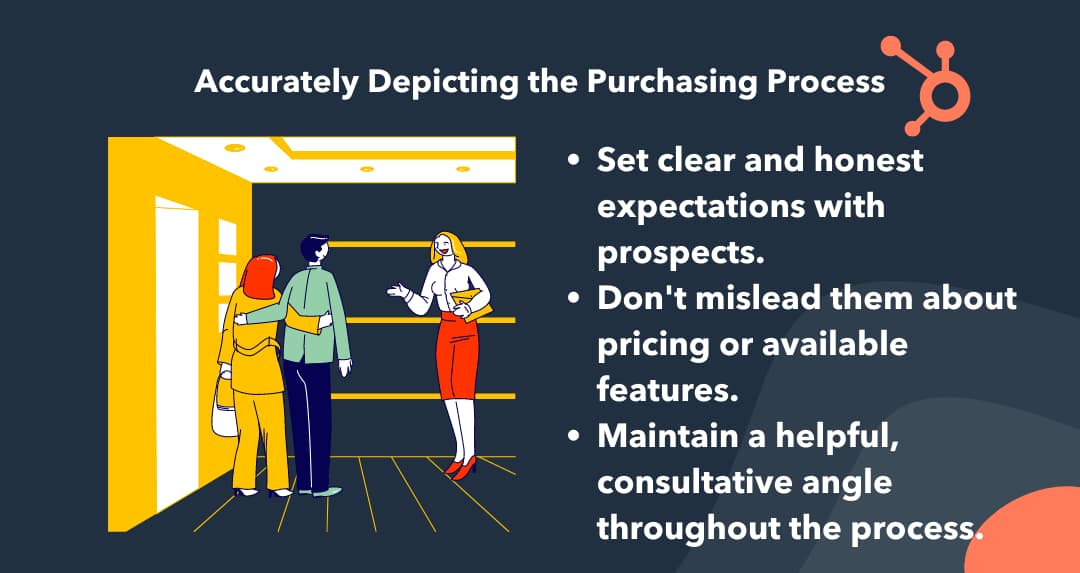
4. Conducting Effective Buyer Research
You can't appeal to a buyer if you have no idea who they are, what they do, and what their business needs might be. If you want to successfully engage with a prospect, you need to have most — if not all — of those factors drilled down.
That starts with conducting extensive buyer research, and the best salespeople know what to look for, where to look for it, and how to effectively analyze those findings. Pore through your prospect's company website. Learn everything you can about what their business does.
Try to find insight into how their organization is performing. Familiarize yourself with its industry, so you can better understand its place in its competitive landscape. See if you can find out which solutions it's currently leveraging.
Do some research on the specific contact you'll be speaking with. What's their background like? What do they do at their company? Can you identify any interests they might have to help you build rapport?
Try to address as many angles as possible here. Put together a holistic picture of your prospect and their business, and start to tailor your communication to best connect with them — whether that be through something like a personalized gift, some industry-specific insight, or any other way you can think of to let them know you're locked in on their interests.

5. Developing Extensive Product Knowledge
You can't sell a product or service effectively if you don't know it inside and out. Understanding everything there is to understand about your offering informs other key elements of your sales efforts.
You can't anticipate or handle objections if you don't know the issues prospects consistently raise about your product or service's functionality. You can't structure an effective value proposition if you don't know what kind of value your product or service can offer. You can't differentiate yourself from your competitors if you don't know the features your offering has that theirs don't.
Take the time to thoroughly study your product or service. Know what makes it an exceptional option and where it might lag behind competitors. Know who stands to gain the most from it. Know what it costs and why it costs that much. Know its every last feature, bell, and whistle.
Know all of that and more. If you can develop extensive product knowledge, you'll be in a better position to craft thoughtful, personalized value propositions that prospects will be receptive to. That, in itself, is the key to conducting effective sales efforts.
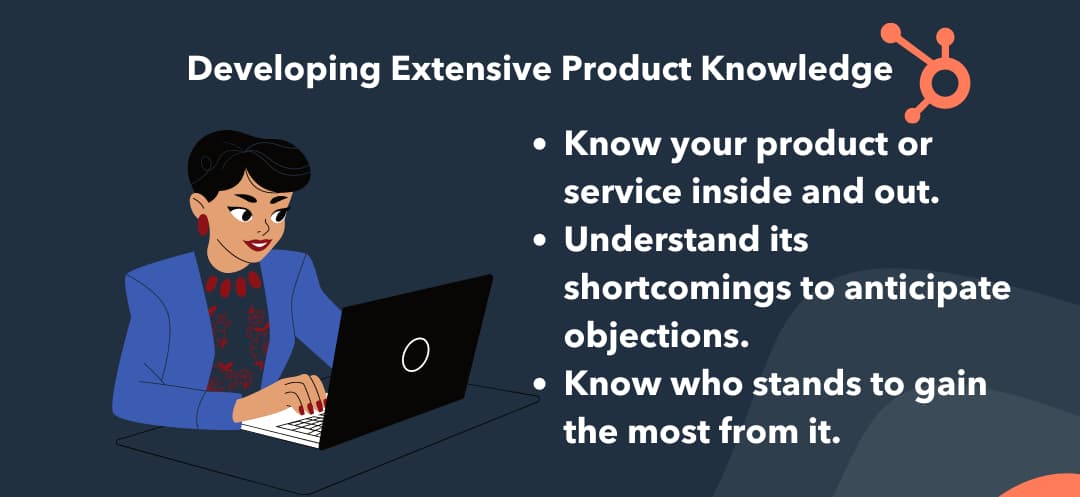
6. Being a Compelling Storyteller
Communication with prospects needs to be engaging if it's going to be effective. You want your buyer to have a personal stake in the sale — and using compelling storytelling to shape your pitches, presentations, and other correspondence with them helps that case.
Know some relevant case studies front to back — and leverage those stories to help your prospect imagine how they would use your product or service. Be sure to cover elements like character, context, conflict, and an ultimate resolution.
Say you represent an edtech startup that sells a platform for automating curriculum management and classroom assignments. Right now, you're presenting to a mid-size community college that relies on outdated legacy software to handle those processes. In that case, you wouldn't just want to tout your platform's bells and whistles or throw numbers at your prospect.
You might tell a story like, "Earlier this year, we sold our solution to Drollinger College — a community college around your size in Colorado that had a similar tech stack. I keep in touch with the administrator, Emma, and the head of IT, Shawna. They were initially reluctant to move on from their legacy system because they thought the transition and growing pains from implementing a cloud-based curriculum planning solution might not be worth the trouble.
"But when we took a comprehensive look at the amount of money that went into fixing errors that stemmed from mostly manual curriculum planning and inefficient classroom assignments. They warmed up to the idea of giving our platform a shot.
"Shawna told me that they were shocked at how seamless and simple the implementation process was — in large part because our customer success and support teams are so active in guiding the implementation process. And about a month after they were fully operational, Emma actually emailed me and said, 'Where were you all my life? I just wish we had found you sooner.'
Since starting with us nine months ago, the school has already improved average degree velocity by 20%. They're expecting to save $25,000 from streamlining curriculum scheduling this year alone, and they haven't received a single complaint from professors about classroom scheduling."
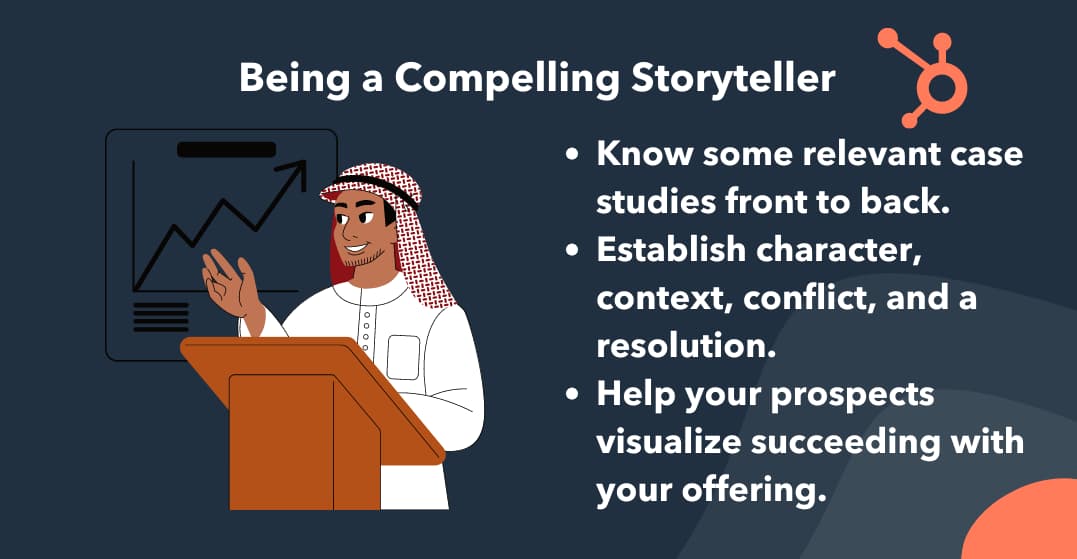
7. Demonstrating Potential Return on Investment
You need to paint a clear, persuasive, and believable picture of the results a purchase will yield when engaging with prospects. If you’re selling expensive software with a traditionally lengthy implementation period, be sure to convey the hard benefits of making that kind of investment of time and capital.
Case studies, data from your client base, and your own estimates — based on information your prospect gives you — can help you paint a more vivid picture than simply saying something like, "This is worth it because it will save you time."
It’s also helpful to connect current customers with your prospects for an unvarnished opinion of your product or service. Positive reviews from an engaged customer base have been proven to have significant sway on new prospects' decision-making — in fact, a recent study by BrightLocal showed positive reviews make 73% of consumers trust local businesses more.
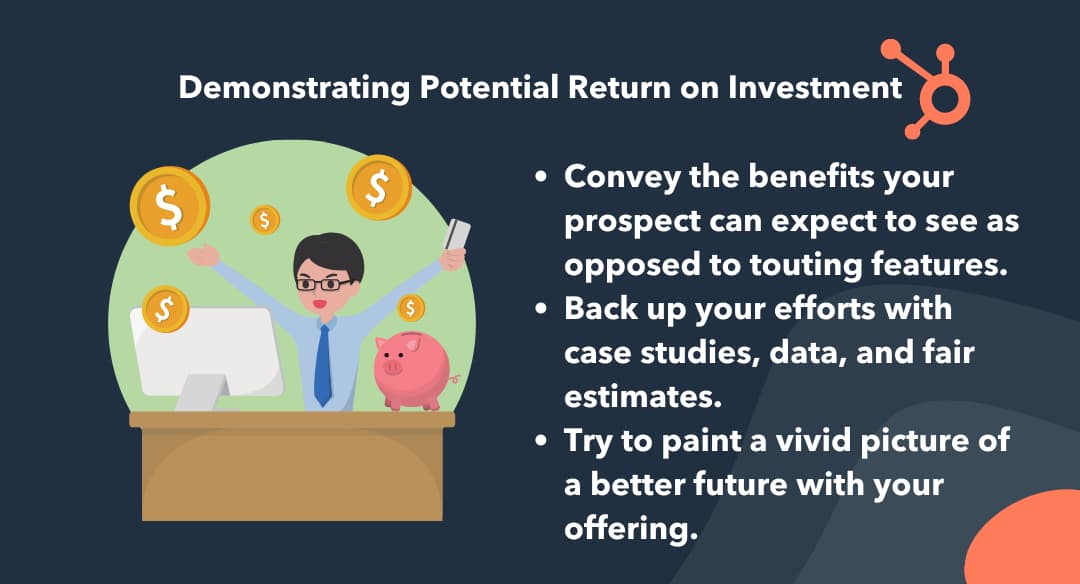
Selling Skills Exercises
Selling skills exercises include a variety of games, activities, and training methods that can help reps bolster the stronger elements of their sales acumen and develop the ones that need some work.
Some prominent, engaging examples include:
- Sell Me This Pen: This famous (or infamous) exercise involves having reps try to sell a trainer — acting as a prospect — an obscure object. The point is to tease out a need from that "prospect" themselves before providing a solution. It helps reps learn to convey return on investment and can potentially improve their storytelling skills.
- Match Game: If your business sells multiple products or services, make a list of the key ones. Then, write out quick scenarios where a potential customer would benefit from each one. Shuffle both lists and have salespeople match the problem to the solution. This helps reps develop product knowledge and understand how to piece together an effective value proposition.
- What's a … ?: This game works particularly well for newer reps. Once they've been onboarded, inform them that the rest of the company might approach them at random and ask them what your company, product, or service does. Upon being asked, the reps need to provide a clear, concise, compelling answer that addresses the question and conveys value. This can help them accrue product knowledge and demonstrate ROI.
There's a host of other games and exercises you can engage in to improve either your team or personal performance. For more information on those, check out this article.
Selling Skills Used to Engage Customers
The list of skills detailed in this article is far from exhaustive. You, as a salesperson, need to consistently identify and work on areas for improvement as they become obvious — learn from every sale and incorporate the lessons that come with your experience into your broader sales repertoire.
The underlying theme of every skill you can develop is this: Engage your prospects. And that theme can manifest itself in a lot of ways. Conducting extensive buyer research enables you to engage your prospects with more pointed outreach and pitches.
Being a compelling storyteller makes your communication more engaging by nature. Leading with empathy allows you to engage potential customers through more personal appeals. And every other point detailed here follows that same trend.
Do what you can to develop and hone your selling skills. Building up your sales acumen is an indefinite process, so always be mindful of what you could be doing better and act on that insight whenever you can.

23 Jul 15:21


Trust in Marketing is at Risk. These CMOs and Marketing Influencers Share How to Fix
by Lee Odden
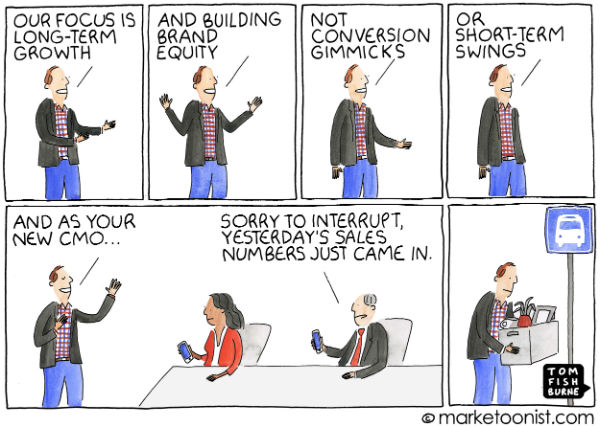
The average tenure of a CMO is under 4 years representing a crisis in confidence amongst business leadership when it comes to marketing. Expectations for marketing are higher than ever amongst business leaders and customers alike.
To advance the valuable contributions marketing can make from boosting short term sales to growing long term market share, it is important for marketers to build trust and influence. But there are challenges:
- A study from Fournaise Group that fond 73% of CEOs say “Marketers lack business credibility and the ability to generate sufficient growth and 80% of CEOs simply don’t trust marketers at all, while 91% do trust CIOs and CFOs.
- New research from Marketing Week reports only 30% consider marketing ‘very important’ at large B2B companies.
- Marketing as a career suffers some credibility issues as well. A global jobs poll by HubSpot ranked the most trustworthy jobs with Doctor ranking number one and near the bottom, just above Car Salesman and well below Barista, “Marketer”.
- Marketing’s credibility amongst customers has been affected by some of the challenges facing media platforms – from fake news to inappropriate content to measurement. We’ve all seen stats like this one from Nielsen where 92% of consumers trust peer recommendations over advertising.
- Within B2B, research from TrustRadius reports 58% of B2B buyers do not believe claims made by the vendors they most recently bought from.
Despite these challenges the reality is that well researched, planned and executed marketing delivers incredible value for businesses and their customers. Research from Forbes shows Marketing strategy and investments can contribute over 50% of enterprise value.
How can marketers do a better job at building trust with company executives and customers to inspire more confidence in marketing? This is a topic I presented on recently at the e4M TechManch conference in Mumbai, India. There I outlined 5 “secrets” to growing the influence of marketing which I’ll dig into more below. I also reached out to a mix of marketing executives to get their perspective on solving putting marketing back on the right track:

Simple answer. Honesty. I know it sounds trite but trust is earned and earned through honesty. As marketers and storytellers we often “spin” things to suit our needs. I think more honesty about the company you represent is the only way to succeed. People relate to flaws. It’s human. It’s honest. I’m not suggesting that we promote those, I’m suggesting we don’t hide them. Customers will find the truth regardless and then you’ll have broken the trust. Zappos is a good example. Transparency is written directly into the Zappos Family Core Values, in the statement, “Build Open and Honest Relationships With Communication.”
Julie Roehm @jaroehm
Chief Experience Officer and CMO
ABRA

In today’s digital environment, marketers are at the forefront of business. As marketers, we are operating in a new paradigm that represents a tipping point and allows us to own the voice of the customer through insights and develop personalized experiences across every touch point. Through insight-driven marketing, we have the ability to anticipate new, unexplored business opportunities and bring this value to the c-suite.
Today’s consumer expects us to know them: how they think, how they act, and that we listen to their buying signals. Our biggest opportunity is to create an environment where we connect our customers seamlessly and consistently to our company’s purpose and values – whether they are experiencing content on our website or in-product, at an event or in digital selling. Ultimately, this helps us to develop a strong pipeline of customer-first product innovation.
Ultimately, every major brand must become its own media publishing company.
No longer can we develop content in a linear way (e.g. build… then run). With the ever-changing dynamics of our industry with new digital platforms, marketers need to embrace an agile marketing mindset. The idea that we can Test. Learn. Change…. all of the time, not just in pilots. Core content should not take 6-8 months to develop; but rather, build core anchor content that can be atomized across every content distribution channel. Ultimately, every major brand must become its own media publishing company.
Kirsten Allegri Williams @kirstenallegriw
Vice President, Corporate Marketing
SAP Ariba

Trust, authority and credibility are earned as a result of programs developed and undertaken, with subsequent positive results. They are not just marketing programs, but must be contributing and supporting the company’s overall objectives. But, Marketers must protect their area of expertise. Everyone feels comfortable providing feedback to marketing programs, so the onus is on the marketer to educate the “why” and more importantly, the “why not” when providing feedback.
Kieran Hannon @kieranhannon
Chief Marketing Officer
Belkin International

Companies still view marketing primarily as a tactical, execution oriented discipline. This needs to change. Marketing has the most expansive view of how to drive growth.
Marketing has the most expansive view of how to drive growth.
Marketing needs to drive company-level corporate strategy and P&L decisions with a marketing mindset, not just an execution mindset.
Rishi Dave @RishiPDave
Past CMO
Dun & Bradstreet

In today’s world its all about the quality of A.I.R. you create; Authentic, Inspirational and Realistic marketing will win over your internal and external customers. For B2B marketers your best brand advocates are your employees. For B2C, your customers will accept nothing less than personalized perfection. Achieve both by creating AIR.
Jeanniey Mullen @jeannieymullen
Partner, Global Chief Marketing Officer
Mercer

Building credibility inside an organization is so important—alignment helps you get more effective results and also more budget!—but it’s not always so easy. The best way I’ve found get people onboard with your way of thinking is to do some marketing of your marketing. In other words, treat every relationship as if they were a customer.
Treat every relationship as if they were a customer.
What are the pain points for the people you’re working with and for? And how can you, through your job, help them solve these? Basically apply the golden rule of content marketing to your internal interactions: If you can provide value for someone, you develop trust.
Margaret Magnarelli @mmagnarelli
VP Marketing
Monster.com

There is no better time for marketing to gain credibility and trust. The field has shifted from a soft science to a programmatic science, making it more credible than ever before to quantify success with hard data. By showcasing sourced and influenced impact to designing compensation models for revenue success, not marketing success, we can transform the stature of marketing.
Chandar Pattabhiram @chandarp
CMO
Coupa Software

The best way to gain credibility is to speak plainly in the native tongue of your audience. Want credibility with consumers? Use layman’s terms. Want credibility with other executives within your company? Use business-focused outcomes and metrics. Save your marketing buzzwords for your next agency meeting or conference — and, even then, confirm you both mean the same thing when using those words 
Michelle Killebrew @shellkillebrew
Head of Global Performance Marketing, DevOps & West Regional Marketing Leader
CA Technologies

Stop solving for a local maxima. Impressions, clicks, leads, etc. They provide tiny fractions of business value. Instead, solve for the global maxima. Because deeply caring about long-term customer joy and company impact is inherent in that quest, the yield curve for your influence and credibity will head up and to the right!
Avinash Kaushik @kaushik
Digital Marketing Evangelist
Google

Marketers have to constantly take a holistic approach to ensure that they keep the user at the core of everything they do. The focus has shifted from attention-grabbing messaging to finding the right message for every customer. It’s all about building depth in customer relationships.
Nandini Rathi @Nandini_M
CMO Betaout.com
Founder, ContentCloud

People have to cut the bullshit in their marketing.
Sander Arts @Sander1Arts
CMO
Arduino

The sweet spot for marketing is when they know the market so well, and so deeply, that they are able to share market perspectives and intel with the customer, and are acknowledged internally as the customers’ aide-de-camp or advocate. With this knowledge of the landscape and their own firms’ strengths, marketing can help customers navigate uncertainty, and possibly also generate demand. This is how marketing can become central to success, and gain customers’ trust and credibility.
Bianca Ghose @BiancaGhose
Chief Storyteller
Wipro
5 Ways to Grow Influence, Credibility and Trust in Marketing
1. Accelerate the Internal and External Credibility of Marketing
- Internally: Find out the primary business problems faced by your management team and connect your marketing to help solve those problems.
- Internally: Promote your marketing wins, engage stakeholders and measure based on business impact vs. KPIs.
- Externally: Become the “Best Answer” for your customers with personalized, compelling content experiences that include authentic, influential voices.
2. Double Down on Activating Customers
- “It’s time to double down on customers, as their voices, opinions and beliefs say much more about a brand than traditional advertising or marketing can.” (Peter Mühlmann, AdWeek)
- 78% of people who read online reviews find them reliable. (ReportLinker)
- Increasing customer retention by 5% can lead to a 25% to 95% increase in company profits. (Harvard Business Review)
3. Work with Influencers to Become Influential
- Identify: Connect with qualified, relevant influencers and find ways to collaborate on customer-focused content.
- Qualify: Validate influencers and their audiences on a regular basis to ensure quality experiences.
- Engage: Employ always-on listening and social engagement to “keep the love alive” with a VIP influencer community of collaborators & advocates.
4. Create a Content Collaboration Ecosystem
If you help others, including customers, employees, and your brand’s community become more influential through content collaboration, the brand and marketing will grow influence as well.
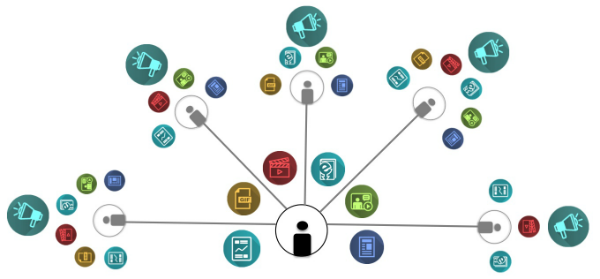
5. Optimize Measurement to Customer ROI
- Attract: Is your marketing reaching the right audience on the channels they’re influenced by?
- Engage: Is your marketing creating meaningful and satisfying experiences where they want them? Are you creating raving fans?
- Convert: Is your marketing inspiring action across the customer journey: awareness, consideration, purchase, advocacy. Does it deliver on revenue?
There’s a lot to be said about how effective a thing is by how well it is done. Poorly researched, planned, executed and measured marketing doesn’t add a lot of value to the customer experience or the business bottom line. On the other hand, strategic, authentic, data informed and empathetic, dynamic and accountable marketing serves both customers as well as the performance of the business.
I think everyone in the marketing world has an opportunity to take a step back from the information overload and pressures of output on a daily basis to be more thoughtful about the marketing they’re doing. Of course we have to think about the immediate impact of content, ads and campaigns but also about the overall value and impact of marketing on our customers, business and industry. Marketing done well with a clear why, measurement and purpose creates the kind of value that both customers and business leaders will trust, ensuring credibility and investment far into the future.
 Gain a competitive advantage by subscribing to the
TopRank® Online Marketing Newsletter.
© Online Marketing Blog - TopRank®, 2018. | Trust in Marketing is at Risk. These CMOs and Marketing Influencers Share How to Fix | https://www.toprankblog.com
The post Trust in Marketing is at Risk. These CMOs and Marketing Influencers Share How to Fix appeared first on Online Marketing Blog - TopRank®.
23 Jul 15:20

Technology Only Gets Us So Far
by Dave Brock
FirmBee / Pixabay
I’m a great fan of much of many sales technologies. There are tools that dramatically improve efficiency. These allow us to get more accomplished, more easily and in less time. There are tools that give us greater insight into the customer–both the enterprise and individual. We can leverage customer searches of our sites, the materials they have downloaded, and communications they may have had to give us better insight into their interests.
AI and related tools deepen those insights and help us better determine the timing of when a customer might be interested in a conversation. These tools can even help us think about the issues most critical to the customer at the moment. We can “micro-target” and be immediately relevant to our customers and prospects.
But, all of this gets us only so far.
At some point, we actually have to have a conversation with the customer.
We have to translate all this data and insight into actually engaging, person to person.
And that’s where things break down, both for us and for the customer.
Customers need these conversations, but dread them, trying to push them as late in their buying cycle as possible, leveraging other sources of information and research (remember, similar tools exist for our customers).
But at some point we’re “forced” to actually engage each other–voice to voice, face to face, eyeball to eyeball.
We have to engage another human being.
Each of us has our own hopes, dreams, fears, desires. Each of us has differing behavioral and communication styles. Each has differing levels of knowledge, interest, attitudes, and opinions.
The messy, sloppy part of buying and selling is all about human interaction.
But if we, and our customers, are to be successful, it’s this part of the process that’s most important in achieving our goals.
The fundamentals of this process are always the same, but the actual execution will vary person by person, with each interaction.
The fundamentals start with understanding, empathy, caring.
Questioning, listening, probing help us in engaging our customers to learn and to help them learn.
Curiosity plays a role–they drive our probing and discovery, they drive the ability of the customer to learn.
We are helped in this by our knowledge and ability to apply that knowledge in relevant/impactful ways–sometimes called creating value. In doing this, we have to remember it’s something we don’t do to or for the customer, but with the customer.
As happens when at least two human beings get together, we bring baggage, per-conceived ideas, mistaken impressions, lack of knowledge, and many other things which impact our abilities to connect with each other. Masterful sales people know how to navigate these with the customer, their teams, and others.
Ultimately, complex buying and selling comes down to human to human interaction and how effectively we engage each other.
Ironically, we seem to spend more time on all the other parts, often doing everything we can to minimize and avoid this human to human interaction.
Some will argue, that much of this interaction can be eliminated—and it should be. There are many transactional or very simple buying decisions. But this isn’t new, it’s existed at least since the very first catalog was ever mailed to a customer (RIP Sears Roebuck). The tools enabling each of us to do this keep reaching new levels. Increasing numbers of transactions will be done through technology enabled channels–perhaps our bot talking to the customers’ bots.
But there is always the challenge of the complex buying decisions. Whenever more than one person is involved in the process–whether multiple buyers reaching consensus, or sales people seeking to engage with them.
The messiest part of buying/selling is that human to human interaction.
And this seems to be the area that too few look to master.
Afterword: Thanks to my friends Charlie Greene and Andy Paul for stimulating this post. Charlie wrote a great post on the same theme, Seduced by Tools and Processes.
23 Jul 15:20
Digital B2B Demand Generation Campaigns: How to Generate Qualified Leads
by Kate Athmer
The top priority of B2B marketing executives in 2018 is to improve lead quality over quantity.
According to DemandGen Report’s 2018 Benchmark Survey Report, improving the percentage of leads considered ‘qualified’ ranked as the top organizational focus, followed by improving conversion rates and campaign results, then generating increased lead volume.

image credit: DemandGen Report
Marketing executives from B2B organizations in North America, EMEA and APAC who responded to DemandGen Report’s survey face challenging success measures in the months to come. For example, 33% reported that their primary KPIs are marketing-qualified and sales-qualified leads, while 30% indicate total percentage of revenue pipeline influenced by marketing activities. Not surprisingly, only 14% of B2B organizations are sticking with total leads or inquiries as their primary success metric.
The success of demand generation programs is no longer measured in just lead volume, but in how many of those leads are qualified and nurtured through the buying process.
How to Generate More Qualified Leads
B2B and B2C campaigns have one thing in common: they’re both aimed at people.
People and relationships are at the core of both B2B and B2C campaigns. In both, the customer must pass through the awareness, consideration and decision stages of the buyer’s journey.
With that said, there’s a lot more riding on the decisions of the B2B buyer. B2B buyers aren’t spending their own money, and they’re not the primary risk-taker. Making purchases for a company comes with a lot of pressure to do the right thing. If the B2B buyer makes the wrong decision, they may face embarrassment at the organization at the least, and, in some cases, their professional reputation and career could be at stake.
This is why B2B buyers are generally very specific in what they’re looking for and highly risk-averse.
The pressure is different.
The aversion to risk is different.
The process of making the buying decision is different.
But it’s still the people you must target, not faceless organizations. You must remember that people come with hopes, ambitions and plenty of frustrations. And, when dealing with these people, it’s essential to understand their wants, needs and fears.
Attracting Your Target Audiences
Before you can attract targeted leads, you need to understand your potential customers, which means creating profiles of your buyer personas.
Your demand marketing team can waste all day wondering what your ideal customers’ average income is and whether they’re cat or dog people, but that’s not always the most productive exercise. The most important thing is to understand their need profile holistically, which generally requires mapping their characteristics from end-to-end. To attract your leads, the most critical piece of information you need to know is their problems and pain points.
How do your ideal customer’s problems relate to your product or service? Their pain point doesn’t need to be an exact match to your company’s solution, but it does need to be relevant.
Pain Points Aren’t Just Labels
Pain points also have three distinct levels of consequence.
Level 1: The Surface-Level Problem
Perhaps your company is in the business of selling bookkeeping software, and your target audience is accountants at nonprofits. On the surface, your prospects may start looking for alternatives, such as your product, based on surface-level problems: like a current software which is tedious, hard-to-use or difficult in ways which make their rate of errors high.
Level 2: The Deeper Problem
What are the more profound problems behind a tedious software that isn’t user-friendly? In the case of the ideal lead in this example, maybe the accountants have to work faster to deal with the obnoxious user interface of their current solutions due to slowdowns.
Level 3: The Higher-Level Repercussions
Continuing the accounting software example, the accountants who are struggling with the poor user interface are making unnecessary mistakes, which causes client dissatisfaction. Dissatisfied clients may switch to different accountants.
Understanding Yields Opportunity
You can’t just understand your buyer persona’s pain points at the surface level. Driving through all three levels of consequence to understand the deeper problem and potential repercussions can reveal all kinds of opportunities to drive customer attention.
If you map your ideal customers’ pain points extensively, you’ll develop better customer understanding and the opportunity to create higher-value content at the top of the funnel. Creating lead generation offers that address these deep pain points can increase conversion rates, helping you drive more qualified leads.
When your top-of-the-funnel lead generation offers are mapped to your buyer persona’s real pain points, rather than just demographic or firmographic characteristics (though firmographic data is greatly important as well), they’re more likely to attract the right leads.
Converting Targeted Leads
Once you’ve identified your buyer personas and solved their pain points meaningfully, there are three campaign components required for converting targeted B2B leads.
Component #1: The Lead Magnet
The lead magnet is demand generation lexicon for a piece of high-value content which speaks to your ideal customer’s pain point. B2B lead conversion content can include, but isn’t limited to:
- eBooks
- Whitepapers
- Case Studies
- Courses
- Product trials
- Demos
- Research Reports
- Worksheets
- Webinars
- Workbooks
- Infographics
- Checklists
Component #2: The Conversion Funnel
To convert target audiences into qualified leads and prospects, you generally need a way to gate the content behind a form on your website. Some social media targeting campaigns support targeted promotion of content to the right audiences, complete with integrated forms. However, the creation of an on-site landing page form is generally at the core of a B2B demand generation campaign.
In addition to promoting your lead magnets through the above inbound marketing tactics, you should invest in 3rd-party demand gen campaigns to reach target audiences that otherwise won’t come across your lead magnets on your landing pages and social media profiles. These external lead sources will allow you to scale to hit your lead and pipelien goals much more quickly.
Lastly, it’s important to create a well-defined lead nurturing workflow to follow up with your newly converted leads and convert prospects through the sales funnel.
Component #3: The Targeted Audience
Reaching the right people at the right accounts is key.
Without quality leads, you can’t scale your demand generation program or meet challenging revenue-based program targets. The comprehensive buyer persona profiles you completed are at the core of your targeting activities, whether these include content syndication partnerships, programmatic or display advertising, social ads, events or more.
Successful B2B Demand Generation Campaigns
The key to attracting highly qualified prospects is developing the kind of deep understanding of your ideal customer profiles (ICPs) and their pain points that generally comes with comprehensive buyer persona mapping.
When you’ve developed full customer understanding, you can begin to develop relevant lead magnets and high-quality demand generation campaigns that are targeted to the right people. With a quality mindset, you can focus the top of your funnel on attracting the right leads.
How does your demand generation program compare to the most highly effective B2B marketing organizations? Assess your strategy with the “B2B Demand Marketing Assessment Guide & Orchestration Workbook.”

23 Jul 15:20


A Framework to Achieve the Right Level of Tension in the Sales Process
by Frank Dale
As we covered in our last article, managing the tension between consistency and flexibility is key to a sales team’s success. Get this right and you’ll have sales conversations that close significantly more deals.
For most sales teams, this isn’t easy to manage. If you control too much of the sales process by scripting every possible move, you turn your sales professionals into robots. And that creates a bad experience for the buyer and seller. But if you give your team too much flexibility, you end up with inconsistent results.
As a sales leader, it’s your job to constantly assess your team’s performance and make changes to your messaging and process and to improve the way your team performs. This means that you must adjust your approach to reflect these market-driven changes on at least a quarterly basis, if not more frequently depending on how quickly you’re learning.
By now, you know that managing that tension is critical, but putting the mechanics in place can be tricky without the right framework. How can you know what the right level of tension between consistency and flexibility actually is? How do external (buyer and industry) factors play a role? And how can you measure if it’s actually working? Below, we’ll answer all of these questions by providing a simple framework that will help you visualize the different components of the sales process and help you determine which factors should be consistent and which should be flexible.
The What, How, and When Framework:
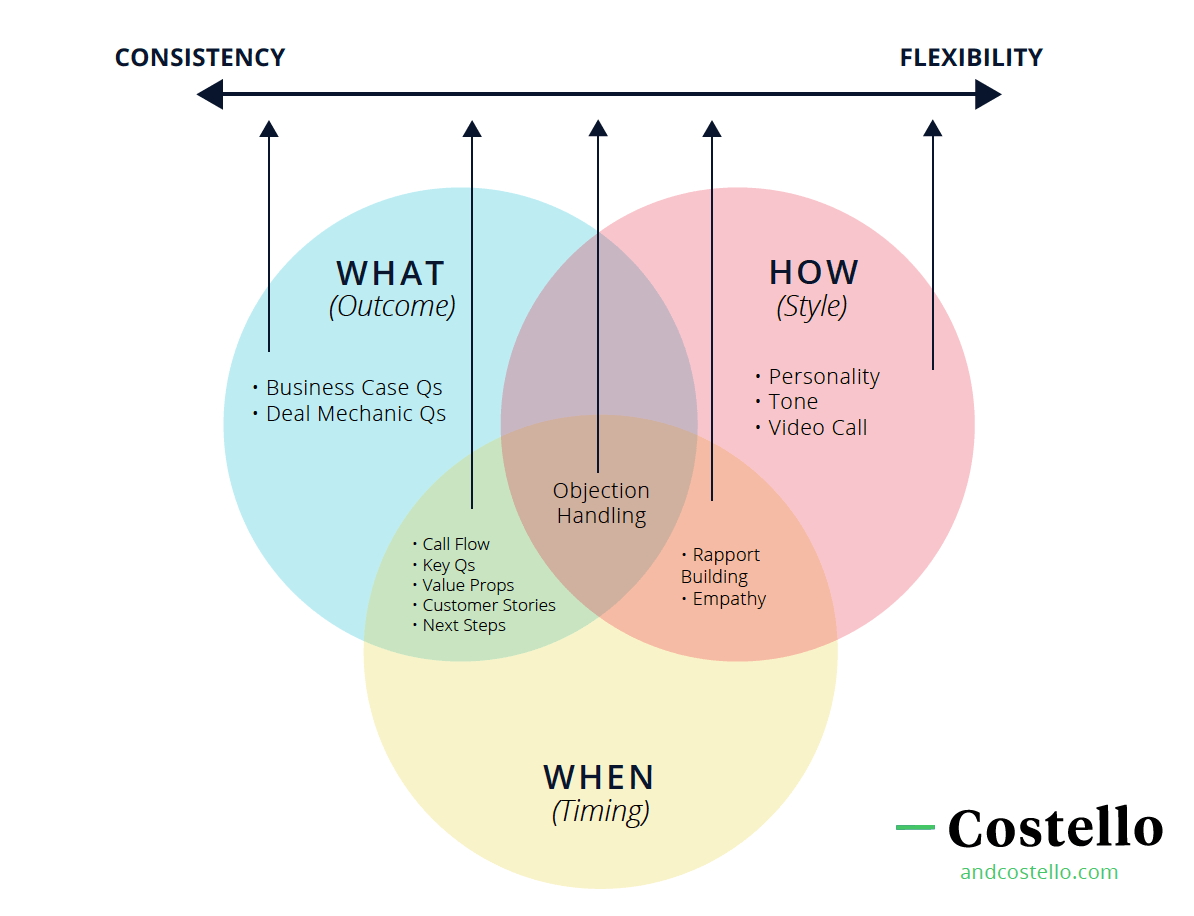
Managing the tension between consistency and flexibility depends on how reps manage 3 execution components of a call. The 3 components include:
- The “What” includes the key content of a sales conversation – questions, value props, customer stories, responses to objections – that you want your sales professionals to deliver in order to drive the outcomes you want to achieve.
- The “How” takes into account the sales professional’s tone, style, and personality and how they’re used effectively during a conversation. It’s often referred to as the “art” of selling.
- Finally, the “When” involves managing the order of important parts of the sales conversation, exercising judgment to spend more time on certain topics and less on others, and making sure time is set aside to set next steps at the end of call.
When you get the “what” right, then all you have to do is spend time helping your team get better at the “how.” Unsuccessful sales leaders spend their time coaching “what” instead of “how.” Here’s what that sounds like. You find yourself continually asking questions like this:
- What are the potential customer’s goals? (aka: Why would they buy from us?)
- Did you ask them if IT needs to be in the evaluation process?
- Do we know who can sign the contract?
- Did we schedule the next step?
When thinking about these 3 components and how they relate to your sales approach, it can be helpful to think of the “What” as outcomes, which is on the “consistent” end of the spectrum; the “How” as style, which tends to be more “flexible”; and the “When” as timing, which typically lands between consistency and flexibility.
Applying “What, How, When” to Your Sales Conversations
Our goal is to apply this to different types of sales conversations to determine where sales reps should have more – or less – freedom within your sales framework.
To make this framework actionable, we need to do two things:
- Assign key parts of a particular sales conversation to each area of the diagram
- Map each area to the tension spectrum, moving from Consistency to Flexibility
For the purposes of this discussion, we’ll apply the “What, How, When” framework to a typical Discovery process. The different Venn diagram areas are intentionally ordered from Most Consistent and move toward Flexibility as we scroll to the right.
The “What”
The “what” boils down to two things that never change: 1) the reasons—both rational and emotional—why a prospect wants to buy from you, and 2) the comprehensive set of steps required to vet your product and sign a contract. In short, think of these two things as the outcomes a rep is driving towards. Regardless of the sales methodology used, reps need to consistently gather relevant information pertaining to the business case questions and deal mechanics.
Repeatedly coaching “what” items is very frustrating for sales managers. It’s the foundational stuff that never changes and doesn’t require advanced sales skill. Great performers are masters of the “how” and “when,” but you can’t become great if you can’t consistently execute the fundamentals.
The “What” and “When”
Most of the important parts of a sales call are in this section. It’s easy to see why that’s the case. You’ll find most of the fundamentals that should be in any sales process in this section. Let’s look at each bullet point to see why this is the case:
- Call Flow: We all sell to human beings. The fundamental elements of a natural, effective conversation with a human being don’t vary across industries. As a result, discovery calls tend to have a consistent logical flow. In short, conversations have an opening agenda and then move into discovery questions that typically start with easier, high-level questions and progress to more detailed, sensitive questions before closing the conversation with a discussion of next steps.
- Key Questions: Since the desired outcomes of a call are well-known and unchanging (see the “What” section above), it makes sense that the questions sales reps ask should also be relatively consistent. This is especially true when wording of important questions matters, such as starting pain-related questions with “What” or “How” instead of “Why”.
- Value Props: Company and product positioning are the most strategic [elements] in sales. C-level, sales, and marketing leaders spend countless hours developing the right messaging to communicate a product’s compelling, differentiated value. So, it’s critical that sales reps accurately deliver this messaging and do so at the right time during a conversation.
- Customer Stories: Similar to value props, customer stories are crafted to help reps deliver compelling social proof that your company works with customers similar to your prospect and has delivered meaningful outcomes for them. Given their specificity, it’s important that reps deliver them accurately. The timing of when these stories are delivered is also critical, so they have the desired impact. There are two particularly effective times to tell stories. The first is after the potential customer shares their goals. The second is when they share an objection.
- Next Steps: Before wrapping up a call, it’s critical that reps schedule the next meetings, agree on the goals for that meeting with the prospect, and identify the key action items that both parties need to tackle before that meeting. Most importantly, reps need to make sure they set aside enough time for this part of the conversation; too often, reps let their calls run too long, don’t get next steps, and as a result, the deal goes into a black hole.
The “What”, “How”, and “When”
The most challenging part of a sales call can often be objection-handling. They’re unpredictable in so many ways: they can come up at any time, they can cover several topics, and they are not always well-articulated. This is why they appear at the intersection of What, How, and When—they require a mix of best practice responses (What) along with an artful combination of skill of judgment (How and When).
Getting objections isn’t necessarily a bad sign; they’re often a positive signal that a buyer is seriously considering your solution and wants to make sure that she’s thought through potential blockers before presenting your solution to key internal stakeholders.
Most people think of objections as explicit statements that buyers make during a conversation—things such as “we don’t have budget” or “what we’re doing is good enough”. In these cases, a rep should respond in a way that demonstrates she’s heard and acknowledged what she’s saying and then respond with either a standard best practices follow-up question or a relevant customer story that explains how current customer said something similar but then realized the benefit of your solution.
However, often objections are only hinted at—they’re implicit statements—and require reps to proactively address them before moving on. For example, if a rep hears a buyer ask several questions about how a product impacts workflow, then it’s likely an indication that the buyer has reservations about how it would be adopted by her team. In that situation, it’s important for the rep to say something along the lines of “I’ve noticed you’ve been asking a lot of questions about workflow. Typically, when I hear these types of questions, I find it’s useful to find out more about your current workflow and how you think we might impact it.”
By leaning into this implied objection proactively, the rep has successfully accomplished three things: 1) she’s demonstrated that she’s actively listened to the buyer and understands her potential concerns, 2) in doing so, she’s made it easier for the buyer to discuss her potential concerns, and 3) by addressing a potential blocker directly, this should improve her odds of overcoming the objection and moving the deal forward instead of not addressing and having the deal fall through.
The “How” and “When”
This is an area that is very dependent on rep judgement and skill. The foundational skills in this area are active listening, mirroring, and labelling. All three can be improved through coaching and training.
Great reps are active listeners. They hear both what is said as well as what’s unsaid. They then use their judgement to employ skills like mirroring and labeling to demonstrate that they understand the buyer, which begins to build trust and leads to a more open conversation. Star performers excel in this area.
The “How”
There’s nothing worse for a sales rep than to be stripped of their autonomy. In fact, personality and style should play a major role in the sales process. Afterall, buyers buy from people they like and can relate to. We believe this is so fundamental to success in sales that we have interviewed over 10 sales professionals to hear how they put people > processes. Without fail, each had their own way of showcasing their personality throughout the sales process. That’s why the “How” is such an important component when striving to achieve the right level of tension in the sales process. Just as there are outcomes-based tactics that shouldn’t be altered (the “What” addressed above), there are certain aspects of the sales playbook that should be up to a rep’s individual discretion. Things like personality, tone, and whether or not they choose to use video calls to create even more transparency falls under this category.
For most sales leaders, the challenge isn’t determining which parts of the sales process fall into the “What”, “How”, and “When” components – the challenge is knowing when to enforce consistency and when to back off and allow for flexibility. As we’ll share in our final article in this 3-part series, rep tenure, ability, and even industry and product can play significant roles.
The post A Framework to Achieve the Right Level of Tension in the Sales Process appeared first on OpenView Labs.
Rnordman likes this
21 Jul 18:02

Building an Effective Workplace Mentorship Program
by Rick Goodman
styles66 / Pixabay
Mentorship can be beneficial to all parties involved—the mentors, the mentees, and even your company more broadly. That’s because mentorship, when done right, is one of the best ways to improve employee engagement—showing your team members that you’re willing to make a real investment in their long-term personal and professional development.
But of course, you probably caught my little caveat. Workplace mentorship programs are only beneficial when they’re done right—and that means being strategic in how you structure them.
What makes for an effective mentorship program, though? I’ve got a few thoughts I’d love to share.
Starting a Workplace Mentorship Program That WORKS
Have clear business goals in mind. If you don’t have some specific goals in mind, you’ll have no way to tell whether your mentorship program is doing its job—and as such, you may grow tired or frustrated with it pretty quickly. Be clear about what you hope to achieve—higher engagement numbers? More women or minority employees in leadership roles?
Match carefully. Good mentorship is all about having positive relationships between your mentors and your mentees. Be careful how you set up these matches. If you have a team where people are pretty preference-driven, you may want to give them a say in how they are matched.
Provide training for everyone. First-time mentors will need some instruction on how to do their job well, and even mentees will need to figure out how to get the most out of the mentoring process. Make sure training is offered to everyone in your mentorship program.
Market the program. Finally, don’t just assume that starting a mentorship program will guarantee big enrollment numbers. Actually, it’s important for you to market the plan, elaborating the benefits of participation. Also, don’t forget to use mentorship as a selling point for potential hires and new recruits!
Learn How to Develop an Effective Mentorship Program
There are several components to consider as you try to build a workplace mentorship program—and I hope you find these pointers to be a good starting point.
21 Jul 17:43
When it’s Time to Change Your Prices
by Zach Heller

First, a fact. Too many people at too many companies see price as a constant. They believe in the “set it and forget it” mindset when it comes to pricing. Once you have settled on a price for your product or service, you lock it in and never re-evaluate it.
I hope we can all agree that this is lunacy.
Price is one of the key levers that marketers have at their disposal. And to ignore it is to settle for sub-optimal performance.
But that still begs the question, how do you know when it’s time to change your prices?
Here are a few clues to look for:
1. Yours peers have changed their prices
Any significant change in competition deserves your attention. And if competitive pricing changes – up or down – it could be a signal that the market is about to shift. While I do not believe in matching your competitor’s prices, I do believe in paying attention to when it changes.
When your competition raises prices, it could be due to an increase in demand that they are seeing. Are you seeing it to? Why not?
If they lower their prices, it could be that they are trying to steal market share, either from you or from your other competitors. How are you going to respond?
2. You are releasing an upgrade
Changes in your offering might lead to changes in your pricing. If you are increasing the value for your customers, you might consider asking them to pay more for that value. Some companies may offer multiple versions of a product – such as a premium option, which costs more – while others will simply replace their old product with a newer, better one. Regardless of your strategy, take the time to review your pricing strategy every time you come out with a product change.
3. You are rebranding
When your company is going through a brand transition, it is most probably because you are aiming to reposition yourself within the industry. A new position might require a new price.
For example, a value brand might decide that they need to reposition themselves as a luxury brand. But chances are that the market won’t buy the shift if you are still offering your products at a lower price than the competition.
You need to know who your target market is and what they can afford.
4. You are seeing a shift in buyer behavior
Demand in many categories ebbs and flows over time. Famously, New York City umbrella vendors raise their prices when it’s raising. That’s because they are smart enough to know that’s when demand spikes. To meet the rising demand, and maximize their profits, they raise their prices.
Like the umbrella vendors, your company needs to be aware of when demand rises and falls. You should be able to sustain a higher price when you see the most demand, and shift lower when demand falls.
Conclusion
Price is a variable input which will affect sales and revenue. Use it to maximize growth at your company by recognizing when it’s time to change.
21 Jul 17:41
B2B Reads: Surprising Prospects and Sales Rules Begging to be Broken
by Kailee McKinney
In addition to our Sunday App of the Week feature, we also summarize some of our favorite B2B sales & marketing posts from around the Web each week. We’ll miss a ton of great stuff, so if you found something you think is worth sharing please add it to the comments below.
Four Niche-Industry Social Media Marketing Campaigns Done Right
A great look at four successful social media marketing campaigns in niche industries and what you can learn from them. Thanks for the article, Brandon Lewis.
2 Things Your Business Needs to Support Customer Retention
A look at a few things you can build into your business model to simplify customer retention in the long term. Thanks for the advice, Agi Marx.
Four Inside Sales Rules That Beg to Be Broken
Some common inside sales rules that may need to be reconsidered when looking at the evidence. Thanks for your insight, Ed Shineman.
Sales Pipeline Data Shows That Most Late Stage Opportunities Just Aren’t
Organizations must move from pipeline reviews and forecasts, to pipeline inspections and justifications. Great article, Dave Kurlan.
Unexpectedly Connected: 7 Steps to Surprising Prospects
A look at the warmer world of prospecting now that cold calling is dead. Thanks for the tips, Michael Crain.
Guiding Principles for Sales Content and Communications
The secret to getting your words heard, understood, and then re-shared when it comes to your content. Great advice, Elay Cohen.
What You Think is a “Sales” Problem is More Likely a Marketing Problem
There are no “sales magicians”, often in the earlier stages, it’s marketing to the rescue. Thanks for your thoughts, Jason Lemkin.
How to Sell When Buyers Are Already Making Up Their Minds
Selling is becoming more and more complex, you have to do what comes naturally to your customers. Thanks for the advice, Tiffani Bova.
How to Get Thousands of Views on Your LinkedIn Content
Some great tips for getting your content more views on LinkedIn. Thanks, James Carbary.
How to Master the Deal Review
A great look at deal reviews and how to get the most out of them. Thanks for your thoughts, Anthony Reynolds.
The post B2B Reads: Surprising Prospects and Sales Rules Begging to be Broken appeared first on Heinz Marketing.
21 Jul 17:40

So You’ve Got the Sales Lead…Now What?
by Ian Campbell
makunin / Pixabay
There’s nothing like a positive reply to a cold email.
It’s just so exciting. After all, you’ve spent all this time crafting your message, making sure that your subject line lands and coming up with a question or an offer that people will respond to. It’s always encouraging to see leads come in as a result.
But now what?
How do you turn that sales lead into business?
If you’ve been involved in sales for any length of time, you probably know all too well that a first response is still a pretty cold lead. They’re not your friend, they’re not ready to become your client and they’re certainly not ready for a full-on sales pitch.
The same thing goes for cold emailing as it does for cold calling. When you book an appointment from a cold call, you have to remember that the person you’re meeting with is still actually a cold sales lead. You simply said something that resonated enough with them to pique their interest. When you get to the appointment, you still have to show them why it’s in their benefit to continue to talk to you.
In short, you still have to be a sales person.
The same goes when you get a reply to your cold email. All that reply means is that you have the opportunity to tell them what real value you bring to the table and why they should actually listen to you.
Now you get to be a sales person.
Here’s what we used to do
Back in the day, someone would raise their hand as a “sales lead” — either by filling out a form on your website, calling for information or responding to an email or a phone call — and the sales team would pounce on them like a lion who hadn’t seen a gazelle in days. It always felt like they were starved for business and would never see another lead again.
But that wasn’t the problem.
The problem was that in addition to calling and sending a follow up email, they would call again later that day. And then again the next morning. Then again before they went to lunch. And again before they went home. Then again the next morning… You get the picture.
That’s not salesmanship. That’s desperation.
There’s a great scene in the movie Swingers where the main character gets a girl’s phone number and calls her about 10 times that night to leave messages on her machine asking her out. As you can imagine, she finally tells him to never call her again.
Don’t be that person.
Here’s what we should be doing now
Don’t get me wrong, you should absolutely be following up with your leads quickly. Studies show that if you can get back to a lead within five minutes, then your chances of closing a deal go up by like 85% or something like that.
So yes, make a call and send an email to follow up on their interest. But don’t forget that you still have to nurture these leads as well. Nurturing doesn’t mean following up on them over and over again — that’s smothering.

Nurturing is the ability to show that sales lead that you’re worth talking to. You need to show them that you’re going to create value in your conversation more than just a few keywords in an email that made their ears perk up.
Don’t forget that you still have to nurture these leads as well. Nurturing doesn’t mean following up on them over and over again — that’s smothering.
Now you have the opportunity to show real expertise and relevance and prove to this lead why you deserve their time. Remember, time is the one thing that you can’t make more of, so it’s more valuable than whatever free advice you’re offering. If I’m your lead, I’m expecting you to show me that you’re worth it.
How do I show expertise and relevance?
This is actually the easy part. You need to let them know that you’re knowledgeable about your industry, your product or service, and most importantly their business and their industry.
Salespeople have been doing this for years, so it’s important to realize that this is nothing new. Back when I was getting started, I had to physically mail newspaper and magazine articles to the prospects that I was working in between my phone calls.
I won’t lie, it sucked. I had to guess at the mail delivery date (I was too cheap to pay for delivery receipts at the time) and try to plan my phone calls based on how far the mail had to go and when I thought they would probably get the clippings I was sending.
Now, thanks to the Internet, it’s incredibly simple to create and store a library of interesting content that you can use to nurture your leads and make sure that they know that you mean business.
What should my nurturing system look like?
Now that you’ve got your library of content to share with your leads, you need to plan out your system. Now every business is going to be different so I can’t tell you for sure what’s going to work for you. What I will say, though, is start with something simple and then test different variations of it. You’ll get to know pretty quickly what’s going to work and what’s not.
The key thing to remember is that it’s just as important now to make sure that your nurturing system is somewhere between 6-12 touches. Just make sure that they’re spread out at decent intervals so you don’t look desperate.
Here’s an example of one of my nurturing systems:
Phone Call -> Email -> 3 days -> Email #2 -> 1 day -> Phone call -> 3 days -> Repeat twice more -> Move to newsletter list
Pro Tip: Make sure that the emails you’re sending out are relevant and help you qualify the lead. There are a lot of ways to do this but remember this isn’t just for them to determine if you’re worth their time. You also have to make sure that they’re worth yours.
How do I manage my nurturing system?
Managing this system that you’ve created is another thing that’s gotten a lot easier in recent years. I’m not sure how many others out there remember the old Rolodex but there was a time when you had to do all of this manually — and, believe it or not, it wasn’t all that long ago. (Although I guess that depends on your perspective.)
There are a bunch of tools that you could be using to manage the hand off from your prospecting systems. The great thing about LeadFuze is that, with its connection to Zapier, you can pass your leads into any one of them worth its salt.
So here’s what I recommend as the tools for a bare bones management system:
CRM Software
This one can’t be a surprise. If you’re in sales and you’re not using a CRM software, I can almost promise you that you’re losing money. Specific to your sales lead nurturing and selling system, though, this is how you’re going to track the results of your efforts.
You’ll want to track things like:
- What happened on the calls that you made?
- To which emails did they respond?
- How many touches did it take after the initial reply to get an appointment?
If you can’t track your results, then all of the testing in the world isn’t going to make a difference. So, make sure you have a reliable system to do so. And no, Excel probably isn’t going to cut it.
Automated Email Follow Up Software
Unless you want to send all of these emails out manually, you’ll want some sort of an automated email follow up software. Automating this process is going to make it a lot easier on you and free up your time to do more prospecting or focus on the deals that you’re already working on. If you’re working with a good system, you can spend your time closer to the dollar and automate everything else.
Make sure that you are consistent with the timing of the emails and your phone calls.
Remember, you’re trying to keep a rhythm here so you want to make sure that you can be consistent with the timing of the emails and your phone calls. If you’re using two systems to manage this process, you need to get the timing down. If you can work with a unified marketing system that pulls all of these pieces together, then you’ll be in much better shape.
Back to you
So now it’s all up to you. The tools that are available for nurturing today make the process infinitely easier than it used to be and allow you to take better control of the process of turning a lead into an appointment and, eventually, a sale. So get moving — if you’re using a cold prospecting system to warm up your audience and not nurturing them correctly, I’m willing to bet you’re wasting time or money — maybe both.
21 Jul 17:40
5 Ways To Attract High-Quality B2B Leads (Even with a Small Team)
by Dave Orecchio
Traditionally, B2B selling involves mostly outbound techniques such as trade shows and cold calling. Companies doing so are simply casting a wide net and hoping for the best. These outbound strategies often don’t generate a high ROI due to the sizable budget required to execute the tactics and the change in prospect behavior to block outreach attempts by any business.
In order to increase your ROI, you need to focus time and resources on attracting high-quality leads that are most likely to convert and are researching solutions to the problems you address.
Thankfully, with today’s marketing platforms and technologies, it’s possible for B2B vendors to attract high-quality prospects even with a small marketing team and a moderate budget.
Here are 5 effective ways to generate high-quality B2B leads and they won’t cost you an arm and a leg:
1. Build Visibility and Thought Leadership with Content Marketing
B2B buyers appreciate valuable information that helps them advance their careers or do their jobs better.
By publishing highly relevant content, you establish credibility with the right decision-makers at the start of the buyer’s journey to nurture relationships and convert them into customers.
Most B2B audiences prefer educational and actionable long-form content. White papers with in-depth and industry-specific insights are great lead magnets for capturing leads. The following Pardot Infographic shows the content types at different stages of purchase intent.

In addition, devise a content promotion strategy to reach as many prospects as possible so you can maximize the effectiveness of your content creation efforts.
2. Drive Traffic and Build Relationships with Inbound Marketing
Content marketing is an integral and important component of the inbound marketing methodology, which focuses on driving quality traffic, capturing leads, nurturing relationships, and building advocacy.
Since most B2B buyers research online before engaging with a vendor, you can attract high-quality leads to your website by using the right keyword and SEO strategies to get found in organic searches.

To maximize your ROI, make sure you’re driving traffic that’s most likely to convert by understanding your buyer personas and mapping out customer lifecycle stages.
Don’t forget to set up lead capture mechanisms and calls-to-action (often called conversion-rate-optimization) on your website so you can convert traffic into leads.
3. Target High-Quality Leads with LinkedIn
As more B2B buyers are using social media to help them with research and decision-making, it’s important to establish a social media presence that’ll help you attract high-quality leads.

If you have a small team, it’s best to focus your efforts on one or two platforms that your prospects use frequently so you don’t stretch yourself too thin.
Many B2B vendors find LinkedIn to be the most effective platform. It has a professional focus and allows you to search for members and segment audience by company name, job title, location, expertise, and interest.

There are many ways to attract high-quality leads on LinkedIn, such as:
- Crafting a compelling profile that highlights your offering and expertise.
- Connecting with individual prospects and sharing your content or lead magnet.
- Positioning yourself as a subject matter expert in group discussions.
- Publishing on LinkedIn Pulse to establish thought leadership and increase the reach of your content.
- Using “sponsored post” (LinkedIn’s paid ad) to target content to a specific audience.
4. Increase Credibility and Get SEO Boost with Third-Party Review Sites
Getting reviews from your customers on third-party review sites (e.g., G2Crowd and TrustRadius) is a great way to attract high-quality leads. You will increase the chances of being seen by prospects who are looking for the exact kind of products or services that you offer.
In addition, these sites tend to have high domain authorities. Getting listed and reviewed on them can help you get found in organic searches.
Besides asking your customers to post reviews, you should monitor these sites regularly and respond to comments in a timely manner. This helps build trust and confidence when prospects see that you’re committed to providing excellent customer service.
5. Get Referrals and Increase Conversion with Post-Sale Customer Care
Leads that are referred to you by happy customers are more likely to convert and buy more from you. By ensuring post-sale customer satisfaction, you’ll be able to get high-quality leads through customer referrals.

To build advocacy, you can offer exclusive content and provide outstanding customer support to your current customers.
You can also encourage customers to tell their friends and colleagues about your products or services by setting up a referral program.
Don’t forget to ask! When you have one-to-one interactions with your customers, simply ask if they know anyone who can benefit from your products and if they could make an introduction.
Of course, always thank your referral sources and make sure they feel appreciated so they’d send you more businesses.
Summary – How to Attract High-Quality B2B Leads
Adopting a customer-centric approach that delivers a relevant experience to your target audience is the key to attracting high-quality leads.
You can reach prospects that are the right fit for your products by first understanding your buyer personas and then presenting the right information in the right place at the right time using tactics such as blogging, video marketing, SEO, social media marketing, demand generation campaigns, and more.
Here at Bristol Strategy, we specialize in helping companies generate high-quality leads by creating synergy among all the different tactics to reach your ideal customers. Check out our range of services to see how we can help you grow your business.
