Shared posts
24 Aug 17:44
This Is What Happens When You Don't Capture Sales Call Data
by Gerhard Gschwandtner
If you can’t capture, measure, or manage data related to sales call data, you’re potentially missing major insights that could be leveraged to earn you thousands or even millions more in revenue.
26 Jul 16:11
Applying the Scrum Principle to Agile Marketing
by Susan Gilbert
Use Scrum in Agile Marketing to Bring More Visibility to Your Brand

Social media and content curation are always in a state of flux — when it comes to being prepared for the latest marketing trends online we need to have a strong leadership structure in place. That is where Scrum methodology and marketing can come together to build a stronger brand online.
Agile marketing has become an important strategy while preparing for that next viral campaign. Social media managers and teams need to be quick to respond, otherwise the timing of community engagement can be quickly missed along with the opportunities that come with it.
Team management is essential in order to keep all of the right systems in place — utilizing the Scrum framework to organize content and those working together on a marketing plan can help eliminate mistakes and better capture the needs and desires of your audience.
What is Scrum in Agile Marketing?
The term, Scrum, began as a software development concept where teams of 3 to nine developers would break their work into actions to be completed in different time intervals. According to Wikipedia, the process involves tracking progress, and 15 minutes re-planning meetings known as daily ‘scrums.’ The concept is simple: “A flexible, holistic product development strategy where a development team works as a unit to reach a common goal.”
The core of utilizing the Scrum method is to be ready and prepared for changes in your industry, particularly with your customers. Many times we are not able to fully predict what the next trend will be although we can certainly utilize research, tracking, and social media to our advantage. With this understanding marketers can take a more “empiracle” approach in order to maximize your team’s effectiveness regardless of uncertainties.
Here’s a diagram of how an organization can utilize this method whether they are a small or large business according to Scrum.org:

In this example, software is developed within a 30 day time frame detailed in “The Scrum Guide ” by Ken Schwaber and Jeff Sutherland. The Scrum Team includes the owner of the product, the team who helps develop it, and the “Scrum Master” who helps organize the process. The goal is to become self-organizing in order to best accomplish the mission at hand with flexibility, creativity, and productivity as the main objectives.
How can your brand or business utilize Scrum in your agile marketing strategy? Here are several ways you and/or your team can plan your campaigns and increase your brand awareness online:
Be flexible with a specific deadline
While it is good to lay out a content marketing strategy ahead of time leave space open for the latest changes in technology and on social media. For example you can set a campaign deadline for a production promotion for 30 days while viewing your niche in the big scheme of things according to the conversations and activity that are emerging. Set milestone goals at the end of each deadline to track your progress and to save any additional actions for the next time frame so that you do not get off focus from your target.
Set up a content schedule
After the initial target market research plan ahead and consider publishing on a tighter time table in order to include the most popular topics or trends within your set deadline. This will ensure that your are providing the most valuable and relevant information that your community will want to read according the specific campaign that your brand is currently promoting.
Meet with your team daily during the week
Each day use gather together for at least 15 minutes in order to brainstorm and recap the progress of your work. Go over how the goal(s) has been met, what can improve to meet the ones that have been missed or not achieved yet, and what is standing in the way of being effective. This will clear up any misunderstandings and keep everyone on task for what you want to accomplish.
Be ready for the unexpected
A successful agile marketing tactic involves being ready for whatever happens next online, and daily attention and activity along with social media monitoring. Your business will want to be respectful of how your tweets or posts are being received and whether your content is reaching your audience in a way that adds value.
Go over a final review at the end of your campaign
After meeting your deadline it’s time to have a longer team meeting to review all of the action plans and data. It’s important to be objective during this process and to learn from both the mistakes and successes in order keep the momentum for the next run. Try not to extend this more than one hour so as to be concise as possible with limited ramblings that could be off-topic. During this time you will be able to learn more about the personality of your members, how to make improvements, and document a new plan in what the Scrum methodology refers to as a “backlog.”
Agile marketing can work well for a brand or business who has the right collaboration in place and is ready to be flexible for changes ahead. Using the key points above will help you to create more unity, creativity, and success online with the right communication and checks and balances in place.
26 Jul 16:10
How to Send Branded Emails That Increase Open Rate and Click-Rate
by Jaime Nacach

Marketing automation is a powerful way to keep in touch with your prospects and customers, especially via email.
But the question is, how do you go about it without pushing the wrong button that would lead to unsubscribes?
How many emails do you think your prospects and customers receive daily? 10? 20? 50? More.
According to the Radicati group, an average of 196.3 billion emails were sent and received daily in 2014 and that number is expected to rise to 227.7 billion in 2018.

Now to answer the question. An average worker received, in 2014, 85 business emails and sent 36 of their own. In 2018, they’re set to receive 97 emails and send 43 of their own.
The bitter truth is that they can only read a few of these emails and take action on even fewer. There are many brands also trying to grab your prospect’s attention. You need to make your emails worth an open for your subscribers.
Making your emails worthwhile for subscribers would mean that you’ll be able to get your message across, bring them to click on your links and hopefully get them to purchase your product.
Remember, though, that if they don’t open your emails, there is no chance of any of this happening.
In this in-depth article, I’ll share proven tips that your brand can follow to stand out in your prospect’s and customer’s inbox — and what you can do to guarantee that your emails are not only opened, but the embedded links in the content are clicked as well.
Open Rate Vs. Click-Rate: What’s the difference?
First of all, open rate depends on the number of emails delivered to your recipients. For instance, if you send an email to 1,000 subscribers and your email is delivered to 960, your open rate will be calculated based on 960 because those who didn’t get it can’t open it.
You can use this formula:

If 500 subscribers open your email, your open rate is 52.08%. Average open rate depends on many factors and one of them is your industry. In MailChimp’s Benchmark Report, Open Rate varied from 15.22% for daily deals to 28.46% for hobbies.
Click Rate is the percentage of users who click on those that read your email. Let’s say you get 30 people to click your post, out of the 500 who opened it, that’s a click-rate of 6%.
This also varies based on your industry. It could be as low as 1.25% for restaurants and as high as 5.13% for hobbies.
How to send branded emails to increase open and click-rate?
Follow these tips to increase open and click-rate of your emails.
1. Build high-quality emails from day one
No one builds a good reputation in a day. Likewise, no one starts building a good reputation by being negative. Every email you send is an opportunity to provide value. It’s an opportunity to impress and solve your recipient’s problem.
When you offer quality consistently from your first email, subscribers associate your brand with quality. This improves your open rate because receivers know your email will be worthwhile.
In a survey by Chadwick Martin Bailey, 56% of respondents say they unsubscribe from an email list when the content is no longer relevant or wasn’t what they expected.

Valuable emails are important to both your open rate and click rate. When readers get value from your emails, they’ll be more open to click-through to your call to action.
They’ll also open your emails in the future, or even look forward to it. You can link to ebooks, webinars, podcasts, or in-depth blog posts that explain the concept you’re talking about.
2. Test email delivery times
Are there times when your subscribers will likely overlook your emails? Yes. For instance, sending emails during the weekend when most people are off work is a bad idea. Or so it seems.
Also, sending in the evening may not be ideal. This is because by the next morning when people get to work, they have to deal with about 77 messages when they have time to only check 5.
And they already have 10 from the Boss and coworkers. So no chance. Research by MailChimp shows that subscribers are more likely to open your emails after 10 am.
It also found that 23% of email opens occur during the first hour after delivery. It’s a better strategy to send your emails after your subscribers have cleared their inboxes in the morning.

GetResponse also found that the best days for email open rates are Tuesdays and Fridays with 19.9% and 19.6% open rates respectively.

These may vary based on your industry or the country you’re sending to. Test different delivery times and analyze your results based on the open rate and click-through rate — more so, based on how long a recipient spent reading your email.
3. Send the right email to an email segment
Consider this situation: A subscriber has just bought your product for a discount. Then the next day, they get an email about a discount offer for the same product.
This is annoying at best and shows your business is sloppy.
This is where the matter of email segments come in. Do you have specific list segment for fresh leads? What of qualified leads? Or new customers? Even repeat customers?
There are many ways you can segment your list depending on the business you’re doing. Sending blast emails today is the best way to beat your email open rate down.
You have to send different emails to different lists. You can add tags based on subscribers’ behavior, their demographics and how they interact with your brand.
According to a survey by Lyris, 39% of marketers who sent email to segmented lists had higher open rates, 28% had a lower opt-out rate, and 24% had better deliverability and increased revenue.

When your subscribers know you for this, they can click on your emails rest assured that you’re not about to waste their time.
Steven MacDonald conducted an experiment to see the effects of segmentation. He sent an email to a segmented list that identifies with the message and to a general list. He got a 40% open rate for the general list and 94.20% open rate and 30.43% click rate for the segmented list.

4. Resend unopened emails to boost open rate and click-rate
In some cases, due to the number of emails people receive, they may miss your email unintentionally. That’s why you should resend to such subscribers. For the second message, you can try another subject line for your email.

Mailigen sent an email to its subscribers. The email got a 20.5% open rate.

Then they changed the subject line and resent it to those who failed to open the initial email. This raised their open rate to 29%.

5. Take one approach with your subject line
Your subject line is probably the most important part of your email when you consider open rate. The subject line and a few words are what recipients see first. A captivating line will attract your subscriber to click your email.
According to a survey by Litmus-Fluent, 34% of respondents will open their emails based on the subject line. Convince and Convert also reports that 69% of recipients will brand an email spam based on the headline alone.

When writing your subject line, you must write for your subscribers. What benefits will they gain from your email?
They have to have an idea before they click. If possible, include a number in your subject line as this attracts people. Also, engage their curiosity with what would interest them.

A report by Retention Science shows that subject lines with 6 to 10 words have the highest open rates. Mobile targeting is the right approach these days. Therefore, try to shorten your subject line as many users are now checking their emails on their mobile phones. They’ll only see part of your headline.

6. Optimize the email for conversions
To get the best click rate possible, you have to optimize your email to convert readers. Here are some of the effective ways you can do this:
- Use short sentences and paragraphs. This helps readers to read or skim through your email easily. Let your language be clear enough for readers to understand.
- Use a single call to action: Giving readers too many options will discourage them. By using a single call to action, Whirlpool increased click-through rate by 42%.

- Use fewer images: Too many images can hurt your click-through rate. According to HubSpot, 64% of people prefer rich text emails — and click-through rate tends to decrease as the number of images in an email increases.
- Optimize for mobile: Let your email be mobile-responsive as most recipients are viewing from their mobile devices. EmailMonday reports that mobile email will account for 22 to 77% of your email opens depending on your industry and target audience.
7. Personalization: Experiment with addressing leads by name
Even though you’re sending a message to many subscribers, you want each of them to think you’re talking to them alone. ‘Hi Richard’ is always better than ‘Hi there.’
The study by Retention Science also shows that there’s an increase in open rates when the recipient’s name is in the subject line.

According to a survey of marketers by VentureBeat, they found that more personalization improves their open rate and click-through rate.

But only to a point. So you should not over-personalize your emails as it may backfire.
By using dog data from their CRM system, Doggyloot sent personalized emails to dog owners and increased click-through rate by 750%.

Conclusion
Sending branded emails requires paying attention to your subscribers. What do they need? What provides value for them?
When your emails are crafted to take care of subscriber’s interests, you’ll increase your chances of getting a higher open rate and click rate.
Follow these tips today and satisfy your subscribers. This will lead to more engagement and trust and positions your brand for success.
26 Jul 16:10
B2B Sales: 6 Steps to Value
by Bob Apollo

One of the biggest frustrations for today’s sales leaders is their sales peoples’ apparent inability to connect the business value of their solutions with the business issues of their prospective customers. It’s not a new phenomenon – we’ve been wrestling with it for years.
We can find an explanation in research reported by Corporate Visions that the average business executive is at least 4 times more interested by business insights than by product features whilst the average sales person is 4 times more confident talking about their offerings than about their customer’s business challenges.
The problem is amplified by the average sales person’s habit of pitching their solution the moment the customer acknowledges a need, rather than continuing to learn about the problem and its implications. Top performers know better. So how does their behaviour differ?
The most obvious characteristic of top sales performers is that they have learned to stay with the problem and are able to avoid the itch to pitch their solution. They know that it is far harder to return to the discovery process once they have succumbed to what Mike Bosworth, author of Solution Selling, refers to as “premature elaboration”.
Staying with the problem
Staying with the problem requires patience, discipline and a certain amount of self-confidence. It involves leading our customer though a progressive discovery process that builds up the cost and consequences of the problem (and the risks of sticking with the status quo) before establishing the value of our solution.
It recognizes that we need to ensure that the customer is persuaded of the need for change before we can hope to make a compelling case for investing in our solution, and it’s a journey that involves six key steps.
[1] Understanding their Issues
We need to start by understanding the trends, opportunities and threats that are facing our customer’s business. Prior to our initial conversation with them, we need to invest in understanding the trends, opportunities, and threats that are confronting similar people in similar organizations.
In addition to developing effective questioning techniques, we need to have the confidence to introduce issues that they may not yet have acknowledged but which have the potential to be highly relevant to them. We need to have stories at our fingertips of how we have helped other similar organizations to address these issues.
[2] Identifying their Obstacles
Having identified a significant issue that we are confident we are going to be able to help them solve, we need to turn our attention to identifying and where necessary uncovering the obstacles that may already or could in the future prevent them from implementing an effective solution.
We need to discover what if anything they have been doing to eliminate these obstacles, what the results of these initiatives have been and what they have learned from these experiences. And we need to have stories at our fingertips of how we have helped similar organizations to get rid of these obstacles.
[3] Amplifying the Impact
We now need to turn our attention to the impact on our customer of failing to address the issues and deal with the obstacles they have acknowledged. It’s particularly helpful to be able to understand the consequences for our prime contact, for their department or function, for other affected stakeholders, and for the organization as a whole.
And, of course, we have a role to play in drawing their attention to any previously unconsidered consequences that could make sticking with the status quo even more uncomfortable and make the case for change even more powerful.
[4] Establishing their Needs
Now that we’ve helped them to develop the strongest possible case for action, our attention needs to turn to enabling them to establish what specifically needs to change in order to achieve their goals. What we focus on at this stage depends on the stage they have reached in their buying decision journey.
If they have not yet established a clear vision of a solution, we need to influence their thinking, leading them progressively towards our approach. If they have already established a clear vision, we may need to introduce unconsidered needs and implications that once accepted will have a similar effect.
[5] Defining their Required Capabilities
These high-level needs will need to be translated into more detailed required capabilities. If establishing their needs was about identifying the best approach, defining their required capabilities is about helping them to recognize the specific features that their solution needs to incorporate.
We need to persuade them that our most powerful (and preferably hard-to-copy) capabilities are essential to successfully achieving their desired results. We’re still leaning towards rather than with our solution, but the connection has now become rather more explicit.
[6] Projecting the Business Value
We’ve already helped them to acknowledge the costs and consequences of failing to address the issue. Now we need to create the widest possible contrast between sticking with the pain of the status quo and the gains to be had from implementing our proposed solution.
If we’re to do full justice to this, we need to understand how these sorts of investments are assessed and evaluated by their ultimate decision authority – and we need to recognise that this project will probably end up competing for funds with other investment opportunities, so we also need to create positive contrast between the payback to be had from this project compared to the other alternatives.
Speed up by slowing down
Following this path will take initially longer than the “you’ve acknowledged a problem – I can’t wait to propose my solution” that is common in most sales environments. But because the case for change is so much stronger, and because the contrast between our approach and all the other solution options is so much clearer, it is much more likely to result in action.
Alternatively, this approach could allow us to recognize that the case for change is in fact far weaker than we would like to think and to qualify these weaker opportunities out far earlier than usual in the sales cycle.
Either way, following these six steps to value will result in consistently better outcomes…
26 Jul 16:10
How Many Marketing Emails is Too Many?
by Zach Heller

In our estimation, the twenty year history of email marketing can be charted into three distinct time periods. Each time period is marked by a unique theory about best email marketing practices.
Stage One
In the very early days, the wild west of email marketing, companies could send as many emails as they wanted to. Email was so new and consumers were just getting used to the medium as a way to keep themselves aware of what deals and promotions were available. It was so new and effective that consumers were very responsive.
Stage Two
This early stage gave way to the crowded inbox period. This period is marked by an increasing consumer desire to eliminate clutter. Companies, for the first time, were seen as sending unwanted emails that we, as consumers, didn’t ask for. Email because a primary source of all kinds of communication – friends, coworkers, etc. And marketing and promotional emails were just noise in an already crowded channel.
In this middle period, companies were put on notice. Too many emails would get you on the blacklist. Consumers were eager to unsubscribe and hit the spam button. Marketers had to be more cautious, which ended up leading to higher quality – both in terms of email content and strategy.
It also led Google, and other email providers to develop better processes and filters to design email that was more convenient for the end user. That meant separating promotional emails from other types of emails.
Stage Three
Now we are entering, or have entered, a third stage of email marketing. This third stage is designed around these new filters and folders, where consumers have more choice and more control. The companies that are winning with email marketing now have responded to consumer demand and behavior, earning and working to maintain constant authority from their customer base, who actively subscribe to emails that they receive value from.
The bad thing is that companies that never figured out how to win with email are now lost. The good news, though, is that for the companies that managed to successfully transition or develop smart email programs for this stage are performing even better than before.
Recent reports attribute up to 40x returns on email marketing investment. It remains the marketing channel with the single highest ROI.
How Many is Too Many
The question of how many emails is too many is one that each company has to answer for themselves. And that’s why it’s a question we all have. Because there is no best practice solution, no answer that I, or any other expert can offer.
So long as you are delivering value, and seeing the response rate required to exceed your investment in the medium, you can keep sending those emails. So long as you are personalizing the experience for your users, segmenting and scheduling your sends so that emails have a purpose, meeting or exceeding consumer expectations, you will continue to succeed.
No amount of marketing emails is too much if you are keeping your subscribers happy.
26 Jul 16:09
How to Use LinkedIn Lead Gen Form Ads
by Julbert Abraham
Want an efficient way to find qualified leads on LinkedIn? Have you heard of LinkedIn lead gen form ads? In this article, you’ll learn how to set up a LinkedIn ad campaign that collects downloadable leads. #1: Offer Something Your Target Audience Will Truly Value LinkedIn lead gen forms make it easy to collect leads [...]
The post How to Use LinkedIn Lead Gen Form Ads appeared first on Social Media Examiner.
26 Jul 16:07
Dear Buyers – It’s OK to Tell a Sales Rep NO
by John Barrows
No is actually the second-best answer a sales rep can hear besides the obvious yes. The worst sin in sales is not for a sales rep to lose a deal, it’s to take a long time to lose a deal. So, the faster you can figure out a solution is not the right fit and be open and honest with the sales rep, the better off we’ll all be.
Placating a sales rep and thinking you’re being nice by not telling them you’re not interested is one of the worst things you can do because it gives us a false sense of hope, which we will pursue forever and waste everyone’s time while doing so.
As an example, when you get a cold call and you say “send me information” when you’re really not interested and just trying to be nice, you’re actually being a lot meaner than if you were to simply say “I’m not interested, thanks.” I’d actually rather be hung up on.
The reason I’m writing about this is because this scenario happens all the time.
Here’s a recent example: A guy put in a request for information about our services, we played email tag for a while, finally got on the phone, had a good conversation about his needs, talked about the details of our program and even pricing.
He asked for me to send him the outline of how the training would be delivered onsite and remotely and said he would talk to the other decision-makers about which would be the better fit. He even agreed to a follow-up meeting the next week at a specific time that I sent him a calendar invitation for.
I sent him the information about an hour after we talked and soon after he declined the meeting request and sent me an email saying “John, I have absolutely no interest.”
Huh? Seriously?
Was this the same guy I just spent 30 minutes on the phone with having what seemed to be a really good conversation? If you’ve ever seen the Dave Chappelle episode when Charlie Murphy tells the story about Rick James putting his dirty feet on his couch, and then Rick James stares into the camera and says he didn’t do it and in the same breath admits that he did and then says “cocaine’s a hellofa drug.” That’s what this was like (although no cocaine was involved).
The info I sent over to him didn’t include anything we hadn’t already discussed. He obviously decided he wasn’t interested sometime during our conversation, so why didn’t he just say so? No one really likes the awkwardness of telling people no directly – but, come on. He’s probably the type of guy that would break up with someone over a text message. Grow up.
For you buyers, please don’t be afraid to hurt our feelings. It’s ok to say no.
You might get a little push-back from the sales rep trying to understand why but, ultimately, answering a few questions and listening to a potential justification of why you should reconsider is way less painful for everyone involved than stringing us along.
For sales reps, next time you’re talking with a prospective client, at some point in the conversation ask them, “if there’s a point in this process where it’s obvious to you that we’re not the right fit, are you comfortable telling me no?” It’s a weird question to ask and the answer is somewhat obvious. However, letting someone know that you’re cool with them telling you no can save you and them a lot of time.
Good luck. Make It Happen!
The post Dear Buyers – It’s OK to Tell a Sales Rep NO appeared first on JBarrows.
26 Jul 16:07
The High Tech Industry and Sales Enablement
by Matt Ellis
High tech: it’s so hot right now! Everything you touch nowadays has some sort of technology infused into it. Your refrigerator is smart, your watch is smart, and heck, your books are smart nowadays. High tech companies are everywhere you look and their commitment to improving traditional processes and platforms has naturally led them to sales enablement.
High tech organizations are always on the lookout for the latest and greatest way to transform their organization and improve the efficiencies of their team. Oh, what’s that? Sales enablement is one of the best current practices for taking sales and marketing teams to the next level? Wow, who knew! (I knew, I always know).
In case you need a quick refresher let’s run through a sales enablement definition and then we’ll take a quick look at why high tech organizations are knocking each other out of the way to adopt sales enablement.
Sales enablement is an organizational commitment to improving sales outcomes. Sales enablement is all about providing sales with the tools (technology, processes, and content) they need to do their job effectively. Full sales enablement affects both Sales and Marketing; Sales improves productivity and closes more deals, faster. Marketing is able to scale operations and mitigate risk. In the end sales enablement increases sales and marketing efficiencies.
With all of that good stuff out of the way let’s start talking about high tech organizations and why they’re a great candidate for sales enablement.
Let’s start off with some keys to success in the high tech world:
- Differentiating your organization from the competition
- Hyper-personalized content that speaks to buyers’ needs
- Beating the competition to the table
- Giving Sales the most up-to-date industry insights and in-context training
A sales enablement strategy, then, can help high tech organizations improve sales productivity, increase content ROI, and grow the pipeline while winning more deals.
I could go on and on about this, but I’m no Charles Dickens—I don’t get paid by the word here (I wish)!
This blog is just a tease for an awesome webinar we’re running on Thursday July 26th. If (when) you attend the webinar, you’ll have the opportunity to hear from two sales enablement experts here at Seismic. Matt Cohen, Sales & Marketing Enablement Manager, and Victoria Bunch, Customer Success Manager will be going over why the high tech industry is rapidly adopting sales enablement.
During this webinar you’ll learn even more about the ins-and-outs of sales enablement, learn how a sales enablement strategy benefits high tech organizations, hear real-life use cases of sales enablement in high tech, and walk away with actionable items to implement at your organization.
So, go ahead and click that fancy button down below and we’ll see you on Thursday!

26 Jul 16:05
An Overview of the State of Account Based Marketing
by Brandon Redlinger

In January 2018, Engagio conducted a comprehensive survey of more than 1,260 companies to assess trends in B2B marketing. We recently released the results in our ABM Outlook Survey 2018 report.
This is an inside look at the state of Account Based Marketing. More specifically, our research examined:
- How companies are utilizing ABM as a strategy
- How organizations are structuring their teams to support ABM
- How ABM can be measured at different stages
- The challenges most organizations are facing regarding ABM
In this survey, 37% of responses were from small companies (100 employees or less), 44% of responses were mid-market companies (between 250-2,500 employees), and 19% of responses were from enterprise companies (2,500 and up employees).
Along with showing the results, we included our interpretation of the data to help you draw insights and apply them as you continue down your ABM journey. The research underscores where companies are at with their ABM programs and the key challenges they are facing.
In this post, we’ll examine 3 key takeaways and their implications. For other takeaways and insights, download the full report here.
64.8% of companies are currently using a mix of ABM and traditional demand generation programs.

We asked, “What marketing strategies do you currently use? 1) Demand generation, 2) Account Based Marketing, or 3) A mix of both.”
Fewer than 10% of companies are using ABM exclusively while about 27% report using only demand generation – a hybrid approach is common for most B2B organizations.
There’s no hard and fast rule about what percent of your programs should be dedicated to ABM and what percent should be dedicated to demand generation. Think of it as a spectrum. On one end, you have companies selling to the Future 100. The vast majority of their efforts are going to be focused on ABM. On the other end, you have companies selling into the SMB market. The majority of their efforts are going to be focused on demand generation. Most likely, you’re somewhere in the middle, so you’ll want to balance the two strategies.
Here’s an example of how you can think about which type of strategy to apply to a particular segment of your business:

On average, 29% percent of the total marketing budget will be dedicated to ABM in 2018

We asked “What % of your total marketing budget do you plan to dedicated to ABM in 2018?”
Many marketing teams reported a 45% increase in ABM budget from 2017 to 2018. In many cases, teams need to invest in ABM to drive the business outcomes they are responsible for (growth, retention, higher ASPs, cross-sell).
Furthermore, the previously mentioned study by ITSMA and the ABM Leadership Alliance supports this finding as well – 72% of companies surveyed increased their ABM budgets in 2017.
One question that remains is “where do you get the budget for ABM?” Here are a few ideas to try:
- Use dollars from lower performing marketing programs
- If you have some budget set aside for testing, use that to try a pilot
- Partner with other teams to fund program or pilot
- Bucket this under another initiative
On average, roughly 40% of the marketing team is involved in their ABM strategy.
 We asked, “What % of your overall marketing team is involved in ABM?”
With this new go-to-market strategy comes new roles and responsibilities. Integrating ABM into your current go-to-market strategy doesn’t necessarily require a wholesale change of your marketing organization. You can leverage your existing team to support and execute ABM. It’s a matter of identifying the required roles, properly structuring your team, and aligning with sales.
The reality is that you can get started with ABM right away. In fact, integrating an ABM strategy into your current strategy doesn’t require a wholesale change. Call upon your current marketing team to spin up a pilot program to prove ABM success before fully investing.
Here is one simple example of how to leverage people you already have:

Read the rest of the findings in our ABM Outlook Survey 2018 report.
Account Based Marketing has disrupted the marketing game, raising the stakes for both Marketing and Sales. Marketing can no longer live by the generation of qualified leads alone; ABM now engages this organization throughout the buyer journey and with other customer-facing teams more than ever before.
The results from companies who got on board early are already in: faster business acquisition, successful expansion into existing accounts, smarter marketing spend and customers who feel understood—and for your company, that means less churn due to better quality deals.
25 Jul 15:55


Using call to action triggers to drive conversions
by Drew McLellan
 Recently, we reviewed some of the general best practices if you’re going to run Facebook ads. Now, I want to drill down a little deeper into one of the most critical tools you have to increase conversions – the call to action (CTA) trigger.
Bottom line – if your audience does not interact with your ad, you can’t convert them. You absolutely can and should use call to action buttons if that makes sense with your message. As you’re building your Facebook ad, the ad manager will give you pre-set buttons with a variety of options from contact us to download, learn more, sign up or request time.
I know it seems obvious but choose your CTA carefully. Match the offer with the button label, so people know exactly what’s at the other end of the click.
Don’t forget about calls to action that don’t require an actual call to action button. Your ad copy might invite the audience to click on the ad itself to take an action (give us your feedback, sign up for a free product, vote for a favorite, etc.) or to answer a question that you pose either in your graphic or text.
Another element of a successful Facebook ad campaign is social proof. Social proof is public, social engagement that other users can see. This includes likes or other reactions, comments, and shares of your ad. When someone sees your ad, they’ll also see who among their Facebook connections has already interacted with the ad. These small interactions can matter just as much, if not more, than the ad copy when it comes to gaining more conversions.
For most of us, if we see a Facebook ad with ten positive comments and a couple dozen likes, we’re much more likely to pay attention to the ad than if it had no reactions showing at all.
The power of consumer-generated reviews and reactions carry over to this channel as well. That’s why, according to a study by KISSmetrics, Facebook ads with some sort of social proof had 300% more conversions, and 50% lower clicks per actions and cost per clicks.
In addition, social proof has an additional, less obvious, benefit. Social engagement boosts your relevance score, which gives you a higher priority in the ad bidding system. It’s a great way to lower your ad costs.
Once the campaign is launched, the best way you can improve the performance of the campaign is to keep an eye on the metrics. One of the most under-utilized is the Relevance Score.
The Relevance Score is a calculated metric that monitors how your audience is reacting to a particular ad. The scores can go from 1 to 10, depending on the positive and negative feedback your ads receive. If your score is below a 5, you should do some testing to see if it’s your audience, the message or the visual that is causing the disconnect.
Choosing when your ads appear (based on your audience’s time zone) is another way to increase success. By watching which times of day perform the best, you can adjust your campaign to increase conversions and reduce your cost per lead.
If you’re running ads to build brand awareness or some other top of the funnel activity, then you aren’t measuring success by conversions, and this may be less important to your campaign.
But in most cases, you’re running Facebook ads because you’re trying to drive an action of some kind. You want to give yourself every advantage you can and how you entice the audience to click on your ad is the most important step.
The post Using call to action triggers to drive conversions appeared first on McLellan Marketing Group.
25 Jul 15:53
 Researcher in physics in Arts & Sciences at Washington University in St. Louis are working out a theory of thermodynamics in quantum physics and finding some interesting results, including "negative information."
Demon in the Details of Quantum Thermodynamics
by Washington University in St. Louis
Researcher in physics in Arts & Sciences at Washington University in St. Louis are working out a theory of thermodynamics in quantum physics and finding some interesting results, including "negative information."
25 Jul 15:42

How to Market to a Completely Different Niche
by Choncé Maddox
StartupStockPhotos / Pixabay
The riches are in the niches, or so they say. If you’re thinking of pivoting your business and exploring an entirely new niche, it may make you feel a little uneasy.
Entrepreneurship itself can be very shaky at times and isn’t guaranteed. When you find a comfortable spot, it’s understandable to want to cling to that security.
However, it can start to feel very routine and eventually hold you back from reaching your larger business goals. If you’re looking to successfully break into a fresh new market, here are some key steps to take.
Continue to Reach Out to Your Existing Contacts
Just because you’re going into a new niche doesn’t mean you have to leave your existing contacts and old clients in the dust. They may or may not continue to desire to work with you but that still doesn’t erase who they know and what their reach is.
The best type of marketing is still referral marketing. If you can get connected with someone to serve in your new desired niche, half of the work will already be done and you’ll just need to close the sale.
I’ve had tons of contacts reach out to me after they’ve pivoted their business and changed niches to see if I had any contacts, referrals, or leads they could connect with. It’s worth a try as you never know who knows who.
Find Out Where Your New Target Market Hangs Out
Do some research just like you did in the beginning stages of your business to find out where your new target market hangs out whether it be online or offline.
My favorite place to start looking for people to serve in my niche is in Facebook groups. Facebook is still the most popular social media platform so odds are you’ll find your target market on there one way or another.
One of the best ways to reach your niche is by presenting them with targeted Facebook ads. Facebook has already done all the hard work of learning about your target market and what their interests and habits are. All you need to do is create an ad directed toward that niche.
Create Your New Offer
Before you even think about ads, you want to create some type of offer. If you’re changing niches, all your old offers aren’t really going to apply to your new audience.
Get on the phone with a new people in your target market to learn more about what their needs are and how they think. Then, come up with an offer to solve their biggest pain point right now.
It’d probably be best to start by creating a smaller free offer to help drive people to join your email list. Once you know the people who signed up are in your target niche, you can start marketing to them using emails.
Summary
Changing directions in business can be scary. What’s even worse is not feeling confident in your ability to start all over and market to a new niche. When you think about it, it’s not much different from the marketing tactics you may have used initially.
If it’s not broke, don’t fix it!
25 Jul 15:41
7 Growth Hacks You Probably Haven’t Tried Yet
by Sujan Patel
The terms “growth hacking” and “marketing” are often used interchangeably – and for good reason. They share the same end goal (to grow a business), and there is plenty of crossover between the tactics that both growth hackers and marketers use.
That said, while they’re similar, they’re not the same.
A growth hacker’s sole aim is to drive more business, and fast. It’s generally very data-driven and experimental, with tactics quickly getting pushed aside if they fail to get results. In many ways, growth hacking is as much a mindset as it is a set of skills.
Marketing is a more holistic practice that’s designed to boost the overall visibility of a brand or product. Driving business is an important part of that, but there’s less pressure on getting results that go up and to the right, right away.
Ready to incorporate more growth-oriented tactics into your marketing strategy? Here are 7 growth hacks that you probably haven’t tried yet (but probably should).
1. Get Feedback from Reddit
Reddit has to be one of the best – and most underused – resources for marketers on the web. This may be because when you sign up to the site, you’re presented with content from just a handful of its most popular subreddits. Only once you stray away from these default communities will you begin to realize how much the site has to offer.
Looking for content inspiration? Check out Data is Beautiful, Internet is Beautiful, Visualization, YouShouldKnow, AskReddit, and CrazyIdeas.
Want to become a better person, in your professional and personal life? Subscribe to Deciding to Be Better, Get Disciplined, and Zen Habits.
Want help growing your business? Before investing in an idea, get honest, impartial feedback from Startups and Startup Ideas, then get involved in communities like Grow My Business, Content Marketing, Ask Marketing, Small Business, and Entrepreneur.
2. Offer Free SaaS
Most entrepreneurs think of SaaS as a revenue-generating tool and little else. While SaaS products can be really profitable, they can also be pretty awesome marketing tools, and fantastic leverage to help you grow your core business.
Let’s say you run an agency. You might design a tool that you add to your website and offer for free, and promote in order to drive links, web traffic, and general brand awareness.
If you already run a SaaS company, you might offer a self-contained element of your product for free. The Moz toolbar is a good example of this. You don’t need to pay for the full suite of Moz products in order to enjoy the toolbar’s benefits, but by downloading it and using it, you’re getting regular exposure to the brand, and are consequently more likely to invest in the full product in the future.
3. Create Automated Webinars
Webinars are, by default, usually live, and held by a host who can guide participants through the subject matter and answer questions in real-time.
But they don’t have to be.
You can record webinars ahead of time, upload them to a tool like EasyWebinar, and configure the settings so that your webinars stream automatically at set times. You can then log in yourself to interact with participants, answer questions, and sell, without the added stress of actually having to present.
4. Boost Visibility on Instagram with Smart Use of Hashtags
There are only three ways Instagram posts are found via the app’s search function: hashtags, geotags, and usernames. The rest of your post’s description doesn’t matter (not when it comes to getting your posts discovered, at least). Users can even elect to follow specific hashtags, so it makes sense to use them wisely.
Thankfully, unlike on other social networks, enriching Instagram posts with a handful of hashtags (or more) is not only normal, it’s expected.

Of course, you shouldn’t be littering your posts with any old hashtags. For maximum visibility and growth, you should choose hashtags that first and foremost are relevant, and that are also popular but not too popular.
So how you can you discover hashtags?
Click on a hashtag – and the app will show you related hashtags.
Click the search button, then ‘tags,’ and search for a topic of interest – a list of related tags will be displayed. You’ll also be able to see how many public posts feature each tag, so you can gauge how popular each one is.
Look at which hashtags your competitors are using – and pick out those that are relevant to you, too.
5. Partner with a Similar (But Not Competing) Company
A commonly-held belief in business is that other companies – even when they’re not directly competing with you – are your enemies.
This is a seriously-shortsighted approach that I have no doubt holds lots of companies back.
Get in the right mindset, and other companies (even, in many cases, your direct competitors) can prove invaluable to the growth of your business.
Much of the marketing industry is testament to that.
Most of us are more than happy to share knowledge, experience, and ideas with those we would consider competitors. I’ve seen agencies putting potential clients in touch with a “competitor” because they themselves are overworked and understaffed, or they simply think the “competitor” is a better fit for the client’s needs.
Of course, I’m not talking about befriending competitors here, but forming actual partnerships with companies that complement you, but don’t compete.
Let’s say you run a SaaS company. You might talk to companies that offer software used by the same audience you target, and that could benefit from using both your products.
Your challenge, then, is to sell them the benefits of partnering up (mainly, increasing customer numbers by getting in front of each others’ audiences).
Once you’ve successfully formed a partnership, your next task is to get noticed by each others’ customers, and convert them into customers of your own.
There are plenty of ways to do this. Here are just a few to get you started:
- Promote each other in email blasts and on social media.
- Update email signatures to mention your partner’s product.
- Discuss the product in conversation with customers.
- Give incentives to try out your partner’s products with things like exclusive discounts and extended free trials.

6. Recycle Your Content
While it’s important to regularly create fresh content, you shouldn’t forget about your old content, either. Evergreen content that’s performed well previously has pretty good odds of getting results a second (or third, or fourth) time around.
This means you can save yourself a lot of time, money, and resources by pinpointing your best-performing pieces of content and promoting them again.
You can one-up this tactic by actually taking your most successful content and repurposing it into another format. For example, you might:
- Turn a webinar into a video tutorial that you upload to YouTube and embed on your site.
- Extract slides from presentations and upload them to Slideshare …
- … then turn them into an infographic.
- Combine blog posts that cover similar topics into a single detailed guide or “playbook.”
7. Sign Up to a Press Request Service
Press request services match journalists and other publishers with relevant brands and sources (that’s you).You’ll have to get organized to ensure you only receive relevant requests, but once you’ve automated sorting through the noise, these services are invaluable for driving links and brand awareness for very little or no cost.
Here are a few you might want to try:
HARO – it’s the biggest and best-known of these services, and it’s free. Signing up is a no-brainer.
Response Source – if you’re UK-based and have the budget to spare (pricing is bespoke), Response Source can open the door to tons of opportunities.
SourceBottle – similar to Response Source in that it’s a paid service designed to match PR pros with journalists and bloggers looking for sources, the main difference being its wider, more global reach.
PressQuest – another free service, similar to HARO but with a far smaller user base (and UK only).
Hashtags – for example, #journorequest and #PRrequest. Check Twitter for others, or if you know of similar hashtags being used, please share them with us in the comments.
A lot of growth hacks are well-known and widely used (typically for good reason – because they work) – but do you use any lesser-known hacks that we could add to this list? Again, it’d be great if you could share them in the comments below.
25 Jul 15:32
Community and Competition Are Key Factors in Finding the Right Location For a Startup
by David Kiger

Anyone who has bought a house or had other real estate dealings has likely heard the familiar phrase “location, location, location.” The quality of the area where a residence sits is tied to the home’s overall value.
The same can be true for a small business. Finding an ideal spot to set up shop can lead to positive exposure to potential clients. But there are a variety of other issues to consider, from large-scale questions (is my current city a good one for this business?) to more specific matters (how does the competition stack up in this particular area?).
Here’s a look at some of these factors that can go into finding the right location for a small business.
Consider a move
It may be instinctual for a prospective entrepreneur to assume his or her current home is a good place to start a business. Making a move to another city or state is a big personal shift, so adding a startup effort on top of that can be daunting. But as Barbara Weltman notes for the U.S. Small Business Administration, there may be benefits elsewhere to ponder.
“Many entrepreneurs start up where they happen to live and fail to give much thought to the implications that their choice of location can have for their business,” Weltman writes. “Their home city or town is the place they know best, among the people they know well. Yes, this can be advantageous to a point, providing networking opportunities which are very helpful to a business. But initial connections to a spot only go so far in helping a company to operate and thrive.”
For those considering relocation, there is no shortage of reports that declare where business owners should flock to and where they will have the best chance to succeed. One recent study by Biz2Credit ranks New York City as the “Best Small Business City in America,” based on revenue, credit scores and other economic factors. Biz2Credit CEO Rohit Arora said: “The city has a diverse economy, and the sectors it is strong in — finance, IT, travel and tourism, real estate and construction — are thriving.”
The study’s top 10 is dominated by California, including the influential Silicon Valley region. San Jose comes in second, followed by San Francisco (No. 4), Los Angeles (5), Riverside/San Bernardino (6), San Diego (9) and Sacramento (10). Miami, Washington, D.C., and Austin also make the top 10.
Different surveys yield different results, based on the various metrics involved. Example: Forbes’ 2017 ranking of “Best Places for Business and Careers” lists Portland at the top, followed by Raleigh, Seattle, Denver and Des Moines.
Access to funding
A major move to either coast likely isn’t feasible for the bulk of prospective entrepreneurs. Yet there are startups that could clearly benefit from shifting to more fertile ground. One example is the tech industry in the aforementioned Silicon Valley. The search for funding through venture capital and other sources can be boosted in such a place, as Ashleigh Harris explores in a story for Rocket Space.
“The more VCs in the vicinity, the more meetings you get; the more meetings you get, the more likely you are to find someone who ultimately gets your vision,” Harris explains. “Though technology has made online networking a wonderful possibility, most deals are still closed face-to-face. For this reason, tech startups would do well to spend at least a portion of their early journey in Silicon Valley (aka the land of incubators and angel investors). You can have the best idea in the world and never really get started in Jackson, Mississippi. Thus, initially choosing a location with an abundance of investors who match your industry is paramount.”
Community
Beyond the macro issues of identifying the right city and state, small business owners also need to analyze how their business would fit in the community. By recognizing where their potential customers are, where they congregate, how they spend their money and how to reach them, they can refine the search. Economic and demographic factors play a significant role here. A Houston Chronicle story by Fraser Sherman details several questions to consider:
- “Is the population large enough to support your business?”
- “Is the economy healthy?”
- “Do the demographics work for you?”
- “Does your style match those in the community?”
- “Can you find the workers you need in the local area?”
Foot traffic
Most small businesses — depending on their products and market — will want to be visible enough to catch a potential client’s eye. Granted, acquiring a prime section of a busy shopping area won’t be cheap. But a strong physical presence can go a long way in attracting foot traffic, just as a strong online and social media presence can attract web traffic.
“You don’t want to be tucked away in a corner where shoppers are likely to bypass you, and even the best retail areas have dead spots,” according to a story by Entrepreneur. “By contrast, if your business requires confidentiality, you may not want to be located in a high-traffic area. Monitor the traffic outside a potential location at different times of the day and on different days of the week to make sure the volume of pedestrian traffic meets your needs.”
Dive into details
For an entrepreneur who has identified a major move is needed in order to launch a business, there is an abundance of details that may not be top of mind but should be investigated. As Weltman writes for the Small Business Administration, “Every state says it wants to be business-friendly, but only some deliver on this promise.”
“Government rules, taxes, and other factors can make it more difficult to open a business, operate and grow,” Weltman writes. “Look for a state that makes it easy to get started and function.”
On a local level, Weltman says, the quality of the location is crucial (“Some areas may be prospering while others are declining”) as are transportation issues: “If your business depends on customer traffic, check access to transportation. Is there public transportation near your proposed location? Is there adequate parking for customers who drive to your business?”
Competition
In a perfect world, a small business might be so unique and so in-demand that it would earn the status of being “the only game in town.” That’s not terribly realistic, however, as competition — physical and online — is seemingly everywhere. In determining a location, special attention must be paid to the other businesses that are already established. Well-known companies have the advantage of time, reputation and client base. Jake Fox explores the role competition plays in a story for Virgin.
“If there is too much competition, then it may be a warning sign to expand your horizons to a new location,” Fox writes. “There are exceptions to this, such as car dealerships who want to be near each other as customers compare and choose the best car deal, hence their close proximity. Likewise, if you have an element of your offering that is unique or offers some kind of new innovation, then choosing an area that already has a ripe market could be the ideal way to pick up customers very quickly and establish a presence in a new area in a relatively short time frame.”
On the other hand …
There are those who veer away from the “location, location, location” theory in business. The rise of online commerce introduced revolutionary shifts in the past several decades. It’s a given that business owners must establish an effective web strategy. For some businesses, that could outweigh location issues, as William Craig writes for Forbes.
“The thing about a physical location is that it caters to a very specific, and certainly very small, cross-section of the populace,” Craig says. “Compared with the larger population of the country, relatively few people will actually see your storefront, and fewer still will actually be in your target market. … The fact is, a well-built website, or social network campaign, or thoroughly syndicated blog post, has the potential to reach many more interested parties than your storefront or office building ever will. This is not to say that the two are mutually exclusive — not by a long shot. But if you’re hoping to court new customers with nothing more than a flashy window display, you might have some troubles.”
25 Jul 15:31
 Bob Apollo is a Fellow of the
Association of Professional Sales
, a regular contributor to the
International Journal of Sales Transformation and the founder of UK-based
Inflexion-Point Strategy Partners. Following a successful career spanning start-ups, scale-ups and corporates, Bob now works with high-potential tech-based B2B-focused scale-up businesses, equipping them to
Sell in the Breakthrough Zone® by systematically creating, capturing and confirming their distinctive value in every customer interaction.
Bob Apollo is a Fellow of the
Association of Professional Sales
, a regular contributor to the
International Journal of Sales Transformation and the founder of UK-based
Inflexion-Point Strategy Partners. Following a successful career spanning start-ups, scale-ups and corporates, Bob now works with high-potential tech-based B2B-focused scale-up businesses, equipping them to
Sell in the Breakthrough Zone® by systematically creating, capturing and confirming their distinctive value in every customer interaction.

B2B Sales: Contrast Drives Change
by bob@inflexion-point.com (Bob Apollo)
 Many analysts claim - and many sales people would agree - that today’s most powerful competitor is not another similar vendor, but the status quo. A “do nothing” or “change nothing” decision is now the most common outcome of complex B2B buying decision journeys.
For ongoing purchases, the perceived cost and risk of change tends to give the incumbent supplier an advantage unless their position is eroded by internal or external forces. And for new purchases the same concerns over the impact of disruption mean that the prospective customer is unlikely to change unless the reasons to act are compelling.
Competing against the status quo requires that we establish a clear contrast in our customer’s mind between the negative consequences of continuing on their current trajectory and the positive benefits of embracing the need for change. If we cannot, they are unlikely to change...
Daniel Kahneman is a Nobel Prize winning behavioural economist, and his discoveries have helped us to better understand how to help our customers recognise and respond to the need for change. The first factor - called status quo bias - can be summarised as “if they don’t feel a compelling need to change, they won’t”.
But it’s his second discovery - risk aversion - that gives us a clue about how best to compete against the status quo. And it’s not, as so many technology sales people are inclined to do, primarily about extolling the benefits of investing in our solution. Having an apparently solid ROI isn’t enough.
That’s because our customers are two-to-three times more likely to change their behaviour to avoid a risk than they are to change their behaviour in the hope of gaining an advantage. The avoidance of pain is a more powerful motivator than the pursuit of gain.
So maybe we shouldn’t just be thinking about creating a compelling return on investment case. Maybe we should be putting just as much (or more) energy into helping our customers recognise the costs and consequences of inaction.
Our objective should surely be to help to establish the strongest possible contrast between the costs, risks and consequences of continuing on their current trajectory and the provable economic and non-economic benefits of making a change for the better.
If we fail to do so, we only have ourselves to blame if despite all our efforts our customer ultimately decides that they are perfectly happy sticking with the status quo. Maybe we could have made a stronger case. Or maybe we should have recognised that it was not going to be possible to establish enough contrast and have qualified the opportunity out earlier.
Contrast drives change. But contrast also influences choice. Even if our customer concludes that change is necessary, if they see little differentiation between their available options, they are likely to choose the cheapest or most familiar option.
If we are already well known to them, or if we are clearly the least expensive option, this will act to our advantage. But if - as is common in most new business situations - we are a relatively unknown quantity, then we had better be distinctively different from their other options.
Note that this is about appearing to be different, and not just about claiming to be better. So many vendors are using such similar language that it’s hard for a prospective customer to make any sense of their competing claims.
Most vendor claims to have a “better” solution turn out to be either meaningless, irrelevant or unbelievable. This is particular true when technology vendors descend into feature wars or comparing feeds-and-speeds. And it’s also true when vendors claim that “their people are our greatest asset”.
Who wouldn’t try and claim that? And because everybody does, the claim becomes meaningless unless the prospective customer has had a direct positive experience of their exposure to the vendor’s team.
If we are to earn our prospect’s respect and win their business, we’re unlikely to do so by fighting a low-level feature war. We need to show how our vision of their potential is different from the other options they might be considering.
We need to show how we turn the trends that are inevitably impacting their business to their advantage. We need to articulate a view and a vision of their world and their potential that stands out and motivates them.
And then we need to show how our approach, our philosophy and our solution architecture is distinctively and memorably different from their other potential choices. Simon Sinek nailed the psychology behind this in his famous “Start with Why” TED talk.
In a nutshell, our most valuable customers don’t just buy us for what we do. They buy into why we do it and are prepared to pay a premium for how we do it. They buy into us because they see a clear contrast between their current situation and their future potential.
They choose to work with us because they see a clear contrast between our vision and the messages presented by their other options. They choose to work with us because they see a clear contrast between our ability to execute on our promises and the offers they get from other vendors.
I believe that they buy us because contrast drives change.
If you believe what I believe, then please spend a few moments reflecting on your current positioning and message to the market. Does it use similar language to your competitors? Does it sound “me-too” or does it genuinely break through?
Perhaps even more important, do your sales people sound the same as those of your competitors when they talk to their prospects? Do they use the same buzzwords and spout the same platitudes?
Or are they having the sort of conversations that establish clear unarguable contrast between what you have to offer and all of your prospect’s other options - including their right to stick with the status quo and “do nothing”?
ABOUT THE AUTHOR
Bob Apollo is a Fellow of the
Association of Professional Sales
, a regular contributor to the
International Journal of Sales Transformation and the founder of UK-based
Inflexion-Point Strategy Partners. Following a successful career spanning start-ups, scale-ups and corporates, Bob now works with high-potential tech-based B2B-focused scale-up businesses, equipping them to
Sell in the Breakthrough Zone® by systematically creating, capturing and confirming their distinctive value in every customer interaction.
25 Jul 15:31
Does Your Health Care Content Hold the Cure for Customers in Crisis?
by Jodi Harris

In 2015, I arrived in Cleveland for Content Marketing World in good health and good spirits, full of energy and excitement about the week to come. A few hours later that enthusiasm turned to panic, as my focus completely shifted to a sudden, sharp pain that woke me in the middle of the night in my hotel room.
Within 12 hours, I personally learned some lessons about the role health care content marketing can and should play in the lives of consumers. If your health-related organization is looking to improve your content marketing prognosis, here are some ideas based on my experience of tracking down vital information in a situation I never anticipated.
My journey of diagnostic discovery
While I’m typically calm and relatively capable of handling a crisis at home, I quickly discovered that managing medical care while alone, in pain, and in unfamiliar surroundings requires a lot more presence of mind – and a vastly different set of informational needs and insights.
Every step I took on my accelerated user journey was focused on obtaining relevant, reliable, and highly personalized information to use immediately – you might say I was DTC (down to convert) on any prescriptive (RX or OTC) solution that would address my immediate (literal) pain points, STAT.
My #healthcare #content journey focused on relevancy, reliability & personalized info. @joderama
Click To Tweet
Two disclaimers
First: While the following story is true, I omit a few of the more personal details (I’m sure you understand).
Second: My experience is filtered through a lens of privilege – i.e., someone who has decent health insurance. Though health industry brands have myriad opportunities to provide much-needed content to those who aren’t as lucky, those ideas won’t factor in here.
My content checkup
Based on my family health history, I had a suspicion about the pain I was dealing with; so I sought treatment based on those semi-informed assumptions.
My first step was to find answers to a few logistical questions:
- Do I need to call an ambulance immediately? Can it wait until I can get there on my own?
- Where is the closest hospital? How can I get there?
- Will my California-based medical insurance cover out-of-state providers? If not, how much will treatment cost?
- What if there’s no quick fix and I need ongoing treatment? Will I be cleared to fly home?
Let’s take a closer look at how content factored in to what transpired over the next 12 hours:
Urgency of care
Questions: Do I need to call an ambulance immediately? Can it wait until I can get there on my own?
This is one of the most common questions patients (and their caregivers) have. In many cases the obvious answer applies: Never take chances with your health or delay treatment.
But with rising medical costs and a lot of uncertainty in the health care marketplace, more people are faced with the decision of whether a condition is truly serious enough to seek emergency medical care.
Cost management isn’t just a concern for patients: According to the Deloitte 2018 Global Health Care Outlook, improving financial performance and operating margins is a top issue for health care companies. It is critical for health care businesses to play an active role in helping patients recognize what constitutes an emergency, fully understand their options, and make the most informed (and cost-effective) choices whenever possible.
Curative content: In the middle of the night and over 2,000 miles from home, consulting my primary care physician wasn’t an option. What was an option was to consult the registered nurse helpline my health insurance company (and many others) offers as a benefit.
Helplines, chatbots, telehealth systems (like Call-a-Doc), and other smart medical services that can be accessed anywhere, at any time are becoming standard in the managed health care world. They are ideal for the type of go/no-go decision I needed to make. For example, the Mayo Clinic and Isabel Healthcare are among a number of health-related organizations that include consumer-friendly online symptom checkers in their website content.
Helplines, chatbots, telehealth systems are ideal content sources for prospective patients, says @Joderama.
Click To Tweet
Developing interactive content tools like these can help prospective patients pinpoint a likely cause of their medical concern and move more quickly toward taking appropriate interventional action.

As the Deloitte report points out, health care businesses that provide such amenities would be wise to highlight them if they want to preserve and grow their existing customer relationships. And what better way to do that than to leverage content like blog posts, newsletter articles, or even videos to promote the valuable (and cost-effective) role these services can play, especially for patients in the thick of an uncertain medical situation or who live in locations where immediate medical attention may be hard to come by?
HANDPICKED RELATED CONTENT:
Access to care
Questions: Where’s the closest hospital? How can I get there?
In my hometown, I know exactly which hospitals and urgent care facilities to visit and how to get there. But in this case, having neither a car nor detailed knowledge of the city (or my bearings at 4 a.m.), I had to do some digging.
Fortunately, a quick check on my health insurer’s mobile app let me know that not only was one of the highest-ranked hospitals in the country – Cleveland Clinic – just a few miles away, it was (thankfully) in-network for my plan. Question asked and easily answered by a sound mobile content strategy.
Curative content: However, there was still the matter of getting to the hospital and navigating Cleveland Clinic’s sprawling campus to find the right building. One of my awesome co-workers stepped up to help me in this regard (thanks again, Mo!).
But it occurred to me that health care content marketers have a real opportunity to address this kind of practical need for others who may not have prior experience (or a kind friend) to guide them.
As I arranged my ride, I was pleasantly surprised to discover that Cleveland Clinic has this contingency well covered: There’s a section of its main website that caters to the informational needs of out-of-town visitors – and it’s accessible from the home page.
This strategic content marketing does double duty. It goes the extra mile to distinguish the brand from competing facilities while delivering real-life value that can put prospective patients’ minds at ease.
Helpful content goes the extra mile to distinguish one #healthcare brand from competing facilities. @joderama
Click To Tweet

It’s worth noting that Cleveland Clinic is at the top of its game when it comes to using content to support consumers through all sorts of health care-related situations – something that anyone familiar with the work of its content marketing director (and 2016 Content Marketer of the Year), Amanda Todorovich, should be well familiar with.
For example, its Health Essentials blog is the most-visited hospital blog in the country and serves as a shining example of how marketers in this industry can deliver a valuable, trustworthy content experience.
The cost of care
Question: Will my California-based medical insurance cover out-of-state providers? If not, how much will it cost?
As I mentioned, my insurer’s mobile app revealed that Cleveland Clinic was both in-network and in my general vicinity. And, fortunately, it wasn’t the only medical center conveniently available. Had I been traveling in a city with fewer medical facilities, a town in a more remote or rural location, or even in another country, my options for pursuing a path to affordable care may have been limited.
Curative content: While in-network coverage meant my costs for emergency treatment would not be exorbitant, I was pleasantly surprised to find that my health insurance company features an interactive treatment cost calculator on my account dashboard.
With a few clicks, I could see regional pricing estimates for inpatient and outpatient medical services that I might need (such as physician consultations, diagnostic imaging, and lab tests) and could explore suggested options for cutting costs.
Using an interactive cost calculator, I could see pricing estimates for medical services, says @joderama
Click To Tweet

HANDPICKED RELATED CONTENT: Interactive Content Fuels Customer Experiences [Research]
Ongoing care
Question: What if there’s no quick fix and I need ongoing treatment? Will I be cleared to fly home?
As it turned out, my diagnostic suspicions were right on the money, and treatment was effectively carried out to completion by the skilled emergency room staff. But my health care journey wasn’t over. As the meds started to work their magic, the doctor informed me of the small possibility of recurrence and suggested I follow up with a specialist once I got back home.
Curative content: A patient journey complicated by the need for ongoing care presents health care industry marketers with a distinct set of informational challenges – and plenty of opportunities to address them through content.
For example, patients with chronic conditions are highly subject to dropping on and off a provider’s radar, making long-term compliance and retention-driven content a critical point of distinction for many health-related organizations – including pharmaceutical manufacturers, nursing care facilities, diagnostic labs, medical researchers, and even condition-specific support groups.
Once again, Cleveland Clinic rose to the content occasion: My discharge paperwork included a URL and a personal access code to connect to its Patient Portal and MyChart system. This invaluable content tool gave me direct access (online or through the mobile app) to relevant portions of my electronic medical record (including lab results, diagnostic images, prescribed medications, and physician notes and recommendations). This enabled me to easily share information with my health care providers at home and take better control of any follow-up care I might need.

Yet, people who suffer from more serious or complicated health issues may not have it so easy. Take, for example, people who contend with common age-related health issues like osteoporosis and arthritis, or even more devastating diagnoses like Alzheimer’s disease.
Complex medical journeys like these don’t always follow a set and structured path or lead to a cure, but these consumers still need information and support. Content initiatives like Pfizer’s GetOld are designed to do just that: provide helpful advice on relevant issues, keep the audience informed on the medical research and treatment advances, and connect them with the emotional support they need to keep fighting the good fight in the face of uncertainty.

HANDPICKED RELATED CONTENT: Road Map to Success: Creating the Content of Your Audience’s Dreams
Visions of a healthier future
As you’ve likely guessed, I’m satisfied with the outcome of my medical story – and my content experience. But that doesn’t mean there isn’t plenty of room for improvement in the way businesses in this industry connect with their audiences and serve their needs through content.
Consider this encouraging example that focuses not on treating diseases and disorders, but on facilitating happier and healthier new beginnings:
Sweden’s Gjensidige Insurance recently partnered with a regional hospital to film a woman going through the process of childbirth. Using 360-degree video, they created a realistic VR experience that expectant moms (and their partners) can watch in advance, helping to demystify a natural process that’s historically been shrouded in a cloud of anxiety-inducing mystery (or, sometimes, a sedation-induced fog).
The insurance company anticipates that the effort (shot from a respectful angle that lets viewers stand in alongside the mom) may help expectant parents feel more comfortable and prepared. For those who aren’t squeamish or overly sensitive, you can watch the video here.
Remember the adage about an ounce of prevention being worth a pound of cure? If your health care brand isn’t producing content that supports consumers through all types of wellness journeys – especially the unique or unexpected – perhaps it’s time to schedule a checkup on your editorial (health) plan.
HANDPICKED RELATED CONTENT: Why Brands Need to Take the Plunge Into Virtual Reality Today
Get the inside scoop from the health care provider on how to attack health-related content marketing. Come to Content Marketing World 2018 and participate in the Cleveland Clinic Health Summit (and you’ll hear from 2016 Content Marketer of the Year, Amanda Todorovich, who directs content marketing at Cleveland Clinic).
Cover image by Joseph Kalinowski/Content Marketing Institute
The post Does Your Health Care Content Hold the Cure for Customers in Crisis? appeared first on Content Marketing Institute.
25 Jul 15:31

Target Markets: Why They Aren't Just for Marketers [A Quick Guide]
by Sean Higgins
You’ve heard it before, but I’ll say it again: Sales teams and entrepreneurs need to know their target market. You can get there by asking yourself, “Who is the ideal fit for my offering? What are their interests and priorities?”
![→ Download Now: Market Research Templates [Free Kit]](https://no-cache.hubspot.com/cta/default/53/6ba52ce7-bb69-4b63-965b-4ea21ba905da.png)
Answering these questions can help you prioritize the deals you're most likely to win. But how can you really understand the ins-and-outs of your target market?
As a marketer, I can’t tell you how valuable it is to deeply understand your target market. Not only can it help you tailor your messaging, but it also helps you understand your customers’ pain points and goals even better.
Let's take a closer look at what a target market is, go over how to conduct a target market analysis, see some helpful examples, review target market segmentation, and look into how sales teams can leverage target markets.
Table of Contents
- What Is a Target Market?
- How to Analyze Your Target Market
- Target Customers
- Target Market Examples
- Target Market Segmentation
- How Sales Teams Can Leverage Target Markets + Segmentation
- Know Your Target Market and Grow From There
Let‘s say you’ve created a B2B software product that helps remote construction teams. In that case (and to state the obvious), you'd probably focus on companies within the construction industry. But defining your target audience doesn't stop there.
You know your industry, but there's no one-size-fits-all mold for the businesses within it. If I were pinning down a target market for this product, I’d start with business characteristics — for instance, company size and scale would be a good place to begin.
Your product will suit certain companies better than others, and selling to a Fortune 1000 company isn't the same as a small construction business with less than 100 employees.
In this case, you‘d want to pin down the size of your ideal customer’s business — and this number would be the start of a target market analysis.
Let's take a closer look at what that process looks like.
As the name implies, target market analysis is the basis for identifying your target market. Here are the five steps you can take to conduct one of your own.
1. Analyze your product or service.
Take a look at what you're selling to understand which consumers would get value from your product. The questions below will help with the brainstorming process:
- “What need does my product or service fill?”
- “Are there any problems or pain points it solves for?”
- “Who would benefit most from my product or service?”
Once you've answered these questions, I suggest getting feedback from current customers. Conduct a focus group or ask your service department about their common problems.
Analyzing your product or service in this way will help you better understand your target market. In fact, you might learn that your current customers aren‘t the people you’re trying to target. If you notice a disconnect in this process, you'll want to better align your target market with your actual marketing goals so you can realign.
Analysis Example
Let's imagine I have a company that sells inexpensive, “function-over-form” athletic footwear that stresses comfort and arch support instead of trendy aesthetics.
When conducting my target market analysis, I’d start by taking a thorough, objective look at the product to get a solid grip on its value and differentiating factors.
I may find that my company’s shoes are better suited for day-to-day wear instead of legitimate athletic competition, lack trendy appeal, and can help with sore feet while standing.
This initial insight can help shape the personas that my company will ultimately target. I’d have a better picture of how to construct its value proposition. In this case, my business might find that suburban men over 50 who don't exercise regularly appear to be the most likely to buy our shoes.
Pro tip: Be open to uncovering new personas. If you’re set on who you *think* your current customer is, you may end up missing out on valuable customers.
2. Check out the competition.
Perform an analysis of your competitors to see who they're targeting. Take a look at their customer base, and see if you can find an area of the market you could focus on that they might be missing.
The best way to do this is to conduct a competitive analysis. This entails researching who your competitors are, what they offer, and even reviewing their sales tactics.
Looking at your competitors will even help you identify target market gaps that you can fill. Are there any target markets they don’t focus on?
This could lead you to expand into new markets geographically or develop new products to target a different market.
Competitive Analysis Example
If we look at my shoe company example again, the next step I’d take would be to dig into my competitors’ products, how they were selling them, and any noticeable gaps in their potential target markets.
After conducting a competitive analysis, I might find that my competition was ignoring some geographical trends embedded in our target markets.
Let‘s say my competitors’ retail locations and store placements were primarily in cities — ignoring locations like suburban strip malls and local “mom and pop” retail stores. With that information in mind, I’d have a starting point for appealing to a target market that my competition is ignoring.
Pro tip: If you want to dig deeper into potential opportunities, conduct social listening. See what your competitors’ customers are saying to see if there’s something you can do for them that your competitor isn’t currently fulfilling.
3. Choose criteria to segment by.
A target market can be segmented by a few different variables. Consumers can be split by demographic, geographic, and behavioral factors.
This is essentially the process of creating a buyer persona. You'll divide your target market into several target customers — also known as (you guessed it) buyer personas.
For example, perhaps your target market is midsized companies looking to purchase marketing automation software. You could divide your target customers into several groups, including marketing department leaders, sales leaders, founders, or CEOs.
Here are some of the most common ways to segment a target market:
- Age
- Gender
- Income
- Location
- Behavior
- Lifestyle
- Values
- Interests
Buyer Personas Example
Back to my shoe company example. For this step, I’d begin to string more detailed personas together. Again, I’d base my segmentation criteria on the product analysis I did earlier, and refine it according to the competitive analysis I just completed.
In this case, a significant portion of the criteria would revolve around age, social class, location, and interests — making one of our personas older, working class, suburban consumers who prioritize function over form.
Pro tip: You can have as many or as few buyer personas as you want. Don’t try to force yourself to come up with 10 different personas. If your analysis is telling you that you have two or three really strong personas, focus on those.
4. Perform research.
As you begin narrowing your market, the research phase doesn't end there. What marketing strategies should you use to reach your potential target market? Is the target market large enough for your product or service? Market research will help you learn more about your target market.
Picking the right target market can tell you a great deal about your business. Are you looking to become a true velocity business, or do you see yourself as a steadier flow of pipeline with enterprises and consumers?
Research Example
After creating my target persona for my shoe company, here’s how I’d conduct market research. I’d survey consumers that fit my target market, potentially employ more direct tactics like hosting focus groups, and take a few more measures — like social listening or one-on-one interviews — to ensure that I have a thorough understanding of my target consumers.
From there, I’d be able to shape a thoughtful value proposition that will guide my sales messaging, outreach strategies, pricing structure, and other crucial sales-related factors that influence how my company reaches consumers.
Pro tip: Spend time on this step. The more details you have about your customers, the market, and your competitors, the more prepared you’ll be to share your product.
5. Track and evaluate your results.
Target market analysis should never be static — you don‘t just conduct one, be immediately content with the results, and stop there. It’s an ongoing process. You need to continuously track your results, evaluate what you see, and iterate on the conception of your target market to appeal to it more effectively.
Evaluation Example
Once the other steps have been covered, I’d continue to monitor how my efforts resonate with my target persona. If sales aren't where they need to be — or it appears I might have other personas I can cater to — I might restart this process and shift gears on my messaging, strategies, or target market as a whole.
Pro tip: Your target market is not set in stone! You can always adjust and refine as you go.
Target Market Examples
Let's look at some of the best-in-class companies — both B2C and B2B — to see how they set up their target markets.
1. Atlassian Target Market
Atlassian offers a suite of collaboration tools designed to help developers and product leaders take their projects from concept to completion.
Like most large companies, Atlassian uses target market segmentation to look at different markets and break up its unique value propositions, terminology, and values.
This tells us that while Atlassian can work with almost anyone doing software development, it recognizes how its value proposition changes depending on the market segment in question. I like how it reaches its various segments by dividing its offerings by solution, team size, and industry, allowing prospects to find the best fits for their needs.
Even the same product for two different customer types creates different levels of value.
2. Nike Target Market
Nike offers products to athletes and other consumers who want to exercise regularly. They offer shoes — with a focus on running, basketball, and the brand’s iconic Jordans — as well as apparel.
Nike works with athletes and a fitness-minded audience, but we know a good target market definition can't be that broad.
I’ll break down two of their segments:
- Young athletes. Kids who get frequent exercise and play sports growing up are a huge, growing category for Nike. Nike engages with this market through sports leagues and associations and with endorsements from popular sports stars like LeBron James.
- Runners. With a focus on new types of shoes, Nike shows it targets consumers based on both demographic information and lifestyle. Nike launches shoes and apparel designed to help the avid runner stay on the road a bit longer.
3. Starbucks Target Market
Next time you're sipping your cold foam cold brew, I invite you to ponder the target market of the top coffee chain in town: Starbucks.
Many of their locations have been remodeled and offer a hip, contemporary look. Not that surprising since about half of their customers are between the ages of 25 and 40 (*raises hand*).
You’ll also notice nearly every Starbucks customer on their phones. And that’s because 60% of their business in the U.S. comes from Starbucks Rewards members who typically order from their apps, according to a Starbucks earnings call from Q2 2024. The Rewards program and mobile ordering is such a big part of the company’s business now that even its website messaging emphasizes the perks:

The next clue we have on their target market is the location of their shops. By positioning its locations in heavily urban areas and including a drive-thru, Starbucks is attracting on-the-go professionals. To recap, here are a few of Starbucks' target markets:
- 25-40-year-olds. Remodeled locations accommodate their largest demographic base.
- Tech-savvy adults. Their mobile app has caught on and lends itself to a mobile-first crowd.
- Working professionals. Their urban focus tells us the type of lifestyle they're catering to.
4. Apple Target Market
What about a company that occupies both the B2B and B2C spaces? How can it develop a target market with such a broad set of customers? Apple is the textbook case for innovation and product design.
But how does that apply to finding a target market? With its wide array of product offerings, Apple has a little something for everyone. Here are two of their target markets:
- Tech enthusiasts. A customer category that launched Apple‘s brand decades ago, technology enthusiasts still get attention from the company. With launches of new tech categories (including wearables, Apple TVs, and HomePods), Apple has shown it’s still creating value for this segment. There is also a tremendous ecosystem where owning a suite of Apple products enables better interoperability among your tech.
- Healthcare. One market Apple has its eyes on is healthcare. By focusing on the appeal of having health information right at your fingertips through your phone and the Apple Watch, they've positioned healthcare workers to more conveniently communicate with patients.

Apple doesn't seem to exclude many people from its target market and has positioned itself to benefit both consumers and businesses — even the landing page for the Apple Watch somehow targets both tech enthusiasts and health-focused people alike with its tagline, “The ultimate device for a healthy life.”
I like that its success has been more about understanding the value of its different segments rather than excluding people from them.
5. McDonald's Target Market
McDonald‘s target market has always been broad and encompasses a wide variety of customer personas. Younger professionals represent one of the chain’s more prominent target market segments — and that trend is reflected in many of the company‘s location remodels. Several McDonald’s franchises have been revamped to look sleeker, more modern, and better suited for millennials.
“Full nest” families with children over six represent another key base for the chain. The franchise takes many strides to appeal to this specific segment, primarily reflected in its Happy Meal options.
Gen Z customers have also become a standout segment of McDonald’s target market. In fact, according to a report by dcdx, McDonald’s was the most liked brand by Gen Z in 2023. There’s no doubt that the company has adjusted its target market strategy to accommodate this growing segment of young consumers.

Ultimately, the franchise‘s target market isn’t singular and clear-cut in terms of most demographics — but it is specific in terms of its various personas' economic circumstances. Its value proposition fundamentally rests on the fact that its food is inexpensive and accessible.
You need to have a firm grasp of your target customers if you‘re going to develop pointed, effective value propositions. The success and viability of your sales messaging, prospecting efforts, and broader sales process rests on your knowledge of who’s buying your product or service and the mindset that makes them do it.
That starts with target market segmentation.
Target Market Segmentation
Target market segmentation is the process of partitioning your target audience into more focused, identifiable, and approachable groups (or segments). It's a broad concept that can take on a lot of forms. Here are some top categories I suggest you consider:
- Geographic segmentation. Dividing your target market based on geographical boundaries.
- Firmographic segmentation. A practice specific to B2B sales where firms are divided based on characteristics like company size or number of employees.
- Behavioral segmentation. Dividing your target market based on behavioral tendencies and decision-making patterns.
- Demographic segmentation. Dividing your target market based on factors like income, education, race, gender, or occupation.
- Psychographic segmentation. Dividing your target market-based elements like personality traits, values, and opinions.
How you elect to segment your target market will be specific to your company‘s needs and interests. In many — if not most — cases, you’ll employ more than one of the segmentation methods listed above when defining a target market.
When you identify the customers you want to serve — and the ones you don't — ask yourself:
- “Do my target customers have different problems they're solving with my product?”
- "Do my target customers get different value from my product?"
- “Are either of these things related to demographic, geographic, or lifestyle components?”
In order to segment effectively, you must have a decent way of measuring the value you provide to the market. Then, identify if certain groups are getting more value than others.
This will power the positioning of your product. Suddenly, you can pinpoint pain for your customers while speaking their language.
I’ve found this helps you refine your position in the market and connect on a deeper level with your customer. Having a target market (or target customer) is all about relevancy and relating to the person on the other side of the cash register.
How Sales Teams Can Leverage Target Markets + Segmentation
Segmentation poses several benefits for sales teams. If you know who will be most receptive to your product or service, you get a leg up when conducting most steps of your sales process.
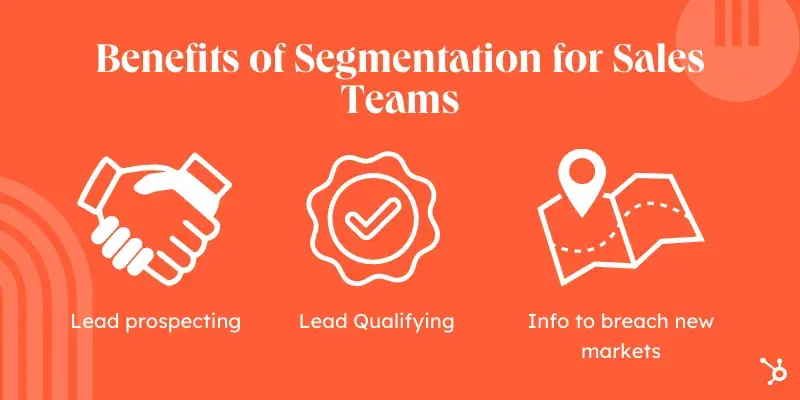
Lead Prospecting
For one, I think effective segmentation can be a major asset in prospecting. If your SDRs have a solid picture of the types of customers that show an interest in your offering, cold leads can become a little warmer — letting those reps make more thoughtfully guided use of your sales messaging when connecting with prospects.
Lead Qualifying
Beyond that, segmentation can also help with lead qualification. Knowing whether a lead fits the bill of a class of high-converting customers gives reps a head start during that stage.
I find it helpful to have some kind of criteria that can immediately distinguish a prospect who needs your product or service from one who lacks the decision-making tendencies, location, or economic circumstances to actually get something out of it. Target market segmentation gets you there.
Reaching New Markets
Finally, target markets provide sales teams with the necessary information to breach new markets and sell to them effectively. If you're not on top of any emerging markets that might need your product or service, you could hit a wall with your sales potential and lose out on incredibly lucrative business opportunities.
Know Your Target Market and Grow From There
I’ve learned that knowing your target markets inside and out is one of the most fundamental tenets of successful sales efforts. If you‘re not actively analyzing, pursuing, and refining your understanding of your target markets, you’re losing out on sales and pinning yourself into a corner with your business potential.
Following the steps I outlined above will put you on the right path for thoughtful market segmentation and successful sales efforts.
Editor's note: This post was originally published in July 2018 and has been updated for comprehensiveness.
25 Jul 15:28
Amazon is perfectly positioned to disrupt the world of investing — and its blueprint for success may already exist
by Joe Ciolli

- Amazon has made a habit out of scaring investors in a wide range of industries. In a recent study, Bernstein analyzed how the juggernaut could affect asset management.
- Bernstein outlines the advantages Amazon would have over traditional asset managers if it elected to enter the space, and it doesn't bode well for the industry's existing players.
- The Alibaba subsidiary Ant Financial provides a blueprint Amazon could follow if it wanted to succeed in asset management.
Nothing strikes fear in an industry more than the prospect of Amazon entering the fray.
It's a dynamic that has played out on numerous occasions over the past year or so, with companies in industries as varied as healthcare and grocery stores taking large hits to their stock price from the mere prospect of Amazon disruption.
Since Amazon was reported to be in talks with several large banks to launch a checking-account-like product, experts have been scrambling to assess the impact the company could have in the financial-services industry.
And according to a note from the investment management and research house Bernstein, Amazon is ideally placed to disrupt asset management, a Wall Street business that has been under pressure lately to offer its services at lower fees. A handful of cash-rich mega-cap tech companies could make inroads, but Amazon poses the most realistic threat to the status quo, the note said.
Before we get into Bernstein's main reasons Amazon is the top choice, it's important to note just how the firm thinks it can best enter asset management.
Rather than directly entering the process of fund management and being responsible for returns, Amazon would be best off either (1) creating a so-called robo-adviser, or automated financial advisory service, or (2) using its distribution capabilities to simply act as an intermediary between clients and investment firms.
In its analysis, Bernstein assessed Amazon's potential to create a robo-adviser. Here are the advantages Bernstein says the company offers on that front:
1) It already has customers
This addresses what Bernstein sees as the most difficult aspect of robo-advisory.
"It is highly likely that many of the prime targets for such an offering are already users of their product," Inigo Fraser-Jenkins, the firm's head of global quantitative and European equity strategy, wrote in a client note. "This could be a major game-changer in the economics of robo-advice."
Further, Bernstein suggests a possible link between Amazon Prime membership and mutual-fund ownership, noting that roughly the same number of people are involved in each.
"Viewed through the lens of penetration by household wealth buckets, it seems highly likely that there is a very large overlap of current buyers of mutual funds and members of Amazon Prime," he said.
2) It possesses a high degree of knowledge about end-clients and the experience of their buying decisions
"This could be very powerful both in terms of assessing which products the client might want to buy and also for inferring risk preferences in a way that could be more accurate than answering investment goal questionnaires," Fraser-Jenkins said.
He also notes that to the degree artificial intelligence starts to influence the practice of investing, Amazon's tech prowess could give it an easy leg up.
3) More flexibility in affording lower fees
The diversified nature of a mega-cap company like Amazon affords it significant pricing power versus more focused competing businesses.
"Presumably if one of the big tech companies came to an asset manager and offered to distribute their products they could negotiate a significant discount," Fraser-Jenkins said.
Effect on existing asset managers
The last point above leads into a broader discussion about the pressures being put on asset managers to cut fees. Put simply, the entry of a deep-pocketed competitor like Amazon could ratchet this tension even higher.
Earlier this year, a blue paper released by Morgan Stanley and Oliver Wyman estimated that asset managers could eventually see half of their fees evaporate if their distribution were to shift to an "Amazon-type marketplace" in which funds can reach investors directly. And while it's admittedly a worst-case scenario, the sheer fact that the discussion is occurring should trouble anyone in the industry.
Fraser-Jenkins would seem to agree.
"We suspect that a move by 'Big Tech' into wealth management might directly or indirectly force asset management fees down further, so one conclusion we would draw is that in the case of such a move then asset managers should be prepared for a further fall in margins," he said.
A blueprint for success
Judging by the company's Chinese counterpart, Alibaba, the potential for Amazon in asset management seems significant.
Ant Financial — Alibaba's fintech arm, which provides wealth-management services to users on the Alipay platform — has experienced immense success with its service called Yu'e Bao (which translates to "Leftover Treasure"). The money-market fund it offers — which is overseen by Tianhong Asset Management — has quickly become the world's largest, boasting $233 billion under management as of year-end 2017.
A closer look at Ant also lends more credence to the idea that the traditional fee structure used by asset managers may soon be a relic of the past. For one, the service doesn't require an explicit upfront fee to use its service.
Instead, pricing is agreed upon by Ant and the fund managers who operate through its platform. From there, Ant separates users into different groups based on factors like experience, then relays that information to fund managers. It then, in turn, charges them a fee for using the technology.
Bernstein argues that a similar structure makes a ton of sense for Amazon given the multiple advantages outlined above. In the end, Bernstein sees all of these factors as putting Amazon in the best position to achieve this sort of disruption in the US.
"The core learning points for other tech companies interested in this area are likely to be the ability to use knowledge of an already existing customer base to suggest investments and the use of existing (and trusted) payment systems as a gateway to broader financial intermediation," said Fraser-Jenkins.
Join the conversation about this story »
NOW WATCH: Why Rolex watches are so expensive
25 Jul 15:27


The Best Practices for LinkedIn: How to Fire Up Your Strategy
by Wendy Marx

When did you take a long, hard look at your LinkedIn strategy? If you’re losing momentum and your strategy is lagging behind your competitors, it’s time to look under the hood. Staying on top of the latest best practices for LinkedIn will rejuvenate your strategy — and ensure it’s firing on all cylinders.
LinkedIn constantly improves its offerings, becoming a hub for creative and professional networking. At last count, LinkedIn had around 562 million users worldwide — with 133 million in the United States. It’s an impressive audience, all of whom you have the power to reach.
This does not, however, mean that you have an all-access pass to your audience. it takes hard and consistent work to reach and engage your audience on LinkedIn. But what exactly needed to get your LinkedIn content strategy up to speed?
Let’s check out some of the best practices that should be priority #1 in your LinkedIn marketing strategy.
7 Best Practices for LinkedIn That Will Help You Succeed
1. Create Content on LinkedIn Publishing Regularly & Vary It
LinkedIn and content marketing go hand and hand — as we can clearly see in the success of its publishing platform.
While long-form posts definitely have their place in the LinkedIn ecosystem, don’t forget to vary your content between long-form and short-form. People who are simply browsing through might not take the time to read a long post, so having shorter options is important to engage all your visitors.
Maintain a diverse array of topics within your LinkedIn content strategy. These topics should range from trends and insights to how-to and educational posts. Don’t stick yourself into a box that limits the reach of your content strategy.
As with any publishing platform, consistency is key. Keep your audience coming back with an always fresh batch of content to fill their needs. Don’t allow that spark of interest to die out.
Most likely, not everyone in your audience will catch your content the first time you post it. That is why it is important to post your content several times on the network.
Keep your audience coming back with an always fresh batch of content to fill their needs
Take a page out of Dan Price‘s book. He is the CEO of Gravity Payments, a credit card processing company. His content spans a wide variety of topics and interests, both inside and outside of his industry. But it doesn’t matter that some of his content doesn’t directly impact his industry — the engaging nature of the content makes up for that. He is a great example of keeping his backlog of content fresh and interesting.
2. Invest Some Real Time In Your Company Page
Your LinkedIn company page may just be the most important part of your LinkedIn marketing strategy — you can post regular and engaging content, but if people don’t know who you are, it won’t take you anywhere.
Here are a few important components to keep in mind for your company page:
Profile Picture Choose a high-quality photo (usually this would be your brand’s logo) to represent your company. It should ideally be 300 by 300 pixels — any less, and you face the risk of having a blurry, unprofessional look.
Cover Image Next to your logo, this is your brand’s billboard on LinkedIn. While your profile picture tells people who you are, your cover photo tells them what kind of brand you are. It should relate to either your industry or company. Invest your time in a quality design. And make sure it fits within LinkedIn’s size recommendations: 1536 pixels wide by 768 pixels high.
Overview Section People will read this to learn more about your brand, so it should not be written on the fly. It should be keyword optimized to make your brand more visible to potential leads. This is not the time to copy verbatim from your website — this should be a unique message that is crafted specifically for your LinkedIn audience.
Once you’ve created your profile page, it’s time to promote it. Ask your employees to follow your company page, which will make it visible to their contacts. Link to it on your website and in your email signature line to encourage more traffic.
Take this example from the inbound marketing experts at Hubspot. The company’s clear-cut profile picture and inviting cover image make its LinkedIn company page pop. Its About Us section is well-crafted and to the point, but also brings out the rich history and company culture that sets it apart from its competitors.

3. Bring Your LinkedIn Strategy to Life with Video
One third of all online activity is spent watching videos. You’re clearly missing out if you ignore video as a viable marketing tool. The majority of social networks — LinkedIn included — see the importance of video and thus have made it a key part of their platform.
How can you best use video to boost your LinkedIn results?
First, add video to both your brand’s company page and your personal profile. This could be in the form of an “About Us” video or a behind the scenes glimpse at your company.
Second, use video to regularly engage your audience in your status updates. This could be to talk about the latest industry trends or problems facing your audience. This doesn’t have to be terribly long and drawn out — 60 seconds or less is the ideal length. You can use the opportunity in your video to highlight recently published posts that your audience can read, which drives traffic to your posts and engages your audience further.
Take this example from Squarespace, an easy-to-use website design tool. It regularly uses video to highlight its product features and share its customers’ journeys, which is what this little gem does. It shows how a young entrepreneur left her job to pursue her dream, and the part that Squarespace played in making that dream a reality.
4. Leverage LinkedIn for Thought Leadership
Thought leadership is more than simply a good reputation. 47% of C-suite execs and decision makers said that thought leadership content had a direct impact on their decision to engage a company. And a third of B2B buyers said that they had removed a company from consideration based on thought leadership output. With so much on the line, your company needs to develop a strong thought leadership strategy — and LinkedIn can help.
LinkedIn and its publishing platform have the potential to boost your thought leadership strategy. Use LinkedIn to publish top-notch, original content. Discuss the latest industry trends, provide how-to advice, and offer insightful industry commentary that showcases your expertise.
After people read your content, they may click on your profile to learn more. Before stepping up your publishing game, take the time to beef up your personal profile. This includes a professional headshot and a well-crafted summary that will engage your visitors.

5. Become Part of the LinkedIn Community
LinkedIn has done a great job segmenting your audience. With groups and communities on almost every aspect of any industry, you can always find a group that fits your niche. And what’s great about these groups is that they give people a chance to talk about industry topics. It’s the perfect example of a willing and attentive audience.
But if you’re going to make the most out of these groups, keep this in mind. Don’t approach a LinkedIn group or community with the idea of selling your brand. This is an area to talk about issues and trends that are important to the group — not to center the conversation around you.
Share content that discusses important issues and problems facing your industry. If you’ve found a solution that works — again, not one of your products or services — then share that with the group. Add to conversations with meaningful comments that showcase your industry expertise.
6. Target Your Audience with the Right Ads
It’s nice to have choices — especially when you invest your money into a social media marketing strategy. And LinkedIn delivers a nice variety of options depending on your goals, messaging, and budget. These options include:
Sponsored Content Got a piece of content that has performed really well with your followers? Pay to get it in front of more eyeballs with sponsored content. This works especially well with high-value content that establishes your expertise and genuinely helps your audience.
Text Ads Text ads appear at the top of LinkedIn pages and are a short and sweet way to get people to check out your brand. Because these are inherently short, it forces you to whittle down your message the essentials.
Sponsored InMail Just as the name suggests, Sponsored InMail ads appear right in your prospect’s inbox. These ads allow you to deliver your message (including visual graphics) in a place where they can’t help but notice it, along with a visually appealing call to action that moves them to the next step.
Carousel Ads This one is still fairly new — literally just rolled out in June of 2018 — with a whole lot of potential for B2B marketers. Carousel ads allow you to bundle up to 10 content offers into one rotating ad, with swipeable cards that you can customize for each offer.
Each of your campaigns is unique. With LinkedIn’s options, tailor your ad to meet the needs of each campaign.
7. Engage Your Audience with SlideShare
Slideshare is designed to fit seamlessly into your LinkedIn strategy — and it is a great way to add some spice to your LinkedIn content marketing. In fact, this platform was acquired by LinkedIn in 2012, with features that marry the two platforms nicely.
To date, there have been 19.7 million SlideShares posted to LinkedIn — and SlideShare presentations garner on average 159 million page views every month. These statistics speak for themselves as to the potential for this marketing tool.
How should you use SlideShare to best amplify your brand and message? Content marketing 101: Never use SlideShare to shamelessly promote your brand or products — it will only result in a frustrated audience and a damaged brand reputation.
Instead, deliver value throughout your SlideShare content, with your logo subtly used to increase brand recognition. At the end of your SlideShare, once your audience is happy and satisfied, offer a call to action. This could be an invitation to check out your website or download an offer.
Give your Slideshare presentation a leg up by using SEO best practices to make it more visible. Once you’ve chosen a keyword that is relevant to your content and which your audience searches for regularly, include it in your title and your description.
Take this example from TopRank Marketing, a marketing agency that specializes in influencer marketing. Its slideshare, 15 Ways to Fail and 25 Ways to Win with Influencer Marketing, has received over 42,000 views, and is a great example of how engaging a SlideShare can be. It uses captivating visuals and easy-to-read snippets to teach the ins and outs of influencer marketing. It nicely wraps up with a CTA to join Social Media Marketing World to learn more about influencer marketing.
In Review…

LinkedIn is an incredible social network with the power to get you where you want to go in your business. Use these best practices for LinkedIn to ensure everything is tuned up and ready to go so you can make the most out of this powerful tool.

25 Jul 15:27


The Enterprise Sales Process I’ve Used to Close $100,000,000+
by Amy Volas
As a startup at the expansion stage, there’s no doubt in my mind that you will look towards the enterprise market if you haven’t already. And for good reason… there is big business to be done there!
However, as an enterprise sales person for over 20 years, I’ve got to tell you – you really only get one shot at this market. Enterprise accounts have the attention span of a gnat… if you tank it on the first go, well, you’re more or less done.
I want to help you avoid that… because you can succeed at this level if you do the right work.
So whether you are just investigating enterprise sales or are already getting after it, here is the enterprise selling process and the specific techniques that have personally helped me close $100MM+ for companies selling anything from consulting services to HRTech SaaS products.
Start with the right mindset.
Imagine walking into a tailor to get a custom suit made of the finest Italian silk money can buy and having him pull a pre-made jacket off the rack, hold it up in front of you to check for size, and take you to the register.
You’d walk right out of there, wouldn’t you?
You didn’t go there for something that was made to fit everyone… you came to him because you need to look like the sharpest person in the room and you know that fit is 90% of making that happen.
Sadly, this is exactly how most startups treat enterprise-level clients and where most kill any chance they ever had.
See, at the enterprise level, the risk of buying into the wrong solution is MASSIVE for your buyers. So they need to make absolutely sure your solution is right for them before they pull the trigger.
That’s why the most critical thing you will ever do in your enterprise sales process is to get your mindset right. Enterprise deals are big, time-consuming, and driven by quality, not quantity.
They are high-touch, discovery-driven marathons – not a single shot to the finish line. You’re dealing with an average of 6.8 decision makers on deals that often take 12-18 months to close.
But most importantly, they are about fitting a custom solution for each buyer, not trying to fit a customer into your existing product. The perceived risk of purchase for a buyer at this scale will simply be too high without some level of customization in both your sales process and your product.
Yes, this is a ton of work to execute on your end. But you must approach it this way if you want to reap the rewards that the enterprise market has to offer. I’ve never seen a single product or service in my 20 years that was a dead perfect match.
Know your buyers and their needs better than they do.
There’s a reason why the jokes of top comedians always seem to have big audiences laughing so hard they cry… it’s because they’ve done their research on their audience and know them well.
They spend months testing out their jokes on smaller stages and learning what works. So when that special set at Madison Square Garden happens, they can walk out on stage confident they will nail it.
That’s exactly the level of prep work it takes to win at enterprise sales too.
In fact, after getting our minds wrapped around the commitment that enterprise sales requires, getting to know who are buyers are and what they need is priority number one.
Here’s how I do that.
1. Calculate your total addressable market.
This exceptionally important and deserves an article all by itself. Whether you’re starting from scratch or not, read this article to learn how to do this.
2. Select the accounts that are the best fit to start with.
The power of pipeline is fierce in enterprise sales. Remember, this is the long game, so prioritize your time accordingly with the accounts that are the best fit from the beginning and be prepared to put a lot of irons in the fire all at once.
3. Get deep inside your prospects’ world.
Once you have your prioritized list of key targets to go after, I set up alerts on company and industry news for each. Things like acquisitions, announcements, changes, new business, and more. You want to be looking for things like:
- What’s happening in the marketplace?
- What challenges are they facing?
- What does Crunchbase, Pitchbook, their annual report, etc. say about them?
- What does their roadmap look like?
This helps me to stay on top of everything in their world. Nudge is one of my personal favorites for this.
4. Map out the organization and find common ground.
Figure out who you think will be involved in the buying process, who your buyer will be, who your influencer will be, etc. and start engaging with them. Just make sure that when you reach out, you’re adding value and that you stand out. I’ve written an entire article on how to do this with social media on Sales For Life. We’ll get in deeper on this in the next section below.
Consult, don’t sell.
“Good salespeople sell lots of product, but great salespeople make lots of customers successful.”
– Mark Birch
The truth is, success in enterprise sales really comes down to one simple thing: your prospects need a solution and your number one goal is to help them get that solution.
But if you want a seat at the table with them, you have to bring something their way they can’t get anywhere else.
These buyers have competing priorities and are getting approached ALL of the time. So once contact is made you need to find new and different ways to add value to what they’re trying to achieve and stand out from the crowd in the process.
This is where your research and further discovery is SO important.
Questions are key – make them count, listen, adjust, pivot, and respond in earnest to hit their nail on the head. LISTEN, pay attention, look for the space in between that nobody else would pick up on and use that fill the gaps they have.
The better you do this, the more eager they will be willing to engage.
For example, at Indeed I turned the idea of a lunch and learn into an exclusive roundtable event with a mix of prospects and current clients on a specific topic that was helpful to them. I had one of my key clients moderate it creating a mega opportunity for meaningful follow-up post-event.
It was so successful and valuable for them that I signed deals shortly thereafter with people that were turned off to Indeed previously. The best part, my existing relationships saw an immediate increase in spending as well.
You don’t always need to do things this high touch and involved. It can be anything as long as it’s helpful and value added. Even something as simple as a book that addresses the key problem they’re solving or making an introduction for them with another contact so they can brainstorm best practices is effective.
But whatever you’re doing to consult and help, make sure it really delivers for your buyer – even if you don’t gain a thing from it right now. It’s like an investment account – you have to make deposits before you make withdrawals.
And the more you invest, the bigger of a dream vacation you can take later 
When the ink is dry, your work is just beginning.
The enterprise sales process is a ton of work when you do it right. But while it’s tempting to sit back and kick your feet up when you’ve finally closed that huge deal, the best sellers know the hard work isn’t over.
In fact, the best sellers know that a signed contract is just the beginning… there is often so much more opportunity for further growth that is left untapped in the form of referrals and even further expansion of the solution you can provide for your clients.
Remember, this is the long game – stay on top of changes in their marketplace and in their trajectory. Be that trusted confidant they can come to when they have questions or the proverbial @#!$ hits the fan.
Finding new customers is usually 10x more expensive than keeping existing ones, so staying on top of the relationship long past the end of the deal is worth every penny.
But, there’s also something else to consider – you absolutely must keep your pipeline full at the same time too. What happens if your marquee client pulls the plug or that big deal you’re counting on backs out?
The most successful sellers become ‘go to’ authorities in their respective ‘spaces’. They find ways to continue being helpful, even if it doesn’t benefit them directly. They know being top of mind is the most critical component of their longevity and success.
It’s like I always say – what you put into something is absolutely what you get out of it.
The Key Takeaway
Enterprise sales is about crafting a custom solution to solve a single customer’s problems rather than giving them a “one size fits all” product.
It’s about putting your customer’s need for a solution above your need to make a sale.
This takes a ton of preparation, creativity, and high-level strategic thinking to pull off. But I promise you – if you start with that mindset and do the right work, the pay off will be very, very worth it.
The post The Enterprise Sales Process I’ve Used to Close $100,000,000+ appeared first on OpenView Labs.
25 Jul 15:19
How to Dramatically Improve Your Sales Hiring Process [Infographic]
by SalesDrive, LLC

The standard sales hiring process is one that has been the same for what feels like eons.
As a Sales Hiring Manager, you likely have a routine you follow when hiring new employees, which most likely looks similar to the following:
- Create the job posting
- Advertise the position
- Review resumes
- Verify references
- Conduct basic interviews
- Make a hiring decision
Is it just us, or are you tired of this antiquated way of approaching your hiring? Especially when that hiring process has a failure rate of 20% (the typical turnover in sales).
This is likely even truer when you learn that the average cost of replacing a telesales employee can cost your company as much as $90,000.
If you are like other Sales Hiring Managers looking for a way out of this dark hiring hole, you are in luck. We have the tips and tricks you need to make drastic changes to your sales hiring process that will improve your sales hiring in every way.
The 5 Best Ways to Improve Sales Hiring
Click to Enlarge
1. Get Specific in Your Job Description
Sure, you need to hire a salesperson. But what type of salesperson are you looking for?
Are you looking for someone who will dive right in and act as a hunter to find new leads? Or are you looking for someone who can nurture and close existing leads already in the pipeline?
Hiring for a general salesperson is one of the key ways to ensure you will be hiring again to replace them soon.
Instead, improve your sales hiring process by getting specific about the job you are looking to fill. Be sure to list exactly which sales strategies you want your new salesperson to perform.
2. Create an Internal Company Referral Program
Relying on job boards to attract applicants can get exhausting and can honestly be a waste of your time.
So, why not go right to the source?
Look to the best salespeople in your company to have them help you find new top salespeople. Chances are good they have friends or previous colleagues who are sales superstars and could be a good fit for your position.
The best way to do this is to establish an internal referral program. In order to make this worth not only your time but your current employees’ time, you need to be prepared to offer employees worthwhile incentives – whether that is a financial incentive, additional vacation days or even prizes, such as an iPad.
By offering incentives to your current salespeople for quality referrals, you improve your chances of finding top-notch potential new sales hires.
3. Don’t Place Too Much Value on The Resume

Though the resume is a key part of the sales hiring process, it is not something you should rely too heavily upon.
Why is this?
Because resumes alone are not the best indicators of how well a salesperson will do for your company.
Resumes do a great job of highlighting the candidate’s past experience — his education, previous jobs, etc. However, they fail to really paint a picture of how that translates to the specific position you are looking to fill. It is important to understand a candidate’s past experience beyond what’s listed on their resume to determine if they will be a good fit for your open position. We’ll get into this more later.
Another reason you do not want to rely too heavily on a candidate’s resume is that many people lie on their resumes. In fact, a study conducted by HireRight found that a whopping 85% of applicants falsify information on their resumes.
With statistics like that, you have to be paying close attention to potential red flags on someone’s resume. Here are some of the top ones:
- Inflating job titles
- Unknown (or nonexistent) colleges
- Vague job descriptions
- Gaps and inconsistencies in employment
- Name dropping overkill
If any of your potential sales hires seem to be doing one of the above, you may want to reconsider hiring them. Resume falsehoods are often indicators that this candidate is likely to continue lying, or at least overstate facts.
4. Assess Candidates with a Sales Personality Test
Resumes are not the only thing candidates can fake in the sales hiring process.
Did you know that 81% of candidates often lie during the interview process?
So how do you know if your potential hire really has the ability to be a promising salesperson for your team?
By assessing them with a validated sales personality test.
And, this cannot be any general personality test you found online — it needs to be an assessment that tests for one specific thing: Drive.
Drive is comprised of three non-teachable traits:
1. Need for Achievement.
This means your salesperson will never stop pursuing excellence and will never be okay with being idle in their work.
2. Competitiveness
You need a salesperson who always strives to win and who never likes to lose. Competition keeps them moving and motivated, and they love playing that competitive game.
3. Optimism
Rejection is inevitable in the world of sales, even for the best salespeople.
Thus, you need someone on your team who is going to push through and remain optimistic despite the “no’s” they may receive. High-Drive salespeople will accept that missed opportunity and forge on to the next one, knowing chances are good it will be a success.
The DriveTest® is the only sales personality test on the market that objectively assesses candidates for all three traits that make up Drive.
>> Claim your free trial of The DriveTest® here.
5. Get Creative with Your Sales Interview Questions

We have all been asked the same interview questions a hundred times.
“Why do you think you are the best person for this job?”
“Describe a time when you were faced with a challenge. How did you overcome it?”
“What is one of your biggest weaknesses?”
Because these interview questions are expected at nearly every interview, candidates take the time to practice the perfect responses, in the hopes they can wow the interviewer.
However, rather than asking a potential candidate the questions they are expecting, opt instead for questions which dig deeper.
Asking specific behavioral questions requires your candidate to give specific answers, which allows you to have a better understanding of whether he or she will be the right fit for your open sales position.
We recently shared 51 specific sales interview questions to help you improve your sales interviewing skills. Here are some of the highlights:
- How much time do you spend nurturing customer relationships vs. looking for new clients?
- Have you taught yourself something lately? If so, what was it?
- How have you turned around a streak of bad calls?
- If we had a magic wand and could improve three things about your previous job, what would those three things be?
- Name a time you received criticism and how you handled it.
These are just a handful of the questions you should be asking your potential candidates to gain more insight than you would from traditional sales interview questions.
In Summary
To improve your sales hiring process, step away from the ineffective, outdated approach and incorporate new, modern-day strategies including:
- Getting specific with your job descriptions
- Creating an internal referral program for sourcing candidates
- Taking the resume at face-value
- Assessing all candidates with a sales personality test like The DriveTest®
- And asking unique behavioral interview questions that candidates are not likely to expect.
This more in-depth approach to hiring will enable you to weed out potential sales pretenders and will leave you considering only high-potential sales candidates for your open position.
Start improving your sales hiring process today with a free DriveTest® assessment.
The post How to Dramatically Improve Your Sales Hiring Process [Infographic] appeared first on SalesDrive, LLC.
25 Jul 15:19
Balancing Traditional vs. Modern Sales Approaches {Infographic}
by Ema Myers
Sales is continuously evolving. Every generation adapts and expands selling approaches. Baby Boomers practice traditional selling methods, while Millennials have embraced modern methods such as automation to boost productivity. There are benefits to incorporating both traditional and modern sales techniques into a process.
What are traditional selling techniques? They rely on a human experience to drive the sales process. Face-to-face meetings and phone calls are the primary ways to engage prospects and develop deeper personal connections. Personal connections are necessary for relationship building, but connecting with prospects individually takes time.
Modern selling incorporates automation to increase efficiency and speed to lead. Saving time on non-selling tasks translates to more time selling. However, automation doesn’t mean sacrificing personal connection. Instead, this modern approach to sales provides an opportunity to scale personalization and initiate conversations with more prospects in less time. Increasing engagement leads to additional opportunities for developing connections.
We’ve compared traditional and modern sales approaches to find the most effective balance. Blending the two perspectives can dramatically increase customer engagement and lead to additional revenue.

Do you have a multi-generational sales team? We’ve got you covered in our eBook: Cross-Generational Sales Teams!
The post Balancing Traditional vs. Modern Sales Approaches {Infographic} appeared first on SalesLoft.
25 Jul 15:16
10 Things that World-Class Salespeople Have in Common (According to Experts)
by Kasia Kowalska
Sales is probably one of the most demanding jobs.
Why is it tough?
Because you’re under constant pressure to deliver. Entire organizations depend on sales departments and you have to work with people, which can be exhausting…
But working in sales is also super exciting. No day is the same, and you aren’t stuck at your desk all the time. Also, when you reach your quota (or exceed it), you became the superhero, everyone talks about you, you get your big fat bonus, life is great!
There are sale guys (and girls) who deliver continuously, we call them sales superstars!
Have you ever wondered what they have in common?
I certainly have, which is why I’ve decided to pose this question to some world-renowned sales experts.
Here’s what they said:
10 Things that World-Class Salespeople Have in Common

Lee Bartlett, Best Selling Author, Sales Consultant
#1 World-class salespeople have a high sales EQ
The best salespeople have a high emotional quotient and use it as a differentiator. They have the ability to control their emotions, channel them to connect with their customers, and drive revenue.

Steli Efti, CEO at Close.io
#2 World-class salespeople are very consistent.
There are many skills and traits that any salesperson should strive to get better at (being a great listener, being able to ask great questions, being great at managing relationships, qualifying and closing techniques, etc, etc).
And both I and others have given that advice many times, and most of your readers are probably already aware of and have worked on these skills.
However, there’s one trait that often gets overlooked, and yet, I’ve NEVER EVER met a great salesperson who lacked that trait:
Consistency.
You can be talented, charismatic, likable, a domain expert, and so much more, but if you’re not consistent, you’ll never be a great person.
In fact, I’d rather have a team of mediocre but consistent sales reps, than a team of incredibly talented and smart reps whose can’t perform consistently.
If you’re a salesperson, and you really want to build a successful career, stop toying around with new tools and studying all the latest sales tactics and methodologies.
Instead, focus on doing the things that you’ll be able to do consistently, over a very long period of time, and do them really well.

Barbara Giamanco, CEO of Social Centered Selling and host of the Conversations with Women in Sales podcast
#3 World-class salespeople learn continuously.
One thing that makes successful salespeople stand out is that they NEVER stop learning! They know that when you learn, you earn.
Constant learning expands your horizons, keeps you relevant and helps you distance yourself from competitors. Your conversations with buyers will be stronger.
You’ll be more valuable to your employer, and career opportunities will present themselves more quickly. Consistently read, listen and learn from experienced experts who can help you be the best salesperson or sales leader that you can be.

Tony J Hughes, Speaker, Author, Consultant
#4 World-class salespeople know everything about their customers.
It is timelessly important to focus on the customer and on what they are seeking to achieve in their world.
Think about your customer’s customers, and the pressures their business is under to survive and prosper.
Lead with a narrative that is all about them and provides empathy, insight and market intelligence from which they can benefit but without crossing any kind of ethical line with their competitors.
An old-school truth is that only the customer is qualified to call something a solution and only the customer can define value.
It is essential that we go beyond our own products and services to understand the customer’s industry, company, role and personal context when we engage.

Mark Hunter, CEO at the Sales Hunter, Keynote Sales Speaker, Best Selling Author
#5 World-class salespeople are disciplined.
Discipline to follow through is the big difference between an average salesperson and the world-class salesperson.
The world-class salesperson is focused 110% on being disciplined on following through with everything from how they use their time to the leads and customers they’re working with.

Mike Kunkle, Founder & Sales Transformation Architect for Transforming Sales Results, LLC
#6 World-class salespeople always put their buyers first.
World-class salespeople are laser-focused on what matters most to their buyers, the outcomes they need to achieve, and the metrics that matter most to each of the decision makers and influencers.
Far more than average salespeople, these top producers do outstanding discovery and remain focused on the buying process exit criteria for each decision maker, at each stage of the process.
Buying process exit criteria are the things each buyer needs to see, hear, feel, understand and believe at each stage of their buyer’s journey, to feel comfortable moving forward to the next stage, with you.
World-class salespeople stay fixated on uncovering, understanding, and satisfying these criteria, which they know include both business needs and personal needs.

Nancy Nardin, Founder & President of Smart Selling Tools
#7 World-class salespeople only focus on tasks which matter.
Protect your time!
Always ask yourself, “will this task ultimately help me make my number?”
It’s so easy to get distracted. It’s human nature to veer toward the things you like doing most. Indulge in those things to some degree, but make sure that you bring your focus back to the activities that will get you to your goal.

Andy Paul, Speed of Selling Expert, Executive Sales Coach, Executive Sales Consultant
#8 World-class salespeople are endlessly curious and open-minded.
I think the best salespeople are insatiably curious, open-minded, problem solvers and relationship builders. They are constantly learning about everything in the world around them, not just sales.
They ask original questions that they don’t know the answers to ahead of time and then they truly listen to the answers.
They understand that sales is all about the human connections they make in order to help others achieve their goals. Perhaps most importantly, they are rule breakers.
They use their experience to develop a personal sales methodology that optimizes their unique skills and capabilities.
What do you think the world-class salespeople have in common?
25 Jul 15:16

Struggling to Close Deals? It Might Be This
by Tobin Lehman
adamr / Pixabay
Not sure why your deals aren’t closing? Your problem might be at the beginning of your sales process.
Before we jump too far into the answer, we need to set some definitions. We are going to talk about marketing and sales, so we need to understand the role each plays in order to orchestrate the final solution to this problem.
Marketing vs. Sales – End the Battle
The age-old battle of marketing vs. sales comes from a lack of understanding on the role each one plays in an organization. They are truly peers, sitting at the same table with the same goal. This goal is to move the right product to the right consumer at the right price.
The goal is to move the right product to the right consumer at the right price
The way you define all of those “rights” in that last sentence determines how you shape each role. Marketing defines what is the “right” product through market research around what is needed in the market to solve a problem. Marketing also helps determine the right audience; that’s the intent of the brainstorms and research.
Sales comes into the picture to help shape that “right consumer” as well, because they possess most of the feedback loops in the process. They are talking to customers in the field and seeing how things are received. They also help shape the “right price” as they are able to navigate the space to see what kind of value and packaging they can use to move that product to the right consumer.
It’s a teamwork-driven, collaborative engagement – and the teams that do it right, win big.
Sales Gets the Tough End of the Stick
Once we understand this relationship, we can see how marketing sets the pace and can create a lot of challenges to the overall sales process.
Don’t get me wrong, you might be a bad sales person. I can’t fix that.
But you might also be trying to sell “sand in the desert”, as they say.
If you have that challenge, marketing and sales need to have better alignment to get the right product into the market. Rather than taking the bad end of the stick, give the proper feedback on the product or service so that you can change the downstream outcomes.
Here are some ways to change that outcome.
Setting Up Success In the Sales Process
- Have a Great Website. That does not mean a pretty website; it means an accurate one. It means having the right messaging and content on the site that helps engage and educate the right customer for your sales process. When they get to your site, you should be explaining your services and the process to buy them, making conversion very easy.
- Promote the Right Message. What you are doing in social media and email marketing matter to your sales process. If you are off topic, you are giving your audience the wrong impression of what you do. Having a few key social media message points and topics for email blasts can change your outcome downstream because they will have greater alignment to your value.
- Have a Defined Sales Process. This process should be outlined on the website, but also through your presentations and calls. Unless it’s a system, its not measurable or repeatable. With a defined sales process, you can deliver nicer presentations and information in logical ways that help shape the outcomes. Your marketing team can help you with those presentations so you can work clearly into the client’s needs without having to be a repository of product information and case studies.
- Nurture Your Prospects Well. One of the hardest things to spend time on is “working” cold leads. How much time do you spend working on emails that could be automated? This is a simple function of marketing automation that can give better outcomes and deliver more in far less time.
Next Steps to Change in Your Culture
So, you’re ready to drive this change in your organization? Here are some things you can do today to start this process.
First, meet with your sales leader or CEO to talk about the alignment issues you are feeling in your marketing and sales. This discussion will open up a dialog, and you can suggest some next steps.
If you have a marketing team, treat them as that – your team. Don’t point fingers or push blame. Find a way to come to the table over the unified goals.
Second, set up a shared scorecard. Marketing would like to have some idea of the results they are getting. A shared score card is the right kind of communication and feedback loop that both groups need to measure success. If you don’t have one, suggest one.
Part of that might mean creating a meeting where the two teams can sit and talk about how to move the needle on those scores.
Third, celebrate and encourage. Marketing works in a bubble sometimes, so it’s hard to know what is working. Simply by encouraging and thanking the team for marketing that seems to be working well on your end is key. You’ll find you get more of what you praise, and you might even open up the conversation in more detail.
Go Get’em.
Communication is what we are selling in this article. Go make it happen. Be the change in your organization. You’ll find your effort in this relationship will help you downstream and you’ll be getting more of the right leads.
25 Jul 15:16
![Sales Hacker Webinar - How To Build An Effective Pipeline And Increase Sales 5x [PART 1: Getting More Leads]](https://www.saleshacker.com/wp-content/uploads/2018/08/0807-Growlabs-1200x630-on-demand-2-1200x630.png)
How to Build an Effective Pipeline and Increase Sales 5x [PART 1: Getting more leads]
by Joan
The post How to Build an Effective Pipeline and Increase Sales 5x [PART 1: Getting more leads] appeared first on Sales Hacker.
25 Jul 15:16


Evaluating Your Prospecting Methods
by Mark Hunter
Does your prospecting process need evaluating? Maybe the question I should be asking is, “Do you even have a prospecting process?”
And an even deeper question I want you to get to is, “Why should I even believe what I’m doing is effective?” I get asked a lot of sales questions each week, but the issue of prospecting accounts for at least 50% of the questions I get.
Last week I did a webinar on this issue of rebuilding your prospecting process. I had so many people ask to see it that I went ahead and moved it over to YouTube to make it easy to view. Yes, the video is 45 minutes in length, but it’s worth watching. Here it is:
Below are 5 questions I want you to ask yourself:
What is the % of new business I get by prospecting vs. referral?
What is the % of business I received in the last 12 months from customers who I didn’t have 12 months ago?
Where do my leads come from? What % are ones I generate?
How quickly could I replace the business generated by my top 2 customers if they stopped buying from me?
Do I know what parts of my prospecting process are effective and which ones are not?
I suspect answering these questions set off some alarms. If they didn’t set off some alarms, then you’re part of the one tenth of one percent of salespeople. Congratulations!! Just don’t get too comfortable. Things can change quickly.
If you’re like the vast majority of salespeople who get sick to their stomach when answering these questions, stop what you’re doing. I don’t want you to get sick while reading this. What I do want you to do is to commit yourself to getting serious about this prospecting issue.
I’m being very serious when I say I want you to watch the video and/or reach out to me. You can’t delay. I’ve been where you are and I know the pain, and there’s no reason for you to be going through it.
You will never have enough deals to close if you don’t spend enough time prospecting and — more importantly — prospecting effectively. Sales quotas are not made with closed deals. They’re made with great prospects.
Want to do something about building a prospecting process that works? I am offering you an opportunity to do exactly that, but you have to get in on it before July 26 at midnight. You can find out all about it at this link or by clicking on the below image.

Copyright 2018, Mark Hunter “The Sales Hunter.” Sales Motivation Blog. Mark Hunter is the author of High-Profit Prospecting: Powerful Strategies to Find the Best Leads and Drive Breakthrough Sales Results
25 Jul 15:16
3 Ways Interactive Content Drives Shorter B2B Sales Cycles
by Justina Logozzo
Businesses today know that the longer it takes to close the sale, the greater the chance is of losing prospects to the competition. In addition, a longer sales cycle requires more time and resources.
To address this, B2B marketers have turned their attention toward content marketing—increasing demand generation, engagement, and overall leads through quality content that provides value to the prospective buyers. By sharing content prospects want to engage with, marketers can nurture leads along a path to drive conversions.
According to a recent study, 91 percent of all B2B organizations surveyed indicated using content marketing. Additionally, 78 percent of them plan on increasing their content production in the next year. As more and more businesses adopt this strategy, marketers are noticing that their content is having less of an impact.

(Source)
When digital content first started playing a serious role in modern marketing, the traditional formula marketers relied on was simple: Write quality content without getting too sales heavy, and you’ll drive engagement down the sales funnel.
While it pains me to say this, those days are long gone. Today, quality content alone no longer drives the high conversion rates that once helped shorten sales cycles. Now, quality content is a requirement, not a competitive advantage. In order to leverage content for a shorter B2B sales cycle, marketers need to go above and beyond quality and relevance.
In this post, we’ll explore why content alone can’t be relied on to convert leads to sales and highlight three reasons why B2B marketers should use interactive content to drive a shorter sales cycle.
Quality Content Isn’t Enough
Today, half of all B2B buyers rely on content to make an informed buying decision. Prospective customers are now leveraging content published from a variety of vendors, familiarizing themselves with the products or services, comparing the benefits of each vendor – all before making a purchase decision.
With so many businesses publishing content, prospects now have a wider variety of research material. This has made it more challenging for B2B companies to keep prospects engaged and nurture them on the path to becoming a customer.
Not convinced? Consider the following points explaining why quality content no longer shortens the sales cycle:
Everyone has quality content these days: In the past, the marketers that put effort into making great content for their audiences thrived. Businesses that provided value to their audiences with their content had a huge advantage over those that didn’t. They engaged with more prospective customers and drove more leads down the sales funnel.
Today, the secret’s out and more businesses are aware of the advantages of publishing consistent, quality content. The result has been a content explosion that leaves prospective buyers with more and more content to choose from.
Content isn’t providing the insights sales teams need: According to a recent study, 74 percent of the companies not exceeding revenue goals, didn’t know their visitor, lead, MQL, or sales opportunity numbers. While quality content engages audiences, a lot of that engagement isn’t properly translated into metrics marketing and sales teams can use to increase ROI.

(Source)
Content isn’t driving conversion: One of the biggest reasons for lengthened sales cycles is a lack of defined paths-to-purchase (the series of engagements across a campaign that move prospects down the sales funnel). If top-funnel prospects engage with content, but are not guided toward additional resources designed to help them make a decision, they’re less likely to convert.
3 Ways Interactive Content Helps Shorten B2B Sales Cycles
Interactive content places a series of timely, relevant interactions in front of prospective customers that connects them with additional content, engagement opportunities, and resources they’re interested in. By connecting a prospect with content related to their unique needs and interests, marketers are helping him or her reach a buying decision without having to turn to additional vendors for the information they need.
With that said, let’s take a look at three ways interactive content can help businesses shorten their sales cycle:
1. Consistently Engage Your Prospects
The reason customers are seeking out your products or services is because they have a problem to solve. They want to be presented with solutions. Modern marketers have the ability to engage customers consistently – and in meaningful ways – through interactive content.
For example, marketers can leverage interactive content to enhance traditional static content, like white papers, opening up a dialogue with the prospective buyer that resonates with their distinct challenges and needs. Additionally, marketers can layer in opportunities for engagement like qualifying questions that can help guide them to the right resources, all without ever leaving your website.
This capability enables marketers to actively guide and nurture prospective buyers much faster than traditional content engagement, which waits for user to “stumble on” the content that’s further down the sales funnel.
2. Gather Better Insights
Marketers use content engagement to understand where leads are within the sales funnel, connect them with relevant nurturing, and help marketing and sales teams qualify and disqualify their leads. However, traditional content often leaves much to the imagination, forcing marketers to make educated guesses as to the interests of a prospective buyer and where they are in the buying process.
By providing audiences with a variety of interactive engagements, marketers gain visibility into the interests and needs of their audiences, helping both sales and marketers align their efforts for more targeted nurturing. Additionally, interactive content provides unique insight on key qualifying questions, preferred methods of content, and what specific needs a customer is looking to address.
In this way, prospects are self-qualifying, providing valuable data that can then be used for more direct and impactful sales discussions.
3. Generate Quality Leads Without Gating Content
According to content marketing expert David Meerman Scott, ungated content is downloaded a staggering 20 to 50 times more than gated content. I know what you’re thinking, “Without lead forms to access content, how will I generate my leads?”
Well, interactive content encourages engagement with audiences in a more natural, conversational way. For example, an interactive assessment could ask a prospective buyer a series of questions to determine if they fit in your target audience parameters. If they show indications that they fit into your target audience, prospects then receive a lead form they can fill out for additional content related to their needs.
The essential point is this: Prospective buyers should feel like they’re getting value out of their participation. For example, a prospect can use an interactive ROI calculator to uncover information they may not be able to determine otherwise. With this type of content engagement prospects don’t feel like they’re “surrendering” their information to access content. They’re willing to give up certain information in return for insights.
By providing value first, then leaving the prospect to make his or her own decision to fill a lead form, you’re demonstrating that their participation in interactive content connects them with personalized experiences. This ungated approach to lead-generating content helps businesses increase downloads—driving the right leads down the funnel with lead-form options inside the content itself.
Final Thoughts
Content marketing is undergoing some serious changes. Given the overwhelming number of B2B businesses publishing quality content, to stand out, your business needs content that does more.
Content should go beyond providing relevance and education to your prospects, it should actively engage them and provide them with the resources they need to reach an informed buying decision. To shorten the B2B sales cycle, you can use interactive content to increase lead quality, better engage your prospects, and nurture them down the funnel.
Want to see creative examples of interactive content in action? Check out our interactive content examples for ideas on how to engage your prospects – and shorten your sales cycle along the way.
25 Jul 15:15


3 Types of Questions that Transform Leads to Sales
by deb.calvert@peoplefirstps.com (Deb Calvert)
DISCOVER is an acronym for the eight purposes of asking questions. Yes, there are only eight purposes ... only eight reasons that people ever ask questions. Sellers tend to focus primarily on three purposes: gathering data (D), identifying desired outcomes (O), and magnifying consequences (C). That means there are five types of questions most sellers seldom ask.
25 Jul 15:15
How to Find the Right B2B Technology Copywriter
by Rachel Foster

Finding a qualified B2B tech copywriter can be a daunting task. Here are 7 essential traits to look for before you sign a contract …
Good copy is an essential part of a B2B marketing plan.
Research shows that 47% of B2B prospects read between three to five pieces of content before they speak with a sales rep. But many B2B marketing teams are small and don’t have the resources to produce tons of copy in-house.
Working with a B2B copywriter helps you create content that supports your campaigns, engage leads, and turn prospects into customers. However, it can be hard to find the right copywriter.
Many B2B marketers test several copywriters before they find the right fit. In fact, many of my own clients have cycled through two or more copywriters before they started working with me. The reasons for failure varied: The copywriter didn’t understand their industry, couldn’t meet deadlines, or had a conflicting communication style. Choosing the wrong copywriter can increase your workload, cause project delays, and cost you more in the long run.
But the right copywriter can make your life easier, improve your marketing results and help you produce more content – faster. Here are seven traits to look for in a B2B technology copywriter:
1. Industry Knowledge

Many copywriters are generalists, which means that they write about everything from consumer products to fitness. Agencies often hire generalists when they need a writer who can adapt their style to a range of clients. But a generalist may not be the best choice for B2B tech companies that sell complex products and services.
If your product has a steep learning curve or a sophisticated audience, look for a writer who has prior experience in your industry. In particular, find a copywriter who understands the unique needs, concerns, and hesitations of B2B tech buyers.
The B2B tech industry is ever-evolving and doing so at a rapid pace. You need a copywriter who is not only familiar with the basics of the tech industry, but who also stays informed of the latest news, trends, and studies that will affect your customer base.
You need a copywriter who’s not only familiar with the basics of the tech industry, but also does this:
Working with a copywriter who has experience in your industry can greatly reduce the amount of time that you spend briefing the writer and managing revisions. This helps your project run smoothly, allows you to produce content faster, and can bring you better results.

2. An Understanding of Your Audience
Your copy is often the first point of contact between you and your target audience. To engage customers, you need a copywriter who understands their unique point of view.
Your B2B tech copywriter must match your tone to each reader’s role, level of familiarity with your company, and stage in the sales cycle. For example, your audience may include IT pros who want to know how your product works. But you may also have business buyers in your audience who aren’t as tech-savvy but need to know how your product or service will drive value for their company.
A good B2B tech copywriter can speak to both of these audiences in a relatable way. Look for a copywriter who can engage your readers and educate on their level – without dumbing down the content or overusing complicated tech jargon. Here’s more information on how to find your unique B2B brand voice.
3. Marketing Savvy

A great copywriter is part marketer, part storyteller. Because copy is all about selling, you need a writer who knows how to sell your product or service in a way that aligns with the needs of your target audience. But selling by itself can be soulless and come across as gimmicky if you don’t have a meaningful, sympathetic story behind it.
A capable B2B tech copywriter can turn your facts, figures, and statistics into an empathetic narrative. Here’s more information on how to use storytelling to convert prospects into customers.
4. The Ability to Write Email and Landing Page Copy
If you sell software or tech services, you need a copywriter who understands how to write effective email and landing page copy. Both go hand-in-hand with engaging leads and converting them into customers.
Copywriters who excel at writing marketing emails know how to keep the copy short, understandable, and action-oriented. Email marketing is one of the top strategies for nurturing leads. In fact, email generates a $38 return for every $1 spent. When your copywriter excels at conversion-focused emails, you will massively multiply your return on investment.
Your copywriter can produce email sequences that motivate new subscribers (who have just downloaded a piece of your content) to sign up for a free trial or demo. They can also write a sequence that turns free trial users into paying customers.
The ideal B2B copywriter should also know how to write landing pages that sell. A landing page is not only useful for capturing email addresses, but also for building a foundation of trust with your target audience. When done correctly, your landing page will enhance your credibility and motivate customers to take the next step towards working with you.
5. Responsiveness

You need someone who can get back to you quickly.
Some writers are hermits. After making the agreement, they’ll retreat into a metaphorical cave, and you won’t hear from them until the deadline. For some tech companies, that works out fine. However, if you want to maintain an active connection with your copywriter, you need to set those boundaries from the beginning of your working agreement.
Find out their preferred method of communication and make sure that it works for your needs. Also, ask how long it takes for them to respond to edit requests, issues, or concerns. You should also expect regular updates on the status of your copy. Even if you don’t have a pressing deadline, your copywriter should keep you informed about how things are progressing.
You must ensure that your communication styles are acceptable to each other upon entering an agreement. The last thing you want is to spend several days trying to reach your copywriter for an urgent request.
You will also hit more deadlines if you send your copywriter background info, schedule interviews, and respond to questions quickly. If you don’t give your copywriter the info that they need until the day before the project is due, they might not meet your deadline.
6. A Proven Process
Producing great copy is 50% writing skills and 50% process.
When you speak with potential copywriters, ask about their process. For example, what will they handle, and what is your team responsible for providing? You don’t want to hire a copywriter for a case study and later learn that they expect you to conduct the customer interview.
A typical process may include interviewing your subject matter experts, submitting an outline, and researching your audience.
Your copywriter should also have a process for edits, as this can greatly impact your timelines. How many rounds of revisions do you typically need? Be sure to account for revisions when planning your timelines.
7. The Ability to Get Up to Speed Quickly

Depending on your niche, it may be challenging to find a copywriter who understands the ins and outs of your business. If you serve a very specialized audience, you may need to educate your writer before you can rely on them to write compelling copy.
If this is the case for you, don’t overlook capable copywriters in pursuit of a magical unicorn who likely doesn’t exist. As long as you can find a copywriter who checks off the other items on this list (especially one who has expertise in your industry), it’s likely that you can train them to understand the specifics.
When working with an adept copywriter, take your time to educate them about your industry, your customers, and your business. During your introductory process, a good copywriter will ask you plenty of questions to guide their research, but be ready to provide additional resources that will help them get up-to-speed.
Next Steps
A good B2B copywriter plays a huge role in converting leads into customers. Use the above tips to help you find a copywriter who can help you attract more high-quality leads and turn them into customers.

25 Jul 15:15
What is Digital Marketing? Breaking Down the Basics
by Rhonda Bavaro

Digital marketing is the use of the internet to market your products or services. Digital marketing campaigns may include using social media, email, search engines, and a website or landing pages to engage with current and future customers.
People are spending more and more time online, searching for information and consuming content. It has become the backdrop of our lives. Need to find the answer to a question? Google it. Want to connect with family and friends? Interact with them on Facebook. Looking for ideas for your latest DIY project? Pinterest to the rescue.
The use of artificial intelligence, algorithms, and retargeting has given businesses direct access to consumers who are interested in their products and have become programmed to “click” to learn more. If your business isn’t already taking advantage of this opportunity to connect with customers, you’re at risk of lagging behind your competition.
This isn’t to say that digital marketing is all about big data and coding. The real success behind digital marketing is that it allows businesses to connect with potential customers in a personal way. The magic behind the marketing is that the data allows us to know our customers better and offer content that speaks to their needs and desires.
Beyond the message, though, there must be a company that provides top-notch service and customer care. Good digital marketing is an extension of a company’s mission and values.
So, what is digital marketing and what do you need to know to get started using it for your business? Here are the basics. I’ve broken digital marketing down into parts, each with a specific goal.
Digital Marketing 101
Web Development and Design
Web Development is the writing of code to make a website function in a way that serves the needs of the user and the goals of the website owner. Web Design is the design of the appearance of the website, and may also include coding.
The goal: Build a website that is engaging and follows good design and marketing principles to lead site users through your sales funnel to become subscribers or customers.
SEO
SEO (search engine optimization) incorporates the use of techniques and tools that help search engines discover website content and serve relevant content to search engine users. On-page SEO involves the use of tags and website structure to tell search engines what a website page is about. Off-page SEO tells search engines that your site has authority and is trustworthy. Such things as reviews and links to your content from authoritative sites, help boost your off-page SEO by letting search engines know your website contains quality information that is relevant to searchers.
The goal: Deliver traffic to a website via organic search engine results.
Content Marketing
The use of content such as web pages, blog articles, videos, social media posts, and eBooks to attract website visitors through helpful and engaging published information that answers their questions and provides value. For SEO to do its job, there must be relevant content on your website.
The goal: Create, publish, and promote content that attracts target buyers and helps search engines determine the relevance of that content in answering search queries.
Social Media
The use of social networking sites to share content and build a community of followers. Social media sites such as Facebook, LinkedIn, Twitter, YouTube, and Instagram are valuable lead generation tools for driving visitors to websites and landing pages.
The goal: Drive leads to your website using engaging content, including images, written posts, and video while building a community of followers and customers.
PPC and Social Advertising
Pay-per-click is a method of advertising by displaying ads in search engine results. Google PPC ads are based on targeted keywords. Advertisers pay when the ad is clicked by a search engine user. Social advertising is the display of ads on social media platforms. Advertisers select targeted audiences based on user behaviors and interests. Costs for social advertising are generally determined on a pay per click (PPC) basis, as well.
The goal: Place ads in front of targeted search engine and social media users. Drive leads to your website through the use of ads, without having to earn a spot in organic search results.
Lead Generation
The use of SEO, social media, and advertising to attract visitors to a form on your website or landing page where they will sign up for an offer in exchange for their contact information. The term lead magnet is sometimes used to refer to the free content that is offered as a download upon filling out a request or subscription form.
The goal: Attract relevant, targeted leads to your website so that you may build a relationship with them which will result in sales.
Lead Nurturing and Email Marketing
Once you have leads, you’ll want to build a relationship with them by providing value and extending your content beyond what they can find on your website. Email marketing is the main method of lead nurturing as it allows you to stay in front of your audience and customers on a consistent basis. If done well, lead nurturing, and email marketing help you build the “know, like, and trust” factor.
The goal: Build a relationship with your audience and potential customers and lead them further down your sales funnel toward a purchase.
Analytics
The use of metrics and data to determine whether or not your digital marketing efforts are successful in meeting goals and discovering where adjustments need to be made. Tools such as Google Analytics and Search Console reveal website use data that will help you make decisions about the efficacy of your digital marketing strategy and the effectiveness of your tactics.
The goal: Make informed decisions about your digital marketing strategy and adjust your strategy as you learn more about your website users and target audience.

Putting it all Together to Create a Digital Marketing Strategy
Now that you know what is involved in digital marketing, it’s time to put the pieces together to create a digital marketing strategy. Our Busy Business Owner’s Guide to Internet Marketing gives you helpful information to get started marketing your business online.
