Shared posts

29 Jan 05:24

Watch Bill Clinton Defend Bernie Sanders’ Health Care Plan (in 2009)

by Zaid Jilani

Former president Bill Clinton joined his wife and daughter in assailing Bernie Sanders’ single-payer health care plan last week, saying that it would lead to “overcharging and inflation.”

But in 2009, he defended the single-payer approach, in which the government pays for everyone’s health care. During an appearance on CNN, host Sanjay Gupta asked the former president whether single-payer was “politically unpalatable, or is it a bad idea?”

“Well, I think it’s more politically unpalatable than it is a bad idea,” responded Clinton. “Because single-payer is not socialized medicine. Canada has a single-payer system, and a private health care system. Our single-payer systems are Medicare and Medicaid and Medicare is quite popular. The good thing about single-payer is the administrative costs are quite low. We probably waste $200 billion a year between the insurance administrative costs, the doctors’ and other health care providers’ administrative costs, and employers’ administrative costs in health care that we would not waste if we had any other country’s system.”

He went on to talk about mixed public-private health care systems, such as those in Japan and Germany, arguing that they also keep costs low and have merits as well.

Gupta returned to the topic of single-payer, asking if there is a “degradation of quality of care in a single-payer system.” “There’s no evidence of that in Canada, that I’m aware of, except excessive delays,” said Clinton. He went on to note that the British health care system, which is mostly nationalized, handles these by having private-side options.

Watch the interview below:

Both Clintons have received millions of dollars in speech fees from the health care industry in the interim. This past summer, former president Clinton was the keynote speaker at America’s Health Insurance Plans (AHIP), the health insurance lobbying group that spent $100 million fighting health reform.

The post Watch Bill Clinton Defend Bernie Sanders’ Health Care Plan (in 2009) appeared first on The Intercept.

29 Jan 05:08

Critical Flaws in Magento leave Millions of E-Commerce Sites at Risk

by noreply@blogger.com (Swati Khandelwal)
If you are using Magento to run your e-commerce website, it's time for you to update the CMS (content management system) now. Millions of online merchants are at risk of hijacking attacks due to a number of critical cross-site scripting (XSS) vulnerabilities in the Magento, the most popular e-commerce platform owned by eBay. Why the Bugs are So Serious? Virtually all versions of
21 Jan 04:37

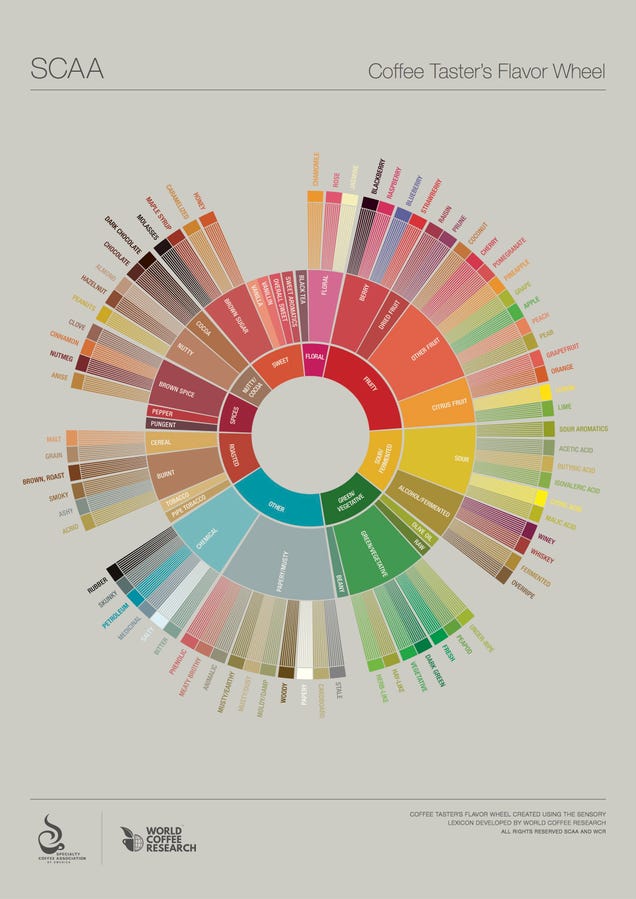
Explore the Flavors in Your Coffee with This Tasting Wheel

by Melanie Pinola

Sweet. Floral. Nutty. Baristas and coffee enthusiasts often use these words—and many more—to describe the flavor nuances of different coffees. The flavor wheel below from the Specialty Coffee Association of America groups different flavor descriptions into tiers on a wheel.

Read more...


19 Jan 02:05

Northern Michigan town first to see sub-$1 fuel prices

by Brandon Turkus

Filed under: Green, Videos, Fuel Efficiency

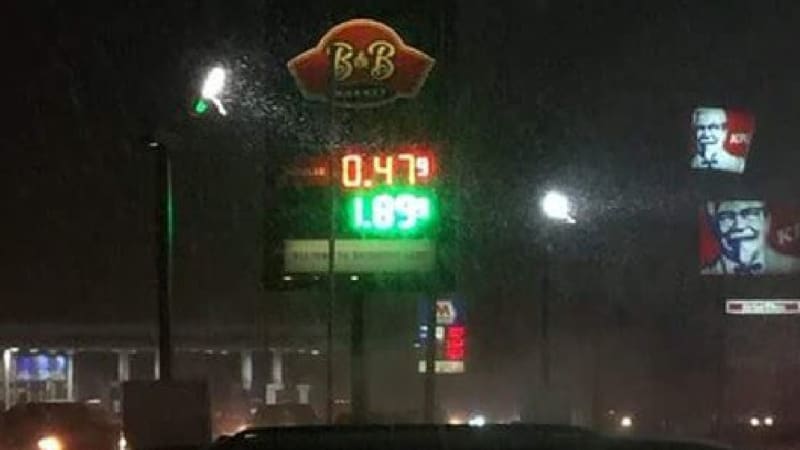
A price war in Michigan recorded gas prices as low as 47 cents a gallon on Sunday. That said, fuel prices have since returned to more normal levels.

Continue reading Northern Michigan town first to see sub-$1 fuel prices

Northern Michigan town first to see sub-$1 fuel prices originally appeared on Autoblog on Mon, 18 Jan 2016 12:59:00 EST. Please see our terms for use of feeds.

Permalink | Email this | Comments
15 Jan 04:48

Hillary Clinton’s Single-Payer Pivot Greased By Millions in Industry Speech Fees

by Zaid Jilani

Hillary Clinton’s sudden attack on Bernie Sanders’ single-payer health care plan is a dramatic break with Democratic Party doctrine that the problem with single-payer is that it is politically implausible — not that it is a bad idea.

Single-payer, the Canadian-style system in which the government pays for universal health care, takes the health insurance industry out of the picture, saving huge amounts of money. But the health insurance industry has become so rich and powerful that it would never let it happen.

That was certainly Clinton’s position back in the early 1990s, when she was developing her doomed universal coverage proposal for her husband, Bill.

But in the ensuing years, both Clintons have taken millions of dollars in speaking fees from the health care industry. According to public disclosures, Hillary Clinton alone, from 2013 to 2015,  made $2,847,000 from 13 paid speeches to the industry.

Source: Public federal disclosures, Clinton campaign

This means that Clinton brought in almost as much in speech fees from the health care industry as she did from the banking industry. As a matter of perspective, recall that most Americans don’t earn $2.8 million over their lifetimes.


Hillary Clinton’s record on single-payer dates back to 1993, when she was tasked to help formulate White House policy. According to the notes of former Clinton confidante Diane Blair, Clinton told her husband during a dinner in February 1993 that “managed competition” — a private health insurance market — was “a crock, single payer necessary; maybe add to Medicare.”

She eventually came to believe that the health care industry was too powerful to allow this reform to happen, and the plan she ended up putting together was not single-payer. Also in 1993, two physician advocates for single-payer lobbied her during a meeting at the White House. They said she told them they made a “convincing case, but is there any force on the face of the earth that could counter the hundreds of millions of the dollars the insurance industry would spend fighting that?”

The next year, in response to a question at a financial conference, then-First Lady Hillary Clinton said that if there was not a health care overhaul “by the year 2000 we will have a single-payer system. I don’t think it’s — I don’t think it’s a close call politically. I think the momentum for a single-payer system will sweep the country.”

Behind the scenes, Clinton continued to show interest in a single-payer plan. David Brock wrote that Alain Enthoven, a Stanford professor who had been brought in to help advise on health care, pushed back on what Brock deemed “her bias toward the single-payer plan.”

In 2008, a young medical student named Lisa Goldman queried Clinton about health care during an event she held in New Haven, Connecticut. Goldman told the Boston Globe that Clinton said she believed the plan to be politically unfeasible at the time, however if a bill establishing it reached her desk, she would sign it into law.

Since then, she has shifted to assailing the policy on its merits.

“We don’t have one size fits all; our country is quite diverse. What works in New York City won’t work in Albuquerque,” she told an assorted audience of 20,000 employees of the electronic health records industry on February 26, 2014; the speech earned her $225,500.

These words were later cited by business lobbyists in New York state earlier this year to argue that if even Hillary Clinton opposed single-payer, why should New York adopt it?

Hillary Clinton’s paid speech circuit came to an end as her campaign revved up. But for her husband, with whom she shares a bank account, it hasn’t. This summer, he was the keynote speaker at America’s Health Insurance Plans (AHIP), the industry group that poured almost $100 million into trying to defeat health care reforms during the fight over the Affordable Care Act.

As part of her newly found opposition to single-payer on the merits, Hillary Clinton’s attacks on Sanders’ health care plan mischaracterize what he is proposing. For example, she has claimed that his plan, which relies on states to administer the single-payer plan, would turn “over your and my health insurance to governors.”

Warren Gunnels, the policy director of Sanders’ campaign, told The Week that actually this is not the case. If a governor chose not to participate, “citizens would receive coverage from the feds.” It’s actually the Clinton-backed status quo under the Affordable Care Act that is allowing governors to pick and choose who to cover.

The post Hillary Clinton’s Single-Payer Pivot Greased By Millions in Industry Speech Fees appeared first on The Intercept.

15 Jan 04:44

Simple Yet Effective eBay Bug Allows Hackers to Steal Passwords

by noreply@blogger.com (Swati Khandelwal)
A simple, yet effective flaw discovered on eBay's website exposed hundreds of millions of its customers to an advance Phishing Attack. An Independent Security Researcher reported a critical vulnerability to eBay last month that had the capability to allow hackers to host a fake login page, i.e. phishing page, on eBay website in an effort to steal users' password and harvest credentials
06 Jan 04:04

Somabar: Keurig Style On Demand Cocktails

by Josh Smith

Somabar: Keurig Style On Demand Cocktails is a post by Josh Smith from Gotta Be Mobile.

Somabar is a robotic bartender that delivers the convenience of a Keurig with the joy of a great mixed drink.

Originally launched on Kickstarter the Somabar appeared at CES 2016 alongside smart products and connected home gadgets promising faster access to better tasting cocktails.

While the robotic bartender is not straight out of The Jetsons, it does offer a way for even causal users to order great cocktails from their smartphone while at home.

SomaBar - Robot Bartender For Home - 2

The Somabar allows users to mix from six Soma Pods and add bitters to create custom drinks or order from a library of cocktail recipes that you know and love. After you order from an app on your smartphone the Somabar mixes the drink completely and pours it into the glass you need. When you are done you can remove a Soma Pod and store in your fridge if needed and the airtight seal keeps all kinds of ingredients fresh.

Currently there are 300 drinks available for users to choose from with the Somabar app, and users will be able to add to the recipes so that this library will grow.

The video above shows the Somabar in action, including ordering from the smartphone and grabbing a mixed drink with no effort.

Somabar allows you to use your own liquor and ingredients, so you are not locked into buying drink ingredients from a specific source.

Users can customize a drink on the fly to make it stronger or lighter to match their mood and preferences. When you need to clean a Soma Pod, remove them from your Somabar and wash in a dishwasher. An automated flushing system cleans the internals.

SomaBar - Robot Bartender For Home - 3

Somabar is available to pre-order for $449 and is available in a variety of colors. The shipping date is still to be determined and shipping is not free.

Check out the rest of our CES 2016 coverage to see the latest gadgets, accessories, smartphones and other cool tech for 2016.

Somabar: Keurig Style On Demand Cocktails is a post by Josh Smith from Gotta Be Mobile.

06 Jan 03:42

Saudi Coalition Just Bombed a Center for the Blind in Yemen

by Ryan Devereaux

THE NEW YEAR seems to have brought little change for civilians living under bombs in Yemen. Early Tuesday morning, missiles reportedly fired by aircraft supporting the Saudi-led and U.S.-backed coalition damaged a center for the blind in the capital city of Sanaa, as well as the city’s chamber of commerce, a wedding hall, and at least one residential area.

Multiple outlets reported that the attacks caused no casualties, though one local report, citing an unidentified security official, claimed “at least three people” were wounded at the al Noor Center for Care and Rehabilitation of the Blind in Sanaa. Footage from the capital, published by the International Business Times, showed images of crumbled buildings, collapsed rooftops, and a young man weeping in the street. A spokesperson for UNICEF in Sanaa told Vice News that the al Noor Center offers classes for visually impaired students.

In an email to The Intercept Tuesday, Rupert Colville, spokesperson for the United Nations High Commissioner for Human Rights, confirmed that his office had received reports of airstrikes in Yemen indeed hitting the al Noor Center, as well as the other reported sites. The Saudi Embassy in Washington, D.C. and the U.S. Central Command, which oversees operations in the region, did not respond to requests for comment.

Earlier in the day, as reports of the latest round of strikes in Yemen first began to emerge, Colville addressed reporters in Geneva on the “terrible toll” the conflict in Yemen has exacted on the nation’s civilian population, reporting that at least 81 civilians had been killed in Yemen and another 109 injured in December 2015 as result of the ongoing conflict.

These latest figures, Colville pointed out, brought the total number of civilians recorded killed over nine months of fighting to 2,795, with an additional 5,324 civilians recorded wounded, raising the total number of recorded civilian casualties in the conflict to 8,119. According to Colville, the U.N. documented “at least 11 civilians” reportedly killed by Houthi shelling in December — “a significant decrease compared to the 32 civilians who were reported killed by them in November” — while the deaths of 62 of the civilians reported killed last month were attributed to coalition airstrikes.

“This is more than twice the number of civilians reported killed in November,” Colville said. Additionally, the U.N. spokesperson added, “We have also received alarming information on the alleged use of cluster bombs by coalition forces in Hajjah Governorate.” According to Colville, the U.N. documented the presence of cluster munitions in “several” Yemeni villages and two separate incidents of unexploded ordinance injuring people.

Condemned by international groups for the risks they pose to civilians, cluster bombs are banned in a 2008 treaty signed by 117 nations around the world. Saudi Arabia and the United States, however, are not on that list. Last year, Human Rights Watch presented evidence that Saudi Arabia had used U.S.-supplied cluster bombs in its war against the Houthis. At the time, the Saudi government — which in 2015 replenished its arsenal with 22,000 bombs purchased in a $1.2 billion, U.S. State Department-approved deal — insisted that it uses cluster bombs only on legitimate targets.

Journalists and human rights groups have repeatedly exposed the tremendous humanitarian costs associated with the continued bloodshed in Yemen, particularly those associated with coalition airstrikes (see here, here and here). For the time being, however, the conflict shows no sign of letting up. Indeed, the latest rounds of strikes follow the breakdown of a tenuous ceasefire agreed upon last month.

For those on the ground, the sheer scale of violence associated with the ongoing airstrikes continues to boggle the mind. “People with disabilities are being struck in their residence,” Abdullah Ahmed Banyan, a patient at the al Noor Center, told IBT Tuesday. “What is this criminality?” asked Bayan, who described two missiles striking the “live-in quarters” of the building. “Is it the blind that are fighting the war?”

Top photo: Yemenis check the rubble of Sanaa’s chamber of commerce, which was destroyed by airstrikes on the capital, Jan. 5, 2016.

The post Saudi Coalition Just Bombed a Center for the Blind in Yemen appeared first on The Intercept.

31 Dec 22:17

Doctors use Google Cardboard to help save a 4 month old baby’s life

by Chris Chavez

Doctors use Google Cardboard to save babys life 1

While the uses of virtual reality headsets are more geared toward entertainment (video gaming or movies, for example) it can have some uses beyond that — like saving people’s lives. A 4 month old baby born with only 1 lung and half a heart is getting a new lease on life after doctors in Miami, Florida used Google Cardboard to assess her issues prior to performing surgery.

Doctors took the child’s 2D MRI scans and converted them into 3D stereoscopic images where they able to view them in virtual reality using an iPhone placed inside Google Cardboard. According to cardiovascular surgeon Dr. Redmond Burke, it was like “standing in the operating room” and allowed them to examine the tiny heart and plan a form of entry 2 weeks before surgery ever began.

“With VR I could see her chest wall as well as her heart. From there I could see that the standard incision would be fine. Right there the first big hurdle was crossed.”

After a 7 hour surgery, the baby was stitched up and received the best Christmas present ever: the gift of life. Dr. Burke, who’s passion is to merge medical science with new tech, says his next project will involve raising awareness about the uses of VR imaging in the medical field. Just goes to show you that you don’t always need the most expensive tech to get the job done.

[UploadVR]


24 Dec 06:02

Why Are Teslas Quicker Than Gas Cars?

by Mike Barnard
Why Are Teslas Quicker Than Gas Cars?

According to Motor Trend’s recent test, the Tesla P90D with Ludicrous Mode hits 60 miles per hour in a shattering 2.6 seconds. This is absurdly quick, and there are only three currently produced street-legal cars which are quicker than a Tesla. Those cars are by Porsche, Lamborghini, and Ferrari and would set you back $2.5 [&hellip

Why Are Teslas Quicker Than Gas Cars? was originally published on CleanTechnica.

To read more from CleanTechnica, join over 50,000 other subscribers: Google+ | Email | Facebook | RSS | Twitter.

24 Dec 05:27

All wrinkle creams fail in consumer product test

by Christine Lepisto
German product testing company proves anti-wrinkle creams all fail to fulfill their claims to rejuvenation. We share their recommendations for what does work.
24 Dec 05:00

U.S. Officials Warned of Mali Terror Strike Prior to November Attack

by Sharon Weinberger

ON NOVEMBER 20two heavily armed Islamic militants stormed a luxury hotel in Mali’s capital, Bamako, killing 22 people, including one American. As initial reports of the carnage emerged, so too did word that elite U.S. troops were also involved in the rescue operation.

About two years prior, another team of Americans — State Department and Africom personnel — traveled to Mali on a low-profile mission, interviewing local experts and government officials about the country’s antiterrorism capabilities. The internal report, marked “sensitive” and not intended for audiences outside the U.S. and Malian governments, offered a bleak assessment of the West African nation’s counterterrorism capabilities as well as a prophetic caution.

The December 2013 State Department Antiterrorism Assistance report, obtained by The Intercept via the Freedom of Information Act, characterized the north of the country as imperiled by a number of terror groups that “remain able to evade French pursuit.” The south was portrayed as far more secure, though the report notes that “a small number of experts” told the authors to “anticipate a terrorist attack in Bamako at some point.”

The State Department report takes on new relevance in the wake of last month’s attack on the Radisson Blu hotel. Despite decades of U.S. partnership, the government in Mali, according to the report, “lacks a national security strategy” and “has no national level incident management system,” while the “security forces investigative capabilities are deficient in many areas,” and their “abilities to manage crime scenes effectively and identify and collect evidentiary material at the scene of a terrorist incident are limited.”

Those conclusions draw into question the effectiveness of years of counterterrorism funding the U.S. government has provided to Mali. A State Department spokesman told The Intercept that the failure of the Malian government to make “strategic level decisions” limited the amount of counterterrorism assistance the U.S. could provide the West African nation.

Mali has been a partner in the State Department’s Antiterrorism Assistance Program since 1990, when the nation began receiving extensive U.S. aid, including training of its security forces by U.S. military personnel, in the years after 9/11. In 2002, the State Department launched a regional counterterrorism program — known as the Pan Sahel Initiative, which later became the Trans-Sahara Counterterrorism Partnership — to assist the militaries of Mali, Chad, Mauritania, and Niger. Between 2009 and 2013, U.S. agencies allocated $288 million in funding and disbursed about half that amount.

As counterterrorism funding to Mali ramped up, so, too, did direct military support. In 2004, U.S. Special Operations forces training teams deployed to Bamako as well as to the towns of Gao and Timbuktu as part of the Pan Sahel Initiative. “By cooperating with Mali to better protect its borders and territory, we can help keep it from being used by terrorists,” Vicki Huddleston, America’s ambassador to Mali, said at the time. “This makes Mali a very important partner in the war on terrorism.”

One beneficiary of U.S. assistance was Capt. Amadou Haya Sanogo, who, according to the New York Times, “received extensive training in the United States between 2004 and 2010.” In 2012, he overthrew his country’s democratically elected president as Mali reeled from the fallout of the previous year’s U.S.-backed war to oust Libyan dictator Muammar Gaddafi. Sanogo’s troops proved more adept at looting than stabilizing the country, which began to fall to heavily armed Islamist rebels.

Although the U.S. officially suspended military relations with Mali in the wake of the coup, U.S. commandos were nonetheless still operating there a month later, a fact that came to light only after several of them died following a booze-filled bar crawl through Bamako in April 2012.

In January 2013, France — which seized control of Mali in the late 19th century and held sway there until 1960 — launched a military intervention, code-named Operation Serval, to push back and defeat the Islamists.  Under the moniker Juniper Micron, the U.S. military backed France’s effort — airlifting its soldiers and materiel into Mali and flying refueling missions in support of its airpower — while assisting allied African forces.

The combined U.S., French, and African effort prevented the complete collapse of the country but left it with a persistent insurgency.

That spring, after repeated pledges by the Obama administration not to again put “boots on the ground” in the country, U.S. troops were sent back into Mali to support French and African forces. By that December, a combined State Department-Africom team was meeting with Malian counterparts to gauge the country’s post-coup counterterrorism capabilities.

Following the assessment, State Department counterterrorism funds for Mali in 2014 and 2015 were earmarked for “crisis response training in and around Bamako,” according to a spokesperson who offered the information on the condition that the news be sourced only to a “State Department official.” The efforts of Mali’s government to draft counterterrorism legislation and reorganize its security forces apparently hampered U.S. efforts, the official said.

Both the government of Mali in Bamako and Mali’s embassy in Washington, D.C., failed to respond to multiple requests by The Intercept for comment or an interview.

For its part, the State Department told The Intercept that its efforts were being closely coordinated with the French and other European partners, and that U.S. assistance was designed to “complement” those investments. “The U.S. Department of State is actively working with other U.S. government agencies to reassess support to Malian partners in light of the November 20 attack on the Radisson Blu hotel in Bamako,” said the State Department official.

Responsibility for that attack was claimed by al Mourabitoun, an al Qaeda offshoot. Mali’s president, Ibrahim Boubacar Keita, disputes the involvement of al Mourabitoun, suggesting that another shadowy group, the Macina Liberation Front, was responsible.

Speaking to a group of reporters on the day of the attack, Army Gen. David Rodriguez, chief of U.S. Africa Command, said it was “probably someone associated with al Qaeda in the Islamic Maghreb because … that is where they have the reach.”

The State Department failed to respond to specific questions about the results of U.S. support for Mali. “Mali’s new government is working to develop processes and protocols that are appropriate for Mali. The United States will be offering antiterrorism assistance when appropriate,” reads one official response.

The December 2013 State Department report, however, offered a stark warning for the future: “The disastrous incidents that occurred before, during, and after the March 2012 coup d’etat can happen again if Malian leaders do not enact a national policy that defines the roles and responsibilities of security forces at each level of response.”

The post U.S. Officials Warned of Mali Terror Strike Prior to November Attack appeared first on The Intercept.

24 Dec 04:58

Obama Is Right: Terrorism Has Taken Over Cable News

by Zaid Jilani
vigilenator

It's Not cable news its FearPornHub.com

In an interview with NPR this week, President Obama complained that the media is oversaturated with coverage of terrorism. “If you’ve been watching television for the last month, all you have been seeing, all you have been hearing about is these guys with masks or black flags who are potentially coming to get you,” Obama said.

The president’s remarks led to quick condemnation from the right-wing press, but the facts support what he is saying. The Intercept analyzed network news coverage of various topics, using Internet Archive’s TV News Archive search of television captions, and found that terrorism did dominate news.

For example, a search of CNN coverage between November 21 and December 21 of this year yielded 427 hits (instances where an individual show mentioned the word at least once) for the search phrase “terrorism” and 404 hits for “ISIS”; the same search for “poverty” yielded only 34 hits. Here are the terrorism search strings compared to the other topics in chart form (note that the anti-privacy CISA legislation, directly related to terrorism, was not mentioned at all):

Screen-Shot-2015-12-21-at-2.39.24-PM3


Here’s the same search when run for MSNBC:

And here’s Fox News:


Screen-Shot-2015-12-21-at-2.39.39-PM3

The post Obama Is Right: Terrorism Has Taken Over Cable News appeared first on The Intercept.

24 Dec 04:54

Makers of OxyContin Bankroll Efforts to Undermine Prescription Painkiller Reform

by Lee Fang

The pharmaceutical companies that manufacture and market OxyContin, Vicodin, and other highly addictive opioid painkillers — drugs that have fueled the epidemic of overdoses and heroin addiction — are funding nonprofit groups fighting furiously against efforts to reform how these drugs are prescribed.

While the Centers for Disease Control and Prevention was close to finalizing voluntary prescribing guidelines for opioid painkillers next month, it abruptly changed course. According to a report from the Associated Press, the CDC “abandoned its January target date, instead opening the guidelines to public” comment after a number of “industry-funded groups like the U.S. Pain Foundation and the American Academy of Pain Management warn[ed] that the CDC guidelines could block patient access to medications.”

The new guidelines would encourage doctors to prescribe opioids as a last choice for chronic pain, a sharp departure from the status quo, in which many doctors, under pressure from pharmaceutical sales representatives, often prescribe painkillers for mild back pain or a toothache. As experts note, many painkiller and heroin addicts start abusing opioids after receiving a legitimate prescription for pain-related medical issues.

An investigation by The Intercept has found that the pharmaceutical companies that dominate the $9 billion a year opioid painkiller market have funded organizations attacking reform of the prescribing guidelines:

  • The Washington Legal Foundation, a nonprofit that litigates to defend “free-market principles,” threatened the CDC with legal action if the agency moved forward with the proposed opioid guidelines. The WLG claimed the CDC’s advisory panel for the guidelines lacked “fair ideological balance,” because it included a doctor who is part of an advocacy effort against opioid addiction. The WLG does not disclose donor information, but has filed friend-of-the-court briefs on behalf of Purdue Pharma, the makers of OxyContin. In a recent article with Pain News Network, a spokesperson for Purdue Pharma conceded: “We’re long-standing supporters of WLF, in addition to several other business and legal organizations. We’ve provided them with unrestricted grants.”
  • The Pain Care Forum organized opposition to the CDC prescribing guidelines, mobilizing regular meetings among stakeholders opposed to the idea, according to an investigation by AP reporter Matthew Perrone. A recently re-filed complaint by the City of Chicago found that Burt Rosen, the chief in-house lobbyist for Purdue Pharma, controls the Pain Care Forum. A former drug company employee allegedly told investigators that Rosen tells the Pain Care Forum “what to do and how we do it.” The Pain Care Forum is funded through contributions by Purdue Pharma, as well as major opioid manufacturers Cephalon, Endo, and Janssen, a subsidiary of Johnson & Johnson.
  •  The Power of Pain Foundation, a group funded by Purdue Pharma, asked supporters to contact the CDC in opposition to the guidelines, claiming that “taking away pain medication and making providers afraid to prescribe due to your guidelines is only going to make more abusers, increase suicides, and tear apart the lives of millions.”
  • The U.S. Chamber of Commerce, a corporate lobbying group that represents opioid manufacturers, including Johnson & Johnson, issued a press release masquerading as a news story criticizing the CDC guidelines. (The U.S. Chamber operates a public relations effort dressed up as a bona fide media outlet called Legal Newsline, which it uses to disseminate stories that support the political priorities of its member companies.)

The over-prescription of opioid products has made the United States the center of the painkiller abuse epidemic. Americans consume about 81 percent of the global supply of oxycodone products (the active ingredient in OxyContin) and almost 100 percent of hydrocodone (the active ingredient used in brands such as Vicodin). More than 16,000 people die from opioid painkiller overdose every year.

The skyrocketing use of opioids in America is also closely linked to the rising heroin crisis, which reached new heights this year. Prescription opioids, which provide a high that is very similar to heroin, are often a gateway drug. As many as four out of five heroin users get started with opioid painkillers.

The post Makers of OxyContin Bankroll Efforts to Undermine Prescription Painkiller Reform appeared first on The Intercept.

24 Dec 04:53

NSA Helped British Spies Find Security Holes In Juniper Firewalls

by Ryan Gallagher

A TOP-SECRET document dated February 2011 reveals that British spy agency GCHQ, with the knowledge and apparent cooperation of the NSA, acquired the capability to covertly exploit security vulnerabilities in 13 different models of firewalls made by Juniper Networks, a leading provider of networking and Internet security gear.

The six-page document, titled “Assessment of Intelligence Opportunity – Juniper,” raises questions about whether the intelligence agencies were responsible for or culpable in the creation of security holes disclosed by Juniper last week. While it does not establish a certain link between GCHQ, NSA, and the Juniper hacks, it does make clear that, like the unidentified parties behind those hacks, the agencies found ways to penetrate the “NetScreen” line of security products, which help companies create online firewalls and virtual private networks, or VPNs. It further indicates that, also like the hackers, GCHQ’s capabilities clustered around an operating system called “ScreenOS,” which powers only a subset of products sold by Juniper, including the NetScreen line. Juniper’s other products, which include high-volume Internet routers, run a different operating system called JUNOS.

The possibility of links between the security holes and the intelligence agencies is particularly important given an ongoing debate in the U.S. and the U.K. over whether governments should have backdoors allowing access to encrypted data. Cryptographers and security researchers have raised the possibility that one of the newly discovered Juniper vulnerabilities stemmed from an encryption backdoor engineered by the NSA and co-opted by someone else. Meanwhile, U.S. officials are reviewing how the Juniper hacks could affect their own networks, putting them in the awkward position of scrambling to shore up their own encryption even as they criticize the growing use of encryption by others.

The headquarters of Juniper Networks in Sunnyvale, California on January 1, 2014. Photo Credit: Kristoffer Tripplaar/ Sipa USA

The headquarters of Juniper Networks in Sunnyvale, Calif., on Jan. 1, 2014.

Photo: Kris Tripplaar/Sipa USA/AP

The author of the 2011 GCHQ document, an NSA employee who was working with GCHQ as part of an “Access Strategy Team,” takes a similarly adversarial view of encryption, referring to Juniper as a “threat” and a “target” because it provides technology to protect data from eavesdropping. Far from suggesting that security agencies should help U.S. and U.K. companies mend their digital defenses, the document says the agencies must “keep up with Juniper technology” in the pursuit of SIGINT, or signals intelligence.

“The threat comes from Juniper’s investment and emphasis on being a security leader,” the document says. “If the SIGINT community falls behind, it might take years to regain a Juniper firewall or router access capability if Juniper continues to rapidly increase their security.”

The document, provided by NSA whistleblower Edward Snowden, shines light on the agencies’ secret efforts to ensure they could monitor information as it flowed through Juniper’s products, which are used by Internet providers, banks, universities, and government agencies. It notes that while Juniper trails its competitors, it is a “technology leader” with gear “at the core of the Internet in many countries,” including several deemed to be high priority from a spying perspective: Pakistan, Yemen, and China.

“Juniper technology sharing with NSA improved dramatically to exploit several target networks”

Asked about the document, GCHQ issued a boilerplate response asserting that the agency does not comment on intelligence matters and complies with “a strict legal and policy framework.” The NSA could not immediately respond Tuesday. Juniper sent a written statement saying the company “operates with the highest of ethical standards, and is committed to maintaining the integrity, security, and quality of our products. As we’ve stated previously … it is against established Juniper policy to intentionally include ‘backdoors’ that would potentially compromise our products or put our customers at risk. Moreover, it is Juniper policy not to work with others to introduce vulnerabilities into our products.”

Juniper’s prominence and ubiquity similarly helped draw attention to the more recent hacks against the company, which first came to light Thursday, when the California firm revealed it had discovered “unauthorized code” in ScreenOS enabling two major vulnerabilities. One, first present in an August 2012 release of ScreenOS, could allow access to encrypted data transmitted over VPNs. The other, first surfacing in a December 2014 ScreenOS release, allows an attacker to remotely administer a firewall, thus leading to “complete compromise of the affected device,” according to Juniper. The vulnerabilities remained in versions of ScreenOS released through at least October of this year.

It is the earlier vulnerability, potentially allowing eavesdropping on VPNs, that has generated vigorous online discussion among computer security experts. Some, like Johns Hopkins professor Matthew Green and security researcher Ralf-Philipp Weinmann, have said that an attacker appears to have subverted a backdoor shown, in previously disclosed documents from Snowden, to have originated with the NSA. Specifically, the attacker seems to have tampered with a 32-byte value used to seed the generation of random numbers, numbers that are in turn used in the process of encrypting data in ScreenOS. ScreenOS uses the value as a parameter to a standard system for random number generation known as Dual Elliptic Curve Deterministic Random Bit Generator. The default 32-byte value in this standard is believed to have been generated by the NSA. Juniper said, in the wake of the Snowden revelations about the standard, that it had replaced this 32-byte value with its own “self-generated basis points.” So the attacker would have replaced Juniper’s replacement of the NSA 32-byte value.

Matt Blaze, a cryptographic researcher and director of the Distributed Systems Lab at the University of Pennsylvania, said the document contains clues that indicate the 2011 capabilities against Juniper are not connected to the recently discovered vulnerabilities. The 2011 assessment notes that “some reverse engineering may be required depending on firmware revisions” affecting targeted NetScreen firewall models. Blaze said this points away from the sort of ScreenOS compromise behind the more recent Juniper vulnerabilities.

“With the [recently discovered] backdoor, a firmware revision would either have the backdoor or it wouldn’t, and if it was removed, they’d have to do a lot more than ‘some reverse engineering’ to recover the capability,” Blaze said. “My guess from reading this is that the capabilities discussed here involved exploiting bugs and maybe supply chain attacks, rather than this [recently discovered] backdoor.”

Blaze said the exploit capabilities in the 2011 document seem consistent with a program called “FEEDTROUGH,” first revealed in a 2007 document published alongside an article in German newsweekly Der Spiegel.

Even if it outlines capabilities unconnected to the recently discovered Juniper hacks, the 2011 GCHQ assessment makes clear that the author was interested in expanding the agencies’ capabilities against Juniper. “The vast majority of current Juniper exploits are against firewalls running the ScreenOS operating system,” the author wrote. “An effort to ensure exploitation capability” against Juniper’s primary operating system, JUNOS, “should bear fruit against a wide range of Juniper products.”

The document suggests that the intelligence agencies successfully used the security holes they identified in Juniper’s devices to repeatedly penetrate them for surveillance, stating that “Juniper technology sharing with NSA improved dramatically during [calendar year] 2010 to exploit several target networks where GCHQ had access primacy.”

The assessment also notes that, because Juniper is a U.S.-based company, there is both “opportunity and complication” in targeting its technology. “There is potential to leverage a corporate relationship should one exist with NSA,” it says, adding: “Any GCHQ efforts to exploit Juniper must begin with close coordination with NSA.”

It further states that GCHQ has a “current exploit capability” against 13 Juniper models, all of which run ScreenOS: NS5gt, N25, NS50, NS500, NS204, NS208, NS5200, NS5000, SSG5, SSG20, SSG140, ISG 1000, ISG 2000. It reveals that the agency was developing an additional surveillance capability to hack into high-capacity Juniper M320 routers, which were designed to be used by Internet service providers.

“The ability to exploit Juniper servers and firewalls,” the document says, “will pay many dividends over the years.”

The post NSA Helped British Spies Find Security Holes In Juniper Firewalls appeared first on The Intercept.

24 Dec 04:51

5 Things You Will Still Have to Do with Autonomous Cars and 5 Things You Won’t

by Austin

In the evolving world of autonomous vehicles, many things will change. You’ll gain “the luxury of time,” to borrow Volvo’s catchphrase, and you’ll hopefully be less stressed by your commute. Even though autonomous driving will alter the car experience, it can’t change everything. Here are five things that’ll change in the autonomous age, plus five things autonomous cars will do for you.


You’ll Still Have to: Clean it

2012-Lexus-LFA-in-the-car-wash2012-Lexus-LFA-in-the-car-washUnless connected car washes become a thing, you’ll still be worrying about getting your shiny new car washed. The exterior is one thing, as the majority of car washes don’t require much more than you show up and wait, but unless you’re paying extra, you’ll still have to vacuum the Cheerios out from under the seats of your autonomous car.


You’ll Still Have to: Maintain it

dodge-viper-drift-breakdowndodge-viper-drift-breakdown“Service 2 is Due” will still mean you need to take your car in for service. Sure, electric vehicles are simpler than gasoline-powered vehicles (EVs have fewer parts), but some things are bound to stay the same. Don’t throw away your mechanic’s business card just yet.


You’ll Still Have to: Fuel Up

Volkswagen Golf GTE Euro Spec charge station 02Volkswagen Golf GTE Euro Spec charge station 02With inductive charging and self-parking on private property, both goals for the electric car manufacturing community, the EV crowd just might have a leg up on the refueling front. Gasoline, hydrogen, and diesel-powered vehicles will likely still need a human operator to refuel for many years. Maybe it’s that slight safety question or the existing state of the infrastructure that’ll keep things the same.


You’ll Still Have to: Pick a Playlist

2016 Volvo XC90 T6 AWD Inscription center stack screen2016 Volvo XC90 T6 AWD Inscription center stack screenOf particular importance but far less dangerous once you’re riding in your autonomous car is picking the right music. Is it a smooth jazz kind of morning? Need something more upbeat to pump you up before you get to the gym? Although you can do so far more easily, you’ll still have to worry about your music choices in your self-driving Mercedes-Benz of the future.


You’ll Still Have to: Change Flat Tires

Cruze-Eco-Tire-Inflator-1Cruze-Eco-Tire-Inflator-1Flats are bound to happen. Debris, potholes, and just plain old wear can all cause a flat tire, and even with an autonomous car you’ll be the one dealing with it. Whether you’re digging out the can of Fix-a-Flat from the trunk, calling roadside assistance, or getting your hands dirty with the spare, there isn’t much your robo-chauffer can help with.


You Won’t Have to: Drive During Your Commute

Audi-A7-Autonomous-Piloted-Drive-no-handsAudi-A7-Autonomous-Piloted-Drive-no-handsEver get a little frustrated with your morning commute? How can it take 2 hours to go 12 miles? This is perhaps the most obvious advantage of autonomous vehicles, but it shouldn’t be overlooked. Your time in traffic can turn into replies to those less important morning emails, perhaps time to read a novel, meditate, or many other things. When your focus comes off of driving and goes onto something else, the change in perspective will eliminate road rage, as well. At least for you.


You Won’t Have to: Find a Parking Space

Mercedes-Benz-and-Bosch-Self-Parking-Cars1Mercedes-Benz-and-Bosch-Self-Parking-Cars1Tesla is already talking about this one; the Model S is able to charge itself courtesy of inductive charging stations, no plugging necessary. In theory, this could be an advantage for any autonomous vehicle—the occupants can be dropped off in the most convenient location, and the vehicle goes off to find itself a place to park until it is summoned back via smartphone. Mall parking lots sound a whole lot less stressful.


You Won’t Have to: Worry About Speeding

2014-Ford-Police-Interceptor-Utility-Sedan-Front22014-Ford-Police-Interceptor-Utility-Sedan-Front2You’re cruising along, not a care in the world, when you crest a hill and, all of a sudden, there it is: a police cruiser tucked out of the way, driver’s side window down and the infamous radar gun trained on your front bumper. Your blood runs cold, and you glance down at your speedometer as you franticly rack your brain trying to remember the last speed limit sign you passed. In an autonomous car, though? Machine efficiency will mean the end of those moments of panic—and perhaps the end of your speeding tickets.


You Won’t Have to: Follow Directions

2016 Audi RS7 Performance navigation2016 Audi RS7 Performance navigation“Turn left in 1,000 feet.” Get ready to say goodbye to turn-by-turn directions. With an autonomous car you won’t have to prepare to turn. The car will do that for you. This will also eliminate your need to rely on your uncle’s poor direction-giving skills when visiting your relatives out in the smaller parts of the country.


You Won’t Have to: Wait to Watch Your Favorite Shows

Motor-Trend-on-Demand-promo11Motor-Trend-on-Demand-promo11Trying to catch up on your Netflix queue? Want to watch the latest episode of ROADKILL? Autonomous cars will turn your commute into “productive” time, freeing up plenty of time to catch up on your shows. The average full-time worker commutes for roughly 25 minutes, so that’s perfect for watching at least an episode (or more) of whatever you’re into.

The post 5 Things You Will Still Have to Do with Autonomous Cars and 5 Things You Won’t appeared first on Motor Trend.

15 Dec 01:45

Go See “The Big Short” Right Now — And Then Read This

by Jon Schwarz

THERE’S NO SUBJECT ON EARTH, with the possible exception of sex, that human beings find more inherently fascinating than money. Yet somehow most of the movies about the 2008 financial collapse have been as enticing and zesty as a raw potato.

That’s finally changed with The Big Short, based on the book by Michael Lewis about a small assortment of “outsiders and weirdos” who made hundreds of millions of dollars betting that the housing bubble of the 2000s would collapse. Near the end of the film one of them, played by Steve Carell, declares, “We live in an era of fraud” — not just fraud on Wall Street, he says, but sports fraud, corporate fraud, and government fraud.

What sets The Big Short apart and makes it truly great is that it portrays this worldwide, straight-faced fraud accurately; that is, as not just dangerous and enraging, but also extremely funny. It calls to mind Monty Python’s famous dead parrot sketch about a pet store salesman who defrauds his customer and then offers an endless stream of preposterous, contradictory obfuscations to conceal the obvious reality. The Big Short demonstrates that we’re now all living in that pet store.

Adam McKay attends the world premiere of Paramount Pictures' "The Big Short" at the Chinese Theatre, during the AFI Fest Closing Gala, on Thursday, November 12, 2015 in Los Angeles, CA. (Photo: Alex J. Berliner /ABImages)

Adam McKay, director of The Big Short, at the AFI Film Festival.

Photo: Alex J. Berliner/ABImages

The credit for this clearly goes to Adam McKay, The Big Short’s director and co-writer, who could have been grown in a lab to make exactly this movie. McKay is best known for directing Will Ferrell comedies like Anchorman, Talladega Nights, and The Other Guys — but he’s always taken politics seriously, enough that when he was head writer for Saturday Night Live he once arranged for Noam Chomsky to do the show’s cold opening. (Chomsky couldn’t do it, so they got Harper’s editor Lewis Lapham instead.) And with Sex Panther Cologne, McKay had already proven he possesses an extremely rare but key skill for The Big Short: making people laugh at percentages.

What this means is that The Big Short is a movie that normal people will actually enjoy and understand, and that will make them as angry as they should be about what’s been done to us. So please grab your friends and family, including the ones who’d be way more excited to meet Tony Stewart than Jon Stewart, and go see it right now. It’s currently in limited release and doesn’t open nationwide until December 23, so you may all have to move. But it’s worth it.

Then after you’ve seen it, please come back here and read the rest of this. As good as The Big Short is, the housing bubble was such a gargantuan crime that no movie can capture more than a tiny corner of it. There’s much more to what happened, and even seven years after the bailout, little of it is widely understood.

Beyond The Big Short

• What happened wasn’t that complicated

The Big Short includes brief segments featuring Margot Robbie, Anthony Bourdain, and Selena Gomez explaining the gobbledygook jargon of the crisis, like mortgage-backed securities, credit default swaps, and synthetic collateralized debt obligations.

But in fact you don’t need to know any of that to understand the overall picture. In all the financial industry’s history it’s invented maybe three scams total, which it cloaks in an infinite number of ever-shifting disguises. And the housing bubble was one of those basic scams: In essence, it was a gigantic counterfeiting operation.

Everyone knows that you can counterfeit money. But money is just a piece of paper that everyone believes has value, and there are other pieces of paper that people believe have value too — government bonds, corporate bonds, stock certificates, etc.

During the 2000s housing bubble, the market “value” of U.S. homes swelled to about $8 trillion more than it would have been if prices had followed historical trends. To give you an idea of how big a bubble that is, the entire U.S. Gross Domestic Product in 2005 — that is, the value of literally everything produced by the United States that year — was only $13 trillion.

Wall Street joyfully issued bonds “backed” by trillions of dollars of that imaginary wealth, and paid ratings agencies to certify that the wealth was real. The effect on the economy was more or less the same as if Lloyd Blankfein had printed trillions in cash in Goldman Sachs’ basement and somehow persuaded everyone it was real and belonged to them. We all felt richer — for a while. The reason financial bubbles are so common is that they feel so good to almost everyone on the way up.

(One small difference was Wall Street’s take: Regular counterfeiters generally want to spend all their bad paper themselves, whereas Wall Street just took a percentage for running the presses. Then they often, though not always, passed their bad paper along to others.)

• The characters in The Big Short weren’t just smart — they were also very, very lucky

There have been insane financial manias for as long as there’s been capitalism, and the housing bubble was preceded by the similarly sized dot com bubble just a few years before. So many, many people understood that the housing bubble existed.

In fact, some big financial players, including Goldman Sachs, Deutsche Bank, and the hedge funds Magnetar and Paulson & Co., made bets on the housing market similar to but far larger than those placed by the main characters in The Big Short.

The bubble was also recognized by Yale economist and housing expert Robert Shiller, who wrote of the “serious risk” of a “possibly worldwide recession.” Dean Baker, co-director of the Center for Economic and Policy Research in Washington, D.C., saw the bubble in 2002, and went so far as to sell his home and rent an apartment until the bubble deflated.

(While I didn’t own a house then, my parents did, and in 2006 I urged them to sell it and rent somewhere for a while. They didn’t, partly because they didn’t want to move, and partly because after I explained the logic to my father, he decided he “wouldn’t want to take advantage of other people like that.” He will never be a Wall Street bond salesman.)

But in order to make big money off a financial bubble, it’s not enough to understand that it will collapse. You also have to guess correctly about the timing of its collapse. While in the long run markets have some connection to reality, in the short run they have little connection to anything. If you guess too early or too late, you’ll be intellectually validated but bankrupt.

Moreover, as The Big Short illustrates, even guessing correctly may not be enough. Christian Bale’s character, a San Jose neurologist who quit medicine to become a money manager, loses investors who don’t trust his strategy of taking small, certain short-term losses for the potential of a huge payday later. If the bubble had taken a few more years to deflate, his company likely would not have survived long enough to get its eventual 400 percent return.

The reason it’s important to understand this is that the people most responsible for what happened don’t want you to. Take Alan Greenspan, who as chairman of the Federal Reserve during the bubble’s heyday possessed the most economic power of any single human being on earth, and could have punctured it with one strong speech.

In 2010, when Greenspan claimed on Bloomberg TV that “everybody missed it, academia, the Federal Reserve, all regulators,” he was specifically asked about the people featured in the book version of The Big Short who saw it all coming. Greenspan answered: “You have to ask yourself why would they make that judgment. The problem that you’re raising is a statistical illusion. … If you took 1,000 people and you split them into two and you had them toss coins against each other, when you get down to the last two guys, tell them that they don’t know how to toss coins.”

The second part of what Greenspan said was completely true — that is, correctly calling the timing of a bubble’s collapse is largely luck, and it’s unlikely anyone in The Big Short will be able to do it again as well with anything else.

But for Greenspan, that was also completely irrelevant. As Fed chair, he didn’t need to know precisely when the bubble would deflate, something that was essentially impossible. He only needed to know that it existed, something that could be figured out by anyone with a subscription to The Economist.

And this is funny: After Greenspan “missed” the housing bubble and caused the greatest economic catastrophe since the Great Depression, he was hired by John Paulson, a hedge fund manager who personally made over $3 billion off of it. As an additional demonstration of Paulson’s gratitude, he also took a tiny fraction of his winnings and endowed the Alan Greenspan Chair in Economics at New York University. Ha ha.

That said, there certainly were people who genuinely had no idea what was going on. In 2005 I interviewed Greg Mankiw, a schmancy Harvard professor who had just finished two years as chairman of George W. Bush’s Council of Economic Advisers. When I asked whether he believed we were in the middle of a housing bubble, he became extremely agitated by the idea that mere humans could believe they knew more than the all-seeing market.

• The people who shorted the housing market weren’t the good guys

The Big Short does a great job depicting the mixed motives of the characters played by Steve Carell and Christian Bale (and its other stars, Ryan Gosling and Brad Pitt), but it’s impossible not to root for them as they call bullshit on the entire financial industry. Moreover, in theory people who short markets perform a valuable function, making bubbles less likely by forcing prices of financial securities to stick tighter to their actual value.

But in practice, that’s only true in heavily regulated, publicly traded areas like the stock market. The characters of The Big Short were shorting housing via bespoke insurance from largely unregulated insurers like AIG Financial Products, which weren’t required to have enough money to pay out on any significant claims. Instead, AIG FP’s business model assumed that it would mostly just collect premiums. It was like a fire insurance company that was incredibly profitable as long as nothing ever burned down.

We know what happened to AIG when the fire began: Everyone who’d bought insurance from AIG FP showed up to collect their claims, making all of AIG instantly bankrupt — until the Treasury Department and the Fed joined forces to provide a $182 billion bailout. So all the money pocketed by the protagonists of The Big Short came ultimately from us. Without us, all their cleverly engineered credit default swaps would have been worth as much as a pile of Enron stock.

• For regular people, Wall Street’s nonsense was largely an irrelevant sideshow

First Wall Street exploded in late 2008 like a poorly maintained fireworks warehouse. Then everybody you know was laid off and hasn’t been able to find anything that pays as well since. So it certainly seems logical that the first thing caused the second — and that as maddening as the Wall Street bailout was, if things were this bad with it, without it there would have been a second Great Depression.

Except our own great recession actually began in late 2007. And the people telling us Wall Street’s collapse caused the whole economy to fall apart are the same ones who used to tell us that you could never go wrong by investing in real estate. Maybe it would behoove us, like it did the subjects of The Big Short, to look more closely at their story.

Dean Baker, mentioned above, probably got more right about the housing bubble and its effect on the real economy than anyone else. He makes a strong case that what mattered to ordinary people was simply that the housing bubble deflated, not the intricacies of how bankers inflated it in the first place and subsequently destroyed themselves.

As Baker explains it, our economic catastrophe was straightforward: At its peak, the housing bubble added $1.2-1.4 trillion in annual private sector demand to the economy, or around 10 percent of GDP. Part of this was extra homes being built employing extra construction workers, and part was that homeowners believed they were richer than they were and hence were more willing to spend money.

There was no easy way for the private sector to replace that demand, whether Wall Street had gotten a well-designed bailout that punished wrongdoers and cut banks down to size, the horribly designed bailout that we did get, or no bailout at all. (Moreover, the high-pressure sales job on the bailout relied on claims that without it we’d all be murdered by something called the commercial paper market. Even Treasury officials from that period have admitted that was almost certainly a fairytale.)

But there was a solution available: The federal government just had to spend a gigantic amount of money to replace that $1.2-1.4 trillion in annual demand. But Obama was never willing to ask Congress for enough, and Congress might never have provided it even if he had. Instead we got $300 billion of stimulus in 2009 and 2010, and then dribbles afterward. It shouldn’t be any surprise that everyone under 30 is still living in their parents’ spare bedroom.

This is the true cost of the housing bubble and Wall Street’s looting of our country. You often hear that the financial crisis destroyed, say, $14 trillion in housing and stock market wealth. This is wrong. By itself, the financial crisis destroyed little wealth. The $8 trillion in extra housing bubble “wealth” never existed in the first place; the crisis simply revealed that reality. And the stock market recovered fairly quickly, because that wealth was (mostly) real.

The actual price we’ve paid is that the U.S. economy has been operating far under capacity for eight years. The total value of the goods and services we could have produced but have not is over $7 trillion. That’s more than enough — about $90,000 for every family of four in the country — and as long as the economy remains depressed, it will keep accumulating, along with millions of broken lives.

Thus the real criminals are exactly who you think they are: Wall Street, plus the Republicans and Democrats who execute their orders. But the biggest crime they committed isn’t their spectacularly creative financial fraud. It’s been their absolute refusal afterward to allow us to use our own government to fix the disaster they created.

So now that you’ve seen The Big Short and read this, go see it again. Hopefully you’ll enjoy it even more the second time, and see its message even more clearly: The U.S. is run by an indistinguishable horde of Michael Palins, all nervously telling us that despite what it looks like, American democracy is just pining for the fjords.

The post Go See “The Big Short” Right Now — And Then Read This appeared first on The Intercept.
15 Dec 01:42

Who Owns The Sun? ALEC & Duke Energy Try To Heavily Fine Small Church & Nonprofit

by Cynthia Shahan
Who Owns The Sun? ALEC & Duke Energy Try To Heavily Fine Small Church & Nonprofit

A recent story from North Carolina sounds like a rendition of David and Goliath. The question that comes out of it may be, who own’s the sun? ALEC and Duke Energy are trying to heavily fine Faith Community Church and a small NC nonprofit. Why? For caring about the environment and installing 20 solar panels. The utility is [&hellip

Who Owns The Sun? ALEC & Duke Energy Try To Heavily Fine Small Church & Nonprofit was originally published on CleanTechnica.

To read more from CleanTechnica, join over 50,000 other subscribers: Google+ | Email | Facebook | RSS | Twitter.

15 Dec 01:10

Texas Plumber Sues Ford Dealer After His Truck Ends up in ISIS’ Hands

by Kelly Pleskot
vigilenator

Export sales is a tricky business.

Once you trade in your vehicle to the dealership, you typically don’t have much power over where it ends up. And that’s usually not a problem, unless your truck ends up in an ISIS propaganda picture with your company’s decal still pasted on the doors.

That’s exactly what happened to Texas plumber Mark Oberholtzer, who sold his company’s F-250 truck to a Ford dealer in 2013. While he tried to remove the company’s decal before the transaction, a salesman allegedly told him to leave it to the dealership to handle so as not to ruin the original paint. But the decal was never removed, and the truck was shipped off to Turkey before it somehow ended up in the hands of ISIS in Syria. Now, Oberholtzer is suing the Ford dealer for $1 million after his business suffered from some extremely bad publicity.

In late 2014, a terrorist tweeted a picture of the truck, which ISIS had transformed into a mount for a giant anti-aircraft gun. Unfortunately for Oberholtzer, the truck still has his company’s name and phone number clearly displayed on the doors. After the picture went viral, Oberholtzer received death threats and hundreds of harassing phone calls, the lawsuit alleges. Things got so bad that he eventually shut down his business for a week.

According to court records, Oberholtzer had experience selling other company trucks to dealerships and was accustomed to having them take off the decals. Oberholtzer’s lawsuit claims the dealer is guilty of gross negligence and invasion of privacy.

Source: New York Daily News, The Washington Post

The post Texas Plumber Sues Ford Dealer After His Truck Ends up in ISIS’ Hands appeared first on Motor Trend.

13 Dec 05:29

Add to-dos to your Google Calendar using Reminders

by The Gmail Team
Posted by Vijay Umapathy, Product Manager

Our calendars should help us make the most of our time — scheduling meetings at work, remembering brunch with friends, and keeping track of all our other commitments. But often our to-do list is elsewhere, separate from the Calendar that organizes our day, and we end up overcommitted or miss something important because we forgot to check our list.

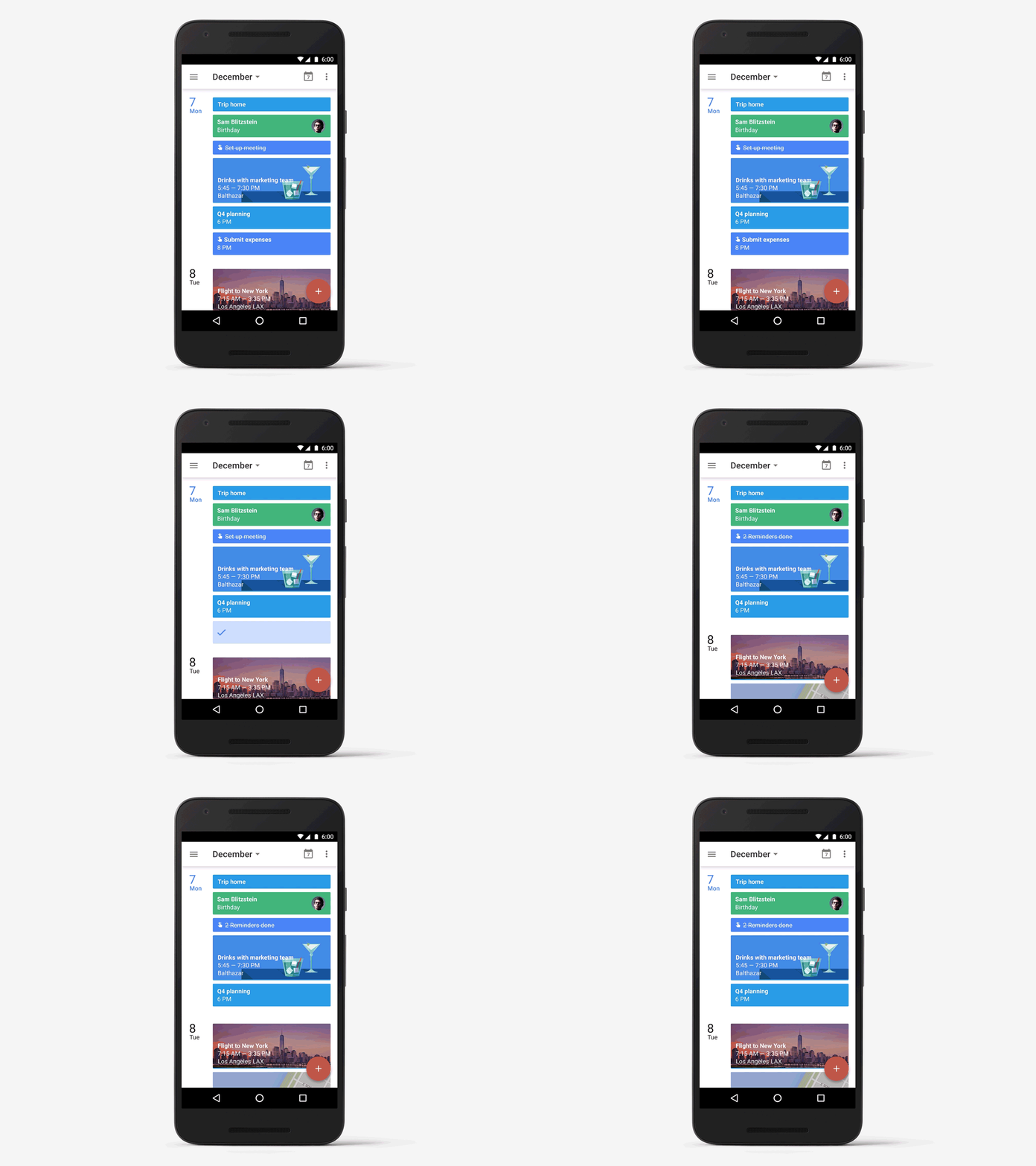
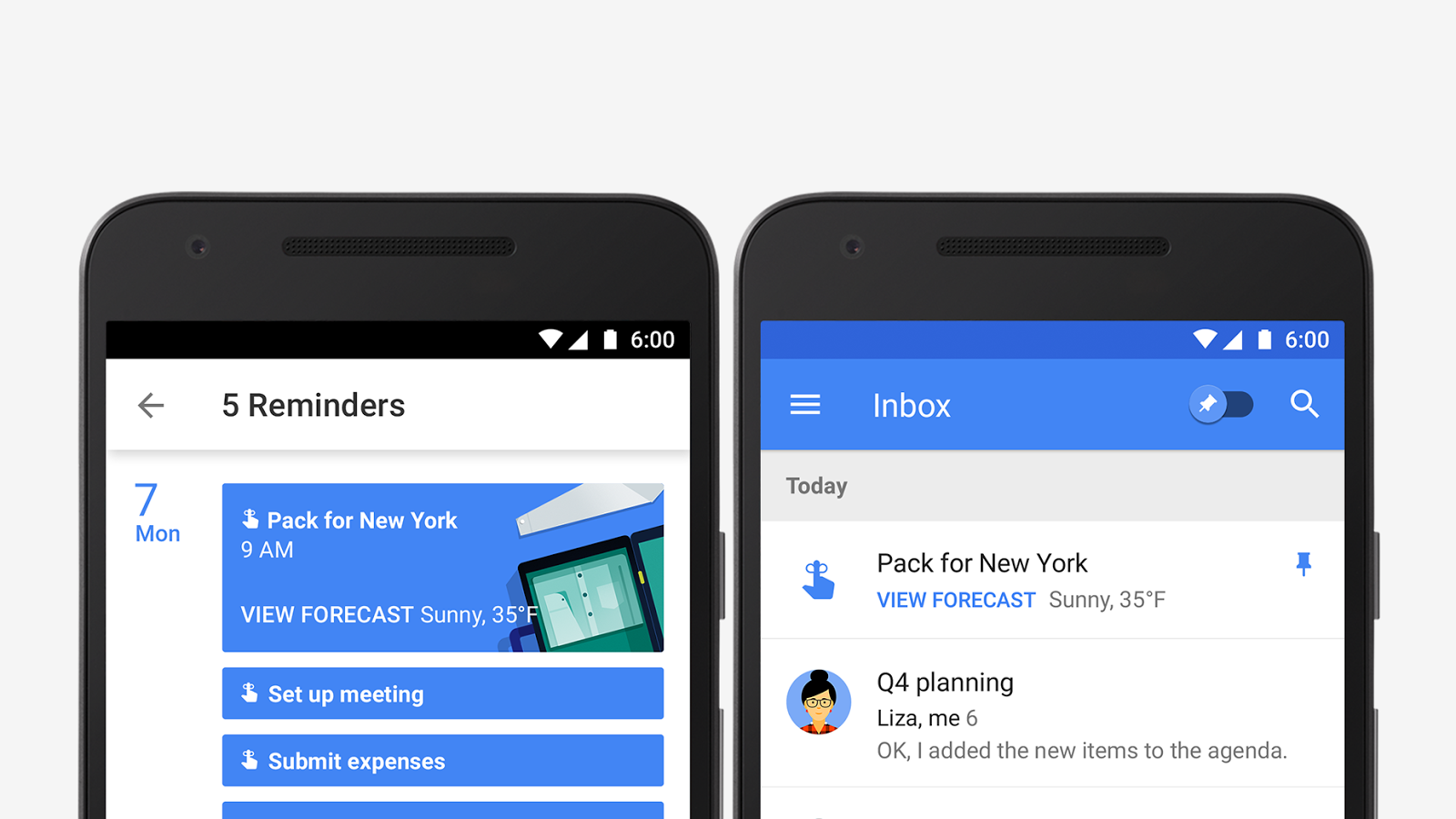
Now there's a single way to manage your day: starting this week, you can create Reminders in Google Calendar to keep track of your to-dos alongside your scheduled events.


Reminders stick around
You might already create calendar entries to remind you to call the doctor or pick up groceries on the way home. But while those entries come and go, Reminders stick with you over time so you can track them until they are actually done. If a Reminder isn't completed, it will appear at the top of your Calendar the next day. And the next. When you do finally call the doctor or pick up those necessities, just swipe the Reminder away ... and you're onto the next to-do.
Reminders help with the details
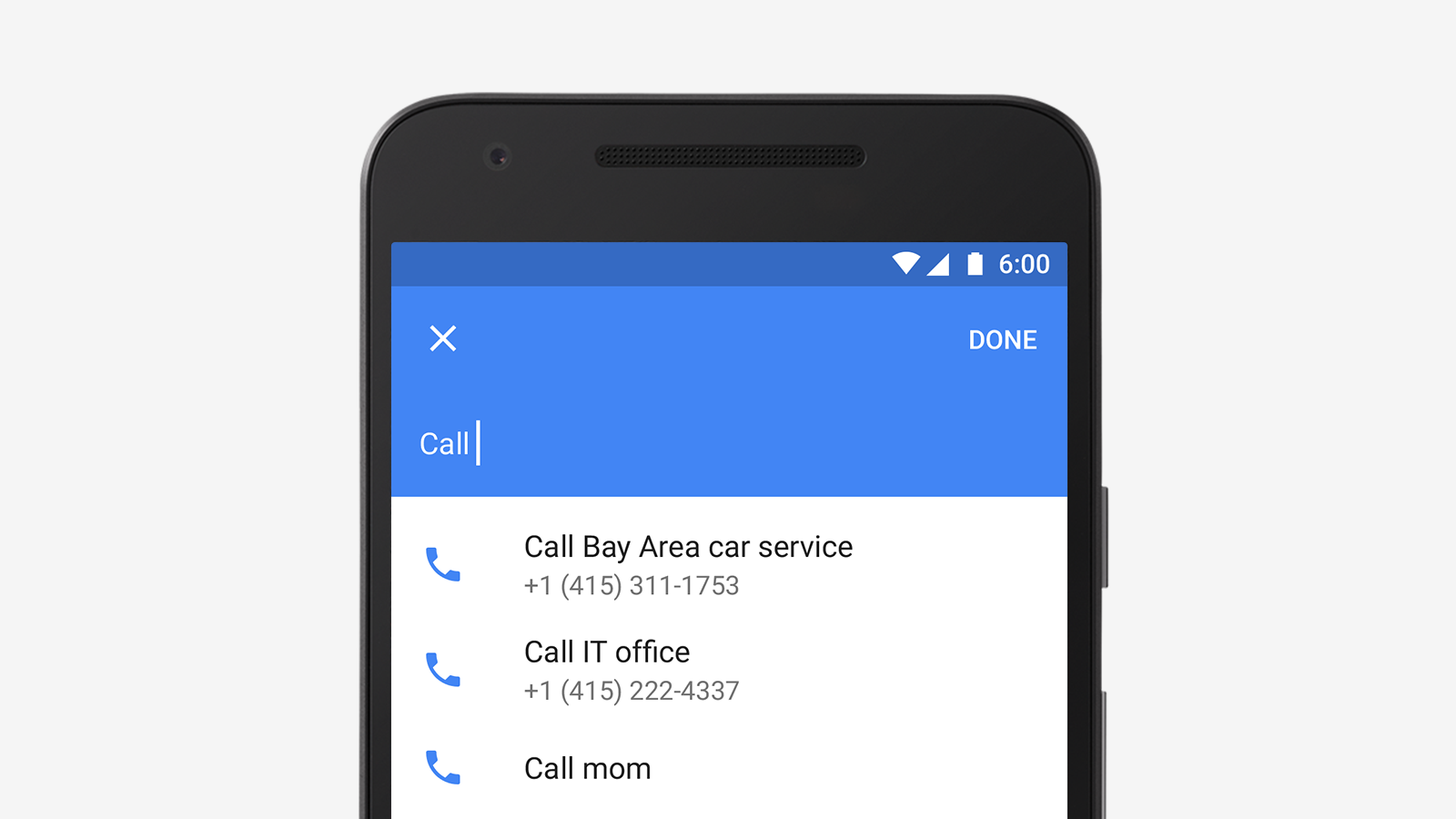
Another way Reminders are more useful than events is that Calendar adds things like phone numbers and addresses automatically. So if you add a Reminder to make a call or run an errand, the number or address will be right there when you need it. Just like Inbox by Gmail, Calendar uses information from your contacts, as well as Google's knowledge graph to provide this extra bit of help.
Reminders work across Google
You can also create Reminders from Inbox, Keep, and Google Now. This means you can create a Reminder when you're checking your email and it will show up on your calendar right away. Plans change? Just move the Reminder to a better time. Or if your hands are full, you can record your Reminders in Google Now一like, "Ok Google, remind me to buy birthday candles"一then mark it as done later in Calendar.
Reminders will be rolling out this week with the latest versions of Calendar on Google Play and the App Store. And don't worry, we're working on bringing Reminders to the web as well.


12 Dec 02:33

Big Banks in a Tizzy Want to Take Their Billions and Go Home

by David Dayen

The big banks are not taking a rare legislative defeat lying down.

Days after President Obama signed into law a highway package that finally ended an egregious, 100-year-old subsidy for big banks, two of Wall Street’s favorite legislators want to attach a last-minute rider to the end-of-the-year omnibus spending bill that lessens some of the impact of that change.

From 1913 until last week, banks received a 6 percent annual dividend on paid-in stock they had to purchase to become members of the Federal Reserve system. This was initially provided as an incentive for membership with the Fed, but membership is now mandatory for national banks, and all banks must abide by the standards of membership.

It took 100 years and a desperate need to find some way to pay for this year’s highway bill for anyone to think to take away the incentive payments.

The highway bill deal reduced the annual dividend to the rate of interest on 10-year Treasury notes, capped at 6 percent. (The current rate is around 2.2 percent.) This change only affects banks with more than $10 billion in assets, but it saves the federal government around $1 billion a year.

Now, enter Republican Reps. Randy Neugebauer of Texas and Bill Huizenga of Michigan. The crux of their proposed rider on the omnibus bill is this: If banks can’t have their free 6 percent dividend, then they shouldn’t have to pay for any stock at all.

Right now, banks must purchase Fed stock equal to 6 percent of their total capital. But under the proposal, first reported by the Wall Street Journal, banks with over $10 billion in assets would be able to cut that to 3.5 percent of capital, and the Fed would have to return excess money to the member banks, estimated at $25 billion. The Fed would also be restricted from forcing banks to purchase additional stock in the future.

As it happens, that plan actually ends up saving the government money, since it won’t have to pay any dividend on the money it returns to the banks. That would save as much as $1 billion a year, according to the Financial Services Roundtable, a lobbying group that nevertheless supports the rider.

Other groups like the American Bankers Association are also pushing for the measure to be included in the omnibus. It’s not yet clear whether it will make it into the final legislative package, which will reportedly be released on Monday for a vote next week. Current government funding expires December 16.

Since banks established before 1942 don’t even pay taxes on the Fed dividend, it’s unclear why they want to give up a tax-free return equal to Treasury yields. But a revealing comment to the Journal from a bank lobbyist positions this mostly as a temper tantrum reaction to the dividend cut.

“This is not something that we were interested in pursuing or even thought about until the highway bill passed,” said Francis Creighton, executive vice president of government affairs for the Financial Services Roundtable. “If we’re not getting the dividend we signed up for … that led us to say, ‘Do we need this entire system anyway? Does it even make sense?’”

Neugebauer and Huizenga already tried to bail the banks out once, attempting to replace the dividend cut in the highway bill with a substitute funding source that raided the Fed’s capital surplus account instead. Their new rider again irks the Fed, which through a spokesperson warned “against making any changes to the fundamental structure and governance of the Federal Reserve System without a serious, thoughtful, and public discussion.”

The post Big Banks in a Tizzy Want to Take Their Billions and Go Home appeared first on The Intercept.

01 Dec 03:43

Top 10 Smart Ways to Organize Your Kitchen

by Melanie Pinola

A well-organized kitchen will help you cook as efficiently as possible and waste less food. Here are our top 10 tips for organizing the heart of your home.

Read more...


20 Nov 03:06

US govt developing brain implants that give humans the ability to never forget

by Greg Beach
vigilenator

First its veterans then everyone else. Then unauthorized data access to the chip by the NSA

Brain Initiative Obama, President Obama Brain Initiative, DARPA brain research

Supported by the US Defense Advanced Research Projects Agency (DARPA), scientists are hard at work on a brain implant that will grant humans the ability to never forget. The Restoring Active Memory (RAM) project is focused on restoring memory abilities to veterans of the American wars in Iraq and Afghanistan. If successful, RAM could have an enormous positive impact on the lives of over 300,000 veterans who have returned home with brain injuries.

Brain Initiative Obama, President Obama Brain Initiative, DARPA brain research Brain Initiative Obama, President Obama Brain Initiative, DARPA brain research

Read the rest of US govt developing brain implants that give humans the ability to never forget


19 Nov 03:47

Black Friday Is Dying, and That’s a Good Thing

by Kristin Wong on Two Cents, shared by Andy Orin to Lifehacker

Don’t get me wrong, there are some great deals to be had this time of year. But lining up in the cold to nab a cheap 55” TV? No longer necessary. Black Friday isn’t what it used to be, and that’s a good thing.

Read more...


19 Nov 03:42

The Things That Are Almost Always Cheapest to Buy at Target

by Melanie Pinola

All of the big retailers—Amazon, Walmart, Target, and so on—claim to have the best deals, but that depends on what you’re buying . Over at Wise Bread, Kyle James points out eight things you should probably head to Target for.

Read more...


19 Nov 03:41

Does It Matter How Many Reps You Do When You Work Out?

by Stephanie Lee on Vitals, shared by Whitson Gordon to Lifehacker

So, your workout has you doing 4 sets of 5 reps for this exercise, 3 sets of 8 after that, and—oh, thank goodness—only 2 sets of 50 to finish it out. Well, hey, the good news is that these rep numbers aren’t just based on a sadistic desire to see you huff and puff. Here’s how they differ and what they mean for you.

Read more...


13 Nov 23:13

U.S. govt attempts to grab outer space mining rights despite international treaty

by Cat DiStasio

space exploration, mining in space, space law, space rights, space mining rights, mining on other planets, space act of 2015, u.s. congress, bipartisan congress

The United States Congress has claimed mining rights in outer space. In a rare act of bipartisan cooperation, the government is rapidly advancing a bill that would grant “space resource rights” for water and mineral deposits on other planets. The bill needs to pass another review in the House before it reaches the President’s desk. If it becomes law, it will set an historic precedent for space law that directly challenges an existing international treaty. Will the U.S. be allowed to grab outer space mining rights?

space exploration, mining in space, space law, space rights, space mining rights, mining on other planets, space act of 2015, u.s. congress, bipartisan congress space exploration, mining in space, space law, space rights, space mining rights, mining on other planets, space act of 2015, u.s. congress, bipartisan congress space exploration, mining in space, space law, space rights, space mining rights, mining on other planets, space act of 2015, u.s. congress, bipartisan congress


Read the rest of U.S. govt attempts to grab outer space mining rights despite international treaty


06 Nov 04:52

Bernie Sanders submits bill to ban fossil fuel extraction on federal land

by Josh Marks

Bernie Sanders, Independen Senator of Vermont, Bernie Sanders Climate Bill, Bernie Sanders climate change, Independent Senator Bernie Sanders

Bernie Sanders is taking on President Barack Obama’s “all of the above” energy strategy. The Democratic presidential candidate and Independent Senator from Vermont on Wednesday co-introduced a climate bill, called the “Keep It In The Ground Act,” that would ban all new federal leases for oil, gas or coal extraction on public lands and waters and terminate leases that aren’t producing. The legislation would also prohibit offshore drilling in the Arctic and the Atlantic. The Obama Administration has been criticized by environmental groups for previously approving offshore oil drilling in the Arctic and the Atlantic, which they argue goes against the president’s pledge to take action against global warming. Last month the president reversed course and blocked new oil drilling in the Arctic.

Bernie Sanders, Independen Senator of Vermont, Bernie Sanders Climate Bill, Bernie Sanders climate change, Independent Senator Bernie Sanders Bernie Sanders, Bill McKibben, Keep it in the Ground Act, fossil fuels, clean energy, Obama, drilling, leases, federal land


Read the rest of Bernie Sanders submits bill to ban fossil fuel extraction on federal land


06 Nov 04:52

Goldman Sachs Nearly Quadruples Clean Energy Investment Target To $150 Billion

by Joshua S Hill
Goldman Sachs-1

Global investment banking giant Goldman Sachs has announced it will nearly quadruple its clean energy target to $150 billion by 2025. In 2012, Goldman Sachs targeted a clean energy target to invest $40 billion by 2025, and over that time the company has made giant strides to fulfill the letter and intent of its target, [&hellip

Goldman Sachs Nearly Quadruples Clean Energy Investment Target To $150 Billion was originally published on CleanTechnica.

To read more from CleanTechnica, join over 50,000 other subscribers: Google+ | Email | Facebook | RSS | Twitter.

06 Nov 03:30

Chevy Bolt: GM Commits to 50 State Rollout

by James Ayre

Despite being called a "compliance car" by detractors, GM recently announced that it's $30K Chevy Bolt electric vehicle will be available in all 50 states

The post Chevy Bolt: GM Commits to 50 State Rollout appeared first on Gas 2.