Entre las compañías se encuentra el grupo vasco Construcciones y Auxiliar de Ferrocarriles, que ya aparecía en un informe previo de la ONU por participar en el proyecto de tren ligero en Jerusalén
etiquetas: amnistía internacional, 15, empresas, cómplices, crímenes, israel
Si el reglamento lo permite, la organización de la prueba no invitará al equipo propietario del millonario sionista Sylvan Adams. Si la UCI impone su participación, dos de los principales patrocinadores (las diputaciones de A Coruña y Lugo, gobernadas por un bipartito PSOE-BNG) retirarán su financiación.
La cultura y la política estadounidense se posicionan en contra de la cancelación del presentador, que ha sido aplaudido por Trump. Kimmel tan solo bromeó con que los republicanos afines a Trump politizaran el asesinato acusando al sospechoso, Tyler Robinson, de ser de ultraizquierda cuando en realidad proviene de una familia profundamente conservadora.
etiquetas: eeuu, trump, fascismo, mundo de la cultura, jimmy kimmel
El sistema HQ-9B puede interceptar aviones, drones y misiles de crucero a hasta 200 km. El ministro de Defensa egipcio advierte a Israel de que cualquier intento de violar las fronteras será respondido.
Ejemplo de una actuación policial brutal contra una manifestante en Marsella durante la segunda jornada de protestas contra los recortes del gobierno francés. La mujer está en el suelo, intenta levantarse, recibe primero una patada de un policía, cuando se levanta de nuevo recibe un empujón de otro. y vuelve a caerse.
El reportero Matthew Cassel habla con israelíes en Tel Aviv para conocer su opinión sobre la guerra, la hambruna y el genocidio que se están produciendo en el país vecino, así como sobre la creciente condena internacional al respecto.
El periodista Roger Mateos publica ‘El verano de los inocentes’, una exhaustiva investigación que consigue arrojar luz sobre las consecuencias de los atentados del FRAP en 1975
Durante la ceremonia de apertura de los Juegos Olímpicos de París 2024 se inauguraron una decena de estatuas en honor de mujeres francesas destacadas en diversos ámbitos. Las más conocidas son Simone de Beauvoir, Simone Veil y Christine de Pizán, pero hay una menos conocida con cuyo nombre se había
El ciclo del agua se ha vuelto cada vez más errático y extremo, oscilando entre diluvios y sequías, con los efectos en cascada del exceso o la escasez de agua en las economías y la sociedad.
Mientras tanto Disney pasa de ser la punta de lanza del wokismo a despedir a un sujeto que ridiculiza a Donald Trump en pocos meses…
Hoy he recibido un aporte sobre este tema.
Pues nada Fino, que en EEUU se están pasando la libertad de expresión por lo que viene siendo el perineo. A mi Kimmel siempre me ha caído gordo y no lo encuentro precisamente gracioso, pero resulta irónico que los que llevan años llenándose la boca con la libertad de expresión y diciendo lo de “Ya no se puede decir nada” ahora hagan esto. @UnR0joDeM¡erda
Curiosamente OBAMA ha publicao un tuit que ha tenido bastante éxito:
¿Pero adivináis qué? Él hacía lo mismo, porque según Roseanne Barr, él y su mujer fueron los responsables de su despido.
“Recuerdas cuando tú y tu mujer llamasteis a Bob Iger para que me despidiera?”
La única diferencia que parece haber es que Trump lo dice abiertamente delante de las cámaras, y los demás lo hacen de tapadillo, con telefonazos fulminantes.
Al final el único camino correcto es defender lo que crees justo y ser consecuente. Como dice Juan Soto Ivars: Ellos se mueven, yo sigo igual.
Extra: la opinión del actor James Woods sobre el tema.
Respuesta corta: El auténtica ásana comienza en el instante en que quieres abandonarlo. Vamos a intentar explicar de forma sencilla cómo funciona nuestro organismo cuando realizamos un ásana, qué ocurre en los músculos y en el cerebro y por qué es tan importante mantenerlo. Escribe Pedro López Pereda. En nuestra práctica de yoga estamos acostumbrados […]
La crisis de Suez de 1956, también conocida como la Guerra del Sinaí, fue el canto del cisne del imperialismo europeo, fortaleció el nacionalismo árabe y consolidó la el mundo bipolar de la guerra fría con Estados Unidos y la Unión Soviética como dos únicas superpotencias. El origen de la crisis hay que ir a buscarlo al canal de Suez, inaugurado en 1869 y arteria vital para el comercio internacional. En 1955 por él pasaba el 50% de todo el petróleo que se consumía en el mundo, pero lo explotaba una compañía anglo-francesa.
Los británicos habían controlado Egipto hasta 1922, año en el que, tras la fachada de una independencia nominal, se convirtió en un protectorado de facto. La Revolución de 1952, acaudillada por Gamal Abdel Nasser, abolió la monarquía y promovió el panarabismo para liberar a su país del yugo colonial. Pero no disponía de recursos, así que propuso construir una gran presa en Asuán que permitiese regular el cauce del Nilo y generar electricidad. No podía financiar su construcción y eso le llevó a pedir dinero en Occidente, donde le ofrecieron un préstamo. En paralelo Nasser negoció la compra de armas soviéticas y reconoció a la China popular, lo que alarmó a Estados Unidos que canceló el préstamo para presionarle.
Nasser podía agachar la cabeza o elevar la apuesta. Escogió lo segundo. El 26 de julio de 1956, nacionalizó el canal para financiar la presa y reafirmar la soberanía egipcia. Eso era un órdago para el Reino Unido y Francia que dependían del petróleo que transitaba por Suez. Israel, muy afectado por el bloqueo del estrecho de Tirán y los ataques de guerrilleros palestinos desde Gaza, vio en aquello una oportunidad para debilitar a Egipto. Británicos, franceses e israelíes se reunieron en secreto cerca de París y acordaron el protocolo de Sèvres, por el cual se coordinaban para efectuar una operación que consistiría en que Israel se encargase de atacar a Egipto mientras los europeos intervendrían después para proteger el canal.
El 29 de octubre Israel lanzó la Operación Kadesh, destruyeron la fuerza aérea egipcia y capturaron Gaza y Sharm el-Sheij. El día 30, el Reino Unido y Francia emitieron un ultimátum exigiendo la retirada de ambos ejércitos de la zona del canal. El 5 de noviembre paracaidistas anglo-franceses tomaron Port Said, pero la resistencia egipcia, que bloqueó el canal hundiendo varios buques, complicaron la operación. Estados Unidos no había sido informado, lo que molestó especialmente a su presidente, Dwight Eisenhower. Enfurecido, obligó a británicos y franceses a retirarse y se encargó personalmente de que una fuerza especial de la ONU se desplegase en el canal. La URSS de Jruschov hizo el resto amenazando al Reino Unido y Francia con un ataque nuclear. Un mes más tarde los europeos abandonaron Egipto con el rabo entre las piernas.
La crisis supuso una humillación histórica para las dos grandes potencias del siglo XIX. El primer ministro británico, Anthony Eden, y el francés, Guy Mollet, tuvieron que presentar la renuncia meses después. Nasser se convirtió en el héroe del mundo árabe. Israel salió ganando, ya que se aseguró el acceso al mar Rojo, pero habían quedado sembradas las semillas para guerra de los seis días de 1967.
En La ContraRéplica: 0:00 Introducción 3:42 La crisis de Suez 30:59 Contra el pesimismo - https://amzn.to/4m1RX2R 1:17:50 Las edades de la historia 1:21:55 El Gobierno virreinal
Un policía nacional destinado en el grupo de Estupefacientes de la Comisaría de la Macarena de Sevilla ha sido detenido como presunto autor de un delito contra la salud pública, por haber sustraído sustancias estupefacientes procedentes de distintas intervenciones policiales en el marco de la lucha contra el tráfico de drojas a pequeña escala, lo que se conoce como el “menudeo”, y que el funcionario sustituía por otras sustancias para intentar que se descubrieran los robos. El agente detenido, que ha quedado en libertad provisional a pesar de que la Fiscalía pidió su ingreso en prisión provisional, es “daltónico”, una circunstancia que confirmó las sospechas de la Unidad de Asuntos Internos de la Policía Nacional que llevaba investigando los robos desde hace tiempo, sobre todo después de que en una de sus últimos “cambiazos” el agente sustituyera una pequeña cantidad de coca por una vitamina “de color rosa” sin que se percatara de ello debido a sus problemas para distinguir determinados colores. @diariodesevilla
This multi-part blog series is a backstory that deep-dives into the motivation behind building Kubernetes Operators for running databases. This third installment builds on the previous two and lays out three additional expectations (2–4) that users might have of the cloud provider’s DBaaS.
Image generated by Google Gemini
Written by: Boris Dali, Database Engineer @ Google (LinkedIn)
Disclaimer
First off, the disclaimer: this blog series is neither a Google official documentation, nor it is an authoritative source. For the former, docs on AlloyDB Omni in particular, please see here and for the latter, please feel free to reach out to the AlloyDB product team. Google Cloud official blogs are posted here. Medium hosts Google Cloud Community here. This is neither. The opinions I express here in this blog post series are my own and may not represent or agree with Google’s official position on the subject.
So what is it then? Well, if you think of this blog series as the one engineer’s pseudo random ramblings on a particular topic (“running databases in containers on K8s” that is), you won’t be far off 🙂.
Recap
If you missed part 1 and part 2 of this backstory and want to follow along, it may be a more logical place to start there (and yes, if you haven’t read it, apologies in advance, it’s not exactly a short read 🙂)
To recap, I started with the goal of exploring my reasoning behind the decision to invest into containers and K8s as a viable alternative to the more mainstream ways of running databases, but went down the rabbit hole of building the foundation first. That foundational work is based on my analysis of the on-prem database reality (as I know it) and setting up the expectations of a cloud provider’s DBaaS system, so that I would feel sufficiently compelled to leave my cozy on-prem behind and find a new home for hosting my databases.
And, no, I’m still not done with my analysis/cloud expectations 🙂.
My number one expectation that I detailed in the previous post was to liberate me from the burden of hosting a database altogether (there’s no spoon!) and let me focus on my data and the value that you, as a cloud provider, can help me derive from it. I called it “up leveling the conversation”. Here are some of my other cloud expectations##2–4:
Expectation #2: The third (missing) infrastructure dimension
It may be a tad unrealistic to expect that switching to Data as a Service would happen overnight. Not for everybody anyway. That is, reading my tea leaves from divination class, I think what I described is coming, it’s just a matter of who gets there first, so it’s “when”, not “if”, but that’s also radical enough and so it would take time. Not everybody is Robin Hood (see my previous post where I describe expectaion#1). Not everybody would buy right off the bat my “database shell is a tax/overhead” argument. And some may be simply more familiar and so more comfortable with the traditional database management and indeed just look for a cloud to provide a bit more database automation and offloading mundane tasks and responsibilities. A paradigm shift sometimes is… well, too much of a change. Sure, my argument above may be convincing to some, perhaps to the CIOs and the CTOs, … but perhaps not to all of the IT folks and, in particular, perhaps not to all of the DBA crowd. Can I just please still stick with the concept of a database (yes, as a “shell”) for now? And, sure, maybe I’ll switch to your Data as a Service concept at a later time when I get more comfortable with your cloud platform?
If that’s where I stand as an on-prem customer, I’d probably still want to see some innovation that you, a cloud provider, bring to the table to convince me to make the move. We already covered in the first part of this blog series the compute and storage disaggregation that became a staple of the public clouds¹. Good. Now if my end goal is to actually deploy an app — few shops need a database for the sake of a database — what I want to see is the third, crucially missing, infrastructure dimension, which, as you probably guessed, would be… a database.
For the sake of discussion, let me put my core, mission-critical shirts/shoes selling app aside for a second and consider a new, call it for simplicity, a “WordPress app” that I’d like to build for branching out to a new market (of, say, designer suits). Why can’t deploying that WordPress app be as simple as a self-service drag & drop (or just talk to my phone) of these three supporting dimensions? Indeed, let me just drag & drop my app on the compute node that I want to run on, attach the storage to hold my app files and, in the similar way, attach a database to store my data (if I’m not yet ready to let go of a database “shell” altogether that I presented in this blog series earlier 🙂).
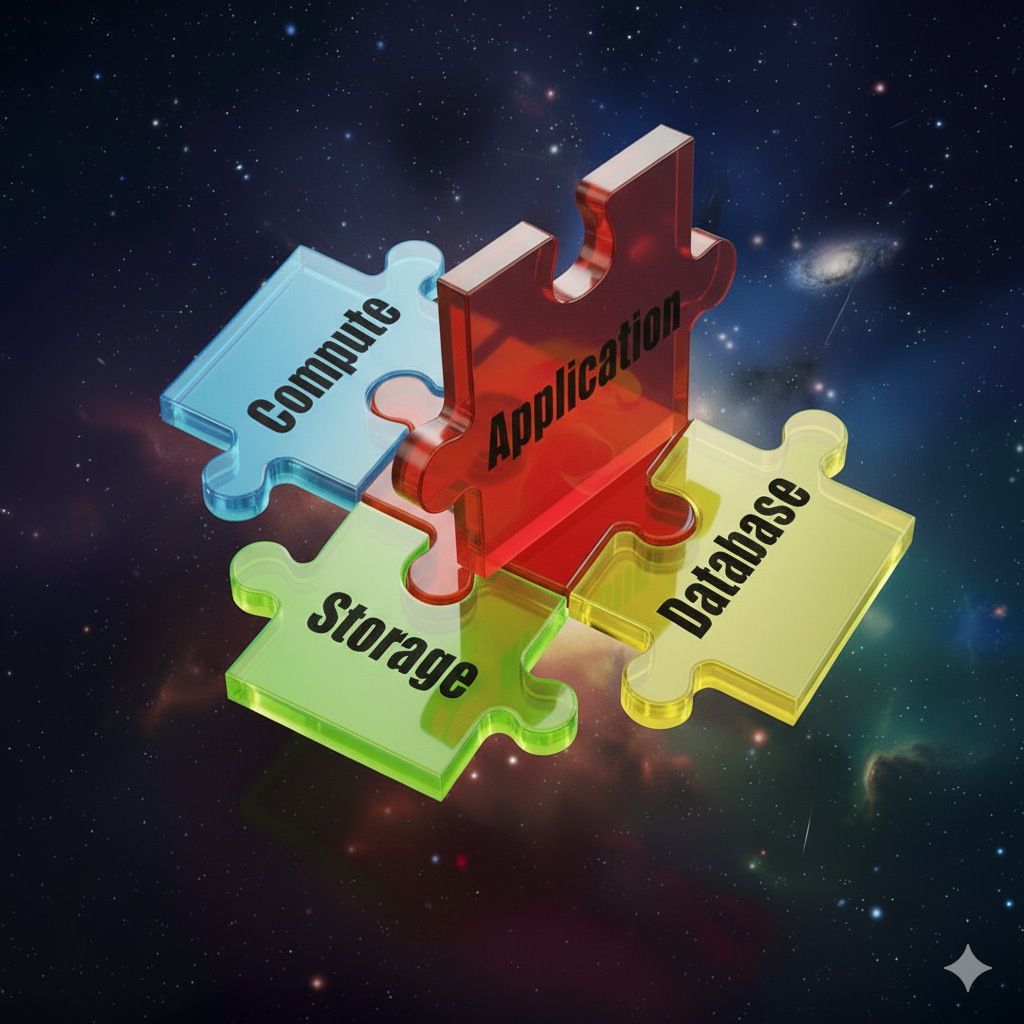
Three infrastructure dimensions: Compute, Storage, Database (image generated by Google Gemini)
That yellow part in the picture is the missing piece of the puzzle! To me, that’s the opportunity for the public clouds to make a database more of a commodity, make it as easy to attach it to my app as as it is with compute and storage.
Now if I insist on managing that database on my own (IaaS style), taking backups, enrolling users, secure, patch, monitor, ensure compliance, etc., etc… sure, right click on that data icon that I’ve just dropped to my app and specify all these options, which would spin up a GCE or an EC2 instance on my behalf, install a database of my choice, set up the right VPC, subnets, firewall rules, IAM accounts, etc. Not particularly recommended though (because I don’t really take much advantage of cloud automation, see this TCO analysis), but certainly possible. The mainstream way though would be to allow the fully managed database solution (DBaaS) to host my data. Like AlloyDB Cloud or Cloud SQL and if I’m not happy with PostgreSQL being the default database engine to handle my WordPress persistent layer and want to switch to MySQL instead, or just adjust the maintenance window to my liking or upgrade to HA config and perhaps add a DR replica in a different region, than that’s what the right click is there for.
The initial deployments are easy though. After all, there are marketplace apps for that. How about the “day 2” operations like an upgrade of my WordPress app, that may need a new version of the schema and perhaps some new config settings too? Better yet, how about a database upgrade while we are at it? All with the minimum downtime, of course, and a clear roll back strategy for when that upgrade fails halfway through?
Heard of the database security patches? Oracle, for instance, releases quite a few of them (remember RU/RUR, CPU, PSU?) with literally hundreds if not thousands of fixes, not to mention the zero-day one-off patches that may need to be applied right away. And if my database estate is to consist of more than a few WordPress databases… am I well positioned to roll these patches (and possibly roll them back) in the orderly fashion, starting with the Dev databases, going through the soaking period and moving up the environments all the way to Prod?
With the database as the third infra dimension, all of that becomes the responsibility of a cloud provider (until and unless I decide to switch things around and take back control — see more on this point below). That is, preparing the patched version of my database, keeping it in sync with the old, unpatched one by making sure that the live data is replicated and finally quickly swapping the two (obviously with no data loss) with just a few seconds of downtime, while also making sure that the cache is pre-warmed on the patched database to avoid the performance drop due to the increase in hard parsing and a physical I/O. The usual magic of the DBaaS system.
And, yes, patching is just one user journey. My DBAs surely know how to run “apt | dnf | yum | rpm install” of PostgreSQL on their own. What I expect your cloud’s third database dimension do for me is to offer a collection of managed services that automate a lot of the lower level “day 2” mundane operations, so that developers, for instance, can self-service attach a database to their apps, freeing up my DBAs time to focus on tasks that differentiate my business.
To be sure, some of the cloud provider’s DBaaS systems are already pretty close to what I describe here as the “database as the third infra dimension” (well, with Google Cloud SQL and AlloyDB Cloud perhaps closer than some of the other competitor’s offerings because the management and the control plane layers run inside of the producer owned projects and the actual databases are deployed in the so-called tenant projects, all of which are not owned by a customer and are only visible through the endpoints and the “peered” VPCs (via the older style PSA or the newer style PSC). This separation by project and not just by a VPC/subnet, provides the isolation that lends itself nicely to my mental model of a database as just another infra dimension (and which is fully managed by a cloud provider, just like compute and storage).
The key difference that I’m highlighting here is that, as a customer, I’d like to be able to move between different database offerings (e.g. AlloyDB Cloud, Spanner with Postgres Compatibility, Cloud SQL, AlloyDB Omni, etc.) seamlessly with just “attaching” a database I need, just as I attach compute and storage.
Why does “moving between different database offerings” matter? I‘d like to have the flexibility to decide only at the deployment — and not at the design — time, how and where to run my WordPress app. Call it “shifting right to the SRE” to decide how the whole app deployment — including a database — is to look like. What I’m getting at is that this flexibility allows me to get beyond the boundaries of a single cloud. Does my app have to be deployed on a Google Cloud GCE instance (or a Google Cloud Run or a GKE or…) or should I consider AWS EC2 instead? Or perhaps my on-prem co-lo that still hosts some of my apps? That yellow piece of the puzzle that I use here to represent the “third infra database dimension”, effectively is the door, the portal to the seamless hybrid and multi-cloud database deployments (and shifting it around in any direction), which should be as easy as attaching compute and storage within a single cloud.
To reiterate, I don’t want this to be a design time decision. I’m not building for your cloud; I’m building for my business and your cloud is to run it as seamlessly as the competitor’s. What if I change my mind or the circumstances change? I’m concerned with the cloud vendor lock-in (just got out of the closed source proprietary database vendor lock-in by moving to the OSS database, don’t need another one!). And so what I want is to have the flexibility to just drag & drop my data to a cloud icon of my choice (or to a bare metal server in my co-lo) and be free to change it anytime I like without undergoing a costly database migration.
Aside from the hosting location, if my app is to become popular enough, would it be a smart move for me to scale it by bin-packing it to run in containers inside the Pods and orchestrate them on K8s? I’d like to be able to simply drag & drop my app from its current hosting GCE instance and onto a GKE cluster or to an OpenShift cluster at a (re)deployment time and attach a GKE-hosted database to that app as the third infra dimension.
Do my apps need to be “always on”, in the fully connected mode or are they to tolerate some periods of disconnects or perhaps even run completely air-gapped? Those are just examples; there are lot of possible use cases and so what I’d really like is the flexibility of not making an upfront and difficult to reverse deployment commitments and instead let the mighty SRE deploy or redeploy or re-redeploy it based on whatever operational and cost considerations are appropriate for my shop (and for your cloud).
¹ It’s not like compute/storage disaggregation can’t be done (and it obviously has been done) on-prem too, but there it’s usually hidden within the “infra teams” by a server group or a storage group or some other IT department that requires filing 10 tickets, waiting for a week and sometimes buying a lunch or bringing a yummy sandwich to the IT folks to “facilitate the process”. Cloud changed that.
Expectation #3: Application as the first class citizen
My business is selling shirts and shoes. I have my custom apps developed to do just that. I think in terms of these apps on-prem, but when you pitch me your cloud, I’m to change my mental model and start thinking in terms of projects and/or accounts (depending on a cloud provider). How’s that “user friendly” or “meeting a user where they are”?
Ultimately what I want is to describe to you my app or, better yet, have an ability for your Database Migration Assessment (DMA) tool to check out my app automatically on its own (with me authorizing it, of course, possibly for just one-time use) and automatically create the most appropriate and cost effective setup on your cloud for me… that doesn’t make me bend my mental model by forcing me to do the mapping of my app and my business terms to your cloud’s idiosyncratic definitions.
My app should be your cloud’s “landing zone” that instead of introducing frictions, allows me to sharpen my focus on my business while relieving me from the unnecessary infrastructure and deployment details.
That is, your cloud shouldn’t be forcing me to operate at the infrastructure level. That could indeed be acceptable and desirable for visibility in some cases, but in general I’d like to move to a whole-stack SRE team, where engineers may specialize in databases or apps, but the whole team can operate the app as a whole (not through a separate DBA and separate App Management teams). As such, that infra level is too low for me. I want an easy, high-level mechanism for setting up all the infrastructure for my app (and that includes a database) without being bothered with your cloud’s specific implementation details. You, as a cloud provider should know best what the right setup for me is (based on the myriads of your customers, some of which surely require a similar setup) and your DMA assessment tool.
What I’m asking you, as a cloud provider, is to give me an option to think at a higher level of abstraction, lift me up from your infra and make an Application the first class citizen on your cloud. In particular, free me up from setting up networking, security, accounting and other (your platform specific) infrastructure. This expectation#3 is a step further, an extension if you will, of what I described earlier where you elevate me by allowing me to just work with my data (expectation#1, preferred), or at least allow me work with the database, but disaggregate it too, just as you did with the storage and compute (expectation#2).
Expectation #4: Unearth and reveal data insights
Whether or not you, dear reader, agree with my pitch of a database being a pure overhead, a (pretty heavy) tax on me, as a customer, for hosting my data or you are more in the camp of folks that prefer a less radical approach and just looking for some automation of mundane database tasks, I think you’d agree with me that it would be really useful if you could just opt-in to a service that makes sense of your data. Just like that. As an on-prem customer, I know I would!
Unearthing data insights from raw data (image generated by Google Gemini)
Indeed, whenever in my past life I consulted and was introduced to a new customer database setup, as part of the intake interview, I always inquired about the kind of data that actually required those gigabytes or terabytes of data storage that the customer DBAs were proud of administering. The rest of my questions were usually easily answered, but this one stumbled many and I rarely got a reasonable answer that could be easily digested and supported by the back of the envelope arithmetic.
This has always been fascinating to me. Lots of effort, money (including my consulting fee), infrastructure (compute, storage, networking) was often unquestionably spent on hosting large databases, but few in the organization could give a straightforward, easy to understand answer as to what kind of data was stored inside to really justify its size and all the expenses associated with hosting, patching, securing and protecting it.
“What do you mean? Data is the lifeblood of our business, right?” That was the first standard response. Sure, but if you operate on the active dataset of of a few hundred megabytes or perhaps 1GB or even 10GB on any given day for your transactional database…. What else is stored in your 10TB database?
Naturally, we can design a smart caching solution, get a bigger machine, allocate all the available RAM (and perhaps enable disk cache for AlloyDB Omni to extend your RAM even further) or scale horizontally perhaps, and, sure, enable columnar engine for data crunching and analytical queries and lots of other cool features that as a consultant I’d be happy to implement for you, but… do you actually make use of all that data that you claim you need faster access to?
To be sure, most of this data was probably useful… for something, but to me it often hasn’t been apparent what for exactly and so I often had a feeling that my technical solutions/recommendations could’ve been a lot more cost effective if I knew the exact data access patterns (which I could get if customers allowed me to spend time on it), if I understood the exact nature of the business and the treasures hidden inside the raw data.
The fascinating part to me was that the people who looked after that data not only couldn’t easily answer this “what’s actually stored in your 10TB database” question, but were often stunned by me asking it. Maybe it’s just me, but I’m the kind of person who prefers to have a ballpark figure in mind before I approach a cash register in a grocery store. My estimate may be 10, 20 perhaps even 30% off, but when I review my credit card statement later and see a weekend grocery charge of $500, that tingles my spidey senses that something may possibly be off.
I see data in the same light. As I already pointed out earlier in this blog series, I see a database as a tax that I have to pay to host my data (see expectation#1 above). All of these system catalogs or data dictionaries, online/archive redo logs or WAL logs, undo or temp, backups and replicas that take space and consume CPU resources… I didn’t ask for any of it. All I want is to host my data, but I’m forced to pay a tax for my data to be stored in a particular format, accessed in a particular way, my requests queued waiting for locks or latches or mutexes, etc, etc. Overhead!
What I always wondered –and sometimes asked customers– is to conduct a simple mental exercise of running a back of the envelope estimate on the useful data vs. the tax they pay for hosting it (i.e. for maintaining that shell of a database). What’s that overhead like? Is it just the data normalization, the keys that are stored in multiple tables, the indexes that are perhaps overblown to avoid hitting the actual tables to satisfy queries or the “real overhead” that stems from data that is very carefully accumulated, but not really used? That is, imagine that you dump your actual, daily used transactional data to a file or two or a hundred of them. How much space would these flat files “weigh” compared to the size of your database? Would it be 20% or 80%?
And yes, as they say, space is cheap nowadays, except that the highly available, triple replicated, encrypted at rest, enterprise storage backed by good durability numbers… ain’t.
And sure, you could run a query, perhaps a really clever one, perhaps more than a page long and perhaps with analytics and window functions and correlated subqueries and perhaps with recursive nesting and subquery factoring, etc. to understand what’s really stored in that table or the other one. But is that what you’d qualify as the easily accessible, easily discoverable, easy to visualize metadata and that also lends itself easily for unearthing the hidden gems stored within your data and your changing data dynamics?
And if it is, why is it that most customers couldn’t easily tell me what’s really stored in that 10TB database and what the real value of that data is?
In my old consulting days I observed this problem almost everywhere. Tons of data, limited use of it. That is, the old adage of being “data rich, yet information poor” applied to many shops I visited. At the startups it was usually “let’s collect that data somehow and clean up and think of what to do with it later” (which rarely happens, if ever). At the more mature customers it was usually well normalized, with minimal data duplication and discrepancies, with the proper referential integrity constraints in place, as well as indexes, but… not much of that data “mined” beyond the rigid ETL processes that took a while to develop and that were not typically adapting to the new data changes fast enough.
While some on-prem shops had sophisticated decision support systems with expensive BI tools and data ware[houses|marts|lakes|ponds|whatever], in my experience as a database consultant, most lacked the facilities to help them understand the content of their databases beyond the immediate operational data points that came in the form of standard canned reports. In my experience, the understanding of the true value of their accumulated data and distilling insights from it was often beyond reach, beyond the capabilities of the databases and the toolset deployed on-prem and so it’s high on my wishlist for you, as a cloud provider, to make this service available to me out of the box as part of your standard value proposition.
What kind of insights? Both operational and business. The former could be a hint that 80% of my data hasn’t been accessed for a year and so it can perhaps be offloaded to a tiered/cold storage (HDDs with the an order of magnitude lower IOPs and throughput are probably fine if this data isn’t accessed anyway) to save me money. And perhaps offload it even further to object storage if nobody screams about it for another year.
And business insights… well, the sky’s the limit here, no pun intended, for you, as a cloud provider, to show me the benefit from using your data insights service on my specific data (we’ll talk about it later). That’s your chance to impress me with your AI inference service (e.g. think of a data crawler + a Vertex AI app based on Gemini + an inference gateway)!
Expectations ##5-N:
So far in these first three posts in this series, I only managed to define four expectations. I hope to do better in the next/forth installment and finish off the rest. Thank you for sticking with me!
The Omni Database Engineering team at Google is the one that makes the magic presented in this blog series happen. I was the first, founding engineer, helped build the team, became a TL and later UberTL, so I believe I have a good perspective of why and how we approached the Operators and evolved them over time. Today, AlloyDB Omni K8s Operator is the production grade database management solution used by major banks, retailers and other customers and the eng team deserves all the credit.
I’d also like to thank Marc Fielding, Gleb Otochkin, Anand Kumar, Virender Singla, Martin Nash and Ash Gbadamassi for reviewing these blog posts, correcting my broken English and my broken thoughts. All the remaining mistakes and inaccuracies are obviously still mine.
¿Conocéis la diferencia entre desobediencia civil y desobediencia revolucionaria? La desobediencia civil implica desobedecer una ley, públicamente (ante los ojos de todos y buscando además la máxima visibilidad de la acción) y de forma pacífica, lo cual no excluye la resistencia pasiva, esto es, resistirte a que te desalojen de una sentada agarrándote a tus compañeros o dejando caer el peso de tu cuerpo, o incluso practicar la autodefensa si te están apaleando, empleando la fuerza mínima para que tu atacante se vea obligado a parar, pero siempre sin realizar acciones agresivas cuyo objetivo principal sea causar lesiones a la policía. El fin de la desobediencia civil es denunciar la injusticia de la ley que incumples o de una situación ajena a dicha ley, cuyo incumplimiento es instrumental para lograr el objetivo de que la gente repare en lo intolerable de la situación. La desobediencia civil busca visibilizar esa injusticia, hacer que la ciudadanía se percate de su gravedad y provocar una ola de rechazo social que la corrija.
La desobediencia revolucionaria se distingue de la desobediencia civil en que puede ser pacífica o violenta (por ejemplo, atacar con cócteles molotov a los policías que están practicando un desahucio) y, sobre todo, en que busca un objetivo más ambicioso que la corrección de una injusticia puntual. La desobediencia revolucionaria cuestiona el orden establecido de un modo radical, y pretende el derrocamiento del régimen político vigente y su sustitución por otro alternativo.
Aunque suene paradójico, la desobediencia civil es muy positiva para la salud democrática de cualquier Estado. Porque, incluso en las democracias formales como la española, hay leyes muy injustas. Muy injustas no desde una perspectiva ideal (es decir, desde la idea de justicia que defienden una filosofía o una religión), sino desde el prisma de la idea de justicia que la propia Constitución reconoce. Y, como todos sabemos, las instituciones que deberían corregirlas, singularmente el Tribunal Constitucional, no lo hacen. Las razones son múltiples: hay derechos como el de la vivienda que están en la Constitución pero no son directamente justiciables. Es decir, si me desahucian, soy minusválido, no tengo recursos para alquilar otro piso y no puedo conseguirlos, me es imposible acudir al Tribunal Constitucional para que ampare mi derecho a la vivienda y obligue a las autoridades a proporcionarme una digna.
Primero porque, en nuestra maravillosa Constitución, el grueso de los derechos sociales no son reivindicables ante la jurisdicción constitucional ni ante los tribunales ordinarios (sólo puedo reclamar los derechos sociales que el legislador haya plasmado en la ley concretando su enunciación general en la Constitución, y si decide no plasmarlos o hacerlo de forma absolutamente insuficiente, no puedo pedir al Tribunal Constitucional que le obligue a respetar la Constitución). Es decir, que los derechos sociales del Capítulo Tercero de la Constitución son papel mojado, porque un derecho no es nada sin las garantías para reivindicarlo y hacerlo efectivo.
Y segundo porque el Tribunal Constitucional es un tribunal político, con magistrados apadrinados (y elegidos, seamos francos) por PP y PSOE que seguirán la disciplina de ambos partidos (y de los poderes económicos que los financian) a pies juntillas, entre otras cosas para beneficiarse de las puertas giratorias judiciales que, cuando acaben su mandato, les permitan irse al Tribunal Supremo, o a la Fiscalía General del Estado, o de vocales al CGPJ...siempre de la mano del partido que les ha apadrinado y que tiene la llave para asignar esos otros altos cargos.
En dicha tesitura, y con unos medios de comunicación que (al menos en el caso de los grandes) son poco proclives a visibilizar las injusticias que dañen la imagen de los poderes económicos que los controlan, es imprescindible que la gente pueda visibilizar en la calle, parando desahucios o cortando la Vuelta Ciclista, situaciones tan evidentemente injustas como el genocidio en Gaza (o más bien la tímida respuesta del gobierno hacia él), el precio de la vivienda o los salarios absolutamente insuficientes para mantener el poder adquisitivo de los trabajadores con la inflación que vivimos.
Es bueno porque nos recuerda nuestra condición de ciudadanos y no de súbditos. Es bueno porque aviva nuestro espíritu crítico. Es bueno porque mantiene vigente la idea de que los poderes públicos pueden legislar y juzgar casi como les plazca, pero siempre con el límite del respeto a los derechos que son inherentes a la dignidad de todo ser humano, y por tanto patrimonio inalienable e inatacable de esa persona. Y es bueno porque, si la desobediencia alcanza un seguimiento masivo, puede obligar a las autoridades a hacer cosas. Si no, que se lo digan a Martin Luther King.
De ahí mi orgullo ante lo que pasó en la Vuelta. Porque admito que la ley goza de una legitimidad prima facie, fruto de su elaboración por representantes electos por la ciudadanía y que, por tanto, no debe ser desobedecida a la ligera. Pero hay casos donde la evidencia de la injusticia, y con ello la ilegitimidad de la ley o de las decisiones políticas denunciadas, resulta flagrante y sangrante. En esos casos, la desobediencia civil es un deber político y moral. Porque la obediencia ciega a la misma convierte a los pueblos en rebaños, y los rebaños siempre acaban en el matadero.
No me enrollo más, pero si os interesa el tema me permito dejaros dos escritos sobre la justificación racional de los principios de justicia que todo sistema político legítimo debe respetar djhr.revistas.deusto.es/article/view/3281/4179 y sobre la justificación de la desobediencia civil en los (al menos nominalmente) Estados sociales y democráticos de Derecho como España www.rtfd.es/numero15/02-15.pdf
El usuario le interpelaba abiertamente en un mensaje cargado de amenazas explícitas en el que llamaba a la violencia. "Si algún día te veo, te cojo y te destrozo la cabeza. HDP", versaba la publicación, hoy eliminada. El usuario que amenazaba abiertamente al ministro -ante la advertencia de este de que interpondría una denuncia por el mensaje- decidió cerrar su perfil en la red social, cambiar su nombre de usuario y eliminar todo rastro -incluyendo la fotografía de perfil con su cara- que pudiese relacionarle con los hechos.
A mitad de su segundo discurso inaugural presidencial, Donald Trump se jactó: "Tras años y años de esfuerzos federales ilegales e inconstitucionales para restringir la libertad de expresión, también firmaré una orden ejecutiva para detener de inmediato toda la censura gubernamental y restablecer la libertad de expresión en Estados Unidos". Poco después, el republicano cumplió, firmando una orden que enfatizaba el derecho del pueblo estadounidense a expresarse libremente "sin interferencia del gobierno". El mismo documento acusaba al gobierno...
etiquetas: libertad de expresión, donald trump, censura, gobierno
El Partido Laborista se ha abierto en el Parlamento británico por primera vez a reconocer un papel para la ley islámica Sharía dentro del marco jurídico del Reino Unido. La ministra de Tribunales y Servicios sociales Sackman defendió que esta práctica encajaría dentro del principio de tolerancia religiosa, al que calificó como «un valor esencial británico». Según sus palabras, permitir que comunidades de fe utilicen marcos propios para regular asuntos internos no sustituiría al derecho estatal, pero sí reflejaría una sociedad plural y respetuo
Había una vez un presentador de una compañía woke y feliz. Le malinterpretaron un chiste, le echaron y todos bramaron y lloraron. Moraleja: defender la libertad de expresión no vale sólo cuando eres tú el débil
Hoy, he querido hacerme el moderno y pagar con el móvil. Se me había quedado sin batería. Me he tenido que ir sin la compra después de haber estado 30 minutos en la cola. ADV
Fabricada con acero de calibre ligero, esta vivienda compacta está diseñada para ofrecer habitabilidad inmediata y una durabilidad que rivaliza con las construcciones tradicionales. Incluye cocina equipada, baño completo y sistema eléctrico básico, lo que la convierte en una solución lista para habitar desde el primer día. Su carácter modular y transportable le añade atractivo en un país donde la falta de suelo urbanizable asequible empuja a muchas familias a buscar opciones en terrenos ya disponibles o en entornos rurales. @elespanol