Shared posts
Stellantis suspende la producción en seis fábricas europeas, entre ellas Vigo y Madrid
Israel asesina a 35 periodistas en Yemen: el segundo ataque más letal contra la prensa jamás registrado
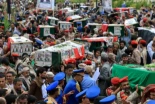
El pasado 10 de septiembre, un ataque aéreo israelí en Saná, Yemen, resultó en la muerte de 31 periodistas y trabajadores de medios, según el Comité para la Protección de los Periodistas (CPJ). Este ataque ha sido calificado como el más letal contra la prensa en los últimos 16 años y el segundo mayor de la historia, solo superado por la masacre de Maguindanao en Filipinas en 2009.
etiquetas: israel, yemen, periodismo, terrorismo
» noticia original (diariosocialista.net)
Ghosts'N Goblins... Ese sí era un juego difícil

Fue en 1985, cuando Capcom nos regaló aquel reto al que pocos llegaron al final: Ghosts 'n Goblins, o como lo conocían en Japón, Makaimura. Este juego no solo nos metía de cabeza en un mundo oscuro y lleno de zombis, demonios y todo tipo de bichos infernales, sino que también ponía a prueba nuestra paciencia y reflejos como ningún otro (...) Y por si fuera poco el juego le suelta: "Bien hecho, ahora hazlo todo otra vez para ver el final verdadero". Así que su misión no solo era heroica, también era doblemente cruel.
etiquetas: ghostsn goblins, videojuegos, capcom, arcade
» noticia original (yotambienlotuve.blogspot.com)
El nuevo Paseo de la Fama Presidencial tiene una imagen de un «autopen» en lugar del retrato de Biden [ENG]
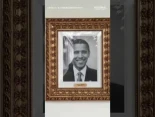
La Casa Blanca ha inaugurado un "Paseo de la Fama Presidencial" frente al Despacho Oval, con los retratos de los presidentes estadounidenses, excepto el expresidente Joe Biden. El retrato de Biden incluye una imagen de su firma, escrita con un «autopen».
etiquetas: paseo, fama, trump, troll, biden, retrato, autopen, casa blanca, epstein
» noticia original (www.youtube.com)
Portuarios corruptos a los narcos: "¡Oye, que el contenedor va a ser revisado"!

La infiltración de la corrupción en el Puerto de Valencia a la que ha tratado de poner fin la Policía Nacional con la macrooperación puesta en marcha esta semana y que ha permitido la detención de 73 personas en tres días -y aún faltan arrestos por llevar a cabo- era tal, que nada se movía dentro del recinto portuario sin que se enterasen los presuntos cabecillas de las dos redes que constituían el llamado Cartel del Puerto de València.
etiquetas: portuarios, corruptos, narcos
» noticia original (www.levante-emv.com)
El español es mucho más que lo que dice la RAE. Cómo Linguriosa nos desvela con ingenio todos los secretos de la lengua

Con la difícil tarea de crear contenido para una audiencia tan heterogénea como todo el conjunto de los hispanohablantes, sus vídeos son tan interesantes como variados: con propuestas como explorar si el español de Chile es lengua o dialecto, o cómo se escuchaba el castellano medieval en comparación con lo que las películas nos han vendido.
etiquetas: linguriosa, lenguaje
» noticia original (www.espinof.com)
La gasolina del 'efecto Milei' se acaba: Argentina se encomienda a un rescate de EEUU para evitar un derrumbe económico

Cuando Javier Milei ganó las elecciones presidenciales de Argentina en 2023, los mercados se frotaron los ojos, incrédulos: he aquí un presidente llegado a la Casa Rosada con la promesa de ejecutar reformas económicas masivas e históricas. Un presidente con el mandato de acometer eso que los argentinos habían cometido en un tabú: un 'ajuste' que sería tan duro como necesario ante la inestabilidad crónica en la que se había asentado la economía del país sudamericano. Y la confianza de los mercados respaldó sus primeros movimientos...
etiquetas: argentina, javier milei, crisis económica, rescate de eeuu
» noticia original (www.eleconomista.es)
Un lobby proisraelí y la extrema derecha se revuelven contra el discurso de Felipe VI en la ONU: "El rey ya no es amigo de los judíos"
Seis de cada diez asistentes a conciertos en EE UU dicen haber sufrido acoso sexual
“La dejaba descargada aposta para que saltase la alarma”: cuando el agresor sigue maltratando a su víctima con la pulsera
Dinamarca denuncia un “ataque híbrido sistemático” tras una nueva incursión de drones
Coeficientes, directo este sábado, la coladera del 1561 ..
Whatapp 675057589
Canal Plataforma Conductores
https://t.me/+nHLi7aj2S3E5Mzg8
Hablamos de la presentación de la petición de coeficientes reductores
De Militante a Empresario | Pablo Iglesias #ESDLB Cap.589
Pablo Iglesias es exvicepresidente del Gobierno, fundador de Podemos y una de las voces más influyentes (y controvertidas) del panorama político español. Actualmente dirige Canal Red, un medio de comunicación independiente con línea editorial de izquierdas.
—----------------------
50€ fácil y sin trucos con N26. Nos hemos aliado con N26 para que te lleves dinero solo por abrir una cuenta:
+20€ al abrir tu cuenta y hacer un primer pago de 20€ o más
+30€ si haces 10 pagos con la tarjeta dentro de los 30 días siguientes
Abre tu cuenta aquí: https://n26.com/es-es/elsentidodelabirra y no olvides introducir este Código: ELSENTIDON26 en el proceso de apertura!!
-----------------------
Nuestras entrevistas se publican en exclusiva en Podimo 👉 go.podimo.com/es/elsentidodelabirra 👈y compartimos 2 fragmentos en YouTube y después de 3 meses las publicamos completas aquí.
¡Suscríbete y activa las notificaciones para no perderte ningún estreno!
-----------
Redes sociales de los invitados:
Instagram: https://www.instagram.com/iglesiasturrionpablo/
Facebook: https://www.facebook.com/IglesiasTurrionPablo
X: https://x.com/PabloIglesias
-----------
SÍGUENOS EN:
Instagram: https://www.instagram.com/elsentidodelabirra
TikTok: https://www.tiktok.com/@esdlb
X: https://twitter.com/esdlbirra
Efectivo en casa: el “plan B” que podría salvarte en la próxima crisis
Universalidad del yoga (y 2)
¿De dónde viene el yoga? Para casi todos, de la India. Eso es lo que yo también creía cuando empecé a practicar āsanas y a meditar siguiendo las enseñanzas de Paramahansa Yogananda. Pero poco a poco fui tomando conciencia de la dimensión universal del yoga y de la existencia de muchas prácticas similares en otras […]
<p>The post Universalidad del yoga (y 2) first appeared on Yoga en Red.</p>
Bill Clinton: «En el año 2000, se les ofreció a los palestinos un Estado que abarcara toda Cisjordania y Jerusalén Oriental. Israel aceptó. Los palestinos se negaron. No les importaba una patria para ellos. Lo único que querían era matar a los israelíes».

Habla el hijo del faIIecido porque el 112 no sabía desde qué comunidad debía salir la ambulancia.

Un bombero jubilado fallece sin atención médica porque la ambulancia del 112 de Orihuela que iba a atender el aviso, regresó a su puesto sin atenderlo al comprobar que el hombre había caído en Murcia y no era su responsabilidad territorial.
50 minutos de discusiones territoriales sin atención médica con 1 hora y media de agonía, que terminó en fallecimiento gracias al Estado de las Autonomías.
En este vídeo el hijo del fallecido Antonio, relata este escándalo bochornoso. @GabrielAraujoES
Ver post completo: Habla el hijo del faIIecido porque el 112 no sabía desde qué comunidad debía salir la ambulancia.
En Siria disimulan menos que Bildu, pero les sirve igual…

Hasta hace poco, su rostro aparecía en los carteles del Departamento de Estado estadounidense bajo el lema «Detened a este terrorista», acompañado de una recompensa de diez millones de dólares. Hoy, Ahmed al-Sharaa —antes conocido como Abu Mohammad al-Golani, líder del Frente al Nusra— ha ocupado la tribuna de la Asamblea General de Naciones Unidas como presidente de Siria. @eldebate

Ver post completo: En Siria disimulan menos que Bildu, pero les sirve igual…
Poner límites no es ser egoísta
En este episodio hablamos de algo fundamental pero que a menudo nos resulta difícil: establecer límites saludables.
👉 A veces priorizamos las las necesidades de los demás por encima de las nuestras y eso, con el tiempo, nos pesa: sentimos culpa, sentimos que “somos malas personas” si decimos un no, o que no estamos siendo empáticos.
🧠 En esta charla, María Jesús Álava Reyes reflexiona 👉 ¿Qué significa poner límites?
También nos invita a quitarnos esa carga de culpa y nos da herramientas para decir “no” cuando es necesario.
“Cuando sientas que abusan de ti, pon freno inmediatamente. Si es un ser querido, le ayudarás a saber dónde está el límite; si es alguien menos cercano, sabrá que hay una puerta que nunca dejarás abrir. Quien abusa de ti, ni te quiere, ni te respeta, ni te valora, ni te merece.”
💬 Queremos reflexionar contigo:
- ¿Cuándo fue la última vez que tuviste que decir “no” (en tu trabajo, con amigos, en casa…)?
- ¿Qué te impidió hacerlo con claridad?
- ¿Qué pequeño límite podrías empezar a poner hoy para cuidarte mejor?
Porque cuidarte también pasa por respetarte a ti mismo, decir lo que necesitas y marcar hasta dónde estás dispuesto a llegar.
#ÁlavaReyes #Psicología #CrecimientoPersonal #LímitesSaludables #Autocuidado #BienestarEmocional
Long walk to freedom by Nelson Mandela
 Copyright © 1994 by Nelson Rolihlahla Mandela
The riveting memoirs of he outstanding moral and political leader of our time, Long Walk to Freedom brilliantly re-creates the drama of the experiences that helped shape Nelson Mandela’s destiny.
Emotive, compelling and uplifting, Long Walk to Freedom is the exhilarating story of an epic life; a story of hardship, resilience and ultimate triumph told with the clarity and eloquence of a born leader.
Estimated reading time: 87 minutes.
Main ideas:
- In African culture, the sons and daughters of one’s aunts and uncles are considered brothers and sisters, not cousins.
- Like the people of the East, Africans have a highly developed sense of dignity.
- Democracy meant all men were to be heard, and a decision was taken together as a people. Majority rule was a foreign notion. A minority was not to be crushed by a majority.
- In cross-country competition, training counted more than intrinsic ability, and I could compensate for a lack of natural aptitude with diligence and discipline. I applied this in everything I did.
- As so often happens in desperately poor places, the worst elements came to the fore. Life was cheap; the gun and the knife ruled at night.
- Urban life tended to abrade tribal and ethnic distinctions, and instead of being Xhosas, or Sothos, or Zulus or Shangaans, we were Alexandrans.
- The inferiority complex, Anton Lembede affirmed, was the greatest barrier to liberation.
- I was outraged to discover that many of the most blue-chip law firms charged Africans even higher fees for criminal and civil cases than they did their far wealthier white clients.
- China conveyed their support of our struggle, but they were wary and cautious when Walter Sisulu broached the idea of an armed struggle.
- A slogan is a vital link between the organization and the masses it seeks to lead.
- At a certain point, one can only fight fire with fire.
- Africans should be trained to be menial workers, to be in a position of perpetual subordination to the white man.
- The curious beauty of African music is that it uplifts even as it tells a sad tale.
- I am convinced that apartheid turned many otherwise law-abiding citizens into criminals.
- The wife of a freedom fighter is often like a widow, even when her husband is not in prison.
- Familiarity would breed not contempt but understanding, and even, eventually, harmony.
- I confess of being something of an Anglophile.
- I have gained the impression that communists regard the parliamentary system of the West as undemocratic and reactionary. But, on the contrary, I am an admirer of such a system.
- I have found that one can bear the unbearable if one can keep one’s spirits strong even when one’s body is being tested.
- For me, hunger strikes were altogether too passive. I have always favoured a more active, militant style of protest such as work strikes, go-slow strikes, or refusing to clean up; actions that punished the authorities, not ourselves.
- One learns in prison that it is better to fight for general principles than to battle each individual case.
- While I have always enjoyed gardening, it was not until I was behind bars that I was able to tend my own plot.
- It seems to be the destiny of freedom fighters to have unstable personal lives. When your life is the struggle, as mine was, there is little room left for family. That has always been my greatest regret, and the most painful aspect of the choice I made.
- To make peace with an enemy, one must work with that enemy, and that enemy becomes your partner.
- The brave man is not he who does not feel afraid, but he who conquers that fear.
- I always knew that deep down in every human heart, there was mercy and generosity. No one is born hating another person.
- People must learn to hate, and if they can learn to hate, they can be taught to love.
Comments extracted from the book, they could be right or wrong, you decide for yourself:
- The only thing my father bestowed upon me at birth was a name, Rolihlahla. In Xhosa, Rolihlahla literally means «pulling the branch of a tree», but its colloquial meaning more accurately would be «troublemaker».
- My more familiar English or Christian name was not given to me until my first day of school.
- Mvezo was a place apart, a tiny precinct removed from the world of great events, where life was lived much as it had been for hundreds of years.
- My father, Gadla Henry Mphakanyiswa, was a chief by both blood and custom. He was confirmed as chief of Mvezo by the king of the Thembu tribe but, under British rule, his selection had to be ratified by the government.
- I am a member of the Madiba clan, named after a Thembu chief who ruled in the Transkei in the eighteenth century. I am often addressed as Madiba, my clan name, as a sign of respect.
- Although I was a member of the royal household, I was not among the privileged few who were trained for rule. Instead, as a descendant of the Ixhiba house, I was groomed, like my father before me, to counsel the rules of the tribe.
- My father did not spare the rod when disciplining his children. He could be exceedingly stubborn.
- Although my father could neither read nor write, he was reputed to be an excellent orator who captivated his audiences by entertaining them as well as teaching them.
- In later years, I discovered that my father was not only an adviser to kings but a kingmaker.
- My father, and a few other influential chiefs, had the great respect for education that is often present in those who are uneducated.
- I hardly recall any occasion as a child when I was alone.
- In African culture, the sons and daughters of one’s aunts and uncles are considered brothers and sisters, not cousins. We have no half-brothers or half-sisters. My mother’s sister is my mother; my uncle’s son is my brother; my brother’s child is my son, my daughter.
- Everything we ate we grew and made ourselves. My mother planted and harvested her own mealies. Mealies were harvested from the field when they were hard and dry. They were stored in sacks or pits dug in the ground.
- I was no more than five when I became a herd-boy looking after sheep and calves in the fields.
- Like the people of the East, Africans have a highly developed sense of dignity, or what the Chinese call «face».
- It is a simple tale, but its message is an enduring one: virtue and generosity will be rewarded in ways that one cannot know.
- I came across few whites as a boy at Qunu. The local magistrate, of course, was white, as was the nearest shopkeeper. These whites appeared as grand as gods to me, and I was aware that they were treated with a mixture of fear and respect.
- The education I received was a British education, in which British ideas, British culture and British institutions were automatically assumed to be superior. There was no such thing as African culture.
- Africans of my generation, an even today, generally have both a Western and an African name. Whites were either unable or unwilling to pronounce an African name, and considered it uncivilized to have one. That day, Miss Mdingane told me that my new name was Nelson. Why she bestowed this particular name upon me I have no idea.
- My father took turns visiting his wives, usually came to us for perhaps one week a month.
- Children from poor homes often find themselves beguiled b a host of new temptations when suddenly confronted by great wealth. I was no exception. I felt many of my established beliefs and loyalties began to shake.
- Children are often the least sentimental of creatures, especially if they are absorbed in some new pleasure.
- In those days, very few Africans had Western houses and they were considered a mark of great wealth.
- The two principles that governed my life at Mqhekezweni were chieftaincy and the Church.
- I saw that virtually all of the achievements of African seemed to have come about through the missionary work of the Church.
- My later notions of leadership were profoundly influenced by observing the regent and his court. I watched and learned from the tribal meetings that were regularly held at the Great Place. These were not scheduled, but were called as needed. Everyone who wanted to speak did so. It was democracy in its purest form.
- Democracy meant all men were to be heard, and a decision was taken together as a people. Majority rule was a foreign notion. A minority was not to be crushed by a majority.
- Only at the end of the meeting, as the sun was setting, would the regent speak. His purpose was to sump up what had been said and form some consensus among the diverse opinions. But no conclusion was forced on people who disagreed. If no agreement could be reached, another meeting would be held. As a leader, I have always followed the principles I first saw demonstrated by the regent at the Great Place.
- I have always endeavored to listen to what each and every person in a discussion had to say before venturing my own opinion. Oftentimes, my own opinion will simply represent a consensus of what I heard in the discussion.
- Chief Joyi said that the African people lived in relative peace until the coming of the abelungu, the white people, how arrived from across the sea with fire-breathing weapons. Once, he said, the Thembu, the Pondo, the Xhosa, and the Zulu were all children of one father, and lived as brothers. The white man shattered the abantu, the fellowship, of the various tribes. The white man was hungry and greedy for land, and the black man shared the land with him as they shared the air and water; land was not for man to possess.
- Standard British textbooks claimed South Africa began with the landing of Jan van Riebeeck at the Cape of Good Hope in 1652.
- I later discovered that Chief Joyi’s account of African history, particularly after 1652, was not always so accurate.
- When I was sixteen, the regent decided that it was time that I became a man. In Xhosa tradition, this is achieved through one means only; circumcision. In my tradition, an uncircumcised male cannot be heir to this father’s wealth, cannot marry or officiate in tribal rituals. An uncircumcised Xhosa man is a contradiction in terms, for he is not considered a man at all, but a boy.
- Miners had a mystique; to be a miner meant to be strong and daring: the ideal of manhood. Much later, I realized that it was the exaggerated tales of boys like Banabakhe that caused so many young men to run away to work in the mines of Johannesburg, where they often lost their health and their lives. In those days, working in the mines was almost as much of a rite of passage as circumcision school, a myth that helped the mine-owners more than it helped my people.
- I was tense and anxious, uncertain of how I would react when the critical moment came. Flinching or crying out was a sign of weakness and stigmatized one’s manhood. I was determined not to disgrace myself, the group or my guardian. Circumcision is a trial of bravery and stoicism; no anesthetic is used; a man must suffer in silence.
- A boy may cry; a man conceals his pain.
- At the ceremony, I was given my circumcision name, Dalibhunga, meaning «Founder of the Bungha», the traditional ruling body of the Transkei. To Xhosa traditionalists, this name is more acceptable than either of my tow previous given names, Rolihlahla or Nelson, and I was proud to hear my new name pronounced: Dalibhunga.
- At the time, I looked on the white man not as an oppressor but as a benefactor.
- Looking back, I know that I was not a man that day and would not truly become one for many years.
- My destiny was to become a counsellor to Sabata, and for that I had to be educated.
- I developed the reputation of having a fine memory, but in fact I was simply a diligent worker.
- Like Clarkebury, Healdtown was a mission school of the Methodist Church, and provided a Christian and liberal arts education based on an English model.
- Marriages between tribes were then extremely unusual. We had been taught that such unions were taboo.
- I began to sense my identity as an African, not just a Thembu or even a Xhosa. But this was a nascent feeling.
- I realized then that Dr Wellington was less than a god and Reverend Mokitimi more than a lackey, and that a black man did not have to defer automatically to a white, however senior he was.
- I was still inept with a knife and fork, and I did not want to embarrass myself in front of these sharp-eyed girls. Every Sunday I left the hall hungry and depressed.
- Mqhayi: «We cannot allow these foreigners who do not care for our culture to take over our nation. For too long we have succumbed to the false gods of the white man».
- Fort Hare, like Clarkebury and Healdtown, was a missionary college. We were exhorted to obey God, respect the political authorities and be grateful for the educational opportunities afforded to us by the Church and the government. These schools have often been criticized for being colonialist in their attitudes and practices. Yet, even with such attitudes, I believe their benefits outweighed their disadvantages. The missionaries built and ran schools when the government was unwilling or unable to do so. The learning environment of the missionary schools, while often morally rigid, was far more open than the racist principles underlying government schools.
- Like most bullies, Tatane had a brittle but fragile exterior.
- We informed he warden that if he overruled us we would all resign from the House Committee, depriving the committee itself of any integrity or authority. In the end, the warden decided not to intervene. We had remained firm, and we had won. This was one of my first battles with authority, and I felt the sense of power that comes from having right and justice on one’s side. I would not be so lucky in the future in my fight against the authorities at the college.
- In cross-country competition, training counted more than intrinsic ability, and I could compensate for a lack of natural aptitude with diligence and discipline. I applied this in everything I did.
- I wore pyjamas for the first time, finding them uncomfortable in the beginning, but gradually growing used to them. I had never used a toothbrush and toothpaste before; at home we used ash to whiten our teeth and toothpicks to clean them. The water-flush toilets and hot-water showers were also a novelty to me.
- I was an ardent supporter of Great Britain.
- I was beginning to realize that a black man did not have to accept the dozens of petty indignities directed at him each day.
- Life has a way of forcing decisions on those who vacillate.
- We had always known that the regent had the right to arrange marriages for us, but now it was no longer an abstract possibility. The brides were not fantasies, but flesh-and-blood women whom we actually know. I was not prepared to have anyone, even the regent, select a bride for me. I believed that I could no longer remain under the regent’s guidance if I rejected his plan for me. Justice agreed, and the two of us decided that the only choice remaining was to run away, and the only place to run to was Johannesburg. In retrospect, I realize that we did not exhaust all the options available to us. I could have attempted to discuss the matter with the regent through intermediaries. I was young and impatient, and did not see any virtue in waiting. Escape seemed the only course.
- In the 1940s, travelling for an African was a complicated process. For an African to leave his magisterial district and enter that of another for the purpose of working or living, he needed travel documents, a permit and a letter from his employer or, as in our case, his guardian, none of which we had. Even at the best of times, when one had all these documents, a police officer might harass you because one of them was missing a signature or had an incorrect date. Not having any was extremely risky.
- Johannesburg had always been depicted as a city of dreams, a place where one could transform oneself from a poor peasant into a wealthy sophisticate, a city of danger and of opportunity.
- Johannesburg had been built up around the discovery of gold on the Witwatersrand in 1886.
- A gold mine resembles a war-torn battlefield. The noise was harsh and ubiquitous.
- Only the presence of cheap labour in the form of thousands of Africans working long hours for little pay with no rights made gold-mining profitable for the mining houses, white-owned companies that became wealthy beyond the dreams of Croesus on the backs of the African people. It was my first sight of South African capitalism at work, and I knew I was in for a new kind of education.
- Miners were normally housed according to tribe. The mining companies preferred such segregation because it prevented different ethnic groups from uniting around a common grievance and it reinforced the power of the chiefs. The separation often resulted in factional fights between different ethnic groups and clans, which the companies did not effectively discourage.
- Once again, I did not see that fate was busy setting snares around me.
- I had been taught that to have a BA meant to be a leader, and to be a leader one needed a BA. But in Johannesburg, I found that many of the most outstanding leaders had never been to university at all. Even though I had done all the courses in English that were required for a BA, my English was neither as fluent nor as eloquent as that of many of the men I met in Johannesburg who had not even received a school certificate.
- I cursed myself for not having told the whole truth. I had become so used to my deceptions that I lied even when I did not have to. I am sure that Reverend Mabutho would not have minded, but when he learned of my circumstances from Festile, he felt deceived. In my brief stay in Johannesburg, I had left a trail of mistruths and, in each case, the falsehood had come back to haunt me.
- In my experience I have found Jews to be more broad-minded than most whites on issues of race and politics, perhaps because they themselves have historically been victims of prejudice.
- Politics, Mr Sidelsky said, brings out the worst in men. It was the source of trouble and corruption, and should be avoided at all costs. He painted a frightening picture of what would happen to me if I drifted into politics, and counselled me to avoid the company of men he regarded as troublemakers and rabble-rousers.
- Gaur Radebe: «You people stole our land from us and enslaved us. Now you are making us pay through the nose to get the worst pieces of it back».
- Gaur was an example of a man without a BA who seemed infinitely better educated than the fellows who left Fort Hare with glittering degrees. Not only was he more knowledgeable, he was bolder and more confident.
- I was just becoming aware of the history of racial oppression in my own country, and saw the struggle in South Africa as purely racial. But the party saw South Africa’s problems through the lens of the class struggle. To them, it was a matter of the Haves oppressing the Have-nots. It might have ben applicable to Germany or England, or Russia, but it did not seem appropriate for the country that I knew. Even so, I listened and learned.
- Alexandra was known as «Dark City» for its complete absence of electricity. Walking home at night was perilous, for there were no lights, the silence pierced by yells, laughter and occasional gunfire. So different from the darkness of the Transkei, which seemed to envelop one in a welcome embrace.
- As so often happens in desperately poor places, the worst elements came to the fore. Life was cheap; the gun and the knife ruled at night. Police raids were a regular feature of life in Alexandra. The police routinely arrested masses of people for pass violations, possession of liquor and failure to pay the poll tax. On almost every corner there were shebeens, illegal saloons that were shacks where home-brewed beer was served.
- Urban life tended to abrade tribal and ethnic distinctions, and instead of being Xhosas, or Sothos, or Zulus or Shangaans, we were Alexandrans. This created a sense of solidarity, which caused great concern among the white authorities. The government had always utilized divide-and-rule tactics when dealing with Africans and depended on the strength of ethnic divisions between the people.
- Alexandra occupied a treasured place in my heart. It was the first place I ever lived away from home.
- On many days I walked the six miles to town in the morning and the six back in the evening in order to save the bus fare. I often went days without more than a mouthful of food and without a change of clothing. Mr Sidelsky once gave me an old suit of this and, assisted by considerable stitching and patching, I wore that suit every day for almost five years. In the end, there were more patches than suit.
- I realized that my suit was just touching the hem of his jacket. He noticed it also and very carefully moved away so that my jacket would not sully his. It was a tiny gesture, comical in retrospect, but painful at the time.
- There is little to be said in favour of poverty, but it was often an incubator of true friendship. Many people will appear to befriend you when you are wealthy, but precious few will do the same when you are poor.
- Ellen was a Swazi, and though tribalism was fading in the township, a close friend of mine condemned our relationship on purely tribal grounds.
- I was hardly a Don Juan. Awkward and hesitant around girls, I did not know or understand the romantic games that others seemed to play effortlessly.
- I wanted to propose to her but I was unwilling to do so unless I was certain she would say yes. Although I loved her, I did not want to give her the satisfaction of rejecting me.
- In love, unlike politics, caution is not usually a virtue.
- I slowly discovered that I did not have to depend on my royal connections or the support of family in order to advance, and I forged relationships with people who did not know or care about my link to the Thembu royal house.
- She looked at me with incredulity, and then said in English: «What kind of lawyer and leader will you be who cannot speak the language of your own people?». I had no response. The question embarrassed and sobered me; it made me realize my parochialism and just how unprepared I was for the task of serving my people. I had unconsciously succumbed to the ethnic divisions fostered by the white government and I did not know how to speak to my own kith and kin. Without language, one cannot talk to people and understand them; one cannot share their hopes and aspirations, grasp their history, appreciate their poetry or savor their songs. I again realized that we were not different people with separate languages, we were one people, with different tongues.
- I always knew, even when I was estranged from the regent, that all my friends might desert me, all my plans might founder, all my hopes be dashed, but the regent would never abandon me. Yet I had spurned him, and I wondered whether my desertion might have hastened his death.
- There is nothing like returning to a place that remains unchanged to find the ways in which you yourself have altered.
- My head told me that it was the right of every man to plan his own future as he pleased and choose his role in life.
- In my language there is a saying: «Ndiwelimilambo enamagama» («I have crossed famous rivers»). It means that one has travelled a great distance, that one has had wide experience and gained some wisdom from it.
- Mr Sidelsky pointed out that no people or nation had ever freed itself through education alone. For Africans, he asserted, the engine of change was the African National Congress; its policies were the best way to pursue power in South Africa.
- What made the deepest impression on me was Gaur’s total commitment to the freedom struggle. He lived and breathed the quest for liberation.
- Even as I was receiving my degree, I realized that hardly anything I had learned at university seemed relevant in my new environment. At the university, teachers had shied away from topics like racial oppression, lack of opportunities for Africans and the nest of laws and regulations that subjugate the black man.
- No one had ever suggested to me how to go about removing the evils of racial prejudice, and I had to learn by trial and error.
- The English-speaking universities of South Africa were great incubators or liberal values. It was a tribute to these institutions that they allowed black students. For the Afrikaans universities, such a thing was unthinkable.
- Despite the university’s liberal values, I never felt entirely comfortable there. My manner was always guarded, and I met both generosity and animosity. Most of the whites at Wits were not liberal or colour-blind.
- Wits opened a new world to me, a world of ideas and political beliefs and debates, a world where people were passionate about politics.
- I cannot pinpoint a moment when I became politicized, when I knew that I would spend my life in the liberation struggle. To be an African in South Africa means that one is politicized from the moment of one’s birth, whether one acknowledges it or not. His life is circumscribed by racist laws and regulations that cripple his growth, dim his potential and stunt his life.
- I had no epiphany, no singular revelation, no moment of truth, but a steady accumulation of a thousand slights, a thousand indignities and a thousand unremembered moments produced in me an anger, a rebelliousness, a desire to fight the system that imprisoned my people.
- Sometimes one can judge an organization by the people who belong to it.
- The inferiority complex, Anton Lembede affirmed, was the greatest barrier to liberation.
- The Indian campaign became a model for the type of protest that we in the Youth League were calling for. It instilled a spirit of defiance and radicalism among the people, broke the fear of prison.
- A man is not aman until he has a house of his own.
- I had perpetuated the Mandel name and the Madiba clan, which is one of the basic responsibilities of a Xhosa make.
- In my culture, all the members of one’s family have a claim to the hospitality of any other member of the family.
- In politics, no matter how much one plans, circumstances often dictate events.
- I believed that it was an undiluted African nationalism, not Marxism or multi-racialism, that would liberate us.
- Despite the influence the Indian passive resistance campaign of 1946 had on me, I felt that they would tend to dominate the ANC, in part because of their superior education, experience and training.
- While an organization like the ANC is made up of individuals, it is greater than any of its individual parts, and loyalty to the organization takes precedence over loyalty to an individual.
- We rejected the communist notion that Africans were oppressed primarily as an economic class rather than as a race.
- In some ways, it is easier to be a dissident, for then one is without responsibility. As a member of the Executive, I had to weigh arguments and make decisions, and expect to be criticized by rebels like myself.
- By striking, an African worker stood to lose not only his job but his entire livelihood and his right to stay in the area in which he was living. In my experience, a political strike is always riskier than an economic one.
- The Day of Protest boosted our morale, made us realize our strength and sent a warning to the Malan government that we would not remain passive in the face of apartheid.
- The struggle, I was learning, was all-consuming. A man involved in the struggle was a man without a home life.
- I found myself strongly drawn to the idea of a classless society which, to my mind, was similar to traditional African culture where life was shared and communal.
- I subscribed to Marx’s basic dictum, which has the simplicity and generosity of the Golden Rule: «From each according to his ability; to each according to his needs».
- Marxism’s call to revolutionary action was music to the ears of a freedom fighter. Marxists gave serious attention to national liberation movements, and the Soviet Union in particular supported the national struggles of many colonial peoples. This was another reason why I amended my view of communists and accepted the ANC position of welcoming Marxists into its ranks.
- Many of our grassroots African supporters saw Indians as exploiters of black labour in their role as shopkeepers and merchants.
- Once I could legally drive, I became a one-man taxi service.
- I seemed to have my best ideas while driving through the countryside with the wind whipping through the window.
- I explained to a group of several hundred Africans, Indians and Coloureds that volunteering was a difficult and even dangerous duty as the authorities would seek to intimidate, imprison and perhaps attack the volunteers. No matter what the authorities did, the volunteers could not retaliate, otherwise they would undermine the value of the entire enterprise. They must respond to violence with non-violence; discipline must be maintained at all costs.
- The state was far more powerful than we, and any attempts at violence by us would be devastatingly crushed. This made non-violence a practical necessity rather than an option.
- I saw non-violence on the Gandhian model not as an inviolable principle but as a tactic to be used as the situation demanded. The principle was not so important that the strategy should be used even when it was self-defeating, as Gandhi himself believed.
- I called for non-violent protest for as long as it was effective. This view prevailed, despite Manilal Gandhi’s strong objections.
- Fear of prison is a tremendous hindrance to a liberation struggle. From the Defiance Campaign onward, going to prison became a badge of honour among Africans.
- The campaign freed me from any lingering sense of doubt or inferiority I might still have felt; it liberated me from the feeling of being overwhelmed by the power and seeming invincibility of the white man and his institutions. I had come of age as a freedom fighter.
- My bans extended to meetings of all kinds, not only political ones. I was prohibited from talking to more than one person at a time. This was part of a systematic effort by the government to silence, persecute and immobilize the leaders of those fighting apartheid. Banning not only confines one physically, it imprisons one’s spirit. It induces a kind of psychological claustrophobia that makes one yearn for not only freedom of movement but spiritual escape. The insidious effect of bans was that a certain point one began to think that the oppressor was not without but within.
- My notion was that every cell and street steward should know every person and family in his area, so that he would be trusted by the people and would know whom to trust.
- The ANC introduced an elementary course of political lectures for its members throughout the country. These lectures were meant not only to educate but to hold the organization together. They were given in secret by branch leaders.
- I was never a full-time organizer for the ANC. The work I did had to be arranged around my schedule as an attorney.
- I was outraged to discover that many of the most blue-chip law firms charged Africans even higher fees for criminal and civil cases than they did their far wealthier white clients.
- To reach out our offices each morning, we had to move through a crowd of people in the corridors, on the stairs and in our small waiting room. Africans were desperate for legal help in government buildings.
- It was a crime to walk through a Whites Only door, a crime to ride a Whites Only bus, a crime to use a Whites Only drinking fountain, a crime to walk on a Whites Only beach, a crime to be on the streets after 11 p.m., a crime not to have a pass book and a crime to have the wrong signature in that book, a crime to be unemployed and a crime to be employed in the wrong places, to live in certain places and a crime to have no place to live.
- Every week we interviewed people who had lives in the same house for decades only to find that it was now in what was declared a white area and they had to leave without any recompense. Every day we heard and saw the thousands of humiliations that ordinary Africans confronted every day of their lives.
- In some courts we were treated with courtesy, in others with contempt.
- The English-speaking woman turned to me and said, «Thank you, John». John being the name whites used to address any African whose name they did not know.
- There were many practical advantages to being classified as Coloured rather than African.
- This man’s life was decided purely on a magistrate’s opinion about the structure of his shoulders. In the view of the white authorities in those days, sloping shoulders were one stereotype of the Coloured physique.
- I travelled to the eastern Transvaal, and defended a client in the town of Carolina. My arrival caused quite a sensation, as many of the people had never before seen an African lawyer.
- I overstepped the line: I said that the time for passive resistance had ended, that non-violence was a useless strategy and could never overturn a white minority regime bent on retaining its power at any cost.
- In India, Gandhi had been dealing with a foreign power that ultimately was more realistic and far-sighted. That was not the case with the Afrikaners in South Africa. Non-violent passive resistance is effective as long as your opinion adheres to the same rules as you do. But if peaceful protest is met with violence, its efficacy is at an end.
- For me, non-violence was not a moral principle but a strategy; there is no moral goodness in using an ineffective weapon.
- I accepted the censure, and thereafter faithfully defended the policy of non-violence in public. But, in my heart, I knew that non-violence was not the answer.
- China conveyed their support of our struggle, but they were wary and cautious when Walter Sisulu broached the idea of an armed struggle.
- I remained a country boy at heart, and there was nothing that lifted my spirits as much as blue skies, the open veld and green grass.
- 3 a.m. has always been my favorite hour for departure. The roads are empty and quiet, and one can be alone with one’s thoughts. I like to see the coming of dawn, the change between day and night, which is always majestic. It was also a convenient hour for departure because the police were usually nowhere to be found.
- The Free State’s landscape gladdens my heart no matter what my mood. When I am there I feel that nothing can shut me, that my thoughts can roam as far and wide as the horizons.
- Even in racist South Africa professional solidarity can sometimes transcend colour, and that there were still attorneys and judges who refused to be the rubber stamps of an immoral regime.
- When you are in the centre of a heated political fight, you are given little time for reflection.
- A slogan is a vital link between the organization and the masses it seeks to lead.
- A freedom fighter learns the hard way that it is the oppressor who defines the nature of the struggle, and the oppressed is often left no recourse but to use methods that mirror those of the oppressor. At a certain point, one can only fight fire with fire.
- The Afrikaner has always been unenthusiastic about education for Africans. To him it was simply a waste, for the African was inherently ignorant and lazy and no amount of education could remedy that.
- The Afrikaner was traditionally hostile to Africans learning English, for English was a foreign tongue to the Afrikaner and the language of emancipation to us.
- Africans should be trained to be menial workers, to be in a position of perpetual subordination to the white man.
- With the exception of the Dutch Reformed Church, which supported apartheid, and the Lutheran mission, all Christian churches opposed the new measure. But the unity of the opposition extended only to condemning the policy, not resisting it.
- I always felt that the organization should never promise to do more than it was able, for the people would then lose confidence in it.
- I took the stance that our actions should be based not on idealistic considerations but on practical ones.
- The government passed a law that made it an offence punishable by fine or imprisonment to offer unauthorized education. In the end we had no option but to choose between the lesser of two evils, and agree to a diminished education.
- It was humbling to see how the suggestions of ordinary people were often far ahead of those of the leaders.
- The charter guaranteed that when freedom came, Africans would have the opportunity to own their own business in their own names, to own their own houses and property; in short, to prosper as capitalists and entrepreneurs. The charter does not speak about the eradication of classes and private property, or public ownership of the means of production, or promulgate any of the tenets of scientific socialism.
- The curious beauty of African music is that it uplifts even as it tells a sad tale. You may be poor, you may have only a ramshackle house, you may have lost your job, but that song gives you hope. African music is often about the aspirations of the African people and it can ignite the political resolve of those who might otherwise be indifferent to politics. Politics can be strengthened by music, but music has a potency that defies politics.
- In discussions it never helps to take a morally superior tone to one’s opponent.
- Over and over again, I saw men as bright and talented as my companion resort to crime in order to make ends meet. While I do think certain individuals are disposed to crime because of their genetic inheritance or an abusive upbringing, I am convinced that apartheid turned many otherwise law-abiding citizens into criminals.
- I do not like killing any living thing, even those creatures that fill some people with dread.
- Seditious thoughts accompany a freedom fighter wherever he goes.
- The government’s intention in creating the homeland system was to keep the Transkei (and other African areas) as reservoirs of cheap labour for white industry.
- I have always thought a man should own a house near the place he was born, where he might find a restfulness that eludes him elsewhere.
- When I was first banned, I abided by the rules and regulations of my persecutors. I had now developed contempt for these restrictions. To allow my activities to be circumscribed by my opponent was a form of defeat, and I resolved not to become my own jailer.
- Although I have boxed a bit at Fort Hare, it was not until I lived in Johannesburg that I took up the sport in earnest. I was never an outstanding boxer.
- It is said that no one truly knows a nation until one has been inside its jails.
- A nation should not be judged by how it treats its highest citizens, but is lowest ones and South Africa treated its imprisoned African citizens like animals.
- Suddenly there were no Xhosas or Zulus, no Indians or Africans, no rightists or leftists, no religious or political leaders; we were all nationalists and patriots bound together by a love of our common history, our culture, our country and our people.
- Before the arrests I had deliberately cut down my weight, in anticipation of prison, where one should be lean and able to survive on little.
- In African cultures, portliness is often associated with wealth and well-being.
- In our culture, to give a new child the name of a deceased child is considered a way of honoring the earlier child’s memory and retaining a mystical attachment to the child who left too soon.
- I patiently explained to Evelyn that politics was not a distraction but my lifework, that it was an essential and fundamental part of my being. A man and a woman who hold such different views of their respective roles in life cannot remain close. I tried to persuade her of the necessity of the struggle, while she attempted to persuade me of the value of religious faith.
- Winnie has laughingly told people that I never proposed to her, but I always told her that I asked her on our very first date and that I simply took it for granted from that day forward. I never promised her gold and diamonds, and I was never able to give them to her.
- The wife of a freedom fighter is often like a widow, even when her husband is not in prison. Winnie gave me cause for hope. I felt as though I had a new and second change at life.
- The hard-liners suggested that if we had deployed pickets, the strike would have been a success. But I have always resisted such methods. It is best to rely on the freely given support of the people; otherwise that support is weak and fleeting.
- Chief Luthuli: «When the women begin to take an active part in the struggle, no power on earth can stop us from achieving freedom in our lifetime».
- I myself had mixed emotions, for the concerns of a husband and a leader do not always coincide.
- There were no white trains to Orlando for the simple reason that no whites went to Orlando.
- Driving, in those days, was a man’s business; very few women, especially African women, were to be seen in the driver’s seat.
- It was undoubtedly difficult for Winnie to form her own dignity in my shadow. I did my best to let her bloom in her own right, and she soon did so without any help from me.
- I have always believed that to be a freedom fighter one must suppress many of the personal feelings that make one feel like a separate individual rather than part of a mass movement. One is fighting for the liberation of millions of people, not the glory of one individual. In the same way that a freedom fighter subordinates his own family to the family of the people, he must subordinate his own individual feelings to the movement.
- It is always dangerous for an organization to make promises it cannot keep.
- Both the ANC and the PAC were declared ilegal organizations under the Suppression of Communism Act. Now even non-violent law-abiding protests under the auspices of the ANC were illegal. The struggle had entered a new phase. We were now, all of us, outlaws.
- This is precisely why the National Party was violently opposed to all forms of integration. Only a white electorate indoctrinated with the idea of the black threat, ignorant of African ideas and policies, could support the monstrous racist philosophy of the National Party. Familiarity, in this case, would breed not contempt but understanding, and even, eventually, harmony.
- To a narrow-thinking person, it is hard to explain that to be «educated» does not only mean being literate and having a BA, and that an illiterate man can be a far more «educated» voter than someone with an advanced degree.
- Only someone operating full-time from underground would be free from the paralyzing restrictions imposed by the enemy. This would be a hazardous life, and I would be apart from my family, but when a man is denied the right to live the life he believes in, he has no choice but to become an outlaw.
- The lesson they took away was not that we had legitimate grievances but that they needed to be far more ruthless.
- The court system was perhaps the only place in South Africa where an African could possibly receive a fair hearing and where the rule of law might still apply. This was particularly true in courts presided over by enlightened judges who had been appointed by the United Party. Many of these men still stood by the rule of law.
- I went from having an idealistic view of the law as a sword of justice to a perception of the law as a tool used by the ruling class to shape society in a way favourable to itself.
- Living underground requires a seismic psychological shift. One has to plan every action, however small and seemingly insignificant. Nothing is innocent. Everything is questioned. You cannot be yourself; you must fully inhabit whatever role you have assumed.
- Under apartheid, a black man lived a shadowy life between legality and illegality, between openness and concealment. To be a black man in South Africa meant not to trust anything, which was not unlike living underground for one’s entire life.
- I became a creature of the night, I would keep to my hideout during the day, and emerge to do my work when it became dark. I stayed in empty flats, in people’s houses, wherever I could be alone and inconspicuous.
- Although I am a gregarious person, I love solitude even more. I welcomed the opportunity to be by myself, to plan, to think, to plot. But one ca have too much solitude. I was terribly lonesome for my wife and family.
- We had the loyalty of many African policemen. Black policemen have often been severely criticized during the struggle, but many have played covert roles that have been extremely valuable.
- I was criticized by our Executive for making that remark before it was discussed by the organization, but sometimes one must go public with an idea to push a reluctant organization in the direction you want it to go.
- If you wait for textbook conditions, they will never occur.
- I argued that the state had given us no alternative to violence. I said it was wrong and immoral to subject our people to armed attacks by the state without offering them some kind of alternative.
- J. N. Singh: «Non-violence has not failed us, we have failed non-violence».
- When you question a man’s integrity, you can expect a fight.
- The Congresses authorized me to go ahead and form a new military organization, separate from the ANC. The policy of the ANC would still be that of non-violence. We were embarking on a new and more dangerous path, a path of organized violence, the results of which we did not and could not know.
- I, who had never been a soldier, who had never fought in battle, who had never fired a gun at an enemy, had been given the task of starting an army. The name of this new organization was Umkhonto we Sizwe (The Spear of the Nation) or MK for short. Our mandate was to wage acts of violence against the state. Our intention was to being with what was least violent to individuals but most damaging to the state.
- I made my way through the available literature on armed warfare and in particular guerrilla warfare.
- Only through hardship, sacrifice and militant action can freedom be won.
- Many people have painted an idealistic picture of the egalitarian nature of African society, and while in general I agree with this portrait, the fact is that Africans do not always treat each other as equals.
- In planning the direction and form that MK would take, we considered four types of violent activities: sabotage, guerrilla warfare, terrorism and open revolution.
- For a small and fledging army, open revolution was inconceivable.
- Terrorism inevitably reflected poorly on those who used it, undermining any public support it might otherwise garner.
- Guerrilla warfare was a possibility, but since the ANC had been reluctant to embrace violence at all,
- it made sense to start with the form of violence that inflicted the least harm against individuals: sabotage.
- Strict instructions were given to members of MK that we would countenance no loss of life.
- If sabotage did not produce the results we wanted, we were prepared to move on to the next stage: guerrilla warfare and terrorism.
- I listened on the radio to the announcement that Chief Luthuli had been awarded the Nobel Peace Prize at a ceremony in Oslo. I was, we all were, enormously pleased. It was, first of all, an acknowledgment of our struggle. It represented a recognition in the West that our struggle was a moral one, one too long ignored by the great powers.
- Death in war is unfortunate, but unavoidable.
- I had never seen a black pilot before, and the instant I did I had to quell my panic. How could a black man fly a plane? But a moment later I caught myself: I had fallen into the apartheid mind-set, thinking Africans were inferior and that flying was a white man’s job. I sat back in my seat, and chided myself for such thoughts.
- Although it had been conquered dozens of times, Ethiopia was the birthplace of African nationalism. Unlike so many other African states, it had fought colonialism at every turn.
- For the first time in my life, I was witnessing black soldiers commanded by black generals applauded by black leaders who were all guests of a black head of state. It was a heady moment. I only hoped it was a vision of what lay in the future for my own country.
- Communism was suspect not only in the West but in Africa. This came as something of a revelation to me, and it was a view that I was to hear over and over during my trip.
- As a student, I had fantasized about visiting Egypt, the cradle of African civilization, the treasure chest of so much beauty in art and design.
- It is important for African nationalists to be armed with evidence to refute the fictitious claims of whites that Africans are without a civilized past that compares with that of the West. In a single morning, I discovered that Egyptians were creating great works of art and architecture when whites were still living in caves.
- Rabat in Morocco with its ancient and mysterious walls, its fashionable shops and medieval mosques, seemed a charming mixture of Africa, Europe and the Middle East.
- The situation in Algeria was the closest model to our own in that the rebels faced a large white settler community that ruled the indigenous majority.
- There will always be, in emerging nations, an enduring attraction to the ways of the colonizer, I myself was not immune to it.
- I confess of being something of an Anglophile. When I thought of Western democracy and freedom, I thought of the British parliamentary system. In so many ways, the very model of the gentleman for me was an Englishman. Despite Britain being the home of parliamentary democracy, it was that democracy that had helped to inflict a pernicious system of iniquity on my people. While I abhorred the notion of British imperialism, I never rejected the trappings of British style and manners.
- Now that we were embarking on an armed struggle we would be relying on other African nations for money, training and support, and therefore had to take their views into account more than we did in the past.
- Colonel Tadesse: «A liberation army is an egalitarian army. You must treat your men entirely differently from how you would in a capitalist army. When you are on duty, you must exercise your authority with assurance and control. That is no different from a capitalist command. But when you are off duty, you must conduct yourself on the basis of perfect equality, even with the lowliest solider. You must eat what they eat; you must no take your food in your office, but eat with them, drink with them, not isolate yourself».
- A revolution is not just a question of pulling a trigger; its purpose is to create a fair and just society.
- The air of one’s home always smells sweet after one has been away. I was profoundly relieved to be back in the land of my birth and destiny.
- I had always known that arrest was a possibility, but even freedom fighters practice denial, and in my cell that night I realized I was not prepared for the reality of capture and confinement. I was upset and agitated. Someone had tipped the police off about my whereabouts. I had also been lax. too many people had known I was in Durban. I had even had a party the night before I left, and I chastised myself for letting down my guard.
- I realized then and there that I could carry on the fight within the fortress of the enemy.
- It is one thing to be told of possible hardships ahead, it is entirely another to have to confront them in reality.
- We embraced and clung to each other with all the strength and pent-up emotion inside each of us, as if this were to be the final parting. In a way it was, for we were to be separated for much longer than either of us could then have imagined.
- Visitors keep one’s spirits up in prison, and the absence of them can be disheartening.
- It confirmed to me how apartheid was a poison that bred moral decay in all areas.
- Escape servers a double purpose: it liberates a freedom fighter from jail so that he can continue to fight, but offers a tremendous psychological boost to the struggle and a great publicity blow against the enemy. As a prisoner, I always contemplated escape.
- It was not a judicial appeal at all but a political testament. I wanted to explain to the court how and why I had become the man I was, why I had done what I had done, and why, if given the chance, I would do it again.
- The structure and organization of early African societies in this country fascinated me very much and greatly influenced the evolution of my political outlook. There were no classes, no rich or poor and no exploitation of man by man. All men were free and equal and this was the foundation of government. The council was so completely democratic that all members of the tribe could participate in its deliberations.
- I informed the court that whatever sentence the state imposed, it would do nothing to change my devotion to the struggle.
- History shows that penalties do not deter men when their conscience is aroused, nor will they deter my people or the colleagues with whom I have worked before.
- Prison not only robs you of your freedom, it attempts to take away your identity. It is by definition a purely authoritarian state that tolerates no independence or individuality. As a freedom fighter and as a man, one must fight against the prison’s attempt to rob one of these qualities. Only Africans are given short trousers, for only African men are deemed «boys» by the authorities.
- I had never been in isolation before, and every hour seemed like a year. I had nothing to read, nothing to write on or with, no one to talk to. The mind begins to turn in on itself, and one desperately wants something outside oneself on which to fix one’s attention.
- After a time in solitary, I relished the company even of the insects in my cell, all found myself on the verge of initiating conversations with a cockroach.
- Nothing is more dehumanizing than the absence of human companionship. After a few weeks I was ready to swallow my pride and tell Colonel Jacobs that I would trade my long trousers for some company.
- I thought that in prison we might forge a unity that we could not on the outside. Prison conditions have a way of tempering polemics, and making individuals see more what unites them that what divides them.
- In politics, one can never underestimate how little people know about a situation.
- In prison, one counts oneself lucky to be able to wave good-bye to one’s comrades. One can be in extraordinarily intimate circumstances with someone for months, and then never see the person again. It is dehumanizing, for it forces one to adapt by becoming more self-contained and insulated.
- Prison officials never let you forget that you might hang.
- We were charged with sabotage and conspiracy rather than high treason because the law does not require a long preparatory examination for sabotage and conspiracy as it does for treason.
- This was one of the state’s most barbarous techniques of applying pressure: imprisoning the wives and children of freedom fighters. The thought of the state doing the same thing to their families was almost impossible to bear.
- We would not deny, for example, that we had been responsible for acts of sabotage. We would not deny that a group of us had turned away from non-violence. We were not concerned with getting off or lessening our punishment, but with making the trial strengthen the cause for which we were all struggling, at whatever cost to ourselves. We would not defend ourselves in a legal sense so much as in a moral sense. We saw the trial as a continuation of the struggle by other means. We would deny the claims of murder and damage to innocent bystanders that the state alleged; either these claims were outright lies, or the incidents were the work of someone else.
- I had long argued that communist literature was, for the most part, dull, esoteric and Western-centred, but ought to be simple, clear and relevant to the African masses.
- I felt we were likely to hang no matter what we said, so we might as well say what we truly believed.
- The hard facts were that fifty years of non-violence had brought the African people nothing but more repressive legislation, and fewer and fewer rights.
- I did not deny that I was attracted by the idea of a classless society, or that I had been influenced by Marxist thought.
- I have gained the impression that communists regard the parliamentary system of the West as undemocratic and reactionary. But, on the contrary, I am an admirer of such a system. I have great respect for British political institutions, and for the country’s system of justice. I regard the British Parliament as the most democratic institution of the world.
- The lack of human dignity experienced by Africans is the direct result of the policy of white supremacy. White supremacy implies black inferiority.
- When anything has to be carried or cleaned the white man looks around for an African to do it for him, whether the African is employed by him or not.
- Above all, we want equal political rights, because without them our disabilities
- We would not attempt to use legal niceties to avoid accepting responsibility for actions we had taken with pride and premeditation.
- That night, after a discussion among ourselves, Walter, Govan and I informed counsel that whatever sentences we received, even the death sentence, we would not appeal. Our decision stunned our lawyers, Walter, Govan and I believed an appeal would undermine the moral stance we had taken. Our message was that no sacrifice was too great in the struggle for freedom.
- There were practical reasons not to appeal. For one thing, we might lose. An appeal would forestall international pressure to release us.
- I was prepared for the death penalty. To be truly prepared for something, one must actually expect it. One cannot be prepared for something while secretly believing it will not happen. We were all prepared, not because we were brave but because we were realistic.
- The authorities were concerned that we might «infect» the other prisoners with our political views.
- Normally in prison one of the few festive times is seeing old friends and new faces, but the atmosphere in those first few weeks was so oppressive that we were not even able to greet each other. There were as many guards as prisoners, and they enforced every regulation with threats and intimidation.
- Two years later, Robben Island was without question the harshest, most iron-fisted outpost in the South Africa penal system. It was a hardship station not only for the prisoners but for the prison staff.
- The racial divide on Robben Island was absolute: there were no black warders, and no white prisoners.
- Prison life is about routine: each day like the one before; each week like the one before it, so that the months and years blend into each other. Anything that departs from this pattern upsets the authorities, for routine is the sign of a well-run prison.
- Routine is also comforting for the prisoner, which is why it can be a trap. Routine makes the time go faster. Watches and timepieces of any kind were barred on Robben Island, so we never knew precisely what time it was. We were dependent on b ells and warders’ whistles and shouts. Losing a sense of time is an easy way to lose one’s grip and even one’s sanity.
- Time slows down in prison; the days see endless. The cliché of time passing slowly usually has to do with idleness and inactivity. We were busy almost all the time with work, study, resolving disputes. Yet time nevertheless moved glacially. This is partially because things that took a few hours or days outside would take months or years in prison.
- Ahmed Kathrada once said that in prison the minutes can seem like years, but the years go by like minutes.
- Prison is designed to break one’s spirit and destroy one’s resolve. To do this, the authorities attempt to exploit every weakness, demolish every initiative, negate all signs of individuality.
- Our survival depended on understanding what the authorities were attempting to do to us, and sharing that understanding with each other. It would be very hard, if not impossible, for one man alone to resist. I do not know what I could have done it had I been alone.
- Men have different capacities and react differently to stress.
- In a way that even the authorities acknowledged, order in prison was preserved not by the warders but by ourselves.
- As a leader, one must sometimes take actions that are unpopular, or whose results will not be known for years to come. You must find consolation in being true to your ideals, even if no one else knows of it.
- Prison and authorities conspire to rob each man of his dignity.
- I never seriously considered the possibility that I would not emerge from prison one day. I never thought that a life sentence truly meant life and that I would die behind bars. I always knew that someday I would once again feel the grass under my feet and walk in the sunshine as a free man. I am fundamentally a optimist. Whether that comes from nature or nurture, I cannot say.
- There were many dark moments when my faith in humanity was sorely tested, but I would not and could not give myself up to despair. That way lay defeat and death.
- The authorities liked to say that we received a balanced diet: it was indeed balanced between the unpalatable and the inedible.
- Typically, we received even less than the scanty amounts stipulated in the regulations. This was because the kitchen was rife with smuggling. The cooks (all of whom were common-law prisoners) kept the best food for themselves or their friends. Often they would lay aside the tastiest morsels for the warders in exchange for favours or preferential treatment.
- No cry of «lights out» was ever given on Robben Island because the single mesh-covered bulb in our cell burned day and night.
- Normally a visit of any kind lifted our spirits.
- The privileges affected by these classifications included visits and letters, studies, and the opportunity to buy groceries and incidentals, all of which are the lifeblood of any prisoner.
- The classification generally ran parallel to the length of one’s sentence. If you were sentenced to eight years, you would generally be classified as D for the first two years, C for the next two, B for the following two and A for the last two.
- As a D group prisoner, I was entitled to have only one visitor, and write and receive only one letter every six months. I found this one of the most inhumane restrictions of the prison system. Communication with one’s family is a human right; it should not be restricted by the artificial gradations of a prison system. But it was one the facts of prison life.
- In prison, the only thing worse than bad news about one’s family is no news at all. It is always harder to cope with the disasters and tragedies one imagines than with the reality, however grim or disagreeable.
- To be allowed one letter in six months and then not to receive it is a great blow. Often the authorities would withhold mail out of spite. It required all my self-discipline not to explode at such times.
- When letters did arrive, they were cherished. A letter was like the summer rain that could make even the desert bloom.
- Some men who came from poor families did not see their wives for many years at a time, if at all. I knew of men who spent a decade or more on Robben Island without a single visit.
- It was tremendously frustrating not to be able to touch my wife, to speak tenderly to her, to have a private moment together. We had to conduct our relationship at a distance under the eyes of people we despised.
- Over the next days, weeks and months, I would return to that one visit again and again. I knew I would not be able to see my wife again for at least six months. As it turned out, Winnie was not able to visit me for another two years.
- The campaign to improve conditions in prison was part of the apartheid struggle. It was, in that sense, all the same; we fought injustice wherever we found it, no matter how large or how small, and we fought injustice to preserve our own humanity.
- The prison authorities respected the International Red Cross, and by respected, I mean feared, for the authorities respected only what they were afraid of. Avoiding international condemnation was the authorities’ principal goal. In those early years, the International Red Cross was the only organization that both listened to our complaints and responded to them. This was vital, because the authorities ignored us.
- For years, we were not permitted to receive funds except from our families, so that poor prisoners rarely had money for books tuition. Nor were we permitted to lend books to other prisoners, which would have enabled our poorer colleagues to study.
- As freedom fighters and political prisoners, we had an obligation to improve and strengthen ourselves, and study was one of the few opportunities to do so.
- Newspapers are more valuable to political prisoners than gold or diamonds, more hungered for than food or tobacco; they were the most precious contraband on Robben Island. News was the intellectual raw material of the struggle. We were not allowed any news at all, and we craved it. Over the years we devised many ways of obtaining them, but at that time we were not so adept.
- One of the most reliable ways to acquire papers was through bribery, and this was the only area where I tolerated what were often unethical means of obtaining information.
- The first day in isolation was always the most painful. I found that by the second day I had more or less adjusted to the absence of food, and the third passed without much craving at all. Such deprivation was not uncommon among Africans in everyday life. I myself had gone without food for days at a time in my early days in Johannesburg.
- I found solitary confinement the most forbidding aspect of prison life. There was no end and no beginning; there is only one’s own mind, which can begin to play tricks. One begin to question everything. In solitary, there is no distraction from these haunting questions. But the human body has an enormous capacity for adjusting to trying circumstances.
- I have found that one can bear the unbearable if one can keep one’s spirits strong even when one’s body is being tested. Strong convictions are the secret of surviving deprivation; your spirit can be full even when your stomach is empty.
- In those early years, isolation became a habit. We were routinely charged for the smallest infractions and sentenced to isolation. The authorities believed that isolation was the cure for our defiance and rebelliousness. They believed that if they turned a deaf ear, we would give up in frustration and the people on the outside would forget about us.
- There was a lesson in what I had done, a lesson i already knew but had disobeyed out of desperation. No one, least of all a prison official, ever likes to have his authority publicly challenged.
- The best way to effect change on Robben Island was to attempt to influence officials privately rather than publicly. I was sometimes condemned for appearing to be too accommodating to prison officials, but I was willing to accept the criticism in exchange for the improvement.
- The most important person in any prisoner’s life is not the minister of justice, not the commissioner of prisons, not even the head of prison, but the warder in one’s section. if you approach the warder in your corridor, and you are on good terms with hi,, he will simply go to the stockroom and fetch a blanket. I always tried to be decent to the warders in my section; hostility was usually self-defeating. There was no point in having a permanent enemy among the warders.
- In general we treated the warders as they treated us. Not all of our warders were ogres. We noticed right from the start that there were some among them who believed in fairness.
- By definition, if a man worked for the prison service he was probably brainwashed by the government’s propaganda. He would have believed that we were terrorists and communists who wanted to drive the white man into the sea.
- Having sympathetic warders facilitated one of our most vital tasks on Robben Island: communication.
- For me, hunger strikes were altogether too passive. I have always favoured a more active, militant style of protest such as work strikes, go-slow strikes, or refusing to clean up; actions that punished the authorities, not ourselves. The advocates of hunger strikes argued that it was a traditionally accepted form of protest that had been waged all over the world by such prominent leaders as Mahatma Gandhi.
- Comrades would sometimes eat on the sly. We knew this for a simple reason: by the second day of a hunger strike, no one needs to use the toilet.
- The state did its utmost to harass me in ways they thought I would be powerless to resist.
- The authorities always found it distressing when I wanted to defend myself in court because the accompanying publicity would show that I was still fighting for the same values I always had.
- There is no prospect about prison which pleases, with the possible exception of one. One has time to think. In the vortex of the struggle, when one is constantly reacting to changing circumstances, one rarely has the chance to consider carefully all the ramifications of one’s decision or policies. Prison provided the time, much more than enough time, to reflect on what one had done and not done. We were constantly engaged in political debates. Some were dispatched in a day; others were disputed for years.
- Not all debates were political. One issue that provoked much discussion was circumcision. The debate continued for years.
- Political assassination is not something I or the ANC have ever supported. It is a primitive way of contending with an opponent.
- As often happened on the island, we had learned significant political news before our own guards.
- One of the few ways prisoners can take their revenge on warders is through humour.
- Taking and discussing issues were the only things that made the work at the quarry tolerable.
- One learns in prison that it is better to fight for general principles than to battle each individual case.
- Virtually every one of the ANC’s senior leaders was either in jail or in exile.
- The state had grown stronger. The police had become more powerful, their methods more ruthless, their techniques more sophisticated. The South African Defence Force was expanding. The economy was stable, the white electorate untroubled. The South African government had powerful allies in Great Britain and the United States who were content to maintain the status quo.
- As with most visits, the greatest pleasure often lies in the recollection of it.
- It added to my grief that I was not able to bury my mother, which was my responsibility as her eldest child and only son.
- In South Africa it is hard for a man to ignore the needs of the people, even at the expense of his own family. I had made my choice and, in the end, she had supported it. But that did not lessen the sadness I felt at not being able to make her life more comfortable, or the pain of not being able to lay her to rest.
- Although I often urged others not to worry about what they could not control, I was unable to take my own advice. I had many sleepless nights. What were the authorities doing to my wife? How would she bear up? Who was looking after our daughters? Who would pay the bills? It is a form of mental torture to be constantly plagued by such questions and not have the means to answer them.
- I asked the authorities for permission to attend my son’s funeral. As a father, it was my responsibility to make sure that my son’s spirit would rest peacefully. Permission was denied.
- I never initiated conversations with warders, but if they addressed a question to me, I tried to answer. It is easier to educate a man when he wants to learn.
- The plot was that I was to be successfully taken off the island, but killed in a dramatic shoot-out with security forces at the airport as I tried to leave the country. It was not the last time they would try to eliminate me.
- Whenever a new commanding officer was appointed, I requested a meeting with him.
- Like a teacher who takes over a rowdy class, he sought to discipline the student he regarded as the principal troublemaker.
- It was a useful reminder that all men, even the most seemingly cold-blooded, have a core of decency, and that if their hearts are touched, they are capable of changing. Ultimately, Badenhorst was not evil; his inhumanity had been foisted upon him by an inhuman system. He behaved like a brute because he was rewarded for brutish behaviour.
- In the struggle, Robben Island was known as «The University». Because of what we learned from each other. We became our own faculty, with our own professors, our own curriculum, our own courses. Our university grew up partly out of necessity. As young men came to the island, we realized that they knew very little about the history of the ANC. The style of teaching was Socratic in nature; ideas and theories were elucidated through the leaders asking and answering questions.
- South African law does not guarantee a defendant the right to legal representation, and thousands upon thousands of indigent men and women went to prison every year for lack of such representation.
- It is a source of deep sorrow not to be able to see one’s children. I had not seen Zindzi since she was three years old. She was a daughter who knew her father from old photographs rather than memory. Somewhere deep inside she must have harboured resentment and anger for a father who was absent during her childhood and adolescence.
- No matter what I suffered in my pursuit of freedom. I always took strength from the fact that I was fighting with and for my own people.
- Before I had even finished, head or prison utttered something so offensive and uncomplimentary about my wife that I immediately lost my temper. I am not a man who approves of oaths or curses, but that day I violated my own principle. I finished by telling him that he was a contemptible man without honour, and if the ever repeated those same words I would not hold myself back as I had that day. He had caused me to violate my self-control and I considered that a defeat at the hands of my opponent.
- Unlikely a prospect as it might have seemed, I nevertheless thought about escape the entire time I was on the island. It was the sea, after all, that was the uncrossable moat around Robben Island.
- I relived my experiences as I wrote about them. Those nights, as I wrote in silence,
- I could once again experience the sights and sounds of my youth in Qunu and Mqhekezweni;
- the excitement and fear of coming to Johannesburg;
- the tempests of the Youth League;
- the endless delays of the Treason Trial;
- the drama of Rivonia.
- I found it extraordinary that a cabinet minister should be so uninformed. Yet I should not have been surprised; Nationalist politicians routinely condemned what they didn’t understand.
- It is difficult to negotiate with those who do not share the same frame of reference.
- There is nothing so encouraging in prison as learning that the people outside are supporting the cause for which you are inside.
- Tow of my favourite hobbies on Robben Island: gardening and tennis. To survive in prison one must develop ways to take satisfaction in one’s daily life. The same pride one takes in more consequential tasks outside prison one can find in doing small things inside prison.
- While I have always enjoyed gardening, it was not until I was behind bars that I was able to tend my own plot. Once I was in Johannesburg studying and then working, I had neither the time nor the space to cultivate a garden.
- A garden was one of the few things in prison that one could control. The sense of being the custodian of this small patch of earth offered a small taste of freedom.
- Like the gardener, a leader must take responsibility for what he cultivates; he must mind his work, try to repel enemies, preserve what can be preserved and eliminate what cannot succeed.
- I have always believed that exercise is a key not only to physical health but to peace of mind. Exercise dissipates tension, and tension is the enemy of serenity. I found that I worked better and thought more clearly when I was in good physical condition, and so training became one of the inflexible disciplines of my life. In prison, having an outlet for my frustrations was absolutely essential.
- I read many American novels, and recall especially John Steinbeck’s The Grapes of Wrath, in which I found many similarities between the plight of the migrant workers in that novel and our own labourers and farmworkers.
- One book I returned to many times was Tolstoy’s great work, War and Peace. It reminded me once again that truly to lead one’s people one must also truly know them.
- Even though the Hell’s Angels were unsympathetic, they were rebels against the authorities, unsavoury rebels though they were.
- I had always attempted to remain open to new ideas, not to reject a position because it was new or different.
- One political prisoners were in the kitchen, our diet improved dramatically. This was not because they were better chefs, but because the smuggling of food immediately stopped. Instead of siphoning off food for themselves or to bribe the warders, the new cooks used all the food allotted to us. Only then we realized we should have been eating such food for years.
- Where I grew up, there was no such thing as an African doctor, and going to see a white doctor was unheard of.
- In prison, one can only question and resist an order to a certain point, then one must succumb.
- We had no time to say a proper good-bye to our comrades of many years. This is another one of the indignities of prison. The bonds of friendship and loyalty with other prisoners count for nothing with the authorities.
- A man can get used to anything, and I had grown used to Robben Island. While it was never a home, it had become a place where I felt comfortable. I have always found change difficult, and leaving Robben Island, however grim it had been at times, was no exception.
- One must be prepared for precipitate movements in prison, but one does not ever get used to them.
- In prison, illusions can offer comfort.
- The anti-apartheid struggle as a whole had captured the attention of the world; in 1984 Bishop Desmond Tutu was awarded the Nobel Peace Prize.
- In my visit from Professor Dash, which quickly followed that of Lord Bethell, I laid out what I saw as the minimum for a future non-racial South Africa:
- a unitary state without homelands,
- non-racial elections for the central Parliament and
- one-person one-vote.
- They attempted to show that I was not a Christian either by asserting that the Reverend Martin Luther King never resorted to violence. I told them that the conditions in which Martin Luther King struggled were totally different from my own: the United States was a democracy with constitutional guarantees of equal rights that protected non-violent protest; South Africa was a police state with a constitution that enshrined inequality and an army that responded to non-violence with force. I told them that I was a Christian and had always been a Christian. Even Christ, I said, when he was left with no alternative, used force to expel the moneylenders from the temple. He was not a man of violence, but had no choice but to use force against evil.
- I am not a violent man … It was only then, when all other forms of resistance were no longer open to us, that we turned to armed struggle.
- Your freedom and mine cannot be separated.
- Both sides regarded discussions as sign of weakness and betrayal.
- There are times when a leader must move out ahead of the flock, go off in a new direction, confident that he is leading his people the right way.
- I told them I was a South Africa nationalist, not a communist, that nationalists came in every hue and colour, and that I was firmly committed to a non-racial society.
- Sometimes it is necessary to present one’s colleagues with a policy that is already a fait accompli. I knew that once they examined the situation carefully, my colleagues at Pollsmoor and in Lusaka would support me.
- It is precisely those mundane activities of daily life that one misses most in prison.
- I responded that the state was responsible for the violence and that it is always the oppressor, not the oppressed, who dictates the form of the struggle. If the oppressor uses violence, the oppressed have no alternative but to respond violently. In our case it was simply a legitimate form of self-defence.
- To us, Mr de Klerk was a cipher. When he became head of the National Party, he seemed to be the quintessential party man, nothing more and nothing less. He was not an ideologue but a pragmatist, a man who saw change as necessary and inevitable.
- De Klerk began a systematic dismantling of many of the building blocks of apartheid.
- An oppressive system cannot be reformed, I said; it must be entirely cast aside.
- If the government did not unban the ANC, as soon as I was out of prison I would be working for an illegal organization. I said: «Then you must simply rearrest me after I walk through those gates».
- I deeply wanted to leave prison as soon as I could, but to do so on such short notice would not be wise. I thanked Mr de Klerk, and then said that at the risk of appearing ungrateful I would prefer to have a week’s notice in order that my family and my organization could be prepared for my release. Simply to walk out tomorrow, I said, would cause chaos.
- As so often happens in life, the momentousness of an occasion is lost in the welter of a thousand details.
- During my first twenty or so years in prison, I accumulated very few possessions, but in the last few years I had amassed enough property (mainly books and papers) to make up for previous decades. I filled over a dozen crates and boxes.
- I was not a messiah, but an ordinary man who had become a leader because of extraordinary circumstances.
- I called Mr de Klerk «a man of integrity». These words were flung back at me many times when Mr de Klerk seemed not to live up to them.
- We must do everything we could to persuade our white compatriots that a new, non-racial South Africa would be a better place for all.
- I was often asked by reporters how it felt to be free, and I did my best to describe the indescribable, and usually failed.
- In many places, the poverty was far worse that when I went to prison.
- Freedom without civility, freedom without the ability to live in peace, was not true freedom at all.
- I entered prison at the age of forty-four, but I was no longer a young man, I was seventy-one, and I could not afford to waste any time.
- Any house in which a man is free is a castle when compared with even the plushest prison.
- I had a sense that what I most wanted and longed for was going to be denied me. I yearned to resume a normal and ordinary life.
- In giving myself to my people, I could see that I was once again taking myself away from my family.
- While the members of the Executive were pleased that I had been fred, they were also eager to evaluate the man who had been released. Had he survived or had he been broken?
- I told the press that every white policeman in South Africa regarded every black person as a military target.
- Mr de Klerk’s goal was to create a system of power-sharing based on group rights, which would preserve a modified form of minority power in South Africa. He was decidedly opposed to majority rule, or «simple majoritarianism», as he sometimes called it. Although he was prepared to allow the black majority to vote and create legislation, he wanted to retain a minority veto. From the start I would have no truck with this plan. I described it to Mr de Klerk as apartheid in disguise, a «loser-takes-all» system.
- In seeing my village again after so many years. I was greatly struck by what had changed and what had not. Most people still lived in simple huts with dirt floors, with no electricity and no running water. When I was young, the village was tidy, the water pure and the grass green and unsullied as far as the eye could see. Kraals were swept, the topsoil was conserved, fields were neatly divided. But now the village was unswept, the water polluted and the countryside littered with plastic bags and wrappers. Pride in the community seemed to have vanished.
- Every solider would like to defeat his enemy on the field but, in this case, such a victory was out of reach.
- Harlem, as my wife said, was the Soweto of America.
- I said, that had been inspired by such great Americans as W.E.B. Du Bois, Marcus Garvey and Martin Luther King Jr.
- In prison, I followed the struggle of black Americans against racism, discrimination and economic inequality. To us, Harlem symbolized the strength of resistance and the beauty of black pride.
- Television had shrunk the world, and had in the process become a great weapon for eradicating ignorance and promoting democracy.
- It was apparent the government had a double agenda. They were using the negotiations not to achieve peace, but to score their own petty political gains. Even while negotiating, they were secretly funding covert organizations that committed violence against us.
- Just as I am convinced that my wife’s life while I was in prison was more difficult than mine, my own return was also more difficult for her than it was for me. She married a man who soon left her; that man became a myth; and then that myth returned home and proved to be just a man after all.
- It seems to be the destiny of freedom fighters to have unstable personal lives. When your life is the struggle, as mine was, there is little room left for family. That has always been my greatest regret, and the most painful aspect of the choice I made.
- To be the father of a nation is a great honour, but to be the father of a family is a greater joy. But it was a joy I had far too little of.
- Mr de Klerk and I had not managed to find a consensus on most of the outstanding issues. The government seemed prepared to wait indefinitely; their thinking was that the longer we waited, the more support we would lose.
- The people must have an outlet for their anger and frustration, and a mass action campaign was the best way to channel those emotions.
- I have always believed that a man should have a home within sight of the house where he was born.
- Although few people will remember 3 June, 1993, it was a landmark in South African history. On that day, after months of negotiations at the World Trade Centre, the multi-party forum voted to set a date for the country’s first national, non-racial, one-person-one-vote election: 27 April 1994. For the first time in South African history, the black majority would go to the polls to elect their own leaders.
- The Nobel Peace Prize had a special meaning to me because of its involvement with South African history.
- To make peace with an enemy, one must work with that enemy, and that enemy becomes your partner.
- Most people felt life would change overnight after a free and democratic election, but that would be far from the case. Often, I said to the crowds, «Do not expect to be driving a Mercedes the day after the election or swimming in your own backyard pool». I told our supportes, «Life will not change dramatically, except that you will have increased your self-esteem and become a citizen in your own land. You must have patience. You might have to wait five years for result to show». I challenged them; I did not patronize them: «If you want to continue living in poverty without clothes and food», I told them, «then go and drink in the shebeens. But if you want better things, you must work hard. We cannot do it all for you; you must do it yourselves».
- We polled 62.6 per cent of the national vote, slightly short of the two-thirds needed had we wished to push through a final constitution without support from other parties. That percentage qualified us for 252 of 400 seats in the national assembly.
- Some in the ANC were disappointed that we did not cross the two-thirds threshold, but I was not one of them. In fact I was relieved; had we won two-thirds of the vote and been able to write a constitution unfettered by input from others, people would argue that we had created an ANC constitution, not a South African constitution. I wanted a true government of national unity.
- I knew that many people, particularly the minorities, whites, Coloureds and Indians, would be feeling anxious about the future, and I wanted them to feel secure. I reminded people again and again that the liberation struggle was not a battle against any one group or colour, but a fight against a system of repression. At every opportunity, I said all South African must now unite and join hands and say we are one country, one nation, one people, marching together into the future.
- The policy of apartheid created a deep and lasting wound in my country and my people. All of us will spend many years, if not generations, recovering from that profound hurt.
- Perhaps it requires such depths of oppression to create such heights of character.
- I learned that courage was not the absence of fear, but the triumph over it, I felt fear myself more times than I can remember, but I hid it behind a mask of boldness. The brave man is not he who does not feel afraid, but he who conquers that fear.
- I always knew that deep down in every human heart, there was mercy and generosity. No one is born hating another person because of the colour of his skin, or his background, or his religion. People must learn to hate, and if they can learn to hate, they can be taught to love, for love comes naturally to the human heart than its opposite.
- Even in the grimmest times in prison, when my comrades and I were pushed to our limits, I would see a glimmer of humanity in one of the guards, perhaps just for a second, but it was enough to reassure me and keep me going. Man’s goodness is a flame that can be hidden but never extinguished.
- My commitment to my people, to the millions of South Africans I would never know or meet, was at the expense of the people I knew best and loved most.
- I was not born with a hunger to be free. I was born free, free in every way that I could know. It was only when I began to learn that my boyhood freedom was an illusion, when I discovered as a young man that my freedom had already been taken from me, that I began to hunger for it.
- I saw that it was not just my freedom that was curtailed, but the freedom of everyone who looked like I did. That is when I joined the African National Congress, and that is when the hunger for my own freedom became the greater hunger for the freedom of my people.
- It was this desire for the freedom of my people to live their lives with dignity and self-respect that animated my life, that transformed a frightened young man into a bold one, that drove a law-abiding attorney to become a criminal, that turned a family-loving man to live like a monk.
- I found that I could not even enjoy the poor and limited freedom I was allowed when I knew my people were not free.
- Freedom is indivisible; the chains on any one of my people were the chains on all of them, the chains on all of my people were the chains on me.
- I knew as well as I knew anything that the oppressor must be liberated just as surely as the oppressed. A man who takes away another man’s freedom is a prisoner of hatred, he is locked behind the bars or prejudice and narrow-mindedness. I am not truly free if I am taking away someone else’s freedom, just as surely as I am not free when my freedom is taken from me. The oppressed and the oppressor alike are robbed of their humanity.
- To be free is not merely to cast off one’s chains, but to live in a way that respects and enhances the freedom of others. The true test of our devotion to freedom is just beginning.
- I have walked that long road to freedom. I have tried not to falter; I have made missteps along the way. But I have discovered the secret that after climbing a great hill, one only finds that there are many more hills to climb. I can rest only for a moment, for with freedom come responsibilities, and I dare not linger, for my long walk is not yet ended.
Have you read this book? Any other similar book? Do you have anything to say about what this book is saying? Do you recommend any book related to this matter? Anything at all? I’ll be glad to know what you think about it in the comments.
Some related links:
Some related books:
- Ubuntu de Mungi Ngomane.
- Solitary by Albert Woodfox.
- Vigilar y castigar de Michel Foucault.
- The art of resilience by Ross Edgley.
- The Power of Dignity by Judge Victoria Pratt.
- Scarcity by Sendhil Mullainathan and Eldar Shafir.
- The End of Judaism by Hajo G. Meyer.
- The autobiography of Martin Luther King, Jr edited by Clayborne Carson.
- Brother Ray de Ray Charles.
- Las uvas de la i...
Más sobre empresas innovadoras
En el mensaje de esta semana hablo de situaciones en las que una innovación da lugar a un fracaso. Que las innovaciones han de generar valor a los usuarios.
The post Más sobre empresas innovadoras first appeared on Toma de Decisiones Miguel A. Ariño.
Os traduzco: que tienen miedo de llegar a Gaza sin protección y están victimizándose todo lo que pueden para que les pongan una escolta militar gratis.

¿Por qué lleva un Metapod colgado del cuello?
Ver post completo: Os traduzco: que tienen miedo de llegar a Gaza sin protección y están victimizándose todo lo que pueden para que les pongan una escolta militar gratis.

Pieter De Poortere, en Dickie Comics [facebook] [instagram] [web] [web]



Me fascina que después de más de una década de turra con el BLM ahora haya personas diciendo que se está glorificando demasiado a Charlie Kirk.


– Las pulseras funcionan perfectamente. Todo es un bulo y una campaña de la ultraderecha.

– Mira Pablo, las pulseras no funcionan, Cometa dice que no funcionan, los abogados dicen que no funcionan, las víctimas dicen que no funciona, ¿qué hago?
– Tú hazme caso a mí.
Ver post completo: – Las pulseras funcionan perfectamente. Todo es un bulo y una campaña de la ultraderecha.
Trump acaba de inaugurar el Muro de la Fama Presidencial en la Casa Blanca, y el retrato de Joe Biden es una máquina de firmar automática.

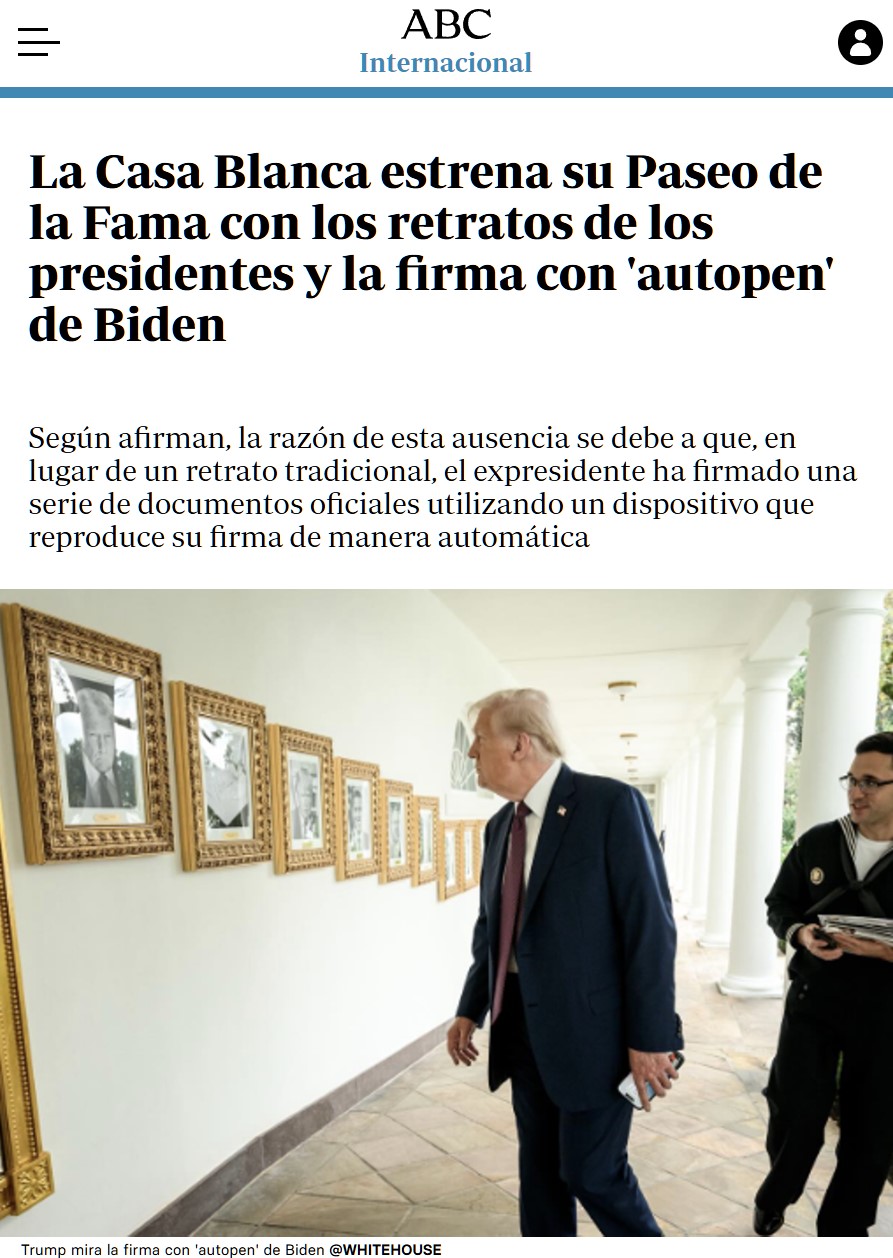
Este vídeo se ha vuelto viral en Japón: un streamer español, sentado en un asiento prioritario, incomoda a los pasajeros y termina empujando de forma agresiva a un señor que intentaba recriminarle su actitud.

Versión larga. Atentos a partir del minuto 2.10 para mayor contexto
Toda la carne en el asador: apoyo financiero histórico de EEUU a Argentina
Apoya la continuidad de este canal en:
- Patreon: http://www.patreon.com/juanrallo
- Youtube: https://www.youtube.com/juanrallo/join
- Tienda de ‘Laissez Faire’ 👕: https://laissez-faire.es
- Canal Secundario Youtube: https://www.youtube.com/channel/UCcniMHbAiXnvp17zP0LLBbw
- Twitch: http://www.twitch.tv/juanrallo
- Paypal: https://bit.ly/2VEQ4QF
- Facebook: https://tinyurl.com/y4olp4qx
- Tienda en Spring: https://juanrallo.creator-spring.com/