Un artículo valiente de Manuel Morales, que denuncia bulos y montajes de la ultraderecha. (...) El video de VOX es un bulo. Un montaje. Habla de un problema que no existe, lo ilustra con unas imágenes que distorsionan la realidad y sustituye con sonidos de llamada a la oración la música de fiesta que había en el encuentro… cualquiera que lo vea, creerá que se está convirtiendo en un gueto islámico un barrio que es un ejemplo de convivencia. El conjunto es una gran mentira. Una mentira dirigida a dividir y enfrentar a la sociedad española.
etiquetas: odio, vox, granada, casería de montijo, inmigrantes
Un total de 137 padres y madres de niños y jóvenes que han estado en las Colonias Vascas han publicado hoy una carta en BERRIA en la que muestran todo su apoyo a los monitores de Bernedo. “Condenamos rotundamente el acoso que estáis sufriendo por parte de los educadores y las acusaciones y amenazas que se os han hecho, tanto a nivel público como privado, a través de las redes sociales. Al mismo tiempo, rechazamos que varios medios, incluido el público, hayan aprovechado la ocasión para magnificar y distorsionar la situación y criminalizar su tr
La afirmación de que los colonos sionistas " hicieron florecer el desierto " es uno de los lemas israelíes pero un vistazo rápido a la geografía de Palestina revela que la mayor parte forma parte de lo que se conoce como la Media Luna Fértil (se puede adivinar por qué). La región ha sido históricamente conocida por sus cultivos y agricultura. De hecho, si analizamos la precipitación media anual en la zona durante los últimos 100 años, Ramala tiene una precipitación media anual superior a la de París, y Jerusalén, superior a la de Berlín.
etiquetas: mito, israel, desierto, palestina, terra nullius
Decenas de miles de personas protestaron este miércoles en las principales ciudades de Grecia contra un proyecto de ley presentado por el Gobierno que contempla la ampliación de la jornada laboral hasta un máximo de 13 horas diarias. Las movilizaciones en el centro de Atenas y otras ciudades, como Salónica (norte) y Patras (sur), se realizaron en el marco de una huelga de 24 horas convocada por los principales sindicatos del sector privado y público del país, GSEE y ADEDY, que ha inmovilizado los trenes y los barcos de pasajeros en todo el ...
Los glaciares suizos, especialmente sensibles al cambio climático, perdieron una cuarta parte de su volumen en apenas diez años, según un estudio publicado este miércoles que alerta sobre la velocidad del fenómeno....
“Ahora debemos redefinir las herramientas. Stop. Redefinir al hombre. Stop. O aceptar a los chimpancés como humanos”. Este telegrama, que forma parte ya de la historia de la ciencia, fue la respuesta con la que el paleontólogo Louis Leakey recibió los hallazgos de su pupila, Jane Goodall. Leakey, que dedicó su carrera al...
En los últimos años, las monedas digitales han pasado de ser una idea futurista a una realidad palpable. Y Europa no quiere quedarse atrás. El Banco Central Europeo (BCE) ya…
El pasado martes se celebró la última reunión en el Preco, donde los sindicatos presentaron una nueva oferta y la empresa no se cerró ante la misma, por lo que los trabajadores son ahora un poco más optimistas. Mañana habrá otra reunión, también en el Preco, donde esperan la respuesta de Enviser.
Si no hay pacto mañana, seguirían las negociaciones, aunque en una rueda de prensa celebrada hoy, también han advertido de que se plantean comenzar una huelga de hambre con una acampada en las escalinatas de la catedral nueva. @nortexpres
En casi todos los países y a lo largo de la historia, las mujeres viven más que los hombres. Ahora, una investigación liderada por el Instituto Max Planck de Antropología Evolutiva (Alemania) y publicada en la revista Science Advances ofrece nuevas claves sobre por qué esta brecha es tan persistente: sus raíces se hunden en la evolución y no son exclusivas de nuestra especie.
El equipo, con 15 colaboradores internacionales, analizó datos de longevidad de 1.176 especies de mamíferos y aves en zoológicos de todo el mundo. Los resultados muestran que, de media, las hembras de mamíferos viven un 13% más que los machos. Solamente en las aves ocurre lo contrario: los machos superan a las hembras en un 5%.
«Aunque algunas especies mostraron el patrón opuesto a lo esperado», explica Johanna Stärk, primera autora del estudio. «Por ejemplo, en muchas rapaces las hembras no solo son más grandes, sino también más longevas que los machos. Los cromosomas sexuales son parte de la historia, pero no la explican por completo».
Selección sexual y estrategias reproductivas
La investigación muestra que, además de los factores genéticos, influyen las estrategias de apareamiento. En especies polígamas con fuerte competencia —como muchos mamíferos—, los machos suelen morir antes. En aves, más a menudo monógamas, la presión competitiva es menor y los machos tienden a vivir más.
Las hembras de mamíferos viven un 13% más que los machos
El cuidado parental también resulta determinante. En mamíferos, donde las hembras suelen invertir más tiempo en la cría de las crías, ellas prolongan su vida, lo que aumenta las probabilidades de que sus descendientes alcancen la madurez.
Las diferencias entre sexos se reducen en zoológicos, donde los animales están protegidos de depredadores, enfermedades o climas extremos, pero no desaparecen del todo. Este hallazgo recuerda al caso humano: los avances médicos y sociales han estrechado la brecha entre hombres y mujeres, aunque sin eliminarla.
En conjunto, los resultados sugieren que la longevidad diferencial está arraigada en la historia evolutiva, modulada por la selección sexual, el cuidado parental y los cromosomas sexuales. Factores ambientales influyen en su magnitud, pero no pueden borrarla.
Este artículo fue publicado originalmente en SINC. Lea el original en este enlace.
As a health psychologist, Kelly McGonigal’s job is to help people manage stress and make positive changes in their lives. After years of watching her students struggling to control their choices, McGonigal realized that much of what people believe about willpower is actually sabotaging their success. For example, seeing willpower as a virtue can derail our best-intentioned goals. Instead, McGonigal urges her students to understand the biological functions, mental traps, and social factors that influence our self-control.
Drawing from the newest insights in disciplines such as psychology, neuroscience, and economics, McGonigal created a course for Stanford’s Continuing Studies program called «The Science of Willpower», which participants describe as life-changing. This course is the foundation of The Willpower Instinct, which provides a clear framework for what willpower really is, how it works, and why it matters.
Our ability to control our attention, emotions, appetites, and behavior not only greatly influences our health, financial security, relationships, and professional success, it is also trainable. The Willpower Instinct provides a step-by-step program for identifying goals, strengthening self-control, and making lifelong changes, whether it’s weight loss, financial health, stress reduction, conquering procrastination, being a better parent, or finding your focus.
Kelly McGonigal, Ph. D. is an award-winning psychology instructor at Stanford University, as well as a health educator for the School of Medicine’s Health Improvement Program. Her psychology courses for professionals and the general public (including «The Science of Willpower» and «Living Well with Stress») are among the most popular in the history of Stanford’s Continuing Studies program. She lives in Palo Alto, California.
Estimated reading time: 36 minutes.
This book objectives:
This book combines the best scientific insights and practical exercises from the course, using the latest research and the acquired wisdom of the hundreds of students who have taken the class.
If this book did nothing else but help you see the common humanity of your willpower struggles, I would be happy.
I hope that the strategies in this book will empower you to make real and lasting changes in your life.
Main ideas:
The strategies most people use weren’t just ineffective, they actually backfired, leading to self-sabotage and losing control.
Everyone struggles in some way with temptation, addiction, distraction, and procrastination.
When you’re facing temptation, or flirting with procrastination, you need to remember what you really want.
Willpower is about harnessing the three powers of I will, I won’t, and I want, to help you achieve your goals.
Some neuroscientists go so far as to say that we have one brain but two minds, or even, two people living inside our mind.
This is what defines a willpower challenge: Part of you wants one thing, and another part of you wants something else. When these two selves disagree, one version of us has to override the other.
You need to recognize when you’re making a choice that requires willpower; otherwise, the brain always defaults to what is easiest.
People who are distracted are more likely to give in to temptations.
When your mind is preoccupied, your impulses, not your long-term goals, will give your choices.
Your brain remodels itself based on what you ask it to do.
Neuroscientists have discovered that when you ask the brain to meditate, it gets better not just at meditating, but at a wide range of self-control skills, including attention, focus, stress management, impulse control, and self-awareness.
You know when you’ve met a real willpower challenge because you feel it in your body.
Anything that puts a stress on your mind or body can interfere with the physiology of self-control, and by extension, sabotage your willpower.
Exercise turns out to be the closest thing to a wonder drug that self-control scientists have discovered.
Being mildly but chronically sleep deprived makes you more susceptible to stress, cravings, and temptation.
Science also points us to a critical insight: Stress is the enemy of willpower.
People who use their willpower seem to run out of it.
Anytime you have to fight an impulse, filter out distractions, weigh competing goals, or make yourself do something difficult, you use a little more of your willpower strength. This even includes trivial decisions.
Committing to any small, consistent act of self-control can increase overall willpower.
Our beliefs about what we are capable of may determine whether we give up or soldier on.
People who are willpower-depleted cannot be counted on to make good decisions for society.
Whenever we have conflicting desires, being good gives us permission to be a little bit bad.
We are most motivated by getting what we want and avoiding what we don’t want.
We wrongly but persistently expect to make different decisions tomorrow that we do today.
We look into the future and fail to see the challenges of today.
When we do experience setbacks, we need to forgive those failures, and not use them as an excuse to give in or give up.
Rather than shame people for their willpower failures, we would do far better by offering social support for willpower successes.
Surfing the urge is not just for addiction; it can help you handle any destructive impulse.
These three skills (self-awareness, self-care, and remembering what matter the most) are the foundation for self-control.
Comments extracted from the book, they could be right or wrong, you decide for yourself:
Rumi: «The intelligent want self-control; children want candy».
According to the American Psychological Association, Americans name lack of willpower as the number-one reason they struggle to meet their goals. Other feel at the mercy of their thoughts, emotions, and cravings, their lives dictated by impulses rather than conscious choices.
The strategies most people use weren’t just ineffective, they actually backfired, leading to self-sabotage and losing control.
This book combines the best scientific insights and practical exercises from the course, using the latest research and the acquired wisdom of the hundreds of students who have taken the class.
I believe that the best way to improve your self-control is to see how and why you lose control. It allows you to support yourself and avoid the traps that lead to willpower failures.
Research shows that people who think they have the most willpower are actually the most likely to lose control when tempted.
Self-knowledge is the foundation of self-control.
Everyone struggles in some way with temptation, addiction, distraction, and procrastination. These are not individual weaknesses that reveal our personal inadequacies, they are universal experiences and part of the human condition.
If this book did nothing else but help you see the common humanity of your willpower struggles, I would be happy. I hope that the strategies in this book will empower you to make real and lasting changes in your life.
Before you can change something, you need to see it as it is.
Your craving for chocolate is not so different from a smoker’s craving for a cigarette, or a shopaholic’s craving to spend.
Although you could read this whole book in one weekend, I encourage you to pace yourself when it comes to implementing the strategies. Try one new strategy for self-control each week, and report on what worked best. Give yourself time to try out the practical exercises and reflect.
The following questions can help you identify the challenge you’re ready to take on:
«I will» power challenge: What is something that you would like to do more of, or stop putting off, because you know that doing it will improve the quality of your life?
«I won’t» power challenge: What is the «stickiest» habit in your life? What would you like to give up or do less of because it’s undermining your health, happiness, or success?
«I want» power challenge: What is the most important long-term goal you’d like to focus your energy on? What immediate «want» is most likely to distract you or tempt you way from this goal?
«I will» power, the ability to do what you need to do, even if part of you doesn’t want to.
«I will» and «I won’t» power are the two sides of self-control, but they alone don’t constitute willpower. To say no when you need to say no, and yes when you need to say yes, you need a third power: the ability to remember what you really want.
When you’re facing temptation, or flirting with procrastination, you need to remember what you really want. To exert self-control, you need to find your motivation when it matters. This is «I want» power.
Willpower is about harnessing the three powers of I will, I won’t, and I want, to help you achieve your goals.
While we all have the capacity to do the harder thing, we also have the desire to do exactly the opposite. This impulse needs to be restrained, and as we’ll see, it often has a mind of its own.
Evolution prefers to add on to what it’s created, rather than start from scratch. The system of self-control was slapped on top of the old system of urges and instincts. That means that for any instinct that once served us well, evolution has kept it around, even if it now gets us into trouble. The good news is, evolution has also given us a way to handle the problems we run into.
While we’re stuck with the impulse, we’re also equipped with the impulse control.
Some neuroscientists go so far as to say that we have one brain but two minds, or even, two people living inside our mind. There’s the version of us that acts on impulse and seeks immediate gratification, and the version of us that controls our impulses and delays gratification to protect our long-term goals. They’re both us, but we switch back and forth between these two selves.
This is what defines a willpower challenge: Part of you wants one thing, and another part of you wants something else. When these two selves disagree, one version of us has to override the other. The part of you that wants to give in isn’t bad, it simply has a different point of view about what matters most.
Some people find it useful to give a name to the impulsive mind,
like «the cookie monster» to the part that always want instant gratification,
«the critic» to the part of you that likes to complain about everyone and everything,
or «the procrastinator» to the person who never wants to get started.
Giving a name to this version of yourself can help you recognize when is taking over, and also help you call in your wiser self for some willpower support.
Though our survival system doesn’t always work to our advantage, it is a mistake to think we should conquer the primitive self completely. Without desires we’d become depressed, and without fear we’d fail to protect ourselves from future danger. Part of succeeding at your willpower challenges will be finding a way to take advantage of, and not fight, such primitive instincts.
Without self-awareness, the self-control system would be useless. You need to recognize when you’re making a choice that requires willpower; otherwise, the brain always defaults to what is easiest.
This may sound simple, but psychologists know that most of our choices are made on autopilot, without any real awareness of what’s driving them, and certainly without serious reflection on their consequences. Heck, most of the time, we don’t even realize we’re making a choice.
How can you control yourself if you aren’t even aware that there is something to control? Modern society, with its constant distractions and stimulation, doesn’t help.
People who are distracted are more likely to give in to temptations.
When your mind is preoccupied, your impulses, not your long-term goals, will give your choices.
At the end of the day, look back and try to analyze when decisions were made that either supported or undermined your goals. Trying to keep track of your choices will also reduce the number of decisions you make while distracted, a guaranteed way to boost your willpower.
Neuroscientists have discovered that the brain is remarkably responsive to experience. Ask your brain to do math every day, and it gets better at math. Ask your brain to worry, and it gets better at worrying. Ask your brain to concentrate, and it gets better to concentrating. Not only does your brain find these things easier, but it actually remodels itself based on what you ask it to do.
Neuroscientists have discovered that when you ask the brain to meditate, it gets better not just at meditating, but at a wide range of self-control skills, including attention, focus, stress management, impulse control, and self-awareness.
You face a choice: follow the craving, or find the inner strength to control yourself. This is the moment you need to say «I won’t» when every cell in your body is saying «I want».
You know when you’ve met a real willpower challenge because you feel it in your body.
Science is discovering that self-control is a matter of physiology, not just psychology.
You have inherited from your ancestors an instinct that helps you respond to any threat that requires fighting or running for your life. This instinct is appropriately called the fight-or-flight stress response. The built-in ability of your body and brain to devote all of their energy to saving your butt in an emergency. It decides how you are going to spend your limited physical and mental energy.
What is the thought or feeling that makes you want to do whatever it is you don’t want to do? If you aren’t sure, try some field observation. Next time you’re tempted, turn your attention inward.
Segerstrom calls those changes the pause-and-plan response.
For self-control, you don’t need legs ready to run or arms ready to punch, but a well-fueled brain ready to flex its power.
The pause-and-control responde drives you in the opposite direction of the fight-or-flight response. Instead of speeding up, your heart slows down, and your blood pressure stays normal. Instead of hyperventilating like a madman, you take a deep breath. Instead of tensing muscles to prime them for action, your body relaxes a little. The goal is not to paralyze you in the face of internal conflict, but to give you freedom.
Anything that puts a stress on your mind or body can interfere with the physiology of self-control, and by extension, sabotage your willpower. Anything that you do to reduce stress and take care of your health will improve your body’s willpower reserve.
Exercise turns out to be the closest thing to a wonder drug that self-control scientists have discovered. The long-term effects of exercise are even more impressive. It not only relieves ordinary, everyday stress, but it’s as powerful an antidepressant as Prozac.
A 2010 analysis of ten different studies found that the biggest mood-boosting, stress-busting effects came from five-minute doses of exercise, not hour-long sessions.
Whatever you are willing to do is the perfect place to start. Gardening, walking, dancing, yoga, team sports, swimming, playing with your kids or pets, even enthusiastic housecleaning and window-shopping qualify as exercise. Anything above and beyond the typical sedentary lifestyle will improve your willpower reserve.
If you tell yourself that you are too tired or don’t have the time to exercise, start thinking of exercise as something that restores, not drains, your energy and willpower.
Being mildly but chronically sleep deprived makes you more susceptible to stress, cravings, and temptation. It also makes it more difficult to control your emotions, focus your attention, or find the energy to tackle the big «I will» power challenges.
It hardly ever occurs to us that we don’t need to become better people, but to become better rested.
Self-control doesn’t come cheap. All of these mental tasks (focusing your attention, weighing competing goals, and quieting stress and cravings) require energy, real physical energy from your body, in the same way that your muscles require energy to fight or flee in an emergency.
Just like living under chronic stress is unhealthy, trying to control every aspect of your thoughts, emotions, and behavior is a toxic strategy. It is too big a burden for your biology.
To preserve your health and happiness, you need to give up the pursuit of willpower perfection. Even as you strengthen your self-control, you cannot control everything you think, feel, say, and do. You will have to choose your willpower battles wisely.
Science also points us to a critical insight: Stress is the enemy of willpower. So often we believe that stress is the only way to get things done, and we even look for ways to increase stress to motivate ourselves. Or we use stress to try to motivate others. This may seem to work in the short term, but in the long term, nothing drains willpower faster than stress. The biology of stress and the biology of self-control are simply incompatible.
Learning how to better manage your stress is one of the most important things you can do to improve your willpower.
To succeed at our willpower challenges, we need to find the state of mind and body that puts our energy toward self-control, not self-defense. That means giving ourselves what we need to recover from stress, and making sure we have the energy to be our best selves.
Willpower is a biological instinct, like stress, that evolved to help us protect ourselves from ourselves.
One of the most robust, if troubling, findings from the science of self-control: People who use their willpower seem to run out of it. Modern life is full of self-control demands that can drain your willpower.
Researchers have found that self-control is highest in the morning and steadily deteriorates over the course of the day. If you try to control or change too many things at once, you may exhaust yourself completely. This failure says nothing about your virtue, just about the nature of willpower itself.
Self-control is like a muscle. When used, it gets tired. If you don’t rest the muscle, you can run out of strength entirely, like an athlete who pushed himself to exhaustion.
Many things you wouldn’t typically think of as requiring willpower also rely on, and exhaust, this limited well of strength. Trying to impress a date or fit into a corporate culture that doesn’t share your values. Anytime you have to fight an impulse, filter out distractions, weigh competing goals, or make yourself do something difficult, you use a little more of your willpower strength. This even includes trivial decisions.
An important willpower rule: If you never seem to have the time and energy for your «I will» challenge, schedule it for when you have the most strength.
When the brain detects a drop in available energy, it gets a little nervous. What if it runs out of energy? The first expense to be cut? Self-control, one of the most energy-expensive tasks the brain performs. To conserve energy, the brain may become reluctant to give you the full mental resources you need to resist temptation, focus your attention, or control your emotions.
Committing to any small, consistent act of self-control can increase overall willpower. And while these small self-control exercises may seem inconsequential, they appear to improve the willpower challenges we care about most, including focusing at work, taking good care of our health, resisting temptation, and feeling more in control of our emotions.
It’s the habit of noticing what you are about to do, and choosing to do the more difficult thing instead of the easiest. Through each of these willpower exercises, the brain gets used to pausing before acting. The triviality of the assignments may even help this process.
One thing that isn’t clear is whether we run out of power, or whether we just run out of will.
Physical exhaustion was a trick played on the body by the mind.
Timothy Noakes, professor of exercise and sports science at the University of Cape Town: «Fatigue should no longer be considered a physical event but rather a sensation or emotion».
This doesn’t mean we’re our of willpower; we just need to muster up the motivation to use it. Our beliefs about what we are capable of may determine whether we give up or soldier on.
It is appealing to think that we often have more willpower than we believe we do.
The mere promise that practice would improve performance on a difficult task helped the students push past willpower exhaustion.
People who are willpower-depleted cannot be counted on to make good decisions for society.
When it comes to right and wrong, most of us are not striving for moral perfection. We just want to feel good enough, which then gives us permission to do whatever we want.
When you do something good, you feel good about yourself. This means you’re more likely to trust your impulses, which often means giving yourself permission to do something bad.
The moral licensing effect might explain why some people who have obvious moral credentials can justify themselves some serious moral lapses. Most people don’t question their impulses when they’re feeling virtuous, and some people’s positions permanently remind them of their virtue.
Simply put: Whenever we have conflicting desires, being good gives us permission to be a little bit bad.
Indulgers report feeling in control of their choices, not out of control. They also don’t feel guilt. Instead, they report feeling proud of themselves for earning a reward. This sense of entitlement too often becomes our downfall. Because we’re quick to view self-indulgence as the best reward for virtue, we forget our real goals and give in to temptation.
We rarely require a connection between our «good» behavior and the «bad» behavior we’re justifying.
Anything that makes us feel warm and fuzzy about our virtue can license us to follow our impulses.
There is no careful accountant in our brains, calculating exactly how good we’ve ben and what kind of self-indulgence we’ve earned. Instead, we trust the feeling that we have been good, and that we are a good person.
If a behavior doesn’t trigger that instintive feeling of «wrongness», we don’t tend to question our impulses.
The worst part of moral licensing is not just its questionable logic; the problem is how it tricks us into acting against our best interests. It convinces us that self-sabotaging behavior is a «treat». This is lunacy, but it’s an incredibly powerful trick of a mind that turns your wants into shoulds.
We idealize our own desire to be virtuous, and many people believe that they are most motivated by guilt and shame. But who are we kidding? We are most motivated by getting what we want and avoiding what we don’t want. Moralizing a behavior makes us more, not less, likely to feel ambivalent about it.
When we think about our willpower challenges in moral terms, we get lost in self-judgements and lose sight of how those challenges will help us to get what we want.
Psychologists know we are all too quick to use progress as an excuse for taking it easy. In practical terms, this means that one step forward fives you permission to take two steps back.
As one of my students said, he loves productivity seminars because they make him feel so productive, never mind that nothing has been produced yet.
The problem with progress is how it makes us feel. Progress can be motivating, and even inspire future self-control, but only if you view your actions as evidence that you are committed to your goal. More typically, we look for the reason to stop.
People who merely intent to exercise later are more likely to overeat at dinner.
Sometimes the mind gets so excited about the opportunity to act on a goal, it mistakes the opportunity with the satisfaction of having actually accomplished the goal.
A fundamental mistake we make when thinking about our future decisions. We wrongly but persistently expect to make different decisions tomorrow that we do today. I’ll smoke this one cigarette, but starting tomorrow, I’m done. Such optimism licenses us to indulge today, especially if we know we will have the opportunity to choose differently in the near future.
Our optimism about the future extends not just to our own choices, but to how easy it will be to do what we say we will do. Psychologists have shown that we wrongly predict we will have much more free time in the future than we do today.
We look into the future and fail to see the challenges of today.
View every choice you make as a commitment to all future choices. So instead of asking, «Do I want to eat this candy bar now?» ask yourself, «Do I want the consequences of eating a candy bar every afternoon for the next year?».
Studies show that people who order a main dish advertised as a healthy choice also order more indulgent drinks, side dishes, and desserts. Although their goal is to be healthy, they end up consuming more calories than people who order a regular entrée. Dieting researchers call this a health halo. We feel so good about ordering something healthy, our next indulgence doesn’t feel sinful at all.
Halo effects pop up all over the place, whenever something indulgent is paired with something more virtuous.
The more we care about a particular virtue, the more vulnerable we are to ignoring how a «virtuous» indulgence might threaten our long-term goals.
We need to feel like the kind of person who wants to do the right thing. Moral licensing turns out to be, at its core, an identity crisis. We only reward ourselves for good behavior if we believe that who we really are is the self that wants to be bad. From this point of view, every act of self-control is a punishment, and only self-indulgent is a reward.
For change to stick, we need to identify with the goal itself, not the halo glow we get from being good.
Our brains become obsessed with «I want», and it gets harder to say, «I won’t».
Anything we think is going to make us feel good will trigger the reward system. The flood of dopamine marks this new object of desire as critical to your survival. When dopamine hijacks your attention, the mind becomes fixated on obtaining or repeating whatever triggered it.
Evolution doesn’t give a damn about happiness, but will use the promise of happiness to keep us struggling to stay alive.
When we add the instant gratification of modern technology to this primitive motivation system, we end up with dopamine-delivery devices that are damn near impossible to put down.
There are few things ever dreamed of, smoked, or injected that have as addictive an effect on our brains as technology.
We are driven to chase pleasure, but often at the cost of our well-being. When dopamine puts our brains on a reward-seeking mission, we become the most risk-taking, impulsive, and out-of-control version of ourselves. Importantly, even if the reward never arrives, the promise of reward is enough to keep us hooked.
We live in a world engineered to make us want.
The promise of reward has even been used to help people overcome addiction. One of the most effective intervention strategies in alcohol and drug recovery is something called the fish bowl. Amazingly, the fish bowl technique works even better than paying patients for passing their drug tests. This highlights the power of an unpredictable reward. Our reward system gets much more excited about a possible big win than a guaranteed smaller reward, and it will motivate us to do whatever provides the change to win.
Dopamine does have a dark side, one that’s not hard to see if we pay close attention. Dopamine’s primary function is to make us pursue happiness, not to make us happy. It doesn’t mind putting a little pressure on us, even if that means making us unhappy in the process.
WE humans find it nearly impossible to distinguish the promise of reward from whatever pleasure or payoff we are seeking. The promise of reward is so powerful that we continue to pursue things that don’t make us happy, and consume things that bring us more misery than satisfaction.
There is growing evidence that when people pay close attention to the experience of their false rewards, the magical spell wears off. If you force your brain to reconcile what it expects from a reward with what it actually experiences, your brain will eventually adjust its expectations. We often find that the thing we were seeking happiness from was the main source of our misery.
While we get into trouble when we mistake wanting for happiness, the solution is not to eliminate wanting. A life without wants may not require as much self-control, but it’s also not a life worth living.
People with anhedonia describe life as a series of habits with no expectation of satisfaction. They may eat, shop, socialize, and have sex, but they don’t anticipate pleasure from these activities. Without the possibility of pleasure, they lose motivation. It’s hard to get out of bed when you can’t imagine that anything you do will make you feel good. This complete disconnect from desire drains hope and, for many, the will to live. When our reward system is quiet, the result isn’t so much total contentment as it is apathy.
The promise of reward doesn’t guarantee happiness, but no promise or reward guarantees unhappiness. Listen to the promise of reward, and we give in to temptation. Without the promise of reward, we have no motivation. To this dilemma, there’s no easy answer. It’s clear that we need the promise of reward to keep us interested and engaged in life.
If we are to have any self-control, we need to separate the real rewards that give our lives meaning form the false rewards that keep us distracted and addicted.
Your brain isn’t just motivated to protect your life, it wants to protect your mood, too. So whenever we are under stress, your brain is going to point you toward whatever it thinks will make you happy. When you’re under stress, any temptations you run into will be even more tempting.
Studies show that being reminded of our mortality makes us more susceptible to all sorts of temptations, as we look for hope and security in the things that promise reward and relief.
Take a twenty-four-hour break from TV news, talk radio, magazines, or websites that profit from your fear.
The worse a person felt about how much they drank the night before, the more they drank that night and the next. The guilt was driving them back to the bottle. The what-the-hell effect describes a cycle of indulgence, regret, and greater indulgence. Instead of minimizing the harm by not taking another bite, they would say, «What the hell, I already blew my diet. I might as well eat the whole thing».
It’s the feelings of shame, guilt, loss of control, and loss of hope that follow the first release. Once you’re stuck in the cycle, it can seem like there is no way out except to keep going. This leads to even bigger willpower failures and more misery as you then berate yourself for giving in. But the thing you’re turning to for comfort can’t stop the cycle, because it only generates more feelings of guilt.
If you think that the key to greater willpower is being harder on yourself, you are not alone. But you are wrong. Study after study shows that self-criticism is consistently associated with less motivation and worse self-control. It is also one of the single biggest predictors of depression, which drains both «I will» power and «I want» power. In contrast, self-compassion is associated with more motivation and better self-control.
Surprisingly, it’s forgiveness, not guilt, that increases accountability. Researchers have found that taking a self-compassionate point of view on a personal failure makes people more likely to take personal responsibility for the failure that when they take a self-critical point of view. They also are more willing to receive feedback and advice from others, and more likely to learn from the experience.
One reason forgiveness helps people recover from mistakes is that it takes away the shame and pain of thinking about what happened. Without the guilt and self-criticism, there’s nothing to escape. This means it’s easier to reflect on how the failure happened, and less tempting to repeat it.
If you view your setbacks as evidence that you are a hopeless loser who screws everything up, thinking about your failure is a miserable exercise in self-hate. Your most urgent goal will be to soothe those feelings, not learn from the experience. This is why self-criticism backfires as a strategy for self-control. Like other forms of stress, it drives you straight to comfort coping.
We are most likely to decide to change when we are at a low point. Setting a resolution offers an immediate sense of relief and control. We don’t have to believe that we are the person who made that mistake; we can become a completely different person. Vowing to change fills us with hope., We love to imagine how making the change will transform our lives, and we fantasize about the person we will become.
Unrealistic optimism may make us feel good in the moment, but it sets us up to feel much worse late ron. It was never meant to be a strategy for change. It’s a strategy for feeling better, and these are not the same things.
We must avoid the common trap of using the promise of change to fix our feelings, not to fix our behaviors.
When we do experience setbacks, we need to forgive those failures, and not use them as an excuse to give in or give up. When it comes to increasing self-control, self-compassion is a far better strategy than beating ourselves up.
For a cooler, wiser brain, institute a mandatory ten-minute wait for any temptation. If, in ten minutes, you still want it, you can have it. If possible, create some physical distance as well.
Thomas Schelling believed that to reach our goals, we must limit our options. He called this precommitment. If the tempted self with its reversed preferences, is allowed to do what it wants, the result will ultimately be self-sabotage.
It is one of the most puzzling but predictable mental errors humans make: We think about our future selves like different person. We often idealize them, expecting our future selves to do what our present selves cannot manage. Sometimes we mistreat them, burdening them with the consequences of our present selves’ decisions. However we think of our future selves, rarely do we see them as fully us.
Willpower is contagious. Willpower failures may be contagious, but you can also catch self-control.
Both bad habits and positive change can spread from person to person like germs, and nobody is completely immune.
When it comes to self-control, we’ve seen that the human mind is not one unified self, but multiple selves who compete for control. There’s the self who wants immediate gratification and the self who remembers your bigger goals. There’s your present self who may or many not seem to have much in common with your future self.
Humans are hardwired to connect with others, and our brains have adapted a nifty way to make sure we do. We have specialized brain cells whose sole purpose is to keep track of what other people are thinking, feeling, and doing. These mirror neurons are sprinkled throughout the brain to help us understand the full range of other people’s experiences.
In many situations, we find ourselves automatically mirroring the physical gestures and actions of others. If you pay attention to body language, you’ll notice that people in conversation start to adopt each other’s positions.
When we imagine what other people want, their wants can trigger our wants, and their appetites can trigger our appetites.
An action can be passed on to us when we merely see evidence that others have done.
In many ways, we only know who we are by thinking about other people. Because we include other people in our sense of self, their choices influence our choices.
Social proof, when the rest of our tribe does something, we tend to think it’s a smart thing to do. We may be willing to give up our vices and cultivate new virtues if we believe that it will more firmly secure us a spot in our most cherished tribe.
When contemplating a choice, we often imagine ourselves the object of other people’s evaluations. People are more likely to use condoms when they imagine feeling ashamed if others knew that they had unprotected sex.
Social emotions like pride and shame have a quicker and more direct influence over our choices than rational arguments about long-term costs and benefits.
If you believe that others are rooting for your success and keeping an eye on your behavior, you’ll be more motivated to do the right thing.
Rather than shame people for their willpower failures, we would do far better by offering social support for willpower successes.
As we enter that inner world, we will find we need a new definition of self-control, one that makes room for letting go of control.
Trying not to think about something guarantees that it is never far from your mind. This leads to a second problem: When you try to push a thought away, and it keeps coming back to your mind, you are more likely to assume that it must be true. Why else would the thought keep resurfacing? We trust that our thoughts are important sources of information.
When you stop trying to control unwanted thoughts and emotions, they stop controlling you. Paradoxically, permission to think a thought reduces the likelihood of thinking it.
The goal is not to get rid of the anxiety and self-doubt, but to develop a trust that they can handle these difficult thoughts and feelings. If they learn that there is no inner experience that they need to protect themselves from, they can find more freedom in the outer world.
Trying to avoid unwanted feelings often leads to self-destructive behavior, whether it’s a procrastinator trying to avoid anxiety, or a drinker trying to avoid feeling alone.
The world’s most craved substance: chocolate.
Science is now confirming that restricting a food automatically increases your cravings for it.
Surfing the urge is not just for addiction; it can help you handle any destructive impulse.
These three skills (self-awareness, self-care, and remembering what matter the most) are the foundation for self-control.
People who have the greatest self-control aren’t waging self-war. They have learned to accept and integrate the competing selves.
if there is a secret for greater self-control, the science points to one thing: the power of paying attention. It’s training the mind to
recognize when you’re making a choice, rather than running on autopilot.
It’s noticing how you give yourself permission to procrastinate,
or how you use good behavior to justify self-indulgence.
It’s realizing that the promise of reward doesn’t always deliver,
and that your future self is not a superhero or a stranger.
It’s seeing what in your world is shaping your behavior.
It’s staying put and sensing a craving when you’d rather distract yourself or give in.
It’s remembering what you really want, and knowing what really makes you feel better.
Self-awareness is the one «self» you can always count on to help you do what is difficult, and what matters most. And that is the best definition of willpower I can think of.
Have you read this book? Any other similar book? Do you have anything to say about what this book is saying? Do you recommend any book related to this matter? Anything at all? I’ll be glad to know what you think about it in the comments.
En el programa de hoy hablaremos de la reunión de generales que se ha dado en Estados Unidos donde se ha juntado toda la plana mayor de las fuerzas armadas. Hablaremos también de la red antiaérea que la OTAN quiere desplegar en Ucrania, comentaremos la inminente llegada de la flotilla de la libertad a costas israelíes, comentaremos la situación en Haití, y exploraremos los vínculos entre la AFD alemana y los servicios de inteligencia chinos.
Dr. Robert Lustig, a world-leading expert on sugar addiction, metabolism, ultra-processed food, and artificial sweeteners, reveals how they fuel obesity, dementia, dopamine overload, and addiction - and the dangers of RFK Jr.’s health approach.
Dr. Robert Lustig is a neuroendocrinologist and expert on sugar, obesity, and the science of addiction, whose groundbreaking new research reveals how the 4 major health crises are all interconnected and driven by stress. He is also the bestselling author of books such as, ‘Metabolical’, and ‘Fat Chance’.
He explains: ◼️Why 29% of Americans are depressed and how food plays a hidden role ◼️How 17 seconds of pleasure can rewire your brain for lifelong addiction ◼️How the food industry secretly engineers addiction and fuels chronic disease ◼️Why 95% of Alzheimer’s risk is environmental and completely preventable ◼️The dangerous link between dopamine spikes and brain cell death
00:00 Intro 02:15 The Hostage Brain 06:10 Dopamine and the Pain of Lacking Control 09:19 Tolerance Is the Start of Addiction 10:26 If You Depend on Anything, It's Bad 11:12 Is Dopamine Fasting the Cure? 13:11 Can You Rewire Your Brain Away from Sugar Cravings? 15:02 The Shocking Link Between Dementia and Diet Products 21:15 Cortisol's Link to Dementia 22:26 Proteins 25:19 Is Alzheimer's Genetic or Environmental? 28:43 Ketones 32:55 Ultra-Processed Foods Are Poison 34:13 Reengineering Ultra-Processed Food to Be Healthy 39:28 What Needs to Change in the USA 44:53 RFK and Vaccination in the USA 51:43 Important Message About Where You Get Your Information 55:14 Ads 56:16 Practical Steps to Fix Your Addiction 01:01:11 If You Have an Inflamed Brain, You Can't Love 01:03:55 Are Our Diets Making Us Lonely? 01:07:49 Your Vagus Nerve Needs to Be Healthy 01:08:31 Do Vagus Nerve Stimulators Work? 01:10:40 The Real Truth About Ozempic 01:15:55 Can Ozempic Help with Addiction? 01:18:32 Practical Tips to Lose Weight and Avoid Ultra-Processed Foods 01:21:49 The Dangers of Drinking Soda 01:24:09 Younger People Are Getting Cancer More Than Ever 01:27:22 Ads 01:34:16 Does Exercise Help Lower Your Sugar Consumption? 01:36:14 Almost Half of the Population Is Pre-Diabetic 01:39:25 Glucose Monitors 01:41:45 Psychedelics
You can purchase Dr Robert’s book, ‘Metabolical: The Lure and the Lies of Processed Food, Nutrition, and Modern Medicine’, here: https://amzn.to/3KqB1G8
El Ministerio de Relaciones Exteriores de Israel confirma que “detuvo de manera segura” algunos de los barcos de la Flotilla de la Libertad y está transfiriendo a la tripulación a un puerto israelí. “Greta y sus amigos están sanos y salvos”.
Ángela Rodríguez ‘Pam’, exsecretaria de Estado de Igualdad bajo el mandato de Irene Montero, ha sido protagonista de algunas de las etapas más intensas y polémicas de la política reciente. Desde su participación en la elaboración de la controvertida Ley del ‘Solo Sí es Sí’ hasta su salida del Gobierno en noviembre de 2023, pasando por la licitación del cambio de proveedor en el servicio del sistema de seguimiento por medios telemáticos de las prohibiciones de aproximación impuestas en materia de violencia de género y violencia sexual. @larazon
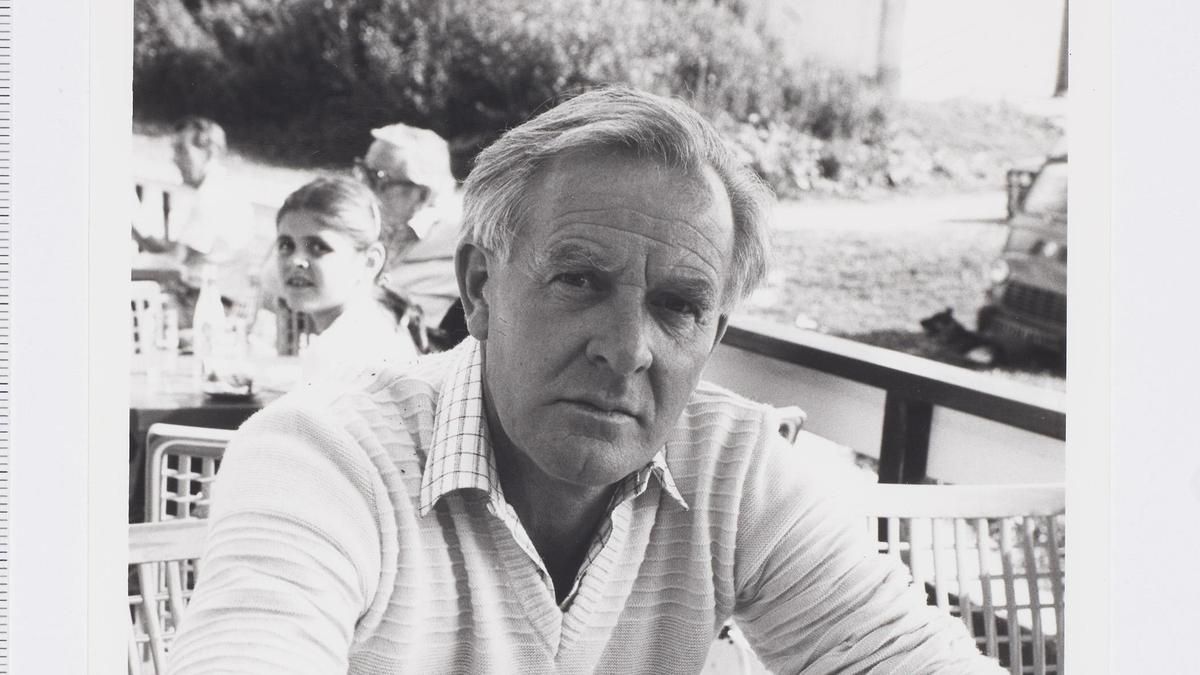
El novelista y ex espía, obsesionado con la precisión en los detalles de sus libros, viajaba y estudiaba con una red de expertos para documentarse, como retrata una nueva exposición de la Biblioteca de la Universidad de Oxford, que guarda sus archivos
Cómo nació K de ‘El castillo’ de Kafka o por qué Le Carré tardó cuatro meses en escribir el arranque de ‘El topo’
En la primavera de 1994, Federico Varese, un veinteañero italiano que estudiaba en la Universidad de Oxford, estaba de viaje por los Urales para documentarse en pos de su doctorado sobre la mafia rusa. Allí recibió un paquete con todo el correo que le había llegado a su college. Lo abrió en un tren hacia Moscú, y, entre anuncios de fiestas de graduación, facturas y recordatorios académicos, encontró un sobre con su apellido mal escrito: “Federico Barese, Esq.”. El remitente era “John le Carré (David Cornwell)”.
Le Carré, el pseudónimo con el que empezó a publicar en 1961 el entonces espía Cornwell, ya era un autor célebre desde hacía décadas, desde que el éxito El espía que surgió del frío lo sacó del anonimato y del servicio de inteligencia británico. Las novelas y la traición de un agente que reveló su identidad le hicieron abandonar oficialmente el trabajo al servicio del Estado británico en 1964. Pero cuando Varese lo conoció, el autor mantenía muchas de las formas, misteriosas, concienzudas y detallistas, que había aprendido desde casi adolescente.
En 1994, Le Carré quería saber más del contexto post-soviético y los conflictos en el Cáucaso. Había localizado al joven italiano como experto y le propuso una cita cuando volviera a Oxford. Quedaron en Al-Shami, un restaurante libanés que todavía hoy hace esquina en una callejuela enfrente de la sinagoga de Jericho, el barrio de Oxford inmortalizado también en las novelas del inspector Morse.
El escritor había llegado antes de tiempo y le estaba esperando al fondo de la sala, con la espalda pegada a la pared. Varese recuerda aquel día, intimidado por el autor, que hablaba con familiaridad con el personal del restaurante y decía haber llegado hasta allí con “un conductor libanés”.
El restaurante libanés Al-Shami en Jericho, Oxford.
Algo nervioso y pendiente de lo que escribía el escritor en su bloc de notas y lo que no, le explicó el contexto y los detalles que el autor pedía. Pero ese, como dice hoy Varese con un susurro, “fue el comienzo de una gran amistad”.
Poco después, el escritor le mandó varios borradores de la novela Nuestro juego, y el italiano, que recuerda su inglés imperfecto de entonces y sus 29 años atrevidos, acabó sugiriendo cambios en la trama que Le Carré aceptó. La obsesión del escritor consagrado era no fallar en los detalles, en qué cigarrillos fumaban los mafiosos rusos o cómo sacarían el dinero de Moscú.
“Le importaba la verdad. Le importaba la exactitud… La crítica que más ilusión le hizo fue cuando un periodista del New York Times dijo que era ‘muy preciso'”, cuenta a elDiario.es Varese, hoy catedrático de Criminología en Oxford y que también da clase en Science Po en París.
Hablamos junto a una vitrina iluminada en una sala oscura de una biblioteca de Oxford que contiene fotos que él consiguió de tatuajes de mafiosos rusos al lado de manuscritos, post-its e imágenes de Le Carré. Varese es ahora comisario de la exposición sobre John le Carré en la Biblioteca Weston de la Universidad de Oxford, a la que el autor donó su archivo de borradores, dibujos (el escritor soñó primero con ser ilustrador), correspondencia y extensa documentación para sus novelas. El archivo en Oxford de Le Carré ocupa ahora más de 1.200 cajas.
El oficio
La exposición utiliza en el título la palabra “tradecraft”, que Le Carré empleaba para referirse a las herramientas del oficio de espía y que se aplican a las de escritor.
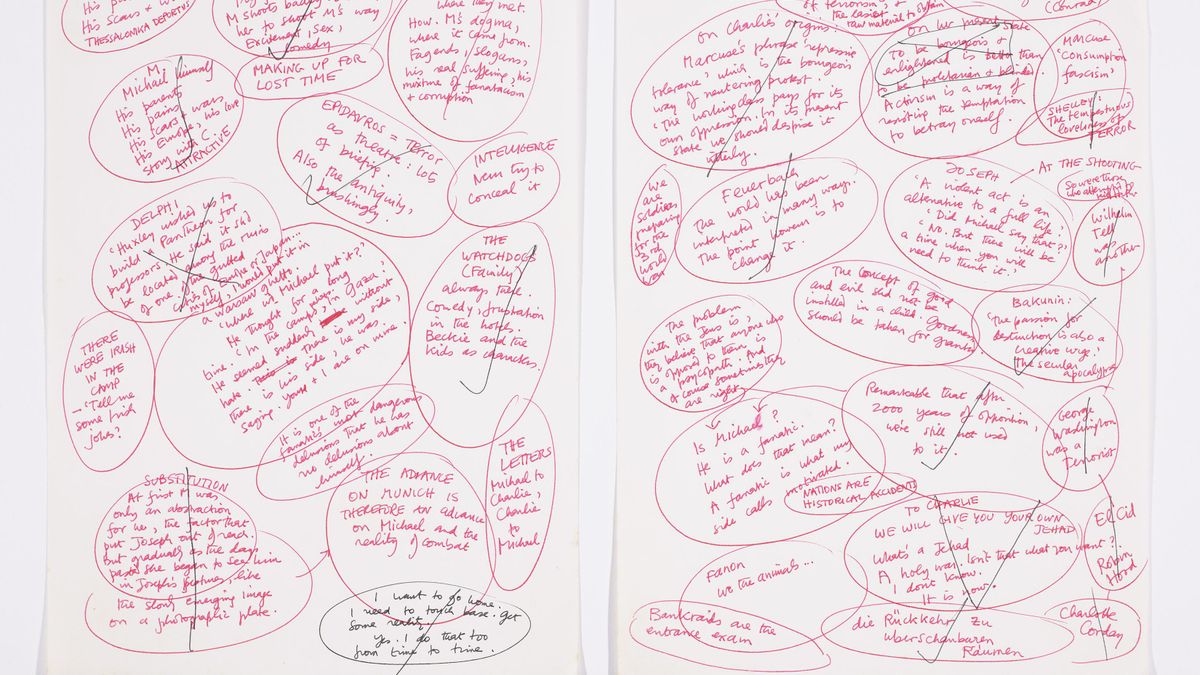
Anotaciones para 'La chica del tambor'
Varese, que tuvo la idea de la exposición, se emociona al recordar a su amigo, que murió inesperadamente después de una caída en su casa de Cornualles por una neumonía no cogida a tiempo en diciembre de 2020, en plena pandemia. Al profesor le tiembla la voz al recordar la primera vez que volvió a aquella casona después de la muerte de David —él siempre le llama por su verdadero hombre— y Jane, su esposa, que ya estaba hospitalizada por varios problemas de salud cuando él falleció y murió dos meses después. Señala las fotos también expuestas de la casa que él mismo tomó, recuerda cuánto le impresionó ver detallado el argumento de una novela sin escribir en pizarras blancas, y sus cosas casi como las dejó.
Varese suspira al pensar que Le Carré estaría escribiendo ahora novelas muy documentadas y relacionadas con la actualidad. “Anticipó el imperialismo ruso. Ahora habría viajado conmigo a Ucrania”, dice.
El error
Varese apunta admirado a las notas en una vitrina transcritas por Jane de un viaje del escritor a Congo y Ruanda para documentarse, y repite: “¡Son 600 páginas!”.
El autor ya octogenario viajó con una periodista a la que solía pedir ayuda, Michela Wrong, y otro investigador experto en la región para documentarse para la novela La canción de los misioneros, sobre la explotación en esa zona bendecida por el Reino Unido de Tony Blair. El texto ya estaba en imprenta, pero a la vuelta cambió el manuscrito para meter dialectos, detalles de la vegetación y marcas en las calles.
Estaba obsesionado con la precisión desde que mientras investigaba en los años 70 para su novela El honorable colegialhabía descubierto en un viaje a Hong Kong que una escena de El topo no tenía sentido. La persecución en ferry entre la ciudad de Kowloon y la isla de Hong Kong no cuadraba porque ya había entonces un túnel entre la isla y la tierra firme que sus personajes habrían utilizado, y del que no tenía noticia porque se había fiado de una guía de viajes desactualizada.
Una imagen de la exposición sobre John le Carré en la Biblioteca Weston de la Universidad de Oxford.
A partir de entonces, no quiso utilizar lugares en los que no hubiera estado, igual que prefería que sus protagonistas estuvieran inspirados en gente que conocía.
“No hay personajes ficticios en Le Carré. Todos están basados en personas reales”, explica la comisaria de la exposición e historiadora especializada en la Guerra Fría Jessica Douthwaite, que también destaca la obsesión con los detalles y el trabajo similar al de un buen reportero. “Para ello, también tenía una red de colaboradores e informantes que fue creciendo con el tiempo y que funcionaba en las dos direcciones. Él también les ayudaba”.
El trabajo de Jane
Jessica Douthwaite destaca el trabajo incansable de Jane, que transcribía por la tarde en el ordenador lo que había escrito su marido por la mañana a mano y que seguía revisando varias veces al día con notas sobre el texto tipográfico. Hay trozos de papel recortados y pegados con cola o con clips, de difícil conservación porque se van oxidando.
La obsesión del escritor eran las primeras 100 palabras, el primer capítulo, y los reescribía continuamente, como se ve con el manuscrito de El topo. Era un proceso largo, lleno de tachones y con letra a mano que él mismo a veces no entendía.
“No lo podría haber conseguido sin Jane”, recuerda Douthwaite. En la exposición no hay mención a la traición durante décadas de Cornwell a su esposa con empleadas y otras mujeres revelada en una biografía después de su muerte.
La investigadora dice que no ha encontrado rastro de nada parecido, pero no ha indagado en toda la correspondencia que ahora está en los archivos de la Biblioteca de Oxford.
Una página del borrador de 'El jardinero fiel' con correcciones de John le Carré
El papel de Oxford
Le Carré quería que sus papeles estuvieran en Oxford, “la casa espiritual de Smiley”, su agente de ficción, y donde el autor estudió. Estuvo dos años en el college Lincoln estudiando lenguas modernas en los años 50, cuando ya había sido reclutado por los servicios de espionaje británicos. Solo tenía 17 años y estudiaba en la Universidad de Berna, en Suiza, cuando empezó a espiar a grupos relacionados con la Unión Soviética y, después, a entrevistar a personas huidas del otro lado del telón de acero.
En 1953, una nota académica sobre su trabajo en Oxford dice: “Ha superado los exámenes de manera muy inteligente. Debe sacar más partido de sus hechos”.
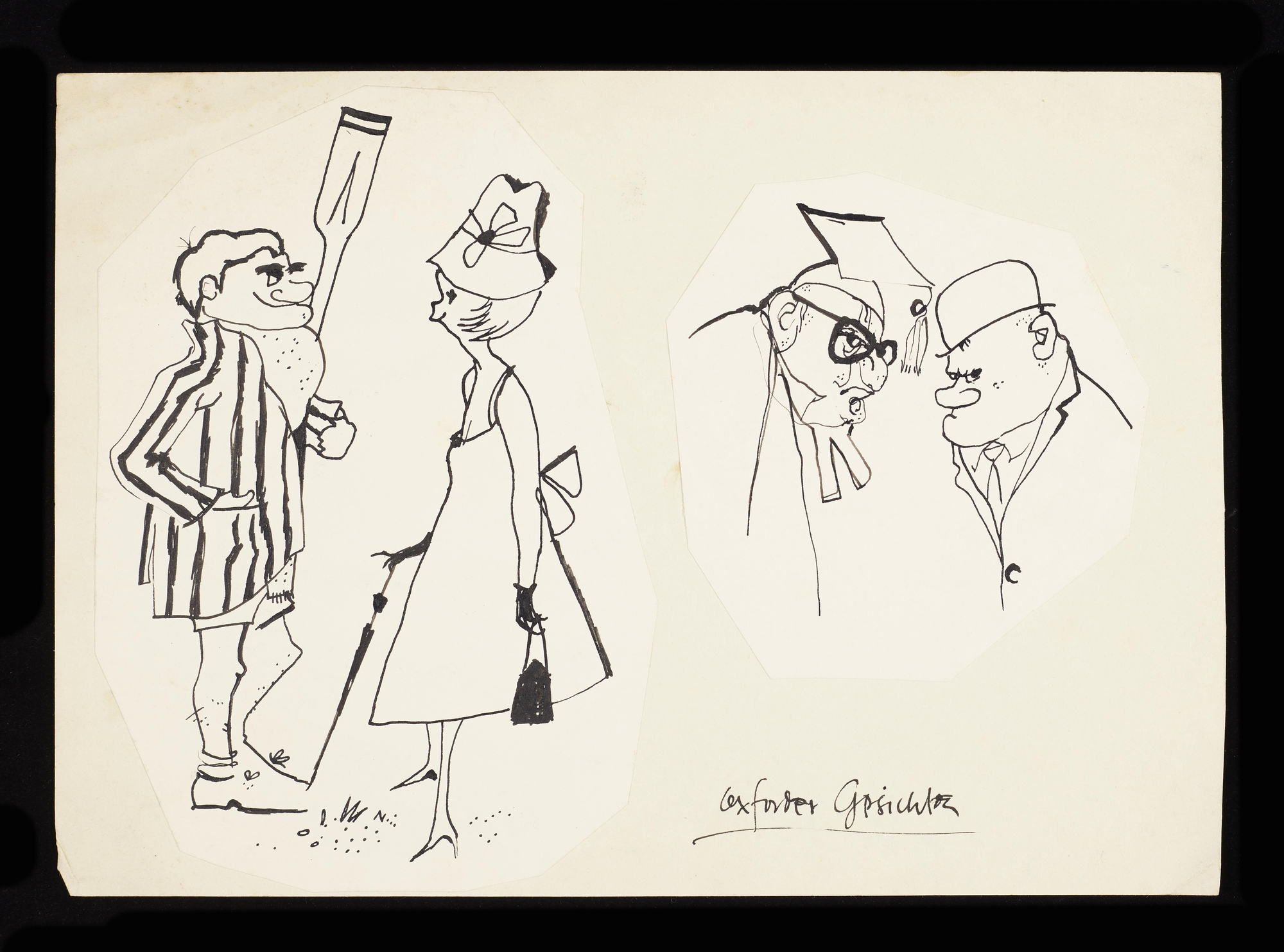
Dibujo titulado 'Oxford Gesichte' (caras de Oxford), 1953
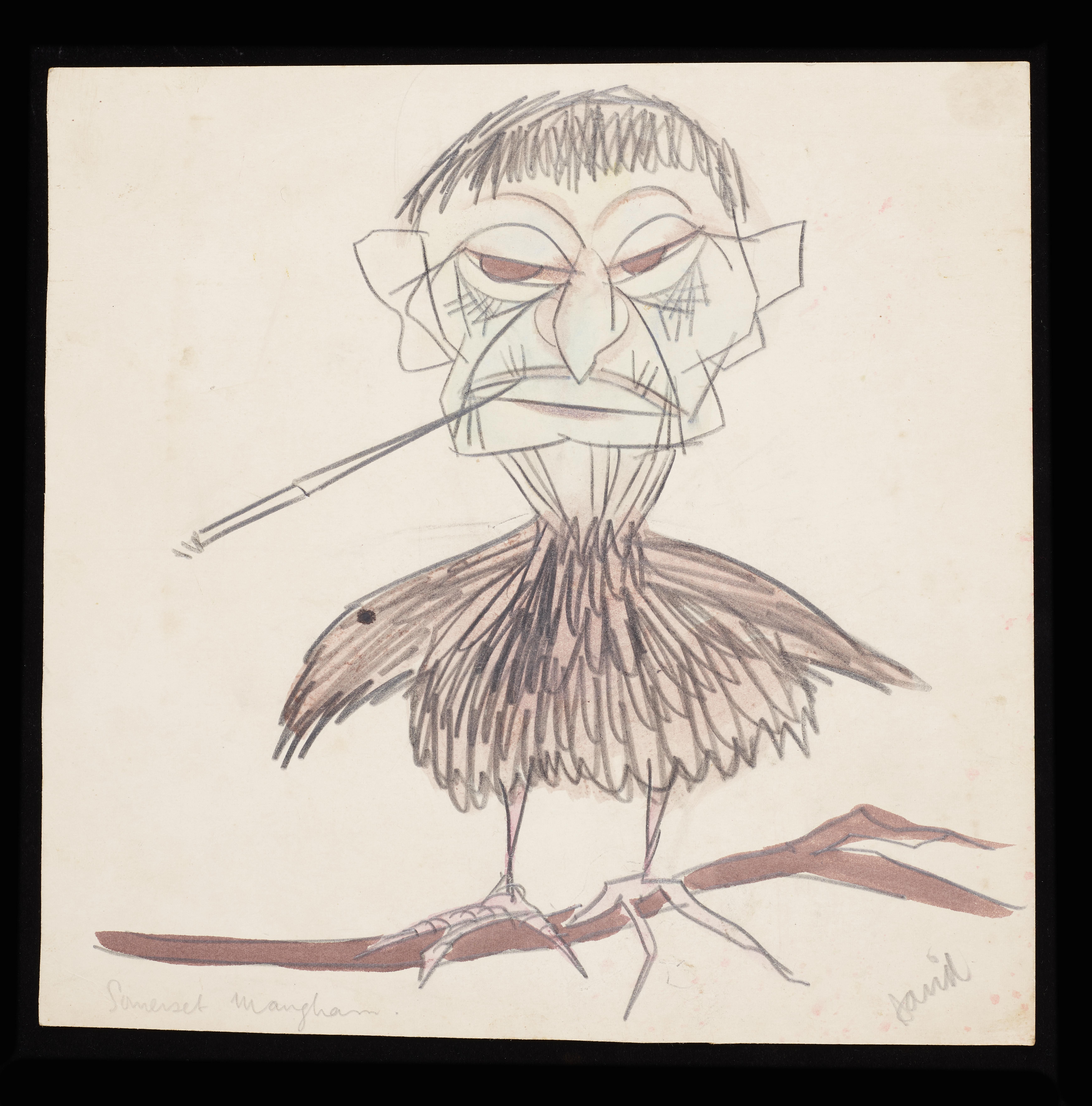
La universidad fue para él uno de los refugios lejos de su familia. Su madre se fue de casa cuando él tenía cinco años y hasta que él se marchó a los 16 vivió a ratos con su padre, Ronnie, un conseguidor que llegó a acumular deudas de cientos de miles de libras, pasó por la cárcel y decía detestar los libros que su hijo leía a escondidas. Somerset Maugham, Charles Dickens y Graham Greene eran sus favoritos.
Dibujo titulado 'Somerset Maugham' y firmado 'David'
Más allá de la Guerra Fría
Las novelas de Le Carré fueron evolucionando como la historia desde la caída del muro de Berlín. Los relatos a partir de los 90, como muestran El jardinero fiel oEl sastre de Panamá, se centran más en el crimen organizado y la oligarquía rusa que se entremezcla con el establishment británico, los abusos de las grandes corporaciones, la degradación del medio ambiente y la explotación de los países más pobres.
Por su propia experiencia como espía enmascarado de diplomático cuando trabajaba para el MI6, el servicio de inteligencia dedicado al exterior, en Bonn y Hamburgo, Le Carré también mostraba especial empatía por los vecinos del centro y el este de Europa que habían vivido al otro lado del Telón. Algunas de sus novelas fueron utilizadas como instrumento de propaganda por la Unión Soviética, como ejemplo de la supuesta decadencia de los espías británicos y sus dudas morales.
El historiador y periodista Timothy Garton Ash cuenta que a finales de los años 90 le envió el manuscrito de su libro El expediente, sobre el archivo que descubrió de sí mismo en la Stasi, de los tiempos en los que era un joven periodista en Berlín y había sido espiado por los que creía amigos. Le Carré le contestó con una carta de 16 páginas en la que le aconsejó que no se pusiera él de “víctima”. Las “verdaderas víctimas” eran “los pobres alemanes del Este, malhumorados, intimidados, chantajeados” que habían informado sobre él. Garton Ash le hizo caso.
Años después, en sus memorias, Volar en círculos, John le Carré escribió: “La auténtica verdad reside, si es que reside en algún lugar, no en los hechos, sino en los matices”.
---
La exposición John le Carré: Tradecraft está abierta hasta el 6 de abril de 2026 en la Biblioteca Weston de la Universidad de Oxford. La entrada es gratuita.
Dolor. Alivio. Miedo. Esperanza. Cansancio. Determinación. Pudor. Desahogo. Impaciencia. Perseverancia. Impotencia. Soledad. Socorro. Ternura. Comprensión. Incomprensión. Resignación. Rebeldía. Incomodidad. Aceptación. Tristeza. Anhelo. Amargura. Melancolía. Hartazgo. Expectativa. Compasión propia y ajena. Incertidumbre. Deseo. Resistencia. Amor, a fin de cuentas, sea lo que sea que signifique esa palabra para cada cual en cada momento del día, o de la vida. Todo eso y más vi, o creí ver, la otra noche en el rostro de la escritora Elvira Lindo mientras escuchaba en primerísimo contraplano a su marido, el escritor Antonio Muñoz Molina, confesarle al periodista Gonzo ante las cámaras del programa Salvados que la depresión que padece desde hace casi dos años le hace “acostarse y no querer despertarse”. Más que un poema, las caras de Elvira eran un poemario infinitamente más elocuente que sus palabras. Y si vi todo eso, o creí verlo, es porque lo he visto antes en otros y, demasiadas mañanas, en el espejo del baño al levantarme. El mapa emocional de alguien devastado por el sufrimiento de otro.
En este programa hablamos de las revelaciones más controvertidas sobre el 11 de septiembre de 2001, la implicación de agencias de inteligencia como la CIA y el FBI, el papel de Arabia Saudí y las acusaciones de encubrimiento. De la mano de Tucker Carlson, analizamos los testimonios de exagentes, documentos desclasificados y las investigaciones alternativas que cuestionan la versión oficial de los atentados contra las Torres Gemelas y el Pentágono. Una revisión crítica para entender qué pudo haber detrás de uno de los hechos más determinantes de nuestro tiempo.
¿Quieres probar la educación en línea y no sabes por dónde empezar? Hay claves que te ayudan a estudiar a distancia y que hacen el proceso más efectivo. Lo más importante es que organices tu tiempo, establezcas metas que puedas alcanzar con disciplina y evalúes tus progresos con constancia.
Te damos más consejos basados en técnicas y métodos para que aproveches al máximo todos los recursos y consigas buenos resultados.
Organiza un horario
Utiliza la técnica time blocking, que consiste en dividir tu día en bloques de tiempopara dedicarte solo a estudiar. Añade también pausas breves con el método Pomodoro: 25 minutos de concentración y 5 de descanso. Es importante que planifiques momentos de repaso y ocio, para mantener el equilibrio y no agotarte mentalmente.
Establece objetivos alcanzables
Esto lo puedes lograr con el método SMART: Specific, Measurable, Achievable, Relevant, Time-bound. Significa que cada meta seaespecífica, medible, alcanzable, relevante y con un plazo definido. Por ejemplo, “finalizar el módulo 1 y realizar el examen antes del viernes”.
Crea espacios de estudio
Sigue el principio de la higiene del entorno y usa unespacio iluminado, ordenado y libre de distracciones para mejorar la concentración. Ten a mano lo esencial, como el ordenador, un cuaderno y agua. Evita estudiar en el mismo sitio donde descansas o te diviertes.
Además de leer y escuchar, haz preguntas, subraya, toma notas y participa en debates en línea, compartiendo dudas y reflexiones con tus compañeros. Utiliza la técnica de Feynman, es decir, explica con tus propias palabras lo aprendido para reforzar la comprensión.
Apóyate en recursos digitales
Herramientas como Google Calendar, Notion o Trello facilitan el seguimiento de tareas. Además, los mapas mentales ayudan a resumir y visualizar relaciones entre ideas.
Evalúa tu progreso
Realiza pruebas de práctica o simulacros de examen,para fortalecer la memoria e identificar áreas débiles. De las claves para estudiar a distancia, esto también te permite registrar tus logros semanales y los temas a mejorar, para ver tus avances y ajustar tu plan de estudio según los resultados.
Usa la regla 3-2-1: 3 comidas equilibradas, 2 pausas activas para moverte al día y 1 momento de relajación. Esto aporta energía, reduce el agotamiento y mejora el descanso. El bienestar físico favorece la memoria y el rendimiento académico.
En conclusión, estudiar a distancia tiene ventajas y te da la oportunidad de conocerte mejor: descubrir en qué momentos eres más productivo, qué técnicas te funcionan y cómo mantener la motivación en el camino. Más que aprender contenidos, desarrollas disciplina, constancia y te adueñas de tu propio proceso de aprendizaje.
Infrastructure as Code has revolutionised how we manage cloud resources, and Terraform has been at the forefront of this movement. Terraform Stacks, announced at HashiConf 2025 as generally available, represents a major evolution in how we manage infrastructure at scale. If you’re new to Terraform Stacks, this guide will walk you through everything you need to know using a practical Google Cloud example.
Terraform Stacks are now GA and available on HCP Terraform. This means you can safely integrate them into your CI/CD pipelines and adopt them incrementally alongside your existing workspaces.
What Are Terraform Stacks?
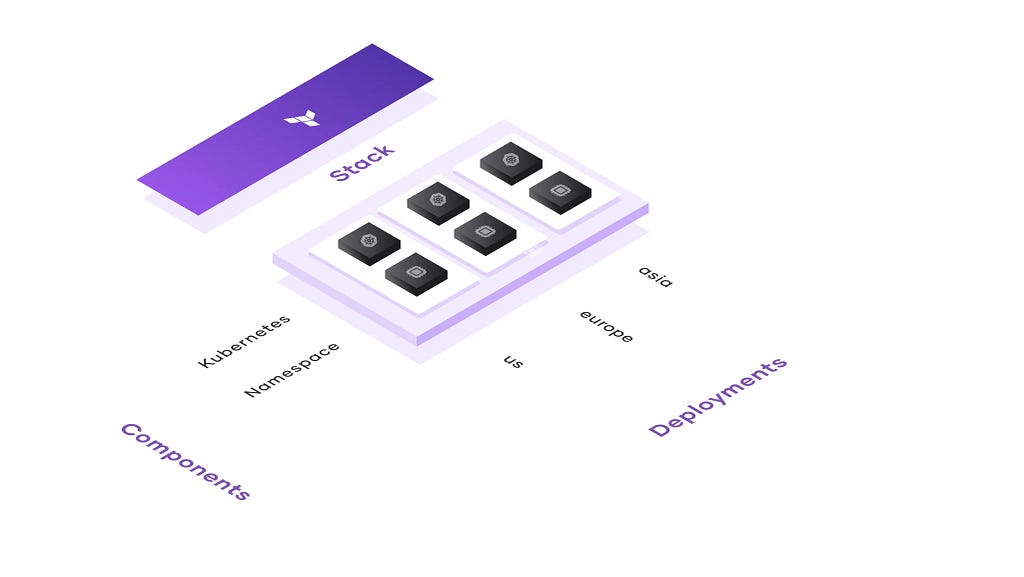
Think of Terraform Stacks as a way to organise and deploy your infrastructure more efficiently. They solve a fundamental challenge: as infrastructure grows, managing it across multiple environments, regions, or accounts becomes increasingly complex.
The Problem Stacks Solve:
Traditional Terraform workflows work great for single configurations, but scaling brings challenges:
Copy/paste fatigue — Duplicating configurations leads to drift and maintenance nightmares
Manual dependency stitching — When you split infrastructure across multiple configurations, you must manually manage dependencies between them
State file sprawl — Managing dozens of separate state files becomes overwhelming
Inconsistent rollouts — Coordinating changes across environments is error-prone
Terraform Stacks approach:
You write your infrastructure components once
You define where you want to deploy them (regions, environments, accounts)
Terraform Stacks handles deploying the same infrastructure to all those places
Each deployment is independent but uses the same base configuration
Real-world analogy: It’s like having a blueprint for a house. Instead of drawing a new blueprint for every house you build, you use the same blueprint but can customise details like paint colour or room sizes for each location.
Key Stacks Capabilities
Terraform Stacks brings powerful features for managing infrastructure at scale:
1. Component-Based Architecture
Deploy entire applications with networking, storage, and compute as a single unit without worrying about dependencies. Stack configurations can be handed to users without advanced Terraform experience, enabling them to stand up complex infrastructure with a single action.
2. Multi-Region/Multi-Account Deployment
Deploy across multiple regions, availability zones, and cloud provider accounts without duplicating code. When a change is made to the Stack configuration, it can be rolled out across all, some, or none of the deployments.
3. Advanced Features
Deferred Changes — Produce partial plans when encountering unknown values (perfect for Kubernetes workflows)
Linked Stacks — Define cross-stack dependencies with automatic downstream updates
Declarative Orchestration — Auto-approve plans that meet specific conditions
CLI-First Workflows — Create, manage, and iterate on Stacks without VCS integration
Compute Engine — Virtual machines to run your applications
Network — Private network for your resources and firewall rules
Service Account — Identity for your resources to access GCP services
Workload Identity Federation — Secure authentication without long-lived credentials
Stacks Configuration Files
Terraform Stacks uses many types of configuration files.
Variables (variables.tfcomponent.hcl)
Declares the input variables your Stack accepts
Variables in Terraform Stacks work similarly to traditional Terraform, but they’re defined at the Stack level and flow down to all components. This is where you declare what inputs your Stack needs from deployments.
variable "audience" { type = string description = "The fully qualified GCP identity provider name, e.g. '//iam.googleapis.com/projects/123456789/locations/global/workloadIdentityPools/my-tfc-pool/providers/the-tfc-provider'. This is the same audience value as you've configured in the identity_token block. Google requires this audience value to be set in the service account file itself as well as the token claim." }
variable "service_account_email" { type = string }
variable "project_id" { type = string }
variable "region" { type = string }
Key aspects of variables in Stacks:
Stack-level scope: Variables are defined once and used across all components
Type safety: Each variable has an explicit type (string, number, bool, list, map, object)
Defaults: Optional default values for variables that don’t need to be specified in every deployment
Validation: Use validation blocks to enforce constraints on variable values
Ephemeral variables: Mark sensitive data like tokens as ephemeral = true to prevent storage in state
Documentation: Descriptions are crucial for understanding what each variable controls
Components (components.tfcomponent.hcl)
Defines WHAT infrastructure you want to create.
Components are like building blocks. Each component manages one piece of your infrastructure (network, servers, IAM, etc.). Let’s look at an example:
# components.tfcomponent.hcl component "common" { source = "./modules/common" inputs = { project_id = var.project_id region = var.region } providers = { google = provider.google.default random = provider.random.default } }
Defines HOW to authenticate and connect to cloud providers
Provider configuration in Stacks works differently than traditional Terraform. Instead of defining providers in your modules, you centralize them in your Stack configuration and then map them to components.
# providers.tfcomponent.hcl # Step 1: Declare which providers your Stack needs required_providers { google = { source = "hashicorp/google" version = "~> 6.34.0" } random = { source = "hashicorp/random" version = "~> 3.0" } }
# Step 2: Configure the Google Cloud provider with Workload Identity provider "google" "default" { config { project = var.project_id region = var.region
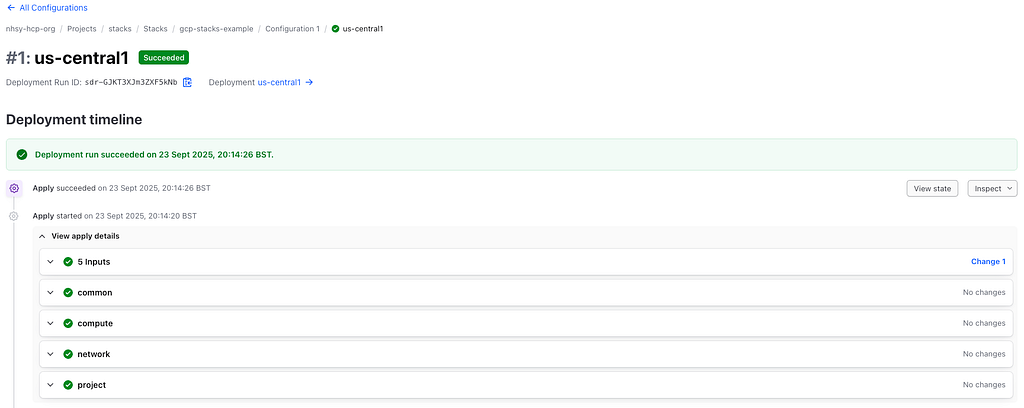
Each deployment is independent: Changes to us-central1 won't affect other deployments.
Each has its own state file: Terraform tracks resources separately for each deployment
Same infrastructure, different locations: Both deployments use the same components, just in different regions
Easy to add more: Want to deploy to Europe? Just add another deployment block
Output Configuration (outputs.tfcomponent.hcl)
Defines what information your Stack exposes to other Stacks or external systems
Outputs are crucial for sharing information between deployments, linking Stacks, or viewing the results of your infrastructure deployment.
# outputs.tfdeploy.hcl
output "instance_name" {
  type        = string
  description = "The name of the instance"
  value       = component.compute.instance_name
}

output "instance_zone" {
  type        = string
  description = "The zone of the instance"
  value       = component.compute.instance_zone
}

output "ssh_command" {
  type        = string
  description = "The SSH command to connect to the instance"
  value       = "gcloud compute ssh ${component.compute.instance_name} --zone=${component.compute.instance_zone} --tunnel-through-iap"
}
Key aspects of outputs:
Component references: Outputs values from components are refernces using component.<name>.<output>
Type safety: Each output specifies its type for validation
Sensitivity control: Mark outputs as sensitive = true to hide them from logs and UI
Deployment-specific: Each deployment has its own output values
Optional: Automation with Orchestration (HCP Terraform Premium tier only)
You can set up rules to automatically approve certain changes. This is optional and more advanced:
# deployments.tfdeploy.hcl (continued) # Auto-approve if there are no changes deployment_auto_approve "no_changes" { check { condition = (context.plan.changes.add == 0 && context.plan.changes.change == 0 && context.plan.changes.remove == 0) reason = "Plan contains changes that require manual review" } } # Auto-approve new deployments (new resources, no changes, no deletions) deployment_auto_approve "safe_changes" { check { condition = (context.plan.changes.add > 0 && context.plan.changes.change == 0 && context.plan.changes.remove == 0) reason = "Plan adds new resources, no changes or resources removed" } }
1. You write components (network, compute, iam)
   ↓
2. You define deployments (us-central1, us-east1)
   ↓
3. HCP Terraform reads your configuration
   ↓
4. For EACH deployment:
   - Generates identity token
   - Authenticates to GCP
   - Creates network component
   - Creates compute component (using network outputs)
   - Tracks state separately
   ↓
5. You now have identical infrastructure in multiple regions
Setting Up: Step-by-Step Walkthrough
Let’s walk through the entire setup process together.
Prerequisites
First, install the Terraform CLI version 1.13.x or newer:
cd bootstrap
terraform init    # Downloads required providers
terraform plan    # Shows what will be created
terraform apply   # Creates the resources (type 'yes' when prompted)
What this creates:
A GCP project configured for your Stack
A Workload Identity Pool (for secure authentication)
A service account (identity for your resources)
A HCP Terraform workspace
Step 4: The output values will be used in the next step.
Establishes a secure tunnel through Google’s Identity-Aware Proxy
No public IP address needed on the instance
Uses your existing Google Cloud credentials for authentication
Provides audit logging of all SSH sessions
Real-World Usage Examples
Example 1: Adding a New Region
Want to deploy to Europe? Just add a new deployment block:
deployment "europe-west1" {
  inputs = {
    audience              = "YOUR_AUDIENCE_VALUE"
    identity_token_file   = identity_token.gcp.jwt_filename
    project_id            = "YOUR_PROJECT_ID"
    service_account_email = "YOUR_SERVICE_ACCOUNT_EMAIL"
    region                = "europe-west1"  # New region
  }
}
Commit, push, and HCP Terraform will automatically create a new deployment.
Common Beginner Questions
Here are answers to questions that frequently come up when learning Terraform Stacks:
Q: What’s the difference between a module and a component?
A: A module is the traditional Terraform code (*.tf files) that defines resources. A component is a Stacks concept that wraps a module and makes it part of your Stack. Think of modules as the actual code, and components as how you use that code in Stacks.
Q: Why do I need both tfcomponent.hcl and tfdeploy.hcl files?
A: They have different jobs:
*.tfcomponent.hcl = WHAT to build (the components)
*.tfdeploy.hcl = WHERE to build it (the deployments)
This separation lets you define your infrastructure once and deploy it many times.
Q: Can I use my existing Terraform modules with Stacks?
A: Yes, you don’t need to rewrite anything. Just point your components to your existing modules on GitHub or Private Module Registry.
Q: What happens if I change a component?
A: All deployments using that component will get the change. That’s the power of Stacks — change once, deploy everywhere. But don’t worry — each deployment still plans and applies independently, so you can review changes for each region.
Cleaning Up
When you’re done experimenting:
Step 1: Uncomment the following destroy=true line in the deployments.tfdeploy.hcl file:
deployment "us-central1" {
...

  destroy = true
}
Commit your changes to your GitHub repository
Review and approve the plan in HCP Terraform
Step 2: Clean up bootstrap resources:
cd bootstrap
terraform destroy  # Type 'yes' when prompted
Best Practices for Beginners
Start with one deployment: Get comfortable with the workflow before adding multiple regions
Use clear names: Name your components and deployments descriptively
Validate locally before pushing: Run terraform stacks validate to catch errors early
Check the plan: Always review the plan before approving — see what will be created, changed, or destroyed
Use version control: Commit changes to Git so you can track and revert if needed
Keep components focused: Each component should manage logical components with a shared lifecycle, e.g. network, compute, database
Document your variables: Use descriptions so you remember what each variable does
Why Terraform Stacks Matter
Traditional Terraform is great, but as you grow, you face challenges:
Copy/paste fatigue: Copying configurations for each environment leads to drift and errors
Coordinating changes: Updating all environments consistently is manual and error prone
State management: Managing separate state files and workspaces gets complex
Dependency tracking: Ensuring resources are created in the right order across environments is tricky
What You’ve Learned
By following this guide, you now understand:
What Terraform Stacks are and why they’re useful
The difference between components and deployments
How to configure authentication with Workload Identity
How to bootstrap and deploy a Stack
How to add new regions or environments
Terraform Stacks CLI Command Reference
Beyond init and validate, the Terraform CLI provides several useful commands for working with Stacks. Here's a quick reference:
Local Development Commands
# Initialize your Stack (download providers and modules)
terraform stacks init

# Upgrade providers and modules to latest versions
terraform stacks init -upgrade

# Validate your Stack configuration
terraform stacks validate
Stack Management Commands
These commands interact with HCP Terraform to manage your Stacks remotely:
# Create a new Stack in HCP Terraform terraform stacks create \ -organization-name my-org \ -project-name my-project \ -stack-name my-stack
# List all Stacks in a project terraform stacks list \ -organization-name my-org \ -project-name my-project
1. I manage a married couple, and it’s causing problems
I manage a married couple. I hired one of them first, and a few years later the spouse finished a degree that gave them the right expertise to also join my team. They don’t supervise each other or make any promotion or budget decisions about each other.
At first things were good, but I’ve been noticing small things that are now bigger things in their communication patterns that need to be addressed. They are becoming really insular, not asking anyone for help except the other one, and not communicating issues or concerns outside the two of them, and recently they shared at a staff meeting that they have a lot of resentment about not getting the support they want (but have not asked for).
I know I need to talk to them individually and I should describe some specifics of what I am seeing and then describe what I need to see from each of them moving forward. Right now my list includes telling them that they can’t fight each other’s battles at work or speak for each other, and they need to be mindful about communicating like coworkers, not spouses, at work. And that if they don’t ask for help no one knows they need help. That last one is maybe more of a second issue, rather than specific to them being spouses.
Any advice or suggestions on how best to do this? Am I overlooking anything?
Your instincts are right. Name what you’re seeing (not talking to anyone but each other, not communicating about issues or asking for help, speaking for the other, fighting the other’s battles, and needing to operate like coworkers, not spouses, when they’re at work) and describe what you need them to do differently. Give some concrete recent examples, and describe what you would have liked them to have done differently, so that it’s not just theoretical.
I would also think about what you can do differently on your end to help break the patterns you’ve seen. Can you assign them to work more closely with other people or otherwise disrupt the rhythms they’re in? Can you check in with them more regularly to ask about problems and any support they might need? Meet with them each more regularly for a while so you’re able to spot issues faster and reinforce to them that this is something you’re taking seriously (both their concerns and your own)?
It’s also a good idea to check in with others on your team about how things are going, because it’s possible the married couple’s dynamics are affecting people in additional ways you aren’t seeing firsthand.
I work on-site with about 350 employees, most of whom are hourly and in uniforms. Normally, we just have the occasional “hey, please zip your jacket” type of chat, but one employee has decided uniforms are their personal hill to die on.
This person either refuses to wear the uniform at all (showing up in their own clothes) or wears it in a way that’s not appropriate for work (think fully unzipped, undergarments visible). We’ve had multiple documented conversations, but nothing changes. We finally issued written discipline, which they refused to sign while announcing they’ll “never wear the uniform, no matter what we do,” because it’s “too hot.” They’re the only one with this complaint, but they’re doubling down.
Complicating matters: this person is not only a poor performer, but also the longest-standing union steward in our entire company. They grieve every single conversation or document, and it turns into endless back-and-forth meetings. We’re not trying to fire them, we don’t even want to be writing them up. We just need them to wear the uniform like literally everyone else. But it’s become less about uniforms and more about their crusade to “win” against management.
If we keep documenting, it’ll be grieved as “petty,” and meanwhile they still show up out of uniform day after day. It also makes it nearly impossible to hold anyone else accountable when they can clearly see this person ignoring the rules with zero consequence. Per our CBA, we can’t skip straight to a final warning/termination because it’s not egregious enough on its own. This person was already terminated once before for a similar “hill to die on” type issue, but was reinstated following arbitration based on how silly the issue was to have had to fire someone over it!
For context: we’ve checked if the uniform doesn’t fit, offered different sizes, more pieces, even said they could bring in medical paperwork if it’s truly a heat-related issue. Nothing works. Ordering a whole new style of uniform for hundreds of people is not financially (or logically) an option. And because this person works overnight, directly with customers in sensitive situations, the uniform isn’t just a “look” — it’s a safety requirement so customers know they’re dealing with an official employee, not some random person wandering in.
So … what do we do here? We’ve tried being reasonable, but this employee is flat-out refusing. At this point, it feels like we’re stuck between playing endless grievance ping-pong or letting them win by showing up in street clothes.
You deal with the grievances. You discipline them every time, pointing to what sounds like a clear policy violation. Otherwise, you don’t really have a uniform policy; you have a uniform “suggestion,” and other employees will notice.
Also, you tackle the performance issues aggressively and head-on. Follow the requirements of your CBA, obviously, but you should tackle the performance issues to the full extent of the options available to you, even if that involves a ton of paperwork and aggravation. Otherwise it’ll be a year from now and you’ll be no better off than you are now. So play the grievance ping-pong and stand firm.
All that said, if they’re genuinely too hot, are there things you can do about that? Is there a version of the uniform that won’t be as hot (or could there be)? Can you add additional cooling in their area? Etc. If they’re complaining in good faith, you should respond in good faith as well (although given the history, they may not be).
3. When leadership is absent, what should be communicated?
I have a question about a situation from a few years ago. I work in a central office of a K-12 public school district in the U.S., where we’re constantly understaffed and under-resourced. Things move fast, and there’s not room for backup when key roles aren’t filled.
A new director was hired to oversee student services — responsible for about 100 staff and 2,000 students. From the start, he was frequently absent and unresponsive: taking regular three-day weekends and long gaps of several days to a week, even during critical times in the school year. His absences led to unresolved student issues, unsupported staff, and avoidable problems we’re still dealing with. Staff were frustrated, morale suffered, and his reputation quickly deteriorated. After a year, he left for another district.
Later, a colleague confided in me that the director had been undergoing cancer treatment during that time. While I fully support an individual’s right to privacy, I’ve been wrestling with this question: In cases where prolonged absence causes major operational impact, is it appropriate for leadership to offer no explanation at all? What’s the right balance between respecting privacy and maintaining transparency — especially in environments like ours, where there’s no capacity or budget to cover frequent or long-term absences? What would you advise for handling communication in a situation like this, both for the individual and for higher leadership?
Yeah, part of leadership is communication and judging how much communication — and transparency — is necessary for any given situation. Part of leadership is also realizing when not communicating about something sufficiently is likely to have a significant effect on morale, and making decisions accordingly.
I’d never want to say someone is obligated to disclose personal health information, but there’s a certain level of job that’s high enough — and where your actions and absences impact people in such significant ways — that part of good leadership is figuring out how to talk about what’s going on. That doesn’t mean you need to disclose everything, but you need to share something (for example, maybe just that it’s a health issue without getting into specifics).
If your director had explained what was causing his absences and unresponsiveness, you still would have had a lot of the same logistical issues, but I bet you would have had far fewer of the morale issues that stemmed from people thinking he wasn’t around because he didn’t care, was slacking or checked out, etc.
4. When should I tell my manager that I’m leaving the country?
My spouse has received an offer to transfer within their current company, for a higher level position located in an office halfway around the world from where we currently live. This is a longtime dream for my spouse and me, so they accepted the role and we’ll be moving in a little less than six months.
I am 95% sure that this move will mean leaving my current job (mainly, I can’t imagine a way to continue in my current role with a 15+ hour time difference). My company also has an office in the new city we’d move to, but I’ve never seen a role appear that is open to internal candidates. The only way I could see staying at the company is if my manager or another senior level employee in that office could create a new position for me (I’ve seen this happen a small number of times, but it’s certainly not a common occurrence). I want to know if that could be possible, and I want to help facilitate a smooth transition in the event I quit wholesale. But, I also don’t want to spill the beans about my move too early and end up without a job earlier than expected!
In any other circumstance, I’d give a few weeks notice and leave it at that. But it’s the small chance that there could be another job made for me that makes me want to bring it up earlier. If it’s not obvious, I don’t want to leave my job! I’m willing to leave to facilitate this great opportunity for my spouse, but I want to explore whatever options exist to maybe, somehow, stay working at my company.
There are two ways to do this. One is to bring it up a few months before your move as something closer to a hypothetical — “There’s a chance that Jane may be offered a transfer to Sicily. If that happened, would there be any way for me to stay on with the company? I love working here and I know we have an office there.” Be more cautious about doing this if your company is struggling financially and you suspect they may be considering layoffs; you don’t want to do anything that makes it easier for them to decide you’d be an easy cut since you’re likely to leave anyway.
The other way to do it is to give slightly more notice than you would otherwise — maybe three to four weeks rather than two — and as part of that conversation say that you’d love to stay on if working from the other office or remotely is a possibility.
5. Does my boss need to know I’m battling with our health insurance?
Should I give my boss a heads-up that I’m pulling out all the stops on my health insurance company?
Aetna denied my prosthesis, so I decided to ask our benefits people to connect me to central state contacts and potentially legal counsel for my second-level claim review board meeting. I was friendly and approachable to the benefits people (I appreciate their support, regardless of what they can provide!), but I wouldn’t be surprised if they escalate my request given the gravity of the situation.
Should I cue my boss in to the situation discreetly? It isn’t inherently obvious that I have a prosthesis, and I don’t volunteer medical information at work, otherwise.
You don’t need to loop in your boss. This is between you and your insurance.