Order your copy of The Let Them Theory 👉 https://melrob.co/let-them-theory 👈 The #1 Best Selling Book of 2025 🔥 Discover how much power you truly have. It all begins with two simple words. Let Them. —
What if the one thing that matters most for your success isn’t talent, luck, or intelligence, but something you can build starting today?
In this eye-opening conversation, renowned psychologist Dr. Angela Duckworth joins Mel to reveal the real science of success and what drives achievement – and it’s not what you’ve been told.
You’ll learn why grit – the combination of passion and perseverance – matters more than talent, intelligence, or motivation alone. And today, you’ll learn exactly how to build it.
Dr. Duckworth is a pioneering researcher in psychology, professor at The University of Pennsylvania, a MacArthur “Genius” Grant winner, and author of the #1 New York Times bestseller Grit, which has changed the way millions of people understand success.
In this powerful, research-backed conversation, she unpacks the truth about what it really takes to succeed and how you and your family can tap into this research in your daily life.
You’ll learn: -The four traits gritty people have (and how to build them) -Why most people quit too soon and how to stay motivated -How to develop a growth mindset at any age -What elite performers know about discipline that you don’t -Why your environment is quietly shaping your success
Success isn’t reserved for the gifted, it’s built by those who refuse to give up.
If you’re feeling stuck, unmotivated, or ready to give up, don’t. Not before you hear this.
Because grit can be learned. And this episode shows you how.
I’m just your friend. I am not a licensed therapist, and this podcast is NOT intended as a substitute for the advice of a physician, professional coach, psychotherapist, or other qualified professional. Got it? Good. I’ll see you in the next episode.
In this episode: 00:00 Meet the Guest 05:43 Rewire Your Brain for Success 13:30 Inside the Mind of Top Performers 17:15 The Truth About Talent and Why It’s Not Enough 23:03 How to Figure Out What You’re Interested In 43:15 Why You’re Not Getting Better (Even Though You’re Trying) 01:00:58 The Step by Step Guide to Finding Your Passion 01:15:17 How to Achieve Your Most Ambitious Goals 01:25:02 How to Stop Letting Your Phone Run Your Life
Brian Berletic is a former US Marine, author, international relations expert and host of the New Atlas. Berletic discusses how Trump's effort to present himself as a mediator in the Ukraine War has now collapsed.
Que vaya por delante que no soy muy de mostrar rentabilidades ni de alardear de nada en general, mucho menos después de tanto tiempo sin pasarme por aquí a publicar nada nuevo, pero en este caso voy a hacer una excepción y dejar por escrito lo que he vivido con Técnicas Reunidas.
Todos cometemos errores, cedemos a la gratificación inmediata o actuamos de manera impulsiva alguna vez. Es humano. El problema surge cuando, en lugar de asumir nuestra responsabilidad e intentar reparar lo que hicimos mal o aprender la lección, recurrimos a excusas para maquillar ese traspiés.
Obviamente, justificar una mala decisión puede brindarnos un alivio momentáneo. Reducimos la sensación de culpa, nos autoengañamos un poco y creemos que todo seguirá como siempre. Pero a largo plazo, recurrir demasiado a las excusas no es la estrategia más inteligente. De hecho, las personas mentalmente fuertes y maduras emocionalmente no suelen recurrir a justificaciones vacías o frases preconfeccionadas.
Estas son las justificaciones más comunes que no tienen cabida en su diálogo mental.
1. “No me importa lo que piensen los demás”
Afirmar que no te importan en absoluto las opiniones ajenas suena a independencia radical y a un “yo” fuerte, pero bordea peligrosamente la desconexión emocional. Ignorar por completo a los demás no es fortaleza, es insensibilidad. De hecho, ni siquiera es posible porque vivimos en sociedad, de manera que a menudo esta frase es solo una forma de autoengañarse.
Escudarte detrás de la idea de que no te importa lo que piensen los demás para no escuchar, a menudo denota egocentrismo y tozudez. Las personas mentalmente fuertes, en cambio, saben que no pueden complacer a todos, pero también reconocen el valor de escuchar diferentes perspectivas. Un poco de feedback honesto puede mostrarte puntos ciegos que no habías notado y que te ayuden a crecer.
2. “Merezco ser feliz”
Claro. Yo también. Y todos. De hecho, debemos tener mucho cuidado porque a menudo esta frase, revestida de un halo motivacional, es altamente peligrosa porque se usa como carta blanca para justificar cualquier cosa, desde darse caprichos que no nos podemos permitirnos hasta pasar por encima de los demás, solo porque tenemos derecho a ser felices.
Es importante que no confundas la felicidad con el hedonismo o la gratificación instantánea. Si recurres a esta excusa para permitirte cosas que no deberías porque te hacen mal o dañan a quienes te rodean, tienes un problema. Así de claro. Las personas mentalmente fuertes, en cambio, son capaces de alinear sus decisiones con su sistema de valores, no se dejan llevar por antojos o impulsos momentáneos.
3. “Yo soy así”
Esta es la excusa favorita de quienes no quieren cambiar. Afirmar “yo soy así” suena a autenticidad, pero en realidad es una forma elegante de decir: “no pienso esforzarme por mejorar”. En contraposición, las personas mentalmente fuertes son conscientes de que siempre hay algo que mejorar.
No se atan a una imagen fija de sí mismas ni se escudan tras la justificación del “soy así, no puedo cambiar”, sino que aprenden y se van adaptando a las circunstancias. Eso les permite afrontar mejor los problemas y evolucionar con las circunstancias.
4. “No tengo tiempo”
Detrás de esta frase suele esconderse una falta de prioridades claras, no de horas. Todos tenemos 24 horas cada día, la diferencia está en cómo las usamos. Decir “no tengo tiempo” suele ser una justificación banal para no reconocer la verdad: que quizás no quieras hacerlo, quizás no sea tan importante para ti, quizás te asuste o tal vez no sepas organizarte.
Las personas mentalmente fuertes no se engañan con esta excusa, asumen que no es falta de tiempo y responden de manera más sincera reconociendo, por ejemplo, que no están dispuestas a comprometerse o que simplemente no les apetece hacerlo. Eso denota madurez emocional y es una actitud mucho más honesta, tanto con los demás como consigo mismas.
5. “Todo el mundo lo hace”
Esta es la excusa por excelencia. Como si el hecho de que muchos se equivoquen volviera correcto el error. Desde copiar en un examen hasta mentir en un currículum o cualquier otra cosa que puedas imaginar, escudarse en lo que hace la mayoría solo demuestra una profunda falta de criterio propio.
Al final, el “todo el mundo lo hace” no es más que una forma elegante de rendirse a la presión social. Pero que algo sea común no significa que sea sano, útil o ético. Mi abuela solía preguntarme cuando era pequeña: «si todos saltan al vacío, ¿tú también lo harías?«. Las personas mentalmente fuertes saben que seguir al rebaño no siempre conduce al mejor destino. Ir contracorriente puede incomodar, pero eso es precisamente lo que diferencia a quienes piensan por sí mismos de quienes se limitan a imitar.
En resumen, las excusas son cómodas, pero a largo plazo suelen pasar una factura bastante elevada. Cada vez que las usamos, cedemos un poco de nuestro poder y nos impedimos aprender y crecer. Las personas mentalmente fuertes se equivocan, pero no se esconden detrás de frases hechas.
A fin de cuentas, el crecimiento comienza cuando dejamos de decir “no tengo tiempo” y empezamos a admitir la verdad. Cuando cambiamos el “yo soy así” por un “puedo mejorar”. O cuando abandonamos el “solo se vive una vez” por un “quiero vivir bien en sintonía con mis valores”.
El pasado viernes 10 de octubre las criptomonedas tuvieron uno de los días más volátiles y negros de su historia, en pocos minutos más de 1 millón y medio de…
Dr Neil deGrasse Tyson, world-renowned astrophysicist, breaks down the universe, space, black holes, and the Big Bang, uncovering how Elon Musk, AI, SpaceX, and NASA are defining the future of humanity.
As a science communicator, Neil is the host of StarTalk podcast, which covers science, pop culture and comedy. He is also the bestselling author of several books, such as ‘Astrophysics for People in a Hurry’ and the newly revised ‘Just Visiting this Planet: More Cosmic Quandaries from Dr. Tyson’s inbox’.
In this explosive conversation, he explains:
◼️80% of Gen Z believe the stars control their life ◼️The dangerous lie we believe about life’s purpose, and what to do instead ◼️Why you have 20% of the same DNA as a banana ◼️Why AI’s real danger isn’t what Hollywood warned you about ◼️Why simulation theory might explain every disaster on Earth
00:00 Intro 02:43 The Big Questions About the Universe and Our Existence 10:55 Why We're Not Good at Feeling Oneness With Others 15:48 Has Science Shaped Your Beliefs About Religion? 20:15 Did Humans Evolve to Believe in Something? 25:00 Changing the Way We See the Universe 30:32 Did the Loss of Your Parents Change Your Views? 35:05 Do We Live in a Simulation? 40:05 Do We Have Free Will in Our Society? 43:44 Will We Be Able to Extend Our Lives Soon? 45:57 What Happens When We Extend Everyone's Lives? 48:57 Neil deGrasse Tyson on AI 53:28 Will We Travel to Mars in Our Lifetime? 1:00:01 How Long and How Far Is It to Mars? 1:02:43 Ads 1:04:13 What Would Happen If the Earth Got Swallowed by a Black Hole? 1:07:51 Could the Sun Become a Black Hole? 1:09:06 What Happens If the Sun Freezes? 1:10:37 Every Breath You Take Contains the History of the Universe 1:15:25 Is the Universe Infinite? 1:16:34 Do Aliens Exist? 1:19:37 Why Do You Think Aliens Exist? 1:25:38 The Physics Error in *The Matrix* 1:28:22 Ads 1:30:26 The Questions We Dream Of 1:33:26 Should We Argue About Meaning? 1:37:18 Are Horoscopes Really a Thing? 1:42:15 Are You Happier If You Believe in God? 1:46:54 What's the Biggest Advice You Have for Me? 1:51:32 What Do You Think of America Right Now? 1:57:25 Do You Have Any Regrets?
UK - You can pre-order Neil’s revised book, ‘Just Visiting This Planet: Merlin Answers More Questions about Everything under the Sun, Moon and Stars’, here: https://amzn.to/4o9IXKo US - You can pre-order Neil’s revised book, ‘Just Visiting This Planet: Merlin Answers More Questions about Everything under the Sun, Moon and Stars’, here: https://amzn.to/3Wxvsbq
Es imposible negar la influencia de Hannah Arendt (1906-1975) en la teoría filosófica y política con obras como Eichmann en Jerusalén, Los orígenes del totalitarismo y La condición humana. Sin embargo, en una época en la que la democracia se ve disminuida en los gobiernos actuales, las teorías políticas de Hannah Arendt, décadas después, arrojan luz sobre la posible comprensión de la crisis democrática mundial.
A continuación, siete de sus ideas clave.
La pérdida del pluralismo
Para Arendt, la política nace en el espacio público, donde las personas toman conciencia de los actos del resto, así como de los propios. La política debe ser plural, un espacio donde convivan diferentes puntos de vista y haya un debate entre la comunidad. Con el pluralismo, es posible incluir al otro y que se potencie la liberad y la igualdad política. Sin embargo, en una sociedad donde se rechaza al otro (por diferencias económicas, raciales, de género, etcétera) no hay un pluralismo representado realmente en la democracia.
Alienación del individuo en la sociedad de masas
Al anular el pluralismo, se anula la reflexión crítica. En una debilitación de la democracia y un auge del totalitarismo, se busca alienar a cada persona y se retuerce la burocracia para despersonalizar a la masa. Si bien Arendt criticaba esta alienación en los totalitarismos del siglo XX, como también lo criticó la filósofa Simone Weil en Reflexiones sobre las causas de la libertad y de la opresión social, esto se puede ver reflejado en la actualidad en la sensación de impotencia ante el clima político y bélico mundial.
Desconfianza en las instituciones
Con el monopolio de la política y la alienación de los individuos, comienza el odio del Gobierno y el disgusto hacia este, según Arendt en Los orígenes del totalitarismo. El pueblo, que se ve apartado de la política, comienza a desconfiar y a odiar tanto a los políticos como a las instituciones y sirve como caldo de cultivo para que se dé un auge de los movimientos populistas.
La incapacidad fundamental para actuar es siempre característica de las tiranías
Auge de movimientos populistas
Con la Alemania nazi y el estalinismo, emergieron los movimientos populistas, que marcan una separación y delimitan un enfrentamiento entre dos grupos: el pueblo «real» y la élite «corrupta». Con la idea del pueblo «real», un pueblo que ignora el pluralismo, se combina el populismo con el autoritarismo y el nativismo (con un odio hacia las etnias distintas de la que debería ser la correcta y representativa del pueblo «real»; en el caso que explica Arendt fue hacia el pueblo judío).
Espejismos dentro de las democracias
Uno de los dos espejismos que explora Arendtera el de suponer que las masas que eran indiferentes políticamente no importaban, que eran neutrales y que eran un fondo en la vida política de la nación. Habían hecho creer a secciones del pueblo que sus opiniones y luchas no eran importantes, y explica que «lograron convencer al pueblo de que las mayorías parlamentarias no correspondían necesariamente a las realidades del país, minando así el respeto propio y la confianza de los Gobiernos que también creían en la regla de la mayoría más que en sus constituciones».
Propaganda, noticias falsas y desinformación
«La sinceridad nunca ha figurado entre las virtudes políticas y las mentiras han sido siempre consideradas en los tratos políticos como medios justificables», sostiene Arendt en Las crisis de la república. Los líderes de masas dentro de una crisis democrática intentan seducir al pueblo con falsedades. Pero antes de conseguir el poder, para «encajar la realidad en sus mentiras, su propaganda se halla caracterizada por su extremado desprecio por los hechos como tales», explica en Los orígenes del totalitarismo. Según la filósofa, cuanto más pequeño sea un movimiento político totalitario, más energía gastará en propaganda. Dicha propaganda antes no accedía con tanta facilidad a los medios, pero ahora, sobre todo con el bombardeo de información en las redes sociales, es más común que se vea incluida dentro de las noticias falsas.
El terror: el gobierno del miedo
El miedo y el terror son una forma sólida de dominación. Es, según Arendt, la esencia del gobierno totalitario, y se representa en la banalización del mal, los asesinatos en masa, el abandono de la solidaridad, los campos de concentración y las amenazas constantes. Sin embargo, con el auge de los conflictos bélicos y de los populismos en los últimos años, ciertos países supuestamente democráticos están viviendo una especie de terror en los términos que Arendt expone en Los orígenes del totalitarismo por las amenazas como medio de intimidación. Además, de acuerdo con la filósofa, el aislamiento, que se está dando en las sociedades occidentales actuales, «puede ser el comienzo del terror; es ciertamente su más fértil terreno; y siempre su resultado». «El aislamiento y la impotencia, es decir, la incapacidad fundamental para actuar, son siempre característicos de las tiranías. Los contactos políticos entre los hombres quedan cortados en el Gobierno tiránico y frustradas las capacidades humanas para la acción y para el poder», afirma.
En una mudanza, vaciar las estanterías y llenar las cajas de libros (y luego hacer el proceso a la inversa) enfrenta a una especie de crisis existencial. La de preguntarse cómo y por qué se tienen tantos libros. A veces está la alegría de descubrir que, oculto entre aquellos volúmenes a los que no se presta mucha atención, estaba un libro que se creía perdido. Y otras es la constatación de que en medio de toda esa pila hay un número excesivo de libros que no se han leído. Algunos pueden llevar décadas en casa, esperando pacientemente que llegue su turno de lectura.
Se puede hacer el ejercicio masoquista de calcular, poniendo a una media de 20 euros el tomo, cuánto dinero se ha gastado en libros que nunca se han abierto. Se puede también aceptar que no todos esos libros han llegado a casa por decisión propia. A veces te regalan libros que no apetece tanto leer (o, para quien desempeña según qué trabajos, se reciben libros de cortesía que inundan las estanterías de novedades no siempre deseadas). O se puede dar la vuelta a todo esto y aceptar que los libros no leídos tienen un valor y un papel.
No se trata solo de abrazar a manos llenas el tsundoku, la idea de comprar libros por el mero placer de acumularlos, sino de entender que los libros no leídos tienen una, por así decirlo, misión. Se compran con la promesa de que algún día nos serán útiles (y por útil entiéndase una aceptación amplia del término).
«Es esencial comprar libros que no vayan a ser leídos enseguida», escribe en Cómo ordenar una biblioteca (Anagrama) Roberto Calasso (la cursiva es suya). «Al cabo de uno o dos años, o acaso de cinco, diez, veinte, treinta, cuarenta años, llegará el momento en el que se sentirá la necesidad de leer precisamente ese libro —y tal vez lo encontremos en el estante poco frecuentado de la propia biblioteca—». Seguramente se podría hacer una investigación científica sobre cuánta dopamina liberamos en el momento exacto en el que queremos leer una cosa concreta y descubrimos que nuestro yo del pasado se encargó de tenerla ya dispuesta, por lo que no tenemos que esperar nada para lanzarnos a la lectura.
Igualmente, la acumulación de estos libros no leídos tiene mucho ver con la fábula de la cigarra y la hormiga. Así como la hormiga se preparaba para los rigores del invierno, quien guarda libros no leídos lo hace (consciente o inconscientemente) para el momento en el que ese tomo haya desaparecido del mercado. «Mientras tanto, puede suceder que ese libro se haya vuelto irrepetible, y difícil de encontrar incluso en un anticuario, porque es de escaso valor comercial», escribe Calasso.
Si el título no triunfa en los primeros meses, desaparece pronto de las mesas de novedades
El mercado del libro se ha vuelto acelerado y efímero. La cantidad de libros que se publican cada día en España es elevadísima (algunos cálculos estiman que sale un libro nuevo cada seis minutos), un ritmo que es imposible de seguir por el público lector, pero también por las librerías. El espacio es el que es y el ritmo de novedades obliga a estar constantemente rotando los productos. Las librerías de fondo son una especie en peligro de extinción y las ventanas de comercialización de los libros se están volviendo cada vez más cortas. Si el título no triunfa en los primeros meses, desaparecerá de las mesas de novedades y de las estanterías, abocado a convertirse en pulpa de papel.
Esto crea presión en el mercado del libro y entre quienes leen, porque seguir el ritmo de las novedades es imposible. Las bibliotecas no siempre conservan todo lo que se publica (al fin y al cabo, su espacio tampoco es infinito). Eso está llevando a preguntarse si no es posible leer de otra manera y reivindicar llegar tarde a los libros, pero también a que el público más precavido se haga con los títulos que captan su interés antes de que se eclipsen en librerías y desaparezcan.
Por supuesto, esto no debería ser visto como una invitación a un consumismo desaforado. No hay que comprar todo lo nuevo que sale por si en algún momento querremos leerlo. Al fin y al cabo, existe el autoconocimiento lector y es fácil adivinar qué nos podrá valer y qué no.
Ahí es donde entra la idea de biblioteca personal. Suena un poco a descripción pretenciosa, pero al final somos curadores de nuestros propios fondos bibliotecarios. Sabemos qué nos interesa y qué nos podrá llegar a interesar, lo que permite desarrollar una colección especializada. Puede que por trabajo o por interés personal sepamos que vamos a necesitar lo que se publica sobre historia de las mujeres decimonónicas, el valor de los jardines o las tendencias geopolíticas del siglo XXI. O que nos guste llevar de viaje libros relacionados con el lugar en el que hemos estado. O que amemos con pasión a Jane Austen, Benito Pérez Galdós o Virginia Woolf y nos hagamos con las nuevas ediciones de títulos que ya tenemos. No lo leeremos todo en el momento en el que lo compremos, pero algún día llegaremos a ello.
¿Y qué pasa cuando abres ese libro tiempo después de haberlo comprado? Calasso habla de una «extraña sensación», la de haber sido capaces de anticiparse a las necesidades del yo del futuro, pero también de una cierta frustración, de estar disfrutando tarde lo que podrías haber leído mucho antes.
Todos tenemos una necesidad de ser vistos, el problema es cuando creemos que eso no es ético, a partir de ahí reflexionamos sobre el perfil narcisista y mucho más en un nuevo episodio de Destellos de Sabiduría. No te lo pierdas
La historia trata de que en Madrid hay muchos hoteles, cada vez más, "de lujo". Concretamente, se nos dice, en la ciudad de Madrid hay 810 hoteles. "De ellos, 40, el 8%, son considerados de lujo, explican desde la Comunidad de Madrid." No sabemos exactamente quién ni dónde ha dicho lo de que 40 son de lujo. Pero o ellos, o el periodista de El País anda flojucho en matemáticas porque 40, sobre 810, son más bien el 4,9%, no el 8%.
La noticia continua: "Pronto serán más. La capital prevé 20 nuevas aperturas hoteleras entre 2026 y 2028, según el Plan Estratégico de la Asociación Empresarial Hotelera de Madrid. De ellos, 18 serán de cuatro y cinco estrellas, y tendrán un precio promedio de 1.000 euros la noche. El nuevo modelo de turismo madrileño se abraza al lujo."
No he podido encontrar el texto de ese plan estratégico, así que no sé si la estimación del precio promedio de 1.000 euros la noche aparece en él, o es de otra fuente. Pero la cifra me ha llamado mucho la atención, porque además no se refiere solo a hoteles "de lujo" sino a hoteles de cuatro y cinco estrellas.
¿Y cuáles son los precios de los hoteles de cuatro y cinco estrellas actualmente en Madrid? Pues veamos, he hecho una búsqueda en una de las típicas plataformas online para el fin de semana del 21 al 23 de noviembre, en Madrid ciudad, de hoteles de 5 estrellas. Es una búsqueda sin demasiada anticipación. Han aparecido 40 hoteles, y el más caro tenía un precio de 911 euros por noche. El precio medio estaría en 440 euros por noche, y el mediano en 370. Repito la búsqueda para una fecha más próxima. Menos anticipación, menos oferta, peores precios, imagino. Así es: solo salen 22 hoteles, el más caro con un precio medio 1.515 euros por noche, el precio medio en torno a los 710 euros, y el mediano unos 550. Voy a hacer una nueva búsqueda, para una sola noche, para una fecha próxima, esta vez entre semana, para el martes 28 de octubre. Salen 39 alojamientos. El más caro está en 1.650 euros, pero solo hay cuatro por encima de los 1.000 euros. El precio medio son 532 euros, y el mediano 396.
No voy a echar el día en esto. He buscado solo en hoteles de cinco estrellas, para fechas más bien próximas, y los precios medios han sido 440, 710 y 532 euros (y los medianos entre 70 y 150 euros menos). Los hoteles por encima de los 1.000 euros en todos los casos eran una pequeña minoría de los encontrados. Imaginen qué habría pasado si hubiera incluido también hoteles de cuatro estrellas. O si hubiera buscado precios con cuatro o cinco meses de antelación.
Por tanto, resulta francamente difícil de creer que el precio medio de los 18 nuevos hoteles de cuatro y cinco estrellas en Madrid vaya a ser de 1.000 euros. ¿Sería matemáticamente posible? Sí, claro, si hubiera pocos de cuatro estrellas y entre los de cinco estrellas hubiera algunos con precios muy altos, claramente por encima de los que actualmente se cobran normalmente en Madrid. Desconozco las características concretas de esos 18 proyectos empresariales pero sería raro que hubiera una apuesta tan radical por ir a por el sector del mercado más pequeño.
Más bien parece que alguien, en la organización empresarial, o en el periódico, se ha venido arriba. Si fueran los primeros, tal vez lo han hecho con ilusión y orgullo de una ciudad que apuesta por el lujo, y de un sector pujante y rentable. Si fueran los segundos, seguramente el espíritu es otro, crítico con la expansión en la ciudad de negocios potencialmente alejados de los intereses de los que vivimos en ella.
En todo caso, creo que alguien se le ha ido la mano. Los turistas que "pagan 1.000 euros por noche" serán, casi con toda seguridad, una pequeña minoría de los que se alojen en los nuevos hoteles de cuatro y cinco estrellas, como los son ahora incluso en los hoteles solo de cinco estrellas. Y seguirán siendo una ínfima minoría del total del turismo en Madrid. Decir que Madrid apuesta por ese turismo es una disparatada exageración.
El yoga trasciende la práctica física sobre la esterilla para convertirse en una filosofía de vida integral. Basado en los yamas (principios éticos) y niyamas (disciplina personal), invita a desarrollar una presencia consciente que permea todos los ámbitos diarios. Aunque los ásanas son esenciales, el verdadero alcance del yoga radica en la aplicación constante de […]
😱 Hay 10 hábitos comunes en los que es muy fácil caer y que pueden sabotear por completo tu progreso como filósofo. ¡Veámoslos! 👇🏾 💥 Descubre 5 Libros de Filosofía IMPRESCINDIBLES👉🏽 https://youtu.be/4_G152NGXWQ
🤓 Y si te mola la Filosofía y quieres APRENDER MÁS de un modo sencillo, ameno y accesible, consigue MI LIBRO: "¿Hay filosofía en tu nevera?". ¡TE ENCANTARÁ!
¡Hola, filoadictos! Soy Enric, tu profesor de filosofía en Youtube, y esto es Adictos a la Filosofía, el canal en el que amamos a Platón, Aristóteles y todos los grandes pensadores de la Historia de la filosofía. Llevo cerca de 15 años dedicado al estudio de la filosofía, y a lo largo de este tiempo me he dado cuenta de que existen 10 errores comunes que pueden sabotear tu progreso como filósofo. He caído y sigo cayendo en estos malos hábitos mil y una veces, y algunos son tan complicados de detectar que me ha costado años descubrirlos... pero, ahora que los conozco, los veo continuamente tanto en gente que acaba de empezar en filosofía como en veteranos filósofos que llevan toda una vida dedicándose a filosofar. Por ello, lo que me gustaría hacer en este vídeo es destaparte estos 10 hábitos silenciosos, estos 10 vicios del filósofo, para que seas capaz de detectarlos a tiempo y ponerles remedio antes de que sea demasiado tarde. ¡No te lo pierdas!
(Un vídeo ideal como introducción a la filosofía, o para el Bachillerato y la Selectividad)
0:00 - ¿Qué se requiere para ser filósofo? 10 errores a evitar 0:43 - Error 1 que te sabotea como filósofo 2:34 - Error 2 que te sabotea como filósofo 4:28 - Error 3 que te sabotea como filósofo 5:46 - Error 4 que te sabotea como filósofo 7:15 - Error 5 que te sabotea como filósofo 8:21 - Error 6 que te sabotea como filósofo 9:22 - Error 7 que te sabotea como filósofo 10:44 - Error 8 que te sabotea como filósofo 11:27 - Error 9 que te sabotea como filósofo 12:40 - Error 10 que te sabotea como filósofo
😱 Y si estás leyendo ESTO, es que perteneces al 0.5% de la gente que se lee las descripciones HASTA EL FINAL! 👏 Déjame un comentario con un emoji de león 🦁 para hacérmelo saber; si veo muchos, ¡me alegrarás el día! 😄
❤️ PATREONS y MIEMBROS (¡mil gracias!) Bruce, Elias Aram, Fabrizio Barone, David Castro, Magdalena Villena, Will Luzader, Fabiola L., Juan Diego Sánchez, José Luis Garrido, Juan Ignacio Cantarero, Matías Ochoa, MrNetaar, Andrés E. Castaño, Ana Alvarez, Rodrigo Banegas, Tojo labal, Alfredo Sánchez
El gobierno ha establecido nuevas reglas que cambian por completo el mundo de los creadores de contenido.
A partir de ahora, los influencers que quieran opinar sobre temas como medicina, derecho, finanzas o educación deberán demostrar que tienen estudios, certificaciones o formación real en esas áreas.
Nada de improvisar ni difundir información sin respaldo: quien no pruebe su conocimiento, no podrá publicar ese tipo de contenido.
Las plataformas también estarán obligadas a verificar las credenciales de quienes hablen de asuntos “profesionales o especializados”.
Una medida que busca frenar la desinformación, pero que también despierta un gran debate sobre la libertad en internet.
Mientras en otros países cualquiera puede volverse “experto” de la noche a la mañana, China ha decidido trazar una línea: “Si vas a enseñar, primero demuestra que sabes.”
💌 Contacta conmigo o solicita más información sobre mis servicios en info@claudianicolasa.com o por Whatsapp al +34 679 65 89 30
¿Por qué alguien lo tiene todo… y aun así se destruye? Charlie Sheen fue el actor mejor pagado de la televisión, símbolo del éxito y del exceso. Pero detrás de su fama había una historia de adicciones, vacío y una profunda necesidad de sentirse vivo a través del caos.
En este vídeo analizo, desde la psicología, cómo la personalidad de Charlie Sheen lo llevó a sabotear su vida y su carrera, explorando temas como:
La personalidad adictiva y la búsqueda constante de intensidad. El autosabotaje y la sensación de no merecer el éxito. Los mecanismos psicológicos detrás de la autodestrucción. El papel del trauma, la validación y la falta de límites.
🧠 Comprender su historia nos ayuda a entender algo más universal: por qué algunas personas solo se sienten vivas cuando están al borde del abismo.
00:00-01:30 Contexto del caso de Charlie Sheen 01:31-06:42 La personalidad adictiva: personalidades con tendencia al consumo y adicciones 06:43-09:06 Cómo su infancia impactó en su autoestima: necesidad de éxito, admiración y comparación 09:07-13:50 El autosabotaje por vergüenza e inseguridad inconscientes 13:51-18:32 La importancia de sufrir castigos y consecuencias: el alter ego narcisista 18:33-21:52 Las defensas maníaco-narcisistas: el declive de Charlie Sheen 21:53-25:02 El camino hacia la vulnerabilidad y la sanación 25:03-25:55 Terapia de calidad al alcance de todos: Estar Contigo Terapia
Somewhere in your AI journey, you’re going to push the limits of what models can do.
You might need to squeeze out that extra bit of performance, or try to fit a big model right under a GPU’s VRAM limit. All of these situations require tweaking and redeployment. That’s not as simple as it sounds, when the infrastructure includes everything from GPU clusters to storage to networking.
The solution is to treat your infrastructure the same way you treat your application code. It needs to be versioned in Git. It needs to be tested. And it needs to be deployed through an automated pipeline. This practice, known as Infrastructure as Code, or IaC, is the foundation of any serious MLOps strategy.
This article is a practical guide on how to use Terraform for agile ML engineering. I’ll walk through a real-world example of deploying a high-with vLLM on Google Kubernetes Engine. You can follow along with the complete source code on GitHub in the vllm-gke-terraform repository.
We will use the Qwen3–32B model in this article, which can be run on easily accessible NVIDIA L4 GPUs on Google Cloud. The Terraform script has been tested on larger models, such as the Qwen/Qwen3–235B-A22B-Instruct-2507 on a cluster with 8 H100 GPUs.
The scripts currently use GKE standard clusters for maximum flexibility. For production workloads where you want to offload node management and focus purely on the application, it’s recommended to leverage GKE Autopilot capabilities.
Declarative Infrastructure
Terraform uses a declarative language (HCL) where you define the desired end state of your infrastructure. You specify what you need, and Terraform’s engine calculates the necessary API calls to make the real-world infrastructure match that state. Before applying any changes, you can run the terraform plan command to see a detailed preview of what Terraform will create, modify, or destroy.
This allows for a thorough review to ensure the proposed changes align with your intentions, preventing unintended modifications. This declarative model is the key to eliminating configuration drift and ensuring that every environment is provisioned identically, a critical requirement for reproducible experiments.
To manage this, Terraform maintains a state file that maps these definitions to their real-world resources. For team collaboration, using a remote state backend like Cloud Storage is recommended. It provides a centralized source of truth and uses locking mechanisms to prevent conflicting changes. Here’s how to instruct Terraform to use GCS as its backend:
Terraform modules are the primary mechanism for abstraction and reuse. MLOps teams can create a library of standardized modules for common components like a GKE cluster or a vector database.
Modules are made reusable through input variables. This allows an engineer to maintain a single, version-controlled set of Terraform files and use variable files (.tfvars) to launch new, isolated deployments.
To test a new model, you could simply create a new variable file like llama3-test.tfvars. By overriding a few default values, you can spin up an entirely new, isolated environment to test Llama-3–8B on L4 GPUs:
Running terraform apply -var-file=llama3-test.tfvars makes spinning up parallel experiments a trivial, declarative operation, dramatically increasing a team’s experimental throughput.
For production systems, this same principle allows for sophisticated, zero-downtime strategies like Blue/Green deployments. A second, parallel “green” version of the entire stack is deployed by instantiating the Terraform configuration with a different set of variables. Once the new environment is fully validated, production traffic can be instantly switched at the load balancer or DNS level. The old “blue” environment can then be decommissioned. By codifying these complex release strategies, the entire deployment process becomes a version-controlled, auditable artifact.
Configuring the vLLM Engine
Provisioning hardware consistently is the first step. Configuring software to utilize that hardware efficiently is next.
The sample project uses the popular vLLM inference engine. Let’s show how to effectively link Terraform variables to configuration parameters in vLLM.
In variables.tf, the high-level knobs for experiments are defined:
# variables.tf
variable "gpu_memory_utilization" {
  description = "GPU memory utilization ratio"
  type        = number
  default     = 0.9
}

variable "max_model_len" {
  description = "The maximum model length."
  type        = number
  default     = 8192
}

variable "vllm_max_num_seqs" {
  description = "The maximum number of sequences (requests) to batch together."
  type        = number
  default     = 64
}
Then, the deployment in kubernetes.tf consumes these variables to construct the vLLM server’s startup arguments:
# kubernetes.tf ... container { name = "vllm-container" args = compact([ # --- Base Model Arguments --- "--model", var.model_id, "--tensor-parallel-size", tostring(local.gpu_config.accelerator_count),
The sample project showcases a blueprint for a production-grade inference endpoint on GKE designed for both performance and cost-efficiency.
The gke.tf file provisions a GKE cluster with both spot and on-demand GPU node pools, which allows for a flexible and cost-effective approach to managing expensive GPU resources. You can read more here about the strategy to back up spot VMs with an on-demand node pool.
To avoid re-downloading large models on every pod restart, a kubernetes_persistent_volume_claim is created in kubernetes.tf to provide a persistent cache for the Hugging Face models. A Kubernetes Job, defined in kubernetes_jobs.tf, is then used to download the specified model into this persistent volume. This job runs to completion before the main vLLM deployment is scaled up, ensuring the model is ready before the inference server starts.
Automated Workflows
While Terraform itself is a big leap forward from shell scripting, it’s crucial that teams don’t stop there. The next step beyond running manual terraform commands is to embrace an automated, end-to-end CI/CD workflow, often called GitOps. The source control repository becomes the single source of truth for both application code and infrastructure.
The sample project includes a basic GitHub Actions workflow that validates the Terraform code on every push and pull request.
# .github/workflows/terraform-validate.yml name: 'Terraform Validate' on: [push, pull_request]
A complete CI/CD pipeline would extend this by running terraform plan on pull requests to preview changes and automatically running terraform apply on merge to the main branch to deploy them. This creates a flywheel where code is pushed and infrastructure is updated without manual intervention.
Infrastructure-as-Code is a now an AI Competency
The main takeaway is this: mastering Infrastructure as Code isn’t an optional “DevOps” skill. It’s a core competency for the modern ML engineer. For any organization serious about productionizing AI, Terraform on Google Cloud is the a key step toward building a scalable engineering culture.
I think everyone knows that when you open Netflix, what you are shown is curated to your interests and viewing history. So the home page affords you quick access to recent viewings, new releases, similar movies, and so on. There is a search function for specific titles, but no apparent way to search for all the rom-coms or all the soccer movies.
Netflix has in its deep files about 5,000 movies, and there is a way to access detailed lists of movies by category using a list of codes.
The codes reveal Netflix's complete organizational system. Instead of broad categories like "Action" or "Comedy," you get hyper-specific genres like "Martial Arts Movies" (code 8985) or "Classic Action & Adventure Films" (code 46576). Some categories contain hundreds of titles, while others might have just a handful of carefully curated selections.
What surprised me most was discovering content that never appeared in my regular browsing. Shows and movies that existed in Netflix's library but were essentially invisible due to the algorithm's assumptions about my preferences. It's like finding a hidden room in your own house.
Here are examples of how the categories are subdivided (links in the image are not clickable):
John Oliver discusses the ceasefire in Gaza and Donald Trump’s quest for a Nobel Peace Prize, as well as how Paramount Skydance has named Bari Weiss the new Editor-in-Chief of CBS News, and what it all has to do with The Fuck Hole Times. Really worrisome publication, from what we’ve heard.
Subscribe to the #lastweektonight YouTube channel for more almost news as it almost happens: www.youtube.com/lastweektonight
Or find us on your favorite social media platform we may or may not have discussed at length on the show:
There seems to be a growing belief that we could safely fall back on coal if we needed more electricity, or should all other options fail due to supply chain bottlenecks. Data suggests, however, that we are facing the same double whammy with coal as with oil or other energy resources; resulting in a worldwide peak and decline in coal use — no matter what. So while the savior of industrialists / the nightmare of environmentalists might never come true, we could still find ourselves sitting in the dark.
Thank you for reading The Honest Sorcerer. If you value this article or any others please share and consider a subscription, or perhaps buying a virtual coffee. At the same time allow me to express my eternal gratitude to those who already support my work — without you this site could not exist.
Coal never went away
Modern civilization faces many predicaments; essentially all stemming from the over-exploitation of natural resources and the immense pollution released by their consumption. Contrary to common sense — dictated by economic theory — overshooting natural limits cannot be overcome by replacing one resource with an other, or by hoping that rising prices would incentivize more extraction (and make all the bad things disappear). In reality we are at the cusp of a major tipping point, marking the end of centuries of growth and the onset of what we could call ‘radical simplification’. And what could be a better example for all this, than the energy resource starting it all: coal.
The black rock hasn’t left the scene with the advent of oil or nuclear — let alone “renewables” which are anything but. The reason is simple enough, these energy sources are not interchangeable, but complementary. Oil needs machines and pipes to be extracted, refined and used. All of these equipment, however, is made mostly from steel, which in turn is made by burning copious amounts of coal. And not just any coal, but the purest type with the highest energy density: metallurgical grade coking coal. The rest of the (much lower grade) carbon fuel can thus be burned in power plants, so that oil — moving more than 90% of all goods and people across the surface of the planet — need not to be combusted to generate electricity.
Nuclear power plants, producing fourteen thousand times more electricity per ton of fuel than coal, too, require steel and concrete to build, as well as a fleet of diesel trucks to mine and deliver uranium to power them… Not to mention an external source of 24/7 electricity to run their cooling pumps. Many of these inputs, however, would become unavailable without coal. Take Portland cement for example, where coal is not only a source of heat, but fly ash as well — an important component in the cement mixture. So while alternative fuels, such as natural gas, gets increasingly mixed in as “alternative fuel” in cement manufacturing, it still cannot fully replace coal.
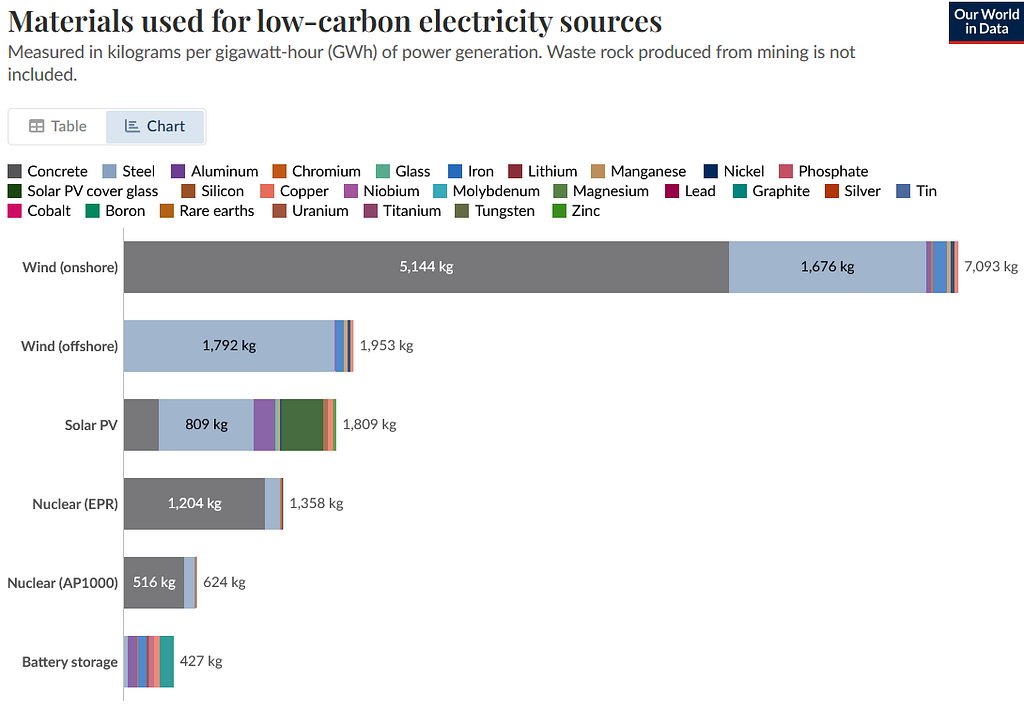
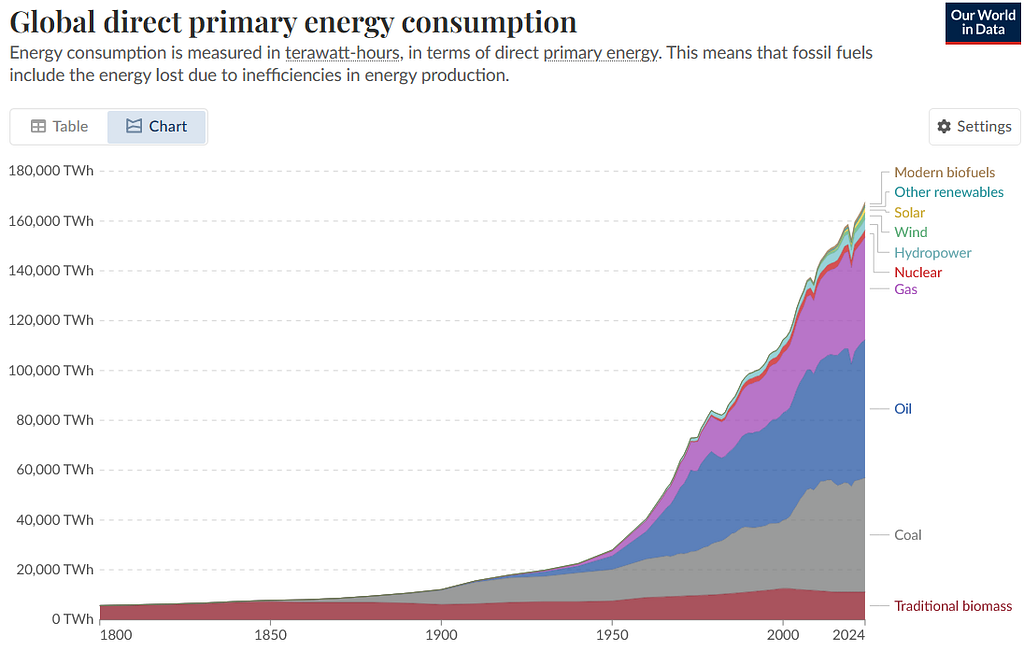
You see, coal has not disappeared with the advent of new technologies, just moved into the background. All of our “low-carbon” energy technologies rely predominantly on concrete and steel — both made with coal. Does that mean we could burn much less carbon by first turning it into other energy harnessing technologies — including gas turbines and solar panels? Yes. In a certain sense, all of these technologies — ostensibly aimed at getting rid of the most polluting fuel — are just a smarter way of burning coal. By using the black rock to produce metals, silicon wafers, cement etc. (then building power plants from these), we are simply increasing the amount of electricity generated by burning the same amount of coal. In practice we just kept increasing the efficiency with which we use coal over time. First by switching to internal combustion engines, then by adding solar panels and EVs to the mix. And has that led to an overall decrease in coal’s use?
In 1865, economist William Stanley Jevons observed that more efficient steam engines, perhaps paradoxically, led to increased coal use. As the fuel cost per unit of work was reduced, so could more and more businesses afford to run a steam engine, leading to a steady increase in coal’s overall consumption. And as you can see from the chart above, this trend hasn’t stopped ever since Jevons made his observations. In fact, it was only turbocharged by the advent of oil and nuclear. As coal was no longer required to move ships and locomotives, and only the best part of it (anthracite) was needed to be used to make more machines, regular coal and lignite became so cheap, that a mass electrification of entire continents have suddenly become feasible. Add to that the fact that open pit mines were also made possible by diesel engines hauling away entire mountain tops — making coal’s extraction cheaper than ever — and you have a supermassive positive feedback loop. More oil powered machines, more coal. Yet more machines, even more coal.
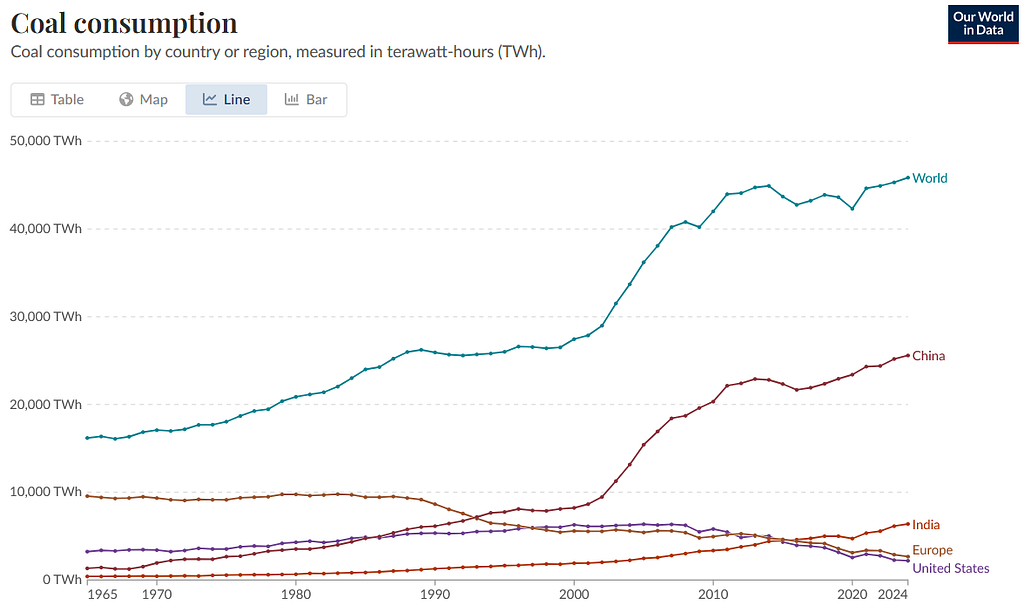
The use of coal worldwide has thus continued to grow exponentially, hand in hand with the utilization of every other fossil fuel and nuclear energy. At least until 2011, when growth in Chinese coal consumption stalled — at the same time when European and American use of this solid fuel began to decline. Superficially we could say, ‘Oh, coal was just replaced by natural gas, which can be used to generate electricity even more efficiently’ — but that’s just half of the story. First, demand for electricity in the West has stopped growing after the great financial crisis (and only returned to growth recently in the US with the advent of data centers). Basically we have electrified what could have been reasonably electrified (and no, road transport doesn’t belong to that category). Second, the real economy has entered an era of stagnation, and in the case of Europe, it began to decline sharply as the continent began to deindustrialize.
Meanwhile, the price of electricity in the West just kept rising, climbing a good 30% higher during the past five years, disincentivizing any further growth in power demand. (Again except for powering the AI-bubble.) These rising prices has started to eat into people’s budget, forcing them to cut back on consumption — and not just direct consumption (at home), but indirect use through reduced purchases of goods and services requiring electricity to make or provide (e.g.: eating out).
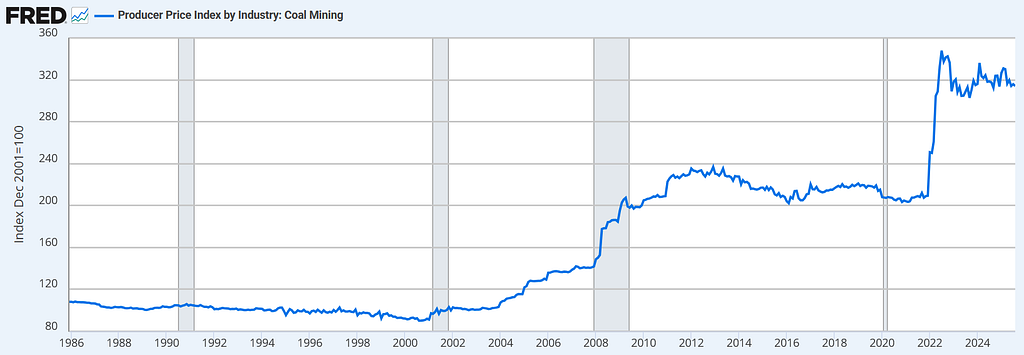
U.S. Bureau of Labor Statistics, Producer Price Index by Industry: Coal Mining, retrieved from FRED, Federal Reserve Bank of St. Louis; October 6, 2025.
On the supply side of things coal production also took a hit as coal prices could no longer keep up with climbing extraction costs. As shown by the Producer Price Index (1) dataset above, the cost of mining coal effectively doubled between 2004 and 2012, then grew by another 50% in 2022 when the sanctions put on Russian coal has sent fuel and electricity prices soaring worldwide. You see, coal is mined with diesel engines and electric machinery — and if these input costs rise, while coal prices fall back to previous levels, mines’ profitability plummet. At the same time when coal got more expensive, natural gas has become a lot cheaper thanks to hydraulic fracturing. This has led to nearby natural gas fields outcompeting coal. For example the Marcellus and Utica shale gas fields near Appalachia, a major source of coal in the U.S., has led to the closure of a number of coal fired power plants and their subsequent replacement with gas turbine power generation.
Depletion is king
Coal, just like any other mineral resource, however, is neither infinite nor is evenly distributed. Some of it lies close to the surface and provides high quality anthracite. Most of it, however, is either situated much deeper underground or further away from major industrial and population centers… Or simply is of a much lower quality. This means, that after harvesting the highest quality, easiest to get portion, mine shafts have to go deeper and deeper at an ever increasing cost, or mines would have to be opened further and further away from where coal is used. As an analysis on the matter found:
“These higher prices are seen most acutely in the Appalachian coal producing regions, where coal has been more expensive for years due to the depth of coal within the mines, a problem that only becomes more acute with more mining.”
The depletion of easy-to-get coal had two major implications. First, transportation costs began to rise: from 30% of the delivered cost in 2009 to 40% in 2023. Coal is heavy, bulky and contains a lot less energy per ton than hydrocarbons. Since it cannot be transported by pipelines either, barges, trains and trucks — all operating on diesel fuel — must carry it to the closest power plant, steel mill, or port (for export). This not only exposes the high impact diesel prices have on delivered coal prices, but also the fact that without adequate diesel fuel supply entire industries would have to move closer to coal mines — which is a highly unlikely scenario, if you ask me.
The second major implication is the relentless rise in the cost of operating mines themselves. Open cast mines, produce coal at one third of the cost per ton compared to underground facilities. This means that as surface mines deplete, and we have to dig deeper underground for coal, extraction costs could blow well past the selling price of the black rock. And again, as demand for electricity stagnates and as electric bills get more expensive, these higher extraction and delivery costs will soon become impossible to justify. The analysis, cited above, shows that in 2024 coal power was 28 percent more expensive than in 2021, costing consumers $6.2 billion more to generate power via coal than it would have cost in 2021. Not only the cost of fuel and delivery has increased for plants, but operations, maintenance and capital costs as well, due to aging power plants and inflation. Plants also ran less on average since 2021, which drove up their cost in dollars per MW-s generated, making these even less competitive to other sources of power. As a result, nearly half of these generating units saw their costs increase double the rate of inflation over the 2021–2024 period.
To add insult to injury, many countries experience a peak in coal extraction before power plant capacity reaches its maximum. In practical terms this means, that grid operators often add more power plants than what could be economically operated, ending up with a huge overcapacity — even as collieries begin to deplete and as extraction becomes ever more costly. This double whammy of rising input costs and worsening energy returns on energy invested then leads to a collapse of profitability and ultimately both power plants and mines being left to rust.
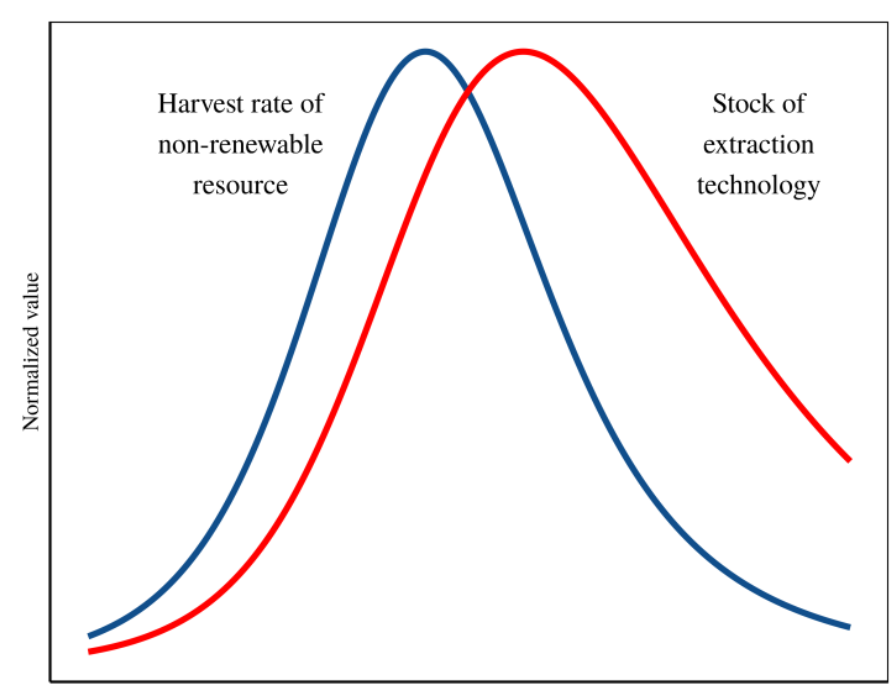
It’s interesting to note here that natural ecosystems display a similar pattern, called predator-prey relationship. For example an expanding wolf population will cut into the growth rate of the neighboring sheep population, causing it to decline. This eventually leads to a situation where there are more wolves than what could be supported by the number of sheep in the area, causing the predator population to decline — with a slight delay. As Blair Fix showed so brilliantly, the same dynamic can be observed during the extraction of non-renewable resources, where mining equipment and machines represent wolves, and the resource in question — in our case coal — equals the sheep, the pray our predatory system feeds on.
The predator-prey relationship between non-renewable resources and technology. Source
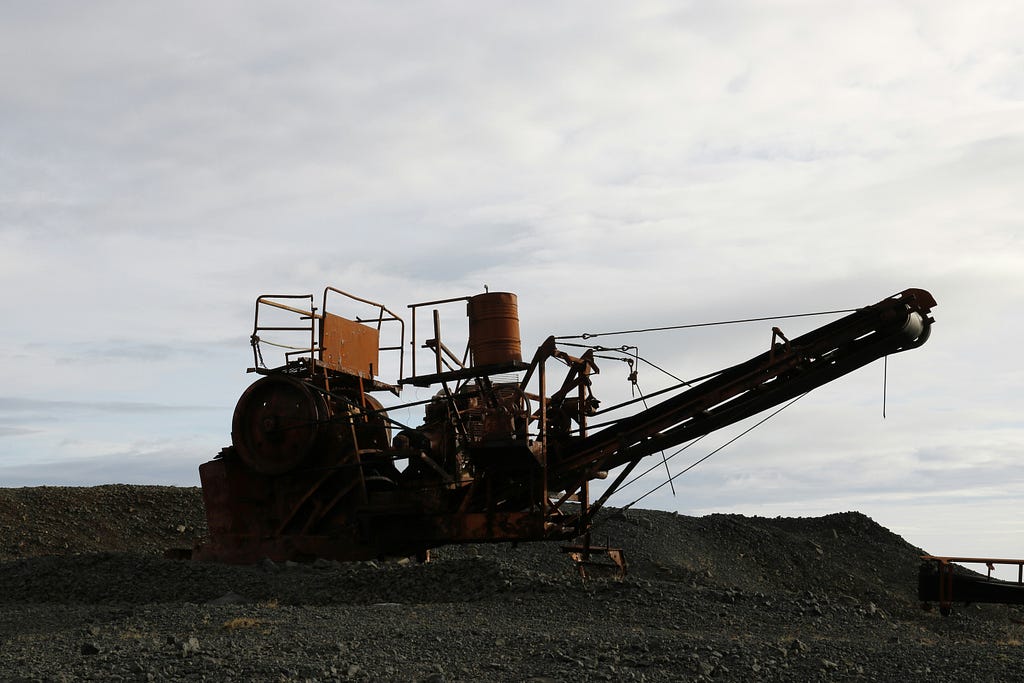
Coal power generation all across the world has thus found itself on a downslope. Not because of other electricity generating technologies taking its place, but because of depleting coal mines and ever worsening returns on investment. You see, we would experience the same downturn of coal production even without alternatives to take its place. The only reason the swan song of coal is not heard is that it’s droned out by the coming online of “alternatives”. Hence the selling of this story as “progress”. If natural depletion continues as it is, however, eventually coal fired power plants will all have to close in the years and decades ahead, and there will be no return to coal. So even if gas turbine shortages, or supply chain bottlenecks would force companies to return to burn the dirtiest of fuels, they might end up finding a dead black swan where they expected a unicorn to pop up.
And, no, it really doesn’t matter how badly any administration would want to keep coal alive, either. By issuing a series of executive orders to reduce the number of plants subject to EPA’s Mercury and Air Toxics Standards, and to keep uneconomic plants running long-term using short-term emergency powers, they could keep these plants open just a little longer — but could not possibly restore their profitability. So while these actions have granted “pollution passes” to 71 high-pollution plants so far, including coal plants and dozens of copper smelting facilities, consumers will eventually have to foot the bill. According to Grid Strategies, a power sector consulting firm, American ratepayers will pay more than $3.1 billion in extra power bills every year if fossil fuel plants slated for retirement continue operating through 2028.
As a result of the rapid deterioration of coal’s economics, 99 percent of coal plants are now more expensive to continue operating than being replaced with local wind or solar. “Replacing coal plants with local wind and solar would also save enough to finance nearly 150 gigawatts of four-hour battery storage, over 60 percent of the coal fleet’s capacity” — according to the authors. However, and as I explained elsewhere, this is still nowhere near enough to compensate for the day-to-day variability in “renewable” electricity supply, let alone for the huge seasonal variations so pervasive in the global North. So, while on paper at least, “renewables” might seem to be a cheaper option, intermittent wind and solar simply cannot compensate for the loss of stable baseload supply. (Oh, and besides that, these technologies still require the burning of tons of coal — just elsewhere.) Simply put as coal (and later natural gas) gets more expensive, many consumers will find themselves priced out of the market, or will be forced to put up with an increasingly intermittent power supply.
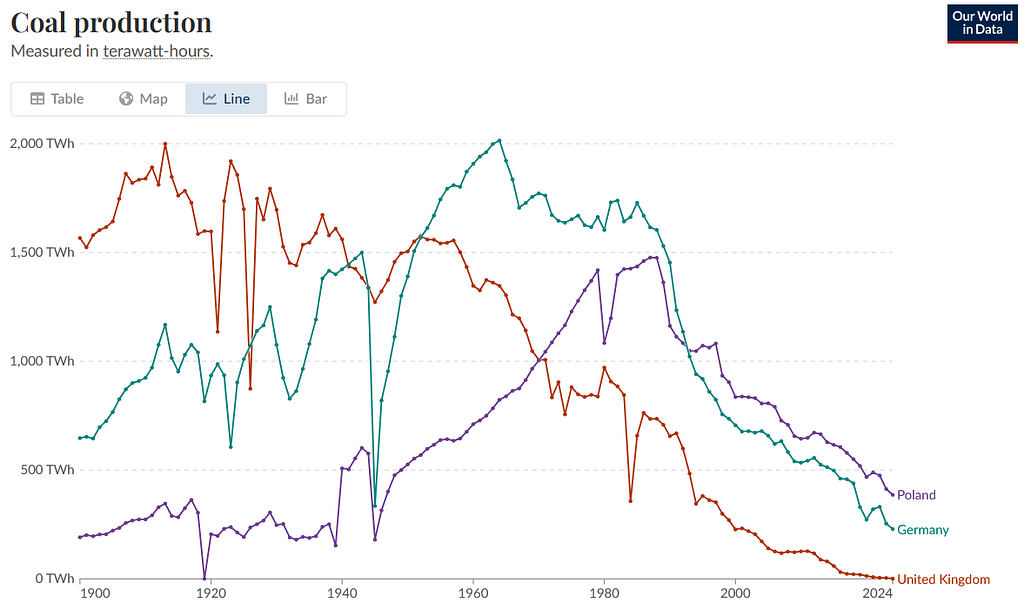
A depletion induced collapse of the coal power sector is neither a uniquely American, nor a recent phenomena. European coal production is well past its all time high, and by the time the Green New Deal was signed in 2019, more than half of the 1982 peak European supply was lost already. British coal extraction peaked in 1913 (!), the German in 1964, and the Polish in 1988 — and neither happened because of climate concerns. Let’s take Poland, a true laggard when it comes to “phasing out” coal, for example. Following Europe’s sanctions on Russian energy (needed to keep coal mining profitable) Poland experienced a doubling in coal production costs in 2022. By 2025 high input costs (electricity and diesel chief among them) has forced mines to sell their produce well below the cost of extraction. The issue has been made worse by natural depletion: as mine shafts went deeper and deeper, the cost of bringing up coal increased exponentially… Again we see the same double whammy: rising input costs and worsening energy returns on energy invested. At the same time, Polish power plants will be have to be shut down due to age and costs. After 2025, when public support ends, the first 8 GW of coal capacity may leave the Polish system, and a little later, another 6 GW.
Extend that declining curve to zero, please.
With an increasing number of countries announcing the “phase out” of coal, and with deindustrialization in the West raging on, this trend can only be expected to accelerate. So while it might be fashionable to use the term “phase out” for an age and natural depletion induced coal infrastructure collapse in Europe, the fact remains a fact: there is no return to coal here, either. Once the crumbling of the coal supply chain accelerates beyond a point — bringing all prior economies of scale with it — and as mines go bankrupt one after the other due to rising costs and worsening returns, the death spiral becomes inescapable.
Make no mistake, from an environmental perspective this is no doubt good news. As for the future prospects of industrial civilization, well, not so. Once shut close, reopening mines, rebuilding power plants and infrastructure would not only cost huge amounts of money, but would put us back on the same treadmill of depletion and worsening returns. To do so would thus presuppose an ever growing economy capable to pay the ever increasing cost of coal generated electricity… But with oil and gas also peaking, people becoming poorer by the day, and all possible ecological and climate boundaries being passed, what’s the chance of that coming true…? (Rhetorical question.)
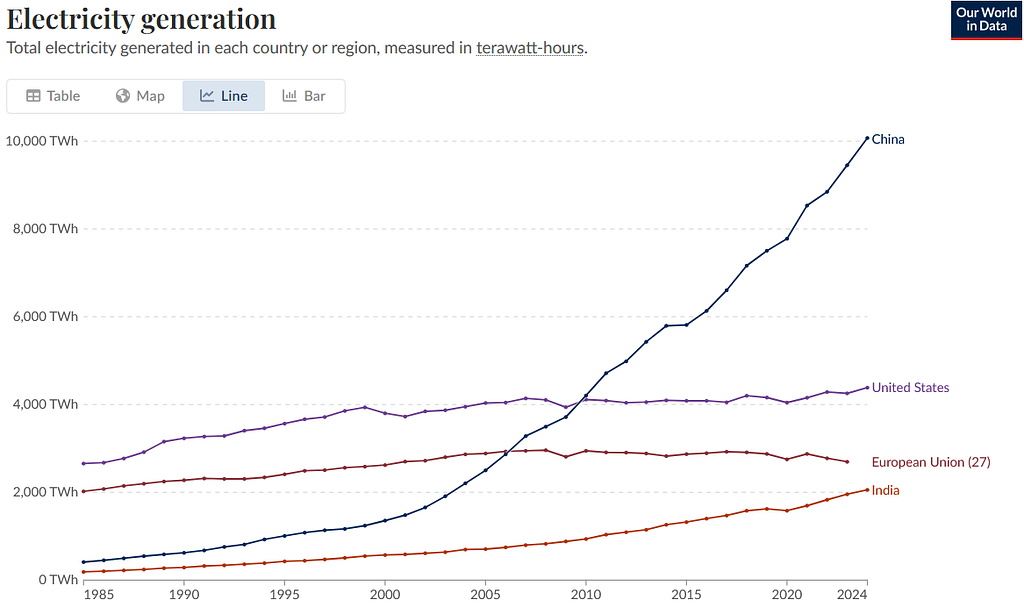
And if coal production can peak both in America and Europe, it sure can (and most certainly will) peak in China, Australia, and India as well. And if the European use of the term “phase out” of coal is anything to go by, China’s goal to hit peak carbon emissions by 2030 and carbon neutrality by 2060 signals an imminent peak in coal output there, too (2). And since carbon based fuels are still essential to make steel, concrete, silicon wafers etc. this will also signal a coming peak in industrial output and electricity generated. Folks, we are not talking about centuries, but a few decades under which miracles would need to happen.
Coal, oil and gas is not being phased out — we are running out of the accessible portion of these fuels.
So while hydro, nuclear, wind and solar power plants will continue to be made and feed power into the grid after fossil fuel consumption peaks, grids will become increasingly unreliable and fragile as baseload and spare parts slowly disappear. From a day to day perspective, the decline in electricity supply thus won’t look like what you see in the movies. Instead of a sudden zombie apocalypse, expect a flickering, increasingly unreliable power supply… Till two to three decades down the line the once continuous ocean of energy dries up, leaving only a few small ponds here and there where electricity is still available. The rest will have to learn how to do without 24/7 power.
Until next time,
B
P.S.: listen to this highly informative podcast from Nate if you want to learn more about how grids operate and why baseload is critically important.
Thank you for reading The Honest Sorcerer. If you value this article or any others please share and consider a subscription, or perhaps buying a virtual coffee. At the same time allow me to express my eternal gratitude to those who already support my work — without you this site could not exist.
Notes:
(1) The Producer Price Index calculates price changes in private contracts based on suppliers’ input prices. It is thus a measure of a measure of wholesale inflation, while the Consumer Price Index measures the prices paid by consumers (source).
(2) During the first half of 2025, “renewables” already generated more electricity than coal worldwide, for the first time in history. Electricity from fossil fuels seem to be on a high plateau in China, too, and with a continued rapid expansion of wind, solar and nuclear coal use can be expected to fall in the years ahead all around the globe. However, since the production of nuclear, hydro, and “renewables” still depend on coal, natural gas and oil, the same predator-prey analogy applies to them as with coal and its power plants. However, the delay between peak fossil fuel use and the peak electricity produced by these “alternative” sources will be much longer, due to the lifecycle of these technologies. (“Renewables” take a huge upfront investment from fossil fuels, but can operate for decades with minimal fossil inputs.)