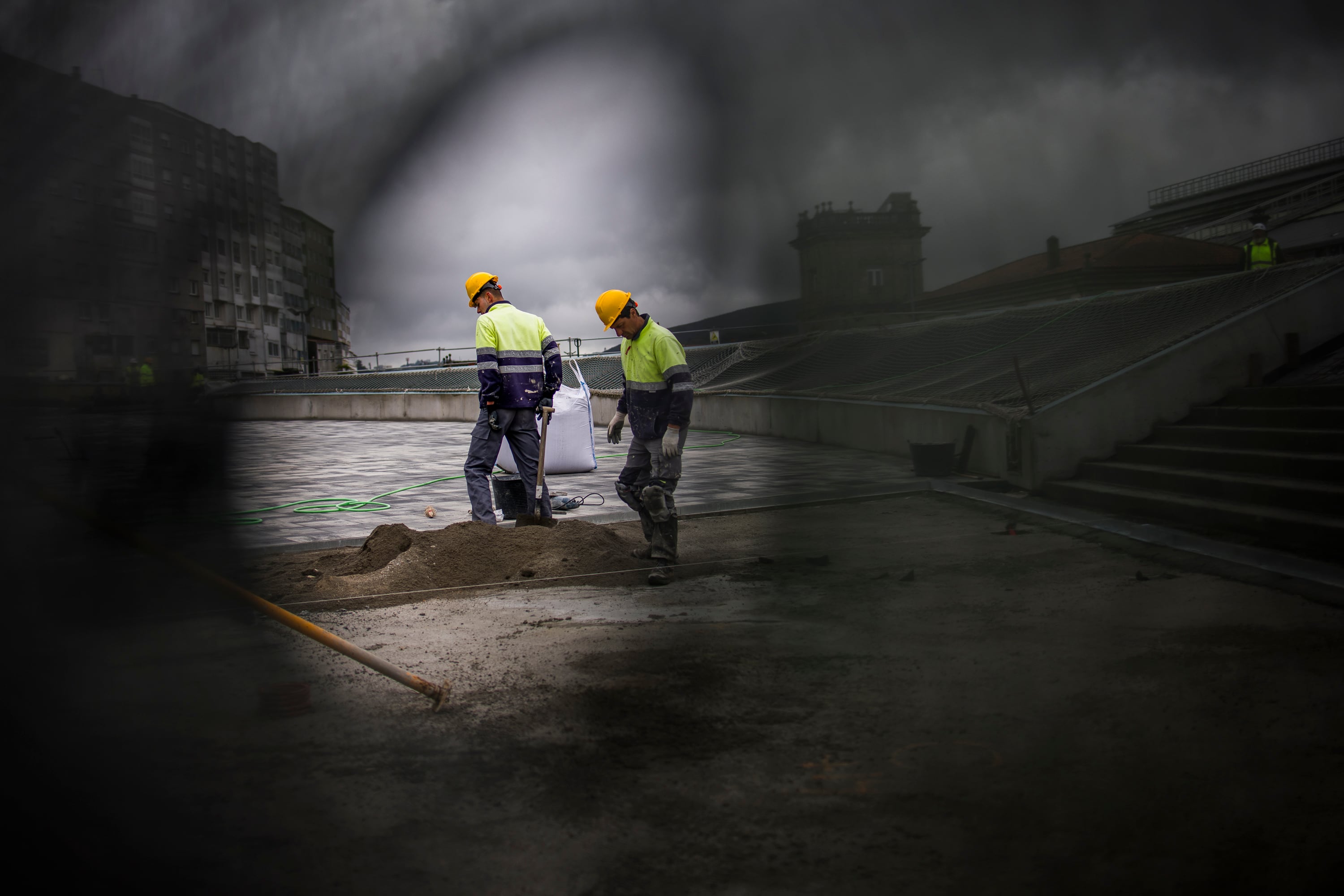
Tras dejar España para empezar una vida nueva, la mujer que destapó la trama Gürtel afronta un accidente, precariedad y soledad en un país ajeno, sostenida únicamente por la solidaridad de quienes se niegan a olvidarla.
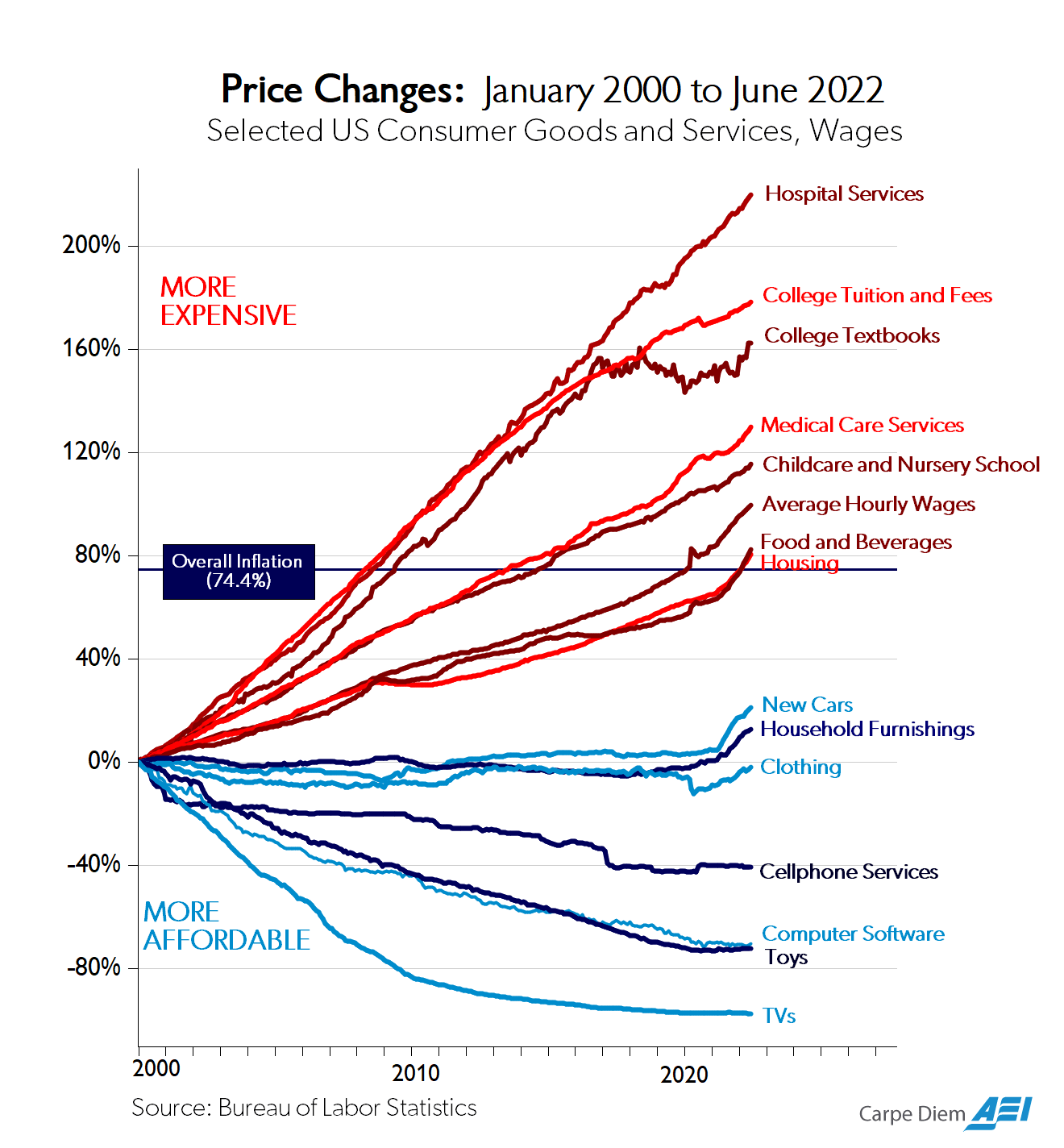
You’ve probably seen this famous graph that breaks out various categories of inflation, showing labor-intensive services getting more expensive during the 21st century and manufactured goods getting less expensive.
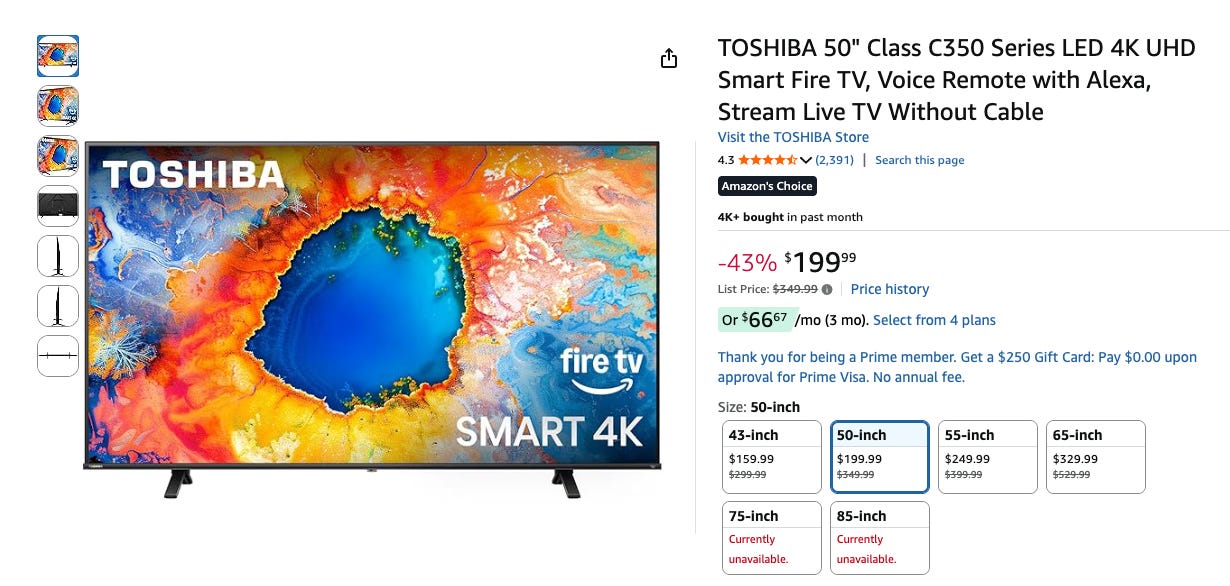
One of the standout items is TVs, which have fallen in price more than any other major category on the chart. TVs have gotten so cheap that they’re vastly cheaper than 25 years ago even before adjusting for inflation. In 2001, Best Buy was selling a 50 inch big screen TV on Black Friday for $1100. Today a TV that size will set you back less than $200.
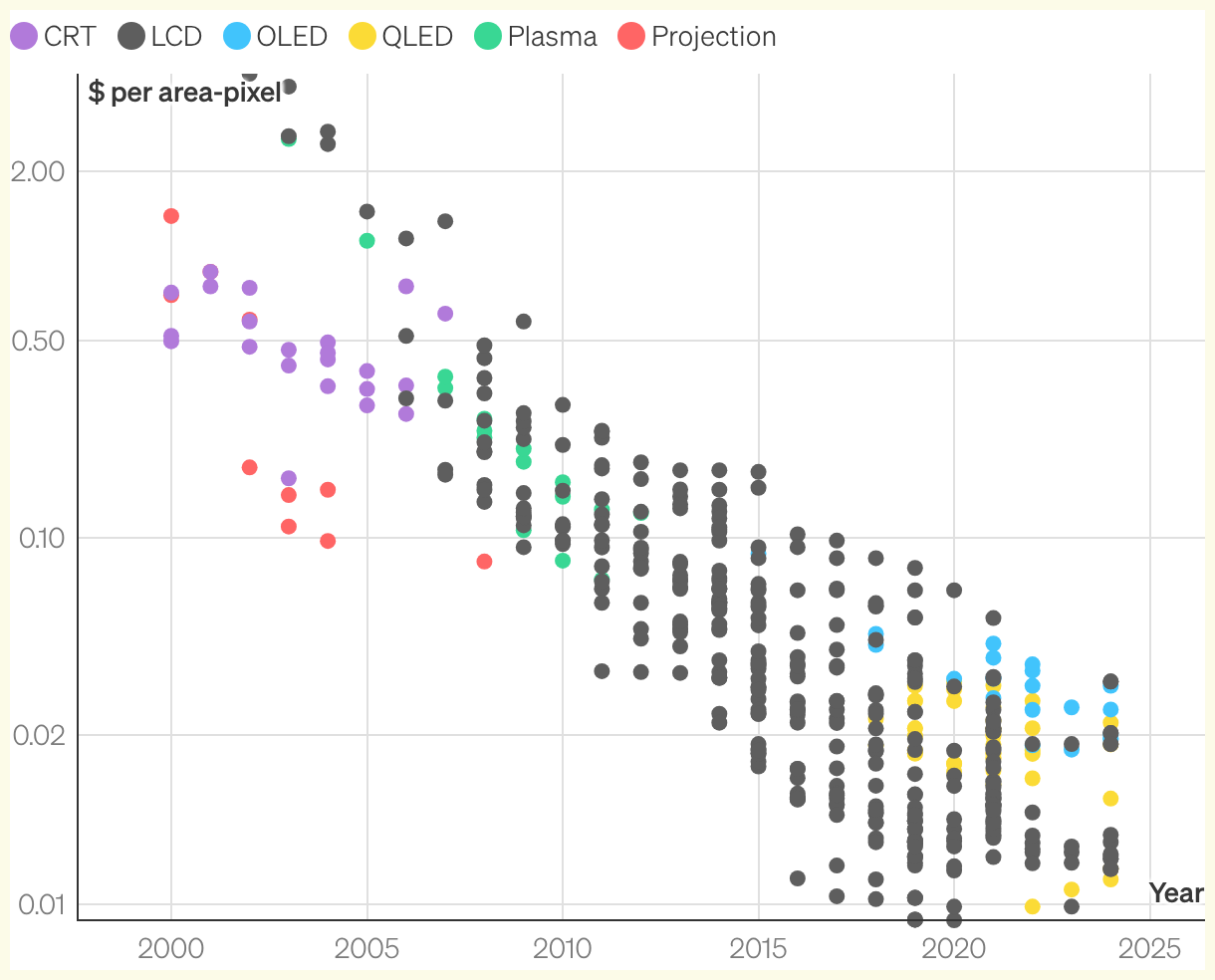
The plot below shows the price of TVs across Best Buy’s Black Friday ads for the last 25 years. The units are “dollars per area-pixel”: price divided by screen area times the number of pixels (normalized so that standard definition = 1). This is to account for the fact that bigger, higher resolution TVs are more expensive. You can see that, in line with the inflation chart, the price per area-pixel has fallen by more than 90%.
This has prompted folks to wonder, how exactly did a complex manufactured good like the TV get so incredibly cheap?
It was somewhat more difficult than I expected to suss out how TV manufacturing has gotten more efficient over time, possibly because the industry is highly secretive. Nonetheless, I was able to piece together what some of the major drivers of TV cost reduction over the last several decades have been. In short, every major efficiency improving mechanism that I identify in my book is on display when it comes to TV manufacturing.
How an LCD TV works
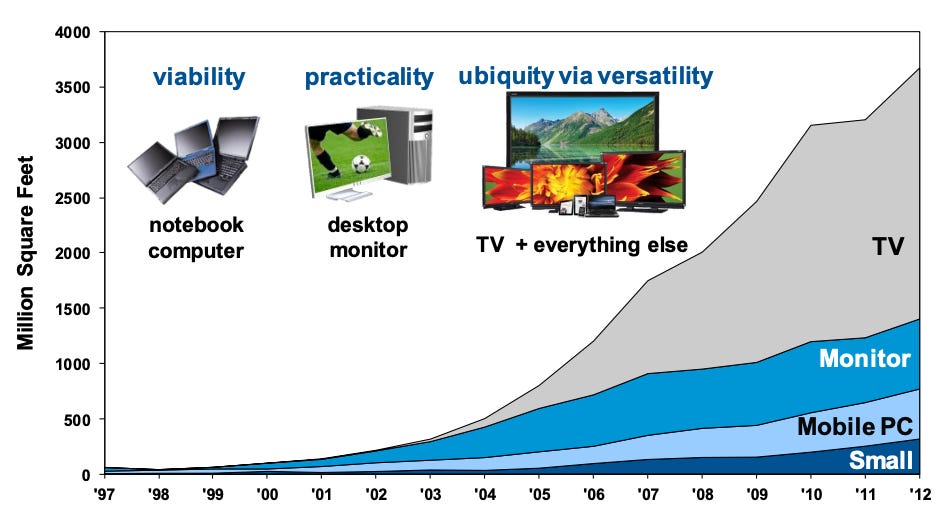
Since 2000, the story of TVs falling in price is largely the story of liquid crystal display (LCD) TVs going from a niche, expensive technology to a mass-produced and inexpensive one. As late as 2004, LCDs were just 5% of the TV market; by 2018, they were more than 95% of it.
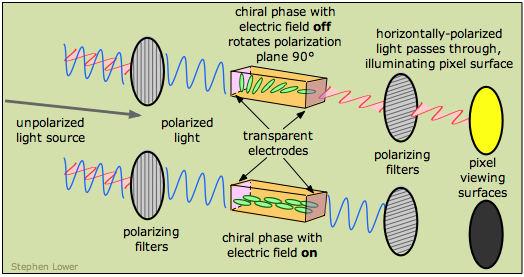
Liquid crystals are molecules that, as their name suggests, form regular, repetitive arrangements (like crystals) even as they remain a liquid. They exhibit two other important characteristics that together can be used to construct a display. First, the molecules can be made to change their orientation when an electric field is applied to them. Second, if polarized light (light oscillating within a single plane) passes through a liquid crystal, its plane of polarization will rotate, with the amount of rotation depending on the orientation of the liquid crystal.
Liquid crystal rotating the plane of polarization of light, via Chemistry LibreTexts.
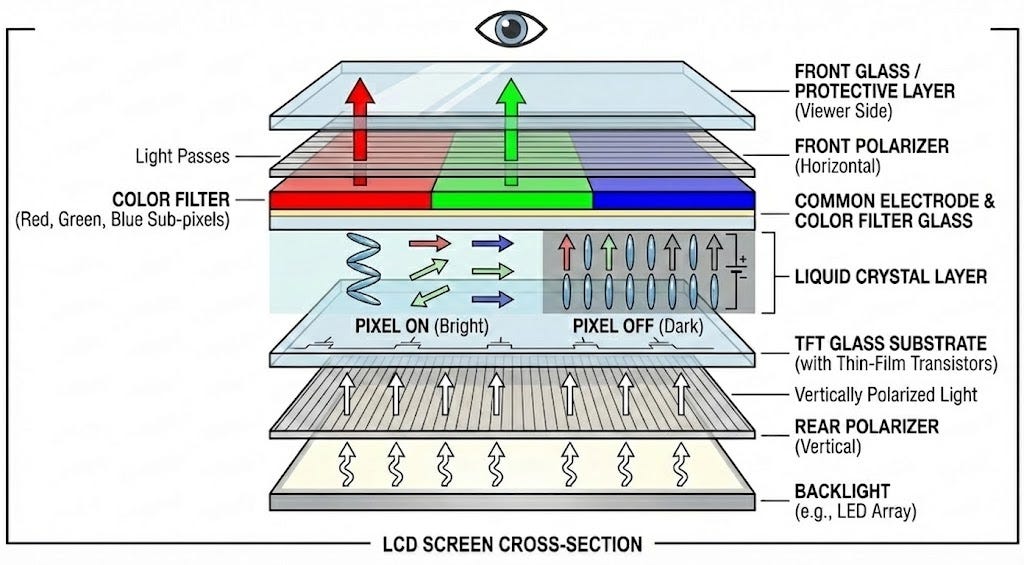
LCD screens use these phenomena to build a display. Each pixel in an LCD TV contains three cells, which are each filled with liquid crystal and have either a red, green, or blue color filter. Light from behind the screen (provided by a backlight) first passes through a polarizing filter, blocking all light except light within a particular plane. This light then passes through the liquid crystal, altering the light’s plane of polarization, and then through the color filter, which only allows red, green, or blue light to pass. It then passes through another polarizing filter at a perpendicular orientation to the first. This last filter will let different amounts of light through, depending on how much its plane of polarization has been rotated. The result is an array of pixels with varying degrees of red, blue, and green light, which collectively make up the display.
Structure of an LCD screen, via Nano Banana.
On modern LCD TVs, the liquid crystals are combined together with a bunch of semiconductor technology. The backlight is provided by light emitting diodes (LEDs), and the electric field to rotate the liquid crystal within each cell is controlled by a thin-film transistor (TFT) built up directly on the glass surface.
Some LCD screens, known as QLED, use quantum dots in the backlight to provide better picture quality, but these otherwise work very similarly to traditional LCD screens. There are also other types of display technology used for TVs, such as organic LEDs (OLED), that don’t use liquid crystal at all, but today these are still a small (but rising) fraction of total TV sales.
It took decades for LCDs to become the primary technology used for TV screens. LCDs first found use in the 1970s in calculators, then other small electronic devices, then watches. By the 1980s they were being used for small portable TV screens, and then for laptop and computer screens. By the mid-1990s LCDs were displacing cathode ray tube (CRT) computer monitors, and by the early 2000s were being used for larger TVs.
Steadily falling LCD TV Cost
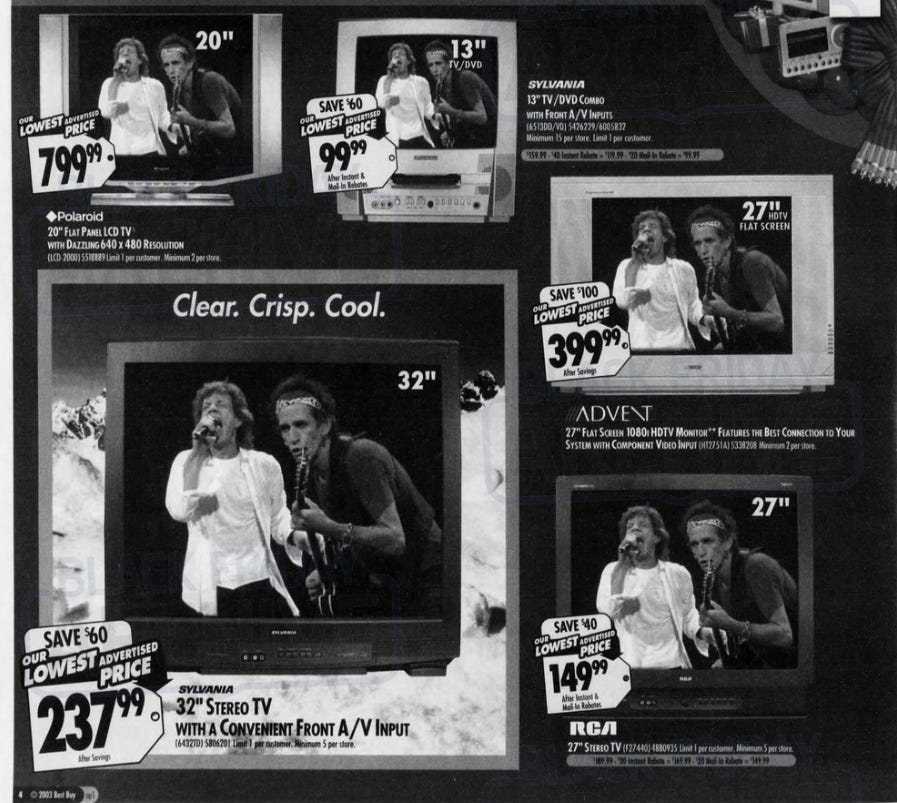
When LCD TVs first appeared, they were an expensive, luxury product. In this 2003 Black Friday ad, Best Buy is selling a 20 inch LCD TV (with “dazzling 640x480 resolution”) for $800. The same ad has a 27 inch CRT TV on sale for $150. (I remember wanting to buy an LCD TV when I went to college in 2003, but settling for a much cheaper CRT).
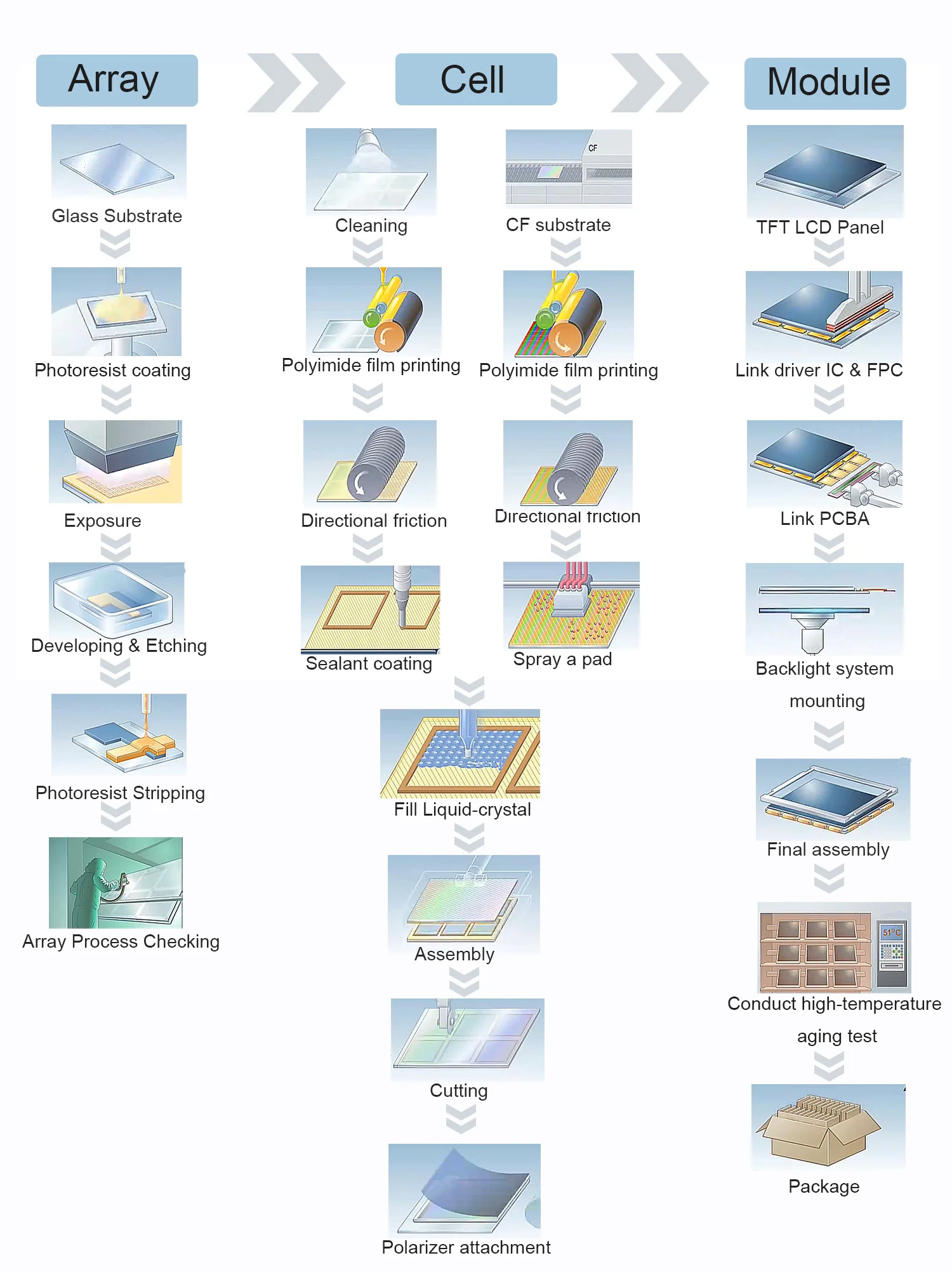
LCD TVs start life as a large sheet of extremely clear glass, known as “mother glass”, manufactured by companies like Corning. Layers of semiconductor material are deposited onto this glass and selectively etched away using photolithography, producing the thin film transistors that will be used to control the individual pixels. Once the transistors have been made, the liquid crystal is deposited into individual cells, and the color filter (built up on a separate sheet of glass) is attached. The mother glass is then cut into individual panels, and the rest of the components — polarizing filters, circuit boards, backlights — are added.
A key aspect of this process is that many manufacturing steps are performed on the large sheets of mother glass, before it’s been cut into individual display panels. And over time, these mother glass sheets have gotten larger and larger. The first “Generation 1” sheets of mother glass were around 12 inches by 16 inches. Today, Generation 10.5 mother glass sheets are 116 by 133 inches, nearly 100 times as large.
Scaling up the size of mother glass sheets has been a major challenge. The larger the sheet of glass, and the larger the size of the display being cut from it, the more important it becomes to eliminate defects and impurities. As a result, manufacturers have had to find ways to keep very large surfaces pristine — LCDs today are manufactured in cleanroom conditions. And larger sheets of glass are more difficult to move. Corning built a mother glass plant right next to a Sharp LCD plant to avoid transportation bottlenecks and allow for increasingly large sheets of mother glass.
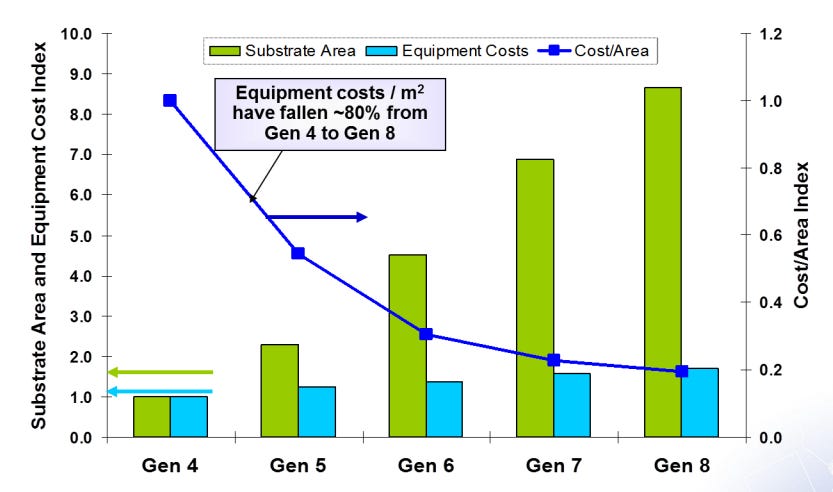
However, there are substantial benefits to using larger sheets of glass. Due to geometric scaling effects, it’s more efficient to manufacture LCDs from larger sheets of mother glass, as the cost of the manufacturing equipment rises more slowly than the area of the glass panel. Going from Gen 4 to Gen 5 mother glass sheets reduced the cost per diagonal inch of LCD displays by 50%. From Gen 4 to Gen 8, the equipment costs per unit of LCD panel area fell by 80%. Mother glass scaling effects have, as I understand it, been the largest driver of LCD cost declines.
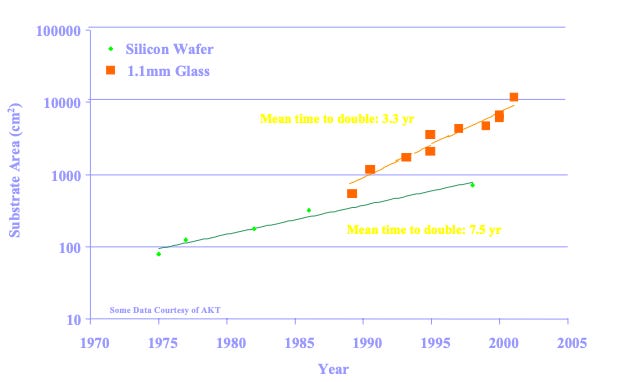
LCDs have thus followed a similar path to semiconductor manufacturing, where an important driver of cost reduction has been manufacturers using larger and larger silicon wafers over time. In fact, sheets of mother glass have grown in size much faster than silicon wafers for semiconductor manufacturing:
LCDs are thus an interesting example of costs falling due to the use of larger and larger batch sizes. Several decades of lean manufacturing and business schools assigning “The Goal” have convinced many folks that you should always aim to reduce batch size, and that the ideal manufacturing process is “one piece flow” where you’re processing a single unit at a time. But as we see in several processes — semiconductor manufacturing, LCD production, container shipping — increasing your batch size can, depending on the nature of your process, result in substantial cost savings.
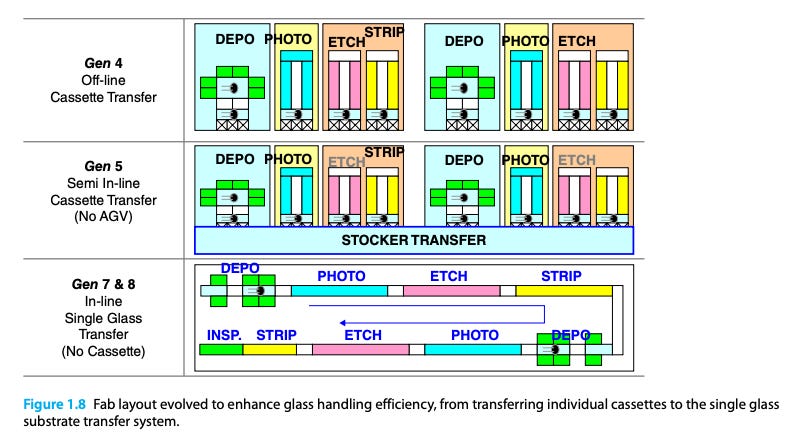
At the same time, we do see a tendency towards one piece flow at the level of mother glass panels. Early LCD fabs would bundle mother glass sheets together into cassettes, and then move those cassettes through subsequent steps of the manufacturing process. Modern LCD fabs use something much closer to a continuous process, where individual sheets of mother glass move through the process one at a time.
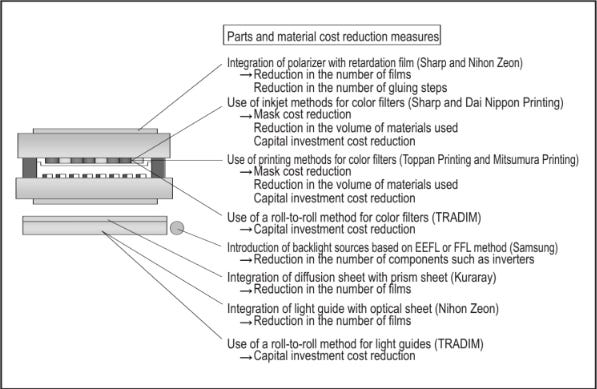
Outside of larger and larger sheets of mother glass, there have been numerous other technology and process improvements that have allowed LCD costs to fall:
“Cluster” plasma-enhanced chemical vapor deposition (PECVD) machines were developed in the 1990s for depositing thin film transistor materials. These machines were much faster, and required much less maintenance, than previous machines.
Manufacturers have found ways to reduce the number of process steps required to create thin-film transistors. Early operations required eight separate masking steps to build up the transistors. This was eventually reduced to four.
Thanks to innovations like moving manufacturing operations into cleanrooms and replacing manual labor with robots, yields have improved. Early LCD manufacturing often operated at 50% yield, where modern operations achieve 90%+ yields.
Cutting efficiency – the fraction of a sheet of mother glass that actually goes into a display — has increased, thanks to strategies like Multi-Model Glass, which allows manufacturers to cut displays of different sizes from the same sheet of mother glass.
The technology for filling panels with liquid crystal has improved. Until the early 2000s, displays were filled with liquid crystal through capillary action: small gaps were left in the sealant used to create the individual crystal cells, which the liquid crystal would gradually be drawn into. It could take hours, or even days, to fill a panel with liquid crystal. The development of the “one drop fill” method — a process in which each cell is filled before the sealant was cured, and then UV light is used to cure the sealant — reduced the time required to fill a panel from days to minutes.
Glass substrates were gradually made more durable, which reduced defects and allowed for more aggressive, faster etching.
Strategies for LCD manufacturing improvement, circa 2006. Via FPD 2006 Yearbook.
More generally, because LCD manufacturing is very similar to semiconductor manufacturing , the industry has been able to benefit from advances in semiconductor production. (As one industry expert noted in 2005, “[t]he display manufacturing process is a lot like the semiconductor manufacturing process, it’s just simpler and bigger.”) LCD manufacturing has relied on equipment originally developed for semiconductor production (such as steppers for photolithography), and has tapped semiconductor industry expertise for things like minimizing contamination. Some semiconductor manufacturers (like Sharp) have later entered the LCD manufacturing market.
LCD manufacturing has also greatly benefitted from economies of scale. A large, modern LCD fab will cost several billion dollars and produce over a million displays a day.1 It’s thanks to the enormous market for LCD screens that these huge, efficient fabs can be justified, and the investment in new, improved process technology can be recouped.
Falling LCD costs have also been driven by relentless competition. A 2014 presentation from Corning states that LCD “looks like a 25 year suicide pact for display manufacturers.” Manufacturers have been required to continuously make enormous investments in larger fabs and newer technology, even as profit margins are constantly threatened (and occasionally turning negative). This seems to have partly been driven by countries considering flat panel display manufacturing a strategic priority — the Corning presentation notes that manufacturing investments have been driven by nationalism, and there were various efforts to prop up US LCD manufacturing in the 90s and 2000s for strategic reasons.
Conclusion
Those who have read my book will not find much surprising in the story of TV cost declines. Virtually all the major mechanisms that can drive efficiency improvements — improving technology and overlapping S-curves, economies of scale (including geometric scaling effects), eliminating process steps, reducing variability and improving yield, advancing towards continuous process manufacturing — are on display here.
Valeria dice que su público es mayor que ella. La hondura que maneja parece de alguien que ya lo ha vivido todo. Sus letras celebran la honestidad, la valentía, el quererse a una misma y el sentir porque de eso trata estar viva. En su mente siempre están las generaciones de mujeres que la precedieron. Esas que, como nos demuestra la vida en cada etapa, tanto tuvieron que soportar. Las guerreras.
La manga ancha de hace unas décadas con la playa de Doñana choca ahora con una crecida del océano que el Gobierno sólo ve solucionable retranqueando la primera línea urbanizada para ganar espacio
La Sociedad Española de Salud Pública y Administración Sanitaria (SESPAS) publica el sexto volumen de su serie Salud Pública y Conflictos Bélicos, centrado en el impacto invisible de la guerra sobre la salud mental...
España ya no es el país con la mayor tasa de paro de la Unión Europea si se tiene en cuenta el dato con ajuste estacional (el más representativo porque atenúa los picos ligados a la temporada). Tras 39 meses consecutivos liderando esta estadística, otro país miembro notifica una peor proporción de desempleados. Es Finlandia, con un 10,6% en noviembre de 2025, según el dato distribuido este jueves por Eurostat. Este registro supera al español, de un 10,4% en el mismo mes. El sorpasso se da tras una larga racha a peor del dato finés y la mejora sostenida del mercado laboral español, aún lejos del promedio de los Veintisiete (6%) y de los países con mejores cifras, como Malta (3,1%) o Polonia (3,2%).
A social media and phone surveillance system ICE bought access to is designed to monitor a city neighborhood or block for mobile phones, track the movements of those devices and their owners over time, and follow them from their places of work to home or other locations, according to material that describes how the system works obtained by 404 Media.
Commercial location data, in this case acquired from hundreds of millions of phones via a company called Penlink, can be queried without a warrant, according to an internal ICE legal analysis shared with 404 Media. The purchase comes squarely during ICE’s mass deportation effort and continued crackdown on protected speech, alarming civil liberties experts and raising questions on what exactly ICE will use the surveillance system for.
💡
Do you know anything else about this tool? Do you work for ICE, CBP, or another agency? I would love to hear from you. Using a non-work device, you can message me securely on Signal at joseph.404 or send me an email at joseph@404media.co.
“This is a very dangerous tool in the hands of an out-of-control agency. This granular location information paints a detailed picture of who we are, where we go, and who we spend time with,” Nathan Freed Wessler, deputy project director of the American Civil Liberties Union’s (ACLU) Speech, Privacy, and Technology Project, told 404 Media.
Canal dedicado a la política y otros temas políticamente incorrectos. Con Coto Matamoros y Torbe.
Los lunes a las 19.00 h, estamos en directo con Coto Matamoros. Los martes a las 21.00 h, estamos en directo con Torbe. Los jueves a las 21.00 h, estamos en directo con Coto Matamoros y Torbe juntos.
Políticamente Incorrecto pertenece al grupo de canales de YouTube propiedad de DIPA MEDIA, SL.
Habré escrito sobre esto como una docena de veces, la primera allá por el 2006, haciendo un recorrido por las veces que los actos en el mar han tenido importantes consecuencias, siempre negativas. Creo que no es el momento de aburruiros con el tema, pero no está de más recordar que los americanos llevan varias jugadas de ese tipo paras entras en guerras, empezando por la del Maine, que los ayudó a despojar a España de Cuba, Puerto Rico y Filipinas.
El tema central es que es imposible, pero materialmente imposible, mantener un Imperio sin el dominio del mar, y quien tiene su control determina el comercio y la circulación de los recursos. La globalización depende absolutamente del comercio marítimo, y hasta ahora se ha hecho un énfasis absoluto en la seguridad de los mares.
Cuando la superpotencia dominante decide romper las reglas en el mar, rompiendo la regla de oro de la seguridad en aguas internacionales, no se trata de un incidente cualquiera, sino de la posible ruptura del juego al completo, por las consecuencias en cascada que puede tener esta transgresión.
No se trata de que capturen un barco aquí o allá: se trata de que todos los barcos, absolutamente todos, pueden ver incrementadas sus pólizas de seguro, con lo que esto supone para el transporte marítimo, la circulación de recursos y el comercio mundial, basado en el "just in time", con bajo coste de almacenamiento y recursos distribuidos.
Acabe como acabe como acabe esta fase de la aventura trumpiana, basta con el temor a que el tema se descontrole para retraer las inversiones y encoger el volumen del comercio global. El dominio del mar es el verdadero poder del Imperio, y hasta ahora, los Estados Unidos no lo habán ejercido de manera coercitiva. Si esto cambia, absolutamente todo cambiará. Hay que recofger el tablero y desplegar otro.
Salvo que todas esas familias sean monoparentales, lo que no aclara el gobierno, se trataría de solicitantes que ingresan más de 75.000 euros al año. La decisión, amparada por las bases de la convocatoria, refleja la apuesta del ejecutivo de Isabel Díaz Ayuso por abrir estas ayudas a rentas altas, pues a ellas pueden optar núcleos familiares que incluso superan los 100.000 euros de ingresos anuales. Visible en modo lectura.
etiquetas: becas, ayuso, infantil, ingresos, 100.000 €, madrid
La ONU acusó este miércoles a Israel de haber intensificado la discriminación y la segregación de los palestinos en Cisjordania y pidió al país que ponga fin a su “sistema de apartheid”. En un demoledor informe, la oficina de derechos humanos de la ONU estimó que la “discriminación sistemática” contra los palestinos en los territorios palestinos ocupados se ha “deteriorado drásticamente” en los últimos años. “Hay una asfixia sistemática de los derechos de los palestinos en Cisjordania”, sostuvo el jefe de esta oficina, Volker Türk.
Son tiempos nuevos en la geopolítica y en Europa. Los vecinos de Dinamarca están considerando la posibilidad de dotarse de armas nucleares, y Francia se ofrece a compartir su paraguas nuclear. ¿Debería Dinamarca tener sus propias armas nucleares? ¿Es una buena idea? ¿Es siquiera posible? La primera ministra danesa, Mette Frederiksen, no descarta la idea de armas nucleares en territorio danés.
El presidente de EE.UU., Donald Trump, acusó este miércoles a la mujer, que falleció en un tiroteo a manos de un agente del Servicio de Control de Aduanas (ICE, en ingles) en Minéapolis, de resistirse y obstruir el trabajo de los agentes, y acusó a la «izquierda radical» de estar detrás del suceso. Relacionada: www.meneame.net/story/agente-ice-mata-mujer-disparo-minneapolis-durant
El buque español Cantabria realizó una misión secreta para abastecer de combustible y suministros a un guardacostas estadounidense cerca de Groenlandia, en medio de tensiones internacionales y movimientos estratégicos en el Ártico. La operación, llamada Reyes Magos, obligó a modificar su ruta original desde las Azores hacia el mar de Labrador, en condiciones extremas. El Ministerio de Defensa confirmó la misión sin dar detalles por motivos de confidencialidad. Tras completarla, el Cantabria regresó a Ferrol.
etiquetas: cantabria, buque, armada, abastecimiento, barcos, usa
Hace 27 meses la inquilina de su inmueble cesó el pago de las mensualidades. Desde entonces, la deuda principal se disparó hasta alcanzar los 30.989 euros. Pese a haber iniciado los trámites judiciales inmediatamente la propietaria padeció retrasos y suspensiones sistemáticas en el proceso para desahuciar a su inquilina morosa.
La administración Trump se retirará de docenas de organizaciones internacionales, incluida la agencia de población de la ONU y el tratado de la ONU que establece las negociaciones internacionales sobre el clima, a medida que Estados Unidos se aleja aún más de la cooperación mundial. La mayoría de los objetivos son agencias, comisiones y paneles asesores relacionados con la ONU que se centran en el clima, el trabajo y otras cuestiones que la administración Trump ha clasificado como iniciativas woke y que favorecen la diversidad.
etiquetas: eeuu retirada de organizaciones internacionales, onu, trump
La Casa Blanca lanzó este martes un nuevo sitio web con una reconstrucción total del registro histórico del 6 de enero de 2021, elogiando a la multitud a favor de Trump que asaltó el Capitolio de Estados Unidos hace cinco años como “manifestantes pacíficos” que fueron provocados por las fuerzas de seguridad. El nuevo sitio afirma sin fundamento que la violencia del 6 de enero de 2021 fue instigada por las fuerzas de seguridad y por la entonces presidenta de la Cámara de Representantes, Nancy Pelosi.
La mujer peruana ya llevaba más tiempo del permitido por su visa cuando conoció a su actual esposo mientras trabajaba sin permiso en el país. Pero como se casó con un estadounidense, y está buscando la tarjeta de residencia permanente, la pareja creyó que sería seguro irse de luna de miel a Puerto Rico. "No me arrepiento de mi voto", dijo el marido mientras solicitaba donaciones a través de GoFundMe para ayudar a cubrir la fianza, insistiendo en que Trump no tenía la culpa: "él no creó el sistema, pero sí tiene la oportunidad de mejorarlo"
etiquetas: estados unidos, ice, detención, votante, gofundme
La mujer que fue abatida mortalmente por un agente del Servicio de Inmigración y Control de Aduanas (ICE) el miércoles en Minneapolis parecía «claramente asustada» y estaba intentando marcharse, según declaró a HuffPost un testigo presencial de la muerte, que cuestiona la versión del Gobierno de que el agente de ICE actuó en defensa propia. Emily Heller, de 39 años, salió de su casa sobre las 9:30 de la mañana tras oír silbidos y bocinazos de vecinos que estaban alertando al barrio de la presencia de agentes de ICE.
Donald Trump, aseguró este miércoles que Venezuela se ha comprometido a comprar «exclusivamente» productos producidos en su país, con el dinero que sea producto de su nuevo acuerdo petrolero.