Shared posts

19 Feb 19:22

Indignación

by Miguel A. Ariño

La semana pasada hubo una orden de suspender un montón de actividades en Cataluña por la amenaza de unos vientos muy fuertes. En el mensaje de esta semana planteo si esto es una protección necesaria o exceso de intervención. Cuando las autoridades asumen toda la responsabilidad, ¿qué espacio queda para la responsabilidad personal? Espero tus opiniones.

The post Indignación first appeared on Toma de Decisiones Miguel A. Ariño.

19 Feb 19:22

¿Qué prefieres: ser temido o ser odiado?

by Santiago Ávila Vila

Maquiavelo lo decía claro: Si no puedes ser amado y temido… es mejor ser temido que amado. Pero cuidado… nunca debes ser odiado.
#Maquiavelo #Liderazgo #Respeto #Temor #Odio
19 Feb 19:21

Los cachivaches domésticos que te espían

by rafaelpoch
Estos son algunos artículos que tienes en casa que se utilizan para espiar. Autor:Kei Pritsker Seguro que muchos de ustedes vieron el anuncio de Ring durante la Super Bowl, en el que se mostraba cómo las cámaras Ring de Amazon vigilan barrios enteros a través de una función llamada Search Party. Esta función permite a … Continuar leyendo "Los cachivaches domésticos que te espían"
19 Feb 19:21

5 La Paradoja de la Invisibilidad

by Unknown


LO QUE LA ANSIEDAD OCULTA

La Paradoa de la InvisibilidaD:

A veces he pensado que, si pudiera elegir un súper poder, sería el de la invisibilidad.

Cuando la ansiedad aprieta y pienso “tierra trágame”, desaparecer. Cuando quiero estar sin estar. 

Estar presente pero sin tener que preocuparme por qué cara poner, dónde mirar o cómo moverme. Puuf. Invisibilidad.

Ser invisible sería descansar. No tener que demostrar nada. No sentir la mirada de los demás encima. No pensar si hago algo raro, si camino raro, si parezco nerviosa.


Cuando la ansiedad aprieta, cuando el pánico asoma, cuando el límite llega... PUF.

La Paradoja

Y ahí está la paradoja: Quiero desaparecer para protegerme de la ansiedad, pero también quiero existir para los demás.

La ansiedad social me empuja a esconderme, aunque una parte de mí desee participar en el mundo como cualquier otra persona.

19 Feb 19:21

El juicio a Zuckerberg es solo la punta del iceberg: por qué Meta, X y TikTok son estructuralmente tóxicas para la democracia

by Enrique Dans

IMAGE: A dark, square illustration showing Mark Zuckerberg illuminated by the glow of a smartphone displaying the Instagram logo, looming above a crowd of distressed teens and adults staring at their phones, surrounded by floating social media icons

En la sala del Tribunal Superior de Los Ángeles, bajo la presidencia de la jueza Carolyn B. Kuhl, Mark Zuckerberg ha tenido que escuchar cómo se le recuerdan sus propias decisiones. No se trata de una comparecencia amistosa ante el Congreso ni de una entrevista cuidadosamente preparada. Es un juicio con jurado, con documentos internos proyectados en pantalla y con víctimas que afirman que el diseño de sus productos contribuyó a su deterioro psicológico.

Pero si reducimos lo que está ocurriendo ante la jueza Kuhl a un debate sobre adolescentes y filtros de belleza, estaremos perdiendo de vista la dimensión real del problema.

Sí, Zuckerberg reconoció que desoyó a 18 expertos en bienestar que habían concluido que los filtros de belleza de Instagram suponían un riesgo para la salud mental de los jóvenes, y que decidió restablecerlos apelando a la «libertad de expresión». Sí, los documentos internos muestran que dentro de la compañía se hablaba de Instagram como «una droga» y de sus responsables como «camellos». Y sí, se han presentado estimaciones internas de millones de menores de 13 años utilizando la plataforma pese a las prohibiciones formales. Pero el núcleo del asunto no es únicamente la adolescencia. Es el modelo.

El mismo diseño que maximiza el tiempo de pantalla en jóvenes es el que amplifica desinformación política en adultos. El mismo sistema que introduce refuerzos intermitentes y validación social constante para generar dependencia es el que premia el contenido más emocionalmente extremo, más polarizante y más divisivo. No es una desviación accidental: es una consecuencia directa de optimizar plataformas para capturar atención y monetizarla mediante publicidad ultra-segmentada.

Meta, X y TikTok comparten una arquitectura económica común: vigilancia masiva del comportamiento, perfilado psicográfico detallado y subastas en tiempo real de nuestra atención. El producto no es la red social; el producto es la capacidad de modificar conductas con precisión quirúrgica. Cuanto más tiempo pasamos en la plataforma, más datos generan nuestros hábitos, y más eficaz resulta la segmentación publicitaria o política.

Cuando Zuckerberg insiste, evadiéndose y tratando de decir lo menos posible, en que ya no se fijan metas de tiempo de uso y que ahora se centran en «utilidad» y «valor», lo que pide es un acto de fe. Pero el incentivo estructural permanece intacto: un modelo basado en publicidad dirigida necesita maximizar exposición y precisión predictiva, y eso implica diseñar sistemas que exploten sesgos cognitivos, que prioricen lo emocional frente a lo racional y que recompensen la reacción rápida antes que la reflexión.

Las consecuencias trascienden la salud mental individual. Hemos visto interferencias electorales, campañas de desinformación coordinadas, teorías conspirativas amplificadas hasta convertirse en corrientes dominantes y hasta genocidios que continuaron porque su intensa actividad polarizadora seguía engordando la facturación de la compañía. Hemos visto cómo el debate público se tribaliza y cómo la indignación se convierte en moneda corriente. Nada de eso es ajeno al modelo de negocio: es su externalidad lógica.

El argumento tradicional de estas compañías ha sido que no son responsables del contenido, solo de la infraestructura. Pero el planteamiento de los demandantes en este juicio apunta directamente al diseño. No se trata de un vídeo concreto o de un mensaje específico, sino de una arquitectura que favorece la compulsión, la comparación social y la amplificación de lo extremo.

Incluso si mañana desaparecieran todos los menores de estas plataformas, el problema estructural seguiría ahí. Seguiría existiendo un sistema diseñado para explotar vulnerabilidades psicológicas en adultos. Seguiría existiendo un mercado publicitario que recompensa la microsegmentación política opaca. Seguiría existiendo un incentivo para mantenernos conectados más allá de lo saludable, porque cada minuto adicional es monetizable.

Por eso el debate no puede limitarse a mejores controles parentales o a herramientas de verificación de edad: esas medidas pueden mitigar síntomas, pero no alteran la raíz. Mientras el modelo siga siendo la vigilancia masiva y la publicidad ultra-dirigida, el incentivo a manipular atención y conducta seguirá siendo dominante.

La cuestión incómoda es si estas plataformas pueden existir de forma compatible con una democracia saludable sin renunciar a ese modelo. Y la respuesta honesta es que no. Porque eliminar la publicidad conductual y el perfilado intensivo implicaría desmantelar la base de su rentabilidad actual, algo que no están dispuestas a plantear.

El juicio ante la jueza Carolyn B. Kuhl podría terminar en indemnizaciones y ajustes cosméticos. Podría incluso establecer precedentes relevantes. Pero el verdadero veredicto no será jurídico, sino político y social: decidir si aceptamos como inevitable un ecosistema digital que convierte la psicología humana en materia prima para la extracción de valor. Lo que la jueza está dirimiendo va mucho, muchísimo más allá que unas responsabilidades civiles ante unos apenados padres. No afecta solo a esos adolescentes ni a esas familias: nos afecta a todos.

No estamos discutiendo únicamente la seguridad de los adolescentes. Estamos discutiendo si queremos sociedades organizadas en torno a algoritmos cuyo objetivo es maximizar clics, o en torno a instituciones que prioricen la deliberación informada y el bienestar colectivo. Y esa decisión, a diferencia de un filtro de belleza, no admite retoques.


This article is openly available in English on Medium, «Zuckerberg’s trial is an opportunity to dismantle Meta, X and TikTok: we can and must protect our societies»

19 Feb 19:21

La CRISIS de la VIVIENDA

by El Orden Mundial

La crisis habitacional está en el centro de la actualidad política en buena parte del mundo. En España, la gran mayoría de personas nacidas después de 1985 han encontrado un mercado de vivienda en crisis que complica las expectativas vitales de varias generaciones.

Esta semana en No es el fin del mundo, Alba Leiva, Fernando Arancón y Eduardo Saldaña se sumergen en una de las crisis que más está contribuyendo a la desintegración de las sociedades occidentales.

Un contenido desarrollado por El Orden Mundial en el marco de la beca GENEU.
19 Feb 19:18

La Palabra Que Más Se Escuchaba en Los Campos de Concentración

by Alex Fidalgo

La Palabra Que Más Se Escuchaba en Los Campos de Concentración

🎙️ La Verdad Incómoda Sobre La Soledad - Gabriel Rolón
19 Feb 19:17

Azure reliability, resiliency, and recoverability: Build continuity by design

by Mark Russinovich and Molina Sharma

Modern cloud systems are expected to deliver more than uptime. Customers expect consistent performance, the ability to withstand disruption, and confidence that recovery is predictable and intentional.

In Azure, these expectations map the three distinct concepts: reliability, resiliency, and recoverability.

Reliability describes the degree to which a service or workload consistently performs at its intended service level within business-defined constraints and tradeoffs. Reliability is the outcome customers ultimately care about.

To achieve reliable outcomes, workloads are designed along two complementary dimensions. Resiliency is the ability to withstand faults and disruptive conditions such as infrastructure failures, zonal or regional outages, cyberattacks, or sudden change in load—and continue operating without customer-visible disruption. Recoverability is the ability to restore normal operations after disruption, returning the workload to a reliable state once resiliency limits are exceeded.

This blog anchors definitions and guidance to the Microsoft Cloud Adoption Framework, the Azure Well‑Architected Framework and the reliability guides for Azure services. Use the Reliability guides to confirm how each service behaves during faults, what protections are built in, and what you must configure and operate, so shared responsibility boundaries stay clear as workloads scale and during recovery scenarios.

Why this matters

When reliability, resiliency, and recoverability are used interchangeably, teams make the wrong design tradeoffs—over-investing in recovery when architectural resiliency is required, or assuming redundancy guarantees reliable outcomes. This post clarifies how these concepts differ, when each applies, and how they guide real design, migration, and incident-readiness decisions in Azure.

Industry perspective: Clarifying common confusion

Azure guidance treats reliability as the goal, achieved through deliberate resiliency and recoverability strategies. Resiliency describes workload behavior during disruption; recoverability describes restoring service after disruption.

Anchor principle: Reliability is the goal. Resiliency keeps you operational during disruption. Recoverability restores service when disruption exceeds design limits.

Part I — Reliability by design: Operating model and workload architecture

Reliable outcomes require alignment between organizational intent and workload architecture. Microsoft Cloud Adoption Framework helps organizations define governance, accountability, and continuity expectations that shape reliability priorities. Azure Well‑Architected Frameworktranslates those priorities into architectural principles, design patterns, and tradeoff guidance.

Part II — Reliability in practice: What you measure and operationalize

Reliability only matters if it is measured and sustained. Teams operationalize reliability by defining acceptable service levels, instrumenting steady-state behavior and customer experience, and validating assumptions with evidence.

Azure Monitor and Application Insights provide observability, while controlled fault testing (for example, with Azure Chaos Studio helps confirm designs behave as expected under stress.

Practical signals of “enough reliability” include meeting service levels for critical user flows, introducing changes safely, maintaining steady-state performance under expected load, and keeping deployment risk low through disciplined change practices.

Governance mechanisms such as Azure PolicyAzure landing zones, and Azure Verified Modules help apply these practices consistently as environments evolve.

The Reliability Maturity Model can help teams assess how consistently reliability practices are applied as workloads evolve, while remaining scoped to reliability practices rather than resiliency or recoverability architecture.

Part III — Resiliency in practice: From principle to staying operational

Resiliency by design is no longer a late-stage high-availability checklist. For mission-critical workloads, resiliency must be intentional, measurable, and continuously validated—built into how applications are designed, deployed, and operated.

Resiliency by design aims to keep systems operating through disruption wherever possible, not only recover after failures.

Resiliency is a lifecycle, not a feature

Effective practice shifts from isolated configurations to a repeatable lifecycle applied across workloads:

  • Start resilient—embed resiliency at design time using prescriptive architectures, secure-by-default configurations, and platform-native protections.  
  • Get resilient—assess existing applications, identify resiliency gaps, and remediate risks, prioritizing production mission-critical workloads. 
  • Stay resilient—continuously validate, monitor, and improve posture, ensuring configurations don’t drift and assumptions hold as scale, usage patterns, and threat models change.  

Withstanding disruption through architectural design

Resiliency focuses on how workloads behave during disruptive conditions such as failures, sudden changes in load, or unexpected operating stress—so they can continue operating and limit customer-visible impact. Some disruptive conditions are not “faults” in the traditional sense; elastic scale-out is a resiliency strategy for handling demand spikes even when infrastructure is healthy.

In Azure, resiliency is achieved through architectural and operational choices that tolerate faults, isolate failures, and limit their impact. Many decisions begin with failure-domain architecture: availability zones provide physical isolation within a region, zone-resilient configurations enable continued operation through zonal loss, and multi-region designs can extend operational continuity depending on routing, replication, and failover behavior.

The Reliable Web App reference architecture in the Azure Architecture Center illustrates how these principles come together through zone-resilient deployment, traffic routing, and elastic scaling paired with validation practices aligned to WAF. This reinforces a core tenet of resiliency by design: resiliency is achieved through intentional design and continuous verification, not assumed redundancy.  

Traffic management and fault isolation

Traffic management is central to resiliency behavior. Services such as Azure Load Balancer and Azure Front Door can route traffic away from unhealthy instances or regions, reducing user impact during disruption. Design guidance such as load-balancing decision trees can help teams select patterns that match their resiliency goals.

It is also important to distinguish resiliency from disaster recovery. Multi-region deployments may support high availability, fault isolation, or load distribution without necessarily meeting formal recovery objectives, depending on how failover, replication, and operational processes are implemented.

From resource checks to application-centric posture

Customers experience disruption as application outages, not as individual disk or VM failures. Resiliency must therefore be assessed and managed at the application level.

Azure’s zone resiliency experience supports this shift by grouping resources into logical application service groups, assessing risk, tracking posture over time, detecting drift, and guiding remediation with cost visibility. This turns resiliency from an assumption into an explicit, measurable posture.

Validation matters: configuration is not enough

Resiliency should be validated rather than assumed. Teams can simulate disruption through controlled drills, observe application behavior under stress, and measure continuity characteristics during expected scenarios. Strong observability is essential here: it shows how the application performs during and after drills.

Increasingly, assistive capabilities such as the Resiliency Agent (preview) in Azure Copilot help teams assess posture and guide remediation without blurring the distinction between resiliency (remaining operational through disruption) and recoverability (restoring service after disruption).  

What “enough resiliency” looks like: workloads remain functional during expected scenarios; failures are isolated, and systems degrade gracefully rather than causing customer-visible outages.

Part IV – Recoverability in practice: Restoring normal operations after disruption

Recoverability becomes relevant when disruption exceeds what resiliency mechanisms can withstand. It focuses on restoring normal operations after outages, data corruption events, or broader incidents, returning the system to a reliable state.

Recoverability strategies typically involve backup, restore, and recovery orchestration. In Azure, services such as Azure Backup and Azure Site Recovery support these scenarios, with behavior varying by service and configuration.

Recovery requirements such as Recovery Time Objective (RTO) and Recovery Point Objective (RPO) belong here. These metrics define restoration expectations after disruption, not how workloads remain operational during disruption.

Recoverability also depends on operational readiness: teams document runbooks, practice restores, verify backup integrity, and test recovery regularly, so recovery plans work under real pressure.

By separating recoverability from resiliency, teams can ensure recovery planning complements, rather than substitutes for, sound resiliency architecture.

A 30-day action plan: Turning intent into reliable outcomes

Within 30 days, translate concepts into deliberate decisions.

First, identify and classify critical workloads, confirm ownership, and define acceptable service levels and tradeoffs.

Next, assess resiliency posture against expected disruption scenarios (including zonal loss, regional failure, load spikes, and cyber disruption), validate failure-domain choices, and verify traffic management behavior. Use guardrails such as Azure Backup, Microsoft Defender for Cloud, and Microsoft Sentinel to strengthen continuity against cyberattacks.

Then, confirm recoverability paths for scenarios that exceed resiliency limits, including restoration paths and RTO/RPO targets.

Finally, align operational practices—change management, observability, governance, and continuous improvement—and validate assumptions using the Reliability guides for each Azure service.

Designing confident, reliable cloud systems

Modern cloud continuity is defined by how confidently systems perform, withstand disruption, and restore service when needed. Reliability is the outcome to design for; resiliency and recoverability are complementary strategies that make reliable operation possible.

Next step: Explore Azure Essentials for guidance and tools to build secure, resilient, cost-efficient Azure projects. To see how shared responsibility and Azure Essentials come together in practice, read Resiliency in the cloud—empowered by shared responsibility and Azure Essentials on the Microsoft Azure Blog.

For expert-led, outcome-based engagements to strengthen resiliency and operational readiness, Microsoft Unified provides end-to-end support across the Microsoft cloud. To move from guidance to execution, start your project with experts and investments through Azure Accelerate.

Azure capabilities referenced

Foundational guidance:

Resiliency examples:

Recoverability examples:

Governance and validation examples:

The post Azure reliability, resiliency, and recoverability: Build continuity by design appeared first on Microsoft Azure Blog.

19 Feb 19:16

Algo huele mal en la democracia

by María Álvarez

Algo huele mal en la democracia

La respuesta al desbordamiento de nuestra realidad no puede ser atacar el hedor de la extrema derecha. Tiene que ser la misma: conocimiento e infraestructuras; ciencia y un esfuerzo colectivo para adaptarnos a la nueva realidad

Era un olor tan nauseabundo que los diputados empapaban las cortinas de sus despachos en cloro para mantenerlo a raya. El nuevo edificio del parlamento de Westminster se había convertido, en aquel verano de 1858, en el epicentro del hedor; su fachada sur colgando, imponente, sobre el Támesis.

A mediados del siglo XIX Londres era la ciudad más grande del mundo y la que más rápido crecía. Los primeros compases de la Revolución Industrial habían multiplicado su población por tres en unas pocas décadas hasta los 2,5 millones de personas, una cifra que nunca antes había alcanzado ninguna ciudad. Nadie había planificado semejante transformación. Tampoco nadie sabía cómo hacerlo. 

La noción de que mantener una gran ciudad costaba dinero ni existía. Así que los londinenses elegían a los gobiernos municipales que prometían ser más low-cost: los que cobraban menos impuestos y hacían menos inversiones. Como consecuencia, en aquel verano de 1858 Londres seguía siendo en todo, menos en su dimensión, una ciudad medieval. Algo así como una megaurbe del tamaño del área metropolitana de Barcelona, pero en la que no existía el planeamiento urbano y, lo que es más importante, no había saneamiento. Los orines, los excrementos y los desechos de las viviendas se acumulaban, como se había hecho siempre, en unas fosas sépticas que unos “hombres de los desechos nocturnos” (“night soil men”) vaciaban de cuando en cuando. 

¿Y qué hacían estos hombres con el contenido de las fosas? Lo echaban al río. 

Pero ni el Támesis, en toda su grandeza, podía hacerse cargo de las 250 toneladas diarias de residuos que producía el crecimiento de la población, sumado a las nuevas tecnologías que llevaban el agua corriente hasta las casas –multiplicando la cantidad de líquido que acababa en las fosas– y a la proliferación de fábricas y mataderos que, para abastecer a todos esos nuevos habitantes, se habían instalado en la ciudad. El río que un día fue navegable se había convertido en una sopa repugnante; un caldo de heces, vísceras y aceites industriales; una cloaca a cielo abierto por donde desfilaban, entre ratas y cosas peores, los desechos del progreso económico.

Aquel episodio pasó a la historia como “The Great Stink”, “El gran hedor”; el primer momento en el que la trayectoria que traía el capitalismo pareció venirse abajo. Pero no fue, en realidad, el mal olor lo que puso en jaque la vida urbana y hasta la industrialización. La costumbre de tirar los residuos a las fuentes de agua producía brotes de cólera y la “peste azul” se había cobrado, solo en la primera mitad del siglo XIX, centenares de miles de vidas en la capital inglesa; millones en todas las recién nacidas ciudades del mundo. Pero entonces nadie sabía que esa enfermedad se contagia al beber agua contaminada: los londinenses todavía creían que los brotes eran causados por el “miasma”, los vapores malolientes que producen los desechos en descomposición. Por eso aquel verano de 1858 en el que unas temperaturas inusualmente altas volvieron el hedor insoportable, los diputados, que tenían sus despachos encima del río, empapaban sus cortinas en cloro con la esperanza de que mantener el olor a raya alejara también la enfermedad. 

Hoy, 200 años después, vivimos un momento muy parecido a aquel. La explosión de los cambios sociales que todavía no comprendemos del todo, sumada a las consecuencias de las formas de vida que arrastramos de otro tiempo han contaminado las aguas de las que bebe nuestra sociedad hasta enfermarnos. Por eso se tambalean las estructuras sociales y los acuerdos que parecían sólidos se derrumban. Algo apesta en la política y en la democracia. 

Pero apuntar a la extrema derecha como responsable de esta avería sería cometer el mismo error que los ingleses con el miasma. La ultraderecha no es ni la causa, ni siquiera la enfermedad de la sociedad contemporánea, es el hedor: el síntoma, el vapor pestilente que no nos deja respirar, es la consecuencia de algo que se está pudriendo debajo.

¿Cuál es la causa profunda de esos vapores?

Nuestro Támesis es la economía productiva. Hasta hace unas décadas, ese sistema era capaz, si no de proveer un buen lugar para cada persona, al menos de prometer que lo tendría. Después, que sabría utilizar el ahorro para producir más inversión productiva que a su vez iba a repercutir en mejores puestos de trabajo y nuevos bienes y servicios. Pero hoy la economía, como el Támesis, no tiene capacidad para absorber toda la riqueza que se produce: la economía digital no requiere las mismas inversiones que la industria. Y, sin embargo, el patrimonio mundial se ha multiplicado: hoy representa seis veces el tamaño de la economía. Como consecuencia, la mayor parte de la riqueza ha dejado de servir para crear más economía productiva y ahora se dedica a lo contrario: a extraer riqueza en forma de rentas. 

Nuestra mierda, como los desechos en el Támesis, es hoy una montaña de capital que colapsa las vidas de la gente exigiendo rentas del alquiler, comprando hospitales, carreteras y centros de mayores, haciendo subir los precios y concentrando el poder y los medios de comunicación en unas pocas manos.

Es muy probable que, si el gobierno de Londres no hubiera tomado cartas en el asunto, ninguno estaríamos aquí. Porque en los siguientes 50 años su población se volvió a multiplicar por tres. Pero tampoco hubiera servido para nada seguir culpando a los olores, ni fabricar desodorantes. Ni empapar de cloro las cortinas. 

Hubo un científico, llamado Jon Snow, que descubrió que los casos de cólera se producían en torno a las fuentes de agua. Hoy es conocido como el fundador de la epidemiología. Y hubo un ingeniero, que se llamaba Joseph Bazalgette, que estudió las conclusiones de Snow y propuso que la ciudad no podía seguir creciendo sin una planificación para ordenar la vida en común.

En lugar de seguir intentando tapar los olores, bajo su mandato, en los 16 años siguientes Londres construyó una colosal red de alcantarillado: Levantó más de 130 km de colectores principales conectados con 2.100 km de alcantarillas secundarias que drenaban toda la ciudad y con cuatro enormes estaciones de bombeo y dos plantas de tratamiento para expulsar los residuos lejos del río. Todavía hoy ese sistema está en uso. 

Hoy, como entonces, la respuesta al desbordamiento de nuestra realidad no puede ser atacar el hedor de la extrema derecha. Tiene que ser la misma: conocimiento e infraestructuras; ciencia y un esfuerzo colectivo para adaptarnos a la nueva realidad.

En estos días estamos todos pendientes del debate sobre la unidad de la izquierda. Y es importante. Pero esa unidad tiene que ser para hacer infraestructuras colectivas de progreso: para avanzar en la agenda de la energía renovable, de la educación, de la renta universal de crianza. Para hacer de una vez por todas una propuesta sobre vivienda que comprenda que el parque inmobiliario es el accionariado de un país y no se puede quedar en manos de una mitad de la población mientras la otra está condenada a ser arrendataria toda la vida, porque eso es tanto como vivir en una sociedad feudal.

Quedarse en el “antifascismo” y en “combatir a la extrema derecha”, sin invertir en la infraestructura social de los próximos años, es igual que echar cloro en las cortinas.

19 Feb 19:16

Is the Future “AWS for Everything”?

by Brian Potter

A theme running through my book is the idea that efficiency improvements, and the various methods for making products cheaper over time, have historically been dependent on some degree of repetition, on running your production process over and over again. Higher production volume means larger, more efficient factories. It means more opportunities to use dedicated, high-speed, continuous process production equipment, or to implement efficiency-improving methods like Design for Manufacturing or Statistical Process Control. It means more incentive to develop new, better production technology. It means more opportunities to fall down the learning curve. The list goes on.

If you’re only going to run your process once, or just a handful of times, these opportunities are considerably narrowed. It’s obviously hard to justify the time and effort it takes to design a really efficient production process or invent some new manufacturing equipment if that process is constantly changing.

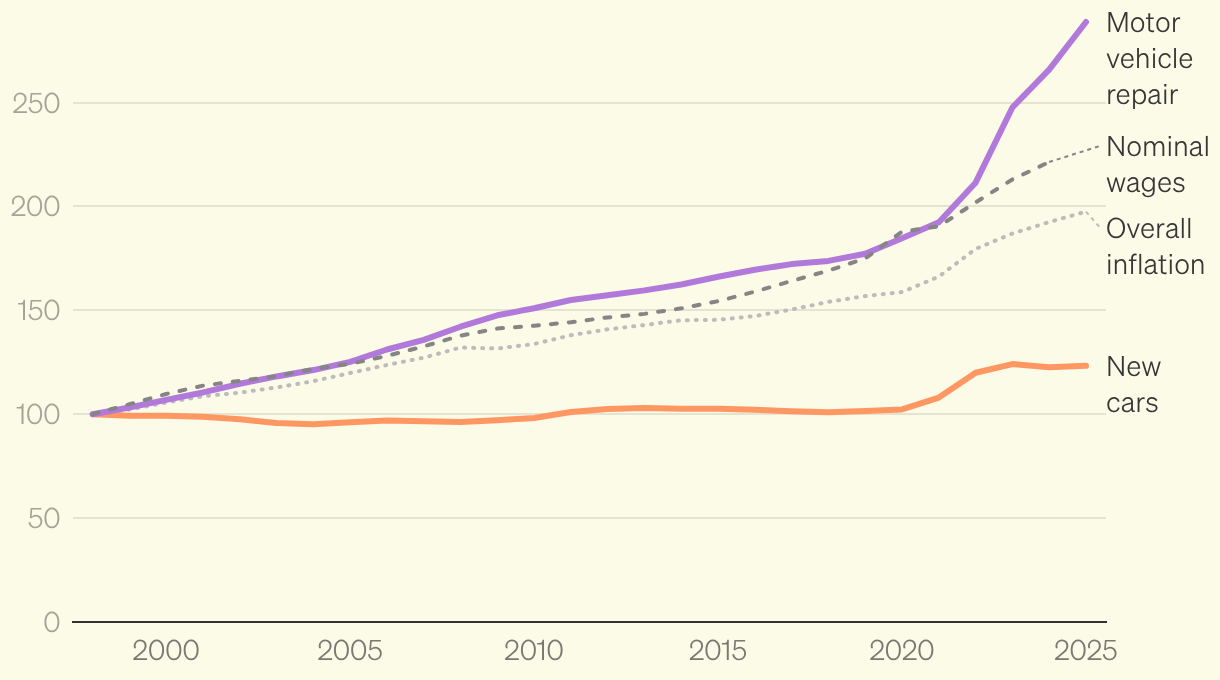
An example of this playing out in practice is the different cost trends of cars vs. car repair. In inflation-adjusted terms, cars have steadily gotten cheaper over time. The cost of car repair, on the other hand, has steadily gotten more expensive, rising mostly at the rate of overall wages (and recently, even faster).

Much of this difference comes down to the nature of the processes at work. Cars are manufactured via a repetitive, high-volume process that spits out nearly identical models by the hundreds of thousands or millions. Car manufacturers can justify spending billions of dollars designing a new model of car and the process for making it, because that cost will get spread out over a huge number of cars. Repairing a damaged car, on the other hand, is different: for a given model, any given repair process will be run a much smaller number of times, or maybe only once (since cars might get damaged in accidents in unique ways). A repair facility will need to accommodate a huge number of different models and model years, each damaged in different ways. There’s much less opportunity to design an efficient, highly automated repair process.

There are some complications to this basic pattern — the Toyota Production System and its descendents were designed to get mass-production-style benefits for a much more variable production process by making that process more flexible — but they don’t change the fundamental logic.

Thus, for things that we can repetitively produce in very large volumes — cars, transistors, LCD screens, corn — we’ve gotten good at making them very cheaply. Things produced in much smaller volumes, or where we need to adapt our process on the fly based on the specific situation, are much harder to produce cheaply. One way of thinking about services, which tend to get more expensive in inflation-adjusted terms over time, is that they’re things which generally require a lot of situation-specific adaptation, and can’t be produced via some high-volume, highly repetitive process.

An important aspect of this is automation. I’m fond of pointing out that it’s generally possible to build a machine to perform any particular task (and it has been for quite some time). If you’re going to do some task thousands or millions of times, it’s long been possible to automate that task with some sort of dedicated machine. (People skeptical of humanoid robots are very fond of pointing out how this sort of hard automation is far more efficient than a human-shaped robot at doing some task.) The challenge with automation has historically been flexibility: creating a machine that can make adjustments on the fly, perhaps changing the sequence of tasks completely as the situation changes, the way a human can. Even if the hardware itself can be used to perform a variety of different tasks, information processing capabilities have been limited; it has taken a lot of time and effort to get any particular automated process working, which could only be justified if those costs could be amortized over a sufficiently large volume. This is why the car industry has by far been the biggest user of industrial robots historically, as they have the right combination of very high production volumes, and frequent (but not too frequent) process changes (since models change yearly).

But this is changing: automation technology is getting more and more flexible. Computer vision has advanced, billions of dollars are being poured into developing humanoid robots, and a panoply of AI technologies are making it possible for an automated system to flexibly respond in a highly variable environment. Self-driving cars are one example. Being able to drive between any given two points, responding to situations or disruptions as they appear — traffic lights, pedestrians, other cars — is the exact sort of thing that automation historically has been very bad at, but that technology is now chipping away at.

As automation technology gets better and better, I have been thinking about how it will get pushed into areas requiring low-volume production or situation-specific adaptation that previously have been resistant to it. One potential trajectory is that with better, more flexible automation, “minimum efficient scale” — the size of an operation you need to be competitive — shrinks. With sufficiently capable robots, for instance, it might become possible to efficiently produce things in really small-footprint, low-overhead factories. The idea of “microfactories” is something people are enthusiastic about: you often see it in various prefab construction startups, but that excitement has spread elsewhere. The premise of the (now-defunct) EV startup Arrival was building cars using these sorts of highly flexible microfactories.

But another possible trajectory is in the opposite direction: large-scale, highly efficient production operations which capture significant economies of scale, but which produce a very wide range of outputs. Factories producing millions of different products in low volumes, or even quantities of one. I’m tentatively calling this idea “AWS for everything.”

AWS and flexible automation

AWS (Amazon Web Services) is Amazon’s cloud computing business. The idea of it (and of other similar offerings like Microsoft Azure and Google Cloud Platform) is that instead of needing to set up your own computing infrastructure to do things like host a website or store large amounts of data, you can just rent it from Amazon. Amazon builds the data centers, sets up the servers, and creates the software tools and infrastructure that other people can use to set up and manage their computing needs.

Making this work as a business demands a huge amount of expensive infrastructure; even before AI, Amazon and other cloud computing companies spent a huge amount of money building data centers in various regions. But as Ben Thompson notes, AWS “benefits tremendously from economies of scale.” The more customers AWS has, the more efficiently it can use its infrastructure, similar to how electric utilities wanted lots of customers to reduce demand variability and achieve higher utilization rates. Thus with AWS you get a highly variable output — millions of different websites and computing tasks — supported by large-scale infrastructure investments. You can very quickly use Amazon’s infrastructure to perform whatever computing task you’re interested in, from hosting a small website to processing terabytes of data, without needing to build or operate any of that infrastructure yourself.

This same basic logic applies to physical automation. If you have machinery or equipment that can perform different sorts of tasks or produce a variety of different goods, and an effective software control layer that can tell each piece of equipment what it should be doing and where material should be routed, you can automatically produce a very large variety of different things. And the larger your operations, the lower your marginal costs of production: the more you produce, the greater your equipment utilization rate, and the more you can capture other economies of scale, such as using more efficient high-volume equipment.

Historically setting up this sort of highly automated, highly flexible production operation has been limited by the fact that setting up any particular automated process took a great deal of time and effort, and the technology didn’t exist for that automation to respond flexibly to a highly variable environment. So automated production lines, even ones that used flexible technology like robotics, could only be justified for high-volume production, and the range of variation they could accommodate was fairly limited.

But as automation and AI get better, this becomes much less true. If your software is smart enough, and your equipment flexible enough, you can set up some new process to produce some new widget on the fly, automatically working out what the process steps need to be and how to route the material through the various machines, without needing to take the time and effort to dial it in that was required historically. And if your volumes are high enough — if you’re producing enough different widgets, each with its route through a sequence of machines, sharing processing steps where possible — your costs for each individual unit of production might be very low indeed, even as you produce a wide variety of different things. So I can imagine having very large-volume production operations, which obtain large economies of scale and produce a wide variety of different outputs. Huge warehouses filled with all sorts of different machines, materials, parts, and components being routed between them, paths and tasks changing on the fly, a panoply of different goods rolling off the equivalent of the assembly line, each one sent to its final destination by low-cost, small-scale delivery vehicles like drones or Austin Vernon’s pallet EVs. Customers could spin up production on this rented equipment and start producing whatever they wanted without having to build their own factory. These sorts of operations wouldn’t displace traditional mass-production style processes (which will still have a substantial cost advantage), but would exist alongside them.

(You probably don’t even need to completely automate the hardware side, so long as you have a sufficiently intelligent control layer. Uber’s mapping software can direct a driver to where they need to go, leaving the driver to actually turn the wheel and work the controls. Amazon has similar software that tells its distribution center workers where to pick up and bring packages. So you can imagine humans acting as much of the “connective tissue” in this sort of production process, being directed by software telling them where to go and what to do to maximize utilization.)

AWS for everything

You can see the seeds of this “AWS for everything” concept in some businesses that exist today. In manufacturing there are fabricators that specialize in high-mix production like SendCutSend, OSH Cut, or JLCPCB. You send your part design to SendCutSend: their software automatically checks to see if it can be fabricated using their equipment (laser cutters, CNC machines, etc.), and they send you back the part a few days later. According to SendCutSend’s founder Jim Belosic, this model only works because of economies of scale, being able to efficiently spread the costs of their millions of dollars of equipment. As he said on Tool or Die:

The key with high mix is that it actually works at scale. The larger volume of high mix, the easier things get...Especially with sheet cutting. With sheet cutting, the software side of us, it allows us to take hundreds of different customers, with a quantity of one part each, and put them onto a sheet, like tetris, nested all together, and run it all at once. So we only do one setup, for potentially dozens or hundreds of customers, we do one load into the machine, we only retrieve the material once. And we have really good sheet utilization, we have almost no scrap. It’s probably one of the lowest in the industry.

It doesn’t work though, when you only do a few. If I was to run one of those customers at a time, we’d be bankrupt.

SendCutSend has grown rapidly — founded in 2018, they recently passed $100 million in annual revenue — but they still work hard to maintain flexibility, using equipment that doesn’t require months of downtime to reprogram or configure when processes change. They’re also expanding their offerings. They started with laser cutting, later added CNC machining, and now offer welding of single parts. They’ve also gradually expanded the range of materials that they offer. You can imagine that as automation gets better and better, this sort of business model could continue to be extended, going to multi-part welding, assembly, and eventually entirely finished goods.

And it’s not just manufacturing where this sort of production model might emerge. I was inspired to write this essay after reading a really great essay about lab automation at Owl Posting, speculating that various lab automation startups might converge on being “AWS for biotech”: large, automated labs that can spread the costs of their automation over a large number of experiments run for different customers. Right now much of this sort of lab work isn’t automated, not because it’s not possible to automate but because it’s not repeated enough to be worth it in any particular lab. Centralize all those experiments in one place, and maybe that changes:

If you are to accept that lab centralization (as in, cloud labs) means you can most efficiently use lab robotics—which feels like a pretty uncontroversial argument—it also means that the further you lean into this, the more able you are to vertically integrate upstream. If you’re running enough experiments such that your robots are constantly humming, you can justify producing your own reagents. If you’re producing your own reagents, your per-experiment costs drop. If your per-experiment costs drop, you can offer lower prices. If you offer lower prices, you attract more demand. If you attract more demand, your robots stay even busier. If your robots stay even busier, you can justify producing even more of your own inputs. And so on, ad infinitum, until you devour the entirety of the market, and the game of biology becomes extraordinarily cheap and easy for everyone to play in.

I’m not a scientist, but I can imagine how this sort of model could apply to other areas of scientific research as well — chemistry, materials research, etc.

How far could this model be pushed? I opened this essay talking about car repair, which has risen in cost far faster than the actual production of cars. I’ve been in car accidents where the damage was relatively minor, but that nevertheless cost a large fraction of the entire value of the car to repair, due to the un-optimized, un-automated, labor-intensive repair process. Could we have some sort of large, centralized car repair facility, spreading the cost of its automated equipment (heavy industrial robot arms, lifts, welding robots, perhaps even metal fabrication equipment) across a huge number of repaired cars?

It’s not obvious to me whether this would work for car repair. Whether “AWS for everything” will work in a given industry will depend on the specifics of that industry, the costs and capabilities of the equipment available, and what scaling effects look like. If equipment is relatively inexpensive, and there aren’t substantial economies of scale at work, I wouldn’t expect this sort of production arrangement to necessarily make sense. A few years ago people were very enthusiastic about this sort of model for cooking, with “ghost kitchens:” commercial kitchens without any sort of dine-in option, preparing food for delivery-only restaurants. Some of the supposed advantage of ghost kitchens was that they required much smaller amounts of space that could be located outside of expensive, high-traffic areas (since you didn’t need any sort of dine-in option). But ghost kitchens were also expected to have economies of scale. Multiple different “restaurants” could be served from the same facility, possibly taking advantage of batch ingredient prep or high-capacity equipment. But while ghost kitchens are still around, they don’t seem to have been the enormous success they were originally predicted to be. (Possibly this will change if food prep automation gets much better, but that’d be somewhat surprising to me.)

So for many industries the “AWS for everything” model won’t work. But I nevertheless think there’s a good chance that certain kinds of production — manufacturing, certain sorts of scientific research, other capital-intensive services — will be organized this way in the future.

Thanks to Austin Vernon for reading a draft of this. All errors are my own.

19 Feb 19:15

OpenClaw security fears lead Meta, other AI firms to restrict its use

by Paresh Dave, wired.com

Last month, Jason Grad issued a late-night warning to the 20 employees at his tech startup. “You've likely seen Clawdbot trending on X/LinkedIn. While cool, it is currently unvetted and high-risk for our environment," he wrote in a Slack message with a red siren emoji. “Please keep Clawdbot off all company hardware and away from work-linked accounts.”

Grad isn’t the only tech executive who has raised concerns to staff about the experimental agentic AI tool, which was briefly known as MoltBot and is now named OpenClaw. A Meta executive says he recently told his team to keep OpenClaw off their regular work laptops or risk losing their jobs. The executive told reporters he believes the software is unpredictable and could lead to a privacy breach if used in otherwise secure environments. He spoke on the condition of anonymity to speak frankly.

Peter Steinberger, OpenClaw’s solo founder, launched it as a free, open source tool last November. But its popularity surged last month as other coders contributed features and began sharing their experiences using it on social media. Last week, Steinberger joined ChatGPT developer OpenAI, which says it will keep OpenClaw open source and support it through a foundation.

Read full article

Comments

19 Feb 19:15

We Have Learned Nothing About Amplifying Morons

by Emanuel Maiberg
We Have Learned Nothing About Amplifying Morons

Almost a decade ago Jason and I sat in the roof garden in VICE’s Brooklyn office to talk to Whitney Phillips, a professor and expert on digital communications and ethics. The media, academics, and political pundits were still trying to wrap their minds around the fact that Donald Trump won his first presidential election, and Phillips was talking to us for a postmortem she was writing about how the media mostly failed in covering the new, far right, and extremely online politics that had taken over the culture in the years leading up to the 2016 election.

Politics in the United States and globally careening to the far right over the last 10 years is not a problem that can be blamed entirely on technology, the internet, or the media. It is a complicated, multifaceted, multi generational issue that spans economics, geopolitics, demographics, and more. But the problem, broadly speaking, which Phillips identified and named her research after, was the concept of “amplification.” 

The idea, as laid out in her paper, The Oxygen of Amplification, is that many media outlets of all sizes and across the political spectrum, interviewed and covered people, most of them young white men, in the rising movement that at the time was often referred to as the “alt right.” The issue was that this coverage amplified their message even if it didn’t explicitly endorse it, and without framing their politics as inherently evil and detrimental to people and society. 

Since Phillips’ report was published and often cited as one good explanation for how 4chan’s tiny political vanguard was able to seize such an outsized role in culture and politics, “amplification” has become a widely bandied about accusation. Initially this happened against media coverage that still “platformed” bad people, but eventually and erroneously, accusations of “amplification” got lobbed against pretty much any type of coverage someone didn’t like. For example, when we cover bad actors we often get criticized for amplifying them, even when that coverage leads to internet platforms enforcing their policies and those bad actors being banned.

But despite the concept of amplification being widely cited and adopted by the media and media knowers, it has been eight years since Phillips published her report, Trump is president again, and many Americans are too nihilistic or busy trying to prevent their neighbors from being deported to care that we are in the middle of an amplification renaissance.  

There is no better example of this than the current obsession with Braden Peters, a so-called “looksmaxxer” who streams on Kick as Clavicular. I’ve known about the looksmaxxing community for years because it neighbors other online Superfund sites like 4chan and watering holes for self described involuntary celibates. Peters entered the mainstream media bloodstream by attaching himself to more famous racists and misogynists like Nick Fuentes and Andrew Tate, who livestreamed themselves hitting the club scene in Miami with Peters. This group in turn attached itself to the only racist who could rival Trump in terms of fame, Kanye West, when it sang along and Sieg Heiled to his Nazi anthem “Heil Hitler.” 

Who is this other, square jawed racist in the sprinter van next to these other, well established and by now boring racists? you might ask yourself if you saw one of the clips of this group Miami making the rounds online. The answer came from the New York Times, Piers Morgan, GQ, The Adam Friedland Show, and others. 

When you get past the novelty of Clavicular’s fresh face and lingo, the answer is profoundly uninteresting. Clavicular floated to the surface of the cesspool which is the looksmaxxing community. Primarily, it’s a forum where a bunch of young men who can’t get laid riled themselves up and created a theory of the world which views romantic life as a zero sum game they are losing. Sex with women is a fungible commodity that is most easily accessed by achieving an arbitrary definition of physical attractiveness, which by extension makes life better and easier in every way imaginable. Jobs are easier to get, consequences can be avoided, and other men can be “mogged” into submission by sheer aesthetic superiority. These looksmaxxers will stop at nothing to improve their appearance, including hitting themselves in the face with a hammer to change the shape of their face, taking various steroids, and doing DIY surgery. 

As Werner Herzog said when he intensely stared into the eyes of a chicken, when I view an interview with Peters, I am overwhelmed by the enormity and stupidity of his flat brain. In a recent interview for his podcast, Adam Friedland ironically needled Peters and got him to proudly admit that he only lasts a minute in bed; the moment was funny but also revealing of how pathetic Peters is. 

But let me be clear because much of the coverage of Peters hasn’t been about this particular point: Peters is a bad person to wield any cultural capital because the lifestyle he’s promoting is deeply misogynistic, racist, and dangerous. Looksmaxxing is a strategy that emerged among “incels,” who themselves emerged out of the pick up artist (PUA) community. All of these philosophies are founded on a resentment of women, which they view as having easier lives because they think they have easier access to sex, and that they hate because they think women deny them that sex. Peters has claimed looksmaxxing transcends politics, but this foundational discrimination against women is inherently regressive and right wing, which is why Peters is being boosted by the likes of Nick Fuentes, who doesn’t believe women should have the right to vote. This philosophy is maybe somewhat normalized by a broader obsession in Silicon Valley and beyond to optimize the human body with supplements, peptides, and figures like Bryan Johnson who aims to live forever.   

The good news is that these looksmaxxing people are freaks and losers. They are a tiny and insignificant group that has no power in numbers. The bad news is that the entire point of amplification is that it can give a tiny group of people incredible power by shaping culture. It is fine and fair to document the freak show, and it’s important to explain why it is bad, but even if we start by doing it ironically, adopting the vocabulary of “mogging,” “looksmaxxing,” “jestering,” “cortisol spikes,” etc, allows the small freak show to shape our world in its image. We’ve already lost such battles around terms like “sigma,” which emerged from the same misogynistic culture, and is now so acceptable even Dora the Explorer is saying it.

As Phillips wrote in her report on amplification:

“No matter the specific framing, stories should avoid deferring to manipulators’ chosen language, explanations, or justifications. Joel Stein’s TIME magazine interview with avowed neo-Nazi and serial online abuser Andrew Auernheimer, discussed in Part One of the report, provides one example. Not only did Stein frame his subject as a ‘troll’ throughout (thereby minimizing the embodied impact of Auernheimer’s targeted attacks), he explicitly described him as ‘probably the biggest troll in history,’ a tag line Auernheimer could have written himself.”

And as I told Phillips at the time: 

“Beyond this specific example, employing manipulators’ framings has the effect [...] of allowing manipulators to set the narrative and linguistic agenda, carve the world up into categories of their choosing, and appear to wield much more influence than they actually do. They don’t have the numbers to steer the cultural conversation on their own, and they should not be given any assistance, inadvertent or otherwise, in these efforts.”

19 Feb 19:14

Los trabajadores hacen huelga pero cobran los “sindicatos”.

by Laboro
Hoy vamos a explicar una de las formas más rastreras de financiación que usan los “sindicatos” CC.OO. y UGT. Consiste en que los trabajadores hacen huelga, la empresa la revienta o combate de alguna forma ilegal y entonces CC.OO. y/o UGT demandan a la empresa pidiendo dinero para el “sindicato”, pero no para los trabajadores huelguistas. Es bastante habitual y es muy fácil encontrar sentencias de demandas de este tipo.

Leer más.
19 Feb 13:09

Los libros de "Elige tu propia aventura" [Pódcast]

by Deckardio

Nos adentramos en una de las más famosas colecciones de librojuegos: "Elige tu propia aventura", publicados en España por la a su vez mítica editorial Timun Mas. Os contamos su historia, anécdotas e información bastante desconocida. Todo ello entre risas. [Pódcast]

etiquetas: elige tu propia aventura, timun mas, pódcast, bantam, packard

» noticia original (www.ivoox.com)

19 Feb 13:09

La directora de «La voz de Hind Rajab» rechaza importante premio en Berlín (inglés)

by carakola

La cineasta tunecina Kaouther Ben Hania decide no recoger el premio en la reunión de «Cinema for Peace» en Berlín. En su discurso, afirmó que sentía más responsabilidad que gratitud, y aprovechó el momento para hacer una declaración sobre la justicia y la responsabilidad por Hind Rajab:«Justicia significa responsabilidad. Sin responsabilidad, no hay paz. El ejército israelí mató a Hind Rajab; mató a su familia; mató a los dos paramédicos que acudieron a salvarla, con la complicidad de los gobiernos y las instituciones más poderosos del mundo.

etiquetas: kaouther ben hania, hind rajab, cine por la paz, berlín

» noticia original (www.aa.com.tr)

19 Feb 13:08

Irán condena a ser ahorcado en público a un joven de 18 años por participar en las protestas

by El_dinero_no_es_de_nadie

Irán ha condenado a muerte a Saleh Mohammadi, de 18 años, por participar supuestamente en una de las últimas manifestaciones contra la República Islámica. Saleh Mohammadi, atleta de lucha libre, asegura que confesó bajo torturas el asesinato de un policía

etiquetas: irán, protestas, saleh mohammadi

» noticia original (elpais.com)

19 Feb 13:08

El 'ciudadano anónimo' de la carta a Sánchez por Adamuz cobró de la Junta de Andalucía 4,8 millones con un 'troceo' masivo de contratos menores

by Quillotro

El empresario constituyó la empresa en plena pandemia del Coronavirus y ha recibido en total más de seis millones de euros del Servicio Andaluz de Salud

etiquetas: ciudadano anónimo, carta, pedro sánchez, moreno bonilla, adamuz, fidel

» noticia original (www.elplural.com)

19 Feb 13:07

Un concejal del PP de Móstoles consigue que multen con 7.000 euros a la vecina que sufrió durante años los ruidos de su discoteca

by karakol

Raúl Gallego lleva tiempo compaginando el mundo de la empresa con la política. Fuentes de Vox Madrid señalan que estuvo afiliado a su partido. Fuentes de Ciudadanos Madrid también afirman que formó parte de su proyecto en Móstoles. En 2023, el actual alcalde de esta localidad, Manuel Bautista, fichó a Gallego en la lista electoral del PP. “Es todo un buscavidas de la política. Quería tocar poder porque le venía bien para sus negocios y ha estado yendo de partido en partido hasta que ha conseguido algo"

etiquetas: concejal, pp, móstoles, multa, vecina, discoteca

» noticia original (www.infobae.com)

19 Feb 13:07

Rufián llama a las izquierdas a hackear la ley electoral para ganar a PP y Vox

by VFR

Lo que ha propuesto es una suerte de hackeo al sistema electoral. La base de la idea es que el sistema electoral español premia a las listas más votadas.

etiquetas: izquierdas, hackear, ley electoral

» noticia original (www.publico.es)

19 Feb 13:06

La Policía británica detiene al expríncipe Andrés en su casa de Wood Farm en Sandringham

by ahotsa

Este jueves, 19 de febrero, la Policía ha detenido al Andrés Mountbatten‑Windsor (65 años) en su casa de Sandringham. El hermano de Carlos III ha quedado privado de libertad tras el escándalo de Epstein.

etiquetas: andrés, detenido, epstein

» noticia original (www.elespanol.com)

19 Feb 13:06

Trump sigue sin entender los aranceles, y lo dice a gritos en otro marciano post

by themarquesito

EL DÉFICIT COMERCIAL DE ESTADOS UNIDOS SE HA REDUCIDO UN 78% POR LOS ARANCELES QUE SE COBRAN A OTRAS EMPRESAS Y PAÍSES. ENTRARÁ EN TERRENO POSITIVO ESTE AÑO POR PRIMERA VEZ EN DÉCADAS. GRACIAS POR SU ATENCIÓN A ESTE ASUNTO!

truthsocial.com/@realDonaldTrump/posts/116094375393499963

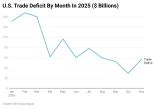
Curiosamente, la cifra del 78% existe, pero no se corresponde con lo que Trump afirma en absoluto. El déficit comercial estadounidense mensual de febrero del año pasado se situó en unos 150.000 millones, y en marzo en unos 140.000 millones de dólares, mientras que en octubre pasado el déficit comercial mensual era de unos 30.000 millones. Esto supone, efectivamente, una reducción del 78% en el déficit comercial mensual entre febrero y octubre cuando uno mira las cifras no redondeadas, pero "el déficit comercial mensual" es una cosa y "el déficit comercial" es otra. En noviembre, el déficit comercial mensual repuntó hasta los casi 60.000 millones de dólares, pero esta parte se omite convenientemente.

¿Por qué se produjo un pico tan alto en febrero y marzo del año pasado? Por la sencilla razón de que todas las compañías que dependían de importaciones hicieron pedidos a gran escala a sus proveedores para disponer de stock, a la vista de que Trump anunció que iba a imponer aranceles a las importaciones de todo. Por esa misma razón, el déficit comercial mensual en abril fue muy bajo, ya que las empresas habían hecho los pedidos antes de la entrada en vigor de los aranceles.

Por enésima vez vamos a señalar, por más que a Kevin Hassett no le guste, que los aranceles son un impuesto sobre las importaciones, que pagan los importadores y los repercuten a los compradores finales. ¿Por qué la carga de los aranceles la asume en un 90% en un consumidor, en vez de asumirla en un 100%? Porque los exportadores están dispuestos a hacer algo de esfuerzo bajando precios a sus socios para mantenerlos como tales, lo que hace que en cierto sentido parte de la carga arancelaria la asuma el exportador.

¿Se va a convertir EE.UU en un país con superávit comercial como sugiere Trump en su marcianada escrita a gritos? Obviamente no, pero a él le da igual, tiene un mensaje que vender, por más que la relación del mismo con la realidad sea pura coincidencia.

etiquetas: artículo

» noticia original ()

19 Feb 13:05

Trump prepara una VPN oficial para evadir bloqueos… y Cloudflare la ha alojado tras una IP que LaLiga suele bloquear

by BuckMulligan

La situación no puede ser más interesante, puesto que de repetirse (que es lo más probable), supondrá un conflicto directo entre las órdenes de Javier Tebas por bloquear y las de Donald Trump por evadir ese bloqueo. Queda por ver si freedom.gov también recibirá un burofax por "compartir IP con piratas".

etiquetas: usa, trump, la liga

» noticia original (bandaancha.eu)

19 Feb 13:05

En las entrañas del sistema de seguridad de la última presa inaugurada por Franco: «Se mueve de lado a lado»

by El_dinero_no_es_de_nadie

El Atazar posee un sistema de auscultación de los más complejos que existen en las presas españolas, constituido por una sofisticada red de vigilancia mediante sensores, capaz de abrir automáticamente los desagües en caso de sobrecarga. Además la presa tiene dos sistemas de control de movimientos ya que la infraestructura se mueve de lado a lado, tanto en horizontal como en vertical. Para el movimiento horizontal tiene unos péndulos que se basa en el sistema tradicional de la plomada. Para el vertical unos extensómetros que son unas varillas

etiquetas: el atazar, vigilancia, sobrecarga, extensómetros, péndulo

» noticia original (www.eldebate.com)

19 Feb 13:05

Europa se ha convertido en un proyecto de guerra: ¿se puede detener? Yanis Varoufakis y Jeffrey Sachs (inglés)

by carakola

Mientras líderes, generales y diplomáticos se reúnen este fin de semana para debatir sobre la seguridad de Europa y el futuro de la alianza transatlántica, la verdadera pregunta no es lo que se dice en el escenario, sino hacia dónde se dirige Europa. Yanis Varoufakis y Jeffrey Sachs examinarán las conclusiones de la Conferencia de Seguridad de Múnich, así como los titulares, las reacciones y las señales que la rodean, separando la retórica de la realidad.Se está configurando una «autonomía estratégica» o se refuerzan las antiguas dependencias?

etiquetas: yanis varoufakis, jeffrey sachs, europa, proyecto de guerra, diem25

» noticia original (www.youtube.com)

19 Feb 13:04

Cargos policiales buscan “mierda” en el expediente de la víctima del DAO para desacreditarla

by Thornton

egún informan fuentes de la división de personal: “Ya han pasado muchos jefazos buscando mierda en su historial”. En concreto, afirman: “Desvelando su identidad y que no salga nada más”. “Este caso puede no quedar ahí y salpicar a más gente”, denuncian fuentes de la Policía. Que muestran su “sorpresa” por el hecho de que alguien se haya atrevido a ir en contra de él, “por todas las represalias que va a tener ella o todas las consecuencias que va a tener la mujer, probablemente ahora empiece lo malo contra ella”.

etiquetas: dao, policía nacional, agresiones sexuales, josé ángel gonzález

» noticia original (www.articulo14.es)

19 Feb 07:26

Jamenei amenaza con hundir un portaviones estadounidense en el mismo día en que Irán y EEUU retoman sus negociaciones

by Vicenteeee

En el mismo día en que Estados Unidos e Irán han mantenido negociaciones indirectas para evitar una ofensiva militar de Washington, el ayatolá Alí Jamenei ha dado un discurso público especialmente duro contra Donald Trump. Jamenei tensa esas negociaciones amenazando incluso con atacar el portaviones que Estados Unidos ha desplazado a las cercanías de las costas de Irán.

etiquetas: estados unidos, alí jamenei, uss abraham lincoln

» noticia original (cadenaser.com)

19 Feb 07:26

Una juez federal dictamina que ICE no puede volver a detener a Kilmar Abrego García (Eng)

by Verdaderofalso

Una juez federal ha dictaminado que el Servicio de Inmigración y Control de Aduanas de Estados Unidos (ICE) no puede volver a detener a Kilmar Abrego García porque ha expirado el periodo de detención de 90 días y el Gobierno de Estados Unidos...

etiquetas: kilmar abrego garcía, ice, eeuu, inmigración, detención, juez federal

» noticia original (apnews.com)

19 Feb 07:26

Vox expulsa a Ortega Smith de forma cautelar por no ceder la portavocía del Ayuntamiento de Madrid

by manuen

La dirección de Vox ha expulsado de forma cautelar a Javier Ortega-Smith del partido de extrema derecha por “desacatar” la orden de ceder la portavocía del Ayuntamiento de Madrid, según ha adelantado El Español. Según asegura este medio, el Comité Ejecutivo Nacional ha activado este miércoles el procedimiento disciplinario después de que el hasta ahora diputado autonómico se negara a acatar la decisión del CEN según la cual debía ser relevado por Arantxa Cabello.

etiquetas: vox, ortega smith, expulsión

» noticia original (www.eldiario.es)

19 Feb 07:26

Alaska arde como nunca antes, reportando más incendios forestales que en cualquier otro momento en los últimos 3.000 años

by minossabe

Alaska arde como no lo había hecho en al menos 3.000 años. No es una metáfora ni una exageración periodística: es la lectura que emerge al combinar registros satelitales recientes con archivos naturales mucho más antiguos, ocultos bajo los pies, en forma de turba y suelos orgánicos. El calentamiento no solo eleva la temperatura del aire. También altera la estructura del suelo. El permafrost, que mantiene el terreno congelado al menos dos años consecutivos, empieza a descongelarse. El resultado regiones frías cada vez más secas

etiquetas: alaska, récord, incendios, permafrost, sequía, historia

» noticia original (ecoinventos.com)

19 Feb 07:25

Pablo Iglesias pide a Podemos dar portazo a la nueva alianza de izquierdas: "Recomiendo a mi partido no entrar en esa jaula de grillos"

by Pertinax

Iglesias apuntó a que la nueva coalición es una "suma de debilidades", con cuatro organizaciones pero sin "liderazgo". Frente a esto, apuntó a Gabriel Rufián, a quien atribuyó "liderazgo mediático" pese a la falta de apoyo de mi partido. "Hay quien dice como Rufián, "Yo no tengo partido, pero tengo liderazgo mediático, entonces pongo en valor que me quiere mucho la gente, aunque mi partido no me apoya", apuntó. El exvicepresidente situó ambas opciones "tras la retórica de 'nos lo está pidiendo la ciudadanía'", apuntó, antes de señalar que...

etiquetas: pablo iglesias, podemos, izquierda, rufián

» noticia original (www.elperiodico.com)