“Internet es una mierda”. Así de contundente se muestra Cory Doctorow (Toronto, Canadá, 1971), periodista, activista digital y autor de Mierdificación (Capitán Swing, 2026). El título de su nuevo libro corresponde al nombre que le ha dado al estado actual de las plataformas, que maltratan a sus usuarios a base de “robarles datos, espiarles y manipularles”. Ese término, que puso nombre a la frustración que muchos de los usuarios de Internet sentían, fue seleccionado como palabra del año por el diccionario Macquarie en 2024.
El gobierno alemán ha modificado su postura oficial sobre las acusaciones de genocidio contra Israel. Hasta ahora, Berlín había defendido públicamente a Israel de forma consecuente, argumentando que las acusaciones legales formuladas contra este país, incluidas las de Sudáfrica, carecían de fundamento. La alegación de que las acciones de Israel contra los palestinos en la Franja de Gaza violan la Convención para la Prevención y la Sanción del Delito de Genocidio de 1948 se encuentra ante la Corte Internacional de Justicia de La Haya
etiquetas: alemania, israel, palestina, genocidio, tribunal de la haya
Deja el drama, estás en un sueño. Nada es grave. Actúa desde la libertad del 'como sí'. Tu propósito se revela en los sueños que ya se desarrollan en ti. Sueña lúcido, vive con pasión intensa y desapego sublime. #SueñosLucidos #Desapego #ViveIntensamente #PropósitoDeVida
Nuevo elemento para la polémica en el caso del accidente ferroviario de Adamuz (Córdoba), ocurrido el 18 de enero en la línea de alta velocidad Madrid-Sevilla. El gestor de la infraestructura Adif ha remitido este viernes, día 20, un escrito al Juzgado de instancia número 2 de Montoro (Córdoba) en el que reconoce que sustituyó a primeros de mes 36 metros de raíl cerca del lugar del siniestro, en el punto kilométrico 317,264 de la vía 2. Hasta este momento se desconocía la razón de esa actuación, y responde a que en sus archivos no constaba registro del control de calidad de esa pieza de acero. Tal incidencia, afirma la representante de Adif, Miriam Martón, fue alertada por la empresa suministradora del carril.
Hace unos años, mi padre entró en mi cuarto pensando que estaba dormida. Se sentó en mi cama, me acarició suavemente la cabeza y me dijo lo mucho que me quería y que estaba orgulloso de mí. Al día siguiente no estaba. Nunca más volví a verle. ADV
Fotografía: Trabajadoras de la Fábrica Nacional de Moneda y Timbre en una imagen sin fechar. / Historia Bancaria
Artículo original publicado en ctxt.es por Juan Torres López
El Banco Central Europeo se suma a más de un centenar de bancos centrales que estudian o diseñan la emisión de nuevas monedas digitales.
La idea suena ambiciosa, casi revolucionaria. Pero conviene aclarar las cosas porque –por lo que el propio BCE viene informando sobre su proyecto– parece que lo que va a crear se parece más a un “monedero digital” que a una auténtica nueva moneda de esa naturaleza.
El euro digital ya existe
El dinero es, en términos simples, cualquier cosa que sea aceptada generalmente como medio de pago. Hoy adopta formas distintas. Por un lado, está el dinero físico –monedas y billetes de euros– que es el dinero legal emitido por el banco central. Y por otro lado hay dinero digital (en nuestro caso, euro digital), que es el que utilizamos cada día a través de nuestras cuentas bancarias, tarjetas, transferencias o aplicaciones móviles. Este último no lo crea directamente el banco central, sino los bancos comerciales cuando conceden crédito. Es dinero bancario, digital, y constituye la inmensa mayoría del dinero en circulación.
El euro ya es fundamentalmente digital. Cuando pagamos con tarjeta o hacemos una transferencia no movemos billetes ni monedas
Por lo tanto, el euro ya es fundamentalmente digital. Cuando pagamos con tarjeta o hacemos una transferencia no movemos billetes ni monedas, sino números en la cuenta de nuestro banco. Es decir, no es dinero que circule en forma de papel o metal, como los billetes y monedas, sino como apuntes electrónicos en los ordenadores de los bancos. Podemos convertirlo en billetes si queremos, pero mientras tanto son simplemente cifras anotadas en nuestra cuenta.
¿Qué es una moneda digital del banco central?
Si un instrumento reúne esas propiedades, ya no es simplemente un medio de pago digital más. Es una nueva forma de dinero público
A diferencia del dinero bancario actual, que es dinero digital creado por la banca privada, una moneda digital de banco central (MDBC) es dinero emitido directamente por el banco central en formato digital y accesible al público en general.
Por tanto, para que lo sea en sentido pleno, debería reunir al menos las siguientes características:
– Emisión directa por el banco central, como lo son hoy los billetes y monedas.
– Acceso universal, de modo que cualquier persona o empresa pueda abrir una cuenta o mantener saldo directamente en el banco central, sin necesidad de intermediación bancaria para disponer de la titularidad del dinero.
– Convertibilidad plena y paritaria. Es decir, ser intercambiable uno a uno con el dinero físico y con los depósitos bancarios.
– Ausencia de límites cuantitativos o de topes de tenencia, para que pueda utilizarse exactamente igual y con los mismos fines que cualquier otra forma actual de dinero.
– Posibilidad de ser remunerado con intereses para que así el banco central pudiera convertir su gestión en un instrumento directo más de política monetaria.
– Capacidad de funcionar como medio de pago general. Es decir, ser utilizable en todo tipo de transacciones, tanto minoristas como electrónicas, en igualdad de condiciones frente a otras formas de dinero.
Si un instrumento reúne esas propiedades, ya no es simplemente un medio de pago digital más. Es una nueva forma de dinero público plenamente equiparable al efectivo, pero en formato digital.
Lo que al parecer se propone crear el Banco Central Europeo
Según la información difundida por el Banco Central Europeo, el euro digital que se propone crear tendría características y funcionalidades bastante diferentes a las anteriores. No sería una nueva moneda digital en sentido estricto por diferentes razones:
a) Se establecen límites cuantitativos a la tenencia de euros digitales, parece ser que de 3.000 euros por sujeto. Una restricción que impide que pueda utilizarse libremente como cualquier otra forma de dinero y limita su capacidad de convertirse en alternativa real a los depósitos bancarios.
b) No tendría remuneración y, al excluir el pago de intereses, el BCE renuncia a utilizarlo como instrumento directo y flexible de política monetaria. Evita así que compita en condiciones similares con otros activos líquidos.
c) No estaría diseñado para funcionar en igualdad plena frente a los depósitos bancarios. El propio BCE ha señalado que su objetivo es evitar que la banca privada deje de ser la principal vía de intermediación financiera. Es decir, el diseño incorpora explícitamente la intención de que no sustituya ni compita estructuralmente con los depósitos privados.
d) No supondría una ampliación sustancial del dinero público en circulación. En la práctica, el euro digital se nutriría principalmente de transferencias desde depósitos bancarios ya existentes, más que de una expansión neta del dinero emitido por el banco central.
Las ventajas del euro digital
Una parte significativa de nuestras infraestructuras depende de redes y plataformas privadas, muchas de ellas fuera del control directo europeo
A la vista de esto último, es fácil deducir que el euro digital que se propone crear el BCE cumpliría algunas características de una moneda digital del banco central, pero no todas las que podría tener en sentido pleno. No sería una moneda digital del banco central en su versión completa, sino una versión limitada y bastante acotada de esa posibilidad. Como dije, una especie de monedero digital sofisticado.
A pesar de ello, es cierto que tendría virtudes importantes
En primer lugar, proporcionaría un nivel de seguridad superior al de los depósitos bancarios privados, cuya garantía depende en última instancia de mecanismos de respaldo y supervisión. Tener dinero directamente emitido por el banco central elimina el riesgo de insolvencia de una entidad comercial sobre ese saldo concreto.
En segundo lugar, reforzaría la autonomía europea en el ámbito de los pagos digitales, pues una parte significativa de nuestras infraestructuras actuales depende de redes y plataformas privadas, muchas de ellas fuera del control directo europeo. Aunque esto sólo se produciría en cierta medida, como expliqué en un artículo anterior.
En tercer lugar, el euro digital actuaría como contrapeso frente a la expansión de soluciones privadas –desde grandes plataformas tecnológicas hasta iniciativas cripto– en el ámbito monetario.
En cuarto lugar, podría mejorar la eficiencia en los pagos al reducir costes de transacción, aumentar su velocidad, ofrecer interoperabilidad en toda la eurozona y permitir pagos digitales sin conexión a la red (si se diseña para que pueda ser así).
Finalmente, si se diseña adecuadamente, puede aumentar la inclusión financiera facilitando el acceso a pagos digitales a personas con menor acceso a servicios bancarios tradicionales.
Las renuncias del Banco Central Europeo
La creación de un euro digital que no será una auténtica nueva moneda sino algo de bastante menos alcance, como hemos visto, supone que el BCE renuncia a ventajas e instrumentos muy relevantes que tienen las monedas digitales de los bancos centrales en sentido estricto y pleno.
Renuncia, en primer lugar, a que el euro digital se convierta en una alternativa real a los depósitos bancarios.
Renuncia también a la remuneración de esos saldos, lo que excluye su utilización como instrumento directo y flexible de política monetaria.
Al establecer un límite de depósito y excluir su remuneración, el BCE garantiza que el euro digital no se convierta en una alternativa significativa a los depósitos bancarios. El resultado es que la estructura actual de creación y gestión del dinero permanece intacta, con los mismos incentivos y vulnerabilidades que han caracterizado al sistema en las últimas décadas y que han hecho necesarias en demasiadas ocasiones intervenciones públicas muy costosas para sostener la estabilidad financiera.
El argumento que invoca el Banco Central Europeo para no ir más allá es la estabilidad financiera. Por un lado, como dice el propio BCE, para evitar que se produzca una desintermediación significativa de la banca privada. Es decir, que deje de ser el eje o centro principal de la captación de depósitos y de la provisión de crédito y medios de pago en Europa. Y, por otro, que se produzcan tensiones por salidas masivas de dinero si no se pone límite a la transferencia de depósitos hacia el euro digital. Pero el resultado de ese conservadurismo es claro y negativo: el euro digital nace diseñado para no transformar la arquitectura monetaria existente.
La transición tecnológica en la que nos encontramos, la auténtica revolución financiera que ya ha empezado a darse, ofrece una oportunidad histórica para redefinir el papel del dinero público en la economía digital y para reforzar la autonomía de la Unión Europea.
El Banco Central Europeo podría haberla aprovechado, pero ha optado por la versión más conservadora, neutra y cuidadosamente acotada del euro digital. Y cuando la innovación tecnológica avanza y proporciona oportunidades de cambio, elige mantener el equilibrio institucional, a pesar de los graves y recurrentes problemas que ya ha dado.
En un momento en el que Europa debate su autonomía estratégica, el dinero público digital podría haber sido una herramienta de transformación. Con lo que proyecta hacer el BCE será, sin embargo y como mucho, un instrumento complementario que no podrá desplegar todo el enorme beneficio potencial de las auténticas monedas digitales de los bancos centrales. Una gran oportunidad perdida.
La cifra que resume esta aventura fallida es difícil de creer. Reality Labs, la división de Meta responsable de los cascos Quest, las gafas inteligentes Ray-Ban Meta y todo el ecosistema de realidad virtual y aumentada, acumula pérdidas operativas de cerca de 80.000 millones de dólares desde 2020. Solo en el cuarto trimestre de 2025, la división perdió 6.020 millones de dólares, un 21% más que en el mismo periodo del año anterior. Los ingresos del trimestre (955 millones) no cubrieron ni el 16% de los gastos. @elmundo
Las petroleras se enfrentan a sanciones de hasta seis millones de euros si no proporcionan la información que les exige la Comisión Nacional de los Mercados y la Competencia (CNMC) en el marco del nuevo paquete de ayudas para mitigar el impacto económico de la guerra en Irán. El decreto ley publicado este sábado en el Boletín Oficial del Estado (BOE), que entre otras medidas prevé una rebaja del IVA de los carburantes del 21% al 10% y una reducción del impuesto de hidrocarburos, habilita al organismo para solicitar a “los agentes que participen en la distribución mayorista y minorista de productos petrolíferos” los datos necesarios para analizar el funcionamiento del mercado.
In late 2024, the federal government’s cybersecurity evaluators rendered a troubling verdict on one of Microsoft’s biggest cloud computing offerings.
The tech giant’s “lack of proper detailed security documentation” left reviewers with a “lack of confidence in assessing the system’s overall security posture,” according to an internal government report reviewed by ProPublica.
Or, as one member of the team put it: “The package is a pile of shit.”
Three years after saying it had stopped buying location data of Americans without a warrant, the FBI acknowledged it has restarted the purchases. During questioning at a Senate Select Committee on Intelligence hearing yesterday, FBI Director Kash Patel said the location data purchases have produced valuable information, and he did not commit to stopping the practice.
In March 2023, then-FBI Director Christopher Wray confirmed that the agency had previously bought location data of US citizens without obtaining a warrant. "To my knowledge, we do not currently purchase commercial database information that includes location data derived from Internet advertising,” Wray, who led the agency during Trump's first term and during the Biden era, said at the time. “I understand that we previously—as in the past—purchased some such information for a specific national security pilot project. But that’s not been active for some time.”
At yesterday's hearing, Sen. Ron Wyden (D-Ore.) recounted Wray's 2023 statement and asked Patel, "Is that the case still and, if so, can you commit this morning to not buying Americans' location data?"
A little more than a month ago, SpaceX founder Elon Musk put down a marker of his intent to saturate low-Earth orbit with up to 1 million satellites. Its purpose? Provide always-on data center services around the planet.
Now, Amazon and Blue Origin founder Jeff Bezos has done something similar with a filing to the Federal Communications Commission of his own, proposing a constellation of up to 51,600 satellites operating in Sun-synchronous orbits at altitudes ranging from 500 to 1,800 km. Bezos' space company, Blue Origin, sought the authority to do this and is calling the constellation "Project Sunrise."
In its filing, Blue Origin argues that terrestrial AI-based data centers will face difficulties scaling up to meet computing demand.
"Ahora que esa batalla ha sido ganada militarmente, con muy poco peligro para ellos, se quejan de los altos precios del petróleo que se ven obligados a pagar, pero no quieren ayudar a abrir el estrecho de Ormuz", ha afirmado Trump en un post de Truth Social
Trump cree que aliados de la OTAN como España o Alemania “se merecen” que EEUU reconsidere sus bases por no ayudarle con Ormuz
Trump asume que la guerra contra Irán se complica y busca cómo financiarla
El presidente de EEUU vuelve a insultar a sus aliados. Donald Trump ha vuelto a cargar contra los miembros de la OTAN por no ir al auxilio de EEUU en el caos que ha generado en Ormuz por la guerra desatada contra Irán hace tres semanas de la mano de Israel: “Sin EEUU, la OTAN es un tigre de papel!”
“No quisieron unirse a la lucha para detener a un Irán con capacidad nuclear”, ha afirmado Trump: “Ahora que esa batalla ha sido ganada militarmente, con muy poco peligro para ellos, se quejan de los altos precios del petróleo que se ven obligados a pagar, pero no quieren ayudar a abrir el estrecho de Ormuz; una simple maniobra militar que constituye la única razón de esos elevados precios del petróleo. Algo tan fácil de hacer para ellos, y con tan poco riesgo”.
Y Trump concluye: “¡Cobardes! Lo recordaremos”.
Truth Social de Trump contra los aliados de la OTAN.
Trump afirma que la ofensiva va por delante del calendario previsto, pero muestra mostrar desesperación por encontrar soluciones ante una escalada de los precios de la energía para la que no había planes de contingencia: el barril de petróleo este jueves ha alcanzado los 118 dólares.
“Hace falta dinero para matar a los malos”, ha dicho el secretario de Guerra, Pete Hegseth, para justificar la petición de 200.000 millones de dólares extra al Congreso para seguir con una guerra que el presidente Trump califica de “excursión”. ¿Una excursión que requiere 200.000 millones más, que ha supuesto la vida de 14 soldados estadounidenses y que ha llevado a que la gasolina esté por encima de los 3,5 dólares el galón cuando hace tres semanas la Casa Blanca presumía de que el precio rondaba los dos dólares –cuando tampoco era verdad–?.
Cada día es una contradicción, también porque se evidencia que EEUU va de la mano de Israel, y que el primer ministro israelí, Benjamín Netanyahu, tiene una agenda propia diferente de la de Trump, al que arrastra permanentemente. Y, mientras, el presidente de EEUU quiere arrastrar también a sus aliados para garantizar la seguridad de los petroleros que crucen el estrecho de Ormuz, pero se encuentra con el 'no' de los europeos y de los asiáticos. Este jueves, se ha mostrado confiado en Japón, aunque su primera ministra, Sanae Takaichi, no haya confirmado nada.
Donald Trump ha aliviado dos veces las sanciones al petróleo ruso y una al venezolano en los 20 días que lleva de guerra en Irán. Y ahora se empieza a deslizar la idea de aliviar también las sanciones al petróleo iraní. ¿Por qué? Por el efecto económico sobrevenido de la guerra en Irán.
Justifica, en un escrito a la juez, las obras y la retirada de carril pero asegura que no había "desperfecto o anomalía técnica alguna en el acero" que quitó Leer
How a complex, large-scale migration to an in-house observability platform led to superior tooling, consistent data, and a fundamental reset of the developer experience.
Observability — the function of providing visibility into the performance and reliability of applications using metrics, logs and traces — is one of the most important tools of the Infrastructure group at any company. Without a reliable, cost-effective, and user-friendly observability platform, you limit an organization’s ability to empower engineers to assess, support, and improve the reliability of their application.
Like many of its peers, Airbnb started out by outsourcing its observability needs to vendors. But, as the company matured, our needs diverged from the typical vendor’s incentives. Vendors charge by the amount of data ingested, so Airbnb’s costs were rising, but more data does not automatically lead to faster insights or reduced mean time to detect (MTTD) or repair (MTTR). Also, by being out of the feedback loop of how observability data is consumed, our ability to enhance the monitoring workflows of our customers or pursue cost optimizations on observability spend was severely hampered.
To meet our objectives, Airbnb embarked on a complex migration, overhauling every part of our metrics infrastructure. This challenging journey involved replacing our instrumentation, collection, storage, and visualization systems as we transitioned from a third-party, vendor-managed observability platform to a custom, in-house solution built on open-source technology based on Prometheus.
This transition enabled us to gain end-to-end ownership over metrics collection, storage, and querying. Through this project, we successfully utilized our automation tooling to migrate a massive volume of data across 1,000 services: 300 million timeseries, 3,100 dashboards, and more than 300,000 alerts. While one does not undertake a project of this scope lightly, the restrictions around what we could do with our own data left us with little alternative.
Though there’s no one-size-fits-all migration guide, we have some learnings from this specific migration that we believe will be helpful to others. We will first describe a simplistic, but ultimately flawed, approach to migration, and then detail the successful strategy we ultimately employed. Our plans for this migration, begun five years ago, evolved significantly as we proceeded. This journey provided us with valuable, hard-won lessons, offering clear insights into the best practices and pitfalls for executing a large-scale migration.
Migration v1
Climbing Everest on day one
When approaching a large-scale migration, the general strategy is to aim for the largest, most impactful service first. Tackling the biggest challenge upfront allows the project team to demonstrate immediate, significant progress, build confidence in the new infrastructure, and prove the migration strategy’s viability to the wider team and stakeholders. This high-visibility win then sets the tone for the rest of the rollout.
With this approach in mind, it (initially) made sense to take a complex service — for example, something that has sparse data, or emits metrics in a way not standard to the new system — and make this the first service to migrate onto our new system. That would expose the differences between the two systems and allow us to design solutions that mimicked the behavior of the old system, ensuring that the dashboards and alerts would look the same.
When following this strategy, a team will spend a lot of time getting the first service to work, and is likely to have false alarms, dashboards that don’t align between the systems, and a lot of education to get the first customer on board; all to prove to the wider company that the overall migration is worthwhile.
Same baggage, thinner air
When migrating systems, a smooth transition for your customers is paramount, as enough is already changing for them. Even if the legacy system has led to flawed or inaccurate queries that could be fixed, it’s important to approach fixes strategically. For example, avoid trying to resolve issues with existing dashboarding and alerting patterns all at once.
Instead, focus on a complete migration to the new system first. Once everyone is brought over and centralized, you can address and solve these dashboard and alerting improvements in a subsequent, second set of changes. Customers want the initial migration completed first. If moving to the new system already presents friction, we shouldn’t exacerbate the difficulties involved by also altering the functionality of their queries.
The documentation explains everything, for those who stop to study it.
To facilitate customer adoption of the new system, which likely includes extensive changes, it’s crucial to provide comprehensive documentation on the new query language and interfaces. This should be paired with extensive training to ensure user proficiency.
Even for infrequent users, familiarity with the observability query language is important, similar to any programming language. This knowledge, supported by the documentation and training materials, will be particularly valuable for quickly diagnosing problems during incidents.
Migration v2
Start with an achievable target
Choosing an initial service to migrate that aligns closely with your destination system can eliminate much of the distraction and noise that typically accompanies a complex migration. When your initial goal is to prove (to your team and to the broader company) that the migration is worthwhile (in terms of cost reduction, capabilities, etc.), it’s crucial to focus on a tractable, high‑leverage service.
This allows your team to:
Validate that the storage engine can handle the required scale and observe how it behaves during incidents
Deliver translator tooling to migrate existing dashboards and alerts to the new system
Invest in customer‑facing documentation, education, and training
Introduce the new visualization tool to a small set of users, giving them time to adjust to the new experience while your team gathers feedback on UX gaps before rolling the service out at scale
Successfully migrating this less complex service achieves two things: it demonstrates to your team that the migration is technically and operationally feasible; and, by narrowing the scope and collaborating closely with the customer, it helps you validate the migration strategy to the entire company.
Switching vendors will often necessitate a new visualization tool, so this is also a good opportunity to surface any UX differences early. The feedback your team collects from this initial cohort will prove invaluable when rolling the new tooling out to the rest of the organization.
Migrate the intent of query
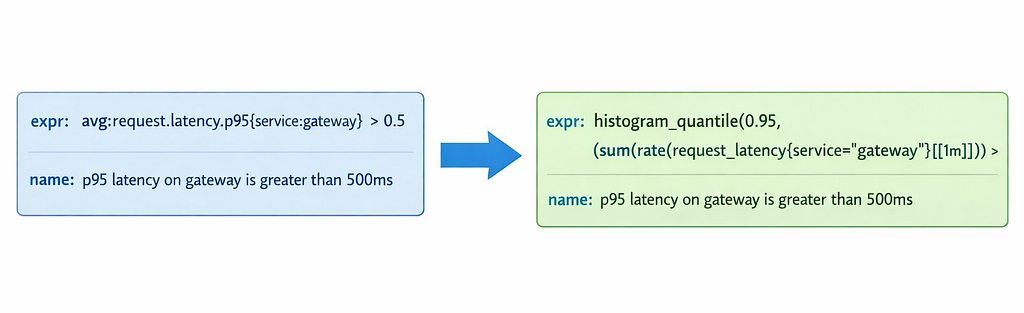
With any long‑running system, you eventually accumulate a wide variance in how latency, error rates, and other signals are measured across dashboards. In a democratized observability environment, this is almost guaranteed: some metrics will be computed incorrectly — for example, averaging a result that should be a p95, or summing total latency. Customers can easily construct flawed queries and, without guardrails, the results of those queries get treated as ground truth.
A migration puts your team back in the loop. It’s an opportunity to correct these patterns — not by erasing or resetting them, but by understanding the original intent and mapping it to a preferred, standardized query.
With this in mind, we adapted our translation system to focus on intent rather than one‑to‑one query translation. For example, if a query included a p95 calculation, we would ignore any additional aggregations layered on top and instead return a canonical histogram query for that metric.
In practice, this required introducing a dedicated metadata engine. In Prometheus, metric types are often inferred from naming conventions (for example, a _total suffix indicating a counter). But, because we chose to preserve existing metric names to avoid divergence between code and observed data, naming alone was no longer reliable.
To address this, we built a metadata engine directly into the translation layer. It periodically scans all known metrics and uses an internal label (otel_metric_type) to construct and maintain a reliable mapping from metric to type.
With this change in place, we’re now significantly more confident that teams have accurate, consistent visibility into the performance of their applications.
A new query language can be daunting
Customers are, understandably, going to need some time to reset the muscle memory they have developed for the old system. In some cases, your new system may not provide the same polish for easily crafting queries.
During our migration, our users’ lack of familiarity with the new query language was solved by using our translation tooling, which could map a given query to the new system to help bootstrap a self-service migration. But, post-migration, we didn’t want to continue providing a shim between the old language and the new, as that would slow down or inhibit the needed reset of muscle memory.
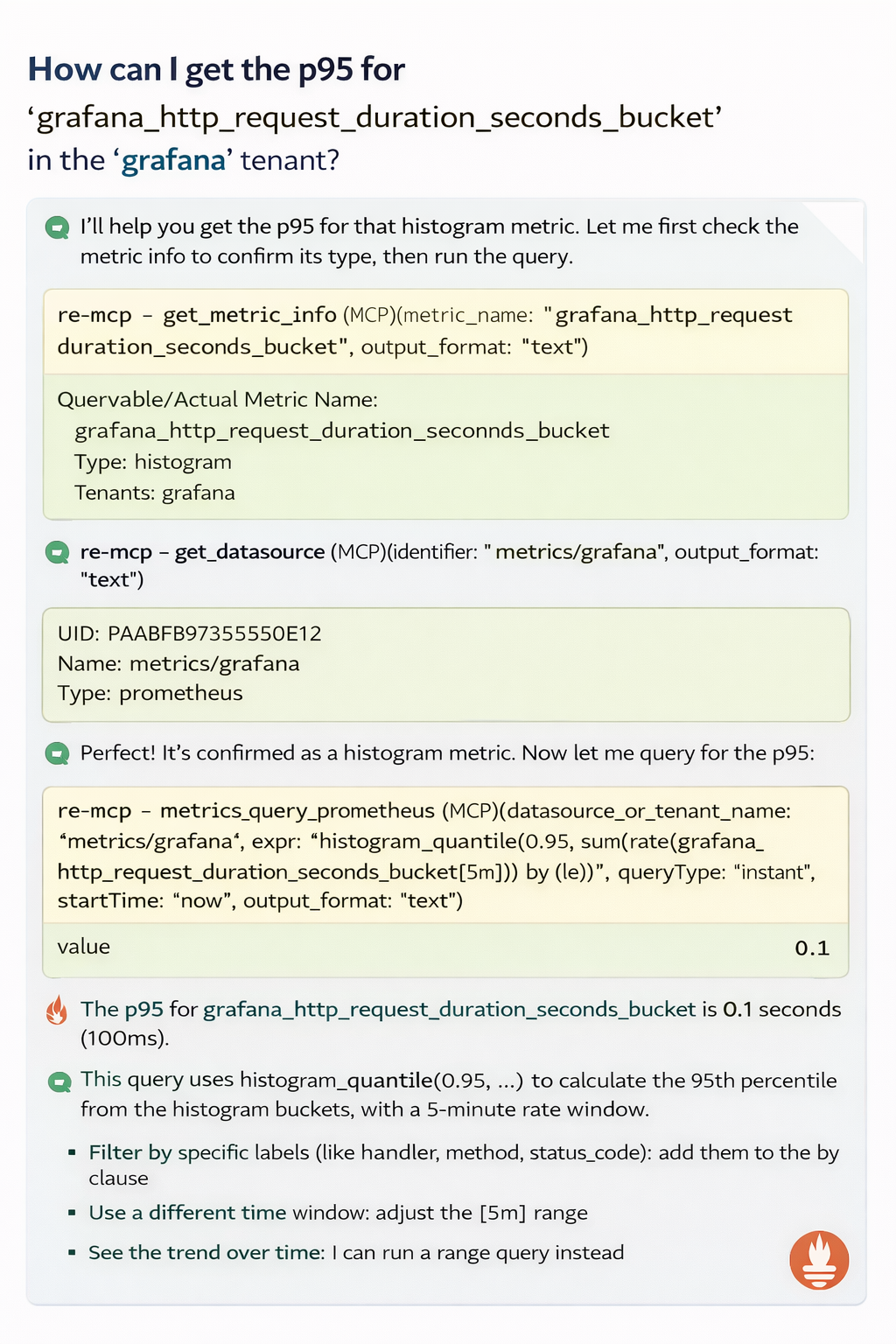
By adopting PromQL as the query language for our new system, we benefit from a mature ecosystem and a well-documented query language that is widely understood by both humans and modern LLMs.
We further reduced the barrier to entry by pairing this with in-house skills for our AI tooling, which supplies rich semantic metadata about each metric — for example, whether it is a counter or histogram, or what units it is reported in. Together, these capabilities allow agents to generate correct PromQL with far less manual effort, enabling developers to bootstrap their understanding more quickly and explore metrics more effectively. This has become critical for incident debugging.
Consequently, customers can now complete many common tasks, such as diagnosing incidents or creating dashboards, in a matter of minutes, a significant reduction from the hours these tasks previously required.
Now is the time to correct outdated patterns
Over time, old systems may be neglected, and their (lack of) functionality may become a drag on productivity. Thus, the benefit of any large migration is that you get to take a step back, reflect on how your product is being used, and identify additional areas for improvement.
While initially we were afraid of introducing new concepts, as our initial set of customers began using the new system, it became clear to us that the existing alert framework was in need of a replacement. We made the choice to pull forward the investment our sister team, Reliability Experience, had been making in the alert authoring space, and promote their work as the preferred alert-authoring experience.
This new alert experience replaced the outdated system with a new alert-authoring experience that treated each alert as a development workflow, rather than as a sparsely documented config file. Alerts are authored as code, with autocomplete and builder-style assistance for writing queries, built-in backtesting to understand when an alert would have fired historically, and diffing to clearly reason about the impact of changes, all before deployment.
This was a change from our original strategy of maintaining dashboards and alerting unchanged by the initial, major migration. But we found that the migration’s success was significantly amplified by the improved alerting framework. This change helped customers recognize the inherent value of the migration, beyond just control and cost objectives, shifting the perception of the project. Furthermore, the centralized nature of the new alerts streamlined the process by reducing the overall migration effort. This centralization lowered the amount of work customers needed to spend on migration tasks.
Conclusion
This migration ultimately became much more than a change in which storage engine to use and where it was hosted. What began as an effort to “just port the system” evolved into a reset of how we think about observability, ownership, and the developer experience.
By owning the full lifecycle of our metrics, from emission through querying, we materially improved our reliability posture. We moved from fragile, hand-crafted queries toward more intentional patterns, better tooling, and higher-confidence alerts and dashboards. The investment in metadata, AI tooling, and modern authoring workflows paid dividends not only in correctness, but in how quickly engineers can explore possibilities and respond during incidents.
Equally important, the migration reshaped our relationship with our internal customers. Instead of outsourcing core observability concerns, we were forced to engage deeply with how teams actually use metrics under real operational pressure. That feedback loop has been invaluable, and it continues to guide where we invest next.
Automation played a key role in making this migration feasible, but we learned that automation alone is not enough. Blindly translating existing patterns (especially flawed patterns) simply transfers technical debt into a new system. The most impactful moments came when we deliberately chose to break compatibility in favor of better defaults, even when that caused short-term friction.
Finally, this effort produced a repeatable blueprint. For future migrations, we are clear about what we want to own: the experience and interfaces for how engineers write, read, and reason about their data. Storage engines and backends may change, but the responsibility for making observability usable, trustworthy, and evolvable should remain firmly in our hands.
Even for teams not facing an imminent migration, there are steps worth taking now to reduce future friction. The most impactful is to own the interaction layer: the frontend, authoring tools, and workflows engineers use to explore and act on observability data. During our migration, we not only had to change the backend system, but also had to move every team to a new visualization tool and to our new alerting framework, significantly increasing the switching cost. Had we already controlled those touchpoints, the backend transition would have been far simpler and more incremental.
While every organization’s constraints are different, we hope these lessons help others view large-scale migrations not as a necessary burden, but as a rare opportunity to meaningfully improve systems and, as a result, your observability posture.
If this type of work interests you, check out some of our open roles.
Acknowledgements
We would like to express our gratitude to the following teams for their essential contributions to this migration:
Observability Team
Abdurrahman Allawala, Rishabh Kumar, Eugene Ma, Natasha Aleksandrova, Suman Karumuri, Wei Song, Yann Ramin, Shylaja Ramachandra, and Xuan Lu. This team was instrumental in migrating Airbnb to the new observability system.
Reliability XP Team
Doug Smith, Kevin Goodier, Harry Shoff, Rich Unger, and Vlad Vassiliouk. This team developed our new Alerting framework.
Finally, a thank you to everyone across Airbnb who helped successfully migrate onto our new observability system.
All product names, logos, and brands are property of their respective owners. All company, product, and service names used in this website are for identification purposes only. Use of these names, logos, and brands does not imply endorsement.
1. My male coworker takes his family everywhere, and it makes him late for work events
I am a woman in STEM and have a coworker, Fergus, who has a stay-at-home-wife and a toddler. They currently live out-of-state with his in-laws, and when he travels — whether it’s to a conference, work event, or just an in-office event — he always brings his wife and kid.
This leads him to often not arriving to these events that start at 8 or 9 am until 11 or 12 because he went to brunch with the fam. My (male) boss finds it endearing, despite it often leaving the rest of us idle for hours waiting on him and often seems to overlook women in the office with children for projects.
This is weird, right? If I as a woman were to do it, it would seem distracting to the job and frowned upon, right? I am not being unreasonable here?
Yes, it’s weird. Not necessarily that he brings his wife and kid with him — some people find it easier to do that when they travel — but that he allows it to affect his availability for work during these trips, particularly during normal business hours, and it’s even odder that your boss is apparently fine with it. It’s particularly problematic that your boss seems to discriminate against women with kids, while having a different standard for a man with kids who is actively letting them affect his availability during work hours.
Any chance the rest of you want to speak up and say, “Could we ask Fergus to be here at 8 so we’re not waiting on him like has happened a lot previously?”
2. Is it normal for my desk to be really far away from the rest of my team?
I’m in my mid 30s and have been working full-time for over a decade, but after working in the arts for my whole career, I recently changed industries to something that’s more formal office-type work. When I was interviewing for this job, I made sure to ask as much as I could about office culture, but I didn’t think to ask where my desk would be, and I’m regretting that now.
My office is in the very back corner of the building, far away from everyone else. You basically have to have a map and answer three riddles to get to my office. I feel lucky that I have space to work (and even a window!), but I absolutely hate that I sit alone in my office all day. Is this normal? In my previous roles in arts organizations, even when my job was mostly desk-based, I never felt physically separated from the rest of my team like this. This was usually because there wasn’t enough space for everyone, but even if my office was around a corner, there were constantly reasons to be getting up and talking to my colleagues. On the (rare) occasions that I had an office to myself, everyone else was always close by.
Are people in office jobs really out here just sitting alone at a desk working all day? I feel so disconnected from my colleagues and my work, and I’ve never felt less motivated to do work. Is office/desk location worth asking about when interviewing? I know there are people who love working remotely, but I’ve always struggled with it because it felt isolating to me. But if most office jobs are sitting alone at a computer for most of the day anyway, then I certainly have a new appreciation for being remote, where I can at least hang out with my cat. But I’m seriously considering leaving, and while there are other significant reasons that this job isn’t working for me, the geography of where I’m working is definitely a major factor, so I want to be sure that where I go next doesn’t have the same issues. Is this the norm that I should be expecting? Should I ask about it in any interviews that I get?
It’s not the norm to be seated far away from the rest of your team (which is probably confirmed even in your own office by the fact that the rest of your team seems to be seated closer to each other). But there are certainly workplaces where it happens, often due to a shortage of space where they’d prefer to put you.
Have you talked to your manager about it and asked if there’s a way to sit closer to the rest of the team? You could explain that you feel isolated and would prefer to be in closer contact with people you work with. Who knows, maybe there are alternatives, especially if you’re willing to give up things like a window. It’s worth at least asking.
Otherwise, though, yes, you can ask what the office set-up is like when you’re interviewing. It’s something to save for closer to the end of the interview process, not in an initial phone screen, but you could certainly say something like, “I had a job where I sat really far away from the rest of my team, and I found that made it harder to collaborate. Can you tell me a little about what the office set-up is like for this team, and for this role in particular?”
3. We’re expected to donate a lot of money for gifts throughout the year
I need a gut check on gift giving on my team. We are a team of eight, including our manager. We typically each pitch in $5 for a gift card for everyone’s birthday, which costs around $35 each year. We also do a Christmas present for each team member, which is around $50 total. And then when someone is going through a hard time, like if their pet dies or they have an unexpected medical issue, we will pool another $5-$10 each to help out. So it costs about $100-$120 a year to be on our team.
Contributions are “voluntary,” but they are organized through our online chat platform so everyone can see if you’ve contributed or not. Some of us can definitely afford the cost, but there are people on the team who make a lower hourly wage, and none of us are getting raises this year. Also, I have a very rocky relationship with our manager and had to get HR involved to avoid retaliation around her birthday last year. And I still had to contribute $5 for her gift card and sign a card wishing her a happy birthday.
I am trying to make it work with my manager but she gets really enthusiastic about the gift giving and I find it off-putting. I’m not sure if that’s because of my past issues with her or because I’m starting to think that it costs too much to be on my team. Thoughts?
It’s more than off-putting; it’s unethical. It still happens with a surprising amount of regularity, but people shouldn’t be pressured to contribute their own personal money to have a job, or to be seen a full member of their team.
Whether it’s politically smart to do anything about it is a different issue. There might be room for a bunch of you to speak up and ask that the practice be curtailed — but since you have a rocky relationship with your manager and she apparently retaliated about something birthday-related last year, you probably shouldn’t be the one leading it.
4. We’re not paid for mandatory lunch meetings
We have a mandatory monthly staff meeting with lunch provided. Sometimes the meetings are more than an hour. Our meeting last week was less than 45 minutes. The purpose of the meetings varies. In theory, we are allowed some time to eat lunch before the staff meeting portion starts; however, last week, our boss started the meeting immediately. This meeting consisted mostly of us going around the room to introduce ourselves to a new employee. So, we all sat there for most of this time telling one person information that we already know about each other.
When we have these lunch meetings, for hourly employees like me, HR deducts 30 minutes from our paid work time as “lunch.” If hourly staff are short of 40 hours for the week, we are generally expected to use enough PTO to equal 40 hours.
I typically don’t take a lunch break, so my workdays are a straight eight hours. Yesterday, I double-checked my time for last week, and damn if I’m not 30 minutes short now because HR deducted 30 minutes for this lunch meeting. I would not otherwise be short. I will have to submit a request for 30 minutes of PTO if I want to be paid my full 40 hours. My alternative would have been to stay at work 30 minutes longer that day to make up the time deducted for this lunch meeting, which I would have done, but they waited until yesterday to deduct the time. Now I’m stuck using PTO for something I didn’t have a choice to do. If I had stayed later and they hadn’t deducted the time, I’d have overtime, and they don’t want that either.
Is it fair, reasonable, or legal to require hourly staff to attend a lunch meeting and then not pay them for that time? It seems petty at best to take this 30 minute deduction for hourly staff when the handful of salaried staff don’t have to worry about it. In addition, I have serious health issues that force me to be very mindful of my PTO, so losing 30 minutes for something like this makes life more difficult for me. I just can’t believe there isn’t a more reasonable option here.
Because the meetings are mandatory, it’s illegal for them to deduct that time from your paycheck. If they were truly optional, they could do it this way — but they’re mandatory and they’re about work, so you need to be paid for being there. Federal law, and probably your state laws too, make this very clear.
You could say this to your HR: “I recently learned that we can’t legally deduct lunch meetings from our hours if the meeting is mandatory. My understanding has always been that we’re required to attend, so can you fix the previous deductions from my check?”
This is going to be a big mess for them to fix retroactively — because adding back in that time means they’re also going to owe you overtime for any weeks where that will take you over 40 hours for the week — but legally they do need to fix it. That said, if you decide that’s more trouble to you than it’s worth, you could just ask them to fix the last one and anything going forward. But you’d be on solid legal ground in expecting them to fix it all.
Also, if your state is one that requires a lunch break after a certain number of hours (not all do; google the name of your state and “lunch break” to see if yours does), they need to give you one that’s separate from these mandatory meetings.
5. Interviewing while trans — when I previously met with the hiring manager before transitioning
I recently, very suddenly and unexpectedly, was laid off. I was not prepared at all for this as leadership had reassured us only two weeks before that the team would not be impacted. So I’m back on the job market after five years.
I’m finding a lot of the jobs I can apply to are at the same companies I interviewed with five years ago before I got my current role. Different positions, but with the same hiring managers listed and in the same divisions. Normally, if I’ve met with someone before in an interview, I will note it in my cover letter, especially with multiple rounds of interviews. Maybe they will remember, maybe they won’t, but if they liked me enough to bring me in three or four times, I want them to remember it.
But here’s the issue — I’m trans, and in the last five years I changed my name and began to transition. I currently look just like a butch lesbian, and my chosen name is plausibly gender neutral. I also use she/her pronouns in customer-facing roles because I’d rather not constantly correct people. But the name change and my obviously more masculine presentation is going to be noticeable — especially the name change, as it’s rare to change one’s first name like I did. Think changing your name from Katie to Ryan.
How would you recommend I handle this in cover letters and interviews? Should I not mention it at all and let them assume I’m a different person? Mention I met with them before and have since changed my name but not clarify details? My name change is not a secret — my resume lists a patent under my deadname with (under a prior name) next to it and I will tell a hiring manager it to use when verifying references — but I also don’t want to be “the transgender applicant” before they even read my resume.
If it matters in your answer, I live in Massachusetts and wouldn’t want to work for a transphobic company anyway. I’m less worried about not being hired because I’m trans, and more about when and how it is appropriate to mention this information.
In your cover letter, say something like this: “I interviewed with you in 2021 for the X position (I was Katie LastName then) and really enjoyed talking with you about ____.” That’s it!
I manage an employee who, to put it frankly, has a bad attitude. Negative about everything: our job, our clients, life in general. A constant rain cloud. He brings down morale quite a bit, and other employees have made comments to me about how hard it is to work with him.
Where I struggle is that I have a lot of sympathy for him and the many health problems he has been facing the last few years. He was in a car accident that he sustained pretty big injuries from, was diagnosed with a chronic disease which causes him constant pain, and also has had to deal with the sudden loss of a sibling. I feel like I would kind of hate the world, too. How do I address this without adding yet another blow to his mood?
I answer this question — and two others — over at Inc. today, where I’m revisiting letters that have been buried in the archives here from years ago (and sometimes updating/expanding my answers to them). You can read it here.
Other questions I’m answering there today include:
Can I give one employee a gift but not the other?
Dealing with infertility in a baby-talk-heavy office
My brother-in-law works for a company of about 600, with branches of 80 or so in several cities across North America. His department had three employees who served their branch in an HR-type capacity. One employee moved, leaving only him and his manager to handle their caseload. This was okay. Then the manager left.
The branch managers called my brother-in-law in and told him that he was now the acting manager but there would be no pay raise “at this time” but they appreciated his work and knew he could handle this opportunity. While the caseload on him went up, he was able to shift work to other branches so there were no late nights or long hours. Still, he was now in charge of a large branch’s department.
He immediately started looking at other employment opportunities and after four months has secured a better position elsewhere.
Had they offered up an initial pay bump of $10,000 or so, I wouldn’t even be writing this letter. But why do companies not think to raise the salaries of employees under these sorts of conditions? (Even good workplaces?)
Now, old company has to:
• Go through a hiring process (cost #1)
• Bring in a temporary manager from another branch (cost #2)
• Train someone who is new to the organization (cost #3)
• There’s likely a hidden cost I haven’t thought of
Meanwhile they lost someone who was considered strong enough to become head of their department with a title bump but not strong enough to get a pay bump.
I continue to be perplexed.
They underestimate people’s willingness to leave. They know people can leave; they just don’t think the person will go through the hassle of doing it.
This is obviously absurd; people leave jobs all the time. But employers often overestimate their own power in these situations.
The other thing that’s often at play is that the employer doesn’t really care that much if the person does leave. They figure if that happens, they’ll hire someone new — which they will. And yes, the costs involved in doing that (all the ones you laid out, plus the opportunity costs there are from having someone new who will take a while to master the job) usually exceed the amount of the raise they’d need to give to retain the person, so from that perspective the math doesn’t add up.
Plus, if they end up having to replace the exiting employee with an external hire, they’re probably going to have to pay the external hire more than they were paying the person who left — because a new hire coming in off the street is far less likely than an internal hire to accept “we’re hiring you for a manager job but paying you for a level below that because the money isn’t there right now.”
For what it’s worth, it’s possible that they didn’t want to hire your brother-in-law into the manager job permanently and just intended for him to be the interim fill-in while they searched for the permanent hire (which is why he was just acting manager). If that’s the case, well, they got the interim job covered at no extra cost to themselves for a while, and they might not care that much that now there’s turnover in his initial role.
Mostly, though, it’s that they figure they can exploit people and so they do.
Se avecinan tiempos difíciles. No es algo nuevo, pero sí algo que parece repetirse. Y, una vez más, da la sensación de que no hemos aprendido lo suficiente del pasado.
En este contexto nace ESPAÑA, CARA B: FARSA, CORRUPCIÓN Y FRAUDE.
Un ensayo crítico sobre la situación actual, sus causas y las dinámicas que nos han traído hasta aquí. Una tesis dura, incómoda, pero —creo— necesaria.
Porque cuando olvidamos el pasado o dejamos de señalar responsabilidades, corremos el riesgo de repetir los mismos errores.
Este libro cuestiona el relato dominante y analiza el papel de los medios de comunicación en ese proceso. Por eso no lo tendrá fácil. Y precisamente por eso merece la pena leerlo.
Si decides hacerlo y te aporta algo, compártelo. Ahora más que nunca, la reflexión es necesaria.
Entre sus publicaciones más importantes se encuentran Crítica de la razón pura (1787), Crítica de la razón práctica (1788) y Crítica del juicio (1790).
etiquetas: immanuel kant, filosofía, ilustración, ética
"Una bomba" para Moncloa. Aldama recibió un sobre con los cupos para financiar la Internacional Socialista y al PSOE de Pedro Sánchez tras la visita de la entonces n.º 2 de Nicolás Maduro en Venezuela, Delcy Rodríguez, en enero de 2020. El expresidente del Gobierno José Luis Rodríguez Zapatero presuntamente habría canalizado los fondos procedentes de Venezuela con cuentas bancarias en Rusia a través de testaferros. Sánchez habría conseguido supuestamente recaudar fondos procedentes del régimen de Nicolás Maduro a través de José Luis Rodríguez
etiquetas: pdvsa, financiación ilegal, pedro sánchez, víctor de aldama
Los detenidos, entre los que se encuentran ciudadanos extranjeros, son acusados de tomar y difundir imágenes y videos de los ataques de Irán, algunos a través de las redes sociales y otros en chats compartidos con familiares y allegados. Los Estados del Golfo ven peligrar su imagen de oasis en la región, con la que durante años han atraído negocios, turistas, nómadas digitales e ‘influencers’ de todo tipo cautivados por su estabilidad, su riqueza petrolera y su lujo sin techo. Ahora se intenta controlar el relato, así como la información...
etiquetas: guerra de irán, censura, golfo persico, detenidos