 ________________________________________
Rafa Spoladore Ψ
Shared posts
24 Mar 04:35
________________________________________
Ladder Takeoff
by Doublebanker
________________________________________
Rafa Spoladore likes this
24 Mar 04:35
 ________________________________________
Opening A Package
by Doublebanker
________________________________________
Rafa Spoladore likes this
24 Mar 04:35
________________________________________


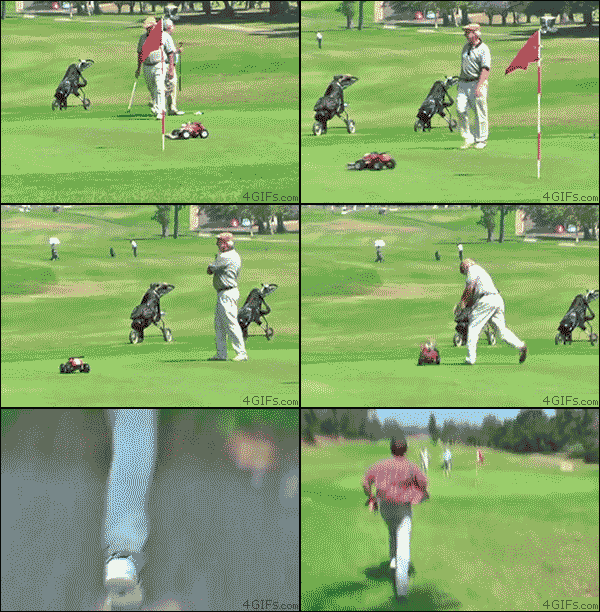
RC Golf
by Doublebanker
________________________________________
Rafa Spoladore likes this
24 Mar 04:35
________________________________________ 


Explosive Fart
by Doublebanker
________________________________________
Rafa Spoladore likes this
24 Mar 04:35

________________________________________ 


Swing Leaping
by Doublebanker
________________________________________
Rafa Spoladore likes this
24 Mar 04:35

________________________________________ 


Perfect Landing...
by Doublebanker
________________________________________
Rafa Spoladore likes this

24 Mar 04:17
Wernher von Braun: 101st birthday
by Luboš Motl
Today, we celebrate the birthday of three mathematicians who have heavily influenced physics: Pierre-Simon Laplace, Amalie Emmy Noether, and Ludvig Faddeev. But because I posted the biographies four years ago (click at the previous sentence), I won't do so again.
Instead, let me mention that six years ago, set theorist Paul Cohen died. He is the man who proved that the axiom of choice can neither be proved nor disproved using the Zermelo-Fraenkel (most popular) set theory axioms and who repeated the same achievement with the continuum hypothesis.
So it's up to your belief and aesthetic preferences whether there always exists a set whose intersection with each set in an infinite set of sets has one element; and it's up to your taste whether there exists a set that has more elements than the set of integers \(\ZZ\) but fewer elements than the set of real numbers \(\RR\). Thanks for that freedom, Prof Cohen.
Incidentally, I am agnostic about the continuum hypothesis because the very idea that the real numbers aren't countable seems a bit artificial to me because the proof uses totally unnatural maps one can't really encounter. For the same reason, I prefer to use the freedom won by Paul Cohen to prefer a picture where the axiom of choice is invalid. The picked set if the AC is believed is non-canonical, unnatural, and if you assume AC is false, you earn the extra freedom to assume that all subsets of an interval are Lebesgue measurable sets – and that's a reassuring situation for a physicist, I think, regardless of the fact that mathematicians must reorganize (and extend) the proofs of some theorems that remain valid, anyway.
But this blog entry is dedicated to someone else.
When Dr Sheldon Cooper's sister mentioned that she was saying that her brother was a rocket scientist, Dr Sheldon Cooper remarked that it was so humiliating: she could have equally described his brother as a tall taker at the Golden Gate Bridge. ;-) This is a theoretical physics blog so we don't run CVs of ordinary rocket scientists here. But according to NASA, Wernher von Braun was the greatest rocket scientist ever so he gets an exception.
Wernher Magnus Maximilian, Freiherr von Braun was born to an aristocratic family 101 years ago, on March 23rd, 1912. Being an equivalent of a Baron (Freiherr von Braun) is a special condition. I find it cute and special, too. On the other hand, I refuse to learn the family trees of both parents because we would be like a tabloid magazine here. ;-)
For the same reason, I won't discuss a nameless aristocrat Maria Luise whom he married and did her three children who were doing fine even though the wife was his cousin on mother's side. OK, let's stop this stuff.

He learned to play the cello and the piano, could play Beethoven and Bach from memory, and wanted to become a composer. He has actually composed several playful pieces (probably more impressive ones than your humble correspondent) but I wasn't able to find them. If you know an audio or video link with them, please don't keep it in secret!
When he was a 13-year-old boy in a boarding school, he sucked in maths and physics. But because space fascinated him, especially once he acquired Hermann Oberth's book on rockets (von Braun remained a huge fan of the author), he decided he had to learn maths and physics, too. Wait for two sentences to see how this plan worked. When he was 18, he joined the Spaceflight Society in Berlin. He concluded that major technological advances would be needed. He picked University of Berlin to learn more about physics, astronomy, and chemistry and got a physics PhD in 1934. This degree is what qualifies this music composer and rocket scientist to have a CV on TRF. :-)
When von Braun was in the early 20s, he told cosmic radiation physicist and balloon-explorer Auguste Piccard after a lecture that he was just planning to go to the Moon soon. Piccard responded with some encouragement.
He had mixed-to-positive opinions about Hitler's regime that were drifting towards the positive side when Hitler could reach some easy successes. But in 1937, as the technical director of the Army Rocket Center, he was officially requested to join the party and he did so much like the majority of people in Nazism and communism who were told the same thing. His work was simply more important for him than some subtle moral considerations. It's likely that his sending of the fees was the only "politics" he has really done in that party.
Von Braun did well in the non-democratic setup. In 1940, he also joined the General [Allgemeine] SS which wasn't an armed unit. If you believe his memoirs, what was important for him was the active attitude of General SS to pursue rocket research. He appeared on a picture with Himmler in a uniform, too. But it wasn't all rosy. He was arrested and accused of being a communist sympathizer in 1944, too. Released. Things were dangerous for him especially because he was a skillful pilot, too.
In his job, he would lead the development of jet-assisted takeoffs, the A-4 ballistic missiles, and some anti-aircraft missiles. The first combat A-4 was to be used against Britain in 1944. It was renamed V-2 [Fow-tsvai]; if you're hoping that it stood simply for "von Braun", I must disappoint you. It stood for a simple word "Vergeltungswaffe" (retaliation weapon). He liked V-2 because it was so good to go to space; so the only bug was that it landed on a wrong planet (Great Britain). Mort Sahl invented the caricature of von Braun saying "I aim at the stars, but sometimes I hit London". :-)
In Spring 1945, he knew what was going on so he gave his team a research project, to find out to whom they should surrender. And be sure that the Soviets didn't win this tender. ;-) After a complicated arm fracture from a car accident, he left the hospital early. He also hid some secret documents in an abandoned mine. The surrender wasn't hard. The hard work was done by von Braun's brother who approached a soldier from the 44th Infantry Division (in the Northeastern corner of current Germany) on a bike and told him in broken English: My name is Magnus von Braun. My brother invented the V-2. We want to surrender.
Deal. Easy.
For 4 months in 1945, von Braun was already in the U.S. secretly, due to a plan by a predecessor of John Kerry. The American politicians wanted him so they fabricated von Braun's CV. He was suddenly as clear as a lily. He's been never a member of the party, and so on. This dishonest trick was justified by the ends. Von Braun started the U.S. space program in 1958. Still, he had to watch that the Soviets were almost always a year or several years ahead of America.
Von Braun explains "a man in space" in a 1959 Walt Disney film. Be ready for a dropping pressure in a spacesuit and the body's annoyed reactions, people undergoing the acceleration of \(35g\), a four-stage rocket prototype (the upper one seems to be a space shuttle of a sort). He said a practical rocket for people could be ready in 10 years; the Soviets were clearly faster (Gagarin was there just in 2 years) but his estimate/plan was otherwise very realistic, we know today. If you find von Braun's German English funny, realize that the English German is also funny.
Wernher von Braun is the father – or at least the main co-father among the influential people – of many astronaut-related concepts we take for granted these days. The liquid fuel rockets have been mentioned. But he popularized/co-invented the manned space station, rotating wheel-shaped station that creates artificial gravity, he sketched a permanent lunar base, and drafted preliminary plans for a manned mission to Mars. During the coldest years of the Cold War – they were so cold that the war was almost hot – he would think about an orbital warfare.
Much of his later career would copy the history of the U.S. space program including the Apollo program. I won't try to cover that because I am no expert. In 1972, he left NASA and went to a private space research company for a while. He died of pancreatic cancer in 1977.

The grave is quite modest, isn't it? Here's what Psalms 19:1 say.


Instead, let me mention that six years ago, set theorist Paul Cohen died. He is the man who proved that the axiom of choice can neither be proved nor disproved using the Zermelo-Fraenkel (most popular) set theory axioms and who repeated the same achievement with the continuum hypothesis.
So it's up to your belief and aesthetic preferences whether there always exists a set whose intersection with each set in an infinite set of sets has one element; and it's up to your taste whether there exists a set that has more elements than the set of integers \(\ZZ\) but fewer elements than the set of real numbers \(\RR\). Thanks for that freedom, Prof Cohen.
Incidentally, I am agnostic about the continuum hypothesis because the very idea that the real numbers aren't countable seems a bit artificial to me because the proof uses totally unnatural maps one can't really encounter. For the same reason, I prefer to use the freedom won by Paul Cohen to prefer a picture where the axiom of choice is invalid. The picked set if the AC is believed is non-canonical, unnatural, and if you assume AC is false, you earn the extra freedom to assume that all subsets of an interval are Lebesgue measurable sets – and that's a reassuring situation for a physicist, I think, regardless of the fact that mathematicians must reorganize (and extend) the proofs of some theorems that remain valid, anyway.
But this blog entry is dedicated to someone else.
When Dr Sheldon Cooper's sister mentioned that she was saying that her brother was a rocket scientist, Dr Sheldon Cooper remarked that it was so humiliating: she could have equally described his brother as a tall taker at the Golden Gate Bridge. ;-) This is a theoretical physics blog so we don't run CVs of ordinary rocket scientists here. But according to NASA, Wernher von Braun was the greatest rocket scientist ever so he gets an exception.
Wernher Magnus Maximilian, Freiherr von Braun was born to an aristocratic family 101 years ago, on March 23rd, 1912. Being an equivalent of a Baron (Freiherr von Braun) is a special condition. I find it cute and special, too. On the other hand, I refuse to learn the family trees of both parents because we would be like a tabloid magazine here. ;-)
For the same reason, I won't discuss a nameless aristocrat Maria Luise whom he married and did her three children who were doing fine even though the wife was his cousin on mother's side. OK, let's stop this stuff.

He learned to play the cello and the piano, could play Beethoven and Bach from memory, and wanted to become a composer. He has actually composed several playful pieces (probably more impressive ones than your humble correspondent) but I wasn't able to find them. If you know an audio or video link with them, please don't keep it in secret!
When he was a 13-year-old boy in a boarding school, he sucked in maths and physics. But because space fascinated him, especially once he acquired Hermann Oberth's book on rockets (von Braun remained a huge fan of the author), he decided he had to learn maths and physics, too. Wait for two sentences to see how this plan worked. When he was 18, he joined the Spaceflight Society in Berlin. He concluded that major technological advances would be needed. He picked University of Berlin to learn more about physics, astronomy, and chemistry and got a physics PhD in 1934. This degree is what qualifies this music composer and rocket scientist to have a CV on TRF. :-)
When von Braun was in the early 20s, he told cosmic radiation physicist and balloon-explorer Auguste Piccard after a lecture that he was just planning to go to the Moon soon. Piccard responded with some encouragement.
He had mixed-to-positive opinions about Hitler's regime that were drifting towards the positive side when Hitler could reach some easy successes. But in 1937, as the technical director of the Army Rocket Center, he was officially requested to join the party and he did so much like the majority of people in Nazism and communism who were told the same thing. His work was simply more important for him than some subtle moral considerations. It's likely that his sending of the fees was the only "politics" he has really done in that party.
Von Braun did well in the non-democratic setup. In 1940, he also joined the General [Allgemeine] SS which wasn't an armed unit. If you believe his memoirs, what was important for him was the active attitude of General SS to pursue rocket research. He appeared on a picture with Himmler in a uniform, too. But it wasn't all rosy. He was arrested and accused of being a communist sympathizer in 1944, too. Released. Things were dangerous for him especially because he was a skillful pilot, too.
In his job, he would lead the development of jet-assisted takeoffs, the A-4 ballistic missiles, and some anti-aircraft missiles. The first combat A-4 was to be used against Britain in 1944. It was renamed V-2 [Fow-tsvai]; if you're hoping that it stood simply for "von Braun", I must disappoint you. It stood for a simple word "Vergeltungswaffe" (retaliation weapon). He liked V-2 because it was so good to go to space; so the only bug was that it landed on a wrong planet (Great Britain). Mort Sahl invented the caricature of von Braun saying "I aim at the stars, but sometimes I hit London". :-)
In Spring 1945, he knew what was going on so he gave his team a research project, to find out to whom they should surrender. And be sure that the Soviets didn't win this tender. ;-) After a complicated arm fracture from a car accident, he left the hospital early. He also hid some secret documents in an abandoned mine. The surrender wasn't hard. The hard work was done by von Braun's brother who approached a soldier from the 44th Infantry Division (in the Northeastern corner of current Germany) on a bike and told him in broken English: My name is Magnus von Braun. My brother invented the V-2. We want to surrender.
Deal. Easy.
For 4 months in 1945, von Braun was already in the U.S. secretly, due to a plan by a predecessor of John Kerry. The American politicians wanted him so they fabricated von Braun's CV. He was suddenly as clear as a lily. He's been never a member of the party, and so on. This dishonest trick was justified by the ends. Von Braun started the U.S. space program in 1958. Still, he had to watch that the Soviets were almost always a year or several years ahead of America.
Von Braun explains "a man in space" in a 1959 Walt Disney film. Be ready for a dropping pressure in a spacesuit and the body's annoyed reactions, people undergoing the acceleration of \(35g\), a four-stage rocket prototype (the upper one seems to be a space shuttle of a sort). He said a practical rocket for people could be ready in 10 years; the Soviets were clearly faster (Gagarin was there just in 2 years) but his estimate/plan was otherwise very realistic, we know today. If you find von Braun's German English funny, realize that the English German is also funny.
Wernher von Braun is the father – or at least the main co-father among the influential people – of many astronaut-related concepts we take for granted these days. The liquid fuel rockets have been mentioned. But he popularized/co-invented the manned space station, rotating wheel-shaped station that creates artificial gravity, he sketched a permanent lunar base, and drafted preliminary plans for a manned mission to Mars. During the coldest years of the Cold War – they were so cold that the war was almost hot – he would think about an orbital warfare.
Much of his later career would copy the history of the U.S. space program including the Apollo program. I won't try to cover that because I am no expert. In 1972, he left NASA and went to a private space research company for a while. He died of pancreatic cancer in 1977.

The grave is quite modest, isn't it? Here's what Psalms 19:1 say.
Rafa Spoladore likes this

23 Mar 01:26

“Os Pastores Mais Ricos no Brasil”
“Os Pastores Mais Ricos no Brasil”
Rafa Spoladore likes this
22 Mar 20:15
 Touchscreens treat all fleshy finger pads alike: Most detect a simple change in electrical current or in sound or light waves regardless of who is swiping. Researchers at Disney Research, Pittsburgh, have built a touchscreen that can discriminate between users. Every person’s body has its own bone density, muscle mass, blood volume, and water content. The device, called Touché, sends a series of harmless currents through a user’s body. Physiological differences produce differences in the body’s impedance of that current. Touché measures this unique capacitive signature. Scientists could apply capacitive fingerprinting to any touchscreen, or to other ubiquitous objects, such as doorknobs and furniture, turning the world into an interactive device. Touché is still in development, and plans for commercialization, alas, are top secret.


How It Works: A Touchscreen That Knows You
by Nicole Dyer
Touchscreens treat all fleshy finger pads alike: Most detect a simple change in electrical current or in sound or light waves regardless of who is swiping. Researchers at Disney Research, Pittsburgh, have built a touchscreen that can discriminate between users. Every person’s body has its own bone density, muscle mass, blood volume, and water content. The device, called Touché, sends a series of harmless currents through a user’s body. Physiological differences produce differences in the body’s impedance of that current. Touché measures this unique capacitive signature. Scientists could apply capacitive fingerprinting to any touchscreen, or to other ubiquitous objects, such as doorknobs and furniture, turning the world into an interactive device. Touché is still in development, and plans for commercialization, alas, are top secret. A) INDIUM TIN OXIDE
Capacitive sensors found in most existing touchscreens, track pads, OLED displays, and other electronics use indium tin oxide (ITO) as an electrode. The conductive material transmits an electric current to a user’s fingertips. ITO is also transparent, so light from the underlying LCD screen shines through.
B) SENSOR BOARD
The sensor board injects tiny electric currents into the ITO layer. When a user touches the screen (and thus the ITO layer), current flows from the sensor board through the ITO to the person’s body. The sensor on the board measures the body’s unique impedance at multiple frequencies. The most recent prototype takes up to a second to recalibrate for each new user. Once calibrated, it can recognize a familiar body in 500 milliseconds.
C) LCD PANEL
An LCD provides the touchscreen's graphical interface.
STATS
Scan Frequency Range: 1 kHz to 3.5 MHz
Scanning Rate: 33 times per second
Recognition Accuracy: 97.8 percent
Recognition Time: 500 ms
See the rest of the articles from our 2013 How It Works section here, and see all of our April issue here.
 |
 |
Rafa Spoladore likes this
22 Mar 20:15
 Welcome to round two of the world's nerdiest bracket! To recap: we've compiled a list of some of the strongest, fastest, and strangest landbots and sky drones around. Your job: vote for your favorites.


Popular Science Bracket: Land Robots Vs. Flying Drones, Round 2
by Suzanne LaBarre
Round 2 polls close Monday, March 25, at 9 a.m. Happy March Madness!
Welcome to round two of the world's nerdiest bracket! To recap: we've compiled a list of some of the strongest, fastest, and strangest landbots and sky drones around. Your job: vote for your favorites. After a lively first round, in which you threw your voting power behind the likes of BigDog and the X-47B, (but shockingly managed to eliminate a taxidermied cat-turned-quadcopter and CanBot, a robot that masquerades as a tall boy), we've got 16 contenders left. If you need a quick guide to what's what, go here.
Polls close Monday, March 25, at 9 a.m. Check back later that day for the winners and the next round's matchups. We'll keep doing this until we've determined the greatest land robot/flying drone in all the internet. Only vote once per poll in each matchup, please. And play nice in the comments. Or don't.
Ready? Go!
"Eagle" drone or Black Hornet Nano?
A160 Hummingbird or Robot Dragonfly?
MQ-1 Predator or RQ-4 Global Hawk?
Pancake-flipping robot or Geminoid DK?
|
|
Rafa Spoladore likes this
22 Mar 20:15
Evidence of magnetic superatoms could open doors to new spin electronics
(Phys.org) —Scientists have found evidence for the existence of magnetic superatoms—small, compact clusters of atoms whose electrons occupy a set of orbitals around the entire cluster rather than around the individual atoms. If scientists can synthesize superatoms with magnetic properties, then one day they may use them to create new spin-dependent electronics.
22 Mar 20:13

Imagem viva de uma coisa morta
by Renato Tardivo
“A outra praia”, de Gustavo Nielsen
A outra praia, livro do escritor argentino Gustavo Nielsen, venceu o Prêmio Clarín de Romance em 2010. A tradução brasileira, recém-lançada, é assinada por Henrique Schneider, em mais uma edição caprichada da editora Dublinense (RS).
Logo na epígrafe, Nielsen introduz aquela que talvez seja a protagonista da trama intrincada de fragmentos – a fotografia. “Assim é a fotografia: não sabe dizer o que mostra.” A frase é do filósofo francês Roland Barthes, autor de A câmara clara – livro que Nielsen volta a citar nos “Agradecimentos” e cujas ideias certamente o influenciaram na escrita do romance.
O primeiro capítulo é emblema do que virá a seguir: dois casais de amigos inventam histórias para outro casal que aparece em slides comprados em uma feira de antiguidades. No capítulo seguinte, a narrativa enfoca a família formada por um dos casais: Antonio, que é fotógrafo, e Marta, sua mulher, além da jovem Victoria, filha deles. O casal está em crise, e as (muitas) fotos tiradas por Antonio (em uma única vez) enquanto perambulava por Buenos Aires de uma moça desconhecida, mas à qual se sente estranhamente conectado, acabam por potencializar os problemas conjugais.
Antonio, então, vai à praia. Ao longo de sua estada, tem Zopi (o homem do casal de anfitriões do primeiro capítulo) como companhia. O romance já está na metade e o leitor ainda não distingue bem do que ele trata, afinal. Até que a introdução de elementos de literatura fantástica exacerba o mistério, o qual já se fazia presente pela via da fotografia. O olho da câmera, sempre em busca, encontra na casa da praia a comunicação com um outro tempo/espaço. Daí, evidentemente, a jovem desconhecida que Antonio fotografa no começo ganha importância. E, nesse sentido, fica claro que as proposições de Roland Barthes (que não aparecem literalmente; trata-se de ficção, não de filosofia) são adotadas pelo narrador onisciente.
Que proposições seriam estas? Segundo Barthes, em A câmara clara, há algo que nos toca especialmente em cada fotografia – aquilo a que o filósofo chama punctum. A fotografia provoca um sentimento doloroso e enigmático porque revela o que já não é: “imagem viva de uma coisa morta”, um “isso foi”, algo que “não pode transformar-se, mas apenas repetir-se sob as espécies da insistência”. Não avanço na reflexão e digressão ao livro de Barthes para não estragar a surpresa do leitor, mas, do meu ponto de vista, no romance de Nielsen os elementos de literatura fantástica são encaminhados, pela fotografia, exatamente a partir das proposições acima.
Há, ainda, a comunicação de linguagens – literatura e fotografia –, e o livro sobre fotografia revela-se, também, um livro sobre livro (o qual, como a fotografia, não sabe dizer o que mostra). Os fragmentos, que não se deixam ver com nitidez durante boa parte do romance, revelam-se um a um sem que, no mais das vezes, se amorteça o mistério – como ocorre na revelação de um negativo, diga-se. O único aspecto que talvez destoe nessa obra tão bem sucedida é que a profusão de elementos manejada pelo narrador onisciente fere, em alguns momentos, a sensação de ambiguidade com a qual o livro trabalha.
De resto, A outra praia, primeiro livro de Gustavo Nielsen publicado no Brasil, pode também funcionar como um alerta a leitores e editores. Apreciamos o excelente cinema argentino contemporâneo. Mas o quanto acompanhamos a literatura contemporânea argentina?
::: A outra praia :::
::: Gustavo Nielsen (trad. Henrique Schneider) :::
::: Dublinense, 2013, 176 páginas :::
::: compre na Livraria Cultura :::
-- leia mais de Renato Tardivo --
-- quando for comprar na Livraria Cultura ou Submarino,
considere clicar antes em um dos links ou banners no Amálgama --
22 Mar 17:31


Sometimes, more is not what you want
by Seth Godin
"Fitting in more than anyone else" doesn't work, even in high school. Seeking to be the most average, the most non-descript and the most inoffensive doesn't lead to growth.
"More informed" wears out too. If you get more news, faster, via Twitter, say, you're not going to have a significant advantage over someone who has just enough news. Understanding what every single person is saying about everything, all the time, leaves you little opportunity to actually make something.
Having more on your to-do list probably isn't the best idea either.
Rafa Spoladore likes this
22 Mar 17:30
Cara de paisagem
by Eloise Martins

O artista britânico John Stezaker desenvolve sua série de colagens Masks a partir de justaposições de fotografias e cartões postais, criando imagens com nova linguagem e novo significado.

Membro do grupo de arte conceitual “The New Art” em 1972, Stezaker apresenta nesse projeto seu interesse contemporâneo em relação ao “rosto oculto” – uma possível imagem que surge na nossa mente quando vemos os cartões postais de cascatas, cavernas e natureza como elementos faciais, emoldurados pelos cabelos, pescoços e roupas das figuras.

Mesmo que os rostos não estejam visivelmente aparentes, no nosso imaginário criamos uma ligação tão forte entre as fotografias e os postais que praticamente podemos ver as características das pessoas – grutas como olhos, ondas e árvores como cabelo, cascatas e pontes como nariz, e assim vai.
Confira mais imagens e veja também o que está lá, mas nem tanto.


.
Tweet Tags: Cartões Postais, colagem, John Stezaker, justaposição de imagens, Masks, ressignificação
22 Mar 02:47

peashooter85: Lakota Chief Touch The Clouds, 1877. “Have...
Lakota Chief Touch The Clouds, 1877.
“Have compassion on us. Don’t punish us all because some of us fought when we had to.”
Rafa Spoladore likes this
22 Mar 02:47

splattergut: Studio portrait of a man dressed as a...
Studio portrait of a man dressed as a warrior. 1892-1922.
Photograph by Christiaan Benjamin Nieuwenhuis
Rafa Spoladore likes this

22 Mar 02:46
find-a-reaction-gif: Click the image to see the original post!

Rafa Spoladore likes this
21 Mar 20:17
Brazil e-commerce grosses more than $11 billion in 2012
Online commerce in Brazil last year grossed 22.5 billion reais (around $11.5 billion), up 20 percent over the previous year, the market research firm e-bit said Wednesday.
Rafa Spoladore likes this
21 Mar 20:06
Higgs: more of the same
by Jester
Everything's clear now. The most important Higgs search channels have been updated by both ATLAS and CMS (the only interesting channel that has not is the decay to b-quarks). We're not going to learn much new for the next 2 years. The CERN director, heeding to Résonaances' call, announced Habemus Higgsam.
So, what's new since last week?
So, what's new since last week?
-
 Finally, CMS came out with their long awaited update of the Higgs→γγ search. It is clear why they have been so shy: new calibration of the electromagnetic calorimeter completed after last summer forced them to revise the significance of the Higgs signal in the diphoton channel. The current significance is merely 3.2 sigma, and from that it's easy to deduce that they wouldn't have been able to claim a formal 5 sigma discovery on the 4th July had they done their sums back then. But that's of course irrelevant now, as there's no shadow of a doubt the Higgs is there at 125 GeV. The real game changer is the (related) fact the signal strength relative to the SM one measured by CMS is μ=0.8±0.3 and, unlike the one in the ATLAS and previous CMS measurements, does not show any excess over the standard model prediction. Naively combining the signal strength measured by ATLAS and CMS one gets the disappointing μ=1.2±0.2. Move on folks, nothing to see here. See Matt's blog for a more in-depth discussion of the CMS diphoton update.
 -
 One visible consequence of the CMS updated is that the preference for negative Yukawa couplings, displayed by the Higgs data before Moriond, completely vanished. In the plot, borrowed from here, is a section of the Higgs coupling space where one freely varies the coupling to W and Z bosons (denoted as "a"), and, independently, the coupling to the standard model fermions (denoted as "c"). Previously, the Higgs data somewhat preferred the bizarre region near a=1, c=-1 over the standard-model-like region near a=c=1, as the former was leading to an enhancement of the Higgs→γγ rate. This is no more, only the standard-model-like island remains.
 -
 Another important update last week was from ATLAS in the WW→2l2ν channel. Again no surprises here: the signal significance almost 4 sigma, the rate μ=1.0±0.3.
 - To say that the Higgs is standard-model-like is an understatement. This bastard screams and spits standard model. After the Moriond updates the standard model gives an absolutely perfect fit to the combined data (previously it was disfavored at 80% confidence level, mostly due to the late diphoton excess). Not even a single cliffhanger to makes us wait for the next episode..... If there's anything non-standard about the Higgs couplings to matter it is hiding very well and will be tricky to uncover at the LHC, even after the energy upgrade.
-
 It's worth stressing again that is has been firmly established that the Higgs couples to mass of W and Z bosons, the statement which can be reinterpreted that the Higgs gives mass to W and Z bosons. After Moriond the evidence for that is strengthened even further. The LHC Higgs data alone (blue in the plot) imply this coupling should be within ~30% of the standard-model value at 95% confidence level. If one also takes into account precision observables from LEP (red in the plot) the allowed range shrinks to ~10% (although the latter number is a bit less robust, as fine-tuned new physics effects could alter the conclusions). Although announcing the Higgs is a Higgs at this particular moment of history was to a large extent arbitrary, it was by no means premature.
 -
 We see the Higgs, of which the corollary is that we don't see the invisible Higgs. The invisible decays could arise for example if the Higgs couples to dark matter, which is the case in a large class of well-motivated models. In the simplest situation, when the Higgs couplings to known particles take the standard model values, an invisible width would lead to a universal reduction of the rates in all decay channels. That is severely constrained by global fits, as seen in the plot (solid blue): the invisible branching fraction more than about 15-20% is strongly disfavored. Note that for the sake of this analysis "invisible" is "anything not measured", thus any non-standard decay channel is constrained this way. But that doesn't mean there's no point looking for exotic Higgs decays. In the end, we've already observed much more rare decays: the branching fraction to 2 photons is around 0.2%, and to 4 leptons - around 0.01%. So 10% of invisible or some other freak decays seems like a goal well within reach of experimentalists.
 - A fun fact for dessert. In CMS the measured central values of the Higgs rates in the 3 most sensitive channel all fall slightly below 1, while in ATLAS they are all slightly above one. The new motto for ATLAS: we try harder ;-)


Rafa Spoladore likes this
21 Mar 19:46


Your Future Wife #2
by bohus
We're all looking for love, that mysterious and vexing connection between two people. When you don't know what you're looking for, maybe your best bet is to follow the guidance of a 1935 Exhibit Card vending machine. If the wife we predicted for you last time didn't pan out, how about this one?
"Your future wife will be an heiress, one of society's spoiled and pampered daughters and disgustingly rich. She will be the life of every party, but she knows nothing about darning your socks or sewing on buttons. Your toes will stick through the holes in your socks, and you will wear nails in your supporters to keep your trousers up, and she will make you love it. One little society socialite will grace your home."
©1935 Ex. Sup. Co. Chgo. made in U.S.A.
It looks like they had Paris Hiltons 80 years ago too, eh?
Rafa Spoladore and -1 others like this
21 Mar 19:43

Após multa de R$ 38,2 milhões, Ecad é obrigado a mudar forma como arrecada direitos autorais
by Felipe Ventura
Você deve se lembrar do Ecad: aquele órgão que arrecada direitos autorais de músicos, que tentou cobrar blogs por colocarem vídeos do YouTube em seus posts, e que esteve envolvido em várias suspeitas de irregularidades e em duas CPIs.
Desta vez, o Ecad e as seis associações de músicos que o integram foram condenados pelo Cade (Conselho Administrativo de Defesa Econômica), órgão que monitora abusos de poder econômico: eles terão que pagar um total de R$ 38,2 milhões por formação de cartel.
Por lei, o Ecad detém o monopólio em arrecadar direitos autorais. O problema é que o órgão não é fiscalizado, e as associações que formam o Ecad não concorrem entre si. O conselheiro relator do caso, Elvino Carvalho de Mendonça, diz: “Entendo que o Ecad se sentou com as associações para fixar preços. Entendo pela prática de cartel.”
Mudanças
Tanto na internet como em outros lugares, o Ecad não cobra por quantidade de músicas tocadas: ou é pela receita bruta, ou por área do local (como bares e lojas) ou até mesmo por número de quartos (hotéis e motéis).
Então, para estimular a concorrência, o Cade exige que sejam criadas outras formas de arrecadação, desta vez baseadas nas músicas que são tocadas – em vez de cobrar valores ou percentuais fixos. Ou seja, acaba a tabela de preços – as associações precisam negociar com os clientes – e a assembleia do Ecad não pode mais discutir preços.
O que isso significa na prática? Basicamente, que você não deve receber uma visita do Ecad em seu aniversário ou festa de casamento, ou caso você tenha um bar ou academia. A negociação será feita direto com a associação que representa os músicos: o Ecad não deve mais interferir de forma direta na cobrança.
Isto também significa regras mais flexíveis para sites de streaming de música, empresas de Internet, emissoras de TV e outras. Pouco a pouco, parece que os exageros do Ecad estão sendo coibidos.
O caso
Em 2010, a disputa foi levada ao Cade pela Associação Brasileira de TV por Assinatura (ABTA), que considerava abusiva a taxa cobrada das emissoras. A taxa não tinha relação com a quantidade de música usada, nem mesmo com o tipo de programação – canais de música pagam a mesma porcentagem que canais de notícias, por exemplo.
O Ecad tentou se defender, dizendo que o modelo atual é necessário para garantir “a geração de cultura no país”: a negociação música por música dificultaria o pagamento a artistas menos conhecidos. O poder das empresas de TV por assinatura também dificultaria as negociações. A defesa até disse que a ABTA estava representando o desejo da Rede Globo em reduzir gastos com o Ecad.
O Ministério Público Federal já havia estudado o caso e preferiu arquivá-lo, argumentando que é “impossível” haver concorrência entre as associações do Ecad, pois isso entraria em conflito com a Lei de Direitos Autorais. A lei determina que os preços devem ser estipulados por todos em comum, segundo o MPF.
Mas não adiantou: o Ecad levou a multa máxima de R$ 6,4 milhões, enquanto cada uma das seis associações foi multada em R$ 5,3 milhões. A multa será cobrada da taxa de administração que o Ecad recolhe das associações, sem impactar o valor repassado para os autores. O valor da multa irá para o Fundo de Defesa dos Direitos Difusos (FDD), que destina recursos a projetos de defesa do consumidor e meio ambiente.
O Ecad tem seis meses para se adaptar às novas regras, prorrogável para mais seis meses. A entidade já avisou que vai recorrer – agora na Justiça, já que a decisão do Cade é final.
O Ecad

O Ecad (Escritório Central de Arrecadação) é um órgão privado, fundado em 1976 para arrecadar os direitos autorais de músicas “em execução pública” no Brasil, seja ela nacional ou estrangeira. A entidade é conhecida pelos fiscais que, munidos de bloco e caneta, anotam o que toca nos shows para saber o que deve ser cobrado. O Ecad também monitora as rádios e estabelecimentos comerciais.
Em 2012, o Ecad tentou cobrar uma taxa mensal de blogs que embedam vídeos com músicas. Para justificar a medida, a entidade diz que os sites são retransmissores, pois “o uso de músicas em blogs se trata de uma nova execução” pública. Depois que o Google divulgou nota pública repudiando a prática, o Ecad voltou atrás e desistiu da cobrança.
Pouco tempo depois, saiu o resultado da segunda CPI sobre a entidade: senadores acusaram o Ecad e suas associações de fraude, cobranças excessivas e não-repasse aos músicos. A CPI terminou com o pedido de indiciamento de 15 pessoas.
À época, o Ecad publicou nota dizendo que “cerca de 40 artistas apoiam… o trabalho do Ecad” (só?), e que a nova mira seriam as emissoras de TV – que teriam os maiores índices de inadimplência no órgão. De fato, correm na Justiça várias ações contra o Ecad: nesta quinta, será julgada uma delas no Superior Tribunal de Justiça (STJ), que tem como autora a TV Globo.
O Ecad não é fiscalizado, e já foi acusado de envolvimento em práticas bem questionáveis: apropriação de ganhos judiciais, pagamentos abaixo do devido e até falsificação de assinaturas. Até músicos famosos já se pronunciaram e se uniram contra o Ecad. Mas parece que o poder do órgão está, felizmente, diminuindo. [Folha e Teletime]
Rafa Spoladore likes this
21 Mar 19:43

Com sete anos de vida, Twitter tenta se redefinir para o futuro
by Felipe Ventura
Há sete anos, era publicado o primeiro tweet: “apenas configurando meu twittr”, dizia Jack Dorsey, o fundador da rede social. Hoje, são mais de 200 milhões de usuários ativos criando, por dia, 400 milhões de mensagens com até 140 caracteres. E Guilherme Ribenboim, diretor-geral da empresa no Brasil, diz em entrevista que a missão do Twitter “é atingir todos os usuários do planeta”.
O Twitter aproveitou seu aniversário para relembrar em vídeo as conquistas do passado: sua importância durante a Primavera Árabe e o terremoto no Japão, o primeiro tweet do espaço, a adoção do serviço por celebridades, entre outros.
O último ano trouxe boas novidades. Agora você pode baixar seu arquivo de tweets, desde o início. A interface web ficou mais moderna, emprestando alguns elementos do Facebook. E tivemos a estreia do Vine, os vídeos do Twitter que parecem GIFs com áudio.
No entanto, o Twitter está se tornando mais fechado, enquanto tenta se redefinir para o futuro.
Mais fechado
Em 2012, foi bloqueado o acesso de redes como LinkedIn, Instagram e Tumblr aos seus contatos no Twitter. Basicamente, como LinkedIn e Tumblr ganham dinheiro com seus usuários – e o Twitter não ganha nada – o acesso à API foi bloqueado. O Instagram, por sua vez, não tem planos de rentabilização (por enquanto), mas foi comprado pelo rival Facebook.
Nem mesmo o Tweetdeck, comprado pelo Twitter em 2011, saiu ileso: os apps para iPhone, Android e desktop vão parar de funcionar.
E há algo temeroso quanto ao futuro do Twitter, que se chama API 1.1. O Twitter cresceu muito durante estes sete anos graças a sua API pública, que permitiu a criação de inúmeros clientes de terceiros, serviços derivados e apoio maciço de desenvolvedores. Mas, no ano passado, a API mudou. Apps de terceiros agora são concorrentes, e não são mais bem-vindos.
O principal problema nas novas regras é o limite de tokens. Quando um usuário permite que certo app tenha acesso à sua conta no Twitter, este app usa um token. Na API 1.1, há um limite máximo: 100 mil. É o teto para o crescimento de clientes alternativos: caso seu app atinja este limite, ele não pode receber mais usuários.
Isso já aconteceu mais de uma vez nos últimos meses. É o caso do Tweetro, por exemplo: o cliente gratuito para Windows 8 foi removido e voltou em versão paga, para conter o número de tokens usados. Mesmo o cliente Falcon Pro para Android, que já era pago, estourou o limite de 100 mil tokens – o app era pirateado por muitos usuários. E o Twitter não coopera muito, raramente aumentando o limite: eles estão firmes em sua decisão.
O futuro do Twitter: descoberta (e propagandas)

O Twitter quer centralizar a experiência do Twitter, impondo limites a apps de terceiros. Com poucas opções, é grande a chance de você ficar dentro de apps oficiais do Twitter, ou mesmo na versão web. Dessa forma, o Twitter pode deixar de ser uma ferramenta de comunicação para ser uma plataforma de descobertas.
Se você acha que o Twitter não é interessante, provavelmente não segue as pessoas certas. Mas dá trabalho encontrá-las, e manter um perfil bacana, e ser reconhecido pelos outros. Com alternativas mais amigáveis, como Facebook e Tumblr, o Twitter precisa mudar.
Mas como? Com a aba “Descobrir”. Você deve usá-la pouco, mas dê uma olhada nela agora: os tweets por lá agora parecem bem interessantes – às vezes mais do que a sua timeline. Mesmo que você não siga ninguém, a aba Descobrir está lá. Este parece ser o futuro do Twitter, para atrair mais usuários e reter os atuais.
Centralizar a experiência também significa que você não vai fugir dos tweets patrocinados que aparecem na timeline. E o Twitter precisa ganhar dinheiro: eles receberam mais de US$ 1 bilhão em investimentos nos últimos anos, e precisam dar retorno aos acionistas criando um modelo de negócios.
Esse é um dos motivos para o Twitter abrir um escritório no Brasil: para os anunciantes, fica mais fácil negociar propagandas nos trending topics e nas timelines. Segundo Guilherme Ribenboim, executivo que comanda as operações do Twitter por aqui, o objetivo é ampliar o número de parcerias no Brasil. Somos um dos cinco maiores mercados da empresa em usuários ativos.
Enquanto o Twitter fica mais fechado para garantir que seus usuários verão propagandas, surgem alternativas – como o App.net – que são livres de anúncios. É a velha história: se você usa algo de graça, você é o produto. Resta ver se as propagandas serão o bastante para manter o Twitter ativo, e se elas não vão afastar os usuários.
Este aniversário do Twitter é uma boa oportunidade para refletir sobre as mudanças que vieram e que virão. O Twitter conseguirá se redefinir e se manter relevante? [Twitter Blog]
Rafa Spoladore likes this

20 Mar 20:06
"Cidadãos devem se apropriar da cultura científica", afirma professor espanhol
Informações sobre ciência nos meios de comunicação deveriam ser tão frequentes como os esportes, afirma Miguel Ángel Quintanilla, da Universidade de Salamanca
Rafa Spoladore likes this
20 Mar 20:06
Laser-like photons signal major step towards quantum 'Internet'
The realisation of quantum networks is one of the major challenges of modern physics. Now, new research shows how high-quality photons can be generated from 'solid-state' chips, bringing us closer to the quantum 'internet'.
Rafa Spoladore likes this