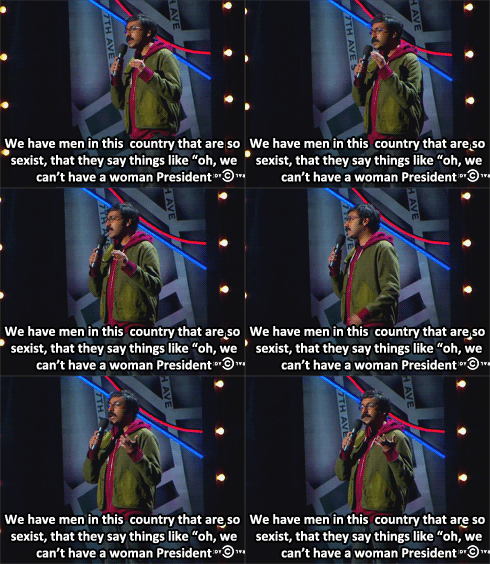


“We’ve never had a female President in this country, which I find stunning” - Hari Kondabolu

Amazon will acquire book recommendation site and readers' social network Goodreads, according to an Amazon press release issued Thursday.
"People love to talk about ideas and share their passion for the stories they read," said Goodreads CEO and co-founder Otis Chandler. "We're now going to be able to move faster in bringing the Goodreads experience to millions of readers around the world."
"Amazon and Goodreads share a passion for reinventing reading," added Amazon VP Russ Grandinetti. "Goodreads has helped change how we discover and discuss books… Both Amazon and Goodreads have helped thousands of authors reach a wider audience and make a better living at their craft. Together we intend to build many new ways to delight...
The Journal of Library Administration is published by Taylor & Francis, a big publishing conglomerate. According to Brian Mathews, while he was in the middle of putting together a special issue on the future of libraries he received notice that the editorial board was resigning due to conflicts with the publisher around what kind of author rights regime the journal should use. Here is the note he received from the board:
The Board believes that the licensing terms in the Taylor & Francis author agreement are too restrictive and out-of-step with the expectations of authors in the LIS community.
A large and growing number of current and potential authors to JLA have pushed back on the licensing terms included in the Taylor & Francis author agreement. Several authors have refused to publish with the journal under the current licensing terms.
Authors find the author agreement unclear and too restrictive and have repeatedly requested some form of Creative Commons license in its place.
After much discussion, the only alternative presented by Taylor & Francis tied a less restrictive license to a $2995 per article fee to be paid by the
Author. As you know, this is not a viable licensing option for authors from the LIS community who are generally not conducting research under large grants.Thus, the Board came to the conclusion that it is not possible to produce a quality journal under the current licensing terms offered by Taylor & Francis and chose to collectively resign.
Bravo to the editorial board of JLA for taking such a principled stand.
For a bit more background, Jason Griffey gives the perspective of an author approached by Mathews who strongly disagreed with T&F’s current author rights regime. From the other side, Chris Bourg gives the perspective of someone on the JLA editorial board and a bit on how they came to their decision.
Along with many others in the comments on the various blog posts, Peter Suber suggests the board take the next step and launch their own new journal. Suber also helpfully points to a list of journals that have done just that.
My take?
First of all, I think it’s a bit unfortunate that Mathews took his rather forward-thinking project to a rather backwards-thinking traditional toll access journal. The way to envision the future is to be the future to want to happen, and it’s hard to imagine T&F embodying the future of scholarly communications in a way that anybody but the big commercial publishers would like to see.
That being said, I do sincerely hope his project finds a more suitable home and that one of the themes it explores is the library’s role in a fairer, more open scholarly communications ecosystem.
As for the future of JLA, I hope T&F is able to move into the future and create a author rights regime that is more in sync with what authors in the LIS fields are looking for. For the resigned editorial board, I wish for them a way forward, a new partnership with an institution or society that will allow them and the authors they recruit in the future to openly envision and create the future.
I have a son who’s currently a first year physics student. As you can imagine, I occasionally pass along a link or two to him pointing to stuff on the web I think he might find particularly interesting or useful. Thinking on that fact, I surmised that perhaps other science students might find those links interesting or useful as well. Hence, this series of posts here on the blog.
By necessity and circumstance, the items I’ve chosen will be influenced by my son’s choice of major and my own interest in computational approaches to science.
The previous post in this series is here.
 O artigo de Bem chamou atenção porque não só seu autor é um cientista respeitado, como o veículo que aceitou publicá-lo, o JPSP, também goza de grande prestígio. Não se tratava de (mais um) artigo de pesquisadores obscuros lançado numa revista de nicho, do tipo que circula apenas entre crentes fiéis, mas do trabalho de um pesquisador sério numa publicação mainstream.
 Agora, no entanto, o mesmo Journal of Personality and Social Psychology que havia divulgado os resultados bombásticos de Daryl Bem publicou o artigo Correcting the Past: Failures to Replicate Psi, onde sete tentativas de recriar dois dos oito resultados precognitivos originais, envolvendo mais de 3.000 pessoas, falham espetacularmente. Podemos esperar uma capa de revista de circulação nacional com a manchete "Ciência descarta premonição"? Não creio.
 O trabalho de Leibovici é anterior ao de Bem, mas o artigo False-Positive Psychology, de Joseph Simmons, Leif Nelson e Uri Simonsohn, é quase simultâneo. Nele, os autores mostram como "é inaceitavelmente fácil acumular (e descrever) evidência estatisticamente significativa de uma hipótese falsa" no campo da psicologia. Por exemplo, eles "demonstram" que uma ouvir uma canção faz as pessoas rejuvenescerem 18 meses.
Rafa Spoladore ΨObrigado meu Deus.

Cast: T01Mac
Tags: Emily Ratajkowski, Treats! Magazine, Topless, Nude, Photoshoot, Slideshow and iCarly
STEP ONE: HAVE SOME FUCKING HAIR.
STEP FUCKING TWO:
STEP I’M FUCKING DONE THAT’S IT.
TA FUCKING DA
Capa para o caderno Carreira da Folha de domingo passado.
Os caras tem um "vocabulário" muito próprio.

Leia mais...

Captain Nemo and the Underwater City (MGM, 1969)
Starring Robert Ryan, Chuck Connors, Nanette Newman, Luciana Paluzzi, John Turner, Bill Fraser, Kenneth Connor, Allan Cuthbertson, and Christopher Hartstone. Directed by James Hill.



 , de Horace McCoy, descrito por um crítico americano como "o livro mais torpe publicado neste país".
A dozen generations ago, there was no unemployment, largely because there were no real jobs to speak of. Before the industrial revolution, the thought that you’d leave your home and go to an office or a factory was, of course, bizarre.
What happens now that the industrial age is ending? As the final days of the industrial age roll around, we are seeing the core assets of the economy replaced by something new. Actually, it’s something old, something handmade, but this time, on a huge scale.
The industrial age was about scarcity. Everything that built our culture, improved our productivity, and defined our lives involved the chasing of scarce items.
On the other hand, the connection economy, our economy, the economy of the foreseeable future, embraces abundance. No, we don’t have an endless supply of the resources we used to trade and covet. No, we certainly don’t have a surplus of time, either. But we do have an abundance of choice, an abundance of connection, and an abundance of access to knowledge.
We know more people, have access to more resources, and can leverage our skills more quickly and at a higher level than ever before.
This abundance leads to two races. The race to the bottom is the Internet-fueled challenge to lower prices, find cheaper labor, and deliver more for less.
The other race is the race to the top: the opportunity to be the one they can’t live without, to be the linchpin we would miss if he didn’t show up. The race to the top focuses on delivering more for more. It embraces the weird passions of those with the resources to make choices, and it rewards originality, remarkability, and art.
The connection economy continues to gain traction because connections scale, information begets more information, and influence accrues to those who create this abundance. As connections scale, these connections paradoxically make it easier for others to connect as well, because anyone with talent or passion can leverage the networks created by connection to increase her impact. The connection economy doesn’t create jobs where we get picked and then get paid; the connection economy builds opportunities for us to connect, and then demands that we pick ourselves.
Just as the phone network becomes more valuable when more phones are connected (scarcity is the enemy of value in a network), the connection economy becomes more valuable as we scale it.
Friends bring us more friends. A reputation brings us a chance to build a better reputation. Access to information encourages us to seek ever more information. The connections in our life multiply and increase in value. Our stuff, on the other hand, becomes less valuable over time.
… [this riff is inspired by my new book...]
Successful organizations have realized that they are no longer in the business of coining slogans, running catchy ads, and optimizing their supply chains to cut costs.
And freelancers and soloists have discovered that doing a good job for a fair price is no longer sufficient to guarantee success. Good work is easier to find than ever before.
What matters now:
All six of these are the result of successful work by humans who refuse to follow industrial-age rules. These assets aren’t generated by external strategies and MBAs and positioning memos. These are the results of internal struggle, of brave decisions without a map and the willingness to allow others to live with dignity.
They are about standing out, not fitting in, about inventing, not duplicating.
TRUST AND PERMISSION: In a marketplace that’s open to just about anyone, the only people we hear are the people we choose to hear. Media is cheap, sure, but attention is filtered, and it’s virtually impossible to be heard unless the consumer gives us the ability to be heard. The more valuable someone’s attention is, the harder it is to earn.
And who gets heard?
Why would someone listen to the prankster or the shyster or the huckster? No, we choose to listen to those we trust. We do business with and donate to those who have earned our attention. We seek out people who tell us stories that resonate, we listen to those stories, and we engage with those people or businesses that delight or reassure or surprise in a positive way.
And all of those behaviors are the acts of people, not machines. We embrace the humanity in those around us, particularly as the rest of the world appears to become less human and more cold. Who will you miss? That is who you are listening to .
REMARKABILITY: The same bias toward humanity and connection exists in the way we choose which ideas we’ll share with our friends and colleagues. No one talks about the boring, the predictable, or the safe. We don’t risk interactions in order to spread the word about something obvious or trite.
The remarkable is almost always new and untested, fresh and risky.
LEADERSHIP: Management is almost diametrically opposed to leadership. Management is about generating yesterday’s results, but a little faster or a little more cheaply. We know how to manage the world—we relentlessly seek to cut costs and to limit variation, while we exalt obedience.
Leadership, though, is a whole other game. Leadership puts the leader on the line. No manual, no rule book, no überleader to point the finger at when things go wrong. If you ask someone for the rule book on how to lead, you’re secretly wishing to be a manager.
Leaders are vulnerable, not controlling, and they are racing to the top, taking us to a new place, not to the place of cheap, fast, compliant safety.
STORIES THAT SPREAD: The next asset that makes the new economy work is the story that spreads. Before the revolution, in a world of limited choice, shelf space mattered a great deal. You could buy your way onto the store shelf, or you could be the only one on the ballot, or you could use a connection to get your résumé in front of the hiring guy. In a world of abundant choice, though, none of these tactics is effective. The chooser has too many alternatives, there’s too much clutter, and the scarce resources are attention and trust, not shelf space. This situation is tough for many, because attention and trust must be earned, not acquired.
More difficult still is the magic of the story that resonates. After trust is earned and your work is seen, only a fraction of it is magical enough to be worth spreading. Again, this magic is the work of the human artist, not the corporate machine. We’re no longer interested in average stuff for average people.
HUMANITY: We don’t worship industrial the way we used to. We seek out human originality and caring instead. When price and availability are no longer sufficient advantages (because everything is available and the price is no longer news), then what we are drawn to is the vulnerability and transparency that bring us together, that turn the “other” into one of us.
For a long time to come the masses will still clamor for cheap and obvious and reliable. But the people you seek to lead, the people who are helping to define the next thing and the interesting frontier, these people want your humanity, not your discounts.
All of these assets, rolled into one, provide the foundation for the change maker of the future. And that individual (or the team that person leads) has no choice but to build these assets with novelty, with a fresh approach to an old problem, with a human touch that is worth talking about.
I can’t wait until we return to zero percent unemployment, to a time when people with something to contribute (everyone) pick themselves instead of waiting for a bureaucrat’s permission to do important work.

Escadas de ascensão
Abismo em questão
Outras idéias novas
Tomam conta da emoção
Visando realização
A própria satisfação
Sem nenhuma intervenção
Sem qualquer discussão
Contagiar a multidão
Sem cair no vão..

Last Judgment (detail), Fra Angelico, ca. 1431