09 Jan 10:45
by M. Menotti, B. Morrison, K. Tan, Z. Vernon, J. E. Sipe, and M. Liscidini
Author(s): M. Menotti, B. Morrison, K. Tan, Z. Vernon, J. E. Sipe, and M. Liscidini
We demonstrate a system composed of two resonators that are coupled solely through a nonlinear interaction, and where the linear properties of each resonator can be controlled locally. We show that this class of dynamical systems has peculiar properties with important consequences for the study of c...
[Phys. Rev. Lett. 122, 013904] Published Tue Jan 08, 2019
09 Jan 10:44
by Aleksandr Vaskin, Soheila Mashhadi, Michael Steinert, Katie E. Chong, David Keene, Stefan Nanz, Aimi Abass, Evgenia Rusak, Duk-Yong Choi, Ivan Fernandez-Corbaton, Thomas Pertsch, Carsten Rockstuhl, Mikhail A. Noginov, Yuri S. Kivshar, Dragomir N. Neshev, Natalia Noginova, Isabelle Staude

Nano Letters
DOI: 10.1021/acs.nanolett.8b04268

08 Jan 21:20
by Andrew. M. Kingston
Andrew. M. Kingston, Daniele Pelliccia, Alexander Rack, Margie P. Olbinado, Yin Cheng, Glenn R. Myers, David M. Paganin
The quest for imaging protocols with ever-reduced dose is one of the most powerful motivators driving the currently exploding field of ghost imaging (GI). Ghost tomography (GT) using single-pixel detection extends the burgeoning field of GI to 3D, with the use of penetrating radiation. For hard ... [Optica 5, 1516-1520 (2018)]
08 Jan 21:19
by Michael Schirber
Author(s): Michael Schirber
Experiments demonstrate that a room in a house or office building could act as an analog computer processing the microwaves used for Wi-Fi.
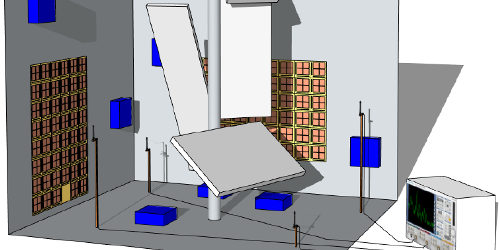
[Physics 11, 124] Published Fri Nov 30, 2018
07 Jan 09:26
by Scott
I have a treat with which to impress your friends at New Year’s Eve parties tomorrow night: a rollicking essay graciously contributed by a reader named Sebastian Oberhoff, about a unified and simplified way to prove all of Gödel’s Incompleteness Theorems, as well as Rosser’s Theorem, directly in terms of computer programs. In particular, this improves over my treatments in Quantum Computing Since Democritus and my Rosser’s Theorem via Turing machines post. While there won’t be anything new here for the experts, I loved the style—indeed, it brings back wistful memories of how I used to write, before I accumulated too many imaginary (and non-imaginary) readers tut-tutting at crass jokes over my shoulder. May 2019 bring us all the time and the courage to express ourselves authentically, even in ways that might be sneered at as incomplete, inconsistent, or unsound.
05 Jan 20:46
by Petr Bouchal, Petr Dvorák, Jirí Babocký, Zdenek Bouchal, Filip Ligmajer, Martin Hrton, Vlastimil Krápek, Alexander Faßbender, Stefan Linden, Radim Chmelík, Tomáš Šikola

Nano Letters
DOI: 10.1021/acs.nanolett.8b04776

05 Jan 20:45
by R. Guo, M. Nečada, T. K. Hakala, A. I. Väkeväinen, and P. Törmä
Author(s): R. Guo, M. Nečada, T. K. Hakala, A. I. Väkeväinen, and P. Törmä
We study lasing at the high-symmetry points of the Brillouin zone in a honeycomb plasmonic lattice. We use symmetry arguments to define singlet and doublet modes at the K points of the reciprocal space. We experimentally demonstrate lasing at the K points that is based on plasmonic lattice modes and...
[Phys. Rev. Lett. 122, 013901] Published Wed Jan 02, 2019
30 Dec 20:42
by Momchil Minkov, Ian A. D. Williamson, Meng Xiao, and Shanhui Fan
Author(s): Momchil Minkov, Ian A. D. Williamson, Meng Xiao, and Shanhui Fan
Metamaterials with an effective zero refractive index associated with their electromagnetic response are sought for a number of applications in communications and nonlinear optics. A promising way that this can be achieved in all-dielectric photonic crystals is through the design of a Dirac cone at ...
[Phys. Rev. Lett. 121, 263901] Published Thu Dec 27, 2018
30 Dec 20:42
by Haruki Watanabe and Ling Lu
Author(s): Haruki Watanabe and Ling Lu
The wide-range application of photonic crystals and metamaterials benefits from the enormous design space of three-dimensional subwavelength structures. In this Letter, we study the space group constraints on photonic dispersions for all 230 space groups with time-reversal symmetry. Our theory caref...
[Phys. Rev. Lett. 121, 263903] Published Fri Dec 28, 2018
30 Dec 20:42
by Shiqi Xia, Ajith Ramachandran, Shiqiang Xia, Denghui Li, Xiuying Liu, Liqin Tang, Yi Hu, Daohong Song, Jingjun Xu, Daniel Leykam, Sergej Flach, and Zhigang Chen
Author(s): Shiqi Xia, Ajith Ramachandran, Shiqiang Xia, Denghui Li, Xiuying Liu, Liqin Tang, Yi Hu, Daohong Song, Jingjun Xu, Daniel Leykam, Sergej Flach, and Zhigang Chen
Flatband systems typically host “compact localized states” (CLS) due to destructive interference and macroscopic degeneracy of Bloch wave functions associated with a dispersionless energy band. Using a photonic Lieb lattice (LL), such conventional localized flatband states are found to be inherently...
[Phys. Rev. Lett. 121, 263902] Published Fri Dec 28, 2018
25 Dec 22:32
by Rodrigo Berte, Fabricio Della Picca, Martín Poblet, Yi Li, Emiliano Cortés, Richard V. Craster, Stefan A. Maier, and Andrea V. Bragas
Author(s): Rodrigo Berte, Fabricio Della Picca, Martín Poblet, Yi Li, Emiliano Cortés, Richard V. Craster, Stefan A. Maier, and Andrea V. Bragas
The optical properties of small metallic particles allow us to bridge the gap between the myriad of subdiffraction local phenomena and macroscopic optical elements. The optomechanical coupling between mechanical vibrations of Au nanoparticles and their optical response due to collective electronic o...
[Phys. Rev. Lett. 121, 253902] Published Thu Dec 20, 2018
25 Dec 22:32
by Shaimaa I. Azzam, Vladimir M. Shalaev, Alexandra Boltasseva, and Alexander V. Kildishev
Author(s): Shaimaa I. Azzam, Vladimir M. Shalaev, Alexandra Boltasseva, and Alexander V. Kildishev
A bound state in the continuum (BIC) is a localized state of an open structure with access to radiation channels, yet it remains highly confined with, in theory, an infinite lifetime and quality factor. There have been many realizations of such exceptional states in dielectric systems without loss. ...
[Phys. Rev. Lett. 121, 253901] Published Thu Dec 20, 2018
25 Dec 22:31
by L.
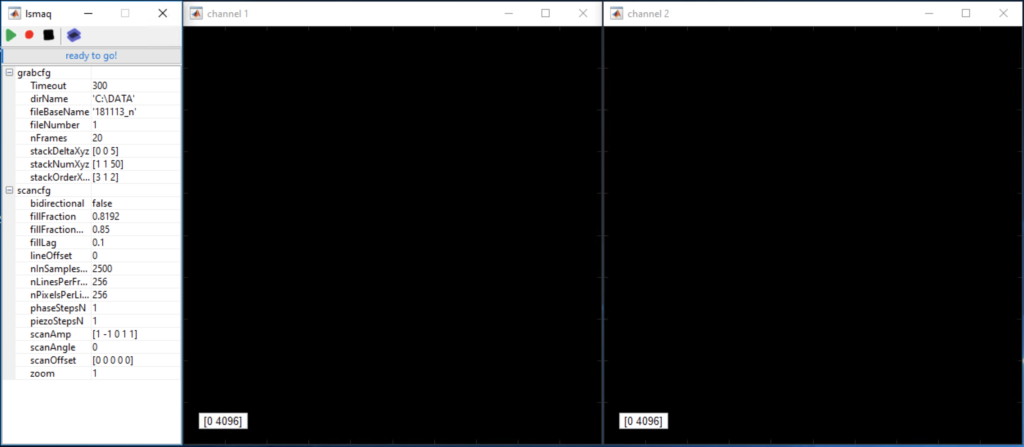
Years ago, Benjamin Judkewitz wanted to try some new techniques out with laser scanning two-photon microscopy. However, the software we were using was rather cumbersome to modify. So he wrote his own software from scratch (which took him roughly one day). The result was lsmaq.
LSMAQ is a lightweight and flexible laser scanning microscope acquisition software written in MATLAB. It supports National Instruments hardware for galvo-based scanning.
It does the essentials: it sends scan mirror commands out, reads image data in, and makes images. It has a live view and can stream to disk. He worked from that baseline to create the modified versions he wanted. It was a useful starting point for other people in the lab as well. Tiago Branco used it as a basis for two-photon uncaging software. I used it for arbitrary line scanning software in dendritic patch and imaging experiments. (Tiago, Ben, and I all overlapped in the Hausser Lab.)
It’s also useful for learning. There are relatively few lines of code, and the layout is straightforward.
Now, it is publicly available on GitHub, thanks to Ben.
https://github.com/danionella/lsmaq
19 Dec 20:44
by Burak Guzelturk, Matthew Pelton, Murat Olutas, Hilmi Volkan Demir

Nano Letters
DOI: 10.1021/acs.nanolett.8b03891

19 Dec 20:43
by Nicholas C. Harris
Nicholas C. Harris, Jacques Carolan, Darius Bunandar, Mihika Prabhu, Michael Hochberg, Tom Baehr-Jones, Michael L. Fanto, A. Matthew Smith, Christopher C. Tison, Paul M. Alsing, Dirk Englund
Advances in photonic integrated circuits have recently enabled electrically reconfigurable optical systems that can implement universal linear optics transformations on spatial mode sets. This review paper covers progress in such “programmable nanophotonic processors” as well as ... [Optica 5, 1623-1631 (2018)]
19 Dec 20:42
by Vedran Dunjko, Yimin Ge, and J. Ignacio Cirac
Author(s): Vedran Dunjko, Yimin Ge, and J. Ignacio Cirac
A hybrid quantum-classical computing algorithm could solve a basic computer science problem faster than a classical computer.
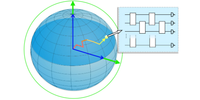
[Phys. Rev. Lett. 121, 250501] Published Tue Dec 18, 2018
17 Dec 08:13
by Federico Montanarella, Darius Urbonas, Luke Chadwick, Pepijn G. Moerman, Patrick J. Baesjou, Rainer F. Mahrt, Alfons van Blaaderen, Thilo Stöferle, Daniel Vanmaekelbergh

ACS Nano
DOI: 10.1021/acsnano.8b07896

16 Dec 20:25
by Mohammad Ramezani, Quynh Le-Van, Alexei Halpin, and Jaime Gómez Rivas
Author(s): Mohammad Ramezani, Quynh Le-Van, Alexei Halpin, and Jaime Gómez Rivas
We demonstrate nonlinear emission from molecular layers strongly coupled to extended light fields in arrays of plasmonic nanoparticles in the presence of structural imperfections. Hybrid light-matter states, known as plasmon-exciton polaritons (PEPs), are formed by the strong coupling of Frenkel exc...
[Phys. Rev. Lett. 121, 243904] Published Fri Dec 14, 2018
15 Dec 16:17
by Fitsios, Dimitris; Raineri, Fabrice
Title: Photonic Crystal Lasers and Nanolasers on Silicon
Author(s): Fitsios, Dimitris; Raineri, Fabrice
Source: SILICON PHOTONICS, 99: 97-137 2018
Document Type: Article; Book Chapter
14 Dec 14:16
by Lorenzo Magrini
Lorenzo Magrini, Richard A. Norte, Ralf Riedinger, Igor Marinković, David Grass, Uroš Delić, Simon Gröblacher, Sungkun Hong, Markus Aspelmeyer
Quantum control of levitated dielectric particles is an emerging subject in quantum optomechanics. A major challenge is to efficiently measure and manipulate the particle’s motion at the Heisenberg uncertainty limit. Here we present a nanophotonic interface suited to address this problem. By ... [Optica 5, 1597-1602 (2018)]
12 Dec 20:19
by Alexandre Goy, Kwabena Arthur, Shuai Li, and George Barbastathis
Author(s): Alexandre Goy, Kwabena Arthur, Shuai Li, and George Barbastathis
Imaging systems’ performance at low light intensity is affected by shot noise, which becomes increasingly strong as the power of the light source decreases. In this Letter, we experimentally demonstrate the use of deep neural networks to recover objects illuminated with weak light and demonstrate be...
[Phys. Rev. Lett. 121, 243902] Published Wed Dec 12, 2018
12 Dec 11:20
by Philippe Lalanne, Stéphane Coudert, Guillaume Duchateau, Stefan Dilhaire, Kevin Vynck

ACS Photonics
DOI: 10.1021/acsphotonics.8b01337
11 Dec 23:15
by Juan Arturo Alanis, Mykhaylo Lysevych, Tim Burgess, Dhruv Saxena, Sudha Mokkapati, Stefan Skalsky, Xiaoyan Tang, Peter Mitchell, Alex S. Walton, Hark Hoe Tan, Chennupati Jagadish, Patrick Parkinson

Nano Letters
DOI: 10.1021/acs.nanolett.8b04048

11 Dec 12:37
by Claire Li, Valentina Krachmalnicoff, Patrick Bouchon, Julien Jaeck, Nathalie Bardou, Riad Haïdar, and Yannick De Wilde
Author(s): Claire Li, Valentina Krachmalnicoff, Patrick Bouchon, Julien Jaeck, Nathalie Bardou, Riad Haïdar, and Yannick De Wilde
The far-field spectral and near-field spatial responses of an individual metal-insulator-metal nanoantenna are reported, using thermal fluctuations as an internal source of the electromagnetic field. The far-field spectra, obtained by combining Fourier transform infrared spectroscopy with spatial mo...
[Phys. Rev. Lett. 121, 243901] Published Mon Dec 10, 2018
11 Dec 12:36
by Taeko Matsukata, Carl Wadell, Nikolaos Matthaiakakis, Naoki Yamamoto, Takumi Sannomiya

ACS Photonics
DOI: 10.1021/acsphotonics.8b01231
07 Dec 21:27
by Tyler W. Hughes, Momchil Minkov, Ian A. D. Williamson, Shanhui Fan

ACS Photonics
DOI: 10.1021/acsphotonics.8b01522
07 Dec 21:01
by Yonatan Sharabi, Hanan Herzig Sheinfux, Yoav Sagi, Gadi Eisenstein, and Mordechai Segev
Author(s): Yonatan Sharabi, Hanan Herzig Sheinfux, Yoav Sagi, Gadi Eisenstein, and Mordechai Segev
We find that waves propagating in a 1D medium that is homogeneous in its linear properties but spatially disordered in its nonlinear coefficients undergo diffusive transport, instead of being Anderson localized as always occurs for linear disordered media. Specifically, electromagnetic waves in a mu...
[Phys. Rev. Lett. 121, 233901] Published Fri Dec 07, 2018
04 Dec 22:19
by Matthew P. Edgar
Principles and prospects for single-pixel imaging
Principles and prospects for single-pixel imaging, Published online: 03 December 2018; doi:10.1038/s41566-018-0300-7
Rather than requiring millions of pixels, it is possible to make a camera that only needs one pixel. This Review details the working principle, advantages, technical considerations and future potential of single-pixel imaging.
21 Nov 21:58
by Brian Wells
Brian Wells, Anton Yu. Bykov, Giuseppe Marino, Mazhar E. Nasir, Anatoly V. Zayats, Viktor A. Podolskiy
Nonlinear processes are at the core of many optical technologies whose further development require optimized materials suitable for nanoscale integration. Here we demonstrate the emergence of a strong bulk second-order nonlinear response in a plasmonic nanorod composite comprised of centrosymmetric ... [Optica 5, 1502-1507 (2018)]
21 Nov 15:47
by Suo Wang, Hua-Zhou Chen, Ren-Min Ma

Nano Letters
DOI: 10.1021/acs.nanolett.8b03890

