 Minions are quoted regularly in this house so I thought a Minion craft might get them excited to create.
Shared posts
17 Aug 04:31

Jumping Minion
by All for the Boys
Prcog1 likes this
26 Jul 21:10
Customers Acquired Via Twitter Worth 23% Less Than Average [STUDY]
by Allison Stadd

New research from lifecycle marketing company Custora suggests that the market has a long way to go before more traditional advertising tactics can be abandoned in favor of social media marketing.
According to Custora, customers acquired via Twitter are worth 23% less relative to average, and Facebook brings in just barely average clients. How do those numbers compare to pay-per-click and organic search?
New Career Opportunities Daily: The best jobs in media.
Prcog1 likes this
20 Jul 03:21
Who Knew? Helpful Kitchen Tips #4
by Tori Avey

In our fourth installment of Who Knew? Helpful Kitchen Tips, here are ten simple fixes for common kitchen dilemmas. I’ve also included a few fabulous tips that readers shared on my last Who Knew? post. Do you have a useful kitchen tip? Please share in the comments below!
1. Stop ice crystals from forming on the surface of your ice cream by placing a sheet of plastic wrap directly onto the top of the ice cream, then seal with the lid. Voila! No more freezer burn on your favorite summer treat!
2. Test your baking powder by mixing a teaspoon into some hot water. If it doesn’t start to bubble and fizz right away, you’ll know it’s time for a new can.
3. Keep champagne, or any carbonated beverage, bubbly by placing the handle of a metal spoon into the bottle. This keeps the air in the top of the bottle cool, which helps to ward off loss of carbonation.
4. If you find yourself without extra long matches the next time your stove won’t light, try using an uncooked piece of spaghetti. This works great for lighting candles, too!
5. For best results, whip egg whites in a stainless steel or copper bowl. Plastic bowls retain fat and oil on the surface, while glass bowls are too slippery, making it difficult for the whipped whites to grow in volume.
6. Always place clean paper towels or cloth towels between your non-stick pans when storing them. This will help to protect the surface from scratches.
7. A wok makes a great addition to any kitchen and can be used for more than making stir-fries. Try using one for deep-frying. A hidden benefit to this technique is that you will end up with a well-seasoned wok.
8. If your carrots and celery are looking a little limp, freshen them in a bowl of ice water with a slice of potato thrown in.
9. An ice cream scoop is a great tool for removing seeds from summer melons like cantaloupe and honeydew.
10. When cutting a frosted cake, dip your knife in hot water between each cut. This ensures a clean cut and will prevent the frosting from sticking to your knife.
Reader Tips
Here are a few of my favorite tips that were shared by readers on the last installment of Who Knew!
To keep fresh berries from spoiling, immerse them into solution of one part white vinegar to ten parts water. It keeps berries fresh for at least ten days to two weeks. ~ Judy G.
Got this tip from our daughter: Store your fresh ginger in the freezer (in a freezer bag). It doesn’t turn moldy and is much easier to grate when you take it out of the freezer and give it a minute or two to slightly defrost. ~ Muriel H.
A couple of tips: When browning ground beef, use a turkey baster to remove excess fat from the pan. I just use an empty can and then throw it away. Use a pizza cutter to cut pancakes, waffles, rolled cookie dough, etc. Works like a champ! ~ Jean von B.
Do you have a favorite kitchen tip to share? Leave it in the comments below. Your tip might be featured in my next installment of Who Knew!
Prcog1 likes this
20 Jul 03:19
Cheesecake Tiramisu Protein Pudding
by Tori Avey

This post was sponsored by Visalus Vi Shake. Thank you to my sponsors for helping me to share more free recipes, crafts and food history with you!
—
I think a lot of you must be dieting right now (swimsuit season?), because lately I’ve been getting a lot of requests for some lighter dessert options. I considered it perfect timing when a company called Visalus contacted me about their new protein powder mix called Vi Shake. This powder is a versatile nutritional supplement that can be added to smoothies, snacks, and other dishes to add a boost of hunger-fighting protein and fiber. Visalus asked me to come up with a creative recipe using their mix. Once I tasted their Vi Shake Sweet Cream flavor, I was happy to oblige. It’s pretty tasty stuff! I decided to address the requests I’ve received and come up with a healthy, low fat Cheesecake Tiramisu Protein Pudding.
I wanted this recipe to be super easy, something you can whip up in a few minutes without much prep work. We’ve been craving cheesecake here at home lately, so a light dairy dessert was a natural choice. I used nonfat ricotta cheese and Greek yogurt (you can use lowfat for either or both if you prefer) and mixed it up with the protein powder. The mixture was somewhat sweet on its own, but I found that the addition of a little sweetener made it more dessert-like. I added vanilla and a touch of instant coffee to give it a tiramisu flavor, then dusted the mixture with cocoa powder and a sprinkle of sliced almonds for crunch. The almonds are optional; you can omit them to cut the extra fat, or if you have a nut allergy. As you’ll see below, I mixed it in a mixing bowl and “plated” it in a pretty dessert dish. No need to be that fancy if you’re in a hurry, you can mix it up in the same bowl you’re eating out of if you’re not worried about presentation. I do recommend chilling the mixture before eating, but if you are hungry you can also dig in right away… no need to wait! This makes a really filling and tasty dessert, and can also satisfy an afternoon sweet craving.
For those of you who don’t have Vi Shake on hand, or those who prefer another protein supplement, you can use any vanilla protein powder you like. To substitute, use 1/3 cup of your favorite vanilla protein powder (or a serving scoop, if a serving equals less than 1/3 cup of powder) and sweeten the mixture to taste.
Vi Shake is OU certified kosher, gluten free, low fat, low sodium and lower carb than many other nutritional supplements. It’s also lactose free, though of course there is lactose in this particular recipe. For more info, check out their Facebook page and the Visalus blog, where you can find a ton of recipe ideas and a very active online community.

Cheesecake Tiramisu Protein Pudding
Ingredients
- 2 scoops Visalus Vi Shake Mix, Sweet Cream flavor
- 1/3 cup nonfat Greek yogurt
- 1/4 cup nonfat ricotta cheese
- 1/2 tsp instant coffee granules dissolved in 1 tsp hot water, then cooled
- 1 tsp your favorite sweetener, or more to taste (I used stevia)
- 1/4 tsp cocoa powder
- 1 tbsp sliced almonds (optional)
Prep Time: 5 Minutes
Total Time: 1 Hour 5 Minutes
Servings: 1
Kosher Key: Dairy
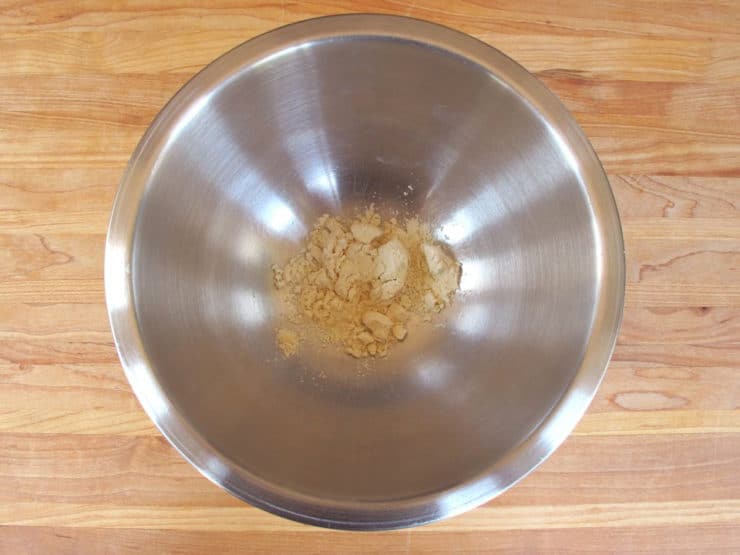
- Pour the protein powder in a mixing bowl.
-
 Use a fork to stir in the Greek yogurt, ricotta cheese, and instant coffee till smooth. Stir in your favorite sweetener to taste. To keep it low carb, use a no-carb sweetener. I used about 1 tsp of stevia.
 -
 Pour the mixture into a dessert dish. Sprinkle the top with cocoa powder (for a pretty, even sprinkle across the top use a wire mesh strainer). Garnish the top of the dessert with sliced almonds. Chill for 1 hour. Serve.


—
This post was sponsored by Visalus Vi Shake. Please consult your doctor if you have a medical-related condition and would like to start taking a nutritional supplement to find the right choice for you. Thank you to my sponsors for helping me to share more free recipes, crafts and food history with you!
Prcog1 likes this
20 Jul 03:19
Preparing Raw Artichokes for Salad
by Tori Avey
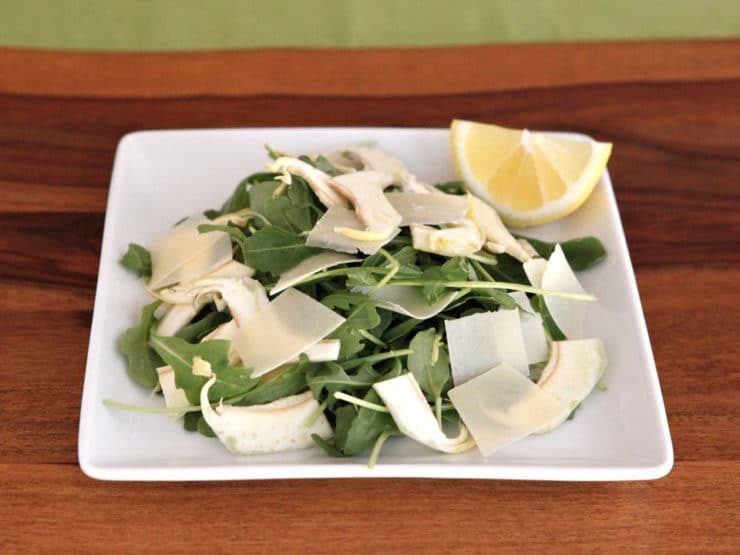
Raw artichokes can be used in salads, but they require some special preparation. The raw artichoke must be well trimmed, then sliced very thinly on a mandoline. I have created a tutorial for the process below. Once sliced and prepped, raw artichokes can be used in all kinds of salads. Their flavor that is both nutty and sweet. They are delightful on arugula drizzled with olive oil and topped with shaved parmesan.
Recommended Products
Note: Any purchase you make from The Shiksa Market helps to support my website, my recipes, and the free content I provide. If you have an Amazon login, it’s even easier to make a purchase. Thanks for browsing!
Preparing Raw Artichokes for Salad
You will need
- Artichokes
- Lemons
- Serrated knife, or sharp chef's knife
- Kitchen shears, or sharp, clean scissors
- Vegetable peeler
- Melon baller
- Paring knife
- Mandoline
Total Time: 20 - 30 Minutes
Servings: Varies
Kosher Key: Pareve
- Have a bowl of cold water with lemon juice handy, as well as some fresh lemon halves, to keep your artichoke pieces from oxidizing and turning brown. Rinse your artichokes under cold water, pulling the leaves apart gently to let the water run between them and flush out any impurities. Pat the artichokes dry with a clean kitchen towel or paper towel.
- Remove any stray leaves from the stem of the artichoke.
-
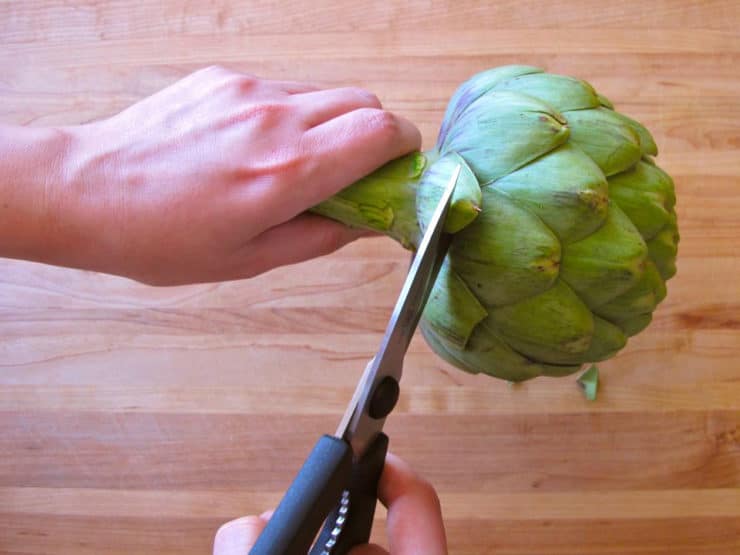
 With kitchen shears, or sharp scissors, remove the thorny tips from the leaves.
 -
 With a serrated knife cut about an inch off of the top of the artichoke.
 -
 Keep a lemon handy to rub onto the exposed areas so that they do not oxidize and turn brown.
 -
 Remove the bitter, fibrous end of the stem with your knife, leaving about an inch left on the artichoke. Be sure to rub a lemon onto the exposed end of the stem.
 -
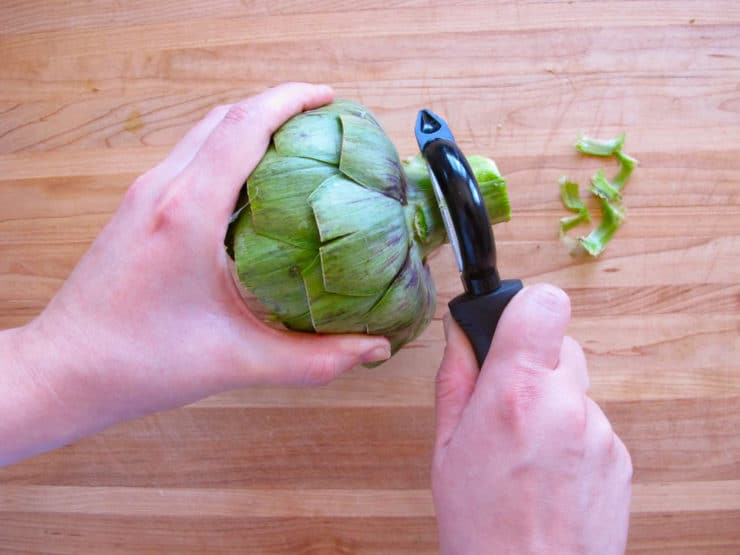
 Peel the outer skin from the remaining stem. The stem can has a more bitter taste than the rest of the artichoke and removing the skin helps to take away some of the bitterness.
 -
 Peel off 5-6 layers of external leaves from the artichoke, snapping off the leaves and setting them aside, till you reach an inner layer of leaves that are fresh looking and white at the base.
 -
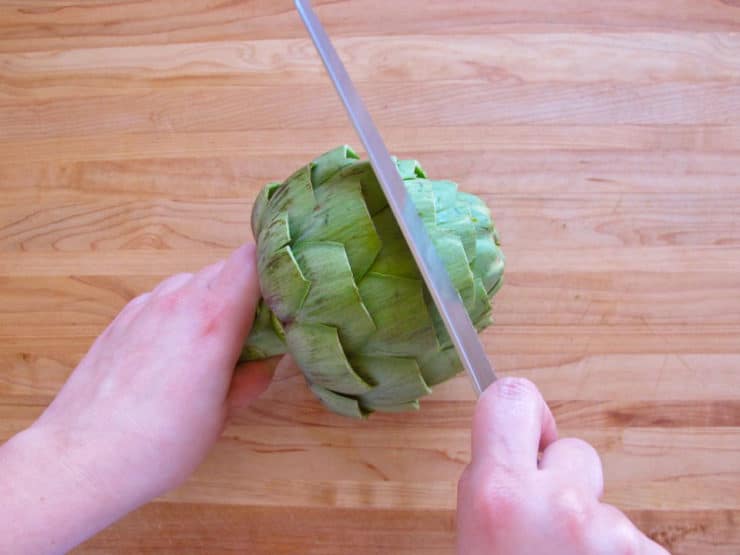
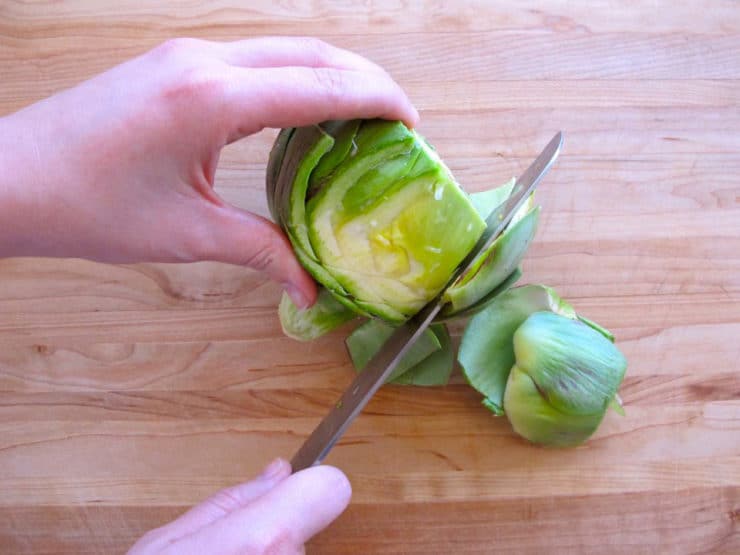
 Use a sharp serrated knife to remove the remaining outer leaves to reveal the very light green inner leaves of the artichoke. Begin by slicing off one side of the leaves, then continue slicing around the artichoke, turning the artichoke into the blade as you go. Be sure to keep rubbing lemon onto the exposed areas to keep them from browning.
 -
 Discard external leaves, or you can keep them and steam them for eating later. Cut artichoke in half lengthwise to create two equal halves, exposing the purple inner choke. Rub exposed stem and leaves with lemon.
 -
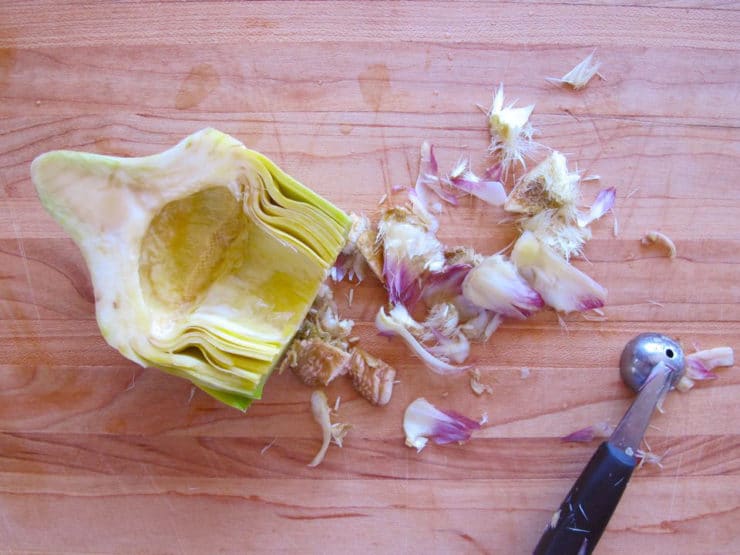
 With a melon baller, remove the choke – the furry, inedible center area, as well as any of the inner purple leaves. Rub the exposed areas with lemon.
 -
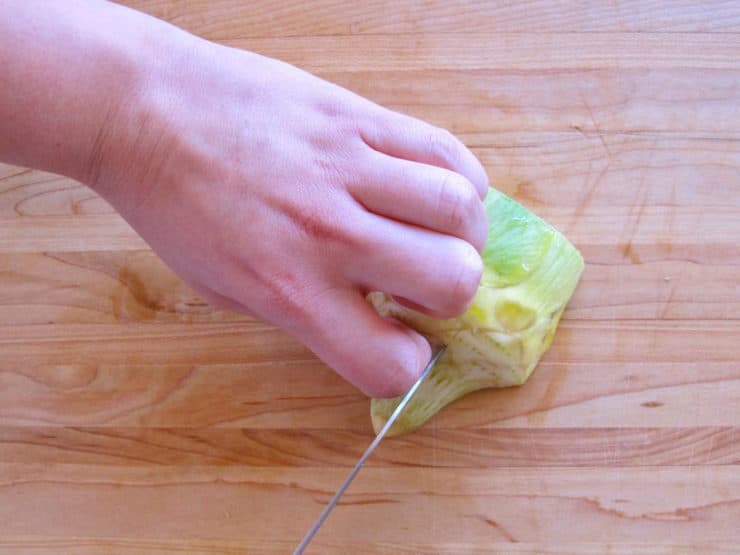
 Make a 1-inch long slice through the bottom third of the artichoke; this will help when cutting on the mandoline.
 -
 Slice the artichoke using a mandoline (leaf side up, exposed stem side down). Push the stem end into the blade to slice. Be very careful when you get near the end of the artichoke, so that you do not end up cutting your fingertips as well – this is very easy to do! You can cover your hand with a clean towel for extra protection. When you near the end of the artichoke, you can turn the remaining piece on its side to help with cutting.
 -
 Place the cut pieces of artichoke into the bowl of lemon water as soon as possible.
 -
 These thinly sliced raw artichoke hearts can be used uncooked in salads. They have a nutty and slightly sweet flavor. They go great over arugula, drizzled with olive oil and topped with freshly shaved parmesan.







Note: Strictly kosher Jews have their own guidelines for cleaning and consuming artichokes, which differ from the tutorials that appear on my site. If you’re concerned, you can learn more on the OK website.
Prcog1 likes this
20 Jul 03:18
Jewish Fried Artichokes
by Tori Avey

Italians, particularly Jewish Italians, are somewhat responsible for pushing artichokes into global popularity. In his Encyclopedia of Jewish Food, historian Gil Marks explains that Italian Jews favored artichokes early on, while non-Jewish Italians showed distaste for them, often referring to them as “the Jewish vegetables.” In the 1500s, Pope Paul IV forced all the Jews in Rome to live within a secluded ghetto where food and water were scarce. Out of necessity, frying over an open fire became a popular cooking method. Artichokes, which were one of the few plentiful food sources, were eaten fried. Over time, the artichoke gained favor with all Italians, including the Medicis of Florence. Catherine de Medici, who was known for her insatiable appetite, brought artichokes to France when she married Henry II. Until this time, they were considered something of a novelty.
Artichokes are my favorite vegetable, and may very well be my favorite food. As you might imagine, I’ve cooked and eaten them in a multitude of ways. The most surprising preparation I’ve ever tasted, and perhaps the most delicious, was first served to me at an Italian restaurant in Miami Beach, Florida. This dish, known as carciofi alla giudea or artichokes “Jewish style,” has roots in Pope Paul IV’s Jewish ghetto. In Italy the dish is usually made with Romanesco artichokes, which are purple, more tender and less thorny than the globe artichokes commonly available in America. To replicate the texture of the Romanesco version of this dish, I took a tip from the restaurant’s chef and steamed my globe artichokes lightly before frying. I also split the artichokes in half, which allows them to cook faster and more evenly (it also makes them easier to eat!). I sliced the leaves close to the heart, which resulted in a pretty flower-like crown on top. The result was divine—a perfectly crisp golden exterior with a tender, slightly sweet inner heart. It’s a flavor symphony. Mangia!
Jewish Fried Artichokes
Ingredients
- 4 artichokes
- Olive oil for frying
- Salt and pepper
- 4-5 fresh lemons for preparation and serving
You will also need
- Saute pan or deep fryer
Total Time: 1 Hour
Servings: 8 fried artichoke halves
Kosher Key: Pareve
- Note: Common green globe artichokes will work fine in this recipe. If you can track down purple Romanesco artichokes, even better!
- Prepare a large bowl of ice water. Squeeze two lemons into the bowl of water, stir, then throw in the squeezed lemon halves. This lemon water will keep your artichokes fresh and green till you’re ready to fry them. Keep a couple of fresh lemon halves on hand as you prep. Rinse your artichokes under cold water. Pat them dry with a clean kitchen towel or paper towel. With kitchen shears or sharp scissors, remove the thorny tips from the leaves. For each artichoke, remove the bitter, fibrous end of the stem with your knife, leaving about 1 1/2 inches of stem attached to the artichoke.
-
 Use a serrated peeler or paring knife to peel the outer skin from the remaining stem. The stem has a more bitter taste than the rest of the artichoke; removing the skin helps to take away some of the bitterness. Rub the peeled stem with fresh lemon to keep it from browning.
 -
 Peel off 5-6 layers of external leaves from the artichoke, snapping off the leaves and setting them aside, till you reach an inner layer of leaves that are fresh looking and white at the base.
 -
 With a serrated knife or sharp chef’s knife, slice the artichoke horizontally about ¾ inch above the base (heart) to remove the pointy top of the artichoke, leaving a flat crown of leaves on the base of the artichoke while exposing the inner purple leaves.
 -
 Slice the artichoke in half lengthwise, splitting the stem and heart in half vertically to reveal the inner fuzzy choke.
 -
 Scoop out the fuzzy spines and purple leaves from each artichoke half with a melon baller, leaving behind two hollowed out halves of heart, each with a small crown of flat leaves.
 -
 You may wish to place the artichoke halves under cold running water to remove any stubborn bits of fuzzy choke.
 -
 Rub the heart with lemon, then place it in the bowl of lemon water. Repeat process with the other remaining artichokes.
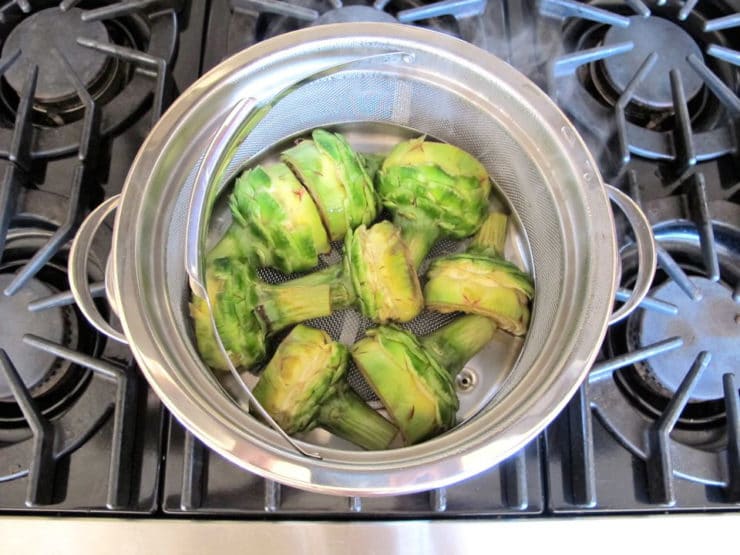
 - When ready to cook, remove the artichoke halves from the lemon water. Pour the lemon water and juiced lemon halves into a large pot; you will need about 1 ½ inches of water, so if you don’t have enough, add more water to top it off. Place a steamer basket inside the pot and bring water to a boil. Place the cleaned artichoke halves into the steamer basket and cover the pot with a lid. Reduce heat to medium.
-
 Let the artichokes steam for 15-20 minutes till a knife or fork can be inserted easily into the thickest part of the stem. You want the artichokes to be lightly steamed and a bit tender, but still firm—they should only be partially cooked.
 -
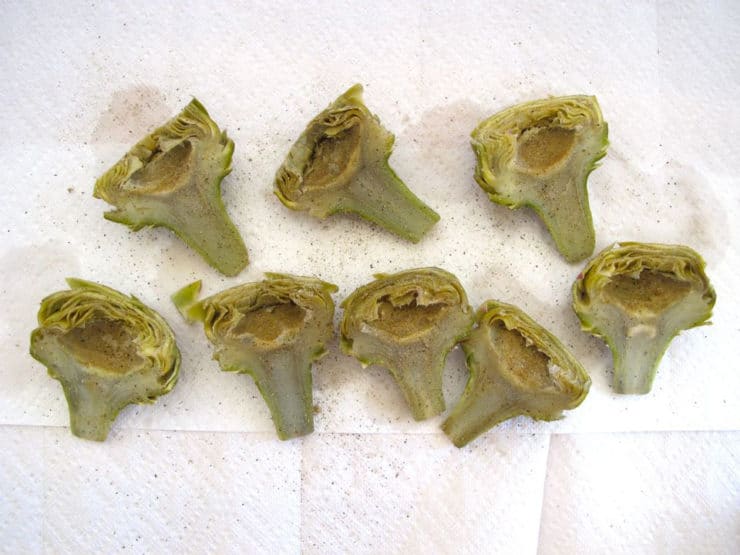
 Place the steamed artichoke halves onto a layer of paper towels and let them drain. Heat 1 inch of olive oil to around 375 degrees F, hot enough for frying but not so hot that it smokes. While oil is heating, sprinkle the artichoke halves with salt and pepper, making sure to sprinkle inside the layers of leaves as well.
 -
 Place the artichokes gently into the heated oil and let them fry for about 15 minutes, using a pair of tongs to turn them once halfway through cooking, till artichokes are golden brown and the leaves are crisp.
 -
 Remove from the oil and let them drain on paper towels or a wire rack. Serve fried artichokes warm with fresh sliced lemon wedges.










Note: Strictly kosher Jews have their own guidelines for cleaning and consuming artichokes, which differ from the tutorials that appear on my site. If you’re concerned, you can learn more on the OK website.
Prcog1 likes this
20 Jul 03:16
Gubernatorial Candidate Apparently Not a Fan of Oral Sex, Wants to Ban It
by Maia Brown-Jackson

Ken Cuccinelli, the Republican candidate for governor in Virginia, has apparently decided that the only way to protect children from being raped is by outlawing oral and anal sex for consenting adults. Because that obviously makes sense.
Crimes Against Nature laws — which generally outlawed acts ranging from oral sex to necrophilia — have been mostly been struck down following the 2003 case Lawrence v. Texas, which ruled that a couple cannot be arrested for having consensual sex in private. Rather, this is protected by due process under the 14th Amendment, and this ruling ultimately paved the way for other gay rights cases by overruling earlier laws that prohibited sodomy. It is one of these laws, which Cuccinelli has taken to calling the “Anti-Child Predators Law,” that he thinks is totally necessary to protect children from rape. As his catchy new name for it implies.
Cuccinelli’s stance makes even less sense in light of his behavior in 2004. According to Think Progress, A bill was proposed in Virginia, following Lawrence v. Texas, to keep the parts of the Crimes Against Nature law that would not contradict the Supreme Court’s decision, such as prostitution and issues regarding consent. Cuccinelli not only opposed the bill in committee, but blocked it on the floor.
I think we all want to know how exactly this law would even be enforced. Especially as Cuccinelli claims his proposal is not intended to prosecute consensual sex. Because, you know, that’s illegal now. Because, despite what he might want, adults can’t become registered sex offenders for having consensual sex in the privacy of their own home.
Do you know what is and will remain, regardless of Cuccinelli, illegal? Raping children. Molesting children. Statutory rape. How consenting adults having fun sexy times in private actually has anything to do with making child predators even more illegal remains unclear at best.
(via Slate, image via VAChildPredators)
Meanwhile in related links
Prcog1 likes this
20 Jul 03:16

R-Train Riders Honored For Subway Track Rescue
by Brian Hedden

Photo: Brian Hedden/Bay Ridge Odyssey
Last Thursday (July 11, 2013) morning, two straphangers jumped down to the subway track roadbed at the 77th Street R-train station to pull another rider who had fallen onto the tracks to safety. Earlier this week, rescuers John Gearity and Richard McDonald were honored for their fast-thinking action with a state proclamation by State Senator Marty Golden.
According to the NY Daily News report by Andy Mai and Thomas Tracy, Gearity and McDonald carried the fallen straphanger over the electrified third rail and to the opposite platform as an R-train approached about 200 feet for their location.
141 people were hit by trains in 2012, according to statistics from the MTA. Of those, 55 people were killed.
Prcog1 likes this
20 Jul 03:15
What Are We Complaining About? Blocked Driveways, Vermin Are Top 311 Subjects
by Brian Hedden
 The New York City government makes its 311 case metadata open to the public, and as Candidate Joe Biden can tell you, a person can learn a lot of interesting things from metadata. So the Furman Center for Real Estate and Urban Policy at New York University went through data for the summer of 2012, and made this cute little map.
The summary of the data that the Furman Center used is downloadable. Looks like the number one complaint in Bay Ridge is the dreaded blocked driveway, followed by vermin. Our #3 complaint last summer was street cave-ins… yeah, I guess 2012 really was the Sinkhole Apocalypse, so that makes perfect sense.
Did you know that you don’t have to settle for the Furman Center’s year-old summary? Case metadata is updated every day on the city’s web site. It’s easy to filter down on recent cases by community board. For instance, did you know that there was one derelict bicycle complaint in Dyker Heights in the last two weeks? Did you know that “derelict bicycle” was even a complaint category?
Did you know there three heat complaints in the same timeframe, and I do hope they meant “It’s too hot,” and not “The heat in my building isn’t working?”
And yes – there may have been some complaints of vermin and blocked driveways, too.
Prcog1 likes this
20 Jul 02:45


Single-Handed Barber
by Marty Shaw

Prcog1 likes this
20 Jul 02:45


I Survived the Red Wedding T-Shirt
by Marty Shaw

Prcog1, graham.boyd likes this
17 Jul 04:23


Squito: A Throwable Panoramic Camera Ball that Captures 360° Aerial Shots
by Eric Calouro

Boston-based artist and inventor Steve Hollinger has just been granted a second patent here in the United States for his Squito invention, a ball sporting embedded cameras and position sensors that allow for panoramic imagery in reconnaissance and recreational situations.

The idea is simple. You throw the ball and the orientation sensors capture and process images of Squito’s flight trajectory. The patent outlines that the unit’s orientation sensors snap photos and then re-orient them so as to create a normal images — panoramic images, in fact. These multiple images can be stabilized to allow the camera to capture frames in sequence. What you get, basically, is a pano-video (totally just made that up, but it works) of the ball’s flight. If that’s not cool, we don’t know what is.
Hollinger’s put together a prototype of ball, and it looks pretty neat, if we may say. Coming in at the size of a tennis ball, Squito uses three cameras, an inertial measurement unit, microcontroller, and image processor. Captured media can be wirelessly transmitted to a user’s computer, tablet, or phone.

“Throwable camera innovations are accelerating with advancements in sensor and imaging microelectronics,” says Hollinger. “With the advent of low-cost, high-speed cameras for outdoor recreation, an affordable throwable camera is finally within reach.”
Prcog1 likes this
17 Jul 04:22


Don’t Let the Retouched Photographs of the World Affect Your Own Self Image
by Guest Author

I recently had an unusual experience. I was standing in a department store aimlessly browsing some shiny shelving that held many glittery bottles with promises of youth and perfect beauty. In the process of being pseudo hypnotized by the lovely array of bright colors, I heard a small feminine voice pipe up in the aisle behind me.
She was fawning over the stunning portraits of celebrity beauties that held small spaces, conveniently placed right above eye level. She kept saying how perfect and beautiful they all were, and you could hear a kind of wistful tone to her phrases. The kind of tone that says “I wish that were me”. After a few moments of hearing her adoration, I couldn’t keep quiet.
I walked around the corner and saw an average looking girl, medium weight, plain dress, and simple hair, no makeup. I later discovered that she is 14 and had plans on becoming a professional makeup artist. I asked her what she liked about the photographs. Her response was about what was expected. They look so perfect. They’re so gorgeous. Look at their skin. The makeup is amazing.

Now, this is something I have a strong opinion of. I love retouching, and I love over the top portraits, and I feel that great retouching is required in our industry. However these young girls have no idea the amount of work that goes into these ‘beauty’ portraits that they see on the walls and in the magazines.
I am of the opinion that education is the best way to show young (and old) men and women that these are commercials, and about as realistic as the animated movies we see in theatres. They are designed to capture attention, and create an emotion, and advertise a product. They do not have to accurately represent the face in which they are featured.
I keep a selection of images on my phone for all sorts of reasons, usually in the quest of shameless self-promotion, but it now served a new purpose. I flicked the phone to life and opened up my ‘before and after’ section. I explained to her the process of retouching, and that although these women are indeed gorgeous they are not as perfect as they are on the display.

Without all the professional hair and makeup teams, the perfect lighting, professional photographer, and then the retouching on top of that, they look like normal human beings. They get to wake up in the morning looking just as messy as the rest of us.

Granted, some have that bone structure that our industry flips over, but most of us do not. It’s winning the genetic lottery. The models on the runways, in the commercials, on TV are just the anomalies, the exception to the rule for a large number of reasons. However, underneath all the makeup, hair, and retouching, they are simply people.
One thing is for sure, none of us look as perfect as the retouch artists make us look, and our youth need to know this. I think many young people would be surprised at how amazing they also look with a pro team working magic on their face, a stylist deciding what they will wear, and a digital arts team picking just the right photograph that is the ideal angle for their features.
Supermodels have outtake photos too, and we as professionals in our industry have a responsibility to educate our younger generation of these facts.

Many are just like the young lady I met in the department store. She had no idea the work that went in to those photographs, and her astonishment to the before and after shots left her with a clarity she did not have before. Best of all, she had a new appreciation for her own self-image.
My message is this:
We need to realise what “real beauty” actually is.
It’s not the magazines or the TV commercials, it’s not the movies and it’s not the billboards you see every day on the way to work.
In my opinion real beauty is making the best with what you’ve got, and not judging yourself against others. It’s making mistakes, and learning from them to be a better person. It’s being accountable for your actions and being willing to take a stand and do the right thing when others do not.
It’s being able to smile at the end of a rough day, because the bad days mean the good ones are just around the corner. It’s being honest, and true to yourself and those around you, and making the best with your body, mind and life.

To our beautiful youth: no one is the retouched goddess we see in the department store walls. They are tweaked pixels designed into someone’s idea of perfection. Do not let someone else’s opinion of what is ideal carve the framework for your own self image. Whatever genetic mix you were handed at birth is what you’ve got. Be unique, do something different and be yourself.
Nobody has to live your life every day, only you do. You decide how you want to feel about yourself, because no one else will decide it for you.
About the author: Renee Robyn is a photographer based in Edmonton, Alberta. You can find her on Facebook, Twitter, Instagram, Tumblr, and 500px.
Prcog1 likes this
17 Jul 04:21


PhotoYOLO: Receive One Photo Per Day from ‘a Friend You Just Haven’t Met Yet’
by DL Cade

Where popular culture is concerned, YOLO might be the new Carpe Diem. The acronym, which stands for “you only live once,” has become increasingly popular over the past several years after its first known mention in the NBC reality show The Average Joe back in 2004. Now, almost 10 years later, it’s broken into the photography industry with the new site PhotoYOLO.
PhotoYOLO is the brainchild of photographer Kaitlyn Reed, who was inspired to create the site after using the similar service The Listserve. Both services pool subscribers by having them enter their e-mail address, and then select one lucky “winner” every day to share something with the entire community. For The Listserve, it’s something written; for PhotoYOLO, it’s a photo.
PhotoYOLO was inspired by the website Listserve, which gives one lucky subscriber per day the chance to write something and share it with the rest of the site’s followers.
For subscribers, the benefits are twofold. Whether or not you’re selected, you will receive a photo in your inbox every day — a photo from “a friend you just haven’t met yet.” If you are selected, it’s a chance to share your work with the world, starting with PhotoYOLO’s subscribers.
Unlike The Listserve, there’s no count indicating how many subscribers have currently signed up, but the site is picking up steam quickly. There’s also no indication on how these photos are curated to make sure they’re appropriate, but one photo per day shouldn’t be too hard to keep track of.
To try the service out for yourself or learn more, head over to PhotoYOLO by clicking here.
(via PopPhoto)
Prcog1 likes this
17 Jul 04:21


Using The DMCA To Stop the Copyright Infringement of Your Photos
by Guest Author

Over the years I have been finding more and more of my photos being used on the Web without my permission. This is a quick guide to detecting and enforcing copyright.
Note: The DMCA is a U.S. law that governs U.S. hosting providers. If the site hosting your copyrighted material is hosted outside the U.S. the DMCA does not apply. I have found my images hosted on servers in China and Russia and all over the Middle East and I have come to the conclusion that those infringements are best left alone. The European Union does have the European Directive on Electronic Commerce (EDEC) which I have not researched.
The first step is to find if your image is being used. For this tutorial I will use one of my more frequently purloined photos. This photo of the Downtown Houston skyline is just such a photo.

The first thing you need to determine is whether or not your photo is being used on the Internet without your permission. To do this, go to images.google.com. Here you will notice an icon in the search box that looks like a camera.

Click on the camera and select “Search By Image” and this will bring up a dialogue box that will take you through uploading your image or providing a URL link to your image and searching Google with it.
(For those using Google Chrome there is a nifty plugin called Search by Image that will, once installed, allow you to right click an image on the Web and search Google with it. Either way, the results are returned in the same way.)

As you can see in this example, Google shows you a set of images that are similar. Not surprising, there are a number of photos of the downtown Houston skyline by other photographers. But the list below is more telling. As you can see, there are several links to pages hosting my exact photo. Some of them are mine (obviously) and some of them are sites that I have licensed the photo to. And then there are the others. The copyright infringers.
At this point I click the link on a suspected infringer and collect the URL to do some research. For this example I will use my own Web site so as not to incur the wrath of an infringer who might take issue with me calling them out in a public forum.
Here we see this guy named Jay Lee who is portraying my photo as his own. What a jerk!

Now at this point you have two choices. You can peruse the Web site hosting your image and try to find contact info for the person or company and try to deal with them directly. This method yields a variety of results. Sometimes the infringer will agree to remove the image, or they might offer to license the image or, more frequently than I care for, they will tell your something along the lines of “too bad, so sad” or even ignore you entirely. Some infringers tend to get downright nasty.
Due to the large number of infringers I tend to come across I opt to deal with the hosting providers. Most hosting providers have provisions for dealing with Digital Millennium Copyright Act (DMCA) notices that will put the hosting provider in the position of dealing with their customer instead of you.
To go this route does, however, require some research and effort.
The first thing to do is find the I.P. address of the Web site. Simply opening a command prompt and using NSLOOKUP will accomplish this easily.

Now that we know the Web site is hosted at 173.193.136.178 we just need to know the controlling entity for that IP address. To learn this we go to the American Registry For Internet Numbers, also known as ARIN.

Using their Whois search to search the IP address we can see that Softlayer is the hosting entity for this Web site. We can then click on the Abuse Point Of Contact link to find out who to send our notice to. It is worth noting that if the hosting entity is outside of the USA, you might not get any response to your DMCA notice. If the IP address comes back as belonging to the RIPE Network Coordination Centre you are likely wasting your time if you try to file a DMCA.

As we see here, the abuse contact for SoftLayer is abuse@softlayer.com. This is who we need to send our notice to.
As per the Digital Millennium Copyright Act (DMCA), there is a specific formula for submitting a valid notice of copyright infringement. This is the template I use and has been very successful.
Compose a new email with the subject: “Notice of Copyright Infringement“.
Then, in the body of the email include the following text and links:
The copyrighted work at issue is located at:
[Insert the URL of the page infringing on your copyright here]
Specifically, this image:
[If possible, provide the direct link to the infringed image itself. You can usually find it by right-clicking the image and selecting "Copy Image URL" and then pasting the link in to your message. This works well in Chrome most of the time. In some cases you have to view the source of the Web site to dig this link out. If you can't find it, don't sweat it.]
The corresponding URL where our copyrighted material is located:
[Insert link to YOUR image on your Flickr page, blog page, whatever.]
You can reach me at [insert your email address] for further information or clarification.
I have a good faith belief that use of the copyrighted materials described above as allegedly infringing is not authorized by the copyright owner, its agent, or the law.
I swear, under penalty of perjury, that the information in the notification is accurate and that I am the copyright owner or am authorized to act on behalf of the owner of an exclusive right that is allegedly infringed.
[Your name]
[Your company (if you have one)]
[Your web site]
[Your physical address]
[Your phone number]
The above template meets the required standards of a legitimate DMCA notice.
It is worth noting that some hosting sites provide online DMCA forms. These are preferable over sending an email when they are available. If you suspect a hosting provider might have such a form, a Google search using the name of the provider along with DMCA will usually lead you to the form.
Below are links to the more common hosting site DMCA forms”
Once you have submitted your DMCA notice, whether by email or by online form, you can usually expect a notification that your notice has been received. Often it will include a tracking number that will be used for any communications and updates to the status of your notice. In my experience most hosting providers will have the issue resolved pretty quickly. Some of my notices have been addressed in less than 24 hours. The longest I have had to wait is about 3 or 4 business days.
Closing Thoughts
Not every notice will succeed. You will have to determine how much effort you are willing to expend enforcing your copyright. I would say my success rate, inside the USA, it about 95%. Your results may vary.
Many copyright infringers don’t know that they are doing anything wrong. They think the Internet is a bucket full of royalty free images and content. These kinds of infringers are often very apologetic and will remove the content.
Some infringers outsource their Web design to a third party. The Web site owner is lead to believe that their Web designer is making sure that the rights to the content are in place. Unfortunately, there are many unscrupulous Web designers.
And then there are the infringers who simply don’t care about your rights. They think that if you posted the image online, you should expect it will get stolen. The reactions of this type of infringer can sometimes be quite frightening.
Remember, if you are asserting copyright in the form of a DMCA Notice, you must be prepared to back it up legally. Once you have claimed your copyright you could be presented with a counter challenge if the person or company believes they have rights to the content.
And one last closing thought. In most cases, when you file a DMCA notice, the hosting provider will disable access only to the content you specify and leave the rest of their site in place. The one exception to this I have found is GoDaddy. Upon receipt of a valid DMCA Notice they will disable the customer entirely. That means you will have to work with their customer and GoDaddy to resolve it. This can be a HUGE pain, as I have learned from personal experience.
Good luck in your efforts. If you have any comments or questions, please feel free to leave a comment.
About the author: Jay Lee is an IT guy, writer, and amateur photographer based in Houston, Texas. Visit his website here. This post originally appeared here.
Prcog1 and -1 others like this
17 Jul 04:20


Photojournalist May Have Captured His Own Death on Camera in Egypt
by David Becker

A photographer for an Egyptian newspaper, shot while covering political protests Monday, appears to have captured his own death on camera.
Ahmed Samir Assem, 26 years old and a photographer for the Al-Horia Wa Al-Adala newspaper, was among the more than 50 people killed Monday when soldiers opened fire on Egyptians protesting outside an army facility in Cairo where deposed Pres. Mohammed Morsi reportedly is being detained.
Video footage recovered from Assem’s camera and posted on Facebook and YouTube shows a soldier on a nearby rooftop firing on demonstrators below. After a few seconds, he turns his rifle directly towards Assem’s camera. The footage abruptly ends:
Demonstrators recovered Assem’s camera and phone and returned them to the newspaper, which is affiliated with Morsi’s Muslim Brotherhood party.
“At around 6 a.m., a man came into the media center with a camera covered in blood and told us that one of our colleagues had been injured,” Ahmed Abu Zeid, culture editor for the newspaper, told London’s Daily Telegraph. “Around an hour later, I received news that Ahmed had been shot by a sniper in the forehead while filming or taking pictures on top of the buildings around the incident.”
Muslim Brotherhood representatives showed scenes from Assem’s coverage at a press conference intended to document the attacks, and Zeid said the images may be used as evidence in any prosecution against the military.
Prcog1 likes this
17 Jul 04:20


Instagram Now Lets You Embed Pictures and Videos on the Web
by Eric Calouro

It’s the Internet age, and the lot of us have some form of website or blog. With 130 million monthly active users sharing an average of 45 million photos per day, a good chunk of us are also Instagram users. What do you get when you put the two together? Embeddable Instagram pictures and videos, of course!
The photo and video-sharing service today announced web embeds, which as mentioned, allows users to embed their cocktail pictures and selfies to the world wide web.
Instagram says that all images embedded on the web will display the user’s handle, so everyone will know you’re the owner of the image. As far as private images go, the sharing service says that the embed code will not be an option. Only public images will have an embed option. Sounds fair enough.
Ready and willing to put the feature to good use? The option is available on the right side of the photo just below the comment button when you’re logged into the Instagram website.

The option is not available using the Instagram mobile app, which makes sense, because let’s be real: who’s going to be willing to embed content from their mobile phone?
(via Instagram Blog via Gizmodo)
Prcog1 likes this
17 Jul 04:19

In New York City, architectural firm Gluck+ is building what is probably the city’s “first steel-and-concrete apartment building”—“The Stack”, a seven-story residential block, would be constructed using a progressive modular building method.
The building would consist of 56 45-foot-long module apartments, which are stacked neatly one on top of another using cranes—much like how LEGO bricks are stacked up.
Each module apartment is constructed in a hanger-like factory in rural Pennsylvania, before being transported to the site for “assembling”—the entire process takes just 10 months, a whole six months faster than traditional construction methods.
According to Fast Co. Design, “The modular construction forces the architects to make all design decisions ahead of time, meaning that the building blocks are shipped to the site with all their features and interior partitions preconfigured. This cuts down on on-site operations and the many mistakes that inevitably arise from them.”
Watch the fascinating time-lapse video below to see how the individual apartments are slotted easily into place—do you think this is the first step towards standard housing production, just like the way cars are made now?


[via Fast Co. Design]
Watch A NYC Prefab Building Being ‘Stacked Up’ Like LEGO Bricks
In New York City, architectural firm Gluck+ is building what is probably the city’s “first steel-and-concrete apartment building”—“The Stack”, a seven-story residential block, would be constructed using a progressive modular building method.
The building would consist of 56 45-foot-long module apartments, which are stacked neatly one on top of another using cranes—much like how LEGO bricks are stacked up.
Each module apartment is constructed in a hanger-like factory in rural Pennsylvania, before being transported to the site for “assembling”—the entire process takes just 10 months, a whole six months faster than traditional construction methods.
According to Fast Co. Design, “The modular construction forces the architects to make all design decisions ahead of time, meaning that the building blocks are shipped to the site with all their features and interior partitions preconfigured. This cuts down on on-site operations and the many mistakes that inevitably arise from them.”
Watch the fascinating time-lapse video below to see how the individual apartments are slotted easily into place—do you think this is the first step towards standard housing production, just like the way cars are made now?
[via Fast Co. Design]
Prcog1 likes this
17 Jul 04:18
‘Play-Doh’-like Sand Lets You Build Sandcastles Wherever You Want
[Click here to view the video in this article]

You don’t have to go all the way to the beach to build fantastic sandcastles.
‘SAND’ by Brookstone allows you to build them wherever you want.
The amazing material comes in a jar, is soft and stretchy like ‘Play-Doh’, but can also flow through your fingers. The product is also non-toxic and never dries out.
And because it only sticks to itself, and not to you, you can build incredible sand sculptures without making a mess.
Click to watch the video below:


[via Brookstone and The Awesomer]
You don’t have to go all the way to the beach to build fantastic sandcastles.
‘SAND’ by Brookstone allows you to build them wherever you want.
The amazing material comes in a jar, is soft and stretchy like ‘Play-Doh’, but can also flow through your fingers. The product is also non-toxic and never dries out.
And because it only sticks to itself, and not to you, you can build incredible sand sculptures without making a mess.
Click to watch the video below:
[via Brookstone and The Awesomer]
Prcog1 likes this
17 Jul 04:17
What Marshmallows Tell Us About Silicon Valley

To understand why Silicon Valley keeps pumping out new companies and technologies, we suggest starting with a number of experiments run by Stanford psychologists in the sixties and seventies involving children and promises of marshmallows.
Prcog1 likes this
17 Jul 04:17
Why Don't We Teach Students How to Learn?

Mark Eichenlaub’s answer to the question “Do grad school students remember everything they were taught in college all the time?" is a bona fide Priceonomics recommended longread.
Prcog1 likes this

17 Jul 04:15
I don’t want to be an Amazon Mom
by Dave Taylor
One of the smartest retailers in the world, Amazon.com doesn’t miss a trick. Whether it’s recommendation engines, group selling, auctions, or sending you notifications of new works by artists and authors you like, there’s not much that the Seattle-based powerhouse doesn’t get right.
Except for one thing.
For reasons that escape me, the corporate team at Amazon seems to be unable to grasp that Dads are parents too. Their membership club for parents in the USA is called Amazon Moms. Why just Moms? Well, obviously there’s some element of angst about that decision, as demonstrated in this advertisement the company’s running on Facebook:

I’m glad that Dads like Amazon Mom, and I appreciate that Amazon even carefully words the membership criteria to include us guys too:

So they’ve got that covered. Mom, dad, grandparent, caretaker, it’s all good.
I could probably let that slide as just some daft and myopic branding on their part, but here’s the rub: Check out Amazon.co.uk, the United Kingdom version of Amazon, and they don’t offer Amazon Mom. They offer this:

So here’s the obvious question that I — and a lot of other Dads — want to know: If they can call the program “Amazon Family” in the UK, why can’t they rebrand their US-based program to also be called Amazon Family instead of Amazon Moms?
Crisis? Time to have a boycott? Of course not. It’s not a huge issue, but if we’re going to tilt at the windmills of discrimination, racism and continue to muddle away in the humorless gender wars, why not ask Amazon to rebrand it so that us Dads don’t have to be an afterthought in a lazy Facebook ad campaign, but are intrinsically part of the parenting family by calling the US program Amazon Family too?
Prcog1 likes this
09 Jul 02:33

How to prepare your website for a traffic spike
Imagine you're a marketer tasked with managing a big product launch or multi-channel campaign. You put in countless hours crafting the perfect plan, manage your team to execute the flawless strategy, and see a huge spike in website traffic. Now imagine if the website couldn't handle the traffic load and crashed. For any organization, that launch would be considered a failure. Put the paper bag down -- this is just a hypothetical scenario.
.jpg "5 ways to prepare your website for a traffic spike")
The scenario, however, is a real possibility. When organizations see large spikes in traffic, websites are put to the test. Today, websites need to be prepared to handle an influx of traffic, while simultaneously adapting in real time to user feedback.
How does this affect marketers? Analyst firm Gartner predicts that marketing will have a larger budget than IT by 2017. If you're a practicing marketer, you've most likely taken on a few previously owned IT roles. While websites -- and the technology behind them -- fall under IT's responsibilities, marketing is ultimately responsible for delivering the user experience. The bottom line is that organizations need to prepare for the next high traffic event, and since we're the ones driving traffic to websites, we need to take a more proactive role to ensure that we're prepared.
Let's look at five ways that marketers can work with IT to prepare websites for high-traffic events.
Support external content
Marketers need to be able to adjust and edit website content quickly during launches and campaigns. To ensure these rapid content publishing cycles, your website must have an optimized web platform. With the right publishing support, you can easily pull content from external systems or third-party sources -- such as a CRM system or an RSS feed -- and move it into a web content management (WCM) system where it can be tagged and published immediately to multiple web and mobile sites.
Have a backend that can support high traffic
When a visitor comes to your site, you only have one chance to provide an engaging experience, or the person will leave. It's critical that your website can support the influx of content and traffic without crashing. Evaluate the performance and stability of your WCM system before a major launch to ensure that you can support rapid publishing cycles, high levels of traffic, and rich media content at any time.
There are multiple architectures that can be used for storing and managing data on the web. The industry is evolving to support a combination of traditional and relational databases with innovative storage systems like NoSQL for different purposes, making it possible for WCMs to perform under the stress of extreme traffic.
To support varying degrees of traffic and content, you need a platform that can scale and take advantage of the cloud for enhanced hardware scalability. Many platforms already do this.
Running in the cloud can save costs on many fronts including hardware, development, deployment, and ongoing operations. Extra hardware that sits idle waiting for one high-traffic campaign a year is expensive for most. The cloud solves this problem and will enable you to scale your website on demand.
Publish rich, relevant content
In addition to scalability, to keep a captive audience depends on how engaging your content is. You must be able to deliver relevant content to each unique web visitor that encourages them to stay awhile. Your site's ability to engage a visitor with unique content at all stages of his or her experience is paramount.
Successful marketing campaigns also depend on rich media and interactive content. Therefore, it's now more critical than ever to add visual components to web pages. Sometimes content can only be appreciated when it is accompanied by videos or images. Hosting the content is the first step, but how well you can support supplemental content -- such as video and audio -- that engages visitors and keeps them on your site is also crucial.
Consider whether your website is scalable enough to support high viewership of rich media. Can it easily integrate this media into your online repository and external media libraries?
Build microsites for a more custom experience
Big marketing launches often warrant the creation of a unique microsite that contains a custom layout with a slightly different look and feel from the main site. However, it's important that the site can seamlessly reuse content from both your repositories as well as other sources.
When creating a microsite, ensure you're offering an in-depth resource to your visitors. In addition to the latest campaign content, equip your site to include videos and photos. The easier visitors can access related news from your archives and offer an engaging experience, the more traffic you'll be able direct back to your website.
Have social and commenting capabilities
Today, visitors want to see engaging content that they can engage with. Integrate social media capabilities into your website to increase staying time. Keep readers on your site by providing a moderated forum where they can communicate with others in real time. It's also important to optimize your content for maximum exposure -- how well can readers tweet, "like," pin, or share content via social networks? Make sure you've provided this option to readers as it will help drive traffic back to your site.
Ultimately, being proactive -- not just reactive -- on many fronts will position your organization to be ready for the next launch and keep visitors fully engaged. These five steps will prepare an organization's online channels to provide the best experience for its visitors and provide website support for the overwhelming activity that can surround large campaigns.
Doug Heise is director of product marketing at CoreMedia.
On Twitter? Follow iMedia Connection at @iMediaTweet.
"The light trails on the street in shanghai China" image via Shutterstock.
view full article | Add a comment
Prcog1 likes this
01 Jul 02:35

Raising a glass to liberty and justice for all
by robpegoraro
My last stop in New York Thursday evening before heading to Penn Station for the train back to D.C. was not a place I would have put on my itinerary anytime in high school or college: I’d decided I’d get a beer at the Stonewall Inn.
 The day before, the Supreme Court had demolished that cruel exercise in bigotry called the Defense of Marriage Act. I’d despised that law not just for how it demeans the relationships of gay and lesbian friends, but also for what it says about straight couples like my wife and I– our marriage is so weak that it must be propped up by a law stigmatizing the unions of other consenting adults?
(It’s remarkable how many of my Georgetown classmates came out of the closet after graduating from America’s oldest Catholic university. I have no idea why that is.)
The logic of raising a glass to the demise of DOMA at the birthplace of the gay-rights movement in America seemed inescapable. I just hoped I wouldn’t be seen as barging in on somebody else’s celebration.
“Somebody else”… that’s a phrase that can come up a lot if you grow up in the majority culture. From a certain warped perspective, a Black History Month or a Susan B. Anthony quarter can seem like a prize for other people. Well, no. As I wrote in another context, our overcoming our worst instincts is part of our story as a country, and we should honor that.
(While I’m on the subject: My fellow white people, please get to know “Lift Every Voice And Sing.” It’s one of the most beautiful songs ever written, and it’s part of our story too.)
So I strolled down Seventh Avenue, crossed at Christopher Street, walked in (note that the current establishment is not the same as the one where riots broke out after a police raid in 1969) and asked for a beer. Did I fit in? You will be shocked to learn that… wait for it… I wound up talking about computers and smartphones with a couple of guys.
I look forward to some repeat of the experience closer to home when Virginia’s constitution is no longer stained by an amendment banning even civil unions for some of my fellow citizens.
Prcog1 likes this
01 Jul 02:23

North American Producers Calls On MTA To Reconsider Using Chinese Steel On Verrazano
by Joe Teutonico
The “Steelmark” logo, originated by U.S. Steel and used by AISI to promote the steel industry. The logo of the Pittsburgh Steelers and Chilean football club Club Deportivo Huachipato is based on the Steelmark (via Wikipedia).
According to a press release, the American Iron and Steel Institute [AISI] – an association of North American steel producers – is asking the Metropolitan Transit Authority to reconsider their decision to use 15,000 tons of steel plate made in China for an upper deck replacement project on the Verrazano Narrows Bridge planned to begin next year.
Pointing to the unfair trade practices of state-subsidized Chinese steel manufacturers, as well as high unemployment numbers here at home – the trade association called on MTA officials to spend taxpayer money on domestically-made materials that will help grow the U.S. economy.
“At a time when our nation remains in a recovery from high unemployment and economic recession, we cannot afford to ship American manufacturing jobs overseas. Sourcing 15,000 tons of steel from China for repairs on the Verrazano-Narrows Bridge is particularly offensive as the vast majority of Chinese steel companies are government-owned and controlled, and heavily subsidized. In addition, the Chinese government deliberately engages in unfair trading practices like currency manipulation to give Chinese exports an unfair competitive advantage. We urge you to reconsider the decision,” Thomas J. Gibson, President and CEO of the AISI, stated in a letter to the MTA.
Gibson also cited a recent Wall Street Journal article titled U.S. Icons Now Made of Chinese Steel, indicating that the Chinese trade association representatives tout their competitiveness against the North American steel industry.
“The taxpayers of New York, and the many American tourists who cross the Verrazano Bridge, should not be forced to have their toll dollars go toward improving the economy of China when American manufacturing needs their support,” Gibson concluded.
Prcog1 likes this
28 Jun 04:21


Photos Taken Aboard One of the World’s Largest Ships, the Emma Mærsk
by DL Cade

The Emma Mærsk is one of the largest ships in existence. In fact, when it first launched in 2006, it was the largest. Measuring in at almost a quarter-mile long, it can carry more cargo than a 41-mile-long train, and sports the world’s largest diesel engine under the hood.
Of course, numbers and statistics are hard to really fathom, so we’re fortunate that photographer Jakob Wagner was able to hitch a ride on the Emma Mærsk back in 2010 with his camera in tow.
At the time, Wagner was only a photographic assistant, but that didn’t stop him from wandering the decks taking pictures of the massive ship and compiling them into a photo series of his own dubbed Container.
Seventeen photos in all, Wagner captured the loading of the ship in Rotterdam, a 100-mile journey across the English Channel to Felixstowe, and everything in between. There’s even photos of the ships navigation deck, manned by an extremely laid-back captain:

Here are the other photographs Wagner captured from aboard the ship:


Sadly, at last update the Emma Mærsk was out of commission. As of late February, she was scheduled to be undergoing 4-months worth of repairs in Italy after taking serious damage in the Suez Canal a month earlier.
But have no fear, if you like huge ships, you’ll be happy to know that Mærsk has already ordered an even larger set of “Triple E-Class” vessels, the first of which are to be delivered in 2014. Now if we could just figure out a way to get Wagner on one of those …
(via Jakob Wagner via Gizmodo)
Image credits: Photographs by Jakob Wagner and used with permission
Prcog1 and -1 others like this
28 Jun 04:17


It’s Hardly Noticable: Photographs That Represent the Feeling of Anxiety
by DL Cade

Photographer John William Keedy has had to deal with an anxiety disorder for some nine years now. Never feeling like he quite fit in, and at times so nervous around crowds that he would only go to the grocery store when he was certain it was empty, he’s intimately familiar with the type of neurotic behavior a condition like his can encourage.
His photo series It’s Hardly Noticeable is an exploration of these neurotic, obsessive and strange behaviors that manifest as part of anxiety-based mental disorders.
The series also takes a long hard look at normalcy, and what it means to be normal:
These images question the legitimacy of applying the term normal in a societal context by prompting a reconsideration of what, if anything, is normal, or at least what is perceived and labeled as such. Is it possible for a society to have a commonly held idea of what is normal, when few individuals in that society actually meet the criteria for normalcy?
The series, therefore, is meant to prompt the viewer to question normalcy, without defining anxiety itself as “abnormal” in the process:


Keedy has tried his best to temper the seriousness of the topic and message of the series with a little bit of humor, both for his sake as well as that of the viewer. To see more photos from It’s Hardly Noticeable or the other projects that Keedy has put together, head over to his website by clicking here.
“It’s Hardly Noticeable” by John William Keedy (via Wired)
Image credits: Photographs by John William Keedy and used with permission.
Prcog1 likes this
28 Jun 04:15


Chicago Tribune and Sun-Times Covers After the Stanley Cup Finals
by Michael Zhang

After the Chicago Sun-Times laid off its entire staff of photographers at the end of last month, the newspaper’s editor sent out a memo stating that employees would be trained in using their smartphones to contribute photography (“iPhone photography basics,” it was called).
We may be starting to see the negative effects of having an army of staff iPhoneographers rather than photojournalists. The side-by-side comparison above shows what the Chicago Tribune and Chicago Sun-Times newspaper covers looked like on June 26th, 2013, two days after the Stanley Cup finals.
Both papers feature cover stories about the Chicago Blackhawks defeating the Boston Bruins to win their fifth NHL championship. Both featured photos were taken for their respective papers… but they’re quite different. Here’s a closer look at the two covers:


…and of the two photographs:

One of them looks like a photograph captured by a photojournalist, while the other looks like an iPhone snapshot. Why was the Sun-Times cover photo used when there were plenty of photographs floating around on the wires that could have been licensed? Perhaps it was done in protest.
“I miss the Sun-Times photographers. This is a disservice to your readers,” tweets Tribune photojournalist Brian Cassella.
A comparison of the newspaper covers the day before is also quite interesting:


These are simply two cover comparisons that stand out as being “lacking” on the part of the Sun-Times. In general, the newspaper has still been doing a good job of featuring breaking news photographs prominently on its cover:
Chicago Tribune covers in recent weeks
Chicago Sun-Times covers in recent weeks
You can compare recent covers yourself over on CoverTimes (here and here).
(via Brian Cassella via Reddit)
Prcog1 likes this
28 Jun 04:13


Why Photographs of Watches and Clocks Show the Time 10:10
by Michael Zhang

Have you ever noticed that the watches and clocks found in product photographs and advertisements usually show the time 10:10? If you haven’t, pay attention the next time you’re flipping through a publication and come across a watch ad—the rule is almost always true.
If you have noticed this, do you know why 10:10 is the default time for watch photographers?
According to the New York Times, the main reason is quite simple and obvious: aesthetics. There are a number of visual advantages to having the hands set at the 10:10 positions.
One is that the hands are kept from overlapping. Having them on both sides of the watch face ensures that the hands themselves are visible and can be appreciated.
The position also allows the hands to look nice on the face of the timepiece. The 10:10 position is symmetrical, and the human brain tends to appreciate symmetry and orderliness.
Some product photos of watches foun
Another reason is that key details on the face of the watch or clock usually remain visible at 10:10. The logo of the manufacturer is usually found under the 12, and sometimes next to the 3-, 6-, and 9-o’-clock positions. Logos found under the 12 are nicely framed by 10:10 hands.
Finally, the 10:10 hands look “happy” due to the fact that the hands look like a smile (or like a “V” as in “victory”). The NYTimes reports that Timex used to use the time 8:20 in their product photos, but eventually decided to turn that “frown” upside-down.
There are a number of urban legends regarding the 10:10 time floating around in the world. Many of them attribute it to a historic event (e.g. Lincoln/JFK assassinations, the dropping of the atomic bombs), but there isn’t any truth behind those explanations.
Prcog1 and -1 others like this